Say ye, We believe in God, and in that which hath been
sent down unto us (namely, the Ḳur-án), and what hath been
sent down unto Abraham (the ten books), and Ishmael, and
Isaac, and Jacob, and the tribes, his children, and what
Moses received (namely, the Pentateuch), and Jesus (namely,
the Gospel), and what the prophets received from their Lord
(namely, books and signs): we make no separation of any of
them, believing in some, and disbelieving in some, like the
Jews and the Christians; and we resign ourselves unto
Him.
(ii. 130.)
Remember, O Moḥammad, when thy Lord said unto the
angels, I am about to place in the earth a vicegerent to act
for me in the execution of my ordinances therein, namely,
Adam,—they said, Wilt Thou place in it one who will
corrupt in it by disobediences, and will shed blood (as did
the sons of El-Jánn,191 who were in it; wherefore, when they
acted corruptly, God sent to them the angels, who drove them
away to the islands and the mountains), when we [on the
contrary] celebrate the divine perfection, occupying ourselves
with Thy praise, and extol Thy holiness? Therefore we
are more worthy of the vicegerency.—God replied, Verily, I
know that which ye know not, as to the affair of appointing
Adam vicegerent, and that among his posterity will be
the obedient and the rebellious, and the just will be manifest
among them. And He created Adam from the surface of
the earth, taking a handful of every colour that it comprised,
which was kneaded with various waters; and He completely
formed it, and breathed into it the soul: so it became an animated
sentient being.192 And He taught Adam the names of
all things, infusing the knowledge of them into his heart.
Then He showed them (namely, the things) to the angels,
and said, Declare unto me the names of these things, if ye
say truth in your assertion that I will not create any more
knowing than ye, and that ye are more worthy of the vicegerency.
They replied, [We extol] Thy perfection! We have
no knowledge excepting what Thou hast taught us; for
Thou art the Knowing, the Wise.—God said, O Adam, tell
them their names. And when he had told them their
names, God said, Did I not say unto you that I know the
secrets of the heavens and the earth, and know what ye
reveal of your words, saying, Wilt thou place in it, etc., and
what ye did conceal of your words, saying, He will not
create any more generous towards Him than we, nor any
more knowing?
(ii. 28-31.)
We created you; that is, your father Adam: then we
formed you; we formed him, and you in him: then We said
unto the angels, Prostrate yourselves unto Adam, by way
of salutation; whereupon they prostrated themselves, except
Iblees, the father of the jinn, who was amid the angels:
he was not of those who prostrated themselves. God said,
What hath hindered thee from prostrating thyself, when
I commanded thee? He answered, I am better than he:
Thou hast created me of fire, and Thou hast created him
of earth. [God] said, Then descend thou from it; that is,
from Paradise; or, as some say, from the heavens; for it is
not fit for thee that thou behave thyself proudly therein:
so go thou forth: verily thou [shalt be] of the contemptible.
He replied, Grant me respite until the day
when they (that is, mankind) shall be raised from the dead.
He said, Thou shalt be of those [who are] respited: and,
in another verse [in xv. 38, it is said], until the day of the
known period; that is, until the period of the first blast [of
the trumpet]. [And the devil] said, Now, as Thou hast
led me into error, I will surely lay wait for them (that is,
for the sons of Adam) in Thy right way, the way that
leadeth to Thee: then I will surely come upon them, from
before them, and from behind them, and from their right
hands, and from their left, and hinder them from pursuing
the way (but, saith Ibn-´Abbás, he cannot come upon them
above, lest he should intervene between the servant and God’s
mercy), and Thou shalt not find the greater number of them
grateful, or believing. [God] said, Go forth from it, despised
and driven away from mercy. Whosoever of them
(that is, of mankind) shall follow thee, I will surely fill
hell with you all; with thee, and thy offspring, and with
men.
(vii. 10-17.)
And we said, O Adam, dwell thou and thy wife (Howwá
[or Eve], whom God created from a rib of his left side) in
the garden, and eat ye therefrom plentifully, wherever ye
will; but approach ye not this tree, to eat thereof; (and it
was wheat, or the grape-vine, or some other tree;) for if ye
do so, ye will be of the number of the offenders. But the
devil, Iblees, caused them to slip from it, that is, from the
garden, by his saying unto them, Shall I show you the way to
the tree of eternity? And he swore to them by God that he
was one of the faithful advisers to them: so they ate of it,
and He ejected them from that state of delight in which
they were. And We said, Descend ye193 to the earth, ye two
with the offspring that ye comprise [yet unborn], one of you
(that is, of your offspring) an enemy to another; and there
shall be for you, in the earth, a place of abode, and a provision,
of its vegetable produce, for a time, until the period
of the expiration of your terms of life. And Adam learned,
from his Lord, words, which were these:—O Lord, we have
acted unjustly to our own souls, and if Thou do not forgive
us, and be merciful unto us, we shall surely be of those who
suffer loss.194 And he prayed in these words; and He became
propitious towards him, accepting his repentance; for He is
the Very Propitious, the Merciful. We said, Descend ye
from it (from the garden) altogether; and if there come
unto you from Me a direction (a book and an apostle), those
who follow my direction, there shall come no fear on them,
nor shall they grieve in the world to come; for they shall
enter paradise: but they who disbelieve and accuse our
signs195 of falsehood, these shall be the companions of the
fire: they shall remain therein for ever.
(ii. 33-37.)
Recite, O Moḥammad, unto them (that is, to thy people) the
history of the two sons of Adam, namely, Abel and Cain,196
with truth. When they offered [their] offering to God197
(Abel’s being a ram, and Cain’s being produce of the earth),
and it was accepted from one of them (that is, from Abel;
for fire descended from heaven, and devoured his offering),
and it was not accepted from the other, Cain was enraged;
but he concealed his envy until Adam performed a pilgrimage,
when he said unto his brother, I will assuredly slay
thee. Abel said, Wherefore? Cain answered, Because of
the acceptance of thine offering to the exclusion of mine.
Abel replied, God only accepteth from the pious. If thou
stretch forth to me thy hand to slay me, I will not stretch
forth to thee my hand to slay thee; for I fear God, the
Lord of the worlds. I desire that thou shouldst bear the
sin [which thou intendest to commit] against me, by slaying
me, and thy sin which thou hast committed before, and
thou wilt be of the companions of the fire.—And that
is the recompense of the offenders.—But his soul suffered
him to slay his brother: so he slew him; and he became
of [the number of] those who suffer loss. And he knew not
what to do with him; for he was the first dead person upon
the face of the earth of the sons of Adam. So he carried
him upon his back. And God sent a raven, which scratched
up the earth with its bill and its talons and raised it over a
dead raven that was with it until it hid it, to show him
how he should hide the corpse of his brother. He said,
O my disgrace! Am I unable to be like this raven,
and to hide the corpse of my brother?—And he became of
[the number of] the repentant. And he digged [a grave]
for him, and hid him.—On account of this which Cain did
We commanded the children of Israel that he who should
slay a soul (not for the latter’s having slain a soul or
committed wickedness in the earth, such as infidelity, or
adultery, or intercepting the way, and the like) [should be
regarded] as though he had slain all mankind; and he
who saveth it alive, by abstaining from slaying it, as though
he had saved alive all mankind.
v. 30-35.
We formerly sent Noah [Nooḥ] unto his people, saying,
Verily I am unto you a plain admonisher that ye worship
not [any] but God. Verily I fear for you, if ye worship
any other, the punishment of an afflictive day in this world
and in the world to come.—But the chiefs who disbelieved
among his people replied, We see thee not to be other than
a man, like unto us; and we see not any to have followed
thee except the meanest of us, as the weavers and the
cobblers, at first thought (or rashly), nor do we see you to
have any excellence above us: nay, we imagine you to be
liars in your claim to the apostolic commission. He said,
O my people, tell me, if I have an evident proof from my
Lord and He hath bestowed on me mercy (the gift of
prophecy) from Himself which is hidden from you, shall
we compel you to receive it when ye are averse thereto?
We cannot do so. And, O my people, I ask not of you
any riches for it; namely, for delivering my message. My
reward is not due from any but God; and I will not drive
away those who have believed as ye have commanded me
[because they are poor people]. Verily they shall meet
their Lord at the resurrection, and He will recompense them,
and will exact for them [reparation] from those who have
treated them with injustice, and driven them away. But I
see you [to be] a people who are ignorant of the end of your
case. And, O my people, who will defend me against God
if I drive them away? Will ye not then consider? And
I do not say unto you, I have the treasures of God; nor
[do I say], I know the things unseen; nor do I say, Verily
I am an angel; nor do I say, of those whom your eyes
contemn, God will by no means bestow on them good:
(God best knoweth what is in their minds:) verily I
should in that case be [one] of the offenders.—They replied,
O Noah, thou hast disputed with us and multiplied
disputes with us: now bring upon us that punishment
wherewith thou threatenest us, if thou be of those
that speak truth. He said, Only God will bring it upon
you, if He please to hasten it unto you; for it is His affair,
not mine; and ye shall not escape God: nor will my counsel
profit you, if I desire to counsel you, if God desire to
lead you into error. He is your Lord; and unto Him shall
ye be brought back.
(xi. 27-36.)
And it was said by revelation unto Noah, Verily there
shalt not believe of thy people [any] but they who have
already believed; therefore be not grieved for that which
they have done.
(xi. 38.)
And he uttered an imprecation upon them, saying, O my
Lord, leave not upon the earth any one of the unbelievers;
for if Thou leave them, they will lead Thy servants into
error, and will not beget [any] but a wicked, ungrateful
[offspring]. O my Lord, forgive me and my parents (for
they were believers), and whomsoever entereth my house
(my abode, or my place of worship), being a believer, and
the believing men, and the believing women, (to the day of
resurrection), and add not to the offenders [aught] save
destruction.
(lxxi. 27-29.)
And God answered his prayer, and said, Construct the
ark in our sight and according to our revelation, and speak
not unto Me concerning those who have offended, to beg Me
not to destroy them; for they [shall be] drowned. And he
constructed the ark; and whenever a company of his
people passed by him, they derided him. He said, If ye
deride us, we will deride you, like as ye deride, when we
are saved and ye are drowned, and ye shall know on whom
shall come a punishment which shall render him vile, and
whom shall befall a lasting punishment. [Thus he was
employed] until when Our decree for their destruction came
to pass, and the baker’s oven overflowed with water198 (for
this was a signal unto Noah), We said, Carry into it (that
is, into the ark) of every pair, male and female, of each of
these descriptions, two (and it is related that God assembled
for Noah the wild beasts and the birds and other creatures,
and he proceeded to put his hands upon each kind, and his
right hand fell always upon the male, and his left upon the
female, and he carried them into the ark), and thy family
(excepting him upon whom the sentence of destruction hath
already been pronounced, namely, Noah’s wife, and his son
Canaan: but Shem and Ham and Japheth and their three
wives he took), and those who have believed; but there
believed not with him save a few: they were six men and
their wives: and it is said that all who were in the ark were
eighty, half of whom were men and half women. And Noah
said, Embark ye therein. In the name of God [be] its
course and its mooring.199 Verily my Lord is very forgiving
[and] merciful.—And it moved along with them amid
waves like mountains; and Noah called unto his son,
Canaan, who was apart from the ark, O my child, embark
with us, and be not with the unbelievers! He replied, I
will betake me to a mountain which will secure me from
the water. [Noah] said, There is nought that will secure
to-day from the decree of God [any] but him on whom
He hath mercy. And the waves intervened between them;
so he became [one] of the drowned. And it was said, O
earth, swallow up thy water (whereupon it drank it up,
except what had descended from heaven, which became rivers
and seas), and, O heaven, cease from raining;—and the
water abated, and the decree was fulfilled, and it (namely,
the ark) rested on El-Joodee (a mountain of El-Jezeereh,
near El-Mósil); and it was said, Perdition to the offending
people!200
(xi. 38-46.)
And Noah called upon his Lord, and said, O my Lord,
verily my son is of my family, and Thou hast promised me
to save them, and verily Thy promise is true, and Thou art
the most just of those who exercise judgment. God replied,
O Noah, verily he is not of thy family who should
be saved, or of the people of thy religion. Verily it (namely,
thine asking me to save him) is not a righteous act; for he
was an unbeliever, and there is no safety for the unbelievers;
therefore ask not of me that wherein thou hast no knowledge.
I admonish thee, lest thou become [one] of the
ignorant.—Noah said, O my Lord, I beg Thee to preserve
me from asking Thee that wherein I have no knowledge;
and if Thou do not forgive me and have mercy upon me, I
shall be of those who suffer loss.—It was said, O Noah,
descend from the ark,201 with peace from Us, and blessings,
upon thee and upon peoples [that shall proceed] from
those who are with thee in the ark (that is, their believing
posterity); but peoples [that shall proceed] from those who
are with thee We will permit to enjoy the provisions of this
world; then a painful punishment shall befall them from
Us, in the world to come; they being unbelievers.
xi. 47-50.
And we sent unto the former [tribe of] ´Ád202 their brother
Hood.203 He said, O my people, worship God: assert His
unity. Ye have no other deity than Him. Will ye not
then fear Him, and believe?—The chiefs who disbelieved
among his people answered, Verily we see thee to be in a
foolish way, and verily we esteem thee one of the liars
with respect to the apostolic commission. He replied, O my
people, there is no folly in me; but I am an apostle from
the Lord of the worlds. I bring unto you the messages of
my Lord, and I am unto you a counsellor, intrusted with
the apostolic office. Do ye wonder that an admonition hath
come unto you from your Lord by the tongue of a man from
among you, that he may warn you? And remember how
He hath appointed you vicegerents in the earth after the
people of Noah, and increased you in tallness of stature.
(For the tall among them was a hundred cubits, and the short
among them sixty.) Remember, then, the benefits of God,
that ye may prosper. They said, Art thou come unto
us that we may worship God alone, and relinquish what
our fathers worshipped? Then bring upon us that punishment
with which thou threatenest us, if thou be of those
who speak truth.—He replied, Punishment and indignation
from your Lord have become necessary for you. Do
ye dispute with me concerning names which ye and your
fathers have given to idols which ye worship, concerning
which (that is, the worship of which) God hath not set down
any convincing proof? Then await ye the punishment. I
am with you, of those who await that, for your accusing me
of falsehood. And the unprofitable wind was sent upon them.
But We delivered him (namely, Hood) and them who were
with him (of the believers) by Our mercy; and We cut off
the uppermost part of those who charged Our signs with
falsehood and who were not believers.
(vii. 63-70.)
And We sent unto the tribe of Thamood204 their brother
Ṣáliḥ. He said, O my people, worship God. Ye have no
other deity than Him. A miraculous proof of my veracity
hath come unto you from your Lord, this she-camel of God
being a sign unto you. [He had caused her, at their demand,
to come forth from the heart of a rock.] Therefore
let her feed in God’s earth, and do her no harm, lest a
painful punishment seize you. And remember how He
hath appointed you vicegerents in the earth after [the tribe
of] ´Ád, and given you a habitation in the earth: ye make
yourselves, on its plains, pavilions wherein ye dwell in summer,
and cut the mountains into houses wherein ye dwell in
winter. Remember then the benefits of God, and do not
evil in the earth, acting corruptly.—The chiefs who were
elated with pride, among his people, said unto those who
were esteemed weak, namely, to those who had believed
among them, Do ye know that Ṣáliḥ hath been sent unto
you from his Lord? They answered, Yea: verily we believe
in that wherewith he hath been sent. Those who
were elated with pride replied, Verily we disbelieve in that
wherein ye have believed.—And the she-camel had a day
to water; and they had a day; and they became weary of
this. And they hamstrung the she-camel (Ḳudár [the son
of Sálif] doing so by their order and slaying her with the
sword);205 and they impiously transgressed the command of
their Lord,206 and said, O Ṣáliḥ, bring upon us that punishment
with which thou threatenest us for killing her, if thou
be [one] of the apostles. And the violent convulsion (a
great earthquake, and a cry from heaven207) assailed them,
and in the morning they were in their dwellings prostrate
and dead. So he turned away from them, and said, O my
people, I have brought unto you the message of my Lord
and given you faithful counsel; but ye loved not faithful
counsellors.
(vii. 71-77.)
They (namely, the Jews) will ask thee concerning Dhu-l-Ḳarneyn.208
(His name was El-Iskender, and he was not a
prophet.) Answer, I will recite unto you an account of
him. We gave him ability in the earth, by facilitating his
journeying therein, and gave him a way to attain everything
that he required. And he followed a way towards a
place where the sun setteth, until, when he came to the place
where the sun setteth, he found that it set in a spring of
black mud, as it appeared to the eye; but really that spring was
greater than the world; and he found near it a people who
were unbelievers.209 We said, by inspiration, O Dhu-l-Ḳarneyn,
either punish the people by slaughter, or proceed against
them gently, taking them captive. He said, As to him
who offendeth by polytheism, we will punish him by
slaughter: then he shall be taken back to his Lord, and He
will punish him with a severe punishment, in the fire of
hell. But as to him who believeth, and doeth that which
is right, he shall have as a reward paradise, and We will
say unto him, in Our command, that which will be easy unto
him.—Then he followed a way towards the place where the
sun riseth, until, when he came to the place where the sun
riseth, he found that it rose upon a people (namely, the Zenj)
unto whom We had not given anything wherewith to
shelter themselves therefrom, neither clothing nor roof; for
their land bore no building; but they had subterranean
dwellings, into which they retired at sunrise, and they came
forth when the sun was high. Thus was the case; and We
comprehended with Our knowledge what were with him
(namely, Dhu-l-Ḳarneyn), of weapons and forces and other
things.—Then he followed a way until, when he came
between the two barriers (or mountains, at the confines of
the country of the Turks, between which is the barrier of El-Iskender,
as will be related presently), he found before them
a people who could scarce understand speech. They said,
O Dhu-l-Ḳarneyn, verily Yájooj and Májooj [Gog and Magog210]
are corrupting in the earth, by plunder and tyranny,
when they came forth unto us. Shall we therefore pay thee
tribute, on the condition that thou make a barrier between
us and them?—He answered, The ability which my Lord
hath given me, by wealth and other things, is better than
your tribute, which I need not. I will make the barrier for
you gratuitously: but assist me strenuously by doing that
which I desire: I will make between you and them a strong
barrier. Bring me pieces of iron of the size of the blocks of
stone used in building.—And he built with them, and placed
amid them firewood and charcoal, until, when it [the mass]
filled up the space between the upper parts of the two
mountains, and he had put the bellows and fire around that
mass, he said, Blow ye [with the bellows]. So they blew
until, when he had made it (that is, the iron) like fire, he
said, Bring me molten brass, that I may pour upon it.
And he poured the molten brass upon the heated iron, so that
it entered between its pieces and the whole became one mass.
And they (namely, Yájooj and Májooj) were not able to
ascend to its top by reason of its height and smoothness;
nor were they able to perforate it by reason of its hardness
and thickness. Dhu-l-Ḳarneyn said, This (namely, the
barrier, or the gift of the ability to construct it) is a mercy
from my Lord: but when the promise of my Lord, as to the
eruption of Yájooj and Májooj shortly before the resurrection,
shall come to be fulfilled, He will reduce it (namely, the
barrier) to dust; and the promise of my Lord concerning
their eruption and other events is true. And We will suffer
some of them, on that day (the day of their eruption), to
pour tumultuously among others: and the trumpet shall be
blown for the resurrection, and We will gather them (namely,
all creatures) together in a body, in one place. And We
will set hell, on that day, near before the unbelievers,
whose eyes have been veiled from my admonition (the
Ḳur-án), and who, being blind, have not been directed by it,
and who could not hear what the prophet recited unto them,
by reason of their hatred of him; wherefore they believed not
in him.
xviii. 82-101.
Remember when Abraham [Ibráheem] said to his father
A´zar (this was the surname of Terah), Dost thou take
images as deities?211 Verily I see thee and thy people to
be in a manifest error.—(And thus, as We showed him the
error of his father and his people, did We show Abraham
the kingdom of the heavens and the earth, and [We did so]
that he might be of [the number of] those who firmly
believe.) And when the night overshadowed him, he saw
a star (it is said that it was Venus), [and] he said unto his
people, who were astrologers, This is my Lord, according to
your assertion.—But when it set, he said, I like not those
that set, to take them as Lords, since it is not meet for a Lord
to experience alteration and change of place, as they are of
the nature of accidents. Yet this had no effect upon them.
And when he saw the moon rising, he said unto them, This
is my Lord.—But when it set, he said, Verily if my Lord
direct me not (if He confirm me not in the right way), I
shall assuredly be of the erring people.—This was a
hint to his people that they were in error; but it had no
effect upon them. And when he saw the sun rising, he said,
This is my Lord. This is greater than the star and the
moon.—But when it set, and the proof had been rendered
more strong to them, yet they desisted not, he said, O my
people, verily I am clear of the [things] which ye associate
with God; namely, the images and the heavenly bodies. So
they said unto him, What dost thou worship? He answered,
Verily I direct my face unto Him who hath created the
heavens and the earth, following the right religion, and I
am not of the polytheists.—And his people argued with
him; [but] he said, Do ye argue with me respecting God,
when He hath directed me, and I fear not what ye
associate with Him, unless my Lord will that aught displeasing
should befall me? My Lord comprehendeth everything
by His knowledge. Will ye not therefore consider?
And wherefore should I fear what ye have associated with
God, when ye fear not for your having associated with God
that of which He hath not sent down unto you a proof?
Then which of the two parties is the more worthy of
safety? Are we, or you? If ye know who is the more
worthy of it, follow him.—God saith, They who have
believed, and not mixed their belief with injustice (that is,
polytheism), for these shall be safety from punishment, and
they are rightly directed.
(vi. 74-82.)
Relate unto them, in the book (that is, the Ḳur-án), the
history of Abraham. Verily he was a person of great
veracity, a prophet. When he said unto his father A´zar,
who worshipped idols, O my father, wherefore dost thou
worship that which heareth not, nor seeth, nor averteth
from thee aught, whether of advantage or of injury? O
my father, verily [a degree] of knowledge hath come unto
me, that hath not come unto thee: therefore follow me:
I will direct thee into a right way. O my father, serve not
the devil, by obeying him in serving idols; for the devil is
very rebellious unto the Compassionate. O my father,
verily I fear that a punishment will betide thee from the
Compassionate, if thou repent not, and that thou wilt be
unto the devil an aider, and a companion in hell-fire.—He
replied, Art thou a rejector of my Gods, O Abraham, and
dost thou revile them? If thou abstain not, I will assuredly
assail thee with stones or with ill words; therefore beware of
me, and leave me for a long time.—Abraham said, Peace
from me be on thee! I will ask pardon for thee of my
Lord; for He is gracious unto me: and I will separate
myself from you and from what ye invoke instead of God;
and I will call upon my Lord: perhaps I shall not be unsuccessful
in calling upon my Lord, as ye are in calling
upon idols.—And when he had separated himself from
them, and from what they worshipped instead of God, by
going to the Holy Land, We gave him two sons, that he might
cheer himself thereby, namely, Isaac and Jacob; and each [of
them] We made a prophet; and We bestowed upon them
(namely, the three), of our mercy, wealth and children; and
We caused them to receive high commendation.
(xix. 42-51.)
We gave unto Abraham his direction formerly, before he
had attained to manhood; and We knew him to be worthy
of it. When he said unto his father and his people, What
are these images, to the worship of which ye are devoted?—they
answered, We found our fathers worshipping them,
and we have followed their example. He said unto them,
Verily ye and your fathers have been in a manifest error.
They said, Hast thou come unto us with truth in saying
this, or art thou of those who jest? He answered,
Nay, your Lord (the being who deserveth to be worshipped)
is the Lord of the heavens and the earth, who created
them, not after the similitude of anything pre-existing; and
I am of those who bear witness thereof. And, by God,
I will assuredly devise a plot against your idols after
ye shall have retired, turning your backs.—So, after they
had gone to their place of assembly, on a day when they held
a festival, he brake them in pieces with an axe, except the
chief of them, upon whose neck he hung the axe; that they
might return unto it (namely, the chief) and see what he
had done with the others. They said, after they had
returned and seen what he had done, Who hath done this
unto our gods? Verily he is of the unjust.—And
some of them said, We heard a young man mention them
reproachfully: he is called Abraham. They said, Then
bring him before the eyes of the people, that they may
bear witness against him of his having done it. They said
unto him, when he had been brought, Hast thou done this
unto our gods, O Abraham? He answered, Nay, this
their chief did it: and ask ye them, if they [can] speak.
And they returned unto themselves, upon reflection, and
said unto themselves, Verily ye are the unjust, in worshipping
that which speaketh not. Then they reverted to their
obstinacy, and said, Verily thou knowest that these speak
not: then wherefore dost thou order us to ask them? He
said, Do ye then worship, instead of God, that which doth
not profit you at all, nor injure you if ye worship it not?
Fy on you, and on that which ye worship instead of God!
Do ye not then understand?—They said, Burn ye him,
and avenge your gods, if ye will do so. So they collected
abundance of firewood for him, and set fire to it; and they
bound Abraham, and put him into an engine, and cast him
into the fire. But, saith God, We said, O fire, be thou cold,
and a security unto Abraham! So nought of him was
burned save his bonds: the heat of the fire ceased, but its
light remained; and by God’s saying, Security,—Abraham
was saved from dying, by reason of its cold. And they
intended against him a plot; but he caused them to be
the sufferers.212 And We delivered him and Lot, the son of
his brother Haran, from El-´Eráḳ, [bringing them] unto
the land which we blessed for the peoples, by the abundance
of its rivers and trees, namely, Syria. Abraham took
up his abode in Palestine, and Lot in El-Mu-tekifeh, between
which is a day’s journey. And when Abraham had asked a
son, We gave unto him Isaac, and Jacob as an additional
gift, beyond what he had asked, being a son’s son; and all of
them We made righteous persons and prophets. And We
made them models of religion who directed men by Our
command unto Our religion; and We commanded them
by inspiration to do good works and to perform prayer
and to give the appointed alms; and they served Us. And
unto Lot We gave judgment and knowledge; and We delivered
him from the city which committed filthy actions;
for they were a people of evil, shameful doers; and We
admitted him into our mercy; for he was [one] of the
righteous.
(xxi. 52-75.)
Hast thou not considered him who disputed with Abraham
concerning his Lord, because God had given him the
kingdom? And he was Nimrod. When Abraham said,
(upon his saying unto him, Who is thy Lord, unto whom
thou invitest us?), My Lord is He who giveth life and
causeth to die,—he replied, I give life and cause to die.—And
he summoned two men, and slew one of them, and
left the other. So when he saw that he understood not,
Abraham said, And verily God bringeth the sun from the
east: now do thou bring it from the west.—And he who
disbelieved was confounded; and God directeth not the
offending people.
(ii. 260.)
And Our messengers came formerly unto Abraham with
good tidings of Isaac and Jacob, who should be after him.
They said, Peace. He replied, Peace be on you. And he
tarried not, but brought a roasted calf. And when he saw
that their hands touched it not, he disliked them and
conceived a fear of them. They said, Fear not: for we
are sent unto the people of Lot, that we may destroy them.
And his wife Sarah was standing serving them, and she
laughed, rejoicing at the tidings of their destruction. And
we gave her good tidings of Isaac [Isḥáḳ]; and after
Isaac, Jacob [Yaạḳoob]. She said, Alas! shall I bear a
child when I am an old woman, of nine and ninety years,
and when this my husband is an old man, of a hundred
or a hundred and twenty years? Verily this [would be]
a wonderful thing.—They said, Dost thou wonder at the
command of God? The mercy of God and His blessings
be on you, O people of the house (of Abraham)!
for He is praiseworthy, glorious.—And when the terror
had departed from Abraham, and the good tidings had
come unto him, he disputed with Us (that is, with Our
messengers) respecting the people of Lot; for Abraham
was gentle, compassionate, repentant. And he said unto
them, Will ye destroy a city wherein are three hundred
believers? They answered, No. He said, And will ye destroy
a city wherein are two hundred believers? They
answered, No. He said, And will ye destroy a city wherein
are forty believers? They answered, No. He said, And
will ye destroy a city wherein are fourteen believers? They
answered, No. He said, And tell me, if there be in it one
believer? They answered, No. He said, Verily in it is Lot.
They replied, We know best who is in it. And when their
dispute had become tedious, they said, O Abraham, abstain
from this disputation; for the command of thy Lord hath
come for their destruction, and a punishment not [to be]
averted is coming upon them.
xi. 72-78.
And when Our decree for the destruction of the people of
Lot came [to be executed], We turned them (that is, their
cities) upside-down; for Gabriel raised them to heaven, and
let them fall upside-down to the earth;213 and We rained
upon them stones of baked clay, sent one after another,
marked with thy Lord, each with the name of him upon
whom it should be cast: and they [are] not far distant from
the offenders; that is, the stones are not, or the cities of the
people of Lot were not, far distant from the people of
Mekkeh.
(xi. 84.)
And [Abraham] said [after his escape from Nimrod],
Verily I am going unto my Lord, who will direct me unto
the place whither He hath commanded me to go, namely, Syria.
And when he had arrived at the Holy Land, he said, O my
Lord, give me a son [who shall be one] of the righteous.
Whereupon We gave him the glad tidings of a mild youth.
And when he had attained to the age when he could work
with him (as some say, seven years; and some, thirteen), he
said, O my child, verily I have seen in a dream that I should
sacrifice thee (and the dreams of prophets are true; and
their actions, by the command of God); therefore consider
what thou seest advisable for me to do. He replied, O my
father, do what thou art commanded: thou shalt find me, if
God please, [of the number] of the patient. And when
they had resigned themselves, and he had laid him down
on his temple, in [the valley of] Mind, and had drawn the
knife across his throat (but it produced no effect, by reason of
an obstacle interposed by the divine power), We called unto
him, O Abraham, thou hast verified the vision. Verily
thus do We reward the well-doers. Verily this was the
manifest trial. And We ransomed him whom he had been
commanded to sacrifice (and he was Ishmȧel [Ismá´eel] or
Isaac; for there are two opinions)214 with an excellent victim,
a ram from Paradise, the same that Abel had offered:
Gabriel (on whom be peace!) brought it, and the lord Abraham
sacrificed it, saying, God is most great! And We left
this salutation [to be bestowed] on him by the latter
generations, Peace [be] on Abraham! Thus do We reward
the well-doers: for he was of our believing servants.
(xxxvii. 97-111.)
Remember when Abraham said, O my Lord, show me
how Thou will raise to life the dead.215—He said, Hast thou
not believed? He answered, Yea: but I have asked Thee
that my heart may be at ease. He replied, Then take
four birds and draw them towards thee, and cut them in
pieces and mingle together their flesh and their feathers;
then place upon each mountain of thy land a portion of
them, then call them unto thee: they shall come unto
thee quickly: and know thou that God is mighty [and]
wise.—And he took a peacock and a vulture and a raven
and a cock, and did with them as hath been described, and
kept their heads with him, and called them; whereupon the
portions flew about, one to another, until they became complete:
then they came to their heads.
(ii. 262.)
Remember when his Lord had tried Abraham by
[certain] words, commands and prohibitions, and he fulfilled
them, God said unto him, I constitute thee a model
of religion unto men.216 He replied, And of my offspring
constitute models of religion. [God] said, My covenant
doth not apply to the offenders, the unbelievers among them.—And
when We appointed the house (that is, the Kaạbeh)
to be a place for the resort of men, and a place of security
(a man would meet the slayer of his father there and he
would not provoke him [to revenge],) and [said], Take, O
men, the station of Abraham (the stone upon which he stood
at the time of building the House) as a place of prayer,
that ye may perform behind it the prayers of the two rek´ahs217
[which are ordained to be performed after the ceremony]
of the circuiting [of the Kaạbeh].—And We commanded
Abraham and Ishmael, [saying], Purify my House (rid it of
the idols) for those who shall compass [it], and those who
shall abide there, and those who shall bow down and prostrate
themselves.—And when Abraham said, O my Lord,
make this place a secure territory (and God hath answered
his prayer, and made it a sacred place, wherein the blood of
man is not shed, nor is any one oppressed in it, nor is its
game hunted [or shot], nor are its plants cut or pulled up),
and supply its inhabitants with fruits which hath been
done by the transporting of Eṭ-Ṭáïf from Syria thither, when
it [that is, the territory of Mekkeh] was desert, without sown
land or water,218 such of them as shall believe in God and
the last day.—He mentioned them peculiarly in the prayer
agreeably with the saying of God, My covenant doth not
apply to the offenders.—God replied, And I will supply him
who disbelieveth: I will make him to enjoy a supply of
food in this world, a little while: then I will force him, in
the world to come, to the punishment of the fire; and evil
shall be the transit.
(ii. 118-120.)
And remember when Abraham was raising the foundations
of the House219 (that is, building it), together with
Ishmael, and they said, O our Lord, accept of us our building;
for Thou art the Hearer of what is said, the Knower
of what is done. O our Lord, also make us resigned220 unto
Thee, and make from among our offspring a people resigned
unto Thee, and show us our rites (the ordinances of our
worship, or our pilgrimage), and be propitious towards
us; for Thou art the Very Propitious, the Merciful.
(They begged Him to be propitious to them, notwithstanding
their honesty, from a motive of humility, and by
way of instruction to their offspring.) O our Lord, also send
unto them (that is, the people of the House) an apostle from
among them (and God hath answered their prayer by sending
Moḥammad), who shall recite unto them Thy signs (the
Ḳur-án), and shall teach them the book (the Ḳur-án), and
the knowledge that it containeth, and shall purify them
from polytheism; for Thou art the Mighty, the Wise.—And
who will be averse from the religion of Abraham but
he who maketh his soul foolish, who is ignorant that it is
God’s creation, and that the worship of Him is incumbent on
it; or who lightly esteemeth it and applieth it to vile purposes;
when We have chosen him in this world as an
apostle and a friend, and he shall be in the world to come
one of the righteous for whom are high ranks?—And
remember when his lord said unto him, Resign thyself:—he
replied, I resign myself unto the Lord of the worlds.—And
Abraham commanded his children to follow it (namely,
the religion); and Jacob, his children; saying, O my
children, verily God hath chosen for you the religion of
El-Islám;221 therefore die not without your being Muslims.—It
was a prohibition from abandoning El-Islám and a
command to persevere therein unto death.
(ii. 121-126.)
When the Jews said, Abraham was a Jew, and we are of
his religion,—and the Christians said the like, [the following]
was revealed:—O people of the Scripture, wherefore
do ye argue respecting Abraham, asserting that he was of
your religion, when the Pentateuch and the Gospel were
not sent down but after him a long time? Do ye not then
understand the falsity of your saying? So ye, O people,
have argued respecting that of which ye have knowledge,
concerning Moses and Jesus, and have asserted that ye are of
their religion: then wherefore do ye argue respecting that
of which ye have no knowledge, concerning Abraham?
But God knoweth his case, and ye know it not. Abraham
was not a Jew nor a Christian: but he was orthodox, a
Muslim [or one resigned], a unitarian, and he was not of
the polytheists.
(iii. 58-60.)
Remember, when Joseph [Yoosuf] said unto his father,
O my father, verily I saw in sleep eleven stars and the
sun and the moon: I saw them making obeisance unto me.
He replied, O my child, relate not thy vision to thy
brethren, lest they contrive a plot against thee, knowing
its interpretation to be that they are the stars and that the
sun is thy mother and the moon thy father; for the devil is
unto man a manifest enemy. And thus, as thou sawest, thy
Lord will choose thee, and teach thee the interpretation of
events, or dreams, and will accomplish his favour upon
thee by the gift of prophecy, and upon the family of Jacob,
as He accomplished it upon thy fathers before, Abraham
and Isaac; for thy Lord is knowing [and] wise.—Verily in
the history of Joseph and his brethren are signs to the
inquirers.—When they (the brethren of Joseph) said, one to
another, Verily Joseph and his brother Benjamin are dearer
unto our father than we, and we are a number of men;
verily our father is in a manifest error; slay ye Joseph, or
drive him away into a distant land; so the face of your
father shall be directed alone unto you, regarding no other,
and ye shall be after it a just people:—a speaker among
them, namely, Judah, said, Slay not Joseph, but throw
him to the bottom of the well; then some of the travellers
may light upon him, if ye do this. And they were satisfied
therewith. They said, O our father, wherefore dost thou
not intrust us with Joseph, when verily we are faithful
unto him? Send him with us tomorrow into the plain,
that he may divert himself and sport; and we will surely
take care of him.—He replied, Verily your taking him
away will grieve me, and I fear lest the wolf devour him
while ye are heedless of him. They said, Surely if the
wolf devour him, when we are a number of men, we shall
in that case be indeed weak. So he sent him with them.
And when they went away with him, and agreed to put
him at the bottom of the well, they did so.222 They pulled
off his shirt, after they had beaten him and had treated him
with contempt and had desired to slay him; and they let
him down; and when he had arrived half-way down the well
they let him fall, that he might die; and he fell into the water.
He then betook himself to a mass of rock; and they called to
him; so he answered them, imagining that they would have
mercy upon him. They however desired to crush him with a
piece of rock; but Judah prevented them. And We said
unto him by revelation, while he was in the well (and he
was seventeen years of age, or less), to quiet his heart, Thou
shalt assuredly declare unto them this their action, and
they shall not know thee at the time.223 And they came
to their father at nightfall weeping. They said, O our
father, we went to run races,224 and left Joseph with our
clothes, and the wolf devoured him; and thou wilt not
believe us, though we speak truth. And they brought
false blood upon his shirt. Jacob said unto them, Nay, your
minds have made a thing seem pleasant unto you, and ye
have done it;225 but patience is seemly, and God’s assistance
is implored with respect to that which ye relate.
And travellers came on their way from Midian (Medyen)
to Egypt, and alighted near the well;226 and they sent their
drawer of water,227 and he let down his bucket into the well:
so Joseph caught hold upon it, and the man drew him forth;
and when he saw him, he said, O good news! This is a
young man!—And his brethren thereupon knew his case;
wherefore they came unto him, and they228 concealed his case,
making him as a piece of merchandise; for they said, He is
our slave who hath absconded. And Joseph was silent, fearing
lest they should slay him. And God knew that which
they did. And they sold him for a mean price, [for] some
dirhems counted down, twenty, or two-and-twenty; and
they were indifferent to him. The travellers then brought
him to Egypt, and he who had bought him sold him for twenty
deenárs and a pair of shoes and two garments. And the
Egyptian who bought him, namely, Ḳiṭfeer,229 said unto his
wife Zeleekha, Treat him hospitably; peradventure he may
be advantageous to us, or we may adopt him as a son.
For he was childless. And thus We prepared an establishment
for Joseph in the land of Egypt, to teach him the
interpretation of events, or dreams; for God is well able
to effect His purpose; but the greater number of men,
namely, the unbelievers, know not this. And when he had
attained his age of strength (thirty years, or three-and-thirty),
We bestowed on him wisdom and knowledge in
matters of religion, before he was sent as a prophet; for thus
do We recompense the well-doers. (xii. 4-22.—Then follows
an account of his temptation by his mistress, Zeleekha.)
Then it seemed good unto them,230 after they had seen
the signs of his innocence, to imprison him. They will
assuredly imprison him for a time, until the talk of the people
respecting him cease. So they imprisoned him. And there
entered with him into the prison two young men, servants
of the king, one of whom was his cup-bearer and the other
was his victualler. And they found that he interpreted
dreams; wherefore one of them, namely, the cup-bearer, said,
I dreamed that I was pressing grapes: and the other said,
I dreamed that I was carrying upon my head some bread,
whereof the birds did eat: acquaint us with the interpretation
thereof; for we see thee to be [one] of the beneficent.—He
replied, There shall not come unto you any food
wherewith ye shall be fed in a dream, but I will acquaint
you with the interpretation thereof when ye are awake,
before the interpretation of it come unto you. This is a part
of that which my Lord hath taught me. Verily I have
abandoned the religion of a people who believe not in God
and who disbelieve in the world to come; and I follow
the religion of my fathers, Abraham and Isaac and Jacob.
It is not fit for us to associate anything with God. This
knowledge of the unity [hath been given us] of the bounty
of God towards us and towards mankind; but the greater
number of men are not thankful. O ye two companions
(or inmates) of the prison, are sundry lords better, or is
God, the One, the Almighty? Ye worship not, beside
Him, [aught] save names which ye and your fathers have
given to idols, concerning which God hath not sent down
any convincing proof. Judgment belongeth not [unto any]
save unto God alone. He hath commanded that ye worship
not [any] but Him. This is the right religion; but
the greater number of men know not. O ye two companions
of the prison, as to one of you, namely, the cup-bearer,
he will serve wine unto his lord as formerly; and
as to the other, he will be crucified, and the birds will eat
from off his head.—Upon this they said, We dreamed not
aught. He replied, The thing is decreed concerning which
ye [did] ask a determination, whether ye have spoken truth
or have lied. And he said unto him whom he judged to be
the person who should escape of them two, namely the cup-bearer,
Mention me unto thy Lord, and say unto him, In
the prison is a young man imprisoned unjustly.—And he went
forth. But the devil caused him to forget to mention
Joseph unto his lord:231 so he remained in the prison some
years: it is said, seven; and it is said, twelve.
And the king of Egypt,232 Er-Reiyán the son of El-Weleed
said, Verily I saw [in a dream] seven fat kine which seven
lean kine devoured, and seven green ears of corn and seven
other ears dried up. O ye nobles, explain unto me my
dream, if ye interpret a dream.—They replied, These are
confused dreams, and we know not the interpretation of
dreams. And he who had escaped, of the two young men,
namely the cup-bearer, said (for he remembered after a
time the condition of Joseph), I will acquaint you with the
interpretation thereof; wherefore send me. So they sent
him; and he came unto Joseph, and said, O Joseph, O thou
of great veracity, give us an explanation respecting seven
fat kine which seven lean [kine] devoured, and seven green
ears of corn and other [seven] dried up, that I may return
unto the men (the king and his companions), that they
may know the interpretation thereof. He replied, Ye shall
sow seven years as usual: (this is the interpretation of the
seven fat kine:) and what ye reap do ye leave in its ear,
lest it spoil; except a little, whereof ye shall eat. Then
there shall come, after that, seven grievous [years]: (this is
the interpretation of the seven lean kine:) they shall consume
what ye shall have provided for them, of the grain
sown in the seven years of plenty, except a little which ye
shall have kept. Then there shall come, after that, a year
wherein men shall be aided with rain, and wherein they
shall press grapes and other fruits.—And the king said,
when the messenger came unto him and acquainted him with
the interpretation of the dream, Bring unto me him who
hath interpreted it.
(xii. 35-50.)
And when he had spoken unto him,233 he said unto him,
Thou art this day firmly established with us, and intrusted
with our affairs. What then seest thou fit for us to do?—He
answered, Collect provision, and sow abundant seed in
these plentiful years, and store up the grain in its ear: then
the people will come unto thee that they may obtain provision
from thee. The king said, And who will act for me in this
affair? Joseph said, Set me over the granaries of the
land; for I am careful [and] knowing.—Thus did We
prepare an establishment for Joseph in the land, that he
might take for himself a dwelling therein wherever he
pleased.—And it is related that the king crowned him, and
put a ring on his finger, and instated him in the place of
Ḳiṭfeer, whom he dismissed from his office; after which,
Ḳiṭfeer died, and thereupon the king married him to his
wife Zeleekha, and she bore him two sons.234 We bestow Our
mercy on whom We please, and We cause not the reward
of the well-doers to perish: and certainly the reward of
the world to come is better for those who have believed
and have feared.
And the years of scarcity began, and afflicted the land
of Canaan and Syria, and the brethren of Joseph came,
except Benjamin, to procure provision, having heard that the
governor of Egypt gave food for its price.235 And they went
in unto him, and he knew them; but they knew him not;
and they spake unto him in the Hebrew language; whereupon
he said, as one who distrusted them, What hath brought
you to my country? So they answered, For corn. But he
said, Perhaps ye are spies. They replied, God preserve us
[from being spies]! He said, Then whence are ye? They
answered, From the land of Canaan, and our father is Jacob,
the prophet of God. He said, And hath he sons beside you?
They answered, Yea: we were twelve; but the youngest of
us went away, and perished in the desert, and he was the
dearest of us unto him; and his uterine brother remained,
and he retained him that he might console himself thereby for
the loss of the other.236 And Joseph gave orders to lodge
them, and to treat them generously. And when he had
furnished them with their provision, and given them their
full measure, he said, Bring me your brother from your
father, namely, Benjamin, that I may know your veracity
in that ye have said. Do ye not see that I give full measure,
and that I am the most hospitable of the receivers of guests?
But if ye bring him not, there shall be no measuring
of corn for you from me, nor shall ye approach me.—They
replied, We will solicit his father for him, and we
will surely perform that. And he said unto his young
men, Put their money,237 which they brought as the price of
the corn, in their sacks, that they may know it when they
have returned to their family: peradventure they will
return to us; for they will not deem it lawful to keep it.—And
when they returned to their father, they said, O our
father, the measuring [of corn] is denied us if thou send
not our brother unto him; therefore send with us our
brother, that we may obtain measure; and we will surely
take care of him. He said, Shall I intrust you with him
otherwise than as I intrusted you with his brother
Joseph before? But God is the best guardian, and He is
the most merciful of those who show mercy.—And when
they opened their goods, they found their money had
been returned unto them. They said, O our father, what
desire we of the, generosity of the king greater than this?
This our money hath been returned unto us; and we
will provide corn for our family, and will take care of
our brother, and shall receive a camel-load more, for
our brother. This is a quantity easy unto the king,
by reason of his munificence.—He said, I will by no
means send him with you until ye give me a solemn
promise by God that ye will assuredly bring him back
unto me unless an inevitable and insuperable impediment
encompass you. And they complied with this his desire.
And when they had given him their solemn promise, he
said, God is witness of what we say. And he sent him with
them; and he said, O my sons, enter not the city of Miṣr by
one gate; but enter by different gates; lest the [evil] eye
fall upon you.238 But I shall not avert from you, by my
saying this, anything decreed to befall you from God: I
only say this from a feeling of compassion. Judgment
belongeth not [unto any] save unto God alone. On Him
do I rely, and on Him let those rely who rely.
And when they entered as their father had commanded
them, separately, it did not avert from them anything
decreed to befall them from God, but [only satisfied] a desire
in the soul of Jacob, which he accomplished; that is, the
desire of averting the [evil] eye, arising from a feeling of
compassion: and he was endowed with knowledge, because
We had taught him: but the greater number of men,
namely the unbelievers, know not God’s inspiration of His
saints. And when they went in unto Joseph, he received
unto him (or pressed unto him) his brother. He said,
Verily I am thy brother;239 therefore be not sorrowful for
that which they did from envy to us. And he commanded
him that he should not inform them, and agree with him
that he should employ a stratagem to retain him with him.
And when he had furnished them with their provision, he
put the cup, which was a measure made of gold set with
jewels,240 in the sack of his brother Benjamin. Then a crier
cried, after they had gone forth from the chamber of Joseph,
O company of travellers, ye are surely thieves. They
said (and turned unto them), What is it that ye miss?
They answered, We miss the king’s measure; and to him
who shall bring it [shall be given] a camel-load of corn,
and I am surety for it, namely the load. They replied, By
God! ye well know that we have not come to act
corruptly in the land, and we have not been thieves.
The crier and his companions said, Then what shall be the
recompense of him who hath stolen it, if ye be liars in your
saying, We have not been thieves,—and it be found among
you? They answered, His recompense [shall be that] he
in whose sack it shall be found shall be made a slave: he,
the thief, shall be compensation for it; namely, for the
thing stolen. Such was the usage of the family of Jacob.
Thus do We recompense the offenders who are guilty of
theft.—So they turned towards Joseph, that he might search
their sacks. And he began with their sacks, and searched
them before the sack of his brother [Benjamin], lest he
should be suspected. Then he took it forth (namely, the
measure) from the sack of his brother. Thus, saith God,
did We contrive a stratagem for Joseph. It was not [lawful]
for him to take his brother as a slave for theft by the
law of the king of Egypt (for his recompense by his law
was beating, and a fine of twice the value of the thing stolen;
not the being made a slave), unless God had pleased, by
inspiring him to inquire of his brethren and inspiring them
to reply according to their usage. We exalt unto degrees
[of knowledge and honour] whom We please, as Joseph;
and [there is who is] knowing above every one [else]
endowed with knowledge.—They said, If he steal, a
brother of his hath stolen before; namely, Joseph;241 for he
stole an idol of gold belonging to the father of his mother,
and broke it, that he might not worship it. And Joseph
concealed it in his mind, and did not discover it to them.
He said within himself, Ye are in a worse condition than
Joseph and his brother, by reason of your having stolen your
brother from your father and your having treated him
unjustly; and God well knoweth what ye state concerning
him.—They said, O prince, verily he hath a father, a very
old man, who loveth him more than us, and consoleth himself
by him for the loss of his son who hath perished, and
the separation of him grieveth him; therefore take one of
us as a slave in his stead; for we see thee [to be one] of
the beneficent. He replied, God preserve us from taking
[any] save him in whose possession we found our property;
for then (if we took another), we [should be]
unjust.
And when they despaired of [obtaining] him, they
retired to confer privately together. The chief of them
in age (namely, Reuben, or in judgment, namely, Judah),
said, Do ye not know that your father hath obtained of
you a solemn promise in the name of God, with respect of
your brother, and how ye formerly failed of your duty
with respect to Joseph? Therefore I will by no means
depart from the land of Egypt until my father give me
permission to return to him, or God decide for me by the
delivery of my brother; and He is the best, the most just,
of those who decide. Return ye to your father, and say,
O our father, verily thy son hath committed theft, and
we bore not testimony against him save according to that
which we knew of a certainty, by our seeing the cup in his
sack; and we were not acquainted with what was unseen
by us when we gave the solemn promise: had we known
that he would commit theft, we had not taken him. And
send thou, and ask the people of the city in which we have
been (namely, Miṣr)242 and the company of travellers with
whom we have arrived (who were a people of Canaan):
and we are surely speakers of truth.—So they returned to
him, and said unto him those words. He replied, Nay,
your minds have made a thing seem pleasant unto you,
and ye have done it (he suspected them, on account of their
former conduct in the case of Joseph); but patience is
seemly: peradventure God will bring them back (namely,
Joseph and his brother) unto me, together; for He is
the Knowing with respect to my case, the Wise in His
acts. And he turned from them, and said, O! my sorrow
for Joseph! And his eyes became white in consequence
of mourning, and he was oppressed with silent grief.
They said, By God, thou wilt not cease to think upon
Joseph until thou be at the point of death, or be of [the
number of] the dead. He replied, I only complain of my
great and unconcealable grief and my sorrow unto God;
not unto any beside Him; for He it is unto whom complaint
is made with advantage; and I know [by revelation] from
God what ye know not; namely, that the dream of Joseph
was true, and that he is living. Then he said, O my sons,
go and seek news of Joseph and his brother; and despair
not of the mercy of God; for none despaireth of the
mercy of God except the unbelieving people.
So they departed towards Egypt, unto Joseph; and when
they went in unto him, they said, O Prince, distress (that
is, hunger) hath affected us and our family, and we have
come with paltry money (it was base money, or some other
sort): yet give us full measure, and be charitable to us, by
excusing the badness of our money; for God recompenseth
those who act charitably. And he had pity upon them,
and compassion affected him, and he lifted up the curtain
that was between him and them: then he said unto them in
reproach, Do ye know what ye did unto Joseph, in beating
and selling and other actions, and his brother, by your
injurious conduct to him after the separation of his brother,
when ye were ignorant of what would be the result of the
case of Joseph?243 They replied, after they had recognised
him (desiring confirmation), Art thou indeed Joseph? He
answered, I am Joseph, and this is my brother. God hath
been gracious unto us, by bringing us together; for whosoever
feareth God and is patient [will be rewarded]: God
will not suffer the reward of the well-doers to perish.
They replied, By God, verily God hath preferred thee
above us, and we have been indeed sinners. He said,
[There shall be] no reproach [cast] on you this day: God
forgive you; for He is the most merciful of those that
show mercy. And he asked them respecting his father: so
they answered, His eyes are gone. And he said, Go ye with
this my shirt (it was the shirt of Abraham, which he wore
when he was cast into the fire: it was on his [that is,
Joseph’s] neck [appended as an amulet] in the well; and
it was from paradise: Gabriel commanded him to send it,
and said, In it is its odour [that is, the odour of paradise],
and it shall not be cast upon any one afflicted [with a
disease] but he shall be restored to health), and cast it [said
Joseph] upon the face of my father: he shall recover his
sight; and bring unto me all your family.—And when
the company of travellers had gone forth from El-´Areesh244 of
Egypt, their father said, unto those who were present of his
offspring, Verily I perceive the smell of Joseph (for the
zephyr had conveyed it to him, by permission of Him whose
name be exalted, from the distance of three days’ journey, or
eight, or more): were it not that ye think I dote, ye would
believe me. They replied, By God, thou art surely in
thine old error. And when the messenger of good tidings
(namely, Judah) came with the shirt (and he had borne the
bloody shirt; wherefore he desired to rejoice him, as he
had grieved him), he cast it upon his face, and he recovered
his sight. [Thereupon Jacob] said, Did I not say unto
you, I know, from God, what ye know not? They said,
O our father, ask pardon of our crimes for us; for we have
been sinners. He replied, I will ask pardon for you of
my Lord; for He is the Very forgiving, the Merciful.—He
delayed doing so until the first appearance of the dawn,
that the prayer might be more likely to be answered; or, as
some say, until the night of [that is, preceding] Friday.
They then repaired to Egypt, and Joseph and the great
men came forth to meet them; and when they went in unto
Joseph, in his pavilion or tent, he received unto him (or
pressed unto him) his parents (his father and his mother
and his maternal aunt), and said unto them, Enter ye Miṣr,
if God please, in safety.245 So they entered; and Joseph
seated himself upon his couch, and he caused his parents to
ascend upon the seat of state, and they (that is, his parents
and his brethren) fell down, bowing themselves unto him246
(bending, but not putting the forehead) [upon the ground]:
such being their mode of obeisance in that time. And he
said, O my father, this is the interpretation of my dream
of former times: my Lord hath made it true; and He hath
shown favour unto me, since He took me forth from the
prison (he said not, from the well,—from a motive of generosity,
that his brethren might not be abashed), and hath
brought you from the desert, after that the devil had
excited discord between me and my brethren; for my
Lord is gracious unto whom He pleaseth; for He is the
Knowing, the Wise.—And his father resided with him four
and twenty years, or seventeen; and the period of his separation
was eighteen, or forty, or eighty years. And death
came unto him; and thereupon he charged Joseph that he
should carry him and bury him by his fathers. So he went
himself and buried him. Then he returned to Egypt and
remained after him three and twenty years; and when his
case was ended, and he knew that he should not last [upon
earth], and his soul desired the lasting possession, he said, O
my Lord, Thou hast given me dominion, and taught me
the interpretation of events (or dreams): Creator of the
heavens and the earth, Thou art my guardian in this
world and in the world to come. Make me to die a
Muslim, and join me with the righteous among my forefathers.
And he lived after that a week, or more, and died
a hundred and twenty years old. And the Egyptians disputed
concerning his burial: so they put him in a chest of
marble, and buried him in the upper part of the Nile, that
the blessing [resulting from him] might be general to the
tracts on each side of it.247 Extolled be the perfection of Him
to whose dominion there is no end!
(xii. 54-102).
And remember Our servant Job [Eiyoob248] when he
called unto his Lord, Verily the devil hath afflicted me
with calamity and pain. (The affliction is attributed to the
devil, though all was from God.) And it was said unto
him, Strike the earth with thy foot. And he did so;
whereupon a fountain of water sprang forth.249 And it was
said, This is cool water for thee to wash with, and to drink.
So he washed himself and drank; and every disease that he
had, external and internal, quitted him. And We gave
unto him his family, and as many more with them (that is,
God raised to life for him those of his children who had
died, and blest him with as many more),250 in Our mercy and as
an admonition unto those who are endowed with faculties
of understanding. [And We said unto him,] Take in thy
hand a handful of dry grass, or of twigs,251 and strike with
it thy wife (for he had sworn that he would inflict upon her
a hundred blows, because she had staid away from him too
long one day252) and break not thine oath by abstaining from
striking her.—So he took a hundred stalks of schoemanthus,
or some other plant, and gave her one blow with them.
Verily We found him a patient person. How excellent
a servant was he! For he was one who earnestly turned
himself unto God.
(xxxviii. 40-44.)
And we sent unto Midian [Medyen] their brother
Sho´eyb.253 He said, O my people, worship God; assert
His unity. Ye have no other deity but Him. And give
not short measure and weight. Verily I see you [to be]
in a state of prosperity that placeth you above the need of
doing so; and verily I fear for you, if ye believe not, the
punishment of a day that will encompass you with destruction.
And, O my people, give full measure and weight
with equity; and diminish not unto men aught of their
things nor commit injustice in the earth, acting corruptly,
by murder or other offences. The residue of God (His supply
that remaineth to you after the completion of the measure)
will be better for you than diminution, if ye be believers.
And I am not a guardian over you, to recompense you for
your actions: I have only been sent as an admonisher.—They
replied, in mockery, O Sho´eyb, do thy prayers command
thee that we are to leave what our fathers worshipped,
or cease to do with our riches what we please?
Verily thou art the mild, the right director. This they
said in mockery.—He said, O my people, tell me, if I act
according to an evident proof from my Lord, and He hath
supplied me with a good lawful provision, shall I mix it
up with what is forbidden, and shall I not desire to
oppose you, and shall I betake myself to that which I forbid
you? I desire not [aught] but your reformation, as
far as I am able [to effect it], and my help is not [in any]
but in God: on Him do I rely, and unto Him do I turn
me. And, O my people, let not the opposition of me procure
for you the befalling you of the like of that which
befell the people of Noah or the people of Hood or the
people of Ṣáliḥ. And the abodes of the people of Lot [are]
not distant from you: (or the time of their destruction was
not long ago:) therefore be admonished. And ask ye forgiveness
of your Lord, and turn unto Him with repentance;
for my Lord is merciful to the believers, loving to them.
They replied, O Sho´eyb, we understand not much of what
thou sayest, and verily we see thee to be weak254 among
us; and were it not for thy family, we had stoned thee;
for thou art not, in our estimation, an honourable person:
thy family only are the honourable. He said, O my people,
are my family more honourable in your estimation than
God, and do ye abstain from slaying me for their sake, and
not preserve me for God, and have ye cast Him behind you
as a thing neglected? Verily my Lord comprehendeth
that which ye do, and He will recompense you. And, O
my people, act ye according to your condition: verily I
will act according to mine. Ye shall know on whom shall
come a punishment that shall render him vile, and who is
a liar: and await ye the issue of your case: verily I await
with you.—And when Our degree for their destruction
came [to be executed], we delivered Sho´eyb and those
who believed with him, in our mercy, and the cry of
Gabriel assailed those who had offended, so that in the
morning they were in their abodes prostrate and dead, as
though they had not dwelt therein. Was not Midian
removed as Thamood had been removed?
(xi. 85-98.)
We will rehearse unto thee, [O Moḥammad, somewhat]
of the history of Moses [Moosá] and Pharaoh [Fir´own
or Far´oon],255 with truth, for the sake of people who believe.
Verily Pharaoh exalted himself in the land of
Egypt, and divided its inhabitants into parties to serve
him. He rendered weak one class of them, namely the
children of Israel, slaughtering their male children, and
preserving alive their females, because one of the diviners
said unto him, A child will be born among the children
of Israel, who will be the means of the loss of thy kingdom;—for
he was [one] of the corrupt doers. And We
desired to be gracious unto those who had been deemed
weak in the land, and to make them models of religion,
and to make them the heirs of the possessions of Pharaoh,
and to establish them in the land of Egypt, and in Syria,
and to show Pharaoh and Hámán256 and their forces what
they feared from them. And We said, by revelation, unto
the mother of Moses, the child above-mentioned, of whose
birth none knew save his sister, Suckle him; and when thou
fearest for him cast him in the river Nile, and fear not his
being drowned, nor mourn for his separation; for We will
restore him unto thee, and will make him [one] of the
apostles.257 So she suckled him three months, during which
he wept not; and then she feared for him, wherefore she put
him into an ark pitched within and furnished with a bed
for him, and she closed it and cast it in the river Nile by
night. And the family (or servants) of Pharaoh lighted
upon him in the ark on the morrow of that night;258 so they
put it before him, and it was opened, and Moses was taken
forth from it, sucking milk from his thumb: [this happened]
that he might be unto them eventually an enemy (slaying
their men) and an affliction (making slaves of their women);
for Pharaoh and Hámán (his Wezeer) and their forces were
sinners; wherefore they were punished by his hand. And the
wife of Pharaoh said, when he and his servants had proposed
to kill him, He is delight of the eye unto me and unto
thee: do not ye kill him: peradventure he may be serviceable
unto us, or we may adopt him as a son. And
they complied with her desire; and they knew not the consequence.
And the heart of the mother of Moses, when she knew of
his having been lighted upon, became disquieted; and she
had almost made him known to be her son, had We not
fortified her heart with patience, that she might be [one]
of the believers in Our promise. And she said unto his
sister Maryam [or Mary], Trace him, that thou mayest
know his case. And she watched him from a distance,
while they knew not that she was his sister and that she was
watching him. And We forbade him the breasts, preventing
him from taking the breast of any nurse except his mother,
before his restoration to her: so his sister said, Shall I
direct you unto the people of a house who will nurse him
for you, and who will be faithful unto him? And her
offer was accepted; therefore she brought his mother, and he
took her breast: so she returned with him to her house, as
God hath said,—And We restored him to his mother, that
her eye might be cheerful and that she might not grieve,
and that she might know that the promise of God to restore
him unto her was true: but the greater number of them (that
is, of mankind) know not this. And it appeared not that
this was his sister and this his mother; and he remained
with her until she had weaned him; and her hire was paid
her, for every day a deenár, which she took [without
scruple] because it was the wealth of a hostile person. She
then brought him unto Pharaoh, and he was brought up in
his abode, as God hath related of him in the Chapter of the
Poets,259 [where Pharaoh said unto Moses,] Have we not
brought thee up among us a child, and hast thou not dwelt
among us [thirty] years of thy life?
And when he had attained his age of strength (thirty
years or thirty and three), and had become of full age
(forty years), We bestowed on him wisdom and knowledge
in religion, before he was sent as a prophet; and thus do
We reward the well-doers. And he entered the city of
Pharaoh, which was Munf [or Memphis], after he had
been absent from him a while, at a time when its inhabitants
were inadvertent, at the hour of the noon-sleep, and
he found therein two men fighting; this [being] of his
party (namely an Israelite), and this of his enemies (an
Egyptian), who was compelling the Israelite to carry firewood
to the kitchen of Pharaoh without pay: and he who
was of his party begged him to aid him against him who
was of his enemies. So Moses said unto the latter, Let him
go. And it is said that he replied to Moses, I have a mind
to put the burden upon thee. And Moses struck him with
his fist, and killed him. But he intended not to kill him;
and he buried him in the sand. He said, This is of the work
of the devil, who hath excited my anger; for he is an
enemy unto the son of Adam, a manifest misleader of him.
He said, in repentance, O my Lord, verily I have acted
injuriously unto mine own soul, by killing him; therefore
forgive me. So He forgave him: for He is the Very
Forgiving, the Merciful.—He said, O my Lord, by the
favours with which Thou hast favoured me, defend me, and
I will by no means be an assistant to the sinners after
this.—And the next morning he was afraid in the city,
watching for what might happen unto him on account of
the slain man; and lo, he who had begged his assistance
the day before was crying out to him for aid against
another Egyptian. Moses said unto him, Verily thou art
a person manifestly in error, because of that which thou
hast done yesterday and to-day. But when he was about
to lay violent hands upon him who was an enemy unto
them both, (namely unto Moses and him who begged his aid,)
the latter said, imagining that he would lay violent hands
upon him, because of that which he had said unto him, O
Moses, dost thou desire to kill me, as thou killedst a soul
yesterday? Thou desirest not [aught] but to be an
oppressor in the land, and thou desirest not to be [one]
of the reconcilers.—And the Egyptian heard that: so he
knew that the killer was Moses; wherefore he departed unto
Pharaoh and acquainted him therewith, and Pharaoh
commanded the executioners to slay Moses, and they betook
themselves to seek him. But a man who was a believer of
the family of Pharaoh260 came from the furthest part of the
city, running by a way that was nearer than the way by
which they had come: he said, O Moses, verily the chiefs
of the people of Pharaoh are consulting respecting thee, to
slay thee; therefore go forth from the city: verily I am
unto thee [one] of the admonishers. So he went forth
from it in fear, watching in fear of pursuer, or for the aid
of God. He said, O my Lord, deliver me from the unjust
people of Pharaoh!261
And when he was journeying towards Medyen, which
was the city of Sho´eyb, eight days’ journey from Miṣr (named
after Medyen the son of Abraham), and he knew not the way
unto it, he said, Peradventure my Lord will direct me unto
the right way, or the middle way. And God sent unto him
an angel, having in his hand a short spear; and he went
with him thither.262 And when he came unto the water
(or well) of Medyen, he found at it a company of men
watering their animals; and he found besides them two
women keeping away their sheep from the water. He said
unto them (namely the two women), What is the matter
with you that ye water not? They answered, We shall
not water until the pastors shall have driven away their
animals; and our father is a very old man, who cannot
water the sheep. And he watered for them from another
well near unto them, from which he lifted a stone that none
could lift but ten persons. Then he retired to the shade
of an Egyptian thorn-tree on account of the violence of the
heat of the sun; and he was hungry, and he said, O my
Lord, verily I am in need of the good provision which Thou
shalt send down unto me. And the two women returned
unto their father in less time than they were accustomed to
do: so he asked them the reason thereof; and they informed
him of the person who had watered for them; whereupon he
said unto one of them, Call him unto me.
And one of them263 came unto him, walking bashfully,
with the sleeve of her shift over her face, by reason of her
abashment at him: she said, My father calleth thee, that
he may recompense thee with the reward of thy having
watered for us. And he assented to her call, disliking in
his mind the receiving of the reward: but it seemeth that she
intended the compensation if he were of such as desired it.
And she walked before him; and the wind blew her garment,
and her legs were discovered: so he said unto her, Walk
behind me and direct me in the way. And she did so, until
she came unto her father, who was Sho´eyb, on whom be peace!
and with him was [prepared] a supper. He said unto him,
Sit and sup. But he replied, I fear lest it be a compensation
for my having watered for them, and we are a family who
seek not a compensation for doing good. He said, Nay, it is
my custom and hath been the custom of my fathers to entertain
the guest and to give food. So he ate; and acquainted,
him with his case. And when he had come unto him, and
had related to him the story of his having killed the
Egyptian and their intention to kill him and his fear of
Pharaoh, he replied, Fear not: thou hast escaped from
the unjust people. (For Pharaoh had no dominion over
Medyen.) One of them [namely of the women] said
(and she was the one who had been sent), O my father, hire
him to tend our sheep in our stead; for the best whom
thou canst hire is the strong, the trustworthy. So he
asked her respecting him, and she acquainted him with what
hath been above related, his lifting up the stone of the well,
and his saying unto her, Walk behind me;—and moreover,
that when she had come unto him, and he knew of her presence,
he hung down his head and raised it not. He therefore
said, Verily I desire to marry thee unto one of these
my two daughters, on the condition that thou shalt be a
hired servant to me, to tend my sheep, eight years; and if
thou fulfil ten years, it shall be of thine own will; and I
desire not to lay a difficulty upon thee by imposing as a
condition the ten years: thou shalt find me, if God please,
[one] of the just, who are faithful to their covenants. He
replied, This [be the covenant] between me and thee:
whichever of the two terms I fulfil, there shall be no
injustice against me by demanding an addition thereto;
and God is witness of what we say. And the marriage-contract
was concluded according to this; and Sho´eyb
ordered his daughter to give unto Moses a rod wherewith to
drive away the wild beasts from his sheep: and the rods of
the prophets were in his possession; and the rod of Adam, of
the myrtle of paradise, fell into her hand; and Moses took
it, with the knowledge of Sho´eyb.
(xxviii. 21-28.)
Hath the history of Moses been related to thee? when
he saw fire,264 during his journey from Medyen, on his way
to Egypt, and said unto his family, or his wife, Tarry ye
here; for I have seen fire: perhaps I may bring you a
brand from it, or find at the fire a guide to direct me in the
way. For he had missed the way in consequence of the
darkness of the night. And when he came unto it (and it
was a bramble-bush), he was called to [by a voice saying],
O Moses, verily I am thy Lord; therefore pull off thy
shoes;265 for thou art in the holy valley of Ṭuwa. And I
have chosen thee from among thy people; wherefore
hearken attentively unto that which is revealed unto thee
by Me. Verily I am God: there is no Deity except Me;
therefore worship Me, and perform prayer in remembrance
of Me. Verily the hour is coming: I will manifest it unto
mankind, and its nearness shall appear unto them by its
signs, that every soul may be recompensed therein for its
good and evil work: therefore let not him who believeth
not in it, and followeth his lust, hinder thee from believing
in it, lest thou perish. And what is that in thy right
hand, O Moses?—He answered, It is my rod, whereon I
lean and wherewith I beat down leaves for my sheep that
they may eat them; and I have other uses for it, as the carrying
of provision and the water-skin, and the driving away of
reptiles. He said, Cast it down, O Moses. So he cast it
down; and lo, it was a serpent,266 running along. God
said, Take it, and fear it not:267 we will restore it to its
former state. And he put his hand into its mouth; whereupon
it became again a rod. [And God said,] And put thy
right hand to thy left arm-pit, and take it forth: it shall
come forth white, without evil, (that is, without leprosy;
shining like the rays of the sun, dazzling the sight,) as
another sign, that We may show thee the greatest of our
signs of thine apostleship. (And when he desired to restore
his hand to its first state, he put it as before described, and
drew it forth.) Go as an apostle unto Pharaoh and those
who are with him; for he hath acted with exceeding
impiety by arrogating to himself divinity.—Moses said,
O my Lord, dilate my bosom, that it may hear the message,
and make my affair easy unto me, and loose the knot of
my tongue (this had arisen from his having been burned in
his mouth by a live coal when he was a child),268 that they
may understand my speech when I deliver the message.
And appoint unto me a Wezeer of my family, namely
Aaron [Hároon] my brother. Strengthen my back by
him, and make him a colleague in my affair, that we may
glorify Thee much, and remember Thee much; for Thou
knowest us.
God replied, Thou hast obtained thy petition, O Moses,
and We have been gracious unto thee another time:
forasmuch as We revealed unto thy mother what was
revealed, when she gave birth to thee and feared that
Pharaoh would kill thee among the others that were born,
[saying,] Cast him into the ark, and then cast him, in the
ark, into the river Nile, and the river shall throw him on
the shore; then an enemy unto Me and an enemy unto
him (namely Pharaoh) shall take him. And I bestowed
on thee, after he had taken thee, love from Me, that thou
mightest be loved by men, so that Pharaoh and all that saw
thee loved thee; and that thou mightest be bred up in
Mine eye. [Also] forasmuch as thy sister Maryam went
that she might learn what became of thee, after they had
brought nurses and thou hadst refused to take the breast
of any one of them, and she said, Shall I direct you unto
one who will nurse him? (whereupon her proposal was
accepted, and she brought his mother): so We restored thee
to thy mother, that her eye might become cheerful and that
she might not grieve. And thou slewest a soul, namely
the Copt in Egypt, and wast sorry for his slaughter, on
account of Pharaoh, and We delivered thee from sorrow;
and We tried thee with other trial, and delivered thee from
it.269 And thou stayedst ten years among the people of
Medyen, after thou hadst come thither from Egypt, at the
abode of Sho´eyb the prophet, and he married thee to his
daughter. Then thou camest according to My decree, as
to the time of thy mission, when thou hadst attained the age
of forty years, O Moses; and I have chosen thee for
Myself. Go thou and thy brother270 unto the people, with
My nine signs, and cease ye not to remember Me. Go ye
unto Pharaoh; for he hath acted with exceeding impiety,
by arrogating to himself divinity, and speak unto him with
gentle speech, exhorting him to relinquish that conduct:
peradventure he will consider, or will fear God, and repent.
(The [mere] hope with respect to the two [results is
expressed] because of God’s knowledge that he would not
repent.)—They replied, O our Lord, verily we fear that he
may be precipitately violent against us, hastening to
punish us, or that he may act with exceeding injustice
towards us. He said, Fear ye not; for I am with you: I
will hear and will see. Therefore go ye unto him, and
say, Verily we are the apostles of thy Lord: therefore
send with us the children of Israel unto Syria, and do not
afflict them, but cease to employ them in thy difficult works,
such as digging and building and carrying the heavy
burden. We have come unto thee with a sign from thy
Lord, attesting our veracity in asserting ourselves apostles:
and peace be on him who followeth the right direction:—that
is, he shall be secure from punishment. Verily it hath
been revealed unto us that punishment [shall be inflicted]
upon him who chargeth with falsehood that wherewith we
have come, and turneth away from it.
(xx. 8-50.)
Then We sent after them, namely the apostles before
mentioned [who were Sho´eyb and his predecessors],
Moses, with Our signs unto Pharaoh and his nobles, and
they acted unjustly with respect to them, disbelieving in
the signs: but see what was the end of the corrupt doers.
And Moses said, O Pharaoh, verily I am an apostle from
the Lord of the worlds unto thee. But he charged him with
falsehood: so he said, I am right not to say of God aught
but the truth. I have come unto you with a proof from
your Lord: therefore send with me to Syria the children
of Israel.—Pharaoh said unto him, If thou hast come with
a sign confirmatory of thy pretension, produce it, if thou be
of those who speak truth, So he cast down his rod;
and lo, it was a manifest serpent.271 And he drew forth
his hand from his bosom; and lo, it was white and radiant
unto the beholders.272 The nobles of the people of Pharaoh
said, Verily this is a knowing enchanter: he desireth to
expel you from your land. What then do ye command?—They
answered, Put off for a time him and his brother,
and send unto the cities collectors [of the inhabitants],
that they may bring unto thee every knowing enchanter.
And the enchanters came unto Pharaoh. They said,
Shall we surely have a reward if we be the party who
overcome? He answered, Yea; and verily ye shall be of
those who are admitted near [unto my person]. They
said, O Moses, either do thou cast down thy rod, or we
will cast down what we have with us. He replied, Cast ye.
And when they cast down their cords and their rods, they
enchanted the eyes of the men, diverting them from the
true perception of them; and they terrified them; for they
imagined them to be serpents running; and they performed
a great enchantment.273 And We spake by revelation unto
Moses, [saying,] Cast down thy rod. And lo, it swallowed
up what they had caused to appear changed.274 So the
truth was confirmed, and that which they had wrought
became vain; and they were overcome there, and were
rendered contemptible. And the enchanters cast themselves
down prostrate:275 they said, We believe in the Lord of
the worlds, the Lord of Moses and Aaron. Pharaoh said,
Have ye believed in Him before I have given you
permission? Verily this is a plot that ye have contrived
in the city, that ye may cause its inhabitants to go forth
from it. But ye shall know what shall happen unto you at
my hand. I will assuredly cut off your hands and your
feet on the opposite sides—the right hand of each and
his left foot: then I will crucify you all.—They replied.
Verily unto our Lord shall we return, after our death, of
whatever kind it be; and thou dost not take vengeance on
us but because we believed in the signs of our Lord when
they came unto us. O our Lord, pour upon us patience,
and cause us to die Muslims!276
(vii. 101-123.)
And Pharaoh said, Let me alone, that I may kill Moses,
(for they had diverted him from killing him,) and let him
call upon his Lord to defend him from me. Verily I fear
lest he change your religion, and prevent your worshipping
me, or that he may cause corruption to appear in the earth
(that is, slaughter, and other offences).—And Moses said
unto his people, having heard this, Verily I have recourse
for defence unto my Lord and your Lord from every
proud person who believeth not in the day of account.
And a man [who was] a believer, of the family of
Pharaoh (it is said that he was the son of his paternal
uncle,)277 who concealed his faith, said, Will ye kill a man
because he saith, My Lord is God,—when he hath come
unto you with evident proofs from your Lord? And if
he be a liar, on him [will be] the evil consequence of his
lie; but if he be a speaker of truth, somewhat of that
punishment with which he threateneth you will befall you
speedily. Verily God directeth not him who is a transgressor,
or polytheist, [and] a liar. O my people, ye have
the dominion to-day, being overcomers in the land of
Egypt; but who will defend us from the punishment of
God if ye kill his favourite servants, if it come unto us?278—Pharaoh
said, I will not advise you to do [aught] save
what I see to be advisable, which is, to kill Moses; and I
will not direct you save into the right way. And he who
had believed said, O my people, verily I fear for you the
like of the day of the confederates,279 the like of the condition
of the people of Noah and ´Ád and Thamood and
those who [have lived] after them: and God willeth not
injustice unto [His] servants. And, O my people, verily I
fear for you the day of calling (that is, the day of resurrection,
when the people of Paradise and those of Hell shall
often call one to another). On the day when ye shall turn
back from the place of reckoning unto hell, ye shall have no
protector against God. And he whom God shall cause to
err shall have no director. Moreover, Joseph (who was
Joseph the son of Jacob according to one opinion, and who
lived unto the time of Moses; and Joseph the son of
Abraham the son of Joseph the son of Jacob, according to
another opinion) came unto you before Moses, with evident
miraculous proofs; but ye ceased not to be in doubt respecting
that wherewith he came unto you, until, when
he died, ye said without proof God will by no means
send an apostle after him. Thus God causeth to err him
who is a transgressor, or polytheist, [and] a sceptic. They
who dispute respecting the signs of God, without any
convincing proof having come unto them, their disputing
is very hateful with God and with those who have believed.
Thus God sealeth every heart (or the whole heart)
of a proud contumacious person.
And Pharaoh said, O Hámán, build for me a tower,
that I may reach the avenues, the avenues of the heavens,
and ascend unto the God of Moses;280 but verily I think
him, namely Moses, a liar in his assertion that he hath any
god but myself. And thus the wickedness of his deed was
made to seem comely unto Pharaoh, and he was turned
away from the path of rectitude; and the artifice of
Pharaoh [ended] not save in loss. And he who had
believed said, O my people, follow me: I will direct you
into the right way. O my people, this present life is only
a temporary enjoyment; but the world to come is the
mansion of firm continuance. Whosoever doeth evil, he
shall not be recompensed save with the like of it; and
whosoever doeth good, whether male or female, and is a
believer, these shall enter Paradise; they shall be provided
for therein without reckoning. And, O my people,
how is it that I invite you unto salvation, and ye invite
me unto the Fire? Ye invite me to deny God, and to
associate with Him that of which I have no knowledge;
but I invite you unto the Mighty, the Very Forgiving.
[There is] no doubt but that the [false gods] to the worship
of which ye invite me are not to be invoked in this world,
nor in the world to come, and that our return [shall be]
unto God, and that the transgressors [shall be] the companions
of the Fire. And ye shall remember, when ye see
the punishment, what I say unto you; and I commit my
case unto God; for God seeth [His] servants.—This he said
when they threatened him for his opposing their religion.
Therefore God preserved him from the evils which they
had artfully devised (namely slaughter), and a most evil
punishment encompassed the people of Pharaoh,281 with
Pharaoh himself (namely the drowning); then they shall
be exposed to the Fire morning and evening;282 and on the
day when the hour [of judgment] shall come, it shall be
said unto the angels, Introduce the people of Pharaoh into
the most severe punishment.
(xl. 27-49.)
And the nobles of the people of Pharaoh said unto him,
Wilt thou let Moses and his people go that they may act
corruptly in the earth, by inviting to disobey thee, and
leave thee and thy gods? (For he had made for them little
idols for them to worship, and he said, I am your Lord and
their Lord;—and therefore he said, I am your Lord the
Most High.) He answered, We will slaughter their male
children and will suffer their females to live: and verily
we shall prevail over them. And thus they did unto
them; wherefore the children of Israel complained, and
Moses said unto his people, Seek aid of God, and be
patient; for the earth belongeth unto God: He causeth
whomsoever He will of His servants to inherit it; and
the prosperous end is for those who fear God. They replied,
We have been afflicted before thou camest unto us
and since thou hast come unto us. He said, Perhaps
your Lord will destroy your enemy and cause you to
succeed [him] in the earth, and He will see how ye will
act therein.—And We had punished the family of Pharaoh
with dearth and with scarcity of fruits, that they might
be admonished and might believe. But when good betided
them, they said, This is ours:—that is, we deserve it;—and
they were not grateful for it; and if evil befell them,
they ascribed it to the ill luck of Moses and those believers
who were with him. Nay, their ill luck was only with
God: He brought it upon them: but the greater number of
them know not this. And they said unto Moses, Whatsoever
sign thou bring unto us, to enchant us therewith,
we will not believe in thee. So he uttered an imprecation
upon them, and We sent upon them the flood, which
entered their houses and reached to the throats of the persons
sitting, seven days,283 and the locusts, which ate their corn and
their fruits, and the ḳummal, or grubs, or a kind of tick,
which sought after what the locusts had left, and the frogs,
which filled their houses and their food, and the blood in
their waters; distinct signs: but they were proud, refusing
to believe in them, and were a wicked people. And when
the punishment fell upon them, they said, O Moses, supplicate
for us thy Lord, according to that which He hath
covenanted with thee, namely that He will withdraw from
us the punishment if we believe: verily, if thou remove
from us the punishment, we will assuredly believe thee,
and we will assuredly send with thee the children of
Israel. But when We removed from them the punishment
until a period at which they should arrive, lo, they brake
their promise. Wherefore We took vengeance on them,
and drowned them in the sea, because they charged our
signs with falsehood and were heedless of them. And We
caused the people who had been rendered weak, by being
enslaved, to inherit the eastern parts of the earth and its
western parts,284 which we blessed with water and trees,
(namely Syria); and the gracious word of thy Lord was
fulfilled on the children of Israel, because they had
been patient; and We destroyed the structures which
Pharaoh and his people had built and what they had
erected.285
(vii. 124-133.)
We brought the children of Israel across the sea, and
Pharaoh and his troops pursued them with violence and
hostility, until, when drowning overtook him, he said, I
believe that there is no deity but He in whom the children
of Israel believe, and I am [one] of the Muslims.
But Gabriel thrust into his mouth some of the mire of the
sea, lest mercy should be granted him, and said, Now thou
believest, and thou hast been rebellious hitherto, and wast
[one] of the corrupters. But to-day we will raise thee
with thy lifeless body from the sea, that thou mayest be a
sign unto those [who shall come] after thee. (It is related,
on the authority of Ibn-´Abbás, that some of the children of
Israel doubted his death; wherefore he was brought forth to
them that they might see him.)286 But verily many men are
heedless of Our signs.
(x. 90-92.)
And We brought the children of Israel across the sea;
and they came unto a people who gave themselves up to
the worship of idols belonging to them;287 [whereupon] they
said, O Moses, make for us a god (an idol for us to worship),
like as they have gods. He replied, Verily ye are
a people who are ignorant, since ye have requited God’s
favour towards you with that which ye have said; for that
[religion] in which these are [occupied shall be] destroyed,
and vain is that which they do. He said, Shall I seek for
you any other deity than God, when He hath preferred
you above the peoples of your time?
(vii. 134-136.)
And We caused the thin clouds to shade you from the
heat of the sun in the desert, and caused the manna and the
quails288 to descend upon you, and said, Eat of the good
things which We have given you for food, and store not
up.—But they were ungrateful for the benefit, and stored
up; wherefore it was cut off from them. And they injured
not Us thereby; but they did injure their own
souls.
(ii. 54.)
[Remember, O children of Israel,] when ye said, O
Moses, we will not bear patiently the having one kind of
food, the manna and the quails; therefore supplicate for
us thy Lord, that He may produce for us somewhat of that
which the earth bringeth forth, of its herbs and its cucumbers
and its wheat and its lentils and its onions:—he
said unto them, Will ye take in exchange that which is
worse for that which is better?—But they refused to
recede; therefore he supplicated God, and He said, Get ye
down into a great city;289 for ye shall have therein what
ye have asked.—And the marks of abjection and poverty
were stamped upon them: so these characteristics necessarily
belong to them, even if they are rich, as necessarily as the
stamped coin belongeth to its die; and they returned with
indignation from God. This was because they did disbelieve
in the signs of God, and slay the prophets (as
Zechariah and John) unjustly: this was because they
rebelled and did transgress.
(ii. 58.)
And remember when Moses asked drink for his people,
who had become thirsty in the desert, and We said, Strike
with thy rod the stone. (It was the stone that fled away
with his garment:290 it was light, square, like the head of a
man, marble or kedhdhán.291) Accordingly he struck it; and
there gushed out from it twelve fountains, according to the
number of the tribes, all men (each tribe of them) knowing
their drinking-place. And We said unto them, Eat ye and
drink of the supply of God, and commit not evil in the
earth, acting corruptly.
(ii. 57.)
Remember also when We obtained your bond that ye
would do according to that which is contained in the Law,
and had lifted up over you the mountain [namely Mount
Sinai], pulled it up by the roots and raised it over you when
ye had refused to accept the Law, and We said, Receive that
which We have given you, with resolution, and remember
that which is contained in it, to do according thereto: peradventure
ye will fear the Fire, or acts of disobedience.—Then
ye turned back after that; and had it not been for
the grace of God towards you and His mercy, ye had
certainly been of those who perish. And ye know those
of you who transgressed on the Sabbath, by catching fish,
when We had forbidden them to do so (and they were the
people of Eyleh292,) and We said unto them, Be ye apes,
driven away from the society of men.—Thereupon they
became such, and they perished after three days.—And We
made it (namely that punishment) an example unto those
who were contemporary with them and those who came
after them, and a warning to the pious.
(ii. 60-62.)
And We appointed unto Moses thirty nights, at the expiration
of which We would speak to him, on the condition of
his fasting during them; and they were [the nights of the
month of] Dhu-l-Ḳaạdeh; and he fasted during them: but,
when they were ended, he disliked the smell of his breath;
so he used a tooth-stick; whereupon God commanded him to
fast ten other nights, that He might speak to Him with the
odour of his breath,293 as He whose name be exalted hath said,—and
We completed them by [adding] ten nights of Dhu-l-Ḥijjeh:
so the stated time of his Lord was completed,
forty nights. And Moses said unto his brother Aaron, at
his departure to the mountain for the private collocution, Be
thou my deputy among my people, and act rightly, and
follow not the way of the corrupt doers by agreeing with
them in acts of disobedience. And when Moses came at
Our appointed time, and his Lord spake unto him without
an intermediary, he said, O my Lord, show me Thyself,
that I may see Thee. He replied, Thou shalt not see Me:
but look at the mountain, which is stronger than thou; and
if it remain firm in its place, then shalt thou see Me.
And when his Lord displayed Himself to the mountain
(that is, when there appeared, of His light, half of the tip of
His little finger, as related in a tradition which El-Ḥákim
hath verified), He reduced it to powder, levelling it even
with the ground around it; and Moses fell down in a
swoon. And when he recovered, he said, Extolled be Thy
perfection! I turn unto Thee repenting, and I am the
first of the believers in my time.—God said unto him, O
Moses, I have chosen thee above the people of thy time
[by honouring thee] by My commissions and by My
speaking unto thee: therefore receive what I have given
thee, and be of those who are grateful. And We wrote for
him upon the tables of the Law294 (which were of the lote-tree
of Paradise, or of chrysolite, or of emerald; in number
seven, or ten) an admonition concerning every requisite
matter of religion, and a distinct explanation of everything;
and said, Therefore receive it with resolution, and
command thy people to act according to the most excellent
[precepts] thereof.
(vii. 138-142.)
And the people of Moses, after it (that is, after his
departure for the private collocution), made, of their ornaments
(which they had borrowed of the people of Pharaoh),
a corporeal calf295 which Es-Sámiree cast for them,296 and
which lowed; for he had the faculty of doing so in consequence
of their having put into its mouth some dust taken
from [beneath] the hoof of the horse of Gabriel; and they
took it as a god. Did they not see that it spake not to
them, nor directed them in the way? They took it as a
god, and were offenders. But when they repented, and
saw that they had erred, which was after the return of
Moses, they said, Verily if our Lord do not have mercy
upon us and forgive us, we shall assuredly be of those
who perish.
(vii. 146-148.)
And Moses returned unto his people297 enraged against
them, exceedingly sorrowful. He said, O my people, did
not your Lord promise you a good true promise, that He
would give you the Law? But did the time of my absence
seem tedious to you, or did ye desire that indignation from
your Lord should befall you, and therefore did ye break
your promise to me, and abstain from coming after one?—They
answered, We did not break our promise to thee of
our own authority; but we were made to carry loads of
the ornaments of the people of Pharaoh (which the children
of Israel had borrowed of them under pretence of [requiring
them for] a wedding, and which remained in their possession),
and we cast them into the fire, by order of Es-Sámiree.
And in like manner also Es-Sámiree cast their ornaments
which he had, and some of the dust which he had taken from
the traces of the hoofs of the horse of Gabriel; and he produced
unto them a corporeal calf, of flesh and blood, which
lowed, by reason of the dust, the property of which is to give
life to that into which it is put; and he had put it, after he
had moulded the calf, into its mouth. And they (namely,
Es-Sámiree and his followers) said, This is your god, and
the god of Moses; but he hath forgotten his lord here, and
gone to seek him. God saith, But did they not see that it
returned them not an answer, nor was able to cause them
hurt or profit? And Aaron had said unto them, before
the return of Moses, O my people, ye are only tried by it;
and verily your Lord is the Compassionate; therefore
follow me, by worshipping Him, and obey my command.
They replied, We will by no means cease to be devoted to
the worship of it until Moses return unto us. Moses said
after his return, O Aaron, what hindered thee, when thou
sawest that they had gone astray, from following me?
Hast thou then been disobedient to my command, by
remaining among them who worshipped another than God?
—He answered, O son of my mother, seize me not by my
beard (for he had taken hold of his beard with his left hand),
nor by [the hair of] my head (for he had taken hold of his
hair with his right hand, in anger). Verily I feared lest
if I followed thee (for a company of those who worshipped
the calf would inevitably have followed me) thou shouldst
say, Thou hast made a division among the children of
Israel, and hast not waited for my sentence. Moses said,
And what was thy motive for doing as thou hast, O
Sámiree? He answered, I saw that which they saw not;298
therefore I took a handful of dust from the foot-marks of
the horse of the apostle Gabriel, and cast it into the molten
calf; and thus my soul allured me to take a handful of the
dust above-mentioned, and to cast it upon that which had no
life, that it might have life; and I saw that thy people had
demanded of thee that thou wouldst make them a god; so
my soul suggested to me that this calf should be their god.
Moses said unto him, Then get thee gone from among us,
and [the punishment] for thee during the period of thy
life [shall be], that thou shalt say unto whomsoever thou
shalt see, Touch me not:—(so he used to wander about the
desert, and when he touched any one, or any one touched him,
they both became affected with a burning fever:) and verily
for thee is a threat which thou shalt by no means find to
be false. And look at thy god, to the worship of which
thou hast continued devoted. We will assuredly burn it:
then we will assuredly reduce it to powder and scatter it
in the sea. (And Moses, after he had slaughtered it, did
this.) Your deity is God only, except whom there is no
deity. He comprehendeth all things by His knowledge.—Thus,
O Moḥammad, do We relate unto thee accounts of
what hath happened heretofore; and We have given thee,
from Us, an admonition; namely the Ḳur-án.
(xx. 88-99.)
And they were made to drink down the calf into their
hearts,299 (that is, the love of it mingled with their hearts as
drink mingleth,) because of their unbelief.
(ii. 87.)
[Remember, O children of Israel,] when Moses said unto
his people who worshipped the calf, O my people, verily ye
have injured your own souls by your taking to yourselves
the calf as a god; therefore turn with repentance unto
your Creator from the worship of it, and slay one another:
(that is, let the innocent among you slay the criminal:) this
will be best for you in the estimation of your Creator.
And He aided you to do that, sending upon you a black
cloud, lest one of you should see another and have compassion
on him, until there were slain of you about seventy thousand.
And thereupon He became propitious towards you, accepting
your repentance; for He is the Very Propitious, the
Merciful.
(ii. 51.)
[Remember also, O children of Israel,] when ye said,
having gone forth with Moses to beg pardon of God for your
worship of the calf, and having heard his words, O Moses,
we will not believe thee until we see God manifestly:—whereupon
the vehement sound assailed you, and ye died,
while ye beheld what happened to you. Then We raised
you to life after ye had been dead, that peradventure ye
might give thanks.300
(ii. 52, 53.)
And Moses chose from his people seventy men, of those
who had not worshipped the calf, by the command of God, at
the time appointed by Us for their coming to ask pardon
for their companions’ worship of the calf; and he went forth
with them; and when the convulsion (the violent earthquake)
took them away (because, saith Ibn-´Abbás, they
did not separate themselves from their people when the
latter worshipped the calf), Moses said, O my Lord, if Thou
hadst pleased, Thou hadst destroyed them before my going
forth with them, that the children of Israel might have
beheld it and might not suspect me; and me [also]. Wilt
Thou destroy us for that which the foolish among us have
done? It is naught but Thy trial: Thou wilt cause to
err thereby whom Thou pleasest, and Thou wilt rightly
guide whom Thou pleasest. Thou art our guardian; and
do Thou forgive us and have mercy upon us; for Thou
art the best of those who forgive: and appoint for us in
this world what is good, and in the world to come; for
unto Thee have we turned with repentance.—God replied,
I will afflict with My punishment whom I please, and My
mercy extendeth over everything in the world; and I will
appoint it, in the world to come, for those who fear and
give the legal alms, and those who believe on Our signs,
who shall follow the apostle, the illiterate [or Gentile, i.e., Arab] prophet,
Moḥammad, whom they shall find written down with
them in the Pentateuch and the Gospel, by his name and
his description. He will command them that which is
right, and forbid them that which is evil; and will allow
them as lawful the good things among those forbidden in
their law, and prohibit them the impure, as carrion and
other things, and will take off from them their burden and
the yokes that were upon them, as the slaying of a soul
[for an atonement] in repentance, and the cutting off of the
mark left by impurity. And those who shall believe in
him and honour him and assist him and follow the light
which shall be sent down with him, namely the Ḳur-án,
these shall be the prosperous.
(vii. 154-156).
And remember when Moses said unto his people, O my
people, remember the favour of God towards you, since
He hath appointed prophets from among you, and made
you princes (masters of servants and other attendants), and
given you what He hath not given any [other] of the
peoples (as the manna and the quails and other things).
O my people, enter the Holy Land which God hath
decreed for you (namely Syria), and turn not back, lest
ye turn losers.—They replied, O Moses, verily there is in
it a gigantic people, of the remains of the tribe of ´Ád, and
we will not enter it until they go forth from it; but if
they go forth from it, then we will enter.—[Thereupon]
two men, of those who feared to disobey God, namely
Joshua and Caleb, of the chiefs whom Moses sent to discover
the circumstances of the giants, and upon whom God had
conferred favour, and who had concealed what they had seen
of the state of the giants, excepting from Moses, wherefore the
other chiefs became cowardly, said unto them, Enter ye upon
them through the gate of the city, and fear them not; for
they are bodies without hearts; and when ye enter it, ye
overcome; and upon God place your dependence, if ye be
believers.—[But] they said, O Moses, we will never enter
it while they remain therein. Therefore go thou and thy
Lord, and fight: for we remain here.—Then Moses said, O
my Lord, verily I am not master of any but myself and
my brother: therefore distinguish between us and the
unrighteous people.—God replied, Verily it (namely the
Holy Land) shall be forbidden them forty years; they
shall wander in perplexity in the land: and be not thou
solicitous for the unrighteous people.—The land [through
which they wandered] was [only] nine leagues [in extent].
They used to journey during the night with diligence; but
in the morning they found themselves in the place whence
they had set forth; and they journeyed during the day in
like manner. Thus they did until all of them had become
extinct, excepting those who had not attained the age of
twenty years; and it is said that they were six hundred
thousand. Aaron and Moses died in the desert; and mercy
was their lot: but punishment was the lot of those. And
Moses begged his Lord, when he was about to die, that He
would bring him as near as a stone’s throw to the Holy
Land: wherefore He did so. And Joshua was made a
prophet after the forty [years], and he gave orders to fight
against the giants. So he went with those who were with
him, and fought against them: and it was Friday; and
the sun stood still for him awhile, until he had made an
end of fighting against them.
(v. 23-29).
Ḳároon301 [or Korah] was of the people of Moses (he was
the son of his paternal uncle, and the son of his maternal
aunt, and he believed in him); but he behaved insolently
towards them; for We had bestowed upon him such
treasures that their keys were heavy burdens for a company
of men endowed with strength, in number, as some
say, seventy; and some, forty; and some, ten; and some,
another number. Remember when his people (the believers
among the children of Israel) said unto him, Rejoice not
exultingly in the abundance of thy wealth; for God loveth
not those who so rejoice; but seek to attain, by means of
the wealth which God hath given thee, the latter abode
[of Paradise], by expending thy wealth in the service of
God; and neglect not thy part in this world, to work
therein for the world to come; but be beneficent unto
mankind, by bestowing alms, as God hath been beneficent
unto thee; and seek not to act corruptly in the earth; for
God loveth not the corrupt doers. He replied, I have only
been given it on account of the knowledge that I possess.
For he was the most learned of the children of Israel in the
Law, after Moses and Aaron. God saith, Did he not know
that God had destroyed before him, of the generations,
those that were mightier than he in strength and who
had amassed more abundance of wealth? And the wicked
shall not be asked respecting their sins, because God
knoweth them: therefore they shall be sent into the Fire without
a reckoning. And Ḳároon went forth unto his people
in his pomp, with his many dependants mounted, adorned
with garments of gold and silk, upon decked horses and mules.
Those who desired the present life said, O would that
we had the like of that which hath been bestowed on
Ḳároon in this world! Verily he is possessed of great
good fortune!—But those unto whom knowledge of what
God hath promised in the world to come had been given,
said unto them, Woe to you! The reward of God in the
world to come (which is Paradise) is better for him who
believeth and worketh righteousness than that which hath
been bestowed on Ḳároon in the present world; and none
shall receive it but the patient in the service of God. And
We caused the earth to cleave asunder and swallow up
him and his mansion,302 and he had no forces to defend
him, in the place of God, nor was he of the [number of
the] saved. And the next morning, those who had wished
for his place the day before said, Aha! God enlargeth
provision unto whom He pleaseth of His servants, and is
sparing of it unto whom He pleaseth! Had not God been
gracious unto us, He had caused [the earth] to cleave
asunder and swallow up us! Aha! the ungrateful for
His benefits do not prosper!
(xxviii. 76-82.)
Remember, [O children of Israel,] when Moses said unto
his people (when one of them had been slain, whose murderer
was not known, and they asked him to beg God that He would
discover him to them, wherefore he supplicated Him), Verily
God commandeth you to sacrifice a cow. They said, Dost
thou make a jest of us? He said, I beg God to preserve
me from being one of the foolish. So when they knew that
he decidedly intended [what he had ordered], they said,
Supplicate for us thy Lord, that He may manifest to us
what she is; that is, what is her age. Moses replied, He
saith, She is a cow neither old nor young; but of a middle
age, between those two: therefore do as ye are commanded.
They said, Supplicate for us thy Lord, that He may manifest
to us what is her colour. He replied, He saith, She
is a red303 cow: her colour is very bright: she rejoiceth the
beholders. They said, Supplicate for us thy Lord, that He
may manifest to us what she is, whether she be a pasturing
or a working cow; for cows of the description mentioned
are to us like one another; and we, if God please, shall
indeed be rightly directed to her. (In a tradition it is said,
Had they not said, ‘If God please,’—she had not ever been
manifested to them.) He replied, He saith, She is a cow
not subdued by work that plougheth the ground, nor doth
she water the field: [she is] free from defects and the
marks of work; there is no colour in her different from the
rest of her colour. They said, Now thou hast brought the
truth. And they sought her, and found her in the possession
of the young man who acted piously towards his mother, and
they bought her for as much gold as her hide would contain.304
Then they sacrificed her; but they were near to leaving it
undone, on account of the greatness of her price. (And in a
tradition it is said, Had they sacrificed any cow whatever,
He had satisfied them: but they acted hardly towards themselves;
so God acted hardly towards them.) And when ye
slew a soul, and contended together respecting it, (and God
brought forth [to light] that which ye did conceal—this is
the beginning of the story [and was the occasion of the
order to sacrifice this particular cow,]) We said, Strike him
(that is, the slain person) with part of her. So he was struck
with her tongue, or the root of her tail, or, as some say, with
her right thigh; whereupon he came to life, and said, Such-a-one
and such-a-one slew me,—to the two sons of his uncle.
And he died. They two [the murderers] were therefore deprived
of the inheritance, and were slain.305 Thus God
raiseth to life the dead, and showeth you His signs (the
proof of His power), that peradventure ye may understand,
and know that He who is able to raise to life one soul is able
to raise to life many souls. Then your hearts became hard,
O ye Jews, so as not to accept the truth, after that, and they
[were] as stones, or more hard: for of stones there are
indeed some from which rivers gush forth; and of them
there are indeed some that cleave asunder and water
issueth from them; and of them there are indeed some
that fall down through fear of God; whereas your hearts
are not impressed, nor do they grow soft, nor do they become
humble. But God is not heedless of that which ye do: He
only reserveth you unto your time.
(ii. 63-69.)
Remember when Moses said to his young man Joshua the
son of Nun, who served him and acquired knowledge from
him, I will not cease to go forward until I reach the place
where the two seas (the Sea of Greece and the Sea of Persia)
meet, or travel for a long space of time. And when they
reached the place where they (the two seas) met they forgot
their fish: Joshua forgot to take it up, on their departure;
and Moses forgot to remind him; and it made its
way in the sea by a hollow passage, God withholding the
water from it. And when they had passed beyond that
place, and proceeded until the time of the morning-meal on
the following day, [Moses] said unto his young man, Bring
us our morning-meal: we have experienced fatigue from
this our journey. He replied, What thinkest thou?
When we repaired to the rock to rest at that place, I forgot
the fish, and none made me forget to mention it but the
devil; and it made its way in the sea in a wonderful
manner.—Moses said, That (namely our loss of the fish) is
what we were desiring; for it is a sign unto us of our finding
him whom we seek. And they returned by the way
that they had come, following the footsteps, and came to
the rock. And they found one of Our servants (namely El-Khiḍr306)
unto whom We had granted mercy from Us (that is
the gift of prophecy in the opinion of some, and the rank of
a saint according to another opinion which most of the
learned hold), and whom We had taught knowledge from Us
respecting things unseen.—El-Bukháree hath related a tradition
stating that Moses performed the office of a preacher
among the children of Israel, and was asked who was the
most knowing of men; to which he answered, I:—whereupon
God blamed him for this, because he did not refer the
knowledge thereof to Him. And God said unto him by revelation,
Verily I have a servant at the place where the two seas
meet, and he is more knowing than thou. Moses said, O my
Lord, and how shall I meet with him? He answered, Thou
shalt take with thee a fish, and put it into a measuring-vessel,
and where thou shalt lose the fish, there is he. So he
took a fish, and put it into a vessel. Then he departed, and
Joshua the son of Nun departed with him, until they came
to the rock, where they laid down their heads and slept.
And the fish became agitated in the vessel, and escaped from
it, and fell into the sea, and it made its way in the sea by a
hollow passage, God withholding the water from the fish so
that it became like a vault over it: and when Moses’ companion
awoke, he forgot to inform him of the fish.
Moses said unto him [namely El-Khiḍr], Shall I follow
thee, that thou mayest teach me [part] of that which thou
hast been taught, for a direction unto me? He answered,
Verily thou canst not have patience with me. For how
canst thou be patient with respect to that whereof thou
comprehendest not the knowledge?—He replied, Thou
shalt find me, if God please, patient; and I will not
disobey any command of thine. He said, Then if thou
follow me, ask me not respecting anything: but be patient
until I give thee an account thereof. And Moses assented
to his condition. And they departed, walking along the
shore of the sea, until, when they embarked in the ship
that passed by them, he (El-Khiḍr) made a hole in it, by
pulling out a plank or two planks from it on the outside by
means of an axe when it reached the middle of the sea.
Moses said unto him, Hast thou made a hole in it that
thou mayest drown its people? Thou hast done a
grievous thing.—(But it is related that the water entered
not the hole.) He replied, Did I not say that thou couldst
not have patience with me? [Moses] said, Chastise me
not for my forgetfulness, nor impose on me a difficulty in
my case.—And they departed, after they had gone forth
from the vessel, walking on, until, when they found a boy who
had not attained the age of knowing right and wrong, playing
with other children, and he was the most beautiful of them
in countenance, and he (El-Khiḍr) slew him, Moses said
unto him, Hast thou slain an innocent soul, without his
having slain a soul? Thou hast done an iniquitous thing.—He
replied, Did I not say that thou couldst not have
patience with me? [Moses] said, If I ask thee concerning
anything after this time, suffer me not to accompany thee.
Now hast thou received from me an excuse for thy
separating thyself from me.—And they departed [and
proceeded] until, when they came to the people of a city
(which was Antioch307), they asked food of its people; but
they refused to entertain them: and they found therein
a wall, the height whereof was a hundred cubits, which
was about to fall down; whereupon he (El-Khiḍr) set it
upright with his hand. Moses said unto him, If thou
wouldst, thou mightest have obtained pay for it, since they
did not entertain us, notwithstanding our want of food.
El-Khiḍr said unto him, This shall be a separation
between me and thee; but before my separation from thee,
I will declare unto thee the interpretation of that which
thou couldst not bear with patience.
As to the vessel, it belonged to ten poor men,308 who
pursued their business on the sea; and I desired to render
it unsound; for there was behind them a king, an
unbeliever, who took every sound vessel by force. And as
to the boy, his parents were believers, and we feared that
he would transgress against them rebelliously and impiously:
for, according to a tradition related by Muslim, he
was constituted by nature an unbeliever, and had he lived
he had so acted; wherefore we desired that their Lord should
create for them a better than he in virtue, and [one] more
disposed than he to filial piety. And God created for
them a daughter, who married a prophet, and gave birth to
a prophet, by means of whom God directed a people to the
right way. And as to the wall, it belonged to two orphan
youths in the city, and beneath it was a treasure buried,
of gold and silver, belonging to them; and their father
was a righteous man; and thy Lord desired that they
should attain their age of strength and take forth their
treasure through the mercy of thy Lord. And I did it
not (namely what hath been mentioned) of mine own will,
but by direction of God. This is the interpretation of that
which thou couldst not bear with patience. (Chap. xviii. 59-81.)
Hast thou not considered the assembly of the children
of Israel after the death of Moses, when they said unto a
prophet of theirs, namely Samuel, Set up for us a king,
under whom we will fight in the way of God? He said
unto them, If fighting be prescribed as incumbent on you,
will ye, peradventure, abstain from fighting? They replied,
And wherefore should we not fight in the way of
God, since we have been expelled from our habitations
and our children by their having been taken prisoners and
slain?—The people of Goliath [Jáloot] had done thus unto
them.—But when fighting was commanded them, they
turned back, excepting a few of them, who crossed the river
with Saul [Ṭáloot], as will be related. And God knoweth
the offenders. And the prophet begged his Lord to send a
king; whereupon he consented to send Saul. And their
prophet said unto them, Verily God hath set up Saul as
your king. They said, How shall he have the dominion
over us, when we are more worthy of the dominion than
he, (for he was not of the royal lineage, nor of the prophetic,
and he was a tanner, or a tender of flocks or herds,) and he
hath not been endowed with ample wealth? He replied,
Verily God hath chosen him as king over you, and increased
him in largeness of knowledge and of body, (for
he was the wisest of the children of Israel at that time, and
the most comely of them, and the most perfect of them in
make,) and God giveth his kingdom unto whom He
pleaseth; and God is ample in His beneficence, knowing
with respect to him who is worthy of the kingdom.—And their
prophet said unto them, when they demanded of him a sign
in proof of his kingship, Verily the sign of his kingship
shall be that the ark shall come unto you (in it were the
images of the prophets: God sent it down unto Adam, and it
passed into their possession; but the Amalekites took it from
them by force: and they used to seek victory thereby over
their enemy, and to advance it in the fight, and to trust in it,
as He—whose name be exalted!—hath said); therein [shall
be] tranquillity from your Lord,309 and relics of what the
family of Moses and the family of Aaron have left:
namely, the two shoes (or sandals) of Moses, and his rod, and
the turban of Aaron, and a measure of the manna that used
to descend upon them, and the fragments of the tables [of the
Law]: the angels shall bear it. Verily in this shall be a
sign unto you of his kingship, if ye be believers. Accordingly
the angels bore it between heaven and earth, while they
looked at it, until they placed it by Saul; whereupon they
acknowledged his kingship, and hastened to the holy war;
and he chose of their young men seventy thousand.
And when Saul went forth with the troops from Jerusalem,
and it was violently hot weather, and they demanded
of him water, he said, Verily God will try you by a river,
that the obedient among you, and the disobedient, may appear,
(and it was between the Jordan and Palestine,) and whoso
drinketh thereof, he is not of my party (but he who
tasteth not thereof, he is of my party), excepting him who
taketh forth a draught in his hand, and is satisfied therewith,
not adding to it; for he is of my party;—then they
drank thereof abundantly, excepting a few of them, who
were content only with the handful of water. It is related
that it sufficed them for their own drinking and for their
beasts, and they were three hundred, and somewhat more
than ten. And when he had passed over it, he and those
who believed with him, they (that is, those who had drunk
[plentifully]) said, We have no power to-day to contend
against Goliath and his troops. And they were cowardly,
and passed not over it. They [however] who held it as
certain that they should meet God at the resurrection (and
they were those who had passed over it) said, How many a
small body of men hath overcome a great body by the
permission (or will) of God! And God is with the patient,
to defend and aid.—And when they went forth to battle
against Goliath and his troops, they said, O our Lord, pour
upon us patience, and make firm our feet, by strengthening
our hearts for the holy war, and help us against the unbelieving
people!—And they routed them by the permission
(or will) of God, and David [Dáwood, vulg. Dáood],
who was in the army of Saul, slew Goliath. And God
gave him (David) the kingship over the children of Israel,
and wisdom (that is prophecy), after the death of Samuel
and Saul, and they [namely these two gifts] had not
been given together to any one before him; and He taught
him what He pleased,310 as the art of making coats of mail,
and the language of birds. And were it not for God’s
repelling men, one by another, surely the earth had become
corrupt by the predominance of the polytheists and the
slaughter of the Muslims and the ruin of the places of
worship: but God is beneficent to the peoples, and hath
repelled some by others.
(ii. 247-252.)
Hath the story of the two opposing parties come unto
thee, O Moḥammad, when they ascended over the walls
of the oratory of David, having been prevented going in
unto him by the door, because of his being engaged in devotion?
When they went in unto David, and he was
frightened at them, they said, Fear not: we are two
opposing parties. It is said that they were two parties of
more than one each; and it is said that they were two
individuals, angels, who came as two litigants, to admonish
David, who had ninety-nine wives, and had desired the wife
of a person who had none but her, and married her and
taken her as his wife.311 [One of them said,] One of us
hath wronged the other; therefore judge between us with
truth, and be not unjust, but direct us into the right way.
Verily this my brother in religion had nine-and-ninety
ewes, and I had one ewe; and he said, Make me her
keeper. And he overcame me in the dispute.—And the
other confessed him to have spoken truth.—[David] said,
Verily he hath wronged thee in demanding thy ewe to
add her to his ewes; and verily many associates wrong
one another, except those who believe and do righteous
deeds: and few indeed are they.—And the two angels said,
ascending in their [proper or assumed] forms to heaven,
The man hath passed sentence against himself. So David
was admonished. And David perceived that We had tried
him by his love of that woman; wherefore he asked pardon
of his Lord, and fell down bowing himself (or prostrating
himself), and repented. So We forgave him that; and
verily for him [was ordained] a high rank with Us (that is,
an increase of good fortune in this world), and [there shall
be for him] an excellent retreat in the world to come.
(xxxviii. 20-24.)
We compelled the mountains to glorify Us, with David,
and the birds also, on his commanding them to do so, when
he experienced languor; and We did this. And We taught
him the art of making coats of mail (for before his time
plates of metal were used) for you among mankind in
general, that they might defend you from your suffering
in warring with your enemies.—Will ye then, O people of
Mekkeh, be thankful for My favours, believing the apostles?—And
We subjected unto Solomon [Suleymán] the wind,
blowing strongly, and being light at his desire, which ran
at his command312 to the land that We blessed (namely
Syria);313 and We knew all things (knowing that what We
gave him would stimulate him to be submissive to his Lord).
And We subjected, of the devils, those who should dive for
him in the sea and bring forth from it jewels for him, and
do other work besides that; that is, building, and performing
other services; and We watched over them, that they
might not spoil what they executed; for they used, when they
had finished a work before night, to spoil it, if they were
not employed in something else.
(xxi. 79-82.)
We gave unto David Solomon his son. How excellent
a servant was he! For he was one who earnestly turned
himself unto God, glorifying and praising Him at all
times. [Remember] when, in the latter part of the day,
after the commencement of the declining of the sun, the
mares standing on three feet and touching the ground
with the edge of the fourth foot, swift in the course, were
displayed before him. They were a thousand mares, which
were displayed before him after he had performed the noon-prayers,
on the occasion of his desiring to make use of them
in a holy war; and when nine hundred of them had been
displayed, the sun set, and he had not performed the afternoon-prayers.
So he was grieved, and he said, Verily I
have preferred the love of [earthly] goods above the
remembrance of my Lord, (that is, the performance of the
afternoon-prayers,) so that the sun is concealed by the
veil. Bring them (namely the horses) back unto me.
Therefore they brought them back. And he began to sever
with his sword the legs and the necks, slaughtering them,
and [then] cutting off their legs, as a sacrifice unto God, and
gave their flesh in alms; and God gave him in compensation
what was better than they were and swifter, namely the
wind, which travelled by his command whithersoever he desired.—And
We tried Solomon by depriving him of his kingdom.
This was because he married a woman of whom he became
enamoured, and she used to worship an idol in his palace
without his knowledge. His dominion was in his signet;
and he pulled it off once and deposited it with his wife, who
was named El-Emeeneh; and a jinnee came unto her in the
form of Solomon, and took it from her. And We placed
upon his throne a [counterfeit] body; namely that jinnee,
who was Ṣakhr, or another. He sat upon the throne of
Solomon, and the birds and other creatures surrounded him;
and Solomon went forth, with a changed appearance, and
saw him upon his throne, and said unto the people, I am
Solomon:—but they denied him. Then he returned unto
his kingdom, after some days, having obtained the signet and
put it on, and seated himself upon his throne.314 He said, O
my Lord, forgive me, and give me a dominion that may
not be to any one after me (or beside me); for Thou art
the Liberal Giver. So We subjected unto him the wind,
which ran gently at his command whithersoever he
desired; and the devils [also], every builder of wonderful
structures, and diver that brought up pearls from the sea, and
others bound in chains which connected their hands to their
necks. And We said unto him, This is Our gift, and bestow
thou thereof upon whomsoever thou wilt, or refrain from
bestowing, without rendering an account. And verily for
him [was ordained] a high rank with Us, and an excellent
retreat.
(xxxviii. 29-39.)
We bestowed on David and Solomon knowledge in
judging men and in the language of the birds and other
matters; and they said, Praise be to God who hath made
us to excel many of His believing servants, by the gift of
prophecy and by the subjection of the jinn and mankind
and the devils. And Solomon inherited from David the
gift of prophecy and knowledge; and he said, O men, we
have been taught the language of the birds,315 and have had
bestowed on us of everything wherewith prophets and kings
are gifted. Verily this is manifest excellence.—And his
armies of jinn and men and birds were gathered together
unto Solomon, and they were led on in order, until, when
they came unto the valley of ants, (which [was] at Eṭ-Ṭáïf
or in Syria, the ants whereof [were] small or great,) an ant
(the queen of the ants), having seen the troops of Solomon,
said, O ants, enter your habitations, lest Solomon and his
troops crush you violently, while they perceive not. And
Solomon smiled, afterwards laughing at her saying, which
he heard from the distance of three miles, the wind conveying
it to him: so he withheld his forces when he came in sight
of their valley, until the ants had entered their dwellings:
and his troops were on horses and on foot in this expedition.
And he said, O my Lord, inspire me to be thankful for
Thy favour which Thou hast bestowed upon me and upon
my parents, and to do righteousness which Thou shalt
approve, and admit me, in Thy mercy, among Thy servants,
the righteous, the prophets and the saints.
And he examined the birds,316 that he might see the lapwing,
that saw the water beneath the earth, and directed to it
by pecking the earth, whereupon the devils used to draw it
forth when Solomon wanted it [to perform the ablution]
for prayer; but he saw it not: and he said, Wherefore do
I not see the lapwing? Is it [one] of the absent?—And
when he was certain of the case he said, I will assuredly
punish it with a severe punishment, by plucking out its
feathers and its tail and casting it in the sun so that it
shall not be able to guard against excessive thirst; or I will
slaughter it; or it shall bring me a manifest convincing
proof showing its excuse.—And it tarried not long before it
presented itself unto Solomon submissively, and raised its
head and relaxed its tail and its wings: so he forgave it;
and he asked it what it had met with during its absence;
and it said, I have become acquainted with that wherewith
thou hast not become acquainted, and I have
come unto thee from Seba (a tribe of El-Yemen) with a
sure piece of news. I found a woman reigning over them,
named Bilḳees, and she hath been gifted with everything
that princes require, and hath a magnificent throne. (Its
length was eighty cubits; and its breadth, forty cubits; and
its height, thirty cubits: it was composed of gold and silver
set with fine pearls and with rubies and chrysolites, and its legs
were of rubies and chrysolites and emeralds: upon it [were
closed] seven doors: to each chamber [through which one
passed to it was] a closed door.) I found her and her people
worshipping the sun instead of God, and the devil hath
made their works to seem comely unto them, so that he
hath hindered them from the right way, wherefore they
are not rightly directed to the worship of God, who
produceth what is hidden (namely the rain and vegetables)
in the heavens and the earth, and knoweth what they
[that is, mankind and others] conceal in their hearts, and
what they reveal with their tongues. God: there is no
deity but He, the Lord of the magnificent throne, between
which and the throne of Bilḳees is a vast difference.
Solomon said to the lapwing, We will see whether thou
hast spoken truth or whether thou art of the liars.
Then the lapwing guided them to the water, and it was
drawn forth [by the devils]; and they quenched their thirst
and performed the ablution and prayed. Then Solomon
wrote a letter, the form whereof was this:—From the servant
of God, Solomon the son of David, to Bilḳees the queen of
Seba. In the name of God, the Compassionate, the Merciful.
Peace be on whomsoever followeth the right direction.
After [this salutation, I say], Act ye not proudly towards
me; but come unto me submitting.—He then sealed it with
musk, and stamped it with his signet, and said unto the
lapwing, Go with this my letter and throw it down unto
them (namely Bilḳees and her people): then turn away
from them, but stay near them, and see what reply they
will return. So the lapwing took it, and came unto her,
and around her were her forces; and he threw it down into
her lap; and when she saw it, she trembled with fear.
Then she considered what was in it, and she said unto the
nobles of her people, O nobles, an honourable (sealed) letter
hath been thrown down unto me. It is from Solomon;
and it is this:—In the name of God, the Compassionate,
the Merciful. Act ye not proudly towards me: but come
unto me submitting.—She said, O nobles, advise me in
mine affair. I will not decide upon a thing unless ye
bear me witness.—They replied, We are endowed with
strength and endowed with great valour; but the
command [belongeth] to thee; therefore see what thou
wilt command us to do, and we will obey thee. She said,
Verily kings, when they enter a city, waste it, and render
the mighty of its inhabitants abject; and thus will they
do who have sent the letter. But I will send unto them with
a gift, and I will see with what the messengers will return,
whether the gift will be accepted, or whether it will be rejected.
If he be [merely] a king, he will accept it; and if he be a
prophet, he will not accept it.—And she sent male and
female servants, a thousand in equal numbers [five hundred
of each sex], and five hundred bricks of gold, and a crown
set with jewels, and musk and ambergris and other things,
by a messenger with a letter.317 And the lapwing hastened
unto Solomon, to tell him the news; on hearing which, he
commanded that bricks of gold and silver should be cast,
and that a horse-course should be extended to the length of
nine leagues from the place where he was, and that they
should build around it a wall with battlements, of gold and
silver, and that the handsomest of the beasts of the land
and of the sea should be brought with the sons of the jinn
on the right side of the horse-course and on its left.
And when the messenger came with the gift, and with
him his attendants, unto Solomon, he [Solomon] said, Do
ye aid me with wealth? But what God hath given
me (namely the gift of prophecy and the kingdom) is better
than what He hath given you, of worldly goods; yet ye
rejoice in your gift, because ye glory in the showy things
of this world. Return unto them with the gift that thou
hast brought; for we will surely come unto them with
forces with which they have not power [to contend], and
we will surely drive them out from it, (that is, from their
country, Seba, which was named after the father of their
tribe,) abject and contemptible, if they come not unto us
submitting. And when the messenger returned unto her
with the gift, she placed her throne within seven doors,
within her palace, and her palace was within seven palaces;
and she closed the doors, and set guards to them, and prepared
to go unto Solomon, that she might see what he would
command her to do. She departed with twelve thousand
kings, each king having with him many thousands, and
proceeded until she came as near to him as a league’s
distance; when he knew of her [approach,] he said, O
nobles, which of you will bring unto me her throne before
they come unto me submitting? An ´efreet, of the jinn,
answered, I will bring it unto thee before thou shalt arise
from thy place wherein thou sittest to judge from morning
until mid-day; for I am able to do it, [and] trustworthy
with respect to the jewels that it compriseth and other
matters. Solomon said, I desire it more speedily. [And
thereupon] he with whom was knowledge of the revealed
scripture (namely [his Wezeer] Áṣaf the son of Barkhiya,
who was a just person, acquainted with the most great name
of God, which ensured an answer to him who invoked thereby318)
said, I will bring it unto thee before thy glance can
be withdrawn from any object. And he said unto him,
Look at the sky. So he looked at it; then he withdrew his
glance, and found it placed before him: for during his look
towards the sky, Áṣaf prayed, by the most great name, that
God would bring it; and it so happened, the throne passing
under the ground until it came up before the throne of
Solomon. And when he saw it firmly placed before him,
he said, This is of the favour of my Lord, that He may try
me, whether I shall be thankful or whether I shall be
unthankful. And he who is thankful is thankful for the
sake of his own soul, which will have the reward of his
thankfulness; and [as to] him who is ungrateful, my Lord
is independent [and] bountiful.
[Then Solomon] said, Alter ye her throne so that it may
not be known by her, that we may see whether she be
rightly directed to the knowledge thereof, or whether she be
of those who are not rightly directed to the knowledge of
that which is altered. He desired thereby to try her intelligence.
So they altered it, by adding to it, or taking from
it, or in some other manner. And when she came, it was
said unto her, Is thy throne like this? She answered, As
though it were the same. (She answered them ambiguously
like as they had questioned her ambiguously, not saying, Is
this thy throne?—and had they so said, she had answered,
Yes.) And when Solomon saw her knowledge, he said, And
we have had knowledge bestowed on us before her, and
have been Muslims. But what she worshipped instead
of God hindered her from worshipping Him; for she was
of an unbelieving people.—It was said unto her also,
Enter the palace. It had a floor of white, transparent
glass, beneath which was running water, wherein were fish.
Solomon had made it on its being said unto him that her
legs and feet were [hairy] like the legs of an ass. And when
she saw it, she imagined it to be a great water, and she
uncovered her legs, that she might wade through it; and
Solomon was on his throne at the upper end of the palace,
and he saw that her legs and her feet were handsome. He
said unto her, Verily it is a palace evenly spread with
glass. And he invited her to embrace El-Islám, [whereupon]
she said, O my Lord, verily I have acted unjustly towards
mine own soul, by worshipping another than Thee, and I
resign myself, with Solomon, unto God, the Lord of the
worlds. And he desired to marry her; but he disliked the
hair upon her legs; so the devils made for him the depilatory
of quick-lime, wherewith she removed the hair, and he married
her; and he loved her, and confirmed her in her kingdom.
He used to visit her every month once, and to remain with
her three days; and her reign expired on the expiration of
the reign of Solomon. It is related that he began to reign
when he was thirteen years of age, and died at the age of
three and fifty years. Extolled be the perfection of Him to
the duration of whose dominion there is no end!
(xxvii. 15-45.)
We subjected unto Solomon the wind, which travelled
in the morning (unto the period when the sun began to
decline) the distance of a month’s journey, and in the evening
from the commencement of the declining of the sun into
its setting a month’s journey. And We made the fountain
of molten brass to flow for him three days with their nights
[in every month], as water floweth;319 and the people worked
until the day [of its flowing], with that which had been given
into Solomon. And of the jinn [were] those who worked
in his presence, by the will of his Lord; and such of them
as swerved from obedience to Our command We will cause
to taste of the punishment of hell in the world to come (or,
as it is said by some, We cause to taste of its punishment in
the present world, an angel beating them with a scourge from
hell, the stripe of which burneth them). They made for him
whatever he pleased, of lofty halls (with steps whereby to
ascend to them), and images (for they were not forbidden by
his law320), and large dishes, like great tanks for watering
camels, around each of which assembled a thousand men,
eating from it, and cooking-pots standing firmly on their
legs, cut out from the mountains in El-Yemen, and to which
they ascended by ladders. And We said, Work, O family of
David, in the service of God, with thanksgiving unto Him
for what He hath given you:—but few of My servants are
the thankful. And when We decreed that he (namely,
Solomon) should die, and he died, and remained standing,
and leaning upon his staff for a year, dead, the jinn meanwhile
performing those difficult works as they were accustomed
to do, not knowing of his death, until the worm ate his staff,
whereupon he fell down, nothing showed them his death
but the eating reptile (the worm) that ate his staff.321 And
when he fell down, the jinn plainly perceived that if they
had known things unseen (of which things was the death of
Solomon), they had not continued in the ignominious
affliction (that is, in their difficult works), imagining that he
was alive, inconsistently with their opinion that they knew
things unseen. And that the period was a year was known
by calculating what the worm had eaten of his staff since
his death in each day and night or other space of time.
(xxxiv. 11-13.)
Verily Jonah [Yoonus] was one of the apostles. [Remember]
when he fled unto the laden ship, being angry with
his people, because the punishment wherewith he had threatened
them did not fall upon them; wherefore he embarked in the
ship; and it became stationary in the midst of the sea: so
the sailors said, Here is a slave who hath fled from his master,
and the lot will discover him:—and he cast lots with those
who were in the ship, and he was [the] one upon whom the
lot fell. They therefore cast him into the sea, and the fish
swallowed him; and he was reprehensible, for having gone
to the sea, and embarked in the ship, without the permission
of his Lord. And had he not been of those who glorified
God (by his saying often in the belly of the fish, There is no
god but Thou! I extol Thy perfection! Verily I have
been of the offenders!), he had remained in his belly
until the day of resurrection.322 And We cast him on the
plain land, the same day, or after three or seven days, or
twenty or forty days; and he was sick; and We caused a
gourd plant323 to grow up over him, to shade him. It had a
trunk, contrary to what is the case of gourds in general, being
miraculously produced for him.324 And a wild she-goat came
to him evening and morning, of whose milk he drank until he
became strong. And We sent him after that, as before, unto
his people in Nineveh, in the land of El-Moṣil, a hundred
thousand, or they were a greater number by twenty or
thirty or seventy thousand; and they believed on beholding
the punishment wherewith they had been threatened;325
wherefore We allowed them enjoyment of their goods for
a time, until the expiration of their terms of life. (xxxvii.
139-148.)
[Hast thou not considered] him who passed by a city
(which was Jerusalem), riding upon an ass, and having with
him a basket of figs and a vessel of the juice of grapes (and
he was ´Ozeyr [Ezra]), and it was falling down upon its
roofs, Nebuchadnezzar having ruined it? He said, wondering
at the power of God, How will God quicken this after
its death?—And God caused him to die for a hundred
years. Then He raised him to life: [and] He said unto him,
How long hast thou tarried here?—He answered I have
tarried a day, or part of a day.—For he slept in the first
part of the day, and was deprived of his life, and was reanimated
at sunset. He said Nay, thou hast tarried a
hundred years: but look at thy food and thy drink: they
have not become changed by time: and look at thine ass.—And
he beheld it dead, and its bones white and shining.—We
have done this that thou mayest know, and that We may
make thee a sign of the resurrection unto men. And look
at the bones of thine ass, how We will raise them; then
We will clothe them with flesh.—So he looked at them, and
they had become put together, and were clothed with flesh, and
life was breathed into it, and it brayed. Therefore when it
had been made manifest to him he said, I know that God
is able to accomplish everything. (ii. 261.)
Remember when the wife of ´Imrán326 said, (when she had
become aged, and desired offspring, wherefore she supplicated
God, and became sensible of pregnancy,) O my Lord, verily
I devote unto Thee what is in my womb, to be dedicated
to the service of Thy holy house: then accept [it] from
me; for Thou art the Hearer of prayer, the Knower of
intentions. And ´Imrán perished while she was pregnant.
And when she gave birth to it, (namely her daughter; and
she was hoping that it might be a boy; since none but boys
were dedicated,) she said, O my Lord, verily I have brought
forth a female, (and God well knew what she had brought
forth,) and the male is not as the female, the latter not
being fit for the service [of the temple]; and I have named
her Mary [Maryam]; and I beg thy protection for her and
her offspring from the accursed devil.327 (In the traditions
[it is said], No child is born but the devil hath touched it at
the time of its birth, wherefore it first raiseth its voice by
crying, excepting Mary and her son.328) And her Lord accepted
her (that is, He accepted Mary from her mother) with a
gracious acceptance, and caused her to grow with an
excellent growth, as though she grew in a day as a child
[generally] groweth in a month. Her mother took her to
the doctors, the keepers of the Holy House, and said, Receive
ye this devoted child. And they eagerly desired her, because
she was the daughter of their chief. But Zechariah said, I am
more worthy of having her; for her maternal aunt is with
me. They however replied, Nay, but we will cast lots.—So
they departed (and they were nine and twenty) to the river
Jordan, and cast their divining arrows on the understanding
that he whose arrow should become steady in the water and
rise should be [acknowledged] most worthy of her; and the
arrow of Zechariah became steady, and he took her, and
built for her a chamber in the temple, with stairs to which
no one ascended but himself. And he used to bring her her
food and her drink and her ointment; and used to find
with her the fruits of winter in summer, and the fruits of
summer in winter, as He—whose name be exalted!—hath
said, And Zechariah maintained her. Whenever Zechariah
went in to her in the chamber, he found with her provisions.
He said, O Mary, whence came to thee this?
She answered, (being then a little child,) It is from God:
He bringeth it to me from Paradise: for God supplieth
whom He pleaseth without reckoning.
Then, when he saw this, and knew that He who was able
to produce a thing out of its season was able to give a child
in old age, (and the people of his house had become extinct,)
Zechariah supplicated his Lord, when he had entered the
chamber to pray in the latter part of the night. He said,
O my Lord, give me from Thee a good offspring (a righteous
son); for Thou art the Hearer of prayer.—And the angels
(by which is meant Gabriel) called to him as he stood
praying in the chamber (that is, the temple), saying, God
promiseth thee John [Yaḥyá], who shall be a verifier of
[the] Word which cometh from God, (that is, Jesus [´Eesa];
for he is the Spirit of God, and was named [the] Word
because he was created by the word Be,) and a chief, (or one
followed,) and chaste, and a prophet, of the righteous. (It
is related that he neither did any sin nor intended any.)—He
said, O my Lord, how shall I have a son, when old
age hath come upon me, when I have attained the utmost
age, a hundred and twenty years, and my wife is barren,
and hath attained the age of eight and ninety?—He
answered, It shall be thus. God will do what He
pleaseth.—He said, O my Lord, give me a sign.—He
replied, Thy sign [shall be] that thou shalt not speak
unto men for three days, except by signal; but remember
thy Lord often, and glorify [Him] in the evening and in
the morning. (iii. 31-36.)
And he went forth unto his people from the chamber,
and made a sign unto them, [as though he would say]
Glorify [God] in the morning and in the evening as usual.
And he knew by his being prevented from speaking unto
them that his wife had conceived John. And after his birth,
by some years, God said unto him, O John, receive the book
(that is, the Law) with resolution. And We bestowed on
him wisdom (the gift of prophecy) [when he was yet] a
child, three years of age, and compassion from Us for mankind,
and [a disposition to bestow] alms upon them. And
he was pious, and dutiful to his parents, and was not
proud [nor] rebellious toward his Lord; and peace from
Us [was] on him on the day when he was born, and on the
day of his death, and [shall be] on the day when he shall
be raised to life. (xix. 12-15.)
And remember when the angels (that is, Gabriel) said,
O Mary, verily God hath chosen thee and hath purified
thee and hath chosen thee above the women of the
peoples of thy time. O Mary, be devout towards thy
Lord and prostrate thyself and bow down with those who
bow down: pray with those who pray.—This is [one] of
the announcements of things unseen by thee: We reveal
it unto thee, O Moḥammad; for thou wast not with them
when they cast their divining arrows that it might appear
to them which of them should rear Mary, and thou wast
not with them when they disputed together as to rearing
her.—Remember when the angels (that is, Gabriel) said, O
Mary, verily God promiseth thee [the] Word from Him,
whose name [shall be] the Messiah [El-Meseeḥ], Jesus the
son of Mary, honourable in this world by his prophetic
office, and in the world to come by his intercession and
high stations, and of those admitted near unto God; and
he shall speak unto men in the cradle, and when of full
age,329 and [he shall be] of the righteous.—She said, O
my Lord, how shall I have a son, when a man hath not
touched me?—He answered, It shall be thus; God will
create what He pleaseth: when He determineth a thing,
He only saith unto it, Be,—and it is. And He will teach
him writing and wisdom and the Law and the Gospel,
and constitute him an apostle to the children of Israel, in
youth or after adolescence. And Gabriel breathed into the
bosom of her shift; whereupon she conceived; and those
events of her history which are related in the Soorat Maryam
[Ḳur. xix.] happened. (iii. 37-43.)
Relate in the book (that is, the Ḳur-án) the history of
Mary, when she retired from her family to a place towards
the east, in the house, and she took a veil [to conceal herself]
from them; and We sent unto her our spirit Gabriel,
and he appeared unto her as a perfect man. She said, I
beg the Compassionate to preserve me from thee! If
thou be a pious person, thou wilt withdraw from me.—He
replied, I am only the messenger of thy Lord [to inform
thee] that He will give thee a pure son, endowed with the
gift of prophecy. She said, How shall I have a son, when
a man hath not touched me, and I am not a harlot? He
answered, Thus shall it be: a son shall be created unto thee
without a father. Thy Lord saith, This is easy unto Me;
and thus shall it be that We may make him a sign unto
men, showing Our power, and a mercy from Us unto him
who shall believe in him: for it is a thing decreed.—And
she conceived him; and she retired with him [yet unborn]
to a distant place far from her family; and the pains of
childbirth urged her to repair to the trunk of a palm-tree
that she might lean against it. And she gave birth to the
child, which was conceived and formed and born in an hour.330
She said, Oh! would that I had died before this event,
and had been a thing forgotten [and] unnoticed!—But
he who was below her (namely Gabriel, who was on a
lower place than she) called to her, Grieve not. God hath
made below thee a rivulet: and shake thou towards thee
the trunk of the palm-tree (which was dried-up); it shall
let fall upon thee ripe dates, fresh-gathered: therefore
eat of the dates, and drink of the water of the rivulet, and
be of cheerful eye on account of the child: and if thou see
any one of mankind, asking thee concerning the child, say,
I have vowed unto the Compassionate an abstinence from
speech with mankind respecting him and other matters;
therefore I will not speak to-day unto a man after this.
And she brought him [namely the child] unto her
people, carrying him. They said, O Mary, thou hast
done a strange thing. O sister of Aaron, (he was a righteous
man; and the meaning is, O thou who art like him in
chastity,331) thy father was not a man of wickedness, nor
was thy mother a harlot. Then whence gottest thou this
child?—And she made a sign to them, [pointing] towards
him, [namely the child, as though she would say,] Speak
ye unto him. They said, How shall we speak unto him
who is in the cradle, an infant? He [however] said,
Verily I am the servant of God:332 He hath given me the
book of the Gospel, and hath appointed me a prophet; and
He hath made me blessed wherever I shall be, and hath
commanded me to observe prayer and give alms as long
as I shall live, and hath made me dutiful to my mother,
and hath not made me proud [nor] wicked. And peace
from God [was] on me on the day when I was born, and
[will be] on the day when I shall die, and on the day
when I shall be raised to life.—This [was] Jesus the son
of Mary. I have spoken the saying of truth, concerning
which they (namely the Christians) doubt, saying that Jesus
is the son of God. It is not [meet] for God to get a son.
Extolled be His purity from that [imputation]! When He
decreeth a thing that He desireth to bring into existence,
He only saith unto it, Be,—and it is: and thus He
created Jesus the son of Mary without a father.—And say,
Verily God is my Lord and your Lord: therefore worship
ye Him: this is a right way, leading to Paradise. But
the sects have differed among themselves; that is, the
Christians have differed concerning Jesus, as to whether he
be the son of God, or a deity with Him, or the third of three.
And woe unto them who have disbelieved in that which
hath been stated, or in other matters, on account of the
assembly of a great day, the day of resurrection, and its
terrors. How will they hear, and how will they see, on
the day when they shall come unto Us in the world to
come! But the offenders to-day (that is, in the present
world) are in a manifest error: they are deaf, so that they
hear not the truth; and blind, so that they see it not.
And do thou, O Moḥammad, warn them (namely the unbelievers
of Mekkeh) of the day of sighing (the day of resurrection,
when the evil-doer shall sigh for his having neglected
to do good in the present world), when the command for
their punishment shall be fulfilled, while they (in the present
world) are in a state of heedlessness with respect to it, and
while they believe not therein. Verily We shall inherit
the earth and whomsoever are upon it (the heedless and
others; they being destroyed); and unto Us shall they be
brought back to be recompensed. (xix. 16-41.)
And when God sent him [Jesus] to the children of
Israel, he said unto them, Verily I am the apostle of God
unto you; for I have come unto you with a sign from
your Lord; for I will make for you of earth the similitude
of a bird, and will breathe into it, and it shall be a
bird,333 by the permission (or will) of God;334 (and he made
for them a bat; for it is the most perfect of birds in make;
and it flew, while they looked at it; but when it had gone
out of their sight, it fell down dead;) and I will cure the
blind from his birth, and the leper; (and he cured in one day
fifty thousand, by prayer, on the condition of faith;) and I
will raise to life the dead, by the permission of God; (this
he repeated to deny his divinity: and he raised to life ´Áriz
[Lazarus] a friend of his; and a son of the old woman,
and the daughter of the publican; and they lived, and
children were born to them; and Shem the son of Noah, who
died immediately;) and I will tell you what ye eat and
what ye store up in your houses. Verily therein will be
a sign unto you, if ye be believers. And I have come
unto you as a verifier of that which was before me, of the
Law, and to make lawful unto you part of what was made
unlawful to you therein; (and he made lawful to them, of
fish and fowls, whatsoever is without fin or spur; and it is
said that he made lawful all, and that ‘part’ is used in
the sense of ‘the whole:’) and I have come unto you with
a sign from your Lord; therefore fear ye God, and obey
me in that which I command you, as to the confession of
the unity of God and the service of Him. Verily God is
my Lord and your Lord; therefore worship Him. This
is [the] right way. But they accused him of falsehood and
believed not in him. And when Jesus perceived their
unbelief, he said, Who [will be] my helpers for God?
The apostles335 answered, We [will be] the helpers of God.
We have believed in God; and bear thou witness, O
Jesus, that we are Muslims [or resigned]. O our Lord,
we have believed in that which Thou hast sent down of
the Gospel, and we have followed the Apostle, Jesus;
therefore write us down among those who bear witness of
Thy unity and of the truth of Thine apostle.—And they
(that is, the unbelievers among the children of Israel) devised
a stratagem against Jesus, to slay him treacherously; but
God devised a stratagem against them; for He put the
likeness of Jesus upon one who intended his slaughter, and
they slew him; and Jesus was taken up [into heaven],336
and God is the best of those who devise stratagems....
It is related that God sent a cloud to Jesus, and it took him
up; but his mother clung unto him and wept: whereupon
he said unto her, Verily the resurrection will unite us.—It
is also related that he will descend shortly before the resurrection
and judge according to the law of our prophet
[Moḥammad], slay Antichrist and the swine, break the
cross, and impose the capitation-tax [on unbelievers].—Also,
that he will remain, according to one tradition, seven
years; according to another, forty years; and die, and be
prayed over: but it is probable that [by the latter period]
is meant the whole time of his tarrying upon the earth, before
the ascension and after. (iii. 43—47.)
Remember when the apostle said, O Jesus, son of Mary,
is thy Lord able to cause a table to descend unto us from
heaven?337 He replied, Fear God, in demanding signs, if
ye be believers. They said, We desire that we may eat
therefrom, and that our hearts may be at ease in consequence
of additional evidence, and we may know, with
increased knowledge, that thou hast spoken truth unto us
in asserting thyself to be a prophet, and may be witnesses
thereof.—Jesus the son of Mary said, O God, our Lord,
cause a table to descend unto us from heaven, that it
(namely the day of its descent) may be unto us a festival,338
unto the first of us and the last of us (or those who shall
come after us), and a sign from Thee of Thy power, and of
my prophetic office; and provide us with food thereby; for
Thou art the best of providers.—God said, in reply to
him, Verily I will cause it to descend unto you; but
whosoever of you shall disbelieve after its descent, I will
surely punish him with a punishment wherewith I will
not punish any [other] of the peoples.—And the angels
descended with it from heaven: upon it were seven cakes of
bread and seven fishes; and they ate of them until they
were satisfied. And in a tradition related by Ibn-´Abbás
it is said that the table brought down from heaven bread
and flesh, and they were commanded not to act deceitfully,
nor to store up for the morrow; but they [that is, some of
the people] did so, and were transformed into apes and
swine. (v. 112-115.)
Propound unto them, as an example, the inhabitants
of the city of Antioch, when the apostles of Jesus came
unto it;339 when We sent unto them two,340 and they charged
them with falsehood; wherefore We strengthened them
with a third;341 and they said, Verily we are sent unto
you. They replied, Ye are not [aught] save men like us,
and the Compassionate hath not revealed anything: ye
do nothing but lie. They said, Our Lord knoweth that
we are indeed sent unto you; and naught is imposed on
us but the delivering of a plain message, shown to be true
by manifest proofs, namely the cure of him who hath been
born blind and of the leper and the sick, and the raising of
the dead. [The people of Antioch] said, Verily we presage
evil from you; for the rain is withheld from us on your
account: if ye desist not, we will assuredly stone you,
and a painful punishment shall surely betide you from us.
[The apostles] replied, Your evil luck is with you because
of your unbelief. If ye have been warned, will ye presage
evil and disbelieve? Nay, ye are an exorbitant people.—And
there came from the furthest part of the city a man
(namely Ḥabeeb the carpenter, who had believed in the
apostles) running: he said, O my people, follow the
apostles: follow those who ask not of you a recompense,
and who are rightly directed. And it was said unto
him, Art thou of their religion? He replied, And
why should I not worship Him who hath created me, and
unto whom ye shall be brought back after death? Shall
I take deities beside Him? If the Compassionate be
pleased to afflict me, their intercession will not avert from
me aught, nor will they deliver. Verily, in that case (if I
worshipped aught but God), I should be in a manifest
error. Verily I believe in your Lord; therefore hear
ye me.—But they stoned him, and he died;342 and it was
said unto him at his death, Enter thou into Paradise.
And it is said that he entered it alive. He said, O would
that my people knew my Lord’s forgiveness of me and
His having made me [one] of those who are honoured?—And
We sent not down against his people after him (that
is, after his death) an army of angels from heaven to
destroy them, nor were We sending down angels to destroy
any one. It (namely their punishment) was naught but
one cry which Gabriel uttered against them; and lo, they
were extinct. (xxxvi. 12-28.)
We have cursed the Jews ... for their disbelief in Jesus
and their uttering against Mary a great calumny and
their saying, We have killed the Messiah, Jesus the son
of Mary, the apostle of God,—Yet they killed him not
nor crucified him; but one (namely the person whom they
crucified) was made to appear to them like Jesus; and
verily those who disagreed respecting him were in doubt
concerning him, or his slaughter; for some of them said,
when they saw the slain person, The face is the face of
Jesus; but the body is not his body:—and others said, It
is he:343—they had no knowledge of him; but only
followed an opinion. And they did not really kill him;
but God took him up unto Himself; and God is mighty
[and] wise. And there is not of the people of the
Scripture one but he shall assuredly believe in him
(namely Jesus) before his death; that is, before his own
death, or before the death of Jesus, when he descendeth shortly
before the resurrection;344 and on the day of resurrection
he (namely Jesus) shall be a witness against them
(iv. 155-157.)
When God shall say, on the day of resurrection, O
Jesus, son of Mary, hast thou said unto men, Take me
and my mother as two deities, beside God?—Jesus shall
answer, after being agitated (or after it shall have thundered),
Extolled be Thy purity from the imputation of aught
that is unsuitable to Thee, as the having a partner, and other
things! It is not for me to say that which is not right
for me. Had I said it, Thou hadst known it. Thou
knowest what is in me; but I know not what is in
Thee; for Thou well-knowest things unseen. I said not
unto them aught but that which Thou commandedst me;
namely Worship ye God, my Lord and your Lord;—and
I was a watcher over them, commanding them to abstain
from what they said, while I remained among them: but
since Thou hast taken me to Thyself,345 Thou hast been the
watcher over them, and Thou art the witness of all
things. If Thou punish them, (that is, such of them as
have continued in unbelief,) they are Thy servants and
Thou mayest do with them as Thou pleasest; and if Thou
forgive them, (that is, such of them as have believed,) Thou
art the Mighty, the Wise. (v. 116-118.)
When the son of Mary was proposed as an instance
(when the saying of God was revealed, Verily ye and what
ye worship beside God [shall be] fuel of hell [Kur. xxi.
98], and the polytheists said, We are content for our gods
to be with Jesus, for he hath been worshipped beside God,346)
lo, thy people, the polytheists, cried out in joy thereat, and
they said, [Are] our gods better, or [is] he? We are content
for our gods to be with him.—They proposed not it
(namely the instance) unto thee otherwise than as a cause
of dispute (knowing that the word ‘what’ applieth to that
which is not endowed with reason; so that it doth not reflect
upon Jesus, on whom be peace!): yea, they are a contentious
people. He (namely Jesus) is no other than a
servant whom We favoured with the gift of prophecy; and
We proposed him, by reason of his having come into existence
without a father, as an instance of the divine power unto
the children of Israel. And if We pleased, We would
substitute for you angels to succeed in the earth.347 And
verily he (namely Jesus) shall be a sign of the [last]
hour:348 it shall be known by his descending: wherefore
doubt not thereof.—And say unto them, Follow ye me in
confessing the unity of God: this, which I command you to
follow, is a right way. And let not the devil turn you
away from the religion of God; for he is unto you a manifest
enemy.—And when Jesus came with manifest proofs
(with miracles and ordinances), he said, I have come unto
you with wisdom (with prophecy and with the ordinances
of the Gospel), and to explain unto you part of [the things]
concerning which ye disagree: therefore fear ye God, and
obey me. Verily God is my Lord and your Lord;
wherefore worship ye Him: this is a right way.—But
the parties disagreed among themselves respecting Jesus,
whether he were God, or the son of God, or the third of three:
and woe unto them that transgressed in that which they
said respecting Jesus, because of the punishment of an
afflicting day! (xliii. 57-65.)
Verily the similitude of Jesus in the sight of
God is as the similitude of Adam. He created him
(Adam) of earth: then He said unto him, Be,—and he
was. In like manner he said unto Jesus, Be, without a
father,—and he was. This is the truth from thy Lord:
therefore be not thou of those who doubt. And whosoever
of the Christians argueth with thee respecting him, after
the knowledge that hath come unto thee concerning him,
say, Come ye, let us call our sons and your sons and our
wives and your wives, and ourselves and yourselves will
assemble: then we will invoke, and will lay the curse of
God on those who lie, saying, O God, curse the liar respecting
the nature of Jesus!—And the prophet invited a
company from Nejrán to do so, when they had argued with
him respecting Jesus; and they said, [Wait] until we consider
our case: then we will come unto thee. And their
counsellor said, Ye know his prophetic office, and that no
people have execrated a prophet but they have perished.
They however quieted the man, and departed, and came
unto the prophet. And he had come forth, having with him
El-Ḥasan and El-Ḥoseyn and Fáṭimeh and ´Alee; and he
said unto them, When I pray, say ye Amen. But they
refused to execrate, and made peace with him on the condition
of their paying tribute.—Verily this is indeed the true
history, and there is no deity but God, and verily God is
indeed the Mighty, the Wise. (iii. 52-55.)
O people of the Scripture (that is, of the Gospel), exceed
not the just bounds in your religion,349 nor say of God
[aught] but the truth. The Messiah, Jesus the son of
Mary, [was] only the apostle of God, and His Word, which
he transmitted unto Mary, and a spirit (that is, a being
possessing a spirit) from Him. (He is mentioned in conjunction
with God, in order to show him honour, and is not,
as ye assert, the son of God, or a God with Him, or the third
of three; for the being possessing a spirit is compound, and
the Deity must be confessed to be pure from the imputation
of composition and the relationship of a compound being to
Him.) Therefore believe in God and His apostles, and
say not, There are three gods, God and Jesus and his
mother.350 Abstain from this, and say what will be better
for you; that is, assert the unity of God. God is only one
god. Extolled be His purity from the imputation of His
having a son! To Him belongeth whatsoever is in the
heavens and whatsoever is in the earth: and God is a
sufficient witness thereof. The Messiah doth not disdain
to be a servant unto God, nor do the angels who are
admitted near unto Him. (iv. 169, 170.)
 front cover
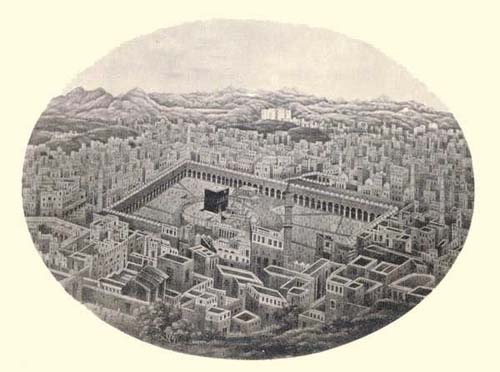 MECCA
MECCA