Vive ✠ Jésus!
Annecy, 1626.
My very dear Sisters,
I present to you, in all the sincerity of my
heart, the directions and customs which have been
established in this monastery by our late holy Father
and Founder, having arranged them in what seemed
to me the most convenient form for their preservation.
And I have added, following his injunctions,
some things which he had written with his own hand,
and others, which he had marked, but had not yet
written.
The majority of the Sisters who have known him
are aware, as I am, that it was his wish that these
Directories, Ceremonials, and Customs should, in the
future, be for ever observed in all our monasteries of
the Visitation, in order, permanently, to keep up the
union and conformity which until now has existed
between them and the first monastery. To further
this end, it has been my desire, by means of the first
Sisters of our holy Order and of the entire Chapter
here, to make them known, so that with me they may
bear witness, to those who succeed us, that they are
the same Directories, Ceremonials, Customs, and
Ordinances which were established in this monastery
of Annecy by our said holy Founder, and that they
have been observed by these first Sisters, and by all
the Communities which they governed, in as far as
they have been communicated to them. But because
it has pleased divine Providence to confer on me,
though so unworthy, the honour, grace and happiness
of being one of the first sisters employed in
beginning this most admirable and holy manner of
life, our holy Father and Founder has instructed me
and them with peculiar care. Therefore, dearest
Sisters, I think it will not be distasteful to you if I
exhort you to be faithful to the observance of things
which have been recommended for the welfare of
our souls with such tender love and zeal. Nor do
I think you will gainsay my recalling you to some
notable points to which I know he specially wished
that we should adhere.
This I do in true affection, for, to me they sum up
all that is necessary for us and nothing more is
needed by us. His great fear, our Blessed Father
told me, was lest we should not thoroughly devote
ourselves to the practice of the Rule. And I, also
fearing this, pray God that our very apprehension
may make us all the more faithful to our observance.
"The precepts," he said, "of all virtue and perfection
are contained in our Rules and Constitutions."
Oh, how true this is! For if we have but one heart
in God, if we honour Him in the person of one
another; if we are simple, humble, chaste, poor,
retiring, and all else that is prescribed, shall we not
fulfil all perfection? Again, he said that our
Institute teaches us sufficiently what to do, and our
part is to do it. Let us, then, labour, I beseech you,
very dear Sisters, with our whole hearts, whether it
be in obeying or in commanding, to become living
Rules, not according to our own human wisdom and
prudence, but according to what is set down, practising
it, exactly and punctually, to the letter, without
gloss or comment; and let us rather die than under
any pretext whatsoever depart from this holy way.
The peculiar obedience we owe their Lordships,
our prelates, is a special virtue of our Institute.
They ought to be its protectors and consequently
cannot command us anything at variance with it.
Many a time has our Blessed Father exhorted us to
be on our guard against opening the door to any
change, for with it all will go. Not even in things
of small importance would he have us yield, for
little changes open the way to greater, and if we
want to keep intact what we have received, and
what has been so wisely instituted, we must change
nothing. Old established customs, though but
mediocre, are better than new ones that appear to
us more desirable. Above all he charged Superiors
to take heed to this, and insisted that the good
or evil estate of their monasteries rests in their
hands; that care and attention to their duty should,
in them, be universal; that they ought not to neglect
even the most insignificant points; and said that
their love, cordial support, and zeal for the perfection
of the Sisters in exact observance would make their
monasteries abodes of happiness, and preserve their
Institute. We must aspire, then, to nothing more
and to nothing less than what is prescribed for us.
All these words of Our Blessed Father should be
engraven on our hearts and practised literally. If,
however, times and places demonstrate the necessity
of accommodating in some point, and the change
affects in no way the Rules, Constitutions, and
Customs essential to the conformity of the convents,
such change can be made. But we should first
consult the Spiritual Father, some capable and pious
persons, and the old established monasteries of the
Order, above all Annecy, which latter, after having
maturely considered the proposition, should confer
with the monastery of Lyons, so that the changes
introduced may not be made lightly, nor except
when of great utility for the welfare of the monasteries
and in cases of evident necessity. Another grave
fear entertained by Our Blessed Father was, lest
the spirit of worldly prudence and wisdom should
glide in amongst us. Here also then should we be
on our guard, for it would be our ruin; above all if
it crept in in regard to the election of Mother
Superiors and of those Sisters who have the chief
charges in the monasteries. Most careful and conscientious
should the Sisters be on this point, never
receiving any Superior but her whom they themselves
have elected; for this the Rule commands.
Make no account on these occasions of certain
natural or acquired talents, of the gift of speaking
well, of fine presence, of certain attractive qualities,
of brightness of manner, of nobility, or of many
years of priority in age or in Religion, nor of such
qualities which if they be not accompanied with
what is solid, should not be considered by us.
Rather let us choose those who have discretion and
good judgement, who are simple, sincere, humble,
who have zeal for the observance. Not those who
abound in their own sense, for such as are affected
with this malady usually discredit the spirit of
religion in order to introduce their own. We should
employ those who do not seek the higher charges,
judging themselves unworthy of any.
Such sisters will do admirably all that obedience
orders and the spirit of God will govern in them.
Believe me, this point is of great importance, my
dearest Sisters. Be faithful to it, then, I beg of you.
In the same way must we dread human prudence
and human considerations in the reception of subjects
(the good choice of which is essential for the
preservation of the Institute); above all of subjects
who are infirm or defective in body. You will tell
me that this has been so often recommended in our
writings that there is no need for me to speak of it
here. Yes, this is true, yet I cannot refrain from
repeating myself, because I see that this article on
the reception of those who have some bodily defect
is often combated by wise persons, and is quite
contrary to natural prudence, which sometimes
furnishes so many good reasons that poor charity
has trouble enough to hold herself above it. Wherefore,
to observe this point intact we need great
courage, and we should often call to mind that it is
the end of our Institute, and the desire of desires
of our holy Institutor, as is shown by his warning
to those who infringe it. And see how by this law
he has provided us with a means of practising the
two cherished virtues of our Congregation to which
he so constantly exhorted us: gentle charity towards
our neighbour, and love of our own humiliation.
All that can help us to gain these virtues ought to
be very dear to us, since they are the foundation
and mainstay of the whole spiritual edifice of the
Visitation. Let us then cleave to them, humbling
ourselves more and more, so that we may accept
lovingly and with a welcome all that is abject in the
eyes of the world. Thus may we esteem ourselves
very poor and little in comparison to others, desiring
no other excellence than not to excel, depending
wholly on the good pleasure of God, seeking in all
things only His glory, for this, as you know, is the
characteristic of the daughters of the Visitation.
Oh! my dearest daughters, how we should prize
it! It is the one thing worth caring about. For
the love of God, let us preserve it in its entirety, and
beware of the desire of excelling and of self-esteem,
which would rob us of it. Continually bear in mind
all that our Blessed Father has both left us in his
writings and said to us on this subject, so that our
undertakings may be adorned with this holy virtue.
I shudder as I write and cannot keep back my tears
from the fear that some day this spirit will be lessened
or lost. Oh my God! permit not this, but rather
let our Institute cease to be. My Sisters, I entreat
you to be faithful. When I recall the labours, cares,
and pains through which our holy Founder established
and confirmed us as we now are, and his intense
desire that this spirit should continue unimpaired,
I feel that I would willingly give my life to preserve
it. With all the strength of my soul then I say:
Be jealous of it, for it is the supreme means of drawing
down upon us the grace of God, in whose hands
Our Blessed Father has left us with the assurance
that within the paternal Arms of the sovereign
Providence of God we shall never lack grace to
maintain our Institute in its first fervour, provided
we are faithful to its spirit.
When at Lyons he gave me the good and solid
reasons on which he had formed his final resolve to
leave us under the authority of their Lordships the
prelates. He added, with a deep and humble sense
of confidence: "Jesus Christ will be your Head and
your Protector—the happiness of your Congregation
will not depend on being placed under the government
of one Superior, but on the fidelity of each
Sister individually, and of all together, to unite
themselves to God by an exact and punctual
observance." These are very consoling and striking
words, full of faith as they are. I am aware that
they are in the Book of Customs, yet I feel impelled
to quote them again here, for I should like to write
them in a hundred places, and above all in the
depths of your hearts. We should look upon them
as the last will and testament of our holy Founder,
and by faithful practice keep them inviolably. In
them we shall find our happiness and the one and
only means of preserving untarnished the spirit of
our Institute, which is a spirit strong and finely
tempered. By means of them shall we also learn
how to hide ourselves and how to dwell in peace in
the paternal bosom of our good God, humbly
trusting that these his words will produce deeds.
So we must not be anxious, no matter what happens
to us, but remain ever tranquil, striving with the
assistance of divine grace not to philosophize on
what may never come about. For our Blessed
Father said to me: "To maintain our Congregation
we may search in vain amongst human means for
any better way than our Rule."
He likewise told me that he intended to put things
still more plainly, so as to secure that unity and
conformity amongst the monasteries and that spirit
of humility, with all of which God had already so
abundantly blessed them; for he longed above all
things that they should continue as they are. He
ordered me to see that, to the permissions for foundations
given by the Bishops, the article on "Foundations"
which is in the Book of Customs should be
added. The principal exterior means that he judged
suitable for keeping up union was conformity to and
correspondence with Annecy in everything regarding
the complete observance received from him. "Although,"
he said, "it is established in a small town,
it has nevertheless been the will of divine Providence
that the germ of the Congregation of the Visitation
should be formed there, and there receive its law
and foundations." Wherefore the other monasteries
of the Visitation are always to acknowledge the
house of Annecy as their mother and source, and
maintain with it the closest union of charity, conforming
themselves entirely to it, having particular
intercourse with it, and referring to it in order to be
instructed in the doubts and difficulties which may
arise in practising the Rule and Customs. Such, I
assure you with entire truthfulness, was his express
wish, and he informed me of it in a manner full of
graciousness and wisdom. Conformity to his wishes,
and likewise the happiness which this monastery
possesses in being the depository of his holy body,
will always induce the other houses to keep up an
affectionate union with us here. And as he asked
this on your parts so did he desire that Annecy
should make you all a return of unstinted service,
giving both materially and of its members with a
great zeal and a large-hearted affection, while keeping
up the observance even to the most minute
regulations conscientiously and exactly, so that here
it may be always found practised in its pristine
vigour and integrity.
I must not omit to repeat these words of his, also
said to me at Lyons: "It is by a special providence
of God that the Jesuit Fathers have so great an
affection and charity for us. We should value this
and return it, holding them in singular respect and
giving them our confidence, for they will be a great
help to us. It is not, however, necessary so to
attach ourselves to their Order as to lose our liberty,
for this we must jealously guard. Neither should
it prevent us from union with other Orders with
which we ought to keep in touch, for our Congregation
should have a universal spirit"; and again:
"I do not mean that those who counsel our Sisters
are to change their exercises or their manner of
carrying them out, for there must be no change, and
in this they must be firm."
Such is almost word for word what I learned from
his lips, and to know his will is sufficient, I feel
assured, in the goodness of your hearts, to render
you docile to it. For me, it but remains to urge you
to this, not only exteriorly, but what is of far more
consequence, interiorly, in the spirit, to be cordial,
gentle, humble, artless, poor with a poverty which
keeps us to a holy medium in everything, avoiding
superfluities and all that savours of ostentation. To
all this I affectionately entreat you with all the
earnestness of which I am capable. I cannot truly
bring my letter to a close without congratulating this
dear convent of Annecy on the privileges and graces
with which eternal Providence has been pleased to
favour it in rendering it lovable and worthy of respect
to all the other houses, for where will true daughters
of this Order be found who hold it not in high esteem
and who envy it not its privileges, above all that of
being the dear guardians of the sacred body of its
Founder?—verily, a most precious grace, for which it
ought unceasingly to offer the sacrifice of praise to
the divine Majesty. But, my very dear daughters,
what, think you, ought to be this sacrifice of praise
in thanksgiving for so great a benefit? None other
surely than the constant and persevering offering
of a very exact and holy observance to all contained
in the Institute, so that it will always there be found
practised in its perfect vigour and integrity. See,
my dear daughters, to what our birthright obliges us.
Let us then remain very humble, very poor in
our own esteem, and in holy fear before God, showing
our appreciation of the dignity conferred upon us
not by esteeming ourselves above others, which
would but turn to harm the priceless gifts we possess,
but rather by being the most humble, the most lowly,
the most faithful of all.
May God grant us this grace! Amen.
May I venture to add a very humble prayer to
our Sisters the Superiors, that they will keep in mind
this word of the Rule: "Let us be before God under
the feet of all our Sisters"? Ah! my God, if we
treat them so, if we love our Sisters with a truly
maternal love, which is solicitous, vigilant, zealous for
the welfare of its children; if we govern them not
according to our own views we shall draw upon our
family all manner of blessings. Let them feel that
you have a mother's heart and solicitude for them,
keeping their minds tranquil and contented, and you
can do what you like with them.
All I have said above, very dear Sisters, I have
said solely moved by love and desire. I reiterate
it all with the most emphatic and tender entreaties
from the depth of my heart. All our happiness is
shut up in it. We are obliged to it by vow. It is
our way of perfection of which we shall have to render
an account at the hour of death. Think well on this.
I pray the divine Goodness, through the intercession
of His Holy Mother and of our Blessed
Father, to pour on you all the abundant treasures of
His grace, so that generously and cheerfully you may
continue to walk on this road, gaining by it the fullness
of all perfection in this life and in the next the
prize of a blessed eternity.
Pardon the great length of this letter and its
confidences, and obtain from the divine Mercy eternal
salvation for her who wishes you God's best graces
in abundance and who is, with unbounded affection,
Devotedly yours.
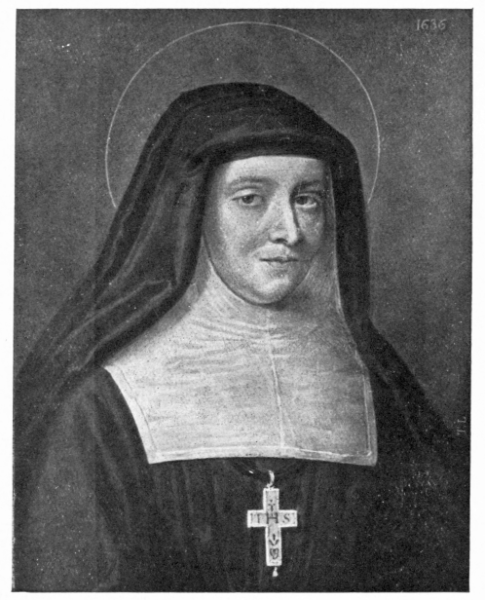 ST. JANE FRANCES DE CHANTAL.