Transcriber’s Note: In keeping with the author’s note that “Such
misspellings as a Spanish scholar will readily recognize as the
blunders of the Spanish printer I have not thought it necessary to
notice”, errors in the Spanish parts of the text have been left as
printed. Some evident blunders of the English printer have, however,
been corrected.
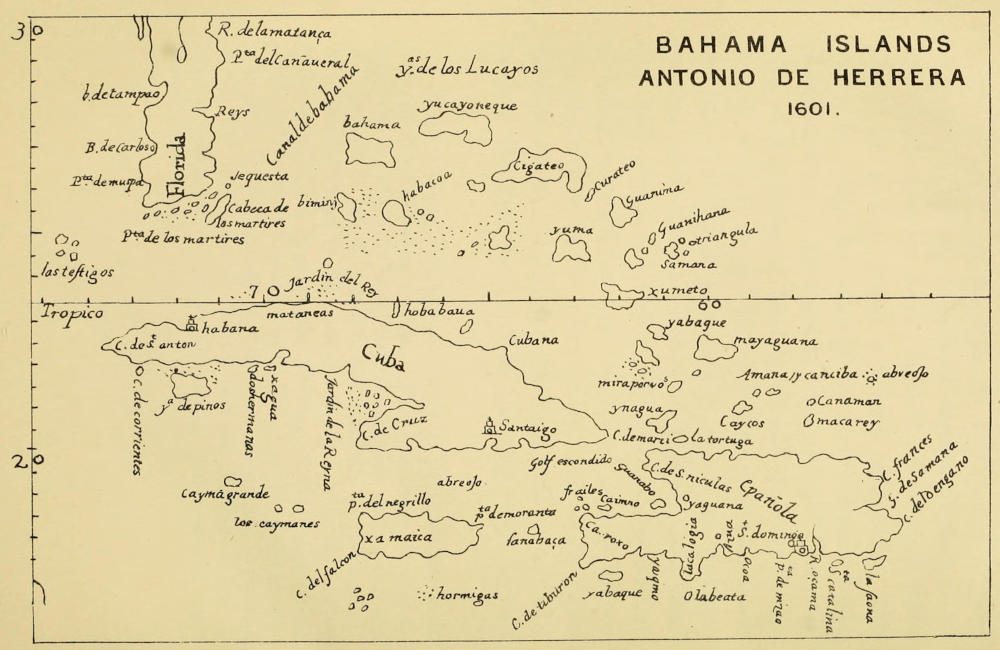
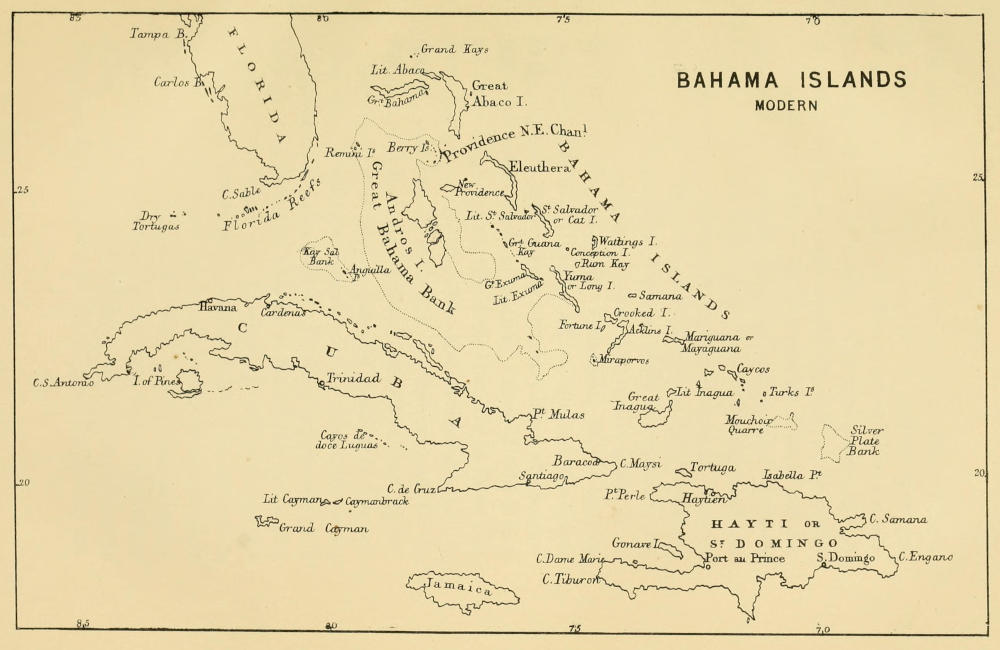
Herrera’s map and Bahama Islands, modern, opposite each other,
between pp. lx and lxi; the first at top, the second at bottom,
both reading the same way.
SELECT
LETTERS OF CHRISTOPHER COLUMBUS, WITH OTHER ORIGINAL DOCUMENTS,
RELATING TO HIS
FOUR VOYAGES TO THE NEW WORLD.
TRANSLATED AND EDITED BY R. H. MAJOR, F.S.A., etc., KEEPER OF THE DEPARTMENT OF MAPS AND CHARTS IN THE BRITISH MUSEUM,
AND HON. SEC. OF THE ROYAL GEOGRAPHICAL SOCIETY.
Second Edition.
“Tu spiegherai, Colombo, a un novo polo
Lontane sì le fortunate antenne,
Ch’ a pena seguirà con gli occhi il volo
La Fama ch’ ha mille occhi e mille penne.
Canti ella Alcide e Bacco, e di te solo
Basti a’ posteri tuoi ch’alquanto accenne;
Chè quel poco darà lunga memoria
Di poema dignissima e d’ istoria.”
Tasso.—Gerusalemme Liberata. Canto xv, 32.
LONDON:
PRINTED FOR THE HAKLUYT SOCIETY. M.DCCC.LXX.
T. RICHARDS, 37, GREAT QUEEN STREET.
COUNCIL OF THE HAKLUYT SOCIETY.
SIR RODERICK IMPEY MURCHISON, Bart.,
K.C.B., G.C.St.S., F.R.S., F.R.G.S., D.C.L., Mem. Imp. Acad. Sc. St.
Petersburgh, Corr. Mem. Inst. Fr. etc., etc., President.
Rear-Admiral C. R. DRINKWATER
BETHUNE, C.B.,
}
Vice-Presidents.
The Right Hon. SIR DAVID DUNDAS,
}
Rev. G. P. BADGER, F.R.G.S.
J. BARROW, Esq., F.R.S.
E. H. BUNBURY, Esq.
LORD ALFRED CHURCHILL.
Rear-Admiral R. COLLINSON, C.B.
Sir WALTER ELLIOTT, K.S.I.
General C. FOX.
W. E. FRERE, Esq.
Captain J. G. GOODENOUGH, R.N.
CHARLES GREY, Esq.
EGERTON VERNON HARCOURT, Esq.
JOHN WINTER JONES, Esq., F.S.A.
R. H. MAJOR, Esq., F.S.A.
Sir CHARLES NICHOLSON, Bart.
Sir WILLIAM STIRLING MAXWELL, Bart.
Major-General Sir HENRY C. RAWLINSON, K.C.B.
The LORD STANLEY of Alderley.
CLEMENTS R. MARKHAM,
Esq., Honorary Secretary.
TO
THE HONOURED AND BELOVED
MEMORY OF HIS EXCELLENCY THE COUNT DE LAVRADIO, LATE
ENVOY EXTRAORDINARY AND MINISTER PLENIPOTENTIARY OF
HIS MOST FAITHFUL MAJESTY AT THE COURT OF ST. JAMES’S,
ETC., ETC., ETC.,
A WARM APPRECIATOR OF
THE EXALTED MERITS OF
COLUMBUS, THE FOLLOWING PAGES
ARE REVERENTLY INSCRIBED BY
THE EDITOR.
PREFACE.
It has been thought desirable by some of the leading
members of our Council that I should avail myself of
the opportunity offered by this second Edition of the
Select Letters of Columbus, to lay before the Society
a correspondence in which I have endeavoured to
vindicate the character of the Society’s early productions,
and especially the first edition of this work,
from a most unjustifiable attack made upon them by
Mr. Froude in the Westminster Review in 1852, and
repeated in the second volume of that gentleman’s
Short Studies on Great Subjects, printed in 1867, and
reprinted in a popular edition in the same year.
The letters themselves will convey to the reader the
whole of the facts, minus only the bitterness and
ferocity of Mr. Froude’s attack.
The Athenæum, July 13th, 1867.
“British Museum, July 3rd, 1867.
“Will you allow me to appeal against a wrong done to the
Hakluyt Society in general, and to myself in particular, in
a work now very extensively read?
“In the second volume of Mr. Froude’s Short Studies on
Great Subjects, at page 102, is an article on ‘England’s
Forgotten Worthies,’ in which the author makes an attack
on the Hakluyt Society, the bitter expressions of which need
not be repeated here. It is headed by the titles of three of
the Society’s early publications, and the first he states to be
The Observations of Sir Richard Hawkins, Knt., in his Voyage
in the South Sea in 1593. Reprinted from the edition of
1622, and edited by R. H. Major, Esq., of the British Museum;
whereas I had nothing to do with the editing of that work.
This done, at page 108, Mr. Froude says: ‘The Editor of
the Letters of Columbus (which I did edit in 1847) apologizes
for the rudeness of the old seaman’s phraseology. Columbus,
he tells us, was not so great a master of the pen as of the
art of navigation. We are to make excuses for him. We
are put on our guard, and, warned not to be offended, before
we are introduced to the sublime record of sufferings under
which a man of the highest order was staggering towards
the end of his earthly calamities; although the inarticulate
fragments in which his thought breaks out from him, are
strokes of natural art, by the side of which literary pathos is
poor and meaningless.’ I warmly deny that I apologized
for Columbus’s language. So far from it, I repeatedly expressed
my sympathy with and admiration of his manly and
touching record of his sufferings. What I did apologize for
was any mischievous result which might possibly have
accrued, though I do not think it did accrue, to my own
diction from that occasional want of connectedness in the
original which I had to contend with in translating. The
two things are manifestly different, and it is not pleasant to
find the reader’s highest sympathies appealed to in order to
bring down greater condemnation on me for a fault that I
had never committed. But I should not trouble you with
such a personal matter, were it not that, having fabricated
this handle for censure on me, Mr. Froude makes it a hook
for the following criticism on the Hakluyt Society: ‘And
even in the subjects which they select, they are pursued by
the same curious fatality,’ the selection blamed being that of
Drake’s Last Voyage in 1595, edited from the original MSS.
Then, after magisterially condemning this elsewhere unblamed
selection as a ‘fatal’ sin, Mr. Froude proceeds to say, at the
foot of page 109, ‘But every bad has a worse below it, and
more offensive than all these is the Editor of “Hawkins’s
Voyage to the South Sea,”’—and if the reader refers to the
head of the article for the name of this most offensive editor,
he will, as I have already said, find my name, who never
had anything to do with it. It is true that on page 110 the
name of the real editor, Admiral Bethune, occurs; but as
Mr. Froude’s article is a reprint from the Westminster Review
of 1852 (not 1853, as Mr. Froude again blunders in saying),
there has been time enough for that gentleman to correct
the injurious errors into which he had fallen. Although
naturally annoyed at this treatment of my name, I left the
offence unnoticed at the time; but now that, after a lapse
of fifteen years, it is reprinted, with all faults in a widely-circulated
publication, I call on Mr. Froude to correct his
mis-statements.
“I am, happily, able to state, from the experience of
twenty years, that the estimate of the Hakluyt Society’s
publications by the literary world is far from supporting
Mr. Froude in his supercilious treatment of that Society.
Whatever opinion, however, those publications may deserve,
it is the duty of a critic to be correct, and the greater the
severity, the greater the need of correctness; but when a
critic lashes not only one’s self, but one’s friends, by means
of misrepresentations and blunders of his own making,
what does that critic deserve?
R. H. Major.”
The Athenæum, July 20th, 1867.
“5, Onslow Gardens, July 15, 1867.
“I am sorry to have given Mr. Major cause to complain
of me. Should my Essays be reprinted, the mistake which
he points out shall be corrected; and I can only regret the
injustice which meanwhile is done to his name. At the same
time the only error which I can acknowledge is confined to
the title of a work which stands at the head of the article.
In the article itself the volumes criticised are assigned to
their proper editors.
J. A. Froude.”
The Athenæum, July 27th, 1867.
“British Museum, July 23, 1867.
“I beg to thank Mr. Froude for his courteous expression
of regret for what, I am quite sure, was done inadvertently,
and I would thankfully accept his promise of reparation if it
were extended to all the mischief that is being done to me.
Unfortunately for me, two editions of Mr. Froude’s Essays
have been issued this year, the second this very month, in a
cheap and popular form; thus diffusing and prolonging, in
the most effectual manner, an injustice to my name which
has existed for fifteen years, and postponing indefinitely the
chance of reparation in a future edition.
“Under such circumstances, I read with regret that, while
acknowledging one error, Mr. Froude does not also acknowledge
what everyone else sees clearly and condemns, the injustice
of his censure on me with respect to Columbus, and
which he makes a ground for censure on the Hakluyt
Society. That Society stands too high to need any defence
from its former Honorary Secretary, but I may be excused
for specially asking that this censure may be expunged; for
I have a letter from Mr. Bancroft, who was Ambassador here
at the time, in which he eulogizes, in terms so warm that I
may not repeat them, the spirit in which I had written both
of the sufferings of Columbus, and of the touching language
in which he had recorded them. This is exactly the contrary
of what Mr. Froude’s two editions are telling everybody that
I have done.
R. H. Major.”
Now that, in revising my translation for this second
edition, I have again gone through the texts of Columbus’s
letters, I uncompromisingly repeat the expression
which in 1847 I used solely in exculpation
of any mischievous result to my own diction from the
disconnectedness of the original, viz., that “Columbus
was not so great a master of the pen as of the art of
navigation.” Whether my judgment on this point
be of more or less weight than Mr. Froude’s is of no
moment whatever; but it is of moment that the mischievous
effect of a savage criticism, built up on the
critic’s own blunders, should be neutralized as far as
possible. The reader has the realities of the whole
case before him, and may judge for himself.
R. H. M.
INTRODUCTION. — FOOTNOTES:
Nearly three thousand years have passed since the
wisest of men declared that there was nothing new
under the sun. The saying has held good to the
present day, for men are perpetually finding out
that their recent discoveries had been already made,
but under circumstances which did not reveal the
full value of that which had been discovered. No
greater examples of this truth can be adduced than
in the history of the Atlantic, of America, and
of Australia. Until the days of Prince Henry the
Navigator, the Atlantic was so unknown that it
justly bore the name of the “Sea of Darkness;” and
yet, during the previous two thousand years occasional
glimpses of light had in fact been thrown
upon the face of that mysterious ocean. “Nil novi
sub sole” was still an indisputable proverb. In the
researches into the Atlantic originated by Prince
Henry, Columbus took part, and hence, as we shall
presently more fully see, derived the idea of the
great importance of explorations to the West. Within
one hundred years of the triumphant rounding by
Prince Henry’s navigators (in 1434) of Cape Bojador,
which till then had been the limit of Atlantic exploration,
the Portuguese had discovered both the
eastern and western shores of the continental island
of Australia. And yet till recently men knew not
that they owed the knowledge either of America
or of Australia[1] to the initiatory efforts of a Prince
with whose name, in fact, they were almost entirely
unacquainted.
Such facts show the great injustice done to the
originators of great explorations who, working with
the smallest means, really deserve the highest meed
of honour.
Yet in the estimate of merit it must be conceded
that priority, immense as are its claims, is not all-absorbent.
Columbus, as we shall presently see,
was anticipated in the discovery of America, and
yet such were the special virtues brought to bear
upon the execution of his great achievement, that,
as Humboldt has eloquently said, “the majesty of
grand recollections seems concentred” on his illustrious
name. The peculiar value of the following
letters, descriptive of the four important voyages of
Columbus, is that the events described are from the
pens of those to whom the events occurred. In them
we have laid before us, as it were from Columbus’s
own mouth, a clear statement of his opinions and
conjectures on what were to him great cosmical
riddles—riddles which have since been solved mainly
through the light which his illustrious deeds have
shed upon the field of our observation. In these
letters also we trace the magnanimity with which
Columbus could support an accumulated burthen of
undeserved affliction. It is impossible to read without
the deepest sympathy the occasional murmurings
and half suppressed complaints which are uttered in
the course of his letter to Ferdinand and Isabella,
describing his fourth voyage. These murmurings
and complaints were wrung from his manly spirit
by sickness and sorrow, and though reduced almost
to the brink of despair by the injustice of the
king, yet do we find nothing harsh or disrespectful
in his language to the sovereign. A curious
contrast is presented to us. The gift of a world could
not move the monarch to gratitude; the infliction of
chains, as a recompense for that gift, could not provoke
the subject to disloyalty. The same great heart
which through more than twenty wearisome years of
disappointment and chagrin gave him strength to
beg and to buffet his way to glory, still taught him
to bear with majestic meekness the conversion of
that glory into unmerited shame.
The translated documents are seven in number.
Five of them are letters from the hand of Columbus
himself, describing respectively his first, third, and
fourth voyages. Another, describing the second
voyage, is by Dr. Chanca, the physician to the fleet
during that expedition, and the seventh document
is an extract from the will of Diego Mendez, one
of Columbus’s officers during the fourth voyage, who
gives a detailed account of many most interesting
adventures undertaken by himself, but left undescribed
by Columbus.
I shall not pause here to enter into the important
bibliography of these documents, which has no charm
for many readers, and is therefore placed at the end
of this introduction. A series of original documents
of such importance might appear to need but few
words of introduction or recommendation, since the
entire history of civilisation presents us with no
event, with the exception perhaps of the art of printing,
so momentous as the discovery of the western
world; and, independently of the lustre which the
grandeur of that event confers upon the discoverer,
there is no individual who has rendered himself, on
the score of personal character and conduct, more
illustrious than Christopher Columbus. There have,
nevertheless, not been wanting those, who, from
various motives, and on grounds of various trustworthiness,
have endeavoured to lessen his glory, by
impeaching his claim to the priority of discovery, or
by arguing that the discovery itself has proved a
misfortune rather than advantage to the world at
large. By way, therefore, of vindicating the value of
the original documents here translated, a brief account
of such pretensions to prior discovery as have
been at different times put forth, may not be thought
superfluous.
The oldest story which seems possibly to bear reference
to what we call the “new world” is related
by Theopompus.
Theopompus lived in the fourth century before
the Christian era; in a fragment of his works preserved
by Ælian is a conversation between Silenus
and Midas, King of Phrygia, in which the former
says that Europe, Asia, and Africa were surrounded
by the sea, but that beyond this known world was
an island of immense extent, containing huge animals
and men of twice our stature, and long-lived in proportion.
There were in it many great cities whose
inhabitants had laws and customs entirely different
from ours. Fabulous as the story is as a whole, we
cannot escape from the thought that it suggests,
though vaguely, a notion of the real existence of a
great western country. This idea is strengthened
by the remarkable story related to Solon by a priest
of Sais from the sacred inscriptions in the temples,
and presented to us by Plato in his Timæus and
Critias, wherein he speaks of an island called Atlantis,
opposite the Pillars of Hercules, larger than
Africa and Asia united, but which in one day
and night was swallowed up by an earthquake and
disappeared beneath the waters. The result was
that no one had since been able to navigate or
explore that sea on account of the slime which the
submerged island had produced. Many as have
been the doubts and conjectures to which this narrative
has been subjected by the learned in ancient
and modern times, it is a remarkable fact
that Crantor, in a commentary on Plato quoted by
Proclus, declares that he found this same account
retained by the priests of Sais three hundred years
after the period of Solon, and that he was shown
the inscriptions in which it was embodied. It is
also deserving of notice that precisely in that part
of the ocean described in the legend we find the
island groups of the Azores, Madeira, the Canaries,
and a host of other rocks and sand-banks, while the
great bank of varec, or floating seaweed, occupying
the middle portion of the basin of the North Atlantic,
and covering, according to Humboldt, an area about
six times as large as Germany, has been reasonably
regarded as explanatory of the obstacle to navigation
to which the tradition refers.
Various have been the speculations respecting the
original colonisation of the western hemisphere.
Athanasius Kircher, in his Prodromus Coptus and
Œdipus Ægyptiacus, gives the Egyptians the credit
of colonising America, as well as India, China, and
Japan, grounding his argument upon the religious
worship of the sun, moon, stars, and animals. Edward
Brerewood, at pages 96 and 97 of his Enquiries
touching the Diversity of Languages, contends, and
he is far from being alone in his opinion, that the
Americans are the progeny of the Tartars. Marc
Lescarbot, in his Histoire de la Nouvelle France,
maintains that the Canaanites, when routed by
Joshua, were driven into America by storms, and
that Noah was born in America, and after the flood
showed his descendants the way into their paternal
country, and assigned to some of them their places of
abode there; while Hornius, in his treatise De originibus
Americanis, after touching upon the various conjectures
here quoted, animadverts on the presumption
and folly of Paracelsus, when he states that a
second Adam and Eve were created for the peopling
of the western world.
The first specific statement, however, of a supposed
migration from the shores of the old world to those
of the new, is that which the elder De Guignes presumes
to be demonstrable from the relation given by
a Chinese historian, Li-Yen, who lived at the commencement
of the seventh century. (See Mémoires
de l’Académie des Inscriptions et Belles Lettres,
vol. 28, p. 504.) The said historian speaks of a
country, named Fou-sang, more than forty thousand
li[2] to the East of China. He says that they who
went thither started from the province of Leaton,
situated to the north of Peking; that after having
made twelve thousand li, they came to Japan;
that travelling seven thousand li northward from
that place, they arrived at the country of Venchin,
and at five thousand li eastward of the latter,
they found the country of Tahan, whence they journeyed
to Fou-sang, which was twenty thousand li
distant from Tahan. From this account De Guignes
endeavours, by a long chain of argument, to prove
that the Chinese had pushed their investigations into
Jeso, Kamtschatka, and into that part of America
which is situated opposite the most eastern coast of
Asia.
This surmise of De Guignes has been answered by
Klaproth, in a paper which appeared in the Nouvelles
Annales des Voyages (tom. 51, 2ᵉ serie, p. 53). His
arguments go to show that the country named Fou-sang
is Japan; and that the country of Tahan,
situated to the west of Asiatic Vinland, can only be
the island of Saghalian. Humboldt observes upon
this subject, that the number of horses, the practice
of writing, and the manufacture of paper from the
Fou-sang tree, mentioned in the account given by
the Chinese historian, ought to have shown De
Guignes that the country of which he spoke was
not America.
The presumed discovery of America which comes
next in chronological rotation, is that by the Scandinavians,
the earliest printed allusion to which occurs
in Adam of Bremen’s Historia Ecclesiastica Ecclesiarum
Hamburgensis et Bremensis, published at Copenhagen,
1579, 4to. The Baron Von Humboldt has
asserted that the merit of first recognising the discovery
of America by the Northmen, belongs indisputably
to Ortelius, who, in his Theatrum Orbis
Terrarum, with unjust severity says, that Christopher
Columbus had done nothing more than to place
the new world in a permanently useful and commercial
relationship with Europe. The ground upon which
the priority is claimed for Ortelius, is that the first
edition of his work came out in 1570, although the
reference which Humboldt himself gives is to an
edition of 1601 which was after the death of Ortelius,
and the earlier editions do not contain the chapter on
the Pacific Ocean in which the passage occurs. It is
true that in the Bibliotheca Hulthemiana the edition
of 1601 is said to have been revised and augmented
by Ortelius before his death in 1598, but, even if the
assertion was made by Ortelius, and not by the
editor of his work after his death, it still leaves perfectly
unimpeached the claim to priority of the
Copenhagen edition of Adam of Bremen in 1579.
Adam of Bremen’s work was written soon after the
middle of the eleventh century, and was followed in
the next half century by the Historia Ecclesiastica
of Ordericus Vitalis, who also speaks of the country
visited by the Scandinavians. Abraham Mylius, in
his Treatise de Antiquitate Linguæ Belgicæ, Leyden,
1611, makes all Americans to be sprung from Celts;
stating that many Celtic words were to be found in
use there; and with more reasonable showing affirms
that the coast of Labrador was visited by wanderers
from Iceland. Hugo Grotius, in his Dissertatio de
Origine Gentium Americanarum, (Paris, 1642, 8vo.),
follows Mylius, and states that America was colonised
by a Norwegian race, who came thither from Iceland,
through Greenland, and passed through North
America down to the Isthmus.
The earliest printed detail of these discoveries is
given by the Norwegian historian, Thormodus Torfæus,
in a work entitled Historia Vinlandiæ Antiquæ,
ex Antiquitatibus Islandicis in lucem producta,
(Hauniæ, 1705, 12mo.) But in the invaluable work
by Professor Rafn, published in 1837 by the Danish
Royal Society of Antiquaries, under the title of Antiquitates
Americanæ, the manuscripts which record
these discoveries are given at length in the original,
accompanied by a Latin translation, and careful and
learned geographical illustrations. The following is
a summary of the principal events recorded in this
highly interesting volume, and the geographical
inferences are those supplied by the professor himself.
Irish Christians were the first Europeans, which we
know from well established history, to have migrated
into and inhabited Iceland. Close upon the end of
the eighth century this island was visited by Irish
hermits; but the first discovery of it by the Northmen
was made by a Dane named Gardar, of Swedish
origin, in the year 863. The regular colonisation of
the country was commenced in 874 by Ingolf, a
Norwegian, and was carried on continuously for the
space of sixty years by some of the most influential
and civilised families of Scandinavia. In 877 the
mountainous coast of Greenland was for the first
time seen by a man named Gunnbiorn, but it was
in 983 that this country was first visited by Eric
Rauda, or Eric the Red, son of Thorwald, a Norwegian
noble, who had been condemned to a
banishment of three years for killing Eyolf his neighbour.
After three years absence, he returned to Iceland,
and in order to hold out an inducement to
colonisation, named the newly discovered country
Greenland, intending by that name to express the
richness of the woods and meadows with which it
abounded. Amongst those who had accompanied
Eric was a man named Heriulf Bardson, who established
himself at Heriulfsnes. Biarne, the son of
the latter, finding, on his return home from a trading
voyage to Norway, that his father had quitted Iceland,
resolved upon following him, though he, as well
as those who had accompanied him, were quite unacquainted
with the Greenland sea. Soon after leaving
Iceland they met with northerly winds and fogs,
and were carried they knew not whither: the weather
clearing, they found themselves near a flat woody
country, which, not corresponding with the descriptions
of Greenland, they left to larboard. After five
days’ sailing with a south-west wind, they came to a
mountainous country, covered with glaciers, which
they found to be an island; but as its appearance
was not inviting, they bore away from the island, and
standing out to sea with the same wind, after four
days’ sailing with fresh gales, they reached Heriulfsnes
in Greenland.
Some time after this, in the year 1000, Lief, son of
Eric the Red, equipped a ship with thirty-five men
to make a voyage of discovery, with the view of examining
the new found lands more narrowly. They
came to a land were no grass was to be seen, but
everywhere there were vast glaciers, while the space
intervening between these ice mountains and the shore
appeared as one uninterrupted plain of slate. This
country they named Helluland, i. e. Slate-land (Newfoundland).
Thence they stood out to sea again, and
reached a level wooded country, with cliffs of white
sand. They called this country Markland, i. e. Woodland
(Nova Scotia). Again they put to sea, and after
two days’ sail reached an island, to the eastward of
the mainland, and passed through the strait between
this island and the mainland. They sailed westward,
and landed at a place where a river, issuing from a
lake, fell into the sea. Here they wintered and built
houses, which were afterwards called Leifsbuder
(Leifsbooths.) During their stay, one of their number,
named Tyrker, a German, happened to wander
some distance from the settlement, and on his return
reported that he had found vines and grapes. These
proving to be plentiful, Lief named the country Vinland
or Vineland (New England), and in the ensuing
spring returned to Greenland. In the year 1002,
Thorwald, Lief’s brother, being of opinion that the
country had been too little explored, borrowed his
brother’s ship, and with the assistance of his advice
and instructions, set out on a new voyage. They
arrived at Liefsbooths, in Vinland, remained there
for the winter, and, in the spring of 1003, Thorwald
sent a party in the ship’s long boat on a voyage of
discovery southwards. They found a beautiful and
well-wooded country, with extensive ranges of white
sand, but no traces of men, except a wooden shed
which they found on an island lying to the westward.
They returned to Liefsbooths in the autumn. In the
summer of 1004, Thorwald sailed eastward and then
northward, past a remarkable headland enclosing a
bay, and which was opposite to another headland.
They called it Kialarnes (Keel-Cape). Continuing
along the east coast, they reached a beautiful promontory,
where they landed. Thorwald was so
pleased with the place that he exclaimed, “Here is
a beautiful spot, and here I should like well to fix
my dwelling.” He had scarcely spoken before they
encountered some Skrellings (Esquimaux) with whom
they fell to blows, and a sharp conflict ensuing, Thorwald
received a mortal wound in his arm from an
arrow. He died, and was buried by his own instructions
on the spot which had excited his admiring
remark, the language of which appeared prophetic
of a longer stay there than he had at first contemplated.
The most distinguished, however, of all the first
American discoverers is Thorfinn Karlsefne, an Icelander,
whose genealogy is carried back in the old
northern annals to Danish, Swedish, Norwegian,
Scottish, and Irish ancestors, some of them of royal
blood. In 1006 this chieftain visited Greenland, and
there married Gudrida, the widow of Thurstein (son
of Eric the Red), who had died the year before in an
unsuccessful expedition to Vinland. Accompanied
by Snorre Thorbrandson, also a man of illustrious
lineage, Biarne Grimolfson of Breidefiord, and Thorhall
Gamlason of Austfiord, he set sail in the spring
of 1007 with three ships for Vinland.
They had in all one hundred and sixty men, and
as they went with the intention of colonising, they
took with them a great variety and quantity of live
stock. They sailed, first, to the Tresterbyd, and
afterwards to Biarney (Disco); then to Helluland,
where they found an abundance of foxes; and thence
to Markland, which was overgrown with wood, and
plentifully stocked with a variety of animals. Proceeding
still in a south-westerly direction, with the
land on the right, they came to a place where a frith
penetrated far into the country; off the mouth of it
was an island, on which they found an immense
number of eyder ducks, so that it was scarcely possible
to walk without treading on their eggs. They
called the island Straumey (Stream Isle) from the
strong current which ran past it, and the frith they
called Straumfiordr (Stream Frith). Here Thorhall
and eight others left the party in quest of Vinland,
but were driven by westerly gales to the coast of
Iceland, where some say that they were beaten, and
put into servitude. Karlsefne, however, with the
remaining one hundred and fifty men, sailed southwards,
and reached a place were a river falls into the
sea from a lake; large islands were situated opposite
the mouth of the river; passing these, they steered
into the lake, and called the place Hop. The low
grounds were covered with wheat growing wild; and
the rising grounds with vines. Here they stayed till
the beginning of the year 1008, when finding their
lives in constant jeopardy from the hostile attacks of
the natives, they quitted the place, and returned to
Eric’s fiorde. In 1011 a ship arrived in Greenland,
from Norway, commanded by two Icelandic brothers
named Helge and Finnboge: to these men, Freydisa,
a natural daughter of Eric the Red, proposed a voyage
to Vinland, stipulating that they should share
equally with her the profits of the voyage. To this
they assented, and it was agreed that each party
should have thirty able-bodied men on board the
ship, besides women; but Freydisa secretly took
with her five men in addition to that number. They
reached Liefsbooths in 1012, and wintered there;
when a discussion arising, Freydisa had the subtlety
to prevail on her husband to massacre the brothers
and their followers; after the perpetration of which
base deed they returned to Greenland in the spring
of 1013.
In his expedition to Vinland in 1007, Thorfinn
Karlsefne had been accompanied by his wife, Gudrida,
who bore him a son, Snorre, who became the
founder of an illustrious family in Iceland, which
gave that island several of its first bishops. Among
these may be mentioned the learned Bishop Thorlak
Runolfson, to whom we are principally indebted for
the oldest ecclesiastical code of Iceland, written in
the year 1123. It is also probable that the accounts
of the voyages were originally compiled by him.
The notices given in these old Icelandic accounts,
of the climate, soil, and productions of the new
country are very characteristic. It is curious that
Adam of Bremen, in the eleventh century, though
himself not a northman, states, on the authority of
Svein Estridson, the King of Denmark, a nephew of
Canute the Great, that the country of Vinland got
its name from the vine growing wild there, and for
the same reason the English re-discoverers gave the
name of Martha’s Vineyard to the large island close
off the coast.
It is fortunate that in these ancient accounts they
have preserved the statement of the course steered
and the distance sailed in a day. From various ancient
Icelandic geographical works it may be gathered
that the distance of a day’s sailing was estimated at
from twenty-seven to thirty geographical miles—German
or Danish—of which fifteen are equal to a
degree, and are consequently equivalent to four
English miles. From the island of Helluland, afterwards
called little Helluland, Biarne sailed to Herjulfsnes
(Ikigeit), in Greenland, with strong south-westerly
winds, in four days. The distance between
that cape and Newfoundland is about one hundred
and fifty miles, which, if we allow for the strong
south-westerly gales, will correspond with Biarne’s
voyage; while the well-known barrenness of the flats
of Newfoundland corresponds with the Hellue, or
slates, which suggested the name the Northmen gave
to the island.
Markland being described as three days’ sail south-west
of Helluland, appears to be Nova Scotia; and
the low and level character of the country, covered
with woods, tallies precisely with the descriptions of
later writers.
Vinland was stated to be two days’ sail to the
south-west of Markland, which would be from fifty-four
to sixty miles. The distance from Cape Sable
to Cape Cod is reckoned at about two hundred and
ten English miles, which answers to about fifty-two
Danish miles; and in the account given by Biarne
of their finding many shallows off the island to the
eastward, we recognize an accurate description of
Nantucket, and Kialarnes must consequently be
Cape Cod. The Straumfiordr of the Northmen is
supposed to be Buzzard’s Bay, and Straumey, Martha’s
Vineyard, though the account of the many eggs
found there, would seem to correspond more correctly
with Egg Island, which lies off the entrance of Vineyard
Sound.
Krossanes is probably Gurnet Point. The Hóp
answers to Mount Hope’s Bay, through which the
Taunton river flows, and it was here that the Leifsbooths
were situated.
The ancient documents likewise make mention of a
country called Huitramannaland (Whiteman’s Land),
otherwise Irland it Mikla (Great Ireland) supposed to
be that part of the coast of North America, including
North and South Carolina, Georgia and Florida.
There is a tradition among the Shawanese Indians,
who emigrated some years ago from Florida and settled
in Ohio, that Florida was once inhabited by white
people, who possessed iron instruments. The powerful
chieftain, Are Marson of Reykianes, in Iceland,—according
to the account given by his contemporary
Rafn, surnamed the Limerick trader,—was driven to
Huitramannaland by storms in 983, and was baptised
there. Are Frode likewise (the first compiler of the
Landnama, and a descendant in the fourth degree
from Are Marson) states that his uncle, Thorkell
Gellerson, had been informed by Icelanders that Are
Marson had been recognised in Huitramannaland,
and was held in high respect there. This statement
therefore shows that there was an occasional intercourse
in those days between the Orkneys and Iceland,
and this part of America.
It is further recorded in the ancient MSS. that the
Greenland bishop Eric went over to Vinland in the
year 1121; but nothing more than the fact is stated,
and it simply corroborates the supposition of intercourse
between the countries. Again, in the year
1266, a voyage of discovery to the Arctic regions of
America is said to have been performed, under the
auspices of some clergymen of the bishopric of Gardar
in Greenland; and from the recorded observations
made by the explorers, would seem to have been carried
to regions whose geographical position has been
more accurately determined by our own navigators,
Parry and the two Rosses. The next recorded discovery
was made by Adalbrand and Thorwald Helgason,
two Icelandic clergymen, in the year 1285. Contemporaneous
accounts state that they discovered a
new land to the westward of Iceland, supposed to
have been Newfoundland. The last record preserved
in the ancient Icelandic MSS. relates a voyage from
Greenland to Markland, performed by a crew of
seventeen men, in the year 1347. The account written
by a contemporary nine years after the event, induces
the belief that intercourse between Greenland and
America had been maintained as late as the period
here mentioned, for he speaks of Markland as a
country still known and visited in those days.
The obscurity of many portions of these narratives
leaves much to be cleared up with reference to this
interesting subject; but their general truthfulness
being corroborated by the traces of the residence and
settlement of the ancient northmen exhibited in the
inscriptions discovered in Kinkigtorsoak, Greenland,
and Massachusetts, no room is left for disputing the
main fact of the discovery.
Between this period and the date of the first voyage
of Columbus, the coast of America is reported to have
been visited by the Arabians of the Spanish Peninsula,
the Welsh, the Venetians, the Portuguese, and
also by a Pole in the service of Denmark.
The Arabian expedition is described both by Edrisi
and by Ibn-al-Wardi. It appears to have been undertaken
by eight persons of the same family, called the
Almagrurins or the Wandering Brothers, who having
provided themselves with everything requisite for a
long voyage, swore they would not return till they
had penetrated to the extreme limits of the Sea of
Darkness. They sailed from the port of Aschbona or
Lisbon, and steered towards the south-west, and at
the end of thirty-five days arrived at the island of
Gana or Sheep Island. The flesh of the sheep of
this island being too bitter for them to eat, they put
to sea again, and after sailing twelve days in a
southerly direction, reached an island inhabited by
people of a red skin, lofty stature, and with hair of
thin growth but long and flowing over their shoulders.
The inhabitants of this island told them that persons
had sailed twenty days to the west without discovering
land, and the Arabian brothers, diverted from
the pursuit of their hardy enterprise by this discouraging
account, retraced their course, and returned
safely to Lisbon. From this description the elder de
Guignes inferred that the Arabs had either reached
the eastern coast of America, or at least one of the
American islands; an opinion, however, which appears
to have as little to sanction it, as his above
mentioned conjecture that the Chinese had discovered
the west coast of America in the fifth century. The
Baron von Humboldt concurs with the opinion expressed
by the learned orientalist Tychsen in his
Neue oriental und exegetische Bibliothek, and repeated
by Malte Brun, that the island reached by
the Arab wanderers was one of the African islands.
This conclusion is drawn from the circumstance that
the Guanches, the original people of the Canary
group, were a pastoral race, and also possessed the
same external characteristics as the islanders here
described. Moreover, the fact that the king of the
island had an interpreter who spoke Arabic, together
with the circumstance that the red men had sailed
westward for a month without seeing land, strongly
corroborates the opinion advanced. The precise date
of this voyage is unknown, but Humboldt presumes
that it must have been considerably anterior to the
expulsion of the Arabs from Lisbon in 1147; because
Edrisi, whose work was finished in 1153, speaks of
the occurrence as if it were by no means recent.
It is but upon a slight foundation, that the Welsh
have pretended to raise a claim to the discovery; but
slight as it is, there is certainly enough to render a
decidedly negative assertion on the subject to the
full as presumptuous as one decidedly affirmative
would be. But as we have no concern with mere
conjectures, we must in candour narrate, as succinctly
as possible, the grounds upon which these
pretensions have been founded.
The first account of this discovery is found in
Humphrey Llwyd’s translation of the History of
Wales, by Caradoc of Llancarvan, published by Dr.
Powell in 1584. According to him the occurrence
took place as follows:—On the death of Owen
Gwynedd, prince of North Wales, in 1169, a contention
arose amongst his numerous sons respecting the
succession to the crown, when Madawe, or Madoc,
one of their number, seeing his native country was
likely to be embroiled in a civil war, deemed it more
prudent to try his fortune abroad. In pursuance of
this object he sailed with a small fleet of ships to
the westward, and leaving Iceland on the north,
came at length to an unknown country, where everything
appeared new and uncommon and the manner
of the natives different from all that he had ever
seen. The country appearing to him, from its fertility
and beauty, to be very desirable for a settlement, he
left most of his own men behind him, (amounting,
according to Sir Thomas Herbert, to a hundred and
twenty), and returning to Wales, persuaded a considerable
number of the Welsh to go out with him
to the newly discovered country, and so with ten
ships he again departed, and bade a final adieu to
his native soil. This account of the historian Caradoc
of Llancarvan is the only affirmative written
document the story has upon which to ground its
claim to authenticity, with the exception of an ode,
written by a Welsh bard, Meredyth ab Rhys, who
died in 1477, fifteen years before Columbus’s first expedition,
in which an allusion is made to the event.[3]
A circumstance which would appear to confirm the
truth of Madoc’s voyages, is a peculiar resemblance
that has been found between some of the American
dialects and the Welsh language; but, as Dr. Robertson
reasonably remarks, the affinity has been observed
in so few instances, and in some of these is so obscure
or so fanciful, that no conclusion can be drawn from
the casual resemblance of a small number of words.
Dr. Williams adduces in confirmation of his favourite
idea the authorities of Lopez de Gomara, Hornius,
and Peter Martyr, pretending that they assert that
traces of Christianity were found among the Americans
by the Spaniards, as well as that there was
a tradition among the Mexicans, that many years
before a strange nation came amongst them, and
taught them a knowledge of God. His references
however appear entirely incorrect.
Another pretension to an early discovery of America
has been founded upon an account given in a
work published in Venice by Francesco Marcolini
in 1558, entitled “Dello scoprimento dell’ Isole Frislanda,
Eslanda, Engrovelanda, Estotilanda, ed Icaria,
fatto sotto il Polo Artico da due fratelli Zeni, M.
Nicolò il K. e M. Antonio.” The substance of the
account is, that in 1380, Nicolò Zeno, a Venetian
noble, fitted out a vessel at his own cost, and made
a voyage to the north, with the intention of visiting
England and Flanders, but was driven by a storm to
Friseland, now proved to be the Færoe Archipelago.
Being rescued from the attacks of the natives by
Zichmni, a neighbouring prince, Zeno entered into
the service of the latter, and assisted him in conquering
Friseland and other northern islands. He shortly
after dispatched a letter to his brother Antonio, requesting
him to find means to join him; whereupon
the latter purchased a vessel, and succeeded in reaching
Friseland, where he remained fourteen years.
During his residence there he wrote to his brother
Carlo in Venice, and gave an account of a report
brought by a certain fisherman, about a land to the
westward. This account stated that about twenty-six
years before, the fisherman, when out at sea with
four fishing boats, was overtaken by a tempest, which
drove them about for many days, and at length cast
them on an island called Estotiland, about a thousand
miles from Friseland. The inhabitants conveyed
them to a fair and populous city, where the king sent
for many interpreters to converse with them, but
none that they could understand, until a man was
found, who had likewise been cast away upon the
coast, and who spoke Latin. They remained several
days upon the island, which was rich and fruitful,
abounding with all kinds of metals, and especially
gold. Though much given to navigation, they were
ignorant of the use of the compass, and finding the
Friselanders acquainted with it, the king of the place
sent them with twelve barques to visit a country to
the south, called Drogeo. They had nearly perished
in a storm, but were cast away upon the coast of
Drogeo. The fisherman described this Drogeo as a
country of vast extent, and that the inhabitants were
naked and eaters of human flesh. He remained
many years in the country, and became rich with
trafficking between Estotiland and the main land,
and subsequently fitted out a vessel of his own, and
made his way back to Friseland. His narrative induced
Zichmni to undertake a voyage thither, in
which he was accompanied by Antonio Zeno. It was
unsuccessful: landing on an island called Icaria, they
were roughly treated by the inhabitants, and a storm
afterwards drove them on the coast of Greenland.
This account was placed in the hands of Marcolini
by Nicolò Zeno, a descendant of the family of the
explorers, but it had to be made from fragments, he
himself having, when a boy, from ignorance torn up
a considerable quantity of the original documents,
which were letters written by Antonio Zeno to Carlo
his brother. In spite of a considerable amount of
fable and exaggeration, defects which enter into the
majority of early accounts of travel, it is scarcely to
be believed that Nicolò Zeno the younger invented
this voyage. He was a man of the highest reputation,
as may be seen by the encomium passed on him
by Francesco Patrizio; see Della Historia dieci Dialoghi
di M. Francesco Patrizio, Venetia, 1560, 4to.,
p. 30 verso. It is well known that the Venetians
had made yearly voyages to the north of Europe for
at least two centuries before the period in question,
and the most important part of Zeno’s publication,
viz., the map, the original of which is stated to have
hung up in his palace since the date of the discovery,
bears evidence of a knowledge, however imperfect, of
Scandinavian geography. The graduation of this
map was inserted by Nicolò Zeno the younger himself,
and although inaccurate enough to cause much
perplexity to geographers, there is no doubt that
Greenland was laid down on it with more correctness
than on any map preceding the date of its publication.
No map before that time shews the Island
of Frisland with names thereon tallying with the
names of the Færoe islands. No map before 1558
shews the discoveries of the Northmen in America,
nor were any of the Sagas known to the Venetians
before that time; nor do any books previous to that
period set forth the geography of those parts from
which Nicolò Zeno could have stolen information.
Moreover the correspondence of the Zeno map with
surveys much later, as in Davis’s Straits, is highly
corroborative of its genuineness. Mr. Kohl, in his
most valuable Documentary History of Discovery
of the East Coast of North America, printed by
the Maine Historical Society, 1869, 8vo., suggests
that Icaria is Helluland or Newfoundland; Estotiland,
Markland or Nova Scotia; and Drogeo, Vinland
or New England: and he further justly remarks
that, assuming that the map is genuine, “it is the
first and oldest known to us on which some sections
of the continent of America have been laid
down.”
On an anonymous map in Weimar of the date of
1424, and on a map by Andrea Bianco,[4] in the
library of St. Mark, bearing the date of 1436, is laid
down a large extent of land, five or six hundred
leagues west of Gibraltar, above which is written the
word “Antillia.” With reference to this subject,
Martin Behaim, on his globe of 1492, says, “In the
year 734, after the conquest of Spain by the Mahometans,
this island Antillia was discovered and settled
by an archbishop from Oporto, who fled to it in
ships with six other bishops and other Christian men
and women. They built there seven towns, from
which circumstance it has also been called Septem
Citade, the island of the seven cities. In the year
1414 a Spanish vessel came very near to it.” Of the
island of S. Brandan also, which is laid down on charts
of the fourteenth century, Behaim says, “In the
year 565, Saint Brandan, an Irish bishop, arrived
with his vessel on this island, saw there most wonderful
things, and returned afterwards to his country.”
Another of these fancied islands in the Atlantic
was the island of Brazil. So strong was the belief in
the existence of these islands, that we find it stated
by Pedro de Ayala, a Spanish envoy in England writing
to the sovereigns in 1498, that the Bristol men
had sent out every year from 1491 (before Columbus’s
first great discovery) to 1497, two, three, or four caravels
every year in search of the islands of Brazil and
the seven cities, at the instigation of John Cabot.
The following passage occurs in Sir John Barrow’s
Chronological History of Voyages in the Arctic Regions,
which, if it stated a defensible truth, would
present another claim, anterior to that of Columbus,
to the discovery of America. The passage is headed
“Cortereals, 1500”;—
“The Portuguese, not content with having discovered
a route to India, by sailing round the tempestuous
extremity to Africa, soon after engaged in
an equally dangerous enterprise: that of finding a
route to India and the Spice Islands, by sailing
westward round the northern extremity of America.
This bold undertaking was reserved for the Cortereals,
the enlightened disciples of the school of
Sagres. The first navigator of the name of Cortereal,
who engaged in this enterprise, was John Vaz Costa
Cortereal, a gentleman of the household of the infant
Dom Fernando, who, accompanied by Alvaro Martens
Homem, explored the northern seas, by order of king
Affonso the Fifth, and discovered the Terra de Baccalhaos
(the land of cod fish), afterwards called Newfoundland.
This voyage is mentioned by Cordeiro,[5]
but he does not state the exact date, which however
is ascertained to have been in 1463 or 1464; for, in
their return from the discovery of Newfoundland, or
Terra Nova, they touched at the island of Terceira,
the captaincy of which island having become vacant
by the death of Jacomo Bruges, they solicited the
appointment, and in reward for their services the request
was granted, their patent commission being
dated in Evora, 2nd April, 1464.”
It will be seen by the wording of this passage, that
Sir John Barrow has fallen into the inaccuracy of asserting
that, in 1463 or 1464, Cortereal was engaged
in the enterprise of finding a route to India and the
Spice Islands by sailing westward round the northern
extremities of America. We must presume that the
Portuguese were aware of the existence of the American
continent, before they could conceive the idea of
sailing westward round its northern extremity. The
patent commission of the appointment of Cortereal
and Homem to the government of Terceira does not
specify that the service for which it was granted,
was the discovery of Newfoundland; and, moreover,
at the end of Faria y Sousa’s Asia Portuguesa, there
is a list of all the armadas which sailed from Lisbon
on voyages of discovery between 1412 and 1640,
and this expedition is passed by in silence; so that
the validity of the whole statement hangs on the
authority of Cordeiro: but the account is altogether
so extremely improbable, from the very silence of
Portuguese writers of the time on so important a
subject, as to leave Cortereal but small chance of a
successful rivalry with Sebastian Cabot.[6]
The last on the list of those who have been said to
precede Columbus in the discovery of America is a
Polish pilot, named John Szkolny, whose name has
been erroneously Latinized by Hornius, Zurla, Malte
Brun, Wytfliet, and Pontanus, “Scolvus,” or “Sciolvus.”
He was in the service of Christian II of Denmark
in the year 1476. He is said to have landed
on the coast of Labrador, after having passed along
Norway, Greenland, and the Friseland of the Zeni.
Upon this subject Von Humboldt thus expresses
himself: “I cannot hazard any opinion upon the
statement made to this effect by Wytfliet, Pontanus,
and Horn. A country seen after Greenland may,
from the direction indicated, have been Labrador. I
am, however, surprised to find that Gomara, who
published his Historia de las Indias at Saragossa, in
1553, was cognizant even at that time of this Polish
pilot. It is possible that when the codfishery began
to bring the seamen of southern Europe into more
frequent connexion with those of the north, a suspicion
may have arisen that the land seen by Szkolny
must have been the same as that visited by John
Sebastian Cabot in 1497, and by Gaspar Cortereal
in 1500. Gomara says what is in other respects not
quite correct, that the English took much pleasure in
frequenting the coast of Labrador, for they found
the latitude and climate the same as that of their
native land, and the men of Norway have been there
with the pilot, John Scolvo, as well as the English
with Sebastian Cabot. Let us not forget that Gomara
makes no mention of the Polish pilot with reference
to the question of the predecessors of Columbus,
though he is malignant enough to assert that it is in
fact impossible to say to whom the discovery of the
New Indies is due.”[7]
In the American Philosophical Transactions for
1786, is a letter addressed to Dr. Franklin by Mr.
Otto of New York, in which he not only asserts that
the illustrious cosmographer Martin Behaim discovered
the Azores, but quotes a passage, from what
he calls an authentic record, preserved in the archives
of Nuremberg, the tenor of which is as follows:—“Martin
Behem, traversing the Atlantic Ocean for
several years, examined the American Islands, and
discovered the strait which bears the name of Magellan,
before either Christopher Columbus or Magellan
navigated those seas; and even mathematically delineated
on a geographical chart for the king of
Lusitania, the situation of the coast around every
part of that famous and renowned strait.” He also
quotes passages from the Nuremberg Chronicle, and
from Cellarius, in confirmation of this statement.
Don Cristóbal Cladera, in his Investigaciones Historicas,
says that, in order to refute these statements,
he procured from Nuremberg a description of Behaim’s
globe, together with historical notes on the life and
family of that geographer, and upon examining these
and the unpublished works of the Academia de las
Ciencias de Lisboa, he became convinced that the
observations of Mr. Otto were totally unfounded;
and De Murr, who has well investigated the question,
assures us that the passage quoted by Mr. Otto from
the Nuremberg Chronicle was not to be found in the
German translation of that work by George Alt in
1493. Moreover, the real globe of Behaim, made in
1492, does not contain any of the islands or shores of
the New World; a fact which sets at rest the two
questions of Behaim’s earlier discovery, or of Columbus
gaining his information from Behaim.[8]
From the series of evidences contained in the preceding
accounts, the fact that America had been
visited by European adventurers before the time of
Columbus is rendered too certain to admit of contradiction
even from the most sanguine advocate of
the glory of the great discoverer. But, on the other
side, it cannot be denied that the discovery of
Columbus, however much later in date, deserves the
meed of highest honour, as being the result of
sagacity, judgment and indomitable perseverance,
and as having been carried on with an energetic
endeavour to bring into active operation the incalculable
advantages which it opened up to the
world at large. To vindicate the correctness of
this statement, it will be well to give a brief sketch
of his eventful life, and to pourtray as briefly as
we may the high qualities to which, far more than
to accidental circumstances, the glory of this great
discovery is due. The retrospect of his history will
at the same time shew, that while every previous
discovery was attributable to accident, the greater
portion of the accidental or uncontrollable circumstances
in the life of Columbus were such as, instead
of assisting him, tended to thwart him at every step
of his painful career.
It is generally agreed that his father was a wool
weaver or carder. There is reason, however, to presume
that though his parentage was humble, he was
descended from a family of consideration. On this
subject his son, Don Ferdinand, denies[9] with great
indignation an assertion which occurs in a curious
life of the admiral, inserted in the “Psaltertium Octuplex
Augustin Justiniani,” Genoa, 1516, folio, under
the comments on the nineteenth psalm, that he was
“vilibus ortus parentibus,” and complains that he is
falsely called a mechanic.
The date of his birth is a “vexata quæstio,” which
it would be well that we should here examine. For
settling a disputed question of the kind no process
seems so sure as the comparing of statements made
by the same individual, if he be a good authority, at
different times and under different circumstances.
The following are two statements made by Columbus
himself at entirely different periods and in an entirely
different shape, and yet both having the same result.
They are recorded by his son, Fernando, in the Biography
of his father, and are as follows: “In his
book of his first voyage [1492] he says, ‘I was upon
the sea twenty-three years without being off it any
time worth the speaking of, and I saw all the East
and all the West, and may say towards the North or
England, and have been at Guinea. Yet I never saw
harbours for goodness like those of the West Indies,’
and a little further he says, ‘That he took to the sea
at fourteen years of age and ever after followed it.’”
Now we know for certain that he escaped from Lisbon
and came to Andalusia at the close of 1484; that
during his stay in Portugal he had made many
voyages to Guinea, but that from 1484 until his first
great voyage in 1492 he was engaged, not at sea, but
in endeavouring to secure the interest of the Spanish
sovereigns in his important project. If then we add
his twenty-three years of almost constant sea-going
to fourteen, his age when he first went to sea, we
have thirty-seven years to deduct from 1484, and we
find 1447 to be the date of his birth. Again in 1501,
many years later, he writes to the Spanish sovereigns
as follows: “I went to sea very young and have continued
it to this day; ... it is now forty years that I
have been sailing to all those parts at present frequented.”
What “very young” meant he had already
told us; viz., 14, which added to 40 makes 54; and
this total deducted from 1501, the date at which he
writes, leaves the same date for his birth as that
resulting from his former statement, viz., 1447. But
for the sake of attaining as near to accuracy as possible,
we must not overlook another statement made
in 1503 by Columbus himself in his letter to Ferdinand
and Isabella, describing his fourth voyage. He
there says “I was twenty-eight years old when I
came into Your Highnesses service, and now I have
not a hair upon me that is not grey.” It was in
1484 that he went to Spain, and then, as we have
seen, terminated those three-and-twenty years of
almost uninterrupted sea-faring life of which he
speaks. Now, if he were then only eight-and-twenty,
he must have first gone to sea at the age of five instead
of fourteen, as he himself informs us. Moreover,
by that reckoning he would have been only fifty
when he died, in 1506, an age entirely incompatible
with the statement of Bernaldez, the Cura de los
Palacios, who knew Columbus so well, that he died
in senectute bonâ, at the age of seventy, more or less.
It is intelligible that such a remark should be made
of a man of sixty, who had passed through hardships
so exhausting to the mind and body as those which
had marked the life of Columbus, but scarcely even
of him at the age of fifty. It is clear, then, that a
mistake has been made in this number 28, but if for
it we write 38, it will make the date of Columbus’s
birth to be 1446. We have, however, to bear in
mind that the two statements previously made by
him were of a very general character, in which no
month or part of a year was specified. It would
therefore seem that, on his own showing, we shall be
safe in placing the date of his birth 1446-47, which
agrees with the inference of the learned and judicious
Muñoz, who places it “por los años 1446,”
although he does not show the process by which he
arrives at his conclusion.
With respect to the birthplace of our illustrious
navigator, were we to enter into the complex discussions
of those who, with different arguments of more
or less plausibility, place it in Genoa, Nervi, Savona,
Pradello, Cogoleto, Quinto, Bogliasco, Albisola, Chiavara,
Oneglia, or the castle of Cuccaro in Monferrato,—we
should but launch upon a sea of difficulties,
with little hope of a successful voyage. It is difficult
to withhold credence from the strong assertion made
twice by Columbus in his will, dated 22nd February
1498, that he was born in the city of Genoa; namely,—“I,
being a native of Genoa”; and “I desire my
said son Diego, or the person who may succeed to
the said inheritance, always to keep and maintain
one person of our lineage in the city of Genoa ... because
from thence I came, and there I was born.”[10]
But in like manner we know that Leonardo, who
was born at Vinci, persisted in calling himself a
Florentine.
Having early evinced a strong inclination for the
study of geography, geometry, and astronomy, Columbus
found at the college of Pavia an excellent opportunity
of gaining a more than superficial acquaintance
with the principles of those sciences, and at the same
time acquired considerable proficiency in the Latin
language. The maritime position and commercial engagements
of his native city doubtless suggested and
fostered much of that propensity for a nautical life,
that he exhibited at so early an age; and although it
appears from several historians that for a short time
he worked at his father’s trade, yet this must have
been simply during his earliest boyhood, for by his own
account he commenced the life of a mariner at fourteen
years of age. The piratical character of the sea-faring
life of those days necessarily exposed its followers to
unceasing hardships and dangers, and the severity of
this early discipline must have most materially tended
to render available and permanent those distinguished
qualities which have subsequently gained for him the
admiration of the world: indeed, no career could have
been better calculated to develope his peculiar genius,
or add fuel to those enthusiastic aspirations which
characterised him to the close of his life.
From the period of his going to sea, which was
about the year 1460 until the year 1472, we meet with
no distinct mention of his name; although in a letter
written by him to their Majesties, in 1495, he says:
“It happened to me that king Réné (whom God has
taken to himself) sent me to Tunis to capture the
galley Fernandina, and on arriving at the island of
San Pedro, in Sardinia, I learned that there were
two ships and a caracca with the galley, which so
alarmed the crew that they resolved to proceed no
further, but to return to Marseilles for another vessel
and more people; upon which, being unable to force
their inclination, I yielded to their wish, and having
first changed the points of the compass, spread all
sail, for it was evening, and at daybreak we were
within the cape of Carthagena, while all believed for
a certainty that they were going to Marseilles.” The
date of this occurrence is unknown, but the expedient
of Columbus to alter the point of the needle, reminds
us of his subsequent stratagem, of altering his reckoning,
to appease his discontented crew during his first
great voyage of discovery.
In the year 1472, however, we have evidence of his
having been in Savona, from the fact of his signature
having been found appended to the will of one Nicolò
Monleone, under date of the 20th March of that year.
The document is preserved in Savona, among the
notarial archives.
In 1474 we find his name mentioned in a letter
addressed by Ferdinand king of Sicily to Louis king
of France, the title of which runs thus: “Literæ à
Ferdinando Rege Siciliæ ad Ludovicum XI, Galliæ
Regem, per Fæcialem missæ, quibus quæritur, quod
Christophorus Columbus triremes suas deprædatus
sit, postulatque sibi ablata restitui. Datum in Terra
Fogiæ die 8 Decembr. 1474.” Then follows a letter
in five lengthy clauses, in which it is stated that the
said vessels were attacked and taken:—“A Columbo,
qui quibusdam navibus præest, Majestatis vestræ
subdito.”
The title of Louis’s reply runs thus: “Responsio
Ludovici XI quibus promittit restitutionem, excusat
tamen Columbum, quod jus sit in Oceano capere
naves ab hostilibus terris venientes et saltem bona
hostium inde auferre.” These letters are given by
Leibnitz, in his Codex Juris Gentium Diplomaticus,
Prodromus, art. 16 and 17; but on the correction of
Nicolas Toinard, he acknowledges, in the preface to
his Mantissa Codicis, that he had erroneously inserted
the Christian name “Christophorus.”
Toinard’s correction went to shew that Leibnitz
had confounded the name of Guillaume de Caseneuve,
surnamed Coulomp, Coulon, or Colon, as the Spaniards
called him, with that of the illustrious discoverer.
This acknowledgment by Leibnitz of his error might
seem to render useless any reference to the letters in
question; but as Christopher Columbus is stated by
his son, Don Ferdinand, to have been of the same
family as the pirate here mentioned, and also to have
been engaged at sea with him and his nephew, it
becomes interesting to examine what record exists of
these illustrious pirates, and to see how far the assertion
of Don Ferdinand bears the semblance of correctness.
This Caseneuve, or Colon, is called by
Duclos, in speaking of the very circumstance which
occasioned these letters, in his Histoire de Louis XI,
“Vice-Amiral de France, et le plus grand homme de
mer de son temps.” And Zurita, in his Libro 19 de
los Anales de Aragon, calls him, “Colon, capitan de
la Armada del Rey de Francia.” Garnier, in his
Histoire de France, thus relates the circumstance:
“Guillaume de Casenove, Vice-Amiral de Normandie,
connu dans notre histoire sous le nom d’Amiral
Coulon, s’était rendu formidable sur toutes les mers
de l’Europe, où il exerçait le métier d’armateur:
dans une de ses courses il s’empara de deux riches
frégates chargées pour le compte des plus riches
négocians de Naples, de Florence, et de plusieurs
autres villes d’Italie, qui tout sollicitèrent vivement la
restitution de cette importante prise.”
Another exploit, in which this Colon was successfully
engaged, was the taking of eighty Dutch ships
returning from the herring fishery, in the Baltic, in
1479. Again, another sea-fight related by Marc Antonio
Sabelico, in the eighth book of his tenth Decade,
is quoted by Don Fernando, where Columbus the
younger (described by Sabelico as the nephew, but by
Zurita as Francis, the son of the famous corsair),
intercepted, between Lisbon and Cape St. Vincent,
four richly laden Venetian galleys, on their return
from Flanders. Fernando further asserts that his
father (Christopher) was present in this engagement,
and that after a desperate contest, which lasted from
morning till evening, the hand-grenades and other
fiery missiles used in the battle, caused a general conflagration
among the vessels, which having been lashed
together with iron grapplings, could not be separated,
and the crews were compelled to leap into the water
to escape the fire. He then goes on to say that “his
father, who was a good swimmer, finding himself at
the distance of two leagues from the land, seized an
oar, and by its aid succeeded in reaching the shore.
Whereupon, learning that he was not far from Lisbon,
where he knew he should find many natives of Genoa,
he went thither, and meeting with a gratifying reception,
took up his abode in that city.” The engagement
here described is shown by various French historians
to have taken place in 1485, and as it is certain that
Columbus was in Lisbon prior to 1474 (for in that
year he has a letter addressed to him in that city by
Paolo Toscanelli, in reply to one written by himself
from the same place), this relation by Don Ferdinand
assumes a very apocryphal aspect.
With respect to his other statement, that his father
was of the same name and family as these two renowned
corsairs, it is to be remarked that neither he
nor any of the subsequent historians who have claimed
this needless honour for the great discoverer, appears
to have been acquainted with the real name of the
pirates; and as Caseneuve was the strict family name
of the latter, and Coulon merely a superadded surname,
we may fairly conclude that the claim to consanguinity
has no other foundation than the identity
in the Spanish language of Columbus’s patronymic
with the distinguishing surname of the French vice-admiral.
In the Chronique Scandaleuse (folio 109) this Caseneuve
is said to have had a very handsome mansion,
named Gaillart-Bois, in the neighbourhood of
Notre Dame d’Escouys, in Normandy, at which Louis
XI made a stay of two or three days in the month of
June 1475, and returned thither also in the following
month and stayed there some time. Spotorno suggests
that his name of Coulon may have been derived
from a place so called in the province of Berri; so
that, in addition to the evidence that he was not of
the same name or family with Christopher Columbus,
there arises strong reason to believe that he was in
reality a Frenchman:[11] in which case it becomes probable
that an event which has been generally attributed
to him, or to his still more renowned relative
François Caseneuve, would be with greater correctness
ascribed to the Genoese navigator, Christopher Columbus.
It appears that, in a letter dated Terra
d’Otranto, 2nd October, 1476 (preserved, according to
Bossi, in the royal archives at Milan), addressed to the
Duke of Milan by two illustrious gentlemen of that
city,—the one Guid’Antonio Arcimboldo, and the
other Giovanni Giacomo Trivulzio—the following
story is related. It says that the captain of the Venetian
fleet, when stationed off Cyprus to defend the
island, had twice encountered a Genoese ship, called
the “Nave Palavisina,” which he had taken to be a
Turkish caracca; and in these two engagements one
hundred and twenty of the Turks and Genoese had
been killed, and in the Venetian squadron thirty had
been killed, and two hundred wounded. The captain
appears to have had doubts whether he might not
have done wrong, and caused offence to the duke of
Milan, who might perhaps be an ally of the Genoese:
he therefore goes on to say that his only desire had
been to meet with his enemies (the Turks) and plunder
them; and adds, in confirmation of that assertion,
that “a year before he had met with three times as
many galleys, who spoke no evil of his good name, and
that he found Columbus with ships and galleys, and
had cheerfully let him pass by, upon which the cry was
raised of ‘Viva San Georgio,’ and nothing further
passed between them.” The Columbus here mentioned
is shewn, by the cry of “Viva San Georgio,” and by the
general tenour of the Venetian captain’s letter, to have
been a Genoese, and with a Genoese crew; and as it
appears probable that the Caseneuves were Frenchmen,
and would in all probability sail with French
crews, it leaves strong reason to presume that the
Genoese captain here mentioned was Christopher
Columbus, who is allowed by all his early historians
to have been engaged in the Mediterranean about the
period referred to.
His son, Ferdinand Columbus, distinctly states
that, “it was in Portugal that the admiral began to
surmise, that, if the Portuguese sailed so far south,
one might also sail westward, and find lands in that
direction.”
The period of Christopher Columbus’s sojourn in
Portugal was from 1470 to the close of 1484, during
which time he made several voyages to the coast of
Guinea in the Portuguese service. While at Lisbon
he married Felipa Moñiz de Perestrello, daughter of
that Bartollomeu Perestrello to whom Prince Henry
had granted the commandership of the island of
Porto Santo. For some time Columbus and his wife
lived at Porto Santo with the widow of Perestrello,
who, observing the interest he took in nautical
matters, spoke much to him of her husband’s expedition,
and handed over to him the papers, journals,
maps, and nautical instruments, which Perestrello
had left behind him.[12]
“It was not only,” says Ferdinand Columbus (see
Vida, cap. 8), “this opinion of certain philosophers,
that the greatest part of our globe is dry land, that
stimulated the admiral; he learned, also, from many
pilots, experienced in the western voyages to the
Azores and the Island of Madeira, facts and signs
which convinced him that there was an unknown land
towards the west.” Martin Vicente, pilot of the
King of Portugal, told him that at a distance of four
hundred and fifty leagues from Cape St. Vincent, he
had taken from the water a piece of wood sculptured
very artistically, but not with an iron instrument.
This wood had been driven across by the west wind,
which made the sailors believe, that certainly there
were on that side some islands not yet discovered. Pedro
Correa, the brother-in-law of Columbus, told him,
that near the island of Madeira he had found a similar
piece of sculptured wood, and coming from the same
western direction. He also said that the King of
Portugal had received information of large canes
having been taken up from the water in these parts,
which between one knot and another would hold nine
bottles of wine; and Herrera (Dec. 1, lib. 1, cap. 2)
declares that the king had preserved these canes, and
caused them to be shown to Columbus. The colonists
of the Azores related, that when the wind blew
from the west, the sea threw up, especially in the
islands of Graciosa and Fayal, pines of a foreign species.
Others related, that in the island of Flores
they found one day on the shore two corpses of men,
whose physiognomy and features differed entirely
from those of our coasts. Herrera, perhaps from the
MSS. of Las Casas, says, that the corpses had broad
faces, different from those of Christians. The transport
of these objects was attributed to the action of
the west winds. The true cause, however, was the
great current of the Gulf or Florida stream. The
west and north-west winds only increase the ordinary
rapidity of the ocean current, prolong its action
towards the east, as far as the Bay of Biscay, and
mix the waters of the Gulf stream with those of the
currents of Davis’ Straits and of North Africa. The
same eastward oceanic movement, which in the fifteenth
century carried bamboos and pines upon the
shores of the Azores and Porto Santo, deposits annually
on Ireland, the Hebrides, and Norway, the
seeds of tropical plants, and the remains of cargoes
of ships which had been wrecked in the West Indies.[13]
While availing himself of these sources of information,
Columbus studied with deep and careful attention
the works of such geographical authors as supplied
suggestions of the feasibility of a short western
passage to India. Amongst these, the Imago Mundi
of Cardinal Pierre d’Ailly (Petrus de Aliaco) was his
favourite, and it is probable that from it he culled
all he knew of the opinions of Aristotle, Strabo, and
Seneca, respecting the facility of reaching India by a
western route. Columbus’s own copy of this work
is now in the cathedral of Seville, and forms one of
the most precious items in the valuable library,
originally collected by his son Ferdinand, and bequeathed
to the cathedral on condition of its being
constantly preserved for public use. It contains
many marginal notes in his own handwriting, but of
comparatively little importance.
The fondness of Columbus for the works of Pierre
d’Ailly, a Frenchman, has caused a recent French
writer, M. Margry, to put forth the empty pretension
that the discovery of America was due to the
influence of French teaching, whereas, not only was
the Imago Mundi itself a compilation from ancient
authors, but the first edition was not printed till
many years after Columbus had devoted himself to
the purpose which ended in his great discovery, for
his famous correspondence with Toscanelli, of which
I shall presently speak, occurred in 1474. M. Margry,
indeed, asserts, but without giving his authority, that
in the Columbian Library at Seville are D’Ailly’s
treatises printed at Nuremberg in 1472. This is in
contravention of all the bibliographers—Panzer,
Ebert, Hain, Serna Santander, Lambinet, and Jean
de Launoy.
The earliest date assigned to the first edition of
the Imago Mundi, is about 1480 by Serna Santander,
1483 (?) by Lambinet, while Jean de Launoy, in his
Regii Navarræ Gymnasii Parisiensis Historia,
Parisiis, 1677, tom. ii, page 478, distinctly gives
it the date of 1490. Humboldt, who had Columbus’s
copy in his hands, and who, as the subject was especially
his own, cannot be suspected of sleeping
over such an important point, adopts De Launoy’s
date of 1490, while Lambinet gives the queried
date of 1483 from actual collation with another
work printed in that year, at Louvain, in the very
identical type, by John of Westphalia. In the
recently published second volume of the Ensayo de
una bibliotheca de libros españoles raros, por Don
Bartolomé Gallardo, is a list of the books in the
Columbian Library, but D’Ailly’s Imago Mundi is
not therein mentioned, although his Quæstiones,
printed much later by Jean Petit at Paris, a far less
important book, is inserted. The omission is to be
regretted, as we might have hoped for some illustrative
comments from the author.
But perhaps it may be suggested that Columbus
may have possessed, or seen, a manuscript copy of
Pierre d’Ailly at a yet earlier period. We will willingly
suppose it for the sake of the argument; but
even then the reasoning will fail, for I find that the
very portion of the Imago Mundi, written in 1410,
which is assumed to have supplied the inspiration
for the discovery of America, and which Columbus
quoted in his letter to Ferdinand and Isabella from
Haiti in 1498, is taken by Pierre d’Ailly, without
acknowledgment, almost word for word, from the
“Opus Majus,” of Roger Bacon, written in 1267, a
hundred and forty-three years before, as will be seen
at page 183 of that work, printed Londini, 1733,
fol. See Humboldt, Examen Critique, tom. i, pp.
64-70.
Unfortunately Roger Bacon was not a Frenchman,
but there remains for M. Margry the consolatory fact
that no Englishman is likely to avail himself of the
circumstance which I have just enunciated, to claim
for his countrymen the honour of having inspired
Columbus with the idea which led to the discovery
of America, although, by M. Margry’s process of
reasoning, he might do so if he would. True, Roger
Bacon had been a student in the University of Paris;
but this fact did not communicate the character of
French inspiration to the ancient authors whose
statements he quotes. True also (but this is a circumstance
either unknown to or unnoticed by M.
Margry), Ferdinand Columbus tells us that his
father was principally influenced in his belief of the
smallness of the space between Spain and Asia, by
the opinion of the Arab astronomer, Al Fergani, or
Alfragan, to that effect; and it is further true that
Alfragan is further treated of by Pierre d’Ailly, in
his Mappa Mundi. This is a separate work from the
Imago Mundi, although it happens to have been
printed with it, at a period which we have shown to
be posterior to Columbus’s correspondence with
Toscanelli, in 1474.
It follows, therefore, that either: 1st, the great
explorer obtained his knowledge of Alfragan’s opinion
through one of the Arabo-Latin translations, to which
he seems to have had recourse during his cosmographical
studies in Portugal and Spain (see Humboldt,
Examen Critique, tom. i, p. 83), in which case
French influence is eliminated; or 2ndly, he derived
it from a manuscript of Pierre d’Ailly before 1474,
which there is no evidence to show; or 3rdly, he derived
it from the printed copy of Pierre d’Ailly, in
which case the influence of Alfragan on his mind
could not have been primarily suggestive, but only
corroborative of conclusions to which he had come
several years before that book was printed. And in
either of the two latter cases, the information supplied
by Alfragan would not become French because
adduced by a Frenchman, unless we introduce into
serious history a principle analogous to the old conventional
English blunder of giving to the toys
manufactured in Nuremberg the name of “Dutch
toys,” because imported through Holland.
The suggestions derived from these works were corroborated
by the narratives of Marco Polo and Sir
John Mandeville, whose reports of the vast extent of
Asia eastward led to the reasonable inference, that
the western passage to the eastern confines of that
continent could not demand any considerable length
of time. The natural tendency of his thoughts to
nautical enterprise being thus fostered by the works
that he studied, and by the animating accounts of
recent adventurers, as well as by the glorious prospects
which the broad expanse of the unknown world
opened up to his view, we find that in the year 1474
his ideas had formed for themselves a determined
channel, and his grand project of discovery was
established in his mind as a thing to be done, and
done by himself. The combined enthusiasm and
tenacity of purpose which distinguished his character,
caused him to regard his theory, when once formed,
as a matter of such undeniable certainty, that no
doubts, opposition, or disappointment, could divert
him from the pursuit of it. It so happened that
while Columbus was at Lisbon a correspondence was
being carried on between Fernam Martins, a prebendary
of that place, and the learned Paolo Toscanelli,
of Florence, respecting the commerce of the
Portuguese to the coast of Guinea, and the navigation
of the ocean to the Westward. This came to the
knowledge of Columbus, who forthwith despatched
by an Italian, then at his house, a letter to Toscanelli,
informing him of his project. He received an answer
in Latin, in which, to demonstrate his approbation of
the design of Columbus, Toscanelli sent him a copy
of a letter which he had written to Martins a few
days before, accompanied by a chart, the most important
features of which were laid down from the
descriptions of Marco Polo. The coasts of Asia were
drawn at a moderate distance from the opposite
coasts of Europe and Africa, and the islands of Cipango,
Antilla, etc., of whose riches such astonishing
accounts had been given by this traveller, were
placed at convenient spaces between the two continents.
While all these exciting accounts must have conspired
to fan the flame of his ambition, one of the
noblest points in the character of Columbus had to
be put to the test by the difficulty of carrying his
project into effect. The political position of Portugal,
engrossed as it was with its wars with Spain, rendered
the thoughts of an application for an expensive
fleet of discovery worse than useless, and several years
elapsed before a convenient opportunity presented
itself for making the proposition.
Meanwhile Columbus was not idle. In the year
1477, he tells us, in a letter quoted by his son, Don
Ferdinand, that “he sailed a hundred leagues beyond
the island of Thule, the southern part of which is distant
from the equinoctial line seventy-three degrees,
and not sixty-three, as some assert; neither does it lie
within the line which includes the west of Ptolemy,
but is much more westerly. To this island, which is
as large as England, the English, especially those
from Bristol, go with their merchandize. At the
time that I was there the sea was not frozen, but
the tides were so great as to rise and fall twenty-six
fathoms. It is true that the Thule of which Ptolemy
makes mention lies where he says it does, and by the
moderns it is called Frislanda.” Whether the Færoe
islands [see ante, page xxiii], or Iceland, was alluded
to is uncertain, for nothing more is known of the
voyage than is contained in this letter. It is moreover
supposed by his son, as has been already stated,
that he passed a considerable portion of his time at
sea, with one or both of the famous pirates of the
same name, who were so many years engaged in the
Levant; but upon the whole of this portion of his
history there rests an impenetrable cloud of obscurity.
About the year 1480, by the joint labours of the
celebrated Martin Behaim and the prince’s two physicians,
Roderigo and Josef, who were the most able
geographers and astronomers in the kingdom, the
astrolabe was rendered serviceable for the purposes
of navigation, as by its use the seaman was enabled
to ascertain his distance from the equator by the
altitude of the sun.
Shortly after this invaluable invention Columbus
submitted to the king of Portugal his proposition of
a voyage of discovery, and succeeded in obtaining an
audience to advocate his cause. He explained his
views with respect to the facility of the undertaking,
from the form of the earth, and the comparatively
small space that intervened between Europe and the
eastern shores of Asia, and proposed, if the king
would supply him with ships and men, to take the
direct western route to India across the Atlantic.
His application was received at first discouragingly,
but the king was at length induced, by the
excellent arguments of Columbus, to make a conditional
concession, and the result was that the proposition
was referred to a council of men supposed
to be learned in maritime affairs. This council, consisting
of the above-mentioned geographers, Roderigo
and Josef, and Cazadilla, bishop of Ceuta, the king’s
confessor, treated the question as an extravagant
absurdity. The king, not satisfied with their judgment,
then convoked a second council, consisting of
a considerable number of the most learned men in
the kingdom; but the result of their deliberations
was only confirmative of the verdict of the first junta,
and a general sentence of condemnation was passed
upon the proposition. As the king still manifested
an inclination to make a trial of the scheme of Columbus,
and expressed a proportionate dissatisfaction with
the decisions of these two juntas, some of his councillors,
who were inimical to Columbus, and at the
same time unwilling to offend the king, suggested a
process which coincided with their own views, but
which was at once short-sighted, impolitic, and ungenerous.
Their plan was to procure from Columbus
a detailed account of his design under the pretence
of subjecting it to the examination of the council, and
then to dispatch a caravel on the voyage of discovery
under the false pretext of conveying provision to the
Cape Verde Islands. King John, contrary to his
general character for prudence and generosity, yielded
to their insidious advice, and their plan was acted
upon, but the caravel which was sent out, after
keeping on its westward course for some days, encountered
a storm, and the crew, possessing none of
the lofty motives of Columbus to support their resolution,
returned to Lisbon, ridiculing the scheme in
excuse of their own cowardice. So indignant was
Columbus at this unworthy manœuvre, that he resolved
to leave Portugal and offer his services to some
other country, and towards the end of 1484 he left
Lisbon secretly with his son Diego. The learned and
careful Muñoz states his opinion that he went immediately
to Genoa, and made a personal proposition to
that government, but met with a contemptuous refusal;
at any rate, we are positively informed by
Fernando Columbus that his father went to Spain at
the close of 1484. A curious surmise is expressed
in a note to Sharon Turner’s History of England in
the Middle Ages, in which the supposition is propounded
of the possible identity of Christopher
Columbus with a person named Christofre Colyns,
who is recorded in some grants in the Harleian MSS.
to have been military commandant of Queenborough
castle, in the isle of Sheppy, in 1484 and 1485.
This man is distinctly stated in the same grants to
have held that post in April 1485, and it may be
reasonably conjectured that the cessation of his office
would not take place till the accession of Henry
VII, in August in that year, which leaves but little
time for his making his way to Genoa, and subsequently
reaching Spain, so as to make his application
to that court. Moreover, the impoverished condition
in which Columbus presented himself at the convent
de la Rabida was very incompatible with the probable
pecuniary position of a person, who is described by
the grants in question not only to have held the prominent
station already mentioned, but to have had
a ship given him, with an annuity of £100, and an
especial grant of money to enable him to supply
himself with habiliments of war. These considerations,
combined with the statement of Fernando
Columbus just referred to, show that the supposition
proposed by Mr. Turner cannot be regarded as
tenable.
The interesting story of Columbus’s visit to the
Franciscan convent of Santa Maria de Rabida forms
the first incident that we find recorded of him
after his arrival in Spain. It is well known that
the lively interest which the worthy prior of that
convent, Fray Juan Perez de Marchena, took in his
guest, was the means, through the anticipated influence
of his friend Fernando de Talavera, of first
leading Columbus to the Spanish court, under the
hope of obtaining the patronage of the king and
queen. Talavera, who was prior of the monastery of
Prado, and confessor to the queen, possessed great
political interest. Juan Perez took advantage of this
influential position of his friend, and addressed him
a letter by the hands of Columbus, strongly recommending
the project of the latter to his favourable
consideration, and requesting his advocacy of it before
the sovereigns. It was in the spring of 1486 that
Columbus first ventured to the Spanish court in the
hope of gaining a favourable audience. On reaching
Cordova, however, he had the mortification to find
that Talavera, upon whose influence he mainly relied,
regarded his design as unreasonable and preposterous.
The court also was at that time so engrossed with
the war at Granada, as to place any hope of gaining
attention to his novel and expensive proposition out
of the question. At length, at the close of 1486,
the theory of Columbus, backed as it was by his
forcible arguments and earnest manner, gained weight
with the most important personage at court next to
the sovereigns themselves. This was Mendoza, archbishop
of Toledo, and grand cardinal of Spain; who,
pleased with the grandeur of the scheme and the
fervent but clear-headed reasoning of Columbus,
adopted his cause, and became his staunch protector
and friend. Through his means an audience was
procured with the sovereigns, and the result of the
interview was the expression of a favourable opinion,
qualified by the necessity of an appeal to the judgment
of the literati of the country. But here again
Columbus found himself in a painful predicament,
which it required all his knowledge and prudence to
escape from with safety. He was examined at Salamanca
by a council of ecclesiastics, and had to propound
opinions which appeared to be at variance
with the descriptions contained in the sacred Scriptures,
and that at a period when the expression of
any sentiment approaching to heresy exposed its
owner to the persecution of the newly established
Inquisition. The ignorance of cosmography, and the
blind conclusions drawn from various misinterpreted
texts of Scripture, formed mighty impediments to
the pleadings of Columbus, and he began to find
himself in danger of being convicted not only of
error, but of heresy. One learned man of the number,
however, Diego de Deza, tutor to prince John,
and afterwards archbishop of Seville, appreciated the
eloquent and lucid reasonings of the adventurer, and
aiding him with his own powers of language and
erudition, not only gained for him a hearing, but
won upon the judgments of some of the most learned
of the council. Nevertheless, so important a question
could not be hastily decided; and the result of
the united pedantry and sluggish superstition of
the learned body, was to expose the question to
protracted argumentation or neglect, while Talavera,
who was at its head, and from whom Columbus had
hoped to receive the greatest assistance, was too busied
with political matters to bring it to a conclusion. At
length, in the early part of 1487, the deliberations
of the council were brought to a stand-still by the
departure of the court to Cordova, and were not resumed
till the winter of 1491. During this wearisome
period the bustle and excitement of the
memorable campaign against the Moors, with its
alternations of triumphant festivity, together with
the marriage of the princess Isabella to the prince
Alonzo, heir apparent of Portugal, were far too engrossing
to admit of much attention being given to
the schemes of Columbus.[14] At the close, however,
of the year 1491, the learned conclave appears to
have recommenced its consultations; but upon being
called upon by the sovereigns for a decision, a report
was returned to Talavera that the scheme was considered
by the general vote of the junta too groundless
to be recommended. Accordingly Talavera was
commanded to inform Columbus that the cares and
expenses of the war precluded the possibility of their
highnesses engaging in any new enterprises, but that
when it was concluded, there would be both the will
and the opportunity to give the subject further consideration.
Regarding this as nothing better than
a courteous evasion of his application, he retired
wearied and disappointed from the court, and, but
for an attachment which he had formed at Cordova
which made him reluctant to leave Spain, he would
in all probability have repaired to France, under the
encouragement of a favourable letter which he had
received from that quarter.
The ensuing period till 1492 was spent in a succession
of vexatious appeals to the Spanish court, during
which he had to contend with every obstacle that
ignorance, envy, or a pusillanimous economy could
suggest.
At length having overcome all difficulties, he set
sail with a fleet of three ships on the 3rd of August
1492, on his unprecedented and perilous voyage. The
ordinary difficulties which might be expected to occur
in so novel and precarious an adventure were seriously
aggravated by the alarming discovery of the variation
of the needle, as well as by the mutinous behaviour
of his crew; and his life was upon the point of being
sacrificed to their impatience, when the fortunate
appearance of land, on the morning of the 12th of
October, converted their indignation into compunction,
and their despondency into unbounded joy.
With reference to the identity of the first landing
place of Columbus in America, I too readily adopted
in 1847 the conclusions of Navarrete that the Great
Turk, the northernmost of the Turk islands, was
the true landfall. I did so under the following
process of reasoning. My predecessors in the consideration
of the subject had been the learned Juan
Bautista Muñoz in 1793, Navarrete in 1825, Washington
Irving in 1828, and the Baron Alexander
von Humboldt in 1837. It was the opinion of
Muñoz that Guanahani was Watling’s Island. Navarrete,
as just shown, placed it in the Grand Turk,
far to the east, while Washington Irving and Humboldt
made it to be Cat Island to the west. Such
different conclusions, formed by thoughtful men from
an examination of the diary of Columbus and other
early documents, caused me to set a great value upon
any modern reconnaissance of the locality which
might throw a fuller light upon these documents and
perhaps show which of the conclusions was correct.
Now, it so happened that a communication made a
short time previously to the New York Historical
Society by Mr. Gibbs, a resident on Turk’s Island,
presented several points of evidence strongly confirmative
of the correctness of Navarrete’s deductions.
The most important of Mr. Gibbs’s arguments were
the following. Columbus states in his journal that
there were several islands in sight from Guanahani.
From the island now called San Salvador, Mr. Gibbs
found no land visible. The journal speaks of soundings
to the eastward of Guanahani: there were none
to the eastward of San Salvador. All the marks
wanting at San Salvador were found at Turk’s
Island. The journal describes Guanahani as well
wooded, and having much water; a large lake in the
centre, and two several running streams flowing into
the sea. Turk’s Island has about one-third of its
surface covered with lakes of salt and fresh water;
and a few years before vessels had sailed into one of
the ponds. Although the island was now without
trees, Mr. Gibbs recollected some remains of a forest
existing in his youth. Moreover the journal makes
no allusion to the Great Bahama Bank, which must
have been passed in approaching San Salvador.[15]
As Mr. Gibbs’s personal observation thus appeared
to corroborate the deductions of Señor de Navarrete,
I yielded to this combination of evidence and so submitted
it to the reader. Since that time, however,
we have seen other arguments advanced, in which
local investigation, as well as the examination of the
early documents, have resulted in conclusions as
divergent as those which preceded them. Captain
Becher, R.N., of our own Hydrographic Office, in his
Landfall of Columbus, published London, 1856,
examining the question from a seaman’s point of view,
fell in with the opinion formed by Muñoz in 1793,
that Guanahani was Watling’s Island, while Señor de
Varnhagen, in his La verdadera Guanahani de Colon,
published at Santiago, 1864, maintains the unique
opinion that it was the island of Mayaguana.
Under these circumstances it has become a duty
in me to revise my old opinion; and while the process
to which I shall resort will, as I hope, finally
settle this much vexed question, it is happily one
which will not lay me open to the charge of presumption
in giving a judicial verdict where men of
such high renown have differed. I congratulate
myself on having found a means of enabling the
reader to judge for himself by a very simple mode
of examination. Annexed is a fac-simile of Herrera’s
map of the Bahama Islands, as laid down from the
original documents in the handwriting of Columbus
and his contemporaries, to which, as official historiographer
of the Indies in the sixteenth century, Herrera
had exclusive access; and side by side with it
is a map, reduced from the Admiralty survey, showing
those islands as now known, and with their
modern names. I indulge the hope that no one will
contest the identification[16] of the respective islands
laid down in the old map with those which I have
set forth as their correlatives in the modern one, and
if so, the Guanahani of Columbus will be plainly
seen to be Watling’s Island. The correctness of this
identification is not only confirmed, but made easily
perceptible, by the fact that certain islands of the
series have retained their ancient names without
change from the beginning, thus affording stations
for comparison which reduce the chances of error to
a minimum. This map of Herrera’s is of especial
value for the purpose, because while it embodies the
information contained in the map of the pilot Juan
de la Cosa, who was with Columbus in his second
voyage (1493-96); it has the advantage over the latter
in having been made nearly a century later, and so contains
the entire chain of islands, many of which had
not been explored at the time when De la Cosa laid
down his map in 1500. For the satisfaction of the
reader, however, a reduction of that part of De la
Cosa’s map which shows these islands is here given.
BAHAMA ISLANDS ANTONIO DE HERRERA 1601.
BAHAMA ISLANDS MODERN
Herrera
Modern
Bahama
Gᵗ. Bahama Iᵈ.
Bimini
}
Andros Iˢ.
Habacoa
}
Cabeça de los Martires
Cay Sal Bank
Yucayoneque
Gᵗ. Abaco Iᵈ.
Cigateo
Eleuthera
Curateo
Little S. Salvador
Guanima
S. Salvador or Cat Iᵈ.
Anonymous between Habacoa & Yuma
Great Exuma
Guanihana
Watlings Iᵈ.
Yuma
Yuma
Samana
Samana
Xumeto
Crooked Iᵈ.
Yabaque
Acklin’s Iᵈ.
Mayaguana
Mariguana
Caycos
}
The Caycos Group
Amana
}
Canciba
Turks Iˢ.
Abreojo
Mouchoir Carré
Canaman
Silver Plate Bank
Macarey
Navidad or Ship B.
Mira por vos
Miraporvos
Ynagua
Gᵗ. Inagua
La Tortuga
Tortuga
But while it is hoped that the identity of Guanahani
with Watling’s Island will be admitted to be
authoritatively established by this comparison, it
would be wanting in respect to those who have put
forth other claims not to show, I will not say the
ground on which these claims were advanced, but
rather, for brevity’s sake, the points at which their
arguments fail. I adopt this plan on the principle that a
chain is no stronger than its weakest link. Of all these
I fear none occupies so disadvantageous a position as
His Excellency Senhor de Varnhagen; for having unfortunately
adopted for his protégée an island (Mayaguana),
which is represented together with the island
of Guanahani both on De la Cosa’s and Herrera’s maps,
I regret to say that he seems to me to be ipso facto
put out of court, since no reasoning whatever could
by any possibility make identical two islands so
markedly distinct that several other islands are
shown to lie between them. Washington Irving, in
advocating Cat Island, or the island at present called
St. Salvador, as the genuine Guanahani, adduces an
examination of the route of Columbus by Commander
Alexander Slidell Mackenzie of the U.S.
navy, but which being principally addressed to the
disproval of Navarrete’s Turk’s Island, fails to establish
Cat Island as the real landfall in contradistinction
to Watling’s Island. In examining this
route I observe a startling inaccuracy, which underlies
the whole question. It is stated that Columbus describes
the island as very large. On referring to
Columbus’s logbook in Navarrete, I find it, on the
contrary, called an “isleta,” or islet, i. e.small island,
a term which could scarcely be applied to an island
forty-two miles long and the loftiest of the Bahamas,
which Cat Island is, whereas it would be correctly
applied to Watling’s Island, which is only twelve
miles long, cut up by salt water lagoons, separated
from each other by small woody hills. At the close,
reference is made to the identity preserved to Cat
Island as San Salvador with that given by Columbus,
and a remonstrance against disturbing the
ancient landmarks. But this is a petitio principii,
inasmuch as at the period when the name of San
Salvador was first continuously applied to Cat Island,
viz., the middle of the seventeenth century, both
map makers and sailors were possessed of no better
materials, nor even so good, as ourselves, for coming
to an accurate determination. Humboldt, in accepting
the conclusions of Commander Mackenzie as
adopted by Irving, thinks them confirmed by the
map of Juan de la Cosa, of which I have given an
extract. But here I would observe that the attention
of the illustrious philosopher was bent on the
point to which Mackenzie’s paper was directed, viz.,
the disproval of Turk’s Island, and not to a discrimination
between Cat Island and Watling’s Island
for the true landfall. A glance will show that the
imperfectness of the Bahama group in Juan de la
Cosa’s map renders it perfectly inadequate for settling
so minute a question.
JUAN DE LA COSA 1500.
It is needless to dwell here upon the events
which followed this discovery, as they are for the
most part described in the letter here translated.
The main result of the voyage was the discovery of
the islands of St. Salvador, Santa Maria de la Concepcion,
Exuma, Isabella, Cuba, Bohio, the Archipelago
off the south coast of Cuba (which he names the
Jardin del Rey, or King’s Garden), the islands of
St. Catherine and Hispaniola, on which latter Columbus
erected the fortress of La Navidad, and
established a colony. Finally, on the 16th of January,
he began to steer his course for Spain, and he was
already near the Azores when, on the 12th February,
the wind came on to blow violently, with a heavy sea,
and on the following day a frightful tempest broke
upon them, which obliged them to scud under bare
poles. The storm continuing with unabated violence,
on the night of the 14th of February the two caravels
parted company, each following the course where the
fury of the tempest drove them. The sailors, giving
themselves up for lost, offered up prayers and vows;
while the admiral, full of gloomy apprehensions that,
after all, his discovery might turn to nought, and his
two sons be left destitute, wrote upon parchment the
account of the voyage, addressed it to the king of
Spain, with a promise, written outside, of one thousand
ducats to whomsoever would deliver it unopened.
He then wrapped the packet up in waxed cloth, and
put it into the middle of a cake of wax, and after
inclosing it in a barrel well hooped and stopped up,
he threw it into the sea. He also placed on the poop
of his own vessel a similar barrel, with the same
account enclosed, in order that if the ship went to
the bottom the barrel might float, and the narrative
be saved. During this period Columbus passed
three days and nights without sleep, and with scanty
and bad food, so that when, on the 18th, he arrived
at St. Mary’s, one of the Azores, he felt his limbs
quite crippled with exposure to the cold and wet.
There was a small church there, in a solitary place,
dedicated to the Virgin. Columbus, with the view
of discharging the vows made during the storm,
sent half of his people on shore to the church, but
the Portuguese Governor of the island took them all
prisoners, seized their boat, and would have attacked
Columbus’s own vessel, by orders, as he said, received
from his court, but for the firmness with which the
latter confronted him. Columbus indignantly asserted
his own rank and office, showed his letters
patent sealed with the royal seal, and threatened
the Governor with the vengeance of the Castilian
government. After a few days, during which Columbus
was driven from his anchorage and had to
beat about in great danger, the Governor, who in
the interval had thought better of the matter,
liberated the prisoners and allowed the caravel to
proceed on her course. The state of the weather
was most terrible; the sea ran mountains high; the
lightnings rent the clouds, and the violence of the
winds was such that the vessel was obliged to scud
under bare poles, in which state she arrived, at last,
in the Tagus, near Lisbon, on the 4th of March.
Columbus immediately wrote a letter to the King of
Portugal, then at Valparaiso, informing him that he
was not come from Guinea but from the Indies, and
requesting protection for his caravel, and permission
to bring it up to Lisbon. Not only was this granted,
but Columbus was immediately invited to Valparaiso
and was received by the monarch and his courtiers
with the highest honours. There were not
wanting, however, some who would gladly have slain
him to prevent his going to Castile as the bearer of
such great and glorious news. The magnanimity of
the king prevented this injustice, and leaving Portugal
in safety, on the 13th of March, Columbus
arrived on the 15th at the little port of Palos, from
whence he had sailed on the 3rd of August in the
preceding year. Meanwhile Pinzon, the captain of
the other caravel, who in the late storm had been
driven into Galicia, wished to anticipate the admiral,
but an express order from the court, forbidding him
to come without Columbus, made him actually die
of spite and chagrin. The reception of Columbus in
Spain was such as the grandeur and dignity of his
unrivalled achievement deserved, and his entrance
into Barcelona was scarcely inferior to a Roman
triumph.[17]
Very shortly after his arrival the papal bull was
obtained, which fixed the famous line of demarcation,
determining the right of the Spanish and Portuguese
to discovered lands. This line was drawn
from the north to the south pole, at a hundred leagues
west of the Azores and Cape de Verde islands; the
discoveries to the westward were to belong to Spain,
and those to the eastward to Portugal.
The seductive adulation of the court and the people
did not, however, divert the thoughts of Columbus
from the preparations for a second expedition. A
stay of five months sufficed to make all ready for
this purpose; but these preparations gave rise to a
malignant feeling towards him on the part of Juan
Rodriguez Fonseca, Bishop of Badajos, which eventually
led to such disgraceful ill-usage of the admiral
as will remain a stain upon the character of Spain
while the name of Columbus exists in the memory
of man.
On the 25th September 1493, Columbus took his
departure from Cadiz, with a fleet of three large
ships of heavy burthen, and fourteen caravels, and
after a pleasant voyage reached the island of Dominica
on the 3rd of November. The letter of Dr. Chanca,
here translated, gives an interesting description of a
considerable portion of the events of this voyage,
but it is to be regretted that his account terminates
so abruptly, and the “memorial” of Columbus to the
sovereigns adds but few incidents of moment to the
narrative. We should be straining the necessary
limits of a mere introduction to these translated
documents, were we to undertake to lead the reader
through the various history of this eventful period of
the life of Columbus. Such a task has been rendered
perfectly unnecessary by the much admired work of
Washington Irving. Suffice it that we state, that
the principal geographical information supplied by
this voyage consists in the discovery of the Caribbee
Islands, Jamaica, an Archipelago (named by Columbus
the Queen’s Gardens, supposed to be the Morant
Keys), Evangelista, or the Isle of Pines; and the
island of Mona.
He sailed with his fleet finally for Spain on the
28th of April, 1496, and after nearly two months’
struggle against the trade-winds (during which provisions
became so reduced, that there was talk of killing,
and even eating the Indian prisoners), reached
the bay of Cadiz on the 11th of June. The emaciated
state of the crew when they disembarked, presenting
so mournful a contrast with the joyous and triumphant
appearance which they were expected to make, produced
a very discouraging impression upon the opinions
of the public, and reflected a corresponding depression
upon the spirits of Columbus himself. He
was reassured, however, by the receipt of a gracious
letter from the sovereigns inviting him to the court,
which was the more gratifying to him that he had
feared he had fallen into disgrace. He was received
with distinguished favour, and had a verbal concession
of his request to be furnished with eight ships
for a third voyage. He was doomed, however, to
have his patience severely tried by the delay which
occurred in the performance of this promise, which
was partly attributable to the engrossing character of
the public events of the day, and partly to the machinations
of his inveterate enemy, the bishop Fonseca.
It was not till the 30th of May 1498, that he set
sail from San Lucar, with six of the eight vessels
promised, the other two having been despatched to
Hispaniola, with provisions, in the beginning of the
year. When off Ferro he despatched three of his
six vessels to the same island, with a store of fresh
supplies for the colony, while with his remaining three
he steered for the Cape Verde Islands, which he
reached on the 27th of June. On the 5th of July
he left Boavista, and proceeded southward and westward.
In the course of this voyage the crews suffered
intensely from the heat, having at one time
reached the fifth degree of north latitude, but at
length land was descried on the 31st of July,—a
most providential occurrence, as but one cask of
water remained in the ship. The island they came
to formed an addition to his discoveries; and as the
first land which appeared consisted of three mountains,
united at their base, he christened the island,
from the name of the Trinity, La Trinidad. It was
in this voyage that he discovered terra firma,[18] and
the islands of Margarita and Cubagua. His supposition
that Paria had formed the original abode of
our first parents, is curiously described in our translated
letter; and to a careful observer the sagacity
of his mode of reasoning is perceptible even in a
speculation so fanciful as this. On reaching Hispaniola
(to which he was drawn by his anxiety on
account of the infant colony), he had the mortification
to find that his authority had suffered considerable
diminution, and that the colony was in a state of
organized rebellion. He had scarcely, by his active
and at the same time politic conduct, brought matters
to a state of comparative tranquillity, when a new
storm gathered round him from the quarter of the
Spanish court. The hatred of his ancient enemies
availed itself of the clamour raised against him by
some of the rebels who had recently returned to
Spain, and charges of tyranny, cruelty, and ambition
were heaped unsparingly upon him. The king and
queen, wearied with reiterated complaints, at length
resolved to send out a judge, to inquire into his conduct,—injudiciously
authorizing him to seize the
governorship in the place of Columbus, should the
accusations brought against him prove to be valid.
The person chosen was Don Francisco de Bobadilla,
whose character and qualifications for the office are
best demonstrated by the fact, that, on the day after
his arrival in Hispaniola, he seized upon the government
before he had investigated the conduct of
Columbus, who was then absent; he also took up
his residence in his house, and took possession of all
his property, public and private, even to his most
secret papers. A summons to appear before the new
governor was despatched to Columbus, who was at
Fort Concepcion; and in the interval between the
despatch of the summons and his arrival, his brother,
Don Diego, was seized, thrown into irons, and confined
on board of a caravel, without any reason being
assigned for his imprisonment. No sooner did the
admiral himself arrive, than he likewise was put in
chains, and thrown into confinement. The habitual
reverence due to his venerable person and exalted
character, made each bystander shrink from the task
of fixing the fetters on him, till one of his own domestics,
described by Las Casas as “a graceless and
shameless cook,” filled up the measure of ingratitude
that he seemed doomed to experience, by riveting the
irons, not merely with apathy, but with manifest
alacrity. In this shackled condition he was conveyed,
in the early part of October, from prison to the ship
that was to convey him home; and when Andreas
Martin, the master of the caravel, touched with respect
for Columbus, and deeply moved at this unworthy
treatment, proposed to take off his irons, he declined
the offered benefit, with the following magnanimous
reply: “Since the king has commanded that I
should obey his governor, he shall find me as obedient
in this as I have been to all his other orders; nothing
but his command shall release me. If twelve years’
hardship and fatigue; if continual dangers and frequent
famine; if the ocean first opened, and five times
passed and repassed, to add a new world, abounding
with wealth, to the Spanish monarchy; and if an infirm
and premature old age, brought on by these services,
deserve these chains as a reward, it is very fit
I should wear them to Spain, and keep them by me as
memorials to the end of my life.” This in truth he
did; for he always kept them hung on the walls of
his chamber, and desired that when he died they
might be buried with him.
His arrival in Spain in this painful and degraded
condition produced so general a sensation of indignation
and astonishment, that a warm manifestation
in his favour was the immediate consequence. A
letter (here translated), written by him to Doña
Juana de la Torre, a lady of the court, detailing the
wrongs he had suffered, was read to queen Isabella,
whose generous mind was filled with sympathy and
indignation at the recital. The sovereigns hastened
to order him to be set at liberty, and ordered two
thousand ducats to be advanced, for the purpose of
bringing him to court with all distinction and an
honourable retinue. His reception at the Alhambra
was gracious and flattering in the highest degree;
the strongest indignation was expressed against
Bobadilla, with an assurance that he should be immediately
dismissed from his command, while ample
restitution and reward were promised to Columbus,
and he had every sanction for indulging the fondest
hopes of returning in honour and triumph to St.
Domingo. But here a grievous disappointment
awaited him; his re-appointment was postponed
from time to time with various plausible excuses.
Though Bobadilla was dismissed, it was deemed
desirable to refill his place for two years, by some
prudent and talented officer, who should be able to
put a stop to all remaining faction in the colony,
and thus prepare the way for Columbus to enjoy the
rights and dignities of his government both peacefully
and beneficially to the crown. The newly-selected
governor was Nicolas de Ovando, who,
though described by Las Casas as a man of prudence,
justice, and humanity, certainly betrayed a
want both of generosity and justice in his subsequent
transactions with Columbus. It is possible
that the delay manifested by the sovereigns in redeeming
their promise might have continued until
the death of Columbus, had not a fresh stimulant to
the cupidity of Ferdinand been suggested by a new
project of discovering a strait, of the existence of
which Columbus felt persuaded from his own observations,
and which would connect the New World
which he had discovered with the wealthy shores of
the east. His enthusiasm on the subject was heightened
by an emulous consideration of the recent
achievements of Vasco da Gama and Cabral, the
former of whom had, in 1497, found a maritime
passage to India by the Cape, and the latter, in
1500, had discovered for Portugal the vast and opulent
empire of Brazil. The prospect of a more direct
and safe route to India than that discovered by da
Gama, at length gained for Columbus the accomplishment
of his wish for another armament; and, finally,
on the 9th of May, 1502, he sailed from Cadiz on
his fourth and last voyage of discovery.
It is painful to contrast the splendour of the fleet
with which Ovando left Spain to assume the government
of Hispaniola, with the slender and inexpensive
armament granted to Columbus for the purpose of exploring
an unknown strait into an unknown ocean,
the traversing of whose unmeasured breadth would
complete the circumnavigation of the globe. Ovando’s
fleet consisted of thirty sail, five of them from ninety
to one hundred and fifty tons burden, twenty-four
caravels of from thirty to ninety tons, and one bark
of twenty-five tons; and the number of souls amounted
to about two thousand five hundred. The heroic and
injured man, to whose unparalleled combination of
noble qualities, the very dignity which called for all
this state was indebted for its existence, had now in
the decline of his years and strength, and stripped
both of honour and emolument, to venture forth
with four caravels,—the largest of seventy, and the
smallest of fifty tons burthen—accompanied by one
hundred and fifty men, on one of the most toilsome
and perilous enterprises of which the mind can form
a conception.
On the 20th of May he reached the Grand Canary,
and starting from thence on the 25th, took his
departure for the west. Favoured by the trade
winds, he made’a gentle and easy passage, and
reached one of the Caribbee Islands, called by the
natives Matinino (Martinique), on the 15th of June.
After staying three days at this island, he steered
northwards, and touched at Dominica, and from
thence directed his course, contrary to his own original
intention and the commands of the sovereigns,
to St. Domingo. His reason was that his principal
vessel sailed so ill as to delay the progress of
the fleet, which he feared might be an obstacle to
the safety and success of the enterprise, and he
held this as a sufficient motive for infringing the
orders he had received. On his arrival at San Domingo,
he found the ships which had brought out
Ovando ready to put to sea on their return to Spain.
He immediately sent to the governor to explain that
his intention in calling at the island was to procure
a vessel in exchange for one of his caravels, which
was very defective; and further begged permission
for his squadron to take shelter in the harbour, from
a hurricane, which, from his acquaintance with the
prognostics of the weather, he had foreseen was
rapidly approaching. This request was ungraciously
refused; upon which Columbus, though denied shelter
for himself, endeavoured to avert the danger of
the fleet, which was about to sail, and sent back
immediately to the governor to entreat that he would
not allow it to put to sea for some days. His predictions
and requests were treated with equal contempt,
and Columbus had not only to suffer these
insulting refusals and the risk of life for himself and
squadron, but the loud murmurings of his own crew
that they had sailed with a commander whose position
exposed them to such treatment. All he could
do was to draw his ships up as close as possible to
the shore, and seek the securest anchorage that
chance might present him with. Meanwhile the
weather appeared fair and tranquil, and the fleet of
Bobadilla put boldly out to sea. The predicted
storm came on the next night with terrific fury, and
all the ships belonging to the governor’s fleet, with
the exception of one, were either lost, or put back
to San Domingo in a shattered condition. The only
vessel that escaped was the one which had been
freighted with some four thousand gold pieces, rescued
from the pillage of Columbus’s fortune. Bobadilla,
Roldan, and a number of the most inveterate enemies
of the admiral, perished in this tremendous
hurricane, while his own fleet, though separated and
considerably damaged by the storm, all arrived safe at
last at Port Hermoso, on the south of San Domingo.
He repaired his vessels at Port Hermoso, but had
scarcely left the harbour before another storm drove
him into Port Brazil, more to the westward. On the
14th of July he left this port, steering for terra firma,
and on the 30th discovered the small island of Guanaga
or Bonacca, a few leagues east of the bay of Honduras.
He continued an eastern course, and discovered the
cape now known as Cape Honduras. While moving
along this coast, he experienced one of those frightful
tempests to which the tropics are liable, and of which
he gives so impressive a description in the letter we
have translated. At length, after forty days’ struggle
to make as much as seventy leagues from the cape
of Honduras, he reached a cape, by doubling which
he found a direct southward course open, offering
at the same time an unobstructed navigation and
a favourable wind. To commemorate this sudden
relief from toil and danger, Columbus named this
point Cape Gracias a Dios, or “Thanks to God.” A
melancholy occurrence took place on the 16th of September,
while they were anchored off this coast. The
boats had been sent up a large river to procure supplies
of wood and water, when, on returning, the
encounter of the sea with the rapid current of the
river caused so violent and sudden a commotion, that
one of the boats was swallowed up, and all on board
perished. On the 25th of September he reached
Cariay, or Cariari, where he stayed till the 5th of
October. The next point was the Bay of Carumbaru,
which was the first place on that coast where he met
with specimens of pure gold. Leaving this bay on
the 17th of October, he sailed along the coast of
Veragua, and here he was informed by the Indians
of the wealthy country of Ciguare, which he supposed
to be some province belonging to the Grand Khan,
and also of a river ten days’ journey beyond Ciguare,
which he conceived to be the Ganges. On the 2nd
of November he discovered Puerto Bello, in which
harbour he was detained till the 9th by stormy
weather; when, continuing his course eastward, he
reached, near the end of the month, a small harbour, to
which he gave the name of El Retrete, or the Cabinet.
It was here that a continuance of stormy weather, in
addition to the murmurs of his crew at-being compelled
to prosecute an indefinite search, with worm-eaten
ships, against opposing currents, determined
Columbus on relinquishing his eastward voyage for
the present, and to return in search of the gold mines
of Veragua. But on altering his course to the westward,
he had the mortification to find the wind for
which he had long been wishing, come now, as if in
direct opposition to his adopted course, and for nine
days he was exposed to so terrible a storm that it was
a marvel how his crazy vessels could outlive it. At
length, after a month’s anxiety and suffering, they
anchored, on the day of the Epiphany, at the mouth
of a river called by the natives Yebra, but which
Columbus named Belem, or Bethlehem. Here a
settlement was formed, and here occurred the sad
disasters and conflicts with the natives, which he
describes in his letter from Jamaica, and in which
the faithful and zealous Diego Mendez proved an
eminently efficient assistant to his much loved master.
The history of this unhappy voyage, the toils and
perils of which were aggravated to Columbus by extreme
bodily suffering, closes by his reaching Jamaica,
where he would in all probability have perished, but
for the devotedness and activity of Mendez. The
highly interesting description of that brave man’s
exploits on behalf of Columbus, has been quoted by
Navarrete from his will, and is here translated.
When at length, through the agency of Mendez, two
ships arrived from Hispaniola to the assistance of the
admiral, he was enabled, on the 28th of June, 1504,
to leave his wrecked vessels behind him, and start
with revived hopes for San Domingo, which he reached
on the 13th of August. His sojourn there was not,
as may be judged, calculated to afford him satisfaction
or pleasure. The overstrained courtesy of the governor
offered but a poor alleviation to the rush of rankling
feelings which the past associations and present
desolation of the place summoned up to his mind.
On the 12th of September he set sail for Spain,
and the same tempestuous weather which had all along
tended to make this his last voyage the most disastrous,
did not forsake him now. The ship in which
he came home sprung her mainmast in four places in
one tempest, and in a subsequent storm the foremast
was sprung, and finally, on the 7th of November, he
arrived, in a vessel as shattered as his own broken
and care-worn frame, in the welcome harbour of San
Lucar.
The two years which intervened between this
period and his death present a picture of black ingratitude
on the part of the crown to this distinguished
benefactor of the kingdom, which it is truly
painful to contemplate. We behold an extraordinary
man, the discoverer of a second hemisphere, reduced
by his very success to so low a state of poverty that,
in his prematurely infirm old age, he is compelled to
subsist by borrowing, and to plead, in the apologetic
language of a culprit, for the rights of which the very
sovereign whom he has benefited has deprived him.
The death of the benignant and high-minded Isabella,
in 1505, gave a finishing blow to his hope of obtaining
redress, and we find him thus writing subsequently to
this period to his old and faithful friend Diego de
Deza:—“It appears that his majesty does not think
fit to fulfil that which he, with the queen, who is now
in glory, promised me by word and seal. For me to
contend for the contrary, would be to contend with
the wind. I have done all that I could do: I leave
the rest to God, whom I have ever found propitious
to me in my necessities.” The selfish and cold-hearted
Ferdinand beheld his illustrious and loyal
servant sink, without relief, under bodily infirmity,
and the palsying sickness of hope deferred; and at
length, on the 20th of May 1506, the generous heart
which had done so much without reward and suffered
so much without upbraiding, found rest in a world
where neither gratitude nor justice is either asked or
withheld.
His body was in the first instance buried at Valladolid,
in the parish church of Santa Maria de la
Antigua, but was transferred, in 1513, to the Cartuja
de las Cuevas, near Seville, where a monument was
erected over his grave with the memorable inscription,—
A CASTILLA Y A LEON
NUEVO MUNDO DIÓ COLON.
In the year 1536, both his body, and that of his
son Diego, who had been likewise buried in the
Cartuja, were transported to St. Domingo, and deposited
in the cathedral of that city. From hence
they were removed to Havannah in 1795, on the
cession of Hispaniola to the French, and the ashes of
the immortal discoverer now quietly repose in the
cathedral church of that city.[19]
But injustice, unhappily, was not buried with Columbus
in the tomb. It was but one twelvemonth
after his death that an attempt was made, and only
too successfully, to name the new world which he
had discovered, after another, who was not only his
inferior, but his pupil in the school of maritime enterprise.
In an obscure corner of Lorraine, at the
little cathedral town of St. Dié, a cluster of learned
priests, who had there established a printing-press
under the auspices of René II, Duke of Lorraine,
suggested to give to the newly discovered continent
the name of the Florentine, Amerigo Vespucci, whose
nautical career did not commence till after Columbus
had returned from his second voyage to the western
hemisphere. The first time that the name of Amerigo
came into notice was in the year 1504, when Johann
Ottmar published at Augsburg the Mundus Novus,
a description of Vespucci’s third voyage, now extremely
rare, embodied in a letter addressed by Vespucci
himself to Lorenzo di Pier Francesco de’ Medici.
In this voyage, which occupied from May
1501 to September 1502, he was in the service of
Portugal, and explored the coasts of South America
as far as beyond the fifty-second degree. But it was
not till May, 1507, when Columbus had been a
twelvemonth dead, that the world was informed of
four voyages professed to have been made by Vespucci,
of which the one just mentioned was only the
third, the two former having been made, as he states,
in the service of Spain. As the first of these was
asserted to have taken place between May 20th,
1497, and October, 1499 [say 1498], and, if correct,
would involve the discovery by him not only of the
north coasts of South America, but a large extent of
the coast of North America also, and that in priority
of the claims both of Cabot and Columbus as regards
the discovery of the American continent, it has been
a matter of keen interest to many to examine minutely
the correctness of Vespucci’s claim to having
made this voyage.
It would be out of place here to enter into the
complicated arguments in which this question is involved;
but I have elsewhere shown[20] on how frail a
tenure the claim in question is founded. In the
same place I have also traced in detail the mode
adopted for giving to the New World the name of
Vespucci instead of that of Columbus, who, by the
exercise of such transcendently superior qualities had
earned for himself that honour. I will here sketch
it in brief. Vespucci was an intimate friend of the
Giocondi family, one of whom, the celebrated architect,
Fra Giovanni Giocondi, who built the bridge of
Nôtre Dame at Paris, was the translator into Latin of
Vespucci’s letter to Lorenzo di Pier Francesco de’
Medici describing his third voyage. A young Alsatian,
named Mathias Ringmann, who was at this time
pursuing his studies in Paris, appears to have made
the acquaintance of this Giocondi and to have carried
back with him into Alsace an admiration for
Vespucci and his achievements, which showed itself
in his editing at Strasbourg in 1505, Giocondi’s
translation of Vespucci’s letter, accompanied by some
laudatory verses in Latin by himself. Now in the
neighbouring province of Lorraine, one of the canons
of the cathedral at St. Dié, Walter Lud, who was
secretary to René II, Duke of Lorraine, had already
for many years established a gymnasium or college
under the duke’s auspices, and also a printing-press.
Ringmann, better known in literature by the pseudonym
of Philesius, became professor of Latin at the
college and corrector of the press in the printing-office.
On the 25th of April, 1507, a year after the
death of Columbus, one of the members of this little
clique, named Martin Waldseemüller, otherwise
known as Hylacomylus, produced from this press a
small work entitled Cosmographiæ Introductio, to
which was appended a Latin translation of Vespucci’s
four voyages, as described by himself and addressed
to Duke René II, although it can be shown
by the contents to have been really intended for
Pietro Soderini, Gonfaloniere of Florence, who had
been Vespucci’s schoolfellow. In my Life of Prince
Henry the Navigator, I have ventured to suggest
the process by which these letters, intended for another,
came to be addressed to Duke René, and that
suggestion supplies the solution of some riddles, there
treated of, which it would be out of place to speak of
here. We have seen the connection of the Giocondi
with Vespucci. We have seen, also, the connection of
Ringmann with the work of Fra Giovanni Giocondi
and his interest in the glory of Vespucci. This interest
he infuses into the little circle of St. Dié, and we
can imagine their pleasure at having the opportunity
of blazoning forth to the world, from their own
printing-press, a story which would throw so bright
a reflection on the obscurity of their secluded valley.
But in the little book thus issued, not only were
printed for the first time four voyages of Vespucci,
but also a suggestion was made that from his
name, Amerigo, should be given the name of “Amerige”
or “America” to the newly-discovered western
world. In September of the same year, 1507, appeared
a re-issue of the same book; and in 1509 a
new edition of it was issued from the printing-press
of Johann Grüninger of Strasburg. In this same
year, 1509, three years before the death of Vespucci,
the name of America appears, as if it were already
accepted as a well-known denomination, in an anonymous
work entitled Globus Mundi, printed also at
Strasburg. But although this work is anonymous,
it was my good fortune to detect from the colophon,
in which occur the words “Adelpho Castigatore,”
that the source of the suggestion of the name of
America in the one case, and of the adoption of the
suggestion in the other, are either identical or in close
proximity, inasmuch as the already mentioned re-issue
of the Cosmographiæ Introductio in 1509, has in the
colophon, “Johanne Adelpho Mulicho Argentinensi
Castigatore.” Now, Mulicho merely means native of
Muhlingen, near Strasburg, and this Adelphus, so
named, was a physician established in that city, and
reviser of both the one work and the other.
The first place in which we find the name of America
used a little further a-field, is in a letter dated
Vienna, 1512, from Joachim Vadianus to Rudolphus
Agricola, and inserted in the Pomponius Mela of
1518, edited by the former. The expression used is
“America discovered by Vesputius.”[21] But although
this Vadianus, whose real name was Joachim Watt,
writes from Vienna in 1512, I find that he was a
native of St. Gall, whence in 1508, being then twenty-four
years old, he went to the High School of Vienna.
His learned disputations and verses gained him the
chair of the professorship of the liberal arts at that
school, and he subsequently studied medicine, of
which faculty he obtained the doctorate. This attachment
to the study of medicine recalls to my mind
a fact which awakens a suspicion that he may have
been a personal friend of John Adelphus, just referred
to, and if so, of the little confraternity of St. Dié.
Before Adelphus established himself in Strasburg, he
had practised as a physician at Schaffhausen, and
this at the time when Joachim Watt was a young
man, still resident at St. Gall, which is distant from
Schaffhausen seventy English miles, a distance which
would offer very little hindrance to Swiss intercommunication.
Whether this suspicion be worth anything
or no, I advance it as a possible clue to yet
further researches which may show the process by
which this spurious appellation of America became
adopted, through the efforts of a small cluster of men
in an obscure corner of France.
The earliest engraved map of the new world yet
known as bearing the name of America, is a mappe-monde
by Appianus, bearing the date of 1520, annexed
to the edition by Camers of the Polyhistoria
of Julius Solinus (Viennæ Austr., 1520), and a
second time to the edition of Pomponius Mela by
Vadianus, printed at Basle in 1522. The earliest
manuscript map hitherto found bearing that name, is
in a most precious collection of drawings by the hand
of Leonardo da Vinci, now in Her Majesty’s collections
at Windsor, to which, from an examination of
its contents, I have assigned the date of 1513-14.[22]
I have thus endeavoured to unravel the intricate
story of a great and irreparable injustice. No one
can deny to Vespucci the credit of possessing courage,
perseverance, and a practical acquaintance with
the art of navigation; but he had never been the
commander of an expedition, and had it not been
for the great initiatory achievement of Columbus, we
have no reason to suppose that we should ever have
heard his name.
“To say the truth,” as has been well remarked by
the illustrious Baron von Humboldt, “Vespucci shone
only by reflection from an age of glory. When compared
with Columbus, Sebastian Cabot, Bartolomé
Dias, and Da Gama, his place is an inferior one.
The majesty of great memories seems concentrated
in the name of Christopher Columbus. It is the
originality of his vast idea, the largeness and fertility
of his genius, and the courage which bore up against
a long series of misfortunes, which have exalted the
Admiral high above all his contemporaries.”
A tardy tribute has been at length paid to his
memory by his fellow-citizens of Genoa, and the first
stone of a monument in commemoration of his achievements
was laid in that city on the 27th of September,
1846, and completed in 1862. There is now serious
talk of his canonization.
Among the many so-called portraits of Columbus,
too numerous to be detailed here, but for elaborate
notices of which the reader is referred to the works
mentioned at foot,[23] there is not one that can be regarded
as unquestionably authentic. It was at the
suggestion of my friend M. Ferdinand Denis, the
distinguished Librarian of the Ste. Geneviève in
Paris, that I have inserted as the frontispiece to this
volume a chromolithograph fac-simile of the St. Christopher
on the famous map of Juan de la Cosa,
Columbus’s pilot, made in 1500. My friend most
reasonably suggests that, in this case, St. Christopher
represented Christopher Columbus carrying the Christian
faith across the Atlantic, and that the face would
be a portrait. In corroboration of his idea, I may
quote the words of Herrera, whose possession of the
Columbian documents enabled him to speak with
accuracy. He says, “Columbus was tall of stature,
with a long and imposing visage. His nose was
aquiline; his eyes blue; his complexion clear, and
having a tendency to a glowing red; the beard and
hair red in his youth, but his fatigues early turned
them white.” The cap and costume seem also less
those of the saint than of the sailor. It is to my
late revered and dear friend, His Excellency the
Count de Lavradio, that I am indebted for procuring
the coloured photograph from the original map on his
visit to Madrid in 1869. The chromolithograph has
been prepared in Berlin.
[1] The Society possesses, in my Early Voyages to Terra Australis,
printed in 1859, the evidence of these discoveries; and in
my Prince Henry the Navigator, published in 1868, will be seen
the procession of these discoveries from the Prince’s efforts.
[2] The li is about one-tenth of the common league.
[3] The most strenuous advocate for the truth of the tradition
that America was discovered by Prince Madoc, was Dr. John
Williams of Sydenham, who wrote two tracts on the subject
in the year 1791 and 1792, which, if betraying a little of the bias
of prejudice, yet manifest a degree of research that does great
credit to his industry and zeal.
[4] A copy of this map is given in the second vol. of Sastre’s
Mercurio Italico, Lond. 1789, 8vo., and a photograph of it was
published in Venice in 1869 by H. F. and M. Münster.
[5] The work quoted is Cordeyro’s Historia Insulana das Ilhas a
Portugal sugeytas no Oceano Occidental, Lisbon 1717.
[6] For a demonstration that the discovery of the east coast of
North America was made by Sebastian Cabot in 1497, a year
before Columbus reached the terra firma, I must refer the reader
to a paper of mine read before the Society of Antiquaries on
May 5, 1870, and now being printed for the Archæologia.
[7] Humboldt has fallen into an error in saying that Joachim
Lelewel, in his Pisma pomniejsze geogr. historyczné, 1814, has
recently called up fresh attention to this Polish pilot. The editor
has examined the work carefully from beginning to end, and does
not find the name even once mentioned, although the page to
which reference is made contains allusions to early discoveries.
[8] A copy of this globe is given in Dr. F. W. Ghillany’s
Geschichte des Seefahrers Ritter Martin Behaim, Nürnberg, 1853,
4to.
[10] “Siendo yo nacido en Genova”; and “mando al dicho Don
Diego, mi hijo, a la persona que heredare el dicho mayorazgo que
tenga y sostenga siempre en la Ciudad de Genova una persona de
nuestro linage ... pues que della salí y en ella nací.”
[11] Another Caseneuve, probably of this family, is said by De
Bry to have been captain of the fourth expedition of the French
to Mexico, in the year 1567.
[12] Las Casas, in his History of the Indies, tells us distinctly that
Columbus derived much information from Perestrello’s maps and
papers, and adds that “in order to acquaint himself practically
with the method pursued by the Portuguese in navigating to the
coast of Guinea, he sailed several times with them as if he had
been one of them.” Las Casas says that he learned this from
the admiral’s son Diego, adding that “some time before his
famous voyage Columbus resided in Madeira, where news of
fresh discoveries was constantly arriving, and this,” he says,
“appeared to have been the occasion of Christopher Columbus
coming to Spain, and the beginning of the discovery of this
great world” (America).
[13] Humboldt, Examen Critique, vol. ii, p. 246-251.
[14] It was shortly after this period that Bartholomew Columbus
was sent by his brother to king Henry VII, to offer his services
in a voyage of navigation; the king is said to have received the
offer “con allegro volto”—“with a cheerful countenance”; but
his acceptance of the proposition was rendered null by Columbus
having in the interim attached himself to the service of
queen Isabella.
[16] While agreeing with Captain Becher in the identification of
Guanahani with Watling’s Island, I find that officer entirely at
issue with the Diary of Columbus in making him anchor near the
N.E. end of the island, and then sail round its northern point.
In a detailed Paper on this subject, read by me on the 16th of
September of this year, at the Meeting of the Geographical
Section of the British Association at Liverpool, I had the honour
of proving for the first time that the first anchorage of Columbus
in the New World was off the S.E. point of Watling’s Island, a
position which entirely tallies with all his movements as mentioned
in the Diary.
[17] The following remark by Mr. George Sumner was kindly
supplied to me by that gentleman in 1847, as an interesting
item connected with this period of the history of Columbus:—
From the brilliant description given by Irving and Prescott
of the arrival of Columbus at Barcelona, and of his reception
there by the Catholic sovereigns, it seemed to me as probable
that some contemporary account of this arrival and reception, as
well as of the sojourn of Columbus, might be found at Barcelona;
and, while there in the spring of 1844, I searched the admirably
arranged archives of Aragon, and also those of the city of Barcelona,
for such notice, but without any success. I could not so
much as find a mention of the name of Columbus.
The Dietaria, or day book, of Barcelona, notices the arrival of
ambassadors, the movements of the king and queen, and even
records incidents of as trifling note as those which in our day
serve to fill the columns of a court journal; yet not a word
appears in regard to Columbus.
How account for this silence? Is it another evidence of the
old feeling of jealousy between the Aragonese and Castilians, of
which the student of Spanish history meets so many proofs?
Such was the opinion to which I was forced, and such I found
also was the interpretation given to it by the intelligent Archevero,
who had himself gone over this ground a few years since
at the request of Navarrete. The voyage of Columbus was undertaken
at the expense and for the benefit of the crown of Castile.
It was not to Aragon, but to Castilla and Leon, that Columbus
gave a new world, and as the Aragonese did not profit
directly by this gift, they saw fit to treat it and its donor with
scornful silence.
In one of the notes to the great work of Capmany,—Memorias
sobre la ciudad de Barcelona, 1789—he gives a list of distinguished
men who have enjoyed the hospitality of the city, and among
them places the name of Columbus, making no allusion however
to any contemporary account of his sojourn there.
In the Dietaria of Barcelona, under date 15th November 1492,
is the following entry:—“The king, queen, and primogenito,
entered to-day the city, and lodged in the palace of the bishop
of Urgil in the Calle Ancha.” This is followed by a description
of the festivities which followed. “1493, 4th February.—King
and queen went to Alserrat. 14th—King and queen returned to
Barcelona.”
As there appears no notice of the king having changed his
abode after taking possession of the palace in the Calle Ancha,
it was probably there that Columbus recounted to Isabella his
adventures and his success. The American pilgrim may still, in
the beautiful Alcazar of the Moorish kings, recall the figure of
the discoverer of his land, standing in the presence of the Catholic
sovereigns of Spain;—in the cotton-spinning town of Barcelona
the besom of modern improvement has long since swept away
the palace of the bishop of Urgil.
[18] It is well known that Columbus was preceded in the discovery
of terra firma by John Cabot in 1497.
[19] I am indebted to Mr. George Sumner for the following copy
of the inscription on the tomb of Fernando Columbus, in the
pavement of the cathedral of Seville, and for the note which
accompanies it:—
“Aqui yaze el M. Magnifico S. D. Hernando Colon, el qual
aplicó y gastó toda su vida y hazienda en aumento de las letras, y
juntar y perpetuar en esta ciudad todos sus libros de todas las
ciencias, que en su tiempo halló y en reducirlo a quatro libros.
Falleció en esta ciudad a 12 de Julio de 1539 de edad de 50 años
9 meses y 14 dias, fue hijo del valeroso y memorable S. D. Christ.
Colon primero Almirante que descubrió las Yndias y nuevo
mundo en vida de los Cat. R. D. Fernando y D. Ysabel de gloriosa
memoria a 11 de Oct. de 1492 con tres galeras y 90 personas,
y partió del puerto de Palos a descubrirlas a 3 de Agosto
antes, y Bolvió a Castilla con victoria a 7 de Maio del Año Siguiente
y tornó despues otras dos veces ā poblar lo que descubrió.
Falleció en Valladolid à 20 de Agosto de 1506 años.
“ROGAD A DIOS POR ELLOS.”
Beneath this is described, in a circle, a globe, presenting the
western and part of the eastern hemispheres, surmounted by a
pair of compasses. Within the border of the circle is the same
inscription as that which was placed over Columbus himself at
the Cartuja, with the exception of the word “mundo” being
placed before, instead of after, the word “nuevo”.
Throughout all Spain I know of no other inscription to the
memory of Columbus. At Valladolid, where he died, and where
his body lay for some years, there is none that I could discover,
neither is there any trace of any at the Cartuja, near Seville, to
which his body was afterwards transferred, and in which his
brother was buried.
It is a striking confirmation of the reproach of negligence, in
regard to the memory of this great man, that in this solitary inscription
in old Spain, the date of his death should be inaccurately
given.
G. S.
[20] See Life of Prince Henry the Navigator, pp. 367 to 379.
[23] Carderera (Valentin): Informe sobre los retratos de Cristóbal
Colon, su trage y escudo de Armas. Imprenta de la Real Academia
de la historia. Madrid. 1851. Small 4to.
Feuillet de Conches (F). “Portraits de Christophe Colomb,” extrait
de la Revue contemporaine, T. xxv, 95ᵐᵉ livraison in 8ᵒ, and in
the “Revue Archéologique,” an article by Mr. Isidore de Lœwenstern,
on the Mémoires of MM. Jomard et Carderera respecting
the portraits of Columbus.
A POEM COMPOSED BY GIULIANO DATI IN 1493, [FROM COLUMBUS’S FIRST LETTER,] And sung in Florence to announce the discovery of the New World. — LA LETTERA DELLISOLE CHE HA TROVATO NUOVAMENTE IL RE DISPAGNA.
Omnipotente idio, che tucto regge,
donami gratia chio possa cantare
allaude tua & di tu sancta legge,
cosa che piaccia achi stara ascoltare
maxim al popol tuo & alla tua grege,
el qual nō resta mai magnificare,
como al ꝕsēte ha fatto nella Spagna,
delle isole trovate cosa magna.
Io ho gia lecto degli antichi regi
& principi signori stanti in terra,
del re della soria & facti egregi,
& lebactaglie loro & la gran guerra,
& delle giostre gli acquistati pregi
di Bello lessi & selmio dir nō erra,
de persi, medi, & degli ateniensi,
Dāfinione & gli altri egregi immēsi.
Et de lacedemoni le grandi entrate,
di Labores di Oreste & daltri assai,
del Principe Gisippo cose late,
come si legge so che inteso lhai,
di Tholomeo piu cose smisurate,
& del gran Faraone come saprai.
di judici & de regi de giudei,
che afaccia parlavano con lei.
Et de latini lessi, & degli albani,
& di quel fiesolano Re Atalante,
de regi & consolati de romani,
& de tribuni lessi cose tante,
dedeci viri electi tanti humani,
& degli īmperadori potrei dir quāte
cose chi tengo nel mio pecto fisse.
ꝓ che sarian nel dir troppo plisse.
che sio volesse tucti efacti dire
disopra nominati & altri assai,
certo farei latua mente stupire
maximi alcuni che nō ludiron mai,
q̃ste cose alte degne magne et mire
che se tu leggi tu letroverrai
invernacula lingua & ī latino,
si come narra un decto dagostino.
Ma chi potessi leggere nel futuro
duno Alexādro magno papa sexto,
della sua creatione il modo puro,
grato a ciascūo anessū mai molesto,
& del primanno suo il magno muro,
che nō glipuo nessuno esser infesto
sesto alexādro pappa borgia ispano,
justo nel giudicare & tucto humano.
Et chi leggesi poi del sua Ferrādo
christianissimo rege xꝕiani
che lisabella tiene al suo comādo,
unica sposa sua, che nelle mani
tanti reami indota allui donando,
gliha dati ītendi ben cō pēsier sani,
che glie re della spagna & di castella
& di leon tolecto villa bella.
Simile re di cordube chiamato,
& poi dimutia re mipar che sia
& digalitia re incoronato,
dalgarbe re & tienla in sua balia,
re digranata sai che conquistato
diragona signor & divalēzia pia
conte mipar che sia dibarzalona,
& disicilia re isola buona.
Di quāta altura principe mipare
& disardigna tien la signoria,
& di corsica sifa simil chiamare,
di q̃lla parte che glha in sua balia
& conte di serdeina appellare,
& dirosello conte par che sia
simile re mi pare che dimaiorica,
l’altro reame e poi della minorica.
Et poi signor dibiscaia & molina,
delalsesiras signor chiamato,
dellasturias terra peregrina,
ꝓ tucto il mondo q̃sto e nominato,
tucto fedele della legge divina,
chi altro crede e mal dallui trattato
come sivede che nō e mai satio,
dimarrani giudei far ogni stratio.
Pero il signore lha semꝕ īvicto facto,
che si puo uno agusto nominare,
ogni sua lega triegua legge o pacto,
mai nō sividde dallui maculare
lui nō derise mai savio ne macto
limosine per dio sempre fa fare
della chiesa zeloso a tucte lhore
come fedel, xꝕiano, & pio signore.
Come mōstra lamagna ābascieria,
che glha mandato adar lubidiēza
al suo sesto Alexādro anima pia
che mai sivide tal magnificenza
in tucte cose la sua signoria
dimōstrā aver fra gli altri grā potēza
ī q̃sti magni ābascidor sispechi
chi nol credessi nōcti ꝕsti orecchi.
Se io volessi e sua titoli dire,
o auditore io ti potrei tediare,
de sua reame io ti farei stupire,
sol que che lisabelela volse dare
indota a q̃sto Re o questo sire,
quando luso ꝓ marito pigliare
q̃sta isabella e dispagna Regina,
honesta doña savia & peregrina.
Hor vo tornar almio primo tractato
dellisole trovate incognite a te
in q̃sto anno presente q̃sto e stato
nel millequatrocento novātatre,
uno che xꝕofan colōbo chiamato,
che e stato in corte del prefato Re
ha molte volte questo stimolato,
el Re ch’cerchi acrescere il suo stato.
Dicendo, signor mio, io vo cercare
ꝓ che comprēdo che ce molta terra
che nostri antichi nō seppō trovare
& spero dacquistarle senza guerra,
se vostra signoria si vuol degnare
ajuto darmi che so que non erra
lamente mia spera nel signore
chimbrieve cidara rengo & honore.
Voi mectetē la roba io la persona
non sara vostra signoria disfacta,
ispesse volte la fortuna dona
ꝓ picol prezo assai & non e macta
che sua sperāza tucto il mōdo sprona
savio e colui che dicercar sadacta
ꝑ che dice elvāgelio ī legge nuova
che chicercādo va spesso truova.
Hō poi ch’ lebbe ilre piu volte udito
& facto carisposta sorridendo
xꝕofano ripigliando come ardito
q̃sto āno il re secōdo ch’ io cōprēdo
prese di dargli aiuto per partito
& disse il tuo sperare oggi cōmēdo
piglia una nave cō due carovelle
di q̃ste mie armate le piu belle.
Et comādo de poi che gli sia dato
danari & roba q̃l che fa mestiero,
& poi dimolta gēte acompagnato
divotamente & cō buō pensiero,
al sommo dio che fu racomandato,
& alla madre sua & sancto piero,
& prese q̃ste cose, & poi licentia
dalre & laregina & sua clementia.
Et navico piu giorni per perduto,
cō pena, con affanni & grāde stento,
pensa che na in mare no e mai tuto,
ma semꝕ cōbactēdo ī acqua & uēto
ꝓdesi spesso elguadagno eltrebuto,
& nōgli gioua dire io menepento
ma come piacqꝫ adio ch’ mai nōerra
in trentatre giornate pose in terra.
Et messe dua desua huomini armati
a cercar ꝑle terre che han trouate,
seforce siscoprissin qualche aguati,
ma caminaron ben per tre giornate
che nōsi furon mai indrieto uolti,
& nō trouaron mai uille o brigate,
si che simarauiglia che camina
& piu chi e restato alla marina.
Ma niēte di manco quella terra
era di uari fructi molto ornata,
se chi ha scripto i qua neldir nōerra,
mōtagne e ue daltura ismisurata,
& molti fiumi lacircūda & serra,
doue trouorun poi molta brigata,
sēza pāni, uestite, o arme, o scudi
ma tucti emēbri loro si erano nudi.
Saluo chalcuna donna che coperte
tiene leparte genitale immonde,
cō bambagia tessuta, & di po certe
lhauen coperte con diuerse frōde,
& come uidon questi lediserte
forte fuggendo ciascun fina scōde,
& questi dua in drieto si tornauano,
& axꝕofano lo facto racontauano.
Et xꝕofano & glialtri dismontati
armati tucti il paese cercando
isole molte & huomini trouati
come tu intenderai qui ascoltando
& glistendardi del Re ha rizati,
& a ciascuno il suo nome mutando,
come dira questa pistola magna,
da xꝕofano scripta al Re di spagna.
Perchio so, signor mio, ch’ grā piacer̃
hara la uostra magna signoria
quando potra intendere o sapere,
delle cose che io presi in mia balia,
ꝑ uirtu del signore & suo potere,
& simil della madre sua maria,
dal partir mio a trētatre giornate,
molte isole & grā gēte iho trouate.
Lisola prima chio trouai, signore,
io lho ꝑ nome facta nominare
isola magna di san Saluadore,
& la seconda poi feci chiamare
conceptio Marie a suo honore,
di poi laterza feci baptezare
per uostra signoria ch’ tāto ornata
isola ferrandina lho nominata,
Et la quarta Isabella fo chiamare,
ꝑ la Regina che tānto honorata,
& alla quinta il nome uolsi dare
che lisola Giouanna fia chiamata,
& la festa dun nome uolsi ornare
che cōgruo miparse a q̃lla fiata,
che Laspagnuola qlla sichiamasse,
per che mipar che cosi meritasse.
Enomi son dellisole trouate
nel india, signor mio, como uiscriuo,
& questa & laltre sopra nominate
notitia auoi nedo signor mio diuo
trecēto uc̄tun miglio ho caminate,
& peruenuto alfin colsancto uliuo
dalla giouāna alla spagnuola elmar̃
cīquātaquattro miglia largo apare.
Et per septentrione lanauicai
cinquantaquattro miglia dimarina,
doue che alla spagna io arriuai,
inuerso loriente sauicina,
& per lalinea recta io caminai
da onde la spagnuola li confina
son c̄iquecēsessantaquattro miglia,
e lalargheza che q̄sta isola piglia.
Et q̄sta & tucte laltre e molto forte,
ma q̄sta sopra laltre par fortissima,
potresi inanzi dare a tucte morte
ch’ una parte sacquisti piccolissima,
certo questo eildestino qsto e lesorte,
ch’ uostra signoria fan felicissima,
e dotata di fructi molte & uarie,
& liti, & porti, & cose necessarie,
Et molti fiumi, & maxime mōtagne,
che son dalteza molto smisurate,
arbori, fonte, uccegli, & cose magne,
chauostri tempi no san mai trouate,
certo lamente mia signor ne piagne,
per lalegreza delle cose ornate,
di tucte cose cie se io non erro,
saluo ch’ nōsi truoua acciaio o ferro.
Sonci di septe o uer docto ragioni
di palme che mifan marauigliare,
& se alzando gliocchi poni
pini uison che laria par toccare,
passere lusignuoli & altri doni,
che nonsi potre mai tucto narrare,
della bambagia un pondo ce infinito
& daltre cose assai ce inquesto lito.
Arbori cison duna ragion fioriti
del mese di novembre chenoi siano
come ī ispagna, & ne suo degno liti,
liarberi sō elmagio, elmōte, elpiano,
si che no altri stiano tucti stupiti
ꝑ labōdantia che trouata habbiano,
sonci gli arberi uerdi & and lelor foglie,
chi credo che nō pdā mai lespoglie.
Di reubarbaro ce tanta abōdantia,
& dicenamo daltra spetieria,
loro & largento, el metallo ciauāza,
maxime un fiume che per q̃sta uia,
che nō puo questa terra farne senza,
doue ho trouato cō mia fantasia,
che dimoltoro e piena quella rena,
sicome lacqua di quel fiume mena.
Simil, signore, io uiuoglio auisare,
che inq̄stisola ce molta pianura,
doue difizi molti sipuon fare,
& castelle cipta cō magne mura,
che nō bisogna poi di dubitare,
ne dhauer chi cista nulla paura,
molte terre cison da feminare,
& depascer lebestie & nutricare.
Ho po trouati certi fiumicelli,
ch’ tucti menano oro & nō gia poco,
& molti porti grādi & da far belli,
che abōdanza ce dacqua diloco,
lherbe & leselue facte co pennelli
nō son si belle & nō cisusa foco,
glhuomini sono affabile formati,
timidi semꝕ & alfuggir parati.
Sonci assai uille ma son picoolecte,
dhuomini & dōne son tucte calcate,
glihabitacoli qui son capānecte
semplici sono & credule brigate,
& ben che sieno nudi stāno necte,
si che signor dibuona uoglia state,
& credon che no siā di cielo ī terra,
mādati per cāpargli dogni guerra.
Portano alcun certe cāne appuntate,
socto lebraccia come noi lespade,
archi cō frecce dicanne tagliate,
& uāno īsieme assai come lesquadr̃
di capegli & di barbe molto ornate,
nō son micidial persone o ladre,
ma tucto q̃l ch’ glhiāno ī lor potere
celodarebbon ꝓ farci piacere.
Et parmi che cifia grā diferenza
da questa isola a q̃lla di Giouāna
darbori, fructi, and dherbe & diꝕsēza,
nōci manca senon la sancta māna,
doro ce tanto cha uostra potenza
chi guerra far sipensa ī uan safāna
oltre alla roba acquistate lhonore,
tucti son prōti acreder al signore.
Questi popoli grādi & infiniti,
come ꝑ segni ciāno dimōstrato,
ledōne & lor figluoli & lor mariti
ciascuno spera desser baptezato,
priego il signor iesu che puo glīuiti
apossedere el suo regno beato
di quāto ben cagion signor sarete
coluostro auxilio che dato mhauete.
Iho menati qui certi indiani
ch’ cōprēdā di q̃sta alcun līguaggio
tal che parlando con cēni dimani
q̃lcū diq̃sti ch’e piu sperto & saggio
dicon di farsi a noi tucti xꝕiani
tal chiho ꝕso signor mio uātaggio
& di legname una bastia fo fare
& lagente uimecto per guardare.
Et forniti glilascio per uno anno
darme diuectouaglia ben chi spero
che nō haranno molestia ne dāno
ꝑ che gli lascio cō un buon pensiero,
humili mansueti tucti stanno,
sich’ auxilio iluostro signor chiero,
mandimi uostra signoria piacente
allaude del signore omnipotente.
Chi nō uede signor lisole degne,
& lericheze o nobil creatura,
& lauarieta darbori & legne,
& deglhuomini & dōne lor figura,
nō sa ch’ sia delmōdo lesue ī segne,
chi nō esce delcerchio di sua mura,
nō puo perfectamente idio laudare
chi nō gusta lecose che sa fare.
Signor mio dolce, lapiaceuoleza
di q̃sta gente io non saprei narrare,
per una stringa che poco sipreza
uolson tanto oro aun diquesti dare
ch’ tre ducati & mezo o che richeza
hare potuto inqueste parte fare,
ma io ho comādato alla mia gente
che ciascun doni & nō pigli niēte.
Per far lor grata uostra signoria
dimolta roba io ho facto donare
di quella dimie gente & della mia,
come scodelle & piacti damāgiare,
& uetri & pauni chera in mia balia,
senza riserbo alcuno per me fare
ꝓ chio glho conosciuti tante grati,
iglho come fedeli & buō tractati.
Vero e ch’ sono assai prōti alfugire
per che non sono usati di uedere
gente che usin panni da uestire,
ma per che uegan noi tucto sapere,
ciascun diloro ciadora come sire,
& lalor roba da mangiare o bere,
nō ho ueduto fare ne tuo ne mio,
ma lauita comune alparer mio.
Volsano ancora ꝓ una bocte trista,
& per un pezo darco che nō uale,
tre once doro darmi & similmista,
tanta bambagia che mezo quintale,
ma poi chi hebbi questa cosa uista
parsemi dipigliar niente male,
& ho cōmesso aciaschedun de mia
chedipigliare niente ardito sia.
Nō e fra loro alcuna briga o secta,
ma pacifici tucti insieme stanno,
di parole & ni facti mai saspecta,
di far uēdecta alcūa īgiuria o dāno,
beato a q̃llo che seguir sidilecta,
acompagnati abraccio semꝕ uāno,
io glho uisti si buoni recti & grati,
che abuō fine idio glhara chiamati.
Nō e fra loro idolatria nessuna,
tucti lemani al ciel tengono alzate,
nō adoran pianeti, o sole, o luna,
ma lelor mente al ciel tucte leuate.
dicon la gloria ī ciel esser sol una,
dellaqual patria credon ch’ mādate
lenostre barche siano & noi ī terra,
a far pace colciel dogni lor guerra.
Io nho cō meco semꝕ alcū menato
equali feci per forza pigliare,
q̃ndo alprīcipio ī terra fui smōtato,
non potendo inaltra forma fare
pelueloce fuggir mai ascoltato
nō era lemie uoci olmio parlare,
& q̃sti che per forza allhor pigliai,
son per amor uenuti sempre mai.
Semꝕ mangiare, o bere, & adormire,
acanto a me io glho si ben tractati,
ch’ gliaferman ꝑ certo & usan dire
ch’ dalregno del ciel no siā mādati,
uanocci inanzi gridando uenire,
debba ciascuno auedere ebeati,
si chalpresente ognū corre auedere
& portan tucti damāgîare & bere.
Da luna isola allaltra q̃sti uāno
cō certe barche che inquesta isola e,
lequal dun legno solo facte stanno,
& son chiamate queste canoe,
sō lūghe strecte & par quasi uolādo
andare achiunche messo dētro ce,
bench’ sien grossamente lauorate
cō sassi & legni & ossi son cauate.
Et hōne uista alcuna tāto grāde
che octanta persone cista dentro,
& ciascūo hal suo remo & leumāde
nauica q̃sti & con buon sētimeto
la roba luno allaltro li sispande
q̃l chio uscriuo signor nulla mēto
& uanno baractando tucti quāti
come sefussin quasi mercatanti.
Inqueste isole tucte nominate
nō ho ueduta nulla differenza
dincarnati diuisi o dibrigate,
ma tucti quasi son duna presenza
& dun cōstume tucti cōstumate
huomini & dōne sō pie dicremēza,
tucti hāno una loquela & un parlar̃
che uifarē, signor, marauigliare.
Che par che util cosa questa sia
acōuerrirgli a nostra sancta fede.
che come scriuo auostra signoria
ciascun disposto ce, & gia lacrede
dique che han uista lapresenza mia
no glho tucti ueduti de siuede
ch’glie margior giouāna senza sotia
che nōe linghilterra con lascotia.
Son duo ꝓuincie chio nō ho certate,
secondo che q̄sti altri decto hāno,
una cene la qual queste brigate.
dican che quelle gente che uistāno
son con le code tucte quante nate
& Anaan elnome posto lehanno,
poi caminai ꝓ la spagnuola ciglia
ꝑ cinquecēsessantoquattro miglia.
Doue e lauilla laqual io pigliai,
doue io feci larocca o uer bastia
che la piu bella che io uedessi mai,
come iho scripto a uostra signoria
non miricorda se adir uimandai
inquesta brieue epistolecta mia
elnōe ch’ io lho posto & forse auisto
natiuita del nostro Iesus Xꝕo.
In queste isole tucti questi stāno
contenti duna dōna ciascheduno,
ma q̄sti principali tucti mhanno
uēti lequal son date lor per uno.
& luno allaltro mai torto nō fanno,
che a cio far nō ce pronto nessuno,
& nelle cose tucte da mangiare
nulla diuision uiueggo fare.
Et ben che i q̄ste parti caldo sia,
lastate eluerno ce digran freddura,
ma ꝑ che mangiā molta spetieria
lacarne loro alfreddo molto dura
inquesta parte nulla cosa ria,
sitruoua diche questi habbin paura,
saluo che ce unisola allentrare
dellindia per uoler qui arriuare.
In nella quale sta gente uillana
da q̄sti nō mipar che siano amati,
ꝑ ch’ dice māgiā carne humana,
pero nō son da questi qui prezati,
hanno assai legni q̄sta gente strana,
da nauicare & hanno gia rubati,
aquesti di scorrendo dogni banna
cō archi ī mano & cō frecce dicāna.
Non e da q̄sti a quegli differenza,
senō innecapegli che q̄gli hanno
lunghi come ledōne & dipresenza
son come q̄sti & fāno molto dāno,
aq̄ste ch’ son ꝑpro essa clemenza,
si che ingelosia sempre nestanno,
ma spero che lauosira signoria
sapra purgare una tal maltaia.
Una isola cie decta mactanino,
nella qual le donne sole stanno,
& questo iniquo popol glie uicino,
& ausar con q̄ste spesso uanno,
ma q̄sto popol tucto feminino
exercitio di dōne mai nō fanno,
ma cō gliarchi trahēdo tuctauia,
che par per cerbo una grā fantasia.
Et uanno queste ben tucte coperte,
nō gia di pāni lini, o lani, o ueli,
ma derbe & giūchi, & q̄ste cose certe
son che di qua nq̃e lēzuoli o teli
unaltra isola poi legente offerte,
femine & maschi nascō senza peli,
manzi uoglia cōfuso esser nel dire
chi uoglia alcuna cosa preterire.
Et dove q̄sti senza peli sono,
piu oro cie chihabbia ācor trouata
di q̄l chi scriuo o parlando ragiono,
signore, io ne son ben giustificato
auostra signoria un magno dono
iho per portar meco preparato
di tucti q̄sti luoghi iuo menare
gente che possin cio testificare.
Pero, giusto signor, di Spagna degno,
stia uostra signoria dibuona uoglia
chīho cresciuto tāto iluostro regno,
ch’ chi ua īuida po crepar didoglia
doro & dargento passarete el segno
tel ch’ trarra elnimico di sua soglia,
ma q̃l chi so ch’ molto piu prezate
son queste gēte a xꝕo preparate.
Reubarbero assai & aloe,
Mastice, cinamono, & spetierie,
tanta richeza, signor mio, qui e
che discaccia da me leuoglie rie,
piu allegreza, signor mio, fare,
si fussi certo che per tucte uie
q̃sta scripta uenissi asaluamento
nel mōdo no sare huom piu-cōtēto.
Nō miacascaltro degno mio signore
scriuere auostra magna signoria,
raccomandomi a q̃lla a tucte lhore,
laqual cōserui ilfigluol di Maria
parato semꝕmai per uostro amore
amecter q̃sta breue uita mia
aquindici de febraio q̃sta sife
nel mille quattrocento nouāta tre.
Magnifici & discreti circūstanti
q̃sta e gran cosa certo da pensare,
ch’l nostro redēptor̃ cō tucti esancti
nō resta mai legratie sue mandare
douerebbon di q̃sto tucti quanti
ebaptizati a x̃po festa fare,
chi ue chi uimādo & chi ue andato
prepari dio alsuo regno beato.
Questa ha cōposto de dati Giuliano
apreghiera del magno caualiere
messer Giouanphilippo ciciliano,
che fu di Sixto quarto suo scudiere
& commessario suo & capitano,
a q̄lle cose che fur di mestiere
allaude del signor sicanta & dice
che ciconduca al suo regno felice.
¶ FINIS LAUS DEO.
¶ Finita lastoria della īuētione delle nuoue isole dicānaria
īdiane tracte duna pistola dixꝕofano colōbo, & ꝓmesser
Giuliano dati tradocta dilatino ī uersi uulgari allaude
della christiana religione & aꝕghiera delmagnifico
caualiere messer Giouāfilippo del ignamine
domestico familiare dello illustrissimo
Redispagna xꝕianissimo a
di. xxvi. doctobre.
14.93.
Florentie.
BIBLIOGRAPHY. — FOOTNOTES:
In this bibliographical notice I do not propose to
deal with any editions of the first letter of Columbus
beyond the “Incunabula,” which I arrange in the
order of their publication, as ascertained from an
examination of the documents themselves.
1. ¶ Epistola Christofori Colom: cui etas nostra multū
debet: de | Insulis Indie supra Gangem nuper inuētis. Ad
quas perqꝫren- | das octauo antea mense auspiciis & ere invictissimor’
Fernādi & | Helisabet Hispaniar’ Regū missus
fuerat: ad magnificum dñm | Gabrielem Sanchis eorundē
serenissimor’ Regum Tesaurariū | missa: quā nobilis ac
litteratus vir Leander de Cosco ab Hispa | no ideomate in
latinum cōuertit tertio kal’s Maii m.cccc.xciii | Pontificatus
Alexandri Sexti Anno primo.
Small 4to. This edition, which, as I shall presently
show, is the editio princeps, was printed by Stephen
Plannck at Rome in 1493. It consists of four leaves,
printed in gothic type, and has 33 lines in a full page.
Copies are in the Grenville and King’s Libraries in
the British Museum.
2. ¶ Epistola Christofori Colom: cui etas nostra multum
debet: de | Insulis Indie supra Gangem nuper inuētis. Ad
quas perquiren | das octauo antea mense auspiciis & ere
inuictissimorum Fernandi | ac Helisabet Hispaniar’ Regū
missus fuerat: ad Magnificū dñm | Gabrielem Sanches:
eorundem serenissimorum Regum Tesau | rariū missa: Quā
generosus ac litteratus vir Leander de Cosco ab | Hispano
idiomate in latinū cōuertit: tertio Kalen’ Maij M.cccc. |
xc.iij. Pontificatus Alexandri Sexti Anno Primo. | 4to.
End:—¶ Impressit Rome Eucharius Argenteus [Silber]
Anno dñi. M.ccccxciij.
Three leaves, printed in gothic letter. 40 lines in
a page. A copy is in the Grenville Library.
3. ¶ Epistola Christofori Colom: cui etas nostra multū
debet: de | Insulis Indie supra Gangem nuper inuentis. Ad
quas perqui | rendas octauo antea mense auspicijs & ere
invictissimi Fernan | di Hispaniarum Regis missus fuerat:
ad Magnificum dñum Ra | phaelem Sanxis: eiusdem serenissimi
Regis Tesaurariū missa: | quam nobilis ac litteratus
vir Aliander de Cosco ab Hispano | ideomate in latinum
conuertit: tertio kal’s Maij. M.cccc.xciij. | Pontificatus
Alexandri Sexti Anno Primo.
Small 4to. Gothic letter; four leaves, 34 lines in
a full page. This edition is supposed to have been
printed by Stephen Plannck at Rome, about 1493.
3 or 4 copies are known; two are in the General
Library and Grenville Library, British Museum.
4. De Insulis inuentis | Epistola Cristoferi Colom (cui etas
nostra | multū debet: de Insulis in mari Indico nup’ |
inuētis. Ad quas perquirendas octauo antea | mense: auspicijs
et ere Invictissimi Fernandi | Hispaniarum Regis
missus fuerat | ad Magnificum dñm Raphaeleꝫ Sanxis:
eiusdē sere | nissimi Regis Thesaurariū missa. quam
nobi | lis ac litterat’ vir Aliander đ Cosco: ab His | pano
ydeomate in latinū conuertit: tercio k’ls | Maij. M.cccc.xciij.
Pontificatus Alexandri | Sexti Anno Primo.
Small 8vo. Gothic character; ten leaves, 26 and 27
lines in a page. The title above given is preceded
by a leaf bearing on the recto the arms of Spain,
“Regnū hyspanie”—on the verso the cut of the
“Oceanica Classis”. There are 6 woodcuts—the
“Oceanica Classis”, being repeated. A copy is in
the Grenville Library.
5. Epistola de insulis de | nouo repertis. Impressa |
parisius in cāpo gaillardi.
Small 4to. Gothic letter; four leaves, 39 lines in a
full page. This edition was printed by Guy Marchand
about 1494. Brunet states that the only copy known
is that formerly belonging to M. Ternaux-Compans,
now the property of Mr. John Carter Brown.
This edition was reprinted in 1865, “Lettre de
Christophe Colomb sur la découverte du Nouveau-Monde,
publiée d’après la rarissime version latine
conservée à la Bibliothèque Impériale. Traduite en
Français, commentée et enrichie de notes puisées aux
sources originales par Lucien de Rosny. 8vo., Paris,
1865.”
6. Epistola de Insulis noui | ter repertis. Impressa
parisius In campo gaillardi.
Small 4to. Gothic letter; four leaves, 39 lines in a
page. The above title is in two lines, the first printed
in a larger character. Underneath is the device of the
printer, “Guiot Marchant”—two cobblers at work,
one cutting the leather, the other making it up.
This edition was printed by Guy Marchand at Paris,
about 1494.
A copy is in the Bodleian Library. A fac-simile
made by Mr. John Harris, sen., is in the British
Museum; the impression was limited to five copies.
All the foregoing editions have at the end the
Latin Epigram in eight verses of R. L. de Corbatia,
(a pseudonym for Leonardus de Carninis, Bishop
of Monte Peloso in Naples). In this edition, below
the epigram, on the same page, is a woodcut
of the Angel appearing to the Shepherds. Mr.
Lenox has given a fac-simile of this in the Appendix
to Syllacius. The title on the recto of the following
leaf (sig. a, ij) is the same as in the Roman editions,
having the name of Ferdinand without that of
Isabella. It ends with the words: “Vale. Ulisbone
pridie Idus Marcij.”
A “pictorial” edition of the Latin letter, in 4to.,
was printed in 1494. It is appended to a work by
Carolus Verardus, “In laudem Serenissimi Ferdinandi
Hispaniar’ regis.... Et de Insulis in mari Indico nuper
inuentis.”
The work is printed on fifteen pages in Roman characters,
and probably at Basle, by B. de Olpe. The
woodcuts are the same as those used in the small
8vo. edition printed about 1493 (see No. 4).
No sooner did this letter make its appearance in
print in the year 1493, than the narrative it contained
was put forth in Italian ottava rima by Giuliano
Dati, one of the most popular poets of the day;
and there is reason to believe that it was sung about
the streets to announce to the Italians the astounding
news of the discovery of a new world. (See ante, p. xc.)
The only copy of this curious and valuable poem
known at the time of the issue of the first edition of
this work in 1847 is that which I now reprint.
¶ La lettera dellisole che ha trouato nuovamente il Re
dispagna.
End:
¶ Finita lastoria della iuētione del | le nuoue isole dicānaria
īdiane trac | te duna pistola dixp̃ofano colōbo & |
ꝑmesser Giuliano dati tradocta di la | tino ī uersi uulgari
allaude della ce | lestiale corte & aconsolatione della |
christiana religione & ap̃ghiera del magnifico caualiere
messer Giouā | filippo del ignamine domestico fa | mīliare
dello illustrissimo Re dispa | gna xp̃ianīssimo a di. xxvi.
docto | bre. 14.93. Florentie.
4to. Printed in Roman characters on four leaves, in
double columns. The poem consists of 68 stanzas in
ottava rima. Beneath the single-line title is a woodcut
representing the landing of Columbus, and King
Ferdinand seated on his throne on the opposite shore.
This is the only copy known.
Since 1847 another edition has been acquired by
the British Museum, bearing the following title:—
¶ Questa e la hystoria della inuentiōe delle diese Isole
di Cannaria In | diane extracte duna Epistola di Christofano
Colombo & per messer Giu | liano Dati traducta
de latino in uersi uulgari a laude e gloria della cele |
stiale corte & a consolatione della christiana religiōe &
apreghiera del ma | gnifico Caualier miser Giouanfilippo
Delignamine domestico familia | re dello Sacratissimo Re
di spagna Christianissimo a di. xxv. doctobre. |
M.cccclxxxxiii. |
End: Finis
Joannes dictus Florentinus.
4to. Printed in gothic characters, in double
columns, and, without doubt, at Florence. A complete
copy should contain four leaves. The copy in
the British Museum, the only one of this edition
hitherto discovered, is, unfortunately, deficient in two
leaves—viz., the second and the third. It is printed
in a very rude type on coarse paper, and was evidently
a popular edition, sold at a very small price.
This edition presents many variations from the other,
both in the orthography and language; e.g., the
opening stanza, which may be compared with that
given in the present edition.
LOīpotente idio ch’l tulto regge
mi presti gr̃a chi possa cantare
allaude sua e di sua sancta legge
cosa che piaza achi stara ascoltare
maxime alpopul suo & a sua gregge
elqual non cessa mai magnificare
come al presente afacto nela spagna
delle isole trouate cosa magna.
This edition omits the final stanza, which is little
else than the colophon of the other versified:—
Questa ha cōposta de’ dati Giuliano
etc. etc. etc.
Eyn schön hübsch lesen von etlichen insslen | dīe do in
kurtzen zyten funden synd durch dē | künig von hispania.
vnd sagt vō grossen wun | derlichen dingen die in dē selbē
insslen synd.
End:
Getruckt zŭ strassburg vff gruneck vō meīster Bartlomess
| küstler ym iar. M.cccc.xcvij. vff sant Jeronymus
tag.—
Small 4to. Seven leaves, 30 lines in a page. Beneath
the title is a woodcut representing the apprehension
of Christ in the garden; this is repeated on
the verso of the last leaf. This edition is very rare.
A copy is in the Grenville Library.
Besides the foregoing we are in possession of a
photo-zincographic fac-simile published at Milan in
1866, by the Marquis Gerolamo d’Adda, of an early
printed edition of the Spanish original, in the Ambrosian
Library in that city. It bears no printer’s
name or place or date of publication, but it is unquestionably
of the fifteenth century, and is considered
by bibliographers to be of the date of 1493.
Señor Pascual de Gayangos (in a valuable paper,
entitled “La Carta de Cristóbal Colon al Escribano
Luis de Santangel”, printed in the Madrid Journal,
La America, under date of 13th April, 1867) suggests
that it was printed in Lisbon.
We have also in Navarrete’s Coleccion de Viages,
printed at Madrid 1825, vol. i, pp. 167-175, what
professes to be an attested literal rendering of a copy
of Columbus’s letter in Spanish to the Escribano de
Racion (whom we know from Argensola’s Anales de
Aragon to be Luis de Santangel), in the Archives at
Simancas.
And, further, we have a printed version of a copy
of the first letter in Spanish MS., discovered by His
Excellency Senhor de Varnhagen in Valencia, and
published by him in that city in 1858, under the
title of Primera Epistola del Almirante Don Christobal
Colon ... a D. Gabriel Sanchez Tesorero de Aragon.
As editor, Senhor de Varnhagen assumed the
pseudonym of D. Genaro H. de Volafan; and last
year His Excellency published at Vienna a little
work, the nature and contents of which are explained
by its title, which is as follows:—“Carta de Cristóbal
Colon enviada de Lisboa a Barcelona en Marzo de
1493. Nueva Edicion Critica: Conteniendo las variantes
de los diferentes textos, juicio sobre estos, reflexiones
tendentes a mostrar a quien la Carta fue
escrita, y varias otras noticias, por el Seudónimo de
Valencia.”
Be it observed that in all these the titles are supplied
by the respective editors, and consequently
have no authority beyond the weight of each editor’s
individual opinion. I have carefully collated the
three documents, and the result is a certain conclusion
that neither one nor the other is a correct
transcript of the original letter. The grounds for
this conclusion are, that while no two of them entirely
agree inter se, every one of them exhibits certain
special errors which, as I shall presently demonstrate,
could not have been in the original. The apparent
rashness of this assertion will disappear if the
reader will accompany me in my effort to detect
which of the printed Latin editions which we possess
is to receive the distinction of editio princeps. Various
have been the opinions on this subject. Mr.
Lenox, following Brunet, has given the lead to the
edition which I have ventured to place fourth. Mr.
Harrisse, in his elaborate Notes on Columbus, gives the
first place to that which stands third in my series, and
His Excellency Senhor de Varnhagen assigns priority
to the edition which I make to be the second. That to
which I assign the distinction of taking the lead has
the second place given to it by Senhor de Varnhagen,
and the third by Brunet, Mr. Lenox, and Mr. Harrisse.
In offering a conclusion so much at variance with my
predecessors, my only means of escaping the charge
of presumption (but that I hope is an effectual one),
is neither to adopt the opinion of any one else nor to
offer any opinion of my own, but to reduce the matter
to demonstration by facts either within or connected
with the documents themselves.
On examination of the titles it will be seen that
the six editions resolve themselves by several very
strongly marked features into two distinct groups.
One of these groups, embracing four of the editions,
is characterized by remarkable inaccuracy in three
separate points—all four exhibiting all these inaccuracies
in common; while the remaining two, being
free from them, stand clearly defined into a distinct
group by themselves.
Thus; the titles of the editions numbered 3, 4, 5,
6, all speak of Columbus being sent out under the
auspices and at the expense of Ferdinand, King of
Spain, without reference to the name of Queen Isabella.
They all describe the letter as addressed to
the Treasurer “Sanxis,” instead of “Sanchez,” whose
Christian name they pervert from “Gabriel” to “Raphael.”
Furthermore, they all convert the Christian
name of the translator from “Leander” to “Aliander.”
The titles of the editions numbered 1 and 2, on the
contrary, give the names of both the sovereigns, call
the Treasurer in No. 2 Sanches, in No. 1 “Sanchis,”
but not Sanxis, and rightly name the translator
“Leander de Cosco.”
Now there is no difficulty in showing which of
these groups has the merit of correctness, or which
the demerit of incorrectness.
It is perfectly well known that in 1493 Ferdinand
and Isabella held the common title of Reyes de
España. Whether “Sanches” or “Sanxis” should be
the correct form of spelling the name of a Spaniard
who was treasurer to the Spanish sovereigns, it
would be waste of time to question, and that his
Christian name was Gabriel and not Raphael, we
have clear evidence from an independent document
in the Archives of Simancas, dated December 1495,
for which the reader is referred to Navarrete’s Coleccion
de Viages, vol. iii, p. 76, line 16, where he is
called “El tesorero Gabriel Sanchez”. His name is
also mentioned more than once by Zurita in his
Anales de Aragon.
The question then arises whether the palm of
priority is to be conceded to the correct or to the
incorrect form. Now all these six titles agree in
stating that the original Spanish letter of Columbus
was sent to the Treasurer Royal. But for a letter to
be sent, it must carry an address, and if Columbus
inserted in such address the Treasurer’s name, he,
who knew Spanish so well, would not have insulted
that dignitary by converting his surname of Sanchez
into Sanxis, or his Christian name of Gabriel into
Raphael. But even if we suppose that he omitted
the name altogether, as is probable, and simply
superscribed his letter with the title of the Treasurer,
the fact still remains that the translator or editor of
the first edition derived the information that the
letter was so sent, directly from the Treasurer himself,
who at least knew his own name and would not
allow it to be transmitted for publication (if Columbus
had been guilty of the blunder) under the form of
“Raphael Sanxis.” Nor would he, holding a high
official post, have been guilty of the maladresse of
omitting the name of the queen in the description of
his own title. Now of our two groups of printed
letters it is indisputable that that one must take
precedence which comes immediately in connection
with the original source, and as that source is at the
same time the head-quarters of correctness, it follows
that correctness must be the criterion of priority.
We thus find our six candidates for the glory of
“editio princeps” reduced to two. Now these two
issued from two different printing presses. One of
them is printed by Argenteus, i.e., Silber, and bears
his name with the imprint, “Rome, 1493.” The other
is without printer’s name or place or date of publication,
but is indisputably from the printing press of
Stephanus Plannck, as may be seen by comparing
it with a work of Benedictus de Nursia of the same
date, entitled “Incipit libellus de conservatione sanitatis
secundum ordinem alphabeti distinctus per eximium
doctorem magistrum Benedictum compositus.”
Impressum Rome per magistrum Stephanum Planck,
Anno Domini mccccxciii, quarto nōn Maii. In this
and other works from the same press the form and
type precisely correspond with those of our letter.
Now these two editions of Plannck and Silber were
either printed simultaneously or not. Instances of
the same work being printed by two different printers
on the same day do occur. One example is before
me of this happening in this very year 1493. The
work is entitled, “Illustris et Reverendi Domini
Nicolai Mariæ Estensis Episcopi Hadriensis oratio
pro consanguineo suo inclyto Hercule Estensi Ferrariæ
duce secundo.” One edition in Roman character
bears the colophon, Romæ impressa per mgrm
Plannck: Julio Campello Spoletino procurante.
Anno Salvatoris mcccclxxxxiii. Nonis Januariis.
The other, in Gothic character, bears precisely the
same title and the same colophon, with the difference
of the words, impressa per magistrum Andream
Fritag. Both are small quarto, of the size of our
two editions of the letter of Columbus.
But here it must be observed that there was
apparently a special object in resorting to this exceptional
procedure, viz., the production simultaneously
of one edition in Roman and another in Gothic
types, to suit the tastes of purchasers. In the case
before us, however, the question of this motive does
not arise, for both Plannck’s and Silber’s editions
are in Gothic type; and any way it is clear that, in a
case of the kind, the same text would be handed to
each printer to set up, as any patent discrepancies
between the two would be to the self-stultification of
the editor. Now, in the case of the Columbus letter,
such patent discrepancies do occur; by which I mean
no mere printer’s blunders, but deliberate alterations
of Latin expressions, as for example “ambularunt”
in Plannck is “ambulaverunt” in Silber;
“serenissimos Reges nostros,” correct Latin in Plannck,
is “serenissimorum regum nostrorum,” making bad
grammar, in Silber. This fact of itself I contend disproves
simultaneity of production. But side by side
with these discrepancies we observe the repetition in
the one, of eccentricities or inaccuracies occurring in
the other, as in the words “quom,” “benivolentia,”
and “nanque.” The former, though not incorrect, is
quaint and unusual, but the two latter are faulty
peculiarities, and their occurrence, in both editions,
side by side with deliberate alterations, proves the
one to be copied from the other either by the hand
of the transcriber or of the compositor. This fact
once established, I have to call attention to the following
remarkable difference between the two editions.
In the Plannck edition the distance sailed by Columbus
along the north coast of Hispaniola is stated as
DLXIIII miles. In Silber’s the same figures occur
minus the D, and with no space left for the letter to
have fallen out. Now it being understood that one
of these is a copy from the other, whether through a
transcriber’s or a compositor’s hand, if we suppose
that the Silber edition, which was minus the D, appeared
first, we must perceive that the error is one
which no special knowledge could enable the editor
or printer of the other to suspect, much less to rectify,
and yet in the Plannck edition we should find it so
rectified. Whereas if the Plannck edition be supposed
to be the first, we have no such difficulty to
encounter, but simply meet (in the Silber edition)
with a negligent omission of a letter, which may so
easily happen. The next enquiry, of course, is, which
number is right, 564 or 64 miles? Fortunately we
have the means of answering this question with certainty,
for as we possess two copies, or copies of copies,
of the original Spanish letter, we find that the translator,
Leander de Cosco, converted the leagues of the
Spanish original into miles by multiplying them,
though ignorantly, by three; and in one of these two
copies, which can in other respects be shown to be
far more correct than its fellow, these leagues are
stated as 188, which correspond exactly with 564
miles. It must be clear, then, that the edition containing
the number 564 was derived from the original
accounts, while that which contained the number 64
had allowed the D to be lost. The result I submit to be
that Plannck’s edition must claim the palm to priority.
To this conclusion it has been objected by a friend
that the argument is not complete, inasmuch as Cosco
the translator, may have sent his translation to Rome,
with instructions that a copy thereof should be made,
and that, as the work was of importance, two printers
should at once be employed in printing from the two
copies; that the copyist may have thought fit to make
the alterations which appear between the two, or,
failing him, that these alterations may have been
made by the compositor of one of them. To which I
reply that the deviations in the Silber edition are all
on the side of ignorance, and not such as could have
been made by an original translator. To take the
most notable example: in Plannck’s edition occurs
this passage, already slightly referred to, “quæ res
perutilis est ad id quod Serenissimos Reges nostros
exoptare præcipue reor.” “Which thing is very useful
for the object which I think that our most serene
Sovereigns principally desire.” Here we find the
right grammatical construction of the accusative before
the infinitive mood, just as the translator would
write it. In Silber’s edition the sentence stands
thus: “quæ res perutilis est ad id quod Serenissimorum
regum nostrorum exoptare præcipue reor,” a
change showing such ignorance of grammatical construction
that it could not have been the work of the
translator. I contend that, under such circumstances,
even if it should be assumed (though there is no
warranty for such assumption) that the two editions
were printed simultaneously, Plannck’s edition would
justly take the lead on account of its more immediate
derivation from the original translation.
But before I leave this subject I must call attention
to a notable fact, which opens up the question whether
the real editio princeps has perished, or not as yet
come to our knowledge. It happens that the length
of the north coast of Hispaniola is twice stated by
Columbus in this letter. The first mention of it is
given correctly in Plannck’s edition as “milliaria
dlxiiii,” which I have already shown to be a right
number, while in Silber the “d” is lost, and the number
stands “lxiiii.” The second mention of the length
of the coast is given alike incorrectly by both as dxl.
This fact, brought into combination with those evolved
by our comparison of the two texts, not only corroborates
the non-originality and secondary position of
Silber’s edition, but it raises a question as to whether
Plannck’s was not preceded by another which has never
come to our knowledge, in which both numbers were
correctly given. It might be conjectured that Columbus
himself wrote the second number incorrectly, but
here the different Spanish texts come valuably to our
aid, and the curious circumstance that the translator
Cosco converted the leagues of the Spanish into miles
in the Latin, supplies a most welcome means of
solving the riddle. Another document, the contemporaneous
rhythmical version of the letter by Giuliano
Dati, will also be of great service in the examination
of the subject. For the sake of clearness I
will tabulate them, and distinguish the correct numbers,
where they occur, by italics.
Ambrosian text.
Valencia MS.
Simancas MS.
Plannck’s edition.
Silber’s edition.
Dati.
First mention.
clxxviii leguas.
ciento e ochenta y ocho leguas.
ciento e setenta y ocho leguas.
milliaria dlxiiii.
miliaria lxiiii.
cinquecensessanta quattro miglia.
Second mention.
clxxxviii leguas.
ciento treinta y ocho leguas.
ciento treinta y ocho leguas.
milliaria dxl.
miliaria dxl.
cinquecensessanta quattro miglia.
From this table it will be seen that the erroneous
one hundred and thirty-eight leagues do not tally
with the erroneous five hundred and forty miles; but
the most striking fact that this table presents to our
notice is that the Dati poem is the only one of these
documents that has the number right in both places;
and it might at first sight appear a very simple and
easy thing for Dati to see that what was right measurement
in the one case must be the right measurement
in the other, even although the other copyists
had failed to realise this fact. But not so. Dati composed
his poem from the Latin translation, and if the
edition from which he worked had been as faulty as
that of Plannck, now under notice, he could have had
no means of deciding which number was right, the
dlxiiii of the first mention, or the dxl of the second.
We have the means of knowing, but only because we
possess the various copies of the Spanish, which state
the distance in leagues. The necessary conclusion then
is that Dati worked from a copy either MS. or printed,
in which the number was right in both places; and
this conclusion is corroborated by the fact that, of the
Spanish documents, the Valencia MS. shows the number
right in the first mention, and the Ambrosian
text shows it right in the second. Furthermore, I
observe that Dati, who distinctly states that his poem
was “tradocta di latino,” gives the letter the date of
Feb. 15th, a date which occurs in the Spanish, but not
in the Latin texts which we possess. It follows,
therefore, that if he worked from a printed text, that
edition is lost to us.
But there remains the alternative that he worked
from the MS. Latin translation, and that the latter
had been fully rendered from the original Spanish,
but was afterwards modified by the compositor in setting
it up in type. That such was in reality the
case the reader will find proved beyond all dispute
at the close of this disquisition. It therefore remains
that, while there is no reason to suppose that an
edition is lost, the edition by Plannck, consisting of
four leaves, with thirty-three lines to the page, must
take the lead among those which are known to us.
But now we come to the very interesting subject
of the original Spanish. Columbus’s manuscript
letter is lost, and the only representatives of it with
which we are acquainted are the manuscript copies
already mentioned at Simancas and Valencia, published
respectively by Navarrete and Senhor de Varnhagen,
and the valuable printed text in the Ambrosian
Library, for the reproduction of which by photo-zincography
all who are interested in the subject are
so deeply indebted to the enlightened liberality of the
Marquis d’Adda. The two former transcripts are
confessedly made at a much later date, while to the
latter bibliographers give the credit of the date of
1493. At the end of the Simancas copy is the expression:
“Esta carta envio Colon al Escribano de
Racion de las islas halladas en las Indias e otra de sus
altezas.” This office of Escribano de Racion was held
by Luis de Santangel. The Valencia copy had no
such sentence at the end, but simply bore the title:
“Carta del Almirante á D. Gabriel Sanches.” The
Ambrosian text photo-zincographed by the Marquis
d’Adda bore a similar expression at the end to that
of the Simancas copy, but with a difference; thus:
“Esta carta embio Colon al Escrivano de Racion de
las Islas halladas en las Indias. Contenida a otra de
sus altezas.” Under these circumstances the Marquis
d’Adda, accepting the pre-supposed fact that Columbus
had addressed two similar letters to the two above-named
officials, very naturally regarded the Ambrosian
text as derived from the Simancas MS. A collation
of the three texts, inter se, and with the Latin
translation of Cosco, exhibits, however, the following
results:—the Valencia MS. addressed to Gabriel
Sanchez is almost a verbatim repetition of the Simancas
text addressed to the Escribano de Racion,
while the Ambrosian text also addressed to the Escribano
de Racion agrees with the Latin text addressed
to Gabriel Sanchez in certain forms of expression,
which are entirely different from those used in common
in the Valencia and Simancas MSS. to describe the
same thing. This perplexing result has been stated
by Senhor de Varnhagen in the little work published
last year already referred to, and I can confirm
it by actual careful collation of all the four documents.
The prima facie inference from this fact
would, I think, be that the Escribano de Racion and
Gabriel Sanchez, either really were, or by some mistake
had been taken to be, identical. A very high
authority on such a subject, Senor de Gayangos, in
the learned article already referred to, distinctly
maintains the dispatch of two letters to the said two
officials, whereas Senhor de Varnhagen not only limits
the dispatch to one single address, but goes so far as
to conclude that the Spanish printed text, from which
he believes the Latin to be translated, is in fact the
letter addressed to the sovereigns, with the change
only of “vuestras” into “sus.” But as his Excellency
has given much careful thought to this matter,
and has, under the guidance of a most judicious criticism,
supplied an amended text, derived from a collation
of the different texts, it is but justice to him
and to the subject itself to give a literal translation
of his remarks. This is the more requisite as I shall
have to submit some facts which seem to me to lead
to conclusions differing from some of those arrived at
by my learned friend.
His Excellency says: “We hold it for certain that
the said primitive edition (the Ambrosian) which we
have had the opportunity of seeing in Milan, must
have given origin to the text published in Rome the
25th April[24] of that same year (1493) by Cozco, who
perhaps from not being able to transfer easily to the
Latin the last part of it, cut it off. The said fact is
principally shown by the mistake of the date of 14th
(instead of 4th) of March, which could not be in the
letter of Columbus, as he had left Lisbon before that
day; nor would it be reasonable to suppose that the
error would be repeated in the same manner, if said
original had been kept in sight. Still less could the
repetition of such a mistake be conceived, if the original
manuscript were different.”
Now, before we proceed to an examination of this
matter, the first thing requisite is to lay before the
reader a specific difference which exists between the
Spanish and the Latin texts. In the Spanish (I quote
from the Ambrosian text) the letter closes thus:
“Esto segun el fecho asi en breve. Fecha en la calavera
sobre las Yslas de Canaria a xv de Febrero mil
et quatrocientos et noventa y tres años.”
Then comes a
“Nyma que venia dentro en la carta.”
“Despues desta escripto y estando en mar de Castilla
salyo tanto viento conmigo sul y sueste que me
ha fecho descargar la navios por cosi (correr?) aqui en
este puerto de Lysbona oy, que fue la mayor maravilla
del mundo. Adonde acordé escrivir a sus altezas. En
todas las Yndias he siempre hallado los tenporales como
en Mayo, adonde yo fuy en xxxiii dias et volvi en
xxviii, salvo questas tormentas me han detenido xiiii
dias corriendo por esta mar. Dizen aqua todos los
honbres de la mar que jamas ovo tan mal yvierno no
ni tantas perdidas de naves, fecha a xiiii dias de
marco.
“Esta carta embio Colon al Escrivano de racion de
las Islas halladas en las Indias. Contenida a otra
de sus altezas.”
For those who need it, the translation will be found
in our printed text at page 18.
The Latin translation ends very differently; thus:
“Hæc ut gesta sunt sic breviter enarrata. Vale.
Ulisbone, pridie Idus Martii.”
Now the reader will observe that in the above
“nyma” or postscript, Columbus states that on the
day of his reaching Lisbon he resolved to write to
their Highnesses, and we know from his diaries that
that day was the 4th of March, and yet at the end
the postscript is dated the 14th of March, a day on
which we know, from the said diaries, that he was off
Cape St. Vincent on his way from Lisbon to Spain,
which he was then on the point of reaching at the
harbour of Palos.
The Latin, it will be perceived, repeats this discrepancy
in a more distinct shape, by bringing the name
of Lisbon immediately into connection with the 14th
of March, of which the words: “pridie Idus Martii”
are the equivalent.
With these specialities in his mind, the reader will
be able with greater clearness to follow the following
disquisition:—
The perfectly sound piece of criticism by Senhor de
Varnhagen, which we have just read, is based upon
the accepted premiss that it was on the 4th of March
that Columbus dispatched to the King and Queen
the letter describing his voyage, with the nema attached.
The words of the “nema” itself make such
an inference highly reasonable. It states that “el
viento me ha fecho descargar los navios por correr
aqui en este puerto de Lisbona hoy ... adonde acordé
de escribir a sus altezas.”—“The wind made me unload
the ships to run into this port of Lisbon to-day
... where I resolved to write to their Highnesses.”
The diary shows that this day was the 4th of March,
and hence, prima facie, the date of “14th of March” in
the nema would appear to be not written by Columbus,
but a blunder of the printer of the Ambrosian
text. This natural inference appears confirmed, I
find, by the distinct statement of Ferdinand Columbus
that on his father’s arrival in Lisbon on the 4th—“Subito
espedì un corriero a’ Re Catolici con la
nuova della sua venuta”—“he immediately dispatched
a courier to the Catholic Sovereigns with the news of
his arrival.”
Now, supposing, for I do not take it for granted,
that this statement of Fernando’s, written many years
after, was correct, and that his father carried out his
intention of writing to the Sovereigns from Lisbon,
that statement does not tell us that he then sent on
the account of his voyage; and if we inquire a little
further, we have good reason to suppose that he did
not forward it on that day. There is no mention in
his Diary of his so doing, although the act would
be of sufficient importance to call for mention. He
was in a country where his success in the cause of
Spain was regarded with intense animosity. He was
ignorant of the whereabouts of the Sovereigns, and
in prospect of an early arrival in Spain, when he
both would gain the necessary information, and could
send on his precious missive in perfect safety. In
harmony with these suggestions of mine, I find that
Herrera, the historiographer, who had in his charge
all the Columbian documents, states that on Wednesday,
the 13th March, Columbus left Lisbon for Seville
in his caravel. On Thursday, the 14th, before daybreak,
he was off Cape St. Vincent. On Friday, the
15th, at mid-day, he entered the port of Palos, whence
he had sailed on the 3rd of August of the previous
year. And having learned that the Catholic Sovereigns
were at Barcelona, he at first thought of going
there in his caravel; but subsequently resolving
not to go to Barcelona by sea, he announced his arrival
to the Catholic Sovereigns, and sent a summary of
what had happened to him, reserving the more complete
narrative for their immediate presence. The
reply reached him in Seville, and contained expressions
of joy at his safe arrival and at the success of
his voyage, offered him rewards and honours, and
commanded him to make haste to go to Barcelona.
Now, it will be remembered that Columbus’s narrative
was already written, and dated February 15th or
18th, and only waiting to be despatched, and had attached
to it the nema, which Mr. Gayangos tells us
was a piece of paper placed on the outside of a letter
like a padlock, and over which the seal was put. On
this nema, beyond all question, was the date of March
4th; and if, as I gather from Herrera’s statement,
Columbus dispatched this narrative of his voyage, not
from Lisbon on the 4th March, but from Palos on the
15th, or the 16th, it is not unlikely that on the 14th,
when he was nearing the Spanish harbour from which
he was looking forward to be able to dispatch it in
safety, he should have altered the remote date of the
4th, which agreed with the wording of the nema at the
time of writing it, into the later date of the 14th, which
was more in accordance with the date of dispatch. We
know that the letter to the Sovereigns was enclosed
in the letter to the Escribano de Racion; and the
sentence printed at the end of the Ambrosian text
bears the aspect of an endorsement of the letter by
that officer’s secretary. The date of the Sovereigns’
reply from Barcelona, March 30th, is in entire harmony,
as regards lapse of time, with the dispatch of
Columbus’ letter from Palos on the 15th or 16th
of the month. The Latin translation was completed
on the 29th April, a full month after the arrival of the
letter in Barcelona. There was plenty of time, therefore,
it is true, for the letter to have been printed in
Spanish, and for that Spanish to have served for the
translation into Latin; but if my suggestion, as derived
from the above data, be correct, that the alteration
of 4 to 14 on the nema was made by Columbus himself,
my friend Senhor de Varnhagen’s conclusion that
the Spanish printed text must have served for that
translation becomes a non sequitur. Such alteration
by Columbus would naturally lead to the erroneous
“ulisbone, pridie idus Martii” in the Latin text, without
the intervention of the Spanish printed text, in
which that alteration would of course also be copied.
I have stated these facts to show that the occurrence
of March 14th both in the Ambrosian text and
the Latin translation, does not, as Senhor de Varnhagen
concluded, prove of necessity that the latter
was derived from the former, but from a common
origin, to wit, in all probability the original MS. of
Columbus. But now that I have shown that the
Latin need not have been derived from the Ambrosian,
I proceed to show that it could not have been so.
In the Ambrosian we find Guanahani spelt Guanaham;
the island of Matinino called Matremonio, etc.,
while in the Latin text we find the first name correctly
written Guanahani, Matinino is more nearly
correctly written Mateunin; and we have the name
of an island, Charis, which is left out in the Spanish
altogether. But as the Latin translator possessed no
special knowledge by which he could make such corrections,
it is clear that the Ambrosian text could
not have served as the basis for the Latin; whereas
if the two were derived from a common source, the
errors of the Ambrosian text would be those of its
copyist, while the accurate rendering of the corresponding
passages in the Latin would be the result,
not of correction, as Senhor de Varnhagen suggests,
but of attention to the original.
Upon this head Senhor de Varnhagen writes as
follows:—
“The Latin texts contain a correction of the words
Guanahanin, Charis (Caribes or Caraibes), and Mateunin
(Matinino); but these corrections, if perchance
it should be proved that they were made at the time
of the first edition, and not afterwards (which we cannot
here examine, not having the different editions
at hand), may have been pointed out by the editor
himself in sight of the original after the publication
of the printed text; or by Columbus himself, on receiving
it on his road to Barcelona, in order that some
correct copies might be sent to Rome, by way of
communicating the news of the discovery that had
been made, with the view of obtaining the famous
Bull from Alexander VI.”
Now it is pretty clear that the Latin translation
had nothing in the world to do with the Papal bull.
The name of De Cosco indicates that the translator
was a Spaniard—and it is reasonable to assume that
a Spaniard would be selected to translate from Spanish
into Latin—; therefore we may fairly suppose that
the translation was made in Spain. It was not completed
till the 29th of April—tertio kalendas maii—(not
the 25th, an error of Navarrete’s, which Senhor
de Varnhagen has adopted), and the first bull was
issued on the 3rd of May. The interval of four days
is scarcely sufficient to allow of the formal dispatch
of the document to Rome, its presentation and the
drawing up of the bull, much less if it had to undergo
revision by Columbus, still less if it be a question
of correction of printed proofs set up in type at Rome
in that short interval. It is tolerably evident, then,
that the Latin was sent to Rome, not to the Pope,
but only for printing. If, therefore, the missive to
the Pope was in Spanish, and included this letter,
the corrections by Columbus or by Sanchez, suggested
by Senhor de Varnhagen, would have been far better
applied to the Spanish than to the Latin, instead of
the reverse, as suggested.
It should, however, be borne in mind that in those
days proofs were not sent out for revision: but as a
doubt may reasonably be entertained on this point,
on the score of the many imaginable possibilities that
may not have been foreseen or taken into consideration
in this criticism, I will now proceed to demonstrate
that the Spanish and the Latin printed texts
certainly are derived from different, though similar,
documents. That they should be similar is natural,
the one being written by Columbus from the other,
with such trivial changes as may have dropped from
his pen in transcribing.
First: we have a Spanish text, the endorsement of
which shows it to have been sent to the Escribano de
Racion. That this officer was Luis de Santangel we
know for certainty from Argensola’s Anales de Aragon,
lib. 1, cap. 10, p. 99, et seq., where he tells us
that when the King looked coldly on Columbus’s proposals,
because the royal finances had been drained by
war, Isabella offered her jewels for the enterprise;
but this was rendered needless, as “Luis de Santangel,
Escrivano de Racion de Aragon, advanced
seventeen thousand florins for the expenses of the
Armada.” This leaves no room for doubt that Columbus
should immediately send a copy of his letter
to Santangel. In it was enclosed the copy addressed
to the Sovereigns.[25] This text sent to Santangel consisted
of a letter dated February 15th, and a postscript,
announcing the arrival off Lisbon on the 4th, subsequently
altered to the 14th March.
Secondly: we have a Latin text, distinctly stated
to have been translated from a letter addressed to the
Royal Treasurer, Gabriel Sanchez. We have thus
clearly two letters addressed to two persons, but to
annihilate this duality Senhor de Varnhagen suggests
“Why not suppose that this last name, Gabriel
Sanxis, which Cosco thought it necessary to announce,
was the result of his own verifications? He would
inquire in Rome of the Catholic delegates the name
of the Escribano de Racion, and they would give him
that of the Treasurer General.” But this is inventing
one surmise to fortify another, whereas Senhor de
Varnhagen’s own zealous research had provided evidence
to prove a contrary fact. The Marquis d’Adda
has kindly sent me a photo-lithograph of a fragment
of an Italian version of this letter, of which His Excellency
Senhor de Varnhagen had found the title in
the catalogue of the Ambrosian Library. This fragment
distinctly states it to have been a copy of one
“sent by the Grand Treasurer to his brother, Joane
Sanxis.”
Thus, beyond all question, it is proved that Columbus
addressed these two several letters to these two
different persons, from one of which the Spanish text
was printed, and from the other the Latin translation
was made and subsequently printed. And having
reached this point, we see clearly that my suggestion
of Columbus having altered the date of 4th
March to 14th must have been correct; and, furthermore,
that he copied the date of “14th,” on whichever
of these two letters was written last, because, while it
stands March 14th in totidem verbis in one, it is
rendered “pridie idus Martii” (which means the same
thing) in the translation from the other. We see in
this date “Ulisbone, pridie idus Martii,” a proof that
the copy from which the Latin was made, consisted,
like the original of the Ambrosian Spanish text, of a
complete letter with the “nema” added, because the
place Lisbon is derived from the language at the beginning
of the nema, and the date from Columbus’s
alteration at the end. Although the printer, Plannck,
inserted nothing of the “nema” beyond the said place
and date, which he placed at the end of the body of
the letter in lieu of February 15th, we have a clear
proof that De Cosco had really translated the letter
and nema as they stand in the Spanish, for when we
come to look into Dati’s poem, which he distinctly
states to be translated from the Latin, we find the
date of February 15th retained, but no allusion to the
contents of the nema, which, being detached, had evidently
not reached his hands. This fact, and others
observable in his text, especially when examined in
combination with the Italian, which also came from
the Sanchez original, show that Dati worked from
Cosco’s manuscript translation. As to whether of the
two printed texts, the Ambrosian Spanish or Plannck’s
Latin, can claim priority, we have no present means
of deciding, but that the preference is due to the
Spanish under critical correction is manifest, since it
has been exposed to modifications from a compositor
only, while the Latin has passed through the two
ordeals of a translation and a compositor’s alterations.
For this reason I have adopted the Spanish in my
text, observing that it replaces the very worst Latin
text which I could have adopted, viz., that taken by
Navarrete from the España Illustrada. The faults
in the Ambrosian text are many and great, and this
has led Señor de Gayangos to suggest that it was
printed, not in Spain, but in Portugal, probably Lisbon.
An opinion from one so eminent has great
weight, but while yielding to none in sincere respect
for the judgment of my distinguished friend, I confess
I think that the circumstances of the letter point, as
Senhor de Varnhagen has stated, to Barcelona for the
place of printing. Mr. Winter Jones, the Principal
Librarian of the British Museum, and late Keeper of
the Department of Printed Books, whose bibliographical
knowledge is so well known, tells us that he
recollects having seen the initial letter S, which commences
the Ambrosian text, but, in spite of great research,
I have failed to find it or the corresponding
type in any work in our vast library. It is here well
to remark that no kind of fac-simile is so baulking
to bibliographic comparison as the photographic.
The respective sizes of the letters are altered, and
the outline is rendered broken and rotten. A fac-simile
of this same letter, done by the hand, was published
in Milan in 1863, in the sixteenth volume of
the Biblioteca Rara of G. Daelli, and gives the type
a far firmer appearance than that in the photograph.
It is obvious that an opportunity is afforded of correcting
the mistakes in the Ambrosian text from the
other texts which we possess. This has been done
with great skill and judgment by Senhor de Varnhagen
by collation with the Simancas, the Valencia,
and the Latin texts; to these aids I have added the
Italian poem of Giuliano Dati, and the Italian fragment,
for which I have been indebted to the kindness
of the Marquis d’Adda.
We possess no detailed description of the second
voyage of Columbus from his own hand. That which
is here printed is the translation of a letter addressed
to the Chapter of Seville by Dr. Chanca, a native of
that city, who was physician to the fleet in this voyage,
and was an eye-witness of the events that he
related. For this reason it is preferred to two other
accounts in Latin which are in existence, but which
have both been made up from hearsay. One of these
occurs in the second book of the Decades of Peter
Martyr of Anghiera, published first at Seville (Hispali)
in 1511, and afterwards at Alcala de Henares
(Compluti) in 1516, and often subsequently printed.
The other is a compilation by Nicolò Scillacio, of Messina,
who, while studying philosophy at Pavia in
1494 (?), and living with Giovanni Antonio Biretta,
received from Spain, from a certain nobleman named
Guglielmo Coma, a description of the recent discoveries
of Columbus. This, as Mr. Lenox tells us, he
translated into Latin, and inserted such other accounts
as were then universally current, but without
changing or adding anything. Mr. James Lenox, of
New York, who is the possessor of one of the only
two copies of this work known (the other being in
the possession of the Marquis Trivulzio of Milan), and
who states that it was first published in 1494, or
early in 1495, reprinted it in 1859, with a translation
by the Rev. John Mulligan, giving as an appendix
my translation of Doctor Chanca’s letter, as printed in
the first edition of the present work in 1847. It is
obvious that this work of Scillacio’s, which is a pedantic
compilation, cannot compare for authenticity
with the account of Dr. Chanca; while the latter contains
more incidents, and is more agreeably written
than the narrative of Peter Martyr.
This letter by Dr. Chanca was copied by Navarrete (as
he himself says at the end of the letter in his work) from
a manuscript in the possession of the Royal Academy
of History at Madrid, written in the middle of the
sixteenth century, and was amongst the collection of
papers referring to the West Indies, collected by Father
Antonio de Aspa, a monk of the order of St.
Jerome, of the monastery of the Mejorada, near Olmedo.—This
document was unpublished previous to
Navarrete’s compilation. A copy was taken from the
original by Don Manuel Avella, and deposited in the
collection of Don Juan Bautista Muñoz, and from that
copy, after collation with the original manuscript, the
transfer was made by Navarrete into his valuable
work. This letter is followed by a Memorial respecting
the second voyage, addressed to the sovereigns by
Columbus, through the intervention of Antonio de
Torres, governor of the city of Isabella. At the close
of each chapter or item is affixed their highness’s
reply. The document was taken by Navarrete from
the Archives of Seville.
The two letters next in order in the present translation,
are from the hand of Columbus himself, and
are descriptive of the events of the third voyage. The
first, addressed to the Sovereigns, was taken by Navarrete,
under careful collation by himself and Muñoz,
from a manuscript in the handwriting of the bishop
Bartolomé de la Casas, found in the archives of
the duke del Infantado. The second, addressed to the
nurse of Prince John, is taken from a collection of
manuscripts, relating to the West Indies, made by
Muñoz, and deposited in the Real Academia de la
Historia at Madrid. The text was collated by Navarrete
with a copy inserted in the Codice Colombo-Americano,
said to have been written in the monastery
of Santa Maria de las Cuevas in Seville.
The letter by Columbus, descriptive of his fourth
voyage, was taken by Navarrete from a manuscript
in the king’s private library at Madrid, written in the
handwriting of the middle of the sixteenth century,
and probably the same copy as that which Pinelo, at
page 61 of his Biblioteca Occidental, 4to., 1629,
describes as having been made by Don Lorenzo
Ramirez de Prado, from an edition in 4to., which
does not appear to be now in existence. It was
translated into Italian by Constanzo Bayuera of
Brescia, and published at Venice in 1505, and, on
account of its extreme scarcity, was republished, with
some learned comments, by Morelli, the librarian of
St. Mark’s at Venice, in 1810.
That it had been printed in Spanish is asserted
both by Pinelo and by Fernando Columbus.
It is presumed that the manuscript from which
Navarrete made his copy was that made by Ramirez
de Prado, because it had been removed to the king’s
library, from the Colegio Mayor de Cuenca, in Salamanca,
where the papers of Ramirez had been deposited.
I must not close this bibliographical notice without
tendering my warmest thanks to my friends, William
Brenchley Rye, Esq., the learned Keeper of the
Printed Books in the British Museum; and Robert
Edmund Graves, Esq., one of the most accomplished
of his Assistant-Librarians;—to the former for most
kindly making out the foregoing list of incunabula of
the first letter, and the latter for very valuable help
in my search for collateral texts by which to fortify
my conclusions in the toilsome examination which I
have here brought to a termination.
[24] It should be 29th. The mistake is copied from Navarrete.
[25] In pursuance of his idea that not two, but only one letter,
was despatched to head-quarters, Senhor de Varnhagen has
translated the words of the endorsement “Contenida a otra de
Sus Altezas.”—“Contenida en otra, etc.” and then, reasoning
from the impossibility of Columbus showing such familiarity with
the Sovereigns, argues, that the letter was in fact addressed to
them only. With all respect I submit that the natural rendering
is “Contenida la otra de Sus Altezas”; Angl. “Contained the
other of their Highnesses”; or, as it would be clearer in French,
“Y contenue l’autre de Leurs Altesses;” and Santangel appropriately
appears as bearer of the missive to the Sovereigns.
SELECT LETTERS OF CHRISTOPHER COLUMBUS. ETC.
Transcriber’s Note: In the original, the English text was printed
at the top of each page with the Spanish text below. This is not
practical to reproduce in an e-text, so the English is given first,
followed by the Spanish.
FIRST VOYAGE OF COLUMBUS. [26] — A Letter sent by Columbus to [Luis de Santangel] Chancellor of the Exchequer [of Aragon], respecting the Islands found in the Indies, enclosing another for their Highnesses. — Esta Carta embió Colon al Escrivano de Racion de las Islas halladas en las Indias. Contenida la otra de Sus Altezas. — FOOTNOTES: — SECOND VOYAGE OF COLUMBUS. — A Letter addressed to the Chapter of Seville by Dr. Chanca, [108] native of that city, and physician to the fleet of Columbus, in his second voyage to the West Indies, describing the principal events which occurred during that voyage. — SEGUNDA VIAGE DE COLON. — La Carta del Doctor Chanca, que escribió a la Ciudad de Sevilla. — FOOTNOTES: — MEMORIAL. — Memorial of the results of the Second Voyage of the Admiral, Christopher Columbus, to the Indies, drawn up by him for their Highnesses King Ferdinand and Queen Isabella; and addressed to Antonio de Torres, from the City of Isabella, the 30th of January, 1494. The reply of their Highnesses is affixed at the end of each chapter. [151] — MEMORIAL — Que para los Reyes Católicos dió el Almirante D. Cristobal Colon, en la ciudad Isabela, á 30 de Enero de 1494 á Antonio de Torres, sobre el suceso de su segundo viage á las Indias; y al final de cada capítulo la respuesta de sus Altezas. — FOOTNOTES: — THIRD VOYAGE OF COLUMBUS. — Narrative of the Voyage which Don Christopher Columbus made the third time that he came to the Indies, when he discovered terra firma, as he sent it to their Majesties from the Island of Hispaniola. — TERCER VIAGE DE COLON. — La historia del viage quel Almirante D. Cristobal Colon hizo la tercera vez que vino á las Indias cuando descubrió la tierra firme, como lo envió á los Reyes desde la Isla Española. — FOOTNOTES: — LETTER — Of the Admiral to the (quondam) nurse [189] of the Prince John, written near the end of the year 1500. — CARTA — Del Almirante al ama (que habia sido) del Principe D. Juan, escrita hacia fines del año 1500. — FOOTNOTES: — FOURTH VOYAGE OF COLUMBUS. — A Letter written by Don Christopher Columbus, Viceroy and Admiral of the Indies, to the most Christian and mighty Sovereigns, the King and Queen of Spain, in which are described the events of his voyage, and the countries, provinces, cities, rivers, and other marvellous matters therein discovered, as well as the places where gold and other substances of great richness and value are to be found. — CUARTO VIAGE DE COLON. — Carta que escribió D. Cristóbal Colon, Virey y Almirante de las Indias, á los Cristianísimos y muy poderosos Rey y Reina de España, nuestros Señores, en que les notifica cuanto le ha acontecido en su viage; y las tierras, provincias, ciudades, rios y otras cosas maravillosas, y donde hay minas de oro en mucha cantidad, y otras cosas de gran riqueza y valor. — FOOTNOTES: — A NARRATIVE — Given by Diego Mendez [in his will] of some events that occurred in the last voyage of the Admiral Don Christopher Columbus. — RELACION — Hecha por Diego Mendez, de algunos acontecimientos del último viage del Almirante Don Cristóbal Colon. — FOOTNOTES:
Sir,—Believing that you will take pleasure in hearing of
the great success which our Lord has granted me in my
voyage, I write you this letter, whereby you will learn how
in thirty-three days’[27] time I reached the Indies with the fleet
which the most illustrious King and Queen, our Sovereigns,
gave to me, where I found very many islands thickly peopled,
of all which I took possession without resistance, for
their Highnesses by proclamation made and with the royal
standard unfurled. To the first island that I found I gave
the name of San Salvador,[28] in remembrance of His High
Majesty, who hath marvellously brought all these things to
pass; the Indians call it Guanaham. To the second island
I gave the name of Santa-Maria de Concepcion;[29] the third I
called Fernandina;[30]
the fourth, Isabella;[31]
the fifth, Juana;[32]
and so to each one I gave a new name. When I reached
Juana, I followed its coast to the westward, and found it
so large that I thought it must be the mainland,—the province
of Cathay; and, as I found neither towns nor villages
on the sea-coast, but only a few hamlets, with the inhabitants,
of which I could not hold conversation, because they all
immediately fled, I kept on the same route, thinking that I
could not fail to light upon some large cities and towns. At
length, after the proceeding of many leagues, and finding that
nothing new presented itself, and that the coast was leading
me northwards (which I wished to avoid, because winter
had already set in, and it was my intention to move southwards;
and because moreover the winds were contrary), I
resolved not to wait for a change in the weather, but returned
to a certain harbour which I had remarked, and from
which I sent two men ashore to ascertain whether there was
any king or large cities in that part. They journeyed for
three days and found countless small hamlets with numberless
inhabitants, but with nothing like order; they therefore
returned. In the meantime I had learned from some other
Indians whom I had seized, that this land was certainly an
island; accordingly, I followed the coast eastward for a
distance of one hundred and seven leagues, where it ended
in a cape. From this cape, I saw another island to the eastward
at a distance of eighteen leagues from the former, to
which I gave the name of La Española.[33] Thither I went,
and followed its northern coast to the eastward (just as I
had done with the coast of Juana), one hundred and seventy[34]-eight
full leagues due east. This island, like all the others,
is extraordinarily large, and this one extremely so. In it
are many seaports with which none that I know in Christendom
can bear comparison, so good and capacious that it is
wonder to see. The lands are high, and there are many
very lofty mountains with which the island of Cetefrey cannot
be compared. They are all most beautiful, of a thousand
different shapes, accessible, and covered with trees of a thousand
kinds of such great height that they seemed to reach
the skies. I am told that the trees never lose their foliage,
and I can well understand it, for I observed that they were
as green and luxuriant as in Spain in the month of May.
Some were in bloom, others bearing fruit, and others otherwise
according to their nature. The nightingale was singing
as well as other birds of a thousand different kinds; and
that, in November, the month in which I myself was roaming
amongst them. There are palm-trees of six or eight
kinds, wonderful in their beautiful variety; but this is the
case with all the other trees and fruits and grasses; trees,
plants, or fruits filled us with admiration. It contains
extraordinary pine groves, and very extensive plains. There
is also honey, a great variety of birds, and many different
kind of fruits. In the interior there are many mines
of metals and a population innumerable. Española is a
wonder. Its mountains and plains, and meadows, and fields,
are so beautiful and rich for planting and sowing, and rearing
cattle of all kinds, and for building towns and villages.
The harbours on the coast, and the number and size and
wholesomeness of the rivers, most of them bearing gold,
surpass anything that would be believed by one who had not
seen them. There is a great difference between the trees,
fruits, and plants of this island and those of Juana. In this
island there are many spices and extensive mines of gold
and other metals. The inhabitants of this and of all the
other islands I have found or gained intelligence of, both
men and women, go as naked as they were born, with the
exception that some of the women cover one part only with
a single leaf of grass or with a piece of cotton, made for
that purpose. They have neither iron, nor steel, nor arms,
nor are they competent to use them, not that they are not
well-formed and of handsome stature, but because they are
timid to a surprising degree. Their only arms are reeds
cut in the seeding time,[35] to which they fasten small
sharpened sticks, and even these they dare not use; for on
several occasions it has happened that I have sent ashore
two or three men to some village to hold a parley, and the
people have come out in countless numbers, but, as soon as
they saw our men approach, would flee with such precipitation
that a father would not even stop to protect his son;
and this not because any harm had been done to any of
them, for, from the first, wherever I went and got speech
with them, I gave them of all that I had, such as cloth and
many other things, without receiving anything in return,
but they are, as I have described, incurably timid. It is
true that when they are reassured and have thrown off this
fear, they are guileless, and so liberal of all they have that
no one would believe it who had not seen it. They never
refuse anything that they possess when it is asked of them;
on the contrary, they offer it themselves, and they exhibit so
much loving kindness that they would even give their hearts;
and, whether it be something of value or of little worth that
is offered to them, they are satisfied. I forbade that worthless
things, such as pieces of broken porringers and broken
glass, and ends of straps, should be given to them; although,
when they succeeded in obtaining them, they thought they
possessed the finest jewel in the world. It was ascertained
that a sailor received for a leather strap a piece of gold
weighing two castellanos[36] and a half, and others received for
other objects of far less value, much more. For new blancas[37]
they would give all that they had, whether it was two or three
castellanos in gold or one or two arrobas[38] of spun cotton.
They took even bits of the broken hoops of the wine barrels,
and gave, like fools, all that they possessed in exchange,
insomuch that I thought it was wrong, and forbade it. I
gave away a thousand good and pretty articles which I had
brought with me in order to win their affection; and that
they might be led to become Christians, and be well inclined
to love and serve their Highnesses and the whole Spanish
nation, and that they might aid us by giving us things of
which we stand in need, but which they possess in abundance.
They are not acquainted with any kind of worship,
and are not idolaters; but believe that all power and, indeed,
all good things are in heaven; and they are firmly
convinced that I, with my vessels and crews, came from
heaven, and with this belief received me at every place at
which I touched, after they had overcome their apprehension.
And this does not spring from ignorance, for they are very
intelligent, and navigate all these seas, and relate everything
to us, so that it is astonishing what a good account they are
able to give of everything; but they have never seen men with
clothes on, nor vessels like ours. On my reaching the Indies,
I took by force, in the first island that I discovered, some of
these natives, that they might learn our language and give me
information in regard to what existed in these parts; and it
so happened that they soon understood us and we them, either
by words or signs, and they have been very serviceable to us.
They are still with me, and, from repeated conversations that
I have had with them, I find that they still believe that I come
from heaven. And they were the first to say this wherever
I went, and the others ran from house to house and to the
neighbouring villages, crying with a loud voice: “Come,
come, and see the people from heaven!” And thus they all,
men as well as women, after their minds were at rest about
us, came, both large and small, and brought us something
to eat and drink, which they gave us with extraordinary
kindness. They have in all these islands very many canoes
like our row-boats: some larger, some smaller, but most of
them larger than a barge of eighteen seats. They are not so
wide, because they are made of one single piece of timber,
but a barge could not keep up with them in rowing, because
they go with incredible speed, and with these canoes they
navigate among these islands, which are innumerable, and
carry on their traffic. I have seen in some of these canoes
seventy and eighty men, each with his oar. In all these
islands I did not notice much difference in the appearance of
the inhabitants, nor in their manners nor language, except
that they all understand each other, which is very singular,
and leads me to hope that their Highnesses will take means
for their conversion to our holy faith, towards which they
are very well disposed. I have already said how I had gone
one hundred and seven leagues in following the sea-coast of
Juana in a straight line from west to east: and from that
survey I can state that the island is larger than England
and Scotland together, because, beyond these one hundred
and seven leagues, there lie to the west two provinces which
I have not yet visited, one of which is called Avan, where
the people are born with a tail. These two provinces cannot
be less in length than from fifty to sixty leagues, from what
can be learned from the Indians that I have with me, and
who are acquainted with all these islands. The other,
Española, has a greater circumference than all Spain, from
Catalonia by the sea-coast to Fuenterabia in Biscay, since
on one of its four sides I made one hundred and eighty-eight
great leagues in a straight line from west to east. This is
something to covet, and when found not to be lost sight of.
Although I have taken possession of all these islands in the
name of their Highnesses, and they are all more abundant
in wealth than I am able to express; and although I hold
them all for their Highnesses, so that they can dispose of
them quite as absolutely as they can of the kingdoms of
Castile, yet there was one large town in Española of which
especially I took possession, situated in a locality well
adapted for the working of the gold mines, and for all kinds
of commerce, either with the main land on this side, or with
that beyond which is the land of the great Khan, with which
there will be vast commerce and great profit. To that city
I gave the name of Villa de Navidad, and fortified it with a
fortress, which by this time will be quite completed, and I
have left in it a sufficient number of men with arms,[39] artillery,
and provisions for more than a year, a barge, and a sailing
master skilful in the arts necessary for building others. I
have also established the greatest friendship with the king
of that country, so much so that he took pride in calling me
his brother, and treating me as such. Even should these
people change their intentions towards us and become
hostile, they do not know what arms are, but, as I have said,
go naked, and are the most timid people in the world; so
that the men I have left could, alone, destroy the whole
country, and this island has no danger for them, if they only
know how to conduct themselves. In all those islands it
seems to me that the men are content with one wife, except
their chief or king, to whom they give twenty. The women
seem to me to work more than the men. I have not been
able to learn whether they have any property of their own.
It seemed to me that what one possessed belonged to all,
especially in the matter of eatables. I have not found in
those islands any monsters, as many imagined; but, on the
contrary, the whole race is very well-formed, nor are they
black, as in Guinea, but their hair is flowing, for they do not
dwell in that part where the force of the sun’s rays is too
powerful. It is true that the sun has very great power
there, for the country is distant only twenty-six degrees from
the equinoctial line. In the islands where there are high
mountains, the cold this winter was very great, but they
endure it, not only from being habituated to it, but by eating
meat with a variety of excessively hot spices. As to savages,
I did not even hear of any, except at an island which lies the
second in one’s way in coming to the Indies.[40] It is inhabited
by a race which is regarded throughout these islands as extremely
ferocious, and eaters of human flesh. These possess
many canoes, in which they visit all the Indian islands, and
rob and plunder whatever they can. They are no worse
formed than the rest, except that they are in the habit of
wearing their hair long, like women, and use bows and
arrows made of reeds, with a small stick at the end, for want
of iron, which they do not possess. They are ferocious
amongst these exceedingly timid people; but I think no
more of them than of the rest. These are they which have
intercourse with the women of Matenino,[41] the first island one
comes to on the way from Spain to the Indies, and in which
there are no men. These women employ themselves in no
labour suitable to their sex; but use bows and arrows made
of reeds like those above described, and arm and cover
themselves with plates of copper, of which metal they have a
great quantity. They assure me that there is another island
larger than Española, in which the inhabitants have no hair.
It is extremely rich in gold; and I bring with me Indians
taken from these different islands, who will testify to all
these things. Finally, and speaking only of what has taken
place in this voyage, which has been so hasty, their Highnesses
may see that I shall give them all the gold they
require, if they will give me but a very little assistance;
spices also, and cotton, as much as their Highnesses shall
command to be shipped; and mastic, hitherto found only in
Greece, in the island of Chios, and which the Signoria[42] sells
at its own price, as much as their Highnesses shall command
to be shipped; lign aloes, as much as their Highnesses shall
command to be shipped; slaves, as many of these idolators
as their Highnesses shall command to be shipped. I think
also I have found rhubarb and cinnamon, and I shall find
a thousand other valuable things by means of the men
that I have left behind me, for I tarried at no point so long
as the wind allowed me to proceed, except in the town of
Navidad, where I took the necessary precautions for the
security and settlement of the men I left there. Much more
I would have done if my vessels had been in as good a
condition as by rights they ought to have been. This is
much, and praised be the eternal God, our Lord, who gives
to all those who walk in his ways victory over things which
seem impossible; of which this is signally one, for, although
others may have spoken or written concerning these countries,
it was all mere conjecture, as no one could say that he
had seen them—it amounting only to this, that those who
heard listened the more, and regarded the matter rather as
a fable than anything else. But our Redeemer hath granted
this victory to our illustrious King and Queen and their
kingdoms, which have acquired great fame by an event of
such high importance, in which all Christendom ought to
rejoice, and which it ought to celebrate with great festivals
and the offering of solemn thanks to the Holy Trinity with
many solemn prayers, both for the great exaltation which
may accrue to them in turning so many nations to our holy
faith, and also for the temporal benefits which will bring
great refreshment and gain, not only to Spain, but to all
Christians. This, thus briefly, in accordance with the events.
Done on board the caravel, off the Canary Islands, on the
fifteenth of February, fourteen hundred and ninety-three.
At your orders.
The Admiral.
After this letter was written, as I was in the sea of
Castile, there arose a south-west wind, which compelled me
to lighten my vessels and run this day into this port of
Lisbon, an event which I consider the most marvellous thing
in the world, and whence I resolved to write to their Highnesses.
In all the Indies I have always found the weather
like that in the month of May. I reached them in thirty-three
days, and returned in twenty-eight, with the exception
that these storms detained me fourteen days knocking
about in this sea. All seamen say that they have never
seen such a severe winter nor so many vessels lost.
Done on the fourteenth day of March.
Señor, por que se que aureis[43] plazer de la grand victoria que
nuestro señor me ha dado en mi vyaie, vos escriuo esta por la qual
sabreys commo en xxxiij dias pase a las jndias[44] con la armada que
los illustrissimos Rey et reyna, nuestros señores, me dieron, donde
yo falle muy muchas Islas pobladas con gente syn numero. Y
dellas todas he tomado posession por sus altezas con pregon y
vandera real estendida, y non me fue contradicho. A la primera que
yo falle puse nombre Sant Saluador, a comemoracion de Su Alta
Magestad, el qual marauillosamente todo esto andado;[45] los jndios
la llaman Guanaham. A la segunda puse nombre la ylsa de santa
Maria de Concepcion. A la tercera Ferrandina. A la quarta la
Ysabella. A la quinta la isla Juana, et asy a cada vna nombre
nueuo. Quando yo llegue a la Juana segui yo la costa della al
poniente y la falle tan grande que pense que seria tierra firma, la
prouincia de Catayo, y como no falle asi[46] villas y lugares en la costa
de la mar, salvo pequeñas poblaciones, conla gente de las quales
non podia hauer fabla, por que luego fuyan todos, andaua yo
adelante por el dicho camino, pensando de no errar grandes
Ciudades o villas, y al cabo de muchas leguas visto que no hauia
innovacion y que la costa me leuaua al setentrion, de adonde mi
voluntad era contraria, por que el yuierno era ya encarnado,[47] yo
tenia proposito de hazer del[48] al austro y tanbien el viento me dio
adelante, determine de no aguardar otro tiempo, y bolui atras
fasta un señalado puerto da donde enbie dos hombres por la tierra
para saber si auia rey o grandes ciudades. Andouieron tres iornadas
y hallaron infinitas poblaciones pequeñas y gente sin numero, mas
no cosa de regimiento, por lo qual se boluieron. Yo entendia
harta de otros jndios que ya tenia tomados commo continuamente
esta tierra era isla, et asi segui la costa della al oriente ciento y siete
leguas faste donde fazia fin: del qual cabo vi[49] otra isla al oriente,
distincta[50] de esta diez o ocho leguas, a la qual luego puse nombre la
Spañola, y fui alli y segui la parte del setentrion asi commo de la
Juana al oriente, clxxviij[51] grandes leguas[52]
por linia recta del
oriente asi commo de la Juana, la qual y todas las otras son fortissimas[53]
en demasiado grado, y esta en estremo; en ella ay muchos
puertos enla costa dela mar, sin comparacion de otros que yo sepa
en christianos, y sartos, y buenos, y grandes, que es marauilla. Las
tierras della son altas y en ella muy muchas sierras y montañas
altissimas sin comparacion de ysla de centre.[54] Son todas fermossimas
de mill. fechuras y todas andabiles y llenas de arboles de mil
maneras y altas y pareçen que llegan al cielo; y tengo por dicho
que jamas pierden la foia, segun lo puede comprehender que los
vi tan verdes y tan hermosos commo son por Mayo en Spaña, y
dellos stavan floridos, dellos con fruto, y dellos en otro termino
segun es su calidad; y cantaua el ruiseñol[55]
y otros paxaricos[56] de
mil maneras en el mes de nouienbre por alli donde yo andaua. Ay
palmas de seys[57] o de ocho maneras, que es admiracion verlas por
la disformidad fermosa dellas; mas asi commo los otros arboles y
frutos et yeruas. En ella ay pinares a marauilla, e ay canpiñas
grandissimas et ay mjel, y de muchas maneras, de aues y frutas muy
diversas. En las tierras ay muchas minas de metales et ay gente
inestimable numero. La spañola es marauilla; las sierras y las
montañas y las uegas y las campiñas y las tierras tan fermosas y
gruesas para plantar et senbrar, para criar ganados de todas suertes
para hedificios de villas y lugares. Los puertos de la mar aqui no
hauria creancia sin vista, et delos rios muchos y grandes y buenas
aguas, los mas delos quales traen oro. En los arboles et frutos et
yeruas ay grandes diferencias de aquellas de la Juana. En esta ay
muchas specierias[58] y grandes minas de oro y d’otros metales. La
gente desta jsla et de todas las otras que he fallado y hauido,[59] in
aya hauido noticia, andan todos desnudos, hombres et mugeres, asi
commo sus madres los paren, avnque algunas mugeres se cobijan
vn solo lugar con vna sola foia de yerua o vna cosa[60] de algodon
que para ellos fazen. Ellos no tienen fierro ni azero ni armas, ni
son para ello; no porque no sea gente bien dispuesta et de fermosa
estatura, saluo que son muy temerosos a marauilla. No tienen
otras armas saluo las armas de las cañas, quando estan con la
simiente, a la qual ponen al cabo vn palillo agudo, et no osan usar
de aquellas, que muchas vezes me ha acaescido enbiar a tierra dos
o tres honbres alguna villa para hauer fabla, y salir a ellos dellos
sin numero, et despues que los veyan llegar, fuyan a no aguardar
padre a hijo, y esto no porque a ninguno se aya fecho mal; antes a
toda cabo a donde yo ay estado et podido auer fabla, les he dado
de todo lo que tenia, asi paño commo otras cosas muchas, sin
recebir por ello cosa alguna; mas son asi temerosos sin remedio.
Verdad es que despues que aseguran y pierden esta miedo, ellos
son tanto sin engaño y tan liberales delo que tienen que no lo
creerian sino el que lo viese. Ellos de cosa que tengan pidiendo
gela, iamas dizen de no; antes conuidan la persona con ello, y
muestran tanto amor que darian los coraçones, et quieren sea cosa
de valor quien sea de poco precio luego por qualquiera cosica de
qualquiera manera que sea que sele de por ello, sean contentos.
Yo defendi que no se les diesen cosas tan siuiles commo pedaços
de escudillas rotas, y pedaços de vidrio roto, y cabos de agugetas:
aunque quando ellos esto podran llegar,[61] los parescia auer
la mejor joya del mundo: que se açerto auer vn marinero por
vna agugeta de oro de peso de dos castellanos y medio, y otros
de otras cosas que muy menos valian, mucho mas. Ya por blancas
nuevas dauan por ellas todo quanto tenian auer que[62] fuesen dos
ni tres castellanos de oro o vna arroua[63] o dos de algodon fylado.
Fasta los pedaços delos arcos rotos de las pipas tomauan y dauan
lo que tenian commo bestias, asy que me parescia mal. Yo lo
defendi y daua yo graciosas mil cosas buenas que yo leuaua,
por que tomen amor y allenda desto se faran[64] cristianos, que se
jnclinan al amor y servicio de sus altezas y de toda la nacion
castellana, y procuran de aiuntar[65] de nos dar de las cosas que tienen
en abundancia que nos son neçessarias. Y no conocian ninguna
seta nin ydolatria, saluo que todos creen que las fuerças y el bien
es en el cielo. Y creyan muy firme que yo con estos nauios y gente
venia del cielo, y en tal catamiento me recibian[66] en todo cabo
despues de auer perdido el miedo. Y esto no precede porque
sean ygnorantes, saluo de muy sotil ingenio y hombres que
nauegan todas aquellas mares, que es marauilla la buena cuenta
quellos dan de todo, salvo porque nunca vieron gente vestida ny
semejantes nauios. Y luego que legue a las jndias en la primera
ysla que halle, tome por fuerça algunos dellos para que deprendiesen
y me diesen notia delo que auia en aquellas partes, et asy
fue que luego entendiron, y nos a ellos, quando por lengua o señas,
y estos han aprouechado mucho. Oy en dia los traygo que siempre
estan de proposito que vengo del cielo por mucha conuersacion
que ayan auido conmigo, y estos eran los primeros a pronunciarlo
adonde yo llegaua; y los otros andauan corriendo de casa en
casa, y alas villas çercenas con bozes altas, venid, venid a ver la
gente del cielo. Asi todos, hombres commo mugeres, despues de
auer el coraçon seguro de nos, venian[67] que no quedauan grande ni
pequeño, y todos trayan algo de comer y de beuer que dauan con
un amor marauilloso. Ellos tienen todas las yslas muy muchas
canoas a manera de fustes[68] de remo, dellas maioras, dellas menores
y algunas y muchas son mayoras que vna fusta de diez et ocho
bancos. No son tan anchas porque son de vn solo madero, mas
vna fusta no terna con ellas al remo porque van que no es cosa
de creer, y con estas nauegan todas aquellas yslas que son
jnnumerables, y traten sus mercaderias. Algunas destas canoas
he visto con. lxx. y lxxx. honbres en ella, y cada vno con su remo.
En todas estas yslas no vide mucha diuersidad de la fechura dela
gente ni en las costumbres ni en la lengua, saluo que todos se
entienden, que es cosa muy singular, para lo que espero que determinaren
sus altezas para la conversacion[69] dellos de nuestra santa
fe a la qual son muy dispuestos. Ya dixe commo yo hauia andada
c. vij. leguas por la costa de la mar por la derecha liña de ocidente
a oriente por la ysla Juana, segun el qual camino puedo desir que
esta isla es mayor que inglaterra y escosia juntas por que allen
de destas c. vij. leguas, me queda de la parte de poniente dos
prouincias que yo no he andado; la vna de las quales llaman
Auan,[70] adonde nascen la gente con cola, las quales prouincias no
pueden tener en longura menos de l. o lx. leguas, segund puede[71]
entender destos jndios que yo tengo, los quales saben todas las
yslas. Esta otra española en cierco tiene mas que la españa toda
desde colunya[72] por costa de mar fasta fuente rauia en vi scaya
pues en vna quadra anduue clxxxviij.[73] grandes leguas por recta
linia de occidente a oriente. Esta es para desear, et vista, es para
nunca dexar; enla qual puesto que de todas tenga tomada possession
por sus altezas, y todas sean mas abastadas delo que yo se y
puedo dezir, y todas las tengo por de sus altezas qual dellas
pueden disponer commo y tan complidamente commo delos
Reynos de castilla. En esta española en el lugar[74] mas conuenible
y meyor comarca para las minas del oro y de todo trato, asi dela
tierra firme de aqua commo de aquella de alla del grand can,
adonde aura[75] grand trato et grand ganança, he tomado possession
de vna villa grande, ala qual puse nombre la villa de Nauidad. Y
en ella he fecho fuerça y fortaleza que ya a estas horas estara del
todo acabada, y he dexada en ella gente que abasta para semejante
fecho, con armas y artellarias et vituallas por mas de un año; y
fusta y maestro de la mar en todas artes para fazer otras, y grande
amistad con el rey de aquella tierra en tanto grado que se preciaua
de me llamar y tener por hermano; y aunque le mudasse[76]
la voluntad a offender esta gente, el ni los suyos no saben que
sean armas y andan desnudos commo ya he dicho: son los mas
temerosos que ay en el mundo, asi que solamente la gente que alla
queda, es para destroir toda aquella tierra, y es ysla syn peligro de
sus personas sabiendo se regir. En todas estas yslas me parece que
todos los honbres sean contentos con vna muger, y a su mayoral
o rey dan fasta veynte. Las mugeres me parece que trabaian
mas que los honbres, ni he podido entender si tenien bienes propios,
que me parecio ver que aquello que vno tenia todos hazian parte,
en especial de las cosas comederas. En estas yslas fasta aqui no he
hallado honbres mostrudos, commo muchos pensauan; mas antes
es toda gente de muy lindo acatamiento, ny son negros commo en
guinea, saluo con sus cabellos corredios,[77] y no se crian adonde ay
jnpeto[78] demasiado delos rayos solares. Es verdad quel sol tiene
alli grande fuerça, puesto que es didistinta[79] dela linia inquinocial
xxvi. grandes. En estas islas adonde ay montañas, ay tenida[80] a
fuerça el frio este yuierno, mas ellos lo sufren por la costumbre
que con la ayuda delas viandas que comen con[81] especias muchas y
muy calientes en demasia. Asy que mostruos no he hallado
jnnoticia,[82] saluo de una ysla[83]
que es aqui en la segunda a la entrada
de las jndias, que es poblada de vna gente que tienen en todas las
yslas por muy ferozes, los quales comen carne humana.[84] Estos
tienen muchas canaos, con las quales corren todas las yslas de
jndia: roban y toman quanto pueden. Ellos no son mas difformes
que los otros, saluo que tienen en costumbre de traer los cabellos
largos commo mugeres, y vsan arcos y flechas de las mismas
armas de cañas con vn palillo al cabo, por defecto de fierro, que
no tienen. Son feroses entre estos otros pueblos que son en demasiado
grado couardes, mas yo no lo tengo a nada mas que a los
otros. Estos son aquellos que tratan con las mugeres de matremonio,[85]
que es la primera ysla partiendo despaña para las jndias
que se falla, enla qual no ay honbre ninguno. Ellas no vsan exercicio
femenil, saluo arcos y flechas commo los sobredichos de
cañas, y se arman y cobijan con lamines de arambre, de que tienen
mucho. Otra ysla me seguran mayor que la española, en que las
personas no tienen ningun cabello. En esta ay oro sin cuenta, y
desta y de las otras traigo comigo jndios para testimonio. Y conclusion
a fablar desto solamente que sea fecho este viage, que fue
si de corrida que pueden ver sus altezas que yo les dare oro quanto
ovieren[86] menester con muy poquita ajuda que sus altezas me daran,
agora specieria y algodon quanto sus altezas mandaran cargar, y
almastica[87] quanta mandaran cargar, et dela qual fasta oy no se ha
fallado, saluo en grecia enla ysla de xio, y el señorio la vende commo
quiere, y liguñaloe quanto mandaran cargar, y esclavos quanto
mandaran cargar et seran delos ydolatres.[88] Y creo auer hallado
ruybaruo y canela y otras mil cosas de sustancia fallare, que
auran fallado la gente que yo alla dexo, por que yo no me he
detenido ningun cabo, en quanto el viento me aya dado lugar de
nauegar, solamente en la villa de Nauidad en quanto dexe asegurado
et bien asentado; y ala verdad mucho mas ficiera si los nauios me
siruieran commo razon demandaua. Esto es harto[89] y eterno dios
nuestro señor el qual da a todos aquellos que andan su camino
victoria de cosas que parecen inposibles: y esta señaladamente
fue la vna; porque avnque destas tierras ayan fallado o escripto,[90]
todo va por conlectura sin allegar devista, saluo comprendiendo
a tanto que los oyentes los mas escuchauan y juzgauan mas por
fabla que por poca[91] cosa dello.
Asy que pues nuestro redentor dio victoria a nuestros illustrissimos
rey et reyna y a sus reynos famosos de tan alta cosa,
adonde toda la christianidad deve tomar alegria y fazer grandes
fiestas, y dar gracias solennes a la santa trinidad con muchas
oraciones solennes por el tanto enxalçamiento que auran, en
tornandose[92] tantos pueblosa nuestra santa fe, y despues por los
bienes temporales; que no solamente a la españa mas a todos
los cristianos ternan aqui refrigerio y ganancia. Esto segun el
fecho asi en breue[93]. Fecha enla calauera[94]
sobre las yslas de canaria[95]
a xv.[96] de febrero, Mill. y quatrocientos y nouenta y tres años.
Despues desta escripto:[100] y estando en mar de Castilla salyo
tanto viento conmigo sul y sueste que me ha fecho descargar
los nauios por cori[101] aqui en esto puerto de lysbona oy, que fue la
mayor marauilla del mundo. Adonde acorde escriuir a sus altezas.
En todas las yndias he siempre hallado los tenporales[102] commo en
mayo. Adonde yo fuy en xxxiij.[103]
dias y bolui en xxviij.[104] salvo
questas tormentas me han detenido xiiij.[105] dias corriendo por esta
mar. Dizen aqua todos los honbres dela mar que jamas ouo tan
mal yuierno, no ni tantas perdidas de naues.[106] Fecha a. xiiij dias
de marco.
Esta carta embio Colon al escrivano Deracion delas Islas
halladas en las Indias. Contenida a otra[107] de sus Altezas.
[26] The original spelling of the Ambrosian text, with all its faults, is
here preserved, with the exception of the separation of words fused together,
and the addition of punctuation and capitals for the sake of clearness.
Suggested corrections from the other texts will be placed at the
foot of each page, V. standing for Valencian text; S. for Simancas
text; I. for Italian text; L. for Latin; D. for Dati. Such misspellings
as a Spanish scholar will readily recognize as the blunders of the Spanish
printer I have not thought it necessary to notice.
[27] From the 8th of September when Columbus sailed from the Canaries,
to the 11th of October when he first saw land, was thirty-three
days.
[35] These canes are probably the flowering stems of large grasses, similar
to the bamboo or to the arundinaria used by the natives of Guiana for
blowing arrows.
[36] An old Spanish coin, equal to the fiftieth part of a mark of gold.
[37] Small copper coins, equal to about the quarter of a farthing.
[39] There appears to be a doubt as to the exact number of men left by
Columbus at Española, different accounts variously giving it as thirty-seven,
thirty-eight, thirty-nine, and forty. There is, however, a list of
their names included in one of the diplomatic documents printed in
Navarrete’s work, which makes the number amount to forty, independent
of the governor Diego de Arana, and his two lieutenants Pedro Gutierrez
and Rodrigo de Escobedo. All these men were Spaniards, with the exception
of two; one an Irishman named William Ires, a native of Galway,
and one an Englishman, whose name was given as Tallarte de Lajes, but
whose native designation it is difficult to guess at. The document in
question, was a proclamation to the effect that the heirs of those men
should, on presenting at the office of public business at Seville, sufficient
proof of their being the next of kin, receive payment in conformity with
the royal order to that purpose, issued at Burgos, on the twentieth of
December, 1507.
[51] V. “ciento e ochenta y ocho.” S. “ciento e setenta y ocho.” I.
“cento otanta otto leghe.” L. “miliaria dlxiiii.” D. “cinquecensessantaquattro
miglia.”
[52] V. “leguas la cual y todas.” S. “leguas por via reta del oriente asi
como de la Juana, la cual y todos.” I. “leghe por la dritta linea del
oriente cosi como de la Zouana.”
[53] V. “fertilisimas.” S. “fortisimas.” I. “feralissime.”
[54] V. “Teneryfe.” S. “Cetrefrey.” I. “Santaffer.” L. omitted.
[85] V. “que tomaban las mugeres de Matinino.” S. “que trocaban
las mugeres de matrimonio.” L. “qui coeunt cum quibusdam feminis
quæ insulam Mateunim habitant.” D. “isola decta Matanino.”
[96] V. “18.” This latter date is the only one which corresponds with
the fourteen days, mentioned in the postscript, during which Columbus
was detained at sea by the weather previously to his reaching Lisbon
on the 4th of March.
Most noble sir,—Since the occurrences which I relate in
private letters to other persons, are not of such general interest
as those which are contained in this epistle, I have
resolved to give you a distinct narrative of the events of our
voyage, as well as to treat of the other matters which form
the subject of my petition to you. The news I have to communicate
are as follows: The expedition which their Catholic
Majesties sent, by Divine permission, from Spain to the
Indies, under the command of Christopher Columbus, admiral
of the ocean, left Cadiz on the twenty-fifth of September,
of the year [109], with wind and weather favourable
for the voyage. This wind lasted two days, during which
time we managed to make nearly fifty leagues. The weather
then changing, we made little or no progress for the
next two days; it pleased God, however, after this, to restore
us fine weather, so that in two days more we reached
the Great Canary. Here we put into harbour, which we
were obliged to do, to repair one of the ships which made a
great deal of water; we remained all that day, and on the
following set sail again, but were several times becalmed,
so that we were four or five days before we reached Gomera.
We had to remain at Gomera one day to lay in our stores of
meat, wood, and as much water as we could stow, preparatory
to the long voyage which we expected to make without seeing
land: thus through the delay at these two ports, and being
calmed the day after leaving Gomera, we were nineteen or
twenty days before we arrived at the Island of Ferro. After
this we had, by the goodness of God, a return of fine weather,
more continuous than any fleet ever enjoyed during so
long a voyage; so that leaving Ferro on the thirteenth of
October, within twenty days we came in sight of land: and
we should have seen it in fourteen or fifteen days, if the
ship Capitana had been as good a sailer as the other vessels;
for many times the others had to shorten sail, because
they were leaving us much behind. During all this time we
had great good fortune, for throughout the voyage we encountered
no storm, with the exception of one on St. Simon’s
eve, which for four hours put us in considerable jeopardy.
On the first Sunday after All Saints, namely, the third
of November, about dawn, a pilot of the ship Capitana
cried out “The reward, I see the land!”
The joy of the people was so great, that it was wonderful
to hear their cries and exclamations of pleasure; and they
had good reason to be delighted, for they had become so
wearied of bad living, and of working the water out of the
ships, that all sighed most anxiously for land. The pilots of
the fleet reckoned on that day, that between leaving Ferro
and first reaching land, we had made eight hundred leagues;
others said seven hundred and eighty (so that the difference
was not great), and three hundred more between Ferro and
Cadiz, making in all eleven hundred leagues; I do not
therefore feel as one who had not seen enough of the water.
On the morning of the aforesaid Sunday, we saw lying before
us an island, and soon on the right hand another appeared:
the first[110] was high and mountainous, on the side nearest to
us; the other[111] flat, and very thickly wooded: as soon as it
became lighter, other islands began to appear on both sides;
so that on that day, there were six islands to be seen lying
in different directions, and most of them of considerable
size. We directed our course towards that which we had
first seen, and reaching the coast, we proceeded more than
a league in search of a port where we might anchor, but
without finding one: all that part of the island which met our
view, appeared mountainous, very beautiful, and green even
up to the water, which was delightful to see, for at that season
there is scarcely any thing green in our own country. When
we found that there was no harbour there,[112] the admiral decided
that we should go to the other island, which appeared
on the right, and which was at four or five leagues distance:
one vessel however still remained on the first island all that
day seeking for a harbour, in case it should be necessary to
return thither. At length, having found a good one, where
they saw both people and dwellings, they returned that night
to the fleet, which had put into harbour at the other island,[113]
and there the admiral, accompanied by a great number of
men, landed with the royal banner in his hands, and took
formal possession on behalf of their Majesties. This island
was filled with an astonishingly thick growth of wood; the
variety of unknown trees, some bearing fruit and some
flowers, was surprising, and indeed every spot was covered
with verdure. We found there a tree whose leaf had the
finest smell of cloves that I have ever met with; it was like
a laurel leaf, but not so large: but I think it was a species
of laurel. There were wild fruits of various kinds, some of
which our men, not very prudently, tasted; and upon only
touching them with their tongues, their countenances became
inflamed,[114] and such great heat and pain followed, that
they seemed to be mad, and were obliged to resort to refrigerants
to cure themselves. We found no signs of any people
in this island, and concluded it was uninhabited; we remained
only two hours, for it was very late when we landed, and on the
following morning we left for another very large island,[115] situated
below this at the distance of seven or eight leagues. We
approached it under the side of a great mountain, that seemed
almost to reach the skies, in the middle of which rose a peak
higher than all the rest of the mountain, whence many
streams diverged into different channels, especially towards
the part at which we arrived. At three leagues distance,
we could see an immense fall of water, which looked of
the breadth of an ox, and discharged itself from such a
height that it appeared to fall from the sky; it was seen from
so great a distance that it occasioned many wagers to be laid
on board the ships, some maintaining that it was but a series
of white rocks, and others that it was water. When we came
nearer to it, it showed itself distinctly, and it was the most
beautiful thing in the world to see from how great a height
and from what a small space so large a fall of water was discharged.
As soon as we neared the island the admiral ordered
a light caravel to run along the coast to search for a
harbour; the captain put into land in a boat, and seeing some
houses, leapt on shore and went up to them, the inhabitants
fleeing at sight of our men; he then went into the houses
and there found various household articles that had been left
unremoved, from which he took two parrots, very large and
quite different from any we had before seen; he found a great
quantity of cotton, both spun and prepared for spinning, and
articles of food, of all of which he brought away a portion;
besides these, he also brought away four or five bones of
human arms and legs. On seeing these we suspected that
we were amongst the Caribbee islands, whose inhabitants
eat human flesh; for the admiral, guided by the information
respecting their situation which he had received from the
Indians of the islands discovered in his former voyage, had
directed his course with a view to their discovery, both because
they were the nearest to Spain, and because this was
the direct track for the island of Española, where he had left
some of his people. Thither, by the goodness of God and the
wise management of the admiral, we came in as straight a
track as if we had sailed by a well known and frequented
route. This island is very large, and on the side where we
arrived it seemed to us to be twenty-five leagues in length.
We sailed more than two leagues along the shore in search of
a harbour. On the part towards which we moved appeared
very high mountains, and on that which we left extensive
plains; on the sea coast there were a few small villages, whose
inhabitants fled as soon as they saw the sails. At length after
proceeding two leagues we found a port late in the evening.
That night the admiral resolved that some of the men should
land at break of day in order to confer with the natives, and
learn what sort of people they were; although it was suspected,
from the appearance of those who had fled at our
approach, that they were naked, like those whom the admiral
had seen in his former voyage. In the morning several detachments
under their respective captains sallied forth; one
of them returned at the dinner hour, with a boy of about
fourteen years of age, as it afterwards appeared, who said that
he was one of the prisoners taken by these people. The
others divided themselves, and one party took a little boy,
whom a man was leading by the hand, but who left him and
fled; this boy they sent on board immediately with some of
our men; others remained, and took certain women, natives
of the island, together with other women from among the
captives who came of their own accord. One captain of this
last company, not knowing that any intelligence of the people
had been obtained, advanced farther into the island and lost
himself, with the six men who accompanied him: they could
not find their way back until after four days, when they lighted
upon the sea shore, and following the line of coast returned to
the fleet.[116] We had already looked upon them as killed and
eaten by the people that are called Caribbees; for we could
not account for their long absence in any other way, since
they had among them some pilots who by their knowledge of
the stars could navigate either to or from Spain, so that we
imagined that they could not lose themselves in so small a
space. On this first day of our landing several men and
women came on the beach up to the water’s edge, and gazed
at the ships in astonishment at so novel a sight; and when
a boat pushed on shore in order to speak with them, they
cried out “tayno tayno,” which is as much as to say, “good,”
and waited for the landing of the sailors, standing by the boat
in such a manner that they might escape when they pleased.
The result was, that none of the men could be persuaded to
join us, and only two were taken by force, who were secured
and led away. More than twenty of the female captives were
taken with their own consent, and other women natives of the
island were surprised and carried off: several of the boys,
who were captives, came to us fleeing from the natives of the
island who had taken them prisoners. We remained eight
days in this port in consequence of the loss of the aforesaid
captain, and went many times on shore, passing amongst the
dwellings and villages which were on the coast; we found a
vast number of human bones and skulls hung up about the
houses, like vessels intended for holding various things.
There were very few men to be seen here, and the women informed
us that this was in consequence of ten canoes having
gone to make an attack upon other islands. These islanders
appeared to us to be more civilised than those that we had
hitherto seen; for although all the Indians have houses of
straw, yet the houses of these people are constructed in a
much superior fashion, are better stocked with provisions,
and exhibit more evidences of industry, both on the part of
the men and the women. They had a considerable quantity
of cotton, both spun and prepared for spinning, and many
cotton sheets, so well woven as to be no way inferior to those
of our country. We inquired of the women, who were prisoners
in the island, what people these islanders were: they
replied that they were Caribbees. As soon as they learned
that we abhorred such people, on account of their evil practice
of eating human flesh, they were much delighted; and,
after that, if they brought forward any woman or man of the
Caribbees, they informed us (but secretly), that they were
such, still evincing by their dread of their conquerors, that
they belonged to a vanquished nation, though they knew
them all to be in our power.
We were enabled to distinguish which of the women were
natives, and which were captives, by the Caribbees wearing
on each leg two bands of woven cotton, the one fastened
round the knee, and the other round the ankle; by this means
they make the calves of their legs large, and the above-mentioned
parts very small, which I imagine that they regard as
a matter of prettiness: by this peculiarity we distinguished
them. The habits of these Caribbees are brutal. There are
three islands: the one called Turuqueira; the other, which
was the first that we saw, is called Ceyre;[117] the third is called
Ayay: there is a resemblance among the natives of all these,
as if they were of one race, and they do no injury to each other;
but each and all of them wage war against the other neighbouring
islands, and for the purpose of attacking them, make voyages
of a hundred and fifty leagues at sea, with their numerous
canoes, which are a small kind of craft made out of a single
trunk of a tree. Their arms are arrows, in the place of iron
weapons, and as they have no iron, some of them point their
arrows with tortoise-shell, and others make their arrow heads
of fish spines, which are naturally barbed like coarse saws:
these prove dangerous weapons to a naked people like the
Indians, and may cause death or severe injury, but to men of
our nation they are not very formidable. In their attacks
upon the neighbouring islands, these people capture as many
of the women as they can, especially those who are young and
beautiful, and keep them as concubines; and so great a
number do they carry off, that in fifty houses no men were
to be seen; and out of the number of the captives, more
than twenty were young girls. These women also say that
the Caribbees use them with such cruelty as would scarcely
be believed; and that they eat the children which they bear
to them, and only bring up those which they have by their
native wives. Such of their male enemies as they can take
alive, they bring to their houses to make a feast of them, and
those who are killed they devour at once. They say that
man’s flesh is so good, that there is nothing like it in the
world; and this is pretty evident, for of the bones which we
found in their houses, they had gnawed everything that could
be gnawed, so that nothing remained of them but what was
too tough to be eaten: in one of the houses we found the
neck of a man, undergoing the process of cooking in a pot.
When they take any boys prisoners, they dismember them,
and make use of them until they grow up to manhood, and
then when they wish to make a feast they kill and eat them,
for they say that the flesh of boys and women is not good to
eat. Three of these boys came fleeing to us thus mutilated.
At the end of four days arrived the captain who had lost
himself with his companions, of whose return we had by this
time given up all hope; for other parties had been twice sent
out to seek him, one of which came back on the same day
that he rejoined us, without having gained any information
respecting the wanderers: we rejoiced at their arrival, regarding
it as a new accession to our numbers. The captain
and the men who accompanied him brought back some women
and boys, ten in number. Neither this party, nor those who
went out to seek them, had seen any of the men of the island,
which must have arisen either from their having fled, or possibly
from their being but very few men in that locality; for,
as the women informed us, ten canoes had gone away to make
an attack upon the neighbouring islands. The wanderers had
returned from the mountains in such an emaciated condition,
that it was distressing to see them. When we asked them how
it was that they lost themselves, they said that the trees were
so thick and close that they could not see the sky. Some
of them who were mariners had climbed the trees to get a
sight of the stars, but could never see them, and if they had
not found their way to the sea coast, it would have been impossible
to have returned to the fleet. We left this island
eight days after our arrival.[118] The next day at noon we saw
another island,[119] not very large, at about twelve leagues distance
from the one we were leaving. The greater part of the
first day of our departure we were kept close in to the coast
of this island by a calm, but as the Indian women whom we
brought with us said that it was not inhabited, but had been
dispeopled by the Caribbees, we made no stay in it. On that
evening we saw another island:[120] and in the night finding
there were some sand-banks near, we dropped anchor, not
venturing to proceed until the morning. On the morrow
another island[121] appeared, of considerable size, but we touched
at none of these because we were anxious to convey consolation
to our people who had been left in Española; but it
did not please God to grant us our desire, as will hereafter
appear. Another day at the dinner hour we arrived at an
island[122] which seemed worth the finding, for judging by the
extent of cultivation in it, it appeared very populous. We
went thither and put into harbour, when the admiral immediately
sent on shore a well manned barge to hold speech
with the Indians, in order to ascertain what race they were,
and also because it was necessary to gain some information
respecting our course; although it afterwards plainly appeared
that the admiral, who had never made that passage
before, had taken a very correct route. But as matters of
doubt should always be brought to as great a certainty
as possible by inquiry, he wished the natives to be communicated
with, and some of the men who went in the
barge landed and went up to a village, whence the inhabitants
had already withdrawn and hidden themselves. They
took in this island five or six women and some boys, most
of whom were captives, like those in the other island; for,
as we learned from the women whom we had brought with
us, the natives of this place also were Caribbees. As this
barge was about to return to the ships with the capture
which they had made, a canoe came along the coast containing
four men, two women, and a boy; and when they saw
the fleet they were so stupified with amazement, that for a
good hour they remained motionless at the distance of nearly
two gunshots from the ships. In this position they were
seen by those who were in the barge and also by all the
fleet. Meanwhile those in the barge moved towards the
canoe, but so close in shore, that the Indians, in their perplexity
and astonishment as to what all this could mean,
never saw them, until they were so near that escape was impossible;
for our men pressed on them so rapidly that they
could not get away, although they made considerable effort
to do so.
When the Caribbees saw that all attempt at flight was
useless, they most courageously took to their bows, both
women and men; I say most courageously, because they
were only four men and two women, and our people were
twenty-five in number. Two of our men were wounded by
the Indians, one with two arrow-shots in his breast, and
another with one in his side, and if it had not happened that
they carried shields and wooden bucklers, and that they soon
got near them with the barge and upset their canoe, most of
them would have been killed with their arrows. After their
canoe was upset, they remained in the water swimming and
occasionally wading (for there were shallows in that part),
still using their bows as much as they could, so that our men
had enough to do to take them: and after all there was one
of them whom they were unable to secure till he had received
a mortal wound with a lance, and whom thus wounded they
took to the ships. The difference between these Caribbees
and the other Indians, with respect to dress, consists in their
wearing their hair very long, while the others have it clipt
irregularly and paint their heads with crosses and a hundred
thousand different devices, each according to his fancy;
which they do with sharpened reeds. All of them, both the
Caribbees and the others, are beardless, so that it is a rare
thing to find a man with a beard: the Caribbees whom we
took had their eyes and eyebrows stained, which I imagine
they do from ostentation. It gave them a more formidable
appearance. One of these captives said, that in an island
belonging to them called Cayre[123] (which is the first that we
saw, though we did not go to it), there is a great quantity
of gold; and that if we were to take them nails and tools
with which to make their canoes, we might bring away as
much gold as we liked. On the same day we left that island,
having been there no more than six or seven hours; and,
steering for another point of land[124] which appeared to lie in
our intended course, we reached it by night. On the morning
of the following day we coasted along it, and found it to
be a large extent of country, but not continuous, for it was
divided into more than forty islets.[125] The land was very high
and most of it barren, an appearance which we have never
observed in any of the islands visited by us before or since:
the surface of the ground seemed to suggest the probability
of its containing metals. None of us went on shore here,
but a small latteen caravel went up to one of the islets and
found in it some fishermen’s huts; the Indian women whom
we brought with us said they were not inhabited. We proceeded
along the coast the greater part of that day, and on
the evening of the next we discovered another island called
Burenquen,[126] which we judged to be thirty leagues in length,
for we were coasting along it the whole of one day. This
island is very beautiful and apparently fertile: hither the
Caribbees come with the view of subduing the inhabitants,
and often carry away many of the people. These islanders
have no boats nor any knowledge of navigation; but, as our
captives inform us, they use bows as well as the Caribbees,
and if by chance when they are attacked they succeed in
taking any of their invaders, they will eat them in like manner
as the Caribbees themselves in the contrary event would
devour them. We remained two days in this island, and a
great number of our men went on shore, but could never
get speech of the natives, who had all fled, from fear of the
Caribbees. All the above-mentioned islands were discovered
in this voyage, the admiral having seen nothing of them in
his former voyage. They are all very beautiful and possess
a most luxuriant soil, but this last island appeared to exceed
all the others in beauty. Here terminated the islands, which
on the side towards Spain had not been seen before by the
admiral, although we regard it as a matter of certainty that
there is land more than forty leagues beyond the foremost of
these newly discovered islands, on the side nearest to Spain.
We believe this to be the case, because, two days before we
saw land, we observed some birds called rabihorcados (or
pelicans), marine birds of prey which do not sit or sleep upon
the water, making circumvolutions in the air at the close of
evening previous to taking their flight towards land for the
night. These birds could not be going to settle at more
than twelve or fifteen leagues distance, because it was late
in the evening, and this was on our right hand on the side
towards Spain; from which we all judged that there was
land there still undiscovered; but we did not go in search
of it, because it would have taken us round out of our intended
route. I hope that in a few voyages it will be discovered.
It was at dawn that we left the before-mentioned
island of Burenquen,[127] and on that day before nightfall we
caught sight of land, which though not recognized by any
of those who had come hither in the former voyage, we believed
to be Española, from the information given us by the
Indian women whom we had with us: and in this island we
remain at present.[128]
Between it and Burenquen[129] another
island appeared at a distance, but of no great size. When
we reached Española the land, at the part where we approached
it, was low and very flat,[130] on seeing which, a general
doubt arose as to its identity; for, neither the admiral
nor his companions, on the previous voyage, had seen it on
this side.
The island being large, is divided into provinces; the
part which we first touched at, is called Hayti; another province
adjoining it, they call Xamaná; and the next province
is named Bohio, where we now are. These provinces are
again subdivided, for they are of great extent. Those who
have seen the length of its coast, state that it is two hundred
leagues long, and I, myself, should judge it not to be
less than a hundred and fifty leagues: as to its breadth, nothing
is hitherto known; it is now forty days since a caravel
left us with the view of circumnavigating it, and is not yet
returned.[131] The country is very remarkable, and contains a
vast number of large rivers, and extensive chains of mountains,
with broad open valleys, and the mountains are very
high: it does not appear that the grass is ever cut throughout
the year. I do not think that they have any winter in
this part, for at Christmas were found many birds-nests,
some containing the young birds, and others containing
eggs. No four-footed animal has ever been seen in this or
any of the other islands, except some dogs of various colours,
as in our own country, but in shape like large house-dogs;
and also some little animals, in colour, size, and fur, like a
rabbit, with long tails, and feet like those of a rat; these
animals climb up the trees, and many who have tasted them,
say they are very good to eat:[132] there are not any wild
beasts. There are great numbers of small snakes, and some
lizards, but not many; for the Indians consider them as
great a luxury as we do pheasants: they are of the same
size as ours, but different in shape. In a small adjacent
island[133] (close by a harbour called Monte Christo, where we
stayed several days), our men saw an enormous kind of
lizard, which they said was as large round as a calf,[134] with a
tail as long as a lance, which they often went out to kill:
but bulky as it was, it got into the sea, so that they could
not catch it. There are, both in this and the other islands,
an infinite number of birds like those in our own country,
and many others such as we had never seen. No kind of
domestic fowl has been seen here, with the exception of
some ducks in the houses in Zuruquia; these ducks were
larger than those of Spain, though smaller than geese,—very
pretty, with flat crests, most of them as white as snow,
but some black.
We ran along the coast of this island nearly a hundred
leagues, concluding, that within this range we should find
the spot where the admiral had left some of his men, and
which we supposed to be about the middle of the coast. As
we passed by the province called Xamaná, we sent on shore
one of the Indians, who had been taken in the previous voyage,
clothed, and carrying some trifles, which the admiral
had ordered to be given him. On that day died one of our
sailors, a Biscayan, who had been wounded in the affray with
the Caribbees, when they were captured, as I have already
described, through their want of caution. As we were proceeding
along the coast, an opportunity was afforded for a
boat to go on shore to bury him, the boat being accompanied
by two caravels to protect it. When they reached the
shore, a great number of Indians came out to the boat, some
of them wearing necklaces and ear-rings of gold, and expressed
a wish to accompany the Spaniards to the ships;
but our men refused to take them, because they had not received
permission from the admiral. When the Indians
found that they would not take them, two of them got into
a small canoe, and went up to one of the caravels that had
put in to shore; they were received on board with great
kindness, and taken to the admiral’s ship, where, through
the medium of an interpreter, they related that a certain
king had sent them to ascertain who we were, and to invite
us to land, adding that they had plenty of gold, and also of
provisions, to which we should be welcome. The admiral
desired that shirts, and caps, and other trifles, should be
given to each of them, and said that as he was going to the
place where Guacamari dwelt, he would not stop then, but
that on a future day they would have an opportunity of seeing
him, and with that they departed. We continued our route
till we came to an harbour called Monte Cristi, where we
remained two days, in order to observe the position of the
land; for the admiral had an objection to the spot where his
men had been left with the view of forming a station. We
went on shore therefore to observe the formation of the
land. There was a large river of excellent water close by;[135]
but the ground was inundated, and very ill-calculated for
habitation. As we went on making our observations on the
river and the land, some of our men found two dead bodies
by the river’s side, one with a rope round his neck, and the
other with one round his foot: this was on the first day of
our landing. On the following day they found two other
corpses farther on, and one of these was observed to have a
great quantity of beard. This was regarded as a very suspicious
circumstance by many of our people, because, as I have
already said, all the Indians are beardless. This harbour is
twelve leagues from the place where the Spaniards had been
left under the protection of Guacamari, the king of that province,
whom I suppose to be one of the chief men of the
island. After two days we set sail for that spot, but as
it was late when we arrived,[136] and there were some shoals,
where the admiral’s ship had been lost, we did not venture
to put in close to the shore, but remained that night at a
little less than a league from the coast, waiting until the
morning, when we might enter securely. On that evening,
a canoe, containing five or six Indians, came out at a considerable
distance from where we were, and approached us
with great celerity. The admiral believing that he insured
our safety by keeping the sails set, would not wait for them;
they, however, perseveringly rowed up to us within gunshot,
and then stopped to look at us; but when they saw
that we did not wait for them, they put back and went away.
After we had anchored that night at the spot in question,[137]
the admiral ordered two guns to be fired, to see if the Spaniards,
who had remained with Guacamari, would fire in return,
for they also had guns with them; but when we received
no reply, and could not perceive any fires, nor the
slightest symptom of habitations on the spot, the spirits of
our people became much depressed, and they began to entertain
the suspicion which the circumstances were naturally
calculated to excite. While all were in this desponding
mood, and when four or five hours of the night had passed
away, the same canoe which we had seen in the evening,
came up, and the Indians with a loud voice addressed the
captain of the caravel which they first approached, inquiring
for the admiral; they were conducted to the admiral’s vessel,
but would not go on board till he had spoken to them, and
they had asked for a light, in order to assure themselves
that it was he who conversed with them. One of them was
a cousin of Guacamari, who had been sent by him once before:
it appeared, that after they had turned back the previous
evening, they had been charged by Guacamari with
two masks of gold as a present; one for the admiral, the
other for a captain who had accompanied him on the former
voyage. They remained on board for three hours, talking
with the admiral in the presence of all of us, he showing
much pleasure in their conversation, and inquiring respecting
the welfare of the Spaniards whom he had left behind.
Guacamari’s cousin replied, that those who remained were
all well, but that some of them had died of disease, and others
had been killed in quarrels that had arisen amongst them:
he said also that the province had been invaded, by two
kings named Caonabó and Mayreni, who had burned the
habitations of the people; and that Guacamari was at some
distance, lying ill of a wound in his leg, which was the occasion
of his not appearing, but that he would come on the
next day. The Indians then departed, saying they would
return on the following day with the said Guacamari, and
left us consoled for that night. Next morning we looked for
Guacamari’s arrival; and, meanwhile, some of our men landed
by command of the admiral, and went to the spot where the
Spaniards had formerly been: they found the building which
they had inhabited, and which they had in some degree fortified
with a palisade, burnt and levelled with the ground;
they found also some rags and stuffs which the Indians had
brought to throw upon the house. They observed too that
the Indians who were seen near the spot, looked very shy,
and dared not approach, but, on the contrary, fled from
them. This we thought did not look well; for the admiral
had told us that in the former voyage, when he arrived at
this place, so many came in canoes to see our people, that
there was no keeping them off; and as we now noticed that
they were suspicious of us, it gave us a very unfavourable
impression. We threw trifles, such as buttons and beads,
towards them, in order to conciliate them, but only four, a
relation of Guacamari’s and three others, took courage to
enter the boat, and were rowed on board. When they were
asked concerning the Spaniards, they replied that all of
them were dead: we had been told this already by one of
the Indians whom we had brought from Spain, and who had
conversed with the two Indians that on the former occasion
came on board with their canoe, but we had not believed it.
Guacamari’s kinsman was asked who had killed them: he
replied that king Caonabó and king Mayreni had made an
attack upon them, and burnt the buildings on the spot,
that many were wounded in the affray, and among them
Guacamari, who had received a wound in his thigh, and had
retired to some distance: he also stated that he wished to
go and fetch him; upon which some trifles were given to
him, and he took his departure for the place of Guacamari’s
abode. All that day we remained in expectation of them,
and when we saw that they did not come, many suspected
that the Indians who had been on board the night before,
had been drowned; for they had had wine given them two
or three times, and they had come in a small canoe that
might be easily upset. The next morning the admiral went
on shore, taking some of us with him; we went to the spot
where the settlement had been, and found it utterly destroyed
by fire, and the clothes of the Spaniards lying about
upon the grass, but on that occasion we saw no dead body.
There were many different opinions amongst us; some suspecting
that Guacamari himself was concerned in the betrayal
and death of the Christians; others thought not, because
his own residence was burnt: so that it remained a
very doubtful question. The admiral ordered all the ground
which had been occupied by the fortifications of the Spaniards
to be searched, for he had left orders with them to
bury all the gold that they might get. While this was being
done, the admiral wished to examine a spot at about a
league’s distance, which seemed to be suitable for building
a town, for there was yet time to do so;—and some of us
went thither with him, making our observations of the land
as we went along the coast, until we reached a village of
seven or eight houses, which the Indians forsook when they
saw us approach, carrying away what they could, and leaving
the things which they could not remove, hidden amongst
the grass, around the houses. These people are so degraded
that they have not even the sense to select a fitting place to
live in; those who dwell on the shore, build for themselves
the most miserable hovels that can be imagined, and all the
houses are so covered with grass and dampness, that I wonder
how they can contrive to exist. In these houses we
found many things belonging to the Spaniards, which it
could not be supposed they would have bartered; such as a
very handsome Moorish mantle, which had not been unfolded
since it was brought from Spain, stockings and pieces
of cloth, also an anchor belonging to the ship which the admiral
had lost here on the previous voyage; with other
articles, which the more confirmed our suspicions. On examining
some things which had been very cautiously sewn
up in a small basket, we found a man’s head wrapped up
with great care; this we judged might be the head of a
father, or mother, or of some person whom they much regarded:
I have since heard that many were found in the
same state, which makes me believe that our first impression
was the true one. After this we returned. We went
on the same day to the site of the settlement; and when we
arrived, we found many Indians, who had regained their
courage, bartering gold with our men: they had bartered
to the extent of a mark: we also learned that they had shown
where the bodies of eleven of the dead Spaniards were laid,
which were already covered with the grass that had grown
over them; and they all with one voice asserted that Caonabó
and Mayreni had killed them; but notwithstanding all
this, we began to hear complaints that one of the Spaniards
had taken three women to himself, and another four, from
whence we drew the inference that jealousy was the cause
of the misfortune that had occurred. On the next morning,
as no spot in that vicinity appeared suitable for our making
a settlement, the admiral ordered a caravel to go in one
direction to look for a convenient locality, while some of us
went with him another way. In the course of our explorations,
we discovered a harbour of great security; the neighbourhood
of which, so far as regarded the formation of the
land, was excellent for habitation; but as it was far from
any mine of gold, the proximity of which was very desirable,
the admiral decided that we should settle in some
spot which would give us greater certainty of attaining that
object, provided the position of the land should prove equally
convenient. On our return, we found the other caravel
arrived, in which Melchior and four or five other trustworthy
men had been exploring with a similar object. They reported
that as they went along the coast, a canoe came out to them
containing two Indians, one of whom was the brother of
Guacamari, and was recognised by a pilot who was in the
caravel. When he questioned them as to their purpose,
they replied that Guacamari sent to beg the Spaniards to
come on shore, as he was residing near, with as many as
fifty families around him. The chief men of the party then
went on shore in the boat, and proceeding to the place
where Guacamari was, found him stretched on his bed, complaining
of a severe wound. They conferred with him, and
inquired respecting the Spaniards; his reply was in accordance
with the account already given by the others, viz.—that
they had been killed by Caonabó and Mayreni, who
also had wounded him in the thigh. In confirmation of
his assertion, he showed them the limb bound up, on
seeing which, they concluded that his statement was correct.
At their departure he gave to each of them a jewel of gold,
according to his estimate of their respective merits. The
Indians beat the gold into very thin plates, in order to
make masks of it, and set it in a cement which they make
for that purpose. Other ornaments they make of it, to wear
on the head and to hang in the ears and nostrils, and for
these also they require it to be thin. It is not the costliness
of the gold that they value in their ornaments, but its
showy appearance. Guacamari desired them by signs as well
as he was able, to tell the admiral that as he was thus
wounded, he prayed him to have the goodness to come to
see him. The sailors told this to the admiral when he
arrived, and he resolved to go the next morning, for the
spot could be reached in three hours, being scarcely three
leagues distance from the place where we were; but as it
would be the dinner-hour when we arrived, we dined before
we went on shore. After dinner, the admiral gave
orders that all the captains should come with their barges
to proceed to the shore, for already on that morning, previous
to our departure, the aforesaid brother of Guacamari
had come to speak to the admiral to urge his visit. Then
the admiral went on shore accompanied by all the principal
officers, so richly dressed that they would have made a distinguished
appearance even in any of our chief cities: he
took with him some articles as presents, having already received
from Guacamari a certain quantity of gold, and it
was reasonable that he should make a commensurate response
to his acts and expressions of good-will: Guacamari
had also provided himself with a present. When we arrived,
we found him stretched upon his bed, which was made of
cotton net-work, and, according to their custom, suspended.[138]
He did not arise, but from his bed made the best gesture of
courtesy of which he was capable. He showed much feeling;
with tears in his eyes lamented the death of the Spaniards, and
began by explaining to the best of his power, how some died
of disease, others had gone to Caonabó in search of the mine
of gold, and had there been killed, and that the rest had
been attacked and slain in their own town. According to
the appearance of the dead bodies, it was not two months
since this had happened. He then presented the admiral
with eight marks and a half of gold, five or six hundred
pieces of jewellery of various colours, and a cap with similar
jewel-work, which I think they must value very highly,
because in it was a jewel which was presented with great
reverence. It appears to me that these people put more
value upon copper than gold. The surgeon of the fleet and
myself being present, the admiral told Guacamari that we
were skilled in the treatment of human disorders, and wished
that he would shew us his wound. He replied that he was
willing; upon which I said it would be necessary that he
should, if possible, go out of the house, because we could
not see well on account of the place being darkened by the
throng of people; to this he consented, I think more from
timidity than inclination, and left the house leaning on the
arm of the admiral. After he was seated, the surgeon approached
him and began to untie his bandage; then he told
the admiral that the wound was made with a ciba, by which
he meant with a stone. When the wound was uncovered,
we went up to examine it: it is certain that there was no
more wound on that leg than on the other, although he cunningly
pretended that it pained him much. Ignorant as we
were of the facts, it was impossible to come to a definite
conclusion. There were certainly many proofs of an invasion
by a hostile people, so that the admiral was at a loss
what to do. He with many others thought, however, that
for the present, and until they could ascertain the truth,
they ought to conceal their distrust; for, after ascertaining
it, they would be able to claim whatever indemnity they
thought proper. That evening Guacamari accompanied the
admiral to the ships, and when they showed him the horses
and other objects of interest, their novelty struck him with
the greatest amazement: he took supper on board, and returned
that evening to his house. The admiral told him
that he wished to settle there and to build houses; to which
he assented, but said that the place was not wholesome, because
it was very damp: and so it most certainly was.
All this passed through the interpretation of two of
the Indians who had gone to Spain in the last voyage,
and who were the sole survivors of seven that had embarked
with us; five died on the voyage, and these but narrowly
escaped. The next day we anchored in that port: Guacamari
sent to know when the admiral intended leaving, and
was told that he should do so on the morrow. The same
day Guacamari’s brother, and others with him, came on
board, bringing gold to barter: on the day of our departure
also they bartered a great quantity of gold. There were
ten women on board, of those which had been taken in the
Caribbee islands, principally from Burenquen, and it was
observed that the brother of Guacamari spoke with them;
we think that he told them to make an effort to escape that
night; for certainly during our first sleep they dropped
themselves quietly into the water, and went on shore, so
that by the time they were missed they had reached such a
distance that only four could be taken by the boats which
went in pursuit, and these were secured when just leaving
the water: they had to swim considerably more than half a
league. The next morning the admiral sent to desire that
Guacamari would cause search to be made for the women
who had escaped in the night, and that he would send them
back to the ships. When the messengers arrived they
found the place forsaken and not a soul there; this made
many openly declare their suspicions, but others said they
might have removed to another village, as was their custom.
That day we remained quiet, because the weather was unfavourable
for our departure. On the next morning the
admiral resolved that as the wind was adverse, it would be
well to go with the boats to inspect a harbour on the coast at
two leagues distance further up,[139] to see if the formation of
the land was favourable for a settlement; and we went
thither with all the ship’s boats, leaving the ships in the
harbour. As we moved along the coast the people manifested
a sense of insecurity, and when we reached the spot
to which we were bound all the natives had fled. While we
were walking about this place we found an Indian stretched
on the hill-side, close by the houses, with a gaping wound
in his shoulder caused by a dart, so that he had been disabled
from fleeing any further. The natives of this island
fight with sharp darts, which they discharge from cross-bows
in the same manner as boys in Spain shoot their small
arrows, and which they send with considerable skill to a
great distance; and certainly upon an unarmed people these
weapons are calculated to do serious injury. The man told
us that Caonabó and his people had wounded him and burnt
the houses of Guacamari. Thus we are still kept in uncertainty
respecting the death of our people, on account of the
paucity of information on which to form an opinion, and the
conflicting and equivocal character of the evidence we have
obtained. We did not find the position of the land in this
port favourable for healthy habitation, and the admiral
resolved upon returning along the upper coast by which we
had come from Spain, because we had had tidings of gold
in that direction. But the weather was so adverse that it
cost more labour to sail thirty leagues in a backward direction
than the whole voyage from Spain; so that, what with
the contrary wind and the length of the passage, three
months had elapsed before we set foot on land. It pleased
God, however, that through the check upon our progress
caused by contrary winds, we succeeded in finding the best
and most suitable spot that we could have selected for a
settlement, where there was an excellent harbour[140] and
abundance of fish, an article of which we stood in great
need from the scarcity of meat. The fish caught here are
very singular and more wholesome than those of Spain.
The climate does not allow the fish to be kept from one day
to another, for all animal food speedily becomes unwholesome,
on account of the alternate heat and damp.
The land is very rich for all purposes. Near the harbour
there are two rivers; one large,[141] and another of moderate
breadth somewhat near it: the water is of a very remarkable
quality. On the bank of it is being built a city called
Marta,[142] one side of which is bounded by the water with a
ravine of cleft rock, so that at that part there is no need of
fortification; the other half is girt with a plantation of trees
so thick that a rabbit could scarcely pass through it; and so
green that fire will never be able to burn it. A channel has
been commenced for a branch of the river, which the
managers say they will lead through the middle of the
settlement, and will place on it mills of all kinds requiring
to be worked by water. Great quantities of vegetables
have been planted, which certainly attain a more luxuriant
growth here in eight days than they would in Spain in
twenty. We were frequently visited by numbers of Indians,
among whom were some of their caciques or chiefs, and
many women. They all came loaded with ages,[143] a sort of
turnip, very excellent for food, which we dressed in various
ways. This food was so nutritious as to prove a great
support to all of us after the privations we endured when at
sea, which in truth were more severe than ever were suffered
by man; and as we could not tell what weather it would
please God to send us on our voyage, we were obliged to
limit ourselves most rigorously with regard to food, in order
that, at all events, we might at least have the means of
supporting life: this age the Caribbees call nabi, and the
Indians hage. The Indians barter gold, provisions, and
every thing they bring with them, for tags of laces, beads,
and pins, and pieces of porringers and dishes. They all, as
I have said, go naked as they were born, except the women
of this island, who some of them wear a covering of cotton,
which they bind round their hips, while others use grass
and leaves of trees. When they wish to appear fulldressed,
both men and women paint themselves, some black, others
white and various colours, in so many devices that the effect
is very laughable: they shave some parts of their heads, and
in others wear long tufts of matted hair, which have an
indescribably ridiculous appearance: in short, whatever
would be looked upon in our country as characteristic of a
madman, is here regarded by the highest of the Indians as
a mark of distinction.
In our present position, we are in the neighbourhood of
many mines of gold, not one of which, we are told, is more
than twenty or twenty-five leagues off: the Indians say that
some of them are in Niti, in the possession of Caonabó,
who killed the Christians; the others are in another place
called Cibao, which, if it please God, we shall see with our
eyes before many days are over; indeed we should go there
at once, but that we have so many things to provide that we
are not equal to it at present. One third of our people have
fallen sick within the last four or five days, which I think
has principally arisen from the toil and privations of the
journey; another cause has been the variableness of the
climate; but I hope in our Lord that all will be restored to
health. My idea of this people is, that if we could converse
with them, they would all become converted, for they
do whatever they see us do, making genuflections to the
altars, and at the Ave Maria and the other parts of the
devotional service, and making the sign of the cross. They
all say that they wish to be Christians, although in truth
they are idolaters, for in their houses they have many kinds
of figures: when asked what such a figure was, they would
reply it is a thing of Turey, by which they meant “of
Heaven.” I made a pretence of throwing them on the fire,
which grieved them so that they began to weep: they
believe that everything we bring comes from heaven, and
therefore call it Turey, which, as I have already said, means
heaven in their language. The first day that I went on
shore to sleep, was the Lord’s day. The little time that we
have spent on land, has been so much occupied in seeking
for a fitting spot for the settlement, and in providing
necessaries, that we have had little opportunity of becoming
acquainted with the productions of the soil, yet although
the time has been so short, many marvellous things have
been seen. We have met with trees bearing wool, of a
sufficiently fine quality (according to the opinion of those
who are acquainted with the art) to be woven into good
cloth; there are so many of these trees that we might load
the caravels with wool, although it is troublesome to collect,
for the trees are very thorny,[144] but some means may be
easily found of overcoming this difficulty. There are also
cotton trees as large as peach trees, which produce cotton
in the greatest abundance. We found trees producing wax
as good both in colour and smell as bees-wax and equally
useful for burning, indeed there is no great difference
between them. There are vast numbers of trees which
yield surprisingly fine turpentine, and a great abundance of
tragacanth, also very good. We found other trees which I
think bear nutmegs, because the bark tastes and smells like
that spice, but at present there is no fruit on them;[145] I saw
one root of ginger, which an Indian wore hanging round
his neck. There were also aloes; not like those which we
have hitherto seen in Spain, but no doubt they are of the
same kind as those used by our doctors.[146] A sort of cinnamon
also has been found; but, to speak the truth, it is not so
fine as that with which we are already acquainted in Spain.
I do not know whether this arises from ignorance of the
proper season to gather it, or whether the soil does not produce
better. We have also seen some yellow mirabolans;
at this season they are all lying under the trees, and have a
bitter flavour, arising, I think, from the rottenness occasioned
by the moisture of the ground; but the taste of such parts
as have remained sound, is that of the genuine mirabolan.
There is also very good mastic. None of the natives of
these islands, as far as we have yet seen, possess any iron;
they have, however, many tools, such as hatchets and axes,
made of stone, which are so handsome and well finished, that
it is wonderful how they contrive to make them without the
use of iron. Their food consists of bread, made of the roots
of a vegetable which is between a tree and a vegetable, and
the age, which I have already described as being like the
turnip, and very good food; they use, to season it, a spice
called agi, which they also eat with fish and such birds as
they can catch of the many kinds which abound in the island.
They have, besides, a kind of grain like hazel-nuts, very
good to eat. They eat all the snakes, and lizards, and spiders,
and worms, that they find upon the ground; so that, to my
fancy, their bestiality is greater than that of any beast upon
the face of the earth. The admiral had at one time determined
to leave the search for the mines until he had first
dispatched the ships which were to return to Spain[147] on
account of the great sickness which had prevailed among the
men, but afterwards he resolved upon sending two bands
under the command of two captains, the one to Cibao,[148] and
the other to Niti, where, as I have already said, Caonabó
lived. These parties went, one of them returning on the
twentieth, and the other on the twenty-first of January.
The party that went to Cibao saw gold in so many places that
one scarcely dares state the fact, for in truth they found it in
more than fifty streamlets and rivers, as well as upon their
banks; so that, the captain said they had only to seek throughout
that province, and they would find as much as they wished.
He brought specimens from the different parts, that is, from
the sand of the rivers and small springs. It is thought, that
by digging as we know how, it will be found in greater pieces,
for the Indians neither know how to dig nor have the means
of digging more than a hand’s depth. The other captain
who went to Niti, returned also with news of a great quantity
of gold in three or four places; of which he likewise
brought specimens.
Thus, surely, their Highnesses the King and Queen may
henceforth regard themselves as the most prosperous and
wealthy Sovereigns in the world; never yet, since the creation,
has such a thing been seen or read of; for on the return
of the ships from their next voyage, they will be able to
carry back such a quantity of gold as will fill with amazement
all who hear of it. Here I think I shall do well to
break off my narrative. I think those who do not know me
who hear these things may consider me prolix, and somewhat
an exaggerator, but God is my witness, that I have not
exceeded, by one tittle, the bounds of truth.
The preceding is the translation of that part of Doctor
Chanca’s letter, which refers to intelligence respecting the
Indies.[149] The remainder of the letter does not bear upon the
subject, but treats of private matters, in which Doctor Chanca
requests the interference and support of the Chapter of Seville
(of which city he was a native), in behalf of his family and
property, which he had left in the said city. This letter
reached Seville in the month of [150] in the year fourteen
hundred and ninety-three.
Muy magnífico Señor: Porque las cosas que yo particularmente
escribo á otros en otras cartas no son igualmente comunicables
como las que en esta escritura van, acordé de escribir distintamente
las nuevas de acá y las otras que á mi conviene suplicar á vuestra
Señoría, é las nuevas son las siguientes: Que la flota que los Reyes
Católicos, nuestros Señores, enviaron de España para las Indias é
gobernacion del su Almirante del mar Océano Cristóbal Colon por
la divina permision, parte de Caliz á veinte y cinco de Setiembre
del año de [109] años con tiempo é viento
convenible á nuestro camino, é duró este tiempo dos dias, en
los cuales pudimos andar al pie de cincuenta leguas: y luego nos
cambió el tiempo otros dos, en los cuales anduvimos muy poco ó
no nada; plogó á Dios que pasados los dias nos tornó buen tiempo,
en manera que en otros dos llegamos á la Gran Canaria donde tomamos
puerto, lo cual nos fue necesario por reparar un navío que
hacia mucha agua, y estovímos ende todo aquel dia, é luego otra
dia partimos é fizonos algunas calmerías, de manera que estovímos
en llegar al Gomero cuatro ó cinco dias, y en la Gomera fue necesario
estar algun dia por facer provisiones de carne, leña é agua
la, que mas pudiesen, por la larga jornada que se esperaba hacer sin
ver mas tierra: ansi que en la estada destos puertos y en un dia
despues de partidos de la Gomera, que nos fizo calma, que tardamos
en llegar fasta la isla del Fierro, estovimos diez y nueve ó veinte
dias: desde aqui por la bondad de Dios nos tornó buen tiempo, el
mejor que nunca flota llevó tan largo camino, tal que partidos del
Fierro á trece de Octubre dentro de veinte dias hobimos vista de
tierra: y vieramosla á catorce ó quince si la noa Capitana fuera
tan buena velera comos los otros navíos, porque muchas veces los
otros navíos sacaban velas porque nos dejaban mucho atras. En
todo este tiempo hobimos mucha bonanza, que en él ni en todo el
camino no hobimos fortuna, salvo la víspera de S. Simon que nos
vino una que por cuatro horas nos puso en harto estrecho. El
primero domingo despues de Todos Santos, que fue á tres dias de
Noviembre, cerca del alba, dijó un piloto de la nao Capitana:
albricias, que tenemos tierra. Fue el alegría tan grande en la gente
que era maravilla oir las gritas y placeres que todos hacian, y con
mucha razon, que la gente venian ya tan fatigados de mala vida y
de pasar agua, que con muchos deseos sospiraban todos por tierra.
Contaron aquel dia los pilotos del armada desde la isla de Fierro
hasta la primera tierra que vimos unas ochocientas leguas, otros
setecientas é ochenta, de manera que la diferencia no ere mucha,
é mas trescientas que ponen de la isla de Fierro fasta Caliz, que
eran por todos mil é ciento; ansí que no siento quien no fuese satisfecho
de ver agua. Vimos el Domingo de mañana sobredicho, por
proa de los navíos, una isla y luego á la man derecha parecio otra:
la primera era la tierra alta de sierras por aquella parte que vimos,
la otra era tierra llana, tambien muy llena de árboles muy espesos,
y luego que fue mas de dia comenzó á parecer á una parte é á otra
islas; de manera que aquel dia eran seis islas á diversas partes, y
las mas harto grandes. Fuimos enderezados para ver aquella que
primero habiamos visto, é llegamos por la costa andando mas de
una lagua buscando puerto para sorgir, el cual todo aquel espacio
nunca se pudo hallar. Era en todo aquello que parecia desta isla
todo montaña muy hermosa y muy verde, fasta el agua que era
alegria en mirarla, porque en aquel tiempo no hay en nuestra tierra
apenas cosa verde. Despues que allí no hallamos puerto acordó
el Almirante que nos volviesemos á la otra isla que parescia á la
mano derecha, que estaba desta otra cuatro ó cinco leguas. Quedó
por entonces un navío en esta isla buscando puerto todo aquel dia
para cuando fuese necesario venir á ella, en la cual halló buen puerto
é vido casas é gentes, é luego se tornó aquella noche para donde
estaba la flota que habia tomado puerto en la otra isla, donde decendió
el Almirante é mucha gente con él con la bandera Real en
las manos, adonde tomó posesion por sus Altezas en forma de derecho.
En esta isla habia tanta espesura de arboledas que era
maravilla, é tanta diferencia de árboles no conocidos á nadie que
era para espantar, dellos con fruto, dellos con flor, ansí que todo
era verde. Allí hallamos un arbol, cuya hoja tenia el mas fino olor
de clavos que nunca ví, y era como laurel, salvo que no era ansi
grande; yo ansí pienso que era laurel su especia. Allí habia frutas
salvaginas de diferentes maneras, de las quales algunos no muy
sabios probaban, y del gusto solamente tocándoles con las lenguas
se les hinchaban las caras, y les venia tan grande ardor y dolor que
parecian que rabiaban, los cuales se remediaban con cosas frias.
En esta isla no hallamos gente nin señal della, creimos que era
despoblada, en la cual estovimos bien dos horas, porque cuando
allí llegamos era sobre tarde, é luego otro dia de mañana partimos
para otra isla que parescia en bajo desta que era muy grande, fasta
la cual desta que habria siete ú ocho leguas, llegamos á ella hácia
la parte de una gran montaña que parecia que queria llegar al cielo,
en medio de la cual montaña estaba un pico mas alto que toda la
otra montaña, del cual se vertian á diversas partes muchus aguas,
en especial hácia la parte donde ibamos: de tres leguas paresció un
golpe de agua tan gordo como un buey, que se despeñaba de tan
alto como si cayera del cielo: parescia de tan lejos, que hobo en los
navíos muchas apuestas, que unos decian que eran peñas blancas y
otros que era agua. Desque llegamos mas á cerca vídose lo cierto,
y era la mas hermosa cosa del mundo de ver cuan alto se despeñaba
é de tan poco logar nacia tan gran golpe de agua. Luego que llegamos
cerco mandó el Almirante á una carbela ligera que fuese costeando
á buscar puerto, la cual se adelantó y llegando á la tierra
vido unas casas, é con la barca saltó el Capitan en tierra é llegó á
las casas, en las cuales halló su gente, y luego que los vieron
fueron huyendo, é entró en ellas, donde halló las cosas que ellos
tienen, que no habian llevado nada, donde tomó dos papagayos muy
grandes y muy diferenciados de cuantos se habian visto. Halló
mucho algodon hilado é por hilar, é cosas de sus mantenimientos,
é de todo trajo un poco, en especial trajo cuatro ó cinco huesos de
brazos é piernas de hombres. Luego que aquello vimos sospechamos
que aquellas islas eran las de Caribe, que son habitadas de gente
que comen carne humana, porque el Almirante por las señas que
le habian dado del sitio destas islas, el otro camino, los indios de
las islas que antes habian descubierto, habia enderezado el camino
por descubrirlas, porque estaban mas cerca de España, y tambien
porque por allí se hacia el camino derecho para venir á la isla
Española, donde antes habia dejado la gente, á los cuales, por la
bondad de Dios y por el buen saber del Almirante, venimos tan
derechos como si por camino sabido é seguido vinieramos. Esta
isla es muy grande, y por el lado nos pareció que habia de luengo
de costa veinta é cinco leguas: fuimos costeando por ella buscando
puerto mas de dos leguas; por la parte donde ibamos eran
montañas muy altas, á la parte que dejamos parecian grandes
llanos, á la orilla de la mar habia algunos poblados pequeños, é
luego que veian las velas huian todos. Andadas dos leguas hallamos
puerto y bien tarde. Esa noche acordó el Almirante que á la madrugada
saliesen algunos para tomar lengua é saber que gente era,
no embargante la sospecha é los que ya habian visto ir huyendo,
que era gente desnuda como la otra que ya el Almirante habia visto
el otro viage. Salieron esa madrugada ciertos Capitanes; los unos
vinieron á hora de comer é trageron un mozo de fasta catorce años,
á lo que despues se sopo, é él dijo que era de los que esta gente
tenian cativos. Los otros se dividieron, los unos tomaron un mochacho
pequeño, al cual llevaba un hombre por la mano, é por huir
lo desamparó. Este enviaron luego con algunos dellos, otros quedaron,
é destos unos tomaron ciertas mugeres naturales de la isla,
é otras que se vinieron de grado, que eran de las cativas. Desta
compañía se apartó un Capitan no sabiendo que se habia habido
lengua con seis hombres, el cual se perdió con los que con él iban,
que jamas sopieron tornar, fasta que á cabo de cuatro dias toparon
con la costa de la mar, é siguiendo por ella tornaron á topar con la
flota. Ya los teniamos por perdidos é comidos de aquellas gentes
que se dicen los Caribes, porque no bastaba razon para creer que
eran perdidos de otra manera, porque iban entre ellos pilotos,
marineros que por la estrella saben ir é venir hasta España, creiamos
que en tan pequeño espacio no se podian perder. Este dia
primero que allí decendimos andaban por la playa junto con el agua
muchos hombres é mugeres mirando la flota, é maravillándose de
cosa tan nueva é llegándose alguna barca á tierra á hablar con ellos,
diciéndolos tayno tayno, que quiere decir bueno, esperaban en tanto
que no salian del agua, junto con él moran, de manera que cuando
ellos querian se podian salvar: en conclusion, que de los hombres
ninguno se pudo tomar por fuerza ni por grado, salvo dos que se
seguraron é despues los trajeron por fuerza allí. Se tomaron mas
de veinte mugeres de las cativas, y de su grado se venian otros
naturales de la isla, que fueron salteadas é tomadas por fuerza.
Ciertos mochachos cabtivos se vinieron á nosotros huyendo de los
naturales de la isla que los tenian cabtivos. En este puerto estovimos
ocho dias á causa de la perdida del sobredicho Capitan,
donde muchas veces salimos á tierra andando por sus moradas é
pueblos, que estaban á la costa, donde hallamos infinitos huesos de
hombres, é los cascos de las cabezas colgados por las casas á manera
de vasijas para tener cosas. Aquí no parescieron muchos hombres;
la causa era, segun nos dijeron las mugeres, que eran idas diez canoas
con gentes á saltear á otras islas. Esta gente nos pareció mas pulítica
que la que habita en estas otras islas que habemos visto, aunque
todos tienen las moradas de paja; pero estos las tienen de mucho
mejor hechura, é mas proveidas de mantenimientos, é parece en
ellas mas industria ansi veril como femenil. Tenian mucho algodon
hilado y por hilar, y muchas mantas de algodon tan bien tejidas que
no deben nada á las de nuestra patria. Preguntamos á las mugeres,
que eran cativas en esta isla, que qué gente era esta; respondieron
que eran Caribes. Despues que entendieron que nosotros aborreciamos
tal gente por su mal uso de comer carne de hombres,
holgaban mucho, y sí de nuevo traian alguna muger ó hombre de
los Caribes, secretamente decian que eran Caribes, que allí donde
estaban todos en nuestro poder mostraban temor dellos como gente
sojuzgada, y de allí conocimos cuáles eran Caribes de las mugeres
é cuáles nó, porque las Caribes traian en las piernas en cada una
dos argollas tejidas de algodon, la una junto con rodilla, la otra
junto con los tobillos; de manera que les hacen las pantorrillas
grandes, é de los sobredichos logares muy ceñidas, que esto me
parece que tienen ellos por cosa gentil, ansi que por esta diferencia
conocemos los unos de los otros. La costumbre desta gente
de Caribes es bestial: son tres islas, esta se llama Turuqueira,
la otra que primero vimos se llama Ceyre, la tercera se llama
Ayay; estos todos son conformidad como si fuesen de un linage,
los cuales no se hacen mal: unos é otros hacen guerra á
todas las otras islas comarcanas, los cuales van por mar ciento é
cincuenta leguas á saltear con muchas canoas que tienen, que son
unas fustas pequeñas de un solo madero. Sus armas son frechas en
lugar de hierros; porque no poseen ningun hierro, ponen unas puntas
fechas de huesos de torgugas los unos, otros de otro isla ponen
unas espinas de un pez fechas dentadas, que ansi lo son naturalmente,
á manera de sierras bien recias, que para gente desarmada,
como son todos, es cosa que les puede matar é hacer harto daño;
pero para gente de nuestra nacion no son armas para mucho temer.
Esta gente saltea en las otras islas, que traen las mugeres que pueden
haber, en especial mozas y hermosas, las cuales tienen para su
servicio, é para tener por mancebas, é traen tantas que en cincuenta
casas ellos no parecieron, y de las cativas se vinieron mas de veinte
mozas. Dicen tambien estas mugeres que estos usan de una crueldad
que parece cosa increible; que los hijos que en ellas han se
los comen, que solamente crian los que han en sus mugeres naturales.
Los hombres que pueden haber, los que son vivos llevánselos
á sus casas para hacer carnicería dellos, y los que han muertos
luego se los comen. Dicen que la carne del hombre es tan buena
que no hay tal cosa en el mundo; y bien parece porque los huesos
que en estas casas hallamos todo lo que se puede roer todo lo tenian
roido, que no habia en ellos sino lo que por su mucha dureza no se
podia comer. Allí se halló en una casa cociendo en una olla un
pezcuezo de un hombre. Los mochachos que cativan cortanlos el
miembro, é sirvense de ellos fasta que son hombres, y despues
cuando quieren facer fiesta mátanlos é cómenselos, porque dicen que
que la carne de los mochachos é de las mogeres no es buena para
comer. Destos mochachos se vinieron para nosotros huyendo tres
todos tres cortados sus miembros. E á cabo de cuatro dias vino el
Capitan que se habia perdido, de cuya venida estabamos ya bien
desesparados, porque ya los habian ido á buscar otras cuadrillas
por dos veces, é aquel dia vino la una caudrilla sin saber dellos
ciertamente. Holgamos con su venida como si nuevamente se
hobieran hallado: trajo este Capitan con los que fueron con él diez
cabezas entre mochachos y mugeres. Estos ni los otros que los
fueron á buscar, nunca hallaron hombres porque se habien huido,
ó por ventura que en aquella comarca habia pocos hombres, porque
segun se supo de las mugeres eran idas diez canoas con gentes á
saltear á otras islas. Vino él é los que fueron con él tan destrozados
del monte, que era lástima de los ver: decian, preguntándoles
como se habien perdido, dijeron que era la espesura de los arboles
tanta que el cielo no podian ver, é que algunos de ellos, que eran
marineros, habian subido por los árboles para mirar el estrella é
que nunca la podieron ver, é que si no toparan con el mar fuera
imposible tornar á la flota. Partimos desta isla ocho dias despues
que allí llegamos. Luego otro dia á medio dia vimos otra isla,
no muy grande, que estaria desta otra doce leguas; porque el
primero dia que partimos lo mas del dia nos fizo calma, fuimos
junto con la costa desta isla, é dijeron las Indias que llevabamos que
no era habitada, que los Caribes la habian despoblado, é por esto
no paramos en ella. Luego esa tarde vimos otra: á esa noche,
cerca desta isla, fallamos unos bajos, por cuyo temor sorgimos,
que no osamos andar fasta que fuese de dia. Luego á la mañana
paresció otra isla harto grande: á ninguna destas no llegamos
por consolar los que habian dejado en la Española, é no plogó á
Dios segun que abajo paracerá. Otro dia á hora de comer llegamos
á una isla é pareciónos mucho bien, porque parecia muy poblada,
segun las muchas labranzas que en ella habia. Fuimos allá
é tomamos puerto en la costa: luego mandó el Almirante ir á
tierra una barca guarnecida de gente para si pudiese tomar lengua
para saber que gente era, é tambien porque habiamos menester
informarnos del camino, caso quel Almirante, aunque nunca habia
fecho aquel camino, iba muy bien encaminado segun en cabo
pareció. Pero porque las cosas dubdosas se deben siempre buscar
con la mayor certinidad que haberse pueda, quiso haber allí lengua,
de la cual gente que iba en la barca ciertas personas saltaron en
tierra, llegaron en tierra á un poblado de donde la gente ya se
habia escondido. Tomaron allí cinco ó seis mugeres y ciertos
mochachos, de las cuales las mas eran tambien de las cativas
como en la otra isla, porque tambien estos eran de los Caribes,
segun ya sabiamos por la relacion de las mugeres que traiamos.
Ya que esta barca se queria tornar á los navíos con su presa que
habia fecho por parte debajo; por la costa venia una canoa en
que venian cuatro hombres é dos mugeres é un mochacho, é desque
vieron la flota maravillados se embebecieron tanto que por una
grande hora estovieron que no se movieron de un lugar casi dos
tiros de lombarda de los navíos. En esto fueron vistos de los que
estaban en la barca é aun de toda la flota. Luego los de la barca
fueron para ellos tan junto con la tierra, que con el embebecimiento
que tenian, maravillándose é pensando que cosa seria, nunca
los vieron hasta que estovieron muy cerca dellos, que no les pudieron
mucho huir aunque harto trabajaron por ello; pero los
nuestros aguijaron con tanta priesa que no se les pudieron ir.
Los Caribes desque vieron que el hoir no les aprovechaba, con
mucha osadia pusieron mano á los arcos, tambien las mugeres
como los hombres; é digo con mucha osadia porque ellos no eran
mas de cuatro hombres y dos mugeres, é los nuestros mas de
veinte é cinco, de los cuales firieron dos, al uno dieron dos frechadas
en los pechos é al otro una por el costado, é sino fuera
porque llevaban adargas é tablachutas, é porque los invistieron
presto con la barca é les trastornaron su canoa, asaetearan con
sus frechas los mas dellos. E despues de trastornada su canoa
quedaron en el agua nadando, é á las veces haciendo pie, que allí
habia unos bajos, é tovieron harto que hacer en tomarlos, que todavía
cuanto podian tiraban, é con todo eso el uno no lo pudieron
tomar sino mal herido de una lanzada que murió, el cual trajeron
ansi herido fasta les navíos. La diferencia destos á los otros
indios en el hábito, es que los de Caribe tienen el cabello muy
largo, los otros son tresquilados é fechas cien mil diferencias en
las cabezas de cruces, é de otras pinturas en diversas maneras,
cada uno como se le antoja, lo cual se hacen con cañas agudas.
Todos ansi los de Caribe como los otros es gente sin barbas, que
por maravilla hallarás hombre que las tenga. Estos Caribes que
allí tomaron venian tiznados los ojos é las cejas, lo cual me parece
que hacen por gala, é con aquello parescian mas espantables; el
uno destos dice que en una isla dellos, llamada Cayre, que es la
primera que vimos, á la cual no llegamos, hay mucho oro; que
vayan allá con clavos é contezuelas para hacer sus canoas, é que
traerán cuanto oro quisieren. Luego aquel dia partimos de esta
isla, que no estariamos allí mas de seis ó siete horas, fuemos para
otra tierra que pareció á ojo que estaba en el camino que habiamos
de facer: llegamos noche cerca della. Otro dia de mañana
fuimos por la costa della: era muy gran tierra, aunque no era
muy continua, que eran mas de cuarenta y tantos islones, tierra
muy alta, é la mas della pelada, la cual no era ninguna ni es de
las que antes ni despues habemos visto. Parescia tierra dispuesta
para haber en ella metales: á esta no llegamos para saltar en
tierra, salvo una carabela latina llegó á un islon de estos, en el
cual hallaron ciertas casas de pescadores. Las Indias que traiamos
dijeron que no eran pobladas. Andovimos por esta costa lo
mas deste dia, hasta otro dia en la tarde que llegamos á vista de
otra isla llamada Burenquen, cuya costa corrimos todo un dia:
juzgábase que ternia por aquella banda treinta leguas. Esta isla
es muy hermosa y muy fértil á parecer: á estu vienon los de
Caribe á conquistar, de la cual llevaban mucha gente; estos no
tienen fustas ningunas nin saben andar por mar; pero, segun
dicen estos Caribes que tomamos, usan arcos como ellos, é si por
caso cuando los vienen á saltear los pueden prender tambien se los
comen como los de Caribe á ellos. En un puerto desta isla estovimos
dos dias, donde saltó mucha gente en tierra; pero jamas podimos
haber lengua, que todos se fuyeron como gente temorizadas de
los Caribes. Todas estas islas dichas fueron descubiertas deste
camino, que fasta aquí ninguna dellas habia visto el Almirante el
otro viage, todos son muy hermosas é de muy buena tierra; pero
esta paresció mejor á todos: aquí casi se acabaron las islas que
fácia la parte de España habia dejado de ver el Almirante, aunque
tenemos por cosa cierta que hay tierra mas de cuarenta leguas
antes de estas primeras hasta España, porque dos dias antes que
viesemos tierra vimos unas aves que llaman rabihorcados, que son
aves de rapiña marinas é ni sientan ni duermen sobre el agua,
sobre tarde rodeando sobir en alto, é despues tiran su via á buscar
tierra para dormir, las cuales no podrian ir á caer segun era tarde
de doce ó quince leguas arriba, y esto era á la man derecha donde
veniamos hasta la parte de España; de donde todos juzgaron allí
quedar tierra, lo cual no se buscó porque se nos hacia rodeo para
la via que traiamos. Espero que á pocos viages se hallará. Desta
isla sobredicha partimos una madrugada, é aquel dia, antes que
fuese noche, hobimos vista de tierra, la cual tampoco era conocida
de ninguno de los qua habian venido el otro viage; pero
por las nuevas de las indias que traiamos sospechamos que era la
Española, en la cual agora estamos. Entre esta isla é la otra de
Buriquen parecia de lejos otra, aunque no era grande. Desque
llegamos á esta Española, por el comienzo de alla era tierra baja
y muy llana, del conocimiento de la cual aun estaban todos dubdosos
si fuese la que es, porque aquella parte nin el Almirante ni
los otros que con él vinieron habian visto, é aquesta isla como es
grande es nombrada por provincias, e á esta parte que primero
llegamos llaman Hayti, y luego á la otra provincia junta con esta
llaman Xamaná, é á la otra Bohio; en la cual agora estamos; ansi
hay en ellas muchas provincias porque es gran cosa, porque segun
afirman los que la han visto por la costa de largo, dicen que habrá
doscientas leguas: á mi me parece que á lo menos habrá ciento
é cincuenta; del ancho della hasta agora no se sabe. Alla es ido
cuarenta dias ha á rodearla una carebela, la cual no es venida
hasta hoy. Es tierra muy singular, donde hay infinitos rios grandes
é sierras grandes é valles grandes rasos, grandes montañas: sospecho
que nunca se secan las yerbas en todo el año. Non creo
que hay invierno ninguno en esta nin en las atras, porque por
Navidad se fallan muchos nidos de aves, dellas con pájaros, é dellas
con huevos. En ella ni en las otras nunca se ha visto animal
de cuatro pies, salvo algunos perros de todas colores como en nuestra
patria, la hechura como unos gosques grandes; de animales
salvages no hay. Otrosí, hay un animal de color de conejo é de
su pelo, el grandor de un conejo nuevo, el rabo largo, los pies é
manos como de raton, suben por los árboles, muchos los han comido,
dicen que es muy bueno de comer: hay culebras muchas
no grandes; lagartos aunque no muchos, porque los indios hacen
tanta fiesta dellos como hariamos allá con faisanes, son del tamaño
de los de allá, salvo que en la hechura son diferentes, aunque en
una isleta pequeña, que está junto con un puerto que llaman
Monte Christo, donde estovimos muchos dias, vieron muchos dias
un lagarto muy grande que decian que seria de gordura de un
becerro é atan complido como una lanza, é muchas veces salieron
por lo matar, é con la mucha espesura se les metia en la mar, de
manera que no se pudo haber dél derecho. Hay en esta isla y en
las otras infinitas aves de las de nuestra patria, é otras muchas
que allá nunca se vieron: de las aves domésticas nunca se ha
visto acá ninguna, salvo en la Zuruquia habia en las casas unas
ánades, las mas dellas blancas como la nieve é algunas dellas negras,
muy lindas, con crestas rasas, mayores que las de allá, menores
que ánsares. Por la costa desta isla corrimos al pie de cien
leguas porque hasta donde el Almirante habia dejado la gente,
habria en este compás, que será en comedio ó en medio de la isla.
Andando por la provincia della llamada Xamaná, en derecho
echamos en tierra uno de los indios quel etro viage habian llevado
vestido, é con algunas cosillas quel Almirante le habia mandado
dar. Aquel dia se nos murió un marinero vizcaino que habia seido
herido de los Caribes, que ya dije que se tomaron, por su mala
guarda, ó porque ibamos por costa de tierra, dióse lugar que
saliese una barca á enterrarlo, é fueron en reguarda de la barca
dos carabelas cerca con tierra. Salieron á la barca en llegando
en tierra muchos indios, de los cuales algunos traian oro al cuello,
é á las orejas; querian venir con los cristianos á los navíos,
é no los quisieron traer, porque no llevaban licencia del Almirante;
los cuales desque vieron que no los querian traer se metieron
dos dellos en una canoa pequeña, é se vinieron á una carabela
de las que se habian acercado á tierra, en la cual los recibieron
con su amor, é trajéronlos á la nao del Almirante, é dijeron, mediante
un interprete, que un Rey fulano les enviaba á saber que
gente eramos, é á rogar que quisiesemos llegar á tierra, porque
tenian mucho oro é le darian dello, é de lo que tenian de comer:
el Almirante les mandó dar sendas camisas é bonetes é otras cosillas,
é les dijo que porque iba á donde estaba Guacamarí non se
podria detener, que otro tiempo habria que le pudiese ver, é con
esto se fueron. No cesamos de andar nuestro camino fasta llegar
á un puerto llamado Monte Cristi, donde estuvimos dos dias para
ver la disposicion de la tierra, porque no habia parecido bien al
Almirante el logar donde habia dejado la gente para hacer asiento.
Decendimos en tierra para ver la dispusicion: habia cerca de allí
un gran rio de muy buena agua; pero es toda tierra anegada é
muy indispuesta para habitar. Andando veyendo el rio é tierra
hallaron algunos de los nuestros en una parte dos hombres muertos
junto con el rio, el uno con un lazo al pescuezo y el otro
con otro al pie, esto fue el primero dia. Otro dia siguiente hallaron
otros dos muertos mas adelante de aquellos, el uno destos
estaba en disposicion que se le pudo conocer tener muchas barbas.
Algunos de los nuestros sospecharon mas mal que bien, é
con razon, porque los indios son todos desbarbados, como dicho
he. Este puerto está del lugar donde estaba la gente cristiana
doce leguas: pasados dos dias alzamos velas para el lugar donde
el Almirante habia dejado la sobredicha gente, en compañía de
un Rey destos indios, que se llamaba Guacamarí, que pienso ser
de los principales desta isla. Este dia llegamos en derecho de
aquel lugar; pero era ya tarde, é porque allí habia unos bajos
donde el otro dia se habia perdido la nao en que habia ido el Almirante,
no osamos tomar el puerto cerca de tierra fasta que otro
dia de mañana se desfondase é pudiesen entrar seguramente:
quedamos aquella noche no una legua de tierra. Esa tarde, viniendo
para allí de lejos, salió una canoa en que parescian cinco ó
seis indios, los cuales venian á prisa para nosotros. El Almirante
creyendo que nos seguraba hasta alzarnos, no quiso que los
esperasemos, é porfiando llegaron hasta un tiro de lombarda de
nosotros, é parabanse á mirar, é desde allí desque vieron que no
los esperabamos dieron vuelta é tornaron su via. Despues que
surgimos en aquel lugar sobredicho tarde, el Almirante mandó
tirar dos lombardas á ver si respondian los cristianos que habian
quedado con el dicho Guacamarí, porque tambien tenian lombardas,
los cuales nunca respondieron ni menos parescian huegos ni
señal de casas en aquel lugar, de lo qual se desconsoló mucho la
gente é tomaron la sospecha que de tal caso se debia tomar.
Estando ansi todos muy tristes, pasadas cuatro ó cinco horas de
la noche, vino la misma canoa que esa tarde habiamos visto, é
venia dando voces, preguntando por el Almirante un Capitan de
una carabela donde primero llegaron: trajéronlos á la nao del
Almirante, los cuales nunca quisieron entrar hasta que el Almirante
los hablase; demandaron lumbre para lo conocer, é despues
que lo conocieron entraron. Era uno dellos primo del Guacamarí,
el cual los habia enviado otra vez. Despues que se habian
tornado aquella tarde traian caratulas de oro que Guacamarí enviaba
en presente; la una para el Almirante é la otra para un
Capitan quel otro viage habia ido con él. Estovieron en la nao
hablando con el Almirante en presencia de todos por tres horas
mostrando mucho placer, preguntándoles por los Cristianos que
tales estaban: aquel pariente dijo que estaban todos buenos,
aunque entro ellos habia algunos muertos de dolencia é otros de
diferencia que habia contecido entre ellos, é que Guacamarí estaba
en otro lugar ferido en una pierna é por eso no habia venido,
pero que otro dia vernia; porque otros dos Reyes, llamado el uno
Caonabó y el otro Mayrení, habian venido á pelear con él é que
le habian quemado el logar; é luego esa noche se tornaron diciendo
que otra dia vernian con el dicho Guacamarí, é con esto nos
dejaron por esa noche consolados. Otro dia en la mañana estovimos
esperando que viniese el dicho Guacamarí, é entretanto
saltaron en tierra algunos por mandado del Almirante, é fueron
al lugar donde solian estar, é halláronle quemado un cortijo algo
fuerte con una palizada, donde los Cristianos habitaban, é tenian
lo suyo quemado é derribado, é ciertas bernias é ropas que los
indios habian traido á echar en la casa. Los dichos indios que
por allí parecian andaban muy cahareños, que no se osaban allegar
á nosotros, antes huian; lo cual no nos pareció bien porque
el Almirante nos habia dicho que en llegando á quel lugar salian
tantas canoas dellos á bordo de los navíos á vernos que no nos
podriamos defender dellos, é que en el otro viage ansí lo facian;
é como agora veiamos que estaban sospechosos de nosotros no
nos parecia bien, con todo halagándoles aquel dia é arrojándolos
algunas cosas, ansi como cascabeles é cuentas, hobo de asegurarse
un su pariente del dicho Guacamarí é otros tres, los cuales entraron
en la barca é trajéronlos á la nao. Despues que le preguntaron
por los Cristianos dijeron que todos eran muertos, aunque
ya nos lo habia dicho un indio de los que llevabamos de
Castilla que lo habian hablado los dos indios que antes habian
venido á la nao, que se habian quedado á bordo de la nao con su
canao, pero lo ne habiamos creido. Fue preguntado á este pariente
do Guacamarí quien los habia muerto: dijo que el Rey de
Canoabó y el Rey Mayrení, é que le quemaron las cosas del lugar,
que estaban dellos muchos heridos, é tambien él dicho Guacamarí
estaba pasado un muslo, y él que estaba en otro lugar y que
él queria ir luego allá á lo llamar, al cual dieron algunas cosas, é
luego se partió para donde estaba Guacamarí. Todo aquel dia
los estobimos esperando, é desque vimos que no venian, muchos
tenian sospecha que se habian ahogado los indios que antenoche
habian venido, porque los habian dado á beber dos ó tres veces
de vino, é venian en una canoa pequeña que se los podria trastornar.
Otro dia de mañana salió á tierra el Almirante é algunos
de nosotros, é fuemos donde solia estar la villa, la cual nos vimos
toda quemada é los vestidos de los cristianos se hallaban por
aquella yerba. Por aquella hora no vimos ningun muerto. Habia
entre nosotros muchas razones diferentes, unos sospechando que
el mismo Guacamarí fuese en la traicion ó muerte de los Cristianos,
otros les parecia que no, pues estaba quemada su villa, ansí
que la cosa era mucho para dudar. El Almirante mandó catar
todo el sitio donde los Cristianos estaban fortalecidos porquel los
habia mandado que desque toviesen alguna cantidad de oro que
lo enterrasen. Entretanto que esto se hacia quiso llegar á ver á
cerca de una legua do nos parecia que podria haber asiento para
poder edificar una villa porque ya era tiempo, adonde fuimos
ciertos con él mirando la tierra por la costa, fasta que llegamos á
un poblado donde habia siete ú ocho casas; las quales habian
desamparado los indios luego que nos vieron ir, é llevaron lo que
pudieron é lo otro dejaron escondido entre yerbas junto con las
casas, que es gente tan bestial que no tienen discrecion para
buscar lugar para habitar, que los que viven á la marina es maravilla
cuan bestialmente edifican, que las casas enderedor tienen
tan cubiertas de yerba ó de humidad, que estoy espantado como
viven. En aquellas casas hallamos muchas cosas de los Cristianos,
las cuales no se creian que ellos hobiesen rescatado, ansí
como una almalafa muy gentil, la cual no se habia descogido de
como la llevaron de Castilla, é calzas é pedazos de paños, é una
ancla de la nao quel Almirante habia allí perdido el otro viage, é
otras cosas, de las cuales mas se esforzó nuestra opinion; y de
acá hallamos, buscando las cosas que tenian guardadas en una
esportilla mucho cosida é mucho á recabdo, una cabeza de hombre
mucho guardada. Allí juzgamos por entonces que seria la
cabeza de padre ó madre, ó de persona que mucho querian. Despues
he oido que hayan hallado muchas desta manera, por donde
creo ser verdad lo que allí juzgamos; desde allí nos tornamos.
Aquel dia venimos por donde estaba la villa, y cuando llegamos
hallamos muchos indios que se habian asegurado y estaban rescatando
oro: tenian rescatado fasta un marco: hallamos que
habian mostrado donde estaban muertos once cristianos, cubiertos
ya de la yerba que habia crecido sobre ellos, é todos hablaban
por una boca que Caonabó é Mayreni les habian muerto; pero
con todo eso asomaban queja que los Cristianos uno tenia tres
mugeres, otro cuatro, doude creemos quel mal que les vino fue
de zelos. Otro dia de mañana, porque en todo aquello no habia
logar dispuesto para nosotros poder hacer asiento, acordó el Almirante
fuese una carabela á una parte para mirar lugar conveniente,
é algunos que fuimos con él fuimos á otra parte, á do hallamos
un puerto muy seguro é muy gentil disposicion de tierra
para habitar, pero porque estaba lejos de donde nos deseabamos
que estaba la mina de oro, no acordó el Almirante de poblar sino
en otra parte que fuese mas cierta si se hallase conveniente disposicion.
Cuando venimos deste lugar hallamos venida la otra
carabela que habia ido á la otra parte á buscar el dicho lugar
en la cual habio ido Melchior e otros cuatro ó cinco hombres
de pro. E yendo costeando por tierra salió á ellos una canoa en que
venian dos indios, el uno era hermano de Guacamarí, el cual fue
conocido por un piloto que iba en la dicha carabela, é preguntó
quien iba allí, al cual, dijeron los hombres principales, dijeron que
Guacamarí les rogaba que se llegasen á tierra, donde él tenia su
asiento con fasta cincuenta casas. Los dichos prencipales saltaron
en tierra con la barca é fueron donde él estaba, el cual fallaron
en su cama echado faciendo del doliente ferido. Fablaron
con él preguntándole por los Cristianos: respondió concertando
con la mesma razon de los otros, que era que Caonabó é Mayreni
los habian muerto, é que á él habian ferido en un muslo, el cual
mostró ligado: los que entonces lo vieron ansí les pareció que era
verdad como él lo dijo: al tiempo del despedirse dió á cada uno
dellos una joya de oro, á cada uno como le pareció que lo merescia.
Este oro facian en fojas muy delgadas, porque lo quieren
para facer carátulas é para poderse asentar en betun que ellos
facen, si así no fuese no se asentaria. Otro facen para traer en
la cabeza é para colgar en las orejas é narices, ansí que todavía
es menester que sea delgado, pues que ellos nada desto hacen por
riqueza salvo por buen parecer. Dijo el dicho Guacamarí por
señas e como mejor pudo, que porque él estaba ansí herido que
dijesen al Almirante que quisiese venir á verlo. Luego quel Almirante
llegó los sobredichos le contaron este caso. Otro dia de
mañana acordó partir para allá, al cual lugar llegariamos dentro
de tres horas, porque apenas habria dende donde estábamos allá
tres leguas; ansí que cuando allí llegamos era hora de comer;
comimos ante de salir en tierra. Luego que hobimos comido
mandó el Almirante que todos los Capitanes viniesen con sus
barcas para ir en tierra, porque ya esa mañana antes que partiesemos
de donde estábamos habia venido el sobredicho su hermano
á hablar con el Almirante, é á darle priesa que fuese al
lugar donde estaba el dicho Guacamari. Allí fue el Almirante á
tierra é toda la gente de pro con él, tan ataviados que en una
cibdad prencipal parecieran bien: llevó algunas cosas para le
presentar porque ya habia recibido dél alguna cantidad de oro, é
era razon le respondiese con la obra é voluntad quel habia mostrado.
El dicho Guacamarí ansí mismo tenia aparejado para
hacerle presente. Cuando llegamos hallámosle echado en su cama,
como ellos lo usan, colgado en el aire, fecha una cama de algodon
como de red; no se levantó, salvo dende la cama hizo el semblante
de cortesia como él mejor sopo, mostró mucho sentimiento
con lágrimas en los ojos por la muerte de los Cristianos, é comenzó
á hablar en ello mostrando, como mejor podia, como unos
murieron de dolencia, é como otros se habian ido á Caonabó á
buscar la mina del oro é que allí los habian muerto, é los otros
que se los habian venido á matar allí en su villa. A lo que parecian
los cuerpos de los muertos no habia dos meses que habia
acaecido. Esa hora el presentó al Almirante ocho marcos y medio
de oro, é cinco ó seiscientos labrados de pedreria de diversos
colores, é un bonete de la misma pedrería, lo cual me parece deben
tener ellos en mucho. En el bonete estaba un joyel, lo cual
le dió en mucha veneracion. Paraceme que tienen en mas el
cobre quel oro. Estábamos presentes yo y un zurugiano de armada;
entonces dijo el Almirante al dicho Guacamarí que nosotros
eramos sabios de las enfermedades de los hombres que nos
quisiese mostrar la herida: él respondió que le placia, para lo
cual yo dije que seria necesario, si pudiese, que saliese fuera de
casa, porque con la mucha gente estaba escura é no se podria ver
bien; lo cual él fizo luego, creo mas de empacho que de gana;
arrimándose á el salió fuera. Despues de asentado, llego el
zurugiano á él é comenzó de desligarle: entonces dijo al Almirante
que era ferida fecha con ciba, que quiere decir con piedra.
Despues que fue desatada llegamos á tentarle. Es cierto que no
tenia mas mal en aquella que en la otra, aunque él hacia del
raposo que le dolia mucho. Ciertamente no se podia bien determinar
porque las razones eran ignotas, que ciertamente muchas
cosas habia que mostraban haber venido á él gente contraria.
Ansimesmo el Almirante no sabia que se hacer: parescióle, é á
otros muchos, que por entonces fasta bien saber la verdad que se
debia disimular, porque despues de sabida, cada que quisiesen, se
podia dél recibir enmienda. E aquella tarde se vino con el Almirante
á las naos, é mostráronle caballos é cuanto ahí habia, de
lo cual quedó muy maravillado como de cosa estraña á él; tomó
colacion en la nao, é esa tarde luego se tornó á su casa: el Almirante
dijo que queria ir á habitar allí con él é queria facer
casas, y él respondió que le placia, pero que el lugar era mal sano
porque era muy humido, é tal era él por cierto. Esto todo pasaba
estando por intérpretes dos indios de los que el otro viage habian
ido á Castilla, los cuales habian quedado vivos de siete que metimos
en el puerto, que los cinco se murieron en el camino, los
cuales escaparon á uña de caballo. Otro dia estuvimos surtos en
aquel puerto; é quiso saber cuando se partiria el Almirante: le
mandó decir que otro dia. En aquel dia vinieron á la nao el
sobredicho hermano suyo é otros con él, é trajeron algun oro para
rescatar. Ansí mesmo el dia que allá salimos se rescató buena
cantidad de oro. En la nao habia diez mugeres de las que se
habian tomado en las islas de Cariby; eran las mas dellas de
Boriquen. Aquel hermano de Guacamarí habló con ellas: creemos
que les dijo lo que luego esa noche pusieron por obra y es
que al primer sueño muy mansamente se echaron al agua é se
fueron á tierra, de manera que cuando fueron falladas menos iban
tanto trecho que con las barcas no pudieron tomar mas de las
cuatro, las cuales tomaron al salir del agua; fueron nadando mas
de una gran media legua. Otro dia de mañana envió el Almirante
á decir á Guacamarí que le enviase aquellas mugeres que
la noche antes se habian huido, é que luego las mandase buscar.
Cuando fueren hallaron el lugar despoblado, que no estaba persona
en el: ahí tornaron muchos fuerte á afirmar su sospecha,
otros decian que se habria mudado á otra poblacion quellos ansí
lo suelen hacer. Aquel dia estovimos allí quedos por que el tiempo
era contrario para salir: otro dia de mañana acordó el Almirante,
pues que el tiempo era contrario, que seria bien ir con
las barcas á ver un puerto la costa arriba, fasta el cual habria
dos leguas, para ver si habria dispusicion de tierra para hacer
habitacion; donde fuemos con todas las barcas de los navíos dejando
los navíos en el puerto. Fuimos corriendo toda la costa,
é tambien estos no se seguraban bien de nosotros; llegamos á
un lugar de donde todos eran huidos. Andando por él fallamos
junto con las casas, metido en el monte, un indio ferido de una
vara, de una ferida que resollaba por las espaldas, que no habia
podido huir mas lejos. Los desta isla pelean con unas varas
agudas, las cuales tiran con unas tiranderas como las que tiran
los mochachos las varillas en Castilla, con las cuales tiran muy
lejos asaz certero. Es cierto que para gente desarmada que pueden
hacer harto daño. Este nos dijo que Caonabó é los suyos lo habian
ferido, é habian quemado las casas á Guacamarí. Ansí quel poco
entender que los entendemos é las razones equívocas nos han
traido á todos tan afuscados que fasta agora no se ha podido
saber la verdad de la muerte de nuestra gente, é no hallamos en
aquel puerto dispusicion saludable parer hacer habitacion. Acordó
el Almirante nos tornásemos por la costa arriba por do habiámos
venido de Castilla, porque la nueva del oro era fasta allá.
Fuenos el tiempo contrario, que mayor pena nos fue tornar treinta
leguas atrás que venir desde Castilla, que con el tiempo contrario
é la largueza del camino ya eran tres meses pasados cuando
decendimos en tierra. Plugó á nuestro Señor que por la contrariedad
del tiempo que no nos dejó ir mas adelante, hobimos de
tomar tierra en el mejor sitio y dispusicion que pudieramos escoger,
donde hay mucho buen puerto é grrn pesquería, de la cual
tenemos mucha necesidad por el carecimiento de las carnes.
Hay en esta tierra muy singular pescado mas sano quel de España.
Verdad sea que la tierra no consiente que se guarde de
un dia para otro porque es caliente é humida, é por ende luego
las cosas introfatibles ligeramente se corrompen. La tierra es
muy gruesa para todas cosas; tiene junto un rio prencipal é otro
razonable, asaz cerca de muy singular agua: edificase sobre la
ribera dél una cibdad Marta, junto quel lugar se deslinda con el
agua, de manera que la metad de la cibdad queda cercada de
agua con una barranca de peña tajada, tal que por allí no ha menester
defensa ninguna; la otra metad está cercada de una arboleda
espesa que apenas podrá un conejo andar por ella; es tan
verde que en ningun tiempo del mundo fuego la podrá quemar:
hase comenzado á traer un brazo del rio, el cual dicen los maestros
que trairán por medio del lugar, é asentarán en él moliendas
é sierras de agua, é cuanto se pudiere hacer con agua. Han
sembrado mucha hortaliza, la cual es cierto que crece mas en
ocho dias que en España en veinte. Vienen aquí continuamente
muchos indios é caciques con ellos, que son como capitanes dellos,
é muchas indias: todos vienen cargados de ages, que son
como nabos, muy excelente manjar, de los cuales facemos acá
muchas maneras de manjares en cualquier manera; es tanto
cordial manjar que nos tiene á todos muy consolados, porque de
verdad la vida que se trajo por la mar ha seido la mas estrecha
que nunca hombres pasaron, é fue ansí necesario porque no sabiamos
que tiempo nos haria, ó cuanto permitiría Dios que estoviesemos
en el camino; ansí que fue cordura estrecharnos, porque
cualquier tiempo que viniera pudieramos conservar la vida. Rescatan
el oro é mantenimientos é todo lo que traen por cabos de
agujetas, por cuentas, por alfileres, por pedasos de escudillas é de
plateles. A este age llaman los de Caribi nabi, é los indios hage.
Toda esta gente, como dicho tengo, andan como nacieron, salvo
las mugeres de esta isla traen cubiertas sus verguenzas, dellos con
ropa de algodon que les ciñen las caderas, otras con yerbas é
fojas de árboles. Sus galas dellos é dellas es pintarse, unos de
negro, otros de blanco é colorado, de tantos visajes que en verlos
es bien cosa de reir; las cabezas rapadas en logares, é en logares
con vedijas de tantas maneras que no se podria escrebir. En
conclusion, que todo lo que allá en nuestra España quieren hacer
en la cabeza de un loco; acá el mejor dellos vos lo terná en
mucha merced. Aquí estamos en comarca de muchas minas de
ora, que segun lo que ellos dicen no hay cada una dellas de veinte
ó veinte é cinco leguas: las unas dicen que son en Niti, en
poder de Caonabó, aquel que mató los cristianos; otras hay en
otra parte que se llama Cibao, las cuales, si place á nuestro
Señor, sabremos é veremos con los ojos antes que pasen muchos
dias, porque agora se ficiera sino porque hay tantas cosas de proveer
que no bastamos para todo, porque la gente ha adolecido en
cuatro ó cinco dias el tercio della, creo la mayor causa dello ha
seido el trabajo é mala pasada del camino: allende de la diversidad
de la tierra; pero espero en nuestro Señor que todos se
levantarán con salud. Lo que parece desta gente es que si lengua
toviesemos que todos se convertirian, porque cuanto nos veen
facer tanto facen, en hincar las rodillas á los altares, é al Ave
Maria, é á las otras devociones é santiguarse: todos dicen que
quieren ser cristianos, puesto que verdaderamente son idólatras,
porque en sus casas hay figuras de muchas maneras; yo les he
preguntado que es aquello, dicenme que es cosa de Turey, que
quiere decir del cielo. Yo acometi á querer echarselos en el fuego
é haciaseles de mal que querian llorar: pero ansi piensan que
cuanto nosotros traemos que es cosa del cielo, que á todo llaman
Turey, que quiere decir cielo. El dia que yo salí á dormir en tierra
fue el primero dia del Señor: el poco tiempo que habemos gastado
en tierra ha seido mas en hacer donde nos metamos, é buscar las
cosas necessarias, que en saber las cosas que hay en la tierra, pero
aunque ha sido poco se han visto cosas bien de maravillar, que se
han visto árboles que llevan lana y harto fina, tal que los que
saben del arte dicen que podrán hacer buenos paños dellos. Destos
árboles hay tantos que se podrán cargar las carabelas de la lana,
aunque es trabajosa de coger, porque los árboles son muy espinosos;
pero bien se puede hallar ingenio para la coger. Hay infinito
algodon de árboles perpetuos tan grandes como duraznos. Hay
árboles que llevan cera en color y en sabor, é en arder tan buena
como la de abejas, tal que no hay diferencia mucha de la una á la
otra. Hay infinitos árboles de trementina muy singular é muy
fina. Hay mucho alquitira, tambien muy buena. Hay árboles
que pienso que llevan nueces moscadas, salvo que agora estan sin
fruto, é digo que lo pienso porque el sabor y olor de la corteza es
como de nueces moscadas. Vi una raiz de gengibre que la traía
un indio colgada al cuello. Hay tambien linaloe, aunque no es de
la manera del que fasta agora se ha visto en nuestras partes;
pero no es de dudar que sea una de las especias de linaloes que
los dotores ponemos. Tambien se ha hallado una manera de canela,
verdad es que no es tan fina como la que allá se ha visto, no
sabemos si por veutura lo hace el defeto de saberla coger en sus
tiempos como se ha de coger, ó si por ventura la tierra no la lleva
mejor. Tambien se ha hallado mirabolanos cetrinos, salvo que
agora no estan sino debajo del árbol, como la tierra es muy humida
estan podridos, tienen el sabor mucho amargo, yo creo sea del
podrimiento; pero todo lo otro, salvo el sabor que está corrompido,
es de mirabolanos verdaderos. Hay tambien almástica muy
buena. Todas estas gentes destas islas, que fasta agora se han
visto, no poseen fierro ninguno. Tienen muchas ferramientas,
ansi como hachas é azuelas hechas de piedra tan gentiles é tan
labradas que es maravilla como sin fierro se pueden hacer. El
mantenimiento suyo es pan hecho de raices de una yerba que es
entre árbol é yerba, é el age, de que ya tengo dicho que es como
nabos, que es muy buen mantenimiento: tienen por especia, por
lo adobar, una especia que se llama agi, con la cual comen tambien
el pescado, como aves cuando las pueden haber, que hay infinitas
de muchas maneras. Tienen otrosí unos granos como avellanas,
muy buenos de comer. Comen cuantas culebras é lagartos é
arañas é cuantos gusanos se hallan por el suelo; ansi que me
parece es mayor su bestialidad que de ninguna bestia del mundo.
Despues de una vez haber determinado el Almirante de dejar el
descobrir las minas fasta primero enviar los navíos que se habian
de partir á Castilla, por la mucha enfermedad que habia seido en
la gente, acordó de enviar dos cuadrillas con dos Capitanes, el uno
á Cibao y el otro á Niti, donde está Caonobó, de que ya he dicho,
las cuales fueron é vinieron el uno á veinte dias de Enero, é el otro
á veinte é uno: el que fue á Cibao halló oro en tantas partes que
no lo osa hombre decir, que de verdad en mas de cincuenta arroyos
é rios hallaban oro, é fuera de los rios por tierra; de manera que
en toda aquella provincia dice que do quiera que lo quieran buscar
lo hallarán. Trajo muestra de muchas partes como en la arena
de los rios é en las hontizuelas, que estan sobre tierra, creese que
cabando, como sabemos hacer, se hallará en mayores pedazos,
porque los indios no saben cabar ni tienen con que puedan cabar
de un palmo arriba. El otro que fue á Niti trajo tambien nueva
de mucho oro en tres ó cuatro partes; ansi mesmo trajo la muestra
dello. Ansi que de cierto los Reyes nuestros Señores desde agora
se pueden tener por los mas prósperos é mas ricos Príncipes del
mundo, porque tal cosa hasta agora no se ha visto ni leido de
ninguno en el mundo, porque verdaderamente á otro camino que
los navíos vuelvan pueden llevar tanta cantidad de oro que se
puedan maravillar cualesquiera que lo supieren. Aquí me parece
sera bien cesar el cuento: creo los que no me conocen que oyeren
éstas cosas, me ternán por prolijo é por hombre que ha alargado
algo; pero Dios es testigo que yo no he traspasado una jota los
términos de la verdad.
Hasta aquí es el treslado de lo que conviene á nuevas de aquellas
partes é Indias. Lo demas que venia en la carta no hace al caso,
porque son cosas particulares que el dicho Dotor Chanca, como
natural de Sevilla, suplicaba y encomendaba á los del Cabildo de
Sevilla que tocaba á su hacienda y á los suyos, que en la dicha
cibdad habia dejado, y llegó esta á Sevilla en el mes de [150]
año de mil é cuatrocientos énoventa y tres años.
[108] Doctor Chanca was appointed physician to Columbus’s fleet by a
dispatch of the 23rd of May, 1493; and on the 24th, the chief accountants
were instructed to pay him salary and rations as scrivener in the
Indies. Señor de Navarrete, who saw the manuscript, “Historia de la
Reyes Católicos,” says that its author, Andres Bernaldez, Cura de los
Palacios, makes mention of Dr. Chanca, and had this same narration
before him, as may be seen in the one hundred and twentieth chapter
of his history.
[109] A similar gap in the original: it should say of the year 1493.
[110] The island of Dominica, so called from having been discovered on
a Sunday.
[111] The island Marigalante, so called from the name of the ship in
which Columbus sailed.
[112] Dominica has no harbours, but there are several good roadsteads on
the western side.
[116] It was Diego Marquez, the caterer, who with eight other men went
on shore into the interior of the island, without permission from the
admiral, who caused him to be sought for by parties of men with trumpets,
but without success. One of those who were sent out with this
object, was Alonzo de Hojeda, who took with him forty men, and on
their return they reported that they had found many aromatic plants, a
variety of birds, and some considerable rivers. The wanderers were not
able to find their way to the ships until the eighth of November. (M.
F. Navarrete’s note, from Bartholomeo de las Casas’ Manuscript History,
chap. 84.)
[117] This island, called further on Cayre, is most probably the “Charis”
or “Carib” referred to on page 14, which the log of the first voyage
makes to be next to and westward of Matenin, which latter all evidence
shows to be Martinique. Dominica, therefore, will be Charis or Ceyre.
Turuqueira and Ayay, probably the two islands which form Guadaloupe.
[130] Apparently between Point Macao and Point Engaño, which is flat.
The higher land of the north coast commences at Point Macao.
[131] On the parallel of 18° 25′ the island has an extreme length of 400
miles, and its extreme breadth may be taken at 150 on the meridian of
71° 20′.
[136] The admiral anchored at the entrance of the harbour of Navidad,
on Wednesday, the twenty-seventh of November, towards midnight,
and on the following day put into the harbour. See Herrera, Dec. 1.
L. 2, cap. viii and ix.
[137] The Bay of Caracol, four leagues west of Fort Dauphin.
[144] A species of the natural order Bombaceæ; perhaps the Eriodendron
anfractuosum.
[145] These were probably trees of the laurel tribe, the bark of which is
generally spicy like cinnamon. The cinnamon mentioned below was
probably also one of these and not true cinnamon.
[146] Barbadoes aloes, still considered as of inferior quality to those of
Socotra.
[147] In fact he sent twelve vessels under the command of Antonio de
Torres, who set sail from the port of Navidad, on the second of February,
1494, charged with an account of all that had occurred. (Navarrete.)
[148] This was Alonzo de Ojeda, who went out with fifteen men, in the
month of January 1494, to seek the mines of Cibao, and returned a few
days after with good news, having been well received everywhere by the
natives. (Navarrete.)
[149] It is to be regretted, Navarrete here justly remarks, that Dr.
Chanca should not have described the subsequent occurrences in Hispaniola,
which are very important, and which have been related by cotemporary
historians.
[150] A similar gap in the original. The date of the year is a mistake.
This letter might have been brought by the ships commanded by Torres,
and consequently must have been written at the end of January, 1494,
after the expedition of Ojeda. (Navarrete.)
The report which you, Antonio de Torres, captain of the ship
Marigalante, and Governor of the city of Isabella, have to
make, on my behalf, to the King and Queen our sovereigns,
is as follows:
Imprimis: after having delivered the credentials which
you bear from me to their Highnesses, you will do homage
in my name, and commend me to them as to my natural
sovereigns, in whose service I desire to continue till death;
and you will furthermore be able to lay before them all that
you have yourself seen and known respecting me.
Their Highnesses accept and acknowledge the service.
Item: Although, by the letters which I have written to
their Highnesses, as well as to Father Buil and to the Treasurer,
a clear and comprehensive idea may be formed of all
that has transpired since our arrival; you will, notwithstanding,
inform their Highnesses, on my behalf, that God has
been pleased to manifest such favour towards their service,
that not only has nothing hitherto occurred to diminish the
importance of what I have formerly written or said to their
Highnesses; but on the contrary I hope, by God’s grace,
shortly to prove it more clearly by facts; because we have
found upon the sea shore, without penetrating into the interior
of the country, some spots showing so many indications of
various spices, as naturally to suggest the hope of the best results
for the future. The same holds good with respect to the
gold mines; for two parties only, who were sent, out in different
directions to discover them, and who, because they had
few people with them, remained out but a short time, found,
nevertheless, a great number of rivers whose sands contained
this precious metal in such quantity, that each man took up
a sample of it in his hand; so that our two messengers returned
so joyous, and boasted so much of the abundance of
gold, that I feel a hesitation in speaking and writing of
it to their Highnesses. But as Gorbalan, who was one of
the persons who went on the discovery, is returning to
Spain, he will be able to relate all that he has seen and
observed; although there remains here another individual,—named
Hojeda, formerly servant of the Duke of
Medinaceli, and a very discreet and pains-taking youth,—who
without doubt discovered, beyond all comparison, more
than the other, judging by the account which he gave of
the rivers he had seen; for he reported, that each of them
contained things that appeared incredible. It results from
all this, that their Highnesses ought to return thanks to God,
for the favour which He thus accords to all their Highnesses’
enterprises.
Their Highnesses return thanks to God for all that is recorded,
and regard as a very signal service all that the Admiral has
already done, and is yet doing; for they are sensible that,
under God, it is he who has procured for them their present
and future possessions in these countries; and as they are
about to write to him on this subject more at length, they refer
to their letter.
Item. You will repeat to their Highnesses what I have
already written to them, that I should have ardently desired
to have been able to send them, by this occasion, a larger
quantity of gold than what they have any hope of our being
able to collect, but that the greater part of the people we
employed fell suddenly ill. Moreover, the departure of this
present expedition could not be delayed any longer, for two
reasons: namely, on account of the heavy expense which
their stay here occasioned; and because the weather was
favourable for their departure, and for the return of those
who should bring back the articles of which we stand in the
most pressing need. If the former were to put off the
time of their starting, and the latter were to delay their departure,
they would not be able to reach here by the month
of May. Besides, if I wished now to undertake a journey to
the rivers with those who are well,—whether with those who
are at sea, or those who are on land in the huts,—I should
experience great difficulties, and even dangers; because, in
traversing three or four-and-twenty leagues, where there are
bays and rivers to pass, we should be obliged to carry, as
provision for so long a journey, and for the time necessary
for collecting the gold, many articles of food, etc., which
could not be carried on our backs, and there are no beasts
of burden to be found, to afford the necessary assistance.
Moreover, the roads and passes are not in such a condition
as I should wish for travelling over; but they have already
begun to make them passable. It would be also extremely
inconvenient to leave the sick men here in the open air, or in
huts, with such food and defences as they have on shore;
although these Indians appear every day to be more simple
and harmless to those who land for the purpose of making
investigations. In short, although they come every day to
visit us, it would nevertheless be imprudent to risk the loss
of our men and our provisions, which might very easily
happen, if an Indian were only, with a lighted coal, to set
fire to the huts, for they ramble about both night and day;
for this reason, we keep sentinels constantly on the watch
while the dwellings are exposed and undefended.
He has done well.
Further, as we have remarked that the greatest part of
those who have gone out to make discoveries, have fallen
sick on their return, and that some have even been obliged
to abandon the undertaking in the middle of their journey,
and return, it was equally to be feared that the same would
occur to those who were at the time enjoying good health,
if they were also to go. There were two evils to fear:—one,
the chance of falling ill in undertaking the same work, in a
place where there were no houses nor any kind of protection,
and of being exposed to the attacks of the cacique called
Caonabo, who, by all accounts, is a badly-disposed man, and
extremely daring; who, if he were to find us in a dispirited
condition and sick, might venture upon what he would not
dare to do if we were well. The other evil consisted in the
difficulty of carrying the gold; for, either we should have to
carry it in small quantities, and go and return every day,
and thus daily expose ourselves to the chance of sickness;
or we should have to send it under the escort of a party of
our people, and equally run the risk of losing them.
He has done well.
These are the reasons, you will tell their Highnesses, why
the departure of the expedition has not been delayed, and
why only a sample of the gold is sent to them; but I trust
in the mercy of God, who in all things and in every place
has guided us hitherto, that all our men will be soon restored
to health, as, indeed, they are already beginning to be; for
they have but to try this country for a little time and they
speedily recover their health. One thing is certain, that if
they could have fresh meat, they would very quickly, by the
help of God, be up and doing; and those who are most
sickly, would speedily recover. I hope that they may be
restored. The small number of those who continue well,
are employed every day in barricading our dwelling, so as
to put it in a state of defence, and in taking necessary
measures for the safety of our ammunition; which will be
finished now in a few days, for all our fortifications will consist
simply of stone walls.[152] These precautions will be sufficient,
as the Indians are not a people to be much afraid of;
and, unless they should find us asleep, they would not dare
to undertake any hostile movement against us, even if they
should entertain the idea of so doing. The misfortune which
happened to those who remained here, must be attributed
to their want of vigilance; for however few they were in
number, and however favourable the opportunities that the
Indians may have had for doing what they did, they would
never have ventured to do them any injury, if they had only
seen that they took proper precautions against an attack.
As soon as this object is gained, I will undertake to go in
search of these rivers; either proceeding hence by land, and
looking out for the best expedients that may offer, or else
by sea, rounding the island until we come to the place which
is described as being only six or seven leagues from where
these rivers that I speak of are situated; so that we may
collect the gold in safety, and put it in security against all
attacks in some stronghold or tower, which may be quickly
built for that purpose: and thus, when the two caravels shall
return thither, the gold may be taken away and finally sent
home in safety at the first favourable season for making the
voyage.
This is well and exactly as he should do.
Item. You will inform their Highnesses (as indeed has
been already said), that the cause of the sickness so general
among us, is the change of air and water, for we find that all
of us are affected, though few dangerously; consequently,
the preservation of the health of the people will depend,
under God, on their being provided with the same food
that they are accustomed to in Spain: neither those who
are here now, nor those that shall come, will be in a position
to be of service to their Highnesses, unless they enjoy good
health. We ought to have fresh supplies of provisions
until the time that we may be able to gather a sufficient
crop from what we shall have sown or planted here: I speak
of wheat, barley, and grapes, towards the cultivation of
which not much has been done this year, from our being
unable earlier to choose a convenient settlement. When we
had chosen it, the small number of labourers that were with
us fell sick; and, even when they recovered, we had so few
cattle, and those so lean and weak, that the utmost they
could do was very little; however, they have sown a few
plots of ground, for the sake of trying the soil, which seems
excellent, in the hope of thereby obtaining some relief in our
necessities. We are very confident, from what we can see,
that wheat and grapes will grow very well in this country.
We must, however, wait for the fruit; and if it grows as
quickly and well as the corn, in proportion to the number of
vines that have been planted, we shall certainly not stand
in need of Andalusia and Sicily here. There are also sugar-canes,
of which the small quantity that we have planted has
taken root. The beauty of the country in these islands,—the
mountains, the valleys, the streams, the fields watered
by broad rivers,—is such that there is no country on which
the sun sheds his beams that can present a more charming
appearance.
Since the land is so fertile, it is desirable to sow of all kinds
as much as possible; and Don Juan de Fonseca is instructed
to send over immediately everything requisite for that purpose.
Item. You will say, that as a large portion of the wine
that we brought with us has run away, in consequence, as
most of the men say, of the bad cooperage of the butts made
at Seville, the article that we stand most in need of now,
and shall stand in need of, is wine; and although we have
biscuit and corn for some time longer, it is nevertheless
necessary that a reasonable quantity of these be sent to us,
for the voyage is a long one, and it is impossible to make a
calculation for every day; the same holds good with respect
to pork and salt beef, which should be better than what we
brought out with us on this voyage. Sheep, and still better,
lambs and lambkins, more females than males, young calves
and heifers, also are wanted, and should be sent by every
caravel that may be dispatched hither; and at the same
time some asses, both male and female, and mares for labour
and tillage; for here there are no beasts that a man can turn
to any use. As I fear that their Highnesses may not be at
Seville, and that their officers or ministers will not, without
their express instructions, make any movement towards the
carrying out of the necessary arrangements for the return
voyage; and that, in the interval between the report and the
reply, the favourable moment for the departure of the vessels
which are to return hither (and which should be in all the
month of May) may elapse, you will tell their Highnesses,
as I charged and ordered you, that I have given strict orders
that the gold that you carry with you be placed in the hands
of some merchant in Seville, in order that he may therefrom
disburse the sums necessary for loading the two caravels
with wine, corn, and other articles detailed in this memorial;
and this merchant shall convey or send the said
gold to their Highnesses, that they may see it, receive
it, and from it cause to be defrayed the expenses that
may arise from the fitting-up and loading of the said two
caravels. It is necessary, for the encouragement of the men
who remain here, and for the support of their spirits, that
an effort should be made to let the expedition arrive in the
course of the month of May, so that before summer they
may have the fresh provisions, and other necessaries, especially
against sickness. We particularly stand in need of
raisins, sugar, almonds, honey, and rice, of which we ought
to have had a great quantity, but brought very little with
us, and what we had is now consumed. The greater part of
the medicines, also, that we brought from Spain are used
up, so many of our number having been sick. For all
these articles, both for those who are in good health and
for the sick, you carry, as I have already said, memorials
signed by my hand; you will execute my orders to the full,
if there be sufficient money wherewith to do so, or you will
at least procure what is more immediately necessary, and
which ought, consequently, to come as speedily as possible
by the two vessels. As to the remainder, you will obtain
their Highnesses’ permission for their being sent by other
vessels without loss of time.
Their Highnesses will give instructions to Don Juan de Fonseca
to make immediate inquiry respecting the imposition in
the matter of the casks, in order that those who supplied them
shall at their own expense make good the loss occasioned by
the waste of the wine, together with the costs. He will have to
see that sugar-canes of good quality be sent, and will immediately
look to the despatch of the other articles herein required.
Item. You will tell their Highnesses, that as we have no
interpreter through whom we can make these people acquainted
with our holy faith, as their Highnesses and we
ourselves desire, and as we will do so soon as we are able,
we send by these two vessels some of these cannibal men
and women, as well as some children, both male and female,
whom their Highnesses might order to be placed under the
care of the most competent persons to teach them the language.
At the same time they might be employed in useful
occupations, and by degrees through somewhat more care
being bestowed upon them than upon other slaves, they
would learn one from the other. By not seeing or speaking
to each other for a long time, they will learn much sooner
in Spain than they will here, and become much better interpreters.
We will, however, not fail to do what we can;
it is true, that as there is but little communication between
one of these islands and another, there is some difference
in their mode of expressing themselves, which mainly depends
on the distance between them. But as amongst all
these islands, those inhabited by the cannibals are the
largest and the most populous, it must be evident that
nothing but good can come from sending to Spain men and
women who may thus one day be led to abandon their barbarous
custom of eating their fellow-creatures. By learning
the Spanish language in Spain, they will much earlier receive
baptism and advance the welfare of their souls; moreover,
we shall gain great credit with the Indians who do not
practise the above-mentioned cruel custom, when they see
that we have seized and led captive those who injure them,
and whose very name alone fills them with horror. You
will assure their Highnesses, that our arrival in this country,
and the sight of so fine a fleet, have produced the most imposing
effect for the present, and promise great security
hereafter; for all the inhabitants of this great island, and of
the others, when they see the good treatment that we shall
shew to those who do well, and the punishment that we
shall inflict on those who do wrong, will hasten to submit,
so that we shall be able to lay our commands on them as
vassals of their Highnesses. And as even now they not only
readily comply with every wish that we express, but also of
their own accord endeavour to do what they think will please
us, I think that their Highnesses may feel assured that,
on the other side also, the arrival of this fleet has, in many
respects, secured for them, both for the present and the
future, a wide renown amongst all Christian Princes; but
they themselves will be able to form a much better judgment
on this subject than it is in my power to give expression
to.
Let him be informed of what has transpired respecting the
cannibals that came over to Spain. He has done well and
let him do as he says; but let him endeavour by all possible
means to convert them to our holy Catholic religion, and
do the same with respect to the inhabitants of all the islands
to which he may go.
Item. You will tell their Highnesses, that the welfare
of the souls of the said cannibals, and of the inhabitants
of this island also, has suggested the thought that the
greater the number that are sent over to Spain the better,
and thus good service may result to their Highnesses
in the following manner. Considering what great need
we have of cattle and of beasts of burthen, both for food
and to assist the settlers in this and all these islands,
both for peopling the land and cultivating the soil, their
Highnesses might authorize a suitable number of caravels to
come here every year to bring over the said cattle, and provisions,
and other articles; these cattle, etc., might be sold
at moderate prices for account of the bearers, and the latter
might be paid with slaves, taken from among the Caribbees,
who are a wild people, fit for any work, well proportioned
and very intelligent, and who, when they have got rid of the
cruel habits to which they have become accustomed, will be
better than any other kind of slaves. When they are out
of their country, they will forget their cruel customs; and it
will be easy to obtain plenty of these savages by means of
row-boats that we propose to build. It is taken for granted,
that each of the caravels sent by their Highnesses, will have
on board a confidential man, who will take care that the
vessels do not stop anywhere else than here, where they are
to unload and reload their vessels. Their Highnesses might
fix duties on the slaves that may be taken over, upon their
arrival in Spain. You will ask for a reply upon this point,
and bring it to me, in order that I may be able to take the
necessary measures, should the proposition merit the approbation
of their Highnesses.
The consideration of this subject has been suspended for a
time, until fresh advices arrive from the other side: let the
Admiral write what he thinks upon the subject.
Item. You will also tell their Highnesses, that freighting
the ships by the ton, as the Flemish merchants do, will be
more advantageous and less expensive than any other mode,
and it is for this reason that I have given you instructions
to freight in this manner the caravels that you have now to
send off, and it will be well to adopt this plan with all the
others that their Highnesses may send provided it meets
their approbation; but I do not mean to say that this measure
should be applied to the vessels that shall come over
licensed for the traffic of slaves.
Their Highnesses have given directions to Don Juan de
Fonseca, to have the caravels freighted in the manner described,
if it can be done.
Item. You will tell their Highnesses, that in order to
save any extra expense, I have purchased the caravels mentioned
in the memorial of which you are the bearer, in order
to keep them here with the two vessels, the Gallega and the
Capitana, of which, by advice of the pilot its commander, I
purchased the three-eighths for the price declared in the said
memorial, signed by my hand. These vessels will not only
give authority and great security to those who will have to
remain on shore and whose duty it will be to make arrangements
with the Indians for collecting the gold; but they
will be also very useful to ward off any attack that may be
made upon them by strangers; moreover, the caravels will
be required for the task of making the discovery of terra
firma, and of the islands which lie scattered about in this
vicinity. You will therefore beg their Highnesses to pay,
at the term of credit arranged with the sellers, the sums
which these vessels shall cost, for without doubt their Highnesses
will be very soon reimbursed for what they may expend;
at least, such is my belief and hope in the mercy of God.
The Admiral has done well. You will tell him that the sum
mentioned has been paid to the seller of the vessels, and that
Don Juan de Fonseca has been ordered to pay the cost of the
caravels purchased by the Admiral.
Item. You will speak to their Highnesses, and beseech
them on my behalf, in the most humble manner possible, to
be pleased to give mature reflection to the observations I
may make, in letters or more detailed statements, with reference
to the peacefulness, harmony, and good feeling of
those who come hither; in order that for their Highnesses
service persons may be selected who will hold in view the
purpose for which these men are sent, rather than their own
interest; and since you yourself have seen and are acquainted
with these matters, you will speak to their Highnesses upon
this subject, and will tell them the truth on every point exactly
as you have understood it; you will also take care that
the orders which their Highnesses shall give on this point
be put into effect, if possible, by the first vessels, in order
that no further injury occur here in the matters that affect
their service.
Their Highnesses are well informed of all that takes place,
and will see to it that everything is done as it should be.
Item. You will describe to their Highnesses the position
of this city, the beauty of the province in which it is situated,
as you have seen it, and as you can honestly speak of it; and
you can inform them, that in virtue of the powers which I
have received from them, I have made you governor of the
said city; and you will tell them also that I humbly beseech
them, out of consideration for your services, to receive your
nomination favourably, which I sincerely hope they may do.
Their Highnesses are pleased to sanction your appointment
as governor.
Item. As Messire Pedro Margarite, an officer of the household
to their Highnesses, has done good service, and will, I
hope, continue to do so for the future in all matters which
may be entrusted to him, I have felt great pleasure in his
continuing his stay in this country; and I have been much
pleased to find that Gaspar and Beltran also remain: and as
they are all three well known to their Highnesses as faithful
servants, I shall place them in posts or employments of trust.
You will beg their Highnesses especially to have regard to
the situation of the said Messire Pedro Margarite, who is
married and the father of a family, and beseech them to give
him some vacant command in the order of Santiago, of which
he is a knight, in order that his wife and children may thus
have a competence to live upon. You will also make mention
of Juan Aguado, a servant of their Highnesses; you will inform
them of the zeal and activity with which he has served
them in all matters that have been entrusted to him; and
also that I beseech their Highnesses on his behalf, as well as
on behalf of those above mentioned, not to forget my recommendation,
but to give it full consideration.
Their Highnesses grant an annual pension of thirty thousand
maravedis to Messire Pedro Margarite, and pensions of
fifteen thousand maravedis to Gaspard and Beltram, which
will be reckoned from this day, the 15th of August 1494.
They give orders that the said pensions be paid by the Admiral
out of the sums to be paid in the Indies, and by Don
Juan de Fonseca out of the sums to be paid in Spain. With
respect to the matter of Juan Aguado, their Highnesses will
not be forgetful.
Item. You will inform their Highnesses of the continual
labour that Doctor Chanca has undergone, from the prodigious
number of sick and the scarcity of provisions: and
that, in spite of all this, he exhibits the greatest zeal and
kindness in everything that relates to his profession. As
their highnesses have entrusted me with the charge of fixing
the salary that is to be paid to him while out here (although
it is certain that he neither receives, nor can receive anything
from any one, and does not receive anything from his position,
equal to what he did, and could still do in Spain,
where he lived peaceably and at ease, in a very different style
from what he does here; and, although he declares that he
earned more in Spain, exclusive of the pay which he received
from their Highnesses), I have, nevertheless, not ventured
to place to the credit of his account more than fifty thousand
maravedis per annum, as the sum which he is to receive for
his yearly labour during the time of his stay in this country.
I beg their Highnesses to give their sanction to this salary,
exclusive of his maintenance while here; and I do so, because
he asserts that all the medical men who attend their Highnesses
in the royal yachts, or in any of their expeditions, are
accustomed to receive by right the day’s pay out of the
annual salary of each individual. Let this be as it may, I
am informed for certain, that on whatever service they are
engaged, it is the custom to give them a certain fixed sum,
settled at the will and by order of their Highnesses, as compensation
for the said day’s pay. You will, therefore, beg
their Highnesses to decide this matter, as well with respect
to the annual pay as to the above-mentioned usage, so that
the said doctor may be reasonably satisfied.
Their Highnesses acknowledge the justice of Doctor Chanca’s
observations, and it is their wish that the Admiral shall pay
him the sum which he has allowed him, exclusive of his fixed
annual salary. With respect to the day’s pay allowed to
medical men, it is not the custom to authorize them to receive
it, except when they are in personal attendance upon our Lord
the King.
Item. You will tell their Highnesses what great devotion
Coronel has shown to the service in many respects, and
what great proofs he has given of it in every important
matter that has been trusted to him, and how much we feel
his loss now that he is sick. You will represent to them
how just it is that he should receive the recompense of such
good and loyal services, not only in the favours which may
hereafter be shown to him, but also in his present pay, in
order that he, and all those that are with us, may see what
profit will accrue to them from their zeal in the service; for
the importance and difficulty of exploring the mines should
call for great consideration towards those to whom such extensive
interests are entrusted; and, as the talents of the
said Coronel have made me determine upon appointing him
principal constable of this portion of the Indies, and, as his
salary is left open, I beg their Highnesses to make it as
liberal as may be in consideration of his services, and to
confirm his nomination to the service which I have allotted
to him, by giving him an official appointment thereto.
Their Highnesses grant him, besides his salary, an annual
pension of fifteen thousand maravedis; the same to be paid
him at the same time as the said salary.
Item. You will, at the same time, tell their Highnesses
that the bachelor, Gil Garcia, came out here in quality of
principal alcalde, without having any salary fixed or allowed
to him: that he is a good man, well-informed, correct in his
conduct, and very necessary to us; and that I beg their
Highnesses to be pleased to appoint him a salary sufficient
for his support; and that it be remitted to him together
with his pay from the other side.
Their Highnesses grant him an annual pension of twenty
thousand maravedis during his stay in the Indies, and that over
and above his fixed appointments; and it is their order that
this pension be paid to him at the same time as his salary.
Item. You will tell their Highnesses, as I have already
told them in writing, that I think it will be impossible to go
this year to make discoveries until arrangements have been
made to work the two rivers in which the gold has been found
in the most profitable manner for their Highnesses’ interest;
and this may be done more effectively hereafter, because it is
not a thing that every one can do to my satisfaction, or with
advantage to their Highnesses’ service, unless I be present;
for whatever is to be done always turns out best under the
eye of the party interested.
It is the most necessary thing possible that he should strive
to find the way to this gold.
Item. You will tell their Highnesses, that the horse-soldiers
that came from Grenada to the review which took place
at Seville, offered good horses, but that at the time of their
being sent on board, they took advantage of my absence (for
I was somewhat indisposed), and changed them for others,
the best of which does not seem worth two thousand maravedis,
for they sold the first and bought these; and this deception
on the part of the horse-soldiers, is very like what I
have known to occur to many gentlemen in Seville of my
acquaintance. It seems that Juan de Soria, after the price
was paid, for some private interest of his own, put other
horses in the place of those that I expected to find, and when
I came to see them, there were horses there that had never
been offered to me for sale. In all this the greatest dishonesty
has been shown, so that I do not know whether I ought to
complain of him alone, since these horse-soldiers have been
paid their expenses up to the present day, besides their salary
and the hire of their horses, and when they are ill, they will
not allow their horses to be used, because they are not present.
It is not their Highnesses’ wish that these horses
should be purchased for anything but their Highnesses’ service,
but these men think they are only to be employed on
work which requires them to ride on horse-back, which is
not the case at present. All these considerations lead me
to think, that it would be more convenient to buy their
horses, which are worth but little, and thus avoid being exposed
daily to new disputes; finally, their Highnesses will
decide on what plan is best for their own interests.
Their Highnesses order Don Juan de Fonseca to make inquiries
respecting the matter of the horses, and if it be true
that such a deception has been practised, to send up the culprits
to be punished as they deserve; also to gain information respecting
the other people that the admiral speaks of, and to send
the result of the information to their Highnesses. With respect
to the horse soldiers, it is their Highnesses’ wish and command
that they continue where they are, and remain in service, because
they belong to the guards and to the class of their Highnesses’
servants. Their Highnesses also command the said horse
soldiers to give up their horses into the charge of the Admiral
on all occasions when they shall be required, and if the use of
the horses should occasion any loss, their Highnesses direct that
compensation shall be made for the amount of the injury, through
the medium of the Admiral.
Item. You will mention to their Highnesses, that more
than two hundred persons have come here without fixed salaries,
and that some of them are very useful to the service;
and in order to preserve system and uniformity, the others
have been ordered to imitate them. For the first three years,
it is desirable that we should have here a thousand men, in
order to keep a safeguard upon the island and upon the rivers
that supply the gold: and even if we were able to mount
a hundred men on horse-back, so far from being an evil, it
will be a very necessary thing for us; but their Highnesses
might pass by the question of the horse-men until gold shall
be sent. In short, their Highnesses should give instructions
as to whether the two hundred people who have come over
without pay, should receive pay like the others, if they do
their work well; for we certainly have great need of them to
commence our labours, as I have already shown.
It is their Highnesses’ wish and command, that the two
hundred persons without pay shall replace such of those who are
paid as have failed, or as shall hereafter fail, in their duty,
provided they are fit for the service and please the Admiral;
and their Highnesses order the Accomptant to enter their names
in the place of those who shall fail in their duty, as the Admiral
shall determine.
Item. As there are means of diminishing the expenses
that these people occasion, by employing them, as other
Princes do, in industrial occupations, I think it would be
well that all ships that come here should be ordered to bring,
besides the ordinary stores and medicines, shoes, and leather
for making shoes, shirts, both of common and superior
quality, doublets, laces, some peasants’ clothing, breeches,
and cloth for making clothes, all at moderate prices; they
might also bring other articles, such as conserves, which do
not enter into the daily ration, yet are good for preserving
health. The Spaniards that are here would always be
happy to receive such articles as these in lieu of part of
their pay; and if they were purchased by men who were
selected for their known loyalty, and who take an interest
in the service of their Highnesses, considerable economy
would result from this arrangement. Ascertain their
Highnesses’ pleasure on this head, and if the plan be
deemed expedient for the service, it should be put in practice
at once.
This matter may rest for the present until the Admiral shall
write more fully on the subject; meanwhile, Don Juan de
Fonseca shall be ordered to instruct Don Ximenes de Bribiesca
to make the necessary arrangements for the execution of the proposed
plans.
Item. You will tell their Highnesses that, in a review that
was holden yesterday, it was remarked that a great number
of the people were without arms, which I think must be attributed
partly to the exchange made at Seville, or in the harbour,
when those who presented themselves armed were left
for a while, and for a trifle exchanged their arms for others
of an inferior quality. I think it would be desirable that two
hundred cuirasses, a hundred arquebuses, a hundred arblasts,
and many other articles of defensive armour, should be sent
over to us; for we have great need of them to arm those
who are at present without them.
Don Juan de Fonseca has already been written to, to provide
them.
Item. Inasmuch as many married persons have come
over here, and are engaged in regular duties, such as masons
and other tradesmen, who have left their wives in Spain,
and wish that the pay that falls due to them may be paid to
their wives, or whomsoever they may appoint, in order that
they may purchase for them such articles as they may need,
I therefore beseech their Highnesses to take such measures
as they may deem expedient on this subject; for it is of
importance to their interests that these people be well provided
for.
Their Highnesses have already ordered Don Juan de Fonseca
to attend to this matter.
Item. Besides the other articles which I have begged from
their Highnesses in the memorial which you bear, signed by
my hand, and which articles consist of provisions and other
stores, both for those who are well and for those who are sick,
it would be very serviceable that fifty pipes of molasses should
be sent hither from the island of Madeira; for it is the most
nutritious food in the world, and the most wholesome. A
pipe of it does not ordinarily cost more than two ducats,
exclusive of the casks; and if their Highnesses would order
one of the caravels to call at the said island on the return
voyage, the purchase might be made, and they might, at the
same time, buy ten casks of sugar, of which we stand greatly
in need. It is the most favourable season of the year to obtain
it at a cheap rate, that is to say, between this and the
month of April. The necessary orders might be given, if
their Highnesses think proper, and yet the place of destination
be carefully concealed.
Don Juan de Fonseca will see to it.
Item. You will tell their Highnesses that, although the
rivers contain in their beds the quantity of gold described
by those who have seen it, there is no doubt that the
gold is produced not in the rivers but the earth; and that
the water happening to come in contact with the mines,
washes it away mingled with the sand. And as among the
great number of rivers that have been already discovered
there are some of considerable magnitude, there are also some
so small that they might rather be called brooks than rivers,
only two fingers’ breadth deep, and very short in their course;
there will, therefore, be some men wanted to wash the gold
from the sand, and others to dig it out of the earth. This
latter operation will be the principal and the most productive;
it will be expedient, therefore, that their Highnesses send
men both for the washing and for the mining, from among
those who are employed in Spain in the mines at Almaden[153],
so that the work may be done in both manners. We shall
not, however, wait for the arrival of these workmen, but
hope, with the aid of God and with the washers that we
have here with us, when they shall be restored to health, to
send a good quantity of gold by the first caravels that shall
leave for Spain.
This shall be completely provided for in the next voyage out;
meanwhile, Don Juan de Fonseca has their Highnesses’ orders
to send as many miners as he can find. Their Highnesses
write also to Almaden, with instructions to select the greatest
number that can be procured, and to send them up.
Item. You will beseech their Highnesses very humbly in
my name, to be pleased to pay regard to my strong recommendation
of Villacorta, who, as their Highnesses are aware,
has been extremely useful, and has shown the greatest possible
zeal in this affair. As I know him to be a zealous
man and well disposed to their Highnesses’ service, I shall
take it as a favour if they will deign to grant him some
post of trust adapted to his qualifications, and in which
he might give proof of his industry and warm desire to serve
their Highnesses: and you will manage that Villacorta shall
have practical evidence that the work which he has done for
me, and in which I found him needful to me, has been of
some profit to him.
This shall be done as he wishes.
Item. That the said Messire Pedro, Gaspar, Beltran, and
others remaining here, came out in command of caravels
which have now gone back, and are in receipt of no salary
whatever; but as these are people who should be employed
in the most important and confidential positions, their pay
has not been fixed, because it ought to be different from that
of the rest; you will beg their Highnesses, therefore, on
my behalf, to settle what ought to be given them either yearly
or monthly, for the advantage of their Highnesses’ service.
Given in the City of Isabella, the thirtieth of January, in
the year fourteen hundred and ninety-four.
This point has been already replied to above; but as in
the said clause he says that they should receive their pay,
it is now their Highnesses’ command that their salary shall
be paid to them from the time that they gave up their command.
Lo que vos Antonio de Torres, capitan de la nao Marigalante, é
Alcaide de la ciudad Isabela, habeis de decir é suplicar de mi parte
al Rey é la Reina nuestros Señores es lo siguiente:
Primeramente, dadas las cartas de creencia que llevais de mí
para sus Altezas, besareis por mi sus reales pies é manos, é me encomendareis
en sus Altezas como á Rey é Reina mis Señores naturales,
en cuyo servicio yo deseo fenecer mis dias, como esto mas
largamente vos podreis decir á sus Altezas, segun lo que en mi vistes
é supistes.
Sus Altezas se lo tienen en servicio.
Item: Como quiera que por las cartas que á sus altezas escribo
y aun el Padre Fray Buil y el Tesorero, podrán comprender todo
lo que acá despues de nuestra llegada se fizo, y esto harto por menudo
y extensamente; con todo direis á sus Altezas de mi parte,
que á Dios ha placido darme tal gracia para en su servicio, que
hasta aquí no hallo yo menos ni se ha hallado en cosa alguna de
lo que yo escribí y dije, y afirmé á sus Altezas en los dias pasados,
antes por gracia de Dios espero que aun muy mas claramente y
muy presto por la obra parecerá, porque las cosas de especeria en
solas las orillas de la mar, sin haber entrado dentro en la tierra, se
halla tal rastro é principios della, que es razon que se esperen muy
mejores fines, y esto mismo en las minas del oro, porque con solos
dos que fueron á descubrir cada uno por su parte, sin detenerse
allá porque era poca gente, se han descubierto tantos rios tan poblados
de oro, que cualquier de los que lo vieron é cogieron, solamente
con las manos por muestra, vinieron tan alegres, y dicen
tantas cosas de la abundancia dello, que yo tengo empacho de las
decir y escribir á sus altezas; pero porque allá vá Gorbalan, que
fue uno de los descubridores, el dirá lo que vió, aunque acá queda
otro que llaman Hojeda, criado del Duque de Medinaceli, muy
discreto mozo y de muy gran recabdo, que sin duda y aun sin
comparacion, descubrió mucho mas, segun el memorial de los rios
que él trajo, diciendo que en cada uno de ellos hay cosa de no
creella; por lo cual sus Altezas pueden dar gracias á Dios, pues
tan favorablemente se ha en todas sus cosas.
Sus Altezas dan muchas gracias a Dios por esto, y tienen en muy
senalado servicio al Almirante todo lo que en esto ha fecho y hace,
porque conocen que despues de Dios á él son en cargo de todo lo que
en esto han habido y hobieren; y porque cerca desto le escriben mas
largo, á su carta se remiten.
Item: Dieris á sus Altezas, como quier que ya se les escribe, que
yo deseaba mucho en esta armada poderles enviar mayor cuantidad
de oro del que acá se espera poder coger, si la gente que acá
está nuestra, la mayor parte subitamente no cayera doliente; pero
porque ya esta armada non so podia detener acá mas, siquiera por
la costa grande que hace, siquiera porque el tiempo es este propio
para ir y poder volver los que han de traer acá las cosas que aquí
hacen mucha mengua, porque si tardasen de irse de aquí non
podrian volverse para Mayo los que han de volver, y allende desto
si con los sanos que acá se hallan, así en mar como en tierra en la
poblacion, yo quisiera emprender de ir á las minas ó rios agora,
habia muchas dificultades é aun peligros, porque de aquí á veinte
y tres ó veinte y cuatro leguas, en donde hay puertos é rios para
pasar y para tan largo camino, y para estar allá al tiempo que seria
menester para coger el oro, habia menester llevar muchos mantenimientos,
los cuales non podrian llevar á cuestas, ni hay bestias
acá que á esto pudiesen suplir, ni los caminos é pasos non estan
tan aparejados, como quier que se han comenzado á adobar para
que se podiesen pasar; y tambien era grande inconveniente dejar
acá los dolientes en lugar abierto y chozas, y las provisiones y
mantenimientos que estan en tierra, que como quier que estos
indios se hayan mostrado á los descubridores, y se muestran cada
dia muy simples y sin malicia; con todo, porque cada dia vienen
acá entre nosotros non pareció que fuera buen consejo meter á
riesgo y á ventura de perderse esta gente y los mantenimientos,
lo que un indio con un tizon podria hacer poniendo huego á las
chozas, porque de noche y de dia siempre van y vienen; á causa
dellos tenemos guardas en el campo mientras la poblacion está
abierta y sin defension.
Que lo hizo bien.
Otrosí: Como habemos visto en los que fueron por tierra á
descobrir que los mas cayeron dolientes despues de vueltos, y aun
algunos se hobieron de volver del camino, era tambien razon de
temer que otro tal conteciese a los que agora irian destos sanos
que se hallan, y seguirse hian dos peligros de allí, el uno de adolecer
allá en la misma obra dó no hay casa ni reparo alguno de
aquel Cacique que llaman Caonabó que es hombre, segun relacion
de todos, muy malo y muy mas atrevido, el cual viéndonos allá así
desbaratados y dolientes, podria emprender lo que non osaria si
fuesemos sanos: y con esto mismo se allega otra dificultad de
traer acá lo que llegasemos de oro, porque ó habiamos de traer
poco y ir y venir cada dia, y meterse en el riesgo de las dolencias,
ó se habia de enviar con alguna parte de la gente con el mismo
peligro de perderlo.
Lo hizo bien.
Así que, direis á sus Altezas, que estas son las cabsas porque de
presente non se ha detenido el armada, ni se les envia oro mas de
las muestras; pero confiando en la misericordia de Dios, que en
todo y por todo nos ha guiado hasta aquí, esta gente convalescerá
presto, como ya lo hace, porque solamente les prueba la tierra de
algunas ceciones, y luego se levantan; y es cierto que si toviesen
algunas carnes frescas para convalescer muy presto serian todos
en pie con ayuda de Dios, é aun los mas estarian ya convalescidos
en este tiempo, espero que ellos convalescerán: con estos pocos
sanos que acá quedan, cada dia se entiende en cerrar la poblacion
y meterla en alguna defensa, y los mantenimientos en seguro, que
será fecho en breves dias, porque non ha de ser sino albarradas
que non son gente los indios, que si dormiendo non nos fallasen
para emprender cosa ninguna, aunque la toviesen pensada, que así
hicieron á los otros que acá quedaron por su mal recabdo, los
cuales por pocos que fuesen, y por mayores ocasiones que dieran
á los indios de haber é de hacer lo que hicieron, nunca ellos osaran
emprender de dañarles si los vieran á buen recabdo: y esto fecho
luego se entenderá en ir á los dichos rios, ó desde acquí tomando
el camino, y buscando los mejores expedientes que se puedan, ó
por la mar rodeando la isla fasta aquella parte de donde se dice
que no debe haber mas de seis ó siete leguas hasta los dichos rios;
por forma que con seguridad se pueda cojer el oro y ponerlo en
recabdo de alguna fortaleza ó torre que allí se haga luego, para
tenerlo cogido al tiempo que las dos carabelas volverán acá, é para
que luego con el primer tiempo que sea para navegar este camino
se envie á buen recabdo.
Que está bien, y así lo debe hacer.
Item: Direis á sus Altezas, como dicho es, que las causas de las
dolencias tan general de todos es de mudamiento de aguas y aires,
porque vemos que á todos arreo se extiende y peligran pocos; por
consiguiente la conservacion de la sanidad, despues de Dios, está
que esta gente sea proveida de los mantenimientos que en España
acostumbraba, porque dellos, ni de otros que viniesen de nuevo
sus Altezas se podrán servir si no estan sanos; y esta provision
ha de durar hasta que acá se haya fecho cimiento de lo que acá
se sembrare é plantare, digo de trigos y cebadas, é viñas, de lo
cual para este año se ho fecho poco, porque no se pudo de antes
tomar asiento, y luego que se tomó adolescieron aquellos poquitos
labradores que acá estaban, los cuales aunque estovieran sanos
tenian tan pocas bestias y tau magras y flacas, que poco es lo que
pudieran hacer: con todo, alguna cosa han sembrado, mas para
probar la tierra, que parece muy maravillosa, para que de alli se
puede esperar remedio alguno en nuestras necesidades. Somos
bien ciertos, como la obra lo muestra, que en esta tierra asi el trigo
como el vino nacerá muy bien; pero hase de esperar el fruto, el
cual si tal será como muestra la presteza del nacer del trigo, y de
algunos poquitos de sarmientos que se pusieron, es cierto que
non fará mengua el Andalucía ni Secilia aquí, ni en las cañas de
azucar, segun unas poquitas que se pusieron han prendido; porque
es cierto que la hermosura de la tierra de estas islas, así de montes
é sierras y aguas, como de vegas donde hay rios cabdales, es tal
la vista que ninguna otra tierra que sol escaliente puede ser mejor
al parecer ni tan fermosa.
Pues la tierra es tal, que debe procurar que se siembre lo mas que
ser pudiere de todas cosas, y á D. Juan de Fonseca se escribe que envie
de contino todo lo que fuere menester para esto.
Item: Direis que á cabsa de haberse derramado mucho vino en
este camino del que la flota traia, y esto, segun dicen los mas, á
culpa de la mala obra que los toneleros ficieron en Sevilla, la mayor
mengua que agora tenemos, aquí, ó esperamos por esto tener, es de
vinos, y como quier que tengamos para mas tiempo así vizcocho
como trigo, con todo es necesario que tambien se envie alguna
cuantidad razonable, porque el camino es largo y cada dia no se
puede proveer, é asimismo algunas canales, digo tocinos, y otra
cecina que sea mejor que la que habemos traido este camino. De
carneros vivos y aun antes corderos y cordericas, mas fembras que
machos, y algunos becerros y becerras pequeños son menester, que
cada vez vengan en cualquier carabela que acá se enviare, y algunas
asnas y asnos, y yeguas para trabajo y simiente, que acá ninguna de
estas animalias hay de que hombre se pueda ayudar ni valer. Y
porque recelo que sus Altezas no se fallarán en Sevilla, ni los
Oficiales ó Ministros suyos sin expreso mandamiento non proveerían
en lo porque agora con este primero camino es necesario
que venga, porque en la consulta y en la respuesta se pasaria la
sazon del partir los navíos que acá por todo Mayo es necesario que
sean; direis á sus Altezas, como yo vos dí cargo y mandé, que del
oro que allá llevais empeñándolo, ó poniêndolo en poder de algun
mercader en Sevilla, el cual distraya y ponga los maravedis que
serán menester para cargar dos carabelas de víno y de trigo, y de
las otras cosas que llevais por memorial, el cual mercader lleve ó
envie el dicho oro para sus Altezas, que le vean, resciban y hagan
pagar lo que hobiere distraido é puesto para el despacho y cargazon
de las dichas dos carabelas, las cuales por consolar y esforzar
esta gente que acá queda, cumple que fagan mas de poder de ser
acá vueltas por todo el mes de Mayo, porque la gente antes de
entrar en el verano vea é tengan algun refrescamiento destas
cosas, en especial para las dolencias; de las cuales cosas acá ya
tenemos gran mengua, como son pasas, azucar, almendras, miel é
arroz, que debiera venir en gran cuantidad y vino muy poca, é
aquello que vino es ya consumido é gastado, y aun la mayor
parte de las medecinas que de allá trojieron, por la muchedumbre
de los muchos dolientes; de las cuales cosas, como dicho es, vos
llevais memoriales así para sanos, como para dolientes, firmados
de mi mano, los cuales cumplidamente si el dinero bastare, ó
á lo menos lo que mas necesario sea para agora despachar, es
para que lo puedan luego traer los dichos dos navíos, y lo que
quedare procurareis con sus Altezas que con otros navíos venga
lo mas presto que ser pudiere.
Sus Altezas enviaron á mandar á D. Juan de Fonseca que luego
haya informacion de los que hicieron ese engaño en los toneles, y de
sus bienes haga que se cobre todo el daño que vino en el vino, con las
costas; y en lo de las cañas vea como las que se enviaren sean buenas,
y en las otras cosas que aquí dice que las provea luego.
Item: Direis á sus Altezas que á cabsa que acá no hay lengua
por medio de la cual á esta gente se pueda dar á entender nuestra
santa Fé, como sus Altezas desean, y aun los que acá estamos, como
quier que se trabajará cuanto pudieren, se envian de presente
con estos navíos así de los canibales, hombres y mugeres y niños y
niñas, los cuales sus Altezas pueden mandar poner en poder de personas
con quien puedan mejor aprender la lengua, ejercitándolos
en cosas de servicio, y poco á poco mandando poner en ellos algun
mas cuidado que en otros esclavos para que deprendan unos de
otros, que no se hablen ni se vean sino muy tarde, que mas
presto deprenderán allá que no acá, y serán mejores intérpretes,
como quier que acá non se dejará de hacer lo que se pueda; es
verdad que como esta gente platican poco los de la una isla con
los de la otra, en las lenguas hay alguna diferencia entre ellos,
segun como estan mas cerca ó mas lejos: y porque entre las otras
islas las de los canibales son mucho grandes, y mucho bien
pobladas, parecerá acá que tomar dellos y dellas y enviarlos allá
á Castilla non seria sino bien, porque quitarse hian una vez de
aquella inhumana costumbre que tienen de comer hombres, y
allá en Castilla entendiendo la lengua muy mas presto rescibirian
el Bautismo, y farian el provecho de sus animas: aun entre estos
pueblos que non son de esas costumbres, se ganaria gran crédito
por nosotros viendo que aquellos prendiesemos y cativasemos, de
quien ellos suelen rescibir daños, y tienen tamaño miedo que del
nombre solo se espantan; certificando á sus Altezas que la venida
é vista de esta flota acá en esta tierra así junta y hermosa, ha
dado muy grande autoridad á esto y muy grande seguridad para
las cosas venideras, por que toda esta gente de esta grande isla
y de las otras, viendo el buen tratamiento que á los buenos se
fará, y el castigo que á los malos se dará, verná á obediencia
prestament para poderlos mandar como vasallos de sus Altezas.
Y como quier que ellos agora donde quier que hombre se halle
non solo hacen de grado lo que hombre quiere que fagan, mas
ellos de su voluntad se ponen á todo lo que entienden que nos
puede placer, y tambien pueden ser ciertos sus Altezas que non
menos allá, entre los cristianos Principes haber dado gran reputacion
la venida desta armada por muchos respetos, así presentes
como venideros, los cuales sus Altezas podrán mejor pensar y
entender que non sabria decir.
Decirle heis lo que acá ha habido en lo de dos canibales que acá
vinieron.
Que está muy bien, y así lo debe hacer; pero que procure allá,
como si ser pudiere, se reduzgan á nuestra santa Fé católica, y asimismo
lo procure con los de las islas donde está.
Item: Direis á sus Altezas, que el provecho de las almas de los
dichos canibales, y aun destos de acá, ha traido el pensamiento que
cuantos mas allá se llevasen seria mejor, y en ello podrian sus
Altezas ser servidos desta manera: que visto cuanto son acá
menester los ganados y bestias de trabajo para el sostenimiento
de la gente que acá ha de estar, y bien de todas estas islas, sus
Altezas podrán dar licencia é permiso á un número de carabelas
suficiente que vengan acá cada año, y trayan de los dichos ganados
y otros mantenimientos y cosas para poblar el campo y aprovechar
la tierra, y esto en precios razonables á sus costas de los que las
trugieren, las cuales cosas se les podrian pagar en esclavos de
estos canibales, gente tan fiera y dispuesta, y bien proporcionada
y de muy buen entendimiento, los cuales quitados de aquella inhumanidad
creemos que serán mejores que otros ningunos
esclavos, la cual luego perderán que sean fuera de su tierra, y de
estos podrán haber muchos con las fustas de remos que acá se
entienden de hacer, fecho empero presupuesto que cada una de
las carabelas que viniesen de sus Altezas pusiesen una persona
fiable, la cual defendiese las dichas carabelas que non descendiesen
á ninguna otra parte ni isla salvo aquí, donde ha de estar la carga
y descarga de toda la mercaduría; y aun destos esclavos que se
llevaren, sus Altezas podrian haber sus derechos allá; y desto
traereís ó enviareis respuesta, porque acá se hagan los aparejos
que son menester con mas confianza, si á sus Altezas pareciere
bien.
En esto se ha suspendido por agora hasta que venga otro camino
de allá, y escriba el Almirante lo que en esto le paresciere.
Item: Tambien direis á sus Altezas que mas provechoso es, y
menos costa, fletar los navíos como los fletan los mercaderes para
Flandes por toneladas que non de otra manera; por ende que yo
vos dí cargo de fletar á este respecto las dos carabelas que habeis
luego de enviar: y así se podrá hacer de todas las otras que sus
Altezas enviaren, si de aquella forma se ternán por servidos; pero
non entiendo decir esto de las que han de venir con su licencia
por la mercaduria de los esclavos.
Sus Altezas mandan á D. Juan de Fonseca que en el fletar de las
carabelas tenga esta forma si ser pudiere.
Item: Direis á sus Altezas que á causa de escusar alguna mas
costa, yo merqué estas carabelas que llevais por memorial para
retenerlas acá con estos dos naos, conviene á saber, la Gallega y
esa otra Capitana, de la cual merqué por semejante del Maestre
della los tres ochavos por el precio que en el dicho memorial destas
copias llevais firmado de mi mano, los cuales navíos non solo darán
autoridad y gran seguridad á la gente que ha de estar dentro y
conversar con los indios para cojer el oro, mas aun para otra
cualquier cosa de peligro que de gente estraña pudiese acontescer,
allende que las carabelas son necesarias para el descubrir de la
tierra firme y otras islas que entre aquí é allá estan; y suplicareis
á sus Altezas que los maravedis que estos navíos cuestan manden
pagar en los tiempos que se les ha prometido, porque sin dubda
ellos ganarán bien su costa, segun yo creo y espero en la misericordia
de Dios.
El Almirante lo hizo bien, y decirle heis como acá se pago al que
vendió la nao, y mandaron á D. Juan de Fonseca que pague lo de las
carabelas que el Almirante compró.
Item: Direis á sus Altezas y suplicareis de mi parte cuanto
mas humilmente pueda, que les plega mucho mirar en lo que por
las cartas y otras escripturas verán mas largamente tocante á la
paz é sosiego e concordia de los que acá estan, y que para las cosas
del servicio de sus Altezas escojan tales personas que non se tenga
recelo dellas y que miren mas á lo por que se envian que non á
sus propios intereses; y en esto, pues que todas las cosas vistes é
supistes, hablareis é direis á sus Altezas la verdad de todas las
cosas como las comprendistes, y que la provision de sus Altezas
que sobre ello mandaren facer venga con los primeros navíos si
posible fuere, á fin que acá non se hagan escándalos en cosa que
tanto va en el servicio de sus Altezas.
Sus Altezas estan bien informados desto, y en todo se proveerá
como conviene.
Item: Direis á sus Altezas el asiento de esta ciudad, é la fermosura
de la provincia alderedor como lo vistes y compreendistes, y
como yo vos hice Alcayde della por los poderes que de sus Altezas
tengo para ello, á las cuales humilmente suplico que en alguna
parte de satisfaccion de vuestros servicios tengan por bien la
dicha provision, como de sus Altezas yo espero.
A sus Altezas plaze que vos seais Alcayde.
Item: Porque Mosen Pedro Margarité, criado de sus Altezas,
há bien servido, y espero que así lo hara adelante en las cosas que
le fueren encomendadas, he habido placer de su quedada aqui, y
tambien de Gaspar y de Beltran por ser conocidos criados de sus
Altezas para los poner en cosas de confianza: suplicareis á sus
Altezas que especial al dicho Mosen Pedro, que es casado y tiene
hijos le provean de alguna encomienda en la Orden de Santiago,
de la cual él tiene el hábito, porque su muger é hijos tengan en
que vivir. Asimismo hareis relacion de Juan Aguado, criado de
sus Altezas, cuan bien é diligentemente ha servido en todo lo que
le ha seido mandado; que suplico á sus Altezas á él é á los sobredichos
los hayan por encomendados é por presentes.
Sus Altezas mandan asentar á Mosen Pedro 30000 maravedis cada
ano, y á Gaspar y Beltran á cada uno 15000 maravedis cada año
desde hoy 15 de Agosto de 94 en adelante, y así les haga pagar el
Almirante en lo que allá se hobiere de pagar, y D. Juan de Fonseca
en lo que acá se hobiere de pagar: y en lo de Juan Aguado sus
Altezas habrān memoria de él.
Item: Direis á sus Altezas el trabajo que el Doctor Chanca tiene
con el afruenta de tantos dolientes, y aun la estrechura de los mantenimientos,
é aun con todo ello se dispone con gran diligencia y
caridad en todo lo que cumple á su oficio, y porque sus Altezas remitieron
á mí el salario que acá se le habia de dar, porque estando
acá es cierto quel non toma ni puede haber nada de ninguno, ni
ganar de su oficio como en Castilla ganaba, ó podria ganar estando
á su reposo é viviendo de otra manera que acá no vive; y así que
como quiera que él jura que es mas lo que allá ganaba allende el
salario que sus Altezas le dan, y non me quise estender mas de
cincuenta mil maravedis por el trabajo que acá pasa cada un año
mientras acá estoviere; los cuales suplico á sus Altezas le manden
librar con el sueldo de acá y eso mismo, porque él dice y afirma
que todos los fisicos de vuestras Altezas, que andan en reales ó
semejantes cosas que estas, suelen haber de derecho un dia de
sueldo en todo el año de toda la gente: con todo he seido informado,
y dicenme, que como quier que esto sea, la costumbre es
de darles cierta suma tasada á voluntad y mandamiento de sus
Altezas en compensa de aquel dia de sueldo. Suplicareis á sus
Altezas que en ello manden proveer, así en lo del salario como de
esta costumbre, por forma que el dicho Doctor tenga razon de
ser contento.
A sus Altezas place desto del Doctor Chanca, y que se le pague esto
desde quel Almirante gelo asentó, y que gelos pague con lo del sueldo.
En esto del dia del sueldo de los fisicos, non lo acostumbran haber
sino donde el Rey nuestro Senor esté en persona.
Item: Direis á sus Altezas de Coronel cuanto es hombre para
servir á sus Altezas en muchas cosas, y cuanto ha servido hasta
aquí en todo lo mas necesario, y la mengua que dél sentimos
agora que está doliente, y que sirviendo de tal manera es razon
quel sienta el fruto de su servicio, non solo en las mercedes para
despues mas en lo de su salario en lo presente, en manera quél é
los que acá estan sientan que les aprovecha el servicio, porque
segun el ejercicio que acá se ha de tener en cojer este oro, no son
de tener en poco las personas en quien tanta diligencia hay:
y porque por su habilidad se proveyó acá por mí del oficio de
Alguacil mayor destas Indias, y en la provision va el salario en
blanco, que suplico á sus Altezas gelo manden henchir como mas
sea su servicio, mirando sus servicios, confirmándole la provision
que acá se le dió, e proveyéndole de él de juro.
Sus Altezas mandan que le asienten quince mil maravedis cada año
mas de su sueldo, é que se le paguen cuando le pagaren su sueldo.
Asimismo direis á sus Altezas como aquí vino el Bachiller Gil
García por Alcade mayor é non se le ha consignado ni nombrado
salario, y es persona de bien y de buenas letras, é diligente, é es
acá bien necesario; que suplico á sus Altezas le manden nombrar
é consignar su salario, por manera que él se pueda sostener, é le
sea librado con el dinero del sueldo de acá.
Sus Altezas le mandan asentar cada año viente mal maravedis en
tanto que allá estoviere y mas su sueldo, y que gelo paguen cuando
pagaren el sueldo.
Item: Direis á sus Altezas como quier que ya se lo escribo por
las cartas, que para este año non entiendo que sea posible ir á descobrir
hasta que esto destos rios que se hallaron de oro sea puesto
en el asiento debido á servicio do sus Altezas, que despues mucho
mejor se podrá facer, porque no es cosa que nadie la podiese facer
sin mi presencia á mi grado, ni á servicio de sus Altezas, por muy
bien que lo ficiese, como es en dubda segun lo que hombre vee
por su presencia.
Trabaje como lo mas preciso que ser pueda se sepa lo adito de ese oro.
Item: Direis á sus Altezas como los escuderos de caballo que
vinieron de Granada, en el alarde que ficieron en Sevilla mostraron
buenos caballos, é despues al embarcar, yo no lo ví porque estaba un
poco doliente, y metiéronlos tales quel mejor dellos non parece que
vale dos mil maravedis, porque vendieron los otros y compraron
estos, y esto fue de la suerte que se hizo lo de mucha gente que allá
en los alardes de Sevilla yo vi muy buena; parece que Juan de
Soria, despues dea dado el dinero del sueldo, por algun interese suyo
puso otros en lugar de aquellos que yo acá pensaba fallar, y fallo
gente que yo nunca habia visto: en esto ha habido gran maldad, de
tal manera que yo no sé si me queje dél solo: por esto, visto que
á estos escuderos se ha fecho la costa hasta aquí, allende de sus
sueldos y tambien á sus caballos, y se hace de presente y son
personas que cuando ellos estan dolientes, ó non se les antoja, non
quieren que sus caballos sirvan sin ellos mismos; sus Altezas no
quieren que se les compren estos caballos sino que sirvan á sus
Altezas, y esto mismo no les paresce que deban servir ni cosa
ninguna sino á caballo; lo cual agora de presente non face mucho
al caso, é por esto parece que seria mejor comprarles los caballos,
pues que tan poco valen, y non estar cada dia con ellos en estas
pendencias; por ende que sus Altezas determinen esto como fuere
su servicio.
Sus Altezas mandan á D. Juan de Fonseca, que se informe de esto
de estos caballos, y si se hallare que es verdad que hicieron ese engaño,
lo envien á sus Altezas porque lo mandarán castigar; y tambien se informe
desto que dice de la otra gente, y envie la pesquisa á sus Altezas:
y en lo destos escuderos sus Altezas mandan que esten allá y sirvan,
pues son de las guardas y criados de sus Altezas; y á los escuderos
mandan sus Altezas que den los caballos cada vez que fueren menester
y el Almirante lo mandare, y si algun daño recibieren los caballos
yendo otros en ellos, por medio del Almirante mandan sus Altezas que
gelo paguen.
Item: Direis á sus Altezas como aquí han venido mas de doscientas
personas sin sueldo, y hay algunos dellos que sirven bien, y
aun los otros por semejante se mandan que lo hagan así y porque
para estos primeros tres años será gran bien que aqui esten mil
hombres para asentar y poner en muy gran seguridad esta Isla y
rios de oro, y aunque hobiese ciento de caballo non se perderia
nada, antes parece necesario, aunque en estos de caballo fasta que
oro se envie sus Altezas podrán sobreceer: con todo á estas
doscientas personas, que vienen sin sueldo, sus Altezas deben
enviar á decir si se les pagará sueldo como á los otros sirviendo
bien, porque cierto son necesarios como dicho tengo para este
comienzo.
De estas doscientas personas que aquî dice que fueron sin sueldo,
mandan sus Altezas que entren en lugar de los que han faltado y faltaren
de los que iban á sueldo, seyendo habiles y á contentamiento del
Almirante, y sus Altezas mandan al Contador que los asiente en lugar
de los que faltaren como el Almirante lo dijere.
Item: Porque en algo la costa de esta gente se puede aliviar
con industria y formas que otros Principes suelen tener en otras,
lo gastado mejor que acá se podria escusar, paresce que seria
bien mandar traer en los navíos que vinieren allende de las otras
cosas que son para los mantenimientos comunes, y de la botica,
zapatos y cueras para los mandar facer; camisas comunes y de
otras, jubones, lienzo, sayos, calzas, paños para vestir en razonables
precios; y otras cosas, como son conservas, que son fuera
de racion, y para conservacion de la salud, las cuales cosas todas
la gente de acá rescibiria de grado en descuento de su sueldo, y si
allá esto se mercase por Ministros leales y que mirasen el servicio
de sus Altezas, se ahorraria algo: por ende sabreis la voluntad
de sus Altezas cerca desto, y si les pareciere ser su servicio luego
se debe poner en obra.
Por este camino se solia ser fasta que mas escriba el Almirante,
y ya enviarán á mandar á D. Juan de Fonseca con Jimeno de
Bribiesca que provea en esto.
Item: Tambien direis á sus Altezas, que por cuanto ayer en el
alarde que se tomó se falló la gente muy desarmada lo cual pienso
que en parte contesció por aquel trocar que allá se fizo en
Sevilla ó en el puerto cuando se dejaron los que se mostraron
armados, y tomaron otros que daban algo á quien los trocaba,
paresce que seria bien que se mandasen traer doscientas corazas,
y cien espingardas y cien ballestas, y mucho almacen, que es la
cosa que mas menester habemos, y de todas estas armas se podrán
dar á los desarmados.
Ya se escribe á D. Juan de Fonseca que provea en esto.
Item: Por cuanto algunos oficiales que acá vinieron como son
albañies y de otros oficios, que son casados y tienen sus mugeres
allá, y querrian que allá lo que se les debe de su sueldo se diese á
sus mugeres ó á las personas á quien ellos enviaren sus recabdos,
para que les compren las cosas que acá han menester; que á sus
Altezas suplico les mande librar, porque su servicio es que estos
esten proveidos acá.
Ya enviaron á mandar sus Altezas á D. Juan de Fonseca que
provea en esto.
Item: Porque allende las otras cosas que allá se envian á pedir
por los memoriales que llevais de mi mano firmados, así para mantenimiento
de los sanos como para los dolientes, seria muy bien
que se hobiesen de la isla de la Madera cincuenta pipas de miel
de azúcar, porque es el mejor mantenimiento del mundo y mas
sano, y non suele costar cada pipa sino á dos ducados sin el casco,
y si sus Altezas mandan que á la vuelta pase por allí alguna
carabela las podrá mercar, y tambien diez cajas de azúcar que es
mucho menester, que esta es la mejor sazon del año, digo entre
aquí é el mes de Abril para fallarlo, é haber dello buena razon y
podriase dar orden mandándolo sus Altezas, é que non supiesen
allá para donde lo quieren.
D. Juan de Fonseca que provea en esto.
Item: Direis á sus Altezas, por cuanto aunque los rios tengan
en la cuantidad que se dice por los que lo han visto, pero que lo
cierto dello es quel oro non se engendra en los rios mas en la tierra,
quel agua topando con las minas lo trae envuelto en las arenas, y
porque en estos tantos rios se han descubierto, como quiera que
hay algunos grandecitos hay otros tan pequeños que son mas
fuentes que no rios, que non llevan de dos dedos de agua, y se
falla luego el cabo doede nasce; para lo cual non solo serán provechosos
los lavadores para cogerlo en el arena, mas los otros
para cavarlo en la tierra, que será lo mas especial é de mayor
cuantidad; é por esto será bien que sus Altezas envien lavadores,
é de los que andan en las minas allá en Almaden, porque en la
una manera y en la otra se faga el ejercicio, como quier que acá
non esperaremos á ellos, que con los lavadores que aquí tenemos,
esperamos con la ayuda de Dios, si una vez la gente está sana,
allegar un buen golpe de oro para las primeras carabelas que
fueren.
A otro camino se proveerá en esto cumplidamente; en tanto mandan
sus Altezas á D. Juan de Fonseca que envie luego los mas minadores
que pudiere haber, y escriben al Almaden, que de allí tomen los que
mas pudieren y los envien.
Item: Suplicareis á sus Altezas de mi parte muy humildemente,
que quieran tener por muy encomendado á Villacorta, el cual, como
sus Altezas saben, ha mucho servido en esta negociacion, y con
muy buena voluntad, y segun le conozco persona diligente y afecionada
á su servicio; rescebiré merced que se le dé algun cargo de
confianza, para lo cual él ser sufficiente, y pueda mostrar su deseo
de servir y diligencia, y esto procurareis por forma que el Villacorta
conozca por la obra que lo que ha trabajado por mi en lo
que yo le hobe menester le aprovecha en esto.
Así se hará.
Item: Que los dichos Mosen Pedro y Gaspar y Beltran, y otros
que han quedado acá, trajieron capítanias de carabelas, que son
agora vueltas, y non gozan del sueldo; pero porque son tales personas,
que se han de poner en cosas principales y de confianza, non
se les ha determinado el sueldo que sea diferenciado de los otros:
suplicareis de mi parte á sus Altezas determinen lo que se les ha de
dar en cada un año, ó por meses, como mas fueren servidos. Fecho
en la ciudad Isabela á treinta dias de Enero de mil cuatrocientos
y noventa y cuatro años.
Ya está respondido arriba, pero porque en el dicho capítulo que en
esto habia dice que gozan del salario, desde agora mandan sus Altezas
que se les cuenten á todos sus salarios desde que dejaron las capitanías.
[151] In the original, the replies are affixed in the margin of each chapter.
(Navarrete).
[152]Albarrada—an Arabic word implying a stone wall without mortar.
[153] In La Mancha, New Castile, famous for mines of quicksilver.
Most serene and most exalted and powerful Princes, the
King and Queen, our Sovereigns: The Blessed Trinity
moved your Highnesses to this enterprise of the Indies; and
of His Infinite goodness has chosen me to proclaim it to
you; wherefore as His ambassador I approached your royal
presence, moved by the consideration that I was appealing
to the most exalted monarchs in Christendom, who exercised
so great an influence over the Christian faith, and its advancement
in the world. Those who heard of it looked upon
it as impossible, for they fixed all their hopes on the favours
of fortune, and pinned their faith solely upon chance. I
gave to the subject six or seven years of great anxiety,
explaining, to the best of my ability, how great service
might be done to our Lord, by this undertaking, in promulgating
His sacred name and our holy faith among so
many nations;—an enterprise so exalted in itself, and so
calculated to enhance the glory and immortalise the renown
of great sovereigns. It was also requisite to refer
to the temporal prosperity which was foretold in the writings
of so many trustworthy and wise historians, who related
that great riches were to be found in these parts. At
the same time I thought it desirable to bring to bear upon
the subject the sayings and opinions of those who have
written upon the geography of the world, and finally, your
Highnesses came to the determination that the undertaking
should be entered upon. In this your Highnesses exhibited
the noble spirit which has been always manifested by you on
every great subject; for all others who had thought of the
matter or heard it spoken of, unanimously treated it with
contempt, with the exception of two friars,[154] who always remained
constant in their belief of its practicability. I, myself,
in spite of fatiguing opposition, felt sure that the enterprise
would nevertheless prosper, and continue equally confident
of it to this day, because it is a truth, that though
everything will pass away, the Word of God will not, and
everything that he has said will be fulfilled; who so clearly
spoke of these lands, by the mouth of the prophet Isaiah,
in so many places in Scripture, that from Spain the holy
name of God was to be spread abroad. Thus I departed in
the name of the Holy Trinity, and returned very soon,
bringing with me an account of the practical fulfilment of
everything I had said. Your Highnesses again sent me
out, and in a short space of time, by God’s mercy, not by
[155] I discovered three hundred and thirty-three
leagues of terra firma on the eastern side, and seven hundred
islands,[156] besides those which I discovered on the first voyage;
I also succeeded in circumnavigating the island of Española,
which is larger in circumference than all Spain, the inhabitants
of which are countless, and all of whom may be
laid under tribute. It was then that complaints arose, disparaging
the enterprise that I had undertaken, because, forsooth,
I had not immediately sent the ships home laden with
gold,—no allowance being made for the shortness of the
time, and all the other impediments of which I have already
spoken. On this account (either as a punishment for my
sins, or, as I trust, for my salvation), I was held in detestation,
and had obstacles placed in the way of every thing I
said, or for which I petitioned. I therefore resolved to apply
to your Highnesses, to inform you of all the wonderful events
that I had experienced, and to explain the reason of every
proposition that I made, making reference to the nations
that I had seen, among whom, and by whose instrumentality,
many souls may be saved. I related how the natives of
Española had been laid under tribute to your Highnesses,
and regarded you as their sovereigns. And I laid before
your Highnesses abundant samples of gold and copper,—proving
the existence of extensive mines of those metals. I
also laid before your Highnesses many sorts of spices, too
numerous to detail; and I spoke of the great quantity of
brazil-wood, and numberless other articles found in those
lands. All this was of no avail with some persons, who
began, with determined hatred, to speak ill of the enterprise,
not taking into account the service done to our Lord in the
salvation of so many souls, nor the enhancement of your
Highnesses’ greatness to a higher pitch than any earthly
prince has yet enjoyed; nor considering, that from the exercise
of your Highnesses’ goodness, and the expense incurred,
both spiritual and temporal advantage was to be expected,
and that Spain must in the process of time derive
from thence, beyond all doubt, an unspeakable increase of
wealth. This might be manifestly seen by the proofs given
in the written descriptions of the voyages already made,
showing that the fulfilment of every other hope may be reasonably
expected. Nor were they affected by the consideration
of what great princes throughout the world have done
to increase their fame: as, for example, Solomon, who sent
from Jerusalem, to the uttermost parts of the east, to see
Mount Sopora [Σωφίρ, Ophir], in which expedition his ships
were detained three years; and which mountain your Highnesses
now possess in the island of Española. Nor, as
in the case of Alexander, who sent to observe the mode of
government in the island of Taprobana,[157] in India; and Cæsar
Nero, to explore the sources of the Nile,[158] and to learn the
causes of its increase in the summer, when water is needed;
and many other mighty deeds that princes have done, and
which it is allotted to princes to achieve. Nor was it of any
avail that no prince of Spain, as far as I have read, has ever
hitherto gained possession of land out of Spain; and that
the world of which I speak is different from that of which
the Romans, and Alexander, and the Greeks made mighty
efforts with great armies to gain possession. Nor have they
been affected by the recent noble example of the kings of
Portugal, who have had the courage to explore as far as
Guinea, and to make the discovery of it, expending so much
gold and so many lives in the undertaking, that a calculation
of the population of the kingdom would show that one half
of them have died in Guinea: and though it is now a long
time since they commenced these great exertions, the return
for their labour and expense has hitherto been but trifling;
this people has also dared to make conquests in Africa, and
to carry on their exploits to Ceuta, Tangier, Argilla, and
Alcazar, repeatedly giving battle to the Moors; and all this
at great expense; simply because it was an exploit worthy
of a prince, undertaken for the service of God, and to advance
the enlargement of His kingdom. The more I said on the
subject, the more two-fold was reproach cast upon it, even
to the expression of abhorrence, no consideration being given
to the honour and fame that accrued to your Highnesses
throughout all Christendom from your Highnesses having
undertaken this enterprise; so that there was neither great
nor small who did not desire to hear tidings of it. Your
Highnesses replied to me encouragingly, and desired that I
should pay no regard to those who spoke ill of the undertaking,
inasmuch as they had received no authority or
countenance whatever from your Highnesses.
I started from San Lucar, in the name of the most Holy
Trinity, on Wednesday the 30th of May,[159] much fatigued with
my voyage, for I had hoped, when I left the Indies, to find
repose in Spain; whereas, on the contrary, I experienced
nothing but opposition and vexation. I sailed to the island
of Madeira by a circuitous route, in order to avoid any encounter
with an armed fleet from France,[160] which was on the
look out for me off Cape St. Vincent. Thence I went to
the Canaries,[161] from which islands I sailed with but one ship
and two caravels, having dispatched the other ships to Española
by the direct road to the Indies;[162] while I myself moved
southward, with the view of reaching the equinoctial line,
and of then proceeding westward, so as to leave the island of
Española to the north. But having reached the Cape Verde
islands[163] (an incorrect name[164],
for they are so barren that nothing
green was to be seen there, and the people so sickly that I
did not venture to remain among them), I sailed away four
hundred and eighty miles, which is equivalent to a hundred
and twenty leagues, towards the south-west, where, when it
grew dark, I found the north star to be in the fifth degree.
The wind then failed me, and I entered a climate where the
intensity of the heat was such, that I thought both ships and
men would have been burnt up, and everything suddenly got
into such a state of confusion, that no man dared go below
deck to attend to the securing of the water-cask and the provisions.
This heat lasted eight days; on the first day the
weather was fine, but on the seven other days it rained and
was cloudy, yet we found no alleviation of our distress; so
that I certainly believe, that if the sun had shone as on the
first day, we should not have been able to escape in any way.
I recollect, that in sailing towards the Indies, as soon as I
passed a hundred leagues to the westward of the Azores, I
found the temperature change: and this is so all along from
north to south. I determined, therefore, if it should please
the Lord to give me a favourable wind and good weather, so
that I might leave the part where I then was, that I would
give up pursuing the southward course, yet not turn backwards,
but sail towards the west, moving in that direction in
the hope of finding the same temperature that I had experienced
when I sailed in the parallel of the Canaries,—and
then, if it proved so, I should still be able to proceed more
to the south. At the end of these eight days it pleased our
Lord to give me a favourable east wind, and I steered to the
west, but did not venture to move lower down towards the
south, because I discovered a very great change in the sky
and the stars, although I found no alteration in the temperature.
I resolved, therefore, to keep on the direct westward
course, in a line from Sierra Leone, and not to change
it until I reached the point where I had thought I should
find land, where I would repair the vessels, and renew, if
possible, our stock of provisions, and take in what water
we wanted. At the end of seventeen days, during which
our Lord gave me a propitious wind, we saw land at noon of
Tuesday the 31st of July.[165] This I had expected on the
Monday before, and held that route up to this point; but
as the sun’s strength increased, and our supply of water was
failing, I resolved to make for the Caribee Islands, and set
sail in that direction; when, by the mercy of God, which He
has always extended to me, one of the sailors went up to
the main-top and saw to the westward a range of three
mountains. Upon this we repeated the “Salve Regina,”
and other prayers, and all of us gave many thanks to our
Lord. I then gave up our northward course, and put in for
the land: at the hour of complines we reached a cape, which
I called Cape Galea,[166] having already given to the island the
name of Trinidad, and here we found a harbour, which would
have been excellent but there was no good anchorage. We
saw houses and people on the spot, and the country around
was very beautiful, and as fresh and green as the gardens
of Valencia in the month of March. I was disappointed at
not being able to put into the harbour, and ran along the
coast to the westward. After sailing five leagues I found
very good bottom and anchored. The next day I set sail
in the same direction, in search of a harbour where I might
repair the vessels and take in water, as well as improve the
stock of provisions which I had brought out with me. When
we had taken in a pipe of water, we proceeded onwards till
we reached the cape, and there finding good anchorage and
protection from the east wind, I ordered the anchors to be
dropped, the water-cask to be repaired, a supply of water
and wood to be taken in, and the people to rest themselves
from the fatigues which they had endured for so long a time.
I gave to this point the name of Sandy Point (Punta del
Arenal). All the ground in the neighbourhood was filled
with foot-marks of animals, like the impression of the foot
of a goat;[167] but although it would have appeared from this
circumstance that they were very numerous, only one was
seen, and that was dead. On the following day a large
canoe came from the eastward, containing twenty-four men,
all in the prime of life, and well provided with arms, such
as bows, arrows, and wooden shields; they were all, as I
have said, young, well-proportioned, and not dark black,
but whiter than any other Indians that I had seen,—of
very graceful gesture and handsome forms, wearing their
hair long and straight, and cut in the Spanish style. Their
heads were bound round with cotton scarfs elaborately worked
in colours, which resembled the Moorish head-dresses.
Some of these scarfs were worn round the body and used
as a covering in lieu of trousers. The natives spoke to us
from the canoe while it was yet at a considerable distance,
but none of us could understand them; I made signs to,
them, however, to come nearer to us, and more than two
hours were spent in this manner,—but if by any chance they
moved a little nearer, they soon pushed off again. I caused
basins and other shining objects to be shown to them to
tempt them to come near; and after a long time, they came
somewhat nearer than they had hitherto done,—upon which,
as I was very anxious to speak with them and had nothing
else to show them to induce them to approach, I ordered
a drum to be played upon the quarter-deck, and some of
our young men to dance, believing the Indians would come
to see the amusement. No sooner, however, did they perceive
the beating of the drum and the dancing, than they
all left their oars, and strung their bows, and each man laying
hold of his shield, they commenced discharging their
arrows at us; upon this, the music and dancing soon ceased;
and I ordered a charge to be made from some of our cross-bows;
they then left us, and went rapidly to the other caravel,
and placed themselves under its poop. The pilot of
that vessel received them courteously, and gave to the man
who appeared to be their chief, a coat and hat; and it was
then arranged between them, that he should go to speak with
him on shore. Upon this the Indians immediately went
thither and waited for him; but as he would not go without
my permission, he came to my ship in a boat, whereupon
the Indians got into their canoe again and went away, and
I never saw any more of them or of any of the other inhabitants
of the island. When I reached the point of Arenal,
I found that the island of Trinidad formed with the land of
Gracia[168] a strait of two leagues’ width from west to east, and
as we had to pass through it to go to the north, we found
some strong currents which crossed the strait, and which
made a great roaring, so that I concluded there must be a
reef of sand or rocks, which would preclude our entrance;
and behind this current was another and another, all making
a roaring noise like the sound of breakers against the rocks.
I anchored there, under the said point of Arenal, outside of the
strait, and found the water rush from east to west with as
much impetuosity as that of the Guadalquivir at its conflux
with the sea; and this continued constantly day and night,
so that it appeared to be impossible to move backwards for
the current or forwards for the shoals. In the dead of night,
while I was on deck, I heard an awful roaring that came
from the south towards the ship; I stopped to observe what
it might be, and I saw the sea rolling from west to east like
a mountain as high as the ship, and approaching by little and
little; on the top of this rolling sea came a mighty wave
roaring with a frightful noise and the same terrific uproar
as the other currents, producing, as I have already said,
a sound as of breakers upon the rocks.[169] To this day I
have a vivid recollection of the dread I then felt, lest the
ship might founder under the force of that tremendous sea;
but it passed by, and reached the mouth of the before-mentioned
passage, where the uproar lasted for a considerable
time. On the following day I sent out boats to take soundings,
and found that in the strait, at the deepest part of the
embouchure, there were six or seven fathoms of water, and
that there were constant contrary currents, one running inwards,
and the other outwards. It pleased the Lord, however,
to give us a favourable wind, and I passed inwards through
that strait, and soon came to still water. In fact some water
which was drawn up from the sea, proved to be fresh. I
then sailed northwards till I came to a very high mountain,
at about twenty-six leagues from the Punta del Arenal; here
two lofty headlands appeared, one towards the east, and
forming part of the island of Trinidad,[170] and the other, on
the west, being part of the land which I have already called
Gracia;[171] we found here a channel still narrower than that of
Arenal,[172] with similar currents, and a tremendous roaring of
water; the water here also was fresh. Hitherto I had held
no communication with any of the people of this country,
although I very earnestly desired it; I therefore sailed along
the coast westwards, and the further I advanced, the fresher
and more wholesome I found the water; and when I had
proceeded a considerable distance, I reached a spot where the
land appeared to be cultivated. There I anchored, and sent
the boats ashore, and the men who went in them found the
natives had recently left the place; they also observed
that the mountain was covered with monkeys. They came
back, and as the coast at that part presented nothing
but a chain of mountains, I concluded that further west we
should find the land flatter, and consequently in all probability
inhabited. Actuated by this thought I weighed anchor,
and ran along the coast until we came to the end of the cordillera;
I then anchored at the mouth of a river, and we were
soon visited by a great number of the inhabitants, who informed
us, that the country was called Paria, and that further
westward it was more fully peopled. I took four of these
natives, and proceeded on my westward voyage; and when I
had gone eight leagues further, I found on the other side
of a point which I called Punta de la Aguja (Needle Point)[173]
one of the most lovely countries in the world, and very
thickly peopled: it was three o’clock in the morning when
I reached it, and seeing its verdure and beauty, I resolved
to anchor there and communicate with the inhabitants. Some
of the natives soon came out to the ship, in canoes, to beg
me, in the name of their king, to go on shore; and when
they saw that I paid no attention to them, they came to the
ship in their canoes in countless numbers, many of them
wearing pieces of gold on their breasts, and some with bracelets
of pearls on their arms; on seeing which I was much
delighted, and made many inquiries with the view of learning
where they found them. They informed me, that they
were to be procured in their own neighbourhood, and also
northward of that country. I would have remained here,
but the provisions of corn, and wine, and meats, which I
had brought out with so much care for the people whom I
had left behind, were nearly wasted, so that all my anxiety
was to get them into a place of safety, and not to stop for
any thing. I wished, however, to get some of the pearls
that I had seen, and with that view sent the boats on shore.
The natives are very numerous, and all handsome in person,
and of the same colour as the Indians we had already seen;
they are, moreover, very affable, and received our men who
went on shore most courteously, seeming very well disposed
towards us. These men relate, that when the boats reached
the shore, two of the chiefs, whom they took to be father and
son, came forward in advance of the mass of the people, and
conducted them to a very large house with façades, and not
round and tent-shaped as the other houses were; in this
house were many seats, on which they made our men sit
down, they themselves sitting with them. They then caused
bread to be brought, with many kinds of fruits, and various
sorts of wine, both white and red, not made of grapes, but
apparently produced from different fruits. The most reasonable
inference is, that they use maize, which is a plant
that bears an ear like that of wheat, some of which I took
with me to Spain, where it now grows abundantly; the best
of this they seemed to regard as most excellent, and set a
great value upon it. The men remained together at one
end of the house, and the women at the other. Great vexation
was felt by both parties that they could not understand
each other, for they were mutually anxious to make inquiries
respecting each other’s country. After our men had been
entertained at the house of the elder Indian, the younger
took them to his house, and gave them an equally cordial
reception; after which they returned to their boats and
came on board. I weighed anchor forthwith, for I was
hastened by my anxiety to save the provisions which were
becoming spoiled, and which I had procured and preserved
with so much care and trouble, as well as to attend to my
own health, which had been affected by long watching;
and although on my former voyage, when I went out to
discover terra firma, I passed thirty-three days without natural
rest, and was all that time without seeing it, yet
never were my eyes so much affected with bleeding or so
painful as at this period. These people, as I have already
said, are very graceful in form,—tall, and lithe in their
movements, and wear their hair very long and smooth. They
also bind their heads with handsome worked handkerchiefs,
which from a distance look like silk or gauze; others use
the same material in a longer form, wound round them so as
to cover them like trousers, and this is done by both the
men and the women. These people are of a whiter skin
than any I have seen in the Indies. It is the fashion
among all classes to wear something at the breast, and on
the arms, and many wear pieces of gold hanging low on
the bosom. Their canoes are larger, lighter, and of better
build than those of the islands which I have hitherto seen,
and in the middle of each they have a cabin or room, which
I found was occupied by the chiefs and their wives. I
called this place “Jardines,” that is “the Gardens,” for it
corresponded to that appellation. I made many inquiries as
to where they found the gold, in reply to which, all of them
directed me to an elevated tract of land at no great distance,
on the confines of their country, lying to the westward; but
they all advised me not to go there, for fear of being eaten,
and at the time, I imagined that by their description they
wished to imply, that they were cannibals who dwelt there,
but I have since thought it possible, that they meant merely
to express, that the country was filled with beasts of prey.
I also inquired of them where they obtained the pearls, and
in reply to this question likewise, they directed me to the
westward, and also to the north, behind the country they occupied.
I did not put this information to the test, on account
of the provisions, and the weakness of my eyes, and because
the large ship that I had with me was not calculated for such
an undertaking. The short time that I spent with them was
all passed in putting questions; and at the hour of vespers
[six P.M.], as I have already said, we returned to the ships,
upon which I weighed anchor and sailed to the westward. I
proceeded onwards on the following day, until I found that we
were only in three fathoms water; at this time I was still under
the idea that it was but an island, and that I should be able to
make my exit by the north. With this view I sent a light
caravel in advance of us, to see whether there was any exit,
or whether the passage was closed. The caravel proceeded a
great distance, until it reached a very large gulf, in which
there appeared to be four smaller gulfs, from one of which debouched
a large river. They invariably found ground at five
fathoms, and a great quantity of very fresh water, indeed, I
never tasted any equal to it. I was very disappointed when I
found that I could make no exit, either by the north, south, or
west, but that I was enclosed on all three sides by land. I
therefore weighed anchor, and sailed in a backward direction,
with the hope of finding a passage to the north by the strait,
which I have already described; but I could not return along
the inhabited part where I had already been, on account of
the currents, which drove me entirely out of my course. But
constantly, at every headland, I found the water sweet and
clear, and we were carried eastwards very powerfully towards
the two straits already mentioned. I then conjectured, that
the currents and the overwhelming mountains of water which
rushed into these straits with such an awful roaring, arose
from the contest between the fresh water and the sea. The
fresh water struggled with the salt to oppose its entrance, and
the salt contended against the fresh in its efforts to gain a passage
outwards. I also formed the conjecture, that at one
time there was a continuous neck of land from the island of
Trinidad to the land of Gracia, where the two straits
now are, as your Highnesses will see, by the drawing which
accompanies this letter. I passed out by this northern strait,
and found the fresh water come even there; and when, by the
force of the wind, I was enabled to effect a passage, I remarked,
while on one of the watery billows which I have
described, that the water on the inner side of the current
was fresh, and on the outside salt.
When I sailed from Spain to the Indies, I found, that as
soon as I had passed a hundred leagues westward of the
Azores, there was a very great change in the sky and the
stars, in the temperature of the air, and in the water of the
sea; and I have been very diligent in observing these things.
I remarked, that from north to south, in traversing these
hundred leagues from the said islands, the needle of the
compass, which hitherto had turned towards the north-east,
turned a full quarter of the wind to the north-west, and this
took place from the time when we reached that line. At the
same time an appearance was presented, as if the sea shore
had been transplanted thither, for we found the sea covered
all over with a sort of weed, resembling pine branches, and
with fruits like that of the mastic tree, so thick, that on my
first voyage I thought it was a reef, and that the ships could
not avoid running aground; whereas until I reached this line,
I did not meet with a single bough. I also observed, that at
this point the sea was very smooth, and that though the wind
was rough, the ships never rolled. I likewise found, that
within the same line, towards the west, the temperature was
always mild, and that it did not vary summer or winter.
While there, I observed that the north star described a
circle five degrees in diameter; that when its satellites[174] are
on the right side, then the star was at its lowest point, and
from this point it continues rising until it reaches the left
side, where it is also at five degrees, and then again it sinks
until it at length returns to the right side. In this voyage I
proceeded immediately from Spain to the island of Madeira,
thence to the Canaries, and then to the Cape Verde islands,
and from the Cape Verde islands I sailed southwards, even
below the equinoctial line, as I have already described.
When I reached the parallel of Sierra Leone, in Guinea, I
found the heat so intense, and the rays of the sun so fierce,
that I thought that we should have been burnt; and although
it rained and the sky was heavy with clouds, I still suffered
the same oppression, until our Lord was pleased to grant me
a favourable wind, giving me an opportunity of sailing to the
west, so that I reached a latitude where I experienced, as I
have already said, a change in the temperature. Immediately
upon my reaching this line, the temperature became very
mild, and the more I advanced, the more this mildness increased;
but I did not find the positions of the stars correspond
with these effects. I remarked at this place, that when
night came on, the polar star was five degrees high, and then
the satellites were over head; afterwards, at midnight, I
found that star elevated ten degrees, and when morning approached,
the satellites were fifteen degrees below. I found
the smoothness of the sea continue, but not so the weeds; as
to the polar star, I watched it with great wonder, and devoted
many nights to a careful examination of it with the quadrant,
and I always found that the lead and line fell to the same
point. I look upon this as something new, and it will probably
be admitted, that it is a short distance for so great a
change to take place in the temperature. I have always read,
that the world comprising the land and the water was spherical,
and the recorded experiences of Ptolemy and all others,
have proved this by the eclipses of the moon, and other observations
made from east to west, as well as by the elevation of
the pole from north to south. But as I have already described,
I have now seen so much irregularity, that I have come to
another conclusion respecting the earth, namely, that it is not
round as they describe, but of the form of a pear, which is
very round except where the stalk grows, at which part it is
most prominent; or like a round ball, upon one part of which
is a prominence like a woman’s nipple, this protrusion being
the highest and nearest the sky, situated under the equinoctial
line, and at the eastern extremity of this sea,—I call that the
eastern extremity, where the land and the islands end. In
confirmation of my opinion, I revert to the arguments which
I have above detailed respecting the line, which passes from
north to south, a hundred leagues westward of the Azores;
for in sailing thence westward, the ships went on rising
smoothly towards the sky, and then the weather was felt to
be milder, on account of which mildness, the needle shifted
one point of the compass; the further we went, the more the
needle moved to the north-west, this elevation producing the
variation of the circle, which the north star describes with its
satellites; and the nearer I approached the equinoctial line,
the more they rose, and the greater was the difference
in these stars and in their circles. Ptolemy and the other
philosophers, who have written upon the globe, thought that
it was spherical, believing that this hemisphere was round as
well as that in which they themselves dwelt, the centre of
which was in the island of Arin,[175] which is under the equinoctial
line between the Arabian Gulf and the Gulf of Persia;
and the circle passes over Cape St. Vincent, in Portugal,
westward, and eastward, by Cangara and the Seras,[176] in which
hemisphere I make no difficulty as to its being a perfect
sphere as they describe; but this western half of the world,
I maintain, is like the half of a very round pear, having a
raised projection for the stalk, as I have already described, or
like a woman’s nipple on a round ball. Ptolemy and the
others who have written upon the globe, had no information
respecting this part of the world, which was then unexplored;
they only established their arguments with respect to their
own hemisphere, which, as I have already said, is half of a
perfect sphere. And now that your Highnesses have commissioned
me to make this voyage of discovery, the truths
which I have stated are evidently proved, because in this
voyage, when I was off the island of Hargin,[177] and its vicinity,
which is twenty degrees to the north of the equinoctial line,
I found the people are black, and the land very much burnt;
and when after that I went to the Cape Verde islands, I
found the people there much darker still, and the more
southward we went, the more they approach the extreme of
blackness; so that when I reached the parallel of Sierra
Leone, where, as night came on, the north star rose five
degrees, the people there were excessively black; and as I
sailed westward, the heat became extreme. But after I had
passed the meridian, or line which I have already described,
I found the climate become gradually more temperate; so
that when I reached the island of Trinidad, where the north
star rose five degrees as night came on, there, and in the
land of Gracia, I found the temperature exceedingly mild;
the fields and the foliage likewise were remarkably fresh and
green, and as beautiful as the gardens of Valencia in April.
The people there are very graceful in form, less dark than
those whom I had before seen in the Indies, and wear their
hair long and smooth; they are also more shrewd, intelligent,
and courageous. The sun was then in the sign of Virgo,
over our heads and theirs; therefore, all this must proceed
from the extreme blandness of the temperature, which arises,
as I have said, from this country being the most elevated in
the world, and the nearest to the sky. On these grounds,
therefore, I affirm, that the globe is not spherical, but that
there is the difference in its form which I have described;
the which is to be found in this hemisphere, at the point
where the Indies meet the ocean, the extremity of the
hemisphere being below the equinoctial line. And a great
confirmation of this is, that when our Lord made the sun,
the first light appeared in the first point of the east, where
the most elevated point of the globe is; and although it was
the opinion of Aristotle, that the antarctic pole, or the land
under it, was the highest part of the world, and the nearest
to the heavens, other philosophers oppose him, and say, that
the highest part was below the arctic pole, by which reasoning
it appears, that they understood, that one part of the
world must be loftier, and nearer the sky, than the other;
but it never struck them that it might be under the equinoctial,
in the way that I have said, which is not to be wondered
at, because they had no certain knowledge respecting
this hemisphere, but merely vague suppositions, for no one
has ever gone or been sent to investigate the matter, until
now that your Highnesses have sent me to explore both the
sea and the land. I found that between the two straits,
which, as I have said, face each other in a line from north to
south, is a distance of twenty-six leagues; and there can be
no mistake in this calculation, because it was made with the
quadrant. I also find, that from these two straits on the
west up to the above-mentioned gulf, to which I gave the
name of the Gulf of Pearls,[178] there are sixty-eight leagues of
four miles to the league, which is the reckoning we are
accustomed to make at sea; from this gulf the water runs
constantly with great impetuosity towards the east, and this
is the cause why, in these two straits, there is so fierce a turmoil
from the fresh water encountering the water of the sea.
In the southern strait, which I named the Serpent’s Mouth,
I found that towards evening the polar star was nearly at
five degrees elevation; and in the northern, which I called
the Dragon’s Mouth, it was at an elevation of nearly seven
degrees. The before-mentioned Gulf of Pearls is to the west
of the [179] of Ptolemy, nearly three thousand nine
hundred miles, which make nearly seventy equinoctial degrees,
reckoning fifty-six miles and two-thirds to a degree.
The Holy Scriptures record, that our Lord made the earthly
paradise, and planted in it the tree of life, and thence springs
a fountain from which the four principal rivers in the world
take their source; namely, the Ganges in India, the Tigris,
and Euphrates in [180] which rivers divide a chain of
mountains, and forming Mesopotamia, flow thence into Persia,—and
the Nile, which rises in Ethiopia, and falls into the
sea at Alexandria.
I do not find, nor have ever found, any account by the
Romans or Greeks, which fixes in a positive manner the
site of the terrestrial paradise, neither have I seen it given
in any mappe-monde, laid down from authentic sources.
Some placed it in Ethiopia, at the sources of the Nile, but
others, traversing all these countries, found neither the temperature
nor the altitude of the sun correspond with their
ideas respecting it; nor did it appear that the overwhelming
waters of the deluge had been there. Some pagans
pretended to adduce arguments to establish that it was in
the Fortunate Islands, now called the Canaries, etc.
St. Isidore, Bede, Strabo,[181] and the Master of scholastic
history,[182] with St. Ambrose, and Scotus, and all the learned
theologians, agree that the earthly paradise is in the east, etc.
I have already described my ideas concerning this hemisphere
and its form, and I have no doubt, that if I could
pass below the equinoctial line, after reaching the highest
point of which I have spoken, I should find a much milder
temperature, and a variation in the stars and in the water;
not that I suppose that elevated point to be navigable, nor
even that there is water there; indeed, I believe it is impossible
to ascend thither, because I am convinced that it is
the spot of the earthly paradise, whither no one can go but
by God’s permission; but this land which your Highnesses
have now sent me to explore, is very extensive, and I think
there are many other countries in the south, of which the
world has never had any knowledge.
I do not suppose that the earthly paradise is in the form
of a rugged mountain, as the descriptions of it have made it
appear, but that it is on the summit of the spot, which I
have described as being in the form of the stalk of a pear;
the approach to it from a distance must be by a constant and
gradual ascent; but I believe that, as I have already said,
no one could ever reach the top; I think also, that the water
I have described may proceed from it, though it be far off,
and that stopping at the place which I have just left, it forms
this lake. There are great indications of this being the terrestrial
paradise, for its site coincides with the opinion of
the holy and wise theologians whom I have mentioned; and
moreover, the other evidences agree with the supposition, for
I have never either read or heard of fresh water coming in
so large a quantity, in close conjunction with the water of
the sea; the idea is also corroborated by the blandness of
the temperature; and if the water of which I speak, does
not proceed from the earthly paradise, it seems to be a still
greater wonder, for I do not believe that there is any river
in the world so large or so deep.
When I left the Dragon’s Mouth, which is the northernmost
of the two straits which I have described, and which I
so named on the day of our Lady of August,[183] I found that
the sea ran so strongly to the westward, that between the
hour of mass,[184]
when I weighed anchor, and the hour of complines,[185]
I made sixty-five leagues of four miles each; and not
only was the wind not violent, but on the contrary very
gentle, which confirmed me in the conclusion, that in sailing
southward, there is a continuous ascent, while there is a corresponding
descent towards the north.
I hold it for certain, that the waters of the sea move from
east to west with the sky, and that in passing this track, they
hold a more rapid course, and have thus eaten away large
tracts of land, and hence has resulted this great number of
islands; indeed, these islands themselves afford an additional
proof of it, for on the one hand all those which lie west and
east, or a little more obliquely north-west and south-east, are
broad; while those which lie north and south, or north-east
and south-west, that is, in a directly contrary direction to
the said winds, are narrow; furthermore, that these islands
should possess the most costly productions, is to be accounted
for by the mild temperature, which comes to them from
heaven, since these are the most elevated parts of the world.
It is true, that in some parts, the waters do not appear to
take this course, but this only occurs in certain spots, where
they are obstructed by land, and hence they appear to take
different directions.
Pliny writes that the sea and land together form a sphere,
but that the ocean forms the greatest mass, and lies uppermost,
while the earth is below and supports the ocean, and
that the two afford a mutual support to each other, as the
kernel of a nut is confined by its shell. The Master of
scholastic history, in commenting upon Genesis, says, that
the waters are not very extensive; and that although when
they were first created they covered the earth, they were yet
vaporous like a cloud, and that afterwards they became condensed,
and occupied but small space, and in this notion
Nicolas de Lira agrees. Aristotle says that the world is
small, and the water very limited in extent, and that it is
easy to pass from Spain to the Indies; and this is confirmed
by Avenruyz,[186] and by the Cardinal Pedro de Aliaco, who, in
supporting this opinion, shows that it agrees with that of
Seneca, and says that Aristotle had been enabled to gain
information respecting the world by means of Alexander the
Great, and Seneca by means of the Emperor Nero, and Pliny
through the Romans; all of them having expended large
sums of money, and employed a vast number of people, in
diligent inquiry concerning the secrets of the world, and in
spreading abroad the knowledge thus obtained. The said
cardinal allows to these writers greater authority than to
Ptolemy, and other Greeks and Arabs; and in confirmation
of their opinion concerning the small quantity of water on
the surface of the globe, and the limited amount of land
covered by that water, in comparison of what had been related
on the authority of Ptolemy and his disciples, he finds
a passage in the third book of Esdras, where that sacred
writer says, that of seven parts of the world six are discovered,
and the other is covered with water. The authority
of the third and fourth books of Esdras is also confirmed by
holy persons, such as St. Augustin, and St. Ambrose in his
Exameron, where he says,—“Here my son Jesus shall first
come, and here my son Christ shall die!” These holy men
say that Esdras was a prophet as well as Zacharias, the
father of St. John, and El Braso[187] Simon; authorities which
are also quoted by Francis de Mairones.[188] With respect to
the dryness of the land, experience has shown that it is
greater than is commonly believed; and this is no wonder,
for the further one goes the more one learns.
I now return to my subject of the land of Gracia, and of
the river and lake found there, which latter might more properly
be called a sea; for a lake is but a small expanse of
water, which, when it becomes great, deserves the name of a
sea, just as we speak of the Sea of Galilee and the Dead
Sea; and I think that if the river mentioned does not proceed
from the terrestrial paradise, it comes from an immense
tract of land situated in the south, of which no knowledge
has been hitherto obtained. But the more I reason
on the subject, the more satisfied I become that the terrestrial
paradise is situated in the spot I have described; and
I ground my opinion upon the arguments and authorities
already quoted. May it please the Lord to grant your Highnesses
a long life, and health and peace to follow out so noble
an investigation; in which I think our Lord will receive
great service, Spain considerable increase of its greatness,
and all Christians much consolation and pleasure, because by
this means the name of our Lord will be published abroad.
In all the countries visited by your Highnesses’ ships, I
have caused a high cross to be fixed upon every headland,
and have proclaimed, to every nation that I have discovered,
the lofty estate of your Highnesses, and of your court in
Spain. I also tell them all I can respecting our holy faith
and of the belief in the holy mother Church, which has its
members in all the world; and I speak to them also of the
courtesy and nobleness of all Christians, and of the faith
they have in the Holy Trinity. May it please the Lord to
forgive those who have calumniated and still calumniate this
excellent enterprise, and oppose and have opposed its advancement,
without considering how much glory and greatness
will accrue from it to your Highnesses throughout all
the world. They cannot state anything in disparagement
of it, except its expense, and that I have not immediately
sent back the ships loaded with gold. They speak this
without considering the shortness of the time, and how
many difficulties there are to contend with; and that every
year there are individuals who singly earn by their deserts
out of your Majesties’ own household, more revenue than
would cover the whole of this expense. Nor do they take
into consideration that the princes of Spain have never gained
possession of any land out of their own country, until now that
your Highnesses have become the masters of another world,
where our holy faith may become so much increased, and
whence such stores of wealth may be derived; for although
we have not sent home ships laden with gold, we have,
nevertheless, sent satisfactory samples, both of gold and of
other valuable commodities, by which it may be judged that
in a short time large profit may be derived. Neither do they
take into consideration the noble spirit of the princes of
Portugal, who so long ago carried into execution the exploration
of Guinea, and still follow it up along the coast of
Africa, in which one-half of the population of the country has
been employed, and yet the King is more determined on the
enterprise than ever. The Lord grant all that I have said,
and lead them to think deeply upon what I have written;
which is not the thousandth part of what might be written
of the deeds of princes who have set their minds upon
gaining knowledge, and upon obtaining territory and
keeping it.
I say all this, not because I doubt the inclination of your
Highnesses to pursue the enterprise while you live,—for I
rely confidently on the answers your Highnesses once gave
me by word of mouth,—nor because I have seen any change
in your Highnesses, but from the fear of what I have heard
from those of whom I have been speaking; for I know that
water dropping on a stone will at length make a hole. Your
Highnesses responded to me with that nobleness of feeling
which all the world knows you to possess, and told me to pay
no attention to these calumniations; for that your intention
was to follow up and support the undertaking, even if nothing
were gained by it but stones and sand. Your Highnesses
also desired me to be in no way anxious about the expense,
for that much greater cost had been incurred on much more
trifling matters, and that you considered all the past and
future expense as well laid out; for that your Highnesses
believed that our holy faith would be increased, and your
royal dignity enhanced, and that they were no friends of the
royal estate who spoke ill of the enterprise.
And now, during the despatch of the information respecting
these lands which I have recently discovered, and where
I believe in my soul that the earthly paradise is situated,
the “Adelantado” will proceed with three ships, well stocked
with provisions, on a further investigation, and will make all
the discoveries he can about these parts. Meanwhile, I shall
send your Highnesses this letter, accompanied by a map of
the country, and your Majesties will determine on what is to
be done, and give your orders as to how it is your pleasure
that I should proceed: the which, by the aid of the Holy
Trinity, shall be carried into execution with all possible diligence,
in the faithful service and to the entire satisfaction of
your Majesties. Thanks be to God.
Serenísimos é muy altos é muy poderosos Príncipes Rey é Reina
nuestros Señores: La Santa Trinidad movió á vuestras Altezas á
esta empresa de las Indias, y por su infinita bondad hizo á mí
mensagero dello, al cual vine con el embajada á su Real conspetu,
movido como á los mas altos Príncipes de cristianos y que tanto
se ejercisaban en la fé y acrecentamiento della; las personas que
entendieron en ello lo tuvieron por imposible, y el caudal hacian
sobre bienes de fortuna, y allí echaron el clavo. Puse en esto seis
ó siete años de grave pena, amostrando lo mejor que yo sabia
cuanto servicio se podia hacer á nuestro Señor en esto en divulgar
su santo nombre y Fé á tantos pueblos; lo cual todo era cosa de
tanta excelencia y buena fama y gran memoria para grandes
Príncipes: fue tambien necesario de hablar del temporal adonde se
les amostró el escrebir de tantos sabios dignos de fé, los cuales
escribieron historias. Los cuales contaban que en estas partes
habia muchas riquezas, y asimismo fue necesario traer á esto el
decir é epinion de aquellos que escribieron é situaron el mundo:
en fin vuestras Altezas determinaron questo se pusiese en obra.
Aquí mostraron el grande corazon que siempre ficieron en toda
cosa grande, porque todos los que habian entendido en ello y oido
esta platica todos á una mano lo tenian á burla, salvo dos frailes
que siempre fueron constantes. Yo, bien que llevase fatiga, estaba
bien seguro que esto no vernia á menos, y estoy de contino, porque
es verdad que todo pasará, y no la palabra de Dios, y se complirá
todo lo que dijó; el cual tan claro habló de estas tierras por la
boca de Isaías en tantos lugares de su Escriptura, afirmando que
de España les seria divulgado su santo nombre. E partí en nombre
de la Santa Trinidad, y volví muy presto con la experiencia de
todo cuanto yo habia dicho en la mano: tornáronme á enviar
vuestras Altezas, y en poco espacio digo, no de [155] le descubri
por virtud divinal trescientas y treinta y tres leguas de la tierra
firme, fin de Oriente, y setcentas [sic] islas de nombre, allende de
lo descubierto en el primero víage, y le allané la Isla Española que
boja mas que España, en que la gente della es sin cuento, y que
todos le pagasen tributo. Nació allí mal decir y menosprecio de
la empresa comenzada en ello, porque no habia yo enviado luego
los navíos cargados de oro, sin considerar le brevedad del tiempo,
y lo otro que yo dije de tantos inconvenientes; y en esto por mis
pecados ó por mi salvacion creo que será, fue puesto en aborrecimiento
y dado impedimento á cuanto yo decia y demandaba; por
lo cual acordé de venir á vuestras Altezas, y maravillarme de todo,
y mostrarles la razon que en todo habia, y les dige de los pneblos
que yo habia visto, en qué ó de qué se podrian salvar muchas
animas, y les truje las obligaciones de la gente de la Isla Española,
de como se obligaban á pagar tributo é les tenian por sos Reyes
y Señores, y les truje abastante muestra de oro, y que hay mineros
y granos muy grandes, y asimismo de cobre; y les truje de muchas
maneras de especerias, de que seria largo de escrebir, y les dije
de la gran cantidad de brasil, y otras infinitas cosas. Todo no
aprovechó para con algunas personas que tenian gana y dado
comienzo á mal decir del negocio, ni entrar con fabla del servicio
de nuestro Señor con se salvar tantas animas, ni á decir questo
era grandeza de vuestras Altezas, de la mejor calidad que hasta
hoy haya usado Príncipe, por quel ejercicio é gasto era para el
espiritual y temporal, y que no podia ser que andando el tiempo
no hobiese la España de aquí grandes provechos, pues que se
veian las señales que escribieron de lo de estas partidas tan manifiestas;
que tambien se llegaria á ver todo el otro complimiento,
ni á decir cosas que usaron grandes Principes en el mundo para
crecer su fama, así como de Salomon que envió desde Hierusalem
en fin de Oriente á ver el monte Sopora, en que se detovieron los
navíos tres años, el cual tienen vuestras Altezas agora en la Isla
Española; ni de Alejandre, que envió á ver el regimiento de la
Isla de Trapobana en India, y Nero Cesar á ver las fuentes del
Nilo, y la razon porque crecian en el verano, cuando las aguas son
pocas, y otras muchas grandezas que hicieron Príncipes, y que á
Príncipes son estas cosas dadas de hacer; ni valia decir que yo
nunca habia leido que Príncipes de Castilla jamas hobiesen ganado
tierra fuera della, y que esta de acáes otro mundo en que se
trabajaron Romanos y Alejandre y Griegos, para la haber con
grandes ejercicios, ni decir del presente de los Reyes de Portugal,
que tovieron corazon para sostener á Guinea, y del descobrir della,
y que gastaron oro y gente á tanta, que quien contase toda la del
Reino se hallaria que otra tanta como la mitad son muertos en
Guinea, y todavia la continuaron hasta que les salió dello lo que
parece, lo cual todo comenzaron de largo tiempo, y hay muy poco
que les da renta; los cuales tambien osaron conquistar en Africa,
y sostener la empresa á Cepta, Tanjar y Arcilla, é Alcazar, y
de contino dar guerra á los moros, y todo esto con grande gasto,
solo por hacer cosa de Príncipe servir á Dios y acrecentar su
Señorío.
Cuanto yo mas decia tanto mas se doblaba á poner esto á vituperio,
amostrando en ello aborrecimiento, sin considerar cuánto
bien parecio en todo el mundo, y cuánto bien se dijo en todos los
cristianos de vuestras Altezas por haber tomado esta empresa,
que no hobo grande ni pequeño que no quisiese dello carta.
Respondiéronme vuestras Altezas riéndose y diciendo que yo no
curase de nada porque no daban autoridad ni creencia á quien
les mal decia de esta empresa.
Partí en nombre de la Santísima Trinidad, Miercoles 30 de
Mayo de la villa de S. Lúcar, bien fatigado de mi viage, que
adonde esperaba descanso, cuando yo partí de estas Indias, se me
dobló la pena, y navegué á la Isla de la Madera por camino no
acostumbrado, por evitar escándalo que pudiera tener con un
armada de Francia, que me aguardaba al Cabo de S. Vicente, y
de allí á las Islas de Canaria, de adonde me partí con una nao y
dos carabelas, y envié los otros navíos á derecho camino á las
Indias á la Isla Española, y yo navegué al Austro con propósito
de llegar á la línea equinocial, y de allí seguir al Poniente hasta
que la Isla Española me quedase al Septentrion, y llegado á las
Islas de Cabo Verde, falso nombre, porque son atan secas que no
ví cosa verde en ellas, y toda la gente enferma, que no osé detenerme
en ellas, y navegué al Sudueste cuatrocientas y ochenta
millas, que son ciento y veinte leguas, adonde en anocheciendo
tenia la estrella del norte en cinco grados; allí me desamparó el
viento y entré en tanto ardor y tan grande que creí que se me
quemasen los navíos y gente, que todo de un golpe vino á tan
desordenado, que no habia persona que osase descender debajo
de cubierta á remediar la vasija y mantenimientos; duró este
ardor ocho dias; al primer dia fue claro, y los siete dias siguientes
llovió é hizo ñumblado, y con todo no fallamos remedio, que cierto
si así fuera de sol como el primero, yo creo que no pudiera escapar
en ninguna manera.
Acórdome que navegando á las Indias siempre que yo paso al
Poniente de las Islas de los Azores cien leguas, allí fallo mudar la
temperanza, y esto es todo de Septentrion en Austro, y determiné
que si á nuestro Señor le pluguiese de me dar viento y buen
tiempo que pudiese salir de adonde estaba, de dejar de ir mas al
Austro, ni volver tampoco atrás, salvo de navegar al Poniente, á
tanto que ya llegase á estar con esta raya con esperanza que yo
fallaria allí así temperamiento, como habia fallado cuando yo
navegaba en el paralelo de Canaria. E que si así fuese que entonces
yo podria ir mas al Austro, y plugó á nuestro Señor que al
cabo de estos ocho dias de me dar buen viento Levante, y yo
seguí al Poniente, mas no osé declinar abajo al Austro porque
fallé grandísimo mudamiento en el cielo y en las estrellas, mas
non fallé mudamiento en la temperancia; así acordé de proseguir
delante siempre justo al Poniente, en aquel derecho de la Sierra
Lioa, con propósito de non mudar derrota fasta adonde yo habia
pensado que fallaria tierra, y allí adobar los navíos, y remediar si
pudiese los mantenimientos y tomar agua que no tenia; y al cabo
de diez y siete dias, los cuales nuestro Señor me dió de próspero
viento, Martes 31 de Julio á medio dia nos amostró tierra é yo la
esperaba el Lunes antes, y tuve aquel camino fasta entonces, que
en saliendo el sol, por defecto del agua que no tenia, determiné
de andar á las Islas de los Caribales, y tomé esa vuelta; y como
su alta Magestad haya siempre usado de misericordia conmigo,
por acertamiento subió un marinero á la gavia, y vido al Poniente
tres moñtanas juntas: dijimos la Salve Regina y otras prosas, y
dimos todos muchas gracias á nuestro Señor, y despues dejé el
camino de Septentrion, y volví hácia la tierra, adonde yo llegué á
hora de completas á un Cabo á que dije de la Galea despues de
haber nombrado á la Isla de la Trinidad, y allí hobiera muy buen
puerto si fuera fondo, y habia casas y gente, y muy lindas tierras,
atan fermosas y verdes come las huertas de Valencia en Marzo.
Pesóme cuando no pude entrar en el puerto, y corri la costa de
esta tierra del luengo fasta el poniente, y andadas cinco leguas
fallé muy buen fondo y surgí, y en el otro dia dí la vela á este
camino buscando puerto para adobar los navíos y tomar agua, y
remediar el trigo y los bastimentos que llevaba solamente. Allí
tomé una pipa de agua, y con ella anduve ansi hasta llegar al
cabo, y allí fallé abrigo de Levante y buen fondo, y así mandé
surgir y adobar la vasija y tomar agua y leña, y descendir la
gente á descansar de tanto tiempo que andaban penando.
A esta punta llamé del Arenal, y allí se falló toda la tierra follada
de unas animalías que tenian la pata como de cabra, y bien
que segun parece ser allí haya muchas, no se vido sino una
muerta. El dia siguiente vino de hácia oriente una grande canoa
con veinte y cuatro hombres, todos mancebos é muy ataviados
de armas, arcos y flechas y tablachinas, y ellos, como dije, todos,
mancebos, de buena disposicion y no negros, salvo mas blancos
que otros que haya visto en las Indias, y de muy lindo gesto, y
fermosos cuerpos, y los cabellos largos y llanos, cortados á la
guisa Castilla, y traian la cabeza atada con un pañuelo de algodon
tejido á labores y colores, el cual creia yo que era almaizar. Otro
de estos pañuelos traían ceñido é se cobijaban con él en lugar de
pañetes. Cuando llegó esta canoa habló de muy lejos, é yo ni
otro ninguno no los entendiamos, salvo que yo les mandaba hacer
señas que se allegasen, y en esto se pasó mas de dos horas, y si
se llegaban un poco luego se desviaban. Yo les hacia mostrar
bacines y otras cosas que lucian por enamorarlos porque viniesen,
y á cabo de buen rato se allegaron mas que hasta entonces no
habian, y yo deseaba mucho haber lengua, y no tenia ya cosa que
me pareciese que era de mostrarles para que viniesen; salvo que
hice sobir un tamborin en el castillo de popa que tañesen, é unos
mancebos que danzasen, creyendo que se allegarian á ver la
fiesta; y luego que vieron tañer y danzar todos dejaron los remos
y echaron mano á los arcos y los encordaron, y embrazo cada uno
su tablachina, y comenzaron á tirarnos flechas: cesó luego el
tañer y danzar, y mandé luego sacar unas ballestas, y ellos dejáronme
y fueren á mas andar á otra carabela y de golpe se
fueron debajo la popa della, y el piloto entró con ellos, y dió un
sayo é un bonete á un hombre principal que le pareció dellos, y
quedó concertado que le iria hablar allí en la playa, adonde ellos
luego fueron con la canoa esperándole, y él como no quiso ir sin mi
licencia, como ellos le vieron venir á la nao con la barca, tornaron
á entrar en la canoa é se fueron, é nunca mas los vide ni á otros
de esta isla.
Cuando yo llegué á esta punta del Arenal, allí se hace una boca
grande de dos leguas de Poniente á Levante, la Isla de la Trinidad
con la tierra de Gracia y que para haber de entrar dentro para
pasar al Septentrion habia unos hileros de corrientes que atravesaban
aquella boca y traían un rugir muy grande, y creí yo que
sería un arrecife de bajos é peñas, por el cual no se ponria entrar
dentro en ella, y detras de este hilero habia otro y otro que todos
traian un rugir grande como ola de la mar que va á romper y dar
en peñas. Surgí allí á la dicha punta del Arenal, fuera de la dicha
boca, y fallé que venia el agua del Oriente fasta el Poniente con
tanta furia como hace Guadalquivir en tiempo de avenida, y esto
de contino noche y dia, que creí quo no podria volver atrás por la
corriente, ni ir adelante por los bajos; y en la noche ya muy tarde,
estando al bordo de la nao, oí un rugir muy terrible que venia de
la parte del Austro hácia la nao, y me paré á mirar, y ví levantando
la mar de Poniente á Levante, en manera de una loma tan
alta como la nao, y todavia venia hácia mi poco á poco, y encima
della venia un filero de corriente que venia rugiendo con muy
grande estrépito con aquella furia de aquel rugir que de los otros
hileros que yo dije que me parecian ondas de mar que daban en
peñas, que hoy en dia tengo el miedo en el cuerpo que no me
trabucasen la nao cuando llegasen debajo della, y passó y llegó
fasta la boca adonde allí se detuvo grande espacio. Y el otro dia
siguiente envié las barcas á sondar y fallé en el mas bajo de la
boca, que habia seis ó siete brazas de fondo, y de contino andaban
aquellos hileros unos por entrar y otros por salir, y plugo á
nuestro Señor de me dar buen viento, y atravesé por esa boca
adentro, y luego hallé tranquilidad, y por acertamiento se sacó del
agua de la mar y la hallé dulce. Navegué al Septentrion fasta
una sierra muy alta, adonde serian veinte y seis leguas de esta
punta del Arenal, y allí habia dos cabos de tierra muy alta, el uno
de la parte del Oriente, y era de la misma Isla de la Trinidad, y
el otro del Occidente de la tierra que dije de Gracia, y allí hacia
una boca muy angosta mas que aquella de la punta del Arenal, y
allí habia los mismos hileros y aquel rugir fuerte del agua como
era en la punta del Arenal, y asimismo allí la mar era agua dulce;
y fasta entonces yo no habia habido lengua con ninguna gente de
estas tierras, y lo deseaba en gran manera, y por esto navegué al
luengo de la costa de esta tierra hácia el Poniente, y cuanto mas
andaba hallaba el agua de la mar mas dulce y mas sabrosa, y
andando una gran parte llegué á un lugar donde me parecian las
tierras labradas y surgí y envié las barcas á tierra, y fallaron que
de fresco se habia ido de allí gente, y fallaron todo el monte
cubierto de gatos paules: volviéronse, y como esta fuese sierra
me pareció que mas allá al Poniente las tierras eran mas llanas, y
que allí seria poblado, y por esto seria poblado, y mandé levantar
las anclas y corrí esta costa fasta el cabo de esta sierra, y allí á
un rio surgi, y luego vino mucha gente, y me dijeron como
llamaron á esta tierra Paria y que de allí mas al Poniente era mas
poblada; tomé dellos cuatro, y despues navegué al Poniente, y
andadas ocho leguas mas al Poniente allende una punta á que yo
llamé del Aguja: hallé unas tierras las mas hermosas del mundo,
y muy pobladas: llegué allí una mañana á hora de tercia, y por
ver esta verdura y esta hermosura acordé surgir y ver esta gente,
de los cuales luego vinieron en canoas á la nao á rogarme, de
partes de su Rey, que descendiese en tierra; é cuando vieron que
no curé dellos vinieron á la nao infinitísimos en canoas, y muchos
traían piezas de oro al pescuezo, y algunos atados á los brazos
algunas perlas: holgué mucho cuando las ví é procuré mucho de
saber donde las hallaban, y me dijeron que allí, y de la parte del
Norte de aquella tierra.
Quisiera detenerme, mas estos bastimentos, que yo traía, trigo
y vino é carne para esta gente que acá esta se me acababan de
perder, los cuales hobe allá con tanta fatiga, y por esto yo no
buscaba sino á mas andar á venir á poner en ellos cobro, y no me
detener para cosa alguna: procuré de haber de aquellas perlas, y
envié las barcas á tierra: esta gente es muy mucha, y toda de
muy buen parecer, de la misma color que los otros de antes, y muy
tratables: la gente nuestra que fue á tierra los hallaron tan convenibles,
y los recibieron muy honradamente: dicen que luego
que llegaron las barcas á tierra que vinieron dos personas principales
cón todo el pueblo, creen que el uno el padre y el otro era
su hijo, y los llevaron á una casa muy grande hecha á dos aguas,
y no redonda, como tienda de campo, como son estas otras, y allí
tenian muchas sillas á donde los ficieron asentar, y otras donde
ellos se asentaron; y hicieron traer pan, y de muchas maneras
frutas é vino de muchas maneras blanco é tinto, mas no de uvas:
debe él de ser de diversas maneras uno de una fruta y otro de
otra; y asimismo debe de ser dello de maiz, que es una simiente
que hace una espiga como una mazorca de que llevé yo allá, y hay
ya mucho en Castilla, y parece que aquel que lo tenia mejor lo
traía por mayor excelencia, y lo daba en gran precio: los hombres
todos estaban juntos á un cabo de la casa, y las mugeres en otro.
Recibieron ambas las partes gran pena porque no se entendian,
ellos para preguntar á los otros de nuestra patria, y los nuestros
por saber de la suya. E despues que hobieron rescebido colacion
allí en casa del mas viejo, los llevó el mozo á la suya, e fizo otro
tanto, é despues se pusieron en las barcas é se vinieron á la nao,
é yo luego levanté las anclas porque andaba mucho de priesa por
remediar los mantenimientos que se me perdian que yo habia
habido con tanta fatiga, y tambien por remediarme á mí que
habia adolescido por el desvelar de los ojos, que bien quel viage
que yo fuí á descubrir la tierra firme estuviese teinta y tres dias
sin concebir sueño, y estoviese tanto tiempo sin vista, non se me
deñaron los ojos, ni se me rompieron de sangre y con tantos
dolores como agora.
Esta gente, como ya dije, son todos de muy linda estatura, altos
de cuerpos, é de muy lindos gestos, los cabellos muy largos é
llanos, y traen las cabezas atadas con unos pañuelos labrados,
como ya dije, hermosos, que parecen de lejos de seda y almaizares:
otro traen ceñido mas largo que se cobijan con él en lugar de
pañetes, ansi hombres como mugeres. La color de esta gente es
mas blanca que otra que haya visto en las Indias; todos traían al
pescuezo y á los brazos algo á la guisa de estas tierras, y muchos
traían piezas de oro bajo colgado al pescuezo. Las canoas de
ellos son muy grandes y de mejor hechura que no son estas otras,
y mas livianas, y en el medio de cada una tienen un apartamiento
como cámara en que ví que andaban los principales con sus
mugeres. Llamé allí á este lugar Jardines, porque así conforman
por el nombre. Procuré mucho de saber donde cogian aquel oro,
y todos me aseñalaban una tierra frontera dellos al Poniente, que
era muy alta, mas no lejos; mas todos me decian que no fuese
allá porque allí comian los hombres, y entendí entonces que decian
que eran hombres caribales, é que serian como los otros, y despues
he pensado que podria ser que lo decian porque allí habria animalias.
Tambien les pregunté adonde cogian las perlas, y me
señalaron tambien que al Poniente, y al Norte detrás de esta
tierra donde estaban. Dejélo de probar por esto de los mantenimientos,
y del mal de mis ojos, y por una nao grande que traigo
que no es para semejante hecho.
Y como el tiempo fue breve se pasó todo en preguntas, y se
volvieron á los navíos, que seria hora de visperas, como ya dije, y
luego levanté las anclas y navegué al Poniente; y asimesmo el dia
siguiente fasta que me fallé que no habia si non tres brazas de
fondo, con creencia que todavía esta seria isla, y que yo podria
salir al Norte; y así visto envié una carabela sotil adelante á ver
si habia salida ó si estaba cerrado, y ansi anduvo mucho camino
fasta un golfo muy grande en el cual parecia que habia otros
cuatro medianos, y del uno salia un rio grandísimo: fallaron
siempre cinco brazas de fondo y el agua muy dulce, en tanta
cantidad que yo jamas bebíla pareja della. Fuí yo muy descontento
della cuando ví que no podia salir al Norte ni podia andar
ya al Austro ni al Poniente porque yo estaba cercado por todas
partes de la tierra, y así levanté las anclas, y torne atrás para salir
al Norte por la boca que yo arriba dije, y no pude volver por la
poblacion adonde yo habia estado, por causa de las corrientes que
me habian desviado della, y siempre en todo cabo hallaba el agua
dulce y clara, y que me llevaba al Oriente muy recio fácia las dos
bocas que arriba dije, y entonces conjeturé que los hilos de la
corriente, y aquellas lomas que salian y entraban en estas bocas
con aquel rugir tan fuerte que era pelea del agua dulce con la
salada. La dulce empujaba á la otra porque no entrase, y la
salada porque la otra no saliese; y conjeturé que allí donde son
estas dos bocas que algun tiempo seria tierra continua á la Isla de
la Trinidad con la tierra de Gracia, como podrán ver vuestras
Altezas por la pintura de lo que con esta les envio. Salí yo por
esta boca del Norte y hallé quel agua dulce siempre vencia, y
cuando pasé, que fue con fuerza de viento, estando en una de
aquellas lomas, hallé en aquellos hilos de la parte de dentro el
agua dulce, y de fuera salada.
Cuando yo navegué de España á las Indias fallo luego en
pasando cien leguas á Poniente de los Azores grandísimo mudamiento
en el cielo é en las estrellas, y en la temperancia del aire,
y en las aguas de la mar, y en esto he tenido mucha diligencia en
la experiencia.
Fallo que de Septentrion en Austro, pasando las dichas cien leguas
de las dichas islas, que luego en las agujas de marear, que
fasta entonces nordesteaban, noruestean una cuarta de viento todo
entero, y esto es en allegando allí á aquella línea, como quien
traspone una cuesta, asimesmo fallo la mar toda llena de yerba de
una calidad que parece ramitos de pino y muy cargada de fruta
como de lantisco, y es tan espesa que al primer viage pensé que
era bajo, y que daria en seco con los navíos, y hasta llegar con esta
raya no se falla un solo ramito: fallo tambien en llegando allí la
mar muy suave y llana, y bien que vente recio nunca se levanta.
Asimismo hallo dentro de la dicha raya hácia Poniente la temperancia
del cielo muy suave, y no discrepa de la cantidad quier
sea invierno, quier sea en verano. Cuando allí estoy hallo que la
estrella del Norte escribe un círculo el cualo tiene en el diámetro
cinco grados, y estando las guardas en el brazo derecho estonces
está la estrella en el mas bajo, y se vá alzando fasta que llega al
brazo izquierdo, y estonces está cinco grados, y de allí se vá
abajando fasta llegar á volver otra vez al brazo derecho.
Yo allegué agora de España á la Isla de la Madera, y de allí á
Canaria, y dende á las Islas de Cabo Verde, de adonde cometí el
viage para navegar al Austro fasta debajo la linea equinocial, como
ya dije: allegado á estar en derecho con el paralelo que pasa por
la Sierra Leoa en Guinea, fallo tan grande ardor, y los rayos del
sol tan calientes que pensaba de quemar, y bien que lloviese y el
cielo fuese muy turbado siempre yo estaba en esta fatiga, fasta
que nuestro Señor proveyó de buen viento y á mi puso en voluntad
que yo navegase al Occidente con este esfuerzo, que en llegando á
la raya de que yo dije que allí fallaria mudamiento en la temperancia.
Despues que yo emparejé á estar en derecho de esta raya luego
fallé la temperancia del cielo muy suave, y cuanto mas andaba
adelante mas multiplicaba; mas no hallé conforme á esto las
estrellas.
Fallé allí que en anocheciendo tenia yo la estrella del Norte alta
cinco grados, y estonces las guardas estaban encima de la cabeza,
y despues á la media noche fallaba la estrella alta diez grados, y
en amaneciendo que las guardas estaban en los pies quince.
La suavelidad de la mar fallé conforme, mas no en la yerba: en
esto de la estrella del Norte tomé grande admiracion, y por esto
muchas noches con mucha diligencia tornaba yo á repricar la vista
della con el cuadrante, y siempre fallé que caía el plomo y hilo á
un punto.
Por cosa nueva tengo yo esto, y podrá ser que será tenida que
en poco espacio haga tanta diferencia el cielo.
Yo siempre lei que el mundo, tierra é agua era esférico é las
autoridades y esperiencias que Tolomeo y todos los otros escribieron
de este sitio, daban é amostraban para ello así por eclipses
de la luna y otras demostraciones que hacen de Oriente fasta
Occidente, como de la elevacion del polo de Septentrion en Austro.
Agora ví tanta disformidad, como ya dije, y por esto me puse á
tener esto del mundo, y fallé que no era redondo en la forma que
escriben; salvo que es de la forma de una pera que sea toda muy
redonda, salvo allí donde tiene el pezon que allí tiene mas alto, ó
como quien tiene una pelota muy redonda, y en un lugar della
fuese como una teta de muger allí puesta, y que esta parte deste
pezon sea la mas alta é mas propincua al cielo, y sea debajo la línea
equinocial, y en esta mar Océana en fin del Oriente: llamo yo fin
de Oriente, adonde acaba toda la tierra é islas, é para esto allego
todas las razones sobre-escriptas de la raya que pasa al Occidente
delas islas de los Azores cien leguas de Septentrion en Austro,
que en pasando de allí al Poniente ya van los navíos alzándose
hácia el cielo suavemente, y entonces se goza de mas suave temperancia
y se muda el aguja del marear por causa de la suavidad
desa cuarta de viento, y cuanto mas va adelante é alzándose mas
noruestea, y esta altura causa el desvariar del circulo que escribe
la estrella del Norte con las guardas, y cuanto mas pasare junto
con la línea equinocial, mas se subirán en alto, y mas diferencia
habrá en las dichas estrellas, y en los circulos dellas. Y Tolomeo
y los otros sabios que escribieron de este mundo, creyeron que era
esférico, creyendo queste hemisferio que fuese redondo como aquel
de allá donde ellos estaban, el cual tiene el centro en la Isla de
Arin, qués debajo la linea equinocial entre el sino Arabico y aquel
de Persia, y el círculo pasa sobre el Cabo de S. Vicente en Portugal
por el Poniente, y pasa en Oriente por Cangara y por las
Seras, en el cual hemisferio no hago yo que hay ninguna dificultad,
salvo que sea esférico redondo como ellos dicen: mas este otro
digo que es como sería la mitad de la pera bien redonda, la cual
toviese el pezon alto como y dije, ó como una teta de muger en
una pelota redonda, así que desta media parte non hobo noticia
Tolomeo ni los otros que escribieron del mundo por ser muy
ignoto; solamente hicieron raiz sobre el hemisferio, adonde ellos
estaban ques redondo esférico, como arriba dije. Y agora que
vuestras Altezas lo han mandado navegar y buscar y descobrir, se
amuestra evidentísimo, porque estando yo en este viage al Septentrion
veinte grados de la línea equinocial, allí era en derecho de
Hargin, é de aquellas tierras: é allí es la gente negra é la tierra
muy quemada, y despues que fuí á las Islas de Cabo Verde, allí en
aquellas tierras es la gente mucho mas negra, y cuanto mas bajo
se van al Austro tanto mas llegan al extremo, en manera que allí
en derecho donde yo estaba, qués la Sierra Leoa, adonde se me
alzaba la estrella del Norte en anocheciendo cinco grados, allí es
la gente negra en extrema cantidad, y despues que de allí navegué
al Occidente tan extremos calores; y pasada la raya de que yo
dije fallé multiplicar la temperancia, andando en tanta cantidad
que cuando yo llegué á la isla de la Trinidad, adonde la estrella
del Norte en anocheciendo tambien se me alzaba cinco grados, allí
y en la tierra de Gracia hallé temperancia suavísima, y las tierras
y árboles muy verdes, y tan hermosos como en Abril en las huertas
de Valencia; y la gente de allí de muy linda estatura, y blancos
mas que otros que haya visto en las Indias, é los cabellos muy largos
é llanos, é gente mas astuta é de mayor ingenio, é no cobardes.
Entonces era el sol en Virgen encima de nuestras cabezas é suyas,
ansí que todo esto procede por la suavísima temperancia que allí
es, la cual procede por estar mas alto en el mundo mas cerca del
aire que cuento; y así me afirmo quel mundo no es esférico, salvo
que tiene esta diferencia que ya dije: la cual es en este hemisferio
adonde caen las Indias é la mar Oceana, y el extremo dello es debajo
la línea equinocial, y ayuda mucho á esto que sea ansí, porque
el sol cuando nuestro Señor lo hizo fue en el primer punto de
Oriente, ó la primera luz fue aquí en Oriente, allí donde es el extremo
de la altura deste mundo; y bien quel parecer de Aristotel
fuese que el Polo antártico ó la tierra ques debajo dél sea la mas
alta parte en el mundo, y mas propincua al cielo, otros sabios le
impugnan diciendo que es esta ques debajo del ártico, por las
cuales razones parece que entendian que una parte deste mundo
debia de ser mas propincua y noble al cielo que otra, y no cayeron
en esto que sea debajo del equinocial por la forma que yo dije, y
no es maravilla porque deste hemisferio non se hobiese noticia
cierta, salvo muy liviana y por argumento, porque nadie nunca lo
ha andado ni enviado á buscar, hasta agora que vuestras Altezas
le mandaron explorar é descubrir la mar y la tierra.
Fallo que de allí de estas dos bocas, las cuales como yo dije estan
frontero por línea de Septentrion en Austro, que haya de la
una á la otra veinte y seis leguas, y no pudo haber en ello yerro
porque se midieron con cuadrante, y destas dos bocas de accidente
fasta el golfo que yo dije, al cual llamé de las Perlas, que son
sesenta é ocho leguas de cuatro millas dada una como acostumbramos
en la mar, y que de allá de este golfo corre de contino el
agua muy fuerte hácia el oriente; y que por esto tienen aquel
combate estas dos bocas con la salada. En esta boca de Austro
á que yo llamé de la Sierpe, fallé en anocheciendo que yo tenia la
estrella del Norte alta cuasi cinco grados, y en aquella del otra Septentrion,
á que yo llamé del Drago, eran cuasi siete, y fallo queldicho
Golfo de las Perlas está occidentalal Occidente de el [179] de
Tolomeo cuasi tres mil é novecientas millas, que son cuasi setenta
grados equinociales, contando por cada uno cincuenta y seis millas
é dos tercios.
La Sacra Escriptura testifica que nuestro Señor hizo al Paraiso
terrenal, y en él puso el Arbol de la vida, y del sale una fuente de
donde resultan en este mundo cuatro rios principales: Ganges en
India, Tigris y Eufrates en [180] los cuales apartan la sierra y
hacen la Mesopotamia y van à tener en Persia, y el Nilo que nace
en Etiopia y va en la mar en Alejandría.
Yo no hallo ni jamas he hallado escriptura de Latinos ni de
Griegos que certificadamente diga el sitio en este mundo del
Paraiso terrenal, ni visto en ningun mapamundo, salvo, situado
con autoridad de argumento. Algunos le ponian allí donde son
las fuentes del Nilo en Etiopia; mas otros anduvieron todas estas
tierras y no hallaron conformidad dello en la temperancia del
cielo, en la altura hácia el cielo, porque se pudiese comprehender
que el era allí, ni que las aguas del diluvio hobiesen llegado allí,
las cuales subieron encima, &c. Algunos gentiles quisieron decir
por argumentos, que el era en las islas Fortunatas que son las
Canarias, &c.
S. Isidro y Beda y Strabo, y el Maestro de la historia escolástica,
y San Ambrosio, y Scoto, y todos los sanos teólogos conciertan
quel Paraiso terrenal es en el Oriente, &c.
Ya dije lo que yo hallaba deste hemisferio y de la hechura, y
creo que si yo pasara por debajo de la línea equinocial que en
llegando allí en esto mas alto que fallara muy mayor temperancia,
y diversidad en las estrellas y en las aguas; no porque yo crea que
allí donde es el altura del extremo sea navegable ni agua, ni que
se pueda subir allá, porque creo que allí es el Paraiso terrenal
adonde no puede llegar nadie, salvo por voluntad Divina; y creo
que esta tierra que agora mandaron descubrir vuestras Altezas
sea grandísima y haya otras muchas en el Austro de que jamas se
hobo noticia.
Yo no tomo quel Paraise terrenal sea en forma de montaña aspera
como el escrebir dello nos amuestra, salvo quel sea en el
colmo allí donde dije la figura del pezon de la pera, y que poco á
poco andando hácía allí desde muy lejos se va subiendo á él; y
creo que nadie no podria llegar al colmo como yo dije, y creo que
pueda salir de allí esa agua, bien que sea lejos y venga á parar
allí donde yo vengo, y faga este lago. Grandes indicios son estos
del Paraiso terrenal, porquel sitio es conforme á la opinion de
estos santos é sanos teólogos, y asimismo las señales son muy
conformes, que yo jamas leí ni oí que tanta cantidad de agua dulce
fuese así adentro é vecina con la salada; y en ello ayuda asimismo
la suavísima temperancia, y si de allí del Paraiso no sale, parece aun
mayor maravilla, porque no creo que se sepa en el mundo de rio
tan grande y tan fondo.
Despues que yo salí de la boca del Dragon, ques la una de las
dos aquella del Septentrion, á la cual así puse nombre, el dia
siguiente, que fue dia de Nuestra Señora de Agosto, fallé que
corria tanto la mar al Poniente, que despues de hora de misa que
entré en camino, anduve fasta hora de completas sesenta y cinco
leguas de cuatro millas cada una, y el viento no era demasiado, salvo
muy suave; y esto ayuda el cognoscimiento que de allí yendo al
Austro se va mas alto, y andando hácia el Septentrion, como entonces,
se va descendiendo.
Muy conoscido tengo que las aguas de la mar llevan su curso
de Oriente á Occidente con los cielos, y que allí en esta comarca
cuando pasan llevan mas veloce camino, y por esto han comido
tanta parte de la tierra, porque por eso son acá tantas islas, y
ellas mismas hacen desto testimonio, porque todas á una mano
son largas de Poniente á Levante, y Norueste é Sueste ques un
poco mas alto é bajo, y angostas de Norte á Sur, y Nordeste
Sudueste, que son en contrario de los otros dichos vientos, y aquí
en ellas todas nascen cosas preciosas por la suave temperancia
que les procede del cielo por estar hácia el mas alto del mundo.
Verdad es que parece en algunos lugares que las aguas no hagan
este curso; mas esto no es, salvo particularmente en algunos
lugares donde alguna tierra le está al encuentro, y hace parecer
que andan diversos caminos.
Plinio escribe que la mar é la tierra hace todo una esfera, y
pone questa mar Oceana sea la mayor cantidad del agua, y está
hácia el cielo, y que la tierra sea debajo y que le sostenga, y
mezclado es uno con otro como el amago de la nuez con una tela
gorda que va abrazado en ello. El Maestro de la Historia escolástica
sobre el Genesis dice que las aguas son muy pocas, que
bien que cuando fueron criadas que cobijasen toda la tierra que
entonces eran vaporables en manera de niebla, y que despues que
fueron sólidas é juntadas que ocuparon muy poco lugar, y en
esto concierta Nicolao de Lira. El Aristotel dice que este mundo
es pequeño y es el agua muy poca, y que facilmente se puede
pasar de España á las Indias, y esto confirma el Avenruyz y le
alega el Cardenal Pedro de Aliaco, autorizando este decir y aquel
de Séneca, el cual conforma con estos diciendo que Aristoteles
pudo saber muchos secretos del mundo á causa de Alejandro
Magno, y Séneca á causa de Cesar Nero y Plinio por respecto de
los Romanos, los cuales todos gastaron dineros é gente, y pusieron
mucha diligencia en saber los secretos del mundo y darlos á entender
á los pueblos; el cual Cardenal da á estos grande autoridad
mas que á Tolomeo ni á otros Griegos ni Arabes, y á confirmacion
de decir quel agua sea poca y quel cubierto del mundo
della sea poco, al respecto de lo que se decia por autoridad de
Tolomeo y de sus secuaces: á esto trae una autoridad de Esdras
del 3ᵒ. libro suyo, adonde dice que de siete partes del mundo las
seis son descubiertas y la una es cubierta de agua, la cual autoridad
es aprobada por Santos, los cuales dan autoridad al 3ᵒ. é 4ᵒ.
libro de Esdras, ansí como es S. Agustin é S. Ambrosio en su
exameron, adonde alega allí vendrá mi hijo Jesus é morira mi hijo
Cristo, y dicen que Esdrás fue Profeta, y asimismo Zacarías, padre
de S. Juan, y el braso Simon; las cuales autoridades tambien alega
Francisco de Mairones: en cuanto en esto del enjuto de la tierra
mucho se ha experimentado ques mucho mas de lo quel vulgo
crea; y no es maravilla, porque andando mas mas se sabe.
Torno á mi propósito de la tierra de Gracia y rio y lago que
allí fallé, atan grande que mas se le puede llamar mar que lago,
porque lago es lugar de agua, y en seyendo grande se dice mar,
como se dijo á la mar de Galilea y al mar Muerto, y digo que sino
procede del Paraiso terrenal que viene este rio y procede de tierra
infinita, pues al Austro, de la cual fasta agora no se ha habido
noticia, mas yo muy asentado tengo en el anima que allí adonde
dije es el Paraiso terrenal, y descanso sobre las razones y autoridades
sobre-escriptas.
Plega á nuestro Señor de dar mucha vida y salud y descanso á
vuestras Altezas para que puedan proseguir esta tan noble empresa,
en la cual me parece que rescibe nuestro Señor mucho servicio,
y la España crece de mucha grandeza, y todos los Cristianos
mucha consolacion y placer, porque aquí se divulgará el nombre
de nuestro Señor; y en todas las tierras adonde los navíos de
vuestras Altezas van, y en todo cabo mando plantar una alta cruz,
y á toda la gente que hallo notifico el estado de vuestras Altezas
y como su asiento es en España, y les digo de nuestra santa fe
todo lo que yo puedo, y de la creencia de la Santa Madre Iglesia,
la cual tiene sus miembros en todo el mundo, y les digo la policía
y nobleza de todos los Cristianos, y la fe que en la Santa Trinidad
tienen; y plega á nuestro Señor de tirar de memoria á las personas
que han impugnado y impugnan tan excelente empresa, y impiden
y impidieron porque no vaya adelante, sin considerar cuanta honra
y grandeza es del Real Estado da vuestras Altezas en todo el
mundo; no saben que entreponer á maldecir de esto, salvo que se
hace gasto en ello, y porque luego no enviaron los navíos cargados
de oro sin considerar la brevedad del tiempo y tantos inconvenientes
como acá se han habido, y no considerar que en Castilla en
casa de vuestras Altezas salen cada año personas que por su
merecimiento ganaron en ella mas de renta cada uno dellos mas
de lo ques necesario que se gaste en esto; ansimesmo sin considerar
que ningunos Príncipes de España jamas ganaron tierra
alguna fuera della, salvo agora que vuestras Altezas tienen acá
otro mundo, de adonde puede ser tan acrescentada nuestra santa
fe, y de donde se podrán sacar tantos provechos, que bien que no
se hayan enviado los navíos cargados de oro, se han enviado suficientes
muestras dello y de otras cosas de valor, por donde se
puede juzgar que en breve tiempo se podrá haber mucho provecho,
y sin mirar el gran corazon de los Príncipes de Portugal que há
tanto tiempo que prosiguen la impresa de Guinea, y prosiguen
aquella de Africa, adonde han gastado la mitad de la gente de su
Reino, y agora está el Rey mas determinado á ello que nunca.
Nuestro Señor provea en esto como yo dije, y les ponga en
memoria de considerar de todo esto que va escripto, que no es de
mil partes la una de lo que yo podria escrebir de cosas de Príncipes
que se ocuparon á saber y conquistar y sostener.
Todo esto dije, y no porque crea que la voluntad de vuestras
Altezas sea salvo proseguir en ello en cuanto vivan, y tengo por
muy firme lo que me respondió vuestras Altezas una vez que por
palabra le decir desto, no porque yo hobiese visto mudamiento
ninguno en vuestras Altezas salvo por temor de lo que yo oia
destos que yo digo, y tanto da una gotera de agua en una piedra
que le hace un agujero; y vuestras Altezas me respondió con aquel
corazon que se sabe en todo el mundo que tienen, y me dijo que
no curase de nada de eso, porque su voluntad era de proseguir esta
empresa y sostenerla, aunque no fuese sino piedras y peñas, y quel
gasto que en ello se hacia que lo tenia en nada, que en otras cosas
no tan grandes gastaban mucho mas, y que lo tenian todo por muy
bien gastado lo del pasado y lo que se gastase en adelante, porque
creian que nuestra santa fe sería acrecentada y su Real Señorío
ensanchado, y que no eran amigos de su Real Estado aquellos que
les maldecian de esta empresa: y agora entre tanto que vengan á
noticia desto destas tierras que agora nuevamente he descubierto,
en que tengo asentado en el ánima que allí es el Paraiso terrenal,
irá el Adelantado con tres navíos bien ataviados para ello á ver mas
adelante, y descubrirán todo lo que pudieren hacia aquellas partes.
Entretanto yo enviaré á vuestras Altezas esta escriptura y la pintura
de la tierra, y acordarán lo que en ello se deba facer, y me
enviarán á mandar, y se cumplirá con ayuda de la Santa Trinidad
con toda diligencia en manera que vuestras Altezas sean servidos
y hayan placer. Deo gracias.
[154] These were Fray Juan Perez de Marchena, a Franciscan, keeper of
the Convent de la Rabida, and Fray Diejo de Deza, a Dominican, afterwards
Archbishop of Seville.
[156] He did not discover terra firma in the second voyage as he here says,
but imagined the island of Cuba to be terra firma, because he was unable
to explore it fully; nor was it ascertained to be an island till two years
after his death, when, by order of the king, the Comendador Mayor
Nicolas Ovando gave Sebastian de Ocampo a commission to circumnavigate
the island, and he explored the whole coast in the year 1508.
(See Herrera, Dec. i, lib. 7, cap. i.) Amongst the number of these
islands, Columbus doubtless included many of those to the south of
Cuba, lying in the part which he called the Queen’s Gardens.
[158] These examples quoted by the admiral from ancient history, are commented
upon very learnedly, and at considerable length, by his historian,
Las Casas, in chapters 128 and 129 of his unpublished history. (Navarrete.)
[160] Herrera says (Dec. i, lib. 3, cap. 9) that it was a Portuguese squadron;
but Las Casas (cap. 30) distinctly states it to have been French.
[161] Herrera and Don Ferdinand Columbus say that he reached the
island of Puerto Santo on the seventh of June, from which island he
sailed directly for Madeira, and thence to Gomera, which he reached on
the nineteenth, and put to sea again on the twenty-first.
[162] The commanders of the three ships which the admiral despatched to
Española, were Pedro de Arana, native of Cordova, brother to the
mother of Ferdinand Columbus; Alonzo Sanchez de Carabajal, magistrate
of Baeza; and Juan Antonio Columbus, a relative of the admiral;
all of whom were known to and are spoken of by F. Bartolomé de Las
Casas, in chapter 130 of his unpublished history. (Navarrete.)
[163] This was on the twenty-seventh of June. He anchored in the
island of Sal, and on the thirtieth proceeded to the island of Santiago,
from whence he put to sea again on the fourth of July.
[164] The islands took the name from the Cape itself, not from the verdure
which had caused that name to be given to the Cape. The Cape
Verde was discovered by Diniz Dias about 1445: the Cape Verde
Islands were discovered in 1460 by Diogo Gomez, as shown for the first
time in my Prince Henry the Navigator, pp. 297-298, and not by Antonio
de Nolle in 1457, as incorrectly stated by Cadamosto.
[165] It was first seen by a mariner of Huelva, a servant of the admiral,
named Alonzo Perez. (Navarrete.)
[166] It is now called Cape Galeota, and is the most south-eastern point
of the island of Trinidad.
[173] It is now called Point Alcatraz, or Point Pelican.
[174] The stars composing the constellation of Ursa Minor.
[175] A misspelling, not infrequent in those days, for the sacred city
(not island) of Odjein or Ougein in Malwa, whence the Indians reckoned
their first meridian. The change of the name to Arin in Arabic
is thus explained by M. Reinaud in his Mémoire sur l’Inde, p. 373.
The dj of the Indians was sometimes rendered z by the Arabs, and thus
the Arab translators wrote the word Ozein; but as in manuscripts the
vowels were often omitted, the mass of readers to whom the name of
Odjein was indifferent, would pronounce it Azin, and as the copyist
would sometimes forget to insert the point which distinguished a z from
an r, Azin would be read Arin.
[186] Averrhóes, an Arabian philosopher of the twelfth century.
[187] This expression is described by the ancient copyist of the letter as
being “badly written”; probably miscopied for “El beato”, “The
blessed.”
[188] A Scotist of the fourteenth century, surnamed “Doctor illuminatus
et acutus.”
Most virtuous lady: Although it is a novelty for me to complain
of the ill-usage of the world, it is, nevertheless, no
novelty for the world to practise ill-usage. Innumerable are
the contests which I have had with it, and I have resisted all
its attacks until now, when I find, that neither strength nor
prudence is of any avail to me: it has cruelly reduced me to
the lowest ebb. Hope in Him who created us all is my
support: His assistance I have always found near at hand.
On one occasion, not long since, when I was extremely
depressed, He raised me with His Divine arm, saying:
“O man of little faith, arise, it is I, be not afraid.”[190] I offered
myself with such earnest devotion to the service of these
princes, and I have served them with a fidelity hitherto unequalled
and unheard of. God made me the messenger of
the new heaven and the new earth, of which He spoke in
the Apocalypse by St. John, after having spoken of it by the
mouth of Isaiah; and He showed me the spot where to find
it. All proved incredulous; except the Queen my mistress,
to whom the Lord gave the spirit of intelligence and great
courage, and made her the heiress of all, as a dear and well
beloved daughter. I went to take possession of it in her
royal name. All sought to cover the ignorance in which
they were sunk, by dwelling on the inconveniences and
expense of the proposed enterprise. Her Highness held
the contrary opinion, and supported it with all her power.
Seven years passed away in deliberations, and nine have
been spent in accomplishing things truly memorable, and
worthy of being preserved in the history of man. Never had
such a thing been conceived.
I have now reached that point, that there is no man so vile
but thinks it his right to insult me. The day will come
when the world will reckon it a virtue to him who has not
given his consent to their abuse. If I had plundered the
Indies, even to the country where is the fabled altar of St.
Peter’s, and had given them all to the Moors, they could
not have shown towards me more bitter enmity than they
have done in Spain. Who would believe such things of a
country where there has always been so much nobility? I
should much like to clear myself of this affair, if only it were
consistent with etiquette to do so, face to face with my
queen. The support which I have found in our Lord, and in
her Highness, made me persevere, and, in order to relieve
somewhat the griefs which death had occasioned her,[191] I
undertook another voyage to the new heavens and new
earth, which had been hitherto concealed; and if these are
not appreciated in Spain, like the other parts of the Indies,
it is not at all wonderful, since it is to my labours that they
are indebted for them. The Holy Spirit encompassed St.
Peter, and the rest of the twelve, who all had conflicts here
below; they wrought many works, they suffered great
fatigues, but at last they obtained the victory. I believed
that this voyage to Paria would produce a certain amount
of contentment, because of the pearls and the discovery of
gold in the island of Española. I left orders for the people
to fish for pearls, and collect them together, and made an
agreement with them that I should return for them; and I
was given to understand that the supply would be abundant.
If I have not written respecting this to their Highnesses,
it is because I wished first to render an equally favourable
account of the gold; but it has happened with this as with
many other things; I should not have lost them, and with
them my honour, if I had been only occupied about my own
private interests, and had suffered Española to be lost, or
even if they had respected my privileges and the treaties. I
say the same with regard to the gold which I had then collected,
and which I have brought in safety, by Divine grace,
after so much loss of life and such excessive fatigues.
In the voyage which I made by way of Paria, I found
nearly half the colonists of Española in a state of revolt, and
they have made war upon me until now as if I had been a
Moor;[192] while on the other side, I had to contend with the no
less cruel Indians. Then arrived Hojeda,[193] and he attempted
to put the seal to all these disorders; he said that their
Highnesses had sent him, with promises of presents, of immunities,
and treaties; he collected a numerous band, for in
the whole island of Española, there were few men who were
not vagabonds, and there were none who had either wife or
children. This Hojeda troubled me much, but he was
obliged to retreat, and at his departure he said, that he would
return with more ships and men, and reported also, that he
had left the queen at the point of death.[194] In the meanwhile,
Vincent Yañez came with four caravels; and there were
some tumults and suspicions, but no further evil. The
Indians reported many other caravels to the cannibals, and
in Paria; and afterwards spread the news of the arrival of
six other caravels, commanded by a brother of the alcalde;
but this was from pure malice, and at a time when at
length there remained but little hope that their Highnesses
would send any more ships to the Indies, and
we no longer expected them, and when it was said openly
that her Highness (the queen) was dead. At this time,
one Adrian attempted a new revolt, as he had done before;[195]
but our Lord did not permit his evil designs to succeed. I
had determined not to inflict punishment on any person,
but his ingratitude obliged me, however regretfully, to abandon
this resolution, I should not have acted otherwise
with my own brother, if he had sought to assassinate me,
and to rob me of the lordship which my sovereigns had
given to my keeping. This Adrian, as is now evident, had
sent Don Ferdinand to Xaragua, to assemble some of his
partisans, and had some discussions with the alcalde, which
ended in violence, but all without any good. The alcalde
seized him and a part of his band; and in fact, executed
justice without my having ordered it. While they were in
prison, they were expecting a caravel, in which they hoped
to embark; but the news which I told them of what had
happened to Hojeda, deprived them of the hope that he
would arrive in this ship. It is now six months that I have
been ready to leave, to bring to their Highnesses the good
news of the gold, and to give up the government of these
dissolute people, who fear neither God nor their king nor
queen, but are full of imbecility and malice. I should have
been able to pay every one with six hundred thousand
maravedis, and for this purpose there were four millions
and more of the tithes, without reckoning the third part of
the gold.
Before my departure (from Spain) I have often entreated
their Highnesses to send to these parts, at my expense, some
one charged to administer justice; and since, when I found
the alcalde in a state of revolt, I have besought them afresh
to send at least one of their servants with letters, because I
myself have had so strange a character given to me, that if
I were to build churches or hospitals, they would call them
caves for robbers. Their Highnesses provided for this at
last, but in a manner quite unequal to the urgency of the
circumstances; however, let that point rest, since such is
their good pleasure. I remained two years in Spain without
being able to obtain anything for myself, or those who came
with me,[196] but this man has gained for himself a full purse:
God knows if all will be employed for his service. Already,
to begin with, there is a revenue for twenty years, which is,
according to man’s calculation, an age; and they gather gold
in such abundance, that there are people who, in four hours,
have found the equivalent of five marks; but I will speak on
this subject more fully hereafter. If their Highnesses would
condescend to silence the popular rumours, which have gained
credence among those who know what fatigues I have sustained,
it would be a real charity; for calumny has done me
more injury than the services which I have rendered to their
Highnesses, and the care with which I have preserved their
property and their government, have done me good. By
their so doing, I should be re-established in reputation, and
spoken of throughout the universe: for the matter is of a
kind which must every day be more talked of and appreciated.
In the meanwhile, the commander Bobadilla arrived at St.
Domingo,[197] at which time I was at La Vega, and the Adelantado
at Xaragua, where this Adrian had made his attempt;
but by that time everything was quiet, the land was
thriving, and the people at peace. The day after his arrival
he declared himself governor, created magistrates, ordered
executions, published immunities from the collection of gold
and from the paying of tithes; and, in fine, announced a
general franchise for twenty years, which is, as I have said,
the calculation of an age. He also gave out that he was
going to pay everyone, although they had not even done the
service which was due up to that day; and he further proclaimed
that he had to send me back loaded with chains, and
my brother also (this he has done);[198] and that neither I, nor
any of my family, should ever return to these lands: and, in
addition, he made innumerable unjust and disgraceful
charges against me. All this took place, as I have said, on
the very day after his arrival, at which time I was absent at
a distance, thinking neither of him nor of his coming. Some
letters of their Highnesses, of which he brought a considerable
number signed in blank, he filled up with exaggerated
language, and sent round to the alcalde and his myrmidons,
accompanying them with compliments and flattery. To me
he never sent either a letter or a messenger, nor has he done
so to this day. Reflect upon this, madam! what could any
man in my situation think? Could it be that honour and
favour were to be conferred on him who had lent himself to
plundering their Highnesses of their sovereignty, and who
had done so much injury and mischief?—Could it be that he
who had defended and preserved their cause through so
many dangers, was to be dragged through the mire? When
I heard this, I thought he must be like Hojeda, or one of the
other rebels; but I held my peace, when I learned for certain,
from the friars, that he had been sent by their Highnesses.
I wrote to him, to salute him on his arrival, to let
him know that I was ready to set out to go to court, and
that I had put up to sale all that I possessed. I entreated
him not to be in haste on the subject of the grants; and I
assured him that I would shortly yield this, and everything
else connected with the government, implicitly into his
charge. I wrote the same thing to the ecclesiastics, but I
received no answer either from the one or the other. On
the contrary, he took a hostile position, and obliged those
who went to his residence to acknowledge him for governor,
as I have been told, for twenty years. As soon as I knew
what he had done with regard to the immunities, I proposed
to repair this great mistake, and I thought he would himself
be glad of it; for, without any reason or necessity, he had
bestowed upon vagabonds privileges of such importance, that
they would have been excessive even for men with wives and
children. I published verbally, and in writing, that he
could not make use of his credentials, because mine were of
higher authority, and I showed the grants brought by Juan
Aguado. All this I did for the purpose of gaining time,
that their Highnesses might be informed as to the state of
the country, and that they might have opportunity to give
fresh orders upon everything touching their interests. It is
useless to publish such grants in the Indies,—all is in favour
of the settlers who have taken up their abode there, because
the best lands are given up to them; and, at a low estimate,
they are worth two hundred thousand maravedis a head for
the four years, at which they are taken, without a single
stroke of the mattock. I should not say so much if these
people were married men; but there are not six among them
all, whose purpose is not to amass all they can, and then
decamp with it. It would be well that people should come
from Spain, but that only such should be sent as are well
known, so that the country may be peopled with honest
men. I had agreed with these settlers that they should
pay the third of the gold and of the tithes; and this
they not only assented to, but were very grateful to their
Highnesses. I reproached them when I heard they had
afterwards refused it; they expected, however, to deal
with me on the same terms as with the commander, but
I would not consent to it. He meanwhile irritated them
against me, saying, that I wished to deprive them of that
which their Highnesses had given them; and strove to
make me appear their enemy, in which he succeeded to
the full. He induced them to write to their Highnesses,
that they should send me no more commissioned as governor
(truly I do not desire it any more for myself, or for any who
belong to me, while the people remain unchanged); and to
conciliate them, he ordered inquiries to be made respecting
me with reference to imputed misdeeds, such as were never
invented in hell. But God is above, who with so much
wisdom and power rescued Daniel and the three children,
and who, if he please, can rescue me with a similar manifestation
of his power, and to the advancement of his own cause.
I should have known well enough how to find a remedy for
the evils which I now describe and have been describing as
having happened to me since I came to the Indies, if I had
had the wish or had thought it decent, to busy myself about
my personal interest; but now I find myself undone, because
I have hitherto maintained the justice and augmented
the territorial dominions of their Highnesses. Now that so
much gold is found, these people stop to consider whether
they can obtain the greatest quantity of it by theft, or by
going to the mines. For one woman they give a hundred
castellanos,[199] as for a farm; and this sort of trading is very
common, and there are already a great number of merchants
who go in search of girls; there are at this moment from
nine or ten on sale; they fetch a good price, let their age be
what it will. I assert that when I said that the commander
could not confer immunities, I did what he desired, although
I told him that it was to gain time until their Highnesses
had received information respecting the country, and had
given their orders as to the regulations best calculated to
advance their interest. I assert that the calumnies of injurious
men have done me more harm, than my services have
done me good: which is a bad example for the present as
well as for the future. I declare solemnly that a great
number of men have been to the Indies, who did not deserve
baptism in the eyes of God or men, and who are now returning
thither. The governor has made every one hostile to
me; and it appears, from the manner of his acting, and the
plans that he has adopted, that he was already my enemy,
and very virulent against me when he arrived; and it is said,
that he has been at great expense to obtain this office: but
I know nothing about the matter except what I have heard.
I never before heard of any one who was commissioned to
make an inquiry, assembling the rebels, and taking, as
evidence against their governor, wretches without faith, and
who are unworthy of unbelief. If their Highnesses would
cause a general inquiry to be made throughout the land, I
assure you they would be astonished, that the island has not
been swallowed up. I believe that you will recollect, that
when I was driven by a tempest into the port of Lisbon (having
lost my sails), I was falsely accused of having put in thither
with the intention of giving the Indies to the sovereign of
that country. Since then, their Highnesses have learned
the contrary, and that it was all malice. Although I am an
ignorant man, I do not imagine that any one supposed me
so stupid as not to be aware, that even if the Indies had belonged
to me, I could not support myself without the assistance
of some prince. In such case where should I find better
support, or more security against expulsion, than in the king
and queen our sovereigns? who, from nothing, have raised
me to so great an elevation, and who are the greatest princes
of the world, on the land and on the sea. These princes
know how I have served them, and they uphold my privileges
and rewards; and if any one violates them, their
Highnesses augment them by ordering great favour to be
shown me, and ordain me many honours, as was shown in
the affair of Juan Aguado. Yes, as I have said, their Highnesses
have received some services from me, and have taken
my sons into their household, which would not have happened
with another prince, because where there is no attachment,
all other considerations prove of little weight. If I have now
spoken severely of a malicious slander, it is against my will,
for it is a subject I would not willingly recall even in my
dreams. The governor Bobadilla has maliciously exhibited
in open day his character and conduct in this affair; but I
will prove without difficulty, that his ignorance, his cowardice,
and his inordinate cupidity, have frustrated all his undertakings.
I have already said that I wrote to him, as well as
to the monks, and I set out almost alone, all our people being
with the Adelantado and elsewhere, to remove suspicion;
when he heard this he seized Don Diego, and sent him on
board a caravel, loaded with irons; on my arrival he did the
same to me; and afterwards to the Adelantado when he
came. I have never spoken with him, and to this day he
has not permitted any one to hold converse with me, and I
solemnly declare that I cannot think for what reason I was
made prisoner. His first care was to take the gold that I
had, and that without measuring or weighing it, although I
was absent; he said he would pay those to whom it was
owing, and if I am to believe what has been reported to me,
he reserved to himself the greater part, and sent for
strangers to make the bargains. I had put aside some
samples of this gold, some as large as a goose’s or a hen’s
egg, and of various sizes, which a few persons had collected
in a short space of time, that their Highnesses might be
gratified and impressed with the importance of the affair,
when they saw a quantity of large stones full of gold. This
gold was the first that, after he had feathered his own nest
(which he was in great haste to do), his malice suggested to
give away, in order that their Highnesses might have a low
opinion of the whole affair: the gold which required melting,
diminished at the fire, and a chain weighing nearly twenty
marks disappeared altogether. I have been yet more concerned
respecting this matter of the gold than even about
the affair of the pearls, that I have not been able to bring
them to their Highnesses. In every thing that he thought
could add to my annoyance, the governor has always shown
himself ready to bestir himself. Thus, as I have said, with
six hundred thousand maravedis, I should have paid every
one, without injustice to any; and I had more than four
millions of tithes and constabulary dues, without touching
the gold. He made the most absurd gifts, although I believe
he began with himself first; their Highnesses will be
able to ascertain the truth on this subject when they demand
the account to be rendered them, especially if I may assist
at the examination. He is continually saying, that there is
a considerable sum owing, while it is only what I have already
reported, and even less. I have been wounded extremely
by the thought, that a man should have been sent
out to make inquiry into my conduct, who knew, that if he
sent home a very aggravated account of the result of his investigation,
he would remain at the head of the government.
Would to God, their Highnesses had sent either him or some
other person two years ago, for then I know that I should
have had no cause to fear either scandal or disgrace; they
could not then have taken away my honour, and I could not
have been in the position to have lost it. God is just, and
He will in due time make known by whom and how it has
been done. Let them judge me, as a governor who had
been sent to Sicily or some province or city under regular
government, and where the laws could be executed without
fear of danger to the public weal or subjection to any enormous
wrong. I ought to be judged as a captain sent from
Spain to the Indies, to conquer a nation numerous and warlike,
with customs and religion altogether different to ours;
a people who dwell in the mountains, without regular habitations
for themselves or for us; and where, by the Divine
will, I have subdued another world to the dominion of the
King and Queen, our sovereigns; in consequence of which,
Spain, that used to be called poor, is now the most wealthy
of kingdoms. I ought to be judged as a captain, who for
so many years has borne arms, never quitting them for an
instant. I ought to be judged by cavaliers who have themselves
won the meed of victory;[200] by knights of the sword
and not of title deeds; as least, so it would have been among
the Greeks and Romans, or any modern nation in which
exists so much nobility as in Spain; for under any other
judgment I receive great injury, because in the Indies there
is neither civil right nor judgment seat.
Already the road is opened to the gold and pearls, and it
may surely be hoped that precious stones, spices, and a thousand
other things, will also be found. Would to God that
it were as certain that I should suffer no greater wrongs than
I have already experienced, as it is that I would, in the name
of our Lord, again undertake my first voyage; and that I
would undertake to go to Arabia Felix as far as Mecca, as I
have said in the letter that I sent to their Highnesses by
Antonio de Torres, in answer to the division of the sea and
land between Spain and the Portuguese; and I would go
afterwards to the North Pole, as I have said and given in
writing to the monastery of the Mejorada.
The tidings of the gold which I said I would give, are,
that on Christmas-day, being greatly afflicted and tormented
by the wicked Spaniards and the Indians, when I was at
the point of leaving all to save my life if possible, our Lord
comforted me miraculously, saying to me, “Take courage,
be not dismayed nor fear, I will provide for all; the seven
years, the term of the gold, are not yet passed; and in this,
as in the rest, I will redress thee.” I learned that same day,
that there were twenty-four leagues of land where they found
mines at every step, which appear now to form but one.
Some of the people collected a hundred and twenty castellanos’
worth in one day, others ninety; and there have been
those who have gathered the equivalent of nearly two hundred
and fifty castellanos. They consider it a good day’s
work when they collect from fifty to seventy, or even from
twenty to fifty, and many continue searching; the mean day’s
work is from six to twelve, and those who get less are very
dissatisfied. It appears that these mines, like all others, do
not yield equally every day; the mines are new, and those
who collect their produce inexperienced. According to the
judgment of everybody here, it seems that, if all Spain were
to come over, every individual, however inexpert he might
be, would gain the equivalent of at least one or two castellanos
in a day; and so it is up to the present time. It is
certain that any man who has an Indian to work for him,
collects as much, but the management depends upon the
Spaniard. See, now, what discernment was shown by
Bobadilla when he gave up everything for nothing, and
four millions of tithes without any reason, and even without
being asked to do so, and without first giving notice to their
Highnesses of his intention; and this is not the only evil
which he has caused. I know, assuredly, that the errors
which I may have fallen into, have been committed without
any intention of doing wrong, and I think that their Highnesses
will believe me when I say so; but I know and see
that they show mercy towards those who intentionally do
injury to their service. I, however, feel very certain that
the day will come when they will treat me much better;
since, if I have been in error, it has been innocently and
under the force of circumstances, as they will shortly understand
beyond all doubt: I, who am their creature, and whose
services and usefulness they will every day be more willing
to acknowledge. They will weigh all in the balance, even
as, according to the Holy Scripture, it will be with the evil
and the good at the day of judgment. If, nevertheless, their
Highnesses ordain me another judge, which I do not expect,
and if my examination is to be holden in the Indies, I humbly
beseech them to send over two conscientious and respectable
persons at my expense, and they would readily acknowledge
that, at this time, five marks of gold may be found in
four hours: be it however as it may, it is highly necessary
that their Highnesses should have this matter inquired into.
The governor, on his arrival at St. Domingo, took up his
abode in my house, and appropriated to himself all that was
therein. Well and good; perhaps he was in want of it: but
even a pirate does not behave in this manner towards the
merchants that he plunders. That which grieves me most
is the seizure of my papers, of which I have never been able
to recover one; and those that would have been most useful
to me in proving my innocence, are precisely those which
he has kept most carefully concealed. Behold the just and
honest inquisitor! But whatever he may have done, they
tell me that he has now bidden good bye to justice and is
simply a despot. Our Lord God retains His power and wisdom
as of old; and, above all things, He punishes injustice
and ingratitude.
Muy virtuosa Señora: Si mi queja del mundo es nueva, su uso de
maltratar es de muy antiguo. Mil combates me ha dado y á todos
resistí fasta agora que no me aprovechó armas ni avisos. Con
crueldad me tiene echado al fondo. La esperanza de aquel que crio
á todos me sostiene: su socorro fue siempre muy presto. Otra vez,
y no de lejos estando yo mas bajo, me levantó con su brazo divino,
diciendo: ó hombre de poca fe, levantate que yo soy, no hayas miedo.
Yo vine con amor tan entrañable á servir á estos Principes, y hé
servido de servicio de que jamas se oyó ni vido. Del nuevo cielo
y tierra que decia muestro Señor por S. Juan en el Apocalipse,
despues de dicho por boca de Isaías, me hizo dello mensagero, y
amostró en cual parte. En todos hobo incredulidad, y á la Reina
mi Señor dió dello el espíritu de inteligencia y esfuerzo grande, y
lo hizo de todo heredera como á cara y muy amada hija. La posesion
de todo esto fuí yo á tomar en su Real nombre. La ignorancia
en que habian estado todos quisieron enmendallo traspasando
el poco saber á fablar en inconvenientes y gastos. Su Alteza lo
aprobaba al contrario, y lo sostuvo fasta que pudo. Siete años se
pasaron en la platica y nueve ejecutando cosas muy señaladas y
dignas de memoria se pasaron en este tiempo: de todo no se fizo
concepto. Llegué yo y estoy que non ha nadie tan vil que no piense
de ultrajarme. Por virtud se contará en el mundo á quien
puede no consentillo. Si yo robara las Indias ó tierra que san
face[201] en ello de que agora es la fabla del altar de S. Pedro, y las
diera á los moros, no pudieran en España amostrarme mayor
enemiga. Quién creyera tal adonde hobo siempre tanta nobleza?
Yo mucho quisiera despedir del negocio si fuera honesto para con
mi Reina: el esfuerzo de nuestro Señor y de su Alteza fizo que yo
continuase, y por aliviarle algo de los enojos en que á causa de la
muerte estaba, cometí viaje nuevo al nuevo cielo é mundo, que
fasta entonces estaba en oculto, y sino es tenido allí en estima,
así como los otros de las Indias, no es maravilla porque salió á
parecer de mi industria. A S. Pedro abrasó el Espíritu Santo y
con él otros doce, y todos combatieron acá, y los trabajos y fatigas
fueron muchas; en fin de todo llevaron la victoria. Este viaje de
Paria creí que apaciguara algo por las perlas y la fallada del oro
en la Española. Las perlas mandé yo ayuntar y pescar á la gente
con quien quedó el concierto de mi vuelta por ellas, y á mi comprender
á medida de fanega: si yo non lo escribí a SS. AA. fue
porque así quisiera haber fecho del oro antes. Esto me salió como
otras cosas muchas; no las perdiera ni mi honra si buscara yo mi
bien propio y dejara perder la Española, ó se guardaran mis previlegios
é asientos. Y otro tanto digo del oro que yo tenia agora
junto, que con tantas muertés y trabajos, por virtud divinal, he
llegado á perfecto. Cuando yo fuí á Paria fallé cuasi la mitad de
la gente en la Española alzados, y me han guerreado fasta agora
como á moro, y los indios por otro cabo gravemente. En esto
vino Hojeda y probó á echar el sello, y dijo que sus Altezas lo
enviaban con promesas de dádivas y franquezas y paga: allegó
gran cuadrilla, que en toda la Española muy pocos hay, salvo
vagabundos y ninguno con muger y fijos. Este Hojeda me
trabajó harto y fuele necesario de se ir, y dejó dicho que luego
seria de vuelta con mas navíos y gente, y que dejaba la Real
persona de la Reina á la muerte. En esto llegó Viceinte Yañez
con cuatro carabelas: hobo alboroto y sospechas, mas no daño.
Los indios dijeron de otras muchas á los canibales y en Paria, y
despues una nueva de seis otras carabelas que traía un hermano
del Alcalde, mas fue con malicia, y esto fue ya á la postre cuando
ya estaba muy rota la esperanza que sus Altezas hobiesen jamas
de enviar navios á las Indias, ni nos esperarlos, y que vulgarmente
decian que su Alteza era muerta. Un Adrian en este tiempo
probó alzarse otra vez como de antes, mas nuestro Señor no quiso
que llegase á efecto su mal propósito. Yo tenia propuesto en mi
de no tocar el cabello á nadie, y á este por su ingratitud con
lágrimas no se pudo guardar, así como yo lo tenia pensado. A mi
hermano no hiciera menos si me quisiera matar y robar el señorío
que mi Rey é Reina me tenian dado en guarda. Este Adrian,
segun se muestra, tenia enviado á D. Fernando á Jaragua á allegar
á algunos sus secuaces, y allá hobo debate con el Alcalde,
adonde nació discordia de muerte; mas no llegó á efecto. El
Alcalde le prendió y á parte de su cuadrilla: y el caso era que él
los justiciaba sin que yo lo proveyere: estovieren presos esperando
carabela en que se fuesen: las nuevas de Hojeda que yo dije
ficieron perder la esperanza que ya no venia. Seis meses habia
que yo estaba despachado para venir á sus Altezas con las buenas
nuevas del oro y fuir de gobernar gente disoluta que no teme á
Dios ni á su Rey ni Reina, llena de achaques y de malicias. A la
gente acabara yo de pagar con seiscientos mil maravedises: y
para ello habia cuatro cuentos de diezmos é alguno sin el tercio
del oro. Antes de mi partida supliqué tantas veces á sus Altezas
que enviasen allá á mi costa á quien tuviese cargo de la justicia,
y despues que fallé alzado al Alcalde se lo supliqué de nuevo ó
por alguna gente, ó al menos algun criado con cartas, porque mi
fama es tal que aunque yo faga iglesias y hospitales siempre serán
dichas espeluncas para latrones. Proveyeron ya al fin, y fue muy
al contrario de lo que la negociacion demandaba: vaya en buena,
hora, pues que es á su grado. Yo estuve allá dos años sin poder
ganar una provision de favor para mí ni por los que allá fuesen,
y este llevó una arca llena: si pararán todas á su servicio Dios lo
sabe. Ya por comienzos hay franquezas por veinte años, que es
la edad de un hombre, y se coge el oro, que hobo persona de cinco
marcos en cuatro horas, de que diré despues mas largo. Si
pluguiese á sus Altezas de desfacer un vulgo de los que saben mis
fatigas, que mayor daño me ha hecho el mal decir de las gentes
que no me ha aprovechado el mucho servir y guardar su facienda
y senorío, seria limosna, é yo restituido en mi honra, é se fablaria
dello en todo el mundo, porquel negocio es de calidad que cada
dia ha de ser mas sonada y en alta estima. En esto vino el
Comendador Bobadilla á Santo Domingo, yo estaba en la Vega y
el Adelantado en Jaragua, donde este Adrian habia hecho cabeza,
mas ya todo era llano y la tierra rica, y en paz toda. El segundo
dia que llegó se crió Gobernador y fizo oficiales y ejecuciones, y
apregonó franquezas del oro y diezmos, y generalmente de toda
otra cosa por veinte años, que como digo es la edad de un hombre,
y que venia para pagar á todos, bien que no habian servido llenamente
hasta ese dia, y publicó que á mi me habia de enviar en
fierros, y á mis hermanos, así como lo ha fecho, y que nunca yo
volveria mas allí ni otro de mi linage, diciendo de mi mil deshonestidades
y descorteses cosas. Esto todo fue el segundo dia
quel llegó, como dije, y estando yo lejos absente sin saber dello ni
de su venida. Unas cartas de sus Altezas firmadas en blanco, de
que el llevaba una cantidad, hinchó y envió al Alcalde y á su
compañía con favores y encomiendas. A mi nunca me envió carta
ni mensagero, ni me ha dado fasta hoy. Piense vuestra merced
qué pensaria quien tuviera mi cargo? honrar y favorecer á quien
probó á robar á sus Altezas el señorío, y ha fecho tanto mal y daño!
y arrastrar á quien con tantos peligros se lo sostuvo? Cuando
supe esto, creí que esto seria como lo de Hojeda, ó uno de los
otros: templóme que supe de los frailes de cierto que sus Altezas
lo enviaban. Escrebile yo que su venida fuese en buena hora, y
que yo estaba despachado para ir á la corte, y fecho almoneda de
cuanto yo tenia, y que en esto de las franquezas que no se
acelerase, que esto y el gobierno yo se lo daria luego tan llano
como la palma, y así lo escribí a los religiosos. Ni él ni ellos me
dieron respuesta, antes se puso él en son de guerra, y apremiaba á
cuantos allí iban que le jurasen por Gobernador, dijeronme que
por veinte años. Luego que yo supe de estas franquezas pensé
de adobar un yerro tan grande, y que él seria contento, las cuales
dió sin necesidad y causa de cosa tan gruesa y á gente vagabunda,
que fuera demasiado para quien trujera muger y hijos. Publiqué
por palabra y por cartas que él no podia usar de sus provisiones,
porque las mias eran las mas fuertes, y les mostré las franquezas
que llevó Juan Aguado. Todo esto que yo fice era por dilatar,
porque sus Altezas fuesen sabidores del estado de la tierra, y
hobiesen lugar de tornar á mandar en ello lo que fuese su servicio.
Tales franquezas escusado es de las apregonar en las Indias. Los
vecinos que han tomado vecindad es logro, porque se les dan las
mejores tierras y á poco valer valerán docientos mil maravedis al
cabo de los cuatro años que la vecindad se acaba, sin que den una
azadonada en ellas. No diria yo así si los vecinos fuesen casados,
mas no hay seis entre todos que no esten sobre el aviso de ayuntar
lo que pudieren y se ir en buena hora. De Castilla seria bien que
fuesen, y aun saber quién y cómo, y se poblase de gente honrada.
Yo tenia asentado con estos vecinos que pagarian el tercio del oro
y los diezmos, y esto á su ruego, y lo recibieron en grande merced
de sus Altezas. Reprendiles cuando yo oí que se dejaban dello,
y esperaban quél conmigo faria otro tanto, mas fue el contrario.
Indignólos contra mí diciendo, que yo les queria quitar lo que sus
Altezas les daban, y trabajo de me los echar acuestas, y lo hizo, y
que escribiesen á sus Altezas que no me enviasen mas al cargo, y
así se lo suplico yo por mí y por toda cosa mia, en cuanto no haya
otro pueblo, y me ordenó él con ellos pesquisas de maldades que
al infierno nunca se supo de las semejantes. Allí está nuestro
Señor que escapó á Daniel y á los tres muchachos con tanto saber
y fuerza como tenia, y con tanto aparejo si le pluguiere como con
su gana. Supiera yo remediar todo esto y lo otro que está dicho
y ha pasado despues que estoy en las Indias, si me consintiera la
voluntad á procurar por mi bien propio y me fuera honesto. Mas
el sostener de la justicia y acrecentar el señorío de sus Altezas
fasta agora, me tiene al fondo. Hoy en dia que se falla tanto oro
hay division en que haya mas ganancia, ir robando ó ir á las minas.
Por una muger tambien se fallan cien castellanos como por una
labranza, y es mucho en uso, y ha ya fartos mercaderes que andan
buscando muchachas: de nueve á diez son agora en precio: de todas
edades ha de tener un bueno. Digo que en decir yo que el
Comendador no podia dar franquezas que hice yo lo que él
deseaba; bien que yo á él dijese que era para dilatar fasta que sus
Altezas toviesen el aviso de la tierra y tornasen á ver y mandar
lo que fuese su servicio. Digo que la fuerza del maldecir de
desconcertados me ha hecho mas daño que mis servicios fecho
provecho: mal ejemplo es por lo presente y por lo futuro. Fago
juramento que cantidad de hombres han ido á las Indias que no
merescian el agua para con Dios y con el mundo, y agora vuelven
allá. Enemistólos á ellos todos conmigo, y él parece, segun se
hobo y segun sus formas, que ya lo venia y bien encendido, ó es
que se dice que ha gastado mucho por venir á este negocio; no se
dello mas de lo que oyo. Yo nunca oí que el pesquisidor allegase
los rebeldes y los tomase por testigos contra aquel que gobierna á
ellos y á otros sin fe, ni dignos della. Si sus Altezas mandasen
hacer una pesquisa general allí vos digo yo que verian por gran
maravilla como la isla no sé funde. Yo creo que se acordará
vuestra merced cuando lo tormenta sin velas me echó en Lisbona,
que fuí acusado falsamente que habia ido ya allá al Rey para darle
las Indias. Despues supieron sus Altezas al contrario, y que todo
fue con malicia. Bien que yo sepa poco: no sé quien me tenga
por tan torpe que yo no conozca que aunque las Indias fuesen
mias, que yo no me pudiera sostener sin ayuda de Príncipe. Si
esto es así, adónde pudiera yo tener mejor arrimo y seguridad de
no ser echado dellas del todo que en el Rey é Reina nuestros
Señores, que de nada me han puesto en tanta honra y son los mas
altos Príncipes por la mar y por la tierra del mundo? los cuales
tienen que yo les haya servido, é me guardan mis privilegios y
mercedes, y si alguien me los quebranta sus Altezas me los
acrescientan con aventaja, como se vido en lo de Juan Aguado, y
me mandar hacer mucha honra, y como dije ya sus Altezas rescibieron
de mí servicios y tienen mis hijos sus criados, lo que en
ninguna manera pudiera esto llegar con otro Príncipe, porque
adonde no hay amor todo lo otro cesa. Dije yo agora ansi contra
un maldecir con malicia y contra mi voluntad, porque es cosa que
ni en sueños debiera allegar á memoria, porque las formas y fechos
del Comendador Bobadilla, con malicia las quiere alumbrar en
esto: mas yo le faré ver con el brazo izquierdo que su poco saber
y gran cobardiá con desordenada cudicia le ha fecho caer en ello.
Ya dije como yo le escrebí y á los frailes, y luego partí así como
le dije muy solo, porque toda la gente estaba con el Adelantado, y
tambien por le quitar de sospecha: él cuando lo supo echó á D.
Diego preso en una carabela cargado de fierros, y á mi en llegando
fizo otro tanto, y despues al Adelantado, cuando vino. Ni le fablé
mas á él ni consintió que hasta hoy nadie me haya fablado, y fago
juramento que no puedo pensar por qué sea yo preso. La primera
diligencia que fizo fue á tomar el oro, el cual hobo sin medida ni
peso, é yo absente dijo que queria él pagar dello á la gente, y
segun oí para sí fizo la primera parte, y enviar por resgate resgatadores
nuevos. Desto oro tenia yo apartado ciertas muestras,
granos muy gruesos como huevos como de ánsar, de gallina y de
pollas, y de otras muchas fechuras, que algunas personas tenian
cogido en breve espacio, con que se alegrasen sus Altezas, y por
ello comprendiesen el negocio con una cantidad de piedras grandes
llenas de oro. Este fue el primero á se dar con malicia, porque
sus Altezas no tuviesen este negocio en algo fasta quel tenga fecho
el nido de que se dá buena priesa. El oro que está por fundir
mengua al fuego: una cadena que pesaria fasta veinte marcos
nunca se ha visto. Yo he sido muy agraviado en esto del oro mas
aun que de las perlas, porque no las he traido á sus Altezas. El
Comendador en todo lo que le pareció que me dañaria luego fue
puesto en obra. Ya dije, con seiscientos mil maravedises pagara
á todos sin robar á nadie y habia mas de cuatro cuentos de diezmos
y alguacilazgo sin tocar en el oro. Hizo unas larguezas que
son de risa, bien que creo que encomenzó en sí la primera parte:
allá lo sabran sus Altezas cuando le mandaren tomar cuenta, en
especial si yo estuviese á ella. El no face sino decir que se debe
gran suma, y es la que yo dije y no tanto. Yo he sido muy mucho
agraviado en que se haya enviado pesquisidor sobre mí, que sepa
que si la pesquisa que él enviare fuere muy grave que él quedará
en el gobierno.—Pluguiera á nuestro Señor que sus Altezas le
enviaran á él ó á otro dos años ha, porque sé que yo fuera ya libre
de escándalo y de infamia, y no se me quitara mi honra ni la perdiera:
Dios es justo, y ha de hacer que se sepa por que y cómo.
Allí me juzgan como Gobernador que fue á Cecilia ó ciudad ó villa
puesta en regimiento y adonde las leyes se pueden guardar por
entero sin temor de que se pierda todo, y rescibo grande agravio.
Yo debo ser juzgado como Capitan que fue de España á conquistar
fasta las Indias á gente belicosa y mucha, y de costumbres
y seta á nos muy contraria: los cuales viven por sierras y montes,
sin pueblo asentado ni nosotros; y adonde por voluntad Divina
he puesto só el señorio del Rey é de la Reina nuestros Señores otro
mundo; y por donde la España, que era dicha pobre, es la mas
rica. Yo dobo ser juzgado como Capitan que de tanto tiempo
fasta hoy trae las armas á cuestas sin las dejar una hora, y de
Caballeros de conquistas y del uso, y no de letras, salvo si fuesen
de Griegos ó de Romanos, ó de otros modernos de que hay tantos
y tan nobles en España, ca de otra guisa rescibo grande agravio
porque en las Indias no hay pueblo ni asiento. Del oro y perlas
ya está abierta la puerta y cantidad de todo, piedras preciosas y
especería, y de otras mil cosas se pueden esperar firmemente; y
nunca mas mal me viniese como con el nombre de Nuestro Señor
le daria el primer viage, así como diera la negociacion del Arabia
feliz fasta la Meca, como yo escribí á sus Altezas con Antonio de
Torres en la respuesta de la reparticion del mar é tierra con los
Portogueses: y despues viniera á lo de polo artico, así coma lo
dije y dí por escripto en el monesterio de la Mejorada. Las nuevas
del oro que yo dije que daria son que dia de Navidad, estando yo
muy afligido guerreado de los malos Cristianos y de Indios, en
términos de dejar todo y escapar si pudiese la vida; me consoló
nuestro Señor milagrosamente y dijo: “Esfuerza, no desmayes
mi temas: yo proveeré en todo; los siete años del término del oro
no son pasados, y en ello y en lo otro te daré remedio.” Ese dia
supe que habia ochenta leguas de tierra, y en todo cabo dellas minas;
el parecer agora es que sea toda una. Algunos han cogido
ciento y veinte castellanos en un dia, otros noventa, y se ha llegado
fasta docientos y cincuenta. De cincuenta fasta setenta, y otros
muchos de veínte fasta cincuenta, es tenido por buen jornal y muchos
lo continuaban: el comun es seis fasta doce, y quien de aquí
abaja no es contento. Parece tambien que estas minas son como
las otras que responden en los dias no igualmente: las minas son
nuevas y los cogedores. El parecer de todos es que aunque vaya
allá toda Castilla, que por torpe que sea la persona, que no abajará
de un castellano ó dos cada dia, y agora es esto así en fresco. Es
verdad que el que tiene algun indio coge esto, mas el negocio consiste
en el Cristiano. Ved que discrecion fue de Bobadilla dar
todo por ninguno y cuatro cuentos de diezmos sin causa ni ser
requerido, sin primero lo notificar á sus Altezas; y el daño no es
este solo. Yo sé que mis yerros no han sido con fin de facer mal,
y creo que sus Altezas lo creen así como yo lo digo; y sé y veo
que usan de misericordia con quien maliciosamente los desirve.
Yo creo y tengo por muy cierto que muy mejor y mas piedad
harán conmigo que caí en ello con inocencia y forzosamente, como
sabran despues por entero, y el cual soy su fechura, y mirirán á
mis servicíos, y cognoscerán de cada dia que son muy aventajados.
Todo pornan en una balanza, así como nos cuenta la Santa Escriptura
que será el bien con el mal en el dia del juicio. Si todavía
mandan que otro me juzgue, lo cual no espero, y que sea por
pesquisa de las Indias, humilmente les suplico que envien allá
dos personas de consciencia y honrados á mi costa, los cuales fallaran
de ligero agora que se halla el oro cinco marcos en cuatro
horas, con esto é sin ello es muy necesario que lo provean. El
Comendador, en llegando á Santo Domingo se aposentó en mi casa;
así como la falló así dió todo por suyo: vaya en buena hora, quizá
lo habia menester: cosario nunca tal usó con mercader. De mis
escripturas tengo yo mayor queja que así me las haya tomado, que
jamas se le pudo sacar una, y aquellas que mas me habian de
aprovechar en mi disculpa esas tenia mas ocultas. Ved que justo
y honesto pesquisidor. Cosa de cuantas él haya hecho me dicen
que haya seido con término de justicia, salvo absolutamente.
Dios nuestro Señor está con sus fuerzas y saber, como solia, y
castiga en todo cabo, en especial la ingratitud de injurias.
[189] Although Zuñiga says that Doña Maria de Guzman was appointed
nurse by Queen Isabella at the birth of Prince John, it is nevertheless
certain that this letter was addressed by Columbus to Doña Juana de la
Torres, a great favourite of the queen, sister of Antonio de Torres, who
was with the admiral in the second voyage, and who bore the memorial
to their Highnesses.
[190] This is related by his son Don Ferdinand, in cap. 84 of his history,
and is more amply described in the letter addressed by Columbus to the
sovereigns, describing his fourth voyage. It took place the day after
Christmas day, 1499.
[191] He refers to the death of Prince John, which occurred in Salamanca,
on the fourth of October 1497.
[192] After the admiral had discovered the island of Trinidad, he sailed
along the coast of Paria, discovered the island of Margarita, and entered
the harbour of San Domingo the thirtieth of August 1498, where he
found the colony in rebellion, and the Spaniards embroiled in quarrels,
both with each other and with the Indians.
[193] Alonzo de Hojeda reached Española on the fifth of September 1498.
[194] Roldan was by this time reconciled to the Admiral, and the rebellion
was allayed, when Hojeda arrived, making great boast of his favour
with bishop Fonseca, Columbus’ enemy, and endeavoured to excite fresh
animosity against him; but he had to leave Española completely.
[195] Adrian Mogica, who had been one of the rebels with Roldan.
[196] Columbus returned to Cadiz from his second voyage, on the 11th of
June, 1496. He was well received by the sovereigns, and they gave
orders for preparing the requisites for a third voyage; but the fulfilment
of these orders was delayed by Bishop Fonseca until the 30th of
May, 1498.
[197] Francesco de Bobadilla, commander of the order of Calatrava,
reached San Domingo on the 23rd of August, 1500.
[198] This expression of the Admiral’s, makes it appear that he wrote
this letter when he was near reaching Cadiz, on the 25th of November,
1500.
[199] An ancient gold coin, varying in value under different kings.
[200] The old Spaniards used to give the name of “caballero de conquista,”
to each of the conquerors, among whom the conquered lands
were divided.
[201] There is no sense in this expression, nor as it is given in the “Codice
Colombo Americano”, where it stands thus: “que jaz hase ellas de
que”, etc. Perhaps “hase” is miscopied for “hacia” “towards.”
Most Serene, and very high and mighty Princes, the King
and Queen our Sovereigns:—My passage from Cadiz to the
Canary occupied four days, and thence to the Indies, from
which I wrote, sixteen days. My intention was to expedite
my voyage as much as possible while I had good vessels,
good crews and stores, and because Jamaica was the place to
which I was bound. I wrote this in Dominica.
Up to the period of my reaching these shores I experienced
most excellent weather, but the night of my arrival
came in with a dreadful tempest, and the same bad weather
has continued ever since. On reaching the island of Española
I despatched a packet of letters, by which I begged
as a favour that a ship should be supplied me at my own cost
in lieu of one of those that I had brought with me, and which
had become unseaworthy, and could no longer carry sail.
The letters were taken, and your Highnesses will know if a
reply has been given to them. For my part I was forbidden
to go on shore; the hearts of my people failed them lest I
should take them further, and they said that if any danger
were to befall them, they should receive no succour, but, on
the contrary, in all probability have some great affront offered
them. Moreover every man had it in his power to tell me
that the new Governor would have the superintendence of
the countries that I might acquire.
The tempest was terrible throughout the night, all the
ships were separated, and each one driven to the last extremity,
without hope of anything but death; each of them
also looked upon the loss of the rest as a matter of certainty.
What man was ever born, not even excepting Job, who
would not have been ready to die of despair at finding himself
as I then was, in anxious fear for my own safety, and
that of my son, my brother, and my friends, and yet refused
permission either to land or to put into harbour on the
shores which by God’s mercy I had gained for Spain with so
much toil and danger?
But to return to the ships: although the tempest had so
completely separated them from me as to leave me single,
yet the Lord restored them to me in his own good time.
The ship which we had the greatest fear for, had put out to
sea for safety, and reached the island of Gallega, having lost
her boat and a great part of her provisions, which latter
loss indeed all the ships suffered. The vessel in which I
was, though dreadfully buffeted, was saved by our Lord’s
mercy from any injury whatever; my brother went in the
ship that was unsound, and he under God was the cause of
its being saved. With this tempest I struggled on till I
reached Jamaica, and there the sea became calm, but there
was a strong current which carried me as far as the Queen’s
Garden without seeing land. Hence as opportunity afforded
I pushed on for terra firma, in spite of the wind and a fearful
contrary current, against which I contended for sixty
days, and after all only made seventy leagues. All this
time I was unable to get into harbour, nor was there any
cessation of the tempest, which was one continuation of
rain, thunder, and lightning; indeed it seemed as if it were
the end of the world. I at length reached the Cape of Gracias
a Dios, and after that the Lord granted me fair wind
and tide; this was on the twelfth of September. Eighty-eight
days did this fearful tempest continue, during which
I was at sea, and saw neither sun nor stars; my ships lay
exposed, with sails torn, and anchors, rigging, cables, boats,
and a great quantity of provisions lost; my people were very
weak and humbled in spirit, many of them promising to
lead a religious life, and all making vows and promising to
perform pilgrimages, while some of them would frequently
go to their messmates to make confession. Other tempests
have been experienced, but never of so long a duration or
so fearful as this: many whom we looked upon as brave
men, on several occasions showed considerable trepidation;
but the distress of my son who was with me grieved me to
the soul, and the more when I considered his tender age, for
he was but thirteen years old, and he enduring so much toil
for so long a time. Our Lord, however, gave him strength
even to enable him to encourage the rest, and he worked as if
he had been eighty years at sea, and all this was a consolation
to me. I myself had fallen sick, and was many times at the
point of death, but from a little cabin that I had caused to
be constructed on deck, I directed our course. My brother
was in the ship that was in the worst condition and the most
exposed to danger; and my grief on this account was the
greater that I brought him with me against his will.
Such is my fate, that the twenty years of service through
which I have passed with so much toil and danger, have profited
me nothing, and at this very day I do not possess a
roof in Spain that I can call my own; if I wish to eat or
sleep, I have nowhere to go but to the inn or tavern, and
most times lack wherewith to pay the bill. Another anxiety
wrung my very heartstrings, which was the thought of my
son Diego, whom I had left an orphan in Spain, and stripped
of the honour and property which were due to him on my
account, although I had looked upon it as a certainty, that
your Majesties, as just and grateful Princes, would restore
it to him in all respects with increase. I reached the land of
Cariay, where I stopped to repair my vessels and take in provisions,
as well as to afford relaxation to the men, who had
become very weak. I myself (who, as I said before, had
been several times at the point of death) gained information
respecting the gold mines of which I was in search, in the
province of Ciamba; and two Indians conducted me to Carambaru,
where the people (who go naked) wear golden
mirrors round their necks, which they will neither sell, give,
nor part with for any consideration. They named to me
many places on the sea-coast where there were both gold
and mines. The last that they mentioned was Veragua,
which was about five-and-twenty leagues distant from the
place where we then were. I started with the intention of
visiting all of them, but when I had reached the middle of
my journey I learned that there were other mines at so short
a distance that they might be reached in two days. I determined
on sending to see them. It was on the eve of St.
Simon and St. Jude, which was the day fixed for our departure;
but that night there arose so violent a storm, that we
were forced to go wherever it drove us, and the Indian who
was to conduct us to the mines was with us all the time. As
I had found every thing true that had been told me in the
different places which I had visited, I felt satisfied it would
be the same with respect to Ciguare, which according to their
account, is nine days’ journey across the country westward:
they tell me there is a great quantity of gold there, and that
the inhabitants wear coral ornaments on their heads, and
very large coral bracelets and anklets, with which article
also they adorn and inlay their seats, boxes, and tables.
They also said that the women there wore necklaces hanging
down to their shoulders. All the people agree in the
report I now repeat, and their account is so favourable that
I should be content with the tithe of the advantages that
their description holds out. They are all likewise acquainted
with the pepper-plant. According to the account of these
people, the inhabitants of Ciguare are accustomed to hold
fairs and markets for carrying on their commerce, and they
showed me also the mode and form in which they transact
their various exchanges. Others assert that their ships carry
guns, and that the men go clothed and use bows and arrows,
swords, and cuirasses, and that on shore they have horses
which they use in battle, and that they wear rich clothes and
have most excellent houses.[202] They also say that the sea surrounds
Ciguare, and that at ten days’ journey from thence is
the river Ganges. These lands appear to have the same bearings
with respect to Veragua, as Tortosa has to Fontarabia,
or Pisa to Venice. When I left Carambaru and reached the
places in its neighbourhood, which I have above-mentioned
as being spoken of by the Indians, I found the customs of
the people correspond with the accounts that had been given
of them, except as regarded the golden mirrors: any man
who had one of them would willingly part with it for three
hawks’-bells, although they were equivalent in weight to
ten or fifteen ducats. These people resemble the natives of
Española in all their habits. They have various modes of
collecting the gold, none of which will bear comparison with
the plans adopted by the Christians.
All that I have here stated is from hearsay. This, however,
I know, that in the year ninety-four I sailed twenty-four
degrees to the westward in nine hours, and there can
be no mistake upon the subject, because there was an eclipse;
the sun was in Libra and the moon in Aries. What I had
learned by the mouth of these people I already knew in detail
from books. Ptolemy thought that he had satisfactorily
corrected Marinus, and yet this latter appears to have come
very near to the truth. Ptolemy places Catigara at a distance
of twelve lines to the west of his meridian,[203] which he fixes
at two degrees and a third above Cape St. Vincent, in Portugal.
Marinus comprises the earth and its limits in fifteen
lines, and the same author describes the Indus in Ethiopia
as being more than four-and-twenty degrees from the equinoctial
line, and now that the Portuguese have sailed there
they find it correct. Ptolemy says also that the most southern
land is the first boundary, and that it does not go lower down
than fifteen degrees and a third. The world is but small;
out of seven divisions of it the dry part occupies six, and the
seventh only is covered by water.[204] Experience has shown
it, and I have written it with quotations from the Holy
Scripture, in other letters, where I have treated of the
situation of the terrestrial paradise, as approved by Holy
Church; and I say that the world is not so large as vulgar
opinion makes it, and that one degree from the equinoctial
line measures fifty-six miles and two-thirds; and this may
be proved to a nicety. But I leave this subject, which it is
not my intention now to treat upon, but simply to give a
narrative of my laborious and painful voyage, although of all
my voyages it is the most honourable and advantageous. I
have said that on the eve of St. Simon and St. Jude I ran
before the wind wherever it took me, without power to resist
it; at length I found shelter for ten days from the roughness
of the sea and the tempest overhead, and resolved not
to attempt to go back to the mines, which I regarded as
already in our possession. When I started in pursuance of
my voyage it was under a heavy rain, and reaching the
harbour of Bastimentos I put in, though much against my
will. The storm and a rapid current kept me in for fourteen
days, when I again set sail, but not with favourable weather.
After I had made fifteen leagues with great exertions, the
wind and the current drove me back again with great fury,
but in again making for the port which I had quitted, I
found on the way another port, which I named Retrete,
where I put in for shelter with as much risk as regret, the
ships being in sad condition, and my crews and myself exceedingly
fatigued. I remained there fifteen days, kept in
by stress of weather, and when I fancied my troubles were
at an end, I found them only begun. It was then that I
changed my resolution with respect to proceeding to the
mines, and proposed doing something in the interim, until
the weather should prove more favourable for my voyage.
I had already made four leagues when the storm recommenced,
and wearied me to such a degree that I absolutely
knew not what to do; my wound reopened, and for nine
days my life was despaired of. Never was the sea seen so
high, so terrific, and so covered with foam; not only did the
wind oppose our proceeding onward, but it also rendered it
highly dangerous to run in for any headland, and kept me
in that sea which seemed to me as a sea of blood, seething
like a cauldron on a mighty fire. Never did the sky look
more fearful; during one day and one night it burned like a
furnace, and emitted flashes in such fashion that each time I
looked to see if my masts and my sails were not destroyed;
these flashes came with such alarming fury that we all thought
the ship must have been consumed. All this time the waters
from heaven never ceased, not to say that it rained, for it
was like a repetition of the deluge. The men were at this
time so crushed in spirit, that they longed for death as a
deliverance from so many martyrdoms. Twice already had
the ships suffered loss in boats, anchors, and rigging, and
were now lying bare without sails.
When it pleased our Lord, I returned to Puerto Gordo,
where I recruited my condition as well as I could. I then
once more attempted the voyage towards Veragua, although
I was by no means in a fit state to undertake it. The wind
and currents were still contrary. I arrived at nearly the
same spot as before, and there again the wind and currents
still opposed my progress; once more I was compelled to
put into harbour, not daring to encounter the opposition of
Saturn[205] with such a boisterous sea, and on so formidable a
coast; for it almost always brings on a tempest or severe
weather. This was on Christmas-day, about the hour of
mass. Thus, after all these fatigues, I had once more to return
to the spot from whence I started; and when the new
year had set in, I returned again to my task: but although
I had fine weather for my voyage, the ships were no longer
in a sailing condition, and my people were either dying
or very sick. On the day of the Epiphany, I reached
Veragua in a state of exhaustion; there, by our Lord’s goodness,
I found a river and a safe harbour, although at the
entrance there were only ten spans of water. I succeeded
in making an entry, but with great difficulty; and on the
following day the storm recommenced, and had I been still
on the outside at that time, I should have been unable to
enter on account of the bar. It rained without ceasing until
the fourteenth of February, so that I could find no opportunity
of penetrating into the interior, nor of recruiting my
condition in any respect whatever; and on the twenty-fourth
of January, when I considered myself in perfect safety,
the river suddenly rose with great violence to a considerable
height, breaking my cables and the supports[206] to which they
were fastened, and nearly carrying away my ships altogether,
which certainly appeared to me to be in greater danger than
ever. Our Lord, however, brought a remedy as He has
always done. I do not know if any one else ever suffered
greater trials.
On the sixth of February, while it was still raining, I sent
seventy men on shore to go into the interior, and, at five
leagues’ distance they found several mines. The Indians who
went with them, conducted them to a very lofty mountain,
and thence showing them the country all round, as far as the
eye could reach, told them there was gold in every part, and
that, towards the west, the mines extended twenty days’
journey; they also recounted the names of the towns and
villages where there was more or less of it. I afterwards
learned that the cacique Quibian, who had lent these Indians,
had ordered them to show the distant mines, and which belonged
to an enemy of his; but that in his own territory,
one man might, if he would, collect in ten days as much as
a child could carry. I bring with me some Indians, his servants,
who can bear witness to this fact. The boats went
up to the spot where the dwellings of these people are
situated; and, after four hours, my brother returned with
the guides, all of them bringing back gold which they had
collected at that place. The gold must therefore be abundant,
and of good quality, for none of these men had ever seen
mines before; very many of them had never seen pure gold,
and most of them were seamen and lads. Having building
materials in abundance, I established a settlement, and made
many presents to Quibian, which is the name they gave to
the lord of the country. I plainly saw that harmony would
not last long, for the natives are of a very rough disposition,
and the Spaniards very encroaching; and, moreover, I had
taken possession of land belonging to Quibian. When he
saw what we did, and found the traffic increasing, he resolved
upon burning the houses, and putting us all to death; but
his project did not succeed, for we took him prisoner, together
with his wives, his children, and his servants. His
captivity, it is true, lasted but a short time, for he eluded the
custody of a trustworthy man, into whose charge he had
been given, with a guard of men; and his sons escaped from
a ship, in which they had been placed under the special
charge of the master.
In the month of January the mouth of the river was entirely
closed up, and in April the vessels were so eaten with
the teredo, that they could scarcely be kept above water.
At this time the river forced a channel for itself, by which I
managed, with great difficulty, to extricate three of them
after I had unloaded them. The boats were then sent back
into the river for water and salt, but the sea became so high
and furious, that it afforded them no chance of exit; upon
which the Indians collected themselves together in great
numbers, and made an attack upon the boats, and at length
massacred the men. My brother, and all the rest of our
people, were in a ship which remained inside; I was alone,
outside, upon that dangerous coast, suffering from a severe
fever and worn with fatigue. All hope of escape was gone.
I toiled up to the highest part of the ship, and, with a
quivering voice and fast-falling tears, I called upon your
Highnesses’ war-captains from each point of the compass to
come to my succour, but there was no reply. At length,
groaning with exhaustion, I fell asleep, and heard a compassionate
voice address me thus:—“O fool, and slow to
believe and to serve thy God, the God of all! what did He
do more for Moses, or for David his servant, than He has
done for thee? From thine infancy He has kept thee under
His constant and watchful care. When He saw thee arrived
at an age which suited His designs respecting thee, He
brought wonderful renown to thy name throughout all the
land. He gave thee for thine own the Indies, which form so
rich a portion of the world, and thou hast divided them as
it pleased thee, for He gave thee power to do so. He gave
thee also the keys of those barriers of the ocean sea which
were closed with such mighty chains; and thou wast obeyed
through many lands, and gained an honourable fame throughout
Christendom. What did the Most High do for the
people of Israel, when He brought them out of Egypt? or
for David, whom from a shepherd He made to be king in
Judæa? Turn to Him, and acknowledge thine error—His
mercy is infinite. Thine old age shall not prevent thee from
accomplishing any great undertaking. He holds under His
sway the greatest possessions. Abraham had exceeded a
hundred years of age when he begat Isaac; nor was Sarah
young. Thou criest out for uncertain help: answer, who
has afflicted thee so much and so often, God or the world?
The privileges promised by God, He never fails in bestowing;
nor does He ever declare, after a service has been rendered
Him, that such was not agreeable with His intention, or that
He had regarded the matter in another light; nor does He
inflict suffering, in order to make a show of His power. His
acts answer to His words; and He performs all His promises
with interest. Is this the usual course? Thus I have told
you what the Creator has done for thee, and what He does
for all men. Even now He partially shows thee the reward
of so many toils and dangers incurred by thee in the service
of others.”
I heard all this, as it were, in a trance; but I had no
answer to give in definite words, and could but weep for my
errors. He who spoke to me, whoever he was, concluded by
saying,—“Fear not, but trust; all these tribulations are recorded
on marble, and not without cause.” I arose as soon
as I could; and at the end of nine days there came fine
weather, but not sufficiently so to allow of drawing the
vessels out of the river. I collected the men who were on
land, and, in fact, all of them that I could, because there
were not enough to admit of one party remaining on shore
while another stayed on board to work the vessels. I myself
should have remained with my men to defend the buildings
I had constructed, had your Highnesses been cognizant of
all the facts; but the doubt whether any ships would ever
reach the spot where we were, as well as the thought, that
while I was asking for succour I might bring succour to myself,
made me decide upon leaving. I departed, in the name
of the Holy Trinity, on Easter night, with the ships rotten,
worm-eaten, and full of holes. One of them I left at Belem,
with a supply of necessaries; I did the same at Belpuerto.
I then had only two left, and they in the same state as the
others. I was without boats or provisions, and in this condition
I had to cross seven thousand miles of sea; or, as an
alternative, to die on the passage with my son, my brother,
and so many of my people. Let those who are in the habit
of finding fault and censuring, ask, while they sit in security
at home, “Why did you not do so and so under such circumstances?”
I wish they now had this voyage to make.
I verily believe that another journey of another kind awaits
them, if there is any reliance to be placed upon our holy
faith.
On the thirteenth of May I reached the province of Mago,[207]
which is contiguous to that of Cathay, and thence I started
for the island of Española. I sailed two days with a good
wind, after which it became contrary. The route that I followed
called forth all my care to avoid the numerous islands,
that I might not be stranded on the shoals that lie in their
neighbourhood. The sea was very tempestuous, and I was
driven backward under bare poles. I anchored at an island,
where I lost, at one stroke, three anchors; and, at midnight,
when the weather was such that the world appeared to be
coming to an end, the cables of the other ship broke, and
it came down upon my vessel with such force that it was a
wonder we were not dashed to pieces; the single anchor
that remained to me, was, next to the Lord, our only preservation.
After six days, when the weather became calm,
I resumed my journey having already lost all my tackle; my
ships were pierced with worm-holes, like a bee-hive, and the
crew entirely paralysed with fear and in despair. I reached
the island a little beyond the point at which I first arrived
at it, and there I stayed to recover myself from the effects
of the storm; but I afterwards put into a much safer port
in the same island. After eight days I put to sea again, and
reached Jamaica by the end of June; but always beating
against contrary winds, and with the ships in the worst possible
condition. With three pumps, and the use of pots and
kettles, we could scarcely with all hands clear the water that
came into the ship, there being no remedy but this for the
mischief done by the ship-worm. I steered in such a manner
as to come as near as possible to Española, from which we
were twenty-eight leagues distant, but I afterwards wished
I had not done so, for the other ship which was half under
water was obliged to run in for a port. I determined on
keeping the sea in spite of the weather, and my vessel was
on the very point of sinking when our Lord miraculously
brought us upon land. Who will believe what I now write?
I assert that in this letter I have not related one hundredth
part of the wonderful events that occurred in this voyage;
those who were with the Admiral[208] can bear witness to it.
If your Highnesses would be graciously pleased to send to
my help a ship of above sixty-four tons, with two hundred
quintals of biscuits and other provisions, there would then
be sufficient to carry me and my crew from Española to
Spain. I have already said that there are not twenty-eight
leagues between Jamaica and Española; and I should not
have gone there, even if the ships had been in a fit condition
for so doing, because your Highnesses ordered me not to
land there. God knows if this command has proved of any
service. I send this letter by means of and by the hands of
Indians; it will be a miracle if it reaches its destination.
This is the account I have to give of my voyage. The men
who accompanied me were a hundred and fifty in number,
among whom were many calculated for pilots and good
sailors, but none of them can explain whither I went nor
whence I came. The reason is very simple. I started from
a point above the port of Brazil, and while I was in Española,
the storm prevented me from following my intended route,
for I was obliged to go wherever the wind drove me; at the
same time I fell very sick, and there was no one who had
navigated in these parts before. However, after some days,
the wind and sea became tranquil, and the storm was succeeded
by a calm, but accompanied with rapid currents. I
put into harbour at an island called Isla de las Bocas, and
then steered for terra firma; but it is impossible to give a
correct account of all our movements, because I was carried
away by the current so many days without seeing land. I
ascertained, however, by the compass and by observation,
that I moved parallel with the coast of terra firma. No one
could tell under what part of the heavens we were, nor at
what period I bent my course for the island of Española.
The pilots thought we had come to the island of St. John,
whereas it was the land of Mango, four hundred leagues to
the westward of where they said. Let them answer and say
if they know where Veragua is situated. I assert that they
can give no other account than that they went to lands,
where there was an abundance of gold, and this they can
certify surely enough; but they do not know the way to return
thither for such a purpose; they would be obliged to
go on a voyage of discovery as much as if they had never
been there before. There is a mode of reckoning derived
from astronomy which is sure and safe, and a sufficient guide
to anyone who understands it. This resembles a prophetic
vision. The Indian vessels do not sail except with the wind
abaft, but this is not because they are badly built or clumsy,
but because the strong currents in those parts, together with
the wind, render it impossible to sail with the bowline,[209] for
in one day they would lose as much way as they might have
made in seven; for the same reason I could make no use of
caravels, even though they were Portuguese latteens. This
is the cause that they do not sail unless with a regular
breeze, and they will sometimes stay in harbour waiting for
this seven or eight months at a time; nor is this anything
wonderful, for the same very often occurs in Spain. The
nation of which Pope Pius writes[210] has now been found,
judging at least by the situation and other evidences, excepting
the horses with the saddles and poitrels and bridles
of gold; but this is not to be wondered at, for the lands on
the sea-coast are only inhabited by fishermen, and moreover
I made no stay there, because I was in haste to proceed on
my voyage. In Cariay and the neighbouring country there
are great enchanters of a very fearful character. They
would have given the world to prevent my remaining there
an hour. When I arrived they sent me immediately two
girls very showily dressed; the eldest could not be more
than eleven years of age and the other seven, and both exhibited
so much immodesty, that more could not be expected
from public women; they carried concealed about them a
magic powder; when they came I gave them some articles
to dress themselves out with, and directly sent them back
to the shore. I saw here, built on a mountain, a sepulchre
as large as a house, and elaborately sculptured, the body lay
uncovered and with the face downwards; they also spoke to
me of other very excellent works of art. There are many
species of animals both small and large, and very different
from those of our country. I had at the time two
boars, that an Irish dog would not dare to face. An
archer had wounded an animal like an ape, except that it
was larger, and had a face like a man’s; the arrow had
pierced it from the neck to the tail, which made it so fierce
that they were obliged to disable it by cutting off one of its
arms and a leg; one of the boars grew wild on seeing this
and fled; upon which I ordered the begare (as the inhabitants
called him) to be thrown to the boar, and though the
animal was nearly dead, and the arrow had passed quite
through his body, yet he threw his tail round the snout of
the boar, and then holding him firmly, seized him by the
nape of the neck with his remaining hand, as if he were
engaged with an enemy. This action was so novel and so
extraordinary, that I have thought it worth while to describe
it here. There is a great variety of animals here, but they
all die of the barra.[211] I saw some very large fowls (the
feathers of which resemble wool), lions, stags, fallow-deer,
and birds.
When we were so harassed with our troubles at sea, some
of our men imagined that we were under the influence of
sorcery, and even to this day entertain the same notion.
Some of the people whom I discovered were cannibals, as was
evidenced by the brutality of their countenances. They say
that there are great mines of copper in the country, of which
they make hatchets and other elaborate articles, both cast
and soldered; they also make of it forges, with all the apparatus
of the goldsmith, and crucibles. The inhabitants go
clothed; and in that province I saw some large sheets of
cotton very elaborately and cleverly worked, and others very
delicately pencilled in colours. They told me that more inland
towards Cathay they have them interwoven with gold. For
want of an interpreter we were able to learn but very little respecting
these countries, or what they contain. Although the
country is very thickly peopled, yet each nation has a very
different language; indeed so much so, that they can no
more understand each other than we understand the Arabs.
I think, however, that this applies to the barbarians on the
sea-coast, and not to the people who live more inland. When
I discovered the Indies, I said that they composed the richest
lordship in the world; I spoke of gold and pearls and precious
stones, of spices, and the traffic that might be carried on in
them; and because all these things were not forthcoming at
once I was abused. This punishment causes me to refrain
from relating anything but what the natives tell me. One
thing I can venture upon stating, because there are so many
witnesses of it, viz., that in this land of Veragua I saw more
signs of gold in the two first days than I saw in Española
during four years, and that there is not a more fertile or
better cultivated country in all the world, nor one whose inhabitants
are more timid; added to which there is a good harbour,
a beautiful river, and the whole place is capable of
being easily put into a state of defence. All this tends to
the security of the Christians, and the permanency of their
sovereignty, while it affords the hope of great increase and
honour to the Christian religion; moreover the road hither
will be as short as that to Española, because there is a certainty
of a fair wind for the passage. Your Highnesses are
as much lords of this country as of Xeres or Toledo, and your
ships that may come here will do so with the same freedom
as if they were going to your own royal palace. From
hence they will obtain gold, and whereas if they should wish
to become masters of the products of other lands, they will
have to take them by force, or retire empty-handed, in this
country they will simply have to trust their persons in the
hands of a savage.
I have already explained my reason for refraining to treat
of other subjects respecting which I might speak. I do not
state as certain, nor do I confirm even the sixth part of all
that I have said or written, nor do I pretend to be at the
fountain-head of the information. The Genoese, Venetians,
and all other nations that possess pearls, precious stones, and
other articles of value, take them to the ends of the world to
exchange them for gold. Gold is the most precious of all
commodities; gold constitutes treasure, and he who possesses
it has all he needs in this world, as also the means of rescuing
souls from purgatory, and restoring them to the enjoyment
of paradise. They say that when one of the lords of the
country of Veragua dies, they bury all the gold he possessed
with his body. There were brought to Solomon at one journey
six hundred and sixty-six quintals of gold, besides what
the merchants and sailors brought, and that which was paid
in Arabia. Of this gold he made two hundred lances and three
hundred shields, and the entablature which was above them
was also of gold, and ornamented with precious stones: many
other things he made likewise of gold, and a great number of
vessels of great size, which he enriched with precious stones.
This is related by Josephus in his Chronicle “de Antiquitatibus”;
mention is also made of it in the Chronicles and in
the Book of Kings. Josephus thinks that this gold was found
in the Aurea; if it were so, I contend that these mines of
the Aurea are identical with those of Veragua, which, as I
have said before, extends westward twenty days’ journey, at
an equal distance from the Pole and the Line. Solomon
bought all of it,—gold, precious stones, and silver,—but your
Majesties need only send to seek them to have them at your
pleasure. David, in his will, left three thousand quintals of
Indian gold to Solomon, to assist in building the Temple;
and, according to Josephus, it came from these lands. Jerusalem
and Mount Sion are to be rebuilt by the hands of
Christians, as God has declared by the mouth of His prophet
in the fourteenth Psalm. The Abbé Joaquim said that he
who should do this was to come from Spain; Saint Jerome
showed the holy woman the way to accomplish it; and the
emperor of Cathay has, some time since, sent for wise men to
instruct him in the faith of Christ. Who will offer himself
for this work? Should any one do so, I pledge myself, in
the name of God, to convey him safely thither, provided the
Lord permits me to return to Spain. The people who have
sailed with me have passed through incredible toil and danger,
and I beseech your Highnesses, since they are poor, to pay
them promptly, and to be gracious to each of them according
to their respective merits; for I can safely assert, that to my
belief they are the bearers of the best news that ever were
carried to Spain. With respect to the gold which belongs to
Quibian, the cacique of Veragua, and other chiefs in the
neighbouring country, although it appears by the accounts
we have received of it to be very abundant, I do not think it
would be well or desirable, on the part of your Highnesses,
to take possession of it in the way of plunder; by fair dealing,
scandal and disrepute will be avoided, and all the gold will
thus reach your Highnesses’ treasury without the loss of a
grain. With one month of fair weather I shall complete my
voyage. As I was deficient in ships, I did not persist in delaying
my course; but in everything that concerns your
Highnesses’ service, I trust in Him who made me, and I hope
also that my health will be re-established. I think your
Highnesses will remember that I had intended to build some
ships in a new manner, but the shortness of the time did not
permit it. I had certainly foreseen how things would be. I
think more of this opening for commerce, and of the lordship
over such extensive mines, than of all that has been done in
the Indies. This is not a child to be left to the care of a
step-mother.
I never think of Española, and Paria, and the other countries,
without shedding tears. I thought that what had occurred
there would have been an example for others; on
the contrary, these settlements are now in a languid state,
although not dead, and the malady is incurable, or at least
very extensive: let him who brought the evil come now and
cure it, if he knows the remedy, or how to apply it; but
when a disturbance is on foot, every one is ready to take
the lead. It used to be the custom to give thanks and promotion
to him who placed his person in jeopardy; but there
is no justice in allowing the man who opposed this undertaking,
to enjoy the fruits of it with his children. Those
who left the Indies, avoiding the toils consequent upon the
enterprise, and speaking evil of it and me, have since returned
with official appointments,—such is the case now in
Veragua: it is an evil example, and profitless both as regards
the business in which we are embarked, and as respects
the general maintenance of justice. The fear of this,
with other sufficient considerations, which I clearly foresaw,
caused me to beg your Highnesses, previously to my coming
to discover these islands and terra firma, to grant me permission
to govern in your royal name. Your Highnesses
granted my request; and it was a privilege and treaty
granted under the royal seal and oath, by which I was nominated
viceroy, and admiral, and governor-general of all:
and your Highnesses limited the extent of my government
to a hundred leagues beyond the Azores and Cape Verde
islands, by a line passing from one pole to the other, and
gave me ample power over all that I might discover beyond
this line; all which is more fully described in the official
document.
But the most important affair of all, and that which cries
most loudly for redress, remains inexplicable to this moment.
For seven years was I at your royal court, where
every one to whom the enterprise was mentioned, treated it
as ridiculous; but now there is not a man, down to the
very tailors, who does not beg to be allowed to become a
discoverer. There is reason to believe, that they make the
voyage only for plunder, and that they are permitted to do
so, to the great disparagement of my honour, and the detriment
of the undertaking itself. It is right to give God His
due,—and to receive that which belongs to one’s self. This
is a just sentiment, and proceeds from just feelings. The
lands in this part of the world, which are now under your
Highnesses’ sway, are richer and more extensive than those
of any other Christian power, and yet, after that I had, by
the Divine will, placed them under your high and royal
sovereignty, and was on the point of bringing your majesties
into the receipt of a very great and unexpected revenue;
and while I was waiting for ships, to convey me in safety,
and with a heart full of joy, to your royal presence, victoriously
to announce the news of the gold that I had discovered,
I was arrested and thrown, with my two brothers,
loaded with irons, into a ship, stripped, and very ill-treated,
without being allowed any appeal to justice. Who could
believe, that a poor foreigner would have risen against your
Highnesses, in such a place, without any motive or argument
on his side; without even the assistance of any other
prince upon which to rely; but on the contrary, amongst
your own vassals and natural subjects, and with my sons
staying at your royal court? I was twenty-eight years old[212]
when I came into your Highnesses’ service, and now I have
not a hair upon me that is not grey; my body is infirm,
and all that was left to me, as well as to my brothers, has
been taken away and sold, even to the frock that I wore, to
my great dishonour. I cannot but believe that this was
done without your royal permission. The restitution of my
honour, the reparation of my losses, and the punishment of
those who have inflicted them, will redound to the honour
of your royal character; a similar punishment also is due to
those who plundered me of my pearls, and who have brought
a disparagement upon the privileges of my admiralty. Great
and unexampled will be the glory and fame of your Highnesses,
if you do this, and the memory of your Highnesses,
as just and grateful sovereigns, will survive as a bright example
to Spain in future ages. The honest devotedness I
have always shown to your majesties’ service, and the so unmerited
outrage with which it has been repaid, will not allow
my soul to keep silence, however much I may wish it: I
implore your Highnesses to forgive my complaints. I am
indeed in as ruined a condition as I have related; hitherto
I have wept over others;—may Heaven now have mercy
upon me, and may the earth weep for me. With regard to
temporal things, I have not even a blanca for an offering;
and in spiritual things, I have ceased here in the Indies
from observing the prescribed forms of religion. Solitary
in my trouble, sick, and in daily expectation of death, surrounded
by millions of hostile savages full of cruelty, and
thus separated from the blessed sacraments of our holy
Church, how will my soul be forgotten if it be separated
from the body in this foreign land? Weep for me, whoever
has charity, truth, and justice! I did not come out on this
voyage to gain to myself honour or wealth; this is a certain
fact, for at that time all hope of such a thing was dead. I
do not lie when I say that I went to your Highnesses with
honest purpose of heart, and sincere zeal in your cause. I
humbly beseech your Highnesses, that if it please God to
rescue me from this place, you will graciously sanction my
pilgrimage to Rome and other holy places. May the Holy
Trinity protect your Highnesses’ lives, and add to the prosperity
of your exalted position.
Done in the Indies, in the island of Jamaica, on the
seventh of July, in the year one thousand five hundred and
three.
Serenísimos y muy altos y poderosos Príncipes Rey é Reina,
nuestros Señores: De Caliz pasé á Canaria en cuatro dias, y dende
á las Indias en diez y seis dias, donde escribia. Mi intencion era
dar prisa á mi viage en cuanto yo tenia los navíos buenos, la
gente y los bastimentos, y que mi derrota era en el Isla Jamaica;
y en la Isla Dominica escribí esto: fasta allí truje el tiempo á
pedir por la boca. Esa noche que alli entré fué con tormenta y
grande, y me persiguió despues siempre. Cuando llegué sobre la
Española invié el envoltorio de cartas, y á pedir por merced un
navío por mis dineros, porque otro que yo llevaba era inavegable
y no sufria velas. Las cartas tomaron, y sabrán si se las dieron
la respuesta. Para mí fué mandarme de parte de ahí, que yo no
pasase ni llegase á la tierra: cayó el corazon á la gente que iba
conmigo, por temor de los llevar yo lejos, diciendo que si algun
caso de peligro les viniese que no serian remediados allí, antes les
sería fecha alguna grande afrenta. Tambien á quien plugo dijo
que el Comendador habia de proveer las tierras que yo ganase.
La tormenta era terrible, y en aquella noche me desmembró los
navíos: á cada uno llevó por su cabo sin esperanzas, salvo de
muerte: cada uno de ellos tenia por cierto que los otros eran perdidos.
¿Quién nasció, sin quitar á Job, que no muriera desesperado?
que por mi salvacion y de mi fijo, hermano y amigos me
fuese en tal tiempo defendida la tierra y los puertos que yo, por la
voluntad de Dios, gané á España sudando sangre? E torno á los
navíos que así me habia llevado la tormenta y dejado á mí solo.
Deparómelos nuestro Señor cuando le plugo. El navío Sospechoso
habia echado á la mar, por escapar, fasta la isola la Gallega; perdió
la barca, y todos gran parte de los bastimentos: en el que yo
iba, abalumado á maravilla, nuestro Señor le salvó que no hubo
daño de una paja. En el Sospechoso iba mi hermano; y él,
despues de Dios, fue su remedio. E con esta tormenta, así a
gatas, me llegué á Jamaica: allí se mudó de mar alta on calmería
y grande corriente, y me llevó fasta el Jardin de la Reina sin ver
tierra. De allí, cuando pude, navegué á la tierra firme; adonde
me salió el viento y corriente terrible al opósito: combati con ellos
sesenta dias, y en fin no le pude ganar mas de setenta leguas. En
todo este tiempo no entré puerto, ni pude, ni me dejó tormenta del
cielo, agua y trombones y relámpagos de continuo, que parecia el
fin del mundo. Llegué al cabo de Gracias á Dios, y de allí me dió
nuestro Señor próspero el viento y corriente. Esto fue á doce de
Setiembre. Ochenta y ocho dias habia que no me habia dejado
espantable tormenta, á tanto que no vide el sol ni estrellas por
mar; que á los navíos tenia yo abiertos, á las velas rotas, y perdidas
anclas y jarcia, cables, con las barcas y muchos bastimentos,
la gento muy enferma, y todos contritos, y muchos con promesa
de religion, y no ninguno sin otros votos y romerías. Muchas
veces habian llegado á se confesar los unos á los otros. Otras
tormentas se han visto, mas no durar tanto ni con tanto espanto.
Muchos esmorecieron, harto y hartas veces, que teniamos por
esforzados. El dolor del fijo que yo tenia allí me arrancaba el
ánima, y mas por verle de tan nueva edad de trece años en tanta
fatiga, y durar en ello tanto: nuestro Señor le dió tal esfuerzo que
él avivaba á los otros, y en las obras hacia el como si hubiera
navegado ochenta años, y él me consolaba. Yo habia adolescido
y llegado fartas veces á la muerte. De una camarilla, que yo
mandé facer sobre cubierta, mandaba la via. Mi hermano estaba
en el peor navío y mas peligroso. Gran dolor era mio, y mayor
porque lo truje contra su grado; porque por mi dicha, poco me
han aprovechado veinte años de servicio que yo he servido con
tantos trabajos y peligros, que hoy dia no tengo en Castilla una
teja; si quiero comer ó dormir no tengo, salvo al meson ó taberna,
y las mas de las veces falta parar pagar el escote. Otra lastima
me arrancaba el corazon por las espaldas, y era D. Diego mi hijo,
que yo dejé en España tan huérfano y desposesionado de mi honra
é hacienda; bien que tenia por cierto que allá como justos y
agradecidos Principes le restituirian con acrescentamiento en
todo. Llegué á tierra de Cariay, adonde me detuve á remediar
los navíos y bastimentos, y dar aliento á la gente, que venia muy
enferma. Yo que, como dije, habia llegado muchas veces á la
muerte, allí supe de las minas del oro de la provincia de Ciamba,
que yo buscaba. Dos indios me llevaron á Carambaru, adonde la
gente anda desnuda y al cuello un espejo de oro, mas no le querian
vender ni dar á trueque. Nombraronme muchos lugares en la
costa de la mar, adonde decian que habia oro y minas; el
postrero era Veragua, y lejos de allí obra de veinte y cinco
leguas: partí con intencion de los tentar á todos, y llegado ya el
medio supe que habia minas á dos jornadas de andadura: acorde
de inviarlas á ver vispera de San Simon y Judas, que habia de
ser la partida: en esa noche se levantó tanta mar y viento, que
fue necesario de correr hácia adonde él quiso; é el indio adalid
de las minas siempre conmigo. En todos estos lugares, adonde
yo habia estado, fallé verdad todo lo que yo habia oido: esto me
certifico que es así de la provincia de Ciguare, que segun ellos, es
descrita nueve jornadas de andadura por tierra al Poniente: allí
dicen que hay infinito oro, y que traen corales en las cabezas, manillas
á los pies y á los brazos dello, y bien gordas; y dél, sillas,
arcas, y mesas las guarnecen y enforran. Tambien dijeron que
las mugeres de allí traian collares colgados de la cabeza á las
espaldas. En esto que yo dijo, la gente toda de estos lugares
conciertan en ello, y dicen tanto que yo seria contento con el
diezmo. Tambien todos conocieron la pimienta. En Ciguare
usan tratar en ferias y mercaderías: esta gente así lo cuentan, y
me amostraban el modo y forma que tienen en la barata. Otrosi
dicen que las naos traen bombardas, arcos y fiechas, espadas y
corazas, y andan vestidos, y en la tierra hay caballos, y usan la
guerra, y traen ricas vestiduras, y tienen buenas cosas. Tambien
dicen que la mar boxa á Ciguare, y de allí á diez jornadas es el
rio de Gangnes. Parece que estas tierras estan con Veragua,
como Tortosa con Fuenterabía, ó Pisa con Venecia. Cuando yo
partí de Carambaru y llegué á esos lugares que dije, fallé la gente
en aquel mismo uso, salvo que los espejos del oro: quien los tenia
los daba por tres cascabeles de gabilan por el uno, bien que
pesasan diez ó quince ducados de peso. En todos sus usos son
como los de la Española. El oro cogen con otras artes, bien que
todos son nada con los de los Cristianos. Esto que yo he dicho
es lo que oyo. Lo que yo sé es que el año de noventa y cuatro
navegué en veinte y cuatro grados al Poniente en término de
nueve horas, y no pudo haber yerro porque hubo eclipses: el sol
estaba en Libra y la luna en Ariete. Tambien esto que yo supe
por palabra habialo yo sabido largo por escrito. Tolomeo creyó
de haber bien remedado á Marino, y ahora se falla su escritura
bien propincua al cierto. Tolomeo asienta Catigara á doce lineas
lejos de su Occidente, que él asentó sobre el cabo de San Vicente
en Portugal dos grados y un tercio. Marino en quince líneas
constituyó la tierra é términos. Marino en Etiopia escribe al
Indo la línea equinocial mas de veinte y cuatro grados, y ahora
que los Portugueses le navegan le fallan cierto. Tolomeo diz que
la tierra mas austral es el plazo primero, y que no abaja mas de
quince grados y un tercio. E el mundo es poco: el enjuto de ello
es seis partes, la séptima solamente cubierta de agua: la experiencia
ya está vista, y la escribí por otras letras y con adornamiento
de la Sacra Escriptura con el sitio del Paraiso terrenal, que la
santa Iglesia aprueba: digo que el mundo no es tan grande como
dice el vulgo, y que un grado de la equinoccial está cincuenta y
seis millas y dos tercios: pero esto se tocará con el dedo. Dejo
esto, por cuanto no es mi propósito de fablar en aquella materia,
salvo de dar cuenta de mi duro y trabajoso viage, bien que él sea
el mas noble y provechoso. Digo que víspera de San Simon y
Judas corrí donde el viento me llevaba, sin poder resistirle. En
un puerto excusé diez dias de gran fortuna de la mar y del cielo:
allí acordé de no volver atras á las minas, y dejelas ya por
ganadas. Partí, por seguir mi viage, lloviendo: llegué á puerto
de Bastimentos, adonde entré y no de grado: la tormenta y gran
corriente me entró allí catorce dias; y despues partí, y no con
buen tiempo. Cuando yo hube andado quince leguas forzosamente,
me reposó atras el viento y corriente con furia: volviendo
yo al puerto de donde habia salido fallé en el camino al Retrete,
adonde me retruje con harto peligro y enojo y bien fatigado yo y
los navíos y la gente: detúveme allí quince dias, que así lo quiso
el cruel tiempo; y cuando creí de haber acabado me fallé de
comienzo: allí mudé de sentencia de volver á las minas, y hacer
algo fasta que me viniese tiempo para mi viage y marear; y
llegado con cuatro leguas revino la tormenta, y me fatigó tanto á
tanto que ya no sabia de mi parte. Allí se me refrescó del mal la
llaga: nueve dias anduve perdido sin esperanza de vida: ojos
nunca vieron la mar tan alta, fea y hecha espuma. El viento no
era para ir adelante, ni daba lugar para correr hácia algun cabo.
Allí me detenia en aquella mar fecha sangre, herbiendo como
caldera por gran fuego. El cielo jamas fue visto tan espantoso:
un dia con la noche ardió como forno: y así echaba la llama con
los rayos, que cada vez miraba yo si me habia llevado los masteles
y velas; venian con tanta furia espantables que todos creiamos
que me habian de fundir los navíos. En todo este tiempo jamas
cesó agua del cielo, y no para decir que llovia, salvo que resegundaba
otro diluvio. La gente estaba ya tan molida que deseaban
la muerte para salir de tantos martirios. Los navíos ya habian
perdido dos veces las barcas, anclas, cuerdas, y estaban abiertos,
sin velas.
Cuando plugo á nuestro Señor volví á Puerto Gordo, adonde
reparé lo mejor que pude. Volví otra vez hácia Veragua para mi
viage, aunque yo no estuviera para ello. Todavía era el viento y
corrientes contrarios. Llegué casi adonde antes, y allí me salió
otra vez el viento y corrientes al encuentro, y volví otra vez al
puerto, que no osé esparar la oposicion de Saturno con mares tan
desbaratados en costa brava, porque las mas de las veces trae
tempestad ó fuerte tiempo. Esto fue dia de Navidad en horas
de misa. Volví otra vez adonde yo habia salido con harta fatiga;
y pasado año nuevo torné á la porfia, que aunque me hiciera buen
tiempo para mi viage, ya tenia los navíos innavegables, y la gente
muerta y enferma. Dia de la Epifania llegué á Veragua, ya sin
aliento: allí me deparó nuestro Señor un rio y seguro puerto, bien
que á la entrada no tenia salvo diez palmos de fondo: metíme en
él con pena, y el dia siguiente recordó la fortuna: si me falla
fuera, no pudiera entrar á causa del banco. Llovió sin cesar
fasta catorce de Febrero, que nunca hubo lugar de entrar en la
tierra, ni de me remediar en nada: y estando ya seguro á veinte
y cuatro de Enero, de improviso vino el rio muy alto y fuerte;
quebróme las amarras y proeses, y hubo de llevar los navíos, y
cierto los ví en mayor peligro que nunca. Remedió nuestro
Señor, como siempre hizo. No sé si hubo otro con mas martirios.
A seis de Febrero, lloviendo, invié setenta hombres la tierra
adentro; y á las cinco leguas fallaron muchas minas: los Indios
que iban con ellos los llevaron á un cerro muy alto, y de allí les
mostraron hácia toda parte cuanto los ojos alcanzaban, diciendo
que en toda parte habia oro, y que hácia el Poniente llegaban las
minas veinte jornadas, y nombraban las villas y lugares, y adonde
habia de ello mas ó menos. Despues supe yo que el Quibian que
habia dado estos Indios, les habia mandado que fuesen á mostrar
las minas lejos y de otro su contrario; y que adentro de su pueblo
cogian, cuando el queria, un hombre en diez dias una mozada de
oro: los indios sus criados y testigos de esto traigo conmigo.
Adonde él tiene el pueblo llegan las barcas. Volvió mi hermano
con esa gente, y todos con oro que habian cogido en cuatro horas
qué fué allá á la estada. La calidad es grande, porque ninguno de
estos jamas habia visto minas, y los mas oro. Los mas eran gente
de la mar, y casí todos grumetes. Yo tenia mucho aparejo para
edificar y muchos bastimentos. Asenté pueblo, y dí muchas
dádivas al Quibian, que así llaman al Señor de la tierra; y bien
sabia que no habia de durar la concordia: ellos muy rústicos y
nuestra gente muy importunos, y me aposesionaba en su término:
despues que él vido las cosas fechas y el tráfago tan vivo acordó
de las quemar y matarnos á todos: muy al reves salió su
propósito: quedó preso él, mugeres y fijos y criados; bien que
su prision duró poco: el Quibian se fuyo á un hombre honrado, á
quien se habia entregado con guarda de hombres; é los hijos
se fueron á un Maestre de navío, a quien se dieron en él á buen
recaudo.
En Enero se habia cerrado la boca del rio. En Abril los navíos
estaban todos comidos de broma, y no los podia sostener sobre
agua. En este tiempo hizo el rio una canal, por donde saqué tres
dellos vacios con gran pena. Las barcas volvieron adentro por la
sal y agua. La mar se puso alta y fea, y no les dejó salir fuera:
los Indios fueron muchos y juntos y las combatieron, y en fin los
mataron. Mi hermano y la otra gente toda estaban en un navío
que quedo adentro: yo muy solo de fuera en tan brava costa, con
fuerte fiebre, en tanta fatiga: la esperanza de escapar era muerta:
subi así trabajando lo mas alto, llamando á voz temerosa, llorando
y muy aprisa, los maestros de la guerra de vuestras Altezas, á todos
cuatro los vientos, por socorro; mas nunca me respondieron.
Cansado, me dormecí gimiendo: una voz muy piadosa oí, diciendo:
“¡O estulto y tardo á creer y servir á tu Dios, Dios de todos! ¿Que
hizo él mas por Moysés ó por David su siervo? Desque nasciste,
siempre él tuvo de tí muy grande cargo. Cuando te vido en edad
de que él fue contento, maravillosamente hizo sonar tu nombre en la
tierra. Las Indias, que son parte del mundo tam ricas, te las dió
por tuyas: tu las repartiste adonde te plugo, y te dió poder para
ello. De los atamientos de la mar océana, que estaban cerrados con
cadenas tan fuertes, te dió las llaves; y fuiste obedescido en tantas
tierras, y de los cristianos cobraste tan honrada fama. ¿Qué hizo el
mas Alto [por el] pueblo de Israel cuando le sacó de Egipto? ¿Ni por
David, que de pastor hizo Rey en Judea? Tórnate á el, y conoce ya
tu yerro: su misericordia es infinita: tu vejez no impedirá á toda
cosa grande: muchas heredades tiene él grandísimas. Abrahan
pasaba de cien años cuando engendró á Isaac, ¿ni Sara era moza?
Tú llamas por socorro incierto: responde, ¿quién te ha afligido tanto
y tantas veces, Dios ó el mundo? Los privilegios y promesas que dá
Dios, no las quebranta, ni dice despues de haber recibido el servicio,
que su intencion no era este, y que se entiende de otra manera, ni dá
martirios por dar color á la fuerza: él vá al pie de la letra: todo lo
que él promete cumple con acrescentamiento: ¿esto es uso? Dicho
tengo lo que tu Criador ha fecho por tí y hace con todos. Ahora
medio muestra el galardon áe estos afanes y peligros que has pasado
sirviendo á otros.”
Yo así amortecido oí todo; mas no tuve yo respuesta á palabras
tan ciertas, salvo llorar por mis yerros. Acabó él de fablar, quien
quiera que fuese, diciendo: “No temas, confia: todas estas tribulaciones
estan escritas en piedra mármol, y no sin causa.”
Levantéme cuando pude: y al cabo de nueve dias hizo bonanza,
mas no para sacar navíos del rio. Recogí la gente que estaba en
tierra, y todo el resto que puede, porque no bastaban para quedar
y para navegar los navíos. Quedara yo á sostener el pueblo contodos,
si vuestras Altezas supieran de ello. El temor que nunca
aportarian allí navíos me determinó á esto, y la cuenta que cuando
se haya de proveer de socorro se proveera de todo. Partí en nombre
de la Santísima Trinidad, la noche de Pascua, con los navíos
podridos, abrumados, todos fechos agujeros. Allí en Belen dejé
uno, y hartas cosas. En Belpuerto hice otro tanto. No me quedaron
salvo dos en el estado de los otros, y sin barcas y bastimentos,
por haber de pasar siete mil millas de mar y de agua, ó morir en
la via con fijo y hermano y tanta gente. Respondan ahora los que
suelen tachar y reprender, diciendo allá de en salvo: ¿por qué no
haciades esto allí? Los quisiera yo en esta jornada. Yo bien
creo que otra de otro saber los aguarda: á nuestra fe es ninguna.
Llegué á trece de Mayo en la provincia de Mago, que parte con
aquella del Catayo, y de allí partí para la Española: navegué dos
dias con buen tiempo, y despues fue contrario. El camino que yo
llevaba era para desechar tanto número de islas, por no me embarazar
en los bajos de ellas. La mar brava me hizo fuerza, y hube
volver atras sin velas: surgí á una isla adonde de golpe perdí tres
anclas, y á la media noche, que parecia que el mundo se ensolvia,
se rompieron las amarras al otro navío, y vino sobre mí, que fue
maravilla como no nos acabamos de se hacer rajas: el ancla, de
forma que me quedó, fue ella despues de nuestro Señor, quien me
sostuvo. Al cabo de seis dias que ya era bonanza, volví á mi camino:
asi ya perdido del todo de aparejos y con los navíos horadados
de gusanos mas que un panal de abejas, y la gente tan acobardada
y perdida, pasé algo adelante de donde yo habia llegado denantes:
allí me torné á reposar atras la fortuna: paré en la misma
isla en mas seguro puerto: al cabo de ocho dias torné á la via y
llegué á Jamaica en fin de Junio siempre con vientos punteros, y
los navíos en peor estado: con tres bombas, tinas y calderas no
podian con toda la gente vencer el agua que entraba en el navío,
ni para este mal de broma hay otra cura. Cometí el camino
para me acercar á lo mas cercar de la Española, que son veinte
y ocho leguas, y no quisiera haber comenzado. El otro navío
corrió á buscar puerto casi anegado. Yo porfié la vuelta de
la mar con tormenta. El navio se me anegó, que milagrosamente
me trujo nuestro Señor á tierra. ¿Quién creyera lo que yo aquí
escribo? Digo que de cien partes no he dicho la una en esta letra.
Los que fueron con el Almirante lo atestigüen. Si place á vuestras
Altezas de me hacer merced de socorro un navío que pase de
sesenta y cuatro, con ducientos quintales de bizcocho y algun otro
bastimento, abastará para me llevar á mí y á esta gente á España
de la Española. En Jamaica ya dije que no hay veinte y ocho leguas
á la Española. No fuera yo, bien que los navíos estuvieran
para ello. Ya dije que me fue mandado de parte de vuestras Altezas
que no llegase á alla. Si este mandar ha aprovechado, Dios
lo sabe. Esta carta invio por via y mano de Indios: grande maravilla
será si allá llega. De mi viage digo: que fueron ciento y
cincuenta personas conmigo, en que hay hartos suficientes para
pilotos y grandes marineros: ninguno puede dar razon cierta por
donde fuí yo ni vine: la razon es muy presta. Yo partí de sobre
el puerto del Brasil: en la Española no me dejó la tormenta ir al
camino que yo queria: fue por fuerza correr adonde el viento
quiso. En ese dia caí yo muy enfermo: ninguno habia navegado
hácia aquella parte: cesó el viento y mar dende á ciertos dias, y se
mudó la tormenta en calmería y grandes corrientes. Fuí á aportar
á una isla que se dijo de las Bocas, y de allí a Tierra firme. Ninguno
puede dar cuenta verdadera de esto, porque no hay razon
que abaste; porque fue ir con corriente sin ver tierra tanto número
de dias. Seguí la costa de la Tierra firme: esta se asentó con compás
y arte. Ninguno hay que diga debajo cuál parte del cielo ó
cuándo yo partí de ella para venir á la Española. Los pilotos creian
venir á parar á la isla de Sanct-Joan; y fue en tierra de Mango,
cuatrocientas leguas mas al Poniente de adonde decian. Respondan,
si saben, adónde es el sitio de Veragua. Digo que no
pueden dar otra razon ni cuenta, salvo que fueron á unas tierras
adonde hay mucho oro, y certificarle; mas para volver á ella el
camino tienen ignoto: seria necesario para ir á ella descubrirla
como de primero. Una cuenta hay y razon de astrología y cierta:
quien la entiende esto le abasta. A vision profética se asemeja
esto. Las naos de las Indias, si no navegan salvo á popa, no es
por la mala fechura, ni por ser fuertes; las grandes corrientes que
allí vienen; juntamente con el viento hacen que nadie porfie con
bolina, porque en un dia perderian lo que hubiesen ganado en
siete; ni saco carabela aunque sea latina portuguesa. Esta razon
hace que no naveguen, salvo con colla, y por esperarle se detienen
á las veces seis y ocho meses en puerto; ni es maravilla, pues que
en España muchas veces acaece otro tanto. La gente de que
escribe Papa Pio, segun el sitio y señas, se ha hallado, mas no los
caballos, pretales y frenos de oro, ni es maravilla, porque allí las
tierras de la costa de la mar no reuieren, salvo pescadores, ni yo
me detuve porque andaba á prisa. En Cariay y en essas tierras de
su comarca, son grandes fechiceros y muy medrosos. Dieran el
mundo porque no me detuviera allí una hora. Cuando llegué allí
luego me inviaron dos muchachas muy ataviadas: la mas vieja no
seria de once años y la otra de siete; ambas con tanta desenvoltura
que no serian mas unas putas: traian polvos de hechizos escondidos:
en llegando las mandé adornar de nuestras cosas y las invié
luego á tierra: allí vide una sepultura en el monte, grande como
una casa y labrada, y el cuerpo descubierto y mirando en ella. De
otras artes me dijeron y mas excelentes. Animalias menudas y
grandes hay hartas y muy diversas de las nuestras. Dos puercos
hube yo en presente, y un perro de Irlanda no osaba esperarlos.
Un ballestero habia herido una animalia, que se parece á gato paul,
salvo que es mucho mas grande, y el rostro de hombre: teniale
atravesado con una saeta desde los pechos á la cola, y porque era
feroz le hubo de cortar un brazo y una pierna: el puerco en viéndole
se le encrespó y se fue huyendo: yo cuando esto ví mandé
echarle begare, que así se llama adonde estaba: en llegando á él,
así estando á la muerte y la saeta siempre en el cuerpo, le echó la
cola por el hocico y se la amarró muy fuerte, y con la mano que le
quedaba le arrebató por el copete como á enemigo. El auto tan
nuevo y hermosa montería me hizo escribir esto. De muchas maneras
de animalias se hubo, mas todas mueren de barra. Gallinas
muy grandes y la pluma como lana vide hartas. Leones, ciervos,
corzos otro tanto, y así aves.
Cuando yo andaba por aquella mar en fatiga en algunos se puso
heregía que estabamos enfechizados, que hoy dia estan en ello.
Otra gente fallé que comian hombres: la desformidad de su gesto
lo dice. Allí dicen qué hay grandes mineros de cobre: hachas
de ello, otras cosas labradas, fundidas, soladas hube, y fraguas con
todo su aparejo de platero y los crisoles. Allí van vestidos; y en
aquella provincia vide sábanas grandes de algodon, labradas de
muy sotiles labores; otras píntadas muy sútilmente á colores con
pinceles. Dicen que en la tierra adentro hácia el Catayo las hay
tejidas de oro. De todas estas tierras y de lo que hay en ellas,
falta de lengua, no se saben tan presto. Los pueblos, bien que
sean espesos, cada uno tiene diferenciada lengua, y es en tanto
que no se entienden los unos con los otros, mas que nos con los
de Arabia. Yo creo que esto sea en esta gente salvage de la costa
de la mar, mas no en la tierra dentro. Cuando yo descubrí las
Indias dije que eran el mayor señorío rico que hay en el mundo.
Yo dije del oro, perlas, piedras preciosas, especerías, con los tratos
y ferias, y porque no pareció todo tan presto fuí escandalizado.
Este castigo me hace agora que no diga salvo lo que yo oigo de
los naturales de la tierra. De una oso decir, porque hay tantos
testigos, y es que yo vide en esta tierra de Veragua mayor señal
de oro en dos dias primeros que en la Española en cuatro años,
y que las tierras de la comarca no pueden ser mas fermosas, ni
mas labradas, ni la gente mas cobarde, y buen puerto, y fermoso
rio, y defensible al mundo. Todo esto es seguridad de los cristianos
y certeza de señorío, con grande esperanza de la honra y
acrescentamiento de la religion cristiana; y el camino, allí será
tan breve como á la Española, porque ha de ser con viento. Tan
señores son vuestras Altezas de esto como de Jerez ó Toledo: sus
navíos que fueren allí van á su casa. De allí sacarán oro: en otras
tierras, para haber de lo que hay en ellas, conviene que se lo
lleven, ó se volverán vacíos; y en la tierra es necesario que fien
sus personas de un salvage. Del otro que yo dejo de decir, ya
dije por qué me encerré: no digo así, ni que yo me afirme en el
tres doble en todo lo que yo haya jamas dicho ni escrito, y que yo
estó a la fuente. Genoveses, Venecianos y toda gente que tenga
perlas, piedras preciosas y otras cosas de valor, todos las llevan
hasta el cabo del mundo para las trocar, convertir en oro: el oro
es excelentísimo: del oro se hace tesoro, y con él, quien lo tiene,
hace cuanto quiere en el mundo, y llega á que echa las animas al
paraiso. Los señores de aquellas tierras de la comarca Veragua
cuando mueren entierran el oro que tienen con el cuerpo, así lo
dicen: á Salomon llevaron de un camino seiscientos y sesenta y
seis quintales de oro, allende lo que llevaron los mercaderes y
marineros, y allende lo que se pagó en Arabia. De este oro fizo
doscientas lanzas y trescientos escudos, y fizo el tablado que habia
de estar arriba dellas de oro y adornado de piedras preciosas, y fizo
otras muchas cosas de oro, y vasos muchos y muy grandes y ricos
de piedras preciosas. Josefo en su corónica de Antiquitatibus lo
escribe. En el Paralipomenon y en el libro de los Reyes se cuenta
de esto. Josefo quiere que este oro se hobiese en la Aurea: si
así fuese digo que aquellas minas de la Aurea son unas y se convienen
con estas de Veragua, que como yo dije arriba se alarga al
Poniente veinte jornadas, y son en una distancia lejos del polo y
de la línea. Salomon compró todo aquello, oro, piedras y plata, é
allí le pueden mandar á coger si les aplace. David en su testamento
dejó tres mil quintales de oro de las Indías á Salomon para
ayuda de edificar el templo, y segun Josefo era el destas mismas
tierras. Hierusalem y el monte Sion ha de ser reedificado por
mano de cristianos: quien ha de ser, Dios por boca del Profeta en
el décimo cuarto salmo lo dice. El Abad Joaquin dijo que este
habia de salir de España. San Gerónimo á la santa muger le
mostró el camino para ello. El Emperador del Catayo ha dias que
mandó sabios que le enseñen en la fé de Cristo. ¿Quién será que
se ofrezca á esto? Si nuestro Señor me lleva á España, yo me
obligo de llevarle, con el nombre de Dios, en salvo. Esta gente
que vino conmigo han pasado increibles peligros y trabajos. Suplico
á V. A., porque son pobres, que les mande pagar luego, y
les haga mercedes á cada uno segun la calidad de la persona, que
les certifico que á mi creer les traen las mejores nuevas que nunca
fueron á España. El oro que tiene el Quibian de Veragua y los
otros de la comarca, bien que segun informacion él sea mucho, no
me paresció bien ni servicio de vuestras Altezas de se le tomar
por via de robo: lo buena orden evitará escándalo y mala fama,
y hará que todo ello venga al tesoro, que no quede un grano. Con
un mes de buen tiempo yo acabára todo mi viage: por falta de
los navíos no porfié á esperarle para tornar á ello, y para toda cosa
de su servicio espero en aquel que me hizo, y estaré bueno. Yo
creo que V. A. se acordará que yo queria mandar hacer los navíos
de nueva manera: la brevedad del tiempo no dió lugar á ello, y
cierto yo habio caido en lo que cumplia. Yo tengo en mas esta
negociacion y minas con esta escala y señorio, que todo lo otro
que está hecho en las Indias. No es este hijo para dar á criar á
madrastra. De la Española, de Paria y de las otras tierras no me
acuerdo de ellas, que yo no llore: creia yo que el ejemplo dellas
hobiese de ser por estotras al contrario: ellas estan boca á yuso,
bien que no mueren: la enfermedad es incurable, ó muy larga:
quien las llegó á esto venga agora con el remedio si puede ó sabe:
al descomponer cada uno es maestro. Las gracias y acrescentamiento
siempre fue uso de las dar á quien puso su cuerpo á peligro.
No es razon que quien ha sido tan contrario á esta negociacion le
goce ni sus fijos. Los que se fueron de las Indias fuyendo los
trabajos y diciendo mal dellas y de mí, volvieron con cargos: así
se ordenaba agora en Veragua: malo ejemplo, y sin provecho del
negocio y para la justicia del mundo: este temor con otros casos
hartos que yo veia claro, me hizo suplicar á V. A. antes que yo
viniese á descubrir esas islas y tierra firme, que me las dejasen
gobernar en su Real nombre: plúgoles: fue por privilegio y
asiento, y con sello y juramento, y me intitularon de Viso-Rey y
Almirante y Gobernador general de todo; y aseñalaron el término
sobre las islas de los Azores cien leguas, y aquellas del Cabo Verde
por línea que pasa de polo á polo, y desto y de todo que mas se
descubriese, y me dieron poder largo: la escritura á mas largamente
lo dice. El otro negocio famosísimo está con los brazos
abiertos llamando: extrangero ha sido fasta ahora. Siete años
estuve yo en su Real corte, que á cuantos se fabló de esta empresa
todos á una dijeron que era burla: agora fasta los sastres suplican
por descubrir. Es de creer que van á saltear, y se les otorga, que
cobran con mucho perjuicio de mi honra y tanto daño del negocio.
Bueno es de dar á Dios lo suyo y acetar lo que le pertenece. Esta
es justa sentencia, y de justo. Las tierras que acá obedecen á V.
A. son mas que todas las otras de cristianos y ricas. Despues
que yo, por voluntad divina, las hube puestas debajo de su Real
y alto señorío, y en filo para haber grandísima rénta, de improviso,
esperando navíos para venir á su alto conspecto con victoria y
grandes nuevas del oro, muy seguro y alegre, fuí preso y echado
con dos hermanos en un navío, cargados de fierros, desnudo en
cuerpo, con muy mal tratamiento, sin ser llamado ni vencido por
justicia: ¿quién creerá que un pobre extrangero se hobiese de
alzar en tal lugar contra V. A. sin causa, ni sin brazo de otro
Príncipe, y estando solo entre sus vasallos y naturales, y teniendo
todos mis fijos en su Real corte? Yo vine á servir de veinte y
ocho años, y agora no tengo cabello en mi persona que no sea cano
y el cuerpo enfermo, y gastado cuanto me quedó de aquellos, y me
fue tomado y vendido, y á mis hermanos fasta el sayo, sin ser oido
ni visto, con gran deshonor mio. Es de creer que esto no se hizo
por su Real mandado. La restitucion de mi honra y daños, y el
castigo en quien lo fizo, fará sonar su Real nobleza; y otro tanto
en quien me robó las perlas, y de quien ha fecho daño en ese
almirantado. Grandísima virtud, fama con ejemplo será si hacen
esto, y quedará á la España gloriosa memoria con la de vuestras
Altezas de agradecidos y justos Príncipes. La intencion tan sana
que yo siempre tuve al servicio de vuestras Altezas, y la afrenta
tan desigual, no da lugar al anima que calle, bíen que yo quiera:
suplico á vuestras Altezas me perdonen. Yo estoy tan perdido
como dije: yo he llorado fasta aquí á otros: haya misericordia
agora el Cielo, y llore por mi la tierra. En el temporal no tengo
solamente una blanca para el oferta: en el espiritual he parado
aquí en las Indias de la forma que está dicho: aislado en esta
pena, enfermo, aguardando cada dia por la muerte, y cercado de
un cuento de salvages y llenos de crueldad y enemigos nuestros, y
tan apartado de los Santos Sacramentos de la Santa Iglesia, que
se olvidará desta anima si se aparta acá del cuerpo. Llore por
mí quien tiene caridad, verdad y justicia. Yo no vine este viage
á navegar por ganar honra ni hacienda: esto es cierto, porque
estaba ya la esperanza de todo en ella muerta. Yo vine á V. A.
con sana intencion y buen zelo, y no miento. Suplico humildemente
á V. A. que si á Dios place de me sacar de aquí, que haya
por bien mi ida á Roma y otras romerías. Cuya vida y alto
estado la Santa Trinidad guarde y acresciente. Fecha en las
Indias en la Isla de Jamaica á siete de Julio de mil quinientos y
tres años.
[202] The word “cosas” has been replaced on conjecture by “casas,”
such being the idea entertained in the Italian translation, republished
by Morelli.
[203] The “line” of Columbus implies fifteen degrees, or one hour of
longitude; and the twelve lines which describe the distance of Catigara
from the meridian of Ptolemy, equal one hundred and eighty degrees.
Marinus of Tyre, reckoned two hundred and twenty-five degrees to the
same space, which is equivalent to the fifteen lines stated by Columbus.
[204] Every one will immediately see the incorrectness of this notion,
arising from the belief of Columbus that the country he had discovered
was the east coast of Asia. Instead of the land bearing a proportion of
six-sevenths to the water, the water bears a proportion of about two-thirds
to the land.
[205] Morelli has given this passage thus: “la opposizion de Saturno con
Marte.” The adjective “desbarados,” however, sufficiently proves this
reading to be incorrect. It would seem that Columbus meant the opposition
of Saturn with the Sun.
[206] The word proeses or proizes, answers to our English word bollards—or
the posts to which cables are fastened.
[207] Columbus, who now fancies himself in China, by this word “Mago,”
means Mangi, the name given by Marco Polo, whose travels he had
read, to Southern China, while Northern China was Cathay.
[209] Bow-lines are ropes employed to keep the windward edges of the
principal sails steady, and are only used when the wind is so unfavourable
that the sails must be all braced sideways, or close hauled to the
wind.
[210] In this remarkable notion, Columbus refers to a work of the learned
Æneas Sylvius Piccolomini, entitled Cosmographia Pape Pii, printed
in Venice in 1503. It is not paginated, but if the reader will count to
the nineteenth and twentieth pages he will find the following passages:
“Post Sacas ad septentrionem Messagetæ reperiuntur: ... Fæda gens
et brutis simillima apud quam genus mortis optimum judicabatur ut
senio confecti in frusta cœderentur et cum carnibus ovilis promiscue
ederentur: eos qui morbo decederent ut impios abjicientes tamque dignos
qui a feris devorarentur. Equites ac pedites inter eos optimi fuere
arcu; gladio; thorace; ac securi æneâ utentes; aureas zonas; aurea
equorum frena ac pectoralia habentes. Ferri parum apud eos fuit:
argento carebant; ære et auro abundabant: insularum cultores herbarum
radices edebant, et agrestes fructus: ex quibus pocula exprimebant.
Vestis erat arborum cortex: qui paludes inhabitabant piscibus vescebantur:
focarum coria e mari prodeuntium induebant,” etc. From
Herodotus we gather an accurate idea of the situation of the Massagetæ,
viz., in the immense plain to the east of the Caspian and on the east
bank of the Jaxaretes. Strabo corroborates the account of Herodotus
as to the repulsive habits of these old Mongolians.
[211] This is a malady undefined in any dictionary.
[212] This is most certainly a mistake; probably thirty-eight was originally
written, which, supposing Columbus to have been born in 1446-7,
would bring the date referred to to 1484, when Columbus really did escape
from Portugal into Spain.
Diego Mendez, citizen of St. Domingo, in the island of
Española, being in the city of Valladolid, where the Court
of their Majesties was at the time staying, made his will on
the sixth day of June, of the year one thousand five hundred
and thirty-six, before Fernando Perez, their Majesties’
scrivener, and notary public in that their Court, and in all
their Kingdoms and Lordships, the witnesses to the same
being Diego de Arana, Juan Diez Miranda de la Cuadra,
Martin de Orduña, Lucas Fernandez, Alonzo de Angulo,
Francisco de Hinojosa and Diego de Aguilar, all servants of
my Lady the Vicequeen of the Indies.[213] And among other
chapters of the said will there is one which runs literally as
follows:—
Clause of the will, Item: The very illustrious gentlemen,
the admiral Don Christopher Columbus, of glorious memory,
and his son the admiral Don Diego Columbus, and his grandson
the admiral Don Louis, (whom may God long preserve),
and through them my Lady the Vicequeen, as tutress and
guardian of the latter, are in debt to me, for many and great
services that I have rendered them, in as much as I have
spent and worn out the best part of my life even to its close
in their service; especially did I serve the admiral Don
Christopher, going with his Lordship to the discovery of the
islands and terra firma, and often putting myself in danger
of death in order to save his life and the lives of those who
were with him, more particularly when we were shut in at
the mouth of the river Belen or Yebra, through the violence
of the sea and the winds which drove up the sand, and raised
such a mountain of it as to close up the entrance of the port.
His Lordship being there greatly afflicted, a multitude of
Indians collected together on shore to burn the ships, and
kill us all, pretending that they were going to make war
against other Indians of the province of Cabrava Aurira,
with whom they were at enmity. Though many of them
passed by that part where our ships were lying, none of the
fleet took notice of the matter except myself, who went to
the admiral and said to him, “Sir, these people who have
passed by in order of battle, say that they go to unite themselves
with the people of Veragua, to attack the people
of Cobrava Aurira: I do not believe it, but, on the contrary,
I think that they are collected together to burn our
ships and kill all of us,”—as in fact was the case. The
admiral then asked me what were the best means of preventing
this, and I proposed to his Lordship that I should
go with a boat along the coast towards Veragua, to see where
the royal court sat. I had not proceeded on my errand half
a league when I found nearly a thousand men of war with
great stores of provisions of all kinds, and I went on shore
alone amongst them, leaving my boat afloat; I then spoke
with them, making them understand me as well as I could,
and offered to go with them to the battle with that armed
boat; but this they strongly refused, saying there was no
need of such a thing. After that I returned to the boat, and
remained there in sight of them all that night, so that they
could not go to the ships to burn or destroy them, according
to their previous arrangements, without my seeing them,
upon which they changed their plan, and on that same night
they all returned to Veragua. I then went back to the
ships, and related all this to his Lordship, who thought no
little of what I had done, and upon his consulting me as to
the best manner of proceeding so as clearly to ascertain what
was the intention of the people, I offered to go to them with
one single companion; and this task I undertook, though
more certain of death than of life in the result.
After journeying along the beach up to the river of Veragua,
I found two canoes of strange Indians, who related
to me more in detail, that these people were indeed collected
together to burn our ships and kill us all, and that
they had forsaken their purpose in consequence of the
boat coming up to the spot, but that they intended to
return after two days to make the attempt once more.
I then asked them to carry me in their canoes to the upper
part of the river, offering to remunerate them if they would
do so; but they excused themselves, and advised me by no
means to go, for that both myself and my companion
would certainly be killed. At length, in spite of their advice,
I prevailed upon them to take me in their canoes to
the upper part of the river, until I reached the villages of
the Indians, whom I found in order of battle. They, however,
would not, at first, allow me to go to the principal residence
of the cacique, till I pretended that I was come as a surgeon
to cure him of a wound that he had in his leg; then, after
I had made them some presents, they suffered me to proceed
to the seat of royalty, which was situated on the top of a hillock,
surmounted by a plain, with a large square surrounded
by three hundred heads of the enemies he had slain in
battle. When I had passed through the square, and reached
the royal house, there was a great clamour of women and
children at the gate, who ran into the palace screaming.
Upon this, one of the chief’s sons came out in a high
passion, uttering angry words in his own language; and,
laying hands upon me, with one push he thrust me far
away from him. In order to appease him, I told him that
I was come to cure the wound in his father’s leg, and
showed him an ointment that I had brought for that purpose;
but he replied, that on no account whatever should I
go in to the place where his father was. When I saw that
I had no chance of appeasing him in that way, I took out a
comb, a pair of scissors, and a mirror, and caused Escobar,
my companion, to comb my hair and then cut it off. When
the Indian, and those who were with him, saw this, they
stood in astonishment; upon which I prevailed on him to
suffer his own hair to be combed and cut by Escobar; I
then made him a present of the scissors, with the comb and
the mirror, and thus he became appeased. After this, I
begged him to allow some food to be brought, which was
soon done, and we ate and drank in love and good fellowship,
like very good friends. I then left him and returned
to the ships, and related all this to my lord the Admiral,
who was not a little pleased when he heard all these circumstances,
and the things that had happened to me. He
ordered a large stock of provisions to be put into the ships,
and into certain straw houses that we had built there, with
a view that I should remain, with some of the men, to examine
and ascertain the secrets of the country. The next
morning his lordship called me to take counsel with me as
to what was to be done. My opinion was that we ought to
seize that chief and all his captains; because, when they
were taken, the common people would submit. His lordship
was of the same opinion. I then submitted the stratagem
and plan by which this might be accomplished;
and his lordship ordered that the Adelantado, his brother,
and I, accompanied by eighty men, should go to put it into
execution. We went, and our Lord gave us such good
fortune, that we took the cacique and most of his captains,
his wives, sons, and grandsons, with all the princes of his
race; but in sending them to the ships, thus captured, the
cacique extricated himself from the too slight grasp of the
man who held him, a circumstance which afterwards caused
us much injury. At this moment it pleased God to cause
it to rain very heavily, occasioning a great flood, by which
the mouth of the harbour was opened and the Admiral enabled
to draw out the ships to sea, in order to proceed to
Spain; I, meanwhile, remaining on land as Accountant of
his Highness, with seventy men, and the greater part of
the provisions of biscuit, wine, oil, and vinegar being left
with me.
The Admiral had scarcely got to sea (while I stayed on
shore with about twenty men, for the others had gone to
assist the Admiral), when suddenly more than four hundred
natives, armed with cross-bows and arrows, came
down upon me, extending themselves along the face of the
mountain; they then gave a shriek, then another, and
another, and these repeated cries, by the goodness of God,
gave me opportunity to prepare for the engagement. While
I was on the shore among the huts which we had built, and
they were collected on the mountain at about the distance
of an arrow’s flight, they began to shoot their arrows and
hurl their darts, as if they had been attacking a bull. The
arrows and cross-bow shots came down thick as hail, and
some of the Indians then separated themselves from the
rest, for the purpose of attacking us with clubs; none of
them, however, returned, for with our swords we cut off
their arms and legs, and killed them on the spot; upon
which the rest took such fright, that they fled, after having
killed in the contest seven out of twenty of our men; while,
on their side, they lost nine or ten of those who advanced
the most boldly towards us. This contest lasted three long
hours, and our Lord gave us the victory in a marvellous
manner, we being so few and they so numerous. After
this fight was over, the captain, Diego Tristan, came with
the boats from the ships to ascend the river, in order to
take in water for the voyage; and, notwithstanding I advised
and warned him not to go, he would not trust me,
but, against my wish, went up the river with two boats and
twelve men; upon which the natives attacked him, and
killed him and all the men that he took with him, except
one who escaped by swimming, and from whom we heard
the news. The Indians then took the boats and broke
them to pieces, which caused us great vexation; for the
Admiral was at sea with his ships without boats, while we
were on shore deprived of the means of going to him.
Besides this, the Indians came continually to assail us;
every instant playing trumpets and kettle-drums, and uttering
loud cries in the belief that they had conquered us. The
only means of defending ourselves against these people,
were two very good brass falconets and plenty of powder and
ball, with which we frightened them so much that they did not
dare approach us. This lasted for the space of four days,
during which time I caused several bags to be made out of
the sails of one of the vessels which we had remaining on
shore, and into them I put all our biscuit. I then took two
canoes, and secured them together with sticks across the
tops, and, after loading them with the biscuit, the pipes of
wine, and the oil and vinegar, I fastened them together
with a rope, and had them towed along the sea while it was
calm, so that in the seven trips we contrived to get all of it
to the ships, and the people were also carried over by few
at a time. Meanwhile I remained with five men to the
last, and at night I put to sea with the last boatful. The
Admiral thought very highly of this conduct of mine, and
did not content himself with embracing me and kissing me
on the cheeks for having performed so great a service, but
asked me to take the captaincy of the ship Capitana, with
the government of all the crew, and, in fact, of the entire
voyage; which I accepted in order to oblige him, as it was
a service of great responsibility.
On the last day of April, in the year fifteen hundred and
three, we left Veragua, with three ships, intending to make
our passage homeward to Spain, but as the ships were all
pierced and eaten by the teredo, we could not keep them
above water; we abandoned one of them after we had proceeded
thirty leagues; the two which remained were even
in a worse condition than that,[214] so that all the hands were
not sufficient with the use of pumps and kettles and pans to
draw off the water that came through the holes made by the
worms. In this state, with the utmost toil and danger, we
sailed for thirty-five days, thinking to reach Spain, and at
the end of this time we arrived at the lowest point of the
island of Cuba, at the province of Homo, where the city of
Trinidad now stands, so that we were three hundred leagues
further from Spain than when we left Veragua for the purpose
of proceeding thither; and this, as I have said, with
the vessels in very bad condition, unfit to encounter the
sea, and our provisions nearly gone. It pleased God that
we were enabled to reach the island of Jamaica, where we
drove the two ships on shore, and made of them two cabins
thatched with straw, in which we took up our dwelling, not
however without considerable danger from the natives, who
were not yet subdued, and who might easily set fire to our
habitation in the night, in spite of the greatest watchfulness.
It was there that I gave out the last ration of biscuit
and wine; I then took a sword in my hand, three men only
accompanying me, and advanced into the island; for no
one else dared go to seek food for the Admiral and those
who were with him. It pleased God that I found some
people who were very gentle and did us no harm, but received
us cheerfully, and gave us food with hearty good
will. I then made a stipulation with the Indians, who
lived in a village called Aguacadiba, and with their cacique,
that they should make cassava bread, and that they should
hunt and fish to supply the Admiral every day with a
sufficient quantity of provisions, which they were to bring
to the ships, where I promised there should be a person
ready to pay them in blue beads, combs and knives, hawks’-bells
and fish-hooks, and other such articles which we had
with us for that purpose. With this understanding, I
despatched one of the Spaniards whom I had brought with
me to the admiral, in order that he might send a person to
pay for the provisions, and secure their being sent. From
thence I went to another village, at three leagues distance
from the former, and made a similar agreement with the
natives and their cacique, and then despatched another
Spaniard to the admiral, begging him to send another person
with a similar object to this village. After this I went
further on, and came to a great cacique named Huareo,
living in a place which is now called Melilla, thirteen
leagues from where the ships lay. I was very well received
by him; he gave me plenty to eat, and ordered all his subjects
to bring together in the course of three days a great
quantity of provisions, which they did, and laid them
before him, whereupon I paid him for them to his full
satisfaction. I stipulated with him that they should furnish
a constant supply, and engaged that there should be a person
appointed to pay them; having made this arrangement,
I sent the other Spaniard to the admiral with the provisions
they had given me, and then begged the cacique to allow
me two Indians to go with me to the extremity of the
island, one to carry the hammock in which I slept, and the
other carrying the food.
In this manner I journeyed eastward to the end of the
island, and came to a cacique who was named Ameyro,
with whom I entered into close friendship. I gave him my
name and took his, which amongst these people is regarded
as a pledge of brotherly attachment. I bought of him
a very good canoe, and gave him in exchange an excellent
brass helmet that I carried in a bag, a frock, and one of
the two shirts that I had with me; I then put out to sea in
this canoe, in search of the place that I had left, the cacique
having given me six Indians to assist in guiding the canoe.
When I reached the spot to which I had dispatched the
provisions, I found there the Spaniards whom the admiral
had sent, and I loaded them with the victuals that I had
brought with me, and went myself to the admiral, who
gave me a very cordial reception. He was not satisfied
with seeing and embracing me, but asked me respecting
everything that had occurred in the voyage, and offered up
thanks to God for having delivered me in safety from so
barbarous a people. The men rejoiced greatly at my arrival,
for there was not a loaf left in the ships when I returned to
them with the means of allaying their hunger; this, and
every day after that, the Indians came to the ships loaded
with provisions from the places where I had made the
agreements; so that there was enough for the two hundred
and thirty people who were with the admiral. Ten days
after this, the admiral called me aside, and spoke to me of
the great peril he was in, addressing me as follows:—“Diego
Mendez, my son, not one of those whom I have
here with me has any idea of the great danger in which we
stand except myself and you; for we are but few in number,
and these wild Indians are numerous and very fickle and
capricious: and whenever they may take it into their heads
to come and burn us in our two ships, which we have made
into straw-thatched cabins, they may easily do so by setting
fire to them on the land side, and so destroy us all. The
arrangement that you have made with them for the supply
of food, to which they agreed with such good-will, may
soon prove disagreeable to them; and it would not be surprising
if, on the morrow, they were not to bring us anything
at all: in such case we are not in a position to take
it by main force, but shall be compelled to accede to their
terms. I have thought of a remedy, if you consider it advisable;
which is, that some one should go out in the
canoe that you have purchased, and make his way in it to
Española, to purchase a vessel with which we may escape
from the extremely dangerous position in which we now
are. Tell me your opinion.” To which I answered:—“My
lord, I distinctly see the danger in which we stand, which
is much greater than would be readily imagined. With
respect to the passage from this island to Española in so
small a vessel as a canoe, I look upon it not merely as
difficult, but impossible; for I know not who would venture
to encounter so terrific a danger as to cross a gulf of forty
leagues of sea, and amongst islands where the sea is most
impetuous, and scarcely ever at rest.” His lordship did
not agree with the opinion that I expressed, but adduced
strong arguments to show that I was the person to undertake
the enterprise. To which I replied:—“My lord, I
have many times put my life in danger to save yours, and
the lives of all those who are with you, and God has marvellously
preserved me: in consequence of this, there have
not been wanting murmurers who have said that your lordship
entrusts every honourable undertaking to me, while
there are others amongst them who would perform them as
well as I. My opinion is, therefore, that your lordship
would do well to summon all the men, and lay this business
before them, to see if, amongst them all, there is one who
will volunteer to undertake it, which I certainly doubt; and
if all refuse, I will risk my life in your service, as I have
done many times already.”
On the following day his lordship caused all the men to
appear together before him, and then opened the matter to
them in the same manner as he had done to me. When
they heard it they were all silent, until some said that it
was out of the question to speak of such a thing; for it was
impossible, in so small a craft, to cross a boisterous and
perilous gulf of forty leagues’ breadth, and to pass between
those two islands, where very strong vessels had been lost
in going to make discoveries, not being able to encounter
the force and fury of the currents. I then arose, and said:—“My
lord, I have but one life, and I am willing to hazard it
in the service of your lordship, and for the welfare of all
those who are here with us; for I trust in God, that in consideration
of the motive which actuates me, he will give me
deliverance, as he has already done on many other occasions.”
When the admiral heard my determination, he arose and
embraced me, and, kissing me on the cheek, said,—“Well
did I know that there was no one here but yourself who
would dare to undertake this enterprise: I trust in God,
our Lord, that you will come out of it victoriously, as you
have done in the others which you have undertaken.” On
the following day I drew my canoe on to the shore; fixed a
false keel on it, and pitched and greased it; I then nailed
some boards upon the poop and prow, to prevent the sea
from coming in, as it was liable to do from the lowness of
the gunwales; I also fixed a mast in it, set up a sail, and
laid in the necessary provisions for myself, one Spaniard,
and six Indians, making eight in all, which was as many as
the canoe would hold. I then bade farewell to his lordship,
and all the others, and proceeded along the coast of Jamaica,
up to the extremity of the island,[215] which was thirty-five
leagues from the point whence we started. Even this distance
was not traversed without considerable toil and danger;
for on the passage I was taken prisoner by some Indian
pirates, from whom God delivered me in a marvellous
manner. When we had reached the end of the island, and
were remaining there in the hope of the sea becoming
sufficiently calm to allow us to continue our voyage across
it, many of the natives collected together with the determination
of killing me, and seizing the canoe with its contents,
and they cast lots for my life, to see which of them should
carry their design into execution.
As soon as I became aware of their project, I betook myself
secretly to my canoe, which I had left at three leagues
distance from where I then was, and set sail for the spot
where the admiral was staying, and reached it after an interval
of fifteen days from my departure. I related to him all
that had happened, and how God had miraculously rescued
me from the hands of those savages. His lordship was very
joyful at my arrival, and asked me if I would recommence
my voyage; I replied that I would, if I might be allowed to
take some men, to be with me at the extremity of the
island until I should find a fair opportunity of putting to
sea to prosecute my voyage. The admiral gave me seventy
men, and with them his brother the Adelantado, to stay
with me until I put to sea, and to remain there for three
days after my departure; with this arrangement I returned
to the extremity of the island and waited there four days.
Finding the sea become calm I parted from the rest of the
men with much mutual sorrow; I then commended myself
to God and our Lady of Antigua, and was at sea five days
and four nights without laying down the oar from my hand,
but continued steering the canoe while my companions
rowed. It pleased God that at the end of five days I reached
the Island of Española at Cape San Miguel,[216] having been
two days without eating or drinking, for our provisions were
exhausted. I brought my canoe up to a very beautiful part
of the coast, to which many of the natives soon came, and
brought with them many articles of food, so that I remained
there two days to take rest. I took six Indians from this
place, and leaving those that I had brought with me, I put
off to sea again, moving along the coast of Española, for it
was a hundred and thirty leagues from the spot where I
landed to the city of St. Domingo, where the Governor dwelt,
who was the Commander de Lares. When I had proceeded
eighty leagues along the coast of the island (not without
great toil and danger, for that part of the island was not yet
brought into subjugation), I reached the province of Azoa,
which is twenty-four leagues from San Domingo, and there
I learned from the commander Gallego, that the governor
was gone out to subdue the province of Xuragoa, which was
at fifty leagues distance. When I heard this I left my canoe
and took the road for Xuragoa,[217] where I found the governor,
who kept me with him seven months, until he had burned
and hanged eighty-four caciques, lords of vassals, and with
them Nacaona, the sovereign mistress of the island, to whom
all rendered service and obedience. When that expedition
was finished I went on foot to San Domingo, a distance of
seventy leagues, and waited in expectation of the arrival of
ships from Spain, it being now more than a year since any
had come. In this interval it pleased God that three ships
arrived, one of which I bought, and loaded it with provisions,
bread, wine, meat, hogs, sheep, and fruit, and despatched
it to the place where the admiral was staying, in
order that he might come over in it with all his people to
San Domingo, and from thence sail for Spain. I myself
went on in advance with the two other ships, in order to
give an account to the king and queen of all that had occurred
in this voyage.
I think I should now do well to say somewhat of the events
which occurred to the admiral and to his family during the
year that they were left on the island. A few days after my
departure the Indians became refractory, and refused to
bring food as they had hitherto done; the admiral therefore
caused all the caciques to be summoned, and expressed to
them his surprise that they should not send food as they
were wont to do, knowing as they did, and as he had already
told them, that he had come there by the command of God.
He said that he perceived that God was angry with them,
and that He would that very night give tokens of His displeasure
by signs that He would cause to appear in the
heavens; and as on that night there was to be an almost
total eclipse of the moon, he told them that God caused that
appearance to signify His anger against them for not bringing
the food. The Indians, believing him, were very
frightened, and promised that they would always bring him
food in future; and so in fact they did until the arrival of
the ship which I had sent loaded with provisions. The Admiral,
and those who were with him, felt no small joy at the
arrival of this ship; and his lordship afterwards informed me
in Spain, that in no part of his life did he ever experience
so joyful a day, for he had never hoped to have left that place
alive: and in that same ship he set sail,[218] and went to San
Domingo, and thence to Spain.
I have wished thus to give a succinct account of my
troubles, and of my great and important services; which are
such as no man in the world ever rendered to a master, or
ever will again; and I do so in order that my sons may know
these facts, and be encouraged to serve faithfully, and that,
at the same time, his lordship may see that he is bound to
make them a handsome return for such services. When his
lordship came to the court, and while he was at Salamanca,
confined to his bed with the gout, and I was left in sole
charge of his affairs, endeavouring to obtain the restitution
of his estate and government for his son Diego, I addressed
him thus: “My lord, your lordship knows how much I have
done in your service, and what trouble I am still taking,
night and day, in the management of your affairs; I beseech
your lordship to grant me some recompense for what I have
done.” He cheerfully replied that he would do for me whatever
I asked, adding that there was very great reason for
his so doing. I then specified my wish, and begged his
lordship to do me the favour to grant me the office of principal
Alguazil of the island of Española for life; to which his
lordship assented most cordially, saying, that it was but a
trifling remuneration for the great services I had rendered.
He also desired me to communicate his wish to his son
Diego, who was very glad to hear of the favour his father
had shown me in appointing me to the said office; and said,
that if his father gave it me with one hand, he, for his part,
gave it with both hands. This promise holds good as much
now as it did then; but when, after I had succeeded, with
considerable difficulty, in securing the restitution of the
government of the Indies to my lord the Admiral Don Diego,
(his father being then dead), I asked him for the provision
of the said office, his lordship replied that he had given it to
his uncle, the Adelantado, saying, however, that he would
give me another post equivalent to it. I told him that he
ought to make such a proposition to his uncle, and that he
ought to give me that which his father, and he himself, had
promised to me. But he did not do so; and thus I remained
without any recompense for all my services: while my lord,
the Adelantado, without having rendered any service at all,
continued in the enjoyment of the dignity which belonged
to me, and reaped the reward of all my exertions.
When his lordship arrived at the city of San Domingo, he
assumed the reins as governor, and gave the post which he
had promised to me, to Francisco de Garay, a servant of the
Adelantado, to hold it for him. This took place on the tenth
day of July of the year fifteen hundred and ten, and the
office was then worth at least a million per annum. My
lady, the Vicequeen, as tutress and guardian of my lord the
viceroy, and my lord the viceroy himself, are really chargeable
to me for this loss, and are debtors to me for it in justice
and on the score of conscience. The post had been given to
me by way of recompense, and nothing has been done in my
favour towards the accomplishment of the Admiral’s promise,
since the day in which it was given, to this, the close of my
life; if it had been given to me, I should have been the
richest and most honoured man in the island; whereas, I
am now the poorest, and have not even a house of my own
to live in, but am obliged to pay rent for the roof over my
head. As it would be very difficult to refund the revenues
which this office has produced, I will suggest an alternative,
which is this: that his lordship grant the rank of principal
Alguazil of the city of San Domingo, to one of my sons,
for his life, and bestow upon the other the rank of Vice-Admiral
in the same city: by the grant of these two offices
to my sons in the manner I have said, and by appointing
some one to hold them on their behalf until they come of age,
his lordship will discharge the conscience of the Admiral his
father, and I shall hold myself satisfied, as duly paid for my
services. I shall say nothing further upon the subject, but
leave it to the consciences of their lordships, and let them
do whatever they think proper.
Item. I leave as executors and administrators of my will
here at the court, the bachelor Estrada and Diego de Arana,
together with my lady the Vicequeen; and I beg his lordship
to undertake this charge, and to direct the others to
undertake it likewise.
Another clause. Item. I order that my executors purchase
a large stone, the best that they can find, and place it
upon my grave, and that they write round the edge of it
these words: “Here lies the honourable Chevalier Diego
Mendez, who rendered great services to the royal crown of
Spain, in the discovery and conquest of the Indies, in company
with the discoverer of them, the Admiral Don Christopher
Columbus, of glorious memory, and afterwards rendered
other great services by himself, with his own ships, and at
his own cost. He died, etc. He asks of your charity a
Paternoster and an Ave Maria.”
Item. In the middle of the said stone let there be the representation
of a canoe, which is a hollowed tree, such as the
Indians use for navigation; for in such a vessel did I cross
three hundred leagues of sea; and let them engrave above it
this word: “Canoa.”
My dear and beloved sons, children of my very dear and
beloved wife Doña Francisca de Ribera,—may the blessing
of God Almighty, Father, Son, and Holy Ghost, descend
upon you, together with my blessing, and protect you, and
make you Catholic Christians, and give you grace always to
love and fear Him. My sons, I earnestly recommend you to
cultivate peace and harmony amongst yourselves, and that
you be obliging, and not haughty, but very humble and
courteous towards those with whom you have to do, so that
all may love you. Serve loyally my lord the Admiral, and
may his lordship grant you large recompense, considering
who he is himself, and by what great services I have deserved
his favours. Above all I charge you, my sons, to be
very pious, and to hear very devoutly the divine offices, and
in so doing, may the Lord grant you long life. May it
please Him of His infinite goodness, to make you as good
as I wish you to be, and guide you always with His hand.
Amen.
The books which I send to you are as follows:
The Art of Well-dying, by Erasmus; a Sermon, of Erasmus,
in Spanish; Josephus de Bello Judaico; the Moral Philosophy,
of Aristotle; the books called Lingua Erasmi; the book of
The Holy Land;[219]The conversations of Erasmus; A treatise
on the Complaints of Peace; A book of Contemplation of the
Passion of our Redeemer; A treatise on the Revenging of the
Death of Agamemnon; and other small tracts.
I have already told you, my sons, that I leave you these
books as heir-looms under the conditions described above in
my will, and I wish them to be put together with my other
documents, which will be found in the cedar box, at Seville,
as I have already said; I wish also the marble mortar should
be placed in it, which is now in the possession of Don Ferdinand,
or of his major-domo.
I, Diego Mendez, affirm that this document, contained in
thirteen sheets, is my last will and testament, for I have
dictated it and caused it to be written, and have signed it
with my name; and by it I revoke and annul any other will
or wills whatever made by me at any other time or place, and
I desire that this only be considered valid. Made in the
city of Valladolid, the nineteenth day of June, in the year of
our Redeemer one thousand five hundred and thirty-six.—Diego
Mendez. And I, the said Garcia de Vera, scrivener
and notary public, was present at all which has been herein
said; and it has all been set down by me by order of the
said lord-lieutenant, and by request of the said Bachelor
Estrada, forming the testament in these twenty-six leaves of
folio paper, as is here seen. I caused it to be written as it
was presented and laid before me, and have kept the original
in my possession. And to this effect I have here placed this
my seal (here was placed the seal), in testimony of the truth.—(Signed)
Garcia de Vera.
This agrees literally with the clauses copied from a will
sealed and signed by the said scrivener, Garcia de Vera, the
original of which is in the archives of the most excellent the
Admiral Duke of Veraguas, from which I copied it in Madrid
on the twenty-eighth day of March, in the year eighteen hundred
and twenty-five.—Thomas Gonzalez.
Note.—The other clauses of this will of Diego Mendez, refer
to his funeral arrangements, and the declaration of debts, due
both to him and by him, in Spain and in the island of Hispaniola,
as well as other matters purely personal, and relating
to his family; but they bear no reference or allusion to the
Admiral Columbus, or to his voyages and discoveries, and
therefore have not been copied.
Diego Mendez, vecino de la ciudad de Santo Domingo de la Isla
Española, hallándose en la villa de Valladolid, donde á la sazon
estaba la Corte de SS. MM., otorgó testamento en seis dias del
mes de Junio del año de mil quinientos treinta y seis, por testimonio
de Fernan Perez, escribano de SS. MM., y su notario público
en la su Corte y en todos los sus Reinos y Señoríos; siendo
testigos al otorgamiento Diego de Arana, Juan Diez Miranda de
la Cuadra, Martin de Orduña, Lucas Fernandez, Alonso de
Angulo, Francísco de Hinojosa y Diego de Aguilar, todos criados
de la Señora Vireina de las Indias. Y entre otros capítulos del
mencionado testamento hay uno que á la letra dice así.
Cláusula del testamento. Item: Los muy ilustres Señores, el
Almirante D. Cristobal Colon, de gloriosa memoria, y su hijo el
Almirante D. Diego Colon, y su nieto el Almirante D. Luis, á
quien Dios dé largos dias de vida, y por ellos la Vireina mi
Señora, como su tutriz y curadora, me son en cargo de muchos y
grandes servicios que yo les hice, en que consumí y gasté todo lo
mejor de mi vida hasta acaballa en su servicio; especialmente
serví al gran Almirante D. Cristóbal andando con su Señoria
descubriendo Islas y Tierra firme, en que puse muchas veces mi
persona á péligro de muerte por salvar su vida y de los que con
él iban y estaban; mayormente cuando se nos cerró el puerto del
rio de Belen ó Yebra donde estábamos con la fuerza de las tempestades
de la mar y de los vientos que acarrearon y amontonaron
la arena en cantidad con que cegaron la entrada del puerto. Y
estando su Señoria allí muy congojado, juntóse gran multitud de
Indios de la tierra para venir á quemarnos los navios y matarnos
á todos, con color que decian que iban á hacer guerra a otros
Indios de las provincias de Cobrava Aurira con quien tenian
guerra: y como pasaron muchos dellos por aquel puerto en que
teniamos nosotros las naos, ninguno de la armada caia en el
negocio sino yo, que fuí al Almirante y le dije: “Señor, estas
gentes que por aquí han pasado en orden de guerra dicen que se
han de juntar con los de Veragoa para ir contra los de Cobrava
Aurira: yo no lo creo sino el contrario, y es que se juntan para
quemarnos los navíos y matarnos á todos,” como de hecho lo era.
Y diciéndome el Almirante cómo se remediaria, yo dije á su
Señoría que saldria con una barca é iría por la costa hácia Veragoa,
para ver donde asentaban el real. Y no hube andado media
legua cuando halle al pie de mil hombres de guerra con muchas
vituallas y brevages, y salté en tierra solo entre ellos, dejando mi
barca puesta en flota: y hablé con ellos segun pude entender, y
ofrecíme que queria ir con ellos á la guerra con aquella barca armada,
y ellos se escusaron reciamente diciendo que no le habian
menester: y como yo me volviese á la barca y estuviese allí á
vista dellos toda la noche, vieron que no podian ir á las naos para
quemallas y destruillas, segun tenian acordado, sin que yo lo viese,
y mudaron propósito: y aquella noche se volvieron todos á
Veragoa, y yo me volví á las naos y hice relacion de todo á su
Señoría, é no lo tuvo en poco. Y platicando conmigo sobrello
sobre que manera se ternia para saber claramente el intento de
aquella gente, yo me ofrecí de ir allá con un solo compañero, y
lo puse por obra, yendo mas cierto de la muerte que dela vida: y
habiendo caminado por la playa hasta el rio de Veragoa hallé dos
canoas de Indios extrangeros que me contaron muy á la clara
como aquellas gentes iban para quemar las naos y matarnos á
todos, y que lo dejaron de hacer por la barca que allí sobrevino, y
questaban todavia de propósito de volver á hacello dende á dos
dias, é yo les rogué que me llevasen en sus canoas el rio arriba, y
que gelo pagaria; y ellos se escusaban aconsejándome que en
ninguna manera fuese, porque fuese cierto que en llegando me
matarian á mí y al compañero que llevaba. E sin embargo de
sus consejos hice que me llevasen en sus canaos el rio arriba
hasta llegar á los pueblos de los Indios, los cuales hallé todos
puestos en orden de guerra, que no me querian dejar ir al asiento
principal del Cacique; y yo fingiendo que le iba á curar como
cirujano de una llaga que tenia en una pierna, y con dádivas que
les dí me dejaron ir hasta el asiento Real, que estaba encima de
un cerro llano con una plaza grande, rodeada de trescientas
cabezas de muertos que habian ellos muerto en una batalla: y
como yo hubiese pasado toda la plaza y llegado á la Casa Real
hubo grande alboroto de mugeres y muchachos que estaban á la
puerta, que entraron gritando dentro en el palacio. Y salió de él
un hijo del Señor muy enojado diciendo palabras recias en su
lenguage, é puso las manos en mí y de un empellon me desvió
muy lejos de sí: diciéndole yo por amansarle como iba á curar á
su padre de la pierna, y mostrándole cierto unguento que para
ello llevaba, dijo que en ninguna manera habia de entrar donde
estaba su padre. Y visto por mí que por aquella via no podia
amansarle, saqué un peine y unas tijeras y un espejo, y hice que
Escobar mi compañero me peinase y cortase el cabello. Lo cual
visto por él y por los que allí estaban quedaban espantados; y yo
entonces hice que Escobar le peinase á él y le cortase el cabello
con las tijeras, y díselas y el peine y el espejo, y con esto se
amansó; y yo pedí que trajesen algo de comer, y luego lo trajeron,
y comimos y bebimos en amor y compaña, y quedamos amigos; y
despedime dél y vine á las naos, y hice relacion de todo esto al
Almirante mi Señor, el cual no poco holgó en saber todas estas
circumstancias y cosas acaecidas por mi; y mandó poner gran
recabdo en las naos y en ciertas casas de paja, que teniamos hechas
allí en la playa con intencion que habia yo de quedar allí con
cierta gente para calar y saber los secretos de la tierra.
Otro dia de mañana su Señoría me llamó para tomar parecer
conmigo de lo que sobre ello se debia hacer, y fue mi parecer que
debiamos prender aquel Señor y todos sus Capitanes, porque
presos aquellos se sojuzgaria la gente menuda; y su Señoria fue
del mismo parecer: é yo di el ardid y la manera con que se debia
hacer, y su Señoría mandó que el Señor Adelantado, su hermano,
y yo con él fuesemos á poner en efecto lo sobredicho con ochenta
hombres. Y fuimos, y diónos Nuestro Señor tan buena dicha
que prendimos el Cacique y los mas de sus Capitanes y mugeres
y hijos y nietos con todos los principales de su generacion; y
enviándolos á las naos ansí presos, soltóse el Cacique al que le
llevaba por su mal recabdo, el cual despues nos hizo mucho daño.
En este instante plugó á Dios que lovíó mucho, y con la gran
avenida abriósenos el puerto, y el Almirante sacó los navíos á la
mar para venirse á Castilla, quedando yo en tierra para haber de
quedar en ella por Contador de su Alteza con setenta hombres, y
quedábame allí la mayor parte de los mantenimientos de bizcocho
y vino y aceite y vinagre.
Acabado de salir el Almirante á la mar, y quedando yo en
tierra con obra de veinte hombres porque los otros se habian
salido con el Almirante á despedir, subitamente sobrevino sobre
mi mucha gente de la tierra, que serian mas de cuatrocientos
hombres armados con sus varas y flechas y tiraderos, y tendierónse
por el monte en haz y dieron una grita y otra y luego otra,
con las cuales plugo á Dios me apercibieron á la pelea y defensa
de ellos: y estando yo en la playa entre los bohios que tenia
hechos, y ellos en el monte á trecho de tíro de dardo, comenzaron
á flechar y á garrochar como quien agarrocha toro, y eran las
flechas y tiraderas tantas y tan continuas como granizo; y algunos
dellos se desmandaban para venirnos á dar con las machadasnas;
pero ninguno dellos volvian porque quedaban allí cortados
brazos y piernas y muertos á espada: de lo cual cobraron
tanto miedo que se retiraron atras, habiéndonos muerto siete
hombres en la pelea de veinte que eramos, y de ellos murieron
diez ó nueve de los que se venian á nosotros mas arriscados.
Duró esta pelea tres horas grandes, y Nuestro Soñor nos dio la
vitoria milagrosamente, siendo nosotros tan poquitos y ellos
tanta muchedumbre.
Acabada esta pelea vino de las naos el Capitan Diego Tristan
con las barcas para subir el rio arriba á tomar agua para su viage;
y no embargante que yo le aconsejé y amonesté que no subiese el
rio arriba no me quiso creer, y contra mi grado subió con las dos
barcas y doce hombres el rio arriba, donde le toparon aquella gente
y pelearon con él, y le mataron á él y todos los que llavaba, que
no escapó sino uno á nado que trujo la nueva; y tomaron las
barcas y hiciéronlas pedazos, de que quedamos en gran fatiga, ansí
el Almrante en la mar con sus naos sin barcas como nosotros en
tierra sin tener con que poder ir á él. Y á todo esto no cesaban
los Indios de venirnos á cometer cada rato tañiendo bocinas y
atabales, y dando alaridos pensando que nos tenian vencidos. El
remedio contra esta gente que teniamos eran dos tiros falconetes
de fruslera, muy buenos, y mucha pólvora y pelotas con que los
ojeábamos que no osaban llegar á nosotros. Y esto duró por
espacio de cuatro dias, en los cuales yo hice cosar muchos costales
de las velas de una nao que nos quedaba, y en aquellos puse todo
el bizcocho que teniamos, y tomé dos canoas y até la una con la
otra parejas, con unos palos atravesados por encima, y en estos
cargué el bizcocho todo en viages, y las pipas de vino y azeite y vinagre
atadas en una guindaleja y á jorno [sic, jorro] por la mar,
tirando por ellas las canoas, abonanzando la mar, en siete caminos
que hicieron lo llevaron todo á las naos, y la gente que conmigo estaba
poco á poco la llevaron, é yo quedé con cinco hombres á la postre
siendo de noche, y en la postrera barcada me embarqué: lo cual
el Almirante tuvo á mucho, y no se hartaba de me abrazar y besar
en los carrillos por tan gran servicio como allí le hice, y me rogó
tomase la capitanía de la nao Capitana y el regimiento de toda la
gente y del viage, lo cual yo acepté por le hacer servicio en ello
por ser, como era, cosa de gran trabajo.
Postrero de Abril de mil quinientos y tres partimos de Veragoa
con tres navíos, pensando venir la vuelta de Castilla: y comō los
navíos estaban todos abujerados y comidos de gusanos no los podiamos
tener sobre agua; y andadas treinta leguas dejamos el
uno, quedándonos otros dos peor acondicionados que aquel, que
toda la gente no bastaba con las bombas y calderas y vasijas á
sacar el agua que se nos entraba por los abujeros de la broma: y
de esta manera, no sin grandísimo trabajo y peligro, pensando
venir á Castilla navegamos treinta y cinco dias, y en cabo dellos
llegamos á la isla de Cuba á lo mas bajo della, á la provincia de
Homo, allá donde agora está el pueblo de la Trinidad; de manera
que estábamos mas lejos de Castilla trescientas leguas que cuando
partimos de Veragoa para ir á ella; y como digo los navíos mal
acondicionados, innavegables, y las vituallas que se nos acababan.
Plugo á Dios Nuestro Señor que pudimos llegar á la isla de
Jamaica, donde zabordamos los dos navíos en tierra, y hicimos de
ellos dos casas pajizas, en que estabamos no sin gran peligro de
la gente de aquella isla, que no estaba domada ni conquistada, nos
pusiesen fuego de noche, que fácilmente lo podian hacer por mas
que nosotros velabamos.
Aquí acabé de dar la postrera racion de bizcocho y vino, y tomé
una espada en la mano y tres hombres conmigo, y fuíme por esa
isla adelante, porque ninguno osaba ir á buscar de comer para el
Almirante y los que con él estaban: y plugo á Dios que hallaba
la gente tan mansa que no me hacian mal, antes se holgaban
conmigo y me daban de comer de buena voluntad. Y en un
pueblo que se llama Aguacadiba, concerté con los Indios y Cacique
que harian pan cazabe, y que cazarian y pescarian, y que
darian de todas las vituallas al Almirante cierta cuantía cada dia,
y lo llevarian á las naos, con que estuviese allí persona que ge lo
pagase en cuentas azules y peines y cuchillos y cascabeles, y anzuelos
y otros rescates que para ello llevabamos: y con esto concierto
despaché uno de los dos cristianos que conmigo traía al
Almirante, para que enviase persona que tuviese cargo de pagar
aquellas vituallas y enviarlas.
Y de allí fuí á otro pueblo que estaba tres leguas de este y hice
el mismo concierto con el Cacique y Indios, de él, y envié otro
cristiano al Almirante para que enviase allí otra persona al mismo
cargo.
Y de allí pasé adelante y llegué á un gran Cacique que se llamaba
Huareo, donde agora dicen Melilla, que es trece leguas de
las naos, del cual fuí muy bien recebido, que me dió muy bien de
comer, y mandó que todos sus vasallos trajiesen dende á tres dias
muchas vituallas, que le presentaron, é yo ge las pagué de manera
que fueron contentos: y concerté que ordinariamente las
traerian, habiendo allí persona que ge las pagase, y con este concierto
envié el otro cristiano con los mantenimientos que allá me
dieron al Almirante, y pedí al Cacique que me diese dos Indios
que fuesen conmigo fasta el cabo de la isla, que el uno me llevaba
la hamaca en que dormia é el otro la comida. Y desta manera
caminé hasta el cabo de la isla, á la parte del Oriente, y llegué á
un Cacique que se llamaba Ameyro, é hice con él amistades de
hermandad, y díle mi nombre y tomé el suyo, que entre ellos se
tiene por grande hermandad. Y compréle una canoa muy buena
que él tenia, y díle por ella una bacineta de laton muy buena que
llevaba en la manga y el sayo y una camisa de dos que llevaba, y
embarquéme en aquella canoa, y vine por la mar requiriendo las
estancias que habia dejado con seis Indios que el Cacique me dió
para que me la ayudasen á navegar, y venido á los lugares donde
yo habia proveido, hallé en ellos los cristianos que el Almirante
habia enviado, y cargué de todas las vituallas que les hallé, y
fuime al Almirante, del cual fuí muy bien recebido, que no se
hartaba de verme y abrazarme, y preguntar lo que me habia sucedido
en el viage, dando gracias á Dios que me habia llevado y
traido á salvamiento libre de tanta gente salvage. Y como el
tiempo que yo llegué á las naos no habia en ellas un pan que comer,
fueron todos muy alegres con mi venida, porque les maté la
hambre en tiempo de tanta necesidad, y de allí adelante cada
dia venian los Indios cargados de vituallas á las naos de aquellos
lugares que yo habia concertado, que bastaban para doscientas y
treinta personas que estaban con el Almirante. Dende á diez
dias el Almirante me llamó á parte y me dijo el gran peligro en
que estaba, diciéndome ansi: “Diego Mendez, hijo: ninguno de
cuantos aquí yo tengo siente el gran peligro en que estamos sino
yo y vos, porque somos muy poquitos, y estos indios salvages son
muchos y muy mudables y antojadizos, y en la hora que se les
antojare de venir y quemarnos aquí donde estamos en estos dos
navioa hechos casas pajizas fácilmente pueden echar fuego dende
tierra y abrasarnos aquí á todos: y el concierto que vos habeis
hecho con ellos del traer los mantenimientos que traen de tan
buena gana, mañana se les antojará otra cosa y no nos traerán
nada, y nosotros no somos parte para tomargelo per fuerza si no
estar á lo que ellos quisieren. Yo he pensado un remedio si á vos
os parece: que en esta canoa que comprastes se aventurase alguno
á pasar á la Isla Española á comprar una nao en que pudiesen
salir de tan gran peligro como este en que estamos. Decidme
vuestro parecer.” Yo le respondí: “Señor: el peligro en que
estamos bien lo veo, que es muy mayor de lo que se puede pensar.
El pasar desta Isla á la Isla Española en tan poca vasija como es
la canoa, no solamente lo tengo por dificultoso, sino por imposible:
porque haber de atravesar un golfo de cuarenta leguas de mar y
entre islas donde la mar es mas impetuosa y de menos reposo,
no sé quien se ose aventurar á peligro tan notorio”. Su Señoría no
me replicó, persuadiendome reciamente que yo era el que lo habia
de hacer, á lo cual yo respondí: “Señor: muchas veces he puesto
mi vida á peligro de muerte por salvar la vuestra y de todos estos
que aqui estan, y nuestro Señor milagrosamente me ha guardado
y la vida; y con todo no han faltado murmuradores que dicen
que vuestra Señoria me acomete á mí todas las cosas de honra,
habiendo en la compañía otros que las harian tan bien como yo:
y por tanto paréceme á mí que vuestra Señoría los haga llamar á
todos y los proponga este negocio, para ver si entre todos ellos
habrá alguno que lo quiera emprender, lo cual yo dudo; y cuando
todos se echen de fuera, yo pondré mi vida á muerte por vuestro
servicio, como muchas veces lo he hecho”.
Luego el dia siguiente su Señoría los hizo juntar á todos delante
sí, y les propuso el negocio de la manera que á mí: é oido, todos
enmudecieron, y algunos dijeron que era por demas platicarse en
semejante cosa, porque era imposible en tan pequeña vasija pasar
tan impetuoso y peligroso golfo de cuarenta leguas como este,
entre estas dos islas donde muy recias naos se habian perdido
andando á descubrir, sin poder romper ni forzar el ímpetu y furia
de las corrientes. Entonces yo me levanté y dije: “Señor: una
vida tengo no mas, yo la quiero aventurar por servicio de vuestra
Señoría y por el bien de todos los que aquí estan, porque tengo
esperanza en Dios nuestro Señor que vista la intencion con que yo
lo hago me librará, como otras muchas veces lo ha hecho.” Oida
por el Almirante mi determinacion levantóse y abrazóme y besóme
en el carrillo, diciendo: “Bien sabia yo que no habia aquí ninguno
que osase tomar esta empresa sino vos: esperanza tengo en Dios
nuestro Señor saldreis della con vitoria como de las otras que
habeis emprendido.”
El dia siguiente yo puse mi canoa á monte, y le eché una quilla
postiza, y le dí su brea y sebo, y en la popa y proa clavéle algunas
tablas para defensa de la mar que no se me entrase como hiciera
siendo rasa; y púsele un mástil y su vela, y metí los mantenimientos
que pude para mí y para un cristiano y para seis indios, que
éramos ocho personas, y no cabian mas en la canoa: y despedíme
de su Señoría y de todos, y fuime la costa arriba de la Isla de
Jamaica, donde estábamos, que hay dende las naos hasta el cabo
della treinta y cinco leguas, las cuales yo navegué con gran peligro
y trabajo, porque fuí preso en el camino de Indios salteadores en
la mar, de que Dios me libró milagrosamente. Y llegado al cabo
de la isla, estando esperando que la mar se amansase para acometer
mi viage, juntáronse muchos Indios y determinaron de matarme
y tomar la canoa y lo que en ella llevaba; y así juntos jugaron
mi vida á la pelota para ver á cual dellos cabria la ejecucion del
negocio. Lo cual sentido por mí víneme ascondidamente á mi
canoa, que tenia tres leguas de allí, y hícime á la vela y víneme
donde estaba el Almirante, habiendo qnince dias que de allí habia
partido: y contele todo lo sucedido, cómo Dios milagrosamente
me habia librado de las manos de aquellos salvages. Su Señoría
fue muy alegre de mi venida, y preguntóme si volveria al viage.
Yo dije que sí, llevando gente que estuviese conmigo en el cabo de
la isla hasta que yo entrase en la mar á proseguir mi viage. Su
Señoría me dió setenta hombres y con ellos á su hermano le Adelantado,
que fuesen y estuviesen conmigo hasta embarcarme, y
tres dias despues. Y desta manera volví al cabo de la isla donde
estuve cuatro dias. Viendo que la mar se amansaba me despedí
dellos y ellos de mí, con hartas lágrimas; y encomendéme á Dios
y á nuestra Señora del Antigua, y navegué cinco dias y cuatro
noches que jamas perdí el remo de la mano gobernando la canoa
y los compañeros remando. Plugo á Dios nuestro Señor que en
cabo de cinco dias yo arribé á la Isla Española, al Cabo de S.
Miguel, habiendo dos dias que no comiamos ni bebiamos por no
tenello; y entré con mi canoa en una ribera muy hermosa, donde
luego vino mucha gente de la tierra y trajeron muchas cosas de
comer, y estuve allá dos dias descansando. Yo tomé seis Indios
de allí, dejados los que llevaba, y comencé á navegar por la costa
de la Isla Española, que hay dende allí hasta la Cibdad de Santo
Domingo ciento y treinta leguas que yo habia de andar, porque
estaba allí el Gobernador, que era el Comendador de Lares; y
habiendo andado por la costa de la isla ochenta leguas, no sin
grandes peligros y trabajos, porque la isla no estaba conquistada
ni allanada, llegué á la Provincia de Azoa, que es veinte y cuatro
leguas antes de Santo Domingo, y allí supe del Comendador
Gallego como el Gobernador era partido á la Provincia de Xuragoa
á allanarla; la cual estaba cincuenta leguas de allí. Y esto sabido
dejé mi canoa y tomé el camino por tierra de Xuragoa, donde
hallé el Gobernador, el cual me detuvo allí siete meses hasta que
hizo quemar y ahorcar ochenta y cuatro Caciques, señores de
vasallos, y con ellos á Nacaona la mayor señora de la isla, á
quien todos ellos obedecian y servian. Y esto acabado vine de
pie á tierra de Santo Domingo, que era setenta leguas de allí, y
estuve esperando viniesen naos de Castilla, que habia mas de un
año que no habian venido. Y en este comedio plugo á Dios que
vinieron tres naos, de las cuales yo compré la una y la cargué de
vituallas, de pan y vino y carne y puercos y carneros y frutas, y
la envié adonde estaba el Almirante para en que viniesen él y toda
la gente como vinieron allí á Santo Domingo y de allí á Castilla.
E yo me vine delante en las otras dos naos á hacer relacion al Rey
y á la Reina de todo lo sucedido en aquel viage.
Paraceme que será bien que se diga algo de lo acaecido al Almirante
y á su familiar en un año que estuvieron perdidos en aquesta
isla: y es que dende á pocos dias que yo me partí los Indios se
amotinaron y no le querian traer de comer como antes; y él los
hizo llamar á todos los Caciques y les digo que se maravillaba
dellos en no traerle la comida como solian, sabiendo como él les
habia dicho, que habia venido allí por mandado de Dios, y que
Dios estaba enojado dellos, y que él ge lo mostraria aquella noche
por señales que haria en el cielo; y como aquella noche era el
eclipse de la luna que casi toda se escureció, díjoles que Dios hacia
aquello por enojo que tenia dellos porque no le traian de comer, y
ellos lo creyeron y fueron muy espantados, y prometieron que le
traerian siempre de comer, como de hecho lo hicieron, hasta que
llegó la nao con los mantenimentos que yo envié, de que no pequeño
gozo fue en el Almirante y en todos los que con él estaban: que
despues en Castilla me dijo su Señoría que en toda su vida [nunca?]
habia visto tan alegre dia, y que nunca pensó salir de allí vivo:
y en esta nao se embarcó y vino á Santo Domingo y de allí á
Castilla.
He querido poner aquí esta breve suma de mis trabajos y
grandes señalados servicios, cuales nunca hizo hombre á Señor,
ni los hará de aquí adelante del mundo; y esto á fin que mis hijos
lo sepan y se animen á servir, é su Señoria sepa que es obligado
á hacerles muchas mercedes.
Venido su Señoría á la Corte, y estando en Salamanca en la cama
enfermo de gota, andando yo solo entendiendo en sus negocios y
en la restitucion de su estado y de la gobernacion para su hijo D.
Diego, yo le dije ansi: “Señor: ya vuestra Señoría sabe lo mucho
que os he servido y lo mas que trabajo de noche y de dia en
vuestros negocios: suplico á vuestra Señoria me señale algun
galardon para en pago dello:” y él me respondió alegremente que
yo lo señalase y él lo cumpliria, porque era mucha razon. Y
entonces yo le señalé y supliqué á su Señoría me hiciese merced
del oficio del Alguacilazgo mayor de la Isla Española para en toda
mi vida: y su Señoría dijo que de muy buena voluntad, y que era
poco para lo mucho que yo habia servido; y mandóme que lo
dijese ansi al Sr. D. Diego, su hijo, el cual fue muy alegre de la
merced á mí hecha de dicho oficio, y dijo que si su padre me lo
daba con una mano, él con dos. Y esto es ansi la verdad para el
siglo que á ellos tiene y á mi espera.
Habiendo yo acabado, no sin grandes trabajos mios, de negociar
la restitucion de la gobernacion de las Indias al Almirante D.
Diego, mi Señor, siendo su padre fallecido, le pedí la provision del
dicho oficio. Su Señoria me respondió que lo tenia dado al Adelantado
su tio; pero que él me daria otra cosa equivalente á aquella.
Yo dije que aquella diese él á su tio, y á mi me diese lo que su
padre y él me habian prometido, lo cual no se hizo; y yo quedé
cargado de servicios sin ningun galardon, y el Sr. Adelantado, sin
haberlo servido, quedó con mi oficio y con el galardon de todos
mis afanes.
Llegado su Señoría á la Cibdad de Santo Domingo por Gobernador
tomó las varas dió este oficio á Francisco de Garay, criado
del Sr. Adelantado, que lo sirviese por él. Esto fue en diez dias
del mes de Julio de mil quinientas diez años. Valia entonces el
oficio á lo menos un cuento de renta, del cual la Vireina, mi Señora,
como tutriz y curadora del Virey, mi Señor, y él me son en
cargo realmente y me lo deben de justicia y de foro conscientiæ,
porque me fue hecha la merced de él, y no se cumplió conmigo
dende el dia que se dió al Adelantado hasta el postrero de mis dias,
porque si se me diera yo fuera el mas rico hombre de la isla y mas
honrado; y por no se me dar soy el mas pobre della, tanto que no
tengo una casa en que more sin alquiler.
Y porque haberseme de pagar lo que el oficio ha rentado seria
muy dificultoso, yo quiero dar un medio y será este: que su Señoría
haga merced del Alguacilazgo mayor de la Cibdad de Santo
Domingo á uno de mis hijos para en toda su vida, y al otro le haga
merced de su Teniente de Almirante en la dicha Cibdad: y con
hacer merced destos dos oficios á mis hijos de la manera que he
aquí dicho, y poniéndolos en cabeza de quien los serva por ellos
hasta que sean de edad, su Señoría descargará la conciencia del
Almirante su padre, y yo me satisfaré de la paga que se me debe
de mis servicios: y en esto no diré mes de dejallo en sus conciencias
de sus Señorías, y hagan en ello lo que mejor les pareciere.
Item: Dejo por mis albaceas y ejecutores deste mi testamento,
aquí en la corte, al Bachiller Estrada y á Diego de Arana, juntamente
con la Vireina, mi Señora, y suplico yo á su Señoría lo
acepte y les mande á ellos lo mismo.
Otra cláusula. Item: Mando que mis albaceas compren una
piedra grande, la mejor que hallaren, y se ponga sobre mi sepultura,
y se escriba en derredor della estas letras: “Aquí yace el
honrado caballero Diego Mendez que sirvió mucho á la Corona
Real de España en el descubrimiento y conquista de las Indias con
el Almirante D. Cristobal Colon, de gloriosa memoria, que las
descubrió, y despues por sí con naos suyas á su costa: falleció,
etc. Pido de limosna un Pater noster y una Ave María.”
Item: En medio de la dicha piedra se haga una canoa, que es
un madero cavado en que los Indios navegan, porque en otra tal
navegó trescientas leguas, y encima pongan unas letras que digan:
“Canoa.”
Caros y amados hijos mios, y de mi muy cara y amada muger
Doña Francisca de Ribera, la bendicion de Dios Todopoderoso,
Padre y Hijo y Espíritu Santo y la mia descienda sobre vos y vos
cubra y os haga catolicos cristianos, y os dé gracia que siempre le
ameis y temais. Hijos: encomiendoos mucho la paz y concordia,
y que seais muy conformes y no soberbios, sino muy humildes y
muy amigables á todos los que contratáredes, porque todos os
tengan amor: servid lealmente al Almirante mi Señor, y su Señoría
os hará muchas mercedes por quien él es, y porque mis grandes
servicios lo merecen; y sobre todo os mando, hijos mios, seais
muy devotos y oyais muy devotamente los Oficios Divinos, y
haciéndolo ansi Dios nuestro Señor os dará largos dias de vida. A
él plega por su infinita bondad haceros tan buenos como yo deseo
que seais, y os tenga siempre de su mano. Amen.
Los libros que de acá os envio son los siguientes:
Arte de bien morir de Erasmo. Un sermon de Erasmo en romance.
Josefo de Bello Judaico. La Filosofía moral de Aristóteles.
Los libros que se dicen Lingua Erasmi. El libro de la
Tierra santa. Los coloquios de Erasmo. Un tratado de las
querellas de la Paz. Un libro de Contemplaciones de la Pasion
de nuestro Redentor. Un tratado de le venganza de la muerte
de Agamenon, y otros tratadillos.
Ya dije, hijos mios, que estos libros os dejo por mayorazgo, con
las condiciones que estan dichas de suso en el testamento, y quiero
que vayan todos con algunas Escrituras mias, que se hallarán en
el arca que está en Sevilla, que es de cedro, como ya está dicho:
pongan tambien en esta el mortero de mármol que está en poder
del Sr. D. Hernando, ó de su mayordomo.
Digo yo Diego Mendez que esta Escritura contenida en trece
hojas es mi testamento y postrimera voluntad, porque yo lo ordené
é hice escribir, y lo firmé de mi nombre, y por él revoco y doy
por ningunos otros cualesquier testamentos hechos en cualesquier
otros tiempos ó lugar; y solo este quiero que valga, que es hecho
en la villa de Valladolid en diez y nueve dias del mes de Junio,
año de nuestro Redentor de mil quinientos treinta y seis años.
Diego Mendez. E yo el dicho García de Vera, Escribano Notario
público, presente fui á todo lo que dicho es, que de mi se hace
mencion, é por mandado del dicho Sr. Teniente é pedimento del
dicho Bachiller Estrada, este testamento en estas veinte é seis hojas
de papel, pliego entero, como aquí parece, fice escrebir como ante
mí se presentó é abrió, é ansi queda originalmente en mi poder.
E por ende fice aquí este mi signo tal en (está signado) testimonio
de verdad. García de Vera. (Está firmado.)
Concuerda literalmente con las cláusulas copiadas de un testimonio
signado y firmado por el expresado Escribano García de Vera, que
obra originalmente en el Archivo del Excmo. Sr. Almirante Duque
de Veraguas, de donde lo copié en Madrid á veinte y cinco dias del
mes de Marzo de mil ochocientos veinte y cinco años.—Tomas
Gonzalez.
[213] Donna Maria de Toledo, widow of Diego Columbus.
[214] Possibly the ship they abandoned was inferior in size, or in some
other respect.
[215] Ferdinand Columbus says that the Indians called this eastern point
of the island Aramaquique, and that it was thirty-four leagues from
Maima, where the admiral was.
[216] This cape is since called Cape Tiburon. Mendez does not speak of
his arrival at the little island of Naraza, and other places spoken of by
Ferdinand Columbus and Herrera.
[218] On the twenty-eighth of June 1504; he entered the harbour of St.
Domingo on the thirteenth of August, started for Spain on the twelfth
of September, and arrived at San Lucar on Thursday, the seventh of
November.
Bacon (Roger), his Opus Majus supplied the portion of the Imago Mundi which is supposed to have inspired Columbus with the idea of discovering America, xlvii
Bardson (Heriulf), establishes himself at Heriulfsnes in Greenland, x
Barrow (Sir John), his account of Cortereal’s expedition, xxvii
his connection with Guillaume de Caseneuve discussed, xxxvii, xlii;
his sojourn in Portugal, where he first receives the inspiration of his great discovery, his marriage with the daughter of Perestrello and consequent inheritance of his papers, etc., xlii, xliii;
the facts and signs which convinced him there was land to the West, xliii, xliv;