UNCLE JOHN EN ROUTE
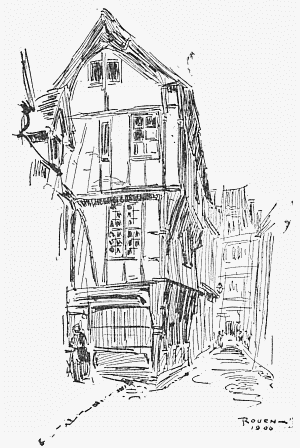
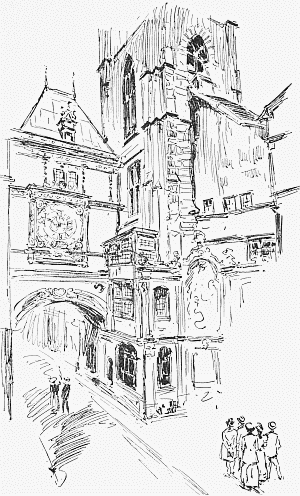
Rouen.
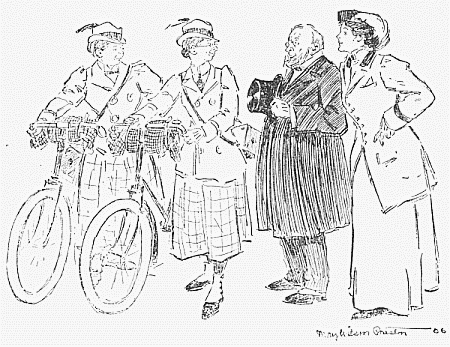
"Come on, girls, this is quite an
expedition. I vow I shook a
little when Mrs. Braytree suggested
coming, too. Seven women to
one man would be too many for comfort
as a general thing; but your Uncle John
never shows the white feather, so I only
drew the line at the dog. Why the
devil five women want to travel with
one dog and eight trunks I can't see;
but if I was Mrs. Braytree, I'd probably
know more about it. Curious little
creature, the cross-eyed one, isn't she?
And that Pauline—always wanting to
be somewhere else. I told her pretty
flatly at dinner that if she couldn't get
any more fun out of Rouen than by
wishing it was St. Augustine, she'd better
have stayed in New York. Anything
but these fault-finders.
"Well, ain't you ready? I've sent the
luggage along, and it seems to me that
we ought to be following its good example.
Lord knows, two days is enough
to waste in an old hole like Rouen; I
was wondering last night what we ever
came for. I never was so cold anywhere
in my life, and sleeping on a slope with a
pillow on your feet isn't my idea of comfort
at night, anyhow. I don't understand
the moral of the scheme, and the
pillow keeps sliding, and I keep swearing,
all night long. Also, I can't learn
to appreciate the joy of standing on a
piece of oil-cloth to wash. I must say
that one needs to wear an overcoat and
ear-muffs to wash here, anyhow. I was
dancing under the bell-rope and ringing
for hot water a good half-hour this
morning. I'm going to write and have
the asterisk subtracted from this hotel.
"Well, come on, if you're ready.
Whose umbrella is that getting left by
the door? Mine? I vow, I didn't remember
putting it down. But no one
can think of everything. Edna, is this
soap yours? No? Well, I just asked. I
seem to have left mine somewhere, and
it's live and learn. Come on! come on!
"Good morning,
Mrs. Braytree—Eunice—Emma—Pauline—Augusta.
I reckon we'd better be hustling along
pretty promptly. The train doesn't go
until five minutes after the time, if we
don't hurry. It's truly a pleasure having
you join us, Mrs. Braytree. A little
excursion like this makes such a pleasant
break in the routine of sight-seeing, I
think, and these quaint old—there, all
get out now, I have the money. I'll
take the tickets; we're all full-fare,
aren't we? Or—how old is the little
cross-eyed one? I beg your pardon, Mrs.
Braytree, but I had to know in a hurry.
"There, come on! come on! Squeeze
through. Se—ven women and one man.
Hurry! we want a compartment, here—no,
there. Run, Edna, and get ahead
of that old lady; here's two umbrellas
to throw crossways, and then you can
tell her there's no room, and the law
will uphold you. You look surprised,
Mrs. Braytree, but I learned that little
trick coming from Havre. I tell you,
by the time I get to Paris I'll be on to
every kind of game going. I learn fast—take
to Europe as a duck takes to
water, so to speak.
"Well, we're off for Gisors. Great
pleasure to have you with us, Mrs. Braytree;
no more work to steer seven—Good
Lord! there aren't but six here!
Who isn't here? Edna's gone! What
is it, Yvonne? I sent her ahead, did I?
Oh, so I did, so I did. And of course
she is waiting for us. Poor child! I
hope she's not worried. As soon as we
get out of the tunnel I'll hang out of
the window and holler to her. Very
convenient method of talking to your
friends aboard, Mrs. Braytree; only I
should think a good many would lose
their heads as a consequence. However,
as the majority of the heads would be
foreigners', I don't suppose it would
matter much in the long run.
"Speaking of Gisors, Mrs. Braytree,
it's really a very interesting place—according
to the guide-book. As far as I'm
personally concerned, I'd be willing
to take the time to go there to learn
how to pronounce it. The workings of
the mind which laid out the way to speak
French don't at all jibe with the workings
of the mind which laid out the way
to spell it—not according to my way of
thinking. There's that place which
we've just left, for instance,—'Ruin'
as plain as the nose on your—on anybody's
face,—and its own inhabitants
can't see it—pronounce the R in a way
that I should think would make their
tongues feel furry, and then end up as if,
on second thought, they wouldn't end
at all.
"Yvonne, I wish you'd hang out and
see if you see any of Edna hanging out.
I declare, this is a very trying situation
to be in. You don't know what a trip
I had, Mrs. Braytree, trying to keep track
of these girls; and since we landed—well,
I just had to call a halt in Havre
and come off alone. Curious place,
Havre, don't you think? See any one
you knew there? We—who did
you say? Why, that can't be, he's in
Russia. Yvonne, didn't that young
reprobate write you he was going to
Russia? Yes, I thought so. Well,
Mrs. Braytree says she saw him in Havre.
Good joke his not knowing we were in
Rouen; he'd have been down there in
a jiffy, I'll bet anything. But your
Uncle John is a rather tough customer
to handle, and I expect that young man
knows the fact, and so thought it best to
give Rouen a wide berth. Not that I
have anything in particular against young
Reynolds, only I don't consider that any
girl could be happy with him. And
it's foolish to have a man around unless
you can make him happy—I mean unless
he can make you happy. My wife was
very happy up to the time she developed
melancholia—a sad disease, Mrs. Braytree.
Yvonne, I wish you'd hang out
and see if you can see anything of
Edna.
"I presume this is as good a time as
we'll have to study up a little on Gisors.
It seems to have been the capital of the
Vexin. I shouldn't be surprised if
'vex' and 'vexing' both come from that
country, for the guide-book gives it as
always in hot water. The French and
English were both up against it most of
the time, and it was vexin' with a
vengeance. It says here that the old city
walls are still standing and that Henry
II built the castle. Isn't he the one we
peeked around in Rouen? Yes, I thought
so. It says that there's very little
left of the castle, though. I must say
I'm always glad when I read that there's
not much left of anything; it gives me
a quiet, rested sort of feeling."
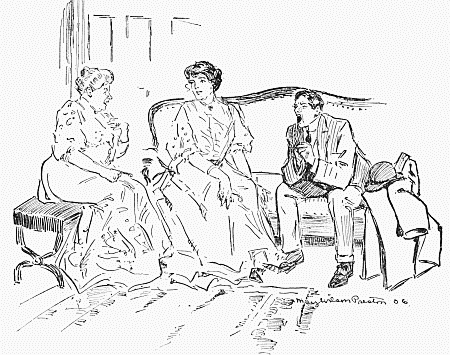
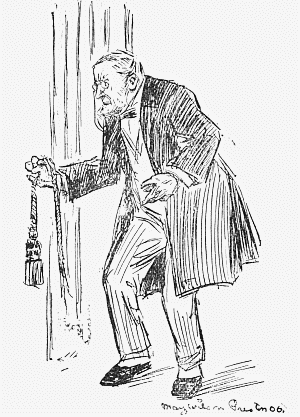
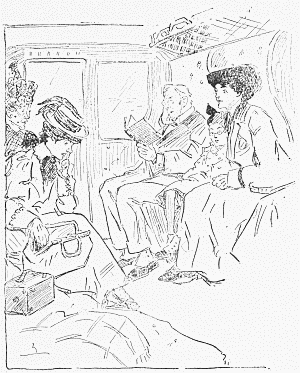 "'This is as good a time as we'll have to
study up on Gisors'"
"'This is as good a time as we'll have to
study up on Gisors'"
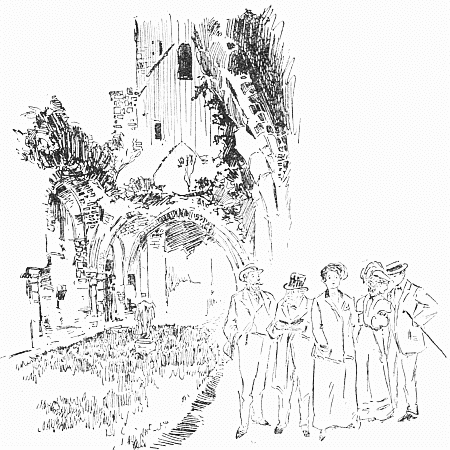
Gisors.
"Well, here we get out. I'll swing
down first. If French trains were
American, they'd have trapezes or elevators
to—get—out—by. Here, give
me your hand, Yvonne—oh, there's
Edna. Well, I vow, who has she got—if
it isn't—Yvonne, isn't that that
young man—how d'ye do, Edgar?
Delighted to see you again. Our friend,
Mrs. Braytree, and all the others are her
daughters. Come, Edna; you come
with me while I check this trunk.
Where in thunder did you get that fellow
from? How does he come to be in
Rouen? Did you know he was in Rouen?
Did you see him while he was there?
I declare, I never will travel with any
women again unless I am married to
them. This is awful. Don't you know
I'm responsible for you two girls? And
I send you ahead to get a compartment,
and you find Edgar—it makes
me want to swear. Say, was there
any one else with you? Worse and
worse. I was afraid there was something
wrong when we kept hanging
out and you never hung out at all.
Well, we'll have to go back and gather
them all up. Yes, I'll be polite to him;
but, Edna, I hope you understand distinctly
that a man like that could never
make any woman—
"Yes, Mrs. Braytree, here we are
again; and now we'll all proceed over
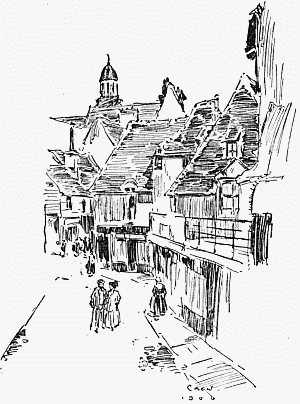
Gisors. Pretty place, don't you think?
Picturesque. Did you ever see so many
canals—or smell so many?—and the little
cottages out of another century? Packed
roofs—green trees—well-sweeps—I like
this; I'm glad I had the sense to come
here. Edgar, will you oblige me by
carrying that cane so that child doesn't
come within an ace of catching her
mouth on it every other second? I declare,
Mrs. Braytree, I wish we hadn't
run on to that young man. Of course
he's a nice fellow and all that, but young
men are a great trial when you have
two—
"Let's turn down here. Most of the
streets seem to be canal tow-paths. I
vow, this is pretty. I could settle down
in a place like this and live till I died.
What do you suppose the people here
do to amuse themselves, anyhow? From
the way they look at us with their
mouths open I should imagine that we
were regarded in the light of a great
event. And if that's the case, they must
be pretty hard up for sport. Oh, well,
I presume it's enough for them to paddle
about on the green waters and stir up
the miasma—as much sense as foreigners
have.
"And so these are the walls—ramparts,
I mean. Well, they're fairly
high. Wonder how high they are,
anyhow? Edgar, will you do me the
courtesy not to be pointing to the left
with that cane of yours when I turn
suddenly to the right again? I beg your
pardon for seeming heated, Mrs. Braytree;
but he really—
"Let's find a gate and go in; seems
to be a park inside. I should think there
was 'little left to be seen of the castle!'
I don't see anything at all of it. Maybe
they took it down and built the walls
higher just to fool tourists. Well, I
didn't come to Gisors to caper about in
a park; let's go out and look at the
church—the guide-book says the church
is worth seeing. I think there's something
very touching about guide-book
enthusiasm: it keeps up so consistently
right through to the end. I feel as if
my own enthusiasm was most run
through now. I don't know how Paris
will affect me. Edgar, if I trip on that
cane you'll have to pay my doctor's bill.
What makes you handle it as you do,
anyway? I like to see a cane light and
alert—not one that drags through the
world in the style of yours. To judge
from your cane, I should say you hadn't
been in bed before three for a month.
I have to speak sharply to that fellow,
Mrs. Braytree; he is about as wooden-headed
as they make. Came across the
ocean with us, and pestered the life out
of me. You don't know what an ocean
voyage is with two attractive girls—I
beg your pardon; I forgot your four.
Dear me! we were speaking of—yes—of
Gisors, of course. I vow, I'm disappointed
in it as a whole. I wish we'd
gone to Les Andelys instead. Les
Andelys is marked with an asterisk in the
guide-book, and there's a castle there
built by Cœur-de-Lion. By the way,
Mrs. Braytree, the Cœur-de-Lion itself
is buried in Rouen. Did you know that?
Nice joke, eh? But, dear, dear, if there's
no castle here when we get here, perhaps
there'd be none there when we got
there. I'm beginning to look upon
Europe as a confidence-game; I—
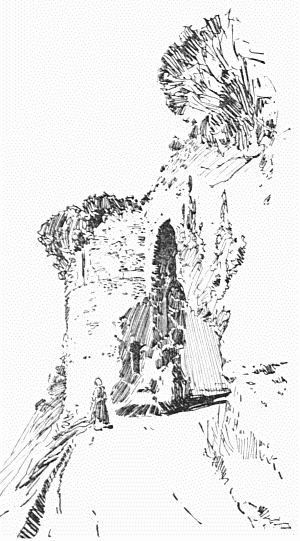
"Well is that the castle! Great Scott!
but it must have been big. It's big yet,
and the book said there was very little
left to see. I'm beginning to lose faith
in that book. Picturesque idea, having
the park hide the ruins till you come right
smash on to them. Clever people, the
French; make everything put the best
foot foremost. Fine old round tower;
nice tumble-down guard-chamber! I
like this. Let's go around the other
side. Great place, eh? Worth a trip to
see. Edgar, let me have your cane to
point with. There, do you see that old
staircase? Looks Roman to me; what
do you think? I tell you, a man could
write an historical novel out of old ruins
if he prowled long enough. Come on
now; let's meander on down town and
look at the church. As soon as I look
at anything, I'm always ready to look
at something else. Let's go out on this
side and go back to town the other way.
Then we'll look at the church, and then
we'll put you and Edgar on the train
for Rouen, Mrs. Braytree. What did
you say, Yvonne? He isn't going to
Rouen? Where is he going? To Paris
with us! Well, well, well! all I can say
is, I do admire his nerve. I never in all
my life went where I wasn't asked, and
took a cane. Now don't you see why
no woman could be happy with a man
like that? I never saw the beat. I tell
you frankly, Yvonne, I don't like his
ways and I don't like him. If you girls
had let him alone on the boat, he'd have
let us alone here. I declare, my day is
just about spoiled. Your mother has
trusted you girls to me, and I haven't
drawn a quiet breath since. I did take
a little comfort there in Rouen; but if
I'd known that Lee was in Havre,
I'd have been on thorns even there.
"Well, where is the church? Ask
some one. What did she say? Down
here? Down we go, then. Ah, I suppose
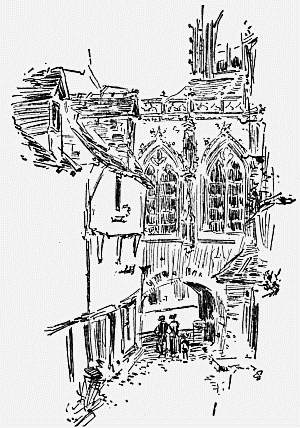
that's it under the sidewalk. Nice
commanding situation for a church, to
grade a street by its tower! Why don't
they put in the guide-book, 'Street
commands a fine view of the roof?'
There isn't time to go inside unless
Mrs. Braytree wants to miss her train,
and we don't want her to do that.
"This is the street to the gare, and
we'll run right along. I expect we can
get something to eat there, and get that
1:30 train for Beauvais. There isn't
anything in Beauvais that would interest
you, Mrs. Braytree; but there's a church
there that I want to see. The guide-book
says that Mr. Ruskin says that the
roof has got a clear vertical fall that not
many rocks in the Alps can equal; I
don't just know what a clear vertical
fall may be, but if there's a church anywhere
near as high as an Alp, I don't
want to miss seeing it.
"There's the clock. You just have
time to get aboard comfortably. Don't
you want to go with them, Edgar?
Well, I thought maybe you might.
Good-by, good-by; delighted to have
met you. Good-by. Oh, yes, of course.
In Paris.
"There, they're gone, darn 'em!
Now let's get some lunch. Did you
ever see such a collection as those girls?
It must have been a bitter pill when,
after managing to assimilate the looks
of the three oldest, the little one appeared
with her eyes laid out bias. Come
in here; we can get something to eat
here, I don't care what; but I want
plenty. Don't lose your cane, Edgar;
life wouldn't be life to you without it,
I expect. I like these country hotel
entrances, through a carriage-house and
a duck-yard, fall over a cat, and come in.
Tell her we want dinner for four, and
prompt. You put that in good forcible
French for me, Edgar, and I'll be grateful
to you till I die. Let's sit down.
Let's eat."
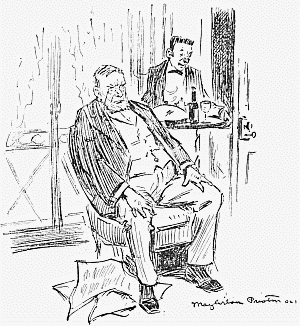
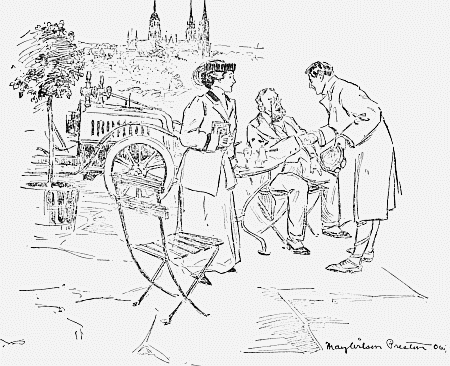
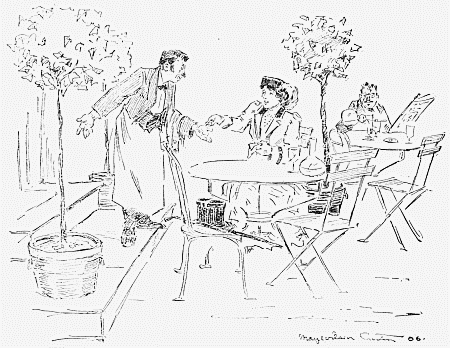
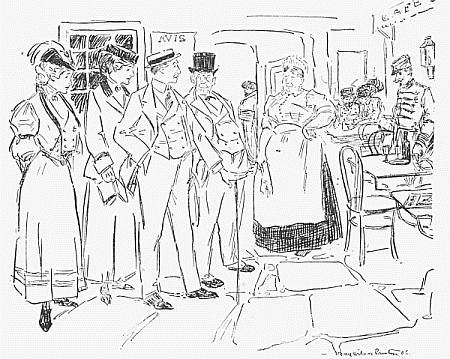 "'Tell her we want dinner for four, and prompt'"
Beauvais.
"Now, young people, I call this making
a day count. This is my idea of getting
about. Breakfast in Rouen, lunch in
Gisors, Beauvais for a sandwich, and
we'll dine in Paris.
"What time is it? Three o'clock.
Well, we want to head straight for that
cathedral. Seems as if it ought to show
most anywhere over a little, low town like
this, but I don't see it. Ask someone—ask
any one. Well, what did they
say? Right across the square. Whose
statue is that in the middle? Joan of
Arc? Jeanne Hachette? Who was
Jeanne Hachette? Girl who captured
flag from Charles the Bold, eh? Is that
why they called him 'the Bold'? Sort
of sarcastic on his letting a girl carry off
his flag, I should consider. Well, when
did she live? Has she got her year under
her? 1492. Seventy years after Joan.
I shouldn't have thought she'd have inspired
other young women in this part
of the country to emulate her.
"Do we go up here? Ugh, how I
hate walking over cobble-stones! Clean;
of course they're clean. I didn't say
that I thought they were dirty. I said
I hated to walk on 'em.
"What's that chopped-off creation
before us? Not the cathedral? Well—I—vow!
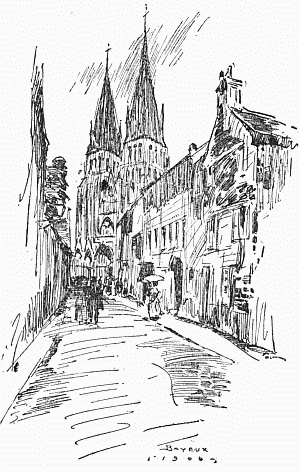
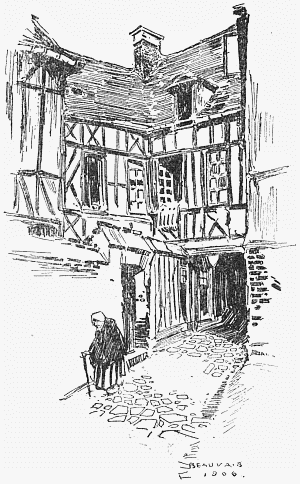 Beauvais
"Is that what I—what we—
"Where's the front of it? What did
happen to it? And what was Mr. Ruskin
thinking of when he compared it to
an Alp! I don't want to fall off of anywhere,
but I'd choose the roof of that
cathedral to start from any day in preference
to the lowest Alp they make.
'Clear vertical fall' eh? I wish I knew
what that meant.
"Well, let's go in. Where's the
door? That little, unpretentious one
looks feasible. Come on. Well, Edgar,
are you coming, too, or do you choose
to stay outside with your stick? I can't
help it, Edna; I feel irritated at his being
here at all, and then I'm naturally
disappointed over this church. I must
say the biggest thing about it is that
blank wall stopping up where they left
off. This is the kind of thing I've
come several thousand miles to look at,
is it? Well, may as well go in, I
suppose.
"So this is in the inside! Fine lot of
carpets hung up to try and cover the deficiencies,
eh?—High roof,—funny sort
of shock you get whenever you look towards
the front. Sort of like turning
around and hitting your cane, eh,
Edgar? Girls, this cathedral was begun
in 1180, time of Henry II, and they
quit in 1555 while Bloody Mary was
abroad and never got to the front end
in the four hundred years. Well, well!
dear, dear!
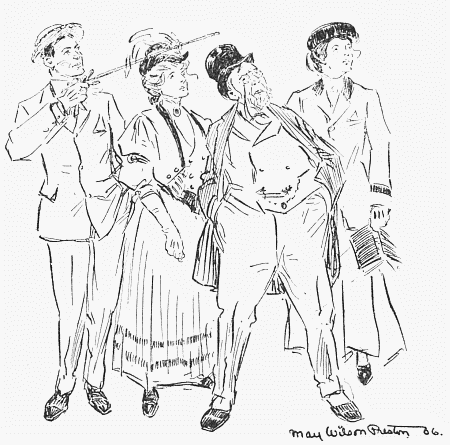 "'What's that chopped-off creation before us?'"
"Come on, girls, we may as well go
out; I feel like going to the station and
heading for Paris. I suppose that's the
next move in the game. You can stay
here as long as you like, Edgar; we
won't hurry you.
"Come, Yvonne, you walk with me.
Did you ever see anything like that
young man's gall? Your friend Lee
couldn't make any points around him.
Just hooks right on to us, and stays
hooked. I declare, if I carried a cane
I bet I'd give him one punch he'd remember
long after. I'd sincerely beg
his pardon. I didn't like him on the
steamer; I've got no use for young men
of his stamp. I—"
Gare du Nord, Paris.
"So this is Paris! Now, Edgar, I
have one favor to ask of you—will you
kindly allow me to manage my own
affairs while you manage yours? I
know just what to do, and I'll take
Yvonne with me to do it. You can
take Edna up to the hotel. Looked
disappointed, didn't he? Counting on
endearing himself to me forever by his
able-bodied assistance, I'll wager; but
I don't want any young man minding
my business. Tell that blue blouse to
take these checks and look up five
trunks in a hurry. What did he say?
We haven't got to overhaul them again
here, have we? Well, I am—I certainly
just am. Have we got to hunt
'em up? Where? Well, ask him?
Round back of this crazy mob? Well,
tell him to go first. What's this
system of wildly speculating wheat-pits?
Baggage-counters, eh? And will you
look at the baggage! Talk about your
'clear vertical falls!' Those trunks on
top will soon know more than Ruskin
ever did.
"Where's our man gone? Yvonne,
do you know where that fellow went
to? Well, ask some one. Look out—that
baggage truck will be Juggernauting
right over you before you know
it. Now, where is the porter? I call
this a pretty state of affairs—porter,
valises, and trunk-checks all gone together.
I thought you were watching
him or I would have done so. Do you suppose
we ought to speak to a policeman?
I think we ought to. But will you look
at the trunk-unlocking that's going
on—good as a play—look how mad
that old lady is; hear her give it to him
in good English. Guess something got
broke in transit. Keep a sharp eye out
for that porter, Yvonne. Here come
some more trunks, and more, and
more yet. I wonder if this is regular,
or if we've struck a rush. Where is
that porter? I think we ought to be
speaking to a policeman, don't you?
Here's a choice new invoice of a couple
of thousand more trunks; that fellow
will never be able to find ours, I know.
Supposing he has found them and gone
off with them already. Hey, look
at that lady jumping up and down!
She sees her trunk, I'll bet a dollar.
Well, I'd jump up and down if I could
see mine. Yvonne, I really think we
ought to speak to a policeman. Could
you give a description of the man? I
only remember that he wore a blue
blouse. Oh, yes; and he had 'Commissionaire'
across the front of his cap.
Hello, here are nine trucks all at once,
just a few million more additions to
the turmoil. I tell you, we won't get
out of here to-night, I don't believe.
I vow, I wish I'd given the checks to
Edgar, as he suggested. I really think
we ought to be calling a policeman.
Here are fourteen trucks all loaded to
the gunwales, and two mass-meetings
and one convention of tourists all at
once. Yvonne, this is beginning to
look serious to me; I think that really
we ought to call—
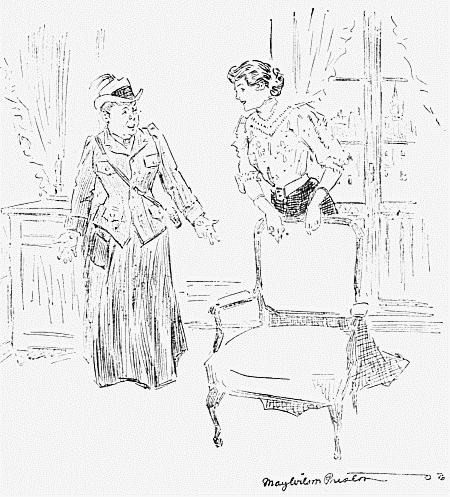
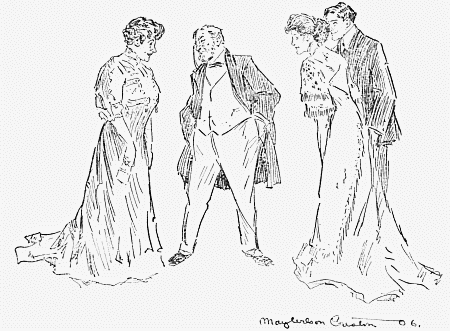
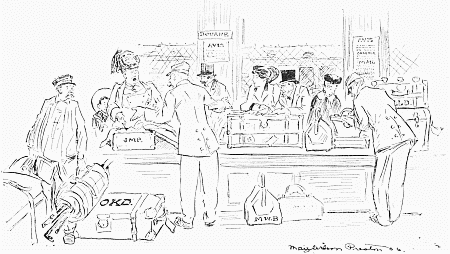 "'Look how mad that old lady is'"
"Oh, there he is with the whole of
the stuff on one truck. Good idea;
smart chap; and he wasn't so very long
either, considering."
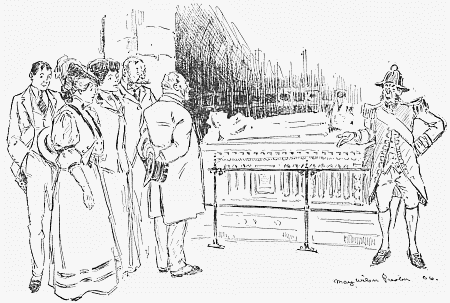
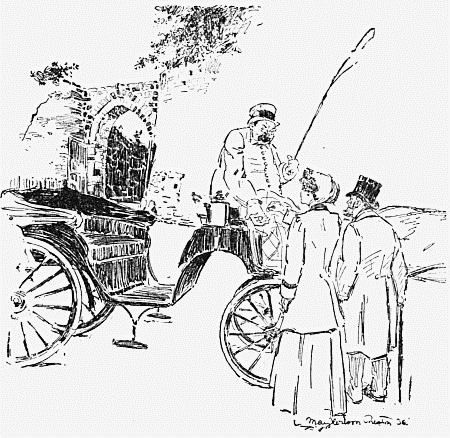
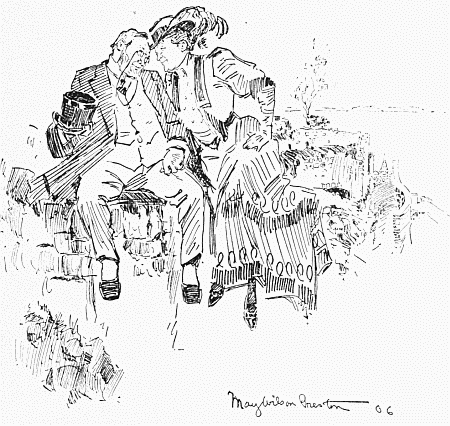
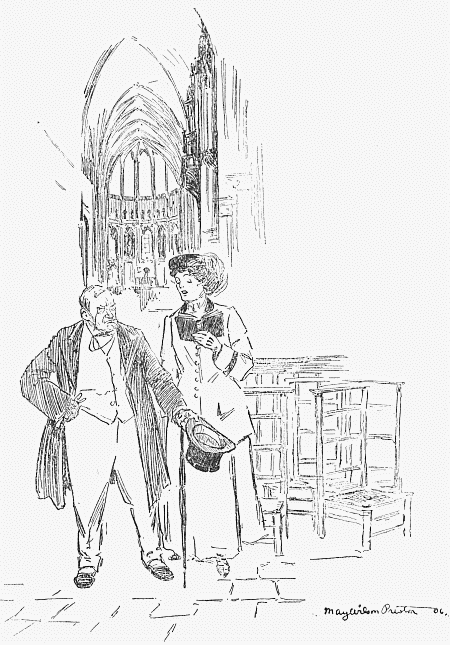 "I held the guide-book and read the explanations, while he
kept up a running contradiction of everything I read."
"I held the guide-book and read the explanations, while he
kept up a running contradiction of everything I read."