BY THEOPHILE GAUTIER
The train spins along across great plains
gilded by the setting sun; soon night comes, and
with it, sleep. At stations remote from one
another, German voices shout German names;
I do not recognize them by the sound, and
look for them in vain upon the map. Magnificent
great station buildings are shown up by
gaslight in the midst of surrounding darkness,
then disappear. We pass Hanover and Minden;
the train keeps on its way; and morning dawns.
On either side stretched a peat-moss, upon
which the mist was producing a singular
mirage. We seemed to be upon a causeway
traversing an immense lake whose waves crept
up gently, dying in transparent folds along the
edge of the embankment. Here and there a
group of trees or a cottage, emerging like an
island, completed the illusion, for such it was.
A sheet of bluish mist, floating a little above
the ground and curling up along its upper surface
under the rays of the sun, caused this
aqueous phantasmagoria, resembling the Fata
Morgana of Sicily. In vain did my geographical
knowledge protest, disconcerted, against
this inland sea, which no map of Prussia indicates;
my eyes would not give it up, and
later in the day, when the sun, rising higher,
had dried up this imaginary lake, they required
the presence of a boat to make them admit
that any body of water could be real.
Suddenly upon the left were massed the
trees of a great park; Tritons and Nereids
appeared, dabbling in the basin of a fountain;
there was a dome and a circle of columns rising
above extensive buildings; and this was
Potsdam....
A few moments later we were in Berlin, and
a fiacre set me down at the hotel. One of
the keenest pleasures of a traveler is that
first drive through a hitherto unknown city,
destroying or confirming his preconceived idea
of it. All that is peculiar and characteristic
seizes upon the yet virgin eye, whose perceptive
power is never more clear.
My idea of Berlin had been drawn in great
measure from Hoffman's fantastic stories. In
spite of myself, a Berlin, strange and grotesque,
peopled with Aulic councillors, sandmen, Kreislers,
archivist Lindursts, and student Anselms,
had reared itself within my brain, amid a fog
of tobacco-smoke; and there before me was a
city regularly built, stately, with wide streets,
extensive public grounds, and imposing edifices
of a style half-English, half-German, and
modern to the last degree.
As we drove along I glanced down into those
cellars, with steps so polished, so slippery, so
well-soaped, that one might slide in as into
the den of an ant-lion—to see if I might not
discover Hoffman himself seated on a tun, his
feet crossed upon the bowl of his gigantic pipe,
and surrounded by a tangle of grotesque chimeras,
as he is represented in the vignette of
the French translation of his stories; and, to
tell the truth, there was nothing of the kind in
these subterranean shops whose proprietors were
just opening their doors! The cats, of benignant
aspect, rolled no phosphorescent eyeballs,
like the cat Murr in the story, and they seemed
quite incapable of writing their memoirs, or of
deciphering a score of Richard Wagner's.
These handsome stately houses, which are
like palaces, with their columns and pediments
and architraves, are built of brick for the
most part, for stone seems rare in Berlin; but
the brick is covered with cement or tinted
stucco, to simulate hewn stone; deceitful seams
indicate imaginary layers, and the illusion
would be complete, were it not that in spots the
winter frosts have detached the cement, revealing
the red shades of the baked clay. The
necessity of painting the whole façade, in order
to mask the nature of the material, gives the
effect of enormous architectural decorations
seen in open air. The salient parts, moldings,
cornices, entablatures, consoles, are of wood,
bronze, or cast-iron, to which suitable forms
have been given; when you do not look too
closely the effect is satisfactory. Truth is the
only thing lacking in all this splendor.
The palatial buildings which border Regent's
Park in London present also these porticoes,
and these columns with brick cores and plaster-fluting,
which, by aid of a coating of oil paint,
are expected to pass for stone or marble. Why
not build in brick frankly, since its water-coloring
and capacity for ingeniously varied
arrangement furnish so many resources? Even
in Berlin I have seen charming houses of this
kind which had the advantage of being truthful.
A fictitious material always inspires a
certain uneasiness.
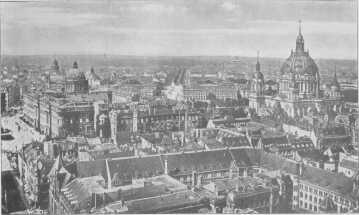
The hotel is very well located, and I propose
to sketch the view seen from its steps. It will
give a fair idea of the general character of the
city. The foreground is a quay bordering the
Spree. A few boats with slender masts are
sleeping on the brown water. Vessels upon a
canal or a river, in the heart of a city, have
always a charming effect. Along the opposite
quay stretches a line of houses; a few of them
are ancient, and bear the stamp thereof; the
king's palace makes the corner. A cupola upon
an octagonal tower rises proudly above the other
roofs, the square sides of the tower adding
grace to the curve of the dome.
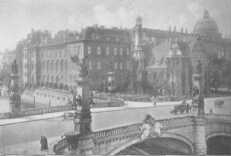
A bridge spans the river, reminding me, with
its white marble groups, of the Ponte San
Angelo at Rome. These groups—eight in number,
if my memory does not deceive me—are
each composed of two figures; one allegorical,
winged, representing the country, or glory; the
other, a young man, guided through many trials
to victory or immortality. These groups, in
purely classic taste, are not wanting in merit,
and show in some parts good study of the nude;
their pedestals are ornamented with medallions,
whereon the Prussian eagle, half-real, half-heraldic,
makes a fine appearance. Considered as
a decoration, the whole is, in my opinion, somewhat
too rich for the simplicity of the bridge,
which opens midway to allow the passage of
vessels.
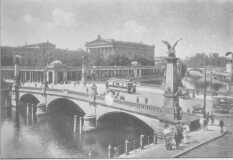
Farther on, through the trees of a public
garden of some kind, appears the old Museum,
a great structure in the Greek style, with Doric
columns relieved against a painted background.
At the corners of the roof, bronze horses held
by grooms are outlined upon the sky. Behind
this building, and looking sideways, you perceive
the triangular pediment of the new Museum.
On crossing the bridge, the dark façade of
the palace comes in view, with its balustraded
terrace; the carvings around the main entrance
are in that old, exaggerated German rococo
which I have seen before and have admired in
the palace in Dresden. This kind of barbaric
taste has something charming about it, and entertains
the eye, satiated with chefs d'oeuvre.
It has invention, fancy, originality; and tho I
may be censured for the opinion, I confess I
prefer this exuberance to the coldness of the
Greek style imitated with more erudition than
success in our modern public buildings. At
each side stand great bronze horses pawing the
ground, and held by naked grooms.
I visited the apartments of the palace; they
are rich and elegant, but present nothing interesting
to the artist save their ancient recessed
ceilings filled with curious figures and
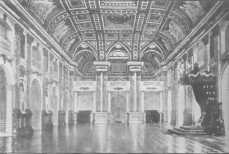
arabesques. In the concert-hall there is a
musicians' gallery in grotesque carving, silvered;
its effect is really charming. Silver is not
used enough in decorations; it is a relief from
the classic gold, and forms admirable combinations
with colors. The chapel, whose dome
rises above the rest of the building, is well planned
and well lighted, comfortable, reasonably decorated.
Let us cross the square and take a look at
the Museum, admiring, as we pass, an immense
porphyry vase standing on cubes of the same
material, in front of the steps which lead up to
the portico. This portico is painted in fresco
by various hands, under the direction of the
celebrated Peter Cornelius. The paintings form a
broad frieze, folding itself back at each end upon
the side wall of the portico, and interrupted in the
middle to give access to the Museum. The portion
on the left contains a whole poem of
mythologic cosmogony, treated with that philosophy
and that erudition which the Germans
carry into compositions of this kind; the right,
purely anthropologie, represents the birth, development,
and evolution of humanity.
If I were to describe in detail these two immense
frescoes, you would certainly be charmed
with the ingenious invention, the profound
knowledge, and the excellent judgment of the
artist. The mysteries of the early creation are
penetrated, and everything is faultlessly scientific.
Also, if I should show you them in the
form of those fine German engravings, the lines
heightened by delicate shadows, the execution as
accurate as that of Albrecht Dürer, the tone
light and harmonious, you would admire the
ordering of the composition, balanced with so
much art, the groups skilfully united one to
another, the ingenious episodes, the wise selection
of the attributes, the significance of each
separate thing; you might even find grandeur
of style, an air of magisterial dignity, fine
effects of drapery, proud attitudes, well-marked
types, muscular audacities à la Michel Angelo,
and a certain Germanic savagery of fine flavor.
You would be struck with this free handling
of great subjects, this vast conceptive power,
this carrying out of an idea, which French painters
so often lack; and you would think of
Cornelius almost as highly as the Germans do.
But in the presence of the work itself, the impression
is completely different.
I am well aware that fresco-painting, even in
the hands of the Italian masters, skilful as
they were in the technical details of their art,
has not the charm of oil. The eye must become
habituated to this rude, lustreless coloring, before
we can discern its beauties. Many people
who never say so—for nothing is more rare
than the courage to avow a feeling or an opinion—find
the frescoes of the Vatican and the
Sistine frightful; but the great names of
Michel Angelo and Raphael impose silence upon
them; they murmur vague formulas of enthusiasm,
and go off to rhapsodize—this time with
sincerity—over some Magdalen of Guido, or
some Madonna of Carlo Dolce. I make large
allowance, therefore, for this unattractive aspect
which belongs to fresco-painting; but in
this case, the execution is by far too repulsive.
The mind may be content, but the eye suffers.
Painting, which is altogether a plastic art, can
express its ideal only through forms and colors.
To think is not enough; something must be
done....
|
|
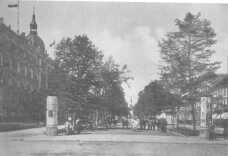
BERLIN: UNTER DEN LINDEN
|
|
|
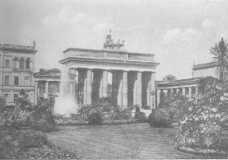
BERLIN: THE BRANDENBURG GATE
|
|
|
BERLIN: THE ROYAL CASTLE AND EMPEROR WILLIAM BRIDGE
|
|
|
BERLIN: THE WHITE HALL IN THE ROYAL CASTLE
|
|
|
BERLIN: THE NATIONAL GALLERY AND FREDERICK'S BRIDGE
|
|
|
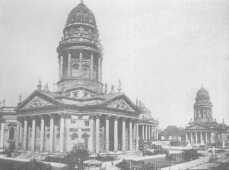
BERLIN: THE GENDARMENMARKT
|
|
|
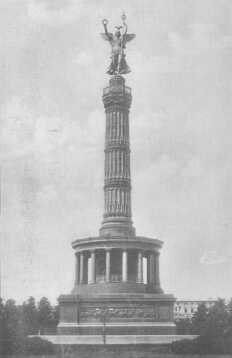
THE COLUMN OF VICTORY IN BERLIN
|
|
|
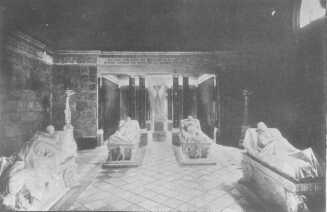
THE MAUSOLEUM AT CHARLOTTENBURG
|
|
|
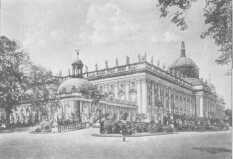
THE NEW PALACE AT POTSDAM
|
|
|
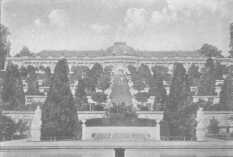
THE CASTLE OF SANS SOUCI, POTSDAM
|
|
|
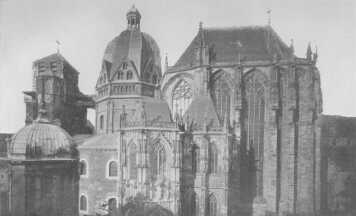
THE CATHEDRAL OF AIX-LA-CHAPELLE, TOMB OF CHARLEMAGNE
|
|
|
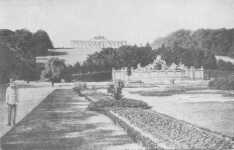
THE ROYAL PALACE OF SCHÖNBRUNN, NEAR VIENNA
(The man on the sidewalk at the left is the Emperor Francis Joseph)
|
|
|
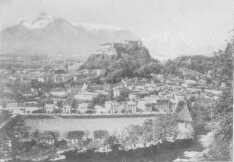
SALZBURG, AUSTRIA
|
I shall not now give an inventory of the
Museum in Berlin, which is rich in pictures
and statues; to do this would require more
space than is at my command. We find represented
here, more or less favorably, all the
great masters, the pride of royal galleries. But
the most remarkable thing in this collection is
the very numerous and very complete collection
of the primitive painters of all countries and
all schools, from the Byzantine down to those
which immediately precede the Renaissance.
The old German school, so little known in
France, and on many accounts so curious, is
to be studied to better advantage here than
anywhere else. A rotunda contains tapestries
after designs by Raphael, of which the original
cartoons are now in Hampton Court.
The staircase of the new Museum is decorated
with those remarkable frescoes by Kaulbach,
which the art of engraving and the Universal
Exposition have made so well known in France.
We all remember the cartoon entitled "The
Dispersion of Races," and all Paris has admired,
in Goupil's window that poetic "Defeat of the
Huns," where the strife begun between the
living warriors is carried on amidst the disembodied
souls that hover above that battlefield
strewn with the dead. "The Destruction
of Jerusalem" is a fine composition, tho somewhat
too theatrical. It resembles a "close of
the fifth act" much more than beseems the
serious character of fresco painting. In the
panel which represents Hellenic civilization,
Homer is the central figure; this composition
pleased me least of all. Other paintings as
yet unfinished present the climacteric epochs
of humanity. The last of these will be almost
contemporary, for when a German begins to
paint, universal history comes under review; the
great Italian painters did not need so much in
achieving their master-pieces. But each civilization
has its peculiar tendencies, and this encyclopedic
painting is a characteristic of the
present time. It would seem that, before flinging
itself into its new career, the world has
felt the necessity of making a synthesis of its
past....
This staircase, which is of colossal size, is
ornamented with casts from the finest antiques.
Copies of the metopes of the Pantheon
and friezes from the temple of Theseus
are set into its walls, and upon one of the
landings stands the Pandrosion, with all the
strong and tranquil beauty of its Caryatides.
The effect of the whole is very grand. At
the present day there is no longer any visible
difference between the people of one country
and of another. The uniform domino of civilization
is worn everywhere, and no difference in
color, no special cut of the garment, notifies
you that you are away from home. The men
and women whom I met in the street escape
description; the flâneurs of the Unter den Linden
are exactly like the flâneurs of the Boulevard des
Italiens. This avenue, bordered by splendid
houses, is planted, as its name indicates, with
lindens; trees "whose leaf is shaped like a
heart," as Heinrich Heine remarks—a peculiarity
which makes Unter den Linden dear to
lovers, and eminently suited for sentimental
interviews. At its entrance stands the equestrian
statue of Frederick the Great. Like the
Champs-Elysées in Paris, this avenue terminates
at a triumphal arch, surmounted by a chariot
with four bronze horses. Passing under the
arch, we come out into a park in some degrees
resembling the Bois de Boulogne.
Along the edge of this park, which is shadowed
by great trees having all the intensity of
northern verdure, and freshened by a little
winding stream, open flower-crowded gardens,
in whose depths you can discern summer retreats,
which are neither châlets, nor cottages,
nor villas, but Pompeiian houses with their
tetrastylic porticos and panels of antique red.
The Greek taste is held in high esteem in Berlin.
On the other hand, they seem to disdain
the style of the Renaissance, so much in
vogue in Paris; I saw no edifice of this kind
in Berlin.
Night came; and after paying a hasty visit
to the zoological garden, where all the animals
were asleep, except a dozen long-tailed paroquets
and cockatoos, who were screaming from
their perches, pluming themselves, and raising
their crests, I returned to my hotel to strap
my trunk and betake myself to the Hamburg
railway station, as the train would leave at
ten, a circumstance which prevented me from
going, as I had intended, to the opera to hear
Cherubini's "Deux Journées," and to see Louise
Taglioni dance the Sevillana....
For the traveler there are but two ways: the
instantaneous proof, or the prolonged study.
Time failed me for the latter. Deign to accept
this simple and rapid impression.
From "A Winter in Russia." By permission of, and
by arrangement with, the publishers, Henry Holt &
Co. Copyright, 1874. Since Gautier wrote, Berlin has
greatly increased in population and in general importance.
What is known as "Greater Berlin" now embraces
about 3,250,000 souls. Many of the quaint two-story
houses, which formerly were characteristic of the
city, have given way to palatial houses and business
blocks. Berlin is a thoroughly modern commercial
city. It ranks among European cities immediately
after London and Paris.