[HEKTOGRAPH.]
By this process a letter, postal card, drawing, or other manuscript
can be duplicated from sixty to one hundred times from one original.
Reproductions from the copying pad are now admitted in the mails as
third-class matter, i. e., one cent for every two ounces or fraction
thereof. A soft, gelatinous composition, similar to that used in making
printers’ rollers, is made and poured into shallow pans of the required
size. The pans should be made of stout zinc one-half inch deep on the
inside, with a lid or cover. The length and breadth of the pans is
determined by the class of copying to be done. Always make the pan
slightly larger than the paper used. The three sizes given below will
answer most purposes:
Postal card size4×6 | inches. |
Note paper size6 1/2×10 | inches. |
Full letter size9×12 | inches. |
The composition is made as follows:
Good glue4 | ounces av. |
Glycerine16 | ounces av. |
Water8 | fluid ounces. |
Break up the glue and soak in the water for a few hours, then heat
by water-bath until melted. Next add the glycerine and heat together
for some time to evaporate part of the water, and then strain into the
pan, which should be placed perfectly level and filled about two-thirds
full; skim with a card to free from bubbles, and set away to cool. An
improvement consists in adding one ounce of carbonate of barium to
the fluid while warm. The composition should be made somewhat
softer for winter use than for summer, which can be done by adding a
little larger proportion of glycerine. Another way to make the composition
is to soak over night in cold water best gelatine or glue 1 part,
and the excess of water poured off. The glue is then warmed in a water-bath
with the addition of from 10 to 12 parts of glycerine, to which may
be added 4 to 6 parts of finely ground heavy spar, and one part dextrine
thoroughly mixed by constant stirring. (In summer less glycerine.)
The letter or sketch to be duplicated is written on a sheet of paper
with ink specially prepared for the purpose (see inks). For the original
it is best to use smooth, well-sized writing paper, allowing the ink to
dry without using a blotter. After writing the original place it face
downward on the pad, and rub it gently with the hand to insure contact
at every point. Let it remain from two to six minutes, according to the
number of copies you wish to print. In cold weather it should be left
longer, as it requires more time for the composition to absorb the ink.
Remove the original carefully, and a reversed impression will be observed
on the pad. To take off copies lay dry sheets of paper on the
reversed impression, press gently, and remove quickly.
When you have taken all the copies you require wash the ink from
the surface at once with a sponge and plenty of lukewarm water; never
use hot water. The surface of the composition will allow considerable
rubbing without fear of tearing it, if not done roughly and carelessly.
Be sure your sponge is free from sand and grit, and also avoid scratching
with the finger nails. Always wash the surface with a sponge before
using, and dry with a newspaper. In cold weather if the composition
feels chilled it will not absorb the ink properly, and the copies will be
faint unless it be carefully warmed to a moderate temperature. Attention
to these details will produce the most gratifying results.
Horace M. Engle, Esq., of Marietta, Pa., has devised a method of
taking leaf-prints of marked beauty, which he terms “foliotypes,”
some specimens of which he sent to Dr. Gray, the eminent botanist, who
pronounced the process a new way, and advised him to send an account
of it to the Botanical Gazette, which he generously did. We have employed
the method according to the explanation there given (which we
reprint in full) with the most delightful results, having secured prints
of some beautiful leaves which are faithful to nature in color and outline,
with all their delicate tracery: “The method is of actual usefulness
to the botanist, as well as a refining recreation for others who love
Nature ‘on general principles.’ For illustrating monographs and similar
papers, where the number is too limited to warrant an expensive
lithograph; for identifying a rare specimen, or as an adjunct to an
herbarium, combining portability, unalterability, and beauty withal the
method seems particularly fitted. But aside from this others may find a
delightful and instructive recreation in taking prints of the entire flora
of the old farm, the trees of a certain grove, the native annuals of a
county, the ferns of a State, or any other special field that seems most
inviting. Such copies may be taken in a blank book suited to the purpose,
or, better, take them on single sheets of uniform size, as in this
way imperfect copies may be thrown out, and when the work is completed
they may be named, classified, and bound, making a volume of
real value and worthy of just pride.
“The process consists in using the leaf for producing an impression as
a printer uses type, the ink being green, and the pressure applied either
by hand or with a press. There will be needed for the work (1) a small
ink roller such as printers use for inking type by hand in taking proofs;
(2) a stout window glass (10×12 is a good size) fastened securely (not
glued, as it may warp and break,) to an evenly planed board about
twice its surface, say 10×24. A small quantity of the ink is put on the
glass and spread with a knife, after which it is distributed evenly by going
over in all directions with the ink roller. When this has been carefully
done the leaf to be copied is laid on a piece of waste paper and inked by
applying the roller once or more with moderate pressure. This leaves a
film of ink on the veins and network of the leaf, which should then be
placed on a piece of blank paper and considerable pressure applied for
a few moments. When the leaf is removed from the paper the work is
done.
“To get the best results several points must be carefully noted. Get a
quarter or half a pound of dark green ink, which is put up in collapsible
tubes costing from fifty cents to $2 per pound, according to quality. As
sold it is invariably too thick for this purpose, and should be thinned
by adding several drops of balsam of copaiba to as much ink as may be
taken on a salt spoon. Much depends on the proper consistency of the
ink. In inking the leaf is liable to curl on the roller, but it should part
readily from it. In case it sticks tightly the ink is too thick. Take
care that the ink is evenly distributed on the glass and roller, as it is
essential that each part of the leaf receives an equal coating of ink. If
the leaf is large ink it part by part, keeping the roller well supplied.
A roller three inches long, costing forty cents, will answer for all small
leaves and branches of plants. Clean the roller and glass with benzine
after using. If the leaf is finely veined the lower surface makes the
better print, but if the veins are coarse and large the upper surface may
be used. If the specimen is fleshy or brittle allow it to wilt until it
becomes more pliable, or if necessary it may be pressed and dried first.
In most cases the best copy is obtained after taking one or two impressions,
as the leaf takes the ink better after several applications. A good
quality of unsized paper that is made slightly damp by placing between
sheets of moist newspaper is best for general work, but in other cases
well sized paper will take a copy that will allow a foliotype (may I coin
the word?) to bear inspection side by side with a good lithograph. I
find a copying press very valuable in making the impression, especially
if the leaf is at all coriaceous. If it be soft it should be covered with a
few thicknesses of newspaper. If it is irregular in thickness, paper
may be laid over the thin parts, so that equal pressure is received. This
is necessary with all leaves that have thick stems. If the branch is very
irregular or delicate, or in the absence of a press of any kind, the specimen
may be covered with several layers of paper, and held in place by
one hand while the pressure is applied by the thumb or palm of the
other hand as required.
“These particulars are as complete as practicable. Experiments will
lead to many improvements in details. Employ tact and neatness, and
you will be surprised at the result.”
Prof. F. S. Kedzie of the Michigan State Agricultural College, after a
series of analyses and experiments, draws some important conclusions
as to the value of hand-grenades, in a paper which he publishes in the
Chicago Sanitary News. A Harden hand-grenade was opened, and the
solution contained qualitatively analyzed. It consisted of common
salt, sulphate of lime, and a small amount of acetate of soda. The principal
ingredient was common salt.
The effort was made to determine (1) whether the solution in the
grenades had any more extinguishing power than water; (2) if the solution
had extinguishing power greater than water, what was the essential
ingredient in the solution. The question that first arose regarding the
composition of the grenades was: Did they contain carbon dioxide gas
or any substance that would give up the gas by being heated? Opening
the grenades under water and collecting the gas that escaped it was
found that the average amount of carbon dioxide contained was about
one cubic inch per grenade. Boiling the solution liberated a slight
amount of gas in addition; but altogether the gas was not enough to be
of any practical benefit in extinguishing fire. It was then certain that
the extinguishing power was in the solution itself. Replacing the solution
in the grenade with pure water the extinguishing power, while
greater than water thrown from a dish upon flaming boards, was still
much less than the power exerted by the solution.
By a careful series of trials it was found that the essential ingredient
was common salt. From a number of experiments it was found that
when a grenade, or a bottle containing a strong brine, was broken in
the midst of the burning kerosene the flames were almost instantly extinguished.
A vapor seemed to spread in all directions from where the
salt solution struck the board, extinguishing the flame as it went.
Strong solutions were also made of sulphate of soda, hyposulphite of
soda, borax (biborate of soda), and bicarbonate of soda and tried as fire
extinguishers. Some worked as well, but none any better, than common
salt in extinguishing fire. The experiment was then made of charging
the bottles with brine and generating carbon dioxide by adding lime
dust and sulphuric acid and corking tightly. No practical increase in
extinguishing power from this addition was noticed. In most instances
the carbon dioxide gas escaped from the bottles inside of four days,
proving that it is impracticable to attempt to use glass vessels with
corks as a means of storing CO2 under pressure for fire extinguishing.
The conclusion reached from these and many more experiments was
that the Harden grenade solution possesses much greater extinguishing
power than water alone, and that it owed this power to common salt
held in solution. We then constructed some home-made grenades, using
flat bottles bound together side by side with wire. Using two bottles in
this way insures their being broken in striking the burning body, which
would not always occur when only one bottle is used. Bottles thus
charged with brine and bound together were broken side by side with
the Harden grenades and found to be equally valuable.
It thus appears from the experiment that any person can construct as
good and effective grenades as those offered in the market at $7 and $10
per dozen. Bottles filled with brine and placed around the premises
will afford considerable protection, especially when used upon the
flames when the fire just begins. Salt solutions have the further advantage
of not being easily frozen—never enough to burst the bottles.
The Lewis hand fire-extinguisher was next investigated. This consists
of a tin tube about two feet long containing thirty-four fluid ounces
of soda in weak caustic ammonia. From the trials made we could not
notice any appreciable superiority over the salt solution as used in the
Harden grenade. It has the disadvantage of not being made to break
by being thrown, but must be opened by having a cork extracted from
one end of the tube, requiring a smart jerk. The solution is then
sprinkled on the fire by the operator.
We herewith append a number of fire-extinguishing compounds, all
of which are highly recommended by various authorities:
Common salt43 | per cent. |
Alum19.5 | per cent. |
Glauber’s salt5.1 | per cent. |
Soda3.5 | per cent. |
Water glass6.6 | per cent. |
Water22.3 | per cent. |
Alum4 1/2 | pounds. |
Common salt10 | pounds. |
Glauber’s salt1 | pound. |
Soda1 | pound. |
Water glass1 1/2 | pounds. |
Green vitriol4 | parts. |
Ammonium sulphate16 | parts. |
Water100 | parts. |
Carbonate of soda8 | pounds. |
Alum4 | pounds. |
Borax3 | pounds. |
Carbonate of potash1 | pound. |
Silicate of soda solution24 | pounds. |
Mix thoroughly and add 1 1/2 pounds of this mixture to each gallon of
water, when required.
[ON GLASS.]
This beautiful and valuable process of transferring photographs in
plain or colored work has been taught at high prices under various
high-sounding names, such as “Roman art,” etc. Photographs can be
transferred and preserved for years which would have been soiled, faded,
and ruined if allowed to remain on the card.
Separate the paper print from the background or card by steaming
it, after which dry thoroughly. Warm the glass slightly and coat evenly
with balsam or negative varnish and place the print face downward on
the surface thus prepared. After smoothing it carefully set away in a
cool place until the varnish has hardened. Then apply water, and with
a soft piece of gum rubber rub off the paper so as to leave the photographic
image on the varnished glass.
Draw the pattern upon heavy paper and perforate with small holes
all the lines with the point of some sharp instrument, dust the following
powder through the perforations, remove the pattern and pass a warm
iron over the fabric, when the pattern will become fixed. Any desired
color can be used, such as Prussian blue, chrome green, yellow, vermilion,
etc.:
Fine white rosin2 | ounces. |
Gum sandarac4 | ounces. |
Color2 | ounces. |
Powder very fine, mix, and pass through a sieve.
[FOR TRANSFERRING AND COPYING.]
This paper is really a valuable article, and is manufactured and sold
under various names, such as the “stylograph,” “rapid copying process,”
etc. It is used principally by salesmen in keeping a record of their
sales, as three copies can be taken simultaneously with one writing. In
this way traveling salesmen can with one writing give a copy of his sale
to his customer (which is frequently demanded), another he can send to
his firm, and retain the third one for his own use. It is used in a similar
manner in nearly all the large stores, and by many individuals in their
business correspondence. It is also valuable for transferring figures in
embroidery and taking impressions of leaves for herbariums, etc., which
it does beautifully, but for the latter purpose nothing equals the foliotype
method previously explained.
The paper is made by mixing pure lard or sweet oil to the consistence
of cream with either of the following paints, the color of which is
desired: Prussian blue, lamp black, Venetian red, or chrome green,
either of which should be rubbed with a knife on a plate or flat surface
until smooth. Use rather thin but firm paper; put on with a sponge and
wipe off as dry as possible. Lay the sheets between uncolored paper or
newspaper, and press by laying books or some other flat substance upon
them until the surplus oil is absorbed, when it is ready for use.
For Copying Letters and Orders.—Either two or three copies can
be made at one time, as desired. To make two copies place a sheet of
the magic paper between the two sheets selected for the order, bill, or
letter, and write upon the upper sheet with a hard lead pencil (the
harder the lead the cleaner the copy). It is best to place a piece of hard
cardboard under all the sheets while writing.
To make three copies use two sheets of magic paper, placing one between
the first and second leaves and the other between the second and
third leaves. Proceed as in taking two copies by writing upon the top
leaf. A stout, thin linen paper will produce the best results, but almost
any kind will do.
To Transfer Embroidery Patterns.—Place a piece of thin paper
over the embroidery to prevent soiling; then lay on the magic paper and
put on the cloth you wish to take the copy on to embroider; pin fast and
rub over with a spoon-handle, and every part of the raised figure will
show upon the plain cloth.
To Take Impressions of Leaves.—Place the leaf between two
sheets of the magic paper and rub it over hard; then take the leaf out
and place it between two sheets of white paper; rub again, and you will
have a beautiful impression of both sides of the leaf or flower.
An excellent general preparation for removing grease, paint, etc.
Castile soap (cut fine)4 | ounces. |
Hot water1 | quart. |
Dissolve, after which add and mix thoroughly,
Aqua ammonia4 | ounces. |
Sulphuric ether1 | ounce. |
Glycerine1 | ounce. |
Alcohol1 | ounce. |
Water1 | quart. |
An elegant general preparation for cleaning gloves, silks, etc., is
made as follows:
Deodorized gasoline (or benzine)1 | pint. |
Alcohol, chloroform, and ether, each 1/2 | fluid ounce. |
Mix, and perfume with cologne, lavender, or any desired odor. Do
not use near a flame.
“Gantein” for Cleansing Gloves.—The preparation sold under
this name is made as follows: Dissolve 6 parts of soap in 2 parts of
water; add 4 parts of bleaching liquor and 1/4 part of aqua ammonia.
Rub the gloves with the fluid until clean.
[IN USE BY ALL LEADING JEWELERS.]
Cyanide potassium3 | ounces. |
Soft water2 | gallons. |
Mix and dissolve. Label it “poison,” and place out of the reach of
children. Have the article clean and free from grease; dip in solution
till tarnish is off, but no longer (and under no circumstances leave it in
too long). After immersion the article must be taken out and thoroughly
rinsed in a number of waters (warm preferred), then dried with
a soft rag or sawdust.
Another method, which is safe and cheap, consists in using a saturated
solution of hyposulphite of soda to which a little bolted whiting
has been added. Apply with a brush or cloth until the tarnish is removed.
Solution 1.—Dissolve 10 parts of soap in 20 of water, and add 3 1/2
parts of soda and one-half part of liquid ammonia and spirit of wine.
Solution 2.—Is the actual cleansing liquid, and consists of 4 parts
of liquid ammonia and 3 of alcohol diluted with water.
The last solution is first used, and when the dirt loosened by it has
been removed the soap solution is applied. Carpets thus treated regain
their original colors in all their freshness, the entire operation of washing
and drying a large carpet requiring but two hours, and the carpet
need not be taken up.
Showing at a glance what means to employ in removing any kind of
stain from any kind of fabric. Red acid stains are destroyed by ammonia,
followed by thorough washing with water. Burn stains of nitric
acid are permanent. Great care must be observed when ether and benzine
are used. Keep the open bottle and the fabric being cleaned away
from an open fire or blaze. The ether especially is so volatile that an
open bottle will take fire from a gas-jet or blaze several feet away if the
draft is right. You cannot be too careful.
| KIND OF STAIN. | From Linen. | COLORED FABRICS. | Silk. |
| Cotton. | Wool. |
| Sugar, gelatine, blood, albumen. | Washing simply in water. |
| Fat | Soap-water, alkaline lyes. | Tepid soap-water. | Soap-water, spirit sal-ammoniac. | Benzine, ether, spirit of sal-ammoniac, potash, magnesia, chalk, yolk of egg. |
| Varnish and oil-paint. | Oil of turpentine, benzine, and finally soap. | Benzine, ether, soap; careful rubbing. |
| Stearine. | Alcohol of 95 per cent. |
| Vegetable colors, red wine, fruits, red ink. | Sulphurous vapors, warm chlorine water. | Washing in warm soap-water or liquid ammonia. | As above, rubbing gently and carefully. |
| Alizarine ink. | Tartaric acid; the older the stain the more concentrated the solution. | Diluted solution of tartaric acid, if the fabric permits. | As above. |
| Rust and gall-nut ink. | Warm oxalic acid solution, diluted hydrochloric acid, and finally tin filings. | Repeated washing with dissolved citric acid, if the fabric is dyed well. | The same as for cotton, but diluted hydrochloric acid if the wool is naturally coloured. | Nothing can be done; all attempts only increase the evil. |
| Lime and alkaline lyes. | Washing simply in water. | Pouring diluted nitric acid drop by drop upon the stain. The previously moistened is rubbed off with the finger. |
| Tannin, green nut shells. | Eau de Javelle, warm chlorine water concentrated solution of tartaric acid. | More or less concentrated chlorine water, according to the nature and tint of the fabric, and alternate washing with water. |
| Coal-tar, wagon-grease. | Soap, oil of turpentine, alternating with a jet of water. | Rubbing with lard, then soaping, and after a while washing alternately with oil of turpentine and water. | Same as for colored fabrics; use benzine instead of turp.; jet of water must fall on back of stain. |
SAVING HALF THE WASH-BOARD LABOR.
Sal soda1 | pound. |
Stone lime 1/2 | pound. |
Water5 | quarts. |
Boil a short time, stirring occasionally; then let it settle and pour off
the clear liquid into a bottle or jug and cork for use. Soak your clothes
over night in simple water; wring out and soap wrist-bands, collars,
and dirty or stained places. Have your boiler filled with water, and
when at scalding heat put in a teacupful of the fluid, then put in your
clothes and boil for half an hour, after which rub lightly through one
suds only, rinsing well in the bluing water, and all is complete.
For each additional boiler of clothes add half a cup of the fluid; of
course boiling in the same water through the whole washing. If more
water is needed in the boiler for the last clothes dip it from the sudsing
tub. Soak your woolen and calico in the suds from which you have
washed the white clothes, while hanging them out dipping in some of
the boiling water from the boiler, if necessary; then wash out the woolen
and calico as usual—of course washing out woolen goods before you do
the calico. The fluid brightens instead of fading the colors.—Dr. Chase.
Premium Washing Fluid.—This fluid is equal to the best that can
be prepared, and as it is recommended to be used in a simpler manner
than the foregoing many will doubtless prefer it:
Sal soda4 | pounds. |
Borax2 | ounces. |
Sal tartar1 | ounce. |
Aqua ammonia 1/2 | pint. |
Spirit of camphor2 | ounces. |
Oil of turpentine1 | ounce. |
Hot water6 | pints. |
Dissolve the sal soda, borax, and sal tartar in the hot water and add
the other ingredients. Soak the clothes over night in water to which
has been added a table-spoonful of the fluid for each gallon of water;
also add a little in washing water.
BY MRS. HUSBANDPLEASER.
Take two ounces of spermaceti, one ounce of white wax, one ounce
of paraffine. Mix and put in a saucer over a tea-kettle in which water
is boiling, until melted, stirring several times. Then let it get cold,
after which put in a clean box for use.
To make the starch: For two shirts, collars, and cuffs take one table-spoonful
of starch dissolved in water; shave a piece of the above into it
the size of a bean. Pour boiling water into it until thick, cook twenty
minutes and set away to cool. Take one table-spoonful of starch, dissolve
it in cold water, and when the boiled starch gets lukewarm pour
it over it, stir well, and strain. Have the garments dry and lay the starch
on the wrong side and work it through. Be careful that the starch is
rubbed in until the right side is wet all over. When well saturated roll
up tight in a clean cloth. They need not lay but a few minutes. Stretch
them on a bosom-board, and with a damp cloth rub out all the wrinkles.
Lay a fine cloth over and iron it twice. If a collar or cuff turn it over
and do the same on the other side. Take off the cloth and iron perfectly
dry. If the bosom has pleats raise them before ironing dry and dry
under them. After the bosom is perfectly dry (for this polishing process
you need a good, smooth, hard board about two by one and a half feet—the
harder the better—a marble slab of that size is better still), put the
bosom on the bare board, dip a clean white cloth in water, wring almost
dry, rub lightly over the bosom, then rub it with a dry cloth, and polish
with back of iron or with polishing iron. If any dirt gets on rub off
with a damp cloth and polish again. The polishing is not necessarily
done the same day they are ironed. If your time is limited, or your
work interrupted by callers or other duties, lay them aside after having
ironed them perfectly dry.
Soluble Prussian blue1 | ounce. |
Oxalic acid 1/4 | ounce. |
Boiling water1 | quart. |
This makes the very best quality of bluing at a slight cost.
We see no reason why every economical housewife should not profit
by these simple methods of preparing cheap laundry soap, as they are
the results of practical experience.
Take 4 pounds of white bar soap, cut it fine, and dissolve by heating
in 4 gallons of soft water, after which add 1 pound of sal soda. Dissolve
and mix thoroughly. If it is desired the soap can be made thicker by
adding less water.
Sal soda and lard, each6 | pounds. |
Stone lime3 | pounds. |
Soft water4 | gallons. |
Dissolve the lime and soda in the water by boiling, stirring, and
settling; pour off, then return to the kettle (brass or copper), add the
lard and boil it until it becomes soap. Then pour into a dish or molds,
and when cool cut it into bars and dry it.
Take 2 pounds each of fresh-slacked lime, sal soda, and tallow; dissolve
the soda in 1 gallon of boiling soft water, stirring occasionally
every few hours after which let it settle, pouring off the clear liquor and
boiling the tallow therein until it is all dissolved; cool it in a flat box
or pan, and cut into bars or cakes as desired. It may be perfumed with
oil of sassafras or any other perfume desired, stirring it in when cool.
The old form of this process was to use stale bread or bread baked
to a proper consistency, but it seldom produces satisfactory results except
in the hands of experts, and then it is an impossibility to keep
from scratching the surface of the paper with the sharp points of the
crust. A dough preparation known only to a few experts engaged in
cleaning walls by contract, and who have been known to make from $5
to $25 per day, is now used, which is far superior in every way to anything
yet discovered. The walls can be cleaned over and over again,
each time appearing as bright as new paper.
Wheat flour | Three parts. |
Powdered prepared whiting | One part. |
Mix the flour and whiting thoroughly, and add enough water to
bring it to the consistency of ordinary dough. Use by taking a small
piece—about twice the size of a hen’s egg. Press against the wall and
remove the dirt by making long strokes. After making a stroke knead
the dirt into the dough, and continue doing so until it is useless. A
quart of the preparation used in this manner will clean the walls of a
good-sized room.
When it is desired to keep the ingredients of the composition a secret
a coloring matter may be added to assist in mystifying. When the walls
are discolored by grease or marks where people have rested their heads,
mix pipeclay to the consistency of cream, lay it on the spot and allow it
to remain until the following day, when it may be easily removed with
a penknife or brush.
Polishing Powder.—For polishing silver and nickel-plated ware,
brass, copper, etc.:
Fossil silica2 | ounces. |
Rouge (or fine crocus martis) 1/2 | ounce. |
Prepared chalk 1/2 | pound. |
Rub the fossil silica to a fine powder and thoroughly mix with the
chalk. This will not scratch the finest surface. Use by rubbing with
a damp sponge or rag, and finish dry with chamois skin or dry rag.
Fossil silica1 | ounce. |
Petrolatum 1/2 | pound. |
Cotton-seed oil (or sweet oil)1 | ounce. |
Subcarbonate of iron3 | ounces. |
Essential oil of almonds30 | minims. |
Reduce the fossil silica to a very fine powder and mix it with the
iron; melt the petrolatum, add the cotton-seed oil, stir in the powders,
and while cooling add the flavoring oil and stir until ready to set, then
run into boxes similar to ordinary blacking boxes. Apply with a soft
rag dipped in the paste, and finish with a clean cloth. Prepared chalk
or whiting can be used instead of fossil silica. The paste does its work
faster than the polishing powder, and if the articles are very much
corroded it is preferable.
Another excellent paste, which can be put in boxes or formed into
balls and allowed to harden, is to take finely powdered rotten-stone,
sift it thoroughly through muslin or a hair sieve, and knead with a
sufficient quantity of soft soap to form a stiff paste. To 1/2 pound of this
mass add 1 3/4 fluid ounces of oil of turpentine.
Moisten calcined magnesia with pure benzine. The mixture should
be preserved in bottles with glass stoppers, as the benzine is very volatile.
Use by placing a little of the mixture on a wad of cotton and
apply to the glass.
Rub with muriatic acid diluted with water, care being taken that it
is not too strong. Repeat the process till clean, then wash with clear
water. When the marble is very dirty, as in the case of old tombstones,
use the following:
Muriatic acid2 | ounces. |
Acetic acid1 | ounce. |
Verdigris1 | drachm. |
Mix, apply with a brush, and sponge off with clear water. Repeat
until clean, then polish with pumice stone continually moistened with
water as you proceed.
White wax5 | ounces. |
Potash7 1/2 | ounces. |
Boil lightly for fifteen minutes, allow to cool, and then skim off the
wax which floats on the surface. Apply the wax to the furniture, and
by rubbing it an hour afterward with a woolen cloth a beautiful luster
will be the result.
This is the best article that can be made for restoring the luster and
color of furniture:
Butter of antimony3 | fluid ounces. |
Linseed oil12 | fluid ounces. |
Alcohol6 | fluid ounces. |
Shellac2 | ounces av. |
Oil of turpentine10 | fluid ounces. |
Hydrochloric acid1 | ounce. |
Dissolve the shellac in the alcohol and add the linseed oil and turpentine;
then add the hydrochloric acid and butter of antimony, which
has been previously mixed, and thoroughly mix all together. Apply
with a tuft of cotton, and finish by rubbing down hard with Canton
flannel or a woolen rag.
[ARTIFICIAL.]
It is an astonishing fact that nine-tenths of the so-called maple sugar
and maple syrup sold as the genuine articles are nothing more than
clever imitations. The method of making the best quality of these imitations—and
which really defies detection of a majority of dealers and
consumers—is very cheap and simple, a gallon of the syrup costing
about fifty cents and the sugar simply the cost of ordinary, cheap sugar.
We were told by a Mr. Baldwin of Kentucky, a son of the reputed discoverer
of the secret for producing the maple flavoring, that various
manufacturers of imitation maple sugar and syrup in the large cities
had paid his father thousands of dollars in royalties for his discovery.
Procure a quantity of the rough outside bark of what is known as scaly-bark
hickory tree. Take about 3 or 4 pounds of the bark and boil in
one-half gallon of water until it is reduced to a quart, then strain and
add 5 pounds of common brown or yellow sugar; heat again until thoroughly
dissolved and it is ready for use. To make imitation maple
syrup simply boil the syrup until it is reduced back to sugar again, and
when it is made properly the flavor and appearance of the genuine article
is obtained.
Clarified sugar10 | pounds. |
Pure honey (strained)3 | pounds. |
Soft water3 | pints. |
Cream tartar1 | drachm. |
Essence peppermint10 | drops. |
Dissolve the sugar in the water by the aid of gentle heat; take off the
scum, and the honey and the cream tartar previously dissolved in a little
water; bring to the boiling point, stir well, then let it cool.
Loaf sugar2 | pounds. |
Citric acid2 | ounces. |
Concentrated essence of lemon2 | drachms. |
Essence of almonds20 | drops. |
Hot water2 | pints. |
Dissolve the citric acid in hot water, add the sugar, and lastly the
lemon and almonds. Stir well, cover with a cloth, and leave until cold.
Two table-spoonfuls to a tumbler of cold water will make an excellent
drink as refreshing as the best lemonade.
Water25 | gallons. |
Honey (or fine syrup)1 1/4 | gallons. |
Catechu (pure)6 | drachms. |
Alum1 1/4 | ounces. |
Yeast 1/2 | pint. |
Ferment for fifteen days in a warm place, then add:
Bitter almonds2 | ounces. |
Cloves2 | ounces. |
Whisky6 | pints. |
| Burnt sugar, to color. |
If acid should be in excess add honey or sugar; if too sweet add cider
vinegar to suit the taste.
Sarsaparilla root (contused)8 | ounces. |
Licorice8 | ounces. |
Cassia bark (contused)8 | ounces. |
Cloves2 | ounces. |
Coriander seeds3 | ounces. |
Ginger8 | ounces. |
Boil for fifteen minutes in eight gallons of water and let stand till
cold to settle down, then strain through a flannel rag, and add to it in
the fountain:
Syrup12 | pints. |
Honey4 | pints. |
Tincture of ginger4 | ounces. |
Solution of citric acid4 | ounces. |
Add enough water to complete ten gallons, and charge with gas.—Prof.
E. S. Wayne, in Kilner’s Formulary.
Pure baking powders are very simple in composition, care being
used in preparing them and procuring pure ingredients. According to
the advertised statements of the various leading manufacturers we are
forced to make our own if we desire a pure and wholesome article. As
the essential ingredients of the best baking powder are baking soda and
cream of tartar we need only be careful in buying of honest grocers or
druggists who will guarantee their purity. It is not difficult to procure
pure soda, but the cream of tartar is frequently adulterated, and care
must be used in its purchase.
It is very important that the materials used must be finely powdered,
perfectly dry, and thoroughly mixed. For household purposes a patent
sifter is the best to use in mixing. Run the articles through a number
of times and free from all lumps. The ingredients can be dried by
placing them in an oven for a short time before mixing.
Pure cream of tartar2 | pounds. |
Pure bicarbonate of soda1 | pound. |
Corn starch2 | ounces. |
This is the best that can be made. One to two tea-spoonfuls to a
quart of flour.
A cheaper powder, but superior to the majority of powders you will
buy, is prepared as follows:
Pure cream of tartar2 | pounds. |
Pure bicarbonate of soda2 | pounds. |
Tartaric acid6 | ounces. |
Corn starch1 | pound. |
Best flour4 | pounds. |
Use two tea-spoonfuls to a quart of flour. Do not be afraid of the
tartaric acid, as it is harmless. It is best to keep your baking powder
in a well-stopped jar or bottle. Flour, terra alba, alum, and chalk are
the chief ingredients used in the adulteration of cream of tartar. To
determine the admixture of flour rub a few grains of iodine with one
ounce of the suspected cream of tartar; if so adulterated a blue tint to
the mixture will be produced; or by dissolving a small quantity in
water you can prove its presence by the stickiness. Chalk may be determined
by its effervescing on the addition of diluted acids; alum by
dissolving in hot water and allowing the solution to chrystallize; terra
alba and other clays by their insolubility in a hot solution of caustic
potassa.
The profits to manufacturers and dealers on these household necessities
are very large, and the prudent consumer will take advantage of the
directions here given. Extracts of lemon and vanilla are most frequently
used; nutmeg, mace, cinnamon, etc., are usually used dry by
grating.
Best deodorized alcohol1 | pint. |
Oil of lemon1 | ounce. |
Cut the peels of two lemons into fine pieces and add to the alcohol
and oil of lemon. Let stand for a few days and filter through a felt bag
or filtering paper.
Extract of vanilla is prepared direct from the vanilla bean. Use
care in the purchase of the beans, as there are several varieties. The
Mexican vanilla beans have the finest flavor, and the longer the bean, as
a rule, the better the extract. There are other excellent varieties of
vanilla beans, but they have a somewhat ranker flavor than the Mexican.
Unscrupulous jobbers and dealers have been known to soak the whole
beans in spirits, practically stealing all their flavor, and then by drying
them place them on the market. They can be detected by their light
color and brittleness. Most of the vanilla extracts sold for flavoring
purposes are adulterated with Tonka beans and other adulterants,
some containing not a particle of vanilla.
The following will make a splendid article, and you know what you
are getting without paying high prices for weak extracts put up in deceptive
little panel bottles. Dishonest manufacturers never yield a
point in their efforts to defraud. Not content with the liberty they take
with the contents they employ the bottle-makers’ art to deceive us in
the quantity of the precious stuff:
Vanilla beans1 | ounce. |
Sugar1 | ounce. |
Cologne spirits (deodorized alcohol)12 | ounces. |
Water4 | ounces. |
Slit the beans and cut them very fine, then mix them with sugar and
bruise until moderately fine; then mix with spirits and water and put in
a warm place; allow to stand for two weeks (longer the better) shaking
every day, and when through filter. Manufacturers color with caramel
or other coloring, but for home use this is unnecessary.
To extract essential oils from wood, bark, herbs, etc., put a quantity
of the herb or other article into a bottle or jar and pour in a small quantity
of ether. Keep in a cool place several hours, and then fill the bottle
with cold water. The essential oil will rise to the surface, and may be
easily separated.
The wording of the desired rubber stamp having been correctly set
up in ordinary type, the same is locked up and placed upon a level support.
Around it is put an iron frame, which will determine the shape
and size of the matrix.
By means of a soft brush the type as well as all surrounding parts
that are to be covered by the plaster of Paris are well oiled.
For the purpose of making the cast finely ground fresh plaster of Paris
is needed; if of long standing, the same will lose its desirable properties.
This plaster of Paris, of which a sufficient quantity should at one
time be mixed to the consistency of pap, using clear water, is poured
over the frame containing the type in a thin layer, so as to barely cover
it. With a stout brush the mixture is driven into all spaces and interstices,
until all details are thoroughly covered. After this the remaining
pap of plaster of Paris is added until the frame is full to overflowing.
The surface is smoothed down after the plaster has settled somewhat,
and in a short while the matrix in the frame may be removed from
the type.
After this it becomes necessary to bake the matrix in an oven for a
period of from four to six hours. When thoroughly baked the matrix
should be well brushed with a thin solution of shellac to impart a
smooth surface, and at the same time greater strength.
The matrix at this stage represents a yellowish-white block, in which
the lettering appears indented, but in proper place. The indentation
corresponds to the height of the letter upon the piece of type or the
marks upon a cut, while the remaining parts should be perfectly smooth
and free from holes. This matrix, obtained by a coating from the type
or cut, will serve as the mould for the final rubber stamp.
Pieces of caoutchouc are cut to the required size and laid upon the
matrix. If pressure is now exerted the soft mass will adjust itself to fill
all the spaces and reproduce the mould invertedly. Indentations become
raised matter, and the whole will show as did primarily the type.
But as the caoutchouc has a tendency to return to its previous shape
it becomes necessary to apply the process called vulcanizing. The object
is to impart hardness to the rubber, and to prevent its losing the
form into which it has been pressed.
To accomplish this the caoutchouc must be heated to a temperature
of from 120 to 130 deg. C. As the substance is ordinarily softened by heat
it is necessary to take some means to prevent it from sticking to the
mould. For the purpose soapstone will answer, and the mould, as well
as the piece of caoutchouc, should be well brushed or dusted with this
substance.
The duration of the heating varies with the thickness of the rubber
sheet. As a general thing from twenty to thirty minutes ought to be
sufficient. It may be mentioned here that special apparatus can be
purchased for pressing and vulcanizing. The proper vulcanization is
of the greatest importance in determining the durability of the stamp.
All that remains to complete the stamps is the mounting of the rubber
plate upon a suitable base or handle. This is best done either with
zinc or with a solution of caoutchouc in benzine. The surface of the
handle, as well as the back part of the stamps, having been covered with
such a solution and well pressed together, after drying the entire stamp
will be ready for use.—Amer. Lith. and Printer.
This is an unequaled preparation for destroying rats, mice, cockroaches,
etc. It attracts them by its luminous appearance and also by
its odor, which is very attractive to all vermin. They eat it with great
avidity.
Phosphorus 1/2 | ounce. |
Armenian bole1 | ounce. |
Arsenic1 | ounce. |
Oil of rhodium 1/2 | drachm. |
Tallow10 | ounces. |
Rye flour12 | ounces. |
Water12 | ounces. |
Cook the flour and water to a thin paste; add the phosphorus—previously
melted in a little hot water—and mix; then add the rest and stir
until thoroughly mixed.
Other Methods of Destroying Rats.—(1) Mix some fine plaster
of Paris with an equal quantity of flour; put the mixture in the place infested
by the vermin and a vessel full of water beside it. The rats will
devour the mixture and then drink, whereupon the plaster, brought into
contact with the water, will become solid and like a stone in their
stomachs, which will cause their deaths. (2) When a house is infested
with rats which refuse to nibble at toasted cheese or the usual baits, a
few drops of oil of rhodium poured on or near the bait will attract
them while the most tempting baits fail. (3) Cover the floor near
their holes and place into their haunts a quantity of caustic potash.
This they lick with their tongues, which makes their mouths sore, and
they not only shun this locality, but appear to tell all the neighboring
rats about it. (4) Instead of using chloride of lime or potash a quantity
of tar can be smeared in and around their haunts and they will disappear.
Tar and rats do not agree. If a live rat be caught, smeared with tar, and
allowed to escape into the holes he will do the smearing process thoroughly.
Thymol2 | parts. |
Salicylic acid2 | parts. |
Alcohol200 | parts. |
Oil of lemon1 | part. |
This new, simple, and cheap preparation makes no stain and kills
the vermin immediately. The odor is not unpleasant, and is quickly
removed by airing the room. Use by sprinkling, or moistening blotting
paper with the solution.
Lupulin1 | drachm. |
Scotch snuff2 | ounces. |
Camphor gum1 | ounce. |
Black pepper1 | ounce. |
Cedar sawdust4 | ounces. |
Mix thoroughly and strew among the furs and woolens.
Corrosive sublimate (in powder)2 | ounces. |
Alcohol1 | pint. |
Apply with a feather or stick into their hiding places. Label poison,
and place all such compounds out of the reach of children.
White arsenic1 | ounce. |
Sugar 1/2 | pound. |
Concentrated lye 1/4 | ounce. |
Water1 | quart. |
Dissolve the concentrated lye in the water, add the sugar and boil the
solution, meanwhile gradually adding the arsenic. While still warm
dip porous paper (cut into small squares) in the solution and dry them.
For use place in plates or saucers partly filled with water where the flies
can get at them.
Rosin8 | ounces. |
Lard or cotton-seed oil3 | ounces. |
Boil together, spread thinly on manilla paper, place another sheet on
top, and when wanted pull them apart and it is ready for use. This is
now usually preferred to the poison paper, as the flies are caught and
held and do not die and drop into food, etc.
Petrolatum1 | ounce. |
Paraffine 1/8 | ounce. |
Oil pennyroyal 1/3 | ounce. |
Oil of tar 2/3 | ounce. |
Carbolic acid 2/3 | drachm. |
Melt the solid ingredients together, and when partly cooled add the
other ingredients. This is an elegant preparation to rub on the hands
and face where flies, mosquitos, gnats, etc., are troublesome.
Late improvements in the manufacture of inks are due to the discovery
and cheapening of substances which can be used in preparing
them. While good common writing inks are quite easily procured in
the market, still they can be manufactured much cheaper by the consumer;
and then again there are a variety of special purposes which require
inks that are not on sale, and formulas for making them are very
valuable. In this collection we give approved and tested formulas for
everything in the ink line.
[FROM LOGWOOD.]
A good black ink can be made by boiling 3 pounds of logwood with
sufficient water to leave a residue of 5 quarts. When cold add 3 drachms
of yellow bichromate of potash and stir thoroughly. To prevent thickening
add a few drops of solution of mercury salt. It flows freely from
the pen. Its color at first is of a dark indigo-blue tint, changing soon
into a permanent black. A beautiful gloss may be given to this or any
other black ink by adding a strong solution of shellac and borax.
[FROM ANILINE.]
Black aniline crystals (negrosine)1 1/2 | ounces. |
Dextrine1 | ounce. |
Corrosive sublimate5 | grains. |
Water2 | quarts. |
Dissolve the negrosine in a quart of hot water; dissolve the corrosive
sublimate and dextrine in the remaining quart, and pour all together.
This is a splendid ink, flows freely from the pen, and will keep well.
In making ink use care in buying the best anilines and other ingredients.
This is important.
Eosine aniline100 | grains. |
Water1 | pint. |
Simply dissolve the aniline in the water. No better bright, fiery red
ink can be made.
Violet aniline70 | grains. |
Alcohol 1/2 | ounce. |
Dextrine 1/2 | ounce. |
Hot water1 | pint. |
Dissolve the aniline in the alcohol and the dextrine in the hot water,
and mix them.
Water blue aniline1 | drachm. |
Dextrine 1/4 | ounce. |
Hot water1 | pint. |
One-fourth of an ounce of Prussian blue may be used instead of the
water blue aniline.
Green aniline1 | drachm. |
Dextrine 1/4 | ounce. |
Hot water1 | pint. |
Aniline inks of any color can be made in a similar manner. Simply
get the desired color of aniline. Maroon ink may be made by mixing
equal quantities of black, blue, and red inks; yellow by adding 1 1/4
drachms of picric acid to 1 pint of hot water.
Take 1 pint of the violet-black ink and add 1 ounce each of sugar
and gum Arabic. This is for what is called moist copying where a
press is used. For what is termed dry copying mix about 1/3 pint of
glycerine to a pint of any good black ink. The manuscript, if written
on glazed paper, will not dry for hours, and will yield one or two fair,
neat, dry copies by simple pressure of the hand. The writing should
not be excessively fine nor the strokes uneven or heavy. The copies and
the original are neater than when water is used.
Lampblack1 | part. |
Potash water glass12 | parts. |
Aqua ammonia1 | part. |
Distilled water38 | parts. |
The potash water glass should be of the consistency of syrup.
(SEE PAGE 1.)
A good purple ink to use on the gelatine copying pad, or hektograph,
is prepared as follows:
Methyl violet1 | ounce. |
Water8 | ounces. |
Glycerine1 | ounce. |
Alcohol 1/4 | ounce. |
Dissolve the methyl-violet in the water and add the glycerine. Gently
warm the solution for an hour, and after cooling add the alcohol.
When black hektograph ink is desired, instead of the methyl-violet
use double the amount of negrosine.
An excellent white ink, which can be used with a pen for writing on
colored cards or paper, may be made as follows:
Flake white12 | drachms. |
Mucilage of gum Arabic6 | drachms. |
If too thick add water; if too thin, more mucilage. Shake well while
using.
Aniline (desired color) 1/2 | ounce. |
Glycerine2 | ounces. |
FOR TYPE-WRITERS, DATING STAMPS, ETC.
Aniline 1/2 | ounce. |
Alcohol4 | ounces. |
Glycerine7 | ounces. |
Water4 | ounces. |
Dissolve the aniline in the alcohol and add the other ingredients.
FOR PACKAGES AND BOXES.
Extract of Logwood8 | ounces. |
Bichromate of potash1 | ounce. |
Hydrochloric acid 3/4 | ounce. |
Dextrine4 | ounces. |
Water 1/2 | gallon. |
Boil the logwood with the water, add the acid and potash, and lastly
the dextrine.
FOR MARKING LINEN, ETC.
Dissolve 5 parts of lunar caustic in 10 parts of spirit of sal ammoniac.
Add to the solution 7 parts of pure soda, 5 of gum Arabic, and 12 of
water.
VALUABLE IN MARKING TOOLS AND INSTRUMENTS.
Muriatic acid1 | ounce. |
Nitric acid 1/2 | ounce. |
Cover the portion of metal you wish to write upon with melted beeswax
and allow it to cool. Write the inscription plainly with any sharp-pointed
instrument through the beeswax to the metal. Apply the acids
with a feather or rag, carefully filling each letter, and let it remain from
one to thirty minutes, according to the desired depth of the lettering,
after which wash off the beeswax and acids and rub over with a little
sweet oil to prevent further rust or tarnish.
As in the case of fluid inks there are many formulas for preparing
ink powders. The following are the best:
Black.—Nut-galls, 1 ounce; copperas, 1/2 ounce; gum Arabic, 7 ounces.
Add one clove to this quantity. Or, take negrosine, 1 ounce; dextrine,
3 ounces; mix.
Blue.—Water blue aniline, 1 ounce; dextrine, 5 ounces. Or, soluble
Prussian blue, 1/2 ounce; dextrine, 1 ounce.
Green.—Aniline green, 44 parts; gelatine, 4 parts, and lunar caustic,
2 parts. Or, green aniline, 1 part; dextrine, 4 parts.
Red.—Eosine aniline, 1 ounce; dextrine, 1 ounce.
A tea-spoonful to a table-spoonful of the powder is dissolved in 1
pint of water, requiring from 1/2 to 1 hour to make the solution.
Boil some nut-galls in aqua fortis, and add to the infusion some gum
Arabic and a little sulphuric acid. When written on paper this ink is
perfectly legible, but will disappear from the paper in a few days.
Invisible inks are those which when first written are not visible, but
upon the application of heat or other means the characters are made to
appear distinctly. The following are decidedly the best preparations
for this purpose:
Oil of vitriol1 | fluid ounce. |
Soft water1 | pint. |
This makes a fluid which is perfectly invisible until heat is applied
by holding over a lamp or by placing in an oven, when it changes to a
permanent black. Write with a clean steel pen. All invisible inks
will show on glazed paper, therefore unglazed paper should be used.
Another singular invisible ink is made as follows: Oxide of cobalt,
1/2 ounce; muriatic acid, sufficient to dissolve it; water, 4 ounces; mucilage
of gum acacia, 1 drachm. Place in a stained bottle. Characters
written with this solution are invisible, but on the application of heat
they instantly appear in blue. On cooling they again become invisible.
Hydrochloric acid 1/8 | ounce. |
Water1 | pint. |
Mix, bottle, and label No. 1.
Solution of chlorinated soda 2/3 | pint. |
Water1 | pint. |
Mix, bottle, and label No. 2.
To erase ink dip the end of a penholder or pencil in No. 1 and apply
to the writing, and do the same with No. 2. Let remain a moment and
blot off with clean blotting-paper. If the characters are not erased repeat
as before.
The jewellers of Turkey, who are mostly Armenians, have a singular
method of ornamenting watch cases, etc., with diamonds and other
precious stones by simply gluing or cementing them on. The stone is
set in gold or silver and the lower part of the metal made flat, or to correspond
to that part to which it is to be fixed. It is then warmed
gently and the glue applied, which is so very strong that the parts thus
cemented never separate. For this glue, which will firmly unite bits of
glass and even polished steel, and which may of course be applied to
a vast variety of useful purposes, large number of formulas have been
published. The following is the original recipe. Dissolve 5 or 6 bits of
gum mastic, each the size of a large pea, in as much alcohol as will
suffice to render them liquid; in another vessel dissolve as much isinglass,
previously softened a little in water (though none of the water
must be used), in good brandy or rum as will make a two-ounce vial of
very strong glue, adding two small bits of galbanum or ammoniacum,
which must be rubbed or ground until they are dissolved. Then mix
the whole with a sufficient heat. Keep the glue in a vial closely corked,
and when it is to be used set the vial in boiling water. To avoid cracking
the vial by exposure to such sudden heat use a thin green glass vial
and hold it in the steam for a few seconds before immersing it in the
hot water.—Workshop Receipts.
FOR GLASS, CHINA, WOOD, LEATHER, ETC.
Gelatine (Cooper’s or Cox’s)3 | ounces. |
Acetic acid2 | ounces. |
Carbolic acid5 | grains. |
Oil of cloves6 | minims. |
Water enough to make1 | pint. |
Soak the gelatine in half a pint of water for four hours. Place in a
bottle and heat in a water bath; add the acids, dissolve, add the oil of
cloves and sufficient hot water to make a pint, and strain.
Powdered cast-iron bore chips60 | parts. |
Sal-ammoniac2 | parts. |
Flowers of sulphur1 | part. |
Mix, and stir the mixture into a stiff paste by adding water. Use
while fresh.
For attaching metal plates, such as metal letters, etc., to flat sheets
of glass or windows, the following is excellent:
Copal varnish15 | parts. |
Drying oil5 | parts. |
Turpentine3 | parts. |
Melt in a water bath, and add 10 parts of slaked lime. The cement
commonly used for fastening the tops on kerosene lamps is plaster of
Paris, which is porous, quickly penetrated by the kerosene, and readily
destroyed. A cement which does not have this defect is made by boiling
3 parts of resin and 1 of caustic soda in 5 of water. This composition
forms a soap, which mix with half its weight of plaster of Paris.
Use while fresh.
Dissolve 1/8 ounce of salicylic acid in half a gallon of warm water, and
when cold stir in as much flour as will bring it to the consistency of
cream, being particular to break up all the lumps; next place it on the
fire and allow it to cook gently for a few minutes, stirring well meanwhile.
This paste answers a variety of purposes. The salicylic acid is
to keep it from spoiling. The addition of 1 ounce of powdered colocynth
to the above amount will effectually banish all insects and worms
from the walls where the paper is pasted.
Ordinary pastes will not adhere labels to tin. The following is a
good one: Make a paste of gum tragacanth and add a little oil of wintergreen.
Apply by removing the film of grease from the tin by a solution
of caustic soda (10 parts of water to 1 of soda). Apply with a rag to the
spot on which you wish to affix the label.
Wheat flour2 1/4 | pounds. |
Resin (powdered) 1/2 | ounce. |
Salicylic acid 1/8 | ounce. |
Rub together till a uniform paste is formed, transfer to a small kettle
over a fire, heat, and stir until the lumps are all dissolved and the
paste becomes stiff; transfer to another vessel and cover up. This paste
is applied in a thin layer to the surface of the table or desk to be
covered, the cloth or leather is then laid on and smoothed with a roller.
If leather is to be fastened on it must be first dampened.
This is a time-tried whitewash, either for inside or outside work, and
has been known to retain its brilliancy for over thirty years. Nice unslaked
lime, 1/2 bushel; slake it with boiling water; cover it during the
process to keep in the steam. Strain the liquid through a fine sieve or
strainer, and add to it 1/4 bushel of salt, previously well dissolved in
water; rice, 3 pounds—boiled to a thin paste and stirred in boiling hot;
Spanish whiting, 1/2 pound; best glue, 1 pound, which has been previously
dissolved by soaking it well, and then hanging it over a slow fire
in a small kettle immersed in a larger one filled with water. Now add
hot water, 5 gallons, to the mixture, stir well, and let it stand a few days
covered from the dirt. It should be put on hot. For this purpose it is
best to keep it in a kettle on a portable furnace, or use other means
more convenient. It answers as well as oil paint for brick or stone, and
is much cheaper.
Coloring matter, dissolved in alcohol, may be put in and made of any
shade you like. Spanish brown stirred in will make red-pink, more or
less deep, according to quantity. A delicate tinge of this is very pretty
for inside walls. Finely pulverized common clay, well mixed with
Spanish white, makes reddish stone color. Yellow ochre stirred in
makes yellow wash, but chrome goes further, and makes a color generally
esteemed prettier. In all these cases the darkness of the shade is
of course determined by the quantity of the coloring used. It is difficult
to make rules, because tastes differ. It would be best to try experiments
on a shingle, and let it dry. Green must not be mixed with lime. The
lime destroys the color, and the color has an effect on the whitewash
which makes it crack and peel. When inside walls have been badly
smoked and you wish to make them a clean, clear white, it is well to
squeeze indigo plentifully through a bag into the water you use before
it is stirred into the whole mixture; or blue vitriol pulverized and dissolved
in boiling water and put into whitewash gives a beautiful blue
tint. If a larger quantity than five gallons be wanted the same proportions
should be observed.
Linseed Oil30 | parts. |
Oil of Turpentine10 | parts. |
Colcothar14 | parts. |
Red chalk46 | parts. |
The coloring substances are pulverized and the mixture ground.
Should the mixture be too thick reduce it with equal parts of linseed
oil and oil of turpentine. Give the roof two coats, allowing the first to
dry before applying the second. See that the tin is free from rust, and
the coats should not be laid on too thick nor too thin.
Pulverized slate (argillaceous schist)35 | parts. |
Pulverized mica slate (mica schist)30 | parts. |
Pulverized rosin35 | parts. |
Mix, and add one-half its volume of pure coal-tar and boil to a fluid
mass.
This paint gives a very durable and pliant covering, which does not
melt in the greatest heat of summer nor crack or break in the greatest
cold. It resists moisture, and a roof painted with it need not be gone
over again for four or five years.
Common glue, 4 ounces; flour of emery, 3 ounces, and just lampblack
enough to give an inky color to the preparation. Dissolve the glue in
3/4 quart of warm water, put in the lampblack and emery, stir till there
are no lumps, then apply to the board with a woolen rag smoothly
rolled. Three coats should be given.
Place a vessel of lighted charcoal in the room and place on it two or
three handfuls of juniper berries; shut the windows, chimneys, and
doors and twenty-four hours afterward the room may be opened, when
it will be found that the sickly, unwholesome smell will be gone. Another
very simple method is to plunge a handful of hay into a pail of
water and let it stand in the newly-painted room.
To remove dry paint or hard putty make a saturated solution of
caustic of potassa with water. Apply to the paint with a swab. After
a short time it will be easily removed.
Logwood chips8 | ounces. |
Copperas 1/2 | ounce. |
Lampblack 1/2 | ounce. |
| Water, sufficient. |
Boil the logwood for 30 minutes in a gallon of water, and then add
the copperas and lampblack. Apply to the wood hot, giving a number
of coats. In varnishing ebonized wood a little drop black must be
added to the varnish or it will give a brown shade.
A brilliant and uniform rose color can be imparted to wood and vegetable
ivory by chemical precipitation, as follows: The first bath consists
of 8 parts of potassium iodide to 100 parts of water. The second
bath is prepared by mixing 2 1/2 parts of corrosive sublimate with 100
parts of water. Immerse the wood for a few hours in the first bath,
then place it in the second, in which it will acquire a beautiful rose
color. Varnish the wood after drying. Both baths can be repeatedly
used without renewing them.
Mix 2 parts by weight of catechu, 1 part of caustic soda, and 100 of
water. The best wood to use is white wood, and after the article is
finished it is boiled in the stain for several hours, rinsed, and dried.
The length of time in boiling depends upon the depth of color desired.
This is a very deep and natural stain.
To coat wood with a substance as hard as stone apply the following
mixture while hot with a brush:
Lime40 | parts. |
Resin50 | parts. |
Linseed oil4 | parts. |
Spermaceti oil95 | quarts. |
Melted tallow20 | pounds. |
Neat’s foot oil4 1/2 | quarts. |
Pitch1 | pound. |
Rosin3 | pounds. |
Melt the rosin and pitch together, add the other ingredients, and
heat all in an iron vessel until all moisture is driven out, and the heated
mass ignites from a burning chip of wood held over it; the flame is at
once extinguished by a close-fitting lid.
In using the method for saw blades, they are first heated in a suitable
furnace and then placed vertically, teeth upward, in troughs filled with
the mixture. After sufficient cooling they are taken out and wiped with
a piece of leather so that only a slight film of fat remains. They are
then placed flat over a coal fire until the coating of fat ignites, which
may burn as freely as required for great hardness. Screws, or other
articles which require a less degree of hardness, are dipped into the hot
mixture and brought to a white heat.
Resin2 | pounds. |
Tallow2 | pounds. |
Black pitch1 | pound. |
Melt together and dip the steel in the mixture when hot.
Anoint the article all over with tallow, temper it in a gentle charcoal
fire, and let it cool itself; or take a little clay, cover your iron with it,
and temper in a charcoal fire.
It is not generally known that burnt steel may be almost instantaneously
restored by plunging it while hot in cold water and hammering it
with light strokes on the anvil, turning it so as to hammer all over it,
again dipping in the cold water, and repeating the hammering process
as before. Try again if you do not succeed the first time.
Rock saltpeter 1/4 | pound. |
Oil vitriol 1/4 | pound. |
Water1 | gallon. |
Dissolve the saltpeter in the vitriol and add it to the water. After
scarfing the steel get it hot; and quench in the preparation. Then weld
the same as a piece of iron, hammering it very quickly with light blows.
It answers the purpose much better than borax. Cork it in a bottle and
it will keep for years.
Another:
Borax15 | parts. |
Sal-ammoniac2 | parts. |
Cyanide of potassium2 | parts. |
Dissolve all in water, and evaporate the water at a low temperature.
Cover your steel with melted beeswax, and when cold make a hole in
the wax with a fine-pointed needle or other article the size of the hole
you require; put a drop of strong nitric acid upon it, and after an hour
rinse off and apply again. It will gradually eat through.
By means of carbolic acid a hole 1/4 of an inch in diameter has been
drilled through 1/2 inch thickness of cast-iron with a carpenter’s brace.
Take your ferrule, lap round the “joining” a small piece of brass
wire, then wet the ferrule, scatter on the joining ground borax, put it
on the end of a wire, and hold it in the fire till the brass fuses. It will
fill up the joining and form a perfect solder. It may afterward be
turned in the lathe.
Cut a piece of a tin-foil the size of the surface to be soldered, then
pass over the surface a solution of sal-ammoniac, place the tin-foil between
the pieces, and heat over a lamp or fire until the foil melts. Instead
of the solution of sal-ammoniac equal parts of water and hydrochloric
acid saturated with zinc can be used just as well.
Pour in a little mercury, agitate it over the interior surface of the
barrel, and pour it out again. The mercury will amalgamate the lead
and remove it.
Saleratus4 | ounces. |
Water1 | quart. |
Dissolve the saleratus in the water. Boil the old files or rasps in this
solution for half an hour. Then take out, wash, and dry them. Next
stand them in a jar, filling it up with rain water and sulphuric acid in
the proportion of water, 1 quart; sulphuric acid, 4 ounces. Coarse files
should remain in the bath twelve hours and fine ones two or three hours
less. Take them out, wash them clean, dry quickly and thoroughly, and
rub them with sweet oil to prevent rusting.
Another method, though not so effectual, is to pour a few drops of
benzole upon the file and brush thoroughly with a scratch brush.
This is such a simple and cheap way of mending tinware that a person
with just a bit of ingenuity can do his own work in this line. Take
a vial about two-thirds full of muriatic acid and put into it little bits
of sheet zinc as long as the acid will dissolve them. Then put in a
crumb of sal-ammoniac and fill up with water and it is ready for use.
Wet the cork in the vial and with it wet the edges of the place to be
mended. Then put a piece of sheet zinc over the hole and hold a lighted
candle or spirit lamp under the place, which melts the solder on the tin
and causes the zinc to adhere without further trouble. Do not forget to
wet the zinc also with the solution.
Put the razor blade for half an hour in water to which has been added
one-twentieth of its weight of muriatic or sulphuric acid, and after a
few hours “set” it on a hone. The acid acts as a whetstone by corroding
the whole surface uniformly.
Moisten flour of emery with tallow or sweet oil.
Scratch the glass around the shape you desire with the corner of a file
or graver; then having bent a piece of wire the same shape heat it red-hot
and lay it upon the scratch, and sink the glass into cold water just
deep enough for the water to come almost on a level with its upper surface.
It rarely fails to break perfectly true.
Barium sulphate3 | ounces. |
Ammonia fluoride1 | ounce. |
Acid sulphuric, a sufficient quantity to decompose the ammonia
fluoride and making the mixture of a semi-fluid consistency. It must
be prepared in a leaden vessel. It can be used with a common pen, but
must be kept in bottles coated inside with paraffine, beeswax, or gutta-percha,
with rubber stoppers.
Any hard steel tool will cut glass with great facility when kept freely
wet with camphor dissolved in turpentine. A drill-bow may be used,
or even the hand alone. A hole bored may be readily enlarged by a
round file. The ragged edges of glass vessels may also be thus easily
smoothed by a flat file. Flat window glass can readily be sawed by a
watch-spring saw by aid of this solution. In short, the most brittle
glass can be wrought almost as easily as brass by the use of cutting-tools
kept constantly moist with camphorized oil of turpentine.
Nitrate of silver (crystals) 1/4 | ounce. |
Cyanuret potassa 1/2 | ounce. |
Prepared Spanish whiting1 | ounce. |
Pure rain water2 1/2 | ounces. |
Mix all together in a glass vessel, and it is ready for use. Thoroughly
clean the article from all grease and dirt (see polishing preparations,
page 12), and apply with a soft rag or brush and polish with a chamois
skin.
Chloride of silver1 | ounce. |
Pearlash3 | ounces. |
Common salt1 1/2 | ounces. |
Whiting1 | ounce. |
Powder and mix the articles thoroughly. This is excellent in silvering
brass and copper articles. Clean the surface of the article, as in
the preceding preparation, and apply the mixture by rubbing on with a
cork or piece of soft leather moistened with water and dipped in the
powder. Afterward the metal should be well washed in hot water and
wiped dry.
Gold amalgam 1/2 | ounce. |
Nitro muriatic acid1 | ounce. |
Alcohol2 | ounces. |
Dissolve the amalgam in the acid and then add the alcohol. Thoroughly
clean the article to be plated and apply the solution with a soft
brush. Rinse and dry in sawdust or with tissue paper and polish with
chamois skin.
To a solution of chloride of zinc 5 or 10 per cent strong add enough
nickel salt to give the usual color of nickel bath. Cleanse the articles
and put them in the solution for from 1/2 to 1 hour.
An American has discovered a beautiful alloy, which has been most
successfully applied as a substitute for gold. It is composed of pure
copper, 100 parts; pure tin, 17 parts; magnesia, 6 parts; tartar of commerce,
9 parts; sal-ammoniac, 3.6 parts, and quicklime, 1.6 parts. The
copper is first melted, then the lime, magnesia, sal-ammoniac, and tartar
are added, little at a time, and the whole is briskly stirred for about
half an hour, so as to mix thoroughly, after which the tin is thrown on
the surface in small grains, stirring until entirely fused. The crucible
is now covered and the fusion kept up for about thirty-five minutes,
when the dross is skimmed off, and the alloy found ready for use. It is
quite maleable and ductile, and may be drawn, stamped, chased, beaten
into powder, or into leaves, like gold leaf, in all of which conditions it
is not distinguishable from gold even by good judges, except by its inferior
weight.
Combine by fusion 1 part pure copper, 24 parts block tin, 1 1/2 parts
pure antimony, 1/4 part pure bismuth, and 2 parts clear glass. The glass
may be omitted save in cases where it is an object to have the metal
sonorous.
The teeth, through negligence and ignorance, receive less attention
among the majority of people than any other subject of a personal character.
The care of children’s teeth is very important, and if parents do
not post themselves in the matter frequent visits to a skilled dentist
should in their case be imperatively enforced, as well as upon the older
members of the family.
The first teeth of the infant are called the deciduous or milk teeth,
and are twenty in number—ten in each jaw. These twenty teeth are as
follows: Eight incisors, four in each jaw—the four being composed of
two central and two lateral incisors—also four canine or cuspid teeth,
two in each jaw, and eight molars, four in each jaw—the molars being
called first and second molars, indicating their relative positions as
well as the periods of their eruption (commonly called cutting). It is
generally recognized among physicians that all diseases of children are
more difficult to treat during dentition than before or after. It is well
enough for parents to recognize this fact in administering medicines to
their children. Although the time of eruptions of the teeth differ with
different persons, yet the following table gives a close approximation:
| Deciduous Teeth. | Permanent Teeth. |
| (The lower generally precede the upper by two or three months.) | First molars | 5 to 6 | years |
| Central incisors | 6 to 8 | years |
| | | Lateral incisors | 7 to 9 | years |
| Central incisors | 5 to 8 | months | First bicuspids | 9 to 10 | years |
| Lateral incisors | 7 to 10 | months | Second bicuspids | 10 to 11 | years |
| First molars | 12 to 16 | months | Canines | 11 to 12 | years |
| Canines | 15 to 20 | months | Second molars | 12 to 14 | years |
| Second molars | 20 to 36 | months | Third molars | 17 to 21 | years |
It would be difficult indeed to condense in so short a space so much
practical information from a reliable source as has been given in the
following prize essay on the teeth, which was awarded by the Dental
Society of Philadelphia:
1st. Cleanse your teeth once, or oftener, every day. Rinse the mouth
after eating. Cleansing the teeth consists in removing every particle of
foreign matter from around the teeth and gums.
2d. To cleanse use well-made brushes, soft quill, or wood toothpicks,
an antacid styptic tooth wash, and precipitated chalk. If these means
fail apply to a regular dentist.
3d. Avoid eating hot food. Thoroughly masticate the food, and well
salivate it before swallowing.
4th. Parents ought to carefully attend to the child’s second dentition.
Prevail upon your children to visit, at frequent intervals, a careful
and skillful operator.
5th. Remember that four of the permanent double teeth come in at
the age of six years. They are very liable to decay early, are very large,
and should never be allowed to require extracting.
6th. Never allow any one to extract a tooth or dissuade you from
having them filled unless absolutely necessary.
7th. Carelessness and procrastination are responsible for a large
proportion of teeth that are lost.
The teeth were never intended to take the place of nut-crackers nor
to rival scissors in cutting thread. The teeth must be taken care of or
your health will suffer.
Remember, a clean tooth would not decay in a hundred years.
Precipitated chalk4 | ounces. |
Powdered cuttle-bone2 | ounces. |
Powdered orris root1 1/2 | ounces. |
Powdered borax 1/2 | ounce. |
Oil of cloves5 | minims. |
Oil of wintergreen2 | fluid drachms. |
Mix the powder thoroughly, and with a small portion add the oils
and mix them until in the form of a moist powder. Then add the rest
of the mixed powders gradually until all are evenly distributed throughout.
A solution of carmine can be added in with the oils, which will
color it as desired.
Some prefer a preparation in the form of a paste, as follows:
Precipitated chalk4 | ounces. |
Powdered areca nut1 | ounce. |
Powdered quillaya bark (or soap root) 1/2 | ounce. |
Powdered cuttle-bone1 | ounce. |
Powdered borax 1/2 | ounce. |
Powdered orris root4 | ounces. |
Tincture of myrrh 1/2 | ounce. |
| Oils of nutmeg, cloves, and bitter almonds, each15 |
minims. |
Oil of rose5 | minims. |
Honey, glycerine, and mucilage acacia equal quantities of each
sufficient to make into a paste of the desired consistence. First mix
the powders and color with carmine, and then add the other ingredients
and thoroughly mix.
Mouth washes are a valuable addition to the toilet as they assist to
harden and heal the gums, cleanse the mouth and purify the breath.
Salicylic acid12 | parts. |
Alcohol (95 per cent)315 | parts. |
Distilled water60 | parts. |
Oil of wintergreen15 | parts. |
Essence of orange flowers15 | parts. |
Color with tincture of cochineal. A few drops of carbolic acid may
be added to the above in the case of decayed teeth and foul breath.
When the breath is very offensive the following should be taken in
addition to rinsing the mouth with the mouth wash:
Solution chloride soda1 | ounce. |
Liquor potassa1 | ounce. |
Phosphate soda 1/2 | ounce. |
Water8 | ounces. |
Mix and take one-half tea-spoonful in water after each meal.
When the services of a dentist are not at hand and the teeth are badly
decayed and aching, the following mouth wash is recommended. It is
used by holding a tea-spoonful in the mouth as long as possible and
spitting out:
Spanish camomile root4 1/2 | drachms. |
Sal-ammoniac2 1/4 | drachms. |
Vinegar and lavender water, each2 1/2 | fluid ounces. |
Cut the camomile in pieces and rub fine with the sal-ammoniac; add
the lavender water and vinegar by placing all in a glass flask and let it
digest for twelve hours and filter.
The following preparation is one of the best for relieving toothache
until a dentist can be consulted:
Chloral hydrate1 | drachm. |
Camphor1 | drachm. |
Morphia sulphate2 | drachms. |
Oil peppermint2 | drachms. |
Rub the solids in a mortar until they liquefy, then add the oil of
peppermint. Apply on cotton.
The following practical treatise on this much-abused subject is
copied from the B. & C. Druggist, and although originally written in the
interests of druggists it is of more value to persons affected with these
blemishes; hence we reproduce the essay in its entirety with the formulas
stripped of their technical terms and phrases:
At this time of the year there are few questions which are more frequently
addressed to the “family chemist,” and fewer still to which he
ordinarily gives so unsatisfactory a reply, as, “What shall I do to cure
my freckles?”
Knowing as we do how greatly the popularity—i. e., the business
prosperity—of the majority of our friends depends upon the votes and
interest of their lady customers, we have been at some pains to lay before
them such an amount of practical information upon the above subject
as will enable them to retain the good will and material gratitude
of their fair interrogators on the one hand, and to put a little extra
profit in their own pockets on the other.
We do not propose to convert these pages into an elaborate treatise
upon the skin; but for the benefit of those who are only just commencing
business it will, perhaps, be as well to make a few observations
which our more experienced friends may consider of the “leather and
prunella” order. In the first place it will be generally admitted that
upon the subject of our present notes there is no published information
of a practical and reliable character, and that medical writers and practitioners
either shun the question altogether or approach it in a perfunctory
manner, and leave it very much where they found it. For our
present purpose the cutaneous discoloration commonly designated by
the term “freckles” may be considered under two heads—the so-called
“summer” or temporary variety (ephelis), and the permanent kind
(lentigo). Both are commonly stated to be simply morbid alterations of
the skin-pigment, and to be situated solely in the rete mucosum, but
this is not absolutely true, inasmuch as ephelis, properly so called, is
generally due to a darkening of the under surface of the epidermis either
in small ovoid patches (“summer freckles”) or extended over a large
surface (“tan” or “sunburn”), while with lentigo the brownish discolorations
are at a greater depth, and remain in situ after the covering epidermis
has been completely removed. Strong sunshine, or any powerfully
actinic light, and radiant heat from any source are apt to produce
the first named, and to enhance the latter form of the skin’s chromatogenous
function, the manifestations of which vary greatly according
to individual idiosyncrasies.
Similarly the treatment which answers best for some persons is not
so efficacious in other cases, but the old, old adage that “prevention is
better than cure” applies here with considerable force, and as regards
the rationale of remedial applications, it may be said in general terms
that the application, in the right place, of active reducing, or deoxidizing,
agents is as a rule successful in removing ephelis altogether, and in
greatly toning down the shade of lentigo. Commencing with the mildest
form we will give a good formula for a
Citric acid1 | drachm. |
Sulphate of iron (pure)18 | grains. |
Elder-flower water3 | ounces. |
| Camphor, sufficient quantity. | |
The sulphate of iron must be in clear green crystals, unless the
“granulated” form, which is preferable, be available, and in either case
the salt should be fresh and free from oxidized portions, or “rustiness;”
it should be dissolved in half the elder-flower water (all of which is
better, if not quite recently distilled, for being quickly raised to the
boiling point and cooled out of contact of air before use), the citric
acid being also in solution in the other half, and the two fluids mixed,
filtered if necessary, and bottled immediately, a lump of camphor about
the size of small peppercorn to be added to the contents of each bottle.
Hydokinine48 | grains. |
Glacial phosphoric acid30 | grains. |
Glycerine2 | drachms. |
Distilled water6 | ounces. |
| Mix. |
The two lotions are stated to give excellent results, especially the
latter. They are to be applied to the skin of the face, etc., in the usual
way, at least twice in the course of twenty-four hours, after it has been
washed and dried carefully. If the skin be of the nature known as
“greasy,” a preliminary wash with tepid water containing a few drops
of stronger water of ammonia is advisable.
Under this empirical title a process of removing “tan” and the
milder variety of “freckles,” a foreign surgeon has devised the following:
SOLUTION A.
Iodide potassa2 | drachms. |
Pure iodine6 | grains. |
Glycerine3 | drachms. |
Infusion of rose leaves4 | ounces. |
Dissolve the iodide of potassium in a small quantity of the infusion
and a drachm of the glycerine; with this fluid moisten the iodine in a
glass mortar and rub it down, gradually adding more liquid until complete
solution has been obtained; then stir in the remainder of the ingredients,
and bottle the mixture.
SOLUTION B.
Hyposulphate of soda1 1/2 | ounces. |
Rose water1 | pint. |
| Dissolve and filter. |
With a small camel’s hair pencil or piece of fine sponge apply a little
of “Albadermine A” to the tanned or freckled surface, until a slight but
tolerably uniform brownish-yellow skin has been produced. At the
expiration of fifteen or twenty minutes moisten a piece of cambric, lint,
or soft rag with “B” and lay it upon the affected part, removing, squeezing
away the liquid, soaking it afresh, and again applying until the
iodine stain has disappeared. Repeat the entire process thrice daily,
but diminish the frequency of the application if tenderness be produced.
In the course of from three or four days to as many weeks the
freckles will either have disappeared entirely or their intensity will be
very greatly diminished. “Summer freckles” yield very speedily to this
treatment.
Corrosive sublimate12 | grains. |
Hydrochloric acid (pure)3 | drachms. |
Kernels of bitter almonds1 1/2 | ounces. |
Glycerine1 | ounce. |
Tincture benzoin2 | drachms. |
| Orange-flower water, sufficient quantity. |
Dissolve the corrosive sublimate in three ounces of the orange-flower
water, add the hydrochloric acid, and set aside. Blanch the bitter
almonds and bruise them in a Wedgwood mortar, adding thereto the
glycerine and using the pestle vigorously; a smooth paste is thus obtained.
Then add gradually about nine ounces of the orange-flower
water, stirring constantly, continuing this operation until a fine, creamy
emulsion is the result. Subject this to violent agitation—preferably
with the aid of a mechanical egg whisk—and allow the tincture of benzoin
to fall into it the while drop by drop. Then add the mercurial
solution, filter, and make up the whole to the measure of one imperial
pint (20 ounces) with more orange-flower water.
This preparation is recommended to us by an eminent dermatologist
as being invariably efficacious in the treatment of ephelis, and always
greatly ameliorating lentigo, even if it does not entirely decolorize the
patches in the latter case. A general whitening of the skin is produced
by this lotion without any irritation. It is as well, however, not to
apply it to any abraded surfaces. It has been found far superior in
practice to a preparation—which it somewhat resembles—sold at a high
price in Paris under the name of Lait Antiphelique.
Subnitrate of bismuth3 | drachms. |
Simple ointment2 | ounces. |
Apply to the face, etc., at night, and remove in the morning with a
little cold cream previous to washing. This is from a private American
source.
This is a much more effective and reliable ointment for the purpose
than the preceding, which is really only suited for the milder form of
sunburn, while the oleate of copper will remove the more persistent
and obstinate lentigo. It is thus prepared:
Oleate of copper1 | ounce. |
Petrolatum3 | ounces. |
| Mix. |
This is to be applied in the same manner as the preceding, washing
the surface of the skin, however (after the cold cream), about every
third morning, with a little weak ammonia water, in order to prevent
any inadvertent accumulation of copper.
Several of the preceding are well adapted for the treatment of very
dark-colored and deep-seated examples of lentigo, of which, however,
some seem capable of resisting all treatment of this kind. The only
method of reaching these is by the complete removal of the epidermis
of the part and of the upper portion of the cutis also. A Turkish bath
is often useful as a preliminary for an effort of this kind, which, of
course, needs the application of some disorganizing substance. Permanganate
of potassium answers in this direction, but we find that a
moderately strong solution of Mr. H. B. Condy’s new disinfectant—permanganate
of aluminum—is undoubtedly the best of the two for this
purpose. It should be applied several times until the skin has acquired
a uniform brown tint. At from one to twelve hours after this is noticed
it should be removed by a warm and dilute solution (about 8 or 10 per
cent) of hydrochloric acid, to which a little glycerine may be added to
prevent too rapid drying. Still better, however, is nitric acid, which if
“painted” upon a colored spot of this kind first renders it more distinctly
yellow, then orange-brown. In a day or two this becomes a
deeper brown, and more or less disorganized, cracking, either round
the edge, or right across the center, so that it can be readily peeled away.
Freckles removed in this manner seldom crop up again, in that particular
place, at all events. In this connection it is a somewhat curious
fact that whereas dilute nitric acid often caused soreness and irritation
when applied in this manner, a stronger acid does nothing of the kind,
but quietly and quickly “deadens” that portion of the outer covering it
has been applied to, so that in a day or two it can be removed quite
painlessly. What is known as “French nitric acid,” of from 1.330 to
1.350 specific gravity, is very appropriate for this purpose.
The removal of either deep-seated freckles or moles is, as before
hinted, not always an easy task, but nitric acid is perhaps about as good
an agent for the purpose as any other. The mole should be surrounded
by a little “cell” or ring of wax, so that the acid can be applied direct
without fear of disorganizing the adjacent skin. As, however, nitric
acid by itself sometimes occasions a good deal of smarting, etc., when
applied, it is better to avoid this by mixing cocaine with it. The mixture
given below answers the purpose very well indeed:
Nitric acid1 | drachm. |
Cocaine6 | grains. |
This should be kept ready for use in a small bottle with a good-fitting
stopper. The end of a glass rod dipped in and then cautiously applied
to the surface of the mole or freckle, the process being repeated once or
twice a day, and the unsightly spot has its vitality destroyed without
pain, being then easily and effectually removed.
This formula was procured from a friend of the author residing at
Little Rock, Ark. I can vouch for its efficacy in his case, as it removed
the unnatural color in a few days, and he told me that others had tried
it with equally gratifying results. It is translated from a formula of a
young physician, a graduate of Jefferson Medical College:
Oxide of zinc 1/4 | ounce. |
Corrosive sublimate2 | grains. |
Sulphur (precip.) 1/2 | ounce. |
Glycerine 1/4 | ounce. |
Calamine3 | drachms. |
| Rose water, sufficient to make 8 ounces. |
Mix and apply with a small, soft sponge. The medical works say
little about the red nose. The cause is usually attributed to drinking,
but gluttony, tight lacing, nasal catarrh, chronic enlargement of the
tonsils, exposure to strong sunlight, etc., all contribute to a reddening
of the nasal organ.
The following formula, prescribed by the late Dr. Tilbury Fox, is a
very soothing application, and is a great favorite with ladies who have
flushed faces:
Levigated calamine120 | grains. |
Oxide of zinc60 | grains. |
Glycerine60 | drops. |
| Rose water, sufficient to make 3 ounces. |
Be sure and get the white calamine, and not the red. Apply with a
small, soft sponge and allow to dry on, the excess of powder being
lightly dusted off with a soft cloth.
Glycerine3 | drachms. |
Strained honey1 | drachm. |
Cologne1 | drachm. |
Oil of bitter almonds3 | drops. |
Alcohol4 | ounces. |
Water1 1/2 | ounces. |
Mix and apply with a soft sponge while the skin is damp, and wipe
dry with a towel. This is the best preparation of its class.
For healing and softening the lips, preventing them from cracking,
etc., the following is an elegant preparation:
Petrolatum2 | ounces. |
White wax, or paraffine 1/2 | ounce. |
Tannin 1/2 | drachm. |
Oils of lavender and bergamot, each 1/4 | drachm. |
Oil of rose geranium 1/2 | drachm. |
Melt the petrolatum and wax together and add the tannin while
cooling; add the oils and stir until cold. When it is desired to color
the lips add 20 grains of carmine. This is done by reducing the carmine
to a fine powder in a mortar and rub with a small portion of the salve
until it is thoroughly incorporated, and then mix the remainder gradually.
Carbolic acid 1/2 | drachm. |
Borax2 | drachms. |
Glycerine1 | ounce. |
Tannin1 | drachm. |
Alcohol1 1/2 | ounces. |
Rose water5 | ounces. |
Mix and dissolve. Apply night and morning.
This is used for polishing and cleaning the nails:
Powdered pumice stone4 | ounces. |
Powdered French chalk 1/4 | ounce. |
Carmine (No. 40) in powder 1/4 | drachm. |
Bulk perfume (violet or rose) 1/8 | ounce. |
This is for softening the nails, curing hang-nails, etc.:
Petrolatum1 | ounce. |
Powdered castile soap2 | drachms. |
Oil of bergamot15 | drops. |
Mix thoroughly and apply upon going to bed, wearing a pair of
gloves.
Oil of bay leaves4 | fluid drachms. |
Oil of pimenta30 | minims. |
Oil of bergamot60 | minims. |
Acetic ether30 | minims. |
Concentrated lye4 | drachms. |
Deodorized alcohol7 | pints. |
Water9 | pints. |
| Color sufficient with grass green. |
Mix the oils and dissolve them in the alcohol; to this gradually
add the lye, previously dissolved in the water, then add the acetic ether
and coloring matter, and let stand a few days and filter through a glass
funnel into a glass vessel.
Oil of rose15 | drops. |
White sugar 1/2 | ounce. |
Carbonate of magnesia2 | drachms. |
Water2 | pints. |
Alcohol2 | ounces. |
Add the oil to the alcohol, rub with magnesia and sugar, then add
the water and filter.
Oil of bergamot1 | ounce. |
Oil of Neroli 1/4 | ounce. |
Oil of lemon1 | ounce. |
Oil of sandal wood 1/2 | ounce. |
Camphor20 | grains. |
Deodorized alcohol7 | pints. |
Rose water1 | pint. |
Mix, let stand 30 days, and then filter.
Tincture red cinchona3 | ounces. |
Glycerine1 1/2 | ounces. |
Jamaica rum1 | ounce. |
Tannic acid 1/2 | drachm. |
Tincture cantharides2 | drachms. |
Tincture capsicum1 | drachm. |
| Cologne, sufficient to make 9 ounces. |
Apply once or twice a day, rubbing well into the scalp.
Borax3 | ounces. |
Salts of tartar1 | ounce. |
Mix, and dissolve 1 ounce of the mixture in 1 pint of water when
wanted for use.
Tincture of quillaya1 | ounce. |
Bay rum1 | ounce. |
Water6 | ounces. |
This is much better than the old form containing ammonia.
Pure winter-strained lard oil2 | ounces. |
Strong solution of borax2 | ounces. |
Perfume with bergamot or any desired odor. This makes an elegant,
creamy preparation, and is one of the best that can be made. The addition
of 1/4 ounce of tincture of cantharides to the above amount will
stop the hair from falling out and assist Nature in supplying new hair.
A great many persons are prejudiced against hair oils, but they have
been used for ages, and will continue to be used. Some hair actually
demands oil, owing to a lack of that supplied by nature.
Petrolatum 1/2 | pound. |
Tincture cantharides 3/4 | ounce. |
Oil of cinnamon15 | minims. |
Oil of bergamot60 | minims. |
Oil of citronella30 | minims. |
Oil of cloves5 | minims. |
Melt the petrolatum and add the tincture of cantharides, and while
cooling add the other ingredients.
Salicylic acid15 | grains. |
Carbolic acid10 | drops. |
Burnt alum (powdered)1 | drachm. |
Starch (powdered)2 | ounces. |
French chalk (powdered)1 | ounce. |
Oil of lemon20 | drops. |
Mix thoroughly, and apply by dusting the powder into the stockings
and gloves.
Caustic soda or potassa1 | ounce. |
Water1 | ounce. |
Starch (powdered) 1/4 | ounce. |
Glycerine2 | ounces. |
Mix the starch with the glycerine, heat, and stir until thoroughly incorporated.
Dissolve the potassa in the water heated to a boiling point
and add the other mixture to it. This preparation needs to be applied
only once or twice. Spread a little of the salve on the corn, bunion, or
wart. Do not touch the healthy skin. Allow it to remain several hours
and then soak the part in warm water.
A very popular liquid preparation for removing corns, etc., is prepared
as follows:
Salicylic acid 3/4 | drachm. |
Extract of Indian hemp8 | grains. |
Collodion 3/4 | ounce. |
Apply once a day to the hard skin by means of a small brush.
In the treatment of chilblains we give a detailed list of formulas
from the works and practice of a number of the most eminent physicians
and surgeons.
Dr. Bartholow’s prescription is as follows:
Carbolic acid1 | drachm. |
Tincture of iodine2 | drachms. |
Tannic acid2 | drachms. |
Simple cerate4 | ounces. |
Dr. Bandt gives the following prescription:
Sodium borate3 | parts. |
Alum and benzoin, each2 | parts. |
Mustard12 | parts. |
Orris root and bran, each10 | parts. |
Almond-skins30 | parts. |
Mix with a little water and apply.
Dr. Beasley’s prescription is as follows:
Sulphate of aluminum and potash1 | part. |
Vinegar and weak alcohol, of each25 | parts. |
Dissolve and filter. Apply night and morning.
Dr. Giacomini’s prescription is as follows:
Prepared lard8 | parts. |
Chrystallized acetate of lead1 | part. |
Distilled cherry laurel water2 | parts. |
Mix, and apply night and morning.
Sulphuric acid1 | drachm. |
Spirits of turpentine1 | drachm. |
Olive oil3 | drachms. |
Mix the oil and turpentine first, then gradually add the acid. Apply
by rubbing on two or three times a day.
Lard4 | ounces. |
Turpentine1 | ounce. |
Camphor2 | ounces. |
Oil of rosemary15 | drops. |
Rub in with continued friction.
Yellow wax |  | of each, 3 ounces. |
Olive oil |
Camphorated oil |
Goulard’s extract | 1 1/2 | ounces. |
Melt the wax with the oil, then add the camphorated oil and Goulard
extract.
[From Scientific American Supplement.]
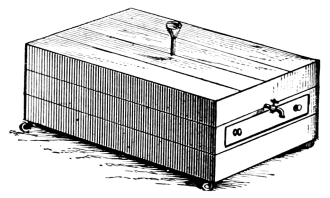
FIG. 1.—THE HOT-WATER INCUBATOR.
|
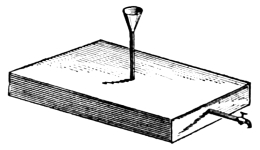
FIG. 2.—THE TANK.
Observe that the tubes on the top and the spigot are quite long, in order
that they may extend through the packing of sawdust which is to
surround it. This tank is to have a close-fitting covering (top and
sides) of wood, to resist pressure of water. The bottom is not to be
covered.
|
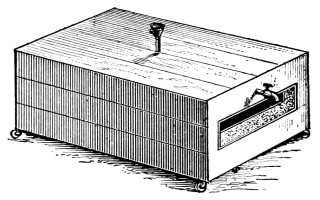
FIG. 3.—DRAWER OPENING.
Shows the thick packing, which is noticed at the opening. This extends
all around. The front of the egg drawer (Fig. 4) fits in its place in
order to complete the surrounding packing, when the incubator is
closed, as at Fig. 1.
|
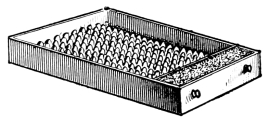
FIG. 4.—THE EGG DRAWER.
The space just in front of the eggs is the portion partitioned off to fit in
the opening at Fig. 3. The egg drawer is therefore LONGER than the
tank and ventilator.
|
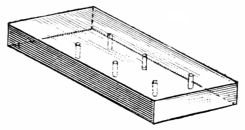
FIG. 5.—THE VENTILATOR.
The tubes admit air from below, which passes into the egg drawer above
through the muslin bottom of the egg drawer to the eggs. The eggs
rest upon the muslin, which is tightly drawn over narrow slats running
lengthwise the bottom of the drawer.
|
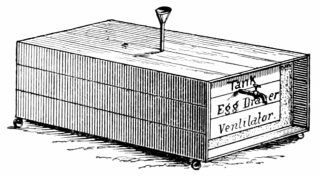
FIG. 6.
Here we remove the front of the incubator in order to show the positions
of the ventilator, egg drawer, and tank. First the ventilator, then
the egg drawer (which of course should be longer than the others in
order to fit in the opening shown at Fig. 3, but which we did not do
here in order to mark the places), and on the top is the tank. When
the front is completed the incubator is seen at Fig. 1.
|
Experiments with the incubator here given have been made all over
the country. It is one that is in actual use, and has always given satisfaction.
Having secured permission from the originator, we here illustrate
it for the benefit of our readers.
To make this incubator get your tinner to make you a tank 15 inches
wide, 30 inches long, and 12 inches deep, of galvanized iron or zinc, the
iron being preferable. On the top should be a tube 1 inch in diameter
and 8 inches high. In front should be another tube, 9 inches long, to
which should be attached a spigot, as illustrated in Fig. 2. Having
made your tank, have what is called the ventilator made, which is a box
with a bottom but no top. The ventilator should be 8 inches deep, and
1 inch smaller all round than the tank, as the tank must rest on inch
boards. In the ventilator should be four or six tin tubes 1/2 inch in
diameter and 6 inches long. They should extend through the bottom,
so as to admit air from below, and to within 2 inches of the top or a
little less. Now make an egg drawer, which is a frame of wood 3 inches
deep having no top or bottom, except that the front should be boxed off
and filled with sawdust, which is covered over afterward with a piece of
muslin to keep the sawdust from spilling. This box in front of the
drawer exactly fits the opening in Fig. 3, when the drawer is in its place.
Of course the egg drawer must be made longer than the tank and ventilator,
in order to allow for this space which it fills in the opening, which
is the packing all around the incubator. The bottom of the egg drawer
should be made by nailing a few slats lengthwise to the under side, or
rather, fitting them in nicely, and over the slats in the inside of the
drawer a piece of thick, strong muslin should be tightly drawn. On
this muslin the eggs are placed, in the same position as if laid in a hen’s
nest, and it allows the air to pass through to the eggs for ventilation.
The eggs can be turned by hand, marked for designation, or an egg
turner may be made by fastening slats crosswise to one on each side
running lengthwise, something like a window lattice, and when the eggs
are placed between these slots by merely pushing the frame the eggs will
turn over, exactly on the same principle that an egg will roll when it is
pushed by a block, a book, or anything else; but we believe the method
is patented, and do not advise infringement.
Having prepared the tank, let it be covered with a box, but the box
must not have any bottom. This is to protect the tank against pressure
of water on the sides, and to assist in retaining heat. Such being done,
place your ventilator first, egg drawer next, and tank last. Now place
a support under the tank and the box, or have them rest on rods, and as
the weight of water will be great in the center, the iron rods should be
placed crosswise under the tank every 6 inches. Now fasten the three
apartments (ventilator, egg drawer, and tank) together, with boards
nailed to the sides and back and front (of course leaving the opening
for the egg drawer), care being taken to drive no nails in the egg
drawer, as it must move in and out, and should have a strong strip to
rest on for that purpose. Having completed these preparations make a
larger box to go over all three, so that there will be a space on the sides,
back, front, and on top; but as the ventilator must be filled with sawdust
to within 1 inch of the top of the tubes, it serves for the bottom
packing. Make the outer box so that there will be room for filling all
around the inside box with sawdust, and also on top, being careful to
let the tube for pouring in the water come through, as also the spigot in
front. About 4 inches or so thickness of sawdust is sufficient, according
to preference. The front of the incubator must be packed also, but
an idea of how it should be done may be learned by observing the opening
in Fig. 3, which is so constructed that the box in front of the egg
drawer (Fig. 4) exactly fits into it, and completes the packing when the
drawer is shut. The incubator should be raised from the floor about an
inch, when completed, to allow the air to pass under and thence into
the ventilator tubes.
The incubator being complete, the tank is filled with boiling water.
It must remain untouched for twenty-four hours, as it requires time
during which to heat completely through. As it will heat slowly, it
will also cool slowly. Let it cool down to 120 deg., and then put in the
eggs, or, what is better, run it without eggs for a day or two in order to
learn it and notice its variation. When the eggs are put in, the drawer
will cool down some. All that is required then is to add about a bucket
or so of water once or twice a day, but be careful about endeavoring to
get up heat suddenly, as the heat does not rise for five hours after the
additional bucket of water is added. The tank radiates the heat down
on the eggs, there being nothing between the iron bottom of the tank
and the eggs, for the wood over and around the tank does not extend
across the bottom of the tank. The cool air comes from below in the
ventilator pipes, passing through the muslin bottom of the egg drawer
to the eggs. The 15×30-inch tank incubator holds 100 eggs if turned by
hand, but less if the eggs are placed between slats. Lay the eggs in the
same [way] as in a nest—promiscuously.
Keep the heat inside the egg drawer as near 103 deg. as possible; the
third week at 104 deg. Avoid opening the egg drawer frequently, as it
allows too much escape of heat. Be sure your thermometer records
correctly, as half the failures are due to incorrect thermometers, and
not one in twenty is correct. Place the bulb of the thermometer even
with the top of the eggs, that is, when the thermometer is lying down in
the drawer. The upper end should be slightly raised, so as to allow the
mercury to rise, but the bulb and eggs should be of the same heat, as
the figures record the heat in the bulb and not in the tube. Keep a pie
pan filled with water in the ventilator for moisture and keep two or
three moist sponges in the egg drawer, displacing a few eggs for the
purpose. Turn the eggs half way round twice a day at regular intervals.
Let the eggs cool down for fifteen minutes once every day, but do not
let them cool lower than 70 deg. No sprinkling is required if the
sponges are kept moist. If the heat gets up to 110 deg. or as low as 60
deg. for a little while it is not necessarily fatal. Too much heat is more
prevalent than too little. A week’s practice in operating the incubator
will surprise one how simple the work is. The tank will be troublesome
to fill at first, but the matter will be easy after it is done, as it can
be kept hot. Heat the water in two or more boilers, as a large quantity
will be required, and pour it in through the tube on top of the incubator
boiling hot, using a funnel in the tube for the purpose. Just at the
time of hatching out do not be tempted to frequently open the drawer.
Cold draughts are fatal. Patience must be exercised.
An excellent brooder may be made with a tank of hot water, covered
well, the same as the incubator. A piece of muslin or woolen cloth
should be next the bottom to prevent burning the chicks. Keep the
heat among the chicks at about 90 deg. Let the tank rest on inch boards
with no opening under it, but in front; a fringe should hang in front
for the chicks to run in and out under the tank. A little yard may be
constructed of glass sash, something like a hot-bed. Feed the chicks
four or five times a day, at first on hard-boiled eggs, chopped fine, giving
them also a little milk, fine screenings, and millet seed. After they are
a week old feed anything they can eat, but never feed meal in a raw
state, as it should be scalded first. Keep a little sand, fine gravel, and
bone-meal within reach of them all the time, and see that they are always
dry, clean, and warm. Do not crowd them, as the fewer the number
together the better, and never have different ages together.
This incubator will hatch chicks, ducks, turkeys, or guineas, and we
see no reason why it should not hatch the egg of the ostrich or anything
else as well. Chicks hatched by incubators, if rightly cared for, do
better than with hens, and are stronger and more vigorous.
We have endeavored here to embody all the answers to questions that
we suppose may be asked. Should you be in doubt, read the directions
carefully again. We trust that with the help of our illustrations our
readers will have no difficulties in the way.—The Poultry Keeper.
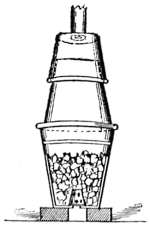
I saw the other day at a friend’s house one of the simplest and most
effective stoves for a small conservatory it is possible to imagine. It
was composed of three 12-inch ordinary flower
pots. The hole at the bottom of the lowest was
covered with a small pot, into the sides of which
had been bored a number of holes. The pot was
then three parts filled with charcoal, and lighted
from the top. This is the furnace. It is covered
by pots Nos. 2 and 3, and a light tin funnel and
chimney carry off the vapor. The draught is
maintained by placing the apparatus on a couple
of bricks, and regulated by closing the intervening
space with mud, leaving only a sufficient
aperture to keep the fire burning. This improvised
stove will burn without attention for
twenty-four hours, and it is amazing what a
great amount of heat is given off from so small
a surface.—S. J., in the Gardener’s Chronicle.
Within a few years some valuable methods of keeping meats, fish,
oysters, fruits, fruit juices, milk, butter, etc., in a healthful, nutritious,
and palatable condition for a considerable time past the ordinary period
of their decay have been discovered. In the following treatise we give
the results of the most patient research in securing all the latest and
most valuable information in regard to this important subject.
We will not deal with processes which necessitate complicated apparatus
or which require almost impossible chemical combinations,
but we will explain inventions which have undoubted value combined
with as much simplicity in the preparation as the circumstances will
permit.
Of all the anti-septic agents used for the purposes mentioned boracic
acid is the favorite, and salicylic acid next in choice. Various other
anti-septic agents are used and combined in different ways, according
to the results of experiments. They are applied either by immersion,
coating, injecting, vapors, etc., according to specified instructions.
Prof. Frederic S. Barff of Kilburn, England, it seems was the first
to combine boracic acid with glycerine, and to produce a preservative
compound known as boroglyceride, which is soluble in water and
alcohol. As boracic acid is but slightly soluble in water and other
common solvents this combination with glycerine—which is also a useful
agent in arresting the growth of germs—is peculiarly valuable. It
is tasteless and inodorous and imparts no disagreeable taste or odor to
the substance being treated. Solutions of the compound may be applied
to the preservation of all organic substances, either animal or vegetable.
The process was patented in England in 1881 and in the United
States in 1882.
To prepare boroglyceride, glycerine is heated to near its boiling
point and boracic acid added until it ceases to be dissolved, the proportions
being about 92 parts by weight of glycerine to 62 parts by weight
of boracic acid in chrystals. Maintain the mixture to a temperature of
about 200 deg. centigrade as long as water is given off. When the mass
cools it becomes a yellowish, transparent, glacial substance, tough and
deliquescent. This dissolves in water, but when boiled in large quantities
of the same it is decomposed into glycerine and boracic acid. In
order to employ the compound prepare a solution either in water,
alcohol, or other suitable solvent and immerse in or impregnate with
such solutions the organic substances to be operated upon. Solutions
may be prepared of various degrees of strength, but it has been found
that a solution consisting of 1 part by weight of the compound and 40
parts by weight of water will give good results; but other desired proportions
may be adopted.
Prof. Barff, the inventor of the boroglyceride process, read a paper
before the Royal Society of Arts, London, in regard to his method of
preserving food. The date of the reading is not at hand, but it is supposed
to be slightly prior to May 13, 1882, on which date it was printed
in the Scientific American Supplement. Although quite lengthy the
paper contains so much interesting data and light upon the subject that
we reproduce it almost entirely, together with remarks by other eminent
gentlemen who were present at the meeting:
“This evening I have on the table specimens of food which have been
kept for longer or shorter periods, as they are intended to illustrate
various applications of this preserving material. As you know oysters
are imported very largely in tins. They are cooked at a high temperature
and hermetically sealed. The high temperature to which they are
exposed necessarily causes a loss of flavor, and it is generally remarked
that tinned oysters are not a success. * * * I have oysters on the
table which were opened on the 3d of December in last year. I will ask
you to taste them and see in what condition they are, and I would also
remind you that they have not been kept in hermetically sealed tins, but
simply in corked or stoppered bottles; hence this method of preserving
oysters is cheaper than the other, and I maintain that it is more effective,
because their natural and fresh flavor is preserved. I am informed by a
friend in Jamaica that he has sent me some Jamaica oysters and other
things—I trust they will be here in time for me to submit them to you
this evening.
“Another substance, the perfect preservation of which is very important,
is cream, both for home use and for exportation. Cream in
London costs from four to five shillings per quart; it can be bought in
country places for two shillings, and even for less. This preservative substance
will keep cream for months perfectly good and sweet, having its
full flavor; so that it would be quite possible to send it in quantities
from the country, and its sale need not be pressed as it need not be used
immediately. I have regularly every week, except during the holidays,
brought with me from Beaumont College, near Windsor, where I lecture,
a quart of cream treated with one ounce of the boroglyceride; it has
always kept perfectly good even in the hottest weather. I have done
this for a year and a half; a near relative has taken the greater part of
this regularly for the time stated, and this proves conclusively that there
is nothing at all injurious to health in the compound. I see a gentleman
present here to-night who is connected with that college as a professor
of natural science, and he will, in the discussion, be able to give
you very valuable information as to the material and as to its perfect
wholesomeness. Last month I sent some cream to the Rev. J. Ryan, a
Jesuit priest in Jamaica, and I have received a letter from him, from
which I will read you an extract:
‘26 North Street, Kingston, Jamaica,
‘February 24, 1882.
‘The cream which you sent was used by eight of us in coffee, and was
pronounced to be wonderfully good. Next morning it was taken in
preference to a beaten egg, by the captain of H. M. S. Tenedos, to his
coffee.’
“Last year I sent some Devonshire clotted cream, which I prepared
myself, to Zanzibar, on the east coast of Africa. The climate here is
very hot; fresh food will only keep a few hours. This cream had to pass
through the hot climate of the Red Sea. I will read an extract from a
letter written by a lady who received the cream:
‘Universities Mission To Central Africa,
‘Mbweni, Zanzibar, March 8, 1881.
‘The Devonshire cream you sent us was quite a success. I received it
last night. Fortunately the Bishop and Miss A—— came to Mbweni,
to-day, so we had it for dinner. That I might have everything correct
I opened a pot of raspberry jam which we had from London a long time
ago. The Bishop said it had kept perfectly, but had not quite the rich
flavor that it has when quite fresh; he has been used to it in Devonshire.
Every one pronounced it most excellent. We sent some in to Mrs.
H——, and were surprised at her sending for more, for she seldom
eats half anything we send her. She did not know what it was, but she
said she had never had anything here she enjoyed so much.’
“A year ago I sent some cream from Beaumont College dairy to the
Rev. Thomas Porter, the head of the Jesuit Mission in the West Indies.
He states that the cream was as good as any he had eaten at home, that
he gave it to several strangers to eat, and that they would not believe
that it came from England. These experiments and these testimonies
prove conclusively that this compound will preserve cream. I shall
this evening show you specimens. It is easy to send cream in good
condition to the tropics. A great objection to condensed milk is that
it is always too sweet. The boroglyceride will preserve condensed milk,
and will give it no flavor at all. My friend, the Rev. Thomas Porter,
sent me some articles preserved with the material which I sent him
from England. They arrived about June in last year. Some raw, fresh
turtle came quite fresh. It was cooked and eaten by several persons, who
said it was quite fresh and good, and had the flavor of fresh turtle. At
my own house I had turtle cutlets fried; they were perfectly good, and
tasted like turtle. Another article which Father Porter sent me was an
uncooked Jamaica pigeon; it was roasted at Beaumont College. I
divided it and brought half of it home It was tasted by twelve people,
who all pronounced that it was perfectly good, and had the true pigeon
flavor. In the same parcel came some green sugar-cane, fresh tamarinds
taken direct from the tree, fresh limes, and the juices of two
different fruits. All were fresh, and were tasted by gentlemen who had
lived in Jamaica, who all declared that they had all their own peculiar
flavors. On the 3d of September, 1881, another box was sent me from
Jamaica, containing sugar-cane, guavas, fresh ginger, and turtle; the
turtle had come to grief, because it was not properly treated on the
other side; the cane, guavas, and fresh ginger have been tasted by those
who have lived in Jamaica, and have been pronounced to have their
true flavors.
“Ordinary milk cannot be kept good for a long time, especially in hot
weather. If milk were concentrated in this country, and heated with
the boroglyceride, carriage would be saved, and the milk might be kept
good and fresh for a fortnight and more; all it would require would be
to reduce it again to its original strength. If fresh milk be treated with
this preservative it can be set for cream for several days, even in hot
weather. The cream which rises will keep, and the skim-milk will remain
sweet for several weeks; this I have tried in the dairy at Beaumont
College. From the cream so prepared butter was made, and was kept
for several weeks without a particle of salt, and was eaten by members
of the college. I also wish to show another method by which meat can
be preserved and cheaply transported. In South America, about Buenos
Ayres and the River Platte, many cattle are killed simply for the hides
and fat; the flesh is thrown away. Now, if this flesh were cut up in
small pieces, and put into the preserving liquid for a night, it would,
even in that hot climate, keep good for some time. It could then in a
few hours be dried in the sun, packed in casks, and sent to this or to
other countries. I have a specimen of beef treated in this way. It was
put into the solution on Jan. 19, 1882, dried Feb. 1, and has lately, within
a few days, been boiled, and here is the resulting beef tea, which has not
in any way been flavored. I have also small quantities of beef juice
here preserved in bottles. The juice was expressed and has been kept
raw. Raw beef and mutton juice is recommended by medical men in
many conditions of the digestive system. I administered it to a near
relation for six weeks, and the juice was preserved good by my material.
In the case referred to the effect was very satisfactory. It appears to
me to be a most important matter that soup meat, and meat for potting
and stewing, should be sent to this country in the way I propose. The
supply would be large, the prices low, and the profits highly satisfactory,
and it would greatly relieve the meat market, because a very large quantity
of fresh meat which is now used for soup could be employed in
other ways. It has been remarked to me: ‘But would you get people to
use it?’ I think, to begin with, that if proprietors of hotels and heads
of large public institutions, workhouses, and hospitals could be shown
that for half the cost they could have equally good soup and soup stock,
they would willingly use it, and from thence it would come into private
use. I have specimens to show the effect of boroglyceride on fish. Here
are sprats which have been kept for a year; they are dry, but perfectly
good and eatable; also some preserved fresh since Jan. 13, 1882. You
will be able to judge of their appearance and flavor. I have also herrings
and a piece of skate which have been preserved for the same time.
If fishmongers had a tank of this solution they could, at the end of the
day, put their fish in it, and take them out when required. Bloaters, when
lightly cured in hot weather, do not keep good many days; if a small
quantity of this stuff was used with the salt, they would keep good for
months. The same may be said of smoked salmon. That which is very
salt costs 9d. per pound, but the mild cured kinds cost 3s. 6d. to 4s. per
pound. All could be mildly cured if this material was used with the
other curing substances. As an adjunct in curing mild hams and bacon
it would be of great use, for these, when cured lightly, would not go
bad, as they often do in the summer time. What I have said as to the
temporary preservation of fish by fishmongers applies equally to the
preservation of meat and fowls by butchers and poulterers.
“It is justly complained of that the Australian cooked meat is overcooked.
If it were for a short time dropped in this preservative solution
it would keep perfectly well after being lightly cooked, even underdone.
I have a piece of beef which was dipped Feb. 28 and boiled on
March 9. It has been left in its own liquid, it was not flavored, and no
salt was added. Here, too, is a vast field for the application of the
process. Here is also lobster which was taken out of the shell Feb. 1,
and here are two lobsters in their shell which were immersed on the
same day.
“I now wish to draw your attention to a parcel from Jamaica, which
has just arrived, and from which I am able, I am happy to say, to show
you specimens which must be of interest. In a jar on the table is some
fresh turtle, which I had simply cooked. I thought it better so to present
it to you rather than raw. There is also a Jamaica pigeon, also
just cooked here, and a vol au vent, which I have had made from oysters
which were sent open in the preserving stuff from Jamaica. These
specimens will prove conclusively that food sent from a tropical
climate retains its freshness and delicate flavor. I have reserved one of
the pigeons raw, that you may see in what state it arrived. Some mutton
was shipped to me from the Falkland Islands at the beginning of
last August; a piece of it is uncooked on the table. I have also had a
piece stewed, which you will be able to taste; this has of course passed
the tropics. Through the kindness of my friend Mr. Haffenden of the
‘Andaluzia,’ in the Strand, who owns vineyards in the southwest of
Spain, I can show you some perfectly fresh sardines which he had placed
in the preserving fluid several months ago in Spain, and which he
brought with him. You will yourselves judge of their condition; I will
only remark that they have the peculiar fragrance of that delicate fish,
and will it not be a boon to have a supply of this fresh delicacy at a
moderate cost?
“You will also see, and I hope taste, a pigeon pie. The pigeons and
the steak have been preserved raw in stoppered bottles since the 21st of
last November and the eggs since the 4th of July, 1881. I will also call
your attention to a tongue which I myself placed in the solution Feb. 9
in this year, with some garlic, sugar, and juniper berries, my object being
to show that salt can, if desired, be dispensed with. You will doubtless
find that it will require salt; but you will readily infer that hams,
tongues, etc., can be made just as salt as one pleases, and will yet keep
perfectly sweet, in fact sounder, than those cured only with salt. This
tongue was boiled out of pickle. I exhibit two shoulders of mutton,
one cooked, the other raw; they are from sheep killed Jan. 10, 1882.
Also a piece of beef preserved on the same day; this when you have inspected
it shall be cut in slices and broiled. You will see some sausages,
both cooked and uncooked; they were made for me by Mr. Bowron,
poulterer, of Paddington, early in July last, before I went to Carlsbad.
I took some with me to that place, and they were there eaten and pronounced
good. These are some of the same lot; they were made as follows:
The meat was chopped, put into the preserving fluid for one
night, and then mixed with the other material in the ordinary way.
They have been kept since in an earthenware jar; they have, therefore,
been made more than nine months. I may remark that the bread in
these sausages was not treated, and therefore it has become slightly
sour, but the pork has kept perfectly fresh. I have also some other
sausages which I bought Jan. 12, and at once preserved; these having
been steeped, the bread has not turned in the slightest degree sour.
“Mock turtle soup, bought ready made from a confectioner’s shop in
Oxford street, Jan. 25, treated with the preservative stuff, has remained
quite good and unchanged in flavor.
“There is also a specimen of gravy soup made in October last, and
some vermicelli soup made about three weeks ago. The preservative
action of boroglyceride in cooked foods is, it seems to me, of great importance
to hotel-keepers, confectioners, and restaurant proprietors, as
it will enable them to buy large stocks when certain articles are cheap,
and from the specimen I show of cooked beef you see it remains quite
moist, as it can be kept, without getting sour, in its own gravy and under
a layer of its own fat. To prove that articles can be kept and dried
without losing their flavor, I had some partridges treated and dried
last February twelvemonth, and I exhibit some soup made from two of
these birds. The other articles on the table are one raw and one roast
fowl, bought Jan. 17; one raw and one roast pheasant, bought Feb. 5; one
rabbit boiled, bought Jan. 17. There are also from Jamaica a green
lime, some fresh tamarinds, and some pieces of fresh ginger. * * *
“I thank you, ladies and gentlemen, for the patient hearing you have
given me.”
The Chairman said the paper was marked by the clear and philosophic
way in which the subject was treated, and before inviting discussion
upon it he would mention shortly his own experience of the
process, the only interest of which was that it was quite independent of
Prof. Barff. When he was asked to take the chair he communicated
with Mr. Barff, and inquired what the process was. Mr. Barff kindly
sent him a specimen of this substance, which he melted, and put some
of it into one-half of a pint of cream. The other half very soon turned
sour, and had to be thrown away, but that to which the substance was
added was perfectly fresh that morning. He was confirmed in the
opinion of its freshness by the cook, though she said there was a very
slight tartness perceptible, by which she could distinguish it from fresh
cream. He had also tried another experiment on meat which was
chopped very fine, and divided into two parts; to one part he added
merely tepid water, to the other, tepid water to which one-sixteenth
of its bulk of this compound had been added. This was left on the
meat for eighteen hours, and then filtered off through muslin. Several
days ago the portion which had no preservative was very offensive, but
the other portion was that morning perfectly free from any odor whatever.
The Rev. J. L. Dobson said he had had the pleasure of being associated
with Mr. Barff in most of the experiments he had detailed, and
might therefore anticipate his reply to one or two points raised by Dr.
Graham. An experiment which was tried for some time in a large
school would answer the question of wholesomeness. At the Beaumont
College, Windsor, there was a large staff of teachers and over 200 pupils,
and during the hot weather of last summer the dairymaid was very much
annoyed at the milk turning sour, and applied to him to see if he could
do anything to counteract it. He handed her some 14 or 15 lbs. of this
material and during the whole of the hot weather and well on into September
it was constantly used, and the milk was preserved; but the
method was not detected by any one, either by the younger members or
by those who might be expected to be more critical. No ill effects were
observed by the medical officer or by individuals. From his own experience
he thought the aroma was very well preserved throughout.
For instance, in oysters which had been preserved over three months
there was the characteristic aroma of the fresh oyster; mutton could be
easily distinguished from beef, and the peculiar smell of the turtle was
also very distinct. They had not yet tried beer with so much fullness as
other articles, but about nine months ago a small quantity was treated
and left exposed to the air, with only a loose stopper of cotton wool.
It did not grow cloudy in the ordinary way, but owing to the severity of
the experiment, and perhaps to not sufficiently treating it, after four
months it lost all flavor, became extremely flat, and a slight fungus appeared.
Dr. Thudichum had listened with great pleasure to the paper, and
had no doubt if the application of the invention could be effected on a
large scale it would be very useful. He had some experience with regard
to a portion of the ingredients used, viz.: boracic acid, though he
had none of this beautiful new compound. It might not be known to
the meeting that boracic acid had been used for a great many years for
preserving food, and in fact many of them in summer time had their
milk well dosed with it. It had been sold to milkmen in London for
years under the name of “aseptin.” He had tested it in 1865 and found
a great many of those effects which Mr. Barff described. For instance
eggs were beautifully preserved, and steak immersed in the solution did
not become either mouldy or decomposed, but on the contrary appeared
to retain its flavor. A variety of other things, such as cheese and cream,
were for a long time preserved by this application of aseptin. He hoped
the addition of the glycerine would increase the power and prevent
some drawbacks which would otherwise stand in the way of boracic
acid alone as a preservative of raw or cooked meat.
Prof. Barff, in reply to the various questions which had been asked,
said he had used salicylic acid and had found it useful in preserving
food, but for several reasons discontinued further investigations, one
being on the score of its unwholesomeness, and he found that his views
on that point had been borne out by the action taken by the French
Government. Dr. Graham had asked him about flavor; he had given
Dr. Graham a few days ago some specimens of preserved fish, which he
said had lost their flavor, but that would not be found to be the case
with the box of sardines. The herrings had been kept in an open vessel
exposed to the air ever since the day they were put into the liquid, and
therefore it was not surprising that they had lost their flavor. If they
would try any of the things which had been tinned, not soldered up, but
such as the Jamaica pigeons, which were in a common corked bottle, it
would be found that the aroma and flavor were retained. The only
thing requisite was to keep the vessel so as to exclude the air, as you
would with tea or coffee. Dr. Thudichum made some very interesting
remarks which there was not time to refer to at length, if he were competent
to do so, but not being a medical man he could not enter into
medical questions. As to the wholesomeness of the compound, however,
he might say that he had taken large quantities of it himself and
it had never done him any harm; and a near relative had taken an ounce
per week regularly for a year and a half, without any ill effect—a person,
too, not very strong or of good digestive powers. The boys and teachers
of Beaumont College drank milk preserved with it without distinguishing
the taste or suffering any ill effects. He knew there were medical
opinions in favor of boracic acid, and one physician he was acquainted
with used it as a medicine. If it were at all unwholesome he certainly
should not recommend it, but he did not think there was the slightest
fear. As to boron getting into the system, it was not boron which was
used, but oxide of boron; but even if it did—and he should not be surprised
if traces of boron were found in the excreta—it did not follow
that any harm was done. There were many things which went through
the system without injury; for instance, silica, of which most people
took a great deal in the twenty-four hours. As to the cost of the process
the cost per gallon, as far as he could tell—he could not tell exactly—would
be under 1s.—perhaps 8d. or 9d.—and a gallon would affect an
enormous quantity. Most of the articles on the table were put into one
pan of solution, and the cost of the whole stuff was about 9 1/2d. Should
the process be adopted commercially experiments as to the cost would
be most carefully made and the results published. A joint of any size
could be soaked; the only thing was to give it plenty of time. You
might soak a piece of beef of twenty pounds, forty pounds, or fifty
pounds; or you might use an injecting syringe, such as butchers employed
for salting meat quickly, and the meat so treated would keep for
a week or a fortnight perfectly good, but he did not think it would keep
well enough to pass under a tropical sun. In order to do that you must
inject by the aorta, by means of a force pump, so as to send the liquid
into all the interstices of the flesh. As to the proportions, 1 in 20 was
the strongest he used, and 1 in 60 the weakest; for preserving meat 1 in
50 answered perfectly well—1 lb. of the compound added to 50 lbs. of
water. The bottle should be put before the fire until melted, and then
poured into hot water, and it would dissolve. With regard to preserving
morbid specimens he thought it would answer perfectly well. He
had had some practice in morbid anatomy, and he might say that, for
the injection of bodies to be used for anatomical purposes it would
keep them perfectly sweet. It should be injected by the aorta in the
usual way before injecting with the red wax. In reply to Mr. Dipnall
he would say that the compound penetrated right through into the innermost
parts of the meat. If you had an earthen pan and put into it 1 lb. of this and 50 lbs. of water, and placed in it a joint which came
home on the Saturday night in hot weather, you could take it out the
next day and it would keep perfectly for a fortnight. Of course it took
time to penetrate into the meat, but the first superficial penetration
stopped the injurious effects of germs which set up putrefaction. Another
important fact was this: if you had a roast leg of lamb, perfectly
good, but did not eat it all, and put it away in hot weather, it would
turn sour, but if it had been treated in this way it would not; it would
keep for six months without going sour. By adding a small quantity
from time to time, which you could only learn by experience, the bath
would keep perfectly fresh and effective, though it would be found after
a time to get rather dark colored. That arose from the juice of the
meat, and the advantage of this process was that you need not throw it
away, as you must brine, but could boil it down into very good soup.
In conclusion he would only ask his hearers to read the paper and discussion
carefully when published, and he was sure any one would be
able to carry out the process.
The Chairman, in proposing a hearty vote of thanks to Prof. Barff,
said the process he had described was remarkable for its great simplicity
and the ease with which it could be carried out. Any cook could
readily apply it.
The vote of thanks was carried unanimously.
The following is the invention of an American, William S. Fickett
of Rochester, N. Y., and is an improved process of combining boracic
acid with glycerine for preservative purposes. (Patent No. 285,350.)
“My invention consists in a new mode of producing a new preservative
compound from boracic acid and glycerine, as hereinafter described.
Heretofore by one method* such a compound has been produced from
these ingredients by heating glycerine to near its boiling point and adding
boracic acid until it ceases to be dissolved, and maintaining that
mixture to a temperature of 200 deg. centigrade as long as water is given
off, etc.
* Doubtless the Barff process—[author].
“Now my process consists in taking equal quantities of glycerine and
crystallized boracic acid, placing the same in a closed or sealed vessel,
and then applying heat at about 300 deg. Fahrenheit for about two hours,
which causes the boracic acid to dissolve and blend with the glycerine.
On cooling it forms without loss of weight into on opalescent semi-solid,
freely soluble in cold water, entirely devoid of bitter or metallic
taste, and communicating no objectionable taste to butter or like delicate
foods. When thus produced it is an unfailing preventive of fermentation
and decay in animal and vegetable matter or fluid compounds.”
The following is a different process of using boracic acid, and explains
itself:
James Howard, Philadelphia, Pa.; composition for preserving foods.
(Patent No. 276,246.)
“I have discovered a method of obtaining a chemical compound of
boracic acid for the production of which neither solution nor the employment
of heat is necessary, the salt being formed by the union of the
component substances in a dry state, so that the difficulties of solution
and of loss through volitization is avoided. Moreover the compound has
anti-septic properties distinct from those of the acid, due to one of the
other elements thereof, and is tasteless.
“I take preferably not less than 5 parts by weight of pure boracic
acid in crystals, and add thereto 1 part of pure phosphate of soda. The
ingredients are mixed together dry, in a mill or other suitable grinding
apparatus, and as the chemical reaction between them progresses the
whole, or practically the whole, of the acid crystals lose their structure,
and the mass can be ground until it assumes a pasty or doughy condition.
The result is boro-phosphate of soda, containing more or less
free boracic acid, according to the excess thereof used above the proportions
given. The moisture yielded by the chemical reaction is
evaporated at the ordinary temperature by exposure to the air without
loss of boracic acid, and the dry amorphous salt thus produced is readily
ground. It may be used either as a dry powder or may be dissolved
in water and applied in the usual modes to the substances to be preserved.
If desired other substances, such as salt and saltpeter, may be
added to the boro-phosphate compound, and the whole mixed thoroughly
by regrinding.”
The following process is the invention of Mr. William Pitt Clotworthy.
(Patent No. 284,184.)
The process consists of incorporating with the fat, which may consist
of butter, lard, or other grease, a sufficient amount of paraffine.
Paraffine is non-oxidizable, without taste or odor, and, as the inventor
claims, it is perfectly harmless when used in this manner, just as beeswax
is swallowed with honey, although not in such large proportion.
Tons of paraffine are manufactured yearly into chewing gum and chewed
harmlessly by thousands.
In preserving butter the process is as follows: Take 1 ounce of fresh
unsalted butter and incorporate with it 1 ounce of paraffine, and thus
form a jelly, and then thoroughly mix this amount of jelly with 1 pound
of butter.
In preserving lard combine the paraffine as follows: When the lard
is ready to be drawn off from the rendering kettles, and while still hot,
add 1 ounce of paraffine to each pound of lard and stir the mass thoroughly.
Theodore L. Corwin of Marathon, N. Y., has invented the following.
(Patent No. 253,983):
The invention relates to the class of compounds used to preserve in a
healthful state such articles of food as meats, fish, milk, eggs, butter,
oysters, cider, and also to be used as a disinfectant and to arrest putrefaction.
“I take of nitrate of potassium, of salicylic acid, and of chloride of
sodium, each 1 ounce. These should all be in powder and dissolved in 1
quart of water. Then add 1 drachm of hydrochloric acid previously
diluted with 1 ounce of water. To preserve meat immerse for twenty
minutes in the hot solution, after which let it drain for one hour; then
pack in a well-closed vessel. For the preservation of fish use the same
as for meat, only the solution should be allowed to become cold before
using. To keep oysters stir into them 3 ounces of the solution (cold) to
each gallon of oysters. Cider will be kept sweet if there is added to
each barrel 1 quart of the solution immediately after the cider comes
from the press. Milk to be kept sweet should have the powder first
named, viz.: nitrate of potassium, salicylic acid, and chloride of sodium,
each 1 ounce, added to every 16 gallons. As a disinfectant the solution
should be sprinkled freely around the place or places to be disinfected.
To prevent putrefaction the solution should be copiously applied to the
object treated.”
An Ohio inventor has patented a process for preserving fruit juices
such as cider, wine, etc., which he says, if treated according to his directions,
will keep unchanged for years:
“The juice is taken before fermentation takes place and boiled, all
scum is carefully skimmed off, and then the liquid, while still hot, is
filtered through a compound of partially pulverized charcoal, crushed
mustard seed, and ground sassafras root. The filter should be covered
with fine woven wire, outside of which should be fastened a flannel
cloth to catch all escaping sediment. To every gallon of juice to be
filtered there is placed in the filter 2 ounces of charcoal, 2 scruples of
crushed mustard seed, and 6 drachms of ground sassafras root. After
filtering it is again boiled, and if any scum or impurities appear on the
surface they are removed, when the juice is to be bottled, corked tightly,
and should be left for one year.”
Schaumberg & Dillon’s method of preserving fruit juices consists in
bottling and sealing the juices, and then heating the bottles to 170 deg.
Fahrenheit for thirty-five minutes. The juices are put in bottles and
are immediately corked and wired securely, and then submerged in a
water bath to a depth of about 1 inch above the bottles.
The advantages of this process are that the fruit juices will remain
sweet indefinitely, will not ferment, and are free from all deleterious
matter.
Rebecca A. McDaniel of Burr Oaks, Ia., has patented the following,
which is one of quite a number of this class of preservative processes:
“In preserving different articles, such as fruits, meats, and other
edibles, I subject them for a proper time—differing with different articles—to
the fumes arising from burning the compound. This may be
accomplished by confining the articles to be treated in a chamber in
which the compound is being burned.
COMPOSITION.
Salicylic acid1 | ounce. |
Sulphur2 | pounds. |
Pulverized orange peel 1/4 | ounce. |
Ground cinnamon3 | ounces. |
“This compound well mixed will burn slowly and generate fumes or
vapor which have a peculiar action in the preservation of fruits, butter,
milk, pies, bread, eggs, and all kinds of cooked or uncooked food. In
treating meats add nitrate of potash, 4 ounces.
“Treatment: Provide a box or other chamber with shelves upon which
the articles to be treated may be placed. Within the chamber, properly
closed, I burn a suitable quantity of the compound, allowing the fumes
to bathe the articles to be treated. The compound is of a quality that
will burn slowly by reason of its peculiar composition, and it may be
burned with fuel other than it contains.”
Salicylic acid, aside from its remedial value, is used largely as a preservative,
either in a dry state or in the form of a solution in water or
alcohol. Salicylic acid is a white, dry, crystalline powder, devoid of
smell or taste, undergoes no change when kept in store, and is neither
inflammable nor volatile. It can be procured in almost any drug store,
and since 1874 a new process in its manufacture has cheapened it in
price and placed it within the reach of all.
Medical authorities agree in considering the daily consumption of 1
gramme as being not only perfectly inoffensive, but decidedly beneficial
to health. An individual living on a salicylated diet would not absorb
so much of the salicylic acid per diem as that which is prescribed to be
taken for the prevention of epidemics and other ailments, such as gout,
rheumatism, catarrhal affections, etc.
The proportions in which salicylic acid dissolves are:
One part by weight in 300 to 500 parts of cold water.
One part by weight in 18 to 20 parts of hot water.
One part by weight in 50 parts of glycerine.
One part by weight in 3 parts of absolute alcohol.
In rum, brandy, wine, cider, etc., it dissolves according to their respective
strengths and temperatures.
Note.—By contact with iron in any form salicylic acid takes a violet
color.
This must be noted, especially when treating milk, etc., if contained
in metallic vessels. The only bad effects will be simply slight discoloration.
MEAT.
It is a well-known fact that, especially in hot weather, meat, poultry,
and game, although apparently quite fresh, prove, on closer examination,
or often only when cooked, to be tainted and of bad odor. This
can be entirely removed by either watering and washing the meat in a
lukewarm solution of salicylic acid (three to four teaspoonfuls of acid
to two quarts of water), or by adding a small pinch of the dry acid in
powder, during the cooking.
To keep meat for several days from becoming high or tainted:
Place it for twenty or thirty minutes in an aqueous solution of 8
drachms of salicylic acid to one gallon of water.
Rub into the surface of the meat some dry salicylic acid, particularly
about the bony and fatty parts; the meat to be afterward cleaned
before cooking as usual.
Although the raw meat treated with the acid turns slightly pale on
the surface it suffers no change whatever internally. Meat thus
treated with salicylic acid requires, also, less cooking to render it
tender.
PURE MILK.
A third of a teaspoonful (or, if the temperature be high, a little
more) of the solid acid to a quart of milk delays the process of curdling
for thirty-six hours, without influencing its property of yielding cream.
BUTTER.
Washed with an aqueous solution (four drachms of acid to a gallon of
water), or kept in it, or wrapped in cloths soaked in this water, keeps
fresh for a very long time. Butter already rancid can be improved by
treatment with a stronger solution (8 drachms of acid to 1 gallon of
water), followed by washing in pure water. The bad smell often arising
in salted butter is entirely prevented by addition of the acid.
JAMS OF ALL KINDS, JELLIES, PRESERVES, AND PICKLES.
Of every description, made in the usual way, but with the addition of
about 1 drachm of salicylic acid to every 4 pounds of the preserve, will
keep sound with absolute certainty for a much longer time, fermentation
and mouldiness being prevented. Under exceptionally unfavorable
circumstances, such as hot pantries, a little of the dry acid should be
sprinkled on the top of the vessel or preserve pot. A tightly-fitting
piece of blotting paper, previously saturated with a concentrated solution
of salicylic acid in spirit, brandy, or rum, and placed on the top of
the preserves will also greatly aid in keeping them.
NEW-LAID EGGS
Can be kept for a very long time by being placed for half an hour in a
cold, saturated, aqueous solution of the acid, then allowed to dry in the
air, and, as usual, kept in a cool place. Some prefer to coat them by
dipping them in melted paraffine after they have been treated in this
manner. (Use no straw or hay in packing eggs.)
THE YOLK AND THE WHITE OF EGGS
Are most effectually preserved for a long time by the addition of 1/2 to 1
ounce of the acid per 20 pounds of these substances. It is also well to
place a paper soaked in the salicylic acid solution on the top of them,
which greatly enhances the preserving effect.
In the manufacture of vinegar, salicylic acid is also of great importance
to prevent false or excessive fermentation, putridity, etc.
WINE.
With respect to wine the experiments of Prof. Neubauer of Wiesbaden
have proved that the introduction of the acid for the preservation
of wine marks an era of great industrial progress, as it energetically
prevents, even when used in very small quantities, the formation of
mould germs and other circumstances which are injurious to wine,
while it absolutely arrests secondary fermentation, cloudiness, etc. As
wine differs very much in its constitution the requisite quantity of salicylic
acid must be found out by practice in each particular case. About
1/4 to 3/4 of an ounce per 50 gallons will be found sufficient for most
wines. In using the salicylic acid for this purpose it is recommended
to make a strong solution of it in pure spirit, perfectly free from fusel
oil, and then to add of this solution as much as may be requisite.
If in addition to this the casks are washed out with an aqueous solution
of the acid it will prove of great service, and all other agents at
present used for this purpose will soon be abandoned. The larger the
amount of sugar in proportion to the alcohol the more salicylic acid
will be required. The addition is best made when the wine has attained
its full ripeness. The effervescence of wine in spring, or after carriage
in warm weather, will at once be stopped. The salicylic acid kills all
kinds of germs, and destroys the growth and action of any yeast which
may still be present; it is therefore of incalculable value in effectually
preserving wine, and as a preventive of the deterioration to which this
liquid is subject.
Must, fresh from the press in autumn, can be kept without fermentation
perfectly fresh, bright, and sweet for six to eight months by the
addition of 1 to 1 1/2 ounces per 50 gallon, or of 3/4 ounce per 100 bottles.
Sparkling Must requires an addition of 6 to 7 ounces of salicylic acid
per 100 gallons. In the same manner all kinds of fruit-wine which, as
is well known, soon turn sour, can be preserved by the addition of a
similar quantity of salicylic acid. Must kept still for transport can at
any time be set into fermentation by a slight addition of carbonate of
soda and fresh yeast.
BEER.
Experiments made upon a large scale have placed beyond a doubt
the remarkable properties of salicylic acid as a preventive of secondary
fermentation and acidity in beer, and as a preservative of beer in a
sound condition when sent out or exposed to the noxious influences of
warm cellars, change of temperature, etc. The amount of salicylic acid
required to produce the best effects in preserving beer varies according
to the quality of the malt liquor; but half an ounce per barrel of 36 imperial
gallons will be very generally found to answer the purpose well.
The addition of the salicylic acid delays secondary fermentation in
stock and export beers, which may then be kept for any length of time
without becoming unsound or of unpleasant flavor. Less than a quarter
ounce of the powder of salicylic acid per barrel of boiling wort strewn
into the same while turning out will destroy or suspend the vitality of
the false ferments, especially that of the lactic ferment, in the fermenting
vats, and this not only without injury to the yeast cells, but keeping
them free from parasitical growths. In this manner the fermentation
will take a steadier course and enable the liquor to attain its perfection
during the ensuing still fermentation in the cask, into which another
quarter ounce or more of the acid is to be given per barrel a fortnight
before racking. Stout, and in fact all beers for export to a hot climate,
require rather more.
For long transports the acid in powder can be simply thrown into
the export casks, in which it dissolves in the course of three days instead
of a week, which is required by the cold beer lying quietly.
BOTTLED BEER NOT SALICYLATED IN THE CASK.
The clean bottles must be rinsed with a solution of 1 part of salicylic
acid in 4 or 5 parts of spirit (free from fusel oil), which can be poured
from 1 bottle to another. Or, a small pinch of the acid in powder is
placed in every bottle before filling.
The corks should always be boiled in water containing 1 ounce to the
gallon, which is also efficient in disinfecting tubes, taps, etc.
CIDER.
Dissolve 3/4 of an ounce of salicylic acid in a gallon of cider, and then
add this amount to each barrel of cider. This is superior to any preparation
of lime. The cider must be treated when fresh.
GLUE, GELATINE, GUM ARABIC SOLUTIONS, PASTE, SIZE, STARCH, INK,
SKINS OF ALL KINDS, ETC.
Are successfully preserved for a length of time from decomposition or
deterioration by means of salicylic acid. One-thousandth part of the
acid introduced into a vat of gelatine or into decoctions of animal matter,
prevents their undergoing decomposition for an indefinite period
of time. Calico printers are using half a pound of the acid to every 100
pounds of dressing starch, in order to entirely preclude the disagreeable
odor arising after awhile from dry goods in store.
IN THE PROCESS OF TANNING,
If the bark-color be slightly salicylated, this liquor will not undergo
the change which, instead of making the hides and skins swell, often
causes the opposite effect, contracting them by an alkaline action, and
at the same time imparting to them a putrid odor. Treatment with
carbolic acid also leaves a most objectionable odor, especially in fine
leather goods. The use of salicylic acid will thus be found highly remunerative
to all tanners, as it has proved in the industries already
alluded to.
IN SUGAR FACTORIES
Three drachms of salicylic acid are used to every 300 pounds of beetroot
in the diffusing liquor, in order to prevent fermentation, and for
destroying the parasitical growths, especially noticeable in the old
material.
FOR DISINFECTING.
Fumigation with the acid purifies the air and walls of closed rooms.
Simply evaporate some on a heated shovel, which must not be red-hot.
The air in crowded buildings, schools, barracks, hospitals, factories,
etc., will be improved by keeping the floors sprinkled with the solution.
In sick rooms this is of great importance, the dust settling on the floor
being the readiest receptacle and means of transmitting the microscopic
fungi or germs of infection which float in the air.
VESSELS, CORKS, ETC.,
Are very well cleaned and disinfected by washing them with an aqueous
solution of the acid. This deserves especial notice.
It is evident that numerous advantageous applications of salicylic
acid are carried out besides those enumerated above, but the descriptions
already given will enable any person interested in the matter to
find out the best means of deriving profit from the wonderful properties
of this extremely useful substance.
BY JOHN TAYLOR.
Houses built on this plan are lined throughout the inside with sheet
iron. There is a layer of felt nailed to the sides, ceiling, and floor of
the room, and on this is nailed the sheet iron. It is then painted with
two heavy coats, it being the aim to fill up all joints and seams with the
paint. But as the tin and felt do not render the room absolutely air-tight,
I am of opinion that it can as well be dispensed with. It might
save some ice if the seams were all soldered. The layer of cement,
asphaltum or gas tar, which should cover the ground below the joists,
is to protect the room from the moisture and warmth of the earth.
Above this layer should be about 30 inches of dry sawdust or turners
shavings, well packed up to the level of the top of the joists.
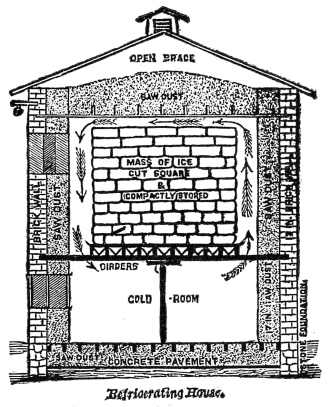
The drainage from the ice is carried off by a series of V-shaped tin or
iron troughs, which run between the joists, all of which carry the water
to one point, where it is carried outside by a trap-pipe. These troughs
reach over to the center of the top of the joists, and are soldered together,
so that no water will drip on the floor below. It will be seen
that in this plan there is no sawdust or other preservative in contact
with the ice, and that the air of the room circulates around and over the
ice. As long as the temperature of the goods stored is above the temperature
of the room there will be a gentle draught around the mass of
ice, and of course all the moisture in the air, vapors, and odors from
the goods will condense on the ice and pass off, so that you can keep
milk, cream, butter, fruits, and meats all in the same chamber without
danger of injuring the flavor of either. The atmosphere of the room is
always dry, sweet, and pure.
The features of this plan can as well be carried out by arranging a
room inside of another building.
I should have explained before that the ice does not rest directly on
the joists; but there is a bed of oak lath, about 1 1/2 by 3 inches, laid across
the joists, about 4 or 5 inches apart, on which the ice is laid. I would
further suggest that another cold chamber can as well be had by making
a cellar under the one shown, with a lattice floor between them. It
would be necessary to finish the sides and bottom of this cellar in the
most complete manner, as above described. At the entrance to the
store-room there must be a vestibule, either inside or outside, as space
or circumstances may direct. If outside the walls should be thick and
the door very heavy. The doors, both inside and outside, should be
fitted with rubber, so as to close perfectly tight, and both doors must
never be opened at the same time. This vestibule should be large
enough to contain a fair wagon load of goods, so that if you are receiving
a load of stuff you are not required to stop until all is in the vestibule
and ready to store. This house only needs filling once a year. The
temperature will range from 34 deg. in winter to 36 deg. in summer, and
will preserve fruit perfectly from season to season. The opening for
putting in the ice, shown just under the pulley in the cut, has two doors
with a space between; each door a foot thick. The window in the cold
room has three sets of sash, well packed or cemented. The walls are 13
inches thick, lined with 17 inches of sawdust. Thirty-six inches of sawdust
are put on the floor over the ice. The building shown is 25 feet
square, inside measure, and 22 feet from floor of cold room to ceiling
over the ice. The ice-room is 12 feet high, and the cold room 9 feet.
Pillars are required under the center of the ice.—Country Gentleman.
Settlers in the newer portions of the country are often deprived of
many comforts which are easily accessible in long-settled places. Whatever
contributes to lessen these privations, if at little cost, should merit
special attention. A cheap ice-house may be made to afford an important
share of country comforts in such settlements. There is nothing
to prevent an abundant supply through the heat of summer where there
is a stream or sheet of water within two or three miles from which clear
blocks of ice may be sawed. Sawdust is the best material for packing,
but in its absence chaff, chopped straw, or even straw unchopped may
be made to answer the purpose.
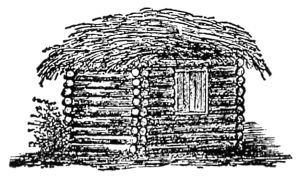
Fig. 1.
A costly and elaborate building is no better than the cheapest
structure for keeping ice, if care is only taken to have it properly
packed, which is very easily done after one “knows how.” We have
never seen ice better preserved through a long and hot summer than in
a board shanty with only one thickness of siding, and that full of cracks
and crevices. For a new settlement one built of logs, like that shown
in the accompanying figure (Fig. 1), may be made to answer a good
purpose. The floor may be slabs, and the roof a covering of brush to
hold the packing to its place, if a slab roof is not readily made. If sawdust
is used for packing, the crevices between the logs will need close
stopping; or, still better, it can be faced on the inside with slabs set
upright, with the smooth side inward. If straw is employed, the rough
logs may remain, and the crevices between them may be left open. For
sawdust a well-packed space of 10 inches between walls and ice will
keep the ice well; chopped straw should be 15 or 20 inches thick, and
long straw should occupy a space of 2 feet. Stiff, coarse straw will not
answer unless packed very solid; finer and softer, as of thickly sown
oats, is better, and the walls which it forms need not be quite so thick.
Fine hay would be still better, and would answer if only a foot and a
half thick and well put in. Dry swamp moss, such as nurserymen use
for packing trees and plants, would be one of the very best substances
for protecting the ice, if only a foot thick.

Fig. 2.
Having prepared the house and packing cut the blocks of ice of precisely
equal size, using a cross-cut saw with one handle removed, to go
under water. The size should be measured and scratched on the surface
for the saw to follow. Two feet square is a convenient size. When cut
lift them out with a light plank having a batten nailed across one end
to hold them (Fig. 2). Place about 10 inches of sawdust on the floor (or
twice as much solid straw), and build the structures solid with the ice
blocks, ramming in the sawdust or other packing as the structure goes
up (Fig. 3). When finished cover it with a thickness of packing nearly
equal to that at the sides. It is important that there be free ventilation
over the top, which the loose brush will not prevent. If there is a slab
roof the air must blow freely between this roof and the top covering.
The slab floor will allow a free drainage of all the water which runs
down through the packing from the melting ice.
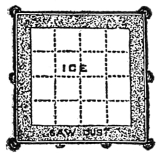
Fig. 3.
|
|
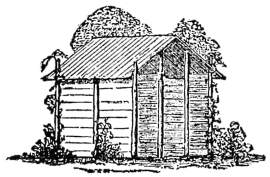
Fig. 4.
|
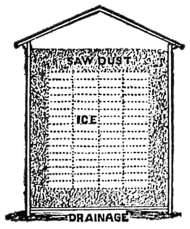
Fig. 5.
A structure nearly as cheap as the preceding is represented in Fig. 4.
It is made by setting rough posts into the ground with the inner sides
straight or faced with the ax, and then nailing common rough boards on
them (like a tight fence) to a sufficient height. The floor is made as
already described, and the roof may be boards or slabs. The openings
at the gables perform an important part in the ventilation by admitting
all the air that can sweep over the top sawdust. Fig. 3, already referred
to, is the ground plan, and Fig. 5 is a vertical section.
There are three requisites to be secured in order to keep the ice successfully:
1st. The closely packed, non-conducting substance on each
side, under and above the mass of ice. 2d. Perfect drainage at the bottom
without the admission of air. 3d. Free circulation of air over the
top covering. If these requisites are observed the result will be entirely
satisfactory.—Country Gentlemen.
Procure two dry-goods boxes, one of which is enough smaller than
the other to leave a space of 3 or 4 inches all around when it is placed
inside. Fill the space between the two with sawdust packed closely and
cover with a heavy lid made to fit neatly inside the larger box. Insert a
small pipe in the bottom of the chest to carry off the water from the
melting ice. For family or grocers’ use this will prove even more serviceable
than some of the high-priced patent refrigerators.
Select a dry, shady spot; dig a ditch for carrying off the waste water,
and over it place a lath-work. Upon this lay a thick layer of moss,
leaves, or sawdust. Now pile upon this the cakes of ice, the larger the
better, and cut or sawed square in such a manner as to leave as few
spaces as possible, filling up those which may occur with fine sawdust
in order to prevent the air from penetrating into the interior of the pile.
It is best to build the pile in the form of a pyramid. When completed
it is covered with straw, moss, or leaves as thick and as close as possible,
a layer of earth being thrown upon it to secure the covering and as
a further protection to the ice. Where a stream or lake is inaccessible
from which to procure ice for filling ice-houses, especially where a
small quantity is stored, the ice can be frozen with water from the well
in boxes or other contrivance made especially for the purpose, which
we leave to the ingenuity of those who are interested.
Refrigerating salts and mixtures are used to produce cold artificially.
They are used with or without ice or snow. As is well known common
salt mixed with pounded ice or snow lowers the temperature to a considerable
degree, so there are other mixtures which will produce a still
greater degree of cold. The following simple and cheap preparation,
when mixed according to directions, will produce artificial cold sufficient
to cool wines, etc., without the aid of ice: Take common sal-ammoniac,
well pulverized, 1 part; saltpeter, 2 parts, and mix well
together: then take common soda, well pulverized. To use, take equal
quantities of these preparations (which must be kept separate and well
covered previous to using) and put them in the freezing pot; add of
water a sufficient quantity, and put in the article to be frozen in a proper
vessel and cover up until cooled as desired.
These tables consist of mixtures having the power of generating or
creating cold, with or without the aid of ice, sufficient for all useful
and philosophical purposes, in any part of the world at any season:
|
| MIXTURES | Thermometer
Sinks. | Degree of cold
Produced. |
Muriate of ammonium | 5 parts |  | From +50° to +10° | 40 |
Nitrate of potassium | 5 parts |
Water | 16 parts |
| | | |
Muriate of ammonium | 5 parts |  | From +50° to +4° | 46 |
Nitrate of potassium | 5 parts |
Sulphate of sodium | 8 parts |
Water | 16 parts |
| | | |
Nitrate of ammonium | 1 parts |  | From +50° to +4° | 46 |
Water | 1 parts |
| | | |
Nitrate of ammonium | 1 parts | | From +50° to -7° | 57 |
Carbonate of sodium | 1 parts |
Water | 1 parts |
| | | |
Sulphate of sodium | 3 parts | | From +50° to -3° | 53 |
Dilute nitric acid | 2 parts |
| | | |
Sulphate of sodium | 6 parts | | From +50° to -10° | 60 |
Murate of ammonium | 4 parts |
Nitrate of potassium | 2 parts |
Dilute nitric acid | 4 parts |
| | | |
Sulphate of sodium | 6 parts | | From +50° to -14° | 64 |
Nitrate of ammonium | 5 parts |
Dilute nitric acid | 4 parts |
| | | |
Phosphate of sodium | 9 parts | | From +50° to -12° | 62 |
Dilute nitric acid | 4 parts |
| | | |
Phosphate of sodium | 9 parts | | From +50° to -21° | 71 |
Nitrate of ammonium | 6 parts |
Dilute nitric acid | 4 parts |
| | | |
Sulphate of sodium | 8 parts | | From +50° to 0° | 50 |
Muriatic acid | 5 parts |
| | | |
Sulphate of sodium | 5 parts | | From +50° to +3° | 47 |
Dilute sulphuric acid | 4 parts |
|
| MIXTURES | Thermometer
Sinks. | Degree of cold
Produced. |
Snow or pounded ice | 2 parts | | F
r
o
m
a
n
y
t
e
m
p
e
r
a
t
u
r
e | to -5° | .. |
Muriate of sodium | 1 parts |
| | | |
Snow or pounded ice | 5 parts | | to -12° | .. |
Muriate of sodium | 2 parts |
Muriate of ammonium | 1 parts |
| | | |
Snow or pounded ice | 24 parts | | to -18° | .. |
Muriate of sodium | 10 parts |
Muriate of ammonium | 5 parts |
Nitrate of potassium | 5 parts |
| | | |
Snow or pounded ice | 12 parts | | to -25° | .. |
Muriate of sodium | 5 parts |
Nitrate of ammonium | 5 parts |
| | | |
Snow | 3 parts | | From +32° | to -23° | 55 |
Dilute sulphuric acid | 2 parts |
| | | |
Snow | 8 parts | | From +32° | to -27° | 59 |
Muriatic acid | 5 parts |
| | | |
Snow | 7 parts | | From +32° | to -30° | 62 |
Dilute nitric acid | 4 parts |
| | | |
Snow | 4 parts | | From +32° | to -40° | 72 |
Muriate of calcium | 5 parts |
| | | |
Snow | 2 parts | | From +32° | to -50° | 82 |
Crystallized muriate of calcium | 3 parts |
| | | |
Snow | 3 parts | | From +32° | to -51° | 83 |
Potash | 4 parts |
|
| MIXTURES | Thermometer
Sinks. | Degree of cold
Produced. |
Phosphate of sodium | 5 parts | | From 0° to -34° | 34 |
Nitrate of ammonium | 3 parts |
Dilute nitric acid | 4 parts |
| | | |
Phosphate of sodium | 3 parts | | From -34° to -50° | 16 |
Nitrate of ammonium | 2 parts |
Dilute nitric acid | 4 parts |
| | | |
Snow | 3 parts | | From 0° to -46° | 46 |
Dilute nitric acid | 2 parts |
[American Chemical Journal.]
The following simple form of constant water bath, which wastes no
water, I have found to be very convenient:
A tube of glass or metal, not less than 1/4 of an inch internal diameter,
the ends of which are cut off obliquely, is bent as shown in the cut. It
should make an angle of about 30 deg., or a little greater, with the horizontal.
The angle may be diminished if the bore of the tube is increased.
One end is inserted in the water bath, the other in an inverted
bottle. The height of the water in the bath is regulated by the depth of
immersion of the tube in it. The boiling is not interrupted by the
feeding, which takes place slowly and regularly. It is necessary that
the ends of the tubes should be cut off obliquely. The same form of
tube answers equally well for keeping a constant level in a filter or drying
chamber.
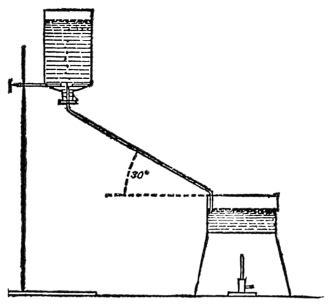
A brass tube is much better than a glass one, as it does not crack at
the water level after using for a time. Brass tubes can easily be bent
by ramming full of sand, stopping the ends, and bending them over a
curved surface. A large number of baths can be run by this apparatus
by connecting them with a bath fed by it.—Charles T. Pomeroy.
Note.—We have used for a number of years in this laboratory a form
of constant water bath which was contrived by Mr. Edward Bogardus,
formerly chemist to the New Jersey State Geological Survey. As I have
not seen it described in print, and as it is cheap, simple, efficient, and
ingenious, I will draw attention to it here.
The following cut represents the apparatus:
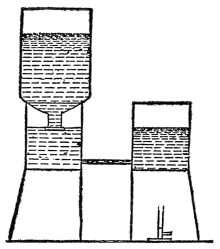
It consists of two tomato cans connected by a tin tube. Into one of
the cans a bottle of water is inverted. We generally use a five-pound
acid bottle. The other can makes the bath. This bath can be left running
over night without fear. A large number of baths can be run by
this contrivance by simply connecting them, by means of rubber tubes,
with a reservoir replenished by an inverted bottle. Old fruit cans make
excellent baths. A series of holes can be punched round the lower edge
of a fruit can, thus affording a distributing reservoir. Corks holding
short pieces of glass tube are inserted into the holes. By means of
these the reservoir can be connected by rubber tubes with a number of
baths at quite a distance. The baths are made by punching a hole near
the lower edge of a fruit can and inserting a cork and short piece of
glass tube. When the extra vents of the reservoir are not used, they can
be closed by a short rubber coupling and a pinch cock.—Peter T.
Austen, Chemical Laboratory of Rutgers College (New Jersey State
Scientific School).
The practice of preserving roots, vegetables, and plants by covering
them with earth or by placing them in cellars, etc., is an ancient one,
but the practical application of the principle on a large scale to the
preservation of fodder-corn, clover, etc., as a food for stock is comparatively
a recent practice, the first silo in this country having been built
within the last twelve years. Previously, however, the French and English
gave the subject considerable attention, but it seems that within the
last two or three years our American experimenters have made great
improvements in the process and construction of the silo by which more
successful results have been attained than ever before and have awakened
much interest among the progressive class of farmers and stock-growers
throughout the country.
A number of the Agricultural Experiment Stations located in the
different States, particularly those of Wisconsin, Illinois, and also the
Agricultural College at Guelph, Ontario, have made extensive applications
of the process. Several articles from them detailing the success
of the experiments for the past season have appeared in the columns of
The Breeder’s Gazette of this city. Through the courtesy of the editor
and Prof. W. A. Henry of the Wisconsin Agricultural Experiment Station
we are enabled to present full instructions in regard to constructing
and filling a silo. These, with clippings which we include from the
writings of others high in authority on the subject, contain as full an
account of recent experiments as we can give with our limited space.
“Agriculture never took a longer stride in advance than it did when
the silo was added to the practical equipment of the farm. Most of us
were slow to realize this at first, and a great many are yet unwilling to
concede the advantages claimed for the silo, but the utility of the modern
silo cannot be gainsaid, for without it we are left at the mercy of the
elements in the handling of our great corn crop. There was much truth
in the statement that the silo as first introduced was too expensive for
the average farmer, but in no department of the farm has there been
such a change of opinion and methods of attaining desired results as is
the case with the silo. The modern wooden building is not only less
expensive but vastly superior to the original cellar or stone structure
and every year’s experience is throwing light in hitherto dark places, so
that in a short time the progressive dairyman or beef-raiser will think
no more of filling his silo than our fathers did of filling the barn with
hay, and with proper facilities for handling the corn no part of the silo
work will be as hard as pitching hay over the ‘big beam.’” * * *
Supt. Adams, Wis. Agr. Exp. Station.
* * * A silo is a place where fodder is preserved in a succulent
condition. It may be a pit, a box, a mow, a tank, a building, or a trench
in the earth. Silage is the word denoting the fodder so preserved. Ensilage
is the term applied to the process or system. Ensile is the verb
expressive of the action of making silage. Ensilor stands for the person
using the silo to ensile fodder for silage by the process of ensilage.
—Prof. James W. Robertson, Ontario Agr. Col., Guelph.
* * * I further believe that our present knowledge of the silo and
the best methods of storing crops therein is not perfect, and that we
will make great advancement in the future; but that we have reached a
point where this method is within the possibilities of our average farmers,
and it is this class most of all that needs this method. The time
has come when we must produce more beef, butter, wool, and pork to
the acre or sink beneath the wave of competition that is driving over our
land. The silo seems to be a valuable and important means to this
end.—Prof. W. A. Henry.
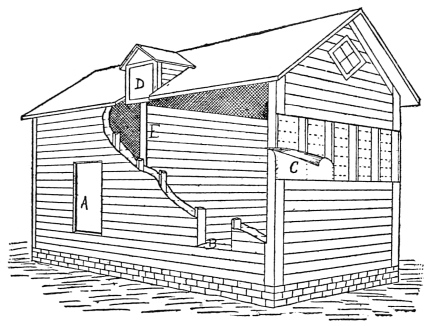
A 100-TON DOUBLE SILO.
“Silos are like houses, no two individuals can agree upon the same
plan; for this reason I approach this branch of the subject with no expectation
of pleasing all or of giving directions for making a perfect
structure. I deem it best to give a description of one way in which a
double silo may be built and leave it to the reader to introduce such
modifications in the plan as may best meet his particular wants and
circumstances. The drawing herewith presented shows an ideal two-room
silo 16 feet wide, 32 feet long, and 16 feet to the eaves. Built as
described each room would have a capacity of over 3,000 cubic feet which
would contain about 50 tons of settled ensilage weighing 35 pounds to
the cubic foot. We may say then that this figure represents a 100-ton
silo. For the foundation of this structure either brick or stone may be
used, going deep enough to avoid heaving by the frost and rising 6
inches or 1 foot above the surface of the level ground about it. Upon
this wall a sill should be laid which had best be constructed of 2×10
inch plank. One of the difficulties in silo construction is to avoid
spreading of the building, which sometimes occurs through lateral
pressure of the contents when settling. For this reason the sills must
be well tied together at the corners; instead of using square timbers,
which are greatly weakened by cutting, plank may be substituted and
the corners of the sill constructed as in Fig. 2. If well spiked there
will be no danger from spreading at the corners. The plank of which
the sills are constructed should be at least 8 inches wide; 10 would be
better. By using four of these, lying one on top of another, the sill will
be 8 inches thick. Midway between the ends of the building a cross
wall should be built, and on this a sill should be laid upon which to
erect the partition which divides the silo into two compartments. This
cross wall should be so worked into the side walls as to hold them
securely, and thus prevent the silo from spreading on the sides. A little
ingenuity will make the foundation and sills secure. If possible the
sills should be as wide as the wall upon which it rests, but if this cannot
be conveniently done the wall of stone or brick should be raised above
the ground but a very few inches at most, as the ensilage in settling on
the shoulder made by the jutting wall is almost certain to spoil at that
point. Having laid the sill upon the wall in the manner described
proceed to erect the building by standing 2×8 or 10-inch studding perpendicularly
upon this sill, placing them not further apart than every 16
inches, so that a sheet of tarred building paper will lap two studding in
each case. The reader is cautioned to measure the building paper carefully,
before setting up the studding, as it is sometimes scant in width
and trouble will occur when one attempts to tack on the paper. Double
the studding at the corners. In the illustration of the building I have
not placed the proper number of studding, but the reader can rest
assured that once in 16 inches is not too often. Having placed our
studding in position and secured them by a plate running around the
top we are ready for the rafters. Fig. 3 shows how these rest upon the
plates and how they are tied together so as to least interfere with the
filling of the silo. For a cheap silo boards may be used, though probably
shingles are the cheapest in the end. In the roof upon one side
place a dormer window at D in the illustration; this window is immediately
over the partition. It is intended that the ensilage carrier shall
pass up through the window so that the ensilage will fall over the partition
and can be deposited in either one of the two compartments by
means of a slanting chute. If one does not wish to undergo the expense
of the dormer window a scuttle in the roof is all that is necessary. The
roof is the same as for any building.
FIG. 1.

FIG. 2.
FIG. 3.
“We are now ready to sheathe the silo; let us begin on the inside.
First of all tack tarred building paper to the studding, running the
strips up and down and having them catch on every third studding.
Avoid all openings or rents in the paper. Having placed the paper take
common boards dressed on one side and sheet up to the top of the studding.
When this is completed repeat the operation by placing a second
layer of boards over the first, breaking joints. Narrow boards are
preferable to wide ones for this work, as they will swell without bulging.
We have double-boarded the inside of our silo by this operation,
and rendered it practically impervious to the air. I see no reason for
using anything but common lumber for this purpose, as upon swelling
it will close up tight enough to keep out the air. Upon the outside of
the studding tack building paper again, as shown at Fig. C in the first
illustration. Over this paper place any kind of boards that the fancy
of the builder may dictate, as clapboards, shiplap, or drop-siding. It
will be seen that our walls are constructed as follows, beginning at the
outside: First, siding; second, building paper; third, a dead-air space
of 8 or 10 inches; fourth, building paper; fifth, common boards; sixth,
common boards. No sawdust, tanbark, or other filling should be used,
as a dead-air space is a better non-conductor for our purpose and less
expensive than any of these. The partition can be built of narrower
studding than those used on the sides of the building, and one thickness
of boards used on each side, together with building paper, as in the first
instance, is sufficient. To prevent lateral pressure bulging the silo two
iron rods should be run through the partition walls joining the sides of
the building, placing one about two feet above the partition sill and the
other about four feet above that. Half or three-fourths-inch rods with
heavy caps at the ends should be sufficient, and are easily put in place
before the boards are tacked to the partition.
“Two doorways should be left by cutting out a single studding in each
compartment upon the most convenient side. These doorways reach to
within three feet of the ground, and should be about seven feet in
height. They need not reach to within five feet of the top of the building.
The ensilage will settle in the silo several feet, and when the time
comes to pass it out through the doorway it takes but little time to dig
down two or three feet to the top of the door and make an opening large
enough to pass out the upper layer. Fig. 1 shows one of the ways in
which a doorway may be made so that it can be boarded up air-tight.
Instead of making solid doors hung on hinges I think it is better to use
boards that will fit in crossways, making them double thick, and having
the inside board even with the inside boarding of the silo, as shown in
Fig. 1. Do not make the doorways over 6 or 7 feet in length vertically,
as in all cases they weaken the structure. Endeavor to have the inside
of the silo smooth and perpendicular from top to bottom, with no
jogs or shoulders upon which the ensilage can catch or drag.
“If built above ground fill the rooms of the two compartments with
earth until the surface is three or four inches above the outside level, so
that no water will at any time enter to injure the ensilage that rests on
the ground. I do not yet know which is the best method of preserving
the silo from decaying. This is an important branch of the topic, but
it has thus far received little attention. Some have recommended using
kerosene for an inside coating. We shall try that this season, and also
gas or roofing tar, which I think will be excellent. This roofing tar
when heated becomes liquid, and can be applied with a mop to the inside
of the silo. As soon as it cools it hardens into an impervious
glossy layer that I should think eminently adapted to this purpose.
“Having no ceiling or floor, and being built of common material,
there is no necessity for the silo being an expensive structure. Of course
the reader will modify the description given to suit his own wants and
circumstances, but I can assure him that in some such way he can provide
a silo at no great expense.
“After the structures built for the special purpose comes the modification
of building already erected. A great many farmers are building
over bays in their barns for silos. This is easily accomplished by placing
studding all around the bay and double boarding on the inside. If one
fears cold weather he can make a dead-air space by using two sets of
studding and boarding on the inside of the bay. Stone buildings can
be converted into good silos by furring out and double boarding on the
inside. In general I am adverse to stone structures for this purpose
unless thus boarded. Some kinds of stone seem to do very well, but
stone walls carry off the heat and moisture too rapidly to make good
silo walls. If one wishes to try preserving corn-fodder and cannot
afford a structure of wood, he can excavate a pit in the earth and bury
the corn-fodder therein, though I am sure he will soon give up this
practice as unduly expensive.
“A word in regard to the location of the silo. It may be built adjoining
the feeding barn with the doors so placed that the ensilage be
conveyed directly to the cattle, or if that is not possible, place it where
the ensilage can be conveyed by a car or cart. Mr. Hiram Smith of this
State, who has large silos and uses ensilage extensively, holds that it is
not inconvenient to have the silo located a few rods from the feeding
barn. The ensilage is pitched into a cart with forks and the cart driven
into the feeding barn between the two rows of cows which stand facing
each other. The ensilage is placed in front of the animals directly from
the cart with great rapidity. In some cases a car can be used which can
be run down grade into the barn in front of the cattle. I think either of
these methods is preferable to attempting to carry ensilage in baskets
any distance.
“Probably very few stone silos will be built in the future, for experience
shows that a stone wall chills the ensilage during the curing
process and if it does not seriously injure that portion next to it to a
thickness of several inches it renders it at least less palatable than ensilage
nearer the middle of the silo. One reason, in my judgment, that
the silo has not won more friends in the Eastern States is owing to the
common use of stone in its construction. On our experimental farm at
Madison our first silo, built in 1881, was of stone, and our conclusions
in regard to ensilage were made up from results obtained with this silo;
had we put up a wooden structure I am confident our results would
have been worth vastly more to our people than they have been.
“The question of stacking ensilage is sometimes raised, being urged
upon our people by the practice of our English friends, who are experimenting
quite largely in this direction. It will be no more profitable
to stack ensilage in the Northern States than to stack hay, and even
less so in my judgment, for the waste would be very considerable and no
one would relish the job of handling it during bad weather. Silos built
of wood or made by changing over the bays of barns are the proper
structures, judging from our present knowledge, for the Northern
States; our friends at the South may find stacking successful.
“Having constructed the silo somewhat after the one described,
though, be it remembered, large latitude is allowed in this matter, we
will proceed to fill it with one of the two crops most suitable for the
purposes; clover or fodder-corn. If clover is to be used I would recommend
that a hay-loader be tried for the purpose of picking it up just as
left by the mower. I have hopes that some form of hay-loader will do
this work satisfactorily. The clover, either fresh or partly wilted, in
any degree of dryness indeed, may be carried at once and unloaded into
the silo, care being taken to fill and tramp down the corners and along
the edges so that when all has thoroughly settled there will be no air
spaces to favor decay. To fill a silo with clover is indeed a most simple
process. By having two divisions the pits can be filled alternately, each
layer of material heating up to the required temperature before the next
is placed over it.
“For fodder-corn the processes are a little more complex, though in
reality very simple. The fodder-corn should be allowed to approach
maturity, the best point for cutting being not far from that at which we
would ordinarily cut any shock. By this I do not mean to allow the
leaves to become dry and crisp, but rather that they show a change from
deep rank green to that yellowish tinge indicative of maturity, though
with still an abundance of moisture in them. Formerly ensilage corn
was cut shortly after the tassel appeared. Without doubt very considerable
loss was incurred by such a practice.
“It is evident that if we cut our fodder at the time the corn is glazing
our practice is as near correct as the present stage of investigation
points out. Since the period of filling the silo will occupy several days,
or even a couple of weeks, we must gauge the date of commencement to
strike the best average conditions. For cutting the fodder some parties
recommend the use of the reaper, but I judge from what I have been
told that a good many rakes have been broken in attempting the work,
and that many have given them up and gone back to the use of the corn
knife. Such must be the case usually, at least where large varieties of
corn are grown. The stalks should be cut close to the ground and
thrown into bundles or gavels. If the weather is at all threatening I
think it proper to cut and shock, since the fodder will dry off much
more rapidly if rain falls, and it will not be so muddy and disagreeable
to handle as when laid on the ground.
“Last season the writer urged that the fodder be wilted before it was
put into the silo, and his own experience, with that of many others,
corroborates this method of procedure, which has the additional advantage
that less water is handled in the operation. If it is intended to
allow the fodder to wilt the corn had better be cut and shocked, after
which it may stand from three to ten days, depending upon the maturity
of the stalks at time of cutting and the weather. If the fodder dries out
rapidly, from four days to a week is amply long for it to stand in shock,
while if the weather is somewhat damp or the fodder quite green it may
even stand ten days with no loss. One of the advantages of cutting and
shocking is that when it is over the force of men employed in this
operation can be changed to filling the silo. If the corn is cut and
placed in the silo at once quite a force of hands is needed, but by cutting
and shocking first we can avoid this double force.
“For drawing to the silo truck wagons are better than ordinary ones,
since the fodder is more easily loaded upon them. The common practice
is to attach a plank to the rear of the wagon, up which the men can
walk with their arms full of fodder, which should be placed with tops
all one way for ease in unloading. If the fodder is to be put through
the feed-cutter the cutter should be placed so that the carrier will deposit
it in either of the two pits as required. Formerly the carriers were so
constructed that they would not work advantageously at a much greater
angle than 45 deg., but now I note that some manufacturers have them
arranged to carry almost vertically.
“In regard to the kind of feed-cutter to be used, it may be said that
there are several valuable machines before the public, any one of which
will prove satisfactory if properly managed. The only point I desire to
urge is that a large machine be purchased, one having about double the
advertised capacity. Small cutters are a nuisance; hand-power cutters
are out of the question. The cutter should be driven by three horses on
a sweep power or two on a tread, or by a steam engine. Many farmers
delay ordering the cutter until within a week or two of the time to fill
the silo and are obliged to wait weeks until it is received, thereby suffering
great inconvenience and loss. As soon as the question is settled in
favor of having a silo a cutter should be selected and ordered, and it
should be set up and run in a test trial not less than a week before
actual filling is contemplated, so that repairs or changes can be made.
To run a feed-cutter properly requires considerable experience and
some knowledge of machinery, and many persons have suffered serious
losses by not giving this side of the subject due attention.
“This brings me to a point in the discussion of considerable interest
to many persons who desire to have silos but dread the experience and
expense of machinery. Corn-fodder may be preserved in a perfectly
satisfactory manner without running it through the feed-cutter, and
may be drawn from the field and deposited directly in the silo. The
expense of putting corn-fodder through the feed-cutter, first and last, is
not far from half of all that incurred from the time of cutting the fodder
to closing the silo. To fill the silo with long fodder let it be drawn
in the usual manner and lifted at once into the pit, which can be accomplished
in several ways, either by hand or the horse hay-fork carrier
and slings. In the silo it should be distributed evenly and probably
had better be placed in regular layers, lapping “shingle fashion” so
that it will settle evenly.
“The use of long fodder for the silo has been urged with considerable
vigor by Mr. I. J. Clapp of Kenosha, Wis., one of The Breeder’s
Gazette’s correspondents, and I think much good has resulted from his
advocacy. There is no doubt but that long fodder will keep just as well
as that which is cut up, and I am not at all certain but such ensilage is
even better in some cases than that made by cutting up the stalks into
small pieces. When cut into small pieces the fodder is considerably
bruised, and there is much more exposure of the juices to the air than
there is where whole fodder is used. My attention was called to this
point by a recent letter from Mr. Clapp, and I hope we can make some
observations on the subject in the future. At any rate let those parties
who either from choice or necessity do not wish to use the feed-cutter
hesitate no longer in regard to the silo if they wish to try it, but go
ahead and place the whole fodder in one, and I am confident they will
not be disappointed in its feeding qualities. The only difficulty with
long fodder comes at the time it is to be taken out for feeding purposes;
then if large varieties have been used the man who attempts to get it
out of the silo will need strong muscles and a large degree of patience
to enable him to tug at the compact mass, which is quite difficult to
manage. Twenty-five cows will eat up the ensilage about as fast as one
man can get it out. It may be just as economical, however, to put two
men into the silo for an hour or two each day during the winter, when
labor is cheap, to get out the ensilage as it is to use more expensive
labor in the fall to accomplish the extra work of running the feed-cutter.
“Slow filling is without doubt the best method for securing good
ensilage, no matter what material we are using, be it clover, long fodder-corn,
or fodder cut fine. When the pit has been filled three or four feet
deep no more should be placed within it until this layer has heated to
the neighborhood of 125 deg. Fahrenheit. Mr. John Gould of Ohio, who
has been a deep student of this subject from the practical side, I believe
holds that the ensilage should be allowed to pile up as it falls from the
carrier, and after the pile has heated to the right temperature it should
be distributed evenly over the silo, throwing that which is hottest to the
corners and along the walls. It is certain that ensilage usually heats up
easily and rapidly except in the corners and along the walls, where we
find the temperature does not rise so rapidly nor to the same degree as
it does in the body of the silo, and anything that will help us overcome
this lack will improve its quality, and I deem Mr. Gould’s suggestion a
valuable one. No packing down is needed except in the corners and
along the walls; at these points we endeavor to firm the ensilage just as
much as possible. I wish we could avoid this operation, and in the
future we may do so. I believe the ensilage would be better without any
tramping and packing if we could only get it to settle uniformly without.
We should endeavor to secure an elevation in temperature of from
120 to 140 deg. uniformly throughout the mass of material. If the contents
of the silo heat up to different degrees in different places we cannot
expect them to be uniform in quality, though all will be eaten by
the stock. The theory advanced by Mr. Fry of England that a temperature
of 122 deg. Fahrenheit destroyed the ferment that produced the
temperature seems hardly correct, for we find that the temperature
goes on beyond this very rapidly—indeed, it is often very difficult
to hold it below 140 or 150 deg., while in other cases I have
known silos in which I could detect no faulty handling of the crop that
would not heat to 120 deg. A case in point occurred last season; while
we were busy filling our silos at the experimental farm I was called to
the telephone by a young farmer living some thirty miles away who
asked several questions about temperatures. I answered him to the
best of my ability and the matter dropped from my mind. A couple of
hours afterward, however, the party himself appeared on the scene in a
troubled state of mind; he said he feared that he could not make his
case plain through the telephone, and so had come on the first train to
consult personally. His ensilage would not heat up to 120 deg., but was
moulding badly instead. I advised that he go on filling the silo, ignoring
the temperature question entirely. He did so, and in the winter reported
satisfactory results. In my opinion we have much to learn in
regard to this ferment, and that very close, patient study will be required
to bring out the scientific side in a satisfactory manner. Fortunately
we do not have to be very particular in our practice to obtain a very
good quality of ensilage. I would advise, therefore, that a person
allow the temperature to run from 120 to 140 when the thermometer is
buried a foot deep in the fodder; but when these conditions are not
obtained, no matter whether the degree be lower or higher, to go right
on without feeling anxious in the matter. If the contents of the silo
do not heat at all, or if the temperature gets up to 160 deg., the cattle
will still eat the ensilage without complaint and relish it better than
average dry fodder. I speak pretty positively upon this point because
novices find it difficult to get over it and become quite excited and
nervous if they cannot attain the exact directions given by most writers
on this subject. The best rule is to go ahead, do the best one can, and
the cattle will be very well satisfied with the result. Remember that
the experience of a single individual or a single season may be no
criterion for other cases. The reasons for these great variations are not
yet apparent.
“Silo filling may go on for two or three weeks, or until the pits are
filled, when they should be covered after standing a day or two to allow
the last layer to heat. For covering material there may be placed over
the ensilage building paper upon which may be placed sand, earth,
chaff, cut straw, marsh hay, long straw, sawdust, or almost any material
which will help keep out the air. If one wishes the pits may be left uncovered,
in which case something like a foot of the ensilage will decay
and form a covering and protection for that beneath. The practice of
weighting the silo is now largely abandoned, though I am not certain
but what some heavy material along the edges and in the corners will
aid in saving the ensilage at those points, since it is here that the contents
do not settle so well as does the body of the material. For a few
weeks after filling the sides and corners should be tramped down occasionally
to aid them in settling.”
The following extracts from “Bulletin No. 2,” Illinois Agricultural
Experiment Station, by Thomas F. Hunt, answers some important
questions in regard to planting, etc.:
“The filling of the silo was practically continuous, and was done in
three days, Aug. 20 to 22, 1887, with 54,525 lbs.—twenty-seven and a quarter
tons—of green corn. About twenty tons of this consisted of a medium
sized, fairly early yellow dent corn (Murdock), which had been planted
May 4 to 6, in rows 3 feet 9 inches apart, with two to three kernels
dropped every 9 to 12 inches in each row. At the time of cutting the
stalks had well-formed but small ears, the kernels of which had largely
passed the milk state; that is, the kernels were mostly glazed. The
lower leaves were yellowish, and some had begun to dry. The growth,
though not large, was thought satisfactory, considering the long-continued
and severe drouth that had prevailed here. The yield was not
more than seven tons of fresh fodder per acre. Seven tons consisted of
a large, late maturing yellow dent corn (Leaming), which had been
planted May 28, 1887. The kernels were in the milk and the leaves were
entirely green. No marked difference was noted between the ensilage
from this and that from the other corn. * * *
“Feeding the ensilage was begun March 10, 1888, by mixing it with
twice its bulk of dry, cut corn-fodder, not corn-stover, which our stock
had been chiefly fed during the winter. The cattle soon learned to like
the ensilage, and after the first week it was fed without mixing with any
other substance and was eaten rather better, on the whole, than corn-fodder
had been previously.
“Dairy weights of ensilage fed to the stock were not taken. From
what weighing was done it is estimated that from March 17 to April 30
700 lbs. on an average were fed daily. During this time the following
cattle were given ensilage: March 17 to April 30 two aged and five
yearling bulls, one heifer, and one dry cow were fed ensilage, hay, and
grain; eight milch cows, ensilage, straw, and grain; ten dry cows and
five heifers, ensilage and straw. March 17 to April 16, three steers were
fed ensilage and corn. April 13 to 30, four heifers and two dry cows
were fed ensilage and hay. It will thus be seen that for 45 days 37 head
were, on an average fed 700 lbs., about 19 each, daily. Of these 15 had
ensilage and straw only; 8 had ensilage and straw with grain, usually
four quarts of bran added daily; and 9 ensilage, hay, and grain. All
thrived exceedingly well considering the amount of food eaten.”
For information as to the results of future experiments with ensilage
we refer the reader to the various State Agricultural Experiment Stations
and the authorities here quoted.