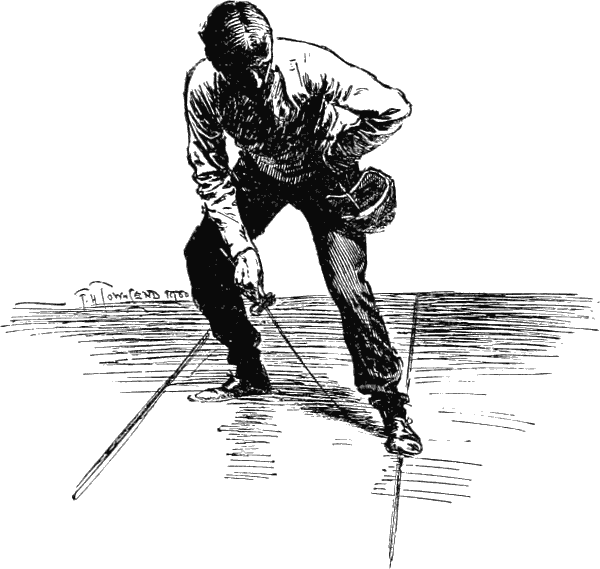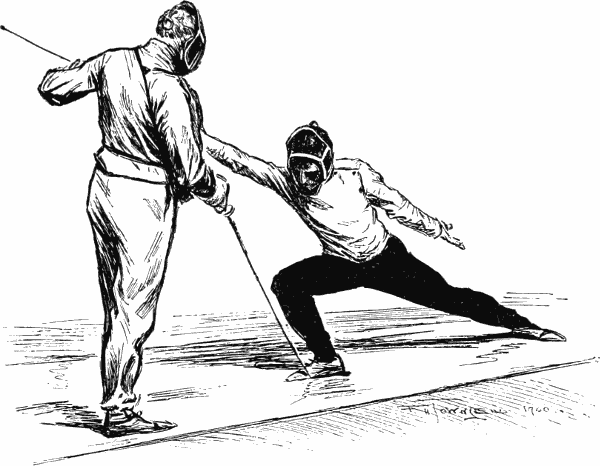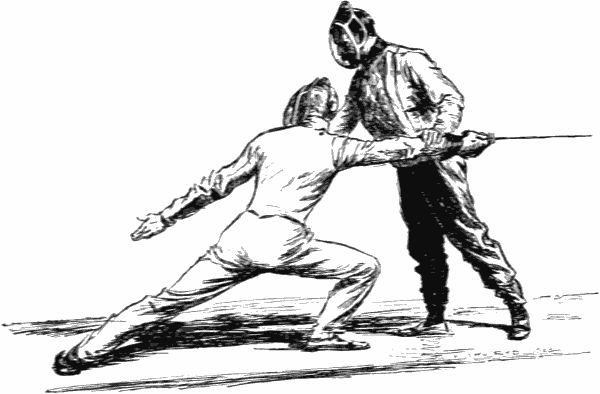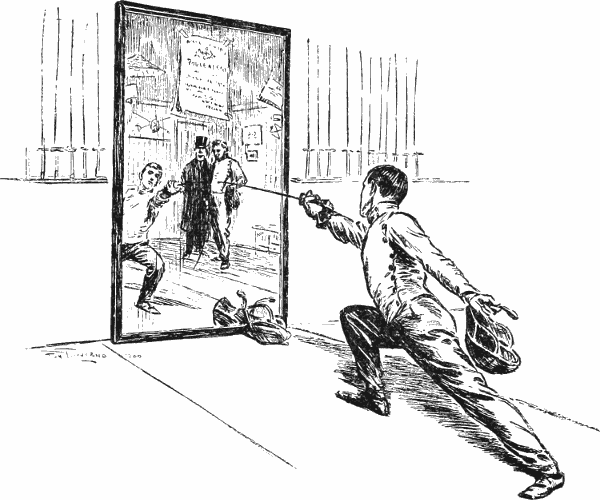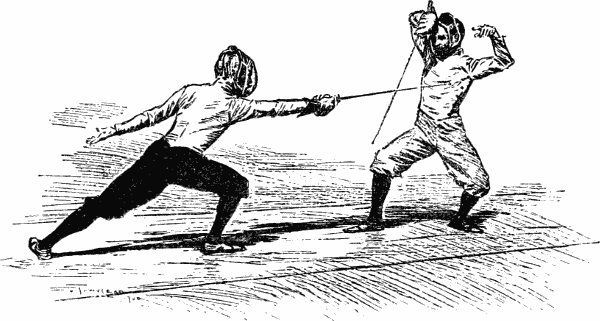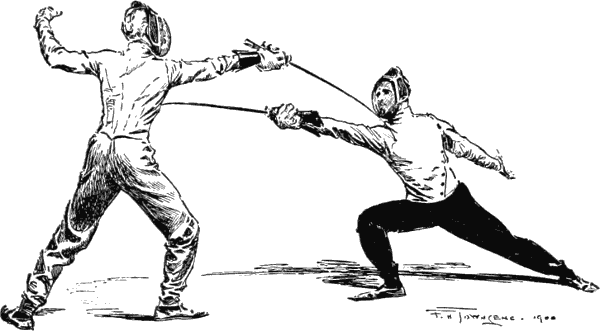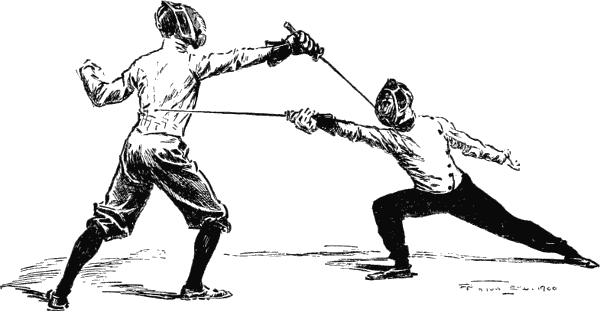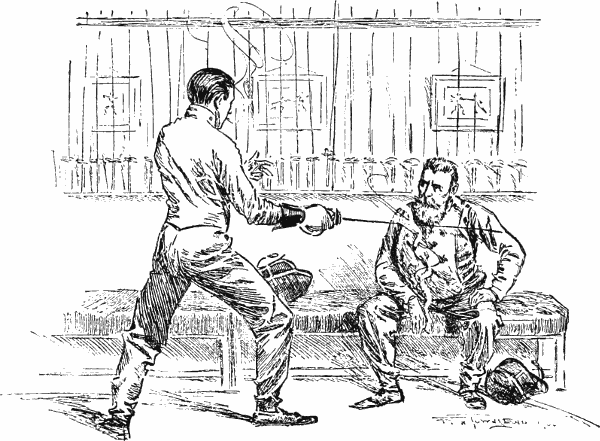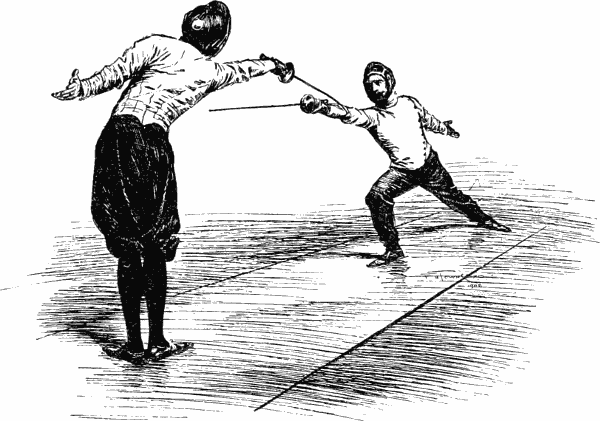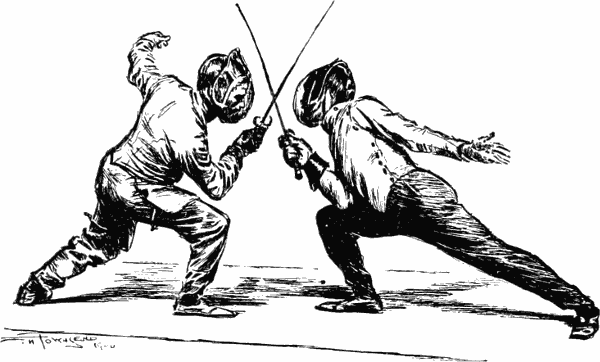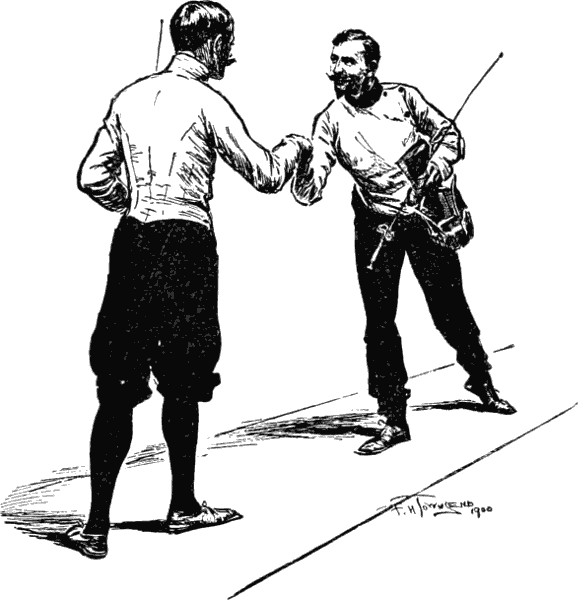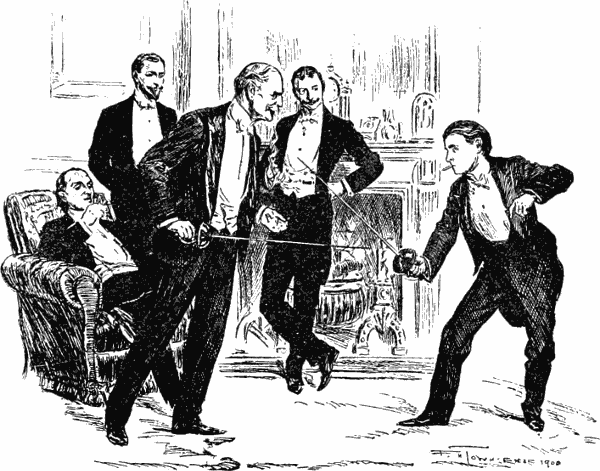
The instinctive position.
The next day found us lighting our cigars
as usual. Brilliant conversation, you know,
cannot be maintained without something to
smoke. Our talk this evening was to be about
the methods of attack and defence, which offer
the most likely chances of success in an actual
duel.
I began at once:—“Yesterday,” I said, “I
was speaking of the whole duty of seconds. I
endeavoured to describe as clearly and fully as
possible, what they ought to do and provide for,
and I showed why it is essential that they
should follow every stage and every incident
of the fight with the utmost keenness, for the
onus of responsibility is rightly held to rest on
them.
“The preliminaries are now settled; the
antagonists, armed with swords of equal length,
stand face to face. One of the seconds is
stationed between them. He addresses to each
in turn the venerable formula:—‘Are you
ready?—On guard.’ Upon their assenting he
steps back and gives the fatal word:—‘Go.’
“The fighting is about to begin, and the two
men stand expectant, neither stirring yet, each
sheltering his life behind a few inches of cold
steel.
“There are only three contingencies that
we need consider, which naturally divide the
discussion under three heads. The first arises,
when a man who has never touched a sword
finds himself opposed to an old hand. The
second, when both antagonists are alike unskilled.
The third, when both are adepts.
“I may say at once with regard to this
last case, that in a duel between two skilful
opponents the advantage of superior science
which one or the other of them may possess
vanishes more often than not, and is compensated
for by difference of temperament. For
I cannot remind you too often, that in actual
fighting it is not a question of hitting your
opponent often, or of placing your point artistically,
but of striking somehow and anyhow
one blow and only one.
“Swords are not worn now, and swordsmanship
as a necessary part of polite education
has gone out of fashion. Our more punctilious
ancestors prided themselves on never wounding
their antagonist except with some thrust ingeniously
conceived and brilliantly executed.
Perhaps it was better so. It was certainly more
picturesque, more chivalrous and magnificent.
To mistake your sword for a spit, though
you might succeed in running your antagonist
through and through, would have been voted a
blackguardly proceeding, unworthy of a gentleman.
Molière’s principle is good enough for
us:—‘Hit the other man, and don’t be hit yourself.’
Our object is to hit no matter where,—no
matter how. The art of fence is now so much
neglected that it seldom happens when two
men go out to fight, that they have even a
passable knowledge of their weapon.
“When a man knows nothing about fencing,
either because he has never touched a sword, or
because he has only knocked about with his
friends in a rough way and very occasionally,
his first thought when he has to fight is to call
on a professor, and endeavour to obtain some
ideas which will enable him to defend himself
on the field of battle. I will describe one of
these lessons which the professor is expected to
give, and I shall try to point out the only sort
of advice that is of universal application in such
cases.
“The novice explains that he has to go out
the next morning, and requests the professor to
be good enough to give him a hint or two.
‘Do you know anything about fencing?’
enquires the professor.
‘No, practically nothing.’
‘You know that one holds the sword by the
hilt and tries to hit the other man with the
point, and that is about all, I suppose,’ continues
the professor, who will have his little joke.
And he takes down a pair of swords provided
with buttons, hands one to his pupil, and the
lesson begins.
“One wonders how often this same lesson
has been repeated. It never varies, and it never
ought to vary. Its whole value lies in its simplicity.
“The ignorant fencer can do nothing without
a cool head and steady nerve, which are the
more effective, when they are opposed, as they
often are, to bluster and over-confidence.
“First and foremost the professor must make
his pupil understand the absolute necessity of
standing firmly on his feet with an easy balance
that allows perfect freedom of movement. The
position, whatever it may be, that your extempore
pupil falls into naturally, is the position
you must accept. It is important to give him
confidence in it and to modify it only so far as
is absolutely necessary to enable him to move
about easily. Your business is to make the
best of this position, and if possible turn even
its defects to account.
“The body should be inclined forwards
rather than backwards. In this somewhat
crouching attitude the upper part of the body,
that is to say the chest, by its advanced position
with the sword arm held in front, acts as a kind
of natural rampart or shield to cover the lower
part, where a wound is almost certain to prove
mortal.
“Keep in view from the very first the importance
of inspiring confidence in the unpractised
fencer. For confidence alone implies some sort
of self-possession and reacts immediately on
nerve and muscle. He soon begins to feel
somewhat more at ease. Some slight modifications
are all that is required to correct the
glaring faults that are most obviously dangerous.
“I am not afraid of putting the truth of my
statement to a practical test. If you will now,
all of you, take one of those swords which I see
hanging on the wall and place yourselves on
guard, not in what you imagine to be a fencing
attitude, but as you would stand if you were
seriously threatened, you will find that the attitudes
you assume will all be very much alike,
apart from such slight variations as are due to
differences of physique.”
“Come, I’ll be your shocking example,” said
one of my hearers. “I have never touched a
sword in my life. See what you can make of
me.”
“Very good,” I replied, rising as I spoke;
and taking down a pair of swords I handed him
one. Then without giving him time to think, I
made a quick movement and threatened him
with the point.
Instinctively he threw himself on guard.
“There, that will do,” I said, “stay as you
are; I only wish you could be photographed to
illustrate the instinctive attitude. Oh, don’t be
too conceited; I do not mean to say that your
position is faultless,—very far from that; but
the attitude in which you are standing is the
origin of the orthodox guard as taught in the
fencing-room, because it is essentially the attitude
that accords with our natural fighting
instincts.”
“I am getting tired of this,” observed my
patient, who had scrupulously stuck to his
position.
“One moment,” I replied. “You are tired
because your arm is too much extended. Draw
it back a trifle, to relax the muscles and give
them their natural play. Carry yourself more
upright by slightly raising the body. Your left
foot is too far from the right; bring it rather
more forward; sink down a little on your legs,
so as to be ready either to spring quickly to the
rear or to advance.
“Bring your right shoulder forward, in order
to expose your chest less, but not further than
you can manage with comfort. You see I am
not very exacting.
“There, that will do very well.
“Now, if I make a movement, straighten
your arm boldly, and step back.
“Very well done.
“And yet you tell me you have never touched
a sword, or even a foil in a fencing-room. Then
all I can say is that I could not have chosen a
better subject for my demonstration.
“We will now put the swords back in their
place, and return to our discussion. Perhaps I
may have occasion to trouble you again by and
by.”
“I am entirely at your disposal, Professor,”
replied my obliging pupil.
“The rest of the lesson may be summed up
in a convenient formula. For so far as I know,
there is only one really useful tip that a professor
can give to the uninstructed novice who says:—‘This
afternoon or to-morrow morning I have
to go out.’
“The professor will make a great mistake if
he attempts to teach him some fancy stroke, for
he will only disturb the natural working of his
instinct, without controlling it. He must remember
that the excitement of fighting does
not leave much room for thought, and he must
accordingly take care to limit his instruction to
the simplest and clearest ideas, easy to understand
and easy to put into practice, such as arise
naturally out of the instinctive sense of self-preservation.
“These remarks of course do not apply to
those dull and inert creatures, cursed with a
temperament so heavy, and so sluggish, that they
do not know what it is to move briskly and can
never rise to the occasion. You can put nothing
into such as these and can get nothing out of
them.
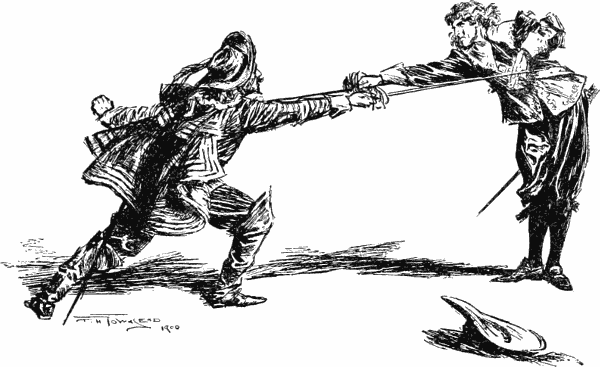
“When swords are crossed, the thing to do
is simply what our friend here did just now:—Retire.
I say ‘retire’ in order to avoid saying
‘run away.’ Retire always, retire incessantly,
but retire little by little, so as not to consume
once and for all the entire hinterland; retire in
short, not like a man in a panic, but like one
who is watching his opportunity.
“Never forget this,—the only principle that
at the critical moment is available for him who
cannot count on science to assist him:—Get back
and straighten the arm;—or in other words:—Defend
yourself by threatening your opponent.
Never attack; that is the point on which your
attention must be concentrated.”
“But,” exclaimed one of my hearers, “what
do you mean by ‘threatening?’ It is not so easy
to threaten when you are an absolute duffer.”
“The naked point of a sword resolutely
offered at the body or at the face is always a
threat. No one who sees it directed straight at
him with a set fixity of purpose and a suggestive
glitter can fail to be alarmed by it or can afford
to disregard it, more especially perhaps if he
knows that the man behind it is unsophisticated,
and cannot be depended upon to obey the
ordinary rules, that he has no deep design or
artful scheme in the background, but just one
idea—to keep his point always there, like a
sentry at his post.
“Put shortly, my advice amounts to this:—Defend
yourself by retreating; threaten by offering
the point. Offering the point, that is to say
straightening the arm, is the attack of the incapable
fencer.
“By retreating you maintain the distance
between yourself and your opponent, and make
it difficult for him to get command of your blade
on a simulated attack.
“There is only one other movement that I
should teach to a novice, who came to me for
advice in these circumstances. I should tell
him—as he retires and straightens his arm—to
change the line occasionally; that is to say
to pass his point under his opponent’s blade and
threaten him on the other side, in fact a simple
disengagement. It is the easiest thing in the
world to understand, and anyone, however little
he may be skilled in the art of fencing, can do
it with the greatest ease; the act of retiring
itself facilitates the execution of the movement.
An hour’s practice will make him familiar with
this change of line, which as I remarked just
now answers the double purpose of attack and
defence.
“I should make my pupil repeat this very
simple performance over and over again, instructing
him to straighten his arm, sometimes
with his point held high on a level with the
chest, attacking the high lines, sometimes with
the point lowered, attacking the low lines. You
understand of course what is meant by the high
and low lines. It is the A—B—C of fencing.
“Notice that my lesson is simplified to a
degree that is almost ludicrous. I dissect every
movement and explain how the parts are put
together, being particularly careful to avoid the
use of technical terms, for my imaginary pupil
is supposed to be completely ignorant, and he
would be hopelessly puzzled by them. If on the
other hand he happens to have some smattering
of knowledge he will appreciate more fully and
derive all the more benefit from the lesson thus
reduced to its simplest expression.”
“You say nothing,” remarked one of my
hearers, “about the movement, which consists
in reversing the lunge.”
“No,” I answered; “because I believe that
this device, which is only proper in certain
exceptional circumstances, is likely to prove
very dangerous if it is employed at the wrong
moment or at random. If it does not come off,
you are left without defence at your opponent’s
mercy.
“To put the matter shortly:—if you adopt
my plan, you retire and at the same moment
offer your point either with a straight thrust or
with a disengagement; then you immediately
recover your guard and bring your forearm
back to its original position. Whether your
thrust has succeeded or not, you are always
provided with a sound defence, you are set
firmly on your legs, your balance is undisturbed,
and upon your opponent’s advance you can
repeat the process again and again.
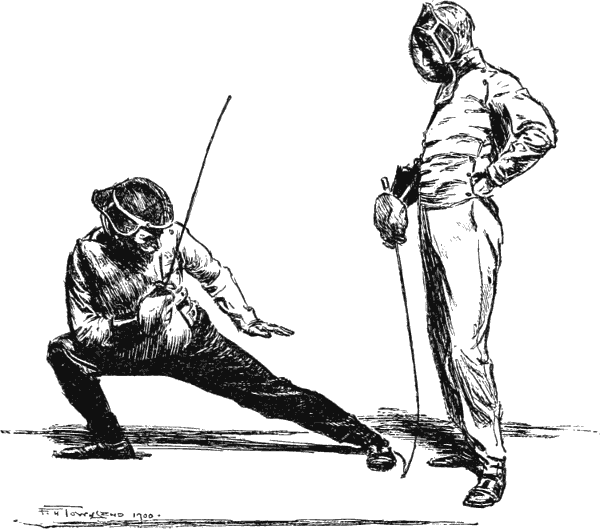
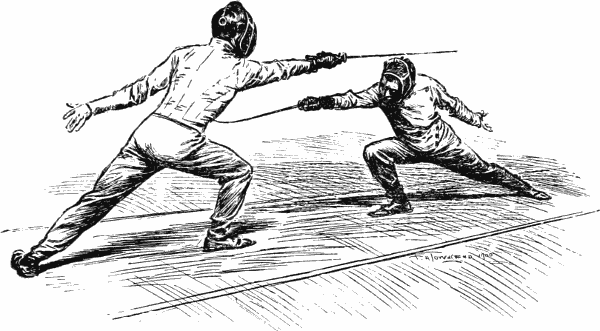
“Now suppose that you decide to lunge to
the rear; that is to say, to reverse the lunge by
throwing the left leg back to its full extent and
dropping the body, without moving the right
foot; well, when will you do this and how?
“You are not an expert. What secret instinct
will inform you that the opportune moment has
come for executing this manoeuvre? For after
you have executed it, you must recover, and
recover smartly, if you are to regain your guard;
no easy matter, I assure you. In attempting to
perform a movement so complicated, you with
your want of experience can hardly fail to be
thrown into disorder, to the great advantage of
your adversary, who will seize the opportunity
to press you briskly and get command of your
blade.
“Even supposing that you escape from this
danger, you cannot go on repeating the process
continually; you cannot repeat it indifferently
on every attack, or on every semblance of an
attack that is made upon you. You must judge
your opportunity. Now fencing judgment, especially
in a duel, implies knowledge, and remember
we are arguing on the assumption that you
are ignorant.
“For these reasons I should never think of
recommending the lunge to the rear to anyone
who has not acquired some familiarity with his
weapon.
“If we now turn from the man whose only
chance lies in his getting a rule of thumb to
work by to the man who is more or less used
to fencing, the case is different. The scope of
the lesson is enlarged. The pupil knows a few
words of the language, we must try to turn his
knowledge to account.
“My advice to him would be:—In the first
place, take the same guard as that already
indicated; but make a little play with your
point, by changing the line occasionally from
inside to outside and so on, in order to bother
your opponent. Make a show of attacking now
and then, in order to recover any ground that
you may have lost by retreating. But be very
careful never on any account to attack in real
earnest. You must be doubly strong and doubly
sure of all your movements to enable you to
attack without getting out of your depth, and
perhaps throwing yourself away in a moment
of inadvertence.
“And then I should go on to say:—Sometimes,
but always accompanying the movement
with a short step to the rear, make a parry of
counter quarte and circle, a sweeping parry
which cuts all the lines, and is bound to find
the blade somewhere. Come back to your first
position at once, holding your point well in
front of your body. Then if you find that your
opponent means to develope his attack fully,
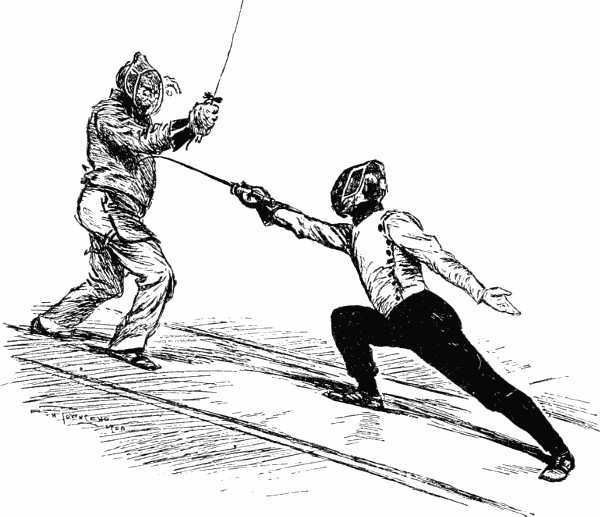
and that his point is directed high, throw your
left foot back boldly, remembering to drop your
head and body at the same moment, in order to
avoid the point which would otherwise strike
you in the upper part of the chest or in the
face. Above all, recover as smartly as you can
by springing quickly to the rear, so as to regain
your defensive position before your adversary,
if he has avoided or parried your thrust, can
take advantage of his opportunity.
“But once more I must caution you that
this sort of thing requires such training and
judgment as I should not expect anyone to
possess who has not by regular practice made
himself thoroughly at home with the sword.”
“We are allowed to criticise, I believe,”
remarked the Comte de C. after a pause which
followed these remarks.
“By all means,” I replied; “I not only allow
but invite criticism. In working out an idea,
I may very likely neglect some side of it that
ought not to be passed over.”
“Well, you seem to me inconsistent. You
said the other day, and I quite agreed with
you:—‘The first and fundamental rule of fencing
is to parry;’ and now you tell us on the contrary
not to attempt to parry.”
“That is fair criticism,” I answered, “but
I do not admit the inconsistency. You will
remember that we were then talking of scientific
fencing, that is to say of the systematic study
of swordsmanship. But that has nothing to do
with the present question. The whole art of
fencing cannot be learnt in three or four hours.
“Let me give you an analogy, for an analogy
often serves to put an argument simply.
Two men are on a sinking ship; one of them
knows how to swim, the other only knows how
to go to the bottom and stay there. Meanwhile
the danger is immediate. Would you
say to the man who cannot swim a stroke:—‘Look
here, this is the way to swim; you
move your arms like this, and at the same
time you move your legs like that’? Do you
mean to tell me that he will be able to put
into practice straight away what you have just
shown him? Or do you suppose, that thanks
to your demonstration he will be able to swim
when he finds himself in the water? No, of
course you are not so foolish as to suppose
anything of the sort. You would of course
tell him to catch hold of something or other,
anything—a spar, an oar, or a plank, and to
support himself on it as best he can; that is
his only chance.
“Well, my case is on all fours with that.
My pupil is in imminent peril of his life. My
business is to give him the spar or the plank,
which may serve to keep him afloat. I don’t
bother about teaching him to swim.
“Of course there is nothing to prevent one
from showing one or two parries to the novice
who has to fight a duel at short notice. But
the only parries that would be of any use to
him are the comprehensive and rather complicated
parries, which sweep through all the
lines. What would be the result?
“His parries would be weak, undecided,
and slow. Instead of tripping neatly round
the blade, they would labour painfully after it
in wide circles. To deceive them would be
the merest child’s play, and the poor novice,
encountering nothing but empty air, would let
his blade fly into space, and send his arm after
it, leaving himself completely exposed.
“Even supposing that his opponent does not
take advantage of his opportunity, the novice
realises how helpless he is, and racks his brains
for some device to avoid the danger when he is
again attacked. Then he does not know what
to do, what not to do; he loses his head and
is seized with panic; he strikes wildly at his
opponent’s blade, as a drowning man strikes
wildly at the water, and nothing remains to be
done but to wait for the finishing thrust, or to
rush blindly at his opponent, with the probability
that he will run upon his point. Those
are my reasons for not attempting to teach
an untutored novice things which he cannot
possibly perform.
“Now, on the other hand, consider in detail
the measures that I do put at his disposal.
By retiring he evades the point. Evading the
point, by drawing the body back or by springing
to the rear, may not be the same thing as
parrying, but it amounts to much the same in
the end, since you retire out of range and are
not hit. Or if you are hit, at the worst you can
be only lightly touched, because by retiring you
make your opponent lose the ground which he
reckoned on gaining by his attack.
“Moreover when he sees that you straighten
your arm every time on the chance of reaching
him, he dare not lunge out recklessly. If he
does, you have at least a chance of hitting
him,—by a fluke no doubt, but I suppose you
do not much mind that.
“There is one last objection that I will
anticipate.
“What, I may be asked, becomes of your
scheme of defence, if, the moment that the
novice extends his sword at a venture, the
adversary engages it?
“Without a doubt that is what he ought to
do, and what he will do, as I shall presently
explain. But you do not imagine, I suppose,
that a man completely ignorant of the use of
his weapon, who goes to a professor for advice
on the eve of an encounter, can hope to come
away comforted with the assurance that he has
learnt the whole art of how to hit his opponent
without being touched himself? That, I fancy,
would be too convenient. It would be better
then to study the art of not learning to fence,
instead of spending months and years in studying
the art of fencing. Ignorance would indeed
be bliss and wisdom folly.
“The man who has not learnt the use of
the weapon to which he entrusts his life, may
think himself lucky if he can lessen the chances,
to which he is exposed, of a fatal issue. The
master can hope to accomplish nothing more
than to give his pupil some confidence, and
show him the only course that can be commended
by common sense and at the same
time furnishes some sort of defence.
“If the novice does what he is told he will,
I repeat, put difficulties and dangers in the way
of his opponent; he will force him to act with
caution, he will keep him at long range, and
compel him to shift his ground when he attacks.
In shifting his ground he may, either through
carelessness or in the excitement of the moment,
leave himself uncovered, and give an opening
to the point that is continually directed at him.
But I do not for a moment suppose that a
wary and experienced fencer, who keeps his
head cool, will not easily defeat such elementary
strategy.
“You may tell your pupil to be prudent, you
may tell him to be calm and resolute, but now
or never you should add the pious wish ‘Heaven
help you’.”
“May I ask one more question?” said one
of my friends. “I have often heard it said that
if you don’t know much about fencing the best
thing to do is, as soon as you come on guard, to
make a sudden rush at the other man before he
has time to collect himself.”
“Well,” I replied, “if you wish to make sure
of being incurably spitted, that is the most infallible
way to set about it.
“The seconds, before giving the signal to
begin, have just asked your opponent if he is
ready. Is it likely that he will allow himself
to be rushed, or to be victimised by such a
transparent piece of bluff?
“Is it not much more likely that he will
have been told to look out for a surprise attack?
One of two things,—either the man who confronts
you is a skilful fencer, in which case he
will not want you to give him time to collect
himself, but will be quite capable of taking his
own time; or his ignorance of fencing is on a
par with yours, and then it is a toss up. It
follows that if this desperate plan of attack is
chosen, because it is thought likely to succeed,
it is absurd. If however it is chosen, because
the man who chooses it is of a restive impatient
disposition, one who cannot wait and for whom
cool defensive tactics are an impossibility, the
case is different.
“All that one can say to the pupil, whose
temper is such that he cannot play a waiting
game, is something of this sort:—Trust your
instinct, be guided by your natural impulse.
You quite understand that by acting as you
propose you run a greater risk; for your attack
is delivered at random, you are embarking on
a wild and hazardous speculation. Your only
chance of success, as you yourself admit, is that
you may, by suddenly and violently letting yourself
go for all you are worth, take your opponent
by surprise and put him off his parry. I can
only give you one word of advice. Before letting
yourself go, try at any rate to beat the other
man’s sword out of line in any way you can.
Knock it up or down, to one side or the other;
as soon as you have made your beat, let yourself
go straight, without the least hesitation. By this
means you will avoid an interchange of hits or a
stop thrust. But I warn you this is not so easy
as it sounds.
“Possibly, where so much depends on luck
and accident, you may bring off your hit. But if
you are the wounded man, you will be wounded
with a vengeance, for you will probably run on
the sword up to the hilt,—a trifling consideration,
which is perhaps worth taking into account.
“This plan in fact can never be recommended;
it involves not only too many risks,
but risks that are too serious and too certain.
I will show you presently in greater detail why
this is so, when we look at the question from the
other side, from the point of view of a fencer
more or less skilful, who is opposed to a novice
ignorant of swordsmanship but a determined
natural fighter, who is thoroughly roused by a
keen sense of danger.
“The case we shall consider next will be the
reverse of this. By reversing the position we
shall hear what is to be said on both sides, and
we shall then have considered from every point
of view, the probabilities of victory or defeat,
which are likely to occur in a duel. We will
leave that for to-morrow.”
And so we broke up.