THE surprise of Bob and Joe was almost inconceivable. They stood
staring for several seconds before either seemed to grasp the full
significance of the naturalist’s words.
“Airplane? Going by airplane?” gasped Joe. “How come?”
His father laughed.
“We expected to see you fellows startled,” Mr. Lewis said. “But that
you would show such unusual astonishment we did not in the least
anticipate.” He turned to the stranger. “This,” he went on, addressing
the youth, “is Mr. Karl Sutman, who is going to take several members
of the expedition in his airplane, or rather monoplane. Karl, I want
you to meet Bob Holton and Joe Lewis, the young men we were just
talking about.”
“Glad to know you, fellows,” the aviator greeted, extending a hand.
“Pleased to meet you, Mister——” Bob began, but was interrupted.
“Karl, if you don’t mind,” the tall man laughed. “I don’t care for
that ‘mister’ stuff. First name fits me good enough.”
“Good enough for us, too,” said Joe with a smile. “Call us Bob and
Joe.”
These informalities tended to bring about a feeling of friendliness
which was noticeable in the conversation that followed.
“Will you please explain how it all came about?” asked Bob. “This
airplane stuff almost took Joe and me off our feet.”
“Off your feet you’ll be in a few days,” chuckled the aviator. “That
is if you ginks are picked out to go with me in the plane.”
“If there’s any air traveling, we want to be in on it,” Bob assured
him. “But—” he hesitated a moment—“how did it all come about?”
“I’ll tell you,” Mr. Lewis said. “Karl’s dad and I are very good
friends—have been for many years. Now when Karl learned of this
coming expedition, he at once looked me up and offered to take part of
us in his monoplane. All that he’ll charge will be for the gas and
oil, and he’ll pay a share of that. The fact that he is a licensed
transport pilot makes the whole thing a pretty safe venture.”
“And I’ve had six hundred hours of flying—without a single mishap,”
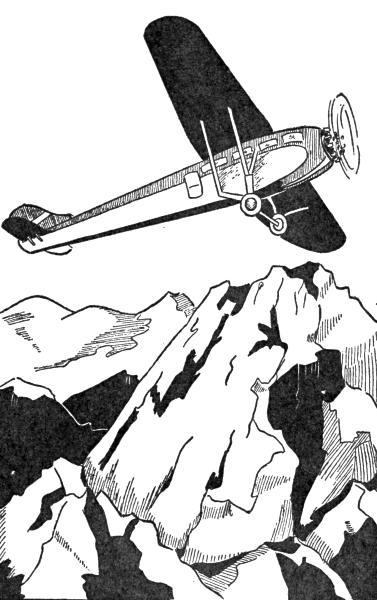
Karl added proudly. “The monoplane I own is one of the fastest and
most efficient machines there are. It’ll do a hundred and fifty miles
an hour with no trouble at all.”
“Sounds well enough,” smiled Joe. “Tell us some more.”
During the next few minutes the young aviator explained in detail the
plans made for the trip. His machine, he said, could carry four
passengers and the pilot, and there was a possibility of adding one
more. Just who those passengers were to be, the others could decide.
The course they would follow he had mapped out carefully, taking into
consideration the possibility of having to land at any time. Norfolk,
Virginia, would be the last large American city they would see. From
there they would proceed south over the Bahama Islands and Cuba, and
then on to the north coast of South America. At Bogotá, Colombia, a
stop would probably be made for fuel. They would then continue along
the coast mountains (Andes) over Colombia, Ecuador, and into Peru. At
Mollendo, a small but important coast town, the air travelers would
wait to join the other members of the expedition, who would arrive
several days later by steamship.
When Karl had finished, the youths were overflowing with enthusiasm.
Their imaginations had been captivated by the prospects of a unique
air trip into the Andes. That they could accompany Karl they sincerely
hoped.
“Of course,” began Joe, addressing his father, “Bob and I will be
among the passengers, will we not?”
Mr. Lewis looked grave. He did not have any too much faith in
aviation.
“We’ll see,” he replied. “Your mothers will have to give their
consent, you know. It may prove difficult to get that.”
“I think we can bring them around,” Bob said, with an optimism that he
was far from feeling, “especially if you and Dad decide to go. And you
will, won’t you?”
“Impossible for me to do so,” returned Mr. Lewis. “I’ve already made
reservations on a steamship. As for Mr. Holton, he may make
arrangements to go.”
“But right now,” started Karl, rising, “how would you
fellows”—referring to Bob and Joe—“like to come with me out to the
airport? I want to show you the ’plane.”
“Lead us there!” cried Joe at once. “We want to take in everything.”
The youths’ fathers had been to the airport the previous day, and so
did not care to go again. The boys and Mr. Wallace, however, desired
to see the monoplane, especially since there was a chance of their
becoming passengers.
It was nearly noon, but the four decided to leave at once. They could
get a lunch somewhere else, perhaps at the airport.
“Besides, we’re not hungry,” explained Joe, when the others asked that
they leave an hour later. “Excitement and activity make us forget all
about eating.”
At the airport the youths and Mr. Wallace were taken to a corner of
the field, just off the cement runway. There, before their eyes, was a
large white monoplane, shining brightly with a coat of fresh paint.
“Ain’t it a dandy?” Karl was beaming all over with pride. “Just been
completely inspected. It’s just r’arin’ to go!”
They walked up to the machine to examine it at close quarters.
“Sure a peach for looks,” commented Joe. “Got an air-cooled motor,
too. How about getting inside?”
“Go ahead. You’ll find it as accommodating as a street car.”
“It’s all of that,” agreed Bob a moment later, when he had opened the
door and stepped into the cabin. “Those comfortable deep seats appeal
to me.”
“Seats aren’t as important in an airplane as in a bus,” laughed Karl.
“No bumps in the air.”
On either side of the cabin were two chairs, placed several feet
apart. In the middle of the floor was a small folding table, which the
boys guessed had been placed there by Karl as a convenience to members
of the expedition. A wide glass window separated the pilot’s cockpit
from the passenger section, and the two were connected by a telephone
apparatus. Three large windows were in each wall, which was slightly
curving near the ceiling. At the rear was a large compartment for
food, maps, and other equipment.
“Now that you’ve looked it over, how would you like to go up for a
short ride?” the aviator asked, as the others examined the ship
minutely.
“Like nothing better!” came from Bob. “Can we go now?”
“Yeah. Everybody hop in. Be sure that door’s tight.”
Delighted at such an opportunity, the youths and Mr. Wallace took
places in the cabin, while Karl climbed into the cockpit.
A few seconds later there came the roar of the motor, and then the
passengers felt themselves moving.
The ’plane rolled over the cement runway for several hundred feet,
then gradually left the ground and began climbing steadily.
“We’re in the air!” cried Joe excitedly. He and his friend had never
been in a monoplane before. “Doesn’t feel unusual, does it?”
“I wouldn’t know it if I didn’t see the ground dropping away from us,”
Bob said. “We’ll probably appreciate the absence from jolts and jars.”
This easy conversation was made possible by the heavy insulation
between the pilot’s and passengers’ quarters. As a result, the roar of
the engine was silenced to a remarkable degree.
When just above the airdrome, they heard Karl’s voice through the
telephone.
“How does it feel?” the aviator asked. “Think you’d like flying?”
“Sure,” came from Joe, speaking through the transmitter. “It’s a
hundred per cent better than land traveling.”
The experience was not novel to Mr. Wallace, who had once crossed the
continent in a huge tri-motor monoplane. But nevertheless he appeared
to be enjoying it as much as the young men.
An altitude of perhaps a thousand feet was reached, and then the
’plane shot ahead toward the business district of Washington.
They had been in the air perhaps five minutes when Karl’s voice was
again heard through the telephone.
“See anything familiar below?”
“By George!” exclaimed Bob wonderingly. “We’re right above our houses.
Suppose anybody sees us?”
“Guess not,” his chum said. “They’re not out, anyway.”
A much higher altitude was reached, and their direction of travel was
changed.
From that height, the passengers could easily make out the business
district, including the United States Capitol, the White House, and
other government buildings. In addition, they could see several score
miles in every direction.
“Isn’t that Baltimore over there?” queried Joe, his keen eyes scanning
the landscape.
“It is at that,” observed Mr. Wallace. “The atmosphere isn’t any too
clear, though, and we can’t make it out very plainly.”
“We’re a great distance away, too,” remarked Bob. “Wonderful when you
think about it, isn’t it?”
They circled around for a few minutes and then headed back to the
airport, as the aviator did not care to use too much gas.
When again on the ground, Bob and Joe were more anxious than ever to
be among those of the expedition who would travel by air. Their
eagerness was increasing with every minute.
“You’ve got to let us go!” said Bob to his father, when he and his
friends had returned home. “Why, just see what we’ll be missing if we
don’t.”
“You may be missing death,” Mr. Holton returned grimly. “But then,” he
went on, raising his voice, “the chances are that nothing will happen.
Any more, airplane accidents are rare. I’ve almost decided to go
myself. It will be a chance of a lifetime.”
“Then—then you mean we can go?”
“I haven’t exactly said so,” the naturalist answered. “There is your
mother, don’t forget.”
“Perhaps she won’t consider it so wonderful,” suggested Mr. Wallace,
who had been induced to spend the few days before leaving with the
Holtons.
Bob’s mother did not at all like the idea when it was put before her
later. But she did not protest so violently when she saw that her
husband was actually bent on going. After all, his judgment had seldom
failed him, and most likely would not now. Then, too, she was somewhat
of an air enthusiast herself, having great faith in the development of
aviation. And what Mr. Holton did she usually considered fit for Bob.
Joe had more difficulty in securing the consent of his parents, for
they were doubtful as to the outcome of such a venture. Mr. Lewis,
however, was well acquainted with Karl Sutman, and knew him to be an
excellent airplane pilot, besides being a resourceful, well-thought-of
citizen. In the end, Joe’s parents consented to the youth’s going,
especially when they learned that Mr. Holton and Bob intended to go.
Mr. Lewis, however, had already booked passage on a steamship, and
could not cancel his arrangement, much as he would have liked to.
The two chums were delighted beyond words.
“It’ll seem strange without your father with us, though,” said Bob.
“We all went together on our other trips, and——”
“He’ll meet us in Mollendo,” Joe reminded him, and then added: “Wonder
if Mr. Wallace will go in the ’plane?”
That person desired very much to do so, but hesitated to let Mr. Lewis
make the ocean trip alone. Joe’s father, though, declared he would not
be without companions, for he was acquainted with several members of
other divisions of the expedition. A Mr. Thomas L. Wells, of the
division of ethnology, was a very close friend of the naturalist.
“So, although I would like for you to come with me on the boat, I want
you to go in the airplane,” Joe’s father said to Mr. Wallace,
“because I know you are bent on doing so, and it is a wonderful
opportunity.”
The result was that Mr. Wallace made preparations to go by air, much
to the delight of Bob and Joe. Since their first meeting with the
naturalist several months before, the youths had taken a great liking
to him.
Making ready for the airplane trip was a novel experience to Bob and
Joe. They found there was much to be purchased in the way of suits,
caps, goggles, and other provisions. Aviator’s togs, the young men
knew, would not be strictly necessary, as it was a monoplane with a
closed cabin. But they thought it best to get them, since they could
also be used for general outdoor clothes.
“Here’s something the express man left you, boys,” Mr. Holton called,
when the chums returned from a shopping trip downtown.
Eagerly Bob and Joe opened the large box. A minute later, when they
saw its contents, they uttered exclamations of joy.
“The moving-picture camera and film, from the Neuman Motion Picture
Corporation!” cried Bob happily. “It got here just in time, didn’t it?
We’ll be leaving day after tomorrow.”
The Neuman Motion Picture Corporation, a large firm that released
educational films, had engaged the services of Bob and Joe on their
two previous expeditions. The youths took moving pictures of the
strange lands they visited, and so pleased the film company that they
were given the opportunity of again taking moving pictures while in
the Andes Mountains. Always the boys were paid a substantial sum for
their trouble, which to them was sheer pleasure.
“Inca land you’ll find to be perhaps the most interesting place you’ve
photographed,” Mr. Holton told them. “If you do this well, the company
will almost eat you up in their praise of you.”
“The Inca empire is still sort of a mystery to me,” said Joe. “I’ve
read quite a bit about it, and Mr. Wallace and Bob and I saw that
movie in Chicago, but it’s still all not quite clear. I know how the
country around there looks. It is the empire itself that I don’t know
much about.”
“Not being an archæologist, I don’t know a great deal about it,” Mr.
Holton said. “Perhaps not much, if any, more than you fellows. I do
know, though, that the Incas maintained a socialistic state, in which
everyone was forced to work on a given piece of land without deriving
any direct benefit. The grain that they raised all went to a common
storehouse, and everyone drew from it in times of stress.”
“A sort of depression insurance,” laughed Joe.
“Might call it that,” the naturalist said with a smile. “At any rate
it seemed to prove effective.”
“How about the wild animals and birds in Peru?” asked Bob. “Are there
many there?”
“Now you’ve mentioned a subject that I know something about,” returned
Mr. Holton. “Yes, there are countless numbers of interesting wild
creatures in those mountains. Most impressive of all is perhaps the
condor, the largest bird that flies. We naturalists wish particularly
to investigate reports of a species of condor that is pure white in
color. Whether we’ll find it we have yet to see. But there are other
birds and animals that we feel sure of getting, such as the puma,
armadillo, lizard, guanaco, fox, and snipe. We aren’t allowed a great
deal of time in the Andes, but we feel certain that a large number of
wild creatures will fall at the report of our rifles.”
The next two days were busy ones for Bob and Joe. They frequented the
business district often to get minor articles that they would need on
the trip, and by the time the great day of leaving came they had
finished all preparations.
After breakfast Mrs. Holton and Mr. Lewis drove the leavetakers to the
airport. When they arrived at that place they found that an expert
mechanic had just completed a thorough inspection of Karl Sutman’s
monoplane, and had found it in perfect running order.
Their belongings were all placed in the provision compartment, and
then, with sincere farewells, the youths, Mr. Holton, and Mr. Wallace
climbed into the cabin, while Karl took his place in the cockpit.
The engine was started, and then, after the travelers had called out
one last farewell and promise to be careful, the monoplane rolled
heavily over the concrete runway and pointed its nose toward the
southern sky.
“We’re off!” cried Joe excitedly. “Off for the Andes Mountains!”