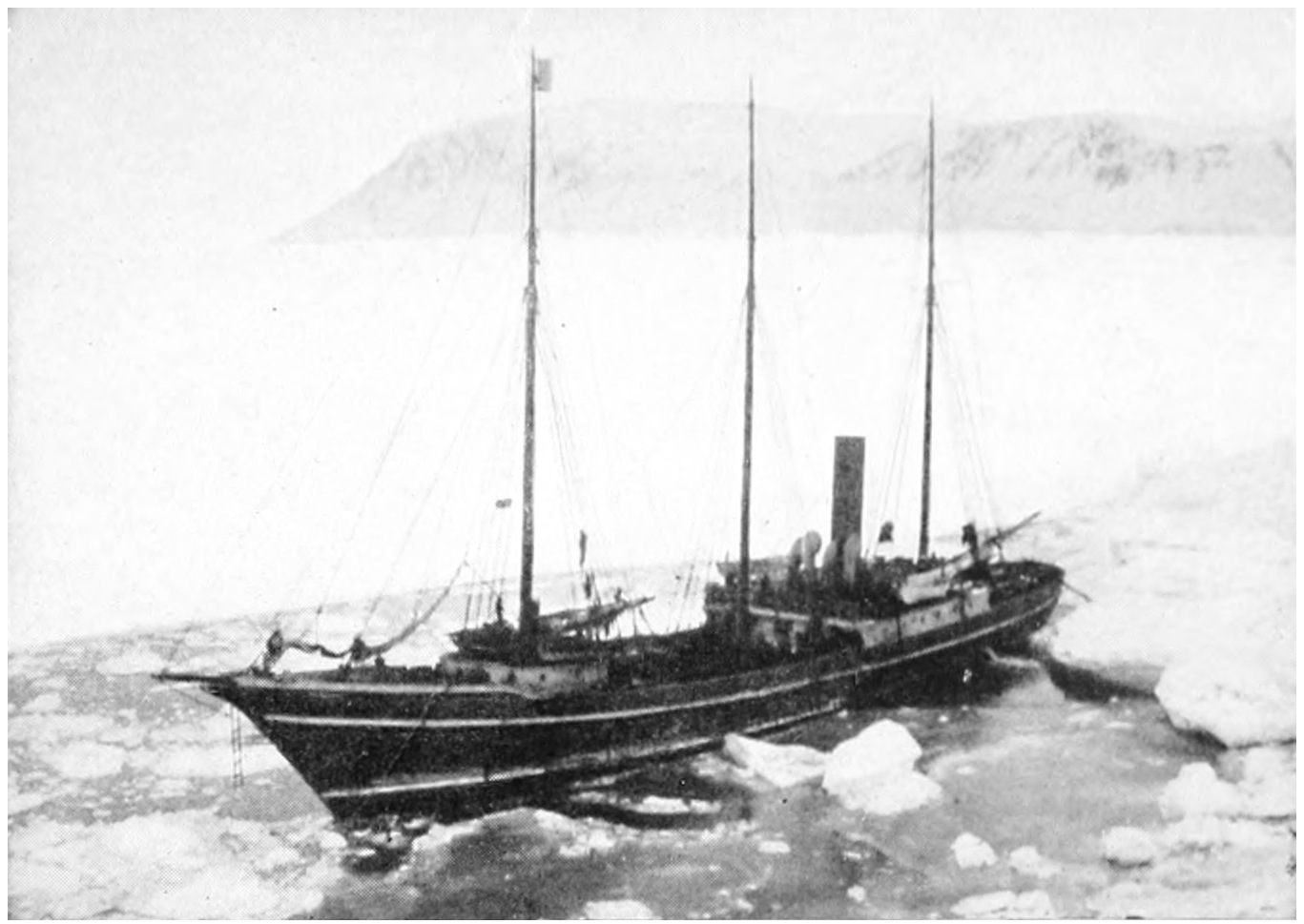
Larger versions of most illustrations may be seen by right-clicking them
and selecting an option to view them separately, or by double-tapping and/or
stretching them.
(cover)
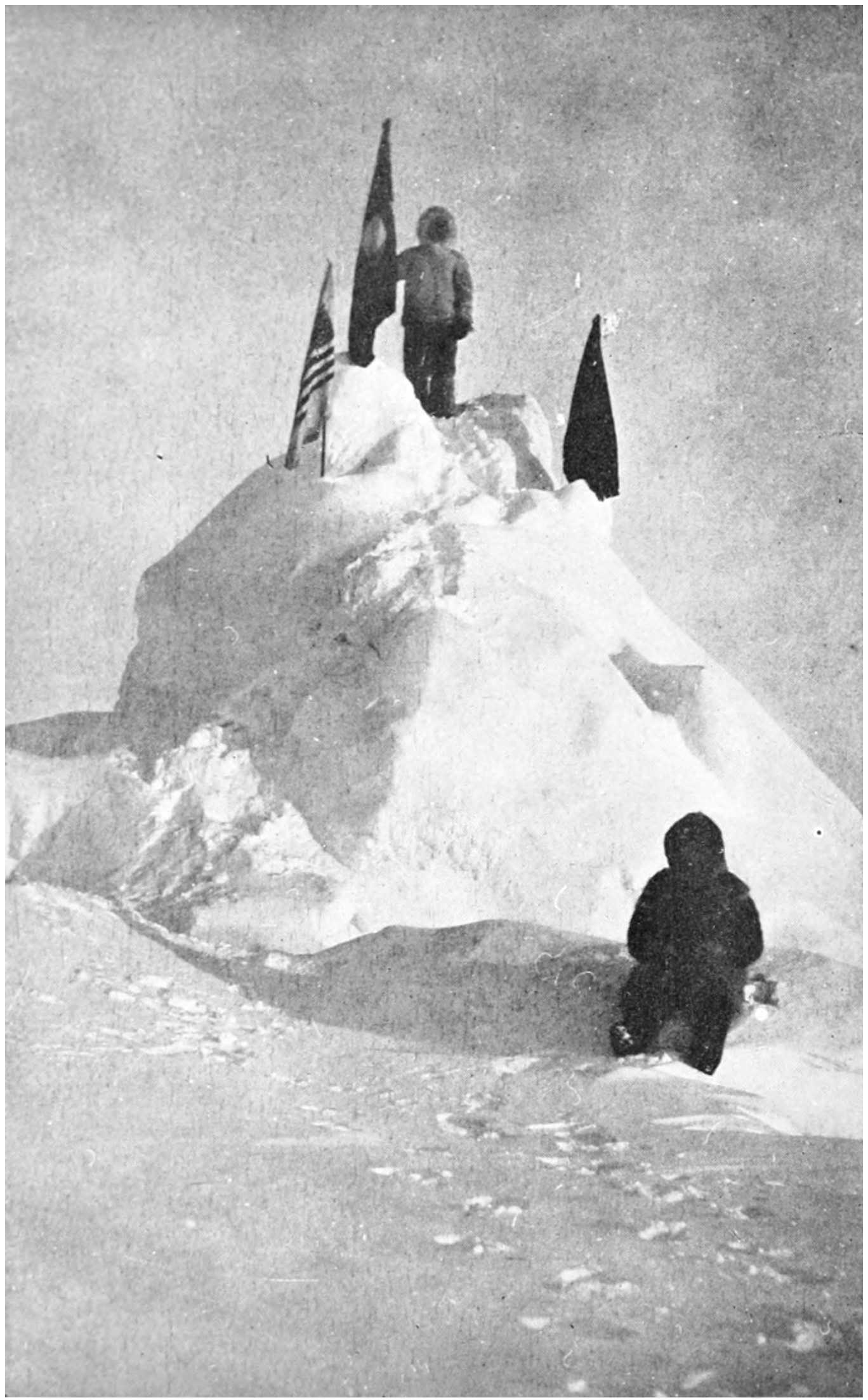
THE STARS AND STRIPES FLYING FROM THE NORTH POLE
SECRETS OF POLAR
TRAVEL
BY
ROBERT E. PEARY
ILLUSTRATED WITH
PHOTOGRAPHS
NEW YORK
THE CENTURY CO.
1917
Copyright, 1917, by The Century Co.
Published, October, 1917
INTRODUCTION
In my book “The North Pole” appeared a brief
résumé, or synopsis, of my system of arctic exploration,
which was the evolution of years of
continuous practical work and experience in extreme
high latitudes, wherein everything that
could be thought of in the way of perfecting arctic
methods and equipment was worked out.
Ideas that in the mind or on paper appeared
promising were tested relentlessly under the most
hostile conditions. Those that failed under the
test were abandoned, and those that gave evidence
of containing some meat were perfected, until at
last the entire subject of perfected equipment and
methods, combined with the thorough knowledge
of all conditions to be encountered gained through
years of experience, compelled success. This
was the résumé:
The so-called “Peary System” is too complex to be covered
in a paragraph, and involves too many technical details to be
outlined fully in any popular narrative. But the main points
of it are about as follows:
To drive a ship through the ice to the farthest possible
northern land base from which she can be driven back again
the following year.
To do enough hunting during the fall and winter to keep the
party healthily supplied with fresh meat.
To have dogs enough to allow for the loss of sixty per cent
of them by death or otherwise.
To have the confidence of a large number of Eskimos, earned
by square dealing and generous gifts in the past, so that they
will follow the leader to any point he may specify.
To have an intelligent and willing body of civilized assistants
to lead the various divisions of Eskimos—men whose authority
the Eskimos will accept when delegated by the
leader.
To transport beforehand to the point where the expedition
leaves the land for the sledge journey, sufficient food, fuel,
clothing, stoves (oil or alcohol) and other mechanical equipment
to get the main party to the Pole and back and the various
divisions to their farthest north and back.
To have an ample supply of the best kind of sledges.
To have a sufficient number of divisions, or relay parties,
each under the leadership of a competent assistant, to send
back at appropriate and carefully calculated stages along the
upward journey.
To have every item of equipment of the quality best suited
to the purpose, thoroughly tested, and of the lightest possible
weight.
To know, by long experience, the best way to cross wide
leads of open water.
To return by the same route followed on the upward march,
using the beaten trail and the already constructed igloos to
save the time and strength that would have been expended in
constructing new igloos and in trail-breaking.
To know exactly to what extent each man and dog may be
worked without injury.
To know the physical and mental capabilities of every assistant
and Eskimo.
Last, but not least, to have the absolute confidence of every
member of the party, white, black, or brown, so that every order
of the leader will be implicitly obeyed.
In “Secrets of Polar Travel” it is the intention
to enlarge upon the above synopsis and to give
the reader and the present and future polar traveler
many details of serious polar work that it
was impossible to embody in my former popular
narratives without crowding out other and, as it
seemed, more important matters.
Some of the things that will be described are
well known to all polar explorers who have had
serious practice, while others will be new to all
except those who have had opportunities to obtain
the information by personal conversation with
members of my parties.
In extending the scope of the present book to
touch on polar exploration, it seems well to post
the reader at the very beginning on the striking
antitheses of natural conditions, apparently
known to only a few even among the best read
and most intelligent people, existing at those
mathematical points, the north and south poles,
where the earth’s axis intersects the surface of
the earth.
The north pole is situated in an ocean of some
fifteen hundred miles’ diameter, surrounded by
land. The south pole is situated in a continent of
some twenty-five hundred miles’ diameter, surrounded
by water. At the north pole I stood
upon the frozen surface of an ocean more than
two miles in depth. At the south pole, Amundsen
and Scott stood upon the surface of a great, snow
plateau more than two miles above sea-level.
The lands that surround the north polar ocean
have comparatively abundant life. Musk-oxen,
reindeer, polar bears, wolves, foxes, arctic hares,
ermines, and lemmings, together with insects and
flowers, are found within five hundred miles of
the pole. On the great south polar continent no
form of animal life appears to exist.
Permanent human life exists within some seven
hundred miles of the north pole; none is found
within twenty-three hundred miles of the south
pole. The history of arctic exploration goes back
nearly four hundred years. The history of antarctic
efforts covers a little more than one hundred
and forty years. The record of arctic exploration
is studded with crushed and foundering
ships and the deaths of hundreds of brave
men. The records of antarctic exploration show
the loss of only three ships and the death of a
score or more men.
For all those who aspire to the north pole the
road lies over the frozen surface of an ocean the
ice on which breaks up completely every summer,
drifting about under the influence of wind and
tide, and may crack into numerous fissures and
lanes of open water at any time, even in the depth
of the severest winter, under the influence of
storms. For those who aspire to the south pole
the road lies over an eternal, immovable surface,
the latter part rising ten thousand and eleven
thousand feet above sea-level. And herein lies
the inestimable advantage to the south polar explorer
which enables him to make his depots at
convenient distances, and thus lighten his load
and increase his speed.
Of all the special tools that a polar explorer
requires for the successful prosecution of
his work, his ship stands first and preëminent.
This is the tool which is to place him and his
party and supplies within striking distance of his
goal, the tool without which he can accomplish
nothing.
The builder of a polar ship should live with his
craft from the time the keel is laid till she is complete
and has made her trial trips. He should
see that every timber that goes into her is sound,
tough, and seasoned. He should see the tests of
iron for her bolts, and know that the iron is tough
and homogeneous. He should see the bolts driven
and upset, or the nuts set tight, as the case may
be. He should direct the scarfing and the notching
of the timbers in order to secure the maximum
strength and binding grip. He should watch the
calking and the tarring like a hawk, and see that
no place is slighted, that, when it is done, he may
have that delight of a seaman, a tight ship. He
should pass sleepless nights going over again and
again the calculations for his engines and boilers;
and in checking and rechecking weights, dimensions,
displacement.
In this way, by following every step of the
ship’s growth, and sitting up night after night
studying every detail with a view to improving
and strengthening it, when the work is done, he
will know every inch of his ship inside and out.
Later, in the grim, protracted fight with the ice,
he will feel in regard to his ship as Sullivan and
Willard each felt on the eve of a great battle regarding
his powerful body, that it can be depended
upon absolutely. It is a wonderfully satisfactory
feeling, and it counts far toward success.
A quite general idea regarding the work of a
polar ship seems to be that such a ship breaks up
the ice of one season, like river and harbor ice-breakers.
As a matter of fact, smooth, unbroken
ice of uniform thickness is rarely found in Northern
voyages except in Melville Bay, or at the end
of the season, when new ice is forming. The
chief work of a polar ship is to push and pry and
wedge its way in and out among cakes and floes
ranging from three to twenty or fifty and even up
to one hundred and twenty feet thick. A passage
cannot be smashed through such ice, and nothing
remains but to squeeze and twist and dodge
through it. A hundred Yermaks (the powerful
Russian ice-breaker) merged in one could accomplish
nothing in such ice.
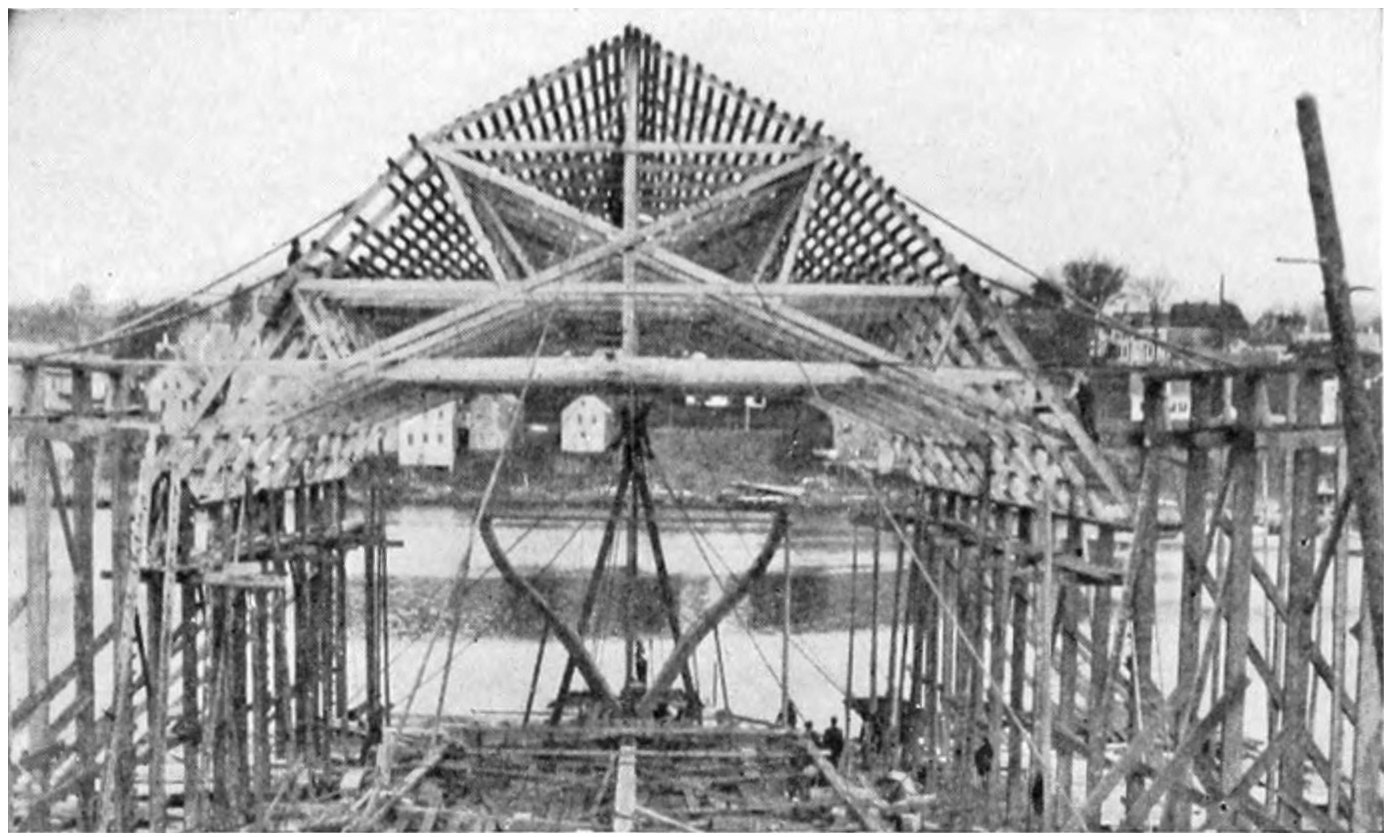
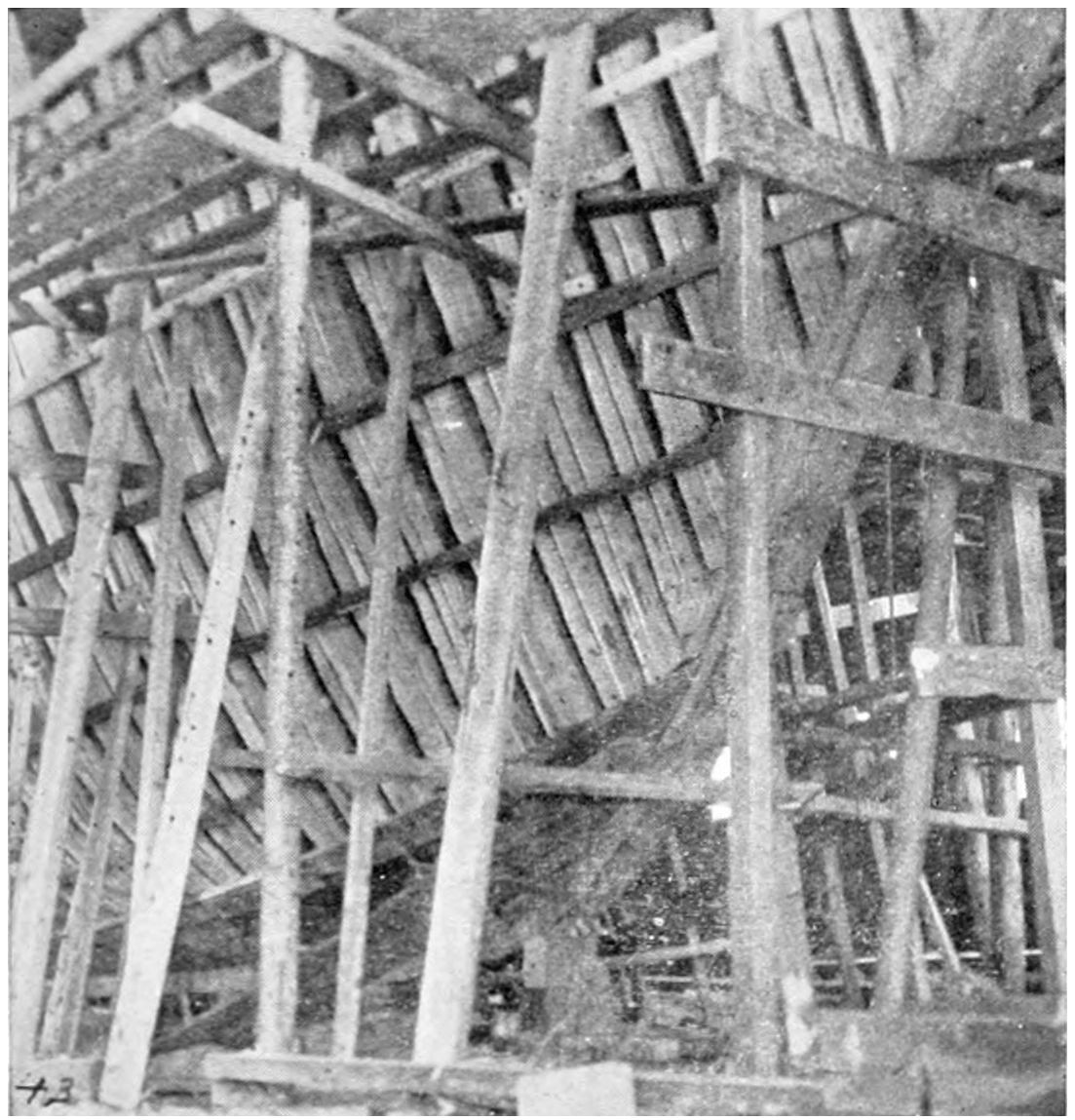
BEGINNING OF THE “ROOSEVELT”
First frame erected, ship now under construction, Bucksport, Maine,
October, 1904
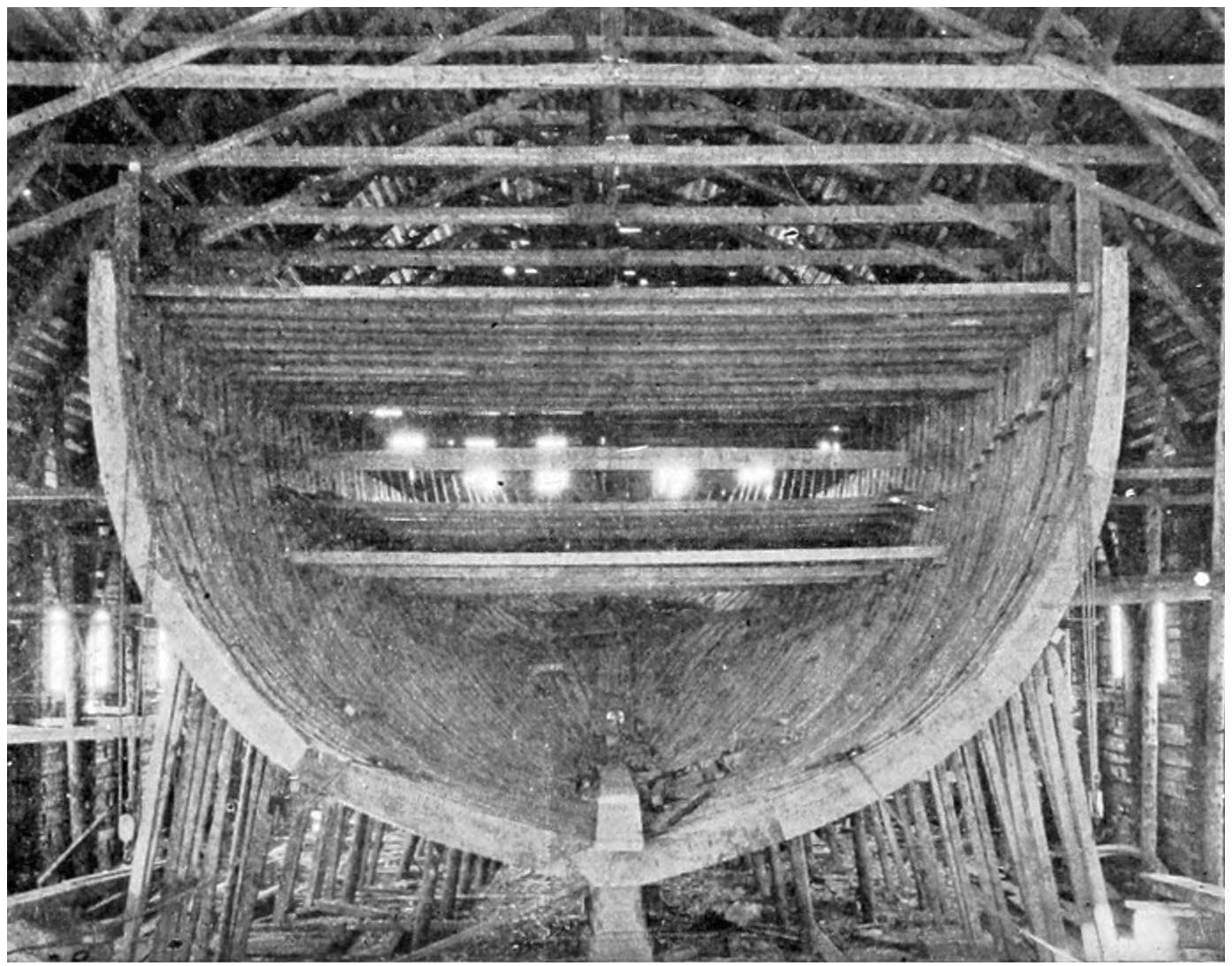
MIDSHIPS CROSS SECTION OF THE “ROOSEVELT”
Looking aft. Note section nearly a semi-circle
Many qualities are necessary in a first-class polar
ice-fighter. First, there must be such a generally
rounded model as will rise readily when
squeezed, and thus escape the death-crush of the
ice. Then there must be no projection of keel or
other part to give the ice an opportunity to get a
grip, or to hold the ship from rising.
When the Jeannette was destroyed northeast of
the New Siberian Islands, the ice on one side of
her caught and held her firmly, while the floe on
the other side, turning down under her side,
caught the keel, and with its resistless pressure
opened up the ship her entire length along the
garboard-strake. She then filled, and when the
ice pressure was released she sank.
The polar ship must be most heavily braced and
trussed to enable it to withstand terrific pressure
of ice-floes, and hold its shape until the pressure
is released by the rising of the ship; or to
make it possible for her to be supported at each
end only or in the middle, or thrown out on to
the ice, so she would rest on her bilge during a
convulsion of the floes, without strain or injury.
Power and strength and solidity to fight a way
through ice rather than drift inertly with it, are
absolutely essential. For ramming, she must have
a sharply raking stem, which will rise on the ice
at each blow. This not only makes it possible for
a loaded ship to deliver blows at full speed without
danger of smashing in her bows or starting her
fastenings or seams, but also gives her an initial
impetus astern when she backs for another blow.
When it is understood that this ramming may
continue for hours (I have used my ship in this
way continuously for twenty-four hours in crossing
Melville Bay), striking a blow, backing, then
going ahead full speed for another, the value of
this little assistance with each blow will be appreciated.
The shape of the bow is also important
in ramming. If too bluff, headway is deadened,
and the force of the blows is lessened. If
too sharp, the ship may stick at each blow, and require
more time and power to back out each time.
The run of the polar ship should be full rather
than fine, to keep the passing ice away from the
propeller as much as possible.
The ship must be as short as practicable and
have a lively helm to enable her to twist and turn
rapidly and sharply through the narrow, tortuous
lanes of water among the ice-fields.
It will be seen at once that a ship for arctic or
antarctic work must be as small as the size of the
party and the amount of supplies, equipment, and
coal for the proposed work will permit. The
smaller a ship can be built, the greater will be her
strength and the ease with which she can be handled.
Finally the polar ship must be a good sea boat
to ride out the furious autumn gales of the North
Atlantic and polar oceans.
This is especially important in South Polar work
with its long voyage and cyclonic blizzards.
Many are under the impression that steel should
be used in constructing polar ships. This idea
is erroneous, for though a ship so made would be
strong structurally, she would be particularly
vulnerable to the ragged, sharp corners of heavy
ice. Wood, with its elasticity and toughness, is
the prime essential in the construction of a ship
of this kind. It is also virtually impossible to
repair injury to a steel ship during the voyage.
But steel and methods of composite ship building,
used in a vessel’s interior, may reduce weight and
increase her strength.
Numbers of failures and catastrophes in polar
work are directly attributable to the unsuitable
model of the ship. Particularly striking examples
of this were the Polaris and the Jeannette.
Neither of these ships should ever have been allowed
to go into the ice, as their straight sides
gave them no possible chance to lift when squeezed
by the ice, and their destruction was only a matter
of time, when they should be squarely caught
between two floes. In the case of the Jeannette
Melville’s engineering skill postponed the catastrophe
for a time, but the final result was inevitable.
The Esquimaux of the Ziegler Expedition and
the Duke of the Abruzzi’s Stella Polare were
scarcely better, but the skill of the Italians enabled
their ship to pull through and bring the party
home.
Virtually all the ships used in the history of ice
navigation have been the sailing-vessels built in
Scotland, Norway, and the United States for the
whaling and sealing industries. These whalers
were short, stocky, heavily sparred, and square
rigged. The Victory, used by John Ross, in 1829,
was fitted with auxiliary steam-power, and was
the first attempt to utilize such motive power for
ice work. The innovation of steam with paddle-wheels,
than which nothing could have been more
impracticable for ice navigation, proved a decided
failure, and the engine was finally torn out and
thrown overboard, and the voyage continued under
sail.
The Norwegians operating in the waters about
Spitzbergen, Jan Mayen, and Nova Zembla; the
Americans, in Bering Sea and Hudson Bay, encountered
ice conditions strikingly different from
those met by the Scotch whose region of operations
was chiefly in Davis Strait, Baffin Bay, Lancaster
Sound, together with their tributaries, and
the seas about eastern Greenland. Broadly speaking,
the work of Norwegians and Americans was
carried on among floes and broken ice drifting in
open seas, through which they had to thread their
way, while the Scotch in Melville Bay encountered
an almost solid stretch of one season’s ice, and in
the narrow, landlocked channels to the westward
the currents of which are notoriously strong, they
had to contend with old and heavier ice. Some
one has very aptly said that American whalers
used steam to avoid ice, the Scotch, to go into and
through it.
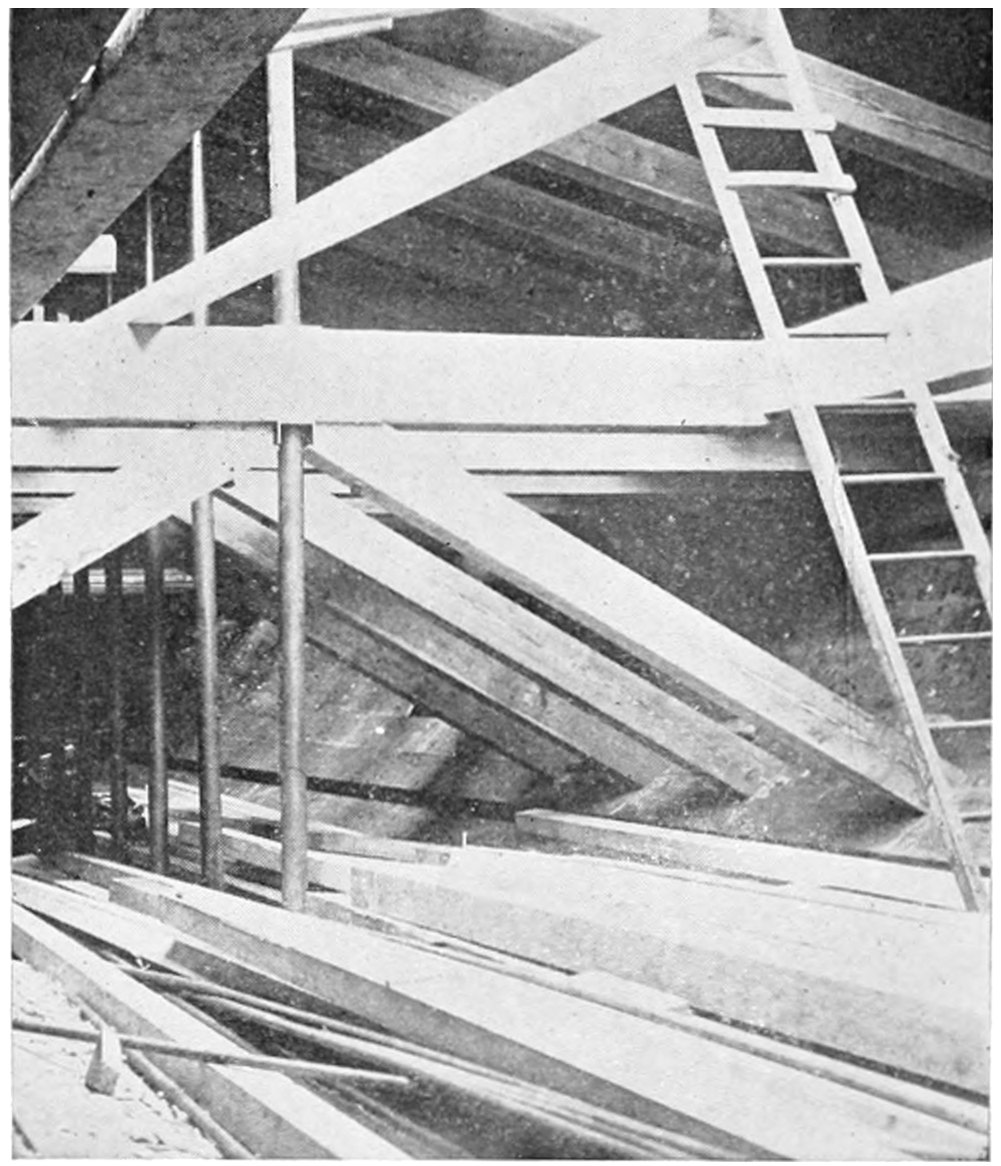
STEM, FOREFOOT, AND BOW FRAMES
January 11, 1905
MASSIVE KING-POST TRUSSES STRENGTHENING THE
“ROOSEVELT’S” SIDES AGAINST ICE PRESSURE
The horizontal timber in center of picture is 14 in.
× 16 in.
The following average proportions of beam to
length among these whalers is rather interesting:
Scotch, 1:5.75; Norwegian, 1:4.7; American,
1:4.5. The average ratio in modern schooners
built in Bath is 1:4.78.
The Scotch, thanks to the shrewdness of their
seamen and builders and over one hundred years
of experience in whaling work, where the best
ships secured large financial returns, have gradually
evolved the more powerful and efficient type
of ship, and this type has been used exclusively
by the British even in their latest expeditions.
It had long been a recognized fact that a form
of hull which would permit a ship to rise readily
and easily under pressure was desirable; yet the
Fram was the first ship built to meet this requirement.
The Fram was built with a special view
to drifting in and with the ice. Her beam was
about one-third her length, and her hull was so
designed as to allow her to rise easily under pressure.
While she was well adapted for this work,
she would have been still better fitted for it if she
had been bowl-shaped. Moreover, appearance,
speed, ability to push through the ice, and virtually
everything that goes to make a ship seaworthy
was sacrificed to insure this quality.
The Gauss, the German antarctic ship, was much
like the Fram, though less pronounced in type,
having a broad beam of 36 feet, but with a greater
length to make her more seaworthy for the long
voyage to the antarctic regions. Her ratio is
1:4.25 as compared with the Fram’s ratio of
1:3.25.
The British Discovery, built for antarctic exploration,
was also of the sailing type, with
auxiliary steam-power. She was built with a little
broader beam and a draft slightly less than
that of the Scotch whalers, with a ratio of 1:5.27.
She differed from the Fram and the Gauss in that
she was not specially constructed to rise under
pressure, and the rake of her stem was somewhat
greater than in previous ships.
With the building of the Roosevelt came a complete
reversal of former practice in ships for the
arctic and antarctic regions. She was the first
Polar ship built that was first of all a powerful
steamer. All her predecessors had been sailing-vessels,
usually full-rigged barks, with steam as
a secondary consideration. This was done to
economize on coal and enable the ship to cover
long distances at slow speed and be gone for
years, if necessary.
In the Roosevelt sail power was a mere auxiliary,
and everything was given over to making
steam-power first and foremost and her strength
sufficient to withstand the ice. This is undoubtedly
the correct principle on which to build any
Polar ship for effective results. For this method
the Smith Sound route is specially advantageous,
affording a coasting voyage, ample facilities for
caching coal, as well as presenting opportunities
to obtain coal en route.
As the Roosevelt was to be built for navigating
the very seas where the Scotch gained their valuable
experience and for which their ships were
specially designed and improved, the Scotch model
seemed the proper one to use as a base for studies.
In the case of Nansen, and the British and
German polar expeditions, the size of the ship
was determined by fixing the size of the party, the
length of the expedition, and the amount of coal
which would be consumed by the engines and the
cargo to be carried, all of which factors, when the
dead weight of the ship and machinery was added,
would give the displacement required.
In the case of the Roosevelt I believed it advisable
to settle in advance the size and proportions
which would come nearest to balancing and meeting
the various requirements, allowing the difference
between her displacement and her dead
weight to go for cargo capacity, chief of which
would be coal. The size determined was 184 feet
over all, with 35 feet beam and 16 feet draft,
loaded, and a load water-line of 166 feet. These
dimensions make her almost as long as, but with
a slightly greater beam than, the Discovery, the
British antarctic ship. Her length ratio, while
not quite as fine as that of the Scotch model, is
much finer than the Norwegian or American averages.
After determining her length and beam, came
the question of draft. For the ship navigating
the waters of Smith Sound a light draft is far
better than a heavier one, permitting her to hug
the shore in order to get round barriers, or, when
crowded by heavy ice, to retreat close to the shore
and let it ground outside the ship. Another distinct
advantage of light draft in a ship is the
greater ease with which she will rise under the
heavy pressure of ice-floes. The greater her
draft, the harder it is for her to rise and avoid the
grip of the ice.
So much depends on the ship in the serious
work of ice navigation that it may be well to describe
in detail the ship which I consider the ablest
of ice fighters.
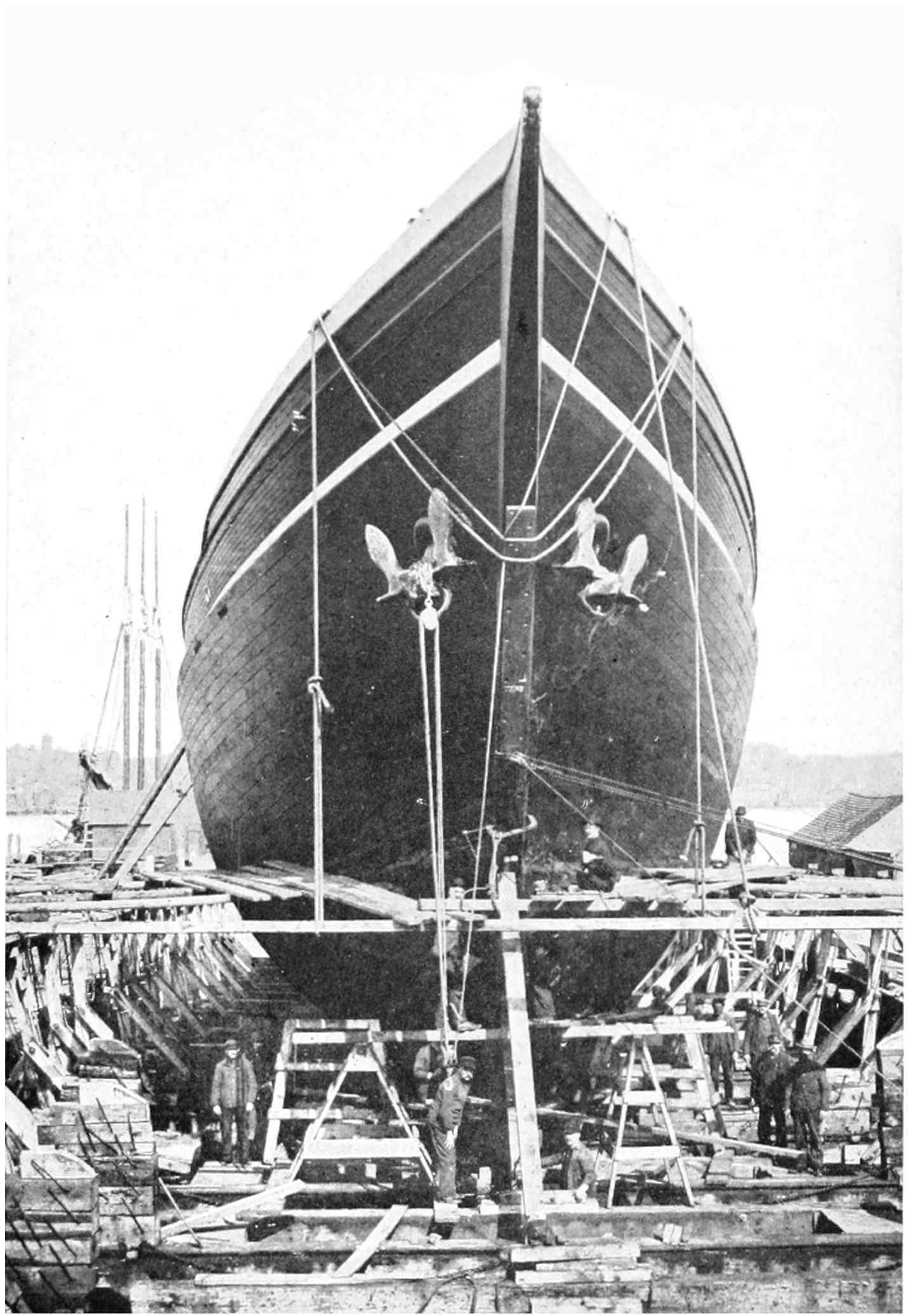
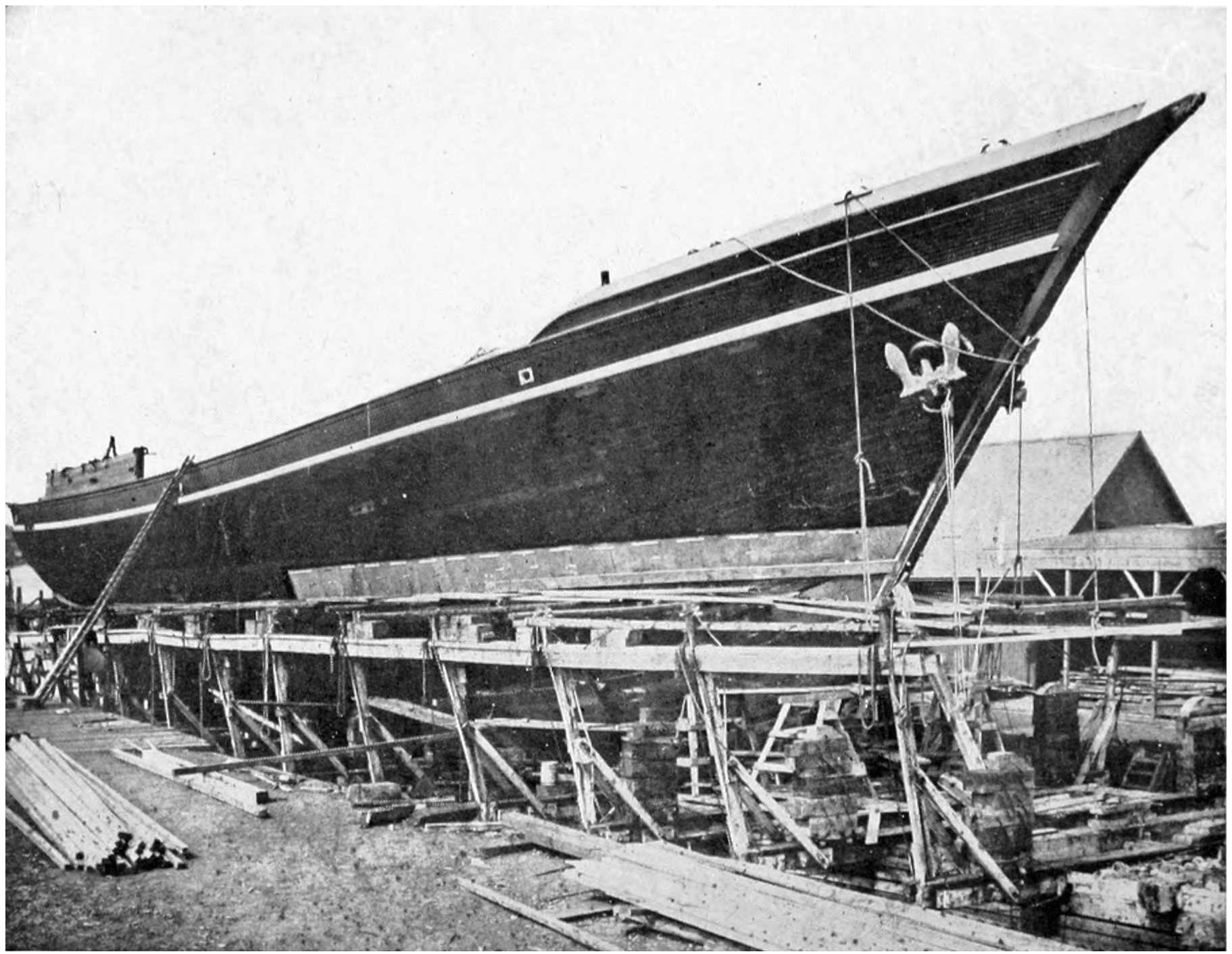
BOW OF “ROOSEVELT” IN DRY DOCK
Note massiveness and rounded, egg-like curves
The official measurements of the Roosevelt are
as follows: length, 184 feet; breadth, 35.5 feet;
depth, 16.2 feet; gross registered tonnage, 614
tons; maximum load displacement, about 1500
tons. The keel, main keelsons, stem- and stern-posts,
frames, plank sheer, waterways, and garboard-strake,
are white oak. Beams, sister-keelsons,
deck clamps, ’tween-deck waterways, bilge-strakes,
ceiling, and inner course of planking, are
yellow pine. The outer planking is white oak and
the decks of Oregon pine. Both the ceiling and
the outer course of white-oak planking are edge-bolted
from stem to stern, and from plank sheer
to garboard-strake. The fastenings are galvanized
iron bolts, going through both courses of
planking and the frames, and riveting up over
washers on the inside of the ceiling.
The great oak timbers of the keel, false keel and
keelsons, bolted and strapped and scarfed together
in every way that experience and ingenuity could
suggest formed a rigid backbone over six feet
high. The oak timber sources were searched to
secure these timbers, and some of them perhaps
could not be duplicated to-day.
Massive oak timbers formed the stem, stern and
rudder posts, bolted and strapped to each other
and to the keel.
The frames or ribs of the Roosevelt were placed
almost close together, each made of three courses
of selected timbers bolted together.
At the stem the ribs were close together and the
triangular space at the bow between the port and
starboard ribs was filled in solid for a distance
of some ten feet aft of the stem with oak timbers
bolted and scarfed together to make a solid ram,
or fighting head or cæstus.
Main deck beams and ’tween deck beams were
unusually large and spaced unusually close together.
The latter were placed on a water line instead
of with a sheer, so that they were just below
the load water line where the severest and
most frequent ice pressure would come.
Each main deck beam together with the ’tween
deck beam below it, and four stout diagonal braces
to the ship’s sides and a 2½″ vertical steel tie-rod
from the bottom of the keel to the upper side of
the deck binding all together, formed a double
king post truss, one superimposed upon the other.
This truss arrangement was made possible by
my method of housing the personnel of the expedition
in light roomy quarters on deck, rather than
below the decks.
The sides of the ship varied from twenty-four
to thirty inches in thickness. These sides, supported
at every four feet of the ship’s length by
the truss system above described, and still further
reinforced by three solid timber transverse bulkheads,
were immune from being crushed in.
To avoid unnecessary weight, no planking was
used between decks; there were no interior fittings;
and spars and rigging were as lightly made
as possible. The hatch coamings were of stout
white oak, built almost as high as the top of the
bulwarks, to add to the safety of the ship in heavy
weather.
To protect her planks from the gnawing of the
ice while steaming through it, as well as to reduce
friction, the ship was surrounded at the water line
with an armor belt of dense slippery greenheart.
This wood imported from Guiana expressly for
the purpose, is so tough and dense that spikes or
bolts cannot be driven into it but must have holes
bored for them.
The shipyard which puts on the greenheart
usually has to get a new set of saws, planers and
drills for the next job, and the echoes of profanity
linger for a long time.
The massive construction of the Roosevelt so
impressed the inhabitants of Bucksport, accustomed
to usual ship building, that one of the village
oracles is said to have delivered himself
around the glowing stove of the “hotel” office of
the following, “By heck there’s so much wood in
the d—— ship that she’ll sink when they launch
her.”
After the hull of the Roosevelt was completed,
she was put into dry-dock and “watered”; that is,
water was pumped into her to detect any bolt-holes
that had not been filled with a bolt, or any seam
that had been overlooked in calking, just as one
would test a pail by filling it with water to see if it
leaked.
By this test leaks are located that cannot be detected
in any other way, and the explorer during
his voyage is saved the maddening annoyance of
listening to the trickling of incoming water as he
lies in his bunk at night, of the daily clank of the
pumps, and of a ship with bilges full of ice at the
end of the Polar winter.
In regard to engine power, my ideas have been
radically different from those of other navigators.
I have believed in all the power it was possible to
get into the ship. I know of few more comfortable
feelings for the commander of a ship beset in
the ice than the knowledge that he has beneath
his feet the power that with the least slackening
of the ice pressure will enable him to force his
ship ahead on her course.
The motive power of the Roosevelt consisted
of a single, inverted, compound engine, capable
of developing a thousand horse-power, and driving
an eleven-foot four-blade propeller. Two
water-tube boilers and one Scotch boiler supplied
steam.
Two specially distinctive features of the machinery
of the Roosevelt were a large “by-pass,”
by means of which, by turning a valve, steam from
all the boilers at full pressure could be turned
directly into the big fifty-two-inch low-pressure
cylinder, more than doubling the power for a
short time; that is, as long as the boilers could
meet this excessive demand. The object of this
was to give me a reserve of power with which
to extricate the ship from a particularly dangerous
position. On at least two occasions this
device accomplished all that was expected of it,
and, by resistlessly forging the ship ahead a
length or two against all odds, removed her from
the line of deadly pressure, and so saved her.
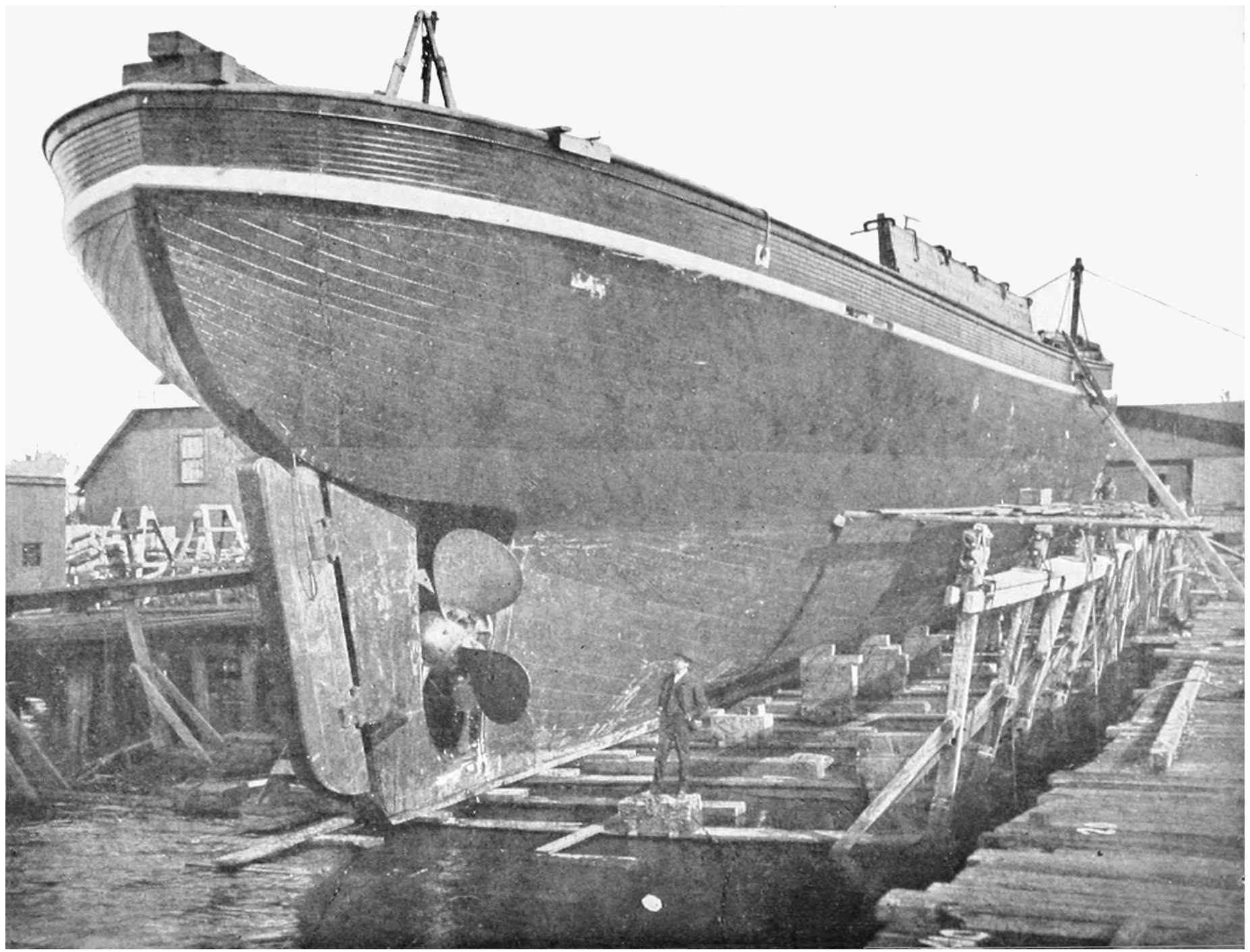
STERN OF “ROOSEVELT” IN DRY DOCK
Note rounded curves, massiveness of propeller, skeg and rudder, and lavish use of steel plates.
Rudder is of white oak timbers 16 in. × 16 in.
The other was an enormously heavy and strong
propeller and shaft. The shaft was a twelve-inch
diameter solid steel forging, a shaft big enough
for a 2000-ton tramp steamer. The propeller was
correspondingly heavy. The object of this was to
prevent the complete crippling of the ship by
breaking of shaft or propeller.
This idea entailed unusual weight and expense,
but it served its purpose and was never regretted.
When in July, 1906, the Roosevelt was smashed
against the unyielding ice-foot at Cape Union,
tossed about like an egg-shell, and treated generally
as if she were of no account, a particularly
vicious corner of an old floe struck her astern,
broke one propeller-blade square off, tore off the
ponderous white-oak skeg, or after stern-post,
and, catching under propeller and projecting end
of shaft, lifted the whole after part of the ship
as a man would lift a wheel-barrow, until her
heel was out of water, and held her in this way
for several hours until the tide changed. Had
propeller and shaft been of usual proportions,
neither would ever have made another revolution.
As it was, my twelve-inch shaft was not even
thrown out of line, and barring the broken propeller-blade,
the machinery suffered no damage.
Another device which added to the effectiveness
of the Roosevelt is the arrangement for raising
and lowering the rudder while at sea, or lifting it
when under pressure in the ice. A large open
well was provided, reaching through to the main-deck.
This was large enough to permit the massive
rudder to be drawn up and hoisted on the
deck for repairs, or into the overhang of the stern,
out of the way of the ice. Instead of having to
send a diver down to unfasten the gudgeons, these
worked in an upright groove arranged in the after
end of the stern-post, something like a window-sash.
Heavy bolts attached the pintles to the
rudder-post, and in unshipping the rudder, the
gudgeons came up with the rudder itself, leaving
the raking steel-clad stern-post as smooth and
clean as the stem, with nothing for the ice to get
a grip upon.
The problem of protecting the propeller-blades
and keeping ice away from them, was solved
partly by the full counter and overhanging stern
of the Roosevelt, and partly by the design of the
propeller. The blades of the propeller, though
short, were large in sectional area, and particularly
strong and massive. Their extremities were so
shaped as to make it difficult for a cake of ice to
get between them, and the blades were so arranged
that either two or four of them could be used.
Powerful deck appliances were the windlass,
steam-capstans forward and aft, and steamwinch,
which enabled the ship to float herself should
she get aground, or to warp herself out of a dangerous
spot.
The special features of the Roosevelt’s model
are a smooth and rounded form not readily
gripped by the ice; midships transverse section
that is a semi-circle; a sharply raking heavily steel
clad stem and stern post giving large deck room,
sufficient water line displacement and a short keel
which makes the ship quick and handy in turning;
an overhanging stern to assist in protecting rudder
and propeller from the ice.
Her peculiarities of construction include unusually
massive and close arrangement of beams
and bracing to withstand pressure on the sides;
filling the bow in almost solid with iron and timbers,
where it gets the brunt of blows; strong and
unusual reinforcement of the rudder-post; the introduction
of a lifting rudder; heavy steel plates
for stem and bow; a course of greenhart ice-sheathing
to protect the outer planking.
Her peculiarities of rig are pole-masts; three-masted
schooner rig, with big balloon staysails;
and a very short bowsprit, which, when navigating
through ice of some height, can be run inboard.
Her sail-plan is an American three-masted
schooner rig, of light weight (a decided advantage
when every pound saved in weight in rigging or
fittings means an extra pound of coal on board),
large enough to assist the engines considerably in
favorable weather, or to get the ship home in case
of her supply of coal becoming depleted.
The whole scheme on which the Roosevelt was
built was to place all her strength, power, weight,
carrying capacity below the main-deck; to make
everything above deck, such as bulwarks, spars,
sails, rigging, whale-boats, with their equipment,
and deck-houses, as light as possible, in order to
allow more coal to be stowed on board, and to
waste no money on frills or fittings, but to use
every dollar in the interests of strength, power,
and effectiveness.
Constructed of southern oak and yellow pine,
New England white pine and Oregon pine, by New
England labor, the Roosevelt as a thoroughly
American ship combines the qualities of shape
which as in the Fram insure her rising under
heavy ice pressure, with the splendid ramming
qualities of the best of the Scotch whalers. These
permit the ship to be fearlessly driven into the
ice with all the force of her powerful engines.
The Roosevelt embodies all that a most careful
study of previous polar ships and my own years of
personal experience could suggest.
With the sturdiness of a battleship and the
shapely lines of a Maine built schooner, I regard
her the fittest ice-fighter afloat.
PUTTING ON THE GREENHEART ICE-SHEATHING
This view shows the sharpness of the bows and the pronounced rake of the stem
As I write these lines, I see her slowly but
surely forcing a way through the crowding ice. I
see the black hull hove out bodily onto the surface
of the ice by a cataclysm of the great floes. I
see her squeezed as by a giant’s hand against a
rocky shore till every rib and timber is vocal with
the strain.
And I see her out in the North Atlantic lying to
for days through a wild autumn northeaster, rudderless,
with damaged propeller, and shattered
stern post, all pumps going, a scrap of double
reefed foresail keeping her up to the wind, riding
the huge waves like a seagull till they are tired
out.
After my return from the north pole in 1909,
the Roosevelt was purchased from the Peary
Arctic Club, which had built her for me, by John
Arbuckle, the great tea, coffee, and sugar merchant
of Brooklyn.
Mr. Arbuckle’s personal hobby was wrecking.
He desired the Roosevelt as a powerful ocean-going
wrecking-tug. He made some changes in
her rigging, removing the mainmast completely,
and replacing the foremast with a powerful boom
derrick. Air-compressors and additional powerful
winches were installed upon her deck. Thus
equipped, the Roosevelt assisted in the attempts
to save the Yankee, and salvaged other wrecks
along the coast as far south as Florida.
Mr. Arbuckle’s death put a stop to this work,
and for a year or two the Roosevelt and other
craft of his wrecking fleet lay in a Brooklyn slip
almost under the east end of the Brooklyn Bridge,
where thousands of passers-by could look almost
directly down into her big, elliptical smoke-stack.
Then the Roosevelt was purchased by the Bureau
of Fisheries of the Department of Commerce
for an Alaskan patrol-boat. The bureau changed
the Roosevelt to an oil-burner, restored her foremast,
and made some minor changes in her accommodations
for officers and men.
For a time she made her headquarters at Norfolk,
Virginia, whence she went out on various
fisheries trips. In the spring of 1917 she
went through the Panama Canal, and proceeded
to Seattle, Washington, to fit out for her work of
patrolling the Alaskan coast, carrying supplies to
the various stations and settlements, inspecting
the canneries and seal-rookeries, and giving assistance,
when necessary, to ships along that
coast. For this work the Roosevelt is specially
adapted, and will be able to perform her duties in
all weathers and at all seasons of the year.
While waiting at Seattle, the Roosevelt took
part in an important local event, carrying the
official party and leading the naval pageant on the
occasion of the opening of the Lake Washington
ship canal connecting the lake with Puget Sound,
and giving Seattle a double water front.
I was on board the Roosevelt for an hour late
in May, and as I stood again on the bridge the
succession of scenes that passed before me was
as rapid as the changing pictures of a movie.
I was much pleased to have the Government take
over the Roosevelt. Naturally my feeling for the
ship was strong; yet I personally had neither the
means to purchase her nor to maintain her after
purchase. Nor did I feel like suggesting to the
friends who had splendidly furnished the money
for the discovery of the pole that the ship be purchased
and taken care of.
From time to time I receive letters suggesting
some action—public subscription or otherwise—for
the maintenance and preservation of the
Roosevelt as a national object of interest. These
letters have referred to the government ownership
by Italy of Abruzzi’s Stella Polare, by Norway
of Nansen’s Fram, and by England of Nelson’s
Victory; but none of these suggestions ever
materialized.
Some day it is my hope to build a Roosevelt II
to carry the Stars and Stripes around and into the
heart of the antarctic regions. Drawings for such
a ship, both in general and in detail, based on my
experience in designing, building, and using the
Roosevelt, were one of my amusements and occupations
during the two long winter nights which
the ship spent at Cape Sheridan. These plans
contain a number of new ideas and improvements
over the Roosevelt. The actual sail-plan, cross-section
and longitudinal models to the scale of a
quarter of an inch to the foot, are now stored on
Eagle Island.
On the conclusion of the war, with the new impetus
that has been given to wooden ship-building,
perhaps it may be possible to realize these ideas,
and send a ship south that will place the name of
the United States high in the record of antarctic
work. Such a ship, under command of Bartlett,
and utilizing the experience gained and the
methods developed in twenty-three years of north
polar work, could probably do in a given time
twice as much work as any existing ship.
There are three pieces of antarctic work of
major importance and of great attractiveness that
lie ready to the hand of the United States whenever
we are ready to undertake them.
One is the complete delimitation of the great
Weddell Sea indentation in the antarctic continent
lying southeast of Cape Horn. Another is the establishment
of a station at the south pole for a
year of continuous, systematic scientific observations.
A third is the exploration, survey, and
study through several seasons of the entire periphery
of the antarctic continent.
The first of these, the exploration of Weddell
Sea, which thus far has baffled the efforts of every
expedition, Scotch, German, French, Swedish, and
British, is, from its location in the Western Hemisphere,
in our sphere of influence, and would also
be likely to give the maximum amount of general
results in the shortest time and at the least expense.
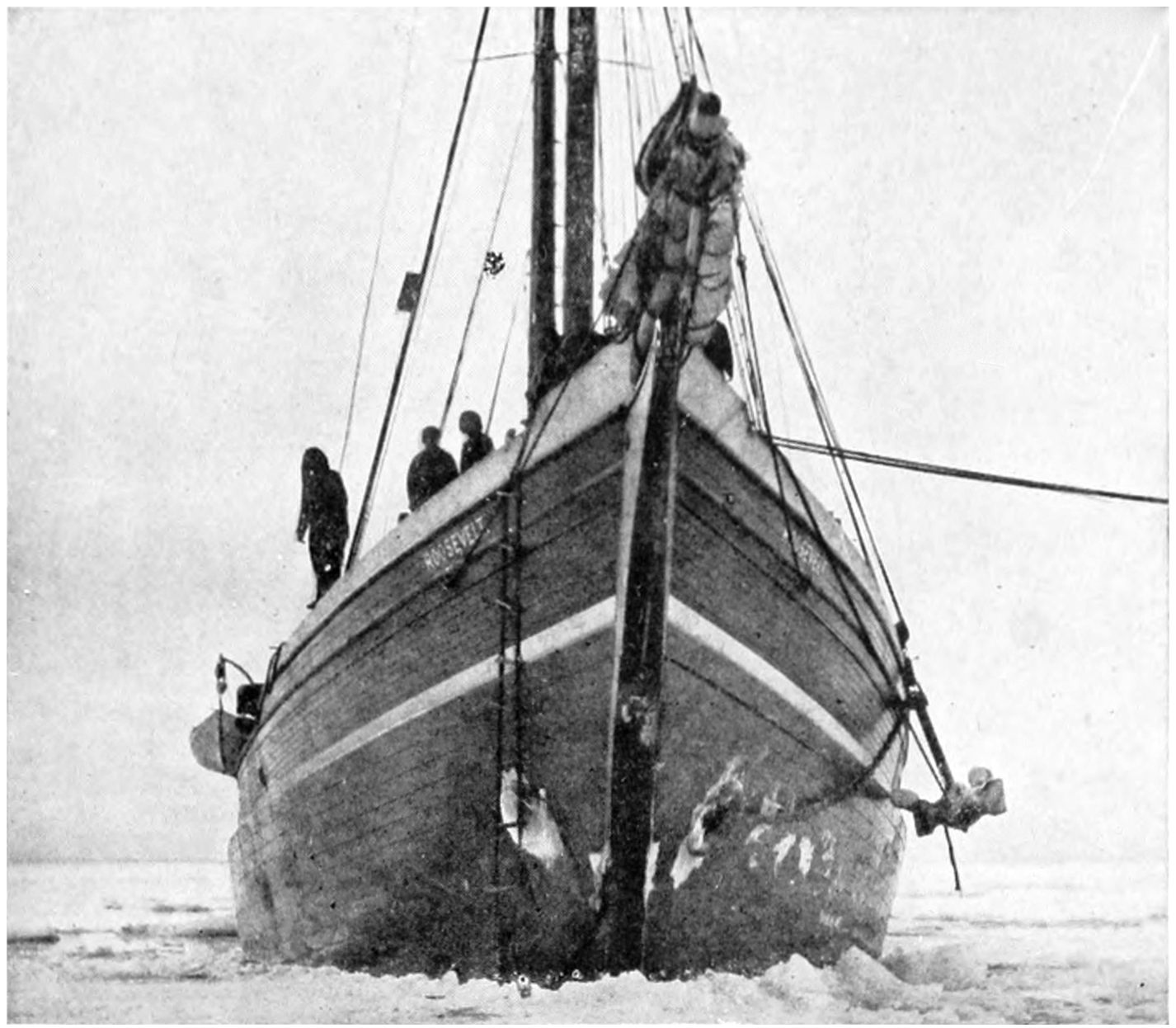
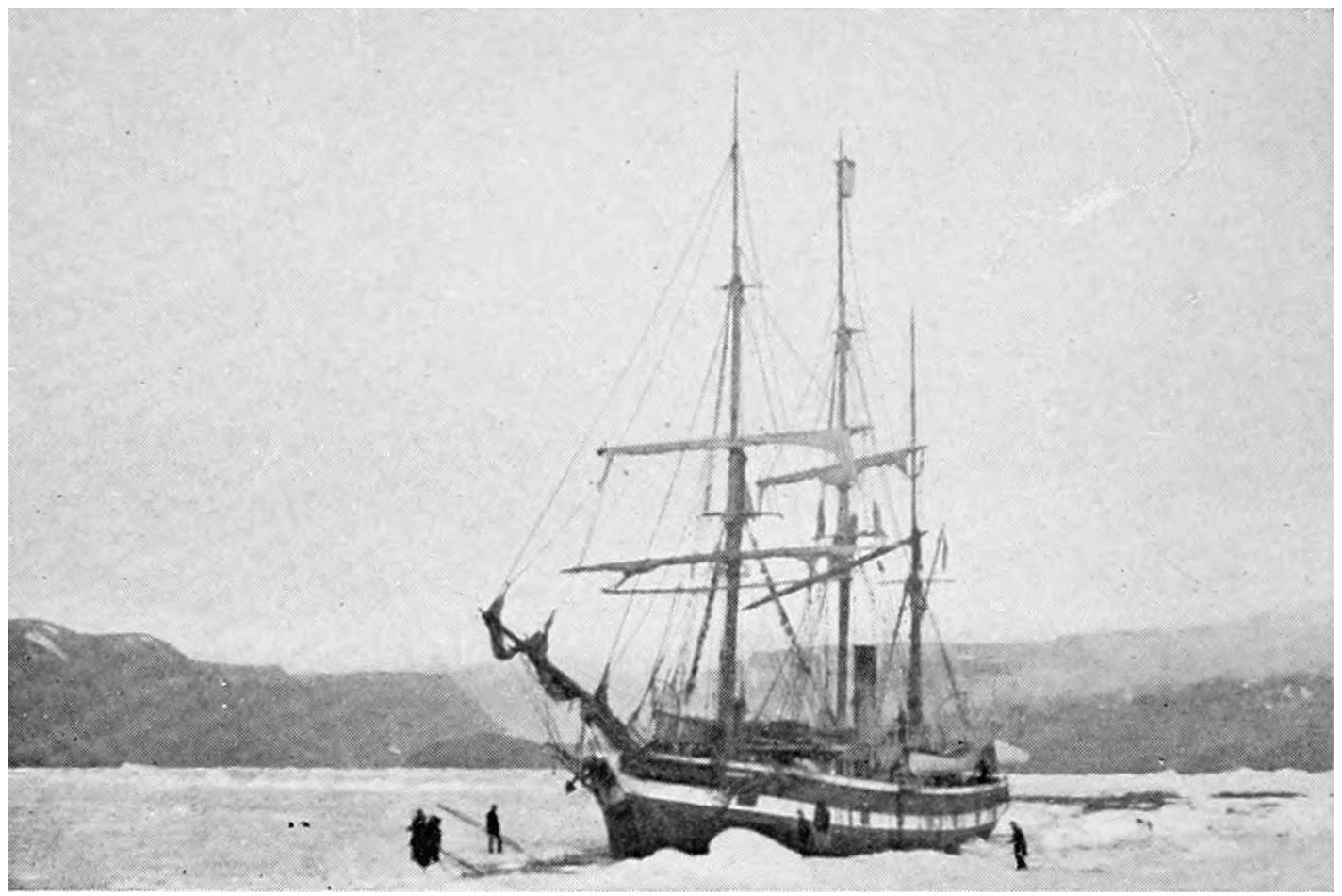
BOW OF THE “ROOSEVELT” IN ICE
Impressive in its massive sturdiness and evident power
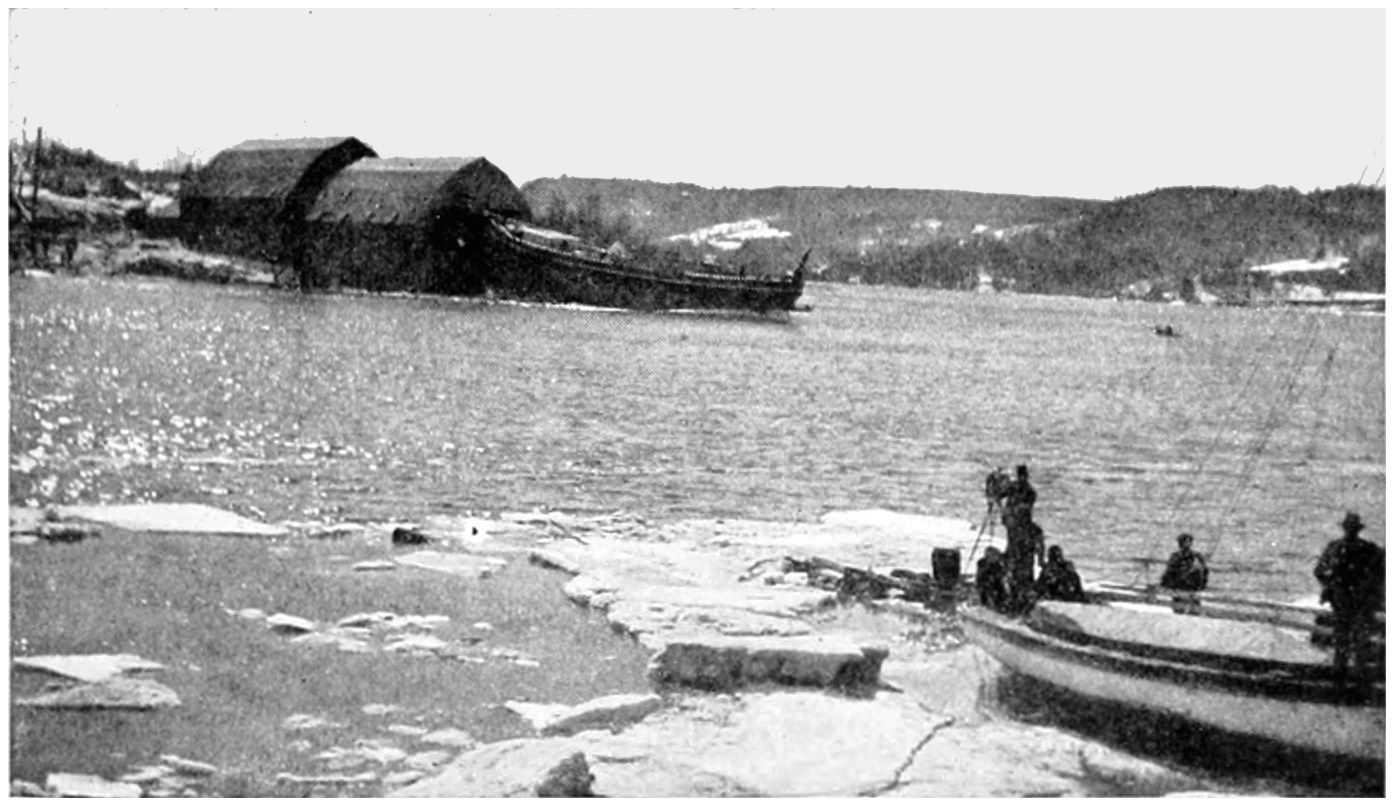
LAUNCHING THE “ROOSEVELT”
Bucksport, Maine, March 23, 1905. Very appropriate that the baptism
of the ship should be in ice-filled water
The second, an observation station at the pole,
might be an adjunct of the first, an overland party
from the head of Weddell Sea establishing and
provisioning the station. The traverse of such a
party from the head of Weddell Sea to the south
pole would, with the journeys of Amundsen,
Scott, and Shackleton from McMurdo Sound on
the opposite side, give a complete cross section
of the antarctic continent.
The natural conditions in the antarctic region,
that is, a continuous permanent surface from year
to year, as compared with the north polar ocean,
which may become intersected with lanes of open
water at any time as the result of a storm—makes
it possible for a party equipped like my north-pole
party, to establish and maintain a regular
route and system of transporting supplies right
through the antarctic night. Or a few aëroplanes,
working from a base at the head of Weddell Sea,
could in a few weeks of the antarctic summer provision
such a station for a year, as British planes
in the Mesopotamia campaign carried supplies to
Kut-el-amara.
Such a station, by making simultaneous observations
with other existing stations, ought to add
greatly to our meteorological and magnetic knowledge.
If at the same time a similar station at
Cape Columbia, the most northerly easily accessible
point of land in the arctic regions, should be
established, and take synchronous observations,
the value of all would be still further increased.
The Cape Columbia station like the one at the
south pole could be established and provisioned
by aëroplanes in a few weeks from Whale Sound
less than 400 miles distant and easily accessible
every summer. With two such stations at the extremities
of the globe observing simultaneously
with selected stations in the inhabited portions of
the world, there would certainly result a broader
knowledge of meteorological, magnetic, and other
natural conditions. The proposition has the approval
of distinguished scientists, and will undoubtedly
be eventually put in execution.
The third proposition, a complete systematic
study of the entire periphery of the antarctic
continent and its adjacent waters by a party of
scientific experts in a special ship during a succession
of seasons, would appeal most strongly to
the scientists and museums of the country.
It would be an American Challenger expedition,
with all the improvements and widened horizon
of investigation that forty-four years of scientific
progress represent. Such an expedition with
good fortune could complete the circuit of the Antarctic
continent in three or four seasons, coming
north to pass each winter at some convenient port
as Punta Arenas in the Straits of Magellan; Wellington,
N. Z.; Hobart, Tasmania and Cape Town.
Each year the observations and collections could
be sent home, and any necessary changes be made
in the personnel.
The materialization of this program will give
our museums a large amount of valuable material
from a region which at present is most meagerly
represented in their collections, and will furnish
our scientists with material and observations to
keep them occupied for years.
The financing of the work could be met by a
group of American museums. Or it presents an
opportunity for some man of means to place himself
permanently in the scientific record of the
nation by furnishing the funds for its realization.
CHAPTER II SELECTING MEN
In my polar parties the matter of personnel has
been different from that of other expeditions
because of my extensive utilization of the Eskimos.
From the beginning of my interest in polar
matters my conception of an ideal polar party was
one in which the rank and file should be composed
of Eskimos, with one or more white men in command.
But I was not able to realize this ideal at the
start of my polar work, and in my first expedition
the entire work was done by the six members of
my party. In my second expedition the Eskimos
assisted for a short distance on the ice-cap.
In the work and journeys of my long expedition of
1898–1902 (four years, three months, and seventeen
days), my plans crystallized into actual shape,
and all parties were made up of Eskimos and a
white man or two, sometimes one member of my
party commanding fifteen or sixteen Eskimos. In
my last two expeditions of 1905–06 and 1908–09
the system was still further perfected.
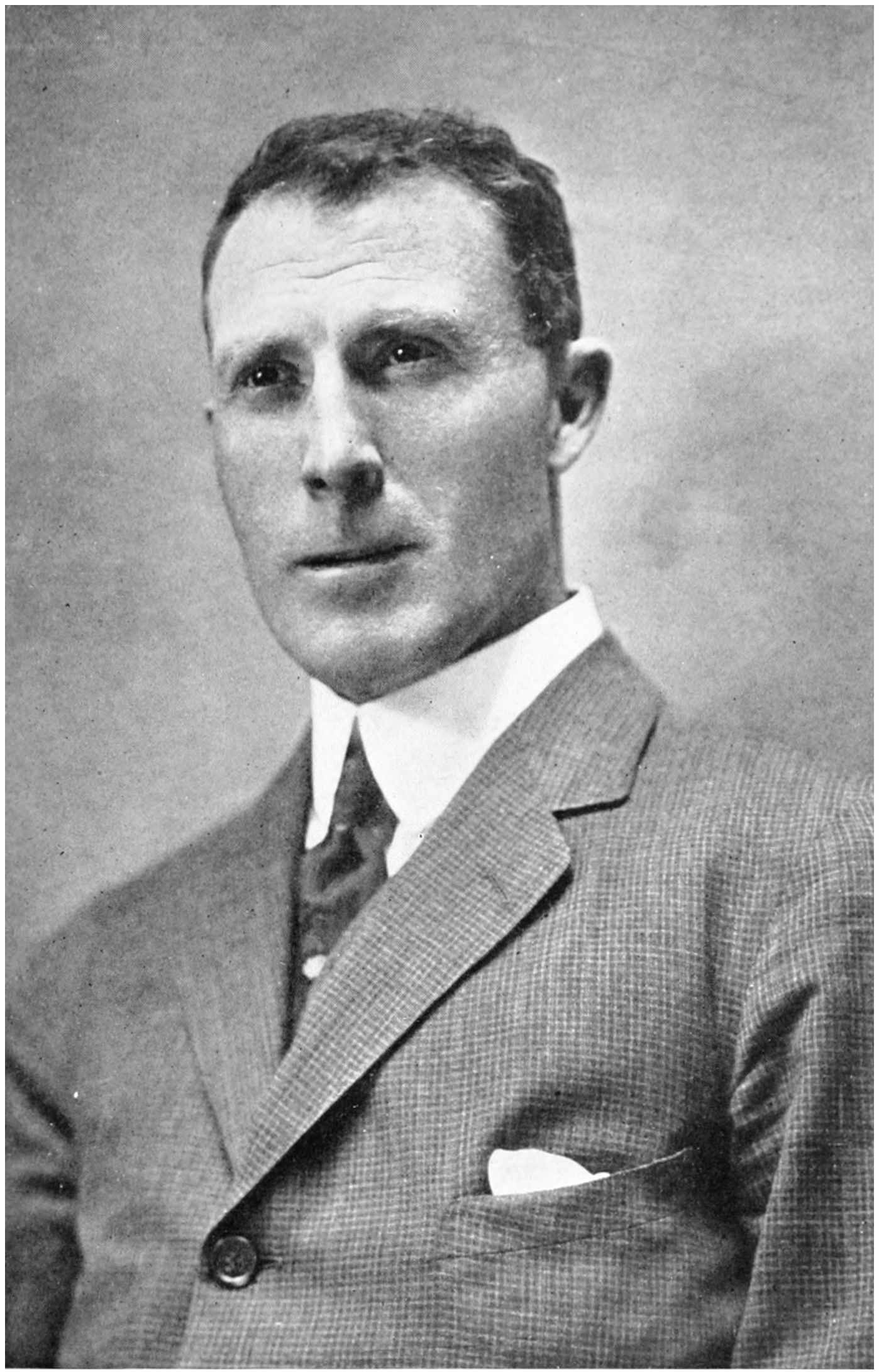
Courtesy of the American Museum of Natural History
CAPTAIN ROBERT BARTLETT
In these last two expeditions another phase entered.
With the close of my 1898–1902 expedition
I had worked out the ultimate possibilities of
sledging from a base south of the 79th parallel,
and recognized that the pole could not be reached
from such a base. The preliminary journey from
the base to the most northern land made too serious
a drain upon the energies of dogs and men
to enable them to negotiate the final and most
difficult part of the journey over the surface of
the polar ocean. The only answer to the problem
was a ship which would put me within striking
distance of the pole.
The result was the Roosevelt, and in my last
two expeditions the presence of a ship added to
the personnel of my expedition the new element of
ship’s officers and crew. Thus in the final evolution
of my work my parties were made up of three
elements: myself and my assistants for the exploration
sledge-work; the ship’s officers and crew;
and the Eskimos, these last being more numerous
than both the others combined.
The Eskimo element is taken up more fully in
another place, and I shall not go into it here. The
selection of the ship’s personnel threw no burden
of time or attention on my shoulders, as, with the
exception of the chief engineer and his assistant,
whom I myself selected, and who were Americans,
I turned this matter over to Bartlett, himself a
Newfoundlander, and held him responsible for a
picked crew of these ideal, hardy ice-navigators.
In the general scheme of work it was not expected
that any of this ship personnel should take
part in the sledging expeditions. Bartlett’s
eagerness to have a share in the sledge work, however,
together with his personal qualifications,
made him an invaluable addition to my field
parties, and two or three of the men before the
mast volunteered for, and did good, preliminary
depot and hunting work.
My own particular work of selecting personnel
was confined, therefore, to the limited number of
my own assistants, and in the last expedition three
of these, Henson, Percy, Marvin (I mention them
in the order of length of service), were tried and
faithful men from previous expeditions.
The day of large parties in successful polar
work has passed. Effective results in these regions
can, and in the future will be, obtained by
very small parties. The records of some of the
earlier expeditions show the fallacy of the popular
idea that there is safety in numbers.
Franklin’s party of 138 men, the largest in the
history of polar exploration, equipped with everything
that the ample resources of the British Government
could provide in that day, met with disaster,
not a single member surviving to tell the
fate which overtook them. Too large a party
was, in my opinion, the direct cause of the utter
loss of this expedition, and many of the tragedies
which have preceded and followed it would not
have occurred had the parties been small ones.
The whole situation in polar regions is against
large parties. Starvation is inevitable when, as
a result of the loss of ship or supplies, a large
number of men find themselves dependent upon
the resources of the country even for a short time,
whereas a small company would have an abundant
food-supply. On more than one occasion, on
long sledge journeys with one or two companions,
a single hare has made a hearty meal for us,
which, followed by a good sleep, made it possible
for us to travel some days more without meat.
Had there been five or six of us, the portion of
each would only have aggravated our hunger, and
the strength and endurance of none would have
been materially increased.
An illustration of this is an incident in the land
beyond the ice-cap on my second trip across
northern Greenland. Five hundred miles separated
me and my companions from any other human
beings. Then I wrote:
I saw a fresh hare-track, and a few hundred yards beyond
came upon the hare itself, squatting among the rocks a few
paces distant. With the sight of the beautiful, spotless little
animal, the feeling of emptiness in the region of my stomach
increased. I called to Matt, who was some little distance back,
to stop the dogs and come up with his rifle. He was so affected
by the prospect of a good supper that, though usually
a good shot, his first and second bullets missed the mark; but
at the third the white object collapsed into a shapeless mass,
and on the instant gaunt hunger leaped upon us like a starving
wolf upon its prey. A little pond, surrounded by high banks
a short distance away, offered the advantage of ice for cooking
purposes, and here we camped, lit our lamp, and cooked and
ate the entire hare. It was the first full meal we had had since
the Eskimos left us thirty-five days ago—the first meal possessing
proper substance and staying quality to fit a man for a
heavy day’s work.
While we were enjoying our feast, it began snowing, and at
its conclusion we lay down as we were, upon the snow-covered
shore of the little pond, without tent or sleeping-bag or anything
except the clothes we wore, and, with the snowflakes
falling thickly upon us, slept.
Demoralization is also much more easily caused
by a disloyal or cowardly member in a large party
than in a small one. The success of any expedition
depends upon the magnetism and force of its
leader. His example is contagious, his courage,
activity, and cheerfulness being reflected in each
person of his party up to a certain mark.
But the infusion of fresh courage into a member
whose mental and physical strength has been
impaired by cold, hunger, or discouragement is a
drain upon the leader’s nerve force. The larger
the party, the more difficult it becomes to fill it
with courage and hopefulness when confronted by
serious disappointment or disaster, or to put down
insubordination. The impetus of a sledge party
in particular centers in the physical condition of
its leader, and my various sledge-journeys have
shown me how vital it is that things that drain
his energies should be reduced to a minimum.
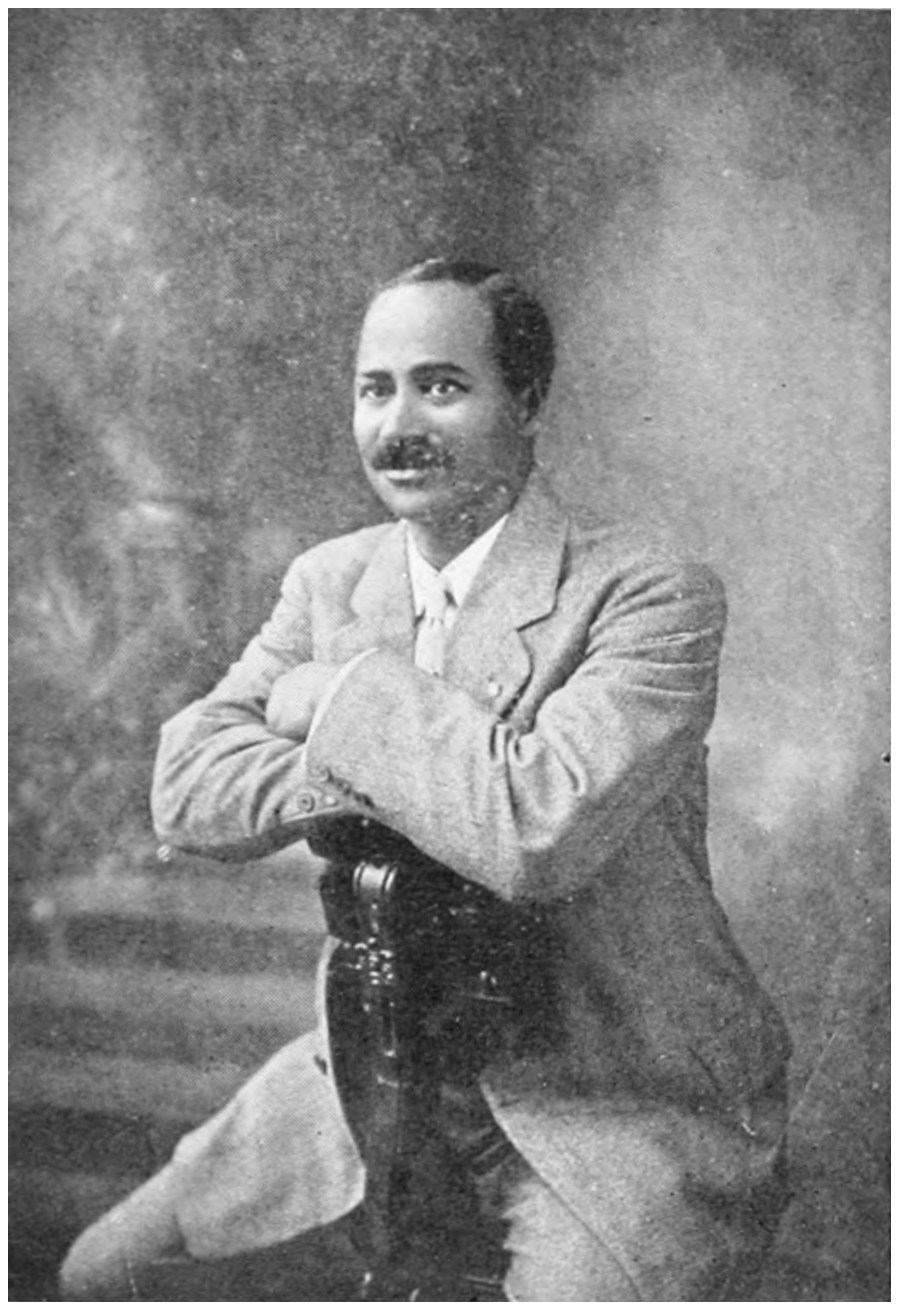
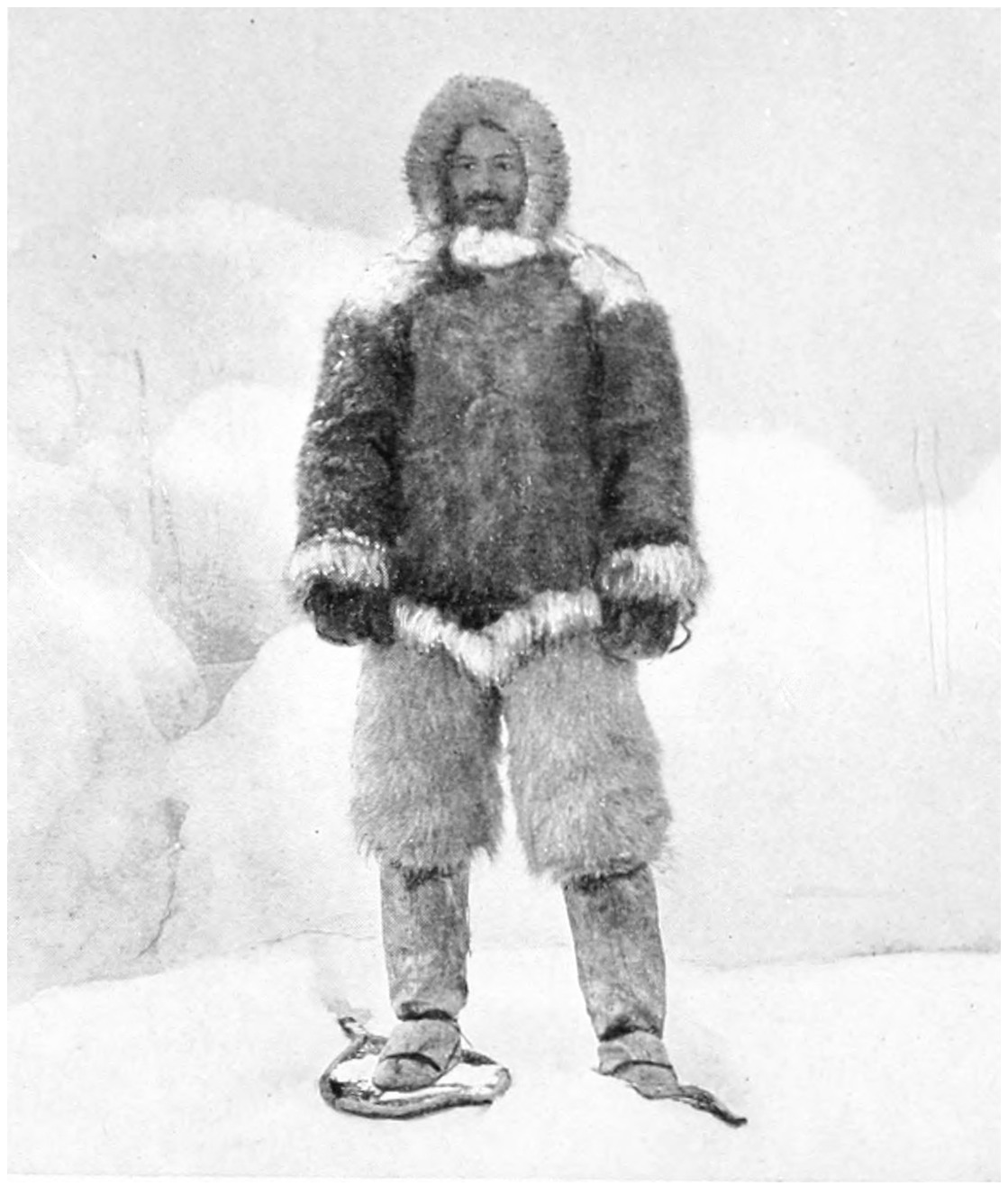
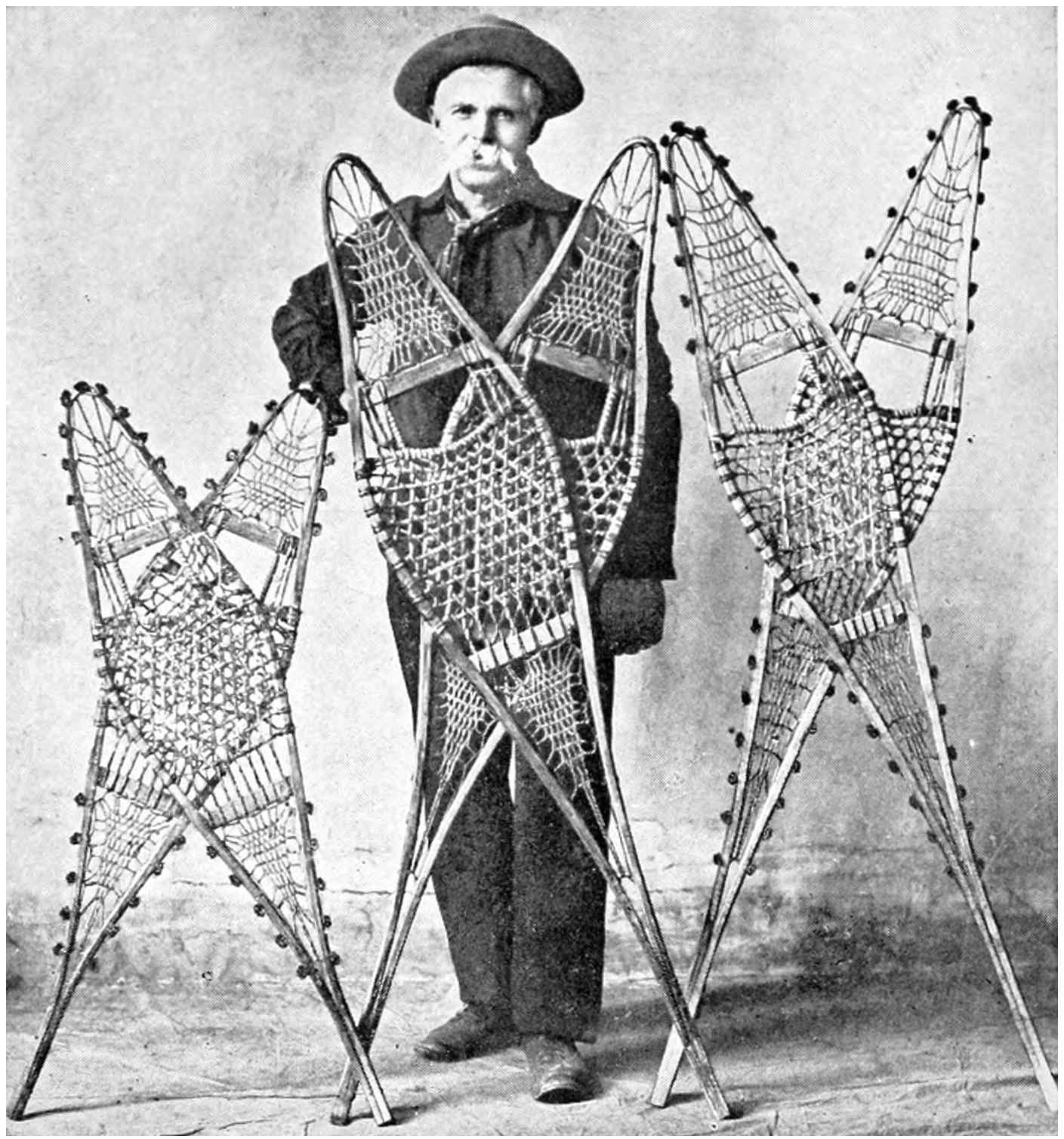
MATTHEW A. HENSON
HENSON IN FULL WINTER COSTUME WITH SNOWSHOES
Next after the leader and a suitable ship, is an
ice master, and an ice navigator must be born to
the art.
He must possess good judgment, nerve, endurance,
quick decision, and an uncanny prevision as
to what the ice is going to do next.
Bartlett is the type I have in mind, accustomed
to the ice and to ships from his early teens, wide
experience in different portions of the globe,
great endurance, abundant nerve, good judgment,
and with the intensive training and experience of
two voyages with me in what is probably the
worst ice-navigation of the north polar regions.
To this has now been added his unusual experience
during his voyage in the Karluk in Bering
Sea.
Much has been accomplished by small parties in
polar work. Schwatka made his great sledge-journey
with four white men and an Eskimo.
Captain Holm made his eastern Greenland trip
with four men; Payer’s party of seven in Franz-Josef
Land was found impracticable, and was reduced
to three. Striking examples of what one
determined man can accomplish are found in the
records of Hall’s early explorations and Graah’s
sledge-trip along the eastern coast of Greenland.
Nansen’s most striking work was done with a
party of two. Captain Cagni’s main party to the
then highest north, 86° 34´, numbered four.
Amundsen reached the south pole with a party of
five. Scott’s south pole party numbered five.
Stefansson did valuable work through several
years with one companion. My own work has
been done with from two to six in the party, the
latter being the number in my north pole party.
I have always limited my parties to the number
absolutely necessary for the work I had laid out,
believing that every addition means an element of
danger and failure. My reconnaissance of the
Greenland inland ice in 1886, resulting in the penetration
of the ice-cap to a greater distance than
ever before by a white man, and the attainment
of the greatest elevation on the ice-cap, was made
with only one companion.
My Greenland expedition in 1891–92, the record
of which includes the determination of the insularity
of Greenland, a survey of Inglefield Gulf
and Whale and Murchison sounds, the first accurate
and complete record of the arctic Highlanders,
was composed of seven members. And the
1200-mile sledge-trip across the Greenland inland
ice-cap was accomplished by me and one companion.
The work of my expedition of 1893–95, covering
a period of twenty-five months, included a second
sledge-journey of 1200 miles across the ice-cap,
the discovery of the Cape York meteorites, the
completion of the survey of the region about
Whale Sound, and the completion of the study of
the natives. There were fourteen members in
this party, eleven of them returning in August,
1894, leaving three of us to carry on the work for
the last year. Summer trips were made in 1896
and 1897 to secure the last and largest of the
meteorites. There were five men in the first
party, seven in the last.
Twenty-one white men, including the crew and
firemen of the Roosevelt, and forty Eskimos made
up the personnel of my 1905–06 expedition, which
resulted in the attainment of “farthest north.”
The personnel of my last and successful attempt
to reach the pole (1908–09) included twenty-two
white men and forty-nine Eskimos.
As to the quality of the personnel of a polar
expedition, my experience has proved over and
over again the accuracy of my theory that it
should be made up wholly of young men, of first-class
physique, perfect health, education, and attainment.
Such men, interested in their work and
the success of the expedition, with resources
within themselves and plans for the future, are
able to resist in a large measure the depressing
effects of the long polar night, and in field-work
their enthusiasm more than makes up for lack of
experience or toughened endurance.
To nine out of ten the word polar is synonymous
with cold. To one who has spent a year
within the arctic or antarctic it is more likely to be
synonymous with darkness. Any healthy man
properly fed and clothed can pass the year in these
regions with little discomfort so far as the cold
is concerned. But when it comes to almost four
months of polar night, it is different. A man of
the most sanguine temperament cannot avoid entirely
its effects, and there are those of nervous
temperament whom a night in the arctic would
drive insane. Not that it is so extremely dark,
for the three or four winter moons give a brilliant
light, and at other times the darkness is not
greater than at home on starlit nights in the
winter. It is only during heavy storms that the
darkness becomes intense and tangible. It is
the absence of the actinic or the physiological effects
of the sun’s rays and the contraction of the
physical horizon by the darkness which render a
polar night so trying. As far as I was able I have
selected blondes for the personnel of all my expeditions.
Men for the field-parties should be wiry, and
their weight should be within the limits of not
less than two pounds, nor more than two and a
half pounds per inch of height. This means for
a six-foot man a minimum of 144 pounds, a maximum
of 180 pounds, and a mean of 162 pounds.
When I returned from the north pole sledge-trip,
which was a trip of arduous and protracted
exertion, but not a journey on half-rations, as had
been the case on some of my earlier trips, my own
weight, stripped to the buff, was 160 pounds,
which, by the way, was the same weight to which
I trained for my junior-class crew in college at
the age of twenty.
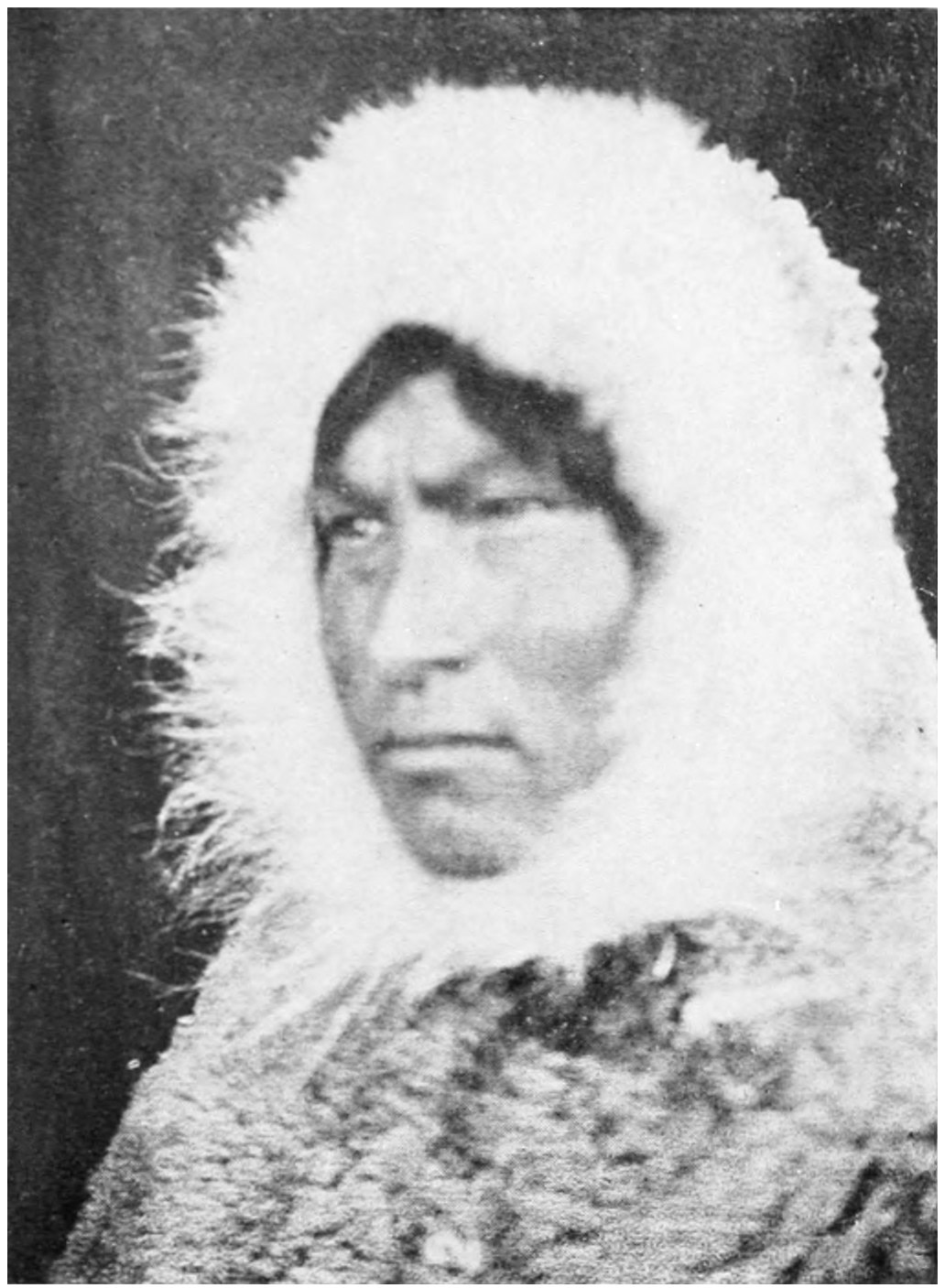
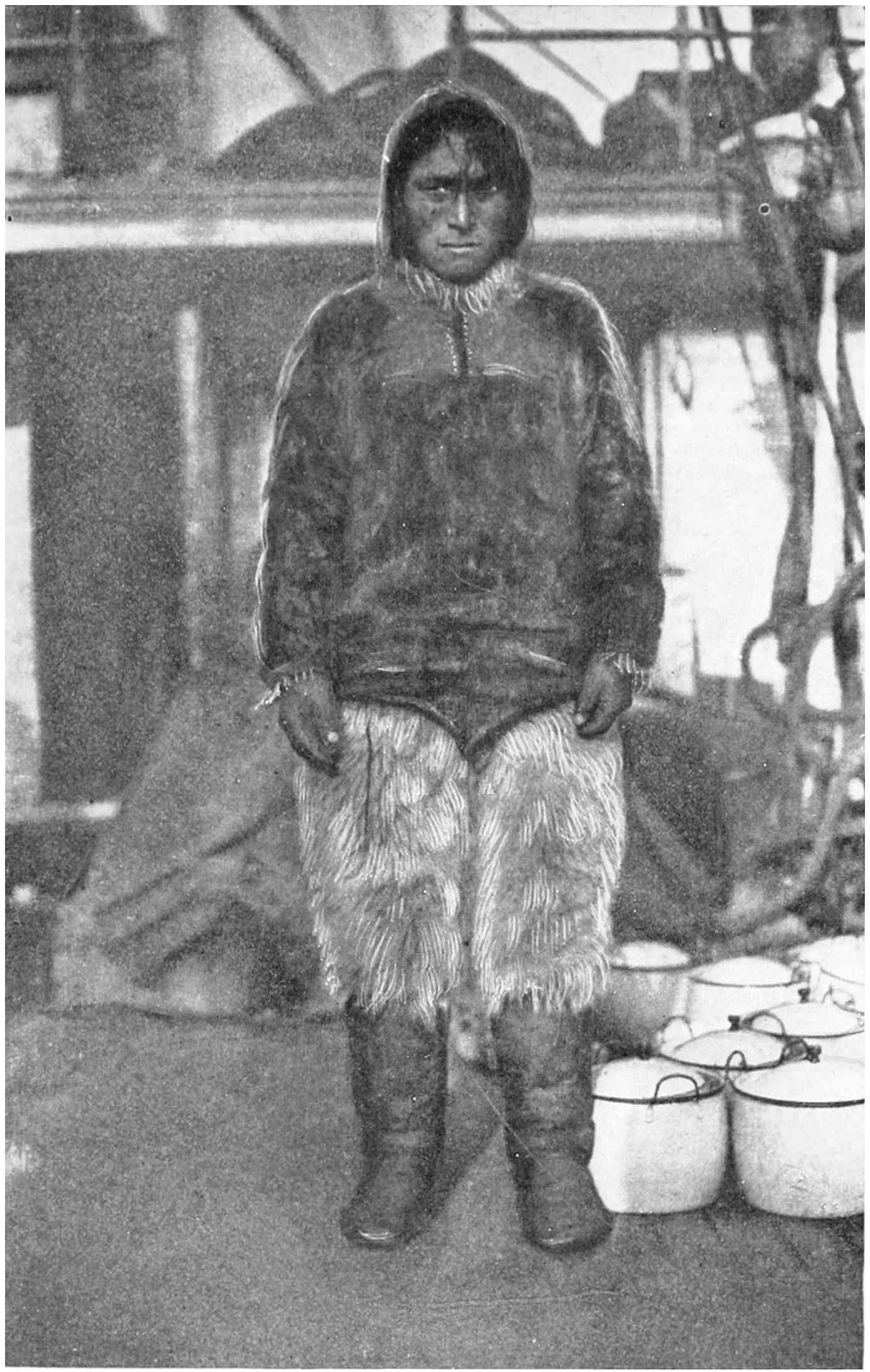
OO-TAH
This photo of my best Eskimo, taken immediately
after our return from the North Pole, indicates the
type of Eskimo for Polar work. The portrait shows
the protecting roll of bearskin about the face.
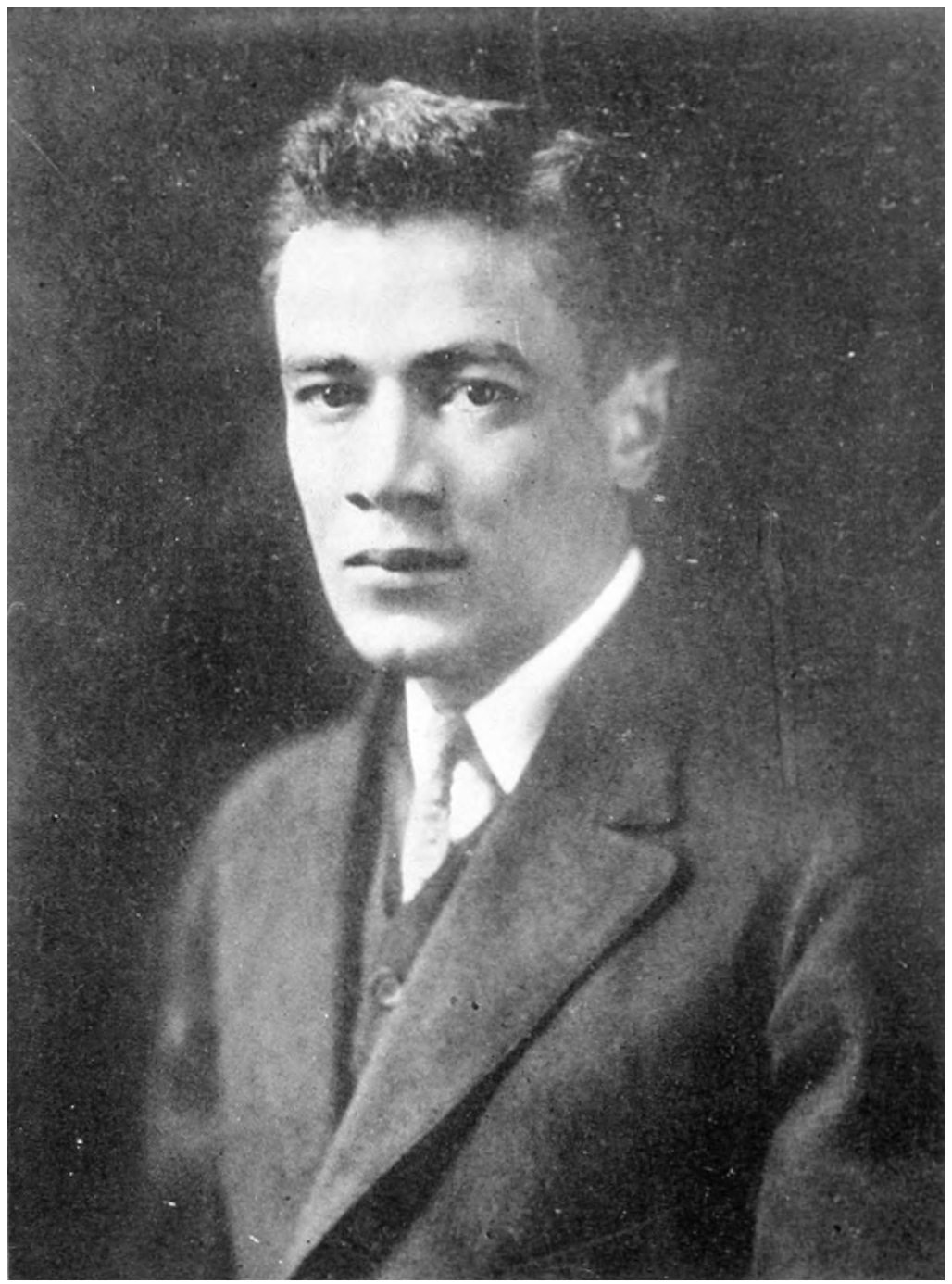
Courtesy of the American Museum of Natural History
GEORGE BORUP
Small, wiry men have a great advantage over
large ones in polar work. The latter require
more material for their clothing, and usually eat
more than the former. Large men take up more
space than small ones, necessitating the building
of larger snow igloos when on the march, or the
carrying of larger tents than would be needed for
a party made up of small men. Every pound in
weight beyond the maximum requirement tends to
lessen a man’s agility; in fact, renders him clumsy
and more apt to break his equipment. For instance,
if a large man on snow-shoes stumbles, a
sudden lunge to save himself more often than not
results in a broken snow-shoe. The decided disadvantage
which a large man is under in crossing
a lead or new ice is apparent. This was brought
to mind with striking forcefulness in crossing the
“Great Lead” on our return from “farthest
north” in 1906, when my little party came the
nearest we have ever come to death. Two miles
of young ice, which would not for an instant have
supported us without snow-shoes, had to be
crossed, the party spreading out in widely extended
skirmish-line, with fifty or sixty feet between
each man, each one of us constantly and
smoothly gliding one shoe ahead of the other with
the greatest care and evenness of pressure, the
undulations going out in every direction through
the thin ice as we advanced.
I was the heaviest one in the party,—160 pounds
net,—and fortunately I had six-foot snow-shoes.
Yet for a considerable part of the distance I
doubted if I should ever reach the firm ice. The
chief engineer of the Roosevelt was a heavy man,
weighing 235 pounds or more, and as we stooped
to untie our snow-shoes on firmer ice, one of my
Eskimos, Ahngmalokto, turned to me with the remark
that if the chief had been with us, he never
would have reached firm ice. And he was quite
right.
Some Arctic travelers advise against having
men who have had previous polar experience, as
likely to make them opinionated and insubordinate.
There is much in this, and it is a precept well to
be followed particularly if the leader is new at the
work. Few men, having had experience in a certain
direction and associated in a subordinate
position with an inexperienced leader, are big
enough to be loyal to their commander.
The usual result is constant slurring criticism
which is sure to have its effect upon other members
of the expedition, and opposition either direct
and active or sullen and passive.
The last man of all is the one who is always
wondering whether he will ever get back home
or not, and is constantly congratulating himself
as a hero because he is in the terrible polar regions
and still alive.
I know of no better test of character than a season
spent in the polar regions. In these regions
men get to know one another better in a few
months than they would in a lifetime at home.
There is something about the life which very
quickly shows the true caliber of a man. If he is a
cur, or has a yellow streak it is sure to come out.
In making up my last party I was exceptionally
fortunate, for I had the membership of the preceding
expedition to select from. Every one was
glad to make the success of the expedition first and
personal feelings and ambitions secondary. My
party was efficient and congenial, and never had I
spent a winter in the arctic so free from friction
and petty annoyances.
CHAPTER III SUPPLIES AND EQUIPMENT
The detail of equipping a polar expedition is
like the detail of equipping an army for
foreign service, with, however, this difference.
After the expedition has cast loose from civilization
there is no chance to rectify mistakes or
omissions. No rush wires or cables can be sent
back to ship this or that article by next train
or steamer. The little ship which bears the hopes
of a polar expedition must contain in its restricted
space everything to supply all the needs
of its people for two or three years in a region
where nothing can be obtained but meat, and even
that only by those who possess the “know how.”
Even when the needs are reduced to almost
primeval simplicity, the multiplicity of essential
things is great.
As an illustration of how an article, though so
common that, like breathing, we are unaware of
it, may be overlooked, it is said that a great polar
expedition costing hundreds of thousands of dollars,
and fitted out under the supervision of
committees of scientists and polar experts, discovered,
when it reached its winter quarters, that
there was no salt on board except that in the salt
pork and beef.
Supplies for a polar expedition comprise primarily
equipment and provisions. The latter
subdivides again into provisions for ship and
headquarters and provisions for sledge-work.
The former are essentially normal, comprising
standard commercial supplies, the principal thing
being to have the best, and the specialness lies
largely in the packing. The latter number only
four items, pemmican, compressed tea, condensed
milk, hard tack; but they are special in every detail
of make and packing, with the exception of
the condensed milk.
Here are a few of the items and figures on the
list of supplies for one of my last expeditions,
flour, 16,000 pounds; coffee, 1000 pounds; tea, 800
pounds; sugar, 10,000 pounds; kerosene, 3500 gallons;
bacon, 7000 pounds; biscuit, 10,000 pounds;
condensed milk, 100 cases; pemmican, 30,000
pounds; dried fish, 3000 pounds.
To illustrate how normal was our bill of fare
on the Roosevelt in winter quarters, here is our
weekly menu for the winter of 1908–09 (the north
pole voyage):
Monday. Breakfast: cereal, beans and brown
bread, butter, coffee. Dinner: liver and bacon,
macaroni and cheese, bread and butter, tea.
Tuesday. Breakfast: oatmeal, ham and eggs,
bread and butter, coffee. Dinner: corned beef
and creamed peas, duff, tea.
Wednesday. Breakfast: choice of two kinds
of cereal, fish, forward (that is, for the sailors),
sausage, aft (for the members of the expedition),
bread and butter, coffee. Dinner: steak and
tomatoes, bread and butter, tea.
Thursday. Breakfast: cereal, ham and eggs,
bread and butter, coffee. Dinner: corned beef
and peas, duff, tea.
Friday. Breakfast: choice of cereal, fish,
Hamburger on starboard (our own) table, bread
and butter, coffee. Dinner: pea soup, fish, cranberry
pie, bread and butter, tea.
Saturday. Breakfast: cereal, meat stew, bread
and butter, coffee. Dinner: steak and tomatoes,
bread and butter, tea.
Sunday. Breakfast: cereal, “brooze” (Newfoundland
hard biscuit softened and boiled with
salt codfish), bread and butter, coffee. Dinner:
salmon trout, fruit, chocolate.
In addition to the large quantities of the bedrock
staple provisions, there is a long list of odd
and often amusing supplies that would never be
thought of except by those who had already had
polar experience. Yet for the mere problem of
existence in those regions, to the experienced one
the essentials are few, rifle and ammunition,
matches, knife, hatchet, needles.
In my work another special class of supplies
came in, that is, articles for my Eskimos; tools,
weapons, implements, etc., for pay and gifts.
Many details so numerous as to be almost impossible
to remember develop in connection with
polar supplies as the result of experience in various
expeditions. The packing of all provisions
is of the utmost importance. The first requisite
is that everything must be in water-tight packages,
as an insurance against damage or deterioration
if the expedition is a long one, and particularly
as a safeguard against damage and
spoiling in case of injury to the ship or in emergency
transportation in boats or across the ice
under conditions which may mean the repeated
immersion of the supplies in sea-water.
Another fundamental essential is that all provisions
must be in packages not to exceed a
certain maximum weight, which can be readily
handled by one man in loading or unloading a
ship or boats or sledges, particularly in an emergency,
where rapid work is essential.
My standard net weight for every package of
all provisions which were not particularly ship
provisions was fifty pounds. The water-tight
tins and the light box or crate outside of the tin
made the gross weight of packages from sixty-two
or sixty-three to a maximum of seventy-five
pounds. Packages of this size can be easily
picked up and passed up from the hold of a ship
by one man, or can be tossed over the rail to the
ice in case of the crushing of the ship, and they
are easily and rapidly handled by one man in
stowing in a boat or in taking out of a boat.
Another detail of packing provisions which, as
far as I know, was unique and peculiar to my expeditions,
was making the depth and width of all
boxes containing provisions the same, and letting
the length vary in accordance with the specific
gravity of the particular item of supplies. To
illustrate: All boxes of oatmeal, corn-meal, rice,
tea, coffee, sugar, etc., were about twelve inches
wide by ten inches deep, and of a length that would
just contain fifty pounds of the particular article.
Of course a sugar box would be shorter than an
oatmeal or corn-meal box, and a corn-meal box
would be shorter than a box of tea.
The reason for this standardizing of two dimensions
of the boxes was to fit them to be utilized
for constructing houses, being laid up like blocks
of granite, and breaking joints in the same way.
By this method the supplies landed from the ship
at headquarters could easily be formed into two
or three comfortable houses for shelter of the
members of the expedition in case the ship should
be crushed or burned.
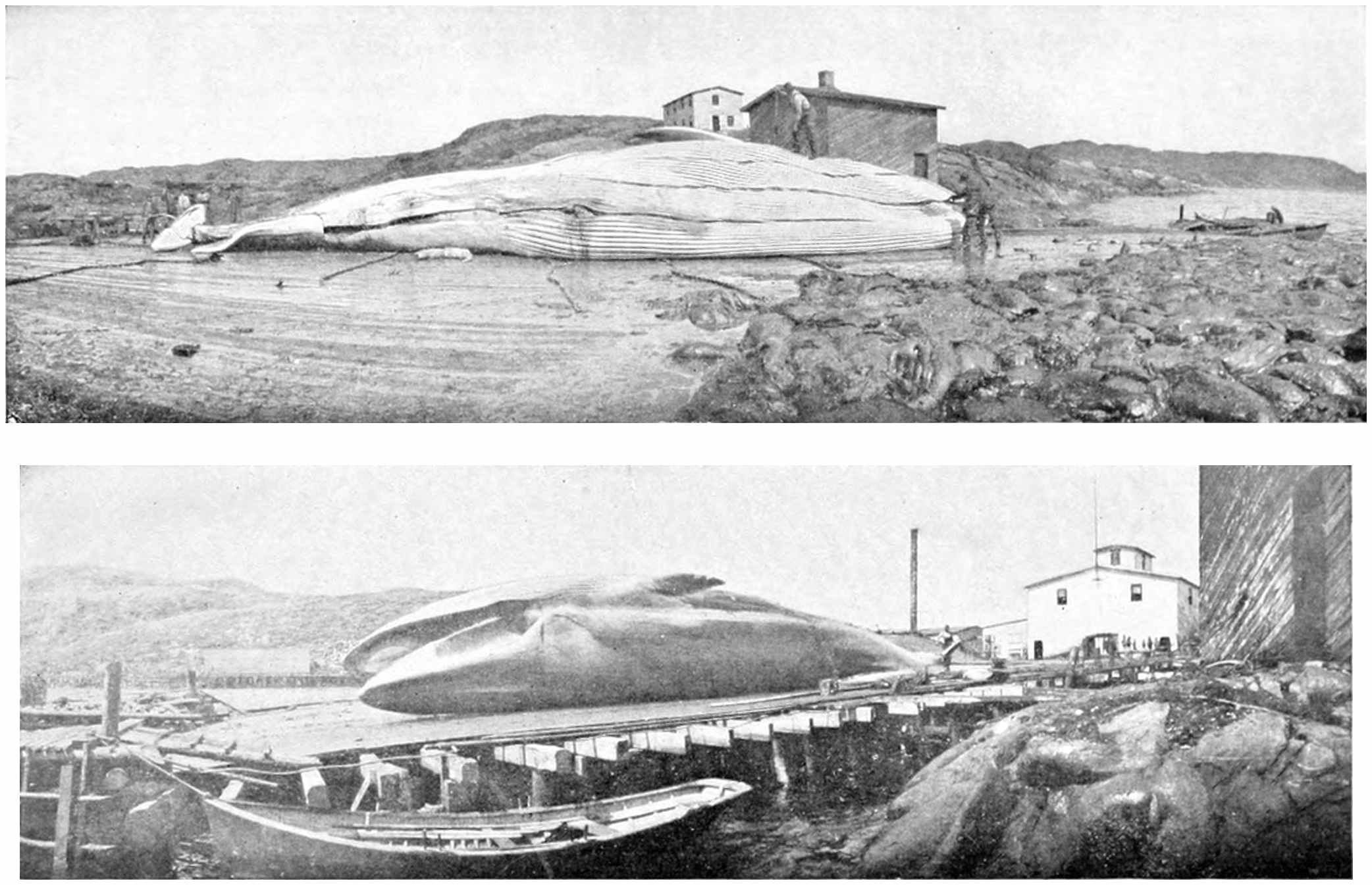
WHALE MEAT FOR DOG FOOD
These houses were built by forming four walls
of the boxes of supplies, with the tops of the
boxes inside; then putting boards or sails across
the top, and banking the whole structure in with
snow. When supplies of any kind were required,
the cover of a box in the wall of the house
would be removed from the inside, the tin containing
the supplies removed, the empty box then
becoming a sort of shelf or locker for other articles,
if needed. The main point, however, was
that all the supplies could be used, and the house
still remain intact.
This method was also valuable wherever large
caches of supplies were made at particular points,
as the supplies formed at once a strong, comfortable,
and rapidly constructed shelter for the use of
parties traveling that route and camping at the
cache.
Another special point was the marking of all
special supplies, such as tea, coffee, sugar, milk,
ship’s biscuit, which might be called the emergency
supplies, on every side with a dash of paint in such
a way that any one, whether able to read or write
or not (or an Eskimo), if able to see one side of
a box, would know at once its contents. This
method of marking was the result of the experiences
of some expeditions previous to mine in
which much time was lost hunting for and endeavoring
to identify supplies.
This method also worked for instant efficiency
in case of emergency, as a man could seize a case
of sugar or coffee to throw over the ship’s side or
out of a crushed boat without any false motions.
All these points were worked out rather carefully,
and in my opinion are so valuable that they
never should be omitted in preparing the supplies
of a polar expedition.
Material for equipment of my expeditions (lumber
for sledges, webbing for dog harnesses, furs
for clothing, tin for making utensils, etc.) was always
taken in bulk and in the rough, partly for
economy in space, partly for economy in cost, and
largely to give occupation to members of the party
during the long winter night in making the finished
articles.
It can readily be seen that in stowing the ship
for the northern voyage, oak and hickory boards
for sledges would stow much more compactly than
the sledge itself, and be less subject to injury. So,
too, with sheets of tin as compared with utensils
made from the tin. With furs the same, for made
up into clothing they would require double the
space taken up by bales.
This method as regards sledge material is
particularly valuable during the upward voyage,
when, as happened much of the time, the ship was
sometimes delayed by the heavy character of the
ice, and would have to lie motionless, with banked
fires, several days in one place. At such times
sledge material was brought on deck, and crew
and Eskimos set to work in the best of light, in
comfortable temperatures, to make and assemble
the sledges. In this way every one was kept occupied
and interested instead of loafing and fretting
at the delay, and the sledges, as completed,
were in readiness for instant use as soon as we
reached winter quarters for the ship. And they
were also valuable for an emergency, in the event
of the loss of the ship, to transport provisions
over the ice to the shore.
The stowing of supplies on board the ship was
done in accordance with a plan worked out almost
as carefully as would be the builders’ plans of the
blocks in a granite building, so that every item
could be located, and the essential supplies and
items of equipment for an emergency—tea, coffee,
sugar, ship’s biscuit, oil, guns, rifles, ammunition,
hatchets, fur clothing—were on top and instantly
accessible. When navigating in ice, tea, coffee,
sugar, ship’s biscuit, and oil were stowed in continuous
lines on deck and just inside the bulwarks
of the ship throughout the waist, quarter-deck, and
on both deck-houses in such a way that one active
man could throw a ton of provisions out on the
ice in a few minutes. This was in addition to
having the whale-boats, as they hung at the davits,
stowed and fitted with rifles, shot-guns, ammunition,
hatchets, oil-stoves, matches in waterproof
packages, together with several days’ rations of
tea, coffee, sugar, milk, ship’s biscuit, and oil.
This was in rather striking contrast to an earlier
American expedition, where, it is stated in the
official report, nearly the entire cargo had to be
overhauled in order to get at some particular
item—guns and ammunition, if I remember aright.
Such experiences as this are striking examples
and illustrations of what my friend Stefansson
has described very effectively in an article entitled
“Incompetence as a Literary Asset in Arctic
Matters.”
In two particular items of supplies my expeditions
have been an antithesis of other expeditions.
In the case of one item in its absence, in the case
of the other in its great abundance. These two
items were meat and flour. As a result of my plan
from my earliest expedition to depend upon the
country itself for my fresh meat supply, I have
never carried any of this in the ship’s stores. On
the other hand, having been most fortunate in my
later expeditions, when I had my own ship, in having
a steward (Charles Percy) who was a blue-ribboner
in making bread and cooking meat, I
have carried large quantities of flour. Some
idea of the amount of this can be obtained by the
fact that in my last north polar expedition, during
the eleven months that the Roosevelt was lying at
Cape Sheridan, Percy baked some 18,000 pounds
of bread.
The members of an Arctic party that have fresh
meat and fresh bread regularly can never have
scurvy, regardless of whether they see a vegetable
or a fruit or lime juice from one year’s end to another.
My work, extending over a period of
twenty-three years, during which no symptoms of
scurvy ever developed, has shown conclusively
that white men can remain in the highest latitudes
for a period of years with complete immunity from
the dreaded scourge.
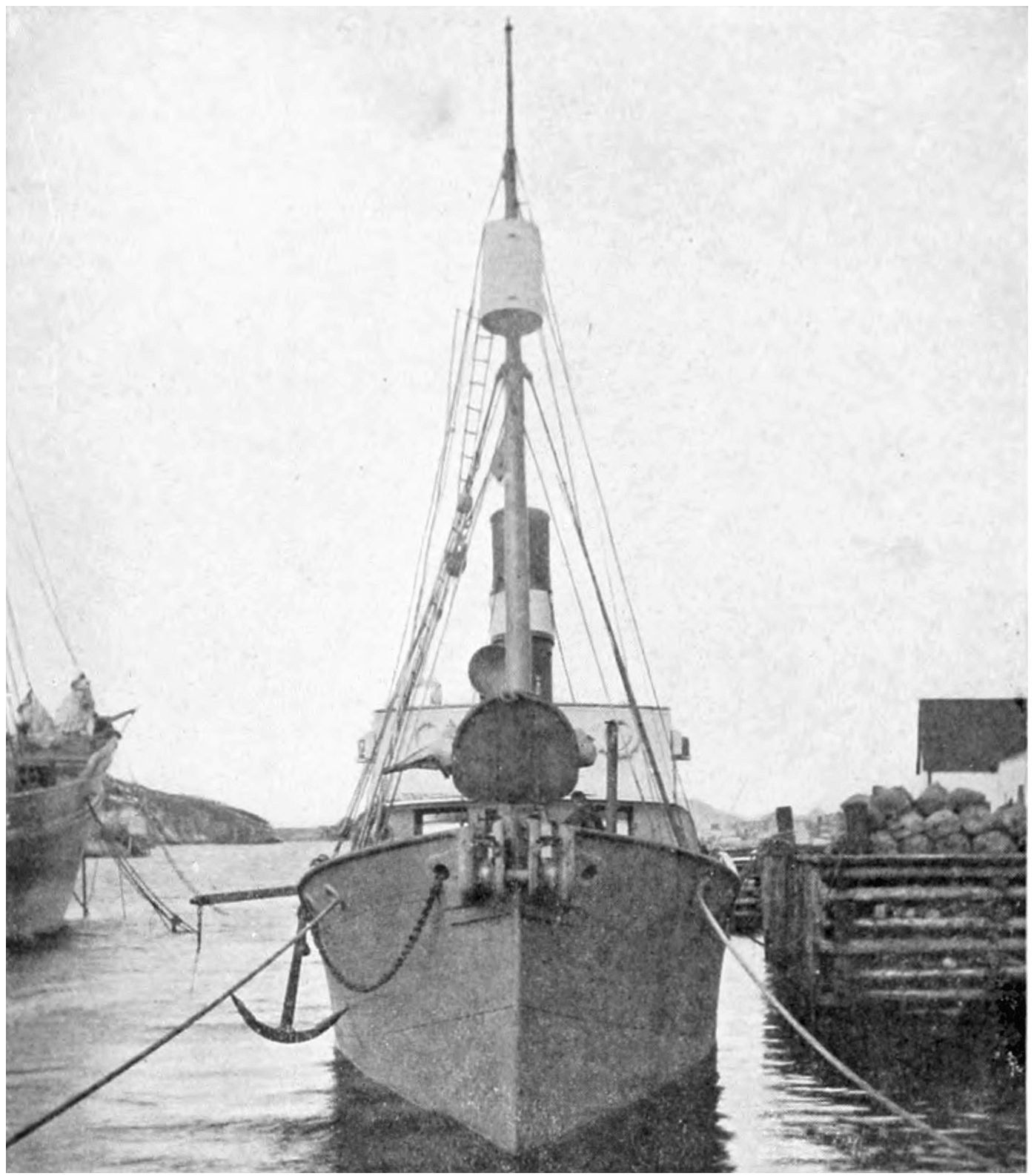
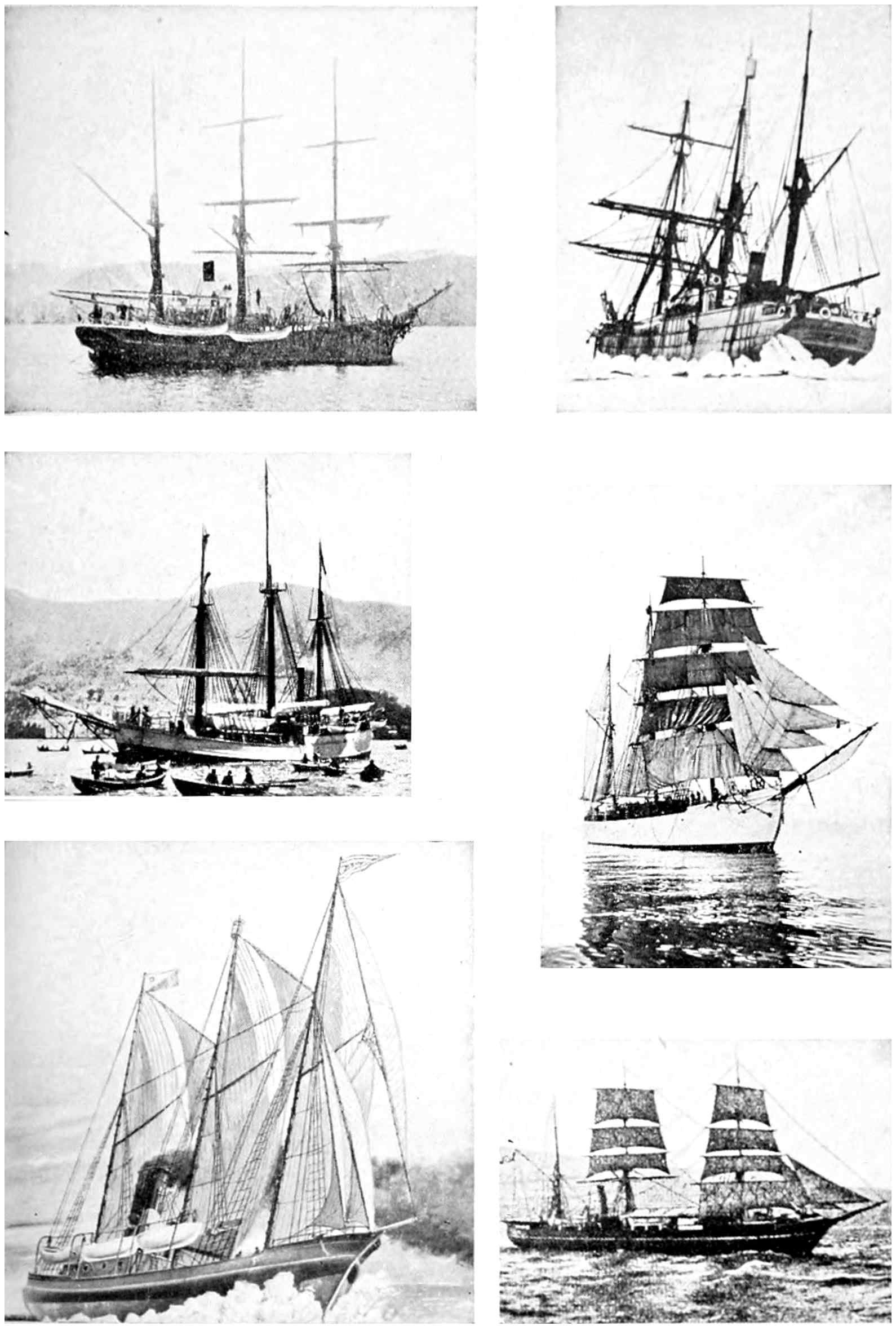
LABRADOR WHALING STEAMER
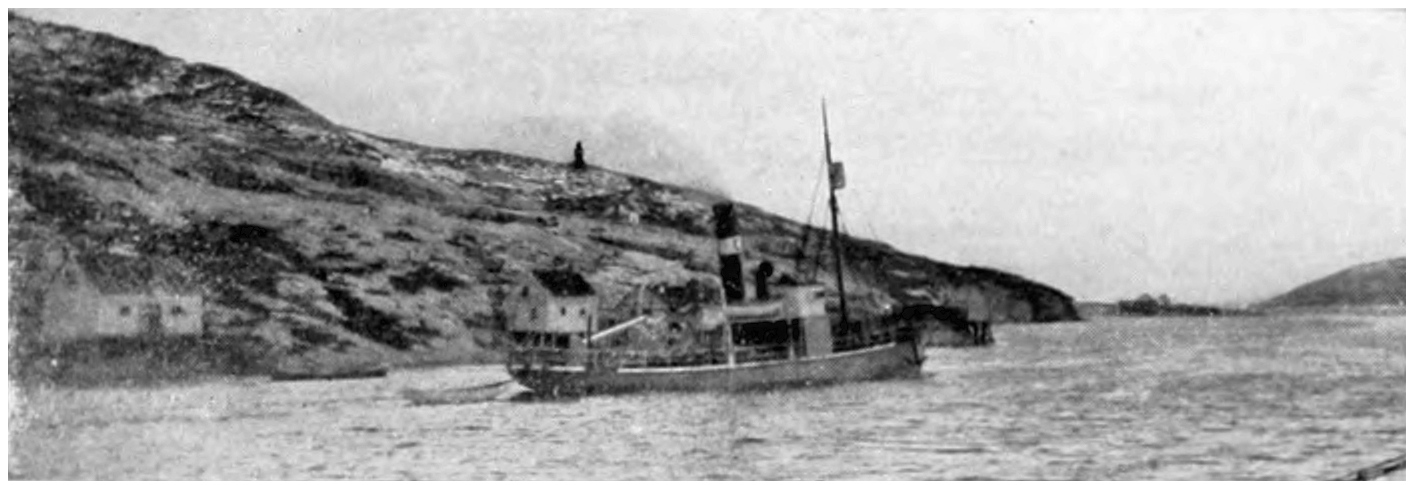
OFF FOR WHALES—LABRADOR COAST
When it came to the matter of sledge-supplies,
even greater care in packing was applied. Pemmican
for the dogs was put up in tins just as long
as the width of my sledges, so that in a standard
sledge-load of dog pemmican the tins formed a
continuous flooring to the sledge. The pemmican
for the men was put up in tins that were creased
in such a way that the block of pemmican, when
removed from the tin, was lightly scored in a way
that marked it off into one pound cakes, and whoever
had the distribution of the pemmican ration
at a camp had only to insert a hunting-knife or
saw-knife or edge of a hatchet into these marks,
and with a blow or two separate the pemmican at
once into standard rations.
All these refinements and details may seem
amusing to those who have read the accounts of
some polar expeditions where such supplies as
ship’s biscuit or flour or the like were carried in
bags, with no protection from moisture or water,
and where contact with the sharp edges of ice or
the sledge could easily punch a hole through a bag,
with a consequent loss of some of the provisions
before the mishap was noted.
Some of the same expeditions would get out
their scales at each camp and carefully weigh out
the various amounts of each item of the rations.
On my polar expeditions my ship’s biscuit
were all made rectangular in form and sixteen
to the pound, so that the matter of adjusting
the size of a ration of biscuit was simply the matter
of counting a certain number. If it was a full
ration,—that is, a pound per man per day,—then
the number of biscuit was sixteen. If it was half-ration,
eight; a quarter ration, four.
These things may seem trivial to some readers,
but every movement and operation which can
be eliminated and every minute that can be
saved under the trying accompaniments of cold,
wind, hunger, and fatigue, which are inevitable in
polar travel, make for the conservation of the energy,
vitality, and morale of the members of the
party.
My last two expeditions carried no food experiments,
no wonderful preparations, no condensed
products of astonishing powers. I had been
through all this in earlier expeditions, and had
tried preparation after preparation, only to find
them of no value on the serious northern sledge-journey,
which was the object and climax of each
expedition. For that journey only the four tried
articles, pemmican, tea, condensed milk, and hard
tack, are necessary, and I could not change or better
them for another expedition. On various expeditions
I made and tried out several food mixtures,
but discarded them all after trial.
In obtaining many of the special items of materials
a great deal of time was spent searching
through the stores in various places for the particular
thing needed.
To obtain a particular size and shape of aluminum
dish all in one piece, for a detail of my special
alcohol field-stove, I have gone over the entire
aluminum stock of New York’s great department
stores, and then through the catalogues of all the
manufacturers, till I found what I wanted or
something that could be made to meet my requirements.
Another thing that I recall was steel sledge-shoes.
It would seem a simple thing to find in any
place that dealt in steel, strips of the metal two
inches wide, one-eighth of an inch thick, and fifteen
feet long, yet it took me two expeditions to find
just what I wanted. The steel for my purpose
must be soft enough so that I could drill it in the
field, yet hard enough so that the constant use
would not too quickly wear it through. Then the
edges of the steel must be sharp, like the edges of
a skate, so that the sledges would not slew heavily
sidewise, with almost certain injury, and so they
could be tilted on the edge of one runner, like a
skater doing the outer edge, without losing grip
on the ice. This is a favorite device of expert
Eskimo sledge-drivers in difficult situations. All
bar steel in the market had rounded edges, and not
till my last expedition, when I found a cold-sheared
steel with edges as sharp as a skate, did I
get just the sledge-shoe that I needed.
Then there were the screws for attaching the
shoes. The constant pounding to which sledge-shoes
are subjected in traversing rough sea-ice
soon jars off the heads of any screw that I could
find in the market. After a long search I found a
tough wire nail of the right diameter, which, by
cutting to the necessary length, gave me what I
wanted.
As a matter not of conscientious scruples, but
of judgment and taste, I am neither a drinker nor
a smoker, and I have always selected men for my
parties who used neither tobacco nor spirits.
Liquor should have no place in a polar ration
either for camp or field. Yet on special occasions,
as on Thanksgiving, Christmas, and birthdays,
nothing gives more zest or helps to lift the day out
of the even monotony of the days on each side than
a glass of grog or light wine.
The liquor supply of my expeditions has always
included brandy and whisky and a little wine.
Neither was ever a part of the regular ration, and
yet no party was ever sent out without brandy or
whisky in its equipment. Brandy or whisky is a
medicine as much as salts or calomel, and should
be regarded and utilized as such despite the
shrieks of fanatics.
DUNHAM SNOW SHOES
The center pair of shoes, five feet long, one foot wide, with raised toe
and ski curve in middle, is the best shoe made
ITEMS OF SLEDGE RATIONS
Left to right: Compressed tea, condensed milk, pemmican, oil, alcohol,
dog pemmican, and ship biscuit
If it were possible to obtain strong hot tea or
coffee instantly on a sledge-journey in extreme
low temperatures, there would be little use for
spirits. But when every drop of water must be
melted from ice at temperatures of minus sixty
degrees or lower, and then raised to the boiling
point, it takes time. And when a member of the
party has seriously injured himself or has fallen
in the icy water, something is needed on the instant
to brace his system and keep him from too
serious a reaction until a snow igloo can be built to
shelter him.
Tobacco is equally or more objectionable in
polar work. It affects the wind endurance of a
man, particularly in low temperatures, adds an
extra and entirely unnecessary article to the outfit,
vitiates the atmosphere of tent or igloo, and, when
the supply gives out, renders the user a nuisance
to himself and those about him.
Of all the items which go to make up the list of
supplies for a polar expedition, the one which
ranks first in importance is pemmican. It is also
the one which starts the most instant interrogation
from the average person. I usually find that
the character of this absolutely indispensable food
is most quickly grasped if I describe it as a dry
mince-meat.
Pemmican is understood to be of Indian origin,
originally made of the meat and fat of the buffalo,
and its name, from the Cree language, means
ground meat and grease. It is said that in the
days when buffalo herds were numerous the Indians
and half-breeds made large quantities of
pemmican in the autumn hunting, cutting the buffalo
meat in long, thin strips, which were dried in
the sun and wind, then, mixed with buffalo fat,
were pounded into a mass.
Too much cannot be said of the importance of
pemmican to a polar expedition. It is an absolute
sine qua non. Without it a sledge-party cannot
compact its supplies within a limit of weight to
make a serious polar journey successful. Perhaps
I should modify that by saying to make a north
polar journey possible, as the conditions in the
north are such as to make a successful journey in
that region a severer test of refinement in methods
and supplies and equipment than anywhere else.
With pemmican, the most serious sledge-journey
can be undertaken and carried to a successful issue
in the absence of all other foods.
Of all foods that I am acquainted with, pemmican
is the only one that, under appropriate conditions,
a man can eat twice a day for three hundred
and sixty-five days in a year and have the last
mouthful taste as good as the first. And it is the
most satisfying food I know. I recall innumerable
marches in bitter temperatures when men and
dogs had been worked to the limit and I reached
the place for camp feeling as if I could eat my
weight of anything. When the pemmican ration
was dealt out, and I saw my little half-pound lump,
about as large as the bottom third of an ordinary
drinking-glass, I have often felt a sullen rage that
life should contain such situations. By the time
I had finished the last morsel I would not have
walked round the completed igloo for anything or
everything that the St. Regis, the Blackstone, or
the Palace Hotel could have put before me.
Even the Eskimo dogs were at times obliged to
yield to the filling qualities of pemmican, and anything
that will stay the appetite of a healthy Eskimo
dog must possess some body. I recall an instance
where my powerful king dog discovered a
tin of pemmican that had had a hole punched in it
in some way. The maddening smell of the luscious
beef fat through the hole spurred him to
drive his iron jaws through the tin until he had
ripped it like a can-opener and reached the contents.
Had the tin contained ordinary meat, the
twelve pounds would have been merely an appetizer
for him; but when I found him later, he had
voluntarily quit, with only a portion of the pemmican
eaten. And—though this may not be believed
by others who have had experience with
Eskimo dogs—he would eat nothing more that
day.
Pemmican is the only food for dogs on a serious
polar sledge journey; and there is nothing as
good as walrus meat to keep dogs in good condition
during the autumn and winter at headquarters
previous to the sledge journey. I found a
special brand of bacon which I obtained in hundred-pound
cases one of the best substitutes for
the walrus meat.
On my last expedition as an insurance against
lack of time or poor luck in walrus hunting, I took
on board several tons of whale meat in bulk at one
of the Labrador whaling stations.
Future polar explorers may find this whale
meat a convenient and economical source of supply
for their winter dog food.
The whale meat should be packed at the station
in tins containing fifty to one hundred pounds
each. These tins should be filled with fresh sweet
meat from whales just killed, and each tin should
be filled solid under the constant supervision of
a representative of the expedition.
In my various expeditions I have naturally had
some experiences with pemmican. In my first two
journeys my pemmican supply was part of the
pemmican made for the Greely relief expedition.
A large amount of pemmican was made for this
party; but as the few survivors of the unfortunate
Greely expedition were rescued at Cape Sabine
and brought home in a few weeks, virtually none
of it was used. On the return of the rescue party
this pemmican was bought in at auction by a
dealer in such supplies, and my outfit was obtained
from him. This pemmican was more satisfactory
than any I have ever had since. Nine-tenths
of it was just as good as when made, and
the fact that occasional tins of it were bad was no
drawback and caused me no loss, as such tins were
accepted by the dogs at their face value.
The one objection to this pemmican, in the extreme
refinement of space and weight demanded
for the sledge-journey across the central polar
ocean, was that it was put up in round tins.
When this supply was exhausted, I had some
pemmican made for me; but it was not entirely
satisfactory, and on a still later expedition I was
persuaded to purchase some so-called pemmican
of a foreign make. This, after I had sailed and it
was too late to remedy the error, I found to be
largely composed of pea-flour. While nourishing
and more or less satisfactory to the men of the
party, it was of essentially no value whatever for
the dogs, and the work of the expedition was just
cut in half by the impossibility of keeping the dogs
in first-class condition to do hard work.
Later on I was consoled to a certain extent for
this mistake on learning that a foreign expedition,
in having its pemmican prepared, had very carefully
extracted all fat from the preparation, with
the consequent loss of heat-producing qualities,
which was quickly discovered in the field under
the stress of serious work.
In my last expeditions my pemmican was made
specially by American firms, and specially packed
for my particular requirements. Its composition,
as ordered, was as follows: two-thirds lean beef,
dried until friable, then ground fine, and mixed
with one-third beef fat, a little sugar, and a few
raisins. Of course no one but the makers knew
how much cat, dog, mule, and horse meat masqueraded
in the pemmican under the guise of beef;
but it all went, and in the case of the dog pemmican,
of course, it made no difference. In my
1905–06 expedition the makers, however, in a
business-like and perhaps legitimate effort to
make the meat go as far as possible, made liberal
use of bone meal in the dog pemmican. The effect
of this upon the dogs was exactly like feeding a
boiler with coal fifty per cent. of which is slate
and dirt, and the work obtained from them was
just about in proportion to the work that would
be obtained from boilers in these circumstances.
In my last expedition a more careful inspection
and insistence on edible substances in the dog
pemmican remedied this trouble. A portion of
the pemmican, however, contained an ingredient
which was not at all in the original specifications,
and which I should strongly advise against in the
pemmican of future expeditions, that is, broken
glass. Fortunately, none of my party experienced
any ill effects from this, owing to the fact
that we still retained the civilized habit of chewing
our food, and detected the presence of the
glass before it was swallowed. A number of
sudden and unaccountable deaths of my dogs,
however, we attributed directly to this cause.
Pemmican made of the materials and in the proportions
required by my specifications is, in my
opinion, as nearly perfect for the purpose for
which it is intended as it is possible to make it.
I do not believe that it can be improved upon, and
I feel that experiments or changes in it are likely
to be dangerous to the success of an expedition.
As an illustration of this a subsequent expedition,
feeling that the pemmican would be improved
in taste by the addition of some seasoning,
ordered the addition of salt to the other ingredients,
and as a result when it was used continuously
in the field the Eskimo dogs, unaccustomed
to salt in any form whatever, sickened and
some of them died.
Next to insistent, minute, personal attention to
the building of his ship the Polar explorer should
give his personal, constant, and insistent attention
to the making of his pemmican, and should
know that every batch of it packed for him is made
of the proper material in the proper proportion
and in accordance with his specifications.
CHAPTER IV ICE NAVIGATION
On July 6,1 1908, a black, rakish-looking
steamer moved slowly up the East River,
New York, beside a puffing tug. Seen broadside
on, this craft was as trim and rakish as a yacht;
seen end on, the impression given was of the
breadth of beam and solidity of a battle-ship.
A sailor, glimpsing any feature of this vessel,—the
slender, raking pole-masts; the big, elliptical
smoke-stack; the sharply inclined stem; the overhanging
stern; the sheer of the bows; the barrel
at the mast-head,—would have noted its peculiarity,
and looked the vessel over with great interest;
and yet she did not look a “freak” ship. As she
passed along, whistles on each shore vied with
one another in clamorous salutations, and passing
craft, from the little power-boat to the big
Sound steamer, dipped flags and shrieked a greeting.
BEGINNING THE NORTH POLE VOYAGE
The “Roosevelt” steaming up East River, N. Y., July 6, 1908
With glasses one could make out on a pennant
flying from the masthead, Roosevelt. The
Stars and Stripes at the stern were fluttering
up and down incessantly, and the white jets of
steam from her whistle were continuous in answer
to the salutes.
This was the arctic ice-fighter Roosevelt, as
sturdy and aggressive as her namesake, built on
American plans, by American labor, of American
material, and then on her way to secure the North
Pole as an American trophy.
At Oyster Bay the ship was inspected and given
God-speed by President Roosevelt, then steamed
out through Long Island Sound, to Sydney, Cape
Breton, for her cargo of coal, then through the
Gulf of St. Lawrence, up the Labrador coast,
through Davis Strait, across Melville Bay, and
between the arctic Pillars of Hercules, Cape Alexander
and Cape Isabella, to the battle-ground and
the fight for which she was built—the conquest of
the contracted channels filled with massive, moving
ice which form the American gateway to the
polar ocean.
The design of the Roosevelt was based upon
twenty years of actual experience afloat and
ashore in the very region where she was to be
used. I had reversed all previous practice in regard
to polar ships, and had made this one a powerful
steamer with auxiliary sail power instead of
a sailing-ship with auxiliary steam-power. I had
seen her keel fashioned and laid, I had seen her
ribs grow in place, I had seen them clothed with
planks, the steel-clad stem and stern shape themselves,
had seen every timber put into place and
every bolt driven. I felt that I had beneath my
feet a magnificent tool and fighting machine that
would put me within striking distance of the pole.
Innumerable conversations during a number of
years with all kinds of intelligent, well-read people
have shown me conclusively that outside of the
scientist, the geographer, and those who have
made a study of polar exploration, the average
person has no idea whatever of the real character
of polar ice.
Perhaps the most general impression—I shall
not call it idea, because it is not definite enough
for that—is that the ice of the polar ocean is a
smooth, even, permanent surface, and that the
terrible cold of that region was the principal
reason why it was not traversed long ago. Others
think that this ice is snow-covered, and still others
are far enough advanced to think of it as rough,
hummocky, or even ragged, but yet as fixed as land
itself.
Ideas as to the thickness of the ice are equally
wrong, varying from a few feet to a conception
of the entire polar ocean as solid. Most people
take it for granted that the ice has been formed
by the freezing of the ocean water.
The character of ice varies in different portions
of the polar regions. North of Spitzbergen and
Franz-Josef-Land and the long stretches of the
Siberian coasts there may be even in midwinter
miles of ice of a few inches or a foot or two in
thickness. This, however, the navigator of a ship
rarely sees, as it has either been broken up by
the wind or melted by the sun before the season
of navigation begins.
In Melville Bay and the channels of the North
American archipelago, like Lancaster Sound and
Jones Sound and their western extensions, ice
forms early in the autumn and continues to increase
in thickness through the winter until it
reaches a thickness of six or eight feet or, in the
fresher waters near the coast of North America,
nine feet in thickness.
Some of this ice, with the advent of summer,
slowly melts in place and disappears. Most of
it, however, gradually decreases in thickness as
spring progresses, becomes perforated with holes
where the warmer and fresher water from the
melting snow on its surface bores through, and
then moves off in great fields sometimes miles
across.
Ice of this kind, encountered in July or
August, presents about the simplest form of ice-work.
Two or three well-directed blows at full
speed by a ship like the Roosevelt will often start
a crack across a field a mile or more wide through
which the ship can slowly crowd her way. Or continuous
ramming will result in progress, from half
to a full ship’s length being gained at a blow.
Such ice presents no menace at any time to a
ship like the Roosevelt, as it cannot crush her, and
is simply irritating because of the slow progress
it causes and the persistent way in which it drags
along the ship’s side. In ice like this the monotony
is often relieved by the cry of “Nannook!”
(bear), from the masthead, and the resulting
scurry over the ice in pursuit of the animal.
North of Greenland and Grant Land, from their
northern shores to the pole, the character of the
ice of the polar ocean is entirely different. In
my final journey to the pole less than one-tenth
of the ice traversed was ice formed by the freezing
of the ocean surface, and more than nine-tenths
was fresh-water ice, great fields, some of
them of astonishing thickness, broken off from the
low, undulating glaciers of northern Grant Land
and Greenland, and the “glacial fringe” which
skirts all those northern coasts.
The thickness of ice varied from half an inch
to an inch on cracks and narrow lanes a few yards
wide that had just frozen over, to floes drawing
one hundred and twenty feet of water, and with
hummocks thirty feet above water-level.
During the winter this mass of ice is for the
most part quiet, except that at the spring-tides of
every month cracks and narrow lanes form, and
then freeze rapidly again. Violent wind-storms
will cause some disturbance in the ice, the pressure
against the hummocks and ragged pinnacles of
the large fields causing them to crush any thin
ice before them and throw it up in ridges, thus
leaving lanes or pools of open water behind, and
causing a slow grinding, twisting motion of the
pack, which, however, stops, and the open water
freezes over, with the cessation of the wind.
In June, July, August, September, October, and
November the mass of ice becomes separated into
its various parts, and while no water may be visible,
the fields and cakes of ice are simply in contact,
not frozen together. Then the spring-tides
cause much greater motion, and a violent storm
will set the whole mass driving before it, with the
big floes wheeling and smashing everything in
their course until the storm ceases or the movement
is stopped by contact with land. Wide lanes
and large areas of open water form, and do not
freeze over, and the whole ocean is similar to a
river in which the ice breaking up in the spring
is moving.
This is the time when the ice pours into all the
southward-leading channels; that is, between
Franz-Josef-Land and Spitzbergen, between
Spitzbergen and Iceland, between Iceland and
Greenland, and down the American gateway between
Greenland and Grant Land.
In none of these places is ice navigation a more
serious proposition than in the last. With the
exception of brief and infrequent periods when
the combination of a fresh southwesterly wind
and ebb-tide pushes a fan of open water or loosely
drifting ice-cakes out from the northern entrance
to this channel between Cape Sheridan and Cape
Brevoort, the ice is constantly moving rapidly
southward through this outlet. When strong
northerly winds combine with spring-flood tides,
it rushes through with a violence that is startling.
Entering the widely flaring funnel between Cape
Joseph Henry and Cape Stanton, then the narrower
one between Cape Sheridan and Repulse
Harbor, the ice is compressed between the iron
cliffs of Cape Beechey and Polaris Promontory
(less than eleven miles), while the swift current
of this deep gorge does not permit it to stop, and
despite a slight overflow into Newman Bay, is
forced sometimes a hundred feet up the cliffs by
the resistless momentum and pressure from behind.
In mid-channel the pressure forces the ice
to rafter, or ride, one field over the other, or the
edges of the floes crumble as they come together,
and pile up the huge ice-blocks in long ridges fifty
or seventy-five feet high. Many of the ice-cakes
are forced far under water. One who has seen a
big drive of logs which filled the banks of a rapid
river pile up and plunge under and ride over when
some narrow rock gorge is reached can get a crude
idea.
Once through this gorge, Lady Franklin Bay
and Peterman Fiord give the ice a chance to expand,
and a ship may find here in Hall Basin some
open water. Then the walls narrow again between
Cape Defosse and Cape Bryant, and farther
south the passage is obstructed by Franklin
Island and Cape Constitution, till the main channel
is less than ten miles wide, before opening
out into the wide expanse of Kane Basin, only
to be constricted again between Cape Sabine and
Cairn Point to a width of twenty-two miles.
When working north in these channels, the only
sure way much of the time is to hug the shore,
taking advantage of every sheltering point and
shallow bit of water, crowding on all steam and
forcing ahead a few miles on the ebb-tide, then
making fast with all the lines and holding on desperately
during the flood-tide, with the ice spinning
past only a few feet from the ship’s side.
Occasionally courage and judgment give a fifty
or hundred mile run in mid-channel, but at its end
a firm shore-hold is necessary to prevent being
set back by the ever southward rush of the ice,
and losing all the hard-earned miles.
A kind of ice navigation that may be encountered
by polar ships returning from a voyage late
in the season is the tough, leathery, newly forming
young ice. A fortunate experience and apprenticeship
in the whaler Eagle, in a very late
and unusual voyage in 1886, gave me some knowledge
of this, which proved invaluable in later
years, and on the expedition of 1905–06 kept me
from being held in the arctic a year longer with
the crippled Roosevelt. For nearly twenty-four
hours on the Eagle voyage, her crew, rushing back
and forth across her deck timed by Captain Jackman
or me, rolled her from side to side, while her
engines, going at full speed, slowly drove her out
of the clutch of the young ice in Cumberland
Sound. A day later, and we probably would not
have escaped.
In 1906, when at last, late in September, the battered
Roosevelt forced her way out of the heavy
ice some miles north of Cairn Point, young ice several
inches thick extended all the way to Littleton
Island. This ice was just a little too thick for
the Roosevelt to steam through, but by rolling
her, as we had rolled the Eagle years before, she
moved slowly through it. A little later an easterly
breeze sprang up, and, with all sails set, these
heeled the Roosevelt to just the right angle to
have her lee bow turn the ice under her in a steady
stream, and she walked along to open water without
a hitch.
At this season of the year a returning ship
should never stop in a deep bay, should, if possible,
not got caught over night in loose ice, and
should always have full steam up.
DRYING SAILS ON THE “ROOSEVELT” AT CAPE SHERIDAN
SHEAR-POLES FOR HANDLING THE “ROOSEVELT’S” INJURED RUDDER
The key to all polar work is ice navigation. It
has made possible the attainment of the north and
south poles and the solution of many other mysteries
of the surrounding regions which have baffled
scientists for hundreds of years. It is ice
navigation which puts an expedition where it can
do its work, puts it within striking distance of its
objective, and without this key the knowledge
which the world now has of polar conditions and
geography would be comparatively little.
The history of ice navigation dates back to the
latter part of the fifteenth century, when for the
first time the arctic circle was penetrated by Sebastian
Cabot. What ice navigation was in the
earliest days it is almost impossible to imagine,
though some of the old chronicles give here and
there a glimpse of it, and the narrative of Barents’s
voyage helps us to form an idea. It is no
wonder that in the little craft of those days the
terrors of the ice to first adventurers loomed as
terrible as the horrors of our childhood ghost-stories.
With the growth of the whale fisheries in Baffin
and Hudson Bays, the navigation of the ice by the
Scottish and American sailors in the first whalers,
square-rigged sailing-ships, became a science, and
the way in which those ships were worked through
tortuous leads under sail was almost unhuman, if
some of the stories are believed. With a strong
breeze, these ships could even at times do a bit
of ramming, backing their sails to give them sternway,
and then squaring them forward to go ahead.
But when there was no wind, then they were often
laboriously “tracked” by their crews walking
along the ice; that is, towed along like canal-boats
with a tow-rope. At other times a small anchor
would be carried out ahead as far as the longest
hawser on board, hooked in a hole cut in the ice,
and the ship slowly warped up to it by working
the windlass.
When the ice was in small pieces, the crew would
get out with long poles and push piece after piece
behind the vessel, enabling her to move slowly
ahead. Often, however, hours and even days of
laborious work would be set at naught by a shift of
the wind or a movement of the ice setting the ship
back for miles.
This use of poles to push the ice aside was the
custom even up to very recent times. I recall
how the Windward, in August, 1898, coming out
of Etah Harbor, was obliged to force her way
through a stream of ice two or three miles in
width. The engine power of the Windward was
pronouncedly weak, and we were obliged to resort
to this method to get the ice out of the way, so that
she might strike feeble blows at the firmer cakes.
I also remember distinctly the feelings with
which I watched the Hope, a more powerful ship,
less than a mile north of us, moving steadily along
through ice of the same character, finally emerging
into the open water on the outside of the
stream, and disappearing from sight to the south
before the Windward was completely through.
The introduction of steam revolutionized polar
navigation as it did all other kinds, though the
first attempt to utilize it in the Victory was a rank
failure. To whalers fitted with engines as well as
sails, voyages, which before were a gamble, now
became a regular certainty, and fishing-grounds
were sought and utilized that before were absolutely
impossible.
Without steam the conquest of the south polar
regions would have been impossible despite Weddell’s
surprising voyage in the early thirties.
Without steam the Northwest Passage and the
Northeast Passage might still be unnegotiated,
and without steam the north pole would still be
undiscovered.
As late as the fifties and sixties the ships of
Kane and Hayes were propelled by sails alone.
Hall in the seventies was the first American to
have a steam vessel.
With the construction of the powerful Roosevelt,
built not only for avoiding ice pressure, but
for forcing her way through it and, when necessary,
smashing it with powerful blows, ice navigation
became a gladiatorial contest, a royal sport,
with the Roosevelt’s steel-clad bow as cæstus and
her fifteen hundred tons of displacement to drive
it home.
There is probably no place where ice navigation
is so hazardous as in the Smith Sound, or American,
route to the pole, where the heaviest of ice,
swift currents, narrow channels, and iron shores
make the pressures sudden, erratic, almost continuous,
and of great intensity. The negotiation of
the three hundred and fifty miles of virtually solid
ice of all conceivable shapes and sizes that lie between
Etah and Cape Sheridan presents problems
and difficulties, which will test the experience and
nerve of the ablest navigator, and the powers of
the strongest vessel that man can build. The
value of detailed experience in such strenuous
work cannot be too strongly accentuated. In my
earlier expeditions I have traveled the shores of
these channels anywhere from three to eight
times, and know every foot of the coast from
Payer Harbor in Ellesmere Land to Cape Joseph
Henry on the Grant Land shore, and the ice conditions
to be encountered. It was my minute
familiarity with the tides of these regions, the
small bays or indentations which would afford
shelter to a ship, as well as the places which
grounding icebergs would make impracticable and
dangerous, together with the ice experience and
determination of Captain Bartlett, that made it
possible four times for the Roosevelt successfully
to navigate these channels, a feat which was long
regarded as utterly impossible.
Scotch “Aurora” Norwegian “Fram” American “Roosevelt”
Italian “Stella Polare” German “Gauss” British “Discovery”
COMPARATIVE PICTURES OF VARIOUS EXPLORING SHIPS
The earliest voyages into polar waters were
made almost solely in the interests of commerce—to
discover, if possible, a short route to China and
the East Indies. Keen and costly was the rivalry
among the various European nations, and many
daring and hardy navigators were sent out by
Great Britain, Holland, Russia, Germany, Norway,
Sweden, and France.
In 1588, John Davis, following the coast of
Greenland from Cape Farewell to Sanderson
Hope, a distance of eight hundred miles, gained
for Great Britain the record of farthest north,
72° 12´.
Hudson in 1607 broke this record by reaching
80° 23´ N. Lat., and on his return reported the
discovery of large numbers of whales and walruses.
As a result the arctic circle became the
Mecca for the next two centuries for hundreds of
whaling-ships and thousands of men from Northern
countries.
In 1773, almost one hundred and seventy-five
years later, Hudson’s record was surpassed by
the small margin of twenty-five miles by Phipps,
and this new record was not bettered until 1806,
when Scoresby, an enterprising British whaler,
ventured to deviate from the beaten track of the
whalers and reached 81° 30´ N. Lat.
Several attempts were made by Parry to find
the Northwest Passage, and although he was unsuccessful
in this, the experience gained in ice-work
was most valuable and marked a new era in
polar exploration. He was the first to suggest the
idea of a journey afoot from a land base to the
North Pole.
After Parry came Ross, and later Franklin; but
it was not until 1850–55 that the Northwest Passage
was accomplished by McClure on foot. McClure
traversed the ice between his ship, the Investigator,
which had entered the polar ocean via
Bering Strait, and was crushed by the ice in Barrow
Strait, and Collinson’s ship, the Enterprise,
in Melville Sound, and returned to England via
Lancaster Sound and Davis Strait. The actual
navigation of the Northwest Passage was effected
by Roald Amundsen, who in 1903–06 sailed from
the Atlantic to the Pacific in the Gjoa.
Subsequently arctic navigators turned their attention
to the attainment of the North Pole, and
in 1853–55 for the first time in America took a
part in ice navigation. Kane discovered and explored
the shores of Kane Basin, and outlined a
route to the pole, which is now known as the
American route.
Hayes, who had accompanied Kane, undertook
a later expedition, but did not materially extend
Kane’s work.
In 1871, Hall, another American, forced his
ship, the Polaris, to a new northing of 82° 11´.
Four years later Nares in the Alert attained 83°
20´ N. Lat. These two ships were the only ones
up to this time which had successfully negotiated
the channels forming the American gateway to
the pole.
All previous records for ice navigation in the
arctic regions of the Western Hemisphere were
broken by the Roosevelt, which reached Cape
Sheridan in 1905, and penetrated two miles beyond
it in 1908. One ship only has been nearer
the pole, the Fram, but this higher latitude was
attained not under stress of her own power, but
by drifting in the grip of the ice.
A glance at the history of north polar exploration
will show that it is studded with crushed and
foundering ships.
Barents, in 1594–95, lost his ship and his life,
his crew barely escaping. Following him came
Bering, whose vessels were wrecked, causing the
loss of his life, and much suffering on the part of
his men before they reached safety on the coast
of Kamchatka. The Dorothea of Franklin’s expedition
in 1818 was badly crushed in the ice; in
the expedition of Parry and Lyon in 1823–24
Lyon’s vessel was nearly wrecked on two occasions,
and Parry’s vessel, the Fury, was actually
lost; Captain Ross who started out in the Victory
in 1829, was obliged to abandon her. Franklin’s
two ships, the Erebus and Terror, were lost. The
Assistance, Pioneer, Intrepid, Resolute, Investigator,
were all lost in the course of the search for
the Franklin expedition. The Bremen exploring
vessel Hansa was wrecked (1860–70), and the
crew forced to take to the drift ice and later to
their boats. Hall’s ship, the Polaris, in 1872 was
caught in and drifted with the ice, nearly destroyed
in a violent gale off Northumberland
Island, and later grounded. In 1874, Payer and
Weyprecht, leaders of the Austrian expedition
which discovered Franz-Josef-Land, were obliged
to abandon their ship, and with their crew, in four
small boats, struggled with the ice-pack for three
months before they reached the open sea on their
way to safety. In 1879 the Jeannette, under the
command of DeLong, was caught in the ice, and
two years later was crushed and sunk, a number
of the party, including DeLong himself, losing
their lives.
Some of these disasters have been the result of
inexperience, others have been due to the disregard
of the first principles of ice navigation, and
still others are directly attributable to the utter
unfitness of the ship for ice-work. Striking examples
of the latter were the Jeannette and Polaris.
These ships, because of their build, should
never have gone into the ice. Wall-sided as they
were, once caught between opposing fields of ice
there was no escape for them, as their shape made
it utterly impossible for them to rise and escape
the deadly pressure.
ICE NAVIGATION BEFORE THE ADVENT OF POWERFUL STEAMERS
THE “ROOSEVELT” BESET IN WRANGEL BAY
The difficulties of ice navigation increase with
higher latitude. Any vessel navigating in polar
waters may at any time be crushed so suddenly
that nothing below can be saved. At Etah I have
always made preparations for such an emergency,
and had all the pemmican, tea, coffee, biscuits,
sugar, oil, ammunition,—in fact, all the essentials
necessary to sustain life and health,—placed on
deck close to the rail, where it could easily be
thrown off to the ice. In addition to this, the
whale-boats, fully equipped for a week or ten-days’
voyage, were ready at a moment’s notice to
be lowered. Each boat, beside the required complement
of oars, oar-locks, boat-hooks, a liquid
compass, and a bailer, contained pemmican, conveniently
packed in six-pound tins; biscuits, fifty
pounds; coffee, ten pounds; compressed tea, five
pounds; sugar, ten pounds; condensed milk, ten
cans; salt; oil, five gallons; a small oil-stove;
one rifle and one hundred cartridges; one shotgun
and fifty shells; one box of matches in a
tightly-corked bottle; one hatchet; knives; a can-opener;
needles, and thread; and medical supplies
consisting of quinine, astringent, bandages,
cotton, gauze, boracic acid, dusting powder, needles,
catgut, and liniment. And every member of
the party, including the Eskimos, had a small bundle
of extra clothing packed, and stood ready to
leave the ship immediately after throwing off the
supplies and lowering the boats.
The heavy pack-ice which surges down Smith
Sound past Littleton Island usually makes it almost
impossible to follow the coast of Greenland
northward, and on leaving Etah it is necessary to
cross to Cape Sabine, on the Ellesmere Land
side.
As a rule, the trip from Etah to Cape Sabine
presents no particular difficulty to a ship like the
Roosevelt, and it may at times be made in continuous
open water.
From Cape Sabine the most practical course
lies along the west shore, where at ebb-tide a navigable
lane of water is often to be found between
the shore ice and the moving pack. In 1905,
after leaving Cape Sabine and working northward
along the west shore past Bache Peninsula and
Hayes Point, we were forced to seek shelter in
Maury Bay to avoid the heavy ice advancing
swiftly before a stiff northerly wind. By keeping
a close watch on the ice and availing ourselves
of every opportunity to advance, we followed
the shore-line up past Scoresby Bay and
Richardson Bay. Two attempts to reach Cape
Joseph Goode failed, each time the Roosevelt being
driven back to Cape Wilkes by the ice-pack.
Rawlings Bay was packed with ice, and conditions
to the northward, on the Grinnell Land side, altogether
so unfavorable, that I determined to cross
Kennedy Channel and proceed northward on the
Greenland side, previous experience in this region
having led me to believe that in most seasons
Kennedy and Robeson channels could be more easily
traversed on the Greenland side than on the
Grinnell Land side.
After a long, hard struggle we reached the
loose ice off Cape Calhoun, and headed north from
Crozier and Franklin islands. Finding the channel
which lies between Franklin Island and Cape
Constitution impracticable, we followed the main
channel close to Franklin Island.
As far as Joe Island it was fairly easy sailing
as polar navigation goes. Making the Roosevelt
fast to the ice-foot here, a trip to the summit of
the island showed the Greenland side of Hall Basin
as far as Cape Lupton, and possibly up to Cape
Sumner, free from ice, while the Grinnell Land
coast was filled with heavy ice, making navigation
out of the question. Just beyond Cape Lupton,
while breaking a way through a small gap in the
ice, a quick change in the current, which runs very
swiftly in this deep and narrow channel, forced
the ice-floes together about the Roosevelt, smashing
her up against and along the ice-foot. In
less time than it takes to describe, it twisted the
back of her rudder, snapped her tiller-rods, almost
put her steering-gear out of commission permanently,
and necessitated a stop of several days at
Newman Bay to make repairs.
We had hoped that a lead across Robeson Channel
to the neighborhood of Cape Union would
make the return to the west side of the channel
comparatively easy, but in this we were disappointed.
In 1908 the route of the Roosevelt from Cape
Etah to Sabine and up the west coast of Kane
Basin, past Victoria Head, was virtually the same
as in 1905. This year, however, we found Kennedy
Channel almost free from ice, and with no
fog to delay, the Roosevelt steamed her way up
the center of it, and broke all previous records
by navigating the channel’s one hundred miles of
length in one day.
Before reaching Robeson Channel we encountered
ice and fog, and were once driven over to
the east coast at Thank God Harbor in an attempt
to find an opening in the pack. With this exception
the Grinnell Land and Grant Land coasts of
the channels were found practicable from Cape
Sabine to Cape Sheridan.
On the return voyage from Cape Sheridan to
Etah in 1908 I determined to try out a new route
in these narrow and ice-filled channels. Instead
of hugging the shore, the Roosevelt, on reaching
Cape Union, was deliberately driven out into the
pack-ice in order to work her way down the center
of Robeson and Kennedy Channels. For a ship
not specially built for ice-work such a course
would be almost certain to result in disaster, but
for one of the Roosevelt type, and in the hands
of experienced ice-navigators, I consider this by
far the preferable return route. It is also the
quickest route, the trip from Cape Sheridan to
Cape Sabine taking only twenty-three days, or
twenty-three days less time than by the old route
in 1906.
The navigation of polar waters demands incessant
watchfulness and instant readiness even
under apparently the most favorable conditions.
During the passage of Kennedy and Robeson
Channels Bartlett was nearly always in the crow’s-nest,
and while I had almost unbounded faith in his
judgment, I spent much of the time in the rigging
below the crow’s-nest, watching the ice ahead, and
in the worst places often relieving Bartlett of too
great a load of responsibility by backing up his
judgment with my own views. The periods of
night at such times might as well not have been,
for it is possible to get only snatches of sleep in
the short times when nothing else remains to be
done, and Bartlett and I have spent days and
even weeks at a time in these regions without
thinking of taking our clothes off to sleep.
The chief engineer, like his assistants, stood his
eight- or twelve-hour watch, and was almost always
to be found in the engine-room when the
Roosevelt was passing through dangerous places;
for any slip in the machinery at a critical time
would have resulted in the loss of the ship.
The Roosevelt has undoubtedly deliberately
struck heavier blows while fighting ice than any
other ship would dare to attempt. Many times
she has reared and risen on a steel blue mass of
old floe-ice till I was reminded of a hunter rising
to a stone wall. Repeated blows of her steel stem
in the same spot have at times split pieces of
floes, or the projecting tongue of a big floe which
barred our passage, of almost incredible thickness
just as a small hand ice-pick, if properly
used, will split a large cake of ice.
In loose ice or in one season’s ice or in any kind
of ice in the open sea a ship like the Roosevelt
may be regarded as immune.
Really serious conditions are those met in
threading a way through a succession of big floes
of heavy ice in contracted channels where the tides
run rapidly, and where the impingement of one
floe against an unyielding headland may cause a
jam extending for miles, the floes coming together
like the cars of a long freight train in a head-on
collision.
Under these conditions the movements of the
floes are watched with hawk eyes, and if it is seen
that the ship is going to be caught between two
of the fields, she is made fast in a concavity in the
edge of one floe or the other, with a point of ice
ahead and astern to take the brunt of the pressure.
Then, if there is time and the floes are very
heavy, the crew go out onto the ice with pick-axes
and bevel down the edge of the floe against the
ship’s side to assist her in rising.
This beveling of the edge of the ice next to the
ship’s side was always done when the Roosevelt
was made fast against the face of the ice-foot in
an exposed position. Sometimes charges of dynamite
in line a few yards away from the ship will
shatter the edge of the floe and form a cushion of
smaller pieces for the ship to be forced against.
With skill and good judgment it is often possible
to drive the ship into a sheltered pool where
three floes coming together form a deadlock, expending
their force against each other while the
ship lies in a little ice-locked pool of water as in
a natural harbor. Sometimes this harbor opens
with change of the tide. Often it grows smaller
and smaller till it disappears; but time is thus
given to make the ship secure, and sometimes, by
placing dynamite to smash off a corner and having
full steam on to jump the ship through before the
floes close again, escape is effected.
The Roosevelt’s most serious times were at the
northern entrance to Kennedy Channel, where at
the neck of the funnel there is a grinding hell of
great ice-fields crowding one another on the rush
of the spring-tides in their eagerness to get south.
A memorable instance was her thirty-five-hour
battle across the channel from Cape Sumner
to Wrangel Bay August, 1905, a distance of fifteen
miles.
Two crucial situations are when, with the unbroken
face of a big floe on one side, the point or
corner of another on the other side catches the
ship. In this situation, if the ship does not rise,
she is lost. The other is when a big field, with the
weight and pressure of miles of ice behind it,
comes slowly rotating along the shore with resistless
force. Every effort should be made to get
outside of such a floe. If this is impossible, then
the ship should be driven into a niche of the ice-foot,
if possible in the lee of some stream delta,
made fast with every line, and the edge of the ice-foot
abreast of the ship beveled down as low as
possible to facilitate the ship’s rising on it.
The Roosevelt had two or three very close calls
of this kind on her upward voyages, the ice pressing
up over the ice-foot and piling up on the
cliffs a few hundred yards ahead or astern of
her. I recall one instance where with the glasses
I saw from the crow’s-nest huge ice-blocks climb
fifty feet up the cliffs at a point a mile or so
ahead of us at the very place where some hours
earlier I had thought of making the Roosevelt
fast to await the turn of the tide. Fortunately
I had decided to take no chances, and had retreated
a mile or so to a safer position.
THE “ROOSEVELT” STEAMING THROUGH THE ICE-PACK
FLOE IN LADY FRANKLIN BAY THAT LIFTED THE “ROOSEVELT”
NEARLY CLEAR OF WATER
There is one phenomenon in this region which
is certain to cause the leader of an expedition
temporary palpitation of the heart the first
time it occurs. When the ice-floes come together,
and the edges crush and pile up in great ridges of
ice-blocks, other pieces of ice are forced down, and
in the deeper portions of Kennedy Channel large
granite-like blocks are held down undoubtedly
one hundred or more feet below the water. When
the ice pressure relaxes, these start for the surface,
gathering momentum, as they rise, and leap
half their bigness above water, then settle back.
Two or three times blocks of this kind on their
way up struck the bottom of the Roosevelt a resounding
thump just as she was released from the
strain of ice pressure and had settled back into
the water. The shock is different from the tense
vibrations of ice pressure or the crash of butting
ice at full speed, or the grinding crunch of running
on a rock. It is an upward shock as from
the blow of a great hammer, that jars every timber
in the ship. Its first occurrence usually
forces the involuntary exclamation, “My God!
what has happened now?” After the first time,
one is always ready for it, and so is not disturbed.
No attempt should ever be made to anchor in
this kind of navigation unless one wishes to present
the ice deities with his anchor and much or
all of his cable.
Just as sure as the anchor is put down a big
floe will come along and squat on it; then there is
nothing to do but unshackle your cable and let it
go. It cost me two anchors and two cables one
summer’s trip to learn this lesson thoroughly.
On another voyage in a usually safe position a
big floe compelled me to drop an anchor and all of
its cable, though I recovered it the next season.
Whenever the ship is to be made fast, it should
be done with lines and hawsers made fast to ice
pinnacles, holes in the ice, or ice anchors.
It is well also to bring the end of line or hawser
on board, so that it can be cast loose without sending
a man off the ship. Movements of ship and
ice are sometimes too rapid to risk a man.
To a ship built as sturdily as the Roosevelt,
with no greater speed and with a lively helm, icebergs
are no bugbear. During the upward voyage
it is continuous daylight, so that even in thick
weather there should be no difficulty, with ordinary
care, in detecting the proximity of bergs
along the Labrador coast and in Greenland,
waters in time to avoid them. North of Kane
Basin real icebergs are rarely seen, and these
only small ones. In the polar ocean there is
nothing that can be dignified by the name. On
the return voyage, in the long, dark nights and
short, dull days of late autumn, in Melville Bay,
Davis Straits, and along the Labrador coast, they
compel a careful lookout. With all lights shut
off, a reliable man way forward, and two officers
on the bridge, we never had serious trouble even
in the darkest nights in detecting the “loom” of
a berg in time to shift the wheel and avoid it.
“Growlers”—that is, translucent fragments of
bergs as hard as granite, of the same color as the
water, and just barely floating—are the kind of
ice that succeeds most completely in rendering itself
invisible. My ships have bumped these more
than once in brilliantly clear weather, with no
other ice in sight and the lookout gone below.
I recall coming home across Melville Bay in one
of my earlier auxiliary ships. It was a brilliant
moonlit September night, not a piece of ice in
sight anywhere, a fresh following breeze, and the
ship making about ten knots. It was the mate’s
watch, and the other officers and members of the
expedition were below in the cabin when suddenly
there was a terrific bump. The ship seemed to
stop completely for an instant; then, after a
vicious lurch or two, went on her way. Every
one in the cabin except the captain went in a mess
against the bottom of the forward bulkhead. The
captain, sitting on the after locker, was nearly cut
in two against the cabin table, and went about for
a day or two like a man who had been kicked
below the belt by an army mule. We had made
a bull’s-eye shot at what appeared to be the only
growler in the bay. Of course these growlers are
not a source of danger to a ship like the Roosevelt,
though they would be to a weaker ship.
I have thought, if I should go north again, that
I would try a search-light for the autumn return
voyage. In thick fog, of course, such a light
would be of little or no use.
A trick that is sometimes of considerable value
in squeezing through the ice is to use the ship as
a big pinch bar to separate two cakes of ice.
With the stem forced into the crack between the
cakes, the engines are driven ahead full speed and
the wheel thrown hard over alternately to port
and starboard. In this way the bows are gradually
forced farther and farther in until the ice
has been pried apart, and the ship squeezes
through.
Streams of ice in the open sea are a pronounced
comfort in heavy weather. If the ship is on the
lee side, she can steam along in smooth water,
with the wind blowing a howling gale, the ice acting
as a breakwater. If she is on the weather
side, a ship like the Roosevelt can force her way
into the pack and lie in comfort. This is often a
distinct help with a deeply loaded ship on the upward
voyage.
In the one season’s ice of Melville Bay a ship
may often force her way through mile after mile
by continuous repeated blows like a drill or well-borer,
smashing the ice into small pieces for some
feet or yards at every blow. But once past Cape
Sabine there is no more of this. Then it needs
skill as well as power, and progress is a matter
of dodging, turning, squeezing, twisting, rushing
along a narrow lane of water and striking sledge-hammer
blows at points or masses of blue
granite; then, when further progress is absolutely
impossible, banking fires to save coal and waiting
for the next round.
THE “ROOSEVELT” LASHED TO THE ICE FOOT
IN THE CROW’S NEST
It needs incessant watching of every move of
an enemy with a myriad tricks and resources, and
then instant decision,—“pep,” as my young
friend Borup would have put it,—and a little
courage.
In all my experiences I recall nothing more exciting
than the thrill, the crash, the shock of hurling
the Roosevelt, a fifteen-hundred-ton battering-ram,
at the ice to smash a way through; or the
tension of the moments when, caught in the resistless
grip of two great ice-fields, I have stood
on the bridge and seen the deck amidships bulge
upward and the rigging slacken with the compression
of the sides; or have listened to the crackling
fusillade of reports, like an infantry engagement,
from the hold, and felt the quivering of the whole
ship like a mighty bowstring, till she leaped upward,
free of the death-jaws, and the ice in snarling
turmoil met beneath her keel and expended its
fury upon itself.
Again I can see Bartlett up in the crow’s-nest,
at the head of the swaying mast, jumping up and
down like a mad man, swearing, shouting to the
ship, exhorting it like a coach with his man in the
ring. Ah, the vibrating bigness of it! How fine
it would seem to be at it again!
CHAPTER V WINTER QUARTERS
The matter of winter quarters is one of pronounced
importance to polar travelers,
ranking second only to the question of an abundant
supply of food. Warmth, dryness, and
abundance of light are the great desiderata. A
knowledge of Eskimo methods of house-building,
combined with a little ingenuity, enables these
needs to be secured with few and simple materials.
In an experience extending over twenty-three
years I have had occasion to prepare winter quarters
afloat and ashore for parties of from three
up. Many ideas were tried out, and most of them
discarded as useless. Some were found of value,
and utilizing these, I have introduced on different
expeditions, and have tried out with most gratifying
results, a new design for winter quarters the
general principles of which I believe will be of
value to future explorers in these regions. After
I had had opportunities to study Eskimo principles
and methods of house-building I gained new
points, and could easily have adopted their practice
in toto. With the addition of some materials
of civilization, it was possible, however, to improve
upon their results. Now, given a tent, a
pick-ax, and a shovel, a bale of pressed hay, a
lamp, a few gallons of oil, and the wood of the
cases in which my provisions were packed, I could
make a winter habitation for from two to six men
in which they would be just as comfortable as at
home.
If the Eskimos, with their crude intelligence
and almost utter lack of materials, can construct
comfortable habitations to protect them and their
children through the bitter, months-long winter
night, surely the white man, with his superior intelligence
and limitless range of material, should
be able to do as well.
Headquarters for my expedition of 1891–93
were established in McCormick Bay, where I was
sure of securing an abundance of fresh meat for
my party of seven. The site for our winter home
was selected only after most careful consideration.
It was essential that it be on land high
enough to insure dryness; that it be sheltered
from strong winds, and yet get as much sunlight
as possible. It should also be free from danger
of snow or rock slides and from spring floods,
and not too far from the shore.
A grassy knoll on the southern shore of the bay
about a hundred feet from the water’s-edge was
finally decided upon as meeting most fully our requirements.
A brook on each side made a good
water-supply certain. A hundred feet back of
the house were brown cliffs, which had the disadvantage
of cutting off the sun in the early spring
and late autumn; but they served as a protection
against the winds, and we felt this was the best
we could do.
All material for the house was of course taken
north with us, and on the way up was cut
and fitted, ready to nail together and set up at
once upon our arrival.
Red Cliff House, when finally completed, was a
sort of house within a house, there being an inner
frame that was separated from an outer frame by
an air space ranging from ten inches on the sides
to something over three feet in the middle of the
roof. A sheathing of closely joined boards and
two layers of tarred paper on the outside of the
outer framework made it air-tight, while the
inner house was made of heavy boards, and rendered
air-tight by a coating of heavy brown
paper.
COMPLETE POLAR WINTER HOUSE
Before banking in with snow
A SCENE AT HUBBARDVILLE 82° 30´ N. LAT.
One of the box houses in winter
The interior was twenty-one feet long, twelve
feet wide, and eight feet high, and was divided into
two rooms. A wall was constructed all the way
around the house, leaving a passageway of four
feet between. For the lower portion of this wall,
empty barrels, stones, and turf were used, while
wooden boxes containing canned supplies, piled
in regular courses on top of this foundation,
formed the upper portion of the wall. I had the
supply boxes made the same width and depth, but
of different lengths, specially for this purpose.
A roof of canvas extending from the house to the
wall made a closed-in corridor, which we used as
a storeroom. The boxes were stacked so that the
covers could be opened from the inside, making
their contents as easily accessible as if they were
on pantry-shelves. This corridor was quite large
enough to serve as a workroom, and here we made
our sledges and other equipment necessary for
sledge-journeys. When the snow came, a long
snow entrance to the corridor was constructed;
the roof was covered with a thick blanket of it,
and the walls were banked, still further to protect
us from the wintry blasts.
For our stove a pit was dug in the ground, so
that the fire-box came below the level of the floor,
thus insuring the warmth of air even down to the
floor level, and lessening the danger of fire. To
carry the stovepipe out so that it would not come
into contact with the woodwork, we ran it through
a double window the glass of which had been replaced
with sheets of tin. Air-shafts were suitably
arranged for carrying off moisture and bad
air.
This done, heavy Indian blankets of bright red,
adding warmth and color to the interior, were
used to cover the walls and ceiling; bunks were
built along the wall; and with a few chairs and a
table, a library, and our cooking-utensils, our
home was ready for occupancy.
My expedition of 1893–95 had its headquarters
at the head of Bowdoin Bay a few miles north of
Red Cliff. Our home here was to accommodate
a party of fourteen, just twice as many as were
housed at Red Cliff, and consequently had to be
made much larger than our first winter home.
Anniversary Lodge, as this later came to be
called, was built on the same general plan as Red
Cliff House, with an inner air-tight shell separated
from an outer air-tight shell by an air
space from one to three feet in width. The roof
was almost flat, and a closed-in corridor ranging
from four to six feet in width, and with a nearly
flat roof, surrounded the whole building. The
outer wall of this was likewise made of boxes
filled with supplies, and a covering of snow was
used to protect it from winter weather. The floor
was double, tongued and grooved, and lined with
tarred paper. The inner and outer sheathing
were also tongued and grooved, the former lined
with blankets and felt, the latter covered inside
and outside with tarred paper. The outer joints
were covered with battens.
The house was divided into four rooms, the central
part of it, fourteen feet long, nine feet wide,
and eight feet high being partitioned off to serve
as kitchen and dining-room while two end rooms
opening from it were used for sleeping-quarters.
A window three feet high extended across the
entire front of the main part of the house, and
each sleeping-room had a window, protected by a
storm-window, with an overhead sash to prolong
the arctic day as long as possible. During the
arctic night this sash was covered with hay. In
addition to this a sky-light was built in the roof
to catch the last rays of the departing sun, and
during the winter it was covered with hay and a
blanket of snow.
During the winter of 1894–95 my party was reduced
to three members, including myself, and
the winter quarters was modified to meet our requirements.
The central room was selected for our use. The
partition between the kitchen and the dining-room
was taken down, and a small stove set up in
the middle of the forward part of the room. The
stovepipe was carried out through one of the ventilator-shafts,
and carefully wrapped in asbestos
to prevent its burning the woodwork. The table
was cut down to one-half its original size to meet
our needs, and a wide bench extending the whole
width of the room was built under the windows.
Covered with a large bearskin, it was used as a
seat in the daytime, and at night I slept on it.
The other two members of my party slept in the
rear of the room. A platform was built three
feet from the floor, with a distance of six feet between
it and the back wall. Two cots were placed
with their heads resting on the platform and their
feet supported by cleats nailed to the rear wall.
This arrangement is similar to the Eskimo
method, giving the occupants a good circulation
of air as well as lifting them out of the low temperature
and drafts near the floor. These beds
as well as my own were fitted with blanket curtains.
Shelves were built under the bed platform
and near the stove to hold our current supplies
of coffee, flour, etc., and the space back of them
was utilized for storage purposes.
A closet for dishes and books and another for
medicines were built on the east wall of the room,
while along the west side was our gun-rack, containing
shot-guns, repeaters, carbines, and a Daly
three-barrel gun. A clock, chronometers, barometers,
barograph, etc., were hung above the gun-rack.
A bird-net was suspended from the ceiling
for drying out grass, which we used in the bottom
of our kamiks, and three barrel-hoops were
placed about the stovepipe at the top of the room
for drying our stockings, kamiks, mittens, and
other articles of clothing.
The walls and ceiling of the room were decorated
with magazine pictures, which not only covered
the cracks, but made the room brighter and
more cheerful. A large ten-gallon can served as
a water-tank, and a pail for our coal and a molasses-keg
chair completed the furniture of our
living- and sleeping-room.
In the west room we kept our furs, clothing,
and part of our equipment, while the east room
was used for a general storeroom and workroom.
In one end of it was our coal-bin, a barrel of
sugar, and one of biscuit. The room was heated
by a small stove, was furnished with a table and
Eskimo lamp and a wide bench covered with
skins, which served as a seat for our Eskimo seamstresses,
who made all our fur clothing in this
room. Our sledges and tent also were constructed
here, and walrus meat was cut up and
packed for the sledge-trips, so that the room was
usually full of happy, noisy natives.
Most of the wall surrounding the house had
been emptied of supplies during the previous
year, and the empty boxes and barrels used for
fuel. Now we had to find a new way to protect
our room from the cold. Finally we dried thoroughly
all our baled hay, and filled the spaces between
the inner and outer framework of the house
with it. We also reinforced the wall between
our living-room and the east room by a wall of
hay two and a half feet in thickness from the floor
clear to the ceiling, finishing it with a small vestibule
with double doors. The wall between our
room and the west room we packed with furs.
Outside protection was secured by placing four
large biscuit-casks along the side of the house
under the windows of our room. Their tops came
even with the window-sills, and hay was packed
in the spaces between them and the house. When
the snow came, everything was banked in snow
three or four feet deep, a wall of snow-blocks was
built along the east side of the house, a snow entrance
erected, and we were snugly housed for
the long winter night.
In these expeditions I gained a fairly thorough
knowledge of Eskimo methods and principles of
house-building, and it may not be amiss to give
here my description from “Northward Over the
Great Ice” of their winter igloos:
These igloos vary in size, from nine to fourteen feet in
length inside, and occasionally two, more rarely three, are
built close together, the party wall doing double duty and thus
economizing material and labor. In plan and method of construction,
each igloo is built like all the others. There is a
long, low, narrow stone tunnel; a small standing room; a
shallow platformed alcove on either side for meat and the
stone lamps; and a large platformed alcove in the rear,—the
family bed. A single small window of seal intestines over
the entrance admits a little light.
The construction of one of these primitive habitations, half
excavated beneath, half built above the surface, would seem
at first glance to demand nothing beyond a considerable outlay
of manual labor in transporting and arranging the stones.
Yet the spanning of a space twelve by fourteen feet in such
a way as to support a heavy load of stones, turf, and snow, is
not an entirely simple problem in a country where there is
literally not a splinter of wood or anything that can serve as
a substitute for it. Yet these children of the ice have met and
solved this problem with the cantilever principle, and the roofs
of these old stone houses are every one supported with massive
stone cantilevers, firm and unyielding as a masonry arch. In
the plan and arrangement of his house, too, the Eskimo has
met and solved each problem that confronted him, and though
the entrance is never closed, yet no draught or current of air
disturbs the quiet interior, the thick non-conducting walls of
stone and turf are perfect insulators from the savage cold, and
the heat from every drop of the precious oil burned in the
stone lamps is fully conserved. Many of these igloos have
every appearance of being centuries old. Vertebrae of the
now extinct whale are almost invariably built into their walls
and frequently such enormous stones are used in supporting
the roofs, that it seems impossible they could have been handled
without mechanical appliances.
All the roof and bed platform stones, which must be large,
flat and thin, as well as many of those for the walls, had to be
brought by the men on their backs from the mountains, sometimes
a distance of several miles. The construction of the
igloos falls very largely upon the women, and in an emergency
they even assist in bringing stones.
These stone dwellings are occupied from the latter part of
September till April or May, depending upon the season, locality,
and movements of the occupants. By May they usually
become very damp, and then the family betakes itself to its
tupik, removing, at its departure from the igloo, the windows
and a portion of the roof, so that throughout the summer the
sun and wind may have free access to the interior. There
is no ownership of these igloos beyond the period of actual
occupancy. Any one of them is free to each and all, and it
is the exception rather than the rule that a family lives in the
same igloo, or in fact in the same place, two years in succession....
The building of a new igloo is rather a rarity, also,
and is necessary only when, for some special reason, an unusually
large number of natives are attracted to one place.
Usually no more families locate in a place than the existing
igloos will shelter.
A temporary form of habitation used by the
Eskimos at the spring walrus hunt at Cape
Chalon, and sometimes when a death in winter
drives a family out of the permanent habitation, is
constructed of snow, lined, in the case of the
more-well-to-do Eskimos, with their skin tupiks,
or tents.
These igloos are for use only for a few weeks.
The Whale Sound Eskimos do not, like the Baffin
Land tribes, use snow houses for their permanent
winter habitations. The following is a description
of one of these:
It was twelve feet long, by twelve feet wide, and seven
feet high, in the highest part beneath the sealskin lining. The
bed-platform, raised a foot and a half above the floor, was six
and a half feet deep; and the standing room in front of it six
feet by five feet. The window of seal intestines was two feet
square. The igloo was lined throughout with the tupik or
summer tent, so arranged as to leave an air space between it
and the snow walls of the igloo, thus preventing the latter
from melting, and keeping the interior dry. A small hole in
the highest part of this lining, and another directly over it in
the top of the igloo, afforded ventilation.
A long, low, narrow snow tunnel gave access to
the igloo, and protected the interior from drafts
or penetration by the furious spring storms.
AFTER A WINTER BLIZZARD
“Roosevelt” surrounded by chaos of shattered and upheaved ice
UNLOADING SHIP AT WINTER QUARTERS
The “Roosevelt” at Cape Sheridan
A still more temporary form is the small,
rapidly constructed snow igloo used by traveling
parties in winter and spring, and occupied only for
a single night unless the travelers are held by
storms. This is the kind of igloo invariably used
by my parties on their sledging-trips.
The Eskimos can nearly always tell who built
an igloo. Though they are all constructed on one
general principle, there are always peculiarities
of individual workmanship which are readily
recognized by these experienced children of the
North, whose horizon is so narrow that they see
and remember every minute trifle.
The fundamental principle of all these houses
is that warm air is lighter than cold and rises.
The level of the bed and living-platform in an
Eskimo igloo is always higher than the highest
part of the entrance opening. In the best of the
permanent winter igloos the entrance is through
the floor. As a result of this construction, every
bit of warm air is retained in the igloo, and the
long and—whenever practicable—downward-sloping
entrance tunnel prevents even the most
violent air-waves of furious blizzards from penetrating
the quiet interior. The vertical variations
in temperature in the winter igloo of a successful
hunter who has good store of blubber to
keep the stove-lamps going are pronounced. On
the bed platform, at the level of the lamps, the
host and hostess and children are usually in their
birthday suits, unless the lady, in deference to
the presence of a guest, assumes a strip of seal
skin half an inch wide. If one stands, bringing
the head to the top of the igloo, it is like putting
one’s head into a furnace. Yet a drop of water
spilled on the floor of the igloo, a foot below the
level of the bed platform, is instantly frozen into
ice.
On several subsequent expeditions my parties
wintered on board ship, and this introduced new
elements. The first thing to be done by any well-managed
polar expedition on reaching winter
quarters is to land everything in the way of supplies
and equipment and fuel, and to erect suitable
shelter for the entire party ashore as a precaution
against fire or other mishap to the ship.
The ship should, in fact, be emptied completely.
My first practical working out of this proposition
was with the Windward at Cape D’Urville
in the winter of 1898–99. The boxes of supplies
landed here were erected into a compact house,
with a box-tunnel entrance, fitted with a small
stove, and banked in completely with gravel,
which in winter of course became covered with
snow, giving the appearance of a snow-drift.
This house, in addition to serving as insurance
for the party during 1898 and 1899 in case of the
loss of the Windward, lying unprotected in the
ice offshore, was during the three following years
a welcome haven and refuge for my parties sledging
from Etah and Payer Harbor to Fort Conger.
This box-house idea was greatly extended and
developed in my last two expeditions of 1905–06
and 1908–09 in the Roosevelt.
At Cape Sheridan, the winter quarters for these
last two expeditions, we built box houses ashore,
using the boxes containing supplies just as we did
in previous years, and packing them in firmly
with hay. The packing of our supplies for this
purpose in boxes of certain sizes was one of the
many details which determined the success of the
expedition. The heavy cases of bacon, pemmican,
flour, etc., were used as so many blocks in
the construction of several houses about thirty
feet long and fifteen feet wide. For roofs, sails
thrown over boat-spars or beams were used, and
later were covered in solid with snow. A stove
set up in these made good workrooms for the
Eskimos through the winter. On the last trip
north, when the Roosevelt was caught in the grip
of the ice, the Eskimos became so thoroughly
frightened that they picked up their belongings
and took to the box houses for the night, some of
them spending the rest of the winter in them or
in snow igloos.
The adjacent shore for a quarter of a mile was
lined with the remaining boxes of supplies, each
item of provisions having a pile to itself. This
packing-box village was called Hubbardville.
Had we lost the Roosevelt at Cape Sheridan, we
should have spent the winter in the box houses
which we constructed, and in the spring should
have made the dash for the pole just the same.
We should have then walked the 350 miles to Cape
Sabine, crossed the Smith Sound ice to Etah, and
waited for a ship.
The second new element introduced into my
later expeditions by the presence of a ship was the
preparation of the ship itself for winter quarters.
A partial beginning at this was made on the
Windward, where my own personal quarters were
an Erie Railroad caboose given to me by my
friend Eben Thomas, president of that road.
This caboose I put on the deck of the Windward
between the mainmast and foremast, and bolted it
down like any deck-house. In the autumn at
Cape D’Urville, when the temperatures began to
go down seriously, I had my Eskimos incase and
cover it in with a wall of snow-blocks, and build
a beehive-shaped vestibule or storm entrance of
snow-blocks round the door.
This arrangement, in its comfort, facility of
ventilation, freedom from the moisture and condensation
incident to the quarters of the others
below decks and the old system of ships’ quarters,
was so superior that I was convinced the only
place for the quarters of a polar ship was on deck.
In building the Roosevelt I put the quarters for
every one, officers, crew, and Eskimos, on deck,
and in the two expeditions of 1905–06 and 1908–09,
in wintering at Cape Sheridan, I worked out fully
what I believe to be the most comfortable and satisfactory
method of ship’s winter quarters.
As a result, the officers and crew of my last two
expeditions had light and roomy accommodations
on deck, a great improvement over the old method
of housing a party below decks, as in all old-fashioned
ships, and even in ships built comparatively
recently for polar work.
My assistants and the ship’s officers were quartered
in a deck-house between the mainmast and
mizzenmast. The deck-house extended clear
across the ship, was low-posted,—seven feet from
floor to ceiling,—and contained the cook’s galley
and domain as well as our quarters. It was
plainly and strongly constructed, sheathed inside,
and special care was taken, by the use of heavy
building paper, double planking, and close joints,
to have no cracks or joints for the entrance of
cold air.
The journey north in the ship, being a summer
coasting voyage, with no danger from high or
heavy seas, and the deck-house being above the
main structure of the ship, I was able to put in
large plate-glass ports along the sides to light the
interior; and for the same reason I was able to
put real windows—four in all, double and of special
heavy glass—in the forward and after end
of the deck-house, with generous panes of glass
in the upper part of each of the four doors, two
forward and two aft, which opened into it.
This arrangement made the quarters immeasurably
pleasanter and more sanitary. On the upward
voyage we got full value of all the sunlight
there was, ventilation was perfect, and from my
stateroom I could at all times command the situation;
and if I was needed on the bridge, it was
only a step through the door to the deck, and two
jumps up the ladder to the bridge. The great
value of this large window area was in the late
autumn and early spring, when it gave us in each
case about two weeks more of daylight in our
quarters, and shortened by just so much the long
period of continuous lamplight. The arrangement
was also invaluable for those left on board
when the main spring sledge-parties left for their
work, and for the sledge-parties themselves in the
weeks of waiting after their return in May or
June till the ship could break out of her winter
quarters in July or August.
My polar experience has made me a fanatic on
the subject of light. My little summer cottage on
the bluff point of a rocky islet off the Maine coast
has so many windows that it is known by the surrounding
inhabitants as the “glass house.” Sun-worship
seems to me the most natural of religions,
and I wonder why all primitive peoples were not
devotees of it.
My crew and Eskimos were quartered in a long,
commodious topgallant forecastle, which extended
from the heel of the bowsprit to well aft
of the foremast. This fo’c’sle, like the after
deck-house, extended the full width of the ship,
and was low posted,—six and a half feet from
deck to ceiling,—and also had large ports along
the sides, and large windows in the after end,
looking out on the main-deck. A fore-and-aft
bulkhead its entire length divided it into two equal
parts. The starboard side was assigned to the
crew and the port side to the Eskimos.
Around the walls of the Eskimo half of the
fo’c’sle was built a wide platform, three or four
feet above the deck, to simulate the internal arrangement
of their usual winter houses. The
quarters of each family were partitioned off by
boards, and curtains screened the front. They
were supplied with oilstoves, pots, pans, plates,
etc., and cooked their meat and anything else they
wanted, eating when the spirit moved, as is the
custom among these people. Beans, hash, or anything
of that kind provided from the ship’s stores
were cooked for them, and they were also supplied
with tea, coffee, and bread by the steward.
The winter of 1908–09 the Roosevelt lay at Cape
Sheridan, parallel to the shore, just over the edge
of the ice-foot bank. Her nose pointed north, her
port side was next the shore. On that side, between
ship and shore, a distance of a hundred
yards, was the shallow ice-foot lagoon, covered
with one season’s ice. On the starboard side was
the heavy polar ice, and a short distance from
the ship a depth of twenty fathoms.
The experience of the previous expedition had
shown that a severe westerly storm or the grounding
of a heavy floe at a point where it would deflect
the moving ice against the ship, or a big floe
rotating down the shore on the surge of the
spring-tides might at any time send a cataract of
ice against the Roosevelt with a force which, if
not deflected, might push the ship high and dry
ashore. To assist the ice in turning down and
passing under the ship when such pressure came
I had the heavy ice cut away round the ship on a
bevel toward the ship’s sides, with the inner edge
in contact with the ship down to or below the
water-level.
Small pieces of ice and snow were then banked
against the ship’s sides up to the deck-level. The
object of this was twofold, to help by its weight
to turn the ice under the ship when the pressure
came, and also to blanket the ship against the
winter storms and bitter cold. On top of this
embankment a wall or armor-plating of snow-blocks
from a foot to eighteen inches thick was
built as high as the tops of the deck-houses both
forward and aft. The tops of the deck-houses
were covered with an equal thickness, and the
thwartship ends of the deck-houses protected by
similar walls. Entrances to the after deck-house
to the fo’c’sle, and to the Eskimo quarters were
guarded by roomy beehive-shaped snow houses,
with a small low door opening out upon the deck.
AN INOPPORTUNE SNOWSTORM
Behind this snow-armor protection against the
siege of the frost king, we passed the winter in
complete comfort, with a minimum expenditure of
fuel, with perfect ventilation, with very little of
the moisture and condensation which is usually
the bugbear of polar ship’s quarters, and with
instant and easy access to the outside for work
or in an emergency. The snow armor costs nothing;
it is found on the spot, and therefore takes
no room on the upward voyage, and when it has
served its purpose it is thrown overboard.
During the successive expeditions north I also
had several other experiences in building winter
quarters, some of which may be of interest.
The Erie Railroad caboose mentioned above,
which was used as a deck-house on the Windward
during the winter of 1898–99, served also a second
season at Etah. In the summer of 1899,
after the Windward broke out of the ice at Cape
D’Urville, she returned to Etah, and here I had
the caboose hoisted over the side, floated ashore,
and hauled up to a place which I had selected.
From one end of this a long workroom was built
with the boxes of provisions, and roofed over
with a sail. The Eskimos of my immediate party
constructed their winter houses with entrances
leading into this common workroom, and the
whole group was then buried deep in snow, forming
an entirely comfortable habitation for the
entire party.
Another experience was at Payer Harbor.
When the remodeled Windward went north in
1901 she had a commodious and well-built deck-house
forward that had been constructed for
quarters for her officers. On my decision to remain
north another year, remembering my experience
at Etah, I decided to save my party the
valuable time and labor incident to constructing
winter quarters by utilizing this deck-house.
Captain Sam Bartlett and his men lifted it from
the deck, lowered it over the side, ran it over the
heavy harbor ice on timber shoes, and with tackles
and falls hauled it up the rocks to the place that
I had selected for it.
Here, after the ship had left, we banked it in
completely as high as the bottom of the portholes
with loose dry gravel, which is abundant at
Payer Harbor, and when the snow came, covered
it completely, roof and all, with an armor of two-foot-thick
snow-blocks, carefully laid and cemented
together by throwing water on the joints. A
double snow igloo, Eskimo style, at the entrance
kept out completely the furious winds which
howled incessantly past Cape Sabine and Payer
Harbor, and we lived here through the winter of
1901–02 in perfect comfort, with a minimum expenditure
of fuel.
The third and perhaps most interesting experience
was at Fort Conger, the headquarters of
the Lady Franklin Bay Expedition. Returning
here in June, 1900, from my long sledge-journey
round the northern end of Greenland, in which I
proved the insularity of that island continent, I
waited at Fort Conger through the summer on the
possibility that an auxiliary ship might come
north and be able to reach me.
When late in the season it became evident that
no ship would arrive, I took up the matter of the
winter quarters for my small party, consisting,
beside myself, of Henson, the doctor, and several
Eskimos. The utilization of the building known
as Fort Conger was entirely out of the question.
This great barn of a structure, sixty feet long by
thirty feet wide, was grotesque in its utter unfitness
and unsuitableness for polar winter quarters.
With its great size, its light construction, and its
high-posted rooms, nine or ten feet from floor to
ceiling, it embodied about everything that should
not be found in winter quarters.
One possibility would have been to construct in
the center of one of the great rooms of this building
a small room with material taken from other
parts of the house, utilizing the big house simply
as a wind-break, and constructing the small apartment
in the proper way, with double walls, low
ceiling, and tight joints.
After some consideration, however, I gave up
this idea, and decided upon three small structures
outside of the big house and made partly of material
from it. For myself, partly to economize
the lumber, partly as a practical experiment, and
partly to furnish occupation and amusement for
myself, as I still was somewhat incapacitated
from taking part in the hunting-trips over the
rocks and frozen ground as the result of the accident
to my feet the year before, I decided to
make for myself a winter den, as perhaps it might
be called, from an eight by twelve A tent, which I
found among the things at Conger, as a nucleus.
First I made an eight-by-twelve-foot floor of
boards resting directly upon a bed of gravel.
The idea of air spaces round a polar dwelling as
an insulation against the cold is, like many other
ideas connected with the polar regions, a pure
fallacy. At each corner of this floor I drove a
post, sawing it off four feet above the ground,
connected the tops of these posts with horizontal
joists, boarded up to this joist with odds and ends
of old boards, and banked in to the top of this
boarding with the surrounding gravel, working in
against the boards, as the gravel bank gradually
rose, a two-or-three-inch thickness of grass, which
grows somewhat abundantly in the neighborhood
of Conger.
On top of these joists I erected the tent, putting
in a few intermediate rafters on each side of the
ridge-pole to prevent the side of the tent from
sagging; fitted a small door-frame and door
into one end of the tent; and on the sides two window-frames
and windows taken from the big
house; then covered the tent completely, roof and
gable ends, with the straw-filled mattresses taken
from the men’s quarters of the big house. A
chimney made from a few lengths of vitrified
sewer-pipe found in the material at Conger, a
stove constructed from a ten-gallon sheet-iron oil
tin, one of the cots from the big house, a table,
and a chair completed the outfit.
Later, when the snow came, a wall of snow-blocks
eighteen inches in thickness was carefully
laid, inclosing the entire tent, each course as it
was laid being sprinkled with water brought up
from the bay, the joints cemented in the same
manner, and after all was done, bucketful after
bucketful of water dashed over the structure until
it was essentially a single block of ice. A low,
narrow, covered snow-tunnel entrance, with
storm-door at the outer end, gave access to the
tent.
In this structure I passed the polar winter at
Fort Conger in entire comfort, using for fuel
chips, old papers, bits of tarred paper, and the
like picked up during the summer about Fort
Conger. To give an idea of the complete insulation
of this place from the external cold, I found,
on returning from some of the autumn hunting-trips,
that I could warm the interior of my tent to
a comfortable temperature by the judicious burning
of a yard of tar roofing paper in my sheet-iron
stove.
Winter quarters should be as warm and comfortable
as possible, as a matter of improving the
effectiveness of the personnel. In this they play
a very important part. Men who have passed
the winter in comfort and ample warmth have
more vitality and endurance and will stand the
strain and exposure of the spring sledge-journey
better than men who have been uncomfortable and
chilly through the winter. This is just as definite
a proposition as that Eskimo dogs that have been
well fed during the winter will stand the sledge-journey
better than dogs that have been half fed.
The ideas of toughening one’s self against the
cold, of training for the sledge-journey, of inuring
one’s self to scant rations, are fallacies.
The Eskimos, through generation of life in the
polar regions, have worked out from stern experience
the true practice in all such life questions,
and we find them keeping their winter habitations
heated up to the nineties, and we find
them gorging themselves with food when food is
to be had. As a result, when the necessity arises,
they are in condition, and have a reserve vitality
which enables them to endure bitter cold and to
go for a long time on scant food.
Even the animals, the musk-ox, the reindeer,
the hare, know the trick, and during the summer
eat incessantly and travel little, and thus get
themselves in condition for the bitter winter when
it requires incessant travel to secure starvation
rations.
After the question of suitable quarters for a
party comes the problem of keeping them in good
spirits during the four months of darkness, the
secret of which lies in keeping each member busy
and in varying the monotony of the work as much
as possible. For this purpose much of my material
was taken north in the rough, and the work
of shaping it—building sledges for our spring
work, making harnesses for the dogs, our fur
clothing, and other equipment—as well as regular
hunting-trips, kept time from hanging heavily on
our hands. The younger members of the party
invariably went out on hunting-parties during the
eight or ten days of moonlight each month, those
who went into the field one moon staying on the
ship the next. The coming and going of these
parties gave plenty to talk about and to look forward
to.
As for hedging my men about with rigorous
rules, I believe it is not necessary, and have never
done it. Much of the routine of ship life was laid
aside while we were in winter quarters, there being
only the watches of the regular day and night
watchmen, the only regular bells being a signal
for all noise to cease at ten in the evening, and
another for lights to be turned out at midnight.
Meals were served at regular hours in the mess-rooms,
and lights were supposed to be out at midnight,
but were not forbidden if a man wanted one
after that time. For the Eskimos there was one
rigid rule—no noise was to be made by them after
the ten o’clock bell until eight the next morning.
And they knew, if they were up late at night, they
would be expected to go on with their work of
building sledges and making fur clothing as usual
the next day. The engineers and sailors, besides
attending to their regular work, sometimes helped
with the equipment, but seldom went out on hunting-trips.
I had a fairly complete arctic library in my
cabin, and these books were borrowed one at a
time by the different members of the expedition.
We also had a good collection of the best novels,
which did much to while away the long evenings,
and a pianola, the gift of a friend, gave us all
great pleasure. The sailors amused themselves
with games of checkers, dominoes, cards, in story-telling,
boxing, and in contests of strength with
the Eskimos. A banjo or an accordion was in
almost every party, and frequent phonograph
concerts in charge of the steward, Percy, varied
the monotony. Holidays like Christmas, New
Year’s, Thanksgiving, and birthdays were observed
by a special dinner, with a table-cloth and
our best dishes, with perhaps games or sports
afterward. On all my expeditions few, if any,
complaints of homesickness or monotony were
made.
CHAPTER VI POLAR CLOTHING
The question of clothing is one of vital importance
to the polar explorer, and it is a
matter concerning which there is a wide difference
of opinion among various authorities. Despite
what some explorers say to the contrary, clothing
made from the fur of arctic animals is the only
kind suitable for serious work in these regions.
Many, finding the fur clothing of their own particular
expeditions unsatisfactory for the purposes
to which they put it, have drawn general
instead of specific conclusions in regard to the
value of fur.
There have been very few who have appreciated
the value of fur clothing. Nansen was one of
these, but he was not fortunate enough to be able
to get the real polar furs for use, and therefore
found his wolf-skins not so satisfactory as he
had expected.
Schwatka was about the only arctic traveler of
the recent past who appeared to have fully appreciated
and to have known how to use fur clothing
properly, and he was perhaps the only one who
was an outspoken and unequivocal advocate of
its value.
British explorers seem to have been specially
averse to the use of furs in arctic work, their
aversion to this style of clothing being as pronounced
as their antipathy to the Eskimo dog for
traction power. This may perhaps be due to failure
to understand the use of these two essential
factors in the successful explorer’s work.
Stefansson is one of the most practical of present-day
polar explorers, and in an interesting article
on “Misconceptions about Life in the Arctic”
(“Bulletin American Geographical Society,”
January, 1913) he has the following to say about
clothing:
That fur clothing is not suited for Arctic wear is a thesis
of some explorers of high standing. Like many other such
beliefs it has its reasons, but to the mind of the present writer
there seems to be a flaw in the reasoning. The conclusion of
these eminent writers should have been specific rather than
general; they should have concluded that such fur clothing as
their particular expedition was provided with was unsatisfactory
for the particular use to which they put it; they did not
have the logical right to condemn fur clothing in general because
such as they had, when used as they used it, did not give
satisfaction.
Most of the fur clothing to which its wearers have objected
is made in temperate lands (such as Norway) by people who
are unfamiliar with the conditions to be met by the garments
they are making; secondly, there is an art of taking care of
fur clothing—that a fur coat rots to pieces on a man’s back
in a week is really a criticism of the man, not the coat, though
the coat usually gets the blame. The whole art is in keeping
the garment dry or drying it when it becomes wet. Explorers
of standing have said in print that this cannot be done, a conclusion
with which I do not believe any man will agree who
has been a member of Peary’s expeditions, Amundsen’s North-West
Passage Expedition or Leffingwell and Mikkelsen’s Arctic
Expedition, or in fact of any expedition whose members
have thought it worth their while to see how the Eskimos take
care of their fur clothing.
The writer has had personal experience with “approved fur
clothing for Arctic use” made (in Norway, or Lapland, I believe)
for Scott’s first Antarctic Expedition and the Leffingwell-Mikkelsen
Arctic Expedition. I have been told the deerskin
clothing of both these expeditions was made under the
same auspices; at any rate, it was substantially similar in
character. It is easy to understand how an explorer whose
experience was confined to such fur clothing should conclude
it unsuited to Arctic use—or, indeed, to any use whatever
except that of exhibition as curiosities. A description of a
typical garment—a coat given me by Captain Mikkelsen—will
suffice.
The coat was made of deerskin whose thickness and length
of fur leads me to think it was taken from an old male deer
during, say, the month of November. The skin was so thick
that the coat would almost stand alone on the floor; it was so
stiff that when one had it on it took considerable muscular
effort to bend the arm to a right angle at the elbow; when
one allowed the arms to hang naturally they stuck out from
the body approximately at an angle of 35 or 40 degrees. The
coat was open in front, from the neck down, some ten or
twelve inches and even when buttoned up allowed the wind
to blow in; when the garment had once been put on I could
not get it off without help, although it was several “sizes”
too large for me. On a spring balance (which may indeed
not have been accurate), the coat weighed over ten pounds, or
about as much as a complete double suit of inner and outer
garments of well-made Eskimo fur clothing suitable for any
winter weather.
POLAR CLOTHING
Compare the fitness and evident comfort, freedom and convenience
of the fur costumes in this picture with the nondescript rigs of
artificial fabric used by many north and south polar parties
A “TUG OF WAR” AT 84° N. LAT. AND -55° F.
Note the freedom of motion and complete protection afforded by the
fur rig
As a contrast to the above “approved” Arctic fur coat, take
a coat such as is worn by the Eskimos of the north coast of
America. To begin with, Eskimos use the skins of old male
caribou only for boot soles or for floor covering in their dwellings;
those for garments are taken in summer, while the hair
is short, from young deer—fawns and yearlings preferably.
They are scraped into the softness of chamois with stone (or
iron) scrapers and sewed into clothes that fit as loosely as our
summer suits. The coat is put on after the manner of a
sweater and hangs loose everywhere except that its hood fits
snugly around the face (over the head, in front of the ears
and under the chin). The coat I am wearing this winter
weighs 3½ pounds, and I have another (a trifle too light for
an outer garment and intended for an undershirt) that weighs
2¾ pounds. My 3½-pound coat is actually a warmer garment
than the heavy European coat described above, is soft as velvet
and in good condition after six months’ wear and nine
hundred miles of winter travel. I have seen complete Eskimo
winter suits consisting of one pair of socks, one pair of boots,
one pair of drawers, one pair of trousers, one undershirt, one
coat, two pairs of mittens—all of deerskin—that weigh only
10 pounds in all and yet are warm enough to keep a man comfortable
all day in such cold occupations as sitting on a snow
block fishing with a hook through a hole in the ice at 40° below
zero. Now that deer are getting scarcer on this part of the
coast, however, the Eskimos are forced to use skins they would
not have considered fit for clothing a few years ago—and still
I do not think I have as yet seen a suit that would weigh as
much as the combined weight of one coat and one shirt of the
“approved Arctic clothing.” It goes without saying that the
Leffingwell-Mikkelsen Expedition discarded their European
clothing as soon as they came in contact with the superior
Eskimo garments; the British Antarctic Expedition naturally
had to use theirs or fall back on woolens in the unpeopled
lands to which they had gone.
As to the suitability of woolens for Arctic wear: There
have been few expeditions fitted out with such care in every
way as was Roald Amundsen’s Gjoa Expedition, and the finest
woolen coats and underwear I had ever seen were the (Danish?)
garments used by them. From my own experience with a
coat from that expedition which came into my hands and which
I used occasionally during the winter of 1906–07 there is
this to say: I suppose the Scandinavian “vadmal” coat
would be as fit for service after three years as a deerskin coat
is after one, but the woolen coat is double the weight of an
average deerskin one and not more than half as warm. It
makes a good coat in calm weather, but the wind penetrates it
easily. While it forms a good emergency garment there is
little doubt that any future ventures of Capt. Amundsen’s
will depend chiefly upon garments of the Eskimo type. I have
heard that the Gjoa had some wolfskin clothing that was quite
satisfactory for winter use; this, when well made, doubtless
forms a passable substitute for deerskins and is probably
even warmer, pound for pound of weight.
I am fully in sympathy with Stefansson’s views,
and have had the same experience and some of
the same nightmare fur clothing that he speaks of
so feelingly.
Stefansson’s Eskimos, however, make their entire
clothing of deerskin, as do the Baffin Land
tribes. My Whale Sound Eskimos, either from
the greater severity of their seasons, or on account
of the greater number of fur-bearing animals, or
the scarcity of reindeer, use a greater variety of
furs in their costume, and to my mind have evolved
a better costume. Bearskin, in particular for
trousers and midwinter boots, I consider far superior
to deerskin, and I have used both.
After over twenty years of experience, I consider
the Whale Sound Eskimo clothing in material,
design, and method of wearing the ideal
clothing for polar work. With very slight modifications,
I have adopted it completely for my
parties, and I believe that failure to use it is a deliberate
waste of the energies of a party, a handicap
to its work, and a danger to the members.
My personal outfit on my last journey was as
follows:
A skin-tight shirt of the finest quality of thin
red flannel, something like a one-piece knit bathing-suit,
with a close-fitting hood. This garment
covered body, arms, wrists, neck, head, and came
down about three inches on the thighs. It protected
me from any roughness of the fur clothing
and from the unpleasant clammy sensation when
occasionally, in heavy going and constant lifting
on the sledges, the inside of my fur coat became
temporarily moist with perspiration. The
warmth of my body kept the flannel shirt always
dry. Across the back, over the kidneys, a second
thickness of flannel was sewed to protect the kidneys
from cold and consequent overaction. There
were no buttons, hooks, strings, or fastenings of
any kind on this shirt. The above description is
more voluminous than the garment, which would
readily go into an ordinary trousers pocket.
Bearskin trousers, reaching from the top of
the pelvic bone to just below the knee-cap. These
trousers were made from the selected skin of a
yearling or two-year-old bear with thin, soft, yet
tough, leather, and thick, soft, almost wool-like
fur. Two pieces, carefully cut to have the grain
of the fur running down and the thinner parts
to come in the crotch between the legs, make the
trousers. The only seams are up the inside of
each leg, and from the middle of the waist in
front down through the crotch and up to the middle
of the waist in the back. Triangular bits of
tanned sealskin at the ends and intersections of
seams reinforce against ripping. At the top of
the trousers a binding of tanned sealskin incloses
a thin, strong rawhide line as a draw-string, by
which the trousers are adjusted closely to the
wearer’s body. The bottom of the legs are made
just as small as will allow the feet to go through,
and when the trousers are pulled up into place,
they fit the leg closely just below the knee. A
band of bearskin about two inches wide is sewed
round the bottom of each leg, which in very cold,
windy weather, in drifting or deep snow, or when
the wearer is in danger of getting into the water,
is turned down, and the tops of the boots are tied
firmly over it to make a tight joint. The trousers
are lined with fine, soft red flannel. There are
no buttons, hooks, clips, or fastenings of any
kind in these trousers, or any openings. The cord
at the waist is adjusted to the wearer, and by a
contraction of the muscles the trousers can be slid
down over the hips to mid-thigh without loosening
it.
I consider this garment perfect for polar work.
It is impervious to cold,—I do not recall ever being
chilly for a moment from waist to knees,—is
almost indestructible, gives the wearer perfect
freedom of movement, and possesses the quality,
essential in every garment for polar work, of permitting
the fine snow driven in by the wind to be
beaten out with whip-handle or snow-knife.
POLAR CLOTHING
Spring and Summer working costume. Sealskin coat, bearskin trousers,
sealskin boots
A deerskin hooded coat of selected autumn skins
of doe or young buck. The front and back of the
coat are each cut from a single skin, the front
being of lighter weight than the back. The
head of the back skin forms the foundation of the
hood. The remainder of the skins furnish material
for the sleeves, which are cut in a way to
bring the thinner parts of the belly skin in the
armpits and inner part of the arm.
In length the coat is more a jacket than a coat,
the bottom of it coming only a few inches below
the top of the bearskin trousers. It is shorter on
the hips than in front or back, where it cuts to two
rounded points, the one in the back a little longer
than the other. In this way the action of the legs
in walking, running, snow-shoeing, climbing pressure
ridges, or lifting on the sledges is entirely unimpeded.
The bottom of the coat must fit closely
over the fur of the trousers. Round the bottom
of the coat a binding of tanned sealskin, as at the
top of the trousers, contains a thin, strong rawhide
draw-string. A loop of this projects from
the point of the coat behind, and the two ends
from the point in front. By passing these ends
back between the legs, then through the loop
and forward again, the bottom of the coat can
be drawn closely into the fur of the trousers,
making a tight joint to keep out driving snow
when on the march, or the cold when sleeping.
To make this joint still more close, an inch-wide
strip of fur was sewed round inside the bottom
of the coat, just within the draw-string.
At the wrists the sleeves, which should come
fully to the hand, are made just as small as possible
and allow the hand to be pushed through
them. On the inside a two-inch-wide band of fur,
hair inside, is sewed like the packing round a piston-rod,
to keep this joint tight when wrist and
hands are in motion.
The face-opening in the hood is made just large
enough to allow the hood to be pushed back from
the head in calm weather. Around this opening
is a roll of soft bearskin, with only one edge sewed
down. This is partly to protect the face from the
wind, partly to serve as a packing, as at the wrists
and bottom, to prevent the entrance of cold air or
the escape of warm.
Worn ordinarily turned down like a coat-collar,
in bitter winds, this bearskin roll can be turned
up like a collar to form a wind-guard for the eyes
and face.
In one place—and this is the most essential feature
of the coat—it does not fit closely; that is,
about the upper arms. Here the sleeves are ample
in size, and the armholes are large and cut
low, so that by dexterously shifting the coat as
far to one side as possible on the shoulders, first
one arm, then the other, can be drawn inside the
coat. The practical application of this is invaluable.
If in using the whip continuously, or repairing
a sledge, the hands become numb from
extreme cold or because the mittens are damp, it
is easy to draw a hand and arm within the coat,
leaving the mitten in the sleeve, place the numbed
fingers in the opposite armpit—the warmest part
of the body, as every Eskimo knows—until it is
thoroughly warmed, then treat the other in the
same way.
In camp, after the evening meal of pemmican,
hard-tack, and tea has been finished and the day’s
notes written up, both arms and hands are drawn
inside the coat,—leaving the mittens to plug the
sleeve openings,—where they may rest by the side
or be folded across the chest in warmth and easy
position. The coat thus becomes the upper half
of a light, well-fitting one-man sleeping-bag, that
is warm and dry and permits entire freedom of
movement.
This coat has no buttons, hooks, toggles, lacings,
or fastenings of any kind, and it gives the maximum
of warmth with the minimum of material
and weight. As with the bearskin trousers, drifting
snow and the frost condensation from the
breath can be beaten out of these coats completely.
Deerskin has one disadvantage; if the leather
becomes wet and remains so for a day or two, the
fur falls off in patches. The hair is also rather
brittle. For this reason and because I was determined
on my last expedition to remain in the
field till the pole was secured, I fitted each member
of my party with a sheepskin coat of the same
pattern, details, and trimmings as the deerskin
ones, but using tanned sheepskin of the kind
known in the trade as shearlings.
Specially soft, perfect skins, light of leather
and thick and fine of wool, were selected, and such
skins furnish the best substitute for deerskins that
I know. They are extremely strong and durable,
only slightly affected by being wet, and are nearly
as warm and only a little heavier than deerskins.
For a late-spring or early-summer journey they
are superior to deerskin. They have one disadvantage:
snow and the condensation of the breath
cannot be beaten out of them like the deerskins.
Hareskin stockings of the thick, soft, fluffy winter
pelt of the polar hare, with the fur turned in,
with bottoms made of sealskin, as the hareskin is
too tender for the heavy wear and strain on this
part.
Boots of two kinds. A pair made from the leg
skin of the polar bear for the bitter temperature
of February and March, and a pair of tanned sealskin
for the milder temperatures of April and
later. Both were soled, with the rough skin about
one-eighth of an inch thick from the back of the
oogsook, or square-flipper-seal, both reached
nearly to the knee, and both had at the top a rawhide
draw-string which permitted their being tied
air- and water-tight over the flap at the bottom
of the bearskin trousers.
POLAR CLOTHING
Full winter sledging costume. Deerskin coat, bearskin trousers,
and deerskin boots. Have worn this rig with comfort at -73½° F.
ESKIMO DOGS
The two nearly white dogs on the left are the type North Greenland
Eskimo Dog. This species, direct descendants of the Arctic
white wolf, is registered by the American Kennel Club
In using this footgear,—which for one who
knows how I consider the best there is, and for
one who does not know how is nearly useless,—a
thick, even pad, or cushion, of the fine, soft, dry
arctic grass is arranged in the bottom of the boot,
then the stocking is put in very carefully, and a
thin layer of the same grass placed in the bottom
of the stocking. The object of the first layer of
grass is to keep the bottom of the feet warm and
to protect them from the sharp corners of the ice.
The second inner layer is to take up any moisture
from the feet rather than have it absorbed by the
fur of the stocking.
The grass sole in the boot should last several
days; the one in the stocking may, and perhaps
must, be replaced after every march, particularly
if the work is hard.
Inner soles of the skin of deer or sheep or bear
may be a substitute for the grass, though none is
equal to it. The fur inner soles are more easily
arranged.
Mittens of both bearskin and deerskin, the former
for coldest weather. Both have palm of sealskin,
and when the hand is closed in grasping
whip or upstander, rifle or ice lance, it is
completely protected by the heavier fur. Inner
mittens of blanketing and a little dry grass are
used to absorb the moisture from the hands, and
these can be changed after every march. A band
of deerskin with fur inside sewed round the wrists
over the pulse helps materially in keeping one
warm when traveling in extreme cold.
In the same way that immersing the wrists in
cold water when overheated will cool one off
quickly and safely, so a warm covering for the
pulses assists in keeping one warm. The Eskimos
are well acquainted with this fact.
Long as has been this description, the entire
suit weighs only a few ounces over twelve pounds,
essentially the same as the weight of my winter
business suit, underwear, etc., for the latitude of
Boston or Portland, not including the overcoat.
In such a suit a man, seated or curled up in the
lee of an ice hummock, with arms drawn in and
face bent on his chest, can weather in comfort
a blizzard at -50 F. In a snow house, on scant
rations, such a suit will conserve a man’s heat
and strength equivalent to several days’ rations.
Such a suit renders a sleeping-bag superfluous,
thus allowing its equivalent weight of more
pemmican to be carried. On sea ice it is imperative
as a matter of safety. In it a man is always
ready for instant action, and if the ice-floe splits
beneath him while asleep, he can escape.
CHAPTER VII UTILIZATION OF ESKIMOS AND DOGS
Next after the special ship, the most important
tool in my campaign of polar work has
been the Eskimo, as dog drivers. A fundamental
principle of all my work has been the utilization of
the Eskimos and dogs. I have used the Eskimos to
a greater extent than any other explorer. They
have formed the rank and file of my sledging- and
hunting-parties, and have built my sledges, dog
harnesses, and other equipment; the women have
skilfully fashioned the fur clothing, essential for
comfort in these regions.
From the very beginning of my polar work I
believed that these most northerly human beings
in the world could afford me invaluable assistance
in my plans for exploration. Later I had a fatalistic
feeling that the Almighty had put the little
tribe in this particular place for the express purpose
of assisting to win the pole.
Using their country as a base for my work, I
have lived among and worked with them from
1891 to 1909, a period of eighteen years, during
which time I made a thorough study of their language,
their mode of living, the food they ate, the
houses they built, and the clothing they wore. I
made these people my friends, training them in
my methods, and directing the modification and
concentration of their own methods in order to
make them more useful and valuable in my work.
In 1909 there was not a man, woman, or child in
the whole tribe between Cape York and Etah that
I did not know, as well as their capacity for endurance
and work. In my last expedition it was
in my power to utilize the entire energy and concentrate
the entire resources of the tribe on my
work and objects.
In powers of endurance, in ingenuity and intelligence
in adapting themselves to their surroundings
and in using to advantage every one of the
all too few possibilities of their land, they are, in
my opinion, unequaled by any other known aboriginal
race. With their wonderful knowledge of
ice technic and their ability to handle sledges and
dogs, the Eskimos were really more necessary as
members of individual parties than white men;
for although they were not qualified to lead, they
could follow another’s lead and drive dogs much
better than any white man.
YOUNG ESKIMO MOTHER AND BABY
ESKIMO FAMILY AND “TUPIK,” OR SUMMER
TENT
Eskimos in the party make it easier for the
leader in various ways. A party of Eskimos, sent
out to hunt, to scout, or to establish a depot, need
only to be told what they are going out for. It is
not necessary to go into every detail of how to do
it, or to caution them in regard to all the minutiæ
of field-work and its dangers, as in the case of a
party of white men. All these things they know,
and when they have started, the leader may dismiss
them from his mind and not worry a minute
about them. They will return in good condition.
In this way they count very pronouncedly for conservation
of the leader’s nerve force. If I turned
back a party of three or four Eskimos from Cape
Hecla or Columbia, or two or three marches out
on the ice, to make their way back to Conger or
Payer Harbor or Etah, I dismissed them from my
mind as soon as they were out of sight, knowing
that they would make the trip all right. In the
same circumstances, I should have a party of white
men on my mind until I saw them again weeks or
months later.
The language of the Eskimos is not difficult to
acquire, one season spent among them being sufficient
to gain a working knowledge of it. It is
necessary for explorers to learn it, as the Eskimos
have little or no desire to speak English,
and consider it far simpler for the white man to
speak their language.
One must make a psychological study of these
people properly to manage them. They are people
of peculiar temperament, very much like children,
and should be handled like children, firmly,
but gently. They are as easily discouraged as
they are elated. For the most part they are good
natured, but occasionally indulge in a fit of sulks.
It is no use at all to get vexed at a sulky Eskimo,
but one can usually be jollied out of such a mood
without difficulty. They greatly appreciate kindness,
but are very quick to impose upon a weak
or vacillating person. They never forget a
broken promise or one that has been kept. In all
my dealings with them I have made it a point to
mean exactly what I said, and to insist upon
things being done according to my instructions.
If I promised an Eskimo a certain reward for a
task well done, he always got it. If, however, I
told him a certain punishment would follow a forbidden
course, he knew it would come.
By way of encouraging them to do the things I
wanted done and keeping them interested in their
work, a record was kept of the game brought in by
every Eskimo, and a special prize went to the best
hunter. The man who secured the musk-ox with
the best set of horns or the deer with the finest
antlers got a special reward, as did the man who
turned out the best sledge or proved to be the
best all-round man on a long sledge-trip. In
firmness, tempered with love and gratitude, I
have found the best method of dealing with them,
and their faithfulness has abundantly attested its
efficacy.
Some may get the idea that the Eskimos would
serve as faithfully as they did me, almost any one
who offered them gifts, but the record of arctic exploration
shows that such is not the case. They
have not only known me for almost twenty years,
but I have saved whole villages from starvation,
and the greatest hope and ambition of the children
have been to become hunters or seamstresses who
would some day be rewarded by “Pearyaksoah.”
As a result of my various sojourns among them,
the entire tribe has been raised from the most abject
destitution to a condition of relative affluence.
Twenty-five years ago they were dependent upon
hunting weapons of the most primitive type.
There was not a rifle in the whole tribe when I
first visited it, and they had only a scant supply
of knives, which they had obtained from whalers
or exploring ships visiting their shores or caught
in the ice near Cape York. In olden times these
people improvised knives from the iron of the
great Cape York meteorites that I brought home
in the summers of 1896 and 1897. Pieces of bone
or ivory formed the handles of these knives, and
in a groove of the handle small fragments of the
meteorite were ingeniously set to form the cutting
edge. Very small and crude an instrument it appeared
to be, yet it was a great improvement over
the bits of flint which in still earlier times had been
the only implements the tribe possessed for cutting
purposes.
These iron knives had been discarded several
generations previous to my first trip north, but in
the spring of 1895 I was fortunate enough to run
across one of these relics which a woman of the
tribe had unearthed in the interior of an old igloo
which she was rebuilding for winter use. A few
months later a man discovered the handle of another,
and an old Eskimo identified them both, the
former as a woman’s knife, the latter a man’s.
They were the only ones of their kind known to
any of the tribe.
Twenty-five years ago there were few kayaks,
or skin canoes, among the Eskimos, and the man
who owned a spear-shaft or a harpoon-shaft made
of a single piece of wood was well off indeed.
There were also many women who had no needle,
and had to do all their sewing with the aid of a
bone awl. They first made a hole in the garment
with this, and then drew the thread through. For
thread they used the sinews of the reindeer and
narwhal.
Conditions are now different among these people.
Instead of lacking every accessory and appliance
of civilization, every man and boy owns
his canoe; there is an ample supply of cutlery,
knives, hatchets, saws, cooking-utensils, and needles.
All the men have their own repeating-rifles
and breech-loading shot-guns and plenty of ammunition,
and every hunter has wood for his
sledge, his lance, his harpoon, and his seal spear.
As a result of owning better weapons, the condition
of the whole tribe has improved. The efficiency
of the hunters is double what it used to be,
thus insuring a more abundant food-supply and
better clothing. Warmly clad and well fed, they
can meet more easily with hardships which are
their daily lot.
DECK SCENE ON THE “ROOSEVELT” (NOT A PINK TEA)
SOME OF MY HUNTERS
I have a sincere interest in and affection for
these children of the North, and have tried to help
and instruct them to cope more effectively with
their inhospitable surroundings and to avoid
weakening their confidence in themselves and
their content with their lot in life. How to care
for themselves, how to treat simple diseases,
wounds, and other accidents, are some of the fundamentals
which I have attempted to instil in their
minds. In exchange for dogs, skins, or other supplies
necessary for my work, or as rewards for
service rendered, I have always given them the
very best articles and material which could be
bought.
Gustav Olsen, a Danish missionary at North
Star Bay, Northern Greenland, in his report to
the State Department of Denmark in 1910 made
the following statement in regard to the improved
conditions of the Eskimos:
The Eskimos here, both his companions and others, have a
large number of articles of utility of various kinds, which they
have obtained from Peary, so that they, in regard to arms,
tools, etc., are better provided than their countrymen in the
southern part of the country.
The Eskimos have always been quick to grasp
the objects of my expeditions and in the later
ones eager to concentrate all their energy upon
the task of achieving these ends. As they have
come into contact with my parties they have
adapted themselves easily and readily to the use
of various tools. To be able to depend on the natives
to do the work of a white man with the tools
of a white man means much to an explorer anxious
to avoid taking north a party which would be
so large as to be unwieldy.
An arctic traveler in winter-time is often
obliged to sleep in an Eskimo igloo, an experience
which is not soon forgotten. These igloos are
made of stones and earth, and are all built on the
same general plan, though an Eskimo can easily
tell by the workmanship just who made each one.
Some of the igloos are generations old. Usually
existing igloos are used, occasionally new ones
are built. Sometimes this is done because an Eskimo,
usually a good hunter, wishes to get away
from his fellows in order not to help support less
energetic ones, and so builds his igloo in a previously
unoccupied locality; sometimes because
an unusual number of families selects the neighborhood
of an expedition’s headquarters for a
winter’s residence. When this happens, the work
is usually done leisurely in September, while the
family is still occupying the summer tent. Then
when really cold weather sets in the family moves
into the new house and strikes its tent.
A month is ample time to erect a winter home
for an Eskimo family. A hole is first dug in the
ground to form the floor of the house. Around
this walls of stones, filled in with bits of moss, are
built. The roof is composed of long flat stones
placed across the top of the walls and covered
with earth, the whole structure finally being
banked with snow. The roof is of the cantilever
style, the stones being weighted and counter-weighted
at the outer edges. When finished, the
house is ten or twelve feet long, eight or ten feet
wide, and usually six feet high. A small window
space is inserted in front, and covered with the
thin intestinal membrane of the seal. A hole in
the floor leading into a tunnel anywhere from ten
to twenty-five feet long forms the entrance.
A raised platform at one end of an igloo serves
as a bed for the entire family. Sometimes the
earth’s surface forms the platform, and the floor
space in front of it is made by digging out the
earth for a depth of a foot and a half. Sometimes
long, flat stones, supported by stones, are
used; but more often than not one finds a platform
of lumber in those built since the advent of lumber
in this land. Sledge-loads of grass are
brought in and placed on the platform, and with
sealskins and the skin of the deer or bear they
have a good mattress. For covering, deerskins
are used.
A soapstone lamp on a large stone in front of
the platform, where it can be tended by the woman
at night, burns day and night, warming the igloo so
that little clothing is needed, and also serving as
a stove for cooking. For fuel, for light, heat, and
cooking, small pieces of blubber are cut, and laid
in the shallow lamp close to a long wick of pulverized
moss. The burning moss, trying out
the oil of the blubber, gives a remarkably hot
flame. Formerly they used flint and steel from
a vein of pyrite for ignition, and pieces of soapstone,
of which there are a few veins in their
country, were used for lamps and pots. They
now are supplied with matches and lamps and
cooking-utensils of metal.
While a night spent in one of these ill-smelling
homes with a family of Eskimos is not exactly
pleasant, a man engaged in polar work cannot be
too particular, and warmth, supper, and sleep even
amid such surroundings are welcome to a tired,
cold and hungry traveler at the end of a long
march.
In the spring these houses become damp and
unfit for habitation. The roofs are removed to
dry the interior, and the family takes up its residence
in a tupik, or tent of skin, from June to
September. Tents are made of ten or twelve
sealskins sewed together. This large piece is
stretched on poles, with the hair inside, and is
high in front and slopes toward the back, the
edges being weighted down with stones. The
floor of earth varies according to the size of the
family from six to eight feet in width and from
eight to ten feet in length.
ESKIMO WOMAN, FULL SUMMER COSTUME
ESKIMO MAN, SUMMER COSTUME
One of the most valuable things we have learned
from the Eskimos is the building of snow houses,
a necessity when a party is in the field during the
winter months. A snow igloo can be built by four
good men in about an hour. First blocks of snow
are cut out with strong, stiff saw-knives about a
foot and a half long, with saw-teeth on one side
and a smooth cutting-edge on the other. The
blocks for the bottom layer are sometimes two or
three feet long by two feet high,—sometimes
smaller,—while those for each succeeding layer
are made smaller and less heavy. If the snow is
hard, the blocks need to be only six or eight inches
thick; but when the snow is soft, they must be
thicker in order to hold their shape. Each block
is placed on a curve to make an ovoid when all are
put together. For a party of three men the interior
of an igloo should be about eight by five
feet; for five men these measurements should be
increased to ten by eight feet to allow for a wider
bed platform.
If possible a sloping snow-bank is selected for
the site of the house, and when enough snow blocks
have been cut out, an Eskimo takes his place here,
and as the rest bring up the blocks, setting them on
edge end to end in an ovoid about him, he fits and
joints them with a snow knife.
The second row is placed on the first with a
slight inward slope, each block being held in position
by the one on either side. On this another
layer of blocks is set; and so on, each slanting inward
a little more than the tier below it, until at
last there is an opening at the top just large
enough to take one block.
The Eskimo in the igloo shapes a block, pushes
it through the opening endwise, reaches out, turns
it over, and lowers it into its place, afterward
chipping it off with his knife until it fits perfectly
tight. At one side of the igloo, at the bottom, an
aperture, large enough to permit a man to crawl
through, is cut. At the farther end of the igloo
the slope is leveled off for a bed platform, and a
space in front of it is dug out for standing room
and cooking-utensils. All the superfluous snow
is then thrown out the door, and the cooking-outfit
and sleeping-gear are brought inside. When the
party turns in for the night, the entrance is closed
by a large cake of snow.
It is doubtful if the North Pole would ever have
been discovered with our present means and facilities
but for the help of the faithful Eskimos,
and it is an absolute certainty that it would still
be undiscovered but for the Eskimo dog to furnish
traction power for our sledges, thus enabling us
to carry supplies where nothing else could carry
them. All kinds of methods and devices such as
balloons, motor-cars, ponies, trained polar bears,
reindeer, etc., have been suggested in connection
with the attainment of the pole, but all are unsuitable.
These Whale Sound Eskimos could be of great
value in antarctic work, but there are probably
not more than four men living who have experience
to use them.
The whole animus of the polar regions is against
machinery, and those regions are the last places
in the world in which to try out or develop an untried
device. Even devices which work satisfactorily
in temperate regions are more than likely
to fall down when called upon to perform under
the handicap of polar conditions.
Sooner or later—and usually sooner—any machine
will fall down in polar work, and when it
does so it is simply a mass of old junk which
neither men nor dogs can eat, and which cannot
even be burned to cook a pot of tea.
The use of ponies, for which the British have
shown a great predilection in antarctic work, is
not as efficient or simple as the use of dogs.
Assume that a pony is equivalent in tractive
force and weight to a team of ten Eskimo
dogs, which is approximately correct. Then as
between two expeditions having an equal amount
of tractive force and equal weight of motors, one
in the form of ponies and the other in the shape
of dogs, the former will have ten motors and the
other one hundred, and the motors of the former
will each weigh ten times as much as the motors
of the latter. Every motor that one expedition
loses means a loss of ten per cent of its tractive
force, while every motor that the other loses
means only one per cent loss.
In crossing thin sea ice the concentrated weight
of a pony will cause him to break through with
almost certainty of loss, while on the same ice the
dispersed weight of ten dogs will enable them to
cross in complete safety. On the Antarctic Barrier
and the great interior snow-cap, in crossing
the snow covering of the deadly masked crevasses,
a pony will break through and be lost when a
team of ten dogs will cross and never know the
crevasse existed.
Dogs require no assistance during the march
and no care or shelter at the camps, and when it
comes to the matter of food, then everything is in
favor of the dogs. With dogs as motors, the food
for the men and fuel for the motors are the same—pemmican.
With ponies it is a different and a
bulkier article. When a pony dies, or is no longer
needed as a result of the reduced loads, he can
be eaten by the men of the party, but is not available
as fuel for the other ponies. When a dog is
no longer needed, he can be eaten by the party
or used for fuel for the other motors, and in this
way not an ounce of material is wasted.
With two kinds of food, pemmican and dog
meat, at his command, both equally available for
dog or man, the leader of an expedition, watching
his party with the same care that an engineer
watches a running motor, can adjust his food-supply
to meet varying conditions and without
wastage. He can put his party on reduced rations
and keep up the number of his dogs to increase
the speed and take all work except that of
walking from his men, or he can feed the dogs to
each other, and so conserve the amount of pemmican
available for the men alone in the latter part
of the journey. In this way every ounce of food in
the party, whether in tins or “on the hoof,” is
utilized, and can be used at the time and in the
way that will be most effective. I could dilate at
very considerable length on details of this method,
but it seems as if its simplicity, efficiency, and
flexibility must be self-evident to every reader.
A leader who has once tried this method will
never handicap himself with any other. With
apologies for my assurance in the matter, I may
say it is absolutely the only method.
The whole difference between Amundsen’s
dash to the South Pole—a picnic as he characterized
it, and actually that relatively as antarctic
trips go—and Scott’s heroic struggle and tragic
finish may be expressed in four letters, dogs.
This is said not in a spirit of criticism, but of
sorrowful fact. Amundsen and his men, when
they made camp at the end of each march, were
tired in every bone, as is every member of every
serious polar sledge-party; for handling a sledge
is like handling a breaking-up plow in new land.
But the dogs had done the major part of the work,
and the men still had a reserve of physical and
nerve force left. When Scott’s ponies failed him,
he and his men dragged their hearts out pulling
the sledges, and when they made camp at the
end of a march they were all in. When finally,
within eleven miles of their depot of supplies, the
blizzard caught them at the physical dead center,
there was not an ounce of reserve force left in the
entire party to permit reaching the depot. And
so they died. Ah, the pity of it!
When dogs as tractive force are compared with
men, then the results are startling, as the following
instances will show.
The winter quarters of the Alert of the British
Arctic Expedition of 1875–76, and of the Roosevelt
in the two expeditions of 1905–06 and 1908–09
were essentially the same, Cape Sheridan on the
north shore of Grant Land. Northwest along the
coast were Capes Joseph Henry, Hecla, and Columbia.
The British parties, using man power for
dragging sledges, were five and more days going
to Cape Henry in various trips. My parties,
using dogs, went regularly to Cape Hecla beyond
Cape Henry in two marches, and returned in one.
Aldrich, in one of the principal spring sledge-journeys
of the expedition, was twenty-seven
days to Cape Columbia. My parties, with loaded
sledges, made it regularly in four marches, returning
in two. Bartlett, on one occasion in the
autumn work, came back the entire distance in one
march. My North Pole party, after reaching land
and resting and feeding men and dogs for two
days at Cape Columbia, made the journey to
Sheridan in two marches.
Even when compared with the journey of Lockwood
and Brainerd from Conger to Lockwood
Island, using southern Greenland dogs and driver,
the journey of MacMillan and Borup along the
same coast from Cape Sheridan to Cape Morris
Jesup is instructive. Lockwood and Brainerd
were twenty-five marches from Conger to Lockwood
Island and sixteen marches on the return.
MacMillan and Borup went from Cape Sheridan
(nearly the same distance as Conger) to Cape
Jesup forty miles beyond Lockwood Island, in
much less time and on the return covered the distance
in eight marches averaging thirty-four miles
per march.
In 1911 I was in London with Scott for two
weeks before his expedition started for the South
Pole, was on his ship, the Terra Nova, the day
she steamed out of the London docks, and I talked
dogs and dogs with him, but without results.
Possibly it was too late for him to make any
change. I have repeatedly talked dogs to Shackleton,
and before his last expedition urged upon him
the desirability of dogs, dogs, and yet more dogs.
I was met by the statement that dogs could not
be driven in the driving snow that sweeps along
the surface of the antarctic ice-cap. But for my
experience in my earlier expeditions across the
Greenland ice-cap, where identical conditions are
encountered, I might have accepted this. In my
Greenland work members of my parties drove
their dogs day after day in a low, blinding drift of
snow sweeping along the surface of the ice-cap
with the steadiness of a stream of water.
I was interested very recently to hear Shackleton
in San Francisco, in the first public lecture
given after his return from his last antarctic expedition,
express unreservedly his conversion to
a belief in dogs.
As a matter of fact, the Eskimo dog is absolutely
the only motor for polar work, and will remain
so until superseded by the aëroplane.
These sturdy, magnificent dogs can do a greater
amount of work on less food than any other animal.
They eat meat and meat only, and for water
they eat snow. Even a month-old puppy is hardy
enough to stand the coldest weather, and it is not
necessary to house them at any season of the year.
In appearance as well as in usefulness they are
remarkable creatures. The males weigh on an
average from eighty to one hundred pounds, the
females of course being rather smaller. These
dogs, said by some scientists to be descendants of
the arctic wolf, are of one breed only, but are
found in a variety of markings and colors, gray,
black, yellow, brown, and mottled. The pure
blooded type dogs are marked like the arctic white
wolf. In my opinion there is no handsomer
dog to be found than one of these Eskimo dogs,
with its pointed muzzle, sharp-pointed ears, and
wide-set eyes, shaggy coat, and bushy tail, and as
a rule they are obedient and affectionate as any
dog.
ESKIMO KING DOG
In purchasing dogs at Cape York I have always
secured enough to allow for the loss of sixty per
cent. of them by accident or sickness. It is impossible
to count on the length of an Eskimo dog’s
life. They will go through the severest hardships,
work hard on almost nothing to eat, and
stand exposure to the worst storms, and then with
plenty to eat, nothing to do, will suddenly die or
be taken with piblokto, a malady which has threatened
at times to completely cripple my expeditions
and to wipe out one of the most valuable
resources of the Eskimos, and for which there is
no known remedy. A victim of this dread disorder
refuses all nourishment and howls and snaps,
biting any other dog it comes in contact with, and
often dies of convulsions the same day it is attacked.
CHAPTER VIII UTILIZING THE RESOURCES OF THE COUNTRY
One of the basic principles of all my polar
expeditions has been to depend upon the
country itself for the fresh-meat supply. To
this fact is due the entire absence of scurvy on
all my voyages. Contrary to a general idea, the
polar regions of northern Greenland, Ellesmere
Land, and Grant Land have for the experienced
hunter a considerable and most attractive fauna,
and while there are certain parts where it is virtually
impossible to find even so much as a stray
polar hare, there are other regions where a very
fair amount of meat can be obtained in a comparatively
short time by those knowing how, and
acquainted with polar topography and the habits
of polar animals.
The polar bill of fare includes fish, flesh, and
fowl in considerable variety. The walrus and seal
of the Eskimo are, of course, known to every child.
Both furnish a strong and healthy diet, but few
white men become really fond of it. There are,
however, other animals in the region which furnish
delicacies that would grace the table of the
finest hotel in any great city, as the musk-ox, reindeer,
and polar hare. Polar bear, if young, makes
a very acceptable steak. At any age the meat is
not at all disagreeable when frozen and eaten raw.
Of the sea animals, in addition to the walrus
and the ringed or floe-seal, there are the harp-
and the square-flipper-seal, the flesh of both of
which possesses a much less pronounced bouquet
than the walrus and the floe-seal.
Of birds there are various kinds; the most
abundant are the little auks, and next the Brunnich’s
guillemot. Then there are the eider-duck,
the long-tailed duck, the brant, and the king-eider.
It is possible also in some localities to get an occasional
mess of ptarmigan, the arctic white
grouse. The various species of gulls are considered
fine eating by the Eskimos, but they are a
bit rank to the white man.
Of fish there are two kinds, the grayling and a
species of char that we called rather affectionately
salmon-trout. In September, 1900, this latter
fish kept alive for about ten days my party of
six men and twenty-three clogs. It is undoubtedly
the finest fish food to be found anywhere, in
color a pale pink, like salmon or unripe watermelon.
Living in water never warmer than forty
degrees, perhaps never above thirty-five degrees,
it is the sweetest, firmest fish fiber in the world.
It is no small task to secure a supply of meat
sufficient to keep hundreds of dogs alive and in
good condition all winter, and to provide fresh
meat for a crew of over twenty and some fifty Eskimos.
Hunting parties must be kept constantly
in the field during the autumn months to meet the
demand.
The mainstay in the way of food for the dogs
is walrus, and weighing anywhere from 1000 to
3000 pounds, they provide the maximum of meat
at a minimum of time and energy. During the
months of July, August, and September these animals
are to be found in large herds in Wolstenholme
and Whale Sounds, where they assemble to
feed on the shell-fish abounding in those shallow
waters. Here they may be seen basking in the
sun on the ice-floes and cakes of ice, singly, or in
groups ranging from two or three up into the
hundreds. I have seen anywhere from one hundred
to one hundred and fifty walrus on one large
ice-pan, with an equally large number in the surrounding
water; but only on Littleton Island, in
Smith Sound, and along the shore of the mainland
opposite have I ever seen them on the rocks.
It is worthy of note that during the summer
months males only, and chiefly the old ones, are to
be found in Wolstenholme Sound, the females,
calves, and young males haunting the waters
about Littleton Island and Oomenak Sound.
GIANT POLAR BEAR KILLED IN BUCHANAN BAY, JULY 4
Note the size of the paws and forearm. A single blow from such a paw sometimes disembowels
an Eskimo, smashes all his ribs, or crushes his head like an eggshell
A few walrus are secured by the Eskimos in
these waters during the summer, but the bulk of
the annual catch, at least two-thirds and possibly
three quarters, is made at Cape Chalon in the
spring. Virtually all the walrus of this region
winter in the open north water off Cape Chalon,
sometimes separated from the cape by ten miles
of ice, sometimes by twenty-five. Strong winds
break up the ice along the edge of the north water
early in February, making the distance for an
Eskimo to drag his sledge from Cape Chalon just
so much less. This breaking up of the border ice
is usually followed by low temperatures, which in
a few hours make the new ice strong enough to
support a sledge and dogs. The hunters leave
the cape early in the morning and, driving out
to the edge of the old ice, tie their dogs, and with
a lance, harpoon, and line begin a search out on
the new ice for the walrus. On sighting an animal,
a hunter harpoons it, takes a turn of the
line round the harpoon-shaft, sticks the harpoon
into the ice, and braces it with his foot, while a
companion lances the lungs or heart of the huge
creature. As soon as the walrus is dead it is
pulled out upon the ice, cut up, and placed on the
sledges, which have meanwhile been brought out,
and is ready to be carried back to the settlement.
These hunts are continued until late in the spring,
and large quantities of meat are secured.
Hunting walrus in a small whale-boat, however,
furnishes the most exciting and dangerous sport
north of the arctic circle. With an Eskimo crew
at the oars; a sailor at the steering-oar; two other
Eskimos, experts with the harpoon, in the bow;
an experienced man in the bow with a rifle; and
Bartlett or me in the stern, just in front of the
man at the steering-oar, we considered a boat well
manned. In the way of equipment there should
be at least three repeating-rifles, with abundance
of ammunition; six or eight harpoons, with lines
and floats, spare boat-hooks, and a heavy, short-handled
ax for each man, for smashing the walrus
in the face when they try to come aboard. A
good supply of old coats or blankets should be
taken along for plugging up holes punched in the
boat by the tusks of the walrus.
At the faintest suggestion of smoke walrus will
quickly disappear in the water, and a party nearing
a herd of these huge creatures by steamer
should keep to leeward of them if possible, and
take to the small boats when still far enough
away to prevent its presence being detected by
the animals. The whale-boats should always be
white, to give an appearance of cakes of ice,
and the oar-locks carefully muffled to reduce
the noise of approach to a minimum. It is a comparatively
easy thing to harpoon a walrus asleep
on an ice-pan, and sometimes by using small bergs
as a screen to hide behind, a party can approach
to within a few yards of a herd and harpoon several
before they are fully awake. In most cases,
however, twenty yards is the nearest a boat can
get before the walrus are aroused, and begin to
slip into the water. A few shots quickly decide
whether they are going to fight or beat a retreat,
necessitating a long chase possibly, and adding to
the difficulty of harpooning them.
The harpoon equipment of the Eskimo is made
up of a tough line of the hide of the square-flipper-seal,
one hundred feet long, attached to an iron-edged
ivory head fitting on the end of a heavy
harpoon-shaft of wood. The other end of the line
is attached to an entire sealskin inflated, and some
distance from the end is fastened a rectangular
drag, attached, like a kite, by a bridle-line. The
float, remaining on the surface, marks the position
of the animal and prevents its going deeper than
the length of the line. Only the largest and most
powerful bull walrus can drag it under, and that
only for a few minutes. The float also keeps the
animal from going to the bottom and being lost
after being killed. The drag retards the movements
of the animal and tires him out.
The Eskimo in charge of the harpoon has his
line coiled beside him in the bow, with the harpoon-shaft
laid across the gunwales. A few coils
of the line are separated from the rest and placed
a little to one side, where they can be easily and
quickly grasped and held in his left hand as the
harpoon is launched, thus allowing the line to play
out easily. As soon as a walrus is harpooned,
line, float, and drag are thrown overboard. Care
should be taken to give the flying line a clear
berth, for to be caught by a turn of it would mean
at least a wetting and possibly more serious results.
In an attack by fifty or more of these infuriated
beasts a small whale-boat is no place for a nervous
person, and I have known Eskimos, accustomed
for years to such encounters, when surrounded
by these huge, ivory-tusked creatures,
with angry, bloodshot eyes, emitting vicious roars
through thick, stiff-bearded lips, and making savage
attempts to get at the occupants of the boat,
to lose their heads so completely as to drop their
harpoons, begin to yell, and even to spit at their
formidable foes. At such a time every one seizes
an oar, boat-hook, or anything solid, and, as the
brutes attack, hits them over the head to keep
them at a respectable distance from the boat while
the men at the rifles do their work. In several
encounters I have had a harpooned walrus draw
the line taut and, before he could be finished with
a bullet, race off, with us in tow, crashing into any
ice which might be in our course, knocking the
startled Eskimos from the thwarts, with the rest
of the herd following, snorting and charging on all
sides. A walrus can with the utmost ease plunge
his tusks through several inches of new ice, and
it is no uncommon occurrence for one to dive and
come up under the boat, ripping a hole in it, and
necessitating a hasty retreat to firm ice.
BRINGING NARWHAL ASHORE
WALRUS HUNTERS AND THEIR KILL
The modus operandi of my big, systematic walrus
hunts to secure the maximum amount of meat
in the least time was as follows:
As many harpoon outfits as possible, fifty sometimes,
complete with floats and drags, were assembled
on my ship, with the best harpooners of
the tribe. Then two, three, or four of my whale-boats
were kept at work, each supplied with six or
eight outfits. The galley was kept in commission
continuously supplying hot coffee, baked beans,
and pilot-bread, and one of the officers remained
in the crow’s-nest (a barrel at the mast-head)
with a telescope, locating the cakes of ice that
had walrus on them. Sometimes when the walrus
were numerous all the boats would get away at the
same time in different directions. Sometimes one
would start out, and then the ship would steam on
and drop another and then another. Each boat
kept at the walrus until it had all its harpoons and
lines fast to the animals, and perhaps two or three
dead with rifle-bullets on the ice. When all the
lines and floats were out, the boat would pull round
to each float where an animal was still alive, despatch
it with a rifle, then, if the ship was near,
go aboard for lunch, or, if far off, stand an oar
on end whaler-fashion and wait its arrival. The
ship, with the gangways in the bulwarks amidships
taken out and a narrow staging rigged down
the side about a foot above the water, would then
steam alongside each float in turn, a man on the
stage would pass the float up to the deck, and
the walrus hanging dead in the water down the
length of the line, would be pulled to the surface,
the man on the stage with a sharp, strong knife
would cut a slit in the tough hide, insert the
hook of a heavy tackle and fall, the man at
the steam-winch would turn on steam, and in a
minute or two the huge brute would be dropped in
a brown mass on deck. A young Eskimo would
jump forward, cut out the harpoon, and take line,
float, and drag aft, coil them carefully for use
again, and the old men and women would quickly
skin and cut up the animal. By the time all of one
boat’s kill had been brought aboard her crew had
had their lunch, and, if other walrus were in sight,
went away again after them, or, if none was in
sight, waited till the masthead man sighted more.
In this way forty walrus have been obtained
in a night or a day’s hunt, and two hundred and
fifty in two weeks’ work. On one or two memorable
hunts they came in so fast that it was impossible
to skin and cut them up till the hunt was
over and every one had had a good sleep. At
these times the deck was hidden under the huge,
brown, shapeless forms, and the ship listed heavily
to one side with the top-heavy load.
In hunting walrus only powerful rifles should
be used, and even with them knowledge of how
and where to shoot will save an enormous expenditure
of powder and lead. It is utterly useless
to shoot walrus in the body. For a side shot,
a spot on the head as far back of the eye as the
eye is back of the nose should be hit. Here the
small brain has less protecting skull about it. The
back of the head is also vulnerable. A frontal
shot is almost an impossibility. The only chance
is, when the walrus opens its mouth, to put a bullet
between the tusks down the throat and smash the
vertebræ at the base of the skull. This shot is most
likely to occur with a number of bull walrus in
the water close about the boat. On several occasions
a bull walrus, rising with a rush close to
the boat and opening his mouth to bellow, has
been surprised by a shot of this character, and
gone like a rock to the bottom. On one occasion
a harpooned animal, while fast to a line
and float, invariably rose to the surface facing
the boat, and had the entire front of its
head back to the eyes literally smashed off,
tusks and all, by eight or ten shots before he was
killed. It is an utter waste of powder and walrus
meat to shoot these animals in the water unless
they have been harpooned and are fast to a
line and float. If instantly killed, they go to the
bottom like rocks. If mortally wounded, they
struggle to the same place. On a few occasions,
in shooting a walrus in the back of the head, the
blow of the bullet that killed it instantly forced
its head under water, giving the air in the Lungs
no chance to escape, and the animal floated with
a bit of the back exposed till a float could be fastened
to it. But these cases are rare, and in my
later expeditions my invariable orders were never
to shoot a walrus in the water unless it already
had a line fast to it. Even when shot on the ice,
unless it is a large floe, one is never sure of an
animal until it is aboard or has a float fast to
it.
The inert collapse of half a ton or more of
flesh and bone under the impact of a bullet in the
brain is sufficient to tilt a small ice-pan and slide
the dead walrus into the water. The slightest
touch of the ship as she forges alongside the cake
to hoist the animal on board will have the same
result, and on two or three occasions when I have
lowered a boat to put a man on the ice and make
a line fast to the animal, the man’s weight has
been enough to disturb the balance and throw the
precious meat into the water.
Now that the United States has given up all
her rights in Greenland to Denmark, it is quite
likely that an embargo on walrus hunting in the
Whale Sound region will be attempted as has been
the case for years in southern Greenland.
In such event polar expeditions by the Smith
Sound route may find it desirable to obtain dog
food in bulk for winter use at headquarters from
the whale factories of the Labrador coast. It will
not be as satisfactory as the walrus meat, but it
may serve the purpose.
Seen a few feet under one’s boat in the pale-green,
icy water of Whale Sound, a herd of rushing
walrus, as swift and sinuous as seals, the
great uncouth, gray shapes rolling from side to
side to leer upward with little, bloodshot eyes
and show a flash of white tusks, is like a nightmare
dream of the inferno.
Stuffed and baked, the heart of the walrus is
as great a delicacy as a beef heart. Dr. Senn, a
Chicago traveler and writer, a summer visitor
on one of my auxiliary ships, was greatly captivated
by it, and Percy, my Newfoundland steward
of numerous expeditions, incited by the praise of
his discovery, became a blue-ribbon chef in cooking
it. Some explorers have highly praised the
walrus liver and urged its value as a preventive
and cure for scurvy. Never having been obliged
to use it for that purpose, and spoiled perhaps
by the more delicate seal, reindeer, musk-ox, and
hare livers, the members of my expeditions never
seemed to care for it.
The thick, tough hide of the walrus furnishes a
dog food of wonderful staying qualities. A small
piece of it when frozen will keep the strongest-jawed
Eskimo dog occupied and interested for
hours in his efforts to soften it to the point where
he can swallow it whole.
I have always taken on just as much walrus
meat and blubber as the ship, already filled almost
to her capacity with coal, etc., would allow—some
fifty walrus, perhaps. This, together with seventy
or more tons of whale meat bought at Labrador,
has carried the dogs through the winter, and
has also helped feed the Eskimos, who virtually
live on narwhal, seal, and walrus. The narwhal
and seal also make valuable dog food, the former
being found in the Whale Sound region; but on
my last expedition north there was virtually no
narwhal hunting.
Seals are obtained in abundance at Cape Chalon,
the spring hunting-ground of the Eskimos, and
at the end of some seasons large piles of this meat
are stacked along the ice-foot at the village.
Equipped with a seal spear, and dressed in the
warmest of furs, with feet padded with bearskin
to muffle their tread, and with small three-legged
stools, men, boys, and even women may be seen
sitting for hours beside a hole in the ice waiting
for a seal to appear for a breath of air. Occasional
seals were always captured on our way to
and from winter quarters, and they frequently appeared
near the ship during the winter.
For the fresh-meat supply of my men I have
always depended on the musk-ox, and on all my
expeditions have been able to find numbers of
these animals within a radius of a hundred miles
of the ship or other winter quarters. They can
be found at any time of the year, even during the
long polar night, by those who know how. The
grass and creeping-willows furnish subsistence
for them the year round, the strong winds peculiar
to those regions sweeping large tracts of land
bare of snow in winter, thus enabling them to eke
out an existence.
I killed my first musk-ox in 1892 on the northeast
coast of Greenland near Independence Bay,
and three years later discovered tracks of fifteen
or twenty in the same region, and secured six of
them. During my expedition of 1898–1902 numerous
musk-oxen were killed about Fort Conger,
seventy-odd in its immediate neighborhood; forty
in the region from Discovery Harbor westward
by way of Black Rock Vale, and the southern side
of Lake Hazen, seventeen about St. Patrick’s Bay,
three beyond Black Cape, near the winter quarters
of the Alert; sixteen in Musk Ox Valley;
twelve at the Bellows and Black Rock Vale; seventeen
on Bache Peninsula; twenty at the northern
arm of Buchanan Bay, and one at its southern
arm; seven on the ice-cap of Ellesmere Land;
and in the autumn of 1900 one hundred and one
were killed in various localities from Discovery
Harbor to Very River, ninety-two of them being
secured in less than three weeks. In the region
about Cape Morris K. Jesup two herds numbering
fifteen and eighteen animals were discovered, and
two or three stray ones, but only four of these
were needed for my party.
My 1905–06 expedition secured its supply of
musk-ox meat chiefly from the drainage basin of
Lake Hazen. The northern side of the lake had
not been drawn upon for years, and hunting parties
in this region, covering the southern slopes
of the United States Range, met with great success.
Eskimo hunting parties also covered the
country from Lake Hazen and Wrangel Bay northward
to Clements Markham Inlet with almost as
satisfactory results. A few animals were killed
on the way north on Bache Peninsula, and if it
had not been for the discovery of a few of these
animals on my return from 87° 6´ my party would
never have reached the ship. Luckily seven musk-oxen
were found in Nares Land, and later on my
western trip we secured seven more near Cape
Columbia.
A MAGNIFICENT BULL MUSK-OX
REINDEER OF 83° N. LAT.
Buck, doe, and young of new species of white reindeer named by
Dr. J. A. Allen “Rangifer Pearyii”
The presence of musk-oxen can be detected very
quickly by the patches of luxuriant grass which
mark all their rendezvous, although along the inhabited
parts of the Greenland coast an unusual
growth of grass may be a sign of a former igloo.
A careful examination of these places will soon
show whether musk-oxen have been about, bits of
wool and hair shed from their shaggy coats being
scattered here and there on the ground, while
their tracks show how recent has been their visit.
Fresh tracks of musk-oxen being discovered, it
does not often mean a great distance to travel
before the animals themselves are sighted; and
musk-oxen once seen may be considered dead
musk-oxen by an experienced hunter with a good
dog or two. On approaching to within a mile or
so of them, the dogs are let loose, and the hunter
can follow at a comfortable pace, knowing that on
his arrival the herd will be rounded up. A
musk-ox, if alone, will retreat to the nearest cliff
and back up against it at the appearance of dogs.
A herd, however, will round up anywhere, with
their tails together, facing the intruders, while
their leader takes his stand on the outskirts of
the group and charges the dogs as they come up.
As soon as the leader is shot, another steps out
from the herd to take his place, and so on. When
things begin to look too bad for them, they will
sometimes make a wild break to escape, or the
whole herd may charge the enemy.
With the musk-ox, as with the walrus, knowing
how makes all the difference in the world in the
amount of ammunition expended and the amount
of meat secured. With the exception of a few
months in summer a strong rifle is required, as
the pelt of the musk-ox is very thick and heavy.
With a suitable rifle and some experience one
shot to an animal should be sufficient.
In my 1900 sledge trip round the northern terminus
of Greenland I obtained ten musk-oxen and
a polar bear with twelve cartridges. Two of
these were expended on the bear. In a very successful
late September afternoon hunt on the
north side of Lake Hazen I secured twenty-five
musk-oxen with twenty-six cartridges, two being
expended on the bull leader, which my first hurried
shot had stopped, but not killed, in a charge
on my dogs. At another time, the others of my
party being away, I took a solitary scout from
camp with only an army Colt 45. With the six
shots in this I got five bull musk-oxen.
On the other hand, in the narrative of the
Polaris expedition, it is stated that some of the
crew expended three hundred shots on one animal,
and then, while they went after more ammunition,
it left.
With the musk-ox, as with the walrus, in my
later expeditions I hunted them on a large scale
and in a systematic way, with careful attention
to details to secure the largest amount of meat
and not waste an ounce. All hunting parties had
detailed orders.
Musk-oxen were to be shot back of the fore
shoulder or in the neck, at the base of the skull.
These are the instantly fatal spots. Frontal or
head shots are a waste of ammunition. Skins
were removed with feet and legs attached, rolled
up in bundles to fit the sledges, and taken back to
the ship to be thawed out and carefully prepared
by the Eskimo women at their leisure during the
winter. Hearts, livers, and kidneys were removed,
laid out to freeze solid, then stored under
rocks away from dogs, wolves, and foxes until
sledged back to the ship. The remainder of the
viscera was fed to the dogs on the spot. The
heavy backbone, pelvis, and leg bones were cut
out, the marrow bones cracked, and their contents
eaten at the hunting-camp. The others were
thrown to the dogs to gnaw clean. The great
brick-red hams, fore shoulders, and balls of meat
from the neck and ribs, all frozen like granite,
were then piled in a big stack, to be sledged to the
ship from time to time during the winter. In this
way nothing was wasted; the bones and viscera
were utilized on the spot, and only the clear
solid meat had to be hauled over the arduous
trails.
There is constant excitement in traversing
musk-ox country. One can never tell when the
opening up of a valley or a turn around a cliff
may bring one or a herd of the shaggy animals
into view.
On two occasions the discovery of musk-oxen
saved my sledge-party from starvation, and the
discovery was not due to happy chance or accident,
but was the result of careful, intelligent
search in suitable localities, examining every
slope and valley and rock within range of field-glasses,
carried for that special purpose, and as
much a part of the hunting equipment as the rifle.
When I stretch myself or drop my hand on the
thick, black felt of the musk-ox robes in my study,
the touch of them conjures up many a vivid picture,
and I have a more than friendly feeling for
those strange, black denizens of the highest North.
The favorite haunts of the reindeer are the
rolling, grassy slopes about the landlocked lakes
of the North, where the pasturage is abundant,
and they are sheltered from the cold sea-fogs and
the sharp winds from the ice-cap. These animals,
or traces of them, have been found by various explorers
in Rawlings Bay, the region about Fort
Conger in Grinnell Land, and at Alexandra
Haven in Ellesmere Land, and they have been reported
in considerable numbers on the western
side of this land. In 1901 one of my men found
an antler as far south as Erik Harbor.
In the region about our winter quarters in McCormick
and Bowdoin Bays in 1891–93 and
1893–95 deer were most plentiful. During the
autumn of 1891 one was killed on the plateau just
back of Red Cliff House; two boat-trips to the
head of McCormick Bay resulted in fourteen being
obtained, and soon after ten were found on the
northeast side of the bay in Five Glacier Valley.
The following spring eleven were added to our
larder, two from Five Glacier Valley, one from
Cape Cleveland, the rest from Bowdoin Bay. In
1893 I visited the southern slopes of the northern
side of Olriks Bay, a favorite resort of the deer.
Five hours’ work added seventeen deer to our
meat supply, and thirty-three were killed later in
the same place; seven were seen in the neighborhood
of Cape Athol, but only one was bagged.
In January, 1894, hunting parties sent out to the
deer pastures of Kangerdlooksoah were very successful,
bringing back fifty-four animals.
In 1905–06 we got eleven deer on the northern
coast of Grant Land; a party sent out to Porter
Bay returned with the meat and skins of seven;
and seven more were obtained from a herd of
eleven discovered on Fielden Peninsula. These
reindeer were the first of their kind ever found,
magnificent animals, almost pure white in color,
designated by naturalists as a new species. Later
these were found to be numerous in the region
between Lake Hazen and Cape Hecla and along
the coast of northern Grant Land to the westward,
fifty-odd being killed.
On my last expedition a Porter Bay party
brought in fourteen of the animals; three were
picked up not far from the ship, and a stray one in
James Ross Bay.
A deer means a week’s rations added to the
meat supply of the party, and the realization of
this when bringing one down is far from being an
unpleasant sensation.
Of course deer hunting is much the same the
world over, but the Eskimos have a magic call to
these animals which has been taught to the young
hunters of every rising generation. It is similar
to the hissing of a cat, only more prolonged, and
will cause a fleeing buck reindeer to stop instantly
in his tracks, giving the desired shot.
To most polar travelers and explorers, and to
all readers, the polar bear, sometimes called the
“Tiger of the North,” has loomed largest as the
“big game” par excellence of the North. I know
of nothing that will excite an Eskimo so much as
the sight of one of these huge creatures in the distance;
but a contest with even three or four bears
and a man armed with a Winchester is always one-sided
and tame sport in comparison with a lively
walrus hunt.
None of my expeditions has had the exciting bear
adventures of others. Bears never have attacked
us, or come poking into our tents while we were
asleep. No member of my party ever had a hair-breadth
encounter with one. We hunted them assiduously,
partly for the meat, but more for skins
to supply us with trousers for the long sledge journeys,
and we were able to secure only enough for
this purpose.
My visualization of a bear hunt is the constant
watching of the ice-floes about the sledge with eyes
and field-glasses, the glimpsing of a cream-colored
spot slipping behind an ice pinnacle, or of
great tracks in the snow. If the bear has heard
the dogs, the tracks are a series of huge leaps
headed directly away from us; the loosening of
two or three of the trained dogs, the rapid overhauling
of the bear, a single shot, or at the most
two, and then strenuous efforts to keep the crazy
dogs away from the carcass while it is skinned, cut
up, and loaded on the sledge.
Though classed among the pure carnivora, the
Eskimos say that the polar bear of that region
when unable to secure seals will take a “hike”
across country, and fill up on grass like a reindeer.
I believe this to be true. An enormous male
bear which I killed on the Fourth of July in Flagler
Bay was big bellied as a cow, and the stomach
was distended with grass.
In 1886, at Ravenscraig Harbor, on the south
side of Eglinton Fiord, a fleet of four whalers and
the Eagle obtained ten bears, two of these being
harpooned in the water by the crew of the Eagle.
So enraged was one of the animals that the crews
of three boats were required to keep the bear from
climbing into the Eagle’s boat to wreak vengeance
on the occupants. Just north of Cape Hooper we
got three more bears in the ice-pack. It is not always
possible to bring a bear down with the first
shot when he is traveling over rough ice, but there
need be no doubt as to whether a shot has reached
its mark or not, for a wounded bear will always
make savage snaps at the spot stung by a bullet.
In July, 1891, we obtained one bear in the Melville
Bay ice-pack, and pursued an old bear with
her two cubs for some distance, but they made
good their escape. The next spring one of my
Eskimo hunters came upon a young bear near
Cape Parry, and in the spring of 1894 five were
brought in from Kane Basin.
During my 1905–06 expedition one bear was
killed near Cape Sabine, another in crossing Kane
Basin, and two on the northern shore of Bache
Peninsula. Only one was obtained during my last
trip, and that in James Ross Bay; but on our way
from Cape Columbia to the pole we discovered
fresh polar bear tracks over two hundred miles
from land, and on our return came across tracks
of what we believed to be the same bear.
Actual measurements of the broad plantigrade
footprints of a bear on one of my earlier expeditions
gave a width of eleven inches, with a length
of twenty-two inches; but the dragging toes and
hair of the animal’s heels in the soft snow made a
much larger trail, closely resembling that of a man
on snow-shoes.
Chief among the smaller animals of the North
are the polar hares, which are found occasionally
on southern slopes, even as far north as the northern
shores of Grant Land. Like the penguins of
the antarctic regions, they have not yet learned to
fear man, and it is possible to get almost close
enough to pick them up. On my last expedition
members of the party discovered hundreds of
these little animals around Lake Hazen, and succeeded
in getting near enough to hit them over the
head with their rifles instead of shooting. A
stray hare or two picked up on sledge-trips make
a very acceptable change in the monotonous diet
of pemmican.
SECURING BIRDS AT THE BIRD CLIFFS
HARE HUNTING AT 83° N. LAT.
While it can scarcely be said that the sea-birds
of the North are hunted, still thousands upon
thousands of little auks and guillemots are caught
every year by the Eskimos with their nets, and
laid by for the long winter. At Red Cliff House,
in 1891–93, millions of these birds were to be seen
in the summer months, and boat-trips were made
to the loomeries of Hakluyt, Northumberland, and
Herbert Islands for a supply of them. In the
clefts of the perpendicular cliffs of these islands
the Brunnich’s guillemots breed by the thousands.
Our method of capturing them was to run the boat
up to the cliffs after as many as could be kept
track of had been shot, and while one man collected
the dead birds, another kept the boat off the
rocks with his boat-hook. Not over thirty per
cent. of the birds killed would fall into the water,
the majority of them catching on the cliffs, where
it was impossible to get at them. Millions of
guillemots, kittiwakes, and little auks, as well as
numerous looms, burgomasters, and falcons, are
to be found along the cliffs between Cape York
and Conical Rock. With vast throngs of these
birds perched on every projecting rock or ledge,
these cliffs appear to be fairly alive. Eider-ducks
are on Duck Islands of Melville Bay and McGary
Island in considerable quantities. Two stray ones
were killed near Cape Belknap in 1907.
Brant also are found on the northern coast of
Grant Land; after my return from “farthest
north” in 1906 we came across groups of ten or
eleven, and near Cape Thomas Hubbard I discovered
a flock of as many as one hundred of these
birds.
The only available fish in the north are found in
the landlocked lakes of that region. They will not
touch bait, and the Eskimo method of catching
them with a spear had to be adopted by us. The
native spears are made by setting a nail or any
sharp bit of steel in the end of a shaft. Two pieces
of deer antler are bound with fine cord to each side
of the shaft so that they point downward, and
sharp nails are then set in these, pointing inward.
A hole is cut in the ice, and a small fish carved from
ivory, in which art the Eskimos are surprisingly
expert, is dropped into the water. A fish, rising
to examine the decoy, is immediately thrust with
the spear, which, pressing down on its back, causes
the portions of antler to spread, and the nails to
sink into its flesh and makes escape almost impossible.
My confidence in the ability of the country to
furnish the fresh-meat supply of my expeditions
has always been justified by results. Even in
1905–06, when, with the long polar night upon us,
I had to face the serious proposition of feeding
my dogs and most of my Eskimos entirely upon
the country because the whale meat purchased in
Labrador proved to be bad and had to be thrown
away, I found it possible to subsist them upon the
country’s resources. It is quite true, though, that
such a thing would have been absolutely impossible
had it not been for my thorough knowledge
of this region. Nor should I have found an abundance
of game along the most northerly lands,—the
northern coasts of Greenland and Grant Land,—where
Nares and Greely’s parties found practically
none, and were reduced to most serious
straits, had it not been for my previous years of
training and experience in how and where to look
for polar game.
CHAPTER IX SLEDGE EQUIPMENT
Thorough preparedness for a polar sledge
journey is of vital importance, and no time
devoted to the study and perfection of the equipment
for a long journey can be considered wasted.
Upon the perfection of this equipment depends the
success of the expedition. It must be devised to
meet every condition and every extreme, and my
sledge-journeys have always been preceded by
days and weeks, even months, of careful attention
to the slightest details. To the inexperienced the
amount of work this involves even for a small
party would be surprising.
The major items of my sledging-equipment, as
used in the north pole trip, are as follows:
Eskimos for majority of party.
Eskimo dogs for traction.
Special sledges.
Fur clothing exclusively.
Pemmican for mainstay of rations.
Special device for making tea.
Snow houses for shelter.
The more nearly perfect and simple the outfit
and its adaptability to the various conditions to be
encountered in overland or polar-sea sledging, the
more the work which can be accomplished, and the
greater the comfort and safety of the party.
Every reduction that can be made in the number
of articles of food or equipment necessary,
and in the number of routine operations or motions
that have to be gone through with daily, as
making and breaking camp, preparing meals, etc.,
conserves time, temper, and mental as well as
physical energy, leaving more minutes for sleep
and more vim for traveling.
Every precaution should be taken to render
every article of equipment as impervious to the
dangers of injury or breakage as possible. This
not only saves the extra burden of a repair outfit,
but valuable time in the field. Provisions must
be rendered immune from loss or injury by wetting.
Next in importance comes weight. Everything
should be just as light as it can possibly be made,
for the number of miles a party can travel depends
on the amount of food it can carry, and
every pound deducted from the weight of equipment
means an extra pound added to the food-supply.
The fundamental conditions of the supreme
polar sledge-journeys should be fully comprehended.
On leaving land to force a way across
the surface of the north polar ocean, or leaving
headquarters to drive to the center of the antarctic
continent, not an ounce of food or supplies or
equipment can be obtained on the way. Everything
to use or eat on the journey must be carried
on the sledges. The load that can be carried upon
the sledges is a certain fixed amount, depending
upon the character and amount of the tractive
power. In my work it was fixed at five hundred
pounds for a team of eight dogs.
That load is made up of two parts, the “constant”
weights of cooking-outfit, rifle, instruments,
etc., and the “variables” comprising supplies
which are constantly decreasing as consumed
by men and dogs. For every pound of “constant”
weight that can be saved by elimination or
refinement a pound of pemmican can be substituted,
and this is a day’s, or, in an emergency, two
days’, ration for a man or a dog. A saving of
nine pounds in the “constants” represents a full
day’s rations for a driver and his eight dogs, and
this transformed into distance may mean anywhere
from ten to forty miles.
For tractive power I have always used the
Eskimo dogs, and believe they are the only thing
for such work. Eight dogs are required to haul
the standard load, but, with an extra load or for
fast traveling, I have sometimes used ten or
twelve good dogs.
A good team of eight dogs should always have
one or two bitches in it. This makes a livelier and
better-working team, and the bitches of the Whale
Sound dogs almost without exception pull harder
per pound of their weight than the dogs. If,
when bitches go in heat, they are put in the leading
team, there is no occasion to use the whip with
the other teams.
From every point of view and under every consideration
the Eskimo dog is at the present time
the only motor for polar work. He is capable of
wider adjustment to varying and always adverse
conditions than any other; he can go where no
other can; he can stand more cold and hardship
than others; he uses the same fuel (pemmican)
as the men; he requires no water, no special care
or attention or shelter; and when he is no longer
of use as a motor, he can be utilized as fuel for
the other motors or the men of the party.
The first item of equipment to be considered is
the sledge. Upon it all depends, and no detail of
its construction is too small to be of the utmost
importance. It must drag easily and be as light
in weight as it can be without the sacrifice of
strength for lightness.
Twenty-three years of experience in polar
sledge-traveling and acquaintance with all types of
sledges have given me clear and definite ideas as
to essentials and non-essentials in the construction
of sledges.
Those built for my first expedition were modeled
on the same general principles as the McClintock
sledge, but weighing about one-third as
much. Each succeeding expedition has seen some
improvement in our sledge designing and building,
and the Peary sledge, used for the first time on my
last expeditions, is in my opinion the best type
of sledge yet built for polar-sea-ice work. Because
of its model, this style of sledge proved
much stronger and much more easy to draw than
any others I have ever used.
They are two feet wide, from twelve to thirteen
feet long, with a height of seven inches. The
sides are made of solid oak or hickory, rounded in
back as well as in front, and bent ash runners
two inches wide are attached to the sides.
The runners are equipped with shoes two inches
wide and an eighth of an inch thick of cold sheared
steel. Sealskin thongs lash the sides together,
making a sledge which is strong enough to support
from one thousand to twelve hundred pounds
on level surfaces.
For antarctic or polar ice-cap work these
sledges, while still retaining their dimensions and
shape, can be materially reduced in weight by
using framed construction for the sides instead
of solid. The full length should be retained, as
this is a great advantage and factor of safety in
crossing the crevasses of the ice-cap.
ESKIMO TYPE SLEDGE
ONE OF THE PEARY SLEDGES
The framed, or McClintock, type of sledge, with
its various modified forms as used by Nansen,
Abruzzi, and others, is entirely unsuited for sea-ice
work with dogs. For ice-cap work, where the
surface is nearly level and composed of snow and
the course is straight away, or for sea-ice work, if
dragged by men who will handle it carefully, the
framed type of sledge has the advantage of lightness.
In some of my Greenland ice-cap work I
had fifty-pound sledges that would carry one
thousand pounds, and twelve-pound ones that
would carry two hundred pounds.
But for the grueling rough-and-tumble work
with dogs on sea ice, over the pressure ridges,
through rubble zones, and among the sharp-cornered
ice-blocks, flinty with minus 50° or 60°F.,
only the solid-sided sledge will stand the racket.
With it, a sharp corner of ice, coming against the
side, grates and slides along until it slips off at the
stern without damage, while with the framed
sledge the same sharp corner will rip out three or
four side posts, and necessitate a long and trying
job of repairs.
Another most important feature of a sledge for
sea-ice or coast work is a shoe that will bite the
ice like a skate iron and not slip sidewise.
The most trying thing for sledges, dogs, and
men is the side sluing of a sledge in rough ice,
gathering momentum as it goes, only to bring up
with a side crash against a piece of steel-blue ice.
This worries and discourages the dogs by jerking
them off their feet, strains the driver sometimes
seriously in his efforts to soften the crash, and in
my earlier sledges I have often had a side split
from end to end and bent flat under the sledge.
This means unloading the sledge, work at it for
two or three hours, then reloading, all in temperatures
far below zero. Not until my last two expeditions
did I find the material—cold sheared
steel—which met my requirements for sledge-shoes.
Another absolute essential in every sledge is
that there shall be no rigid joints. Such joints go
to everlasting smash very quickly under the continuous
succession of blows, with the entire weight
of the load acting as a hammer at every impact
with the flinty ice. Every joint must be lashed,—preferably
with rawhide,—thus giving a certain
elasticity, which eases the blow. Some expeditions
have never learned this, but the Eskimos
have worked it out very thoroughly, and I availed
myself fully of their wonderful ingenuity and
adaptation of lashings and knots for the different
parts of a sledge.
There are numbers of little details in the construction
of an ideal, easy-running, easy-steering
sledge that are as important as the proper angle
for the cutting edge of a tool in various materials,
but which it would be tedious if not impossible to
describe here.
This native art of sledge-building, not only the
common knowledge of the tribe, but the individual
knowledge of the picked Eskimos of my expedition,
I was able to utilize for my sledge-equipment
by the simple expedient of having every man
build his own sledge, material and tools of course
being furnished by me. The desire to excel the
other fellow, which the better men of this tribe
possess, and the wish to reduce to a minimum his
own personal labor and discomfort led each man
to put forth every effort to make his sledge the
lightest, strongest, most unbreakable, and the
easiest running and most readily steered.
Thus my own practical experience of twenty
years, the experience of generations of the tribe,
the individual ambition and pride of my picked
men, the best of material and tools, and the long
hours of the winter night in which to work—all
combined to give me what I have no hesitation in
considering the best sledge-equipment that ever
went into the field.
I also used on my last expedition the regular
type of sledge which has been in use among the
Eskimos since the early days when they had to
depend on the bones of the walrus and whale and
the antlers of the deer for material for building
them. This type of sledge has two oak runners
seven inches in height and one and a quarter inch
in thickness. These are steel shod but are curved
only at the front. To render them better adapted
to the special work before us, I increased the
length of these Eskimo sledges from six or seven
feet to nine and a half feet.
Sledges intended for inland work differ slightly
from those to be used in sea-ice work. Deep, soft
snow is generally prevalent in the interior regions,
and to keep a sledge from sinking into it, it must
be equipped with broad, flat runners. There can
also be a decided gain in lightness in the sledges
for this class of work, although the strong winds
of the ice-cap carve portions of it into sharp, almost
marble-like sastrugi, which tests the power
of endurance of the strongest of sledges. None
of those used by me in my Greenland inland-ice
cap-work weighed over fifty pounds, while those
used on my trip to the pole averaged ninety-five
pounds.
Next after the ship, Eskimos, the Eskimo dogs,
and special sledges, a vital tool for the polar explorer
is the clothing for himself and the members
of his party on his serious sledge-journeys. The
meaning of suitable clothing on a serious polar
sledge-journey goes beyond the mere personal
comfort of the wearer. Fur clothing of suitable
material, properly made and intelligently worn,
means conservation of the vital heat and energy
of the wearer, which can thus all be devoted to
the object of the party, covering distance. Unsuitable
clothing, as represented by the cumbersome,
awkward, heavy, and ludicrous outfits of
various expeditions, including some of my earliest
ones, means the wastage of from fifty to seventy-five
per cent. of the wearer’s warmth and energy
in the struggle to keep alive, leaving only from
fifty to twenty-five per cent. to be devoted to the
work. A parallel illustration is that of two similar
engines generating the same power but one of
them consuming fifty per cent. or more of that
power in overcoming its own frictional resistances,
while the other uses only five per cent. for this
purpose.
POLAR SLEDGE COSTUME
The figure on the left has deerskin boots, the one on the right boots
of musk-ox skin. Both have the sheepskin coat with bearskin roll
about the face. The man on the right, boring a hole through the ice
for a sounding, has pushed his hood back
The former engine will have but fifty per cent.
of its power for performing its work, while the
other will have essentially all its power for its
work, and will be able to accomplish twice as much
as the first.
There is no question in my mind that if Scott
and his men had had the clothing outfit of my men
and had known how to wear it, the conservation of
heat and energy effected by it, would, in spite of
short rations, have enabled them to pull through.
The members of my later sledge-parties were
normally warm and comfortable nearly all of the
time, and so could devote all their energies to
travel.
Nature’s own insulation against cold—animal
fur—and the wind-impervious integument of animal
skin are the only materials for this purpose.
This is nature’s own protection to her warm-blooded
animals living in those same regions.
Once stated, the proposition is so simple as to be
self-evident. If further proof were needed, there
is the example of the Eskimos, whose sole clothing
is fur of animals and feathers of birds.
Believing their dress perfect for conditions
under which they use it, I have adopted it with
slight modifications for my parties.
As so modified, the clothing outfit for every
member of my party, including the Eskimos, was
as follows:
One short-hooded coat of selected deerskin.
One short-hooded working-coat of selected
sheepskin.
One blanket or flannel shirt.
One pair of short, flannel-lined bearskin trousers.
One pair of bearskin or deerskin or musk-ox
skin winter-weather boots. One pair of sealskin
boots.
Two or three pair of polar hareskin stockings.
One pair of bearskin mittens.
One or two pairs of deerskin or sealskin mittens.
Three or four pairs of blanket inner mittens.
Two or three pairs of deerskin inner soles.
All the material for these outfits was carefully
selected and prepared, and the garments were
made in accordance with the Eskimo methods,
carefully fitted for each man and tried out by
actual practice in hunting-trips during the winter,
so that all defects were remedied before the long
spring journey.
Such a clothing outfit as this reduces to the
minimum the chances of frost-bite among the
members of the party. A man who is normally
warm and whose blood circulates vigorously can
have his hand exposed to low temperatures for a
short time, as in unlashing a load or untangling
the dogs, or his feet wet for a short time as the result
of his getting into a lead, without having
hands or feet frozen; whereas a man dressed in
artificial clothing, chilly all the time, drawing on
his vital heat and energy continuously, would
freeze his hands or feet almost instantly under
the same conditions.
Such a costume is also a very practical auxiliary
of the rations in certain circumstances. When it
is necessary to go on scant rations, the conservation
of animal heat and life represented by one of
these costumes is a very material equivalent of a
considerable amount of food.
With an outfit of this kind it is possible for a
party to undertake the longest of sledge-journeys
in very low temperatures, and under all conditions,
from sleeping in the open to the hard work
of lifting and hauling the sledges over difficult
places, with comparatively little discomfort.
For polar sea-ice work I consider this costume
absolutely vital, because of the protection which it
affords in case of falling into the leads or cracks
in the ice. With the draw-string at the bottom of
the coat fastened tight, with the tops of the boots
tied tightly over the flap at the bottom of the
trousers, a man, falling or slipping into a narrow
lead, may be immersed in the water or slush to his
shoulders for two or three minutes before scrambling
out, and not only not experience any ill effects,
but not even have to pay any attention to the
mishap. During a few minutes’ immersion no
water will have penetrated his fur costume; and
if he is immediately scraped down with a whip-handle
or back of a knife to remove most of the
water or slush from the outside fur of his clothing
and then, as he walks briskly along, from time to
time he beats his clothing with whip-stock or knife-blade,
he will have it virtually dry and clear of
frost and ice at the end of three or four hours.
If he falls into a lead in such a way that he
cannot extricate himself, the bulk and contained
air of his fur clothing will buoy him up for a long
time before the water finally penetrates it.
A sleeping-bag has always been considered an
absolutely essential item of equipment for any and
every sledge-party, but I have not used one since
my expedition of 1891–92. My clothing outfit has
served as sleeping-bag, and has enabled me to dispense
entirely with that heavy, cumbersome, temper-destroying
feature of sledge-work, and has
permitted me to substitute on my sledges, in place
of each sleeping-bag, ten or twelve additional
pounds of pemmican.
COMPASS COURSE INDICATOR
Devised by Peary for keeping course on the great interior ice cap
in thick weather and clouds. A liquid boat compass mounted on two
ski at the end of a bamboo pole and pushed ahead of him by the
leader of the party
PEARY SLEDGE IN ACTION
For any serious sledge-journey in polar regions
there are four and only four food essentials, whatever
the time of year, the temperature, or the
length of the trip. These are pemmican, tea,
ship’s biscuit, and condensed milk. Long experience
with these foods as staples has convinced me
that nothing else is necessary either to provide
heat for the body or to build muscle. As a matter
of fact, all could be omitted except the pemmican.
The others, while desirable, are all from the stern
polar point of view, merely luxuries.
The pemmican for my last expedition was a
preparation of lean beef, dried until nearly all
water was expelled from it, then ground fine and
mixed with beef fat, a little sugar, and a few raisins.
No more concentrated or more satisfying
meat food can be prepared, and it forms the one
absolutely indispensable item of any polar sledge-ration.
My hard-tack, pilot-bread, army-bread, whatever
one chooses to call it, was made specially for my
expedition as regards size and weight of the individual
biscuit. The ingredients of the bread
were essentially the same as those of regular hard-tack,
being little else than flour, water and salt.
For convenience in issuing rations, these biscuit
were made sixteen to the pound, which meant that,
when we were on full rations, sixteen were issued
to each man each day; if on half-rations, eight biscuit;
if on quarter-rations, four biscuit. The biscuit
were made square in the interests of reduced
bulk, and they were packed in hermetically sealed,
rectangular tins containing twenty-five pounds,
with each tin just as long as the width of one of my
sledges, so that they stowed compactly.
These biscuit, when perfectly dry, were as sweet
and crisp and fresh as any cake, and in a division
of four men one tin lasted a trifle over six days.
This did not give the biscuit time to become moist
or soft from the drifting snow.
Our tea also was compressed to save bulk.
A daily ration of one pound of pemmican, one
pound of biscuits, four ounces of condensed milk,
and half an ounce of compressed tea, with six
ounces of alcohol or oil for fuel, will keep a man
in good working condition for an indefinite period
even in the coldest of weather, and this has been
the standard ration on all my polar sledge-trips.
It is policy to keep the dogs as well, if not better,
fed than oneself, and one pound of pemmican per
day is sufficient to keep a dog healthy and strong.
When necessary, an Eskimo dog can keep hard at
work for some time on very little to eat. On the
other hand, an occasional double ration, if conditions
permit, produces good results.
In my expedition of 1891–92 I deliberately
planned to use dogs for food for the first time in
the history of polar exploration. As the dogs
wore out, we fed them to those remaining or ate
them ourselves, thus making our load of provisions
last much longer. This has been the principle
of all my subsequent trips, and results have
fully proved it to be a sound one.
My parties in the field have had two meals a
day, one in the morning, the other in the evening.
On the polar trips the party which went ahead to
break a way for the main party was allowed tea
and a lunch at noon, so strenuous was the work.
Essential working-tools of a sledge-party over
sea ice comprise pick-axes, ice lances, snow knives,
hatchets, spades, and coils of walrus line. Every
one of my sledges carried a light, special double-pointed
pick-ax weighing five pounds, with a selected
hickory handle. When we encountered a
serious pressure ridge or a zone of rough rubble-ice,
the sledges stopped, the dogs lay down and
went to sleep instantly, and every man in the
party pulled a pick-ax from the upstanders of his
sledge and stepped forward to chop a trail for the
sledges through this zone of ice. This trail had
already been indicated by me or some member of
the party scouting in advance. As a result, trails
were very quickly made.
Another very valuable instrument, used on the
last expedition only, was an ice lance. There was
one of these also for each sledge. Reconnoitering
one day in a big second-hand military establishment
in New York, I saw a lot of vicious-looking
boarding-pikes. It occurred to me at once that by
simply shortening and changing the shape of these
lances they would make valuable ice-cutters, and I
immediately ordered several dozens. I had their
shape changed somewhat, fitted them with shorter
handles, and found them invaluable as an ice tool,
both for cutting and chopping ice-blocks in the way
of the sledges and for drilling holes in the ice.
Every sledge and every man had a twenty-inch-long
saw-knife,—knife on one edge, saw on the
other,—with a strong handle. These were used
for repairing sledges, for chopping up pemmican,
and were specially useful for cutting the snow-blocks
from which our shelters were made at each
camp. With every man cutting these blocks, it did
not take long to erect a snow house. Hatchets are
useful for ice work, for repairing, and for chopping
up pemmican for the dogs.
A light, narrow-bladed spade for every four-man
unit of my party was found very satisfactory
in building igloos.
My firearms outfit comprised two Winchester
40–44 carbines, each weighing only a trifle over five
pounds, with magazines carrying ten or eleven
cartridges. These rifles are heavy enough for
seals or polar bear, the only game there was any
chance of our encountering on the ice. They were
carried pistol fashion in a canvas holster at the upstanders
of the sledges, so that if game was
sighted, there was no delay. One had simply to
snatch the rifle out of its holster and use it.
Every member of the party had a pair of snowshoes.
Snow-shoes may be a life-preserver for a
man in sea-ice work in enabling him to cross young
ice which would be absolutely impossible without
them. Members of my party had snow-shoes six
feet long and a foot wide. The Eskimos’ snow-shoes
were five feet long and a foot wide. All
were made by Dunham of Norway, Maine, the best
snow-shoes I ever saw.
Another important item of equipment on my
last sledge-journey was an entirely new alcohol-stove
of my own design, which I spent hours in
perfecting and trying out during the long winter
night. This new device worked splendidly, enabling
us to melt ice and make tea in ten minutes,
a process which had on previous trips, with the
old style stoves, taken a full hour. A saving of
something over an hour and half every day on a
long journey over the sea ice may mean the difference
between success and failure. The hour
and a half thus saved can either be utilized for
sleep to keep the members of the party more fit
under the severe strain to which they are subjected;
or it can be utilized for traveling, with a
resulting increase in the distance covered in each
march.
The instrumental outfit for a sledge journey
of any length should include a theodolite, a sextant,
and artificial horizon, compasses, chronometers,
thermometers, a good field-glass, cameras, and, for
sea-ice work, a light sounding-equipment. The
theodolite we carried on the north-polar trip was
a small traveler’s, made by Fauth & Company of
Washington, D. C. It was equipped not only with
a tripod, but had an arrangement by which it could
be mounted on its case for use when the wind was
blowing hard enough to make the tripod too vibratory
to be practicable.
The sextant and artificial horizon were of standard
pattern and the artificial horizon was of special
form designed by me expressly for this journey,
with a wooden trough and a different method
of returning the mercury to the bottle, the entire
equipment representing a reduction of some
pounds in weight from the standard mercurial
horizon as furnished by dealers.
Our chronometers were made by the E. Howard
Watch Company of Boston, the Elgin Co. and the
Waltham Co. They were pocket-size, open-face,
stem-winders, kept good time, were light in weight,
easy to read, and were worn suspended by a cord
round the neck inside our clothing.
Binoculars were the Academic Optiques, aluminum,
and extremely light; thermometers were supplied
by Green of New York, being the regular
maximum and minimum self-registering kind; and
cameras were the Eastman Kodaks No. 4, with
rolls of twelve negatives each, daylight reloading.
The sounding equipment was new on this expedition,
never having been taken on previous trips,
and consisted at the start of two thousand fathoms
(twelve thousand feet) of specially made steel
piano wire in two reels of a thousand fathoms
each, the net weight of each reel being twelve and
a fraction pounds. The sounding-lead was cut
down from its original weight to a final weight of
about fourteen pounds, and had at the lower end
an automatic clam-shell device for bringing up
samples of the bottom.
The sounding wire was marked in one hundred
fathoms by bits of brass soldered to it, and was
wound round a wooden reel that could be attached
temporarily either to the front or rear end of
a sledge for making soundings, and then, by the
attachment of cranks at both ends, the wire could
be reeled up again when the sounding had been
completed.
Some five hundred fathoms of this were lost by
breaks in the earlier part of the trip north, but
when Bartlett left me there were some fifteen hundred
fathoms left, and fearing to lose more of it,
I did not attempt to make any more soundings
until just south of the pole on the return trip. It
was fortunate that I did this, as in making the
sounding the mishap which I had feared occurred,
resulting in the loss of all but a hundred or two
feet of the wire and making it impossible for me to
make further soundings on the return trip, as I
had planned, to supplement those made by Marvin
and Bartlett.
The one sounding, however, showing that the
central polar ocean is probably not less than two
miles in depth, is of pronounced interest to the
geographer and oceanographer.
Our instruments were all kept in a special instrument
box. This was a milk case covered carefully
with canvas to keep the fine snow from being
blown into it, and reinforced with tin on the corners
to withstand rough usage on the trip. The
sextant was suspended from the cover of the box
to protect it from shocks.
The instrument box was always stowed on the
middle of the special sledge used to carry such
equipment, where it would get the least motion
and pounding, and rested on a cushion of spare
clothing.
The theodolite, in its box, was carried in a canvas
case in front of the upstanders of the sledge,
resting on some item of spare fur clothing, and
kept in place by elastic lashings of rawhide line.
The camera, thermometers, note-books, field-glasses,
and Winchester carbine were carried in
canvas pockets by the upstanders of the sledge,
and arranged in such a way that any one of them
could be obtained instantly for use without having
to unlash any portion of the load.
CHAPTER X SLEDGE-TRAVELING
Sledge-traveling is the other twin of ice
navigation, the two together forming polar exploration.
The purpose of sledge-traveling is the
transformation of food into miles, and the test
of its perfection is the maximum number of miles
for the minimum amount of food. Sledge-traveling
may be of several kinds. It may be over the
frozen surface of polar seas, or along a coast line,
or over the elevated snow surfaces of the great
interior ice-caps of Greenland and the antarctic
continent.
In the attempts to reach the north pole the first
of these methods was among the first to be attempted,
the effort to sledge north from a ship.
Then the second came into favor. The fourth
method was the last to be exploited, and in this the
writer feels he has some claim to having developed
a new departure in polar sledging, through his
years of Greenland ice-cap journeys.
In considering the two great prizes of polar exploration,
the north pole and the south pole, the attainment
of the former was dependent upon proficiency
in sledging over the surface of a polar
ocean; while the latter—in fact all antarctic sledge
work—is of the fourth kind, the traverse of the
continuous permanent interior ice-cap of the antarctic
continent.
Still considering these prizes, the great distinction
and contrast between north polar and
south polar sledge-traveling must be clearly and
constantly borne in mind. In the north polar
game the last stage of the journey—from 500 to
600 miles, according to the route selected, whether
Grant Land or Greenland or Franz-Josef Land—is
over the frozen surface of the Arctic Ocean.
This ocean breaks up every summer, the great
fields of ice drifting under the influence of wind
and tide to an eventual exit into the North Atlantic;
and at any time of year, even the depth of the
severest winter, a storm will rift the icy surface
in many places with cracks and lanes of open
water, and throw up great ridges of ice-blocks by
the pressure of the ice-fields. No place on the
frozen surface of the ocean can be counted upon
to be in the same locality a month later.
From these facts result the following fundamental
circumstances in north polar sledge-travel:
first, that the sledge-journey must be undertaken
in the very coldest part of the year, so that the
sea ice may be most firmly cemented together, and
that open water, if it does appear, may be most
quickly frozen over again by the extreme cold.
Second, that no caches or depots of provisions
can be deposited on the outward journey, to be
picked up on the return, thus lightening loads and
increasing speed, because there would not be one
chance in ten of ever finding them again. Everything
used on the journey, therefore, must be carried
the entire distance, and the objects of the
journey must be accomplished within the limits of
a single sledging season, from the time a little
light returns in February to the breaking up of the
ice in June, or the whole thing must be done over
again.
The average layman will probably consider the
first of these conditions, the extreme cold, as the
most serious. As a matter of fact, the second is
the most vital, and is the one which has caused the
discovery of the north pole to drag along through
hundreds of years, while the south pole was attained
twice within thirteen years after the first
sledge-journey in that region.
In the south polar game the last stage of the
journey—from 700 to 800 miles—is over the eternal
surface of the glaciers and the interior ice-cap.
On this surface a depot of provisions put
down to-day will be found in the same place to-morrow
or next month or next year or ten years
from now. From this fact result unique and ideal
conditions for the establishment of caches to any
extent desired, so that a returning party may come
dashing back the entire distance with nearly empty
sledges. A journey of any length in that region
is only a matter of time.
Second, sledge-travel in the antarctic can be
carried on in the summer season of greatest
warmth and continuous light.
On the other hand, sledge-traveling to the south
pole encounters the serious disadvantage of the
pronounced altitude, 10,000 to 11,000 feet in the
last stages of the journey, with its decrease in
efficiency in men, dogs, or ponies.
My knowledge of conditions to be encountered
in overland sledging was gained in numerous short
trips in Greenland and two long journeys of 1200
miles each across northern Greenland’s ice-cap,
the “inland ice.”
To the average reader the expression “inland
ice” suggests a surface of ice. This idea is erroneous.
Greenland is a great glacial country,
with an area of 740,000 or 750,000 square miles,
fully four fifths of which are covered by the inland
ice, the only portion of it that could be called
land being a ribbon of mountains, valleys, and deep
fiords along the coast. This narrow strip of land
is for the most part from five to twenty-five miles
wide, but there are several places where it is sixty
or eighty miles.
HUGGING THE SHORE TO GET AROUND HUGE ICE FIELDS
Note the yacht-like lines
PARTY LEAVING THE “ROOSEVELT” FOR CAPE COLUMBIA
The interior of Greenland, or the inland ice, is
so cold that it gets virtually no rain, and the snow
does not have a chance to melt in the long summer
day. So the snow has accumulated century after
century until it has filled the valleys, and not only
leveled them with the tops of the mountains, but
the highest of these mountain-tops have been gradually
buried hundreds and even thousands of feet
deep in ice and snow. To-day the interior of
Greenland, with its 1500 miles in length and some
700 miles in maximum width, rising from 4000 to
9000 feet or more above sea-level, is simply an elevated
and unbroken plateau of compacted snow.2
On this great frozen Sahara of the North the
wind never ceases to blow. It invariably radiates
from the center of the ice-cap outward, blowing
perpendicularly to the nearest portion of the coast
land, except when storms of unusually large proportions
sweep across the country. Such a regular
thing are the winds of these regions, and so
closely do they follow the rule of perpendicularity
to the coast, that it is always easy to determine
the direction of nearest land. A sudden change in
the wind indicates the presence of large fiords, and
the crossing of a divide can be detected by the area
of calm or changeable winds which prevail, and
which are followed by winds blowing from the opposite
direction.
Sweeping along the most direct path to the
coast, and with greater or less velocity, the wind
always carries with it a flying mass of snow, which,
on reaching the mountains, settles in the valleys
or goes swirling over the cliffs into the sea. When
there is only a light breeze the snow is very fine
and flies only a few feet in the air; but the stronger
the wind, the coarser the whirling snow becomes,
and the greater the depth of its current. In blizzards
on this desert of snow this drift surpasses
in fury the sand-storms of the African Sahara,
the snow rising in the air hundreds of feet in hissing,
roaring, blinding torrents, which make it almost
impossible for one to breathe, and which bury
anything stationary in a short time. It penetrates
like water, and on stepping into the drift its surface
is very nearly as tangible and sharply defined
as that of a pool of water of like depth.
The continuous transportation of vast quantities
of the snow by the wind is a most important
factor in retarding the increase in the depth of the
ice-cap, and in my opinion is a factor equaling
possibly the effects of evaporation, melting, and
glacial precipitation all combined. Only investigations
carried on for a period of years can definitely
determine whether this snow deposit is increasing
or decreasing as the years pass.
Undoubtedly the coldest spot in the world is to
be found in the center of the great ice during the
polar night, where at an altitude of one or two
miles it gets the full benefit of the frigid polar air;
is several hundred miles from the polar seas, and
is insulated by a mile or more of ice and snow
from any radiation of heat from the earth beneath.
During the winter months the whole surface of
the inland ice is covered with a layer of fine, dry
snow. The noonday sun of the late spring causes
the snow along the edge of the ice to become soft,
and the freezing of this at night makes a thin
crust. As this layer of crust creeps into the interior
with the approach of summer, the snow on
the edge of the ice-cap turns to slush and finally
melts, forming pools and streams which eat into
the ice, opening up old crevasses and new ones
as well. This condition likewise extends into the
interior in the wake of the crust and the summer
heat, and eroding streams, working on the border
of the cap, make it so rough as to be in places
quite impassable.
Traveling into the interior for fifteen or twenty
miles, one finds that the mountains along the coast
have quite disappeared under the landward convexity
of the ice-cap, and the surface, which near
the coast is composed of many hummocks, gradually
merges into long, flat swells, which in turn
merge into a gently rising plain and finally into
a level surface.
In my journey across the ice-cap of northern
Greenland in 1891 I was continually turned from
my course on the upward march by numerous
crevasses and steep slopes which occur along the
edge of the inland ice. These crevasses sometimes
cover a tract several miles wide, and are
usually marked by peculiar ice-mounds two or
three feet in height. Covered with a light crust,
the crevasses are difficult to detect, and one must
be constantly on the alert to avoid getting into
them. At times it is necessary to reconnoiter for
hours before safe snow-bridges across these
treacherous places can be found, and on several
occasions I nearly lost all our provisions and dogs
when the sledges broke through.
Determined to avoid such conditions on the
return trip, I traveled well inland. Here, however,
deep, soft snow makes sledge-traveling
difficult; so on my second journey across Greenland,
in 1895, I chose an intermediate route, hoping
to avoid crevasses and slopes and slippery ice
as well as soft going. This route proved to be by
far the best one, the surface being much better,
and the distance a few miles less than by either of
the other two routes.
In addition to the wind there is another peculiarity
of the inland ice which adds to the difficulties
to be encountered in this work. That is the
extreme intensity of the sunlight, which can be
realized only by those who have experienced it.
During the summer months the sun shines continuously,
and this continuous brilliancy is intensified
a hundredfold by the reflection from endless
fields of glistening, sparkling snow, unrelieved by
a single object. The strongest eyes can stand
such a blinding glare only a few hours without protection.
We always wore heavy-smoked glasses,
and when in camp found it impossible to sleep
without still further protecting our eyes by tying
a narrow band of fur about them to exclude the
light. Only when a storm is brewing does this
intense light become subdued. At such times,
however, the sky and snow take on a peculiar gray,
opaque light which is even more trying than the
sunlight.
To direct a course across unbroken fields of
snow, with absolutely nothing to guide or fix the
eye, is a task which requires a good deal of experience.
And to force a team of dogs dragging
a heavy sledge-load into blank nothingness is still
more difficult. During dull or foggy weather
the work of keeping a direct course becomes particularly
arduous. For days I have traveled into
gray nothingness, feeling, but unable to see, the
snow beneath my snow-shoes, and the long days
and nights of marching when it was almost impossible
to see the length of the sledge were among
the most trying experiences I had on the inland
ice.
On both my journeys across the ice-cap I was
accompanied by only one man, and with compass
in hand one of us would take the lead, go ahead as
far as it was possible without losing sight of the
party, (and at times this would be only a matter of
a few yards), put himself on the course, and then
wait for the other to come up with the dogs and
sledges. At other times we devised a wind-vane
and used the wind as a guide, taking a compass
direction of it every quarter- or half-hour, keeping
the wind-vane at the proper angle, and in this
way making a fair course. The endeavor to keep
a direct course for any length of time under such
conditions imposes such a strain on mind and body
that travel sometimes becomes impossible. In
addition to this, the feeling of fatigue and heaviness
which are the result of the fog and altitude
make traveling still more difficult.
A severe and protracted storm is one of the
most disagreeable features of sledge-traveling
whether over land or sea ice, and preparations
should be immediately made to camp as soon as
one is seen to be approaching. If the equipment
does not include a tent, a snow igloo should be
built as quickly as possible. If there is not time
for this, then a dugout can be made in a snow-bank
or a snow-wall erected as a shelter from the wind
and driving snow. Everything possible should be
carried inside the tent or igloo, and the dogs securely
fastened outside. Storms on the ice-cap are
so severe that, when possible, the dogs should be
protected from them by a snow-wall. I have
been confined to tent or igloo for days at a time
by these storms, but the most accursed hours I
ever spent on the ice-cap were those spent in a
small tent six long days and nights, five thousand
feet above sea-level, during a furious storm which
I knew was destroying my last chances for finding
a ton and a half of supplies, including all my pemmican
and alcohol, which I had cached the year
before for my spring work in 1895.
Any one seeing our camp at the end of one of
these storms would believe us buried alive, the
only signs of our presence being the snow-mounds
covering us and the dogs.
OVER A PRESSURE RIDGE
A HALT ON THE MARCH
One storm will play more havoc with the dogs
and their harnesses and traces than the work of
two weeks’ continuous traveling. To get the
sledges and the dogs and tent dug out, to say
nothing of untangling and repairing the dogs’
traces, which become terribly twisted and tangled,
is enough to keep two men busy for hours. After
almost every snowfall we had to help the dogs
drag the sledges. For this purpose a long line
of walrus hide was tied to the front of the
sledge, running out over the dogs, so that one of
us could attach it to our shoulders and pull in advance
of the team. To the side of the sledge a
short line was fastened enabling the other man
to pull and drive the dogs at the same time.
Dragging the sledges through soft snow is very
disheartening work for the dogs, and every expedient
that ingenuity can devise or that is known
to the Eskimos must be used to urge them forward.
Only one thing can make traveling harder on the
inland ice, and that is a precipitation of frost,
which, covering the surface like sand, makes
the sledges drag like so many loads of lead.
Dogs that in ordinary going can haul two sledges
at a fair rate of speed require the combined assistance
of two men to move one. For this condition
of snow even icing the runners seems to do
but little, if any, good.
This process of covering sledge-runners with a
coating of ice, taught me by the Eskimos, is most
interesting, and wonderfully increases the tractive
power of a sledge in low temperatures.
A long strip of thick walrus skin, which, when
frozen, is the toughest and most unbreakable of all
substances, the same width as the runner and from
which the hair has not been removed, is first applied
to the bottom of each runner, being fastened
by lashings of rawhide run through slits in the
edges of the walrus hide. After this has been allowed
to freeze solid the entire length of each
runner is covered with soft snow which has been
dipped in warm urine. This is pressed and
shaped with the hand until it is three-quarters of
an inch, perhaps an inch, thick. When this has
been given time to freeze solid it is chipped and
made smooth with the aid of a knife, and rubbed
over by hand with water. As the dogs get tired
and the going becomes harder, the ice coating on
these shoes should be renewed nearly every day
on inland ice cap-work. The effect of high elevation
is very perceptible upon men and dogs, and
it is difficult to force dogs to go faster than at the
rate of two miles an hour. At such times we iced
the sledge-runners twice a day.
The routine on our long marches was for the
most of the time about as follows: The work of
caring for the dogs, harnessing them in the morning
and unharnessing and tying them to stakes
at night and feeding them at the end of the day’s
march, was my special work. During the march
my companion took charge of them while I kept
the course, except when to vary the monotony we
exchanged duties. My companion always built
the snow shelter at night which served as a
kitchen, and we took turns acting as cook. The
man on duty in the kitchen slept there all night,
and stood ready to re-secure any dogs which might
break away during the night.
In my first trip across the ice cap of Greenland
I used a considerable number of Eskimo dogs
which had just been purchased from the natives
and were entirely unacquainted with us and we
with them.
Naturally our unusual size, strange complexion
and stranger language were at first a source
of terror to them and in the earlier stages of the
journey when a dog got loose at night it was
sometimes quite an effort to secure him again.
Before the journey was over we had no trouble
with any of our dogs.
Other parties using Siberian dogs for the first
time may have the same experience.
To catch a loose dog sometimes requires more
or less time and ingenuity and may result in a few
bites. Our usual method of capturing one of
these polar wolves was to coax him within reach
by throwing out morsels of meat to him, then
throw ourselves upon him and quickly bury his
head in the snow. We soon became expert enough
in this to avoid more than a few bites. Sometimes
a dog is too wily to be caught in any such
way and has to be lassooed and choked almost
senseless before he can be put back in harness.
Up to 1895 the basic principle of polar sledging
was that overland traveling was not practicable,
that the only highway lay along the sea-ice
off the coast. Therefore the journey I mapped
out—the crossing of the inland ice-cap of northern
Greenland—was an unprecedented one in
point of distance to be covered without caches
or supply depots. The successful carrying out
of this plan has shown the practicability of
the inland ice for a road, and since that time
Greenland has been crossed by Nansen and Spitzbergen
by Conway. The capabilities of overland
traveling having been about exhausted in 1895,
the invaluable experience gained in my Greenland
work was concentrated upon a persistent effort to
solve the polar question.
In this connection the following grouping of
material may be of interest:
“My comprehensive scheme for work in Greenland, based
upon the utilization of the Inland Ice for overland sledge
journeys, and my subsequent development and execution, in
actual practice, of methods, means, and details, justify me, I
think, in claiming to have originated a new departure in
Arctic work. Since my origination of that departure, Nansen
has crossed Greenland; Conway has crossed Spitzbergen; and
if our present idea of conditions in the Antarctic be correct,
it is entirely within the possibilities, that the conqueror of the
South Pole will achieve success by adopting my methods and
equipment.”—Peary in “Northward Over the Great Ice,” 1898,
Vol. I, page lvii.
“The North Pole is reached.”
In a flash the news spread over the world. The goal of
which so many had dreamed, for which so many had labored
and suffered and sacrificed their lives, was attained. It was in
September, 1909, that the news reached us.
At the same instant I saw quite clearly that the original
plan of the Fram’s third voyage—the exploration of the North
Polar basin—hung in the balance. If the expedition was to be
saved, it was necessary to act quickly and without hesitation.
Just as rapidly as the message had traveled over the cables I
decided on my change of front—to turn to the right-about,
and face to the south.
The North Pole, the last problem but one of popular interest
in polar exploration, was solved. If I was not to succeed
in arousing interest in my undertaking, there was nothing left
for me but to try to solve the last great problem—the South
Pole.
The British expedition was designed entirely for scientific
research. The pole was only a side-issue, whereas in my extended
plan it was the main object.
If Peary could make a record trip on the Arctic ice with
dogs, one ought, surely, with equally good tackle, to be able
to beat Peary’s record.—Amundsen in “The South Pole,” 1913.
SLEDGE PARTY ON THE MARCH WITH GOOD GOING
HARD GOING
My despatch telling of the discovery of the
north pole was dated September 6, 1909. Amundsen
sailed for the south pole in June, 1910. In
the nine months before that time the details of
my work were known everywhere. In Amundsen’s
journey to the south pole he used dogs exclusively
for traction; pemmican was his mainstay
for food; his clothing was fur; he had one object,
the south pole.
Many are under the impression that the ice of
the polar sea is smooth as glass and that explorers
simply ride to their destination on dog
sledges. In reality the only smooth ice to be
found is while still on the glacial fringe, an ice-foot
which extends along the northern coast of
Grant Land and Greenland, varying from one-half
to five miles in width. Parts of the outer
edge of this fringe rise and fall with the tide, and
sometimes large areas of ice will separate from
it and float off to sea, but as a body it is stationary.
Outside the fringe is a shore lead, or tidal
crack, which opens under the stress of offshore
winds or ebb-tides in the spring, and shuts under
the effect of northerly winds and spring-flood
tides. The constant battle which occurs here between
this glacial fringe and the heavy, detached
floes smashes the ice into all shapes and sizes, and
piles it up in great pressure ridges which may be
a few feet or a few rods high and several rods or
a quarter of a mile wide.
Farther out huge floes are hurled against one
another by the wind and tides, thus forming more
pressure ridges. Between these series of ridges
old floes are found which at times are comparatively
smooth.
The ice of the polar sea during the summer is
constantly moving, large fields of ice ranging
from ten or fifteen to over one hundred feet in
thickness, break away from glaciers, crushing the
thin ice and smashing against other fields, splitting
them and forming new ridges until the surface,
when it again hardens in the winter, is simply
a chaos of broken ice. Nine-tenths or more
of the distance between northern Grant Land and
the pole is composed of these floes, the rest being
ice, formed by the sea-water freezing during the
autumn and winter months.
Continued northerly winds during the autumn,
when the masses of ice are gradually freezing together,
will force the heavier ice toward the shore
while farther out the edges of the ice-floes where
they meet pile up in regular series of ridges. If,
however, the winds are not strong during the autumn
many large ice-fields separate from other
floes, and between these masses of ice new ice,
fairly smooth, and never over eight or ten feet
thick, will form. This remains until summer unless
violent winds occur to crush it up.
The difficulties and hardships of travel over
these ragged and mountainous pressure ridges
must be experienced to be appreciated. A trail
oftentimes must be hewed out with pick-axes, and
the heavily loaded sledges pushed, pulled, hoisted,
and lowered over the hummocks and steep acclivities,
even unloaded, and the equipment carried
over on one’s back. On our return from farthest
north in 1906 we encountered a seemingly endless
and indescribable chaos of broken and shattered
ice at the place where we had been held up
by the big lead on our upward march, and it took
hours of grim and exhausting work to carry us
through it.
Bad as the pressure ridges are for sledge-traveling,
however, they are not as dangerous or trying
as the lead or lanes of open water caused by
the action of wind and tides on the ice. These are
in some cases mere cracks running across the floes
in almost straight lines. In other cases they take
an irregular course across the ice, and are just
wide enough to prevent crossing. Again they
will be as large as rivers, a mile or two wide and
many miles long. For a polar-sea explorer
these leads are an omnipresent nightmare.
When or where they will occur is impossible to
tell. It may be with a loud report directly ahead
of a party, cutting off their advance northward
or cutting off their return to land on the way
back. It may be directly in the midst of camp.
With every northward march on my last two
sledge journeys fear of impassable leads increased,
and I would find myself hurrying toward
every pressure ridge, fearing it concealed a lead
beyond it. Arriving at the summit and finding
no lead ahead, I would catch myself hurrying on
in the same way at the next one.
The best way to cross wide leads is learned
only by long experience. Sometimes a detour
east or west will result in finding a place narrow
enough to permit long sledges to be bridged
across. In very cold weather it may be found
practicable to wait until new ice forms thick
enough to allow a sledge to be rushed across, or
a lead may show signs of closing, in which case a
party can wait until it is quite close together.
Occasionally large pieces of floating ice are to
be found in a lead, forming a sort of pontoon-bridge
across it. One member of the party goes
ahead to pick the way, jumping from one cake to
another, and making sure the weight of dogs and
sledge will not tilt the cake, then encouraging the
dogs to go forward while the driver of the sledge
steers it and at the same time balances the cake
of ice to keep it from overturning.
To make dogs leap across a widening crack is
work which requires an expert dog-driver. Some
can do it without any trouble by use of the whip
and voice, others have to go ahead of the dogs
and coax them to make the jump by holding their
hand low and making a pretense of shaking a
morsel of food. Leads which are too wide to
jump the dogs and sledges across can be ferried
by hacking out a cake of ice large enough to bear
the weight of dogs and sledges. It sometimes
happens that in crossing a narrow lead it will
open before the entire party has crossed. This
occurred on my last trip north, an Eskimo with
his sledge and dogs being left on the other side.
An impromptu ferry-boat was cut out of the ice on
our side of the lead, two coils of rope were fastened
to each other, and slipped around the cake.
Two Eskimos boarded it; a line was thrown across
the lead to the other Eskimo while one on our side
held that end. Then the two men on the ice-cake
took hold of the rope and pulled the raft across the
lead. The dogs and sledge and other Eskimo
were taken upon the ice-cake, and we hauled them
across to our side.
Leads which assume the proportions of rivers,
such as the one we encountered on the way north
in 1906 and on our way back the same season, are
a different matter, and the only thing one can
do is to wait until young ice forms strong enough
to afford a passage.
To know how to travel safely over young newly
formed ice is one of the most important items of
knowledge and training for a polar explorer.
Prof. Marvin of my last expedition was drowned
by breaking through young ice while returning in
command of one of my supporting parties, and
one of Captain Cagni’s supporting parties was
totally lost in the same way.
Members of my expedition had frequent narrow
escapes in spite of every precaution, and my entire
party had a very close call in 1906 while crossing
a two-mile wide stretch of extremely thin ice.
Only the utilization of every known trick and
method brought us through in safety.
That there were not more fatal accidents was
due largely to my previously gained experience
and the careful and repeated training and cautioning
which my men received.
Snowshoes are a most necessary adjunct of
such travel. The distribution of a man’s weight
effected by a good pair of six-foot snowshoes will
enable him to travel safely over ice which would
not support him for an instant without them.
The Eskimos of Whale Sound as a result of
their seal hunting on newly formed ice in the autumn,
and their spring walrus hunting on young
ice at Cape Chalon, have the art of traversing thin
ice down fine.
They need to. It is often a matter of life or
death to them.
When young ice is encountered which sinks and
buckles under the feet at each step, the first precaution
is to spread the feet—travel wide—and
slide them along as evenly and rapidly as possible
without lifting them from the ice.
The Eskimos say that the polar bear does this
when stalking seals on thin ice. If this is not
enough the next move is to get down on all fours
with both hands and feet spread wide apart and
then shuffle along without lifting hands or feet
from the ice.
When an Eskimo does this in the seal hunt, he
usually has his seal-spear in one hand and his
lance in the other, both extended on the ice and
sliding with the hands.
The distribution of weight resulting from this
is very effective.
With the polar explorer two ice lances form a
good substitute for the Eskimo spear and lance.
The final position is to lie flat with arms and legs
extended and squirm and wiggle slowly along. If
two pair of six-foot snowshoes are available to
still further increase the bearing area and distribute
the weight, it is possible to negotiate surprisingly
thin ice.
Bartlett on his remarkable retreat from the
crushed and foundered Karluk in Bering Sea,
would never have made his astonishing traverse
of the more than a hundred miles of thin moving
ice in Long Strait between Wrangel Island and
the Siberian coast, but for his experience and
training with thin ice while with me.
Nor would he have brought his crew to Wrangel
Island in safety but for his extended experience
with me in negotiating the apparently insuperable
pressure ridges of the polar ocean.
The authority for these statements is Bartlett.
Low temperatures, ranging anywhere from
twenty to sixty degrees below zero, keeping a
party’s brandy solid; having to march all day in
the face of a blinding snow-storm, with the wind
piercing every opening in the clothes, and then
having to build an igloo for shelter at the end of
the day, are other hardships. During some
sledge journeys the wind scarcely ceases to blow
for an hour. Its infernal rush and assault cuts
and blisters faces and sets eyes stinging with pain,
and at the end of every day’s march in the field
faces are rubbed with vaseline, and sometimes
wine of opium applied to the eyes.
Another ever-present danger in sea ice-work is
that of breaking through young ice and getting
wet. A mishap of this kind is to be dreaded, for
even if a man is able to get out of the water
quickly he would soon freeze in such low temperatures
with no igloo and change of clothes at hand.
For a sledge-journey of any length across the
polar sea the method of advance and supporting
parties has proved the most effective. A pioneer
party was introduced for the first time in my
work, and while supporting parties had been used
before in polar work, they had never been utilized
on such a scale as on my last expedition.
CROSSING NARROW LEAD
THROUGH A CAÑON OF THE POLAR OCEAN
The pioneer party was made up of four experienced
and energetic men, with lightly loaded
sledges and the best dogs in the pack. This division
left Cape Columbia under the leadership of
Bartlett twenty-four hours ahead of the main
party. In all kinds of weather and regardless of
every obstacle except impassable leads, a march
was to be made every twenty-four hours (later
when the sunlight was continuous during the
twenty-four hours the advance party kept only
twelve hours ahead of the main division), breaking
the way and in fact setting the pace for the
main party, which, having to waste no time in
choosing and breaking a trail, could cover the
same distance as the reconnoitering party in less
time, even with more heavily loaded sledges.
Bartlett traveled ahead of his division, usually on
snow-shoes, picking a trail. My main party was
large enough to permit the withdrawal of the men
from the advance party to the main party as they
became exhausted by the hard work and lack of
sleep; and the sending out of fresh men to continue
the work. This enabled me to conserve the
strength of those who were to make the final dash
for the pole.
The advantages of supporting parties cannot
be too strongly emphasized. It is impossible for
a party, either large or small, to drag food and
fuel enough to sustain life in themselves and their
dogs for a distance of some nine hundred miles
across the polar sea. Just as soon as a party
consumes the provisions of one or two sledges
the drivers and dogs, (being just so many superfluous
mouths), should be sent back to headquarters
with their empty sledges. When another
sledge-load or two of provisions have been depleted,
their drivers and dogs should likewise return.
In all, four supporting parties were sent
back one after another, the last one in command
of Captain Bartlett, leaving me near the 88th parallel.
Up to this point I had traveled in the rear
of my party to see that everything was going
smoothly. On sending back Bartlett’s division,
however, I took my place at the head of the party
which was to make the final dash. This was of
necessity a small group and most carefully chosen,
consisting of Henson and four of my best
Eskimos.
The second important duty of the supporting
parties is to keep the trail open so the main party
can return rapidly. That this is no slight consideration
is shown by the fact that in twenty-four
hours or sometimes in twelve hours the fierce
winds of the North will start the jamming
of the ice-floes, throwing up pressure ridges and
causing leads. Ordinarily, though, the ice will
not change much in eight or ten days, and a party
returning follows the outward trail, patching up
any faults or breaks which have occurred in it
since it was broken. The next party, returning a
few days later from a point still farther north,
knits together the broken places in its own trail,
and, coming to that of the first returning party,
smooths over any breaks which may be found.
The next party does the same, and so on until the
main party on its return has simply to follow the
trail of the supporting parties instead of having
to reconnoiter and make a new one. With no
trail to make and the dogs eager to follow a beaten
track leading homeward, the speed of the main
party on my last expedition was greatly increased
on its return march, the upward journey having
been accomplished in twenty-seven marches while
the return was made in sixteen. In addition to
the advantage of having a well broken trail to return
by, the returning division uses the snow
igloos which were built on the way north, thus
saving time and energy which the building of a
new igloo at the end of each long march would
mean.
As far as the polar dash was concerned, the
work of each supporting party was finished as
soon as it reached land. Each of these parties,
consisting of four men, was entirely independent,
having its own provisions and a complete traveling
outfit. With the exception of the kitchen box
containing the alcohol-stove and cooking-utensils,
each sledge was complete. In the event of a mishap
and the loss of the cooking-outfit, the division
losing it would have to double up with another
division.
The number of miles covered in each march
was first determined by dead reckoning; that is,
by taking the compass course for direction and
the mean estimate of Marvin, Bartlett, and myself
for distance traveled. At intervals of several
days this was verified by observations for
latitude, and proved to be satisfactorily approximate
to the results obtained by our astronomical
observations.
For tractive power I have always used the Eskimo
dogs, and believe they are the only motor for
polar work. Eight dogs are required to haul the
standard load, but with an extra load or for fast
traveling I have sometimes used ten or twelve
good dogs. The dogs are attached to the sledges
fanwise, the king dog of the team taking the lead,
and there is no peace among the dogs of each
team until it has been definitely settled among
themselves which animal is the best or strongest
of the lot. The Eskimos make their harnesses
of sealskin, but when the dogs are living on
short rations they will eat anything made of this
material, and to prevent this I have used a
special webbing or belting two and a half inches
wide. Instead of making the traces of rawhide,
as the Eskimos do, I have substituted braided
linen sash-cord for it. My dog harnesses were
made on the same pattern as the Eskimos’, two
loops of belting, through which the dog’s forelegs
pass, attached by a cross strip under the throat
and another back of the neck. The ends of the
loops are brought together over the middle of the
dog’s back, and the trace fastened to them, making
a flexible harness which will permit a dog to
pull to the full extent of his strength without
cramping or chafing him. The art of guiding a
team of lively Eskimo dogs by the voice and rawhide
whip twelve or eighteen feet in length is
something which requires long time and great patience
to master.
Other explorers, British and Norwegian, have
smacked their lips in the pages of their narratives
and reveled in their “hoosh” and pemmican
stew, even though there were lumps of ice
in it. In all my expeditions after the first one,
when some members of the party made themselves
sick by eating too much pemmican stew, no
attempt has been made at cooking or even warming
the pemmican ration. It has invariably been
eaten like a piece of cake or pie, just as it came
out of the tin. In this way much economy of time
and fuel has resulted.
Pemmican is the most satisfying food I know
of. Many times I have reached camp feeling as if
I could eat my own weight, and the one half-pound
ration of pemmican has seemed painfully small.
But by the time I had finished I would not have
gone out of the igloo for the finest spread New
York could furnish.
The snow house, or igloo, of the Eskimos has a
value and a meaning in the scheme of a serious
polar sledge-journey far beyond its superior comfort
as compared with a tent.
The igloo and suitable fur clothing permit discarding
tent and accessories and sleeping-bags.
These items are among the so-called “constants”
of a sledge-load, that is, those items which remain
the same throughout the journey as distinguished
from the food, which is constantly diminishing.
As a matter of fact, tent and sleeping-bags do
not remain a “constant” weight, but increase in
weight with steadily accumulating frozen moisture.
On the British North Pole Expedition of
1875–76 the weight of tent outfit for a sledge-party,
and its increase in weight during the journey,
are given as follows. (“Voyage to the Polar
Sea,” Nares, Vol. 1, page 172.):
Before Starting
On Return
Tent
31 pounds
14 ounces
55 pounds
Sail
9 pounds
1 ounce
17 pounds
Coverlet
21 pounds
1 ounce
48 pounds
Lower robe
18 pounds
4 ounces
40 pounds
Floor cloth
11 pounds
4 ounces
29 pounds
Total
91 pounds
8 ounces
189 pounds
Sleeping-bags increased in weight from 8
pounds 2 ounces to 17 pounds. That, however, is
somewhat beside the main point, which is this:
The elimination of tent, accessories, and sleeping-bags
means the ability to carry an additional
amount of pemmican equal to the weight of tent
and bags, and pounds of pemmican mean miles
of travel. The definite and vital application is
this: Shackleton in 1909 was obliged to stop when
within ninety-seven miles of the south pole and
return because his food was not sufficient to take
him there and back to his ship.
Shackleton’s tent and sleeping-bag outfit for
his southern party of four men weighed, when
dry, one hundred pounds.
Two tents, with poles and floor cloths, each weighing complete
30 lbs. Four sleeping bags, each weighing 10 lbs. when
dry.—“The Heart of the Antarctic,” Shackleton, Vol. I, p. 249.
If in place of his tent and bags he had had one
hundred pounds of pemmican, he could have made
the distance and could have won the pole.
One hundred pounds of pemmican represents
twenty-five days’ rations for four men.
During the winter of 1905–06, on board the
Roosevelt, Marvin and I worked out very thoroughly,
first with pencil and paper, and afterward
graphically with the assistance of a long twelve-inch-wide
board and a twelve-foot graduated
measuring-rod, match-boxes for sledges, and percussion
caps, of which I had a large number, for
rations, an arrangement for a continuous post-road
transportation service, with snow igloo stations
at convenient distances. This system, with
my men and my equipment, could be kept in commission
regardless of temperatures or the darkness
of the winter night, barring only those occasional
blizzards during which both man and
beast must seek and remain in shelter.
By this arrangement an advance party could
be pushed ahead, kept provisioned, and its communication
with the rear kept intact during any
season of the year and for any distance with the
regularity of a Maine winter lumber-camp tote-road—granted
a permanent surface.
I found that this method, attractive as it was,
could not be utilized on the uncertain surface of
the frozen north polar sea, and it was given up
for that region.
It is entirely practicable in the antarctic region,
where the surface is permanent and unchanging
from year to year, and by utilizing it some future
explorer of that region can travel at will as far
as and in any direction he may desire.
In the active working out of a polar advance
there are numbers of details of practical technic.
If the line of march lies through deep, soft snow,
an active man in the lead, with broad packers’
snowshoes, can tread a trail that greatly reduces
the labor of the following dogs. If there are two
men to put in advance, the road is still further improved.
Such a road, once made by snowshoes
and sledges, can be detected even in the darkness
of the winter night by its distinctly firmer consistency.
Sledges should always travel in single file so
as to utilize to the utmost the trail-breaking of
each sledge. Of course the brunt of the work
comes on the leading sledge. The next sledge finds
it somewhat easier, the next easier yet, until the
last sledge has a firmly beaten trail over which to
travel. To equalize work, I had the leading
sledge at the end of each hour drop back to the
rear. In this way each driver and team of dogs
had an equal share of the work.
Contrary to popular opinion, a trail across sea
ice or inland ice made by the passage of a party
of several sledges and teams of dogs can be recognized
and followed by those who have the training
and knowledge, weeks or even months afterward.
A snow-storm does not obliterate a
trail for any considerable consecutive distance.
In these latitudes a fall of snow is usually soon
followed by wind, and while this wind may drift
and pack snow over one section of the trail a few
hundred yards in length, in other places it will
scour the snow away and leave the straight lines
of the sledge-runners, the print of a man’s moccasin,
or the five-leaf clover-like impression of a
dog’s foot standing up in relief from the surrounding
surface. Every effort, however, was
made in my work to strengthen the marking of
the trail, and thus make it easier to follow on the
return march, because retaining the trail was
such a vital matter in the interests of speed and
conservation of energy. Tins of pemmican emptied
at each camp in feeding the dogs and members
of the party—these tins being painted bright
red or blue—were cut in half and left on a pinnacle
of ice or sticking up in the trail every half-mile
or so of the next march.
Tired dogs near the end of a march can be
brightened up and enticed over the last mile or
two if the leader of the party snow-shoeing in
advance of the sledges, indulges in the Eskimo
pantomime of sighting, following, and creeping up
upon an imaginary seal, polar bear, or musk-oxen.
In crossing comparatively narrow lanes of
very thin young ice, where a driver was obliged
to cross in another place than the sledge in order
not to concentrate the weight too much, and where
it was vital that the dogs should go across at full
speed and not stop until the load was across, for
if they did, the sledge would go through, I sent
one man across in advance to a place fifty or a
hundred feet on the firm ice beyond the other edge
of the lead, and then in plain sight of the dogs he
would stoop down and chop up an imaginary piece
of walrus meat, at the same time giving the food-call
to the dogs. As a result of this deception,
the dogs could hardly be restrained, and when at
the proper moment they were allowed to start,
nothing short of an earthquake could stop the
team till it had reached the man on the other side.
On one or two occasions the sledge partly breaking
through before the other side was reached,
was rushed out of the water and to safety by the
dash and impetus of the dogs. This same method
is also practicable in crossing the snow-bridges of
the masked crevasses of the great ice of Greenland
and the antarctic regions.
CONCLUSION
At the request of friends I have turned away
briefly from other work to take up the
threads of the past and write this book.
That other work which has been demanding my
attention has a very pronounced bearing on polar
exploration, and in fact upon all exploration.
Five years ago at the annual dinner of the Explorers’
Club I ventured the prophecy that in a
few years the polar regions would be reconnoitered
and explored through the air. The last three
years of warfare abroad have forced the development
of the aeroplane to such a degree that the
time is now very near when aeroplanes will have
such extended radius of certain flight as will make
the preliminary reconnaissance of the unknown
areas in the north and south polar regions a matter
of a few weeks instead of several years.
The sheltered inlets of Bowdoin and McCormick
Bays in Whale Sound, Greenland, are readily
accessible every summer to a ship like the
Roosevelt and an ice master like Bartlett. In
these inlets during August there are days and
days of brilliant, calm, warm weather, with temperature
above the freezing point, and it is continuous
daylight throughout the entire twenty-four
hours all through the month.
Four hundred miles due north—four hours’
aeroplane flight—is Cape Columbia, the most
northerly point of the North American world segment,
and less than 500 miles from the pole.
A squadron of aeroplanes starting from Bowdoin
or McCormick Bays would reach Cape Columbia
in a few hours with the whole panorama
of Grant Land and the American gateway to the
pole passing beneath, could alight on the firm
level “glacial fringe” at Cape Columbia, unload
their supplies and gasoline, and the supporting
machines be back at their base in less than a day.
From Cape Columbia it is less than 1400 miles
in a straight line directly across and over the pole
to Cape Chelyuskin on the Siberian Coast, the
most northern point of Eurasia. To Wrangel
Island across Crocker Land and the entirely unexplored
region between the pole and Bering
Strait it is about 1500 miles.
From Cape Columbia to Spitzbergen, it is 900
miles, to Franz Josef Land less than 1000 miles,
and to Point Barrow about 1400 miles.
The present average speed of aeroplanes is
about 100 miles per hour. By the time this meets
the reader’s eye continuous flights of 1000 miles
or more will be a matter of record. In the near
future, continuous flights of 2000 miles will be
made.
A squadron of aeroplanes with base at Cape Columbia,
flying in pairs and making simultaneous
trips could with good fortune make the reconnaissance
indicated above in two weeks, then return
to Bowdoin or McCormick Bays and take their
ship home.
From the base in Bowdoin or McCormick Bays
a week of successive flights northeast, east and
southeast, would clear up all the interior features
of the great island continent of Greenland.
In the South Polar regions with a base at McMurdo
Sound in Ross Sea, south of New Zealand,—the
favorite base of Scott and Shackleton,—a
flight of 1800 miles across and over the South Pole
would reach the known portion of Weddel Sea on
the opposite side, and flights of 2000 miles would
command the entire Antarctic continent.
In the very near future the biting air above both
poles will be stirred by whirring aeroplane propellers,
and when that time comes the inner polar regions
will quickly yield their last secrets.
Looking forward to this certain materialization,
it is a source of satisfaction that the two last great
physical adventures, the winning of the North
Pole and the South Pole,—the feats which clinched
and made complete man’s conquest of the globe,—were
accomplished without the aid of such modern
devices and inventions.
It seems entirely fitting that these tests of brute
physical soundness and endurance which have engaged
the attention of the world for several centuries,
should have been won by brute physical
soundness and endurance, by the oldest and most
perfect of all machines—the animal machine—man
and the Eskimo dog.
FOOTNOTES
1 The sixth of the month is a date of rather special interest
to the writer. To begin with, it is his birthday. Then it is the
day on which the Roosevelt steamed north on the successful quest
for the pole; the day on which the pole was reached, and the day
on which the wireless message of success was flashed over the
world from the bleak Labrador station. Later it was the day on
which the writer was made grand officier of the Legion of Honor
by the President of France, the day on which he began his efforts
for air preparedness for this country, and the day (ninth anniversary
of discovery of the pole) on which this country, by the
President’s signature, formally entered the greatest of all wars.
2 Greenland is the largest island in the world. Its total
length from Cape Farewell, its southern extremity in 60° N. latitude,
to Cape Morris K. Jesup, its northern extremity in 83½°
N. latitude is in round numbers 1500 miles, almost exactly the
same as the length of the United States on the 97th meridian,
from the mouth of the Rio Grande to where our northern boundary
crosses the Red River of the North. The greatest width of
Greenland is about the name as the distance from New York to
St. Louis.
In regard to its area, the figures of various authorities vary
widely. It may be sufficient to say that as regards area it can
be grouped in size with the United States east of the Mississippi;
Alaska; Mexico; Columbia; Persia; Portuguese West Africa;
Turkey in Asia. Its interior is covered with a great sheet of ice
rising to elevations of probably 10,000 feet in places and several
thousand feet in thickness. The available ice-free land is
a strip of varying width along the coast, intersected by numerous
deep fiords.
Geographically, Greenland belongs to North America and the
Western Hemisphere, over which we have formally claimed a
sphere of influence by our Monroe Doctrine. Its possession by
us will be in line with the Monroe Doctrine, and will eliminate
one more possible source of future complications for us from European
possession of territory in the Western Hemisphere. Will
turning Greenland over to Denmark now mean our repurchase of
it later, or will obtaining it now mean closing the incident and
placing Greenland where it must ultimately belong?
Greenland is comparatively near to us. For years American
ships have conveyed cryolite from the Ivigtut Mines to Philadelphia.
There is coal and cryolite, probably graphite and mica,
possibly gold, in its rocks. Danish capital has apparently not
been sufficient to exploit the country’s resources. With our
unlimited means, it may, like Alaska, prove a sound and most valuable
business investment.
The abundance of native coal and the numerous glacial streams
which come tumbling into the southern fiords from the great interior
ice sheet represent enormous potential energy, which might
be translated into nitrate and electrical energy, to make Greenland
a power-house for the United States.
Greenland represents ice, coal, and power in inexhaustible
quantities. And stranger things have happened than that Greenland,
in our hands, might furnish an important North Atlantic
naval and aeronautical base.
A North Pacific naval base for the United States in the Aleutian
Archipelago is a recognized possibility. Why not a similar
base in the North Atlantic? Cape Farewell in Greenland is
but little north of Sitka. It is in the same latitude as St. Petersburg;
Christiania, Great Britain’s naval base in the Orkneys,
and the northern entrance to the North Sea, which Great Britain
has incessantly patrolled with her war-ships summer and winter
for two years.
There are fiords in southern Greenland which would hold our
entire navy, with narrow, deep water, impregnable entrances.
Thirty-hours steaming due south from Cape Farewell by thirty-five-knot
war-craft would put them in the transatlantic routes
midway between New York and the English Channel.
With the rapid shrinking of distance in this age of speed and
invention, Greenland may be of crucial importance to us in the
future.
——From Peary letter, September, 1917, suggesting Denmark
give the United States Greenland with the Danish West
Indies.
Transcriber’s Notes
Punctuation, hyphenation, and spelling were made
consistent when a predominant preference was found
in the original book; otherwise they were not changed.
Simple typographical errors were corrected; unbalanced
quotation marks were remedied when the change was
obvious, and otherwise left unbalanced.
Illustrations in this eBook have been positioned
between paragraphs and outside quotations. In versions
of this eBook that support hyperlinks, the page
references in the List of Illustrations lead to the
corresponding illustrations.
Page 7: Caption reading “October, 1904” corrects a
misprint of “October, 1914”.