Footnote anchors are denoted by [number],
and the footnotes have been placed at the end of the book. There are only two in this book.
Obvious typographical errors and punctuation errors have been
corrected after careful comparison with other occurrences within
the text and consultation of external sources.
Except for those changes noted below, all misspellings in the text,
and inconsistent or archaic usage, have been retained.
Pg vi: ‘William II.’ replaced by ‘Wilhelm II.’. Pg vii: page no. ‘256’ replaced by ‘254’, and ‘258’ replaced by ‘256’. Pg 188: ‘William II.’ replaced by ‘Wilhelm II.’. Pg 303: ‘Guiseppe Sarto’ replaced by ‘Giuseppe Sarto’.
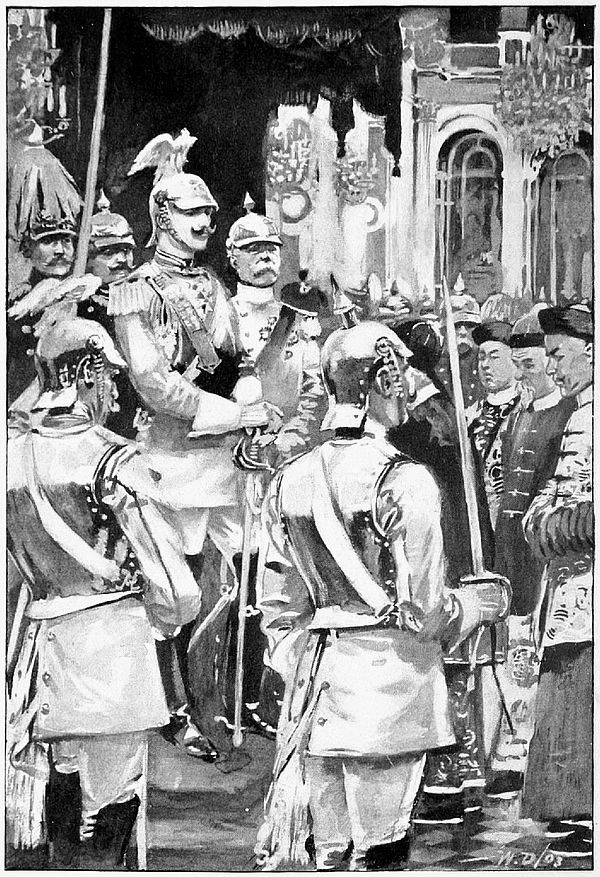
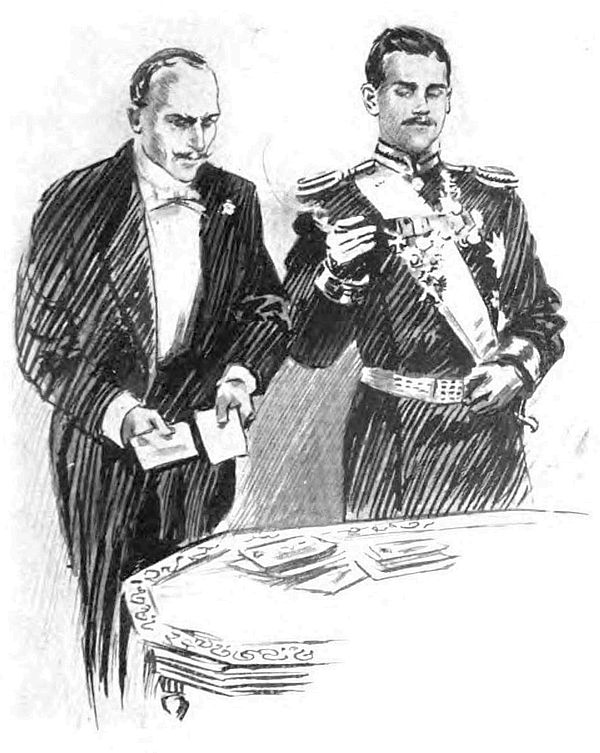
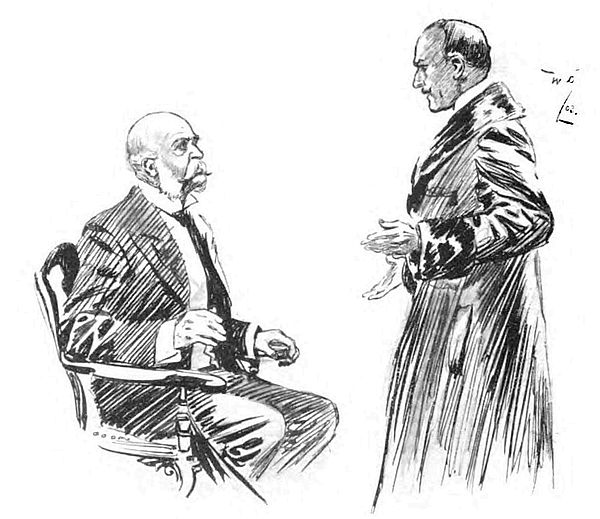
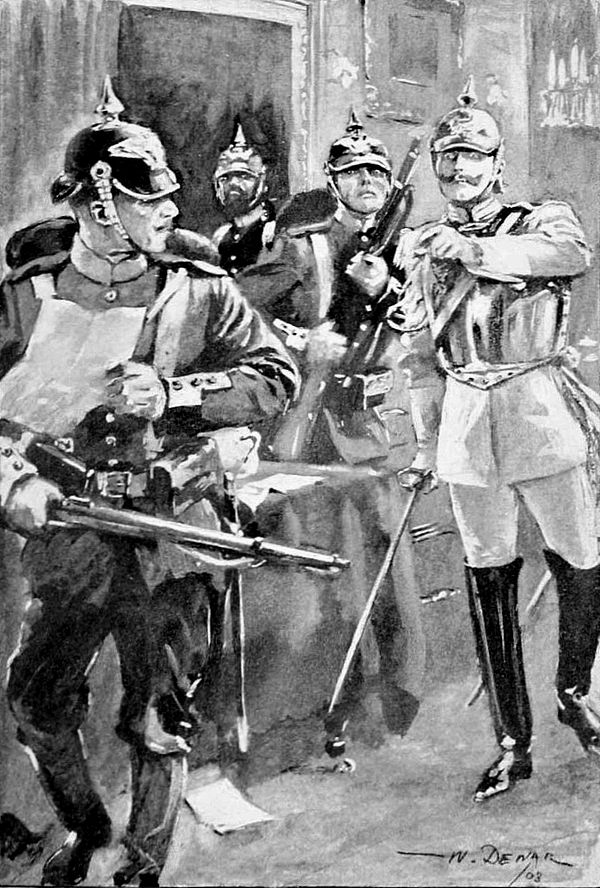
“The Kaiser was attired in his most magnificent costume, wearing the
famous winged helmet on his head, and surrounded by a galaxy of
ministers and great officers, all arrayed in the utmost military
splendour.”
Secret History of To-Day
Being Revelations of a Diplomatic Spy
By
Allen Upward
Author of “Secrets of the Courts of Europe”
“Treason,” etc.
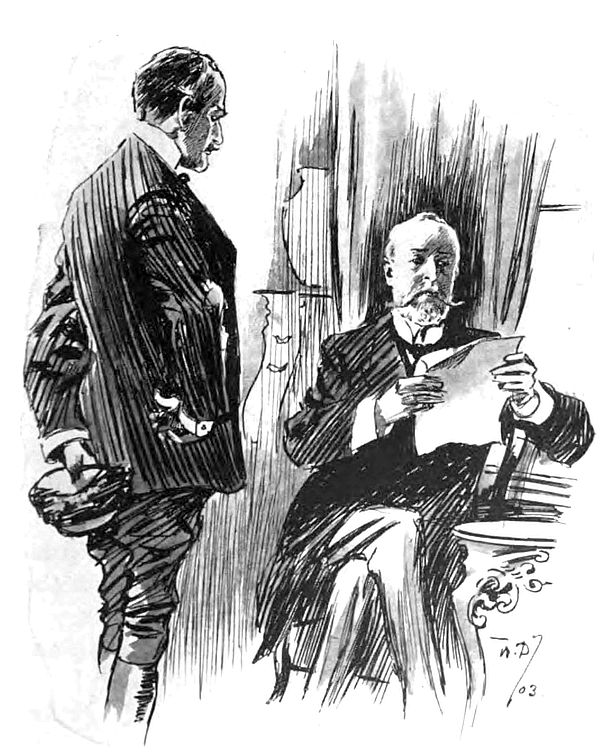
“The Kaiser was attired in his most magnificent costume, wearing the famous winged helmet on his head, and surrounded by a galaxy of ministers and great officers, all arrayed in the utmost military splendour.”
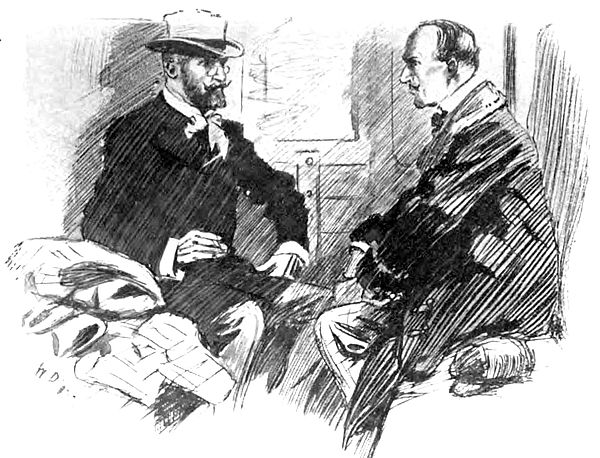
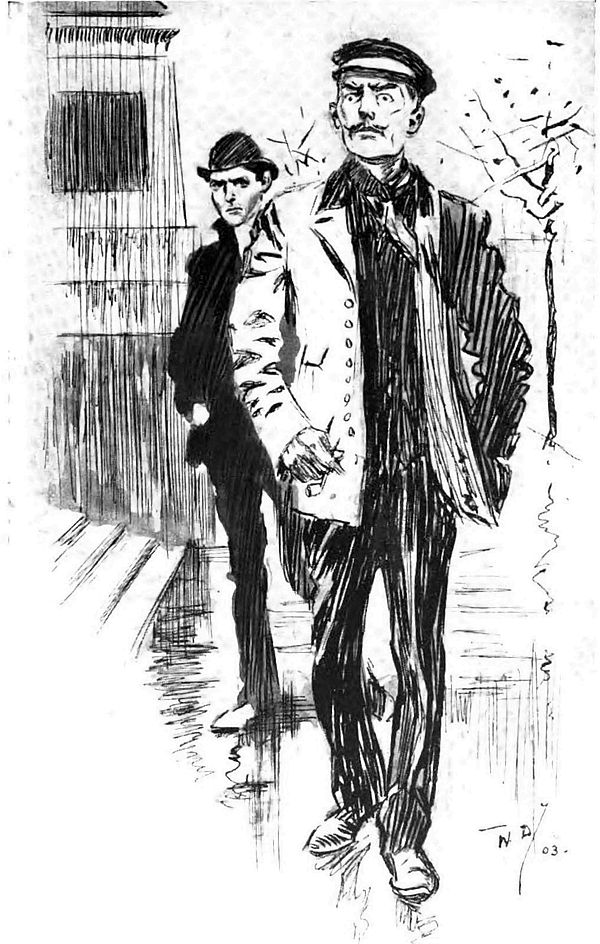
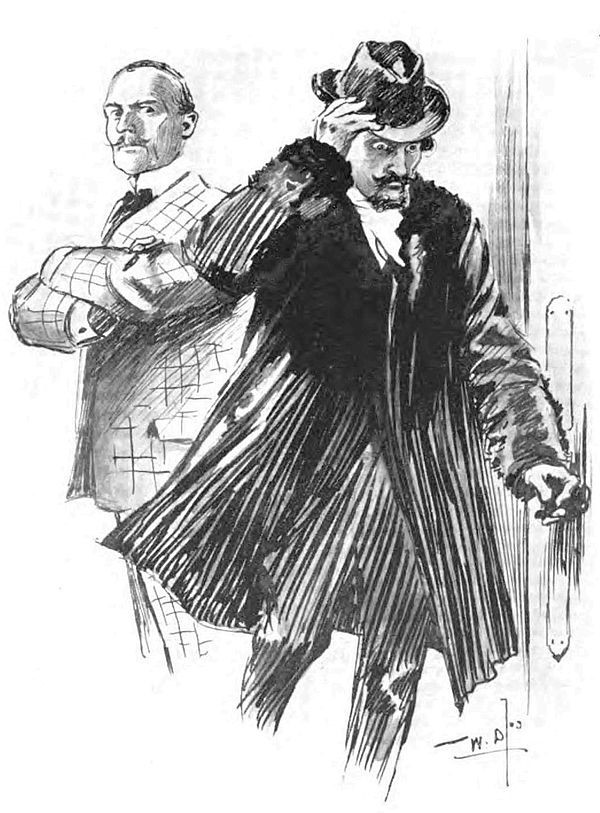
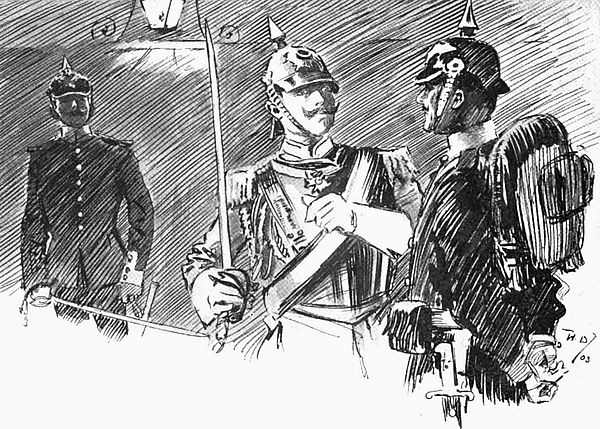
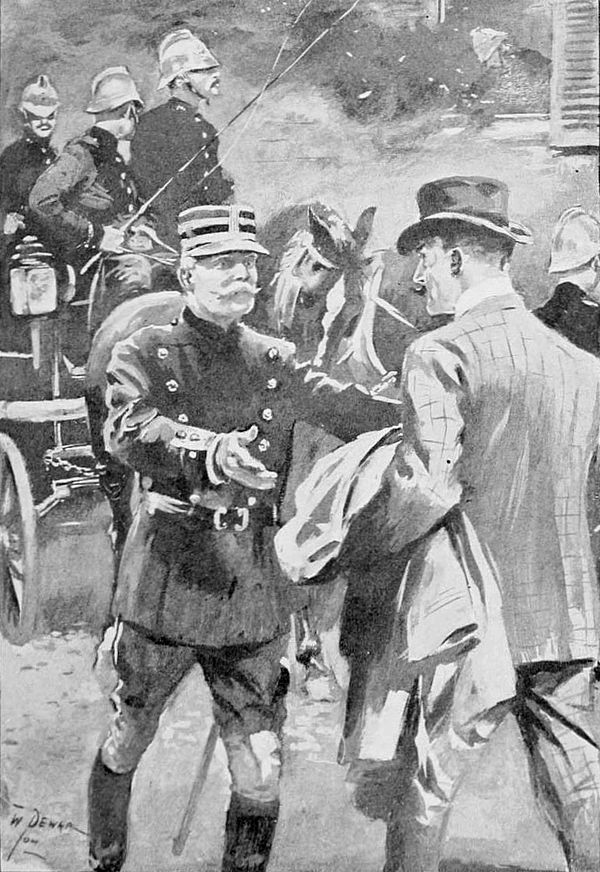
“‘Father Kehler has been good enough to visit a poor sailor who is lying sick on board,’ he said, in a tone evidently meant to rebuke my impertinence.”
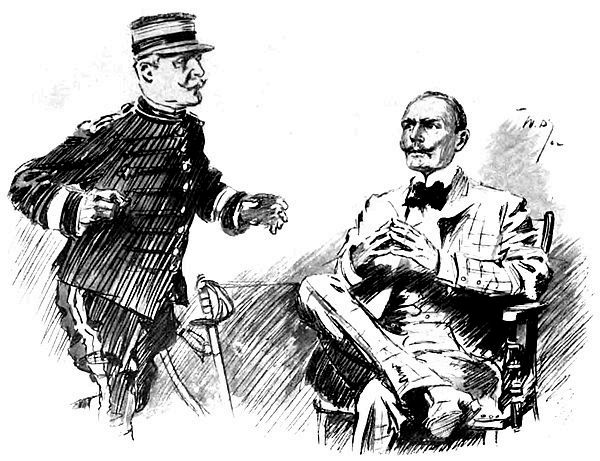
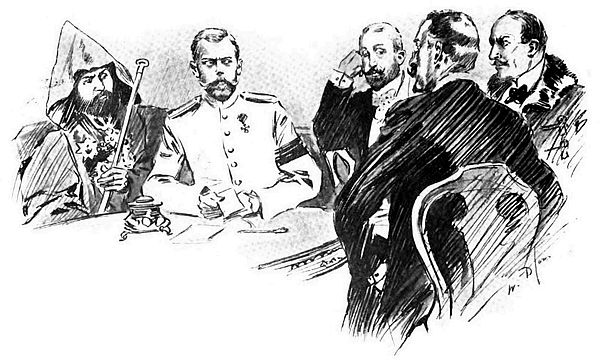
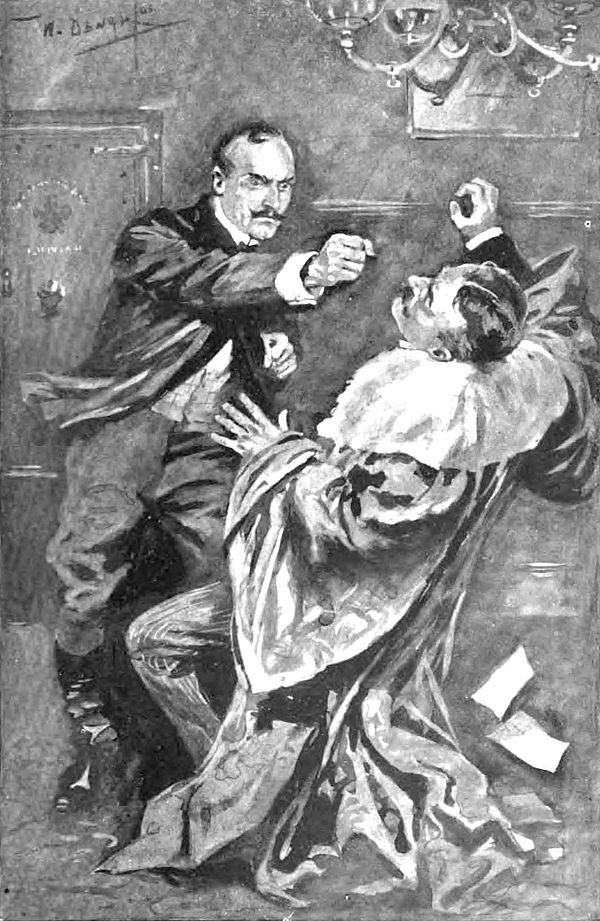
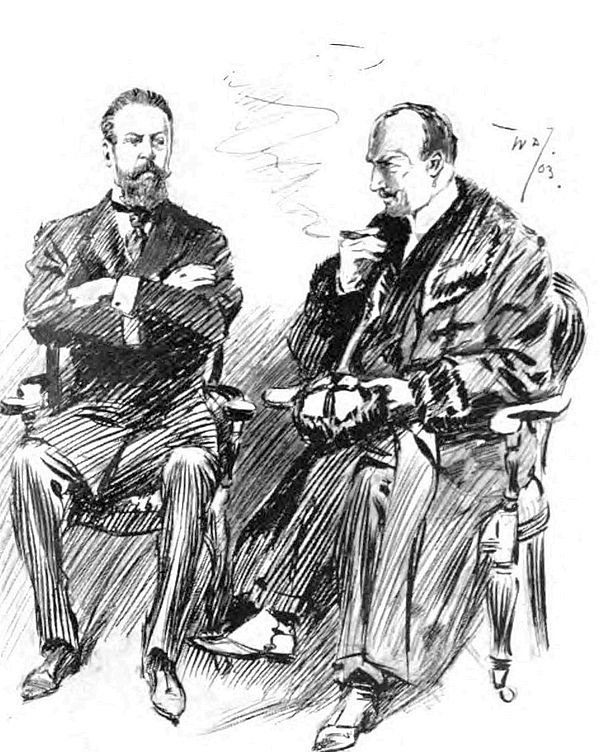
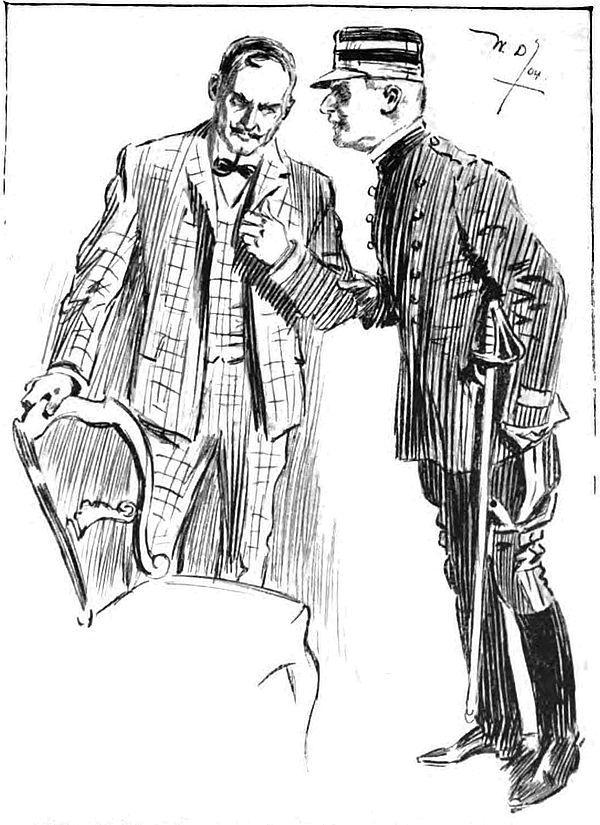
“The Tsar now interposed in a tone of more authority than I had ventured to hope for. ‘Do you suggest, M. V——, that the whole staff of the French army are engaged in a conspiracy to forge documents?’”
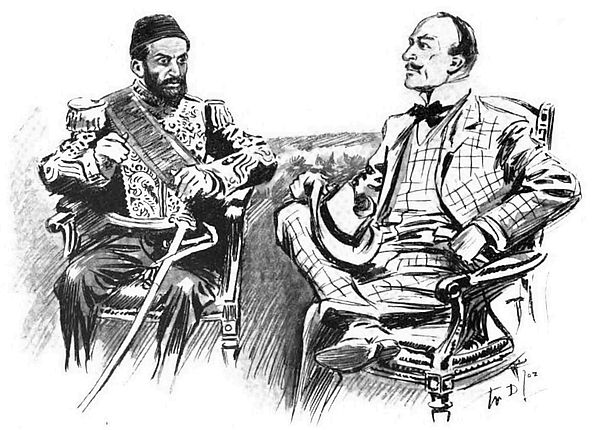
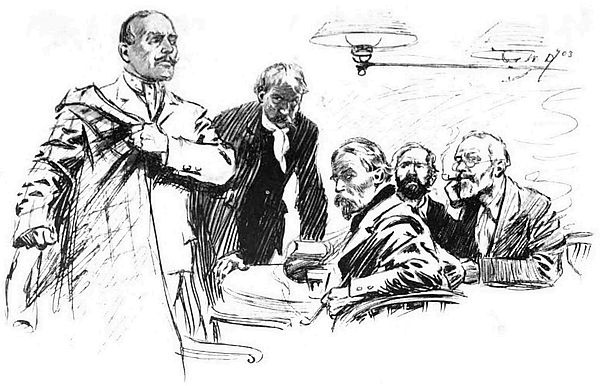
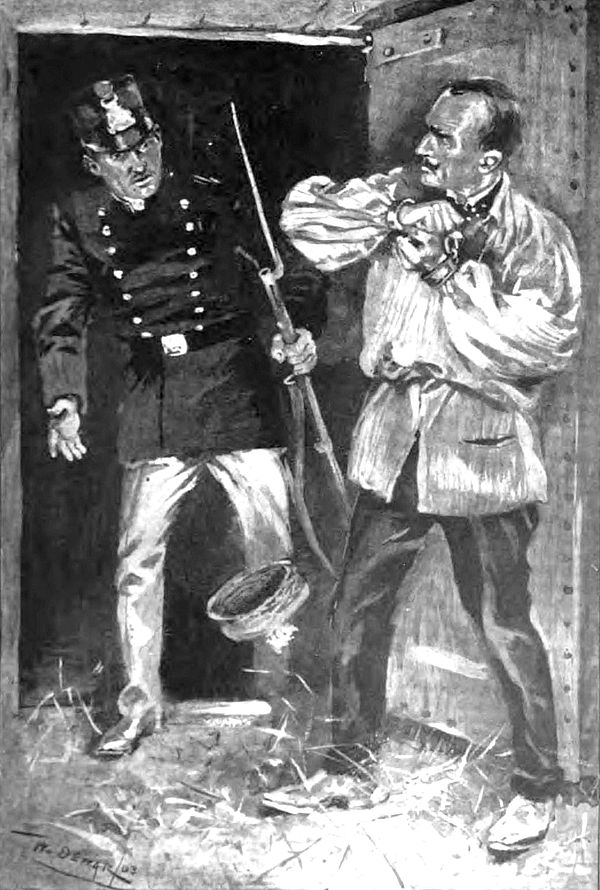
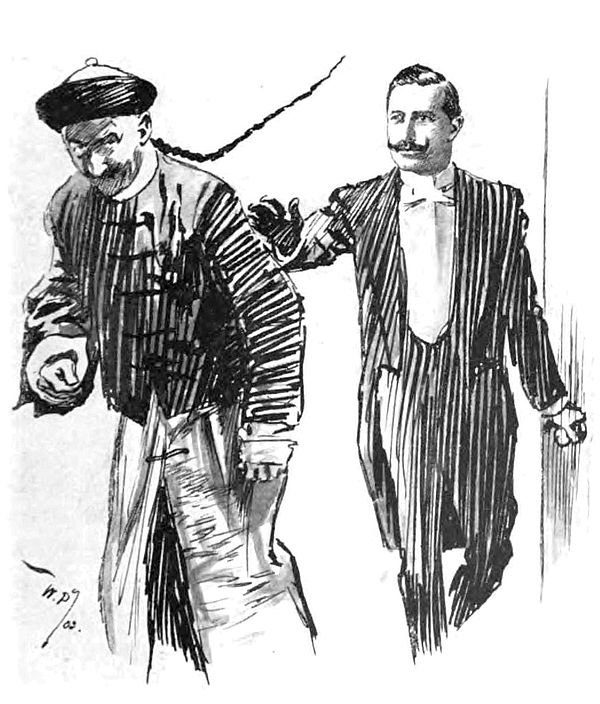
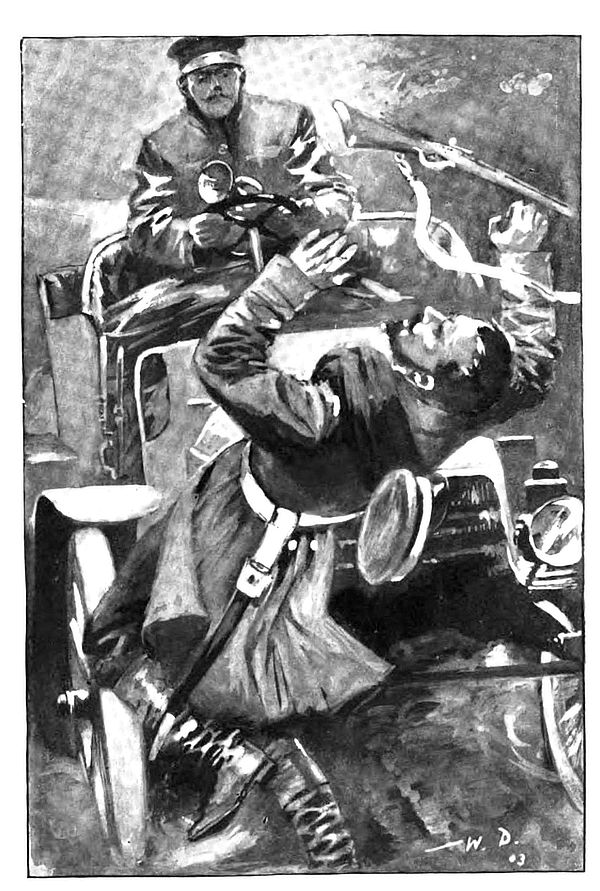
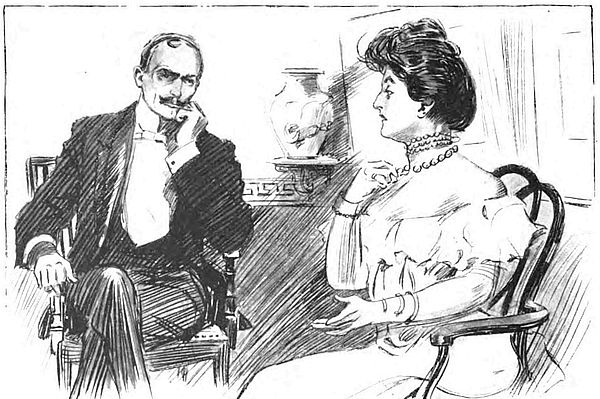
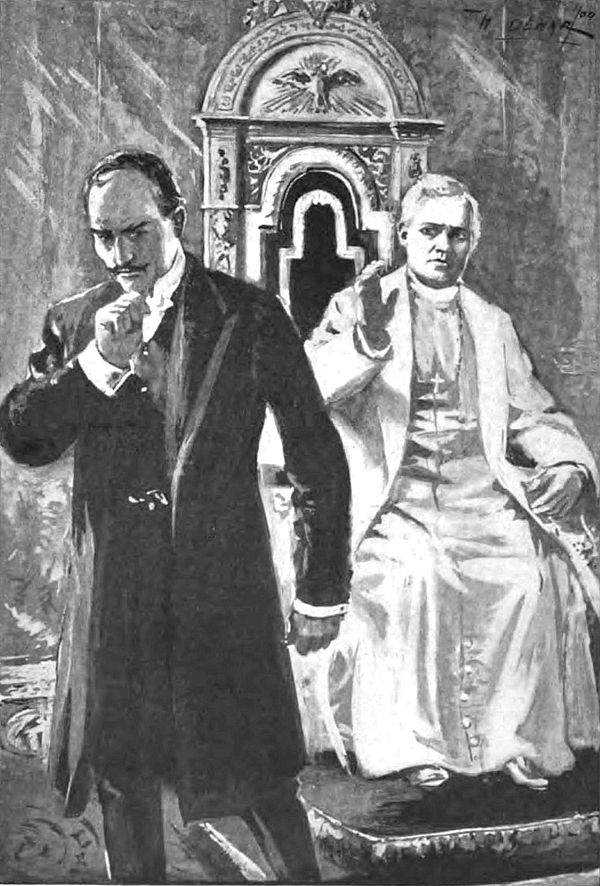
“‘Your Majesty must judge me by what I have done already. Two days ago you had never heard my name. Now I am here, alone with you, with a loaded revolver in my pocket.’ The Sultan started violently.”
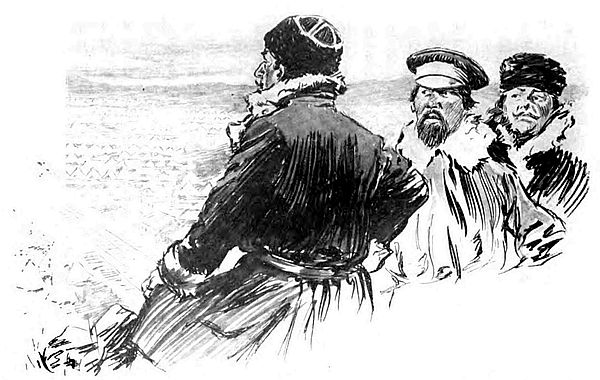
“There at my feet, along the widening valley, lay a double line of rails, and all across the level space stretched low banks and ditches—the lines of a vast encampment, capable of accommodating half a million men.”
The initials under which I write these confessions
are not those of my real name, which I could not
disclose without exposing myself to the revenge of
formidable enemies. As it is, I run a very great
risk in making revelations which affect some of the
most powerful personages now living; and it is only
by the exercise of the utmost discretion that I can
hope to avoid giving offence in quarters in which
the slightest disrespect is apt to have serious
consequences.
If I should be found to err on the side of frankness,
I can only plead in excuse that I have never
yet betrayed the confidence placed in me by the
various Governments and illustrious families which
have employed me from time to time. The late
Prince Bismarck once honoured me by saying:
‘To tell secrets to Monsieur V—— is like putting
them into a strong box, with the certainty that
they will not come out again until one wants
them to.’
In these reminiscences it is my object to recount
some of the services I have rendered to civilisation
in the course of my career, while abstaining as far
as possible from compromising exalted individuals
or embittering international relations.
That I am not a man who opens his mouth rashly
may be gathered from the fact that, although at any
time during the long struggle between Briton and
Boer for the mastery in South Africa, I might have
completely changed the situation with a word, that
word was not uttered while a single Boer remained
under arms.
In order to explain how I came to be concerned
in this affair, I had better begin by giving a few
particulars about myself, and the almost unique
position which I hold among the secret service
bureaus of Europe and America.
By birth I am a citizen of the United States of
America, being the son of a Polish father, exiled on
account of his political opinions, and a French
mother. From my childhood I showed an extraordinary
aptitude for languages, so that there is
now scarcely a civilised country outside Portugal
and Scandinavia in which I am not able to converse
with the natives in their own tongue. At the same
time, I was possessed, ever since I can remember,
with a passion for intrigue and mystery. The
romances of Gaboriau were the favourite reading
of my boyhood, and it was my ambition to become
a famous detective, the Vidocq of America.
Fired by these visions, I ran away from the
insurance office in which my parents had placed
me, when I was little more than sixteen, and applied
for admission to the ranks of the famous Pinkerton
Police. Although my youth was against me, my
phenomenal command of languages turned the scale
in my favour, and I was given a trial.
Very soon I had opportunities of distinguishing
myself in more than one mission to Europe, on the
track of absconding criminals; and in this way I
earned the favourable notice of the heads of the
detective police in London, Paris, Berlin, and other
capitals.
At length, finding that I possessed unique qualifications
for the work of an international secret
agent, I decided to quit the Pinkerton service, and
set up for myself, making my headquarters in Paris.
From that day to this I have had no cause to repent
of my audacity. I have been employed at one time
or another by nearly every Government in the world,
and my clients have included nearly every crowned
head, from the late Queen Victoria to the Dowager
Empress of China. I have been sent for on the
same day by the Ambassadors of two hostile Powers,
each of which desired to employ me against the
other.
On one occasion I acted on behalf of a famous
German Chancellor against his then master, and
on another on behalf of the Emperor against his
Chancellor; and neither had cause to complain of
my fidelity. I have been instrumental in freeing
a Queen renowned for her beauty from the persecution
of a blackmailer set on by a foreign court;
and I have more than once detected and defeated
the plots of anarchists for the assassination of their
rulers.
In this way it has come about that I enjoy the
friendship and confidence of many illustrious personages,
whose names would excite envy were I at
liberty to mention them in these pages; and that
few events of any magnitude happen in any part
of the globe without my being in some measure
concerned in them.
Often, when some great affair has been proceeding,
I have felt myself as occupying the position
of the stage manager, who looks on from the wings,
directing the entrances and exits of the gorgeously
dressed performers who engross the attention and
applause of the ignorant spectators on the other
side of the footlights.
The true story of the famous telegram which may
be said to have rendered the South African War
inevitable is one which strikingly illustrates the
extent to which the public may be deceived about
the most important transactions of contemporary
history.
Every one is familiar with the situation created
by that celebrated despatch. For some time previously
all England, and, in fact, all Europe, had
been agitated by the intelligence that Johannesburg
was on the eve of insurrection, that the Boers were
drawing their forces together about the doomed city,
that Dr. Jameson had dashed across the frontier with
five hundred followers in a mad attempt to come to
the aid of the threatened Outlanders, and that his
action had been formally disavowed by the British
Government.
Close on the heels of these tidings came the
memorable day on which London was cast into
gloom by long streams of placards issuing from
the newspaper offices bearing the dismal legend,
‘Jameson Beaten and a Prisoner!’
While the populace were yet reeling under the
blow, divided between distress at this humiliation
for the British flag, and indignation at the criminal
recklessness which had staked the country’s honour
on a gambler’s throw, there came the portentous
news that the head of the great German Empire,
the grandson of Queen Victoria, had sent a public
message of congratulation to the Boer President,
rejoicing with him in the face of the world over an
event which every Englishman felt as a national
disaster.
That hour registered the doom of the Pretorian
Government. Jameson was scornfully forgotten.
The British people, as proud as it is generous, made
up its mind that the forbearance so long extended
to a vassal of its own, could no longer be shown
with honour to the protégé of a mighty European
Power.
On the very day on which this celebrated despatch
appeared as the chief item of news in all the newspapers
of the world, I received an urgent cipher
message from the Director of the Imperial Secret
Service, Herr Finkelstein, demanding my presence
in Berlin.
My headquarters, as I have said, are in Paris, and
fortunately I was disengaged when the summons
arrived. I had merely to dictate a few dozen wires
to my staff, while my valet was strapping up the
portmanteau which always stands ready packed in
my dressing-room, and to look out my German
passport—for I have a separate one for every
important nationality—and in an hour or two I
was seated in the Berlin express, speeding towards
the frontier.
From the bunch of papers which my attentive
secretary had thrust into the carriage, I learned
something of the effect which the German Emperor’s
interference in the affairs of South Africa had
produced on the public mind in England. It was
evident that the Islanders were strongly roused,
and were preparing to pick up the gage of battle
which had been thrown down. No sooner had I
reached German territory than I found evidences
of an even greater excitement. The whole nation
seemed to have rallied round the Kaiser, and to be
ready to back up his words with martial deeds.
By this time I had little doubt that I had been
sent for in connection with the outbreak of hostile
feeling between the two Powers. But it was impossible
for me to anticipate the actual nature of
the task which awaited me.
On reaching Berlin I was met by a private
emissary of Finkelstein’s, who hurried me off to
the Director’s private house. The first words with
which he greeted me convinced me that the business
I had come about was of no ordinary kind.
‘Do not sit down,’ he said to me, as I was about
to drop into a chair, after shaking hands with him.
‘I must ask you to come to my dressing-room at
once, where you will transform yourself as quickly
as possible into an officer of the Berlin Police. The
moment that is done, I am to conduct you to the
Palace, where his Majesty will see you alone.’
As I followed the Director into the dressing-room,
where I found a uniform suit laid out ready for my
wearing, I naturally asked: ‘Can you tell me what
this is about?’
Finkelstein shook his head with a mysterious air.
‘The Kaiser has told me nothing. But he warned
me very strictly not to let a single creature in Berlin
know of your arrival, and from that fact I have
naturally drawn certain conclusions.’
I gazed at Finkelstein with some suspicion. We
were good friends, having worked together on more
than one occasion, and I knew he would have no
wish to keep me in the dark. On the other hand,
if he had been instructed to do so, I knew he would
not hesitate to lie to me. The secret service has
its code of honour, like other professions, and fidelity
to one’s employer comes before friendship.
Keeping my eye fixed on him, I observed
carelessly—
‘You will tell me just as much or as little as you
think fit, my dear Finkelstein. On my part I shall,
of course, exercise a similar discretion after his
Imperial Majesty has given me my instructions.’
As I expected, the bait took. Curiosity is the
besetting weakness of a secret service officer, and
the Berlin Director was no exception to the rule.
Putting on his most confidential manner, he at once
replied—
‘My dear V——, if you and I do not trust each
other, whom can we trust? Rest assured that my
confidence in you has no reserves. I have spoken
the bare truth in saying that the Kaiser has given
me no indication of his object in sending for you.
But the fact that he has ordered me to take these
precautions to conceal the fact of your arrival in
Berlin tells me plainly that there is a person whom
he wishes to keep in ignorance; and that person can
only be——’
‘The Chancellor?’ I threw in, as my companion
hesitated.
Finkelstein nodded.
‘You consider, perhaps, that it is against the
Chancellor that I am to be employed?’ I went on.
‘It looks like it,’ was the cautious answer.
‘And the reason why this task is not placed in
your hands?’
‘Is because I am a native of Hanover, and the
Kaiser regards me rather as a public official than
as a personal servant of his own dynasty,’ said
Finkelstein.
‘In other words, he regards you as a creature of
the Chancellor’s,’ I commented bluntly.
The Director made a pleasing and ingenious
attempt to blush.
‘I can only affirm to you, on my sacred word of
honour, that his Majesty has no cause to trust me
any less than if I were a Prussian,’ he declared.
‘And I shall take it as a personal kindness if you
will endeavour to convince the Kaiser of my
loyalty.’
‘I will take care that he knows your sentiments,’
I answered, with an ambiguity which Finkelstein
fortunately did not remark.
By this time I had completed my transformation.
A glance at the cheval glass showed me a stiff,
well-set-up Prussian official, exhaling the very
atmosphere of Junkerdom and sauerkraut. I gave
the signal to depart, and we were quickly driving
up the Unter den Linden on our way to the Imperial
Palace.
‘Announce to his Majesty—the Herr Director
Finkelstein and the Herr Inspector Vehm,’ my
companion said to the doorkeeper.
A servant, who had evidently received special
instructions, stepped forward.
‘The Herr Inspector is to be taken to his Majesty
at once,’ he said firmly.
Finkelstein bit his lip as he unwillingly turned
to re-enter his carriage. I followed the lackey
into the private cabinet of the monarch who had
just found himself the centre of an international
cyclone.
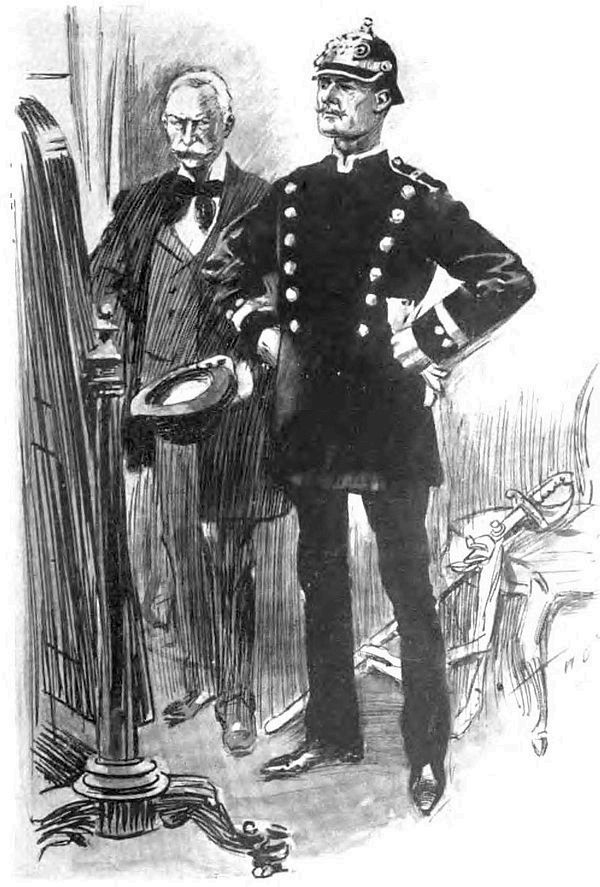
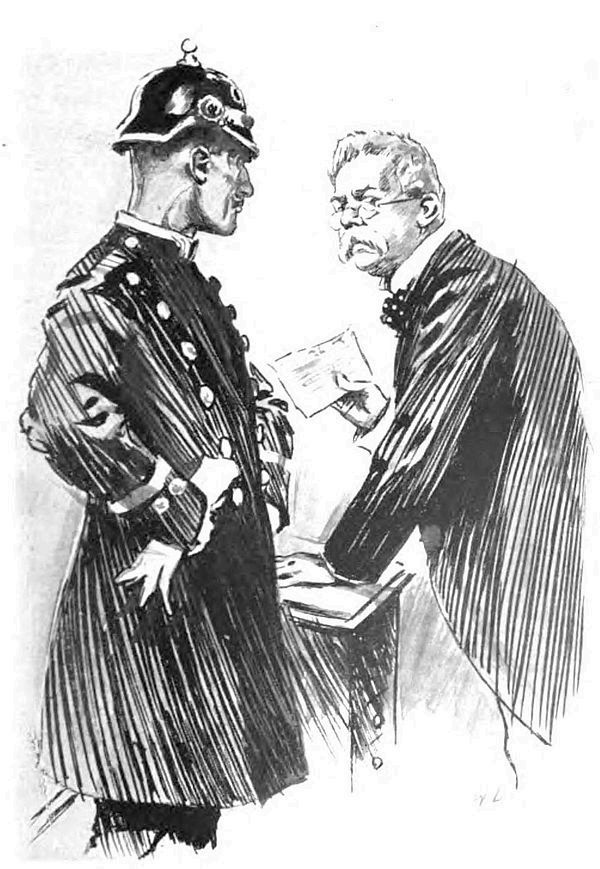
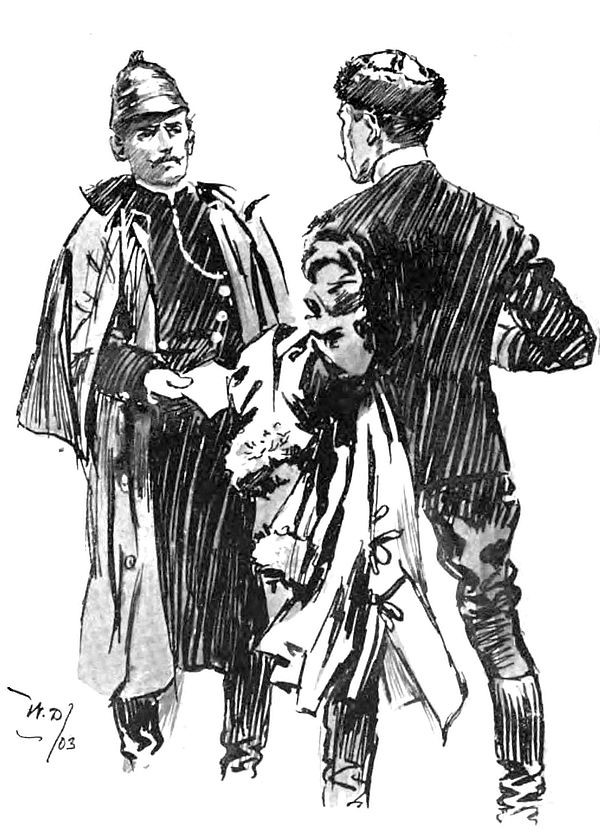
“A glance at the cheval glass showed me a stiff, well set-up
Prussian official.”
Wilhelm II. received me cordially. It was not the
first time we had met. About the time of his ascending
the throne I had been the means of inflicting on
him a defeat which a smaller man would have found
it hard to forgive. Fortunately, the German Kaiser
was of metal sterling enough to recognise merit even
in an enemy, and to realise that my fidelity to my
then employer was the best guarantee that I should
be equally faithful to himself, if it fell to my lot to
serve him.
‘What has Finkelstein told you?’ was the
Emperor’s first question, after he had graciously
invited me to sit down.
‘Only that he was able to tell me nothing, sire.’
The Emperor gave me a suspicious glance.
‘He appeared to regret that your Majesty had not
given him your confidence,’ I added, choosing my
words warily. ‘He assured me that you might rely
on his entire devotion, as much so as if he were a
native of your hereditary States.’
‘And what do you say as to that?’ demanded the
Kaiser, with a piercing look.
‘I think that your Majesty cannot be too careful
whom you trust.’
Wilhelm II. allowed himself to smile gravely.
‘I see, Monsieur V——, that you are a prudent
man. If Herr Finkelstein wishes to convince me of
his loyalty to the Hohenzollerns, he cannot begin
better than by renouncing the pension which he
continues to draw secretly from the Duke of ——.’
His Majesty pronounced the name by which a
well-known dispossessed sovereign goes in his exile.
Familiar as I long have been with instances of
perfidy in others, I could not restrain an exclamation
of astonishment at this revelation of Finkelstein’s
double dealing. The Kaiser continued—
‘After that you will not be surprised if I caution
you particularly against letting Herr Finkelstein
know anything of the object of the inquiry I wish
you to undertake.’
I bowed respectfully, and waited with some impatience
to learn the true nature of my mission.
‘I could not receive you here without taking some
one into the secret of your employment,’ the Kaiser
went on to explain; ‘and I chose Finkelstein in order
to give the affair as much as possible the aspect of a
private and domestic matter. In reality the task I
have to set you is one of the most grave in which
you have ever been engaged.’
The Kaiser took one of the Berlin papers of the
day before, which was lying on the desk in front of
him, and pointed to a column in which was set out
in conspicuous type the telegram which had convulsed
Europe and Africa, and had already caused
Lord Salisbury to issue orders for the mobilisation of
his Flying Squadron.
‘I have sent for you, in two words, to find out
for me the authorship of this telegram,’ the Kaiser
said.
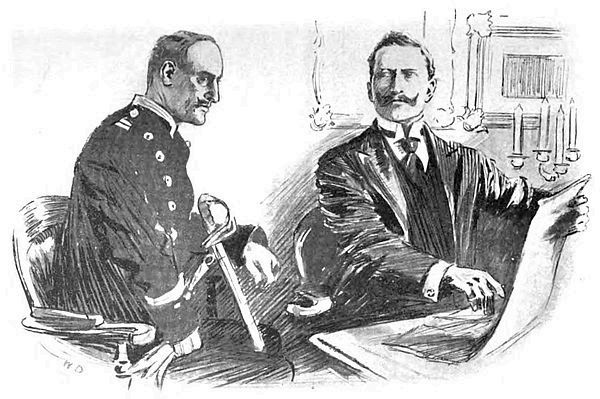
“‘I have sent for you, in two words, to find out for me the authorship of this telegram,’
the Kaiser said.”
Notwithstanding my long training in the most
tortuous paths of secret intrigue, I was fairly taken
aback by this announcement.
‘That telegram!’ I could only exclaim. ‘The one
which your Majesty addressed to President Kruger!’
‘I never sent it,’ Wilhelm II. declared gravely.
‘It is a forgery pure and simple.’
For a moment I sat still in my chair, almost
unable to think.
‘But what——? But who——?’ I articulated,
struggling with my bewilderment.
‘That is what you have got to find out for me,’
was the answer. ‘Let me tell you all I know. The
first intimation I had of the existence of such a
thing was the sight of it in the Press. I sent instantly
for the Chancellor, who came here wearing a
reproachful expression, and evidently prepared to
complain bitterly of my having taken such a step
without previously informing him. When I told him
that the whole thing was an impudent fabrication,
he could scarcely believe his ears. In fact, for some
time I believe he was inclined to consider my repudiation
of it as a mere official denial.’
I ventured to raise my eyes to his Majesty’s as I
observed—
‘Your Majesty has taken no steps to make your
repudiation public?’
The Kaiser gave an angry frown.
‘That is the serious part of the affair,’ he answered.
‘Kruger, in his eagerness to proclaim to the world
that I was on his side, had sent copies of this
infamous production to every newspaper in the two
hemispheres before it reached my eyes. At the
moment when I first saw it, it had already been read
and commented upon all round the globe. The
British newspapers were already threatening war,
and my own people had been excited to a pitch of
enthusiasm such as no other act of mine has ever
called forth. You see the position I was placed in.
If I were now to disavow this forgery, my disavowal
would be received everywhere with the
same scepticism as was felt even by my own
Chancellor. The British would triumph over me,
and my own subjects would never forgive me for
what they would regard as a surrender to British
threats.’
I sat silent. I realised the full difficulty of the
Kaiser’s position. He was committed in spite of
himself to the act of some impostor, whose real
motives were yet to be discovered, but who had
already succeeded in bringing the two greatest
Powers of Europe to the verge of war.
‘Before I can undo the mischief which has been
done,’ the Emperor proceeded, ‘I must first of all
ascertain from what quarter this forgery emanated.
When I have obtained that information, backed by
clear and convincing proofs, it may be possible for
me to satisfy the British Government that they
and I have been the victims of a conspiracy. If
you can succeed in furnishing me with those proofs,
it shall be the best day’s work you ever did in your
life.’
I listened carefully to these words, scrutinising
them for any trace of a double meaning. It was
impossible for me to dismiss entirely from my mind
that suspicion which the story told by Wilhelm II.
was naturally calculated to excite. I asked myself
whether the Kaiser was really in earnest, or whether
he was not inviting me, in a delicate fashion, to
extricate him from the consequences of his own
rashness, by putting together some fictitious account
of the origin of the telegram, which might impose
on Lord Salisbury.
It was clearly necessary, however, for me to appear
to be convinced.
‘May I ask if your Majesty’s suspicions point in
any particular direction?’ I asked, trying to feel my
way cautiously. ‘The President of the Boers is
perhaps——’
The Kaiser interrupted me.
‘I do not think Kruger would dare to provoke me
by such a trick. He would know that he would be
the first to suffer when it was found out. No, I am
convinced that we must look nearer home for the
traitor.’
Something in the Emperor’s tone struck me as
significant.
‘If you could give me any indication of the
person——’ I ventured to throw out.
His Majesty looked at me fixedly as he answered—
‘Does it not occur to you, Monsieur V——, that
there is in my Empire a powerful family, the heads
of which seem at one time to have cherished the
notion that the Hohenzollerns could not reign
without them, a family which aspired to play the
same part in modern Germany which was played
by the Mayors of the Palace in the Empire of the
Merovingians?’
‘You allude, sire, without doubt, to the Bismarcks?’
‘My grandfather was forced into war with the
French by a forged telegram. There would be
nothing surprising in an attempt from the same
quarter to force me into a war with England.’
I had no answer to make to such reasoning.
Daring as such a manœuvre might appear, it was
absurd, in the face of historical facts, to pronounce
it improbable.
After a minute spent in considering the situation,
I turned to the question of how the fraud might
have been carried out.
It was quite clear to me that such a message
could not have gone over the ordinary wires. The
despatches of Emperors are not, as a rule, handed in
over the counter of a post-office, like a telegram from
a husband announcing that he is prevented from
dining at home. I asked the Kaiser to explain to
me the system pursued with regard to Imperial
messages.
‘That is a matter about which you will be able to
learn more from the Chancellor than from me,’ was
the answer. ‘Foreign despatches go through the
Chancellery, and there is a staff of telegraphists
there to deal with them. The wire goes direct to the
Central Telegraph Office, I believe, from which it
would, of course, find its way to the Cable Company.’
‘Then this fabrication must have been sent from
the Chancellery in the first instance?’ I inquired.
‘It could not have been received at the Central
Office from an outside source?’
‘Impossible. They would not dare to transmit a
message in my name which had not reached them
through one of the authorised channels.’
This was the reply I had expected. But I did not
fail to mark the admission that there was more than
one channel through which the forgery might have
come. I was quick to ask—
‘Is there not some other source from which this
telegram may have reached them besides the Chancellery?
Your Majesty, no doubt, has a private wire
from the Palace.’
The Kaiser looked a little put out.
‘That is so, of course,’ he conceded. ‘But that
wire is used only for my personal messages, and those
of the Imperial family.’
‘Still, a message received over this wire, and
couched in your name, would be accepted at the
Central Office, would it not?’ I persisted.
‘Undoubtedly. But the Palace operator, a man
who works under the eye of my secretary, would not
dare to play me such a trick, which, he would be
aware, must be detected immediately. Take my
advice, Monsieur V——, waste no time over side
paths, but go direct to the Chancellor, and commence
your perquisitions among his staff.’
I bowed respectfully, as though accepting this plan
of campaign. But, as I withdrew from the Emperor’s
cabinet, the doubt pressed more strongly than ever
upon my mind whether I was not being asked to
play a part. I half expected to find everything prepared
for me at the Chancellery, prearranged clues
leading to the detection of a culprit who would recite
a confession which had been put into his mouth
beforehand.
I was perfectly willing to perform my part in the
comedy in a manner satisfactory to my employer,
but all the same I meant to keep my eyes open,
and not to let myself be the victim of a deception
intended for English consumption.
In this mood I presented myself before the
Chancellor. As soon as the Imperial autograph
introducing me had met his eye, his Excellency
threw aside, or pretended to throw aside, all
reserve.
‘I am delighted to find the Emperor has placed
this business in your hands, Monsieur V——,’ he
said obligingly. ‘Your reputation is well known
to me, and I am convinced that you will be perfectly
discreet. The Emperor is, of course, thoroughly
taken aback by the results of his unfortunate impulse,
and wishes to relieve himself of the responsibility
he has incurred. In that I am quite
willing to help him, but not at my own expense,
you understand.’
I murmured something about the Bismarcks. His
Excellency gave a smile of contempt.
‘All that is absurd,’ he rapped out. ‘The Emperor
is quite foolish about that family, which possesses
no more influence to-day than any Pomeranian
squire. No, if his Majesty wants a victim he
ought to be content with one of his own staff. I
refuse to allow the Imperial Chancellery to be
discredited in the eyes of Europe.’
This reception, so unlike what I had anticipated,
made me begin to think that my inquiry would have
to be serious. After a little further conversation
with the Chancellor I decided to go to work regularly,
beginning by tracing the Imperial telegram back
from the Central Office.
The Chancellor readily furnished me with the
necessary authority to produce to the Director of
the Telegraph Service, to whom I had merely to
explain that I had been instructed to verify the
exact wording of the now famous despatch.
It is unnecessary for me to detail my interview
with this functionary, whose share in the business
was purely formal. Suffice it that within a quarter
of an hour after entering his office, I came out with
the all-important information that the congratulation
to Mr. Kruger had come direct from the
Imperial Palace, over the Kaiser’s private wire.
By this time it was clear to me that either
Wilhelm II. was playing a very complicated game
indeed with me, or he really was the victim of
one of the most audacious coups in history. My
interest in the investigation was strongly roused, as
I made my way to the Palace for the second time
that day, bent upon a meeting with the telegraphist
by whose agency, it now appeared, the war-making
despatch had come over the wires.
My recent audience in the Imperial cabinet had
invested me with authority in the eyes of the
household, and I had no difficulty in getting a
footman to conduct me to the operator’s room, which
was situated at the far end of the corridor which
I had previously passed through on my way to the
Kaiser.
The room being empty on my arrival, I dismissed
the footman in search of the operator, who, he informed
me, would most probably be found with the
private secretary to the Emperor.
The moment I found myself alone I stepped up to
the apparatus. I am an expert telegraphist, and the
machine speedily clicked off the following despatch—
‘To the German Ambassador, London.—See Lord
Salisbury privately, at once, and inform him British
Government entirely deceived as to my sentiments.
Proofs will be sent to you shortly.—Wilhelm,
Kaiser.’
I had hardly taken my fingers off the instrument
when the door opened and the operator walked in.
Herr Zeiss—I heard this name at the Central
Office—appeared to me to be a simple-minded man,
more likely to be the victim of a conspiracy than
himself a conspirator. I thought it my best plan to
assume an air of omniscience at the outset.
‘How is this, sir!’ I demanded with some sternness.
‘Do your instructions permit you to leave
this instrument unguarded for any person who
pleases to send his own messages over the Emperor’s
private wire?’
The telegraphist stared at me with a mixture of
surprise and alarm.
‘I don’t know who has authorised you, Herr
Inspector——’ he began, when I cut him short.
‘Am I to go to his Majesty, and ask him if you
have permission to leave this room when you
please, without taking any precautions against the
unauthorised use of the wire?’
Herr Zeiss quickly changed his tone.
‘That is not a thing of which I am ever guilty,’ he
protested.
‘You have been guilty of it just now,’ I retorted.
‘I have not been away two minutes. No one
could have taken advantage of my absence.’
‘Nevertheless, advantage has been taken of your
absence.’
‘I don’t believe it!’
‘Ask the Central Office to repeat the message you
have just sent them, then.’
Casting a frightened look at me, the man complied.
I have seldom seen an expression of deeper
astonishment and terror on a man’s face than that
which marked the unfortunate operator’s as my
despatch came back to him, word after word, ending
with the Imperial signature.
‘My God!’ he cried out. ‘Who has done this?
I shall be ruined!’
‘Whether you are ruined or not depends entirely
on yourself,’ I said sharply. ‘It is in my power to
save you, but only upon one condition.’
“‘My God!’ he cried out. ‘Who has done this? I shall be ruined.’”
Herr Zeiss turned on me a gaze of mute appeal.
‘You must tell me the exact truth,’ I proceeded,
‘and you must tell me everything. How often have
you left this room without taking precautions against
the misuse of the wire in your absence during the
last two days?’
Zeiss considered for a moment. Then his face
brightened up.
‘Not once, I can assure you positively of that,
Herr Inspector.’
This answer, given so confidently, came as a severe
check to me. I looked at the man sternly, as I
responded, with assumed confidence—
‘And I am positive that you are mistaken. An
unauthorised use has been made of this wire, and I
am determined to know by whom.’
The operator’s face fell once more. He appeared
to me to be honestly at a loss.
‘Come,’ I put in, ‘think again. Begin by recalling
any occasions on which you have been called away
hurriedly, and have perhaps omitted to lock the door.’
‘But there has been no such occasion. I swear to
you that I have not once left this room without
taking ample precautions.’
I fancied I discerned a touch of hesitation,
rather in the operator’s tone than in his actual words.
‘Speak more plainly,’ I said. ‘What do you mean
by precautions?’
‘Either the door was locked, or else——’ This
time the hesitation was palpable.
‘Or else what?’
‘It was left in the charge of a trustworthy
person.’
‘And that trustworthy person, who was he?’ I
found it hard to suppress all signs of excitement as I
put this question.
‘The gentleman who will shortly be my brother-in-law.’
‘Ah! Perhaps this gentleman is an employee in
the same department as yourself?’
‘Not at all,’ Zeiss protested earnestly. ‘He is a
teacher in the Military College. He knows nothing
of telegraphy; in fact, he has sometimes asked me
questions on the subject which have convinced
me that he is quite a fool where electricity is
concerned.’
‘Indeed! And the name of this foolish person, if
you please?’
‘Herr Severinski.’
‘A Pole!’ I exclaimed.
‘No, a Russian. He was exiled to Siberia on
account of his political opinions, but escaped. He
teaches Russian in the college.’
‘How did he come to be left in charge of this
room?’
‘He called here the day before yesterday, in the
evening, to speak to me about his marriage with my
sister. They have been engaged for some time, you
must know. While he was here I received a note
from my sister herself, pressing me to come and
speak to her at once outside the Palace. I went,
leaving my brother-in-law to wait here during my
absence. My sister, I found, merely wished to urge
me not to object to any proposal made by her
betrothed. On my return I found Severinski
yawning and apparently bored to death in my
absence. I asked him, and he assured me no one
had come near the room while I was away.’
I could scarcely resist smiling as the whole
intrigue, so simple, and yet so consummately successful,
lay bared to my perception. My whole
anxiety now was to keep the worthy but stupid
Zeiss ignorant of the transaction in which he had
been an unwitting accomplice.
I brought him away from the Palace with me,
so as to leave him no opportunity of warning
Severinski, and we proceeded together to the
Russian’s quarters. I flatter myself that the professor
of the Military College was not a little disconcerted
when he saw his dupe followed into the
room by an Inspector of the Berlin Police.
I explained my position in such a manner as to
let Severinski see that I knew everything, without
enlightening the other man.
‘The day before yesterday Herr Zeiss left you
alone in his room in the Palace. You took the
opportunity to send a telegram, the terms of which
are known to me, over the Emperor’s private wire.
For this offence you and he are liable to severe
punishment. What I now have to propose to you
is to make a confession which will have the effect of
exonerating every one except yourself. If you do
this, I think I can promise you that you shall suffer
no penalty beyond, of course, the loss of your post in
the Military College.’
Severinski gave me a glance of intelligence.
‘You do not require me to denounce anybody else?’
he inquired significantly.
‘I do not require you to confess what is obvious
to every one,’ I returned with equal significance.
Poor Zeiss followed this exchange with an air of
bewilderment. It was evident that the discovery
of the other’s guilt had caused a shock to his confiding
nature, and he was still trying to reconcile
the Russian’s prompt surrender to me with his
previous stupidity on questions of electrical science,
when I summarily dismissed him from further share
in the interview.
As soon as we were by ourselves Severinski spoke
out boldly enough.
‘I am quite willing to give you a statement that I
sent the telegram. But I am not going to tell you
anything more. You must know that I am an
Anarchist.’
I waved my hand scornfully.
‘If I consent to your suppressing the truth,
Professor Severinski, it does not follow that I
am willing to listen to absurd fictions. Be good
enough to write out and sign a circumstantial
account of your own part in this clumsy plot, and
I will undertake that you shall not pass to-night
in prison.’
The Russian had the sense to do what he was
told without further parley. I got from him more
than I expected. He consented to put in writing
that it was after his betrothal to Fraulein Zeiss
that he had been solicited to make use of his connection
with the Kaiser’s private telegraphist, and
he stated the amount of the bribe, a very heavy one,
paid him for his services in sending the Imperial
congratulations to the President of the Transvaal.
We became so friendly over the discussion that
Severinski, who was bursting with vanity over
his success, wanted me at last to let him tell
me too much. I was obliged to order him to be
silent.
‘If you tell me that you are an agent of a certain
great Power, I must repeat what you say to the
Kaiser. Then one of two things will happen. Either
your Government will avow your action, in which
case you will be hanged as a spy, or it will disavow
you, in which case you will pass the rest of your life
in prison as a criminal lunatic.’
This menace had all the effect which I could have
desired, and I was satisfied that the Russian would
now hold his tongue.
Bidding him a cordial farewell—for I confess the
fellow’s audacity had inspired me with some admiration—I
hastened back to the Palace, to lay the
results of my investigations before Wilhelm II.
‘Your Majesty has been victimised by a secret
agent whose employers are interested in bringing
about a feeling of ill-will, if not an actual war, between
Germany and Great Britain. The day before
yesterday this agent, whose name is Severinski, and
who is employed to teach Russian’—Wilhelm II.
started—‘in the Berlin Military College, visited
your private telegraphist in the room at the end of
this corridor. He had previously contrived that
the telegraphist should be called away during his
visit, and he took advantage of this absence
to send the message which has caused so much
trouble.’
The Kaiser made no reply until he had finished
reading the proofs I laid before him.
‘And you did not ask this Severinski by whom he
was set on?’ demanded his Majesty, giving me a
keen glance.
‘I did not know whether you would wish me to do
so,’ I answered respectfully.
‘You were right, a thousand times right,’ exclaimed
the Emperor. ‘As long as they are in doubt whether
I know it is they who have played me this trick, I
have the advantage of them, and they will keep
silence for their own sakes.’ He paused in deep consideration
for a minute, then he looked up quickly.
‘All this time I must not forget the English. Tell
me, Monsieur V——, are you personally known to
Lord Salisbury?’
‘I have that honour, sire. On one occasion——’
‘Enough! There is not a moment to lose. You
will leave Berlin by the first train, and proceed
straight to the Ambassador’s house in London. He
will take you round to the Prime Minister, and you
will offer him the proofs which you have just offered
me, explaining at the same time that the excited
state of public feeling in both countries makes it
impossible for me to take any open action in the
matter.’
I bowed and moved towards the door.
‘I will wire to the Ambassador to expect you,’
called out the Kaiser.
‘Pardon me, your Majesty has done so already.’
‘How?’
‘I also passed five minutes alone in the room of
Herr Zeiss,’ I explained.
In the years which have elapsed since this celebrated
episode, Wilhelm II. has left no means untried
to convince the British people of his friendly
sentiments towards them. It is as a service to his
Imperial Majesty, though without authority from
him, that I now venture to lift the veil from the
most astounding transaction in the annals of even
Muscovite diplomacy.
II THE BLOWING UP OF THE MAINE
Although the revelations which have been made
already in the British House of Commons have
thrown some light on the international intrigues
which complicated the progress of the Cuban War,
the tragic event which caused the United States to
draw the sword against Spain has remained a profound
mystery to the present hour.
The truth concerning the destruction of the United
States warship Maine, in the roadstead of Havana, is
known fully to only two persons now alive. One of
these two has taken the vow of perpetual silence in
the monastery of La Trappe, and his name is already
forgotten by the world.
I shall cause some surprise, perhaps, when I
venture to assert that had I left my hotel ten minutes
earlier on a certain memorable night in the year
1898, the Spanish flag might still be flying over the
citadel of Havana.
The extraordinary adventure which I am going to
relate had its starting-point in Paris, which is, to a
large extent, the clearing-house of international
politics—the diplomatic exchange where the representatives
of the Powers meet, and sound each other’s
minds. For this reason the highest post in the
diplomatic service of every country is still the Paris
Embassy, although France itself scarcely ranks to-day
as a Power of the first magnitude.
It is Paris, as every one is aware, which was the
scene of the long negotiation between the representatives
of the Cuban insurgents and the Government of
Madrid on the question of the terms to be granted
by Spain to her discontented colony. In this
negotiation it is equally well known that the Cuban
delegates received the moral support of the United
States; but it is not generally known that the
Spanish Government acted throughout in consultation
with most of the European Powers.
I was looking on at the negotiation without any
very great interest, sharing, as I did, in the general
impression that Spain would give way before long,
when I was surprised one morning by receiving a
visit from a very remarkable character.
Ludwig Kehler was a Bavarian, who had begun
life as a candidate for the priesthood. A disgraceful
affair, the particulars of which I had
never learned, had caused his dismissal from the
seminary, and, after drifting about the world for
a time, and mixing in very shady company, he
suddenly appeared in Berlin in the character of a
police agent.
The exact nature of the services which he rendered
to the police was a mystery, but I had formed the
theory that he was employed as a spy on the German
Catholics, whose attachment to the House of Hohenzollern
has always been suspected in Berlin.
The presence of this man in Paris was in itself an
unusual event. It did not occur to me to connect it
with the Spanish-American question, and that for a
very simple reason. Germany is the one country in
Europe which has never possessed a foot of soil in
the New World. Spain, Portugal, England, France,
and even Holland and Denmark have planted their
flags across the Atlantic, but the German Michael
has been content to remain at home while his neighbours
were colonising the globe.
I received Kehler coldly. My acquaintance with
him was a purely professional one, and he was a man
whom I profoundly distrusted.
As soon as I could do so, without positive rudeness,
I invited him to explain the object of his
visit.
‘It is of a confidential nature,’ prefaced the
Bavarian. ‘May I assure myself that our conversation
will remain a secret between us two?’
I bowed gravely.
‘That is always understood, where I am concerned.
A man who desires to be trusted must begin by
establishing a reputation for secrecy.’
Kehler contented himself with this assurance, dry
as it was.
‘I thank you, Monsieur V——. Your reputation
is so well established that I had no intention except
to ask whether you were willing to receive the
proposals I have come to make?’
‘Proceed, Herr Kehler, if you will be so good.’
‘You have learnt, no doubt, that the Spanish
Government has made up its mind to concede the
terms demanded on behalf of the Cubans by the
United States?’
Although I was not aware that things had reached
this point, I did not allow Kehler to see that he had
given me any information.
‘By this act,’ he continued, ‘the Americans have,
in fact, declared that no European Power has any
right to enter their hemisphere without their permission.’
‘All that is well known, Herr Kehler.’
‘The question then arises whether the European
Powers will allow themselves to be driven out, one
by one, or whether, by a bold combination, they will
reduce the United States to some respect for the law
of nations.’
‘Such a combination would be inopportune at this
moment, because the British would stand aloof.’
‘Because they look upon the struggle as one
between Spaniard and Cuban,’ Kehler rejoined
quickly. ‘But let us suppose there to be a war,
in which the United States was engaged against
Spain?’
‘You have just said there will be no such war.’
‘A war is always possible, provided those interested
in bringing it about are not too scrupulous.’
This sinister language at length convinced me that
the Bavarian had not come to see me for nothing. I
decided to draw him out.
‘Provided such a war actually commenced, I agree
that some combination on behalf of Spain might be
possible,’ I murmured, as though reviewing the situation
in my mind. ‘But where is the Government
sufficiently in earnest to undertake so terrible a
responsibility?’
‘It is that Government,’ Kehler responded, ‘which
sees its subjects departing in greater numbers every
year, but which looks around in vain for some unoccupied
region towards which to direct the stream
of emigration.’
‘You mean Germany?’
‘We look around us,’ he continued, scarcely
noticing my interruption, ‘and we see all the continents
staked out in advance by other Powers: Asia
by England and Russia, Africa by England and
France, North America by England and the United
States, Australia by England alone. There remains
only South America, in the possession of weak Latin
races, unable to make use of their advantages, but
who are protected in their decay by the bullies of
Washington.’
‘A war in which the United States found itself
fully occupied would be a fine opportunity for the
German Michael to plant his standard in Brazil or
the Argentine, I understand.’
Kehler looked at me earnestly.
‘The man who undertook the task of making
such a war inevitable, without compromising exalted
personages, would be no loser,’ he remarked
significantly.
I looked back at the Bavarian before demanding—
‘Have you any definite scheme to put before
me?’
‘Until I know that you accept,’ he demurred.
‘I do not know that you are accredited,’ I reminded
him.
‘What authority do you require?’
‘The Imperial autograph simply.’
‘Impossible.’
‘I am accustomed to be trusted by my employers,’
I returned decidedly. ‘I cannot act under any other
conditions.’
‘That is final?’
‘It is final.’
‘Then I am afraid I can only ask you to forget
that I have occupied so much of your time.’
I allowed Kehler to rise and take his departure
without making the least sign. The moment he was
out of hearing I sprang to the telephone and rang up
the agent of the Sugar Trust.
Herr Kehler’s refusal to produce the guarantee for
which I asked convinced me that he contemplated
some action of a character doubtful, to say the least,
if not criminal.
It would have been useless for me to communicate
my suspicions to the American Minister in Paris.
The diplomacy of the United States, blunt and self-reliant,
takes little account of the subterranean intrigue
which pervades European politics. But the
Government of Washington was not the only factor
concerned. As Europe is beginning to learn, the
Union is a federation, not so much of those geographical
divisions which are painted in different
colours on the map, and called States, but of those
vast organisations of capital which control the
American electoral system, and fill the Senate with
their delegates. Nebraska, Pennsylvania, Virginia,
Illinois—these are merely names for school children;
the Silver Ring, the Steel Trust, the Cotton Trust,
the Pork Trust—such are the true American
Powers.
During the whole of the Cuban negotiation the
Sugar and Tobacco Trusts had been represented in
Paris by agents whose object it was to avert an
annexation of Cuba by the United States, an act
which would, of course, mean the free admission of
Cuban sugar and tobacco into the markets. Adonijah
B. Stearine, the Sugar Agent, was a shrewd man, and
I had no doubt I should find him a ready listener to
what I had to say.
Within an hour of Kehler’s departure, Mr. Stearine
was seated in my office. I had to pick my words
carefully not to break the promise of secrecy into
which I had been beguiled.
‘I have just seen a secret agent who wanted me to
help him in some trick to force on a war between
the States and Spain.’
Stearine rolled his eyes and whistled thoughtfully.
‘Who sent him?’
‘I can’t say. He refused to disclose his principal,
and so I would have nothing to do with him.’
The Sugar Agent pursed up his lips, and frowned.
‘I guess this is a dodge of Bugg’s,’ he muttered.
‘What Bugg?’
‘You don’t say you haven’t heard of Bugg—Milk
W. Bugg, the Pork Trust’s man over here?
I reckon Bugg is the smartest man in Chicago, and
Chicago is the smartest town in the States, and
the States is the smartest country on earth; so there
you are.’
‘The man who came to me is a German,’ I
hinted.
‘Bugg’s smartness,’ was the comment.
‘He wanted me to think he came from Berlin.’
‘Bugg is real smart,’ breathed Mr. Stearine with
admiration.
It was evident that the agent of the Sugar Trust
was unable to see past the figure of his rival, which
filled up his mental horizon. I did not consider it
worth while to argue the point.
‘The question is, Do you want this to be stopped?’
I said.
Stearine looked at me with something like surprise.
‘Think you can?’ he questioned briefly.
‘I know the man who is at work. I can shadow
him and find out what he is doing.’
‘You will have to be almighty quick about it,’
retorted the other. ‘When did this man get
away!’
‘Only an hour ago,’
Mr. Stearine gazed at me with a disconcerting
scrutiny. Then he remarked slowly and emphatically—
‘If this is Bugg’s game, and you have given him
an hour’s start, I calculate he will be opening a store
in Havana this day six months.’
The Pork Trust, it was clear, had everything to
gain by a war by which the Sugar Trust had everything
to lose. But, in spite of Mr. Stearine’s confident
assurances, I continued to have my own
opinion about the power behind Herr Kehler.
‘Do you want me to act?’ I demanded briefly.
‘I want you to take a hand—yes.’ The Sugar
Agent took out his pocket-book, and counted out
bills to the amount of ten thousand dollars. ‘You
can play up to that,’ he added, ‘and then you can
let me know how the game stands. I guess I shall
buy Pork Consols.’
With this discouraging observation, Stearine left.
It did not take me long to decide on my plans.
As it was not likely that Kehler was apprehensive
of being watched, it would be an easy task to trace
him, and I at once gave orders to my staff to that
effect, with the result that I learned in a few hours
that the Bavarian had put up at the Hotel des
Deux Aigles, and was leaving by the Sud Express
for Madrid.
I now decided on one of the boldest and most
effective strokes in my repertory. I went openly to
the station, took my own ticket, and entered the
compartment of the sleeping-car in which Kehler
had booked his own place.
The real astonishment of the Bavarian at seeing
me I met with an affectation of moderate surprise
on my own part.
‘So you are going with me?’ I observed.
‘With you!’ Kehler exclaimed.
‘It appears so. No doubt you have been instructed?’
Kehler denied it energetically.
‘But you refused to participate in a certain design,’
he reminded me.
‘I laid down certain conditions, which you declined
to fulfil, but which have since been complied with by
your principal.’
The Bavarian was thunderstruck. I relied upon
his having reported his failure to whomever it was
that had sent him to me; and there was nothing
impossible in the suggestion that I had in consequence
been approached directly.
‘You have credentials, I suppose?’ he asked.
I nodded carelessly.
‘You will convince me, perhaps?’ he persisted.
‘Are you authorised to convince me?’ was my
retort.
‘You know it—no.’
I shrugged my shoulders and remained silent.
So commenced the most extraordinary journey I
have ever taken, a journey which was destined to
end only at Havana. Across France and Spain and
the Atlantic Ocean we travelled side by side, each
unwilling to lose sight of the other; I, resolved to
find out and if possible thwart the designs of my
companion; Kehler, unable to determine whether I
was an opponent, a rival, or a spy set over him by
those on whose behalf he was engaged.
On the frontier, at Hendaye, a despatch was
handed in to me through the carriage window. It
was from Stearine, and contained these words, whose
terrible significance I was designed to learn later—
‘United States warship Maine arrived harbour
Havana.’
The agent of the Sugar Trust had been too careful
to say more. But it was clear that he regarded this
event as a move in the game played by the great
exporting Trusts.
From the moment of our arrival in Madrid I was
no longer able to keep a close watch on Kehler,
though by a sort of tacit agreement we stayed at
the same hotel. I found out that he was paying
visits to the Provincials of the Jesuit and Franciscan
Orders, and had been admitted as a visitor to one or
two convents, and for a time I was tempted to relax
my suspicions, and to think that the Bavarian was
engaged in some Catholic espionage. These doubts
were suddenly dissipated by my meeting him one
day in the courtyard of the hotel attired in the
habit of a priest—the dress of which he had been
deprived on account of his youthful misconduct.
I could not doubt that this dress was a mere
disguise, and that it had been assumed for a political
purpose. I went up to him and whispered—
‘Do we still recognise each other, or do you prefer
that we meet as strangers?’
‘As fellow-travellers simply, I should prefer,’ he
responded.
The next day he had disappeared from the hotel.
I set the agencies at my command to work, and
learned without much difficulty that passages had
been reserved for the false priest and a Sister of
Mercy travelling under his protection, on board a
Spanish steamer sailing from Cadiz to Havana.
Needless to add, I was on board the same steamer
when she quitted her moorings and breasted the
waves of the open sea. During the voyage I had
many opportunities of watching Kehler and his companion,
who were constantly together, holding long
private conversations in retired corners of the vessel.
The nun, who was presented to me as Sister Marie-Joseph,
was a pale, delicate-looking girl of about
twenty, with that abstracted look in her eyes which
betokens a mind wavering between earnestness and
hallucination.
Dimly, and through clouds of uncertainty, I began
to perceive that Kehler had ransacked the convents
of Madrid for a suitable instrument, and that he
was hard at work hypnotising the unfortunate girl’s
mind, so as to prepare it for any suggestion he
might have to make.
Before we reached Cuba I contrived to speak to
the Sister apart. I found her reserved and distrustful
of a heretic, as she had evidently been told
to consider me. On my satisfying her that I had
been brought up a Catholic, she became slightly
more communicative, and revealed a disposition
singularly sincere and devoted, but almost morbid
in its detestation of Protestantism. She betrayed a
feeling of horror at the idea of American domination
in the Catholic island of Cuba, and it was in vain
that I represented to her the generous tolerance
accorded to our religion in the United States.
I did not dare to ask her the subject of her
conferences with Kehler. To have hinted at the
Bavarian’s true character would have been simply
to forfeit her confidence in myself. I decided to
reserve my efforts in this direction until our arrival
in Havana, where I did not doubt that I should be
able to find some responsible ecclesiastic who would
undertake the investigation of Kehler’s antecedents.
In the meantime I could only wait and watch.
I was painfully impressed by the steady growth of
the false priest’s influence over his victim, who
seemed at last to respond to his least word or
gesture. I had before me the spectacle of a possible
Teresa or Elizabeth being gradually transformed into
a Ravaillac by the dexterous touches of a rascally
police agent.
As soon as we entered the harbour Kehler and
his companion got ready to disembark. I noticed
that at this moment they were separated, the Sister
going ashore by herself with a large basket trunk,
while her protector followed at some distance behind.
They met again at the hotel, to which I had
accompanied the man. By this time I had forced
a certain degree of acquaintance on the couple,
though I was unable to interrupt the intimacy of
their private intercourse. I arranged to secure a
room next to that of the Sister, and I observed
with some surprise that Herr Kehler was lodged in
another wing of the building.
By a coincidence we found the hotel full of naval
officers from the Maine, who had chosen it for
their headquarters while on shore. Instead of disconcerting
Kehler, this circumstance appeared to
give him every satisfaction.
He went out of his way to show civility to the
Americans, and rapidly became intimate with several
of them. Sister Marie-Joseph, on the other hand,
held sullenly aloof, scarcely able to repress some
signs of the abhorrence which the sight of the
heretics inspired.
The visit of the Maine was understood to be
a pacific one. It was a demonstration to the
world that the relations between the United States
and Spain continued to be those of perfect friendship,
and that the former Power was inspired by
peaceful motives in seeking to bring about an understanding
between the belligerent Cubans and the
mother-country.
Nevertheless it was an imprudent act to send a
man-of-war, flying the Stars and Stripes, into the
harbour of a place swarming with fanatical Spaniards,
furious at the interference of another Power between
them and their revolted subjects. It was, in fact,
a provocation, and it was not surprising that the
astute agent of the Sugar Trust had seen in this
proceeding the work of those commercial powers
whose interest lay in the direction of a rupture.
Faithful to my preconceived intention, I took an
early opportunity of waiting upon a high Church
functionary in the city, to warn him of the true
character of the Bavarian.
The reception I met with was a cold one, however.
Monsignor X—— allowed me to see that he considered
me an officious person.
‘May I ask what is your interest in all this?’ he
demanded, as soon as I had made my statement.
‘I represent the Sugar Trust,’ I told him.
‘The Sugar Trust?’
‘The manufacturers of sugar in the United States,
who fear the competition of cane sugar, and are
therefore opposed to the annexation of Cuba, which
would involve free trade with the island,’ I explained.
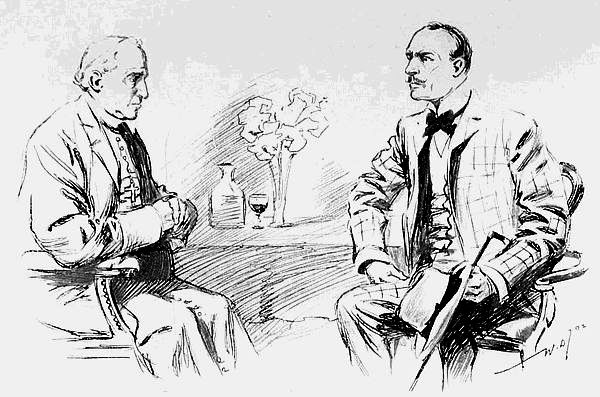
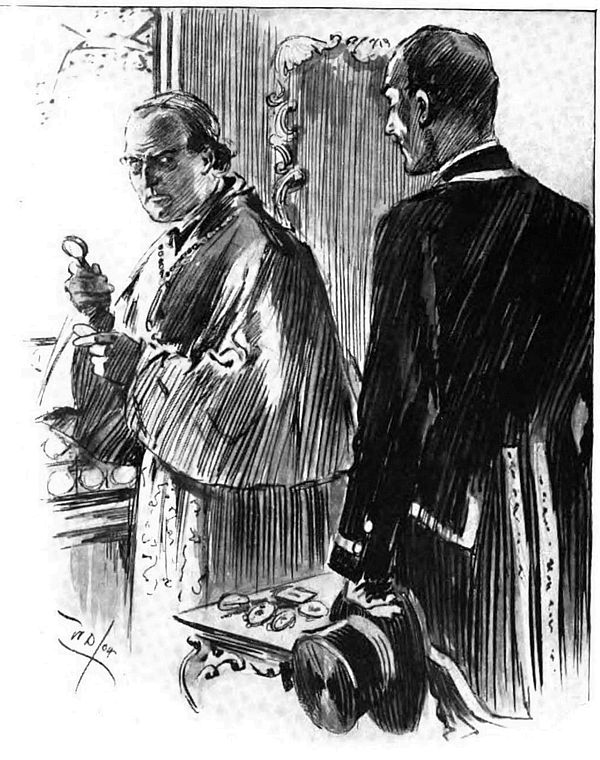
“‘We shall find out whether he is a priest,’ was the retort.”
‘And you suggest that this Father Kehler——?’
‘Herr Kehler,’ I corrected. ‘This man is no more
a priest than I am. He is believed to be the agent
of a Chicago Trust, which desires to see Cuba brought
within the Union.’
‘We shall find out whether he is a priest,’ was
the retort. ‘Before he can say Mass in this diocese
he will have to apply for permission, and to show
his ordination papers.’
‘But if he does not wish to say Mass? If he
merely confines himself to directing the Sister whom
he has conducted here?’
‘In that case we cannot interfere. We have no
more proof that she is a Sister than that he is a
priest?’
I gave Monsignor X—— an indignant look, which
he bore with coolness.
‘Besides, what is it that you apprehend?’ he asked.
‘One cannot deal with imaginary dangers.’
‘I am sure that these two persons are bent on
some desperate enterprise—that their presence in
Havana bodes no good to the cause of peace,’ was
all I could find to say.
The ecclesiastic made a scornful gesture.
‘It appears to me that this is a matter which
concerns the police,’ he said, in a tone which signified
that the interview was at an end.
I returned to my quarters, realising to the full
the difficulty of any effective action. To go to the
police would be merely to invite a repetition of the
snub which I had just received from the ecclesiastical
authority. I could only rely on my own resources.
I sent a wire to Stearine: ‘War agent here as
priest, accompanied by nun,’ and waited. It was
just possible that Stearine might have connections
through which those who had power in the Church
at Havana might be influenced, in which case I had
no doubt that Monsignor X—— would very quickly
become interested in the doings of ‘Father’ Kehler.
I can hardly tell what it was precisely that I
expected to happen. I had some idea of an assassination,
possibly of the captain of the Maine, or
perhaps of the American Consul, by Sister Marie-Joseph.
Day by day I perceived the unhappy girl becoming more
and more wrought up to the pitch of
enthusiasm necessary for the perpetration of some
hideous deed, like that of Charlotte Corday, or
Judith. Curiously enough, the poor Sister showed
an inclination for my society, perhaps because I was
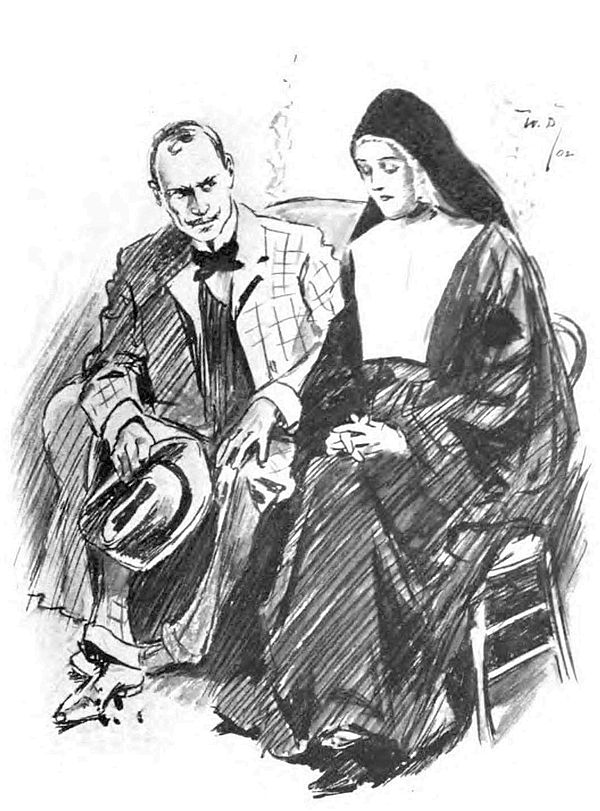
a familiar face. She would sit beside me in the
drawing-room of the hotel and talk about her convent,
in which she had been educated and passed
most of her life.
“She would talk about her convent.”
I learned that she was of a noble family, rendered
poor by the ravages committed in the course of the
Cuban insurrection, a fact which may have helped to
exasperate her spirit. But I sought in vain to draw
her into any confidences on the subject of her
mission to Havana. The moment I touched on
that topic she became dumb, and made an excuse to
leave me.
During the next few days I observed the intimacy
between Kehler and the American officers becoming
closer. The German could speak English fluently,
and this circumstance naturally recommended him
as a companion in a place where Spanish and French
are almost the only languages known to the inhabitants.
There was a young lieutenant, or sub-lieutenant,
in particular, who was constantly in
Kehler’s company, viewing the sights of the town, or
smoking with him on the hotel verandah. Suspecting
that my man had some object in cultivating this
lieutenant, I endeavoured to make his acquaintance
myself, only to find my advances rebuffed in a
manner which showed me plainly that Kehler had
been at work disparaging me beforehand.
One day as I was standing on the verandah I
noticed the pair come out of the hotel together, and
turn in the direction of the harbour. I followed at
a discreet distance, and saw the officer conduct
Kehler into a boat, manned by sailors from the
Maine, in which they pulled off to the ship. I
stood watching, and at the end of about an hour I
saw them coming back, the face of the false priest
wearing a serious expression.
I took advantage of my acquaintance with him
to meet the pair as they landed, and accost them
carelessly.
‘You have been to have a look over the ship?’ I
threw out.
Kehler tried to pass on with a careless nod, but
the lieutenant, less discreet, drew himself up with a
severe glance at me.
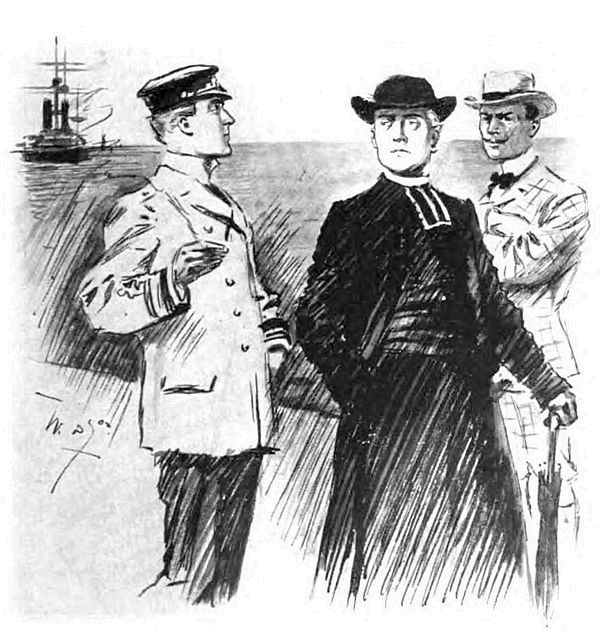
‘Father Kehler has been good enough to visit a
poor sailor who is lying sick on board,’ he said, in a
tone evidently meant to rebuke my impertinence.
I bowed with assumed respect. But as they went
on their way I experienced a sensation of alarm.
The pretext which had imposed on the officer was
transparent enough as far as I was concerned. I
realised that Kehler was steadily pursuing some
well-thought-out design, and that he had contrived
this visit to the man-of-war with some dark purpose
which it was my business to discover.
I determined at length, since Kehler’s friend was
so strongly prejudiced, to seek out some other
officer, preferably the commander, and take him
into my full confidence. Unhappily events marched
too swiftly for me. That very evening it was already
too late.
“‘Father Kehler has been good enough to visit a poor sailor who
is lying sick on board,’ he said, in a tone evidently meant
to rebuke my impertinence.”
Passing through the entrance hall on my way
upstairs to dress for dinner, I was struck by the
sight of the basket-trunk belonging to Sister Marie-Joseph
standing strapped-up, ready to go away. At
the foot of the staircase I encountered the Sister
herself, evidently prepared for departure.
She appeared pleased to have the opportunity of
bidding me farewell.
‘I shall not forget you where I am going,’ she
said with a mournful smile, as she extended her
hand.
‘May one inquire where that will be?’ I ventured
to ask.
She shook her head.
‘It is an affair of duty. I am going a very long
way, and you will never see me again.’
‘And Father Kehler,’ I forced myself to say, ‘does
he accompany you?’
A momentary expression of repugnance, almost of
loathing, flashed out on her pale face.
‘No, no! The padre has done his part in conducting
me so far, and finding me the situation of
which I was in search. I have parted with him
now, and we have nothing more to do with one
another.’
This answer relieved my mind of a burden. I
came hastily to the conclusion that Kehler, finding
himself able to carry out his projects without assistance,
had decided to dispense with an embarrassing
ally, and I was glad to think that this poor girl
would be delivered from his evil influence.
What blindness are we capable of towards those
very things which seem the clearest to our after-recollections!
I took the precaution to ascertain at the bureau
that Kehler was still staying on in the hotel, and I
came down to dinner with a light heart.
A number of the American officers were dining in
the hotel that night. There appeared to be a sort
of entertainment going forward, in which some
Spanish officers from the garrison were fraternising
with them.
Kehler, deprived of the company of his lieutenant,
sat at a small table by himself, and I noticed that
he was drinking heavily, while his flushed face and
inflamed eyes showed him to be labouring with an
excitement which I ascribed to the influence of
the wine.
I sat down at another table, and busied myself
with efforts to disentangle the threads of the intrigue
which was being woven around me. I cast a thought
or two after the poor girl, with whom I had been so
strangely associated.
Absorbed in these thoughts, I did not mark the
evening advancing, when I was gradually aroused by
the breaking up of the military party. The lieutenant,
who had shown so strong a dislike for me,
rose from his seat and came my way, taking a
Spanish officer by the arm.
As they approached, I perceived from his gait
that the American had been affected by the healths
he had been drinking. I saw him point me out
to his companion as they approached, and he
muttered something in the other’s ear, which caused
the Spaniard to turn on me a glance of grave
disgust.
Stung by this insufferable insolence, I sprang to
my feet, and placed myself in front of the lieutenant.
‘Have you anything to say to me, sir?’ I said
sternly.
‘Nothing. I do not talk with spies,’ was the coarse
retort.
‘But you take them on board the ship it is your
duty to guard,’ I returned fiercely, carried out of
myself.
The lieutenant drew back, amazed.
‘I have taken a worthy priest to console a dying
man—one of his own faith,’ he stammered out.
‘A German police agent, disguised as a priest, I
suppose you mean. The spy Kehler?’
He began to tremble violently. ‘But the Sister!
The nurse!’
‘Sister Marie-Joseph! What do you mean?’
‘She is on board now, nursing O’Callaghan.’
It was my turn to utter an oath of consternation.
‘Come with me. Take me on board instantly, or
take me to your commander.’
‘We will go on board,’ said the sobered lieutenant.
Glancing round as I followed him out I saw that
Kehler had disappeared. Quickening our steps by
a common instinct, the lieutenant and I almost ran
down to the water’s edge.
‘Thank God!’ burst from his lips as we came in
sight of the majestic vessel lying peacefully at her
anchors in the calm waters of the bay, her spars and
turrets outlined against the clear, starlit sky, and
only a few twinkling lights betraying the presence
of the two hundred men who slept below her decks.
The same instant there was a spout of fire, a cloud
of wreck and dust mounted to heaven, and a
thunderous boom stunned our ears, and sent the
waters of the bay dashing up at our feet.
The Maine had broken like a bubble. I saw all
in a flash—in some dark way that will never now be
revealed Sister Marie-Joseph had blown up the Maine.
Kehler had succeeded—I had failed.
It has not been easy for me to write the story of
what I regard as the greatest failure of my career.
My mistake was the initial one of refusing to purchase
Kehler’s confidences, by the expedient of pledging
myself to assist his enterprise.
Immediately the intelligence of the disaster reached
Europe Stearine sent me a cable peremptorily enjoining
silence. That injunction I consider has now
lost its force through three circumstances, the lapse
of time, the death in action of Lieutenant ——, and
the living suicide of the arch-criminal, haunted by
the horror of his own deed, in the deathlike cloisters
of La Trappe.
III THE MYSTERY OF CAPTAIN DREYFUS
Every one must feel that the last word has not
been said on that extraordinary transaction which
convulsed France, and shocked Europe, during the
close of the nineteenth century, under the name of
the Dreyfus Case.
It is true that no effort has been spared by the
Government of the Republic to put an end to an
agitation which threatened to develop into a civil
war. A general amnesty has been proclaimed; the
courts of law have been forbidden to entertain any
proceedings involving the guilt or innocence of
Captain Dreyfus, his accusers or his partisans, and
the French press has been appealed to, in the name
of patriotism, to close its columns to all further
discussion of the dangerous topic.
Such an attitude, adopted in order to save France
from disruption, is not without a certain dignity;
but it is at the same time terribly unjust. It is as if
France had repeated to the victim of the Devil’s Isle
the memorable words—‘It is better that one man
should die for the people.’
The one person in Europe who is completely
ignorant of the true motives underlying this grim
tragedy is without doubt Dreyfus himself. That
taciturn, commonplace figure, suddenly elevated
into the position of criminal, martyr, and hero,
was merely the shuttlecock driven through the air
by unseen hands. Even if he was guilty of writing
the celebrated bordereau—a question which the
Court of Rennes decided in the affirmative—he
must have done it by the order of others, given
for reasons which he did not comprehend.
It will be remembered that before and during the
second trial of Dreyfus, the strongest efforts were
put forth on his behalf by three foreign Powers—those
composing the Triple Alliance. The German,
Austrian, and Italian military attachés, breaking
through the etiquette of their position, disclaimed,
each on his personal word of honour, any dealings
with the alleged spy.
Not only so, but I myself sent for the Paris correspondent
of a London newspaper of high standing,
and authorised him to inform his readers that the
German Emperor himself was prepared personally
to exculpate the accused from the charge of selling
information to Germany.
This offer, made privately to the French President,
was declined for the same reasons which
prompted the Government to hush up the whole
affair. But every thoughtful man will realise that
it would not have been made unless there had
been more at stake than the freedom of an obscure
captain.
My own connection with the Affaire Dreyfus dates
from the time of the first trial and sentence, when
the theatrical spectacle of the degradation of the
unfortunate officer was the theme of universal comment.
At this juncture I received a visit from
Colonel ——, an officer high in the Emperor’s
confidence, and at that time attached to the German
Embassy in Paris.
‘I have come to you,’ he announced, as soon as
we found ourselves alone, ‘by command of his
Imperial Majesty the Kaiser.’
I bowed respectfully as I replied—
‘I am deeply honoured by this fresh proof of his
Majesty’s confidence.’
The Colonel regarded me for a moment with some
curiosity.
‘You are a sort of spy, are you not?’ he inquired.
I refused to take offence at this blunt question, so
natural on the part of a soldier.
‘Each of us has his own part to play,’ I explained
suavely. ‘The soldier fights with the enemy in
the open field; the man of my profession has to
encounter the foes who burrow underground.’
Colonel —— appeared satisfied.
‘The Kaiser trusts you; that is enough for me,’
he declared. ‘You will not dare to betray this
confidence?’
This time I rose to my feet, stern and contemptuous.
‘You have not come here to insult me, I suppose,
Colonel? If you are the bearer of instructions from
the Kaiser, be good enough to deliver them without
comment; if not, I will attend to my other business.’
The German’s face betrayed his astonishment at
this rebuke. He hastened to mutter an apology,
which I received in silence.
‘His Majesty wishes you to investigate this Affaire
Dreyfus, on his behalf. There is some secret motive
for the notoriety which they are conferring on this
unlucky spy’—the Colonel gave me an apprehensive
glance as he pronounced this word—‘and the Kaiser
is determined to find out what it is. It appears
that we are being made a sort of stalking-horse in
the business; it is pretended that Dreyfus was an
agent of ours, which is utterly untrue.’ The German
smiled sardonically as he added: ‘Our information
is supplied to us from higher sources than a simple
captain of artillery, and we can get as much as we
choose to pay for.’
‘Is it not likely that Dreyfus may be the scapegoat
of others—perhaps those higher sources to which
you refer?’
The Colonel shook his head.
‘That does not explain the persistence with which
they are trying to connect the affair with Germany.
I have information that the heads of the French
Army are representing that France is in actual
danger. The bitterness with which Dreyfus is
assailed is due, they pretend, to a sense of the
national peril.’
‘And all that is quite untrue, I understand?’
‘So untrue that I have reason to know that
Wilhelm II. has a particular desire to conciliate
the French——’ The Colonel stopped abruptly as
if he had been on the point of saying too much.
‘Very good. Then I am to find out for his
Majesty as much as I can about this affair, and
particularly why it is sought to represent Dreyfus
as an agent of Germany?’
Colonel —— nodded.
It was not an easy task to set me; nevertheless,
I had some hope of success. It so happened that
I had formerly had transactions of a confidential
nature with General Garnier, one of the foremost,
if not the foremost, figure among the persecutors of
Dreyfus. I had the right to approach this General
as a friend, and I had reasons for believing that he
might be willing to open his mouth for a sufficient
consideration.
Shortly after Colonel ——’s departure, therefore,
I strolled round to the General’s private residence,
off the Avenue Clichy. Garnier was not at home,
but I left a message with the concierge that the
dealer in old coins, who had formerly sold him some
Roman specimens, had just obtained others which
he was anxious to submit for inspection.
As I anticipated, this message had the desired
result of bringing General Garnier to see me the
same night. He came, not to my public bureau,
but to a little apartment in the Quartier Latin which
I rent for the purpose of interviews with clients who
do not wish their acquaintance with me to be known.
It was evident that my summons had annoyed,
perhaps frightened, him.
‘Now, Monsieur V——, what does this mean?’
he blustered, as I closed the door behind him.
‘It means, Monsieur le Général, that I have a
question to ask you, but that I do not expect you
to answer it for nothing.’
Garnier was visibly relieved to discover that I had
not sent for him to extort blackmail. But his reply
was not encouraging.
‘I fear that you have given yourself trouble uselessly.
It is not my intention to sell any information
of a kind which cannot be given openly.’
I knew the man I was dealing with too well to
take this answer as final.
‘Without doubt you are right to remind me that
a man like yourself ought to be approached with a
great deal of circumspection,’ I returned, with a
mixture of politeness and irony.
Garnier’s face flushed.
‘I mean what I have said,’ he affirmed. ‘You
must not suppose that you are dealing to-day with
Colonel Garnier. In my position one has responsibilities
to which there attaches itself a sentiment
of honour, you understand, M. V——?’
My experience has not taught me that men become
more scrupulous by being promoted from the rank
of Colonel to that of General, but only that they
become more greedy. I replied—
‘I understand of course that one does not buy old
coins at the same price from a general officer as from
a field officer.’
Garnier’s face assumed a look of indecision.
‘For whom are you acting, this time?’ he
demanded.
‘General, if any one had asked me formerly from
where I had procured my Roman coins, what do you
suppose my answer would have been?’
Garnier tugged thoughtfully at his moustache, as
he frowned over a refusal which was, at the same
time, a proof that he could trust me.
“‘As to that—impossible!’ he exclaimed with vigour. ‘That is our secret—ours,
you understand.’”
‘Suppose you explain to me what information you
are in search of?’ he said, throwing himself into a
chair.
I thought the battle was won, as I responded—
‘It concerns the Dreyfus Case.’
To my surprise, Garnier bounded out of the seat
into which he had just dropped.
‘As to that—impossible!’ he exclaimed with
vigour. ‘That is our secret—ours, you understand.’
I listened to this declaration with secret dismay.
It revealed to me that the fate of Dreyfus was in
some manner connected with the interest of the
heads of the French Army, in short, with Garnier’s
own; and from his tone I suspected that I was
questioning the arch-plotter.
There was still the chance that he might be willing
to part with the secret if he could be assured
that it would not be used against him.
‘Suppose I required this information on behalf
of a friendly monarch, who is himself a soldier,
and who might be willing to pledge his word that
it should not be made use of to your disadvantage?’
Garnier gazed at me as though he would have read
the name of this monarch in my eyes.
‘Impossible,’ he repeated, in a tone of real regret;
‘twice impossible!’ And, as though anxious to convince
me that his refusal was not unfriendly, he
added—‘It is not a question of a Boulanger this time.’
Perceiving that I could not press him further without
showing my own hand, I reluctantly allowed
Garnier to depart. He had in reality told me more
than he suspected.
In the first place, he had convinced me that the
Kaiser’s suspicions were not idle, by his reception of
my hint that I was acting for a foreign Power. If
the ferocious sentence on Dreyfus had been inspired
by spite against an unpopular officer, or by a desire
to find a scapegoat for bigger traitors; or if it had
merely been an episode in the secret duel between
the Church and the Freemasons, as the champions of
Dreyfus were inclined to believe, there would have
been no meaning in that regretful ‘Twice impossible!’
If Garnier had refused to sell his secret to a foreign
Power, I knew him well enough to feel assured that
it must be because that Power was in some way interested
to defeat Garnier’s conspiracy.
But the real clue had been placed in my hands by
those concluding words—‘It is not a question of a
Boulanger this time.’
Such a phrase constituted a riddle which few
men in Europe were better able than myself to
decipher.
Boulanger was an adventurer, lifted on a wave of
popular favour, who had seemed likely at one moment
to overturn the republic and replace it by a military
dictatorship with himself at the head. He had failed
because he was a mere adventurer, who represented
no principle, and who lacked that personal prestige
with the Army which is only acquired by successful
leadership in war.
Nevertheless his career had revealed the weakness
of the Republic, and proved that all that was necessary
to bring about its downfall was an alliance
between the military caste and some pretender with
more substantial claims than those conferred by the
shouts of the Paris mob.
Every one who knows anything of France knows
that the soldiers have long chafed under the ascendency
of the lawyers, which is a necessary consequence
of Republican institutions. But Garnier’s words, if I
interpreted them rightly, showed that the lesson of
Boulanger’s failure had been laid to heart, and that
this time the military conspiracy which undoubtedly
existed had found a really formidable figurehead. In
short, it was a question not of a military dictator, but
of a monarch; not of a Boulanger, but of a Bourbon
or a Bonaparte.
I found myself on the brink of a discovery of first-rate
importance. For the success of such a military
revolution as that indicated only two things seemed
necessary, a candidate and an occasion. If my
diagnosis were sound, a candidate had been found
in Philippe d’Orléans, the representative of the
ancient monarchy, or Victor Napoleon, the heir of
the Bonapartes. The occasion was to be furnished,
perhaps, by the long-delayed war of la revanche!
As soon as I had reduced my thoughts to some
sort of order I decided that my next step must be to
ascertain which of the two pretenders, who seemed
pointed out for the leading rôle in such a conspiracy,
was the chosen one. The Duke of Orleans was at
this time in England, while the home of Prince
Napoleon, as every one knows, is in the neighbourhood
of Brussels.
I despatched two of my most trusted subordinates,
one to Belgium, and the other to England, with instructions
to keep a close watch on the movements
of both princes, and to let me know if there were any
signs of unusual activity which would indicate that
some stroke was in preparation.
In Paris I kept up a similar watch on the headquarters
of the Royalist and Bonapartist parties.
The Royalists are formidable, thanks to the influence
of society; but the Bonapartist cause is represented
by a small and dwindling clique of journalists and
demagogues, who exhaust themselves in the effort to
revive the Napoleonic legend, by their parrot-like
repetition of the words Marengo and Austerlitz.
I did not imagine that this noisy faction would be
intrusted with any important secret; and I was soon
satisfied that if the chiefs of the Army were really
contemplating a restoration, Bourbon or Bonapartist,
they had kept their design entirely to themselves.
The first reports which I received from my agents
abroad were discouraging. The Bourbon Pretender,
who is without reticence, and seeks every opportunity
of advertising his personality, appeared to be quite
passive for the moment.
Prince Victor Napoleon, a man of a very different
character, who withdraws himself as much as possible
from public notice, conscious, perhaps, that he has
inherited some of his father’s unpopularity, was also
leading his usual quiet life, and no evidence was
forthcoming of any secret intelligence between him
and the group of generals who controlled the French
army.
Things were in this position, and I was beginning
to feel dissatisfied with the slow progress I was
making, when I was suddenly called to the telephone
one evening by my agent in Brussels, who had at
last some important news for me.
‘Prince Victor is going to England,’ he announced,
after we had exchanged the password.
‘To England!’ Was it possible that the two
rivals were about to meet? I asked myself. ‘When
does he depart?’
‘Perhaps to-morrow. His secretary has been to
the Belgian Foreign Office to procure passports.’
‘There are no passports required in England,’ I
returned, my suspicions instantly roused. ‘You
have been deceived. Have you seen the passport?’
‘No. It was from the servants that I learned the
Prince was going to England.’
‘It is a blind, rest assured. Keep the strictest
watch, and do not allow him to leave Brussels without
you. I shall come by the next train.’
I rang off the communication, and hastened to
make the necessary preparations for a journey of
which I could not foresee the end.
On alighting in the Belgian capital I was met by
my faithful henchman, who informed me with sparkling
eyes that he had succeeded, by means of a bribe,
in ascertaining from a clerk in the Foreign Office
that a passport had been granted to the Comte de
Saint Pol and secretary, travelling to Berlin.
If anything had been needed to convince me that
the journey of Prince Napoleon had a serious purpose,
these concealments would have done so. I was
now confident that I was on the right track, and I
did not grudge the fatigue involved in a journey
across Europe.
I ordered Fouqué, as my man was named, to resume
his watch on the Prince’s abode, while I waited
at the station from which the Berlin express takes
its departure. It was understood that we were both
to proceed by the same train as the Comte de Saint
Pol and his companion.
No hitch occurred; the Prince, accompanied by
his secretary and my agent, duly arrived to take their
seats in the train, and the four of us alighted together
in the capital of Germany. I had spent the
interval in considering my plan of action. I was so
far from foreseeing the true cause of Prince Napoleon’s
mysterious journey, that I expected to find
him closeted the next day with the German Emperor,
imparting the confidence which Garnier had refused
to me. The event proved very different.
As soon as the two travellers had taken up their
quarters in a hotel, whither, it is needless to say, we
accompanied them, the secretary was sent out on an
errand by himself. Fouqué, of course, followed, and
came back in about an hour with the startling information
that the secretary had been to the Russian
Embassy.
The meaning of this proceeding flashed upon me
at once. The real destination of the Prince was not
Berlin, but Petersburg. He was merely passing a
few hours in Berlin in order to confuse the trail, and
he had sent his passport to the Embassy to be viséd
for Russia.
In order to make sure that my surmise was
correct, I decided to make use of my implied
authority to act on behalf of the German Government.
I ordered Fouqué to force his way bodily
into the Count’s apartment, announce himself as
an agent of the Berlin police, and demand to see
the stranger’s passport. The ruse was completely
successful, and I learned that the yellow seal of the
Russian Eagle had been affixed to the paper.
My own task had now become difficult and
dangerous. Although I maintain friendly relations
with the Russian police, with whom I have often
collaborated, I knew they were not likely to tolerate
my intrusion into their territory as the spy of a
foreign Power. In dealing with half-reclaimed
savages like the Slaves, one never knows what
form their revenge will take, and Siberia is not a
country in which I have ever had any inclination
to reside.
The plan which presented itself to my mind was
an audacious one, but in such situations audacity is
safer than faint-heartedness. I despatched Fouqué
to the headquarters of the Berlin police with a
denunciation against Prince Napoleon’s secretary for
the crime of lèse-majesté.
Lèse-majesté is the one offence which is never
treated lightly in German official quarters. Fouqué’s
information was eagerly taken down, and a police
officer promptly arrived at the hotel armed with a
warrant for the arrest of the traveller.
M. Rémillard, the secretary, protested in vain that
he was a stranger, who had only that hour arrived
in Berlin, and was leaving Germany the next day;
and that he had never been guilty of the least disrespect
towards Wilhelm II.
‘You declared that the Emperor was a babbler,’
he was informed.
‘Ah, but I meant the Emperor of Russia,’ retorted
the Frenchman smartly.
‘What, is he a babbler, too?’ exclaimed the policeman—an
answer which, I believe, has since become
celebrated.
But his ingenuity could not save the unlucky
secretary from arrest, and the Comte de Saint Pol
found himself obliged to proceed on his journey
alone. It remained for me to complete the execution
of my design, by substituting myself in the
place of M. Rémillard.
This project, which would have been beyond the
powers of an ordinary police agent, was rendered
possible in my case by my extensive knowledge of
underground politics, and the reputation which I
have striven to deserve of a man whose faith can
be depended on.
I dismissed Fouqué, whose further presence would
have embarrassed me, and took my seat in the coupé
reserved for the Comte de Saint Pol in the Petersburg
express.
In answer to the remonstrance with which my
intrusion was received, I explained that I was acting
under orders.
‘Your travelling companion has been arrested,
Monsieur le Comte, but perhaps I may be allowed
to supply his place.’
‘Am I under arrest, too?’ Prince Victor demanded
with some indignation.
‘Not at all,’ I answered, ‘but your movements are
of some interest to the German Government, or
rather the Emperor, who has honoured me with his
personal instructions.’
‘What have my affairs to do with his Imperial
Majesty?’ inquired the Prince anxiously.
‘Perhaps nothing, perhaps a great deal. You will,
at least allow, Monsieur le Comte, that your passage
through Germany appears to be attended with some
mystery.’
‘In short——?’
‘In short, the Emperor will be glad to be honoured
by your confidence, Monseigneur.’
The Prince started at this title, and began narrowly
scrutinising my face, while he evidently considered
in his own mind what account to give of himself.
‘It may assist you, perhaps,’ I went on to say, ‘if
I tell you that I already know nearly all that you
can tell me. I am M. V——.’
At this name a change passed over Prince
Napoleon’s face. A silent struggle seemed to be
taking place in his breast. Presently he raised his
eyes to mine.
“‘Am I under arrest too?’ Prince Pierre demanded with some indignation.”
‘Tell me, M. V——, are you capable of forgetting
for a couple of hours that you are the Emperor’s
confidential agent, and favouring me with your disinterested
advice?’
‘I believe so, always provided that your Highness
does not ask me to betray the confidences I have
received from others.’
The Prince accepted this stipulation with frankness.
‘In all probability you are in a position to tell me
more about the reasons for this journey than I know
myself. I am going, as a matter of fact, in search of
information.’
I concealed as much as possible the shock of
surprise which this confession caused me. Up to
that moment I had naturally imagined that the
Prince was on his way to consult the Tsar, and
obtain his approval, as the ally of France, of whatever
designs were in progress. I now realised
suddenly that I had overlooked a factor in the
situation whose importance might be greater than
Prince Victor’s own.
I need scarcely say that I refer to his brother
Louis.
In enumerating the pretenders whose ambition
threatens the Republic, I had naturally omitted this
prince, whose claims seemed to be overshadowed
by those of his elder brother. I now recalled his
popularity as a young man of the most charming
manners, and the prestige which he derives from
his rank in the Russian Army and the personal
friendship of the Tsar.
What was more possible than that Garnier and
his comrades, passing over the unattractive elder,
should have chosen as the figurehead of their
usurpation this romantic character, who would be
doubly dependent on them, because he would be
doubly a usurper?
These reflections passed through my mind swiftly
enough for me to answer without any perceptible
pause—
‘You are paying a visit to your brother?’
Prince Victor nodded, as though that were a
matter of course. It was easy to see that he felt it
a relief to be able to discuss the situation fully and
frankly with a man of experience and resource, one
who moreover had no reason for taking his brother’s
side.
Briefly, his story came to this:—
‘Some years ago, after the death of our father, my
brother had a long consultation with me about the
prospects of our family. He asserted that he was
more popular in France than I was, and suggested
that the chance of a Bonaparte restoration would be
improved if I would consent to abdicate in his favour.
This I naturally refused to do, but he pressed me,
and got other members of the family to do the same,
and at last I gave way so far as to say that if there
were a substantial prospect of success, and it really
depended on my resigning my rights in my brother’s
favour, I would do it.
‘When I said that, of course, I thought it would be
a question of a popular plebiscite, like our uncle
received, and that I should be bound by the voice
of the majority. But ever since then I have seen
feelers put out from time to time in the Paris papers,
suggesting that I did not wish to insist on my rights
as the heir of the great Napoleon. And now within
the last few days I have received a letter from my
brother, informing me that a restoration is at last
possible, and calling on me to fulfil my pledge, and
publicly abdicate my claims.’
I listened to this remarkable disclosure with the
keenest interest. It confirmed my suspicions on
almost every point, though I was still far from feeling
that I had obtained a complete solution to the
problem set me by Wilhelm II.
My companion let it be seen plainly that he was
not very well pleased with the prospect of being
supplanted by his younger brother. I took this
feeling into account in the advice which I offered.
‘The only thing you have told me that is new to
me, is the fact that Prince Louis is the person
favoured by the conspirators,’ I said. ‘I knew there
was some such plot on foot, but, like every one else,
I took it for granted that you were the only possible
candidate for the empire.’ My companion breathed
indignantly.
‘As for the success of the movement, that is
highly problematical. You will not feel very satisfied
if you execute this solemn act, only to see your
brother rise for a moment on the shoulders of the
mob, and then vanish like Boulanger, leaving your
House more feeble than at present.’
‘Then what do you advise me to say to my
brother?’ he asked eagerly.
‘I think your course is perfectly clear. You are
entitled to demand the fullest information, in the
first place. If that satisfies you that your brother’s
success is assured, that no action on your part can
retard it, then you will act gracefully by conceding
a signature which will not deprive you of anything,
and will give you substantial claims on his gratitude.
But if you see that you are being asked to efface
yourself without sufficient grounds, you have only to
declare that you are not convinced, and to issue a
manifesto to your supporters in France, reminding
them that you are still the head of the House of
Bonaparte.’
My companion received this suggestion with every
sign of satisfaction. During the remainder of the
journey I lost no opportunity of playing on the
same string, and making him feel that I was, as
it were, his ally, engaging in defeating a plot which
was much more against him than against the Republic.
When we reached the Russian frontier, I had no
difficulty in inducing the Prince to pass me through
the barrier as the secretary of the Comte de Saint
Pol, and I thus entered Russia in perfect security,
in a character which would have amazed the Third
Section.
On our arrival in Petersburg I asked Prince
Napoleon if he intended to go to his brother’s
address. He answered proudly—
‘I am still the head of my House, I believe. It
would be more suitable for me to let my brother
know of my arrival in order that he may wait
upon me.’
I willingly charged myself with the delivery of the
summons.
The announcement that I came from Brussels
secured my instant admission to Prince Louis’s
presence.
‘I have the honour to act as secretary to his
Imperial Highness, Prince Victor Napoleon,’ I
explained.
‘Ah! In that case you bring me a letter from
him, no doubt?’
‘I bring your Highness a message simply. The
Prince desires to see you.’
‘But I cannot leave Petersburg—surely my brother
knows that!’
‘He knows it so well that he is in Petersburg.’
Prince Louis sprang to his feet, thunderstruck.
‘Victor is here!—already!’ he exclaimed in confusion.
For answer I named the hotel at which we had
put up, explaining at the same time that the Prince
wished to preserve his incognito strictly.
Prince Louis prepared to accompany me to the
hotel in the carriage which had brought me to his
house. As we drove along, he inquired—
‘Are you in my brother’s confidence?’
‘I believe I enjoy that honour,’ was my reply. ‘At
least I am acquainted with the business which has
brought him here.’
‘Perhaps you can tell me something of my brother’s
views?’ he said, feeling his way.
‘I think his Highness expects to receive full
information before he takes a step which will be
irrevocable.’
‘Ah!’
‘He thinks, perhaps, that you may have been
deceived by exaggerated promises, and that he
has the right to forbid any premature attempt
whose failure would damage the Bonapartist cause.’
Prince Louis gnawed his moustache with some
impatience.
‘My brother must not be unreasonable,’ he murmured.
‘One is never certain of success in these
attempts.’
‘If you will allow me to advise you, you will
give him the fullest opportunity of judging of your
prospects. It would be a serious thing for everybody
if he were provoked into any public demonstration
against you.’
The younger Prince changed colour.
‘Is it so serious as that?’ he exclaimed. And
during the remainder of the drive he continued
wrapped in thought, only the working of his brow
betraying the anxiety within.
The greeting between the brothers was cordial,
if not affectionate. I took it for granted that I was
to be a party to the conference, and as each brother
believed that I was secretly friendly to him, neither
suggested that I should retire.
As soon as we were seated round the table, on
which I had laid out some paper, pens, and ink,
Prince Victor formally opened the discussion.
He spoke with a good deal of dignity and some
eloquence. He treated it as a matter beyond dispute
that he was the sole depository of the authority
of the great Napoleon, entitled to the absolute
obedience of every member of his House. He disclaimed
any personal ambition, and referred to his
former pledge, which he described as a promise to
abdicate if he were convinced that such a step on
his part was really likely to result in the restoration
of the empire.
He then laid it down that he retained the sole
right to decide if and when the time for this step
had arrived, and hinted that it was his duty, as well
as his right, to interfere actively to check any designs
of which he disapproved. He concluded by professing
a sincere and hearty interest in his brother’s
fortunes, and inviting Prince Louis to confide in him
fully, as in his best friend.
This statesmanlike deliverance appeared to inspire
the younger Prince with genuine respect. He
appeared to be a good deal embarrassed in the
beginning of his reply. It was a difficult task to
tell his elder brother that he had been rejected in
favour of Louis himself.
After acknowledging in the most ample manner
his brother’s claims on his obedience and gratitude,
Prince Louis proceeded—
‘The state of France shows clearly that our House
has no chance of success by constitutional means.
The Republic can only be subverted by the action
of the Army, which embodies the spirit of the nation
more truly than the collection of provincial advocates
and financiers which calls itself the Chamber of
Deputies. The Army will be guided by its chiefs,
and, therefore, it is the Staff which holds our fate
in its hands. The generals very naturally feel a
preference for a soldier. It is now nearly six months
since I was first approached in the greatest secrecy
by General Garnier.’
I had the utmost difficulty in not betraying my
emotion at the sound of this name, so inseparably
connected with the Dreyfus Case.
‘Garnier conveyed to me that he and his brother
generals had decided that the time was ripe for a
revolution, in which they anticipated receiving the
support of the Church and the noblesse. He said
they were determined to avoid a second catastrophe
like that of the mountebank Boulanger, and therefore
they meant to abolish the Republic by a
military pronunciamento, and declare France a
monarchy under their protection. And, in short,
he offered me the crown in the name of the French
Army.’
‘You reminded him of my existence, perhaps?’
put in the elder brother with some bitterness.
‘I refused to entertain the offer until it had been
made to, and refused by, you,’ Louis protested
earnestly. ‘Garnier replied that in no event would
his brother generals agree to your nomination, and
that, if I declined, the offer would be made to the
Duke of Orleans, who commanded the support of
the clerical faction. It was a question of Bonaparte
or Bourbon, and I relied on our compact that in
such a case you would relinquish your rights in my
favour.’
Prince Victor turned to me as though he wished
me to express his sentiments. I accepted the task.
‘It would have been better if you had taken Prince
Napoleon into your confidence before giving any
definite answer,’ I said. ‘General Garnier might
have paid your elder brother the compliment of
explaining the reasons for setting him aside.’
‘I did not consider the project sufficiently mature
at that time,’ was the answer. ‘I thought it better
to wait till the affair assumed a tangible shape.’
‘And this stage has now been reached?’ I
inquired.
‘It has. My brother will understand that a pretext
was necessary for the action of the Army, and
that pretext could only be the danger of war. For a
long time we were troubled with the difficulty that
neither in Germany nor in England was there any
disposition to attack France, and our treaty with
Russia laid it down in the most explicit manner that
the Tsar would only come to our assistance in the
event of our being attacked.
‘But at last, thanks to the vigilance of Garnier and
the other chiefs of the Staff, it has been discovered
that Germany is secretly preparing for a stealthy
spring; she is covering France with her spies, and,
but for the timely arrest of this Dreyfus——’
I could not resist a subdued exclamation of
triumph as the utterance of this name completed
the chain of discovery. The whole intrigue engineered
by the artful and unscrupulous French
generals lay displayed to my eye, as on a map. I
listened like one in a dream as Prince Louis continued
explaining to his brother the peril of the
French nation, the justification for the Army’s taking
command of the State, and the consequent certainty
of a Bonaparte restoration.
Victor listened silently, unable to think of any
objection, and seeing his own chance of ever reigning
as Emperor of the French slipping from him. It
was I who put the decisive question.
‘You have, I suppose, taken the Tsar into your
confidence, and convinced him of the reality of the
danger?’
‘We have obtained the promise of his support,’
Louis answered.
‘Good. In that case you will not refuse your
brother the reasonable proofs which it is his right
to demand, that you have not been deceived.’
‘What proofs do you expect?’
‘I respectfully advise Prince Napoleon to request
an interview with the Tsar.’
This advice was received with very different feelings
by the two brothers. Prince Louis cast on me
a look of surprise and annoyance; his elder brother’s
eyes glistened with pleasure at a suggestion whose
value was at once apparent to him.
‘You cannot object to my following my secretary’s
advice’, said Prince Victor, after a moment’s pause.
‘The interests of my House are at stake; and before
I resign the prospect of a throne I have a right to be
thoroughly satisfied. The Tsar is your friend, and,
therefore, you should be pleased to accept his
mediation.’
Prince Louis yielded, not very graciously, to these
representations, and undertook to arrange the conference.
He then withdrew, leaving us to discuss
the situation.
It is unnecessary for me to relate what passed
between Prince Napoleon and myself. I succeeded
in fixing him in the opinion that he had been
treated ungenerously, and that he owed it to
himself to thwart a dishonest and doubtful conspiracy,
calculated to bring the name of Bonaparte
into odium.
The following day, about the same hour, we were
received by the titular autocrat of All the Russias.
The only persons present, besides the two brothers,
were myself and the celebrated Pobiedonostzeff, who
up till quite recently has exercised a mastery over
the mind of his nominal sovereign that has been compared
to that of Richelieu over the feeble Louis XIII.
It was at once evident that the decision of
Nicholas II. would be largely determined by the
advice which he received from his spiritual and
political mentor. In effect, the conference resolved
itself into a duel between the formidable Russian
statesman and myself; he, animated by a hatred
of freedom, which led him to sympathise with the
design against the Republic; I, influenced by a
sense of justice, and a desire to do my duty by
the German Emperor.
Having briefly acknowledged the favour of the
Tsar in receiving him, Prince Napoleon left the
statement of his case in my hands.
I began by briefly referring to the understanding
between the two brothers, and the present situation
of affairs.
‘What Prince Napoleon desires,’ I went on,
addressing myself to Pobiedonostzeff, ‘is to understand
whether he is being asked to abdicate on
sufficient grounds. Is he dealing with a mere
hole-and-corner conspiracy, which may end in a
fiasco; or is it true that his Imperial Majesty the
Emperor of Russia is committed to the approval
and support of his brother’s enterprise?’
The Tsar glanced from my face to that of his
Minister, as I concluded, with an expression which
convinced me that his Majesty knew very little
about the affair, in which he had no doubt blindly
accepted the guidance of Pobiedonostzeff.
The Procurator of the Holy Synod had evidently
come prepared with an ambiguous reply.
‘His Majesty is a friend of France, and, as such,
he naturally views with concern the weakness of
the Republic, a weakness inseparable from Governments
which rest on the authority of the mob.
The Emperor is at the same time a friend of the
House of Bonaparte, though, of course, he has no
wish to interfere in favour of any particular candidate
for the French throne rather than another.
‘He is pledged by treaty to come to the assistance
of France in the case of an unprovoked attack by
the Three Powers, or by the English. It follows
that where the danger of such an attack exists,
his Majesty is ready to encourage any prudent
measure in the interests of France, such as this
appears to be.’
Prince Louis smiled, well pleased at this skilful
answer. His brother gave me an expectant glance.
‘Am I to understand, then—or, rather, is Prince
Napoleon to understand—that it is the threatening
attitude of Germany which has weighed with his
Imperial Majesty?’
‘You may say the treacherous intrigues of Germany.
The Germans have been careful to avoid any open
provocation.’
‘His Majesty has received satisfactory proofs, no
doubt, that such intrigues exist?’
‘Undoubtedly. General Garnier, on behalf of
the Staff of the French Army, has laid before the
Emperor’s advisers documents which prove up to
the hilt that Germany is merely waiting for the
psychological moment to spring upon France, disarm
her, and erase her from the list of the Great
Powers.’
‘Would it not have been more in accordance with
precedent if these documents had been submitted
to you by the President of the French Republic
through the medium of the French Ambassador?’
I was glad to notice the Tsar turn a questioning
look on his Minister as I delivered this thrust, for
which Pobiedonostzeff was evidently not prepared.
‘I do not understand your objection,’ he said, in
some surprise. ‘Prince Napoleon is surely not interested
on behalf of the Republican Government.’
‘The interest of Prince Napoleon is to know the
truth,’ I responded sternly. ‘Conspirators are not
always scrupulous about the means they employ.
General Garnier is not a man who can be pronounced
incapable of manufacturing evidence in favour of his
schemes.’
The Procurator’s face flushed.
‘You venture to insinuate that General Garnier
is a forger!’ he cried wrathfully.
‘Listen, M. Pobiedonostzeff. In the time of the
late Tsar I was employed by the Russian Government,
before it concluded the treaty of alliance with
France, to obtain secret and precise information
concerning the military strength of that country.
I have never revealed the name of the officer from
whom I purchased that information. Shall I do
so now?’
The Russian Minister gazed at me in consternation,
and his master appeared equally surprised. Glancing
at a slip of paper which lay before him, Pobiedonostzeff
asked—
‘Who are you, then? Your name cannot be
Rémillard.’
‘It is V——,’ I answered.
The Procurator threw himself back in his seat,
astonished.
‘Your police have not shown their usual astuteness,
I am afraid,’ I observed, smiling.
The Tsar now interposed in a tone of more
authority than I had ventured to hope from his
not very strong face.
‘Do you suggest, M. V——, that the whole Staff
of the French Army are engaged in a conspiracy
to forge documents?’
‘Something of the kind, I am afraid, sire.’
‘But this notorious case, which has excited the
attention of the whole of Europe—the Affaire
Dreyfus?’
‘I am in a position to assure your Majesty that
Captain Dreyfus had no more to do with Germany
than M. Pobiedonostzeff here.’
“The Tsar now interposed in a tone of more authority than I had ventured to hope for. ‘Do you suggest,
M. V——, that the whole staff of the French army are engaged in a conspiracy to forge documents?’”
The Procurator of the Holy Synod raised his head.
‘You are very confident, it seems to me, M. V——,’
he sneered. ‘May I ask if you have been retained
by the party which is seeking to reopen the case
of Dreyfus?’
‘No, M. le Procureur, my knowledge has been
acquired from an opposite quarter.’
‘From General Garnier himself, perhaps?’
‘No, not this time,’ I retorted, with biting significance.
‘My information was derived from his
Imperial Majesty, Wilhelm II.’
Never shall I forget the changes which passed
rapidly across the faces of three of my listeners as
I made this statement. Prince Victor Napoleon
alone received unmoved an announcement for which
he was already prepared.
‘It is not a month,’ I added calmly, ‘since the
German Emperor charged me with a commission to
find out two things: the reason for the theatrical
publicity given to the trial of an obscure captain in
the French Army, and the object of the persistent
attempt to represent him as a spy of Germany.’ I
paused for a moment and turned to Nicholas II.
before concluding. ‘That commission I have now
accomplished. I am now in a position to inform
the German Emperor that the purpose of this shameful
comedy is to impose on the French people the
belief that they are in danger of an invasion, from
which they can only be delivered by a Bonaparte
restoration under the patronage of your Majesty.’
The face of the young Tsar went red and white
by turn.
‘I swear by Saint Nicholas that they shall eat
their forgeries!’ he said.
And I have reason to know that it was the pressing
and peremptory request of the Russian Emperor that
at last secured the second trial, and the final pardon
and release of the unhappy sufferer.
IV WHAT WAS BEHIND THE TSAR’S PEACE RESCRIPT
Perhaps the most sensational event in recent history
was the publication by the young and newly crowned
Tsar of All the Russias of a rescript calling upon the
great military Powers of the world to disband their
armies and dismantle their fleets, and inaugurate an
era of universal peace.
This extraordinary invitation produced a flutter in
all the diplomatic dovecotes, for European statesmen
have learned by this time that Russia does nothing
in vain. Everywhere the same question was asked:
‘What is behind this rescript?’
It is scarcely necessary to add that, with the
exception of a few sentimental fanatics in England
and the United States, no one was inclined to put
faith in a demonstration which was actually the prelude
to a raid on the ancient liberties of Finland,
in order to swell the armies of the Imperial peacemaker,
and to a combined attack by all the great
Christian Powers upon the only unarmed Empire in
the world.
Nobody was deceived, but every one was disconcerted
for the moment, and I was disconcerted like
the rest. I was more. I was irresistibly drawn on
to attempt the solution of a mystery which fascinated
me like a difficult chess problem set before an expert
in the game.
I could not afford, of course, to set about such an
investigation merely for my own amusement. After
waiting a decent time on the chance that I might
be sent for by one of the Governments most
interested in unravelling the schemes of the great
Eurasian Power, I took the unusual step of going unasked
to proffer my assistance to the Ambassador of
a Power to which I have rendered important services.
To my surprise and chagrin I found myself repelled
on the threshold, the Ambassador in question,
a diplomatist of great experience, declaring that
there was nothing to discover.
‘I share your disbelief in the peaceful intentions
of the Russian Council of State,’ his Excellency was
good enough to say to me. ‘But this is a matter
with which they have really had nothing to do.
This rescript is the outcome of the Tsar’s own individuality.
He is a philanthropic young man,
carried away by the enthusiasm natural to his age,
and his advisers have had to give way to him. That
is all; and it only remains to see whether his idea is
practicable.’
The explanation was a plausible one, and all the
more so because by this time the character of the
new ruler of Russia was fairly well known to those
whose business it is to reckon up the personalities of
sovereigns and statesmen. Still I was not convinced.
‘That is exactly the explanation which I should
offer to the Foreign Offices of Europe, if I were
M. Witte,’ I ventured to observe.
The Ambassador smiled with good humour.
‘The explanation does not rest on the word of
M. Witte, I assure you,’ he answered. ‘Every one
who knows anything about Nicholas II. knows that
he is a simple-minded, honest young man, quite
incapable of playing a part in a comedy. As a
matter of fact there is nothing in this rescript
which he has not been saying in private conversation
with his family and friends any time this last
two or three years. The German Emperor heard
all about it long ago. Now at last he has put his
views formally before the world in a state paper.
These proposals may not be practicable, but there
can be no doubt that they are perfectly sincere.’
‘I do not doubt the Tsar’s sincerity,’ I returned.
‘But knowing what I know of Russia, I want to
understand why the Council of State have allowed
the Tsar to have his own way.’
This time the Ambassador’s smile was less indulgent.
‘Really, M. V——, I think you are pushing your
suspicions too far. Your profession has biassed
your mind, and caused you to see mystery where it
does not exist. You remind me of those politicians
whom Bismarck used to say that he could always
deceive by being perfectly frank.’
I smiled in my turn, a little grimly, as I responded—
‘It appears to me, your Excellency, that the counsellors
of the Tsar have just taken a leaf out of
Bismarck’s book.’
Baffled in this direction, I was casting about me
for another client, when my secretary came in to
me one morning with a despatch marked urgent,
calling me to proceed immediately to Constantinople,
where my services were required by Muzaffir Effendi,
the eunuch highest in the confidence of Abdul
Hamid.
I snatched at the opening with the assurance of
triumph. Of all states Turkey was the one most
deeply concerned in the foreign policy of Russia.
Of all possible clients the most desirable was the
ruler whose secret hoards had dazzled the imagination
of every secret service agent in the world for a
quarter of a century.
What the business might be on which Muzaffir
wanted me I neither knew nor greatly cared. I
took my seat in the train that was to bear me
towards the Balkan Peninsula, firmly resolved that
his business should give way to mine.
On my way across Central Europe I found the
papers already full of the touching story of the
benevolent young despot and his triumph over the
worldly wisdom of his counsellors. I could not
blame the journalists for being taken in by a story
which had imposed on one of the most hard-headed
diplomatists in Paris; I could only marvel at the
astuteness and daring of the Muscovite statesmen
who had contrived to turn the personal idiosyncrasies
of their sovereign to use in their Machiavellian
politics.
On reaching the shores of the Bosphorus I found,
as I had anticipated, that I was wanted to disentangle
a miserable intrigue of the harem, the kind
of work more suited to a private detective than to
a man in my unique position. Under any other
circumstances I should have declined the task without
more ado; as it was, I turned Muzaffir’s difficulty
into my opportunity.
‘Listen to me,’ I said to the trembling eunuch, as
soon as he had finished confiding his tale to me, ‘I
can save you, and I will save you, but only on one
condition. And that is, that you procure me a private
and confidential audience of the Sultan, and that
you use your influence with him to make him grant
the request I have to make.’
Muzaffir, who, like all his tribe, was a miser,
seemed overjoyed at this cheap method of rewarding
me. Of course, he wished to know the object I had
in view.
‘I am going to ask the Sultan to employ me on a
secret political mission outside the Turkish Empire,
a mission from which you have nothing to fear.
Your business is to persuade the Sultan to trust me—let
that be enough.’
Twist and wriggle as he would, the eunuch found
he could get nothing more out of me. He gave in,
and his influence over the mind of Abdul Hamid
being unbounded, I quickly found myself face to
face with the lean, dark, gaunt-eyed Asiatic who
styles himself Commander of the Faithful and
Shadow of God on earth.
Abdul Hamid proved to be in a more suspicious
mood than my friend in Paris. As soon as I mentioned
the Peace Rescript he interrupted me.
‘I am not going to disarm. I know what the
Christian Powers are by this time. They always
begin to talk about peace when they are secretly
preparing to attack somebody.’
‘I am afraid your Majesty is right. The question
is, what is the real design underlying this particular
piece of hypocrisy?’
‘I know that, too,’ was the unexpected reply. ‘The
Russians have decided to turn their attention to
China. There they can do all that they want with a
hundred thousand men. So it is to their interest to
get rid of the burden of a great army which will not
be wanted for a generation.’
This was an ingenious idea, but it did not satisfy
me, any more than the semi-official one had done. I
ventured to object—
‘If that were all, sire, there would be no occasion
for this melodramatic appeal to the other Powers.
There is nothing to hinder Russia from reducing her
armaments by one-half to-morrow. No one dreams
of attacking her. Her army is kept up for offence,
not for defence. She is the one Power that could
afford to set the example of disbanding, and such an
example would carry more weight than any number
of professions on paper, however well meant.’
The Sultan appeared struck by this reasoning.
‘Then what do you say is the object behind this
rescript?’ he demanded.
‘I do not know. But I undertake to find out
if your Majesty will furnish me with the necessary
means.’
Abdul Hamid gave me a distrustful glance.
‘It is an expensive thing to buy information from
the Council of State,’ he grumbled.
‘You are right, sire. And the higher one goes,
the more expensive it becomes. It is clear that this
move has been engineered by persons who are able to
manage the Tsar himself, and such persons are not
likely to sell their own game for much less than a
million roubles.’
Abdul Hamid quivered at the mention of this sum
as though I had demanded one of the eyes out of his
head.
‘Why should I go to this expense?’ he objected.
‘I have already told you that I am not going to
disarm.’
‘The question is whether you are willing to see
Germany and Austria disarm, leaving you to face
Russia single-handed. Surely it is worth a hundred
thousand pounds to Turkey to prevent her allies
from falling into such a trap.’
The Sultan still hesitated.
‘How do I know that I shall get anything in
return, if I trust you with this money?’ he asked
suspiciously.
‘Your Majesty must judge me by what I have
done already. Two days ago you had never heard
my name. Now I am here alone with you, with a
loaded revolver in my pocket’—the Sultan started
violently—‘discussing the secrets of your foreign
policy. Does that look as though I were a fool?’
The Commander of the Faithful sat silent, attentively
regarding me for some minutes. Finally he
dismissed me, promising to consider my proposal.
“‘Your Majesty must judge me by what I have done already. Two days you had
never heard my name. Now I am here, alone with you, with a loaded revolver in
my pocket.’ The Sultan started violently.”
I withdrew, confident that Abdul would consult
his all-powerful favourite, and that Muzaffir would
see that I got my way.
A week later I was back in Paris, with an autograph
letter from the Sultan to his Ambassador in
Russia, and a draft on the Ottoman Bank which I
took the precaution to exchange for a letter of credit
from a private Parisian banking firm to the Ephrussis
of Petersburg.
My intention was to go to Russia in the character
of a French financial agent, the representative of a
syndicate of Paris bankers, on the look-out for profitable
concessions from the Government of the Tsar.
In this way I hoped to be able to approach influential
persons without exciting suspicion, and to ascertain
their corruptibility before exposing my secret object.
In order to play this part it was not necessary for
me to indulge in any actual deceit. As a matter of
fact the demand for foreign capital to develop Russian
properties is a steadily increasing one, and I had
no difficulty in meeting with financiers willing to constitute
me their agent, to inquire into the character
of some of the undertakings submitted to them.
The only person I proposed to take into my confidence
was the Turkish Ambassador in Petersburg,
on whom I relied for information as to the personal
influences at work in the Russian Court.
It was to the Ambassador, therefore, that I paid
my first visit on arriving in the northern capital.
His Excellency received me at first with some reserve,
which was quickly dissipated by a perusal of the
Sultan’s missive.
‘You have come to learn the truth about this
rescript,’ he remarked. ‘It is certainly a new departure.
You disbelieve in the sincerity of the Tsar,
I suppose?’
‘Not in the sincerity of the Tsar, but in the sincerity
of those who make his benevolent sentiments
the cloak of their own secret policy,’ I corrected.
The Ambassador nodded approvingly.
‘You have put your finger on the weak spot,’ he
responded. ‘The danger in dealing with this rescript
is that the other Powers may take it seriously owing
to their trust in the personal character of Nicholas.
In reality Nicholas is merely an instrument in the
hands of three persons, without whose advice he does
nothing, and two of those three are themselves
creatures of the Council of State.’
‘And the three persons are?’
‘They are his mother, the Dowager Empress Dagmar;
Pobiedonostzeff, the Procurator of the Holy
Synod; and the Grand Duke ——, the Tsar’s constant
companion and bosom friend.’
At the sound of such names as these I was almost
appalled at the outset. The character of the Dowager
Empress, as much as her rank, rendered her unapproachable.
M. Pobiedonostzeff, although a bigot,
was not likely to be a traitor. The Grand Duke was
an unknown quantity, as far as I was concerned, but
it did not seem very probable that a personage in his
position would prove accessible to a bribe.
It never does to despair too soon. I put the question
which long experience of the dark side of human
nature has rendered habitual with me—
‘Has the Grand Duke any vices?’
‘He gambles a good deal in the Yacht Club.’
I drew a breath of satisfaction. Of all men the
gambler is the easiest to corrupt, because to him
alone money is everything, and because there comes
a time to every gambler when money is not to be
had.
‘Who are his gambling companions?’ was my next
question.
The Ambassador named several Russian nobles of
high rank, among whom the leading spirit seemed
to be a Prince Boris Mendelieff. I was going on
with my inquiries when his Excellency checked
me.
‘I have told you enough, it seems to me, to enable
you to go on by yourself. In the meantime I am the
Ambassador of the Sultan, not his secret service
agent, and I wish to know nothing that might compromise
me.’
I respected his scruples, though they were such
as some Russian diplomatists would scarcely have
understood, and proceeded to form my own plans for
making the acquaintance of Prince Mendelieff.
Fortunately the Russians are as unsuspicious in
private life as they are suspicious in politics. My
skill as a bridge-player, a game in which I have no
living superior, proved a ready passport into the
gaming circles of Petersburg, and it was not long
before I found myself sitting at the same card-table
with the intimate of the Grand Duke.
I was lucky enough to lose a considerable sum to
him, which I paid with a good grace, and he could
not do less than invite me to his house. I accepted
the invitation with an eagerness which must have
struck him as rather ill-bred, and we drove there
together. Over a bottle of champagne I became
confidential. I avowed myself to be a money-lender,
as well as a concession-hunter, and hinted that I
should be prepared to pay handsomely for introductions
to clients of high station.
Mendelieff took the bait like a hungry pike. He
was the first to mention the name of the Grand
Duke, doubtless knowing that his Imperial Highness
would be only too pleased to meet such an
accommodating person as I appeared to be. A
bargain was struck, and Mendelieff promised to let
me know as soon as he had arranged for my reception
by his august patron.
The meeting took place in the Prince’s own house.
Cards were produced, the stakes were exceedingly
high, and rather against my wish I won steadily,
while the losses of the Grand Duke were severe
enough to disturb his good humour. Mendelieff
artfully seized the right moment to present me as a
friend in need, and to take off the rest of the party,
leaving us together.
The Grand Duke lost no time in putting me to
the proof.
‘You are a banker, are you not, M. de Sarthe?’—De
Sarthe was the name under which I had
crossed the frontier.
‘At least, I represent some important financial
houses,’ I replied.
‘Oh, spare me that kind of thing,’ his Imperial
Highness returned impatiently, ‘let us take the usual
comedy for granted, and tell me frankly how much
you are prepared to lend me.’
‘I do not know how much you want, sir, but
I have any sum up to a million roubles at your
service.’
The Grand Duke’s eyes sparkled.
‘M. de Sarthe, you are a friend indeed!’ he
exclaimed. ‘But what are your terms for this
advance?’
‘As far as your pocket is concerned, nothing. I
do not even ask that this loan shall ever be repaid.’
He stared at me for a moment in astonishment.
Then all at once his expression changed, and his
voice dropped to a whisper.
‘Ah! I understand. This is some affair of the
secret service. You are offering me a bribe, I
suppose.’
‘I do not come from the Third Section, if that
is what your Highness means. I am, as I have
said, a financier, and my only object is to make
money.’
‘I see. You wish me to influence the Government
on your behalf?’
‘Not exactly that, sir. I am in search of information—information
which will enable me to operate
successfully on the Paris Bourse.’
The Grand Duke looked rather relieved. It
was evident that he did not consider this very
serious.
‘And what is the information you want?’ he asked.
‘It is very simple. I want to know the real bearing
of the recent Peace Rescript of the Tsar. Let
me explain,’ I went on quickly, raising my hand as
I saw he was about to speak. ‘I know the surface
explanation of the matter, but I do not believe it.
I do not believe that this rescript would ever have
seen the light unless the Council of State had some
purpose of their own to serve by it, and I want to
know what that purpose is. It is not to lessen the
burden of their own armaments; they could do that,
if they chose, to-morrow. This is an appeal to the
other Powers to disarm, and I want to know why it
has been made.’
The Grand Duke listened to this speech in silence,
biting his lips with an air of indecision from which I
augured a good result.
‘You seem to know a good deal, M. de Sarthe,’
he said sullenly. ‘Surely you must know that I am
not in the secrets of our Foreign Office.’
‘I believe that, of course, if you say so, sir. But
I believe as well that the Tsar did not draw up this
document without your encouragement, and that in
encouraging the Tsar, you acted as the instrument
of the Council of State. I am entitled to suppose
that you were not a blind instrument, but that
you knew pretty well why the Council were so
ready to fall in with the enthusiastic impulses of
Nicholas II.’
It was a bold thrust, but it went home. The
Grand Duke gave me a startled look, and relapsed
into a long spell of silent pondering. Finally he
said—
‘And supposing I were to tell you something that
you considered it worth a million roubles to hear,
what guarantee have I that you would not betray
my secret? What proof have I even now that you
are not a spy set on by my enemies in the Council
of State?’
‘I will give your Highness that proof on condition
that, if it is satisfactory, you will accept my
proposal.’
‘I consent.’
‘Then all I need do is to invite you to make your
communication, not to me but to the Ambassador
of the Sublime Porte, whom you will hardly
suspect of being in the confidence of M. Pobiedonostzeff.’
With these words I rose to my feet. Stupefied for
a moment, the Grand Duke recovered himself in
time to make a detaining gesture.
‘Do not go, monsieur. What you have said completely
satisfies me. It appears that I am required
to betray my country.’
‘That depends,’ I returned smoothly. ‘If the
Council of State is plotting to betray the Tsar, as I
understand it is, I should have thought it consistent
with the honour of a Russian prince of the blood to
take part in defeating their unworthy schemes.’
This was evidently a new view to his Imperial
Highness, and I could see by the expression of his
face that it was telling powerfully.
‘Well,’ he said at length, ‘it seems to me that you
have my word. When do you propose to pay me
this money?’
‘Now, this moment, if your Highness pleases.’
‘Count it out, then,’ was the brief injunction.
“It was a singular scene, as I stood there laying down pile after
pile of greasy ten-thousand-rouble notes on a richly inlaid
table.”
I obeyed. It was a singular scene as I stood
there laying down pile after pile of greasy ten
thousand rouble notes on a richly inlaid table, while
one of the highest personages in the proudest
Court of Europe or Asia stood beside me, his tall
figure glistening with gold ornaments and jewelled
decorations, and his dark Slavonian features flushed
with excitement and greed. As the last note left
my fingers, he bent down and breathed in my ear—
‘Take the Siberian railway, and use your eyes.’
I am ready to admit that my first feeling, after
hearing those few words which had cost me a hundred
thousand roubles each, was one of sickening
disappointment. But a very little consideration
served to show me that the Grand Duke had told
me enough to place success within my reach, and
that the information which he thus put it in my
power to acquire by my own observation was
calculated to be of greater value than any mere
statement made at second-hand.
Somewhere along the vast, just completed track
which connects the Baltic with the Pacific lay the
key to the true purpose of that famous rescript which
had imposed on all the statesmen of the world, and
only vigilance and circumspection were required
to find it.
Never was there a journey more fraught with
peril than that which I now undertook. I had to
disappear from civilisation for an unknown length
of time, and plunge into a region shrouded in
mysterious dread, the land of prison and exile; the
gloomy realm which forms the background to the
showy life of the capital beside the Neva, like a dark
subterranean dungeon hidden beneath a glittering
palace.
From Siberia few enemies of the Russian Government
ever return. My safety depended on my
keeping up the character of a financial agent, on the
look-out for sources of wealth requiring French
capital for their development. In that character I
was sure of a cordial reception, and it served as a
convenient cloak for some curiosity about the country
I was passing through.
Not daring to intrust my secret to a companion,
I was obliged to go without sleep from the moment
of leaving the Ural mountains behind. The utmost
indulgence I could allow myself was such a light
doze as left the attention ready to leap into activity
at the least provocation. At every stopping place
I got out and made a careful examination of the
neighbourhood. The one thing I had to fear was
the night. In the Cimmerian darkness of a northern
winter I might have been carried past an army
without perceiving it.
The train by which I travelled was a long one,
and it was increased before we entered Asia by the
addition of an open car like a cattle-truck, containing
peasants whom I took to be prisoners. I had to
be careful not to show myself too inquisitive, but I
noticed at the various stations along the track that
they were all young men of about the same age,
and that they got in and out in obedience to orders
given by officials who were armed, and whom I
imagined to be warders or police.
I did not consider it safe to hold much conversation
with my fellow passengers. It was probable
that more than one spy was among them. I had
an uneasy sensation of being watched by invisible
eyes, and I knew that if I once aroused real suspicion
by my behaviour, my doom was sealed.
So the days and nights passed, and the train crept
on its way across the silence of the frozen continent.
I strained my eyes in vain across the blinding waste,
and strained my ears through the night. No sight
or sound rewarded me, save the solitary huts of the
railway-men and the monotonous tinkle of sleigh-bells.
According to my reckoning we had got nearly
half way from the Ural to the Amur when the
longest stage of all was reached. We ran from the
sunset of one day to nearly noon of the next, only
halting to take in water and fuel. Then at last the
train entered a town of considerable importance,
apparently a sort of depôt of the line, there being
many side-rails on which trucks were standing as
though waiting till they should be required.
As soon as the train stopped, I got out as usual
with the other passengers, to stretch my legs and
look about me. The long journey and the lack of
proper rest had so exhausted me that it was some
time before I realised that there was an unusual
lack of bustle about this particular halt.
When at last the fact of this strange stillness was
borne in upon my consciousness, I roused myself
to observation. At once I perceived that the alighting
passengers were fewer in number than before.
It was the troop I had mistaken for prisoners who
were missing. I looked at the end of the train for
their car. It was no longer there.
We had silently slipped the wagon in the course
of the night!
This discovery acted on my tired brain like magic.
In an instant I was again the alert, cautious investigator
whose decisions were as swift as his
intuitions were unerring. Without hesitating I
returned to my carriage, removed my luggage with
the aid of a porter, and ordered a sleigh to drive
me to the hotel.
The guard of the train came up to me, as I was
making these preparations, and asked me if I were
not going on.
‘Not by your train,’ I replied blandly. ‘I shall
break my journey here, and look about me. By
what I can see this place seems likely to be an
important commercial centre, such as I have come
in search of.’
‘Your Excellency is mistaken,’ the man answered
roughly. ‘This place is nothing at all—only a
dumping place for spare wagons. To-morrow we
shall come to a really important town, where much
business is done.’
I gave the fellow my most supercilious stare.
Then, pulling out a note for fifty roubles, I handed
it to him, saying haughtily—
‘I am obliged to you for your trouble. Good day.’
He drew back astonished and abashed, and I
made my way out of the station, without once
turning to see if I were followed.
Directly I reached the hotel I threw myself on
a bed, and slept soundly for twenty-four hours.
I awoke refreshed and vigorous, and ready to
carry out my task with coolness and resolution.
Knowing myself to be in a land where every second
man was a spy, I thought it idle to attempt any
concealment of my actions. I was there as an
explorer, and I determined to explore boldly. If
the agents of the Government took it on themselves
to stop me, I knew well enough how to deal with
them.
My first step was to ask the landlord of the hotel
to recommend me a guide. The man whom he
presented to me was a typical mouchard, with ‘spy’
written on every line of his countenance. This was
just what I expected. I engaged him at a liberal
salary, and ordered him to fit out an expedition for
a journey of some days into the interior.
‘Where do you want to go?’ the man asked.
‘Where I please,’ I replied sharply. ‘Keep your
curiosity to yourself, or take another master. I want
a guide, not a partner.’
This rebuke had the desired effect. The police
agent, for such of course he was, was obliged to
come with me on my own terms. Doubtless he
reported me to his bureau as a headstrong man
who could not be controlled by any means save
open force.
At the same time I lost no opportunity of impressing
the authorities with my assumed character.
The Prefect of the town called on me, and I explained
to him that Siberia was regarded in Paris as one
of the richest mineral regions of the earth, and that
I was merely the pioneer of a swarm of prospectors
who would be invading it before long. I made his
mouth water as I talked of shares and syndicates,
and conveyed to him that by a judicious use of
his opportunities he might become one of the
millionaires of the future.
To the westward of the town, in the direction
from which the train had brought me, there was
visible a range of low hills, a conspicuous landmark
in the desolate plain. It was towards these hills
that I ordered my guide to conduct me, as soon as
the preparations for the march were completed.
The rascal was cunning enough to hide his reluctance,
and we set out. But after we had gone a
day’s journey I noticed that our march was steadily
veering away from the line of the railway, and
taking a northerly direction. I said nothing, determined
to counteract these tactics at the right
moment. At the end of the third day, after a slow
progress compared with the speed of the train, we
pitched our camp at the foot of the range, about
forty miles, as near as I could judge, from the point
where it was pierced by the railway.
The next morning the caravan wound its way
to the summit of the ridge, and I looked down on
a broad valley, watered by a river, and broken up
by small spurs jutting out from the main watershed.
As the guide was about to plunge down, so as to
cross the stream, I checked him abruptly.
‘We are not going that way. I shall turn southward
now, and keep along the summit of the ridge
till we come to the railway.’
The man’s face turned as black as a thunder-cloud.
‘You cannot go that way,’ he snorted.
‘Why?’
He hesitated.
‘Because it is impassable. The horses will break
down.’
‘We will go on till they do,’ I answered sternly.
‘And let this be your last attempt to disobey me. At
the next I send you back, and go on without you.’
The man slunk forward, muttering curses, which
I affected not to hear. But I had not yet frightened
him sufficiently. At the next halt one of the drivers
came to me and reported that a horse had gone lame.
‘Bring it here,’ I commanded.
He went away, and returned leading the animal.
‘Go,’ I said sternly. ‘Take the horse back with
you, and take rations for three days. Do not let me
see you again.’
The driver looked thoroughly crestfallen. He
slouched back to his comrades without another
word.
I waited till half an hour had passed, then I rose
and walked over to the camp-fire, round which my
followers were seated, the driver among them.
‘How is it that you are still here?’ I demanded.
‘The horse is all right again,’ was the surly answer.
‘So much the worse for you.’ I took out my
revolver in one hand, and my watch in the other.
‘In ten minutes from now I aim this revolver at
you, and fire,’ I remarked. ‘It kills at two hundred
metres. I should advise you to get out of range.’
I do not think I have ever seen a man get through
his preparations in less time than then. Long before
the allotted time was up, he was well out of reach,
galloping down the slope of the hill.
In every expedition through a wild country there
comes a moment which decides who is to be master.
That moment past, I had no fear of further trouble.
I was now able to unbend with the guide; I informed
him that I expected to find gold, and promised him
a rich reward if I succeeded with his aid.
But a disappointment was in store for me. Although
we marched carefully along the summit of
the hills, and I scrutinised every yard of the valley
below with a powerful field-glass, I detected no trace
of anything calling for investigation; in fact, I discerned
no signs of human life. By the time I had
worked down to the railway I began to fear that I
was on a false scent.
It was in the night, after we had pitched our camp
close beside the line, that the true solution occurred
to me. I rose and secretly crept out of my tent,
eluding the solitary watchman, and made my way
along the track of the rails. After groping and
stumbling over the roughly laid road for three or
four miles, I suddenly made a discovery. The line
divided, sending off a branch rail, which curved
away to the south.
I knew now what had become of the missing gang
of prisoners, or rather—for by this time I saw more
clearly—of military recruits.
I also knew why I had missed my way. The
guide had led me to the north of the line, and what
I had come so far to find lay to the south.
The next day I issued orders to continue the
march to the southward, crossing the railway. The
face of the guide, when he received this direction,
sufficiently showed that I was getting warm, as the
children say, at last. He made no open remonstrance,
but in the course of the day I noticed that another
man and horse had disappeared.
I paid no attention to this proof of treachery. It
came too late to affect me. By noon of the first
day after quitting the main line for the south, I
was already in possession of the carefully guarded
secret of the Council of State.
There at my feet, along the widening valley, lay
a double line of rails, gleaming blue in the sunlight,
and all across the level space at regular intervals
stretched low banks and ditches—the lines of a
vast encampment, capable of accommodating half a
million men. Still further on I had a glimpse of
the white sparkle of tents and piles of fresh-hewn
timber, and I even fancied I could catch the faint
hum of voices and the thud of hammers as the
hidden army toiled away at its barracks and entrenchments.
“There at my feet, along the widening valley, lay a double line of rails, and all across the level space stretched low
banks and ditches—the lines of a vast encampment, capable of accommodating half a million men.”
The meaning of the Peace Rescript was manifest
at last, and the meaning was formidable indeed.
While appearing to disarm in concert with the rest
of Europe, Russia’s intention was secretly to withdraw
her enormous forces to this unsuspected retreat,
from whence, at the decisive moment, they would
issue like a creation of magic, to overwhelm the
defenceless continent.
I had made my discovery; it was still a question
whether I was to return with it in safety.
Before I had made up my mind whether to push
my observations further, I was alarmed to see a
sotnia of Cossacks approaching, led by a Russian
officer. My little camp was quickly surrounded,
and the officer presented himself before me.
It required all my nerve to deal with the emergency.
The first words of the officer showed me that he considered
me a spy, and was prepared to hang me out
of hand. I affected the utmost astonishment and
indignation, and produced the papers which showed
me to be a Frenchman travelling on behalf of various
financial syndicates in Paris. The officer thrust
them aside contemptuously.
‘All this is nothing to me,’ he declared. ‘You
should not have come within reach of our camp.
Even if I do not hang you, you will never be allowed
to return to Europe, of that you may be assured.’
‘I will take my chance of that, captain,’ I answered
coolly. ‘Living in this out-of-the-way region, you
perhaps have not heard that France and Russia are
in military alliance, and, besides, that the Tsar has
declared his intention to disarm, so that your preparations
here have ceased to be of the slightest
consequence to anybody.’
The officer was fairly staggered. He had heard,
of course, of the French alliance, and no doubt some
rumour as to the recent rescript had penetrated to
the secret camp, but without its scope being very
well understood.
‘I know that it is my duty to arrest you, at the
very least,’ he persisted.
‘As to that, you will do as you please. It will
sound well in Paris that every prospector who
ventures into Siberia with a view of developing the
resources of the country exposes himself to the
treatment of a spy. M. Witte will find it takes
some persuasion to secure another French loan.’
It is needless to give further details of a conversation
in which the ignorance of the Russian gave
me a very great advantage over him. I am vain
enough to plume myself on having made use of the
treacherous rescript to out-manœuvre its authors. In
saying that, of course, I do not refer to Nicholas II.,
who perhaps did not even know of the existence of
the hidden camp.
In the end the Cossack officer decided to escort
me back to the town where I had left the train,
and hand me over to the civil authorities, a decision
which was assisted by the usual methods of persuasion
in the East. My friend the Prefect, already
predisposed in my favour, required a somewhat
heavier bribe, and finally I made assurance doubly
sure by resuming my journey eastward, and leaving
Russian territory by way of the Chinese frontier.
It was from the first telegraph station in the
Celestial Empire that I sent the cipher despatch to
Constantinople which was destined to render abortive
the much-talked-of Conference at the Hague:
‘Russia preparing enormous concealed camp in
Siberia, beside railway, to hide forces when nominally
disbanded. I have seen it.’
Abdul Hamid was too shrewd to take any open
part in opposing the Russian proposals, but when
I saw the firm stand made against them by the
German representatives, I knew that he had not
thrown my telegram into the waste-paper basket.
It only remains to add that the Russian Government,
realising that its secret had been betrayed,
stealthily set to work to efface every sign of the
concealed camp; and that, if my latest information
be correct, the mysterious valley is again given over
to silence and to solitude.
V WHO REALLY KILLED KING HUMBERT OF ITALY?
Guy de Maupassant once remarked to me that it
was necessary to preserve the Anarchists in order to
make modern history interesting.
The rulers of the world seem to be of the same
opinion. Over and over again scientists and men of
common sense have told them that the Anarchist is
simply a diseased mind, requiring to be dealt with
like other brain-sick creatures. But statesmen and
police alike have persisted in treating the Anarchist
as a serious politician, with results which are, unfortunately,
too well known.
It is true that, after the death of Elizabeth of
Austria, the chivalrous King of Italy, Humbert,
summoned a conference of diplomatists and police
directors in Venice to consider methods for dealing
with the Anarchists. But he would have done better
to call in Professor Lombroso. I myself would undertake
to guarantee the life of every ruler in Europe
and America, for the sum of £20,000 a year, provided
I were allowed to incarcerate in an asylum every man
whom I could prove to be a sufferer from homicidal
mania.
As it was, I foreboded that the only result of King
Humbert’s gallant action would be to point him out
to these creatures as their next victim. Yet I must
now so far confess myself mistaken as to declare that
the death of the late King of Italy does not really lie
at the door of Anarchism.
It was another European sovereign, more alive to
the realities of the situation than Humbert, who
secretly commissioned me to make an investigation
into the organisation of the Anarchist sect and the
trend of its operations. I must not disclose the name
of this monarch; to do so would be to point him out
to the vengeance of the assassins.
As soon as I had received his commission I laid
aside all my other work and prepared to disappear for
an indefinite period.
My first step was to transform myself into a workman,
or rather a loafer, for an industrious workman
is seldom found among the ‘active’ Anarchists. I
secured a few jobs in Paris as a house-painter’s
labourer—that is to say, I did the scraping and cleaning
before the skilled workman applied the fresh
coats of paint. I took care to show no zeal in my
employment, and in the intervals of work I hung
about the brasseries and grumbled at the smallness
of my earnings.
By these tactics I quickly earned the reputation of
a good comrade, and a true-hearted Republican. The
Socialists of the quarter I had chosen to work in
quickly recognised me as a likely convert, and I
allowed them to enrol me in one of the most advanced
societies.
All these measures were mere preliminaries to the
final one of blossoming forth as a declared Anarchist.
It is from the ranks of Socialism that Anarchism
draws its recruits. Though the two theories are
utterly opposed, they express the same discontent
with civilisation. An Anarchist is little more than
a Socialist who has gone out of his mind.
By going over to the Anarchist group from the
arms of their rivals, I ensured myself a welcome
which would never have been given to me had I
attempted to force myself upon them at the outset.
Among the Anarchists it was necessary to adopt
rather different tactics. I had now to play the part
of a dangerous lunatic, only awaiting direction from
some superior mind to commit an act of violence.
Paris itself is not an important Anarchist centre.
The French police are too quick witted for their
capital to be a comfortable residence for these desperadoes.
The three great centres, as most people
know, are Zürich, London, and Jersey City, U.S.A.
Zürich is the Russian headquarters, and is rather a
place for Nihilists than international Anarchists. I
therefore decided to cross over to London, in the
hope of coming into touch with the leading minds of
the sect.
In London I found myself received without the
least suspicion. My carefully prepared record stood
me in good stead. I was introduced by my Parisian
comrades as a promising convert from Socialism,
and no one inquired further.
I found the London Anarchists torn by internal
dissensions which left them no time to think of
attacking kings and queens. The first man I was
asked to murder was Prince ——, the leader of the
idealist group, whose sole offence was his refusal to
concur in the homicidal programme of the active
Anarchists.
I refused to execute this mandate, on the plea that
I had vowed to put to death a crowned head, and
could not afford to risk my life in the pursuit of
humbler prey.
I may state here that the elaborate machinery
of secret meetings, oaths, ballots, and so on has
no existence except in the imagination of popular
novelists. Their fantastic descriptions can only provoke
a smile on the part of any one who has been
behind the scenes of Anarchism.
The Anarchists are a fluctuating community, here
to-day and gone to-morrow, among whom a few leading
spirits who have learned to know and trust each
other by actual experience exercise an influence much
like that exercised by the Front Bench over a Parliamentary
party in England, an influence which varies
with their own concord and strength of character.
When these leaders find a man whom they see to
be a suitable instrument, they bring their influence to
bear on him to carry out whatever object they may
agree upon. In some cases perhaps a pantomimic
scene is arranged, such as we read of in romances,
to impress a weak mind. I can only say that I never
saw anything of the sort.
A well-known Anarchist, whose name would be
recognised immediately were I to mention it, took
me aside one night, and suggested to me the removal
of the Prince. I gave the answer I have mentioned,
and the proposal was instantly dropped.
My refusal was followed, naturally enough, by an
attempt on my own life. Two days afterwards
the editor of an Anarchist paper, who had taken
rather a fancy to me, came round to my lodgings
before daybreak and advised me to leave for America.
He gave me no reason for this advice, but he was
very urgent with me, and insisted on writing me a
letter of introduction to a man living in Jersey City.
I promised to consider the matter, and he bade me
farewell.
On leaving my lodging an hour later to go and
look for a job—the customary pretence—I discovered
immediately that I was being followed. I need
scarcely say that for me to baffle the clumsy espionage
of such blunderers would have been the easiest
thing in the world. But I wished to see how far they
would go, and I allowed my tracker to follow me all
day. At night I went down to the Thames Embankment.
I placed myself on the edge of the river steps
by Cleopatra’s Needle, and waited.
I am a good swimmer, and I did not think it likely
that my enemy would use a weapon if he thought he
could get rid of me by the simple method of pushing
me into the water. A pistol would be too dangerous
for himself on account of the report. I had seen that
he did not carry a stick. He was probably armed
with a knife, and he might try and give me a thrust
with it as he pushed me over; but a knife-thrust in
the back is not a very serious thing to a man who
has been in the habit of wearing a mail shirt for
twenty years.
I am ready to confess that my heart beat faster as
I heard the stealthy tread coming up behind me.
To my surprise the would-be assassin paused before
he had got within striking distance, and shuffled with
his feet on the flags. Puzzled by these tactics I
glanced round and saw a young man, not more than
twenty years of age, whose face was white, and who
was trembling in every limb. At once I grasped the
situation. The poor wretch’s heart had failed him,
and he was trying to put me on my guard against
himself, in order that he might have an excuse for
not carrying out his task.
I walked past him without a word, shook him off
in the course of the next hour, and took the last
train to Liverpool.
On my arrival in the States, I lost no time in
seeking out the man to whom my editor friend had
furnished me with an introduction. To the European
reader it may be worth while to explain that Jersey
City practically joins on to New York, so that it is
really a suburb of the American metropolis.
I was received with open arms by this man—an
Italian named Ferretti—and I became a member of
the most influential Anarchist club. Among those I
sometimes played dominoes with there was a long-haired
dreamer named Bresci, a visitor from Paterson.
All this time I passed under the name of Lebrun.
My American citizenship I carefully concealed.
I soon saw that some one had informed the
American group of my being bound by oath to
kill a crowned head. On all hands I was treated
with the deference due to a prospective martyr.
It was not long before Ferretti himself began to
sound me as to my willingness to make Humbert
of Italy my victim.
“I walked past him without a word.”
I was careful not to discourage this suggestion
as I had the one made to me in London. I listened
to all Ferretti had to say with apparent acquiescence.
‘Humbert has placed himself at the head of our
enemies,’ he urged. ‘This Venice conference is a
declaration of war. If we wish to maintain our
moral ascendency we must strike a blow which will
intimidate other rulers from proceeding against us.’
As soon as I could get away I went into New
York and sent a code telegram to my secretary in
Paris for him to decipher and send on to the King of
Italy. It was in these terms: ‘Anarchists in Jersey
City, U.S.A., are looking for man to send against
you. Have ports watched.’
Unfortunately the King paid no attention to this
warning. He was a fatalist, it seems.
Ferretti returned to the charge before long. I
kept him in play, neither consenting nor refusing,
my object being, of course, to retain his confidence.
I did not want another man to be despatched instead
of me without my knowledge.
It was not long before others beside Ferretti began
to try and influence me in the same direction. It
is difficult to trace the first birth of suspicion in the
mind, but a suspicion was born in mine that these
men had some motive which they had not yet
disclosed to me for urging me to this attempt.
I tested them at last by making a counter-proposal.
It was in the club, late one night, and there were
present, beside Ferretti, another Italian who called
himself ‘The Bear,’ a bearded German named Peters,
and a Swiss watchmaker, who was lame and used
crutches. These four seemed to have a common
understanding.
Peters had been acting as spokesman, and strongly
denouncing the proceedings at Venice, which he
described as an abandonment of the methods of
civilisation—a curious complaint for an Anarchist
to make.
Ferretti applied the moral.
‘Some one must be found to avenge us,’ he declared.
‘If Humbert is suffered to live, our principles are
doomed.’
‘I am not sure of that,’ I answered. ‘Humbert is
not a politician. He has been stirred up because
Luccheni killed a woman, which, in my opinion, was
an unwise action. We ought to choose our victims
more carefully. It is absurd to pick off a man like
Humbert, when there are such enemies as —— and
—— alive.’
My remarks were received in ominous silence. The
other four exchanged looks of disappointment. The
Bear was the first to protest.
‘It is the curse of Anarchism that every one wants
to have his own opinion. It seems to me that when
men like ourselves, who have guided the movement
for years, are agreed on the right course of action, a
new comrade ought to accept our decision.’
I did not retort that the word Anarchist, if it
meant anything, meant one who had his own
opinion and refused to be guided by the agreement
of others. There is nothing a fanatic resents
so much as reason, except ridicule. Instead, I
affected to be surprised.
‘Do you mean that you disapprove of the execution
of ——?’ I demanded, naming a man
whose reputation for cruelty and bigotry was world
wide.
‘The removal of Humbert ought to come first,’
was the answer.
‘Do you say that deliberately? Have all our
comrades made up their minds, or is it merely your
own opinion?’
‘It is the judgment of us four,’ said The Bear.
‘That ought to be enough.’
‘We are willing to provide funds for any comrade
who will undertake the mission,’ added Peters.
‘But not for any other mission, such as one against
——?’ I ventured to object.
‘We have not said that. We are ready to consider
an application.’
The last answer came from the lame watchmaker,
who had kept his eyes fixed on me with a close
scrutiny during the whole conversation. It was
evident that this man was more cautious than the
other three, and that he had begun to distrust me.
Perhaps he thought I was a boaster; perhaps his
suspicions went deeper.
‘Well, I am not under anybody’s orders,’ I said,
rising to my feet. ‘Show me that I can serve the
cause better by Humbert’s removal than any one
else’s, and I will take the mission.’
The four let me come away in silence. I had
now no doubt whatever that there was some very
strong motive in the background behind all this
talk about the Venice conference, and I sent a
fresh wire to the threatened King—‘American
group absolutely determined on your death, and
offering bribes.’
This telegram was treated with the same indifference
as its predecessor.
Ferretti was naturally more inclined to trust me
than were the others, thanks to my London friend’s
recommendation. I was, therefore, not surprised to
receive a call from him the next day, and to find that
he was at last going to show his hand.
‘It is right, is it not,’ he began, ‘that you are
prepared to undertake the removal of one of our
enemies, provided you are satisfied that you are
doing good to the cause?’
‘That is all I ask,’ I responded; ‘Humbert or
another, what does it matter to me?’
“‘I am not under anybody’s orders,’ I said, rising to my feet.”
‘You don’t consider that the fact that Humbert
has taken a leading part against us marks him
out for destruction?’
‘No, I don’t; I don’t believe he is any worse than
the others.’
‘Very well; admitting that, for the sake of argument;
if I were to prove to you that Humbert’s death
would benefit the cause specially in other ways, what
would you say?’
‘If I believed that, I should most likely consent.’
‘Good! That is what I expected. Now you
understand that what I am going to tell you must
be in the very greatest confidence.’
I nodded.
‘The removal of Humbert will put funds at our
disposal for other work.’
At last I was on the trail. Carefully concealing
my excitement under an appearance of natural curiosity,
I inquired: ‘How is that, comrade?’
‘You must not ask too much. I have only got
authority to tell you that it is so. A sum of money
will be ours as soon as Humbert is dead.’
‘And you will not tell me how or why?’
Ferretti hesitated.
‘It has been promised us—guaranteed to us, in
fact—by one who has reasons of his own for wanting
to see Humbert out of the way.’
‘I don’t like the sound of that,’ I objected.
‘It sounds as though we were being hired as private
assassins.’
Ferretti’s face fell.
‘I am afraid I cannot tell you anything more
without consulting others,’ he said slowly. ‘I will
swear to you, if you like, that it is not a case of
private revenge. The person behind us has public
reasons for his conduct, though they are not the
same as ours.’
This statement threw me into a brown study.
What public reasons could any one possibly have
for the removal of the King of Italy? The Garibaldians?
No, they were not assassins—besides,
they would not have come to America to get a
suitable instrument. There were plenty nearer at
hand.
‘Listen to me,’ I said at length. ‘When I took
a vow to rid the world of a crowned head at the risk
of my own life, I did not undertake to become a
blind tool in the hands of any one else. I owe no
obedience to you or our comrades. I say what I
said last night—convince me that I ought to kill
Humbert, and I will. But it is no good if you can’t
trust me. Why should I trust you with my life,
when you won’t trust me with your reasons for wanting
this King out of the way?’
Ferretti was staggered.
‘I will tell the others what you say,’ he declared.
‘For my part, I think your demand is reasonable.’
He left me, but did not come back. Days passed,
and no further overture was made to me. On the
contrary, the lame Swiss began to talk to me about
the other victims I had pointed out, and to encourage
me to fix on one of them.
I was able to guess what had happened. The four
were looking for a more docile tool.
I sent off a third wire:
‘I have lost touch with the conspiracy. From this
moment I no longer answer for your life.’
This warning was not even shown to the doomed
King.
I now adopted a course which I had put off as
long as possible, on account of the risk involved. I
secretly engaged a second lodging at a distance,
where I could disguise myself as I pleased, and
began to shadow the Anarchist leaders.
It was a dangerous game to play, because such
men were accustomed to find themselves the subject
of police surveillance, and would probably be
quick to detect anything of the sort. My only
chance of success lay in the fact that I already
possessed so much knowledge of their movements
as to make the task of watching them a comparatively
easy one.
I had come to the conclusion that the real head
of the group was the crippled Swiss. This man kept
a small shop, chiefly for repairs, in the heart of the
Italian quarter. I made up as a Corsican, to account
for any imperfections of accent, and hung about the
neighbourhood, begging.
Ferretti, Peters, and The Bear were frequent
visitors, and the simpleton Bresci called once or
twice, but for some days I saw nothing that I could
fix upon as having a suspicious look. I remembered,
however, that the lame watchmaker had always
been missing from the gatherings at the club
on Saturday nights, and I looked forward to making
some discovery when the end of the week arrived.
I was not disappointed, though I had to wait so
long that I almost gave up hope. Just as the clock
struck ten a tall, swarthy figure brushed right by
me, and slipped into the little shop. The moment
after, the lame man came out into the street, and
began putting up the shutters.
It was necessary to act promptly. I stepped up
to the Swiss and whispered my assumed name in
his ear.
‘Lebrun! You!’ he ejaculated in astonishment.
‘I thought you were one of the police.’
‘It is the other way about,’ I answered. ‘The
police have been after me; that is why I have had
to disguise myself. But let us come inside, I want
to talk to you.’
As I expected, he tried to prevent me going
in.
‘No, not there. I have some one on business.’
‘Business of the cause?’ I demanded.
‘Yes—no, private business.’
‘I will wait in the shop till he is gone,’ I returned,
and pushed my way through the door, the cripple
following.
The tall, dark figure started to its feet in evident
alarm as we entered. I saw a brown hand glide
towards the bosom, an action which told me that I
was not dealing with a European. In the dim light
of the little shop I could not fix the stranger’s
nationality more precisely. He did not seem to be
an Arab; he was above the grade of a negro. If I
had met him in Algiers I should have called him a
Sudanese, a convenient term for the unknown races
of Africa.
The situation was a complicated one. The watchmaker,
it was evident, did not more than half believe
my account of myself; I could not tell that the
stranger really had any connection with the mystery
I wanted to unravel; and he must have been utterly
confounded by my intrusion.
‘Is your friend one of us? Does he know anything
about the business you put before me the other
day?’ I asked of the Swiss in Italian.
Before the Swiss could do more than give me a
warning gesture, the unknown had addressed him
in the sort of Italian which forms the common
speech of seamen in the Levant.
‘Is this the man you thought you could persuade
to undertake the work?’
The watchmaker was fairly cornered.
‘Go inside and I will speak to you,’ he said to
the swarthy outlander; then he added, speaking in
quick French to me—‘I must have some explanation
with you before I trust you again.’
‘That will not do for me,’ I returned, sticking
to my Italian and trying to render it intelligible
to the unknown. ‘You have asked me to do a
dangerous work on behalf of the cause; very well,
I am ready to do it, but first I insist on knowing
who is going to provide the sinews of war. That is
fair, it seems to me.’
This time the stranger’s tone became peremptory.
‘Why do not you wish me to speak to this man?’
he asked.
The shopkeeper scowled at both of us by turns.
‘Because I don’t know that he is right,’ he
muttered.
‘How do I know that you are right?’ I retorted.
‘It appears you are going to have a big price for
this business, and you want me to shut my eyes
and not ask what becomes of the money.’
The Swiss wrung his hands in despair. I believe
that he was quite honest, and that he wished for
the money in order to spread his atrocious principles;
while his distrust of me was only too well founded.
I addressed myself boldly to the unknown.
‘I am your man, I believe. Tell me who you are,
and why you want this job carried out, and I will
undertake it. As for the money, you may hand
that over to my comrade here, as long as I know
how much it is.’
This last offer turned the balance. The Swiss
himself proposed that we should come into the
back shop and talk things over in confidence.
When we were all three seated together, it was
the watchmaker who gave me the long-sought explanation
in a few words.
‘This man is an Abyssinian. He has come here
on behalf of the Emperor Menelik.’
‘Menelik!’ I exclaimed in astonishment. ‘What
has he got to do with us?’
‘Nothing directly; but if you have read the papers
you must know that Humbert was the moving spirit
in the Abyssinian war. He made peace after Adowa,
under pressure from the Crown Prince, who told him
the dynasty was in danger. But Menelik believes
that the King is secretly preparing for a fresh attack.
He is in league with the British, who are advancing
from the Sudan. The Abyssinians want to clear
the Italians out of their country altogether, and
they can never do that while Humbert is alive.
That is how it stands, isn’t it?’
This last question was addressed to Menelik’s
agent. The Abyssinian answered by a smile that
showed his formidable white teeth.
‘The King of Italy is the enemy of Abyssinia.
The King of Italy must die. If an Abyssinian tries
to kill him, he will be suspected, and stopped; therefore
he must be killed by a European. The Negus
has sent me to find a European who will do this
for money. I have been in Italy and France, and
there they told me that it was best for me to apply
to the followers of your religion, which teaches that
all kings ought to be killed. Is it not so? Therefore
I come here, to the headquarters of your sect.
If one of you will accept the task, on that day I
pay him in the money of this country one thousand
dollars. On the day I hear that King Humbert is
dead I pay you four thousand dollars. Divide it
how you like; that is nothing to me.’
Improbable as a fairy tale though all this sounded,
I could not resist the evidence of my own senses,
which showed me the Abyssinian envoy there in
the flesh. I knew, of course, that assassination has
always been one of the recognised political methods
of Asiatic and African States, but this alliance
between a half-civilised despot and the extreme
revolutionaries of Europe struck me as altogether
without precedent in the history of the world.
Certainly my own experience, fertile as it naturally
had been in surprising incidents, had never brought
to light a more singular intrigue than this.
My position now became an extremely difficult one.
I had practically agreed to accept the commission
to assassinate the King of Italy, but it was not
that which troubled me. I foresaw that as soon as
Menelik’s agent realised that he had been played
with by me he would endeavour to find some other
and more trustworthy tool. To denounce him to
the police of New York would have been perfectly
idle; in the first place he could buy the police,
and in the second place no American court would
punish a ‘political’ conspiracy, unless, indeed, it were
against the United States.
I contented myself for the moment with formally
undertaking the required murder. The Abyssinian
arranged to bring the first instalment of the blood
money to the watchmaker’s house on the following
Saturday night, and we all three parted apparently
on the best of terms.
The next day I sent off a long telegraphic despatch
summarising the whole situation. The proposal
I made was that the Italian Government
should cable me authority and funds to enable me
to have the Abyssinian envoy privately kidnapped,
and returned to his own country, viâ Massowah.
They had the incredible folly to wire instead to
their Minister in Washington, instructing him to
demand the arrest and expulsion of Menelik’s agent.
The net result of this ill-considered action was to
flood the Italian quarter of Jersey City for several
days with sham detectives, to cause a thousand or
two dollars to pass into the pockets of the local
Tammany, and to compel me to hasten my departure
for Europe on my supposed mission, in order
to rebut the suspicions of the Anarchists—and, in
fact, to escape their vengeance.
The night before my departure there was a little
supper at the club, at which the four were present.
No open reference was made to the object of my
journey. But after supper the half-witted Bresci,
who had been one of the party, asked leave to walk
home with me.
‘I wish I were going with you,’ he said suddenly.
‘I wish I could put you in an asylum, where you
would be taken care of,’ was my thought in answer.
I said aloud that I had reasons for going alone.
‘I know those reasons,’ the enthusiast declared.
‘Let me come with you. I am not afraid.’
For a moment I hesitated. A king’s life was in
the balance, though I did not know it.
I made the clever man’s common mistake—I
underrated the strength of the fool.
‘Take my advice,’ I said to Bresci, ‘leave this work
to men like me. You are not suited for it: you
would betray yourself directly.’
His face became overcast, and he relapsed into a
sullen silence which lasted till I parted from him
at my own door.
An hour before stepping on board the steamer
that was to convey me to Havre I sent off a final
wire: ‘Am leaving to-day for Europe, pledged to kill
King Humbert.’
This bitter shaft of contempt roused even the
Italian police into activity. On landing at the
French port I was met by a detective sent from
Rome.
I took him with me to a hotel, where we discussed
the situation in a private room.
‘It seems to me that we are all right for the
present,’ he urged. ‘As long as they think you
are going to carry out the work they are not likely
to send any one else.’
‘Do not be too sure,’ I answered. ‘There is a lame
watchmaker over there who does not quite trust me.’
‘What do you propose to do?’ asked the detective.
‘To shoot King Humbert,’ I replied.
The man gasped at me in sheer amazement.
‘I am going to put you to a practical test,’ I
explained. ‘I am going to try and discharge a
blank cartridge at the King. If you can prevent
my doing so, I shall hope that his life is safe.’
‘But what do you expect us to do? We cannot
arrest you.’
‘No; that is my point. You know that I am
going to kill your King, and yet the law does not
permit you to interfere till you see me put my finger
to the trigger of my revolver.’
‘We can stop you at the frontier.’
‘Try,’ I said drily.
He tried. A week later I was in Rome.
In reality I did not intend to go quite so far as I
had threatened. To do so would have been offensive
to his Majesty. What I desired was to put the
police thoroughly on the alert. I hoped to stimulate
them into taking precautions which would be effective
against a real assassin.
For I knew better than to think that Menelik’s
envoy would go away satisfied with having despatched
me on the errand of death. I did not
believe the swarthy figure with the formidable white
teeth would leave New York till he had received
some certain assurance of the success of his murderous
plans.
Before leaving the United States I had arranged
with my old employers, Pinkerton’s, to have a watch
kept on all outward-bound vessels, so that I might
receive the earliest information of any move on the
part of the Abyssinian. I had supplied them with
a full description of the man.
Meanwhile the Italian police did their best,
hampered as they were by the King’s chivalrous
disregard of danger, and his dislike of surveillance.
It is not an easy thing to guard a monarch against
his will.
As soon as I had satisfied myself that my disguise
as an Italian workman was impenetrable, I went
northward after the doomed King. As my train
rolled into the station at Turin, I caught a glimpse
on the platform of a white face with long draggled
hair and a haunted expression in the eyes—a face
that I had last seen in a Jersey City slum at midnight,
more than a month ago.
Long before the train stopped I had leapt out of
my compartment in hot pursuit; but Bresci had
disappeared.
I went instantly to the chief police-officer in Turin
and gave information. Detectives were despatched
in all directions to search the city; but it was too
late.
The following morning a telegram was put into
my hands before I got out of bed. It was from
Pinkerton’s, and contained these words: ‘Man
answering description has just booked passage to
Liverpool.’
This despatch convinced me that the situation
was desperate. Coupling the news with the sight
of the evening before, I could not doubt that the
Abyssinian agent expected to hear within the next
few hours that his dreadful end was achieved.
I dressed in feverish haste and rushed round to
the police-office, only to learn that no arrest had
been made, and Bresci was still at large.
‘Unless that man is apprehended within the
next twenty-four hours, King Humbert will have
ceased to live,’ I told the astonished chief of
police.
In this extremity I decided to proceed to Monza,
see the King myself, and implore him not to stir
abroad until Bresci’s capture was notified. That
afternoon, as I entered the small town of Monza, I
was arrested on suspicion!
It was in vain that I protested, warned, and
threatened. My demand to be carried before King
Humbert was regarded as a proof of guilt. My disclosure
of my identity was suspected as a ruse. I
was confined in a cell while telegrams were being
exchanged with my friend the Italian detective, and
with my secretary in Paris.
Suddenly, as I tramped impatiently up and down
within my narrow bounds, I was aware of a terrible
commotion outside. Men ran past the door of my
prison, curses and cries were heard, and there was a
sound of bayonets being fixed. Maddened by the
nervous tension, I battered with my manacled hands
against the cell door.
“‘You are free,’ he said briefly. ‘The right man has been arrested,
too late.’”
It was flung open from without, and an armed
warder faced me.
‘You are free,’ he said briefly. ‘The right man has
been arrested—too late.’
I sank down on the plank seat and burst into
tears.
VI THE PERIL OF NORWAY
The readers of my previous revelations will have
noticed that I have constantly been engaged in
thwarting the schemes of the cunning rulers of
Russia. This has been to me a labour of love. My
father, as I have said, was a native of Poland, and I
have avenged his wrongs on the Government which
drove him forth to exile.
I have already related how I exposed and defeated
the insidious design concealed under the Peace Rescript
of Nicholas II. Hardly had this audacious
intrigue miscarried when Europe was startled to
hear that the Ministers of the Imperial peacemaker
had overthrown the ancient liberties of Finland, in
order to swell the Finnish contingent to the armies
of the Tsar.
This time I admit that I was deceived, like everybody
else. The brutal frankness of the proceeding
disarmed suspicion. When Russia openly declares
herself a tyrant, it is difficult to believe she is
dissembling.
But there was one man in Europe who saw that
there was more in the proceedings against Finland
than met the eye. This was a monarch whose genius
and nobility of character would have placed him at
the head of living rulers had he been born to the
command of a great Power instead of a small and
distracted State. I need scarcely say that I refer
to his Majesty, King Oscar of Sweden and Norway.
It was with peculiar satisfaction that I received a
confidential summons from this King, whose fine
qualities I had long admired, and by whom I felt
it a distinction to be trusted. I was far from guessing
the real nature of the business on which I was
to be employed.
As the message did not come to me through the
Scandinavian Minister in Paris, but was a private
autograph communication from King Oscar himself,
I was disposed to think his Majesty wanted me to
adjust some family affair. It is well known that the
Bernadottes are not more free from such anxieties
than other royal houses.
On my arrival at the beautiful capital of Sweden,
I put up at the Hotel Rydberg, entering myself as
the Baron de Neuville, on tour. The same evening
I was called upon by one of the King’s intimate
friends, the Count Söderhielm, who took me across
to the Palace, and introduced me into King Oscar’s
private cabinet.
I noticed as we crossed the Place Gustavus
Adolphus that the flag was not hoisted on the
Palace. His Majesty was supposed to be at Drottningholm,
from which place he had come secretly
in a small launch for the purpose of our interview.
As soon as Count Söderhielm had presented me
to his Majesty, he retired to the antechamber,
leaving us together.
‘Perhaps you are wondering what I have sent for
you to do?’ King Oscar began.
‘At least, I do not doubt that any service on which
your Majesty employs me will be an honourable
one,’ I answered respectfully.
The King smiled.
‘I have not sent for you to pay me compliments,’
he said rebukingly. ‘Let me first ask if it is true
that you are no friend to the Russian Government?’
I looked at the King in some surprise.
‘It is better for me to tell you, sire, that I do not
allow my private feelings to enter into my work.
The Russian Government has employed me before
now, and may do so again; in which case I should
serve it as loyally as I hope to do your Majesty.’
The King did not seem ill-pleased by this frankness.
‘I respect you for that answer,’ he said graciously.
‘I ought not to have asked you for your personal
confidence.’
‘I am a Pole by my father’s side, sire,’ I threw in.
King Oscar thanked me for this hint by a nod.
‘Let us come to business. You have taken note,
I expect, of this determination to Russianise Finland?’
I bowed, restraining my curiosity at this unexpected
opening.
‘You know that Finland is an ancient province of
the Swedish Crown, and that when it was united to
Russia, after the fall of Napoleon, my ancestor, the
then Crown Prince Bernadotte, was authorised to
take Norway as a compensation?’
‘I do, sire.’
‘Perhaps you know also that the exchange has
been a disastrous one for Sweden. The Finns were
contented and happy under our rule, while the
Norwegians have done nothing but quarrel with the
Swedes for a century.’
‘I have heard something of this,’ I responded.
‘Now as long as Finland held the position of a
semi-independent State, over which the Tsar ruled
as Grand Duke of Finland, it was possible for us to
regard her as a buffer between us and Russia. We
had every reason to hope that if the Russians wished
to attack us, they would have to subdue Finland
first.’
‘I was hardly aware of that, sire.’
‘It is the fact. The Finnish civilisation is really
Swedish, our language is spoken there, and the
Swedish element in the population looks on Sweden
as its real home. Very good. That being so, the
Russians have decided to conquer Finland in time
of peace, under the cloak of administrative measures.’
‘Your Majesty means that this attack on Finland
is really an attack on Sweden and Norway?’
‘It is the first step towards an attack on Sweden,’
King Oscar answered, with significance. ‘The question
of Norway is the matter about which I have
sent for you.’
I gazed at the King in astonishment.
‘I am the King of Norway as well as of Sweden,’
his Majesty pursued, ‘and you must not think I
favour one country more than the other. But I
might as well be King at the same time of France
and Germany, for any real harmony there is between
the two countries. The Norwegians are working
for absolute separation; the Swedes will grant them
everything except the right to make war on Sweden;
and yet they cannot agree.’
‘You fear, sire, that the Norwegians will fight in
order to secure their independence.’
‘I fear it is rather the other way about,’ the King
answered sorrowfully. ‘They aim at independence
in order to be able to fight. You see me in the
position of a father whose two children are ready to
rush at one another’s throats, and who cannot show
kindness to one without incurring the hatred of the
other. This situation has poisoned the peace of
mind of every sovereign of Scandinavia for a hundred
years. It broke my grandfather’s heart.’
I listened to this sad confession with respectful
sympathy. King Oscar proceeded—
‘Let me tell you some more. Before the last
Russo-Turkish war, the geography of the Balkans
had been made for a year the special study of the
Military School in Petersburg. Last month the
geography of Scandinavia was given a similar precedence.
That is not all. A swarm of Russian
officers, disguised as woodcutters, have been coming
over the northern frontier, and making their way
down through Sweden, surveying the country as
they go.’
‘Surely they can be arrested as spies!’
‘We dare not,’ was the response. ‘That would
be forcing Russia’s hand. We can only watch, and
await developments.’
‘The Germans ought to know of this,’ I ventured
to remark.
‘The Germans are more afraid of Russia than we
are,’ the King answered. ‘Germany is no longer a
first-class Power. There are in fact only four Powers
of the first magnitude to-day, Great Britain, Russia,
the United States, and China. The two English
Powers together could dictate to the world, but they
are divided by the childish American jealousy.
China is still asleep. Consequently all the other
Powers of Europe are little more than vassals of
the Tsar. France has openly placed herself under
his protection. Austria has become Russia’s junior
partner in the Balkans. The independence of
Germany is only nominal; the Emperor takes his
time from Petersburg. No other country counts.’
It was the first time that I had heard the situation
summed up with such pitiless plainness.
‘You consider, then, that Russia is actually about
to draw the sword?’ I asked.
‘No, she will leave us to do that. Russia has
discovered that her conquests advance better under
the cloak of peace. She means to take Norway
under cover of a declaration in favour of Norwegian
independence.’
‘But the Norwegians—are they mad enough to
become parties to that? Do they want to exchange
King Log for King Stork?’
‘Go and see,’ was King Oscar’s reply.
I quitted his Majesty’s presence, and returned to
my hotel, deeply disturbed by what I had heard.
I could not suppose that the most sagacious sovereign
in Europe was indulging in idle fears. Yet it was
hard to believe that the inhabitants of a free,
self-governing country would voluntarily exchange
their condition for servitude to the Asiatic despotism
which had just laid Finland prostrate at their
door.
Three days afterwards I arrived in Christiania.
I had made careful preparations for the task before
me. I assumed the character of a Russian spy, as
the least likely to provoke suspicion of the quarter
from which I really came. And I had disguised
my person as effectively as I knew how, lest I
should meet a real agent of the Tsar’s Government,
who might detect A—— V—— beneath the outward
semblance of Alexander Volkuski.
The pains I had taken were well rewarded. In
the hotel in which I put up I found staying a man
who passed as a Finnish officer, of Swedish nationality,
but whom I immediately recognised as Count
Marloff, the confidential right-hand man of M. de
Witte himself. It is true the Russian was disguised,
and the disguise was a very good one, but by an
almost incredible oversight he had ventured to
assume that a disguise which had already done duty
once might safely be used again.
It was seven years before, in Teheran, that I had
seen that reddish wig and noted that peculiar limp,
but if Count Marloff had offered me his card I
could not have been more sure of his identity.
Such mistakes may be pardonable in a mere detective,
but they are fatal in our profession.
My tactics were soon decided on. I knew that
the attention of ‘Colonel Sigersen’ would be quickly
attracted to a Russian staying in Christiania, and
I have generally found the boldest game to be the
most successful.
I seized the first opportunity of the Count’s being
seated alone in the smoking-room of the hotel, to
go up to him boldly.
‘How do you do, Count?’ I said in Russian.
‘Or perhaps you will wish me to say “Colonel”?’
Marloff started, as well he might, and stared hard
into my face.
‘My name is Colonel Sigersen,’ he said forbiddingly.
‘Have I had the pleasure of meeting you
before?’
This was the opening I wanted. I drew back
disdainfully.
‘I must apologise,’ I said, with irony; ‘I have not
had the honour of meeting you, Colonel Sigersen.
Pray do not think I wish to intrude on you.’
Marloff saw his mistake. In the secret service
of Russia nothing is more common than for two
different agents to be employed independently of
each other, and even as spies upon each other.
When that happens, if the two men are wise,
they strike up a private alliance, and compare
notes at their employers’ expense. When they
keep each other at arm’s length, each has it in
his power to cause annoyance to the other.
Marloff was now in the position of having refused
my overture towards friendship, without knowing
who I was. This left me free to watch him, without
rendering any explanations. He was consequently
furious with himself.
The fact is the man was a mere amateur, as one
who drops into a profession from above generally is.
De Witte had taken him out of a cavalry regiment,
and made a diplomatist of him; but when it came to
secret service work he was a child in the hands of a
man like myself.
I saw the pretended Colonel get up and limp out
of the room, no doubt to send a cipher despatch to
the Minister, complaining of my arrival. I went to
the manager of the hotel, introduced myself as a
Russian police agent on the track of a great rouble
forgery, and wormed out of him a mass of particulars
with regard to Sigersen’s movements.
I gathered that he had been in Christiania about a
month, having toured through Norway first as far
north as Trondhjem. He had made numerous
friends in the Norwegian capital, including several
prominent members of the Storthing, as they call
their parliament. But his chosen intimate appeared
to be a judge named ——, who was regarded as a
guiding spirit of the party most strongly hostile to
the Swedish connection.
It was Judge —— who had prompted the erection
of a fortress on the Swedish-Norwegian frontier,
guarding the approach to Christiania. The same
warlike functionary had decided on the judicial bench
that no native of Sweden could exercise the rights
of a citizen in Norway until he had taken out letters
of naturalisation. In short, this judge had carefully
taught his countrymen to treat the Swedes as Englishmen
were treated by the Boers in the days of the
Transvaal Republic.
All this was nothing more than I had been prepared
for by King Oscar. The task now before me
was to ascertain if possible what was the nature of
the understanding between Judge —— and the agent
of the Russian Government.
I asked the hotel manager—
‘How does Colonel Sigersen pay your bill?’
‘By cheque,’ was the ready answer. ‘By cheque
on the Bergen and Christiania Bank.’
‘Is it usual for foreign visitors to have a banking
account open in Christiania?’ I inquired, keeping up
the part of a detective.
The manager admitted it was not. Evidently, now
I had drawn his attention to the point, it struck him
as suspicious. I left him, feeling that I had secured
an ally in my watch on Marloff, and made my way to
the offices of the bank.
The director of this institution received me with
every courtesy. Bankers are too often victimised
for them to regard the police with any feeling but
gratitude. The tale I brought was received with
open ears.
‘I have reason to think that an account has been
opened with you for purposes of fraud. If I am
right, the swindlers have endeavoured to gain your
confidence at the outset by a large credit. This
credit has been opened in the name of Colonel
Sigersen, a pretended Finlander.’
The manager was visibly alarmed.
‘A gentleman of that name has opened an account
with us, certainly,’ he answered cautiously. ‘But he
brought the very best introductions. In fact I could
not have asked for better.’
‘Have you any objection to tell me the character
of those introductions?’
‘I don’t mind telling you that one was from
a well-known citizen, a man in a very responsible
position.’
‘In short, Judge ——?’
The manager started.
‘How did you know that?’ he demanded.
‘I have been on Colonel Sigersen’s track for a
long time,’ I answered evasively. ‘I venture to
think that if you make inquiries, you will find
that his Honour, Judge —— knows very little about
him really, and nothing at all about his financial
standing.’
‘I will communicate with his Honour, and let you
know the result.’
‘Do so, by all means. In the meanwhile, perhaps,
you may be willing to tell me how this man’s credit
is supplied?’
The manager hesitated.
‘I hardly know whether I ought to betray his
affairs until I have something more to go upon.’
‘Perhaps you will let me ask you if Sigersen has
yet made a large payment in rouble notes?’
‘I can answer that—no.’
‘Then I think you may be safe for the present,’
I said. ‘When he does, I advise you to pass them
on to your Russian correspondents as quickly as
possible.’
This shot told. The manager became very uneasy.
By degrees I worked on his fears till he invited me
to examine his ledger. I did so, and found that
Marloff had brought a heavy credit from a Petersburg
bank, and, what was more to my purpose,
had drawn several heavy cheques to the order of
Judge ——.
‘So far you seem to be on the safe side,’ I commented
as I finished my inspection. ‘But I have
two pieces of advice to give you. On no account let
this man overdraw his ascertained credit, and do not
honour any cheques drawn against rouble notes till
you hear from me again.’
“‘Let me see your warrant,’ I said.”
The manager thanked me, and allowed me to
depart.
I had now to consider the best way in which to
approach the judge, who was not likely to prove
easily gullible, as it was fairly certain that Marloff
and he were in each other’s confidence.
But I had underrated the Russian’s resources. On
re-entering my hotel I was accosted by a man in the
uniform of the Norwegian police, who informed me
that he held a warrant for my arrest.
‘On what charge?’ I demanded, as soon as I
had recovered from my first surprise.
‘On a charge of conspiracy against the Government
of Norway,’ was the answer.
‘I arrived in Norway only yesterday,’ I exclaimed.
‘All that you can tell to the judge,’ retorted the
police officer.
‘Let me see your warrant,’ I said.
The man produced the paper, while the hotel
manager, who had arrived on the scene, looked on
astonished, as he well might.
The warrant bore the signature of Judge ——.
‘Take me to the judge instantly, if you will be so
good,’ I said.
‘I am going to,’ the officer returned.
He made no attempt to secure me, probably having
had his instructions. We walked together to the
judge’s house; he appeared to combine the functions
of a judge and committing magistrate; and I was
conducted into a room evidently used for the
examination of prisoners.
Judge —— entered immediately, and we exchanged
scrutinising glances. The leader of the anti-Swedish
party was a young man, still on the right side of
forty, with a very determined countenance, and a
look about which there was nothing furtive or embarrassed.
It was not an intellectual face. I put the
man down as a strong-willed, ambitious intriguer,
with courage, but not very much disinterested
patriotism.
‘What is the meaning of this preposterous arrest?’
I demanded, with warmth.
‘This is an affair of State; I will examine the
accused in private,’ the judge announced, not answering
me directly.
As soon as the room was cleared, he turned to
me.
‘Who are you?’ was his first question.
‘I am a Russian,’ I answered.
‘I know that. What is your business here?’
I breathed again. I now knew that Marloff had
failed to guess my identity.
‘I have come here on the track of certain forgers,’
I began, and went on to tell the story I had given to
the hotel manager and the banker.
Judge —— listened incredulously.
‘I do not believe a word you have said,’ he declared.
‘Show me your papers.’
I produced the passport and credentials from the
Russian police with which I had been careful to
provide myself. They were, of course, forged.
‘I will retain these and ascertain if they are genuine,’
the judge observed.
‘Your Honour means that you will submit them
to the suspected man,’ I returned boldly.
‘How dare you say that? How dare you call’—he
hesitated for a second—‘Colonel Sigersen a suspected
man? You know perfectly well who he is.’
‘I know him to be the most skilful forger in Russia,’
I answered, not quite untruthfully.
Judge —— glared at me as if he would like to
have struck me.
‘What nonsense! You know his real name.’
‘What difference does that make, your Honour?’
‘You know he is a man in high position, in the
confidence of his Government.’
‘I know he was, till recently. I have no doubt he
is capable of pretending he is still.’
The judge was plainly disconcerted by the line I
was taking. He had hoped, no doubt, that I should
meet him half way.
‘On your arrival here you recognised the Count,
and greeted him. He rebuffed you, as he had a perfect
right to do, and denounced you to me as a spy.
It is too late for you to turn round and pretend that
he is a criminal. It is you who are on your defence,
not he.’
‘Your Honour has been imposed upon. But it is
of no consequence. Tell me what I am charged with,
and I will defend myself.’
‘You are a spy.’
‘In a sense that is true. I am a detective.’
‘By whom are you employed?’
‘Your Honour has my papers.’
The judge bit his lip. He clearly did not know
how to proceed. I, of course, could see that it was
not his game to bring me to a public trial.
‘It seems to me, sir, that it is a mistake for us to
quarrel,’ I said after giving him a minute for reflection.
‘If I have annoyed Count Marloff by recognising
him, that is not an offence against the law of
Norway, I presume. On the other hand, if I am
right in my conjectures, or rather my instructions,
the Count himself should be the last man to provoke
a public inquiry into his business here. Your Honour
knows the law better than I, but I should have
thought there might be something in the business
transacted between you and the Count which would
not look well——’
He interrupted me.
‘I want to know why you are here. If you are a
friend, of course there is no need to quarrel. If
not’—he shrugged his shoulders.
‘I came as a friend,’ I replied. ‘I came prepared
to co-operate with you, to assist you, in fact. But I
must first know how you stand with regard to Marloff.
Is he your personal friend, or are the relations between
you exclusively political?’
‘I have no personal feeling for him,’ was the
guarded answer.
‘Very good. In that case your Honour shall see
my real credentials. I must tell you frankly that
Count Marloff has ceased to enjoy the implicit confidence
of his and my Government.’
I put my hand into an inner pocket, and produced
a slip of paper in the forged handwriting of the
Russian Foreign Minister.
‘Does your Honour recognise that writing?’ I
asked, with a confident air.
Judge —— was completely deceived. He glanced
at the few lines, which were in French, with an air
of the greatest respect. Then he looked at me.
‘I must apologise, Prince ——’ he began, when I
raised a warning finger.
‘Hush! Not my real name, please.’
I took back the paper with an air as if my life
depended on its preservation, and restored it to my
pocket.
‘I am exceedingly sorry to have had to show you
this,’ I said gravely. ‘I have, in fact, exceeded my
instructions, which were simply to watch Count
Marloff and report on the progress he was making.
His own violent action has forced me to go further
than I wished. I am sorry to say it confirms the
suspicion entertained in the Foreign Office that he is
playing a double game. He is a protégé of M. de
Witte’s, but M. de Witte is not infallible.
‘Now I am afraid I must ask your Honour to take
me into your confidence. I trust you have not put
yourself into Marloff’s power? I know that he has
paid you considerable sums.’
Judge —— looked decidedly nervous.
‘I have given him nothing in writing, I believe,’ he
answered, glancing at the same time at an iron safe
let into the wall of the room.
‘So far, so good. It is writing that counts in these
affairs. Have you any objection to my seeing the
memoranda you have made of your conversations
with him?’
The judge stared at me as if I had been a wizard.
‘I don’t know what makes you think I have taken
any memoranda,’ he protested.
‘Just as you please, sir,’ I said drily. ‘I should
have been gratified if you had so far confided in me
as to let me glance inside that safe. But you are
right to be cautious.’
“He bent forward to listen, and as he did so I launched my clenched
fist at his right temple with my full force.”
His eyes turned once more in the direction of the
safe, in spite of himself. I saw a struggle going on
in his mind.
‘There is no necessity for you to decide hastily,’ I
said in my blandest tones. ‘I am as anxious as you
are that you should have every possible security. If
you are so far satisfied as to release me from arrest,
we can sit down and talk over things quietly.’
This hint had the desired effect. The judge called
in the policeman, and informed him that his services
were no longer required.
As soon as I heard the outer door of the building
clang to on the departing officer, I drew nearer the
judge, lowering my voice to a confidential whisper,
as I said—
‘Now you shall have the truth.’
He bent forward to listen, and as he did so I
launched my clenched fist at his right temple with
my full force, and he dropped senseless without so
much as a sigh.
The moment I was satisfied that he was unconscious
I stepped to the door and locked it. Then I
rifled his pocket of his bunch of keys, picked out the
right one, and opened the safe, all without drawing
breath.
The contents of the safe were chiefly official law
papers, which I did not waste time over. But in a
narrow tray at the top I found something that interested
me more.
It was nothing less than a draft treaty—a treaty to
be made between the Norwegian Ministry, acting
without the knowledge of their King, and the
Imperial Government of Russia!
I did not stay to read the document through.
After a hasty look to make sure I was leaving nothing
else of importance behind, I locked the safe, drew off
its key from the bunch, and dropped the other keys
on the floor beside the stunned man, slipped quietly
out of the room and out of the house.
Instead of returning to my hotel, I made my way
down to the harbour—I did not dare to risk trying
to get a train. In the harbour I hired a small fishing-boat
with a sail, and put straight out to sea. It
was on the tossing waters of the Cattegat by moonlight
that I took in the provisions of the extraordinary
compact between the Norwegian conspirators and
their Imperial ally.
The document had been carefully drawn up, evidently
with an eye to the public opinion of Europe,
which would naturally be scandalised by an alliance
between the great Slave despotism and a Teutonic
commonwealth.
The treaty began by reciting that the Union
between Sweden and Norway had been forced on the
Norwegians against their will, by the Swedes aided
by Russia’s authority. It went on to state that the
Union had failed to benefit either country, and that
Russia had consented to undo her past injury to
Norway by helping her to annul the bond.
Then followed the particulars of the aid to be
rendered. Norway pledged herself not to make any
open move till the signal was given from Petersburg,
which was to be as soon as Finland had settled down
into the condition of a Russian province. In the
meantime the Norwegians were to strengthen themselves
in every possible way, and to keep up a steady
pressure of agitation against Sweden.
As soon as all was ready, the Norwegian Storthing
was to meet in secret session and proclaim Norway a
free and independent Republic, under the protection
of the Tsar, and mass her troops on the frontier.
Two Russian Army Corps were to be ready in Finland,
on the pretext of manœuvres, and these were
to be hurled across the frontier to the north of the
Gulf of Bothnia. At the same time the Russian
fleet was to cross the Baltic, occupy the island of
Gothland, and blockade Stockholm and the Swedish
ports.
All these measures were to be taken merely as
precautions. If the Swedes accepted the inevitable,
the Russians were to retire again. If the Swedes
took up arms, war was to be declared, and Russia
was to annex Gothland to her Empire, the Norwegians
receiving territory in the north.
And what was the price which the Tsar was to
receive for this mighty demonstration? It was not
a nominal one. The Norwegian Republic bound
itself to grant to his Imperial Majesty a lease for
twenty-five years—that is to say, for ever—of a
warm-water port on the Atlantic Ocean, to be used
as a depôt and coaling station for the Russian Fleet.
It was the dream of six generations of Muscovite
statesmen realised at last. Russia, with one foot on
the Atlantic and another on the Pacific, would
dominate the Old World.
All that night the fishing-boat carried me along in
the track of the Baltic steamers. At dawn I boarded
an English packet going into Gothenburg, and thirty-six
hours later I stood again in King Oscar’s cabinet,
and placed the treaty in his hands.
I watched the brave monarch read it through from
beginning to end without one manifestation of dismay
or even of indignation.
‘My poor subjects!’ was his sole remark as he
raised his eyes at the end. ‘They little know the
fate they are preparing for their children.’
I asked if his Majesty had any further instructions
for me. To my surprise he answered, ‘Yes.’
“I watched the brave monarch read it through from beginning to
end without one manifestation of dismay.”
‘There is only one quarter to which I can look for
aid,’ he said, ‘and that is England. Germany is a
broken reed. Go to England, take this document
with you, show it to the principal members of the
Government, telling them how it came into your
hands, and ask them if they wish to see a Russian
Cherbourg within twelve hours of the Scottish
coast. If they remain indifferent, I can do nothing
more.’
‘The English Press?’ I suggested doubtfully.
‘The Norwegians have captured it, I fear,’ objected
his Majesty. ‘Norway is the playground of the
British tourist; and, besides, the English consider
themselves half Norwegian by race. No, popular
sentiment in Great Britain is on the side of Norway.’
‘Nevertheless, sire, if thoughtful Englishmen could
be made to realise that, for the sake of pique—for a
mere whim—the Norwegians were about to place
the keys of the Atlantic in the hands of Britain’s
most formidable foe, they might make their influence
felt.’
‘Do what you think best, M. V——,’ the King said
wearily. ‘I am getting an old man, and I wish for
peace.’
I have ventured to take his Majesty at his word.
VII THE RUSE OF THE DOWAGER EMPRESS
Some two or three years back—that is, shortly
before the great Boxer rising in China—the careless
Parisians were amused to hear of the existence in
their midst of an association styling itself the Company
of the Joyous Peach Blossom.
This body professed to be a literary guild or
brotherhood formed for the purpose of studying the
Chinese poets, and transplanting some of the poetical
flowers of the East into the garden of Western
literature. All this sounded a trifle fantastic, and
Paris, accustomed to the caprices of its youthful
literary coteries, shrugged its shoulders and asked
with a smile whether the guild possessed more than
two members in all, or whether it were not a
pure myth, and the Company of the Joyous Peach
Blossom a device of some budding poet, anxious to
seek notoriety.
The announcement of the guild’s existence struck
me in a different light. Having made a profound
study for many years of secret societies, past and
present, I had grasped the fact that China is the
one land in which such societies are truly formidable,
all the most famous secret societies of Europe
being mere trifles compared with the terrible conspiracies
which honeycomb the Heavenly Kingdom.
I had learned, moreover, that the most powerful
and reckless of these Chinese societies assumed the
most innocent and poetical names, as, for example,
the dreaded brotherhood of the Waterlily, which
deluged Southern China in blood forty years
ago.
Therefore, while the French police, usually so
shrewd in dealing with secret political organisations,
did not deem the Company of the Joyous Peach
Blossom worth a moment’s consideration, I set to
work to find out all I could about it.
I was not long in discovering that the guild was
more than the eccentric imagination of a Quartier
Latin poet. To begin with, I found that similar
societies, bearing names of an equally fantastic
nature, had simultaneously come into existence in
London, Berlin, New York, and Chicago, and that
all these bodies were in correspondence with one
another.
I found, further, that the members of the Parisian
society were in communication with a retired French
diplomatist of singular character, a man who had
returned from a ten years’ sojourn in Pekin, steeped
to the lips in Chinese ideas, and a professed follower
of Khung the Master, or Confucius, as he is called in
the West.
I ascertained that the guild had its headquarters
in the studio of a rising artist of the Mystic school,
that it held meetings from time to time, of which
minutes were kept, and in the record of its proceedings
there appeared references to certain Chinese
spirits of the underworld, and entries which, in
veiled language, hinted at rites having been practised
of a nature which could only be described as
sorcery.
I had no very definite object in acquiring this
information, but I was led on by a vague idea that
it might be useful to me at some future time.
During the storm of indignation aroused in Europe
by the Boxer massacres, nothing more was heard
of the Company of the Joyous Peach Blossom, which
seemed to have sunk out of existence. I had ceased
to think about it, when one day, shortly after the
conclusion of the peace negotiations, my secretary
came in to ask me if I would receive a gentleman
whose card he handed to me.
I took the card, and read on it the name of
M. Caramel-Bignaud. M. Bignaud was a young poet
of distinction, whose verses, stamped with a delicate
aloofness of their own, had attracted the attention
of connoisseurs in the columns of Gil Blas. To me
he possessed an interest of a different kind, for I had
last read his name as president at the meetings of
the Company of the Joyous Peach Blossom.
‘I will see this gentleman,’ I told my assistant.
Partly surprised, partly gratified, by this proof that
I had rightly gauged the importance of the guild, I
waited with keen curiosity to hear what M. Bignaud
had come to say to me.
The poet entered and took the chair I pointed
out to him without a word. Then, leaning back
negligently and fixing his dark, sleepy eyes on mine,
he began—
‘I have come to ask you, M. V——, if you are
willing to undertake a long journey—a very long
journey—without receiving any information as to
the business which awaits you at the end.’
‘But that is easily answered,’ I said. ‘Provided I
am sufficiently well paid for my time and trouble,
it makes no difference to me where I go, or whether
there is anything for me to do when I get there.
It must be always understood that I am at liberty
to refuse this business, if I choose, without assigning
any reason, and that my refusal will make no
difference to my charge for the journey itself.’
‘Your conditions are perfectly satisfactory,’ M.
Bignaud declared. ‘Whatever sum you require
shall be paid to you in advance. How soon will
you be able to start?’
I reflected for an instant.
‘If you wanted me to go to any place in Europe
or America I should have said immediately. As
you are going to send me to China I must have six
hours to get ready.’
The poet’s sleepy gaze changed into one of astonishment.
‘But have I said anything about China?’ he
demanded, evidently in some dismay.
‘You have said nothing. I am accustomed to
draw inferences in my work, and there is no time
to lose if I am to start as soon as I have said.’
‘The affair is not so pressing,’ the poet remarked
with a smile. ‘The hurry and flurry of the West
are not known in that delightful country. It will
be quite soon enough if you start to-morrow, or the
day after.’
‘So much the better. Am I to go to Pekin or
Sing-fu?’
‘To Sing-fu.’ M. Bignaud’s tone betrayed a mild
surprise at my guess. ‘It is unnecessary, I suppose,
to observe that the mission is confidential?’
That is the sort of remark which always irritates
me.
‘I am a confidential agent,’ I retorted curtly. ‘To
whom am I to report myself?’
M. Bignaud leant forward impressively.
‘To the Dowager Empress!’
I received this announcement without manifesting
any emotion.
‘Am I to take any credentials?’
The president of the Company of the Joyous Peach
Blossom unbuttoned his coat, and drew from the
breast-pocket a small parcel wrapped in yellow silk.
Unwinding the silk, fold by fold, with reverent care,
he displayed to view a square tablet of translucent
stone, of a colour like that of an olive tree seen at
a distance with the light upon it. It was a piece
of jade, a stone whose beauty is not yet appreciated
in Europe, but which the Chinese estimate far above
onyx or mother-o’-pearl or chalcedony.
Taking the tablet from his hand, I perceived that
it was engraved with the figure of a dragon, whose
extended claws each showed five talons.
‘This is an Imperial talisman,’ I observed.
‘It is a passport,’ the other responded. ‘The
sight of that tablet will gain you admittance to the
presence of her Imperial Majesty.’ He sighed as
he added: ‘You are to be envied, monsieur.’
‘That remains to be seen.’ I proceeded to fix the
amount of my remuneration and expenses, which
M. Bignaud paid without demur.
As he was rising to go he could not resist asking—
‘Have you any objection to tell me what it was
that led you to guess that your journey would be
to China?’
‘It was more than a guess, monsieur, since I knew
I had the honour to receive the chief of the Company
of the Joyous Peach Blossom.’
I almost regretted my openness when I saw the
effect which this confession produced on the poet.
He turned pale, stammered once or twice as though
unable to speak, and finally turned his back without
a word, and rushed from the room.
It would be tedious to recount the particulars of
my journey across a hemisphere to interview the
extraordinary woman who had revived in our own
day the fabled majesty of Semiramis.
I reflected that it was not a little singular that,
in an age when the women of the Western world
were clamouring for opportunities to play a greater
part in life, this almond-eyed daughter of the
Manchus had cast ridicule upon their agitation by
proving that it was possible for a woman, born in
the most conservative society of the globe, to achieve
the supreme direction of five hundred millions of
human beings, and to make sport of the statesmen
of Europe and America.
“Finally he turned his back without a word, and rushed from the
room.”
To reach Pekin was an easy matter, but my
difficulties began when I embarked on the dangerous
enterprise of travelling into the interior of the
empire, through provinces seething with hatred of
the foreign devil. In spite of the magic influence
of my sacred tablet, I found it prudent to disguise
my Western extraction under the official robes of
a mandarin of the fourth class. Thus attired I
travelled in security and comfort, everywhere received
with the honours due to a high official
honoured with a summons to the Court of Heaven.
As I approached Sing-fu I left the disturbed area
behind me. The inhabitants of this inland region
did not appear to have heard of the troubles in
Pekin or the arrival of the German Michael with
his mailed fist to exact redress for the murder of
his Ambassador. They understood merely that the
Son of Heaven had come among them for repose
after the labour of chastising certain barbarian pirates
who had been infesting the sea-coast.
It was given out by my attendants that I had
come to report the successful execution of his
Majesty’s sentence on the ruffians; and if I had
really left the heads of the German Emperor, the
Tsar of Russia, and President Roosevelt grinning
on spikes over the gates of Pekin, my reception
could not have been more cordial.
I found the Chinese court encamped in a sort of
military fashion, in charming scenery, at the foot
of a ridge of low hills, amid groves of fruit trees
watered by a delightful stream. The tents of ten
thousand guards and attendants clustered round the
stately pavilions of the great mandarins, adorned
with flags emblematic of their rank; and in the
centre the great Imperial Dragon Standard floated
over a fairy-like palace whose lacquered wood and
silken curtains concealed the sacred person of the
Mother of the Sun and Moon.
The disgraced Emperor, whose fate was still a
mystery to his subjects, was closely imprisoned in
one wing of the Imperial quarters.
It was now that I realised the full significance
of the jade tablet sent to me by the hands of the
student of Chinese literature. The nearer I penetrated
to my august client, the more awe this
symbol seemed to excite, till the attendants who
guarded the antechamber actually fell on their
knees at the sight of it, and refused to rise till I
had replaced it in its silken veils.
Impressed, in spite of myself, by this ceremonial
homage to a mere token, I felt a real sentiment of
awe as I stood at last in the presence of the being
whom countless millions of men worship as divine.
Slight, dark-haired, and ivory-pale, the Emperor-maker
received me seated in a simple chair of
bamboo. I was not required to perform the kowtow,
my audience being a strictly private one. I
learned afterwards, moreover, that a hurried decree
of the Board of Rites had raised my grandfather to
the rank of a marquis, in order to qualify me for a
personal interview with her Majesty.
The conversation was carried on in French, through
an interpreter, himself of such high rank that he
could not have spoken to me directly but for the
recent ennobling of my ancestry.
‘Her Imperial Majesty has deigned to express a
hope that you are not fatigued by your journey.’
‘It is impossible to be conscious of fatigue in her
Majesty’s presence,’ I returned with a deep bow.
By the slight smile that parted the thin, terrible
lips of the Empress, I acquired the certainty that
her Majesty perfectly understood everything that
was being said.
No doubt the interpreter was equally aware of
this circumstance, for he assumed an expression of
courtly dismay.
‘I dare not let the Mother of the Emperor know
that you have presumed to offer her a compliment,’
he said rebukingly. ‘I will tell her Majesty that
you await her Imperial commands.’
After a short interchange in Chinese, he turned to
me again.
‘I am commanded to tell you that one of the
barbarian chiefs who have made a disturbance in
the capital of the Empire has made a demand, as
the price of his departure, which is too insolent to
be treated as anything but a display of the ignorant
vanity of a savage. The chief I speak of exercises
some authority among those of the Western devils
who call themselves Dutch or Teutons.’
‘You mean the German Emperor?’ I said incautiously.
The interpreter put on a look of horror, as at some
unheard-of blasphemy.
‘Hush, I implore you. You forget the Sacred
Presence. There is only one Emperor—he whom
her Majesty permits to execute her will over the
black-haired people. The vain assumption of Imperial
titles by these foreign bandits is deeply
offensive to the Court of Heaven. You understand?
All such upstarts exist merely by the tolerance of
her Majesty. We will speak of this person as the
Viceroy of the German Province.’
I could scarcely resist a smile as I bowed apologetically.
I imagined myself repeating this conversation
to Wilhelm II., a ruler not inclined to take
too low an estimate of his own consequence.
‘This rebellious Viceroy,’ the Chinese courtier proceeded,
‘has had the unheard-of arrogance to require
that a Prince of the Manchu dynasty shall travel to
his unknown province to express regret for the death
of its envoy at the Imperial Court.’
This announcement did not come to me as news.
In passing through Pekin I had learned that one of
the conditions of peace was that a Chinese Prince
should go to Berlin to tender the Imperial apologies
to the Kaiser for the murder of the German Ambassador
during the Boxer rising.
The interpreter went on—
‘You may be able to understand faintly how such
a proposal must strike the Imperial ears, by imagining
the case of a negro king in the heart of Africa
requiring Queen Victoria to send one of her sons to
prostrate himself in his kraal, because some accident
had happened to one of his slaves in London.’
I listened in silence to this illustration, which
showed me that the Dowager Empress was pretty
well acquainted with the political distinctions prevailing
among those whom she professed to regard
as savages beneath her notice.
‘It is, of course, impossible,’ the courtly interpreter
went on, ‘for the Brother of the Sun and Moon to
submit to this degradation, even if it were safe to
expose one of the Imperial House to the dangerous
magical arts of the West. It is rumoured that you
have diabolical contrivances called kodaks; now it
is evident that if one of the Race of Heaven were
kodaked, the Sun himself might avenge such an
insult by refusing to shine upon the earth.’
He said all this with a perfectly serious air. But
from the expression on the face of the Empress I
fancied her Majesty was a little wearied of this
fulsome strain.
I ventured to bring him to the point.
‘Will you tell me what her Imperial Majesty
desires me to do?’
‘Her Majesty graciously condescends to confide in
you. Her slaves who reside among the Western
viceroys have assured her that you respect the precept
of the great Khung—“The counsellor who
betrays his lord’s secret and the child who bites
his mother, these are too base to be pardoned.”’
‘Go on,’ I said, becoming slightly impatient.
‘It being impossible to do what the German
Viceroy asks, and her Majesty being benevolently
anxious to spare him the humiliation of a refusal,
there has been sought out a man of the people, a
barber in the Tartar city of Pekin, whose features
Heaven has permitted to bear a certain resemblance
to those of his Imperial Highness, Prince
Chung.
‘This respectable person, whose intelligence is
remarkable for his station in life, has been provided
with a dress sufficiently like that worn by the Imperial
Family to deceive the barbarians. He has
further received some lessons in etiquette and
deportment during the last few weeks. He will
now proceed to the regions of the West, and gratify
the absurd pride of the Viceroy in the manner agreed
upon.’
‘He will pass himself off as the Prince?’
‘It is necessary that he should do so, in order to
soothe the Viceroy. It is better that the Prince’s
name should incur this obloquy, than that the
barbarian soldiery should continue their ravages in
the Heavenly Kingdom.’
The scheme sounded daring, and yet it seemed to
have a very good chance of success. To a European
eye one Chinaman is very like another. And there
were not likely to be many people in Berlin capable
of distinguishing between the manners of a prince
and a barber, apart from their surroundings.
‘I don’t see why the plan shouldn’t succeed,’ I
said aloud. ‘Its very boldness ought to carry it
through.’
I observed a distinct look of satisfaction on the
face of the formidable Empress as I made this comment.
The interpreter hastened to respond—
‘Your words are those of a prudent man. Her
Imperial Majesty offers you the honour of accompanying
the Prince’s substitute, nominally as his
courier, but really as his protector. You will be on
the watch against any chance of detection, and will
warn him against imprudent conduct.’
‘I accept her Majesty’s commission,’ was my
answer.
Before the courtier could go through the form of
interpreting the words, the Empress said something
to him in Chinese, which caused him to start like a
man who can hardly believe what he has heard.
Her Majesty made an impatient gesture at this
piece of pantomime. Instantly he turned towards me.
‘Will your Excellency permit me to offer you my
most respectful congratulations? The Queen of
Heaven has ordered you a cup of tea!’
I realised that I was as much exalted as if a mere
barbarian empress had bestowed on me an embrace.
The tea was brought; a whisper from my adviser
warned me that I must merely touch the cup with
my finger and retire.
The interpreter, whose name I learned was Wu
Tang, accompanied me from the presence to make
the necessary preparations. Once away from the
dreaded eye of his Imperial mistress, he proved
to be a very agreeable, well-informed man, and I
regretted that he was not coming on the mission
to Europe.
He introduced me to the pretended Prince, who
had already got quite used to his part, and received
me with all the airs of a Cousin of the Sun and
Moon, and Brother-in-Law of the whole Milky
Way.
Of our journey westward it is needless for me to
write, since our progress was fully reported in the
barbarian press. The barber was kodaked more than
once, the apprehensions of the Chinese Court on this
head being fully justified.
The principal incident which marked the progress
of the Embassy must also be fresh in the public
mind—namely, the demand of the German Court
that the Prince should perform the kowtow, and
his refusal.
It was at this stage that I first felt myself to be
doing something to earn the lavish rewards of the
Dowager Empress. Left to himself, I believe the
barber would have given way, and performed the
degrading obeisance, thereby lowering the honour
of the Imperial House beyond redemption. The
wretched man was thoroughly frightened at finding
himself so far from home; and, in his ignorance of
Western manners, he really thought that the Kaiser
might have him imprisoned and beheaded if he
provoked his Majesty.
Fortunately we were on Swiss territory at the
time, and by means of my secret agency I was
able to procure a written despatch from the Chinese
Ambassador at another Court, in the name of the
Empress, positively forbidding Prince Chung’s substitute
to comply with the offensive demand.
The circumstances of our public audience in the
Palace of Berlin were sufficient to daunt any impostor.
I confess to some slight nervousness on my
own part, though I was, of course, disguised beyond
the possibility of recognition, as I stood before the
monarch who had so often trusted me in his most
confidential affairs, and listened to the faltering
speech of the false Prince.
The Kaiser was attired in his most magnificent
costume, wearing the famous winged helmet on his
head, and surrounded by a galaxy of ministers and
great officers, all arrayed in the utmost military
splendour. It was a sight calculated to strike terror
into an Oriental mind, and I admired the theatrical
completeness of the spectacle, almost regretting that
it should be wasted on an obscure underling. Had
the real Prince been there he might have learned a
valuable lesson, and given some good advice to the
Empress of China on his return.
On the evening after the ceremony the Prince’s
substitute was compelled to attend a banquet,
given in order to mark the termination of strife,
and the restoration of good feeling between the two
empires.
At this banquet I was unable to be present, my
position being too low for me to receive an invitation,
and too high for me to appear as an
attendant on the Prince. What incident it was
that occurred to rouse the Kaiser’s suspicion, I
have never been able to learn—the luckless barber
himself could not tell me. But late that night
a wire reached me from my office in Paris, to this
effect—
‘Urgent wire received from German Emperor
requiring you immediately in Berlin. What
reply?’
With the reception of that telegram a light
burst upon my mind. A doubt which I had tried
in vain to stifle had vexed me all along as to the
sufficiency of the Empress’s motive for retaining my
services, at a high cost, to do practically nothing.
Now at last it seemed to me that I understood.
This extraordinary woman had doubtless consulted
her representatives in Europe as to the dangers of
detection, and they had informed her that I was
Wilhelm II.’s favourite confidential agent, who would
almost certainly be called in if any suspicion arose.
Thereupon she had adopted the artful device of
retaining me on her own side in advance, placing
me in the extremely delicate position of being
bound by loyalty to her to hoodwink my other
patron.
What was I to do? A bare refusal or neglect to
answer the Kaiser’s summons would leave him free
to employ another agent, whom I might find it hard
to outwit. On the other hand, I should violate my
lifelong rule, if I accepted a commission which I
could not loyally discharge.
After much painful thought, I decided on what
seemed to me the only wise and honourable course.
Disguised as I was, I went straight round to the
palace, and asked to see the Kaiser.
‘Impossible!’ declared the private secretary on
duty, to whom I was first shown in. ‘His Majesty
is retiring. Who are you?’
‘Go and tell the Emperor that the man whom he
has just telegraphed to Paris for is here.’
The secretary gave me an astonished look, as he
well might, and left the room.
In a minute he was back with instructions to
conduct me to the Kaiser’s presence.
I found his Majesty in his dressing-room alone.
‘Monsieur V——! Is this really you?’ he exclaimed.
‘My voice may be more familiar to you than my
face, sire,’ I responded.
‘I am delighted. Sit down. I have a most
extraordinary thing to consult you about. This——’
I ventured to hold up my hand. For the first
time in my life I presumed to interrupt royalty.
‘A thousand pardons, sire! I beg of you to let
me speak first.’
‘Why, what does this mean, sir,’ Wilhelm II.
inquired sternly.
‘It means, sire, that I am compelled to presume on
the many faithful services I have rendered to your
Majesty to ask you for a favour which alone can extricate
me from a position of cruel embarrassment.’
‘Proceed, sir.’
The Kaiser’s tone was still reserved, but I fancied
I observed a slight softening in the glance.
‘I already know the business in which you desire
my aid.’
“
Wilhelm II. strode to me, seized me by the shoulder, and thrust
me out of the room.”
‘You know it!’ cried the Emperor, fairly confounded.
‘It is my business to know things, and I know
this. Now, let me put it to your Majesty, what
can you possibly gain by following up an inquiry
which can have no tangible result? I say no
tangible result, because there is simply no means by
which you can arrive at the proof of what you suspect.
And, if it were otherwise, how could your Majesty
possibly turn the information to account?
‘You could not entertain the idea of confessing to
the world that you had been duped. Consider, sire,
what use the wits of the boulevards would make of
such a revelation! Imagine the pencil of Caran
d’Ache at work on the episode!’
I saw Wilhelm II. fidget uneasily, and I knew that
my cause was gained.
‘On the other hand,’ I resumed, ‘suppose that you
have harboured a suspicion which is unjust. You
run the risk of affronting a submissive enemy—of
insulting the fallen. And it would be too late to
repair the injury to your own prestige; the Paris
mockers would never abandon so good a joke.’
The Kaiser frowned and tugged at his moustache.
It was evident that he only sought an excuse to yield.
‘Consider, sire, that what is merely a question of
politics with you is one of religion with the poor
woman you have humiliated to-day. Your end is
gained; the Imperial House of China has humbled
itself in the dust before the Hohenzollerns. If a
religious scruple has caused this public act to be
done by proxy, that is a secret known only to a few
persons who, for their own sakes, will never dare to
reveal it.’
By this time the Kaiser was as anxious to pass the
matter over as he had been just before to investigate
it.
‘If I consent to take your advice, and dismiss the
suspicion I have formed, will you in turn tell me two
things?’
‘I have no doubt I shall, sire.’
‘Then, why are you in Berlin, and how is it you
know so much?’
‘I am here, sire, in the train of his Imperial Highness,
as the confidential agent of the Dowager Empress
of China.’
The Kaiser glared at me, biting his lip to repress
the amused smile that struggled forth nevertheless.
‘M. V——, you are a wonderful man! I am not
sure whether I ought to arrest you or to pardon you
freely; however, I will cry quits if you will tell me
who this fellow really is?’
‘He is, of course, sire, the brother of his Imperial
Maj——’
Wilhelm II. strode to me, seized me by the shoulders,
and thrust me out of the room.
VIII THE ABDICATION OF FRANCIS-JOSEPH
I am now going to relate the story of what is,
perhaps, the most extraordinary mission on which I
have ever been employed. It will, I think, come as
a surprise to many of the best-informed politicians
on the Continent, including the highly placed personages
whose schemes I was the means of detecting
and defeating.
It was during the war between the British and
Boers in South Africa, at a period which I do not
care to specify more particularly, that I had the
honour to receive a request to proceed without loss
of time to Petersburg, and wait upon M. Witte. It
is chiefly this Minister’s unjust dismissal that has
provoked me to make this disclosure.
I was particularly gratified at being sent for by the
great Russian Minister, because his action was a
demonstration of the high confidence reposed in my
loyalty. Although I was known to be a Pole by
descent, and the favourite and confidant of the
German Emperor, who had constantly employed me
to combat Russian intrigues, yet M. Witte felt no
fear in intrusting me with the secrets of Russian
statecraft.
The moment I arrived in Petersburg, I went without
waiting to change or refresh myself to wait on
my client. Our interview took place, not at the
Ministry of Finance, where M. Witte would have been
surrounded by spies, but at a small private house in
a suburb of the Russian capital.
The Finance Minister received me in a small study,
the walls of which were lined with works on political
economy and kindred subjects.
‘I have asked you to meet me here,’ the Minister
explained, as soon as I had seated myself, and lighted
the cigar which he pressed upon me, ‘because I don’t
wish the fact that we are in communication to be
known to a single person in the Russian Empire. In
particular, it must be kept a strict secret from the
Minister of War. It is against him that you will
be acting really, and I shall have to ask you to
pledge yourself that in case of your proceedings
attracting his attention, you will lead him to suppose
that you have been commissioned by some foreign
Power.’
‘That will be easy,’ I replied. ‘Russia has plenty
of watchful enemies. Shall I say Great Britain?’
M. Witte shook his head thoughtfully.
“‘Will you permit me to ask you,’ he said politely, ‘if you have
ever done any business on behalf of the Emperor of Austria-Hungary?’”
‘You would not be believed. No one will credit
the British Government with intelligence enough to
acquire knowledge of its enemies’ intentions. But
that is a point which I can safely leave to your discretion
if the occasion should arise.’
I contented myself with bowing, and waited for the
Minister to proceed.
‘Will you permit me to ask you,’ he said politely,
‘if you have ever done any business on behalf of the
Emperor of Austria-Hungary?’
‘I have been engaged by his Majesty on two
occasions,’ I responded. ‘It was I who succeeded in
suppressing the facts concerning the death of the
Crown Prince Rudolf, and in establishing the currency
of the version which has now been accepted as serious
history. The truth,’ I added, ‘will never be
known to any one outside the innermost circle of the
Habsburg family; and I dare not tell it even to your
Excellency. The other occasion I am not at liberty
to mention.’
‘Perhaps I can guess it, though,’ the Russian
Minister returned with a shrewd smile. ‘However,
the important thing is that you are already personally
known to the Emperor. It follows from that
fact that he has learned to respect and trust you.’
I thanked M. Witte for this compliment by a
low bow. At the same time I was a little on my
guard.
‘You know so much of what goes on in Europe,
M. V——,’ he resumed, ‘that perhaps it will be no
news to you that Francis-Joseph has decided to
abdicate the Dual Crown.’
This announcement, in fact, came as a complete
surprise to me. Fortunately I had time to prepare
to receive it calmly.
‘I will not pretend that it is news,’ was my response.
‘But I am always glad to have my own
information confirmed. I shall be grateful for anything
you may tell me on the subject.’
‘I am not going to keep anything from you,’ said
the Minister. ‘The Emperor has made a private
announcement of his intention to my own master,
the Tsar, asking for his good offices on behalf of
his proposed successor.’
‘The Archduke Ferdinand?’ I put in rashly.
M. Witte drew himself up, and gave me a suspicious
glance.
‘You are too subtle, M. V——,’ he said coldly.
‘I have no doubt that you know perfectly well that
it is the young Archduke Karl whom the Emperor
has chosen to succeed him.’
I thought it better to be suspected of subtlety
than nescience, and apologised.
‘I ought not to have spoken. I beg your
Excellency to continue.’
‘What I am going to ask you to do may sound
rather extraordinary. I want you to go to Vienna,
see his Majesty, of course without letting him know
that you have been in communication with me, and
tell him that you suspect the Russian Government
is playing him false. Then persuade him to employ
you to find out what is in the wind.’
I stared at M. Witte in some bewilderment. Then
I answered cautiously—
‘Do I understand you, sir, to propose that I am
really to enter the service of the Emperor? Or am
I to be your agent in the business?’
‘I want you to do both,’ was the answer.
‘I am to deceive the Emperor, it appears?’ I
said with rising indignation.
‘Not in the least. You will accept his commission
to ascertain the secret intentions and purposes of
the Government of Russia, and you will execute
that commission exactly as if you and I had never
held this conversation.’
‘M. Witte, I must beg you to be plain with
me. I never consent to act in the dark. What
is your true motive in making this strange proposal
to me?’
‘I think I have already told you,’ the Minister
returned with perfect coolness. ‘The man whom
I am combating is Count Lamsdorff.’
‘Your colleague?’
‘Exactly. My colleague, the War Minister.’
‘Let me see if I clearly understand your Excellency.
The Emperor of Austria has given the Tsar private
notice of his intention to abdicate? The Tsar has
promised to preserve a friendly attitude? Nevertheless,
the war party in the ministry, with or
without the Tsar’s connivance, are secretly preparing
to take advantage of the situation in some way?
Your Excellency, knowing this, and disapproving
of their plans, desires to put the Austrian Emperor
on his guard, in order that the scheme may miscarry?’
M. Witte punctuated this speech with a series
of nods.
‘And why?’ I demanded bluntly, throwing myself
back in my chair.
The Russian statesman looked at me for a minute,
as though trying to make up his mind whether
it would be of any use to offer me a false excuse.
I prepared to listen to something about
the obligations of international honour and good
faith.
‘Suppose I were to tell you that I am acting
under the confidential instructions of my own
Emperor, who lacks the courage to put his veto on
the policy of the Grand Dukes?’
‘In that case your object can be attained much
more simply. Procure me a line in the handwriting
of Nicholas II. to Francis-Joseph, and I undertake
to deliver it, and to burn it afterwards with my
own hand.’
The Russian heaved a sigh of amused resignation.
‘You are too deep for me, M. V——. Very well,
then, I will tell you.’ He bent forward and lowered
his voice. ‘Russia is not ready to strike. A war
now would mean the bankruptcy of the Empire.
The others will not believe this, but I know it. I
will not have my carefully laid plans shattered by
them, for the sake of a miserable province like
Galicia.
‘I am a statesman, not a pettifogger. With my
railways I am reaching forward to clutch the great
Empires of Asia. China is already within my grasp;
India is being drawn closer year by year. When a
thousand millions of men obey the sceptre of the
Tsar, these petty European States will fall like ripe
plums into our lap.’
The Russian spoke with real emotion. If I still
retained any faint misgiving, it was not enough
to restrain me from accepting the service required
of me.
Within three days I found myself in the palace
of Schönbrunn.
Of all my clients Francis-Joseph is the most unapproachable.
Modern ideas of democratic equality
find little encouragement in the Austrian Court.
After the friendly bonhomie of the German Kaiser,
and the tactful kindness of the King of England,
the Austrian sovereign’s manner affects one disagreeably:
it is like touching a lump of ice. Yet,
according to his lights, the Emperor is gracious and
even cordial, especially to those who approach him
in his private hours.
I found him in his favourite room overlooking
the Park. His Majesty did not invite me to be
seated in his presence, an omission which indicated
no unfriendliness.
‘I am pleased to receive you, monsieur,’ he said
in a clear, stately voice. ‘The services you have
rendered me entitle you to ask for an audience, and
I have no doubt your reason for seeking it is a
proper one. Be good enough to state it.’
‘I have taken the liberty of asking for this
audience in order that I might offer your Majesty
certain information about your forthcoming abdication.’
The Emperor could not repress a slight start.
Lifting his eyebrows, he gazed at me steadily in
the face.
“The Emperor could not repress a slight start.”
‘I have communicated my desire to abdicate,’ he
said with a significant intonation, ‘to six persons
only. Two of them are brother sovereigns; two are
members of my own family; the other two are the
Chancellor of the Empire and the Prime Minister of
Hungary. Through which of them did you receive
your information?’
‘Not one of the persons in your Majesty’s confidence
has the slightest idea that I have heard
anything whatever on the subject. I must respectfully
beg your Majesty not to press me further.’
The aged Emperor was evidently much disturbed.
‘If what you say is true—and I do not doubt
your word—the information must have reached you
through an intermediary. That is to say, my purpose
is known to at least eight persons, in short, to the
whole world.’
I held my tongue. It is the art by which I have
learned most of my secrets.
After a few minutes’ silent consideration, during
which the frown on his face steadily deepened, his
Majesty looked at me again.
‘What do you wish to tell me?’
‘I wish to put your Majesty on your guard.’
‘You have done that already, most effectually,’ he
interrupted.
‘I have come to beg you to distrust the assurances
you have received, no matter from what quarter, that
your Majesty’s abdication will pass off quietly. And
if I should be so fortunate as to possess your confidence,
I would further request your Majesty to
employ me on the service of ascertaining what the
intentions of your neighbours really are.’
The Emperor perceived that I was keeping something
back.
‘In what directions do your suspicions point?’ he
inquired sternly.
‘Chiefly to Russia,’ I answered with intentional
vagueness.
‘You are mistaken, I believe. You cannot know
the nature of the assurances I have received. Besides,
I am well acquainted with the position of Russia. M.
Witte is the man who counts in the Russian Government,
and he is all for peace. He needs time to
develop his plans. The country is nearly insolvent.
However much the war party may desire to make a
snatch at Galicia, they will not be allowed to do so.’
‘Will your Majesty pardon me if I venture to make
a proposition? I will undertake to ascertain the
actual state of things at my own risk. If I am able
to report that my suspicions are unfounded, your
Majesty shall make me no acknowledgment whatever.’
Francis-Joseph threw me a displeased look.
‘I regret that you should have permitted yourself to
speak to me in that way, monsieur. Be good enough
to remember who I am. I do not employ servants
without paying them. Your former services give
you a claim to consideration; your position and
character entitle you to be treated seriously; and
I am not going to reject your present request. You
may consider yourself retained to make this investigation.
Have you anything else to say?’
This acceptance of my offer, glacial though it
was, consoled me for the rebuke by which it was
accompanied. Nevertheless, as I left the Emperor’s
presence, I regretted that he had not been more
frank with me. It was no doubt my own reticence
which provoked this corresponding reserve on his
Majesty’s part. But the result might have been
unfortunate.
It will be noticed particularly that although the
Emperor had practically admitted that it was his
intention to vacate the throne, he had refrained from
giving me the smallest hint as to the date of the
abdication.
I took my way towards the Galician frontier in
the character of a British tourist, armed with a sheaf
of the coupons of Messrs. Cook. I was aware that
this disguise would serve better than any other as
a cloak for prying and impertinent questioning.
Galicia, I need hardly say, is that part of Poland
which fell to the share of Austria in the famous
partition of the eighteenth century. Bitterly as the
Poles hate the Russians, the two peoples are allied in
language and blood, and Russia has always looked
forward to incorporating the whole of the ancient
realm of the Jagellons in her own dominions in
course of time. The break-up of the Dual Monarchy
would naturally be the signal for Russia to execute
her designs on the Polish province of the Habsburgs.
In Galicia itself I found everything in a state of
the most profound peace and security. There was
the usual frontier garrison, but the camps showed no
signs of special activity. I toured along the frontier
almost from end to end, in a motor which I had
ordered from Paris, and I came upon great stretches
of country, several miles in extent, where a whole
Russian army corps could have crossed the line
without being observed, far less opposed.
At the end of this inspection, which lasted about a
week, I crossed over to the Russian side.
I found myself received without apparent distrust.
The legend of the mad Englishman on his motor-car
had no doubt preceded me. The Russians do not
dislike Englishmen, as individuals, in the way they
dislike Germans. At all events I had no difficulty in
making friends with many of the officers in command
of frontier posts. They offered me hospitality, and
showed no resentment at my somewhat daring exploration
of their frontier.
At the first blush, everything seemed as peaceful
on this side as on the other. The number of troops
under arms was not excessive, and the men showed
none of those signs of suppressed excitement which
warn an experienced eye that some movement is in
contemplation.
Presently, however, I began to remark an extraordinary
number of telegraphic despatches arriving
at the various posts. Special messengers seemed to
come and go with a frequency that hardly seemed
necessary in time of peace. At last, one night, I
was roused from sleep by a sound which my ears
were quick to recognise. It was the muffled rumble
of an artillery train passing over the rough paving-stones
of the small town in which I had stopped for
the night.
I got up, softly drew back the curtain of the
window, and cautiously peeped out. There, in the
moonlight, rolled by gun after gun, followed by
the caissons and all the supplementary outfit of a
park of artillery.
They were heading southward, and the frontier
lay only three miles away. I counted six batteries—thirty-six
guns—the equipment of an army corps.
When all had gone by I retired to rest again.
I rose at break of day, took out my car, and
followed in the route of the cannon. The road
conducted me without a turning straight to the
frontier post, where I found a sleepy Russian sentry
exchanging friendly greetings with a still drowsier
Austrian one. A short way beyond stood the
Austrian guard-house, with the men lounging on a
bench outside the door in the sunlight, waiting for
their coffee.
Everything was as if my vision of the night before
had been a dream.
I turned my car round, and drove back slowly,
scrutinising every hedge and tree along both sides of
the road. Less than a mile from the post my attention
was caught by a place on the left hand side,
where the hedge appeared to have been mended or
replanted. I ought to explain that the road was
bordered at this point by a thick wood apparently
impenetrable to anything bigger than a stoat.
I stopped the car, got down, and approached the
hedge, examining every inch of the ground.
The first discovery I made was that the road itself
had been recently mended. Creases in the surface,
like the ruts made by heavy wheels in turning, had
been filled up, and the dust from other parts of the
road carefully raked over the spot.
Then, looking closely at the hedge, I perceived
that the bushes were no longer growing in their
place. The entire hedge had been cut away level
with the ground for a space of several yards,
and then replaced, the matted bushes being wired
together so as to form a sort of gate or hurdle, like
the furze hurdles in common use in England and
other countries. The leaves were already beginning
to droop from want of the nourishment supplied by
the roots.
I drew up my car close to the hedge, and, mounting
upon it, managed to scramble over into the wood,
at the cost of some scratches.
I found myself in the midst of a pile of brush-wood
which extended for some paces, completely
covering the soil from view. Immediately beyond
came a gap in the trees, not in front, but at one
side, so that it was quite invisible from the road.
Turning sharply towards the frontier, and running
almost parallel with the high road, was a grassy
drive or lane, about ten feet wide, and sufficiently
free from undergrowth to admit the passage of an
army.
With my heart thumping against my ribs, and
almost holding my breath in my excitement, I stole
along this path, which revealed, by a hundred
tokens, that it had recently been used for heavy
traffic. I followed its windings for I should think a
mile and a half, when I found myself brought up
abruptly by a post and rail fence, the posts being
painted yellow on the side which faced me, and black
on the reverse.
This fence was the boundary between the two
empires. A narrow footpath bordered it on each
side, so that the patrol might pass along it each day
on his rounds.
As for the artillery, it seemed to have disappeared,
to have been swallowed up by the earth.
I looked round me in all directions. The woodland
road by which I had reached the frontier
stretched away on the other side of the fence. This
was in itself a suspicious sign. It scarcely seemed
likely that two independent drives would have been
constructed so as to meet in the heart of the forest,
unless there was some traffic meant to pass that
way. All at once the explanation burst upon me.
It was a smuggler’s route!
The high tariffs of the Russian and Austrian
empires have fostered an important contraband
traffic. The soldiers who patrol the frontier are
easily bribed by a share in the gains of the smugglers.
What the Russian War Office had done was to bribe
the smugglers in their turn to act as its allies in this
strange invasion.
I have used the word invasion. Unless my
deductions were wholly false, the thirty-six guns
which I had seen passing my window in the night
were by this time actually planted on the soil of
Austria.
I sprang over the fence, and hurried forward on
the still clearly revealed track.
At the end of an hour from my first entrance into
the forest, my ear caught a low murmur which
warned me that I was drawing near to some kind of
encampment. Striking from the lane into the wood,
I advanced, creeping from tree to tree. But I have
had few opportunities of learning woodcraft, and
there were keener ears, and more stealthy footsteps
than mine in the forest. Suddenly I felt a powerful
hand gripping my throat, a dark cloth descended
over my eyes, and I was thrown violently to the
ground.
I did not lose consciousness, while I was lifted up
by the feet and shoulders, and carried a distance
which I calculated at two hundred paces. After
some twisting and turning I was set down, and the
cloth was taken off my head. I sat up and looked
round.
I found myself in a small hut or wigwam of
boughs and woven rushes, surrounded by half a
dozen dark-faced men who squatted between me
and the doorway, the only opening by which light
was admitted. One glance at my captors satisfied
me that they were neither soldiers nor Russians.
Reassured on this point I prepared to defend myself
boldly.
The head man of the party appeared to be an old
fellow with a short grey beard, who might have
passed equally well in the uncertain light for a
Wallach, a Slovene, a gipsy, or a Jew, but certainly
not for an honest man of any race. Addressing myself
to the chief of the smugglers, as I conceived him
to be, in Polish, I asked—
‘Why have you dared to treat me like this?’
‘He is a Pole!’ The muttered exclamation
solved my doubt as to the race of the smugglers.
The language they used between themselves was
Romany.
‘What were you doing in our wood?’ the old
gipsy asked threateningly.
Before I had time to reply, the old man’s eye
suddenly lighted up. He took a step towards me,
uttered an amazed ejaculation, and then, before I
knew what was happening, fell on his knees before
me, and, seizing my right hand, respectfully kissed
a ring on the little finger. At the same time the
other members of the party crowded round, evidently
impatient to follow his example.
The ring which excited this extraordinary demonstration
was one which I had worn so long that I
had forgotten all about it. It had been given me
seventeen years before, in Baghdad, by an old
woman I had saved from the bastinado at the hands
of a savage Pasha.
She was a gipsy, I now remembered; she had
forced the ring upon me against my will, and had
urged me never to take it off night or day, assuring
me in the most solemn manner that it would one day
be the means of saving my life. This prophecy,
which I had laughed at as a vain boast and quickly
forgotten, was coming true at last.
Blessing the old lady with all my heart, and inwardly
apologising to her for my past scepticism, I
put on the air of one who was accustomed to, and
expected, the homage he was receiving.
‘That will do, my friends,’ I said, when each man
had saluted the magic ring in turn—it was engraved
with a pentagram. ‘Now, if I give you some money,
how long will it take you to procure some bottles of
good wine?’
A grunt of pleasure welcomed this inquiry. I
heard a word which sounded like canteen. Then
one of the men rose, in obedience to a nod from the
chief.
‘Cheni will fetch it in five minutes,’ said the old
man.
I placed a double handful of gold in his outstretched
palms. A perfect salvo of approving cries
greeted this munificence.
While we were waiting for the wine to appear I
offered an account of myself which appeared to be
quite satisfactory. I said I was a Pole, of gipsy
descent through my mother, that I was engaged in
a plot to bring about a general rising in the event of
war between Austria and Russia, and that I was
specially engaged to secure the support of the
numerous gipsies along the frontier, who were to
watch the movements of the two great belligerents
on our behalf, a service for which they would be
handsomely paid.
The arrival of six bottles of first-rate Tokay gave
all the confirmation to my words that was required.
As the wine vanished down their throats, the gipsies
laid aside all reserve, and freely imparted to me
what information they possessed.
They told me, in the first place, that the six
batteries I was tracing were within a few yards
of us, skilfully hidden among the trees. Their
arrival brought the force designed for the occupation
of Galicia up to a total strength of eighty
thousand men and seventy-two guns, all of whom
had been secretly brought across the frontier at
different points during the last few days, and were
now ready to move in concert as soon as the
signal was given, and overrun the unprepared
province.
Vast convoys of provisions were being held in
readiness on the Russian side of the frontier, and
a second army of one hundred and twenty thousand
men was to be secretly mobilised in and around
Warsaw, ready to come to the support of the first,
in the event of serious resistance on the part of the
Austrian Government.
This last item rested on hearsay, but the presence
of two army corps on Galician soil was a fact for
which my informants were able to vouch from their
own observation. The fact was known to every
smuggler along the Galician frontier, and yet, so
profuse were the bribes they had received, and so
perfect was their secrecy, that not the slightest hint
had been suffered to reach any official of the Austrian
Government.
I spent some hours of the most agonising suspense
I have ever known, in the company of these drunken
outlaws, before I dared to risk an effort to get away.
Their suspicions, or rather their natural distrustfulness,
caused them to raise all sorts of objections to
my departure. It was only by swearing on the sacred
pentagram that no hair of their heads should ever
be imperilled by any action of mine, that I was able
to tear myself away.
When I got out on to the high road again, at
the spot where I had left my motor, I found, as I
had feared, that it was no longer there. I turned at
haphazard in the direction of the frontier post. As
soon as I came in sight of the Russian guard-house,
I saw, to my delight, my car standing on the road
in the front of the door, with a group of interested
soldiers curiously inspecting every part of it.
Now the car happened to be a Panhard, of the
most powerful construction yet turned out by the
famous French firm.
I strolled up carelessly, greeted the astonished
soldiers in broken Russian, and asked them if they
were familiar with the machine. The lieutenant of
the post, a man in education and intelligence below
the level of an English sergeant, bustled out and
began questioning me, with the evident intention
of ordering my arrest.
I handed him my passport to read, a process which
takes some time with an illiterate Russian officer,
and went on explaining the mechanism of the car
to the inquisitive soldiers. Finally I came to the
driving power.
‘And now, my friends,’ I said, ‘I will show you
how the car is propelled. Stand back clear of the
wheels, if you please. You see this lever. I place
my hand on it so——’
‘Stay!’ shouted the officer, divining the danger in
this demonstration.
He spoke too late. As my hand grasped the
lever, I vaulted into the car, and before the excited
soldiers realised that it was under way, the Panhard
was tearing towards the boundary line at the rate of
twenty-five miles an hour.
The Russian sentry ran out into the middle of the
road to stop me. He was a poor peasant, perhaps
from the banks of the Volga, who must have thought
that the Evil One himself was upon him. I saw his
face blanch, and almost heard the chattering of his
teeth, but he did not flinch from his duty. I rode
right over him, and I am sorry to say that I believe
he was killed.
“I rode right over him.”
The Austrian sentry simply fired off his gun as
a warning to his comrades at the guard-house further
along the road. They swarmed out, and I pulled up
the machine. I had put the brake on immediately
after crossing into Austrian territory.
‘In the Emperor’s name!’ I whispered to the
Austrian officer of the guard. ‘I am not an Englishman,
but a member of the Austrian Secret Service.
By allowing me to pass without delay you will render
the Government a vital service.’
‘You have just killed a man,’ the officer objected,
pointing to the blood on my wheels.
‘I am afraid so. The fact that I killed a Russian
sentry in order to cross the frontier should convince
you that I am in deadly earnest.’
The officer, by some rare chance, was intelligent
enough to believe me.
‘Pass on, sir,’ he said.
I pressed the lever, and set out on my mad race
across an Empire to Vienna. I had nothing to eat
or drink. I had no shields for my eyes; the Russian
soldiers must have removed them while the car was
in their hands. I was utterly unprepared for my
terrible journey. But some intuition warned me
that every moment was precious, and I kept my
splendid machine at full pressure for the whole five
hundred miles.
I will not attempt to describe that nightmare ride.
Late in the evening of the following day, I alighted
at the gate of the palace of Schönbrunn, worn-out,
my face and hands chapped and bleeding, my eyes
half-blinded with dust, and my strength nearly
gone.
‘The Emperor! Take me to the Emperor!’ I
gasped to the first person I met. ‘It is life or
death!’
I was conducted into the presence of a chamberlain,
who sought to impose all sorts of obstacles.
‘You cannot see his Majesty now. I dare not
intrude upon him. He is closeted with the Archdukes.
It is a Habsburg Family Council.’
‘My God!’ I cried out. ‘You have given me ten
thousand reasons for insisting! If it costs my life,
I must interrupt his Majesty.’
My violence cowed the official. He conducted
me, or, in fact, supported me, for I was almost
too weak to stand, to the door of the Council
Chamber.
‘Go in, if you must,’ he said. ‘For my part, I
dare not announce you.’
I turned the handle of the door, and staggered
into the room.
The spectacle which met my eyes was dazzling.
In a blaze of light all the Archdukes of the Imperial
House, wearing their uniforms and robes of State,
were grouped in a semicircle, facing a throne on
which the representative of the Cæsars was seated in
his Imperial mantle, wearing the great Double Eagle
Crown of Austria. Before him, on a footstool, knelt
a handsome lad of fifteen, in whom I had no difficulty
in recognising the Archduke Karl, the destined
successor to the throne.
At the moment I burst in I saw the venerable
Emperor raise his hands to his head, lift up the
Imperial Crown, in which the huge diamonds and
rubies and sapphires sparkled like founts of fire,
and hold it poised in the air over his young kinsman’s
bent head. In another second it would have
rested on the boy’s brow, and Francis-Joseph would
have ceased to reign.
‘Pardon!’
My voice rang out like the hoarse scream of a
drunkard. I tottered forward and fell on my knees,
while the Emperor half rose from his throne, still
grasping the great crown in both hands.
‘Pardon, sire! At this hour a Russian army of
eighty thousand men is encamped upon the soil
of Austria!’
Francis-Joseph sank back on his seat, and
mechanically replaced the diadem on his own head.
The explanations which followed between the
two Governments were not communicated to me.
But I learned through my friends the gipsies that
the discovery of the motor, and my subsequent flight
gave the alarm to the Russian War Office. The
invading force retired as stealthily as it had come,
and all vestiges of its having crossed the frontier
were so speedily and skilfully effaced that if Count
Lamsdorff fell back on a denial of the truth, it is
probable that the Austrian Government found itself
unable to press the charge.
So the evil day has been postponed; for, as long
as Francis-Joseph reigns over the Dual Monarchy,
Russia will be content to bide her time.
In the meanwhile I have been informed that a
warrant has been issued against me, in the Russian
courts, for the murder of the sentry whose fate I
have described.
IX THE DEATH OF QUEEN DRAGA
It is with painful feelings, and only after long consideration,
that I have resolved to lift the veil from
the tragic mystery which surrounds the fate of the
Queen who perished under the knives of assassins
in Belgrade in the month of June 1903.
The hesitation I have felt in approaching this
melancholy story is due to reasons of a personal
character. Many years before, when the late Queen
of Servia occupied a private station, it was my lot to
meet her, and to fall under the spell of that fascination
which this extraordinary woman possessed over
men, and which will cause her to be remembered
in history with Helen and Cleopatra, and all those
enchantresses who have involved kingdoms in ruin
by their charms.
I had no right to suppose that the Countess, as
she then was, distinguished me from the crowd of
those who paid homage to her; but yet it seems as
though I had in some manner inspired her with a
feeling of confidence and regard warmer than that
usually felt by any woman for a man who is neither
her lover nor her kinsman.
I believe myself to be the only survivor of the
tragedy who possesses the key to that strange and
terrible career, and that in imparting my knowledge
to the world I am discharging what has become a
sacred duty to the dead.
With this apology I will come straight to the
history.
It was some years since I had seen or heard
anything of the Countess Draga, though, of course,
I was aware, in common with all well-informed
students of contemporary politics, of the passion
which she had inspired in the young King of
Servia, when I was astonished by receiving one day
a private letter from her, imploring me to come to
Belgrade at once to advise her on a matter of the
highest importance.
I lost no time in obeying the summons, by which
I was singularly moved, since there is only one
thing which can ever be of the highest importance
to a woman.
It was in the courtyard garden of an old stonewalled
Servian house—more like a fortified farmhouse
than a private mansion—that the revelation
burst on my ears which was so soon to startle the
capitals of Europe.
A fountain plashed into a marble basin strewn
with rose leaves, and the faint scent of myrtle and
lemon blossom came from the curtain of shrubs
which screened the gateway in the thick grey wall.
The beautiful woman whose name was the object of
maledictions throughout a continent, reclined on a
low couch heaped with Oriental cushions, and fixed
her dark eyes on me with a tragic intensity of
appeal, as she confessed her secret.
‘I need the advice of a disinterested friend, one
who stands apart from the intrigues which centre
round the Servian throne.’
I sat upright on the French chair provided for
me, and gazed down at her, outwardly calm and
stern as ever, but gripping the throttle of emotions
whose strength none can know but myself.
‘My advice will be disinterested in one sense,’ I
answered slowly. ‘I care nothing for the plots and
conspiracies which, under the name of politics, serve
as a substitute for the old brigandage of the Balkans.
But I am interested in your happiness.’
The Countess Draga let her eyelids fall for a
moment as a quick spasm of pain crossed her
face.
‘Do not let us speak of my happiness,’ she said in
low tones. ‘It is of Alexander I must think.’
I folded my arms across my chest, and said
nothing.
‘He has asked me to be his Consort.’
I did not succeed in quite concealing the astonishment
with which I heard this piece of news, as yet
unsuspected by Europe, and for which my friend
Baron Rothschild would gladly have paid 1,000,000
francs.
‘I refused him,’ the Countess added; ‘I have
refused him not once but twice, but he persists.’
‘Kings ought to marry kings’ children,’ I observed,
as she seemed to wait for some expression of opinion
from me.
‘Add that boys ought to marry girls and not grown
women, and you will say what the world will say as
soon as it hears of this,’ she returned, with some
bitterness. ‘That is what I have told Alexander;
and he has sworn upon the crucifix in my presence
that he will marry only me.’
‘Leave Servia. Spend a year on the Riviera—or
in Paris’—she glanced swiftly at me as I said this—‘and
he may change his resolution.’
The Servian’s reply startled me.
‘I cannot. At this moment I am under secret
arrest.’
‘Under arrest?’
‘You forget that Alexander has made himself
master, and that reasons of State cover a great deal
in Servia which they would not cover in France.’
I was staggered. A stranger situation I had never
encountered in all my strange experience.
‘He holds you a prisoner till you consent to
become his Queen!’
‘Till I become his Queen,’ she corrected.
I sat still for a minute, considering. The chancelleries
and the public of Europe would never believe
this story. They would think, they were already
thinking and saying, that the Countess was an
adventuress, luring the young King to his ruin.
‘There is one very simple solution,’ I said at last.
‘I will arrange your escape.’
‘Impossible!’ she sighed.
I frowned.
‘Pardon me, my dear Countess, but when you did
me the honour to consult me, I assumed that you
had some confidence in my ability. I offer to take
you wherever you wish to go.’
‘You misunderstand me, my dear friend. I do
not doubt your power to release me. But my flight
would become a public event; Alexander has too
little self-restraint to keep silence about it. I should
thus damage him as much as by accepting the
throne which he offers me. He has sworn, moreover,
that if I persist in my refusal, he will abdicate.’
With what sophistries will a woman deceive herself
where her heart is concerned! And how worse
than useless is it to reason with her.
‘You have told me enough,’ I answered, in a voice
which was melancholy in spite of myself. ‘I perceive
that this young monarch is not indifferent to
you.’
The lovely Servian lowered her glance, and began
picking a rose to pieces with her delicate fingers.
‘He is my King,’ she murmured. ‘He is the last
of the dynasty of Obrenovitch, which my family have
served faithfully for a hundred years. The one thing
which alarms me most in the whole situation is that
I have been urged to accept the King’s hand by
Colonel Masileff.’
‘Colonel Masileff?’
‘Who is understood to be the secret head of the
party in favour of Prince Peter Karageorgevitch.’
I now understood the seriousness of the affair,
since it was clear that whatever step was favoured
by the supporters of the Karageorgevitch claimant
must be fraught with some danger to the Obrenovitch.
‘Is Alexander aware of this fact?’
‘I have told him, but he considers it an excuse on
my part. Perhaps, if you were to warn him, he
might listen to you.’
I did not much relish the task of forcing my
advice on a headstrong youth, intoxicated with love
and sovereignty. In the end I decided to return
from Belgrade through Switzerland and take an
opportunity of finding out something about Alexander’s
rival for the Servian crown.
But the ways of women are proverbially difficult
to calculate.
While I was still lingering in Belgrade, on the
look-out for some useful introduction to Prince Peter,
the world was startled by the public announcement
of the forthcoming marriage of the King and the
Countess.
I went at once to wait on the prospective Queen
of Servia to tender my formal congratulations. I
found her already surrounded by a throng of courtiers,
among whom I discerned the lean military
figure and vulture nose of the man whom Draga herself
had denounced to me a few days before—Colonel
Masileff.
So magical is the influence of royalty that I found
myself able to detect a difference already in the
manner, and even in the very voice, of the woman
who had bared her heart to me so short a time before.
She was gracious and cordial, but it was the graciousness
and cordiality of a Sovereign to a subject, rather
than that of a beautiful woman to a man.
Coming away I thrust my arm through that of the
formidable Colonel.
‘Have you any commands for Geneva?’ I asked.
‘I shall be there in the course of two days.’
Masileff let himself be surprised.
‘But I thought you were a friend of the Countess?’
he stammered.
‘Certainly—as you are,’ I retorted. ‘It seems to
me that the Countess is doing a very good stroke
of work for a cause in which you and I are both
interested.’
Masileff glanced at me with curiosity.
‘Do you know, Monsieur V——’ (I had not seen
cause to disguise my identity on this occasion), ‘that
I think you must be more fortunate than I am.
That is to say, I think you must possess the confidence
of a person who has not yet honoured me by
a sign that my services are acceptable to him.’
‘Thank you, Colonel,’ I replied, bowing. ‘Your
message shall be delivered in the right quarter.’
I left Belgrade the same night, and two days later
found myself in the presence of a quiet, elderly man
in a modest apartment near the famous Lake
Leman.
I had sent in my card with the pencilled addition:
‘Confidential agent of the Tsar, the German Emperor,
and Monsieur Chamberlain.’
I felt sure that the names of the powerful triumvirate
who, between them, controlled the destinies of
the Old World, would secure me the attention of
Prince Peter Karageorgevitch; and I was not mistaken.
The Prince received me with a real or assumed
nervousness, and expressed himself anxious to receive
any message I might have for him.
‘I have no message of any importance for your
Highness,’ I replied, scrutinising carefully the careworn
features of the elderly man who sat in front of
me. ‘My only message at all is one from Colonel
Masileff, which is perhaps not worth your attention.’
‘I have heard of the Colonel, and shall be pleased
to hear anything on his behalf,’ the Prince replied
cautiously.
‘Colonel Masileff is a little disappointed, sir, that
your Highness has not offered him any token of your
approbation. He would welcome some sign that you
are not indifferent to your friends in Servia.’
Prince Peter looked at me with a glance which,
though quiet, was not less searching than my
own.
‘I thank you, Monsieur V——. Is that all?’
‘It is the whole of the message, sir.’
‘Again, thank you.’
‘Your Highness does not wish to make me the
medium of your answer, perhaps?’ I hinted.
‘There is no answer.’
I perceived that I was dealing with a man of no
ordinary penetration and shrewdness. With such
men it is always best to come straight to the point
and to be frank.
‘And now, sir, for the real object of my visit. I
need not tell your Highness that I did not come to
Geneva to oblige Colonel Masileff.’
‘That is already quite clear,’ the Prince commented
drily.
A remark from which I inferred that it was in the
power of Masileff to have given me credentials which
would have secured me a very different reception.
‘I have come here, then, to beg for the life of a
woman.’
Karageorgevitch started slightly, and began for
the first time to look uneasy.
‘I thought you said you had no important message,’
he reminded me.
‘I have none. The woman I speak of is totally
ignorant of the step I take in coming here.’
‘Then your interest in the matter is——?’
‘Is personal merely. I make it my private prayer
to your Highness that, in a certain event which no
longer seems improbable, the life of this woman shall
be spared.’
Prince Peter gave an imperceptible shrug, a shrug
which said very plainly, nevertheless, ‘I have no
motive for obliging you.’
Aloud his Highness remarked—
‘I am strongly opposed to all bloodshed, Monsieur
V——. I feel sure there is no reality in the danger
you foresee, or I should be as earnest as yourself in
wishing to prevent it.’
‘I can say no more, sir; I am here, as I have said,
merely in my private capacity. Still, I happen to
have rendered important services to some very powerful
personages’ (the Prince glanced at the names I
had inscribed on my card), ‘and, without being a
blackmailer, I feel confident that if I appealed to
those personages for their influence on behalf of a
righteous and honourable cause, I should not be
refused.’
Prince Peter rose to his feet, and walked twice up
and down the room before replying.
‘It is evident to me,’ he said at length, ‘that you
have a strong personal interest in the new Queen of
Servia, and that you are a man who is to be trusted.
That being so, I will explain to you frankly my position.
I have friends in Servia who desire to see the
restoration of my dynasty, and derive much confidence
from the misconduct of this youth in whom
the Obrenovitch line terminates.
‘Their reports reach me regularly, and I am therefore
able to anticipate their plans to some extent.
But I have resolved that if I am ever to seat myself on
the Servian throne, I must keep my hands clean.
For that reason I have never committed myself by
approving any of the measures contemplated on my
behalf.
‘If Masileff really told you he never heard from
me, he told you the actual truth. I have never yet
returned any answer to any of the communications I
receive almost weekly from Belgrade. To that rule
I must adhere. All I can promise you is this, that
if hereafter I receive any information which convinces
me that the life of the Countess Draga is in danger,
I will at once break silence, and send a peremptory
order to my friends that she is to be allowed to leave
the country in safety.’
I thanked the Servian prince for this pledge, which
was all I had any right to expect. The claimant to
a Crown could hardly be asked to veto all attempts
on his behalf on the mere chance that some of them
might endanger the lives of the reigning family.
I returned to Paris, and sought to distract myself
in my work from brooding over the tragedy
which seemed to be shaping itself in the Servian
capital.
As we had both foreseen, Queen Draga incurred
the obloquy of the world by marrying Alexander.
Her reputation was sacrificed to his, and I believe
that she deliberately posed as the instigator of all
his violent and injudicious measures, in the hope
of acting, so to speak, as a conductor of the popular
wrath, and thereby saving her husband.
Had she been able at the same time to wean
Alexander from his wild passion for herself, he and
his dynasty might have been preserved. It is the
charitable view to take that the young King was not
fully responsible for his acts at this time. The
distressing circumstances of his bringing-up, the
fatal inheritance of his father’s example and influence,
render it impossible to regard Alexander Obrenovitch
as a normal young man.
The long period of suspense which I passed
through, while watching from Paris over the safety
of the Queen of Servia, was at last put an end
to by a cypher telegram from the agent whom I
had stationed in Belgrade unknown even to Draga
herself.
‘Death of King fixed for next week. Queen must
be persuaded to fly at once.’
The despatch reached me just half an hour before
the departure of the Oriental express, into which
I flung myself panting as it began to glide out of
the station.
My agent, warned from Vienna, met me as I
alighted in Belgrade.
The pallor of his countenance told me that he
had bad news to communicate.
‘The worst—instantly!’ I exclaimed, in Polish,
a language I have taught to all the most trusted
members of my staff.
‘Nothing has happened,’ he stammered out. ‘But
I tried to give a hint to the Queen; she has passed
it on to her husband. The conspirators have learned
that suspicion has been aroused in the Palace;
and——’
‘And what?’ I seized him by the wrist.
‘The assassination is to be carried out to-night,
instead of next week.’
‘To-night!’
Exhausted as I was by the long journey, this news
almost broke me down. I had to lean against my
agent for support.
The poor wretch, conscious that he had blundered
disastrously, dared not meet my eye, and I felt him
trembling.
It is my maxim never to be angry with an
employee except for bad faith. If an agent of
mine blunders or breaks down I consider the fault
is mine for having intrusted him with a task beyond
his powers. Besides, there are no perfect
instruments. In my own career I have made two
mistakes.
Therefore I assured the unfortunate man that all
was well, since Queen Draga was yet alive. We
went together to the house in which my agent had
been residing for some time in the character of
correspondent of the Havas Agency. There I
assumed the Servian dress which he had had the
forethought to prepare for me, and, disguised as a
sous-officier, I set off for the Palace.
My military uniform naturally inspired confidence
in the sentries, those in the plot no doubt supposing
that I was so, also.
I made my way round to a side entrance, suitable
to my apparent station, and there, by my agent’s
advice, asked to see Anna Petrovitch, the waiting-maid
who had shared the Queen’s fortunes for many
years.
I was admitted without any demur, and presently
Anna herself appeared. She took me apart into a
small chamber apparently used by the upper servants
of the Palace, and asked me what I wanted.
‘I must see the Queen immediately, in private,’
I answered.
‘You cannot do that. Her Majesty is just sitting
down to dinner. What is your name; and what
do you want to see her about?’
‘My name does not matter. I come as a friend,
and I bring her Majesty a message from one who
wishes her well.’
I knew that if this woman were really in Draga’s
confidence these words would not fall unheeded.
‘Cannot you tell me something more? I will try
to get you an audience as soon as dinner is over,
provided I am sure that you are a friend.’
‘Listen!’ I bent forward and whispered in her
ear. ‘Have you ever heard the Queen mention a
certain Monsieur V——?’
The woman gave a start of joy, impossible to be
feigned.
‘You come from him?’
I bowed.
‘Then I will endeavour to let the Queen know at
once. In the meantime, follow me.’
Anna conducted me up one of the back staircases
of the Palace and along a corridor, till we arrived
at a door, which she unlocked with a key taken out
of her pocket.
I found myself in a small bedroom, humbly, but
comfortably furnished.
‘This is my own room. The Queen’s boudoir is
reached through that door,’ she explained, pointing
to it. ‘Wait here, and excuse me if I take the
precaution of locking you in.’
‘Stay,’ I said sharply. ‘In situations like this I
trust no one. Give me the key, and I will lock
myself in, and open to your knock.’
The servant made no objection, and a signal was
arranged between us; after which she stole away,
leaving me there in the gathering dusk, with the
fate of a kingdom trembling in the balance.
Of my feelings during the next half hour it would
be useless to speak. Murder, red-armed and tiger-eyed,
was whetting its knife against the bosom of
the woman whom I would gladly have died to save.
And I could do nothing but stand there and gaze
furtively through the window for the first sign of
the approaching cyclone.
“I took out my loaded revolver, cocked it and advanced to the
threshold.”
At the end of thirty eternal minutes the expected
knock came at the outer door. I took out my
loaded revolver, cocked it, and advanced to the
threshold.
‘Who is there?’
‘The Queen’s friend,’ came the expected answer.
I unlocked the door, opened it just widely enough
to admit the waiting-maid, and promptly shut and
locked it again.
‘The Queen knows you are here, but she dares not
leave the table for another half hour. At the end
of that time she will be in her boudoir, and will
admit us.’
I took out my watch, and cursed each dilatory hand.
‘Is the danger so pressing, then?’ asked the
frightened woman.
‘I do not know how pressing it is,’ I answered
gloomily. ‘I cannot even be sure that Queen Draga
will be suffered to leave that table alive.’
‘Oh, you are mistaken there!’ Anna exclaimed.
‘My mistress is safe. She has had a private assurance
that she will be allowed to flee.’
‘Has she fled?’ I retorted. I thought I knew
Draga better than her servant did.
Silence followed. The knowledge that Prince
Peter had evidently contrived to give orders on
behalf of the Queen, in the event of violence being
employed, soothed me to some extent. Nevertheless,
a sad and terrible presentiment warned me to expect
the worst.
A low scratching on the inner door, that leading
into the Royal boudoir, told us that the victim was
still alive. A bolt was withdrawn, and the next
moment I found myself in Queen Draga’s presence.
It was the same woman whom I had left a few
years ago, in the full bloom of her womanhood,
but how changed, how stricken! The harassed
brow, the hunted look in the eyes, the grey streaks
in the hair, all told me what the difference had
been between the lot of the Queen and the simple
Countess.
‘You are from Monsieur ——?’ she whispered.
I drew myself up. Recognition flashed in her
eyes.
‘You are Andrea!’
That word repaid me for everything. I went
down on one knee, and pressed her offered fingers
to my lips.
It was only by the light of the moon that we
were able to see each other. Anna was moving
towards the key of the electric lamps, but the
Queen forbade her with a gesture.
‘Now, tell me, what is it?’
‘You must this very minute put on Anna’s dress,
and leave the Palace with me. We shall go straight
to the railway, where my agent has by this time
chartered a special train.’
Draga drew back unconvinced.
‘The assassination is fixed for next Tuesday,’ she
declared.
‘It is fixed for to-night.’
‘To-night? You must be mistaken.’
I smiled bitterly.
‘The Tsar of Russia has never said that to me,
madam.’
‘But how?—when?—Your own agent told me—if
he was your agent——’
I waved my hand impatiently.
‘All that was true three days ago, madam. Your
Majesty told King Alexander, and the conspirators
have advanced the hour in consequence.’
For the first time the heroic woman turned pale,
and began to tremble.
‘At what hour to-night is it?’
‘I have not ascertained. For ought I know the
assassins are at this moment surrounding the Palace.
There may be just time for you to leave.’
‘But the King! Alexander! My husband!’
‘I do not think there will be time for him to leave
as well,’ I said gravely.
Queen Draga threw one hand across her breast
with a superb defiance.
‘I do not go without my husband, sir.’
I was torn between admiration and despair.
‘I should have done better to remain in Paris, I
perceive,’ I said sullenly.
‘On the contrary, dear Andrea, I, who know you
so well, know that you have the heroism of soul to
save the man you hate at the prayer of the woman
you love.’
I stood thunderstruck, while she crossed the room
into the adjoining bedchamber, and sounded a silver
bell.
‘Inform his Majesty that I desire to see him very
particularly as soon as possible.’
The servant who had answered the bell bowed
and withdrew, with startled looks, from which I
was inclined to suspect that he was in the pay of
the assassins. Fortunately, he had not been able
to see me where I stood.
The Queen now began hurriedly to change her
dress for one more suitable for the emergency.
Meanwhile there was no sign that her message had
reached Alexander.
‘You have been betrayed, madam,’ I observed at
last. ‘That servant was a traitor. I saw it in his
face.’
Draga uttered a cry of despair.
‘You, Anna, you go and bring the King here at
all costs.’
Anna darted out of the room.
The Queen, too terribly anxious to go on with
her own preparations for flight, paced the room like
a lioness listening for the approach of the hunters.
Five minutes passed—ten minutes—a quarter of
a year! Then a step was heard in the adjoining
room, and the young King of Servia, his dark face
flushed with wrath, strode in.
‘What is all this? Are you trying to frighten
me, Draga?’
He saw me and stopped, at the same time putting
his hand to his side where his sword should have
been. The weapon was missing, perhaps by accident.
‘This is our best friend, Alexander. He has come
to save us. The assassins have changed their plans,
and will be here to-night. A special train has been
got ready, and if you can leave the Palace in disguise,
all will be well.’
The ascendency of a powerful intellect in the
moment of danger made itself felt. Alexander
looked about him, half-dazed, as the poor youth
well might be, by the ghastly imminence of the
peril.
‘What disguise can I wear?’ he demanded, in a
choked voice.
‘Change clothes with your valet,’ the Queen replied,
with feminine quickness. ‘This gentleman affirms
that he is one of the conspirators.’
‘Constantine! Impossible! I do not believe it.’
Draga wrung her hands.
‘I cannot save him. He is obstinate!’ she sobbed.
The sob conquered the stubborn narrow mind
which would have resisted all argument. Alexander
darted into his dressing-room, from which the valet
was just trying to escape.
Seizing the man by the throat, Alexander dealt
him a blow on the temple which deprived him of
his senses. I had followed his Majesty, and I now
stripped the valet while the King hastily undressed.
While the King was assuming the disguise thus provided
for him, I carried the insensible man into the
bedroom, and placed him between the royal sheets.
At this moment the white face of Anna Petrovitch
appeared in the doorway beyond.
‘They are coming! I see them outside in the
courtyard.’
‘Quick, quick!’ burst from the lips of Queen
Draga, whose self-possession seemed almost unnatural.
And she pushed her husband towards the
door of his own dressing-room.
‘This way?’ he exclaimed, his mind unable to
keep pace with hers.
‘Yes. You are Constantine. You are in the plot,
remember. You must let them in to kill your
master, who is asleep.’
I shuddered. My suspicion—for it was hardly
more—was going to be fatal to the valet.
‘Go with him,’ Queen Draga added, turning to
me. ‘I am safe. I need neither protection nor
guidance. He needs both. I adjure you, Andrea!’
Swept away by the torrent of her impetuosity, I
followed Alexander to the dressing-room.
Draga herself came to the door, and closed it
softly after us.
We were just in time to meet a party of a dozen
soldiers, headed by Colonel Masileff himself.
Stepping past the young King, who was shaking
like a leaf, I whispered in Masileff’s ear—
‘Be quiet, or you will awake him. He is lying on
the bed, drunk.’
The soldiers filed in past us, not one casting so
much as a glance at our faces, shrouded by the
darkness.
The moment the last man had stepped across the
threshold of the dressing-room, I took Alexander
by the arm and drew, or rather dragged, him out
into the corridor, and down the great staircase of
the Palace.
We passed out unquestioned. It did not occur
to one of the men whom we found outside that
Masileff could have missed his prey.
My uniform was enough to disarm suspicion, for
it was that of a regiment in which every man had
sworn on the Gospel not to let Alexander escape
alive. My agent had served me well.
We found him at the station. The special train
was ready, with steam up, waiting for the signal to
place us in safety on the soil of Austria.
I made Alexander take his seat in the meanest
compartment, while I waited outside the station for
the appearance of the two women.
I waited a long time.
From the town, all buried in darkness, there came
sounds of tumult and exultation, which must have
shaken the heart of the young man in the train.
It was not till I had been there for nearly three-quarters
of an hour that I saw one female form
creeping feebly along the road towards the station.
I darted out to meet her, and uttered an oath.
Anna Petrovitch fell weeping into my arms, with
the doleful cry: ‘Queen Draga is dead! Queen
Draga is dead!’
Five minutes later I had placed the desolate
creature in the train, and we were speeding on our
way to Vienna.
It was in the train that I learned the few particulars
that Anna had to tell. But I had already
guessed the nature of the catastrophe.
Another party of soldiers, headed by a personal
enemy of the Queen’s, had invaded the Royal suite
through the waiting-maid’s room at the instant
that Masileff and his men burst into the bedroom
where the valet was lying insensible. Whether
Draga’s life might really have been spared or not, it
is impossible to say. The heroic woman’s resolution
was instantly taken. She knew that if the valet were
recognised there would at once be a hue and cry, and
that the King would be pursued and probably taken;
and she resolved to give her life for her husband’s.
She cast herself on the inanimate form lying on the
bed, concealed the face in her arms, and allowed
herself to be stabbed by a dozen bayonets.
“Queen Draga cast herself on the inanimate form on the bed, concealed
the face in her arms, and allowed herself to be stabbed by a dozen
bayonets.”
Of the savage details of the murder I dare not
trust myself to write. To those who know how
thin is the veneer of civilisation on the Southern
Slaves, how faint is the moral difference between some
of these so-called Christians and their Mohammedan
neighbours, it will not come as a surprise to learn
that when the bloodhounds desisted from their work
there was no longer any possibility of recognising
either of their victims.
Of the young King, and what has become of him
since that hideous night, I intend to say no single
word. Of her who perished, let no man henceforth
say anything but good.
X THE POLICY OF EDWARD VII.
It is always a delicate matter for a foreigner to
write about the Sovereign of another country in
such a way as to be acceptable to his subjects. In
case I, a citizen of the United States, should unwittingly
offend any English prejudices in the following
narrative, I can only assure my readers that I am
actuated by no feeling but that of the most sincere
respect for the greatest of living Sovereigns and the
mighty people over whom he reigns.
In the summer of 1902 the whole world was dismayed
by the news that the Coronation of King
Edward VII. had been postponed at the last moment,
on account of his Majesty’s grave state of health.
The Governments of the Continent, ever distrustful,
and prone to credit others with their own
Machiavellian statecraft, eagerly asked themselves
if the official explanation of this event was genuine,
or whether it did not conceal some subtle political
purpose.
As a result, I found myself commissioned by a
certain great Power to go over to London, and ascertain
the true state of affairs.
Needless to say, my inquiries enabled me in a very
short time to report to my employers that their suspicions
were groundless.
In the course of the brief investigation I was
brought into personal touch with a man of high
rank, occupying a confidential position in the Royal
Household—the Marquis of Bedale. The manner in
which I carried out my delicate mission caused
Lord Bedale to compliment me highly upon my
courage and discretion, and I have every reason to
think that his lordship spoke in favourable terms of
me to his exalted master.
Before I left England I was surprised and gratified
to receive a request from Lord Bedale to wait upon
him in his private apartment in Buckingham Palace,
on confidential business.[1]
His lordship received me in the friendliest fashion,
and talked to me quite freely.
‘Let me begin,’ he said, ‘by asking you for your
frank opinion on our Secret Service.’
‘The Secret Service of Great Britain is the most
scrupulously conducted in the world,’ I replied
discreetly.
Lord Bedale gave me a queer smile.
‘That means, I suppose, that it is the most inefficient?’
he suggested.
‘It is the worst paid,’ I said, by way of extenuation.
‘I have heard that the total amount voted for
this purpose by the British Parliament is only
£40,000, but that sounds incredible.’
‘I am afraid it is not far from the truth,’ Lord
Bedale answered. ‘We have acted in the belief that
the British Empire was too strong to care about what
its enemies were planning.’
‘I should think the Boer War must have made
you realise that such a policy was not the cheapest
in the long run,’ I ventured to remark.
‘It has shown me so, at all events,’ he answered,
‘and possibly some others. You will not offend me
in the least, Monsieur V——, if you tell me plainly
that you consider our Intelligence Department the
weakest branch of our Foreign Service, and utterly
unworthy of an Empire with such world-wide interests
as ours.’
I was obliged to admit that such was my opinion.
His lordship proceeded.
‘This state of things constitutes a national danger.
In a country like ours, run on democratic lines, it
is almost hopeless to look to Parliament for any
improvement. The only remedy is for some one
who has the interests of his country at heart to
supplement the work of the public service by a
private intelligence department conducted at his
own expense, just as in the case of a newspaper
proprietor.’
I gave the speaker a quick glance of interrogation.
I happened to be aware that the Marquis, in spite of
his high rank, was not a very wealthy man, and it
was therefore clear to me that he was not speaking
of himself.
‘Such a person as you describe would, indeed,
deserve well of his country,’ was all I thought it
prudent to say.
‘I shall be glad if you will consider me as the
person concerned,’ Lord Bedale said in a tone which
warned me that I was on delicate ground. ‘I have
sent for you to ask if you will accept a commission
from me to act as a Secret Service agent in the
interests of Great Britain.’
I hesitated. It is my fixed rule to deal only with
principals, and I could not escape the conclusion that
Lord Bedale was merely the agent of another.
‘Will you let me ask your lordship one question?’
I said. ‘Do you offer me this commission as a private
citizen solely, or am I at liberty to infer, from your
position in the Royal Household, that you have no
concealments from the exalted personage you serve,
and that by accepting your offer I shall, in effect,
be serving his Majesty?’
The Marquis studied my face carefully before
answering.
‘It seems to me that such an inference is right
and natural, and one that you are bound to make,’
he said slowly.
‘Then I shall feel highly honoured by accepting,’ I
returned, bowing.
The question of terms was disposed of to our
mutual satisfaction. I came away from the Palace
filled with reverence for the monarch who, unless I
were completely deceived, had decided to contribute
out of his private purse to the defence of the great
Empire whose politicians were so neglectful of its
safety.
On my return to Paris I set to work to organise
a special department for the purpose of collecting
intelligence likely to be of importance to the British
Empire.
I was amused to find that several of the secret
agents in the service of the British Foreign Office
were receiving much larger salaries from the Russian
Government than from the one they were supposed
to act for. Among other similar discoveries my
agents reported to me that a certain British Vice-Consul
in the Euphrates Valley, a Greek by extraction,
had secretly taken out letters of naturalisation
as a German subject. It was on this man’s recommendation
chiefly that the British Government had
been induced to give its countenance to the project
for a German railway to Baghdad.
I duly forwarded this and other items to Lord
Bedale, but I could not perceive that any notice was
taken of them by the Foreign Office. Probably the
permanent staff resented the idea that they were
being checked and inspected, and determined to show
that they were not going to let even their monarch
interfere with them.
But all this was merely preliminary. I was on the
eve of a discovery of so much moment that I have
often asked myself since whether, but for me, the
British Empire would be in existence to-day.
Newspaper readers may recollect that not very
long ago a sharp passage of words took place between
a German Minister and an English statesman whom
I will not indicate more closely in the present excited
state of party politics. Although in appearance but a
quarrel of Ministers, it was perfectly well understood
on the Continent that the Count von Bülow was only
the mouthpiece of his Imperial master on this occasion.
Europe gasped at the spectacle of this political
thunderstorm, in which the lurking hatred of Germany
towards England was for the first time brought to the
surface, and exposed.
I knew the character of both of these formidable
peoples too well to believe that the incident would
have no after effects. As by the glare of a lightning-flash,
there stood revealed before me the figures of
the two great protagonists, contending together for
the mastery in a war raging over three continents.
Very soon after Lord Bedale, or whoever stood
behind him, had confided the safety of Great
Britain to my care, I repaired in disguise to Berlin.
My instinct taught me that this capital was the true
storm-centre, and that from here, rather than St.
Petersburg, would be directed the designs of any
really dangerous movement against the country of
Edward VII.
My first visit after my arrival was paid to the
Director of the Imperial Secret Service, my old
friend Finkelstein. I felt it would be impossible for
me to remain long in the German capital without
my presence becoming known to this astute chief of
police, and I deemed it the most prudent course
to throw him off his guard at the outset.
I caused myself to be announced as Father
d’Aurignac, of the Order of the Assumptionists.
My assumed character completely imposed on Finkelstein,
and I opened the conversation by saying—
‘I have come here in consequence of the persecution
of the Order now being carried on by the
French Republic. We are obliged to seek other
homes, it being impossible for us to remain in
France. A large number of houses have been
transferred to England, but my brethren and I
detest that country so much that we wish to settle
in Germany instead. I have been deputed to ascertain
what treatment we are likely to receive at the
hands of the authorities.’
‘That is not in my department,’ Finkelstein
answered. ‘You should apply to the Minister of
the Interior.’
‘You misunderstand me,’ I returned smoothly.
‘I do not doubt that we shall be permitted to
settle here. The question is, how much independence
we shall enjoy from police supervision.
In France we were always able to maintain exceedingly
friendly relations with the police. We
are, of course, a very wealthy Order.’
Finkelstein’s eyes sparkled. I knew that he was
in receipt of a secret pension from the exiled claimant
to the throne of a State annexed by Prussia in 1866.
It was evident that he was perfectly ready to do
business.
‘You will find that the Berlin police exercise the
greatest tact towards communities of high character
like yours,’ he said eagerly.
I lay back in my chair and threw off my hood, as
I observed—
‘My dear Finkelstein, I see that you are not
changed.’
The Director’s consternation was quite laughable
to witness.
‘V——!’ he exclaimed, drawing back as if he had
been stung; then he added, in a tone of hesitation:
‘My old friend?’
‘Yes; your friend—and your ally, if you will
accept him as such,’ I said cordially.
Finkelstein looked immensely relieved. He was
well aware that the Kaiser did not accord him his
complete confidence, and he must have feared that
I had come to him, as on a former occasion, as the
Kaiser’s agent.
‘My dear V——, any friendship and assistance
that I can give you are at your service at all times,’
he hastened to assure me.
‘It is understood, then, is it not, that we are to
stand by each other? If I undertake to report
favourably of you in a certain quarter, you will give
me your confidence?’
‘That is always understood between Secret Service
agents who are men of honour,’ the German responded.
We shook hands with great warmth.
‘Now,’ I said, ‘I can afford to be perfectly frank.’
Finkelstein glanced at me with the suspicion which
such a declaration was certain to provoke.
‘I am here, this time, in the interests of Russia.’
The Director met my eye with a look of polite
incredulity.
“‘V——!’ he exclaimed, drawing back as if he had been stung.”
‘Distrust has been awakened in the Russian
Council of State by this Venezuelan affair, in which
Germany has been much too friendly with England.
It is necessary to ascertain exactly what the Kaiser’s
views and intentions really are. He is either deceiving
the Tsar, or deceiving the English, and I have to
find out which. For this purpose I must pass a
night in the Emperor’s private cabinet.’
‘But surely that is not a difficult thing for you
to manage,’ observed Finkelstein, with evident distrust.
‘His Majesty trusts you implicitly, does he
not?’
‘He may trust me as a spy on you, and yet not
confide to me his political designs,’ I answered.
‘The truth is that the Kaiser is on his guard. He
knows that he is being watched, and just now he
distrusts everybody—his own police most of all,’ I
added pointedly.
The Director put his hand to his head, with a
gesture of despair.
‘It comes to this,’ he cried pathetically, ‘that
unless I betray him you will report to him that I
am a traitor!’
‘You should have thought of that before you
accepted the money of the Duke of Heligoland,’ I
retorted, naming the Royal exile referred to above.
The German sighed, and hung his head.
‘The Russian Government is not less wealthy than
the Order of Assumptionists,’ I added.
Finkelstein brightened up again. A man of such
mercurial temperament was most unfit for his
position.
As soon as it became a question of terms between
us I knew that the battle was won. The German
really hated and feared Russia, like all his countrymen,
and had it been prudent to do so, I should
have been glad to relieve his mind.
It was an easy matter for him to make the required
arrangements. A hint to the commander of the
regiment which supplied the Palace guard that some
theft had taken place, and that a detective’s presence
was necessary, was sufficient. At the hour of eleven,
the Kaiser’s time for retiring, I found myself in the
uniform of a Prussian soldier, pacing the corridor
which gave access to his Majesty’s cabinet.
Secured from suspicion by the character in which
I had entered the Palace, I lost no time in unlocking
the door of the room by means of a key invented
by myself. I must be excused from describing its
mechanism in these pages; but the only lock against
which it is powerless is the familiar letter padlock.
As soon as I was inside I closed the door again.
I did not venture to turn on the electric light, but
made use of a dark lantern I had brought with me,
to explore the chamber.
In front of me stood his Majesty’s writing-table,
covered with despatch boxes. I considered it useless
to open them, and turned my eyes round the room
in search of some more secret receptacle.
At first no sign of anything of the kind I sought
was visible. There were cupboards, but they were
not even locked. The walls were hung with maps,
among which my eye was particularly caught by a
chart of the world on Mercator’s projection, on which
the various possessions of Great Britain were indicated
by small red flags attached to pins. It seemed
to me an ominous thing that such a map, so marked,
should be ever before the eyes of the ablest Continental
ruler, who was known to be feverishly at
work building a navy fit to contend with that of
England.
In a reflective mood I stepped towards the map
and looked at it. The flag which marked New
Zealand had sagged down slightly, as though less
firmly thrust in than the rest. Without stopping to
think what I was doing, I took hold of the pin and
pressed it into the wall.
To my surprise I felt a resistance which at once
accounted for the loose position in which I had
found the flag. I removed one of the other pins,
and found it went into the wall without any difficulty.
It was therefore clear that at the particular part of
the wall covered by New Zealand there existed some
obstacle, probably of a metallic nature.
Once convinced of this, I had no doubt as to my
next step. I drew out the whole of the pins in the
eastern portion of the chart, and rolled it back.
I was rewarded by the sight of a dark round patch
on the wall-paper, beneath which I could detect the
presence of a metallic disk or knob. I pressed it
boldly, and a square section of the wall opened out
on a hinge, revealing a small cupboard, secured by a
black seal showing the impress of the Emperor’s
signet, with which I was sufficiently familiar.
This discovery placed me in an awkward position.
There was no time for me to counterfeit the seal,
and if I broke it, it was evident that Wilhelm II.
must know that his hiding-place had been tampered
with.
The prudence I had shown in dealing with Finkelstein
was now invaluable to me. At the worst the
Kaiser would learn that his secrets were in the hands
of a Russian spy, and my real employer would be
unknown. It was this reflection which emboldened
me to proceed.
I broke the seal, opened the cupboard, and found
a pile of papers which I took to the writing-table to
look through.
The papers were enclosed in what is styled in
Government Departments a ‘jacket’—a large sheet
of paper folded to form a cover. The outside of this
jacket was endorsed in the Kaiser’s well-known hand—‘European
Zollverein.’
“‘Arrest that man!’ the Kaiser commanded, without giving him
time to speak.”
Those words told me all. The daring brain of
Wilhelm II. had revived the idea which the great
Napoleon embodied in his famous Milan Decrees.
The whole of the Powers of the Continent were to
be united in a Customs League against Great Britain.
Russia and Austria, I saw, had eagerly welcomed
the proposal. Spain and Turkey, with the Balkan
States, were also committed to it. So were Belgium
and Holland, the first in revenge for British criticism
of the Congo Free State, the second on account of
the Boer War. Sweden and Denmark were evidently
disinclined to the scheme, but unable to resist the
pressure put upon them. Only three countries still
held out firmly—France, Italy, and Portugal.
The opposition of France seemed to be due partly
to the fact that Great Britain was her largest
customer, and partly to dislike of any proposal
coming from Germany. Italy and Portugal seemed
to realise that their own fate was bound up with
that of England, and to view with dread the prospect
of weakening the British power.
I had just finished reading the spirited protest
of little Portugal, contained in a private autograph
letter from Dom Carlos to the German Emperor,
when the room was suddenly flashed with the full
glare of the electric light. I looked up and saw his
Majesty standing before me, in full uniform, with his
sword drawn in his hand.
I had reckoned without Wilhelm II. when I undertook
my perilous enterprise. The colonel of the
guard, it appeared, had reported that a detective
had been admitted into the Palace by Finkelstein’s
request. The Kaiser had thought little of the
matter at first, but later on his curiosity had become
too strong for him, and he had decided to
find out for himself what was going on.
I confess that for the first and only time in my
life I turned cold with fear, as the sudden apparition
of the armed Emperor burst on my startled
consciousness.
‘Arrest that man!’ he commanded, without giving
me time to speak.
Two soldiers advanced from the corridor and
pinioned me by the arms. Then the Kaiser himself
stepped forward, seized the papers I had been
studying, and thrust them into his breast.
‘Order a firing-party with ball cartridges to
get ready in the inner courtyard,’ was the next
command.
All this time it was evident that the Kaiser had
not recognised me. Indeed, my disguise was so
perfect that I felt quite secure on that head. The
question was whether it would make matters worse
or better for me if I revealed my identity.
‘Now,’ his Majesty demanded, turning to me,
‘who are you, and what are you doing here?’
“‘Now,’ said the Kaiser, stepping close to my side, ‘tell me the truth—the real truth, mind—and
I will spare your life.’”
‘Does your Majesty wish me to speak before these
men?’
The Kaiser hesitated.
‘Yes,’ he said at last; ‘speak out.’
I shrugged my shoulders.
‘I am here as the agent of the Federal Council,’
I declared. The Federal Council, as most readers
will remember, is the Senate of the German Empire.
It represents more especially the dynasties of Bavaria,
Saxony, and the other small kingdoms united with
Prussia to form the modern Empire.
Wilhelm II. started as I pronounced the name of
this body. It is well known that his Imperial
Majesty does not enjoy the full confidence of some of
his satellite kings. In the army there has been a good
deal of friction beneath the surface. It was therefore
not at all improbable that the lesser royalties of
Germany should have employed a spy to detect the
designs of their erratic and overbearing suzerain.
‘Did you tell this to Herr Finkelstein?’ was the
next question.
‘No, sire.’ I was anxious to save the Director
from the Imperial wrath. ‘I persuaded him that I
was your Majesty’s confidential agent.’
The Kaiser glared at me, and muttered an exclamation
which I need not repeat.
‘How do I know that you are telling the truth
to me, any more than you did to him?’ he cried.
‘Your Majesty cannot know it,’ I answered coldly.
‘The Council, of course, will disown me.’
‘You are a cool hand,’ Wilhelm commented, gnawing
his moustache. ‘It seems to me that I can do
nothing with you, except shoot you.’
‘That will be much the simplest course,’ I replied.
I saw that it would be a contest between the Emperor’s
curiosity and his vengeance, and already I
began to hope.
His Majesty gave the signal, and I was led
out into the courtyard, where I found six men
under the command of an officer, drawn up in
line.
I was placed in front of them, and as I looked
down the rifle-barrels already pointed at my heart
I felt really nervous for a moment. The scene was
illuminated by a solitary lamp fixed over the gateway,
and its rays broke against the row of steel
tubes which held death.
‘Now,’ said the Kaiser, stepping close to my side,
‘tell me the truth—the real truth, mind—and I will
spare your life.’
I tried to think of something which Wilhelm II.
would be likely to believe. In the meantime, I
congratulated myself on not having disclosed my
identity, as in that case, of course, it would not
have occurred to his Majesty that I could be
induced to betray my employer.
He saw that I was hesitating, and fortunately
mistook the reason.
‘I will not only spare your life, but I will send you
across the frontier under an escort, and let you go
free,’ his Majesty declared.
I affected to yield reluctantly.
‘My mission is not, strictly speaking, an official
one. I am the agent of an individual, who wishes to
render a service to his countrymen, without his
action being publicly known. Your Majesty’s recent
alliance with Great Britain to blockade Venezuela
has aroused the fears of thoughtful American statesmen.
It is suspected that you may have other projects
in which the interests of the United States are
concerned, and I have been instructed——’
‘By Theodore Roosevelt!’ the Kaiser exclaimed,
falling back a pace or two.
I nodded.
‘Your Majesty has guessed the truth. The project
which I have discovered among your papers
does not concern the United States, and I am therefore
willing to undertake that it shall not be revealed
to the President.’
‘Enough,’ Wilhelm II. said in subdued tones. ‘I
have passed my word.’ He turned to the officer.
‘Take this man in irons to Hamburg, and place him
on board a British vessel.’
If I felt some compunction at the liberty I had
taken with the name of the United States President,
I consoled myself with the assurance that he would
pardon me in view of the fact that I was acting in
the interest of the mother-country.
My escort placed me on board a steamer bound for
Hull, with an intimation to the captain that my irons
were not to be struck off till the ship was out of the
Elbe.
The captain was naturally curious to learn who I
was. I allowed him to suppose that I was a Pole
banished for sedition. Fortunately, I had ample
funds about me to defray my first-class passage, and
I have generally found in dealing with Englishmen
that a Bank of England note inspires more confidence
than a testimonial from an Archbishop.
As soon as the boat reached Hull I made the best
of my way to Balmoral, where Lord Bedale was staying
in attendance on King Edward.
Into his lordship’s astonished ears I poured the
whole tale of my discovery, passing over as lightly
as possible the dangers through which I had passed.
Lord Bedale was much moved.
‘I must thank you warmly for having kept the
K——I mean, for having kept my name out of this.
The Emperor would certainly have suspected that I
was acting on King Edward’s behalf.’
‘It is possible,’ I said drily.
The Marquis glanced at me and we both smiled.
‘Enough!’ he said. ‘Remain in the neighbourhood,
and I will see you again in a day or two.’
The next time Lord Bedale sent for me his manner
was entirely changed.
‘Monsieur V——,’ he said, ‘I have related the
whole of your adventure to his Majesty, who has
formed the highest opinion of your tact and fidelity;
so much so, that he has now instructed me to offer
you a mission on his own behalf.’
‘That will be the highest honour I could receive.’
‘His Majesty’s health is not yet fully recovered.
In consequence, his physicians have advised him to
take a sea-voyage in the early part of the year.’
‘I trust it will benefit his Majesty very greatly.’
‘The climate of the Mediterranean has been recommended.’
‘There is no pleasanter climate at that time of
year.’
‘As his Majesty will be obliged to pass by the
mouth of the Tagus, it will seem discourteous if he
does not land in Lisbon, and see the King.’
‘His Majesty’s courtesy is proverbial.’
‘In visiting his Maltese subjects he will be so near
Italy that King Victor may expect to see him in
Rome.’
‘That will be only natural.’
‘In case his Majesty should feel tired of so much
sea, he may feel it pleasanter to return overland.’
‘That will involve his passing through Paris.’
‘Exactly.’
Portugal, Italy, France—these were the three
States which had made a stand against the threatened
alliance against the United Kingdom. I looked
at Lord Bedale and we understood one another.
‘His Majesty proposes that you should visit each
of these three capitals in advance, and ascertain in a
confidential way how he is likely to be received, not
merely by the head of the State, but by the people
themselves—the nation.’
‘I understand.’
‘King Edward desires to be received, not with
formal courtesy, but with the recognition due to the
ambassador of the world’s peace.’
‘I shall bear that in mind.’
‘I may add that he only defers bestowing the
Victorian Order on you till he is able to do so in
return for the services he now asks you to render
him.’
There is not much more for me to add.
In Rome, as in Lisbon, I found there was little for
me to do; the name of King Edward was already on
every tongue. Even in Paris, with its jealous and
reckless Press, I found that the British King was a
favourite with those who were most ready to criticise
British policy.
I had an interview with Father Loubet, as the
French love to call their homely peasant-President;
the man who has proved once more that sterling
character counts for more in public life than rank or
wealth or intellectual cleverness.
Later on I had the honour of accompanying the
ruler of Britain on his stately progress of peace.
And as his coming was acclaimed in capital after
capital, and the nations so long sundered by senseless
rivalries shook hands, with their sovereigns, the
angry Emperors realised that England’s ‘splendid
isolation’ was over, and that she had resumed her
historic rôle of the champion of the weak, and protector
of the liberties of Europe.
The glittering jewel pinned to my breast by the
great Monarch’s own hands was an unnecessary
reward. To have served such a master was enough.
XI THE HUMBERT MILLIONS
The Humbert Case, like the Dreyfus Case, is a chose
jugée.
Thérèse Humbert, one of the greatest women of
the century, who united the commanding personality
of a Catherine the Great with the genius for intrigue
of a Catherine de Medicis, has been formally tried
and condemned, and is now secluded from the public
eye. The journals of the Boulevards pretend to be
satisfied; and their credulous readers are taught to
believe that this remarkable affair was a vulgar
swindle, and that the famous millions had no existence
except in the mind of the arch-intriguer.
It is under these circumstances that I find myself
at length free to make an announcement which I
foresee must provoke a storm of denial and denunciation.
I know what has become of the Humbert millions.
I do not make this declaration without having
weighed the consequences. If my part in this affair
could be brought home to me by legal proofs, it is
possible that I should find myself in danger of a
penalty such as has been meted out to Madame
Humbert herself.
I believe, however, that I have sufficiently secured
myself against such a contingency. For many
months past I have been engaged in a duel of a
singular character with the famous head of the
French police, M. Rattache: a duel of wits, in which
the combatants have kept on the mask of friendship,
while exchanging thrusts and parries with an assumption
of perfect unconsciousness.
In no step of her marvellous career, perhaps,
did Thérèse Humbert show more sagacity than in
establishing relations with myself. Accustomed as
I am to act almost exclusively for crowned heads,
or ministers of state, I was the agent least likely to
be suspected of any connection with what wore the
appearance of an ordinary police affair.
With the same prudence which marked nearly all
her actions, Madame Humbert refrained from coming
to my office to engage my services, and from asking
me to visit her. Instead, I received what appeared
to be a casual invitation to dine with a banker, whom
I will call Baron Y——.
Baron Y—— was a man whom I knew but slightly,
but his house enjoyed a good reputation, and he moved
in the best society of the financial world. He was
noted for his entertainments, and therefore I was
surprised on this occasion to find only three other
persons present, besides the members of the family.
The three other guests were M. Bas-Riviére, an
ex-member of the Waldeck-Rousseau Ministry, the
Marquis des Saintes Roches, a distinguished Legitimist,
that is to say, a member of the party which
aims at the restoration of the Bourbons, and—Thérèse
Humbert.
At this time the voice of rumour was already busy
with Madame Humbert’s name; but though assailed,
she still maintained a bold front, and her enemies
had not yet been able to touch her.
It did not occur to me that her presence at the
dinner had any significance, but I studied her with
that interest which her reputation naturally excited.
Impassive, almost stolid in her demeanour, and speaking
but little, Madame Humbert impressed me more
than any woman I have ever met, with the single
exception of the Dowager Empress of China. I will
not say that I felt awed by this extraordinary
personage, but I recognised in her one of those
commanding personalities which overrule all who
are brought into touch with them.
After dinner Baron Y—— led us through some of
the rooms in his superb mansion, to view the pictures
and curiosities which his wealth had enabled him to
gather together.
“‘I am going to ask you to undertake a service of an unusual kind.’”
Somehow or other Madame Humbert contrived to
fall gradually behind the rest of the party, keeping
me by her side. I did not realise that this was a
deliberate manœuvre, until, just as the others were
passing out of a small Turkish smoking-room, my
companion abruptly laid her hand on my arm, and
whispered in my ear—
‘Let us remain here a moment, if you please,
Monsieur V——. I have something which I wish
to say to you.’
Even then it did not at first dawn on me that the
whole entertainment had been arranged for the single
purpose of enabling Madame Humbert to interview
me without attracting the notice of the police, who
were already beginning to take an interest in her
movements.
‘Let us sit down,’ the custodian of the mysterious
millions said with authority. ‘What I have to say
to you will take some time.’
Observe, she did not admit the possibility of my
objecting to receive her confidences. She had made
up her mind that I was the agent necessary for her
purpose, and it was only left to me to obey.
I took a seat beside her without speaking. Magnetised
by her strange power, it did not occur to me
to lay down any conditions in advance.
‘I am going to ask you to undertake a service of
an unusual kind. You will run some risks, and I
shall be obliged to trust you implicitly.’
‘Madame,’—I began to protest. She silenced me
with a superb gesture.
‘I have not asked you for assurances, monsieur.
If I have chosen you in preference to any of my
friends, even men of the highest honour, like M. des
Saintes Roches, depend upon it I know what I am
about. Do not interrupt me, but listen. In my safe
at this moment I have notes and securities to the
value of two hundred millions of francs.’
Two hundred millions! That is to say, in English
money, £8,000,000! I stared at her in amazement—almost
in disbelief. She went on speaking with the
most perfect composure, as if nothing out of the
ordinary were being discussed. It was this self-command,
this air of the commonplace with which
she invested the most fantastic statements, which
constituted the secret of her power.
‘This sum, which originally amounted to only one
hundred and twenty millions, does not belong to me.
It is a sacred deposit, intrusted to me many years
ago, since which time the interest has steadily
accumulated.’
‘But, then, whose——?’ I tried to put in. But
Madame Humbert would not permit me to speak.
‘It is useless to question me, monsieur. Think
what you like concerning the true ownership of this
money, but do not expect me to enlighten you. All
that it is necessary for you to know is that these
millions constitute a war fund, to be employed in a
certain event, and on behalf of a cause which I was
brought up to hold dearer than life.’
‘A war fund!’ I could not resist exclaiming.
My companion ignored the interruption.
‘From which it follows that the whole sum must
always be available, at an hour’s notice, in the hands
of a trusty agent. Hitherto I have been that agent;
but I have met with misfortunes, and a danger has
arisen that this sum may fall into the hands of my
private creditors.’
She paused for a moment, and then added, in a
less firm tone—
‘The custody of this vast sum has been my ruin.
In order to use it to advantage I was obliged to invent
all sorts of fables to account for its being in my
possession. People insisted on treating me as a rich
woman, they forced loans upon me; I considered it
permissible to borrow money on the security of this
fortune of which I was merely the guardian; I
managed my own affairs badly—in short I am insolvent,
and shall shortly be obliged to go into
hiding. My creditors have asked the Courts for an
order to open the safe which contains the millions, and
unless they are removed in time I shall have incurred
the vengeance of those whose cause I have betrayed.’
She shuddered. Thérèse Humbert, the strong-minded,
imperturbable woman who had witnessed
suicides committed on her account, trembled as she
referred to this vengeance, which was so much more
terrible to her than any penalties in the power of
the French Courts to impose.
‘In a word, Monsieur V——,’ she resumed, throwing
off her momentary weakness, ‘you must relieve
me of the custody of this treasure.’
I sat as if mesmerised while I received this
staggering proposal, which the extraordinary personage
beside me made in the matter-of-fact tone of one
who is asking another to undertake the posting of a
letter.
This woman, whom I had never seen before, who
was beginning to be publicly branded as an adventuress,
and who had just confessed herself to be a
bankrupt, if not something which the law would call
by a harsher name—this woman calmly informed
me that she proposed handing over to me a sum
equal to the revenue of a kingdom, to be held, as
far as I could see, for an unknown length of time,
for an unknown owner, and for an unknown purpose.
If it had been any other person in the world who
had made me such a proposition, I am certain that
I should have laughed at it as a hoax, or, at least,
demanded the most circumstantial details and
assurances before going further. What was there
about this Thérèse Humbert, with her figure of a
bourgeois, her expressionless face, and cold grey eye,
which compelled me to take her seriously—which
made me, against my judgment, submit to become
her instrument? In the power of the human will
there are mysteries which philosophy has not yet
fathomed.
It is true that at this time Madame Humbert still
retained the confidence of a very large section of
society. There had, as yet, been no hint of any
criminal proceedings against her. Even if there
had been, moreover, she had so clearly separated
her position as trustee of the millions from her
private dealings, that she had convinced me that
I could carry out her instructions with regard to
the fund, without being guilty of any dishonesty
towards the creditors who were proceeding against
her.
Be that as it may, I consented to consider the
matter.
My companion at once set herself to extract from
me a definite undertaking.
‘There is no time to lose,’ she insisted. ‘Although
I am exhausting every legal form, in order to postpone
the decision, my advocate has warned me that
I must not expect it to be delayed much longer. I
shall not be easy till the millions are safely in your
hands.’
‘And when I have received them, what then?’
I asked. ‘Will it not be known that the sum is
in my possession, and shall I not be exposed to proceedings
in my turn?’
‘That is what we have got to avoid,’ was the
answer. ‘It will be necessary for you to take the
money with the greatest secrecy. Fortunately, this
is not an affair of bankers. The notes and bills are
lying ready in the safe in my house, and do not
require to be endorsed. You will not be asked for a
receipt even.’
I was more and more overcome by the sublime
daring of this woman’s ideas.
‘Then you simply wish me to take the fund
from you and hold it at your disposal?’
‘At the disposal of those to whom it belongs,’
Thérèse corrected me. ‘When the time comes to
reclaim these millions I may be out of reach. That
will not matter to you. All you will have to do is
to keep the treasure in some safe hiding-place, and
deliver it up to the first person who comes to you
and pronounces in your ear three words.’
She bent her lips towards me and whispered
three words of such notable significance that I was
left in little doubt as to the purpose for which the
mysterious hoard was being kept in readiness.
Although the light thus obtained served to relieve
my mind of the fear that I was mixing in any vulgar
swindle, yet at the same time it showed me that
there were grave risks to be run, and that I might
easily find myself in the meshes of the criminal
law.
I again asked for time to consider. Madame
Humbert’s sole reply was an offer of terms so liberal
that it would have been quarrelling with my profession
to refuse. She smiled with grim satisfaction as
she read in my face that I gave in.
‘Then that is settled, monsieur,’ she remarked,
preparing to rise. ‘I will only add that the sooner
you get to work the better it will be for everybody.’
‘When do you propose to hand the millions over
to me?’ was my natural question.
‘I do not propose to hand them over to you at
all,’ she responded coolly. ‘You will take the money
out of the safe in your own fashion, and without consulting
me.’
I gazed at her in consternation.
‘You mean that I should steal this two hundred
millions!’ I gasped.
‘That will be the best plan, I think,’ said Madame
Humbert with an approving nod.
I have been concerned in some curious transactions
in my time, and in some dangerous ones, but
now I felt that I was fairly out of my depth. I
knew that I was nothing to Thérèse Humbert; and
if it suited her convenience to use me as a cat’s-paw
in the game she was playing with the authorities
I might very well find myself in an ugly situation.
What, for example, could be easier than for this
accomplished intriguer to set a trap for me; have
me arrested, perhaps, in the attempt to break into
an empty safe, and thus establish a defence for herself?
She would be able to pose as the victim of a
robbery; and I should be held responsible for the
disappearance of these millions whose existence was
in dispute.
I felt my companion’s eyes fixed on my face
in watchful scrutiny as these reflections passed
through my mind. My decision was taken swiftly.
‘You shall hear from me in the morning, madame,’
I said sharply, rising from my seat. ‘Till then, au
revoir.’
And I went out of the room, and out of the house,
without giving her an opportunity to press me
further.
When the morning came I was seated in my
office as usual, engaged in deciphering a confidential
cable from the President of Colombia, when my
secretary entered the room and informed me that a
veiled lady, who declined to give her name, wished
to see me in private.
‘Show Madame Humbert in,’ I said, emphasising
the name.
“My visitor started as she heard her name, and threw up her veil with a gesture of
astonishment and indignation.”
The secretary, who understood what was required
of him, went out, and immediately returned with
the visitor.
‘Madame Humbert,’ he announced with as much
confidence as if the great Thérèse had intrusted him
with her card.
On the previous night Madame Humbert had
enjoyed the superiority over me, I confess it. This
morning the tables were turned, and I had brought
off the first coup.
My visitor started as she heard her name, and
threw up her veil with a gesture of astonishment
and indignation combined.
‘Madame Humbert!’ I cried, pretending to be
equally surprised. Then, as the secretary retired,
I added—‘This publicity, is it quite prudent, my
dear madame?’
Thérèse gave me a glance in which I read something
like fear, as she dropped into a seat.
‘But I don’t understand, Monsieur V——. I
don’t know how that young man learned who I was.’
I shrugged my shoulders.
‘It is the business of my staff to penetrate
mysteries, madame. But you may depend on my
secretary’s discretion. It will be awkward if the
police have followed you here, however. If M.
Rattache were to learn that we had been in communication,
I might be obliged to withdraw from
the case.’
Madame Humbert clasped her hands in agitation.
Her demeanour was no longer that of the cold,
masterful woman who had conversed with me in
Baron Y——’s smoking-room.
‘Listen, monsieur! Is it possible that you do not
guess the object of my visit?’
‘Unless it is to give me further instructions on
the subject of your affair, no.’
Thérèse wrung her hands.
‘It is to tell you, on the contrary, that everything
is lost. At the very moment that we were talking
together, a real robber, unknown to me, was rifling
my safe of everything!’
‘You are serious, madame, I suppose?’
‘Serious!’ It is impossible to describe the tragedy
in her voice and air. ‘I tell you, monsieur, that
I left Baron Y——’s within an hour of speaking to
you. I drove straight home, went to the safe, opened
it, and found inside a button and a centime.’
‘Really!’
Madame Humbert gazed at me desperately.
‘You do not believe me, perhaps, monsieur? Yet
I swear to you as a Christian woman—I swear as a
mother—that there were two hundred millions of
francs in that safe when I came to dine at Baron
Y——’s.’
‘I have not the least doubt of it, madame.’
‘Then what do you suspect?’
‘It is clear to me that you have been robbed
since.’
‘By whom?’
‘By some one in your confidence, perhaps. Some
one to whom you had confided the guardianship of
this fund, in which his Royal Highness the ——
of —— is so much interested.’
Madame Humbert glared at me in anger.
‘You are mocking me,’ she cried fiercely. ‘I
came here to ask if you would undertake the
recovery of this money from the thief.’
‘That is unnecessary, madame. All that your
friends have to do is to approach him, and breathe
in his ear the three words, —— —— ——.’
‘But if we do not know who he is!’ cried the
distracted plotter.
‘Oh, if you only require to know who he is, that
is soon settled. I will send you the name of the
robber on the day on which your affair terminates
in the Courts.’
A light began to break upon the mind of the
excited woman.
‘Monsieur V——!’ she exclaimed. ‘Is it possible——?’
I drew myself up.
‘Silence, if you please, madame. I have made
you a promise which I shall know how to keep. In
the meantime it is clear that we have nothing more
to say to one another, and that the sooner you are
out of this building the better it will be for all
parties.’
Madame Humbert rose, gave me a glance in which
curiosity, respect, and apprehension were strangely
mingled, and quitted my presence without venturing
to say another word.
I have never seen her since.
The following day, as I entered my private room
at the usual hour, I was conscious of a singular
impression, in the nature of a presentiment. Some
men possess a sense, more subtle than sight or smell,
by means of which they are able to detect a personal
presence, more especially one hostile to themselves.
I have been well served by an instinct of this kind
on more than one occasion, and now it asserted itself
so strongly that for an instant I believed that there
must be some one hiding in my room.
A glance around removed this suspicion. Everything
was in its place as usual—was even more in
its place than usual, if I may be permitted the
hyperbole.
I went to the secret drawer in which I kept the
cipher despatches concerning the Panama affair (on
which I was engaged about this time).
It seemed to me that the spring worked a little
more smoothly than when I had last opened the
drawer. The papers inside lay exactly as I had
left them overnight. Struck by a sudden thought,
I pulled the drawer right out, lit a match, and
examined the dusty floor of the recess.
I was rewarded by the sight of one—two—three
distinct prints of finger-tips in the dust.
That sight, of course, told me everything. My
office had been ransacked during the night by the
French police, and those prints had been left by
fingers tapping in search of the hiding-place of the
Humbert millions.
It was a startling thing to find M. Rattache so
swiftly on my trail, and I inwardly cursed the
imprudence which had permitted Madame Humbert
to pay me her tell-tale visit. I put on my hat and
hurried round to the little apartment in the Quartier
Latin which I use for appointments with persons
whom it would be inexpedient to receive openly.
As I expected, I found M. Rattache had been before
me. His myrmidons had done their work no less
thoroughly here than at my headquarters.
I always enjoy a struggle with a foe worthy of my
steel, and this was by no means my first bout with
the famous detective force of Paris. On my first
settling in Paris, their attentions to me had been
incessant and disagreeable, and it had taken all my
ingenuity to keep my secrets from them. By degrees
we had drifted into a species of informal armistice,
it being understood, rather than agreed, that they
abandoned the attempt to follow my proceedings,
while I refrained from acting against them in the
criminal affairs with which they were chiefly concerned.
Between M. Rattache, the brilliant head of the
force, and myself there had sprung up a warm
private friendship, based on mutual respect. I
knew that he would not have permitted his men
to trouble me without pretty good grounds for so
doing; and this made me the more anxious.
My first thought, after visiting the Quartier Latin,
was for my private residence. I felt pretty sure that
the police could not have been there in the night
without my knowledge, and I asked myself what
plan the fertile brain of my rival would devise in
order to search the premises without giving me
warning.
I hailed a fiacre, and bade the driver go to my
house at his best speed. It was not yet eleven
o’clock, so there was room for hope that M. Rattache
had not begun his attack in this quarter. If he
had, I should probably catch his men at work.
As we drew near the street in which my house is
situated we were overtaken by a fire-engine, which
dashed by at a gallop. Struck by a sudden apprehension,
I offered my driver a golden pourboire to
double his speed.
“I was stopped at the barricade by a pompous sergeant of police.”
It was too late. As we drove up I beheld a thick
black column of smoke issuing from my house. A
barricade had been formed; half a dozen fire-engines
were drawn up in front, though it was remarkable
that not one had yet begun to play upon the building;
and every floor appeared to be swarming with
firemen, who were gutting the house of everything
it contained.
In spite of my vexation at the sight of my ruined
home, I could not withhold my tribute of admiration
to M. Rattache’s promptness and resource. Under
the pretence of a fire, which he had of course contrived
to start, and which was well under control, he
had turned in a horde of detectives, disguised as
firemen, with instructions to pull the building to
pieces, if necessary, in search of the Humbert
millions.
It was useless for me to think of interfering. I
was stopped at the barricade by a pompous sergeant
of police, who took down my name and address,
rebuked me severely for my negligence in permitting
my house to catch fire, and forbade me to interrupt
the firemen in their benevolent labours on my behalf.
Walking to and fro on the pavement, and scrutinising
every article brought out from the building by
his assistants, I perceived M. Rattache himself. In
a minute he caught sight of me, and came towards
me with extended arms.
He knew, of course, that I thoroughly understood
the game. Nevertheless, his expression of sympathetic
distress was perfect.
‘My dear V——! What an unlucky chance!
Behold me overwhelmed with grief at your misfortune!’
‘You are too good,’ I returned drily. ‘There is
nothing of any value in the house, I am glad to say.
This accident will merely give me the annoyance of
sleeping in a hotel for the next few nights.’
‘Do not say that, my dear colleague,’ M. Rattache
responded eagerly. ‘You will confer a real favour
on me by consenting to accept my hospitality for a
short time, till your house is ready for you again.’
I glanced at him with suspicion. Did this mean
that I was to be under arrest?
‘I cannot thank you sufficiently for such kindness,’
was my answer. ‘But I am afraid I should cause
you too much inconvenience. My hours are very
irregular; sometimes it is necessary for me to be at
my office in the middle of the night.’
‘Do not let yourself be restrained by such considerations,’
he replied earnestly. ‘You shall be as
free as if you were under your own roof.’
It would have been ungracious to persist in my
refusal, especially as I fancied from M. Rattache’s
tone that he had already come to the conclusion
that his raid on my house was a mistake, and really
regretted the inconvenience he had caused me.
On the whole, the arrangement was not such a
bad one for me. While I should have been exposed
to the surveillance of my antagonist in any case,
this plan would place him under mine. We should
be like the combatants in the holmgang, who were
strapped together, and placed on a small island, to
hack each other to pieces with knives.
I moved into my new quarters the same day, some
of my personal baggage being brought round by the
pretended firemen, who must have wondered to see
me on such terms with their chief. Rattache presented
me to his wife, a most charming woman with
three little daughters, whose hearts I immediately
won by organising all sorts of games at blindman’s
buff and hide-and-seek.
During the next few days I received cipher wires
from my various agents abroad, informing me that
their apartments had been searched, and that they
were being shadowed by unknown men.
I was pleased with these despatches, which proved
to me that my men were on the alert. I sent
encouraging replies, and persuaded Madame Rattache
to accompany me to the theatre.
I had already visited a Turkish bath in company
with my host, in order to afford him every facility
for ascertaining that I was not carrying any portion
of the £8,000,000 on my person.
At the end of a month my house was in perfect
order again. M. Rattache was beginning to feel a
little uneasy, perhaps, at my great progress in the
friendship of madame, for he raised no objection
when I proposed to bring my stay with him to a
close. The little girls were in despair at my going,
and Madame Rattache earnestly pressed me to come
and see them frequently.
Months passed away, and France and Europe were
absorbed in learning of the sudden flight of the
Humberts, the discovery of the empty safe, the
capture of the fugitives, and the trial and sentence
of the majestic Thérèse.
As she was leaving the dock at the end of the
case, one of the warders slipped into her hand a
piece of paper which contained simply my initials—A.
V.
I had gone straight from Baron Y——’s house,
at the end of our conversation, to the Humbert
mansion, gained admittance by means of the
master-key which I usually carry about me, opened
the safe without the least difficulty, and carried off
its contents—all before Madame Humbert had left
the Baron’s door.
“The chief detective came close up to me, put his mouth to my ear,
and whispered, ‘Le drapeau blanc!’”
This instantaneous action, which I had considered
necessary for my own protection, turned out to be
the best possible course for the safety of the millions.
Now I had redeemed my promise to Madame Humbert,
by admitting that I was in possession of the
lost treasure, and I waited confidently for the person
who should come to claim it.
Exactly two days afterwards I was surprised by
a visit from M. Rattache, whom I had not seen for
some time, a slight coolness having resulted from
his abortive efforts to surprise my secret.
The chief detective, instead of taking the chair I
offered him, came close up to me, put his mouth to
my ear, and whispered: ‘Le drapeau blanc!’
The white flag! Is there any English reader who
does not know that in France the white flag signifies
the ancient standard of the Valois and the Bourbons—the
inseparable emblem of Legitimist royalty, which
the Comte de Chambord refused to exchange for the
Revolutionary tricolor, even to obtain the throne?
I stared at M. Rattache, confounded to find in
the head of the Republican police the confidential
agent of the Monarchists.
He enjoyed my astonishment for a minute in
silence. Then he said aloud—
‘Now, my dear V——, perhaps you will reveal to
me the secret of that hiding-place which has baffled
the efforts of my best men for so long.’
I smiled quietly as I took up my hat.
‘On first receiving this fund I simply put the
notes and bills in a registered parcel and sent it
to my agent in Brussels, with instructions to put it
in a fresh cover and send it to and fro through the
post till further notice. But on finding that you
were interested in my correspondence I naturally
adopted another plan. I will take you at once to
the spot where I have deposited these millions,
which I shall not be sorry to get rid of.’
I led the way out into the street, called a fiacre,
and whispered an address into the driver’s ear.
It was my turn to enjoy the discomfiture of my
colleague, as the carriage drew up before his own
door.
‘Here!’ was all he could gasp.
I paid the driver and dismissed him.
‘Surely there could be no spot more safe from the
perquisitions of the police,’ I answered mockingly.
M. Rattache conducted me in, and led the way
towards his study.
‘Not that way,’ I objected. ‘It is necessary for
us to go upstairs.’
With ever-deepening chagrin M. Rattache followed
me, as I ascended to the schoolroom in which his
little daughters were at play with their dolls.
They rushed to embrace me with exclamations of
joy.
‘Isabel,’ I said to the eldest, a bright girl of twelve,
‘now you shall show the others the hiding-place
where we put the box of bricks.’
A cry of delight greeted this proposal. Isabel ran
gaily in front to lead the party into her own little
bedroom, where, under a loose plank, which this
observant child had discovered, and the knowledge
of which she had kept to herself with that marvellous
secrecy of which children are sometimes capable,
lay—the Humbert millions!
Isabel was a little disappointed to find, when the
box was opened, that her bricks had been changed
into stupid pieces of paper. But I explained that a
fairy had been at work, and that a new and better
set of bricks would arrive by the next post.
And so, I am relieved to say, terminated my connection
with the Humbert Case.
XII THE BLACK POPE
I must be pardoned if I exercise a certain reserve
in telling the story of the most delicate of all the
affairs in which I have been engaged. While the
interests concerned were, in their own nature, purely
political, the fact that they centred round the
spiritual Head of Christendom imposes on me restraints
which I am bound to recognise.
I cannot recall at this moment whether, in the
course of these reminiscences, I have had occasion
to mention that I was honoured on several occasions
by the confidence of the illustrious Pontiff who, in
the course of less than a generation, exalted the
Papacy to a height of power and reverent esteem
such as it had scarcely enjoyed since the Middle
Ages.
To me, as to all who have paid any attention to
the history of their own times, the passing away of
Leo XIII. marked an epoch in the history of the
world. I was in Paris, awaiting the announcement
which would plunge two continents into mourning,
when, an hour before the fatal bulletin reached the
newspaper offices, I received a despatch desiring me
to start immediately for Rome, and wait upon the
young King of Italy in the Palace of the Quirinal.
Whether in consequence of my connection with
the Vatican or not, it happened that I had never
been directly employed in the service of the House
of Savoy. I have told the story of my unavailing
efforts to save the life of King Humbert; but on
that occasion I acted as the agent of the friendly
monarch of another country.
During my journey to Rome in obedience to the
royal summons, my mind was deeply exercised by
the problem presented by the disastrous breach
between the Italian Kingship and the Papacy.
When the troops of Victor Emmanuel I., thirty-four
years ago, marched into the City of the Popes, to
make it the capital of United Italy, no one foresaw
the difficulties which would flow from the refusal
of the Popes to abandon their rights as the temporal
Sovereigns of Rome and the States of the
Church.
Other dethroned sovereigns have fled from their
lost dominions, and gradually sunk out of sight. But
the Popes, seated in the Vatican, and solemnly excommunicating
the dynasty which has displaced
them, have rendered insecure the whole fabric of
the Italian monarchy.
I myself, divided between my political sympathies
as an American citizen, and my loyalty as a Catholic
to the Head of my Church, had often sought in vain
for some way of reconciling the venerable rights of
the Chair of Peter with the patriotic aspirations of
the Italian people.
The various solutions put forward from time to
time, such as the cession to the Pope of a small slice
of territory including the Vatican, seemed to me
inadequate and mean. Some loftier treatment of
the situation seemed to be called for, but no statesman,
ecclesiastical or secular, had yet been found
to propose it.
Now, with the accession of a new Pope, it was
possible to indulge hopes of a new policy. I encouraged
myself to believe that Victor Emmanuel II.
had sent for me that I might assist him in such an
endeavour.
The character of this young ruler had already
aroused my interest and curiosity. In his father’s
lifetime he was unknown to the public until he suddenly
stepped into the foreground, at the time of the
Abyssinian disasters, as the determined opponent of
Crispi’s policy of adventure, and the champion of
peace.
Since his accession he had won golden opinions by
his modesty, benevolence, and practical energy in the
work of government. But he had as yet given no
indications of any marked individuality or policy of
his own.
Within an hour of my arrival in Rome I found
myself in his Majesty’s presence.
His reception of me was not merely gracious but
cordial. In a few well-chosen words he thanked
me for my services at the time of the tragedy of
Monza.
‘I believe you have been employed in the secret
service of the Vatican?’ King Victor proceeded.
I bowed again.
‘Will you tell me whether that constitutes any
obstacle to your serving me?’ he inquired.
I hesitated.
‘I should feel embarrassed if your Majesty were to
ask me to act against the Vatican,’ I ventured to
say.
‘But suppose I were to ask you to undertake the
office of mediator, to promote a reconciliation between
the Papacy and the Italian nation?’
‘Then, sire, you would be offering me the task
which I covet above all others, and which I should
feel to be the crown of my career.’
The young King made a gesture of delight.
‘That is fortunate indeed! Listen, monsieur!
From a boy my heart has bled at the thought of this
miserable estrangement, so fraught with danger to the
cause of religion as well as to the national freedom.
In addition I must tell you that I feel very deeply my
own position. I have a conviction that our House
cannot prosper while it remains under the curse of
the Church.
‘As far as I am concerned,’ Victor Emmanuel went
on, ‘there is no sacrifice I am not prepared to make,
even to the laying down of my crown, in order to win
the forgiveness of the Holy See, and to establish
good relations between the Church and the nation.
But I need not say that I can do nothing by myself.
Unless I can succeed in carrying the Parliament and
the people with me, I should simply make things
worse than they are at present.’
His Majesty paused for a minute, and then
resumed, watching my face anxiously.
‘I have been seeking for years for some means of
appeasing the Holy Father that would not be rejected
by the secular politicians. And the plan which has
developed itself in my mind is this:—
‘In the Middle Ages, perhaps I need not remind
you, the Popes enjoyed but a scanty authority in the
Roman States. Their authority was defied by the
usurping barons, and even in the City of Rome they
frequently saw authority exercised by the senate and
people. Yet at the very same epoch they were
wielding tremendous powers over Europe; they were
able to dethrone emperors; a King of England laid
down his crown at the feet of a Papal Legate; and
the Kings of Naples acknowledged the suzerainty of
the Popes by an annual tribute.’
I began to see what was coming, and testified my
admiration by a glance.
‘I propose,’ King Victor said impressively, ‘to
acknowledge the Holy Father as the suzerain of the
Italian kingdom. I am prepared to lay my crown at
his feet, and to receive it again as his gift. I propose
to hold myself as the vassal of his Holiness, to pay
a tribute, instead of the pension which has been
refused, and to exercise my power of veto over legislation
in obedience to the Pope’s directions. In
short, I am willing to efface myself, and to govern
Italy as the deputy of the Holy See.’
I listened with deep emotion to the noble young
King as he unfolded his scheme, a scheme in which
it was evident that he intended himself to be the
sacrifice which would procure peace. At the same
time I perceived certain difficulties in the way. The
successors of St. Peter, in modern times at all events,
had been accustomed to rule over their limited
dominions as absolute monarchs. Was it to be hoped
that they would consent to accept a constitutional
authority in exchange, even though that authority
extended over the whole peninsula?
Yet the See of Rome, as suzerain of Italy, would
be able to re-enter the field of international politics
as a great Power. Alliances might follow which
would place the Pope in the position of president
over a great Catholic league embracing Austria,
Spain, Portugal, Belgium, and possibly France as
well, to say nothing of the powerful leverage which
the Church was able to exercise over the policy of
semi-Catholic powers, such as Germany, Great Britain,
and the United States.
Carried away by these dazzling visions, I exclaimed
aloud—
‘I believe in your Majesty! If only the new Pope
will accept your plans!’
King Victor flushed with gratification at my outburst.
‘That is the task I am going to intrust to you,’
he announced. ‘I have made careful inquiries,
and I believe there is one Cardinal who, if he
were elected, would be likely to welcome my overtures.’
‘And his name, sire?’
‘Cardinal Sarto, the Patriarch-Archbishop of
Venice.’
My face fell. I had scarcely heard of his Eminence
of Venice by name. Certainly he was not among
those cardinals—the Papabili, as they are termed—whose
candidature was taken seriously by the ecclesiastical
politicians of the Vatican.
‘Is Cardinal Sarto a possible candidate, sire?’ I
ventured to object.
‘You must make him so,’ King Victor said
earnestly. ‘I rely on you to secure his election.’
Although not lacking in self-confidence, I shrank
before this tremendous task. Apart from my
scruples as a Catholic—and I was by no means sure
how far it was lawful for a layman to interfere in a
Papal election—I doubted my power to influence the
choice of the Sacred College in the short time at my
disposal.
‘In ten days from now the Conclave will begin,’ I
murmured reflectively.
‘I know it,’ broke in Victor Emmanuel. ‘I want
you to be present in the Conclave as my secret
agent.’
I trembled. The secrecy of the Conclave is guarded
with the greatest care. In what way could I possibly
gain admission to the private deliberations of the
Cardinals?
The King answered my unspoken doubts.
‘In ten days the Cardinals will enter the Conclave,
each with a single attendant, and the door will be
walled up, not to be reopened until Christendom
again has a Pope. It is necessary for you to be inside
that walled-up door.’
‘I must enter in the character of attendant to one
of the Cardinals!’ I exclaimed.
‘You must enter as the servant of Cardinal Salvatierra,’
his Majesty declared.
I frowned slightly. It seemed to me that my
employer, in his enthusiasm, was going a little too
fast. I did not like having so much arranged for me
in advance. This Cardinal Salvatierra, who was he;
and in what way had he come to lend himself to the
purpose of the King of Italy?
‘Does the Cardinal enjoy your Majesty’s confidence?’
I asked drily.
‘Not in the sense that you do, Monsieur V——,’
the King answered. ‘Salvatierra is one of the
ornamental members of the College. He is a scholar
and antiquarian, not a Churchman or politician. His
collection of intaglios is said to be the finest in
Rome.’
‘May I venture to ask how much his Eminence
has been told?’
‘Only that I desire the election of a Pope who will
be well disposed towards Italy. It has always been
customary for the Sacred College to receive representations
from the Catholic Powers of their views
and wishes on the subject of Papal election. The
only irregularity in this case is that, as the Italian
kingdom is not recognised by the Papacy, I can only
communicate with the College indirectly.’
“I found the Cardinal absorbed in the inspection of his newly
arrived treasures.”
I listened to his Majesty with considerable inward
misgiving. I was more than a little afraid of the
guilt I might be incurring by entering the Conclave.
At the same time I told myself that Cardinal Salvatierra
had a right to introduce whom he pleased as
his attendant; and if he was satisfied to take me, it
was not for me to raise objections.
After some further conversation with his Majesty,
I retired to a hotel and effected a transformation
which gave me the appearance of a respectable upper
servant, such as a steward or valet, in an Italian
noble family. Thus attired, I made my way round
to the Salvatierra Palace, and sent up my name to
his Eminence as Jacopo Luigi.
‘I doubt if his Eminence will receive you to-night,’
the porter informed me. ‘A case of exquisite cameos
of untold value has just arrived for his collection—a
gift from some great personage, I believe; and his
Eminence is hard at work unpacking them.’
I had my own suspicion as to the source of this
truly regal offering, and felt more than ever uneasy as
to the lawfulness of my proceedings.
However, it was not long before a message came
down that I was to go up and wait upon his Eminence
at once.
I found the Cardinal absorbed in the inspection
of his newly arrived treasures. Holding a delicate
camel’s-hair brush in one hand, he was going over
the cameos, carefully removing every speck of dust
and holding them up to the light in search of possible
blemishes.
His Eminence was a tall, stately personage, refined
and ascetic in feature, with a faded blue eye which
fell on me with an expression of the most complete
indifference.
‘You are Jacopo Luigi,’ he observed, glancing
towards a letter which lay open on a pier-table.
‘My nephew, Count Baldachino, recommends you
to me very strongly. He says’—the Cardinal interrupted
himself to scrutinise a fresh gem with the
minutest care—‘he says that you are thoroughly discreet
and faithful. You understand the particular
necessity for discretion in my service, no doubt?’
He took his eye off the cameo for an instant, to
dart a glance at me, so keen and penetrating that it
was as if a hidden man had suddenly sprung to the
window and looked out. Before I could respond, the
Cardinal’s back was turned to me again, and he was
dusting away harder than ever.
‘I perfectly understand, Eminence,’ I muttered.
‘That is quite right, then. I take you into my
service. At a salary of 800 lire. Introduce yourself
to the master of my household.’
These sentences were punctuated by eager movements,
as his Eminence proceeded in his examination
of the newly arrived treasures.
I waited for more, but finding that the Cardinal
had apparently forgotten my presence, in his antiquarian
enthusiasm, I moved towards the door and
withdrew.
I need not describe the household. I found myself
received at first with the jealousy natural on the part
of old servants towards a new comer, but I soon got
on good terms with those whom I wished to conciliate.
From the gossip of the servants’ hall I gathered
many important hints about the forthcoming election.
Had merit only been considered, the long and important
services of Cardinal Rampolla would have
given him a paramount claim on the tiara. But his
strength of character had aroused the dread of those
Cardinals who consider that a weak Pope means a
powerful College, and vice versâ.
Various other names were being talked about as
popular candidates, but among them I did not once
catch that of King Victor’s nominee, the saintly,
simple-hearted Archbishop of Venice.
Each of the two great Mendicant Orders, the
Dominicans and Franciscans, had its favourite, for
whom the brethren were eagerly working. But I
could not learn the name of any Cardinal who was
being supported by the ubiquitous and powerful
Company of Jesus.
This was in itself a suspicious sign. The jealousy—perhaps
I ought to say the fear—of the Jesuits
entertained by the ordinary hierarchy of the Church
is so intense that in all probability if the Jesuits had
shown their hand by openly supporting a particular
Cardinal, that would have been enough to ensure his
exclusion.
I could only surmise that they were working in
the dark, or, perhaps, waiting for the opportunity to
intervene and turn the scale between the final candidates.
As soon as the obsequies of Leo XIII. had been
duly performed, the Cardinals in solemn procession
entered the Hall of the Conclave, and the doors were
locked.
Inside the vast chamber a small wooden cell, just
large enough to contain a narrow bed and a chair, had
been erected for the accommodation of each Cardinal.
The occupation of these tiny compartments was
decided by lot, so it will be understood that I experienced
a sensation of uneasy surprise on finding
that Cardinal Salvatierra had obtained the cubicle
adjoining that of the Patriarch of Venice.
I do not feel myself at liberty to violate the secrecy
of the Conclave by relating minutely the steps which
I took to secure support for Cardinal Sarto. I obtained
a few votes in the first ballot, but not enough
to afford any promise of ultimate success.
Cardinal Rampolla struck his first and last blow.
He polled his full number of votes, and fell short of
the requisite two-thirds majority. Then realising that
the jealousy of his great powers was too strong to be
overcome, he retired from the contest.
This left the field open to the two rival Mendicant
Orders. Their nominees, whom I think it more
respectful not to name, polled vote for vote, but
neither could command anything like the number of
suffrages required.
It appeared likely that the Conclave would last
some time. In the second ballot I was surprised
to find that a fair number of votes was given to
my supposed master. Cardinal Salvatierra appeared
equally surprised, and a little annoyed by this circumstance.
‘I wish they would ignore me,’ he said testily,
when I brought him his dinner. ‘They know I am
not a possible Pope, and they will injure me with the
successful candidate.’
I said nothing, but an idea was already germinating
in my mind. Before the next scrutiny I waited with
the utmost secrecy upon the two Cardinals who were
managing the election on behalf of the Dominicans
and Franciscans respectively.
To each of their Eminences I said practically the
same thing.
‘You cannot succeed in carrying your nominee.
Neither can your rivals. Meanwhile the Jesuits are
secretly preparing to gather in the scattered votes
and concentrate them on their own candidate.’
‘Who is that?’ was the eager question I received
in each case.
‘You will see in the next scrutiny. Unless you
stand firm, and refuse to accede, you will have a
Jesuit Pope.’
This threat was necessary, because when a candidate
obtains so large a proportion of votes as to make
his election seem certain at the next ballot, it is a
very usual thing for the supporters of the beaten
candidates to go over at once, in order to have the
credit of voting for the new Pope.
The next scrutiny was taken. The name of Salvatierra
came out high upon the list, wanting only
four votes of the two-thirds majority. The Franciscan
and Dominican Cardinals stood firm. But the unsuspecting
Archbishop of Venice, who did not dream
that his own candidature was anything but a side
manœuvre, earnestly implored his own few supporters
to accede to Salvatierra, and thus complete the election
of a Pope.
Fortunately I had anticipated this action on his
part, and had obtained the most binding pledges
from the few Cardinals I had won over. There was
no election, and Salvatierra returned to his cell,
unable to conceal his mortification.
‘Luigi,’ he said to me that night, ‘you have seen
how things are going. Against my will I am
destined to receive the tiara. This places us both
in a different position. You have done your best
to serve the personage who desired me to take you
into my service, and it is not your fault that you
have failed to secure the election of a pro-Italian
Cardinal. Now I can place it in your power to
achieve the same end by another means. If you
will give me the King’s votes in the next ballot,
I will pledge myself to negotiate in a friendly and
liberal spirit for the settlement of the differences
between the Papacy and the Kingdom.’
‘Your Eminence can escape from the burden of
the triple crown,’ I replied, with affected simplicity,
‘by causing your own supporters to accede to any
one of the other candidates.’
‘You mean to Cardinal Sarto,’ his Eminence retorted.
‘You do not suppose that my friends would
elect a Dominican or Franciscan puppet? Let me
warn you, my dear Signor Luigi, or Monsieur V——,
that the Cardinal on whom your master places his
reliance, is not strong enough to carry out the
reconciliation you desire.
Giuseppe Sarto is a saint, not a statesman.’
I felt there was some truth in this warning, but
I had my instructions, and I could not in this
case look beyond them. I promised to weigh his
Eminence’s words, and retired to sound the feeling
of the Conclave.
I found that the election was already virtually
decided. The extraordinary leap upward of Salvatierra,
following on my warning, had convinced the
two Mendicant Orders of their danger. They had
communicated their own fears and suspicions to the
rest of the College, and the fatal whisper—‘The
Jesuit candidate’—had already run round the Conclave.
The two Orders having agreed to withdraw
their champions, there remained only one candidate
in the field.
At the next ballot Cardinal Sarto, the nominee of
the excommunicated King of Italy, was triumphantly
elected Pope.
The amazement of the saintly prelate, who had
remained in profound ignorance of the whole of the
negotiations and intrigues, softened the hearts of
even his rivals, and convinced the most worldly-minded
of the electors that they had involuntarily
made the right choice.
Salvatierra was the first to offer the kiss of
homage to his new sovereign. His Eminence’s
parting words to myself as we quitted the Conclave
made me fear that my triumph was more apparent
than real.
‘You have chosen the White Pope, Monsieur
V——. It remains to see how you will fare at the
hands of the Black Pope.’
He returned to his palace and his curiosities, to
all appearance well contented to resume his rôle
of harmless antiquary.
But I did not doubt that a full report of all that
had passed would be laid at once before the formidable
personage with whose opposition he had
threatened me.
In a villa a short distance outside the walls of
Rome resides an ascetic recluse, never seen in any
public ceremonies, visited only from time to time
by a few quietly dressed priests and laymen, to all
appearance as insignificant as himself. This is the
Black Pope—in other words, the General of the
Company of Jesus.
Very soon after the election of Pius X. I applied
for and obtained a private interview with his
Holiness.
My previous connection with the secret service of
the Vatican rendered this easy.
To no one but the Holy Father himself did I
intend to reveal my character as the agent of Victor
Emmanuel II.
So great was my veneration for the Vicar of Christ,
so intense my admiration for the personal character
of the new Pope, that I had determined never to
confess to his Holiness the part which I had played
in his election, lest his wrath should fall upon me in
consequence.
As I knelt before Pius X. in the small and simply
furnished room in which he had chosen to install
himself, I saw his eye fall on me with an expression
of pity and curiosity.
‘You do well to kneel, my son,’ the Holy Father
said, in a low, gentle voice. ‘You have erred very
grievously.’
I looked up in astonishment. Pius X.
pointed to a small table which stood beside his
chair.
‘What do you see there?’ he asked, preserving the
same tone of mild reproof.
I glanced at the table, and beheld a portion of
a railway ticket.
‘When I left Venice a fortnight ago, I took a
return ticket,’ the Pope continued. ‘What you see
is the half which I am never going to use. Take it.
It will be a souvenir for you, and may remind you
to beware of the vanity of meddling in spiritual
concerns.’
Amazed by this form of address, I rose from my
knees, and respectfully possessed myself of the
precious keepsake, which I thrust into my inmost
pocket.
‘I came to Rome,’ the Holy Father pursued calmly,
‘without other hope or ambition than to record my
vote for the most worthy member of the Sacred
College. Even had I wished to be Pope I should
not have been presumptuous enough to put myself
forward as a candidate for the Chair of Saint
Peter.
“Saddened and subdued, I quitted the audience chamber of Pius X.”
‘It appears that there were others, with more
worldly motives, who entertained ambitions of the
kind. For my part, when I learned that some
Cardinals had recorded their votes for me I had
no feeling but one of surprise and chagrin. I
suspected that I was being used as a stalking-horse
on behalf of others. I could not dream that
a layman had dared to interfere in the election
at the bidding of a usurper who is outside the
pale of Christian fellowship, under the curse of
the Church!’
I trembled as I perceived that some one had been
beforehand with me, and had narrated my proceedings
to his Holiness, no doubt with a gloss which
had caused Pius X. to take the worst view of my
action.
‘Fortunately your rash and evil designs were
overruled for good. Unknown to yourself, you
were an instrument in the hands of others. While
you were watching you were watched. Pious and
vigilant men, the faithful soldiers of the Church
Militant, who had no object of their own to serve,
and who only sought the good of the Church,
were aware all along of your proceedings, your
true employer, and his secret aims. You sought
to place in the Chair of Peter an obedient tool
of the House of Savoy. The watchful guardians
of the Church resolved that you should be instrumental
in the elevation of one who, however
unworthy, is at least free from the passion of worldly
ambition.’
I would fain have spoken, but the Holy Father
imposed silence on me by a stern gesture.
‘The candidature of his Eminence Cardinal
Salvatierra was a ruse, to which the zealous persons
I speak of were obliged to resort, in order to throw
dust in your eyes. From the first they had determined
to ensure my election, if it could be brought
about without using improper means of influencing
the Sacred College. They checkmated you, without
your perceiving it.
‘Now you may go and tell the rash young King
who used you as his agent that his designs have
miscarried. I sit here, neither his nominee nor
his creature, but the duly chosen Head of the
Roman Church, and I call upon him to retire
from the territories bestowed upon the Church by
Constantine.’
I listened with feelings of stupefaction and despair.
The story which had been told the Pope was so nearly
true that I had no scope for contradiction; it had
been so skilfully coloured that I realised that any
attempt at explanation or denial would fail of its
effect.
“‘I can only render one more service to your Majesty, and that is to advise you
to make your peace with the Black Pope.’”
In fact I had been guilty of very nearly what I
stood accused of. The reproaches of Pius X. were
an echo of the whispers of my conscience. I had
elected a Pope, but my presumption in doing so
had made that very Pope an enemy of the sovereign
whom I had served too well.
‘Will your Holiness condescend to hear me?’ I
implored. ‘The Jesuits——’
‘Silence!’ his Holiness commanded. ‘I will not
listen to a word against those devoted men, whose
value, and whose loyalty to the Holy See, I now
understand for the first time. If your master, the
King of Sardinia,[2] desires to learn the conditions
on which he may obtain his pardon from the Holy
See, I advise him to apply to—Cardinal Salvatierra.’
Cardinal Salvatierra! I recalled the Cardinal’s
parting words—‘You have chosen the White Pope;
it remains to see how you will fare at the hands
of the Black Pope.’
Saddened and subdued, I quitted the audience-chamber
of Pius X., and repaired to that of Victor
Emmanuel II.
‘I have carried out your Majesty’s instructions.
Cardinal Sarto is the new Pope. And now I can
only render one more service to your Majesty, and
that is——’
‘And that is?’ the King exclaimed.
‘To advise you to make your peace with the Black
Pope!’
I prefer to say no more. It would be imprudent
on my part to embarrass a situation already bristling
with difficulties, by indicating the steps which still
remain to be taken before peace can be restored
between the two mighty powers represented by the
Vatican and the Quirinal.
FOOTNOTES:
[1] As I have stated already, whenever in the course of these
disclosures I repeat a private conversation, I do so in the interest
of the other party to it, if not in every case with his express permission.—A. V.
[2] The title of King of Italy is not recognised by the Vatican.—A. V.
“Reminds one of Cranford.”
London Telegraph.
Lavender and Old Lace
By MYRTLE REED
Author of “The Shadow of Victory,” “Love Letters of a
Musician,” etc. 12o. (Postage, 10 cents.) $1.50 net.
Dainty and full
of delicate fancy,
this new work
of a favorite
writer charms
by its manner,
pleases by its
cleverness, and
interests by its
tale of true love,
which sentiment
is treated
as the most
exalting of
emotions, but
without the
slightest touch
of materialism
A Book to be Enjoyed
“With exquisite skill quite her own,
the author individualizes in this gracefully
told story, the heart’s devotion as
the most exalted and exalting emotion.
Miss Reed has the rare genius of attuning
love to thrilling heights without a touch
of coarse materialism. Withal she builds
on a practical plane, since her characterization
is human.”—Chicago Journal.
“A perfectly exquisite little tale, simply
genuine, effecting and, rarest of all, fragrant....
A dainty and beautiful
little story, full of the scent of lavender
and of the atmosphere that clings to old
farmhouses, filled with colonial furniture
and china.... In this book all is
beautiful, quiet, serene and charming;
the story is touched with the most human
love, joy, suffering and tears....
The thing is a gem, simply fresh, wholesome
and artistic, even in its abundance
of humor and pathos, a book to refresh
your soul.”—Boston Herald.
G. P. PUTNAM’S SONS New YorkLondon
THE TERM
“Detective Story”
covers a multitude of sins. The plot is
apt to be weird, the evidence does not fit
the crime, the detective is altogether too
clever. In
A Master Hand
The Story of a Crime
By RICHARD DALLAS
the story is reasonable. The author is
a former District Attorney of a large
city, who is naturally familiar with the
ways of the criminal. While the plot is
peculiarly interesting and complex there is
nothing artificial about it.
“All the elements of a good detective story and more.”—N. Y.
Times.
“There is a surprise which is absolutely new in the annals
of detective stories.”—Commercial Advertiser.
“It is sane and there is no marvellous (and impossible)
acumen displayed in ferreting out the criminal.”—Nashville
American.