Mr. Freeman's challenge, and Mr. Green's acceptance,
as published in the papers of the city of Philadelphia.
From the Inquirer.
It is well known that Mr. Green, the Reformed Gambler,
gave a Lecture at the Museum on Monday night last, in
which he exposed the arts and devices of the Gambling
Fraternity of the Union. His audience was quite large,
and his illustrations were listened to with no little interest.
It seems from the following article, which we copy
from the Sun of yesterday, that a professional Gambler was
present. His Card or Challenge is quite a curiosity:
Mr. Editor:—Having attended the Lecture of J. H.
Green, last evening, at the Chinese Museum, on the
popular vice of Gambling, and differing from him in each
and in every view which he took, and which he is in the
habit of taking upon that subject, I beg leave respectfully
to say to him through the medium of your columns, that
I have made up my mind to confront him in debate, in
regard to the right and wrong of the subject in question.
I say, I am willing so to do, provided it meets his views,
and those of the community. If he, and those who admire
his theory, are the friends of truth, surely they will
not shrink from investigation?—and if I cannot sustain
myself in debate, why, his triumph will add strength to
his cause.
With regard to who I am, I will say in a single word
that I am a professional Gambler. I shall set out, if we
meet, to prove to the audience, among other things, that
in his illustrations of the cheatery which he says the
gambler practices upon his victim, he is actually at that
very moment practising a palpable cheat upon the very
audience which he is proposing to enlighten. As regards
any profits that may arise from such a meeting, I
want none, although perhaps as needy as Mr. Green.
As regards experience in debate, Mr. G. has decidedly
the advantage of me in that respect. I have had the honour
of addressing public audiences four times in my
whole life, and but four—two of these were in favour of
Old Tip, in 1840, and the other two upon the subject
of temperance. I am well aware that there are many
persons who would look upon it as a sort of inconsistency
that a man, occupying my position, should be the honest
advocate of temperance—but they so reason because they
are uninformed in regard to the higher order of gambling!
Should Mr. Green accede to my proposition, he only
has to name his time and place—or if he prefers to
have a personal interview, he can do so. I am willing
to wait on him at his boarding-house, but would like to
have at least one respectable person present to hear all that
passes between us.
J.G. FREEMAN.
N.B.—I am a native of South Carolina; I am known
from Virginia to Orleans. Mr. Green I have seen in
that city, and he no doubt recollects me, though I never
had any intimacy with him.
We publish below another communication from Mr.
Freeman, in which he announces that Mr. Green has accepted
his challenge to debate, and lays down his points
for argument. We are glad of this, and have no doubt
the public will share in our curiosity to know what kind of
a defence can be made by a gambler, even so polished as
Mr. Freeman, for a vice fitly characterized by Mr. Green
as "fifty per cent. worse than stealing." Expectation is
on tiptoe.
Communicated for the Sun.
Mr. Editor—I return to you my sincere thanks for
having kindly published my letter to Mr. J. H. Green,
the reformed gambler; and beg leave now to state to you,
that I have had an interview with him, and that he fully
consents to go into the debate. It now devolves upon me,
since I have assumed the character of plaintiff in the action,
to define minutely the exact points to be discussed.
The first position, then, that I shall assume, is that all
those states in this Union that have enacted very severe
laws against gambling, such as making it a penitentiary
offence, &c., have acted both tyrannically and unwisely—tyrannically,
because they are an infringement upon
those sacred reserved rights that never were yielded in
what law commentators call the "social compact"—and
unwise, because their tendency is to generate immorality
rather than stop it.
The second ground that I shall take, is that the character
of that class of beings called "gamblers" is less
understood by the community at large, and especially by
that portion of it that have had no intercourse with them,
than any class of men in the world. That it has ever
been the misfortune of the gambler to be misrepresented,
not only of late by Mr. Green, but generally by those that
have attempted to portray his character in the prints.
I shall undertake to show him up in his true character,
making it neither better nor worse than it really is—"Let
justice be done if the heavens fall."
In the third place, I shall propose to prove beyond question,
that cheating at cards is decidedly the most unfortunate
thing for the cause of gambling and gamblers, that
possibly could exist. And on the other hand, that it is
the very saviour of that portion of mankind who have a
sneaking fondness for play.
In the fourth place, I will attempt to prove that those
tricks that Mr. Green is in the habit of illustrating with
cards, are entirely worthless; that they can not be reduced
to practice; that if they can, it must be on persons
wholly destitute of common sense; that an opinion
that he can tell any cards by the back, is entirely untrue;
that neither he nor any other man can do any such thing,
unless the cards have been marked either by himself or
some other person.
In the course of those proceedings, I shall take upon
myself, for the benefit of the young and inexperienced who
may be present, to make such developments as will be
of lasting importance to them in their sojourn through this
mazy world; for, as Mr. Calhoun once said of the Constitution
of the United States, if there be any one man
that loves innocent youth better than all others, I claim to
be that man. To seduce one into any vicious habit when
uncontaminated, is a thing I would scorn to do. And the
pleasure which I feel, when I reflect upon it, of having
actually saved some half dozen from ruin, is to me unspeakable.
But for this I know I am never to be credited;
for Mr. Green has informed us that the gambler is hardened,
for he never goes to church, and if you reach him
at all it must be with a penitentiary act.
But, pardon me, Messrs. Editors, this is not the time
nor the place for the argument.
Yours, respectfully,
J.G. Freeman.
Mr. Green says he will inform me on to-morrow when
it will suit to have the meeting.
Mr. Green, it will be seen by the following letter, has
consented to meet his challenger in debate on the subject
of gambling. We are glad of this, inasmuch as Mr.
Freeman is said to be quite an intelligent gentleman, and
stands at the head of his profession. The discussion,
if conducted in a proper spirit, will be attended by good
results.—ed.
For the Daily Sun.
Messrs. Barrett & Jones:—In the "Sun" of the 28th
and 29th inst. are two communications, over the signature
of J.G. Freeman, proposing to controvert my positions
relative to the gamblers, and challenging me to a public
discussion.
This individual called upon me after the publication
of his first letter, and seemed to be honest in his intentions
to defend his system of untold enormities. If the
public, therefore, can be benefited, and my reformatory
purpose in this particular promoted, as I suspect it will,
I would rather court than avoid such an interview.
I have long wished for, but certainly never expected
such a discussion.
I see the shoe begins to pinch. I am glad to perceive
that those for whom it was made are beginning to feel
and cry aloud. Just as I anticipated, the law seems to be
the part which binds most. Men who are most without
conscience are generally most restive in view of a threatening
penitentiary.
I will accept the challenge to meet him on the several
points proposed in his communications. Indeed I am
happy that he has chosen his own grounds; for the best
which such opposition could select is likely in all conscience
to be bad enough.
Suffer me therefore to say to your correspondent that I
intend lecturing on the evenings of the 10th, 13th, and
15th of the coming month, (May,) at the Lecture-room of
the Chinese Museum, on George street; at which times I
will be very happy if he will attend and defend such positions
as are assumed in the two communications alluded to.
I shall require, however, that a committee of gentlemen
be chosen to control the discussion.
J. H. Green.
The Lecture-room of the Museum will, we think, be
found much too small to accommodate the audience, who
desire to be present on these interesting occasions.
Would it not be better to take the upper part of the Museum
building? It would certainly be filled.—ed.
Messrs. Editors:—There is a feature in Mr. Green's
acceptance to my challenge to meet him in debate upon
the subject of gambling, with which I frankly confess I am
not at all pleased. Upon looking over it, you will discover
that he uses the following language: "Suffer me,
therefore, to say to your correspondent, that I intend lecturing
on the evenings of the 10th, 13th, and 15th of the
coming month, (May,) at the lecture-room of the Chinese
Museum, on George street; at which time I will be very
happy if he will attend and defend such positions as are
assumed in the two communications alluded to." Now,
I should like to know Mr. Green's motive for calling a
debate a lecture? Why not call things by their right
names?
You will, therefore, Messrs. Editors, be pleased to inform
your correspondent, Mr. Green, that I cordially consent
to meet him at the time and place designated by
him, for the purpose of debating the gambling question;
and the cash which may be taken at the door to be
divided between us, if any, after all the expenses are
paid, or to be disposed of in such a manner as the committee
may deem just and proper. 'Tis true, I did say
in my first communication that I did not care to have any
of the money, and I so felt and so thought at that time;
but since, I have employed some reflection upon the subject,
and, like some of our modern politicians, I have
changed. 'Tis true that money is no part of the motive,
but then, as Mr. Polk once expressed himself in regard
to the tariff and protection, I am willing that it should
come in incidentally.
Now, it falls to my lot to know much more of the history
of Mr. Green than any of those who know it only
from his own statements and publications. About four
or five years ago, in the city of New York, I became acquainted
with a gentleman by the name of Ball, a dealer
in ivory; this Mr. B. exhibited a large quantity of Mr.
Green's cheating cards, and said that Mr. Green was
largely in his debt, and that his only way to make the
debt was to sell those cards, and asked me to buy. He
then took me into another room and exhibited to me some
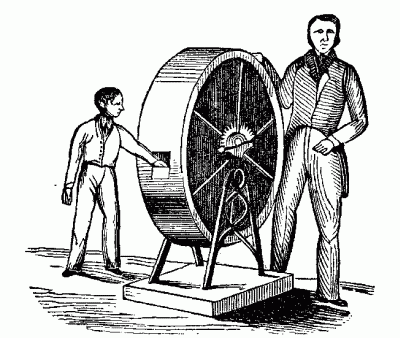
very costly machinery, and certainly the strangest I had
ever seen;—it had been invented by Mr. Green to put a
sign on white-back cards, so as to know them by the
backs. He also showed me other stamps invented by
Mr. Green. Now the consummation of this work had
cost Mr. Green not only much valuable time, but all the
money he could possibly borrow; but, after all, the thing
ends in disaster—the cards don't sell. Desperation seizes
upon him. Like Arnold, he now throws his eye over to
the other camp, and thinks what might be done in the
way of a reward. He consoles himself with the reflection
that he will, at least, be upon the side of virtue: "I will
tell the public that my only motive is to benefit the rising
generation, (a profitable thought with Mr. Green, 'the
rising generation'); but in order to begin right, I will
publish to the world a full history of my life, in which it
will devolve upon me to make a confession of my sins.
All, I will disclose to the world; but as to that ponderous
machinery at Mr. Ball's in New York—I rather
think I will skip that."
Now when poverty pinched the prodigal son, as it did
Mr. Green in New York, what was the language of that
truly penitent. Alluding to his old father, he says: "I
will go and tell all I ever done, &c." But when Mr.
Green resolves to put on a mask of penitence, what is his
course? I will go and tell those good ministers of the
gospel, and others, half I ever done, &c., and then take
good care to run my hand as deep into their purses as
possible.
Now in Mr. Green's crusade against gambling and
gamblers, if he had shown signs of purity of motive, and
had not wantonly and knowingly misrepresented the men,
and disguised the facts in regard to the profession, I would
be the last man living to impugn him. But the motive,
I consider, was corrupt—'twas spoils;—and in the mode
of attack, the established principle in morals has not been
regarded, which is, that the means in the accomplishment
of any public good must always be as honest as the
ends; and for these reasons I do feel sanguine in the belief,
when the trial comes off at the Chinese Museum
next week, that if I do not get the verdict, I shall do
more—I shall deserve it.
Yours, &c.
J.G. Freeman.
N.B.—If the gentlemen, editors generally, of this
city, will give the above communication a place in their
columns, with such comments as they may think fit to
make, they will confer a favour upon one of the proscribed,
but one who suffers no man to stand in front of him as a
lover of truth.
J.G.F.
Communicated for the Sun.
Messrs. Barrett & Jones:—I had supposed that my
consent to Mr. Freeman's request to be heard in defence
of his fraternity, had fixed that issue. I did not intend
by the announcement of my lecturing on the evenings
alluded to by Mr. F., that they were to be any thing more
than a fair discussion of the character and tendencies of
gambling, if Mr. F. should think proper to participate.
I wish it now to be so understood. I want a committee
of gentlemen to arrange this matter. But why Mr. F.
should suppose that he should have half the proceeds of
the meeting, I am unable to conjecture. He seeks an
opportunity to defend his business against attacks which
it seems has excited no small share of alarm on his part,
or those whom he represents, and yet he demands remuneration!
The fraternity must be in a rather forlorn condition
at present, if they are unable to pay their attorney,
in so philanthropic a cause. When we consider the
source, this demand sits with ill grace upon such a champion.
I have laboured now for four years, having commenced
my reform without a dollar, to expose this damnable
vice. If I am not supported by the public which
my labours are designed to benefit, those labours must necessarily
cease.
Were Mr. F. similarly engaged, I would share with
him not only the profits of my meetings, but my heart's
best feelings also.
I shall be very happy if I am met, as I was led to believe,
am no speaker, but somewhat skilful with cards, and their
use by me before an intelligent audience is my argument;
I want no better for my purpose.
J. H. GREEN.
Messrs. Editors:—It appears from Mr. Green's last
communication that he and I are at issue in regard to the
preliminary arrangements of the debate that is to come
off next week, upon the gambling question. He thinks
that he ought to have all the proceeds of the meeting;
and I think it should be equally divided, or else given
to some charitable institution, or else have it free. Mr.
Green's argument for supposing that he should have all,
is, that because he has been labouring four years, he
ought to be rewarded: and in rather a threatening tone
gives the public to understand that if they do not reward
him he will quit. "If I am not," he says, "supported
by the public, which my labours are designed to benefit,
those labours must necessarily cease." Now, my
argument for supposing that the proceeds should be
equally divided is, that I claim to be the real reformer;
that it will be seen by those who may attend the discussion,
that it is I that am the true moralist—I shall go
with the New Testament in one hand, and Dr. Paley's
Moral Philosophy in the other, and upon that battery,
and no other, will I plant my artillery. He that is green
enough to suppose that I am green-horn enough to get up
before a large audience, in the enlightened city of Philadelphia,
to defend an absurdity, must be verdant indeed
I go not to defend gamblers, but to defend truth, and to
show that Mr. Green, like a corrupt witness, in his eagerness
to procure a verdict for his party, goes beyond the
facts; and that too when there is no necessity for it,
for the gambler has real sins enough without heaping
others upon him which he never committed. Now then,
to end all this difficulty at a blow, I make to Mr. Green
the proposition—That the honourable Mayor of the city,
if he will do it, be the person to appoint the committee
that is to conduct the debate, and to the decision of the
committee, as to the funds, will I cordially submit, but
not to Mr. Green's ipse dixit. And here I will further
suggest, that the committee be composed wholly of lawyers.
This will be proper, because it is a question of law
that is to be discussed; and further, it is presumed that
they understand better than any other class of men what
is called parliamentary usage.
Should this proposition not be acceded to, which I
know is fair, my course will be to debate the question on
"my own hook," and in that case take all the money and
give Mr. Green not a dollar of it, but invite him to come
to my quarters, and defend himself, for I shall certainly
be down upon him—and so let him go to his house the
next night and take what may be offered at his door,
and allow me to answer him in what he may have to
say.
When Mr. Green, in his acceptance of my challenge,
would call the debate a lecture, I saw that old habits,
that of cheating, had not yet left him. Why it looks as
though he has the unblushing impudence to attempt to
turn a Jack from the bottom, upon me, in the very blaze
of day, the very first deal; but the gentleman ought to
know that he is now in contact with one who knows how
little things are done. Yes, he would have it that the
debate was a lecture, and Mr. Green's lecture, not mine,
and why? Why because if it be his lecture, all the
cash would, as a matter of course, be his. Also, is this
not, I ask, the trick of a perfect black-leg?
J.G. Freeman.
First Night, from the Times.
On Monday evening, at the Lecture-room of the Chinese
Museum, the debate between Mr. Green, the Reformed
gambler, and Mr. J.G. Freeman of the opposite side
took place, in the presence of a very large and highly respectable
audience, partly composed of ladies.
Dr. Elder, at the appointed time, announced that the
disputants were upon the ground, and prepared to enter
into the discussion of the subject of gambling. He then
introduced Mr. Freeman to the meeting.
Mr. F. said his antagonist and himself had settled the
preliminaries, and in regard to the proceeds of the debates,
it had been agreed that Mr. Green should receive
those of the two first meetings, and that Mr. Freeman
should receive the returns of the third meeting, provided,
on motion, a large majority of those present were in favour
of it.
He would not attempt to disguise his real feelings from
his hearers, and the gratification he experienced in having
the opportunity of speaking, for once in his life, to
an audience composed of men of intelligence and integrity.
He well knew the difficulties under which he
laboured, being unused to speaking in public, and surrounded
as he was in the community by the reverend
gentlemen and the press, who were avowedly opposed to
him, and who had thrown their bomb-shells and Congreve
rockets liberally at the gambling fraternity, without
mercy, but he regarded these weapons as harmless, for
they had fallen at his feet without inflicting a single
wound.
Mr. F. then turned to the consideration of the laws
making gambling a penal offence, and particularly referred
to the act of Assembly passed by the last legislature,
which he denounced as unjust and impolitic. He
did not appear for the purpose of defending gambling,
but to speak a word in favour of those who had been represented
to be the worst members of society, and against
whom the voice of proscription had been raised. He
contended that a man had a constitutional right to do
what he pleased with that which was legally his own
property, and all laws passed to abridge that right ought
to receive public reprehension.
He was at a loss to understand why Mr. Green should
have taken so active a part in the passage of the law at
Harrisburg. It had been said that gambling must be
checked, and in order to put it down, you must make it
a penitentiary offence. He regarded this as an egregious
error. Gambling, he was convinced, ought to be treated
in the same manner as Intemperance—by moral suasion—and
not by passing a law that puts a man in the penitentiary
for exercising a legal right. But there were
fewer gamblers than drunkards, and the former had no
influence at the ballot-box.
He denied the statements of Mr. Green, that young
men had been enticed to gambling-houses. They invariably
went there of their own accord, and he related instances
in which the relatives and friends of young men
were called upon by gamblers, to exercise proper authority
in restraining them from visiting such places.
He alluded to the excessive penalty attached to the
law, and argued that it would never be enforced, there
being no inducement for the police to detect the offenders;
and that from the face of the law is shown, that it
was not made for the punishment of wealthy gamblers,
but the poor itinerant wretches who had no local habitation.
These being birds of passage, he questioned whether
they would remain long enough in one place to be caught,
while the rich operator and speculator would be permitted
to go on unmolested, in his gilded career of depredations
upon his fellow man.
Mr. Green then arose and expressed his surprise that
any individual could have the effrontery to stand up before
an intelligent body of citizens, a part of that constituency,
from whom the legislature of the state had derived
its authority, and denounce a law which had not
only been passed with entire unanimity of the members
of that body, but which had met with general favour from
the people. He then referred to the act of Assembly, and
made some explanatory remarks upon it. He ably defended
the law from the remarks of his opponent, in regard
to its vagueness and insufficiency. On the whole,
he regarded it as a good one. It could be effectively put
in force, and was calculated to crush the evil of gambling.
He said he had no wish to conceal from the people
his former habits and mode of getting a livelihood, but on
the contrary, had repeatedly, in public, represented himself
as being a wary gambler, and acknowledged that he
had done, perhaps, as much with cards in a professional
way as any man claiming the same amount of information
in regard to them.
He then passed to a review of the terrible consequences
of gambling, and showed that those who became addicted
to it, acquired a passion for play, that predominated over
every other feeling, and closed up the springs of affection
and sympathy in the human heart.
These facts he forcibly and eloquently illustrated by
relating some painful occurrence, which came under his
observation. On one occasion he was playing with a
party, one of whom was losing his money very rapidly.
In the height of a game, his family physician entered the
room, and saying that it was with much difficulty that he
found his whereabouts, informed him that his daughter
had been seized with extreme illness. The gambler replied,
that he would return to his home very soon.
The doctor left, but not long after returned with the
gambler's wife, who implored him to come home, as the
girl was dying. He desired the doctor to lead his wife
from the room, with the solemn promise to follow them;
which promise he seemed to have forgotten the next instant,
so deeply was he interested in the play, and he remained
at the gaming-table. In a little while after, the
doctor returned and told him his daughter was dead.
For the moment, he appeared to be greatly affected, but
he still sat at the faro table of that h—l, and when he
arose from it he was a ruined man.
The man has since reformed, and Mr. Green said that
when he last saw him, in Baltimore, he attempted to describe
the feelings which rent his breast, after he had realized
the sad events of that night. His first desire was to
commit suicide, but the hand of Providence stayed his
arm, and by His interposition he was enabled to turn
from the vice, and shun the society of those who practise
it.
Mr. Green re-asserted that all he had stated about plans
being laid to catch the unwary, by gamblers, was strictly
true. He had been cognisant of plottings of the fraternity,
and in speaking of some individual who was about
to be plucked, the common expression among them was,
"that he was not ripe yet." The remarks of Mr
Green were listened to with great attention by the audience.
Mr. Freeman followed, and after briefly replying to
the points of the previous speaker, said that it was his
intention, at the next meeting, to prove that all species
of speculation is, properly speaking, gambling.
The Rev. John Chambers concluded. He confessed
his disappointment. He expected to find a man here
who would attempt to defend gambling, but he congratulated
the audience that no such thing had been attempted,
Mr. Freeman having acknowledged gambling to be
an evil.
The Reverend gentleman's remarks were of a general
character, and in the course of their delivery he upheld
the law of the state, and unsparingly denounced those
for whose detection and punishment it was passed.
First Night, from the Saturday Evening Post.
The discussion on gambling, between Mr. Green the
Reformed gambler, and Mr. Freeman, of the "Profession,"
which has been looked forward to with so much
interest, opened upon Monday evening. The audience
generally, however, were rather disappointed, inasmuch
as Mr. Freeman stated that he did not come there to defend
gambling, but only to prove the folly and injustice
of attempting to put it down by making its practice, by
professional gamblers, an offence punishable by imprisonment
in the penitentiary. But although Mr. Freeman
made this avowal, he evidently did attempt in various
parts of the discussion to defend gambling—not, however,
as a thing good in itself, but as being no worse than
many other practices which society tolerates, and which
no man loses his reputation, or is in danger of imprisonment,
for engaging in.
We have no scruple in confessing, that we were much
interested in Mr. Freeman. He appears to be one of a
singular class of men, some one of whom may be found
in nearly every pursuit, however dishonourable—men
of keen and subtle minds, and of as much goodness and
honesty of purpose as is possible in the life which they
have chosen, or into which perhaps they have been in a
degree forced. In the course of his remarks, he made
one allusion to his own history, which while it told as
much as any thing that was said in the course of the debate
against gambling, opened unto us, in a degree, the
secret of his present position. He said that when he was
a young man, he had lost his all at the gaming table, and
that from that blow he had never recovered—"it had
broken his heart." And yet, strange anomaly, he now
not only makes his living by gambling, but stands up
before the world as its defender.
But let us look a little further into Mr. Freeman's arguments.
He did not state them very plainly, being evidently
unaccustomed to public speaking, and, as the
English say, to "thinking on his legs," but if we are not
mistaken, he reasons to his own heart as follows. Gambling
in cards is not right abstractly, but it is the same
in principle as gambling in stocks, in breadstuffs, in
merchandise, in land, or in any thing else. None of
these are right, but they are necessary fruits of the folly
and wickedness of men, and inevitable in the present
condition of society. "I make my living, I know," he
probably says, "from the weakness and wickedness of
my fellow men; but so do the physician, the judge, the
lawyer, the jailer, and the hangman." If we are not
mistaken, in this way does Mr. Freeman make out a
clear case to his own conscience; and to some small extent
he is right in what he asserts. To gamble with
cards is the same principle as to gamble with stocks, or
any thing else—the difference is only one of degree;
but although the gambler and the judge both live, in a
certain sense, off of the vices of their fellow men, the difference
is very evident between him whose business conduces
to increase those vices, and his whose noble office
it is to lessen them.
But Mr. Freeman complains that, while the gambler
with cards is proscribed by society, and branded with all
marks of shame, and laws passed to imprison him if found
practising his art, the gambler in stocks is neither reviled
nor imprisoned. At the rank injustice, as he, in our
opinion, honestly believes it, of this course on the part
of society, he can hardly contain his indignation. Those
"uncouth gestures," as one of our contemporaries designates
them, were not in our opinion intended for effect,
but were the natural language of uncontrollable indignation
at what he believes to be the rank in justice of society,
which he could not adequately express in words. The
audience laughed, but the speaker was far from laughing—a
perfect tempest of conflicting emotions, it seemed
to us, was agitating his bosom. Strange as it may sound
to our readers, he evidently thought that his cause was
just, and wanted to make it appear so, not to the gamblers
and their friends, hundreds of whom were present, and
ready at any moment with their applause, but to the
crowd of intelligent, virtuous men and women, in whose
audience he stood. We saw the breaking out of this
feeling in the half-contemptuous manner in which he
alluded to the tastes of gamblers in general, as contrasted
with his own—"he did not keep the company of gamblers;
he had nothing to say against them, but his tastes
were different."
But is it unjust to punish the gambler with cards by
imprisonment and public proscription, while the gambler
in stocks, &c., whose crime is the same in principle,
though not in degree, goes unwhipt of justice? Undoubtedly
it is, for it is no reason that one vice should go
unpunished, because another is able to escape for the
present. Mr. Freeman's argument is very good, so far
as it applies to inflicting upon the gambler in stocks the
same penalty as on himself; but the law of Progress, and
the best interests of society, demand that these things
should never be allowed to work backwards. For the
way society advances, is simply this—the worst manifestations
of vice are first proscribed, and then their proscription
is made a stepping-stone to demolish others.
For instance—we attack gambling with cards, the worst
manifestation of the gambling principle; we make it abhorrent
to the moral sense of the world; we so confound
it, and justly too, with robbery, that future generations
shall grow up in that faith, and all the efforts of interested
sophistry never be able henceforward to separate them to
the popular apprehension. Having done this, in the
course of some fifty or one hundred years, certain dealings
in stocks, for instance, are called in question. If they
can be proved to be rightly described by the phrase
"Gambling in Stocks," the battle is half-won. For the
proscription of the worst kind of gambling has given a
vantage ground from which to attack the principle of
gambling wherever found. And this, we say, is the
only law of progress.
Another ground taken by Mr. Freeman was, that "a
man has a right to do what he chooses with his own,
if in so doing he does not injure anybody else." In a
limited sense, this is true, doubtless—but he does injure
somebody else if he fails to perform his duties to his
family or to his country. For instance, he has no right to
commit suicide. But gambling cannot be done without
injuring somebody else, as it takes two to play at it—leaving
out of view the injury done to society at large, as
Mr. Green has shown in his various works on the subject.
But there is no necessity in dwelling upon this
point—it cannot be defended for a moment.
As to Mr. Green's part in the discussion, it is not necessary
to say much. He has our confidence and sympathy.
We consider his present course a most noble
one, and wish him all success in his efforts to overthrow
the abominable vice from whose clutches he has come
forth a reformed man.
We have taken up considerable room with this subject,
because we feel great interest in both parties engaged
in the discussion. Did Mr. Freeman appear to
be only a bold, bad man, we should hardly have wasted
a single paragraph upon him or his arguments. But he
is evidently a man of considerable information and talent,
and to all appearance, strange as it may sound, of much
sincerity and cross-grained honesty. That he may be
led to forsake his present pursuits, before his gray hairs
shall have gone down to a dishonoured grave, is our fervent
wish and prayer.
From Scott's Weekly.
The interesting question between Mr. J. H. Green,
the Reformed Gambler, and Mr. J.G. Freeman, as to the
rights of gambling, was discussed in the Lecture-room
of the Museum Building, on Monday evening last. A
large audience attended, and notwithstanding the zeal
of Mr. Freeman more than once carried him a little beyond
the limits of propriety, the whole passed off pleasantly.
The announcement in the papers was not adhered to,
which created some dissatisfaction; but then the speeches
of Mr. Freeman were of themselves well worth the price
of admission. He did not defend gambling—he could
not, he said, pretend to defend it—he only meant to
deny the sweeping aspersions of its foes. He spoke at
great length, and sometimes his logic was quite ingenious.
Mr. Green confined himself to a few facts, leaving the
more minute part of the discussion for a subsequent evening.
The Rev. John Chambers closed the proceedings by a
few timely remarks, in which he reviewed what he considered
lawful and unlawful pursuits—among these latter,
he hoped to see the time that every vender of intoxicating
liquors would be placed in the same catalogue that gamblers
are by the recent law—imprisonment. He then
referred to the decorum of the audience, and expressed
a hope that all the future discussions would be listened
to in the same spirit—that all the truth possible may be
elicited in reference to that terrible vice—gambling.
From the Inquirer.
The long-talked-of debate upon gambling and its tendencies,
was commenced last evening in the Lecture-room
of the Chinese Museum. The audience was large, and
deep interest was manifested in the discussion. Aboard
of highly respectable gentlemen presided as Moderators,
and Dr. Elder officiated as chairman.
Mr. Freeman, the challenger, opened the debate, and
proposed that the question be met in a categorical form,
thus:—Were the laws of the different states which make
gambling a Penitentiary offence unjust and impolitic?
Were they formed in good policy or not?
Mr. Freeman considered himself as honoured in being
permitted to speak before the meeting on the question.
Fearful odds were against him; all the ranks of battle
were on the other side. The clergy, who were accustomed
to public speaking, were against him—as well as
the editors and the press. In the war now raging, the
climate—the sickly climate, was more dangerous than
the shells and shot of the enemy—and in this case, the
sickly climate was the prejudice, the prejudice of opinion,
which was against the cause he espoused, or rather
defended. Mr. F. also referred to other influences against
him. Mr. F. contended that even, if the states in which
such laws were passed, disliked the vice of gambling—
it was no reason why they should pass laws that were unjust
and impolitic.
Mr. F. contended, in opposition to such laws, that a
man had a perfect right to do what he pleased with his
own things. Any legislation to the contrary was tyranny.
More mischief and immorality would result from such
laws than from the vice itself—for it was a violation of one
of the rights of man on the mere score of expediency. He
contended, therefore, that men had a perfect right to do
what they pleased with their own things, so long as they
did not interfere with the rights of others. A drunkard
could not drink without disturbing other people—why
not make his a Penitentiary offence? Yet a gambler was
considered a Penitentiary offender, though he did not interfere
with the rights of others.
What were speculators in railroads, &c. &c.?—Why
many of them gamblers on the largest scale!
In noticing the temptations of gambling, Mr. F. said
that he and other gamblers had often warned youths
against entering upon that dangerous course, and had
thus saved them from ruin.
Mr. F. argued against the law recently enacted at
Harrisburg against gambling, on the ground that it was
partial and unjust.
One of the strangest things was, that a man who had
been imprisoned, had been an outcast himself, should be
the first to betray, and to place others in the same situation,
and send them to the Penitentiary. Yet such was
the case with the gentleman who had come from Ohio
to Harrisburg to assist in obtaining the passage of the
law against gambling.
Mr. Green replied, and defended the law in question,
as it was passed in Pennsylvania; and read a section, in
which gamblers, without a fixed residence, were, upon
conviction, to be imprisoned, &c.; and Mr. G. said that
although no games were mentioned, yet all gambling
games were included. Mr. G. admitted that he had
been a gambler for many years, and had done much evil
to the community—as much as most evil men—but he
was now, he hoped, reformed. Mr. G. then contended
that several gambling-houses and tables had been closed
under this law—and surely this was a great advantage
to the public—surely such closing of gaming-houses had
saved many persons from ruin.
Mr. Green gave much experience of his gambling life,
and contended that principles of honour were not common
among gamblers. Gambling was a principle of robbery—of
robbery from beginning to end. If gambling
was right—why, Mr. Green would ask—did the former
speaker persuade young men not to come into gambling-houses?
Mr. Green described a splendid gambling-house
in Calvert street, Baltimore, and the snares of robbery
laid for the unwary—and the method adopted to entrap a
rich and unwary citizen. The revelations were truly
startling, and displayed a painful instance of the "facilis
descensus averni"—a father whose feelings were blunted,
and hardly to be re-awakened even by the death of a
beloved daughter. And this was but one instance out
of thousands, in which the sum of $1200, $1500, and
$2000 had been lost at various times, and a fatal, fascinating
infatuation contracted.
Mr. Freeman resumed, and again contended for the
right of any man to gamble—that he had a right to do
what he would with his own—and that a law was unfair
which punished this one vice, and let other and greater
vices alone. It was cowardly legislation. A gambler
was said to have no home, and would not be missed, if he
were sent to prison; but send a man of property, of standing
to prison for some one of his vices, and there would
soon be a fuss in the wigwam. Mr. F. was very severe
upon the great body of editors, for following servilely
public opinion, without courage or independence to express
a manly opinion of their own.
Mr. F. said that all ministers were not good men—there
were a few exceptions—neither should all gamblers,
in fairness, be considered as scoundrels. He, Mr. F. as
a gambler, never would admit his inferiority to those individuals
who, without labour, gained money and circumvented
others by extensive and fraudulent schemes of
speculation.
The Rev. John Chambers summed up with great eloquence
and ability, and said that he was disappointed—
he had expected a defence and vindication of gambling
as an honourable profession—but he was glad to
find that the gentleman who had spoken, Mr. Freeman,
had not even attempted to advocate gambling as truthful
or honest.
Mr. Chambers considered all dealing fair, in which a
man received a quid pro quo—but whether a man cheat
at cards or in the sale of a bale of dry goods, he was
equally a scoundrel. If Mr. Freeman would make it
appear that gambling was a fair business, he (Mr. C.)
would not wish it to be a Penitentiary offence; but if
gambling was, as Mr. Green had shown, a system of robbery—why
then, it ought to be a Penitentiary offence.
Mr. C. said that Mr. Freeman had behaved honourably—for
he had said to young men—"Do not come into
this place!" And why? Because it was the road to
ruin.
Mr. C. regretted that Mr. Freeman should have made
several scriptural allusions. No virtuous man would
ever support gambling—for it gave no equivalent either
in money or reputation for the losses sustained. As such
was the case, gambling should be a Penitentiary offence—but
if Mr. Freeman could prove that it was an upright
and honourable calling, why then, perhaps, he
might induce us to apprentice our children to it.
After Mr. Green had spoken for a few minutes, the
debate was adjourned to Thursday evening next.
From the Evening Bulletin.
The great discussion on the subject of gambling came
off last night at the Chinese Museum, between Mr. Green,
the celebrated Reformed Gambler, and Mr. Freeman, the
individual who acknowledges himself one of the "sporting"
band. The audience was very large and respectable.
A board of worthy gentlemen were appointed a governing
committee, of which Dr. Elder acted as chairman. The
whole proceedings were marked with the greatest decorum.
Mr. Freeman spoke first. He is a man somewhat
advanced in years, and possesses abilities, which we could
wish were better applied than in the defence, or even palliation,
of such a corrupting habit as gambling. He directed
his batteries mainly against the late gambling
laws in this state.
He did not like the application to professional and not
private gambling. He denounced editors and ministers
by wholesale; in regard to the former, declaring that
there was only one in the country who was really independent,
and that one, Bennett of the New York Herald!
He quoted Scripture, but that is not surprising, for we
are told by the poet, "the devil may cite Scripture." His
manner was violent, and his allusions to his opponent,
Mr. Green, the very essence of bitterness. He tried to
slide his repugnance to that gentleman into the small
corner of contempt; but the whole audience could see
that he, in reality, entertained no such trifling feelings
towards his opponent.
Mr. Green spoke in reply to Freeman, not only like a
gentleman, but like a Christian. He treated the sneers
of his opponent with kindness, seeming to be sorry, if
one might judge from his manner, that he should have
boldly placed himself in the point which he occupies
before the community. There was a plain, straightforward
honesty, as well as a gentleness in the tone and
manner of Green, which, though he did not indulge in
such a flow of language as his opponent, spoke volumes
in favour of his sincerity, and won for him new friends
and admirers. His opponent had intimated both by
word and act, that he was not to be trusted; he did not
seem to feel it necessary to go into a defence of his motives
in reply, but appeared to say, "Here I am,—I come
to denounce a habit of pestiferous corrupting influence,
of which I have practical knowledge; I will stand or
fall by the position which I have taken,—leaving the
future to show the world whether or not I am honest."
Freeman spoke again after Green concluded, and very
much in the same style as in the early part of the evening.
After he had concluded, the Rev. John Chambers made
an address, which was marked with strong argument
and a fine Christian-like tone. Mr. Green then said a
few words, and the meeting adjourned to Thursday evening,
at the same place, when the discussion is to be resumed.
There doubtless will be a large attendance.
No subject could be more interesting to the public,
and the agitation of none can exercise a better moral
influence.
From the North American.
A good-humoured illustration of the right of every
one to say what he pleases, took place at the Lecture-room
of the Museum last evening. Mr. Freeman, an
uncouth man, who gesticulates as if he was mending
shoes, but who has naturally no inconsiderable endowment
of brain and nerve, delivered himself of a tirade
against everybody in general, and against the press and
clergy in particular. He complained that everybody was
against him—compared the clergy to Gen. Scott and his
regulars; the editors to bomb-shells and Congreve rockets,
and what else we know not; himself individually to
Gen. Taylor, and the race of the poor persecuted gamblers
to our Saviour—who, he said, like them, had not
where to lay his head!
The impious jumble of fustian and blasphemy was
accompanied in the delivery by every species of grimace
and buffoonery, and a fierceness of dramatic action and
posture far more ludicrously affecting than the classic
attitudes of Gen. Tom Thumb, who was defying the
lightning, as Ajax, dying like the Gladiator, and taking
snuff like Napoleon, in the room overhead. At the bottom
of all this ridiculous exhibition, which drew repeated
shouts of laughter from the very large and respectable
audience, lay two principles upon which Mr. Freeman
might have erected an imposing argumentative structure.
These were, that every man has a right to do what he
pleases with his own, so that he does not disturb others;
and that laws punishing professional gamblers and letting
citizens go free, are unjust.
Mr. Green, without going into the metaphysics of
the question, showed by some very plain and straightforward
remarks the fraud and villany of professional
gambling, and proved that it was throughout a system
of deliberate robbery. This being the case, it follows,
of course, that the general good of the community, which
has ever been acknowledged paramount, requires it to be
put down. Thus satisfactorily stood the question when
we left, and we do not see how it can fairly be removed
from this broad ground. It is evident that Mr. Green is
a sincere man, and we firmly believe that he is engaged
in a good work.
SECOND NIGHT.
From the Inquirer.
The discussion between Mr. Green, the Reformed gambler,
and Mr. Freeman in opposition, was continued yesterday
evening, in the Lecture-room of the Chinese
Museum, Leonard Jewell, Esq. in the chair.
Mr. Freeman contended that not one of his arguments,
on the previous evening, had been answered by Mr.
Green, but anecdotes and doleful stories had been told
instead. Mr. F. defended his allusions from Scripture,
and said that they had been misconstrued; that he only
meant to say that the Saviour of mankind had recommended
us to do good, and to return good for evil; but
some of the clergy had not followed the golden rule in
this matter, for punishment and the Penitentiary had
been recommended by them as a cure for gambling. As
it was known that he (the speaker) played, he came
only to defend gambling as far as truth went, but no
farther—there he would stop.
Mr. Freeman complained that Mr. Green had classed all
gamblers as men of the worst character—as if they were
thieves or counterfeiters, whereas Mr. G. knew that he
could mention many who were incapable of doing any
thing mean—men who would denounce a counterfeiter as
soon as any one in that room. Mr. Freeman related a
story of a fraudulent trick, by which a large sum of
money had been fraudulently obtained, and its recovery
prevented by force—one individual, who was named,
menacing with a bowie-knife; and Mr. F. said of the
getter-up of the plan—pointing to Mr. Green—"as Nathan
said unto David, there sits the man!"
Mr. Green admitted that it might be so—that it
was so.
Mr. Freeman said that he knew Mr. Green's friends
had a reply to cover all such things—because he was a
reformed man—Mr. F. hoped it was so, but he really
had some little doubt.
Mr. F. distinguished between deep play, which he
likened to the strategie of generals in the field, the one
to mislead the other, and open, undisguised cheating,
which he denounced. Mr. F. referred to several distinguished
men who gambled—and to several well-known
gamblers—and he defied Mr. Green to say that
any one he had named would or could be guilty of a
mean action.
There was in the world a certain amount of wealth—the
many of mankind were (the industrious) producers—but
he held that all men, speculators, who circumvented
others by their wits, living without work, were in point
of fact—gamblers. If a man were to go into the street
and gain $3000 in a morning by a stock or other speculation—why,
as surely as we lived, somebody lost that
money—aye, and by gambling on the largest scale. Men
who lost their money at a gaming-table went there to
win money of the gamblers—but generally lost their own.
Their object was to put the gambler's money in their
own pockets; and when they were disappointed, they
exclaimed against gamblers. Gamblers lived on the depravity
of men; if men were not depraved, gamblers
would have no chance; but they were encouraged by
the depravity of others. Mr. F. condemned and would
punish cheating, whether by gamblers or other speculators.
Mr. Green did not wish to say any thing personally
against any of the men or gamblers who had been named
by Mr. F. Some were benevolent men—but one or two
he had named were men without heart. He (Mr. G.)
knew several gamblers, amateurs and professional men,
who were straightforward in their gambling transactions.
He did not desire to hurt the feelings of any of these individuals—he
attacked not men but vice—and he contended
that gambling was a system of robbery, from beginning
to end. That it was that he contended for—and
that, he hoped, he had already shown. Mr. Green admitted
that Mr. Freeman's story of the scheme gotten up,
bowie-knife, &c., was in the main correct. If meeting
contracts was honest—why then, many gamblers might
be called honest. He did not mean to say that such
honest gamblers would put their hands in a man's
pocket and steal money—no—they would not do
that.
But he would say what they would do;—they would
sit up all night, have suppers, wine and spirits set out to
tempt men, and they would play with any that came;
and though some such customers were known or suspected
to have obtained the money they played with by
robbery, yet he never knew that the gamblers had ever
refused to allow such men to play, so long as they had
money. Mr. Green described several snares that were
practised by gamblers, particularly one at New Orleans,
called the "broker." He hoped some of the gamblers
of this city would reform as soon as the new law went
into effect. He had already heard of some having turned
collectors, policemen, &c.—but he doubted their reform
if they were turned over to the police—for though there
were some very good policemen in this city, he could
confidently say also there were some spotted ones.
Mr. Green considered the bowling-alleys and billiard
rooms as the very bane of the city—leading men on step
by step to the vices of gambling and drunkenness. Mr.
Green stated that he had never met with a gambler
in his life, who played honestly, and got his living by
playing cards honestly—for all he had ever known
would take advantage, sometimes—which perhaps the
world might call cheating. Mr. Green practically illustrated
with a pack of cards the modes of taking advantage,
(cheating in plain English,) that were truly surprising.
Mr. G. said that such things were done by gamblers,
called honourable, and if any one had charged such men
with dishonesty, why a duel, or worse, might have been
the consequence.
On one occasion, he (Mr. Green) had been cheated out
of several hundred dollars by a brother gambler. He
knew it, but lost his money and said nothing—at length,
he found out the method of cheating—and went home
and set up all night by way of studying a cheat that
would recover his money and more. He succeeded at
last, and went and won all the money of his antagonist
and party—in fact, he won enough to break the whole
party. Mr. Green then showed by cards how he had
been engaged in winning (by tricks) money from a planter
in Louisiana.
Mr. Freeman replied, and contended that Mr. Green
had referred to only a few mean gamblers—and by his
inference charged their practices upon the whole body.
But our limited space warns us to be brief. Mr. Freeman
only contended that a gambler was honest in a relative
point of view—as honest as other men who in
trade or otherwise, or in speculation, did things as bad
or worse than gamblers. Mr. F. related anecdotes to
show that persons charged with faults and crimes were
almost always condemned by public opinion, and their
faults and crimes exaggerated. Mr. F. stated that in
former times, the keepers of gaming-houses in New Orleans
paid heavy licenses, and were subject to ruinous
fines if they cheated in the smallest degree.
Mr. F. contended that cheating at cards was decidedly
a disadvantage to the gambler—because, if he lost his
character as a fair man, people would not play with
him, and so cheating was to him a loss: on the principle
of a man in England, who said he would give a hundred
thousand dollars for a character. "Why?" asked his
friends. "Because," replied the first, "because I could
gain two hundred thousand dollars by it!"
Mr. F. introduced several anecdotes. Mr. F. had
heard several sensible men in New Orleans say, that if
gaming-houses there were licensed, there would be little
or no cheating, because those houses would be under the
police, and people could not then do as they now do in
holes and corners. On the principle of "Vice is a creature
of such hateful mien," &c. &c., Mr. F. thought that
Mr. Green, by showing and explaining some of his tricks,
would be likely to tempt some persons to practise such
tricks, if they wanted a little money; and on this point
he would quote Scripture, and say—"Lead us not into
temptation!"
Mr. Freeman exhibited a capital trick on the cards,
quite equal to some of Mr. Green's. But, said Mr. F., all
such things were nothing—for, in gambling, playing on
the square with fairness is the best policy. [Mr. Green
admitted Mr. Freeman's trick to be very superior—and
it was at length understood that at the next meeting (on
Saturday night) several of these mysteries would be
shown on both sides.]
Mr. Green declared that he could show the principle
of gambling to be a hundred per cent. worse than stealing.
The debate was listened to with much interest, and
we learn that it will be closed to-morrow (Saturday) evening.
From the Evening Bulletin.
Messrs. Green and Freeman renewed their discussion
last night, at the Chinese Museum, in the presence of a
crowded audience, Leonard Jewell, Esq. in the chair.
Mr. Freeman spoke first, and very modestly contended
that none of his arguments of the previous evening had
been answered by his opponent, but that, instead of this,
painful anecdotes and stories had been told. He had
quoted Scripture only to show that making stringent laws
to punish gambling was contrary to the spirit of our Saviour's
teaching, viz. to return good for evil. This argument,
will, of course, apply to all laws for the punishment
of crime. Freeman went on to except to Green's
wholesale denunciations of all gamblers; it was well
known that some were honourable men. There were a
few bad ones, his opponent knew, and one, in particular,
who on a certain occasion drew a bowie-knife to prevent
a sum of money, fraudulently obtained, being returned to
its proper owner. Green acknowledged that he was the
man to whom Freeman alluded. He would not deny that
he had been as guilty as the guiltiest.
Freeman continued by saying that he supposed his
opponent would get over this by saying he had reformed.
Green looked assent.
Freeman justified gambling by business operations,
which were the result of chance, such as stock-jobbing;
but we confess we cannot see where the parallel begins,
the one being a clear matter of chance on both sides, the
other, if Green's stories be true, which we firmly believe,
all on the side of the gambler, who cheats from the beginning
to the ending of his playing, what with tricks of
the trade, marked cards, &c. Freeman took the ground
that gamblers were honest, and thus made out a better
case than the facts will sustain.
Mr. Green's reply was quiet and unaffected. He knew
some gamblers who were straightforward and honourable
in their playing. But the majority of the profession were
dishonest, and the community was demoralized and impoverished
by them. He admitted the story about the
bowie-knife. He had never been disposed to conceal any
of his wicked acts while one of the profession. There
was one point on which all gamblers were unprincipled;
they would play and win money of men they knew were
totally ignorant of the arts of card-playing. This was a
fraud—it was dishonest; a strong argument against the
whole band, good or bad.
Mr. Green denounced bowling-alleys and billiard
saloons. He then exposed the tricks by which gamblers
cheated, and in doing so interested the audience very
much.
Freeman's rejoinder was still to the end that some
gamblers were honest and honourable. He knew that
there were rogues among gamblers, who practised tricks,
and he gave an excellent specimen of their adroitness, in
a trick which Mr. Green acknowledged was a capital one.
The debate was listened to throughout with great
attention. It will be resumed on Saturday evening.
THIRD NIGHT
From the Daily Sun.
On Saturday evening, the debate between Messrs. Green
and Freeman, on the subject of gambling, was resumed,
in the Lecture-room of the Museum building. There
was a full audience in attendance, and towards the close
of the debate, the proceedings became intensely interesting.
At the appointed hour, Dr. Elder, the moderator, made
a few remarks, by way of opening the meeting, and introduced
Mr. Freeman, who, upon advancing to the table, said
that he regarded it as complimentary indeed, that he was
permitted to proceed with the discussion. Under all the
circumstances, he considered it a great compliment, that
a highly intelligent audience should listen to one of the
proscribed fraternity. But friends, (said the speaker,) if
the scene of the discussion lay farther South, in the region
of the spot where he was born, he would not consider
it so much of a compliment—he would not make
such a concession, even from the great Harry of the West
down to my fallen foe. In looking round the staging he observed
new faces, and missed those who had previously occupied
their places—he had heard those men had consulted
their dignity, and any man (in the opinion of the speaker)
who thinks more of his dignity than his duty is not fit to
occupy the sacred desk. The arguments which he had
brought forward on the previous occasions have not been
answered. Mr. Green has not even attempted to do so,
but he (the speaker) had found that a worthy gentleman
had entered the field, though not verbally, and endeavoured
to supply the place of his opponent. He would
take the liberty to compliment him—the distinguished
editor of the Post—though he did not know him, nor that
such a paper as the Post was printed. That editor, like
many others whose prejudices overbalance their reason,
had misunderstood him. The speaker then indulged in
a critique on the editorial, principally upon the ground
which he had taken—that a man has a right to do with
his own things what he pleases, provided, in so doing,
he does not infringe upon the rights of others. On this
point, it appeared that the editor thought and argued differently,
and Mr. Freeman said, that in taking the above
ground, he did not claim originality, for it is a principle
of law, as laid down in Blackstone, Paley, and others—it
is the language of great commentators, and upon it he
would stand or fall, and leave the distinguished editor to
battle with those men.
Some things, continued the speaker, may seem inconsistent
at first, which, upon examination, are not inconsistent.
A thing may be legally right and morally wrong, and
whilst he could defend it legally, he could not morally.
For instance, suppose a rich man had two sons, both of
whom acted as sons should act, and the father in making
out his will should devise his whole estate to one son,
and cut the other off, as they say in England, with a
shilling. Now, who would deny his right to do so if it
pleased him; who would say that it is not legally right?—no
one. But would it be morally right?—certainly not.
What is morality?—love your God, your neighbour, and
yourself. And though he could defend the will as legal,
yet in a moral point of view he could condemn it as unnatural.
The editor of the Post (said the speaker) confounds
gambling with robbery, and what for?—that future
generations may grow up in faith. It is, said he, a settled
principle of morality never to hoist false colours, but
to raise the standard of truth and defend it to the last.
(Applause.)
He remembered an anecdote: a physician was sent
to attend a poor sick boy, and when he arrived at the
couch of pain and distress, he found it necessary to administer
a pill—a very nauseous dose. Said the mother—"Doctor,
it would be better to put a little sugar on it,
and then he can take it, and not know it's a pill." "No,
madam," replied the doctor, "it won't do to deceive him.
Here, my son," said the practitioner, "take this medicine
and it will cure you," and the little fellow swallowed it
like a man. Thus it is with Mr. Green and the green
editor; they associate the gambler, without distinction,
with assassins and robbers. In doing so they are wrong;
they do not speak the truth. The speaker then proceeded
to show how a young man may often be lured into temptation—by
representing gamblers as assassins, who,
upon acquaintance, he finds are apparently gentlemen,
and he is induced to think that he has been hitherto
misled and deceived in regard to such men. He then
cultivates their acquaintance, and finally, through his
own depravity, he becomes worse and worse, until he is
at last swallowed up in the vortex of degradation. This
is the result of employing dishonourable measures to prevent
him from visiting such places, or to carry out honourable
ends.
A man has a right to commit suicide, so far as propriety
is concerned. If he does not owe any thing, and
feels it in his conscience that he would like to die, he
has a right to do so—but if that man owes five dollars, he
would certainly violate a moral principle by killing himself,
because he ought to live as long as he can to pay
his debt. The speaker once knew a man, in good circumstances,
who was weary of existence, and feeling disposed
to take a journey to "that bourne whence no traveller
returns," committed suicide. There may be many
who would call it murder—but the community are murderers—they
sometimes murder in cold blood. But lately
a man was taken to the gallows, and they hung a young
man because he had killed somebody else, and yet there
are many persons who believe this is right, and that
suicide, such as the speaker had selected, is wrong.
The speaker now proceeded to criticize the law relative
to gambling, passed at the recent legislature, in
which he said that if a man has a fixed place of residence
and carries on a dry goods business, he might gamble as
much as should please him and the law would not take
hold of him. He would ask anybody to read the law
understandingly and then deny this round assertion. This
act, said he, is bugbear—it is a disgrace as it now stands,
for it smacks of cowardice. The legislators, he presumed,
had a little sense, and they knew that some kind of a
law must be passed, and they were ingenious enough to
know how to frame it to sound well, and yet be comparatively
powerless. They knew by such a statute that
nolle prosequis could be entered—and solicitors make more
money—they well knew that there were many religious
people among their constituents, and it would not do for
them to act singular, or else they would find so short an
account at the next ballot-box that they would not be sent
back. He would spurn such legislators and keep them
for ever in private life. (Applause.)
In conclusion, he said that he was decidedly an anti-gambler,
and he did not defend the subject morally. In
order that he might enlighten the people on the subject
of gambling, he would give one lecture, in which he
would relate his experience, and promised that it should
be the richest and most interesting thing that could be
listened to. He did not want money. He would only
ask enough to pay expenses of the room—the ladies and
the reverend clergy may come in gratis—all he wished
was that the truth should be told about gambling.
Mr. Green now took the stand, and said that it appeared
to him that there was something in the law which seemed
to stick to his opponent, Mr. Freeman. He complains
that the Jaw is dull—that it is trash—a bugbear, and
heaps other similar epithets upon it, and yet he appears
to make considerable noise about it, and why should he
attempt to ridicule me, in connection with the law. Every
man in this state knows that Mr. Green himself could
not pass the law without the aid of the legislature.
He (Mr. Freeman) goes on to take many other positions
which he (the speaker) could not understand, and therefore
would not further allude to them. He thought that
if the young men were warned properly to keep aloof
from the gambling shops, and they should heed the warning,
they would escape a life of infamy. 'Tis true, a
young man may go from the parlour to a gambling-place.
He will first find the gamblers fascinating—rooms handsomely
furnished—fine suppers given, and in fact, every
temptation may be set out to catch the unwary novice.
The gambler will tell him this reform is all priestcraft—you
can see for yourself that we (gamblers) are not the
assassins which we are represented to be—these reformers
don't speak the truth. The young man is blinded—he
thinks he knows by this time all about the gamblers—but
in fact he knows nothing. He goes on by degrees, until
becoming more hardened, he does not fear to do that
which would have made him recoil with horror, in the
outset. He may go to another city—carry letters of introduction
to prominent gamblers—forty other letters
may get there before him, putting the robbers on the
look out, getting them to set their stool-pigeons. The
young man is trapped—he is enticed into a gambling
hell—don't call them sporting saloons or gambling-rooms,
(said the speaker,) but call them what they are, hells—he
loses all his money—his character is gone—he is ruined,
and who then cares for him—does the gambler?
Let me relate an instance which came under my immediate
notice:—A young man in Baltimore, sometime
after he had been ruined at a gambling hell, went there,
but having no money, was not cared for by the gambler.
He laid down on the floor in a corner of the room, night
after night. One day, in particular, it was asked who he
was. "Only a loafer," replied the gambler. The young
man was aroused from his stupor by the one with whom
he had gambled and lost, and was told to go about his
business. The young man replied, "Sir, you should be
the last man to treat me so; it was with you I first played
cards, it was under your roof where I tasted the first glass
of wine;" and whilst thus expostulating, the gambler
pushed him out, he reeled down the stairs, fractured his
skull on the curb-stone and fell into the gutter. Mr.
Green was present and saw this base transaction. He
raised the young man from the gutter, gave him a handkerchief
to wipe the blood from his forehead. The next
day that young man was found dead under one of the
wharves. Now he, Mr. Green, could not say that the
gambler murdered him, but he was dead and held the
handkerchief in his clenched fist. That young man had
swallowed the wrong pill; why did not the gamblers tell
him they were robbers and assassins, why did they not
stick to the truth. They dare not do it, and he (Mr. Green)
thought it his duty as a reformed man to speak truly and
act honestly. The present law which so much troubles
Mr. Freeman was passed with due deliberation unanimously,
and when it goes into effect on the first of July
he would not wonder if there should be a very great
amount of trouble among more gamblers than Mr. Freeman.
(Applause.)
Mr. Freeman. The gentleman wants to know, why
this law grieves me so—why! because it is trash. He
(the speaker) did not expect to live in Pennsylvania but a
few days longer, as he intended going South, and if he
should chance to come back again, and choose to play a
game of cards, he did not wish to be placed on a par with
incendiaries, robbers and murderers. All of you, no doubt,
have heard of steamboat racing, boilers blowing up, &c.—everybody
is up in arms about it, and cry aloud for a
law to stop this abominable racing. Now he (the speaker)
could make the round statement that there never has been
one explosion of a boiler during the time of a steamboat
racing. The reason is plain. When the race is going
on, everybody is wide awake, the water is kept high, and
the boilers prevented from being overheated, and in such
a case no explosion can possibly take place. A law,
therefore, passed to stop steamboats racing in order to
prevent boilers from bursting, would be equivalent to the
law passed relative to gambling. In conclusion, he would
say that he knew of but one gambler who had been in
prison, and not one south of Mason and Dixon's line,
which was more than could be said of any other profession.
(Great applause.)
Mr. Green (quickly.) Why is it so?—because the gamblers
are eelish, and not because they don't deserve the
penitentiary; Mr. Freeman knows that. (Roars of laughter
and continued applause.)
Mr. Elder. Ladies and gentlemen, it is now proposed
that a vote be taken on the distribution of the proceeds
of this evening. Mr. Green has had the receipts of the
two previous evenings, and at the first meeting it was
agreed to let the audience decide as to the third meeting.
Voice. Were not the lectures given by Mr. Green?
Many Voices. Question, question, question.
Voice. I demand an answer to my question, for I wish
to vote understandingly.
Voices. Calling question from all parts of the room.
Another Voice. Mr. Speaker, I wish to know one
thing. Mr. Green says, since his reformation, he has
given back over twenty thousand dollars of property
which he won when he was a gambler. Now
I wish to know if he will give the proceeds of the
night to the gamblers, if the question is decided in his
favour.
Voices. Question, take the question; loud talking and
grumbling.
First Voice. Suppose it is decided in favour of Mr.
Freeman, I wish to know if the debate can be continued
or not.
The question was now taken by rising, and silence
being restored, the Moderator said—"It is the decision
of the chair, that the proceeds belong to Mr. Freeman, by
a very large majority."
Voice. Sir, there is a mistake.
Moderator. Are there any gentlemen here who are dissatisfied
with the decision?
Voice. I am.
Hon. Charles Gibbons, speaker of the Senate, proposed
to take the question by voice. This was agreed
upon.
Mr. Elder. All in favour of the proceeds being given
to Mr. Freeman, say I. Here there was a tremendous
response. The contrary opinion was then taken, and the
chair decided that the I's were in a large majority. (Great
applause.)
Voice. Mr. President, I demand back my quarter dollar—I
can't pay money to go into the pockets of a gambler.
(Hisses.)
Mr. Freeman. The gentleman can have his quarter
back with pleasure. (Applause.)
The rest of the evening was consumed in the explanation
of tricks of gamblers by Mr. Green, which was intensely
interesting, and he was greeted with rounds of
applause, as he successfully performed them.
From the City Bulletin.
A large audience assembled on Saturday night to listen
to the last debate on gambling. Mr. Freeman opened
the ball with a great deal of self-possession, and talked
away in defence of a palpable wrong, with as much coolness
and composure as if he was discussing the last news
by the steamer. But his sophistry, as well as all the
sneers and jeers of his brethren in the audience, which
betrayed themselves when Green began to speak, could
not keep the truth under. Before the evening closed, he
had every thing his own way, and was complete master
of the field. Freeman battled against the late law passed
in this State—and contended that it was of no avail in
crushing the evil of gambling. He added that if it was
effective, it was effective against the wrong persons.
He then slurred over his opponent's position, charged
him with insincerity, and denounced all his tales of horror.
He incidentally, however, took occasion to say, that
he could a tale unfold which would harrow up the soul,
a tale of his own personal adventure, as a gambler,
and he invited the audience to its recital to-morrow evening.
Mr. Green rose with the same pleasant smile which he
always has worn during his debate with Freeman, and
met his opponent's positions, not with smooth, oily, plausible
words, but in a plain spoken, substantial, truth-telling
language. He reiterated all that he had charged against
gambling at former meetings. He said gamblers were
no better than thieves, that they cheated always when
they could, and that they had every advantage over those
who fell into their clutches.
The audience were now called upon to vote as to the
disposal of the receipts at the door—Mr. Green having
agreed that his opponent should have them, if it was so
decided. The vote was taken, and by a large majority
the receipts were awarded to Freeman.
The tricks now came on, Freeman having taken the
ground that they could not be done without detection with
any cards. He accordingly placed upon the table a pack
of cards which he said he had purchased that evening.
Mr. Green in taking the cards asked that a committee
should be appointed to witness his tricks, and report to
the assembly, but Freeman and his friends put in a decided
objection to this. Green at once told the audience
he would gratify them and perform the tricks openly.
Here came his triumph, which was complete. He took
the very cards which his opponent had bought, and with
them showed conclusively, that all he had charged in relation
to the expertness and skill of gamblers, and of
course, their immense advantages over their opponents,
was true.
Thus has ended a debate which, we do think, has been
productive of good to the community, while it has vindicated
most fully the position which Green takes in his
work of reform. We have no sympathy for Freeman,
while he maintains his present stand, though we freely
confess he is a gentleman of ability, and that we should
be most happy to see him a co-labourer with Green, in
crushing the vice of gambling. He says he is broken
down in health and spirits. We know of nothing which
can restore the last, and make him bear the first with
greater resignation, than retire to the path of virtue.
From the North American.
The gambling discussion between Messrs. Green and
Freeman was closed on Saturday evening, before a very
large and interested audience. After some speaking on
either side, which was listened to with becoming patience
and attention, the tricks—which were evidently the great
point of interest—were in order, and Mr. Green proceeded
to fulfil his promises to the letter. Mr. Freeman had
brought a pack of cards of his own selection and preparation,
and Mr. Green objected that this could hardly be
considered fair, and said that he should prefer the appointment
of a committee to provide cards, and superintend
the experiments. Upon this Mr. Freeman commenced
declaiming in a triumphant tone against his antagonist;
but Mr. Green cut him short by stating that he was willing
to proceed with the cards that Mr. Freeman had
brought. Mr. Gibbons then took the pack and marked it
with a pencil, so that he might be sure of recognising it.
Mr. Green then took them from him, shuffled them a
moment with his hands under the table, and showed them
to Mr. Gibbons, who pronounced them the same he had
marked. Mr. Green then dealt them in separate heaps,
and Mr. Gibbons turned up the faces, and showed the
audience that each of the thirteen heaps contained the
four aces, four kings, four queens, and so on down to the
four deuces. The cards were then shuffled, and Mr.
Green ran them off, the backs being upward, so rapidly
that the eye could scarcely follow the motion of his fingers—naming
each card as he threw it off, and making
but one mistake in the whole fifty-two cards. This extraordinary
feat was received by the audience with acclamations,
as being most convincing proof of the power
of gamblers to perform the swindling deceptions with the
cards, that Mr. Green has charged upon the nimble-fingered
fraternity. The audience then good-naturedly
voted Mr. Freeman the pecuniary proceeds of the evening,
as a remuneration for the zeal he had displayed in a
bad cause. The question was then put to the audience
whether Mr. Green had satisfactorily performed all
he had undertaken, and loudly answered in the affirmative.
From the United States Gazette.
The discussion on this important subject was continued
and concluded, on Saturday evening, by Messrs. Green
and Freeman.
A man who can for a few minutes interest an audience
so much in favour of the vice of gambling, as to make
them shut out its horrible deformity, must possess more
than ordinary powers, and we question much whether,
of the whole fraternity of gamblers, one could be found
better adapted for the Herculean task which Mr. Freeman
set himself. That which the mind is accustomed steadily
to dwell upon, and upon which action is had repeatedly,
will scarcely want for self-justification—and while the
error of proceeding is reluctantly admitted, whatever may
tend to justify, however slightly, is eagerly seized upon
and proclaimed. There is scarcely an evil practice for
which the doer may not raise up or create reasons in justification,
and plausible arguments may be made to gloss
over the most detestable and indefensible crimes.
A kind of Letheon is administered to the judgment by
continual progression in some improper path, till that
which is to all others palpably and painfully degrading
becomes pleasant and eminently proper in him who
labours under the mental oblivion. Such a course Mr.
Freeman has trod, for while he admits that gambling is
pernicious, he clamours for the natural right which all
men possess, to do it so long as they do not meddle with
others, and insists that it in no way gives occasion for the
exercise of legal power by the fact that he has played at
cards, and lost or won money. If it could be confined to
individuals—if the penalty of the crime was visited only
upon the doer—- if the moral and pecuniary destruction
which gambling visits upon all who offer tribute at its
altar, went no farther than him who made the offering,
then Mr. Freeman would have a proper privilege, and
would be right in saying that a man violated no law by
the practice of the nefarious profession. But there are
few, very few, we suppose, who are not connected by the
ties of blood, the bonds of matrimony, or the relation of
father to child, who are all affected by such degradation
as the gambler visits upon himself, and who feel the
bitter poignancy of the stroke with greater force than he
whose heart has been gradually but surely abased. While
a man has a single relation or friend, he should not gamble;
and if he stood alone in the world, with no friend,
the fear of the eternal judgment should deter him from
the commission of the sin.
Mr. Freeman is a plausible man; he talks earnestly
and fluently, and his argument is clear and comprehensive,
so far as it goes. He thinks readily and speaks
aptly. As a debater, he far excels his opponent Mr.
Green, and with a good cause would be an opponent
difficult to conquer. But few, we think, expected so
much of the metaphysics of gambling as he gave, but
after he had constructed his argument, and presented the
justification of the fraternity, it was marvellous how quickly
the one crumbled and the other was turned to condemnation,
by the application of the tests of reason and truth
which Mr. Green applied. Facts stood stubbornly before
Mr. Freeman's theories, and bore them down, and
the experiments with the cards which closed the lecture,
demonstrated, beyond a doubt, how far an unscrupulous
gambler could carry his villany against an unsuspecting
victim. With a rapidity that defied observation and detection,
Mr. Green performed several tricks, by which he
produced any card or series of cards at will, and even
read eighteen cards in succession by the backs.
In his argument, Mr. Freeman invariably rose in the
estimation of the audience, but he rose only to fall again.
There may have been respect for his abilities, but there
was greater sorrow that so unprofitable and degrading a
direction had been given to them. Every argument that
he used became, upon reflection, an argument against
gambling, and the only thing he really effected, was the
proof that the law recently passed against gamblers by
the legislature of this State is not stringent enough.
Mr. Freeman announced that on Wednesday next, he
would deliver a lecture, in which he would review his
course of life, and offer arguments against gambling—which
he freely confessed to be a vice, even while he
proclaimed his right to practise it. Such an exposition
cannot fail to be of deep interest.
From the Inquirer.
This controversy was continued on Saturday evening,
Dr. Elder in the chair. The Lecture-room at the Chinese
Museum was crowded on the occasion.
Mr. Freeman commented on the notice taken by the
press of the controversy—in general it was manly and
dignified; Mr. Freeman read from the Post, in which
gambling was severely opposed. The ground on which
Mr. Freeman had canvassed this matter was, he contended,
in accordance with Blackstone, Paley, and other
great men, who thought—namely, that a man had a right
to do what he liked with his own things. Mr. Freeman
held that a thing might be legally right and morally
wrong. A man had a legal right (he contended) to gamble—but
in a moral light he would not defend it. Suppose
a man had two sons, and, from some trivial cause,
he resolved to cut off one of them with a shilling. He
had a legal right so to do—but perhaps he was morally
wrong. Mr. Freeman answered an article that had appeared
in the Post. Mr. Freeman contended that young
men who engaged in gambling, did so generally from a
bad system of education.
The Post had contended, in opposition to Mr. Freeman's
maxim that a man had a right to do what he
pleased with his own things, so long as he did not interfere
with others, that gambling did interfere with the
rights of others; for example, it might prevent men
from paying their debts, or it might prompt them to
commit suicide, either of which was a wrong to society.
Mr. Freeman contended, nevertheless, that a
man had such a right—certainly he had, if he were not
in debt—but if he were, it was then his duty to live as
long as he could, to endeavour to pay his debts. Mr.
Freeman illustrated his points by allusions to Gen. Taylor
and Gen. Jackson—adding, "let the truth be told if
the heavens fall."
Mr. Freeman again opposed the new law passed
against gambling—for, he said, it was so shaped, that
if a man of property gambled, he could not be troubled,
but a poor, itinerant gambler could be punished. Mr.
Freeman read the law in proof—wherein a difference
certainly appeared to be made between those who had
something to live upon, and a merely itinerant gambler—the
latter liable to imprisonment if he kept a gaming
house, of from one to five years. Indeed, "being without
a fixed residence" is one of the features of the law.
Such a law appeared to Mr. Freeman as if, for example,
a man of standing were to go into a store and steal,
he would be let off—- whereas, if an itinerant man were
to steal, he must be punished with years of imprisonment.
The cases were parallel, and yet, it seemed to him
that a man of good standing ought to be punished
more severely than the other, because his temptations
were not so great. Such a law, so partial, was a disgrace
to the statute-book. From what he knew of legislators,
he thought they had made such a law, knowing
that gambling was a bad vice, as a bugbear, to deter
people from engaging in it—and, in some cases, because
they were afraid of public opinion, and servilely followed
the crowd, lest at some future time they might lose their
election.
Mr. Freeman said that he considered himself as an
anti-gambler—but injustice had been done to gamblers,
and he had defended them as far as he consistently could—and
if an audience would meet him on Tuesday night,
he would give them an anti-gambling lecture. He differed
with Mr. Green.
Mr. Green wished to know why Mr. Freeman should
dislike the law so much, if he considered gambling a bad
vice—he (Mr. Green) really did not understand such a
position. Such was the effect of gambling upon the mind,
that he was sure that when Mr. Freeman first lost his
money, (three thousand dollars,) and first became a gambler,
he would not have spoken as he had that night. A
young man, in gambling, was driven on by degrees, by
the excitement of cards, of fine wines, society, &c. Gamblers
ridiculed all ideas of reform, and said to the young
man, you know all about us—we are called gamblers—and
the young man thinks he knows all about them, as
he finds them fascinating—but he knows nothing about
them. When the young man is ruined, what do the
gamblers do for him? Nothing. Such a young man in
Baltimore was thus ruined, and became a sot—and at
length had no place to sleep, unless the gamblers allowed
him. One night, he was awakened by the gambler
shaking him, and calling him a loafer. The poor man
said, "I do not deserve this at your hands. This was the
first house I gambled in." The gambler threw him down
stairs, and his head struck the curb-stone, and Mr. Green
lent him his handkerchief to bind up the wound, and prevented
further mischief being done to him. The next
day he was found under one of the wharves—dead!
And such was the treatment inflicted on him by the
gamblers. Mr. Green then defended the new law.
Mr. Freeman said that he opposed the law because he
thought it discreditable to Pennsylvania—that there should
be a law to the effect that, "If I play cards, a man may
say to me—there, you have done an act that, if legally
visited, would send you to the Penitentiary." Mr. Freeman
illustrated his views by a reference to the explosion
of steamboats. Mr. Freeman said that there was never
but one gambler put into prison south of Mason & Dixon's
line. Mr. Freeman hinted that Mr. Green at Harrisburg
had shown gambling tricks upon cards, with
packs that were known to him—prepared cards, in fact.
He thus astonished the natives. And this was one influence
brought in aid of a passage of the law.
A vote was then taken on the question—"Shall the
proceeds of this night be given to Mr. Freeman?" It was
decided in the affirmative by a large majority.
Mr. Freeman did not deny that cheating was practised
by the gamblers. But Mr. Freeman contended that Mr.
Green could not perform the tricks, could not cheat with
cards that he was not familiar with. Mr. Freeman produced
a pack which he had just bought, and were otherwise
untouched—and he said that Mr. Green could not
operate with that pack. He defied him.
Mr. Green said that this was no argument. But if Mr.
Freeman would agree, and the meeting would appoint a
committee of twelve citizens, he would before that committee
meet Mr. Freeman, and with those cards exhibit
tricks of gamblers.
Some discussion ensued, and it was agreed that a committee
should be appointed. Subsequently Mr. Green
said he would exhibit before the audience; but that if
Mr. Freeman shuffled the pack, he might of course disarrange
his (Mr. Green's) play. But Mr. Green had
contended that any gambler in his own play could cheat.
And Mr. Green displayed several extraordinary tricks,
in which he was remarkably successful, particularly in
illustrating the facility with which two partners in gambling
could win from their opponents with certainty.
At the conclusion of the meeting, upon Mr. Freeman
submitting to the audience the question—"Have I sustained
my position?"—it was decided in the negative.
The question however, was not put until the audience
had risen to depart—but the response was general.
From the Daily Sun.
We have been no inattentive observers of the debate
on gambling, between Mr. Green, and his able and plausible
antagonist, Mr. Freeman—who brought to the defence
of a bad cause, an energy, an earnestness, and a
power of illustration, which, on any other subject, must
have crowned him with the laurels of a brilliant victory.
But what power of logic—what force of elocution—- what
stretch, of fancy, can defend gambling?—which, even
if right in itself, is yet attended by such baneful consequences—such
appalling effects—as to strike terror into
the hearts of the most reckless, and seal the lips of eloquence
by the blood of the unfortunate? This was illustrated
in a most striking manner in the recent debate—where
a long tissue of false logic, on the part of Mr. Freeman,
was blown to the winds by the simple recital of a
fact, by Mr. Green detailing the death of a ruined gambler
by the hands of a prosperous one! Blood dispelled
all the illusions of logic. Argument evaporated before
the corpse of the victim. Applause for ingenious argument
was hushed in a moment, when the dead body of the
gambler appeared in view! What a tribute to the power
of truth—what a tremendous triumph of nature, and her
sacred laws, over the flimsy artifices of passion, fiction,
and a diseased imagination, fevered by habitual vice.
Dr. Johnson says that the gambler is no better than a
robber, because he acquires property without an equivalent.
The whole gist of the argument lies here. You
strip a man of fortune, or tear from his hands the earnings
of a long life, and give him in return—nothing!
Mr. Freeman says, in answer to this—yes, you give him
the chance of robbing you! And he goes so far in his
sophistry, as to contend that if a man attempts to rob you
on the highway, you have a right to rob him! Such is
the language of the gambler, on the rule of right, who
wanting a principle of virtue, resorts to every extravagant
theory, to justify his violations of the first law of nature.
Justice is the foundation of all human institutions: and
this ordains, that no man shall take from another, what
is his own, without paying him an equivalent. The gambler
pays no equivalent—and hence, he stands on the
same platform with the robber.
The strong point in the logic of Mr. Freeman was, that
other professions also acquire property without paying
an equivalent, and therefore gamblers were not criminal!
We marvelled that a man of his sagacity should venture
on so gross a sophism. He alluded to speculators and
stock-jobbers, who gained their thousands without an exchange
of values, and exulted that the gambler was no
worse. But could this make the gambler an honest man,
because other men were rogues? How desperate the
cause that could clutch at so frail a straw for support!
Yet Mr. Freeman appeared perfectly unconscious of the
imbecility of his reasoning. More perfect hallucination
we never beheld!
Every man feels, when he gains property without an
equivalent, that he has done a wrong. Every dollar so
acquired plants a fang in his heart. Conscience goads
him. He is miserable, restless, tortured, and for temporary
relief flies to the transient oblivion of the bowl. When
he wins, he drinks—and when he loses, he drinks to
desperation. He feels that when he wins, he is a rogue—and
that when he loses, he is a victim—no matter whether
gambler, speculator or stock-jobber—he has violated the
rule of right, by acquiring property without an equivalent;
and he feels the degradation of the robber, who cries
"stand!" to the passenger on the highway, and extorts
his purse, with the pistol at his breast.
Of the fascinating charms of gambling, history has left
us too many records to make us insensible of the importance
of the safe-guards which society ought to erect, to
defend itself from the poison of so infectious a contamination.
Who would believe, that the great Wilberforce
was once a gambler! That even Pitt once stood on the
brink of a gambler's hell. But Wilberforce was cured
by winning £2000 at Holland-house—and such was the
pain he felt for those who had lost their money, that it
prevented all "his future triumphs in the infernal regions."
But in those regions, flourished the greatest statesmen
and wits of the age—who fell victims to the prevailing
fascination of the gaming-table. What destroyed Charles
James Fox, as a statesman? Gambling! What brought
the brilliant Sheridan to the grave? Intoxication, brought
on by the ill-starred luck of the ruined gamester? "Holland-house!"
immortalized as the resort of genius, as
well as for its orgies of dissipation, is not less renowned to
infamy, as having been the "hell" of respectable gamesters.
There is a kind of democracy of crime, contended for
by Mr. Freeman, that has its charms to the ears of the
groundlings. He is opposed to a law that punishes one
class of gamblers only, instead of bringing all, within the
focus of its penalties! There is much truth in this.
Laws ought to be equal in their operation—but if they
cannot be equal, this is no reason why there ought to be
no laws at all. This conclusion is not warranted by any
rule in logic or in government.
No man has a right to dispose of his property to the
corruption of the public morals. Mr. Freeman adduced
the instance of a father having a right to disinherit one
son and prefer the other. This is not a parallel case.
The parallel would be a rich man leaving his fortune to
found an Institution of demoralizing tendency—say to
teach you the art of cheating! The laws would annul
such a bequest. Society has an original, inherent right
to defend itself from all evil—and that gaming is an evil,
whether played with cards, lotteries, dice, stocks, or betting,
not even Mr. Freeman could seriously deny.
In the late debate between these celebrated speculators,—one
reformed, the other confirmed in his vicious career—it
was observed, what a tower of strength truth gives
to the man who espouses the just cause. Mr. Green
stood self-vindicated by his very position—while the
labour of Sisiphus devolved on Mr. Freeman. But the
stone would not stay rolled up hill. It was no sooner at
midway from the summit, but back it rolled upon its unfortunate
and panting labourer.
The fostering power which intemperance derives from
the excitements of the gaming-table, would itself prove
an effectual argument against this monstrous infatuation,
if no other existed. But when we find intoxication, only
one of a legion of vices that attend on it—and that fraud,
cheating, forgery, swindling, robbery, murder, and suicide,
are its unfailing companions—we may well marvel that
it should find any man so reckless of public opinion, as
to venture its championship. Mr. Freeman went so far
in this mad advocacy of his darling pursuit, as to justify
suicide! In this, however, he was perfectly consistent—for
if gaming of any kind is right, so is murder, robbery,
and suicide. In this, Mr. Freeman over-reached himself—and
by attempting too much, exposed the futility
and weakness of his case.
One fact, of a highly useful import, was established by
this debate—and having received the concurrent attestation
of Mr. Freeman, must now be considered as no longer
open to doubt—that cheating is a necessary part of gaming,
from which even honourable gamblers—(what a revolting
solecism!)—do not shrink! But this is not the
worst of the admissions made, in the course of this debate—which
we here enumerate:
1. The winner is always in danger of murder—and
runs for his life.
2. The loser becomes a cheat, a murderer, a suicide,
or a drunkard.
3. The tortures of the damned are common to all gamblers,
winners and losers.
4. Deception and lying are their common attributes.
5. Outlawed by public opinion—they wage implacable
war against the morals, peace, and happiness of society.
So many allusions have been made to the Laws of Ohio
and Pennsylvania against gambling, that it is thought necessary
to append them here, that the reader may judge
for himself how far the charges of impolicy, partiality, and
non-efficiency are justified by these instruments.
[Law of Pennsylvania for the Suppression of Gambling,
drafted by J. H. Green.]
Section 1. Be it enacted by the Senate and House
of Representatives of the Commonwealth of Pennsylvania,
in General Assembly met, and it is hereby enacted
by the authority of the same, That if any person shall
keep a room, building, arbour, booth, shed, or tenement, to
be used or occupied for gambling, or shall, knowingly, permit
the same to be used or occupied for gambling; or if
any person, being the owner of any room, building, arbour,
booth, shed, or tenement, shall rent the same to be used
or occupied for gambling, the persons so offending shall,
on conviction thereof, be fined in any sum not less than
fifty nor more than five hundred dollars; and if the
owner of any room, building, arbour, booth, shed, or
tenement, shall know that any gaming-tables, apparatus,
or establishment is kept or used in such room, building,
arbour, booth, shed, or tenement, for gambling, and winning,
betting, or gaining money, or other property, and
shall not forthwith cause complaint to be made against
the person so keeping or using such room, building, arbour,
booth, shed, or tenement, he shall be taken, held, and
considered to have knowingly permitted the same to be
used and occupied for gambling.
Sect. 2. If any person shall keep or exhibit any gaming-table,
establishment, device, or apparatus to win or
gain money, or other property of value, or to aid, assist,
or permit others to do the same; or if any person shall
engage in gambling for a livelihood, or shall be without
any fixed residence, and in the habit or practice of gambling,
he shall be deemed and taken to be a common
gambler, and upon conviction thereof, shall be imprisoned
and kept at hard labour in the penitentiary not less than
one, nor more than five years, and be fined five hundred
dollars, to be paid into the treasury of the county where
such conviction shall take place, for the use of common
schools therein, to be divided among the accepting school
districts in such county, in proportion to the number of
taxable inhabitants in each district.
Sect. 3. If an affidavit shall be filed with the magistrate
before whom complaint shall be made of an offence
against any provision of this act, stating that the affiant
has reason to believe, and does believe, that the person
charged in such complaint has upon his person, or at any
other place named in such affidavit, any specified articles
of personal property, or any gaming-table, device, or
apparatus, the discovery of which might lead to establish
the truth of such charge, the said magistrate shall, by his
warrant, command the officer, who is authorized to arrest
the person so charged, to make diligent search for such
property and table, device, or apparatus; and if found, to
bring the same before such magistrate, and the officer so
seizing shall deliver the same to the magistrate before
whom he takes the same, who shall retain possession,
and be responsible therefor until the discharge, or commitment,
or letting to bail of the person charged; and
in case of such commitment, or letting to bail of the
person so charged, such officer shall retain such property,
subject to the order of the court before which such offender
may be required to appear, until his discharge or conviction.
And in case of the conviction of such person, the
gaming-table, device, or apparatus shall be destroyed, and
the property shall be liable to pay any judgment which
may be rendered against such person; and after the payment
of such judgment and costs, the surplus, if any,
shall be paid to the use of the common schools aforesaid,
and in case of the discharge of such person by the magistrate,
or court, the officer having such property in his
custody shall, on demand, deliver it to such person.
Sect. 4. If any person called to testify on behalf of
the state before any justice of the peace, grand-jury, or
court, upon any complaint, information, or indictment,
for any offence made punishable by this act, shall disclose
any fact tending to criminate himself in any manner
made punishable by this act, he shall thereafter be
discharged of and from all liability to prosecution or punishment
for such matter or offence.
Sect. 5. It shall be lawful for any justice of the peace,
chief magistrate of any municipal incorporation, or judge
of any court of Common Pleas, upon complaint upon an
oath, that any gaming-table, establishment, apparatus, or
device is kept by any person for the purpose of being
used to win or gain money or other property, by the
owner thereof, or any other person, to issue his warrant,
commanding any sheriff, or constable, to whom the
same shall be directed, within the proper jurisdiction,
after demanding entrance to break open and enter any
house or other place wherein such gaming establishment,
apparatus, or device shall be kept, and to seize and
safely keep the same, to be dealt with as hereinafter provided.
Sect. 6. Upon return of said warrant executed, the
authority issuing the same shall proceed to examine and
inquire touching the said complaint, and if satisfied that
the same is true, he shall order the officer so seizing such
gaming establishment, apparatus, or device, forthwith to
destroy the same; which order the said officer shall proceed
to execute in the presence of said authority, unless
the person charged as keeper of said gaming establishment,
apparatus, or device, shall, without delay, enter
into a recognisance in the sum of six hundred dollars,
with sufficient sureties, to be approved by said authority,
for the appeal of said complaint to the Court of Common
Pleas, next to be held in the proper county, conditioned
that the defendant will appear at the next term of the
court to which he appeals, and abide the order of said
court, and for the payment of the full amount of the fine
and all costs, in case he shall be found guilty of the
offence charged, and judgment be rendered against him
in said court.
Sect. 7. The officer taking such recognisance shall
return the same to the clerk of the court to which said
appeal is taken forthwith, and such clerk shall file the
same in his office, and the complaint shall be prosecuted
in such court, by indictment, as in other criminal cases;
and upon conviction thereof, the appellant shall be fined
not more than fifty dollars, and shall pay the costs of prosecution;
and such gaming establishment, apparatus, or
device shall be destroyed.
Sect. 8. If any person or persons shall, through invitation
or device, persuade or prevail on any person or persons
to visit any room, building, arbour, booth, shed, or
tenement, kept for the use of gambling, he or they shall,
upon conviction thereof, be held responsible for the money
or properties lost by such invitation or device, and
fined in a sum not less than fifty, and not more than five
hundred dollars.
Sect. 9. It shall be the duty of all sheriffs, constables,
and all prosecuting attorneys to inform and prosecute all
offenders against this act, and upon refusal thereof, they
shall pay a fine of not less than fifty, nor more than five
hundred dollars.
Sect. 10. This act shall be given in charge to the
Grand Jury, by the President Judge of the Court of
Quarter Sessions in the respective counties.
Sect. 11. This act shall take effect on the first day
of July next.
[Law of Ohio for the suppression of Gambling, drafted
by J. H. Green.]
Section 1. Be it enacted by the General Assembly
of the State of Ohio, That if any person shall keep a
room, building, or arbour, booth, shed, or tenement, to be
used or occupied for gambling, or shall, knowingly, permit
the same to be used or occupied for gambling; or if
any person, being the owner of such room, building, arbour,
booth, shed, or tenement, shall rent the same to be used
or occupied for gambling, the persons so offending shall,
on conviction thereof, be fined in any sum not less than
fifty dollars, nor more than five hundred dollars; and if
any owner of any room, building, arbour, booth, shed, or
tenement, shall know that any gambling-tables, apparatus,
or establishment, is kept or used in such room, building,
arbour, booth, shed, or tenement, for gambling, and winning,
betting, or gaining money, or other property, and
shall not forthwith cause complaint to be made against
the person so keeping or using the room, building, arbour,
booth, shed, or tenement, he shall be taken, held, and
considered to have knowingly permitted the same to be
used and occupied for gambling.
Sect. 2. If any person shall keep or exhibit any gaming-table,
establishment, device, or apparatus to win or
gain money, or other property of value, or to aid or assist,
or permit others to do the same; or if any person shall
engage in gambling for a livelihood, or shall be without
any fixed residence, and in the habit or practice of gambling,
he shall be deemed and taken to be a common
gambler, and upon conviction thereof, shall be imprisoned
and kept at hard labour in the penitentiary not less than
one, nor more than five years, and be fined five hundred
dollars, to be paid into the treasury of the county where
such conviction shall take place, for the use of common
schools therein.
Sect. 3. If an affidavit shall be filed with the magistrate
before whom complaint shall be made of an offence
against any provisions of this act, stating that the affiant
has reason to believe, and does believe, that the person
charged in such complaint has upon his person, or at
any other place named in such affidavit, any money, or
any specified articles of personal property, or any gaming-table,
device, apparatus, the discovery of which might
tend to establish the truth of such charge, the said magistrate
shall, by his warrant, command the officer, who is
authorized to arrest the person so charged, to make diligent
search for such money or property, and table, device,
or apparatus; and if found, to bring the same before such
magistrate—and the officer seizing the same, shall retain
possession thereof, subject to the order of the magistrate
before whom he takes the same, until the discharge, or
commitment, or letting to bail of the person charged;
and in case of such commitment, or letting to bail of the
person so charged, such officer shall retain such property,
subject to the order of the court before which such offender
may be required to appear, until his discharge or conviction.
And in case of the conviction of such person, the
gaming-table, device, or apparatus shall be destroyed, and
the money and other property shall be liable to pay any
judgment which may be rendered against such person;
and in case of the discharge of such person by the magistrate,
or court, the officer having such property in his
custody, shall, on demand, deliver it to such person.
Sect. 4. If any person called to testify on behalf of
the state before any justice of the peace, grand-jury, or
court, upon any complaint, information, or indictment,
for any offence made punishable by this act, shall disclose
any fact tending to criminate himself in any matter
made punishable by this act, he shall thereafter be discharged
of and from all liability to prosecution or punishment
for such matter of offence.
Sect. 5. It shall be lawful for any justice of the peace,
chief magistrate of the municipal incorporation, or judge
of any court of common pleas, upon complaint on oath,
that any gaming-table, establishment, apparatus, or device
is kept for the purpose of being used to win or gain
money or other property, by the owner thereof, or any
other person, to issue his warrant, commanding any
sheriff, constable, or marshal of any municipal corporation
to whom the same may be directed, within the proper
jurisdiction, after demanding entrance, to break open and
enter any house or other place where such gaming establishment,
apparatus, or device shall be kept, and to seize
and safely keep the same, to be dealt with as hereafter
provided.
Sect. 6. Upon the return of said warrant executed,
the authority issuing the same shall proceed to examine
and inquire touching the said complaint, and if satisfied
the same is true, he shall order the officer so seizing such
gaming establishment, apparatus, or device, forthwith to
destroy the same; which order the said officer shall proceed
to execute in the presence of said authority, unless
the person charged as keeper of said gaming establishment,
apparatus, or device, shall, without delay, enter
into a recognisance in the sum of two hundred dollars,
with sufficient sureties, to be approved by said authority,
for the appeal of said complaint to the Court of Common
Pleas, next to be held in the proper county, conditioned
that the defendant will appear at the next term of the
court to which he appeals, and abide the order of such
court, and for the payment of the full amount of the fine
and all costs, in case he shall be found guilty of the
offences charged, and judgment be rendered against him
in said court.
Sect. 7. The officer taking such recognisance shall
return the same to the clerk of the court to which said
appeal is taken forthwith, and such clerk shall file the
same in his office, and complaint shall be prosecuted in
such court, by indictment, as in other criminal cases; and
upon conviction, the appellant shall be fined not more
than fifty dollars, and shall pay the costs of prosecution;
and such gaming establishment, apparatus, or device shall
be destroyed.
Sect. 8. It shall be the duty of all sheriffs, constables,
marshals of incorporated cities, towns, and boroughs, and
of all prosecuting attorneys, to inform and prosecute all
offences against this act.
Sect. 9. This act shall be given in charge to the Grand
Jury, by the President Judge of the Court of Common
Pleas in the respective counties.
Sect. 10. This act shall take effect on the first day of
March next.
Jan 17, 1846.
During the three evenings of the debate the Lecture-room
of the Museum was crowded with a most respectable
audience; and thousands must have read the reports
given by the different Newspapers on the following mornings.
Throughout the community there was considerable
excitement, and we have no doubt that good has already
resulted. The evils of gambling are now familiar to
many who never previously thought upon the subject;
and the excuses and defences urged for participating in
the vice have been stripped of their fallacious guises. For
this work we owe many thanks to the conductors of the
public press who have come forth ably and willingly to
our assistance.
But we trust that the immediate advantages from the
discussion are not the only ones. It will be perceived
from the reports given, that we met with no common
opponent. Mr. Freeman is perhaps not excelled, if he
has an equal, among gamblers, for talent, learning,
and, what is more rare, candour and honesty of character.
From a lecture which he has since delivered, we learn
that he was on a professional visit to Philadelphia, where
he had bought some implements for gambling and was about
to return to the South, when his attention was arrested by
a notice in a paper that Mr. Green was to give a lecture
in the Museum on the following evening. For some years
he had formed a resolution that if ever he had an opportunity
of hearing him, he would embrace it, and he now
concluded that he would stay another day for that purpose.
He did so, attended his lecture, and from antipathy
to himself and the course he was pursuing, was induced
to send the challenge to the Sun newspaper which led to
the debate in the preceding pages. It is not improbable
that while thinking on the points he proposed to defend,
his naturally acute mind perceived their fallacy, as
there was a gradual shifting of his position from the subject
of the original challenge, till on the last evening of the
debate he ended with the astonishing announcement that
on the Tuesday following he would deliver a lecture
against gambling in the same place. Since then, he has
delivered several lectures on the same subject, has taken
the temperance pledge, been admitted into one of the divisions
of the Sons of Temperance, and promises fair to
be an efficient labourer in the cause of truth and virtue.
Like Paul, he seems to have been arrested midway in
his career, and by the power of conscience compelled to
build up what he once exerted himself to destroy. May
God prosper him in his labours, and give him grace to
continue unto the end.
[Recommendation.]
We, the undersigned, believing that Mr. J. H. Green's
proposed publication ["The Arts and Miseries of
Gambling"] will be eminently useful in counteracting
one of the most pernicious and demoralizing vices of the
age, take great pleasure in recommending it to the patronage
of the public.
Rev. CHARLES ELLIOTT,
Editor of the Western Christian Advocate.
Rev. L.L. HAMLINE,
Bishop of the Methodist Episcopal Church.
D.K. ESTE,
Judge of the Superior Court, Cin. Ham. Co.
Rev. JAMES P. KILBRETH.
SAMUEL WILLIAMS.
JOHN McLEAN,
Judge of the United States Court.
Rev. W.H. RAPER.
THOMAS J. BIGGS,
President of the Cincinnati College.
SAMUEL W. LYND, D.D.
Pastor of the Ninth Street Baptist Church.
Hon. JACOB BURNET.
Rev. JOHN F. WRIGHT.
H.E. SPENCER,
Mayor of Cincinnati.