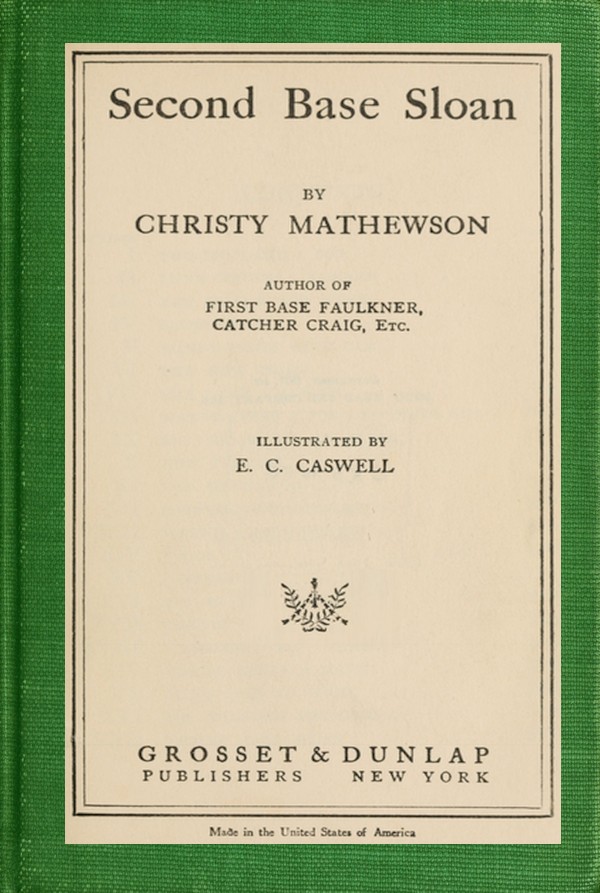
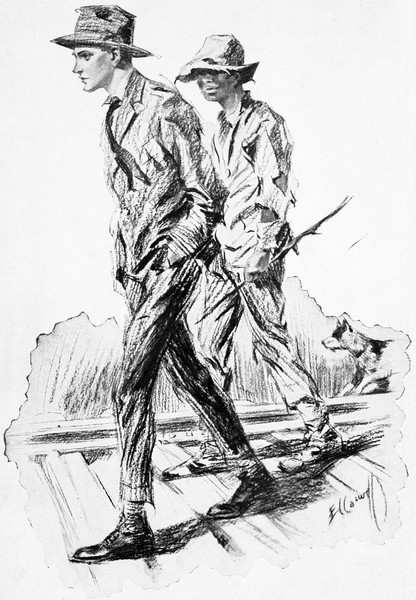
That they didn’t travel absolutely due north
was only because the track chose to lead more
westerly. By the time the sun was really in sight
they had covered the better part of a half-mile
and had caught a glimpse of a good-sized town in
the distance. Tall chimneys and a spire or two
pointed upward above a smoky haze. They
crossed a big bridge beneath which flowed a broad
and sluggish river, and had to flatten themselves
against the parapet, Sam held tightly in Wayne’s
arms, while a long freight train pounded past
them on the single line of track. Beyond the
bridge a “Yard Limit” sign met them, and the
rails branched and switches stood up here and
there like sentries and a roundhouse was near
at hand. But they found their first habitation
before that in a tiny white cottage set below the
embankment, its gate facing a rambling clay road,
rutted and pitted, that disappeared under a
bridge. There was a path worn down the bank to
the road, and Wayne and June and Sam descended
it. A trail of smoke arose from the chimney of
the house straight into the morning sunlight and
suggested that the occupants were up and about.
Wayne’s knock on the door was answered by a
tall, thin, slatternly woman who scowled questioningly.
“Good morning, ma’am,” began Wayne.
“Could you give us a cup of coffee, please? We’ve
been——”
“Get out of my yard,” was the prompt
response. “I don’t feed tramps!”
“We aren’t tramps, ma’am. We’ll pay for the
coffee——”
“And steal the doormat! I know your sort!”
There was no doormat in sight, but Wayne didn’t
notice the fact. “Go on now before I call my
man to you.” The door slammed shut.
Wayne viewed June in surprise and the negro
boy shook his head helplessly. “She surely is a
powerful disgrumpled lady, Mas’ Wayne! Yes,
sir! Reckon we better move along.”
“Maybe she isn’t well,” said Wayne, as they
left the inhospitable dwelling behind and again
climbed to the track. “Just the same, she didn’t
have any right to call us tramps, did she? I
suppose we’d better keep on to the town, June.
It isn’t much farther.”
So they went on, past sidings laden with long
lines of freight cars, past locomotives sizzling
idly, past a crossing where eight burnished rails,
aglow in the sunlight, crossed their path, under a
big signal tower, their eyes very busy and their
stomachs, since they had not eaten since early the
preceding afternoon, very empty. A long freight
shed was reached, and as they passed it one of the
many doors slid slowly open and a brawny man
stood revealed against the dimness beyond. He
stretched his arms, yawned, caught sight of
the passers and stood there, framed in the
square opening, staring interestedly. Wayne
stopped.
“Howdy,” he said. “Can you tell me where
I can get something to eat, sir?”
“Sure! Cross over back of the yellow building
and you’ll see a lunch-wagon. Maybe you’re looking
for the hotel, though?”
Wayne shook his head. “I reckon a lunch-wagon’s
good enough. What is this place,
please?”
“Medfield, son. Aren’t lost, are you?”
“No, sir. What—what state are we in?”
“Pennsylvania. What state might you be looking
for, son?”
“New York. Is it very far?”
“Second state on the right,” laughed the man.
“What part of it are you aiming for?”
“New York City, I reckon. How far would that
be?”
“About a hundred and fifty miles.”
Wayne sighed. “I thought we were nearer than
that. Thank you, sir.”
“Say, hold on! Where’d you come from, anyway?”
Wayne pointed a thumb over his shoulder.
“Back there a ways,” he answered vaguely.
“Tramping it?”
“Yes, sir, some. Rode on the cars, too.”
The big man in the doorway winked down at
him. “When they didn’t see you, eh? You look
like a smart kid. What are you beating your way
around the country for? Why don’t you get a
job and go to work?”
“I’m looking for work,” answered Wayne
eagerly. “Know where I can find some?”
The man shrugged his shoulders. “I guess you
won’t have to look very far, son, if you really
want a job. The trouble with your sort is that
you don’t want to work. How far south do you
come from?”
“Georgia, sir. How’d you know?”
“How’d I know!” laughed the man. “That’s
a good one! What’s Friday’s name?”
“What, sir?” asked Wayne, puzzled.
The man nodded at Wayne’s companion.
“What’s his name? Abraham Lincoln
White?”
“June,” answered Wayne, a trifle stiffly, beginning
to suspect that the man was laughing at
him.
“June, eh? Say, he got North about three
months too soon, didn’t he? Where’d you get the
alligator hound? Don’t you ever feed him anything?”
Wayne moved away, followed by his retinue, but
the man in the door was blind to offended dignity.
“All right, son!” he called after them. “Good
luck! Tell Denny that Jim Mason sent you and
that he’s to give you a good feed.”
Wayne found the lunch-wagon without difficulty,
but it didn’t seem to him that it deserved
the name of wagon for it was set on a brick
foundation in a weed-grown piece of land under
the shadow of the big yellow factory and looked
as though it had been there for many years.
Still, there might be wheels hidden behind the
bricks, he reflected. The words “Golden Star
Lunch” were painted on the front. They climbed
the steps and seated themselves on stools, while
Sam searched famishedly about the floor for stray
crumbs. The proprietor was a short, chunky
youth with light hair slicked down close and a
generous supply of the biggest and reddest
freckles Wayne had ever seen. He observed June
doubtfully.
“We don’t generally feed niggers here,” he
said. “You two fellers together?”
“Yes,” answered Wayne. “If you don’t want
to serve him we’ll get out.” He started to slide
off the stool.
“Oh, well, never mind,” said the white-aproned
youth. “The rush is over now. What’ll you
have?”
“Coffee and two ham sandwiches, please.”
“Mas’ Wayne,” said June, “I’d rather have a
piece of that sweet-potato pie yonder, please, sir.”
“That ain’t sweet-potato pie,” laughed the
proprietor. “That’s squash, Snowball.”
“Please, sir, Mister, don’t call me out of my
name,” begged June earnestly. “My name’s
Junius.”
“All right, Junius.” The proprietor of the
lunch-wagon grinned at Wayne and winked, but
Wayne only frowned.
“You’ll have a sandwich, June,” he said.
“Pie isn’t good for you. Two ham sandwiches,
please.”
“All right, sir.”
June watched wistfully while the knife slipped
through the end of the ham, and at last hunger got
the better of manners. “Mister Denny, sir, would
you please, sir, just bear down a little heavier on
that fat meat?” he requested.
“Sure, you can have all the fat you want.
How’d you know my name, though?”
Wayne answered for him. “A man at the
freight shed directed us.”
“Yes, sir, and he said we was to tell you to give
us a mighty good feed, Mister Denny,” added
June. “But I reckon you-all goin’ to do that
anyway, ain’ you?”
The proprietor laughed as he covered two
slices of buttered bread with generous slices of
ham. “That’s right, Snow—I mean Junius,” he
responded. “If that ain’t enough you come back.
Want something for your dog?”
“Thanks, I’ll give him some of my sandwich,”
said Wayne, trying not to look impatient.
“You don’t need to.” The man scooped up
some trimmings from the ham on the blade of the
broad knife, dumped them on a slice of bread and
leaned over the counter. “Here you are, Bingo.
Catch!” Sam caught as much as he could and it
disappeared as though by magic. After that he
licked up the few scraps that had got away from
him, wagged his tail delightedly, and gazed inquiringly
and invitingly up again. “Say, he’s a
smart dog, ain’t he?” said the man. “What’s his
name?”
“Sam. Are those sandwiches ready, please?”
“Huh? Gee, didn’t I serve you yet? What do
you know about that? Coffee, you said, didn’t
you? Here you are.” He went back to an appraisal
of the dog while Wayne and June, side
by side, drank deep draughts of the hot coffee and
bit huge mouthfuls from the delicious sandwiches.
“Guess some more breakfast wouldn’t bust him,”
said the proprietor, cutting off another slice of
bread and buttering it liberally. “Can he do any
tricks?”
“A few,” replied Wayne rather inarticulately
by reason of having his mouth occupied by other
things than words. “Sit up, Sam, and ask for
it.”
Sam sat up, a trifle unsteadily, and barked three
shrill barks. The man laughed. “Good boy!
Here you are, then!” The piece of bread disappeared
instantly. “Say, he’s sure hungry!
What kind of a dog is he?”
“Reckon he’s just dog,” answered Wayne.
“He don’t boast of his family much, Sam don’t,
but he’s a good old chap.”
“Man over yonder at the railroad called him a
alligator hound,” said June resentfully. “That’s
the best dog in Colquitt County, Mister Denny.
Yes, sir!”
“Where’s that, Junius?”
“Colquitt? That’s where we lives at when
we’re to home. Colquitt County’s the finest——”
“Shut up, June. Don’t talk so much,” said
Wayne. “Sam, stand up and march for the
gentleman. Come on! Forward! March!”
Sam removed his appealing gaze from the
countenance of “Mister Denny,” sighed—you
could actually hear that sigh!—reared himself on
his slender hind legs and stepped stiffly down the
length of the floor and back again.
“Halt!” commanded Wayne, and Sam halted so
suddenly that he almost went over backward.
“Salute!” Sam’s right paw flopped up and down
in a sketchy salute. “Fall out!” Sam came down
on all-fours with alacrity, barked his relief and
again took up his station under the good-natured
“Mr. Denny.” The latter applauded warmly.
“Some dog you’ve got there, kid!” he declared.
“What’ll you take for him?”
“I wouldn’t sell him,” answered Wayne, washing
down the last of his sandwich with the final
mouthful of coffee.
“Give you ten dollars,” said the man.
Wayne shook his head with decision.
“Fifteen? Well, any time you do want to sell
him, Mister, you give me first chance, will you?
He’s going to have some more breakfast for that
stunt.”
“Mas’ Wayne,” said June softly, “I ain’ never
eat any of that squash pie, an’ it surely does look
powerful handsome, don’ it?”
“You still hungry?” frowned Wayne.
“I ain’ downright hungry,” answered June
wistfully, “but I—I surely would act awful kind
to a piece of that pie!”
“All right,” said Wayne. “How much is pie,
sir?”
“Five cents. Want some?”
“Please. A slice of the squash.”
The proprietor, too busy with Sam to
have heard the exchange, set the pie in front
of Wayne, and the latter pushed it along to
June.
“Did you say two pieces?” asked the man,
poising his knife.
“No, thank you.”
June looked uncertainly from the tempting
yellow triangle on the plate before him to Wayne
and back again. “Ain’ you-all goin’ to have no
pie?” he asked. Wayne shook his head. June
laid down the fork and sniffed doubtfully. “What
kind of pie you say this is, Mister Denny?” he
asked.
“Huh? Squash pie.”
“Uh-huh. I reckon I don’ care for it, thanky,
sir. It don’ smell like I thought it would.”
“Don’t be a fool!” whispered Wayne. “I don’t
want any.”
“Say you don’? I ain’ believin’ it, though.
Please, Mas’ Wayne, you have a half of it. It’s
a powerful big piece of pie.”
“Lots more here,” said the proprietor. “Want
another piece?”
“No, thanks,” answered Wayne. “I—maybe
I’ll take a bite of his.”
The man’s reply to this was a quick slash of his
knife and a second section of the squash pie slid
across the counter. “My treat,” he said. “Try
it. It’s good pie.”
Wayne hesitated. “I don’t think I want any,”
he muttered. “I’m not hungry.”
“You eat it if you don’t want me to get mad at
you,” said the other, levelling the knife at him
sternly. “If you can’t eat it all give it to Sam.
I’ll bet you he likes pie, eh, Sammy?”
Wayne smiled and, to June’s vast relief, ate.
Perhaps he wasn’t hungry and perhaps it was
mere politeness that caused him to consume every
last crumb, but he had the appearance of one in
thorough enjoyment of his task. When both
plates were cleaned up Wayne dug a hand into a
pocket.
“How much do we owe you, please?” he asked.
“Twenty cents. The pie was on me.”
“I’d rather—rather——” Wayne’s remark
dwindled to silence and he began an anxious
search of all his pockets, a proceeding that
brought a look of suspicion into the good-natured
face of the man behind the counter.
“Lost your money?” asked the latter with a
trace of sarcasm.
Wayne nodded silently. “I reckon I must
have,” he muttered, turning out one pocket after
another and assembling the contents on the
counter; the tattered time-table, a toothbrush, a
pair of stockings, two handkerchiefs, a knife, a
pencil, some string, and two-cent stamp vastly
the worse for having laid crumpled up in a vest
pocket for many weeks. “It—it’s gone,” said
Wayne blankly. “I had nearly four dollars last
night, didn’t I, June?”
“Yes, sir, you certainly did, Mas’ Wayne,
’cause I seen it. Where you reckon you lost it?”
“I don’t know,” answered the other boy
miserably. “It was in this pocket. I reckon it
must have come out in the freight car.”
The proprietor of the lunch wagon frowned. It
was an old game to him, but there was something
apparently genuine in the troubled expressions of
both boys and he was almost inclined to accept
the story. At all events, it was only twenty cents,
and he was good-hearted and the two youngsters
looked rather down on their luck. “Well, never
mind,” he said carelessly. “You can pay me
some other time, kids.”
But Wayne shook his head. “You—you haven’t
any money, have you, June?” he faltered. June
shook his head sadly.
“I didn’t have but two bits, Mas’ Wayne, and
I went an’ spent that long time ago.”
“You see,” said Wayne, turning to the proprietor,
“we don’t live here. We’re just—just
passing through on our way to New York, and so
we couldn’t very well pay you later.” He looked
dubiously at the array of property before him.
“I reckon there ain’t anything there worth twenty
cents, is there?”
“Not to me, I guess.”
“Then—then you’ll just have to keep Sam until
we can bring the money,” said Wayne desperately.
“I reckon we can earn it somewhere. Will
you please to do that, sir?”
The man looked covetously at the dog, but shook
his head. “Shucks,” he answered, “he’d only be
unhappy. And so would you, I guess. You run
along, fellers. It’s all right. I guess you’ll pay
me when you can, eh? Only—say, now, honest,
kid, did you really have that four dollars, or are
you just stringing me?”
Wayne flushed but met the man’s gaze
squarely. “I had it,” he replied simply. “You
haven’t any call to think I’m lying.”
“All right! I believe you. Now, look here, do
you really want to earn a half-dollar?”
“Yes, sir.”
“Ever washed windows?”
Wayne shook his head. “No, but I reckon I
could do it.”
“Well, these windows need washing pretty
badly. Generally I do it myself, but I’d rather
take a lickin’. There’s eight of ’em and it ought
to be worth five cents a window. That’s forty
cents, but we’ll call it fifty. What do you say?”
“I’ll do them, thanks, and mighty glad to,”
answered Wayne eagerly.
“Huh!” ejaculated June. “Go on away from
here, Mas’ Wayne. You ain’ never washed no
window in your life. White man, point me out to
water and rags and let me to it. Mas’ Wayne ain’
never done no work like that an’ there ain’ no call
for him to do any.” June paused and looked at
the windows. “Mister Denny, them’s pretty big
windows an’ they certainly is dirty, ain’ they?”
“What’s the matter with you? Ain’t fifty cents
enough?”
“Well, sir,” answered June slowly, “it is an’ it
ain’. Takin’ into estimation the size of them
windows an’ the ’mount of washin’ required, sir,
it seems like you might throw in two more cups
of that yere coffee, sir!”
“Junius, you’re all right!” laughed the man,
turning to the gleaming coffee urn. “It’s a bargain.
Drink your coffee and then get to work.
If you do a good job I’ll throw in a sandwich when
you’re through!”