The greatest achievements in poetry have been made by men who lived
close to their times, and who responded easily to their environment.
Not that Taine was altogether right in his climatic theory. The
individual counts for much, and his output is really the result
of the combined action of two influences, his personality and his
surroundings—a sort of intellectual parallelogram of forces. Nor is
great poetic accomplishment necessarily a sympathetic expression of
contemporary tendencies. On the contrary, it may often antagonize
them. But whether it antagonize or approve, it is apt to be vitally
related to them. No man ever set his face more strenuously against the
trend of his age than Dante, nor denounced its manners and morals more
severely; yet Dante was directly concerned in the practical affairs
of his day, and his epoch is epitomized in his poems. Of course,
great poetry bases itself below the shifting surfaces of eras and
nationalities upon the immovable bed-rock of our common humanity; and
so the greatest poets, the poets who express life most fundamentally,
come to have a certain likeness to one another, even though they be as
widely separated in time and space as Homer and Shakspere. But the poet
must learn his human lesson at first hand; he must find the essential
realities of life where he can see them with his own eyes, under the
transitory garments which they wear in his day; and to do this he must
be interested in his day.
There have been now and again, however, certain poets who seem to have
been born out of due time. They have not been opposed to their age so
much as apart from it. The Hamlets of verse, for them the time has been
out of joint, and they have not had the intensity or the resolution to
strive to set it right. Thrown back upon themselves by an environment
which was distasteful to them, but which they lacked either the force or
the inclination to wrestle with and overcome, they have necessarily had
little to say. But on that very account they have frequently given more
thought to the purely artistic side of their work than more copious
writers. Such men were Collins and Gray, and afterward Landor; men whom
we admire more for the classic beauty of their style and for other
technical qualities than for the scope of their imagination or the
penetration of their insight. Of this class of poets, and with no mean
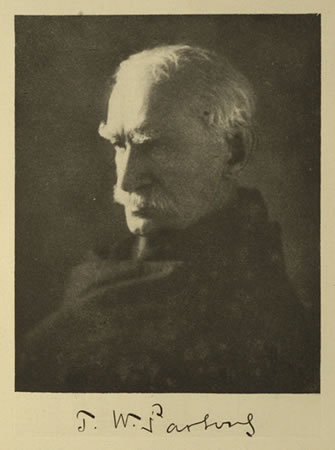
rank among them, was Thomas William Parsons.
Beginning to write contemporaneously with the earliest American poets,
at a time when only the veriest doggerel had yet been perpetrated in
this country, he felt keenly the sense of isolation which it was the lot
of men of letters in those days to experience—an isolation the reality
of which the younger generation finds it difficult to appreciate. This
is the excuse, though it is certainly not a justification, for the
deprecatory and provincial tone which characterizes what are probably
the earliest of his poems that have been preserved, the "Letters" which
stand at the beginning of his first volume. Not Dickens himself was more
flippantly scornful of America and the Americans than is Parsons in
these "Letters;" and though in the preface to them he attributes the
sentiments they contain to an imaginary "wandering Englishman," thus
disclaiming them as personal, he shows even in doing so something more
than a dramatic sympathy with the attitude they portray. This
provincialism Parsons soon outgrew, but he never came to be in perfect
touch with his country, nor to have that sense of easy security with
regard to her which should mark the citizen of a nationality fully
mature.
Yet even in these presumably juvenile verses there is much vigorous
writing and some genuine humor. This on Boston, for example:
"This town, in olden times of stake and flame,
A famous nest of Puritans became:
Sad, rigid souls, who hated as they ought
The carnal arms wherewith the devil fought;
Dancing and dicing, music, and whate'er
Spreads for humanity the pleasing snare.
Stage-plays, especially, their hearts abhorred,
Holding the muses hateful to the Lord,
Save when old Sternhold and his brother bard
Oped their hoarse throats, and strained an anthem hard.
From that angelic race of perfect men
(Sure, seraphs never trod the world till then!)
Descends the race to whom the sway is given
Of the world's morals by confiding Heaven."
There was always a strain of true religious feeling in Parsons, which
deepened at the last into something rapt and intense; but Puritanism
never ceased to be hateful to him, and this antagonism contributed to
make him feel that his footsteps were on alien soil. An artist first of
all, he was drawn more toward the services of the ancient Church, for
whose adornment art has so bountifully poured out its treasures, than to
any balder form of worship. To him the world was a problem in beauty and
emotion. He was not incommoded with a message, as so many of his
contemporaries were. This has been, perhaps, to the detriment of his
reputation in the past; it may be to its advantage in the future. The
man who speaks too consciously a message to his own time is apt to have
none for any other. Parsons wrought from first to last in the true
artistic spirit, and it is not unlikely that his chief claims to the
recognition of the future will be found in qualities of form and style.
Not the least among these qualities will be that sturdy literary
independence which, amid the widespread æsthetic revival of this
century, achieved a success of a purely æsthetic nature on lines
entirely unaffected by the contemporary fashion. In a time of metrical
experiment, and of the new and strange harmonies of Rossetti and
Swinburne, he alone of the artistic school of poets, uninfluenced even
by Coleridge or Shelley, worked in the severe methods of an earlier day.
Dryden and Pope seem to have been his earliest masters, but not for
long. The versification of Dryden, which Keats learned to appreciate at
its true value, remained always to some extent a factor in Parsons's
art, but he soon threw over the jingle of Pope's measure for the fuller,
statelier, and in truth simpler manner of Collins and Gray. Yet his
matured style is neither that of Collins, with whom he had close
resemblances, personal and poetical, nor that of Gray, though
unquestionably akin to both. Parsons had, besides, a certain bent for
plain words and homely images that sometimes became Dantesque. Indeed,
the lifelong study which he gave to Dante could not be without its
influence on his own expression—an influence potent for strength and
directness.
Parsons was probably Gray's inferior in point of taste, for otherwise we
can hardly understand how he could put forth in the same volume, and
sometimes in the same poem, such inequalities as he permitted himself.
Yet it must be said, as an offset to this, that he seldom made himself
responsible for a poem by publishing it. He occasionally had verses in
the magazines, and even, if the whim took him, in the newspapers; but
only twice in his life did he bring the question of his critical
judgment fairly within the scope of comment by issuing a volume to the
public. The first of these volumes, which contains the famous "Lines on
a Bust of Dante," may perhaps rely upon the youth of its author as an
explanation of its unevenness. The other, "Circum Præcordia," published
in the year of his death, and consisting of a versification of the
collects of the Church together with a few original poems of a religious
character, is of even and sustained excellence, though rising to the
level of his best work only in its concluding poem, "Paradisi Gloria."
Mrs. Parsons had several other volumes printed for private circulation
only, but of these the author frequently knew nothing until the bound
copies were placed in his hands. What he would himself now select to
give to the world no one can tell; possibly as carefully edited a volume
as even that of Gray.
Such a volume would, I believe, be one of the treasures of American
verse—a book that lovers of poetry would carry with them as they would
similar thin volumes of Herrick, Marvell, Collins or Landor. The lyrics
addressed to Francesca are true Herrick for grace and daintiness, and
there is nothing in Landor finer than such passages as this:
"His heart was written o'er, like some stray page
Tom out from Plutarch, with majestic names;"
or these, from "Francesca di Rimini:"
"Be it some comfort, in that hateful hell,
You had a lover of your love to tell."
"But he whose numbers gave you unto fame,
Lord of the lay—I need not speak his name—
Was one who felt; whose life was love or hate.
Born for extremes, he scorned the middle state,
And well he knew that, since the world began,
The heart was master in the world of man."
I have referred to the "Paradisi Gloria." This poem, with one unwisely
altered line restored to its original reading, is one of the few
faultless lyrics in the language; and the following stanza, with which
it begins, is, I submit, as felicitous as anything Gray ever wrote, and
more imaginative;
"There is a city builded by no hand,
And unapproachable by sea or shore,
And unassailable by any band
Of storming soldiery forevermore."
Less fine, perhaps, but still very beautiful is the touching "Dirge:"
"What shall we do now, Mary being dead?
Or say or write, that shall express the half?
What can we do but pillow that fair head,
And let the springtime write her epitaph?"
Each of these poems is marked by that simple and straightforward style
which was the glory of Parsons at his best. But he could also handle
more involved periods and a more complex cæsural music with equal skill;
witness the opening lines of "La Pineta Distrutta:
"Farewell Ravenna's forest! and farewell
For aye through coming centuries to the sound,
Over blue Adria of the lyric pines
And Chiassi's bird-song keeping burden sweet
To their low moan as once to Dante's lines,
Which when my step first felt Italian ground
I strove to follow, carried by the spell
Of that sad Florentine whose native street
(At morn and midnight) where he used to dwell
My Father bade me pace with reverent feet."
From poems like these to "The Feud of the Flute-Players" is a far cry,
but it argues well for the humanity of our poet that he could be merry
when he would. The line,
"In a tap-room by the Tiber, at the sign of Tarquin's Head,"
is as jolly a bit of Bohemianism as any I know, and the entire story is
told with much spirit and humor. "St. Peray," another bacchanalian
lyric, has found its way, like the "Lines on a Bust on Dante," into the
anthologies, and may be passed by here with a mere reference.
"Count Ernst von Mansfeldt, the Protestant," if three rather weak and
quite unnecessary stanzas could be removed from it, would be, perhaps,
the strongest poem Parsons ever wrote. It is certainly the most
objective, and one of the most manly and vigorous.
"The dicer Death has flung for me;
His greedy eyes are on me;
My chance is not one throw in three;
Ere night he will have won me.
"Summon my kin!—come steed—come coach—
Let me not stay, commanding;
If the last enemy approach,
They shall see me armed and standing.
"Buckle me well and belt me strong!
For I will fall in iron."
This, with the stirring "Martial Ode," which begins,
"Ancient of days! Thy prophets old
Declared Thee also Lord of war;
And sacred chroniclers have told
Of kings whom Thou didst battle for,"
proves that Parsons knew how to put into practice that strenuous
counsel of his own:
"But something rough and resolute and sour
Should with the sweetness of the soul combine;
For although gentleness be part of power,
'Tis only strength makes gentleness divine."
With the masterly technical power and equipment that Parsons undoubtedly
had, why did he not do more? Why is his permanent original contribution
to English literature limited to a few lyrics? For this I can find no
better reason than that which I have already suggested, that, being out
of sympathy with his time, he found no theme for his song. The
achievements of this age he admired, when at all, as an outsider, and
frequently his attitude was the reverse of admiration. Homers must have
their Agamemnons as well as Agamemnons their Homers; and to-day was not
heroic to Parsons. To him the railway suggested nothing but
"The dead sleepers of the vulgar track,"
and commercial greatness smacked ever of the Philistine. He would
probably have been as uncomfortable in Athens as in Boston; and while he
could love Venice dead, Venice living (where, as so often in history,
Trade and Art went out hand in hand, conquering and to conquer) would
have been as distasteful as Chicago. It is true that the traders of
Athens and the Adriatic braved great personal dangers, and brought back
from their voyages strange and gorgeous fabrics, "barbaric pearl and
gold," and tales of incredible adventure in the unknown world. Our
modern conquests, in commerce as in science, with some notable
exceptions, are of a more impalpable kind, and make no such sensuous
appeal to the imagination. And so, for some, the circumnavigation of the
globe has ended all romance, even though the unknown be still as
mysteriously present in New York as in the "shining vales of Har."
The risk and the imagination involved in modern achievement are
enormous, and even the element of personal danger is by no means
eliminated; and if there were vulgar things in the conquest of
California, I doubt not there were also vulgar things, more nearly of
the same kind than we are apt to think, in the conquest of Gaul. But
anybody can see the vulgarity. It is the poet's function to show that
this is a mere accident, and that the essential reality still throbs as
ever with a lyric rapture; that
"in the mud and scum of things
There's something ever, ever sings."
Few poets, indeed, have been completely catholic of insight, nor do
they necessarily lose their title of interpreters because they are not
universal interpreters, and limit themselves to the field or fields
for which they have a spontaneous sympathy. Parsons, even when he
rationally approved, had no spontaneous sympathy for the present, its
attitude or its tendencies. To sing of it, or to sing of the past with
the voice of the present, his æsthetic instinct felt would be but a
tour de force, and seldom and reluctantly was he persuaded to attempt
it. Occasionally he poured his fine rhetoric into denunciation, written
from the heart; but here, too, his artistic feeling stepped in and
restrained him to brief utterance, for he knew well that scolding is
not great nor dignified.
One thing there was that he saw clearly his way to do—to reproduce for
this age the voice of the age which he did love, and of the poet for
whom, even from boyhood, he cherished a devotion almost personal. In
making this choice and following his instinct, I believe he was right,
and that we have obtained a greater poem than we should have done had he
forced himself into attempting a sustained work of his own. Nor is this
a derogation in any way from Parsons's unquestioned poetic power, as any
one who knows anything about the almost insuperable difficulties of
translation is well aware. In fact, it may be said with perfect truth
that a good translation is rarer than a good original poem. The
successful transfer of even the briefest lyric from one language to
another is an achievement so unusual as to demand the most unreserved
commendation, while even the partly successful renderings of the great
masters, in all languages, are so few that their names may be spoken in
one breath.
Parsons's translation of the "Divine Comedy" is far from being a
paraphrase of the original, but yet it makes no pretense to absolute
literalness. Indeed, a truly literal translation is a linguistic
impossibility. Over and above the merely metrical difficulties of such
an undertaking, there must always be two classes of phenomena in which
the two poems, the original and the version, will differ, and often very
materially, from each other. The metrical scheme may be preserved, but
the rhythmical filling in of this scheme must necessarily vary; for the
syllables of the corresponding words in different languages will almost
certainly have different time values. In one they may have many
consonants, and be perforce slow in articulation; in the other they may
consist entirely of short vowels and tripping liquids. The predominance
of short syllables in Italian enabled Dante to use feet of three or more
syllables in an iambic measure with much greater frequency than would be
possible in English, and this fact alters wholly the character of a
measure of which the metrical scheme is the same in both languages. It
is, of course, so evident as hardly to warrant allusion that the sounds
themselves cannot be the same; and yet their expression as mere sounds
is a very vital factor in their poetic force.
The other class of phenomena in which an original and its translation
must always differ is not acoustic, but linguistic. As I have had
occasion to say elsewhere, "words differ in what, for lack of a better
word, we must call color. With the possible exception of Volapük, in
which, for this very reason, no one but a statistician would ever think
of writing poetry, there is no language in existence in which the words
are merely conventional symbols of the ideas for which they stand. Every
word we speak has a pedigree that goes back to Adam. It has been
developing into what it now is, through uncounted accretions and
curtailments and transformations, ever since man was, and, since
Professor Garner's experiments with monkeys, we may suspect even a
little longer; and in the course of that long, eventful history it has
gathered to itself a multitude of little associations which, without
presenting themselves directly to the understanding, modify, enrich and
color the effect of the primary meaning, like the overtones of a musical
note. Without this colorific value of words, we could express little
more by speech than by the symbols of algebra. This is the chief
difficulty of the translator, and one that he can never surmount."
Prose translations of what in the original was verse vary, of course,
from that original in even more respects, since they deliberately
sacrifice an entire group of expressional devices which formed an
important part of the poet's intention. An argument may be made for the
use of prose in translating the poetry of the ancients, for their
versification differed from ours in a radical manner. But there can be
no excuse for an English prose version of a poem written in any modern
European language, if it be intended for more than an assistance in the
study of the original. Admirable as the workmanship in some of our prose
versions of Dante has been, I cannot but think that, except for some
such scholarly purpose, the labor and the skill expended upon them have
been misapplied.
At the opposite extreme from the prose versions are those that have
been made into terza rima. It cannot be denied that the use of
Dante's own arrangement of rhymes is an advantage, nor that Dante
himself laid much stress upon it. But he had mystical reasons for
doing so that are not of great consequence to us now, and Parsons's
translation, while preserving, in common with the versions in terza
rima and with those in blank verse, the meter of the original (the
iambic pentameter), loses but little of the effect of the rhyme
structure. His quatrains, by the liberal use of run-on lines and the
occasional introduction of a third rhyme, achieve that effect of
continuity which is the most distinguishing characteristic of the
original. I venture to think that almost no one, even among poets,
would be able to tell whether the complex rhyme system of the terza
rima were exactly carried out in any poem to the reading aloud of
which he should listen for pure enjoyment, and without special effort
to observe that particular phenomenon. Still, however slight the
advantage be, it is nevertheless an advantage to have preserved the
terza rima; but this gain is more than overcome by the Dantesque
quality of the style in Parsons's version. The manner of the others
often suggests the contemporaries of Dante, rather than Dante himself.
There remain for consideration and comparison the two renderings
into blank verse. These are the most widely known of the various
translations, and one of them, Cary's, is the form in which Dante is
most generally read by English-speaking readers. Longfellow's version,
though occasionally it transfers a line more successfully than any of
the others, is in the main perfunctory, and its literalness is carried
so far that it frequently degenerates into a "crib" pure and simple.
There is a story that Longfellow used to translate eighty lines every
morning before breakfast. I do not know how true this may be, but the
internal evidence seems to support it. The product of his labor is a
caput mortuum; the categorical statements are all there, but somehow
the poetry has evaporated. The result is tedious and uninteresting.
Now, the one quality Dante never had is dullness, and that is also the
one quality the public will never forgive.
Cary's translation has the merit of being tolerably readable. But in it
the great Italian poet suffers a strange transformation. The words are
the words of Dante, but the voice is the voice of Milton; or rather of a
weaker-lunged man trying to mouth the mighty periods and cæsuras of
Milton, and getting somewhat cracked of voice and broken of wind in the
effort. Nevertheless, it is, on the whole, a creditable performance;
only it is not Dante.
Each of the translators has his felicitous moments, and succeeds in
rendering certain passages with more skill than his competitors. But the
relative merit of the translations must be estimated, not by passages,
but by the general impression of the whole work. Parsons is inferior to
some of the other translators in certain obvious verbal and prosodical
accuracies. But his poem probably gives a more correct impression of
Dante in his entirety than any of the others. His versification has the
continuity of Dante's, and something of its music. His diction, like
Dante's, has that supreme refinement that knows no disdain for homely
words and phrases. His style, with more inversions than Dante's, has
much of the master's severity and swiftness, though it falls short of
the masterfulness and supple power of the Italian. Altogether there is
more Dante in it than in any translation that has yet been made.
It has been difficult for me to write critically of a man for whom I had
a warm affection, and who honored me with his friendship and esteem. If
I have erred on the side of severity, it has been from a fear lest my
personal regard for the man should unduly influence my judgment of the
poet; and if I have erred in his praise, it will be easily forgiven. But
I do not think that I mistake in assigning to him, as a translator a
station with the highest, and as an original poet a niche with Collins
in the temple of English song.
Richard Hovey.
In Atlantic Monthly.