THE HUMAN FACE, LIKE A FLOWER, SPEAKS FOR ITSELF.
1. It takes acquaintance to found a noble esteem, but politeness
prepares the way. Indeed, as Montaigne says, Courtesy begets esteem at
sight. Urbanity is half of affability, and affability is a charm worth
possessing.
2. A pleasing demeanor is often the scales by which the pagan weighs
the Christian. It is not virtue, but virtue inspires it. There are
circumstances in which it takes a great and strong soul to pass under the
little yoke of courtesy, but it is a passport to a greater soul
standard.
3. Matthew Arnold says, "Conduct is three-fourths of character," and
Christian benignity draws the line for conduct. A high sense of
rectitude, a lowly soul, with a pure and kind heart are elements of
nobility which will work out in the life of a human being at
home—everywhere. "Private refinement makes public gentility."
4. If you would conciliate the favor of men, rule your resentment.
Remember that if you permit revenge or malice to occupy your soul, you
are ruined.
5. Cultivate a happy temper; banish the blues; a cheerful saguine
spirit begets cheer and hope.
6. Be trustworthy and be trustful.
7. Do not place a light estimate upon the arts of good reading and
good expression; they will yield perpetual interest.
8. Study to keep versed in world events as well as in local
occurrences, but abhor gossip, and above all scandal.
9. Banish a self-conscience spirit—the source of much
awkwardness—with a constant aim to make others happy. Remember that
it is incumbent upon gentlemen and ladies alike to be neat in habits.
10. The following is said to be a correct posture for walking. Head
erect—not too rigid—chin in, shoulders back. Permit no unnecessary motion
about the thighs. Do not lean over to one side in walking, standing or
sitting; the practice is not only ungraceful, but it is deforming and
therefore unhealthful.
11. Beware of affectation and of Beau Brummel airs.
12. If the hands are allowed to swing in walking, the arc should be
limited, and the lady will manage them much more gracefully, if they
almost touch the clothing.
13. A lady should not stand with her hands behind her. We could almost
say, forget the hands except to keep them clean, including the nails,
cordial and helpful. One hand may rest easily in the other. Study repose
of attitude here as well as in the rest of the body.
14. Gestures are for emphasis in public speaking; do not point
elsewhere, as a rule.
15. Greet your acquaintances as you meet them with a slight bow and
smile, as you speak.
16. Look the person to whom you speak in the eye. Never under any
circumstances wink at another or communicate by furtive looks.
17. Should you chance to be the rejected suitor of a lady, bear in mind your
own self-respect, as well as the inexorable laws of society, and bow
politely when you meet her. Reflect that you do not stand before all
woman-kind as you do at her bar. Do not resent the bitterness of
flirtation. No lady or gentleman will flirt. Remember ever that painful
prediscovery is better than later disappointment. Let such experience
spur you to higher exertion.
18. Discretion should be exercised in introducing persons. Of two
gentlemen who are introduced, if one is superior in rank or age, he is
the one to whom the introduction should be made. Of two social equals, if
one be a stranger in the place, his name should be mentioned first.
19. In general the simpler the introduction the better.
20. Before introducing a gentleman to a lady, remember that she is
entitled to hold you responsible for the acquaintance. The lady is the
one to whom the gentleman is presented, which may be done thus: "Miss A,
permit me to introduce to you my friend, Mr. B."; or, "Miss A., allow me
to introduce Mr. B." If mutual and near friends of yours, say simply,
"Miss A., Mr. B."
21. Receive the introduction with a slight bow and the acknowledgment,
"Miss A., I am happy to make your acquaintance"; or, "Mr. B., I am
pleased to meet you." There is no reason why such stereotyped expressions
should always be used, but something similar is expected. Do not extend
the hand usually.
22. A true lady will avoid familiarity in her deportment towards
gentlemen. A young lady should not permit her gentlemen friends to
address her by her home name, and the reverse is true. Use the title Miss
and Mr. respectively.
23. Ladies should be frank and cordial towards their lady friends, but
never gushing.
24. Should you meet a friend twice or oftener, at short intervals, it
is polite to bow slightly each time after the first.
25. A lady on meeting a gentleman with whom she has slight
acquaintance will make a medium bow—neither too decided nor too
slight or stiff.
26. For a gentleman to take a young lady's arm, is to intimate that
she is feeble, and young ladies resent the mode.
27. If a young lady desires to visit any public place where she
expects to meet a gentleman acquaintance, she should have a chaperon to
accompany her, a person of mature years when possible, and never a giddy
girl.
28. A lady should not ask a gentleman to walk with her.
1. If you desire to be respected, keep clean. The finest attire and
decorations will add nothing to the appearance or beauty of an untidy
person.
2. Clean clothing, clean skin, clean hands, including the nails,
and clean, white teeth, are a requisite passport for good
society.
3. A bad breath should be carefully remedied, whether it proceeds
from the stomach or from decayed teeth.
4. To pick the nose, finger about the ears, or scratch the head or
any other part of the person, in company, is decidedly vulgar.
5. When you call at any private residence, do not neglect to clean
your shoes thoroughly.
6. A gentleman should always remove his hat in the presence of
ladies, except out of doors, and then he should lift or touch his hat in
salutation. On meeting a lady a well-bred gentleman will always lift his
hat.
7. An invitation to a lecture, concert, or other entertainment, may
be either verbal or written, but should always be made at least
twenty-four hours before the time.
8. On entering a hall or church the gentleman should precede the
lady in walking up the aisle, or walk by her side, if the aisle is broad
enough.
9. A gentleman should always precede a lady upstairs, and follow
her downstairs.
10. Visitors should always observe the customs of the church with
reference to standing, sitting, or kneeling during the services.
11. On leaving a hall or church at the close of entertainment or
services, the gentleman should precede the lady.
12. A gentleman walking with a lady should carry the parcels, and
never allow the lady to be burdened with anything of the kind.
13. A gentleman meeting a lady on the street and wishing to speak
to her, should never detain her, but may turn around and walk in the same
direction she is going, until the conversation is completed.
14. If a lady is traveling with a gentleman, simply as a friend,
she should place the amount of her expenses in his hands, or insist on
paying the bills herself.
15. Never offer a lady costly gifts unless you are engaged to her, for it looks as
if you were trying to purchase her goodwill; and when you make a present
to a lady use no ceremony whatever.
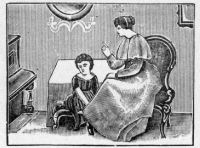
Children should early be taught the lesson of Propriety and Good
Manners.
16. Never carry on a private conversation in company. If secrecy is
necessary, withdraw from the company.
17. Never sit with your back to another without asking to be
excused.
18. It is as unbecoming for a gentleman to sit with legs crossed as
it is for a lady.
19. Never thrum with your fingers, rub your hands, yawn, or sigh
aloud in company.
20. Loud laughter, loud talking, or other boisterous manifestations
should be checked in the society of others, especially on the street and
in public places.
21. When you are asked to sing or play in company, do so without
being urged, or refuse in a way that shall be final; and when music is
being rendered in company, show politeness to the musician by giving
attention. It is very impolite to keep up a conversation. If you do not
enjoy the music, keep silent.
22. Contentions, contradictions, etc., in society should be
carefully avoided.
23. Pulling out your watch in company, unless asked the time of
day, is a mark of the demi-bred. It looks as if you were tired of the
company and the time dragged heavily.
24. You should never decline to be introduced to any one or all of
the guests present at a party to which you have been invited.
25. A gentleman who escorts a lady to a party, or who has a lady
placed under his care, is under particular obligations to attend to her
wants and see that she has proper attention. He should introduce her to
others, and endeavor to make the evening pleasant. He should escort her
to the supper table and provide for her wants.
26. To take small children or dogs with you on a visit of ceremony
is altogether vulgar, though in visiting familiar friends, children are
not objectionable.
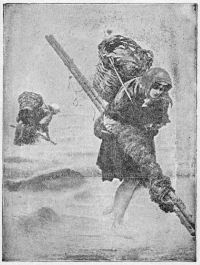
AN EGYPTIAN BRIDE'S WEDDING OUTFIT.
In the matter of making calls it is the correct thing:
For the caller who arrived first to leave first.
To return a first call within a week and in person.
To call promptly and in person after a first invitation.
For the mother or chaperon to invite a gentleman to call.
To call within a week after any entertainment to which one has been
invited.
You should call upon an acquaintance who has recently returned from a
prolonged absence.
It is proper to make the first call upon people in a higher social
position, if one is asked to do so.
It is proper to call, after an engagement has been announced, or a
marriage has taken place, in the family.
For the older residents in the city or street to call upon the
newcomers to their neighborhood is a long recognized custom.
It is proper, after a removal from one part of the city to another, to
send out cards with one's new address upon them.
To ascertain what are the prescribed hours for calling in the place
where one is living, or making a visit, and to adhere to those hours is a
duty that must not be overlooked.
A gentleman should ask for the lady of the house as well as the young
ladies, and leave cards for her as well as for the head of the family.
 Improve Your Speech by Reading.
Don't say Miss or Mister without the person's name.
Don't say pants for trousers.
Don't say gents for gentlemen.
Don't say female for woman.
Don't say elegant to mean everything that pleases you.
Don't say genteel for well-bred.
Don't say ain't for isn't.
Don't say I done it for I did it.
Don't say he is older than me; say older than I.
Don't say she does not see any; say she does not see at all.
Don't say not as I know; say not that I know.
Don't say he calculates to get off; say he expects to get off.
Don't say he don't; say he doesn't.
Don't say she is some better; say she is somewhat better.
Don't say where are you stopping? say where are you staying?
Don't say you was; say you were.
Don't say I say, says I, but simply say I said.
Don't sign your letters yours etc., but yours truly.
Don't say lay for lie; lay expresses action; lie expresses rest.
Don't say them bonnets; say those bonnets.
Don't say party for person.
Don't say it looks beautifully, but say it looks beautiful.
Don't say feller, winder, to-morrer, for fellow, window, tomorrow.
Don't use slangy words; they are vulgar.
Don't use profane words; they are sinful and foolish.
Don't say it was her, when you mean it was she.
Don't say not at once for at once.
Don't say he gave me a recommend, but say he gave me a
recommendation.
Don't say the two first for the first two.
Don't say he learnt me French; say he taught me French.
Don't say lit the fire; say lighted the fire.
Don't say the man which you saw; say the man whom you saw.
Don't say who done it; say who did it.
Don't say if I was rich I would buy a carriage; say if I were
rich.
Don't say if I am not mistaken you are in the wrong; say if I mistake
not.
Don't say who may you be; say who are you?
Don't say go lay down; say go lie down.
Don't say he is taller than me; say taller than I.
Don't say I shall call upon him; say I shall call on him.
Don't say I bought a new pair of shoes; say I bought a pair of new
shoes.
Don't say I had rather not; say I would rather not.
Don't say two spoonsful; say two spoonfuls.
Don't let one day pass without a thorough cleansing of your
person.
Don't sit down to your evening meal before a complete toilet if you
have company.
Don't cleanse your nails, your nose or your ears in public.
Don't use hair dye, hair oil or pomades.
Don't wear evening dress in daytime.
Don't wear jewelry of a gaudy character; genuine jewelry modestly worn
is not out of place.
Don't overdress yourself or walk affectedly.
Don't wear slippers or dressing-gown or smoking-jacket out of your own
house.
Don't sink your hands in your trousers' pockets.
Don't whistle in public places, nor inside of houses either.
Don't use your fingers or fists to beat a tattoo upon floor, desk or
window panes.
Don't examine other people's papers or letters scattered on their
desk.
Don't bring a smell of spirits or tobacco into the presence of
ladies.
Never use either in the presence of ladies.
Don't drink spirits; millions have tried it to their sorrow.
1. Your conduct on the street should always be modest and dignified.
Ladies should carefully avoid all loud and boisterous conversation or
laughter and all undue liveliness in public.
2. When walking on the street do not permit yourself to be
absent-minded, as to fail to recognize a friend; do not go along reading
a book or newspaper.
3. In walking with a lady on the street give her the inner side of the
walk, unless the outside is the safer part; in which case she is entitled
to it.
4. Your arm should not be given to any lady except your wife or a near
relative, or a very old lady, during the day, unless her comfort or
safety requires it. At night the arm should always be offered; also in
ascending the steps of a public building.
5. In crossing the street a lady should gracefully raise her dress a
little above her ankle with one hand. To raise the dress with both hands
is vulgar, except in places where the mud is very deep.
6. A gentleman meeting a lady acquaintance on the street should not
presume to join her in her walk without first asking her permission.
7. If you have anything to say to a lady whom you may happen to meet
in the street, however intimate you may be, do not stop her, but turn
round and walk in company with her; you can take leave at the end of the
street.
8. A lady should not venture out upon the street alone after dark. By
so doing she compromises her dignity, and exposes herself to indignity at
the hands of the rougher class.
9. Never offer to shake hands with a lady in the street if you have on
dark or soiled gloves, as you may soil hers.
10. A lady does not form acquaintances upon the street, or seek to
attract the attention of the other sex or of persons of her own sex. Her
conduct is always modest and unassuming. Neither does a lady demand
services or favors from a gentleman. She accepts them graciously, always
expressing her thanks. A gentleman will not
stand on the street corners, or in hotel doorways, or store windows and
gaze impertinently at ladies as they pass by. This is the exclusive
business of loafers.
11. In walking with a lady who has your arm, should you have to cross
the street, do not disengage your arm and go around upon the outside,
unless the lady's comfort renders it necessary. In walking with a lady,
where it is necessary for you to proceed singly, always go before
her.
1. A lady should be a lady, and a gentleman a gentleman under any and
all circumstances.
2. Female Indifference to Man.—There is nothing that
affects the nature and pleasure of man so much as a proper and friendly
recognition from a lady, and as women are more or less dependent upon
man's good-will, either for gain or pleasure, it surely stands to their
interest to be reasonably pleasant and courteous in his presence or
society. Indifference is always a poor investment, whether in society or
business.
3. Gallantry and Ladyism should be a prominent feature in the
education of young people. Politeness to ladies cultivates the intellect
and refines the soul, and he who can be easy and entertaining in the
society of ladies has mastered one of the greatest accomplishments. There
is nothing taught in school, academy or college, that contributes so much
to the happiness of man as a full development of his social and moral
qualities.
4. Ladylike Etiquette.—No woman can afford to treat men
rudely. A lady must have a high intellectual and moral ideal and hold
herself above reproach. She must remember that the art of pleasing and
entertaining gentlemen is infinitely more ornamental than laces, ribbons
or diamonds. Dress and glitter may please man, but it will never benefit
him.
5. Cultivate Deficiencies.—Men and women poorly sexed
treat each other with more or less indifference, whereas a hearty
sexuality inspires both to a right estimation of the faculties and
qualities of each other. Those who are deficient should seek society and
overcome their deficiencies. While some naturally inherit faculties as
entertainers, others are compelled to acquire them by cultivation.
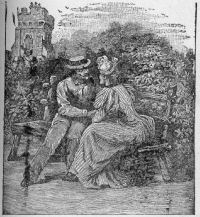
ASKING AN HONEST QUESTION.
6. Ladies' Society.—He who seeks ladies' society should
seek an education and should have a pure heart and a pure mind. Read
good, pure and wholesome literature and study human nature, and you will
always be a favorite in the society circle.
7. Woman Haters.—Some men with little refinement and
strong sensual feelings virtually insult and thereby disgust and repel
every female they meet. They look upon woman with an inherent vulgarity,
and doubt the virtue and integrity of all alike. But it is because they
are generally insincere and impure themselves, and with
such a nature culture and refinement are out of the question, there must
be a revolution.
8. Men Haters.—Women who look upon all men as odious,
corrupt or hateful, are no doubt so themselves, though they may be clad
in silk and sparkle with diamonds and be as pretty as a lily; but their
hypocrisy will out, and they can never win the heart of a faithful,
conscientious and well balanced man. A good woman has broad ideas and
great sympathy. She respects all men until they are proven unworthy.
9. Fond of Children.—The man who is naturally fond of
children will make a good husband and a good father. So it behooves the
young man, to notice children and cultivate the art of pleasing them. It
will be a source of interest, education and permanent benefit to all.
10. Excessive Luxury.—Although the association with
ladies is an expensive luxury, yet it is not an expensive education. It
elevates, refines, sanctifies and purifies, and improves the whole man. A
young man who has a pure and genuine respect for ladies, will not only
make a good husband, but a good citizen as well.
11. Masculine Attention.—No woman is entitled to any more
attention than her loveliness and ladylike conduct will command. Those
who are most pleasing will receive the most attention, and those who
desire more should aspire to acquire more by cultivating those graces and
virtues which ennoble woman, but no lady should lower or distort her own
true ideal, or smother and crucify her conscience, in order to please any
living man. A good man will admire a good woman, and deceptions cannot
long be concealed. Her show of dry goods or glitter of jewels cannot long
cover up her imperfections or deceptions.
12. Purity.—Purity of purpose will solve all social
problems. Let all stand on this exalted sexual platform, and teach every
man just how to treat the female sex, and every woman how to behave
towards the masculine; and it will incomparably adorn the manners of
both, make both happy in each other, and mutually develop each other's
sexuality and humanity.


