The Knights of Saint John of Jerusalem, afterwards known as the Knights
of Rhodes, and eventually as the Knights of Malta—A brief sketch of the
Order, including the relation of how Gozon de Dieu-Donné, subsequently
Grand Master, slew the great Serpent of Rhodes; also some account of
Jean Parisot de la Valette, forty-eighth Grand Master, who commanded at
the Siege of Malta, in which the arms of Soliman the Magnificent were
defeated after a siege lasting one hundred and thirteen days.
Amongst all those principalities and powers against which Dragut contended
during the whole of his strenuous existence, there was no one among them
which he held in so much detestation as the famous Knights of Saint John,
known in the sixteenth century as the Knights of Malta. This militant
religious organisation had its origin in Jerusalem in peculiar and
interesting circumstances. After the death of Mahomet, his followers,
burning with zeal, put forward the tenets of their religion by means of
fire and sword; during the years which followed the Hegira, 622 A.D., the
arms of the Moslems were everywhere successful, and amongst other places
conquered by them was Palestine. So great was the renown acquired by the
Emperor Charlemagne that his fame passed even into Asia, and Eginard states
that the Caliph287 Haroun Raschid permitted the French nation to maintain a
house in Jerusalem for the reception of pilgrims visiting the holy places,
and that, further, the Prince permitted the Patriarch of Jerusalem to send
to the Christian Emperor, on his behalf, the keys of the Holy Sepulchre and
those of the Church of Calvary, together with a standard which was the sign
of the power and authority delegated by the Moslem ruler to his mighty
contemporary. In the middle of the eleventh century Italian merchants
coming from Amalfi, who had experienced the hard lot of the Christian
pilgrims in reaching the Holy City, secured from the Caliph Moustafa-Billah
a concession of land, on which they built a chapel known as St. Mary of the
Latins, to distinguish it from the Greek church already established at
Jerusalem, and also constructed a hospice in which to receive the pilgrims,
whether in sickness or in health, known as the Hospice of St. John.
In 1093 the untiring efforts of Peter the Hermit, with the support of Pope
Urbain II., brought about the first Crusade, and in 1099 we first hear of
Gerard, the founder of the Order of St. John. Gerard was a French monk who,
seeing the good work done by the Hospice of St. John, had attached himself
to it, and had at this time been working in the cause of charity, and
devoting himself to the pilgrims for many years.
Godfrey de Bouillon, having defeated the Saracens outside the walls of
Jerusalem, entered that city and visited the Hospice of St. John; he there
found many of the Crusaders who had been wounded during the siege, and who
had been carried thither after the taking of the place: all of these men
were loud in their praises of the loving kindness with which they had been
received and tended.
Great was the honour and reverence in which these simple monks were held
ever after by the Crusaders; for was it not common talk that these holy men
had themselves subsisted on the coarsest and most repulsive fare in order
that the food in the hospice should be both pure and abundant? Fired by
this fine example of Christian charity, several noble gentlemen who had
been tended in the hospice gave up the idea of returning to their own
countries, and consecrated themselves to the Hospice of St. John, and to
the service of the pilgrims, the poor, and the sick. Among these was
Raimond Dupuy.
The great Prince Godfrey de Bouillon fully approved of the steps taken by
these gentlemen, and for his own part contributed to the upkeep of the
hospice the seigneurie of Montbirre, with all its dependencies, which
formed a part of his domain in Brabant. His example was widely copied by
the Christian princes and great nobles among the Crusaders, who enriched
the hospice with many lands and seigneuries, both in Palestine and in
Europe. All these lands and properties were placed unreservedly in the
hands of the saintly Gerard to do with as he would for the advancement of
his work. In 1118 Gerard died in extreme old age; “he died in the arms of
the brothers, almost without sickness, falling, as it may be said, like a
fruit ripe for eternity.”
The choice of the Hospitallers as his successor was Raimond Dupuy, a
nobleman of illustrious descent from the Province of Dauphiny, and it is he
who first held rule under the title of Grand Master. In all charity and
loving kindness the life of Gerard had been passed, the brethren of St.
John occupying themselves merely in tending the sick, in helping the poor
and the pilgrims; but Raimond Dupuy was a soldier of the Cross, and he laid
before the Order a scheme by which, from among the members thereof, a
military corps should be formed, vowed to a perpetual crusade against the
Infidel. This, in full conclave, was carried by acclamation, and the most
remarkable body of religious warriors that the world has ever seen then
came existence.
This pact against the Infidel was in the first instance directed against
the barbarians who swarmed around the Holy City, and the Hospitallers, who
nearly all had been knights and soldiers of Godfrey de Bouillon, joyfully
took up their arms again to employ them in the defence of this locality
which they cherished, and in defence of the pilgrims who were robbed,
murdered, and maltreated in all the surrounding country. In becoming
warriors once more, they vowed to turn their arms against the Infidel, and
against him alone; to neither make nor meddle with arms in their hands in
any dispute between men of their own faith. The composition of the Order as
it was arranged by Raimond Dupuy caused it to consist of three classes. In
the first were placed men of high birth and rank who, having been bred to
arms, were capable of taking command. In the second came priests and
chaplains, who, besides the ordinary duties attached to their religious
profession, were obliged, each in his turn, to accompany the fighting men
in their wars. Those who were neither of noble houses nor belonging to the
ecclesiastical profession were known as “serving brothers”: they were
employed indifferently in following the knights into battle or in tending
the sick in the hospital, and were distinguished by a coat-of-arms of a
different colour from that worn by the knights.
As the Order prospered amazingly, and as to it repaired numbers of the
young noblesse from all parts of Europe to enrol themselves under its
banner, it was accordingly divided into seven “Languages”; those of
Provence, Auvergne, France, Italy, Arragon, Germany, and England. To the
Language of Arragon was in later years allotted those of Castile and of
Portugal. The dress consisted of a black robe, with a mantle of the same
colour, the whole being called manteau à bec, having upon the left side
thereof a white cross in cloth, with light points. The eight-pointed cross,
or the Maltese Cross, as it came to be known in subsequent centuries, will
be seen upon the armour, engraven on the breastplate, of all the pictures
of the Grand Masters.
In the year 1259 the Pope, Alexander IV., finding that men of noble birth
objected to be habited as were the “serving brothers,” ordained that the
knights on a campaign should wear a “sopraveste” of scarlet embroidered
with the cross in white; further, that should any knight abandon the ranks,
and fly from the battle, he should be deprived of his order and his habit.
The form of government was purely aristocratic, all authority being vested
in the Council, of which the Grand Master was the chief, the case of an
equal division of opinion being provided for by giving to the Grand Master
the casting vote. There were in the Order certain aged knights who were
called “Preceptors,” who, under authority delegated to them by the Council,
administered the estates and funds accruing, and also paid for the hire of
such soldiers or “seculars” whom the Knights took into their service.
Incidentally, it may be mentioned that the establishment of the Knights of
St. John led to the foundation of the famous Order of the Knights Templars.
In 1118 Hugues de Payens, Geoffrey de St. Aldemar, and seven other French
noblemen, whose hearts were touched by the sufferings which the pilgrims
underwent in their journey to Jerusalem, formed themselves into a society
with the object of the protection of these inoffensive persons on their
transit from the coast inland. Hugues de Payens, received in audience by
Pope Honoré II., was sent by the Pontiff to the Peers of the Council, then
assembled at Troyes in Champagne; the Council approving of so charitable an
enterprise, the Order was formed, and Bernard, known as “Saint” Bernard,
drew up the code of regulations by which it was to be governed. The
movement spread, and many princes and nobles returned to the Holy Land in
the train of de Payens and his companions.
So famous did the Order of St. John become, that in 1133 Alfonzo, King of
Navarre and Arragon, who called himself Emperor of Spain, carried his zeal
so far as to bequeath to the knights his kingdoms of Navarre and Arragon:
this, however, was naturally and hotly contested in these places, and
Raimond Dupuy, who attended a Council to regulate the matter, was content
to compromise on certain lands and benefits being allocated to those whom
he represented.
On August 15th, 1310, the knights, under the Grand Master, Fulke de
Villaret, conquered the Island of Rhodes and established themselves there,
and from this time onward, while they held the island, were known as the
Knights of Rhodes. No sooner were the knights firmly established in Rhodes
and the fortifications placed in a proper state of repair, than a tower was
built on the highest point of the island, of great height, from which a
view could be obtained of the sea and the surrounding islands, and from
which information could be signalled as to the movements of any vessels
which were observed. It was then decided to fortify the small island of Cos
or Lango in the vicinity, as it contained an excellent harbour; a fortress,
planned by the Grand Master himself, was erected on the island, a knight
was left in command, and we are told that under the successors of de
Villaret—himself twenty-fourth Grand Master—the island, which was very
fertile, flourished exceedingly, producing much fruit and some most
excellent wine.
There was reigning in Bithynia, at the time when the knights seized upon
Rhodes, that Ottoman whose name has come down to us when we speak of the
Ottoman Empire; it is a somewhat strange coincidence that the Christian
warriors, sworn foes of the Mussulman, should have so established
themselves just when the tide of the Mohammedan conquest was about to rise
and sweep away Byzantium; that they should arrive upon the scene just as
the curtain was about to rise on the tragedy which, in its onward march,
was to make of the church of St. Sophia a mosque for the worship of the
Ottoman Turks.
Ottoman—the descendant of one Soliman, the chief of a nomadic tribe of
Tartars who had been chased from the Empire of Persia in the year 1214—was
not only a soldier and a conqueror, but also a great and beneficent ruler
in those regions in which he held sway. Approached by those of his
co-religionists who had been driven out of Rhodes by the Knights, Ottoman
embarked an army and attacked the place, assuring himself of an easy
conquest. In spite, however, of the fortifications having been hastily
constructed, his troops were defeated with great loss, and he was obliged
to raise the siege. In this manner did the indomitable champions of
Christendom begin that long and bloodthirsty war between the Cross and the
Crescent in the Mediterranean which was to endure for nearly another five
centuries.
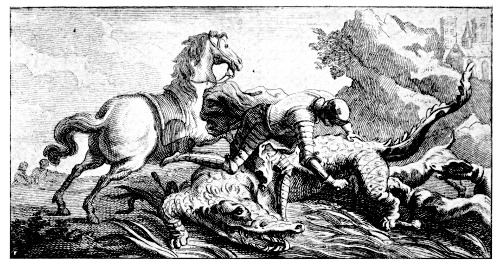
GOZON DE DIEU-DONNÉ SLAYING THE GREAT SERPENT OF RHODES.
In the long, chequered, and glorious history of the Knights there are many
strange and semi-miraculous deeds recounted of them in the wars and
adventures in which they took so prominent a part; the following, which is
gravely set out by the historians of the time, may be left to the judgment
of the reader. In 1324 Fulke de Villaret was succeeded in the Grand
Mastership by Helion de Villeneuve, a knight of exemplary piety and a
strict disciplinarian. Under his rule the Order regained those habits of
severe simplicity from which they had been allowed to lapse by his
predecessor. In 1329 Rhodes was greatly agitated by the fact that a
crocodile or serpent—as it is indifferently described—had taken up its
abode in the marshes at the foot of Mount St. Etienne, some two miles from
the town. This ferocious creature devoured sheep and cattle; also several
of the inhabitants had lost their lives by approaching the neighbourhood in
which it dwelt. Several attacks were made upon it, but, as there were no
firearms, all the missiles projected against it rebounded harmlessly from
the scales with which it was covered. So dangerous had it become, that the
Grand Master thought it his duty to forbid any of the knights to attempt
its destruction; an order which was obeyed with a right good will. There
was, however, a knight of the Language of Provence called Gozon de
Dieu-Donné, who secretly determined that he would slay the serpent, and he
accordingly made it his occupation to observe as closely as possible the
habits of the monster. Having satisfied himself on certain points, he then
returned to his chateau of Gozon in the province of Languedoc. The point
which Gozon had wished to determine was in what portion of its body was the
serpent vulnerable; and he had convinced himself that the belly of the
creature was unprotected by scales. He accordingly modelled in wood as
exact a representation of the serpent as he could accomplish, colouring it
the same as the original; the belly of the model was constructed of
leather. He then trained some large and ferocious hounds, at a certain
signal, to dash in under the model and fix their teeth in its leathern
underpart. For months did the ingenious knight persevere with the training
of his dogs, himself on horseback in full armour cheering them to the
assault. At last he considered them to be perfect in their parts, and,
taking two servants and the hounds with him, returned to Rhodes. Avoiding
everybody, he caused his arms to be carried to a small church in the
neighbourhood of Mount St. Etienne by his servants. The knight went into
the church, where he passed some time in prayer, recommending his soul to
God in the enterprise which he was about to undertake.
He then donned his armour and mounted his horse, ordering his servants, if
he were killed, to return to France but if he succeeded in killing the
serpent to come at once to him, or to aid him if he were wounded. He then
rode off in the direction of the marsh accompanied by his hounds. No sooner
did the serpent hear the ring of bit and stirrup-iron, the trampling of the
charger and the baying of the hounds, than it issued forth with wide-open
slavering jaws and terrible burning eyes to slay and to devour. Gozon,
recommending his soul to his Maker, put spurs to his horse and charged. But
his lance shivered on the hide of the serpent as though it had struck a
stone wall. His horse, mad with terror at the sight and the foul odour of
the serpent, plunged so furiously as to unseat him. He fell to the ground,
uttering as he did so his call to the hounds; had it not been for these
faithful auxiliaries he would instantly have been slain, but they rushed in
and, fastening their teeth in the belly of the serpent, caused it to writhe
and twist in its anguish. Instantly Gozon was upon his feet again, and,
watching his opportunity, plunged his sword into the exposed vitals of his
enemy. Mortally wounded, the serpent flung itself high in the air with a
convulsive effort, and falling backwards pinned the knight to the ground
beneath its enormous bulk. The servants, who had been the horrified
spectators of this terrific conflict, now rushed to the assistance of their
master, and succeeded in freeing him from his unpleasant predicament.
Gozon, they thought, was dead, but upon dashing some water in his face he
opened his eyes, to behold the pleasing spectacle of his monstrous enemy
lying by his side a corpse.
Naturally elated, he returned to Rhodes, where he became on the instant the
popular hero; for who could say or do enough for the man who had slain the
serpent. He was conducted in triumph to the palace of the Grand Master by
his fellow knights, but here a remarkably unpleasant surprise was in store
for him. Very austerely did Helion de Villeneuve regard the triumphant
warrior, and stern and uncompromising was the voice in which he asked him
how he had dared to contravene the express order of his Grand Master by
going forth to combat with the serpent? Calling a Council immediately the
implacable de Villeneuve, in spite of all entreaties, deprived Gozon de
Dieu-Donné of the habit of a knight. “What,” said this just and severe
disciplinarian, “is the death of this monster, what indeed do the deaths of
the islanders matter, compared with the maintenance of the discipline of
this Order of which I am the unworthy chief?”
But Helion de Villeneuve was of too wise and kindly a nature to make his
decree absolute, and having thus vindicated his authority he shortly
afterwards released Gozon and made him happy by his praises and more
material benefits.
The Abbé de Vertot tells us that the learned Bochart argues that the
Phoenicians gave to this island the name of Gefirath-Rod (from whence the
name “Rhodes”), or the Isle of the Serpents, and that when the Romans were
at war with the Carthaginians Attilius Regulus slew a monster in the island
of Rhodes the skin of which measured one hundred feet. Thevenot, in his
Travels published in 1637, states that he saw the head of Gozon’s serpent
still attached to one of the gates of the town of Rhodes, and that it was
as large as the head of a horse.
Upon the death of Helion de Villeneuve in 1346, a Chapter of the Order was
held as usual to elect his successor. When it came to the turn of the
Commander Gozon de Dieu-Donné to speak, he said:
“In entering this conclave I made a solemn vow not to propose any knight
whom I did not consider to be most worthy of this exalted office, and
animated by the best intentions for the glory and well-being of the
Order. After considering carefully the state of the Christian world, of
the wars which we are perpetually obliged to wage against the infidel,
the firmness and vigour necessary for the maintenance of discipline, I
declare that I find no person so capable of governing our ‘Religion’ as
myself.”
He then proceeded to speak in a purely impersonal tone of the magnificent
services which he had rendered, not forgetting the famous episode of the
serpent, and drew their attention to the fact that the late Grand Master
had constituted him, Gozon, his principal lieutenant. He ended: “You have
already tried my government, you know well that which you may hope to
expect. I believe that in all justice I shall receive your suffrages.”
Naturally the assemblage was stupefied at hearing a man thus recommend
himself; on reflection, however, they decided that he had spoken no less
than the truth, and Gozon de Dieu-Donné, “the hero of the serpent,” became
twenty-sixth Grand Master of the Order. He died in 1353, when he was
succeeded by Pierre de Cornillan, and upon his tomb were graven these
words:
“Cy Gist le Vainqueur du Dragon.”
In the years 1480 and 1485 under the Grand Master Pierre D’Aubusson, Rhodes
withstood two great sieges from the Turks. The first of these is described
at length by the knight Merri Dupuis “temoin oculaire” who sets down: “Je,
Mary Dupuis gros et rude de sens et de entendement je veuille parler et
desscrire au plus bref que je pourray et au plus pres de la verite selon
que je pen voir a lueil.” The description of that of 1485 is written by
another eye-witness, the Commandeur de Bourbon, to whom “ma semble bon et
condecent a raison declairer premierement les causes qui out incite mon
poure et petit entendement a faire cest petit oeuvre.”
But we have no space to follow these gallant Knights, and it must suffice
to say that on both occasions, after incredible exertions and terrible
slaughter on both sides, the attacks of the Turks were eventually repulsed.
It was reserved for Soliman the Magnificent to finally vanquish the Knights
and to expel them from Rhodes; from July 1522 until January 1523 the
Knights under the heroic Villiers de L’Isle Adam maintained an all unequal
struggle against the vast hosts of the Crescent, which were perpetually
reinforced. At last, on January 1st, 1523, the Knights, by virtue of a
treaty with Soliman, which was honourably observed on both sides, evacuated
the island in which they had been established for nearly two hundred and
twenty years.
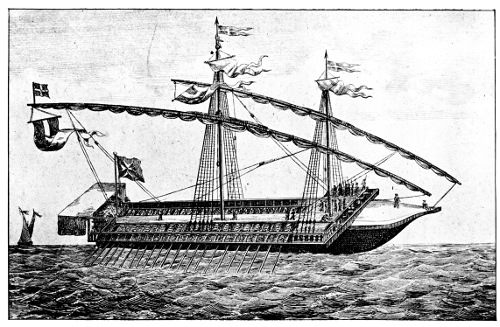
By favour of Charles V. the Knights on October 26th, 1530, took charge of
the islands of Malta and Gozo, and established themselves therein; still
under the Grand Mastership of L’Isle Adam, whose sword and helmet are still
religiously kept in a small church in Vittoriosa, just at the back of the
Admiral Superintendent’s house in the present dockyard.
The knights fortified the islands and there abode, until in 1565 the
Ottoman returned once more to the attack.
It may be said that heroism is a relative term, that it has many uses and
applications all equally truthful. On the side of mere physical courage
almost every man who took part in that memorable siege of Malta in the year
1565 may have been said to have earned the title of hero. No man’s foot
went back; no man’s courage quailed; no man’s face blanched when called
upon to face perils so appalling that they meant an almost inevitable and
speedy death; this was true or Christian and Moslem alike. The death-roll
on either side was so tremendous as to prove this contention up to the
hilt. From May 18th to September 8th, 1565—that is to say, in one hundred
and thirteen days—thirty thousand Moslems and eight thousand Christians
perished—an average of some three hundred and thirty-six persons per day.
In that blazing torrid heat the sufferings of those who survived from day
to day must have been accentuated beyond bearing by the myriads of unburied
corpses by which they lived surrounded; and that the contending forces were
not swept away by pestilence is an extraordinary marvel.
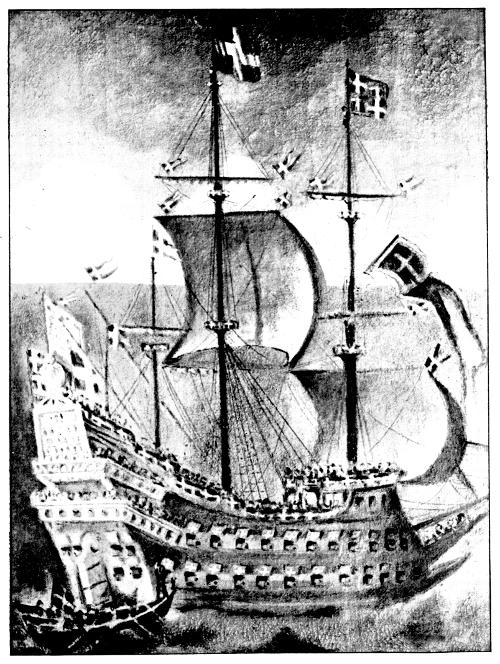
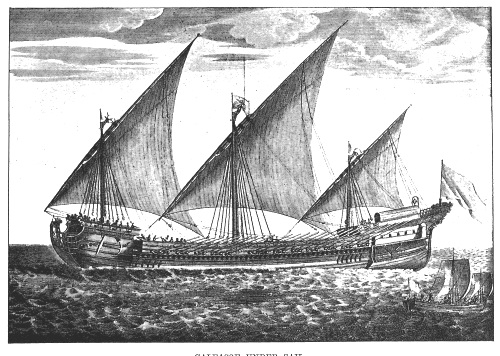
CARRACK IN WHICH THE KNIGHTS ARRIVED AT MALTA, 1530.
In many, nay, in most campaigns, personal feeling enters but little into
the contest. Nationality strikes against nationality, army against army, or
navy against navy; but no burning hatred of his adversary animates the
breast of the combatant on either side; it may even be said that frequently
some pity for the vanquished is felt, when all is over, by the side which
has conquered. At Malta the element of actual personal individual hatred
was the mainspring by which the combatants on both sides were moved; each
regarded the other as an infidel, the slaying of whom was the sacrifice
most acceptable to the God they worshipped. “Infidel” was the term which
each hurled at the other; to destroy the infidel, root and branch, was the
act imposed upon those whose faith was the one only passport to a blessed
eternity, and those who fell in the strife, whether Christian or Moslem,
felt assured that for them the gates of heaven stood wide open.
Great as were those others who perished, faithful to the death as
were those noble knights who died to a man in the culminating agony
of St. Elmo, adroit, resourceful, master of himself and others as was
the famous Dragut, there is one name and one alone that shines like
a beacon light upon a hill-top when we think of the siege of Malta.
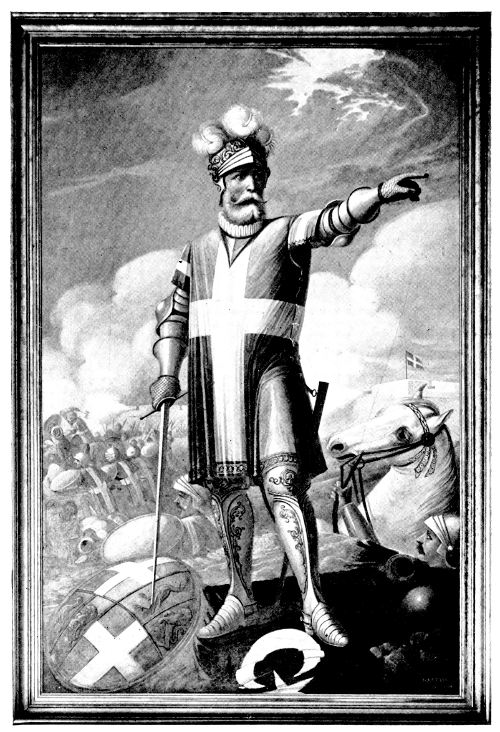
Jean Parisot de la Valette, whose name is enshrined for ever in that
noble city which crowns Mount Sceberass at the present day, was the
forty-eighth Grand Master of the Noble Order of the Knights of Saint
John of Jerusalem the charter for which, contained in the original Bull
of Pope Paschal II., dated 1113 (in which the Holy Father took the
Order under his special protection), may be seen to this day in the
armoury of the palace at Valetta. At the time when the supreme honour
was conferred upon him, in the year 1557, he had passed through every
grade of the Order: as soldier, captain, general, Counsellor, Grand
Cross: in all of them displaying a valour, a piety, a self-abnegation
beyond all praise, A man of somewhat austere manner, he exacted from
others that which he gave himself—a whole-hearted devotion to
the Order to which he had consecrated his life. Fearing no man in
the Council Chamber, even as he feared no foe in the field, he ever
spoke his mind in defence of that which he deemed to be right. Proud,
with the dignity becoming a man of his ancient lineage, he merged
all personal haughtiness in the zeal he felt in upholding the rights
and privileges of that splendid confederation of knights of the best
blood in Europe over which he had been called upon to preside at the
mature age of sixty-three. There is no instance in history of any
man more absolutely single-minded than La Valette; that in which he
believed he cherished with an ardour almost incredible in these days,
and that the sword of the Lord had been confided into his hand for
the utter extermination and extirpation of the Moslem heresy was the
leading feature in his creed. That he had been advanced to a dignity
but little less than royal in achieving the Grand Mastership was but
as dust in the balance to him compared with the opportunities which
it gave him to harry his life-long foes; and he who had known so well
how to obey throughout all his youth and manhood was now to prove, in
the most emphatic manner, that he had learned how to command. In all
those terrible hundred and thirteen days during which the siege lasted
there was none to be compared to him. As occasion occurred this man’s
soul rose higher and ever higher; beseeching, imploring, commanding, by
sheer force of example did he point out the way to the weaker spirits
by whom he was surrounded.
To speak of weaker spirits in connection with the siege of Malta seems
almost an insult; these gallant knights and soldiers were only so in
comparison with their leader. Twice during the siege of St, Elmo did the
garrison send to La Valette and represent that the place was no longer
tenable; but Garcia de Toledo, Viceroy of Sicily for Philip of Spain, was
writing specious letters instead of sending reinforcements, and every
moment gained was of importance. Coldly did La Valette remind the Knights
of their vows to the Order, and when renewed assurances came that it was
only a matter of a few hours before they should be overwhelmed he replied
that others could be found to take their places, that he, as Grand Master,
would come in person to show them how to die. A passion of remorse overcame
these noble gentlemen, who, thus nerved by the indomitable spirit of their
chief, died to the last man in the tumbled ruins of that charnel-house
which had once been a fortress.
La Valette was ready to die; there was no man in all that garrison so
ready. With pike and sword this veteran of seventy-one years of age was
ever at the post of the greatest danger, repelling the assaults of
Janissaries and corsairs, fighting with the spirit of the youngest among
the Knights in the breaches rent in the walls of Il Borgo. In vain did his
comrades try to prevent him from this perpetual exposure; in vain did they
point out that the value of his life outnumbered that of an army. He was
very gentle with these remonstrances, but quite firm. There were plenty as
good as he to take his place should he fall, he insisted; till that time
came it was his duty to inspire all by his example, to show to the simplest
soldier that he was cared for by his Grand Master.
As things went from bad to worse, when Il Borgo became in little better
case than had St. Elmo before it, La Valette never hesitated, never looked
back, never ceased to hope that the sluggard Garcia de Toledo might send
relief; and, if he did not, then would they all perish with arms in their
hands, as had their brethren across that narrow strip of water who had held
St. Elmo to the last man. What man or woman can read without something of a
lump coming in their throat of those noble words of the Grand Master in the
last few days of the siege when all had utterly abandoned hope?
Grimed, emaciated, covered with sweat and blood and dust, did La Valette
move from post to post exhorting and encouraging his soldiers. So few had
the gallant company of the Knights become that command was necessarily
delegated to the under-officers; yet who among them did not find fresh
courage and renewed strength when that great noble, the head of the Order,
stood by their sides and spoke thus to them as man to man?—
“My brothers, we are all servants of Jesus Christ; and I feel assured
that if I and all these in command should fall you will still fight on
for the honour of the Order and the love of our Holy Church.”
We have to think of what it all meant, we have dimly to try and realise the
burden which was laid upon this man, before we come to a right conception,
not only of what he endured but the terrible sacrifices he was called upon
to make. Here was no man of iron lusting for blood and greedy of conquest
for the sake of the vain applause of men; but one full of human love and
affection for those among whom he had lived all the days of his life. Upon
him was laid the charge of upholding the honour of the Order, the majesty
of the God whom he served. To this end he doomed to certain death those
brethren of his in St. Elmo, his own familiar friends, reminding them that
it was their duty so to die, while his heart was breaking with the agony of
this terrible decision, which no weaker man could have given. When his
beloved nephew was slain, together with another gallant youth, he smiled
sadly and said that they had only travelled the road which they all had to
tread in a few days; that he grieved as much for the one as for the other.
In speaking of this man, it may truly be said that there is no character in
history more elevated; there is none which shows us the picture of a more
perfect, gentle, and valiant knight.