“Well, Mister Mate,” remarked Captain Sims, rubbing his hands with
satisfaction, “the noon sights give her an average of ten and a half
knots since noon yesterday. Pretty good goin’!”
“Good!” replied the mate. “I should think it was, sir! This old hooker
isn’t exactly in her childhood.”
The master laughed. “Well,” he said, “I’ll go below and get my dinner,
and after that I shall be in my room. I’ve a lot of work to get
through.”
The mate nodded and smiled, for he knew well that the captain’s “work”
was done lying down on his bunk with both eyes shut, and with an
accompaniment of something which sounded suspiciously like snoring.
“Keep her goin’ sou’-sou’-east,” concluded the “old man,” moving down
the poop ladder, “and let me know if you sight anything.”
“Aye, aye, sir!” said Meryon, as the skipper disappeared.
The steamer Evelyn MacDonald was pursuing her leisurely way southward
through the North Atlantic, on a voyage from London to Sydney, via the
Cape of Good Hope. She carried a valuable general cargo, and up to the
present the voyage had been eminently successful, for no contrary gales
or heavy seas had retarded her progress. The vessel, a steam tramp of
elderly build and sluggish demeanour, was surpassing herself, for though
nine and a half or ten knots was her usual speed, the patent log dial on
her taffrail was now registering no less than 10·5.
The weather was certainly beautiful, and, though there was hardly a
cloud overhead in the sky to dim the brilliancy of the sun, the welcome
breeze, ruffling the surface of the sea until it looked like a vast
spread of sapphire-coloured velvet, mitigated the fierce rays from
above. Life on board, therefore, even though the ship was only a few
degrees north of the equator, was bearable, and even pleasant.
It had gone one bell in the afternoon watch, and the crew had finished
their midday meal and were lolling about on the forecastle in various
lethargic attitudes. Some were smoking and talking, but others had
dropped off to sleep with their pipes between their teeth.
“What I likes about this ’ere ship,” one of them remarked to a friend,
“is that we ’ave no bloomin’ dagoes aboard. We’re hall Henglish,
leastways British, an’ I reckon there’s precious few other ’ookers
flyin’ th’ Red Duster as can say that!”
“That’s so, mate,” replied another seaman, whose red hair had earned for
him the inevitable nickname of “Ginger.” “I reckon we’ve struck ile this
trip orl rite.”
“’Allo, there’s ’Oratio!” observed the first speaker, as the cook’s boy
came out of the galley amidships and flung a bucket of dirty water over
the ship’s side.
“’Allo, ’Oratio, me son,” cried Ginger, “’ow are ye gettin’ on dahn
there? ’Ow’s th’ ole water spoiler inside?” The “water spoiler,”
needless to remark, was the cook himself, Horatio’s immediate superior.
The boy—Horatio Nelson Chivers, to give him his full name—had been
signed on as assistant and general bottle-washer to the cook at the last
moment before the ship left England. The mate, seeing him loafing round
the quay before the Evelyn MacDonald sailed, had taken him on out of
pure compassion, rather than with the idea that he would be of any use;
and, if the truth must be told, Horatio Nelson was about as scraggy and
as weedy a looking individual as it is possible to imagine.
He was an undersized youth of about fifteen—he didn’t know his real
age—whose origin was wrapped in the realms of mystery, and though he
knew his surname was Chivers and his Christian names, through some freak
on the part of his mother and father, were Horatio Nelson, he was quite
unacquainted with his parents, and was unaware who they had been, where
they had lived, or where he himself had been born. For years he had
contrived to make ends meet by selling newspapers in London, a
precarious existence which often as not left him without the wherewithal
to satisfy his gnawing hunger; but all his spare time was spent down at
the docks in the East End, for he loved ships and everything to do with
them. He had fully determined to become a sailor, perhaps because he
was named after the greatest Admiral the world has ever known, but he
had never been more surprised than when the mate of the Evelyn
MacDonald, seeing a veritable scarecrow of a boy standing on the jetty
close to the ship, asked him if he wanted to sign on.
He jumped at the opportunity with thankfulness in his heart, for he was
desperately sick of the great city, and, above all, of endeavouring to
sell newspapers to people who did not want them. He longed to be at sea,
to see something of the world, and though he would have preferred to
enter the Royal Navy, a bird in the hand was worth several in the bush,
and he revelled in the idea of having regular meals. It is true that Mr.
Meryon had given the boy the chance because he looked so utterly
miserable, forlorn and wretched; but though the officer’s feelings had
outweighed his judgment, it must be admitted he had never had cause to
regret it, for ’Oratio, as he was familiarly called, was the life and
soul of the ship, and was as cute and knowing as the day is long.
The youth shook the last few drops out of his bucket and then looked
towards the forecastle.
“Cheero, Ginger!” he remarked, familiarly. “’Ow’s yer Rile ’Ighness
gettin’ on?”
“’Oo are you callin’ Ginger?” demanded the seaman, not liking the
allusion to the colour of his hair. “Ain’t I told yer my name’s Smith?
Mister bloomin’ Smith, too, from the likes o’ you?”
“There’s ony one Ginger in this ’ere ship!” retorted Horatio innocently.
“’Is Majesty King Ginger—King o’ all th’ Nuts!”
“Ho, hindeed!” snorted the King of the Nuts. “Look ’ere, Mister ’Oratio
bloomin’ Nelson Chivers, or whatever yer darned tally is, I don’t stand
no sauce from the likes o’ you! I’ve told yer ’afore I’ll ’ave none o’
yer imperence!”
“Won’t yer?” said the boy in mock surprise, making a deep obeisance.
“No, I won’t, yer young shaver, so just you keep a civil tongue in yer
’ead!”
“Orl rite, cully, keep yer ’air on!” drawled Horatio, disappearing into
the galley.
“Drat th’ boy,” muttered Smith good-naturedly. “That ’Oratio o’ ourn is
a cure, an’ no bloomin’ herror. King o’ th’ Nuts, hindeed!”
“’E’s a cheeky young divil!” agreed one of the other men, pushing down
the tobacco in his pipe with a horny forefinger. “’E’s abart th’
bloomin’ limit, takin’ ’im orl round. ’E’s fillin’ art somethin’
wonderful, though,” he added with pride, for they all looked upon
Horatio as belonging to them. “D’ye remember th’ wizened little
scarecrow ’e was when ’e signed on?”
“Huh!” snorted Ginger. “Fillin’ art! ’E can’t bloomin’ well ’elp
’isself! Just look at th’ amount of scran ’e stows away in that little
stummick o’ ’is! ’E’s—— Wot in ’evin’s that?” he suddenly broke off,
as something round and hard hit him in the ribs. “S’welp me!” he added
an instant later, picking up a potato. “It’s a spud!”
“’Oratio’s bombardin’ yer from th’ galley,” said his companion with a
grin.
“I’ll give ’im ’Oratio when I catch ’im,” muttered Smith, leaping to his
feet. “’Ere, you young swabtail!” he bellowed, catching sight of the boy
with another missile ready to throw. “’Ere, give over chuckin’ them
spuds!”
The boy’s reply came promptly, for another potato hurled through the air
and hit his enemy fair and square on the shoulder. Ginger instantly
dashed to the forecastle ladder with the intention of pursuing and
chastising his assailant, but the latter, seeing him coming, had already
vanished into the galley like a streak of greased lightning.
Further hostilities were interrupted by the bosun coming forward along
the upper deck.
“Come on, lads, time’s up!” he shouted.
Ginger Smith was forced to postpone active operations upon Horatio to a
more suitable opportunity, and while the boy sniggered with glee in his
galley, the recumbent figures on the forecastle rose, stretched
themselves, and were soon told off for their work for the afternoon.
“Gah!” shouted the precocious youth, putting his head out of the galley
with a grimace as Smith passed with a paint-pot and brushes. “Look at
th’ King o’ th’ Nuts goin’ to paint ’is pallus! Thought ye’d catch me,
did yer?” He put his thumb to his nose and extended his fingers.
“You wait, my son!” muttered Smith wrathfully. “I’ll knock seven bells
out o’ yer bloomin’ little carcase when I do get ’old o’ yer!”
He marched on aft, with Horatio making faces at him behind his back.
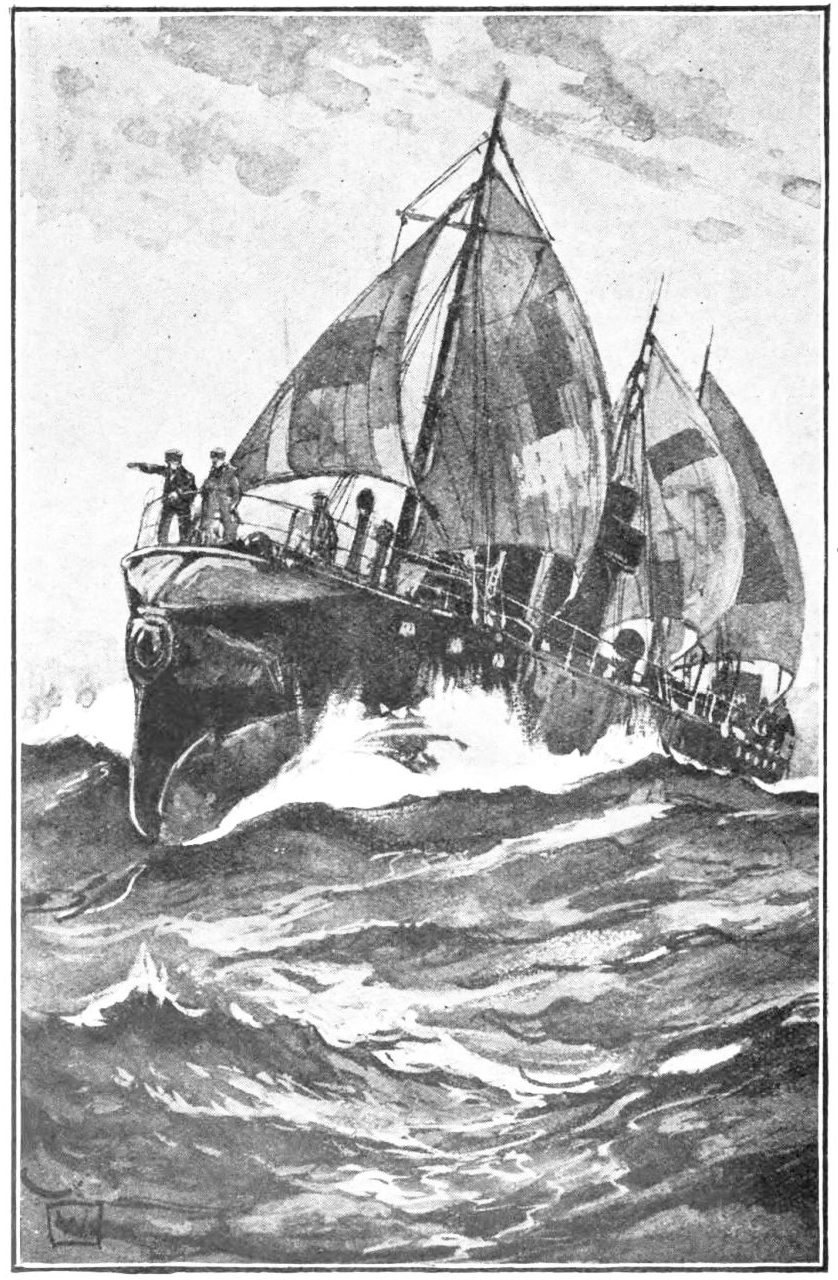
The afternoon wore on, and at about 3 p.m. a black smudge of smoke
appeared over the horizon astern. It got larger and larger, spreading up
in the clear sky like a mushroom-shaped cloud, until eventually the hull
of a ship could be seen looming up in the distance. As yet she was too
far off for details to be noticed, but the dense volumes of smoke
issuing from her funnels showed that she was travelling fast. She
overhauled the Evelyn MacDonald rapidly, and by four o’clock was only
four or five miles astern.
The captain had already been called and had come on the poop, and was
gazing intently at her through a pair of binoculars.
“She’s a man-of-war, by the look of her,” he remarked to the mate.
“Three funnels, so far as I can see, and painted dark grey.”
“She’ll be British,” answered Meryon. “Our men-of-war are that colour. I
can’t see any ensign, though. By Jove!” he added in admiration; “she’s
going a pretty good lick. Look at her bow wave!”
“She’s altering her course to close us,” observed the skipper, as the
approaching vessel yawed lightly to starboard. “Stand by with your
signal books and flags. I expect she wants to communicate.”
Soon afterwards the strange cruiser, for such, from her three funnels,
she evidently was, was close astern.
“She’s not British!” exclaimed the mate confidently. “We’ve no craft in
our navy like that!”
“What in earth is she, then?” demanded the skipper rather testily. “What
does a bloomin’ foreigner want to come nosin’ round us for? Hoist the
ens’n; perhaps she’ll hoist hers!”
The Red Ensign crept up to the peak, where it streamed out a vivid
scarlet patch against the deep blue of the sky. The man-of-war may have
noticed it, but if she did she made no sign of having done so, for she
still came on at the same speed.
“By Jove!” cried the mate an instant later. “She’s a German!” He had
just seen the ensign at the stranger’s gaff, where hitherto it had been
hidden in her belching smoke.
“Yes,” returned the skipper, busy with a telescope. “She’s got a signal
flying, too. L Q,” he added, picking out the colours of the flags. “Look
it out in the book!”
“Heave to!” exclaimed Meryon in absolute astonishment, running his
finger down the page and finding the place.
“Heave to!” snorted the skipper incredulously. “Can’t be! Let’s have a
look!”
“It’s quite right, sir,” replied the mate, showing him the meaning.
“Heave to!” ejaculated the captain, with rising wrath. “What right has a
bloomin’ foreigner to order us to heave to?”
“Don’t know, sir. Perhaps she’s made a mistake,” replied Meryon; but his
voice sounded rather apprehensive.
“Mistake or not,” snapped the skipper, “I’m jiggered if I’ll heave to!
I’ve never heard such a cursed bit o’ impertinence in my life!” He gazed
over the taffrail and shook his fist wrathfully at the oncoming
stranger, now barely four hundred yards behind.
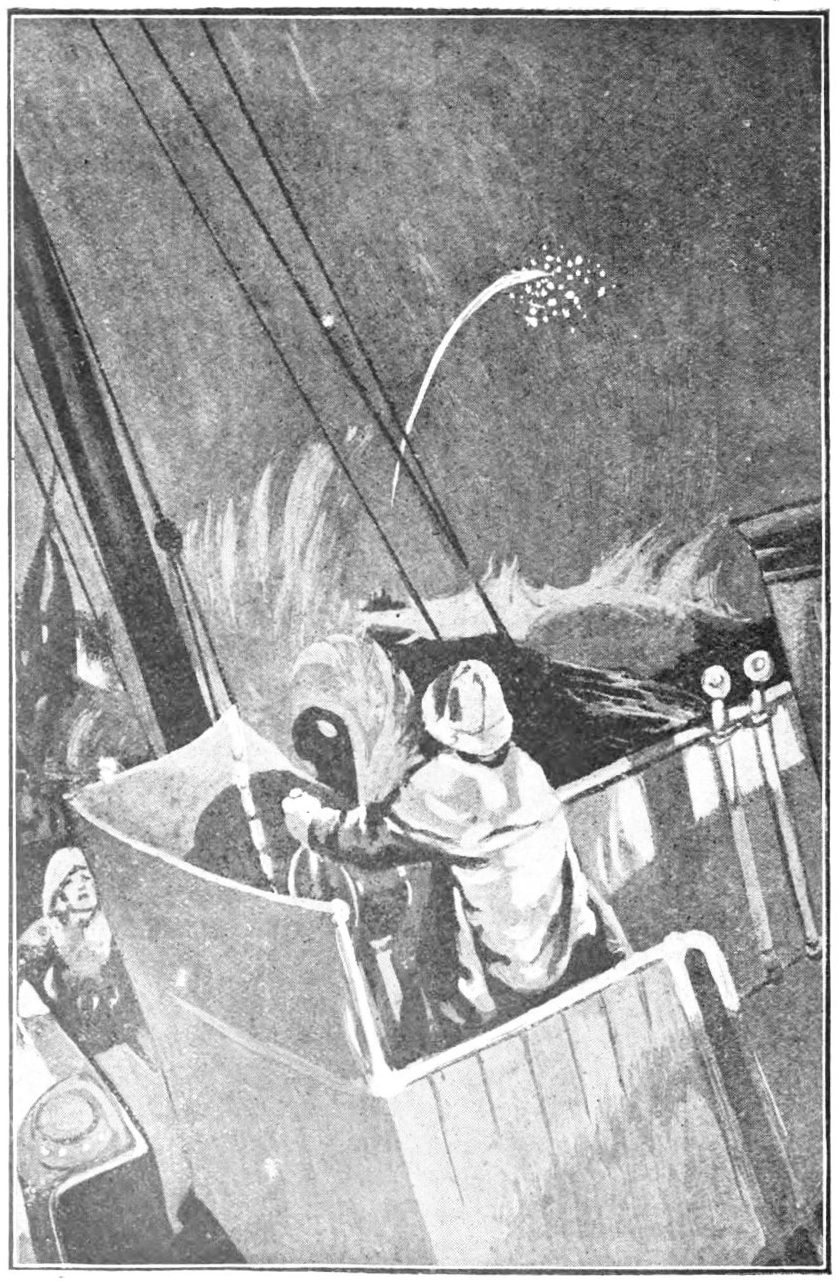
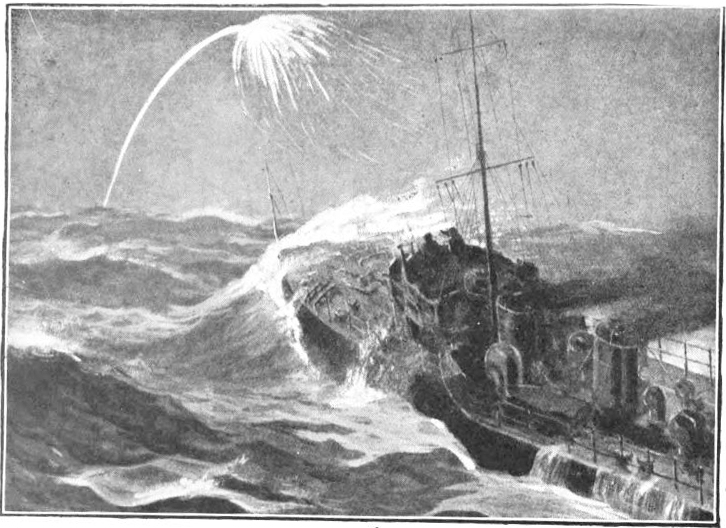
Hardly had he done so, when a spit of flame broke out from the
forecastle of the man-of-war. There was a loud report, and then, with a
savage whine, a projectile hurtled through the air past the steamer and
buried itself in the sea a hundred yards away to port.
The skipper glared at the spout of foam with absolute amazement and
bewilderment written on his face.
“What the devil does she mean?” he roared, his face whitening with rage.
“Firing on us! We’re not at war! I’ve never heard of such a thing!” He
had great difficulty in controlling his wrath.
The mate, too, was struck dumb with astonishment, and stared at the
cruiser with his mouth wide open. There really was something rather
amazing in the idea of a German man-of-war stopping a British merchant
ship on the high seas, but there was no mistaking the meaning of her
peremptory demand.
“That gun, sir,” he remarked at length, “was meant to make us heave to!”
“I suppose it was, the beastly pirates!” muttered the captain angrily.
“Well,” he continued, “it’s no use being sunk!” He wrenched the
engine-room telegraph over to “Stop” as he spoke.
Hearing the report of the gun, the officers and men of the steamer were
already on deck, gazing at the foreign warship with surprise and
astonishment on their faces. The cruiser had now slowed down, and a
minute later, when the Evelyn MacDonald had slowed down, the grey
man-of-war slid up abreast of her and barely two hundred yards off. The
twin propellers churned the water into foam as they went astern at full
speed, and then there came the piping of a boatswain’s whistle as a boat
was lowered.
The crew of the Evelyn MacDonald were clustered on deck hurling
strange curses at the foreigner, while one or two of the more
belligerent ones, Horatio, who had armed himself with the cook’s meat
chopper, among them, were saying what they proposed to do to the
boarding party when they should come on board.
“I’ll catch ’im a slosh on th’ jaw ’e won’t forgit in a ’urry!” piped
the boy, feeling the edge of his weapon.
There was no doubt they all meant what they said, and realising that, if
they offered resistance, the man-of-war would probably retaliate, Sims
sent the mate forward to prevent them doing any mischief.
The cutter presently drew alongside. To the captain’s utter disgust, he
was forced to lower a rope ladder, and then an officer, armed with sword
and revolver, clambered on deck. He was followed by half a dozen seamen
carrying loaded rifles, two of whom promptly made their way to the poop,
where they took charge of the wheel, while the other four rounded up the
crew of the steamer and made them hold their hands above their heads by
threatening them with their weapons.
“What is the meaning of this outrage?” thundered the skipper, advancing
threateningly on the single foreigner who confronted him.
The officer’s hand slid to his revolver holster, which he unbuttoned
ostentatiously.
“This is rank piracy!” bellowed Sims again.
“You do not know that Germany and England are at war?” asked the visitor
in excellent English, glancing at the Red Ensign overhead and fingering
his weapon.
“What?” snorted Sims, with a sniff of rage.
The foreigner smiled slightly and nodded.
“War? But what’s war been declared about?” asked the captain amazed.
“That is not my affair,” answered the foreigner. “I do my duty without
asking why!”
“Why, man,” the Englishman remarked, his amusement almost getting the
better of his annoyance, “you’ll have the whole of our navy buzzin’
round your ears in no time!”
“We will fight!” retorted the foreigner with impatience.
“Humph!” muttered the skipper. “The deuce you will! Meanwhile, may I ask
what you mean to do with this ship?”
“Our navy has orders to sink and destroy the British fleet, and to
capture or burn all merchant ships!”
Sims gasped.
“Yes,” continued the lieutenant grandiloquently. “A prize crew shall be
put on board, and she shall be taken to Duala!”
“But I’m not carrying contraband of war!” protested the captain, longing
to go for the foreigner with his fists.
“All the English are our enemies!” declared the other. “Come,” he
continued rudely, “I am not used to bandy words with a merchant captain.
I wish to see your papers, and I must warn you that, if there is any
attempt at resistance, my ship will fire on you!”
Sims’s longing to strike out almost got the better of him, but he saw
that it was no use arguing any further, so swallowed the insult without
replying.
“Come on,” he said gruffly, leading the way to his cabin.
The foreign officer beckoned to one of his men before he disappeared
under the poop, and a minute or two later the Red Ensign was hauled down
and replaced by the white black-crossed ensign of the German navy.
Seeing it, the anger of the British crew nearly overcame them, and for
some moments their insensate rage tempted them to attack their captors.
They cursed and swore fluently, but eventually their discretion got the
upper hand, for they saw how useless it was to resist.
An hour later the ship had been taken possession of by a prize crew of
fifteen men and a warrant officer, under the command of a lieutenant.
Having transferred them, the cruiser proceeded on her way, and,
threatened by the revolvers and rifles of their gaolers, the unfortunate
Englishmen were compelled to go to their posts and work their vessel,
steering towards the south-east for her new destination.
This having been done, the captain and officers were locked in their
respective cabins, the crew were driven down into the forecastle, while
armed sentries pacing the deck effectually prevented any
intercommunication.
The Evelyn MacDonald was a prize.
The next morning the ship was still standing to the south-eastward on
her course for Duala.
The lieutenant in command was a better-tempered individual than the
officer who had first come on board, and intimated to Captain Sims that
he and his officers would be permitted to use the saloon for their
meals, while they would also be allowed one hour’s exercise on deck in
the morning and afternoon. He informed him, however, that any abuse of
this privilege would be visited by more rigorous treatment, and that if
any attempt were made to capture the vessel, the prisoners would
instantly be fired upon. The only members of the crew who were not
confined were Horatio and the steward, for they, between them, were
responsible for the cooking and serving of all the meals throughout the
ship, for captors and prisoners alike. Even they, however, were closely
watched, for there was always an armed sentry somewhere near the galley
while they were at work.
Horatio went about his labours in a despondent manner, which formed a
complete contrast to his cheery disposition of a week before. He had
plenty to do, but chafed at the idea of being ordered about by
foreigners, and every time he looked at the foreign flag flying at the
peak his blood boiled with mingled rage and humiliation. Puny and
insignificant as he was, he was British to the core. British blood
flowed in his veins, and he seriously thought of attacking the sentries
single-handed with his chopper. He even asked the steward’s advice as to
how it could best be done, but the older man, realising the utter
futility of such an attempt, made him, after great difficulty, promise
that he would not try it.
Foiled in his ideas of active measures, the boy then set to work to
think of some other way of recapturing the ship. Scheme after scheme was
evolved in his busy brain to be cast aside as useless, but suddenly,
two days later, an idea, a great and glorious idea, flashed into his
mind. He determined to try it.
Captain Sims in his cabin was also thinking out plan after plan to
regain possession of the ship, but he gave them all up in turn as
hopeless, for arms or ammunition he had none, and he knew well enough
that the minute an attack was made the English would be shot down with
ruthless indifference.
On the morning of the third day after the capture, he realised that the
anxiety and the unusual sedentary life were beginning to make him
positively ill. Instead of turning out for breakfast, therefore, he
remained in his bunk, and soon afterwards someone came to his cabin
door, unlocked it, and announced that breakfast was ready.
“Is that you, Chivers?” he called.
“Yus, sir,” said the boy, opening the door and putting his head in.
“Look here. I’m feeling a bit seedy this mornin’. You might bring my
meals in here on a tray, will you?”
“Yus, sir,” said the urchin.
Ten minutes later he returned with a well-laden tray.
“Capten, sir,” he whispered, when he had laid out his master’s
breakfast.
“Hallo, sonny! What is it?” asked Sims.
The boy bent his head down until his lips were close to the captain’s
ear.
“Please, sir,” he began, “’ave we any—— Yus, sir, quite a fine day!”
he suddenly remarked in his ordinary voice, for his sharp ear had heard
footsteps outside.
For an instant the skipper was surprised, for he could not guess the
meaning of the youth’s manœuvre. Then it suddenly flashed across his
mind, and he realised the boy had something important to tell him. They
went on talking naturally, until the footsteps died away.
“Now, Chivers,” said Sims softly, “what is it?”
“Please, sir,” whispered the boy, “’ave we any drugs aboard?”
“Drugs? Whatever for?”
“Ter lay art them blighted foreigners, sir!” exclaimed the blood-thirsty
Horatio. “Me an’ th’ stooard cooks orl their grub, an’ I thought as ’ow
we cud drug it, sir!” His eyes twinkled with excitement as he unfolded
his idea.
“What?” whispered the captain, seeing a ray of hope. “And then recapture
the ship while they’re asleep? Is that what you mean?”
The urchin nodded, and anxiously awaited the captain’s verdict.
Horatio, in the literature of the “penny dreadful” type he was so fond
of reading, had often come across cases where the villains achieved
their nefarious ends by drugging their victims, and he did not see why
the same scheme should not be carried out on this occasion.
Sims thought hard for a minute or two before replying. Then a pleased
smile flitted across his face, and he patted the boy on the shoulder.
“Boy,” he said at last, “you’re a cunning little devil!”
Horatio blushed with pleasure.
Sims went on in a low voice: “I don’t see why your scheme shouldn’t
work. D’you see that medicine chest there?” He pointed to a little teak
cabinet on the bulkhead of the cabin.
Horatio said he did.
“The key’s on the hook alongside it,” said the skipper. “Open it!”
The boy fitted the key into the lock with a hand trembling with
excitement.
“It’s open, sir,” he said expectantly.
“Right at the back you’ll see a—— ”
Sims hesitated a moment, for footsteps sounded outside. “You’ll see a
bottle of quinine,” he concluded in his ordinary voice, for the
footsteps halted before his door.
It was just as well he altered the last part of his sentence, for just
at that moment the door opened and the foreign lieutenant entered.
Horatio’s face went white, and his knees knocked together with fright,
but the officer saw nothing unusual in what was going on.
“Goot morning!” he said affably. “I am ver’ sorry to hear you are ill,
captain. Vat is ze matter?”
“I’ve a touch of fever again,” replied the skipper, avoiding the other’s
eye. “I’m just seeing if there’s any quinine in the medicine chest!” He
lied bravely, but felt horribly nervous all the same.
“Vell,” replied the officer, “I ’ope you vill soon be vell. Vere is ze
quinine?”
The captain’s heart nearly stopped with anxiety, for the foreigner went
to the medicine chest and began examining the labels on the different
bottles and phials.
Supposing he suspected? The thought was too awful.
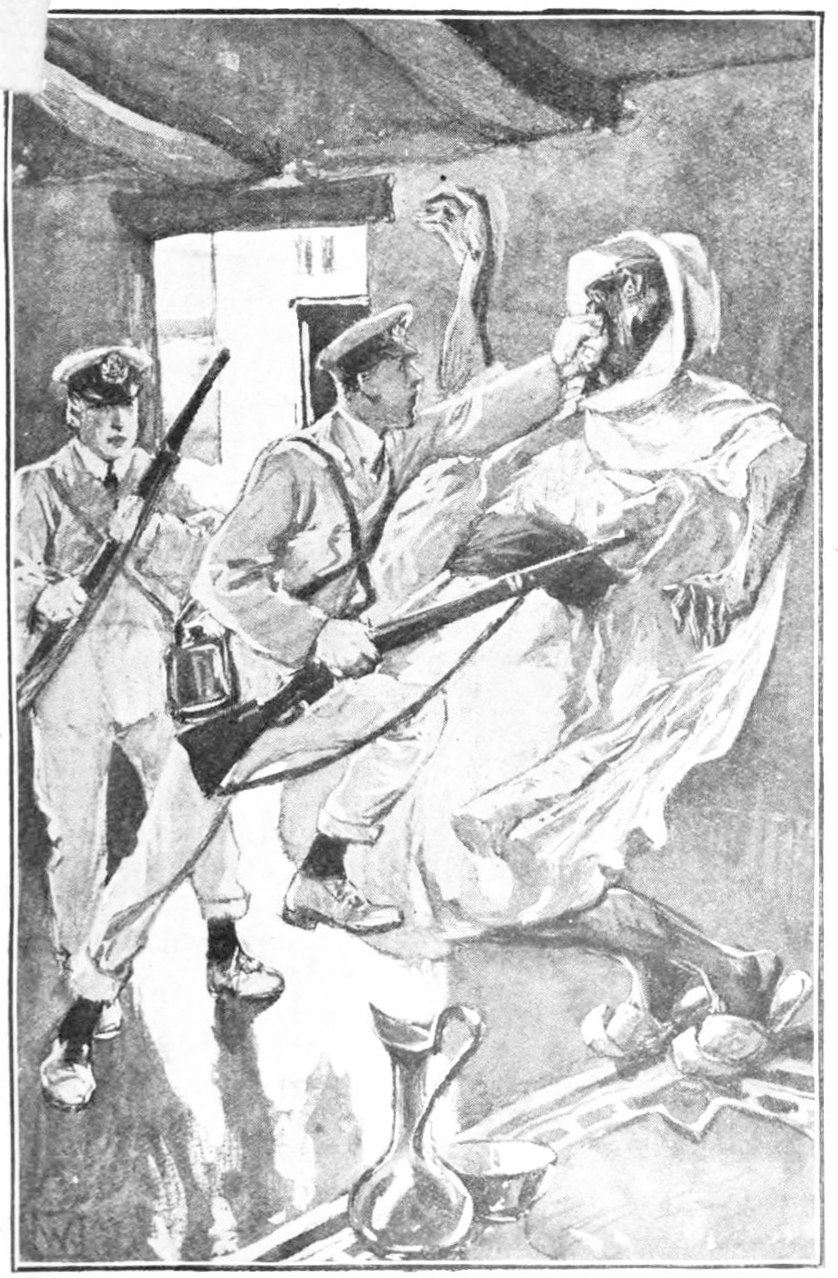
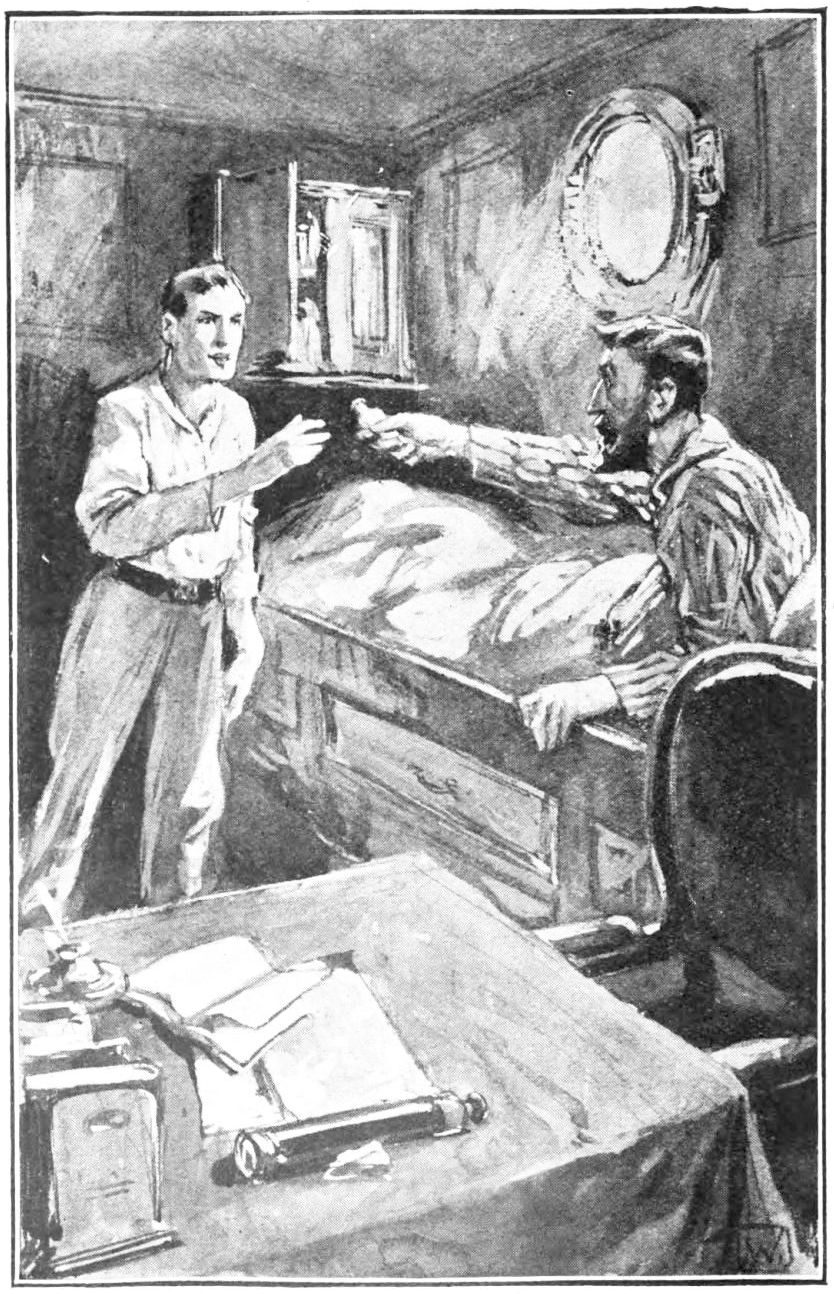 “It’s laudanum. Here, take it and hide it somewhere.”
To face page 77
But Horatio, although he felt as if his knees would give way, retained
his presence of mind, and snatching up the nearest bottle, held it up
and pretended to read the label. It was not quinine, but that did not
matter, and taking it across to the captain he thrust it into his hand.
“Here it is, sir,” he remarked.
To his relief, the lieutenant gave up his search.
“Ah, does Inglesh words!” he exclaimed. “I can speak ze Inglesh ver’
vell, but to read him is more deefecult!”
“Yes,” agreed the skipper with a nervous grin. “They are a bit hard to
understand.”
“Vell,” resumed the other pleasantly, “I ’ope you vill soon be vell. Ef
zere is anyzing you vant, please to let me know. I say good morning
now!” He made a courtly bow and left the cabin.
“Oh, lor’!” gasped the boy with a sigh of relief, as the footsteps died
away. “I thought he’d spot wot we was up to!”
“Now,” whispered Sims. “Right at the back at the left of the top row,
you’ll see a small blue bottle with an orange-coloured label.”
Horatio dived his hands into the cabinet and withdrew it with the bottle
in his grasp.
“Is this it, sir?” he asked eagerly.
“I think so,” said Sims. “Bring it here.”
The boy brought it across, and examining the label the captain saw it
was the one he wanted.
“D’you know what this is?” he asked, tapping it.
“No, sir.”
“It’s laudanum. There’s enough in this to send the whole lot of ’em to
sleep. Lucky it’s a fairly weak solution, so it won’t actually kill
’em. Here, take it,” he continued, “hide it somewhere!”
Horatio thrust the bottle into the front of his tattered shirt.
“What must I do with it, sir?” he asked mysteriously, for he felt as if
he was assisting to blow up the Houses of Parliament, or something
equally desperate.
“Shove it in their food, somehow. D’you think you can do it?”
“They orl ’as corfee arter their supper!” whispered the boy, with his
eyes opening very wide. “’Ow’ll that do, sir?”
“Very well, I should think,” answered Sims. “What time do they have it?”
“’Bout eight o’clock, sir.”
“Well, empty the bottle in their coffee when you make it. You take the
men’s dinners to the forecastle, don’t you?”
Horatio nodded.
“Well, tell ’em, then,” hissed the skipper, “to be ready to make a dash
for the deck at half-past eight this evening; d’you understand?”
“Yes, sir.”
“And tell the officers too, if you get a chance. Now run along. They may
smell a rat if you’re here too long. You quite understand what to do,
don’t you?”
“Orl rite, sir. I understan’. I’ve got it orl fixed up in me ’ead!” And
so saying the boy departed.
Sims lay back on his bunk with a sigh of relief. The plan seemed so very
simple; but yet, somehow, too simple to be successful.
Would it succeed? He wondered.
The weary day drew on, and to the captain the hours seemed interminable.
He tried to read, but the words conveyed nothing to his brain, for his
feverish anxiety would not allow him to concentrate his mind upon his
book.
His meals were brought to him by Horatio, who informed him that the men
had been told of what was to take place, but the day passed slowly, and
he was not sorry when the sound of voices and the clattering of knives
and forks outside in the saloon told him that the foreigners were at
their supper.
His watch was hanging on the bulkhead, and at three minutes past eight
precisely he heard chairs being pushed back and footsteps leaving the
saloon. Then came dead silence, only disturbed by the ripple of water as
the ship drove along and the footsteps of someone walking up and down on
the poop.
He waited in breathless anxiety. Ten minutes past eight, twenty past.
Would the time never pass? The minute hand of his watch seemed to be
moving terribly slowly, somehow.
He was just beginning to feel nervous, when the footsteps above ceased.
He listened intently. Twenty-five minutes past!
He crept out of his bunk and tiptoed noiselessly to the door.
Half-past eight, but nothing happened.
He trembled violently in his overwhelming excitement. Suppose the men
had decided that the risk was too great. Suppose—a hundred and one
possibilities flashed through his mind.
The hand of the watch crept on to two minutes past the half-hour, and
just as he had given up hope, he heard the sudden rush of feet on the
ladder leading to the poop.
Nerving himself for an effort, he took a run and hurled himself at the
door, hearing as he did so a confused shouting on the poop, followed by
two revolver shots. He was no light weight, and the stout panels ripped
and crashed as he flung himself at them, and, falling through the
debris, he found himself on all fours in the saloon. Picking himself up
he dashed out on deck and up the ladder to the poop, and what he saw
brought a wave of thankfulness to his heart. The British were in
possession. The prize-master lay senseless by the wheel, while the
warrant officer, who had evidently been on watch at the time of the
attack, had been disarmed, and was now being bound by some of the
Evelyn MacDonald’s crew.
Farther aft, two more of the enemy lay prone with their weapons beside
them, and looking along the upper deck he saw more of his own men
binding the others.
“What’s happened?” he inquired breathlessly, making his way towards the
nearest group of men.
“Lor’ bless ye, sir!” exclaimed Ginger Smith excitedly; “they wus orl as
’elpless as babes. Th’ orficer ’ere fired ’is pistol afore we biffed ’im
on th’ ’ead, but orl th’ others wus lyin’ like cawpses! Lor’, it wus a
gran’ idea of ’Oratio’s, an’ no bloomin’ herror!”
“But where is Horatio?” asked the captain, looking round and not seeing
the boy.
“’E wus on deck when we belted this ’ere cove on th’ nut,” remarked one
of the other seamen.
“What’s become of him, I wonder?” said Sims anxiously, for he had a
sudden horrible feeling that the boy had been killed or flung overboard.
He left the poop and ran forward to the galley and put his head inside.
Twilight was fast approaching, but he saw a small white figure sitting
on a locker.
“Chivers!” he said concernedly, for there was something about the
youth’s attitude he did not like. “Chivers! Is that you?”
“Yus, sir, it’s me,” said the figure in a husky whisper.
“What’s the matter with you?” queried the captain sympathetically.
“It ’urts somethink crool!” whimpered Horatio.
“What hurts, sonny?”
“Please, sir, that cove wi’ a black beard fired ’is pistol an’ th’
bullet went through me arm!” He showed his left arm, from a neat
puncture in which the blood was slowly trickling through his fingers.
“Poor little chap!” said Sims huskily. “Come on, I’ll help you aft, and
we’ll put a bandage on it and soon make it better. Don’t forget, my
boy,” he added, “it was you who saved the ship!”
“Thank you, sir,” whispered Horatio, as his shipmates clustered round
eager to help.
Little more remains to be said. Horatio’s wound did not prove very
serious, for the bullet had gone through without touching the bone, and
when he had been bandaged, the drugged Germans were clapped below in
the forecastle with an armed seaman to guard them, and once more the
ship was turned round on her course for the Cape of Good Hope.
Some days later the captain of H.M.S. Yorkshire, a 22-knot cruiser, on
her way to Simon’s Bay, was rather surprised when a signalman knocked at
his cabin door and informed him that a British steamer was flying a
signal to the effect that she had prisoners she wished to transfer.
“Prisoners!” he remarked, in a surprised voice. “Humph, some of their
own fellows kicked over the traces, I suppose!”
Nevertheless, the cruiser’s course was altered to close the tramp, and
stopping abreast of her, she lowered a boat.
The cutter soon arrived alongside the Evelyn MacDonald, and a little
midshipman, followed by two armed marines, clambered on board.
“I’ve got seventeen prisoners for you,” remarked Sims, when they had
saluted each other.
“Seventeen what?” cried the small officer in amazement, fingering his
dirk.
“Seventeen officers and men of the German navy!”
The middy opened his eyes in astonishment. “But how the dickens did they
get here?” he demanded.
Sims told him what had happened.
“Well, this is the rummiest business I’ve ever heard of,” declared the
future Nelson. “Oh, lor’, though,” he added, “it’s a bit tough her
capturing you, isn’t it?”
“I should jolly well think it was, mister,” agreed the skipper with a
smile.
“By the way, captain,” remarked the midshipman, as the prisoners were
being transferred to the boat, “I should awfully like to shake hands
with that Horatio of yours!”
Horatio, much to his disgust and blushing furiously, was pushed forward
and solemnly introduced to the young officer, who gravely saluted, and
then wrung him by the hand.
“I say, old chap,” he suddenly remarked, bursting with curiosity, “you
might let me have a look at the hole in your arm!”
Horatio was forced to untie his bandage and exhibit the neat little
puncture.
“I’d give a year’s pay for that!” sighed the middy, for he had never
been in action himself.
The officers and men of the Evelyn MacDonald broke into a roar of
laughter, in which even the solemn-faced marines joined.
Half-an-hour later the prisoners had been safely transferred, and the
man-of-war, with her crew cheering themselves hoarse—for the story had
become known all over the ship—was steaming off to the southward.
Soon afterwards the steamer followed suit, and in due course arrived at
her destination.
Horatio, I hear, is now serving in the Royal Navy, but he still bears a
scar on his left arm, and he is not a little proud of it.