Next to the pleasure which the earnest zoologist derives
from study of the habits and structure of living animals,
and his intelligent appreciation of their perfect adaptation
to their modes of life, and the circumstances in which they
are placed, is the interest he feels in eliminating fiction
from truth, whilst comparing the fancies of the past with the
facts of the present. As his knowledge increases, he learns
that the descriptions by ancient writers of so-called "fabulous
creatures" are rather distorted portraits than invented
falsehoods, and that there is hardly one of the monsters of old
which has not its prototype in Nature at the present day.
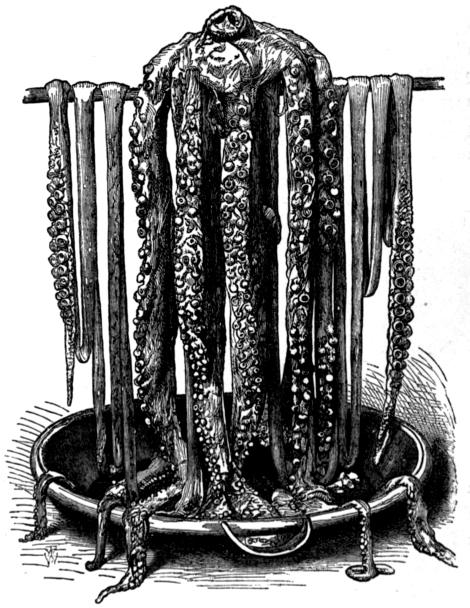
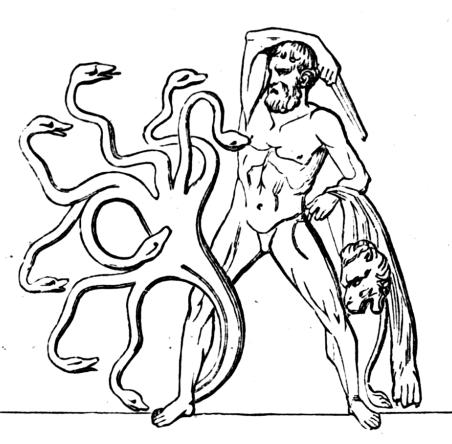
The idea of the Lernean Hydra, whose heads grew again
when cut off by Hercules, originated, as I have shown in
another chapter, in a knowledge of the octopus; and in
the form and movements of other animals with which we
are now familiar we may, in like manner, recognise the
similitude and archetype of the mermaid.
But we must search deeply into the history of mankind
to discover the real source of a belief that has prevailed in
almost all ages, and in all parts of the world, in the
existence of a race of beings uniting the form of man with
that of the fish. A rude resemblance between these
creatures of imagination and tradition and certain aquatic
animals is not sufficient to account for that belief. It
probably had its origin in ancient mythologies, and in the
sculptures and pictures connected with them, which were
designed to represent certain attributes of the deities of
various nations. In the course of time the meaning of
these was lost; and subsequent generations regarded as
the portraits of existing beings effigies which were at first
intended to be merely emblematic and symbolical.
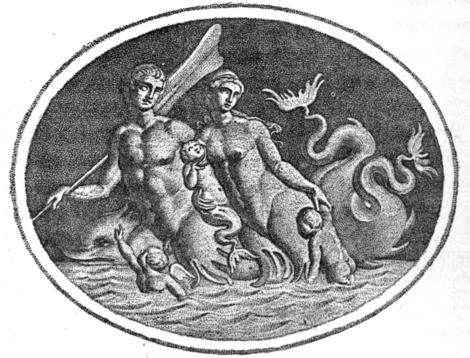 FIG. 1.—NOAH, HIS WIFE, AND THREE SONS, AS FISH-TAILED DEITIES.
From a Gem in the Florentine Gallery. After Calmet.
FIG. 1.—NOAH, HIS WIFE, AND THREE SONS, AS FISH-TAILED DEITIES.
From a Gem in the Florentine Gallery. After Calmet.
Early idolatry consisted, first, in separating the idea of
the One Divinity into that of his various attributes, and of
inventing symbols and making images of each separately;
secondly, in the worship of the sun, moon, stars, and
planets, as living existences; thirdly, in the deification of
ancestors and early kings; and these three forms were
often mingled together in strange and tangled confusion.
Amongst the famous personages with whose history men
were made acquainted by oral tradition was Noah. He
was known as the second father of the human race, and
the preserver and teacher of the arts and sciences as they
existed before the Great Deluge, of which so many separate
traditions exist among the various races of mankind. Consequently,
he was an object of worship in many countries
and under many names; and his wife and sons, as his
assistants in the diffusion of knowledge, were sometimes
associated with him.
According to Berosus, of Babylon,—the Chaldean priest
and astronomer, who extracted from the sacred books of
"that great city" much interesting ancient lore, which he introduced
into his 'History of Syria,' written, about B.C. 260,
for the use of the Greeks,—at a time when men were sunk
in barbarism, there came up from the Erythrean Sea (the
Persian Gulf), and landed on the Babylonian shore, a creature
named Oannes, which had the body and head of a fish. But
above the fish's head was the head of a man, and below the
tail of the fish were human feet. It had also human arms, a
human voice, and human language. This strange monster
sojourned among the rude people during
the day, taking no food, but retiring to
the sea at night; and it continued for
some time thus to visit them, teaching
them the arts of civilized life, and instructing
them in science and religion. [34]
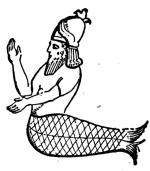 FIG. 2.—HEA, OR
NOAH, THE GOD
OF THE FLOOD.
Khorsabad.
FIG. 2.—HEA, OR
NOAH, THE GOD
OF THE FLOOD.
Khorsabad.
In this tale we have a distorted account
of the life and occupation of Noah
after his escape from the deluge which
destroyed his home and drowned his
neighbours. Oannes was one of the names under which
he was worshipped in Chaldea, at Erech ("the place of the
ark"), as the sacred and intelligent fish-god, the teacher
of mankind, the god of science and knowledge. There he
was also called Oes, Hoa, Ea, Ana, Anu, Aun, and Oan.
Noah was worshipped, also, in Syria and Mesopotamia,
and in Egypt, at "populous
No," [35] or Thebes—so named
from "Theba," "the ark."
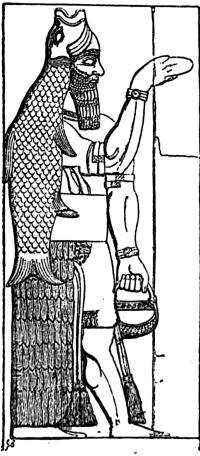 FIG. 3.—DAGON. From a bas
relief. Nimroud.
FIG. 3.—DAGON. From a bas
relief. Nimroud.
The history of the coffin of
Osiris is another version of
Noah's ark, and the period
during which that Egyptian
divinity is said to have been
shut up in it, after it was set
afloat upon the waters, was
precisely the same as that
during which Noah remained
in the ark.
Dagon, also—sometimes
called Odacon—the great fish-god
of the Philistines and
Babylonians, was another
phase of Oannes. "Dag," in
Hebrew, signifies "a male
fish," and "Aun" and "Oan"
were two of the names of
Noah. "Dag-aun" or "Dag-oan"
therefore means "the fish Noah." He was portrayed
in two ways. The more ancient image of him was that
of a man issuing from a fish, as described of Oannes by
Berosus; but in later times it was varied to that of a man
whose upper half was human, and the lower parts those of
a fish. The image of Dagon which fell upon its face to
the ground before "the ark of the God of Israel," was
probably of this latter form, for we read [36] that in its fall,
"the head of Dagon and
both the palms of his hands
were cut off upon the threshold:
only the stump (in the
margin, "the fishy part") of
Dagon was left to him. This
was evidently Milton's conception
of him:
"Dagon his name; sea-monster, upward man
And downward fish." [37]
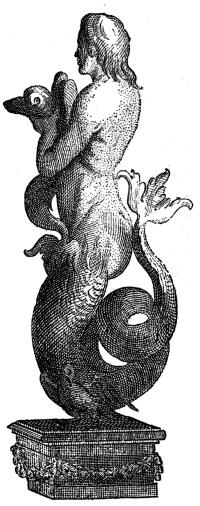 FIG. 4.—DAGON. After Calmet.
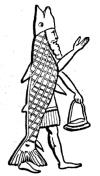 FIG. 5.—DAGON.
From an Agate
Signet. Nineveh.
FIG. 5.—DAGON.
From an Agate
Signet. Nineveh.
In some of the Nineveh
sculptures of the fish-god,
the head of
the fish forms
a kind of
mitre on the
head of the
man, whilst
the body of
the fish appears
as a
cloak or cape
over his
shoulders and
back. The fish varies in length; in some cases the tail
almost touches the ground; in others it reaches but little
below the man's waist.
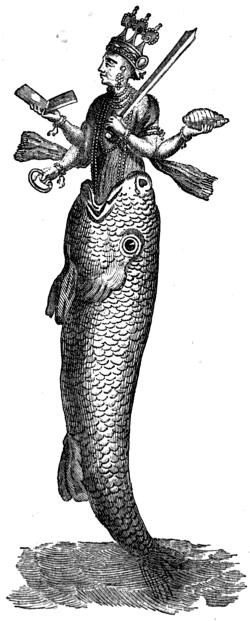 FIG. 6.—FISH AVATAR OF VISHNU.
After Calmet and Maurice.
FIG. 6.—FISH AVATAR OF VISHNU.
After Calmet and Maurice.
In one of his "avatars,"
or incarnations,
the god Vishnu "the
Preserver," is represented
as issuing from
the mouth of a fish.
He is celebrated as
having miraculously
preserved one righteous
family, and, also, the
Vedas, the sacred records,
when the world
was drowned. Not only
is this legend of the
Indian god wrought up
with the history of
Noah, but Vishnu and
Noah bear the same
name—Vishnu being
the Sanscrit form of
"Ish-nuh," "the man
Noah." The word
"avatar" also means
"out of the boat." In
fact the whole mythology
of Greece and
Rome, as well as of
Asia, is full of the history
and deeds of Noah,
which it is impossible
to misunderstand. In all the representations of a deity
having a combined human and piscine form, the original idea
was that of a person coming out of a fish—not being part of
one, but issuing from it, as Noah issued from the ark. In
all of them the fish denoted "preservation," "fecundity,"
"plenty," and "diffusion of knowledge." [38] As the image
was not the effigy of a divine personage, but symbolized
certain attributes of Divinity, its sex was comparatively
unimportant, although it is possible that, combined with
the fecundity of the fish, the idea of Noah's wife, as the
second mother of all subsequent generations, according to
the widely-spread and accepted traditions of the deluge,
may have influenced the impersonation.
Atergatis, the far-famed goddess of the Syrians, was also
a fish-divinity. Her image, like that of Dagon, had at
first a fish's body with human extremities protruding
from it; but in the course of centuries it was gradually
altered to that of a being the upper portion of whose
body was that of a woman and the lower half that of
a fish. Gatis was a powerful queen of Sidon, and mother
of Semiramis. She received the title of "Ater," or "Ader,"
"the Great," for the benefits she conferred on her people;
one of these benefits being a strict conservation of their
fisheries, both from their own imprudent use, and from foreign
interference. She issued an edict that no fish should be
eaten without her consent, and that no one should take fish
in the neighbouring sea without a licence from herself. It
is not improbable that she and her celebrated daughter, who
is said by Ovid and others to have been the builder of the
walls of Babylon, were worshipped together; for that
Atergatis was the same as the fish-goddess Ashteroth, or
Ashtoreth, "the builder of the encompassing wall," we have,
amongst other proofs, a remarkable one in Biblical history.
In the first book of Maccabees v. 43, 44, we read that "all
the heathen being discomfited before him (Judas Maccabeus)
cast away their weapons, and fled unto the temple that was
at Carnaim. But they took the city, and burned the temple
with all that were therein. Thus was Carnaim subdued,
neither could they stand any longer before Judas." In the
second book of Maccabees xii. 26, we are told that "Maccabeus
marched forth to Carnion, and to the temple of Atargatis,
and there he slew five and twenty thousand persons."
In Genesis xiv. 5, this city and temple are referred to as
"Ashteroth Karnaim."
Fig. 7 is a representation of Atergatis
on a medal coined at Marseilles.
It shows that when the Phœnician
colony from Syria, by whom that city
was founded, settled there, they
brought with them the worship of
the gods of their country.
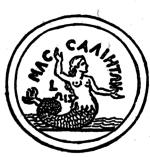 FIG. 7.—ATERGATIS.
From a Phœnician coin.
FIG. 7.—ATERGATIS.
From a Phœnician coin.
Atergatis was worshipped by the
Greeks as Derceto and Astarte.
Lucian writes [39] :—"In Phœnicia I saw the image of Derceto,
a strange sight, truly! For she had the half of
a woman, and from the thighs downwards a fish's tail."
Diodorus Siculus describes (lib. ii.) the same deity, as
represented at Ascalon, as "having the face of a woman,
but all the rest of the body a fish's." And this very same
image at Ascalon, which Diodorus calls Derceto, or
Atergatis, is denominated by Herodotus [40] "the celestial
Aphrodite," who was identical with the Cyprian and Roman
Venus. Of all the sacred buildings erected to the goddess,
this temple was by far the most ancient; and the Cyprians
themselves acknowledged that their temple was built after
the model of it by certain Phœnicians who came from
that part of Syria.
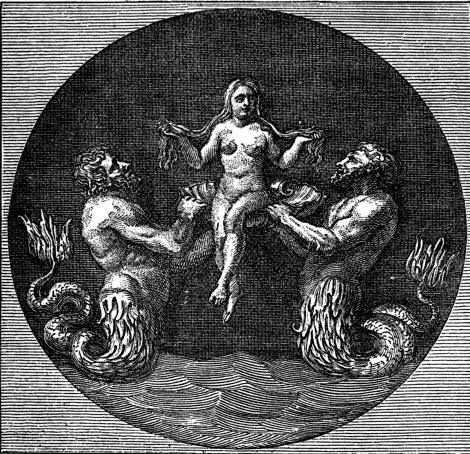 FIG. 8.—VENUS RISING FROM THE SEA, SUPPORTED BY TRITONS.
After Calmet.
FIG. 8.—VENUS RISING FROM THE SEA, SUPPORTED BY TRITONS.
After Calmet.
Thus the worship of Noah, as the second father of mankind,
the repopulator of the earth, passed through various
phases and transformations till it merged in that of Venus,
who rose from the sea, and was regarded as the representative
of the reproductive power of Nature—the goddess whom
Lucretius thus addressed:
"Blest Venus! Thou the sea and fruitful earth
Peoplest amain; to thee whatever lives
Its being owes, and that it sees the sun:"
and to whom refers the passage in the Orphic hymn:
"From thee are all things—all things thou producest
Which are in heaven, or in the fertile earth,
Or in the sea, or in the great abyss."
Under this latter phase—the impersonation of Venus—the
fish portion of the body was discarded, and the cast-off
form was allotted in popular credence to the Tritons—minor
deities, who acknowledged the supremacy of the goddess,
and were ready to render her homage and service by bearing
her in their arms, drawing her chariot, etc., but who still
possessed considerable power as sea-gods, and could calm
the waves and rule the storm, at pleasure.
 FIG. 9.
 FIG. 10.
VENUS DRAWN IN HER CHARIOT BY TRITONS. From two Corinthian coins.
Figs. 9 and 10 are from two Corinthian medals, each
shewing Venus in a car or chariot drawn by Tritons, one
male, the other female. On the obverse of Fig. 9, is the
head of Nero, and on that of Fig. 10, the head of his
grandmother Agrippina. [41]
From the very earliest period of history, then, the
conjoined human and fish form was known to every
generation of men. It was presented to their sight in
childhood by sculptures and pictures, and was a conspicuous
object in their religious worship. By the lapse of time its
original import was lost and debased; and, from being
an emblem and symbol, it came to be accepted as the
corporeal shape and structure of actually-existent sea-deities,
who might present themselves to the view of the
mariner, in visible and tangible form, at any moment.
Thus were men trained and prepared to believe in mermen
and mermaids, to expect to meet with them at sea, and to
recognise as one of them any animal the appearance and
movements of which could possibly be brought into conformity
with their pre-conceived ideas.
Accordingly, and very naturally, we find that from north
to south this belief has been entertained. Megasthenes,
who was a contemporary of Aristotle, but his junior, and
whose geographical work was probably written at about the
period of the great philosopher's death, reported that the sea
which surrounded Taprobana, the ancient Ceylon, was inhabited
by creatures having the appearance of women.
Ælian stated that there were "whales," or "great fishes,"
having the form of satyrs. The early Portuguese settlers in
India asserted that true mermen were found in the Eastern
seas, and old Norse legends tell of submarine beings of conjoined
human and piscine form, who dwell in a wide territory
far below the region of the fishes, over which the sea, like
the cloudy canopy of our sky, loftily rolls, and some of whom
have, from time to time, landed on Scandinavian shores,
exchanged their fishy extremities for human limbs, and
acquired amphibious habits. Not only have poets sung of
the wondrous and seductive beauty of the maidens of these
aquatic tribes, but many a Jack tar has come home from
sea prepared to affirm on oath that he has seen a mermaid.
To the best of his belief he has told the truth. He has
seen some living being which looked wonderfully human,
and his imagination, aided by an inherited superstition, has
supplied the rest.
Before endeavouring to identify the object of his delusion,
it may be well to mention a few instances of the supposed
appearance of mermen and mermaidens in various localities.
Pliny writes [42] : "When Tiberius was emperor, an embassy
was sent to him from Olysippo (Lisbon) expressly to
inform him that a Triton, which was recognised as such by
its form, had shown itself in a certain cave, and had been
heard to produce loud sounds on a conch-shell. The
Nereid, also, is not imaginary: its body is rough and
covered with scales, but it has the appearance of a human
being. For one was seen upon the same coast; and when
it was dying those dwelling near at hand heard it moaning
sadly for a long time. And the Governor of Gaul wrote to
the divine Augustus that several Nereids had been found
dead upon the shore. I have many informants—illustrious
persons in high positions—who have assured me that they
saw in the Sea of Cadiz a merman whose whole body was
exactly like that of a man, that these mermen mount on
board ships by night, and weigh down that end of the
vessel on which they rest, and that if they are allowed to
remain there long they will sink the ship."
Ælian in one of his short, jerky, disconnected chapters, [43]
which rarely exceed a page in length, and some of which
only contain two lines, writes: "It is reported that the
great sea which surrounds the island of Taprobana (Ceylon)
contains an immense multitude of fishes and whales, and
some of them have the heads of lions, panthers, rams, and
other animals; and (which is more wonderful still) some of
the cetaceans have the form of satyrs. There are others
which have the face of a woman, but prickles instead of
hair. In addition to these, it is said there are other
creatures of so strange and monstrous a kind that it would
be impossible exactly to explain their appearance without
the aid of a skilfully drawn picture: these have elongated
and coiled tails, and, for feet, have claws [44] or fins. And I
hear that in the same sea there are great amphibious
beasts which are gregarious, and live on grain, and by night
feed on the corn crops and grass, and are also very fond of
the ripe fruit of the palms. To obtain these they encircle
in their embrace the trees which are young and flexible,
and, shaking them violently, enjoy the fruit which they thus
cause to fall. When morning dawns they return to the
sea, and plunge beneath the waves."
Ælian seems to have derived this information from
Megasthenes, already referred to; but in another chapter, [45]
he writes with greater certainty concerning these semi-human
whales, and claims divine authority for his belief in the existence
of tritons. "Although," he says, "we have no rational
explanation nor absolute proof of that which fishermen are
said to be able to affirm concerning the form of the tritons,
we have the sworn testimony of many persons that there are
in the sea cetaceans which from the head down to the middle
of the body resemble the human species. Demostratus,
in his works on fishing, says that an aged triton was seen
near the town of Tanagra, in Bœotia, which was like the
drawings and pictures of tritons, but its features were so
obscured by age, and it disappeared so quickly, that its true
character was not easily perceptible. But on the spot
where it had rested on the shore were found some rough
and very hard scales which had become detached from it.
A certain senator—one of those selected by lot to carry on
the administration of Achaia and the duties of the annual
magistracy" (the mayor, in fact,) "being anxious to investigate
the nature of this triton, put a portion of its skin
on the fire. It gave out a most horrible odour; and those
standing by were unable to decide whether it belonged
to a terrestrial or marine animal. But the magistrate's
curiosity had an evil ending, for very soon afterwards,
whilst crossing a narrow creek in a boat, he fell overboard
and was drowned; and the Tanagreans all regarded this as
a judgment upon him for his crime of impiety towards the
triton—an interpretation which was confirmed when his
decomposing body was cast ashore, for it emitted exactly
the same odour as had the burned skin of the triton. The
Tanagreans and Demostratus explain whence the triton
had strayed, and how it was stranded in this place. I
believe," continues Ælian, "that tritons exist, and I reverentially
produce as my witness a most veracious god—namely,
Apollo Didymæus, whom no man in his senses would
presume to regard as unworthy of credit. He sings thus
of the triton, which he calls the sheep of the sea:
'Dum vocale maris monstrum natat æquore triton,
Neptuni pecus, in funes forte incidit extra
Demissos navim';"
which I venture to translate as follows:
A triton, vocal monster of the deep,
One of a flock of Neptune's scaly sheep,
Was caught, whilst swimming o'er the watery plain,
By lines which fishers from their boat had lain.
"Therefore," Ælian concludes, "if he, the omniscient god,
pronounces that there are tritons, it does not behove us to
doubt their existence."
Sir J. Emerson Tennent, in his 'Natural History of
Ceylon,' quoting from the Histoire de la Compagnie de
Jésus, mentions that the annalist of the exploits of the
Jesuits in India gravely records that seven of these
monsters, male and female, were captured at Manaar, in
1560, and carried to Goa, where they were dissected by
Demas Bosquez, physician to the Viceroy, "and their
internal structure found to be in all respects conformable to
the human." He also quotes Valentyn, one of the Dutch
colonial chaplains, who, in his account of the Natural History
of Amboyna, [46] embodied in his great work on the Netherlands'
possessions in India, published in 1727, [47] devoted
the first section of his chapter on the fishes of that island
to a minute description of the "Zee-Menschen," "Zee-Wyven,"
and mermaids, the existence of which he warmly
insists on as being beyond cavil. He relates that in 1663,
when a lieutenant in the Dutch service was leading a party
of soldiers along the sea-shore in Amboyna, he and all his
company saw the mermen swimming at a short distance
from the beach. They had long and flowing hair of a
colour between grey and green. Six weeks afterwards the
creatures were again seen by him and more than fifty
witnesses, at the same place, by clear daylight. "If any
narrative in the world," adds Valentyn, "deserves credit it
is this; since not only one, but two mermen together were
seen by so many eye-witnesses. Should the stubborn
world, however, hesitate to believe it, it matters nothing,
as there are people who would even deny that such cities
as Rome, Constantinople, or Cairo, exist, merely because
they themselves have not happened to see them. But
what are such incredulous persons," he continues, "to make
of the circumstance recorded by Albrecht Herport [48] in his
account of India, that a merman was seen in the water
near the church of Taquan on the morning of the 29th of
April, 1661, and a mermaid at the same spot the same
afternoon? Or what do they say to the fact that in 1714
a mermaid was not only seen but captured near the island
of Booro, five feet, Rhineland measure, in height; which
lived four days and seven hours, but, refusing all food,
died without leaving any intelligible account of herself?"
Valentyn, in support of his own faith in the mermaid, cites
many other instances in which both "sea-men and sea-women"
were seen and taken at Amboyna; especially one
by a district visitor of the church, who presented it to the
Governor Vanderstel. Of this "well-authenticated" specimen
he gives an elaborate portrait amongst the fishes of the island, [49]
with a minute description of each for the satisfaction of
men of science.
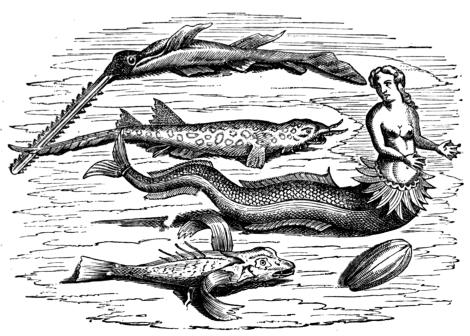 FIG. 12.—MERMAID AND FISHES OF AMBOYNA. After Valentyn.
The fame of this creature having reached Europe, the
British minister in Holland wrote to Valentyn on the 28th
of December, 1716, whilst the Emperor Peter the Great, of
Russia, was his guest at Amsterdam, to communicate the
desire of the Czar that the mermaid should be brought
home from Amboyna for his inspection. To complete his
proofs of the existence of mermen and merwomen, Valentyn
points triumphantly to the historical fact that in Holland,
in the year 1404, a mermaid was driven, during a tempest,
through a breach in the dyke of Edam, and was taken alive
in the lake of Purmer. Thence she was carried to Haarlem,
where the Dutch women taught her to spin, and where
several years after, she died in the Roman Catholic faith;—"but
this," says the pious Calvinistic chaplain, "in no way
militates against the truth of her story." The worthy
minister citing the authority of various writers as proof that
mermaids had in all ages been known in Gaul, Naples,
Epirus, and the Morea, comes to the conclusion that as
there are "sea-cows," "sea-horses," "sea-dogs," as well as
"sea-trees," and "sea-flowers," which he himself had seen,
there are no reasonable grounds for doubt that there may
also be "sea-maidens" and "sea-men."
In an early account of Newfoundland, [50] Whitbourne
describes a "maremaid or mareman," which he had seen
"within the length of a pike," and which "came swimming
swiftly towards him, looking cheerfully on his face, as it had
been a woman. By the face, eyes, nose, mouth, chin, ears,
neck and forehead, it appeared to be so beautiful, and in
those parts so well proportioned, having round about the
head many blue streaks resembling hair, but certainly it
was no hair. The shoulders and back down to the middle
were square, white, and smooth as the back of a man, and
from the middle to the end it tapered like a broad-hooked
arrow." The animal put both its paws on the side of the
boat wherein its observer sat, and strove much to get in,
but was repelled by a blow.
In 1676, a description was given by an English surgeon
named Glover, of an animal of this kind. The author did
not designate it by any name, but the incident has the
honour of being recorded in the Philosophical Transactions. [51]
About three leagues from the mouth of the river Rappahannock,
in America, while alone in a vessel, he observed, at
the distance of about half a stone-throw, he says, "a most
prodigious creature, much resembling a man, only somewhat
larger, standing right up in the water, with his head, neck,
shoulders, breast and waist, to the cubits of his arms, above
water, and his skin was tawny, much like that of an Indian;
the figure of his head was pyramidal and sleek, without
hair; his eyes large and black, and so were his eyebrows;
his mouth very wide, with a broad black streak on the
upper lip, which turned upwards at each end like
mustachios. His countenance was grim and terrible. His
neck, shoulders, arms, breast and waist, were like unto the
neck, arms, shoulders, breast and waist of a man. His
hands, if he had any, were under water. He seemed to
stand with his eyes fixed on me for some time, and afterwards
dived down, and, a little after, rose at somewhat
a greater distance, and turned his head towards me again,
and then immediately fell a little under water, that I could
discern him throw out his arms and gather them in as a
man does when he swims. At last, he shot with his head
downwards, by which means he cast his tail above the
water, which exactly resembled the tail of a fish, with a
broad fane at the end of it."
Thormodus Torfæus [52] maintains that mermaids are found
on the south coast of Iceland, and, according to Olafsen, [53]
two have been taken in the surrounding seas, the first in the
earlier part of the history of that island, and the second in
1733. The latter was found in the stomach of a shark. Its
lower parts were consumed, but the upper were entire.
They were as large as those of a boy eight or nine years
old. Both the cutting teeth and grinders were long and
shaped like pins, and the fingers were connected by a large
web. Olafsen was inclined to believe that these were
human remains, but the islanders all firmly maintained
that they were part of "a marmennill," by which name the
mermaid is known among them.
Of course the worthy bishop of Bergen, Pontoppidan,
has something to tell us about mermaids in his part of
the world. "Amongst the sea monsters," he says, [54] "which
are in the North Sea, and are often seen, I shall give the
first place to the Hav-manden, or merman, whose mate
is called Hav-fruen, or mermaid. The existence of this
creature is questioned by many, nor is it at all to be
wondered at, because most of the accounts we have had of
it are mixed with mere fables, and may be looked upon as
idle tales." As such he regards the story told by Jonas
Ramus in his 'History of Norway,' of a mermaid taken by
fishermen at Hordeland, near Bergen, and which is said to
have sung an unmusical song to King Hiorlief. In the
same category he places an account given by Besenius in
his life of Frederic II. (1577), of a mermaid that called
herself Isbrandt, and held several conversations with a
peasant at Samsoe, in which she foretold the birth of
King Christian IV., "and made the peasant preach repentance
to the courtiers, who were very much given to
drunkenness." Equally "idle" with the above stories is,
in his opinion, another, extracted from an old manuscript
still to be seen in the University Library at Copenhagen,
and quoted by Andrew Bussæus (1619), of a merman caught
by the two senators, Ulf Rosensparre and Christian Holch,
whilst on their voyage home to Denmark from Norway.
This sea-man frightened the two worshipful gentlemen so
terribly that they were glad to let him go again; for
as he lay upon the deck he spoke Danish to them, and
threatened that if they did not give him his liberty "the ship
should be cast away, and every soul of the crew should
perish."
"When such fictions as these," says Pontoppidan, "are
mixed with the history of the merman, and when that creature
is represented as a prophet and an orator; when they
give the mermaid a melodious voice, and tell us that she is
a fine singer, we need not wonder that so few people of sense
will give credit to such absurdities, or that they even doubt
the existence of such a creature." The good prelate, however,
goes on to say that "whilst we have no ground to believe
all these fables, yet, as to the existence of the creature we
may safely give our assent to it," and, "if this be called in
question, it must proceed entirely from the fabulous stories
usually mixed with the truth." Like Valentyn, he argues
that as there are "sea-horses," "sea-cows," "sea-wolves,"
"sea-dogs," "sea-hogs," etc., it is probable from analogy,
that "we should find in the ocean a fish or creature which
resembles the human species more than any other." As
for the objection "founded on self-love and respect to our
own species which is honoured with the image of God, who
made man lord of all creatures, and that, consequently, we
may suppose he is entitled to a noble and heavenly form
which other creatures must not partake of," he thinks "its
force vanishes when we consider the form of apes, and
especially of another African creature called 'Quoyas
Morrov' described by Odoard Dapper" in his work on
Africa, and which appears to have been a chimpanzee.
Pontoppidan regarded it as being the Satyr of the ancients.
He therefore claims that "if we will not allow our
Norwegian Hastromber the honourable name of merman,
we may very well call it the 'Sea-ape,' or the 'Sea-Quoyas-Morrov;'"
especially as the author already quoted
says that, "in the Sea of Angola mermaids are frequently
caught which resemble the human species. They are taken
in nets, and killed by the negroes, and are heard to shriek
and cry like women."
The Bishop adds that in the diocese of Bergen, as well
as in the manor of Nordland, there were hundreds of
persons who affirmed with the strongest assurances that
they had seen this kind of creature; sometimes at a distance
and at other times quite close to their boats, standing
upright, and formed like a human creature down to the
middle—the rest they could not see—but of those who had
seen them out of water and handled them he had not been
able to find more than one person of credit who could vouch
it for truth. This informant, "the Reverend Mr. Peter
Angel, minister of Vand-Elvens Gield, on Suderoe,"
assured his bishop, when he was on a visitation journey,
that "in the year 1719, he (being then about twenty years
old) saw what is called a merman lying dead on a point of
land near the sea, which had been cast ashore by the waves
along with several sea-calves (seals), and other dead fish.
The length of this creature was much greater than what
has been mentioned of any before, namely, above three
fathoms. It was of a dark grey colour all over: in the
lower part it was like a fish, and had a tail like that of a
porpoise. The face resembled that of a man, with a mouth,
forehead, eyes, etc. The nose was flat, and, as it were,
pressed down to the face, in which the nostrils were
very visible. The breast was not far from the head; the
arms seemed to hang to the side, to which they were
joined by a thin skin, or membrane. The hands were, to
all appearance, like the paws of a sea-calf. The back of this
creature was very fat, and a great part of it was cut off,
which, with the liver, yielded a large quantity of train-oil."
The author then quotes a description by Luke Debes [55] of
a mermaid seen in 1670 at Faroe, westward of Qualboe
Eide, by many of the inhabitants, as also by others from
different parts of Suderoe. She was close to the shore, and
stood there for two hours and a half, and was up to her
waist in water. She had long hairs on her head, which
hung down to the surface of the water all round about her,
and she held a fish in her right hand.
Pontoppidan mentions other instances of similar appearances,
and says that the latest he had heard of was of a
merman seen in Denmark on the 20th of September, 1723,
by three ferrymen who, at some distance from the land,
were towing a ship just arrived from the Baltic. Having
caught sight of something which looked like a dead body
floating on the water, they rowed towards it, and there,
resting on their oars, allowed it to drift close to them. It
sank, but immediately came to the surface again, and then
they saw that it had the appearance of an old man, strong-limbed,
and with broad shoulders, but his arms they could
not see. His head was small in proportion to his body,
and had short, curled, black hair, which did not reach below
his ears; his eyes lay deep in his head, and he had a
meagre and pinched face, with a black, coarse beard, that
looked as if it had been cut. His skin was coarse, and
very full of hair. He stood in the same place for half a
quarter of an hour, and was seen above the water down to
his breast: at last the men grew apprehensive of some
danger, and began to retire; upon which the monster
blew up his cheeks, and made a kind of roaring noise, and
then dived under water, so that they did not see him any
more. One of them, Peter Gunnersen, related (what the
others did not observe) that this merman was, about the
body and downwards, quite pointed, like a fish. This same
Peter Gunnersen likewise deposed that "about twenty years
before, as he was in a boat near Kulleor, the place where
he was born, he saw a mermaid with long hair and large
breasts." He and his two companions were, by command
of the king, examined by the burgomaster of Elsineur,
Andrew Bussæus, before the privy-councillor, Fridrich von
Gram, and their testimony to the above effect was given
on their respective oaths.
Brave old Henry Hudson, the sturdy and renowned
navigator, who thrice, in three successive years, gave battle
to the northern ice, and was each time defeated in his
endeavour to discover a north-west or north-east passage
to China, though he stamped his name on the title-page
of a mighty nation's history, records the following incident:
"This evening (June 15th) one of our company,
looking overboard, saw a mermaid, and, calling up some of
the company to see her, one more of the crew came up, and
by that time she was come close to the ship's side, looking
earnestly on the men. A little after a sea came and overturned
her. From the navel upward, her back and breasts
were like a woman's, as they say that saw her; her body as
big as one of us, her skin very white, and long hair hanging
down behind, of colour black. In her going down they saw
her tail, which was like the tail of a porpoise and speckled
like a mackarel's. Their names that saw her were Thomas
Hilles and Robert Rayner."
Steller, who was a zoologist of some repute, reports
having seen in Behrings Straits a strange animal, which he
calls a "sea-ape," and in which one might almost recognise
Pontoppidan's "Sea-Quoyas-Morrov." It was about
five feet long, had sharp and erect ears and large eyes,
and on its lips a kind of beard. Its body was thick and
round, and it tapered to the tail, which was bifurcated, with
the upper lobe longest. It was covered with thick hair,
grey on the back, and red on the belly. No feet nor paws
were visible. It was full of frolic, and sported in the
manner of a monkey, swimming sometimes on one side of
the ship and sometimes on the other. It often raised one-third
of its body out of the water, and stood upright for a
considerable time. It would frequently bring up a sea-plant,
not unlike a bottle-gourd, which it would toss about
and catch in its mouth, playing numberless fantastic tricks
with it.
Somewhat similar accounts have been brought from the
Southern Hemisphere, two, at least, of which are worth
transcribing.
Captain Colnett, in his 'Voyage to the South Atlantic,'
says:—"A very singular circumstance happened off the
coast of Chili, in lat. 24° S., which spread some alarm
amongst my people, and awakened their superstitious apprehensions.
About 8 o'clock in the evening an animal
rose alongside the ship, and uttered such shrieks and tones
of lamentation, so much like those produced by the female
human voice when expressing the deepest distress as to
occasion no small degree of alarm among those who first
heard it. These cries continued for upwards of three hours,
and seemed to increase as the ship sailed from it. I never
heard any noise whatever that approached so near those
sounds which proceed from the organs of utterance in the
human species."
Captain Weddell, in his 'Voyage towards the South
Pole' (p. 143), writes that one of his men, having been left
ashore on Hall's Island to take care of some produce, heard
one night about ten o'clock, after he had lain down to rest,
a noise resembling human cries. As daylight does not
disappear in those latitudes at the season in which the
incident occurred, the sailor rose and searched along the
beach, thinking that, possibly, a boat might have been upset,
and that some of the crew might be clinging to the detached
rocks.
"Roused by that voice of silver sound,
From the paved floor he lightly sprung,
And, glaring with his eyes around,
Where the fair nymph her tresses wrung," [56]
guided by occasional sounds, he at length saw an object
lying on a rock a dozen yards from the shore, at which he
was somewhat frightened. "The face and shoulders appeared
of human form and of a reddish colour; over the
shoulders hung long green hair; the tail resembled that of
a seal, but the extremities of the arms he could not see
distinctly."
"As on the wond'ring youth she smiled,
Again she raised the melting lay," [56]
for the creature continued to make a musical noise during
the two minutes he gazed at it, and, on perceiving him,
disappeared in an instant.
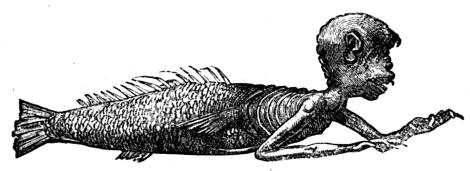 FIG. 13.—A JAPANESE ARTIFICIAL MERMAID.
The universality of the belief in an animal of combined
human and fish-like form is very remarkable. That it
exists amongst the Japanese we have evidence in their
curious and ingeniously-constructed models which are
occasionally brought to this country. I have one of
these which is so exactly the counterpart of that which
my friend Mr. Frank Buckland described, originally in
Land and Water, and which forms the subject of a
chapter in his 'Curiosities of Natural History,' [57] that the
portrait of the one (Fig. 13) will equally well represent
the other. The lower half of the body is made of the skin
and scales of a fish of the carp family, and fastened on
to this, so neatly that it is hardly possible to detect where
the joint is made, is a wooden body, the ribs of which are so
prominent that the poor mermaid has a miserable and half-starved
appearance. The upper part of the body is in the
attitude of a Sphinx, leaning upon its elbows and fore-arms.
The arms are thin and scraggy, and the fingers attenuated
and skeleton-like. The nails are formed of small pieces of
ivory or bone. The head is like that of a small monkey, and
a little wool covers the crown, so thinly and untidily that if
the mermaid possessed a crystal mirror she would see the
necessity for the vigorous use of her comb of pearl. The
teeth are those of some fish—apparently of the cat-fish,
(Anarchicas lupus). These Japanese artificial mermaids have
brought many a dollar into the pockets of Mr. Barnum and
other showmen.
Somewhat different in appearance from this, but of the
same kind, was an artificial mermaid described in the
Saturday Magazine of June 4th, 1836.
Fig. 14 is a facsimile of the woodcut
which accompanied it. This grotesque
composition was exhibited in a glass
case, some years previously, "in a
leading street at the west end" of
London. It was constructed "of the
skin of the head and shoulders of a
monkey, which was attached to the
dried skin of a fish of the salmon kind
with the head cut off, and the whole
was stuffed and highly varnished, the
better to deceive the eye." It was
said to have been "taken by the crew
of a Dutch vessel from on board a
native Malacca boat, and from the
reverence shown to it, it was supposed
to be a representative of one of their idol gods." I am
inclined to think that it was of Japanese origin.
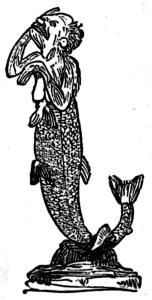 FIG. 14.—AN ARTIFICIAL
MERMAID, PROBABLY
JAPANESE.
FIG. 14.—AN ARTIFICIAL
MERMAID, PROBABLY
JAPANESE.
Fig. 15 is described in the article above referred to as
having been copied from a Japanese drawing, and as being
a portrait of one of their deities. Its similarity to one of
those of the Assyrians (Fig. 2, page 3) is remarkable. The
inscription, however, does not indicate this. The Chinese
characters in the centre—"Nin giyo"—signify "human
fish;" those on the right in Japanese Hira Kana, or running-hand,
have the same purport, and those on the left, in Kata
Kana, the characters of the Japanese alphabet, mean "Ichi
hiru ike"—"one day kept alive." The whole legend seems
to pretend that this human fish was actually caught, and
kept alive in water for twenty-four hours, but, as the box on
which it is inscribed is one of those in which the Japanese
showmen keep their toys, it was
probably the subject of a
"penny peep-show."
We need not travel from our
own country to find the belief
in mermaids yet existing. It is
still credited in the north of
Scotland that they inhabit the
neighbouring seas: and Dr.
Robert Hamilton, F.R.S.E.,
writing in 1839, expressed emphatically
his opinion that there
was then as much ignorance on this subject as had prevailed
at any former period. [58]
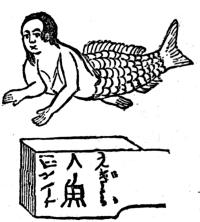 FIG. 15.—A MERMAID. From a
Japanese picture.
FIG. 15.—A MERMAID. From a
Japanese picture.
In the year 1797, Mr. Munro, schoolmaster of Thurso,
affirmed that he had seen "a figure like a naked female,
sitting on a rock projecting into the sea, at Sandside Head,
in the parish of Reay. Its head was covered with long,
thick, light-brown hair, flowing down on the shoulders.
The forehead was round, the face plump, and the cheeks
ruddy. The mouth and lips resembled those of a human
being, and the eyes were blue. The arms, fingers, breast,
and abdomen were as large as those of a full-grown
female," and, altogether,
"That sea-nymph's form of pearly light
Was whiter than the downy spray,
And round her bosom, heaving bright,
Her glossy yellow ringlets play." [59]
"This creature," continued Mr. Munro, "was apparently
in the act of combing its hair with its fingers, which seemed
to afford it pleasure, and it remained thus occupied during
some minutes, when it dropped into the sea." The Dominie
"saw the maiden there,
Just as the daylight faded,
Braiding her locks of gowden hair
An' singing as she braided," [60]
but he did not remark whether the fingers were webbed.
On the whole, he infers that this was a marine animal of
which he had a distinct and satisfactory view, and that
the portion seen by him bore a narrow resemblance to the
human form. But for the dangerous situation it had chosen,
and its appearance among the waves, he would have supposed
it to be a woman. Twelve years later, several persons
observed near the same spot an animal which they also
supposed to be a mermaid.
A very remarkable story of this kind is one related by
Dr. Robert Hamilton in the volume already referred to,
and for the general truth of which he vouches, from his
personal knowledge of some of the persons connected with
the occurrence. In 1823 it was reported that some fishermen
of Yell, one of the Shetland group, had captured a mermaid
by its being entangled in their lines. The statement was that
"the animal was about three feet long, the upper part of the
body resembling the human, with protuberant mammæ,
like a woman; the face, forehead, and neck were short,
and resembled those of a monkey; the arms, which were
small, were kept folded across the breast; the fingers were
distinct, not webbed; a few stiff, long bristles were on the
top of the head, extending down to the shoulders, and
these it could erect and depress at pleasure, something like
a crest. The inferior part of the body was like a fish.
The skin was smooth, and of a grey colour. It offered no
resistance, nor attempted to bite, but uttered a low, plaintive
sound. The crew, six in number, took it within their boat,
but, superstition getting the better of curiosity, they carefully
disentangled it from the lines and a hook which had
accidentally become fastened in its body, and returned it
to its native element. It instantly dived, descending in a perpendicular
direction." Mr. Edmonston, the original narrator
of this incident, was "a well-known and intelligent observer,"
says Dr. Hamilton, and in a communication made by him
to the Professor of Natural History in the Edinburgh
University gave the following additional particulars, which
he had learned from the skipper and one of the crew of
the boat. "They had the animal for three hours within
the boat: the body was without scales or hair; it was of a
silvery grey colour above, and white below; it was like the
human skin; no gills were observed, nor fins on the back
or belly. The tail was like that of a dog-fish; the mammæ
were about as large as those of a woman; the mouth and lips
were very distinct, and resembled the human. Not one of
the six men dreamed of a doubt of its being a mermaid,
and it could not be suggested that they were influenced by
their fears, for the mermaid is not an object of terror to
fishermen: it is rather a welcome guest, and danger is
apprehended from its experiencing bad treatment." Mr.
Edmonston concludes by saying that "the usual resources
of scepticism that the seals and other sea-animals appearing
under certain circumstances, operating upon an
excited imagination, and so producing ocular illusion,
cannot avail here. It is quite impossible that six Shetland
fishermen could commit such a mistake." It would seem
that the narrator demands that his readers shall be silenced,
if unconvinced; but
"He that complies against his will
Is of his own opinion still."
This incident is well-attested, and merits respectful and
careful consideration; but I decline to admit any such impossibility
of error in observation or description on the part
of the fishermen, or the further impossibility of recognising
in the animal captured by them one known to naturalists.
The particulars given in this instance, and also of the
supposed merman seen cast ashore dead in 1719 by the
Rev. Peter Angel (p. 22), are sufficiently accurate descriptions
of a warm-blooded marine animal, with which the
Shetlanders, and probably Mr. Edmonston also, were unacquainted,
namely, the rytina, of which I shall have more
to say presently; and these occurrences afford some slight
hope that this remarkable beast may not have become
extinct in 1768, as has been supposed, but that it may still
exist somewhat further south than it was met with by its
original describer, Steller.
Turning to Ireland, we find the same credence in the
semi-human fish, or fish-tailed human being. In the
autumn of 1819 it was affirmed that "a creature appeared
on the Irish coast, about the size of a girl ten years of age,
with a bosom as prominent as one of sixteen, having a
profusion of long dark-brown hair, and full, dark eyes. The
hands and arms were formed like those of a man, with a
slight web connecting the upper part of the fingers, which
were frequently employed in throwing back and dividing
the hair. The tail appeared like that of a dolphin." This
creature remained basking on the rocks during an hour, in
the sight of numbers of people, until frightened by the flash
of a musket, when
"Away she went with a sea-gull's scream,
And a splash of her saucy tail," [61]
for it instantly plunged with a scream into the sea.
From Irish legends we learn that those sea-nereids, the
"Merrows," or "Moruachs" came occasionally from the sea,
gained the affections of men, and interested themselves in
their affairs; and similar traditions of the "Morgan" (sea-women)
and the "Morverch" (sea-daughters) are current in
Brittany.
In English poetry the mermaid has been the subject of
many charming verses, and Shakspeare alludes to it in his
plays no less than six times. The head-quarters of these
"daughters of the sea" in England, or of the belief in their
existence, are in Cornwall. There the fisherman, many a
time and
"Oft, beneath the silver moon, [62]
Has heard, afar, the mermaid sing,"
and has listened, so they say, to
"The mermaid's sweet sea-soothing lay
That charmed the dancing waves to sleep." [62]
Mr. Robert Hunt, F.R.S., in his collection of the traditions
and superstitions of old Cornwall, [63] records several
curious legends of the "merrymaids" and "merrymen" (the
local name of mermaids), which he had gathered from the
fisher-folk and peasants in different parts of that county.
And, in a pleasant article in 'All the Year Round,' [64] 1865,
"A Cornish Vicar" [65] mentions some of the superstitions of the
people in his neighbourhood, and the perplexing questions
they occasionally put to him. One of his parishioners, an
old man named Anthony Cleverdon, but who was popularly
known as "Uncle Tony," having been the seventh son of
his parents, in direct succession, was looked upon, in consequence,
as a soothsayer. This "ancient augur" confided to
his pastor many highly efficacious charms and formularies,
and, in return, sought for information from him on other
subjects. One day he puzzled the parson by a question
which so well illustrates the local ideas concerning mermaids,
and the sequel of which is, moreover, so humorously
related by the vicar, that I venture to quote his own words,
as follows:—
"Uncle Tony said to me, 'Sir, there is one thing I want
to ask you, if I may be so free, and it is this: why should
a merrymaid, that will ride about upon the waters in such
terrible storms, and toss from sea to sea in such ruckles as
there be upon the coast, why should she never lose her
looking-glass and comb?' 'Well, I suppose,' said I, 'that
if there are such creatures, Tony, they must wear their
looking-glasses and combs fastened on somehow, like fins
to a fish.' 'See!' said Tony, chuckling with delight, 'what
a thing it is to know the Scriptures, like your reverence; I
should never have found it out. But there's another point,
sir, I should like to know, if you please; I've been bothered
about it in my mind hundreds of times. Here be I, that
have gone up and down Holacombe cliffs and streams fifty
years come next Candlemas, and I've gone and watched
the water by moonlight and sunlight, days and nights, on
purpose, in rough weather and smooth (even Sundays, too,
saving your presence), and my sight as good as most men's,
and yet I never could come to see a merrymaid in all my
life: how's that, sir?' 'Are you sure, Tony,' I rejoined,
'that there are such things in existence at all?' 'Oh, sir,
my old father seen her twice! He was out one night for
wreck (my father watched the coast, like most of the old
people formerly), and it came to pass that he was down at
the duck-pool on the sand at low-water tide, and all to
once he heard music in the sea. Well, he croped on
behind a rock, like a coastguardsman watching a boat, and
got very near the music ... and there was the merrymaid,
very plain to be seen, swimming about upon the
waves like a woman bathing—and singing away. But
my father said it was very sad and solemn to hear—more
like the tune of a funeral hymn than a Christmas carol, by
far—but it was so sweet that it was as much as he could do
to hold back from plunging into the tide after her. And
he an old man of sixty-seven, with a wife and a houseful of
children at home. The second time was down here by
Holacombe Pits. He had been looking out for spars—there
was a ship breaking up in the Channel—and he saw
some one move just at half-tide mark, so he went on very
softly, step by step, till he got nigh the place, and there
was the merrymaid sitting on a rock, the bootyfullest
merrymaid that eye could behold, and she was twisting
about her long hair, and dressing it, just like one of our
girls getting ready for her sweetheart on the Sabbath-day.
The old man made sure he should greep hold of her before
ever she found him out, and he had got so near that a
couple of paces more and he would have caught her by the
hair, as sure as tithe or tax, when, lo and behold, she looked
back and glimpsed him! So, in one moment she dived
head-foremost off the rock, and then tumbled herself topsy-turvy
about in the water, and cast a look at my poor father,
and grinned like a seal.'" And a seal it probably was that
Tony's "poor father" saw.
What, then, are these mermaids and mermen, a belief in
whose existence has prevailed in all ages, and amongst all
the nations of the earth? Have they, really, some of the
parts and proportions of man, or do they belong to another
order of mammals on which credulity and inaccurate
observation have bestowed a false character?
Mr. Swainson, a naturalist of deserved eminence, has
maintained on purely scientific grounds, that there must exist
a marine animal uniting the general form of a fish with that
of a man; that by the laws of Nature the natatorial type
of the Quadrumana is most assuredly wanting, and that,
apart from man, a being connecting the seals with the
monkeys is required to complete the circle of quadrumanous
animals. [66]
Mr. Gosse [67] argues that all the characters which Mr.
Swainson selects as marking the natatorial type of animals
belong to man, and that he being, in his savage state, a great
swimmer, is the true aquatic primate, which Mr. Swainson
regards as absent. Mr. Gosse admits, however, that "nature
has an odd way of mocking at our impossibilities, and" that
"it may be that green-haired maidens with oary tails, lurk
in the ocean caves, and keep mirrors and combs upon their
rocky shelves;" and the conclusion he arrives at is that the
combined evidence "induces a strong suspicion that the
northern seas may hold forms of life as yet uncatalogued
by science."
That there are animals in the northern and other seas
with which we are unacquainted, is more than probable:
discoveries of animals of new species are constantly being
made, especially in the life of the deep sea. But I venture
to think that the production of an animal at present
unknown is quite unnecessary to account for the supposed
appearances of mermaids.
We have in the form and habits of the Phocidæ, or earless
seals, a sufficient interpretation of almost every incident of
the kind that has occurred north of the Equator—of those
in which protuberant mammæ are described, we must
presently seek another explanation. The round, plump,
expressive face of a seal, the beautiful, limpid eyes, the
hand-like fore-paws, the sleek body, tapering towards the
flattened hinder fins, which are directed backwards, and
spread out in the form of a broad fin, like the tail of a fish,
might well give the idea of an animal having the anterior
part of its body human and the posterior half piscine.
In the habits of the seals, also, we may trace those of the
supposed mermaid, and the more easily the better we are
acquainted with them. All seals are fond of leaving the
water frequently. They always select the flattest and most
shelving rocks which have been covered at high tide, and
prefer those that are separated from the mainland. They
generally go ashore at half-tide, and invariably lie with
their heads towards the water, and seldom more than a
yard or two from it. There they will often remain, if
undisturbed, for six hours; that is, until the returning tide
floats them off the rock. As for the sweet melody,
"so melting soft," that must depend much on the ear and
musical taste of the listener. I have never heard a seal
utter any vocal sounds but a porcine grunt, a plaintive
moan, and a pitiful whine. But another habit of the seals
has, probably more than anything else, caused them to be
mistaken for semi-human beings—namely, that of poising
themselves upright in the water with the head and the
upper third part of the body above the surface.
One calm sunny morning in August, 1881, a fine schooner-yacht,
on board of which I was a guest, was slowly gliding
out of the mouth of the river Maas, past the Hook of
Holland, into the North Sea, when a seal rose just ahead
of us, and assumed the attitude above described. It waited
whilst we passed it, inspecting us apparently with the
greatest interest; then dived, swam in the direction in
which we were sailing, so as to intercept our course, and
came up again, sitting upright as before. This it repeated
three times, and so easily might it have been taken for a
mermaid, that one of the party, who was called on deck to
see it, thought, at first, that it was a boy who had swam off
from the shore to the vessel on a begging expedition.
Laing, in his account of a voyage to the North, mentions
having seen a seal under similar circumstances.
A young seal which was brought from Yarmouth to the
Brighton Aquarium in 1873, habitually sat thus, showing
his head and a considerable portion of his body out of
water. His bath was so shallow in some parts that he was
able to touch the bottom, and, with his after-flippers tucked
under him, like a lobster's tail, and spread out in front, he
would balance himself on his hind quarters, and look inquisitively
at everybody, and listen attentively to everything
within sight and hearing. When he was satisfied
that no one was likely to interfere with him, and that it
was unnecessary to be on the alert, he would half-close his
beautiful, soft eyes, and either contentedly pat, stroke, and
scratch his little fat stomach with his right paw, or flap
both of them across his breast in a most ludicrous manner,
exactly as a cabman warms the tips of his fingers on a
wintry day, by swinging his arms vigorously across his
chest, and striking his hands against his body on either
side. He was very sensitive to musical sounds, as many
dogs are, and when a concert took place in the building a
high note from one of the vocalists would cause him to
utter a mournful wail, and to dive with a splash that made
the water fly, the audience smile, and the singer frown.
Captain Scoresby tells us that he had seen the walrus
with its head above water, and in such a position that it
required little stretch of imagination to mistake it for a
human being, and that on one occasion of this kind the
surgeon of his ship actually reported to him that he had
seen a man with his head above water.
Peter Gunnersen's merman (p. 24), who "blew up his
cheeks and made a kind of roaring noise" before diving,
was probably a "bladder-nose" seal. The males of that
species have on the head a peculiar pad, which they can
dilate at pleasure, and their voice is loud and discordant.
The appearance and behaviour of Steller's "sea-ape,"
described on p. 25, may, I think, be attributed to one of
the eared seals, the so-called sea-lions, or sea-bears. Every
one who has seen these animals fed must have noticed the
rapidity with which they will dive and swim to any part of
their pond where they expect to receive food, and how,
like a dog after a pebble, they will keenly watch their
keeper's movements, and start in the direction to which he
is apparently about to throw a fish, even before the latter
has left his hand. This may be seen at the Zoological
Gardens, Regent's Park, and, better than anywhere else in
Europe, at the Jardin d'Acclimatation, Paris. It would be
quite in accordance with their habits that one of these
Otaria should dive under a ship, and rise above the surface
on either side, eagerly surveying those on board, in hope of
obtaining food, or from mere curiosity.
The seals and their movements account for so many
mermaid stories, that all accounts of sea-women with
prominent bosoms were ridiculed and discredited until
competent observers recognised in the form and habits of
certain aquatic animals met with in the bays and estuaries
of the Indian Ocean, the Red Sea, the west coast of Africa,
and sub-tropical America, the originals of these "travellers'
tales." These were—first, the manatee, which is found in
the West Indian Islands, Florida, the Gulf of Mexico, and
Brazil, and in Africa in the River Congo, Senegambia, and
the Mozambique Channel; second, the dugong, or halicore,
which ranges along the east coast of Africa, Southern Asia,
the Bornean Archipelago, and Australia; and, third, the
rytina, seen on Behring's Island in the Kamschatkan Sea
by Steller, the Russian zoologist and voyager, in 1741, and
which is supposed to have become extinct within twenty-seven
years after its discovery, by its having been recklessly
and indiscriminately slaughtered. [68] Then science, in the
person of Illeger, made the amende honorable, and frankly
accepting Jack's introduction to his fish-tailed innamorata,
classed these three animals together as a sub-order of the
animal kingdom, and bestowed on them the name of the
Sirenia. This was, of course, in allusion to the Sirens of
classical mythology, who, in later art, were represented as
having the body of a woman above the waist, and that
of a fish below, although the lower portion of their body
was originally described as being in the form of a bird.
It has been found difficult to determine to which order
these Manatidæ are most nearly allied. In shape they most
closely resemble the whales and seals. But the cetacea
are all carnivorous, whereas the manatee and its relatives
live entirely on vegetable food. Although, therefore, Dr.
J. E. Gray, following Cuvier, classed them with the cetacea
in his British Museum catalogue, other anatomists, as
Professor Agassiz, Professor Owen, and Dr. Murie, regard
their resemblance to the whales as rather superficial than
real, and conclude from their organisation and dentition
that they ought either to form a group apart or be classed
with the pachyderms—the hippopotamus, tapir, etc.—with
which they have the nearest affinities, and to which they
seem to have been more immediately linked by the now
lost genera, Dinotherium and Halitherium. With the
opinion of those last-named authorities I entirely agree. I
regard the manatee as exhibiting a wonderful modification
and adaptation of the structure of a warm-blooded land
animal which enables it to pass its whole life in water, and
as a connecting link between the hippopotamus, elephant,
etc., on the one side, and the whales and seals on the other.
The Halitherium was a Sirenian with which we are only
acquainted by its fossil remains found in the Miocene
formation of Central and Southern Europe. These indicate
that it had short hind limbs, and, consequently, approached
more nearly the terrestrial type than either the manatee,
the rytina, or the dugong, in which the hind limbs are
absent. The two last named tend more than does the
manatee to the marine mammals; but there is a strong
likeness between these three recent forms. They all have
a cylindrical body, like that of a seal, but instead of hind
limbs there is in all a broad tail flattened horizontally; and
the chief difference in their outward appearance is in the
shape of this organ. In the manatee it is rounded, in the
dugong forked like that of a whale, in the rytina crescent-shaped.
The tail of the Halitherium appears to have been
shaped somewhat like that of the beaver. The body of
the manatee is broader in proportion to its length and
depth than that of the dugong. In a paper read before the
Royal Society, July 12th, 1821, on a manatee sent to
London in spirits by the Duke of Manchester, then
Governor of Jamaica, Sir Everard Home remarked of this
greater lateral expansion that, as the manatee feeds on
plants that grow at the mouths of great rivers, and the dugong
upon those met with in the shallows amongst small islands
in the Eastern seas, the difference of form would make the
manatee more buoyant and better fitted to float in fresh
water.
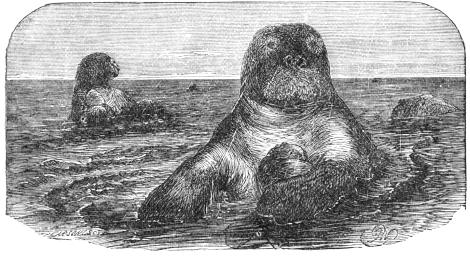 FIG. 16.—THE DUGONG. From Sir J. Emerson Tennent's 'Ceylon.'
In all the Manatidæ the mammæ of the female, which
are greatly distended during the period of lactation, are
situated very differently from those of the whales, being
just beneath the pectoral fins. These fins or paws are
much more flexible and free in their movements than
those of the cetæ, and are sufficiently prehensile to enable
the animal to gather food between the palms or inner
surfaces of both, and the female to hold her young one
to her breast with one of them. Like the whales, they are
warm-blooded mammals, breathing by lungs, and are therefore
obliged to come to the surface at frequent intervals
for respiration. As they breathe through nostrils at the
end of the muzzle, instead of, like most of the whales,
through a blow-hole on the top of the head, their habit is
to rise, sometimes vertically, in the water, with the head
and fore part of the body exposed above the surface, and
often to remain in this position for some minutes. When
seen thus, with head and breast bare, and clasping its
young one to its body, the female presents a certain resemblance
to a woman from the waist upward. When
approached or disturbed it dives; the tail and hinder portion
of the body come into view, and we see that if there was
little of the "mulier formosa superne," at any rate "desinit
in piscem." The manatee has thence been called by the
Spaniards and Portuguese the "woman-fish," and by the
Dutch the "manetje," or mannikin. The dugong, having
the muzzle bristly, is named by the latter the "baardmanetje,"
or "little bearded man." There are no bristles
or whiskers on the muzzle of the manatee; all the portraits
of it in which these are shown are in that respect erroneous.
The origin of the word "manatee" has by some been
traced to the Spanish, as indicating "an animal with
hands." On the west coast of Africa it is called by the
natives "Ne-hoo-le." By old writers it was described as
the "sea-cow." Gesner depicts it in the act of bellowing;
and Mr. Bates, in his work, "The Naturalist on the
Amazon," says that its voice is something like the bellowing
of an ox. The Florida "crackers" or "mean whites,"
make the same statement. Although I have had opportunities
of prolonged observation of it in captivity, I have
not heard it give utterance to any sound—not even a grunt—and
Mr. Bartlett, of the Zoological Gardens, tells me that
his experience of it is the same. His son, Mr. Clarence
Bartlett, says that a young one he had in Surinam used to
make a feeble cry, or bleat, very much like the voice of
a young seal. This is the only sound he ever heard from
a manatee. [69]
I believe the dugong to be more especially the animal
referred to by Ælian as the semi-human whale, and that
which has led to this group having been supposed by southern
voyagers to be aquatic human beings. In the first place,
the dugong is a denizen of the sea, whereas the manatee
is chiefly found in rivers and fresh-water lagoons; and
secondly, the dugong accords with Ælian's description of
the creature with a woman's face in that it has "prickles
instead of hairs," whilst the manatee has no such stiff
bristles.
In the case of either of these two animals being mistaken
for a mermaid, however, "distance" must "lend enchantment
to the view," and a sailor must be very impressible
and imaginative who, even after having been deprived for
many months of the pleasure of females' society, could be
allured by the charms of a bristly-muzzled dugong, or
mistake the snorting of a wallowing manatee for the love-song
of a beauteous sea-maiden.
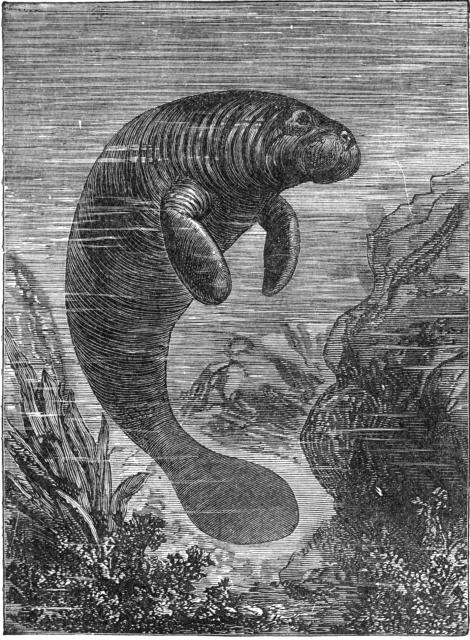 FIG. 17.—THE MANATEE. ITS USUAL POSITION.
Unfortunately both the dugong and the manatee are
being hunted to extinction.
The flesh of the manatee is considered a great delicacy.
Humboldt compares it with ham. Unlike that of the
whales, which is of a deep and dark red hue, it is as white
as veal, and, it is said, tastes very like it. It is remarkable
for retaining its freshness much longer than other meat,
which in a tropical climate generally putrefies in twenty-eight
hours. It is therefore well adapted for pickling, as
the salt has time to penetrate the flesh before it is tainted.
The Catholic clergy of South America do not object to its
being eaten on fast days, on the supposition that, with
whales, seals, and other aquatic mammals, it may be liberally
regarded as "fish." The "Indians" of the Amazon and
Orinoco are so fond of it that they will spend many days,
if necessary, in hunting for a manatee, and having killed one
will cut it into slabs and slices on the spot, and cook these
on stakes thrust into the ground aslant over a great fire,
and heavily gorge themselves as long as the provision lasts.
The milk of this animal is said to be rich and good, and
the skin is valuable for its toughness, and is much in
request for making leathern articles in which great strength
and durability are required. The tail contains a great
deal of oil, which is believed to be extremely nutritious,
and has also the property of not becoming rancid. Unhappily
for the dugong, its oil is in similarly high repute,
and is greatly preferred as a nutrient medicine to cod-liver
oil. As its flesh also is much esteemed, it is so
persistently hunted on the Australian coasts that it will
probably soon become extinct, like the rytina of Steller.
The same fate apparently awaits the manatee, which is
becoming perceptibly more and more scarce.
I fear that before many years have elapsed the Sirens of
the Naturalist will have disappeared from our earth, before
the advance of civilization, as completely as the fables and
superstitions with which they have been connected, before
the increase of knowledge; and that the mermaid of fact
will have become as much a creature of the past as the
mermaid of fiction. With regard to the latter—the Siren of
the poets,—the water-maiden of the pearly comb, the crystal
mirror, and the sea-green tresses,—there are few persons I
suppose, at the present day who would not be content to
be classed with Banks, the fine old naturalist and formerly
ship-mate of Captain Cook. Sir Humphry Davy in his
Salmonia relates an anecdote of a baronet, a profound
believer in these fish-tailed ladies, who on hearing some one
praise very highly Sir Joseph Banks, said that "Sir Joseph
was an excellent man, but he had his prejudices—he did
not believe in the mermaid." I confess to having a similar
"prejudice;" and am willing to adopt the further remark
of Sir Humphry Davy:—"I am too much of the school of
Izaac Walton to talk of impossibility. It doubtless might
please God to make a mermaid, but I don't believe God
ever did make one."
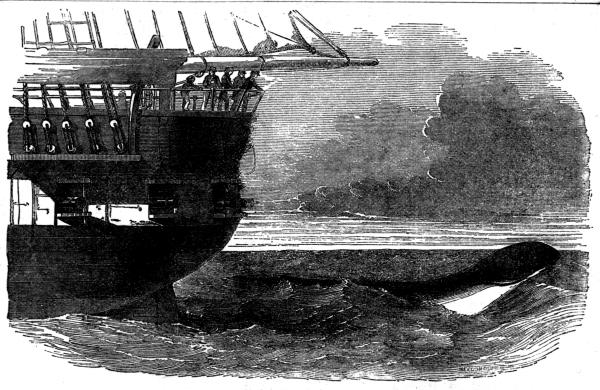
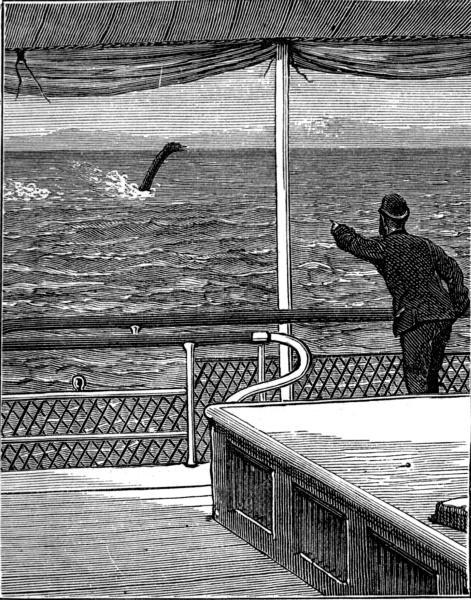
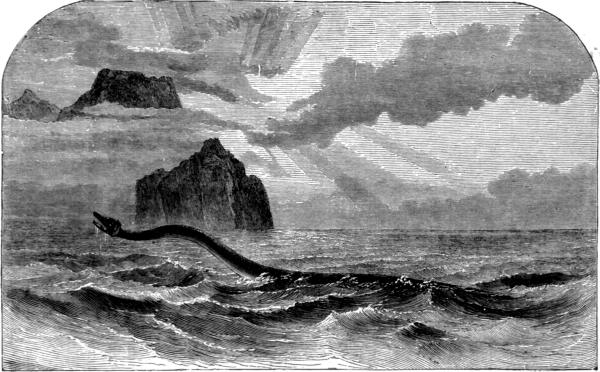
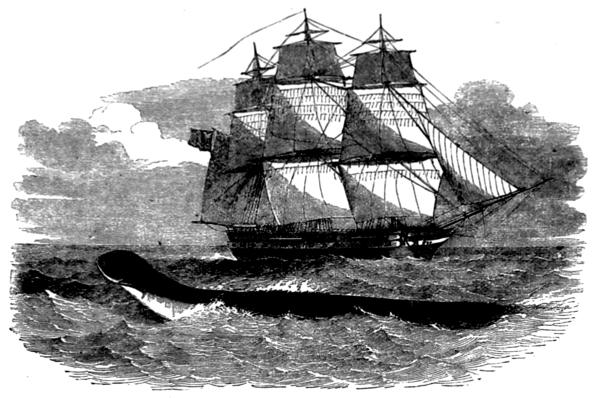 THE SEA SERPENT, AS FIRST SEEN FROM H.M.S. 'DÆDALUS.' Frontispiece.