The group of vase-paintings with which we dealt in the last chapter
raises a curious question. In all, or almost all, of them the locality
is clearly implied by the presence of a stele in the background. The
offerings which they represent were made, it seems, at the tomb itself.
Is it not, however, a strange thing that wealthy and educated Athenians
should suppose the souls of the dead to have nothing better to do than
to rest beside the tomb, and there await the offerings of survivors? Did
they not believe in a region of the dead, a kingdom of Hades, where the
bad were punished and the good received the recompense of their merits?
And if so, how could the souls of the departed be at the same time in
Hades, and in the neighbourhood of the graveyard? In order to find a
solution for these difficulties we must give some account of the views
of ordinary Greeks, at different periods of the national history, in
regard to the life after death, and the condition of the departed.
We must begin our examination of Greek belief as to the future life by
turning to the Homeric poems. The outlines of the psychical doctrine
which these contain has been traced with masterly hand by Dr. Erwin
Rohde[31], whose conclusions agree well with all that we have of late
learned from history and archaeology as to the Homeric age and
literature.
It is only superficial theorizing which will find in the Homeric poems
the ordinary barbaric views as to the nature of the soul and the future
life. Primitive elements there may be in the Homeric beliefs on these
subjects; but these primitive elements are mostly of the nature of a
survival. The Homeric poems belong to a race of singular gifts and
remarkable intellectual capacity, a small clan or aristocracy which had
by the force of inborn genius penetrated to views in all matters of
practical wisdom which must be considered decidedly advanced. Like the
Vedas of India and the Zend Avesta, the Iliad and the Odyssey
are the flowers of special developments of civilization, of the culture
of pure-blooded clans, which had worked their way forward, amid
surrounding barbarism, to a comparatively civilized survey of the world
and of mankind.
The notion which is the common property of barbarous peoples, that the
dead dwell among the living, and constantly interfere for good and for
evil in their affairs, that they must be appeased by constant sacrifices
and receive their share of all increase,—this notion has indeed left
traces in the Homeric poems, but they are slight. It rather shows
through the psychology of Homer than regulates or inspires it.
The intellectual aristocracy of Homer has in this matter a strong bias
towards scepticism. It is really remarkable how nearly the Homeric
theories of the soul correspond with the facts recorded by that cautious
and sceptical body of inquirers, the Psychical Society.
The psyche to Homer is not in the least like the Christian soul, but is
a shadowy double of the man, wanting alike in force and in wisdom. It
has no midriff, but lives as dreams live; appearing to the living in
visions, sleeping or waking, but without power. While the body of a dead
man remains unburnt or unburied, his ghost wanders about the place of
death: when the body has received due meed of funeral rites, the spirit
departs to the land of shades, never to return, nor to vex the
survivors.
The realm of Hades appears in the more antique parts of the poems of
Homer as a land where shades dwell under the rulership of King Hades and
august Persephone, living a life which is a sort of reflex and corollary
of the past. Orion, the mighty hunter, still pursues in that land the
spectres of wild beasts over the meadows of asphodel. Agamemnon still
deplores his sad fate, Ajax will not be reconciled to his enemy
Odysseus, Achilles lives on the memory of his past exploits, and rates
the life of the greatest heroes in Hades as beneath that of the meanest
serving-man on earth. Even these shadowy passions do not stir the hearts
of the dead until they have drunk of the blood of the sacrifice, and
their vital force is thus in some degree renewed. To Teiresias alone,
says Circe, has Persephone granted that even after death he shall have
living sense, while the rest flit like shadows.
It is quite clear that this view, which removes the dead to Hades, and
deprives them of all sense and power, is not to be reconciled with some
of the customs of Homeric cultus, especially with the offering of
victims, animal and human, at the tombs of heroes. This, however, is not
strange: cultus has infinitely greater power of persistence among men
than mere speculative beliefs; and among peoples of all religions we
find a want of harmony between the religious belief and the religious
custom which needs explanation. Homer does not fear the dead; but the
burial customs described in his poems must have arisen at a time when
the dead were greatly feared, and regarded as meddlesome in human
affairs.
And this marked inconsistency which we find in the Homeric age persists
throughout Greek history. The customs of the cultus of the dead are, as
we have seen, persistent among all Greek tribes, though more fully
appreciated by some than others, and remain in force down to the very
decline of Paganism. But at the same time speculation as to the world of
spirits and the condition of the departed went on, on lines almost
independent of custom and cultus. If the dead were safe in Hades they
could not also live in their tombs; why then take offerings thither? If
their life was the life of dreams and of shadows, why did they need
food, both animal and vegetable, and abundant drink? This is
sufficiently obvious to us. Yet Greek belief in all ages must have found
some means of reconciling theory and cultus, and of preventing the
course of speculation as to the state of the departed from interfering
with the practical piety of the worship of ancestors.
We are able to follow, at all events in outline, the gradual development
of the belief in Hades among the Greeks. The voyage of Odysseus to Hades
in the Odyssey, whatever may be its date (a somewhat doubtful point),
shows us that belief at a very early and incomplete stage. The main
interest of the author of the Odyssey is evidently to give a glimpse
at the later fortunes of some of the principal personages of the
Iliad; though with this he includes a curious vision of fair women,
Tyro, Alcmena, and Leda and the like. He accomplishes his purpose by
taking the widely wandering Odysseus to Hades under the pretext that he
will there learn how best he may win back to his native Ithaca. To Homer
Hades is not, as in later belief, situated beneath our feet. Odysseus
has to reach it by sailing to the confines of the ocean, to the land of
the Cimmerians, enveloped in mist and cloud, where the bright rays of
the sun do not shine. When he reaches the groves of poplar and willow,
amid which flow the rivers Acheron and Pyriphlegethon and Cocytus, he
digs a trench, and makes sacrifices to the dead, offering libations and
barley-cakes, and slaying a ram in honour of Teiresias. No sooner is
this done than the spirits of the dead begin to flock about him, and
those whom he permits to drink of the blood of his sacrifice can answer
his questions and inform him of their fate. The only class of persons
whom Homer represents as punished in Hades are perjurers, perhaps
because their punishment on earth was so problematic. But a few noted
criminals of legend, such as Tityus and Tantalus, are also represented
as undergoing a chronic punishment.
Hades, however, is by no means the only dwelling-place of souls known to
the authors of the Homeric poems. Every scholar is familiar with the
beautiful lines in which Proteus foretells the future destiny of
Menelaus[32].
In Argos’ horse-abounding plain
To die is not thy fate,
O Menelaus, there for thee
No mortal chances wait.
Thee shall the immortals far away
To earth’s remotest end,
Where fair-haired Rhadamanthys dwells
In Plains Elysian, send.
There life flows on in easy course,
There never snow nor rain
Nor winter tempests vex the land;
But Ocean sends amain
Fresh Zephyr breezes breathing shrill
To cool the untroubled life.
There dwell, since thou art kin to Zeus,
And Helen is thy wife.
In dealing with the Homeric poems we can never escape the difficulties
as to chronology and genuineness which at present envelop the whole
Homeric question, on its literary side, like a thick mist. Dr. Rohde
thinks that this passage is of later date than that which describes the
voyage to Hades of Odysseus. The last line has a curious ring. Menelaus
is to be rescued from the common fate, not for any virtue or merit of
his own, but because he is the son-in-law of Zeus. We are reminded of
the still more aristocratic belief of certain existing races of
barbarians, who think that a happy state in the future life is reserved
for the chiefs and those of high lineage.
According to the Cyclic Poets, the Islands of the Blessed were destined
not for Menelaus only, but for others of the heroes who fought at Troy.
In the Aethiopis, Eos (the Dawn) is allowed not merely to bear away
her dead son Memnon, as Sarpedon had been borne away by Sleep and Death,
but to awake him again to an immortal life. In the same poem, Thetis is
represented as carrying off the body of Achilles from the funeral pyre,
and transporting it over the sea to a new life in the island of Leuce,
the white island, which popular fancy placed in the Euxine sea. In the
Works and Days of Hesiod all the godlike heroes who fought at Troy are
said to dwell still in the Islands of the Blessed. Odysseus after his
death was said to have been translated to the island of Aeaea. And an
Athenian drinking-song of about B.C. 500 tells how Harmodius and
Aristogeiton, who slew the Tyrant and restored liberty to the Athenians,
are not dead but dwell in the Happy Isles with Diomedes and swift-footed
Achilles.
It may be doubted how far the Islands of the Blessed, the Elysian
Fields, and the Realm of Hades are really distinct in Homeric geography.
All seem to be reached by a voyage across the sea in the direction of
the setting sun. Subsequent poets, however, gradually determine and map
out the land of the dead. It is a conjecture, the truth of which is more
than probable, that the great teacher of the lore of the future world
was Orphism.
Orphism is one of the most important, but at the same time one of the
most obscure phases of ancient religion. The original documents of the
sect have perished, and forgeries have taken their place. It is only by
putting together a number of occurrences, and collecting phenomena from
all quarters, that we are able even to conjecture the tenets and
observances of the Orphists; yet it seems certain that they exercised a
deep and long-continued influence on the development of religion in
Greece. We first clearly trace their activity in the sixth century B.C.,
when Onomacritus, a contemporary of Peisistratus at Athens, committed to
writing much of their lore, and when Pythagoras attempted to found among
the Greek cities of Southern Italy something like an Orphic church. Yet
from what we learn as to Orphism, we see that it must contain elements
handed down from a barbaric and primitive state of religion. It was
essentially mystic and ecstatic in character. Zagreus, who was a form of
Dionysus, was the principal object of Orphic worship,—the young god who
was torn to pieces by the wicked hands of Titans, but restored to life
by the favour of Zeus and Athena. By mystic communion with Zagreus, who
was regarded as the ruler of the dead, the votary escaped from the
trammels of the flesh, became pure and chaste, and fit for a nobler
existence hereafter. Of course, in this religion, as in all, mere ritual
tended to encroach on the religion of conduct; it was supposed by many
that a mere partaking in mysterious rites would secure for them a
favourable reception in the world of shades, and a verdict of acquittal
from the stern judges of the dead.
It is certain, as I have already observed, that this ecstatic form of
religion contains primitive elements. Anthropology has informed us that
the wizard or medicine-man among savage tribes commonly acquires and
retains his influence by means of trances or ecstasies, in which he
professes to be inspired by the spirits of the dead. This is the
original germ whence all ecstatic religion takes its rise; though, of
course, it may reach a high moral level under some circumstances, and
tend greatly to the help and elevation of mankind. What was the precise
ethical level of the Orphic religion it is very hard to say.
However, we are at present concerned only with one aspect of
Orphism—its lore as to the world of spirits. It is believed that this
lore gradually works its way into current literature and art. After we
leave the Homeric age, the next important landmark in the history of
Hades is to be found in the great painting of Polygnotus in the Leschè
or arcade of Delphi. Of this picture we possess so careful and detailed
a description from the pen of Pausanias[33] that a skilled
archaeologist, Professor Robert, has succeeded, with the help of certain
vase-paintings of Polygnotan style, in restoring, figure for figure, the
whole composition, with a sureness of hand which may well surprise those
who do not realize the degree in which the scientific methods of
archaeology have been developed in recent years.
In the upper part of the picture is a group which is almost a transcript
from the Odyssey: Odysseus sword in hand over his trench, the unburied
Elpenor behind him in sailor’s dress, and Teiresias and Anticleia
approaching to hold converse with him. But this group seems somewhat
apart from the rest of the scene, which is composed of elements mostly
foreign to the Homeric circle of ideas. On the left is the river
Acheron, full of reeds and peopled with shadowy fish; on which floats
the bark of the ferryman Charon, who is taking to their last home the
spirits of a man and a girl. Pausanias observes that Polygnotus has
borrowed Charon from the epic poem called the Minyas, in which the
voyage to Hades of Theseus and Peirithous was narrated. Whencesoever
Charon may have originally come, he certainly held a great place in the
beliefs of the later Greeks. The obol, his fee, was sometimes placed in
the mouth of the dead. In later writers, such as Virgil and Lucian, he
is very prominent. Some of the sepulchral lekythi, of which I have
spoken already, furnish us with a representation of the River of Death
and the boat of Charon. One here
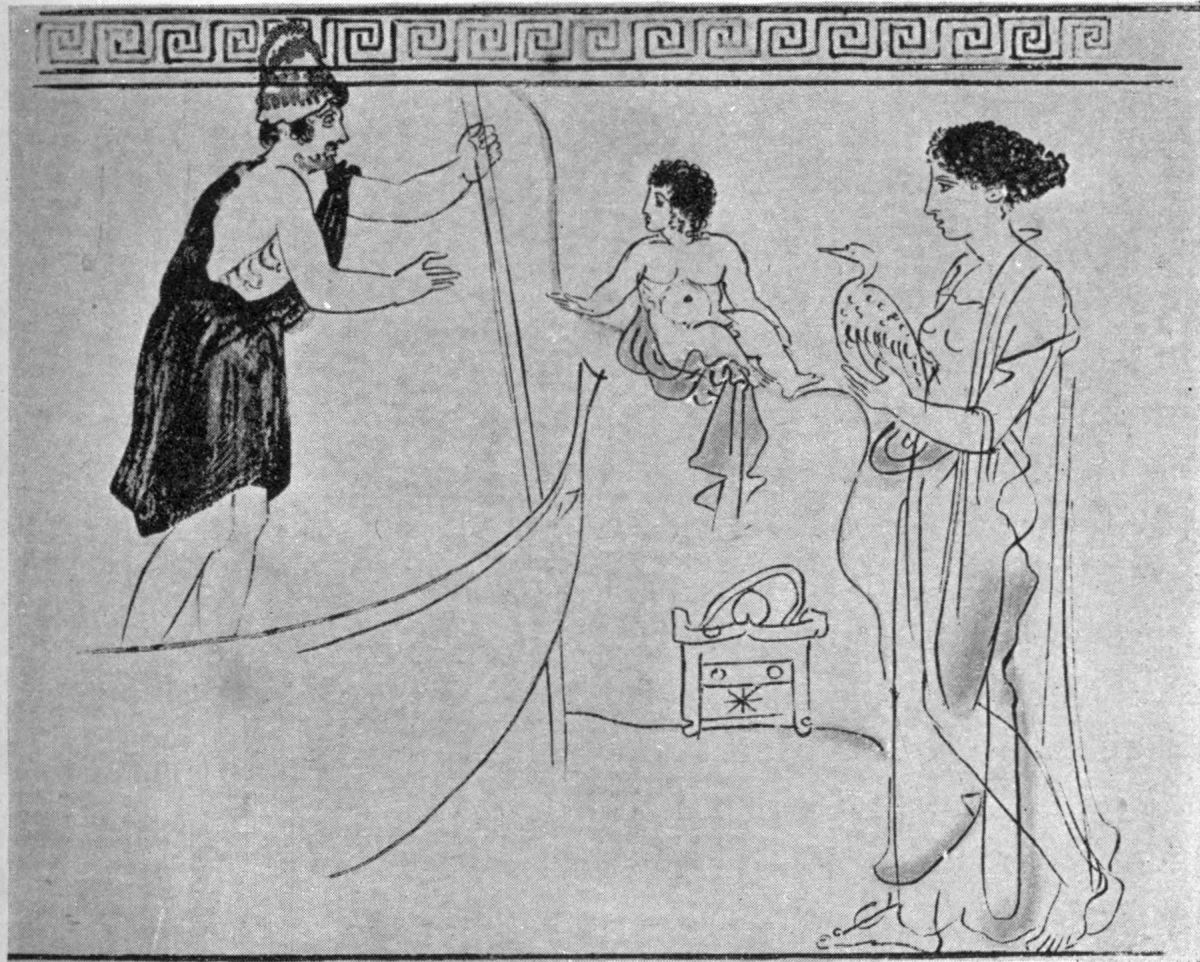
FIG. 12. THE BOAT OF CHARON.
copied (Fig. 12) from a vase at Athens[34], presents a most curious
scene. Charon, a being of traditional ugliness, clad in sailor’s cap and
short chiton, drives his boat to the bank by means of a pole. He is
awaited by a girl who bears in her hands her favourite bird, a goose,
while a box for the toilet rests on a rock, and near it sits a young
child. This flitting to the world of shades has quite a domestic aspect:
it seems that Charon was expected to convey not only passengers, but
also as baggage the offerings brought to them at the tomb. Sometimes the
boat of Charon appears in these vase-paintings in close proximity to the
stele of the grave; and the dead wait for him on the steps of the
stele[35]. On another vase, Hermes, with herald’s staff, leads the soul
down to the edge of the river[36].
It is a well-known fact, though one not easy to explain, that Charon,
under the form Charuns, figures as the messenger of death in several of
the mural paintings of Etruscan tombs. He is there depicted as a hideous
monster, with hooked nose, sometimes winged, wielding an axe, and
entwined with serpents. That the mild and quiet Charon of the Greeks
should have his counterpart in a fierce and deformed daemon in the more
monstrous pantheon of Etruria is quite natural; but it is less clear
whence the Greeks and Etruscans originally borrowed their respective
divinities.
We must, however, resume our description of the picture of Polygnotus.
About the entrance of Hades cluster the transgressors whose punishment
is eternal. They are very few in number: the parricide, the
temple-robber, and such noted personages of legend as Tityus, who is
devoured by a vulture after the fashion of Prometheus. Next we reach a
group of fair women, who must indeed have been delightful creations
under the hands of the most dignified and majestic of all
painters—Ariadne and Tyro, Procris and Chloris. For some who had to be
punished a most gentle meed of punishment is provided. Phaedra in her
lifetime, as is well known, was inspired with a disastrous passion for
her stepson Hippolytus, and after his death she went and hanged herself.
In the painting of Polygnotus, as Pausanias observes, ‘Phaedra is borne
through the air on a swing, and holds the ropes on each side in her
hands: this attitude, in spite of the extreme gentleness of the
allusion, refers to the manner of her death.’ Near the group of women
Theseus and Peirithous are seated. They had dared, with overweening
impiety, to make their way into Hades, in order to carry off Persephone,
Queen of the Shades. But they were made prisoners by the nether powers
and kept in chains. Such a fate for heroes of the race of the gods
naturally seemed to Polygnotus too harsh. In his picture they merely
keep their seats. So Virgil writes, ‘Sedet aeternumque sedebit infelix
Theseus.’ Pausanias quotes Panyasis, a late Epic poet, to the effect
that Theseus and Peirithous on their seats did not appear to be
prisoners, but really the rock grew to their flesh in the place of
bonds. But Polygnotus was content with a mere hint: in his painting
nothing indicated either bondage or torture. Near by are Cameiro and
Clytie, daughters of Pandareus. In the Odyssey Penelope tells how they
were carried away by the fierce storm-winds and given to the hateful
Erinnyes. But Polygnotus will know nothing of the Erinnyes. He merely
represents the girls as crowned with flowers and playing with astragali
or knuckle-bones. The storm-winds seem to have done them little harm.
Presently we come to the central part of the picture. It is occupied by
the grove of Persephone, represented in the sparing fashion of Greek
painting by a single tree, under which sits Orpheus, his lyre in his
hands. No doubt we have here the key to the picture. Orpheus is the
central figure of the whole. To Polygnotus he is not merely a departed
hero, but priest and hierophant. The song which he sings is the mystic
song of immortality. About him there cluster the heroes who fought at
Troy: on the one side Agamemnon, Protesilaus, Achilles, Patroclus; on
the other, Hector, Paris, Memnon, Sarpedon, and Penthesileia, queen of
the Amazons. Paris makes love to Penthesileia, who looks back at him
with contempt. The Greek and Trojan heroes may fight again their battles
in memory; but peace has fallen on them, and they no longer wish to
wield the lance. We need not dwell on other groups: Palamedes and
Thersites busy with the dice; Thamyris, who had once challenged the
Muses, seated in dejection over his broken lyre; the strange apparition
of Marsyas, who teaches the boy Olympus to play the flute; and many
others.
Towards the right end of the painting we again find punishments of a
kind going forward. Sisyphus heaves his rock up the hill. Tantalus
stands up to the chest in water which he may not drink, and clutches at
fruit which eludes his grasp. These punishments had already been
mentioned in the Odyssey; Polygnotus adds a rock, which hangs over the
head of the sufferer, ever threatening to fall, but never falling. There
appears also a great cask set in the earth, which it is the fate of an
approaching train ever to try to fill with water from broken
water-vessels. This was, according to tradition, the allotted task of
the fifty daughters of Danaus, who had all save one in one night slain
their husbands. But Polygnotus followed a different account: he calls
the approaching men and women merely ἀμύητοι, uninitiated. Pausanias
observes that they must be those who held in contempt the sacred
mysteries of Eleusis; but this does not seem to be the meaning. They are
ordinary persons, men and women who did not necessarily sin overtly
against the Mysteries, but merely neglected to avail themselves of the
‘means of grace’ offered them by the hierophants of Eleusis, and suffer
in the next world for their carelessness or obstinacy.
The general tone of the painting of Polygnotus bears a close resemblance
to that of the sepulchral reliefs which we shall describe in this book.
This is the less curious, when we consider that the sculptors of the
reliefs were of that Attic school of sculpture which took so much of its
character from Polygnotus. In spirit also the painting is like the
Homeric poems, when they deal with the future life. The cultivated Greek
mind looked for little bliss in the world to come, except such as could
come from the reunion of friends and families, and the memory of past
deeds. Still less did it look for future punishments. These were
ordinarily reserved for the noted criminals of legend. The only classes
which Polygnotus seems to have thought in any peril were the parricides,
the temple-robbers, and the uninitiated. He seems to have thought that
spirits were of the stuff of which dreams are made, and passed an
existence of quiet and gentle melancholy, of which the worst feature was
its exposure to tedium.
There do not appear in the picture of Polygnotus, as in some paintings
which we must presently consider, any malignant beings to act as the
police of the under-world. Not even Cerberus appears. The only spirit of
inauspicious type who is seen is Eurynomus. Pausanias says[37]: ‘The
interpreters at Delphi say that Eurynomus is one of the spirits that
dwell in Hades, and that his office is to devour the bodies of the dead,
leaving only their bones.’ Eurynomus does not appear, adds Pausanias, in
Homer nor in the Cyclic poets. The daemon shows his teeth, and is seated
on the skin of a vulture. Probably it was from the facts just mentioned
that the interpreters at Delphi deduced the function of Eurynomus. But
their opinion goes for little, and the name Eurynomus has nothing to do
with the decay of the flesh. In the time of Polygnotus it was usually
fire rather than decay which made away with the bodies of the dead. This
daemon, who was possibly an archaic form of Hades himself, remains then
unexplained. At any rate, we have no right to regard him as a punisher
of souls. The punishments of Hades, according to Polygnotus, seem to go
on by some law, without present enforcement.
With the Hades of Polygnotus we must compare that which is depicted on a
class of large amphorae which come to us from Apulia in Italy. I have
engraved (Fig. 13) a fair specimen of these vase-paintings, which are
all closely alike, from a vase of Canusium[38].
Here in the centre we have, in place of the sacred grove of Persephone,
the palace of Hades and his Queen. He is seated, and holds a long
sceptre; she carries a torch. The palace has not unnaturally taken the
form of a chapel of the deities; the wheels hung up in the background
seem to be votive offerings. The motive of the whole picture is
curiously twofold. Two visits to Hades, which really took place at quite
different times, are depicted as going on together, the quest of Orpheus
for his lost Eurydice, and the attempt of Herakles to carry off the dog
Cerberus and to rescue his friend Theseus.
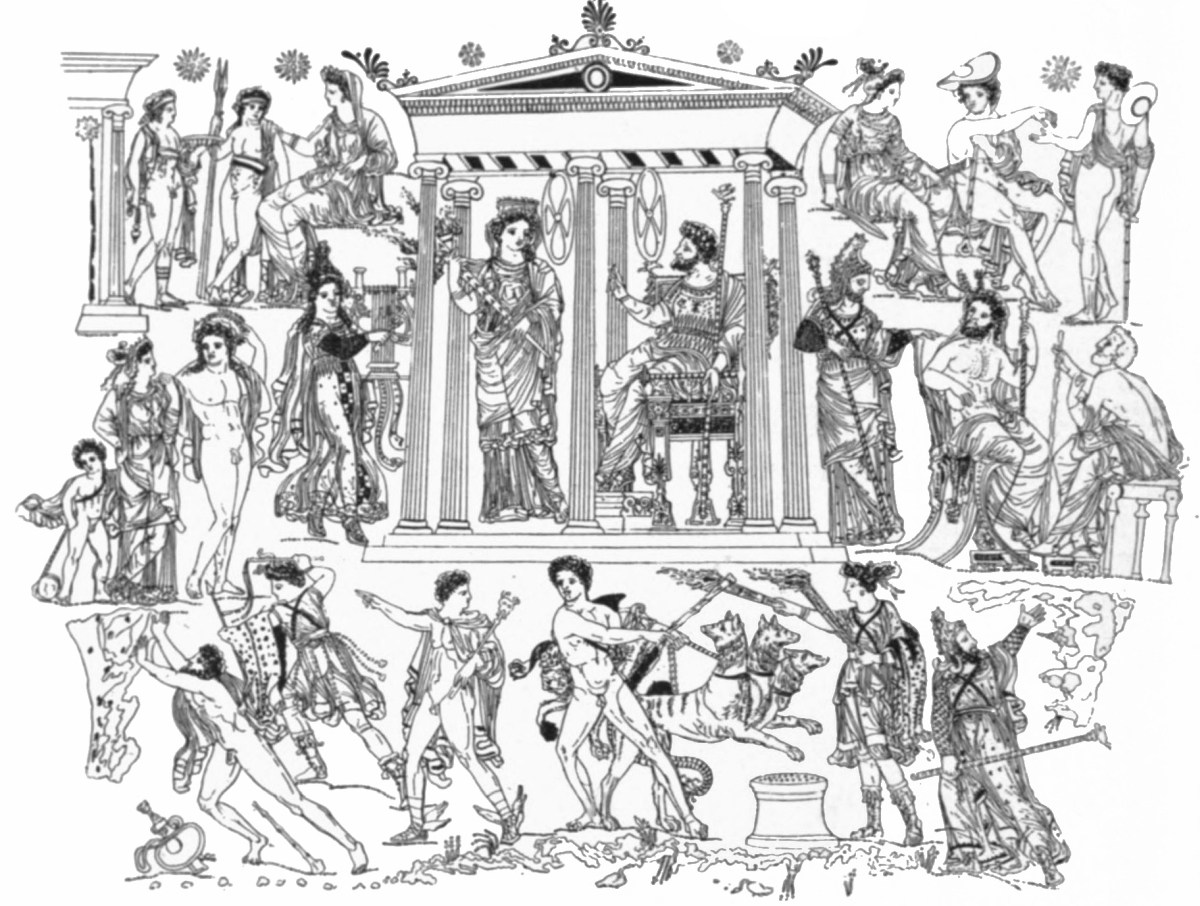
FIG. 13. THE GREEK UNDER-WORLD.
Orpheus stands, lyre in hand, before the chapel of the nether deities.
He is clad in the variegated embroidered robes of the Orientals, with
sleeves down to the wrists and a Phrygian tiara. In the painting of
Polygnotus Orpheus was, as Pausanias expressly states, clad in the
ordinary Greek dress. Later art rejoiced in the picturesque costume of
the Persians and Phrygians: and the Thracian home of Orpheus allowed
artists to consider him as belonging to a semi-Greek, Anatolian race.
Orpheus is evidently using his art to persuade Hades to restore
Eurydice, and that dread deity seems, from the position of his uplifted
right hand, to be addressing him; but Eurydice, in this as in most of
the vase-paintings, is wanting; a curious fact, which may indicate that
the motive of the quest of Orpheus was originally something different.
It seems indeed, as will appear clearly later, that the vase-painter
combines without much skill or purpose groups taken from the works of
older and more thoughtful artists.
In the lowest line Herakles struggles with Cerberus, around whose three
necks he has fastened a chain. Hermes, who carries a herald’s staff,
points out to his brother the road to the upper air, and urges
departure. A more terrifying figure behind Herakles also gives cause for
haste. One of the Poenae or Furies, a female servant of Hades, wearing
hunting-boots and holding over her arm a leopard’s skin, advances with a
torch to defend the realm of the dead against rash invaders. In the
upper line, on the right, a similar figure, with drawn sword, guards the
captives whom Herakles has come to release. Peirithous sits and cannot
rise, but Theseus is standing; so far as he is concerned, the attempt of
the invincible Herakles is successful, and he is allowed to return to
earth.
The other groups which make up the picture have no special connexion
either with Orpheus or with Herakles, and are introduced merely to
complete the picture of Hades. On some of these under-world vases the
names are written over the various persons, so that we can identify them
with ease and certainty. In the upper line to the left is Megara, the
wife of Herakles, and the two children of hers whom their father slew in
a fit of madness. They stand near a spring-house, where water flows from
a lion’s-head fountain. Drops of blood still stand on their breasts. Why
they alone should thus bear in Hades the marks of mortal calamity we
cannot say; nor indeed why they should appear at all as prominent
inhabitants of the land of shades. One is inclined to fancy that some
tale or legend may have connected them with the voyage of their father
to Hades.
Beneath them is a curious domestic group: a young husband who is in the
act of crowning himself with a wreath, a wife, and their little son, who
drags behind him a plaything. It is a veritable scene of the
reconstitution, in the land of shades, of a family endued with perpetual
youth and leisure. Who these people may be is quite uncertain; but it is
reasonable to think that they are such as have undergone initiation, and
whose future life is thus assured. Opposite are the three judges of the
dead, Minos, Aeacus, and Rhadamanthys, or, as some give the name,
Triptolemus. Bearded and venerable figures, they carry long sceptres,
but do not look so stern as one would expect from their terrible
function.
The other scenes, in the two corners below, are of not much more than
geographical import. They show the place to be Hades by introducing some
of the well-known inhabitants of that region. On the left is Sisyphus
uprearing his rock; and lest he should loiter at the task, one of the
Poenae with snakes in her hair urges him with a double-thonged whip; in
her other hand she carries a javelin and leopard’s skin. On the right is
Tantalus, in the dress of an Oriental prince, and still carrying his
sceptre. The Homeric pains have ceased to trouble him; he no longer
stands in water, nor reaches after fruit. But he is still threatened by
the hanging rock.
On other vases of the class, while the general arrangement is the same,
the groups are varied. Peleus and Myrtilus, the faithless charioteer who
arranged his victory at Olympia, sometimes take the place of Theseus and
Peirithous. In the place of Tantalus we have a group of women ever
drawing water, whether they be the Danaides or women who died
uninitiated.
It is likely that all these Apulian vase-paintings go back to some
original of a great painter which was known throughout the Greek world.
An original by Polygnotus it cannot be; the composition is quite unlike
his, and the Oriental garments worn by some of the personages indicate a
different and a later school than his. We know that Nicias, a
contemporary of Praxiteles, made a great picture of the under-world; but
as we know nothing of its details, the inquiry whether this was the
original copied in Italy has no certain basis.
Singularly instructive and suggestive is the comparison of these
Hellenic pictures of the under-world with those which our ancestors of
the Middle Ages painted on the walls and in the windows of their
churches. There we see the ecstatic bliss of the saved, conducted by
angels to the abode of God and the saints, and the fearful tortures
inflicted upon the damned by hosts of hideous and malignant demons, who
bind, burn, tear, and outrage them with fiendish ingenuity. In the
Christian paintings there is no mean, everything is extreme. The destiny
to eternal life or eternal torment seems to hang upon a decision by no
means easy: angels and devils dispute the possession of souls, and the
latter are at least as successful as the former in their raids. Our
ancestors can scarcely have taken these representations as seriously as
we are disposed to take them, or life shadowed by such a terrific future
would have been unendurable. But still they embodied the teaching of the
Church, which few dared dispute, at all events openly. They give us a
glimpse at the terrible moral pressure necessary in order that the
realities of the moral and spiritual life should be burned into the
heart of the European peoples.
In the Greek pictures, on the other hand, nothing is extreme, but
everything is in moderation. Setting aside the torments of a few
legendary heroes, like Tityus and Tantalus, which had little relation to
actual life, there was no torture, as there was certainly no bliss, in
Hades. Between the punishment of the uninitiated and the reward of the
initiated there is not very much difference. Whether Megara and her
children belong to the class of the happy or the wretched we do not
know. They bear the marks of suffering, but as one of the boys carries
the oil-flask and strigil of the athlete, he would seem to pass his time
in Hades as suitably as the little boy of the initiated pair who
trundles his toy. The only unpleasant feeling which is roused by our
vase-painting or the more exquisite Hades of Polygnotus is that its
tenants must suffer from infinite ennui, and the same reproach has been
brought sometimes against the heaven of the Middle Ages. But probably
only highly civilized people learn to realize that ennui may become a
torment.
In particular, we may compare the swarms of black and hideous devils,
with horn and hoof of the mediaeval pictures, with the Greek Poenae. We
can trace the genealogy of these latter from early times. The Oriental
imagination had from very early times delighted in depicting evil
spirits in the form of monsters and winged beasts, who are overcome and
slain by the gods in human form. For winged monsters the Greek artists
of the sixth century had tended to substitute winged human beings of
hideous aspect, Gorgons and Harpies, Eris and Phobos, and the like. It
was Aeschylus who, wishing to bring on the stage in bodily form in his
Eumenides the powers that avenge kindred blood, transformed the
Erinnyes, who had hitherto been worshipped at Athens as the Eumenides
or gentle goddesses, in beautiful and dignified form[39]. He took as his
models the Gorgons and Harpies of earlier art. So he himself tells us in
the Eumenides[40], where his priestess thus describes the sleeping
visitors: ‘I call them not women, but Gorgons; yet cannot I quite liken
them to the forms of Gorgons. In a picture once I saw Harpies painted
bearing off the food of Phineus: these, however, are unwinged in aspect,
but black and utterly abominable.’
Pausanias too says, when speaking of the shrine of the Eumenides at
Athens[41]: ‘It was Aeschylus who first wreathed snakes in their hair;
but in their statues there is nothing terrible, nor in the other statues
set up in honour of the nether gods.’ In a series of vase-paintings
which represent the flight to Delphi and the purification of Orestes,
the Erinnyes appear sometimes in Aeschylean guise as women, unwinged,
but with snakes in their hair and of terrible aspect. With these the
Poenae of our vase-painting are almost identical in dress, though the
ugliness is softened down. And as Polygnotus knows not the Poenae, it
seems likely that it was in part the influence of Aeschylus which
introduced them as ministrants of evil in the realm of Hades. But the
Poenae certainly fill very inefficiently the place of the Christian
demons. Greek art loved to soften, to generalize, while mediaeval art
rejoiced, like Dante, in exact detail. Greek art was always ready to
sacrifice precise meaning to beauty and grace, while mediaeval art had
little sense of beauty, but tried to work on the emotions of fear and
horror.
Side by side with the evidence derived from the works of ancient
painters we must place that derived from ancient poets and other
writers. The philosophers are outside our scope, except so far as they
testify to the opinions of ordinary men: to regard the views of Plato
and Epicurus as ordinary Greek opinions would of course be as absurd as
to regard John Stuart Mill or Herbert Spencer as representatives of the
ordinary Englishman.
In ordinary Greek belief, then, we find abundant traces of the eternal
conflict between the priest and the prophet, between ritual and ethics.
There was a general feeling that those who died nobly or after a
well-spent life were sure of a friendly reception in Hades. Xenophon
says of Agesilaus[42], ‘He ever feared the gods, being of opinion that
those who lived nobly were not yet happy, but that those who had died
with good name were at once among the blessed.’ The chorus in the
Alcestis speak of their mistress immediately after her death as a
blessed spirit. And a multitude of epitaphs[43] express the conviction
that those who had lived nobly were sure of a favourable reception from
Persephone. Beside this ethical view we find the opinion of the
sacerdotal party that initiation in the Mysteries or attachment to the
cultus of some deity was necessary for the attainment of future bliss.
This was especially the view of the Orphists, and as such it is
ridiculed by Plato in the Republic[44]: ‘They persuade not individuals
merely, but whole cities also, that men may be absolved and purified
from crimes, both while they are still alive and even after their
decease, by means of certain sacrifices and pleasureable amusements
which they call Mysteries: which deliver us from the torments of the
other world, while the neglect of them is punished by an awful doom.’ We
have seen that Polygnotus gives some countenance to those who regarded
the Mysteries as the gate of future happiness. And there was certainly
in Greece a generally spread conviction, which may be well traced in the
Frogs of Aristophanes, that initiation was, if not a passport to
future happiness, at least a safeguard amid the dangers which surround
the soul from the moment of its departure from the body until its final
doom is fixed.
In the mentions of Hades to be found in the Tragedians, it appears more
especially as the place of the reassembling of families. Sophocles’
Antigone expresses a hope of being well received in Hades by the
relations to whom at her peril she has performed the rites of burial.
The Oedipus of Sophocles wants to blind himself in order that in Hades
he may not see the father and mother whom he has so deeply though
ignorantly injured. In the Agamemnon of Aeschylus, Clytemnestra
anticipates the meeting of Agamemnon in Hades with his daughter
Iphigeneia. Hyperides, in his Funeral Oration, takes a somewhat wider
view. He imagines the fallen heroes of the Lamian War as received in
friendly fashion in Hades not merely by their kinsfolk, but by the
worthies of Troy and of Marathon, and by the tyrannicides Harmodius and
Aristogeiton.
As regards the imagery and geography of Hades the ordinary Greeks do not
seem to have greatly troubled themselves. There were the views of poets
and painters, and there were the more definite and dogmatic views of the
professors of Orphic lore. These the people received or neglected as
suited the bent of the mind of each. Hades was a realm of the
imagination, as to the nature of which each man might innocently indulge
his own hopes and aspirations.
In the epitaphs of later times we find, as will be shown in a future
chapter[45], numerous allusions to the realm of Hades and Persephone.
But they do not strike the reader as embodying strong belief; often they
are of an epideictic or rhetorical character, like the statements which
also occur that the soul of the dead has made its way to the Islands of
the Blest or to the abodes of the gods. The beliefs which confined the
spirits of the dead to the tomb and its neighbourhood belong to a lower
and worse-educated stratum of the population, but have more vitality.
Greek religion and tradition knew of many mortals who had gone down
alive into the earth, and there abode, giving for the most part oracles
from their hiding-places. Such was Amphiaraus, the Argive hero, who
after the bootless siege of Thebes went down with chariot and horses
into the ground, and whose shrine was in later times a great oracular
seat. Such was Trophonius of Lebadeia, whose cave is described for us by
Pausanias. Caeneus, when overwhelmed with rocks by the Centaurs,
vanished alive into the earth, and there lived on. It is, in fact, a
marked feature of the cultus of heroes that their power is exercised
only at the place where they disappeared or where their bodies were
laid. They are intensely local, earth-daemons who possess a piece of
land, and whose favour must be conciliated by any one who expects that
land to yield him increase. Pelopidas, in the course of a campaign
against the Spartans[46], unwittingly slept near the graves of some
virgins of Leuctra, who had in old time been violated and slain by the
Spartans. They appeared at night to the Theban general, and promised him
victory if he made them the sacrifice of a foal. This is but one among a
hundred instances of the fact that a hero had power only at his spot of
burial: elsewhere he was helpless.
It is remarkable that this tendency to localization has been in all ages
a mark of the ghost, and still marks him in the cases investigated by
the Psychical Society. Yet the local character of ghosts has not become
an impediment in the way of the acceptance of the Christian doctrines of
Heaven, Hell, and Purgatory. Among our ancestors, just as among the
Greeks, beliefs could lie in strata, and inconsistencies between a
belief of one stratum and a belief of another stratum had little
disturbing power. When Campbell writes in his noble address to the
Mariners of England, ‘The spirits of your fathers shall start from every
wave,’ he can scarcely be supposed to deny that the souls of British
naval heroes had found a heavenly resting-place.
Sometimes, however, the Greek mind was disturbed by inconsistencies of
this kind, and evolved a theory for their explanation. Thus a later
interpolator of the Odyssey, being scandalized by the assertion of
Odysseus that he saw in Hades the mighty Herakles, adds[47], ‘his ghost
(εἴδωλον) only; since he himself joys amid the delights of the immortal
gods.’ Others supposed that it was only the spirits of the unburied
which hovered around their bodies: and it is an ingenious modern theory
that the custom of burning the bodies of the dead arose out of the
desire to prevent them from disturbing the living. But in spite of
everything, the Greek dead retained to the last their right to levy
tribute on their descendants and friends.



 for Λ and Λ for Γ, was officially superseded by the
alphabet of Asia Minor in the archonship of Euclides 403 B.C. But long
before this date the Ionian letters had been in frequent use for private
documents. Thus any tomb bearing an inscription in the Ionian character
can scarcely be later than 400 B.C.; but may be considerably earlier.
The evidence of date furnished by inscriptions being thus rather vague,
we return to the evidence offered by the forms of the stelae and the
style of the reliefs.


 ; and so makes it possible for any given front
to be less than a fourth of the circuit of the building. Here Mr.
Oldfield has certainly won a great advantage over rival constructions:
he has kept to the text of Pliny, and at the same time greatly improved
the form of the building. It is true that it would not be easy to find
other Greek buildings of cruciform plan, but the Erechtheium at Athens
gives us a hint that such a plan, produced by the intersection of two
ordinary temples, would not be impossible. And the Mausoleum was a
building in which originality of design was to be expected.


