THE first winter had interrupted
all work upon the
rock; but Taffy and his
men had used the calm days
of the following spring and
summer to such purpose
that before the end of July the foundations
began to show above high-water neaps,
and in September he was able to report
that the building could go forward in any
ordinary weather. The workmen were
carried to and from the mainland by a
wire hawser and cradle, and the rising
breastwork of masonry protected them
from the beat of the sea. Progress was
slow, for each separate stone had to be
dovetailed above, below, and on all sides
with the blocks adjoining it, besides being
cemented; and care to be taken that no
salt mingled with the fresh water, or found
its way into the joints of the building.
Taffy studied the barometer hour by hour,
and kept a constant lookout to windward
against sudden gales.
On November 16th the men had finished
their dinner and sat smoking under
the lee of the wall and were expecting the
call of the whistle when Taffy, with his
pocket-aneroid in his hand, gave the order
to snug down and man the cradle for shore.
They stared. The morning had been a halcyon
one; and the northerly breeze, which
had sprung up with the turn of the tide and
was freshing, carried no cloud across the
sky. Two vessels, a brigantine and a
three-masted schooner, were merrily reaching
down channel before it, the brigantine
leading; at two miles' distance they could
see distinctly the white foam running from
her bluff bows, and her forward deck from
bulwark to bulwark as she heeled to it.
One or two grumbled. Half a day's
work meant half a day's pay to them. It
was all very well for the Cap'n, who drew
his by the week.
"Come, look alive!" Taffy called
sharply. He pinned his faith to the barometer,
and as he shut it in its case he
glanced at the brigantine and saw that her
crew were busy with the braces, flattening
the forward canvas. "See there, boys.
There'll be a gale from the west'ard before
night."
For a minute the brigantine seemed to
have run into a calm. The schooner, half
a mile behind her, came reaching along
steadily.
"That there two-master's got a fool for
skipper," grumbled a voice. But almost
at the moment the wind took her right
aback—or would have done so had the
crew not been preparing for it. Her stern
swung slowly around into view, and within
two minutes she was fetching away from
them on the port tack, her sails hauled
closer and closer as she went. Already
the schooner was preparing to follow suit.
"Snug down, boys! We must be out
of this in half an hour."
And sure enough, by the time Taffy
gained the cliff by the old light-house the
sky had darkened and a stiff breeze from
the northwest, crossing the tide, was beginning
to work up a nasty sea around the
rock and top it from time to time over the
masonry and the platforms where, half an
hour before, his men had been standing.
The two vessels had disappeared in the
weather; and as Taffy stared in the direction
a spit of rain—the first—took him
viciously in the face.
He turned his back to it and hurried
homeward. As he passed the light-house
door old Pezzack called out to him:
"Hi! wait a bit! Would 'ee mind
seein' Joey home? I dunna what his
mother sent him over here for, not I.
He'll get hisself leakin'."
Joey came hobbling out and put his
right hand in Taffy's with the fist doubled.
"What's that in your hand?"
Joey looked up shyly. "You won't tell?"
"Not if it's a secret."
The child opened his palm and disclosed
a bright half-crown piece.
"Where on earth did you get that?"
"The soldier gave it to me."
"The soldier? nonsense! What tale
are you making up?"
"Well, he had a red coat, so he must be
a soldier. He gave it to me and told me
to be a good boy and run off and play."
Taffy came to a halt. "Is he here—up
at the cottages?"
"How funnily you say that! No, he's
just rode away. I watched him from the
light-house windows. He can't be gone
far yet."
"Look here, Joey—can you run?"
"Yes, if you hold my hand; only you
mustn't go too fast. Oh, you're hurting!"
Taffy took the child in his arms, and
with the wind at his back, went up the hill
with long stride. "There he is!" cried
Joey as they gained the ridge; and he
pointed; and Taffy, looking along the
ridge, saw a speck of scarlet moving
against the lead-colored moors—half a
mile away perhaps, or a little more. He
sat the child down, for the cottages were
close by. "Run home, sonny. I'm going
to have a look at the soldier, too."
The first bad squall broke on the headland
just as Taffy started to run. It was
as if a bag of water had burst right overhead,
and within quarter of a minute he
was drenched to the skin. So fiercely it
went howling inland along the ridge that
he half-expected to see the horse urged
into a gallop before it. But the rider,
now standing high for a moment against
the sky-line, went plodding on. For a
while horse and rider disappeared over the
rise; but Taffy guessed that on hitting the
cross-path beyond, they would strike away
to the left and descend toward Langona
Creek; and he began to slant his course
to the left in anticipation. The tide, he
knew, would be running in strong; and
with this wind behind it he hoped—and
caught himself praying—that it would
be high enough to cover the wooden footbridge
and make the ford impassable;
and if so, the horseman would be delayed
and forced to head back and fetch a circuit
farther up the valley.
By this time the squalls were coming
fast on each other's heels and the strength
of them flung him forward at each stride.
He had lost his hat, and the rain poured
down his back and squished in his boots.
But all he felt was the hate in his heart.
It had gathered there little by little for
three years and a half, pent up, fed by his
silent thoughts as a reservoir by small
mountain-streams; and with so tranquil
a surface that at times—poor youth!—he
had honestly believed it reflected God's
calm, had been proud of his magnanimity,
and said "forgive us our trespasses, as
we forgive them that trespass against us."
Now as he ran he prayed to the same God
to delay the traitor at the ford.
Dusk was falling when George, yet unaware
of pursuit, turned down the sunken
lane which ended beside the ford. And
by the shore, when the small waves lapped
against his mare's fore-feet, he heard
Taffy's shout for the first time and turned
in his saddle. Even so it was a second or
two before he recognized the figure which
came plunging down the low cliff on his
left, avoiding a fall only by wild clutches
at the swaying alder boughs.
"Hello!" he shouted, cheerfully.
"Looks nasty, doesn't it?"
Taffy came down the beach, near enough
to see that the mare's legs were plastered
with mud, and to look up into his enemy's
face.
"Get down," he panted.
"Hey?"
"Get down, I tell you. Come off your
horse, and put up your fists."
"What the devil is the matter? Hello!...
Keep off, I tell you! Are you
mad?"
"Come off and fight."
"By God, I'll break your head in if
you don't let go.... You idiot!"—as
the mare plunged and tore the stirrup-leather
from Taffy's grip—"She'll
brain you, if you fool round her heels like
that!"
"Come off, then."
"Very well." George backed a little,
swung himself out of the saddle and faced
him on the beach. "Now perhaps you'll
explain."
"You've come from the headland?"
"Well?"
"From Lizzie Pezzack's."
"Well, and what then?"
"Only this, that so sure as you've a
wife at home, if you come to the headland
again, I'll kill you; and if you're a
man, you'll put up your fists now."
"Oh, that's it? May I ask what you
have to do with my wife, or with Lizzie
Pezzack?"
"Whose child is Lizzie's?"
"Not yours, is it?"
"You said so once; you told your
wife so; liar that you were."
"Very good, my gentleman. You shall
have what you want. Woa, mare!" He
led her up the beach and sought for a
branch to tie his reins to. The mare hung
back, terrified by the swishing of the
whipped boughs and the roar of the gale
overhead; her hoofs, as George dragged
her forward, scuffled with the loose-lying
stones on the beach. After a minute he
desisted and turned on Taffy again.
"Look here; before we have this out
there's one thing I'd like to know. When
you were at Oxford, was Honoria maintaining
you there?"
"If you must know—yes."
"And when—when this happened, she
stopped the supplies."
"Yes."
"Well, then, I didn't know it. She
never told me."
"She never told me."
"You don't say——"
"I do. I never knew it until too late."
"Well, now, I'm going to fight you. I
don't swallow being called a liar. But I
tell you this first, that I'm damned sorry.
I never guessed that it injured your prospects."
At another time, in another mood,
Taffy might have remembered that George
was George, and heir to Sir Harry's nature.
As it was, the apology threw oil on
the flame.
"You cur! Do you think it was that?
And you are Honoria's husband!" He
advanced with an ugly laugh. "For the
last time, put up your fists."
They had been standing within two
yards of each other; and even so, shouted
at the pitch of their voices to make themselves
heard above the gale. As Taffy
took a step forward George lifted his whip.
His left hand held the bridle on which
the reluctant mare was dragging, and the
action was merely instinctive, to guard
against sudden attack.
But as he did so his face and uplifted
arm were suddenly painted clear against
the darkness. The mare plunged more
wildly than ever. Taffy dropped his
hands and swung round. Behind him,
behind the black contour of the hill, the
whole sky welled up a pale blue light
which gathered brightness while he stared.
The very stones on the beach at his feet
shone separate and distinct.
"What is it?" George gasped.
"A ship on the rocks! Quick, man!
Will the mare reach to Innis?"
"She'll have to." George wheeled her
round. She was fagged out with two long
gallops after hounds that day, but for the
moment sheer terror made her lively
enough.
"Ride, then! Call up the coast-guard.
By the flare she must be somewhere off
the creek here. Ride!"
A clatter of hoofs answered him as the
mare pounded up the lane.
Taffy stood for a moment
listening. He judged the
wreck to be somewhere on
the near side of the light-house,
between it and the
mouth of the creek; that
was, if she had already struck. If not, the
gale and the set of the tide together would
be sweeping her eastward, perhaps right
across the mouth of the creek. And if he
could discover this, his course would be to
run back, intercept the coast-guard and
send them around by the upper bridge.
He waited for a second signal to guide
him—a flare or a rocket; but none came.
The beach lay in the lew of the weather,
deep in the hills' hollow and trebly landlocked
by the windings of the creek; but
above him the sky kept its screaming as
though the bare ridges of the headland
were being shelled by artillery.
He resolved to keep along the lower
slopes and search his way down to the
creek's mouth, when he would have sight
of any signal shown along the coast for a
mile or two to the east and northeast. The
night was now as black as a wolf's throat;
but he knew every path and fence. So
he scrambled up the low cliff and began
to run, following the line of stunted oaks
and tamarisks which fenced it; and on
the ridges—where the blown hail took him
in the face—crouching and scuttling like
a crab, sideways, moving his legs only
from the knees down.
In this way he had covered half a mile
and more when his right foot plunged in a
rabbit hole and he was pitched headlong
into the tamarisks below. Their boughs
bent under his weight; but they were
tough, and he caught at them and just
saved himself from rolling over into the
black water. He picked himself up and
began to rub his twisted ankle. And at
that instant, in a lull between two gusts,
his ear caught the sound of splashing—yet
a sound so unlike the lapping of the
driven tide that he peered over and down
between the tamarisk boughs.
"Hullo there!"
"Hullo!" a voice answered. "Is that
someone alive? Here, mate—for Christ's
sake!"
"Hold on! Whereabouts are you?"
"Down in this here cruel water." The
words ended in a shuddering cough.
"Right—hold on a moment!" Taffy's
ankle pained him, but the wrench was not
serious. The cliff shelved easily. He
slid down, clutching at the tamarisk boughs
which whipped his face. "Where are
you? I can't see."
"Here!" The voice was not a dozen
yards away.
"Swimming?"
"No—I've got a water-breaker—can't
hold on much longer."
"I believe you can touch bottom there."
"Hey? I can't hear."
"Try to touch bottom. It's firm sand
hereabouts."
"So I can." The splashing and coughing
came nearer, came close. Taffy
stretched out a hand. A hand, icy-cold,
fumbled and gripped it in the darkness.
"Christ! Where's a place to lie down?"
"Here, on this rock." They peered at
each other, but could not see. The man's
teeth chattered close to Taffy's ear.
"Warm my hands, mate—there's a good
chap." He lay on the rock and panted.
Taffy took his hands and began to rub
them briskly.
"Where's the ship?"
"Where's the ship?" He seemed to
turn over the question in his mind, and
then stretched himself with a sigh. "How
the hell should I know?"
"What's her name?" Taffy had to ask
the question twice.
"The Samaritan of Newport, brigantine.
Coals she carried. Ha'n't you such a
thing as a match? It seems funny to me,
talkin' here like this, and me not knowin'
you from Adam."
He panted between the words, and
when he had finished, lay back and panted
again.
"Hurt?" asked Taffy, after a while.
The man sat up and began to feel his
limbs, quite as though they belonged to
some other body. "No, I reckon not."
"Then we'd best be starting. The
tide's rising. My house is just above
here."
He led the way along the slippery foreshore
until he found what he sought, a
foot-track slanting up the cliff. Here he
gave the sailor a hand and they mounted
together. On the grass slope above they
met the gale and were forced to drop on
their hands and knees and crawl, Taffy
leading and shouting instructions, the
sailor answering each with "Ay, ay,
mate!" to show that he understood.
But about half way up, these answers
ceased, and Taffy, looking round and
calling, found himself alone. He groped
his way back for twenty yards, and found
the man stretched on his face and moaning.
"I can't ... I can't! My poor
brother! I can't!"
Taffy knelt beside him on the soaking
turf. "Your brother? Had you a brother
on board?"
The man bowed his face again upon
the turf. Taffy, upright on both knees,
heard him sobbing like a child in the roaring
darkness.
"Come," he coaxed; and putting out
a hand touched his wet hair. "Come—." They
crept forward again; but still as he
followed, the sailor cried for his drowned
brother; up the long slope to the ridge of the
headland where, with the light-house and
warm cottage windows in view, all speech
and hearing were drowned by stinging hail
and the blown grit of the causeway.
Humility opened the door to them.
"Taffy! Where have you been?"
"There has been a wreck."
"Yes, yes—the coast-guard is down by
the light-house. The men there saw her
before she struck. They kept signalling
till it fell dark. They had sent off before
that."
She drew back, shrinking against the
dresser as the lamplight fell on the stranger.
Taffy turned and stared, too. The man's
face was running with blood; and looking
at his own hands he saw that they also
were scarlet.
He helped the poor wretch to a chair.
"Bandages—can you manage?" She
nodded, and stepped to a cupboard. The
sailor began to wail like an infant.
"See—above the temple here: the cut
isn't serious." Taffy took down a lantern
and lit it. The candle shone red through
the smears his fingers left on the horn
panes. "I must go and help, if you can
manage."
"I can manage," she answered, quietly.
He strode out, and closing the door behind
him with an effort, faced the gale
again. Down in the lee of the light-house
the lamps of the coast-guard carriage
gleamed foggily through the rain. The
men were there discussing, and George
among them. He had just galloped up.
The Chief Officer went off to question
the survivor, while the rest began their
search. They searched all that night; they
burned flares and shouted; their torches
dotted the cliffs. After an hour the Chief
Officer returned. He could make nothing of
the sailor, who had fallen silly from exhaustion
or the blow on his head; but he divided
his men into three parties, and they began
to hunt more systematically. Taffy was
told off to help the westernmost gang and
search the rocks below the light-house.
Once or twice he and his comrades paused
in their work, hearing, as they thought, a
cry for help. But when they listened, it
was only one of the other parties hailing.
The gale began to abate soon after
midnight, and before dawn had blown itself
out. Day came filtered slowly through
the wrack of it to the southeast; and soon
they heard a whistle blown, and there on
the cliff above them was George Vyell on
horseback, in his red coat, with an arm
thrown out and pointing eastward. He
turned and galloped off in that direction.
They scrambled up and followed. To
their astonishment, after following the
cliffs for a few hundred yards, he headed
inland, down and across the very slope
up which Taffy had crawled with the
sailor.
They lost sight of his red coat among
the ridges. Two or three—Taffy amongst
them—ran along the upper ground for a
better view.
"Well, this beats all!" panted the foremost.
Below them George came into view
again, heading now at full gallop for a
group of men gathered by the shore of the
creek, a good half-mile from its mouth.
And beyond—midway across the sandy
bed where the river wound—lay the hull
of a vessel, high and dry; her deck, naked
of wheel-house and hatches, canted toward
them as if to cover from the morning
the long wounds ripped by her uprooted
masts.
The men beside him shouted and ran
on, but Taffy stood still. It was monstrous—a
thing inconceivable—that the
seas should have lifted a vessel of three
hundred tons and carried her half a mile
up that shallow creek. Yet there she lay.
A horrible thought seized him. Could she
have been there last night when he had
drawn the sailor ashore? And had he
left four or five others to drown close by,
in the darkness? No, the tide at that
hour had scarcely passed half-flood. He
thanked God for that.
Well, there she lay, high and dry, with
plenty to attend to her. It was time for
him to discover the damage done to the
light-house plant and machinery, perhaps
to the building itself. In half an hour the
workmen would be arriving.
He walked slowly back to the house,
and found Humility preparing breakfast.
"Where is he?" Taffy asked, meaning
the sailor. "In bed?"
"Didn't you meet him? He went out
five minutes ago—I couldn't keep him—to
look for his brother, he said."
Taffy drank a cupful of tea, took up a
crust, and made for the door.
"Go to bed, dear," his mother pleaded.
"You must be worn out."
"I must see how the works have stood
it."
On the whole, they had stood it well.
The gale, indeed, had torn away the wire
cable and cage, and thus cut off for the
time all access to the outer rock; for while
the sea ran at its present height the scramble
out along the ridge could not be attempted
even at low water. But from the
cliff he could see the worst. The waves
had washed over the building, tearing off
the temporary covers, and churning all
within. Planks, scaffolding—everything
floatable—had gone, and strewed the rock
with match-wood; and—a marvel to see—one
of his two heaviest winches had been
lifted from inside, hurled clean over the
wall, and lay collapsed in the wreckage of
its cast-iron frame. But, so far as he could
see, the dove-tailed masonry stood intact.
A voice hailed him.
"What a night! What a night!"
It was old Pezzack, aloft on the gallery
of the light-house in his yellow oilers, already
polishing the lantern-panes.
Taffy's workmen came straggling and
gathered about him. They discussed the
damage together but without addressing
Taffy; until a little pock-marked fellow,
the wag of the gang, nudged a mate slyly
and said aloud:
"By God, Bill, we can build a bit—you
and me and the boss!"
All the men laughed; and Taffy laughed,
too, blushing. Yes; this had been in his
mind. He had measured his work against
the sea in its fury, and the sea had not
beaten him.
A cry broke in upon their laughter. It
came from the base of the cliff to the right—a
cry so insistent that they ran toward it in
a body.
Far below them, on the edge of a great
bowlder which rose from the broken water
and seemed to overhang it, stood the rescued
sailor. He was pointing.
Taffy was the first to reach him.
"It's my brother! It's my brother Sam!"
Taffy flung himself full length on the
rock and peered over. A tangle of ore-weed
awash rose and fell about its base;
and from under this, as the frothy waves
drew back, he saw a man's ankle protruding,
and a foot still wearing a shoe.
"It's my brother!" wailed the sailor
again. "I can swear to the shoe of en!"
One of the masons lowered
himself into the pool, and
thrusting an arm beneath
the ore-weed, began to
grope.
"He's pinned here.
The rock's right on top of him."
Taffy examined the rock. It weighed
fifteen tons if an ounce; but there were
fresh and deep scratches upon it. He
pointed these out to the men, who looked
and felt them with their hands and stared
at the subsiding waves, trying to bring
their minds to the measure of the spent
gale.
"Here, I must get out of this!" said
the man in the pool, as a small wave
dashed in and sent its spray over his
bowed shoulders.
"You ban't going to leave en," wailed
the sailor. "You ban't going to leave
my brother Sam."
He was a small, fussy man, with red
whiskers; and even his sorrow gave him
little dignity. The men were tender with
him.
"Nothing to be done till the tide goes
back."
"But you won't leave en? Say you
won't leave en! He've a wife and three
childern. He was a saved man, sir, a
very religious man; not like me, sir. He
was highly respected in the neighborhood
of St. Austell. I shouldn't wonder if the
newspapers had a word about en...."
The tears were running down his face.
"We must wait for the tide," said
Taffy, gently, and tried to lead him away,
but he would not go. So they left him
to watch and wait while they returned to
their work.
Before noon they recovered and fixed
the broken wire cable. The iron cradle
had disappeared, but to rig up a sling and
carry out an endless line was no difficult
job, and when this was done Taffy crossed
over to the island rock and began to inspect
damages. His working gear had
suffered heavily, two of his windlasses
were disabled, scaffolding, platforms,
hods, and loose planks had vanished; a few
small tools only remained mixed together
in a mash of puddled lime. But the masonry
stood unhurt, all except a few feet
of the upper course on the seaward side,
where the gale, giving the cement no time
to set, had shaken the dove-tailed stones
in their sockets—a matter easily repaired.
Shortly before three a shout recalled
them to the mainland. The tide was
drawing toward low water, and three of
the men set to work at once to open a
channel and drain off the pool about the
base of the big rock. While this was
doing, half a dozen splashed in with iron
bars and pickaxes; the rest rigged two
stout ropes with tackles, and hauled. The
stone did not budge. For more than an
hour they prized and levered and strained.
And all the while the sailor ran to and fro,
snatching up now a pick and now a crowbar,
now lending a hand to haul and again
breaking off to lament aloud.
The tide turned, the winter dark came
down, and at half-past four Taffy gave
the word to desist. They had to hold
back the sailor, or he would have jumped
in and drowned beside his brother.
Taffy slept little that night, though he
needed sleep. The salving of this body
had become almost a personal dispute between
the sea and him. The gale had
shattered two of his windlasses; but two
remained, and by one o'clock next day
he had both slung over to the mainland
and fixed beside the rock. The news
spreading inland fetched two or three score
onlookers before ebb of tide—miners for
the most part, whose help could be counted
on. The men of the coast-guard had
left the wreck, to bear a hand if needed.
George had come, too. And, happening
to glance upward while he directed his
men, Taffy saw a carriage with two horses
drawn up on the grassy edge of the cliff,
a groom at the horses' heads and in the
carriage a figure seated, silhouetted there
high against the clear blue heaven. Well
he recognized, even at that distance, the
poise of her head, though for two whole
years he had never set eyes on her, nor
wished to.
He knew that her eyes were on him
now. He felt like a general on the eve
of an engagement. By the almanac the
tide would not turn until 4.35. At four,
perhaps, they could begin; but even at
four the winter twilight would be on them,
and he had taken care to provide torches
and distribute them among the crowd.
His own men were making the most of
the daylight left, drilling holes for dear
life in the upper surface of the bowlder
fixing the Lewis-wedges and rings. They
looked to him for every order, and he gave
it in a clear, ringing voice which he knew
must carry to the cliff-top. He did not
look at George.
He felt sure in his own mind that the
wedges and rings would hold; but to
make doubly sure he gave orders to loop
an extra chain under the jutting base of
the bowlder. The mason who fixed it,
standing waist-high in water as the tide
ebbed, called for a rope and hitched it
round the ankle of the dead man. The
dead man's brother jumped down beside
him and grasped the slack of it.
At a signal from Taffy the crowd began
to light their torches. He looked at
his watch, at the tide, and gave the word
to man the windlasses. Then with a glance
toward the cliff he started the working-chant—"Ayee-ho!
Ayee-ho!" The two
gangs—twenty men to each windlass—took
it up with one voice, and to the deep
intoned chant the chains tautened, shuddered
for a moment, and began to lift.
"Ayee-ho!"
Silently, irresistibly, the chain drew the
rock from its bed. To Taffy it seemed an
endless time, to the crowd but a few moments,
before the brute mass swung clear.
A few thrust their torches down toward
the pit where the sailor knelt. Taffy did
not look, but gave the word to pass down
the coffin which had been brought in
readiness. A clergyman—his father's
successor, but a stranger to him—climbed
down after it; and he stood in the quiet
crowd watching the light-house above and
the lamps which the groom had lit in
Honoria's carriage, and listening to the
bated voices of the few at their dreadful
task below.
It was five o'clock and past before the
word came up to lower the tackle and
draw the coffin up. The Vicar clambered
out to wait it, and when it came, borrowed
a lantern and headed the bearers.
The crowd fell in behind.
"I am the resurrection and the life...."
They began to shuffle forward and up
the difficult track; but presently came to
a halt with one accord, the Vicar ceasing
in the middle of a sentence.
Out of the night, over the hidden sea,
came the sound of man's voices lifted,
thrilling the darkness thrice: the sound of
three British cheers.
Whose were the voices? They never
knew. A few had noticed as twilight fell
a brig in the offing, standing inshore as
she tacked down channel. She, no doubt,
as they worked in their circle of torchlight,
had sailed in close before going
about, her crew gathered forward, her
master perhaps watching through his night-glass;
had guessed the act, saluted it, and
passed on her way unknown to her own
destiny.
They strained their eyes. A man beside
Taffy declared he could see something—the
faint glow of a binnacle lamp as she
stood away. Taffy could see nothing.
The voice ahead began to speak again.
The Vicar, pausing now and again to make
sure of his path, was reading from a page
which he held close to his lantern.
"Thine eyes shall see the King in his
beauty; they shall behold the land that is
very far off.
"Thou shalt not see a fierce people, a people
of deeper speech than thou canst perceive;
of a stammering tongue that thou canst not
understand.
"But there the glorious Lord will be unto
us a place of broad rivers and streams;
wherein shall go no galley with oars, neither
shall gallant ship pass thereby.
"For the Lord is our judge, the Lord is
our lawgiver, the Lord is our king; he will
save us.
"Thy tacklings are loosed; they could
not well strengthen their mast, they could not
spread the sail; there is the prey of a great
spoil divided; the lame take the prey."
Here the Vicar turned back a page and
his voice rang higher:
"Behold, a king shall reign in righteousness,
and princes shall rule in judgment.
"And a man shall be as an hiding place
from the wind, and a covert from the tempest;
as rivers of water in a dry place, as
the shadow of a great rock in a weary land.
"And the eyes of them that see shall not
be dim, and the ears of them that hear
shall hearken."
Now Taffy walked behind, thinking his
own thoughts; for the cheers of those invisible
sailors had done more than thrill
his heart. A finger, as it were, had come
out of the night and touched his brain,
unsealing the wells and letting in light
upon things undreamt of. Through the
bright confusion of this sudden vision the
Vicar's sentences sounded and fell on his
ears unheeded. And yet while they faded
that happened which froze and bit each
separate word into his memory, to lose distinctness
only when death should interfere,
stop the active brain and wipe the
slate.
For while the procession halted and
broke up its formation for a moment on
the brow of the cliff, a woman came running
into the torchlight.
"Is my Joey there? Where's he to,
anybody? Hev anyone seen my Joey?"
It was Lizzie Pezzack, panting and
bareheaded, with a scared face.
"He's lame—you'd know en. Have'ee
got en there? He's wandered off!"
"Hush up, woman," said a bearer.
"Don't keep such a pore."
"The cheeld's right enough somewheres,"
said another. "'Tis a man's
body we've got. Stand out of the way,
for shame!"
But Lizzie, who, as a rule, shrank away
from men and kept herself hidden, pressed
nearer, turning her tragical face upon each
in turn. Her eyes met George's; but
she appealed to him as to the others.
"He's wandered off. Oh, say you've
seen en, somebody!"
Catching sight of Taffy she ran and
gripped him by the arm.
"You'll help! It's my Joey. Help me
find en!"
He turned half about; and almost before
he knew what he sought, his eyes
met George's. George stepped quietly to
his side.
"Let me get my mare," said George,
and walked away toward the light-house
railing where he had tethered her.
"We'll find the child. Our work's
done here. Mr. Saul!" Taffy turned to
the Chief Officer—"Spare us a man or
two and some flares."
"I'll come myself," said the Chief Officer.
"Go you back, my dear, and we'll
fetch home your cheeld as right as ninepence.
Hi, Rawlings, take a couple of
men and scatter along the cliffs there to
the right. Lame, you say? He can't
have gone far."
Taffy, with the Chief Officer and a
couple of volunteers, moved off to the left,
and in less than a minute George caught
them up, on horseback.
"I say," he asked, walking his mare
close alongside of Taffy, "you don't think
this serious, eh?"
"I don't know. Joey wasn't in the
crowd, or I should have noticed him.
He's daring beyond his strength." He
pulled a whistle from his pocket, blew it
twice and listened. This had been his
signal when firing a charge; he had often
blown it to warn the child to creep away
into shelter.
There was no answer.
"Mr. Vyell had best trot along the upper
slope," the Chief Officer suggested,
"while we search down by the creek."
"Wait a moment," Taffy answered.
"Let's try the wreck first."
"But the tide's running. He'd never
go there."
"He's a queer child. I know him better
than you."
They ran downhill toward the creek,
calling as they went, but getting no answer.
"But the wreck!" exclaimed the Chief
Officer. "It's out of reason!"
"Hi! What was that?"
"Oh, my good Lord," groaned one of
the volunteers, "it's the crake, master!
It's Langona crake, calling the drowned!"
"Hush, you fool! Listen—I thought as
much! Light a flare, Mr. Saul—he's out
there calling!"
The first match sputtered and went out.
They drew close around the Chief Officer
while he struck the second, to keep off
the wind, and in those few moments the
child's wail reached them distinctly across
the darkness.
The flame leapt up and shone, and they
drew back a pace, shading their eyes from
it and peering into the steel-blue landscape
which sprang on them out of the night.
They had halted a few yards only from the
cliff, and the flare cast the shadow of its
breast-high fence of tamarisks forward and
almost half-way across the creek; and
there on the sands, a little beyond the edge
of this shadow, stood the child.
They could even see his white face.
He stood on an island of sand, around
which the tide swirled in silence, cutting
him off from shore, cutting him off from
the wreck behind. He did not cry any
more, but stood with his crutch planted by
the edge of the widening stream, and looked
toward them.
And Taffy looked at George.
"I know," said George, and gathered
up his reins. "Stand aside, please."
As they drew aside, not understanding,
he called to his mare. One living creature,
at any rate, could still trust all to George
Vyell. She hurtled past them and rose
at the tamarisk hedge blindly. Silence
followed—a long silence; then a thud on
the beach below and a scuffle of stones;
silence again, and then the cracking of
twigs as Taffy plunged after, through the
tamarisks, and slithered down the cliff.
The light died down as his feet touched
the flat slippery stones; died down, and
was renewed again and showed up horse
and rider, scarce twenty yards ahead,
laboring forward, the mare sinking fetlock
deep at every plunge.
At his fourth stride Taffy's feet, too,
began to sink; but at every stride he
gained something. The riding may be
superb, but thirteen stone is thirteen stone.
Taffy weighed less than eleven.
He caught up with George on the very
edge of the water. "Make her swim it!"
he panted; "her feet mustn't touch here."
George grunted. A moment later all
three were in the water, the tide swirling
them sideways, sweeping Taffy against the
mare. His right hand touched her flank
at every stroke.
The tide swept them upward—upward
for fifteen yards at least; though the
channel measured less than eight feet.
The child, who had been standing opposite
the point where they took the water, hobbled
wildly along shore. The light on the
cliff behind sank and rose again.
"The crutch," Taffy gasped. The child
obeyed, laying it flat on the brink and
pushing it toward them. Taffy gripped it
with his left hand, and with his right found
the mare's bridle. George was bending
forward.
"No—not that way! You can't go
back! The wreck, man!—it's firmer——"
But George reached out his hand and
dragged the child toward him and onto
his saddle-bow. "Mine," he said, quietly,
and twitched the rein. The brave mare
snorted, jerked the bridle from Taffy's
hand, and headed back for the shore she
had left.
Rider, horse, and child seemed to fall
away from him into the night. He scrambled
out, and snatching the crutch, ran
along the brink, staring at their black
shadows. By and by the shadows came
to a standstill. He heard the mare panting,
the creaking of saddle-leather came
across the nine or ten feet of dark water.
"It's no go," said George's voice; then
to the mare, "Sally, my dear, it's no go."
A moment later he asked more sharply,
"How far can you reach?"
Taffy stepped in until the waves ran by
his knees. The sand held his feet, but
beyond this he could not stand against the
current. He reached forward, holding
the crutch at arm's length.
"Can you catch hold?"
"All right." Both knew that swimming
would be useless now; they were
too near the upper apex of the sand-bank.
"The child first. Here, Joey, my son,
reach out and catch hold for your life!"
Taffy felt the child's grip on the crutch-head,
and drawing it steadily toward him,
hauled the poor child through. The light
from the cliff sank and rose on his scared
face.
"Got him?"
"Yes." The sand was closing around
Taffy's legs, but he managed to shift his
footing a little.
"Quick, then; the bank's breaking up."
George was sinking, knee-deep and
deeper. But his outstretched fingers managed
to reach and hook themselves around
the crutch-head.
"Steady, now ... must work you
loose first. Get hold of the shaft if you
can; the head isn't firm. Work your legs
... that's it."
George wrenched his left foot loose and
planted it against the mare's flank. Hitherto
the brute had trusted her master.
The thrust of his heel drove home her
sentence, and with scream after scream—the
sand holding her past hope—she
plunged and fought for her life. Still as
she screamed, George, silent and panting,
thrust against her, thrust savagely against
the quivering body, once his pride for
beauty and fleetness.
"Pull!" he gasped, freeing his other
foot with a wrench which left its heavy
riding-boot deep in the sucking mud; and
catching a new grip on the crutch-head,
flung himself forward.
Taffy felt the sudden weight and
pulled—and while he pulled felt in a moment
no grip, no weight at all. Between
two hateful screams a face slid by him,
out of reach, silent, with parted lips; and
as it slipped away he fell back staggering,
grasping the useless, headless crutch.
The mare went on screaming. He
turned his back on her, and catching Joey
by the hand, dragged him away across the
melting island. At the sixth step the child,
hauled off his crippled foot, swung blundering
across his legs. He paused, lifted
him in his arms, and plunged forward
again.
The flares on the cliff were growing in
number. They cast long shadows before
him. On the far side of the island the
tide flowed swift and steady—a stream
about fourteen yards wide—cutting him
from the sand-bank on which, not fifty
yards above, lay the wreck. He whispered
to Joey, and plunged into it straight,
turning as the water swept him off his
legs, and giving his back to it, his hands
slipped under the child's armpits, his feet
thrusting against the tide in slow rhythmical
strokes.
The child after the first gasp lay still,
his head obediently thrown back on Taffy's
breast. The mare had ceased to
scream. The water rippled in the ears as
each leg-thrust drove them little by little
across the current.
If George had but listened! It was so
easy, after all. The sand-bank still slid
past them, but less rapidly. They were
close to it now and had only to lie still
and be drifted against the leaning stanchions
of the wreck. Taffy flung an arm
about one and checked his way quietly,
as a man brings a boat alongside a quay.
He hoisted Joey first upon the stanchion,
then up the tilted deck to the gap of the
main hatchway. Within this, with their
feet on the steps and their chests leaning
on the side panel of the companion, they
rested and took breath.
"Cold, sonny?"
The child burst into tears.
Taffy dragged off his own coat and
wrapped him in it. The small body crept
close, sobbing against his side.
Across, on the shore, voices were calling,
blue eyes moving. A pair of yellow
lights came toward these, travelling swiftly
upon the hill-side. Taffy guessed what
they were.
The yellow lights moved more slowly.
They joined the blue ones, and halted.
Taffy listened. But the voices were still
now; he heard nothing but the hiss of the
black water across which those two lamps
sought and questioned him like eyes.
"God help her!"
He bowed his face on his arms. A
little while, and the sands would be covered,
the boats would put off; a little
while.... Crouching from those eyes
he prayed God to lengthen it.
She was sitting there rigid,
cold as a statue, when the
rescuers brought them
ashore and helped them
up the slope. A small crowd
surrounded the carriage. In
the rays of their moving lanterns her face
altered nothing, to all their furtive glances
of sympathy opposing the same white
mask. Someone said, "There's only two,
then!" Another with a nudge and a nod
at the carriage, told him to hold his peace.
She heard. Her lips hardened.
Lizzie Pezzack had rushed down to the
shore to meet the boat. She was bringing
her child along with a fond wild babble of
tender names and sobs and cries of thankfulness.
In pauses, choked and overcome,
she caught him to her, felt his limbs,
pressed his wet face against her neck and
bosom. Taffy, supported by strong arms
and hurried in her wake, had a hideous
sense of being paraded in her triumph.
The men around him who had raised a
faint cheer, sank their voices as they neared
the carriage; but the woman went forward,
jubilant and ruthless, flaunting her
joy as it were a flag blown in her eyes and
blindfolding them to the grief she insulted.
"Stay!"
It was Honoria's voice, cold, incisive,
not to be disobeyed. He had prayed in
vain. The procession halted; Lizzie
checked her babble and stood staring, with
an arm about Joey's neck.
"Let me see the child."
Lizzie stared, broke into a silly triumphant
laugh, and thrust the child forward
against the carriage-step. The poor
waif, drenched, dazed, tottering without
his crutch, caught at the plated handle
for support. Honoria gazed down on
him with eyes which took slow and pitiless
account of the deformed little body, the
shrunken, puny limbs.
"Thank you. So—this—is what my
husband died for. Drive on, please."
Her eyes, as she lifted them to give the
order, rested for a moment on Taffy—with
how much scorn he cared not, could
he have leapt and intercepted Lizzie's retort.
"And why not? A son's a son—curse
you!—though he was your man!"
It seemed she did not hear; or hearing,
did not understand. Her eyes hardened;
their fire on Taffy and he, lapped in their
scorn, thanked God she had not understood.
"Drive on, please."
The coachman lowered his whip. The
horses moved forward at a slow walk; the
carriage rolled silently away into the darkness.
She had not understood. Taffy
glanced at the faces about him.
"Ah, poor lady!" said someone. But
no one had understood.
They found George's body next morning
on the sands a little below the footbridge.
He lay there in the morning sunshine
as though asleep, with an arm flung
above his head and on his face the easy
smile for which men and women had liked
him throughout his careless life.
The inquest was held next day, in the
library at Carwithiel. Sir Harry insisted
on being present and sat beside the coroner.
During Taffy's examination his lips
were pursed up as though whistling a silent
tune. Once or twice he nodded his head.
Taffy gave his evidence discreetly. The
child had been lost; had been found in a
perilous position. He and deceased had
gone together to the rescue. On reaching
the child, deceased—against advice—had
attempted to return across the sands and
had fallen into difficulties. In these his
first thought had been for the child, whom
he had passed to witness to drag out of
danger. When it came to deceased's turn,
the crutch, on which all depended, had
parted in two and he had been swept away
by the tide.
At the conclusion of the story Sir Harry
took snuff and nodded twice. Taffy
wondered how much he knew. The jury,
under the coroner's direction, brought in
a verdict of "death by misadventure,"
and added a word or two in praise of the
dead man's gallantry. The coroner complimented
Taffy warmly and promised to
refer the case to the Royal Humane Society
for public recognition. The jury
nodded and one or two said, "Hear,
hear!" Taffy hoped fervently he would
do nothing of the sort.
The funeral took place on the fourth
day, at nine o'clock in the morning. Such—in
the days I write of—was the custom
of the country. Friends who lived at a
distance rose and shaved by candle-light,
and daybreak found them horsed and
well on way toward the house of mourning,
their errand announced by the long
black streamers tied about their hats.
Their sad business over and done with,
these guests returned to the house, where,
until noon, a mighty breakfast lasted and
all were welcome. Their black habiliments'
and lowered voices alone marked
the difference between it and a hunting-breakfast.
And indeed this morning Squire Willyams,
who had taken over the hounds after
Squire Moyle's death, had given secret
orders to his huntsman; and the pack
was waiting at Three-barrow Turnpike, a
couple of miles inland from Carwithiel.
At half-past ten the mourners drained
their glasses, shook the crumbs off their
riding-breeches, and took leave; and after
halting outside Carwithiel gates to
unpin and pocket their hatbands, headed
for the meet with one accord.
A few minutes before noon Squire
Willyams, seated on his gray by the edge
of Three-barrow Brake and listening to
every sound within the covert, happened
to glance an eye across the valley, and
let out a low whistle.
"Well!" said one of a near group of
horsemen catching sight of the rider pricking
toward them down the farther slope,
"I knew en for an unbeliever; but this
beats all."
"And his awnly son not three hours
under the mould! Brought up in France
as a youngster he was, and this I s'pose
is what comes of reading Voltaire. My
lord for manners and no more heart than
a wormed nut—that's Sir Harry and always
was."
Squire Willyams slewed himself round
in his saddle. He spoke quietly at fifteen
yards' distance, but each word reached the
group of horsemen as clear as a bell.
"Rablin," he said, "as a damned fool
oblige me during the next few minutes by
keeping your mouth shut."
With this he resumed his old attitude
and his business of watching the covert
side; removing his eyes for a moment to
nod as Sir Harry rode up and passed on
to join the group behind him.
He had scarcely done so when deep in
the undergrowth of blackthorn a hound
challenged.
"Spendigo for a fiver!—and well found,
by the tune of it. See that patch of gray
wall, Rablin—there in a line beyond the
Master's elbow? I lay you an even
guinea that's where my gentleman comes
over, and inside of sixty seconds."
But honest reprobation mottled the face
of Mr. Rablin, squireen; and as an honest
man he must speak out. Let it go to his
credit, because as a rule he was a snob
and inclined to cringe.
"I did not expect"—he cleared his
throat—"to see you out to-day, Sir
Harry."
Sir Harry winced, and turned on them
all a gray, woeful face.
"That's it," he said. "I can't bide
home. I can't bide home."
Honoria bided home with her child
and mourned for the dead. As a clever
woman—far cleverer than her husband—she
had seen his faults while he lived;
yet had liked him enough to forgive without
difficulty. But now these faults faded,
and by degrees memory reared an altar to
him as a man little short of divine. At
the worst he had been amiable. A kinder
husband never lived. She reproached
herself bitterly with the half-heartedness
of her response to his love; to his love
while it dwelt beside her, unvarying in
cheerful kindness. For (it was the truth
alas! and a worm that gnawed continually)
passionate love she had never rendered
him. She had been content; but how
poor a thing was contentment! She had
never divined his worth, had never given
her worship. And all the while he had
been a hero, and in the end had died as
a hero. Ah, for one chance to redeem
the wrong! for one moment to bow herself
at his feet and acknowledge her blindness! Her
prayer was ancient as widowhood,
and Heaven, folding away the
irreparable time, returned its first and last
and only solace—a dream for the groping
arms; waking and darkness, and an
empty pillow for her tears.
From the first her child had been dear
to her; dearer (so her memory accused
her now) than his father; more demonstratively
beloved, at any rate. But in
those miserable months she grew to love
him with a double strength. He bore
George's name, and was (as Sir Harry
proclaimed) a very miniature of George;
repeated his shapeliness of limb, his firm
shoulders, his long lean thighs—the thighs
of a born horseman; learned to walk, and
lo! within a week walked with his father's
gait; had smiles for the whole of his small
world, and for his mother a memory in
each.
And yet—this was the strange part of
it, a mystery she could not explain, because
she dared not even acknowledge it—though
she loved him for being like his
father, she regarded the likeness with a
growing dread; nay, caught herself correcting
him stealthily when he developed
some trivial trait which she, and she alone,
recognized as part of his father's legacy.
It was what in the old days she would
have called "contradictious;" but there it
was, and she could not help it; the nearer
George in her memory approached to
faultlessness, the more obstinately her instinct
fought against her child's imitation
of him; and yet, because the child was
obstinately George's, she loved him with a
double love.
There came a day when he told her a
childish falsehood. She did not whip him,
but stood him in front of her and began
to reason with him and explain the wickedness
of an untruth. By and by she
broke off in the midst of a sentence, appalled
by the shrillness of her own voice.
From argument she had passed to furious
scolding. And the little fellow quailed
before her, his contrition beaten down
under the storm of words that whistled
about his ears without meaning, his small
faculties disabled before this spectacle of
wrath. Her fingers were closing and unclosing.
They wanted a riding-switch;
they wanted to grip this small body they
had served and fondled, and to cut out
what? The lie? Honoria hated a lie.
But while she paused and shook, a light
flashed, and her eyes were open, and saw—that
it was not the lie.
She turned and ran, ran upstairs to her
own room, flung herself on her knees beside
the bed, dragged a locket from her
bosom and fell to kissing George's portrait,
passionately crying it for pardon. She
was wicked, base; while he lived she had
misprized him; and this was her abiding
punishment, that even repentance could
purge her heart of dishonoring thoughts,
that her love for him now could never be
stainless though washed with daily tears.
"'He that is unjust let him be unjust still'—Must
that be true, Father of all mercies?
I misjudged him, and it is too
late for atonement. But I repent and
am afflicted. Though the dead know
nothing—though it can never reach or
avail him—give me back the power to
be just!"
Late that afternoon Honoria passed
an hour piously in turning over the dead
man's wardrobe, shaking out and brushing
the treasured garments and folding
them, against moth and dust, in fresh tissue-paper.
It was a morbid task, perhaps,
but it kept George's image constantly before
her, and this was what her remorseful
mood demanded. Her nerves were
unstrung and her limbs languid after the
recent tempest. By and by she locked
the doors of the wardrobe, and passing
into her own bedroom, flung herself on a
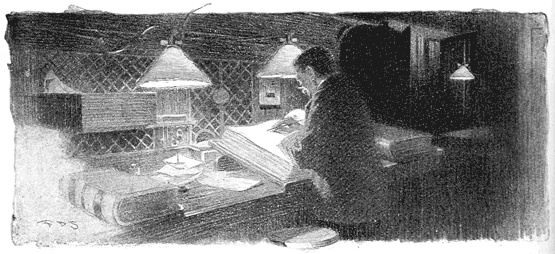
couch with a bundle of papers—old bills,
soiled and folded memoranda, sporting
paragraphs cut from the newspapers—scraps
found in his pockets months ago
and religiously tied by her with a silken
ribbon. They were mementoes of a sort,
and George had written few letters while
wooing—not half a dozen, first and last.
Two or three receipted bills lay together
in the middle of the packet—one a saddler's,
a second a nurseryman's for pot-plants
(kept for the sake of its queer spelling),
a third the reckoning for a hotel
luncheon. She was running over them
carelessly when the date at the head of
this last one caught her eye. "August
3d"—it fixed her attention because it
happened to be the day before her birthday.
August 3d—such and such a year—the
August before his death; and the hotel
a well-known one in Plymouth—the hotel,
in fact, at which he had usually put up....
Without a prompting of suspicion
she turned back and ran her eye over
the bill. A steak, a pint of claret, vegetables,
cheese, and attendance—never was
a more innocent bill.
Suddenly her attention stiffened on the
date. George was in Plymouth the day
before her birthday. But no; as it happened,
George had been in Truro on
that day. She remembered, because he
had brought her a diamond pendant, having
written beforehand to the Truro jeweller
to get a dozen down from London
to choose from. Yes, she remembered it
clearly, and how he had described his day
in Truro. And the next morning—her
birthday morning—he had produced the
pendant, wrapped in silver paper. "He
had thrown away the case; it was ugly,
and he would get her another...."
But the bill? She had stayed once or
twice at this hotel with George, and recognized
the handwriting. The book-keeper,
in compliment perhaps to a customer
of standing, had written "George
Vyell, Esq.," in full on the bill-head; a
formality omitted as a rule in luncheon-reckonings.
And if this scrap of paper
told the truth—why then George had lied!
But why? Ah, if he had done this
thing, nothing else mattered; neither the
how nor the why! If George had lied....
And the pendant, had that been
bought in Plymouth and not (as he had
asserted) in Truro? He had thrown away
the case. Jewellers print their names
inside such cases. The pendant was a
handsome one. Perhaps his check-book
would tell.
She arose; stepped half-way to the
door; but came back and flung herself
again upon the couch. No; she could
not ... this was the second time
to-day ... she could not face the
torture again.
Yet ... if George had lied!
She sat up; sat up with both hands
pressed to her ears, to shut out a sudden
voice clamoring through them—
"And why not? A son's a son—curse
you—though he was your man!"
(To be concluded in November.)