Before winter and the
long nights came round
again, Taffy had become
quite a clever carpenter.
From the first his quickness
fairly astonished the
Bryanite, who at the best was but a journeyman
and soon owned himself beaten.
"I doubt," said he, "if you'll ever
make so good a man as your father; but
you can't help making a better workman."
He added, with his eyes on the boy's
face, "There's one thing in which you
might copy 'em. He hasn't much of a
gift, but he lays it 'pon the altar."
By this time Taffy had resumed his lessons.
Every day he carried a book or two
in the satchel with his dinner, and read or
translated aloud while his father worked.
Two hours were allowed for this in the
morning, and again two in the afternoon.
Sometimes a day would be set apart during
which they talked nothing but Latin.
Difficulties in the text of their authors they
postponed until the evening, and worked
them out at home, after supper, with the
help of grammar and dictionary.
The boy was not unhappy, on the
whole; though for weeks together he
longed for sight of George Vyell, who
seemed to have vanished into space, or into
that limbo where his childhood lay like
a toy in a lumber-room. Taffy seldom
turned the key of that room. The stories
he imagined now were not about fairies
or heroes, but about himself. He wanted
to be a great man and astonish the world.
Just how the world was to be astonished
he did not clearly see, even in his dreams;
but the triumph, in whatever shape it came,
was to involve a new gown for his mother,
and for his father a whole library of books.
Mr. Raymond never went back to his
books now, except to help Taffy. The
Commentary on the Epistle to the Hebrews
was laid aside. "Some day!" he
told Humility. The Sunday congregation
had dwindled to a very few, mostly farm
people; Squire Moyle having threatened
to expel any tenant of his who dared to
set foot within the church.
In the autumn two things happened
which set Taffy wondering.
During the first three years at Nannizabuloe
old Mrs. Venning had regularly been
carried downstairs to dine with the family.
The sea-air (she said) had put new life into
her. But now she seldom moved from
her room, and Taffy seldom saw her except
at night, when—after the old childish custom—he
knocked at her door to wish her
pleasant dreams and pull up the weights of
the tall clock which stood by her bed's
head.
One night he asked, carelessly, "What
do you want with the clock? Lying here
you don't need to know the time; and its
ticking must keep you awake."
"So it does, child; but, bless you, I like
it."
"Like being kept awake?"
"Dear, yes! I have enough of rest and
quiet up here. You mind the litany I used
to say over to you?—Parson Kempthorne
taught it to us girls when I was in service
with him; 'twas made up, he said, by another
old Devonshire parson, years and
years ago—
When I lie within my bed
Sick in heart and sick in head,
And with doubts discomforted,
Sweet Spirit, comfort me!
When the house do sigh and weep—
That's it. You wouldn't think how quiet
it is up here all day. But at night, when
you're in bed and sleeping, all the house
begins to talk; little creakings of the furniture,
you know, and the wind in the
chimney, and sometimes the rain in the
gutters running—it's all talk to me.
Mostly it's quite sociable too; but sometimes,
in rainy weather, the tune changes,
and then it's like some poor soul in bed
and sobbing to itself. That's when the
verse comes in:
"When the house do sigh and weep
And the world is drowned in sleep,
Yet my eyes the watch do keep,
Sweet Spirit, comfort me!
"And then the clock's ticking is a wonderful
comfort. Tick-tack, tick-tack! and I
think of you stretched asleep and happy
and growing up to be a man, and the
minutes running and trickling away to my
deliverance——"
"Granny!"
"My dear, I'm as well off as most;
but that isn't saying I sha'n't be glad to
go and take the pain in my joints to a
better land. Before we came here, in militia-time,
I used to lie and listen for the
buglers, but now I've only the clock. No
more bugles for me, I suppose, till I hear
them blown on t'other side of Jordan."
Taffy remembered how he too had lain
and listened to the bugles; and with that
he suddenly saw his childhood, as it were
a small round globe set within a far larger
one and wrapped around with other folks'
thoughts. He kissed his grandmother and
went away wondering; and as he lay
down that night it still seemed wonderful
to him that she should have heard those
bugles, and more wonderful that night
after night for years she should have been
thinking of him while he slept, and he
never have guessed it.
One morning, some three weeks later,
he and his father were putting on their oilskins
before starting to work—for it had
been blowing hard through the night and
the gale was breaking up in floods of rain—when
they heard a voice hallooing in
the distance. Humility heard it too and
turned swiftly to Taffy. "Run upstairs,
dear. I expect it's someone sent from
Tresedder Farm; and if so, he'll want to
see your father alone."
Mr. Raymond frowned. "No," he
said; "the time is past for that."
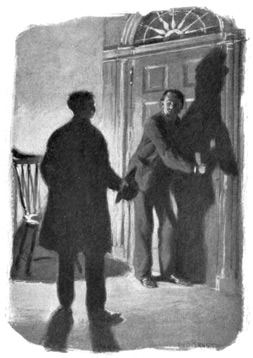
A fist hammered on the door. Mr.
Raymond threw it open.
"Brigantine—on the sands—half a mile
this side of the lighthouse!" Taffy saw
across his father's shoulder a gleam of yellow
oilskins and a flapping sou-wester'
hat. The panting voice belonged to Sam
Udy—son of old Bill Udy—a laborer at
Tresedder.
"I'll go at once," said Mr. Raymond.
"Run you for the coast-guard."
The oilskins went by the window; the
side gate clashed to.
"Is it a wreck?" cried Taffy. "May
I go with you?"
"Yes, there may be a message to run
with."
From the edge of the towans, where
the ground dipped steeply to the long
beach, they saw the wreck, about a mile
up the coast and, as well as they could
judge, a hundred or a hundred-and-fifty
yards out. She lay almost on her beam-ends,
with the waves sweeping high across
her starboard quarter, and never less than
six ranks of ugly breakers between her and
dry land. A score of watchers—in the
distance they looked like emmets—were
gathered by the edge of the surf. But
the coast-guard had not arrived yet.
"The tide is ebbing, and the rocket will
reach. Can you see anyone aboard?"
Taffy spied through his hands, but could
see no one. His father set off running and
he followed, half-blinded by the rain, at
every fourth step foundering knee-deep in
loose sand or tripping in a rabbit hole.
They had covered three-fourths of the
distance when Mr. Raymond pulled up
and waved his hat as the coast-guard
carriage swept into view over a ridge to
the right and came plunging across the
main valley of the towans. It passed them
close—the horses fetlock-deep in sand,
with heads down and heaving, smoking
shoulders; the coast-guardsmen with keen
strong faces like heroes'—and the boy
longed to copy his father and send a cheer
after them as they went galloping by. But
something rose in his throat.
He ran after the carriage, and reached
the shore just as the first rocket shot singing
out toward the wreck. By this time
at least a hundred miners had gathered,
and between their legs he caught a glimpse
of two figures stretched at length on the
wet sand. He had never looked on a
dead body before. The faces of these
were hidden by the crowd; and he hung
about the fringe of it, dreading and yet
courting a sight of them.
The first rocket was swept down the
wind to leeward of the wreck. The chief
officer judged his second beautifully and
the line fell clean across the vessel and all
but amidships. A figure started up from
the lee of the deckhouse and springing
into the main shrouds grasped it and made
it fast. The beach being too low for
them to work the cradle clear above the
breakers, the coast-guardsmen carried the
shore end of the line up the shelving cliff
and fixed it. Within ten minutes the cradle
was run out, and within twenty, the
first man came swinging shoreward.
Four men were brought ashore alive,
the captain last. The other two of the
crew of six lay on the sands, with Mr.
Raymond kneeling beside them. He had
covered their faces, and, still on his knees,
gave the order to lift them into the carriage.
Taffy noticed that he was obeyed
without demur or question. And there
flashed on his memory a gray morning,
not unlike this one, when he had missed
his father at breakfast: "He had been
called away suddenly," Humility had explained,
"and there would be no lessons
that day," and had kept the boy indoors
all the morning and busy with a netting-stitch
he had been bothering her to teach
him.
"Father," he asked as they followed
the cart, "does this often happen?"
"Your mother hasn't thought it well
for you to see these sights."
"Then it has happened often?"
"I have buried seventeen," said Mr.
Raymond.
That afternoon he showed Taffy their
graves. "I know the names of all but two.
The bodies have marks about them—tattooed,
you know—and that helps. And
I write to their relatives or friends, and
restore whatever small property may be
found on them. I have often wished to
put up some grave-stone, or a wooden
cross, with their names. I keep a book
and enter all particulars, and where each
is laid."
He went to his chest in the vestry and
took out the volume—a cheap account
book, ruled for figures. Taffy turned over
the pages.
Nov. 3rd. 187-. Brig "James and
Maria:" J. D., fair-haired, height 5 ft. 8
in., marked on chest with initials and cross
swords, tattooed, also anchor and coil of
rope on right fore-arm: large brown mole
on right shoulder-blade. Striped flannel
drawers: otherwise naked: no property of
any kind.
Ditto. Grown man, age 40 or thereabouts:
dark; iron gray beard; lovers' knot
tattooed on right fore-arm, with initials R. L.,
E. W., in the loops: clad in flannel
shirt, guernsey, trousers (blue sea-cloth),
socks (heather-mixture), all unmarked.
Silver chain in pocket, with free-mason's
token: a half-crown, a florin, and four-pence——and
so on. On the opposite
page were entered the full names and details
afterwards discovered, with notes of
the Vicar's correspondence, and position
of the grave.
"They ought to have grave-stones,"
said Mr. Raymond. "But as it is I can
only get about thirty shillings for the funeral
from the county rate. The balance
has come out of my pocket—from two to
three pounds for each. From the beginning
the squire refused to help to bury
sailors. He took the ground that it wasn't
a local claim."
"Hullo!" said Taffy: for as he turned
the leaves his eye fell on this entry:—
Jan. 30th, 187-. S. S. "Rifleman" (all
hands). Cargo, China-clay: W. P., Age,
about eighteen, fair skin, reddish hair, short
and curled, height 5 ft. 10¾ in. Initials
tattooed on chest under a three-masted ship
and semi-circle of seven stars; clad in flannel
singlet and trousers (cloth): singlet
marked with same initial in red cotton:
pockets empty——
"But he was in the navy!" cried Taffy,
with his finger on the entry.
"Which one? Yes, he was in the Navy.
You'll see it on the opposite page. He
deserted, poor boy, in Cork Harbor, and
shipped on board a tramp steamer as
donkey-man. She loaded at Fowey and
was wrecked on the voyage back. William
Pellow he was called; his mother
lives but ten miles up the coast; she never
heard of it until six weeks after."
"But we—I, I mean—knew him. He
was one of the sailor boys on Toby's van.
You remember their helping us with the
luggage at Indian Queen's? He showed
me his tattoo marks that day."
And again he saw his childhood as it
were set about with an enchanted hedge,
across which many voices would have
called to him, and some from near, but
all had hung muted and arrested.
The inquest on the two drowned sailors
was held next day at the Fifteen Balls,
down in Innis village. Later in the afternoon,
the four survivors walked up to the
church, headed by the Captain.
"We've been hearing," said the Captain,
"of your difficulties, sir: likewise
your kindness to other poor sea-faring
chaps. We have liked to make ye a
small offering for your church, but sixteen
shillings is all we can raise between us.
So we come to say that if you can put us
on to a job, why we're staying over the
funeral, and a day's work or more after
that won't hurt us one way or another."
Mr. Raymond led them to the chancel
and pointed out a new beam, on which
he and Jacky Pascoe had been working
a week past, and over which they had
been cudgelling their brains how to get
it lifted and fixed in place.
"I can send to one of the miners and
borrow a couple of ladders."
"Ladders? Lord love ye, sir, and begging
your pardon, we don't want ladders.
With a sling, Bill, hey?—and a couple of
tackles. You leave it to we, sir."
He went off to turn over the gear salved
from his vessel, and early next forenoon
had the apparatus rigged up and ready.
He was obliged to leave it at this point,
having been summoned across to Falmouth,
to report to his agents. His last
words before starting were addressed to
his crew. "I reckon you can fix it now,
boys. There's only one thing more, and
don't you forget it: any man that wants
to spit must go outside."
That afternoon Taffy learnt for the first
time what could be done with a few ropes
and pulleys. The seamen seemed to spin
ropes out of themselves like spiders. By
three o'clock the beam was hoisted and
fixed; and they broke off work to attend
their shipmates' funeral. After the funeral
they fell to, again, though more silently,
and before nightfall the beam shone with
a new coat of varnish.
They left early next morning, after a
good deal of handshaking, and Taffy
looked after them wistfully as they turned
to wave their caps and trudged away over
the rise toward the cross-roads. Away to
the left in the wintry sunshine, a speck of
scarlet caught his eye against the blue-gray
of the town. He watched it as it came
slowly toward him, and his heart leapt—yet
not quite as he had expected it to leap.
For it was George Vyell. George had
lately been promoted to "pink" and
made a gallant figure on his strapping
gray hunter. For the first time Taffy felt
ashamed of his working suit and would
have slipped back to the church. But
George had seen him, and pulled up.
"Hullo!" said he.
"Hullo!" said Taffy; and, absurdly
enough, could find no more to say.
"How are you getting on?"
"Oh, I'm all right." There was another
pause. "How's Honoria?"
"Oh, she's all right. I'm riding over
there now; they meet at Tredinnis to-day."
He tapped his boot with his hunting
crop.
"Don't you have any lessons now?"
asked Taffy, after awhile.
"Dear me, yes; I've got a tutor. He's
no good at it. But what made you ask?"
Really Taffy could not tell. He had
asked merely for the sake of saying something.
George pulled out a gold watch.
"I must be getting on. Well, good-by!"
"Good-by!"
And that was all.
They could manage the
carpentering now. And
Jacky Pascoe, who in addition
to his other trades
was something of a glazier,
had taken the damaged
east window in hand. For six months
it had remained boarded up, darkening
the chancel. Mr. Raymond removed the
boards and fixed them up again on the
outside, and the Bryanite worked behind
them night after night. He could only be
spied upon through two lancet windows
at the west end of the church, and these
they curtained.
But what continually bothered them
was their ignorance of iron-work. Staples,
rivets, hinges were for ever wanted. At
length, one evening toward the end of
March, the Bryanite laid down his tools.
"Tell 'ee what 'tis, Parson. You must
send the boy to someone that'll teach 'er
smithy-work. There's no sense in this cold
hammering."
"Wheelwright Hocken holds his shop
and cottage from the Squire."
"Why not put the boy to Mendarva the
Smith, over to Benny Beneath? He's a
first-rate workman."
"That is more than six miles away."
"No matter for that. There's Joll's
Farm close by; Farmer Joll would board
and lodge 'en for nine shilling a week, and
glad of the chance; and he could come
home for Sundays."
Mr. Raymond, as soon as he reached
home, sat down and wrote a letter to
Mendarva the Smith and another to Farmer
Joll. Within a week the bargains
were struck, and it was settled that Taffy
should go at once.
"I may be calling before long, to look
you up," said the Bryanite, "but mind you
do no more than nod when you see me."
Joll's Farm lay somewhere near Carwithiel,
across the moor where Taffy had
gone fishing with George and Honoria.
On the Monday morning when he stepped
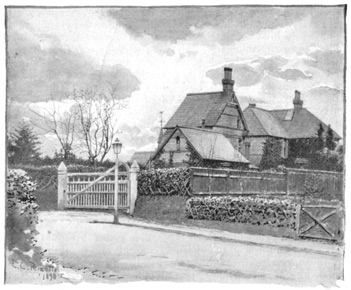
through the white front gate, with his bag
on his shoulder, and paused for a good
look at the building, it seemed to him a
very comfortable farmstead, and vastly superior
to the tumble-down farms around
Nannizabuloe. The flagged path, which
led up to the front door between great
bunches of purple honesty, was swept as
clean as a dairy.
A dark-haired maid opened the door
and led him to the great kitchen at the
back. Hams wrapped in paper hung from
the rafters, and strings of onions. The
pans over the fireplace were bright as mirrors,
and through the open window he
heard the voices of children at play as well
as the clacking of poultry in the town-place.
"I'll go and tell the mistress," said the
maid; but she paused at the door. "I
suppose you don't remember me, now?"
"No," said Taffy, truthfully.
"My name's Lizzie Pezzack. You was
with the young lady, that day, when she
bought my doll. I mind you quite well.
But I put my hair up last Easter, and that
makes a difference."
"Why, you were only a child."
"I was seventeen last week. And—I
say, do you know the Bryanite, over to
Innis?—Preacher Jacky Pascoe?"
He nodded, remembering the caution
given him.
"I got salvation off him. Master and
mis'ess, they've got salvation too; but
they take it very quiet. They're very
fond of one another; if you please one
you'll please both. They let me walk
over to prayer-meetin' once a week. But
I don't go by Mendarva's shop—that's
where you work—though 'tis the shortest
way; because there's a woman buried in
the road there, with a stake through her,
and I'm a terrible coward for ghosts."
She paused as if expecting him to say
something; but Taffy was staring at a
"neck" of corn, elaborately plaited, which
hung above the mantle-shelf. And just
then Mrs. Joll entered the kitchen.
Taffy—without any reason—had expected
to see a middle-aged house-wife.
But Mrs. Joll was hardly over thirty; a
shapely woman, with a plain, pleasant face
and auburn hair, the wealth of which she
concealed by wearing it drawn straight
back from the forehead and plaited in the
severest coil behind. She shook hands.
"You'll like a drink of milk before I
show you your room?"
Taffy was grateful for the milk. While
he drank it, the voices of the children outside
rose suddenly to shouts of laughter.
"That will be their father come home,"
said Mrs. Joll and going to the side-door
called to him. "John, put the children
down; Mr. Raymond's son is here."
Mr. Joll, who had been galloping round
the farmyard with a small girl of three on
his back, and a boy of six tugging at his
coat-tails, pulled up, and wiped his good-natured
face.
"Glad to see you," said he, coming
forward and shaking hands, while the two
children stared at Taffy.
After a minute, the boy said, "My name's
Bob. Come and play horses, too."
Farmer Joll looked at Taffy shyly.
"Shall we?"
"Mr. Raymond will be tired enough
already," his wife suggested.
"Not a bit," declared Taffy; and hoisting
Bob on his back, he set off furiously
prancing after the farmer.
By dinner-time he and the family were
fast friends, and after dinner the farmer
took him off to be introduced to Mendarva
the Smith.
Mendarva's forge stood on a triangle
of turf beside the high-road, where a cart-track
branched off to descend to Joll's
Farm in the valley. And Mendarva was
a dark giant of a man with a beard like
those you see on the statues of Nineveh.
On Sundays he parted his beard carefully
and tied the ends with little bows of scarlet
ribbon; but on week days it curled at
will over his mighty chest. He had one
assistant whom he called "the Dane;" a
red-haired youth as tall as himself and
straighter from the waist down. Mendarva's
knees had come together with
years of poising and swinging his great
hammer.
"He's little, but he'll grow," said he,
after eying Taffy up and down. "Dane,
come fore and tell me if we'll make a
workman of 'en."
The Dane stepped forward and passed
his hands over the boy's shoulders and
down his ribs. "He's slight, but he'll fill
out. Good pair o' shoulders. Give's
hold o' your hand, my son."
Taffy obeyed; not very well liking to
be handled thus.
"Hand like a lady's. Tidy wrist,
though. He'll do, master."
So Taffy was passed, given a leathern
apron, and set to his first task of keeping
the forge-fire raked and the bellows going,
while the hammers took up the music he
was to listen to for a year to come.
This music kept the day merry; and beyond
the window along the bright high-road
there was usually something worth
seeing—farm-carts, jowters' carts, the
doctor and his gig, pedlars and Johnny-fortnights,
the miller's wagons from the
valley-bottom below Joll's Farm, and on
Tuesdays and Fridays, the market van
going and returning. Mendarva knew or
speculated upon everybody, and, with half
the passers-by, broke off work and passed
the time of day, leaning on his hammer.
But down at the farm all was strangely
quiet, in spite of the children's voices;
and at night the quietness positively kept
Taffy awake, listening to the pur-r of the
pigeons in their cote against the house-wall,
thinking of his grandmother awake
at home and listening to the tick-tack of
her tall clock. Often when he woke to
the early summer daybreak and saw
through his attic-window the gray shadows
of the sheep, still and long, on the slope
above the farmstead, his ear was wanting
something, asking for something; for the
murmur of the sea never reached this inland
valley. And he would lie and long
for the chirruping of the two children in
the next room and the drawing of bolts
and clatter of milk-pails below stairs.
He had a plenty to eat, and that plenty
simple and good; and clean linen to sleep
between. The kitchen was his, except on
Saturday nights, when Mrs. Joll and Lizzie
tubbed the children there; and then
he would carry his books off to the best
parlor, or stroll around the farm with Mr.
Joll and discuss the stock. There were
no loose rails in Mr. Joll's gates, no farm
implements lying out in the weather to
rust. Mr. Joll worked early and late,
and his shoulders had a tell-tale stoop—for
he was a man in the prime of life, perhaps
some five years older than his wife.
One Saturday evening he unburdened
his heart to Taffy. It happened at the
end of the hay-harvest, and the two were
leaning over a gate discussing the yet unthatched
rick.
"What I say is," declared the farmer,
quite inconsequently, "a man must be able
to lay his troubles 'pon the Lord. I don't
mean his work, but his troubles; and go
home and shut the door and be happy
with his wife and children. Now I tell
you that for months—iss, years—after
Bob was born, I kept plaguing mysel' in
the fields, thinking that some harm might
have happened to the child. Why, I used
to make an excuse and creep home, and
then if I see'd a blind pulled down, you
wouldn't think how my heart'd go thump;
and I'd stand wi' my hand on the door-hapse
an' say, 'If so be the Lord have
took'n, I must go and comfort Susan—not
my will but Thine, Lord—but, Lord,
don't 'ee be cruel this time!' And then
find the cheeld right as ninepence and the
blind only pulled down to keep the sun
off the carpet! After awhile my wife
guessed what was wrong—I used to make
up such poor twiddling pretences. She
said, 'Look here, the Lord and me'll see
after Bob; and if you can't keep to your
own work without poking your nose into
ours, then I married for worse and not for
better.' Then it came upon me that by
leaving the Lord to look after my job I'd
been treating Him like a farm-laborer.
It's the things you can't help He looks
after—not the work."
A few evenings later there came a knock
at the door, and Lizzie, who went to open
it, returned with the Bryanite skipping behind her.
"Blessings be upon this here house!"
he cried, cutting a sort of double-shuffle
on the threshold. He shook hands with
the farmer and his wife, and nodded toward
Taffy. "So you've got Parson Raymond's
boy here!"
"Yes," said Mrs. Joll; and turned to
Taffy. "He've come to pray a bit; perhaps
you would rather be in the parlor?"
Taffy asked to be allowed to stay; and
presently Mr. Pascoe had them all down
on their knees. He began by invoking
God's protection on the household;
but his prayer soon ceased to be a prayer.
It broke into ejaculations of praise—"Friends,
I be too happy to ask for
anything—Glory, glory! The blood!
The precious blood! O deliverance! O
streams of redemption running!" The
farmer and his wife began to chime in—"Hallelujah!"
"Glory!" and Lizzie Pezzack
to sob. Taffy, kneeling before a
kitchen chair, peeped between his palms
and saw her shoulders heaving.
The Bryanite sprang to his feet, over-turning
the settle with a crash. "Tid'n no
use. I must skip. Who'll dance wi' me?"
He held out his hands to Mrs. Joll.
She took them, and skipped once shamefacedly.
Lizzie, with flaming cheeks,
pushed her aside. "Leave me try, mis'ess;
I shall die if I don't." She caught the
preacher's hands, and the two leapt about
the kitchen. "I can dance higher than
mis'ess! I can dance higher than mis'ess!"
Farmer Joll looked on with a dazed face.
"Hallelujah!" "Amen!" he said at intervals,
quite mechanically. The pair stood
under the bacon rank and began to whirl
like dervishes—hands clasped, toes together,
bodies leaning back and almost
rigid. They whirled until Taffy's brain
whirled with them.
With a louder sob, Lizzie let go her
hold, and tottered back into a chair, laughing
hysterically. The Bryanite leaned
against the table, panting.
There was a long pause. Mrs. Joll took
a napkin from the dresser and fell to fanning
the girl's face, then to slapping it
briskly. "Get up and lay the table," she
commanded; "the preacher'll stay to
supper."
"Thank 'ee, ma'am, I don't care if I
do," said he; and ten minutes latter they
were all seated at supper and discussing
the fall in wheat in the most matter-of-fact
voices. Only their faces twitched,
now and again.
"I hear you had the preacher down to
Joll's last night," said Mendarva the
Smith. "What'st think of 'en?"
"I can't make him out," was Taffy's
colorless but truthful answer.
"He's a bellows of a man. I do hear
he's heating up th' old Squire Moyle's
soul, to knack an angel out of 'en. He'll
find that a job and a half. You mark my
words, there'll be Hamlet's ghost over in
your parish one o' these days."
During work-hours Mendarva bestowed
most of his talk on Taffy. The Dane
seldom opened his lips, except to join in
the Anvil Chorus—
Here goes one—
Sing, sing, Johnny!
Here goes two—
Sing, Johnny, sing!
Whack'n till he's red
Whack'n till he's dead
And whop! goes the widow with a brand new ring!
and when the boy took a hammer and
joined in, he fell silent. Taffy soon observed
that a singular friendship knit these
two men, who were both unmarried. Mendarva
had been a famous wrestler in his
day, and his great ambition now was to
train the other to win the County belt.
Often, after work, the pair would try a
hitch together on the triangle of turf, with
Taffy for stickler; Mendarva illustrating
and explaining, the Dane nodding seriously
whenever he understood, but never
answering a word. Afterwards the boy
recalled these bouts very vividly—the
clear evening sky, the shoulders of the
two big men shining against the level sun
as they gripped and swayed, their long
shadows on the grass under which (as he
remembered) the poor self-murdered woman
lay buried.
He thought of her at night, sometimes,
as he worked alone at the forge: for
Mendarva allowed him the keys and use
of the smithy overtime, in consideration
of a small payment for coal, and then he
blew his fire and hammered with a couple
of candles on the bench and a Homer
between them; and beat the long hexameters
into his memory. The incongruity
of it never struck him. He was
going to be a great man, and somehow
this was going to be the way. These
scraps of iron—these tools of his forging—were
to grow into the arms and shield
of Achilles. In its own time would come
the magic moment, the shield find its true
circumference and swing to the balance
of his arm, proof and complete.
ἐν δ' ἐτίθει ποταμοῖο μέγα σθένος Ὠκεανοῖο
ἄντυγα παρ' πυμάτην σάκεος πύκα ποιητοῖο
His apprenticeship lasted a
year and six months, and
all this while he lived with
the Jolls, walking home
every Sunday morning and
returning every Sunday
night, rain or shine. He carried his deftness
of hand into his new trade, and it was Mendarva
who begged and obtained an extension
of the time agreed on. "Rather than
lose the boy I'll tache 'en for love." So
Taffy stayed on for another six months.
He was now in his seventeenth year—a
boy no longer. One evening, as he blew
up his smithy fire, the glow of it fell on the
form of a woman standing just outside the
window and watching him. He had no
silly fears of ghosts; but the thought of
the buried woman flashed across his mind
and he dropped his pincers with a clatter.
"'Tis only me," said the woman. "You
needn't to be afeared." And he saw it was
the girl Lizzie.
She stepped inside the forge and seated
herself on the Dane's anvil.
"I was walking back from prayer-meeting,"
she said. "'Tis nigher this way, but
I don't ever dare to come. Might, I dessay,
if I'd somebody to see me home."
"Ghosts?" asked Taffy, picking up
the pincers and thrusting the bar back into
the hot cinders.
"I dunno; I gets frightened o' the very
shadows on the road sometimes. I suppose,
now, you never walks out that way?"
"Which way?"
"Why, toward where your home is.
That's the way I comes."
"No, I don't." Taffy blew at the cinders
until they glowed again. "It's only
on Sundays I go over there."
"That's a pity," said Lizzie, candidly.
"I'm kept in, Sunday evenings, to look
after the children while farmer and mis'ess
goes to Chapel. That's the agreement I
came 'pon."
Taffy nodded.
"It would be nice now, wouldn't it—"
She broke off, clasping her knees and
staring at the blaze.
"What would be nice?"
Lizzie laughed confusedly. "Aw, you
make me say 't. I can't abear any of the
young men up to the Chapel. If me and
you——"
Taffy ceased blowing. The fire died
down and in the darkness he could hear
her breathing hard.
"They're so rough," she went on, "And
t'other night I met young Squire Vyell
riding along the road, and he stopped me
and wanted to kiss me."
"George Vyell? Surely he didn't?"
Taffy blew up the fire again.
"Iss he did. I don't see why not,
neither."
"Why he shouldn't kiss you?"
"Why he shouldn't want to."
Taffy frowned, carried the white hot bar
to his anvil and began to hammer. He
despised girls, as a rule, and their ways.
Decidedly Lizzie annoyed him: and yet
as he worked he could not help glancing
at her now and then, as she sat and
watched him. By and by he saw that her
eyes were full of tears.
"What's the matter?" he asked, abruptly.
"I—I can't walk home alone. I'm
afeared."
He tossed his hammer aside, raked out
the fire, and reached his coat off its peg.
As he swung round in the darkness to put
it on, he blundered against Lizzie or Lizzie
blundered against him. She clutched at
him nervously.
"Clumsy! can't you see the doorway?"
She passed out, and he followed and
locked the door. As they crossed the turf
to the highroad, she slipped her arm into
his. "I feel safe, that way. Let it stay,
co!" After a few paces, she added,
"You're different from the others—that's
why I like you."
"How?"
"I dunno; but you be diff'rent. You
don't think about girls, for one thing."
Taffy did not answer. He felt angry,
ashamed, uncomfortable. He did not turn
once to look at her face, dimly visible by
the light of the young moon—the Hunter's
moon—now sinking over the slope of
the hill. Thick dust—too thick for the
heavy dew to lay—covered the cart-track
down to the farm, muffling their footsteps.
Lizzie paused by the gate.
"Best go in separate," she said;
paused again and whispered, "You may,
if you like."
"May do what?"
"What—what young Squire Vyell
wanted."
They were face to face now. She held
up her lips, and as she did so, they parted
in an amorous murmurous little laugh.
The moonlight was on her face. Taffy
bent swiftly and kissed her.
"Oh, you hurt!" With another little
laugh, she slipped up the garden-path and
into the house.
Ten minutes later Taffy followed, hating
himself.
For the next fortnight he avoided her;
and then, late one evening, she came
again. He was prepared for this, and had
locked the door of the smithy and let down
the shutter while he worked. She tapped
upon the outside of the shutter with her
knuckles.
"Let me in!"
"Can't you leave me alone?" he answered,
pettishly. "I want to work, and
you interrupt."
"I don't want no love-making—I don't
indeed. I'll sit quiet as a mouse. But I'm
afeared, out here."
"Nonsense!"
"I'm afeared o' the ghost. There's
something comin'—let me in, co!"
Taffy unlocked the door and held it half
open while he listened.
"Yes, there's somebody coming, on
horseback. Now, look here—it's no
ghost, and I can't have you about here,
with people passing. I—I don't want you
here at all; so make haste and slip away
home—that's a good girl."
Lizzie glided like a shadow into the dark
lane as the trample of hoofs drew close,
and the rider pulled up beside the door.
"You're working late, I see. Is it too
late to make a shoe for Aide-de-camp
here?"
It was Honoria. She dismounted and
stood in the doorway, holding her horse's
bridle.
"No," said Taffy; "that is, if you
don't mind the waiting."
With his leathern apron he wiped the
Dane's anvil for a seat, while she hitched
up Aide-de-camp and stepped into the
glow of the forge-fire.
"The hounds took us six miles beyond
Carwithiel: and there, just as they
lost, Aide-de-camp cast his off-hind shoe.
I didn't find it out at first, and now I've
had to walk him all the way back. Are
you alone here?"
"Yes."
"Who was that I saw leaving as I came
up?"
"You saw someone?"
"Yes." She nodded, looking him
straight in the face. "It looked like a
woman. Who was she?"
"That was Lizzie Pezzack, the girl who
sold you her doll, once. She's a servant
down at the farm where I lodge."
Honoria said no more for the moment,
but seated herself on the Dane's
anvil, while Taffy chose a bar of iron and
stepped out to examine Aide-de-camp's
hoof. He returned and in silence began
to blow up the fire.
"I dare say you were astonished to see
me," she remarked at length.
"Yes."
"I'm still forbidden to speak to you.
The last time I did it, grandfather beat me."
"The old brute!" Taffy nipped the
hot iron savagely in his pincers.
"I wonder if he'll do it again. Somehow
I don't think he will."
Taffy looked at her. She had drawn
herself up, and was smiling. In her close
riding-habit she seemed very slight, yet
tall, and a woman grown. He took the
bar to the anvil and began to beat it flat.
His teeth were shut, and with every blow
he said to himself "Brute!"
"That's beautiful," Honoria went on.
"I stopped Mendarva, the other day, and
he told me wonders about you. He says
he tried you with a hard-boiled egg and
you swung the hammer and chipped the
shell all round without bruising the white
a bit. Is that true?"
Taffy nodded.
"And your learning—the Latin and
Greek, I mean; do you still go on with
it?"
He nodded again, toward a volume of
Euripides that lay open on the work-bench.
"And the stories you used to tell
George and me; do you go on telling
them to yourself?"
He was obliged to confess that he never
did. She sat for awhile watching the
sparks as they flew. Then she said, "I
should like to hear you tell one again.
That one about Aslog and Orm, who ran
away by night across the ice-fields and
took a boat and came to an island with a
house on it, and found a table spread and
the fire lit, but no inhabitants anywhere—You
remember? It began 'Once upon
a time, not far from the city of Drontheim,
there lived a rich man——'"
Taffy considered a moment and began
"Once upon a time, not far from the city
of Drontheim——" He paused, eyed
the horse-shoe cooling between the pincers,
and shook his head. It was no use.
Apollo had been too long in service with
Admetus, and the tale would not come.
"At any rate," Honoria persisted,
"you can tell me something out of your
books: something you have just been
reading."
So he began to tell her the story of Ion,
and managed well enough in describing
the boy and how he ministered before
the shrine at Delphi, sweeping the temple
and scaring the birds away from the precincts;
but when he came to the plot of
the play and, looking up, caught Honoria's
eyes, it suddenly occurred to him
that all the rest of the story was a sensual
one and he could not tell it to her. He
blushed, faltered, and finally broke down.
"But it was beautiful," said she, "so far
as it went; and it's just what I wanted.
I shall remember that boy Ion now, whenever
I think of you helping your father in
the church at home. If the rest of the
story is not nice, I don't want to hear it."
How had she guessed? It was delicious,
at any rate, to know that she thought
of him, and Taffy felt how delicious it
was, while he fitted and hammered the
shoe on Aide-de-camp's hoof, she standing
by with a candle in either hand, the
flame scarcely quivering in the windless
night.
When all was done, she raised a foot
for him to give her a mount. "Good-night!"
she called, shaking the reins.
Taffy stood by the door of the forge, listening
to the echoes of Aide-de-camp's
canter, and the palm of his hand tingled
where her foot had rested.
He took leave of Mendarva
and the Jolls just before
Christmas. The smith was
unaffectedly sorry to lose
him. "But," said he, "the
Dane will be entered for
the Championship next summer, so I
s'pose I must look forward to that."
Everyone in the Joll household gave
him a small present on his leaving. Lizzie's
was a New Testament, with her name
on the fly-leaf, and under it "Converted,
April 19, 187-." Taffy did not want the
gift, but took it rather than hurt her feelings.
Farmer Joll said, "Well, wish 'ee well!
Been pretty comfiable, I hope. Now
you'm goin', I don't mind telling 'ee I
didn't like your coming a bit. But now 'tis
wunnerful to me you've been wi' us less'n
two year'; we've made such progress."
At home Taffy bought a small forge
and set it up in the church, at the west
end of the north aisle. Mr. Raymond, under
his direction, had been purchasing the
necessary tools for some months past; and
now the main expense was the cost of
coal, which pinched them a little. But
they managed to keep the fire alight, and
the work went forward briskly. Save that
he still forbade the parish to lend them
the least help, the old Squire had ceased
to interfere.
Mr. Raymond's hair was grayer; and
Taffy might have observed—but did not—how
readily, toward the close of a day's
laborious carpentry, he would drop work
and turn to Dindorf 's Poetæ Scenici Græci,
through which they were reading their
way. On Sundays, the congregation rarely
numbered a dozen. It seemed that as the
end of the Vicar's task drew nearer, so the
prospect of filling the church receded and
became more shadowy. And if his was a
queer plight, Jacky Pascoe's was a queerer.
The Bryanite continued to come by night
and help, but at rarer intervals. He was
discomforted in mind, as anyone could
see; and at length he took Mr. Raymond
aside and made confession.
"I must go away; that's what 'tis. My
burden is too great for me to bear."
"Why," said Mr. Raymond, who had
grown surprisingly tolerant during the
past twelve months, "what cause have
you, of all men, to feel dejected? You
can set the folk here on fire like flax."
He sighed.
"That's azackly the reason—I can set
'em afire with a breath; but I can't hold
'em under. I make 'em too strong for
me—and I'm afeard. Parson, dear, it's
the gospel truth; for two years I've a
been strivin' agen myself, wrastlin' upon
my knees, and all to hold this parish in."
He mopped his face. "'Tis like fightin'
with beasts at Ephesus," he said.
"Do you want to hold them in?"
"I do and I don't. I've got to try,
anyway. Sometimes I tell mysel' 'tis putting
a hand to the plough and turning
back; and then I reckon I'll go on. But
when the time comes, I can't. I'm
afeard, I tell 'ee." He paused. "I've
laid it before the Lord, but He don't seem
to help. There's two voices inside o' me.
'Tis a terrible responsibility."
"But the people, what are you afraid
of their doing?"
"I don't know. You don't know what
a runaway hoss will do, but you're afeard
all the same." He sank his voice. "There's
wantonness, for one thing—six love-children
born in the parish this year, and
more coming. They do say that Vashti
Clemow destroyed her child. And Old
Man Johns—him they found dead on the
rocks under the Island—he didn't go there
by accident. 'Twas a calm day, too."
As often as not Taffy worked late—sometimes
until midnight—and blew his
forge-fire alone in the church, the tap of
his hammer making hollow music in the
desolate aisles. He was working thus one
windy night in February, when the door
rattled open and in walked a totally unexpected
visitor—Sir Harry Vyell.
"Good-evening! I was riding by and
saw your light in the windows dancing up
and down. I thought I would hitch up
the mare and drop in for a chat. But go
on with your work."
Taffy wondered what had brought him
so far from his home at that time of night,
but asked no questions. And Sir Harry
placed a hassock on one of the belfry
steps and, taking his seat, watched for
awhile in silence. He wore his long riding
boots and an overcoat with the collar
turned up about a neck-cloth less nattily
folded than usual.
"I wish," he said at length, "that my
boy George was clever like you. You
were great friends once—you remember
Plymouth, hey? But I dare say you've
not seen much of each other lately."
Taffy shook his head.
"George is a bit wild. Oxford might
have done something for him; made a
man of him, I mean. But he wouldn't
go. I believe in wild oats to a certain
extent. I have told him from the first he
must look after himself and decide for
himself. That's my theory. It makes a
youngster self-reliant. He goes and comes
as he likes. If he comes home late from
hunting, I ask no questions; I don't wait
dinner. Don't you agree with me?"
"I don't know," Taffy answered, wondering
why he should be consulted.
"Self-reliance is what a man wants."
"Couldn't he have learnt that at
school?"
Sir Harry fidgeted with the riding-crop
in his hands. "Well, you see, he's an
only son——. I dare say it was selfish
of me. You don't mind my talking about
George?"
Taffy laughed. "I like it."
Sir Harry laughed too, in an embarrassed
way. "But you don't suppose I
rode over from Carwithiel for that?
You're not so far wrong, though. The
fact is—one gets foolish as one grows old—George
went out hunting this morning,
and didn't turn up for dinner. I kept to
my rule, and dined alone. Nine o'clock
came; half-past; no George. At ten
Hoskings locked up as usual, and off I
went to bed. But I couldn't sleep. After
awhile, it struck me that he might be
sleeping here over at Tredinnis; that is,
if no accident had happened. No sleep
for me until I made sure; so I jumped
out, dressed, slipped down to the stables,
saddled the mare and rode over. I left
the mare by Tredinnis great gates and
crept down to Moyle's stables like a house-breaker;
looked in through the window,
and, sure enough, there was George's gray
in the loose box to the right. So George
is sleeping there, and I'm easy in my
mind. No doubt you think me an old
fool?"
But Taffy was not thinking anything of
the sort.
"I couldn't wish better than that. You
understand?" said Sir Harry, slyly.
"Not quite."
"He lost his mother early. He wants
a woman to look after him, and for him to
think about. If he and Honoria would
only make up a match.... And
Carwithiel would be quite a different
house."
Taffy hesitated, with a hand on the
forge-bellows.
"I dare say it's news to you, what I'm
telling. But it has been in my mind this
long while. Why don't you blow up
the fire? I bet Miss Honoria has thought
of it too; girls are deep. She has a head
on her shoulders. I'll warrant she'd send
half a dozen of my servants packing within
a week. As it is, they rob me to a
stair. I know it, and I haven't the pluck
to interfere."
"What does the old Squire say?"
Taffy managed to ask.
"It has never come to saying anything.
But I believe he thinks of it, too, when
he happens to think of anything but his
soul. He'll be pleased; everyone will be
pleased. The properties touch, you see."
"I see."
"To tell you the truth, he's failing fast.
This religion of his is a symptom; all of
his family have taken to it in the end. If
he hadn't the constitution of a horse, he'd
have been converted ten years before this.
What puzzles me is, he's so quiet. You
mark my words"—Sir Harry rose, buttoned
his coat and shook his riding-crop
prophetically—"he's brewing up for
something. There'll be the devil of a flare-up
before he has done."
It came with the midsummer bonfires.
At nine o'clock on St. John's Eve, Mr.
Raymond read prayers in the church. It
was his rule to celebrate thus the vigils of
all saints in the English calendar and some
few Cornish saints besides; and he regularly
announced these services on the
preceding Sundays; but no parishioner
dreamed of attending them.
To-night, as usual, he and Taffy had
prayed alone; and the lad was standing
after service at the church door, with his
surplice on his arm (for he always wore a
surplice and read the lessons on these
vigils), when the flame of the first bonfire
shot up from the headland over Innis
village.
Almost on the moment a flame answered
it from the point where the lighthouse
stood; and within ten minutes the horizon
of the towans was cressetted with these
beacon-fires; surely (thought Taffy) with
many more than usual. And he remembered
that Jacky Pascoe had thrown out
a hint of a great revival to be held on
Baal-fire Night (as he had called it).
The night was sultry and all but windless.
For once the tormented sands had rest.
The flame of the bonfires shone yellow—orange-yellow—and
steady. He could
see the dark figures of men and women
passing between him and the nearest, on
the high wastrel in front of Tredinnis
great gates. Their voices reached him
in a confused murmur, broken now and
then by a child's scream of delight. And
yet a hush seemed to hang over sea and
land: an expectant hush. For weeks the
sky had not rained. Day after day, a dull
indigo blue possessed it, deepening with
night into duller purple, as if the whole
heavens were gathering into one big
thunder-cloud, which menaced but never
broke. And in the hush of those nights a
listener could almost fancy he heard, between
whiles, the rabbits stirring uneasily
in their burrows.
By and by, the bonfire on the wastrel
appeared to be giving out specks of light,
which blazed independently; yet without
decreasing its own volume of flame. The
sparks came dancing, nearer and larger;
the voices grew more distinct. The spectators
had kindled torches and were
advancing in procession to visit other
bonfires. The torches, too, were supposed
to bless the fields they passed across.
The procession rose and sank as it came
over the uneven ridges like a fiery snake;
topped the nearest ridge and came pouring
down past the churchyard wall. At
its head danced Lizzie Pezzack, shrieking
like a creature possessed, her hair loose
and streaming, while she whirled her
torch. Taffy knew these torches; bundles
of canvas steeped in tar and fastened
in the middle to a stout stick or piece of
chain. Lizzie's was fastened to a chain,
and as he watched her uplifted arm swinging
the blazing mass he found time to
wonder how she escaped setting her hair
on fire. Other torch-bearers tossed their
arms and shouted as they passed. The
smoke was suffocating, and across the
patch of quiet graveyard the heat smote
on Taffy's face. But in the crowd he saw
two figures clearly—Jacky Pascoe and
Squire Moyle; and the Bryanite's face
was agitated and white in the glare. He
had given an arm to the Squire, who was
clearly the centre of the procession, and
tottered forward with jaws working and
cavernous eyes.
"He's saved!" a voice shouted.
Others took up the cry. "Saved!"
"The Squire's saved!" "Saved to-night—saved
to glory!"
The Squire paused, still leaning on the
Bryanite's arm. While the procession
swayed around him, he gazed across the
gate, as a man who had lost his bearings.
No glint of torchlight reached his eyes;
but the sight of Mr. Raymond's surpliced
figure, standing behind Taffy's shoulders
in the full glare, seemed to rouse him. He
lifted a fist and shook it slowly.
"Com'st along, sir!" urged the Bryanite.
But the Squire stood irresolute, muttering
to himself.
"Com'st along, sir!"
"Lev' me be, I tell 'ee!" He laid
both hands on the gate and spoke across it
to Mr. Raymond, his head nodding while
his voice rose.
"D'ee hear what they say? I'm saved.
I'm the Squire of this parish, and I'm going
to Heaven. I make no account of you
and your church. Old Satan's the fellow
I'm after, and I'm going to have him out
o' this parish to-night or my name's not
Squire Moyle."
"That's of it, Squire!" "Hunt' en!"
"Out with 'en!"
He turned on the shouting throng.
"Hunt 'en? Iss fay I will! Come
along, boys—back to Tredinnis! No,
no"—this to the Bryanite—"we'll go back.
I'll show 'ee sport, to-night—we'll hunt
th'ould Divvle by scent and view. I'm
Squire Moyle, ain't I? And I've a pack
o' hounds, ha'n't I? Back, boys—back,
I tell 'ee!"
Lizzie Pezzack swung her torch. "Back—back
to Tredennis!" The crowd took
up the cry, "Back to Tredinnis!" The
old man shook off the Bryanite's hand, and
as the procession wheeled and re-formed
itself confusedly, rushed to the head of it,
waving his hat—
"Back!—Back to Tredinnis!"
"God help them," said Mr. Raymond;
and taking Taffy by the arm, drew him
back into the church.
The shouting died away up the road.
For three-quarters of an hour father and
son worked in silence. The reddened sky
shed its glow gently through the clear glass
windows, suffusing the shadows beneath
the arched roof. And, in the silence, the
lad wondered what was happening up at
Tredinnis.
Jim the Whip took oath afterward that
it was no fault of his. He had suspected
three of the hounds for a day or two—Chorister,
White, Boy, and Bellman—and
had separated them from the pack. That
very evening he had done the same with
Rifler, who was chewing at the straw in a
queer fashion and seemed quarrelsome.
He had said nothing to the Squire, whose
temper had been ugly for a week past. He
had hoped it was a false alarm—had
thought it better to wait, and so on.
The Squire went down to the Kennels
with a lantern, Jim shivering behind him.
They had their horses saddled outside and
ready; and the crowd was waiting along
the drive and up by the great gates.
The Squire saw at a glance that two
couples were missing, and in two seconds
had their names on his tongue. He was
like a madman. He shouted to Jim to
open the doors. "Better not, maister!"
pleaded Jim. The old man cursed, smote
him across the neck with the butt-end of
his whip, and unlocked the doors himself.
Jim, though half-stunned, staggered forward
to prevent him, and took another
blow which felled him. He dropped
across the threshold of Chorister's kennel,
the doors of all opened outwards, and the
weight of his body kept this one shut.
But he saw the other three hounds run
out—saw the Squire turn with a ghastly
face, drop the lantern and run for it as
White Boy snapped at his boot. Jim
heard the crash of the lantern and the snap
of teeth, and with that he fainted off in the
darkness. He had cut his forehead against
the bars of the big kennel, and when he
came to himself, one of the hounds was
licking his face through the grating.
Men told for years' after how the old
Squire came up the drive that night, hoof
to belly; his chin almost on mare Nonesuch's
neck; his face like a man's who
hears hell cracking behind him; and of
the three dusky hounds which followed
(the tale said) with clapping jaws and
eyes like coach-lamps.
Down in the quiet church Taffy heard
the outcry, and, laying down his plane,
looked up and saw that his father had
heard it too. His mild eyes, shining
through his spectacles, asked, as plainly as
words: "What was that?"
"Listen!"
For a minute—two minutes—they
heard nothing more. Then out of the
silence broke a rapid, muffled beat of
hoofs; and Mr. Raymond clutched Taffy's
arm as a yell—a cry not human, or if
human, insane—cut the night like a knife
and fetched them to their feet. Taffy
gained the porch first, and just at that
moment a black shadow heaved itself on
the churchyard wall and came hurling
over with a thud—a clatter of dropping
stones—then a groan.
Before they could grasp what was happening,
the old Squire had extricated
himself from the fallen mare, and came
staggering across the graves.
"Hide me!——"
He came with both arms outstretched,
his face turned sideways. Behind him,
from the far side of the wall, came sounds—horrible
shuffling sounds, and in the
dusk they saw the head of one of the
hounds above the coping and his fore-paws
clinging as he strained to heave
himself over.
"Save me! Save——"
They caught him by both arms, dragged
him within and slammed the door.
"Save!——sa—!"
The word ended with a thud as he
pitched headlong on the slate pavement.
Through the barred door, the scream of
the mare Nonesuch answered it.
(To be continued.)
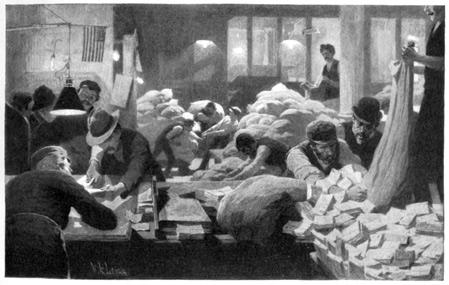
Mail Arriving in Foreign Department.
On the left the Chief Clerk is checking off the returns from the clerks, on the right, who have emptied sacks of mail. New loads are
coming in in the rear.
The Foreign Mail Service at New York By E. G. Chat
"Steamer's mail!!!" This loud
call, echoing throughout the foreign
room in the Post-office Building, is
the equivalent of the "Clear ship for action"
on the man-of-war. Instantly
distributors leave their separating cases,
stampers abandon their "blocks," the electric
stamp-cancelling machine temporarily
ceases its humming, buzzing rattle, every
available clerk or porter gets ready for the
fray, and the whole force charges with
alacrity on the fast accumulating pile, as
sack after sack is dumped on a low, large
table, at times entirely hid from sight by
bags with labels indicating their origin,
thousands of miles away, whether from the
confines of Siberia, or the shores of the
Indian Ocean.
The sight, even to men familiar with
the work, is inspiring, especially when at
times two, and on certain occasions three,
steamers land their cargo of sacks at the
same hour. Not infrequently this happens
when some one thousand and odd
sacks have to be made ready for an outgoing
steamer, and then the foreign force
is fairly on its mettle, and may well be
compared again to the crew of a battle-ship
when it has to fight fire inside and
fire from the enemy outside. Here again,
as on the battle-ship, organization and
years' training tell. The wagon-loads of
sacks melt before the vigorous and steady
onslaught as did the Spanish fleet before
Dewey's guns, and in a short while the
room is cleared and the "field-day" over.
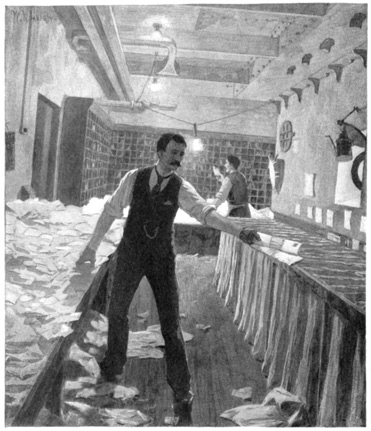
Sea Post-office Room.
One clerk empties the sacks, and throws the letter packages to another clerk at the case while he distributes the papers into the
sack rack.
It would be difficult, in this great cosmopolitan
city of New York, to find a
person who does not make use of this foreign
service, yet strange to relate is the
fact that, outside of the clerks immediately
handling these mails, hardly anyone
can be found who knows, or even has the
slightest idea of the International Postal
Union system. Perhaps this is accounted
for by the comparatively very recent establishment
of said system, and its growth
so immediate and rapid that the public
has not so far "caught up" with it.
The system was aptly described by
Postmaster-General Gary at the opening
of the Washington Postal Congress, in
1897, as "one of the grandest projects
of the century." No other agency is responsible
to such an extent for the tremendous
expansion of great ideals and
the exchange of views between nations
characteristic of the last quarter of this
century.
Previous to 1875, when the Treaty of
Bern, assented to and ratified by twenty-two
nations, took effect, the exchange of
mails between separate nationalities was
done under such difficulties, and subject
to delays and mishaps of so many kinds,
that a normal growth and improvement
in keeping with the progress of civilization
was out of the question. In 1840 the
foreign mail from England for the United
States, carried on the Great Western, consisted
of two sacks of mail. As late as
1873 a steamer from Europe with 20,000
letters on board was considered a record
breaker. To-day the Cunard steamers
and other transatlantic ships carrying what
is called a "full European mail," usually
bring some two hundred thousand letters,
and an average of three hundred sacks of
newspapers and printed matter for New
York City, not to mention the five hundred
and odd sacks for Canada, Mexico,
and transpacific countries, and a few
United States exchange offices, which
are now taken direct to the trains and not
handled at the New York office.
The working unit of the International
Postal Union system is the "Exchange
Office." Each postal administration selects
these despatching and receiving
centres according to quantity of mail
handled at any particular point. In European
countries many of these offices
are on trains from one important point to
another, and are called Travelling Exchange
offices. They receive and despatch
mails in the same manner as offices
located in large cities. There are also
exchange offices located on steamship
lines, and they are called Sea Post-offices.
No matter where located, these offices all
conduct business on the same lines, and
handle mail in the same manner throughout
the world. The rules and regulations
of this service are adopted by Postal Congresses,
meeting about every six years
and under the general supervision of the
International Bureau of the Postal Union
located at Bern, Switzerland, and supported
by funds from all governments
represented in the Union according to the
respective importance of their mail service.
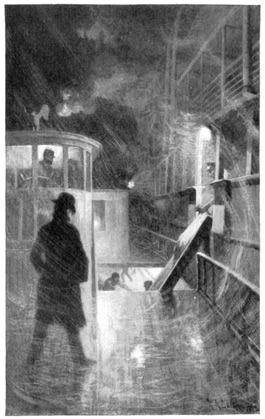
Transferring Mails from an Ocean Greyhound to the Post-office Boat, Postmaster General, through the Chutes.
Only through these exchange offices can
correspondence go from one country to another,
as no other offices are provided with
the clerical force and system necessary to
the handling of international mails. It is
at times difficult to explain to business
people that a North German Lloyd steamer
calling at Gibraltar and Naples will carry
mail for Naples only, and that a letter addressed
to Gibraltar by that particular
steamer cannot be delivered at that port,
but will be carried all the way to Naples,
whence it will be re-despatched to Gibraltar
through a more or less circuitous route.
This is because Gibraltar is not an "exchange
office" with New York, and
"closed mails" are not sent thereto from
New York. A "closed mail," as the name
indicates, is a mail duly tied up, sealed,
and labelled with the name of the exchange
office to which it is sent, and not
to be opened until it gets there, passing
sometimes through four or five countries
before reaching its destination. No other
kind of mails is carried by steamers, yet
the answer will often be made to inquiries,
that a certain letter would have been
sent "in open mail" to London or elsewhere.
This does not mean that the mail
in which the letter in question would be
sent is despatched "opened," but that it
is sent in the "closed" mail for London,
there to be opened and disposed of by
the London clerks, just as if it had been
mailed in London. This course is followed
with all correspondence for offices
abroad, or even entire countries, which is
not in sufficient quantity to justify the
establishment of an exchange; and the
mails for these offices or countries is sent
to the foreign exchange office with the
best facilities for disposing of it. Thus
mail for Liberia will be sent sometimes to
Hamburg, Germany, and at other times
to Liverpool, England.
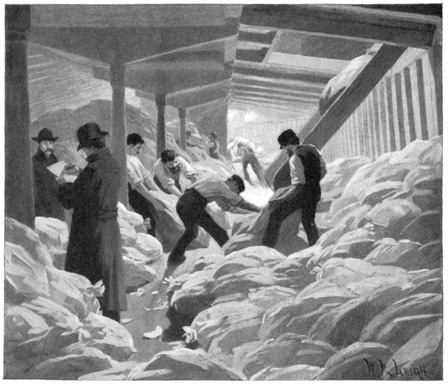
On Board the Postmaster General, at the End of the Chute—Receiving, Piling, and Checking Off Sacks.
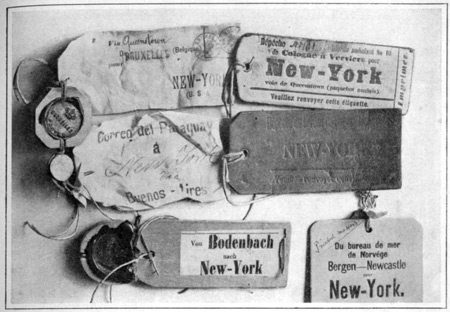
Some Sample Labels from Abroad.
Belgian label—string made fast through wooden block with
wax seal and a second block of compressed lead.
Paraguay label—plain linen.
Austrian label—wooden block, string sealed with wax.
German white leather label.
Argentine label—strong, ordinary leather.
Norwegian label—cardboard—string sealed on back with wax.
A closed mail consists of ordinary letters,
printed matter, and other articles, and of
registered articles. Sometimes all these
elements will be enclosed in the same sack,
or they may be despatched in separate
sacks, when in sufficient quantity. The
registered mail is tied up and sealed in
distinctive red-striped sacks, and then these
sacks are enclosed in ordinary mail-sacks,
tied up and labelled in exactly the same
manner as the sacks containing ordinary
letters, so that it is impossible to tell from
the outside which sack contains registered
matter. A mail may consist of one sack
only, containing all classes of correspondence,
or it may be composed of a large
number of sacks. In either case it is accompanied
by a letter bill, enclosed in one
of the sacks. This letter bill is one of a
series beginning on January 1st of each
year, being numbered with consecutive
numbers to each foreign exchange office.
Thus when Naples receives a mail from
New York containing the letter bill numbered
65, and the previous mail received at
that office had Letter Bill No. 63, Naples
knows that mail with Letter Bill No. 64
is missing, and immediately notifies New
York of the fact in a form called "Bulletin
of Verification." This form is in use
for official correspondence between all
offices in the Postal Union regarding
irregularities of all sorts discovered in the
mails of one office for another. A record
of the number of each mail and the particulars
of its despatch being kept by each
office, the inquiry from Naples in the
above instance would immediately be investigated,
and that office notified that the
missing mail had been sent on such a date,
by such a steamer, etc.; or, if more was
known concerning its fate, as in the case
of the mails sent per La Bourgogne last
July, mention would be made of the fact.
The Russian travelling exchange office
of Kibarty to St. Petersburg frequently
receives the mails sent from this office
every Wednesday in inverted order, that
is, the mail sent by a fast White Star liner
at noon on Wednesday, may be received
a few hours ahead of the mail sent by a
slower American line steamer which sailed
at 10 A.M. on the same day. The occurrence
is so often repeated that one would
think it would go unnoticed, and the Russian
office would wait a few hours anyway
before notifying New York that a
mail is missing, but such is not the case,
and the bulletin "Your mail No. —— is
missing," is immediately sent to New
York, followed next day by another bulletin,
"Your mail No. —— has arrived."
At the New York office the first bulletin
is always held until receipt of the second,
which is sure to follow and renders investigation
unnecessary; they are called
"Katie didn't," and "Katie did." Many
bulletins are received subsequent to the
holidays with best wishes for Christmas
or New Year from one office to another.
They are mostly all in English, French, or
Spanish, and are, at times, more or less
humorous, if not pathetic, as was one received
from Martinique about the time
Cervera's ill-fated fleet was hovering near
that island. A mail from New York had
just been received at St. Pierre, and in
one of the sacks the horrified
French Director of Posts had
found a cat in the last stages
of decomposition. He had
sent for the American Consul
to view the remains, and his
bulletin to the New York office
regarding this irregularity was
a model of official French. It
stated how the smell of that
dead cat had penetrated every
corner of his office, and one
could read between the lines
that he suspected the whole
affair to be a joke played upon
him by the Yankee postal
clerks. The event was duly investigated in
the New York office, but beyond the fact
that one member of the numerous pussy
tribe in the mail building was missing, little
else could be positively ascertained. That
the cat could have been sent in that bag
as a joke was not to be thought of for an
instant, but it was presumed that in its
wandering among the piles of mail-sacks
in the basement, pussy had found the
sack for Martinique awaiting to be sealed,
and had concluded to take a nap therein.
The sack was probably tied up and sealed
soon afterward, and the unwilling stow-away
had been sent to the steamer. Later
on it was reported by the purser of the
steamer that he suspected there was something
alive in one of the mail-bags, but
such is the respect for postal seals that he
never thought to open the sack in the presence
of witnesses and release the animal.
Thrown in the mail-room with other sacks
on top of it, there could be no doubt that
poor pussy had been smothered before
passing the Hook, and his condition when
landed at Martinique must have been such
as to fully justify and explain the ill-disguised
indignation of the French officials.
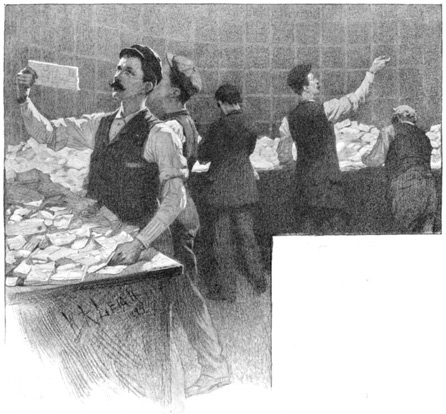
In the Newspaper Division.
Throwing papers into boxes for all parts of the world.
The letter bill describes minutely the
mail it accompanies, states how many sacks
of letters, how many sacks of papers, and
how many articles registered, describing
each registered article separately, except in
cases of heavy registered mails, when a separate
descriptive list is sent in addition to
the letter bill. Thus it is easy for the office
of destination to verify the mail it receives
and ascertain whether any is missing.
Small closed mails are at times enclosed
inside of closed mails for other offices; for
instance, the mails made up at Paris for
Guatemala are in a sack duly sealed and
labelled as aforesaid, but this sack is put
inside of one of the bags for the New
York office, and in such cases the fact is
noted on the letter bill sent with the New
York mail.
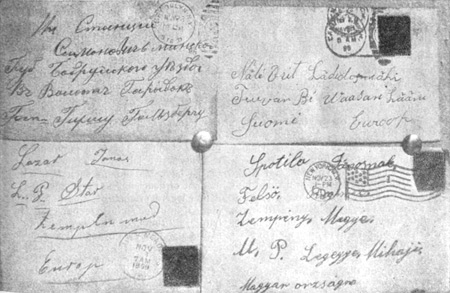
Samples of Ordinary Letters.
For Government of Simbursk, Russia. For Finland.
For Hungary.
The business of the foreign clerks when
a foreign mail is received in the manner described
in our first lines is to open promptly
every sack received, inspect and dispose
of contents, and report to the chief clerk
the result from each sack thus opened.
Each clerk takes hold of one of the sacks
piled on the table, and throws it on another
table used for opening the mails. He
cuts open the fastenings, keeping the label
separate, and also the letter-bill, if he happens
to find it in the sack; if several classes
of mail matter are found therein, he pushes
the ordinary letters over to one side,
sweeps the newspapers into large four-wheeled
baskets near by, takes to another
place the smaller enclosed mails addressed
to other offices, and lays the registered sack
on the chief clerk's desk, where a man
from the registry division will receive it
and give a receipt for it. The clerk then
calls out to the chief clerk the result of
his examination, "Lisbon-Reg.-Bill and 1
Honolulu"—which means that in the sack
just opened he found the mail from Lisbon
for New York with the letter-bill, registered
articles and a smaller closed mail for
Honolulu. Like the rattle of musketry
these calls are fired at the chief clerk, who
marks everything on a tally-sheet, which
will later on be compared with the advices
received from the foreign offices on each
letter-bill; and if any discrepancy is found
it will be investigated, resulting in a bulletin
of verification to office of origin, or in
something worse for the foreign clerk who
made an erroneous announcement of the
contents, if the fault is laid to him. In a
few minutes, sometimes an hour or more,
an entire mail is opened and the room
cleared, the registry man getting away to
his department with all the registered mails,
and the newspaper force wheeling away
the baskets full of newspapers and packages.
The letters are then divided into
four parts—those for New York City proper,
those for the rest of the United States
and Canada, those for foreign countries
which have been sent in open mail to New
York, and those which are unpaid or partially
prepaid. Many foreign offices make
a separation of the mails for New York
City from those for other places, but this is
a matter of accommodation and reciprocal
arrangements between exchange offices;
and the work of separation is, strictly
speaking, that of the foreign clerks in any
office. The newspapers are treated in the
same manner as the letters. All city mail
is then sent to the city department for final
distribution and delivery, and that for other
parts of the United States and Canada is
sent to the domestic mail division for despatch.
All letters and mail addressed to
other countries are retained in the foreign
division, and included in the next mail for
these countries. The unpaid and short-paid
mail is "rated up" before delivery to
other divisions. This mail is put up under
distinctive labels. The despatching
offices have marked on each article the
amount of deficiency in prepayment. No
matter where originating, this amount is
marked in French money (centimes). The
letter "T" (initial of French word "tax")
is also stamped on covers. The foreign
clerks at the receiving office calculate, in
the money of their country, the amount
of deficiency and double it up, stamping
this charge on the covers for collection by
office of delivery.
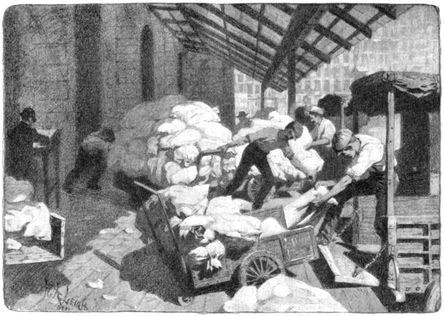
Despatching a Mail—Sacks Loaded on Trucks.
Despatching clerk, on the left, tallying off mails, sack by sack. Foreign mails are delivered to trucks sent by the Steamship
Companies and are receipted for at the door of New York Post Office.
This work, and also that of separating
New York mail and mail for the principal
States and cities, is done by the sea post-offices
in steamers of the North German
Lloyd, Hamburg-American, and American
Lines; and when mails are received by
either of these steamers they are ready for
delivery in a much shorter time than when
received by other vessels. In addition to
the sea post-office service, the transfer service
has also in the last two or three years
materially reduced the work at the foreign
department in the New York office.
No sooner has the "ticker" reported
the Campania or other big liner "off
Fire Island" than a veteran of the
transportation department, accompanied by a
few clerks and porters, hastens to the foot
of Cortlandt Street and boards the
Postmaster-General, the flag-ship of the
post-office fleet. The boat was built for this
service, and is equipped with spacious
mail-rooms, chutes for transboarding
sacks, and other expediting appliances.
Steam is up, and she is off down the
bay to meet the big steamer. She makes
fast to her sides, and the mails are received
aboard through the chutes, while the
clerks check and verify the number received
on a sort of invoice called "way bill," prepared
by the London, Havre, or sea post-office.
Frequently the passengers are
still awaiting the quarantine doctor while
the mails are speeding on their way to the
Battery, where the New York City sacks
are landed; then to the Pennsylvania
Railroad, then to the foot of Forty-second
Street, where wagons await the mails for
the Grand Central Depot. Thus a great
saving in time is often made, while formerly
the whole mail went first to the docks
of the several transatlantic lines, then by
wagons to the General Post-Office, then
again by wagons to the different depots.
When the mails are handled by sea post-offices
during the sea-trip, they generally
arrive ready for the trains, and little but
what is for New York City proper comes
to the general office; but the large and
heavy mails on the Cunard and White
Star Lines, also on the French Line, are
not thus assorted, and fully two-thirds has
to come to the foreign division to be
handled as previously described.
We have explained to a great extent so
far what seems to pertain to the incoming
mails only; but we said at the start that
the foreign mail is worked throughout the
world in every exchange office very much
after the same pattern, and it will now be
easier to explain the handling of mail going
from the United States to other countries.
There are in the United States several exchange
offices besides New York, but, with
the exception of New Orleans and San
Francisco, the mails they make up consist
only of matter originating at each of these
offices. Mail for some of the Central
American republics is sent to New Orleans,
and mail for transpacific countries goes
mostly to San Francisco. All other mail,
no matter where dropped in the letter-box,
comes to the New York office through the
instrumentality of the Railway Mail Service.
Letters for abroad are tied up in bundles,
and labelled "New York Foreign."
Some of the railway mail offices make a
preliminary separation by countries, and
many bundles reach New York labelled
"Russia," "Switzerland," etc.; but as
there are many exchange offices in these
foreign countries, these bundles have again
to be opened at New York, and assorted,
although this first separation facilitates the
process. The bundles are cut open, and
the letters are all passed through the electric
machine or stamped by hand, the
"back-stamp" thus impressed showing
their date of arrival in New York.
This is not done with letters originating
in New York City, the date and time of
mailing being in that case shown in the
stamp-mark cancelling the postage-stamps,
and being held sufficient for records. The
mail having been "back-stamped," goes
on a low shelf in front of each distributor,
and is then assorted according to destination.
The "separating case" consists of
nine rows of boxes, ten boxes in each row.
Many of the boxes bear the names of exchange
offices in Europe or those reached
by steamers for Europe. There are also
boxes for other parts of the world, in which
letters are deposited to be later on taken
to another special "separating case" for
these countries. In each separating case
there is a box where unpaid or short-paid
letters are deposited. A special clerk takes
them out, weighs them, marks thereon the
deficient postage, and stamps them "T,"
when they are assorted on a separate case
and tied up in bundles under labels indicating
that the contents of the bundles consist
of short-paid mail. They go in the same
sacks as ordinary letters. When a box bearing
the name of an exchange office is full
(about one hundred and fifty letters), the
contents are taken out, divided into two
parts, the largest letters being laid across
both parts, and the whole is tied up in a sheet
of strong manila paper. String is not spared
in this process, and so securely and strongly
are these packages tied that they have been
known to remain in the water for days and
weeks at times, and when found, with the
exception of the top letters and the edges,
they were yet in a condition to permit delivery
to persons for whom they were intended.
Many people, no doubt, some weeks
after the Elbe disaster, remember having
received letters with a paster attached,
stating that the letter had been found in
the North Sea, in a bag originating in Norway
and sunk with the Elbe. This was the
only sack of mail ever recovered from that
steamer. The same was true of the mail
recovered from the Oregon, sacks being
found far down the Jersey coast days after
the wreck of that steamer, and forwarded
to New York, where, after being dried, most
of the letters were found to be deliverable.
The package thus wrapped and tied is
labelled with the printed name of the exchange
office for which its contents are
intended, and thrown into a large basket.
When the basket is full, it is wheeled over
to the pouching rack, an iron frame divided
into sections, each section bearing
the name of an exchange office, and provided
with four hooks which hold open
a mail sack. The pouching clerk takes
the packages of letters, reads the labels
thereon, and throws them into the proper
sack. When full (about seventy-five
pounds), the sack is taken down and ready
for tying and sealing up. The last sack
taken down receives the letter-bill for the
exchange office of destination. The sack
is tied, and a label bearing the name of
the office for which it is destined is
inserted in the string. After several turns have
been taken, both ends of the string are
passed through the holes at the bottom of
a small tin cup which is subsequently filled
with hot wax, so that the string cannot be
removed without its being cut open (see
illustration on page 71). In this country
labels made of good Holland linen are
used fresh for each sack. In other countries
other material is employed, some
using leather, some wood, some strong
cardboard. The return of labels of any
value is generally requested, and they are
used over and over until worn out. Great
Britain does not use labels of any kind,
but has the address of each sack stencilled
on the sack itself, thus: "London for
New York." This, of course, renders the
sack useless for any other service. In the
United States the labels are white for
letter sacks, buff for papers, and cardinal
red for registered mails.
The newspapers are assorted in the basement
of the Post-office, very much in the
same fashion as letters, but they are not
tied up in bundles. The separating cases
into which they are thrown are so made
that a sack hanging at the lower end of the
box receives the mail thrown therein, and
when full, it is ready for tying, labelling,
and sealing up. In this department are
received the queerest odds and ends going
through the mails to foreign countries,
newspapers especially being selected
to hide in their folds sundry articles of
every description sent to friends "in the
auld country." Jewelry, from the penny
kind to really valuable articles, handkerchiefs
galore, baby's dressing outfits, rattlesnake
skins, plugs of tobacco, cucumbers—these
and many other curios of every description
are found and stopped. If the address
of the sender appears on the package,
it is returned to him direct. Otherwise
it goes to the Dead Letter Office, where
it is kept a certain length of time awaiting
to be claimed. The unclaimed part is
finally sold at auction.
In the letter department there are also
curiosities, but of another kind. The greatest
part of the letters addressed to Santa
Claus in Greenland, or other Northern
lands, are treated by the foreign clerks.
There are also many mysteries to be unravelled
in the queer hieroglyphics which are supposed
to be the addresses of letters, especially
those going to Russia, Turkey,
Hungary, and even Italy. Clerks of
the foreign department are not linguists;
but the same characters recurring so constantly
soon appear familiar, and they experience
no trouble in "boxing" the letters
to the proper office.
When a mail has closed, no more letters
or papers are put in the assorting boxes,
but everything that was there is taken out,
tied, labelled, and sacked. The letter-bills
are then prepared, and after all the
sacks are sealed the way-bills are made up
in duplicate copies. A full European mail
via Queenstown or via Southampton
averages nine to twelve hundred sacks,
fully two-thirds of which have been made
up in the New York office. The way-bill
describes this large mail only as so
many letter-sacks and so many paper-sacks
from the New York office, or the
Chicago, or other office of origin, for
Paris, or for Dublin, etc., and when the
steamers land the mail at its port of arrival,
the way-bills are used to check and verify
the number of sacks landed. One copy
of the way-bill is returned to New York
with a receipt from the official at the port of
destination, and the responsibility of this
office for the mails ceases. Their further
transportation will be the business of the
administration which has received them.
The Parcels Post system is also taken
care of by the clerks of the foreign
department, but as it is a system based on
special conventions or agreements between
any two countries, it is not within
the sphere of an article relating to the
international mail service as regulated by
the Postal Union Conventions. The
exchange of large parcels, however, as
well as of ordinary correspondence, is one
of the improvements which remain for
future postal congresses to introduce in
the system. At present, the United States
parcels' post exchange is confined to the
West Indies, Central America, Mexico,
Hawaii, and Newfoundland. Ordinary
merchandise not exceeding eleven pounds
can be forwarded under that system for
twelve cents a pound.
The general supervision over all American
exchange offices is centred in the Office
of Foreign Mails, in Washington, but
the fact that over ninety per cent. of foreign
mail matter is handled, or passes
through the New York office would make
exceedingly advantageous, especially for
business interests all over the country, the
transfer to New York of the supreme direction
of that service. Many times questions
have to be decided and steps taken
at short notice, delay being the great bugaboo
of postal officials, and in such cases
constant and daily touch with a system
ever increasing and improving would be
of incalculable benefit. The New York
force, however, is so well trained, its
superintendents and clerks are so completely
acquainted with every detail of the system,
that so far the business world has not
suffered from the present arrangement. It
certainly has not gained. A flattering
testimonial of this efficiency of the New York
foreign force is found in a report to his
government of the New Zealand Postal
Agent residing at San Francisco and in
charge of the important British-Australian
Mail Service. "I find," says he, "that the
New York officials are extremely anxious
to make the best connections and are
indefatigable in their efforts to expedite
the transfer of mails. Messrs. Maze and
Boyle,[1] Superintendent and Assistant
Superintendent of mails in New York City,
are particularly energetic and watchful,
and no stone is left unturned at that office
to further our interests in that direction,
and the mails are often transferred to tugs
and sent after the Atlantic liners when
late."
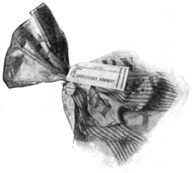
United States System of
Tying, Sealing, and
Labelling Sacks.
DANIEL WEBSTER WITH UNPUBLISHED MANUSCRIPTS AND SOME EXAMPLES OF HIS PREPARATION FOR PUBLIC SPEAKING By George F. Hoar
In one respect Daniel Webster
is the most striking figure
in our history, and one
of the few most striking
figures in all history. That
is, in the impression he
made on everybody—that, great as were
his achievements, he was himself greater
than his greatest achievement.
Franklin, Webster, and Emerson are
the three great New Englanders. Each
of them was a great public teacher. If
Webster did not lack, at least he did not
manifest, Franklin's wonderful common-sense,
as applied to common things and
common life. He had not Emerson's profound
spiritual discernment or wonderful
poetic instinct. But his intellect seems
like a vast quarry. When you have excavated
the great rocks at the surface, you
know there is an inexhaustible supply left.
When he died, the people felt as if the
corner-stone of the Capitol had been removed;
as if the elephant had died that
bore the universe on its back.
Emerson's portraiture of Webster at
Bunker Hill is made up of a few strokes.
But it reveals the whole secret. Great as
were the things that Webster said, profound
as was his reasoning, lofty as are the
flights of his imagination, stirring as are
his appeals to the profoundest passions of
his countrymen, there is a constant feeling
that Jove is behind these thunderbolts.
That is the contrast between him and so
many other orators. Even in Choate and
Phillips you are admiring the phrase and
the elocution, and not the men. In Webster
you are thinking of the man, and not
the phrases. The best things that he said
do not seem to his listener to be superior,
and rarely seem to his listener to be equal,
to the man who said them. There is plenty
of reserve power behind—
... Half his strength he put not forth, but checked
His thunder in mid-volley.
Emerson also said of him, "His strength
was like the falling of a planet; his discretion,
the return of its due and perfect
curve."
Nothing certainly can be more profitable
for youth who desire to cultivate the
capacity for public speaking for the purpose
of addressing juries, legislative bodies,
or popular assemblies, than the study of
the style, the delivery, and the method of
preparation of him whom nearly all his
countrymen think the foremost American
orator, and whom many of them think the
foremost orator who ever spoke the English
tongue. Many admirable critics have
dealt with these topics.[2]
Mr. Winthrop has told,[3] in his own delightful
way, the story of one of Webster's
compositions, famous at the time, now
almost forgotten.
Mr. Winthrop says also truly of Daniel
Webster:
"Daniel Webster, unlike Everett or
Choate, was all deliberation, both in matter
and manner. I do not believe that
it ever occurred to him what gestures he
should make, or that he ever remembered
what gestures he had made. His words
seemed to flow spontaneously and often
slowly, whether from his lips or his pen, as
from a profound and exhaustless reservoir
of thought. Of him it might be, and perhaps
often has been, said:
"... Deep on his front engraven
Deliberation sat, and public care."
He says of Webster's eloquence that it
was the eloquence of clear, cogent argument,
and of occasional deep emotion,
expressed in clear, forcible Saxon words—sometimes
adorned by most felicitous
quotations and sometimes by magnificent
and matchless metaphors.
James Parton says:
"He discovered, he says, that the value
as well as the force of a sentence depends
chiefly upon its meaning, not its language,
and that great writing is that in
which much is said in a few words, and
those words the simplest that will answer
the purpose. Having made this notable
discovery, he became a great eraser of
adjectives, and toiled after simplicity and
directness."
Edward Everett, who knew Mr. Webster
very intimately, says:
"Perhaps the noblest bursts—the loftiest
flights, the last and warmest tints of
his discourses of this kind—were the unpremeditated
inspiration of the moment
of delivery."
I suppose, from all I can gather, that
Mr. Webster, with very few exceptions
indeed, committed to writing nothing
but the heads of his speeches. But they
were, nearly all of them, upon subjects
constantly in his thoughts. He had undoubtedly
matured sentences and phrases
which came to his mind in leisure moments,
and which came to his memory
under the stimulant of great occasions
and great audiences, in addressing juries
or public assemblies or the Senate, with
which he ornamented his discourses, or
strengthened his argument. Most of the
speeches we have only as they came to
us in the imperfect reporting of the
time. Some of them, like the oration at
Plymouth, he probably revised carefully
before they were published. We have his
own testimony that this was true of the
well-known "morning drum-beat" passage
in the speech on the President's Protest.
Still, the testimony is abundant that
some of his best passages must have come
from an inspiration while he was upon his
feet. Mr. Winthrop gives an account
of one; Mellen Chamberlain, a most accomplished
critic and observer, another.
And there are plenty of others floating
about. Judge Chamberlain says one
thing of him, which I dare say may have
been said before and since. It explains
Webster's influence over his auditors and
over posterity. He says:
"He was perfectly sane, and it may be
the most perfectly sane orator who ever
spoke English."
I have in my possession a good many
of Mr. Webster's manuscripts, including
his preparations for speeches, letters from
him to intimate friends and from his intimate
friends to him, a good many bound
volumes of political pamphlets, some of
them with the autographs of famous authors,
and some of his books. From
these I select a few which relate to important
and interesting events in his life,
or throw some additional light upon his
habit and method of preparation for public
speaking, adding some explanation and
comment.
One of the greatest debates in our parliamentary
history, only surpassed in importance
in Mr. Webster's public life by
the debate with Hayne on Foot's Resolution
and the debate on the Compromise
measures in March, 1850, is the debate
on the Sub-Treasury in the early part of
the year 1838. Silas Wright introduced
the Sub-Treasury Bill January 16, 1838.
January 30, 1838, the bill came on for a
second reading, and Mr. Wright made an
elaborate speech in its support. The next
day Mr. Webster spoke. His speech,
which is wholly a reply to Wright, makes
no allusion whatever to Mr. Calhoun. It
is reported in the fourth volume of his
works, page 432. I have before me Mr.
Webster's notes of preparation for that
speech. They constitute a mere brief, all
included on six pages of letter-paper, and
mostly consisting of mere catch-words.
The first sentence or two, however, indicate
the difference between Webster and
the supporters of the Sub-Treasury:
"Let the government attend to its own
business; and let the people attend to
theirs."
"Let the government take care of the
currency for its own revenue; for all other
purposes, let it leave it to the States and
to the people."
"Ominous and disheartening sentences.
Yet the whole spirit of the Administration
and of this bill."
There is no hint in these notes, except the
above, of any of the eloquent and weighty
sentences with which the speech abounds.
February 15, 1838, Mr. Calhoun spoke
on the Independent Treasury Bill. (See,
for this speech, his Works, vol. 3, page
202.) He makes an allusion to one of
Mr. Webster's arguments, viz., his claim
that the government should furnish paper
currency. But the speech contains nothing
personal or calculated to excite challenge
and reply. March 10, 1838, Calhoun
makes a second speech on the same
bill (reported, Works, vol. 3, page 244).
That speech, also, contains hardly any
allusion to Mr. Webster. It is devoted
almost wholly to a reply to Clay, between
whom and Calhoun a very angry personal
altercation had arisen. March 12,
1838, Mr. Webster delivered his second
speech on the Sub-Treasury, which is reported
in his Works, vol. 4, page 424.
It occupies seventy-six pages there. Of
this, the last thirty-three are a reply to
Mr. Calhoun. Calhoun said in his answer,
which was made on the 22d of the
same month, that Webster delivered this
part of his speech with great vehemence,
and evidently considered it the most important
portion of his remarks. So much
of the speech as is a reply to Mr. Calhoun,
however, deals chiefly with a speech
made by him at the extra session in September,
1837, and with a letter known as
the "Edgefield Letter," written by Mr.
Calhoun to his constituents in the vacation.
I have Mr. Webster's entire preparation
for this speech. It is in Webster's
handwriting, and consists of eight
heads, all on one page of a sheet of small
note-paper, labelled on the back, in Webster's
handwriting, "Heads of my speech
on the Sub-Treasury," and is as follows:
"No. 1. General state of the country
and credit system."
"No. 2. Our pecuniary condition and
question of excess."
"No. 3. Is the measure suited to the
condition of the country?"
"No. 4. Is it a just exercise of our
powers?"
"No. 5. Mr. C.'s speech, September
19."
"No. 6. Mr. C.'s letter, November 3."
"No. 7. Mr. C.'s speech, February
15."
"No. 8. Identity of commerce."
Besides this, Mr. Webster wrote out the
concluding part of the speech in twenty-one
pages of a rather small letter-paper,
of which I have the last eight, which
correspond to about three of the seventy-six
pages which the whole speech occupies
in the printed report. This part
seems to have been corrected again and
again. A fac-simile of a part of one of
these pages is here given, showing how
careful was Mr. Webster's revision and
correction. The whole page runs:
"Sir, the spirit of Union is particularly
liable to temptation, & seduction, in moments
of peace & prosperity. In war,
this spirit is strengthened, by a sense of
common danger, & by a thousand recollections
of ancient efforts, & ancient glory,
in a common cause.
"In the calms of a long peace, & the absence
of all apparent causes of great alarm,
things near gain an ascendancy over things
remote. Local interests & feelings overshadow
national sentiments. Our attention,
our regard, & our attachment, are
ever more solicited to what touches us
closest, feel less and less the attraction
of a distant orb. Such tendencies, we
are bound by true patriotism, & by our
love of union, to resist."
Mr. Calhoun replied to this speech of
Webster, March 22, 1838, in a speech reported
in his Works, vol. 3, pages 279-330.
Calhoun had both Webster and Clay on
his hands in this debate. He certainly
bore himself with great courage and ability.
The South had no reason to be ashamed
of her champion, so far as this was a struggle
of pure intellect. When Calhoun got
through, Webster instantly rose and answered
him in the speech beginning with
the famous passage about carrying the war
into Africa, reported in Webster's Works,
vol. 4, page 500, but not found in the
Globe. The Globe at that time was a
weekly paper, containing very imperfect
reports of the daily debates in the Senate.
An appendix was published at the end of
the session, which had some of the more
important speeches written out from the
reporters' notes or from other sources, probably
under the supervision of their authors.
This speech ended the discussion between
Calhoun and Webster on this particular
measure, although the debates on financial
and other questions for several preceding
and succeeding years make, in substance,
but one long debate between these two
famous champions, in which the whole
issue between North and South, slavery
and freedom, State rights and national
powers, was under discussion.
Fac-simile of a part of one of the concluding pages of Webster's draft of his speech in reply to Calhoun, March 12, 1838.
One passage in this speech explains the
following note here given in fac-simile,
from John Tyler to Mr. Webster, his Secretary
of State, written when Jackson broke
the silence of the Hermitage:
"The old Lion still roars.
See Genl. Jackson's letter
among those which
are sent.
J. T."
"On the broad surface of the country,
Sir, there is a spot called 'the Hermitage.'
In that residence is an occupant very well
known, and not a little remarkable both in
person and character. Suppose, Sir, the
occupant of the Hermitage were now to
open that door, enter the Senate, walk forward,
and look over the chamber to the
seats on the other side. Be not frightened,
gentlemen; it is but fancy's sketch. Suppose
he should thus come in among us,
Sir, and see into whose hands has fallen
the chief support of that administration,
which was, in so great a degree, appointed
by himself, and which he fondly relied on
to maintain the principles of his own. If
gentlemen were now to see his steady military
step, his erect posture, his compressed
lips, his firmly knitted brow, and his eye full
of fire, I cannot help thinking, Sir, they
would all feel somewhat queer. There
would be, I imagine, not a little awkward
moving and shifting in their seats. They
would expect soon to hear the roar of the
lion, even if they did not feel his paw."
This speech Mr. Everett declared to be
the ablest and most effective of Mr. Webster's
speeches on the currency. Lord
Overstone, than whom there was never a
higher authority upon finance in England,
produced a copy of it before a committee
of the House of Commons, by whom he
was examined, and said it was one of the
ablest and most satisfactory discussions of
these subjects he had ever seen. He afterward
spoke of Mr. Webster as a master
who had instructed
him upon these
matters.
There are notes
of a speech on the
currency which occupy
two pages and
three and one-half
lines of common
letter-paper. The
two sentences at
the close sum up
not only Webster's
final conclusion after
a life of reflection
upon the subject,
but, I believe,
the final conclusion
of the country as to
the great doctrine
of protection. "The sacrifice made by
reducing prices must necessarily fall on
labor."
"If price of cotton reduced, at home,
may be not abroad. So other articles.
"But labor is fixed down to the place.
If you reduce its price, it has no escape.
The whole result, then, of reducing cost
of production comes merely to this—that
the capitalist shall manufacture at a less
price, and deduct the loss in price from
the labor of his workmen. This is the
whole of it.
"I am for protecting labor. I am for
enabling it to clothe itself well, feed itself
well, and educate itself. I am desirous
of giving to labor here, in its competition
with capital, advantages which it does
not possess elsewhere.
"Every man, who contemplates reduction,
must survey the condition of other
countries, with which we have great
intercourse."
Mr. Webster went to Washington to attend
the session of December, 1832, under
the burden of a great responsibility. He
had borne his share in the great debate
in which he established the authority of
the Union against the doctrine of
nullification in a manner which had won for
him the undying regard of the vast majority
of his countrymen. President Jackson
had done his part in asserting his
determination to uphold the Constitution
at all hazards and against all enemies.
In all that, the President and Mr. Webster
were in thorough accord. But he had no
sympathy with President Jackson's desire
to overthrow the banking system, to provide
simply instrumentalities for the government
to transact its business, leaving
the business of the country to look out for
itself. On the other hand, a considerable
portion of his own party, led by Mr. Clay,
desired to compromise with nullification,
and so to modify the tariff as to leave
South Carolina a substantial victory, and
save her pride from being compelled to
submission to the superior strength of the
government. With this element Mr. Webster
had no sympathy. Again, Jackson
claimed to be the direct representative of
the people, desired to extend the power
of the executive and to circumscribe the
legislative power, especially that of the
Senate. In resisting that encroachment
Webster and Calhoun were in complete
accord. So Mr. Webster could have no
permanent alliance or co-operation either
with Jackson, Calhoun, or Clay.
Fac-simile of the First Paragraph of Webster's "Principles."
Mr. Webster prepared for himself the
following statement of the principles which
were to govern his own course in this great
emergency. Some of its language is found
in his speech in the Senate of February 8,
1833. But with that exception, it has
never, I believe, been made public until
now. It is the chart which governed his
course in that part of his public life of
far greatest public importance, and the
part of his public conduct on which his
own fame must rest:
"PRINCIPLES.
"1. To sustain the administration, in executing
the laws; to support all measures,
necessary to supply defects in the existing
system; & to counteract the proceedings
of South Carolina; to limit all their measures,
& all this support, to the fair purpose
of executing the laws, with moderation
& temperance, but with inflexible
firmness;—to share this responsibility with
the Administration, frankly & fairly, without
expressing any want of confidence, &
without mingling other topics, with the
consideration of these measures.
"2. Not to give up, or compromise, the
principle of protection; nor to give any
pledges, personal or public, for its abandonment
at any time hereafter.
"3. To bring down the revenue to the
just wants of the Govt.: but this not to
extend so far as to prevent Congress from
making, for a limited time, a distribution
of the proceeds of the sales of the public
lands among the States, if Congress shall
see fit to make such distribution: nor so
far as to prevent appropriations to such
objects of Internal improvement, as Congress
may think deserving of national aid.
"4. To revise the Act of last session,
with close scrutiny, & entire candor; &
to reduce duties, in all cases, where such
reduction can, with any fairness, be asked,
& with any safety, granted; having just
regard, to the necessities of the Country
in time of war, to the faith plighted by
existing & previous laws to the reasonable
protection of capital, & especially to the
security of the interests of labor & wages.
"5. If Congress shall not, before the end
of the next session of Congress, pass a law
for the distribution of the proceeds of the
public lands, among the States, those proceeds
to be regarded as so much general
revenue, applicable to the ordinary purposes
of Government; & the duties on
imports to be so much farther reduced as
may, by this means, become necessary.
"6. Provision to be made to direct the
framing of proper issues in law, feigned or
real, with a view to submit to the judgment
of the Supreme Court of the U. S.
the question, whether Congress possesses
the Constitution to lay & collect duties on
articles imported, for the avowed and only
purpose of protecting & encouraging domestic
products & manufactures.
"7. If the land bill shall pass, then some
measure to be adopted to limit, practically,
grants by Congress to objects of Internal
Improvement, to such as in their nature
transcend the powers & duties of separate
States.
"8. A Comee. of the Senate to sit in the
recess to take into consideration the law
of the last session (according to Art. 4),—to
make a detailed Report, the first day of
next session; accompanied by such a bill,
as they may recommend, for the purpose
of adjusting the Revenue to the necessities
of Government.
"Note.—My idea would be, that this
Comee. should meet in Boston, Oct. 1,
& prosecute its inquiries, in Boston, Providence,
N. Y., Philadelphia & Pittsburg,
if thought necessary.
"The Comee. to consist of one N. E.
member
one from Middle States,
one from N. W. States,
one from S. W. States,
one from Southern States."
It is very unpleasant to think that the
great sentences of the Reply to Hayne,
which the country knows by heart, were
never delivered by Mr. Webster in the
Senate chamber as we have them. Yet so
it is. The speech was taken down in short-hand
by Joseph Gales, one of the editors
of the National Intelligencer, and one of the
best stenographic reporters of that day.
He was requested by Mr. Webster beforehand
to report his speech, which he did.
He wrote out his short-hand report at
length. That report was submitted to Mr.
Webster, and he, with it in his possession,
wrote out in his own hand a revised version
of the speech. Mr. Everett says, in the
Life prefixed to his edition of Mr. Webster's
Works, that Mr. Webster had Gales's report
but a part of a day. But it is absolutely
impossible that Mr. Everett is correct,
although the statement was published
in Mr. Webster's lifetime. The short-hand
notes, and the speech as written out from
them by Gales, and the speech in Mr.
Webster's handwriting, are now all in the
possession of the Boston City Library.
They were purchased of Mrs. Gales, widow
of Joseph Gales, for the sum of $575
by Robert C. Winthrop, acting in behalf
of himself and twenty-two other subscribers
who gave $25 each for the purpose.
Mr. Webster wrote out the whole of it,
although about a third of his manuscript
is missing, not, however, the most important
or the best known portion. The
draught itself shows traces of revision and
reconsideration by Mr. Webster in the
matter of the structure of some important
sentences. He changes Gales's report a
great deal, and then in revision makes
corrections again and again of his own
draught. We give the famous passage
about Massachusetts, and the noble peroration,
as they are reported by the accurate
short-hand writer, doubtless literally as they
were spoken, and the passages as finally
composed by Mr. Webster and now familiar
to the world. The sentences actually
spoken well account for the great impression
made upon the auditors. They
are such as Webster would have been
likely to utter on a great occasion and
great theme. But we do not like to think
that any word or syllable among those
that have stirred our hearts from our
earliest boyhood did not, in fact, come
from the inspired lips of the great patriot
and orator. The emotion is like that felt
when a lover of Milton sees the manuscript
of Comus or Lycidas in the library
at Cambridge, and learns that any other
than the fit word and perfect phrase could
ever have occurred to the poet to express
his thought. The exquisite beauty of the
verse still abides. But the sense that it
was an inspiration is gone.
It is said that when Milo in his exile
read Cicero's speech in his defence, he
exclaimed, "O Cicero, hadst thou spoken
thus, Milo would not be now eating figs at
Marseilles." We cannot say that of the
Reply to Hayne. Its grandeur is there
as it came unpremeditated and fresh from
heart and brain. But it is a little unpleasant
to think that the phrases that all
Americans know by heart differ so much
from those which commanded the applause
of the listening Senate on that great
day which settled in the tribunal of reason
the fate of the Republic.
The Passage about Massachusetts as
Actually Spoken
"Sir, I shall be led on this occasion
into no eulogium on Massachusetts. I
shall paint no portraiture of her merits,
original, ancient or modern. Yet, sir, I
cannot but remember that Boston was
the cradle of liberty, that in Massachusetts
(the parent of this accursed policy
so eternally narrow to the West), etc.,
etc., etc. I cannot forget that Lexington,
Concord and Bunker Hill are in
Massachusetts, and that in men and means and
money she did contribute more than any
other State to carry on the Revolutionary
war. There was not a State in the Union
whose soil was not wetted with Massachusetts
blood in the Revolutionary
war, and it is to be remembered that of
the army to which Cornwallis surrendered
at Yorktown a majority consisted of New
England troops. It is painful to me to
recur to these recollections even for the
purpose of self-defence, and even to that
end, sir, I will not extol the intelligence,
the character and the virtue of the people
of New England. I leave the theme to
itself, here and everywhere, now and forever."
As Written Out by Mr. Webster and
Printed
"Mr. President, I shall enter on no
encomium upon Massachusetts. She needs
none. There she is. Behold her, and
judge for yourselves. There is her history;
the world knows it by heart. The past, at
least, is secure. There is Boston, and Concord,
and Lexington, and Bunker Hill; and
there they will remain forever. The bones
of her sons, falling in the great struggle for
Independence, now lie mingled with the
soil of every State from New England to
Georgia; and there they will lie forever.
And Sir, where American Liberty raised
its first voice, and where its youth was
nurtured and sustained, there it still lives,
in the strength of its manhood and full of
its original spirit. If discord and disunion
shall wound it, if party strife and blind
ambition shall hawk at and tear it, if folly
and madness, if uneasiness under salutary
and necessary restraint, shall succeed in
separating it from that Union, by which
alone its existence is made sure, it will
stand, in the end, by the side of that cradle
in which its infancy was rocked; it will
stretch forth its arm with whatever of vigor
it may still retain over the friends who
gather round it; and it will fall at last, if
fall it must, amidst the proudest monuments
of its own glory, and on the very
spot of its origin."
Peroration as Actually Spoken
"When my eyes shall be turned for the
last time on the meridian sun, I hope I
may see him shining bright upon my united,
free and happy country. I hope I shall
not live to see his beams falling upon the
dispersed fragments of the structure of this
once glorious Union. I hope I may not
see the flag of my country with its stars
separated or obliterated; torn by commotions,
smoking with the blood of civil war.
I hope I may not see the standard raised
of separate State rights, star against star,
and stripe against stripe; but that the flag
of the Union may keep its stars and its
stripes corded and bound together in indissoluble
ties. I hope I shall not see written
as its motto, 'First liberty, and then
union.' I hope I shall see no such delusive
and deluded motto on the flag of that
country. I hope to see, spread all over it,
blazoned in letters of light and proudly
floating over land and sea, that other
sentiment, dear to my heart, 'Union and
Liberty, now and forever, one and inseparable.'"
Peroration as Written Out by Mr. Webster
and Printed
"When my eyes shall be turned to behold
for the last time the sun in heaven, may
I not see him shining on the broken and
dishonored fragments of a once glorious
Union; on States dissevered, discordant,
belligerent; on a land rent with civil feuds,
or drenched, it may be, in fraternal blood!
Let their last feeble and lingering glance
rather behold the gorgeous ensign of the
republic, now known and honored throughout
the earth, still full high advanced, its
arms and trophies streaming in their original
lustre, not a stripe erased or polluted,
nor a single star obscured, bearing for its
motto, no such miserable interrogatory as
'What is all this worth?' nor those other
words of delusion and folly, 'Liberty first
and Union afterwards'; but everywhere,
spread all over in characters of living light,
blazing on all its ample folds, as they float
over the sea and over the land, and in
every wind under the whole heavens, that
other sentiment, dear to every true American
heart, Liberty and Union, now and
forever, one and inseparable!"
The family of one of Mr. Webster's colleagues
have a story which has been repeated
to me several times, but, so far as
I know, has never been published, that the
delegation were somewhat anxious lest
Mr. Webster did not fully appreciate the
strength of Hayne's attack, and the grave
responsibility he had to bear in the reply.
One of them at the request of his associates
called on Mr. Webster that morning
at his boarding-house, to communicate to
him their great anxiety. He found him
alone in the parlor of his dwelling, walking
up and down, and humming to himself the
refrain of the old English hunting-song:
Tantivy, tantivy,
This day a stag must die.
He concluded there was no occasion
for any further alarm.
When Mr. Webster went to the Senate
next morning, as he made his way through
the crowded chamber to his seat, John M.
Clayton, of Delaware, said to him: "Mr.
Webster, I hope you are primed and loaded
this morning." "Five fingers, sir,"
was the reply, with a gesture as if pointing
to a gun-barrel.
Mr. Winthrop says: "Of his emotions
he said himself not long afterward, 'I
felt as if every thing I had ever seen or
read or heard was floating before me in
one grand panorama, and I had little else
to do than to reach up and cull a thunderbolt
and hurl it at him.'"
What he said to Hiram Ketcham, of the
Reply to Hayne, is true of nearly all his
great speeches:
"In one sense I had no preparation
whatever, but in another sense I was fully
prepared. I did not know what words I
should use when I rose to my feet, nor the
order of argument in which I should proceed.
These came to me under the excitement
of debate. But I understood the
subject as well as I was capable of understanding
it. I had studied it; I had often
urged similar arguments before other tribunals,
and in this sense of the term I was
thoroughly prepared."
It is clear that there was absolutely no
time for the preparation of the language
of Webster's Reply to Hayne. He had
made an extemporaneous reply to Hayne—to
an elaborate speech of Hayne's—the
morning after it was delivered. Hayne replied
to him, and Webster, after a single
night's interval, made in two successive
days the most famous speech in American
history.
We may sum up what we know of Mr.
Webster's habit of preparation and composition
as follows:
First. He spoke always upon great subjects.
Second. They were subjects upon
which he had long meditated with the
expectation that he would be called upon
to discuss them in public.
Third. He had matured in his mind
the arguments on great public questions,
and also eloquent thoughts and sentences
which had occurred to him during such
meditations, ready for use when such occasion
came.
Fourth. With these exceptions his
speeches were usually unpremeditated,
both as to language and order of arrangement,
except so far as he jotted down
some points or heads just before he spoke.
Fifth. In some few instances he wrote
out his speeches beforehand, making occasional
corrections and interlineations,
which in general did not seriously change
or improve his first expression.
Sixth. Many of the speeches we have,
especially those made in the Senate or
made to political assemblies, are as taken
down by the reporters, and not revised
by him.
Seventh. Some few, as for example,
the Plymouth Oration and the Reply to
Hayne, were carefully revised and largely
written out by him afterward.
Eighth. He was quite susceptible to
the stimulant of the audience or the
occasion, which not infrequently excited him
to the very loftiest and most effective
eloquence.
Ninth. In general, Webster's style was
not a Saxon style. It was of a somewhat
ponderous latinity. But on a few
occasions, when his mind rose to a white
heat, all the resources of our language,
whatever their origin, were at his command
in amplest measure.
Tenth. In general he mastered his subjects;
his subject did not master him. Solidity,
sincerity, gravity, self-restraint,
characterized his every thought and every
utterance. But sometimes the volcano
poured out its molten lava.
Mr. Webster made an impression upon
the people of Massachusetts, in his time,
as of a demi-god. His magnificent presence,
his stateliness of manner, his dignity,
from which he never bent, even in his
most convivial and playful moments, his
grandeur of speech and bearing, the habit
of dealing exclusively with the greatest
subjects, enabled him to maintain his
state. His great, sane intelligence pervades
every thing he said and did. But
he has left behind few evidences of
constructive statesmanship. There is hardly
a great measure of legislation with which
his name is connected, and he seems to
us now to have erred in judgment in a
great many cases, especially in undervaluing
the great territory on the Pacific. He
consented readily to the abandonment of
our claim to the territory between the
forty-ninth parallel and that of fifty-four
forty, which would have insured our supremacy
on the Pacific, and have saved
us from the menace and rivalry there of
the power of England. He voted against
the treaty by which we acquired California.
That, however, is a proof of a larger foresight
than that of any of his contemporaries.
Alone he foresaw the terrible Civil
War, to which everybody else of his time
was blind. What even he did not foresee
was the triumphant success of the Union
arms. It is hardly to be doubted that if
the Civil War had come in 1850 or 1851
instead of 1861 its result would have been
different. But Mr. Webster's great service
to the country, a service second to
that of Washington alone, is that he inspired
in the people to whom union and
self-government seemed but a doubtful
experiment, the sentiment of nationality,
of love of the flag, and a passionate
attachment to the whole country. When
his political life began, we were a feeble
folk, the bonds of the Union resting lightly
upon the States, the contingency of disunion
contemplated without much abhorrence
by many leading men, both
North and South. Mr. Webster awoke in
the bosom of his countrymen the conception
of national unity and national greatness.
It has been said more than once
that the guns of our artillery in the great
battles of the Civil War were shotted with
the Reply to Hayne.
A few years ago the State of New
Hampshire presented to the United States
for the Memorial Hall a statue of Webster—a
ceremonial in which I had some part.
After it was over, I got a letter from a
brave Union soldier, who told me he had
been stationed as a sentinel in a place in
the woods where several sentries had been
killed within a short time by a shot from
the thicket. As he paced up and down
on his midnight watch, thinking that at
any moment his death-shot might ring out
from the darkness and gloom about him,
he kept up his heart by repeating to himself,
over and over again, the great closing
sentences of the Reply to Hayne,
ending with the well-known words, "Liberty
and Union, now and forever, one and
inseparable."
History has not yet settled the question
of the motive that inspired the 7th of
March speech.[4] Doubtless there were
good and patriotic men, men who had
loved him till that hour, who went to their
graves believing that Webster fell—fell
like Lucifer, Son of the Morning. There
are doubtless men living who think so to-day.
To the thought of these men Whittier
gave voice in his terrible Ichabod,
which is said to have wounded the great
heart of its subject more than any other
stroke that ever smote his mighty forehead.
But the general judgment of his
countrymen, first mellowing and softening
into the belief which Whittier himself expressed
in his later and tender poem, "The
Lost Opportunity," seems gradually coming
to the conclusion that Webster differed
from the friends of freedom of his time,
not in a weaker moral sense, but only in a
larger and profounder prophetic vision.
When he resisted the acquisition of California,
he saw what no other man saw, the
certainty of the Civil War. It was not
given even to him to foresee its wonderful
and victorious result. When he compromised
he saw in like manner the danger
he tried to avert. He did not see the
safety only to be attained through the path
of danger and strife. I was one of those
who in the conceit and presumption of
youth, a lover of the liberty to which he
then seemed to me to be recreant, judged
him severely. But I have learned better
in my old age. I think of him now only
as the best type of the farmer's boy of the
early time; as the great example of the
New England character of the day of his
earlier manhood; as the great defender
and lover of Massachusetts, as the orator
who first taught his country her own greatness,
and who bound fast with indissoluble
strength the bands of union; as
the first of American lawyers, the first of
American orators, the first of American
statesmen, and as the delightful citizen
and neighbor and friend, of whom the people
of his town said when he was laid in
the grave:
"How lonesome the world seems;"
and of whom his nearest friend said, when
he died:
"From these conversations of friendship
no man—no man, old or young—went
away to remember one word of profanity,
one allusion of indelicacy, one impure
thought, one unbelieving suggestion,
one doubt cast on the reality of virtue, of
patriotism, of enthusiasm, of the progress
of man—one doubt cast on righteousness,
or temperance, or judgment to come."
[A second paper to follow.]