If there was one thing that the sympathetic heart of Eustace could not
endure, it was the spectacle of abused virtue.
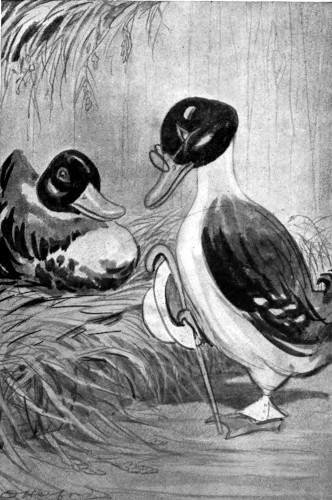
"Gertrude," quacked he thoughtfully to his help-meet, as they were
cruising one day on the frog-pond, "I am really distressed about
Martha. Her husband is acting shamelessly."
Gertrude shrugged her wings. "Well, what else could you expect?" she
said. "The silly hen has brought it all on herself by being so humble
and simpleminded."
"I'm afraid she has," admitted Eustace. "And that is the sad part about
it; for she's really such a fine female—so unselfish, so devoted to
her nest."
"Yes, and such a fool. She's never taken any care of her personal
appearance, or tried to be Clarence's intellectual companion; and now,
when she's getting old (she must be nearly five) and has lost the
figure she had when she was a pullet, it's no wonder that she bores
him. You can't expect to hold a rooster's affections with a mere egg
record."
"I suppose you're right. And yet I'm awfully sorry for her. It's common
talk at the haystack that he has just added another affinity to the
three he had already."
"What! Do you mean that bold-faced speckled creature who was uncrated
only two days ago?"
"Yes."
"The hussy! She tried yesterday to shoulder me away from the
refreshment can, right before everybody; but I gave her a look that let
her know I was ready to tweak her comb off, and she thought better of
it."
"I'll warrant she did!" assented Eustace admiringly. He knew Gertrude
could take care of herself in any situation. "But what can we do about
poor Martha?"
"Nothing that I can see. I confess I have quite lost interest in her
since she refused to attend our conference on Free Puddles for the
Public. But as for that brazen-beaked speckled thing, the next time
I...."
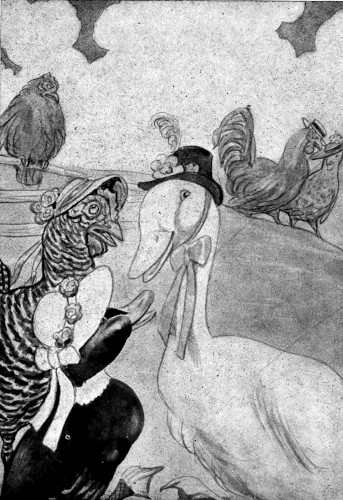
"She refused to attend our conference on Free Puddles for the Public."
"But, darling, don't you think it is our duty, as citizens, to
rescue Martha from the shame of her present position? We mustn't act
pharisaically toward her, the way the swans do, just because she is
afraid of the water and can't walk gracefully. It isn't right to evade
the issue by saying, 'Oh, what better morality could you expect among
chickens?' No; it is for us of the white-feathered race to uplift and
enlighten those of the colored-feathered race, so that when Death comes
chopping at our neck, we shall have amounted to something in this
barnyard."
Gertrude was softened. "I believe you're right," she said, after a
pause. "You have such a noble, high-minded way of looking at things!
Yes, you had better go to Clarence and talk this over with him, fowl to
fowl, and make him realize the great wrong he is committing."
"I've tried it already—several times. But it's no use. He only laughs,
and says that as long as Martha puts up with his ways he has no
intention of changing them. So the only thing to be done is for you to
go to see Martha and...."
"I go to see Martha?"
"Yes—as a friend."
"She's no friend of mine! I'll never forget the way she acted when I
invited her to that meeting. When I said to her that it was the duty of
every one to attend, she had the effrontery to tell me, very pointedly,
that a female's place was on the nest."
"Yes, yes, I know, dear. Yet I should think that, just this once, you
might...."
"No, I won't. She'd as likely as not say something insulting about my
quacking in public."
"Very well, then," said Eustace in an aggrieved tone. "I'll go talk
to her."
"You will? And what will you say to her?"
"I don't know exactly; but I'll try to bring her to a full realization
of the position she's in, and then...."
"That will please her, I'm sure," said Gertrude ironically. "Yet I
doubt if you get that far. She's so blind, she probably believes him
to be as innocent as an egg, and, therefore, won't hear a word against
him."
"Gertrude," he replied with dignity, "I am sorry that your prejudices
have biased your mind to such an extent. However, I shall,
notwithstanding, do what I can to redress this poor hen's wrongs, by
encouraging her to defend her rights and to make her husband respect
her."
"Why, certainly. Don't let me deter you. If you think you can make a
modern female out of a feathered incubator, then by all means go and
try it."
"I shall," he said confidently.
Quitting the pond with a bold waggle of his tail (would that human
beings could thus shake themselves free of all that lies behind them!),
he wriggled sturdily up the bank, and started off for Martha's nest
with a magnificent seagoing waddle.
He found the hen sitting on a large brood of eggs. "Good afternoon," he
said, bobbing his neck affably.
"Good afternoon," she echoed colorlessly.
"I have come to talk with you as a friend," he began, lowering his
voice to an earnest tone, "about something that weighs very deeply on
my heart."
She looked at him with a dull, nonplussed expression.
"You see," he continued, becoming a little nervous, "—h'm—where is
your husband?"
Martha drew herself up in modest alarm. "Sir," she said, "I don't know
where my husband is at this moment; but if what you have to say can't
be said whether he is present or not, then I don't wish to hear it at
all."
"I beg your pardon," stammered Eustace hastily. "You misunderstood me.
It is about him that I wished to speak. I—I merely wanted to say that
you have my sincerest sympathy, and that I am ready to do all I can to
help you redress your wrongs."
"Your sympathy? Help me redress my wrongs?" she exclaimed, divided
between astonishment and perturbation. "What do you mean?"
"Madam," he replied with knightly gallantry, "I respect you for
endeavoring to shield your husband. But my admiration for you only
makes me regret the more his—er—his neglect of you."
"My husband neglect me!" Ruffling up still more, she glanced for
reassurance at her eggs.
"I refer—since you compel me to speak bluntly—to his attentions to
other females."
"Sir, you forget yourself! How dare you say such things to me!" She
burst into tears.
Eustace was taken aback. "Why, really, I...."
"The best husband in all the barnyard!" she sobbed, wiping her eyes
on a leaf. "So loving to me every time I see him!" Then, in a sudden
cackle of rage, she cried, "Leave me, miscreant! With all your guile,
you will never be able to alienate my affections from him!"
That was enough for Eustace. He went.
Gertrude was unable to elicit from him any very definite account of
this interview, but from his disgruntled taciturnity and from one or
two things which he let slip, she made her own inferences as to what
had taken place. "It never pays to offer your sympathy unless you know
it's wanted," she observed sagely. "Remember the time you tried to
console Mrs. Swan for her children's not being white."
But the next day it was her turn to be astonished. As she and Eustace
were trimming the shrubs in front of their burdock home, who should
appear but Martha, with disheveled feathers and a woe-be-gone look.
At sight of her Eustace lost any rancor that had lingered in his breast
from yesterday. "What is the matter?" he asked solicitously, as he
hurried forward to meet her.
"Oh dear, oh dear!" gasped Martha hysterically. "Forgive me for what I
said to you—the things you told me have proved only too true!" Here
she broke down entirely.
Eustace, unaccustomed to such displays of emotion on the part of the
weaker sex, turned an S. O. S. glance in the direction of Gertrude; but
she, keeping scornfully aloof, ignored this call for assistance.
"After you left me," continued the hen, when she was able to regain her
speech, "I couldn't help thinking over what you had said, and dreadful
suspicions began to enter my mind, so that last night I didn't sleep at
all. My head tossed and squirmed under my wing all night long."
Again she broke down, and Eustace felt more helpless than ever.
"When Clarence came to see me to-day, I asked him some pointed
questions. He tried to evade them and change the subject, by
complimenting me on having just laid another egg. But I could see he
was hiding something, and when he went away I got up from my nest and
followed him. As I turned the corner of that clump of bushes over
yonder, I saw ... I saw my husband—in the act of embracing ... a
speckled female!" Uttering these last words, she keeled over, and would
have fallen had not Eustace stayed her with his outstretched pinion.
"Bring some smelling-roots!" he called excitedly. "Quick, some garlic!"
When the hen had been restored to consciousness, she thanked Eustace
and his wife most humbly, and said, "I have come to you because you
offered to help me. Tell me what I must do."
"Get a divorce," said Gertrude firmly.
"Oh no, no!" exclaimed the hen. "I couldn't live without Clarence. What
I want is to have him all to myself."
At this confession of weakness, Gertrude, raising her bill in air in
token of supreme disgust, waddled off to the pond, to attend a regatta
of water-bugs.
But Eustace, believing that Martha's whole happiness was at stake,
faced the matter seriously. He felt that this was a golden opportunity
for doing her good. "You must make your husband respect you and feel
the need of your companionship," he said. "You must share all his
interests. If he has a passion for hunting which leads him to stalk
grasshoppers or go coursing after a pack of beetles, then you must
take up hunting and join in his sport. If, on the other hand, he has a
hobby for collecting, and goes about picking up pieces of old china,
then you, also, must become a connoisseur in antiques."
As the hen listened to this advice, she blinked in a befuddled manner.
"But what would become of my eggs?" she asked.
"Oh, I don't mean that you are to absent yourself from your home when
maternal duties require your presence there. Far from it. You are to
reign there as queen of his heart, enthroned on your nest."
Martha sighed wistfully.
"Even at those times when the cares of motherhood keep you within
the coop," he went on, carried away with his theme, "you can still
make yourself your husband's intellectual companion, by discussing
with him such topics as the political betterment of the barnyard,
the abolition of capital punishment for obesity, the restriction of
overcrowding in bee tenements, and the regulation of food distribution
by the Pan-Gastronomic Association. From talking over these things with
you, he will learn the value of your opinion, and will come to find
continual inspiration in your society."
The hen listened in awed silence. At last, heartened by his eloquence,
she said, "I'll try to be that kind of wife. It will be hard at first,
but perhaps I'll get used to it."
Accordingly, the next time Clarence came strutting up to her, with
swishing feathers and a gurgle of "Hello, wifie dear!" she answered
serenely, "How do you do, Clarence? I want to have a talk with you."
"Huh!" said he in surprise. Drawing himself up and holding one foot
meditatively in the air, he cocked his head sidewise to have a good
look at her.
"I have been thinking things over very seriously," she continued, in
the same tone, "and from now on I intend to be a very different sort of
wife to you. In the past I have not shared your interests as I should
have; but in future I shall make myself your companion in everything. I
shall keep informed on all topics of the day, such as the organization
of the Society for the Prevention of Cruelty to Insects and the report
of the Vice Commission on conditions in the rabbit pen, so as to be
able to discuss them with you and give you the benefit of my opinions."
"Say, what's the matter with you?" he demanded. "I'll be plucked if I
ever saw you this way before!"
Emboldened by having disconcerted him, she went on to make good her
advantage. "And after this I shall always...."
"Sorry, but I'll have to be going. Have an important engagement." He
started to move away.
"With whom?"
Startled at the audacity of her question, he inquired ill-humoredly,
"Why do you ask?"
"Because I am your wife, and, therefore, take an interest in everything
you do."
"You do, do you?" He looked her square in the profile, then lowered his
head and pecked thoughtfully at a weed; then he said, "Well, since you
are so curious to know—I'm going cricketing with Jim, the turkey."
"Then I'll go with you. You and I together can catch them twice as fast
as he can."
"Look here, now—this is no hen party!" he rasped.
"I'm not so sure," she retorted, stirred more and more by jealous
suspicions. "It may be a speckled hen party!"
Clarence gave an involuntary start. Then, falling into a quivering
rage, he clawed the ground with fury. "Just for that, now, it shall
be a speckled hen party! Good-bye!"
"Wait a moment, Clarence!" she called abjectly, as he stalked away.
"Ah, don't leave me!"
"Green-eyed termagant!" he gargled, as a parting thrust, and headed
straight for the clump of bushes where waited his affinity.
Two days later, when Eustace was expressing to Gertrude his
gratification over having converted Martha to modernism, he was
suddenly struck dumb by the appearance of the hen herself. That
disconsolate female, with every feather ruffled the wrong way, had
a shaky manner and a wild look in her eye that gave promise of an
unpleasant scene.
"Why, what is the matter?" he inquired nervously, as she drew near and
fixed her glance upon him.
"A pretty question for you to ask, you breaker-up of homes!" Eustace
took a step backward.
"Monster!—to poison my mind against my husband! I hope you're
satisfied, now that you've wrecked my happiness!"
At this point, Gertrude, who had witnessed Martha's first outburst with
scornful composure, thought it time to intervene. "Come, come—control
yourself!" she said sternly. "Now tell me what's the matter. Have you
had a quarrel with Clarence?"
"Yes," gulped the hen. "Your husband made me do it."
"Why, I...."
"Keep quiet, Eustace! Let me manage her. Did he go away and leave you?"
The hen nodded.
"And he hasn't been back since?"
She shook her head.
"And now you want him to come back?"
"Oh yes—yes!" she moaned. "I'll let him have his way in everything,
and never leave my nest, and never ask any more questions!"
"Hear that, Eustace?"
He did, in blank silence.
"Then go repeat it to Clarence, and bring him here at once," she
commanded.
He hesitated, and was about to speak.
"Don't stop to talk. Hurry!"
He did as he was told.
Swinging sharply around the corner of the clump of bushes, he collided
with the very fowl he was seeking.
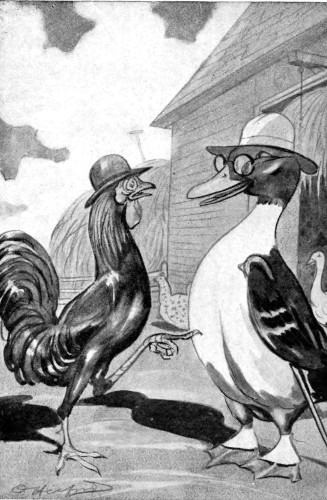
"Why, hullo, old Single Standard!" exclaimed the rooster jocularly.
"Whither hurried hence?"
"Ah! I'm glad I've found you," said Eustace earnestly. "Martha, your
wife, is in great distress of mind. She wants you to come home, and
promises she'll never ask any more questions."
"Really? Then you're my friend for life!" As they started off together,
he continued, "You'll have to forgive me, old sport—I didn't see it at
first, but you certainly were far-sighted to put her up to that 'modern
female' nonsense. The truth is, until you did this I was afraid she
might some day get on to me, and that I'd never hear the end of it;
but now, since she's learned her lesson, I'll have her right where I
want her. She knows she can't afford to ruffle the only rooster in the
barnyard."
They walked on for a while in silence. Eustace, toddling dazedly, could
find no utterance for the thoughts in his mind.
"You know," said Clarence reflectively, "I'll be glad to see Martha
again. I'm getting a bit tired of that speckled minx. She's beginning
to nag me with 'Why do you love me?' and 'How much do you love me?'
questions."
"Clarence," said Eustace, finding speech at last, "I had a very
different purpose in mind when I counseled Martha as I did."
The rooster cocked his head quizzically. "So you wanted to reform my
coophold, did you?"
"Yes," answered Eustace, in deep earnest.
Clarence exploded into a prolonged guffaw. "Whoopee!" he gurgled,
stamping around and shaking his feathers. "Say, old bird, you've got
lovely ideas, all right—but you don't understand hens. You're
quaxotic."