Why is a Second-Class Scout like an advertisement of
Pears’ Soap? Because she sees the First Class Badge
within her reach if she only tries for it and “she won’t be
happy till she get it.”
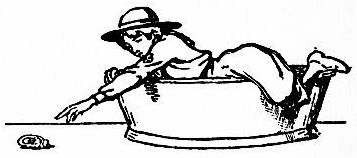
She won’t be happy till she gets it.
At any rate I hope she won’t, because a Scout who is
content to sit down and be a Second Class Scout is only
a third class girl.
It is true that when she has got her Second Class,
she can go in for Proficiency Badges and cover her arm
with them, but I would much rather see a Scout with the
one Badge of First Class on her left arm than one with
a dozen on her right.
After all the First Class tests are not so very hard.
They look a lot, but like many other difficulties in this
world they are not so bad as they look when you smile
at them and tackle them.
Here are the tests that you have to go through for becoming
First Class Scouts:—
To become a First Class Girl Scout, she must have
been a Second Class Scout.
I. Intelligence.
Be able to draw a rough sketch of the district
around the troop meeting place, locating
the important landmarks, and be
able to direct a stranger to the nearest
doctor, fire station, telephone, postoffice,
etc., from any point within that district,
and to judge distances.
Be able to send and receive messages,
in the general service code at the
rate of thirty letters a minute.
Have fifty cents in the savings
banks earned by herself.
Present a girl trained by herself in
the test for Tenderfoot.
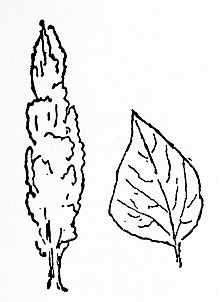
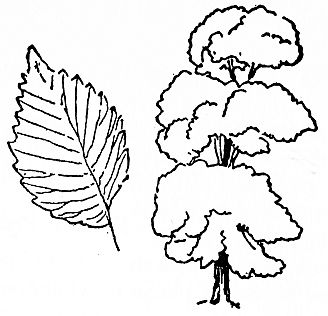
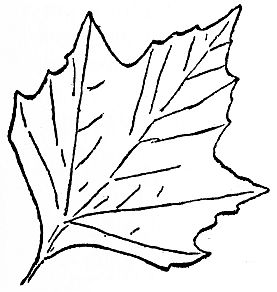
Know how to distinguish and name
ten animals, ten wild birds, ten wild
flowers and ten trees.
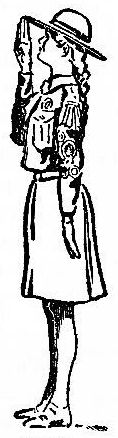
1st Class
Scout
II. Handicraft and Skill.
Be able to prepare, cook and serve one simple
meal, of three courses.
Must bring a shirt waist or skirt made by herself
or the equivalent in needlework and be able to put
in patches.
III. Service.
Be able to dress and bathe a child two years old
or younger. Know the proper food to give a child
before it is a year old, and up to the age of two
years. Know how to clothe the child in winter and
summer.
Must know how to behave in case of accidents;
and what methods of rescue and restoration to use
in two cases such as drowning, ice accident, gas
poisoning and electric shock.
IV. Health.
Must know the simple laws of sanitation, health
and ventilation; and be able to walk a mile in 20
minutes.
Must swim 25 yds. in her clothes, and undress
in the water.
or
Where swimming is impossible because of weak
heart or lack of swimming facilities; must win the
other proficiency badges not already held.
Once I paid a Boer five pounds for a map which he
drew for me with a stub of a pencil on a bit of brown
paper. He had never learnt drawing or mapping, but
he was able to jot down a map that was of great value to
me in a campaign against the Zulus.
Almost any savage can draw you a map in the sand
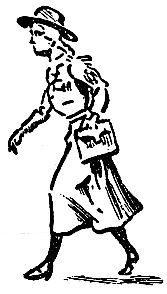
with the point of his stick: so I am sure that any Scout
could do it on paper with a pencil—especially after a
little practice.
You know how useful it is to be able to read a map.
Well, it is still more useful to be able to draw one for
helping other people to find their way. You would not
be a real Scout unless you could do this.
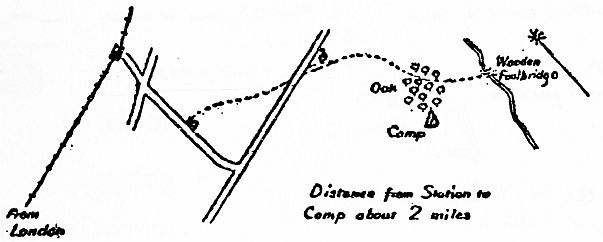
A sketch map.
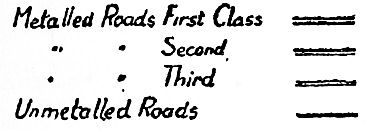
How to indicate roads.
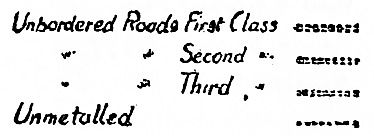
More ways to show roads.
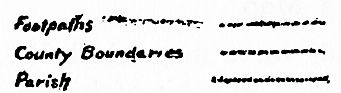
Paths and boundaries.

On highroads between large towns
you can show the mileage like this.

Bridges are indicated this way.
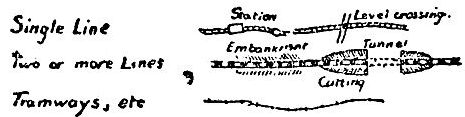
Trains and trams.
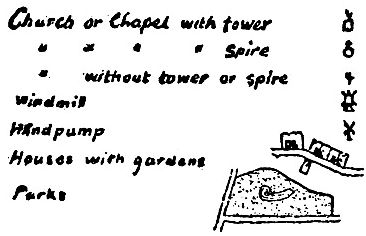
This is the way to show buildings,
etc.
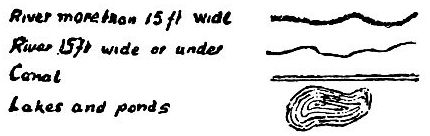
Rivers, etc,
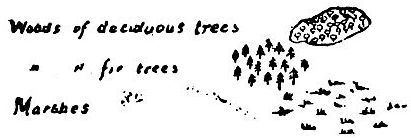
Woods, etc.
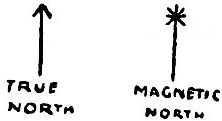
Signs for north on map.
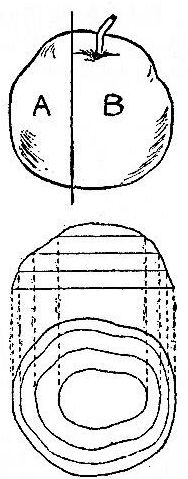
Contour
mapping
The above signs are the conventional
signs used in map-making. Contouring
is most easily explained by cutting
an apple in half and placing the halves
face downwards, to represent a hill.
You can then slice the pieces horizontally
at regular distances to illustrate
heights, as shown on a map.
Every Scout must be able to judge distance from an
inch up to a mile and more. You ought, first of all, to
know exactly what is the span of your hand and the
breadth of your thumb, and the length from your elbow
to your wrist, and the length from one hand to the
other with your arms stretched out to either side, and
also the length of your feet and of your stride; if you
remember these accurately, they are a great help to you
in measuring things.
Judging the distance of objects from you is only gained
by practice, and judging the distance of a journey is generally
estimated by seeing how long you have been travelling,
and at what rate; that is to say, supposing you walk
at the rate of four miles an hour, if you have been
walking for an hour and a half you know that you have
done about six miles.
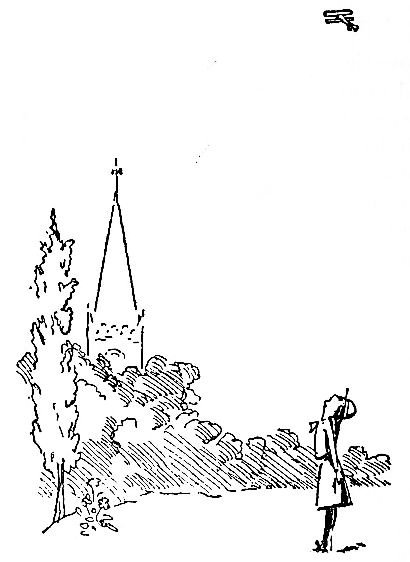
A Scout must be able to estimate heights.
Distance can also be judged by sound; that is to say, if
you see a gun fired in the distance, and you count the
number of seconds between the flash and the sound of the
explosion reaching you, you
will be able to tell how far off
you are from the gun.
Sound travels at the rate of
365 yards in a second; that is,
as many yards as there are
days in the year.
A Scout must also be able
to estimate heights, from a few inches up to three thousand
feet or more.
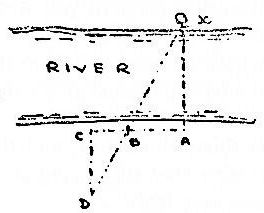
The way to estimate the distance across a river is to
take an object X, such as a tree or rock on the opposite
bank; start off at right angles to it from A, and pace, say,
ninety yards along your bank; on arriving at sixty yards,
plant a stick or
stone, B; on arriving
at C, thirty yards beyond
that, that is
ninety from the
start, turn at right
angles and walk inland,
counting your
paces until you
bring the stick and
the distant tree in line; the number of paces that you have
taken from the bank C D will then give you the half distance
across A X.
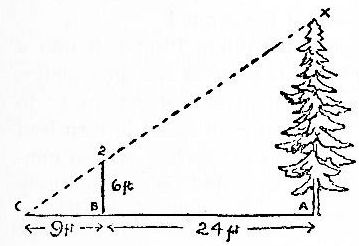
To find the height of an object such as a tree (A X),
or a house, pace a distance of, say, eight yards away
from it, and there at B plant a stick, say, six feet high;
then pass on until you arrive at a point where the top of
the stick comes in line C with the top of the tree; then the
whole distance A C from the foot is to A X, the height of
the tree, the same as the distance B C, from the stick, is to
the height of the stick; that is, if the whole distance A C
is thirty-three feet, and the distance B C from the stick
is nine (the stick being six feet high), the tree is twenty-two
feet high.
S.T.
Learn how to recognize the Great Bear and the Pole
Star and Orion; to judge time by the sun; find the south
by the watch. Practise map reading and finding the way
by the map; and mark off roads by blazing, broken
branches, and signs drawn on the ground.
Captain takes a patrol in patrolling formation into a
strange town or into an intricate piece of strange country,
with a cycling map. She then gives instructions as to
where she wants to go to, makes each Scout in turn lead
the patrol, say, for seven minutes if cycling, fifteen minutes
if walking. This Scout is to find the way entirely
by the map, and points are given for ability in reading.
To be a first-class Scout you have to have at least a
shilling (or a dollar or a rupee) in the Savings Bank.
To do this you apply at your post office to start a deposit.
The postmaster will take your money and keep it for you,
and whenever you can get a few more pennies or dimes
go and hand them in to be added to your account. As
these sums mount up you will begin to be paid back a little
“interest” by the postmaster. This you can spend on
candy—if you are foolish; but being a Scout you will
add it to the money already in the bank and so increase
your pile.
You know the things that you had to do as a Tenderfoot.
It is now your business to do a good turn to
another girl by showing her how to become a Scout.
Mind you, it is all done by kindness and example. Perhaps
you will find your pupil very shy or slow or stupid.
Well, Be Prepared, for that and—smile. Be jolly with
her. Don’t try and teach her everything all at once.
Show her generally all that she has to do and then begin
with one thing and do it for her—then repeat it with her—and
finally let her do it for herself. Let her make her
mistakes at first and show her afterwards where she went
wrong. She will soon get the hang of it all.
Then your own example is what will influence her a
lot. If you get impatient and short-tempered so will she.
If you laugh and enjoy the lesson so will she, and between
you, you will get along like a house on fire.
Cooking is great fun—sometimes quite exciting, when
you try inventing new dishes.
You can only become a cook by practice under the help
of an experienced cook. But here are a few practical
hints that will be helpful.
Eggs.—Is an egg lighter or heavier when cooked? An
experienced cook is experienced in eggs. There are
“new laid” eggs which are fresh and “fresh” eggs which
are not; there are “cooking” eggs which are liable to
squeak. Eggs are safe in their shells, and think you
don’t know whether they are fresh or not, or whether
they are raw. Any egg can be thrown out of a first-floor
window on to the lawn without the shell breaking,
it falls like a cat, right end upwards, and this is not a
boiled egg, either! You can tell that because it will not
spin on the table, so it must have been a raw egg. A
cooked egg would spin.
To tell a stale egg, you will see it is more transparent
at the thick end when you hold it up to the light.
Fresh eggs are more transparent in the middle. Very
bad eggs will float in a pan of water.
Poached Eggs.—Break each egg separately into a cup.
When your water is boiling fast, drop in an egg sharply.
Use a large deep pan, with salt and vinegar in the water.
Lift the egg very carefully in a ladle before it is set too
hard. Place the eggs all round a soup plate, pour over
them a nice sauce, made with flour and butter, a little
milk, and some grated cheese and salt.
Meat.—Examine the meat before you accept it. If you
do not know the looks of good meat, you should go to a
butcher’s shop and ask him to show you how to know it.
Much gristle is a sign of old age. You can easily tell
if meat smells disagreeable. Beef should be of a bright
red color, and juicy and elastic. The fat should be firm
and of a pale straw color. Mutton should feel dryish and
the fat look white. All papers must be taken off at once.
The feet of fowls should be soft and flexible, not dry, and
the skin of the back should not be discolored.
Beef and mutton, when underdone, are more easily
digested than when cooked through.
Roasting and grilling of meat is done to so heat the
outside that the juices are kept in. The meat has to be
frequently turned to prevent it burning, but allow plenty
of salt to melt into the meat with the dripping, or it
will taste just as good as a sole of a boot.
As Mr. Holding said: “The only method I know of
for properly making your meat thoroughly indigestible”
is to hurry a stew.
To stew or braise any meat or fowl you must leave it
long and keep it slow. The flavor is improved if the meat
be fried first. Then put in flavoring vegetables, bacon,
herbs, and a little stock, and by the time you have done
a day’s work you will find a dish fit for a king. Even
tough meat can be made delicious in this way, so long
as it never gets near boiling and is closely covered. This
is a case of “Sow hurry, and you reap indigestion.”
Fish.—A most unwholesome food is stale fish. The
gills, if fresh, should be bright red. Canned fish is often
poisonous. Fish is a food which you can get more good
from, considering the price, than if you bought meat,
and the most nourishing fish and the cheapest are the
herring mackerel. Pieces of fish, buttered, can be deliciously
steamed or baked if laid between two plates over
a saucepan of water.
Oatmeal.—Oats, too, are full of value; a pound and a
half a day will keep a hard-working man, for oatmeal
increases the power of the muscles, and is rich in bone
and flesh-forming materials. What you can get out of
oats for 5 cents would cost you 75 cents in lean beef.
Oats give increased mental vigour and vitality, as
they have so much nerve and brain nourishment in
them.
Oatmeal should be kept fresh in a shut case or package.
If you think your brain requires a fillip, eat plenty of
beans, but they must be very much cooked, and should be
well buttered.
Vegetables.—Of vegetables I should like to say they
can scarcely be too much cooked. Wash well in salted
water; let leafy ones have a swim to get rid of grasshoppers
and caterpillars and sand, then put them into
boiling salted water and take off the lid. Roots may be
allowed covers.
Peel and slice your onions under water or at a tap.
I once watched a grand chef cooking potatoes, and he
told me that the best of the potato lies next the skin, so he
never cuts it, but he peels his potatoes on a fork after
boiling. The cunning cook boils a bunch of mint with the
potatoes.
Excellent food for workers are parsnips, beetroots, or
onions.
Boiling Meat.—If you want the meat and not the juice,
you should have your pot boiling fast when the meat is
put in. But if you want gravy or beef-tea (not meat),
put your meat into cold water and bring it slowly to the
boil.
Stock Pot.—Keep a pot going all day, into which you
can put any broken-up bones or scraps left over, to make
nourishing broth. Clean turnips, carrots, and onions improve
it. Before using let it get cold, so as to skim off
the fat.
Barley, rice, or tapioca may be added, and for flavoring
add salt, pepper, chopped parsley, celery, a clove, or mace.
Milk.—Milk will take the flavor of any strong smell
near it. Stale milk added to fresh will turn the whole
of it sour. Sour milk need not be wasted. You can use
it for baking or cooking, by adding bicarbonate of soda.
Sour milk will clean ink or fruit stains, and in washing
it bleaches linen. Yellowed linen should soak in it, so
should spoons and forks. Sour milk cleanses oil-cloth as
well as women’s faces and hands.
Chickens and turkeys get fat and lay
better for being fed on it.
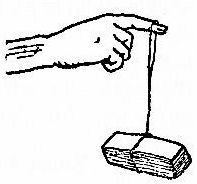
To weigh roughly, tie a loop of
string to your package of tea, sugar,
etc., and pass it on to your first finger.
I find three pounds is as much
as I can hold on my nail. If the loop is shifted to the
root of the nail, four pounds is all one can hold. If the
string is placed on the first joint, I find the parcel weighs
seven pounds. Each person will be different, but you can
find out your own power of lifting, and then you will
know exactly for the future.
A jolly useful thing for saving coal, saving time, and
saving money is a Fireless Cooker.
The Fireless Cooker is a very valuable help to you in
your enjoyment of camp, because once you have started
the food cooking you shove it in the Fireless Cooker, you
press the lid, and the Fireless Cooker does the rest!
And you can leave the dinner to cook itself while you
go out and play camp games.
And so, too, in your own home, once you have started
the food cooking you can put out the fire, and thus save
fuel or gas, and let the Fireless Cooker finish the job for
you.
Obtain a large wooden box, such as a soap box. Line
with double newspaper. Fill the box to within two or
three inches of the top with very tightly packed hay, scoop
out of the centre of the hay a cavity large enough to hold
the cooking utensil. Make a cushion of house flannel to
fit the top of the box exactly and stuff it tightly with hay.
Use saucepans with tightly fitting lids and short handles.
Those made of aluminum or earthenware are preferable.
Jam jars or large tins tightly covered may be
used.
Bring the food to boiling point on the gas cooker or
kitchen range and while boiling place it at once in the box.
Some foods require a certain amount of cooking previous
to being placed in the Fireless Cooker. (See table below.)
Wrap the cooking utensil in newspaper, and place in the
prepared nest in the Fireless Cooker.
Over this place the hay cushion and close the lid firmly.
There must be no space between the cushion and the lid.
Note.—To obtain satisfactory results, pack the stew-pan
as quickly and firmly as possible; this is to prevent
loss of heat.
Meat.—Cook for about half the usual time on the gas
or kitchen range, and about four to six hours in the Fireless
Cooker.
Dried Beans.—Soak overnight. Boil for 30 minutes.
Allow three to four hours in the cooker.
Fresh Fruit.—Bring to boiling point and place in the
cooker at once. Allow one or two hours, according to the
firmness of the fruit.
Dried Fruit.—Soak overnight, bring to boiling point
and put in the cooker for three to five hours.
Oatmeal.—Boil for five minutes and leave in the cooker
all night.
Quaker Oats.—Bring to boiling point and leave in
the cooker two hours.
Other foods, such as vegetables, bacon, etc., can be
cooked by this method.
In the preparation and cooking of food there should
be very little for the garbage can, and only cabbage or egg
water for the drain.
| Rinds and bones of bacon. |
| Outside stalks of celery. | | —Flavor soup or stock. |
| The young green parts of vegetables. |
| Pieces of gristle, skin and bone. |
| Pea pods. |
Thick stems of cabbage or cauliflower leaves may be
served with the vegetables or separately, if given sufficient
time to cook.
Water from boiled cauliflower makes a good soup.
Apple skins—stones from jam—the surplus water
from bottled fruit—boiled with a little sugar and water
make a very good fruit syrup to serve with milk or suet
puddings.
The sugar from candied peel will sweeten and flavor a
rice pudding.
Water from boiled rice makes a thin stock for soups,
or can be used to stiffen articles of clothing in place of
starch.
The grease-proof paper from margarine, etc., will cover
steamed puddings.
Salt removes stains from enamel.
Tissue paper cut into rounds and dipped in warm milk
will make air-tight covers for jam-pots, or can be used for
polishing glass or metal.
Newspapers can be used for lining the fireless cooker,
wiping greasy saucepans or knives before washing, making
fire lighters, rubbing over the stoves—the dirty pieces
can be soaked in water, made into balls and put on the
fire to keep it at a steady heat.
Dried orange skins, nutshells, used matches, matchboxes,
empty reels, fruit stones, are useful for fire lighting.
Vegetable parings not fit for food should be dried and
used as fuel unless animals are kept.
The stove and utensils should be kept clean.
Shallow flat-bottomed vessels should be used.
A compartment steamer cooks three or four different
foods on one burner.
A pudding in a basin can be raised out of water by a
meat stand placed at the bottom of an ordinary saucepan—and
vegetables cooked in a perforated steam pan
above.
Where possible arrange a meal to be cooked all on the
top of the stove, or all in the oven.
Avoid heating the oven to cook a single dish.
Utilise all space when the oven is heated—food may
be partly or wholly cooked for following day.
In a gas oven three or four small tins are better than
one large tin which fills the shelf. By the former method
free circulation of heat is not prevented, and cooking is
more efficient. If a large tin is used, have holes drilled
in it to allow passage of heat.
Fill the kettle before lighting the gas, and turn out the
gas before emptying the kettle.
Don’t fill the kettle if only a pint of water is wanted.
Tips for Cleaning.—Directly your cooking pot is empty
pour cold water into it and put it on the fire to prevent
the leavings getting hard, it will then be quite easy to
clean later on.
Personally I like washing up, though some people don’t,
but the main thing is to keep the greasy things to the last.
Wash the cleaner things first in hot water with a clean
dishcloth, then add hotter water and deal with the greasy
things.
Dry the utensils with a dry towel, then dry further in
warm air, and finally polish with a soft cloth.
Needlework.—“A stitch in time saves nine.” I cannot
agree with this favorite saying, because I feel sure it
saves so many more than nine, besides saving time and
preventing looking untidy.
I will tell you another thing I don’t believe in. Tailors,
who are such neat workers, will say that they never pin
their work first. If you are not a tailor, it is much better
to place your work before you begin, with plenty of pins.
You will never get straight lines or smooth corners if you
do not plan and place it all first, just as it has got to be,
and tack it there.
Have you noticed that thread is very fond of tying
itself into a bow; but this can be prevented by threading
the needle before you cut the thread off the spool, making
your knot at the end you cut.
Rough measures may be said to be one inch across
a 25 cent piece, and a yard from nose to thumb as far as
you can reach. Needle-work is good for all of us; it
rests and calms the mind. You can think peacefully over
all the worries of Europe whilst you are stitching. Sewing
generally solves all the toughest problems, chiefly
other people’s.
The Scouts’ Patch.—I don’t know whether you ever
did such a thing as burn a hole in your dress, but I have,
and if it is in the front, oh, dear! what will mother say?
Now, there is a very good way that Scouts have of making
it all right and serviceable; they put in a piece and
darn it in all round. If possible, get a piece of the same
stuff, then it will not fade a different tint, and will wear
the same as the rest. You may undo the hem and cut
out a bit, or perhaps you may have some scraps over
from cutting out your dress.
The piece must be cut three or four inches larger than
the hole and frayed out on all four sides. Trim the hole
with your scissors neatly all round quite square with the
thread. Then lay your piece over the hole—of course,
on the back or “wrong side”—and tack it there with
cotton. Now take a darning needle, and thread each
thread in turn and darn each one into the stuff. If the
ends of stuff are very short, it is best to run your needle
in and out where you are going to darn, and then, before
pulling it through, thread it with the wool. This patching
is excellent for table-linen.
I once had an aunt who was a thorough old Scout, and
was rather proud of her mending, and she always said
that she didn’t mind what colored cotton you gave her
to sew with, because her stitches hardly ever showed, they
were so small, and also she put them inside the stuff.
If she was putting on a patch to blue stuff, she could do
it with red cotton, and you would never have noticed it
on the right side; her stitches were all under the edge.
Or else she sewed it at the back, on the “wrong” side,
so that it looked perfectly neat.
If you are not able to match the wool for a darn, it is
a good plan to use the ravellings of the stuff itself.
Sometimes, away in the country, you can’t go to shop
and you have nothing like the piece you want to mend.
A Scout would turn it inside out and undo a little of the
hem and ravel out the edge. Suppose you were to cut a
hole in the front of your blue serge skirt; if you darn it
with the ravellings of the turnings of the seam or the hem,
that will be exactly the same color and the same thickness
as your dress. No wool you could buy would
match as well. Or if you want to mend a jersey or
knitted gloves, you never could buy such a good match—the
same sized wools and the tints.
Fire.—If you discover a house on fire you should—
1st—Alarm the people inside.
2nd—Warn the nearest policeman or fire-brigade station.
3rd—Rouse neighbours to bring ladders, mattresses,
carpets, to catch people jumping.
After arrival of fire engines the best thing girls can do
is to help the police in keeping back the crowd out of the
way of the firemen, hose, etc.
If it is necessary to go into a house to search for feeble
insensible people, the thing is to place a wet handkerchief
or worsted stocking over your nose and mouth and
walk in a stooping position, or crawl along on your hands
and knees quite near the floor, as it is here that there is
least smoke or gas. Also, for passing through fire and
sparks, if you can, get hold of a blanket, and wet it,
and cut a hole in the middle through which to put
your head; it forms a kind of fireproof mantle, with
which you can push through flames and sparks. [Practice
this.]
If you find a person with his clothes on fire, you should
throw him flat on the floor, because flames only burn
upwards, then roll him up in the hearthrug or carpet, coat
or blanket, and take care in doing so that you don’t catch
fire yourself. The reason for doing this is that fire cannot
continue to burn where it has no air.
When you find an insensible person (and very often
in their fright they will have hidden themselves under
beds and tables, etc.), you should either carry him out on
your shoulder, or, what is often more practicable in the
case of heavy smoke, gas fumes, or in battle when under
heavy fire, etc., harness yourself on to him with sheets or
cords and drag him out of the room along the floor,
crawling on all fours yourself.
A soldier was recently awarded the Distinguished Conduct
Medal for thus getting his wounded officer into
safety while being fired at by the enemy.
To do this you lay the patient on his back, make a bowline
at each end of your rope, one you put over the
patient’s chest and under his arms, and the other over
your own neck, then with your back to his head you
start on “all fours” to pull him along, head first. If
the bowline is the right length it will keep his head up
off the ground, as the picture shows.
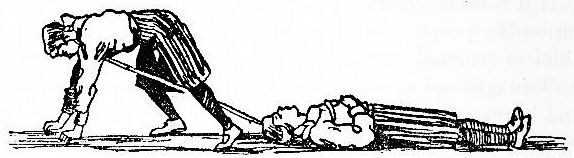
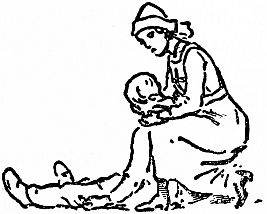
\Moving an insensible girl.
Burns.—In treating a man who has been burnt, remove
his clothes, not by peeling them off, but by cutting them
with a SHARP knife or scissors. If any part of the dress
sticks to the skin from having been burnt there do not
tear it away, but cut the cloth round it, then as quickly
as possible protect the burnt parts from the air, which
causes intense pain. The best way to protect them is
by dusting them with powdered chalk or flour, or by laying
strips of lint well soaked in sweet oil or linseed oil,
and covering the whole with cotton wool, or by pouring
on oil. Keep the patient warm, and give warm drinks,
such as hot tea, hot milk, or salomonia and water.
Major John Garroway, M.D., strongly recommends, instead
of flour or oil to stop the pain of a burn, to put a
piece of paper firmly over the wound, and the pain will
be relieved in a few seconds.
Quite a large number of Scouts have saved lives in the
water through knowing how to swim and what to do.
Several Scouts have also saved life in fire, and have
received medals for saving life.
Saving Life from Drowning.—A moderate swimmer
can save a drowning man if she knows how, and has practised
it a few times with her friends. The popular idea
that a drowning person rises three times before he finally
sinks is all nonsense. He often drowns at once, unless
someone is quick to help him. The important point is
not to let the drowning person catch hold of you, or he
will probably drown you too. Keep behind him always.
If you find yourself clutched by the wrist, turn your wrist
against his thumb and force yourself free. Your best
way in helping a drowning man is to keep behind and hold
him up by the elbows, or by the back of the neck, or by
putting your arms under his armpits and your hands
across his chest, and telling him to keep quiet and not to
struggle. If he obeys, you can easily keep him afloat;
but otherwise be careful that in his terror he does not
turn over and catch hold of you. If he should seize you
by the neck, Holbein says, “Scrag him, and scrag him
quickly. Place your arm round his waist, and the other
hand, palm upwards, under his chin, with your fingertips
under his nose. Pull and push with all your might,
and he must perforce let go.” But you will never remember
this unless you practise it frequently with other
people first, each taking it in turns to be the drowning
man or rescuer.
[Practice this.]
If you see a person fall into the water and begin to
drown, and you yourself are unable to swim, you must
throw a rope, or an oar, or plank right over him, so
that when he comes up again he may clutch at it and
hold it.
Drowning.—To restore any one who is apparently
drowned, it is necessary at once to clear the water out of
his lungs, for which purpose, therefore, you should incline
him face downwards and head downwards, so that the
water may run out of his mouth, and to help it you
should open his mouth and pull forward his tongue.
After running the water out of the patient, place him on
his side with his body slightly hanging down, and keep the
tongue hanging out. If he is breathing, let him rest; if
he is not breathing, you must at once endeavour to restore
breathing artificially.
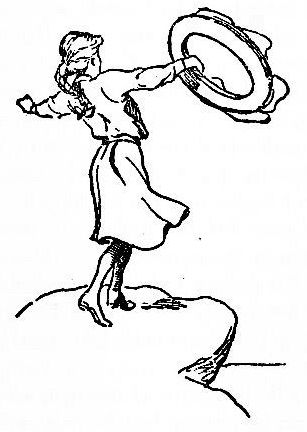
“If I can’t swim I have at least learnt how to fling a lifebuoy.”
There are several ways of reviving persons apparently
drowned. You may find one person eager to do exactly
the opposite of another, but do not fight over it; the best
thing is to do quickly whatever you can. Probably
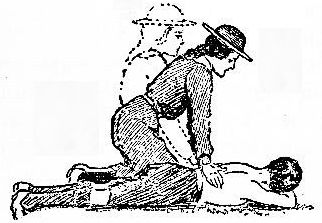
“Schäfer’s system” is the simplest. Lay the patient
down with his bent arm to support the forehead.
Place your hands on the small of the patient’s back,
one on each side, with thumbs parallel and nearly touching,
and the fingers reaching only to the lowest ribs.
Bend forward with the arms straight, so as to allow
the weight of your body to fall on your wrists, and then
make a firm, steady downward pressure on the loins of
the patient, while you count slowly, one—two—three,
to press the patient’s stomach against the ground and to
force the air from his chest.
Then swing your body backwards so as to relieve the
pressure, and without removing your hands, while you
count slowly, one—two.
Continue this backward and forward movement, alternately
relieving and pressing the patient’s stomach against
the ground in order to drive the air out of his chest and
mouth, and allowing it to suck itself in again, until gradually
the patient begins to do it for himself.
The proper pace for the movement should be about
twelve pressures to the minute.
As soon as the patient is breathing, you can leave off
the pressure; but watch him, and if he fails you must
start again or get some one to take your place till he
can breath for himself.
Then let him lie in a natural position, and set to work
to get him warm by putting hot flannels or bottles of hot
water between his thighs, and under the arms, and against
the soles of his feet, but not before he is breathing. Wet
clothing should be taken off and hot blankets rolled round
him. The patient should be disturbed as little as possible,
and encouraged to sleep, while carefully watched for at
least an hour afterwards.
This is called the Schäfer method, and can be used
equally well for drowned people or for those overcome
with smoke or gas fumes.
Now just practise this with another Scout a few times,
so that you understand exactly how to do it, and so Be
Prepared to do it to some poor fellow, maybe, really in
need of it one day.
Make the Scouts, in pairs, practise above.
Wounded: taking off clothes. Pull off from the well
or uninjured side first, then when all is loose, carefully
uncover the injured part. Try not to move it, cut the
sleeve or trouser up the seam with the rounded end of
scissors inside the cloth. If clothes have to be put on
again, sew pairs of tapes to edges.
Electric Shock.—Men frequently get knocked insensible
by touching an electric cable or rail. The patient
should be moved from the rail, but you have to be careful
in doing this that you don’t get the electric shock also.
In the first place put glass, if possible, for yourself to
stand upon, or dry wood if glass is not obtainable, or
put on india-rubber boots. Also put on india-rubber
gloves before touching the patient. If you have none,
wrap your hands in several thicknesses of dry cloth, and
pull the patient away with a stick.
A boy was hunting butterflies at St. Ouen, in France,
the other day, when he fell on the “live” rail of the electric
railway and was instantly killed by the shock. A
passer-by, in trying to lift him off, fell dead beside him.
A brickmaker ran up and tried to rescue them, and was
himself struck dead in the same way. The two would-be
rescuers were killed through not having learned beforehand
what was the right thing to do.
S.T.
Gas, Smoke, or Fumes.—Accidents are continually
occurring from escapes of gas in mines, sewers, and
houses.
In endeavoring to rescue a person, keep your nose and
mouth well covered with a wet handkerchief, and get
your head as close to the floor as possible, and drag the
insensible person out as I have suggested in case of a
fire. Drag your patient as quickly as possible into the
fresh air—(I say as quickly as possible, because if you
delay about it you are very apt to be overcome by the
noxious gas yourself)—then loosen all his clothing about
the neck and chest, dash cold water in his face. If you
find that he is no longer breathing, then treat him as you
would a drowned person, and try and work back the
breath into his body.
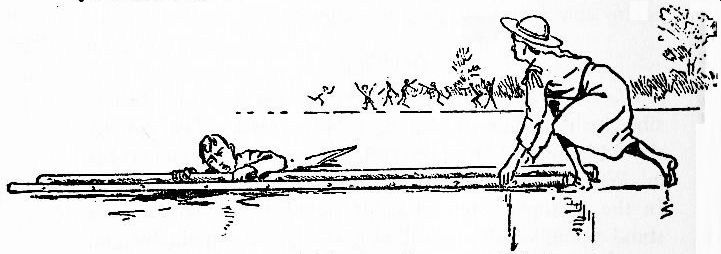
Push a long ladder or pole across the hole.
Ice Accidents.—If a person falls through ice, and is
unable to get out again because of the edges breaking,
throw him a rope and tell him not to struggle. This may
give him confidence until you can get a long ladder or
pole ACROSS the hole, which will enable him to crawl out,
or will allow you to crawl out to catch hold of him.
When you see an accident in the street or people injured,
the sight of the torn limbs, the blood, the broken
bones, and the sound of the groans and sobbing all make
you feel sick and horrified and anxious to get away from
it—if you’re not a Girl Scout. But that is cowardice:
your business as a Scout is to steel yourself to face it
and to help the poor victim. As a matter of fact, after
a trial or two you really get to like such jobs, because
with coolheadedness and knowledge of what to do you
feel you give the much-needed help.
S.T.
Every Scout should not only know how, but should
from frequent practice be able to do the right thing in
every kind of accidental injury.
In an accident when you are alone with the injured
person, if he is unconscious lay him on his back with
his head a little raised and on one side so that he does
not choke, and so that any vomit or water, etc., can
run out of his mouth. Loosen the clothing about his
neck and chest. See where he is injured, and treat him
according to what you are taught in learn “First Aid.”
If you have found the man lying insensible you should
carefully examine the ground round him for any “sign,”
and take note of it and of his position, etc., in case it
should be afterwards appear that he had been attacked
by others.
[Practise above, one girl as patient, the other to find
her. Make “sign” round the patient.]
If you are out with a patrol and an accident happens,
or you find an injured man, the patrol leader should direct
one scout to go for a doctor; she herself will attend to the
patient with one Scout to help her. The second will use
the other Scouts in assisting by getting water or blankets,
or making a stretcher, or keeping the crowd back by
forming a fence with their ropes.
As a rule it is best to keep the patient quite quiet at
first; unless it is necessary, do not try to move him; and
don’t bother him with questions until he recovers a bit.
Broken Limbs.—How to tell when a limb is broken.
There is generally a swelling and pain about the place
where the bone has broken, and sometimes the limb
is bent in an unnatural way and the patient cannot use it.
The broken limb should not be moved about at all, but
should be straightened and bound to something stiff that
will keep it stiff and straight while the patient is being
moved to hospital or home.
Splints.—The stiff thing that you tie to the injured
limb is called a splint. This may be anything such as a
wooden batten, Scout’s staff, tightly rolled newspaper, etc.
Splints should be long enough to go beyond the joints
above and below the break. You should put a splint on
each side of the limb if possible.
Then bind the splints firmly from end to end with handkerchiefs
or strips of linen or cloths, but not so tightly
as to stop the blood circulating or to press into the
swelling.
[Practise this.]
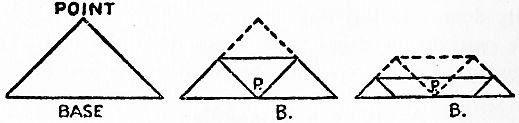
Bandage.—For binding a broken limb you want a good
large three-cornered bandage. Its two
sides should be each about forty inches
long.
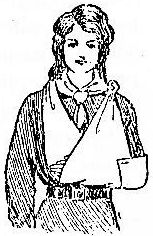
Bandaging.
To make a sling for broken arm or collarbone,
hang the bandage round the patient’s
neck, tying the two ends together
in a reef-knot with the point of the
bandage towards the damaged arm.
Rest the arm in this sling and bring the
point round the back of the arm and pin
it to hold the elbow in the sling.
Fishhook in the Skin.—I got a fishhook into my finger
the other day. I got a knife and cut off all the fly which
was on the hook, then pushed the hook farther into my
finger till the point began to push against the skin from
inside. With a sharp knife I cut a little slit in the skin
so that the point came easily through, and I was then able
to get hold of it and to pull the whole hook through.
Of course you cannot get a hook out backwards, as the
barb holds tight in the flesh all the time. Such fun!
Frost-bite.—In Arctic countries or extreme cold men
are liable to get frost-bitten. That is, their ears, or nose,
or fingers, or toes get killed by the cold. The patient does
not feel any pain; the part becomes numb and turns very
white and waxy, and afterwards purple.
Directly this is noticed the part should be rubbed with
snow or with the hand until the blood comes back to it.
On no account should it be warmed by putting the patient
in a warm room or near a fire; that would kill the part
at once.
Hysterics.—Nervous people, especially women, get
hysterics when excited, crying, laughing, and screaming.
The best treatment is to shut the patient into a room and
leave her entirely alone till she gets over it. Don’t try
and soothe her, it only makes her worse.
Fainting.—If your patient faints and is pale—fainting
comes from too little blood in the head—make him sit
down, and push his head down between his knees. Pressure
on a nerve (for instance, in top of eye socket) will
often revive. If his face is flushed raise the head—there
is too much blood in it, as in apoplexy or sunstroke.
Toothache.—This is not mentioned in most first aid
instructions, and yet you can earn many blessings by
knowing how to relieve it. Here is a simple way that is
generally successful, especially if the offending tooth is
in the upper jaw. Steep a little bit of cotton-wool in
spirits of camphor. Stuff the wool into one nostril—hold
the other nostril tight shut and make the patient draw
in the air through the wool. The spirit is thus sucked in on
to the nerve, which lies near the back of the nose, and it
very quickly relieves the pain.
Fits.—A man cries out and falls, and twitches and
jerks his limbs about, froths at the mouth: he is in a fit.
It is no good to do anything to him before the doctor
comes except to put a bit of wood or cork between his
jaws, so that he does not bite his tongue. Let him sleep
well after a fit.
Poisoning.—If a person suddenly falls very ill after
taking food, or is known to have taken poison, the first
thing to do is to make him swallow some milk or raw
eggs. These seem to collect all the poison that is otherwise
spread about inside him. Then, if the mouth is not
stained or burnt by the poison, make him vomit if possible
by giving him salt and warm water, and try tickling the
inside of his throat with a feather. Then more eggs and
milk, and weak tea. If the poison is an acid that burns,
the patient should not be made to vomit, but milk or salad
oil should be given. The patient should be kept awake if
he gets drowsy.
Blood-Poisoning.—This results from dirt being allowed
to get into a wound. Swelling, pain, red veins
appear. Fomenting with hot water is the best relief.
Choking.—Loosen collar; hold the patient’s nose with
one hand and with the forefinger of the other, or with
the handle of a spoon try and pull out whatever is stuck
in his throat. By pressing down the root of the tongue
you may make him vomit and throw out the obstruction.
For slight choking make patient bend head well back
and swallow small pills made of bread, and sip water.
Sometimes a good hard smack on the back will do him
good.
Choking sometimes comes from a sudden swelling inside
the throat. In this case put hot steaming flannel
fomentations to the neck and give the patient ice to suck
or cold water to sip.
Quinsy.—When I was in the Andes Mountains in
South America recently, I heard of two Englishmen who
had died there not long before from choking by quinsy,
simply because there was no one by who knew what to
do in such a case. Everybody ought to Be Prepared to
deal with quinsy if away from the help of doctors.
Most people suffer from tonsillitis at one time or another
in their lives—that is a swelling of the tonsils—the
round lumps of flesh on each side of the back of
the throat. And sometimes, on rare occasions, the swelling
becomes so great that the patient cannot breathe, the
throat becomes completely blocked up. This is quinsy.
Very hot fomentations is the best step towards easing
the pain and reducing the swelling.
The extreme measure is to lance the patient’s tonsils.
Acid Burning.—A case occurred only the other day of
a woman throwing vitriol over a man’s face. This is an
awful acid, which burns and eats away the flesh wherever
it touches. Fortunately a policeman happened to be on
the spot at the time, and knew what to do. He at once
applied half warm water to which some soda had been
added to wash off the acid, and then applied flour or
whitening to protect the wound from the air and ease
the pain as you would do for a burn.
Snake Bite.—Fortunately poisonous snakes are uncommon.
If you go abroad you may come across them,
and you ought always to know how to deal with bites
from them. The same treatment does also for wounds
from poisoned arrows, mad dogs, etc. Remember the
poison from a bite gets into your blood, and goes all
through your body in a very few beats of your pulse.
Therefore, whatever you do must be done immediately.
The great thing is to stop the poison rushing up the
veins into the body. To do this bind a cord or handkerchief
immediately round the limb above the place
where the patient has been bitten, so as to stop the blood
flying back to the heart with the poison. Then try and
suck the poison out of the wound, and, if possible, cut
the wound still more, to make it bleed, and run the
poison out. The poison, when sucked into the mouth,
does no harm unless you have a wound in your mouth.
The patient should also be given stimulants, such as coffee
or spirits, to a very big extent, and not allowed to become
drowsy, but should be walked about and pricked and
smacked in order to keep his senses alive.
[Practise this process in make-believe.]
S.T.
Grit in the Eye.—Do not let your patient rub the eye;
it will only cause inflammation and swelling, and so make
the difficulty of removing the grit all the greater.
If the grit is in the lower eyelid, draw down the lid as
far as you can, and gently brush it out with the corner
of a moistened handkerchief, or with a paint brush, or
feather.
If it is under the upper lid, pull the lid away from the
eyeball and push the under lid up underneath the upper
one. In this way the eyelashes of the lower lid will generally
clean the inside of the upper one.
Another way, which every Scout must practise, is to
seat your patient and stand behind him yourself with the
back of his head against your chest. Lay a card, match,
or any flat substance under your own thumb on the upper
part of the upper eyelid, and then catch hold of the edge
of the eyelid and draw it upwards over the match so that
it turns inside out; gently remove the grit with a feather
or wet handkerchief, and roll the eyelid down again.
If the eye is much inflamed, bathe it with luke-warm
weak tea.
If the grit is firmly imbedded in the eye, drop a little
oil (olive or castor oil) into the lower lid; close the eye,
and bandage it with a soft wet pad and bandage, and get
a doctor to see it.
[Practise above.]
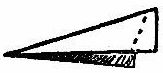
How to make eye-tweezers for removing a piece of
grit from eye. Fold a piece of paper
in two. With a sharp knife cut it to a
point of an angle of 30°, and slightly
moisten the point. Then bring it straight down over the
eyeball of the patient, so that it can nip the obstruction,
which is generally removed at the first attempt.
Stretchers may be arranged in some of the following
ways:
(a) A hurdle, shutter, door, gate, covered well with
straw, hay, clothing, sacking.
(b) A piece of carpet, blanket, sacking, tarpaulin or
Girl Scout skirts, spread out, and two stout poles rolled
up in the sides. Put clothes for a pillow.
(c) Two coats, with the sleeves turned inside out; pass
two poles through the sleeves; button the coats over them.
(d) Two poles passed through a couple of sacks,
through holes at the bottom corners of each.
In carrying a patient on a stretcher be careful that he
is made quite comfortable before you start. Let both
bearers rise together; they must walk out of step, and
take short paces. It should be the duty of the hinder
bearer to keep a careful watch on the patient.
If the poles are short four bearers will be necessary, one
at each corner of the stretcher.
[Practice these different methods.]
In practising First Aid it is a great thing to bespatter
the patient with blood and mud to accustom the rescuer to
the sight of it, otherwise it will often unnerve him in a
real accident. Sheep’s blood can be got from the butcher’s
shop.
Prepare a heavy smoke fire in a neighbouring room or
building (if possible on the first floor), while you are lecturing
in the club room. Secretly arrange with two or
three Scouts that if an alarm of fire is given they should
run about frightened and try and start a panic.
Have the alarm given either by getting some one to
rush in and tell you of the fire, or by having some explosive
bombs fired. Then let a patrol, or two patrols,
tackle the fire under direction of their patrol leaders.
They should shut windows and doors. Send Scouts into
different parts of the building to see if the fire is spreading,
and to search for people in need of rescue.
These Scouts should have wet handkerchiefs over their
mouths and noses. “Insensible” people (or sack dummies)
should be hidden under tables, etc.
Scouts rescue them by shouldering or dragging them
out and getting them down to the ground. Use jumping
sheet, chute, etc.
Other parties lay and connect the hose, or make lines
for passing fire buckets.
Another party revive the rescued by restoring animation.
Another party form “fence” to help the police
and fire brigade by keeping the crowd back.
“Dragging Race.”—A line of patients of one patrol
are laid out at fifty yards distance from start. Another
patrol, each carrying a rope, run out, tie ropes to the
patients, and drag them in. Time taken of last in. Patrols
change places. The one which completes in shortest
time wins. Knots must be correctly tied.
S.T.
The simple physical exercises given in the earlier chapters
will give you all the movements needed to keep you
well and to help your growth IF you only practise them.
That is the secret. Set apart certain minutes in the day,
especially in the early morning, and make it your habit
to go through these exercises and you will make for yourself
a wonderful difference in your health.
But alongside this giving health to your body, you
must see to it that your surroundings, your home, the air,
your food, and your clothing are also health-giving, otherwise
all the exercise in the world will not help you.
Scouts should do everything in their power to make and
keep their homes healthy as well as happy.
Most of you cannot choose your own dwelling, but
whether you live in a house, a cottage, a flat, in rooms,
or even in one room of a house, you can do a very great
deal to keep it healthy and pure.
Fresh air is your great friend; it will help you to fight
disease better than anything else. Open all your windows
as often as you can, so that the air may get into every
nook and corner. Never keep an unused room shut up.
Disease germs, poisonous gases, mildew, insects, dust,
and dirt have it all their own way in stale, used-up air.
Air does not flow in and flow out of the same opening
at the same time any more than water does, so you want
two openings in a room—an open window to let the good
air in, and a fireplace and chimney to let the stale air out,
or whether there is no fireplace, a window open both at
top and bottom. The night air in large towns is purer
than the day air, and both in town and country you should
sleep with your window open if you want to be healthy.
Draughts are not good, as they carry away the heat from
your body too fast; so if your bed is too near the window,
put up a shelter between it and the open window and
cover yourself more. At least one window on a staircase
or landing should always be kept open, and also the pantry
and the closet windows.
Tidiness.—Half your time will be saved if little things
are kept tidy. Have a place for everything, and have
everything in its place. If you are not sure which is the
right place for a thing, think “Where, if I wanted it,
should I go to look for it?” That place is the right one.
Get into the habit of always making a ball of any string
you get and collect them.
War must be waged against rats and mice, or they will
invade you and loot everything. If you have no mouse-traps,
put a newspaper over a pail of water, break a hole
slightly in the centre in the form of a star, and place a
bit of cheese on the centre tips of star to entice the mouse.
Let the paper reach to the floor, not too upright, for the
mouse to climb up. Try putting broken camphor into
their holes; they dislike the smell. Fly and wasp traps
are made by tying paper over a tumbler half-filled with
water and beer or molasses. Break a hole in the paper,
and fit in a tube of rolled paper about one inch long and
one inch across.
Damp is never healthy, and you can prevent it to a
great extent by letting plenty of fresh air go through
your house and rooms which have been shut up.
When you see signs of damp, try to find out the cause;
it may be put right. A pipe or gutter may have got
blocked, or there may be a loose shingle, or the water
pipes may be leaking.
In countries where there are mosquitoes people are very
careful not to allow any water to lie near their houses, for
the poisonous mosquito breeds in stagnant water. Sunflowers
planted near a house help to keep the soil dry;
also low bushes and plants. Consumption and other
deadly disease germs flourish in damp, ill-aired houses.
Sunlight is a great health-giver and disinfectant, and
the more of it you have in your house the better. Long
ago people used to shut out the sun and air for fear their
curtains and carpets would fade, but it is far better that
the sun should fade your curtains than that the darkness
should fade you. Cases of consumption are rare in dry,
sunny houses.
Nurseries and bedrooms should have plenty of morning
and mid-day sun.
Motto: “Tidy as you go.”
Cleanliness in every part of the house is most necessary,
especially kitchen and refrigerators. Do not let
dust or rubbish collect anywhere, behind furniture or
pictures, under beds, or in cupboards. If we realised
what horrid things we may collect from pavement or
street dust on our skirts and shoes, we should be much
more careful about the dusting of our rooms.
Do not allow dogs, cats, or birds to be where they can
touch your food or your cooking utensils; animals have
diseases too. Flies, gnats, and fleas are most dangerous
pests; they feed on decayed and diseased things, and may
carry poison on their feet and leave it on your food.
Keep them out of your house, and especially chase them
out of your kitchen and larder. Any bad smell in a house
is a danger signal; find out its cause, and get rid of it.
S.T.
Be sure your drinking water is pure. If you are at all
doubtful about it, boil it well—that is, for not less than
fifteen minutes. Water cisterns should be often cleaned
out. See that all drains, sinks, and closets are in good
order. A very poisonous gas called sewer gas comes
from bad drains, and typhoid, diphtheria, etc., are caused
by drinking bad water and bad drainage. The gas does
not come up if there is a “trap” full of water in the
pipe; that is a curve in the pipe where water collects.
Let water run down all sinks once or twice a day to rinse
the pipes. To sum up, “Remember that nearly all the
dangers to health in a house or room begin with a D, and
these dangers or destroyers are:
- “Darkness.
- “Damp.
- “Dust.
- “Dirt.
- “Doubtful drinking water.
- “Defective drains.”
Against these destroyers, which bring debility, disease
and even death, the Scouts’ defences are:
- “Sunlight.
- “Fresh air.
- “Cleanliness.”
Housewifery.—Every Scout is as much a “housewife”
as she is a girl. She is sure to have to “keep
house” some day, and whatever house she finds herself in,
it is certain that that place is the better for her being
there.
Too many odds and ends and draperies about a room
are only dust-traps, and rugs or carpet squares, which can
be taken up easily, are better than nailed down carpets.
Keep all the furniture clean and bright. Fresh air, soap,
and water are the good housewife’s best allies. Bars of
soap should be cut up in squares and kept for six weeks
before being used. This hardens it and makes it last
longer.
In scrubbing boarded floors, the secret is not to deluge
the floor; change the water in the pail frequently.
In the work of cleaning think out your plan beforehand,
so as not to dirty what has been cleaned. Plan
out certain times for each kind of work and have your
regular days for doing each thing.
Pasteboards and Deal Tables.—Scrub hard the way
of the grain. Hot water makes boards and tables yellow.
Rinse in cold water and dry well.
Saucepans.—New saucepans must not be used till
they have first been filled with cold water and a little
soda, and boiled for an hour or so, and must be well
scoured. After bowls or saucepans have been used, fill
them at once with cold water to the brim; this will prevent
anything hardening on the saucepan and will make cleaning
easier.
Swimming.—Every 1st Class Scout ought to be able to
swim. It is not only for her own amusement that she
should do so, but so that she will not cause other people to
risk their lives in rescuing her when she gets into difficulties
in the water, and that she may be able to help those in
distress. British girls are behindhand in learning to swim—it
is very different in Norway and Sweden, or in America,
where nearly every girl can swim.
Where a doctor says swimming is bad for her, or there
is no possible means for her learning, such other badges
that she does not hold may be accepted instead towards
qualifying the Scout for her 1st Class.
No Scout can be of real use till she can swim, and to
learn swimming is no more difficult than to learn bicycling.
All you have to do is at first to try and swim like a dog,
as if trying to crawl slowly along in the water; don’t try
all at once to swim with the ordinary breast stroke that
swimmers use, because this only lets your mouth go under
water every time. When paddling along like a dog get a
friend to support you at first with a pole or his hand under
your belly.
Any of you who cannot swim as yet, and who fall into
the water out of your depth, remember that you need
not sink if you take care to do the following things.
First, keep your mouth upwards by throwing the head
well back. Secondly, keep your lungs full of air by taking
in long breaths, but breathe out very little. Thirdly,
keep your arms under water. To do this you should not
begin to shout, which will only empty your lungs, and you
should not throw your arms about or beckon for help, else
you will sink. So the main thing of all is to keep cool and
force yourself to remember and to carry out these things.
There always are and always will be children to be
care of. Perhaps there is no better way for a girl to
help her country than to fit herself to undertake the care
of children. She should learn all she can about them,
and take every opportunity of helping to look after these
small Boy and Girl Scouts of the future. Many girls
are already doing this and are realizing that the Child
Welfare badge is one of the most important in the whole
list for a Scout to win.
Children are trained to regular habits in three ways;
first, by having meals at fixed hours; second, by having
regular times for sleeping and waking; and third, by
being taught when young to be clean and regular in their
daily clear-out. They must have plenty of healthful,
peaceful sleep and the earlier they go to bed the better for
their brains and nerves in after life. The bedroom must
be airy and quiet; the windows kept open.
Nobody can be healthy unless he is clean, and cleanliness
is one of the first habits you want Baby to form.
So he should have a daily bath. The temperature for
his bath should range from 80° to 98° and you should
be able to read the bath thermometer as well as the room
thermometer. Before you undress Baby get together
everything that you will need for the bath and dressing;
your hand basin of warm water, soap, soft wash cloths
and towels, comb and brush, etc., and his clothes laid out
in the order in which you will put them on.
It is handier as well as safer to begin baby laid on a
table or bed rather than on your lap. He should of course
have under him a soft towel or canton flannel. First
wash his head carefully and rub it dry gently. Do the
outer parts of his ears and let no water get inside them.
The nose may be cleaned with a bit of cotton rolled to a
point and the nails should be carefully cleaned. Then
put him gently in the tub. Some people soap the baby
first, and a soapy little baby wiggles, so hold him very
firmly and comfortably, supporting his head all the time
he is kicking and splashing in the tub. After you lift him
out be careful to dry all the creases in his little body. It
is perfectly proper for a baby to cry as much as twenty
minutes every day till he begins to talk, and he may take
his bath time for doing it, so don’t scold him. A baby
can be kept sweet and clean by a daily sponge bath.
The baby needs proper food to build up his body.
Milk is his only food for the first months of his life and
even up to three years he takes mostly milk.
For the first eight or nine months of a baby’s life
mother’s milk is the best food for him, and if he is unfortunate
enough to have to take his milk from a bottle you
will have to learn the best kind of bottle to use and how
to prepare it. Baby is very particular about his milk
being fresh and good.
Punctual feeding makes good digestion and even if he
wants that extra nap it is better to wake a healthy baby
to give him his meal at regular hours, than to let his digestion
get out of order. Some babies are very punctual
and feel it keenly if you do not feed them at the fixed
hour. They will very likely let you know it too, and woe
betide you if they find you have not properly boiled the
bottle after each meal to sterilize it. Between meals a
little drink of water which has been boiled and cooled
(sterile water) will wash out his mouth as well as refresh
him. Do not give a baby too much food at a time,
and keep him on plain food. This applies to you as well
as to baby. When the digestion is not right the appetite
will not be good. Digestion makes the food you eat
ready to be turned into muscle and bone and brain, and
indigestion means that you have not used up the food you
ate and therefore you have those uncomfortable pains in
the middle of the night. Eat only the foods you know
you can digest comfortably.
By the time a child is two years old, he should have a
well varied though simple bill of fare. This may include
cereals such as well cooked oatmeal and cream of wheat,
soft boiled eggs, fresh juice, (beef) milk puddings, milk
toast, baked potatoes, apple sauce and chicken broth.
Children’s clothes should be warm but light, and where
possible should hang from the shoulders. The legs, particularly
the ankles, should be kept warm and the feet dry.
Give a baby plenty of fresh air, out of doors if you can,
avoiding drafty places. It gives him a better appetite,
makes him sleep sounder and also helps to give him rosy
cheeks, a sign of good red blood.
Be careful that sheet and blankets do not get over a
baby’s head; as this weight causes suffocation, so pin the
covers to the side of the bed and let him have fresh air
while he sleeps.
No self respecting baby would ever by himself contract
the “pacifier” habit and he should never be given a pacifier.
This article thrust into his mouth makes the upper
jaw protrude, carries germs into a baby’s mouth, sometimes
causes adenoids, is ugly to look at and finally doesn’t
really pacify.
It does a baby good to lie down and kick about. Crawling
and climbing exercise his muscles. Don’t let a baby
walk too soon. Bow-legs come from standing and walking
while the bones are soft; also from under-nourishment.
But if a child wants to walk, let him make the
effort; he will not pull himself up unless he wants to
try his muscles. Childhood is a time to form the body;
it cannot be altered much when you are grown up. Playtime
should not come directly after feeding or before
sleeptime.
What will you do when you suddenly find that baby is
ill? To call in the doctor is the first thing, that is, if there
is a doctor. But when there is no doctor! You will at
once think of all the First Aid you have learned, and
what you know of home nursing. Drugs are bad things.
You may lay up trouble for a child by giving it soothing
drugs and advertised medicines which sometimes make
the baby stupid and may cause constipation. Never neglect
the bowels if they become stopped up. This upsets
digestion, poisons the baby and may help to bring on
convulsions or other serious illnesses. If a child is suffering
from a convulsion, lay him flat with his head on a
pillow. Pat his head with cold water and put a hot bottle
at his feet. If the convulsion continues put him in a
warm bath of about 106° which is as hot as is comfortable
for your bare elbow, but you must not keep cold
cloths on his head. Use very gentle artificial respiration
not trying to straighten the arms. Of course you will
keep a baby away from anyone who has a contagious
disease.
You can very easily train a young child to obey, but
after three years old it becomes more difficult unless a
good start has been made. Children expect you to be
just. If you are good tempered and patient a child will
stand a good deal of firmness, but slapping and scolding
ruin young tempers. Answer a child’s question without
ridicule. He is feeling his way in this great big world,
and you once asked foolish questions, too.
Whenever I see a Scout coming along I feel at once a
friendly interest in her, but when she comes nearer that
interest either increases or goes off a bit when I look
at her right arm and see on it badges—or no badges.
Every Scout, as soon as she has passed the Second
Class tests, can go in for proficiency badges. These
badges are not intended for swagger, but to show that
you can do things. On the left arm you will wear those
badges which mean that you are good at work that is
useful to other people, and these are the important
badges; while on the right arm the badges show the sort
of Scout that you are, that is whether you are efficient
or not in different branches of Scout work.
There are a very large number of badges on the list
which you can go in for, but it does not mean that you are
to try and get them all, but rather that you may look
through the list and find out which are most likely to
suit you and then to go in for one or two of those. The
most important of all the badges are those for nursing.
They are important to the Scout herself, because through
practising this work she can most easily carry out the
Scout law of doing good turns to other people, and these
would be good turns which really are useful. Also by
knowing how to nurse she can do good work for her
country.
The Value of Nursing.—In the great war hundreds
and hundreds of women have gone to act as nurses in the
hospitals, for the wounded and have done splendid work
They will no doubt be thankful all their lives that while
they were yet girls they learnt how to nurse and how to
do hospital work, so that they were useful when the call
came for them. But there are thousands and thousands
of others who wanted to do the work when the time came,
but they had not like Scouts been Prepared, and they
had never learnt how to nurse, and so they were perfectly
useless and their services were not required in the
different hospitals. So carry out your motto and Be
Prepared and learn all you can about hospital and child
nursing, sick nursing, and every kind, while you are yet
a Scout and have people ready to instruct you and to help
you in learning.
Child nursing is also very important, because so many
girls are wanted now to help mothers in looking after
their children. Such a large number of babies die every
year from being nursed by girls who have never taken the
trouble to learn what they ought to do with children.
Babies are delicate little things, and a very little act of
carelessness or want of knowledge of what to do often
causes the death of one who might otherwise have grown
up to be a valuable citizen for the country. On becoming
a Scout you promise to Be Prepared to do your duty
in every possible way, and one very important way is that
of nursing children as well as grown ups; and therefore
I hope that you will learn as quickly as possible how to
carry out this duty and so to carry out your work as a
Scout in the proper spirit. Therefore I recommend you
to take as the most important ones, the Ambulance Badge,
the Child Nurse Badge, and the Home Nursing; after
which you can look through the list and pick out others
for which you feel that you are particularly keen, or for
which there are instruction classes for Scouts that you
can attend. Set those badges up before you and do your
best to win some of them.
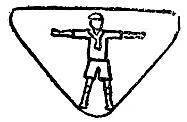
Where to wear the Badges.—The First and Second
Class Badge is worn on the left arm. It should be placed
about half-way between the elbow and the
shoulder strap, so as not to be covered by the
shoulder knot.
The Ambulance, Home Nurse, and Child
Nurse Badges are also worn on the left arm,
just below the Second and First Class Badges.
All the other Proficiency Badges are worn on the right
arm. They are sewn on as they are won, starting at the
bottom of the sleeve, just above the cuff, and growing
upwards in couples as the Scout becomes more and more
proficient.
The War Service Badge is worn above the right-hand
breast pocket.
The Attendance Stars are worn in a horizontal row
just above the left-hand breast pocket.
The War Service Badge.—Is granted to Scouts who
have done special service for their country during the
Great War. It is worn above the right breast pocket.
To secure this honor a Girl Scout must win the following
badges: Ambulance and First Aid, Clerk, Cook,
Child Nurse, Dairymaid, Matron, Musician, Needlewoman,
Naturalist, Home Nurse, Pathfinder, Pioneer,
Signaler, Swimmer, Athletics, Health or Civics. (In case
a swimming badge is impossible two badges not already
earned may be substituted.)
These are worn on the right breast and are awarded
as follows:—
Bronze Cross (Red Ribbon).—Presented as the highest
possible award for gallantry. It can only be worn
where the claimant has shown special heroism or has faced
extraordinary risk of life in saving life.
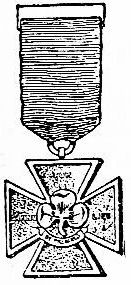
Bronze and Silver Cross
for Saving Life.
|
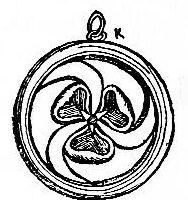
Gilt Medal of Merit.
|
Silver Cross (Blue Ribbon).—For gallantry, with considerable
risk to herself.
Badge of Merit (Gilt Wreath—White Ribbon).—For
a Scout who does her duty exceptionally well, though
without grave risks to herself.
Thanks Badge.—It is the privilege of any Scout, of
whatever rank, to present this Badge of Thanks to any
one who does a Scout a good turn. It entitles the wearer
to make use of the services of any Scout at any time,
but does not constitute membership.
I should like to see everything that calls itself a girl
playing it. Yet there are thousands and thousands of
girls who have never yet even seen it played—much
less played it themselves.
I should like all of them to play it, not only once but
regularly, and this is why.
Because it gives them health and strength through active
exertion in the open air; it gives them a jolly time and
lots of excitement, happiness, and laughter; it makes them
quick with eye, hand, and foot; it makes them all good pals
together; it teaches them to take hard knocks without
winking such as at other times would make them faint or
swear.
It teaches them to play unselfishly and to pass the ball
on. It gives them pluck, it gives them hope, for even
when things look bad there is often the possibility of
winning by an extra effort. They learn to stick to rules
and to obey orders, to play fair and to stop sneaking,
underhand play.
In a word, they learn to play the game for their side
and not for themselves.
Well, that is just what our soldiers at the front are
doing, playing the game nobly for their country at no
matter what danger to their own life or limb.
It’s just what we want of all Americans in the future—women
as well as men—to think of their country and
other people first; to obey the laws and play the game for
the good of others bravely and hopefully, without caring
what hard knocks they get themselves.
Could not some of you who can afford to play hockey
yourselves managed to help some other girls to play it too?
Think what joy it would bring into their lives, what
health and brightness you could offer them and what
good and friendly citizens you could make them.
What is a Lady?—This is what I saw the other day
in the Subway. The seats were all crowded when a
smart-looking girl got in. A wounded soldier with a
bandaged foot and a walking stick stood up rather painfully
and offered her his seat. The girl plumped herself
down comfortably and she did not give him a look or
even a word of thanks. A pale woman then rose and
said to him, “I can stand better than you; you got hurt
for me,” and made him take her place.
One of these two women was a lady. Can you guess
which?
Oh, there is one more thing that hockey teaches. Often
you lose a game, but you do not therefore lose your
temper or lose your happiness for, as a Scout, you at
once cheer the winners and forget to be put out by it.
But you don’t lose every game. Very often it will
look as if it was going against you and there seems
little chance of winning when, just near the end, the
other side give out or get careless, and by sheer sticking
to it you win a goal or two in the last few minutes and
come out victorious in the end.
Perseverance: Frogs in the cream.
Well, it is sticking to it which is so tremendously valuable,
not only in the game, but also for getting on as a
Scout, and afterwards in getting on in life.
Two frogs, out for a walk one day, came upon a bowl
of cream, into which they fell. Thinking it a new kind
of water and that it was hopeless trying to swim, one
was drowned through having no pluck. The other struggled
hard to keep afloat. Just when he felt he must
give up a curious thing happened. In his struggles he
had churned up the cream so much that he found himself
standing safe on a pat of butter!
If you learnt nothing else from Scouting than this
little story of the frogs, try, at any rate, to remember
that; and when you feel you are failing at your job
just think of it; remind yourself of the frogs—and
stick to it.
Someone asked me the other day why it is that housemaids,
when they are at work, are always droning most
dreary hymn tunes. Well, I couldn’t say exactly why
they do it, but I like to hear it, because people who sing
at their work evidently don’t find it a drudgery or irksome.
I was at a great aeroplane factory the other day, where
the manager had encouraged his men in their spare time
to form a band, and he supplied the funds for helping
them to get instruments, music, etc.
When they began to get rather good at it they, like all
amateur musicians, began to fancy themselves, and said
that they would like to get some high-class classical music
to play.
But he said: “Not a bit of it, I want you to play all
the tunes that you can get, provided that they are jolly
ones.”
Then he used to make the men march to their workshops
with their band playing, and for the rest of the
morning, instead of working sullenly and grudgingly
at their machines, the men were whistling and singing the
tunes that were running in their heads, and the work
consequently was better done and more of it was got
through than would otherwise have been possible.
So the wretched Girl Scouts, when they are forced to
play these dull games and to do the terrible hard work
of Scouting, need something to cheer them up. All they
have to do is to learn a few jingles and to sing them,
stamp, bang, or whistle them as they go along, and they
are sure to feel the better for it.
When you come to be a Patrol Leader you must remember
that you are really taking up a very responsible
and important position, because you are going to be in
charge of a number of girls under you, who will form
their characters entirely under your example and guidance,
and if you choose to be a slacker they will become
slackers, if you choose to be a good Scout they will all
become good Scouts, or nearly all of them. That is very
much dependent on you yourself. So don’t become a
Patrol Leader merely for the swagger of it or the sake
of wearing an extra badge or two, but really think whether
you are fitted to lead those girls, and take it up with
the best of your ability to make good Scouts of them.
You have got to command your Patrol; well, you can
only command others if you have their confidence, and
you can only have their confidence if you have confidence
in yourself; you can only have confidence in yourself by
knowing your work thoroughly and well. You should
therefore study the handbook, learn all about Scouting,
what it aims for, and then how you can carry out the
instructions given; practise the things yourself that are
shown you, know that you can do the different things well;
and then you will be able to have confidence in yourself,
your Scouts will obey your orders, and so you will be able
to carry out the training of them and their discipline perfectly
well. You lead entirely by your own personal example,
don’t forget that; that is what tells, and that is
the easy way to gain success; not only the easy way, but
it is the only way.
As a Leader you must be the best at carrying out the
Scout Law in your Patrol, the others will follow you in
it; you must be the captain also in all the games; you
must be the first in every venture; you must be the one
to suggest good games, good ideas, good thoughts. If
you are the first in every way like this your girls will
follow your leads and you will have good discipline among
them. Your aim should, of course, be to make your
Patrol the best, and if every Patrol tries to be the best in
the Troop, you may be sure that that Troop will be a
very good one amongst other Troops.
You should take counsel among your Scouts as to
what they fancy themselves at, and then challenge another
Patrol to have a competition in that particular line,
whatever it may be, whether Signalling, or Ambulance
Work, or playing a game of Hockey, or baseball, or anything
you like; but continually challenge other Patrols
to beat you at your own game, and then practise your
game well and make yourselves efficient at it, so as you
do not get beaten. For every game the whole Patrol
should form the team. Don’t have one or two good
players and the rest no use at all; and don’t have individual
competition, one girl against another, but always
try and have your Patrol as a team, then the worst
will try and make themselves better in order to play up
the average of the lot, and so play for the good of the
Patrol and not of themselves. If possible, give each of
your Scouts her own job to do in the Patrol. You may
find one good at one thing, another good at another;
well, urge her to do her particular job, and to do it
well for the benefit and honour of the Patrol. You will
have one little difficult point that you must keep an eye
on; when you are trying to lead the Patrol and at the
same time to show them the way, don’t forget that you
must not do the work of other girls. Give each one her
job and see that she does it, but don’t do it for her, or else
she will always be leaning on you and expecting you
to do it.
A Patrol can specialise, that is, all members to take
one special badge, or a bit of ribbon will do, that a Patrol
may be a Despatch Riding Patrol, or a Signalling Patrol,
First Aid Patrol, a Home Helping Patrol, or even an
Entertaining Patrol. All the members of the Patrol win
a certain Proficiency Badge, then that Patrol may be
recommended by the Captain to have the honour of wearing
that badge on its flag. I have known a great deal
of good to come of a Patrol challenging a Patrol in another
Troop to some sort of competition, and then going
to visit the other Patrol or inviting them to visit themselves
at their own headquarters and entertaining them
and having their competition and making great friends
with them; this leads to very good feeling between different
Troops, and is very useful, because you can
often pick up ideas from Patrols of another Troop better
than you can from one of your own Troops. In camp a
Patrol is a very useful unit because a whole Patrol can
just pitch into one tent or probably into one room or
barn, or wherever it may be, and there the Patrol Leader’s
duties are very responsible, because she has to keep
order in her own tent and see that it is properly kept clean
and tidy.
A Scout Hostel.—Scene: Inside a Scout Headquarters,
fitted with bed, stretcher table, cooking stove, cupboard,
Scout Law, etc.
Patrol at right of stage learning electricity and telegraphy.
Patrol at left of stage bathing, dressing, and feeding
model baby.
In centre Brownies learning a dance; all under their
Patrol Leaders to demonstrate the method of instruction
in the Scouts.
After short demonstration one of the telegraph Scouts
stops all work by saying that she has intercepted a wireless
message saying “Air raid coming on.”
Patrols immediately fall in under their leaders, one as
stretcher party and the other as first-aiders, with haversacks,
etc., and march out to render assistance to police,
etc.
Brownies, meantime, clear up the place, make bed
ready, get out lint and bandages, etc., from cupboards, boil
up kettle, put away electrical apparatus, etc.
Re-enter Scout leading a fat old lady, telling her she
will be quite safe here. Old lady very flustered and very
grateful. Brownies take charge of her, giving her a
chair, and make her comfortable. As the Scout goes out
the old lady calls after her and tells her she has dropped
her handbag somewhere in the street. Doesn’t know
where, dare not go out to look for it, but hopes that the
Scout will; which she does smilingly.
Wretched woman with baby and crying children
brought in next by another Scout, and made comfortable
by Brownies. Fussy old gentleman, cantankerous old
woman also come hustling in, led by Scouts, some lost
children are brought in howling, also any number of
other characters can be devised among your actors, including
one man who will insist on making speeches
against the Government for not stopping these raids.
When the room becomes full of them they all keep talking
at once of their various grievances, and the children
howling; bombs are heard without (bang of a drum or
box full of old tins dropped), at each side of which all
shriek, are silent for a moment or two, and then recommence
their jabber.
Finally, half the Scouts having returned, they set to
work to prepare food and hand it round to the people,
which very soon quiets them, except the speech-maker,
who seizes the opportunity of the others becoming quiet
to make his speech with greater fervor. The Scouts stop
him by putting a sack over his head and bundling him
into a corner.
Then the stretcher party bring in an injured person,
who is bandaged and put to bed. Others have slight
wounds bound up and treated, and the Scouts then set
to work with rugs and blankets and make beds on the
floor for the whole party.
They then all go to bed comfortably on the floor.
Two Scouts remain on duty, the others lying down to
sleep also.
(Curtain.)
In going into camp it is essential to have a few “Standing
Orders” published, which can be added to from time
to time, if necessary. These should be carefully explained
to patrol leaders, who should then be held fully
responsible for their Scouts carrying them out exactly.
Such orders might point out that each patrol will camp
separately from the others, and that there will be a comparison
between the respective cleanliness and good order
of tents and surrounding ground.
Patrol leaders to report on the good work or otherwise
of their Captains, which will be recorded in the Captain’s
books of marks.
Bathing under strict supervision to prevent non-swimmers
getting into dangerous water. No girl must bathe
when not well.>
Bathing picket of two good swimmers will be on duty
while bathing is going on, and ready to help any girl
in distress. This picket will be in the boat (undressed)
with bathing costume and overcoat on. They may only
bathe when the general bathing is over and the last of
the bathers has left the water.
Orders as to what is to be done in case of fire alarm.
Orders as to boundaries, grounds to be worked over,
damages to fences, property, good drinking water, etc.
No Scout allowed out of bounds without leave.
No boy allowed inside bounds without leave.