Introduction.
The six following subjects, Home Economics, Child
Care, First Aid, Home Nursing, Public Health, and Personal
Health are grouped together, and for proficiency in
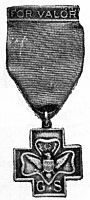
all of them a special badge called "Scout Aide" is awarded.
This badge will probably be regarded by the outside
world as the most important decoration the Girl Scouts
can win, and all Scouts who will try for it should realize
that those who wear it will represent the organization in
a very special sense and will be eager to prove their
practical knowledge and ability in the important subjects
it stands for.
No young child could pretend to represent all this
medal stands for. Any grown girl or woman should be
proud to own it.
Practical knowledge of Personal Health, Public Health
and Child Care will add to the efficiency and happiness of
this nation, and the women of today have a better chance
to control these things than ever before.
Home Nursing and First Aid will save lives for the
nation in the two great emergencies of illness and accident.
Household Economics, the great general business and
profession of women, if it is raised to the level of the
other great businesses and professions, and managed
quickly, efficiently and economically, will cease to be regarded
as drudgery and take its real place among the arts
and sciences.
When the girls of today have learned to do this, the
women of tomorrow will be spared the criticism of waste
and extravagance that our nation has had to bear. If
Girl Scouts make good as far as this medal is concerned
and become real "Scout Aides" the Scout reputation is
secure.
By Sarah Louise Arnold
Formerly Dean of Simmons College
The Keeper of the House. Every Girl Scout knows
that good homes make a country great and good; so
every woman wants to understand home-making. Of
course that means "keeping" a house; and of course that
means that Girl Scouts should try for the Housekeeper
Merit Badge, the "Home Maker."
Now "making a home" doesn't mean just having it,
owning it and holding its key. It means making it a
good place to live in, or helping to make it so. This
sounds like the House that Jack built; but all this belongs
to the making of a home.
Planning Your House. When you plan a house of
your own you must think what it needs most. You would
choose, first of all, to have abundant air, fresh and
clean; a dry spot where dampness will not stay; sunshine
at some time of day in every room of the house, which
you can have if your house faces southeast; and you
must be able to get a good supply of pure water. You
will want to make your house warm in the winter and
cool in the summer, so you will look out for windows,
doors and porches.
Think what must be done in a house: eating, sleeping,
working, resting, by the whole family. How many rooms
must you have? Draw a plan of some house in your
neighborhood that seems good to live in. Make up your
mind what you like best in that house.
Furnishings. Then houses must be furnished with the
things that the family needs. The furniture will be for
use. You must ask every piece what it is good for.
What will you do with it? Could you get along without
it? Some things you would use constantly, others once
in a while. Which would you get first if you were
planning carefully? How much would it cost to furnish
the house for which you have drawn the plans: to furnish
the kitchen, the living room, the bedrooms? Make a
list of the furniture needed (not just wanted) for each
room with the cost of each piece.
It is worth while for you to go to look at furniture in
stores and to think about buying it. Then you will discover
that a piece of furniture that looks well in the store
might not look at all well in your house, for furniture
must "suit" the house and the room into which it goes.
It must "fit," we say. No other furniture will do. So
the Girl Scout will make up her mind what will fit her
house; and of course this means also what will fit the
family purse. For the keeper of the house must not
let into her house one single thing that she cannot afford
to buy. She will take pride in that.
So when you make a list of furniture—with its price—make
sure that everything you choose, suits, or fits, your
house.
The Cellar. Most houses are built over cellars, for
purposes of sanitation, heating and water supply, as well
as for storage.
The Girl Scout who lives in the country probably
knows all about cellars for they are much needed there.
The city girl may live in an apartment and may never
think of a cellar.
Look at the cellars of two or three houses. How are
they built? Did you plan for one in your house?
The cellar should be well ventilated, having light as
well as air. Its windows should be screened; the floor
should be dry and if possible made of cement; the walls
should be whitewashed. Ashes should be kept in a galvanized
iron barrel, to prevent fire.
A cellar should be a clean place, corners and all.
The Kitchen. The kitchen is a work-shop; it should
be sunny and airy.
Look out for windows to let in the fresh air and sunshine.
And while you are thinking of windows, be sure
that they can open at the top and bottom to let sweetness
in, and drive bad odors out.
Your kitchen should hold things that are necessary, and
nothing else. It should be easy to keep clean, having
painted walls, and the floor should be of hard pine or
else covered with linoleum. When a Girl Scout takes
care of the kitchen she is in honor bound to keep all the
corners clean and to leave no dust nor crumbs of food
anywhere about. She will take great pains to keep flies
out of the kitchen and so will have her windows screened.
A good kitchen is provided with a sink and if possible
with running water; and it must have a good stove, with
a place for keeping wood or coal if either is used.
The Kitchen Floor. The floor of the kitchen should be
made of hard wood. Maple or hard pine will make a
good floor. A hard-wood floor can be dressed with shellac
or with oil. The wood absorbs this dressing so that
water will not soak in. A floor which has been shellacked
should be wiped with warm water. Not much water
will be needed. The oiled floor can be wiped and dried,
then oiled lightly from time to time.
Linoleum or oilcloth may be used to cover an old floor.
If the floor is rough it should be made even by planing
before the linoleum is put down, and the cracks should be
filled. If you can't get linoleum you can paint your floor
with a hard floor paint. Be sure to get a paint that dries
hard. The linoleum should be frequently washed with
warm water and soap and then rinsed carefully before
it is dried.
The Kitchen Stove. The chief business of the kitchen
stove is to provide heat for cooking. It must hold a fire,
and so must be made of something which will not burn.
Stoves are usually made of iron. Fire will not burn
without air, so a place must be arranged to let air into
the stove, and just enough to make the fire burn clearly
and furnish the right amount of heat. That is what the
front dampers or slides are for. The fuel, wood or
coal, is held in the fire-box. The heated air makes the
top of the stove hot for frying, broiling or boiling, and
the oven hot for baking.
The smoke and gases from the fire must not come out
into the room to blind our eyes or suffocate us; the
chimney is built to take care of the smoke and gases, and
there must be a way for them to get into the chimney;
the stove pipe is for this. But the game you have to
play with your stove is to let the smoke and gases run
up chimney, but to save all the heat you can for the
work to be done. So your stove is supplied with dampers.
When the fire is new, and there is much smoke or gas,
you open the damper into the stovepipe, and in the
stovepipe. Try to get a picture of the way the heated
air goes from the fire-box up into the chimney. We call
this direct draft. Of course a great deal of heat runs
away through the chimney, and so your fuel is wasted.
Now if you want to save heat, and particularly if you
want to bake, and must have a hot oven, you will close the
oven damper that has made the short easy way into the
stovepipe. Then the heated air must find another way to
get to the chimney, and it has to go around the oven to do
this. While the hot air is finding its way around the oven,
it heats it, ready for your baking. We call this the "indirect
draft." Look over your kitchen stove and see how
this happens. Take off the covers, open every door, and
examine every part.
Stoves must be carefully managed. The fires must
burn readily and the cooking must be done with the least
possible amount of wood or coal. This means a clean
stove, free from ashes and with a clear draft. Wood or
coal will burn freely in the air. They will stop burning
if there is no draft.
Learn to manage your draft. Remember that stoves
are made with a damper, in order to control the current
of hot air. If the oven damper is closed this heated air
must pass over and around the oven before it gets to the
chimney and so heat the oven. If it is open the hot air
can immediately escape up the chimney.
When starting the fire leave the damper open. As
soon as it is burning well, close it so that the oven will be
heated. Your stove should also have a damper in the
pipe, to save the heat which would otherwise run up the
chimney. If there is none, have one put in. There are
also dampers or slides in front of the stove to control the
amount of air going in.
The housekeeper must learn how to manage her stove;
she must get acquainted with it, for every stove has its
own way. Draw a picture or plan of the stove that you
know best. See if you can tell plainly how to build a
fire in your stove. If you use natural gas or a kerosene
stove tell how that should be managed.
Gas and Oil Stoves. Cooking may be done on an iron
stove with either coal or wood as fuel, or the stove may
be planned for burning gas or kerosene. The coal fire
must be fed several times a day with coal and the ashes
must be removed to keep the fire burning clearly. Wood
burns out quickly and must be replaced often. Both
wood and coal stoves mean almost constant care for the
housekeeper.
Gas gives less trouble. It comes in pipes from outside
the house. This means that somebody else—the
gas company—provides the supply. You turn on the
gas when you want to use it and turn it off, if you are
wise and thoughtful, the moment it is not needed. The
gas company measures the amount of gas that you use
by its meter, and you pay for every bit that you burn or
waste. The important thing, then, is to use as little
gas as possible in order to pay for as little as possible.
You would rather pay twenty-five cents for a thrift
stamp, than for gas that had burned simply because you
had forgotten to turn it off. Be sure that gas is turned
completely off at all places and never have a low light
burning, as the flame may be blown out and the unburned
gas escape. This would be dangerous and might even
kill persons in the house.
The kerosene stove may be used instead of a gas stove
in houses which are not piped for a gas supply. If wicks
are used they must be carefully trimmed, so that they will
be clean and even. A kerosene stove needs frequent
cleaning. It should be kept free from dust and from
drippings of oil.
The Fireless Cooker
When a Girl Scout gets to thinking about all the work
to be done in a kitchen she will ask some very important
questions. How much work is to be done? How long
does it take to do it? Can time be saved by doing it in
a better way? How can I save labor? Save time? Save
money?
The Girl Scout will find the answers one at a time,
if she does her own work. And if you do your own work
you will at once call for a fireless cooker. The name
sounds impossible, for you have always cooked with a
stove, and, of course, a fire. How can you cook without
a fire?
The women of Norway taught us how. When they
went out to work in the fields or on the farm they took
the hot kettle of soup off the stove and hid it away
in a hay box. The hay kept the heat in the kettle instead
of letting it escape; so the soup kept on cooking, and
when the women came home from their work in the
fields there it was, all steaming hot and ready for dinner.
Everyone has noticed how some things carry or conduct
heat and other things don't. That's why we use a
"holder," when handling a hot dish or stove lifter or
tea-pot. The "holder" does not carry the heat to the
hand; it keeps it away. So the hay packed around the
hot kettle kept the heat in the kettle, refusing to "conduct"
it away. Therefore the soup went on cooking.
Your English cousins use a "cosy" to cover the hot
teapot or coffee pot. This "cosy" is made of quilted
cotton; and looks like the quilted hood that your great-grandmother
used to have. This keeps the heat in the
tea or coffee, so that you can have a second cup for the
asking.
America was slow to learn from her thrifty cousins,
but at last she adopted the fireless cooker; and this is
what it does:
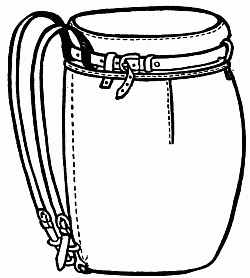
The fireless cooker, a case packed with some material
which refuses to conduct heat, is used to continue the
cooking of foods after they have been made hot on
the stove. When securely covered in the cooker they
will go on cooking for several hours because the heat is
retained by the protecting case. A Girl Scout may buy
a fireless cooker, paying from $5 to $25 for it, or she
may make one, which will cost less than one dollar. Of
course this is a challenge to make one. You may be
very sure that if you make a fireless cooker you will understand
all about it. To make a fireless cooker you
will need:
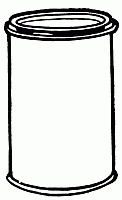
(1) A cooker or container, which should be an agate
pail with a close fitting cover. The sides should be
straight up and down, the bottom just as big as the top.
You can choose a small one holding two quarts, or a gallon
pail which would be large enough for anything an
ordinary family would be likely to cook.
(2) A case, which must be at least eight inches wider
than your container, for the packing must extend at least
four inches around the pail on every side. You may
use a round case like a big wooden candy pail, which
you can usually get at the ten cent store for ten cents; or
it may be a galvanized iron can with a cover like the one
ordinarily used for garbage; or it may be a box shaped
like a cube.
(3) For packing you may use crumpled newspapers
tightly packed in; or ground cork, which is used in packing
Malaga grapes, is fine, and you may be able to get
it from a fruit store. Excelsior is good, and perhaps
you will find that in the shed in some packing case; while,
if you live in the country, you may be able to get Spanish
moss. This should be dried, of course. And then there
is hay—which our Norwegian cousins use.
Let us try paper. Pack the box or can four inches
deep, with crumpled paper, making a very even layer.
Put a piece of pasteboard much larger than the bottom of
your pail upon this layer and set your pail in the middle
of it. Now pack the paper tightly around the pail up
to the very top, using a stick of wood or mallet to press it
down.
Now you must make a cloth cover for your pail in the
shape of a tall hat. The rim of the hat must reach out
to the edges of your case and be tacked there. Take out
your pail, fit this cloth cover into the hole and tack the
edge evenly to the box.
You must now make a cushion to fill the rest of the
box, packing it full of the crumpled paper. Make hinges
for the lid of your box and put some sort of fastener
on the front to keep the lid down tight.
Now you have your fireless cooker. When your oatmeal
or your stew, or your chicken, or your vegetables
have boiled ten or fifteen minutes on the stove in your
agate pail, clap on its cover, set it into the nest, push the
cushion into the top of the cooker, clamp down the lid,
and your work is done, for the cooking will go merrily on
all alone by itself in your fireless cooker.
While you are making your fireless cooker, remember
that the thermos bottle is made on the same principle.
And remember, too, that your non-conducting packing
material will keep heat out just as well as it keeps heat in.
In the summer time you may wish to keep your ice cream
cold for a while in your fireless cooker. Perhaps you
will see how this might help on a hot summer's day and
what a comfort a fireless cooker might prove in a sick
room.
The Ice Chest. How It Is Made
In taking care of food we must be provided with a cool
place, for the storage of milk, butter, cream, and all
cooked food that may spoil. In summer this is especially
important; in an apartment, and in most city houses the
ice chest is needed all the year around; in the country,
it is needed only in the warm months.
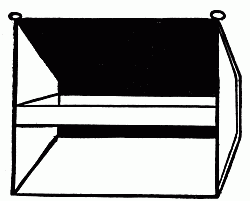
The ice chest is built much as the fireless cooker is
made. Its case is usually made of wood, its packing
material must be non-conducting, and its lining must be
some smooth surface through which water cannot pass.
Some ice chests are lined with zinc and some with porcelain
tiles. In some ice chests, food and ice are kept in
the same box, which usually opens at the top; in other
chests there is a separate chamber for the ice. From the
ice chamber a drain pipe carries away the water which
drips from the melting ice.
Every ice chest must be kept clean and sweet. It
should be looked over every day and washed carefully
at least once a week. No crumbs of food should be left
on the shelves. If you spill anything, wipe it up clean
at once.
The drain pipe must be kept clean. A long wire brush
is used for this. If you are buying an ice box, get one
with removable pipes, which are easily cleaned. If there
is any odor from the chest, scald with water and soda,
a teaspoonful of soda to a quart of water. Rinse with
fresh cold water.
If your ice chest drips into a pan which must be
emptied daily, have a regular time for emptying it. An
overflowing pan in an apartment may damage the ceiling
below. If it drips into a pan which drains itself, be
sure that the drain is kept clean and the entrance to the
pipe unclogged. Clean the drip pan whenever you clean
the ice chest.
It is a good plan to keep food in closed containers like
fruit jars. Wide dishes take up too much space. Containers
should be tall rather than broad.
Put no hot dishes in the ice box; it wastes the ice.
The Iceless Refrigerator
An "iceless refrigerator" sounds like a "fireless cooker."
This is an arrangement made to keep food cool in the
summer when there is no ice. A wooden cage with
shelves is covered with a cloth cover and placed near a
window or out of doors. If in the house it should stand
in a large pan to prevent the dripping of water on the
shelf or floor.
A piece of the cloth cover should rest in a pan of
water. If this is not convenient a strip of cloth can be
sewed to the cover endwise and this piece should be
placed in a pan or bowl of water which should be set on
top of the cage. This water will be sucked throughout the
cloth cover of the refrigerator until it is wholly wet. As
the water evaporates from the cover the air inside the
refrigerator is cooled.
The iceless refrigerator works well on days when
dry air is moving about. It does not do well on damp,
quiet days.
Another simple refrigerator which does very well for
a little milk or a pat of butter is a clean, earthen flower
pot, turned upside down in a shallow pan of water. This
will keep very cool the food which it covers.
The Kitchen Sink
Next to the stove, the sink is the most important piece
of kitchen furniture.
The best sinks are of enamel or are made of porcelain.
They have a fine wire drainer so that nothing
solid will go into the trap and plug the pipes. The Girl
Scout uses boiling water, and plenty of it, to flush the
sink. She takes pains that no grease gets into the drain
to harden there. When grease is accidentally collected,
soda and hot water will wash it away, but it should never
collect in the pipes.
The Keeper of the House takes pride in a perfectly
clean sink.
Taking Care of the House and the Things in It
Taking care of a house and its furniture means keeping
the house clean, neat, and orderly, and keeping everything
in good repair. This means a great deal of thought
on the part of the Keeper of the House. For there are
many sorts of work to be done, and there is a right way
of doing every bit of it. By paying attention a Girl
Scout may learn very fast, and become very helpful and
competent.
First, there's the Dish Washing.
Dish Washing
In making ready for dish washing scrape every plate
carefully to remove crumbs that would get into the dish
water. Try using crumpled tissue paper to remove milk,
grease, or crumbs before the dishes are put into the pan.
Save tissue paper, and paper napkins for this.
Pile in separate piles, all dishes of each sort; wash
first glass, then silver, then cups, saucers, plates, then
the rest; do not put bone, ivory or wooden handles of
knives into the water. Use hot water and soap for dish
washing, then rinse with clean hot water.
Dish towels should be cleansed after every dish washing;
wash clean in hot soapy water, then rinse all the
soap away in clean water. Cooking utensils should soak
in cold water until time for dish washing, unless they
can be washed as soon as used.
Use a tray for carrying dishes to the closet or pantry
instead of travelling with a handful back and forth. Strain
the dish water before pouring it down the sink. Be sure
that no greasy water is put into the sink. Let the grease
rise and cool; skim it off and dispose of it after the
dishes are washed.
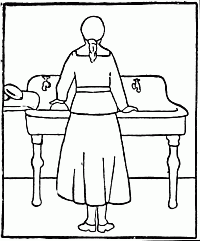 RIGHT
RIGHT
|
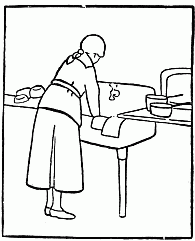 WRONG
WRONG
|
HEIGHT OF SINK
Taking Care of Rooms
Keeping a house in order means having everything in
its place in every room. It means sweet, fresh air in
every room; it means removal of dust and litter. A good
housekeeper "tidies" her rooms as she goes along, always
picking up anything that is out of place and putting it
where it belongs. But she also has a method in doing
things. Perhaps she sweeps the entire house every day
or every other day, or perhaps she puts one room in
order on one day and another on another and so on. The
important thing is to have a regular plan.
The Living Room
Taking care of a living room means cleaning the floor
and the rugs; dusting the walls, the pictures; cleaning,
dusting, and sometimes polishing the furniture. Open
the windows top and bottom, dust and brush them inside
and out; use a soft brush or a dust mop to take the dust
from the floor. Use a carpet sweeper for the rugs unless
you have electricity and can use a vacuum cleaner; collect
the sweepings and burn them.
Dampen one quarter of your cheese-cloth duster and
roll it inside the rest of the duster, then wring. This
makes a dampish cloth for dusting the base-boards, window
sills, and other woodwork as well as the furniture.
Where the furniture is highly polished, or would be injured
by water, use oil on the duster instead. Dust after
the dust has settled, not when it has been stirred into the
air. Shake and replace doilies or covers.
Be sure that the pictures hang straight after dusting
and that every piece of furniture is put in its right place.
See how long it takes to clean the room; then study to
find out how the time can be shortened.
Do not keep useless furniture nor have too many things
in your room.
The Bathroom and the bath tub require daily cleansing.
In the ordinary family every one who uses the tub
should leave it perfectly clean for the next one who needs
it. All the furnishings of the bathroom should be kept
sweet and clean. Use a flush closet brush daily, scalding
it after using it. And remember that fresh air and sunshine
are cleansing agents. Get them to work for you.
The Bedroom. Your bedroom needs all the fresh air
it can get. The Girl Scout sleeps with her windows
open. As soon as you have dressed in the morning throw
the windows wide open again, if they have been closed.
Open the bed, so that both sheets may be reached by
the fresh air. Shake up your pillows and put them on a
chair near the window. Leave your night clothing spread
or hung where it will be well aired. Let your room have
a fresh air bath!
You know already how to make a bed. You will remember
that all the bedclothing must be smooth and
even, when the bed is made. You are lucky if you have
a sister to help you make your bed, for this piece of work
is easier for two than for one. You will see that the
mattress is lying straight. Once a week you (the two of
you) will turn the mattress, end over end one week, and
side over side the next week. Then your mattress will
wear evenly, and not have a hollow in the middle where
you sleep all the time. Then you two will lay the mattress
cover straight, and tuck it in firmly, so that you will
have no hard wrinkles to sleep on. The under sheet,
smooth and straight, must be tucked in all around. You
will make the bed as smooth as the table. Now the upper
sheet, which is the hardest thing to manage in bed making,
must be neatly tucked in at the foot. But you must allow
eight inches at the top to be turned over the blankets and
spread. Now the blankets, straight and smooth, and
evenly tucked in at the foot. Then you may choose between
tucking in the sides after folding the top sheet
down over the blankets, and afterwards covering the
whole bed with the spread, letting the sides and ends
hang down; and laying the spread even with the blankets,
tucking in the sides, and turning down the sheet over all.
Try both ways.
Now, shake and pat the pillows, making them very
smooth and quite square-cornered; then lay them or stand
them neatly at the head of the bed, meeting exactly in
the middle; and your bed is fit for a queen, or a tired
Girl Scout after a tramp!
With the bed neatly made, everything must be put in
its proper place. The furniture and window sills must
be dusted with a clean cheese-cloth duster; and the bare
floors must be nicely dusted with a dry floor-mop, or
a cloth pinned over a broom. If there are rugs, use
a carpet sweeper, if you have one, or a broom. If you
do any broom sweeping, however, you will do it before
you dust.
Now a last look to see that the room is tidy, every
chair in place and the shades even at the windows, and
your room is ready for the day. Of course any Girl
Scout who wants a Homemaker's badge will do all these
things;—not guess or suppose how others do them and
how long it takes. That is the honest way to learn. So
find out how long it takes to put your room in order.
There is only one way to find out.
Fighting Germs
Keeping clean in these days means keeping free from
troublesome germs as well as visible dirt. Germs thrive
in dampness and darkness. They can be overcome by
sunshine. For thorough cleanness, the house needs fresh
air and sunshine as well as sweeping and dusting. The
Girl Scout must remember to let the fresh air blow
through every room in the house every day. She should
sleep with her windows open. She is fortunate if she
can sleep out of doors.
Of course she is in honor bound to have no dark, damp,
hidden, dirt-filled corners in any part of her house, not
even in shed or cellar. Let in the light and clean out
the dirt.
Fighting the House Fly and Mosquito
House flies carry disease. They breed in filth, human
waste, animal droppings, decayed animal or vegetable
matter, and are so made that they carry filth wherever
they go. Since the fly alights wherever it pleases, it
carries dirt from outside and distributes it wherever it
CHOOSES.
Clean up all heaps of rubbish where flies may breed.
Keep your garbage pail absolutely clean. Disinfect outdoor
water-closets and cover with gravel or slacked lime.
Get fly traps to set on your porches. Kill all flies that
come into the house, especially the early ones, in the
spring. Keep your windows and doors screened.
Fight mosquitoes just as you fight flies. Leave no
still water even in an old tin can, for the eggs of mosquitoes
are deposited in still water and hatch there. The
mosquito, like many other insects, has an intermediate
stage between the egg and the grown mosquito. During
this stage it swims about in quiet water. Mosquitoes in
great numbers may be growing in old cans or bottles, rain-filled
and hidden away under the bushes in your yard.
Watch for such breeding places; clean up your yard and
banish the mosquito.
Taking Care of Waste
All waste must be carefully disposed of. It should
never accumulate in the kitchen; but the important thing
is to have no real waste. See that everything is put to
the utmost use. If you live in the country, chickens and
pigs will take the parings, the outer leaves of vegetables,
etc., and you can bury or burn waste. If you live in
the city the garbage man will collect all waste.
The garbage can must be kept thoroughly clean. It
should be rinsed and scalded whenever it is empty, so
that there will be no bad odors about the kitchen. Find
out how garbage is taken care of in your town. How
can you help to keep your neighborhood clean? What
should be done if there is carelessness about garbage?
Taking Care of Woolen Things
Housekeepers must fight moths as well as flies. The
clothes moth loves to lay its eggs in wool. It is very
keen in searching out bits of wool and finding a place
for its baby to thrive. Unless you have a care it will
lay its eggs in your best winter dress which you forgot
and left hanging in the hot summer days.
When the baby worm pokes its head out of the egg,
it begins to feed upon the wool; and when some cold
winter morning you get your dress you will find holes
neatly cut where the little worm has gnawed, and beside
the holes the little woven cradle which the tiny
creature spun for itself, and in which the crawling worm
changed to the flying, silvery moth.
The housekeeper must therefore, carefully brush and
pack away all woolen things before the moths arrive.
After the garment is cleansed and brushed it may be
folded in newspapers carefully pinned at the ends, so
that no crack is left for the moth to get in it, or it may be
laid in a cedar box; or in any plain box with moth balls
or camphor. Every box should be labelled so that you
know without opening it what is in it.
Watch edges of carpets and rugs for the carpet beetle
and the "Buffalo bug." The last bothersome creature
may eat your cotton dresses in your closet. All clothing
must have care.
Make a list of the woolen things that must be taken
care of if the house is closed in summer and what personal
clothing must be packed away for the summer
even if the house is not closed.
Storage of Food
Taking care of food so that it will "keep" well is just
as important as the careful buying of food. Much waste,
and therefore loss of money and labor, comes from
carelessness in the storage of food. The bright Girl
Scout will keep her eyes open to see how foods are taken
care of in the house; which foods must be kept in the
cellar; which ones must be stored on the shelves of dry
closets; which ones come in sealed parcels; which in
paper bags; which in boxes; which in barrels. There
must be a place in the house for keeping all these things.
So you need to think which foods must be kept in the
house and which must be bought from day to day. And
in the house which you plan there must be ample space for
closets and shelves, for keeping properly all that must
be stored. No one can say which things must be kept in
the house by every family. If the Girl Scout happens to
live in a crowded city where rents are high, she will have
little storage space, and will not keep so many things on
hand. If she lives in the country, miles from a store, she
must have a "store" of her own. So keep your eyes open,
Girl Scout, and see what is being done in your part of
the world. That is what eyes are made for.
Heating the House
A house may be heated by a furnace, by stoves, or
even by open fires in the fireplace, as in old days. Heating
the house makes the chimney necessary. This must
be carefully arranged for in planning your house. Heating
by stoves is the most common arrangement. In the
large city or town, the furnace is used. This is merely
a big stove in the cellar or basement, so planned that its
heat is distributed through the house. By this means
one big stove does the work of many little ones, and
warms the whole house.
The furnace may use its heat to turn water into hot
steam, which is sent through all the house through the
iron pipes and radiators. Or the water in the boiler
may be made quite hot, though not turned into steam, and
sent through the house in the same way, by means of
pipes. Or hot air from around this big stove or furnace
may be sent through big pipes directly to the various
rooms. This means dust and dirt, and we are learning
to use steam and hot water instead of the hot air system.
The fireplace is almost a luxury. It is found oftenest
in country houses where wood can easily be got and
stored. The town or city home may have its open fire,
however. Everyone loves an open fire; and when you
plan your own house, you must manage to get one if
you can. The hearth is the heart of the house.
Labor Saving
The housekeeper must learn how to do her work in
the least possible time; she must save steps. Look at the
house that you have planned and see whether everything
you need to use is within easy reach. Look carefully at
the closets where you keep things. Are they big enough?
Are they in the right place? Suppose your water comes
from a well which is a long way from the house. What
difference will it make? What would you do about it?
The Water Supply
The water supply of every home should be carefully
guarded. If the water is defiled or contaminated by germs
of typhoid fever, diphtheria, or other diseases, whose bacteria
may be carried by water, the disease may be spread
wherever the water is used.
No earth closets or human or animal waste should be
in the neighborhood of the well. Water should come
from high ground and clean places with no possibility
of gathering infection on the way to the house. Great
pains should be taken to keep drinking water absolutely
clean. All drinking vessels should be washed and scalded
and the rims should never be handled.
In the country every home has a private water supply
and takes pains to guard it. In the city there is a common
water supply and everyone is responsible for keeping it
pure. Where does the water come from that supplies
your city or town? How is it kept clean? Who takes
care of it?
Whenever there is any question about the purity of
common drinking water, the table supply should be boiled,
for safety. Boiling will destroy any bacteria that could
produce disease. This boiled water should be used for
rinsing dishes as well as for drinking.
Girl Scouts will interest themselves in municipal or
neighborhood housekeeping, for that is a responsibility
which all share together.
Learning to take care of one's own home is a good
beginning, if one is to share in providing good conditions
for the neighborhood.
Little Things Worth Remembering
The stove should be cleaned with crumpled newspaper
whenever the kitchen is put in order. All ashes should
be neatly brushed off.
In lifting ashes from the ash pan with a shovel use a
newspaper to cover the pail into which the ashes are
poured, so that the dust will not scatter over the room.
Don't dump them and raise dust; and never put hot ashes
into a wooden box or barrel.
Watch the floor of closets and see that no dusty corners
are hidden out of sight.
Air and dry soiled clothing before putting it in the
laundry basket. If damp clothes are hidden away they
will mildew.
Learn to make out a laundry list and to check it when
the laundry comes home.
Save the soap chips and use a soap shaker.
Get all the help you can from older housekeepers in
your neighborhood. Ask them how they do things and
why. Your mother may know something better than anybody
else does.
The Girl Scout asks questions and learns why things
are done as they are. She may think out a better way
some day, but first she must pay attention to the old
way.
Sing at your work; it goes better so. Besides, joy
belongs with housekeeping and your song helps to keep
her there. Always sing if the work drags, but let it be
a lively song!
Making Things Clean and Keeping Clean
Making things clean is a most important duty of the
Keeper of the House. But don't forget, Girl Scout, that
keeping things clean is a constant duty. You know many
a body who "cleans up" with a lot of stir once in a
while, but who litters and spills and spreads dirt and lets
dust collect in corners all the rest of the time.
"Keeping clean" is the housekeeper's regular business,
and "cleaning up" never need stir up the whole house.
For keeping clean, soap and water must always be
had. The soap loves to wrestle with grease. The water
softens and rinses away both dirt and soap. You will
use a scouring soap or powder to clean stained or dirty
metal or glass; and you should cover water-closets and
other out-of-door places for refuse with clean slaked lime
now and then to keep them clean.
Ten Ways of Removing Stains
1. When you have raspberry or blueberry or strawberry
stains on your white handkerchief or blouse or
skirt, do not be too much disturbed. Hold the stained
part firmly over an empty bowl, with the spot well in
the centre, and ask some one to pour boiling hot water
over the spot and into the bowl. The stains will disappear
like magic. Then the wet spot may be dried and pressed
with a hot iron, and the damage is repaired.
2. Peach stains are much harder to remove, but they
should be treated just as the others were treated. Often
several applications of hot water are necessary for these
stubborn stains. But you must not lose patience. And
you must not use soap. The stain will fade out at last
under the hot water.
3. Ink stains are a great bother, especially to the
school girl who carries a leaky fountain pen. Do not let
them get dry. They will be much harder to remove.
Sometimes cold water, applied immediately, will remove
the ink, if the spot is rinsed carefully. Use the cold
water just as the hot water is used for the peach stain.
If that does not remove it try milk. If the milk fails,
let the spot soak in sour milk. Sometimes it must soak
a day or two; but it will disappear in the end, with rinsing
and a little rubbing.
4. Ink stains on a carpet are a serious matter. Let
us hope that no Girl Scout will be so unlucky as to upset
an ink bottle on a friend's carpet or rug. If she does,
she should know the best way to set about removing it.
This should be done as quickly as possible before the
ink dries, or "sets." Take cotton, or soft tissue paper or
blotting paper, and absorb all that has not soaked in. You
will see that the "sooner" is the "better" in this case.
Try not to increase the size of the spot, for you must keep
the ink from spreading. Then dip fresh cotton in milk,
and carefully sop the spot. Do not use the cotton when
it is inky; that will smear the carpet and spread the stain.
Use fresh bits of cotton, dipped in clean milk, until the
stain has disappeared. Then rinse with clean water in
the same way, and dry with dry cotton.
5. The spots made on silk or woolen by acids may be
removed by touching with ammonia or baking soda, dissolved
in a little water. The bright yellow spot on a
black dress will sometimes run away like lightning when
touched by the wet cork of the ammonia bottle.
6. Egg stains on the napkin, or sometimes, unfortunately,
on a dress front, must be removed before washing.
Use cold water alone. The egg will dissolve and can be
rinsed out. Hot water will cook the egg and it will be
hard to remove.
7. Liquid shoe blacking is almost worse than ink. It
must be treated in the same way, and at once.
8. Coffee and tea stains will wash out with either
warm water or soap and water. A black coffee stain on
a fresh tablecloth may be removed like the berry stains,
by the teakettle and bowl method.
9. Grease spots may be removed from washable
fabrics by soap and water. For silk and woolen, gasoline
should be used. Use gasoline in daytime only, to
avoid lamps or gas in the neighborhood; and never near
a fire. Use carbona instead of gasoline or benzine when
possible, as it cannot burn. Remember that all grease or
sugar spots should be removed before putting a woolen
garment away. Moths always seek them out, and they
will find them if you don't.
10. Paint can be removed by soaking the spot in turpentine.
This dissolves it, and a bit of rubbing shakes
it out. A brush helps, when the paint spot is on a woolen
garment, after the turpentine has done its work.
Remember: All spots and stains should be removed
before washing the garment.
GOOD MANNERS AND SOCIAL FORMS
It is easier to meet people socially if we are acquainted
with the simple forms of introductions, meeting and parting,
and so forth. A girl who is entertaining her friends
will be more successful in doing so if she plans ahead
how she can welcome them and has all the necessary
preparations for a substantial good time, at hand. This
planning also makes it possible for her to be less occupied
when the time comes, and to have a good time herself.
Stand where guests can see you at once when they
enter.
Always introduce a younger person to an older one,
as "Mrs. Smith, may I present Miss Jones, or Mr.
Brown?" A man is always presented to a woman, or a
girl, as "Miss Brewster, may I present Mr. Duncan?"
If you have many guests, ask some of your friends to
join you in watching to be sure that no one is left out,
so that the evening may be a success for every one. It
is sometimes difficult for a hostess to do this alone.
If you ask other girls to help you ask each to do a
definite thing, as to arrange for wraps, sing or play, pay
special attention to some older person, etc. This saves
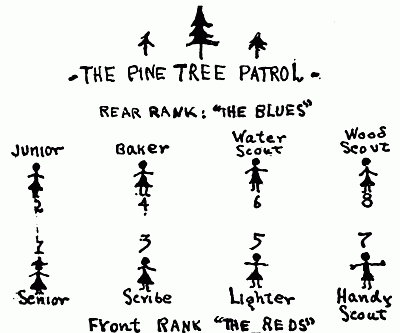
confusion, as the Pine Tree patrol does in camp.
A few intimate friends need no plan to make them
have a good time, but with a large number it is usually
better to plan games, music, charades, or some other
form of entertainment.
When invited to a house at a certain time, be prompt.
Promptness is always a mark of courtesy, as it means
consideration for the time and convenience of others. One
should also watch carefully the time of leaving, and not
stay about unless specially detained.
TABLE MANNERS
Accept what is offered or placed before you, with a
quiet "Thank you." If you are asked what you prefer,
it is proper to name it.
Do not drink while food is in the mouth.
Take soup quietly from the side of the spoon, dipping
it into the plate from instead of towards you, to avoid
dripping the soup.
Break bread or roll, and spread with butter only the
piece which you are about to eat.
Use knife only as a divider, the fork to take food to
the mouth. Where one can dispense with a knife, and
use only the fork to divide food, do so. When not
using either, lay them together across the side of the
plate, not resting on the table cloth.
A spoon should never be allowed to rest in a tall receptacle
such as a cup or glass, as it is likely to overturn
the receptacle. Place the spoon on plate or saucer.
At close of meal, fold napkin, that table may be left
in orderly condition. When napkins are to be washed
at once, or when they are paper napkins, they need not
be folded.
Do not begin a course until all are served.
Sometimes it is better to serve the hostess first, and
sometimes it is the custom to serve the guest first, that is
the guest of honor who sits on the hostess' right. When
the host or hostess does the serving, the guest is served
first.
Do not be troubled if you use the wrong spoon or fork,
and never call attention to anyone else's doing so. No
matter how you feel, or what the blunder or accident may
be, such as spilling something or dropping a plate, never
show displeasure to either servant or guest. Good breeding
and pleasant atmosphere are essential to all entertainment.
Good breeding means first of all thoughtfulness of
others, and nothing shows lack of breeding so quickly as
a lack of such politeness to those who happen to be
serving us in hotels, at home, in shops, or when travelling,
or anywhere else.
When acting as waitress, stand at the left of the person
to be served, so that the portion may be taken with
the right hand.
Preparing the Meal
Plan the cooking so that the food that is to be served
may be kept hot; for instance, soup may be kept hot on
the back of the stove or where there is less heat, while the
meat or vegetables are being cooked. Food that is to be
served cold, should be kept in the ice-box or standing in
water until the last moment and served in chilled dishes.
In placing the food on the dishes and platters care should
be taken to make it look attractive.
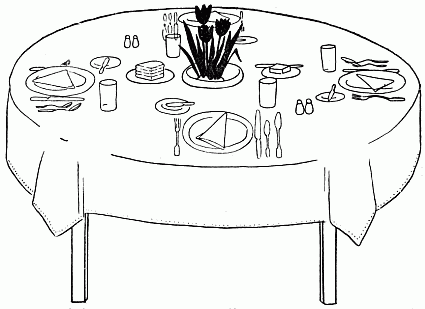
Setting the Table
When setting the table keep in mind how many courses
there will be, and therefore, how many knives, forks, and
spoons are needed. Have everything clean, and lay everything
straight. Air room well. Wipe table, and if a
tablecloth is used, cover table with a felt silence cloth.
If a tablecloth is used, it should be laid with the fold
in the center of the table. If a centerpiece and doilies
are used, they should be laid at even distances. Clean
white oil cloth and paper napkins make an attractive
looking table. At each cover the knife, edge in, is placed
at the right with the spoon, and the glass is placed at
the right in line with the end of the knife. The fork is
at the left and bread and butter plate and small knife
are at the left opposite the glass. Put the napkin between
the knife and fork.
Salt, pepper, water, bread and butter should be on the
table, and if necessary, vinegar, mustard, sugar, pickles,
etc.
When possible a few flowers add to the appearance of
the table.
Have as much ready as possible before sitting down
at the table. See at least that (1), glasses are filled;
(2), butter portioned; (3), chairs placed.
Hard and fast rules as to table setting do not exist.
Local customs, the amount of service at hand, and common
sense must govern this. The captain, assisted by
the council, must be the judges.
By Ula M. Dow, A. M.
In charge of Division of Food, Simmons College
The Girl Scout who has earned the Cooking Badge
may be a great help at home if she has learned to work
quickly and neatly and may get much amusement both
at home and on camping parties. If the first trial of a
process is not a success, the Scout should have patience
to try again and again until her result is satisfactory.
If she has learned to prepare a few simple dishes well
she should have courage to try unfamiliar recipes which
are found in any good cook book. If she is to be ready
to take responsibility when it is necessary, she should
be able to plan the meals in such a way that nothing is
wasted and that the family is satisfied and well-nourished.
When working in the kitchen the Scout should wear
a clean, washable dress, or a washable apron which covers
her dress. She should be sure that her hair is tidy,
and she should remember to wash her hands before beginning
work. She should try to use as few dishes as
possible and not to spill or spatter. She should remember
that her cooking is not finished until she has
cleaned up after herself, has washed and put away the
dishes, washed the dish towels and left the kitchen in
order.
What to Have for Breakfast—Breakfast is in most
families the simplest meal of the day and the easiest
to prepare. Some people are satisfied with fruit, cereal,
toast or muffins, coffee for the adults, and milk for the
children. Many families, however, like the addition of
a heartier dish, such as boiled or poached eggs, fish hash,
or minced meat on toast. If a hearty dish is served at
breakfast this is a good time to use up such left-overs
as potato, fish, or meat.
Simple Breakfast
Apple sauce or sliced peaches.
Oatmeal or cornmeal mush.
Toast or muffins.
Coffee (for adults).
Milk (for children).
Hearty Breakfast
Apple sauce or sliced peaches.
Oatmeal or cornmeal mush.
Toast or muffins.
Coffee (for adults).
Milk (for children).
Poached eggs or minced lamb on toast.
Fruit—Raw fruit should be carefully washed and
prepared in such a way that it can be easily eaten. Berries
may be cooked with no other preparation than washing.
Fruits, such as apples and pears, should be washed,
pared, quartered, and cored before cooking. Any fruit
which becomes dark on standing after it is cut may be
kept light colored by dropping the pieces into a pan of
water until they are ready to be cooked. If this is done
most of the water should be drained off before they are
cooked.
Dried fruits, such as prunes, which have a wrinkled
skin should be soaked for a short time in cold water
before they are washed. Otherwise it is impossible to
get them clean. After washing they should be covered
with cold water and soaked over night, or until they are
plump. They should be put on to cook in the water in
which they are soaked and cooked until tender. Sugar
should then be added if they are not sweet enough.
The most common method of cooking fresh fruit is
to boil it gently with just enough water to prevent it
from burning. Sugar should be added just before the
cooking is finished, the amount depending on the acidity
of the fruit and the taste of the family.
In sampling food, the cook should remember that the
rest of the food is to be eaten by other people. She
should never taste from the cooking spoon, but should
transfer her sample to a tasting spoon which is not returned
to the kettle.
Cereal—Cereals, such as oatmeal, cornmeal, and
cracked wheat, should be cooked in a double boiler. A
double boiler can be improvised by setting a pail or pan
into a kettle of boiling water. Cereals for breakfast
may be cooked the day before and reheated in the
double boiler, but should not be stirred while reheating.
A tablespoonful or two of cold water on top will prevent
a hard skin from forming while standing. All
prepared cereals are better if cooked for a longer time
than the package directions indicate. It is hardly possible
to cook any grain too long. The fireless cooker is
especially valuable for cooking cereals, but a longer
period of time must be allowed than for cooking in a
double boiler. A home-made fireless cooker, described
in another place, is interesting to make. Ready-to-serve
cereals are very expensive compared with those cooked
at home.
Cracked wheat, 1/4 cup to 1 cup water; 3-12 hours.
Rolled oats, 1/2 cup to 1 cup water; 1/2-3 hours
Cornmeal, 3 tablespoonfuls to 1 cup water; 1-4 hours.
Use 1/2 teaspoonful of salt to each quart of water.
Have the water boiling rapidly. Add the cereal gradually.
Let the mixture cook directly over the fire 5 minutes.
Place over boiling water or in the fireless cooker to
cook slowly for a long time. Keep covered and do not
stir. The time of cooking given in the table means
that the cereal is eatable after the shorter time mentioned,
but is better if cooked the longer time.
Toast—Good toast is worth knowing how to make.
The cook should not be satisfied with toast which is either
white or burned.
Toast is most easily made from stale bread, which
should be cut in one-third to one-half inch slices. A
single slice of toast may be made by holding it over
the fire on a fork. In camp a forked stick answers
every purpose. The easiest way to make several slices
is to put them in a wire toaster and hold them over hot
coals. Begin carefully and hold the bread some distance
away from the fire, turning it often until it dries.
Then hold it nearer the coals until it a golden brown on
both sides. With a new coal fire or wood fire toast
must be made on a toaster on the top of the stove to
prevent the bread from being smoked. If the top of
the stove is being used for other things, the drying may
be done in the oven.
Muffins—Any good cook book has numerous recipes
for muffins, most of which, can be made easily if the
directions are followed exactly.
Cornmeal Muffins (for four persons):
Four tablespoonfuls butter or oleomargarine, 3 tablespoonfuls
sugar, 1 egg, 1 cup milk, 1-1/3 cups flour, 2/3
cup cornmeal, 3 teaspoonfuls baking powder.
Cream the butter, add the sugar and the egg well
beaten. Sift the baking powder with the flour and cornmeal
and add to the first mixture, alternating with milk.
Bake in buttered muffin pan 25 to 30 minutes. This
mixture makes good corn bread if baked in a shallow
buttered pan.
Coffee—If the family drink coffee, they will want
coffee for breakfast no matter what other items of the
menu may be varied. It should be served only to the
grown-up members of the family. Coffee of average
strength is made as follows:
One-half cup coffee finely ground, 4 cups cold water,
2 eggshells.
Mix the coffee, the crushed eggshell, and 1/2 cupful
of cold water in a scalded coffee pot. Add the remainder
of the water and allow the mixture to come gradually
to the boiling point. Boil 3 minutes. Draw to the
back of the range and keep hot for 5 minutes. Add
1/8 cupful of cold water and let stand 1 minute to settle.
Strain into a heated coffee pot in which the coffee is
to be served at the table.
A method for making coffee used by the guides in
the White Mountains is as follows:
Boil the water in an ordinary pail, remove the pail
from the fire, pour the dry coffee gently on the top of
the water, cover tightly and move it near the fire where
it will keep warm but will not boil again. In about
thirty minutes the coffee will have become moistened
and sunk to the bottom of the pail. If the coffee is slow
in becoming moist, time may be saved by removing the
cover for a moment and pressing gently with a spoon
on the top of the coffee, but the mixture must not be
stirred. It is essential that the water be boiling when
the coffee is added, that the cover be absolutely tight,
and that the coffee be kept hot without boiling. Half
a cup of coffee to four cups of water makes coffee of
average strength.
Milk—The little children of the family should have
whole milk at every meal. The older children should
have milk at breakfast and supper time. There is no
food so good for children who want to be well and strong.
A part of the family supply of milk is sometimes skimmed
to give cream for use in coffee and on desserts. The
cream contains most of the fat in the milk, but the
skimmed milk which is left is still a very valuable food,
containing the substances which make muscle and bone,
and every bit of it should be used in the cooking or for
making cottage cheese. The waste of milk is the worst
possible extravagance.
Eggs—Eggs may be prepared in countless ways, and
the ambitious cook will find much amusement in trying
some of the suggestions in the cook books. Eggs are
an entirely satisfactory substitute for meat and fish,
and are therefore often served for the main dish at
dinner or supper. Many people like an egg every morning
for breakfast, but this is a rather extravagant
habit. If eggs are served for breakfast they are usually
cooked in the shell, poached or scrambled. The men of
the family sometimes prefer their eggs fried, but this is
not a good method for the children. Only fresh eggs
can be poached successfully, so that this is a good test
for freshness.
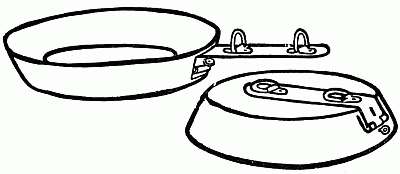
Poached Eggs—Oil the skillet and fill it to within a half
inch of the top with water. Break each egg into a saucer
and let the water boil after the egg is placed in it. The
egg is done when the white is jelly-like and a slight film
is formed over the yolk. Remove the egg with a griddle
cake turner to a piece of buttered toast. Sprinkle lightly
with salt. If the eggs are not absolutely fresh, the
white will scatter in the water. If the first egg to be
cooked shows this tendency oiled muffin rings may be
put in the pan to keep the rest of them in shape.
Soft Boiled Eggs—A soft boiled egg has much the
same consistency as a poached egg. It is easier to manage
because the shell is unbroken, but it is harder to get
it of just the right consistency because the contents of
the egg are invisible. Most people are very particular
to have the egg just hard or soft enough to suit them,
and it is necessary for the cook to practice to be sure
of uniform results. Drop the eggs carefully into a kettle
of boiling water, draw the kettle back on the stove so
that the water does not boil again and (for a soft egg)
allow the eggs to remain for five minutes. If the eggs
are very cold they should remain longer.
Use of Left-overs for Breakfast—If the family
likes a hearty breakfast this is a good meal at which to
use bits of left-over meat which might otherwise be
wasted. Meat may be chopped or ground, reheated in
the gravy which was served with it, and served on toast.
Lamb is especially good minced on toast. To make hash
mix equal quantities of meat and chopped potato and
brown nicely in a greased frying pan. Such mixtures
should be tasted to make sure that they are salted enough.
Some people like a very small amount of onion with any
of these made-over meat dishes.
DINNER
What to Have for Dinner—If all the members of
the family are at home at noontime it is usually more
convenient to have dinner then, but if members of the
family are away or hurried at noontime it may be better
to have dinner at night. Dinner may consist of several
courses, but if the mother or the daughter of the
family prepares the meal, the family is usually perfectly
satisfied with two courses.
The main course of a simple family dinner consists
of meat, fish, eggs or a cheese dish served with potato,
rice or macaroni, and a vegetable such as string beans,
green peas, carrots, cabbage, tomatoes or corn. If the
family likes salad, the vegetables are often served as a
salad. This is a very good way to use up small amounts
of vegetables which are left from the day before. Often
little remainders of two or more vegetables may be very
attractively combined in this way.
Some families like hot bread at dinner, and hot breads,
such as baking powder biscuit (described under supper),
or corn bread (described under breakfast), are particularly
good with some combinations. Examples are baking
powder biscuit with meat stew or fricasseed chicken and
corn bread with bacon and eggs or ham. If fish is served
in a chowder, buttered and toasted crackers are usually
served. An occasional chowder for dinner is an excellent
way to use up any surplus of skimmed milk which may
be on hand.
The kind of dessert served at dinner, besides depending
on the taste of the family, depends on the amount
of money which is spent for food and whether there
are young children in the family. Pie and ice cream,
which are favorite desserts in many families, are expensive.
Little children should not have desserts which
contain a good deal of fat, such as pie or doughnuts, or
which are the least bit soggy, as some steamed puddings
are inclined to be. The most economical desserts and
those best suited to the children are baked puddings
made with milk and cereal, such as Indian pudding,
rice pudding, and those made with cereal and fruit,
such as Apple Betty or peach tapioca. If there is
skimmed milk on hand the possibility of using it in a
milk pudding should be considered. Chocolate bread
pudding and Apple Betty made a very attractive use
of left-over bread. Dessert should always be chosen
with reference to the heartiness of the first course. A
main dish which is not very filling can be balanced by
a more substantial dessert.
Simple Dinners:
1. Hamburg steak.
Baked potato.
Squash or baked tomatoes.
Apple Betty.
2. Roast chicken or roast lamb with dressing and currant jelly.
Mashed potato and gravy.
Peas or string beans.
Orange jelly and whipped cream.
Meat—The best way to learn about cuts of meat is
to go often to market and talk to the butcher whenever
he has a minute to spare. Some cuts of meat are tough
with coarse fibers and much connective tissue. They
should be ground if, like Hamburg steak, they are to
be cooked by a short process, such as broiling. If not
ground, the tougher meats are usually cooked a long
time with water and made into a stew, a pot roast, a
meat pie, or a meat loaf. These cuts are cheaper, but
require more care in preparation than the more expensive
cuts. Examples are the bottom of the round, the
shin, and the flank of beef. The more expensive cuts,
such as the top of the round, tenderloin and sirloin, are
more tender, more delicately flavored, and are used for
broiling and roasting. Some cuts which seem inexpensive
really cost more than they appear to because they
contain large amounts of bone or waste fat. The difference
between lamb and mutton is a question of the
age at which the animal was slaughtered. Lamb is much
more tender than mutton, is more delicately flavored
and more expensive. There is a similar difference between
chicken and fowl. Fowl is much tougher than
chicken and requires careful and long cooking to make
it tender.
Pan Broiled Hamburg Steak—Hamburg steak may
be bought already ground at the butcher's, or one of
the cheap cuts of beef, such as bottom of the round or
shin, may be bought and ground at home. Many people
like a little salt pork or onion ground with the meat.
Make the meat into small, flat cakes and cook in a
smoking hot frying pan which has been thoroughly
rubbed over with a piece of fat. When one side is
seared over nicely turn the cakes (a griddle cake turner
or spatula is helpful) and broil on the other side. Place
on a hot platter, sprinkle with salt and pepper, dot
with bits of butter and garnish with a little parsley or
watercress.
A rump or sirloin steak may be broiled in a hot frying
pan in a similar way. Wipe and trim the steak, place
in a smoking hot frying pan and sear both sides. Reduce
the heat and turn the steak occasionally (about
every 2 minutes) until it is cooked, allowing 8 minutes
for a rare steak, 10 minutes for medium cooked steak,
and 12 minutes for well done steak, for a steak 1 inch
thick. Avoid puncturing the meat with a fork while
cooking.
Many people prefer to broil a steak on a broiler. This
is practical with gas or electricity or over a wood or
coal fire which is reduced to clear coals without smoke
or flame. It is very difficult indeed to cook Hamburg
steak on a broiler.
Lamb chops may be broiled in either way.
Roast Leg of Lamb—Wash the leg of lamb, place it
on the rack in a roasting pan and put in a hot oven
with the roaster uncovered. When the roast is well
seared (15 to 30 minutes), draw from the oven, sprinkle
with salt, pour a little water into the pan, and put on
the cover. Finish cooking at a lowered temperature,
allowing 20 or 25 minutes for each pound.
A dripping pan may be used in place of a roaster,
using a pan of similar size for a cover. A rack may
be improvised from a broiler, a toaster or a cake rack.
Beef is roasted in the same way, but is usually cooked
for a shorter time (15 to 20 minutes for each pound).
Beef Stew (for four):
21/2 pounds beef shoulder or shin.
2 cups diced potato.
1/3 cup turnip cut in half inch cubes.
1/3 cup carrot cut in half inch cubes.
1/4 onion chopped.
2 tablespoons flour.
Salt and pepper.
Wash the meat, remove from the bone and fat and
cut in 1-1/2 inch cubes. Sprinkle with salt and pepper
and dredge with flour. Sear the pieces of meat in the
frying pan in the fat cooked out from the trimmings
of fat. Put the meat in a kettle, and rinse the frying
pan with boiling water, so that none of the juices will
be lost. Add the bone, cover with boiling water and
boil five minutes. Lower the temperature and cook until
the meat is tender (about three hours). Add the
carrots, turnips, onions, pepper and salt in an hour, and
the potato in 15 minutes before the steak is to be served.
Remove the bone and any large pieces of fat. Stir
two tablespoons of flour to a smooth paste with a little
water and thicken the stew.
Such a stew may also be made with lamb, mutton, or
veal, using other vegetables as desired. Celery and onion
are better than turnip and carrot with veal.
Chicken—If a chicken is purchased at the market
it is usually delivered dressed. This means that the head
has been cut off, the entrails removed, and the coarser
pinfeathers pulled out. Many times, however, it is necessary
to know how to do this oneself.
To Dress and Clean a Chicken—Cut off the head and
draw out the pinfeathers. Remove hair and down by
holding the fowl over a flame (a gas flame, an alcohol
flame, or a piece of paper flaming in the wood or coal
range), constantly changing the position until all parts
of the surface have been exposed to the flame. Cut
off the feet. Wash the fowl thoroughly, using a small
brush, in water to which a little soda has been added.
Rinse and dry. Make a slit down the back of the neck.
Remove the crop and windpipe. Draw down the neck
skin long enough to fasten under the back. Make a
straight cut from 1/2 inch below the tip of the breastbone
to the vent. Cut around the vent. Slip fingers
in carefully around and fully loosen the entrails. Carefully
draw out the entrails. The lungs, lying in the
cavities under the breast, and the kidneys, in the hollow
near the end of the backbone, must be taken out
separately. Remove the oil sack and wash the chicken
by allowing cold water to run through it.
To clean giblets (the gizzard, the heart, and the liver)
proceed as follows: Separate the gall bladder from
the liver, cutting off any portion of the liver that may
have a greenish tinge. Remove the thin membrane, the
arteries, the veins and the clotted blood around the
heart. Cut the fat and the membranes from the gizzard.
Make a gash through the thickest part of the
gizzard as far as the inner lining, being careful not to
pierce it. Remove the inner sack and discard. Wash
the gizzard carefully and boil in water to use for giblet
sauce.
If the chicken comes from the market dressed it should
be washed carefully and any pinfeathers removed which
were overlooked by the market man.
To Stuff, Truss and Roast a Chicken—When the
chicken is clean and prepared as directed, fill it with
stuffing (described later), a little in the opening at the
neck, the rest in the body cavity. Sew up the opening
with a few long stitches. Draw the skin of the neck
smoothly down and under the back, press the wings
close against the body and fold the pinions under, so
that they will cross the back and hold down the skin
of the neck. Press the legs close to the body. Thread
the trussing needle with white twine, using it double.
Press the needle through the wing at the middle joint,
pass it through the skin of the neck and back,
and out again at the middle joint of the other wing.
Return the needle through the bend of the leg at the
second joint, through the body, and out at the same
point on the other side; draw the cord tight and tie it
with the end at the wing joint. Thread the needle
again and run it through the legs and body at the thigh
bone and back at the ends of the drumsticks. Draw
the drumstick bones close together, covering the opening
made for drawing the chicken and tie the ends. Have
both knots on the same side of the chicken. When cooked,
cut the cord on the opposite side and draw out by the
knots.
Lay the stuffed and trussed chicken on its back on
a rack in a roasting pan. Lay a strip of salt pork on
breast. Place in a hot oven until the chicken begins
to brown, then lower the temperature and cook the
chicken until very tender. Baste often with the drippings
in the pan. From 3 to 4 hours will be required
for a five-pound chicken. If a fowl is used it should
be steamed for 3 or 4 hours and then roasted for 1/2
hour.
Stuffing—For a large chicken mix thoroughly 4 cups
of finely broken stale bread, 1-1/2 teaspoon of salt, 1/8
teaspoon of pepper, 1 teaspoon of poultry dressing and
4 tablespoons of fat. Pour over the mixture hot milk
or water, stirring lightly until the mixture is moist.
Giblet Gravy—If the chicken was properly roasted
the drippings in the pan should be nicely browned, but
not burned. Make a gravy from these drippings and
the water in which the giblets were boiled. To do this
pour the water into the pan, set the pan over the fire
and stir until the contents of the pan are dissolved.
Thicken with a smooth paste of flour and water, using
two tablespoons of flour for every cup of liquid. Boil
until the flour tastes cooked. Strain. Add the giblets
cut in small pieces.
Vegetables—All vegetables should be clean, crisp
and firm when ready for cooking. Vegetables are prepared
and cooked in a variety of ways, but almost all
vegetables should be carefully washed as the first
process. It is convenient to keep a small brush for
washing the vegetables, like potatoes, sweet potatoes,
and beets, which must be scrubbed to get them clean.
Vegetables which are to be eaten raw, such as lettuce
and celery, should be washed with special care, wrapped
in a clean, wet cloth and put in the ice box to keep them
crisp.
Baked Potato—Select smooth potatoes of even size.
Scrub them carefully and bake them in a hot oven. The
time required is from 45 to 60 minutes, depending on
the size of the potatoes and the temperature of the oven.
When the potatoes are done, slash each one with a knife
to let the steam escape, and serve immediately.
Mashed Potato—Wash the potatoes, pare, cover with
boiling salted water (1 level teaspoon of salt to a pint
of water), and cook until tender (30 to 45 minutes).
Drain off the water and return to the fire a moment to
dry. Mash the potatoes, add butter, salt, pepper and
hot milk, and beat vigorously until light and creamy.
For three cups of potato use 2 tablespoons of butter
and 4 tablespoons of hot milk. Pile lightly in a hot
dish and serve immediately.
Steamed Squash—Wash and cut in one-inch slices.
Steam until tender, scrape from the shell, mash thoroughly,
season with salt, pepper and butter, and serve.
String Beans—Snap the ends from the beans, remove
any strings, cut into short pieces, wash, cover with boiling
salted water (1 level teaspoon to a pint) and cook
until tender. The time required will vary from one
hour to three hours, depending on the age and kind of
bean. Drain the beans, season with salt and butter,
and serve.
Canned string beans should be rinsed, reheated in as
little water as possible, drained, and seasoned.
Baked Tomatoes—Select smooth tomatoes of even
size. Wash the tomatoes, cut a thin slice from
the stem end and remove a spoonful of pulp. Sprinkle
with salt, pepper and scraped onion, fill the cavity with
buttered crumbs, place in a pan (preferably one which
can be used as a serving dish at the table), and bake in
a moderate oven until the tomatoes are tender. Serve
in the dish in which they were cooked or remove them
carefully to the platter on which the Hamburg steak
is being served, arranging them in a ring around the
meat.
The buttered crumbs are prepared by melting a tablespoon
of butter or oleomargarine and stirring in six
tablespoonfuls of dry bread crumbs.
Desserts—Most desserts are easy to make if the
directions given in the cook books are followed exactly.
Many people take pride in making delicious cake or
pie, who are careless about making good toast or baking
a potato well.
Apple Betty—Prepare well-sweetened apple sauce
and thin slices of lightly buttered bread cut in small
triangles. Fill a shallow baking dish with alternate
layers of apple sauce and toast, beginning with apple
sauce and ending with toast. Sprinkle lightly with
sugar and cinnamon and heat in the oven. Serve with
cream.
Orange Jelly—Swell 1-1/2 tablespoons of powdered
gelatin in half cupful of cold water. Mix 1 cupful
of orange juice, 1/4 cupful of lemon juice, 1/2 cupful of
sugar and 1-1/4 cupfuls of boiling water. Add the gelatin
and stir carefully until it is dissolved. Strain into
a wet mould and chill until the jelly is firm. Unmould
the jelly and serve with whipped cream or a custard
sauce. To unmould the jelly, run the point of a knife
around the edge of the mould, dip the mould quickly
in warm water, place an inverted serving plate on top
of the mould, turn both over and lift the mould carefully.
SUPPER OR LUNCH
What To Have for Supper.—Supper shows more
variation between families than other meals of the day.
Some men insist upon meat, even though meat is served
for their dinner, but this is rather extravagant unless
there is left-over meat which should be used. Hash and
minced lamb on toast, which were suggested for the
hearty breakfast, would be equally well liked by most
families for supper. Many families prefer for supper
some milk dish such as macaroni and cheese or a cream
soup served with either stewed or fresh fruit or followed
by a fruit or vegetable salad. Hot rolls or baking powder
biscuits are a very attractive substitute for plain bread
if someone has time to make them at the last minute. If
the mother and daughter do all the work of the family,
they usually like to have on hand cookies or cake, which
can be used for supper rather than to have to prepare
some special dessert. Cold meat has the advantage that
it is ready to serve with little preparation, but many
other dishes such as the macaroni and cheese and the
creamed soup, suggested in the menus, may be made
when dinner is being prepared and simply reheated for
supper.
A hot drink at night usually seems desirable except on
hot days in the summer. If tea is served for adults, the
children should have cocoa or milk.
If dinner is served at night, luncheon is served in the
middle of the day. The suggestions made in regard to
supper apply equally well to luncheon.
Little children should have their hearty meal in the
middle of the day and a light meal at night no matter
what arrangement of meals the rest of the family may
have.
Simple Suppers
| 1. Macaroni and cheese or cold meat |
| Stewed or fresh fruit |
| Cookies |
| Bread and butter |
| Tea (for adults) |
| Milk or cocoa (for children) |
2. Cream of potato soup |
| Vegetable or fruit salad |
| Baking powder biscuit |
| Tea (for adults) |
| Milk or cocoa (for children). |
Macaroni and Cheese.—For macaroni and cheese the
macaroni must be cooked and white sauce prepared.
Break three-quarters of a cup of macaroni in inch pieces
and cook in two quarts of boiling water to which a tablespoon
of salt has been added. The water must be boiling
rapidly when the macaroni is added and must be kept
boiling constantly. When the macaroni is tender, drain
it in a strainer and run enough cold water through it to
prevent the pieces from sticking together. To prepare
the sauce, melt two tablespoons of butter or oleomargarine
in the top of a double boiler, stir in two tablespoons
of flour and a half teaspoon of salt and pour over the
mixture a cup and a half of cold milk. Cook this mixture
directly over the heat, stirring constantly until it
begins to thicken. Then place the dish over the lower
part of the double boiler, containing boiling water, and
let it continue cooking for fifteen minutes. Put a layer
of the boiled macaroni in a buttered baking dish and
sprinkle with cheese, either grated or cut into small
pieces. Pour on a layer of the sauce. Follow this by
layers of macaroni, cheese and sauce until the dish is
full. Cover with buttered crumbs and bake until the
crumbs are brown. To make the buttered crumbs, melt
one tablespoon of butter or oleomargarine and stir in six
tablespoons of crumbs.
The macaroni and cheese may be prepared in the morning
if desired and baked at supper time in a moderate
oven. It should be left in the oven long enough to become
thoroughly hot. If there are little children in the
family a dish of creamed macaroni should be made for
them without the cheese.
Cream of Potato Soup—
3 potatoes
1 quart milk
2 slices of onion
3 tablespoons flour
11/2 teaspoons salt
1/4 teaspoon celery salt
1/8 teaspoon pepper
2 tbsp. butter or oleomargarine
Cook the potatoes in boiling salted water. When soft
rub through a sieve. Scald the milk with the onion in a
double boiler, remove the onion, unless the family likes it
left in, add the salt, celery salt and pepper. Melt the
butter in a small sauce pan, stir the flour into it and then
add this mixture to the hot milk, stirring briskly. Cook
for ten minutes over boiling water in the double boiler.
A good creamed soup may be made from almost any
vegetable, substituting vegetable pulp for the potato.
Celery soup and corn soup are very good. With these
and most other vegetables, the celery salt should be
omitted. Onion salt is very useful.
Creamed soups are very good made from skimmed
milk if there is a supply in the house which should be
used.
Salad—The pleasure in a salad is in its crispness, attractiveness
or arrangement, and pleasant combination of
flavors. A salad may be arranged in a large dish and
served at the table if it is the chief dish of the meal, such
as chicken salad or fish salad, but it is usually arranged
in individual portions and made to look as dainty and
pretty as possible. All fresh vegetables and fruits used
should be crisp and cold and thoroughly washed. Canned
or leftover vegetables or fruit may often be used.
To wash lettuce.—Handle delicately. Remove leaf by
leaf from the stalk, examining for insects. Pass the
leaves backwards and forwards through clean water until
all sand is removed. Fold in a wet cloth and keep in
the ice-box until it is used. The lettuce leaves should be
dried when they are used.
French Dressing.—Mix 3/4 teaspoon of sugar, 1 teaspoon
of salt and 1/2 teaspoon of paprika. Add oil and
vinegar alternately, beating constantly with a fork until
5 tablespoons of vinegar and 10 tablespoons of oil have
been used. A quick way to make French dressing is to
mix all the ingredients in a bottle with a tightly fitting
stopper and shake vigorously until the ingredients are
blended. Some persons prefer less vinegar, and reduce
the amount to 2-1/2 tablespoons vinegar to 10 of oil.
Cooked Salad Dressing.—
| 3/4 tablespoon sugar | 1/4 tablespoon flour |
| 1/4 tablespoon butter | 1/8 teaspoon mustard |
| 1 egg yolk | 1/4 teaspoon salt |
| 1/4 cup vinegar | Dash of red pepper. |
Heat the vinegar in the upper part of double boiler
over direct heat. Sift the flour, mustard, salt and pepper
thoroughly. Pour the boiling vinegar gradually upon the
mixture, stirring constantly. Return to the upper part
of the double boiler and cook over hot water until the
mixture thickens, stirring constantly. Add the butter and
remove from the fire. Chill before using.
Mayonnaise.—
| 1 egg yolk |
| 2 tablespoons lemon juice or 2 tablespoons vinegar |
| 1/2 teaspoon mustard |
| 2/3 teaspoon salt |
| Dash of cayenne pepper |
| 2/3 cup of oil (olive oil, cotton seed oil or other edible oil). |
Have the ingredients chilled, Place the mixing bowl
in crushed ice. Mix the egg yolk, mustard, salt and
cayenne pepper. Add a few drops of vinegar or lemon
juice, then a teaspoon of oil, drop by drop, until all the
ingredients are used. Constant beating is necessary
throughout.
Fruit and Vegetable Salads.—Good combinations for
salad are (1) potato and beet, (2) carrot and green peas,
(3) tomato and celery, (4) asparagus and pimento. Combinations
of fruit and vegetables are, (1) apple and
celery, (2) orange and green pepper. Combinations of
different kinds of fruit and nuts or cheese are especially
good. Examples are, (1) pineapple and orange, (2)
white cherries stuffed with nuts, (3) banana rolled in
chopped nuts or (4) half pears (cooked or raw) with a
ball of cream cheese and chopped nuts in the cavity made
by the removal of the core.
Magazines which devote a page to cooking usually have
in their summer numbers pictures of salads from which
suggestions in regard to arrangement may be taken.
Baking Powder Biscuit.—
| 2 cups flour |
| 4 teaspoons baking powder |
| 1 teaspoon salt |
| 3 tablespoons shortening |
| ¾ to 1 cup milk or milk and water. |
Sift the flour, baking powder and salt, twice. Put in
the shortening, then add the milk gradually, mixing with
a knife. The dough should be as soft as can be handled
without sticking. Turn onto a lightly floured board, roll
lightly 3/4 inch thick and cut with a floured cutter. Bake
in a hot oven 12 or 15 minutes.
Tea.—People who like tea have very decided ideas
about how strong is should be and how long it should be
steeped. The following gives tea of moderate strength.
Scald the teapot and put in 4 teaspoonfuls of tea
leaves. Pour over them four cups of boiling water, cover
and steep 3 minutes. Strain into a teapot and serve at
once.
Cocoa.—The children of the family should never have
tea. On a cold night cocoa is a very pleasant variant
from the usual glass of milk.
Mix 4 tablespoons of cocoa with 3 tablespoons of sugar
and a little salt. Add 1 cup of boiling water and
cook until the mixture is smooth and glossy. Add a
quart of milk and heat to boiling. This may be done
more safely in a double boiler. Just before serving beat
with an egg beater.
General Suggestions
If the Girl Scout who is preparing for her examination
will look back over the menus which have
been suggested, she will notice that milk is emphasized.
It is absolutely essential that the children in the family
shall have milk. If the family do not like milk to drink,
it should be remembered that every bit which is used in
cooking serves the same purpose as if it were taken from
a glass, but little children do not ordinarily get enough
milk unless they drink some. Fruit should be served at
least once a day and better twice, and some vegetable
other than potato should be not only served but eaten
by the family. Children who are not taught to like vegetables
when they are little sometimes never learn to like
them, and it is really important to eat vegetables, not only
because they contain important substances for growth,
but because it is only good manners to learn to like all
the ordinary foods which are served. Anyone who has
cooked knows how discouraging it is to feel that some
member of the family does not like the food. There is
a temptation in the city where fruit, vegetables and milk
are high, to use too much meat and but little of these
foods. It has been suggested recently that in forming
an idea as to whether the money is being spent to the
most advantage, the money spent for fruit and vegetables,
for milk and cheese, and for meat and fish should be
compared. In a well-balanced diet these amounts should
be nearly equal. An increasing number of people are
becoming lacto-vegetarians, which means that they eat no
meat or fish, but balance their absence by using more
milk, eggs and cheese.
Before starting to prepare a meal the Scout should not
only have her menu in mind, but should have an idea
how long it will take to prepare each dish so that everything
will be ready to serve at the same time with all the
hot dishes very hot and all the cold dishes very cold. If
all the dishes of the meal require about the same length
of time in their preparation the ones should be started
first which can be most easily kept in good condition.
Enjoyment of a meal depends quite as much on neat
and comfortable service as it does upon good food. The
table cloth, napkins, dishes and silver should be clean
and the dishes should be arranged so that there is as
little danger as possible of accident. This is the reason,
for example, for the rule that a spoon should never be
left in a coffee or tea cup. This arrangement is usually
more comfortable if nothing is placed on the table which
is not going to be actually used at the meal, except that
a few flowers or a little dish of ferns in the center of the
table is very much liked by most people, if there is room
for it. It often happens that the family see more of each
other at meal times than at any other time in the day
and everyone should try to make meal time a pleasant,
restful, good-humored time.
Household Weights and Measures
The careful housewife soon becomes skilled in weighing
and measuring the various goods she buys and uses.
At the store she is on guard against short measures, and
if she does not market in person, she has machines at
home to test what is delivered. The following table is
given for frequent reference use by the Girl Scout while
earning her badges in Homecraft. She will also find it
useful in learning to judge weights and distances for her
First Class test.
Table of Household Weights and Measures
(Reprinted by permission of publisher from "Housewifery,"
by L. Ray Balderston, M. A.
J. B. Lippincott, 1919)
| Linear Measure: |
| 12 | inches | = | 1 | foot |
| 3 | feet | = | 1 | yard |
| 5½ | yards | = | 1 | rod |
| 320 | rods | = | 1 | mile |
| 1760 | yards | = | 1 | mile |
| 5280 | feet | = | 1 | mile |
|
Square Measure: |
| 144 | square inches | = | 1 | square foot |
| 9 | square feet | = | 1 | square yard |
| 30¼ | square yards | = | 1 | square rod |
| 160 | s quare rods | = | 1 | acre |
| 1 | square mile | = | 1 | section |
| 36 | square miles | = | 1 | township |
Avoirdupois Weight: |
| 27.3 | grains | = | 1 | dram |
| 16 | drams | = | 1 | ounce (oz.) |
| 16 | ounces | = | 1 | pound (lb.) |
| 100 | pounds | = | 1 | cwt. (hundredweight) |
| 2,000 | pounds | = | 1 | ton |
Liquid Measure: |
| 4 | gills | = | 1 | pint |
| 2 | pints | = | 1 | quart |
| 4 | quarts | = | 1 | gallon |
| 31½ | gallons | = | 1 | bbl. |
Dry Measure: |
| 2 | pints | = | 1 | quart |
| 8 | quarts | = | 1 | peck |
| 4 | pecks | = | 1 | bushel |
| 105 | dry quarts | = | 1 | bbl. (fruit, vegetables, etc.) |
Miscellaneous Household Measures: |
| 4 | saltspoonfuls | = | 1 | teaspoonful |
| 3 | teaspoonfuls | = | 1 | tablespoonful |
| 16 | tablespoonfuls | = | 1 | cupful |
| 2 | gills | = | 1 | cupful |
| 2 | cupfuls | = | 1 | pint |
| 1 | cupful | = | 8 | fluid ounces |
| 32 | tablespoonfuls | = | 1 | lb. butter |
| 2 | cups of butter | = | 1 | lb. |
| 1 | lb. butter | = | 40 | butter balls |
| 4 | cups flour | = | 1 | lb. |
| 2 | cups sugar | = | 1 | lb. |
| 5 | cups coffee | = | 1 | lb. |
| 1 lb. coffee = 40 cups of liquid coffee |
| 17/8 cups rice = 1 lb. |
| 22/3 cups oatmeal = 1 lb. |
| 22/3 cups cornmeal = 1 lb. |
| 1 cup of liquid to 3 cups of flour = a dough |
| 1 cup of liquid to 2 cups of flour = a thick batter |
| 1 cup of liquid to 1 cup of flour = a thin batter |
| 1 teaspoonful soda to 1 pint sour milk |
| 1 teaspoonful soda to one cup of molasses |
| 1 teaspoonful cream of tartar plus ½ teaspoonful soda = 2 teaspoonfuls baking powder |
There always are and always will be children to be
taken care of. There is no way in which a girl can
help her country better than by fitting herself to undertake
the care of children. A Girl Scout thinks for herself,
and knowing the Health Laws, she knows the important
things to consider in caring for children:
1. The care necessary for the child's bones.
2. When it should exercise its muscles.
3. Its rest.
4. The air, sun and food and water which it needs.
5. How to keep it clean.
Bones—Great care must be taken in handling a baby.
Its bones are soft and easily injured, and for this reason
a baby should not be handled more than necessary. When
very young its entire spine should be supported, and no
undue pressure made upon the chest, as often happens
if the baby is grasped under the arms. In lifting a young
baby from its bed, the right hand should grasp the
clothing below the feet, and the left hand should be
slipped beneath the infant's body to its head. It is then
raised upon the left arm. An older child should be
lifted by placing the hands under the child's arms, and
never by the wrists. If children are jerked or lifted
by the arms, serious injury may be done to the bones.
The bones, when a child is growing, are partly composed
of soft tissue which is easily destroyed, and further
growth is prevented. Many children are brought to the
hospitals with injuries done to their arms from being
jerked across the street. Do not let a child walk too
soon, especially a heavy child. Bow legs and knock knees
come from standing and walking when the bones are
soft.
Exercise—At least twice a day an infant should be
allowed for fifteen or twenty minutes the free use of
its limbs by permitting it to lie upon a bed in a warm
room, with all clothing except the shirt and diaper removed.
In cold weather leave on the stockings. Later,
when in short clothes, the baby may be put upon a thick
blanket or quilt, laid upon the floor, and be allowed to
tumble at will.
Rest—Healthy children never sleep too much. A new
born baby should sleep nine-tenths of the day. A child
should have a nap during the day until four years old,
and, if possible, until seven or eight years old. It should
go to bed before six. It should have a crib or bed to
itself, placed where it will have fresh air, but protected
from draughts, and its eyes protected from direct rays
of light.
Air and Sun—A little child is in its room so much it
is very important that fresh air and sunlight should be
brought to it there. Rooms may be well aired twice or
three times a day, removing the baby to another room
while the windows are open. The child may be placed
in its crib or carriage before on open window, dressed
as if for the street. After children are three months
old they may be taken out, but the sunny part of the
day should be chosen, between 10 a. m. and 3 p. m. in
cold weather. At night the windows should be partly
opened, but care should be taken that the infant does not
become chilled. Be careful that sheet and blankets do
not get over a baby's head. The clothes may be pinned
to the side of the bed.
Food and Water—Even little babies should be given
water twice a day. The water should be boiled, cooled
and kept covered. It is hardly possible for children or
older persons to drink too much water. During hot
weather a child needs more water than during cold
weather.
Mother's milk is the only perfect food for an infant
during the first nine or ten months. If it is necessary
to give artificial food from a bottle, the greatest possible
care must be taken. The milk used should be the best
obtainable. To obtain clean milk it is necessary that
everything that touches it be clean, sterilized when possible,
and that the cows, and men who handle the milk
be healthy. In New York City all milk is classified
according to its cleanliness and butter fat content. The
cleanest and richest milk is called "certified milk" and
is sold raw. The other milks are classified according to
cleanliness. Grade A, B and C are all pasteurized. Only
certified and Grade A should be used for infant feeding.
You know that sterile means free from germs or bacteria.
Milk or water may be made comparatively sterile
by boiling. Pasteurized milk is milk which has been
heated to 155° Fahrenheit, kept at that temperature for
thirty minutes and cooled quickly by placing the bottles
in cold running water.
Punctual feeding makes good digestion, and even if
the baby takes an extra nap it is better to wake a healthy
baby to give him his meals at regular hours than to let
his digestion get out of order. Between meals a little
water which has been boiled and cooled and kept covered
will wash out its mouth as well as refresh the child.
The average infant is fed every three hours until it is
five months old. After that it is fed every four hours
until it is fifteen or sixteen months old, when it is shifted
to three meals a day with perhaps a cup of milk in long
intervals. Solid food, such as zwieback and milk or
cereal, is begun at seven months, and by thirteen or fourteen
months the child will be eating cereal, bread, broth,
beef juice, potato, rice, vegetables, etc. Candy is harmful
for children, and even older children should eat candy
only after meals. Raw fruit, except orange juice, is apt
to be upsetting in summer.
Keep the baby and everything around him clean. The
baby's food is the most important thing to keep clean.
The cleanliness of the bottle, when it is necessary to feed
the baby from one, is very important. Choose a bottle
of fairly heavy glass with rounded bottom and wide
mouth, so that it may be easily cleaned. Short rubber
nipples which clip over the neck of the bottle and which
can be easily turned inside out, should be selected, and
discarded when they become soft, or when the openings
become large enough for the milk to run in a stream
instead of drop by drop. Remove the bottle from the
baby's mouth as soon as empty, rinse at once in cold
water and then fill with a solution of bicarbonate of
soda (baking soda), about one teaspoonful to a pint
of water. Before rinsing wash in hot soapsuds, using
a bottle brush, rinse well in plain water, and boil for
twenty minutes, placing a clean cloth in the bottom of
the basin to protect the bottle from breaking. Before
using new nipples they should be scrubbed inside and
out and boiled for at least five minutes. After using
they should be carefully rinsed in cold water and kept
in a covered glass containing a solution of boric acid
(one teaspoonful dissolved in a pint of boiling water),
and at least once a day be turned inside out and thoroughly
washed with soap and water, then rinsed. Nipples
should be boiled twice a week.
Bath—A baby should have a bath every day, not
sooner than one hour after feeding. The room should
be warm; if possible there should be an open fire in
the room. The temperature of the water for a baby
up to six months old should be 98°. Then it should
gradually decrease, next temperature being 95°, until
at the age of two it should range between 85° to
90°. Before a baby is undressed the person who is
bathing the baby must be sure that everything needed
for the bath and dressing is at hand. The hand basin
or small tub of warm water, a pitcher of hot water
in case it is needed, castile or ivory soap, soft wash
cloths, towels, brush, powder, fresh absorbent cotton,
boric acid solution, and the baby's clothes laid out in
the order in which they will be needed in dressing the
child, the soft flannel bandage, the diapers, the shirt,
flannel petticoat, dress and shawl.
For some people it is easier to handle a baby when
laid on a bed or table than on one's lap, having under
the child a soft bath towel or canton flannel large enough
to be wrapped around it. Its nose may be cleaned with
a bit of absorbent cotton rolled to a point, using a fresh
piece for each nostril. To bathe the eyes use fresh
pieces of absorbent cotton dipped in boric acid solution.
Wash the baby's face carefully so that the water does
not drip into its ears. Dry the face carefully. Wash
the head gently and thoroughly with soap, being careful
to rinse completely. Soap the baby's body before putting
it into the bath. As a soapy little baby is difficult to hold,
support him firmly all the time he is kicking and splashing,
by placing the arm or hand at the baby's back between
its shoulders. Wash particularly, under the arms,
the creases in the back of the neck, between the legs,
fingers and toes. The bath should be given quickly
and the baby lifted out in the bath towel or flannel,
covered and dried quickly, using a soft towel. Rub
the baby very slightly. All the folds of the skin should
be dried and well powdered: under the arms, behind
the ears, about the neck, legs, etc. Do not put too much
powder on, as it forms a paste. Dress the infant and
lay it on its crib while putting away all the things used
for its bath. It is perfectly proper for a baby to exercise
its lungs by crying, so do not be alarmed, but be
sure that its clothing is comfortable and that the child
is clean. Garments worn at night should always be
different from those worn during the day. The garments
next to the skin should be of wool or part wool,
except the diaper, which should be soft cotton, and
when new, washed several times before using. Wet
diapers should be rinsed in cold water and dried before
using a second time; about every twenty-four hours
diapers should be washed, scalded, rinsed in cold water
and hung in the air to dry.
Daily Routine—Child Under Two Years of Age
| 6.00 A.M. | Feed warm milk. |
| 7.30 A.M. | Seat on chair or hold over chamber not more than ten minutes. If the child has no movement of the bowels at this time, try later. |
| 9.00 A.M. | Give bath, and immediately after, feed, then put to bed in a well ventilated room, darkened, or out of doors in carriage or crib. Be sure no strong light is in the child's eyes. Child should sleep until one o'clock. |
| 1.00 P.M. | Take up, make comfortable, and feed. |
| 2.00 P.M. | Take child out of doors again, but do not stay after 3 P.M. in winter time. Later in summer. Stormy days keep in house in crib or carriage, well wrapped up in room with window open. |
| 3 to 5 P.M. | Hold child, or let it stay in crib and play or kick. |
| 6.00 P.M. | Undress, rub with soft, dry towel, put on nightclothes, feed and put to bed in well ventilated room. |
| 10.00 P.M. | A young baby should be fed at this time, dried, and not fed again until 6. A.M. |
A baby needs to be kept quiet. Do not make loud
noises near it. Do not play with infant too much.
Leave it to itself to grow. Keep the baby clean, everything
about it tidy. Do not give a child pointed toys
or playthings small enough to go into the infant's mouth.
Tie toys to the crib or carriage so that they do not fall
on the floor.
Things to Remember
Emphasize "tidy as you go," sleep, water, bowel movements,
exercise for older children, especially in cold
weather, nothing in mouth, do not use pacifiers, tying
toys to crib or carriage, a baby over two years of age
should not be fed oftener than every four hours.
Bowel Movements
At least once a day.
Should be medium soft, not loose, smooth, and when
on milk diet, light in color.
If child is constipated, give one teaspoonful of milk
of magnesia clear, at night.
See doctor if child is not well.
Feedings
Children from birth to five months should be fed every
three hours.
Children over one and a half years old need three
meals a day, dinner in the middle of the day.
Little children need to be kept very quiet. No confusion
or loud noises around them. They will then
grow better and stronger.
Colds
Never neglect a cold. Do not "pass it on" to a child
by coughing, sneezing, talking or breathing into its face.
Do not kiss anyone when you have a cold. Never allow
the handkerchief used by a person with a cold to touch
a child. If you must handle a child when you have a
cold, wear a piece of gauze over your mouth and nose,
and be sure to keep your hands clean. Be very careful
with the handkerchiefs used; see that no one touches
or uses them. It is preferable to use gauze or soft
paper for handkerchiefs and burn them. When a child
has a cold put it to bed. Keep quiet as long as there
is any fever. Give a cathartic, such as castor oil, as
soon as cold appears. Reduce the child's diet and give
plenty of drinking water. Consult a doctor. Do not let
the child go out until thoroughly well.
General Rules
The sorrow and unhappiness of the world is increased
enormously every year by injury and loss from
accidents, more than half of which might be prevented
if someone had not been careless, or if someone else
had taken a little trouble to correct the results of that
carelessness before they caused an accident.
It therefore becomes the plain duty of Girl Scouts
not only to be careful but to repair, if possible, the
carelessness of others which may result in accident.
Let us review briefly some of the many small things
in our daily lives which cause accidents, and therefore
suffering and loss.
1. Carelessness in the Street. As, for example, taking
chances in getting across in front of a car or automobile;
running from behind a car without looking to
see of some vehicle is coming from another direction;
catching a ride by hanging on to the rear end of cars
or wagons; getting off cars before they stop; getting on
or off cars in the wrong way; being too interested to
watch for open manholes, cellarways, sewers, etc.; reckless
roller skating in the street, throwing things like
banana peels on the street or sidewalk where people
are likely to slip on them; teasing dogs, or trying to
catch strange ones; many dogs resent a stranger petting
them and use their only means of defense—biting.
Other examples will occur to you of carelessness in the
streets which space does not allow us to mention here.
Wait until the car stops before trying to get off. In
getting off cars you should face in the direction in which
the car is going. A simple rule is to get off by holding
a rod with the left hand and putting the right foot
down first. This brings you facing the front of the
car and prevents your being swept off your feet by
the momentum of the car.
If you see any refuse in the street which is likely
to cause an accident, either remove it yourself or report
it to the proper authorities to have it removed at once.
2. Carelessness at Home. As for example, starting the
fire with kerosene; leaving gas jets burning where curtains
of clothing may be blown into the flame; leaving
clothing or paper too near a fire; throwing matches you
thought had been put out into paper or other material
which will catch fire easily; leaving oily or greasy rags
where they will easily overheat or take fire spontaneously;
leaving objects on stairs and in hallways which
will cause others to fall; leaving scalding water where a
child may fall into it or pull it down, spilling the scalding
water over himself; leaving rags or linoleum with upturned
edges for someone to fall over; and innumerable
other careless things which will occur to you.
3. Disobedience, playing with matches; building fires
in improper places; playing with guns; trying the "medicines"
in the closet; throwing stones; playing with the
electric wires or lights; playing around railroad tracks
and bridges: We could multiply the accidents from disobedience
indefinitely. Remember, a caution given you
not to do something means there is danger in doing
it, which may bring much sorrow and suffering to yourself
and others.
It is a very old saying that "An ounce of prevention
is worth a pound of cure," but it is as true today
as it was hundreds of years ago.
After the Accident
When the time for prevention is past, and the accident
has happened, then you want to know what is
the best thing to do, and how best to do it in order to
give the most help and relief immediately, before expert
help can arrive, and to have the victim in the best
condition possible for the doctor when he comes, in
order that he may not have to undo whatever has been
done before he can begin to give the patient relief from
his suffering.
1. Keep cool. The only way to do this effectually
is to learn beforehand what to do and how to do it.
Then you are not frightened and can do readily and
with coolness whatever is necessary to be done.
2. Send at once for a doctor, if you have a messenger,
in all except the minor accidents. This book will
help you learn to judge of whether a doctor will be
necessary. If in doubt send for a doctor anyway.
3. Prevent panic and keep the crowd, if there is
one, at a distance. The patient needs fresh air to breathe,
and space around him.
4. Loosen the clothing, especially any band around
the neck, tight corsets or anything else that may interfere
with breathing.
5. Keep the patient flat on his back if the accident
is at all serious, with the head slightly down if his face
is pale and he is faint, or slightly raised if his face is
flushed and he is breathing heavily, as though snoring.
6. If there is vomiting, turn the head to one side in
order that the vomited material may easily run out of
the mouth and not be drawn into the windpipe and produce
choking to add to the difficulties already present.
7. Remove clothing, if necessary, gently and in such
manner as to give the patient the least amount of suffering.
Move any injured part as little as possible. At
the same time, as a secondary consideration, injure the
clothing as little as possible. If, as often, it becomes
necessary to cut off the clothing, it may be possible to
rip up a seam quickly instead of cutting the cloth, but
saving the clothing is always secondary to the welfare
of the patient. Little or no consideration should be
shown for clothing where it is necessary to keep the
patient motionless, or where quick action is needed.
8. Transportation. There are three methods for
emergency transportation of accident victims which can
be used according to the degree of the injury:
(a) Fireman's Lift. If it is necessary for one person
to carry a patient, it is easily possible to lift and
carry quite a weight in the following manner:
First, turn the patient on his face, then step astride
his body, facing toward his head, and, with hands under
his armpits, lift him to his knees, then clasp your
hands over the patient's abdomen and lift him to his
feet; then draw his left arm around your neck and
hold it against the left side of your chest, the patient's
left side resting against your body, and supporting him
with your right arm about the waist. Then drop the
patient's left hand and grasp his right wrist with your
left hand and draw the right arm over your head and
down upon your left chest; then stooping, clasp his
right thigh with your right arm passed between the
legs (or around both legs) and with a quick heave lift
the patient to your shoulders and seize his right wrist
with your right hand, and lastly, grasp the patient's
left hand with your left hand to steady him against your
body. (Work this out with a companion as you read it.)
(b) A seat made of four arms and hands (which
you have no doubt used in your play), may be used for
the lesser injuries. If the patient can, he supports himself
by putting his arms around the necks of his carriers,
each of whom in the meantime grasps one of his own
wrists and one of his partner's. This makes a comfortable
seat for carrying. If the patient needs supporting,
a back may be improvised by each carrier grasping the
other's arm below the shoulder to form the back and their
other hands clasped to form the seat. A better seat may
be made with three hands clasping the wrists, while the
fourth arm is used as a back, by one clasping the other's
arm below the shoulder. This does not provide a very
secure back, however, as it is not easy to hold the arm
against much of a weight from the patient's body.
(c) Improvised Stretcher. When the patient shows
any sign of shock, is unconscious, has a serious fracture
of some bone or bones, has a serious injury to any
part of the body, or is bleeding excessively, he must be
carried lying down. It may be that there will be no
regular stretcher at hand. In that case one must be
improvised. A serviceable one can be made from ordinary
grain or flour bags by cutting the two corners at
the bottom and running two poles inside the mouth of
the bags and through the holes.
A workable stretcher can be made from coats by turning
the sleeves inside out, passing the poles through the
sleeves and buttoning the coat over the poles. This brings
the turned sleeves on the inside. A five-bar gate or a door,
if it can be gotten without delay, also make satisfactory
emergency stretchers.
A stretcher may also be made out of dress skirts,
with or without poles. Put the skirts together, bottoms
slipped past each other, and slip the poles through, as
with the bags. If no poles are available, roll the edges
of the skirts over several times to form a firm edge,
and carry with two or four bearers, as the size and
weight of the patient make necessary.
Minor Injuries and Emergencies
Minor injuries may or may not need the aid of a
doctor, and you must learn to use judgment as to the
necessity of sending for one. We will consider these
minor injuries in groups to remember them more easily.
1. (a) BRUISES; (b) STRAINS; (c) SPRAINS
(a) A Bruise is produced by a blow which does not
break the skin, but does break the delicate walls of the
capillaries and smaller veins, thus permitting the blood
to flow into the surrounding tissues, producing the discoloration
known as "black and blue."
(b) A Strain is produced by the overstretching of
muscles or ligaments, or both, but not tearing them. It
may or may not be accompanied by breaking of capillary
walls with discoloration. Any muscle or ligament may be
strained.
(c) A Sprain is produced by the overstretching of
the muscles or ligaments or both about a joint. There
may also be some tearing of the fibres or tearing loose
from their attachments. This always breaks capillaries
or small veins, making the surface black and blue. This
discoloration usually appears some time after the accident,
because the broken blood vessels are far below
the surface.
Treatment—For bruises and strains it is seldom necessary
to call a doctor. Apply cold, either by wringing
cloths out of cold water and applying, or by holding the
injured part under the cold water tap. Do this at
intervals of several hours, until the pain is lessened.
The cold may be alternated with hot water which must,
however, be quite hot, just enough not to burn, as lukewarm
water is almost useless. Some patients will prefer
to use only hot water. The water followed by applications
of tincture of arnica, witch hazel, or alcohol and water,
half and half, and bandaging will be sufficient.
If, however, there has been no black and blue at first,
as in a bruise, but it begins to show later, and the pain
continues severe, and there is a good deal of swelling,
then you should send for a doctor, as more than first
aid is needed.
In case of sprain, send for a doctor, and in the meantime
elevate the joint and apply hot or cold water, or
alternate hot and cold, as patient prefers. This will
give relief by contracting the blood vessels.
2. (a) BURNS; (b) SCALDS; (c) SUNBURN;
(d) FROSTBITE
(a) Burns are produced by dry heat, as a fire, acids,
alkalis, etc., and may be of all degrees, from a superficial
reddening of the skin to a burning of the tissues
to the bone.
(b) Scalds are produced by moist heat, and may be
of the same degrees as those produced by dry heat.
(c) Sunburn is produced by the sun, and is usually
superficial, but may be quite severe.
(d) Frostbite is produced by freezing the tissues and
is usually not dangerous. The more severe types will be
treated later under Freezing.
Treatment—(a) Burns; (b) Scalds
1. Except in the minor burns and scalds, send for
the doctor at once.
2. The first thing to do is allay pain by protecting
the injured part from the air.
3. For a burn produced by fire, cover with a paste
made of baking soda and water, or smear with grease—as
lard, carron oil (mixture of linseed oil and lime
water—half and half) or vaseline or calendula cerate.
Cover with a piece of clean cloth or absorbent gauze and
bandage loosely or tie in place. Gauze prepared with
picric acid, if at hand, is a most satisfactory dressing. It
can be purchased and kept on hand for emergencies.
4. In burns from alkalis or acids, wash off as quickly
as possible and neutralize (make inactive the acids with
baking soda, weak ammonia or soapsuds; the alkalis
with vinegar or lemon juice). Afterward treat like other
burns.
(c) Sunburn is an inflammation of the skin produced
by the action of the sun's rays and may be prevented
by gradually accustoming the skin to exposure to the
sun. It is treated as are other minor burns.
(d) Frostbite—Prevention—1. Wear sufficient clothing
in cold weather and keep exposed parts, such as
ears and fingers, covered.
2. Rub vigorously any part that has become cold.
This brings the warm blood to the surface and prevents
chilling.
3. Keep in action when exposed to the cold for any
length of time. The signs of danger are sudden lack
of feeling in an exposed part, and a noticeably white
area. Chilblain is an example of frostbite.
Treatment—The circulation of the blood through the
frozen part must be restored gradually. This must be
done by rubbing the part first with cold water, which
will be slightly warmer than the frozen part, and
gradually warming the water until the circulation and
warmth is fully restored. Then treat as a minor burn.
If heat is applied suddenly it causes death of frozen parts.
3. SPLINTERS, SMALL CUTS, SCRATCHES
AND PIN PRICKS
None of these injuries will usually require a doctor
if properly treated in the beginning. The bleeding from
any of them is not sufficient to be dangerous. But
whenever there is a break in the skin or mucous membrane
there is danger of infection by germs, and this is
what makes the first aid treatment in these cases so
important. A tiny scratch is sometimes converted into
a bad case of blood poisoning by not being properly
treated at first.
Splinters should be removed by using a needle (not
a pin) which has been sterilized by passing it through
a flame (the flame of a match will do if nothing better
is at hand). After the splinter is out, the wound is
treated like a cut or scratch.
The germs which produce poisoning do not float
in the air, but may be conveyed by any thing which is
not sterile, as, for instance, the splinter or the instrument
that did the cutting, scratching or pricking. They
may be carried to the scratch by our hands, by water,
or cloth used for dressings.
Treatment—Wash your own hands thoroughly with
soap and water, using a nail brush. Clean the injured
part well with disinfectant, as, for instance, alcohol and
water, half and half, or peroxide of hydrogen—paint
the spot with iodine, and cover with sterile gauze (if
this is not to be had, use a piece of clean cloth that
has been recently ironed), and bandage in place. If
the bleeding is severe, a little pressure with the bandage
over the dressing will stop it. Use the same precautions
if the wound has to be re-dressed.
4. STINGS AND BITES OF INSECTS
The poison injected by the sting or bite of an insect
is usually acid, and the part should be washed at once
with a solution of ammonia or soda (washing soda) to
neutralize the poison. Then apply a paste of soda bicarbonate
(baking soda) or wet salt and bandage in
place. If the sting is left in the wound it must be pulled
out before beginning treatment.
5. FOREIGN BODIES IN THE (a) EYE (Cinder)
(b) EAR (Insect), (c) NOSE (Button)
(a) Eye—If a cinder, eyelash, or any tiny speck gets
into the eye it causes acute pain, and in a few minutes
considerable redness.
Treatment—Do not rub the eye, as this may press
the object into the tender cornea so that it can be removed
only with difficulty and by a physician. First
close the eye gently, pull the eyelid free of the ball,
and the tears may wash out the speck. If this is not
successful, close the eye, hold the lid free, and blow
the nose hard. You may then be able to see the speck
and remove it with a bit of clean cotton or the corner
of a clean handkerchief. If the object is lodged under
the lid, and the foregoing efforts do not dislodge it,
proceed to turn the lid up as follows:
Ask the patient to look at the floor, keeping the
eyeball as stationary as possible. Take a clean wooden
toothpick or slender pencil, wrapped with cotton,
place on the upper lid about one-fourth of an inch
from the edge, grasp the eyelashes with the other hand,
give a slight push downward toward the cheek with the
toothpick, a slight pull upward on the lashes and turn
the lid over the toothpick. Remove the speck and slip
the lid back in position. Wash the eye with boric acid
solution.
If you are still unable to dislodge the body, discontinue
any further efforts, apply a cloth wet in cold boric
acid solution and send for the doctor. Anything done
to the eyes must be done with the greatest gentleness.
If an acid has entered the eye, neutralize it with a
weak solution of soda bicarbonate in water. If an alkali
(lime) is the offending substance, neutralize by a weak
vinegar solution. Follow in each case with a wash of
boric acid solution.
(b) Ear (Insect); (c) Button in Nose—Foreign
bodies in the ear and nose are not very common.
But sometimes a child slips a button or other small
object into these cavities, or an insect may crawl in.
Drop in a few drops of sweet oil and if the object
comes out easily, well and good. If not, do not keep
on trying to extract it, for fear of greater injury. Send
for the doctor.
6. IVY AND OAK POISONING
There is a poison ivy (or poison oak) which is
very poisonous to some people, and more or less so to
all people. The poison ivy has a leaf similar to the
harmless woodbine, but the leaves are grouped in threes
instead of fives. The poison given off by these plants
produces a severe inflammation of the skin. In the
early stages it may be spread from one part of the body
to another by scratching.
Treatment—Wash the irritated surface gently with
soap and water, and then apply a paste of soda bicarbonate
or cover quickly with carbolated vaseline. Another
remedy is fluid extract grindelia robusta, one
dram to four ounces of water. Sugar of lead and alcohol
have also been found useful. For severe cases consult
a doctor, especially if the face or neck or hands
are affected.
7. (a) FAINTING; (b) HEAT EXHAUSTION
(a) Fainting is caused by lack of blood in the brain,
and usually occurs in overheated, crowded places, from
fright or from overfatigue.
Symptoms—1. The patient is very pale and partially
or completely unconscious.
2. The pulse is weak and rapid.
3. The pupils of the eyes are normal.
Treatment—1. If possible put the patient flat on his
back, with the head slightly lower than the rest of the
body.
2. If there is not room to do this, bend the patient
over with his head between the knees until sufficient
blood has returned to the brain to restore consciousness.
3. Then get the patient into the fresh air as soon as
possible.
4. Keep the crowd back.
5. Loosen the clothing about the neck.
6. Apply smelling salts to the nose.
7. When the patient has recovered sufficiently to
swallow, give him a glass of cold water, with one-half
teaspoonful of aromatic spirits of ammonia if necessary.
(b) Heat Exhaustion is exhaustion or collapse due
to overheating where there is not sufficient evaporation
from the surface of the body to keep the temperature
normal.
Symptoms—1. The patient is usually very weak.
2. The face is pale and covered with a clammy sweat.
3. The pulse is weak and rapid.
4. The patient is usually not unconscious.
Treatment—1. Remove the patient to a cool place and
have him lie down.
2. Loosen the clothing.
3. Give him a cold drink to sip.
4. Put cold cloths on his head.
5. Send for the doctor.
6. If necessary, give stimulant as in fainting.
8. (a) CHOKING: (b) HICCOUGH
(a) Choking—Choking is produced by something
lodged in the throat, does not require artificial respiration,
but a smart slap on the back to aid in dislodging
whatever is blocking the air passage. It may be necessary
to have the patient upside down, head lower than
feet, to aid in getting out the foreign body. This is a
comparatively simple matter with a child, but is not
so easy with an adult. When the object is not too
far down the throat it may be necessary for someone
to use his fingers to pull out the offending substance to
keep the patient alive until the doctor can arrive. In
this case wedge the teeth apart with something to prevent
biting before trying to grasp the object.
(b) Hiccough—This is usually due to indigestion or
overloading of the stomach. Holding the breath for
one-half minute will usually cure it, as it holds quiet
the diaphragm (the large muscular and fibrous partition
between the chest and abdomen), and overcomes
its involuntary contractions which are causing the hiccoughs.
A scare has the same effect sometimes. If
the hiccoughs still continue troublesome after these simple
remedies try to cause vomiting by drinking lukewarm
water, which will get rid of the offending material
causing the hiccough, and relieve the distress.
9. NOSE BLEED
The ordinary nose bleed will soon stop from the
normal clotting of the blood and does not require treatment.
(a) Keep head elevated, with patient sitting up if
possible. Do not blow the nose, as this will dislodge
any clot which may have formed, and the bleeding will
begin again. Any tight collar around the neck should
be loosened.
(b) If the bleeding seems excessive, apply cloths
wrung out of ice water to the back of the neck and over
the nose.
(c) If the bleeding still continues and is abundant,
pack the nostril with a cotton or gauze plug. Pack
tightly (with a blunt end of a pencil if nothing else is
at hand) and send for the doctor at once.
Major Injuries and Emergencies
1. (a) DISLOCATIONS; (b) FRACTURES
(a) Dislocations—In a dislocation the head of a bone
is pushed or pulled out of its socket. A person may
be falling and in trying to save himself catch hold of
something in such a way that he feels a sharp, sudden,
severe pain, and may even feel the head of the bone
slip out at the shoulder or elbow.
Symptoms—1. When you looked at the injured part it
does not look like the other side.
2. If you attempt to move it you find it will no longer
move as a joint does, but is stiff.
3. There is great pain and rapid swelling usually.
4. There may or may not be black and blue spots
around the joint.
Treatment—Send for a doctor at once. While waiting
for the doctor, place the patient in the easiest position
possible, and apply hot or cold cloths, frequently
changed, to the injured part.
In dislocation of the jaw it may be necessary for someone
to try to replace it before the doctor arrives. The
mouth is open and the jaw fixed. The patient may even
tell you he has felt the jaw slip out of its socket. Wrap
your thumbs in cloth to prevent biting when the jaw
snaps back in place. Place the thumbs on the tops of the
lower teeth on each side, with the fingers outside, and
push firmly down until the head of the bone can slip
over the edge of the socket into place. As you feel the
bone slipping into place, slide your thumbs out to the inner
side of the cheek to prevent biting when the jaws snap
together with the reducing of the dislocation.
(b) Fractures—Broken bones—There are two classes
of fractures:
1. Simple—In a simple fracture the bone is broken,
but the skin is not broken; that is, there is no outward
wound.
2. Compound—In a compound fracture not only is the
bone broken, but the jagged ends pierce through the skin
and form an open wound. This makes it more dangerous
as the possibility of infection by germs at the time
of the accident, or afterward, is added to the difficulty of
the fracture.
Symptoms—As in dislocation, you should be familiar
with the main symptoms of a broken bone.
1. When you look at the injured part it may or may
not look like its mate on the other side. In the more
severe fractures it usually does not.
2. When you try to move it you find more motion
than there should be, if the bone has broken clear through;
that is, there will seem to be a joint where no joint
should be.
3. The least movement causes great pain.
4. The swelling is usually rapid.
5. The discoloration (black and blue) appears later;
not at once, unless there is also a superficial bruise.
6. The patient is unable to move the injured part.
7. You may hear the grate of the ends of the bone
when the part is moved, but you should not move the
injured bone enough to hear this, especially if the limb
is nearly straight; the detection of this sound should
be left for the doctor.
Treatment—Send for a doctor at once, and if it will
be possible for him to arrive soon, make the patient as
comfortable as possible and wait for him. However,
if it will be some time before the doctor can arrive you
should try to give such aid as will do no harm and will
help the sufferer.
You must handle the part injured and the patient
with the utmost gentleness to avoid making a simple
fracture into a compound one, or doing other injury,
and also to give him as little additional suffering as
possible. You will need to get the clothing off the part
to be sure of what you are doing. Rip the clothing in
a seam if possible when the fracture is in an arm or
leg, but if this cannot be done, you will have to cut the
material. Do not try to move the broken bone trying
to get off a sleeve or other part of the clothing.
With the greatest gentleness put the injured part, for
instance, the arm or leg, as nearly as possible in the
same position as the sound part, and hold it in that position
by splints. Do not use force to do this. There is
no great hurry needed to set a broken bone. The important
point is to get it set right, and this may better
be done after complete rest of several days, allowing for
the passing of the inflammation.
The Most Important "What Not to Do Points" for
Fractures Are:
1. If there is reason to think a bone may be broken
try in all ways to prevent motion at point of fracture
lest it be made compound.
2. Do not go hunting for symptoms of fracture (such
as the false point of motion or the sound "crepitus")
just to be sure.
3. The best treatment is to try to immobilize the part
till the doctor comes.
Splints—Anything that is stiff and rigid may be used
for splints. Shingles, boards, limbs of trees, umbrellas,
heavy wire netting, etc. Flat splints are best, however.
All splints should be padded, especially where they lie
against a bony prominence, as for instance, the ankle or
elbow joint.
If the patient is wearing heavy winter clothing this may
form sufficient padding. If not, then other cloth, straw
or leaves may be used. Cotton batting makes excellent
padding but if this is not to be had quickly, other
things can be made to do to pad the first rough splints
which are applied until the patient can reach a doctor or
the doctor arrives on the scene of the accident.
In applying splints remember they must extend beyond
the next joint below and the next joint above, otherwise
movement of the joint will cause movement of the
broken part.
The splints are tied firmly in place with handkerchiefs,
strips of cloth, or bandages, tied over splints,
padding and limb. Do not tie tight enough to increase
the pain, but just enough to hold the splints firmly.
Do not tie directly over the break. There must be an
inner and outer splint for both the arms and the legs.
2. (a) SERIOUS WOUNDS; (b) SERIOUS
BLEEDING
Send for the doctor at once, and then stop the bleeding
and keep as clean as possible till he arrives.
Dangers—1. In any wound with a break in the skin,
there is the danger of infection or blood poisoning, as
you have already learned.
2. In serious wounds through the skin, flesh and blood
vessels there is also the danger of severe bleeding, with
the possibility of the patient's bleeding to death.
Infection—You already know how the germs which
can cause the blood poisoning get into the wound.
(a) by the object that makes the wound
(b) from the clothing of the patient through which
the wound is made
(c) from the rescuer's hands
(d) from the water which has not been sterilized used
in washing the wound
(e) from dirty dressings, that is, dirty in the sense
that they have on them germs which can get into
the wound and cause infection or blood poisoning.
The first two of these chances the Girl Scout will
not be able to control. The last three she can to some
extent prevent. Do not wash, touch or put anything into
a serious wound unless a doctor cannot be found. Only
this sort of thing justifies running risk of infection.
Otherwise just put on a sterile dressing and bandage.
In reality washing wounds only satisfies the aesthetic
sense of the operator without real benefit to the patient
in many cases. If a wound has to be cleansed before
the doctor comes use boiled water; if this cannot be had
at once, use water and alcohol half and half.
1. Always wash your hands thoroughly with water,
soap and a nail brush, unless there is necessity for
immediate help to stop bleeding which admits of no
time to clean one's hands. Be sure your nails are
clean.
2. Try not to touch the wound with your hands unless
it is absolutely necessary.
3. Many wounds do not have to be washed, but dressing
may be applied directly.
4. Having cleansed the wound as best you can, or
all that is necessary, apply sterile cloth for dressing.
This may be gotten at a drug store in a sterile package
ready for use immediately, and is very satisfactory. If,
however, these cannot be had, remember any cloth like
a folded handkerchief that has been recently washed and
ironed is practically sterile, especially if you unfold it
carefully and apply the inside which you have not touched,
to the wound. Bind the dressing on with a bandage to
keep in place until the doctor arrives.
(b) Serious Bleeding:
It is important that you should learn what is serious
bleeding and this will often help you to be cool under
trying circumstances.
As you learned in your work in minor emergencies,
the bleeding from the small veins and capillaries is not
usually sufficient to be dangerous, and the pressure of
the dressing when put on and bandaged in place will
soon stop it. It may sometimes be necessary to put
more dressing outside of that already on (called re-inforcing
it) and bandage again snugly. But if you have
made sure first that there is no large vein or artery
cut, you need not be troubled for fear there will be
serious bleeding before the doctor arrives.
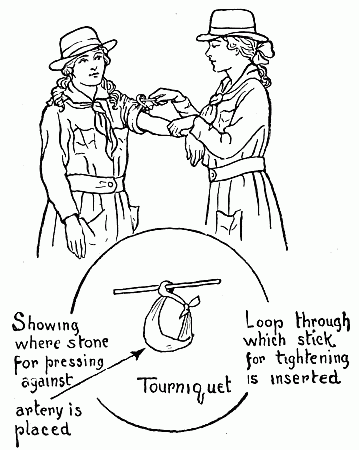
Bleeding from an Artery: If an artery is cut the blood
spurts out, the size of the stream depending on the size
of the artery cut. This is the most serious bleeding
because the heart is directly behind, pumping the blood
through the artery with all its power. If it is a small
artery the pressure with the finger between the cut and
the heart for a few minutes will give the blood time to clot
behind the finger and form a plug. This will stop the
bleeding aided by pressure of the bandage. If it is a
larger vessel the force in the heart muscle pumping the
blood will force out any plug formed by the finger there,
as the finger tires too easily.
Tourniquet: In this case it will be necessary to put
on a tourniquet to take the place of the finger until
a clot can form in the vessel big enough and strong
enough to prevent the force of the blood current from
pushing it out. This of course can be used only on
the legs or arms.
A tourniquet is something put on to make pressure
on a blood vessel to stop serious bleeding. There are
five points to remember about a tourniquet:
1. It must be long enough to tie around the limb—a
big handkerchief, towel or wide bandage.
2. There must be a pad to make the pressure over
the artery greater than on the rest of the limb—a smooth
stone, a darning ball, a large cork, cloth folded into a
large pad or a rolled bandage.
3. The pad must be so placed that the artery lies between
pad and the bone on the limb, in order that the
pressure may stop the flow of blood by forcing the walls
of the artery together between the pad and the bone.
4. Unless the tourniquet is put on tight enough, its
application increases bleeding. It is extremely rare to
find a tourniquet put on tight enough. In almost every
such case removing the tourniquet will stop or partly
lessen bleeding. A short stick or handle is needed,
about a foot long, with which to twist the tourniquet
sufficiently to stop the flow of blood. Usually it cannot
be twisted tightly enough by hand alone. Tie the twisted
part firmly so it will not slip, after it has been made tight
enough to stop bleeding.
5. Remember, a tourniquet stops most of the circulation
below it as well as in the cut artery, and must not
be left in place too long for fear of injury to the rest
of the limb by cutting off the circulation. Usually it
should not be left on for more than an hour.
Bleeding from Veins—Bleeding from the veins is not
so dangerous as from an artery. The blood from the
heart has to go through the little capillaries before it
gets into the veins, and therefore the force of the heart
muscle on the blood in the veins is not so great as in the
arteries. The blood does not spurt out, but flows out as
it would from a bottle tipped on its side.
You have already learned what to do to stop the bleeding
from the smaller veins, and that it is not serious.
From the larger veins, however, it can be very serious,
and it may be necessary for you to put on a tourniquet
before the doctor arrives in order to save the patient's
life.
Almost always bleeding from a vein can be controlled
by clean gauze or handkerchief pad and pressure by hand
directly over the bleeding wound. Tourniquets are almost
never needed in bleeding from a vein. If necessary, it
is wisest to apply them in the same way as for arterial
hemorrhage and stop the circulation in the whole limb.
It is important to know in a general way where the
blood vessels are in order to put the pad over them to
stop the bleeding. Roughly speaking, the artery of the
arm runs down about in a line with the inner seam of the
coat. The large vein lies close beside it, carrying the
blood back to the heart. The artery and vein of the leg
run about in a line with the inside seam of a man's
trousers.
Stimulants—In serious bleeding of any kind do not
give stimulants until the bleeding has been stopped, as
the stimulants increase the force of the heart and so
increase the flow of blood. After the tourniquet is
on and bleeding is stopped, if the patient is very weak,
he may have a teaspoonful of aromatic spirits of ammonia
in half a glass of water.
(a) SHOCKS; (b) APOPLEXY; (c) CONVULSIONS
(a) Shocks—In any injury, except the slight ones,
the ends of the nerves in the skin are bruised or jarred.
They send this jar along the nerves to the very delicate
brain. The blood is drawn from the brain into the
larger blood vessels, and the result produced is called
shock. If you have jammed your finger in a door sometime,
perhaps you have felt a queer sick feeling and
had to sit down. A cold sweat broke out all over you,
and you were hardly conscious for a moment or two.
This was a mild case of shock. In more severe injuries
a shock to the brain may be very serious.
Symptoms of Shock—1. The patient may or may not
be unconscious, but he may take no notice of what is
going on around him.
2. The face is pale and clammy.
3. The skin is cold.
4. The pulse is weak.
5. The breathing is shallow.
In any serious injury the shock is liable to be severe
and will need to be treated before the doctor arrives.
Treatment—Send for the doctor if serious.
1. Lay the patient flat on his back with head low, so
that the heart can more easily pump the blood back into
the brain.
2. Cover warmly; if they can be gotten, put around
him several hot water bottles or bricks, being extremely
careful to have them covered so that they will not burn
him. Persons suffering from shock are more easily
burnt than usual. Do not put anything hot next him
unless it can be held against your own face for a minute
without feeling too hot.
3. Rub the arms and legs, toward the body, but under
the covers.
4. Give stimulants only after the patient has recovered
enough to swallow, and when there is no serious bleeding.
Stimulants—Strong, hot coffee, or a half teaspoonful
of aromatic spirits of ammonia in a half glass of warm
water. The latter may be given if the coffee is not ready.
(b) Apoplexy—When a person has a "stroke" of
apoplexy send for the doctor at once.
This condition resembles shock only in that the patient
is unconscious. The blow to the delicate brain does not
come from the outside along the nerves, but from the
inside by the breaking of a blood vessel in the brain,
letting the blood out into the brain tissue and forming a
clot inside of the brain, and thus making pressure which
produces the unconsciousness.
Symptoms of Apoplexy—1. The patient is unconscious.
2. The face is usually flushed—red.
3. The skin is not cold and clammy.
4. The pulse is slow and full.
5. The breathing is snoring instead of shallow.
6. The pupils of the eye are usually unequally dilated.
Treatment—1. Lay the patient flat on his back with
head slightly raised.
2. Do not give any stimulants.
3. Wait for the doctor.
(c) Convulsions—This condition resembles the foregoing
shock and apoplexy in that the patient is unconscious.
Symptoms of Convulsions—1. The patient is unconscious.
2. The face is usually pale at first, but not so white
as in shock, and later is flushed, often even purplish.
3. The skin is not usually cold.
4. The breathing may be shallow or snoring.
5. There are twitchings of the muscles of the face
and body or a twisting motion of the body.
6. The pulse may be rapid, but is usually regular.
7. The mouth may be flecked with foam.
8. The pupils of the eye may be contracted or equally
dilated.
Treatment—Convulsions come from various causes,
and are always serious, therefore send for the doctor
at once.
1. Put a wedge of some kind between the teeth if
possible, the handle of a spoon protected by a cloth
cover, or a rolled napkin does well. This is to prevent
biting the tongue, which the patient is apt to do in unconsciousness
with convulsive movements.
2. Lay the patient flat on his back, and prevent him
from hurting himself in his twisting, but do not try to
stop convulsive movement. It will do no good.
3. No stimulant is needed.
(a) SUNSTROKE; (b) FREEZING
(a) Sunstroke—Sunstroke is caused by too long exposure
to excessive heat, or to the direct rays of the
sun, and is much more serious than heat exhaustion,
which you have already studied.
Prevention—Do not stay out in the direct sunlight too
long on a hot summer day. Wear a large hat which
shades the head and face well, if obliged to be in the
hot sun for any length of time. Do not wear too heavy
clothing in the hot weather. Leaves or a wet sponge
in the top of the hat will help to prevent sunstroke.
Drink plenty of cool water between meals.
Symptoms of Sunstroke—1. The patient is unconscious.
2. The face is red.
3. The pupils large.
4. The skin very hot and dry, with no perspiration.
5. The pulse is full and slow.
6. The breathing is sighing.
Treatment—1. Get the patient into the shade where
it is as cool as possible.
2. Send for the doctor.
3. Remove the greater part of the clothing.
4. Apply cold water or ice to the head, face, chest
and armpits.
Often the patient recovers consciousness before the
doctor arrives; give cold water to drink; never stimulants.
(b) Freezing—This is a much more serious condition
than frostbite, which you have studied, but only because
more of the body is frozen and the tissues are frozen
deeper. Much more care must therefore be taken to prevent
bad effects after the thawing-out process.
Symptoms of Freezing—1. The patient may or may
not be unconscious.
2. The frozen parts are an intense white and are
without any feeling or motion.
Treatment—Send for the doctor at once.
1. Take the patient into a cold room.
2. Remove the clothing.
3. Rub the body with rough cloths wet in cold water.
4. Very gradually increase the warmth of the water
used for rubbing.
5. Increase the temperature of the room gradually.
6. When the patient can swallow, give him stimulants.
7. When the skin becomes more normal in color and
the tissues are soft, showing that the blood is once more
circulating properly through the frozen flesh, cover the
patient warmly with hot bottles or bricks outside of the
bed clothing, or wraps, and give hot drinks. In using
hot water be sure it is not too hot.
In the case of the dog bite we have a more or less
extensive break in the skin and sometimes a deep wound in
the flesh, through which the poison of hydrophobia, which
is a living virus or animal poison, may be introduced, to be
taken up slowly by the nerves themselves, reaching the
central nervous system in about forty days. The slowness
and method of this absorption renders the use of a ligature
useless and unsafe. The treatment for dog bite is
therefore as follows:
Immediate. Send for a physician, telling him the reason.
While waiting, treat as any similar wound from any
cause. If the skin is not penetrated, but scratched only,
apply iodine and a sterile or wet dressing. If the skin
is penetrated, the treatment should be the same as for a
wound made by a dirty nail: that is, a small stick, such
as a match, whittled to a point, with a little cotton twisted
on the point, should be dipped into tincture of iodine,
and twisted down into the full depth of the wound, and
then done a second time.
Subsequent. A physician should be consulted immediately,
and if there is any suspicion of the dog being sick
it should be kept under observation. The body of a dog
that has been killed under suspicion of rabies or hydrophobia,
should be sent as soon as possible to the proper
authorities.
One of the greatest discoveries in medical science is
the Pasteur treatment for the prevention of hydrophobia
after mad dog bite, and fortunately, provision for this
treatment is so widespread that practically every one in
civilized regions needing it, can have it, as is well known
to all physicians. The fact that the period of development
of the disease is so long makes the possibility of prevention
greater.
It is never proper to suck a dog bite, because the merest
scratch or break in the surface, even if too small to notice,
will serve as a portal of entry for the living virus of
rabies.
Snake Bite. For treatment of snake bite see page 297.
WATER ACCIDENTS
When it is possible, Girl Scouts should learn to swim
well. It is fear when suddenly thrown into the water
that causes so many of the deaths by drowning, and learning
to swim well takes away this fear. A Girl Scout
should also learn how to prevent accidents, and how
best to help the victims of accidents in the water.
Prevention
Below are five rules for preventing drowning accidents.
1. Do not change seats in a canoe or rowboat.
2. Do not rock the boat.
3. Do not go out alone in a canoe, rowboat or sailboat
unless you are thoroughly competent to manage such a
boat, in a sudden squall or storm.
4. Very cold water exhausts a swimmer much quicker
than warm water, therefore do not take any chances on
a long swim in cold water unless a boat accompanies you
to pick you up in case of necessity.
5. Be careful not to go too far out when there is a
strong undertow; that is, a strong current below the
surface of the water flowing relentlessly out to sea.
6. Always wade upstream.
Rescue
When a person gives up the struggle in the water, the
body goes down, and then because of its buoyancy it
comes to the surface and some air is expelled from the
lungs, making the body less buoyant. It immediately
sinks again, this time a little lower, and again comes
to the surface, and more air is expelled. This process
may be repeated several times, until sufficient water is
taken into the stomach and lungs to overcome the buoyancy
of the body and it no longer appears at the surface;
but the buoyancy is barely overcome, and therefore the
body will float easily. This can easily be utilized in
saving the drowning person by making the water carry
most of the weight of the body.
To do this, place the hands on either side of the drowning
person's head, and tow him floating on his back
with the face above the surface of the water, while you
swim on your back and keep the body away from you.
Remember, if possible, to go with the current and thus
save necessary strength. In some cases it may be easier
and safer to grasp the drowning person by the hair
instead of trying to clasp the head.
Emergencies
Grips—A drowning person is always a frightened person,
and is governed by a mad instinct to grab anything
which subconsciously he thinks may save his life. Usually
he is past any reasoning. He grabs his would-be
rescuer with a death grip that is hard to break, but remember
he instinctively grabs what is above the surface
and will not try to grab below the shoulders.
Wrist Grip—If the drowning person grasps the rescuer's
wrists, the rescuer throws both hands above his
head, which forces both low in the water, and then turns
the leverage of his arms against the other's thumbs and
breaks the grip.
Neck Grip—To release a grip around the neck and
shoulders from the front, immediately cover the mouth
of the other with the palm of the hand, holding the nose
between the first two fingers, and at the same time pull
the other body toward you with the other hand, meanwhile
treading water. Then take a full breath and apply
your knee to the other's stomach quickly, thus forcing
him to expel any air in his lungs and preventing him
from getting more air by the hand on mouth and nostrils.
If the grip of the drowning person does not allow
use of the arms, then try to raise your arms to the
level of the shoulder, thus slipping his arms to the neck
and leaving your own arms free to use, as described.
Back Grip—This strangle hold is perhaps the most
difficult to break, and it is necessary to break it instantly
if the rescuer is not also to be in the rescued class.
Grasp the wrists of the other and push sharply back with
the buttocks against the abdomen of the other, and thus
make room to slip suddenly out of the encircling arms.
If this is not successful, do not despair, but throw
the head suddenly against the nose of the drowning
person and then slip out of the grip before he recovers
from his daze.
It is often necessary to dive from the surface in rescuing
a drowning person, and this requires practice, and
should be learned thoroughly before the necessity for
saving a life is presented. Remember that to dive from
the surface to a depth of more than ten feet will usually
require a weight in addition to the weight of the body.
Carry a stone or other heavy object in diving. Then
when wishing to rise to the surface, drop it and push
against the bottom with the feet. This will send the
swimmer to the surface in short order.
In carrying a weight in the water, carry it low on the
body, close to the waist line, leaving one hand and both
feet free for swimming. Or if for any reason it is necessary
to swim on the back, it leaves both feet free to use as
propellers.
Artificial Respiration
If the apparently drowned person is to be saved, no
time must be lost in the rescue from the water or in
getting the water out of him, and breathing re-established
after he is brought to land.
If there is a messenger handy send for a doctor at
once, but in the meantime lose no time in attempting
restoration.
The best method for getting the water out of the lungs
and breathing re-established is the Schaefer Method, because
it is the simplest, requiring only one operator and
no equipment. It can be kept up alone for a long time.
1. Every moment is precious. Immediately lay the
patient face downwards, with the arms extended above
the head and the face to one side. In this position the
water will run out and the tongue will fall forward by
its own weight, and not give trouble by falling back and
closing the entrance to the windpipe. Be sure there is
nothing in the mouth, such as false teeth, gum, tobacco,
etc. Do not put anything under the chest. Be sure there
is no tight collar around the neck.
2. Kneel astride of the patient facing toward his head.
3. Place your hands on the small of the patient's back,
with thumbs nearly touching and the hands on the spaces
between the short ribs.
4. Bend slightly forward with arms rigid so that the
weight of your body falls on the wrists, and makes a firm
steady pressure downward on the patient while you count
one, two, three, thus forcing any water and air out of
the lungs.
5. Then relax the pressure very quickly, snatching
the hand away, and counting one-two—the chest cavity
enlarges and fresh air is drawn into the lungs.
6. Continue the alternate pressing and relaxing about
twelve to fifteen times a minute, which empties and fills
the lungs with fresh air approximately as often as he
would do it naturally.
It may be necessary to work for an hour or two before
a gasp shows the return of natural breathing. Even then
the rescuer's work is not over, as it will be necessary
to fill in any gaps with artificial breathing. When natural
breathing is established, aid circulation by rubbing and
by wrapping him in hot blankets and putting hot bottles
around him, being careful that they are protected to prevent
burning the patient.
If at any time it is necessary to pull the tongue forward
and to hold it to prevent choking, remember to put
a wedge between the teeth to prevent biting. Do not
give anything liquid by mouth until the patient is conscious
and can swallow readily. Aromatic Spirits of
Ammonia or Spirits of Camphor may be used on a handkerchief
for the patient to smell. The patient should be
watched carefully for an hour or two even after he is
considered out of danger.
ICE RESCUE
Prevention: Below are two rules for preventing ice
accidents:
1. Do not skate or walk on thin ice.
2. Watch for air holes.
Rescue: In trying to rescue a person who has broken
through the ice, always tie a rope around your own body
and have this tied to some firm object on shore. Do
not try to walk out to the rescue as the ice will probably
break again under the weight of your body on so small
an area as the size of your feet. Always get a long
board, ladder, rail or limb of a tree, and either crawl
out on this, which will distribute the weight of your
body over a larger surface of ice, or lie flat on your
stomach and crawl out, pushing the board ahead of you
so that the person in the water may reach it. If you
yourself break through the ice in attempting a rescue,
remember that trying to pull yourself up over the edge
of the ice only breaks it more. If rescuers are near it is
much wiser to support yourself on the edge of the ice
and wait for rescue.
After getting the person out of the water use artificial
respiration if necessary and bend every effort to get the
patient warm and breathing properly.
ASPHYXIATION
Prevention: Below are seven rules for preventing
asphyxiation:
1. When coal stoves and furnaces are freshly filled
with coal, coal gas may escape if the dampers are not
properly regulated. See that all dampers in coal stoves
and furnaces are correctly arranged before leaving them
for any long time, as for the night.
2. Do not go to sleep in a house or room with a gas
jet or gas stove turned low. The pressure in the pipes
may change and the flame go out, or a breeze may blow
out the flame leaving the gas leaking into the room.
3. Do not blow out a gas jet.
4. Be careful to turn off gas jet completely.
5. Report gas leaks promptly.
6. Charcoal stoves and braziers are especially dangerous
from escaping gas and should not be used in sleeping rooms.
7. Do not go into unused wells or underground sewers
without first lowering a lighted candle which will go
out at once if the air is very impure, because of lack of
oxygen to keep it burning.
Rescue: 1. Remove the patient at once to the fresh
air. Gas is lighter than air, and therefore will not be
found close to the floor and it will often be possible to
crawl out when one would be overcome by the gas if he
tried to walk out. For this reason it is sometimes best
in trying to rescue anyone already unconscious from gas
to tie the wrists together with a handkerchief, put his
arms around your neck, and crawl out on all fours, dragging
the insensible body with you, under your own body.
If you attempt to walk out and carry the patient, cover
your mouth and nose with a wet handkerchief, go very
quickly, do not breathe until you reach the fresh air.
2. If there is a messenger handy, send for the doctor
at once, but in the meantime if necessary, perform artificial
respiration as outlined under the Schaefer System
in the preceding paragraphs, until the patient is restored
to normal breathing.
ELECTRIC SHOCK
This is caused by some part of the body coming in
contact with a live electric wire. The seriousness of the
shock depends on how heavy a charge of electricity the
wire is carrying at the time.
The patient is usually unable to release himself from
the wire. The first thing to be done, if possible, is to
turn off the current by means of the switch, but if this
cannot be done at once, the patient must be rescued by
pulling him away from the wire.
Remember his body will easily carry the charge to
yours while he is against the wire. Therefore you must
"insulate" yourself—that is, put on your hands something
that will not let the electricity into your body—or
stand on something that will "insulate" you; for instance,
rubber gloves or rubber tobacco pouches, dry silk handkerchiefs,
other silk garments or newspapers used in
place of gloves if necessary. Stand on a rubber mat or
on dry boards, or glass, or in dire necessity dry clothes
can be used to stand on. They must not be wet as then
they will carry the electric current through your body
and you must also be rescued instead of rescuing.
Prevention: 1. Do not touch the "third rail" of electric
railways.
2. Do not catch hold of swinging wires, they may be
"live wires."
3. Report broken wires to the right authorities.
Treatment:
1. Get patient loose from the current.
2. Send for the doctor.
3. Lay the patient flat on his back.
4. Loosen the clothing, and perform artificial respiration
according to the Schaefer method if necessary.
5. Give first aid treatment to the burns.
FIRE ACCIDENTS
The first thought about a fire is to get it put out before
it spreads any further. There are methods which will
do this work effectually and Girl Scouts should learn
these methods beforehand thoroughly, in order that when
the emergency arises they may act quickly, coolly and
effectively.
Fire in Clothing
If this happens in your own clothing, do not run for
help, as the draft made by the motion of your body will
only fan the flames to burn fiercely.
Grab the nearest thing that will cover you; overcoat,
blanket, rug, wrap it tightly around you at the neck first
to prevent flames from burning the face and lie down
and roll over and over. This will smother the flames
quickly. If you can get nothing to wrap around you, lie
down and roll slowly over and beat the fire with your
hands covered by some part of your clothing not on fire.
If the fire is in the clothing of another, wrap him in
the nearest thing available, lay him on the floor and roll
him over, smothering the flames as described before.
Woolen material will not catch fire as easily as cotton,
therefore, if you have a chance to choose, take woolen
material for smothering the flames.
Results
Results of fire in the clothing are sure to be more or
less serious burns.
When you have discovered the extent of the burn, if
it is at all serious, send for the doctor at once, and in the
meantime treat the burn as you have already learned to
do in minor burns.
Fire in Buildings
Keep cool, in order to remember what to do, and do
it quickly.
Turn in a fire alarm at once. Send some one else if
possible who may not know what to do to the fire. The
quickest way is by telephone call, "Fire Department,"
and tell them the exact address of the building where
the fire is. Or you may go to the nearest alarm box,
smash the glass, open the door, and pull down the hook
that sounds the alarm. (Generally the directions are
printed on the box.) If you cannot sound the alarm
alone, call upon the nearest person to help you. Wait
there until the firemen arrive and direct them to the fire.
When the firemen come do just as they tell you, for they
know exactly what to do.
People trying to escape from a burning building often
get frightened and then there is a panic. Panic kills more
people than fire. Keep cool, and others will follow your
example.
Never jump from a window unless the flames are so
close that it is your only means of escape. If outside a
burning building put mattresses and bedding piled high
to break the jumper's fall and get a strong hold on a rug
to catch the jumper, and let many people hold the rug.
If the fire is just beginning, it can easily be put out
by smothering it with a rug or blanket; sand, ashes, salt,
or a few pails of water will answer the same purpose.
Keep the doors and windows closed if possible to prevent
draughts from fanning the flames to fiercer effort.
Remember this point when you go into a burning
building, and leave some responsible person guarding the
door, in order that it may not be left open by some one
in excitement and the flames fanned beyond control.
If you need fresh air in your search for people in a
burning building, open a window, put out your head and
draw your lungs full of fresh air and then close the window
again. In any case it is best to tie a wet handkerchief
or towel over the nose and mouth while in a burning
building, as this will prevent you from breathing a
good deal of smoke.
In searching for persons remember always to begin
at the top of the building if possible, and search every
room. When on stairs keep to wall side, where air is
relatively free from flames and smoke. If a room is
locked, try to rouse the people by pounding and calling
and then break in the door if unsuccessful in rousing
them, and you suspect there is some one there.
Remember, the air within six inches from the floor is
usually free from smoke, and if the smoke makes breathing
too difficult, you can still accomplish your end by
crawling along the floor and dragging the rescued one
with you as you learned to do in gas rescue.
Form a bucket brigade from the fire to the nearest
water supply; passing the filled pails from one to another
rapidly, the last throwing the water on the fire and passing
the empty pails back along another line to be filled
again and passed on as before.
Fires from Kerosene, Gasoline, Benzine
Prevention.—1. Do not light a fire with kerosene.
2. Do not clean gloves or clothing with gasoline or
benzine in a room with a lamp or gas jet lighted.
3. Do not try to dry clothing that has been cleaned
with gasoline or benzine near a hot stove or lighted gas
jet.
Extinction.—Do not use water to put out a fire of kerosene,
benzine, or gasoline, as that only scatters the flames.
Smother with blankets, rugs, sand, ashes, salt, or anything
which is at hand and can be used; remember that
woolen will not catch fire as easily as cotton.
COMMON POISON AND ANTIDOTES
Poisoning—Cases of poisoning happen most often because
people do not examine the bottles before taking
medicines from them.
Prevention—Disinfectants, liniments and medicines
in bottles and boxes should be correctly and plainly
labelled.
Bottles containing a poisonous substance should be
rough outside, or with notched corks or marked with
something beside the label stating that their contents are
poison.
Treatment—1. Send for the doctor at once, telling
him what kind of poison you think the patient has taken
in order that he may bring the right antidote and the
right implements to give the quickest and most effective
relief.
2. Give demulcent or mucilaginous drinks, as for
example, milk, raw egg, one or two tablespoonfuls of
salad oil, sweet oil, or barley water—which can be
obtained most readily.
3. Give something to produce vomiting, provided the
lips are not burned or stained as they are with an acid
or alkali. A simple but effectual emetic can be made by
mixing two teaspoonfuls of salt or a tablespoon of mustard
in a glass of lukewarm water. This may be repeated
if necessary.
4. If the patient seems drowsy, suspect opium and
keep patient awake at all costs till the doctor arrives.
5. If delirium threatens, dash cold water on the
patient's head and face to try to prevent the fit from
coming on.
6. When the poison taken has been acid, the antidote
should be an alkali, but different poisons require
different antidotes, and it would be unwise to trust to
one's memory as to the proper one to take in each case.
It would be well to have a list of the more common
poisons and their antidotes attached to the First Aid Kit,
but do not trust to the memory. If a Girl Scout does
not know, and if the patient's lips are not stained or
burned, give an emetic.
Bandages
Bandages form the most convenient way of keeping
dressings on wounds and for making pressure when
necessary. They are also used to correct some deformities,
but you will not need to concern yourselves
with the latter, as this is in the province of doctors.
There are three varieties of bandages which you will
need to use and with which you should be familiar: the
roller, triangular and four-tailed. The materials used
for bandages are absorbent gauze, muslins or flannels.
The kind you will use most will be gauze and muslin.
The gauze is best to use in dressing wounds because
it is pliable and absorbent, and muslin, if you may
choose, in applying pressure, because it is firm. In an
emergency there will usually be little chance to choose.
Anything at hand, as underclothing, sheets, blankets,
etc., may be torn into strips or triangles and used. Have
the material which is used clean if possible.
The width of the roller bandage depends on the part
of the body to be bandaged, from one inch for the little
finger to four inches for the body. They can be rolled
very well by hand with a little practice, and every Girl
Scout should learn to do this or to improvise a bandage
roller by running a very stiff wire through a small
wooden box and then bending one end on the outside
of the box like a handle.
A bandage must be rolled sufficiently tight so that
the center will not fall out. By folding one end back
and forth a few times to make a core, and then laying
the bandaging over one's knees lengthwise of the thigh
with the core uppermost, it can be rolled quite tightly
and answer every purpose for emergencies.
Learn to put on all bandages smoothly and securely,
but not too tightly.
Triangular Bandages—These bandages have advantages
for first aid work. They can be quickly made,
easily applied and are not apt to be put on too tightly
even by a beginner.
The size of the piece of cloth varies with the part
to be bandaged. Take a square piece of cloth (it should
not be less than 34 to 38 inches), fold it diagonally
from corner to corner and cut across the fold, making
two bandages.
The bandage may be applied unfolded or folded into
a narrow strip, called cravat bandage.
To fold the cravat bandage, the point of the triangle
is brought to the middle of the diagonal side and the
bandage folded lengthwise to the desired width.
The cravat bandage is convenient to use in bandaging
the hand, foot, head, eyes, throat and jaw; for tying on
splints; for tying around the limb in case of snake bite,
and in making a tourniquet.
Always tie the bandage with a square knot to prevent
slipping. Care must be used in applying the triangular
bandage to have it smooth and firm, folding the loose
ends into pleats evenly.
Bandage for Hand—For wound of the palm, lay
cravat in straight line, place palm across it at the middle.
Fold ends over the back of hand, carry around
wrist and tie. Reverse the order for injury to the
back of the hand.
To cover entire hand, unfold cravat, lay flat with
point of triangle beyond the fingers. Fold the point
of the bandage over the fingers, cross the ends, and
pass around wrist and tie at the back.
Bandage for Foot—Place foot on the smooth triangle
with the point extending beyond the toes several inches.
Fold the point back over the instep, cross the ends,
carry around the ankle and tie.
Bandage for the Head—The bandage may be used
flat or as a cravat, according to the nature of the injury
and the part to be bandaged.
For a cap bandage, fold over the edge of the diagonal
edge, place on the head with the folded edge just above
the eyes; pleat the edges hanging down over the ears
into small folds so that the bandage lies smoothly;
carry the ends around the head; cross at the back, and
tie in a square knot in front. The cravat bandage may
be used to hold on small dressings where the whole
head does not need to be covered.
For the eyes, jaw and throat the triangular bandage
is used by folding smoothly into a cravat and tying
securely over the part to be covered.
Arm Sling.—The triangular bandage makes the best
arm sling to support the forearm or for supporting
injuries to the elbow or shoulder.
An arm sling is firmer and more satisfactory if the
triangle is double; that is, simply fold over the square
diagonally, but do not cut it along the fold. An arm
sling will need to be about a yard square before folding.
To adjust the arm sling, put one end over the shoulder
on the uninjured side; slip the point of the triangle
under the injured arm, so that it will extend beyond
the elbow a few inches; then take the end of the bandage
over the arm, carry around the back of the neck
on the injured side, meeting the other end; and tie
securely. To prevent slipping, pin the point of the
bandage around the arm just above the elbow.
A temporary sling can be made by pinning the sleeve
of the injured arm to the dress or coat in such a way
as to support the arm.
The Four-tailed Bandage—This bandage is useful for
bandaging the head, and especially in fracture of the
jaw. Use a piece of cloth about six or eight inches
wide and a yard long. Cut each end into two equal
parts, leaving about three or four inches in the middle
uncut.
When the bandage is applied, the split ends are
crossed so that they may be tied over different parts
of the head and thus hold the bandage more securely
in place. For instance, in the jaw bandage the uncut
middle part is placed over and under the chin, the ends
crossed, and two ends tied at the back of the neck and
two over the top of the head.
Roller Bandages—Roller bandages are a little more
difficult to put on so that they will stay on, and at the
same time be smooth and have a uniform pressure on
the part of the body bandaged. This last point is most
important.
Rules for applying roller bandages:
1. Lay external surface of bandage against the part
to be bandaged, holding the roll in the right hand,
unless you are left-handed, unrolling it as a roll of
carpet unrolls to show you a pattern in the shops.
2. Hold the loose end with the left hand and catch
it with two or three turns of the bandage before beginning
to put on the bandage. Never have more than
four or five inches of the bandage unrolled at once.
3. Be careful to have the same pressure from every
turn of the bandage. This is most important if the
bandage is to stay on and be comfortable and not interfere
with the circulation of the blood. Judgment of
the pressure is only acquired by practice, and therefore
you should practice enough to acquire this before
the real emergency happens.
4. Do not bandage too tightly. Blueness of the skin
above or below the bandage always means the bandage
must be loosened. Remember in applying a bandage
immediately after an injury that considerable swelling
may occur later, and apply your bandage more loosely
than if bandaging after the swelling has gone down.
Always loosen a bandage that is tight enough to cause
pain or blueness.
5. Bandage from below upward. That is, from the
tip of a finger or toe toward the hand or foot. From
the hand or foot toward the shoulder or groin. This
is in the general direction of the return of the circulation.
6. Bandage over a splint and not under it.
7. Bandage arms, legs, fingers, etc., in the position
the patient is to keep the part in when the bandaging
is completed. For instance, bend the elbow to a right
angle before putting on the arm bandage. This will
be more comfortable for the patient, allowing him to
carry the arm easily in a sling and also permit him to
use the hand to some extent if the nature of the injury
will permit. In bandaging a leg both above and below
the knee, the bandage must be put on with a view to
the necessary bending of the knee in walking and sitting,
if the patient is expected to use the leg.
8. Never apply a wet bandage, as you cannot judge
of just how much pressure will be exerted when the
bandage dries, because of the shrinkage of cloth with
drying; much greater in some cloth than in others.
Kinds of roller bandages:
1. Circular for parts uniform in size, as the body.
2. Spiral for conical surfaces, as fingers or toes.
3. Reverse for more conical surfaces, as arms and
legs.
Circular Bandages—Any part of the body which is
of uniform size may be covered with a circular bandage.
Each turn covers about two-thirds of the previous turn.
This holds each turn firmly and prevents slipping and
exposing the dressing or wound underneath. Bandage
in general direction of the return of the blood to the
heart. Fasten the bandage with a strip of adhesive
plaster or safety pin. If there is possibility of restlessness
or much activity on the part of the patient, it is
best to run several narrow strips of adhesive plaster
along the whole width of the bandage when finished to
prevent possible slipping of the turns of the bandage
when the muscles move under it with the activity of
the patient. This is especially true of a body bandage.
Spiral Bandage—A conical part, if not too conical,
may be covered with a spiral bandage. Each turn
ascends at a slight angle, with one edge of the bandage
a little tighter than the other. In putting on this kind
of bandage it is necessary to learn to have the tight
edges all of a uniform pressure and each turn overlap
the turn below in such a way that these tight edges
make the uniform pressure without regard to the upper
edge underneath, which is covered in each turn by the
tighter edge of the turn above it.
Reverse Bandages—The reverse bandage is a modification
of the spiral one, in order to cover the gapping
between spirals which occurs when the surface is very
conical, as, for instance, on the leg.
In putting on this bandage the loose end is caught
by two or three turns first as in other bandages. Then
start to make a spiral turn, but at the mid point of the
front of the part being bandaged place the thumb of
the left hand, and fold the bandage down so that it
lies smoothly and continue the turn around to that same
point. Repeat the process with each turn. (See illustration.)
Each turn covers two-thirds of the one below
in order to hold firmly. The pressure must be uniform
when the bandage is finished. Fasten the ends as described
under circular bandages, or divide the end of
the bandage into two parts for several inches—long
enough to wind around the part bandaged. Tie a single
knot at the base to prevent further dividing, and wrap
the ends around the part in different directions; tie in a
hard knot to hold firmly.
Bandaging Fingers and Toes—In bandaging fingers
and toes it is usually best to bandage the whole of the
injured member. Cover the end of the finger, for instance,
by passing the end of the half inch or one inch
bandage several times the whole length of the finger,
over the end and to the base of the other side. Hold
this in place with one hand, start the spiral at the end
of the finger, and bandage smoothly toward the hand.
The spiral or the reverse spiral may be used.
Bandaging Two or More Fingers or Toes—It is sometimes
necessary to bandage two or more fingers, for
instance, at once, as in case of a burn, where it is necessary
always to have the burned fingers separated while
healing to prevent the raw places from growing together.
Pass a finger bandage twice around the wrist and
pass obliquely to the base of the thumb. Carry to the
end of the thumb and bandage as described above.
When the thumb is bandaged, carry the bandage back
to the wrist; pass around the wrist in one or two circular
turns, and carry the bandage to the first finger
and bandage as before. Repeat this until all the fingers
are bandaged. Carry the bandage back to the wrist,
after the last finger you wish to bandage is done; make
one or two turns around the wrist and fasten.
In bandaging the foot, carry the bandage to the ankle
to make secure and hold in place.
Bandaging Arms and Legs—The reverse spiral is
usually best for bandaging these, because of the conical
shape. Practice alone can teach you to put this on
smoothly, firmly, not too tightly, and at the same time
quickly. A reverse bandage will not stay in place on
the leg of the person walking around unless pinned in
many places or stuck by sizing in the cloth (which has
been wet), plaster, etc. Only a figure eight caught
over the top of the calf, in each alternate loop, will do so.
The Figure Eight Bandage—The figure eight is a
modification of the spiral used in bandaging over joints
in such a way as to permit some motion and at the
same time keep the bandage firm and in place.
The bandage is carried first below and then above
the joint; then below and then above, the turns overlapping
the usual two-thirds of the width of the bandage,
leaving the joint free until the last. Then it may be
covered with two or three circular turns of the bandage.
This admits of considerable motion without disturbing
the bandage to any extent.
The National Red Cross and Girl Scout Instruction
in First Aid
By special arrangement with the National Red Cross,
it is possible for a Girl Scout completing satisfactorily
the requirements for the First Aid Proficiency Badge
to secure with slight additional work the Red Cross certificate
in First Aid. Or the course may be taken entirely
under Red Cross auspices, though arranged by
Scout officials, in which case the Scout may receive both
the Proficiency Badge and the Red Cross certificate. The
conditions of this co-operation between the Girl Scouts
and the National Red Cross are as follows:
Classes are to be organized with not less than four or
more than twenty-five in a class. The best size is ten to
fifteen. Scouts must be at least sixteen years of age to
be admitted to these classes.
The instructor must be a physician appointed by the
Chairman of the First Aid Committee of the local
Chapter of the Red Cross. He or she may be supplied
upon request by the Chapter, or chosen by the class and
the name submitted to the Chapter for appointment.
The Red Cross class roll must be sent in to the local
Chapter early in the course.
A Secretary to handle the records should be chosen,
and where the class is made up of Scouts, the officials
should be preferably a Scout Captain or Scout Official.
The examiner must be a physician appointed by the
local Red Cross Chapter and is preferably some one other
than the instructor, but this is not necessary. Like the
instructor, the examiner may be supplied by the Chapter
or chosen by the class.
The Red Cross examination roll, which may be obtained
from the Chapter, should be used in giving examinations
and then returned to the Chapter, who will issue
the certificates. Follow the directions on the roll carefully.
If a Scout holds a First Aid Proficiency Badge she
may complete the course in seven and one-half hours.
If she does not hold a Proficiency Badge in First Aid
then fifteen hours will be required. A Girl Scout holding
a Proficiency Badge in First Aid and taking a school
course held under Red Cross auspices which she passes
with a mark of at least seventy-five per cent, can, when
the school principal certifies to this, get the Red Cross
certificate without further examination by applying to
the local Red Cross Chapter.
Advanced Courses
Advanced courses are open to those who have the
Red Cross certificate. There must be an interval of at
least six months after the elementary course before an
advanced course can be taken, and the same interval between
repetitions of it. The course of instruction is
seven and one-half hours, mainly practical demonstrations.
A Red Cross medal is given on completion of
this course. Each time it is repeated, up to three times,
a bar (engraved with year) is given to be added to the
medal.
Fees
A fee of fifty cents is required for the elementary
course. The local Red Cross Chapter has the right to
reduce this fee.
The fee for the advanced course is one dollar, which
covers the cost of certificate, examination and medal.
The fee for bar and engraving is fifty cents. These fees
cannot be reduced.
These fees cover the cost to the Red Cross of postage,
certificates, medals, bars, and so forth, but do not cover
that of instructor, examiner, or classroom supplies, which
the Red Cross requires the class to take care of.
Information
Where there is no local Girl Scout organization refer
to the local Red Cross Chapter; or if there is none, either
to the Girl Scout National Headquarters, 189 Lexington
Avenue, New York, N. Y., or to the Department of
First Aid, American Red Cross National Headquarters,
Washington, D. C.
4. THE HOME NURSE
The Girl Scout who has earned the Home Nurse
Badge may be of great help where there is illness. But,
she should remember that only such people as doctors
and trained nurses who have knowledge and skill gained
by special training and thorough practice are fitted to
care properly for those who are very ill.
If the Scout with the badge keeps her head and shows
herself steady, reliable and willing, when called upon
for help in illness or emergencies, she proves herself a
true Scout who is living up to the Scout motto of "BE
PREPARED."
To earn the badge she should know:
How to keep the sick room clean and comfortable.
How to make a bed properly.
How to prepare for and help a sick person in taking
a bath.
How to make a sick person comfortable in bed, changing
position, etc.
How to take temperature, pulse and respiration.
How to prepare and serve simple, nourishing food for
the sick.
How to feed a helpless person.
How to prepare and use simple remedies for slight ailments.
How to occupy and amuse the sick.
When helping about the sick, the Scout should wear a
wash dress or an apron which covers her dress. She
should be very neat and clean. She should wash her
hands frequently, always before her own meals, and
after coming into contact with the sick person and after
handling utensils, dishes, linen, etc., used in the sick
room. Great cleanliness is necessary not only for her
own protection but to prevent illness spreading.
She should move quickly and quietly, but without
bustle or hurry, taking care not to let things fall, not to
bump against the furniture, not to jar the bed, not to
slam doors, in fact not to make any unnecessary noises,
as sick people are not only disturbed but may be made
worse by noises and confusion. If a door is squeaky the
hinges should be oiled. Too much talking, loud talking
and whispering are to be avoided. Only cheerful and
pleasant subjects should be talked of, never illnesses
either that of the patient nor of others.
The best nursing aims not only to bring relief and comfort
to those already sick, but to guard against spreading
sickness.
We know, now, that many diseases are spread by
means of germs which are carried from person to person
by various means, such as air, water, milk, and other
food; discharges from the mouth, nose, bowels, bladder,
wounds; clothing; the hands; the breath, and so forth.
It has been found that great heat, intense cold, sunshine
and some powerful drugs called disinfectants kill
germs. Germs thrive and multiply in dirt, dampness and
darkness. That is why it is important to have fresh
air, sunshine and cleanliness in order to keep well, and
to help in curing those who get sick.
The Room, Its Order and Arrangement
The hangings and furniture of a sick room should be
of a kind that can be washed and easily kept clean. Plain
wooden furniture is better than upholstered furniture
which collects and holds the dust. If there is a rocking
chair it should be for the use of the sick person only.
Seeing and hearing other people rock may be very disturbing.
If carpets are movable, so much the better, as they can
be taken out to be cleaned.
The room should be bright and attractive. Sick people
like flowers and pretty things, but the flowers should not
have a strong perfume, and there should not be too
many ornaments around to collect dust and to take up
too much room. Flowers should be taken out of the
room every night and the water changed before being returned
to the room in the morning. Never have faded flowers
around.
The room should be kept neat—a place for everything
and everything in its place.
Neatness and attractiveness are not only pleasing to
the sick person and those who come into the room but
may really make the sick person feel better.
Medicines should not be kept in sight. All dishes and
utensils not in use should be taken away and should be
washed immediately after use.
Ventilating and Lighting the Room
The room of a sick person should be so situated that
it will get plenty of sunlight and be easily aired. A room
that has two or more windows can be better ventilated
than a room with only one. When there is only one window,
it should be opened both top and bottom. If there
is not a screen, one can be made by hanging a shawl or
a blanket over a clothes horse or a high-backed chair, or
over a line stretched across the lower part of the window.
A fire place or a stove keeps the air circulating—the air
being constantly drawn up the chimney—and so helps in
ventilating a room.
When "airing" the room great care must be taken to
keep the sick person free from draughts.
Unless special orders have been given to the contrary
there should be plenty of sunshine let in. The eyes of
the sick person should be protected from the glare by a
screen.
If possible there should be a thermometer in the room.
The proper heat is between 65 and 70 degrees. If the
temperature of the room is as high as 70 degrees and the
sick person is cold, it is better to give her a hot water bag
and to put on more covers than to shut the windows, thus
keeping out the fresh air. Cool air acts as a tonic for
the sick.
Cleaning the Room
The carpet should be gone over every day to remove
the surface dust. Use the carpet sweeper, being careful
not to knock the furniture nor to jar the bed. Raise
as little dust and make as little noise as possible. Torn-up
wet paper scattered on a small part of the carpet at
a time and lightly brushed up into a dustpan with a whisk
broom, or a broom, cleans the carpet very well without
raising dust.
If the carpet cannot be taken out to be swept or beaten
but requires thorough sweeping, an umbrella with a sheet
over it may be hoisted over the head of the sick person
to keep the dust from her nose and nostrils. The bare
parts of the floor should be gone over with a damp duster
or a damp mop.
The dusting should be done with a damp or oiled duster
also, so that the dust may not be scattered. A basin of
soapy water should be at hand and the duster washed in
it frequently while dusting, so that the dust collected on
it from one surface will not be carried to another. While
dusting special attention should be paid to the doorknobs
and that part of the door around them.
When the dusting is finished the dusters should be
thoroughly washed and scalded and hung out of doors
to dry.
The Bed
A metal bedstead is better than a wooden one, as wood
holds odors and moisture, and is apt to have more cracks
and crevices for germs or bugs to lodge in. It should be
white, for then it shows when it needs cleaning and bed
bugs keep away from white surfaces which show them
up easily.
If possible, have the bed in a part of the room, where
the drafts will not strike the patient every time a door
or window is opened, and where the light does not shine
in the eyes. If it can be placed so that the patient can
see from the window so much the better.
To Make an Unoccupied Bed
Remove pillows and bedclothes, one at a time, being
careful not to let corners drag on the floor, and put to
air. Turn the mattress over from end to end one day,
and from side to side next day. If the patient does not
have to return to bed at once leave to air for at least half
an hour.
An old blanket, old spread or a quilted pad, spread over
the mattress not only protects the mattress but prevents
the sheets from wearing out, and may make the bed more
comfortable. These should be kept clean.
The bed for a sick person is frequently made with a
rubber sheet and a draw sheet. The draw sheet is so
called because its proper use is to be drawn through under
the patient without greatly disturbing her and give her
a cool fresh place to lie on. Therefore it should be long
enough to tuck in sufficiently under one side to allow
of this being done. An ordinary sheet folded in two
from top to bottom and placed with folded edge toward
the head of the bed may be used. It should entirely
cover the rubber sheet, which is usually put on between
the bottom and the draw sheet.
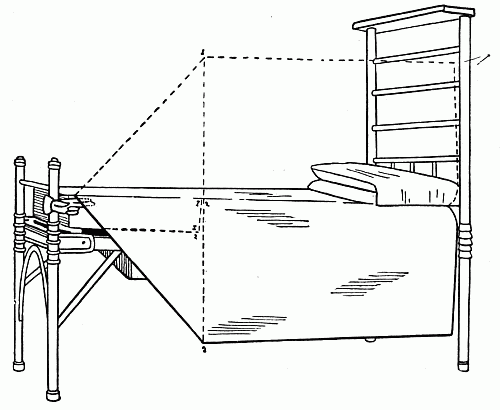
When the mattress is sufficiently aired, put on the protective
covering. Over this spread the lower sheet so
that the middle fold of the sheet lies up and down the
centre of the mattress from head to foot. Keep perfectly
straight. The sheet should be long enough to
have at least fourteen inches over at ends and sides to
tuck in. Tuck ends under mattress at head and foot
drawing tightly so that it will be smooth and firm. Now
tuck under at one side, folding neatly at corners, so that
they will be mitred when finished. If there is no rubber
nor draw sheet to put on, go to the other side of the bed
and tuck in firmly at corners. Then, pulling the middle of
the sheet very tightly with one hand, push the mattress
with the other and tuck the sheet under. This under
sheet should be very smooth without a wrinkle in it. If
it is not long enough to tuck in well at both head and
foot, leave plenty at the head to tuck in securely and
tuck in at the sides tightly rather than risk having it
come loose at the head. Be sure, however, that the mattress
is entirely covered.
When Rubber and Draw Sheets Are Used
Before going around to the other side, lay the rubber
sheet over the bed, so that the top edge will be well above
where the lower edge of the pillow will come. Put the
draw sheet over it. Tuck both well under the mattress on
that side. Then, go to the other side and tuck in the
corners of the lower sheet as directed, then stretching
draw, rubber, and under sheet very tightly, tuck in
separately.
Next spread the upper sheet, wrong side up, leaving as
much at the head to turn back over the blankets as you
left in the under sheet to tuck in. Have the middle fold
over that of the lower sheet. Spread the blankets so
that their upper edges will be even with the upper edge
of the mattress. If the blankets are not long enough to
reach as far up as they should, and yet tuck under firmly
at the foot, place the lower one as directed, and the upper
one so that there will be enough to tuck under at the foot,
and hold the others in place. Tuck in all at once the foot
and lower corners, mitring the corners as you did those
of the lower sheet. Pull and straighten the sheet at the
top and turn back smoothly over the blankets. If the bed
is not to be occupied right away, tuck in both sides,
stretching well so that it will have a smooth surface. Put
on the spread, having the top edge even with the top of
the covers. Tuck in neatly at foot and lower corners,
letting the sides hang. Shake and beat the pillows thoroughly,
make smooth and even, and put in place.
To Change the Under Sheet When the Patient Is
in Bed
Loosen the bedclothes, without jarring the bed. Take
off covers one at a time, until only one blanket and sheet
remain. (If the patient feels cold, leave as many blankets
as necessary to keep her warm.) Holding blankets with
one hand or having patient hold it by the top, draw off
the upper sheet, being careful not to uncover the patient.
Remove the pillows. Have the patient as near the
side of the bed as is safe, on her side, and facing the
side on which she is lying. Roll the under sheets on the
side of the bed close to the patient's back, making them
as flat as possible. Pleat about half of the fresh under
sheet lengthwise, and place close to the soiled sheets.
Tuck in the other half, at the head, foot and side, draw
the rubber sheet back over this fresh sheet, arrange the
fresh draw sheet in place, tuck both in at that side and
roll the free part close up to the patient's back. Now
lift the patient's feet over the roll of fresh and soiled
linen to the freshly made part, then have her roll her body
over that side. Going to the other side of the bed, remove
all the soiled linen and tuck the fresh sheets in,
pulling tightly, being sure that there are no wrinkles under
the patient. All the time keep the patient well covered.
Now, spread the upper sheet and blankets over the covering
the patient has had on while the lower sheets were
being changed and, having the patient hold the coverings
you have just put on, draw off the others, just as you
took off the top sheet at first. Finish making the bed
as you would an unoccupied one.
If the Bed Is to Be Occupied at Once
If the bed is to be occupied at once the coverings should
be tucked in only at foot, corners and one side, then
turned back diagonally from the head to foot.
The bed clothes should never be drawn too tightly over
a person in bed, or they may irritate the skin, especially
at the knees and toes. Bed sores may be started in this
way. Perhaps the commonest cause of bedsores is from
wrinkles in the under sheets. If the spread is heavy it
should not be used over a patient. Use a sheet instead to
protect the blankets.
Bathing
Bathing is more important for the sick than for the
well. It not only keeps the skin clean and in condition
to do its work, but it is soothing to the nerves, makes
the sick person rest better and is refreshing.
If the room is the right temperature and the bath is
carefully taken there is no danger of a sick person taking
cold. On the other hand bathing helps to keep people in
condition to avoid taking colds. (See Red Cross Text
Book on Home Hygiene and Care of the Sick, page 156.)
When a patient is very sick or helpless, the bath should
be given by someone who is able to do it deftly and quickly,
with the least exertion to the patient.
Very often, however, a person in bed is quite able to
bathe herself, with a little help, if the necessary things
are brought to her.
To Prepare For a Bath in Bed
Have the room warm and free from draughts. A good
temperature is 70 degrees. An old person or a baby may
have it warmer.
Bring into the room everything needed. This will include:
An extra blanket to wrap around the sick person.
Two or more bath towels.
Two wash cloths—one for the face and another for the
rest of the body.
Soap—Ivory or castile are good.
Pitcher of good hot water, and slop jar.
Alcohol and toilet powder if you have it.
Nail file and scissors.
Comb and brush.
Clean bed linen and nightgown. In cold weather these
may be hung near the fire or radiator to warm.
A basin of water of a temperature that the sick person
finds comfortable.
When everything is ready the Scout can help by loosening
the bedclothes, arranging the extra blanket, removing
the nightgown, and in holding the basin and towels, in
changing the water or in any way that will make the bath
easier for the sick person, perhaps washing the feet
and back, being careful to keep all the rest of the body
covered and warm, and in protecting the bed by bath
towels spread under the part being washed. When doing
this the wash cloth should not be so wet that it will drip
and wet the bed. It should be held so that the corners do
not touch against the bedclothes. There should not be
too much soap used as it makes the skin feel sticky.
Every part should be rinsed and dried thoroughly. Warm
towels are a great help in this.
When the bath is finished alcohol or witch hazel may
be used to rub the parts where there is most pressure
as the back, shoulder blades, hips, buttocks, elbows, knees
and ankles. This not only gives comfort but it prevents
bedsores.
If a sick person gets a bath, so that it does not disturb
nor tire her nor make her chilly she will usually enjoy it.
By getting everything ready, by helping where needed,
and by clearing up nicely the Girl Scout may make the
bath a pleasure instead of something to be dreaded.
Sometimes sick people are able to go to the bathroom
to take their own baths, if everything is gotten ready for
them beforehand, so that they will not get tired doing so.
People who are not well should never be allowed to lock
themselves in the bathroom alone.
Getting Ready a Tub Bath
The bathroom should be well aired but warm. The
water in the bath tub helps to warm it up. A bath towel
or bath mat should be spread beside the tub on the floor
and a chair with a blanket and a bath towel on it for
the person to sit on while she is drying herself. The
water should be about 105 degrees or a temperature that
the person finds comfortable. Always let a patient try it
herself with her hand and arm before getting in. Five
to ten minutes is long enough to stay in the water. The
towels should be within easy reach and the bathrobe,
night gown and slippers placed ready to put on.
The bed should be put to air and left as long as possible,
but if the patient has to get back in it immediately
after her bath, it should be made—care being taken that
it is warm enough. If necessary put in hot water bags
and spread a blanket over the under sheet to wrap around
her if she needs it. People chill easily after a bath if
they are exposed to sudden cold.
Foot Baths
Foot baths are often used in the home as remedies
for colds, headaches, sleeplessness and to give relief at
the monthly period.
If there is not a regular foot tub a pail that is large
enough to put the foot in is better than a basin as it
lets the water come up around the ankles. A person may
sit in a chair or on the side of the bed. Have tub about
half full of water and at first of a heat that feels comfortable,
putting more hot water in from time to time,
until it is as hot as it can be stood. When adding hot
water the feet should be away from the part of the tub
where the water is poured in, and it should be added
slowly to prevent possibility of burning. A person getting
a foot bath should be kept very warm. Wrap a
blanket around the knees so that the legs will be protected
front and back. After fifteen or twenty minutes
the feet should be removed from the water and dried
without rubbing. They should be kept well covered for
an hour or more. No one should go out immediately after
a foot bath.
If mustard is to be added, mix it first in a cup and mix
it gradually so that it does not lump. Two tablespoonfuls
of mustard to a foot bath is about enough.
Changing of position, and supporting different parts of
the body, give both rest and comfort to anyone in bed.
This may be done by turning a patient and by the proper
arrangement of pillows and other supports.
To turn a patient toward you place one hand over her
shoulder and the other hand over her hip and draw toward
you. Bend her knees, go to the other side of the
bed, put both hands under her hips and draw toward you.
Place a pillow lengthwise at her back, from her shoulder
to waist for support.
A pillow, placed under or between the knees, often
gives much relief and comfort. Small air pillows that
can be placed under or against the small of the back
relieve strain and rest the muscles. Anyone lying on
her back will be rested by arranging pillows lengthwise
at the sides to support arms. Rubber rings and air
cushions are also used to relieve pressure and give support.
They should always be covered, using towel or
pillow case, if they have not their own fitted covers.
Rings of any size may be made of cotton wound with
bandage. These are frequently needed under the heels,
particularly for a patient lying on her back.
Sitting Up in Bed
When a patient is allowed to sit up in bed and a bed-rest
is not available a straight chair placed bottom-up behind
the patient makes a good support for the pillows.
If there is no other support, at least six pillows are
needed to make a patient comfortable. The pillows
should be so arranged that the head is not thrown forward
and that there is proper support for the back, and
the arms.
Raising a Patient Who Has Slipped Down in Bed
Have the patient draw up the knees until the soles of
the feet are firmly on the bed. Place your right arm under
the far shoulder in such a way that the patient's head
rests in your bent elbow. Place the left arm under the
thighs. Hold your back stiff. Have the patient clasp her
hands around your waist. Lift without jerking. When
two persons are doing the lifting, one should stand on
either side of the bed. The person on the left side of the
bed should place the right arm as though she were doing
the lifting alone. Place the other arm under the small
of the patient's back.
The person on the right side will place her left arm
beside her companion's, and her right arm under the
thighs. If able, the patient may place a hand on the
shoulder of each lifter.
Lift in unison without jerking.
A pillow rolled in a sheet, placed under the body and
tied to the head or sides of the bed will prevent slipping
down in bed.
It is usually better to shake up and rearrange the
pillows after raising the patient as the moving disarranges
them somewhat.
To Change the Pillows
Slip the right arm under the shoulders in such a way
that the neck and head are supported in your bent elbow;
with the left hand gently draw out one pillow at a time,
from above. In replacing, stand the pillows on the side
at the head of the bed, lift the shoulders, and grasping the
pillow by the middle draw down under the patient's
head.
Another way is to have the patient near one side of
the bed and lifting in the same way draw the pillows one
at a time away from you. In replacing put the fresh pillows
on the far side and again lifting the head pull them
toward you.
The pillow should support the neck and shoulders. A
small down or hair pillow placed under the back of the
neck from time to time, rests and supports.
To Change the Nightgown
The nightgown should be loose enough to change easily.
If there is an opening in the front, this may be made
larger or the gown may be split up the back.
These openings may be sewn up again without in any
way damaging the gown.
Have the gown well drawn up around the shoulders
and neck.
Slip one hand through the arm hole of the gown, and
bend the patient's arm. With the other hand draw off
the sleeve.
Draw the hand through the corresponding sleeve of
the fresh gown and lifting the head just as for changing
the pillow, slip the soiled and fresh gown over the head
at the same time. Pull away the soiled gown. Put your
hand through the sleeve and draw the patient's hand
through, then raising again draw the gown down under
the back and hips.
Combing the Hair
The hair should be combed at least once a day. If
this is done from the very beginning of an illness it will
not get badly tangled.
Spread a towel over the pillow. Have the patient turn
head on one side so that the back of the head is exposed.
Part the hair in the middle from the forehead to the
nape of the neck. Comb only a small strand at a time.
If there are tangles, comb from ends toward the scalp.
Avoid pulling by twisting the strand around the finger
and holding loosely between the comb and the scalp.
When the hair on one side has been combed, braid it,
having the top of the braid near the ear. Do the other
side the same way. If very much tangled a little oil or
alcohol rubbed in makes it easier to comb.
Wash the comb and brush in soap and water once a
week.
Wash the hands after combing the hair.
Be careful in removing the towel not to scatter the
loose hairs and dandruff it may hold.
Getting Patient Up in Chair
If possible have a chair with arms.
Place beside the bed.
Put cushions on seat and fresh pillow at back.
Throw a blanket over all corner-wise, to wrap around
the patient when she sits down.
While in bed put on stockings, slippers, bath robe (and
underdrawers or flannel petticoat in winter).
Have the patient sit up in bed, and help her to swing
her feet over the edge.
Stand in front of her, and have her place her hands on
your shoulders. Place your hands under her armpits,
and let her slip off the bed with her feet firmly on the
floor. Turn and let her sit down slowly.
Place a stool for her feet.
Place the chair so that she will be out of drafts and
so that the light does not shine directly into her face.
When patients become restless and nervous they may
often be made more comfortable by rearranging the
bed clothes, by fanning, by changing position, by rubbing
the back and legs, by putting hot water bags at the feet,
back and neck, or small of back. In summer try very
cold water instead of hot water in the bags. Cold compresses
may be applied to the back of the neck, the spine,
the forehead, or wherever they may give comfort. A
foot bath, a hot or cool sponging will not only quiet restlessness
but will often make a patient sleepy. In using
any wet application be sure not to get the pillows or bed
clothes wet. Continued rubbing at the back of the neck
or stroking of the forehead gently is soothing and quieting.
Temperature, Pulse, Respiration
The temperature of the average person in health is
98.6° Fahrenheit. This is called the normal temperature.
A temperature below 98.0 degrees is said to be sub-normal.
A healthy person may have a sub-normal temperature
in the early morning. People with a continuous
low temperature, say around 97 (this is often the case
with old people and those who are recovering from illness)
need careful attention. If in bed, they should be
kept warmly covered and supplied with hot water bags.
If up, they should be warmly clothed, and protected
from drafts, and sudden changes of temperature.
Usually, in the early morning before daylight, the temperature
is at the lowest. That is why it is important to
watch sick people and babies and to put an extra cover
over them at that time.
Any temperature above 100 degrees, if it continues, is
serious. A temperature above 101 degrees is a fairly
high one, and 103 degrees or above is very high.
The temperature is taken with a clinical thermometer
placed in the mouth or in the armpit. For babies, and
people who might break the thermometer if it were
placed in the mouth, place the thermometer in the armpit.
Temperatures of babies and very ill people are taken in
rectum, but the Girl Scout should not attempt this. Always
wash the thermometer in cold water before using.
Wash in cold water and disinfect by wiping off with alcohol
or ether after using. Hot water will break it. When
the thermometer is being used every day it may be kept in
disinfectant. Never lay down a thermometer that has
been used until after it has been washed and disinfected.
To Take the Temperature in the Mouth
Cleanse the thermometer.
Shake down so that the mercury is below 96 degrees.
Have patient moisten lips.
Place the thermometer with bulb under tongue. Lips
must be closed while holding it.
Hold two or three minutes, in this position.
Be sure that nothing hot or cold has been in the mouth
for at least five minutes before taking temperature.
To Take Temperature in the Armpits
Wipe out armpit.
Insert the thermometer.
Place arm across the chest so that the thermometer is
held securely. It should remain so for four or five
minutes.
Pulse
The pulse may be counted on the thumb side of the
inside of the wrist, at the temples, the ankles, and other
parts of the body where the arteries are near the surface.
The pulse shows the number of times per minute which
the heart beats or pumps.
A normal pulse rate for a man is around 72, for a
woman 80, for a child 90, and for a baby 100 beats.
A very rapid or a very slow pulse shows that there is
something wrong that should be reported. It takes a
good deal of practice to learn to count the pulse.
Place two or three fingers on the beating artery, just
touching firmly enough to feel the beats, and count for
a half minute, then multiply by two to find the number
of beats per minute. Be sure that the patient's hand is
in a comfortable position while counting.
Respiration
Respiration is another word for breathing. An average
normal person when sitting or lying still, breathes
from twelve to twenty times per minute, and when moving
about 24 times. We all know that quick moving
makes quick breathing.
Respiration above 40 or below 8 is a danger sign. If
the respiration is very fast, or difficult, or wheezy, or in
any way very unusual, we can tell it at a glance. People
who are breathing hard are frequently relieved by being
propped up in bed.
To count the respiration. It is better to do this without
the person's knowledge. It may be counted by watching
the rise and fall of the chest or of the shoulders. Another
way is to hold the person's hand as though taking
the pulse, having her rest her hand and forearm lightly
on the chest and count the rise and fall.
Dishes
Dishes used by patients with any of the contagious
diseases, and this includes colds and sore throats, should
be kept separate, and washed separately from the family
dishes. They should be scalded after washing and have
special dish cloths. Using separate utensils, and a separate
room for the sick person are two of the surest ways to
prevent the spread of the disease.
In such diseases as measles, scarlet fever, colds, mumps,
influenza, dishes should be boiled every day. Put them
in a large kettle in cold water and let them come to a
boil. Even the thinnest glass will not break if treated
in this way. Let the dishes stay in the water until cool
enough to handle.
Dish cloths and dish mops should be thoroughly washed
in good hot water and soap, and put in the sun to dry.
They should be boiled regularly.
If it is necessary to disinfect linen put it all in a bag
and leave in cold water to soak for some hours before
putting it on to boil. Put a little washing soda in the
water. After boiling hard for fifteen or twenty minutes
it may be washed with the other garments.
Stains should be washed out before putting linen in
the wash.
Utensils and Their Care
All utensils should be kept clean and ready for instant
use. The bedpan should always be warmed before being
used. Running warm water in and on it is usually
the easiest way to do this. It should be thoroughly dried
on the outside so that it will not wet the bed. It is a
good plan to have a piece of rubber sheet or several
thicknesses of old newspapers covered with a bath towel
to put under the bedpan in bed. When carrying away,
keep covered. Use cold water first, and after washing
with soapy water, rinse and dry before putting away.
Basins in constant use, especially if they are used to
hold disinfectant, need to be well scoured with sapolio
from time to time. Nothing is more shiftless looking
than a dark rim of dirt or stain around a basin.
Hot water bags should be emptied when not in use
and hung upside down. The stoppers should be kept
fastened to them.
Ice caps should be dried inside and out and stuffed with
cotton or tissue paper to keep the sides from sticking
together.
Hot and Cold Applications
Hot applications are used to relieve pain, to supply
heat, and to bring down temperature. Both moist and
dry heat are used. Hot water bags, metal heaters, electric
pads, hot flannels are the commonest forms of dry heat.
Fomentations, poultices, and baths are the simplest forms
of moist heat.
In applying heat, one should be ever on the watch
to avoid burning a patient. The skin of babies, children,
old people, and of those who have been ill a long time, is
very easily burned. Again, the same heat that is easily
tolerated by one person, may burn another.
Hot water bags or their substitute, electric pads or
metal heaters should always be wrapped in towels or
have their own coverings. Never fill a hot water bag
more than two-thirds full. The water should not be
hot enough to scald a patient if the bag should spring a
leak. Before putting in the cork, expel the air by twisting
the upper part between the neck and the level of the
water before putting in the cork. Be sure to cork tightly.
If the bag is to be where the patient will bear the weight,
put in a very little water and renew from time to time.
Where there is no hot water bag, stone bottles may be
used, or bags of salt or sand may be heated in the oven.
The practice of using ordinary glass bottles is an unsafe
one, as the corks are not always to be depended on
to stay tight and the glass breaks easily. When bags
of salt or sand are used the coverings should be thick
enough to prevent the particles from sifting through.
Pieces of flannel the right size may in some cases supply
all the heat that is necessary. They should be covered
with another flannel to keep in the warmth.
To make a mustard plaster. Have ready a piece of
old muslin (a piece of an old nightgown will do) two
inches wide and two inches longer than twice the length
of the poultice required. On one end of it, with a margin
of an inch on three sides, place a piece of oiled paper
or shelf paper or a piece of clean paper bag, the size you
wish the poultice to be. Mix one tablespoonful of mustard
with 8 tablespoonfuls of flour, before wetting.
Have water about as hot as the hand can stand. Do not
use boiling water. Stir the water into the mustard and
flour gradually so that it will not lump. Make the paste
stiff enough to spread thinly on the paper, about a quarter
of an inch thick. Turn the margins of the cloth over
the paste. Fold the long end over so that all the paste is
covered and tuck the end under the turned-in edges of
the sides. Fold it and take it to the patient in a hot towel
or between hot plates. The skin where it is to be placed
should be oiled. Test the heat by holding it against the
back of your own hand. Put on slowly and leave for two
minutes. Watch and remove sooner if the skin becomes
reddened or if it is uncomfortable. After removing wipe
away the moisture from the skin and cover with a soft
piece of muslin, and place a piece of flannel over that.
A blister after a mustard paste shows very careless nursing.
Never let a patient go to sleep with a mustard
plaster on.
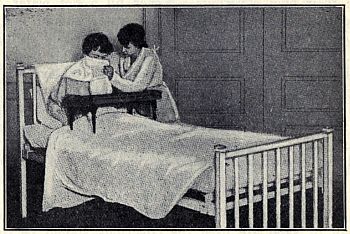 ADMINISTERING AN INHALATION
Fomentations or stupes are pieces of flannel wrung
out of very hot water and placed on the skin. They
should be two or three times as large as the part to be
treated, and should be applied as hot as the patient can
bear them, without burning the skin. Have two sets,
so that one set will be ready to put on when the other
is taken off. The stupes should be wrung as dry as
possible and as they must be very hot to do any good,
a fomentation wringer is a great protection for the
hands. One may be made by putting halves of a broom
handle through the ends of a short roller towel in the
middle of which the fomentation has been placed. By
twisting the sticks in the opposite direction the fomentation
can be wrung very dry. Take it to the bed in the
wringer and do not open until ready to place on the
skin, as it will lose its heat very quickly. Put a little oil
or vaseline on the skin and apply the fomentation gradually.
Cover with a dry flannel and put wadding over
that. A piece of oiled skin or oiled paper between the
wadding and the dry flannel helps to keep in the heat and
moisture. Hold in place with a towel or binder pinned
tightly.
Cold is applied by means of ice bags and by cold
compresses. In filling an ice bag the ice should be in
small pieces, and the bag not too full. Expel the air
as from a hot water bag. Cover with a towel or a
cover for the purpose. Never put the rubber near the
skin, it may freeze if so left. Besides, the cover absorbs
the moisture that collects on the outside as the
ice melts.
Cold compresses are a common remedy for headache.
Old handkerchiefs are excellent for this purpose. Fold
in frayed edges, two or three thicknesses will be heavy
enough, and have two, large enough to cover the forehead.
Wring one out of ice water so that it will not
drip, and put on the forehead. Keep the other on a
piece of ice and change the two applications frequently.
When applied to the neck a dry cloth should be placed
outside to protect the pillow or the patient's clothing.
Cold compresses for inflamed eyes should be of one
thickness only, and a little larger than the eye. Have a
number and change very often. Use a separate compress
for each eye. If there is a discharge a compress
should not be used a second time. The discarded compresses
should be collected in a paper bag or wrapped in
newspapers and burned.
When cold compresses are applied to the head there
should be a hot water bag at the feet.
Gargles, sprays, and inhalations are often ordered for
sore throats and colds.
Salt or soda added to water in the proportion of a teaspoonful
to a pint makes an excellent gargle.
A very cold gargle or one as hot as can be held without
burning is better than a tepid one.
Do not go out in the cold air directly after using a
hot gargle.
Use at least six separate mouthfuls each time you
gargle, and hold long enough at the back of the throat
for the gargle to reach every part.
A spray should not be used for the nose without a
special order from the doctor. The liquid sometimes
gets into the passage leading to the ear and causes earache.
Always wipe the nozzle of the atomizer before using.
It should be cleaned after each use and boiled, if another
patient is to use it. Always boil the nozzle and
clean out the bottle when the atomizer is to be put away.
Keep it in a box where dust will not reach it.
Inhalations are useful to relieve difficult breathing
and for loss of voice or hoarseness. Fill a pitcher, bowl,
or basin, two-thirds full of boiling water. Wrap with
a towel to prevent burning if it should touch a patient.
Usually drugs such as peppermint spirits, oil of eucalyptus,
or tincture of benzoin, in dose of a teaspoonful to
the hot water contained in the receptacle, is enough. If
no drug is at hand, the steam itself may be depended upon
to do some good. Pin one end of a bath towel around the
face below the eyes and spread the other over the pitcher
inhaling the steam as it rises. It may not be possible
to induce a child to do this, in which case make a tent
of an open umbrella with a sheet thrown over it at the
head of the bed, leaving the front a little open. Place
the pitcher so that the child will get the steam and hold
the pitcher carefully all the time. Do not let the pitcher
touch the patient.
Another means of inhalation is to hold a funnel, made
of a piece of folded paper in the nose of a kettle of very
hot water, near the patient so that the steam can be inhaled.
Be very careful not to scald the patient. After
a steam inhalation one should not go out in the cold
air nor have the windows opened for an hour or more.
Common Medicines and Other Remedies
It is a very safe rule never to take medicines oneself
without a doctor's orders. Above all, never advise others,
even when you know from experience that certain medicines
have helped yourself and others. Medicines should
be taken upon prescription from the physician, should
be measured accurately, and given at the exact hour
ordered.
Read carefully the label or box from which you take
the medicine before and after opening or uncorking,
and read the name again when putting back in its place.
Many people have been poisoned by not reading the
label. Have all glasses and spoons, etc., thoroughly
cleansed before and after using.
Accuracy, attention, cleanliness, regularity should be
watchwords.
In giving either food or medicine, the following measures
are helpful:
| 1 | teaspoonful measures 50 grains. |
| 2 | teaspoonfuls make 1 dessertspoonful. |
| 2 | dessertspoonfuls make 1 tablespoonful. |
| 2 | tablespoonfuls make 1 ounce. |
| 8 | ounces make 1 cupful or glassful. |
| 16 | ounces make one pint, or pound. |
| | (This applies to either liquid or dry measure.) |
In giving pills, capsules, tablets give a drink of water
first to moisten the tongue and throat. This helps them
to slip down more easily.
If there is danger of a pill or tablet choking the patient,
crush the pill or tablet between two spoons.
When medicines are taken by spoon, the spoon should
be licked by the patient in order to get the full amount.
Nearly all medicines should be mixed with water, and
should be followed with a drink of water unless orders
are given to the contrary.
Keep all medicines tightly corked.
Buy medicines only in small quantities, as most of
them lose their strength in time.
In buying vaseline or cold cream it is better to have
it in a tube than in jars. Being opened and dipped into
constantly soon makes the contents of a jar unclean.
Common Remedies
Such remedies as the following are to be found in
many homes.
Castor oil, clove oil, vaseline, baking soda (this is
the same thing as bicarbonate of soda or saleratus), salt,
lime water, alcohol, camphorated oil, spirits of camphor,
flaxseed, aromatic spirits of ammonia. Do not confuse
this latter remedy with ammonia water used for cleansing
things.
Castor oil should be taken in these doses:
| Baby: 1 to 2 teaspoonfuls. |
| Older children: 1 tablespoonful. |
| Adult: 1 to 2 tablespoonfuls. |
There are many ways of taking castor oil. Heat the
glass or spoon, put in some orange or lemon juice, then
the oil, then more juice. Open the mouth wide and put
the oil far back. Have more juice at hand to swallow immediately
after. Chilling the mouth by holding a piece
of ice in it for a few minutes also helps to disguise the
taste. A couple of tablespoonfuls of lemon or orange
juice with a quarter of a teaspoonful of soda mixed
thoroughly with the oil will make it effervesce so that
it is not unpleasant to take.
If the dose is vomited, wait a little while, then give
another. Do not give directly before nor directly after
a meal.
Olive oil is often taken in doses of one or two teaspoonfuls
after meals to regulate the bowels or to help people
gain weight or when the appetite is small. It is also used
to rub into the skin of under-nourished babies and to rub
sick people, especially if the skin is very dry. After
rubbing with oil always wipe the skin with a towel.
Vaseline is used to grease sore and chafed parts. A
little may be inserted into the nostrils for a cold. Camphorated
vaseline is especially good for this. In case of
an irritating cough that keeps a child from sleeping, a
little plain pure vaseline may be put in the mouth, and
it will be found very soothing.
Vaseline is also used to grease such utensils as nozzles
and to put on the parts to which poultices or fomentations
are to be applied.
Soda may be used for burns (moisten and apply as a
paste), as a gargle (one teaspoonful to a pint of water),
as an enema (the same proportion), for colds (a teaspoonful
in a quart of water to be taken internally in the
course of each day), and in bilious attacks, water with
this amount of soda may be given. Also to get a person
to vomit, in which case the water should be slightly warm.
Salt may be used as a gargle in the same way as soda,
and even mixed with soda, also for enemas. Coarse
salt, when heated and put into bags, may be used when
there is no hot water bag.
Lime water is used in mixing the baby's milk and is
put in the milk for sick people when they cannot take
full strength milk. The usual proportion is two tablespoons
of lime water to a half glass of milk, which makes
about 1 part of lime water to 3 parts of milk.
Alcohol may be used to disinfect the more delicate
utensils as the thermometer. Most alcohol now obtainable
is wood alcohol or denaturated; that is, mixed with
powerful poisons, so that it should never touch the
mouth. Never place a bottle of alcohol near a flame.
If it is ever necessary to use an alcohol lamp, use the
solid alcohol. It is much safer.
Camphorated oil is often used to rub the chest and
neck with in case of colds. It should be warmed and
rubbed in thoroughly. Protect the bedclothes and the
patient's clothes with towels. After rubbing, wipe and
cover the part with a flannel, to prevent chill.
Spirits of camphor or aromatic spirits of ammonia,
a few drops on a handkerchief or piece of cotton, held
five or six inches from the nose, relieves faintness. Inhaling
the camphor in this way will often make it easier
to breathe through the nose in case of a head cold. Fifteen
drops of aromatic spirits of ammonia in a tablespoonful
of water may be given to anyone recovering
from a faint or to relieve nausea.
Flaxseed tea is an old-fashioned remedy for coughs.
Pour a quart of boiling water over two tablespoonfuls
of flaxseed and let it simmer for two or three hours,
or until reduced to about a pint of tea. Strain through a
fine strainer several times so that it will not be stringy,
flavor with lemon, and add honey or sugar. Put in a
covered jar, and take a teaspoonful at a time to relieve
irritation in the throat.
The Daily Clean-Out.—People, sick or well, should
have a bowel movement once or twice a day. Taking
medicine for this purpose is a very bad habit. If healthy
people have the proper exercise and food, and drink
plenty of good water, medicine is not necessary. Eating
coarse grained food, as bran muffins, corn meal porridge,
fruits, and vegetables, drinking plenty of water, exercising
in the open air, and having a regular time for going
to the lavatory (immediately after breakfast and the last
thing at night before retiring are suggested times) are
habits that are usually sufficient to keep the bowels in
good order.
If the waste matter is not carried off by the bowel
movements, the body will in time become poisoned by the
decayed substance in the intestines, and illness follows.
Many headaches, "tired feelings," "blues," and even appendicitis
may be caused by constipation.
People who are sick and therefore deprived of taking
exercise to help in keeping their bowels regular, need to
have very special attention paid to their diet and to have
plenty of drinking water always at hand. Also they
should have bedpan or whatever other attention they
need regularly, and when asked for, immediately.
Chill, if due to exposure, may be treated by giving a
warm bath or a foot bath, and putting to bed between
warm blankets and with hot water bags. Rub briskly
under the covers and give a warm drink such as tea,
coffee, milk, etc.
Some Common Ills and Their Treatment
When a chill is not merely due to being cold, give
the same treatment except the rubbing, take the temperature,
and if there is fever, send for the doctor, as it
may be the beginning of an illness.
Colds or cramps, or pain in the bowels may be caused
by constipation, by gas, by undigested food, by the
monthly period or more serious causes. Apply heat (hot
water bag or fomentation), sip hot water in which is a
little baking soda (one-half teaspoonful to a cup), or a
few drops of peppermint. Try a hot foot bath. Lie
down and keep very quiet with a hot water bag at feet.
If pain continues, except in the case of the monthly illness,
empty the stomach either by putting the finger
down the throat or by drinking warm water and soda
until vomiting starts. Take an enema or a dose of castor
oil. If the pain still continues, send for a doctor.
Convulsions. Send for a doctor at once. Loosen all
clothing, undress if possible. Watch and prevent patient
from hurting herself. Do not try to restrain. Try to
force a spoonhandle wound with a bandage between the
teeth, to prevent biting of tongue. Keep lying down
with head slightly raised. As soon as possible, administer
enema or dose of castor oil. Put ice bag on
head and hot water bottle to feet. Keep warm. A child
may be put into a warm bath and held until convulsions
subside. Keep very quiet and handle as little as possible
when the convulsion is over, as handling may cause a
repetition of the twitching.
Croup. Give steam inhalation. Keep a kettle of very
warm water in the room. If this is not possible, fill the
bathroom with steam by turning on the hot water, and
take the patient there. Put hot fomentations to neck,
chest, and abdomen. Send for doctor, who will usually
order medicine to make the child vomit, which brings
some relief.
Earache. Use hot applications against the ear. A
heated glass or a cup in which there is a cloth wrung
in very hot water, held against the ear may be found
very comforting. Never put drops nor anything else
into the ear canal. Either send for the doctor or take
the patient to him, as there may be a developing abscess
which needs to be opened.
Fever. Patient should go to bed in a well ventilated
room and keep quiet. The bowels should move freely
and plenty of water be taken. Bathing the hands, face
and neck or rubbing with alcohol gives relief, especially
if there is restlessness. Only liquid food should be
given, and even that should not be urged.
Headaches. The commonest causes of frequent headaches
are eye-strain and indigestion. The cure is being
fitted with glasses and taking a proper diet. Rest and
quiet, careful eating, cold compresses to the head, a hot
water bag to the feet, or a foot bath will usually relieve
an ordinary headache. Sometimes, as when there is
constipation, a dose of castor oil is necessary. An enema
will often give instant relief. Never take headache
medicines unless a doctor has specially ordered it. These
medicines may contain powerful poisons. The danger
of taking them is that while for the time being they may
relieve the headache, the cause of the headache remains,
and the headache returns unless the cause, such as eye-strain
or indigestion, is removed.
Hiccoughs can be usually stopped by drinking a glass
of water in sips while holding the breath. They are
usually caused by eating too fast or by some form of
indigestion.
Colds, Their Prevention and Care
Everybody knows that colds are "catching." People
who are over-tired or under-fed, who stay too much in
either under-heated or over-heated rooms, or who do not
bathe regularly, or who do not get exercise enough in
the open air, are those most likely to catch cold.
If you have a cold yourself, stay away from others
if possible, and do all in your power to prevent others
coming close to you. Cover the mouth when coughing
or sneezing, use paper or old rags instead of handkerchiefs
and then burn them; wash your hands before
touching things others are to use, and use separate dishes,
which should be kept entirely apart from the family
dishes and washed separately. If such precautions are
taken by the first member of the family to take cold, it
would seldom spread through the family.
When people around you have colds, avoid getting
close to them, gargle often, take deep breaths of fresh
air whenever possible, wash your hands often and keep
them away from your nose and mouth.
You do not need to be told that the handkerchief used
by anyone with a cold is full of germs. It should be
kept from touching other things and should never be
left lying around.
If, at the first signs of a cold, a good dose of castor
oil is taken, a glass of hot lemonade and a hot bath before
going to bed, a cold may be "broken up," as we say.
In mild weather, the windows may be left open, but if
the weather is very cold it is better to air the room from
another room, in order to keep an even temperature, but
there should be good ventilation.
If the throat is sore, gargling and a cold compress to
the neck will bring relief. If there is fever and headache,
you have already been told what to do. Anyone
with a cold should eat very lightly and drink plenty of
water. They should be as quiet as possible and get all
the rest and sleep possible.
Camphorated or plain vaseline may be put in the nostrils,
and if there is a cough, plain vaseline may be taken
internally—placed on the tongue at the back of the
mouth. A spoonful of flaxseed tea taken as often as
necessary to relieve irritation may bring relief. Inhalations
are helpful in hoarseness. Never give any cough
medicines except what are ordered by a doctor.
If the symptoms continue after the first night it is
advisable to call a doctor, as what seems a slight cold
may be the beginning of a serious illness, as measles,
scarlet fever, pneumonia, etc. If there is earache, rapid
breathing, great weakness or sleepiness the doctor should
be called at once.
Any symptom that lasts after a cold, as pain in one
part, weakness, or high temperature, needs a doctor's
attention.
Food for the Sick
Food for the sick should be light and easily digested.
Generally the doctor says what may be eaten. Such
foods as the following are included in so-called invalid
foods: Milk, milk soups, eggs, raw and soft-cooked,
rennet, custards, ice creams, albumin water, well cooked
cereals, gruels, broths, toasts, milk toast, jellies made
with gelatine, such as lemon and wine jelly; macaroni,
spaghetti, well-cooked bread (never fresh bread), tea,
coffee, cocoa.
Sick people should have their meals as regularly as
possible, at regular hours and promptly and attractively
served. The tray, the dishes, the tray-cloth, should be
spotlessly clean, and the tray should not be over-loaded
with dishes or food. If it is necessary to bring all the
food for a meal to the room on the tray at once in order
to save steps, remove some of it, perhaps the dessert,
until the patient is ready for it.
Before leaving the room to prepare the tray, arrange
everything so that the patient may eat the food as soon
as it is brought. As a rule it is better for the sick member
of the family to have her meals served before the
family sits down to the table, so that she may have her
food fresh and hot, and not get tired waiting.
Try to have food that the patient likes, if possible. If
she does not like what may be served her, it may be
served so attractively that her appetite may be tempted.
All food should be tasted before serving. Serve hot
food hot, and cold food cold.
Milk is the most nourishing of liquid foods. If it is
to be heated, do not let it boil. Always take the chill
off milk served to children.
Generally speaking, cooked food is better than uncooked,
even fruits. Baked apples or apple sauce, for
example, are safer to give the sick than raw apples.
Toast is better than bread. Toast upon which the
butter has melted should not be given to a sick person.
Have the toast hot, and butter each mouthful as eaten.
Bread should be at least one day old before being given to a
sick person. Hot breads, such as fresh rolls and biscuits,
are not good foods for ill people. Fried foods should
be kept from invalids and children.
The best way to prepare a potato for an invalid is to
bake it. It should be served when it is light and mealy,
and never after it has become soggy.
The best way of cooking meat is to broil it, having
the outside well browned, and the inside soft and juicy,
never dry and hard.
A Tray for Liquid and Soft Food
The tray should be large enough to hold two glasses
or a cup and saucer and a glass, as well as salt or sugar.
Put two spoons on the tray, and if the patient is using
a tube or a feeder, put that on the tray. One of the
glasses should contain fresh water. Offer a glass of
water before and after the nourishment.
The tray for soft solids. Suppose the meal is to be
boiled rice, or other cereal, and toast. The tray should
have a fresh doilie, salt, sugar (covered), a glass of
water, two teaspoons, a knife, if butter is allowed on the
toast, and a small pitcher of milk or cream for the rice.
Put the cereal in a deep saucer or small bowl, cover
with a plate or saucer and rest on another plate. Spread
a small napkin on another plate. Put the toast on it,
then wrap the napkin around it to keep hot.
Sick people should have plenty of water to drink.
Besides having a pitcher of fresh water and a glass where
it may be easily reached, always put a glass of fresh
cool water on the tray when food or medicine are brought.
While ice water is bad for both sick and well people,
the water should be cool enough to be agreeable and
refreshing. Water that is chilled to the right temperature
by being kept in the ice chest, bottled, is preferable.
It should be drunk slowly and not gulped down. Water
standing in the room should be kept covered at all times.
Feeding Helpless Patients
A patient is often so weak that she cannot lift her
head in order to eat. In this case she would be given
liquids through straws or by spoon or "feeder." Sometimes
by putting a small quantity of liquid in a glass, two
tablespoonfuls, a patient is enabled to drink without
spilling a drop.
If necessary, slip one hand under the pillow, raise
the head a little, holding the glass to the lips with the
other. Anyone lying down should take food very slowly.
If solid, it should be cooked, especially well, as there is
danger of choking.
Tubes should be washed immediately after using. If
used continuously they should be cleaned with a tube
brush made for that purpose. Straws should be burned
or destroyed. If feeding with a spoon, be careful that
neither the food nor the spoon burns the lips or mouth.
Feed slowly and a little at a time, allowing plenty of
time between mouthfuls.
Occupying and Amusing the Sick
When people are recovering from an illness, or when
they are what we call chronic invalids, they often enjoy
and are helped by being amused or occupied. At this
time a Girl Scout may be very helpful. First of all, she
should be cheerful herself. Then she should be able to
play two or three quiet games, such as cards, dominoes,
checkers, and be able to read aloud and to tell cheerful
and amusing stories. Children may often be kept quiet
and happy by hearing little rhymes recited. It might
be a good idea for every Girl Scout to be able to tell
three short stories and three funny stories, know three
conundrums and three short poems, play three quiet
games of cards, play checkers, play dominoes and know
three puzzles.
Excitement is always bad for sick people and they
become tired easily, so they should not be read to, talked
to, nor played with for too long an interval, even if
they seem to wish it themselves. The Scout must always
remember that these things are being done for the pleasure
of the sick person, and she must be very patient, to
let the games or stories be of their own choosing if they
wish it, and to avoid being noisy herself.
Daily Routine
There should be a regular daily routine. Have regular
hours for feeding, bathing, giving treatment and medicines,
giving the bedpan, etc. Be punctual.
Usually the first thing to do in the morning is to close
or open the window as necessary, and to give the patient
a bedpan. Have it warm. Take temperature, pulse and
respiration and record them. Bring a basin of warm
water, soap, towel, etc., to wash hands and face, and a
glass of water to brush teeth. Tidy the hair. Straighten
up the room a little. Prepare and serve patient's breakfast.
After an hour the bed bath may be taken, but a tub
bath should not be taken until two hours after breakfast.
Make the bed. Clean up the room. If the patient is
well enough, let her read or see visitors after this. Serve
the dinner. After dinner, open the windows, lower the
shades, and let the patient rest and sleep if possible for
at least an hour. Sick people need more rest than well
people and should have a regular hour for rest in the
daytime. If they sleep, so much the better, as it has
been proved that patients who take a nap during the day
sleep better at night. After four o'clock give a drink of
some kind of hot or cold substance, as needed or desired—broth,
milk, lemonade. In the late afternoon sick
people are often tired and restless. Change of position,
rearrangement of the pillows or a good rub give comfort
and relieve the restlessness. Diversion of some kind,
nothing noisy or exciting, may serve the same purpose.
It may be found wise to delay the bath until this time of
day as bathing has a soothing effect.
Between supper and bedtime the sick person should
be kept from excitement. This is a good time for reading
aloud or allowing them to read for themselves, but
a very poor time to see visitors.
Preparations for the Night. Bring in all the necessities
for washing the hands and face and brushing the
teeth and combing the hair, and help where needed.
Change the nightgown (it is better to have a gown for
the day and one for the night), brush the crumbs from
the bed, make the sheet smooth, shake up the pillows
and straighten out the bedclothes, having extra covers
handy in case of need. Fill the hot water bag, attend
to the fire, if there is one, and arrange everything in
the room just as it will be needed for the night. Give
a warm drink, and allow the patient to rinse the mouth
(or, if wished, the brushing of the teeth may be delayed
until this time). The last thing to do for the sick person
is to give a good rub, paying special attention to the bony
parts (lower end of spine, shoulder-blades, hips, knees,
ankles). Then arrange the ventilation.
Before settling a sick person for the night, be sure
that everything about the room is done, as any moving
about after she is prepared to sleep may tend to disturb
her and prevent her from going to sleep.
Has the town you live in a free swimming pool with
instructors and well arranged hours for little children,
older girls and boys and grown-ups? Can you step out
after school and have a couple of hours on a well kept
tennis court? Is there a good golf course reasonably
near, with convenient trolley service? Are there plenty
of playgrounds, so that the children are off the streets?
And, since grounds are not enough, are there friendly
young play-leaders connected with them, to get the children
together and teach them all sorts of games and
sports?
If none of these things are to be found, or not enough
of them, wouldn't you like to have them?
"Of course I should," you reply, "but what can I do
about it? I am only a girl, and I can't get all these things
by just wishing for them!"
But that's just what you can do.
All these things in a town mean that the town is
looking out for the health of its young people. Exercise
is one of the most important means of preserving health,
and most of the large cities nowadays are working hard
to see that no child shall be out of reach of a good park,
a good swimming pool and a good playground.
This all comes under the city government and as this
is a democratic form of government, these things are all
arranged by vote. That is, the citizens vote to use the
public money for such things and vote for the officials
who shall spend the money for them. Do you see that
if you make up your mind now about the village improvements
you want, you can vote for them later and get
them?
Women are naturally interested in all that happens
to children, and if all the women of a community should
get together and vote for everything that concerned the
health and happiness and good education of children,
can't you see what happy days their school-days would
be?
If you saw "Public Health" at the head of a chapter,
you might not think it looked very interesting; but when
you once get the idea that if your mother had had her
say on the Public Health Board you would have had a
fine skating pond with a good skate-house, last winter,
and sunny, well-aired school rooms to study in, with a
big gymnasium for basket ball in bad weather, you may
be more interested in the merit badge for Public Health
called "Health Guardian!"
Remember that Public Health is simply good housekeeping,
applied to the community.
It is a subject which women are sure to take up more
and more, and a Girl Scout who has given the matter a
little thought and study is going to make a good citizen
later on, and will be certain to have her advice asked—and
taken—in the matter of making her town healthy and
happy.
For instance, if the desks in the public schools are not
of the right height and shape, the children are bound to
suffer in their health and hygiene.
It is the business of the State to see that all public
buildings, schools, theatres, factories, etc., have a certain
amount of light and air to the cubic foot, because
so much is necessary for health.
It is the business of the State to see that only a certain
number of hours a day should constitute a day's work.
This is because a certain amount of rest is a necessity
for all citizens.
It is the business of the State to see that food and
water can be brought into the community. Also that they
be kept pure, both in transportation and after they reach
the community. This includes the policing of all reservoirs
and the filtering of the water; the refrigerating of
meat and milk; the condemning of rotten fruit and vegetables;
the collecting and disposal of all garbage and
waste.
It is the business of the state to prevent spitting in
public places, (one of the greatest sources of public
infection); to prevent the use of common drinking
utensils, towels, etc.; to insist on the isolation of contagious
diseases and the placarding of the houses where
they occur.
In order to carry on these great wise policies the state
should offer free clinics where citizens can find out what
is the matter with them and how to prevent it, and trained
community nurses for the sick.
Do you see what a wonderful power an intelligent
woman can be in the community she lives in? Women
ought to be much better, really, in this public housekeeping
than men, because most of them have had to
learn to do it on a small scale, and know how necessary
light, air, rest, exercise and cleanliness are.
But, you may say, as yet, I am too young to vote, anyway;
what can I do?
The answer is very simple: every citizen, whether she
is young or old, whether she has a vote or not, can find
out the laws of the town she lives in and help to enforce
them!
And the most important of these laws are those which
affect the public safety and the public health. Whether
there is a Public Health Commissioner or a Town Board
or a Village Superintendent or only a District Nurse to
appeal to, there is sure to be somebody whose business
it is to listen to violation of the law.
If every troop of Girl Scouts knew the health laws of
their town, and helped to get them obeyed, there would
be a wonderful lessening of epidemics and a wonderful
advance in the health and beauty of our towns.
If the Girl Scouts stood, all over the country, for the
intelligent guardianship of the public health and recreation,
they would rapidly become one of the greatest and
most respected organizations in America, for this reason
alone.
"... For since a little self-control, since
a clean and elementary diet, pure water, openness
of the body to sun and air, a share of honest
work, and some degree of mental peace and largesse,
are the simple conditions of health, and are
or ought to be, accessible to everybody—
"To neglect these is sheer treason."
—Toward Democracy, by Edward Carpenter.
Five Points of Health for Girl Scouts
A cheerful Scout, a clean Scout, a helpful Scout, is a
well Scout. She is the only Scout that really is prepared.
She not only knows the laws of health, she lives
them: she stands tall, she plays daily in the open air,
she rests and sleeps at night, and conserves her energy
at all times, she is careful to get the right amount of air,
water, sun and food each day, and perhaps most important
of all, she keeps clean.
1. Stand Tall—Every Scout should be recognized a
long way off, not only by her uniform, but by her erect
carriage. In sitting, the lower back should be against
the back of the chair. In bending forward to read or
write, bend straight from the hips. At Scout meetings
practice sitting without support for the back. When "at
ease" during drill, stand with feet apart and parallel and
with hands hanging free. When resting, lie flat on the
back without pillows. Correct posture is obtained by
balancing the different parts of the body—hips, head,
chest in a straight line, so that the bony framework bears
the weight. The muscles and ligaments will not then be
strained, and the bones will not be forced into an abnormal
position. Two rules to remember are: "Stand
tall" and "Keep your spine long."
2. Take Exercise—If you have watched soldiers obey
commands in drill you know how quickly their joints
and muscles work. The setting-up exercises given in
the Handbook have been planned to preserve the power
of joints and muscles, and to prevent them from becoming
like rusty machines. These exercises should be taken
with windows open, if not out of doors. Clothing should
be light and loose, and corsets removed. These exercises
are not to be considered a substitute for vigorous outdoor
work or play, but only as supplementary to or when
these are impossible. The day should be planned to
include at least an hour and a half of vigorous activity
in the open air. This will take different forms, according
to the place and season, so that in the summer one
may swim, row or paddle, or play tennis or any other
game outdoors, and in the winter skate, coast or snowshoe.
However, the best all year round exercise, and
the simplest and easiest to get is walking. Five miles
a day is an adequate average. Even walking alone is
good exercise, but walking in a group or two and two is
better, because keeping step, singing, whistling and talking
and laughing together add enormously to the exhilaration
of motion and of sun, wind or rain in the face.
A Girl Scout should avoid unusual exercise before,
during and immediately following menstruation. However,
she should remember that a reasonable amount of
exercise at this time is quite normal and beneficial, except
where there is an actual disorder of some sort.
In this case a physician should be consulted.
3. Rest and Conserve Energy—Go to bed early and
sleep from eight to eleven hours, according to age. Sleep
with windows open all the year round. Rest sometime
during the day, flat on the back if possible, but even
five minutes sitting quietly with hands in the lap and
eyes closed is better than nothing. The following table
shows the number of hours of sleep that are needed at
different ages:
| Age | Hours of Sleep |
| 10 and 11 years | 9½ | to | 11 |
| 12 and 13 years | 9 | to | 10½ |
| 14 and 15 years | 8½ | to | 10 |
| 16 and 17 years | 8 | to | 9½ |
| 18 and 19 years | 8 | to | 9 |
| 20 and over | at | least | 8 |
Save Your Eyes
The reason it is important to rest and to sleep enough
is because it is while at rest that the body regains energy
lost during activity, and stores it up for future work and
play. There are other ways of saving energy, and one
of them is by keeping the body in such good repair that
like a good machine it does its work with a minimum
expenditure of force and heat. This is the main reason
for the setting-up exercises, or indeed for any sort of
exercises. Perhaps the single best way to save energy
is by saving your eyes. There is almost no work or play
that does not involve the use of our eyes. If people are
blind they can learn to do many things without vision,
but it is infinitely harder than with it. Modern life,
especially in cities, makes a constant demand on our eyes,
and more than this, the demand is on one part of the
eyes—the muscles concerned in near work. The best
way to rest the eyes, and one which not only rests the
tired parts but exercises the parts that are not used, is
by doing things that will involve distant vision. Walking
and looking far ahead and far away on every side rests
the eyes best of all, and this is one reason why a good
walk will often clear up a headache. Another way to insure
distant vision is by riding backward in a car. Then
as the landscape flows past you, your eye muscles relax
to the position needed for distant vision. If you cannot
walk or ride and are doing close work, like sewing or
reading, look up and "at nothing" every once in a while.
The following are some important rules to remember
in saving your eyes:
Rest your "near" eye muscles by looking at distant
objects and places.
Do not work facing a light or where the rays from a
light cross your field of vision directly.
Work so far as possible by indirect or reflected light.
If you must work near uncovered artificial lights, wear
an eye-shade.
When sewing or writing have the light at your left,
unless you are left-handed. This is to keep the shadow
of your hands from the work.
Avoid a glare or light that is in streaks or bars of
alternate dark and bright. Diffused, even light is best.
Have your eyes examined by a competent oculist immediately:
If you have headaches,
If the eyes sting or burn after using,
If print or other objects dance or blur,
If you must get close to your work to see it,
If near work tires your eyes or you,
If there is the slightest irritation or soreness about the
lids or other parts.
How to Avoid Muscle Strain
Girls and women in attempting to live an outdoor life
or indeed when trying to do many of the things numbered
among the Scout activities, such as First Aid,
Home Nursing and Hiking, often give themselves quite
unnecessary pain and fatigue from lifting, pulling and
carrying weights in the wrong way. Ability to carry
and lift or move is not so much dependent upon absolute
strength as it is on knowing how. The whole body, so
far as it is a physical mechanism, may be thought of as
a series of levers, of which the muscles, bones, and
joints make up the parts and are fulcrum, power arm
or weight arm as the case may be. Without going into
the details of bodily structure or even knowing the names
of the different bones and muscles, it is possible to learn
a few simple things about the right use of these levers
that will be useful at all times.
Certain parts of the body are more able to do heavy
work than others, and the first thing to remember is that
the upper part of the back, the shoulders and the upper
arms are stronger than the lower back, the abdomen
and the lower arms. Therefore, whenever you are trying
to lift or move an object, see if you cannot use
these stronger parts. If the arms are held away from
the body when lifting, pulling, throwing or pushing, the
muscles of the upper arm, the shoulders and the upper
back will be brought into play. If the arms are held
close to the body, the lower-arm muscles are unduly
taxed and in trying to help them out, pressure is made
on the abdominal and pelvic muscles, which are not
fitted to bear this sort of strain. Therefore, in carrying
a bag or suitcase, where this is absolutely unavoidable,
try to swing the arm free from the body, so as to use
the upper arm and back muscles for the weight.
Another important way to save strain is by pushing
instead of pulling. It is almost impossible to push anything
so hard as to injure your back or abdominal muscles.
It is almost impossible, on the other hand, to pull
even a relatively light weight without some strain. If
you will think of how a horse in harness actually exerts
his strength in drawing a wagon, you will see that what
he does is to push against the straps, and it is the straps
that pull the wagon. Even the strongest horse could
not pull a wagon with his teeth very far, or pull something
tied only to the back leg muscles. Get behind and
push is the rule to remember, and never resort to pulling
until you have tried every device for pushing instead.
If you must pull, try to use heavy muscles, such as leg
muscles, to do it with. Often a weight may be lifted or
pulled by getting the foot under or in back and using
the arms only to steer with. This applies particularly to
objects like trunks or bureaus.
Always take advantage of any natural leverage that
you can and if you must move something heavy, do not
lift it at once and attempt to carry it, but lift one end
and swing or shove it and then lift the other end and
shove it. If you will watch expressmen at work you will
notice that they roll boxes and trunks, holding them
almost on end and tipping them just enough to turn
them along their shortest axis. In this way the boxes
carry themselves, so far as their main weight is concerned.
Carrying a weight on the head or shoulders is another
way of converting a pull into a push, and this is taken
advantage of by peasant women in Europe, who often
are seen carrying heavy weights to market in baskets
perched on their heads, while they stride along arm-free.
A knapsack strapped on to the shoulders is not only
more convenient because it leaves the arms and hands
free to swing naturally or use for other purposes, but
because the weight is distributed and is carried by means
of heavy muscles pushing up under the strap. A weight
should be distributed over a set of muscles as evenly as
possible, and this is the reason for suspending a knapsack
from two shoulders instead of one, when possible.
Finally, in doing any sort of lifting or pulling, if the
muscles that are to be used are contracted before grasping
the weight they will be able to do their work with
far less effort. Try lifting a small weight like a book in
two ways—first, have your hand and fingers relaxed
and limp when you grasp it, and see how heavy it seems
and how hard it is to contract your muscles properly
while lifting it. Then drop the book and go at it again,
this time anticipating its weight and contracting your
hand and finger muscles before grasping it. See how
easily it comes up. Try this same thing with heavier
weights, and learn always to contract the muscle before
taking the load. In carrying a weight for any distance
it is well to shift it from one arm to another, always
preparing the muscles by contracting them before the
weight is assumed.
Using the muscles so as to take advantage of their
lever-like qualities in the best way, contracting them before
loading, and pushing instead of pulling, go to make
up what is sometimes called "getting a purchase."
4. Supply Daily Need for Air, Sun, Water and Food—Besides
exercise and rest there are other controllable
factors upon which health depends. These are air, heat
and light of the sun, water and food. To grow and work
properly the body needs plenty of each of these.
Air—If you cannot work or play outdoors you can
still bring out of doors in by opening your windows at
frequent intervals. You will find that work goes better,
and that you do not tire so easily if you make it a rule
to open the windows and doors and move about the room
for five minutes every hour or two. Sleep with windows
open or out-of-doors. Camp and hike as often as
possible. Work in the garden. Play out-of-door games.
Heat—The proper temperature of the body is between
98 and 99 degrees Fahrenheit. Human life depends upon
the maintenance of this temperature at all times, and very
slight changes either up or down interfere seriously with
all the other life processes. The main source of heat is
from food consumed, or really burned, in the body.
Artificial heating in houses helps conserve the body heat,
as does clothing. But clothes and shelter may make you
overheated, which is nearly as bad as being cold; they
may also shut out fresh air. Clothes should not be too
heavy nor too tight. Shoes should have soles straight
on the inner side, and be broad enough to allow the toes
full play, and have low heels. Shoes that are comfortable
to hike in are apt to be the best for all the time wear.
At night the clothes worn during the day should be
aired and dried thoroughly. This will help much in maintaining
the right body temperature, because clothes become
damp from wearing, and dampness uses up body
heat.
Sunlight—Sunlight is one of the best health bringers
known. Little children—and grown people, too—suffering
from the most serious forms of tuberculosis, that of
the bones, get well if they are kept in the sunlight. In
one of the finest hospitals for children in the world, in
Switzerland, the main treatment is to have the children
play outdoors without clothes in the sunlight, and they
do this even when there is heavy winter snow on the
ground. Human beings droop and die without the sun,
just as plants do, though it takes longer to kill them. It
is a gloomy person who does not feel happier in the sun,
and a happy and cheerful person is generally healthy.
So get into the sun whenever you can. Walk on the
sunny side of the street, and open your windows to the
sun whenever you can. However, in hot climates and
in the warmest summer days, remember that the sun can
injure as well as help, and do not expose the head or
body unnecessarily.
Water—As about three-quarters of our body weight is
water, the solid portions of bone, muscle, and so forth,
constituting only one-quarter, and as considerable water
is given off each day by evaporation from skin and lungs
and with excreta, the loss must be made up. In addition
to the water taken with meals and contained in the food
a Girl Scout should drink at least six tumblers of
water daily. This is a quart and a half. One glass
should be taken on arising and before breakfast, two
between breakfast and lunch, two between lunch and
dinner, and one before going to bed. Be sure the water
is pure, and boil any water the purity of which is doubted
in the slightest. Water kept cool in the ice chest, or in
a jar with a moist cover, is better than ice water, both
because cool water actually quenches thirst more easily,
being more readily absorbed than ice cold water, and
because it is difficult to control the purity of ice.
Food—Food should be clean and kept clean. Growing
girls can tell whether they are eating enough of the
right sort of food, and if they are getting the best out
of it, by seeing whether they are up to the right weight
for their height and age. A chart is given at the end of
this section showing the standard weight for each height
at each age. The following are good rules to follow in
making your daily food habits:
Do not eat between meals.
Eat slowly and chew food thoroughly.
Eat freely of coarse cereals and breads.
Eat meat only once a day.
Have green vegetables, salad or fruit every day.
Drink as much milk as possible, but no coffee or tea.
If you do not have at least one bowel movement a
day it is a sign of constipation, which means the accumulation
of waste material from food in the intestine. Exercise,
especially walking, eating coarse vegetables,
coarse breads and coarse cereals, and fruit, and drinking
enough water will help the bowels to move properly.
Constipation is not only an unclean habit of the body,
but it is dangerous, because the waste matter decays
and poison is carried all over the body. Headaches,
indigestion, bad breath and chronic fatigue are some of
the results.
5. Keep Clean—A Girl Scout should be sure that
the air, water and food that she allows to enter her body
are clean. Be sure that they are pure when they reach
her, and keep them so by keeping her body, clothes and
room clean with the help of sun, soap and water. You
have probably heard of germs, microbes and bacteria.
These are names for the same organisms, which are
tiny forms of plant life unseen by the eye, and of which
our unaided senses give us no knowledge. They exist
everywhere and in many forms. Most of them are
harmless to human life, and many of them are useful,
as, for example, one that grows on the roots of peas
and beans and helps the plants to extract nitrogen from
the air. Some bacteria, however, are harmful, and these
are known as disease germs, as they are active in producing
diseases, especially those diseases which we know
as contagious. The dangerous germs nearly all live in
dust and dirt and in dark places. When we clean house
and dispose of waste material and bring air and sunlight
into dark and dirty places we are doing more than removing
unpleasant sights and smells, we are destroying
the breeding places of disease.
Every girl wants a clear skin. Proper food, water
and exercise give this; but it is also necessary to keep
the surface clean by taking a hot bath with soap at least
twice a week, and a cold or tepid sponge and rubdown
the other days. Besides the loose dirt which comes on
the body from the outside, perspiration and oil come
from the inside through the skin pores, and when accumulated
give a disagreeable odor. Special attention is
needed to guard against this odor, particularly under the
armpits, and soap and water should be used daily. A
hot bath is relaxing and opens the pores. A cold bath
is stimulating and closes the pores. A hot bath is best
taken at night, or if taken in the morning, follow by a
cool sponge or shower. Do not take a cold plunge bath
unless advised to do so by a physician.
Always wash the hands immediately before handling
or preparing food and before eating. Always wash
hands after going to the bathroom. Keep nails short,
and clean with nail brush each time the hands are washed
and with orange stick when necessary.
During menstruation it is particularly important to
keep the body and clothes scrupulously clean, by bathing
or washing with plenty of water.
Hair—Air and a good brushing every day will keep
the hair in good condition. It should be washed once
in two weeks. Wash with hot soapsuds and rinse thoroughly,
using first hot, then cooler, and finally cold
water. Keep the hair brush clean by washing in cold
water and soap and a little ammonia at least once a
week. The brush should be dried in the sun, not by
artificial heat.
Ears—Keep the outer surfaces of the ears clean, but
leave the inner part alone. Do not poke for wax or
put oil in the ear.
Feet—Bathe the feet in hot water at night, when tired.
In the morning bathe with cold water after hot, to harden
them for walking. Keep the toenails clean, and cut evenly.
Teeth—Next to a fresh, sweet skin the most beautiful
feature of a truly beautiful woman is her teeth. The
basis of beautiful teeth is a clean mouth. Teeth should
be brushed at least twice a day. The best times are after
breakfast and the last thing before going to bed. A brush
with medium soft bristles should be used. Clean a new
brush thoroughly with soap and water and soak in cold
water to set the bristles. A toothbrush should be cleansed
and aired and if possible sunned every day. Never use
a brush that has begun to lose its bristles, or which has
become caked or yellow. Paste or powder that is not
gritty should be used. Always brush away from the
gums; that is, brush the upper teeth down, and the lower
teeth up. Clean the roof of the mouth and the tongue.
It is a good plan to have the teeth examined at least
every six months. Then any repairs or cleaning that
may be needed can be easily attended to and much future
pain, trouble and expense saved.
Eyes—Wash eyes carefully for "sleepers" in the morning.
Bathing with alternate hot and cold will rest and
strengthen the muscles.
General Safeguards—Do not use public towels or
drinking cups.
Do not use towels, handkerchiefs or other toilet articles
or glasses or cups or table utensils used by others.
Avoid sneezing or coughing into another person's
face.
Measurements
Every Girl Scout should know her measurements, including
her height, her weight, her waist measure, her
chest girth and her chest expansion. Not only are these
things convenient to know when ordering uniforms and
buying clothes, but any physical director, gymnasium
teacher or doctor can tell her if these are in good proportion
for her age and general development and advise her
as to how she may go about to improve them if they
need it.
The accompanying table (given in the last section of
the Health Record) shows the right height and weight
for girls at different ages. The way to consult it is as
follows:
First, find your height by measuring yourself without
shoes against a wall. The best way to do is to have
someone lay a ruler on top of your head so that it extends
to the wall and touches it at right angles. Then
the place should be marked and the distance measured
with a yard stick or tape. Count a half inch as the next
highest inch; thus if you measure 59-1/2 inches call this
60. If you measure 59-1/4 count it as an even 59. Stand
with heels against the wall, and head high: "Stand
Tall."
Second, find your weight with only indoor clothes on.
Take the weight to the nearest pound, counting as before
a half pound or three-quarters as the next highest
and disregard the amounts less than one-half.
Then take your card and look along the top row for
the age to which you are nearest, counting six months
past one year mark as the next year. Thus, if you are
within six months of being 13, count yourself 13.
Then look at the left-hand upright row of figures and
find your height in inches.
Then with a rule or paper find the corresponding number
of pounds for your height and age.
You will see that a girl may be any number of inches
tall within wide limits, but her weight must correspond
to her height rather than simply to her age.
A girl should be within ten per cent of the proper
weight for her age and height. If you find that you
are underweight, do not be frightened or discouraged,
as it is quite easy to get up to normal by following the
health rules, particularly those relating to food, water
and sleep. Drink as much milk as possible, and eat fresh
vegetables and don't spoil your appetite by eating too
many sweets or nibbling between meals. If you find
that after a month you are still more than ten per cent
underweight, then ask your parents if you can see the
doctor or consult the school physician.
A Health Record Chart for Girl Scouts
Girl Scouts who are working for "The Health
Winner" badge should keep an account of their progress
for three months, and a good way to do it is to have a
Health Chart to fill out daily and bring the record for
each week to their Captain, at troop meeting. The chart
given below is suggested as a model, and copies will be
obtainable from National Headquarters, but troops can
make up their own.
Every Scout is naturally a Health Crusader, and she
can use the blanks provided by the National Modern
Health Crusade if she so desires.
In this case the first two points can be combined,
which relate to washing hands and face, and an additional
point inserted in place of the second, to the
effect that "I ate no sweets, candy, cake or ice cream
between meals today."
| DAILY RECORD OF POINTS |
| 1. I did my setting-up exercises |
| 2. I walked, worked or played outdoors at least a half-hour |
| 2a. Time spent walking |
| 2b. Distance walked |
| 3. I went to bed early last night, and slept at least 8 hours |
| 4. I slept with my window open |
| 5. I drank six glasses of water between meals |
| 6. I ate no sweets, candy, cake, sweet drinks or ice cream, except as dessert |
| 7. I ate green vegetables or fruit or salad |
| 8. I drank no tea or coffee |
| 9. I drank milk or had milk in some other form |
| 10. I had a bowel movement |
| 11. I washed my hands before eating, and after going to the bathroom |
| 12. I had a bath (at least two a week must be recorded) |
| 13. I brushed my teeth twice during the day |
| 14. I brushed my hair night and morning |
| 15. I shampooed my hair (at least once every four weeks) |
|
| Scout.............................................................. |
| Checks for Week Commencing Monday......No.... |
| Pt. | Mon. | Tues. | Wed. | Thurs. | Fri. | Sat. | Sun. |
| 1 | | | | | | | |
| 2 | | | | | | | |
| 2a | | | | | | | |
| 2b | | | | | | | |
| 3 | | | | | | | |
| 4 | | | | | | | |
| 5 | | | | | | | |
| 6 | | | | | | | |
| 7 | | | | | | | |
| 8 | | | | | | | |
| 9 | | | | | | | |
| 10 | | | | | | | |
| 11 | | | | | | | |
| 12 | | | | | | | |
| 13 | | | | | | | |
| 14 | | | | | | | |
| 15 | | | | | | | |
Date handed to Captain................................
Captain's Comment........................................... |
|
RECORD FOR WHOLE PERIOD
1. Posture at beginning:
(Comment by Captain)
2. Posture at end:
(Comment by Captain)
3. Total distance walked
(Must be at least 75 miles)
4. At least three shampoos
5. Any colds during period?
6. Constipation during period?
7. Answered correctly the following questions:
How do you care for your teeth properly?
Why is it important to care for your eyes?
How can you rest them?
What are points to remember about light for work?
What is the difference in effect between a hot and a cold bath?
How do you care for feet on a hike?
8. Height in inches at beginning of period
Weight in pounds at beginning of period
Standard weight for height and age?
Difference plus or minus in your weight
Height in inches at end of period
Standard weight for height and age
Difference plus or minus in your weight
If growth is shown what rate is this per month?
Standard?
|
| RIGHT HEIGHT AND WEIGHT FOR GIRLS |
| Hght. | 10 | 11 | 12 | 13 | 14 | 15 | 16 | 17 | 18 |
| ins. | yrs. | yrs. | yrs. | yrs. | yrs. | yrs. | yrs. | yrs. | yrs. |
| 47 | 53 | | | | | | | | |
| 48 | 55 | 56 | | | | | | | |
| 49 | 57 | 58 | | | | | | | |
| 50 | 59 | 60 | 61 | | | | | | |
| 51 | 62 | 63 | 64 | | | | | | |
| 52 | 65 | 66 | 67 | | | | | | |
| 53 | 68 | 68 | 69 | 70 | | | | | |
| 54 | 70 | 71 | 72 | 73 | | | | | |
| 55 | 73 | 74 | 75 | 76 | 77 | | | | |
| 56 | 77 | 78 | 79 | 80 | 81 | | | | |
| 57 | 81 | 82 | 83 | 84 | 85 | 86 | | | |
| 58 | 85 | 86 | 87 | 88 | 89 | 90 | 91 | | |
| 59 | 89 | 90 | 91 | 93 | 94 | 95 | 96 | 98 | |
| 60 | | 94 | 95 | 97 | 99 | 100 | 102 | 104 | 106 |
| 61 | | 99 | 101 | 102 | 104 | 106 | 108 | 109 | 111 |
| 62 | | 104 | 106 | 107 | 109 | 111 | 113 | 114 | 115 |
| 63 | | 109 | 111 | 112 | 113 | 115 | 117 | 118 | 119 |
| 64 | | | 115 | 117 | 118 | 119 | 120 | 121 | 122 |
| 65 | | | 117 | 119 | 120 | 122 | 123 | 124 | 125 |
| 66 | | | 119 | 121 | 122 | 124 | 126 | 127 | 128 |
| 67 | | | | 124 | 126 | 127 | 128 | 129 | 130 |
| 68 | | | | 126 | 128 | 130 | 132 | 133 | 134 |
| 69 | | | | 129 | 131 | 133 | 135 | 136 | 137 |
| 70 | | | | | 134 | 136 | 138 | 139 | 140 |
| 71 | | | | | 138 | 140 | 142 | 143 | 144 |
| 72 | | | | | | 145 | 147 | 148 | 149 |
PREPARED BY DR. THOMAS D. WOOD
About what a Girl should gain each month
| AGE | | AGE | |
| 8 to 11 | 8 oz. | 14 to 16 | 8 oz. |
| 11 to 14 | 12 oz. | 16 to 18 | 4 oz. |
Weights and measures should be taken without
shoes and
in only the usual indoor clothes.
Used by courtesy of the Child Health Organization,
156 Fifth
Avenue,
New York City.
|