Scott was gradually settling down in his new
surroundings, getting accustomed to his new
associates, who had struck him as being so
totally different from the men he was used to, and
becoming familiar with the routine of the class
work.
He found himself at a great disadvantage in
competition with the other members of the class.
He had been taught by good teachers, but their
point of view had been different from that of the
foresters who had taught the men with whom he
was now thrown. These fellows had been looking
forward to a definite end for several years and all
their training had been with the ultimate object in
view. They had a different view of the subjects
from the one he had obtained from the academic
men who had taught him. He found that they had
a grip of the subjects and could apply them in a
way that he could not. Moreover, he had a great
deal of extra work to make up and he had been
allowed to take it only on condition that if he was
not up to the scratch at the end of the first six weeks
he would have to drop it all.
Not many men could have carried such a burden,
and the chairman of the Students’ Work Committee
had told him that he was foolish to attempt it.
Most men would have either fallen short or have
overworked themselves; but Scott did neither. He
had always believed in system in his work. He
allotted so much time to his studies and allowed
nothing to interfere with them; he made it a point
not to study for an hour in the evening after supper,
and never looked at a book from Saturday
noon to Monday morning. He knew that he was
able to accomplish more in the long run in this way.
As most of the student sports were scheduled for
Saturday afternoon he was able to take in most
of them and did not become stale.
He had just closed his book one Saturday morning
preparatory to going to lunch when Johnson
bounced into the room in high feather.
“Come on, Scotty, let’s go to the football game
this afternoon. It’s only Lawrence, and won’t be
much of a game, but it will give us a chance to get
a line on the team.”
Scott agreed readily, the more readily because he
had never seen a big football game. They ate lunch
hastily, for it was already a little late and the game
was scheduled a little earlier than usual. The car
was crowded with people going to the field and
when they got off the car they found the streets
full of people flocking in the same direction.
Johnson led the way into two good seats where
they did not belong and succeeded in holding them
against all comers. The stands were full, for
though it was not considered one of the big games,
it was the first game of the season, and the students
all turned out to see their team in action. It was
the basis for sizing up the chances for the team in
the struggle for the Western supremacy. The
stands were a brilliant mass of color and the cheer
leaders were performing all kinds of contortions
to wring the greatest volume of noise from the
crowd.
As they took their seats the door of the Armory
opened and a squad of players trotted briskly onto
the field. There was a restless movement of the
crowd on the big stand and a few scattering cheers
from the smaller stand opposite, but no organized
yells.
“Is that one of the teams?” Scott asked anxiously.
“Yes,” Johnson answered, leaning eagerly forward
to size each man up as he took his place.
“Why don’t they cheer them?” Scott asked in
surprise.
“That’s the other team,” Johnson answered carelessly.
“I should think that would be all the more reason
for cheering them,” Scott said.
Johnson turned a wondering look upon him, but
was prevented from answering by a deafening yell
from the whole stand in which they both joined
heartily. Their own team had appeared.
“How’s that for yelling?” Johnson asked
proudly.
“Rather discouraging for the other fellows,”
Scott answered.
“Well, that’s what you want to do, isn’t it?
Look there, they are lining up already.”
The referee had called the captains together, decided
the choice of goal, and the two teams were
taking their places.
“Their ball,” Johnson commented, intent on the
field.
The referee blew his whistle and there was a
moment of intense silence as the blue line charged
forward and the ball sailed far out on the kick-off.
It was a splendid kick, clear to the corner of the
field and high. It dropped neatly into a pair of
maroon arms and the crowd cheered wildly.
“Wasn’t that a dandy kick!” Scott exclaimed.
“Now watch them run it back,” Johnson exulted.
But they did not run it back so fast. One of the
swift blue ends was on the man and downed him
in his tracks.
“That man’s some fast,” Scott said.
“Yes,” Johnson said, “too fast. They ought to
look out for him. They’ll carry it back fast enough
now; that line can’t hold them.”
The ball was snapped, and an attempt made at
an end run, but the same man who had followed
the kick downed the man for a loss. An attempt
at center fared no better and the fullback dropped
back for a kick. The ball went out of bounds almost
in the center of the field.
Then the real surprise came. The Lawrence
team formed quickly, and by a series of lightning
plays swept down toward the Minnesota goal.
Nothing seemed able to stop them. The stand was
as silent as the tomb.
“Why don’t they yell?” Scott asked. “Now is
the time the team needs it.”
“Who could cheer such an exhibition as that?”
Johnson asked in disgust.
Suddenly the stand went wild. A Lawrence runner,
rounding the end, far out beyond the other
team slipped in a puddle and fell. The ball rolled
toward the goal line and a Minnesota player fell
on it on the five-yard line.
“That was hard luck,” Scott remarked when the
cheering had subsided.
“Hard luck!” Johnson exclaimed. “Who do
you want to win this game?”
“Minnesota, of course,” Scott retorted indignantly,
“but to win on a thing like that does not do
them any credit.”
“Kept ’em from scoring, anyway,” Johnson answered
doggedly.
The ball was kicked into safety once more and
the Lawrence team started on another rush for the
goal. Again they seemed irresistible, and only a
fumble on the ten-yard line saved a score. What
had started as a practice game had developed into a
real struggle for victory with Minnesota continually
on the defensive.
At the end of the first quarter neither team had
scored. Again and again in the next period, the
fast Lawrence team carried the ball through their
heavier opponents only to lose it near the goal line
by some slip of their own. Not once were they
held on downs. But fate seemed to be against
them, for the whistle blew at the end of the second
quarter with the first down on the Minnesota two-yard
line.
No sooner had the teams left the field for the
ten minutes’ rest between halves than the big University
band formed in front of the grandstand and
marched around the field playing lively airs to try
to put some heart into the crowd. It did not succeed
very well; the crowd seemed utterly beaten
and without hope.
“Is Lawrence a big college?” Scott asked when
the music ceased.
“No,” Johnson groaned in disgust.
“They seem to have a mighty good team,” Scott
continued.
“You mean we have a mighty rotten one,” Johnson
retorted. “They ought to bury Lawrence,
and if they can’t they ought to be ashamed of themselves.”
“They are doing the best they can,” Scott said,
“and they ought to be supported. They can’t help
it if the other fellows are better.”
“That won’t stop them from getting licked,”
Johnson growled.
“What difference does it make if they do get
licked?” Scott argued. “You ought to give the
other people credit—” he began, when there was a
half hearted cheer and the teams trotted out on the
field again.
“Now let’s see if the ‘old man’ has put a bug
in their ear.” Johnson said, leaning forward with
renewed hope.
The game started out pretty much as before, but
not so fast. The ball was creeping steadily down
into Minnesota territory when a poor pass carried
it over the head of the Lawrence fullback, he
fumbled in trying to recover it, and a Minnesota
man got it. The crowd cheered the poor pass
wildly.
Scott looked around in astonishment. “What
are they yelling for now?” he asked.
“Didn’t you see that pass?” Johnson asked excitedly.
“Don’t see anything to cheer in that, it was just
a poor pass such as you could see on any corner lot.”
“Meant ten yards and the ball to us,” Johnson
answered shortly. He had made his own way in
the world and had usually found the other fellow’s
loss to be his gain.
That seemed to be the turning point in the game.
The light Lawrence team had expended its strength
in the early part of the game. Their substitutes,
as in most small colleges, were poor, and the overwhelming
weight of the maroon team began to
tell. Following up their advantage they carried the
ball steadily down the field, crushing the lighter
team before them. The crowd went wild with enthusiasm.
The yelling was almost a continuous
roar.
But the little Lawrence team was game. On their
five-yard line they took a brace and would not yield
an inch. The big machine which had carried the
ball surely, for almost the entire length of the field,
lost it on downs, and saw it kicked far over their
heads out to the center of the field. The crowd was
still in an instant and there was even a slight tendency
to hiss, but the better element instantly suppressed
it.
The third quarter ended and still there was no
score.
The teams changed sides amidst a deathlike silence.
The next instant all was wild excitement
again. The captain of the Minnesota team had
broken away with a clean forward pass, and was
speeding away down the field with no one between
him and a touchdown but the little Lawrence
quarter.
Scott yelled with the loudest of them. “Wasn’t
that a corker?” he screamed in Johnson’s ear.
The yelling ended, as suddenly as it had begun,
in a groan. The little quarterback agily kept in
front of the big runner, followed his every feint,
and brought him to the ground with a crash.
“Blame it,” Scott exclaimed. “Wasn’t that a
beautiful tackle?”
“Beautiful tackle?” Johnson raged. “I wish he
had broken his neck.” This last remark must not
be taken to represent the attitude of the majority
of the crowd, but it fairly represented Johnson’s
attitude in everything but his own actions.
The setback, however, was only temporary. The
big team gathered itself together, and carried the
ball over for a touchdown. Goal was kicked just
three minutes before time was called, and the game
ended with a score of seven to nothing in favor of
Minnesota.
The big crowd jostled slowly out of the gate and
it seemed to Scott that for people who had been so
wildly desirous of winning, they were very silent
about it when it was accomplished.
“That’s what I call a good game,” Scott said.
“That’s what I call a rotten game,” Johnson retorted.
“They ought to have beaten Lawrence
thirty to nothing, instead of that they barely succeeded
in making seven, and were nearly scored
against three or four times.”
“What has that got to do with it?” Scott argued.
“It would have been just as good a game if we
had not won it at all. The good playing is what
you want to see, no matter who does it.”
“Do you mean to say that you would enjoy seeing
a good play if the other people made it and it
counted against you?”
“Certainly,” Scott answered stoutly. “I enjoyed
seeing that quarterback make that tackle
though it knocked us out of a touchdown. It would
not have been nearly so pretty if he had missed
it.”
“That’s one of your Eastern ideas of sport,”
Johnson jeered contemptuously. “You can watch
the pretty plays the other people make; they look
better to me when our own team makes them.”
“If that game had been at home,” Scott continued,
“every good play those Lawrence people
made would have been cheered the same as our
own.”
“Do you call that being loyal to your team?”
Johnson asked.
“Certainly. It’s simply giving the other fellow
credit for what he does. There is no team loyalty
in pretending the fellows they beat are no good, and
still less in saying that the team that defeated them
was no good.”
That seemed to put the question up to Johnson
in a new light. He pondered over it for a minute
and then looked up cheerfully.
“I’ll tell you what it is, Scotty. We play to win
and let the other fellow look after his credit, but
there’s some sense in that last. Can you really see
the beauty of the play that goes against you?”
“Certainly.”
“Well,” Johnson laughed, “wait till I see you
praising some fellow’s skill in blacking your eye in
some boxing bout. Then I’ll believe you. Come
on, let’s walk home. We’ll have plenty of time
before supper.”
There was a little talk at the supper table of the
football game, most of the men taking the same
view as Johnson, that it was a pretty poor exhibition
because Lawrence had not been completely overwhelmed,
but most of the time was taken up with
a discussion of the coming campfire. The upper
classmen hinted mysteriously of the sacred rites
that had been prepared for the new members.
“Ormand,” Morgan hissed in a stage whisper
which could be plainly heard by every one at the
table, “did you feed the goat tonight?”
“No,” Ormand answered in the same tone, “he’ll
be more savage if he is hungry, and besides, he’ll
get plenty of green stuff to eat tonight.
“Johnson,” he continued, “if you and Scotty
had taken my advice and paddled each other every
night for half an hour for the past two weeks you
would be better prepared.”
Scott could not help feeling nervous, but it did
not seem to worry Johnson.
“You don’t know that we have not been doing
it,” he answered flippantly. “It won’t be the first
goat I have ridden, and I don’t believe he can out-butt
the old ram I tried to herd in Wyoming one
summer.”
“You’ll have a good chance for comparison, anyway,”
said Ormand rising. “Come on, Morgan,
let’s go prepare the torture chamber at the clubhouse.”
The new men at the table responded with varying
degrees of bravado according to their natures, but
a very apparent feeling of nervous excitement pervaded
everyone except Johnson. Nothing could
perturb his cheerful good humor.
“Cheer up, Tubby,” he cried to a stout freshman
who sat opposite him. “They may sting you a little
but there is no chance of their striking a bone.
And look at little Steve over there with a face a
mile long. Don’t you know they dasent touch you
for fear of breaking your glasses?”
In two minutes he had broken the spell and had
them all at ease. The self-reliance he had gained
through his life of hard knocks was infectious. He
enjoyed the influence that it gave him over the
others, and he lorded it over them on all occasions,
but always in a way that pleased them.
“Now,” he said with a patronizing air, “all of
you kids go home, put on two pairs of trousers
apiece, and be at the clubhouse at seven o’clock
sharp. Come on, Scotty, let’s go read up a little
on the nocturnal habits of that sportive goat.”
Scott recognized the subtle influence which Johnson
exercised over his classmates and admired his
power. He even smiled at the readiness with which
he himself left his dessert half eaten to obey his
orders.
The football game had made them late for supper
and all those who wished to join the forestry club
had to be at the clubhouse at seven sharp. They
had little time to spare. Scott was at a loss how
to dress to do the proper honor to the rites at the
clubhouse and yet be ready for the campfire. Johnson
suffered from no such perplexity.
“Believe me, Scotty, you can wear your dress
suit if you want to, but the ‘sacred rites’ at the clubhouse
can, in my humble opinion, be observed a
good deal more appropriately in sweater and overalls.”
Scott finally decided to accept Johnson’s better
judgment, relied on that gentleman’s knowledge of
his surroundings, and donned his sweater. Johnson
was already equipped. He cast a longing
glance at a sofa cushion on the couch. “Sorry I
haven’t room for you, old fellow, if I had I’d sure
take you along. Five minutes of seven, Scotty,
just time to make it.”
They hurried to the clubhouse in silence. The
front door stood open and a carefully shielded light
cast a dim glow on a notice pinned to the door jamb.
They read the notice eagerly.
Follow this string.
Speak only when you are spoken to.
Be good and you’ll be happy.
Beware of the Goat.
Farewell.
A thin cord was tied to the door knob and led
away up the dark stair. They laid their hands
gingerly on the string and started carefully up
stairs with nerves on edge. At the first turn on
the landing a bright electric light flashed in their
eyes for an instant and left them totally blinded in
the utter darkness. They groped their way along
apprehensively holding to that winding string.
There was not a sound to be heard except the noise
they themselves made as they stumbled through the
rooms littered with all the obstructions that ingenious
minds could devise. After what seemed like almost
interminable scrambling they mounted another flight
of stairs. More winding through obstructed
passageways, and down another flight of stairs,
then another and another. Scott was beginning to
have visions of old medieval dungeons when his
wrist bumped into something cold that snapped with
a metallic click, and he found himself brought to a
stop by a handcuff. It was too dark to distinguish
anything, but he could hear the hard breathing of
many nervous people. It seemed to him that he
had stood there for an eternity with nothing to
break the silence save occasionally a cautious step
on the stairs which always stopped with the same
metallic click.
Suddenly there was a shuffling of many feet and
the handcuff led him slowly forward. Much to his
surprise he passed through a door directly onto the
ground outside—he had thought that he must be
at least one story below the level of the street—and
found himself in the middle of a long string
of men all walking in single file. They were all
handcuffed to one long rope. This chain gang was
guarded by a line of scouts on either side, and led
on by six husky fellows who dragged the front end
of the rope.
Slowly the procession marched up the middle of
the street, across the campus, through the auditorium
where a popular lecture was in progress, and
out into the open fields. After a half-mile of winding
march in the darkness they entered a black
forest. A little farther and the line stopped.
“Prepare to meet your fate,” came from a deep
voice immediately in front of them.
More than one man in the crowd trembled so that
the links of his handcuffs clinked audibly. Scott,
now that the time had really come, felt perfectly
calm.
After a few seconds’ pause a long screen of burlap
dropped from in front of them and they saw
the upper classmen of the club standing in a semi-circle
around a small campfire.
Ormand, the president of the club, stepped forward
a few paces. “Gentlemen, let me introduce
you to the new members of our club. And for
you, new members, may your enthusiasm for
the club and the College never be less than
your surprise at the present moment. Release
them.”
The guards quickly unlocked the handcuffs, and
the astonished “victims” looked uneasily about
them, not knowing what to expect. But the upper
classmen came forward to welcome them, and they
found themselves really accepted on an equal footing
with the rest. Their stunned expression
brought forth shouts of laughter.
Johnson was the first to recover. “Well, fellows,”
he admitted with a grin, “as I was telling
you, I have ridden several goats before and some of
them were pretty rough riding, but none of them
ever shook me up like this.”
The tension was broken, and the reaction turned
the crowd of half stunned men into an hilarious
bunch of boys. They danced around the campfire
in dizzying circles, and the fantastic shadows flashed
weirdly through the surrounding forest. At last
they settled down in a contented circle, and the entertainment
committee rolled out a barrel of apples,
a barrel of cider, a bushel of peanuts and a set
of boxing gloves.
They were all hailed with a shout of welcome,
but some of the new members looked rather anxiously
at the padded gloves. Sam Hepburn, the
chairman of the entertainment committee, explained
the program.
“Pile in, fellows,” he cried, “and help yourselves.
Don’t be bashful. I reckon you all know
how to eat, if you don’t, watch Pudge Manning.
But we must have some entertainment while we
eat. Since we have no orchestra to dispense sweet
music, we shall try another form of amusement not
unknown to the ancient Gormans. I have here in
this hat the names of all the old members. Each
new man must draw a slip. In addition to the
name each slip has a number on it. Each man must
box for two minutes with the man he draws, and
the bouts will be pulled off according to the numbers
on the slips. I’ll pass around the hat. Each
man must draw one and only one.”
The hat was passed quickly around the circle and
the drawers examined the slips eagerly to see what
sort of opponents they had drawn. There were
sighs of relief from some and groans of despair
from others.
“Now, fellows,” called Hepburn, “the first bout
will start at once. Let the man who has number
one come forward and call out his opponent. The
ring will be this circle and the bunch the referee.
Step lively now.”
A slight youth with a very scared expression
stepped timidly forward and called in a very faint
voice for Pudge Manning, the biggest man in the
junior class. There was a great shout of laughter
at the ill-matched pair. Hepburn put the gloves on
Manning and Johnson, who had appointed himself
the second for all the new members, equipped the
frightened little freshman, and tried to brace him
up with good advice.
“Kick his shins, son; you can’t reach his face.
You have the advantage of him already, you can’t
miss him and he will have to be a pretty good shot
to land on you. Now go for him.”
Johnson’s advice was in itself as good as a circus.
It was hard to tell which was the most ridiculous
figure; the huge Manning sheepishly trying to keep
from hurting his little adversary, or the trembling
little freshman fighting wildly with the fury of
desperation. The crowd howled their delight, and
when time was called gleefully awarded the decision
to the freshman.
Bout followed fast upon bout and the interest
never flagged, for the combinations were such that
they furnished a plentiful variety. Some were so
unevenly matched as to be altogether ridiculous,
others were evenly enough matched but so ignorant
of the game that the slugging match was wildly
exciting, in still other cases science showed its superiority
to brute force, but really scientific sparring
on both sides was rarely seen.
Johnson drove the crowd almost into hysterics by
an exhibition of wildcat fighting against a man almost
twice his size. With the agility of a cat he
bounded around his big opponent, doing very little
damage himself, but continuously maddening the big
fellow with ceaseless taunts, and successfully wriggling
out of reach of all punishment.
Scott looked on doubled up with laughter. He
had not seen any very good boxing, but viewed as
a farce it certainly was a howling success. He was
well pleased that he had drawn Morgan, the best
boxer in the College, for he had not had any practice
in a long time, and was eager to measure
himself against one of these Westerners who were
inclined to look upon the East with some contempt.
Finally his turn came and he called cheerfully for
Morgan as he walked over to Johnson to be gloved
and given his facetious instructions.
Johnson was more serious with him than with
most of the others. “You’re up against the real
thing now, Scotty. He can box like a fiend, and has
the strength of a moose. Keep your chin in,” he
cautioned in a low voice as Scott walked into the
ring, “and remember your sporting views,” he
chuckled.
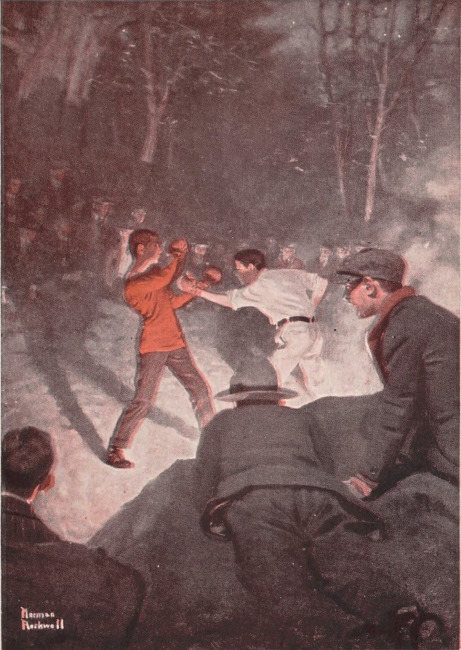
The match differed from any that had gone before.
Both men were expert with the gloves, and
they were fairly matched physically. Morgan was
a trifle taller, giving him the advantage in the reach,
Scott was a little heavier in the shoulders. They
shook hands, stepped back quickly and the fight was
on. Morgan had his reputation to sustain, Scott
had his to make. The crowd rose in a body to give
better vent to its excitement. The two circled rapidly,
passing, parrying, sidestepping, dodging;
now almost in each other’s arms, now at arm’s
length, and occasionally a lightning pass, followed
by a sharp spat told of a good blow gone home.
Scott found Morgan his equal in out-fighting, but
his training with the old prizefighter gave him much
the best of the mix-ups.
Suddenly something happened. Scott invited a
full swing from Morgan, attempted to side-step,
slipped on the damp sod, and received the full blow
on the point of his chin. The stars danced merrily
before his eyes and he sat down with a thud. He
was up almost instantly. “Good shot, old man,”
he cried to Morgan, and was boxing again with as
much vigor as before.
“By George, he does believe it,” Johnson
yelled. No one else knew what he was talking
about, but Scott smiled.
When time was called the match was declared a
draw. Morgan shook Scott enthusiastically by the
hand. “Scotty, you are a winner and it will be up
to you to fight in the big fall meet. Why, you are
not winded at all.”
“No,” Scott answered quietly, “the old prizefighter
who taught me always insisted on each
lesson going to ten rounds, and I am used to
it.”
“Oh, ho! learned from a professional, did you?
That accounts for your not being phased by that
blow on the chin, and your strong in-fighting. I
should not stand any show with you in a real fight.
I’m winded now.”
All the fellows crowded around Scott to congratulate
him and forgave him his inability to play
football in their admiration of a man who could
stand up to Morgan.
“Well, fellows,” Ormand shouted, “that bout
was too good to be spoiled by anything else. It’s
half past eleven. Let’s put out this fire and march
home.”
The fire was soon extinguished, and the crowd
filed out of the woods singing familiar songs and
yelling fiendishly at every sleeping house they
passed. Slowly it melted away as the fellows came
to their various rooming houses. When Scott and
Johnson turned into their house they heard the singing
of the remnant of the band dying away in the
distance.
“Scotty,” Johnson said with admiration written
in every feature, “you are the new White Hope of
the College. When you took that wallop on the
jaw and praised the man who did it, I believed what
you said this afternoon. Now watch me be your
kind of a sport.”