Although the present lecture seems to require
some introductory remarks, they must necessarily be
brief—our time being limited and this discourse
rather discursive; yet it is sufficiently condensed to
suit the present occasion, and illustrates fully the
truthfulness of the axiom that—A little learning is a
dangerous thing: from its tendency to inspire its possessors
with vanity rather than with the humility which
always accompanies profound knowledge.
You are no doubt all, or most of you, well acquainted
with the use made of Astrology and Alchemy in the
dramas of Shakspeare—"The Antiquary" of the
"Wizard of the North"—the "Strange Story" of Lord
Lytton—the "Faust" of Goëthe; and are probably familiar
with the more instructive works of Scott on Demonology,
and of Brewster on Natural Magic. Now we
always find that fiction is more suitable than truth for
romantic writings; truth is circumscribed, but the
fictions whether of Astrology, Alchemy, or any other
pseudo-philosophy are erratic, the delight of poets and
romance writers, being the comets and ignes fatui of
many popular compositions in our light literature.
There is no end of fabulous writings of the class we
call novels and romances, and no end of deceptions
which we patronize as tricks of legerdemain; the one
gratifies our imagination and fancy, the other takes our
common sense by surprise; but all these are harmless
because only presented to us for our amusement.
Delusion, however, assumes a startling character
when romance in the form of mystic writings, and jugglery
in the form of pretended communication with the
spirit-world demand our respect and serious attention,
by claiming to have a divine origin. But hallucination
of the human intellect, as we shall see, is not confined
to such remote visionary speculations, and it is not unimportant
to remark that in mathematics, as in physics,
and in other branches of investigation, there is a
singular persistency in upholding errors.
A contemporary astrologer, assuming the pseudonym
of Zadkiel, tauntingly observes in his preface to a
recent publication: "This is the age of inquiry; and
yet prejudice continues to press down her leaden foot
upon the neck of examination in this matter"—that is,
Astrology. Now with this reproof before us we hope
to discuss the subject with becoming propriety.
The splendour of the sun by day, the glories of the
firmament by night, together with the sublimity of all
celestial phenomena, attract alike the attention of the
most simple and the most intellectual among mankind.
The distance, the magnitude, and the grandeur
of the entire planetary system while exciting emotions
of awe, reverence, and devotion among the mass of the
human race, have at the same time been studied from
the earliest period of man's history to the present time
superstitiously by one class of observers, and scientifically
by another.
As the telescope was not invented before the 17th
century, it is evident that the study of Astronomy without
that instrument must previously have been pursued
under amazing difficulties; and we might have expected
that when first used by Galileo at Venice in
1609, its introduction would have been hailed without
a dissentient voice. Such, however, was not the fact,
according to Sir David Brewster,[8] who says:—
"The principal Professor of Philosophy at Padua
resisted Galileo's repeated and urgent entreaties to
look at the moon and planets through his telescope;
and he even laboured to convince Cosmo de Medici,
the Grand Duke of Tuscany, that the satellites of Jupiter
could not possibly exist. Sizzi, an astronomer of
Florence, maintained that as there were only seven
apertures in the head—two eyes, two ears, two nostrils,
and one mouth—and as there were only seven metals,
and seven days in the week, so there could only be
seven planets. He seems (eventually), however, to
have admitted the visibility of the four satellites through
the telescope; but he argues, that as they are invisible
to the naked eye, they can exercise no influence on the
earth; and being useless they do not exist."
Such being the crude state of astronomical science in
the 17th century, it must have been comparatively
imperfect throughout all preceding centuries; and
open to mystical appropriation and abuse by Egyptians,
Chaldeans, Hindus, Chinese, and European and other
ancient astrologers. Among that motley group the
most learned were found strangely associated with
ignorant impostors, and their activity in writing and
travelling served to spread their different systems over
the entire civilized world. It was not until late in the
17th century that Astrology could be absolutely declared
to be in its decline. In England, William
Lilly, the Sidrophel of Hudibras, and the most famous
astrologer of his time, died in 1681, leaving behind
him his Introduction to Astrology, together with many
other works of the same character.
Astrology is merely a philosophism, being empirical,
wholly visionary, a mere fanciful system compounded
of incongruous mixtures of astronomical with human
events, of mythology with theology, and of facts with
pure fiction. It has been variously designated Judicial,
Hororary, Atmospherical, and Mundane, Astrology.
It has also many off-shoots subservient to Magic or the
black art, Sorcery, Witchcraft, and other pretended
mysticisms ostentatiously styled occult philosophy.
We may first observe that Astrology lays no claim to
inspiration, but affects a very ancient unknown origin,
tracing back to a dark, heathenish, and superstitious
age, in the very infancy of traditional knowledge, when
the boldest assertions of the seer were received as the
authority of an oracle, no one daring to question their
validity. Whatever is remotely possible the Astrologer
accepts as a fact; while ignorant of much around him,
he assumes with the utmost complacency an intimate
acquaintance with the sun and planets thousands upon
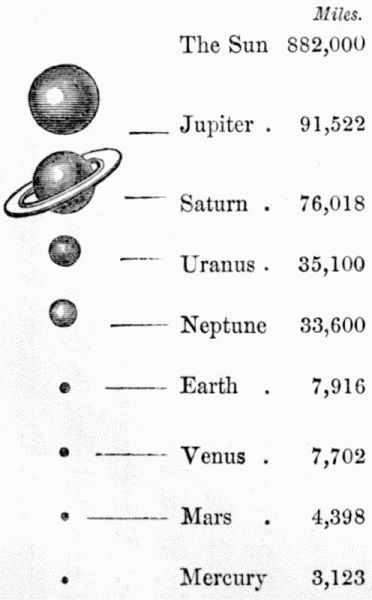
thousands of miles off; yea with the sun 969,272 miles
in diameter, while he himself inhabits a globe only
7,916 miles in diameter; from which the moon is
237,000 miles distant, and the sun 400 times that
distance.[9] And these immense bodies revolving millions
on millions of miles away in immeasurable space
are described by him as fashioning an infant's nose,
directing the fortunes or misfortunes of lovers, ordering
the property of traders, meting out diseases, and improving
or deranging man's mental faculties. And
as if such puerile influences were not sufficiently preposterous
we are informed by the modern seer, Zadkiel,
that the 12 signs of the Zodiac not only rule the several
parts of the human frame, but also those of a ship, as
Aries, the bows; Taurus, the cutwater; Gemini, the
rudder; Cancer, the bottom; Leo, the upper works;
Virgo, the hold; Libra, parts above the water's edge;
Scorpio, the seamen's berths; Sagittarius, the seamen;
Capricorn, the ends of the vessel; Aquarius, the
Captain; Pisces, the oars in galleys, the wheels in steam
vessels, and the sails in others; but these latter being
above water, we are left in doubt about the ruler of the
submerged screw propeller.
To show what a modicum of learning, and how trifling
an acquaintance with matters of natural philosophy
will serve the Astrologer, we will turn to a modern
treatise published in the year 1801, by Francis Barrett,
(styling himself a student of Natural and Occult
Philosophy) a quarto volume of upwards of 370 pages,
entitled, "The Magus, or Celestial Intelligencer,"
which affords a pretty clear insight into the nature of
the superstitions which from an ancient period even
to that date obtained credence and were popular with
the multitude.
Treating of the wonders of Natural Magic previous
to entering on the main topic of his treatise, he
adduces a few of what he conceives to be ordinary
matters of fact, assuring us that:—
If any one shall, with an entire new knife, cut asunder
a lemon, using words expressive of hatred, contumely,
or dislike, against any individual, the absent party,
though at an unlimited distance, feels a certain inexpressible
and cutting anguish of the heart, together
with a cold chilliness, and failure throughout the body;—likewise
of living animals, if a live pigeon be cut
through the heart, it causes the heart of the party
intended, to be affected with a sudden failure;—likewise
fear is induced by suspending the magical image of
a man by a single thread;—also death and destruction
by means similar to these; and all these from a fatal
and magical sympathy.
The loadstone, (he observes), possesses an eminent
medical faculty against many violent and implacable
disorders;—the back of the loadstone, as it repulses
iron, so also it removes gout, swellings, rheum, &c.
that is of the nature or quality of iron. Likewise the
wearing the loadstone eases and prevents the cramp,
and such like disorders and pains.
The influences of the stars appear to be as intimately
known to Astrologers as though they had walked
among, and carefully examined and fully realized their
occult properties, for example:—
In every work observe Mercury, for he is a messenger
between the higher gods and the infernal gods;
when he goes to the good, he increases their goodness—when
to the bad, he hath influence on their wickedness.
It is an unfortunate sign or planet, when it is
by the aspect of Saturn or Mars especially, apposite
or quadrant, for these are the aspects of enmity; but a
conjunction, a trine, and a sextile aspect, are of friendship;
but yet if you do already behold it through a
trine, and the planet be received, it is accounted as
already conjoined. Now all planets are afraid of the
conjunction of the sun, rejoicing in the trine, and sextile
aspect thereof.
They say of the Sun and Moon:—
The Sun is the lord of all elementary virtues;—it
disposes even the very spirit and mind of men.
The Moon (says Barrett) measures the whole space
of the Zodiac in the time of 28 days, hence it is that
the wise men of the Indians, and most of the ancient
astrologers have granted 28 mansions to the Moon,
which, being fixed in the eighth sphere, do enjoy divers
names and properties, from the various signs and stars
which are contained in them; through which, while
the Moon wanders, it obtains many other powers
and virtues; but every one of these mansions, according
to the opinion of Abraham, contained twelve
degrees, and fifty-one minutes, and almost twenty-six
seconds. In the first quarter of these mansions the 1st
conduces to discords and journies; the second to the
finding of treasures, and to the retaining of captives;
the 3rd to benefit sailors, huntsmen, and alchymists; the
4th the destruction and hindrances of buildings, fountains,
mills, gold mines, the flight of creeping things,
and begets discord; the 5th to help the return from a
journey, the instruction of scholars, and confirms
edifices, gives good health and good will; the 6th to
hunting and besieging towns, and revenge of princes,
destroying harvests and fruits, and hinders the operation
of the physician; the 7th to confirm gain and
friendship; is profitable to lovers, and destroys magistracies.
In a similar manner the remaining three quarters have
the characters of their several mansions allotted to
them with equal exactness, and of course indisputable
veracity also.
We have here a fair example of the arrogant assumptions
of ancient and indeed of all astrologers, magicians,
and sorcerers, men who are incompetent to elucidate the
ordinary phenomena of nature in the animal or vegetable
creation, and yet with unbounded effrontery affect
to build up an empirical system, delivered in a language
of their own invention, a pompous parade of jargon
made up of the most incomprehensible materials—which
if wholly due to antiquity partakes of ancient simplicity,
credulity, deceit, and superstition; and if somewhat
polished and refined to suit the advances of literature
and science, has never been able to prove the correctness
of its groundwork, or afford a solitary instance
of its possessing any meritorious quality beneficial to
mankind; while on the other hand its evil consequences
have been many, by destroying the peace and
happiness of thousands, encouraging deceit, and misapplying
in its ignoble pursuit the time and labour
and property of its ardent but deluded admirers.
In Judicial Astrology it is not thought requisite to
consider more than a certain number of the planets, after
a method simplified by antient astrologers or astronomers,
which is found to be so compact and so complete
in governing the destinies of the human race that
modern intelligence has failed to enlarge the field of
heavenly influences. Varley notes that:—the antients
discovered that the circle of the Zodiac, about 16 degrees
in width, and through the middle of which runs
the Ecliptic, or sun's path through the 12 signs, contains
the heavenly bodies, named planets, and the principal
fixed stars, and nearly the whole of the materials
or significators, from which predictions are obtained.
He remarks that:—In forming a horoscope, this
circle is divided into 12 equal parts, corresponding with
the spaces containing the 12 hours. These 12 divisions
are called houses; and they always remain fixed, while
the Zodiac with the 12 signs, and all the heavenly
bodies belonging to it, are considered to be moving
through them all, every 24 hours. The lord of the
ascendant is the planet which rules the signs rising at
birth. In drawing horoscopes it is usual to make the
figure square instead of round. (See Plate 1, Fig. 1.)
The various significations arising from the aspects of
the starry heavens at the time of birth are so exceedingly
numerous, that we must refer the curious in such
matters to the works themselves, in which all these
pretended revelations are minutely recorded.
Mankind rank astrologically as being of four temperaments.
1. One class is said to answer to the fiery trigon,
also called diurnal, masculine, and choleric, consisting
of Aries, Leo, and Sagittarius, which contains the
spirited, generous, magnanimous, and princely natures.
2. We have next the earthy trigon, being nocturnal,
feminine, and melancholic, consisting of Taurus, Virgo,
and Capricorn, containing the careful, sordid, and
penurious qualities.
3. Thirdly, the aërial trigon, which is diurnal, masculine,
and sanguine, consisting of Gemini, Libra, and
Aquarius, contains the humane harmonies, and courteous
principles. And—
4. Fourthly, the watery trigon, which is nocturnal,
feminine, and phlegmatic; namely, Cancer, Scorpio,
and Pisces, including the cold, prolific, cautious and
severe qualities.
Take as a brief illustration of the manner in which
Astrologers presumptuously assign to the planets their
several offices relating to human nature the following:—
Those born when Aries ascends are born under
the sign Aries and planet Mars. This is the diurnal,
fair, and masculine house of Mars, and partakes also
largely of the nature of the magnanimous Sun, and
the benevolent and moral Jupiter, who rule the fiery
trigon, of which Aries is the first sign.
As affecting physiognomy we are assured that:
The Scorpio noses are more aquiline than those of
Aries, and are more frequently conspicuous for a sort
of bracket shape beneath, which prevents the under
part of the nose from forming a right angle with the
upper lip; while the under lip, both being usually
small, recedes in a greater degree, as if drawn tightly
against the teeth; so that the mouth appears in the act
of pronouncing the word SEVERE.
When we meet in volume after volume with page
after page of such composition as this, when we reflect
on the sublimity of the heavens and the paltriness of
such combinations as are here given of the planets with
mundane affairs, we ask the reasons for arriving at such
judgments. To be told that it is so because it is so;
or because it was an ancient belief, and is to be found
in the writings of Ptolemy, Nostradamus, Dr. John
Dee, William Lilly, or Zadkiel; or because it has
often proved as true in its predictions as the telling
fortunes by means of a pack of cards, is no evidence
whatever; yet the Astrologer boasts of his very paralogisms.
Zadkiel, in prefacing a work by Lilly, says:—If a
proposition of any nature be made to any individual,
about the result of which he is anxious, and, therefore,
uncertain whether to accede to it or not, let him but
note the hour and minute when it was first made, and
erect a figure of the heavens, (See Plate 1, Fig. 1,)—and
his doubts will be instantly resolved. He may
thus, in five minutes, learn infallibly whether the affair
will succeed or not; and, consequently, whether it is
prudent to adopt the offer made or not.
Such is the belief of this sound, intelligent man, as
we fully believe him to be in other respects. But we
say it is not given to man to assign special influences
to the stars, to select one portion and discard all the
rest, or to be more intimately acquainted with the
starry heavens above him, than with the stony earth
he inhabits, and with his fellow creatures around him.
The works claiming to expound this pretended
Occult Philosophy prescribe such childish processes
that one naturally wonders how in the midst of so
much impudent imposture Astrology and its kindred
pursuits ever found or retained any honest partizans.
Take, for example, the use of fumigations, such as of
frankincense, &c. to Saturn; of cloves, &c. to Jupiter;
of odoriferous woods to Mars; of all gums to the
Sun; of roses, violets, &c. to Venus; of cinnamon, &c.
to Mercury; of the leaves of vegetables to the Moon;
of all or any of which there must be a good perfume,
odoriferous, and precious, in good matters; but in evil
ones quite the contrary.
The Zodiac is also favourably affected by proper
suffumigations.
Astrologers in their Demonology profess to be able
to ascertain the characters and seals of spirits,[10] and
according to the Cabalists, tables are given of many of
these in their books, in the so-called Theban Alphabet;
in characters of Celestial Writing; in that
called Mallachim; or in the writing called Passing the
River.
They affect to have suitable bonds by which spirits
can be bound, invoked, or cast out.
Of Necromancy they pretend to two kinds, one of
which is raising the body of a deceased person, which
it is said cannot be done without blood;—the other
sciomancy, which is the production of a mere shade or
shadow.
The exorcisms and conjurations of Magicians are so
audaciously profane and blasphemous as to be unworthy
of even a passing notice.
We shall now proceed to consider Alchemy, another
but very different chimerical pursuit, which was early
cultivated in the East, and is generally ascribed to
Hermes Trismegistus, although its more enthusiastic
admirers pretend to trace a knowledge of it to Adam.
From the earliest periods of history man was acquainted
with gold, silver, and other metals, with bitumen,
sulphur, sea salt, sal-ammoniac, gums, and resins,
together with other varieties of substances and liquids
common to modern chemistry. For the compounding
and heating of certain of these materials a multiplicity
of means were adopted requiring furnaces, crucibles,
and distillatory apparatus. The first workers in these
experimental operations formed a body of investigators
into the nature and properties of all manner of substances,
whether animal, vegetable or mineral, the
members of which were distinguished as adepts, alchemists,
and later in their career as common chemists.
The most esteemed branch of the art however was
Alchemy, a pseudo-science which ultimately took three
forms. First, the Hermetic Art for the discovery of
the Philosopher's stone; and the Alkahest, or universal
solvent;—Second, a Medical Alchemy;—and Third, a
Theological Alchemy pretending to conceal divine
mysteries under an allegorical form, treating of the
spiritual while apparently describing alchemical discoveries.
Our principal business, however, is with the so-called
Hermetic Philosophy, treating of vaunted methods of
transmuting the base metals into gold. It is doubtful
whether this particular delusion of the adepts can be
referred to a date earlier than the 8th century, but even
then we cannot refrain from surprise at the fallibility of
the human intellect, which could be swayed by a belief
in the pretended lapis philosophorum for upwards of ten
centuries. It was believed to be so secret and rare
that its possession was never ascribed at any time to
more than two or three favourite adepts, who transmitted
it to some single favoured individual after his
taking the sacrament, and going through certain prescribed
religious ceremonies, preparatory to being entrusted
with a verbal recipe for the composition of a
peculiar smelling red powder, of which it was affirmed
that when projected on heated mercury or any solid
metal, it would at once change it into pure gold. Ashmole
gravely assures us that Dr. John Dee and his associate
Kelly, having in some way procured this precious
substance, Kelly—to use Ashmole's own words—"made
projection with one small grain thereof, in proportion no
bigger than the least grain of sand, upon one ounce and
a quarter of common mercury, and it produced almost an
ounce of pure gold." With equal simplicity and earnestness,
Ashmole asserts that this same Kelly was often
seen to make these extraordinary transmutations,—"and
in particular (he adds) upon a piece of metal cut out of
a warming-pan, and without touching or handling it, or
melting the metal, only warming it in the fire, the
elixir being put thereon, it was transmuted into pure
silver. The warming-pan and this piece of it, was sent
to Queen Elizabeth by her Ambassador who then lay
at Prague, that by fitting the piece into the place
whence it was cut, it might exactly appear to be once
part of the warming-pan."
Among the adepts there were no doubt a select few
who employed themselves in their prolonged labours
in all sincerity, and who were not unfrequently repaid
with remarkable, and unexpected results. Brass, being
the result of copper combined with zinc, would appear a
singular transformation. Many stones, or more properly,
ores, would yield sulphur and metals; sulphur
would be found apparently to dissolve iron; and
certain salts, when distilled, would yield corrosive
acids. Alchemy thus presented to the ancient adepts
many of the ordinary wonders of modern chemistry;
in short, the latest adept of the present century is no
other than an unlettered chemist. It was peculiar to
the Alchemists to treat all their operations as secrets;
which, when recorded, were described partly by
symbols and partly in a novel nomenclature, invented
to conceal their mysteries from vulgar gaze or imitation.
Thus, to prepare the philosopher's stone, we have
merely to—"Take of moisture, an ounce and a half;
of meridional redness, that is the soul of the sun, a
fourth part, that is, half an ounce; of yellow seyr,
likewise half an ounce; and of auripigmentum, a half
ounce; making in all three ounces. Know that the
vine of wise men is extracted in threes, and its wine
at last is completed in thirty." To the incredulous in
these matters, Ashmole offers the admonition that, he
knows "Incredulity is given to the world as a punishment!"
However, when the Alkahest, or pretended
Universal Solvent, was alluded to by the modern
chemist Kunckel, he could not refrain from incredulously
enquiring—"If it dissolves all substances, in
what vessel can it be contained?"
Alchemical writings are very numerous, it might be
impossible to procure a complete bibliographical list of
them, but they may be estimated at from 3000 to 4000
works, and an astonishing number of manuscripts.
Their authors indulge in such terms as the Ph[oe]nix,
to indicate the quintessence of Fire; Realgar, for the
fume of minerals; Guma, also Luna Compacta, for
quicksilver; Hadid, for iron; Aurum potabile, for
liquor of gold; Anathron, for saltpetre; Malek, for
salt; Terra fidelis, for silver; Tinkar, for borax; and
in a similar strain for all matters and operations;
so that Dr. Johnson was justified in deriving the word
Gibberish from the mysterious jargon employed by
Geber, a celebrated Alchemist; who has, nevertheless,
been appropriately styled the Pliny of the 8th century.
Weidenfeld, in an Alchemical Treatise, published in
1685, addressing students, says:—
"Under heaven is not such an art, more promoting the
honour of God, more conducing to mankind, and more
narrowly searching into the most profound secrets of
nature, than is our true and more than laudable Chymy."
And at the conclusion of his address he observes:
"Nothing remains but upon our bended knees to
return most humble thanks to the Father of Lights,
in vouchsafing us this art by the writings of his
servants, and the high priests of Nature; without
which, it would be beyond the power of man to arrive
at so great a degree of knowledge."
Some notion of the extravagance of the language
employed may be obtained from his description of a
Philosophical Wine, literally, rectified spirits of wine,
or alcohol. He assures us that, on opening a vessel
of it, "a wonderful scent" should arise: "so as that
no fragrancy of the world can be compared to it;
inasmuch as putting the vessel to a corner of the house,
it can by an invisible miracle draw all that pass in to
it; or, the vessel being put upon a tower, draws all
birds within the reach of its scent, so as to cause them
to stand about it. Then will you have, my son, our
quintessence, which is otherwise called Vegetable
Mercury, at your will, to apply in Magistery of the
transmutation of metals."
How ardent an adept this Alchemist was may be
gathered from his exclamation:—"May the God of
Heaven put prudence in the heart of evangelical men,
for whom I compose this book, not to communicate
this venerable secret of God to the reprobates."
Among the remarkable discoveries made by Alchemists,
due to the carefully noted and carefully examined
failures and accidents, as well as successes, of their
endless combinations of matter, under the treatment
of fire and water, the most distinguished is that of
gunpowder, noted in a recipe left on record by Roger
Bacon, who died in the year 1284. He clearly names
the mixture of Saltpetre with Sulphur, but the third
ingredient, Carbon, is concealed in the form of an
anagram.
Lord Bacon, Luther, Spinoza, Leibnitz, and many
eminent moderns, were impressed with a belief in the
possibility of transmuting lead, tin, copper, or other
metals, into gold; in short, as it was supposed there
were only four elements, fire, water, earth, and air,
it was probably assumed that a fifth might be found
in the Philosopher's stone.
But if ever any pursuit was more open to fraudulent
practices than another, surely the pretended possession
of a transmuting powder or elixir afforded a
grand arena for their exercise. In this enlightened
age, although we cannot fail to look with charity on
the arduous labours of those adepts who honestly mixed
devotional exercises with laborious experimental operations,
selecting times and seasons for their alchemical
work, and noting with accuracy the hours and days of
fusions, sublimations, distillations, lixiviations, and so
forth; still, it is scarcely possible to refrain from
smiling at the docile simplicity of Ashmole in denouncing
a certain class of Alchemists, as pretended
masters and adepts, seeing "they are mere practisers of
legerdemain," while he himself gave credence to the
story of the warming-pan, already named as being
shown to Queen Elizabeth, which was clearly a flagrant
piece of fraud practised by Kelly, a common adventurer,
and from his youth remarkable only for his indifferent
character.
An easily performed trick was effected by means of
nails, or other light articles, made half of gold and half
iron, but disguised, so as to appear to be of one metal
and colour. Sometimes these knaves employed crucibles,
having an interior false bottom, below which a small
quantity of gold was placed, which, being reproduced,
as was pretended from base materials, was offered as
an example of success. Or, by having the gold in a
hollow rod, stopped at one end with wax, used to stir
up the materials, the gold would naturally enough
appear in the crucible. Or, their materials being
conveyed into charcoal, a similar result would be
obtained on heating the crucible in a furnace. At other
times, by the employment of amalgams, or solutions
in acids, they could perform a species of electro-plating
on common metals. The extent to which these
nefarious practices were carried might appear incredible,
considering the evident inconsistency of the owner of
the pretended golden key to countless wealth, being in
such comparative poverty as to be indebted to any one
of moderate means for pecuniary assistance. But, it is
some apology for such credulity when we call to mind
the state of public morals, of education, of political
institutions, and the prevalent superstition, not only
among common people, but also the higher classes
of all countries and creeds, down to the seventeenth
century: representing a phase of the human mind,
liable to be overawed by impostors, who boldly claimed
supernatural aid in abetting their impositions. And
the trickery of the designing was further aided by
the close secrecy adopted by the adepts in their
processes, their conversations, and their writings.
Ashmole freely admits that—"Their chief study was
to wrap up their secrets in fables, and spin out their
fancies in 'vailes' and shadows, whose radii seem to
extend every way, yet so that all meet in a common
centre, and point only to one thing." It was this very
secrecy, this continual mystery from beginning to end,
that favoured deceptions of the grossest and most
bungling character, as viewed by the light of modern
chemistry.
Alchemy no doubt tended to improve Medical
science, by the introduction of many new mineral
and vegetable preparations, but the healing art treated
after the manner of the Hermetic Art, was laid open
to every description of quackery. It is not our intention,
however, to enlarge on this department, which
has steadily advanced at every stage of improvement
in chemical science.
Of Mathematical Problems, the most perplexing to
ancient and modern mathematicians, although of late
years said to be satisfactorily demonstrated, and no
longer desiderata of Geometry, are—
1. The Quadrature or Squaring of the Circle;—2.
The Duplication, or doubling of the Cube;—and
3. The Trisection of the Angle.
In his "Popular Astronomy,"[11] Professor Arago,
treating on the surface of a circle, observes that,—
It is mathematically equal to the product of the
length of the circumference, multiplied by half the
radius. To square a circle of a given diameter in
mètres, is the same as giving the number of squares,
of a mètre in each side, of which the surface is the
equivalent. If, the diameter being given, the exact
circumference were known by a sort of inspiration,
the superficial extent of the circular space would be
deducible from the two numbers, by the mere multiplication
of the numerical length of the circumference
by the fourth of the diameter, or half the radius.
But, the circumference being deducible from the
diameter only by approximation, the surface alluded to
cannot be computed with mathematical rigour; yet
the result can be obtained with all desirable precision
by the aid of the ratios usually given for such purpose;
for instance, the area of the space included within a
circle of thirty-eight millions of leagues radius, may
be determined within such a degree of precision that
the probable error shall not exceed the space of a
mite.
"The sect of squarers then," Arago adds,—"are
searching after a solution which is proved to be impossible,
and which, moreover, would be of no practical
use, even if their foolish hopes were crowned with
success."
In the "Birds" of Aristophanes, the character is
introduced of a geometer, who is going to make a
square circle, showing how early this chimerical performance
became an object of ridicule.
Thales, Anaxagoras, Pythagoras, Hippocrates, Plato,
Apollonius, Ptolemy, with other ancient mathematicians,
have given methods for approximating to the area of
the circle; and many also among the moderns. In
1775, the Paris Academy of Science determined to discourage
papers devoted to this subject, and their course
in this respect was soon after adopted also by The
Royal Society, it being found that there was among
certain geometers a complete mania for settling this
and similar problems, the solution of which was either
unattainable, or if attained of very questionable value.
The Duplication of the Cube it is asserted can readily
be demonstrated. It is usually called the Delian Problem,
from its having been suggested by the oracle of
Apollo at Delphos, requiring that Apollo's cubical
altar should be doubled.
It is something in its favour to say that the enquiry
has had the attention of Newton and of Huygens.
Lastly, we shall notice among problems of this class—the
Trisection of an Angle, which it is asserted can
only be accomplished by means of the conic sections
and some other curves.
A rule for the cubic equation by which the problem
of trisection is solved has been given by Cardan.
The difficulty only arises when we attempt the trisection
of any other than a right angle, its trisection
being easily effected with a pair of compasses.
On this subject it has been observed that, "there is
no more trouble in trisecting an angle, not a right
angle, than in finding a cube root."
These three celebrated problems have received the
attention of mathematicians in every age and country,
and led to many learned discussions, and controversial
writings. But in point of litigiousness the Squarers of
the Circle most decidedly carry off the palm, having
frequently laid and lost heavy wagers, and even appeared
in a Court of Justice to settle their monetary disputes.
They are renowned for their pamphlets, in which philosophers
of every class are charged with prejudice, conceit,
and ignorance, and denounced for their want of
candour and consistency in not giving audience to the
projector of the last best demonstration.
To conclude this Lecture we shall offer a few remarks
on Perpetuum Mobile, or the search for a means of obtaining
a mechanical perpetual motion. As a mathematical
problem it dates back some 2000 years or more,
but we know nothing of any actual attempt earlier than
the 14th century to construct a machine intended to be
self motive, by containing within itself the means of
continually overbalancing. External motive agency
such as the tides, magnetism, and the like are not
included; the only admitted agent being gravity.
If we considered wear and tear the question would be
settled at once, but this is allowed as the single exception,
and therefore any machine constantly renewing
the means that first moved it might be deservedly
called a perpetual motion.
Until a history of the schemes invented by numerous
ingenious mechanics was published in 1861, inventors
of this class were continually though unconsciously
reproducing obsolete contrivances, from taking up
the ordinary idea that a wheel may be kept constantly
over-weighted on one side, so as to raise the next
weight which is to perform the same miracle of art. It
is singular to observe this particular coincidence of the
inventive faculty of man, and it shows next to a demonstration,
that if all mechanical inventions were
swept from the face of the earth they would be reproduced
in some remote age.
A common error with those who toil at perpetual
motion machinery is their aiming to produce a bottled-up
power; or to apply the principles of the ordinary
scale or balance to a wheel, overlooking the simple
facts of friction on one side acting against their
most ingenious contrivances, and of non-production on
the other. Sooner or later, however, they discover the
inertia of matter, that a pound will not raise a pound,
and that they cannot invent mechanism to move independently
of the laws of action and reaction.
A ball descending a semicircular path, as suggested
by Dr. Henderson, will only rise to the same height as
that from which it fell; and will afterwards gradually
diminish in velocity until it rests at the centre. If it
would ascend to a height greater than that from
which it descended, then indeed an inclined path
might return the ball to repeat such evolutions until
quite worn out.
And as regards the weighted wheels, it is always
overlooked that they come to rest from the same fact,
that the vertical line of descent and that of ascent are
equal, however much the weights may on one side
recede from the centre, while on the other side the
weights are approaching the centre. (See Plate 6,
Fig. 1.)
The most famous perpetual motive schemes were
those of the Marquis of Worcester made 1630-41; (See
Plate 6, Fig. 2,) and of Bessler, better known as
Orfyreus, between 1712-19.
The Marquis gives a brief notice of his plan, in his
"Century of Inventions," a curious catalogue of his
several ingenious schemes.
But of Orfyreus's wheel we know nothing more than
was communicated by the eminent mathematician,
'S Gravesande, to Sir Isaac Newton, after an external
view of it, while it was rotating in a chamber of the
residence of the Prince of Hesse Cassel.
The most singular part of this strange delusion is
the fact of its strong hold on the minds of its infatuated
votaries. Once bewitched with the idea of at last
succeeding in the attainment of his grand design,
fortune, health, and reputation, are resolutely set at
nought, in the delirium of delight that follows; and
more unreasonable creatures can scarcely be found
than such self-deluded individuals, for they cannot,
or will not, be convinced that their utmost efforts can
at best but produce an amazingly curious toy; and
nothing can be more futile than to expect any higher
application, assuming such a discovery were possible.
The best proof of the sincerity and earnestness of
those who seek the attainment of a mechanical perpetual
motion, is afforded by the variety and number of their
patented schemes; the patentees having among them
divines, doctors, lawyers, civil engineers, carpenters,
draughtsmen, jewellers, watchmakers, shoemakers,
confectioners, and all classes of professions and trades.
It is not, as is generally supposed, only the wholly
ignorant and designing who can be cajoled by these
chimeras; there is in them a spice of mystery, of
wonder, of singularity, and of simplicity combined with
much subtle difficulty, which, being once fully imbibed,
acts like an opiate draught.
We have thus reviewed summarily, chimeras which
are mainly associated with Astronomy, Chemistry,
Mathematics, and Mechanics, and which have swayed
the human mind more or less from a period anterior to
the Christian era. The list of this species of deceitful
systems of pseudo-philosophy, and of profitless problems,
might have been enlarged; but what has been
advanced may suffice as a warning to the uninitiated
to beware of blind guides and of visionary pursuits.
Science has lost nothing by its professors exercising
that degree of caution, which all classes of superficially
learned men, affecting to possess original and
valuable views on certain matters, call prejudice: which,
in such cases, generally means no more than the
natural aversion which the learned have for all attempts
to place specious dogmas on a level with sound
science. Such enthusiasts are generally men of no research
or depth of thought, who obtain an imperfect
acquaintance with subjects with which they are incompetent
to grapple; and with whom it is, therefore,
hopeless to contend. Delusion will have its day, and
will as certainly decay, if not die out. Chimeras constantly
spring up, and find ardent professors and
crowds of easily led proselytes, even up to this very
present time; so that although, undoubtedly with many—Knowledge
is power: yet it is to be feared that far too
large a proportion of mankind favour the delusion that—Ignorance
is bliss.
Of the Twelve Houses.—The 1st, 4th, 7th, and 10th
houses—angular.—These are of more durable signification
than the others, denoting the wife or husband—a situation
under Government, &c. &c.
The twelve houses have signification of all the various
concerns of human life, and of nature at large.
For Example.—When the cusp of the first house is well
aspected by, or has the presence of Jupiter or Venus, and
these are not afflicted by the aspects of evil planets, they
preserve life in infancy, and give health, and often an
agreeable person.
But if their rays or presence (says Varley) should be
thrown on the cusp of the second house, then the native
will have success in concerns of property. The Sun in
this house helps to disperse property; and if he be peregrine,
that is, in the sign of a contrary nature to his own,
where he has no dignities, and is without reception, then the
native's property is dispersed in vainglorious expenses;
but if the Sun be in Leo, his property in general will
be ample enough to admit of instant acts of bounty and
benevolence.
In a similar strain, Astronomers particularize the remaining
eleven houses. It would be impossible, in any
reasonable space, to describe further the operations of the
planets in the several houses thus assigned to them.
As to when the Planets are most powerful.—Barrett
says:—The planets are powerful when they are ruling in a
house, or in exaltation, or triplicity, or term, or face,
without combustion of what is direct in the figure of the
heavens; but we must take care that they are not in the
bounds or under the dominion of Saturn or Mars. The
angles of the ascendant, and 10th and 7th are fortunate;
as also the lord of the ascendant, and place of the Sun and
Moon.
The Moon is powerful if she be in her house, in exaltation,
in triplicity, in face, or in degree convenient for the
desired work, &c. &c.
Varley's Table of Signs, Houses, Exaltation,
and Triplicity.
The falls of the Planets are opposite to their Exaltations,
and their Detriments opposite to their Houses.
| Aries and Scorpio are the house of Mars | ♂ |
| Taurus and Libra are the house of Venus | ♀ |
| Gemini and Virgo are under the dominion of Mercury | ☿ |
| Cancer is the house of the Moon | ☽ |
| Leo is the house of the Sun | ☉ |
| Sagittarius and Pisces are the houses of Jupiter | ♃ |
| Capricorn is the house of Saturn | ♄ |
| And Aquarius is governed by the Herschel Planet | ♅ |
This table gives the usual symbols employed for indicating
the several planets, and which are still retained in
Astronomy for simplicity of expression, but which Astrologers
venerate as possessing a cabalistic character.
Associated with these symbols are the names of certain
principal angels, spirits, or demons, forming, however, but
a small proportion of such airy nothings.
The Astrological Symbols were also employed by the
Alchemists to indicate the seven metals then known.
Mr. James Smith, of Liverpool, the most laborious
among recent workers in this field of enquiry, claiming to
have propounded several simple and exact methods, offers
the following as sufficiently demonstrative:—
I construct my diagrams in the following way:—I draw
two straight lines at right angles, making O the right angle.
From the point O, in the direction OA, I mark off four
equal parts together equal to OA, and from O, in the direction
of OB, I mark off three of such equal parts together, equal
to OB, and join AB. It is obvious, or rather self-evident,
that AOB is a right-angled triangle, of which the sides
that contain the right angle are in the ratio of 4 to 3, by
construction. With A as centre and AB as interval, I
describe the circle X, produce AO and BO to meet and
terminate in the circumference of the circle at the points
G and C, and join AC, CG, and BG, producing the quadrilateral
ACGB. I bisect AG at F, and with O as
centre, and OF as interval, describe the circle Z. The line
OF is the line that joins the middle points of the diagonals
in the quadrilateral ACGB; and it follows that,
{AG2 + CB2 + 4(OF2)} = {AC2 + CG2 + BG2 + AB2.}
When AO = 4, we get the following equation:—
{52 + 62 + (4 × 1'52)} = {52 + sqrt(102) + sqrt(102) + 52,}
or, {25 + 36 + 9}={25 + 10 + 10 + 25} = 70. From the points B and C, I
draw straight lines at right angles to AB and AC, and therefore
tangential to the circle X, to meet AG produced at D,
and join BD and CD, producing the quadrilateral ACDB.
I bisect AD at E, and with O as centre, and EO as interval
describe the circle XY, and with E as centre, and EA or
ED as interval describe the circle Y.
Now, to square the circle, or, in other words, to get
exactly equal in superficial area to the circle X, I will show
how to find it. From the point G draw a straight line—say
G m—perpendicular to ED, making G m equal
GD. Produce GA to a point n, making G n equal to
2AG - GD, and join n m. The square on n m will be
the required square. (I have indicated this square by dotted
lines.) For example:—If AO = 4, then AG = 5, and GD
= 1'25; therefore {2 AG - GD} = {10 - 1'25} = 8'75 =
Gn: and Gm = 1'25; therefore, Gn2 + Gm2 = 3-1/8 (AB2);
that is, {8'752 + 1'252} = 3-1/8 (52), or, {76'5625 + 1'5625} =
{3'125 × 25};
and this equation=Area of the Circle X;
and area of the square on n m :: and it follows, that the area
of every circle, is equal to the area of a square on the hypotenuse
of a right-angled triangle, of which the sides that
contain the right angle are in the ratio of 7 to 1, and the sum
of these two sides equal to the diameter of the circle. In
many ways I have proved this fact, by practical or constructive
geometry.
Duplication of the Cube.—In his "Young Geometrician;
or, Practical Geometry without Compasses," 1865,
Mr. Oliver Byrne's 40th Problem is as follows:—
Let AB be the side of a given cube BD. It is required
to find AC, the side of another cube CE, so that the solid
contents of the cube CE are double the solid contents of
the cube BD.
Ancient and modern mathematicians (says Mr. Byrne)
have in vain attempted to solve this problem geometrically,
that is, by the ruler and compasses only.
Let AB = BG = GR = RQ = QP = QO = OR = VZ. The
length of the shortest side of the lesser set square; a line of
any other given length may be applied. Draw OP and VR
parallel to it; then apply the set squares in close contact,
the edge OV of OVT passing through the point O, while
the points of V and Z of ZSV fall exactly on the lines RV,
RZ. Then draw the line ZBC, cutting FA produced in C;
then the cube on AC is double the cube on AB.
Trisection of an Angle.—In his work entitled Young
Geometrician, 1865, Mr. Oliver Byrne gives as the 39th
Problem: To divide a given angle BAC into three equal
angles:—
The line A m is made = p q, the least side of the lesser
triangular ruler; by (II) p m is drawn parallel, and m n
perpendicular to AB. Then both rulers are kept in motion,
and at the same time in close contact, as represented in the
figure, until p falls on the line p m, and n on the line m n;
r nA passing through the angular point A.
Then the angle DAB is one-third of the angle CAB.
Mr. Byrne asserts that this problem is not capable of
solution by the straight line and circle. Mathematicians
have in vain attempted to solve it geometrically, that is, by
the ruler and compasses only.
Perpetuum Mobile. Desaguliers demonstrated the absurdity
of attempting to raise weights enclosed in a cellular
wheel, simply by providing for their approach in succession
nearer to the centre on the ascending side, while they should
be projected further from the centre on the descending
side. He remarks:—
Those who think the velocity of the weight is the line it
describes, expect that that weight shall be overpoised, which
describes the shortest line, and therefore contrive machines
to cause the ascending weight to describe a shorter line than
the descending weight.
For example, in the circle A B D a, the weights A and B
being supposed equal, it is imagined that, if by any contrivance
whatever, whilst the weight A describes the arc A a,
the weight B is carried in any arc, as B b, so as to come
nearer the centre in its rising, than if it went up the arc
B D; the said weight shall be overpoised, and consequently,
by a number of such weights, a perpetual motion produced.
Now the velocity of any weight is not the line which
it describes in general, but the height that it rises up to, or
falls from, with respect to its distance from the centre of the
earth. So that when the weight describes the arc A a, its
velocity is the line A C, which shows the perpendicular
descent, and likewise the line B C denotes the velocity of
the weight B, or the height that it rises to, when it ascends
in any of the arcs B b, instead of the arc B D: so that, in
this case, whether the weight B, in its ascent be brought
nearer the centre or not, it loses no velocity, which it ought
to do, in order to be raised up by the weight A.
Indeed, if the weight at B, could by any means spring as
it were, or be lifted up to x, and move in the arc x b, the end
would be answered, because then the velocity would be
diminished, and become xC.
In "The Life, Times, and Scientific Labours of the
Marquis of Worcester," 1865, page 454, will be found a
full account of the present diagram, which is intended to
illustrate as far as possible, an approach to the probable
construction of the wheel by the Marquis in the 56th article
of his memorable "Century of Inventions."
If any likely-looking method, could, more than another,
render hopelessness more hopeless, surely this mechanical
demonstration must prove most efficient for that purpose.
For here, we actually produce a wheel agreeing to the
terms with which Desaguliers closes his demonstration,
when he suggests the only likely method to effect the end
proposed, namely, perpetual motion. We find the fallen
weight is absolutely "lifted up" as he desires, and "moves
in the arc" he describes, and yet although he declares that
then "the end would be answered"—it absolutely is not
answered in this instance.
It is not requisite to calculate throughout the effect of
the Marquis's entire number of 40 weights; four will suffice,
taking the vertical and horizontal spokes a a a a, showing
two rings a and b; one, b, 12 inches within the other, so
that the wheel being, as the Marquis says, 14 feet diameter,
the inner ring will be 12 feet diameter. Now let each
weight D be attached in the centre of a cord or chain a´, D, b´,
2 feet long, and then secure one end, as a´, so the extreme
end of each spoke a´, and the other end of the cord, as b´,
to place on one lesser ring, as at b, or 12 inches from each
spoke.
We shall then find by admeasurement that the upper
weight on the vertical spoke is 7 feet from the centre, and the
lower weight 6 feet; while at the same time there appears
to be a preponderance due to the superior length of the
horizontal arm A´; but against this latter we have the
rising weight b´D, 1 foot from the centre, which, added to
the 6 feet on the horizontal spoke, neutralizes the hoped-for
effect, and the wheel remains in statu quo.
THE END.
One Volume 8vo., of 650 pages, illustrated with Steel Engravings of two
unpublished Portraits and 45 Wood Engravings, price 24s,
THE LIFE, TIMES, AND SCIENTIFIC LABOURS OF
EDWARD SOMERSET,
sixth earl and second
MARQUIS OF WORCESTER,
To which is added,
A REPRINT OF HIS CENTURY OF INVENTIONS (1663),
with a commentary thereon.
⁂ Thirty copies are printed on Large Paper, 1 vol. 4to. with India
Proofs before the Letters of the Portraits, price £3. 3s.
"A monument raised late, it is true, but not too late, to a great and
modest genius. A national biography which illustrates and elevates
our ideas of the past, and a contribution which the world will recognize
to the European history of Science."—Dublin University Magazine, September, 1865.
"A work which displays a high order of literary ability, careful antiquarian
research, much ingenuity, and withal thorough honesty of
purpose.
"[Lord Worcester], his life, told as Mr. Dircks has told it, is one of
much interest.
"Here we have an elaborate—although of course not a completely
exhaustive—account of his life; at any rate the most complete account
of him ever likely to be written—a work filled with abundant evidence of
the most painstaking research, a work written in a generous and sympathising
spirit, and with every attribute of conscientiousness."—Engineering, 5th January, 1866.
"The production of this volume is no common achievement; Mr.
Dircks has undertaken to write the life of a man about whom the public
know very little.
"He has, we think, collected some curious information, and established
the claim of the Marquis to be the first constructor of a steam-engine.
The reprint of the celebrated Century of Inventions adds greatly to the
interest of the volume."—The Spectator, 14th September, 1867.
One Volume, 8vo., price 21s, only 100 copies printed,
WORCESTERIANA;
A COLLECTION OF
BIOGRAPHICAL AND OTHER NOTICES, ALPHABETICALLY ARRANGED,
RELATING TO EDWARD SOMERSET, SECOND
MARQUIS OF WORCESTER,
AND HIS IMMEDIATE FAMILY CONNECTIONS; WITH OCCASIONAL NOTES.
"The present volume is, as it were, a supplement. [To. Mr. Dircks's
Life of the Marquis of Worcester.] It contains what the French call
'pièces justificatives,' on which that biography was founded; and such
other materials connected with the history of Lord Worcester's family
and his invention of the steam-engine as will prevent, as far as possible,
a repetition of the gross errors hitherto promulgated on these subjects."—
Notes and Queries, February 3, 1866.
One Volume, post 8vo., with 130 wood engravings, price 10s 6d,
PERPETUUM MOBILE;
OR,
HISTORY OF THE SEARCH FOR SELF-MOTIVE POWER
DURING THE 17TH, 18TH, AND 19TH CENTURIES,
With an Introductory Essay.
"The literature of this subject [Perpetual Motion] is very extensive,
but scattered mainly through Patent Records and ephemeral pamphlets.
We would especially refer the curious reader to a recent work by Mr.
Dircks, entitled Perpetuum Mobile, to which we have been indebted for
historical notices. It is extremely complete and interesting as a history."—
Chambers's Encyclopædia, Part 15, 1865.
"A very useful collection on the history of the attempts at perpetual
motion, that is, of obtaining the consequences of power without any
power to produce them."—Professor De Morgan's Budget of Paradoxes,
No. 28.—Athenæum, July 15, 1865.
One Volume, post 8vo., with portrait, price 3s 6d,
CONTRIBUTION TOWARDS A HISTORY OF
ELECTRO-METALLURGY,
ESTABLISHING THE ORIGIN OF THE ART.
"In his Introduction, Mr. Dircks has clearly stated the claims of invention,
and fairly discussed the only just grounds that can give claim
to priority of invention."—The Mining Journal, February 7, 1863.
"In the collection of chronological and other data for the history of
various branches and application of science, Mr. Dircks appears to be
indefatigable."—The Electrician, February 27.
"It is a useful and clear digest of evidence, and apparently impartially
put together."—The Practical Mechanics' Journal (Glasgow), July.
One Volume, post 8vo., with two portraits, price 4s,
INVENTORS AND INVENTIONS,
IN THREE PARTS.
I. The Philosophy of Invention, considered strictly in relation to
Ingenious Contrivances tending to facilitate Scientific Operations,
to extend Manufacturing Skill, or to originate New Sources of
Industry.—II. The Rights and Wrongs of Inventors, Legally
and Politically Examined.—III. Early Inventors' Inventories
of Secret Inventions, employed from the 13th to
the 17th Century, in substitution of Letters Patent.
"The author enters fully and effectually into the claims and grievances
of the inventor. He discusses the arguments for and against the concession
of patent right, and examines very ably leaders in the Times on patent
monopoly; very clearly dissipating the sophism of the opponents of patent
right; also Sir William Armstrong's evidence regarding 'patent monopoly,'
&c., affording an interesting and useful publication from its many
excellences."—The Scientific Review, September 2, 1867.
"The second part of the volume discusses the right of inventors to a
property in their inventions, and thus raises the question of the patent
laws, and the twofold issue, whether it will be better to retain them and
reform them, or to sweep them away altogether. We are bound to admit
that he treats this topic in a fair spirit, and without any taint of bigotry.
Mr. Dircks is a man whose opinions are entitled to a hearing."—
The London Review, September 21.
"Mr. Dircks treats the real problem and discusses the comparative
merits of the existing system, and the advantages which he, together with
many others, hopes would follow on the establishment of some judicial
council of inventions. The difficulties of the question are enormous, and
no one will think the less of them after having gone through this volume.
"The third part, or the lists of their inventions left by many great and
some ingenious persons, is interesting and curious."—
The Westminster Review, October.
One Volume, post 8vo., price 3s 6d,
A BIOGRAPHICAL MEMOIR OF
SAMUEL HARTLIB,
MILTON'S FAMILIAR FRIEND,
With Bibliographical Notices of Works published by him; and a reprint
of his Pamphlet entitled
"AN INVENTION OF ENGINES OF MOTION."
"Mr. Dircks's is the first careful attempt to make posterity his
(Hartlib's) friend."—The Examiner, 18th February, 1865.
"A scholar-like little monograph, giving all the information that can
be given about a man whose name occurs in the correspondence of almost
every eminent literary or scientific person of the time of the Commonwealth."—The
Spectator, 20th May.
One Volume, post 8vo., with engravings, price 2s,
THE GHOST!
AS PRODUCED IN THE SPECTRE DRAMA,
POPULARLY ILLUSTRATING THE MARVELLOUS OPTICAL ILLUSIONS
OBTAINED BY THE APPARATUS CALLED THE DIRCKSIAN
PHANTASMAGORIA.
"Mr. Dircks gives us the benefit of all his progressive discoveries in
the matter, from the paper first read at the British Association Meeting
at Leeds, in 1858, to the more recent improvements, with full explanations
of the machinery, apparatus, and processes adopted in these ghost
dramas, and further favours the public with a number of new adaptations.
As a curious description of these spectral illustrations, the book is most
interesting."—The Technologist, January, 1864.
"A volume explanatory of the uncommonly clever and scientific
"spectral illusion" which has of late fairly turned the public head."—
The Dublin Builder, January 1.
"A few months ago all London was rushing off to see Professor
Pepper's Ghost, as it was called, but which it now appears was the property
of Mr. Dircks, and from which his good name was filched in a very
unhandsome manner. Here then he tells us all about it, how the spectre
was raised, and how we may ourselves at pleasure call spirits from the
vasty deep."—The Bookseller, February 29.
Page 36: changed "Sorbiere" to "Sorbière" (15. Samuel Sorbière visited the works at Vauxhall)
Page 61: changed "Jupiper" to "Jupiter" (of cloves, &c. to Jupiter;)
Page 83: changed "BD2" to "BG2" ({AG2 + CB2 + 4(OF2)} = {AC2 + CG2 + BG2 + AB2.})
Page 83: changed "sqrt(102 52)" to "sqrt(102) + 52" ( ... = {52 + sqrt(102) + sqrt(102) + 52,})
Page 84: changed closing parenthesis to closing braces ( ... 9}={25 + 10 + 10 + 25} = 70)
Page 84: changed "tangental" to "tangential" (tangential to the circle X)
Page 84: changed "Q" to "2" (making G n equal to 2AG - GD)
Page 84: added missing opening parenthesis in "(I have indicated this square by dotted
lines.)"
Page 84: changed "+ 1'25}" to "× 25" ({76'5625 + 1'5625} =
{3'125 × 25})
Page 84: changed "hypothenuse" to "hypotenuse" (the area of a square on the hypotenuse)
 EDWARD SOMERSET,
SIXTH EARL AND SECOND
MARQUIS OF WORCESTER.
EDWARD SOMERSET,
SIXTH EARL AND SECOND
MARQUIS OF WORCESTER.