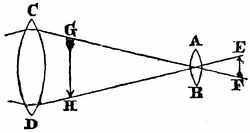
270. Heat and Cold.—In common language we speak
of heat and cold as two distinct and opposite things.
That this is not strictly correct may be shown by the
following experiment: Take three vessels, and fill the
first with ice-cold water, the second with hot water, and
the third with tepid water. If you place your right
hand in the first and the left in the second, and let them
remain a little time, on taking them out and plunging
them together into the third vessel, the water in it will
feel warm to the right hand and cold to the left. So the
air of a cellar seems warm to you in winter and cold in
summer in contrast with the air outside. For the same
reason water of a temperature that would ordinarily be
refreshingly cool to us seems warm when drank after
eating ice-cream. It is manifest, then, that there is no
fixed dividing-line between heat and cold. There is, in
fact, no such thing as cold. Substances are cold from
being deprived of heat; and no substance ever has all its
heat taken from it. Sir Humphrey Davy proved that
there is heat in ice by rubbing two pieces together in a
very cold room. They were gradually melted. Now
this was not done by the air, for that was at a temperature
below the freezing point. The heat which melted
the ice came from the ice itself by means of the rubbing.
271. Nature of Heat.—There are two theories in regard
to the nature of heat. One is that heat is an imponderable
(§ 16), and of course a very subtile substance,
which pervades all matter. Its particles are supposed to
repel each other strongly, and hence they have a tendency
to diffuse themselves, and to separate the particles of
matter from each other. It is in this way that they are
supposed to occasion the expansion of substances. The
other supposition, which is most commonly received, is
that heat is a vibration of the particles of bodies, and that
it passes from these to bodies less warm through a subtile
fluid called ether, supposed to fill all space. You see
that if this be the true theory, there is some analogy between
heat and sound.
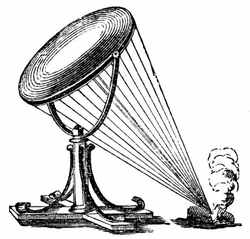
Fig. 191.
272. Sources of Heat.—The principal of the sources
of heat on our earth is the sun, though that body is ninety-five
millions of miles distant from us. As the heat,
in traveling all this long journey, is becoming more and
more diffused; or, in other words, as its rays are all the
way separating from each other more and more, we can
have no conception of the concentrated heat that exists
in the sun itself. We can, however, approximate to the
idea by observing the effects of heat when some of its
separated rays are gathered to a point by a powerful
lens, as represented in Fig.
191. A lens which concentrated
the heat ten thousand
times melted platinum,
gold, quartz, etc., in a few
seconds. And as the heat
at the sun is supposed to
be thirty times more concentrated
than this, none
of the most solid substances
of our earth would remain
solid if they were there, but
would be some of them liquid, and others even in a state
of vapor. The heat which the sun constantly radiates to
the earth pervades all substances, producing motion, and
awakening life every where, so that, in the expressive
language of the Bible, "There is nothing hid from the
heat thereof."
Another source of heat is within the earth itself. It
has been found as we go down into the earth there is a
constant increase of temperature the farther we go. This
internal heat is attributed in part to subterranean fires
and various chemical actions. We see here and there
external evidences of the operation of these causes in the
eruptions of volcanoes, the boiling springs, the jets of
steam and sulphureous vapors, etc. But that the heat in
our earth which comes from these subterranean sources
is small compared with that which comes from the sun,
is seen in the fact that the rate of increase of heat at
great depths is much less than it is nearer the surface.
This would seem to show that although fires within the
earth may have considerable influence in heating its crust,
on which we live, it derives the most of its heat from the
sun, at least to a very great depth.
How great a source of heat electricity is we know
not, but that considerable heat comes from this source
is evident from the melting and burning effect which
we often see resulting from the passage of the electric
fluid.
Another very common source of heat is chemical action.
We see it continually produced in chemical experiments.
Combustion, which, as will be shown to you
in the Second Part of this Series, is nothing but an example
of chemical action, is the most common of all the
chemical sources of heat. Animal heat is also, for the
most part, a result of chemical action.
Mechanical action is a common source of heat. The
rubbing of a match producing heat enough to occasion
flame is a familiar example. The spark produced in what
is called striking fire is the burning of a particle of steel
set on fire by the blow. The Indian was accustomed to
light his fire by the rubbing together of two dry sticks
till he learned an easier way from civilized neighbors;
and the blacksmith, previous to the invention of phosphorus
matches, often lighted his fire by touching a sulphur
match to a nail made red-hot by rapid and continued
hammering. Machinery has sometimes been set on
fire by friction, and the water around a mass of metal
has been so heated by boring as even to boil. If you
stretch a piece of India rubber several times in quick succession,
and then apply it to your lips, you will perceive
that the motion has warmed it.
273. Relations of Heat and Light.—Heat is sometimes
alone, and is sometimes in intimate union with light. All
substances have some amount of heat, and it passes from
them to other bodies in their neighborhood that happen
to have less heat in them. In doing this it may or may
not have the company of light. In the radiation of heat
from a stove, unless it be heated to redness, there is no
light with the heat; but from an open, burning fire the
light and heat come together. But the rays of the sun
give us the best example of the union of light and heat.
Traveling together at an equal pace they are most curiously
mingled, as you will see when I come to speak particularly
of light.
I will now proceed to notice the principal effects of
heat; viz., expansion, liquefaction, and vaporization.
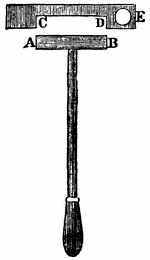
Fig. 192.
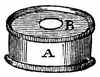
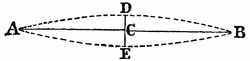
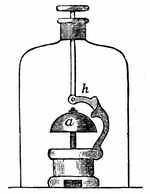
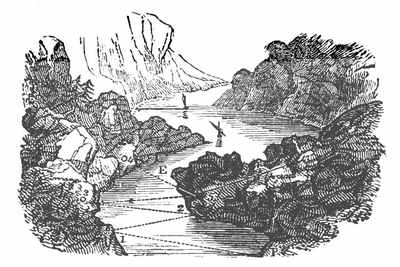
274. Expansion in Solids.—Heat, you have seen in
§ 23, acts in opposition to the attraction of cohesion,
tending to separate the particles, and
so produces an expansion of any substance.
This may be exemplified in
the experiment represented in Fig.
192, in which A B is an iron rod,
which is of such a size that at the
ordinary temperature it will fit into
the space, C D, in a bar of iron, and
easily pass through the hole, E. If
the rod be heated it will be enlarged
or expanded in all directions, so that
it will neither fit into C D nor pass
into the hole, E. When the wheel-wright
puts a tire upon a wheel he
uses the expansion of heat to make
it fit tightly and firmly. The tire is made a little too
small to have it fit upon the wheel as it is. But by being
heated it is so expanded that it will readily go on to
the wheel, and then in contracting as it cools it so compresses
the fellies as to hold on very tightly. Water is
poured on to cool the iron quickly, and thus prevent it
from burning the wood. Iron hoops are put on barrels
in a similar manner, the compression caused by their
contraction binding the staves together very strongly.
So in fastening the plates of boilers together, the rivets
are put in red-hot, so that in their contraction they may
press the plates closely together. If an iron gate just
shuts into its place in cold weather, its expansion will
prevent its shutting when warm weather comes. In order
to avoid this difficulty, calculation must be made in
fitting it for its place for the expansion to which it will
be subjected by heat. So in laying the rails of a railroad
in cold weather care must be taken not to put the ends
too near together. In constructing iron bridges the expansion
by heat must be calculated for in the arrangement.
Nails often become loose after the lapse of years
from the wear of the wood around them, occasioned by
their alternate expansion and contraction. The leaking
of gas-pipes in the earth is often undoubtedly caused by
the loosening of the joints from contraction and expansion
of the pipes by varying temperatures of the soil,
especially where they are not laid very deep. If a stopper
stick fast in a bottle it can be loosened by the application
around the neck of a cloth dipped in hot water,
because the neck becomes expanded at once by the heat.
A similar expedient was once very ingeniously made use
of in repairing the machinery of the steamer Persia at
sea, and was perhaps the means of saving the vessel and
the lives of all on board. The accident which occurred
was the breaking of the port crank-pin of the engine.
The problem to be solved was the removal of this pin,
which weighed nearly a ton, and the substitution of a
sound one which they had on hand in its place. But it
was found impossible to start the broken pin from its
socket with all the force which could be brought to bear
upon it by a sort of battering-ram constructed extemporaneously
for the purpose. It was determined now to
try the expansive force of heat. An iron platform was
built under the socket, and a brisk fire made upon it.
The socket soon expanded, and the pin was now readily
knocked out by the battering-ram, just as the stopper of
the bottle is easily removed when the neck is heated.
The walls of a very large building in Paris, which had
bulged out and were in danger of falling, were restored
to their upright position by the expansion of heat.
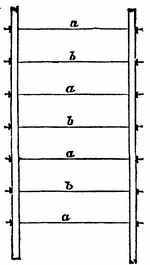
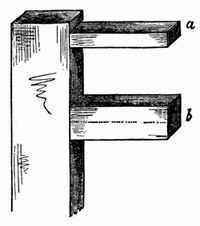
Fig. 193.
It was done in this way: Long rods of iron were run
through the walls after the plan represented in Fig. 193
(p. 213), their ends being made with a screw-thread, with
nuts fitted to them. The rods marked a were first heated,
and as they lengthened the nuts were screwed up
tight to the walls. On cooling, their
contraction would of course draw the
walls together. The other bars, b,
were now heated and managed in the
same way. The one set, you see,
were made to hold on by their nuts
to what had already been gained,
while the other were expanding. By
many repetitions of this process the
walls were righted and the building
saved. The same mode has been
adopted successfully in other cases
of a similar character.
275. Expansion in Liquids.—Liquids
are expanded by heat more than solids are. But they are
very unequally expanded by it. Thus water is expanded
more than twice as much as mercury, and alcohol six times
as much. We have a frequent example of the expansion
of water by heat in our kitchens. If the tea-kettle be
put over the fire filled to the brim, it will run over long
before the water begins to boil. All liquids occupy
more space in summer than in winter, and in the former
case weigh less—that is, have less of real substance
in them than in the latter. If, therefore,
alcohol, or oil, or molasses be bought by the
gallon in winter and sold in summer, there will
be a profit afforded by the expansion. Twenty
gallons of alcohol in winter becomes twenty-one
in mid-summer.
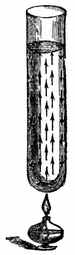
Fig. 194.
The influence of the expansion of heat upon
the specific gravity of liquids may be very prettily
shown by the following experiment: Let
some little bits of amber—a substance which
is nearly of the same specific gravity with water—be
thrown into water in a glass vessel,
and let the water be heated, as represented in
Fig. 194, by a spirit-lamp. That portion of
the water which is heated passes upward because it is
made specifically lighter, and colder water continually
comes down to take its place. The upward and downward
currents are as indicated by the arrows, the upward
passing up in the middle, the downward coming
down at the sides. This will be made manifest by the
little bits of amber.
276. Thermometers.—It is the expansion of liquids by
heat that in the thermometer gives us the measure of
temperature. The liquid metal mercury is commonly
used for this purpose, and answers well except in the
extreme cold of the arctic regions. There, as mercury
becomes solid at 39 degrees below zero, it is necessary
to use a thermometer with alcohol in it, as this fluid can
not be frozen by any degree of cold. The operation of
the thermometer is simply this: Heat expands the fluid
in the bulb, and the only way in which it can occupy
more space as it expands is by rising in the tube. The
abstraction of heat, on the other hand, causes contraction,
and of course a proportionate falling of the fluid.
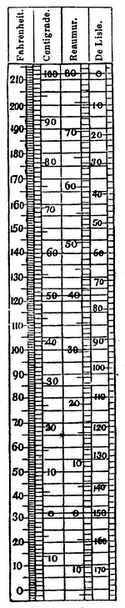
Fig. 195.
277. Fahrenheit's Thermometer.—The thermometer
was invented in the beginning of the seventeenth century,
but it is not decided who was the inventor. There
may have been in this case, as in others, more inventors
than one, the same ideas having, perhaps, entered several
inquiring minds at the same time. Various fluids were
used by different persons. Sir Isaac Newton used linseed
oil. Fahrenheit, a native of Hamburg, who flourished
in the first part of the last century, was the first to
use mercury. Though various propositions were made
by Newton and others in regard to the measurement of
heat by thermometers, no thermometric scale seems to
have met with general reception till that of Fahrenheit's,
which was put forth about 1720. The plan of it is this:
His zero is the point at which the mercury stood in the
coldest freezing mixture that he could make; and he
supposed that this was the greatest possible degree of
cold, as it was the greatest that he knew. He next found
the point at which the mercury stood in melting ice.
This he called the freezing point, because the temperature
is the same in water passing into the solid from the
fluid state as in water passing into the fluid state from
the solid. In other words, this point in the scale marks
the transition line between the two states. From this
point Fahrenheit marked off 32 equal
spaces or degrees down to zero. He
now found the point at which the mercury
stands in boiling water, and called
this the boiling point. Marking off the
space on the scale between this, and the
freezing point in the same manner, there
are 180 degrees—that is, the boiling point
is 212 degrees above zero. The degrees
above zero are commonly designated by
the mark +, plus; and those below by
the mark -, minus. Thus, +32° signifies
32 degrees above zero, and -32° signifies
32 degrees below.
278. Other Thermometers.—Fahrenheit's
thermometer is the one commonly
used in this country. But there are several
other thermometers on different
scales, as the Centigrade, Reaumur's, and
De Lisle's. In Fig. 195 you see the plans
of the scales of these thermometers placed
side by side. In the Centigrade thermometer,
which is in use in France, and
indeed in a large part of Europe, the zero,
you see, is placed at the freezing point;
and the space between this and the boiling
point is divided into 100 degrees,
which gives it the name Centigrade.
Reaumur's, which is in use in Russia, has
the same zero, but he has only 80 degrees
from this to the boiling point. De Lisle's, which has
gone entirely out of use, has its zero at the boiling point.
The arrangement of Fahrenheit, although its zero is a
mere arbitrary point, is, on the whole, the best, because
its degrees are of such a size that they mark differences
of temperature with sufficient minuteness for all practical
purposes of an ordinary character without resorting
to fractional parts.
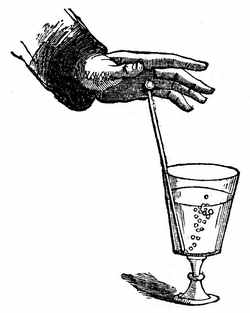
Fig. 196.
279. Expansion in Aeriform Substances.—Heat produces
a vastly greater expansive effect in air, the gases,
and vapors, than it does in liquids. The expansion of
air by heat may be shown very prettily in this way:
Take a glass tube that has
a bulb on one end, and,
placing the other open end
in water (as represented in
Fig. 196), apply the palm
of your hand to the bulb.
The heat of the hand being
communicated to the
bulb will expand the air,
and so, as you see, bubbles
of air will escape through
the water. On removing
the hand, and allowing the
bulb to cool, the air in it
will be condensed, and water
will pass up in the tube
in proportion to the amount of air which has escaped.
A bladder partly filled with air will be made to swell
out to plumpness if it be heated sufficiently, and a full
one may be so heated as to burst from the expansion of
the air. Porous wood, as chestnut, snaps very much
when burned, because the heat expands the air contained
in the pores.
280. Balloons.—The first balloons that were used were
filled with heated air. You have already seen, in § 149,
why it is that balloons rise. Now in the hot-air balloon
it is the expansion of the air by heat that makes it lighter
than the surrounding air. Of course such a balloon
is not as effective as the gas balloon, for the air within it
loses its comparative lightness as it becomes cooled;
while the gas which is used, being very much lighter
than air at the same temperature, does not lose its lightness
as the balloon goes up. You learned in § 152 that
the atmosphere becomes thinner as we go upward. The
gas balloon, therefore, rises until it arrives at that point
where the air is of about the same specific gravity with
the gas, and there it stops. It is made to descend by
letting out some of the gas from a valve. Gas was not
used for balloons till 1782. Hydrogen gas was employed
at first, being over fourteen times lighter than air. Of
late the common burning gas, carbureted hydrogen, has
been generally used, because it can be so readily obtained
where there are gas-works.
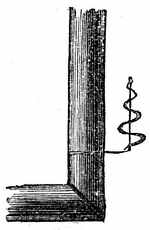
Fig. 197.
281. Currents in the Air from Heat.—Heat is the
grand mover of the atmosphere. Any portion of it that
becomes warmer than surrounding portions rises, or rather
is pushed up, for the same reason that a hot-air balloon
rises, the only difference between the two cases being
that in the one the air is confined, and in the other
is left free, and so becomes diffused. And it is this rising
of the air from expansion that causes nearly all the
movements that we witness in the air. We see this exemplified
in various ways wherever there is a fire. The
air that is heated by the fire is forced upward by the
colder air, which, on the principles of specific gravity,
seeks to get below the warmer and lighter air. The hot
air that comes through the registers of a furnace is pushed
up by colder air below. For the same reason the
heated air around a stove-pipe is constantly going upward.
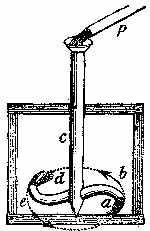
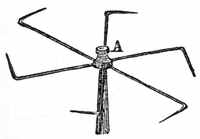
This is very prettily shown by the toy represented
in Fig. 197 (p. 218), which is a paper cut spirally, and
suspended, as you see, upon the point of a wire. The upward
current makes the paper revolve
rapidly around the wire. It is from the
rising of warm air that the galleries of
a church are warmer than the space below.
In a common room the disposition
of the air is continually to have its
warmest portions above and the colder
below. It is for this reason that we
have our arrangements for producing
or introducing heat at as low a point as
possible.
282. Chimneys.—We speak of the draught of a chimney,
and we say of one that does not smoke that it draws
well, as if the smoke were in some way actually drawn
up. But the same principles apply here as are developed
in § 281. The smoke, which is a combination of
heated air and gases with some solid matters in a fine
state, is forced up the chimney. When a chimney does
not draw well we open a door or a window for a little
while until the fire gets thoroughly agoing. Why is this?
It is that we may have denser air than there is in the
room, so that the smoke may be pushed up more forcibly.
When the chimney becomes well heated there is
ordinarily no difficulty, because then the smoke in it is
not obliged to part with much of its heat to the walls of
the chimney, and therefore is so much lighter than the
air in the room that it is very easily forced upward. The
principal reason that a stove-pipe generally draws better
than a chimney is that there is much less heat expended
in establishing and maintaining the upward current. Especially
is this true if the chimney be a large one. In
such a case there are both a great extent of brick and a
large body of air to be heated to establish the upward
current, and these must be kept warm in order to maintain
it.[3]
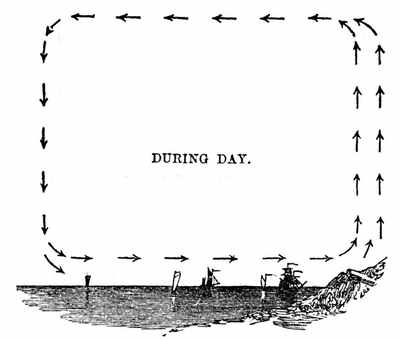
Fig. 198.
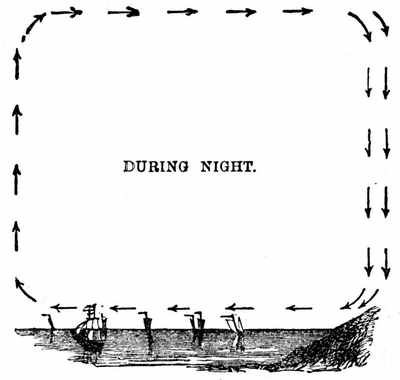
Fig. 199.
283. Winds.—If you open a door of a heated room a
candle held near the floor will have its flame blown inward,
while one held near the top of the door will have
its flame blown toward the cold entry. Here you have
a good illustration of the manner in which winds are
produced. Wherever the wind blows it is air pushing
out of the way other air that is warmer, in order that it
may, in obedience to gravitation, get as near the earth
as possible. Take, for example, the land and sea breezes,
as they are called. During a hot summer's day the sun
heats the earth powerfully, while the ocean receives but
little of its heat. The heated land heats the air above it;
and as the air over the ocean is cooler, and therefore
heavier, it pushes upward the air of the land, for the
same reason that water pushes up oil; and as this goes
on continuously a regular current is established. The
wind blows in upon the land, as represented in Fig. 198,
while the warmer air passes upward into the higher regions
of the atmosphere, and turns toward the sea. The
arrows show the course of the currents. The resemblance
of all this to the effect upon the candle held near
the open door is very obvious, the cold air from the entry
blowing in below representing the breeze from the
ocean, and the warm air of the room blowing out above
representing the passage of the warm air of the land out
toward the ocean. At night this is apt to be reversed.
The earth becomes cooled, and with it the air that is over
it. The result is that the cooled air of the land now
pushes upward the warmer air of the sea, as seen in
Fig. 199.
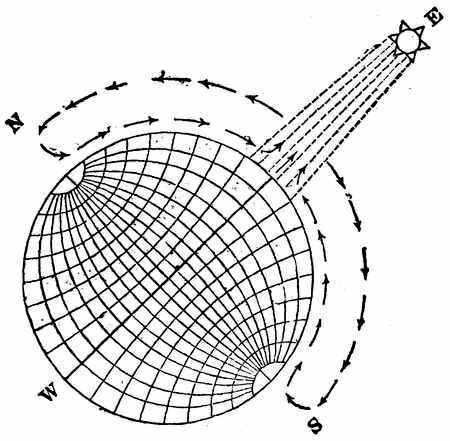
Fig. 200.
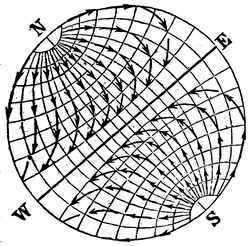
Fig. 201.
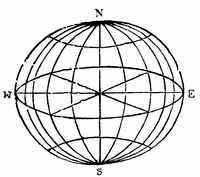
284. Winds as Affected by the Rotation of the Earth.—The
heat of the vertical sun upon the tropics causes a
rise of heated air into the upper regions, while there is
a rush of colder air toward the equator from both north
and south. This effect is represented in Fig. 200 (p. 221),
E being the sun, N the north pole, and S the south pole.
An effect similar to that represented in Figs. 198 and
199 is produced here, but it is on a much larger scale.
But the diagram does not present the matter in its true
light in all respects. The prevailing winds in the equatorial
regions are not north and south winds, as would
appear from this diagram; but they are from the northeast
and southeast. I will
explain this by Fig. 201.
As the earth turns on its
axis it is plain that there is
no part of the surface of
the earth that moves so
rapidly as the equator,
E W, for that moves in a
larger circle than any other
part. And the nearer you
go to either pole, N or S,
the less is the rapidity of
the revolution. Now the
atmosphere, as stated in § 188, partakes of the motion
of the earth. The air, therefore, at the equator is moving
from west to east with the rotation of the earth
faster than it is any where else, and the nearer you go
to either pole the slower is its motion. It follows from
this that any portion of air blowing from the north or
the south toward the equator, as it comes from where it
was moving east slower than air at the equator is, would
from its lesser momentum lag behind the air of the
equator, the wind would be curved toward the westward,
as indicated by the arrows. The result would be
that the northern wind would be converted into a northeaster,
and the southern into a southeaster. All this
can be made more clear with a globe, or, indeed, with
any round object.
285. Liquefaction.—The change of solids into liquids
is one of the most observable effects of heat. This
change requires different degrees of heat in different
substances. Thus while iron melts at the high heat of
2786°, lead melts at 633°, sulphur at 239°, ice at 32°, and
mercury at 39° below zero. Mercury is never found in
a solid state, but it sometimes becomes solid in the arctic
regions when carried there and exposed in the open air.
We are apt to think of water as being in a more natural
state when liquid than when it is solid, just as we think
of iron as being naturally solid and mercury as naturally
liquid. But in all these cases the state of the substance
depends on its temperature, and this is varied by circumstances.
Water at the equator is always liquid, and the
idea of ice there is exceedingly unnatural; while near
the poles it is the reverse, ice and snow reigning every
where throughout the whole year.
286. Evaporation.—There are two ways in which the
change of a liquid into a vapor occurs. One is a rapid
change when heat is so applied as to raise the liquid to
its boiling point. This is commonly termed vaporization.
The other mode is the ordinary gradual evaporation
which goes on from the surface of the liquid. This process
is going on continuously, not requiring any particular
degree of heat, but occurring under all degrees of
the temperature of a liquid. Its rapidity, however, is
in proportion to the degree of heat, as may be seen by
the rise of vapor from water that is being heated, long
before it begins to boil. The same thing can also be
seen in a bright summer's morning, when the heat of the
sun causes the moisture gathered from rain or dew to
rise so abundantly from fences, and boards, and roofs as
to be visible like smoke.
287. Solution of Water in Air.—Evaporation is constantly
going on from every wet surface, except when
the air is so loaded with moisture that it can take up no
more. The vapor is not ordinarily visible, the particles
of water passing quietly upward among those of the air,
being dissolved in the air just as some solids are dissolved
in water. It becomes visible only when so much
of it rises that the solution of the water in the air is not
readily effected. The readiness with which the solution
takes place depends much upon the temperature of the
atmosphere. Some very common phenomena illustrate
this. In a very cold day the breath of animals, as it
comes out of the mouth, seems to be loaded with moisture.
Why? It is not because there is more moisture
in it than in warm weather, but because cold air can not
hold in solution so much water as warm air can. The
same explanation applies to the smoking of wet fences
and roofs in the sun of a summer's morning. The moisture
is heated by the sun, but the air, not having become
very warm as yet, can not readily dissolve all the moisture
that rises. The phenomenon is not apt to occur
when the hot sun shines after a shower at mid-day or in
the afternoon, because then the air is warm enough to
take up all the moisture that is sent up into it.
How water, being heavier than air, rises in the atmosphere
is a mystery. It has been supposed by some that
it was owing to a kind of affinity existing between water
and air. But in opposition to this is the fact that evaporation
takes place more rapidly under the exhausted
receiver of an air-pump, where there is almost no air,
than it does where it is freely exposed to the atmosphere.
288. Clouds.—The water which goes up in the air in
evaporation is variously disposed of. Some of it is deposited
as dew or frost. Some of it forms fog. Some
of it also mounts far upward and forms the clouds, which
are really collections of fog made high up in the air. In
fog and in clouds the water which in its evaporation is
invisible becomes visible. Let us see how this is. There
is always more or less of water in clear air, but the particles
are so minutely divided and so thoroughly mingled
with the particles of the air that they can not be seen.
But in a fog or cloud the particles of water are gathered
together in little companies, as we may express it. And
it is supposed, some think ascertained, that each of these
companies of particles is globular and hollow. If so,
then we may regard every cloud as a vast collection of
minute bubbles or balloons careering through the air.
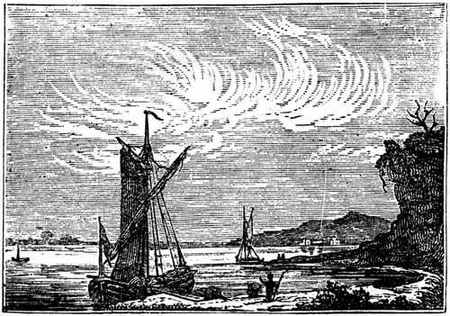
Fig. 202.
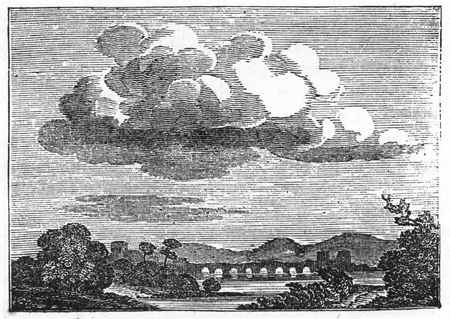
Fig. 203.
289. Shapes of Clouds.—Clouds have a very great variety
of shape, the causes of which are for the most part
not understood. They are generally divided into four
classes: Cirrus, Cumulus, Stratus, and Nimbus. The
Cirrus is represented in Fig. 202 (p. 225). It is a light,
fleecy cloud, having graceful turns like curls, and hence
its name, which is the Latin word for curl. Such clouds
are commonly very high up in the air. The Cumulus
(Latin for heap) you see in Fig. 203 (p. 225). Clouds
taking this form appear as heaps rounded upward, and
often appear like mountains of snow when they are illuminated
by the sun. We see such clouds mostly in
summer. The Stratus (Latin for covering) is seen in the
same figure under the Cumulus. Clouds of this form lie
low in the horizon, stretched along like a sheet. They
often form in the latter part of the day, and increase in
the night, but the rising sun dissipates them. The Nimbus,
or rain-cloud, is represented in Fig. 204 (p. 226).
It has a uniform gray or dark color. We often have
two forms of cloud mingled together. Thus in Fig. 205
(p. 226) we have a mixture of the Stratus and the Cirrus,
termed Cirro-Stratus. This is commonly called the
mackerel-sky, and is quite a sure prognostic of rain.
Then we have the Cirro-Cumulus, Fig. 206 (p. 227), and
the Cumulo-Stratus, Fig. 207 (p. 227).
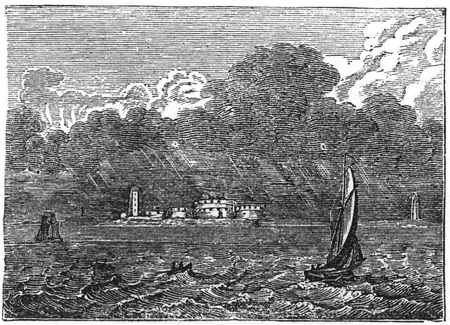
Fig. 204.
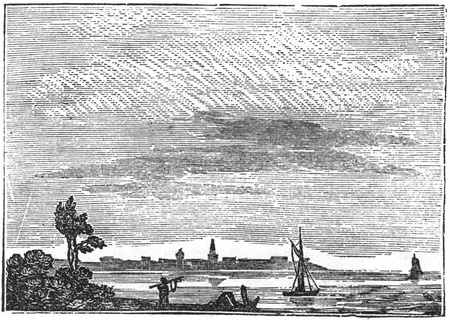
Fig. 205.
Water is gathered into clouds undoubtedly, in part at
least, from the influence of attraction. But what the
circumstances are that give them all these various shapes
we know not. Whatever they are, they sometimes operate
very extensively, giving a similar shape to all the
clouds that cover the whole arch of the heavens; and at
other times they operate variously in different localities,
producing different shapes, sometimes even in near neighborhood
to each other. Sometimes the edge of a cloud
is irregular, or curved, or feathery; and at others it is a
well-defined line, stretching along over a large portion
of the horizon. In all these cases we have only divers
arrangements of the same thing—a collection of vesicles
of water containing air, which is made lighter than the
air outside of the cloud by means which I shall speak of
in another part of this chapter.
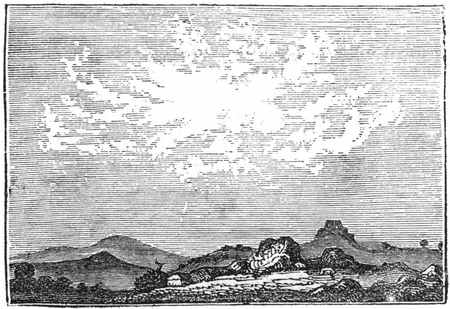
Fig. 206.
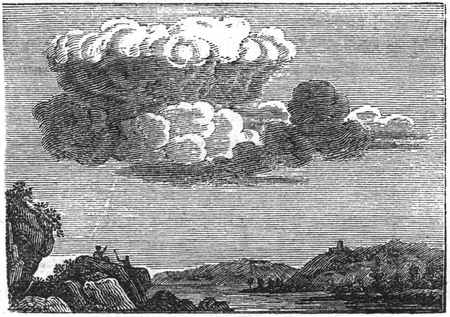
Fig. 207.
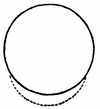
Fig. 208.
290. Rain, Snow, and Hail.—When it rains the vesicles
or minute bubbles of which the clouds are composed
are broken up, and each drop of rain contains the water
which came from a multitude of these vesicles. But let
us see exactly how this result is produced. Rain comes
from the contraction of the clouds by cold. A cold current
of air coming in contact with a cloud will condense
its bubbles into drops, and these of course will fall. The
same result occurs if a cloud passes into a cold stratum
of air. But let us look at the process more minutely.
Let us see what the effect of cold is upon the bubbles.
The first effect may be made clear by Fig.
208. If a bubble be contracted by the influence
of cold, the water of its wall being
made thicker, there will be a gathering of
it from gravitation at the lower part, as
represented by the dotted line. You often
see a similar effect in the soap-bubble. It
rises filled with the warm air from your lungs, and as it
goes up it is contracted by the colder air which is around
it. This contraction makes the water hang downward
from the bottom of it. And as the soap-bubble at length
perhaps bursts in the air from the weight of this water,
so it is with the vesicles in the cloud. And many of
these, united together by attraction, form a drop. When
the cold is sufficiently severe it makes the water of the
ruptured vesicles of the cloud arrange itself in snow-crystals
instead of drops. And when the cold acts with great
rapidity upon a cloud it presses the particles of the water
together so suddenly that there is not time for the crystalline
arrangement, and hail is formed.
291. Vaporization.—The production of vapor by boiling
differs in some respects from quiet evaporation. Here
the liquid is raised in temperature to its boiling point,
and the formation of vapor is not confined to the surface.
In water the boiling point is 212°, but it varies more or
less from this in other liquids. Thus the boiling point
of alcohol is 173°, of ether 95°, oil of turpentine 568°,
and mercury 652°.
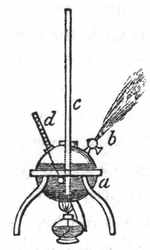
Fig. 209.
292. Influence of Pressure upon the Formation of Vapor.—Pressure
restrains the production of vapor, whether
it be formed by evaporation or vaporization. We
know by experiments with the air-pump that the less
pressure of air there is upon the surface of a liquid the
more rapidly will evaporation from it go on. I have already
spoken of the influence of pressure upon the boiling
of liquids in § 171. I will give here a few additional
illustrations. Ether boils when it is heated to 95°, three
degrees below the heat of the blood in our bodies. If
we place some of it in a vessel under the receiver of an
air-pump, by exhausting the air we can so take off the
pressure that the ether will boil at the ordinary temperature
of the air in a room. The restraint of pressure
upon boiling is very strikingly shown in the digester,
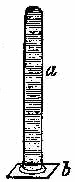
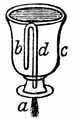
Fig. 209. This is a strong boiler, a, partly
filled with water. A thermometer, d,
is fastened into it so as to indicate the
heat of the water. There is also a tube,
c, extending to near the bottom of the
boiler into a small quantity of mercury
which is there. Let, now, the boiler be
heated till the water boils, the air being
left to escape by the stop-cock, b. If the
stop-cock be shut, and we continue to apply
the heat, we can raise the water to a
very high temperature without having it boil at all, because
of the pressure of the condensed steam upon its
surface. An apparatus somewhat after this plan, called
Papin's digester, has been used sometimes in cooking.
The great heat to which water can thus be raised causes
it to extract the nutritious matter from bones and cartilages,
affording material for soup from what is commonly
thrown away. To guard against the danger of explosion
a safety-valve is provided, having a weight upon it
which will keep it shut until a certain amount of pressure
accumulates, and then it is forced open, letting out
some of the steam.
293. Steam.—The cloud of steam, so called, which you
so often see escaping from a locomotive is not really
steam. Steam is transparent and invisible. You can see
that it is so if you observe it issuing from the spout of a
tea-kettle. It is only after it gets an inch or more from
the spout that it becomes visible, and then it is really
changed from steam into water by the condensing influence
of the cold air. And the water in the cloud thus
formed is probably in the same condition with the water
in the clouds above, as described in § 288.
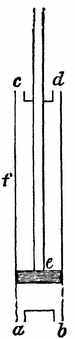
Fig. 210.
294. The Steam-Engine.—As compressed or condensed
air has great power by its elasticity, as seen in the air-gun,
§ 164, so also has condensed steam. It is steam
condensed, and endeavoring, therefore, in proportion to
its condensation, to expand itself, which constitutes the
moving force of the steam-engine. The steam is generated
in a boiler, having, like the boiler of Papin's digester,
a valve with a weight attached to it. This valve is
called a safety-valve, because when the steam has reached
a certain degree of condensation it lifts the valve,
and, as some of the steam escapes, such an increase of
pressure as would occasion an explosion is prevented.
The expansive force of steam in a boiler is estimated in
pounds by the weight on the valve, and hence the common
expression that there are so many pounds of steam
on. But the boiler is only the generator of steam, and
it remains to show how the steam is used in moving machinery.
This is done by allowing the steam to pass
from the boiler into a cylinder, and then move a piston
back and forth by its expansive force. The manner in
which it does this may be made clear by the diagram,
Fig. 210 (p. 231). Let e be a piston in a cylinder, f,
which has four openings, a, b, c, and d. These all have
valves. The steam is supplied from the boiler to the
cylinder through a and c, and makes its escape
from b and d. Suppose, now, the piston is near
the bottom of the cylinder, as represented.
The valve at a is now opened that steam may
enter to push up the piston, and the valve at b
shuts that the steam may not escape. At the
same time, that pressure may be taken off from
the upper surface of the piston, d opens that the
steam may escape, and c shuts that none may
enter. When the piston is to be forced downward
all this is reversed—c opens to admit the
steam, d shuts to prevent its escaping; and below,
b is opened to let the steam escape, and a
is shut to prevent any from entering. This is
the plan of what is called the high-pressure engine.
The low-pressure engine differs from it in having
the steam, as it escapes from the cylinder, pass
into water to be condensed. The latter requires less
pressure of steam to work it, and therefore is the safest.
The manner in which the motion of the piston is made
to work various kinds of machinery I need not stop to
explain, especially as exemplifications of it may be seen
in every quarter.
295. Communication of Heat.—Heat has a constant
tendency to an equilibrium. If therefore any warm substance
be in the neighborhood of one which has less heat,
a flow of heat from the former toward the latter takes
place. Now this communication of heat occurs in three
different ways, called Convection, Conduction, and Radiation.
I will speak of each of these separately.
296. Convection.—This mode of diffusion of heat is in
operation in those substances whose particles are movable
among each other—viz., liquids and aeriform substances.
I have already alluded to examples of this mode in
speaking of the movements which heat causes in these
substances. The heat goes along with the particles
which are moved, or is conveyed along with them, and
hence the term convection. In this movement the heated
particles always ascend, for the reason given in § 275.
Of the multitude of examples of convection I will present
but a few.
In the upward current about a stove-pipe you have an
example of convection, the heat generated being carried
upward by the particles of this current. This being so,
the heat of a stove has no effect upon the air below it by
convection, though it does have by radiation, as you will
soon see. Any hot fluid becomes cool chiefly by convection.
The air coming in contact with it taking some
of its heat rises, and other air comes in its turn to be
also heated, and so on till the fluid becomes of the same
temperature with the air, and then the currents of air
cease. The liquid cools more rapidly by stirring it, because
the air is brought into contact with a greater extent
of surface, and so the heat is conveyed away more
rapidly. The result is the same whether we disturb the
surface by stirring it or by blowing upon it. In the latter
case, however, the effect is increased by making the
air to come more rapidly upon the disturbed surface. So
in fanning, it is the bringing of the air faster upon the
surface of the body that causes the more rapid, convection
of heat from it. Every one must have observed the
fact that a buckwheat cake cools much more quickly
than a flour or rice cake. It is because it has so many
pores and little projections, and so presents a much larger
amount of surface to the heat-conveying air than the
smoother and more solid cakes. Viscid fluids, as molasses,
oil, etc., when heated do not cool as readily as water,
because their particles are not as movable, and therefore
heat is not conveyed as rapidly upward to be given
off to the air.
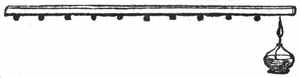
Fig. 211.
297. Conduction.—In this mode of diffusion the heat
goes through or among the particles of substances. For
example, if one end of a bar of iron be held in the fire, it
travels through or among the particles to the other end.
The gradual progress of the heat may be seen by the
following simple experiment: Take a rod of iron and attach
to it, as seen in
Fig. 211, some little
balls of wood by means
of wax. By heating
one end with a lamp the balls will drop one after another
as the heat passing along melts the wax which
holds them.
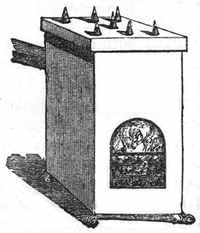
Fig. 212.
298. Conductors and Non-Conductors.—Heat is conducted
more rapidly through some substances than
through others. There is great variety in this respect.
There is considerable among those which are reckoned
as good conductors, as is shown
by the experiment represented
in Fig. 212. Here are cones
of the same size of seven different
substances—copper, iron,
zinc, tin, lead, marble, and brick—all
tipped with a little wax,
and placed on a stove. The
wax will melt on the copper
cone first, showing that this is
the best conductor of them all;
and on the brick one last, showing
that this is the poorest conductor.
The conducting powers of the rest are according
to the order in which I have mentioned them.
Those substances which allow heat to pass through
them very slowly are called non-conductors. The term,
though convenient, is not a strictly correct one, for there
are no substances which do not conduct heat in some degree.
Wood is one of these poor conductors, and hence
wooden handles are put upon various instruments and
vessels that are used about fires, as the soldering irons
of the tinman, the metallic tea-pot, etc. As cloth is a
non-conductor, the holder is used in taking off the tea-kettle
and in using the flat-iron. Glass is so poor a conductor
that if you hold a rod or tube of it across the
flame of a spirit lamp or gas burner, and heat it even to
redness, you can place your fingers very near to the heated
portion with impunity. I had occasion to-day to bend
a small glass tube in this way, and I observed some water
in it quite near to the heated part which remained
undisturbed through the process. It is the non-conducting
quality of glass that makes it so liable to break, when
it is thick, if it be exposed to any sudden change of temperature.
For example, if hot water be poured into a
thick glass vessel, the inner surface is quickly expanded;
but the outer surface not expanding with it, because the
heat is not readily conducted through, this irregularity
in expansion causes a fracture. It is for this reason that
the flasks, retorts, etc., used by the chemist are made
very thin, especially where the heat is to be applied.
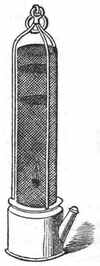
Fig. 213.
299. Davy's Safety-Lamp.—One of the most beautiful
applications of the conduction of heat we have in the
Safety-Lamp of Sir Humphrey Davy, an
invention which has been the means of
saving the lives of multitudes of miners.
It is represented in Fig. 213. With this
lamp one can go into the midst of the most
explosive gases with impunity. Now all
that prevents the flame within from setting
on fire the gases without is a covering
of wire-gauze. This, being a good
conductor, conducts off the heat of the
flame within so rapidly that it can not go
through the openings as flame, and so
does not set fire to the gas without. The
fact upon which the construction of this
lamp was based was discovered by trying
many experiments. Among them were
the following: A piece of wire-gauze was held over a
candle so that its flame struck against it. The smoke issued
above, but no flame. Then a stream
of gas was allowed to pass through the
gauze, as seen in Fig. 214, and was set
on fire above. It burned without inflaming
the gas below.[4]
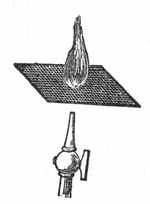
Fig. 214.
300. Relation of Density to Conduction.—Generally
the more dense a substance
is the better is its conduction of
heat. Thus the metals are better conductors
than wood, marble than brick,
the solids than liquids, and liquids than aeriform substances.
We have frequently a good illustration of the difference
between stone and brick as conductors in the
melting of snow on sidewalks. If a light snow fall in
the spring, after the earth has become somewhat warm,
you will see it melted from the stone walks much before
it is from the brick ones. This will be especially the
case if the snow be melted mostly by the warmth of the
earth without the agency of the sun. The explanation
is obvious. The stone is a better conductor than the
brick, and therefore the heat of the earth comes up
through the former more rapidly than through the latter.
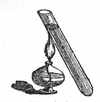
Fig. 215.
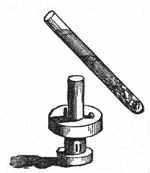
Fig. 216.
301. Conduction in Liquids.—That liquids are poor
conductors of heat may be shown by an experiment or
two. If a thin glass tube closed at one end be filled with
water, and the heat of a spirit lamp be applied
to its upper portion, as seen in Fig.
215, though the water at this portion may
be made to boil, there will not be the least
movement in the lower part. This will be
very obvious if you have some amber-dust
in the water. Again, let a little water be
frozen in the lower part of the tube by placing it in a
freezing mixture, and introduce a little oil, and then over
that some alcohol. Hold now the
tube over the chimney of a lamp, as
represented in Fig. 216, until the alcohol
boils. The ice in the bottom
of the tube will not be in the least affected,
and the oil will be but slightly
heated. If the heat were to be applied
in either of the above cases at
the lower part of the tube the result
would be different, because convection
would then operate in the diffusion of the heat.
302. Air as a Non-Conductor.—Heat is rapidly diffused
in air by convection; but it is only when the air is free
that this can be done. When the air is confined in spaces
or pores, or among fibres, heat makes its way through it
very slowly, for it can be diffused through it then only
by conduction. The variety of ways in which air is of
service to us as a non-conductor is almost endless. I
will notice some of them.
303. Double Windows.—The efficacy of double windows
depends upon the confined air between them. In
the case of the single window a great deal of the heat
inside is lost in this way: The warm air of the room
which comes in contact with the window imparts to it
some of its heat, and, being thus cooled and therefore
condensed, passes downward. As this process goes on
continually this downward current by the window is
constant. The current outside is in the opposite direction.
The heat imparted to the window is taken up by
the cold air, and as it thus becomes warmer it passes upward.
And this upward current outside is as constant
as the downward current inside. Now nearly all this is
prevented by the non-conducting quality of confined air
in the case of double windows. If a pane were taken
out from the upper part of the inner window, and another
from its lower part, the inner window would be of
little use, for then the heat of the air in the room would
be continually diminished by convection, as when the
window is single. The warm air would pass in at the
upper opening, and, being cooled, pass down through
the lower one.[5]
304. Air as a Non-Conductor in the Walls of Buildings.—The
spaces included between the outer wall of a building
and the plastering inside being filled with confined
air, prevent the heat of the air in the apartments from
passing off readily through the wall. A house built of
brick or stone, with the plastering placed directly upon
the inside of the wall, would be kept warm with difficulty
in winter, because the solid wall would so readily
conduct off the heat to the external air. So, also, such
a house would be very warm in summer, because the
heat of the sun and of the external air would be so
rapidly communicated to the air of the house. In this
connection I will mention a contrivance to prevent the
spreading of fires in blocks of buildings, which, though
very effectual, is seldom made use of, partly because it
occasions some trouble and expense, and partly because
it takes up a little room. It is this: A small space is
left in the division wall between each two houses from
top to bottom, containing, of course, a body of confined
air, that is, if the space be entirely shut in, which is as
essential here as in the case of the double windows.
With such an arrangement the interior of one house may
be entirely consumed without communicating sufficient
heat through the confined air to set on fire the other.
305. Fur, Hair, and Feathers.—Animals that live in
cold climates are provided with suitable coverings for
their protection. Quadrupeds, for example, are covered
with fur, and birds have an abundance of downy feathers.
These coverings have no warmth in themselves,
though in common language we speak of them as being
warm. They are simply non-conductors, and so prevent
the heat which is made in the body of the animal from
escaping as fast as it otherwise would. But why are
they non-conductors? It is not because the substance
of which they are made is a non-conductor, but because
among their numberless fibres is partially confined that
great non-conductor, air. Let the fur or down be condensed
into a thin hard plate upon the animal, and it
would prove of little service as a protection against cold.
Down is much more abundant on the birds of cold climates
than on those in warmer regions, because more
air can be confined among the fibres of down than among
those of common feathers. Quadrupeds that are natives
of warm climates generally have hair instead of fur.
When therefore the horse is taken to a cold climate he
requires in winter the defense of a blanket; and the ox
needs under the same circumstances to be better housed
than he ordinarily is. As the elephant is a native of a
climate positively hot, his hairs are scanty and coarse.
Formerly there were elephants in the cold regions of
Siberia, as has been ascertained by remains found there.
But the elephant of Siberia had under its hair, close to
the skin, a fine wool to protect it against the cold. Animals
that live in cold climates have their coverings become
finer in fibre in the cold season of the year, to give
them the additional protection which they then need.
And animals with a furry covering, if they are carried
into a warm climate, have their fur become coarse, and
approximate the condition of hair.
306. Clothing.—Man has no covering to guard him
against cold, because he is capable of contriving clothing
suitable to the various degrees of temperature to which
he may be exposed. The object of clothing is not to
make the body warm, but to keep it so. The heat of
the body is generated continually within itself, and under
all circumstances this heat is maintained quite uniformly
at 98°. This, you see, is a much higher degree than the
atmosphere ordinarily has. We are all the time, then,
giving off heat to the air around us, except when the air
gets up to 98°. We are comfortable only when we are
giving off heat to a considerable amount, for the point
of temperature which is most agreeable to us when we
are at rest is 70° or a little less, that is nearly thirty degrees
below the temperature of our bodies. When the
temperature is below this we need extra clothing. In
making choice of clothing for various degrees of temperature
we practically apply the principles which I have
developed. Those articles of clothing which can confine
or entangle, as we may say, the largest quantity of air
among their fibres are the best non-conductors, or, in
common language, are the warmest. So, too, loose clothing
is warmer than tight, on account of the amount of
air between the clothing and the body. Thus a loose
glove is much warmer than a tight one. The same general
fact is exemplified in the coatings of straw which
we put upon tender trees and shrubs in winter. It is
the air that is confined in the tubes of the straw which
makes these coverings so effective a defense. It is probably
the air in the pores of the brick which makes it a
poorer conductor than stone, as illustrated by the fact
stated in § 300.
307. Cocoons.—Many insects pass through their pupa
or transition state in cocoons. When this is done during
warm weather, as in the case of the silk-worm, the
cocoon is simple. But when the pupa state lasts through
the winter special provisions are made in the arrangements
of the cocoon to guard the insect against the cold.
I will cite as an example the cocoon of one of our largest
moths, the Cecropia. This cocoon, fastened to some
shrub, keeps its inmate secure from the rigors of the
winter by a very beautiful arrangement. The real cocoon
is similar to that of the silk-worm; but it has a very
dense air-tight outer covering, and the space between
these two coverings of the pupa is filled with a loose
substance, which has air, of course, mingled with its
fibres, and acts, therefore, the part of a blanket for the
insect.
308. Buds of Plants in Winter.—In the latter part of
summer buds are formed on trees and shrubs, and these
contain the germs of the branches, leaves, and flowers
which are to come out the next year. These of course
must be guarded against the cold of winter, and it is
done very much as the pupa is guarded in the cocoon.
Each bud you can see has a covering of scales which is
air-tight, and inside of this there is a soft downy substance,
the blanketing of the bud. In these coverings,
which have been called by some one the "winter-cradles"
of the buds, the infant vegetation of another year
rocks back and forth in the wintry winds secure from
the cold, till the warm sun of spring wakes its hidden
life into activity.
309. Snow a Protection to Plants.—Snow is a good
blanket to the earth, keeping its warmth from escaping
into the cold air. This is because it contains mingled
with its feathery crystals such a quantity of air. If snow
come early, before the ground and the plants in it have
become frozen, it will keep them from freezing through
the winter, if it remain during all that time. It is curious
to observe the peculiar arrangement of the snow in
the arctic regions for the preservation of vegetation.
First in the autumn come soft light snows covering up
the grasses, and heaths, and willows. Then as winter
advances there are laid on top of these the denser snows,
making a compact, stout roof over the lighter snows in
which the scanty but precious vegetation of those regions
is imbedded. On top of this roof are deposited the snows
of spring. As these melt the water runs off from the icy
roof down the slopes, leaving untouched the plants underneath,
which lie there alike secure from the rush of
waters and from the nightly frosts until the season is
sufficiently advanced to bring them out with safety from
their concealment. Then the icy roof melts, and with it
the light snows that have so long encircled the plants,
and the sun wakes them from their long sleep to a new
life.
310. Influence of the Conduction of Heat on Sensation.—If
you place your hand upon fur hanging at the door
of a fur-store it does not feel as cold as the wood from
which it hangs, and the wood does not feel so cold as
the iron bar of the shutter close by. Why is this, when
these substances are exposed to the same atmosphere,
and really have the same temperature? It is because
the iron conducts the heat from your hand more readily
than the wood, and the wood more readily than the fur.
So the iron handle of a wooden pump feels colder than
the pump, and the pump colder than the snow around it.
For the same reason, in a cold room the rug or the carpet
will not feel as cold as the poker and the hearth.
If water has stood long enough in a room to be of the
same temperature with the air of the room your hand
will feel colder in the water than in the air, because the
water is the better conductor. So much for the sensation
of cold. On the other hand, when substances are
so heated as to give us the sensation of heat, the conductors
do this more than the non-conductors. As they
receive heat readily they also readily impart it. For this
reason, with a brisk fire the hearth-stone feels very hot,
while the rug before the fire does not.
311. Radiation of Heat.—Every substance sends heat
into space constantly in straight lines in every direction.
These lines are radii, and hence the term radiation is applied
to heat diffused in this way. It is very obvious in
regard to the sun that it radiates heat in all directions.
The same can be seen in the case of a heated iron ball.
In whatever direction you hold your hand, above, below,
or laterally, you feel the heat. And it makes no difference
whether the ball be red-hot or not. That is, heat
is radiated either with or without light. When a room
is warmed by a furnace it is warmed altogether by convection;
but when it is warmed by a fire, either in a fire-place
or a stove, we have both convection and radiation.
The heat which we receive from the sun comes altogether
by radiation.
312. Connection between Heat and Light.—The heat
and light of the sun pass together through transparent
substances, as air, glass, water, etc., without heating them
to any extent. Thus, when the heat is transmitted
through a lens, § 272, the lens is little heated, that is, it
lets almost all the heat pass through it. The air is heated
by the sun, but not directly to any amount. It is
heated indirectly in this way: the rays of the sun passing
through the air heat the earth, and then the air receives
a part of this heat from the earth, which is diffused
through it by convection.
It is otherwise with heat that comes from a common
fire. It does not seem to be so thoroughly united with
the light, and therefore readily parts company with it,
as we may say. While the heat and light of the sun go
together through all transparent bodies the heat of a fire
will not go with its light through all of them. So while
the heat of the sun does not warm the glass through
which it passes the heat of a fire will warm it, and therefore
glass is an effectual screen against it. In some operations
in the arts a mask of glass is sometimes worn to
ward off the heat. The connection of light and heat will
be farther noticed when I come to treat of light.
313. Relation between Radiation and Absorption.—All
surfaces that radiate will absorb also equally well
the heat that is radiated upon them. All rough and
dark surfaces both absorb and radiate freely; but all
light-colored and polished surfaces do both slowly. For
this reason the black, rough tea-kettle is well fitted to
heat water in; but it is not fitted to retain the heat in
the water. On the other hand, the bright, polished tea-pot
absorbs heat poorly, but retains it well.
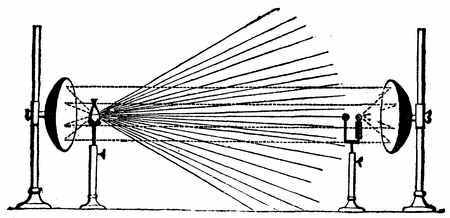
Fig. 217.
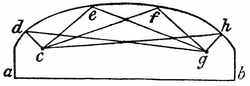
314. Reflection of Heat.—Radiated heat is reflected;
and here, as in the case of motion, § 206, and of sound,
§ 260, the angles of incidence and reflection are equal.
Some interesting experiments in relation to the reflection
of heat can be tried with concave metallic mirrors.
Thus, if we take two such mirrors, as represented in Fig.
217, and place in the focus of one a thermometer, and
in the focus of the other a small flask of hot water, or a
heated iron ball, the mercury in the thermometer will
rise, although the mirrors may be many feet apart. Observe
how the effect is produced. Rays of heat go from
the flask directly toward the thermometer, as represented
by the lines in the figure; but that the effect does not
come from these can be proved by removing the mirrors,
leaving the flask and thermometer just as they are.
When the experiment is tried in this way no effect is
produced on the thermometer, because it is too far from
the source of heat, the flask, to receive any perceptible
influence in this way. The effect comes from the rays
of heat which go to the mirror near the flask, and are
reflected to the other mirror, and then are reflected upon
the thermometer, all of which is represented by the dotted
lines. There is another way, besides that already
mentioned, of showing that it is not the direct rays that
produce the effect. After arranging the apparatus put a
screen between the thermometer and the mirror near it,
and the effect will be prevented because the reflection is
cut off. If a piece of ice be substituted for the flask of
hot water the thermometer will fall—an effect opposite to
that produced in the previous experiment. This would
seem to show that cold is radiated, but as there is no
such thing really as cold, § 270, the effect must be attributed
to the radiation of heat from the thermometer to
the ice. If a hot ball be placed in the focus of one mirror
and a piece of phosphorus in that of the other, the
phosphorus will be set on fire, though the mirrors may
be twenty or more feet apart.
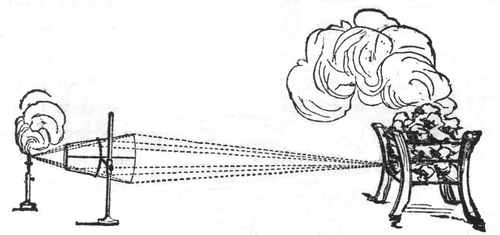
Fig. 218.
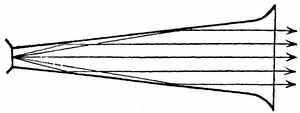
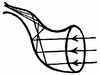
The reflection of heat may be exhibited very prettily
with the experiment represented in Fig. 218. A sheet
of bright gilt paper is rolled up in the shape of a funnel,
with the metallic side inward. Holding the larger end
toward a fire, the rays of heat coming from the fire into
the funnel are reflected toward a central line, and so pass
out of the smaller end of the funnel concentrated. If,
now, a bit of phosphorus or a lucifer match be held a
little distance from this end of the funnel it will be set
on fire.
315. Formation of Dew.—It is by the radiation of heat
that dew is formed. The earth is constantly radiating
heat into space as well as the sun. In the daytime it
receives a great deal more than it radiates. But at night
this is reversed, and the earth is cooled. The cooled
earth condenses the moisture in the air which is in contact
with it, and so the moisture is deposited. If the
weather be very cold this is frozen, and then we have
frost instead of dew. You observe that the dew does
not fall, though this is the ordinary expression. Its
formation is analogous to the deposit of moisture which
we so often witness in a hot day in summer on the outside
of a tumbler containing cold water. As the cold
tumbler condenses the moisture in the air, so does the
earth at night, it being cooled by radiation, condense
the moisture which has accumulated in the air by evaporation
during the heat of the day.
There are some circumstances which have an influence
upon the deposition of dew and frost. Less is deposited
under a tree than outside of it, because all the heat which
radiates vertically upward from under the tree is radiated
back again by the tree. Hence the efficacy of a covering
over plants as a defense against frost. Clouds operate
in the same way, and for this reason no dew or frost
is deposited in a cloudy night. Neither is any deposited
in a very windy night, because the moving air promotes
evaporation, and thus prevents the accumulation
of moisture.
Dew is deposited in different amounts on different
substances. This is owing to a difference in radiation.
Grass and leaves radiate heat better than earth, and
earth better than stone; and therefore while stones and
gravel-walks may be dry or nearly so, the loose earth
may be moist and the grass and leaves thoroughly wet.
So you see that not even the dew, plentiful as it is, is
wasted by the Creator, but is deposited just where it is
wanted to refresh the parched earth and its vegetation.
316. Gideon's Fleece.—If you lay a fleece of wool upon
the ground, it is so poor a radiator of heat that no dew
will be deposited upon it, although there may be an
abundance of it on the grass and leaves in its neighborhood.
But this was reversed in the case of Gideon's
fleece. The laws of nature were set aside, and the fleece
was wet with dew while all around was dry.
317. Dew-Point.—What is called the dew-point of the
air is that degree of temperature to which any substance
must be brought down in order to have dew deposited
upon it. This depends upon the amount of water there
is in the atmosphere. The more there is the higher is
the dew-point. When water condenses on a cold tumbler
in a hot day there is much more water in the air,
and the dew-point is higher, than when no moisture is
condensed upon the tumbler. So after a very hot clear
day the earth needs not to be much cooled to produce a
deposit of dew, because the air has become so highly
charged with moisture through the evaporation of the
earth under the hot sun. We can very readily at any
time ascertain the dew-point. Take a glass of water,
and, having a thermometer in it, drop into it some pieces
of ice, and watch the outside of the glass. As soon as
it begins to be dimmed with moisture look at the thermometer,
and you have the dew-point.
318. Freezing Mercury.—Mercury can be frozen by
radiation when the cold is excessively severe, although
the thermometer may indicate a temperature considerably
above -39°, the degree at which mercury freezes.
Suppose that in a clear, still night the temperature of
the air is at -20°. In order to freeze the mercury it
must be cooled down 19 degrees below this. Now this
can be done by surrounding the mercury with some good
non-conductor, as charcoal. This cuts off the supply of
heat to the mercury, while it is all the while giving off
heat into space by radiation. In like manner can ice be
formed in an atmosphere that is above the freezing point,
and this is often done in warm climates.
319. Latent Heat.—You have seen, § 270, that our
sensations do not inform us accurately of the amount of
heat in any substance. The same is also true of the
thermometer. This only indicates the sensible or free
heat. There may be a great deal of heat locked up, as
we may say, in the substance, which can be brought out
or made free by some change in the substance. This
heat thus locked up is called latent heat.
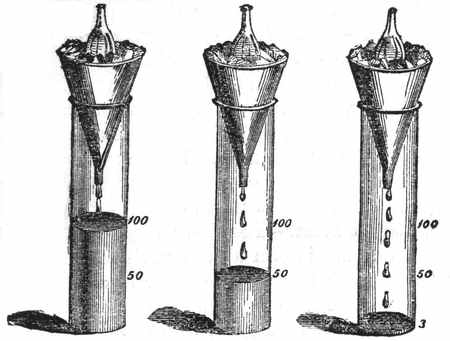
Fig. 219.
320. Capacity for Heat.—The more heat a substance
can take in and render latent the greater is its capacity
for heat, as it is expressed. Thus water has a much
greater capacity for heat than mercury. This can be
proved by various experiments. Thus, if we take two
vessels just alike, and having, the one a certain quantity
of water in it, and the other the same quantity of mercury,
and expose them to the same degree of heat, it will
take much longer to raise the water to any specified temperature
than the mercury. Why is this, when they are
both receiving the same amount of heat? It is because
the water renders a much larger portion of the heat latent
than the mercury does. We can reverse this experiment.
Take these same vessels with their contents raised to the
same temperature, as indicated by the thermometer, and
allow them to cool in the air side by side. The mercury
will cool much faster than the water, because it has much
less of latent heat to part with. The difference in capacity
for heat between water, oil, and mercury may be
shown by the experiment represented in Fig. 219. A
pound of water is put into one Florence flask, a pound
of oil into another, and a pound of mercury into a third.
They are all heated to 212°, and are then placed in funnels
filled with pounded ice, the funnels resting in glass
jars of the same size. Now in cooling these fluids down
to a certain point, say 32°, different amounts of the ice
will be melted, in the proportions of 100 and 50 and 3.
This shows the proportions of latent heat in them which
become sensible or free as their temperatures are lowered.
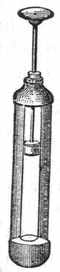
Fig. 220.
321. Relation of Latent Heat to Density.—The
more dense a substance becomes the less is its
capacity for heat. The heat produced by hammering
iron is the latent heat rendered free by
condensation, this lessening the capacity of the
iron for heat. The same thing can be better illustrated
in the condensation of a very compressible
substance, as air. In Fig. 220 you have represented
a glass syringe with a closed end. If
there be placed in this end a little bit of cotton
wool moistened with ether, and the piston be
forced downward very quickly, the ether will be
set on fire. This is because the compression of the air
lessens so much its capacity for heat that a great deal
of its latent heat is made sensible or free. The heat
which is concealed in it in its ordinary state is, as we
may say, fairly squeezed out, as you would squeeze out
the water that is concealed in the interstices of a sponge.
322. Coldness of Air at Great Heights.—You learned
in § 152 that the atmosphere is thinner the farther you
go from the earth. It is very thin, therefore, on the
summits of high mountains. This is the chief reason
why it is so cold there, for the rarer the air is the greater
is its capacity for heat, and the more of sensible or
free heat therefore can it render latent.
323. Relation of Latent Heat to the Forms of Substances.—Whether
a substance shall be in the form of a
solid, liquid, or gas depends upon the amount of heat
which is latent in it. If you take a piece of ice and melt
it in a vessel, the ice and the water in the vessel that
comes from the melting of the ice are both at 32° until
the ice is all melted. But all this time heat is being communicated
to the ice and water. What becomes of it?
It is all taken up by the ice as it changes from its solid
to its fluid state, and becomes latent in it. In fact every
particle of ice must have just so much of latent heat in
order to become fluid. So, also, if water be heated to the
boiling point, 212°, and be kept boiling, the water will
remain at that point till it is all vaporized. All this time
the water is receiving heat, which, instead of raising its
temperature, is becoming latent in the particles as they
change from their liquid to their vaporous state. As I
said of the change from the solid to the liquid state, so
here, every particle of the liquid must have just so much
of latent heat in order to become aeriform. Whenever
therefore any solid substance becomes liquid, or liquid
becomes aeriform, heat is absorbed and becomes latent.
So, on the other hand, whenever any aeriform substance
becomes liquid, or liquid becomes solid, latent heat is given
out, and becomes free and sensible. The freezing of
water, then, is a source of warmth to the air in its neighborhood—a
fact which is practically made use of when
tubs or pails of water are placed in conservatories to keep
plants from freezing; and the thawing of snow and ice
is a source of cold, as is exemplified by the chilliness of
the air occasioned by this process.
324. Clouds and Latent Heat.—The water of which
clouds are composed is heavier than air. Why, then,
does it remain suspended? Why is it necessary that it
should be collected into drops in order to have it fall?
This question can be answered by looking at the manner
in which clouds are formed. A cloud, I have stated in
§ 288, is made up of minute vesicles or bubbles containing
air. Now the air in these bubbles is lighter than
the air that is around the cloud, because it is warmer.
But how does it get its heat? In order to understand
this observe what the bubble is made from. It is made
from the water which was in the air in a state of vapor,
or in its aeriform state, for this is the state of water that
is evaporated and dissolved in the atmosphere. But
when it forms the vesicle it goes out of this state and
becomes a liquid, for the wall of the vesicle is a liquid
wall, just as the wall of a soap-bubble is. Now in passing
out of the aeriform into the liquid state some latent
heat must be made sensible. What becomes of this sensible
heat? It just heats the air in the vesicle, and so
makes it like a heated air-balloon. So all clouds are collections
of innumerable heated air-balloons, and the reason
that some clouds are higher up than others perhaps
is that their balloons have warmer and therefore lighter
air in them.
325. Freezing Mixtures.—The intense cold produced
by these mixtures is the result of the change of free or
sensible heat into latent. For example, when salt and
snow are mingled together a melting of the two is quickly
produced. In this sudden change of a solid into a
fluid a great quantity of heat must be rendered latent,
and therefore there will be a great loss of sensible heat
by whatever the freezing mixture comes in contact with.
The process here, you see, is the opposite of solidification
in relation to latent heat. A portion of the snow,
after melting with the salt, becomes solid ice. Why is
this? It is because it gives up its sensible or free heat
to portions of the snow that are in the process of melting
and are therefore making heat latent.
326. Cold from Evaporation.—If you pour a little ether
into the palm of your hand it will rapidly disappear in
vapor, producing a very cold sensation. This sensation
occurs because, in the change of the liquid into the vaporous
or aeriform state, some of the sensible heat of
your hand is abstracted to become latent in the vapor.
The evaporation of water also produces cold, though not
as decidedly as ether, because its change into vapor is
not so rapid at ordinary temperatures. We make a practical
use of the evaporation of water in many different
ways. Thus we sprinkle water in a hot day upon the
floors of piazzas, steps, etc., that the evaporation may
make much of the sensible heat about our houses latent.
For the same purpose, in hot climates, apartments are
often separated from each other by mere curtains, which
are occasionally sprinkled with water. So the inhabitants
of such climates often cool their beverages by keeping
a wet cloth for some time wrapped around the vessels
that contain them. Evaporation is an important
remedy for many cases of disease. For example, if the
head be hot, a steady application of a wet cloth to the
forehead, though a simple remedy, is generally effectual,
and sometimes is very important. Most people make
the application in a wrong manner. They put on several
thicknesses of cloth, when a single thickness is the best,
because it will best secure the evaporation, which is the
cause of the relief afforded.
Fig. 221.
327. Freezing in the Midst of Boiling.—It is from the
quantity of heat rendered latent by evaporation that water
can be frozen in the midst of boiling ether; and, paradoxical
as it may seem, the boiling of the ether is the
cause of the freezing. The experiment is performed in
this way: Place a test-tube or a little thin vial with
water in it in the midst of some ether in a shallow vessel
under the receiver of an air-pump. On exhausting
the air the ether will boil, evaporation taking place rapidly
because the pressure of the air is taken off from the
ether. Now as the ether passes into vapor it extracts
so much free heat from the vial of water that the water
is cooled down to the freezing point, and so becomes
solid. Water can be frozen even by its own evaporation.
It is done in this way: Let a shallow vessel, b,
Fig. 221, contain a little water, and the vessel c oil of
vitriol or sulphuric acid. When the air is exhausted,
the pressure of air being taken off from the water, vapor
rises from it freely. As the sulphuric acid has a great
attraction for water it absorbs this vapor, and so vapor
continually rises from the water the more rapidly because
what is formed is absorbed, instead of remaining to
make pressure on the water. The result is that this rapid
formation of vapor, requiring that a great quantity of heat
should be made latent, at length abstracts so much heat
from the water that remains that this becomes solid.
328. Degree of Heat Endurable by Man.—It was formerly
believed that the human body could not endure
with impunity, even for a short time, a much higher degree
of temperature than that which is met with in hot
climates. But in the year 1760 it was accidentally discovered
that a much higher temperature than this could
be endured. An insect was destroying at that time the
grain gathered in some parts of France, and it was found
that if the grain was subjected to a certain high degree
of temperature the insect was killed, and yet the grain
was not injured. In trying some experiments in regard
to this matter the experimenters wished to know the
point at which the thermometer stood in a large oven.
A girl attending on the oven offered to go in and mark
the thermometer. She did so, remaining two or three
minutes, and the thermometer was at 260°, that is, 48°
above the boiling point of water. As she experienced
no great inconvenience from the heat she remained ten
minutes longer, when the thermometer rose to 76° above
that point. These facts were published, and prompted
scientific men to try other experiments. In England,
Dr. Fordyce, Sir Charles Blagden, and others, went into
rooms heated even to 240° and 260°, and remained long
enough to cook eggs and steaks, and yet themselves suffered
little inconvenience. The pulse was quickened, the
perspiration was very profuse, but the heat of the body,
as ascertained by putting the thermometer under the
tongue the moment they came out, was scarcely raised
at all. The air in which they were roasted eggs quite
hard in twenty minutes, and when it was applied by a
pair of bellows to a steak it cooked it in thirteen minutes.
The question arises, how is it that this high degree of
heat did not produce more effect upon the body? One
reason is that the heat of the air in the immediate neighborhood
of the body was continually reduced by the
evaporation of the free perspiration, sensible heat being
thus converted into latent. Another reason is that the
air is not a good conductor, and therefore did not communicate
its heat readily to the body. Dr. Fordyce and
his friends found that they could not touch with impunity
any good conductor, as the metals, and they were
obliged to wear upon their feet some non-conducting
substance.
329. Formation of Ice.—Before dismissing the subject
of heat I must notice the grand exception which we have
to some of the operations of heat in the formation of ice.
Heat generally produces expansion. But in the case of
water this law of expansion is set aside, and the reverse
is established. This is done, however, only within a
small range of temperature, viz., from the freezing point
up the scale about seven degrees. In all degrees above
that the usual expansion by heat takes place. The exception
occurs at this part of the scale for a special purpose,
viz., that water, in distinction from other substances,
shall become more bulky, and therefore lighter, as it takes
the solid form.
Fig. 222.
330. Description of the Process of Freezing.—In order
to make the process of freezing clear to you I will describe
it as it ordinarily occurs, that is, from the action
of cold air upon the surface of water. The uppermost
layer of the water imparts some of its heat to the air in
contact with it. This air rises and colder air takes its
place, which being warmed in its turn rises to make way
for more of the cold air. You have therefore a constant
current of warmed air upward from the water. In
the mean time there is a current of a different character
in the water—a downward one. As fast as the water at
the surface parts with heat to the air it falls, other warm
water taking its place, to cool in its turn and go down.
This falling of the cooled water goes on regularly until
a portion of water becomes cooled down to 39°, that is,
7° above the freezing point. This layer does not sink,
but remains at the surface, for it is lighter than the
warmer water below. This is because the law that heat
expands matter is now reversed. Beyond this point of
the thermometer the colder the water is the lighter it is.
As the cooling now goes on from the air coming, as before,
in successive layers to the water, the cooled water
at the surface continually increases. At first it is a mere
single layer of particles, but after a while it is quite a
body of cold water lying on the warmer water below.
At length some of it is cooled down to 32°, the freezing
point, and a thin film of ice now forms. The state of
things just at this stage of the process may be represented
by a simple diagram, Fig.
222. Let the line a represent
the film of ice. The space between
a and b is the portion
of water cooled down below
39°. The space below b is occupied
by the water which is
above this temperature. In
the space between a and b the
cooler the water is the nearer
it is to the surface. That is, from the line b, where the
water is exactly at 39°, as you go upward, the water
lessens in temperature, it being successively 38°, 37°, 36°,
etc., till, just in contact with the film of ice, a, it is at
32°. The ice goes on to thicken gradually by additions
below. But it is to be remembered that ice is a good
non-conductor, so that the very first layer of ice makes
the cooling of the water proceed more slowly than before.
And the thicker the ice becomes the slower is the
cooling. This secures against too great a formation of
ice.
331. Why the Above Exception to Expansion by Heat
Exists.—That we may see the reasons in part for the
grand exception to the general law of expansion by heat
which I have illustrated, let us see what would be some
of the results if the exception did not exist. In that case
the process of freezing would be as follows: The water
would communicate its heat from the surface to the air,
as before described, and there would be a constant downward
current of the cooled water. When any portion
of the water became cooled by the air down to 32°, it
would become ice, and would sink to the bottom. And
after the process of freezing had once begun, there would
be a continual accumulation of ice at the bottom so long
as the air remained cold enough to cool the water with
which it comes in contact down to 32°.
The result may be stated in the general thus: Freezing
would not begin so quickly as it now does; but when
once begun it would prove very destructive. It would
not begin as soon, because the whole of any body of water
must be cooled down to just this side of 32° before
it could begin. This would not take long where the water
is shallow, but it would where it is deep. All shallow
bodies of water, then, would be frozen up quite early in
the winter; and as water is a poor conductor, and thawing
must go from above downward, some of them would
not be thawed out again fully till quite into the next
summer, if even then. And where the water is quite
deep ice would at length begin to form, and when formed
it would be exceedingly slow in thawing. In some cases
it would never be thawed with such a body of non-conducting
water to guard it against the warmth above. It
is easy to see that the heat of spring and summer would
not thaw out any thing like the quantity of ice that it
now does. The reign of ice and snow on our earth
would therefore be vastly more extensive than now, and
what is worse, it would be extended more and more every
year. Under such circumstances there would be
great destruction of both animal and vegetable life. I
will mention, however, but a single item, as it would occupy
too much space to go into this subject with any
fullness. In the water under the ice, which is always
above 39°, except that which is close to the ice when
freezing is going on, there is a vast amount of busy life
which would be destroyed if ice were formed at the
bottom, chilling all the water above.
332. Why the Freezing Point is at 32°.—If the freezing
point of water were higher than 32°, freezing would
occur so early in the autumn, and the ice and snow
would last so late in the spring, that the season would
be too short to raise our supplies of fruits and grains.
If, on the other hand, it were at a lower point, the earth
would not have the protection of its light coat of snow,
but instead would be chilled by rains so cold that barrenness
would be the result. The multitudes of animals,
too, that now live so securely in the water, some of them
even with the ice above them, would all perish with the
cold.
333. Force of Expansion in Ice.—As ice occupies one
seventh more room than the water from which it is
formed, it exerts in its formation an expansive force
which under various circumstances produces varied and
often remarkable results. Of the many experiments
which have been tried to show the force of this expansion
I will mention but one. A bomb-shell was filled
with water, at Montreal, and closed with an iron plug
which was driven in with great force. The plug was
thrown a distance of 400 feet by the expansion when the
water froze. This expansion is sometimes an inconvenience
to us, as in bursting water-pipes; but besides the
great service which it does in the earth, already noticed,
it is of service also in loosening the soil, and in supplying
it with requisite ingredients from the rocks by breaking
them up and pulverizing them in small quantities
from year to year.