The terms “meadow” and “pasture” are usually
employed together, as though they were really distinct
things; yet few people think of them as
different,—the fact being, that when a field is occupied
with grass, it may be called a meadow, in contradistinction
to that land under the plough, or
arable: this yields meadow-hay if mowed for that
purpose, or pasturage when fed off or depastured by
our flocks or herds.
The meadow, then, as being fixed, is termed “permanent
pasture.” Pasture-herbage, however, is grown
in the shifting crops of arable cultivation; in which
case it gets the term of “artificial pasture.” Hay
from the first of these is called “meadow-hay,”
whilst the mixture of grasses, clovers, &c., gets the
name of “artificial grass,” or “hay,” as the case
may be.
As regards permanent pasture, this may be old or
new,—some meadows having been in green herbage
even for centuries, whilst others, though sufficiently
old, yet show traces of having been once arable in
the more or less high-backed ridges left by ancient
ploughing. Viewed in this way, original pasture is
not so extensive as may be supposed; indeed, there
is scarcely such a thing at all, as all pastures are the
result of something like cultivation,—as, left to themselves,
that is, to Nature, they would soon resume
the aspect of jungle, moor, or marsh, according to
soil and situation.
Meadows and pastures may, then, for our present
purpose, be conveniently tabulated as follows:—
a. Permanent Pastures.
1. Moors and uplands, unenclosed or but partially
fenced in.
2. Commons, unenclosed land, usually about
villages, conferring the right of cattle and
goose grazing.
3. River flats and lowlands, liable to floods.
4. Irrigated Meadow, in which the water is
controllable.
5. Meadows, or permanent grass enclosures.
b. Artificial Pastures.
6. Seeds, shifting crops of some grasses, clovers,
saintfoin, &c., used either mixed or separately.
1. Moors, uplands, and downs (such as Dartmoor
and Salisbury Plain) are more or less wild according
to their elevation and the geological formation on
which they occur. They consist of large tracts of
land either without fences at all, or only those of
the most inefficient kind, rather boundary-lines than
otherwise. They are never used for haymaking, nor
are they cultivated beyond depasturing. These are
dotted with patches of rough grass, thorns, briers,
and shrubs or stunted trees where the surface is
much broken, and the animals they are made to
carry are few; but on the more rounded and smooth
lines of the downs is a finer herbage, kept so not
only from the nature of the case, but from the fact
that such a position favours the more thickly stocking
it with that close-grazing animal the sheep.
These pasturages, though very extensive, are yet
being encroached upon by a higher cultivation, and
the hayfields one occasionally meets with around the
squatter’s cabin even in the wild mountainous parts
of Wales sufficiently testify to the greater productiveness
of which the most unfavourable districts are
capable.
2. The village common is sometimes extensive; it,
too, as the former, is only grazed. Many of them
have of late years been enclosed. Where much
depastured—and they usually carry as much stock
as they can bear—there is a remarkable absence of
plants other than grasses. Indeed, grass-herbage, and
usually of the best species, will prevail, unless in
places where there may be stagnant water, in which
cases a little drainage would produce a large public
benefit; but as what is everybody’s business is done
by no one, the common is too often left much wilder,
and thus made poorer than it need be.
3. The river flats here meant are, for the most
part, large fields partaking of the nature of common;
that is, certain farmers and others have the privilege
of grazing during the autumn; but it is aimed up
early in spring, for the purpose of taking a crop of
hay. Such lands would be impoverished by such
constant haymaking; but the winter floods leave behind
them a deposit of silt and fluviatile materials,
and perhaps beside act as a solvent; so that their
fertility is wonderfully maintained.
Many such wide stretches of meadow occur on the
banks of the Severn, as in the neighbourhood of
Gloucester, Tewkesbury, Worcester, &c., where they
get the name of Ham. It is much to be regretted
that these hams are not made the most of, for the
same reason as applies with respect to common, for
the want of some efficient officer to direct improvements;
and so from the water here and there stagnating
good herbage is ruined, and from the floods not being
controllable, even hay is lost with the summer freshets.
But where such land is vested in single enterprising
proprietors, not only is drainage insured, but embankments
are made to keep out the waters when not
required, as so much met with on the banks of the
Thames; and such fields are at once an evidence of
the capabilities of river flats, and the great importance
of individual enterprise.
4. The last case approaches very nearly to that of
irrigated meadows; but these latter are mostly situate
on small streams, which can be directed to flow
through, not over them, at any time: they offer a
most important means of augmenting our pasturage in
certain districts, and will therefore receive a chapter
to themselves.
5. Permanent grass enclosures are of very varied
sizes, from hundreds of acres, forming perhaps a park,
to the small meadow of the homestead; they may be
seldom or never used for haymaking, but most of
them are aimed up for hay once, twice, or thrice in
four or five years. These form the greater part of
the grass-lands of our country, and are indeed
nowhere greener or more productive than in the
British Isles; still, as we are an advocate for their
cultivation—which, if it does not quite realize the
position of making two blades of grass grow where
one grew before, may at least do much in this
direction—we shall reserve further remarks upon this
subject until we have particularly analyzed the
contents of a meadow.
6. As shifting crops, grasses, and other fodder
plants may be made exceedingly useful, these may
therefore well occupy a chapter to themselves.
Although we possess more than a hundred species
of native grasses, we shall rarely find a fourth of them
even in a wide range of meadows; and if we do so, it
is rather an argument against than in favour of the
quality of their herbage, as, so few are the best grasses
in number, that it is almost a law for the best
meadows to contain the fewest species of true grasses.
If, then, the good grasses be so few, whatever is
not of these must be inferior, and, indeed, so bad are
some grasses that they can only be considered as
weeds. These weed-like forms are known to the
farmer from his observing that the cattle usually
refuse to eat them, and hence he has got to call them
“sour grasses,”—a term which, though perhaps meant
to convey the idea that such are objectionable in
flavour, yet it is oftener that they are refused from
their want of flavour, or from some mechanical objection
arising from their roughness of growth, some
having sharp serrated cutting edges to their leaves,
whilst the spicular awns, so conspicuous in the beard
of barley, cause great irritation by sticking beneath
the tongue and in the gums. Of these, the first are
objectionable for pasture, the last for hay, and should,
therefore, not be found in really good meadows.
The figures and descriptions which follow are given
in illustration of some of the more usual meadow
species, which, though not fully or botanically described,
will yet aid the practical farmer in estimating
the species, and their value and significance, which
he will commonly find in his fields.
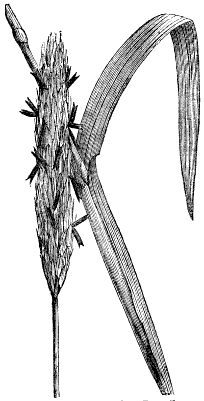
Fig. 13. The Meadow Foxtail.
The Meadow Foxtail
(Alopecurus pratensis, fig.
13) is an early species of
the spicate form—i.e., the
flowers grow close together,
into a more or less
dense head. It yields a
great quantity of herbage,
especially in moist situations;
and is particularly
adapted for the irrigated
meadow. It should be
distinguished from the
A. geniculatus (Kneeling
Foxtail), whose spike is
only about half the length
and size, as this is particularly
a water species,
so that if found when a
meadow is dry, it is yet an
evidence that water must
have lain where it occurs for a considerable period of
the year. Also from the A. agrestis (Slender Foxtail),
which has a longer and thinner spike, as this
latter is a weed in poor hungry clays, which is useless
except as serving to indicate that the land wants
perhaps both drainage and manure. Here, then, our
first genus presents us with species indicating the
varied conditions of rich meadow, wet places, and
poor arable; and it is this variableness in adaptability
that makes the grasses such important indicators of
the nature and condition of soils.
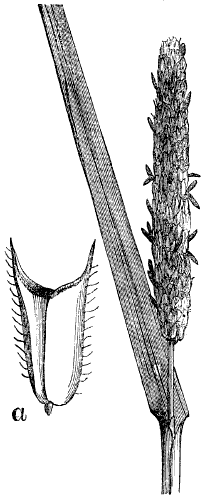
Fig. 14. The Catstail Grass.
The Catstail Grass (Phleum
pratense, fig. 14) in general
form is not unlike the preceding,
but it is much rougher in
all its parts, and is one of the
latest instead of one of our
earliest species. Its name of
catstail is due to its rough
flowers, an enlarged drawing
of one of which is given at a.
It has also got the name of
Timothy Grass, from one Mr.
Timothy Hanson, an American,
to whom, probably, is
owing its first introduction as
a “self-crop,” large fields of
this useful species, mostly by
itself, being grown in Canada
and the States as a fodder
plant. It is very useful in
the meadow, as supplying a
late crop of stems and leaves;
greatly augmenting the amount of herbage in some
of the colder though not poor districts.
We have never seen this grass used as a self-crop
in England, but we are convinced that on some of the
rich alluvial flats, as in the lands reclaimed from the
Severn, and warp soils in general, it would yield a
large bulk of good feeding matter, which, though
somewhat rough, would yet mix well with clovers,
&c., in chaff-cutting.
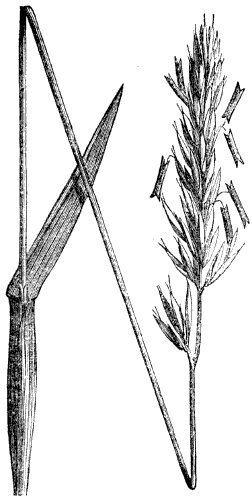
Fig. 15. The Sweet Vernal Grass.
The Sweet Vernal Grass (Anthoxanthum odoratum,
fig. 15) is a very early species, with a somewhat lax
spike of flowers, which usually become of a bright
straw-colour by the time the hayfield is ripe for the
scythe. It does not yield much bulk, but its grateful
bitter when fresh, and the peculiarly sweet hayfield
odour which it yields on drying, would seem to make
this grass of importance, from the flavour which it
imparts to the produce of the field; indeed so much
so, that much of the value of natural meadow hay
over that of artificial pasture may be traced to the
presence of this grass.
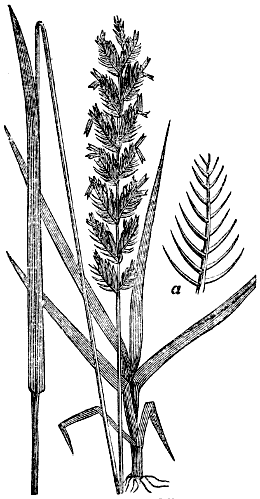
Fig. 16. The Crested Dogstail.
The Crested Dogstail (Cynosurus cristatus, fig. 16)
has its florets arranged in front of a series of abortive
branches, as represented at a, enlarged. It has a
very slender stem, which is hard and wiry when ripe—a
condition which it so universally attains, even in
spite of constant depasturing, that we never recommend
its use in mixtures for permanent pasture, as
its stems are particularly innutritious, and its herbage
is so small as to be of little value. It never prevails
much in our best pastures.
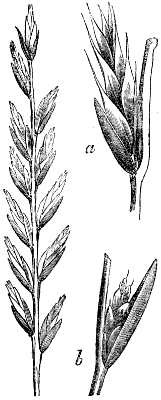
Fig. 17. Rye Grass, or Ray Grass.
Rye Grass, or Ray Grass
(Lolium perenne, fig. 17), has
no connection with the Cereal
Rye. It is one of our commonest
and most useful species,
both as a plant for the natural
meadow or for arable culture,
especially in mixture with
clovers, which has the name
of “seeds.” It yields good
bulk for the rick, and will so
readily grow after cutting or
close depasturing that it commonly
affords the greater part
of the herbage of a pasture.
From being so valuable, its
seed has been much cultivated;
and as it has a tendency to
form more or less permanent
varieties, so we find in the
market several different sorts;
as “Pacey’s, Ruck’s, Russell’s,
Stickney’s, Rye Grass,” &c. It should always form
part in any mixture in laying down permanent
pasture, in which case it should be distinguished
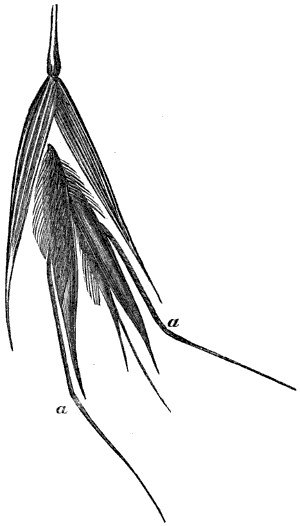
from the Lolium Italicum, the florets and seeds of
which are awned-pointed, as at a. This latter is
useful as an annual self-crop, but seedsmen too often
mix it in permanent-pasture collections, for the reason
that it grows faster, and so makes a show the first
year, and so satisfies the customer; but it soon
dies out, while its large growth has kept under the
more enduring forms. b represents a bunch of the
tumid flowers of the Lolium temulentum (Drunken
Darnel), once a pest in cornfields, but now, fortunately,
of rare occurrence, if we
are to believe the tales
told of its so-called poisonous
seeds.
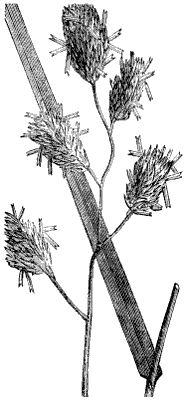
Fig. 18. The Cocksfoot.
The Cocksfoot (Dactylis
glomerata, fig. 18),
though a large and somewhat
coarse grass, is by
no means inferior in quality,
its hay being highly
nutritious, whilst its cut
or cropped herbage is so
quick of growth that it is
capable of yielding a great
deal of keep. It sends
its root deep into the soil,
so that it can grow well
in poor land if dry; but it
never flourishes in very
wet situations. It is constant
in good meadows,
unless when they are always
depastured, as there the constant treading
greatly interferes with it: it is, therefore, by no
means so abundant in sheep pastures; whence has
arisen the idea with some farmers that “too much
sheep-grazing wears out the richer grasses.”
We should always recommend cocksfoot as a part
of mixtures for permanent pasture, taking care to
well roll the meadow once or twice a year—a process
of great importance—to keep the turf in an even pile,
and so prevent that growing of large clusters or
hassocks of one sort, a method of growth to which
the cocksfoot is somewhat prone.
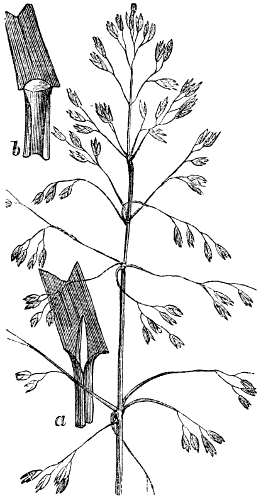
Fig. 19. The Rough-stalked Meadow Grass.
The Rough-stalked
Meadow Grass (Poa
trivialis, fig. 19) is a
common species in
moist meadows, where
it often forms a considerable
portion of
the herbage: it is distinguished
from the
smooth-stalked by the
long-pointed tongue
(ligule) to the leaves
(a), and a stem which
is somewhat rough to
the feel, especially
when drawn downwards
through the fingers.
This grass yields a
quantity of herbage,
but our experience
leads us to conclude
that it does not possess
quite so good a quality as Sinclair and authors who
have copied from him would lead us to suppose, as we
have found it wanting in feeding qualities, or what
the farmer calls “proof.” It usually forms a large
part of the hay of the irrigated meadow, which,
though often large in quantity, is yet not equal to
that of ordinary good meadows in feeding properties.
The Smooth-stalked Meadow Grass (Poa pratensis),
distinguished by a blunt ligule (b) and smooth stem, is
as abundant in dry situations as the former is in
damp ones. We confess to a great partiality for this
grass, notwithstanding that authors speak slightingly
of its value; but the truth is, that it varies with soil
and situation, it being a species which, when growing
on a wild moor, is poor in both quantity and quality.
But we know of no better sign of the improvement of
a bad meadow than the increase of this grass, and its
putting on, as it will do under such circumstances, of
its richest green tint.
Poa nemoralis (Wood Meadow Grass) is a more
slender form, whose wild habitat is in woods and
shady places, especially on calcareous soils. This
points it out as a useful grass for wood-glades and
positions beneath trees, in which it may very properly
be employed.
In laying down permanent pastures we should, then,
employ these three poas as follows:—
Poa trivialis, for low, damp situations and irrigated
meadows.
Poa pratensis, for sound dry pastures and uplands.
Poa nemoralis, for rides between woods, wood-glades,
and shady places.
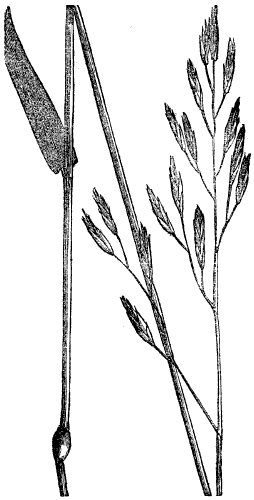
Fig. 20. Meadow Fescue.
Meadow Fescue (Festuca pratensis, fig. 20) may be
taken as the type of the broad-leaved fescues. It is
a common and good succulent grass in rich meadows,
and should always be employed in seed mixtures for
such situations, A variety, botanically known as
F. loliacea, is unbranched, like the lolium or rye
grass. The position of this is on rich river flats: we
have seen it on the banks of the Isis at Oxford,
forming a large part of most excellent herbage.
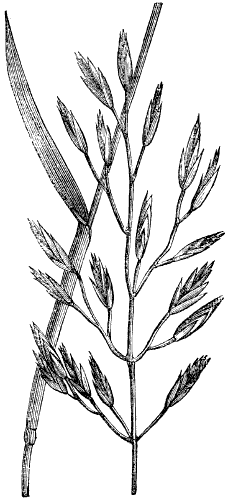
Fig. 21. The Tall Fescue.
The Tall Fescue (Festuca elatior, fig. 21) is a larger
and coarser form of F. pratensis, as seed of the latter
will become the former by being sown on some
stiff sandy clays. It occurs abundantly on the stiff
alluvial deposits of our estuaries and river flats. It
is an exceedingly coarse grass, with a tendency to
grow in large separate bunches; and hence its presence
is destructive to good pastures: it may, however,
be encouraged as a rough growth in its indicated
habitats.
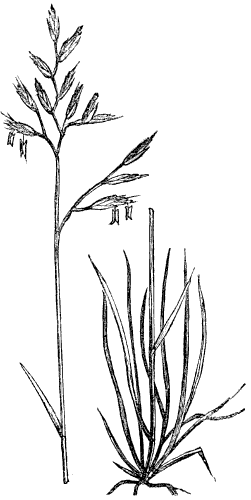
Fig. 22. Sheep’s Fescue.
Sheep’s Fescue (Festuca
ovina, fig. 22) may be
taken as the type of the
small-leaved fescues. It
is a native of our downs,
and forms a large proportion
of the sweet down
sheep-pastures. It is
known by its fine leaves,
which come up immediately
after the closest
feeding; and if its quantity
equalled its quality,
it would be even more
valuable than it is. A
larger form, the Hard
Fescue (F. duriuscula), is
common to sound meadows
and the hill valleys.
This has much the same
properties as the former,
but it is taller, with longer and broader leaves. This
should always be encouraged, and in laying down
grass for permanent pasture, it should be plentifully
added to the seed mixture.
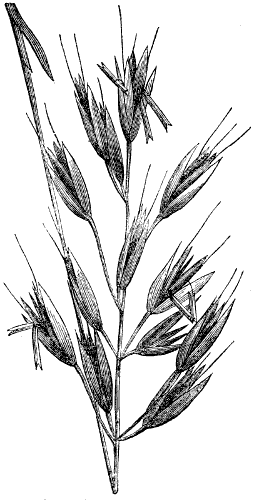
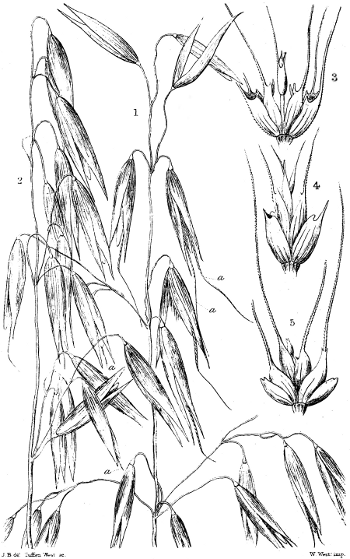
Fig. 23. The Downy Wild Oat.
The Downy Wild Oat (Avena pubescens, fig. 23) is
a common grass on thin calcareous soils. As it is
very light in structure, and yields but little grass, it
is not worth much as a first-rate pasture plant,—and
indeed it would scarcely prefer to grow on them.
There is, however, a smaller-flowered species, the
Avena flavescens (Yellow Oat-grass), which is better.
It, too, occurs on chalky soils; while the Avena
pratensis (Meadow Oat-grass)
is found too frequently
in poor clays or
on starved moors, in which
its rigid leaves and harsh
structure render it little,
if any, better than a
weed.
One of the most interesting
species of the
genus is the Avena fatua
(Wild Oat), well known
as a weed in stiff arable
soils. This is the parent
of the crop oats in cultivation,
and there is reason
to know that by
degeneracy the crop oat
in some districts leaves
behind a pest of wild
oats.[2]
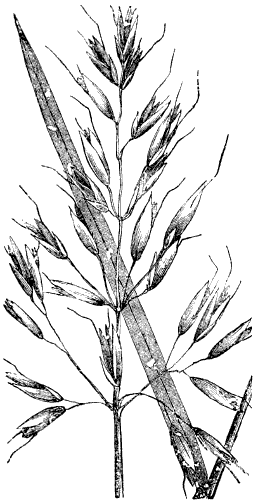
Fig. 24. The Oat-like Grass.
The Oat-like Grass
(Arrhenatherum avenaceum, fig. 24), though a tall,
succulent-looking species, is still too common in poor
soils, as its herbage is bitter and nauseous, and not
liked by cattle; and hay from it is always inferior in
quality. It is sometimes recommended by seedsmen,
and usually put with their mixtures; but we should
at all times refuse it.
There is a peculiar form of this which occasionally
occurs in sandy districts, called A. avenaceum, variety
bulbosum (Onion Couch), the trivial name of which
has been given from the fact that its nodes thicken
below the soil, and present the appearance of small
races of onions. This pest is got out of the land by
harrowing and hand-picking; but as every bulb grows
like joints of real couch, it is very difficult to entirely
eradicate it.
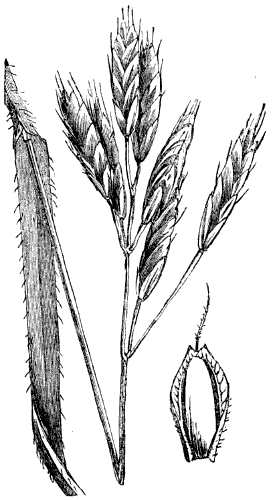
Fig. 25. The Soft Brome, or Lop Grasses.
The Soft Brome, or Lop Grasses (Bromus mollis,
fig. 25), and its congeners, is an annual grass, and
therefore very objectionable, whether in the meadow
or in “seeds,” to both of which, when poor and
neglected, it becomes attached. In both positions it
is sometimes mixed with a kind that droops pretty
considerably to one side; from which it has got the
name of “lop.” From the meadow it is soon got rid
of by manuring and depasturing; haymaking, though
it cuts off the main stem, only encourages smaller
ones to spring up late, and so the seed is sown. In
“seeds” it is frequently mixed with rye-grass seed,
as it too often occurs that a patch of rye-grass with
much lop is seeded, as the most profitable way to
deal with it, as its seeds are heavy and large, and
therefore tell well, either by weight or measure.
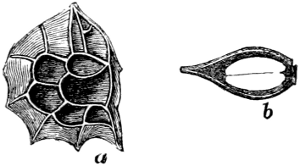
Our enlarged drawing of a seed with its envelopes
is given to contrast with rye-grass seed, which is
narrower and more pointed.
Within the last few years a species of brome
grass, which was formerly very rare, has become a
common weed: we mean the B. arvensis, Corn Brome-grass,—a
species with smaller and more numerous
heads of flowers than the one just described. This
has spread with the growth of foreign seeds, and
so suddenly has it appeared in some places as to
cause farmers to come to the conclusion that poor
cultivation has made the land spontaneously bring
forth “a nasty sort of wild oat,” while others have
even concluded that a cereal crop had been transformed
into this grass.
The Bromus erectus (Upright Brome Grass) is very
constant to poor calcareous soils. This is a perennial
species, but very poor indeed in feeding qualities;
however, it looks green in park-glades, and if kept
down by rough stock, it may then be made useful.
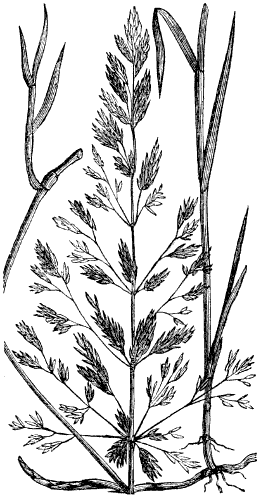
Fig. 26. The Bent Grass.
The Bent Grass (Agrostis stolonifera, fig. 26) is
probably only a variety of the common marsh species,
A. alba. Under the
name of Fiorin Grass,
this plant has been
much extolled for the
meadow; but our experience
shows it to
vary in value according
to the nature of the
position in which it is
placed: as thus, in an
irrigated meadow it
sends up a large quantity
of quite rich pasturage,
whilst in poor
or dry districts its herbage
is hard and harsh,
and not at all relished
by cattle or sheep.
The form we have
figured is more particularly
agrarian where its
creeping underground
stem forms a kind of mischievous couch, and this,
united with a tangled growth derived from shoots
rooting above the ground, renders this one of the
most pernicious weeds, especially in thin soils, on
calcareous, brashy, or stony soils.
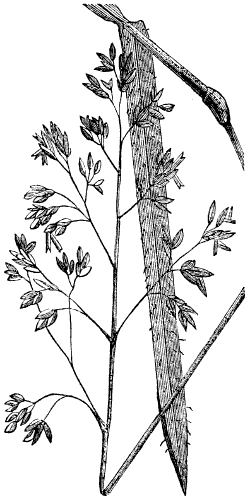
Fig. 27. Woolly Soft Grass.
Woolly Soft Grass (Holcus lanatus, fig. 27), though
exceedingly pretty from its contrast in colour and
form with its congeners, is still so worthless in point
of feeding properties as to be little, if any, better
than a weed. It is too abundant in some moist
meadows; and where it forms a very large portion
of the herbage, it speaks of poverty as well as
wet, and would lead to the inference that a little
draining, less frequent haymaking, and liberal doses
of manure, would have a most decidedly beneficial
effect.
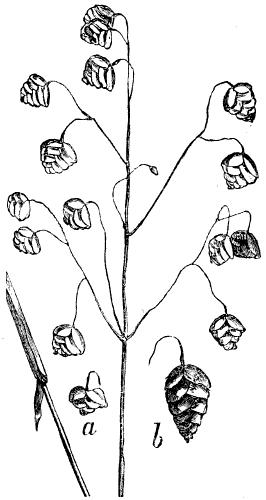
Fig. 28. Quaking Grasses.
Quaking Grasses (Briza media, fig. 28, B. minor, a,
and B. maxima, b), though certainly amongst our
pretty species, are all useless to the farmer. The
common species is well known in all wet or poor
clay meadows, and where very abundant we should
usually make our calculations for something less than
a ton of hay to the acre, and this would generally
be late, and offer little aftermath. Like the preceding,
its indications are want of draining, manure, and
depasturing. If after the drains begin to act, sheep
be folded upon a quaking-grass meadow, and fed with
turnips, hay, pease, or cake, it will soon be eradicated.
a, the smaller species, is an annual, and is only
noticed here by way of distinction: its smaller and
broader bunches of whitish, not purple, flowers, and
rectilinear branches, will distinguish it from the
common form. It is comparatively rare; but we
have had some fine specimens communicated by
H. C. Watson, Esq., from Thames Ditton. b is a
garden specimen, remarkable for its larger flower
bunches.
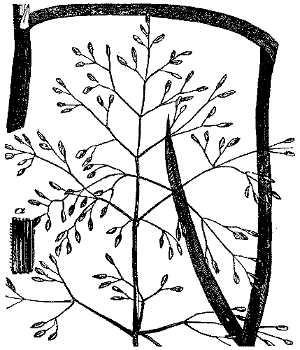
Fig. 29. The Hair Tussac Grass.
The Hair Grass (Aira cæspitosa, fig. 29) is commonly
called hassock, or tussac grass, or bull-pates—names
which its massive bunches of root-leaves
clearly indicate the meaning of. Its leaves are so
rough, with serrated edges, that cattle mostly refuse
it, unless when very young. This grass is a never-failing
indicator of wet,—so much so, that if a meadow
be drained in which it abounds, the action of the
drains is clearly indicated by its more or less gradual
dying out. The quickest way, then, to subdue this
large, coarse weed-grass is to drain, and then fold
sheep upon the drying meadow: these animals tread
the tussac grass into manure, which goes to feed the
better species. By this means, not only this, but
other rough or “sour” grasses are more quickly and
more certainly removed than by spudding them out;
and this leads us to remark, in concluding this chapter,
that in the meadow there will usually be found growing
together two sets of grasses, which may be
designated as follows:—
a. Grasses more or less nutritious—sweet.
b. Grasses more or less innutritious—sour.
In a good meadow, the section a maintain the
ascendancy, and so keep under those of b. In a
bad meadow, the section b will be master, and so
tyrannize over what would be better.
Perfect cultivation, then, of a meadow—for meadows
should be cultivated—whilst it encourages the
growth of good herbage, equally discourages the
progress of the bad.
[73]
With the grass of the field will usually be found
a large proportion of plants of a very varied, variable,
and different kind. Of these, many are useful as
augmenting the mass, and even improving the
quality of a pasture; whilst, as others are altogether
objectionable, we shall presently notice them under
the head of “Meadow Weeds.”
Of the more useful adjuncts of the meadow we
may tabulate the following:—
| No. |
Trivial Names. |
Botanical Names. |
| 1 |
Red clover |
Trifolium pratense. |
| 2 |
Zigzag clover |
„ medium. |
| 3 |
White or Dutch clover |
„ repens. |
| 4 |
Birdsfoot |
Lotus corniculatus. |
| 5 |
Yellow vetchling |
Lathyrus pratensis. |
| 6 |
Purple vetchling |
„palustris. |
| 7 |
Saintfoin |
Onobrychis sativa. |
| 8 |
Burnet |
Sanguisorba officinalis. |
| 9 |
False burnet |
Poterium Sanguisorba. |
| 10 |
Tormentil |
Tormentilla officinalis. |
| 11 |
Yarrow |
Achillæa millefolia. |
| 12 |
Agrimony |
Agrimonia Eupatoria. |
| 13 |
Plantain |
Plantago lanceolata. |
| |
Some of the smaller Compositæ. |
| |
DittoUmbelliferæ. |
Of these, which are arranged pretty nearly in
their order of merit, the clovers are by far the most
important. These, as meadow plants, will usually
be found under the following circumstances:—
No. 1. Plentiful in good, rich, sound meadows.
„2. Frequent in meadows on light sandy soils.
„3. On thin but good soil, upland meadows.
The clovers, and indeed the clover allies, Papilionaceæ,
as a whole, are partial to lime,—so much
so, that a dressing of this mineral to some fields in
which clovers are scarcely represented will very
quickly cause an accelerated growth of them; hence
road dirt, when made from calcareous stones, as
are the oolitic and mountain limestones, affords
a good vehicle for the admixture of manures or
ameliorators, such as guano, burnt ashes, soot, nitrate
of soda, &c.
The following remarks upon these three clovers
are from a paper by the author in the Bath and West
of England Agricultural Journal, vol. x., part 2:—
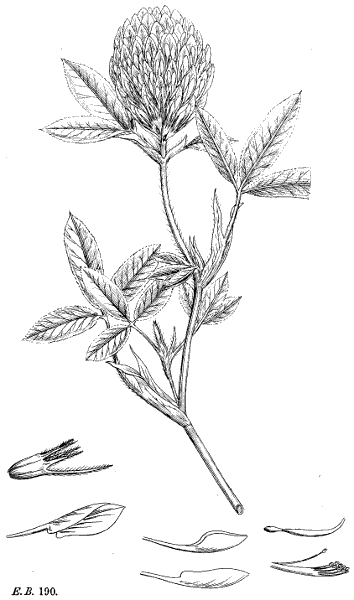
1. Trifolium pratense—Meadow or Broad-leaved Clover—in its
wild state is too well known to need any lengthened description.
A careful examination of field specimens will show that even in the
wild state this plant is liable to run into numberless variations; thus,
we may have the leaflets of one plant broad and almost obcordate at
the extremity, whilst others will be more or less ovate and lancet-shaped.
In some we may see dense heads of purple flowers, varying
in shade until almost white, whilst less dense heads of flowers and
general variations in height, size, and luxuriance of the whole plant,
are all circumstances in the natural history of this species in the
wild state, which will prepare us duly to understand the nature of
the many forms of the plant which are found in cultivation. Of
these we have, besides others, English, French, American, and Dutch
sorts, which differ in such minor details as a greater or less hairiness,
or variations in the colour and size of the flowers, leaves, &c. The
most important point connected with the broad-leaved clover is its
permanency; some sorts scarcely maintaining a plant for two years,
whilst others are said to be more or less perennial. This, however,
is a matter which we conceive depends more upon the soil and the[75]
kind of cultivation than upon the sort; for although all seedsmen
supply two sorts, namely, Trifolium pratense and T. pratense perenne,
yet they run so much the one into the other, that it is oftentimes
exceedingly difficult to distinguish them. If, therefore, a farmer wants
a good strain of broad clover, he should purchase his seed from
seedsmen possessing judgment and character; for experience has
taught us that a seed which may be all that is required in one
district may result in next to a failure in another. Thus, clover-seed
from the warmer parts of England does not succeed well when
sown in cold, exposed positions; but that from the latter is improved
on transmission to the former, whilst good changes are effected by
the occasional use of foreign seed.
The sort known in the market as T. pratense perenne is probably
intermediate between the wild species T. pratense and T. medium.
Our own experiments have shown that, on cultivating T. medium,
which is a sand-lover, in strong land, in three years it has been very
difficult to distinguish it from some of the varieties of T. pratense.
We incline, therefore, to the opinion that as the T. medium holds to
sandy soils in the wild state, its seed was brought into cultivation
with a view to light-soil cropping; and from this source has probably
been derived the so-called T. pratense perenne, which variety is
certainly more perennial in such light soils as would be quite unfit
for the true T. pratense. The latter, indeed, seems to be more
permanent in soils containing a quantity of lime, while the former,
where it can be got of a good sort, is certainly best adapted for
sandy soils.
2. Trifolium medium—Zigzag Trefoil—is distinguished from the
T. pratense by its larger, but more lax, head of reddish pink (not
purple) flowers, which are solitary, on the apex of a stalk, which at
each joint is bent at a considerable angle; hence its name. Its
leaflets are elliptical, and not broader at the upper margin. This
plant is a constant denizen of sands and light soils. In fact, its
naturally growing in soils unfitted for the broad-leaved clover seems
to recommend it for cultivation; and though, as before pointed out,
we more than suspect that the so-called cow-grass clover was
originally derived from this source, and that the T. medium is after
all but a variety of the T. pratense, it is now quite merged as a
farm-plant into the broad-clover forms; so that, if we are to possess
it as a separate plant, it must be again grown from the wild seed;
and then, if it is to be kept pure, it must not be cultivated on clays
or limestones, or, if our view be correct, it will soon lose its true
distinctive character.
3. Trifolium repens—White Dutch Clover—has been long in cultivation[76]
throughout Europe and America. It is one of our commonest
native plants, and appears to have become less changed by cultivation
than most other plants; yet there is reason to think that with careful
selection a much improved strain may be brought about. In pastures
an immense accession of Dutch clover is often seen to follow some
kind or another of top-dressing, especially of lime, old mortar, or
town rubbish. This is accounted for by the fact that this clover is
in reality of universal occurrence; and its creeping habit of growth,
besides seeding, causes it soon to make a rapid increase where its
conditions of growth are made suitable. As an agricultural plant its
position is in light soils, for which it is usually mixed with other
clovers and grasses in varied proportions.
4 and 5 are often found scattered in meadows,
though not usually in any abundance in those of the
richer kind; still, in laying down land for permanent
pasture, there can be no objection to a small admixture
of their seed.
6, the Purple Vetchling, though local in rich
river pastures, is yet a good plant, and might
perhaps be advantageously brought out as an
addendum to mixtures designed for good lowland
positions.
7, Saintfoin, is a good pasture plant for chalks
and limestones; and in laying down land for permanent
pastures in such position, should not usually be
omitted. It is also a good species to sow on railway
banks, not alone for the beauty of its flowers, but for
the binding effects of its deeply-diving roots.
8 and 9, the Burnets, will be found,—the true in
rich damp bottoms and on river flats, the false on
dry, calcareous soils. They are neither plants that we
should care to grow; but in their wild state in their
respective pastures we should, on the other hand, not
be inclined to make war against them as weeds. The
same opinion, indeed, might be briefly expressed as
regards Nos. 10, 12, and 13. In fact, the whole here
grouped may be said to possess more or less bitter
and astringent qualities, and so become useful in
checking the vapidity which is sometimes found in
purely grass herbage.
11, the Yarrow, should be encouraged in most
pastures, as it not only possesses the qualities just
mentioned, but its leaves are so small and its stems
and flowers so easily dry when cut, that there is no
chance of its smothering out the grass in growing, or
of its retarding the process of haymaking. It also
bears constant nibbling with sheep, which are remarkably
fond of it, without injury, as it rather becomes
finer for being depastured.
12. The larger composite plants, as dandelion, the
hawkweeds, blackhead, &c., are, from their coarseness
and the room they take up, highly objectionable;
but the yellow hawkbits, thrincia, and the before-mentioned
yarrow, are by no means objectionable.
13. The above remarks will equally apply to the
Umbelliferæ. Large plants like the cow-parsnip and
common beaked parsley are objectionable from their
size and want of feeding properties, whilst the small
pimpinella and earth-nut do not offer these objections.
Here, however, it must be confessed that we are
bordering on the domains of weeds in pasture, to
which we must devote a separate chapter.
[78]
“Weeds in pasture!” said an old farmer friend; “I
thought hay and grass was all weeds.” This, which
is by no means an uncommon notion, sufficiently explains
the want of care in the cultivation of the best
kinds of meadow produce, which can only be effected
by the destruction of what is useless or mischievous.
Now, if we proceed upon the assumption that the
best kinds of meadow are remarkable for the possession
of little else than the best kinds of the true
grasses, we shall see that pasturage should, in the
main, be composed of good grass-growth, with only
some few other plants which may be capable of augmenting
quantity, by their nutritive matter, giving
flavour, or improving quality.
It follows, then, that all plants having none of
these requisites must be, to all intents and purposes,
only mischievous weeds; as thus a large useless
plant in a meadow, as in an arable field, must not
only occupy the space that would be better taken up
by good plants, but it appropriates a large quantity
of food to the prejudice of the better crop.
Viewed in this light, then, what a mass of weeds
some of our pastures will be found to contain! In
fact, what with useless plants, other than grasses, and
coarse, sour, or useless grasses themselves, we meet
with so-called meadows to which the terms of “barren
moor” or waste land would be especially applicable.
The following table is offered as an attempt at the
classification of the weeds of pasture, the different
divisions of which we shall presently describe in the
order of their arrangement.
TABLE OF PASTURE WEEDS.
| 1. Plants which take up space but yield no Produce. |
| Trivial Name. |
Botanical Name. |
Remarks |
| |
|
|
| Broad-leaved Plantain. |
Plantago media |
- |
|
|
The leaves of these plants grow too close to the ground to be eaten off by cattle or to cut for hay. |
| Dent-de-lion |
Leontodon taraxacum |
| Daisy |
Bellis perennis |
| |
|
|
| Cowslip |
Primula veris |
- |
|
|
These plants take up much room in growing, they are not eaten by cattle, and, as they die before haymaking, yield little or nothing to the rick. |
| Primrose |
„vulgaris |
| Green-winged Orchis |
Orchis Morio |
| Early Purple Orchis |
„ mascula |
| 2. Plants which take up space, but simply dilute the hay with useless matter. |
| Blunt-leaved Dock |
Rumex obtusifolius |
- |
|
|
All common, especially in damp meadows, are not usually depastured, and have little or no feeding properties when made into hay. |
| Crisp-leaved Dock |
„ crispus |
| Marsh Dock |
„ palustris |
| Field Sorrel |
„ acetosa |
| |
|
|
| Burdock |
Arctium Lappa |
- |
|
|
Common about the borders of fields. |
| |
|
|
| Butter Burr |
Petasites vulgaris |
- |
|
|
Common near water courses. |
| |
|
|
| Cow Parsnip |
Heracleum Sphondylium |
- |
|
|
Very common and unsightly in pastures. |
| Wild-beaked Parsley |
Anthriscus vulgaris |
| |
|
|
| Ladies’ Smock |
Cardamine pratensis |
- |
|
|
In damp places. |
| |
|
|
| Yellow Rattle |
Rhinanthus crista galli |
- |
|
|
In poor cold clays. |
| |
|
|
| Larger Hawkweeds, &c. |
Hieracium species |
- |
|
|
About fields in upland districts. |
| 3. Mechanical Plants, those with Spines, Prickles, Stings, &c. |
| Musk Thistle |
Carduus nutans |
- |
|
|
Mostly a weed in “seeds.” |
| |
|
|
| Welted Thistle |
„ acanthoides |
- |
|
|
In hedgerows, borders of fields, or the open meadows. |
| Creeping Thistle |
„ arvensis |
| Cotton Thistle |
„ eriophorus |
| Spear Thistle |
„ lanceolatus |
| |
|
|
| Marsh Plume Thistle |
„ palustris |
- |
|
|
Damp or marsh meadows. |
| Meadow Plume Thistle |
„ pratensis |
| |
|
|
| Stemless Thistle |
„ acaulis |
- |
|
|
Common to poor calcareous uplands. |
| Carline Thistle |
Carlina vulgaris |
| |
|
|
| Common Stinging Nettle |
Urtica dioica |
- |
|
|
About the homestead, corners of fields, &c. |
| Smaller Stinging Nettle |
„urens |
| |
|
|
| Wall Barley |
Hordeum murinum |
- |
|
|
About sandy soils, both in the meadow and arable. |
| 4. [80]Poisonous Pasture-weeds, &c. |
| Meadow Saffron |
Colchicum autumnale |
- |
|
|
Usual in calcareous soils or marls. |
| |
|
|
| Upright Buttercup |
Ranunculus acris |
- |
|
|
In damp meadows. |
| |
|
|
| Diseased Grasses |
Secale cornutum |
- |
|
|
In places where mist and damp prevail. |
| 5. Ill-favoured Weeds or Plants which communicate bad flavour to Produce. |
| Crow Garlic |
Allium vineale |
- |
|
|
More or less in meadows and corners of fields. |
| Hogs’ Garlic |
„ ursinum |
| |
|
|
| Jack-by-the-Hedge |
Erysimum Alliaria |
- |
|
|
About the hedgerow. |
| 6. Useless Grasses, or Grass-like Plants. |
| Rough Grasses |
Species |
- |
|
|
Poor land and wet places. |
| |
|
|
| Sedges |
Species |
- |
|
|
In boggy, marshy, or wet sandy spots. |
| |
|
|
| Rushes |
Species |
- |
|
|
In sandy spots on clays and poor soils. |
| |
|
|
1. Taking the broad-leaved plantain as the type
of this list, we shall have no difficulty in estimating
the amount of mischief which it does. Here is a
plant, a single specimen of which not unfrequently
occupies nearly a square foot of ground, and as its
leaves grow close to the soil, it effectually prevents
the growth of the grass, while few, if any, leaves
are cut with the scythe. The bare patches which
result from the cutting up of plantains from a lawn
will sufficiently establish the first position, whilst, if
one occasionally meets with a few of the leaves cut off
in haymaking, it commits the further mischief of
being so long in drying as to retard the process of
haymaking, or else to endanger the safety of the
rick. It is on account of this that the plantain has
in some districts got the name of the “Fire Grass.”
These are easily removed by the spud, especially if
a little salt be added to their crowns.
2. Taking it for granted that grasses are for the
most part the best plants for pasturage and hay, it
follows that the plants of this list can only be weeds,
from their taking up space and living at the expense
of the wished-for crop, when, after all, the produce is
either useless, or so inferior that the whole product
of the field is vitiated by their presence. The best
way to eradicate these and other large-leaved and tall-stemmed
plants is to pull them early in the season—the
true theory being, that by the repeated destruction of
the leaves the rootstock ultimately decays. Close
depasturing also keeps them under for the same
reason, as the feet of horses and cattle so damage the
leaves as to ruin the growth and progress of the
other parts of the plant, which latter are requisite for
its continuance.
3. Added to the evils just adverted to, this group
is injurious from its adverse mechanical appliances
in spinous leaves, stings, and the like. As regards
thistles in pasture, they certainly argue great neglect,
as they may be so readily spudded out, in which the
individual is destroyed, and all hope of its progeny.
It is, however, the fact that these plants are sometimes
left to seed that makes the matter of destruction
appear so hopeless, as the winged seeds of thistles may
even find their way to a clean farm from a dirty one,
and roadsides and waste places are constant sources
of annoyance from this cause.
So fast has the corn thistle increased in Tasmania,
as to make the people groan under a “plague of
thistles,” for which they have invoked the aid of
special State legislation.
The spud should be kept in active operation in the
field, so as to prevent these plants seeding, or indeed
at all occupying any space; and roadsides and waste
places should be freed from these pests, either as part
of the duties of some public servant, or else as a
matter of private necessity.
As an illustration of the fecundity of thistles, we
append the following estimate of their seeding
powers:—
SEED-DEVELOPMENT OF THISTLES.
| Name. |
Seeds to a
single plant. |
Description. |
| Musk thistle |
3,750 |
150 seeds to a single flower-head. |
| Spear thistle |
30,000 |
300 seeds to each. |
| Corn thistle |
5,000 |
This plant also increases by creeping underground stems. |
| Stemless thistle |
600 |
This is sometimes so thick on the downs that we have seen its flying seeds almost like a snowstorm in quantity and whiteness. |
Farmers, however, mostly refuse an early summer
attack both upon thistles and nettles, quoting the
following rustic rhyme for their neglect:—
If thistles be cut in April,
They appear in a little while;
If in May,
They peep out the next day;
If cut in June,
They reappear very soon,
If in July,
They’ll hardly die;
If cut in August,
Die they must.
The truth is, that with spring-time they will bud
forth again, but always in a weakly condition. However,
towards August the thistle has performed all its
functions for the year, and so prepared its larger
rootstocks for the future season; so that he would
not be altogether so mad who, in reference to the
cutting of thistles and nettles in August and September,
should say—
Kill a fool’s head of your own;
They’ll die of themselves if you let them alone.
Beating nettles in the early part of the year with
lithe ash sticks is more effectual than the cleaner cut
with the scythe, as the injuries are not so easily got
over.
4. That there are many plants in pastures which
if eaten exclusively would act as poisons we can have
but little doubt, but there are a few which would
seem to be dangerous, even when partaken of in
grass mixtures. Of these, the meadow saffron is one
of the most powerful.
This plant is abundant on the oolitic rocks of the
Cotteswolds, about which range we constantly hear of
mischief from it. We extract the following from a
Cheltenham paper for September, 1844:—
It is only a few days since a farmer at Eyeford, near Stow-on-the-Wold
(Gloucestershire), had ten calves killed by eating of the flowers
of the colchicum, and two or three years since three cows were
destroyed by this plant in flower in the same neighbourhood, whilst
we frequently hear of many accidents to cattle in the spring from
eating the leaves, although it is sometimes refused by them on
account of its bitter and nauseous taste. Yet there is no doubt
but that accidents would be still more frequent were it not that
farmers keep their cattle from the meadows in which it occurs in
any quantity during the spring and autumn months.
Pulling the leaves of the meadow saffron or colchicum
will destroy it; but a much more simple remedy
is that of a thorough rolling with a Croskill at the
season when the flowers begin to expand, and again
when the broad leaves come up in spring; this so
crushes and bruises the whole plant, that a season or
two of such treatment will be enough to keep it under,
if not to destroy it outright.
As regards the buttercups, the most acrid one—viz.,
the upright tall species, a constant plant in marshy
meadows and wet places—is the only one to be particular
about. Cattle do not usually eat it, but it finds
its way into the hay, and there is reason to think to
its prejudice. It is to be got under by draining and
close depasturing, so that by treading down it shall
not seed; but poverty, induced by frequent haymaking
and wet, by keeping under the growth of what is
better, gives greater facility for the success of trash
of this as well as of other kinds.
Ergotised grasses, by which we mean those affected
with the black spur, in the place of the seed, or grain,
is a common affection of grasses in autumn in low-lying
or in damp places, or where fields may be
enveloped in mist, as on some of our hill-ranges.
This black spur is largest in the cereal rye, but it
occurs in most other species of grasses, differing
according to the size of their seeds.
Ergot of rye is used medicinally, and there is little
doubt but that ergot in other grasses is equally active.
Its effects seem to be to favour abortion; and there
is reason to believe that it has caused many valuable
animals to abort. Some few years since the late
Earl Ducie suffered a loss of calves to an extent
which he calculated to equal as much as £1,000 in
one year; at that time the grasses, consisting mostly
of the perennial rye-grass, were submitted to our
inspection, and they were much affected by ergot.
Keeping the cattle away from meadows known to
present much of this affected grass is the best remedy;
but this will seldom be necessary, except in unusually
wet and warm seasons, which are sure to produce
these fungoid affections.
5. All the plants in this section are known to
give a garlic-like flavour to the dairy produce of the
fields in which they grow. The two first especially
render butter unfit for market; so that if abundant
they would take off a large portion of the value of
the field. They occur mostly in patches, and should
be pulled out as soon as strong enough: if this be
done year by year, it will be found to diminish in an
increased ratio; and two or three seasons will be
enough to rid the field of so great a pest, and would
be well worth doing if it cost much—which it ought
not to do—as these weeds usually occur in otherwise
tolerably good meadows.
The jack-by-the-hedge is usually confined to the
vicinity of the fences, and may be removed by the
hand or spud. It is a prolific seeder; so that on no
account should it ever be allowed to ripen its seed.
6. Rough grasses and grass-like weeds are far too
common in poor, wild, and neglected pastures. In
their action they come closely to those of our second
section; they are indications of a want of drainage,
which operation well performed soon causes the death
of this group, which end is greatly facilitated by
manuring and depasturing as the drains begin to act.
In concluding this description, it may be well to
remark that many more plants might have been
included in the different sections; but enough has
been done to show that a pasture, to be good, must
not consist of any plants which chance, accident, or
more commonly neglect, may throw together. In
arable culture one-half the expense is, in one way
or other, connected with weeding, and we are of
opinion, that if only one shilling per acre was spent on
the weeding of pasture, it would yield 300 per cent.
profit on the outlay.
[87]
Irrigation, as a means of increasing the amount
of pasturage, is so important a process that it
may be well to describe it in this place.
For a perfect irrigated meadow, we should have
full command of water whenever it may be required.
This water should be capable of flowing through, not
of pouring over, and standing on the land,—this
latter being flooding. The drainage should be so
perfect that the land will be sound enough for us to
walk over in the dry in a few hours after the water
has been turned off.
Where these conditions can be secured, irrigation
will be found most useful, not only in augmenting
the supply of grass, but in producing it so much
earlier than in the higher meadows that the farmer
hereby gets a fresh green pasture, of great utility,
especially in fattening and bringing on early lambs.
From these circumstances it follows, that although
some land is occupied in the water-conduits, yet the
value is so far increased that meadow at 30s. per
acre before irrigation has, under one’s own eye,
become worth £5 per acre in four years. There are,
however, some necessary expenses in setting out the
work, making floodgates, &c., the extent of which
will of course depend upon the nature of the ground.
In Gloucestershire, on the banks of the Churn, where
irrigation has been successfully carried on for years,
there is a permanent cost of about 6s. an acre for
keeping the works in order, and charges of the
“drowner,” the name given to the man who overlooks
the works, in some instances of several proprietors
or tenants.
A peculiarity in irrigated meadow of the best
quality is, the general absence of coarse grasses on
the one hand, and of any plants other than grasses
on the other; hence, then, good succulent and nutritious
herbage is the rule, and anything that can be
otherwise described is the rare exception. Indeed, so
much is this the case, that a bit of coarse grass—such,
for instance, as Aira cæspitosa (Tussac Grass)—making
successful growth in any part of the meadow,
is at once an evidence of a stagnation of water at that
spot—a condition that a clever drowner at once looks
to when he has discovered it.
As an evidence of the changes which go on as the
process succeeds, as well as of their nature, we give
the following as the tabulated result of the irrigation
of half of a meadow whose slope was too great to
allow of the whole being operated upon. From these
it will be seen that the proportionals of different
pasture plants before and after irrigation offer a
material change; and it may be added, that in some
cases, what would otherwise be a bad and useless
grass, may become succulent and useful from the
beneficial action of water. One of this kind is the
Agrostis stolonifera (Fiorin Grass), which is in arable
couch-grass weed, but in the irrigated meadow it
becomes of a fine green colour, is nutritive in quality,
and will bear with any amount of clipping. It
may here, too, be remarked that in cases where
only a part of a meadow can be irrigated, good
accrues to the whole, as in depasturing the whole is
ranged over by our cattle and sheep.
We here give the following
TABLE OF CHANGES IN GRASSES AND OTHER PLANTS UNDER
IRRIGATION.
| Trivial Names. |
Botanical Names. |
Before
Irrigation. |
After 2 Years’
Irrigation. |
After 4 Years’
Irrigation. |
| Meadow Foxtail Grass |
Alopecurus pratensis |
1 |
2 |
3 |
| Field Meadow Grass |
Poa pratensis |
2 |
3 |
4 |
| Rough-stalked ditto |
„trivialis |
1 |
2 |
1 |
| Quaking Grass |
Briza media |
2 |
0 |
0 |
| Dogstail Grass |
Cynosurus cristatus |
2 |
1 |
0 |
| Hassock, or Tussac Grass |
Aira cæspitosa |
1 |
0 |
0 |
| Marsh Bent |
Agrostis stolonifera |
1 |
2 |
3 |
| Cocksfoot Grass |
Dactylis glomerata |
1 |
2 |
3 |
| Yellow Oat-grass |
Avena flavescens |
2 |
3 |
3 |
| Soft ditto |
„ pubescens |
1 |
1 |
1 |
| Meadow Barley |
Hordeum pratense |
1 |
2 |
2 |
| Perennial Rye-grass |
Lolium perenne |
2 |
4 |
6 |
| Meadow Crowfoot, or Buttercup |
Ranunculus acris |
1 |
3 |
1 |
| Bulbous ditto |
„bulbosus |
3 |
1 |
0 |
| Narrow-leaved Plantain |
Plantago lanceolata |
3 |
1 |
1 |
| Broad-leaved ditto |
„asiatica |
3 |
0 |
0 |
| Dutch Clover |
Trifolium repens |
2 |
0 |
0 |
| Broad Clover |
„ pratense |
1 |
2 |
2 |
| Common-beaked Parsley |
Anthriscus vulgaris |
1 |
2 |
1 |
The general conclusions from this table are, that
large and innutritious herbage is, for the most part,
destroyed by irrigation, and its place is supplied by
grasses; hence, then, the increased value conferred
by the regulated action of water is due to an increase
in quantity and quality of the grasses, added to a
much more certain, as well as early, production of
these. Of course the districts best adapted to irrigation
will be valleys of denudation, the centres of
which are occupied by more or less copious and
rapid streamlets. Some of these valleys in the
Cotteswolds having been scooped out of the oolitic
freestones, have left the spoils of the rock as a
gravelly deposit, sometimes on the lias, at others
on the fuller’s earth, and then on the Oxford clays;
so that, stiff as these soils would be by themselves,
they now only tend to throw out the waters by
natural drainage, which are again conducted over
the porous gravels through which they flow with
great regularity; thus fertilizing what would otherwise
be but a scanty thin-soil herbage, and to such an
extent that early depasturing, haymaking, and later
pasturage (lattermath) are the rule year by year.
These circumstances make water-rights of great
value, and which, if not in possession, are secured at
a fixed charge per acre; this, however, is usually
included in the expenses, which, as before stated,
are covered by about 6s. per acre.
Before concluding this chapter, we must say a
few words in reference to flooded meadows. These
will be found on the banks of the larger rivers or
on streams of sufficient importance to be called rivers,
as distinguished from brooks or streamlets. Here
the flooding is caused by the water overflowing the
banks, as the result of sudden thaws or an unusual
quantity of rain. Here then the flood is not under
control, and as it may happen at any and all times of
the year, the grass may be spoiled by being covered
with silt and drifted materials, or even the hay may
be carried away by the flood.
These river flats, then, have seldom the requisites
for carrying on irrigation, although the waters are of
course more abundant than those supplied by the
smaller streams; for even if we could by embanking
so far control the water as to get it over the field
when we might wish, yet alluvial flats like those of
much of the Thames and Severn would not readily
drain.
From facts like these it will at once be seen that
there is a wide difference between irrigation and
flooding; and we have hence endeavoured to separate
what is too often confounded.
[92]
If we reflect upon the fact that much of the meadow
of Great Britain is ribbed by the ridge and furrow of
former arable culture, we shall conclude that the
laying down of land to permanent pasture is an
ancient no less than a modern process.
Formerly new pastures were made by sowing the
collected seeds from a hayloft, but as in modern
farming no one in his senses would let his grass get
ripe enough for seed before cutting, present practice
necessitates the mixing of such seeds as may be considered
best in suitable quantities for our purpose.
We shall have, then, in this place to consider:—
1. The preparation of the land;
2. The kinds of seed best adapted for different places; and
3. The after-treatment of the new meadow.
1. The plan usually adopted in a preparation for
grass seeds is that of sowing our mixture with the
barley crop. Now this, in the case of a tenant who
is not sure of his tenure, would obviously recommend
itself; but to a proprietor wanting a quicker and
surer result it offers many objections.
We recommend, after turnips have been fed off
on the land, to make the ground as level as possible,
then harrow and roll smooth with an iron or wooden
roller. Upon this surface our mixture should be
carefully sown; then harrow with very light harrows
just to cover the seed, and roll again.
By this plan you start the seeds in good soil instead
of in that from which you have carried off a crop of
ripened grass, straw, and seed; but besides this, your
grass will get a stronger constitution than when
grown as seedlings amid taller plants, which draw
up the “seeds,” and thus make them so weak and
attenuated as scarcely to be able to withstand the
rigour of winter—a matter of great consequence when
our object is to get a vigorously-growing swarth
quickly.
2. We come now to consider the kinds of seeds
which should be sown; these, though few in number,
will yet vary according to soil and situation.
Our remark that few kinds of grasses are required
in laying down for permanent pasture may surprise
those who have seen the usual prescriptions for this
purpose; but if we start in our selection by leaving
out coarse grasses,—such, for instance, as Phalaris
canariensis (Reed Canary Grass), for damp meadows;
annual forms, or at least not permanent ones, such
as Lolium Italicum (Italian Rye-grass); and useless
varieties, as Poa nemoralis sempervirens, Phleum
pratense majus, and the like,—we shall be then confined
to as few species of grass as we shall ever find
will form the best parts of our best meadows.
Now, as regards sowing useless or annual species,
we should recollect that the better they come up the
more mischief they create, as they take up the room
that the more permanent forms should occupy, and
so smother them out. How often have we seen our
friends in ecstasies at the success of their new pasture,
when the smiling face had been suddenly put upon
the matter by the quick-growing Italian rye-grass
having taken a possession, which, however, in a year
or two it would most probably yield; and so it has
happened, that while the seedsman has been advertising
a certificate vaunting of success, the pasture is
declining, and the proprietor, looking for the reason
for such a result, either himself concludes, or is led
so to do, that as the seeds came up well, these were
not in fault: it must then be the nature of the soil!
In giving such directions for grass mixtures as
experience would seem to warrant, we confess to a
great deal of diffidence; for as scarcely two cases are
alike, the difficulty is as great as would be that of a
medical man prescribing for his various patients
without seeing them; indeed, to profess to do so in
either case, as a general rule, savours somewhat of
quackery.
The following tables, then, it must be understood,
are only meant to convey some very general notions
as to sorts of grasses and other fodder plants, and
their quantities, which we should employ under the
specified conditions of soil; albeit, even the quantities
should be variable, depending upon the quality of the
seeds, the season, and the climate in which they are
to be sown:—
[95]
| 1. Proposed selection for rich loams in best grass-growing positions. |
| Botanical Name. |
Trivial Name. |
Quantity
Per Acre. |
| |
|
lb. |
oz. |
| Lolium perenne |
Perennial Rye |
10 |
0 |
| Poa pratensis |
Meadow Grass |
2 |
0 |
| Dactylis glomerata |
Cocksfoot |
5 |
0 |
| Festuca pratensis |
Meadow Fescue |
3 |
0 |
| „duriuscula |
Hard „ |
3 |
0 |
| Alopecurus pratensis |
Foxtail |
2 |
0 |
| Phleum pratense |
Catstail |
2 |
0 |
| Anthoxanthum odoratum |
Sweet Vernal |
0 |
8 |
| Trifolium pratense |
Common Clover |
4 |
0 |
| „repens |
Dutch „ |
2 |
0 |
| 2. Proposed selection for a poor stiff soil on a clay subsoil. |
| Lolium perenne |
Perennial Rye |
12 |
0 |
| Poa pratensis |
Smooth Meadow Grass |
3 |
0 |
| „trivialis |
Rough „ „ |
2 |
0 |
| Festuca loliacea |
Lolium Fescue |
2 |
0 |
| „duriuscula |
Hard „ |
2 |
0 |
| Phleum pratense |
Catstail |
2 |
0 |
| Dactylis glomerata |
Cocksfoot |
6 |
0 |
| Anthoxanthum odoratum |
Sweet Vernal |
0 |
8 |
| Trifolium pratense |
Common Clover |
6 |
0 |
| „repens |
Dutch „ |
2 |
0 |
| 3. Proposed selection for thin uplands on calcareous soils. |
| Lolium perenne |
Perennial Rye |
12 |
0 |
| Poa pratensis |
Smooth Meadow Grass |
4 |
0 |
| Festuca ovina |
Sheep’s Fescue |
2 |
0 |
| „ duriuscula |
Hard „ |
2 |
0 |
| Avena flavescens |
Yellow Oat-Grass |
1 |
0 |
| „ pubescens |
Soft „ |
1 |
0 |
| Anthoxanthum odoratum |
Sweet Vernal |
1 |
0 |
| Trifolium pratense |
Common Clover |
3 |
0 |
| „ repens |
Dutch „ |
5 |
0 |
| Achillæa millefolia |
Yarrow |
0 |
8 |
| 4. Proposed selection for light soils on sands.[96] |
| Lolium perenne |
Perennial Rye |
14 |
0 |
| Poa pratensis |
Smooth Meadow |
3 |
0 |
| Festuca duriuscula |
Hard Fescue |
3 |
0 |
| Avena flavescens |
Soft Oat-Grass |
1 |
0 |
| Anthoxanthum odoratum |
Sweet Vernal |
0 |
8 |
| Trifolium medium |
Zigzag Clover |
4 |
0 |
| „pratense |
Meadow or Corn Clover |
2 |
0 |
| „repens |
Dutch Clover |
5 |
0 |
| Lotus corniculatus |
Birdsfoot Trefoil |
0 |
8 |
| Achillæa millefolia |
Yarrow |
0 |
8 |
The above positions may so far be considered to
present generic types of land which would be laid
down in permanent pasture in the ordinary course
of farming. Selections for park glades, covert, and
the like, are exceptional, which must be provided
for according to circumstances.
We should advise care in the selection of these
seeds; the newer and fresher they are the better,
as, perhaps, no seeds suffer more from keeping than
do those of the grasses. And we would further add
that, as a rule, we should prefer to procure our
seeds separately and mix them ourselves: for this we
should expect to have more to pay at most houses,
but they will be much better. Of course, in all
such strictures about seeds, we mean them to apply
only to those who are not sufficiently particular to
keep from trade tricks, or who do not observe that
care in selection and mixing that would be necessary
to ensure the fullest amount of success; for, as we
are well aware that seeds, however old or worthless,
are seldom destroyed, we should expect to have some
of them sold to us if we did not look to the character,
position, and judgment of our seedsman on the one
hand, and be prepared to go to such, and so pay a
fair price, on the other.
We will now suppose that the seed has come up
regularly, and so must describe the after-treatment.
In the first year it will be all-important to look after
weeds: should these make their appearance, it will
be well to hoe or spud them out at once before they
can seed, as then the grass will not only have a
better chance, but little provision will be left for
weed-continuance.
In the following winter, say about January, if
the weather will suit, a slight but even dressing
of not over-rotten manure will act as a protection
to the young plants, and provide food for their spring
growth by its gradual decomposition and mixing
with the soil.
Towards the latter end of February, or early in
March, bush-harrowing should be employed to break
up and disseminate the manure, and then the roller
should be actively used to consolidate the whole;
and, if the grasses have at all thrown out, the
croskill will prove a most efficient implement. In
the following May we should stock with sheep
just thick enough to prevent any extent of seeding;
and if the next year should show vacant spaces,
which it would be likely to do from failure or wire-worm
(the latter will be less than when corn is
grown), we must re-sow, mixing our seeds with a
little mixed guano and soot.
These, then, are some of the simple rules upon
which to act in growing a permanent pasture; and
the more rigidly they are kept to at first, the sooner
and the more perfect will our meadow assume the
aspect we should desire for permanency.
[98]
However good our meadows and pastures may be,
it is but natural that we should wish to keep them
in good condition, and, if not so good, our object
should be to improve them.
We have already adverted to weeding as a requisite
in the improvement of meadow; we are equally clear
upon the subject of draining. On both of these points,
however, we have met with opposition. The farmer
who considers that all is hay that he can get together
in a rick, may look more to mass than quality, though
even here we are inclined to think that if we take
hay and pasture together, the more grasses and the
less of rubbish we can get a field to grow, the greater
will be our produce in quantity and quality.
With regard to draining, we are told that it takes
the goodness out of the meadow; but if we have a
meadow on clay—we will suppose lias or Oxford
clay,—with only a few inches of a stiff soil at the
surface, we shall find that those few inches are the only
available root ground. Drain, and then we shall soon
see that air will follow the water: this united, air and
water will decompose plant-feeding matter never
before reached.
Now, where the mistake has been made is, that
from this time the herbage gets less and less coarse,
and perhaps in some seasons would not produce the
weight of hay; but what there is both of hay and
grass would be much improved, and would become
capable of carrying better stock.
The following reply[3] of Mr. Bailey Denton to some
objectors to draining in Middlesex is, we think, much
to the point on this important subject:—
Mr. Denton stated that he had been recently over the estate of
Lord Northwick, near Harrow, in company with the noble lord and
some friends and tenants. On that occasion the question of the
reluctance of hay farmers to drain the land was discussed, and the
farmers said that as they always had a great deal of custom in
London for hay, of whatever quality it was, they did not seek so
much for quality as for quantity, and consequently did not think it
worth while to drain the land for feeding purposes, although they
admitted that draining made the herbage sweeter and better for
cattle. The present system, under which the grass-land of the
Harrow district had been cultivated for many years, alike impoverished
the hay farmers and the land; and he was of opinion that
if drained, the latter would produce grass of a much better quality,
and equally as much in quantity. He thought a good plan would be
to feed off part of the land and put the other into hay.
If asked what would be our criteria as to the
necessity of draining, we should say stagnant water
at any time.
Plants, however, afford evidence to be depended
upon; as thus take the indications of a few weeds
common to wet meadows:—
| Sedges |
|
- |
|
|
Show a want of thorough drainage. |
|
- |
Full drainage certainly required. |
| Rushes |
| Bull-pates and other coarse Grasses |
|
- |
|
| Devil’s-bit Scabious |
|
Perhaps partial or grip drainage may do. |
| Buttercups (R. acris) |
| Lousewort |
|
- |
|
Perhaps less haymaking and more manure is indicated, and draining may be done without. |
| Field Orchids |
| Cowslips |
| Moss |
Now, as regards very wet meadows, it is found
that they are seldom if ever manured; for, just as
I was told as regards some of the low lands on the
banks of the Yeo, in Somersetshire, that it did not
pay to manure them; so one might easily imagine
that where the land is full of water, and perhaps of
moist humus, manure would not tend to the increase
of good grass, though it might to that of thistles
and buttercups.
Meadows that are sufficiently sound to yield
tolerable hay are too much worked to this end, and
are, we think, getting poorer. The Cheshire pastures
offer a good example of the effects of greed in this
matter. A century ago we feel sure its grass-producing
powers were far beyond what they are now.
Grass is gone in hay and bones and cheese, but
for generations the farmer has gone on depasturing
to make manure; but as it will be seen, on reflection,
that cattle can only deposit as manure, matter which
they have taken from the field and converted into
manurial substance, they cannot add any new material:
so then this method of restoration must fail
at last. Another restoration employed in this county
was that of using their salt as a top-dressing. This,
as it killed all the coarse grass, and so converted it
into manure, recovered the pasture, by, out of bad
and rough grass, growing good ones; but this too
would fail in time. Hay, the framework of growing
cattle, and cheese, have gone on converting the
phosphates and the bone matted of the soil into their
substances, and it is now found that returning this
in the shape of bones and superphosphates is rapidly
effecting an improvement.
Hence, then, we would recommend less of greed in
haymaking. Do not ripen the grasses too much
before cutting. Don’t trust to grazing for restoring
the phosphates and other ingredients of the hay, but
bring them in the shape of manure.
Use heavy rollers in spring to smooth and consolidate
the soil; replant the roots thrown out by worms;
mat the turf more thoroughly together; and crush
larger but useless plants.
There is, then, less difference between the cultivation
of pasture and of arable land than would at first
be thought.
Drainage, acts of husbandry, amelioration of soil
by rubbish of all kinds where too tenacious, manuring
them by farmyard dung, or, failing this, such artificial
manures as bones, superphosphates, guano,
nitrates, soot, &c.,—these are the sheet anchors in the
improvement of our pastures; and by these we
should realize the hope of making two blades of good
grass grow where one did before.
[102]
The homes of our fair country are so much beautified
by our nicely-shaven lawns, which nowhere are so
green and smooth as in “Merrye Englande,” that a
few words upon their management can hardly be
out of place in a treatise on grasses; we would,
therefore, direct attention to the following questions
connected with the maintenance of lawns in a good
condition.
1. Lawns should have grasses which combine the
finest possible leaf-growth with a capability of restoring
growth and colour under constant cutting.
2. Lawns should be entirely free from plants
other than grasses, unless we except the Dutch
clover.
3. Lawn grasses should possess the property of
intimately weaving one with the other.
4. After cutting, they should grow as near the
same height as possible.
Fig. 22 (bis). Sheep’s Fescue.
1. Fine Lawn Grasses.—The annexed engraving
(Festuca ovina) represents one of our finest-leaved
grasses; it is one, too, that will even bear the constant
nibbling of sheep without losing either its vitality or
its colour. This, and a larger variety called the F.
duriuscula, are two forms of this genus well adapted
for lawns.
If to these we add the Lolium perenne, Poa pratensis,
and Cynosurus cristatus, we shall have nearly all
the useful lawn grasses. As regards Poa pratensis,
we should, however, leave
it out where we have
borders cut in the turf, as
its creeping underground
stems are mischievous,
from their habit of getting
into the borders with the
flowers. This, of course,
would lead us to discourage
any couch-like grass.
If, then, we have plots,
and the soil of the lawn
be sufficiently moist, we
should recommend Poa
trivialis to be sought in
its stead.
Something like uniformity
of colour is desirable;
as, if we see bunches
of the silvery-leaved Soft
Grass, or the brown
patches of the Fiorin, it
is so unsightly that we should feel the necessity of
introducing a new turf where it occurs.
2. Lawn Weeds.—Plantains, dandelions, and daisies
can only be considered weeds whenever they occur
in grass, but especially in the lawn. They are easily
guarded against, if in laying down turf we only choose
clean specimens, or in laying down seeds we obtain
pure samples, and sow them on well-cleaned ground.
But however careful we may be, we shall be sure of a
few weeds. These can be kept under by cutting them
out with a knife, taking care to drop a pinch of salt
on the crowns that we leave behind; and then, if
we use a little fine lawn-grass seed to the vacant
places, and well roll after the process, we shall
certainly keep them under. This should be done
in spring, and not in autumn, as we shall then be
more certain of success, upon the principle before
explained.
If, despite all we do, a few crowns still send up
shoots, our mowing must always be frequent enough
to prevent their seeding; and as in the height of
summer, seeding, in the case of all three of the plants,
will take place in a few days, such neglect as our own
lawn once got when we were away for a month’s
vacation, in not being mowed sufficiently often, may
take years to remedy.
3. The Mixture of Grasses is secured by constant
mowing and rolling, by which means anything like a
wild method of grass-growth is avoided. When,
however, a lawn is left for a long time without such
careful treatment, some of the grasses are sure to
stool out and grow bunchy. In this case, the quickest
way of putting the matter to rights will be to remove
the offending tufts, and introduce new turf, taking
care to keep the whole in order by the scythe and
the roller.
Talking, however, of these implements of lawn-culture
reminds one to remark that with some the
scythe and roller are almost discarded, at least in
summer. Our own lawn is rolled with an iron roller
during the winter and early spring; but when mowing
begins, we prefer the new lawn-mowing machines.
We have now used one of Samuelson’s for four years,
and it has not cost us a single sixpence for repairs; a
strong boy can use it, and it possesses the advantages
of cutting close and evenly, collecting not only the
cut grass but scattered leaves as it goes, and, withal,
most completely rolling the turf at the same time.
We are, too, not awoke by scythe whetting at four
o’clock in the morning, to secure the dew upon the
grass, as the dry part of the day is perhaps the best
for the use of the mowing-machine.
There is, then, no excuse for weeds or bunchy
grass with a mowing-machine, as the whole operation,
as here described, is done in less time than
was formerly occupied in the scythe in mowing
alone.
4. Evenness in height is a matter of importance
for the lawn; for if we have grasses together, some of
which make three inches of growth while the majority
are growing but one inch, the whole look uneven
and ugly.
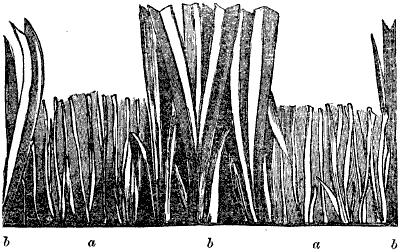
Fig. 31. The Taller Grasses.
The annexed cut (fig. 31) shows the effects of this,
the taller grass being a root of cocksfoot, which is not
only bunchy, but its leaves are too broad for a good
lawn grass, and it grows twice as fast as the smaller
species (a); its colour, too, would be so much lighter
than that of the surrounding herbage as to be at once
visible, and to strike one as a great blemish. Here,
again, the offending patch should be removed, and
better turf introduced, which operation should be
performed in the autumn if possible, so as to have the
full benefit the following summer.
These points in the cultivation of lawns are more
particularly applicable in the process of laying down
lawns with cut turves, which is the usual practice, and
especially when an immediate effect is required. In
this case, then, it cannot be too strongly urged that
much trouble and expense may be saved by choosing
the finest turf for our purpose; and the trouble of
picking out an objectionable grass or weed before
laying down will be amply rewarded.
If it be thought desirable to sow grass seeds to get
a lawn, we would propose the following mixture:—
5. Proposed mixture for lawns, cricket-grounds, bowling-greens, &c.
| Botanical Name. |
Trivial Name. |
Quantity
Per Acre. |
| |
|
lb. |
oz. |
| Lolium perenne |
Perennial Rye |
25 |
0 |
| Festuca duriuscula |
Hard Fescue |
4 |
0 |
| „ ovina |
Sheep’s „ |
2 |
0 |
| Poa pratensis |
Smooth Meadow |
1 |
8 |
| „ trivialis |
Rougher „ |
1 |
8 |
| Cynosurus cristatus |
Dogstail |
7 |
0 |
| Trifolium repens[4] |
Dutch Clover |
8 |
0 |
These seeds should be sown upon clean, well-pulverized,
and smoothly-rolled ground, and the garden
roller should be actively employed from the time the
grass seeds have well come up until they are fairly
established, when, if mown the second year with the
machine, its rolling will be sufficient.
Occasionally there will be bald places in parks, such
as some of the worn spots in Hyde Park, which it
would be advisable to provide seed for, that should
have an immediate effect. In this case we should mix
a small quantity of the Poa annua with the above, as
it not only effects the object of making the whole
look green very quickly, but so small a grass scarcely
interferes with the growth of the more permanent
species, which would meanwhile be making their
position, and so ultimately drive out the annual.
It now only remains to point out that the constant
mowing of lawns, although it only takes away young
grass, must in time have the effect of impoverishing
the lawn. In such case, the grass will not be of so
bright a colour as formerly, and it will become more
or less mixed with moss. In this state of matters the
grasses die, and different species of agarics live upon
the decaying roots.
In this condition we find that colour and fertility are
restored by a good sprinkling of soot, which usually
operates very beneficially for four or five years. After
this period a little guano, say one part to three parts
of soot, will do better. Another method of restoring
fertility is that of an occasional use of house slops,
diluted with five parts of water; this showered evenly
from a watering-pot, engine, or hydropult, usually
has a most beneficial effect.
In concluding this subject of “How to Grow Good
Grass,” the author would wish to impress upon his
readers the important fact, that as our country is so
peculiarly adapted for the growth of pasturage, and
as this interesting genus of plants furnishes the best
kind of herbage, so then the grass tribe is deserving
of the most careful study of the home-producer of
Meat, Milk, Cheese, and Butter.
Note.—Belcher’s Plantain Extractor and Turf
Inoculator will be found a most efficient implement
in extracting plantains, and preparing good turves
to fill up the holes. We fancy, too, that it will be
found useful in laying down land for permanent pasture
by a system of inoculation, but await the result
of experiments before stating more positively.—The
Author.
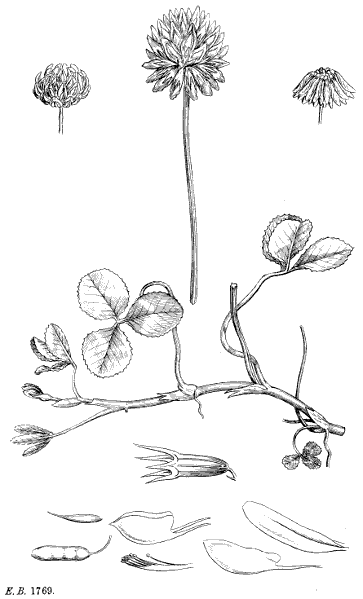
Trifolium repens. White Clover.
[109]