SCHOPENHAUER
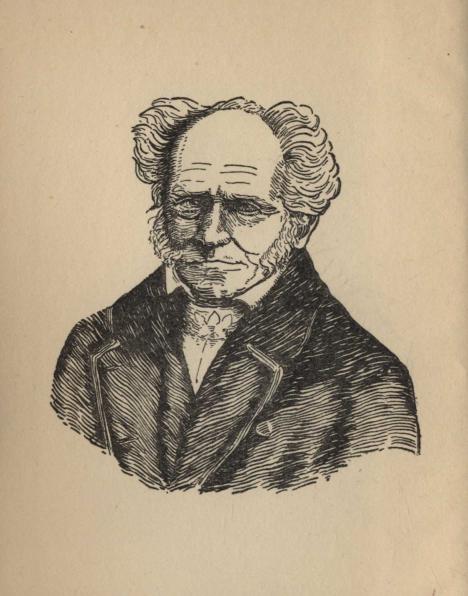
BY MARGRIETA BEER, M.A.
LONDON: T. C. & E. C. JACK
67 LONG ACRE, W.C., AND EDINBURGH
NEW YORK: DODGE PUBLISHING CO.
CONTENTS
CHAP.
INTRODUCTION
I. SCHOPENHAUER'S LIFE
II. PESSIMISM
III. ART
IV. VIRTUE
BIBLIOGRAPHY
INDEX
Whole book · 2 sections
BY MARGRIETA BEER, M.A.
LONDON: T. C. & E. C. JACK
67 LONG ACRE, W.C., AND EDINBURGH
NEW YORK: DODGE PUBLISHING CO.
CONTENTS
CHAP.
INTRODUCTION
I. SCHOPENHAUER'S LIFE
II. PESSIMISM
III. ART
IV. VIRTUE
BIBLIOGRAPHY
INDEX
Schopenhauer differs from most other philosophers in that he has influenced not only the development of the history of thought, the course along which modern philosophy has proceeded, but in that his views have been welcomed as an inspiration, accepted almost in the spirit of a religious faith by workers in quite other departments of life.
No philosopher has so directly touched and influenced the great art movements of modern times. It is now nearly one hundred years since the publication of his greatest work, and his philosophy is a more potent and vitalising force to-day than in his own lifetime. It has been a source of inspiration to artists and has directly stimulated their creative activity, probably more than any other abstract system has ever done.
Poetry has always been influenced subtly by philosophy. Spenser and Shelley are imbued through and through with the doctrines of Plato. Goethe wrote some of his finest work under the spell of Spinoza, and some of Wordsworth's deepest experiences were interpreted to him through the ideas of Kant. It is to all artists, but especially to musicians, that Schopenhauer makes his most intimate appeal. For in his system music plays a strangely important part, above and apart from all the other arts. In analysing its spiritual character, he endows it with mystic significance. One famous instance of this influence is that of Wagner. His acquaintance with Schopenhauer's philosophy marked a turning-point in his artistic life. It gave a tremendous stimulus to his musical productivity, and while under its influence he composed his greatest works.
Schopenhauer's system expresses, according to his own statement, only a single thought, viewed in different aspects. He considers it from the metaphysical, æsthetic, and ethical points of view. This fundamental thought, which lies at the root of his entire philosophy, is concerned with the significance of the will. The will alone gives the key to the understanding of man's existence. Every force in nature is to be regarded as will, and the inner reality of the universe is to be found only in will.
While it is especially to those who are concerned with the problems arising out of the function and significance of art that Schopenhauer offers such fruitful and fascinating suggestions, the other aspects of his system offer solutions in the sphere of ethics and metaphysics of almost equally vital importance. His insistence on the significance of instinct and intuition in all the lower and higher forms of life is of great importance in the history of philosophy. It is an aspect of the subject which until later times had been strangely neglected. This prominence which is given to instinct and intuition, is connected directly with his philosophy of the will.
Schopenhauer, unlike most philosophers, has always been read and appreciated by the general reader and student of life, as distinguished from the specialised student of philosophy. His fundamental attitude towards philosophy explains this to a great extent. Notwithstanding his marked leaning towards mysticism, he brought philosophy down to earth, and into relation with, the actual facts of life. He exchanged abstractions for realities. Philosophy had always been far too much concerned, he maintained, with abstract conceptions, and the philosopher had tended too exclusively to be a mere man of books and learning. The true philosopher, on the contrary, should be a guide to fine living as well as to high thinking.
Philosophy should express the real life of things. But the deepest things in life are not known by way of the intellect, but are lived and felt. The profoundest truths of life we know intuitively and directly, with a deeper certainty than the understanding can give.
That Schopenhauer has a wider public than have most philosophers is due partly to his style. He writes in language so singularly clear and lucid, that it can be followed easily by the general reader, not specially trained in a technical philosophical vocabulary. Of all German philosophers he is the greatest from a literary point of view. "The true philosopher," he writes, "will always seek after light and clearness, and will endeavour to resemble a Swiss lake, which through its peacefulness is able to unite great depth with great clearness, the depth revealing itself precisely by the clearness, rather than a turbid, impetuous mountain torrent." Philosophers have not always given much heed to this counsel of perfection. Obscurity of expression is merely the cloak in which men seek to hide their poverty of thought and triteness of mind. "Everyone," says Schopenhauer, "who possesses a beautiful and rich mind will always express himself in the most natural, direct, and simple way, concerned to communicate his thoughts to others and thus relieve the loneliness that he must feel in such a world as this."
Schopenhauer is a temperamental pessimist. In words of glowing and passionate eloquence he sets out to prove that all life is essentially sorrow. From his earliest days he had been abnormally sensitive to the misery that lies beneath the surface of life. Pain is essential to life and cannot be evaded. If it can find entrance in no other form, then it comes in the sad, grey garments of tedium and ennui.
The purest joy in life is that which lifts us out of our daily existence, and transforms us into disinterested spectators of it. This "divine release from the common ways of men" can only be found through art. But even this release, which is accessible only to the few, increases the capacity for suffering.
The final and only permanent solution of life is to be found in the life of the saint. True morality passes through virtue, which is rooted in sympathy, into asceticism. Art gives a marvellous consolation in life, but renunciation and self-surrender offer a complete release from the terrors and evils of existence. The veil of Mâyâ—the web of illusion—is lifted from man's eyes. He now shudders at the pleasures which recognise the assertion of life, and attains to the state of voluntary renunciation, resignation, and true indifference. Buddhism, Schopenhauer maintained, comes nearest of all religions to expressing this truth. It is here that he shows how profoundly Indian philosophy and religion had influenced him.
Throughout his life Schopenhauer was aggressively hostile towards all contemporary philosophers. To some extent, no doubt, his own failure to obtain academic recognition embittered him. But partly his attitude may be explained by the complete difference of method between them. Schopenhauer cares nothing at all about method. To Hegel and his contemporaries method was all-important. The historical method was the pathway which was followed with most enthusiasm at the time. It is especially for the historical method that Schopenhauer has the frankest contempt. Hegel and others were attempting to interpret present reality through history, seeking to show that through the slow process of history, unfolding itself in time, are revealed the organic principles which underlie the whole of life. Schopenhauer attaches practically no value to history as a highroad for philosophical inquiry. This way, he says, lie merely the dry bones of archæology and antiquarianism. To examine things historically is to look along a horizontal line. To think philosophically is to look along a vertical line. The latter is the rational and the more profound point of view. "What history narrates is in fact only the long, heavy, and confused dream of humanity." It is our inmost consciousness which is the real concern of the philosopher. "The true philosophy of history," he says, "consists in the insight into the causes of all these endless changes and their confusion. We have always before us the same even, unchanging nature, which to-day acts in the same way as yesterday. Thus it ought to recognise the identical in all events, in ancient as in modern times, in the East as in the West, and in spite of all difference in special circumstances, of costume and of custom, to see everywhere the same humanity. If one has read Herodotus, then in a philosophical regard one has read enough history. For everything is already there that makes up the subsequent history of the world."
That which is significant in itself, not in its relations, is to be found far more profoundly and distinctly in poetry than in history. There is, therefore, far more real, inner truth in poetry than in history. Aristotle held the same view, maintaining that poetry reveals a higher truth than history, for it strives to express the universal. "Poetry," he says, "is a more philosophical, and a higher thing than history."
In Schopenhauer's view, the true philosopher is the genius. His penetrative imagination will see farther and deeper than the learning of the mere scholar. The genius is a clear mirror of the inner nature of the universe. To him knowledge is the sun which reveals the world. His work may be regarded as an inspiration, as an interpretation of the spirit of beauty in art. He has been endowed by nature with a special faculty of inner vision, and uses his power to open the eyes of ordinary men. It is the genius who knows the inner nature of things, just as in Plato true philosophers are defined as "the lovers of the vision of truth, who are able to distinguish the idea from the objects which participate in the idea, and whose eyes are ever directed towards fixed and immutable principles." It is the genius, says Schopenhauer, who interprets his vision to the rest of mankind. He enables us to see the world through his eyes.
There was a wide difference, too, between Schopenhauer and other contemporary philosophers, in their attitude towards religion. Schopenhauer's freedom from academic fetters enabled him to steer an independent way. The German university professor was almost always dominated by the need for reconciling his philosophical theories with a theological creed. At times to square accounts between the two involved considerable ingenuity, as in the case of Kant. To Schopenhauer, to whom orthodox religion had always been a mere form, such attempts savoured of hypocrisy. Hence he always speaks slightingly of "philosophy-professors," and throughout his writings he makes bitter attacks upon them. Hegel's work is described as three-fourths utter absurdity, and one quarter as paradox, and he himself alluded to as "that intellectual Caliban." Plato's contempt for the sophists stands on very much the same plane of thought.
In spite of this attitude there is much in Schopenhauer's system, which is closely akin to Christianity on its mystical side. In his ethical theory he shows extraordinary points of agreement with the mediæval mystics. Materialism was utterly alien to his spirit. Materialists, he said, possess neither humanities nor culture, and their point of view filled him with the Olympian laughter of the gods. He always maintained that his theory of pessimism was more truly Christian, and more closely in accord with the spirit of primitive Christianity than the shallow optimism which crept into the later developments of that system. Its ascetic spirit he considered the kernel of Christianity. Protestantism represented for him a falling away from the earlier and purer form, and a transition to shallow rationalism.
His thought was much influenced by ancient Indian philosophy, and especially by Buddhism. The Upanishads had been published in Germany in 1801 in a Latin translation from a Persian version of the Sanscrit original. In these treatises are set forth the general system of mystical pantheism, which grew out of the more theosophic elements of the Vedas. In reading them Schopenhauer immediately acknowledged a kindred spirit. In speaking of this work he says, "How does everyone who by diligent reading has familiarised himself with this incomparable book, feel himself stirred to the innermost by that spirit. The mind is here washed clean of all its early ingrafted superstition, and all philosophy servile to that superstition. It is the most profitable and the most elevating reading which is possible in the world. It has been the consolation of my life, and will be the consolation of my death."
SCHOPENHAUER'S LIFE
Arthur Schopenhauer led the outwardly uneventful life of a scholar and a thinker, taking no part in public affairs. The great movements in European history, through which he lived, left him untroubled and unmoved in his scholar's seclusion. There is little therefore to chronicle with regard to the outer history of his life. It is the more easy to escape the criticism of Schopenhauer himself, who says that "those who, instead of studying the thoughts of a philosopher, make themselves acquainted with his life and history, are like people who instead of occupying themselves with a picture, are rather occupied with its frame, reflecting on the taste of its carving and the nature of its gilding."
The little that there is to tell is, however, of great significance with regard to the development of his thought. For of no philosopher can it be more truly said than of Schopenhauer, that his thought is the expression of his character.
Schopenhauer was born at Dantzig on February 22, 1788. He traced his descent through both parents to Dutch ancestors. The family had settled at Dantzig in the course of commerce. For several generations the head of the family had combined the career of a merchant with landed pursuits. Schopenhauer's great-grandfather, Andreas Schopenhauer, leased one of the large farms belonging to the municipality, while following the business of a merchant. His son Andreas acquired property near Dantzig, and there the father of the philosopher, Heinrich Floris Schopenhauer, was born. Some mental weakness seems to have been inherited. The eldest son of Andreas was an imbecile from his youth, and the other children, with the exception of Schopenhauer's father, all had some curious mental or moral twist. Heinrich Floris Schopenhauer, however, was a man of strong intelligence and character. He followed a merchant's career with great success, raising his firm to the first position in the town. He was a disciple of the school of Voltaire, read French and English literature, and had a keen admiration for English life and institutions. His wife, Johanna, belonged, too, to one of the leading families of Dantzig. She had been educated on broader lines than was usual for girls at the time, and had a love for art and letters which extended her interests beyond the domestic concerns of her home. Later on, during her widowhood, these were to find a wider field and opportunity, and she became a well-known authoress in the Germany of her day. She married in 1785, at the age of eighteen, being twenty years younger than her husband. The marriage was an unhappy one, owing to differences of temperament. There were two children of the marriage. They suffered for the incompatibilities of their parents. Both were burdened with abnormally strong desires for the pleasures of life, together with an extraordinary capacity for suffering.
Arthur, the future philosopher, was the first child of the marriage. He was given the name of Arthur to satisfy the cosmopolitanism of his father, the name being spelt alike in several languages. His earliest years were spent at the country house near Dantzig, or at the farm, between the sea and the pine-woods, which had been rented many years before by his great-grandfather.
In 1793, when Schopenhauer was five years old, the family migrated to Hamburg. The "free city" of Dantzig, which had a constitution of its own, was annexed by Prussia in 1793, at the second partition of Poland, and Heinrich Schopenhauer was too stern a republican to adapt himself to the new rule. He carried on his business in Hamburg for the next twelve years, but never became a naturalised citizen.
He had resolved that his son should follow the family career of a merchant, and his education was planned accordingly on those lines. He was taken to France in 1797, and left at Havre for two years. For the next three years he attended a private school at Hamburg. During this time, discontent with his father's plans for his future was gradually ripening within him. To reconcile him, he was promised a trip to France and England, on the condition that he promised to give up his own desires and ambitions, and to be loyal to his father's wishes. The prospect of the journey was too alluring, and he gave the required promise. After six weeks had been spent in London, his parents left him at a boarding-school at Wimbledon. In letters to his mother, he complains of the mechanical instruction, the dreary Sunday services, and the tedious routine of the school. She, in reply, warns him not to give way to bombast and empty pathos.
He became proficient in English, and always held English character and intelligence in admiration, although he was impressed by the prevalent hypocrisy and the oppressive pietism of the time. He was busy already recording his impressions, describing characteristically the feelings and ideas awakened in him rather than the actual facts and events. The travellers returned through France, from Geneva to Vienna, and thence to Berlin.
For about four months Schopenhauer now worked in a Dantzig office, trying to acquire the rudiments of a business training. When almost seventeen, he entered the employment of a firm in Hamburg. He himself has recorded that there never was a worse clerk in a merchant's office. In his leisure, and during office hours whenever possible, he was reading voraciously.
In 1805 his father died, whether by accident or by his own hand remains uncertain. For two years longer Schopenhauer stuck to his hated task, out of loyalty to his father, and the promise made him some years earlier. But at last he could stifle his ambitions and yearnings towards a purely intellectual life no longer, and he obtained his mother's consent to leave his office, and to begin preparation for a learned career.
His mother meanwhile, with her daughter Adèle, had left Hamburg and settled at Weimar, at that time the intellectual centre of Germany. Goethe was here the sun round which the lesser lights of the artistic and intellectual world revolved. At the age of forty, Johanna Schopenhauer had entered on a new life, and was finding scope and free development for untried capabilities. She played a prominent part in the social life of the place, and her receptions were remarkable for the circle she gathered round her. Goethe himself was a frequent visitor there. She also took part in the theatrical performances, which were so conspicuous a feature of the life at Weimar. With help and encouragement from Fernow, a distinguished scholar and art critic, she began to write, and published with considerable popular success travel sketches, art biographies, and novels. Her daughter, in describing their life at Weimar, tells how her mother experienced ever fresh delight in intercourse with the famous men living there. "She was liked, her society was agreeable. Her pleasing manners made her house a centre of intellectual activity, where everyone felt at home, and freely contributed the best he had to bring." Besides Goethe, Schlegel, Grimm, Wieland and others were frequent guests under her roof. Freed from his hated bondage, Schopenhauer now left Hamburg and entered the gymnasium, or grammar school, at Gotha, but a lampoon on one of the masters was so resented that he was obliged to leave. He then came to Weimar, at his mother's suggestion, and worked at classics in the house of a well-known scholar, who had a real enthusiasm for all things Greek. Something of his spirit he communicated to his pupil, and the passion for Greek art and thought grew into a moulding principle in Schopenhauer's views of life and religion. At the same time that he was entering into the spirit of classical literature, he was cultivating his musical ability, and thus feeling his way towards a full and intense understanding of the art, which entered later with such significance into the development of his philosophy. He was striving to realise an ideal of the fullest and most complete culture, in which not only the life of thought, but also the life of art should find consummate satisfaction.
The estrangement between his mother and himself began to widen now that they were thrown constantly together. By arrangement, he dined daily with her, and came to her receptions. But Schopenhauer was too uncontrolled in his temper, and too uncompromising in his egoism to make an agreeable companion. His mother, driven to write to him, asserts that his constant grumbling, gloomy looks, and intolerant dogmatism depress her. It is necessary to her happiness to know that he is happy, but not necessary that she should be a witness to it. Therefore, if they are to agree they must consent to live apart. Both mother and son were bent on self-development, and in character were too dissimilar to understand each other. Schopenhauer was jealous, uncontrolled in his moods, and boorish in his manners. That all-consuming egoism, which all his life spoiled his relations with everyone with whom he came in contact, made a congenial family life impossible. He resented his mother's freedom and independence, and insulted her friends. In a way that is very characteristic of him, he generalises from his own personal experience, and in his views on women we find reflected all the bitterness which had grown round the relations between himself and his mother.
In 1809 he attained his majority, and received his share of his father's fortune, amounting to about £150 a year. He was now independent, and could pursue the career he had marked out for himself. He valued all his life the liberty which this competency secured him. A draft dedication, intended for the second edition of The World as Will and Idea, was addressed "to the manes of my father. Noble, beneficent spirit! to whom I owe everything that I am.... As thou didst bring into the world a son such as I am, thou didst also make provision that in a world like this, such a son should be able to subsist and to develop himself.... In my mind the tendency to its only proper vocation was too decidedly implanted to let me do violence to my nature, and so to subjugate it that, recking nought of existence in general, and active only for my personal existence, it should find its sole task in procuring daily bread.... Thou seemest to have foreseen that thy son, thou proud republican, could not possess the talent to compete in cringing before ministers and councillors, Mæcenases, and their advisers, basely to beg for the hard-earned piece of bread, or to flatter self-conceited commonplaceness, and humbly join himself to the eulogistic retinue of bungling charlatans.... That I could expand the forces nature gave me and apply them to their destined purpose, that I could follow my natural instinct and think and work for beings without number, while no one does anything for me, for that I thank thee, my father, thank thy activity, prudence, thrift, and provision for the future."
In 1809 he entered the University of Göttingen as a student of medicine. In his second year he changed his course to philosophy. Wieland, the poet, on the occasion of a visit from Schopenhauer, tried to dissuade him from philosophy as a career. The reply was, "Life is a ticklish business. I have decided to spend it in reflecting on it."
In 1811 Schopenhauer left Göttingen, and entered the University of Berlin. Here, too, he gave special attention to natural science. Throughout his notebooks are scattered critical remarks on his teachers and their lectures. Fichte especially was a butt for his sarcasms. Against a statement of Schleiermacher's, that "No man can be a philosopher without being religious," he writes, "No man who is religious takes to philosophy: he does not need it."
The Napoleonic wars were at this time disorganising the whole of Europe. Berlin was in the hands of a French garrison. But after the disastrous campaign of Napoleon in Russia, the entire nation rose against the invader. University classes were broken up. Fichte stayed behind to nurse the wounded, and died next year at his post. Schopenhauer, a prey to fears, which tormented him all his life, fled for safety to Dresden. He settled finally at Rudolstadt, and wrote there an essay, to qualify for the degree of doctor of philosophy at Jena. This he obtained, and his essay was published as A Philosophical Treatise on the Four-fold Root of the Principle of Sufficient Reason. This work he describes in his later books as a preliminary part of his system, which must be studied if the remainder is to be understood. It is written entirely under the influence of Kant. The title refers to the four branches of knowledge: physical science, mathematics, logic, and ethics.
After the publication of his book, Schopenhauer returned to Weimar, and stayed for a few months with his mother. The experiment resulted in complete estrangement. He was overbearing and dogmatic, insulting his mother's friends, and censorious towards herself. She wrote to him again, to avoid an unpleasant personal interview, and complained of his contemptuous bearing and peremptory manner. He left Weimar and never saw his mother again, although she lived for twenty-four years after their separation. It is a curious commentary on his relations to his parents, that his highest praise of his father lay in the fact that he had, by his thrift, left his son an adequate income; and that his main censure on his mother is that she spends her money too negligently.
His visits to his mother at Weimar were of considerable importance in the subsequent development of his thought, for it was there that he made the acquaintance, not only of Goethe, who influenced him profoundly for a time, but also of F. Mayer, the orientalist, who directed his attention to the philosophical literature of ancient India. This literature left a permanent mark upon his mind.
For the next four years he lived at Dresden. In 1816 he published an essay On Vision and Colours, which has reference to the controversy which Goethe was waging on the theory of light. Schopenhauer's theory is fantastic. It is not submitted to experimental evidence, and rests, as he admits, on "intuitive" certainty.
This early work is hardly in the direct line of the development of Schopenhauer's thought. It is really a deviation, for which Goethe's all-compelling influence is responsible. Goethe was at first inclined to regard Schopenhauer as an opponent, for the essay is rather a transformation of Goethe's theory than an expansion of it.
His residence at Dresden was the best he could have chosen from the point of view of his own system of philosophy. Here he could study better than in almost any other town of Europe the works of art, in which he was to see a revelation of the meaning of life. The art collections of the town are among the most famous in Europe, and the music, both operatic and orchestral, was then, as now, of the highest quality. In this home of art, Schopenhauer's great system was now taking shape.
During his daily walks along the banks of the Elbe, he was thinking out his theories, making notes occasionally in a note-book, and then striding on again with the rapid pace by which he was recognised even as an old man.
More and more strongly it was borne in upon him that "inward discord is the very law of human nature." All his life his thoughts had struck the note of genuine pessimism. He was always in revolt against the pain and misery that lie hidden beneath the surface of life. That this pessimistic bias was fundamentally one of temperament, there can be no doubt. In letters to him from his mother, we find her constantly urging him, even as a child, to look upon the brighter side of things. In a letter written to him in 1806, she writes, "I could tell you things that would make your hair stand on end, but I refrain, for I know how you love to brood over human misery in any case."
Even in happiness and success he recognised illusion. Everywhere in nature we see strife and conflict. One species preys upon another. The "will to live" necessarily expresses itself as a struggle.
Hegel at this time reigned supreme in the kingdom of philosophy. It was hardly possible to escape his influence. Schopenhauer, in striving to give expression to a system which would lay bare the real inner nature of our life and destiny, was at the same time protesting passionately against the Hegelian view. It was as a protest against the all-powerful idealism of this philosophy that his system was directed in the first place. He represents a reaction against the absorption of everything in reason. As opposed to this view, Schopenhauer urged the priority of the will and the feelings as the fundamental factors in determining the mental life.
The will is the reality behind all life. The intellect is merely a tool in the service of the will. It is impossible to find in reason a complete knowledge of the essence of the world. A merely intellectual philosophy of life is bound to be thin and hollow, and we should aim rather at a clear and direct insight into life.
Now the will, into which every form of life can be resolved, is the source of all human misery and unhappiness. The only way in which men can free themselves from the bondage of the will, and throw off its yoke, is by looking upon beauty. It is in art that eternal truth is revealed with a directness and certainty to which science never attains. This theory is connected with the Platonic theory of Ideas. The real inner nature of things, the Ideas in the Platonic sense, are revealed in creative and imaginative art. The faculty of vision, which enables men to divine this reality behind appearances, and to interpret it to others, is the gift of the artistic genius. He "understands the half-uttered speech of nature, and articulates clearly what she only stammered forth." The man of genius produces works of art by intuitive insight. He sees through the outer shell to the inner significance that lies at the heart of things. Genius is the faculty of renouncing entirely one's own personality for the time being, so as to become clear vision of the world, free of subjectivity. The genius must have imagination, above all things, in order to see in things not that which nature has actually made, but that which she endeavoured to make, but could not.
Art, however, does not deliver us permanently from life, but only for moments. It is therefore not a path out of life, but only an occasional consolation in life.
It is the saint, who through the surrender of all willing, through the intentional mortification of his own desires, attains to true resignation. Happiness and unhappiness become then a matter of indifference, and the spell of the illusion, which held us chained in the bonds of this world, is broken for ever.
These were the views which found expression in Schopenhauer's great work, The World as Will and Idea, which was finished in 1818. He found a publisher in Brockhaus of Leipsic. While the work was going through the press, he attacked his publisher with such violent rudeness, that Brockhaus wrote declining all further correspondence with one "whose letters in their supreme coarseness and rusticity savour more of the cabman than of the philosopher."
The work appeared when Schopenhauer was thirty years of age, an extraordinarily early date at which to produce so complete and elaborate a system of philosophy. In this work the outlines of his whole system are permanently fixed. The whole contains, he says, but a single thought. That thought exhibits itself as metaphysics, æsthetics, and ethics. He wrote later many essays and supplements, but these all go towards confirmation and expansion of his earlier work. For the rest of his life he was repeating his original theories, with infinite variation in expression. This is entirely in accord with his own theory of age. At thirty, he maintained, the intellectual and moral endowment has reached its highest development. All that is done later is to vary and expand the main principles already laid down.
His book fell still-born from the press. Twenty years later he succeeded in getting his publishers to undertake a second edition, but this too received but scant recognition. Schopenhauer had built great hopes on his work, and his disappointment was bitter when no word of notice greeted its appearance. "I dread silence about my system, as a burnt child dreads the fire," he wrote on one occasion. When bringing his manuscript to the notice of the publisher, he had written that the work "would hereafter be the source of a hundred other books." He confided to a disciple that upon completing the work, he had felt so convinced that he had solved the enigma of the world, that he had thought of having his signet-ring carved with the image of the sphinx throwing herself down the abyss. "My philosophy," he wrote, "is the real solution of the enigma of the world. In this sense it may be called a revelation."
Before the book appeared, Schopenhauer travelled to Italy. He first spent some weeks in Venice, where Byron was living at the time. The two, however, did not meet. He then set out for Rome, by way of Bologna and Florence, and there he spent the winter. His time was spent mostly in the art collections, and in the study of Italian. He kept, as he always did in travelling, a diary, recording not so much his observations on things seen, as his moods and moralisings on them.
In May of the following year, as he was returning home, he received the news of the bankruptcy of the Dantzig house in which almost the entire means of his mother and his sister were invested. He himself had a far smaller amount at stake. The business arrangements connected with the winding-up of the firm, which his mother accepted, were not to Schopenhauer's taste, and the estrangement between himself and his relatives now became permanent. He showed his usual promptness to suspect evil, and his angry accusations were so bitter, that a silence of eleven years fell between himself and his mother and sister. His struggle with the firm in question lasted for two years. Schopenhauer came off triumphant financially, his capital with interest being paid in full, whereas the other creditors obtained only thirty per cent.
His great work having now been launched in the philosophical world, Schopenhauer turned his thoughts to the chances of an academic appointment. After many inquiries he decided finally on Berlin, and made an application. Specimen copies of his published works were sent in, and a private trial lecture delivered. Here in 1820 he began his career as assistant lecturer, and a course of lectures was announced, of six hours a week, on philosophy in general. He chose as his lecture hour the very time at which Hegel delivered his principal course, thinking to enter into direct competition with him, and carry off his students. His hopes, however, misled him. The students were not to be beguiled away from the omnipotent Hegel, and Schopenhauer's course was a complete failure. He was not a good lecturer, and the course fell through before the end of the term. The lectures were never again delivered.
The six years he spent in Berlin were not in other respects happy ones. He was on bad terms with all his colleagues, and even in his private life he contrived to bring worry and legal trouble upon himself. In a small entrance hall, common ground to himself and another lodger, he, one day, found three women engaged in conversation. He demanded their withdrawal. Two complied, but one, a sempstress lodging in the same house, refused. Thereupon Schopenhauer, stick in hand, threw her forcibly twice out of the house. She fell, and on the following day brought her case before the court. After six months, the verdict went in Schopenhauer's favour, but an appeal was lodged, and, in his absence, the court inflicted a fine of twenty thalers, as compensation for injuries inflicted. Some months later the sempstress brought a further action. She claimed that her injuries were more serious than had first appeared, and that she was now permanently incapacitated for work. Schopenhauer was condemned to pay her sixty thalers a year as aliment, and five-sixths of the costs of the case. This sum he paid until the time of her death, twenty years later. On her death certificate he wrote, "obit anus, abit onus." The episode throws light on the character of the philosopher, with its marked strain of coarseness and ill-controlled passion.
Meanwhile, Schopenhauer continued to philosophise, still hoping against hope for the university professorship, which never came, but sustained by immense self-confidence in the importance of his message. He lived at Berlin in absolute seclusion. Social life had no attractions for him. He was a constant visitor to the theatre, the opera-house, and the concert-room, and at home his flute was a constant diversion. These were his chief distractions.
From time to time the thought of marriage had entered into his plans, but his habits of solitude were growing stronger, and his cynical views on women were obtaining an ever firmer hold on his mind. His nature was strongly sensual, and intermittent amorous experience is not the best school in which to foster the growth of fine feeling or noble thoughts on the relations of the sexes. It is not surprising to find, therefore, in his views on women the unmistakable stamp of his personal experience, a fatal blindness to all but the physical side of sex. The subject is not one that he passes over with indifference, for it amounts almost to an obsession with him. He left behind him notes on love and marriage, which were held by his literary executor to be unfit for publication, and these were burned accordingly.
It was during these years at Berlin, embittered by the lack of recognition of his philosophical work, and by his failure in the academic world, that his attacks on university professors grew so virulent. He attributed his failure in both respects to conspiracy on the part of those in power. His attacks on Hegel grew ever fiercer.
In 1829 he was anxious to undertake a translation into English of Kant's chief works. He wrote to the publishers, urging his claims, saying "a century may pass before there shall again meet in the same head so much Kantian philosophy with so much English, as happen to dwell together in mine." The proposal came to nothing, and Kant's Critique had to wait for nearly ten years longer before it appeared in an English form.
In 1831 the cholera broke out in Berlin, and Schopenhauer immediately took to flight. Hegel was one of the victims of this outbreak. In one of his later works, Schopenhauer describes how he had been moved to leave Berlin, on the entry of the cholera, by means of a dream. He had dreamed of a little schoolfellow and playmate, who died in childhood, "It may have been," he says, "of hypothetical truth, a warning in short, that if I had remained, I should have died of the cholera. Immediately after my arrival in Frankfurt, I was the subject of a perfectly distinct apparition, as I believe, of my parents, and signifying that I should survive my mother, who was still alive; my father, already deceased, carried a light in his hand." This is significant, as showing Schopenhauer's belief in the supernatural, and in mystical influences.
After leaving Berlin, Schopenhauer settled at Frankfurt, and with the exception of one year, which was spent at Mannheim, he lived there until his death twenty-seven years later. For twenty years after coming to Frankfurt he lived in entire isolation. Now and again, at rare intervals, an article from his pen appeared, but this is the only sign of life. We hear nothing of his personal life during this period. Friends he seems to have had none, and all personal intercourse with acquaintances invariably came to an abrupt end, owing to his intolerant attitude towards those who dared to disagree with any of his views.
Only when he reaches the verge of old age do we once again have some record of him. This latter part of his life was spent with unvaried regularity. His chief occupation and solace is philosophy. His daily routine was mapped out, according to a regular plan, which hardly varied from day to day. He worked during the forenoon for three or four hours. At noon he enjoyed half an hour's relaxation on the flute. He dined daily at a hotel. After an hour's rest, the afternoon was given up to lighter literature. His favourite authors, among poets, were Petrarch, Shakespeare, and Calderon. The study of the great classical writers was all his life his greatest delight. The degradation in style of contemporary literature, which he constantly bemoaned, he held to be due largely to the neglect of classical literature. "Without Latin," he wrote, "a man must be content to be counted amongst the vulgar." He regretted the disuse of the Latin language as a means of communication between scholars. Apart altogether from the educational value of the classics, he thought no other literature afforded the same refreshment and enjoyment for the mind. To take one of the classics in one's hand, even for half an hour, is to feel refreshed, purified, elevated, and strengthened, exactly as if one had drunk from a fresh rock spring.
In the afternoon, whatever the weather, Schopenhauer took his daily walk, together with his dog, his invariable companion. The two were well-known figures in Frankfurt, as they took their customary exercise together. Schopenhauer's devotion to his dog was boundless. For the animal world altogether he had a special tenderness, pitying animals as the tortured souls of the earth, and holding that in all essentials they are the same as man. He condemned vivisection, on the ground that animals have rights.
For two hours he took his customary walk, at a rapid pace, in accordance with his theory that quick movement is essential to health. Then he visited the reading-room of the town, never omitting to look through the Times. The evening was spent frequently at the theatre, or in the concert-room. In his later years, his growing deafness robbed him of much of the pleasure which he had always won from music. On returning home, he read for an hour, and then retired to rest. All his life he was afraid of robbers, and took extraordinary precautions against them. He slept invariably with loaded weapons by his bedside, and his valuables were hidden away with great ingenuity in various corners of his rooms. He believed that a thinker needed more than the ordinary amount of sleep to recuperate after the day's labours. His rule of life was modelled on that of Kant, but of Kant's early rising he strongly disapproved, believing it to be a reckless waste of vital energy.
Thus the latter part of his life is occupied with careful rules for the preservation of his health, which was naturally robust. The contradiction is at once obvious between his actual mode of life and his own moral ideal, as set forth in his works. Some of his most eloquent writing is on the subject of holiness, attained through renunciation and self-denial. Poverty, chastity, and constant mortification of the will are the ways along which man must travel to gain the highest moral solution of life. Schopenhauer was perfectly conscious of this contradiction between his ideals and his own way of life. But, he says, it is just as little needful that a saint should be a philosopher, as that a philosopher should be a saint. In the same way, it is not necessary that a perfectly beautiful man should be a great sculptor, or that a great sculptor should himself be a beautiful man. It is a strange demand, that a moralist should teach no other virtue than that which he himself possesses.
After 1818, when The World as Will and Idea appeared, he published nothing further until 1836. In that year, a small book called On the Will in Nature appeared. It was described on the title-page as "a discussion of the corroborations which the philosophy of the author has, since its first appearance, received at the hands of empirical science." During these eighteen years, in which no new work of his was published, he had been collecting from all that he read, or saw, or heard, everything that could in any way be brought to bear as evidence towards the proof of his main theories and principles. Especially had he been on the alert with regard to scientific investigation, believing that his own sceptical generation would be most strongly influenced by anything that science could bring forward as confirmation of his metaphysical principles. Physics, he thought, had arrived at the point where it touches metaphysics. He was now confident that the time for his philosophy was ripening. But in spite of this confidence, the book met with no more recognition than had his previous works.
In 1838 he competed successfully for a prize offered by the Scientific Society of Drontheim, in Norway, for the best essay on the question "whether free-will could be proved from the evidence of consciousness." The subject could not have been more happily chosen to suit him. His essay won the prize, and he was elected a member of the Society. He obtained permission from the Society to publish his essay in Germany.
Meanwhile he was competing for another prize, offered by the Royal Danish Academy of the Sciences, at Copenhagen, on the subject of the sources or the basis of morality. He was confident of success, and wrote to the Academy asking that the award might be speedily made public, as he proposed to publish his essay along with the one which had been successful in Norway. His confidence was premature, for when the Danish Academy made known its decision, it announced that Schopenhauer's essay was the only one sent in, but that it was unworthy of the prize on several grounds, one of which was, that several of the chief philosophers had been treated with contempt.
From this time his rage against the three philosophers, Hegel, Fichte, and Schelling, knows no bounds. He attributed his failure to win recognition to a conspiracy among them and their followers. His writings abound in violent invective against them. In several ways there are points of contact between the system of Schopenhauer and that of Hegel, but Schopenhauer refused to admit any kinship between them.
His two treatises were published together, as he had intended. They appeared in 1841 as The Two Fundamental Problems of Ethics. These two problems are the freedom of the will and the basis of morality. The treatment is little more than an expansion of the theories set forth in his chief work. He finds the roots of morality in sympathy. The sense of brotherhood, which binds together individual and individual, and welds them into an organic whole, is the foundation on which all the moral sentiments are built. All goodness, love, virtue, and nobility of character spring from the same source, from sympathy, which is the same in its nature as pure love. Beyond the egoism, which is fostered by the world around us, there exists also the principle of altruism, impelling men to self-sacrifice, unselfishness, and devotion.
The second edition of The World as Will and Idea, which appeared in 1844, seemed at first as likely to fail of attaining recognition as the earlier one. But a change was now at hand. The reign of optimistic pantheism was approaching its end in Germany. The lofty idealism, which was the strength of the dominant school of thought, and which found political expression in the revolutionary movements of 1848, was now followed by a wave of reaction. The democratic movement, after obtaining some temporary triumphs, was checked completely for the time, and a wave of weariness and discouragement passed over the country. Schopenhauer looked on, while Frankfurt was torn violently asunder in the throes of its revolution. His sentiments were against the democratic party, and he seems to have feared, above all else, the possibility of losing his private means. In letters written at this time to his friends, Schopenhauer expresses his dislike and disapproval of the great national movement of 1848. He was a thorough-going individualist, and the movement, which stirred to the depths the finest natures of the time, found no response in Schopenhauer's heart. His room was used by Austrian soldiers, who shot from the windows upon the democrats below.
His political views are expressed again in his will, made in 1852, in which Schopenhauer left the greater part of his estate to be spent for the benefit of the soldiers who had been wounded at Berlin, in 1818, in defence of the royal party against the democratic revolutionaries. In his view, the State exists only to secure safety of persons and property. It is a strange error, he says, to attribute to the State any moral function. It is to be regarded merely as the night-watchman, who protects us from thieves and robbers.
The German Parliament, which sat at Frankfurt, had but a short-lived existence. In the reaction which followed, Schopenhauer's philosophy found an open door. Disciples attached themselves gradually to the philosopher, and by degrees his system gained ground at home and abroad.
The work which won for him more popularity than any other, was Parerga and Paralipomena (Chips and Scraps), published in 1851. The work had been declined by three publishers before a Berlin firm agreed to publish, without any payment to the author. The book consists of essays of a very heterogeneous kind, and of varying length. Most of the chief problems discussed in his larger works are treated again in the essays. Religion, education, archæology, Sanscrit, style, noise, ghosts, and immortality are a few of the subjects dealt with. Schopenhauer's reading was wide. His quotations range freely over oriental, classical, and modern literature.
The success which followed the publication of this book was reflected on the earlier works, and it was now possible to bring out further editions. Schopenhauer's delight at this tardy recognition was unbounded. Every scrap of applause was gathered and absorbed with eagerness. In his letters during this period, everyone who differs from him is denounced as a charlatan and a windbag. Everyone who says anything at all similar is attacked as a plagiarist. Every adversary is moved by the meanest motives. So virulent is his abuse, and so coarse his language, that words in his letters have sometimes to be changed for an initial. Nothing short of adulation, could satisfy his hungry vanity. Even when the universities at last acknowledged him, and offered a prize for the best exposition and criticism of his system, he was enraged at the award of the prize to a student who treated him as of more importance in a literary than in a philosophical capacity. Praise of any other philosophy than his own filled him with bitterness. His correspondence with Frauenstadt, Lindner, and Asher is full of such weakness. It may be doubted whether any great man ever left behind him letters of so trifling a nature, so steeped in vanity and so resentful of any breath of criticism.
He was active to the end of his life, though the first fine rapture of his passionate love for all that is best in art was dimmed inevitably with the passing years. There is a pathetic reference in a letter to this dulling of his power of vision. "In the time," he writes, "when my spirit was at its zenith, whatever object my eye rested upon made revelations to me. Now that I am old, it may happen that I stand in front of Raphael's Madonna, and she says nothing to me."
He died suddenly, in 1860, at the age of seventy-two. The stone which marks his grave bears as inscription the sole words "Arthur Schopenhauer."
PESSIMISM
Schopenhauer's system is set forth in all its fulness in his great work, The World as Will and Idea. All that he wrote after the appearance of this book was confirmation and expansion of the theories already laid down. It differs from his earlier books in method. He no longer follows academic lines. He looks upon the work as a revelation of the meaning of life, based on a clear and direct intuition into life, and the style shapes itself accordingly. Metaphor frequently takes the place of argument, and his theories are developed in a flow of passionate eloquence, contrasting remarkably with the severer methods of the ordinary metaphysician.
Schopenhauer takes as his starting-point certain theories from the philosophies of Plato and Kant. Things, as we know them in experience, said Kant, are made up partly of forms or moulds, which are in the mind, and partly of something outside the mind. That which we know, our actual experience, is a combination of the two elements, the subjective and the objective element. That part of experience which lies outside the mind, the reality, the thing-in-itself or the noumenon in philosophical language, we can never know. For in order to be known by us, it has to run into the forms or moulds supplied by the mind, and in this transition its nature has been changed. To know it as it is, before it enters into contact with our minds, is impossible. That we appear to have objective knowledge is therefore a deception and an illusion.
Schopenhauer accepts Kant's analysis of experience, but denies that the thing-in-itself is unknowable. For that which is real in our experience is not outside us altogether, as in Kant's theory. It lies within ourselves; it is the only real and essential part of our nature, and we have a direct knowledge of it. This reality Schopenhauer finds in the will. Now the will is fully known to us through internal perception, through intuition. It is the real, inner nature of everything in the world. It affords the key to the knowledge of the inmost being of the whole of nature. It is the kernel of every individual thing, and also of the whole universe.
It is important to note, that Schopenhauer's use of the word "will" is far wider than that of common usage. It includes not only conscious desire, but also unconscious instinct, and the forces of inorganic nature. He recognises will not only in the existences which resemble our own, in men and animals, but also in the force which germinates and vegetates in the plant, the force through which the crystal is formed, that by which the magnet turns to the north pole, the force which appears in the elective affinities of matter as repulsion and attraction, decomposition and combination, and lastly even as gravitation, which draws the stone to the earth and the earth to the sun. All these in their inner nature are identical. It is the same force in every manifestation of nature, as in each preconsidered action of man. The difference is merely one of degree.
The body is the most real thing for everyone. If we analyse the reality of this body, we find nothing but the will. With this its reality is exhausted. The word will, like a magic spell, he says, reveals the inmost being of all nature. Spinoza says, that if a stone, which has been projected through the air, had consciousness, it would believe that it was moving of its own will. Schopenhauer adds that the stone would be right. The impulse given it, is for the stone what the motive is for us. All blindly impelling force, all forces which act in nature in accordance with universal laws, are equally in their inner nature to be recognised as will. It is everywhere one and the same, "just as the first dim light of dawn must share the name of sunlight with the rays of the full midday."
Now the will expresses itself necessarily as a struggle. Everywhere in nature we see strife, conflict, and alternation of victory. Every grade of will fights for the matter, the space, and the time of the others. For each desires to express its own inmost nature. Nature exists only through such struggle. This universal conflict is most distinctly visible in the animal kingdom. For animals have the whole of the vegetable kingdom for their food, and even within the animal kingdom every beast is the prey and the food of another. Each animal can maintain its existence only by the constant destruction of some other life.
This is the "will to live" which everywhere preys upon itself, until finally the human race regards nature as a manufactory for its own use. This strife manifests itself just as characteristically in the lower grades of will, e.g. the ivy which encircles the oak until the tree withers as if choked, the parasite which fastens itself on the animal and kills it. Even crude matter has its existence only in the strife of conflicting forces.
Man has need of the beasts for his support, the beasts in their turn have need of each other as well as plants, which in their turn require the ground, water, and chemical elements and their combinations. Thus in nature everything preys on some other form of life. For the will must live on itself; there exists nothing beside it, and it is a hungry will.
This theory of the will is connected by Schopenhauer with pessimism. Eternal becoming, endless flux characterises the inner nature of the will. In the human race this character of the will is most clearly marked. All our endeavours and desires delude us by presenting their satisfaction as the final end of will. But as soon as we attain our desires, they no longer appear the same. They soon grow stale and are forgotten, and then are thrown aside as useless illusions. The enchantment of distance shows us paradises, which vanish like optical delusions, as soon as we have allowed ourselves to be mocked by them. We are fortunate if there still remains something to wish for and to strive after, that the game may be kept up of constant transition from desire to satisfaction, and from satisfaction to a new desire.
Happiness, therefore, always lies in the future, or else in the past. The present, Schopenhauer compares to a small dark cloud, which the wind drives over the sunny plain. Before and behind it all is bright, but the cloud itself always casts a shadow. The present is always insufficient, the future is uncertain, and the past irrevocable.
The will strives always, for striving is its real nature. No attainment of the goal can put an end to this constant striving. It is not susceptible, therefore, of any final satisfaction, for in itself it goes on for ever. As in the life of the plant, so in the life of all men. There is the same restless, unsatisfied striving, a ceaseless movement through ever-ascending forms, until finally the seed becomes a new starting-point. This is repeated ad infinitum, nowhere an end, nowhere a final satisfaction, nowhere a resting-place. No possible satisfaction in the world can suffice to still the cravings of the will, to set a goal to its infinite aspirations, and to fill the bottomless abyss of its heart.
The hindrance of this striving, through an obstacle, we call suffering; the attainment of its temporary end is well-being or happiness. But as there is no final end of striving, there is no measure and end of suffering. In proportion as knowledge attains to distinctness, as consciousness ascends in the scale of organic life, pain increases also. It reaches its highest capacity, therefore, in man. The more intelligence a man has, the greater his capacity for suffering; the man who is gifted with genius suffers most of all. Suffering is in the very nature of all life, and the ceaseless efforts which we make to banish it succeed only in making it change its form. Yet we pursue our lives, absorbed in the interests of the moment, just as we blow out a soap bubble as large as possible, although we know perfectly well that it will burst. Willing or striving may be compared to an unquenchable thirst. Every act of willing presupposes a want. The basis of all willing is need or deficiency. The nature of man, therefore, is subject to pain originally and through its very nature.
If, on the other hand, man lacks objects of desire, being deprived of them by too easy satisfaction, then a terrible emptiness and sense of boredom, comes over him. His very existence becomes an unbearable burden to him. Thus life swings like a pendulum backwards and forwards between pain and boredom. Men have expressed this truth oddly, says Schopenhauer, in transferring all pain and torments to hell, and in leaving what remains, that is, boredom, for heaven. Man is of all animals the most full of wants and needs. He is a concretion of a thousand necessities. Driven by these, he wanders through life, uncertain about everything except his own need and misery. The care for the maintenance of his existence occupies, as a rule, the whole of human life. A second claim, that of the reproduction of the species, is related directly to this. At the same time, he is threatened from all sides by different kinds of dangers, from which it requires constant watchfulness to escape. "With cautious steps and casting anxious glances round him, he pursues his path, for a thousand accidents and a thousand enemies lie in wait for him. Thus he went while yet a savage, thus he goes in civilised life. There is no security for him."
The majority of men wage a constant battle for their very existence, with nothing before them but the certainty of losing it at last. Man's greatest care in avoiding the rocks and whirlpools of life, only bring him nearer at every step to the greatest, inevitable, and irremediable shipwreck of death. This is the final goal of the laborious voyage.
Whatever nature and fortune may have done, whoever a man be, and whatever he may possess, the pain of life cannot be cast off. Excessive joy and excessive suffering always occur in the same person, for they condition each other reciprocally, and are conditioned by great activity of the mind. Error and delusion lie at the foundation of keen joy or grief. Joy rests on the delusion that lasting satisfaction has been found for the desires. The inevitable result is that when the delusion vanishes, we pay for it with pain as bitter as the joy was keen. The greater the height from which we drop, the more severe the fall.
For the most part we close our minds to the knowledge that happiness is a delusion. We strive unweariedly from wish to wish, and from desire to desire. It is incredible how meaningless when viewed from without, how dull and unenlightened by intellect when felt from within, is the course of life of the great mass of men. It is a weary longing and complaining, a dreamlike staggering through the four ages of life to death, accompanied only by trivial thoughts. Such men go like clockwork, without knowing the reason why. The life of every individual, if we survey it as a whole, is always a tragedy, but looked at in detail, it has all the character of a comedy. Everyone who has awakened from the first dream of youth, who has reflected on his own experience and on that of others, must conclude inevitably that this human world is the kingdom of chance and error, which rule without mercy in great things and in small. Everything better struggles through only with difficulty. That which is noble and wise seldom attains to expression. The absurd and the perverse in the sphere of thought, the dull and tasteless in the sphere of art, the wicked and deceitful in the sphere of action, assert a supremacy which is rarely disturbed.
Nothing external has power to deliver man from this dominion of woe. In vain does he make to himself gods, in order to get from them by prayers and flattery what can be accomplished only by his own will-power.
The most beautiful part of life, its purest joy, is pure knowledge. It is removed from all willing, and lifts us out of real existence. This relief, however, is granted only to a few, because it demands rare talents and rare opportunities. Even the few, to whom it comes only as a passing dream, are made susceptible of far greater suffering than duller minds can ever feel. They are placed in lonely isolation by their nature, which is different from that of others. To the great mass of men, purely intellectual pleasures are not accessible. They are almost incapable of the joys which lie in pure knowledge. Their lives are given up to willing.
If we could bring clearly to a man's sight the terrible sufferings and miseries to which his life is exposed, he would be seized with horror. The brevity of life may be the best quality it possesses.
All happiness is negative in character, and never positive. Only pain and want can be felt positively. Happiness is merely the absence of pain, for it follows upon the satisfaction of a wish. Some want or need is the condition which precedes every pleasure. But with the satisfaction, the wish, and therefore the pleasure, cease. The satisfaction can never be more than deliverance from a pain or want. We observe that the days of our life were happy after they have given place to unhappy ones. In proportion as pleasures increase, the capacity for them decreases. What is customary is no longer felt as a pleasure. Achievement is difficult, but when attained it is nothing but deliverance from some sorrow or want. Therefore we value our blessings and advantages only when we have lost them, for the deprivation, the need, is the positive factor.
Man's real existence is only in the present, and the present is slipping ever into the past. There is thus a constant transition into death. The future is quite uncertain, and always short. Our existence, therefore, is a constant hurrying of the present, into the dead past, a constant dying. On the physical side, the life of the body is but an ever-postponed death. In the end death must conquer, and he only plays for a little with his prey before he swallows it up.
With such intensity did Schopenhauer feel that pessimism was the only possible conclusion, that he maintained that optimism was not only absurd, but really a wicked way of thought. For optimism is a bitter mockery of the unspeakable suffering of humanity. He revolted against the theory of Leibnitz, who maintained that this is the best of all possible worlds. It is, on the contrary, he declared, the worst of all possible worlds. Optimism is at bottom the unmerited self-praise of the will to live, the real originator of the world, which views itself complacently in its works. It is not only a false, but also a pernicious doctrine. For it presents life to us as a desirable condition, and happiness as its end. Everyone believes that he has a just claim to happiness and pleasure, and if these do not fall to his lot, he believes that he is wronged. It is far more correct to regard misery and suffering, crowned by death, as the end of our life, for it is these which lead to the denial of the will to live. It is difficult to conceive how men can deceive themselves and be persuaded that life is there to be thankfully enjoyed, and that man exists in order to be happy. The constant illusion and disillusion seem intended to awaken the conviction, that nothing at all is worth our striving, our efforts, or our struggles, and that all good things are but empty vanity. The truth is, he says, we ought to be wretched and we are.
The world is a hell, which surpasses that of Dante. One need look only at man's treatment of his fellow-men.
Schopenhauer points to the children, who are sent into factories to work there daily for long hours, performing day after day the same mechanical task. This, he adds, is to purchase dearly the satisfaction of drawing breath. Everyone would have declined the "gift" of life, if he could have seen it and tested it beforehand. But life has never been chosen freely. Everyone would retire from the struggle gladly, but want and boredom are the whips which keep the top spinning. Every individual bears the stamp of a forced condition. Inwardly weary, he longs for rest, but yet he must press forward. All movement is forced, and men are pushed from behind. It is not life that tempts them on, but necessity that drives them forward.
Suicide is no solution of the problem of life. It is not to be regarded as a crime, as in the code of modern society. But there is a valid moral reason against it, in that it substitutes for the real emancipation from the world of suffering, a merely apparent one. So far from being a denial of the will, suicide is indeed a strong assertion of the will. The suicide destroys merely the individual manifestation of life. The wilful destruction of the single existence is a vain and foolish act. The suicide gives up living, because he cannot give up willing. He denies the individual only, not the species. There is a more adequate way of conquering life than by destroying it, which Schopenhauer expounds when he deals with the ethical aspect of his philosophy.
His analysis of the worth of human life, as represented in this theory of pessimism, is the most passionate and terrible indictment of existence which has ever found expression. His sense of disenchantment is felt with such intensity, that it colours and distorts the whole fabric of his vision of life.
There is much affinity between the character and work of Schopenhauer and that of Leopardi. In both are displayed penetrating profundity of thought, extraordinary beauty of expression, and deep insight into the workings of the human mind, while the same passionate revolt against the misery of life colours the outlook and achievement of philosopher and poet alike. Schopenhauer was acquainted with the writings of Leopardi, and had great admiration for his work. His subject, he says, is always the mockery and wretchedness of existence, and he presents it with such wealth of imagery, such multiplicity of forms and applications, that he never wearies us, but is always entertaining and exciting. This estimate of the work of Leopardi might with equal justice be applied to Schopenhauer himself.
As his philosophy gained ground gradually, and became known, he won many disciples and enthusiastic followers, and for a time his theories of pessimism became fashionable. Certain literary groups adopted them with enthusiasm, but in that direction his influence was not permanent. It is not in Schopenhauer's theory of pessimism that his true importance and real significance lie. In philosophy this influence has but faintly shown itself. Schopenhauer's direct successor on these lines of thought is Eduard von Hartmann. He rejects Schopenhauer's doctrine that all pleasure is merely relief from pain, but admits that the greater number of pleasures are of this kind. Satisfaction, he asserts, is always brief, while dissatisfaction is enduring as life itself. The pain in the universe greatly preponderates over the pleasure, even for those who are regarded as the fortunate ones in the eyes of the world. The future, moreover, seems likely to bring us only increased misery. Hartmann's practical conclusion is that we should aim at the negation of the will to live, not each for himself, as Schopenhauer taught, but universally, by working towards the annihilation of all existence. Schopenhauer's influence is here, obviously, very strongly marked.
Another disciple, and a far more famous one, is Nietzsche. He came under Schopenhauer's influence while a student at the university, and threw himself with passionate enthusiasm under the spell of his philosophy. Although in his later development he reacted strongly in an opposite direction, yet all his work bears the mark of the deep impress which Schopenhauer had made upon his mind. His outlook on life had been changed profoundly by "that wonderful heart-stirring philosophy," as he calls it. One of his earliest works was an essay on Schopenhauer as Educator, in which he bases the greatness of Schopenhauer on his power to see the picture of life as a unity, and to express it as such. He is held up as the ideal philosopher, and as one of three models for future man, the other two being Goethe and Rousseau. Schopenhauer's insistence on action as the proper sphere of man, as contrasted with the mere life of thought, made a strong appeal to Nietzsche. A philosopher, says Nietzsche, must be not only a great thinker, but a living man. Schopenhauer had not been spoilt, as was Kant, by his education. He had seen life as well as studied books, and so was able to see how the free, strong man could be evolved. Many of Nietzsche's most characteristic doctrines are suggested in this early essay, and are read partially into Schopenhauer's philosophy.
It is more especially Schopenhauer's theories of art which influenced Nietzsche's thought, and left the deepest and most permanent mark on his work. He adopted in his early days the pessimism along with the rest of Schopenhauer's system. But this conception of life was not really native to his mind, and it was against this aspect of Schopenhauer's philosophy that he reacted most violently in later life. Nietzsche stands, above all else, for the affirmation of life, Schopenhauer for the negation of life. In his protest against pessimism, Nietzsche reaffirms with passionate intensity the worth of life and the splendour of human destiny. He told men to believe in the glory of things, and bade them shout for the joy of living. "All that's joyful shall be true," he says in one of his poems. In another passage he insists that "it is necessary to remain bravely at the surface, to worship appearance, to believe in forms, in tones, in words, in the whole Olympus of appearance." It is clear that by this time nothing of the pessimistic outlook on life had been left in Nietzsche's philosophy.
Pessimism will always find an echo in the minds of those who by temperament tend to see only the darker colours of the picture of life. Too much questioning and too little responsibility lead down to the abyss, as William James points out. Pessimism, he says, is essentially a religious disease. It consists in nothing but a religious demand, to which there comes no normal religious reply.
To the great mass of mankind there is something alien and repellent in this grim and bitter outlook of hopelessness. It finds little or no response in the heart of the normal human being, even though at times the nightmare view may force itself upon him. "Deliverance," says the Indian poet Tagore, "is not for me in renunciation. I feel the embrace of freedom in a thousand bonds of delight. All my illusions will burn into illumination of joy and all my desires ripen into fruits of love."
For Schopenhauer the way of escape lay in two directions. In considering his æsthetic theories, we shall see how he found in art a temporary release from the bondage of life, and in his ethical system he points the way to a permanent deliverance.
It is in these statements, the æsthetic and the ethical aspects of his system, that we find the most significant part of Schopenhauer's philosophy. His pessimism left little permanent mark on the course of philosophic thought. It is to the other side of his work that we must look for a fruitful issue, to his statement of the function of art and its meaning for life; his insistence on the will, the active element, as that which has most reality and significance in life; to the part which the feelings, instinct, and impulse play in his system. In all these directions, Schopenhauer's influence has been powerful and far-reaching. To-day he is a stronger force than any other of the great thinkers of his time, overshadowed though he was by them during his lifetime. In Germany especially, his influence is felt as a powerful factor in the thought of the present day.
ART
Schopenhauer's theory of the beautiful is the side of his philosophy which has always made so potent an appeal to artists, and to all those lovers of the beautiful, for whom art represents the supreme significance of life.
The present for Schopenhauer is only an infinitesimal moment between two eternities, the past and the future. It is "a flash of light between two darknesses." Now how is man to make the best of this brief moment, under the hard conditions of his destiny? The answer to this question Schopenhauer finds in his theory of the function of art. He links up into intimate relation his theory of æsthetic with his philosophical pessimism, but his pessimism is modified considerably in the process.
There are certain men, he maintains, who can free themselves from the bondage of the will. They can throw off its yoke, and, released from all the aims of desire, they can become disinterested spectators of the real, essential nature of the world. The inner meaning of their clear, deep vision they can interpret to others. Such men are artists, and the interpretation of their vision is the work of art. In art are revealed the eternal truths of the nature of man and the universe, revealed with a power and directness to which science can never attain. Artists, then, are the seers, the visionaries, who penetrate into the hidden, vital principles of things. They alone have power to interpret the half-uttered speech of nature, and disentangle that which is real and essential, the inner truth, from that which is accidental and transitory. The road to philosophy, then, leads through the gateway of art.
In this theory Schopenhauer starts from Plato's doctrine of the Ideas. The particular objects of sense, which we know, are mere appearances. They have no reality in themselves. They arise and pass away, they always become and never are. But there exist also the types and eternal forms of things, which do not enter into time and space, and which remain fixed, subject to no change. These constitute the sole reality. Plato called them the Ideas, and Schopenhauer adopts this term from the Platonic philosophy. The Ideas for Schopenhauer represent the different grades of the objectification of the will, which are manifested in the individuals. These are the eternal forms or prototypes of individual things.
Our knowledge of the ordinary things of sense-experience is indirect, it is gained by way of the intellect. Our knowledge of the Ideas, on the other hand, is direct and immediate, it is gained through intuition. In his account of the Ideas, or the real, essential nature of things, Schopenhauer is treading already the path of mysticism, along which he works out his theories of ethics.
Now the whole function of art is to reproduce the eternal ideas, to seize on that which is essential and abiding in all the phenomena of the world. The one and only source of art is the knowledge of true reality, of the Ideas. The one aim of art is the communication of this knowledge. According to the material in which this vision of true reality is reproduced, it is architecture, sculpture, painting, poetry, or music.
Science can only follow the unresting and inconstant stream of appearances. It can never reach a final goal nor attain complete satisfaction, any more than by running we can reach the place where the clouds touch the horizon. But art, on the other hand, is everywhere at its goal. It plucks the object of its contemplation out of the stream of things as they seem, and holds it isolated before its vision. And this particular thing, which in the stream of the world's course was a small perishing part, becomes to art the representative of the whole, the type of the endless multitude in space and time. Art, therefore, pauses before this reality, which it perceives in the particular thing. The course of time stands still; relations vanish before it; only the essential, the Idea, remains as the object of the artist's vision. In the multitudinous and manifold forms of human life, and in the unceasing change of events, the artist looks only on the Idea, knowing it as the abiding and the essential, as that which is known with equal truth for all time. Art, therefore, is the bridge between two worlds. It leads us from things as they seem to things as they really are.
It is the genius who possesses this power of vision, and whose magic works can unfold before the eyes of ordinary mortals the spirit of beauty as she has revealed herself to him. Entirely in this spirit does Blake express his sense of the poet's mission:
"I rest not from my great task
To open the eternal worlds, to open the immortal eyes
Of man inwards; into the worlds of thought; into Eternity
Ever expanding in the bosom of God, the human Imagination.
The method of genius is always artistic, as opposed to scientific. The nature of genius consists in a surpassing capacity for the pure contemplation of Ideas. It is the faculty of continuing in the state of pure perception, of losing the personality in perception, and of enlisting in this service the knowledge which existed originally only for the service of the will. Genius, then, is the power of leaving one's own interests, wishes, and aims entirely out of sight, of renouncing entirely one's own personality for a time, so as to remain pure knowing subject, clear vision of the world. This state must be achieved, not merely at moments, but for a sufficient length of time, and with sufficient consciousness, to enable the artist to reproduce by deliberate art what has thus been seized by his inner vision. He must fix in lasting thoughts the wavering images that float before the mind:
"But from these create he can
Forms more real than living man,
Nurslings of immortality."
It is as if, says Schopenhauer, when genius appears in an individual, a far greater measure of the power of knowledge falls to his lot than is necessary for ordinary men. This excess of knowledge, being free, now becomes subject purified from will, a clear mirror of the inner nature of the world.
Imagination is an essential element in genius, and it is a necessary condition that it should be possessed in an extraordinary degree. Imagination extends the horizon far beyond the limits of actual personal experience, and so enables the artist to construct the whole dream, the complete vision, out of the little that comes into his own actual apperception.
The actual objects are almost always but imperfect copies of the ideas expressed in them. Therefore the artist requires imagination in order to see in things, not that which nature has actually made, but that which she endeavoured to make, but could not, because of the never-ceasing conflict between the various forms of will. Through the penetrating vision of this imagination, the artist recognises the Idea. He understands the half-uttered speech of nature, and is able to articulate clearly what she only stammered forth.
The common mortal, he says, that manufacture of nature, which she produces by the thousand every day, is not capable of observation that is wholly disinterested in every sense. He can turn his attention to things only so far as they have some relation to his will, however indirect it may be. This is why he is so soon done with everything, with works of art, objects of natural beauty, and everywhere with all that is truly significant in the various scenes of life. He does not linger in the pursuit of beauty, but seeks only to gain his own way in life. On the consideration of the significance of life as a whole, he wastes no time. The artist, on the other hand, strives to understand the inner nature of everything. His faculty of vision is to him the sum which reveals the world.
In spite of his contempt for the majority of men, Schopenhauer has to admit that the faculty of perceiving the Idea, the inner reality, must exist in nearly all men, in a smaller and different degree, otherwise they would be just as incapable of enjoying works of art as of producing them. They would have no susceptibility to beauty, nor to sublimity. All men, therefore, who are capable of æsthetic pleasure at all, must be capable to some extent of knowing the Idea in things, and in responding to the call of beauty, of transcending their personality for the moment.
Æsthetic pleasure is the same whether it is evoked by a work of art or by the contemplation of nature, for the Idea remains unchanged and the same. The work of art is only a means of making permanent the vision in which this pleasure consists. The artist does not add "the gleam, the light that never was on sea or land," but his vision is more finely attuned to the reality than that of ordinary men. He makes permanent in the various media of art "the consecration and the poet's dream." His work acts as a communicating spark from mind to mind.
In one of Carlyle's most suggestive passages, he insists on the spiritual and symbolic nature of the work of art, in words that echo curiously the thought of Schopenhauer. "In all true works of art," he says, "thou wilt discern eternity looking through time, the godlike rendered visible ... a hierarch therefore, and pontiff of the world will we call him, the poet and inspired maker, who Prometheus-like can shape new symbols, and bring new fire from heaven to fix it there."
That the Idea, the true reality behind appearance, is revealed with so much more force and clearness in the productions of art than directly in nature is due to the power of the artist to abstract the pure Idea, the reality, from the actual and the accidental, omitting all disturbing, non-essential qualities. He disentangles that which is real and essential from the confused mass presented in experience. The artist lets us see the real world through his eyes. That he has these eyes, that he knows the inner nature of things, apart from all their relations, is the gift of genius. This gift is inborn, and cannot be acquired. But that the artist is able to lend us this gift, and let us see through his eyes, is acquired. This is the technical side of his art.
Primarily, then, the genius is the artist. Scientific genius finds no place in Schopenhauer's scheme. Statesmen are of very different fibre. Their intellect retains a practical tendency, and is concerned with the choice of the best means to practical ends, remaining therefore in the service of the will. The eminent man, who is fitted for great achievement in the practical sphere of life, is so because objects rouse his will in a strong degree, and spur him on to the investigation of their relations. His intellect, therefore, has grown up in close connection with his will.
Talent is limited to detecting the relations which exist between individual phenomena, whereas genius rises to a vision of the universal in the individual. The genius has a vision of another and a deeper world, because he sees more profoundly into the world which lies before him. "To compare useful people with men of genius is like comparing building stone with diamonds." Mere men of talent come always at the right time, for they are called forth by the needs of their own age. The genius, on the other hand, comes into his age like a comet, whose eccentric course is foreign to its well-regulated order. Genius appears only as a perfectly isolated exception.
Schopenhauer never states definitely that a philosopher may be a genius, but he always seems to assume that he himself belongs to the heavenly company. He gives a detailed description of the genius, even to his physical appearance. With his usual habit of generalising from his own particular case, he endows the genius with many of his own personal characteristics, even to his dislike of mathematics.
The Platonic theory of Ideas was the basis on which Schopenhauer built his philosophy of art. But Plato's own theory of the function of art differed fundamentally from that of Schopenhauer, and it is interesting to compare the two views. To Plato it seemed that art was concerned with the imitation of things as they seem, not as they really are; with the objects of sense perception and not with the Ideas. The artist mutates the illusory appearances of concrete things. Consequently the work of art is still further removed from true reality, from the Idea, than is the thing of experience. It is a copy of a copy. This led him to the statement that works of art are thrice removed from the truth. They can be produced easily without any knowledge of the truth, for they are concerned only with appearances, and not with the reality that lies behind appearances. Hence Plato's rejection of art. In his system it is not art, but philosophy that gives a direct revelation of truth. Schopenhauer, on the other hand, maintains that it is not the concrete object of experience, but the reality itself which lies behind that object, with which the artist is supremely concerned. The artist alone among men has the capacity of vision to see and grasp the truth of this reality. Such capacity of vision is reserved by Plato for philosophers, those whom he calls "lovers of the vision of truth."
In his earlier works, Plato approximates far more closely to Schopenhauer's theory. He speaks there of the poet as "a light and winged and holy thing. There is no invention in him until he has been inspired.... Beautiful poems are not human or the work of man, but divine and the work of God. The poets are only the interpreters of the gods, by whom they are severally possessed."
The value of art for Schopenhauer lies mainly in its power to deliver us from the slavery of the will. In the quiet contemplation of beauty revealed in art, we are delivered from the misery of life. Willing, he maintains, arises from want, and therefore from suffering. The satisfaction of a wish ends it, but every satisfied wish at once makes room for a new one, and both are illusions. No attained object of desire can give lasting satisfaction, but merely a fleeting gratification. It is like the alms thrown to the beggar, that keeps him alive today, that his misery may be prolonged till the morrow.
Without peace no true well-being is possible. But when some external cause or inward disposition lifts us suddenly out of the endless stream of willing, and knowledge is delivered from the slavery of the will, we have a vision of things free from this relation of the will. We can observe them without personal interest, without subjectivity. Then, all at once, the peace which we are always seeking, but which always fled from us on the path of the desires, comes to us of its own accord, and it is well with us. This is the painless state, which Epicurus prized as the highest good, and as the state of the gods. We are then set free from the miserable striving of the will. It is this deliverance that art effects for us, and which is accomplished only by the inner power of the artistic nature. Art frees us from all subjectivity, from the bondage of the will. This freeing of knowledge lifts us out of all the misery of endless desire, as wholly and entirely as do sleep and dreams. Happiness and unhappiness have disappeared. We are no longer individuals. We are only that one eye of the world, which looks out from all knowing creatures, but which can become perfectly free from the service of the will in man alone. Art provides us with a sphere, in which we can escape from all our misery, and can attain to a state of temporary peace and painlessness.
There is a curious affinity between the æsthetic theories of one of the mediæval mystics and those of Schopenhauer. St. Thomas Aquinas, the greatest of the schoolmen, expounded views in the thirteenth century akin in many respects to those set forth by Schopenhauer at the beginning of the nineteenth century. Beauty, he held, is the revelation of reason in sensuous shape, and he proceeds further to say that in the realisation of beauty desire is quieted.
Art is the most joy-giving and the only innocent side of life. It is, says Schopenhauer, in the full significance of the word, the flower of life. The pleasure which we receive from all beauty, the consolation which art affords, enables us to forget the cares of life. This pleasure consists in the contemplation of the Ideas, in the contemplation of the inner truth of life, which reveals to us a drama full of significance. In entering into the state of pure contemplation, our happiness lies in the sense of being lifted, for the time being, above all willing, beyond all wishes and desires. We become freed from ourselves. These moments when, sunk in contemplation and enjoyment of the work of art, we are delivered from the ardent striving of the will, when we seem to rise out of the heavy atmosphere of earth, these moments are the happiest which we ever know.
The arts themselves Schopenhauer arranges according to their subject-matter rather than according to their medium. He places them in very much the same order as that in which Hegel puts them. Architecture, painting and sculpture, poetry and music are each discussed in turn.
Music.—Music is the apex of his whole system of æsthetics. It is placed by itself, outside and above all the other arts. For it is not, like the other arts, a copy of the Ideas, but it is the copy of the will itself. In the main Schopenhauer's treatment of music is mystical. Hegel too gave to music the supreme position among the arts. It was the central romantic art in his system, and the mysterious magical enchantment of music is painted by him with glowing eloquence.
The effect of music, says Schopenhauer, on the inmost nature of man, is powerful beyond that of any of the other arts. For that great and exceedingly noble art stands alone, quite apart from the other arts. In it there is no copy or repetition of any Idea of existence in the world. It is understood by man in his inmost consciousness as a universal language, the distinctness of which surpasses that of the visible world itself. The basis of modern music lies in the numerical relations which underlie sounds. Arithmetical proportions enter into and have some part in the pleasure which we derive from music, as Leibnitz points out, but this does not account for that passionate delight with which we hear the deepest recesses of our nature find expression in sound. If we take the æsthetic effect as a criterion, we must attribute to music a far deeper and more vital significance than that which lies at the basis of the other arts. This is connected with the inmost nature of man and the world. Its representative relation to the world must be very deep, absolutely true, and extraordinarily accurate, because it is understood immediately by everyone. It has the appearance of a certain infallibility, because its form may be reduced to quite definite rules, expressed in numbers, from which it cannot free itself without ceasing to be music. The obscure relation of music to the world has never been made clear.
In order to explain this relation, Schopenhauer says he gave his mind entirely to the impression of music in all its aspects, and then returned to apply his reflections to his system of thought. We know that he had invaluable opportunities of studying music, in its various forms, during the time that he was working out his system at Dresden. He himself practised daily the use of a musical instrument. The result of his investigation is an explanation, which he admits is impossible of proof, because it regards music as the copy of an original, which can never itself be presented directly as idea. But he maintains that in order to assent with full conviction to his theory of the significance of this art, it is only necessary to listen frequently to music, testing the theory at the time, and reflecting constantly upon it.
The other arts represent the Ideas in the particular things, the realities that lie behind the visible world, but music is independent altogether of the world of concrete things. It ignores completely this aspect of life. It could to a certain extent exist even if there was no world at all. Music, then, is not the copy of the Ideas, but the copy of the Will itself. That is why the effect of music is so much more powerful and penetrating than that of the other arts, for they speak only of shadows, but it speaks of the thing itself.
Browning relates music to the will in one of his best-known poems, when he makes Abt Vogler say:
"But here is the finger of God, a flash of the will that can,
Existent behind all laws, that made them, and lo, they are!
And I know not if, save in this, such gift be allowed to man,
That out of three sounds he frame, not a fourth sound, but a star."
Schopenhauer, in working out the details of his theory, tries to establish an analogy between music and the Ideas of the visible world, connecting the lower tones with the lowest grades of the objectification of the will, those of inorganic nature, and leading up gradually through the intermediate grades until the higher tones are reached, representing the other end of the scale, the highest organic forms of life. The melody, the high singing part, represents the intelligent life and effort of man, and progresses with unrestrained freedom, while it dominates the whole. This represents the unbroken, significant connection of one continuous thought. The melody, therefore, has significant intentional connection from beginning to end. It records the history of the will enlightened by intellect. In the world of experience the will expresses itself in action. But melody does more, it expresses the inner side of the action, drawing out from the deeps its secret history, its motives and efforts, its passionate yearning and inner excitements, all that which the reason includes in the concept of feeling. For this reason music has been called the language of feeling and passion, as words are the language of the reason. In melody there is a constant deviation from the keynote in a thousand ways, yet there always follows a constant return to the keynote. In all these digressions and deviations melody expresses the manifold efforts of the will. Its satisfaction is also expressed by the final return to a harmonious interval, and to the keynote. In melody, therefore, the composer reveals all the deepest secrets of human willing and feeling.
His work lies far from all reflection and conscious intention, and flows directly from inspiration. The abstract conception is here, as everywhere in art, unfruitful. The composer reveals the inner nature of the world, and expresses the deepest wisdom in a language which his reason does not understand. In the same way, a person under the influence of mesmerism tells things of which he has no conception when he wakes. In the composer, more than in any other artist, the man is entirely separate and distinct from the artist.
As quick transition from wish to satisfaction is well-being, so quick melodies are cheerful. Slow melodies are analogous to the delayed and hardly-won satisfaction, and are sad. Quick dance music seems to speak only of easily attained and common pleasure. Adagio movements speak of the pain of a great and noble striving, which despises all trivial happiness.
The effect of the major and the minor key is equally marked. In general, music consists of a constant succession of more or less disquieting chords, chords which excite "immortal longings," and also of more or less quieting and satisfying chords, just as the life of the heart is a constant succession of feelings of disquietude and of peace, following desire and satisfaction. Just as there are two general fundamental moods of the feelings, serenity and sadness, so music has two keys, which correspond to these, the major and the minor. Since music is founded deeply in the nature of man, the dominant national mood is reproduced invariably in a country's music. We find accordingly that the minor key prevails in Russian music, while allegro in the minor is characteristic of French music, "as if one danced while one's shoe pinched."
But in all these analogies music has no direct, but only an indirect relation to them. It does not express particular and definite joys, sorrows, pains, or horrors, but joy, sorrow, pain, or horror itself, the real, inner nature of each emotion. It is the essential character of these emotions that is represented, without disturbing accessories. Music expresses only the quintessence of life and its events, never the events themselves. This inner meaning of life, the eternal truth of things, is felt and understood immediately when we listen to great music. "All things eternal," wrote Wagner, "can be expressed with unmistakable certainty in music." And in another passage, he says, "Music can never and in no possible alliance cease to be the highest, the redeeming art. It is of her nature, that what all the other arts but hint at, through her and in her becomes the most indubitable of certainties, the most direct and definite of truths."
It is for this reason that our imagination is excited so easily by music, and that we seek to give it form by clothing it with words. This is the origin of opera and songs.
Wagner built up a whole theory of music, based on the philosophy of Schopenhauer. But in their views on opera they differed fundamentally. The text of opera, says Schopenhauer, should never forsake a subordinate position. The music should never become a mere means of expressing the words. That is a great misconception of the function of music, for music should always be universal. It is just its universality, which belongs exclusively to it, that gives music its high worth as "the panacea for all our woes." If music is too closely united to the words, and tries to express itself according to outward events, it is striving to speak a language which is not its own. Schopenhauer mentions Rossini as the composer who is most free from this mistake. His music speaks so clearly that it requires no words to explain it.
Nature and music, then, are merely two different expressions of the same thing. Music is a universal language, expressing the inner nature of the world. It resembles geometrical figures and numbers. They are the universal forms of all possible objects of experience, and yet are not abstract, but concrete and determined. All that goes on in the heart of man, and that is included in the concept of feeling, may be expressed by an infinite number of possible melodies, but always universally. Music represents the inmost soul of the event, without the body. We might therefore just as well call the world embodied music as embodied will. For this reason music makes every scene of real life, and of the world, more profoundly significant. It lays bare the inmost kernel which lies hidden in the heart of all things. It penetrates to the very heart of nature. The ineffable joy which we derive from music, which haunts our consciousness as the vision of a distant paradise, restores to us all the emotions of our inmost nature, but divested entirely of the sting of actuality, and far removed from its pain.
It is interesting to compare the view of Schopenhauer, that music is a copy of the will itself, with the theory of Plato and Aristotle, which maintained that music is a direct reflection of character. The modern art of music was not developed in their day, and yet both these philosophers seem to have had prophetic insight in understanding the nature of the marvellous spell and power of sound. Music to them was an imitation, a copy of character, and as such of profound importance in education. Music reflects character, and therefore moulds and influences it. The foundations of character, says Plato, are laid in music, which charms the souls of the young into the path of virtue. Rhythm and harmony find their way into the secret places of the soul, making the soul harmonious and graceful. "If our youth are to do their work in life, they must make harmony their perpetual aim," and the soul can only be reached and educated in this way through music.
It is Schopenhauer's theory of music which has influenced most directly the world of art. It was hailed by Wagner as a revelation, and it determined his musical development and all his æsthetic theories. Through Wagner it may be said to have revolutionised much of modern music. After reading The World as Will and Idea, Wagner wrote, "I must confess to having arrived at a clear understanding of my own works of art through the help of another, who has provided me with the reasoned conceptions corresponding to my intuitive principles." This philosophy contained, he said, the intellectual demonstration of the conflict of human forces, which he himself had demonstrated artistically.
Architecture.—In Schopenhauer's arrangement of the arts, music, as we have seen, occupies the supreme place, being the highest expression in art which man can achieve. At the other end of the scale stands architecture. Its aim is to bring to greater distinctness some of the ideas which represent the lowest grades of the will, such as gravity, cohesion, rigidity, and hardness. These are the universal qualities of stone, and the simplest, most inarticulate manifestations of will. They may be called the bass notes of nature. The conflict between gravity and rigidity is the sole æsthetic material of architecture. Its problem is to make this conflict appear distinctly in a multitude of different ways. The beauty of a building lies in the obvious adaptation of every part to the stability of the whole. The position, size, and form of every part must be so related to the whole, that it forms a necessary and inevitable part of an organic unity. Each arch, column, and capital must be determined by its relation to the whole building.
It is the function of architecture to reveal also the nature of light. For the light is intercepted, confined, and reflected by the mass of the building. It is thrown into high relief by the receding forms, which supply the contrasting depths of shade. It thus unfolds its nature and qualities in the clearest and most definite way. It is not merely form and symmetry which appeal to us in architecture, but primarily the fundamental forces of nature, the simplest qualities of matter. The quality of the material, therefore, is of great importance. The fundamental law of architecture is that no burden shall be without sufficient support, and no support without a suitable burden. The purest example of this principle is the column and entablature. In separating completely the support and burden in the column and entablature, the reciprocal action of the two and their relation to each other become perfectly clear. For this reason the simplest building in Italy gives æsthetic pleasure, due to the flatness of the roof. A high roof is neither support nor burden, for its two halves support each other. It serves merely a useful end, presenting to the eye an extended mass, which is wholly alien to the æsthetic sense. Architecture requires large masses, in order to be felt adequately, and it must work out its own character under the law of the most perfect clearness to the eye. It exists in space-perception, and must make a direct and inevitable appeal to the æsthetic sense. This demands symmetry, which is necessary to mark out the work as a whole. It is only through symmetry that a work of architecture reveals itself as an organic unity and as the development of a central thought. Architecture ought not to imitate the forms of nature, and yet it should work in the spirit of nature. It should reveal the end in view quite openly, and should avoid everything which is merely aimless. Thus it achieves the grace which is the result of ease, and the subordination of every detail to its purpose.
It follows from Schopenhauer's treatment of architecture that he held Greek work of the best period to be the highest type of building which it is possible to attain. In its best examples that style is perfect and complete, and is not susceptible of any important improvement. The modern architect, he held, cannot depart, to any great extent, from the rules and models of the Greeks, without descending the path of deterioration. There remains nothing for him to do but to apply the art transmitted to him, and to carry out the rules laid down, so far as he is able under the limitations of climate, age, and country.
Schopenhauer, therefore, had no appreciation of Gothic architecture. The simple rationality of the Greek temple delights him, but the Gothic cathedral leaves him cold and unmoved. He makes the naïve admission, that approval of Gothic architecture would upset all his theories of the æsthetic significance of architecture. To compare the two is, he says, a barbarous presumption, although he allows, somewhat grudgingly, that a certain beauty of its own cannot be denied to the Gothic style. Our pleasure in it, however, is to be traced mainly to the association of ideas, and to historical memories. That pure rationality by which every part admits instantly of strict account in its subordination to the plan as a whole, is not to be found in Gothic work. Greek architecture is conceived in a purely objective spirit, whereas Gothic is rather subjective in spirit. But Schopenhauer cannot reason away entirely the impression created by the Gothic interior. That, he admits, is the finest part of the whole, and it is here that the mind is impressed by the effect of the groined vaulting, borne by slender, aspiring pillars, soaring upwards. All burden seems to have disappeared, promising eternal security. Most of the faults, however, appear upon the exterior, whereas in Greek buildings the exterior is the finer; in the interior the flat roof retains something depressing and prosaic.
Of the ideals and aspirations which the great builders of the Middle Ages so wonderfully transmuted into stone, Schopenhauer has nothing to tell us. The men "who sang their souls in stone" were for him pre-eminently the builders of Greek temples.
In his insistence on the open display of the relation between burden and support, and also on the importance of bringing out the qualities of the material, Schopenhauer's treatment of architecture recalls many passages in Ruskin, in which he insists repeatedly, that both truth and feeling require that the conditions of support should be clearly understood, and that the quality of the material must find expression.
The analogy of architecture to music is one of the most characteristic and suggestive portions of Schopenhauer's æsthetic. He emphasises the great difference between the two arts, pointing out that according to their inner nature, in their potency, extent, and significance they are indeed true antipodes. Architecture exists in space, unrelated to time, whereas music is in time alone, having no relation to space. But the principle which gives coherency to architecture is symmetry, that which gives coherency to music is rhythm. The close relationship between these two principles is obvious. It is this resemblance which has led to the saying that architecture is "frozen music," which Schopenhauer quotes from Goethe.
This relation between the two arts, however, extends only to the outward form. In their inner nature they are entirely different. In essential qualities, Schopenhauer maintains, architecture is the most limited and the weakest of all the arts, whereas music is the most far-reaching, and possesses the deepest significance.
Painting and Sculpture.—Filling an intermediate position between architecture and music come painting and sculpture. These arts represent more complex grades of the will than architecture, and therefore convey the truth of life with deeper insight. They too are concerned with the Ideas, and symbolise the inner reality of outward things and events. Lowest in the scale of the various kinds of painting come the painting of landscape and of still life, in which the subjective side of æsthetic pleasure is predominant. Our satisfaction consists less in the vision and comprehension of the Ideas than in the state of mind aroused. We receive a reflected sense of the deep spiritual peace and absolute silence of the will, which are necessary in order to enter so completely into the character of these lifeless objects. It would be impossible to bring the modern art of landscape painting, with its revolt against a purely objective representation of nature, into line with this analysis of Schopenhauer's.
Next in the scale comes the painting and sculpture of animals, and then follows the plastic representation of the human form. The artist expresses in marble or paint that beauty of form which nature has failed to complete, and which has to be disentangled from the obscuring cloud of trivial and accidental details. In virtue of this anticipation through art, it is possible for us to recognise beauty when nature by a rare chance does achieve a masterpiece. Human beauty is the fullest objectification of the will at the highest grade which is known. It is expressed through form. In sculpture, beauty and grace are the principal qualities. The special character of the mind, represented by expression, is the peculiar sphere of painting. Historical painting aims at beauty, grace, and character. The inward significance of an action, which is the depth of insight into the Idea which it reveals, must be brought to light. Only the inward significance concerns art, the outward belongs to history. The countless scenes and events which make up the life of men are important enough to be the object of art, for by their rich variety they unfold the many-sided Idea of humanity.
No event of human life is excluded from painting. The painters of the Dutch school, for example, are great artists, not only in virtue of their technical skill, but because they have seized the inner significance of the things and actions they have depicted. They have real depth of insight into reality. What is peculiarly significant is not the individual, nor the particular event, but that which is universal in the individual.
Schopenhauer held that the highest achievements of the art of painting were reached by the Italian painters of the early Renaissance, especially by Raphael and Correggio. We see in them, says Schopenhauer, a complete grasp of the Ideas, and thus the whole nature of life and the world. In them we find the spirit of complete resignation, which is the inmost spirit of early Christianity, as well as of Indian philosophy. There are portrayed the surrender of all volition, the suppression of the will. In this way these great artists expressed the highest wisdom, which is the summit of all art.
Poetry.—Poetry too represents the ideal in individual creations. Its aim, like the other arts, is the revelation of the Ideas. The poet must understand how to draw the abstract and universal out of the concrete and individual, by the manner in which he combines them. The universality of every concept must be narrowed more and more, until we reach the concrete image, for the poet must express the universal in concrete form. The whole of nature can be represented in the medium of poetry. The extent of its province is boundless. Thoughts and emotions, however, are its peculiar province, and here no other art can compete with it. That which has significance in itself, and not in its relations, the real unfolding of the Idea, is found definitely and distinctly in poetry. More genuine inner truth is to be found in poetry than in history. The poet's knowledge is intuitive, and by its means he shows us in the mirror of his mind the Idea, pure and distinct, bringing to the consciousness of others that which they feel and do. In the epic, the poem of romance, and the tragedy, selected characters are placed in those circumstances in which all their special qualities unfold themselves, and the depths of the human heart are revealed, and become visible in significant actions.
Tragedy is the summit of poetic art. Here the unspeakable pain, the wail of humanity, the triumph of evil, the mastery of chance is unfolded before us. It is one and the same will that appears throughout. Knowledge reaches the point at which it is no longer deceived by the veil of Mâyâ, the web of illusion. Thus the noblest men, after long conflict and suffering, at last renounce for ever the ends they have so eagerly pursued. The heroes and heroines of tragedy die, purified by suffering, after the will to live is dead. The true import of tragedy is that the hero expiates, not his own individual sins, but the crime of existence itself. Tragedy, then, presents the highest grade of the objectification of the will, in conflict with itself, on a scale of grandeur and awful impressiveness. The greatest poetry is symbolic in this deepest sense.
Goethe may be considered one of the greatest symbolists among poets. Every event in life was symbolic for him. It expressed something more universal, more extensive, more profound. The concrete image, the whole full-blooded individual was always clearly before his mind, but beyond that he saw and realised something more universal, from which it necessarily and inevitably springs. He saw that the truth of nature does not lie on the surface, but in a deeper unity, which the penetrative insight of the artist alone can grasp.
In the system of Schopenhauer, then, art acquires almost the character of a religion. It becomes the means by which the ultimate essence, the soul of whatever exists, is disengaged from the world of matter. And "in this dutiful waiting upon every symbol, by which the soul of things can be made visible, art at last attains liberty. In speaking to us so intimately, so solemnly, as only religion had hitherto spoken to us, it becomes itself a kind of religion, with all the duties and responsibilities of the sacred ritual."
There is a deep significance in the historical fact, that the birth of religion is interwoven invariably with that of the origin of art. Aristotle connects closely the rise of various forms of poetry with religious celebrations. Art and religion were born simultaneously, and have always been closely related in the history of mankind.
VIRTUE
Art, which Schopenhauer calls "the flower of life," enables us to forget the cares and sufferings of life. The consolation which we derive from beauty repays us for the miseries and terrors of existence. The contemplation of beauty brings us deliverance from the deceptions and illusions of life, and gives us a pure, true, and deep knowledge of the inner nature of the world. It acts as a quieter of the will, and such quiet contemplation of beauty is the nearest approach to pure satisfaction that we can achieve. This deliverance, however, is not a path out of life, but only a consolation in life. We must seek the highest solution in proceeding farther in the same direction. In his theories on ethics and religion, Schopenhauer points the way to a permanent escape from life.
True morality is summed up in self-surrender, in the denial of the will to live. There are two stages in this progress of morality. The first and lower is that attained in the perfecting of the good disposition. This is ordinary virtue, which is rooted in love and sympathy, and which rests on the recognition of the real identity of any one individual with all other individuals. The second and higher stage is that of holiness, and is attained only through asceticism, through the complete self-surrender which turns away from all the pleasures of life, and represses even the natural instincts. Man lays hold on that which is real through complete resignation and surrender of the will. Only then is the veil of Mâyâ, the illusion of life, torn asunder, and is it possible for man to be told the vision of truth. This is the way of virtue. It cannot be taught any more than genius can be taught. Systems of ethics can produce virtuous and holy men no more than æsthetics can produce great poets or musicians.
In working out his ethical system, Schopenhauer was deeply influenced by ancient Indian philosophy. The complete release from the slavery of the will is only to be found, in his view, in the asceticism which is the fundamental principle of Buddhism and of early Christianity. The disposition of mind, which alone leads to true holiness and to deliverance from the world of desire, finds expression in renunciation.
Schopenhauer expands his philosophy of art at far greater length than he does his ethical system, and seems at times to attach more significance to it. But in his final view it is only through virtue and holiness that man attains to the gate of heaven.
It follows from his philosophy of the will that human action has a significance far transcending all the possibilities of experience. Human action exceeds in importance all other things in the world. The sanest philosophers, he held, have been those who have played an active part in life, and who have not devoted themselves merely to abstract thought. It is not the highest function of man to think and to understand, but to feel and to live. In short, understanding itself is attained only through life. For reality is greater than our knowledge of it. Knowledge itself is a poor thing at best, an indirect way of seizing hold of reality. We must understand things by a deeper knowledge than that of the intellect. We must exchange head knowledge for heart knowledge. For head knowledge is concerned only with that part of reality which rises above the threshold of consciousness. Our total sense of reality is broader and deeper than a merely intellectual knowledge. It includes the subconscious depths of our personality, making up a whole which is far richer in content than that mere surface life which we know in consciousness.
This insistence on the importance of intuitive knowledge is closely connected with Schopenhauer's treatment of instinct. He is supremely interested in instinct, finding in it a positive quality, which plays frequently a more important part than the knowledge of the understanding or the reason. The one kind of knowledge is set constantly against the other in his system. His treatment of the whole subject is of deep significance in his philosophy.
The typical case in which instinct is most highly developed is that of animals. They strive definitely towards an end, though this end is unknown to them. In all the instinctive actions of animals, the will is clearly as operative as in their other actions, but it is in blind activity. In inorganic and vegetable nature the will acts as blind impulse, and so with infallible certainty. Animals are exposed already to illusion and deception, but in their case instinct comes to their assistance. Though guided by no motive or knowledge, they yet have the appearance of performing their work from rational motives. They work with the greatest precision and definiteness towards an end which they do not know. In man also the will is in many ways only blindly active. Though a tendency of the will, instinct does not act entirely from within. It waits for some external circumstance for its action. Instinct gives the universal, the rule; intellect gives the particular, the application. Instinct seems always to be in accordance with the conception of an end, and yet is entirely without such an end. Schopenhauer also connects instinct with clairvoyance and dreams. In his own life he attached especial importance to dreams, and on several critical occasions regulated his actions in accordance with them. With his treatment of instinct is bound up also his theory of sexual love. The lover is deluded in thinking that he aims at his own happiness. The will to live is forcing him, for nature's own purposes, to aim at a certain typical beauty, which has its end in the perfection of the offspring. The more perfectly two individuals are adapted to each other, the stronger will be their mutual passion. Nature is striving for a better realisation of the type, and to attain its ends must implant a certain illusion in the individual. That which is good only for the species appears to him as good for himself. He serves the species in imagining that he is serving himself. This illusion is instinct. The individual is but a helpless tool carrying out blindly the designs of nature.
An instinctive character belongs also to the highest functions of human life, as in art and virtue. Wisdom proper, says Schopenhauer, is something intuitive, and not something pertaining to the intellect. It does not consist in principles and thoughts, which are carried about ready in the mind, as the result of research, but it is the whole manner in which the world presents itself intuitively to the mind. In real life the scholar is far surpassed by the man of the world, for the strength of the latter consists in perfect intuitive knowledge. The true view of life proceeds from the way in which the world is known and understood, not from abstract knowledge. The heart of all knowledge is intuition. Upon this depends the infinite superiority of genius to learning and scholarship. They stand to each other as the text of a classic to its commentary. It was this emphasis, which Schopenhauer laid on the instinctive and impulsive side in man, rather than on the conscious and deliberate, which led him to the view that man is a creature controlled and dominated by his instincts, and therefore a mere puppet in the hands of nature.
This aspect of Schopenhauer's system acquires a special importance, when compared with much of the most modern philosophy. There are interesting points of contact with the views of M. Bergson, who maintains that in the intuition of life we see reality as it is.
The intellect is merely a tool in the service of the will. Since philosophy must express the real nature of life, we are driven to seek reality through that which is felt. Since the time of Socrates, Schopenhauer maintained, philosophy has made a systematic misuse of general conceptions. We have an immediate experience of the will, and therefore we may be said to have an immediate knowledge of the nature of reality. One of the most valuable contributions which Schopenhauer made to the history of thought, was his insistence on the view that philosophy must be brought back to the recognition of the richness of an immediate and direct knowledge of reality. It must learn that the meaning of things is to be realised more by living than by thinking. The philosopher, therefore, must be before all things "a real man," a guide to fine living. Schopenhauer brought philosophy into relation with life, he drew it down from the icy heights, where abstract conceptions alone can flourish, to the sunny plains below, where art, with "a spark of the divine fire," warms and lightens the ways of man. The intuitive insight of the genius, which divines the truth through art, is a far higher form of knowledge than that of the abstract thinker.
It is suggestive to compare with this the view of Pater, that "philosophy serves culture, not by the fancied gift of absolute or transcendental knowledge, but by suggesting questions which help one to detect the passion, and strangeness, and dramatic contrasts of life."
There is much significance in Schopenhauer's exaltation of intuition over reason. Philosophy has always tended to make too much of reason. And in spite of many crudities in his psychology, Schopenhauer's treatment of the subject contains much of the greatest value. In emphasising the part played in the mental life by instinct, habit, and impulse, he anticipated much that has since been confirmed in the modern science of psychology.
Kant maintained that the only absolutely good thing in the world is the good will, and Schopenhauer practically accepts this dictum. Right action springs from the will, and not from the intellect, for the true nature of man lies in his will. The problem of ethics for Schopenhauer is how the will is to be made good. His treatment of the problem leads him beyond a system of ethics to a philosophy of religion.
Virtue to Socrates was a knowledge of the good; but no amount of mere knowledge of the good can make the will good, and therefore Schopenhauer maintained that Socrates had done next to nothing in ethics. The real solution of the problem of moral obligation lies in sympathy. It is through sympathy that man is able to attain virtue. Goodness of disposition shows itself as pure disinterested love towards others. And when such love becomes perfect it places the fate of other individuals on a level with itself and its own fate. The character which has thus attained the highest goodness and nobility will sacrifice its own interests, and even its life, for the well-being of others. Great heroes in all ages have laid down their lives for their country or their friends. Others have submitted voluntarily to death or torture for the sake of truths or principles which they held dear. Socrates and Giordano Bruno, and many another hero, have suffered death rather than deny what they held to be true. Such heights are reached only by rare natures among men. But all the intermediate stages of goodness spring from the same root of sympathy. Pure love is in its nature sympathy.
Schopenhauer is here in direct contradiction to Kant, who recognised goodness and virtue only when they spring from abstract reflection, from the conception of duty, and who explained sympathy as weakness. On the contrary, says Schopenhauer, the mere concept is as unfruitful for virtue as it is for art. All true and pure love is sympathy, and all love which is not sympathy is selfishness. Many of our sentiments are a combination of the two. Friendship is always, he says, a mixture of selfishness and sympathy. The selfishness lies in the pleasure which we experience in the presence of a friend, the sympathy in the participation in his joy or grief, and the sacrifices we make for his sake.
Genuine virtue springs from the knowledge, which we have through intuition, that other individuals are of the same nature as ourselves. The source of morality is this inward principle of solidarity between individual and individual. This sense of brotherhood, which pervades the whole of humanity, is the real and vital fact which makes the whole world kin. Transcending the spirit of egoism, which is fostered by the actual conditions of life, there springs the spirit of altruism, which strives to subordinate the good of the individual to the good of the whole community, and prompts the individual to self-denial and unselfishness.
In dealing with men, we should never, he says, take into consideration their interested motives, their limited intellectual capacity, nor their wrong-headedness, but we should think only of their sufferings, their needs, their anxieties and their misery. Only in this way can we feel ourselves akin, and so enter into sympathy with others, that we experience a fellow-feeling and a desire to help them in their need. The two fundamental attitudes of mind, in which the virtues and vices of men are rooted, are envy and sympathy. Each man bears within himself these two diametrically opposite characteristics. One or the other quality becomes the fundamental attitude of mind and the basis of action according to the character of the individual. Envy builds up a strong, impregnable wall between each man and his neighbour, isolating the individual in his crust of misanthropy, which grows daily harder and denser. Sympathy, on the other hand, breaks down the barriers between man and man. The sense of division grows thin and transparent, until the individual feels himself a part of an organic whole, deriving his sole usefulness and justification only in so far as he subordinates his own personal ends to the common good.
Schopenhauer's use of the factor of sympathy in explaining morality, differs considerably from that of the English philosophers of the eighteenth century, in whose systems of ethics sympathy played a large part. The sympathy, which Hume presupposes as "a principle in human nature, beyond which we cannot hope to find any principle more general," is sympathy with the pleasure resulting from the effects of virtuous action.
Adam Smith, who also regarded sympathy as the ultimate element into which moral sentiments may be analysed, approached more nearly to the position of Schopenhauer. Morality arises in its simplest form from direct sympathy or "fellow-feeling" with the passions of others, which a spectator feels from imagining himself in their situation. It is of two kinds, and moves the spectator to enter into the sentiments of the person concerned, and also moves the person concerned "to bring down his emotions to what the spectator can go along with." It is a power which enables us to take a disinterested view of our own conduct by putting ourselves in another's position.
In Schopenhauer's view sympathy is a positive principle of conduct. It is based upon the recognition of the identity of all living beings. It alone makes moral conduct possible, and moves us to feel and act towards others as to ourselves.
So far Schopenhauer has described the first stage in the progress of morality, that which is attained in ordinary virtue. The higher stage, that which he calls holiness, is attained through asceticism, the denial of the will to live. On the path of virtue man has learned to make no distinction between his own person and that of others, to take as much interest in the sufferings of others as in his own. He is even ready to sacrifice his own individuality, whenever such sacrifice will benefit humanity. It is no longer the changing joy and sorrow of his own personality which concerns him, but the joy and sorrow of all. He attains to a vision of the real nature of life, and realises the vain striving, the inward conflict, and incessant suffering in which it consists. And with this knowledge he finds it impossible to assert the egoistic desires of his own nature. His will turns away from life. He shudders at the pleasures which recognise the assertion of life. He attains to the state of voluntary renunciation, resignation, and indifference.
The attainment of this goal is the hardest end of all to achieve. Only the saint, the perfect man, ever attains it completely and finally. Weaker and less perfect natures are ever drawn back to life by the sting of the desires, for the veil of Mâyâ, the mist of illusion, still clings about their feet. The vanity and bitterness of life still holds them, although the entrance to all suffering stands open while they are not yet purified by complete and final renunciation. They cannot tear themselves free from the illusions of life, from the allurements of hope, and the sweetness of pleasure. Those who see through the deceptions of life, and recognise the real nature of the world, are already on the way to consolation. They withdraw from the struggle of life, and no longer wish to assert their own individuality. The loftiest goodness means refraining from all willing.
This is the transition from virtue to asceticism. A man who has reached so far ceases to will anything, he guards himself against desire, and strives to attain complete indifference to everything. He gives the lie to his own body, and no longer desires any gratification. Voluntary and complete chastity and poverty are necessary steps in this asceticism. Man is at once the priest and the sacrifice. Every kind of volition is suppressed intentionally. The body is nourished sparingly, lest its vigour and well-being should arouse the will. Every step is taken to break and destroy the will, which is recognised as the source of all suffering. Death when it comes at last is welcomed as a longed-for deliverance, and hailed with gladness.
In this picture of the life of holiness and asceticism Schopenhauer shows the strong influence which Indian philosophy had exercised upon his thought. This is the ideal life, the life of the saint, as portrayed by the early Christian mystics, and in the Indian religious books.
Virtue and holiness proceed from inward, direct and intuitive knowledge, and not from abstract knowledge, as so many earlier philosophers asserted. The chasm between the two kinds of knowledge can be bridged only by philosophy. Everyone is conscious intuitively of philosophical truths, but philosophy is necessary to bring them to abstract knowledge and reflection. Hence Schopenhauer is at enmity with all rational religion. For religion has to do primarily not with the intellect, but with the will and the feelings. He felt this so deeply that he left the rational element almost entirely out of his definition of virtue. We learn the meaning of virtue, in his view, through the sympathy, which makes us feel intuitively the underlying identity in the lives of other beings with our own life. It is possible to express abstractly the inner nature of holiness and asceticism as the denial of the will to live, but this abstract theory has been known directly, and carried into practice by countless saints and ascetics, who all possessed the same inward knowledge, though they used very different language with regard to it, according to their dogmas. Whether a saint is moved by the grossest superstition, or whether he be a philosopher, makes no difference. His conduct testifies to his saintliness, and this proceeds from an intuitive and direct realisation of the nature of the world. The dogmas he holds are merely for the satisfaction of his intellect. It is therefore not necessary that a saint should be a philosopher, just as it is not necessary that a great sculptor should be himself a beautiful man.
The use of philosophy is to gather up the whole nature of the world in concepts, abstractly and universally, and thus to store up "a reflected image of it in permanent concepts always at the command of reason." Intuitive knowledge, on the other hand, is expressed most perfectly in deeds and conduct, not in abstract conceptions. To understand it fully, therefore, we must know examples in experience and actual life. A mere description of a beautiful soul is cold and abstract. Schopenhauer refers as models to the biographies of the early Christian and of the Buddhist saints, and in later times to the biography of Spinoza. He holds up with especial admiration the life of St. Francis of Assisi. These records of the lives of simple, self-denying men, mixed as they are with superstition, are for the philosopher far more significant and important than the lives of the great fighters and conquerors of the world. The life of St. Francis is of greater import than that of Alexander the Great. It is the ethical aspect of action which is important, and therefore the most significant life which the world can show is not the conqueror of the world, but he who has in himself subdued the world. It is the quiet, unobserved life of the man who has learned to deny the will to live that is most profoundly instructive.
This ethical teaching is no new thing. It is only the philosophical expression of it which is new. As Christianity developed, the seed of asceticism unfolded into full flower in the writings of the saints and mystics. Even more fully developed and more vividly expressed is this teaching in the ancient Indian writings. In the Indian sacred books, in their poems, myths, and legends, and in the lives of their saints, the love of one's neighbour is taught, and the complete surrender of self enjoined. Such love is not confined to humanity, but includes all living creatures. The path of asceticism is marked as the ideal way for all who strive after true holiness. There is wonderful harmony between the life of a Christian mystic and that of a Hindu saint. In each case the inward life and effort is the same. The rule of life enjoined on both shows striking resemblances. The renunciation of all possessions, the choice of deep, unbroken solitude, which is spent in silent contemplation, perfect chastity, and voluntary penance, is the teaching of Christian and Hindu alike. In such rare similarity of teaching, followed by races differing so radically in outward circumstances, Schopenhauer finds proof that this manifestation has its root in the nature of man, and appeals to an essential side of human, nature.
In his treatment of art, Schopenhauer points out how happiness is achieved in the contemplation of beauty. In his treatment of ethics he shows how permanent happiness may be attained. It is the man alone who follows the path of renunciation, and who succeeds in denying the will to live, who attains perfect happiness. He is filled with inward joy and peace. This joy is in no way akin to the passionate delight experienced by those who love life. That is a fleeting emotion, which has keen suffering as its correlative. But "it is a peace that cannot be shaken, a deep rest and inward serenity, a state which we cannot contemplate without the greatest longing, when it is brought before our imagination, because we at once recognise it as that which infinitely surpasses anything else. Then we feel that every gratification won from the world is merely like the alms which the beggar receives from life to-day, that he may hunger again on the morrow. Resignation, on the other hand, is like an inherited estate, it frees the owner for ever from all care." He who can enter into the spirit of the beautiful, as revealed in art, silences his will for the moment, but the saint who attains holiness is altogether blessed, for he silences his will, not only for the moment, but for ever. His will is wholly extinguished, save for the last glimmering spark, which retains his body in life, and which will be extinguished only with his death. Such a man has endured bitter struggles with his own nature, but has emerged triumphant. "Nothing can trouble him more, nothing can move him, for he has cut all the thousand cords of will which hold us bound to the world, and as desire, fear, envy, and anger drag us hither and thither in constant pain. He now looks back smiling and at rest on the delusions of the world, which once were able to agonise his spirit, but which now are as indifferent to him as the chessmen when the game is ended. Life passes before him as a fleeting illusion, as a light morning dream before half-waking eyes, the real world already shining through it."
It is interesting to compare Schopenhauer's ideal of the highest form of human life with that of Aristotle. For Aristotle too the highest end of man was the life of pure contemplation. This, however, was a more purely intellectual state than Schopenhauer had in mind, but still an existence withdrawn from the cares and struggles of life, wrapped securely in quiet contemplation.
It must not be supposed that when this self-surrender has been won, that it never wavers or hesitates. We can never rest upon it as an assured possession. It must ever be attained anew by a constant battle. For so long as the body lives, the whole will to live exists potentially, striving to realise itself and to burn again with its old intensity. The peace and blessedness which is attained in the lives of holy men is found only as the flower which blossoms after victory in the constant battle with the will to live. In the histories of the saints we find their inner lives full of conflicts and temptations, the end which gives the deepest peace and opens the door of freedom constantly eluding them.
The suffering which is experienced personally is that which most frequently produces the fullest resignation. The illusions of life are a constant hindrance to the fullest self-surrender. The will must first be broken by great personal suffering before complete self-conquest is reached. Then, having passed through increasing stages of affliction, and being brought finally to the verge of despair, a man knows himself and the world, and rises above himself and all suffering. He renounces willingly everything he desired formerly, and faces death joyfully. This is the refined gold, which is drawn out of the purifying flame of suffering. Goethe has given an incomparable picture of an unfolding of character to such ends, in his drawing of Gretchen in Faust.
The extent to which man is free to make himself good raises the perennial question of the freedom of the will. Schopenhauer held that the answer depends entirely on the statement of the problem. In so far as the real nature of man is will, and man himself is only a phenomenon of this will, a particular action follows inevitably on a given motive in a given character. It is just as absurd, he says, to doubt such inevitableness as to doubt that the three angles of any triangle are together equal to two right angles. If the character and the motives were given completely, it would be possible to calculate the future conduct of a man as exactly as we can calculate an eclipse of the sun or moon. Character is as consistent as nature. There is no independence of the law of causality, the necessity of which extends to man as to all else in nature. But in the metaphysical world, Schopenhauer, following Kant, maintains that the will is free. In so far as the will represents the only reality, it transcends experience. It is outside time, outside every form of the mind which limits or moulds our experience. It is above and beyond the forms of causality, and therefore free transcendentally. In that dim region where character is formed we are our own creators. Action which is seen empirically to follow inevitably from a character already formed is seen from another point of view to be but a form of self-realisation, of self-expression.
Mysticism is strong in Schopenhauer. Now and again it breaks through the even flow of European thought, usually, as with Schopenhauer, drawing its main inspiration from the East. There is a recurring period in the history of thought, when the scientific point of view does not make its accustomed appeal, when it is felt intensely that science can give but a partial and limited view. Academic culture and science are felt to be inadequate, are felt even to be leading away from the real heart of the matter, and putting us outside the deepest current of existence. Intuitive and direct knowledge is given then an importance denied to the knowledge of the reason. Man retires into himself, instead of searching outside himself for objective knowledge. He seeks the secret of the universe in the depths of his own heart and will, and strives to pluck out the heart of life's mystery in waiting on the silent twilight of inner feeling. The eyes are shut on the outer world, in order that one may see the more inwardly. Then only does man experience the sense of solidarity and kinship which runs through all things, and feel himself one with the universe.
These recurring waves of mysticism seem always to appear in the history of thought at the end of a specially brilliant intellectual period. It is as though the human mind, having striven to the top of its capacity on the lines of the intellect and the reason, impatient at its own limitations, and wearying of the discrepancy between its endeavours and its achievements, turns eagerly in the opposite direction, and directs its gaze inward. The great school of Neo-Platonists, for example, followed immediately the most brilliant age of Greek thought. And the same is true of the strong trend in the direction of mysticism, which is so marked towards the close of the eighteenth and the beginning of the nineteenth centuries in Germany, a tendency which shows itself in Schopenhauer more strongly than in any other philosopher.
There is a strong appeal in this ideal of human life, which Schopenhauer depicts in words of glowing eloquence. Based on the pessimism which claims that all life is worthless, it aims at conquering life by withdrawing altogether from it. This is a negative solution of the problem of life. It is possible to oppose to this philosophy a robuster view, which would come to grips with the misery and evil of existence on another plane. William James points to the spiritual gain that comes of fighting ills. To wage war obstinately against the odds of life fills us with courage and resolution, and there is possibly a deeper satisfaction to be won from the determined facing of the battle of life than in the attitude of pessimism, which bids us draw back and take no part in the fray. There is a fine courage in the attitude of mind, which admits "the deliciousness of insanities and realities, strivings and deadnesses, hopes and fears, agonies and exultations," but which claims that we who are born for the conflict, the shifting struggle of the sunbeam in the gloom, must accept it all as a vital part of the whole. "When the healthy love of life is on one, and all its forms and its appetites seem so unutterably real; when the most brutal and the most spiritual things are lit by the same sun, and each is an integral part of the total richness, it seems a grudging and sickly way of meeting so robust a universe to shrink away from any of its facts and wish them not to be. Rather take the strictly dramatic point of view, and treat the whole thing as a great unending romance which the spirit of the universe, striving to realise its own content, is eternally thinking out and representing to itself."
A. ENGLISH
The World as Will and Idea. Translated by R. B. Haldane and J. Kemp. 3 vols. 1883-6. London: The English and Foreign Philosophical Library.
Two Essays. I. On the Fourfold Root of the Principle of Sufficient Reason. II. On the Will in Nature. Bonn's Philosophical Library. 1889.
Selected Essays of Arthur Schopenhauer. Translated by E. Belfort Bax. London: Bohn.
Religion: A Dialogue; and other Essays. Translated by T. Bailey Saunders. 1891. London: Swan Sonnenschein. Pp. 140.
The Wisdom of Life. Essays translated by T. B. Saunders. 1890. London: Swan Sonnenschein. and Co. Pp. xxvi, 135.
Counsels and Maxims. Translated by T. B. Saunders. 1895. London: Swan Sonnenschein. Pp. 162.
The Art of Literature. Essays translated by T. B. Saunders. 1891. London: Swan Sonnenschein Pp. xiv, 149.
Studies in Pessimism. Essays translated by T. B. Saunders. 1891. London: Swan Sonnenschein. Pp. 142.
On Human Nature. Essays translated by T. B. Saunders. 1902. London: Swan Sonnenschein and Co. Pp. 132.
Life of Arthur Schopenhauer. W. Wallace. 1890. London: Scott. Pp. 217.
Arthur Schopenhauer, His Life and His Philosophy. Helen Zimmern. 1876. London: Longmans. Pp. 249.
Schopenhauer's System in its Philosophical Significance. Caldwell. 1896. Edinburgh: Blackwood. Pp. xviii, 538.
B. FOREIGN
Schopenhauer's Sämmtliche Werke. Herausgegeben von J. Frauenstädt. 6 Bde. Leipzig. 1873-4.
Schopenhauer Lexikon. Bearbeitet von J. Frauenstädt. 2 Bde. Leipzig. 1871.
La Philosophie de Schopenhauer. T. Bibot. 2nd edit. 1885.
Schopenhauer's Leben. W. von Gwinner. 1910. Leipzig. Pp. xv, 439.
Arthur Schopenhauer. J. Volkelt. 1907. Stuttgart, Pp. xvi, 459.
Schopenhauer und Nietzsche. G. Simmel. 1907. Leipzig. Pp. 263.
Architecture, 68
Asceticism, 25, 76, 77, 84, 88
Bergson, 80
Blake, 54
Browning, 63
Buddhism, 10, 13, 77, 86, 87, 88
Epicurus, 60
St. Francis, 87
Hartmann, E. von, 48
Hegel, 11, 13, 24, 28, 30, 61, 62
History, 11
Hume, 84
Kant, 7, 13, 22, 30, 32, 38, 81, 82, 91
Leopardi, 48
Nietzsche, 49
Opera, 66
Painting, 72
Parerga und Paralipomena, 36
Pater, 81
Plato, 7, 12, 13, 25, 38, 53, 58, 67
Poetry, 74
Ruskin, 71
Schopenhauer, Heinrich F., 16
Schopenhauer, Johanna, 16, 18, 19, 22
Sculpture, 72
Shelley, 7
Smith, Adam, 84
Socrates, 81
Spenser, 7
Style, 9
Suicide, 47
Symbolism, 75
St. Thomas Aquinas, 61
Tragedy, 74
Virtue, 70
Wordsworth, 7
World as Will and Idea, 20, 26, 33, 35, 38, 68
Printed by BALLANTYNE, HANSON & Co.
at Paul's Work, Edinburgh
********
THE PEOPLE'S BOOKS
General Editor—H. C. O'NEILL
"With the 'People's Books' in hand there should be nobody of average intelligence unable to secure self-education."—Sunday Times.
NOW READY (February 1914)
THE FIRST NINETY-SIX VOLUMES
1. The Foundations of Science . . . By W. C. D. Whetham, M.A., F.R.S.
2. Embryology—The Beginnings of Life . . . By Prof. Gerald Leighton, M.D.
3. Biology . . . By Prof. W. D. Henderson, M.A.
4. Zoology: The Study of Animal Life . . . By Prof. E. W. MacBride, M.A., F.R.S.
5. Botany; The Modern Study of Plants . . . By M. C. Stopes, D.Sc., Ph.D., F.L.S.
7. The Structure of the Earth . . . By Prof. T. G. Bonney, F.R.S.
8. Evolution . . . By E. S. Goodrich, M.A., F.R.S.
10. Heredity . . . By J. A. S. Watson, B.Sc.
11. Inorganic Chemistry . . . By Prof. E. C. C. Baly, F.R.S.
12. Organic Chemistry . . . By Prof. J. B. Cohen, B.Sc., F.R.S.
13. The Principles of Electricity . . . By Norman K. Campbell, M.A.
14. Radiation . . . By P. Phillips, D.Sc.
15. The Science of the Stars . . . By E. W. Maunder, F.R.A.S.
16. The Science of Light . . . By P. Phillips, D.Sc.
17. Weather Science . . . By R. G. K. Lempfert, M.A.
18. Hypnotism and Self-Education . . . By A. M. Hutchison, M.D.
19. The Baby: A Mother's Book . . . By a University Woman.
20. Youth and Sex—Dangers and Safeguards for Boys and Girls . . . By Mary Scharlieb, M.D., M.S., and F. Arthur Sibly, M.A., LL.D.
21. Marriage and Motherhood . . . By H. S. Davidson, M.B., F.R.C.S.E.
22. Lord Kelvin . . . By A. Russell, M.A., D.Sc., M.I.E.E.
23. Huxley . . . By Professor G. Leighton, M.D.
24. Sir William Huggins and Spectroscopic Astronomy . . . By E. W. Maunder, F.R.A.S., of the Royal Observatory, Greenwich.
26. Henri Bergson . . . By H. Wildon Carr, Litt.D.
27. Psychology . . . By H. J. Watt, M.A., Ph.D., D.Phil.
28. Ethics . . . By Canon Rashdall, D.Litt., F.B.A.
29. Kant's Philosophy . . . By A. D. Lindsay, M.A., of Balliol College, Oxford.
32. Roman Catholicism . . . By H. B. Coxon. Preface, Mgr. R. H. Benson.
33. The Oxford Movement . . . By Wilfrid Ward.
34. The Bible and Criticism . . . By W. H. Bennett, D.D., Litt.P., and W. F. Adeney, D.D.
36. The Growth of Freedom . . . By H. W. Nevinson.
37. Bismarck and the Origin of the German Empire . . . By Professor F. M. Powicke.
38. Oliver Cromwell . . . By Hilda Johnstone, M.A.
39. Mary Queen of Scots . . . By E. O'Neill, M.A.
40. Cecil John Rhodes, 1853-1902 . . . By Ian D. Colvin.
41. Julius Cæsar . . . By Hilary Hardinge.
42. England in the Making . . . By Prof. F. J. C. Hearnshaw, M.A., LL.D.
43. England in the Middle Ages . . . By E. O'Neill, M.A.
44. The Monarchy and the People . . . By W. T. Waugh, M.A.
45. The Industrial Revolution . . . By Arthur Jones, M.A.
46. Empire and Democracy . . . By G. S. Veitch, M.A., Litt.D.
47. Women's Suffrage . . . By M. G. Fawcett, LL.D.
51. Shakespeare . . . By Prof. C. H. Herford, Litt.D.
52. Wordsworth . . . By Rosaline Masson.
53. Pure Gold—A Choice of Lyrics and Sonnets . . . by H. C. O'Neill
54. Francis Bacon . . . By Prof. A. R. Skemp, M.A.
55. The Brontës . . . By Flora Masson.
56. Carlyle . . . By L. MacLean Watt.
57. Dante . . . By A. G. Ferrers Howell.
60. A Dictionary of Synonyms . . . By Austin K. Gray, B.A.
61. Home Rule . . . By L. G. Redmond Howard. Preface by Robert Harcourt, M.P.
62. Practical Astronomy . . . By H. Macpherson, Jr., F.R.A.S.
63. Aviation . . . By Sydney F. Walker, R.N.
64. Navigation . . . By William Hall, R.N., B.A.
65. Pond Life . . . By E. C. Ash, M.R.A.C.
66. Dietetics . . . By Alex. Bryce, M.D., D.P.H.
67. Aristotle . . . By Prof. A. E. Taylor, M.A., F.B.A.
68. Friedrich Nietzsche . . . By M. A. Mügge.
69. Eucken: A Philosophy of Life . . . By A. J. Jones, M.A., B.Sc., Ph.D.
70. The Experimental Psychology of Beauty . . . By C. W. Valentine, B.A., D.Phil.
71. The Problem of Truth . . . By H. Wildon Carr, Litt.D.
72. The Church of England . . . By Rev. Canon Masterman.
74. The Free Churches . . . By Rev. Edward Shillito, M.A.
75. Judaism . . . By Ephraim Levine, M.A.
76. Theosophy . . . By Annie Besant.
78. Wellington and Waterloo . . . By Major G. W. Redway.
79. Mediæval Socialism . . . By Bede Jarrett, O.P., M.A.
80. Syndicalism . . . By J. H. Harley, M.A.
82. Co-operation . . . By Joseph Clayton.
83. Insurance as a Means of Investment . . . By W. A. Robertson, F.F.A.
85. A History of English Literature . . . By A. Compton-Rickett, LL.D.
87. Charles Lamb . . . By Flora Masson.
88. Goethe . . . By Prof. C. H. Herford, Litt.D.
92. The Training of the Child . . . By G. Spiller.
93. Tennyson . . . By Aaron Watson.
94. The Nature of Mathematics . . . By P. E. B. Jourdain, M.A.
95. Applications of Electricity . . . By Alex. Ogilvie, B.Sc.
96. Gardening . . . By A. Cecil Bartlett.
98. Atlas of the World . . . By T. Bartholomew, F.R.G.S.
101. Luther and the Reformation . . . By Leonard D. Agate, M.A.
103. Turkey and the Eastern Question . . . By John Macdonald, M.A.
104. Architecture . . . By Mrs. Arthur Bell.
105. Trade Unions . . . By Joseph Clayton.
106. Everyday Law . . . By J. J. Adams.
108. Shelley . . . By Sydney Waterlow, M.A.
110. British Birds . . . By F. B Kirkman, B.A.
111. Spiritualism . . . By J. Arthur Hill.
112. Kindergarten Teaching at Home . . . By Two Members of the National Froebel Union.
113. Schopenhauer . . . By Margrieta Beer, M.A.
114. The Stock Exchange . . . By J. F. Wheeler.
115. Coleridge . . . By S. L. Bensusan.
116. The Crusades . . . By M. M. C. Calthrop.
117. Wild Flowers . . . By Macgregor Skene, B.Sc.
118. Principles of Logic . . . By Stanley Williams, B.A.
119. The Foundations of Religion . . . By Stanley A. Cook, M.A.
120. History of Rome . . . By A. F. Giles, M.A.
121. Land, Industry, and Taxation . . . By Frederick Verinder.
LONDON AND EDINBURGH: T. C. & E. C. JACK
NEW YORK: DODGE PUBLISHING CO.