Rousseau, while he was writing his Émile,
was allowing his own children to grow up entirely
neglected by their parents, abandoned in
a foundling asylum. It is not strange then that
his readers and students should center their interest
in his theories, in his general contribution
to education rather than in his account of the
impractical methods he used to create that exemplary
prig—Émile. If Rousseau himself
had ever tried to educate any real children he
would have found it necessary to crystallize his
ideas into some more or less fixed program. In
his anxiety to reach the ideal described in his
theories, the emphasis of his interest would have
unconsciously shifted to the methods by which
he could achieve his ideal in the individual child.
The child should spend his time on things that
are suited to his age. The teacher immediately
asks what these things are? The child
should have an opportunity to develop naturally,
mentally, spiritually, and physically.
How is the teacher to offer this opportunity and
what does it consist in? Only in the very simplest
environment where one teacher is working
out her own theories is it possible to get
along without a rather definite embodiment of
the ideal in specific materials and methods.
Therefore in reviewing some of the modern attempts
at educational reform, we quite naturally
find that emphasis has been put upon the
curriculum.
Pestalozzi and Froebel were the two educators
most zealous in reducing inspiration got
from Rousseau into the details of schoolroom
work. They took the vague idea of natural
development and translated it into formulæ
which teachers could use from day to day.
Both were theorists, Froebel by temperament,
Pestalozzi by necessity; but both made vigorous
efforts to carry their theories into practice.
They not only popularized the newer ideas
about education, but influenced school practice
more than any other modern educators.
Pestalozzi substantially created the working
methods of elementary education; while, as
everybody knows, Froebel created a new kind
of school, the kindergarten, for children too
young to attend regular primary classes.
This combination of theoretical and practical
influence makes it important to discriminate
between the points where they carried the idea
of education as growth forward, and the points
where, in their anxiety to supply a school program
to be followed by everybody, they fell
back upon mechanical and external methods.
Personally, Pestalozzi was as heroic in life as
Rousseau was the reverse. Devotion to others
took with him the place occupied by a sentimental
egotism in Rousseau. For this very
reason, perhaps, he had a firm grasp on a truth
which Rousseau never perceived. He realized
that natural development for a man means a
social development, since the individual’s vital
connections are with others even more than
with nature. In his own words: “Nature educated
man for social relations, and by means of
social relations. Things are important in the
education of man in proportion to the intimacies
of social relations into which man enters.”
For this reason family life is the center of education,
and, in a way, furnishes the model for
every educational institution. In family life
physical objects, tables, chairs, the trees in the
orchard, the stones of the fence, have a social
meaning. They are things which people use
together and which influence their common actions.
Education in a medium where things have
social uses is necessary for intellectual as well
as for moral growth. The more closely and
more directly the child learns by entering into
social situations, the more genuine and effective
is the knowledge he gains. Since power for
dealing with remoter things comes from power
gained in managing things close to us, “the
direct sense of reality is formed only in narrow
social circles, like those of family life. True
human wisdom has for its bedrock an intimate
knowledge of the immediate environment and
trained capacity for dealing with it. The
quality of mind thus engendered is simple and
clear-sighted, formed by having to do with uncompromising
realities and hence adapted to
future situations. It is firm, sensitive and sure
of itself.”
“The opposite education is scattering and
confused; it is superficial, hovering lightly over
every form of knowledge, without putting any
of it to use: a medley, wavering and uncertain.”
The moral is plain: Knowledge that is worthy
of being called knowledge, training of the intellect
that is sure to amount to anything, is obtained
only by participating intimately and actively
in activities of social life.
This is Pestalozzi’s great positive contribution.
It represents an insight gained in his own
personal experience; for as an abstract thinker
he was weak. It not only goes beyond Rousseau,
but it puts what is true in Rousseau upon
a sound basis. It is not, however, an idea that
lends itself readily to formal statement or to
methods which can be handed from one to another.
Its significance is illustrated in his own
early undertaking when he took twenty vagabond
children into his own household and proceeded
to teach them by means of farm pursuits
in summer and cotton spinning and weaving
in the winter, connecting, as far as possible,
book instruction with these active occupations.
It was illustrated, again later in his life, when
he was given charge of a Swiss village, where
the adults had been practically wiped out for
resistance to an army of Napoleon. When a
visitor once remarked: “Why, this is not a
school; this is a household,” Pestalozzi felt he
had received his greatest compliment.
The other side of Pestalozzi is found in his
more official school teaching career. Here also
he attacked the purely verbal teaching of current
elementary education and struggled to substitute
a natural development. But instead of
relying upon contact with objects used in active
social pursuits (like those of the home), he fell
back upon bare contact with the objects themselves.
The result was a shift in Pestalozzi’s
fundamental idea. Presentation of objects by
the teacher seemed to take the place of growth
by means of personal activities. He was dimly
conscious of the inconsistency, and tried to overcome
it by saying that there are certain fixed
laws of development which can be abstracted
from the various experiences of particular human
beings. Education cannot follow the development
going on in individual children at a
particular time; that would lead to confusion
and chaos, anarchy and caprice. It must follow
general laws derived from the individual cases.
At this point, the emphasis is taken from participation
in social uses of things and goes over
to dependence upon objects. In searching for
general laws which can be abstracted from particular
experiences, he found three constant
things: geometrical form, number, and language—the
latter referring, of course, not to
isolated verbal expressions but to the statement
of the qualities of things. In this phase of his
activity as teacher, Pestalozzi was particularly
zealous in building up schemes of object-lesson
teaching in which children should learn the
spatial and numerical relations of things and
acquire a vocabulary for expressing all their
qualities. The notion that object-lessons, by
means of presentation of things to the senses, is
the staple of elementary education thus came
from Pestalozzi. Since it was concerned with
external things and their presentation to the
senses, this scheme of education lent itself to
definite formulation of methods which could be
passed on, almost mechanically, from one person
to another.
In developing such methods, Pestalozzi hit
upon the idea that the “order of nature” consists
in going from the simple to the complex.
It became his endeavor to find out in every subject
the A B C (as he called it) of observation
in that topic—the simplest elements that can be
put before the senses. When these were mastered,
the pupils were to pass on to various complications
of these elements. Thus, in learning
to read, children were to begin with combinations
like A B, E B, I B, O B; then take up the
reverse combinations B A, B E, B I, B O, etc.,
until having mastered all the elements, they
could go on to complex syllables and finally to
words and sentences. Number, music, drawing
were all taught by starting with simple elements
which could be put before the senses, and
then proceeding to build up more complex forms
in a graded order.
So great was the vogue of this procedure that
the very word “method” was understood by
many to signify this sort of analysis and combination
of external impressions. To this day,
it constitutes, with many people, a large part
of what is understood by “pedagogy.” Pestalozzi
himself called it the psychologizing of
teaching, and, more accurately, its mechanizing.
He gives a good statement of his idea in the
following words: “In the world of nature, imperfection
in the bud means imperfect maturity.
What is imperfect in its germ is crippled in its
growth. In the development of its component
parts, this is as true of the growth of the intellect
as of an apple. We must, therefore, take
care, in order to avoid confusion and superficiality
in education, to make first impressions
of objects as correct and as complete as possible.
We must begin with the infant in the cradle,
and take the training of the race out of the
hands of blind sportive nature, and bring it
under the power which the experience of the
centuries has taught us to abstract from nature’s
own processes.”
These sentences might be given a meaning to
which no one could object. All of the educational
reformers have rightly insisted upon the
importance of the first years in which fundamental
attitudes controlling later growth are
fixed. There can be no doubt that if we could
regulate the earlier relations of children to the
world about them so that all ideas gained are
certain, solid, definite, and right as far as they
go, we might give children unconscious, intellectual
standards which would operate later on
with an efficacy quite foreign to our present experience.
But the certainty and definiteness of
geometrical forms, and of isolated qualities of
objects are artificial. Correctness and completeness
are gained at the expense of isolation
from the every-day human experience of the
child. It is possible for a child to learn the
various properties of squares, rectangles, etc.,
and to acquire their names. But unless the
squares and rectangles enter into his purposeful
activities he is merely accumulating scholastic
information. Undoubtedly it is better
that the child should learn the names in association
with the objects than to learn mere
strings of words. But one is almost as far from
real development as the other. Both are very
far from the “firm, sensitive, and sure knowledge”
which comes from using things for ends
which appeal to the child. The things that the
child uses in his household occupations, in gardening,
in caring for animals, in his plays and
games, have real simplicity and completeness of
meaning for him. The simplicity of straight
lines, angles, and quantities put before him just
to be learned is mechanical and abstract.
For a long time the practical influence of
Pestalozzi was confined to expelling from the
schools reliance upon memorizing words that
had no connection with things; to bringing object-lessons
into the schools, and to breaking up
every topic into its elements, or A B C, and
then going on by graded steps. The failure of
these methods to supply motives and to give
real power made many teachers realize that
things which the child has a use for are really
simpler and more complete to him, even if he
doesn’t understand everything about them, than
isolated elements. In the newer type of schools,
there is a marked return (though of course quite
independently of any reference to Pestalozzi)
to his earlier and more vital idea of learning
by taking a share in occupations and pursuits
which are like those of daily life and which are
engaged in by the friends about him.
Different schools have worked the matter out
in different ways. In the Montessori schools
there is still a good deal of effort to control
the growth of mind by the material presented.
In others, as in the Fairhope experiment, the
material is incidental and informal, and the
curriculum follows the direct needs of the
pupils.
Most schools fall, of course, between these
two currents. The child must develop, and
naturally, but society has become so complicated,
its demands upon the child are so important
and continuous, that a great deal must
be presented to him. Nature is a very extensive
as well as compact thing in modern life,
including not only the intricate material environment
of the child, but social relations as
well. If the child is to master these he must
cover a great deal of ground. How is this to
be done in the best way? Methods and materials
must be used which are in themselves
vital enough to represent to the child the whole
of this compact nature which constitutes his
world. The child and the curriculum are two
operative forces, both of them developing and
reacting on each other. In visiting schools the
things that are interesting and helpful to the
average school teacher are the methods, and
the curriculum, the way the pupils spend their
time; that is, the way the adjustment between
the child and his environment is brought about.
“Learning by doing” is a slogan that might
almost be offered as a general description of
the way in which many teachers are trying to
effect this adjustment. The hardest lesson a
child has to learn is a practical one, and if he
fails to learn it no amount of book knowledge
will make up for it: it is this very problem of
adjustment with his neighbors and his job. A
practical method naturally suggests itself as
the easiest and best way of solving this problem.
On the face of it, the various studies—arithmetic,
geography, language, botany, etc.—are in
themselves experiences. They are the accumulation
of the past of humanity, the result of its
efforts and successes, for generation after generation.
The ordinary school studies present
this not as a mere accumulation, not as a miscellaneous
heap of separate bits of experience,
but in some organized way. Hence, the daily
experiences of the child, his life from day to
day, and the subject matter of the schoolroom,
are parts of the same thing; they are the first
and last steps in the life of a people. To oppose
one to the other is to oppose the infancy and
maturity of the same growing life; it is to set
the moving tendency and the final result of the
same power over against each other; it is to
hold that the nature and the destiny of the child
war with each other.
The studies represent the highest development
possible in the child’s simple every-day
experiences. The task of the school is to take
these crude experiences and organize them into
science, geography, arithmetic, or whatever
the lesson of the hour is. Since what the child
already knows is part of some one subject that
the teacher is trying to teach him, the method
that will take advantage of this experience as
a foundation stone on which to build the child’s
conscious knowledge of the subject appears as
the normal and progressive way of teaching.
And if we can enlarge the child’s experience by
methods which resemble as nearly as possible
the ways that the child has acquired his beginning
experiences, it is obvious that we have
made a great gain in the effectiveness of our
teaching. It is a commonplace that until a
child goes to school he learns nothing that has
not some direct bearing on his life. How he
acquires this knowledge, is the question that
will furnish the clew for natural school method.
And the answer is, not by reading books or listening
to explanations of the nature of fire or
food, but by burning himself and feeding himself;
that is, by doing things. Therefore, says
the modern teacher, he ought to do things in
school.
Education which ignores this vital impulse
furnished by the child is apt to be “academic,”
“abstract,” in the bad sense of these words. If
text-books are used as the sole material, the
work is much harder for the teacher, for besides
teaching everything herself she must constantly
repress and cut off the impulses of the child towards
action. Teaching becomes an external
presentation lacking meaning and purpose as
far as the child is concerned. Facts which are
not led up to out of something which has previously
occupied a significant place for its own
sake in the child’s life, are apt to be barren and
dead. They are hieroglyphs which the pupil is
required to study and learn while he is in school.
It is only after the child has learned the same
fact out of school, in the activities of real life,
that it begins to mean anything to him. The
number of isolated facts to which this can happen,
which appear, say, in a geography text-book,
are necessarily very small.
For the specialist in any one subject the material
is all classified and arranged, but before
it can be put in a child’s text-book it must be
simplified and greatly reduced in bulk. The
thought provoking character is obscured and
the organizing function disappears. The
child’s reasoning powers, the faculty of abstraction
and generalization, are not adequately
developed. This does not mean that the text-book
must disappear, but that its function is
changed. It becomes a guide for the pupil by
which he may economize time and mistakes.
The teacher and the book are no longer the only
instructors; the hands, the eyes, the ears, in
fact the whole body, become sources of information,
while teacher and text-book become respectively
the starter and the tester. No book or
map is a substitute for personal experience;
they cannot take the place of the actual journey.
The mathematical formula for a falling body
does not take the place of throwing stones or
shaking apples from a tree.
Learning by doing does not, of course, mean
the substitution of manual occupations or handwork
for text-book studying. At the same time,
allowing the pupils to do handwork whenever
there is opportunity for it, is a great aid in
holding the child’s attention and interest.
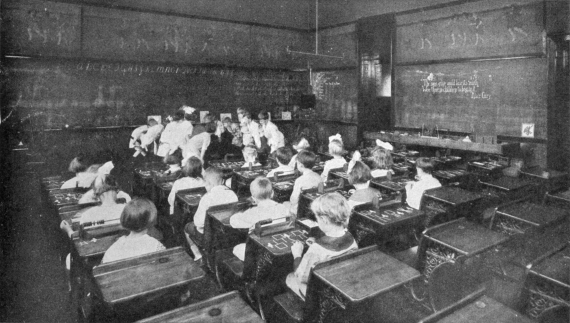
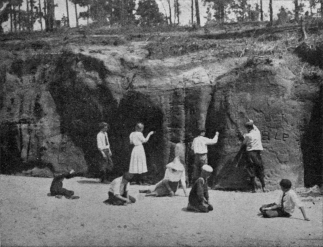
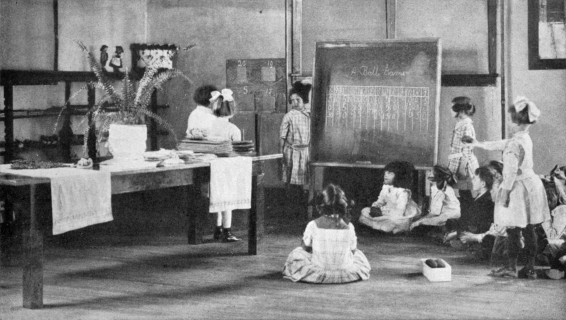
Songs and games help arithmetic. (Public School 45, Indianapolis.)
Public School 45 of the Indianapolis school
system is trying a number of experiments where
the children may be said to be learning by doing.
The work done is that required by the state
curriculum, but the teachers are constantly finding
new ways to prevent the work becoming a
mere drill in text-book facts, or preparation for
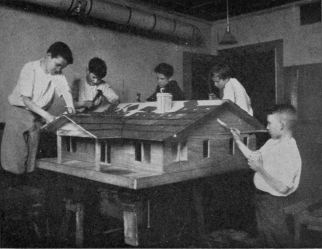
examinations. In the fifth grade, class activities
were centered around a bungalow that the
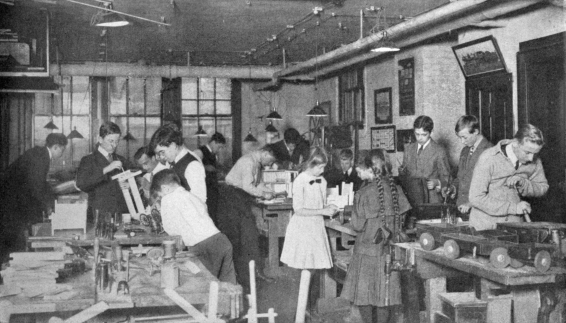
children were making. The boys in the class
made the bungalow in their manual training
hours. But before they started it every pupil
had drawn a plan to scale of the house, and
worked out, in their arithmetic period, the
amount and cost of the lumber they would need,
both for their own play bungalow and for a full
sized one; they had done a large number of
problems taken from the measurements for the
house, such as finding the floor and wall areas
and air space of each room, etc. The children
very soon invented a family for their house
and decided they would have them live on a
farm. The arithmetic work was then based on
the whole farm. First this was laid out for
planting, plans were drawn to scale, and from
information the children themselves gathered
they made their own problems, basing them on
their play farm: such as the size of the corn
field, how many bushels of seeds would be
needed to plant it; how big a crop they could
expect, and how much profit. The children
showed great interest and ingenuity in inventing
problems containing the particular arithmetical
process they were learning and which
still would fit their farm. They built fences,
cement sidewalks, a brick wall, did the marketing
for the family, sold the butter, milk and eggs,
and took out fire insurance. When they were
papering the house the number of area problems
connected with buying, cutting, and fitting
the paper, were enough to give them all the
necessary drill in measurement of areas.
English work centered in much the same way
around the building of the bungalow and the
life of its inhabitants. The spelling lessons
came from the words they were using in connection
with the building, etc. The plans for
the completed bungalow, a description of the
house and the furnishings, or the life of the
family that dwelt in it, furnished inexhaustible
material for compositions and writing lessons.
Criticism of these compositions as they were
read aloud to the class by their authors became
work in rhetoric; even the grammar work became
more interesting because the sentences
were about the farm.
Art lessons were also drawn from the work
the children were actually doing in building and
furnishing the house. The pupils were very
anxious that their house should be beautiful, so
the color scheme for both the inside and outside
furnished a number of problems in coloring and
arrangement. Later they found large opportunities
for design, in making wallpaper for the
house, choosing and then decorating curtains
and upholstery. Each pupil made his own design,
and then the whole class decided which one
they wanted to use. The pupils also designed
and made clay tiles for the bathroom floor and
wall, and planned and laid out a flower garden.
The girls designed and made clothes for the doll
inmates of the house. The whole class enjoyed
their drawing lessons immensely because
they drew each other posing as different members
of the family in their different occupations
on the farm. The work of this grade in expression
consisted principally in dramatizations
of the life on the farm which the children
worked out for themselves. Not only were the
children “learning by doing” in the sense that
nearly all the school work centered around activities
which had intrinsic meaning and value
to the pupils, but most of the initiative for the
work came from the children themselves. They
made their own number problems; suggested
the next step in the work on the house; criticised
each other’s compositions, and worked out
their own dramatizations.
In almost all the grades in the school the
pupils were conducting the recitations themselves
whenever there was an opportunity. One
pupil took charge of the class, calling on the
others to recite; the teacher becoming a mere
observer unless her interference was necessary
to correct an error or keep the lesson to the
point. When the class is not actually in charge
of a pupil, every method is used to have the children
do all the work, not to keep all the responsibility
and initiative in the hands of the
teacher. The pupils are encouraged to ask
each other questions, to make their objections
and corrections aloud, and to think out for themselves
each problem as it comes up. This is
not done by giving a class a set lesson in a text-book
as an introduction to a new problem, but
by suggesting the problem to the class and by
means of questions and discussion, helped out
whenever possible by actual experiments by the
pupils, trying to bring out the solution of the
problem, or at the least to give the pupil an
understanding of what the problem is about before
he sees it in print.
The method can be applied to all the classroom
work, but one illustration taken from a
geography lesson is especially suggestive. One
grade was studying the Panama Canal, and had
great difficulty in understanding the purpose or
working of the canal, and especially the locks;
in other words, they were not intellectually interested
in what the teacher told them. She
changed her method entirely and starting from
the beginning, asked the class to pretend that
Japan and the United States were at war, and
that they were the Government at Washington
and had to run the army. They at once became
interested, and discovered that a canal across
Panama was a necessity if the United States’
ships were to arrive in the Pacific in time to defend
the coast and the Hawaiian Islands. The
mountain range seemed an impossible barrier,
until the locks were explained to them again,
when they seized the principle. Many of them,
indeed, became so interested that they made
models of locks at home to bring to school.
They used the map freely and accurately in their
interest in saving the country from invasion,
but until one pupil asked why the United States
did not actually build a canal across the Isthmus,
they did not notice that their exciting game
had anything to do with the puzzling facts that
they had previously been trying to memorize
from their text-book.
The teachers in the school make use of any
illustrations from the practical life about them
that fit in well with the work the grade is doing.
Thus the third grade set up a parcel post system
in their classroom, basing all their English
and arithmetic work on it for some time, and
learning to use a map and scales and weights as
well. A retail shoe store gave the first grade
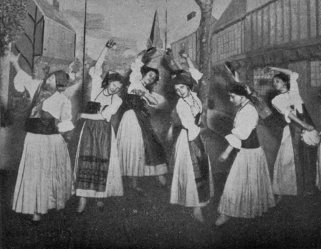
plenty of work and fun, and games and dances
with little songs have proved a great help in
their number work. Most of the furniture in
the school office was made by the big boys in
their shop work, and several of the rooms are
decorated with stencil designs the pupils made
in their art lessons. The number work of the
whole school is taught from the concrete side.
The little children have boxes of tooth-picks and
paper counters, which they use for adding and
subtracting; the older pupils may tear paper or
draw squares when they are learning a new
process. The class is given something to do
which illustrates the process to be taught; then
the children themselves analyze what they have
done and, as the last step, they do examples
with pure numbers.
Many of the public schools of Chicago are also
trying in every way possible to vitalize their
work; to introduce into the curriculum material
which the children themselves can handle and
from which they may get their own lessons.
This work is fitted into the regular curriculum;
it is not dependent on any peculiarities of an
individual teacher, but may be introduced
throughout the entire system, just as text-books
are now uniform through a large number of
schools. The work has been applied principally
in history and civics for the younger grades,
but it is easy to imagine how the same sort of
thing could be used in geography or some of
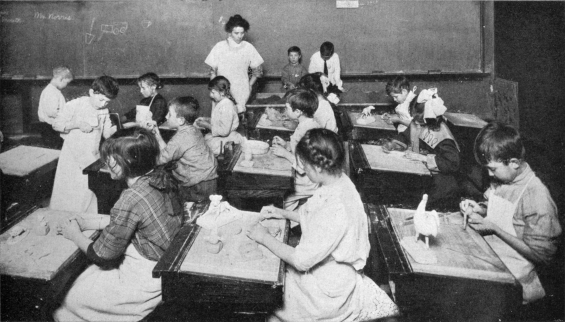
the other subjects. The history in the younger
grades is taught largely by means of sand
tables. The children are perhaps studying the
primitive methods of building houses, and on
their sand table they build a brush house, a
cave dwelling, a tree house, or an eskimo snow
hut. The children themselves do all the work.
The teacher steps in with advice and help only
when necessary to prevent real errors, but the
pupils are given the problem of the manufacture
of the house they are studying, and are expected
to solve it for themselves. Sand tables
are used in the same way by a third grade in
their study of the early history of Chicago.
They mold the sand into a rough relief map of
the neighborhood and then with twigs build the
forts and log cabins of the first frontier settlement,
with an Indian encampment just outside
the stockade. They put real water in their lake
and river, and float canoes in it. Other grades
do the same thing with the history of transportation
among the first settlers in this country,
and with the logging and lumber industry.
The older grades are studying the government
of their city, and make sand tables to illustrate
the different departments of city government.
One room has a life-saving station, with different
types of boats, and life lines that work.
Others have the telephone, mail carrier, and
parcel posts systems, and a system of street
cleaning of which the children are particularly
proud, because they have copied conditions
which they actually found in some of the alleys
near the school buildings. Beside the alleys
which were dirty, like those in the neighborhood,
they have constructed a model alley with
sanitary garbage appliances made on the best
plane based on what the teacher has told
them about systems in other cities.
In another building all the pupils above the
fourth grade have organized into civic clubs.
They divided the school district into smaller
districts and one club took charge of each district,
making surveys and maps of their own
territory, counting lamp posts, alleys, and garbage
cans, and the number of policemen, or going
intensively into the one thing which interested
them most. Then each club decided what they
wanted to do for their own district and set out
to accomplish it, whether it was the cleaning up
of a bad alley or the better lighting of a street.
They used all the methods that an adult citizens’
club would employ, writing letters to the
city departments, calling at the City Hall, and
besides actually went into the alleys and cleaned
them up. The interest and enthusiasm of the
pupils in this work was remarkable and they are
now undertaking a campaign to get a playground
for the school, by means of advertising
and holding neighborhood meetings. The English
work in these grades is based on the work
of the clubs; the pupils keep track of the work
they do, make maps and write letters.
Most of the hand and industrial work, which
is not taught for strictly vocational purposes
illustrates the principles which “learning by
doing” stand for. Examples of this are to be
found in nearly all schools to-day which aim to
be progressive. Many school systems all over
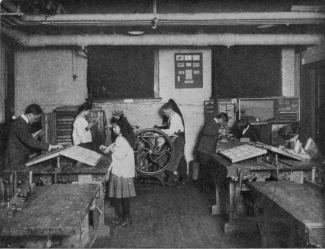
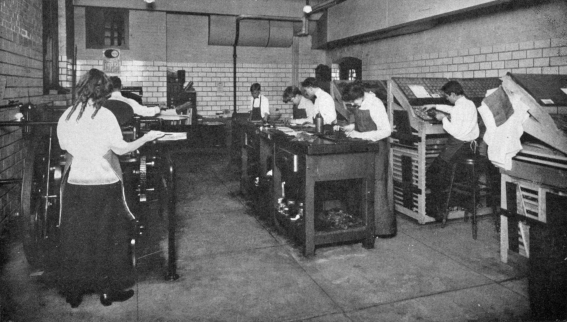
the country have tried having a printing press
operated by pupils with great success. The
presses were installed not to teach the pupils the
different processes in the trade, but so that the
children might themselves print some of the
pamphlets, posters, or other papers that any
school is constantly needing. Besides the interest
that the pupils have shown in setting up
the type, operating the presses, and getting out
the printed matter, the work has proved itself
especially valuable in the teaching of English.
Type setting is an excellent method of drilling
in spelling, punctuation, paragraphing, and
grammar, for the fact that the copy is going to
be printed furnishes a motive for eliminating
mistakes which exercises written by a pupil for
his teacher never provides. Proofreading is
another exercise of the same sort. In such
schools the press publishes practically all the
printed matter that is needed during the year,
including spelling lists, programs, and school
papers.
Schools are trying all sorts of experiments to
make the work in English concrete. The text-book
method of teaching—learning rules and
definitions and then doing exercises in their
application—has proved unsuccessful. Every
teacher is familiar with the story of the boy
who wrote, “I have gone,” on a piece of paper
fifty times, in order to impress the correct form
on his mind, and then on the bottom of the page
left a note for the teacher beginning, “I have
went home.” A purpose in English work seems
absolutely necessary, for the child sees no gain
in efficiency in the things he is most interested
in due to progress in isolated grammar or spelling.
When the progress is brought about as
a by-product of the scholars’ other work the
case is quite otherwise. Give him a reason for
writing, for spelling, punctuating, and paragraphing,
for using his verbs correctly, and improvement
becomes a natural demand of experience.
Mr. Wirt in the Gary, Ind., schools
has found this so true that the regular English
required by the state curriculum has been
supplemented by “application periods in English.”
In these hours the class in carpentry or
cooking discusses the English used in doing
their work in those subjects, and corrects from
the language point of view any written work
done as part of their other activity. A pupil
in one of these classes, who had been corrected
for a mistake in grammar, was overheard saying,
“Well, why didn’t they tell us that in English?”
to which her neighbor answered, “They
did, but we didn’t know what they were talking
about.”
In some schools as in the Francis Parker
School, Chicago, and in the Cottage School at
Riverside, Ill., English is not taught as a separate
subject to the younger grades, but the
pupils have compositions to write for their
history lessons, keep records of their excursions,
and of other work where they do not use
text-books. The emphasis is put on helping the
child to express his ideas; but such work affords
ample opportunity for the drill in the required
mechanics of writing. Grammar no longer appears
as a separate subject in the Chicago
public school curriculum; the teacher gives a
lesson in grammar every time any one in the
classroom talks and with every written exercise.
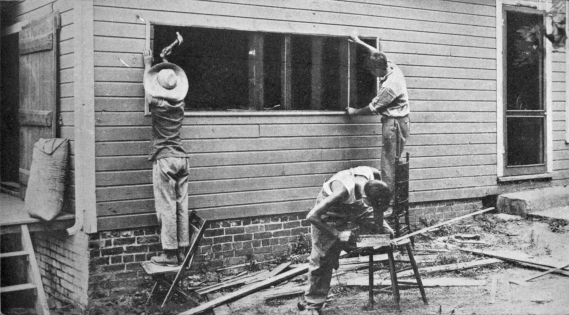
The pupils build the schoolhouses. (Interlaken School, Ind.)
However, grammar can be given a purpose
and made interesting even to eleven-year-old
children, if the pupils are helped to make their
own grammar and rules by doing their own
analyzing as the first step instead of the last.
This is being done with great success in the
Phœbe Thorn Experimental School of Bryn
Mawr College. Grammar had no place on the
curriculum, but the pupils asked so many questions
that their teacher decided to let them discover
their own grammatical rules, starting
from the questions they had asked. A few
minutes were taken from the English hour two
or three times a week for their lessons. At the
end of three months the class could analyze any
simple sentence, could tell a transitive from an
intransitive verb instantly, and were thoroughly
familiar with the rules governing the verb to
be. The grammar lesson was one of the favorite
lessons; the teacher and pupils together had
invented a number of games to help their drill.
For example, one child had a slip of paper
pinned to her back describing a sentence in
grammatical terms; the class made sentences
that fitted the sentence, and the first pupil had
to guess what her paper said. No text book
was used in the work, and the teacher started
with the sentence, called it a town, and by discussion
helped the pupils to divide it up into
districts—singular, plural, etc. Starting from
this, they developed other grammatical rules.
The general tendency in the progressive schools
to-day, nevertheless, seems to be toward the
elimination of the separate study of grammar,
and toward making it and the remainder of the
English work (with the exception of literature)
a part of other subjects which the class is studying.
The motto of the boys’ school at Interlaken,
Ind., “To teach boys to live,” is another way
of saying, “learning by doing.” Here this is
accomplished, not so much by special devices
to render the curriculum more vital and concrete,
and by the abolition of text-books with
the old-fashioned reservoir and pump relation
of pupil and teacher, as by giving the boys an
environment which is full of interesting things
that need to be done.
The school buildings have been built by the
pupils, including four or five big log structures,
the plans being drawn, the foundations dug and
laid, and the carpentry and painting on the
building done by boy labor. The electric light
and heating plant is run by the boys, and all
the wiring and bulbs were put in and are kept
in repair by them. There is a six hundred acre
farm, with a dairy, a piggery and hennery, and
crops to be sowed and gathered. Nearly all this
work is also done by pupils; the big boys driving
the reapers and binders and the little boys
going along to see how it is done. The inside
of the houses are taken care of in the same way
by the students. Each boy looks after his own
room, and the work in the corridors and schoolrooms
is attended to by changing shifts. There
is a lake for swimming and canoeing, and plenty
of time for the conventional athletics. Most of
the boys are preparing for college, but this outdoor
and manual work does not mean that they
have to take any longer for their preparation
than the boy in the city high school.
The school has also bought the local newspaper
from the neighboring village and edits
and prints a four-page weekly paper of local
and school news. The boys gather the news,
do much of the writing and all of the editing
and printing, and are the business managers,
getting advertisements and tending to the subscription
list. The instructors in the English
department give the boys any needed assistance.
They do all these things, not because
they want to know certain processes that will
help them earn a living after they are through
school, but because to use tools, to move from
one kind of work to another, to meet different
kinds of problems, to exercise outdoors, and
to learn to supply one’s daily needs are educating
influences, which develop skill, initiative,
independence, and bodily strength—in a word,
character and knowledge.
Work in nature study is undergoing reorganization
in many schools in all parts of the country.
The attempt is to vitalize the work, so
that pupils shall actually get a feeling for plants
and animals, together with some real scientific
knowledge, not simply the rather sentimental
descriptions and rhapsodizings of literature.
It is also different from the information gathering
type of nature study, which is no more
real science than is the literary type. Here
the pupils are taught a large number of isolated
facts, starting from material that the
teacher gathers in a more or less miscellaneous
way; they learn all about one object after another,
each one unrelated to the others or to any
general plan of work. Even though a child
has gone over a large number of facts about
the outdoor world, he gains little or nothing
which makes nature itself more real or more
understandable.
If nature study is turned into a science, the
real material of the subject must be at hand for
the students; there must be a laboratory, with
provision for experimentation and observation.
In the country this is easy, for nature is just
outside the school doors and windows. The
work can be organized in the complete way that
has already been described in the schools at
Fairhope and Columbia.
The Cottage School at Riverside, Ill., and
the Little School in the Woods at Greenwich,
Conn., both put a great deal of stress on their
nature study work. At the former, the children
have a garden where they plant early and
late vegetables, so that they can use them for
their cooking class in the spring and fall; the
pupils do all the work here, plant, weed, and
gather the things. Even more important is
the work they do with animals. They have,
for example, a rare bird that is as much a personality
in the school life as any of the children,
and the children, having cared for him
and watched his growth and habits, have become
much more interested in wild birds. In
the backyard is a goat, the best liked thing on
the place, which the children have raised from
a little kid; and they still do all the work of
caring for him. They are encouraged in every
way to watch and report on the school pets and
also on the animals they find in the woods.
In the Little School in the Woods at Greenwich
outdoor work is the basis of the whole
school organization. Nature study plays a
large part in this. Groups of pupils take long
walks through the woods in all seasons and
weathers, learning the trees in all their dresses,
and the flowers which come with each season.
They learn to know the birds and their habits;
they study insects in the same way, and learn
about the stars. In fact, so much of their time
is spent out of doors, that the pupils acquire
first hand a large fund of knowledge of the world
of nature in all its phases. The basis of this
work, the director of the school calls Woodcraft;
he believes that experience in the things the
woodman does—riding, hunting, camping,
scouting, mountaineering, Indian-craft, boating,
etc.—will make strong, healthy, and independent
young people with well developed characters
and a true sense of the beauty of nature.
The nature study then is a part of this other
training. A teacher is always with the pupils,
whether they are boating, walking, or gardening,
to explain what they are doing and why,
and to call their attention to the things about
them. There is no doubt that the children in
the school, even the very little ones, have a
knowledge and appreciation of nature which
are very rare even among country children.
Nature study in the big city, where the only
plants are in parks and formal yards and where
the only animals are the delivery horse and the
alley cat, offers a very different problem. The
teacher may well be puzzled as to the best way
to teach her pupils to love nature when they
never see it; or be doubtful as to the value of
trying to develop powers of observation when
the things which they are asked to observe not
only do not play any part in the lives of the
pupils but are in quite artificial surroundings.
Yet while wild nature, the world of woods and
fields and streams, is almost meaningless to the
city bred child, there is plenty of material available
to make nature a very real thing even for
the child who has never seen a tree or cow. The
modern teacher takes as a starting point anything
that is familiar to the class; a caged
canary, a bowl of gold fish, or the dusty trees
on the playground, and starting from these she
introduces the children to more and more of nature,
until they can really get some idea of “the
country” and the part it plays in the lives of
every one. The vegetable garden is the obvious
starting point for most city children; if they
do not have tiny gardens in their own backyards,
there is a neighbor who has, or they are
interested to find out where the vegetables they
eat come from and how they are grown.
Both in Indianapolis and Chicago, the public
schools realize the value of this sort of work for
the children. In Indianapolis, gardening is a
regular department in the seventh and eighth
grades and the high school. The city has
bought a large tract of land far enough in town
to be accessible, and any child who cannot have
a garden at home may, by asking, have a garden
plot together with lessons in the theory and
practice of gardening. The plots are large
enough for the pupils to gain considerable experience
and to put into practice what they
learn in the classroom. Both boys and girls
have the gardens, and are given credit for work
in them just as for other work. All through
the school system every attempt is made to
arouse an interest in gardening. From the first
grade on, statistics are kept of the numbers of
children with gardens at home, whether they
are vegetable or flower gardens, and what is
grown. Seeds are given to the children who
wish to grow new things, and the child is supposed
to account to his grade for the use he has
made of his garden.
This work has become a matter of course in
many rural districts; every one is familiar with
the “corn clubs” among the school children of
the South and West, and the splendid example
they have set the farmers as to the possibilities
of the soil. In many small towns seeds are
given to the children who want gardens, and in
the fall a competitive flower and vegetable show
is held, where prizes are given, as a means of
keeping track of the work and arousing community
interest. It is true that most of these
efforts have been grafted on to the schools by
the local agricultural interests, in an effort to
improve the crops and so increase the wealth of
the neighborhood; but local school boards are
beginning to take the work over, and it is no
less real nature study work because of its utilitarian
color. It may be made a means of making
a real science of nature study; in no way
does it hinder the teaching of the beauty and
usefulness of nature, which was the object of
the old-fashioned study. In fact, it is the
strongest weapon the school can make use of
for this purpose. Every one, and children especially,
enjoy and respect most the things about
which their fund of knowledge is largest. The
true value of anything is most apparent to the
person who knows something about it. Familiarity
with growing things and with the
science of getting food supplies for a people,
cannot fail to be a big influence towards habits
of industry and observation, for only the gardener
who watches all the stages and conditions
of his garden, seeking constantly for causes,
will be successful. Added to this is the purely
economic value of having our young people
grow up with a real respect for the farmer and
his work, a respect which should counteract that
overwhelming flow of population toward congested
cities.
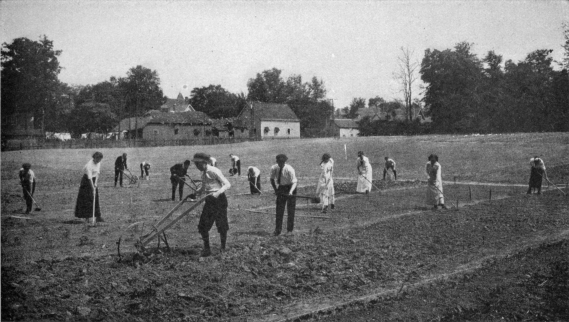
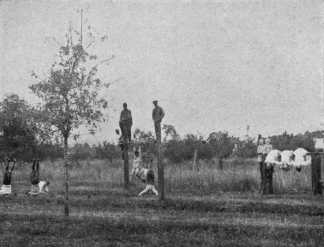
Real gardens for city nature study. (Public School 45, Indianapolis.)
The work in the Chicago public schools has
not been organized as it is in Indianapolis, but
in some districts of the city a great deal of emphasis
is put on nature study work through gardens.
Many of the schools have school gardens
where all the children get an opportunity to do
real gardening, these gardens being used as the
basis for the nature study work, and the children
getting instruction in scientific gardening
besides. The work is given a civic turn; that
is to say, the value of the gardens to the child
and to the neighborhood is demonstrated: to
the child as a means of making money or helping
his family by supplying them with vegetables,
to the community in showing how gardens
are a means of cleaning up and beautifying the
neighborhood. If the residents want their
backyards and empty lots for gardens, they are
not going to throw rubbish into them or let other
people do so. Especially in the streets around
one school has this work made a difference.
Starting with the interest and effort of the children,
the whole community has become tremendously
interested in starting gardens, using
every bit of available ground. The district is
a poor one and, besides transforming the yards,
the gardens have been a real economic help to
the people. With the help of one school a group
of adults in the district hired quite a large tract
of land outside the city and started truck gardens.
The experiment was a great success.
Inexperienced city dwellers, by taking advantage
of the opportunities for instruction which
the school could offer, were able to plan and do
the work and make the garden a success from
the start. The advantage to the school was just
as great, for a large group of foreign parents
came into close touch with it, discovered that
it was a real force in the neighborhood, and that
they could coöperate with it. This element of
the population usually stands quite aloof from
the school its children go to, through timidity
and ignorance, or simply through feeling that it
is an institution above them.
The impetus to “civic nature study” in Chicago,
aside from the district just described, has
come largely from the Chicago Teachers’ College,
where the teacher of biology has devoted
himself especially to working out this problem.
In addition to the familiar gardening work,
with especial attention to the organization of
truck gardening, plants are grown in the classroom
for purposes of developing appreciation
of beauty, scientific illustration, and assistance
in geography. But plants are selected with
special reference to local conditions, and with
the desire to furnish a stimulus to beautifying
the pupils’ own environment. For it is found
that the scientific principles of botany can be
taught by means of growing plants which are
adapted to home use as well as by specimens
selected on abstract scientific grounds. By
making a special study of the parks, playgrounds,
and yards of their surroundings, the
children learn what can be done to beautify
their city, and secure an added practical motive
for acquiring information. They keep pets in
the schoolroom, such as white mice, fish, birds,
and rabbits. While these are utilized, of
course, for illustrating principles of animal
structure and physiology, they are also employed
to teach humaneness to animals and a
general sympathy for animal life. This is
easy, for children are naturally even more interested
in animals than in plants, and the animals
become real individualities to the children
whose needs are to be respected. As the effect
of conditions upon the health and vigor of their
pets is noted, there is a natural growth of interest
in questions of personal hygiene.
It will be observed that while nature study is
used to instill the elements of science, its chief
uses are to cultivate a sympathetic understanding
of the place of plants and animals in life
and to develop emotional and æsthetic interest.
In the larger cities the situation is very different
from that of rural life and the country
village. There are thousands of children who
believe that cement and bricks are the natural
covering of the ground, trees and grass being
to them the unusual and artificial thing. Their
thoughts do not go beyond the fact that milk and
butter and eggs come from the store; cows and
chickens are unknown to them—so much so
that in a recent reunion of old settlers in a congested
district of New York one of the greatest
curiosities was a live cow imported from the
country. Under such circumstances, it is difficult
to make the scientific problems of nature
study of vital interest. There are no situations
of the children’s experience into which the facts
and principles enter as a matter of course.
Even the weather is tempered and the course of
the changing seasons has no special effect upon
the lives of the pupils, save upon the need for
greater warmth in winter. Nature study in the
city is like one of the fine arts, such as painting
or music; its value is æsthetic rather than
directly practical. Nature is such a small factor
in the activities of the children that it is
hard to give it much “disciplinary” value, save
as it is turned to civic ends. A vague feeling
for this state of affairs probably accounts for
much of the haphazard and half-hearted nature
study teaching which goes on in city schools.
There is a serious problem in finding material
for city children which will do for observation
what the facts of nature accomplish in the case
of rural children.
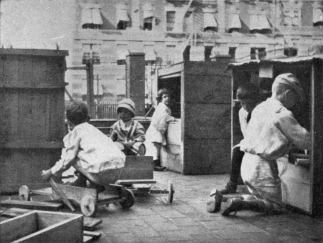
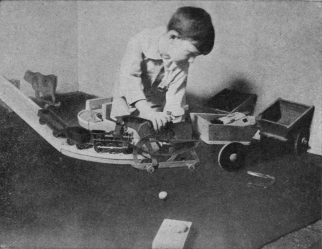
A valuable experiment with this end in view
is carried on in the little “Play School” taught
by Miss Pratt in one of the most congested districts
of New York City. Nature study is not
taught at all to these little children. If they go
to the park or have pets and plant flowers it is
because these things make good play material,
because they are beautiful and interesting; if
the children ask questions and want to know
more about them, so much the better. Instead
of telling them about leaves and grass, cows and
butterflies, and hunting out the rare opportunities
for the children to observe them, use is
made of the multitudes of things which the children
see about them in the streets and in their
homes. The new building going up across the
street furnishes just as much for observation
and questioning as does the park, and is a much
more familiar sight to the children. They find
out how the men get the bricks and mortar to
the upper floors; they see the sand cart unloading;
possibly one child knows that the driver
has been to the river to get the sand from a
boat. They notice the delivery man going
through the streets, and find out where he got
the bread to take to their mothers. They see
the children on the playground and learn that
besides the fun they have, the playing is good
for their bodies. They walk to the river and
see the ferries carrying people back and forth
and the coal barges unloading. All these facts
are more closely related to them than the
things of country life; hence it is more important
that they understand their meaning and
their relation to their own lives, while acuteness
of observation is just as well trained. Such
work is also equally valuable as a foundation
for the science and geography the pupils will
study later on. Besides awakening their curiosity
and faculties of observation, it shows
them the elements of the social world, which the
later studies are meant to explain.
The Elementary School at Columbia, Missouri,
has arranged its curriculum according to
the same principle. All the material from nature
which the children use and study they find
near the school or their homes, and their study
of the seasons and the weather is made from day
to day, as the Columbia weather and seasons
change. Even more important is the work the
children do in studying their own town, their
food, clothing, and houses, so that the basis of
the study is not instruction given by the teacher
but what the children themselves have been able
to find out on excursions and by keeping their
eyes open. The material bears a relation to
their own lives, and so is the more available for
teaching children how to live. The reasons for
teaching such things to the city bred child are
the same as those for teaching the country child
the elements of gardening and the possibilities
of the local soil. By understanding his own
environment child or adult learns the measure
of the beauty and order about him, and respect
for real achievement, while he is laying the
foundations for his own control of the environment.