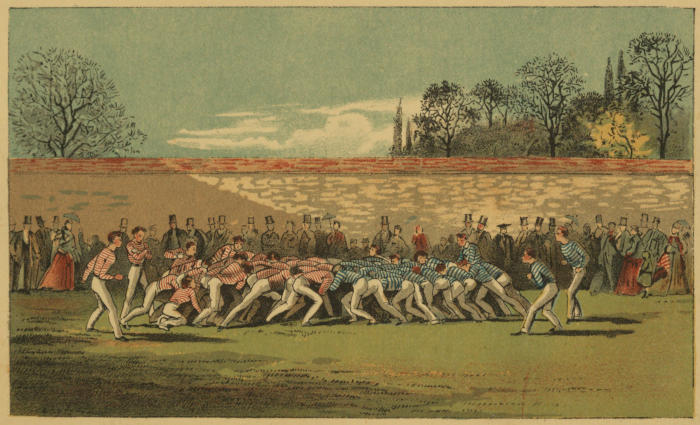
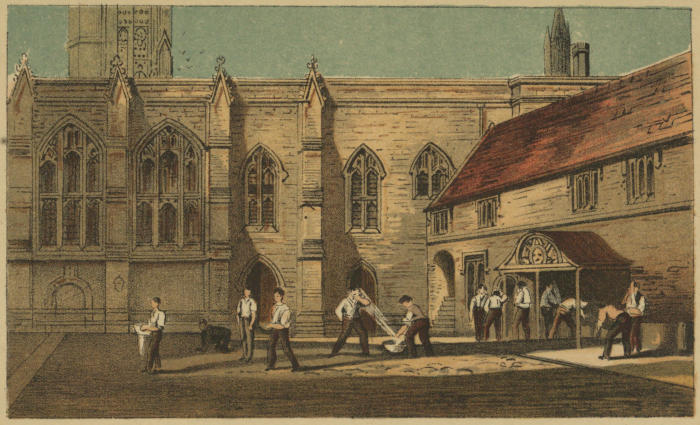
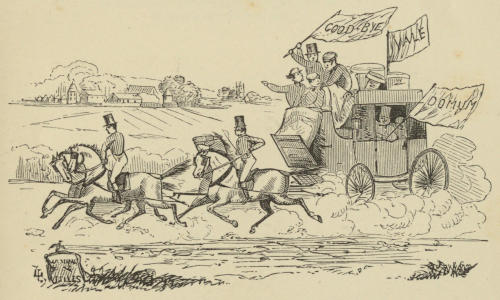
THE COMMONERS HAVE RED AND THE COLLEGE BOYS
BLUE JERSEYS.
SCHOOL-LIFE AT WINCHESTER COLLEGE; OR, The Reminiscences of a Winchester Junior
UNDER THE OLD RÉGIME, 1835-40.
WITH A GLOSSARY OF WORDS, PHRASES, AND CUSTOMS,
PECULIAR TO WINCHESTER COLLEGE.
By ROBERT BLACHFORD MANSFIELD, AUTHOR OF
“THE LOG OF THE WATER-LILY,” “THE WATER-LILY ON THE DANUBE,” ETC. ETC.
THIRD EDITION.
LONDON:
DAVID NUTT, 270-71 STRAND.
P. & G. WELLS, WINCHESTER.
1893.
PREFACE TO THIRD EDITION.
A.D. 1893 being the quincentennial anniversary
of our glorious foundation, an enterprising
publisher has undertaken to bring
out a third edition of this sketch of the
life of a Winchester Junior in the dark ages
of 1835-40. Thirty years have elapsed
since the book was originally written,
twenty since the second edition was brought
out, and fifty-seven since I first became a
Wykehamist.
No one is more aware than myself how
entirely devoid of literary merit is this
little book; but as it is a true and faithful
account of the state of the school under a
system that has long been superseded, any
interest that it may have must increase from
year to year, as the times of which it treats
become more distant, and the manners and
customs which it depicts present a greater
contrast to those of the present day. Except
in the last chapter, which I have
rewritten, there is but little difference between
this and the previous editions, firstly
because I have nothing to add or alter
in my record, and secondly, because the
work being stereotyped, considerable expense
would have been incurred by altering
all those passages which, written in 1862,
allude to the then existence of Dr. Moberly,
the state of Meads, and Antechapel at that
date, &c., &c., which the reader can correct
for himself, but which do not in any way
affect the object of the work, viz., the
economy of the school in 1835-40.
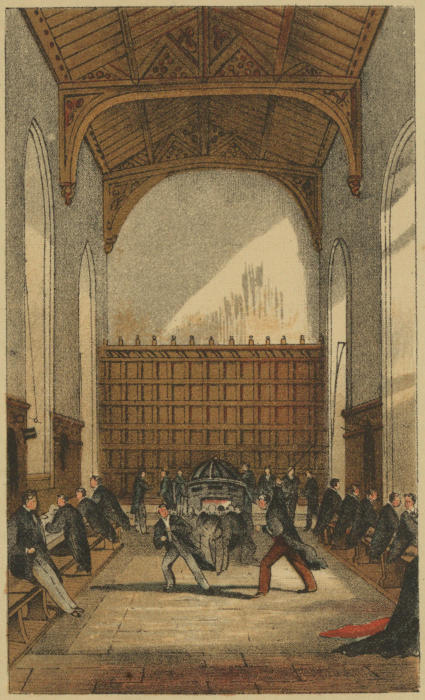
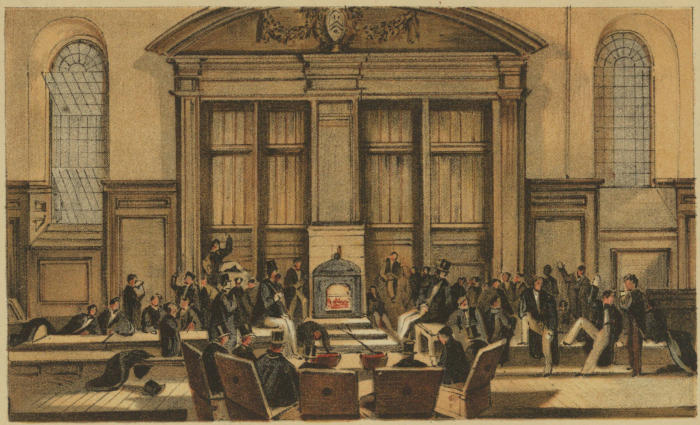
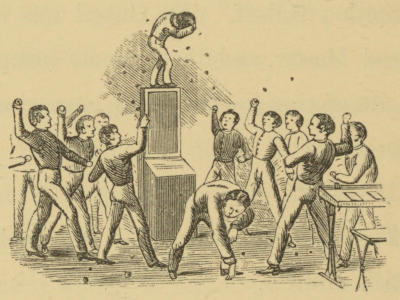
The representation of “a Hot” by Mr.
Holmes gives an excellent idea of that
peculiar feature of the game of football as
played at Winchester at the date of which
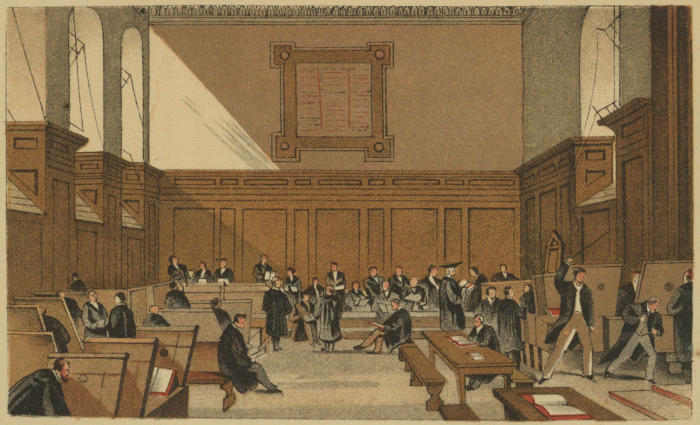
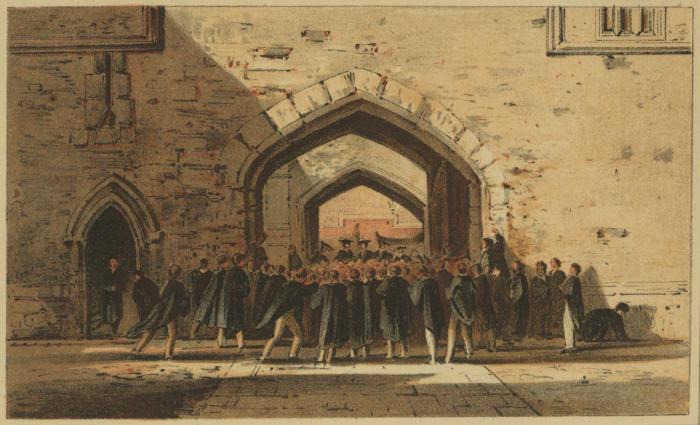
I write. The other pictures by Mr. Garland
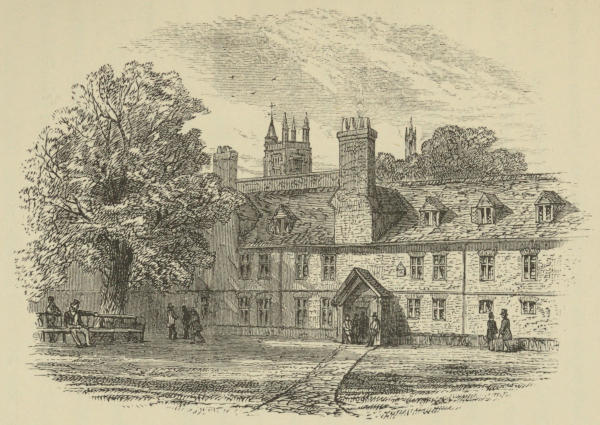
sufficiently well represent the architectural
features of the College, but justice
is scarcely done to the figures of the boys,
who did not go through their labours and
amusements in such rigid style as might
be inferred from their figures and attitudes
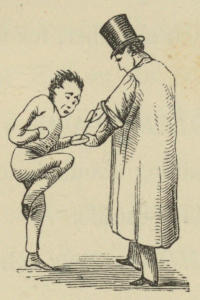
as here represented. The cuts in
the Glossary would also have been more
effective if the artist (not Mr. Garland)
had ever seen a Winchester scholar in his
peculiar costume.
The sweeping changes that commenced
during my school-days were mainly owing
to the initiative of Charles Wordsworth,
the late lamented Bishop of St. Andrews,
as distinguished at Oxford for his scholarship
and as a theologian as he was for his
supreme excellence in cricket, rowing,
tennis, skating, and all athletic exercises.
He had been appointed to the office of
Second Master one half year before I came
as a boy, and, with the willing assistance
of the beloved Warden, Barter, and the
Head-Master, speedily began to make many
much-needed changes in the arrangements,
which have made Winchester equal, if not
superior, to any other public school as
regards the comfort and wellbeing of the
boys, and worthy of its glorious reputation
for five hundred years.
I take this opportunity of expressing my
great gratification at the success of the
book, and to express my thanks to my
numerous correspondents for their flattering
letters. Wykehamists of every standing
have expressed their interest in this
account of the manners and customs of
the School in times past, and those of
my own have testified to its accuracy.
From India and America I have received
most interesting letters from old school-fellows,
who had discovered from internal
evidence the personality of the writer. In
one quarter alone have I met with adverse
criticism. I was accused (shortly after the
publication of the first edition) by “The
Wykehamist” (a monthly publication,
edited by the boys at Winchester) of
having been actuated by a feeling of ill-will
towards the School, and of untruth.
How such an idea as the former could
have been gathered from the book I am
at a loss to conceive, and when it was
first published the only merit that I
knew it possessed was its truth. And
now I have the best public testimony to
my veracity;—a cotemporary, Mr. Gould
Adams, who, in the preface to his charming
book “Wykehamica” (a work which
should be one of “the hundred books”
possessed by every Wykehamist), states
that he has been indebted for some of
the materials for his work to “my very
truthful picture of the Winchester of my
day.”
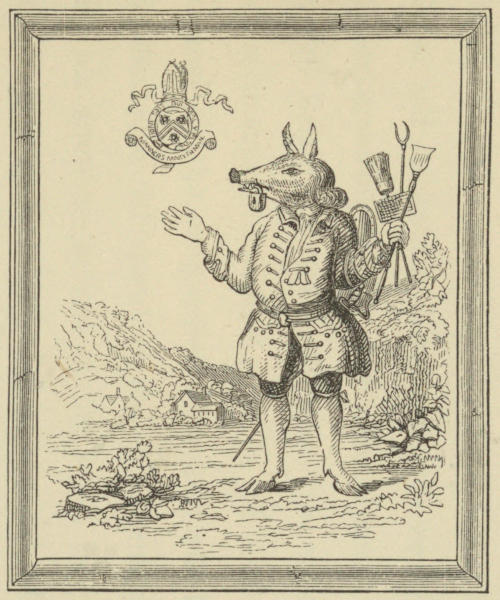
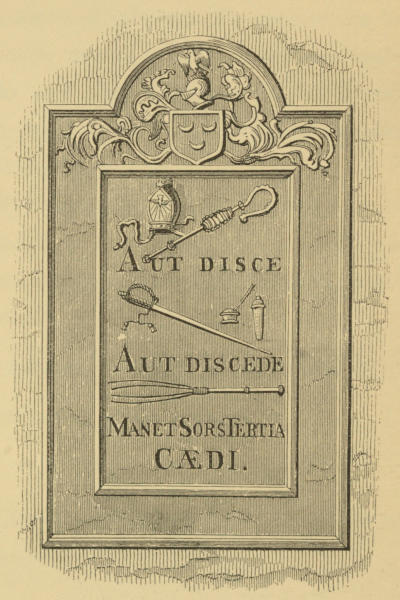
The Bishop of St. Andrews, who kindly
allowed me to use his engravings of the
“Trusty Servant,” and of the large tablet at
the west end of school with the inscription
“Aut disce,” &c.; Mr. Mackenzie Walcot,
who permitted me to use the cut of the
old Commoners Buildings that appeared
in his work on Winchester College, and
my cousin, Mr. Elliot Blackstone, of New
College and the British Museum, who
greatly assisted me in bringing out the
first edition, when I was abroad, have all
passed away. But I must again (for the
third time) give vent to my feelings of
gratitude to the Rev. H. Moberly for
answering the many questions I troubled
him with, and to my cousin, the Rev.
Algernon Simeon, for his valuable assistance
in compiling the slang glossary, and
to Mr. Wrench for the very great assistance
he has rendered me in supplying me with
information as to the alterations in the
manners and customs of the School, which
I have embodied in the last chapter.
A Fag’s Duties—His Respect for Præfects—Præfects’
Responsibilities—Code of Honour—Lying
Scouted—Exceptional Anecdote—Certain
Things considered Common Property—Slang—Nicknames
of Officials and
Under-Porter—Whole Holidays—Remedies—Half
Holidays—Sundays—Hills,
Rush for Trenchers, &c.—Description of Hall—Toasting
and Cooking—Receipt for Fried Potatoes—Tea—Luncheon—Conning
for Bands—Beever
Time—Dinner—Dispars—Fagging
in Hall—Kitchen,
Description of School—Scobs—Officers—Division
of Classes—Prizes and Medals—Long and
Short Half—Easter Time—Commoners’
Speaking—Cloisters—Latin Composition—Flogging—Scraping
and Shirking Out—Latin
Verses—Pealing,
“Watching out”—Cricket Reminiscences—Lord’s
Matches—Turf—Football—Six and Six—Twenty-two
and Twenty-two—SS and Trees—Fines—Sick-House—Gooseberry
Fool—“Going
Continent”—Long Meads—Enlargement
of Meads,
It is now nearly half a century since, full
of hope and spirits, I made my appearance
at Winchester College, when I entered
the gates, proud of my position as the junior
Wykehamist; and more than forty years have
elapsed since I doffed my gown, and stepped
forth into the outer world.
Times have changed since then, and perhaps in
no place are the changes more marked than in the
old school. I was there at a remarkable period,
as, during my residence, important and much
required improvements and alterations were commenced
in the system of internal economy, discipline,
and education, which have continually
advanced to the present day, till at last, in the
opinion of some who are well fitted to form a
judgment, the operation has been so roughly
carried on, that, together with the customs that
required extirpation, some institutions have been
rooted up which might as well have been allowed
to remain.
Among the more beneficial changes I may
mention the amelioration of the fagging system,
from which many of the asperities were removed
while I was in the position most capable of appreciating
the benefit, and which since my departure
has been still further improved. I consider mitigated
fagging a valuable institution, and I think
on this subject I can speak with authority, as
when I entered I was junior in College, and
during the whole five years that I was there I
was always a fag, never having sufficiently advanced
in the school to taste the sweets of power.
When I went to Winchester the life of a junior
was not made very pleasant to him for the first
year or two. I attribute this principally to the
following causes:—First and foremost, to the brutality
of one or two boys; if any such now exist,
as there were in my time, (which I doubt,) their
opportunities and power of cruelty are so curtailed,
and the feeling against such proceedings
both abroad and in the school so much stronger,
that their evil influence is reduced to a minimum.
Secondly, to the monstrous system of fagging at
dinner-time, and the atrocities therewith connected;
the whole of which has been absolutely
done away with. And, lastly, to the unlimited
extent to which watching out at cricket, and
kicking in at football, was carried; the former
of which has now been reduced within reasonable
limits, and the latter entirely abolished.
Some of my friends have expressed themselves
amused with such of my school experiences as I
have occasionally recited to them, and have from
time to time urged me to publish them. I do not
think I should ever have carried out the suggestion,
had not circumstances occurred which induced
me, in 1860, to take up my quarters at
Winchester for some weeks, when I was naturally
led to frequent my old haunts; and this
brought many long-forgotten scenes, thoughts,
faces, and words so vividly to my recollection,
that I found a real pleasure and interest
in noting them down. Whether any one will
take either pleasure or interest in reading my
notes when published, is perhaps doubtful; yet I
know that, when I was a boy at College, we were
eager for any information about the former manners
and customs of the old place; and it is to
the boys especially that I address myself; and I
hope that if this little book falls into the hands of
any of the juniors, they will derive some comfort
from the thought that although they may consider
their own lives rather hard, others have passed
through far severer trials than theirs, unscathed,
and can yet look back to the time of their juniorship
with interest and regret. If I fail in interesting
them it must be my own fault, as, whatever
my deficiencies in style and expression, I cannot
plead want of knowledge of my subject; I think
also that I am impartial; I respect my old school,
and if I had boys, and could get them into it, I
would send them there; but I am not the least
inclined to cry it up at the expense of other similar
establishments, of which I have had no experience.
I am certain, however, that there is no
school where, at the present day, the authorities
take a more personal and careful interest in the
moral and physical wellbeing of the boys; and this
is rendered more practicable at Winchester than
at most other public schools, owing to the number
being limited to about two hundred, instead of
being allowed to expand till it becomes rather a
cluster of small schools than one solid establishment.[1]
If any of my own contemporaries ever glance
over these pages, I hope they will experience a
pleasure in having some scenes brought again
before their minds’ eye with which they were once
familiar, but of which the remembrance had become
fainter and fainter, as they have gradually
been shadowed over by the duties and struggles of
after-life; though I fear that any such satisfaction
will be damped by the feeling of how much better
they might have been described by an abler pen.[2]
I cannot expect that my book will be noticed by
anybody except Wykehamists, yet, in case it should
ever attract the notice of any one who is altogether
unacquainted with Winchester, I have given a description
of the geography of the buildings (in
chap, ii.) and the institutions of the school, lacking
which the book would have been entirely without
meaning to them;—all such dissertations the
Wykehamist will, of course, skip. I have, however,
omitted giving any account of the history,
antiquities, and architecture of the College, all of
which have been amply described in several works
with which Wykehamists are very well acquainted,
and which others can easily procure if they desire
any such information. I simply propose as my
task some account of the inner life of the boys as
it was, “Consule Planco,” illustrated by a picture
of the trials and amusements of a junior.
As I remarked above, I think fagging on the
whole a laudable institution. Some of the stories
here related may not perhaps seem to put it in a
very pleasant light; but it must be remembered
always, that it is much mitigated at present, and
also that, in a light and somewhat gossiping production
like this, there is more movement and life
in such anecdotes than in a relation of the ordinary
kindnesses shown by the bigger to the lesser boys;
certainly, I have a more lasting general recollection
of benefits received than of cruelties suffered;
and in after-life, in the rough struggles of the
world, happy is he who has gone through such a
training. Here there is no tuft-hunting—wealth
and rank have little influence, if the heart is not
open and hand skilful. A boy learns to help himself,
not to be disheartened in difficulties, and to
be prepared for any emergency; and withal a keen
sense of honour, friendly rivalry, and patriotic
feeling, is continually kept in action. Commend
me in a row, moral or physical, to your public
schoolman: in the former case, he will very probably
be endowed with the judgment, decision,
and self-reliance so necessary in such an emergency;
and in the latter, he will be likely to stand
firm, and know the use of his left hand as well as
his right, and when, where, and how to bring
both into play.
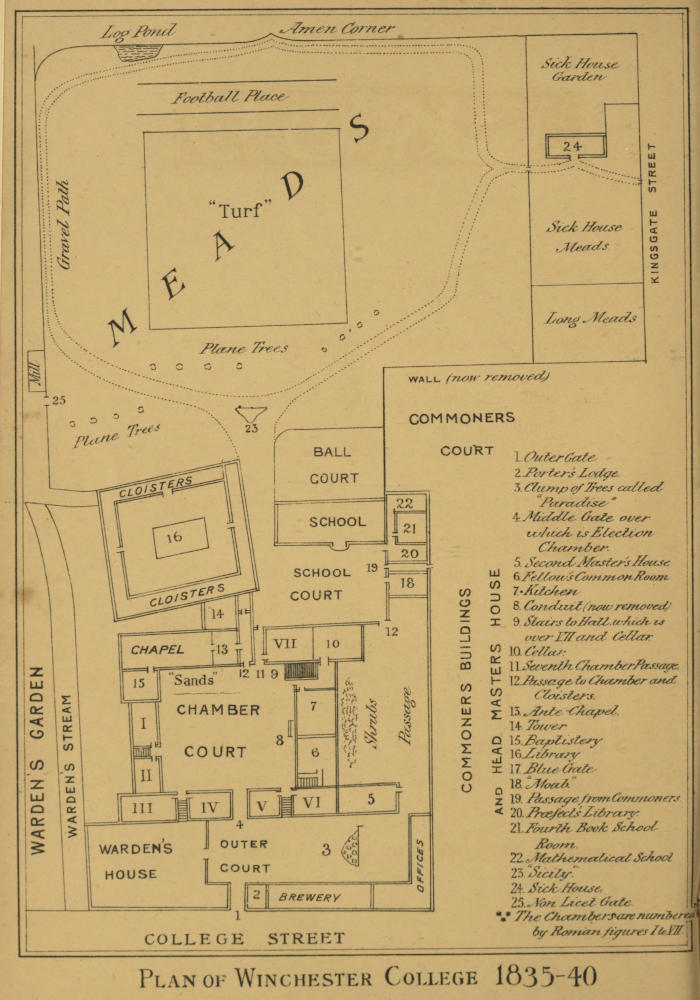
Plan of Winchester College 1835-40
CHAPTER II. OF THE LOCUS IN QUO AND DRAMATIS PERSONÆ.
Plan of College Buildings—Dons—College Præfects—Candlekeepers—Dress—Choristers—Commoner
Buildings—Præfects—Coursekeeper.
Before entering into particulars it will
be necessary to give the non-Wykehamist
reader some idea of the arrangement of the
College buildings, and of their various uses in the
general economy of the institution.
The College of St Mary of Winchester (near
Winchester, as it used to be called) was, in olden
times, situated outside the town, but is now
bounded on its west side by the buildings of
Kingsgate Street and College Street. The entrance
is from the latter street through a handsome
portal called “outer gate,” which opens
into a quadrangle, on the east side of which is the
Warden’s house; passing through this court and
another gateway (“middle gate,” above which is
“election chamber”) we enter another spacious
quadrangle, the southern side of which is formed
by the chapel and hall, the western mainly by the
kitchen, and the remaining two sides by the boys’
bed-chambers, (on the ground floor,) and the fellows’
and second master’s lodgings above. Underneath
the hall, and close to the great hall staircase,
a passage called “seventh-chamber passage”
leads into a third quadrangle of smaller dimensions,
called “school court,” on the south of which
is the school, and on the east the outside wall of
the chapel cloisters; along the entire western side
of the College buildings, from College Street to
the school, extend the buildings of Commoners,
(the boys not on the foundation,) the communication
of which with College is through a door on the
west side of “school court.” A passage between
the school and cloister wall leads to the playground
or “meads,” adjoining the west side of
which, and divided from it by a red brick wall, is
the “sick house,” (hospital,) situated in another
piece of ground called “sick-house meads.”
The chief of the whole establishment is the
Warden, who has nothing to do with the teaching
of the boys; he admits and when necessary expels
them, confers on them the dignity of “Præfect,”
listens to their complaints, and, in fact, in all matters
appertaining to the management of the school
and the society is omnipotent. There are also ten
Fellows, but as their duties (if any) have nothing
to do with the inner life of the school, of which
alone I purpose to treat, I need say nothing more
of them. The head master, or “the Doctor” as he
is always called, lives in “Commoners’ buildings,”
the inhabitants of which are supposed to be more
particularly under his jurisdiction. The second
master, who has the more immediate superintendence
of the College boys, has, as above-mentioned,
his apartments in “chamber court.” There was
also an assistant master, who superintended the
instruction of the boys in the lower classes, and who
did not live in College; and three commoner
tutors, who had lodgings in Commoners’, and
whose services were called into requisition for
general instruction in school as required. There
was also a mathematical master.
The school was divided into college boys and
commoners; there was a great competition to be
enrolled among the former, as they have several
privileges, the greatest of which was the chance
of gaining a fellowship at New College, Oxford.
I will introduce these first. There were seventy
of them; of these the eighteen seniors were called
“Præpostors,” or (more commonly) “Præfects,”
and had the power of “fagging” all the rest, with
some few exceptions. Among these eighteen, one,
(generally, but not always,) the senior in school, was
called the “Præfect of hall,” and was invested with
almost absolute power, being looked upon by the
“Inferiors” (i.e. those who were not præfects) with
something more than a becoming awe and reverence.
Some of his principal duties were to take the
boys “on to hills,” call names there, pay for broken
windows in hall, find the rods, &c. In school he
had the seat of honour next to the doctor’s chair,
and he always slept in sixth chamber. There
were many little fees attached to this responsible
office, which brought to the fortunate possessor an
income of certainly not less than fifty pounds a
year. Next to him in dignity was the “Præfect of
tub,” (this title was derived from a box in hall
called “tub,” the use of which will be hereafter
explained,) whose office was more particularly
connected with the dinner department. Then
there were two “Præfects of chapel,” one of whom,
on alternate weeks, called names there, and during
that week was called Præfect of chapel “in course,”
and, in case of absence of the Præfect of hall, undertook
his duties. There was also a “Præfect of
school,” who had to pay for all internal damage
done to the interior of that edifice, including
broken windows, to keep it clean, to light it, and
once every year to renew the cushions of the masters’
seats. To all these offices some emolument
in the shape of salary or fees was attached, but
considerably less than that received by the Præfect
of hall. The eight senior præfects were said to
have “full power,” and had some slight privileges
not enjoyed by the remaining ten, who were generally
called “Bluchers.”
As mentioned above, almost all the inferiors
were subject to these eighteen; there were, however,
the following exceptions:—“The Senior inferior,”
who was exempted from fagging, to give
him an opportunity of calmly contemplating the
dignity in store for him; and the seven “Candlekeepers,”
(why so called, I have no idea, nor have
I ever heard any interpretation of the appellation.)
These were the seven inferiors who had been
longest in the school, quite independently of their
position in it; they were generally old and tough.
Of these, the senior had almost as much power as
a præfect; he had a “valet” in chambers, one or
two “breakfast fags,” and the power of fagging
the twenty juniors when in school, or in meads.
The junior candlekeeper was called “the Deputy,”
and had also some slight privileges besides that of
having a valet and breakfast-fag, which was common
to all of them. The organisation of the
fagging department was supposed to be in the
hands of the candlekeepers, but practically it was
all arranged by the Senior and Deputy; and there
was a theory, that if it at any time broke down,
and no fags could be found, the præfects in full
power had the right to fag the candlekeepers;
this, however, was very rarely, if ever, acted upon.
It may easily be imagined, that the offices of
Senior candlekeeper and Deputy were regarded
with peculiar interest by the small juniors, as
when these posts were filled by cross individuals,
the lives of the latter were not seldom made a
burden to them.
When a præfect required the services of a fag,
he called out, “Junior!” and the junior, in hall
or chamber, or wherever it might be, had to
“run.”
The order of seniority in fagging depended, in
College, solely on the length of time the boys had
been at the school, and was entirely independent
of their position otherwise. A certain number of
boys were of “Founder’s kin,” to which certain
privileges attached, which will be hereafter mentioned.
As regards dress, the College boys wore any
trousers they liked; but instead of an ordinary
coat and waistcoat, they were usually habited in
a black, green, or brown (the latter colours were
seldom worn except by præfects, or very responsible
inferiors) waistcoat, with an upright collar,
and sleeves of the same material, and a serge gown,
with full sleeves buttoning above or just below the
elbow; the gown, in walking, was very commonly
tucked up in a bunch behind.
Inferiors were never allowed to wear hats inside
the College walls; the præfects seldom doffed
theirs, except in the presence of a master and
when they went to bed; all were obliged to wear
white neckcloths and bands, except when on leave
out; and surplices in chapel on Sundays and saints’
days.
OLD COMMONERS.
During the years 1839-1841 the picturesque Old Commoners
was demolished. It was built by Dr Burton, and
formed an irregular quadrangle. On the west side were
the head-master’s house, an excellent ball-court, and upper
and lower cloister galleries, built over a small cloister; on
the north was “Wickham’s” buildings, containing the
Hall of the juniors, various dormitories, and the residence
of the tutors; on the south were upper and lower conduit
galleries, part of the ancient “Sustern Spital,” and divided
into dormitories above, and below into apartments for
the matron, and three “Continent Rooms” or sick bays.
On the ground-floor, to the west of the inner entrance,
were the “Hatches,” from which the bread or “sines,”
and cans of beer, called “jorams,” were issued; the
kitchens, etc.; opening into a small court, containing a
dormitory, known as “New Room.” On the other side
were the prefects’ and the tutors’ studies. On the east
side of Commoners’ Court was the wall of the college
stables, and a range of fine elm-trees, destroyed with one
exception during a violent summer-storm in 1836. Underneath
the survivor was the “long bench,” so frequented in
“standing-up time.” The entrance-gate stood where the
west gate of modern commoners is at present. Parallel
with the east side of the court, and to the southward of
the tutors’ studies, was the “dining hall;” and above it
was a set of sleeping-rooms, upper and lower hall galleries.
On the westward of the hall was “the conduit.”—Walcott’sWilliam of Wykeham and his Colleges.
Besides the Warden, fellows, masters, and boys,
there were twelve “Choristers,” who must by no
means be omitted, as they formed an important
part of the internal economy. I suppose they
were called Choristers because they had not to
sing; certainly if ever that was a part of their
duty, it had entirely lapsed. Their office was to
wait on the boys, in hall and chambers, till seven
o’clock, and especially to go on errands in the
town,—the boys themselves never being allowed
to go there, except when invited by friends on
saints’ days. These little Choristers wore chocolate-coloured
tail-coats and trousers, with metal
buttons; and, on the whole, I think their life must
have been a weary one.
In Commoners’, the number of boys fluctuated
between one hundred and one hundred and thirty.
The building called “Commoners’,” in which they
slept and had their meals, skirted the west side of
College, and had its entrance also in College Street.
It would be useless to describe the buildings of
Commoners’ as they existed in my time; they were
not in any way remarkable, and are now entirely
removed, and other and more commodious edifices,
though, perhaps, not much more beautiful, built
in their place.
There were twelve Præfects in Commoners, who
had the right of fagging all the rest except those
in the class immediately below them, (called senior
part the fifth,) who were exempt; when they
required the services of a Fag, they did not call
“Junior!” but “Here!” They also had an officer
whose duties and privileges were somewhat similar
to those of Senior Candlekeeper and Deputy in College;
his office, however, was conferred by election
among the Præfects. It was necessary that he
should be in either middle or junior part the
fifth, of reasonable bodily strength, and have been
at least three years in commoners. This dignitary
was called “the Coursekeeper;” should he be promoted
into senior part the fifth, he retained the
privileges of the office without its responsibilities,
and was called “Ex-coursekeeper.”
The College boys and Commoners rose at the
same hour, attended chapel, used the school, and
went on to Hill’s together; but the latter took
their meals and slept in Commoners’, and had not
the use of meads, having a field about half a mile
distant, to which they went from twelve to one on
whole school days, and again, in the afternoon, on
holidays.
The rule of seniority, as regarded fagging, was
different from that established in College. Commoner
Inferiors took precedence according to their
standing in the school, not according to the length
of time they had been there. It will be seen, from
what has been said, that the College juniors had a
much harder time of it than the Commoners, as
the former were in the proportion of forty-four
Fags to eighteen Præfects and seven Candlekeepers,
whereas in the latter (supposing the number of
the boys to be one hundred and twenty, and
twenty to be in senior part the fifth, and
exempt from fagging) the proportion would be
eighty-seven fags to twelve Præfects and one
Coursekeeper. I will, therefore, devote my attention
principally to the illustration of the life of
the College Fag, which, in fact, combines all the
trials and amusements of both.
CHAPTER III. TREATS OF SOME MANNERS AND CUSTOMS.
A Fag’s Duties—His Respect for Præfects—Præfects’
Responsibilities—Code of Honour—Lying Scouted—Exceptional
Anecdote—Certain Things considered
Common Property—Slang—Nicknames of
Officials and Under-Porter—Whole Holidays—Remedies—Half
Holidays—Sundays—Hills.
The duties of a Fag, in the days of which
I write, may be more easily described by
informing the reader what he had not to do, than
by endeavouring to make out a list of his positive
duties. I believe when I say that he had
not to make the beds, nor to clean shoes, I have
exhausted the negative catalogue.
The degree of awe with which we Juniors used
to regard the Præfects seems to me, looking back,
most mysterious; and it would be impossible to
make a stranger realise the peculiar sensation. It
was entirely a moral feeling, not being in any way
connected with muscular power—many of the
Præfects being, in physical strength, inferior to
their fags; and it was by no means uncommon to
see a small Præfect rising on his toes to reach the
proper height for administering an effective “Clow”
(box on the ear) to an offending Junior some
inches taller, and a stone heavier, than himself.
Nor was there the slightest imputation of cowardice
on the part of the bigger boy,—I cannot explain
it, but it seemed simply impossible to resist.
I never was a Præfect myself; and when I was
a big Inferior, I have more than once received,
with perfect meekness, a “Tunding” (thrashing
with a stick) from a boy who, had he been an
Inferior, would have treated me with the greatest
respect. I remember, on one such occasion, the
operator, indignant at not being able to make me
feel, searched underneath my waistcoat to see if I
was not padded for the occasion, (not an uncommon
proceeding by any means;) and on finding
such was not the case, took the small end of the
stick in his hand, and finished the performance
with the butt end, and principally on my head.
Nor, when ordered to “hold down” (i.e., put your
head in a convenient position) for a “Clow,” would
the victim dare to ward off the blow, or cease offering
his cheek to the smiter till it pleased the latter
to desist.
Indeed, the moment a boy was made a Præfect,
he seemed immediately to become invested with a
supernatural power that changed the familiar intercourse
with his former companions into awe or
respect on the one side, and tyranny or condescension
on the other, according to the nature of the
individual promoted. I remember, soon after my
first arrival, and before I had quite realised the
great gulf between a Præfect and an Inferior, during
breakfast-time in hall, I saw one of the Fags
put aside his master’s frying-pan, it being required
no longer. As I was in want of one at the
moment, in the innocence of my heart, I politely
asked the Præfect, who was its owner, if he would
be so good as to lend it to me. I thought he looked
rather queer, but, being a good-natured youth, he
said, “Yes;” when the loud burst of laughter
from the other boys proclaimed that something
unusual had happened. On inquiry, I found that
it was my astounding impertinence in making
such a request of a Præfect that had caused the
excitement, and for some little time I was looked
on as quite a hero.
Though, at first sight, this kind of superstitious
awe of the Inferiors towards the Præfects may seem
unprofitable, yet I am inclined to think that, on
the whole, it was not without its advantages.
Certainly, in some exceptional cases, a Præfect
used to take advantage of his position, and treat
those beneath him cruelly; but such, at any rate,
was not the general character of the Præfects in my
time; and most of them used their power far more
in preventing the big Inferiors from bullying their
companions, than in inflicting torture themselves.
The Præfects had the entire charge of the boys
out of school, and were responsible to the masters
for all breaches of discipline committed by the
others, for which they (the Præfects) were punished;
it was, therefore, their interest as well as
duty to see the laws carried out. When a delinquent
was discovered, he received his punishment
at once from the Præfect under whose jurisdiction
the offence fell. This generally consisted of any
given number of stripes on the back, varying from
a dozen to about fifty, according to the character
of the offence, or the disposition of the performer.
The sticks used for this purpose were supple young
ash plants, familiarly called “Ground Ashes,” and
the supplying them to the Præfects formed quite a
profitable branch of trade to some individuals in
the town, as the consumption was considerable.
As I mentioned above, this kind of thrashing
was called “Tunding,” and, for any grave offence,
it was administered by the Præfect of Hall on the
raised dais at the end of hall, in presence of all the
boys, and was then called “a Tunding on top of
Hall.” I believe the system worked well. It
would have been impossible for the Masters to
have been continually spying after the boys; and
the confidence placed in the Præfects strengthened
their character, inasmuch as, for the most part,
they felt proud of the trust confided to them, and
conscientiously endeavoured to fulfil their duties.
The public Tundings were almost always fairly
conducted, being generally adequate, but not excessive,
and could not be classed with the severe
bullying that some few Præfects carried on behind
the scenes, where there was no public to control
either the manner or the quantity of punishment
administered.
A high tone of honour was kept up in the
school, truth being scrupulously adhered to between
the boys themselves, and by them towards
the Masters, except in one particular, (which exception,
indeed, was caused by an honourable feeling
crookedly developed,) and this was when telling
the truth would bring another individual into
trouble.
On these occasions, the most tremendous lies
were sometimes considered justifiable:—e.g., The
Doctor comes suddenly round a corner, and finds
Tibbs mopping the rosy fluid from his nose with
a rueful countenance, having just received a sharp
back-hander from one of his lords and masters,
whose basin he has broken:—
“Pray, what may be the matter with you?”
inquires the Doctor.
“Fell down and hurt my nose, sir,” whimpers
Tibbs.
Dr. “But the ground is muddy, and your
clothes clean.”
T. “Only touched the ground with my nose,
sir.”
But I can give a more comprehensive example
in an occurrence that I well remember. One
night, in one of the chambers, the boys were up
and amusing themselves with the operation of a
“Toefitying,” which consists in noosing the toe of
a sleeper in a piece of string, and then pulling,
concerning which pastime more anon. Badger
was trying to operate on Reynard, who, (though
pretending to be asleep, was really wide awake,)
gently stealing his hand from under the bedclothes,
clutched a Donnegan, and launched it at
Badger’s head, who, being thereby floored, mechanically
replied with his extinguished candlestick,
extinguisher, snuffers, and all, which unfortunately
took effect, and inflicted a deep cut on Reynard’s
lip. The next morning, as Reynard was
not producible, one of the Masters made affectionate
inquiries respecting him. On hearing that he
had cut his lip, he inquired, “How?” No one
had an idea.
Master. “Send for Reynard.”
[Appears Reynard with his head in a sling.]
M. “How did you cut your lip?”
R. “Woke in the night, sir, and found my lip
bleeding; think something must have struck it.”
M. “Tell the Senior Præfect in the chamber to
come to me.”
[Præfect appears.] M. “Toller, what was going
on in your chamber last night?”
T. “Don’t know, sir, as I was fast asleep.”
(N.B.—He was eating toasted cheese at the time
immediately opposite the scene of action.)
The other boys of the chamber being sent for
in proper order, some thought they heard a noise,
but were certain it was caused by boys from another
chamber, (the latter part being true for a
wonder;) another thought he detected Pudding’s
voice; by a curious coincidence, Pudding happened
to have been sleeping at sick-house on that particular
night; and so on.
But if by any chance an individual was likely
to receive punishment in consequence of any self-sacrificing
fiction, I need not say that the real
delinquent always stepped forth at once and
claimed his right to the infliction. I never knew
an instance of a boy spontaneously informing a
Master of any misdemeanour committed by another.
This, although commendable as a general
rule, might, on some rare occasions, (in cases of
bullying by Præfects for example,) be infringed
with advantage. In the matter of certain articles,
which were strictly defined, and which, if I remember
rightly, consisted of stationery, knives,
faggots, crockery, and eatables supplied by the
College, we used to put a liberal interpretation on
the eighth commandment, these being looked upon
to a certain extent as common property; and it
was considered fair “to make” (i.e., take) them if
you could. Of course, if discovered, certain results
would follow, but no moral offence was imputed.
All other articles were governed by the usual laws
which define the difference between meum and
tuum; and I need not say that, as regards money,
the most rigid probity was enforced; and if a boy
was ever suspected of improperly meddling with
another’s capital, the affair was diligently inquired
into, and, if found guilty, the punishment of the
delinquent was condign, and the disgrace ineffaceable.
Popjoy and Hopper on one occasion made a bet,
the subject of which was that, during the ensuing
fortnight, each should endeavour to “make” as
many knives as possible, the possessor of the
greater number at the end of the appointed time
to be the winner. They set to work diligently,
and, by the end of the time, had nearly collected
all the knives in the school. On comparing their
booty, Hopper was found to have a small majority.
Popjoy, discontented at the result, proposed another
trial, which being assented to, just before the final
day Hopper found that the whole of his stock had
disappeared, having been successfully swept off by
his now triumphant antagonist.
The Winchester slang is very peculiar and expressive,
and I confess that I regard it with much
affection. Some of the words can hardly be expressed
in English without considerable periphrasis;
(videGlossary-words, “to junket over,” to
“thoke upon,” &c.) Besides the slang, there are
other peculiarities in the language. The definite
article is never used in connexion with any of the
institutions, buildings, or localities connected with
College; e.g., one never spoke of “the Hall, the
Election, the Warden’s Stream;” it was always
“Election,” “Hall,” “Warden’s Stream,” &c.
When speaking of persons, it was permitted, as
“the Doctor, the Warden.”
The names of many of the College employées
were hereditary nicknames, which often passed on
to the new-comer with his office. I dare say there
still exists a Dungy, Whitesman, Purver, Long
John, &c. &c., though the original owners of the
names, or the derivations of the nicknames, (if
they were so,) have long since been forgotten.
There was an exception to this in the case of the
Under-Porter, the nomenclature of the occupant of
which office was settled on a different principle.
When I first came to Winchester, he rejoiced in
the name of Obadiah. I suppose the original
Under-Porter’s name was Malachi, and that, after
him, the catalogue of books of the Old Testament
was followed up in due order; for when Obadiah
relinquished his post, his successor was named
Amos; and, on Amos’s retirement, Joel stepped
into his vacant shoes; and as I was there five
years, and during that time three different Under-Porters
wielded the keys,—if they have since succeeded
at the same rate, the name of the present
officer would be Esther.
In the times I write of, we had a good deal of
relaxation from our studies,—rather too much, indeed,
I used to think, during my first year; for at
that time I considered school-time a decided change
for the better from my very arduous duties, when
we were supposed to be amusing ourselves. As
time wore on, I found these labours rather alleviated,
and I ultimately began to think a whole holiday
not such a bad institution after all. We had
plenty of them. In the short half, we had at least
one “Remedy” and a half every week, and in summer
two always; they were on Tuesdays and Thursdays.
These “Remedies” were a kind of mitigated
whole holidays. We were supposed to go into
school for an hour or two in the morning and
afternoon; but as no Master was present, it didn’t
come to much. This was called “Books Chambers.”
Remedies were not a matter of right, but
were always specially applied for by Præfect of
hall on Tuesdays and Thursdays. The custom
was for him to waylay the Doctor on his way to
morning Chapel, and make the request, when, if
granted, a gold ring was handed to the applicant,
on which was engraved, “Commendat rarior usus.”
This ring was worn by the Præfect of hall for the
rest of the day, and returned by him to the Doctor
at the beginning of middle school on the day following.
We had whole holidays on all Saints’ days and
Founder’s anniversaries, on which occasions we
were allowed to go out,—if invited by friends in
the country, for the whole day; or if by friends in
the town, for the afternoon. Of course when there
was a Saint’s day in the week we only had one
“Remedy.”
Half holidays were not unfrequent; whenever a
distinguished Wykehamist visited Winchester, a
deputation of boys waited on him, with a request
that he would ask the Doctor for one; also, if any
boy gained a scholarship at Oxford or Cambridge,
or having been at Winchester, distinguished himself
at the universities or in public life, or if there
was an addition to the family of any of the
masters, (an event which I have known to happen
while I was at Winchester,) a half holiday was
petitioned for, and generally with success.
Sunday was the Fag’s best holiday, for even he
participated in some degree of the rest which is
enjoined for the man-servant and maid-servant on
that day. We had a “Thoke,” (i.e., we did not get
up) till eight o’clock Chapel, and attended Cathedral
service, which commenced with the Litany
at half-past ten; we went into school from four
to five to do Greek Testament, and to Chapel
again at five. In Cloister-time, Sixth book, and
Senior part went into school from seven to eight
P.M., which period was called “Grotius time,” after
the author whose work, “De Veritate,” was then
substituted for Greek Testament.
On Holidays and “Remedies” we were turned
out for a couple of hours on to “St Catherine’s
Hill,” (a green eminence about a mile from College,
with a clump of trees at the top, which was
surrounded by a deep trench—the remains of a
Roman camp,)—once before breakfast,(“Morning
Hills,”) and again in the afternoon, (“Middle
Hills.”) In summer we also went out after dinner,
(“Evening Hills,”) when we did not ascend
the aforesaid mountain, but disported ourselves
in the water-meadows beneath. These outgoings
were called “Going on to Hills” and “Under
Hills” respectively.
Having now, I hope, put the reader pretty well
au courant as to the scene of action, the authorities,
and some of the institutions and customs of
Winchester, I will endeavour to give as accurate
an account as I can (considering the time that has
elapsed since I was at school) of the inner life of
the boys,—as it was in those days,—and will proceed
to introduce the Fag on his first arrival,
and then conduct you (kind reader) with him
through our Chambers, Hall, Chapel, School, and
Meads, and give a cursory sketch of his proceedings
on a “Lockback Holiday, Hills, and Leave-out,
and during Standing-up and Election weeks.”
CHAPTER IV. THE JUNIOR’S START IN COLLEGE LIFE.
πεμπε—Tin Gloves—Test of Founder’s Kin—Tutor and
Pupil—The Fag “in Course.”
In this chapter, I propose to recount some
of the solemnities attendant on the first
appearance of a new boy. I need not go through
a list of the ordinary questions and chaffings to
which a greenhorn is subjected at all schools, but
will confine myself to some of the ordeals peculiar
to Winchester in the dark ages of which I write.
On the first appearance of Green in school, Humbug
would ask him, with an air of sympathy, if he
had a book entitled “πεμπε μωρον προτερον,”
(send the fool farther,) without which it would be
impossible for him to get up properly his appointed
task. On finding that he has not a copy
of the work in question, Humbug would offer his
own which he had lent to Brown, and to whom he
despatches Green to get it. Brown, however, having
lent it to Jones, Green goes to him, who refers
him to Robinson, who sends him down to
sick-house, whence he is again sent back to school,
and, after numerous similar peregrinations, he is
ultimately referred to one of the Masters, who soon
puts an end to his search.
But there were other ordeals that were not quite
so harmless. Green was liable to be asked whether
he possessed a pair of “Tin gloves.” As this
article does not generally form part of a boy’s
outfit, Bully would proceed to furnish him with a
pair in the following manner:—Taking a half-consumed
stick from the fire, he would draw the
“red-hot end” down the back of Greens hand
between each of the knuckles to the wrist, and,
having produced three satisfactory lines of blisters,
would then make two or three transverse lines
across. A scientifically fitted pair of gloves of
this description was generally, if not pleasant
wear, at any rate, of great durability.
Bully might then, perhaps, inquire of the
wretched Green if he was of “Founder’s kin,” and,
whatever his answer, proceed to test the assertion
by trying to break a plate on his head—the theory
being that, if the plate broke first, his descent was
proved.
Each boy, on his arrival, was allotted to a Præfect
as his pupil, who was called his tutor, and
was supposed to exercise a general superintendence
over his morals and manners, to purge his exercises
from the grosser faults, protect him from the
unjust treatment of other boys, and generally to
“Teejay”[3] him. It was ordinarily an advantageous
arrangement to both parties. My old friend
Dummy, however, was not fortunate in the selection
made for him; he was handed over to a tutor,
who, by way of taking a great interest in his
welfare, prevented other boys from thrashing
his pupil by operating on him so constantly
himself, that they scarcely had any chance of so
doing. The tutor was tall, thin, bullet-headed,
and apparently about forty-five years of age, and
he used, from time to time, to conduct his pupil
into a quiet corner, and, with a cheerful smile
beaming on his countenance, would give himself a
few minutes’ healthy, but not too violent, exercise.
He was economical, and found that a stout cane,
tied with wax thread at the end, was a less expensive
chest-opener than a ground-ash, which
was not only very liable to break, but extracted
less entertainment than the thicker weapon. He
was not very muscular, or the consequences might
have been serious. As it was, wherever Dummy
went to bathe, a number of spectators always
assembled to see his back, which, from the nape of
his neck to his ankles, was a network of intersecting
bruises. Dummy’s skin gradually got as tough
as a hippopotamus’s, and I don’t think it did him
much harm. At any rate, I saw him last year in
rude health. He was delighted to see me; and he
told me that, not long before, he had met his venerated
tutor at a railway station in Northumberland,
looking still about forty-five, and apparently
a bishop or dean, or something of that sort, with a
Gothic waistcoat, and a broad-brimmed hat, and
altogether so little altered, that Dummy’s body
gave an instinctive shrink as it passed him, in expectation
of the never-failing blow or kick that
used to follow immediately on his propinquity.
A fortnight’s breathing-time was allowed to
every new boy before he commenced Fagging, to
give him the necessary leisure to learn what would
be expected of him; at the expiration of which
period his duties began, and he was said to be “in
Course.” Such is the natural craving in the human
mind for change, that I remember, in my case, I
was quite impatient for the time of probation to
expire, that I might indulge in the manly exercise
of Fagging.
CHAPTER V. THE JUNIOR IN CHAMBERS.
Choosing Chambers—Furniture of Chambers—Junior’s
Duties—Toy-time—Mess—Sound Sleepers—Sitting
up—The Scheme—Toefitying—Spree Mess—Theatricals.
In the centre quadrangle (videPlan) are
situated the seven Chambers in which
the College boys sleep. They are on the ground-floor,
and are called, after their respective numbers,
“First,” “Second,” “Third,” &c. The number of
beds varied in each, the largest (Seventh, which
used to be the school before the present was built,
about two centuries ago) containing thirteen, the
smallest (Fifth) eight.
I will suppose our Fag to have been located in
Fourth, and, for the benefit of the uninitiated
reader, I will endeavour to sketch this somewhat
remarkable apartment. There are nine beds made
of massive timber, coeval with the College, with a
solid wooden canopy and sides, extending a quarter
of the way down the bed. This canopy was generally
papered inside with coloured prints, and
wherein was fixed a “Reading-shelf” for books,
and candlestick. The beds were comfortable, and
I have never enjoyed sleep more than I have in
those quaint old receptacles. By the side of each
was a chest of about three feet long, in which
clothes were kept, and it also served as a seat
whereon to sit at “Toys.” This was a kind of
bureau, the upper part of which was fitted with
shelves for books, where might be found also tea
and other groceries, crockery, and odds and ends
innumerable; the lower part opened and formed a
desk. If a search was to be made under our
Junior’s bed, one would have found two candle-boxes,
one for rushlights, and the other for
“Tollys,” as the moulded article was generally
named, three or four tin coffee-pots, two large tin
boilers for water, (called “Toe-pan boilers,”) a
large earthenware bath, (the “Toe-pan,”) a huge
jug of beer, (the “Nipperkin,”) and lots of candlesticks.
Behind the door was a pile of faggots; in
the centre of the room was fixed a strong wooden
“post” or pillar, and alongside of it a form, on
which were placed three or four “Washing-drawers,”
(i.e., oaken dressing-cases.) Opposite the window
yawned the great fireplace, with its dogs, on
which rested the faggots and bars for the reception
of the array of boilers. Above it was a rushlight,
(fixed in a circular iron pan fastened to a staple in
the wall; it was called “The Functior;”) and on
each side of it a strong four-legged table, (or
“Washing-stool,”) at which sat the two Præfects.
Around the walls above the beds were inserted, on
slabs of slate or stone, the names of former heroes
who had passed safely through the trials of a College
Junior, and there many a boy could see the
names of his ancestors looking down on him, and
silently bidding him be of good heart.
When viewed in the daytime, and devoid of its
occupants, the tout ensemble is somewhat dreary;
but when the boys are there, and the fire blazing,
a great change comes over the scene, and whether
prejudice or what, I will not pretend to say; but
I can call to mind no scene so cosy and cheerful,
especially when, having turned into bed after a
hard day’s work, I used drowsily to watch the
darting flames till I gradually sunk into dreams of
quiet home, or of a paradise of everlasting cricket
and football, where there was no “Watching out”
or “Kicking in.”
Chambers were chosen at the beginning of each
half year by the Præfects, in order—the Præfect
of hall always being, in Sixth, ex officio. Every
chamber had two Præfects, and to four three were
allotted. There was also a Candlekeeper to each
chamber, who made their selection in rotation; the
other boys were chosen by the Præfects. Each of
the Præfects and the Candlekeepers had a Fag for
his “Valet,” whose duty it was to prepare his tea
or coffee in the evening, get him water of a morning,
carry his washing things and books through
to school after morning Chapel, and back again in
the evening. The second Junior in Chamber had
the charge of the crockery, and was bound to produce
a pint-cup at any period of the day if one
was demanded by a Præfect.
The Junior in Chamber had a hard time of it;
for, in addition to being the Candlekeeper’s Valet,
he had to get up in the morning when “Rat Williams”
came and rattled at the door, call the other
boys, light the fire, clean candlesticks, get in his
Master’s water, clean his basin when it so required,
(a tedious and disagreeable process, done by rubbing
it with earth picked up from between the
flints of Quad,) and wash himself,—this last was
not a luxurious occupation at six o’clock on a cold
winter’s morning, inasmuch as he had to go out in
the dark, rain, snow, or frost, and perform his
ablutions in the open air at “Conduit,” which was
the name given to half a dozen brass cocks fixed in
the west wall of Chamber Quad, and the water in
which not seldom required thawing with fire before
it could be persuaded to flow. While endeavouring
to get through his multifarious duties, he had
to keep a sharp ear on the performance of the
Chapel bell, and to call out accordingly, “First
peal!” “Second peal!” and “Bells down!” Then
the advent of the Head or Second Master had to
be duly announced by shouting, “Willerly or
Ridsworth going in,” as the case might be; and
lastly, when they had gone in, to give the final
call, “Willerly or Ridsworth in.” Then there was
a rush into Chapel, where names were called, and
all too late to answer “Sum” got an imposition of
thirty lines. Before going into Chapel, the Doctor
used generally to walk up and down “Sands,” (i.e.,
the flags on the south side of Quad, under the
Chapel windows;) this was to give an opportunity
to those who wished to “go Continent,” (i.e., go
to hospital,) to send for permission, and, on Tuesdays
and Thursdays, to the Prefect of hall to ask
for a “Remedy.”
THE OLD CONDUIT—WASHING IN COURT.
After Chapel, all the boys (the Valets laden
with their Masters’ goods and chattels) left Chambers
for school quad. After this, till about half-past
six P.M., Chambers remained deserted. From
seven till eight P.M., the boys had to sit at their
toys, to learn their lessons, and do their “Vulguses;”
quiet was kept, and sometimes one of the
Masters looked round. During this period of
“Toy-time,” as it was called, the Præfects sat at
their washing-stools on each side of the fire; and
when from time to time a fresh faggot was put on,
and the warmth became oppressive, a Junior was
sometimes summoned to stand between their majesties
and the blaze. The living screen was
obliged to keep continually revolving, and to pull
out his trousers from the more fully developed
parts of his person, or he ran a risk of being
scorched. Fortunately the fierceness of the blaze
soon subsided, when the screen was permitted to
withdraw.
Toy-time over, the Valets set to work to make
their Masters’ coffee or tea, (“Mess.”) We used
to make the former very good, our plan being to
let it simmer for a long time, but on no account to
boil over. In Belgium and France, however, where
it is still better, I find they never boil the coffee,
but simply pour scalding water over it.
In summer, the Præfects’ washing-stools were
often set out in Quad, under the shadow of the
Chapel buttresses, and the repast would consist of
“Made beer,” (College swipes bottled with rice, a
few raisins, sugar, and nutmeg to make it “up,”)
bread, cheese, salad, lobsters, &c.
The Juniors got their tea (“Sus”) anyhow,—generally
in bed,—and swigged it out of a pint-cup;
and how delicious it was! Not unfrequently
it was accompanied by a “Thoker,”—i.e., the evening
ration of bread soaked slightly in water, and
then put down to bake near the hot ashes.
Evening Chapel took place at nine, immediately
after which the Inferiors had to go to bed; the
Præfects were allowed to sit up till ten. How
sweet was sleep in those days, and so sound, that
on one occasion, when called in the morning, I
found myself unable to move; on struggling to
rise, I got the point of a stick in my eye, and gradually
became aware that all the faggots in chamber
had been piled on the bed during my slumber,
without disturbing me in the least. On another
occasion, (in which I was an active instead of a
passive agent,) we corded up a boy, mattress, bedclothes,
and all, so tight that he could not stir,
(during which operation he slept soundly,) and
was finally cut out by the bedmaker after Chapel.
Again; one night I was sitting up in bed reading,
and was very much disturbed by the obdurate
snoring of another boy at the end of the room.
Being unable to make him desist, and wishing to
go to sleep, I put out my candle by throwing it at
him; it struck the wall above his head, upon which
he gave a grunt and a start, ceased snoring, and
we all went to sleep. The next morning when he
woke, he found the wick of the candle lying like a
worm on his pillow, the whole of the grease having
soaked into his hair.
Almost all the Fag’s lessons were learnt in
Chambers at Toy-time, or sitting up at night, as,
during two-thirds of the time in school, they were
repeating their lessons, and the Fagging during
the rest of the day was continuous. There was a
curious kind of understanding between the Masters
and boys about sitting up at night. Two or three
days a-week, one of the Masters used to make the
round of the Chambers about eleven o’clock. As
he passed each window, he could quite easily, and
generally did, look in. In all probability he would
see the Præfects at their washing-stools hard at
work, and two-thirds of the other boys sitting up
in bed reading, writing, or learning lines by heart,—the
former with two, and the latter with one
candle each. On opening the door with his
Master-key, (which was not generally done with
extreme rapidity,) what a different scene would
present itself to his eyes,—a room dimly lighted by
a rushlight, with eight or nine boys in bed, apparently
fast asleep, and snoring particularly loud.
At the first rattle of the key, the Præfects, having
their beds previously turned down, extinguished the
candles, shut up their books, and dashed into bed,
boots, clothes, and all,—a proceeding that long practice
had rendered quite easy. Those in bed, with a
sweep of the arm, drew under the clothes candlestick,
ink, paper, hooks, and all. Sometimes a
Præfect was not quick enough, or a Junior had
gone to sleep with his candle alight, in both of
which cases the former got the punishment, the
Inferior settling his part of the reckoning with the
Præfect afterwards.
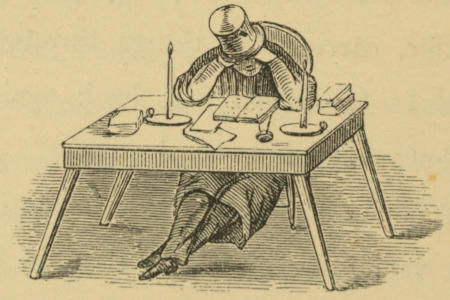
There was more sitting up at night in the summer
half year than in the winter, as at that time
Præfects were busy preparing for Election Chamber,
and Inferiors for “Standing up,” (v.i.) At
that time, we used not only to borrow from the
night, but the morning also; and we had a method
of calling ourselves which was rather ingenious.
It was called “The Scheme,” and was arranged as
follows:—The Functior was known to burn at a
certain rate—say an inch an hour—if it was lighted
at nine o’clock, and we wanted to rise at four,
seven inches only were allowed to protrude above
the socket, (the rest being cut off,) around which
a quantity of paper was arranged, and a string tied,
which was carried through a hole in the top of a
Junior’s bed; to the end of this string a parcel of
books, or a pint-cup of water, was fastened, (if the
latter, it was called “a Water Scheme,” and another
string connected the bottom of the cup with
the canopy of the bed.) When the candle burnt
down, it ignited the paper and burnt the string,
causing the books (or water) to fall, which roused
the subincumbent sleeper, who proceeded to wake
the rest. One Scheme was sufficient to wake the
whole school if required; for in every other Chamber
that contained any boys who wished to rise
early, a victim was selected whose toe was secured
in a noose of string, the other end of which was
tied to the window-bar; so that the original
schemer, by walking round Quad and tugging at
the different strings, could soon rouse them all.
This led to a very amusing incident on a certain
occasion. One of the Masters who had lately
arrived (and who, not having been educated at
Winchester, was not up to the ways of the place)
was going round Chambers with a friend, an old
Wykehamist, who had been dining with him.
While Mr ⸺ went into Third, his friend
remained outside. Suddenly catching sight of a
string tied to a bar of the window, and knowing
well what was at the other end, he took a steady
pull at it just as the Master had got to the middle
of Chamber; the consequence was, that the unfortunate
fish at the other end, who, by the by, was a
severe stammerer, dashed out of bed, and, with a
shattered howl, plunged past the astonished Master
with one foot in the air, till he brought his toe
up to the window-sill.
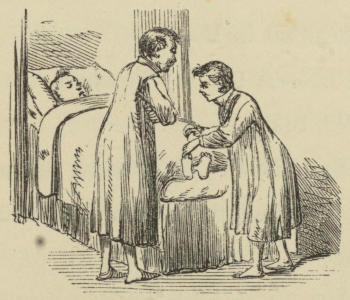
This little scene brings to my mind the demoniacal
diversion of “Toefitying.” Occasionally
some wicked boy would arise in the night, and,
gently removing the bedclothes from the feet of
an unsuspecting sleeper, endeavour to noose one of
his toes with string, when, if successful, the consequence
would be similar to that above described.
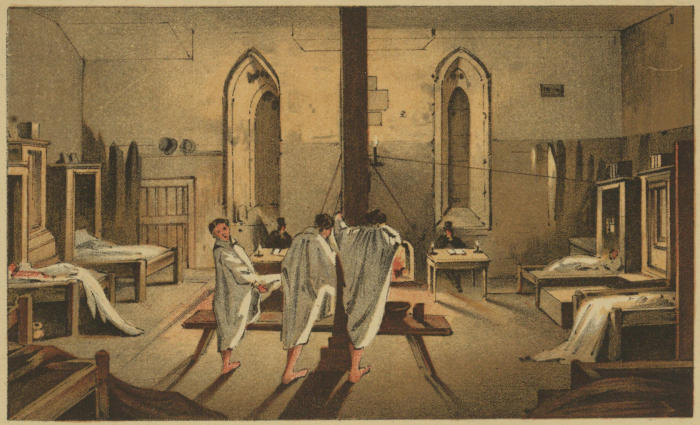
TOEFITYING, AND THE SCHEME.
Before the end of my first half year, I became
a difficult subject, though, as above mentioned,
a hard sleeper; yet if anybody laid the gentlest
finger on the bedclothes near my feet, to spring
up, seize the nearest missile, and launch it at the
intruder, was the work of an instant. An ingenuity,
worthy of being devoted to better purposes,
was displayed by Bolter in elaborating this foolish
practical joke. He fixed a fishing-reel, with its
line, to the leg of his washing-stool; and having
passed the end of the line through a staple fastened
to the post in the centre of the room, he then tied
to it other lines equal in number to the boys in
Chamber. Having secured each line to the toe of
a boy, he then proceeded to wind up the reel
briskly, the effect being that, in a twinkling, he
had all the boys standing in a bouquet round the
post with one leg extended. This little incident
has been depicted by our artist in the plate entitled
“Toefitying.”
On rare occasions, the boys used to get up at
night and have supper. Once (this was before my
time) a feast was going on, when, on an alarm
being given that a Master was coming round, one
of the boys seized a hot roasted duck and crammed
it into the sleeve of his gown, just before the Master
entered. There being a strong flavour of cooking,
he inquired the cause; on which the boy
suggested that the same perfume would probably
be found in the adjoining Chamber, as the windows
of both were near the Warden’s kitchen.
“Come with me, and we will try,” said the Master.
So they adjourned to the next Chamber, the
boy taking good care to keep his sleeve, in which
was the duck, in close proximity to his conductor,
who, after sniffing about, found, to his surprise,
that there really was a similar flavour there also,
which clearly, in that case, could not have proceeded
from any cooking in the room, as there was
no fire; and so the original destiny of the duck
was ultimately accomplished.
At the end of the half year, we used to have
large entertainments, called “Spree Messes,” between
Toy-time and Chapel, consisting of tea,
coffee, muffins, cakes, &c., the funds for which
were generally provided by fines inflicted during
Toy-time for talking loud, slamming the door,
coming in without whistling, (to show that it was
not a Master entering,) improper language, &c. &c.
Sometimes a Spree Mess was given by the boys
about to leave at the end of that half. My muffin-consuming
power, though still vigorous, has never
been properly developed since the last of these
entertainments at which I assisted, when Rasper,
Sower, and myself, were the joint entertainers.
We brought one half year to a grand conclusion
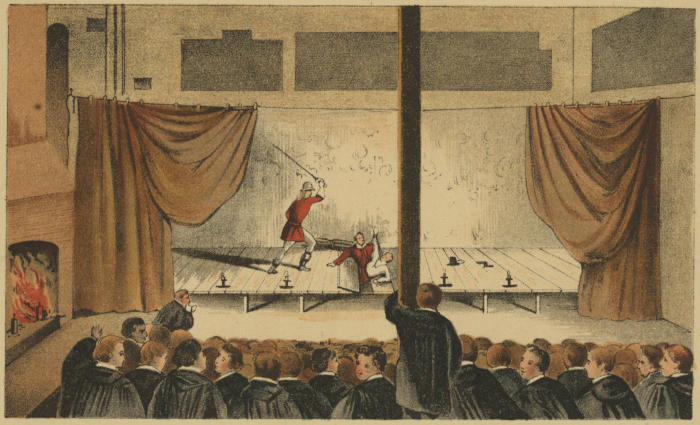
with theatricals in Seventh. Our preparations we
had to make on the sly, as we thought it probable
that, if the authorities were to hear of our proceedings,
they would put a stop to them altogether;
however, whether they knew of it or not, they
never interfered, and it came off with great éclat.
After considerable debate, the pieces selected were
“The Children in the Wood,” and “Alfred.” We
formed our stage by removing all the bedding from
the beds on one side of Chamber, and laying the
bed-boards[4] on them for a floor. A cord was fastened
across the room a few feet from the wall, from
which lengths of paper-hangings were suspended
to give it some appearance of a room, and (the
toys being removed) to give room for the actors to
pass from one side to the other without being seen
by the audience; in front of all a green drop, or
rather draw-curtain, was suspended.
THE PLAY IN SEVENTH.
I have but a vague recollection of the plot of
the first piece; but I remember that the prima
donna was nearly six feet high. Her figure was
not quite so well suited to the part as her head,
and she was obliged to wear an ample shawl to
conceal some little irregularities in her costume
behind. I was a ruffian myself, and, after a sanguinary
combat, was slain by somebody who objected
to my cutting the throats of the children.
It were as well the ruffian was killed, as I had to
appear as a drunken servant in the second act;
and I fancy that I cut rather a distinguished appearance
in a pair of Mr Oades’s (the butcher)
top-boots, which he kindly lent me for this particular
occasion. The scene was supposed to be a
wood; and to convey this idea to the audience, two
faggots were put upon the stage. In this scene I
was, in my turn, attacked by two ruffians, and,
snatching a stick from a faggot, proceeded to defend
myself. Somehow or other we all got entangled
in my extempore weapon; and a bed-board
giving way in the heat of the struggle, we all disappeared
from the sight of the astonished audience.
Just at this moment, in rushed the gentleman who
had killed me in the first act, but whose duty it
was now to defend me with the heroic cry, “What!
two to one!” and there is no knowing what he
might not have done if there had been any one
for him to operate on; as it was, he had the stage
to himself, and the curtain was drawn amid roars
of laughter. How it all ended, I forget exactly;
but it was no tragedy, and the children ultimately
came in for ten thousand a-year, or were found to
be heirs to a dukedom, or something pleasant of
that kind.
The after piece, “Alfred,” was performed in the
front of the great fireplace, where the king could
toast his cakes conveniently. He was wrapped up
in a surplice; but underneath he was very gorgeously
got up, in a gold helmet, striped Jersey,
tight drawers, and Wellington boots, with a large
silk banner pinned on to his royal shoulders.
If our acting was indifferent, and the scenery
and decorations absurd, they, at any rate, had the
desired effect of amusing the audience, to judge by
the tremendous applause that greeted the conclusion.
Three times was the fair and blushing
Podina led across the stage, trembling with modesty
and excitement, to receive the enthusiastic
applause of the enraptured spectators. However,
I believe the actors had the best fun after all.
Since then, I have assisted at getting up similar
entertainments, but have never enjoyed anything
of the kind nearly so much as this our first and, I
believe, the last attempt at theatricals at Winchester.[5]
CHAPTER VI. THE JUNIOR IN HALL.
Rush for Trenchers, &c.—Description of Hall—Toasting
and Cooking—Receipt for Fried Potatoes—Tea—Luncheon—Conning
for Bands—Beever Time—Dinner—Dispars—Fagging
in Hall—Kitchen.
At a quarter before nine the door of Seventh
chamber passage was opened, and the
boys, eager for breakfast, tumultuously rushed out
from school-court; stopping at the bottom of Hall
stairs for a moment, to see if Poole, the porter,
had letters, or, what was even more delightful, a
“Cargo,” (a hamper of game or eatables from
home,) for them, and then darted up the steps.
Before entering, I must give the reader an idea
of the internal arrangement of the noble old Hall,
which in beauty and size excels most of the college
halls in Oxford or Cambridge. At the east
end is a raised dais, on which is the “High table,”
where the Dons dine in Election week. Along
each side are rows of tables. Those on the north
side, allotted to the Præfects, were called, “Tub,
Middle, and Junior Mess,” respectively. The
others, when occupied, being each presided over
by a Candlekeeper, were called respectively senior,
second, and so on to junior “End.” The fireplace
is in the centre of the Hall, with two grates
looking in opposite directions, the smoke being
conducted away by a chimney underneath the
floor; the whole apparatus, however, is cleared
away in summer time. A screen at the lower end
forms a passage, into which opened “Whiteman’s
Hatch,” where “Trenchers,” knives and forks;
“Dear’s,” where bread and cheese; and “Colson’s,”
where beer, butter, and salt were dispensed. The
trenchers were about a foot square, and did duty
as plates at all meals; they were admirably adapted
for bread and butter, but were not particularly convenient
for those who were partial to hot meat and
gravy. In front of the screen stood “Tub,” from
which the Præfect of that Ilk took his title; it
was a strong painted oak chest, with a lid, about
two feet high; its use will be presently described.
The great doors at the top of hall stairs were
made fast by a massive oak beam, which was
thrust back into a hole in the thickness of the wall
when the doors were open.
What a rush that used to be up the old stairs;
in an instant the half-doors of the hatches were
closed up with a throng of excited breakfast fags,
clambering on each other’s backs, and shouting,
“Robinson, Jones, my own,” which being interpreted
means a demand for trenchers and knives
for his masters (some Præfect and Candlekeeper)
and for the applicant himself; he being expected
to provide two for each of the former, (if he only
produced one, it would probably be used to test
his descent from the founder,) “his own” were
generally ethereal. The crowd and excitement
were much greater at this than at either of the
other hatches, inasmuch as the supply of trenchers
and knives was limited, the latter especially, as
they were found (and still oftener lost) by the
boys themselves; whereas at the others, the supply
of eatables was always certain.
Having secured his master’s trenchers, knife and
fork, and bread and butter, the fag had to run
down to Conduit to clean the butter, which was
done by battering it against the trencher with a
knife under a stream of water. This was easy
enough in warm weather; but when cold it was a
rather heart-breaking operation, as the butter then
persisted in breaking up into crumbs, and rolling
about the pavement. The butter washed, then
came the toasting; the grates were spacious, but
still not large enough for the crowd of toasters,
especially as the four corners were occupied each
by a boy engaged in frying or grilling potatoes,
kidneys, bacon, or some other viands.
BREAKFAST IN HALL.
What acres of toast I have made at that fire!
We had not proper toasting forks, but pieces of
stick, called “Long Forks,” on which it was difficult
to keep the toast, especially as it was always
necessary to have at least one eye fixed on the
batch already done, or awaiting the operation,—in
either case generally placed against the edge of
the fender; if your eye wandered for a minute, a
dexterous lunge from some predacious long-fork
transfixed the fruit of all your toil.
“Sic vos non vobis,” &c.
But I must not moralise too much on this iniquity,
my own house being built somewhat after the
fashion of the Crystal Palace.
Besides the toasting, there was cooking to be
done; this was generally confined to frying and
grilling, at which we used to be tolerable proficients;
and I have often found this and other little
accomplishments that I picked up in my Fagging
experiences, useful in a somewhat varied after-life.
We had a particular way of frying potatoes, which,
to my taste, is superior to any other mode of dressing
that invaluable vegetable.
I will give the receipt:—Take a dish of perfectly
plain mashed potatoes, (we used always to
use those that had been boiled the day previous,)
put them on the fire in a frying-pan, with just
sufficient butter to prevent them from sticking to
its sides, and a little salt and pepper; keep stirring
them about with a knife till they begin to
darken in colour, then put them up with a knife
into a cake, like a very thick omelette; fry till the
lower side becomes a rich brown, then toss it over
in the air; fry the other side in a similar manner,
and serve up.
Mother Maskell, the worthy old nurse at Sick-House,
used to preside over the tea department;
and as the distance from Hall to Kitchen and
back was at least a quarter of a mile, the breakfast
fags had a lively time of it, and were not altogether
sorry when middle school began at ten o’clock.
At one P.M. Hall was opened again, and a repast
of boiled beef or pudding, with bread and
cheese and beer, was served; the attendance on a
fine day was generally limited to the grace singers,
and the Præfect of Hall or Tub. The joints at the
Præfects’ messes were generally kept for them, and
the beef at the Ends given away. The puddings
were usually preserved for Commoner friends;
for, by a curious dispensation, they preferred the
College puddings to their own, and we theirs to
ours; so an exchange was generally effected: they
decidedly had the best of the bargain, as we had
pudding three times a week, and they only on Sundays.
At grace time all the boys who were present
at this meal, stood up on the dais on top of
Hall, and the senior Præfect present used to go
round with a cricket ball in his hand, and inspect
their neckcloths to see whether or not they had
their bands attached, the defaulters receiving three
or four smart blows on the head (“conns”) with
the ball, by way of reminder.
In summer time we were let out of afternoon
school for a short time about four P.M., when there
was a slight refection of bread and cheese laid out
in Hall. It was called “Beever-time,” and the
pieces of bread “Beevers.”
I now come to the crying evil of the times I
write of, and of which I am happy to say I had
but a slight experience, as during my time the
whole system was entirely changed. The evil that
I speak of, is the way in which the dinner was
managed. All the other little discomforts that I
may have undergone as a Junior, seem luxurious
pleasures when I think of that infernal dinner
hour. This meal took place at six o’clock P.M.
in College, (in Commoners’ it was at one;) it was
ample in quantity, and excellent in quality. That
of the Præfects was nicely served up in joints,
that of the Inferiors was divided into portions,
(“Dispars;”) there were, if I remember rightly, six
of these to a shoulder, and eight to a leg of mutton,
the other joints being divided in like proportion.
All these “Dispars” had different names; the
thick slice out of the centre of the leg was called
“a Middle Cut,” that out of the shoulder a
“Fleshy,” the ribs “Racks,” the loin “Long
Dispars;” these were the best, the more indifferent
were the end of the shoulder, or “Cat’s head,”
the breast, or “Fat Flab,” &c., &c.
On Sundays we had beef, except for six weeks at
Easter, when we had veal. Potatoes were served
up in pewter dishes, (“Gomers;”) they were not
very good hot, and the Candlekeeper generally
took possession of those served at his End, and had
them kept till the next day for frying, as above
described. Each End and Præfect’s mess had their
beer served up in a large white jug, or “Bob.”
The vessel used for the same purpose in Commoners
was called a “Joram.” There was nothing to
complain of in the dinner, though it would have
been pleasanter if the meat had been served in
joints instead of lumps, and if we had had plates
instead of trenchers to eat it off; however, to the
twenty Juniors at any rate, it was of very slight importance
whether the dinner was comfortably served
or not, as they seldom got any. The distribution
was managed as follows: one of the cooks, escorted
by the Præfect of Tub, brought up an immense
tray, with a mountain of meat on it; this was taken
first to the senior Candlekeeper’s end, and then to
the others in succession. But only those boys who
were at the End at the time it was brought were
permitted to take their dinners, except the Candlekeepers,
who were allowed to have theirs taken by
proxy. As will be seen, it was simply impossible
for the Juniors to be up to time, the consequence
of which was that more than half the dinners were
not taken; these were thrown into “Tub” at the
end of Hall, whence they were ultimately taken
away by some poor women, and I always understood,
(though I am not certain that such was the
case,) that the “Præfect of Tub” got a certain
sum for each “Dispar” not taken, and so had a
direct interest in managing that as many as possible
should go without their dinner. I will now
explain the absence of the Juniors; immediately
the Præfects were seated, the whole Hall resounded
with shouts of “Junior—Junior—Junior,” rising
in savageness of tone, as the supply became exhausted;
in five minutes all the Juniors were darting
wildly about in all directions, executing orders
received from their lords and masters; some to
Colson’s hatch for salt, or down into cellar for beer,
back to school for something forgotten, into chambers
for a pint cup, down to kitchen for gravy, &c.,
&c. In the centre of Hall stood the senior Candlekeeper
and Deputy, each armed with a long and
supple ground ash, their business being to continue
hitting every one who came within reach, so that
it was absolutely necessary for every boy passing
down Hall to run the gauntlet of one or the
other; the only conceivable reason for this extraordinary
arrangement being, I imagine, that in
order to escape the sticks of the flagellators, the
Fags dashed past them as fast as they could, and
so got through what they had to do quicker. To
escape this purgatory I have known boys lie underneath
the beer butts in cellar during the whole of
Hall time, and once a wretched fugitive was discovered
hidden in the salt tub, into which he had
managed to creep, and had let the lid down over
himself afterwards. Happy the Junior who was
“teejèed” by any Præfect, as he not unfrequently
was presented by him with a plate of meat, or the
remains of the joint, (called “a Mess,”) in which
case he was exempt from Fagging as long as he
was eating it, and it was extraordinary how difficult
it became to pick a bone, and how long a small
slice of meat could be made to last under such circumstances.
Knives and forks being rare articles
with the Juniors, we had some difficulty in getting
rid of a dinner when given to us, unless the Præfect
was good enough also to lend his implements. I
remember seeing Skith with one end of a carcase
of a hare in each hand, burrowing among the ribs
with his nose and mouth in search of the tit-bits,
which, to judge by the delight depicted on his
countenance, were still remaining.
But let us escape from the din of Hall, and pay
a visit to Kitchen. In the way we pass through
“Ante-kitchen,” where is the familiar picture of
the “Trusty Servant.”
THE TRUSTY SERVANT.
Effigiem servi si vis spectare probati,
Quisquis es, hæc oculos pascat imago tuos;
Porcinum os quocunque cibo jejunia sedat;
Hæc sera, consilium ne fluat, arcta premit.
Dat patientem asinus dominis jurgantibus aurem;
Cervus habet celeres ire, redire pedes.
Læva docet multum, tot rebus onusta, laborem;
Vestis munditiem, dextera aperta fidem.
Accinctus gladio, clypeo munitus; et indè
Vel se, vel dominum, quo tueatur, habet.
“A trusty servant’s portrait would you see,
This figure well survey, whoe’er you be;
The porker’s snout not nice in diet shows;
The padlock shut, no secret he’ll disclose.
Patient, to angry lords the ass gives ear;
Swiftness on errand the stag’s feet declare;
Laden his left hand, apt to labour saith;
The coat, his neatness; the open hand, his faith:
Girt with his sword, his shield upon his arm,
Himself and master he’ll protect from harm.”
Here may generally be seen a row of huge leather
jugs about two feet high, (“Jacks,”) made of
hippopotamus hide, and peculiar to Winchester, I
believe; at any rate, a relative of mine who lived
in one of the midland counties purchased a pair
here every year, and he used to give me the commission,
which I had the greatest pleasure in executing,
as he always sent me a five-pound note to
pay for them with, and could never be induced to
take any change.
The Kitchen is a spacious apartment with a
vaulted roof, occupying the entire height of the
building on the west side of the quadrangle, and
at least half its length; here we might see a few
Fags endeavouring to coax Jem Sims, John Coward,
Bill Bright, or mother Mariner, (the cooks,)
for an extra supply of mashed potatoes, till Kitchen
is cleared by the exasperated Manciple, who has
just detected a delinquent in the act of secreting
under his gown an armful of the small faggots
used for lighting the kitchen fires, (called “Bill
Brighters,”) an opportunity for purloining which
was never allowed to slip by a Junior of a properly
regulated mind.
It may be asked how the Fags managed to dine
at all, and it would be difficult to answer; but
somehow or other we did manage to eat at odd
times, and plenty too, I suppose; at any rate we
were always in excellent condition; there was
ample food supplied by College, the opportunity
of eating it only failed. The entire system is now
completely changed; the boys dine at one o’clock,
their dinner is as plentiful as ever, and properly
served, with good cookery, plates, and knives and
forks, and no Fagging whatever is allowed, the
Choristers waiting, and a Master being present.
CHAPTER VII. THE JUNIOR IN CHAPEL.
The Late Warden—The Antechapel—The Crimean
Memorial—The New Tower—Hours of Service—The
Oath—Cloisters.
Let us tread more gently as we pass
through the gates of the beautiful
chapel. Here at any rate our Junior finds some
rest and quiet, and is for a period beyond the
reach of the weary call of “Junior, Junior.” I
feel that it is a subject that cannot worthily be
treated of by my trivial pen. The most indifferent
stranger cannot enter its sacred precincts without
being struck by the air of peaceful solemnity that
pervades it throughout; how much more, then,
must he be affected who revisits, for the first time
after many years, the spot where as a boy he so
often listened to the swelling tones of the organ,
or eloquent words of wisdom—often, alas! but too
little heeded! What crowds of reflections are
called forth as he gazes on the scene! How many
resolutions have here been formed, and how have
they been kept? Can he flatter himself that he
is really more advanced on the narrow path than
when he sat on those benches years and years
ago?
I will not attempt to describe the edifice.
Let the reader imagine a noble choir lighted with
large windows of rich painted glass, through which
the slanting rays of the sun throw a many-coloured
glow over the wainscot and stalls of polished oak.
How well I know every feature of those quaint
figures of prophets and apostles; and as I sit in
my stall and see the boys trooping in, it is difficult
to realise that I am no longer one of them.
But time has made many changes in the upper
ranks; the clear ring of the melodious tones of
the accomplished Head-master’s voice may still be
heard, but he alone remains. In vain we look for
the stalwart form and genial countenance of the
late beloved Warden, Barter, who, having filled his
responsible office full thirty years, has gone to his
rest. In the long list of his predecessors there
has been none who was more universally beloved
in life, and whose death has been more unfeignedly
regretted.
On our way from Chapel we pass through
Antechapel, now somewhat curtailed in its dimensions,
the screen which separates it from Chapel
having been moved in order to give room for the
increased number of boys. The beautiful font,
presented by the Head-master, and some mural
tablets, (which formerly stood beneath the Tower,)
have been removed to a small side chapel, the
entrance to which is under the organ; one of
these, erected to the memory of a young and
lovely wife by her sorrowing husband, bears the
following beautiful inscription:—
“I nimium dilecta, vocat Deus, I bona nostræ”
“Pars animæ, mærens altera disce sequi.”
In the vestibule leading to Cloisters, immediately
opposite to the door of Antechapel, is the
memorial erected by Wykehamists in memory of
their brethren who fell in the Crimean war; it is
worthy of its object, being beautifully executed in
variegated marble. I have stood by their graves
in the dreary Russian Chersonese, yet it seems
but yesterday that I heard some of them answering
their names at this very door.
THE CRIMEAN MEMORIAL.
INSCRIPTION ON THE CRIMEAN MEMORIAL.
The beautiful Tower attached to the Chapel
had long been in rather a dilapidated condition,
owing to its having been built on a very insecure
foundation; it had inclined considerably to one
side, a great crack had appeared on the contiguous
wall of Chapel, which indeed it threatened to drag
down, and it was considered unsafe to ring the bells.
For these reasons the authorities determined to
pull it down and rebuild it, stone for stone, with
the old materials; this was commenced in 1860,
and the work is now fully completed. It is called
the “Tower of the Two Wardens,” in memory of
the late Dr Williams, who was (many years Head-master
of Winchester, and afterwards) Warden of
New College, Oxford, and of Mr Barter, the late
Warden of Winchester; while the work of reconstruction
was going on, the opportunity was seized
of enlarging the chapel by taking in part of the
Antechapel, as described in a previous page. If
the school continues to increase as it has done
lately, this enlargement must, I think, be carried
on further, and the whole of Antechapel be added
to the main aisle. Beneath the Tower, on the
southern side of the Antechapel, is the following
inscription:—
In Memoriam,
DAVID WILLIAMS, I.C.D., HUJUS COLLEGII
XIV. ANNOS HOSTIARII: XII. INFORMATORIS
COLL. B.M. WINTON IN OXON
XX. ANNOS CUSTODIS,
VIRI CONSILIO DIGNITATE DOCTRINÂ,
HUMANITATE MUNIFICENTIA,
CANDORE MORUM, ET INTEGRITATE VITÆ,
SI QUIS ALIUS INSIGNIS.
In Memoriam,
ROBERT SPECKOTT BARTER,
I.C.B., HUJUS COLLEGII
XXIX. ANNOS CUSTODIS,
VIRI
OB BENEVOLENTIAM CORDIS ET LARGITATEM
CONSTANTIAM ANIMI ET FIDEM,
SUAVITATEM LIBERALITATEM PIETATEM,
NEMINI NON DILECTUM.
Utriusque intra unius anni spatium ad immortalia avocati
Hanc Turrim vetustate diu labantem denuo exædificandam, ab nomine Duorum Custodum
Perpetuo appellandum censuerunt Wiccamici sui A.S. MDCCCLXIII. posterorum causa
Id scilicet in animis habentes ut in ipsa acerbissimi desiderii recordatione manifestum facerent
Non in quibuslibet viris magnis nec in brevem aliquam hominum ætatem
Sed in omne tempus et in perpetua serie virorum ad horum exemplar
Sub his penetralibus ad omnia bona fortia fidelia enutriendorum
STARE REM WICCAMICAM.
The hours of worship (now, I believe, somewhat
altered) used to be as follows:—At six A.M. in
summer, at a quarter before seven in winter, at
eight and at half-past ten A.M., and at five P.M., on
Sundays,[6] Saints’-days, and Founder’s Anniversaries.
On Fridays at eleven A.M., and on Saturdays
at five P.M. the boys might be seen trooping
across the quadrangle on their way to Chapel—on
Sundays and on Saints’-days clad in white surplices.
Besides this, every evening at nine prayers used to
be read by the junior Præfect in Antechapel, who
stood on the top of the steps leading up to one of
the curtained and barred pews reserved for ladies,
one of which was placed on each side of Antechapel;
the fair occupants, not being allowed to
enter the body of the chapel, were obliged to
content themselves with looking and listening
through the grating.
Once a year all the boys who had passed the
age of fifteen, (and who had not previously gone
through the same ceremony,) were marshalled
into Chapel, and, under the inspection of “Semper
Testis,” (the legal aide-de-camp of the College
authorities,) went through the form of taking an
oath. I have no distinct recollection of the form
of the proceeding, (it is now abolished,) but I
think the official above-mentioned read out a
Latin document, and we were supposed to say
Amen. I believe the gist of it was that we were
to defend and befriend the college to the best of
our ability, and never tell anybody what went on
within its walls. I am sure I should require no
compulsion to carry out the former obligation,
should the occasion occur, and I had any possible
means of fulfilling my duty, and if I have done no
more harm in writing this little sketch of our proceedings
at Winchester than infringing the latter,
my conscience will not be much troubled. Although
the making a number of thoughtless boys
go through a ceremony of this kind may seem
objectionable, yet it is not the part of a Wykehamist
to exclaim against it, as, according to well
authenticated tradition, Cromwell would have destroyed
the College, had he not yielded to the
urgent representations of one of his officers, who
was a Wykehamist, and, mindful of his oath, succeeded
in saving the noble establishment from its
impending fate.
I must not take leave of Chapel without noticing
the beautiful Cloisters, with a little gem of a
chapel standing in the middle, surrounded by
smooth green turf. It is now used as the Fellows’
library. I think it a pity that the Cloisters are so
little seen, as they are very beautiful. The Fellows,
in general, do not reside at Winchester, and I do
not imagine that those who do spend any very
great part of their time in such absorbing study
that the movements of the Præfects in Cloisters
on week days, and of the others on Sundays,
would disturb them very much; to such an extent
I think the boys might be admitted without
danger of their injuring the building or the tablets
on the walls. At present the extreme stillness of
the place is somewhat overpowering.
CHAPTER VIII. THE JUNIOR IN SCHOOL.
Description of School—Scobs—Officers—Division of
Classes—Prizes and Medals—Long and Short
Half—Easter Time—Commoners’ Speaking—Cloisters—Latin
Composition—Flogging—Scraping
and Shirking Out—Latin Verses—Pealing.
On descending Hall stairs, and turning
sharp to the right through Seventh
Chamber passage, we enter School Court. The
School is a spacious edifice, (built in 1687,)
ninety feet long, and thirty-six broad; it may
be a handsome building by itself, but, like the
adjacent Commoners, is not favourably contrasted
with the venerable Gothic buildings of the College,
of which they form part. In the south-west corner
of School is the Throne of the Head, and, in
the south-east, that of the Second Master; opposite
to each are seats for the Under-Masters.
At each end of School are three tiers of benches
rising gradually one above the other,—that on the
ground being called “Senior Row,” and the others
“Middle” and “Junior Row” respectively. On
these the classes sit when “up at books,”—i.e.,
when repeating lessons,—four parallel double
ranges of solid oak benches, intersected, at intervals
of about four feet, by others, and firmly
fixed to the floor, run from end to end of the
room, except where broken by Commoners’ tables,
(two tables, at which there is room for about
thirty Commoners; the rest get places where they
can,) by the fireplace, and the passage from it to
the door; between these rows of benches are three
broad passages down School. On every angle of
these intersecting forms is placed a large oak box,
with a double lid. Every College boy, and some
Commoner Præfects, had one of these; and some of
the Senior Præfects have four, others three, and the
rest two. One of the lids of these boxes was generally
kept up during School-time to ensure a certain
degree of privacy to the occupant, the lower
lid doing duty as a table; inside were kept the
books and other belongings of the proprietor.
They were called “Scobs,”—i.e., box phonetically
spelt backwards.
High up on the wall, at the west end of the
School, is a large tablet, with a mitre, crosier,
sword, inkstand, and rod painted on it, with the
words—
“Aut disce, aut discede, manet sors tertia cædi;”
which has been freely rendered—
“Work, walk, or be whopped.”
At the opposite end of School is another large
tablet, on which is painted the
“Tabula legum Pædagogicarum,”
which gives the rules to be observed by the boys
in Chapel, School, Hall, Quadrangle, Chambers,
On Hills, and in All Places and Times.
School hours, in the times I write of, were from
eight to nine A.M., (Morning School,) from ten to
twelve, (Middle School,) and from two till six P.M.,
(Evening School;) at the close of which prayers
were read by the Præfect of School.
On “Remedies,” (a kind of whole holiday,) we
also went into School in the morning and afternoon
for an hour or two without masters; this
was called Books Chambers; and on Sundays,
from four till a quarter to five. In “Cloister
Time,” (v.i.,) Præfects, and senior part of the
Fifth, went into School on Sundays from seven to
eight, which period was called “Grotius Time.”
Order was kept during School hours by the
Bible Clerk and Ostiarius, two of the Præfects,
who held these offices in rotation,—the former
lasting for a week, the latter for one day only.
They paraded School armed with sticks, and
brought up to the Head and Second Masters (who
alone had the power of flogging) the names of the
delinquents which had been “ordered” for punishment;
the names of the more heinous offenders
being confided to the Bible Clerk, the others to
the Ostiarius. Just before School-time, a boy was
always stationed to watch the arrival of the Master,
of which he had to give notice by emitting a
loud “Hiss,” upon which there was a general rush
up to books; the previous uproar dwindled to a
calm, and work began.
The School was divided into three classes, or
“Books,” as they were called. Of these the Præfects
formed one, “Sixth Book:” “Fifth Book” was
subdivided into three parts, called respectively
“Senior, Middle, and Junior part of the Fifth;”
in speaking of them, the words “of the Fifth”
were generally omitted. The rest of the boys
made up “Fourth Book;” their instruction, however,
was not carried on in School, but in another
building adjoining, where the Præfects had
a library, and in which the mathematics were
taught. The Præfects and senior part did not
change places from day to day, but only at the
final examination in Election-week. In the other
parts, the relative positions of the boys continually
fluctuated, and their numbers were marked every
day, at the beginning of Middle School, in a book
called the “Classicus (or Cuse) Paper:” the individual
who had the greatest number by the end
of the half year “got the books,” (i.e., gained a
prize.) These books were supposed to be given
by the late Duke of Buckingham; now, I believe,
they are really given by Lord Saye and Sele. The
boy who had the lowest score at the end of any
week, held the office of “Classicus” for the week
following,—his duties being always to inform the
other boys what was the particular lesson for the
day, and what was the subject for the next vulgus
verse or prose task. There were two gold medals
for Composition,—for Latin verse and English
prose, and for English verse and Latin prose, on
alternate years; and two silver for Elocution, annually
competed for; besides prizes given by
Maltby, Bishop of Durham, for Greek verse, Latin
verse, and Inferiors’ speaking; Sir William Heathcote,
of Hursley, for Scholarship; and Mr Duncan,
for Mathematics.
The School year was divided into two unequal
parts. One, called “Short Half,” commenced
about the beginning of September, and lasted till
about the middle of December; the other, “Long
Half,” from the beginning of February till the
middle of July. The six weeks after Easter
(“Easter-Time”) were devoted to the study of
Greek Grammar, and once in each of these weeks
there was competition in speaking, the best speakers
being selected to display their oratorical powers
on the final day, which was called “Commoners’
Speaking.” During the remaining weeks of Long
Half, (“Cloister Time,”) Sixth Book and Senior
part went up to books together; when thus combined,
they were called “Pulpiteers.” Middle and
Junior part were merged together in the same
way—those in Junior part having the opportunity
of rising into Middle part, and vice versâ. This
combination was called “Cloisters,” and this period
of the year “Cloister Time;” the distinguished
post of “Cloister Classicus” was, I can tell from
long experience, by no means a sinecure.
Efficiency in Latin composition, especially verse,
and learning lines by heart, were (unfortunately
for me) the surest means of rising in the School.
Four days a week we had to write a short copy of
verses of from four to six lines on a set subject;
this was called a “Vulgus,” and was always
written on half a quarter of a sheet of foolscap,
(“a Vessel of Paper.”) Once a week, one
of from ten to twenty, a “Verse Task,” (written
on a quarter of foolscap;) and, once a week, also a
“Prose Task.” We were always excused (“had
Remission from”) Vulgus when the next day was
a Saint’s-day; and if one fell on a Wednesday or
Friday, our verse or prose task for the day previous
was remitted. Præfects and Senior part
also were encouraged to write, once or twice in the
half-year, a copy of verses on any subject selected
by themselves, which was called a “Voluntary.”
From time to time, also, they had to write Latin
criticisms on Greek plays, and the other boys to
write an analysis of some historical work; these
productions were called “Gatherings,” (or “Gags.”)
In the last week but one of “Long Half,” all the
boys, except those in Sixth Book and Senior part,
had to say a number of lines; this was called
”Standing-up Week,” concerning which and “Election
Week,” (the last week of the same half,) I
will treat hereafter.
Flogging was not excessively frequent, and by
no means severe. The rod consisted of a wooden
handle about two feet and a half long, with four
grooves at one end, into which were inserted four
apple twigs; these branched off from the handle
at so considerable an angle, that not more than
one could touch the space of skin exposed,—about
a hand’s-breadth of the small of the back, the
waistcoat of the victim being raised to the necessary
height. To obviate this to a certain extent,
the “Rod-maker”—one of the Juniors charged
with the care of these implements—had to twist
them together so as to form one combined stick;
generally, however, they separated after the second
cut. I am told that these twigs are now cut so as
to lie in a straight line with the rod, without any
angle, which is a very disadvantageous change for
the floggee. The ordinary punishment consisted
of four cuts, and was called “a Scrubbing.” The
individual who was to be punished was told “to
order his name,” which he did by going to the
Ostiarius, and requesting him to do so; that
officer accordingly, at the end of School time,
would take his name to the Master, who would
then call it out, and the victim had to kneel
down at Senior row, while two Juniors laid bare
the regulation space of his back. The first time
a boy’s name was ordered, the punishment was
remitted on his pleading “Primum tempus.” For
a more serious breach of duty, a flogging of six
cuts (a “Bibler”) was administered, in which case
the culprit had to “order his name to the Bible
Clerk,” and that individual, with the help of Ostiarius,
performed the office of Jack Ketch. If a
boy was detected in a lie, or any very disgraceful
proceeding,—a rare occurrence, I am happy to say,—he
had to stand up in the centre of Junior row
during the whole of the School time, immediately
preceding the infliction of the flogging; this pillory
process was called a “Bibler under the nail.”
I have also heard, that for a very heinous offence
a boy might be punished in Sixth Chamber, in
which case the number of stripes was not limited;
but I never knew an instance of this.
On one first of April, an impertinent boy undertook
to make an April fool of the Doctor, and
accordingly marched boldly up to his throne, and
told him that he had torn his gown; and, on the
rent not being found visible to the naked eye, suggested
that it was the 1st of April; upon which
he was told to order his name to the Bible Clerk.
When Middle School was over, the Doctor put on
his trencher cap, and called out, “Pincher, Bible
Clerk, and Ostiarius!” (which meant that Pincher
was to advance to receive his deserts, and the
others to assist as masters of the ceremonies.) At
the moment that the culprit was expecting to feel
the sting of the apple-twigs across his backbone,
the Doctor threw down the rods, saying, “Who is
the fool now?” and was walking out of School,
when the undaunted Pincher jumped up, and
ejaculated, “It’s past twelve, Sir!”
Ordinary offences of a trifling character, such
as being late for Chapel, or “Shirking Hills,”
(v.i.,) were punished by the infliction of an imposition,—generally
thirty lines of Virgil, English
and Latin. I think I must have written out the
Æneids of Virgil and Odes of Horace half-a-dozen
times during my sojourn at Winchester. Indeed,
being naturally of a prudent disposition, whenever
I had nothing particular to do, I used to write
out a few lines, and thus gradually became possessed
of a small capital of a thousand lines or
so, on which I could draw at any pressing emergency.
If a boy had occasion to speak to a Master, and
while he was up at books, the correct thing was to
keep his gown buttoned at the top; and if he
wished to go out of School, he wrote his name on
a slip of paper, (or “Roll,”) with the following
sentence:—“Ostiarii veniâ potitus, tuam pariter
exeundi petit;” he then asked leave of the Ostiarius
to “put up his roll,” which being granted,
he deposited it on the Master’s desk, and made his
exit. When a Præfect wanted to go out, he went
to a corner Scob near the door, and “scraped”
with his feet until he attracted the Master’s attention,
and obtained a nod of consent. At one particular
time of the year, (I think it was during
Saturday evening School in Easter week,) two
Commoners and one College Inferior might collectively
scrape out together. Only about half-a-dozen
boys were allowed to be out at one time;
but I have known some steal out on the sly, without
any preliminary formality. On a fine summer
afternoon, the Doctor might accidentally cast his
eye over School, and observing that it had rather
a deserted expression, would send out the Bible
Clerk and Ostiarius to make a foray in Meads,
who would presently return with a flock of truants;
it being impossible to flog such a number,
it was usual to make them “cut in a book,”[7] to
settle which half-a-dozen should be distinguished
in this manner.
SCHOOL.
The educational system at Winchester is, I believe,
most excellent, and turns out a very superior
article in many cases. I am sorry that I cannot point
to myself as a brilliant example. When I was in
Junior part, I was under a Master who used to curb
my ascending energies by making me always stand
up junior, and not allowing me “to take up” even
when we went up to the Doctor for our monthly
examination. He used also to employ the following
method of repressing any little eccentricities
on my part; he would call me up to the side of his
desk, and putting his hand affectionately on my
shoulder, mildly remonstrate with me, gradually
his hand would creep up, and a finger entwine
itself in the hair above and a little in front of my
ear, and he would impress on me the more salient
points of his lecture by a steady screw of the
finger. This treatment ultimately became very
tiresome; so one day, just as the screw-powder was
being laid on, I emitted a yell, that made the
Doctor bound again in his chair, and brought
every boy in the school on his legs. After this my
hair was allowed to curl naturally. In the middle
of the half year this Master left, and his place was
filled by another. The reader will be as much
surprised as I was, when he hears that at the end
of that half I got the books! If any one doubts
the fact, I can show them the volume in question,
with a statement in it endorsed by his Grace the
late Duke of Buckingham, that my morals were
excellent, and my habits of application most praiseworthy.
I was accordingly promoted into Middle
part, and when the next half year I proudly ascended
to my new position, I had visions of a
fellowship at New College, and a shadowy notion
of the woolsack in futurity. Neither of these
fancies, however, have yet been accomplished. If
it were not that owing to the inclemency of the
season this autumn, the grapes are so very backward,
I should be inclined to make some remarks
touching the former disappointment.
My new Master unfortunately thought that I
was incorrigibly idle, and in my Latin verses and
lines showed me no mercy. I struggled hard for
a year, (oh, the many hours that I have sat up in
bed and paced up and down School, trying to drive
the requisite number of lines into my head for the
next morning’s repetition,) and after that his opinion
gradually became more correct. Unfortunately
for me, our places were always marked every morning
immediately after the repetition of lines; and
as I invariably went to the bottom then, it mattered
little how much I had risen previously, and
I was “Semper (always) Classicus;” and so if I
had remained at Winchester, I should have been
to the present day.
I must also admit that I was not strong in Latin
verse. I remember writing a copy once that I
thought was beyond criticism, and was much disgusted
when I found that the Master thought that
“pius Æneas” was not a suitable termination to
an Hexameter line. I was not, however, alone in
this want of true poetic feeling. My worthy friend
Podder one day produced the following Pentameter:—
“Lēŏ rĕx bēllŭărūm ūt cæ̆tŭs ēst pĭscĭūm.”
For the benefit both of those who do, and those
who do not, understand Latin, I will mention that
the translation of the above was meant to be—
“The lion is the king of beasts, as the whale is of fishes.”
Will Bumpus forgive me if I relate an instance
of his ingenuity? He quietly took the following
line from Horace, and served it up as an Hexameter
of his own composition:—
Dūlcē|ēt dē|cōrūm|ēst prō|pātrĭâ|mōrī.|
On the inexpediency of this being suggested to
him, he was setting to work to alter it, when suddenly
a bright thought flashed across his mind; he
knew the line was out of Horace, so that if it wasn’t
an Hexameter, it must be a Pentameter; so up it
came—
Dūlcĕ ĕt|dēcōr|ūm|ēst prŏpă|triă mŏ|rī.
The rest being tragic, I will break off here, and
having given the reader enough of myself and my
shortcomings, will proceed to more general subjects.
We had some singular customs at the commencement
of Cloister time. Senior part and Cloisters,
just before the entrance of the Masters into School,
used to engage in a kind of general tournament;
this was called “Cloister Roush;” each party used
to charge from their respective ends of School till
they met in the middle; it was a good-humoured
affair; fists were not used, but only wrestling and
hustling. Another remarkable custom was that of
“Cloister Pealing.” At the commencement of
Cloister time, for a few minutes before the hiss was
given, the vast gulf that usually existed between
Præfects and Inferiors was temporarily broken
down. All the boys in Cloisters being assembled
up at books, proceeded to chant the praises of the
popular or severe criticisms on the unpopular,
Præfects, in short Latin, Greek, or English epigrams.
I am happy to say that the complimentary
species generally preponderated. Well do I remember
the enthusiasm with which we chanted
on one occasion—
Ζωή μου σᾶς ἀγαπῶ.
Ζωή being the nickname of one of the senior Præfects,
Rich in all those physical and moral qualities
that endear an athletic youth to his younger school-fellows.
I might give some examples of Peals,
which the reader might find more amusing than
the subjects found them complimentary, but for
obvious reasons I abstain.
In Commoners also there was an entirely different
description of “Pealing,” which will be described
in the chapter on Standing up and Election
Week.
CHAPTER IX. THE JUNIOR ON A LOCKBACK HOLIDAY.
Fagging Choristers—Crutch—Currell—Concerts—Fighting—How
to Catch the Measles—“Books
Chambers.”
When the weather was too bad on a Holiday
or “Remedy” to go on to Hills, we
used to pass the day principally in school; the
gate of Seventh Chamber passage being locked,
and communication with Chamber Court being cut
off, it was called a “Lockback.”
On leaving morning chapel on such a day we
adjourned at once to school, when the Fags would
by no means have an idle time of it. The instant
they arrived “Junior! Junior! Junior!” would
resound on every side, and in every conceivable
tone of gentle entreaty, slight impatience, and
vehement indignation, according to the temper of
the caller, or duration of the call. Then the
valets had to arrange their master’s washing
things on Commoners’ table, for few of the Præfects
condescended to wash before chapel. Others
were sent, with all kinds of commissions, to “Blue
gate,” (a door in the west wall of School court,
which opened into a side passage running along the
outside of the kitchen buildings, to outer gate,)
which was pierced with a hole about a foot square,
through which the Choristers were called and
received their orders, and through which they
handed any articles they might have been sent
for; the scene here was similar to that at Whitesman’s
hatch at breakfast time, (v. s.) crowds of
Fags jostling round the hole and clinging to the
bars screaming “Chorister! Chorister!” at the top
of their voices, in frantic eagerness to catch the
eye of the first Chorister, the clatter of whose
hobnailed boots would be heard coming up the
flint pavement a long time before the wearer
could be seen. When he did appear the cry was,
“Fagging for me;” or, more generally, instead of
“me,” the name of the Præfect for whom the
message was to be sent was used, as more likely
to carry weight with the Chorister.
The little Choristers had hard work of it; they
were soon scattered all over the town,—to La
Croix’s for a pint of coffee and twopenn’orth of
biscuits, or a “Tizzy tart;” to Nevy’s (this gentleman
supplied edibles at Commoners’ field; I
suppose he once had an uncle or an aunt, and so
got his nickname; if he ever had any other name
nobody knew it, and I doubt if he did himself)
for strawberries and cream, or Burney’s biscuits;
to Flight’s for sallyluns; to Forder’s for buns; to
Stone’s, to Drew’s, to Raymond’s for anything you
like, besides innumerable errands to the boot-maker,
tailor, circulating library, &c., &c.
One of the most common and disagreeable
orders for a Junior to receive on these wet mornings
was to get a pint cup; as at the commencement
of the half year the stock-in-trade for the
whole College consisted of about two dozen, and as
they were by no means “College ware,” i.e., not
easily broken, in a few weeks they became rather
scarce articles, but no Junior being ever allowed
to say he “couldn’t” procure anything he was
told to get, he had to depart on his hopeless
errand, and, not succeeding, receive the usual
reward.
As the day wore on some of the Præfects would
subside into the comfortably stuffed seats between
their scobs, and set to work “Mugging,” (reading
hard,) only occasionally lifting up their voices to
call “Junior!”: other boys would take to playing
chess, or some other quiet game; while the more
noisily disposed would indulge in practising jumps
over the Commoners’ tables, playing Hicockolorum,
or Crocketts, (miniature cricket, with a
stump and a fives ball,) to the great detriment of
Præfect of School’s windows.
Presently Seventh Chamber passage would open
and admit Crutch, (I wonder what his name really
was,) a knowing-looking little man, whose occupation
was that of surgeon to those cricket and
fives bats that had received severe wounds; and
he was such a skilful operator that a bat always
seemed to rise like a Phœnix from its ashes after
passing through his hands; a clamorous crowd
would speedily surround the bat-surgeon, to supply
him with fresh patients, or consult him on the
constitution of others. Currell, also, would be
likely to come in on a wet day,—when I say
Currell, I mean a hair-cutter, for there were two
or three of them, but whoever the individual was,
to the boys he was always “Currell.” One of
them operated on me yesterday; as he was combing
my luxuriant locks, he remarked:—“Hair not
quite so thick, sir, as it used to was in the old
times; very fine ’ead of ’air then, sir. Remember
when you came, before New Commoners’ was
built; great changes since then. Old Poole
dead at last, sir. Doctor’s nephew is a master
now, sir; has an ’ouse in Kingsgate Street, and
takes in young gents,” &c., &c. But I don’t think
he could have told me much more, as I find that
having my hair cut is not nearly so tedious an
operation as it used to be.
On the dark afternoons in the short half, for
about an hour before hall time, (six o’clock,) the
boys used to assemble round the fire, the Juniors
sitting on the stone steps, and the Præfects on
scobs ranged in a semicircle in front; two large
vessels of egg-flip were placed in the middle, from
which the contents were scooped out with pint cups,
and we used to sing lustily, if not well. I trust
that the repertoire of songs has been changed
since those days; indeed, before I left all the more
objectionable ones were expunged. We always
began with “When good King Arthur reigned,”
and then followed promiscuously “The Bay of
Biscay,” “The Workhouse Boy,” “John Barleycorn,”
“Three Jolly Postboys,” “Betsy Baker,”
“Captain Bold,” “The Overseer,” “I Loves a
Drop of Good Beer,” “Fox went Out one Moonshiny
Night,” “Tally ho! Hark away,” &c.
EGG-FLIP NIGHT.
Amongst two hundred boys quarrels would occasionally
arise, which were generally adjusted, when
the principals were at all equally matched, by
an appeal to that old British weapon—the Fist.
Fights were by no means exceedingly frequent,
and when they did come off, were conducted with
all due solemnity. School on a Lockback day was
a very favourite arena, and differences were also
settled on Hills and on “Sicily,” (a triangular
piece of grass just at the entrance into Meads,)
where I have also seen a main of cocks fought. I
will not give an account of an ideal fight, as everybody
has already read the particulars of that one
so graphically written by my excellent friend Tom
Brown, with whose sentiments on the subject in
general I cordially concur, and I strongly recommend
my readers to take down their copy of the
book from its shelf at this moment, and reperuse
that portion of it. To the best of my recollection,
I was only once engaged in a bonâ fide set-to of
the kind in question; but I flatter myself that this
was a very remarkable contest, being well remembered
for some little time by the fortunate spectators.
We commenced operations immediately
after morning chapel, and did not lay down our
arms till the hiss was given for morning school;
we were then squaring-up for the forty-ninth round.
I got my head considerably punched in the first
few rounds, during which indeed it was seldom
out of Chancery, but I improved as we got on, and
felt quite sorry when we were obliged to give up;
neither of us, however, had afterwards the slightest
anxiety to renew the engagement, and we
always continued the best of friends, having, from
practical experience, learnt mutual respect for each
other; and whenever in after life I have had the
pleasure of meeting my old antagonist, we have
never failed in conversation to fight our battle over
again.
A good deal of practice with single stick, foils,
and boxing-gloves, went on in school also; I was
one day exercising the latter instruments with
Pudding, when I received a blow in the throat
which made me feel very uncomfortable, and we
left off; I got worse and worse, and finally had to
apply for leave from school; I then went down to
sick house, was rather feverish that evening, and
awoke next morning with—the Measles.
On “Remedies” from eleven till twelve, and
from four till five there was an attempt at keeping
order in school, under the presidence of the unfortunate
French Master, who, I fear, had rather a
warm time of it, in endeavouring, with the assistance
of the Bible Clerk and Ostiarius, to maintain
anything like a proper command over us. These
hours of mitigated study were called “Books
Chambers.”
CHAPTER X. THE JUNIOR IN MEADS.
“Watching out”—Cricket Reminiscences—Lord’s
Matches—Turf—Football—Six and Six—Twenty-two
and Twenty-two—SS and Trees—Fines—Sick-House—Gooseberry
Fool—“Going
Continent”—Long Meads—Enlargement of Meads.
As I said before, I must confess that as a
Junior I did not on the whole look upon
a holiday as a peculiar blessing; indeed I used
to watch the applicant for a Remedy with much
interest, and profound was my secret disgust when
it was granted, and ill-concealed my satisfaction
if it was refused.
My reason for this was the unlimited extent to
which “Watching out” at cricket was enforced on
us. I believe that this is now altered, the time
being limited to one hour on a school-day, and
two on a holiday, which amount is healthy for the
boys, and very useful, inasmuch as it initiates them
into one of the most useful branches of a public-school
education—the science of cricket. But it
is quite possible to have too much of a good thing.
I have been, on a Saint’s-day, (this, however, was
an extreme case, and did not occur often,) ordered
down to watch out in Meads early in the morning
before breakfast, and not allowed to quit
the ground, (except to attend chapel,) till dark,
the whole time without a hat, often in a broiling
sun; at breakfast time and one o’clock one of the
Fags would be sent up to bring down food, which
we ate on the ground. In order to effect this
day’s work, we had (if we could not get leave, and
I think only three were allowed) to shirk Hills
three times, for each of which we were liable (if
discovered, by names being called, as was generally
the case) to an imposition. And when the
day’s entertainment commenced by a big Præfect,
about twenty-two years old, placing a boy about
ten paces behind the wickets as Longstop to a fast
bowler, pointing significantly to a spare stump
stuck in the ground close by, and remarking, with
a savage scowl, “Now, you look here, you young
⸺, you see that stump, the first ball you miss
I’ll cut you in three pieces—body, soul, and legs,”
I think it will be admitted that to that Longstop
at any rate a holiday would not be regarded as a
very great privilege, especially when Nestor was
not at all the boy (man, I should rather say) not
to endeavour conscientiously to fulfil any promise
of the kind above mentioned. I again repeat, this
is an extreme case; and now, even if the will were
present, the opportunity would be wanting. Happy
was the boy who succeeded in making a catch, as
in that case he was excused from watching out for
the rest of the day; still more serene must have
been the existence of the mustard and pepper
keeper—the responsible duties of which office
relieved the fortunate holder from service in the
field.
But what adepts we became in fielding under
this rough treatment! I would in those days stop
a ball with my left hand, which, if I now saw
coming towards me, I should diligently avoid
touching at all. So “there is no cloud but has its
silver lining;” and, perhaps, if in these latter days
Winchester has not held the laurels in cricket
quite so firmly as of old, it is in some respects
owing to the mitigated apprenticeship served by
the boys in their Fagging days. This, alas! is
not of much consequence now, since it has been
deemed expedient by the authorities to put an end
to the public-school matches at Lord’s, which
tended so much to produce a wholesome feeling
of patriotic rivalry among the boys, and were
always looked forward to by all Wykehamists as
the pleasantest rendezvous of the year, where their
spirits were refreshed by talking over past times
with old friends seldom seen but at those reunions.
I have heard, from the best authority, that the
principal reason for no longer permitting the
Winchester boys to contend with Harrow and Eton
in the public arena at Lord’s is, that their parents
complained that they were put to great inconvenience
by having to send up their sons to London
in the middle of the holidays, that they were put
to considerable expense, and the boys exposed to
many temptations. These objections are valid
ones, I admit; but, I think, not insurmountable.
As regards the expense, I am certain that a
fund could easily be raised that would cover all
the travelling expenses of the eleven for the next
ten years; and as regards the exposure of the boys
to temptation, I am sure that, even if they had no
relations resident in London who could put them
up, were the want made known, hospitable doors
would open in sufficient number, not only to take
in the eleven, but the whole school, if required;
and the boys’ proceedings would be as carefully
looked after as if they were at home. And I cannot
doubt but that the old school is lowered in the
eyes of the public by its absence from the annual
contest at Lord’s, and that other schools will
gradually usurp the position as one of the first in
England, which it has held for so many centuries.
I must, however, in justice, add that, from the
present arrangement of having the cricket-match
with Eton played on alternate years at Eton and
Winchester, the boys themselves (excepting the
eleven) certainly must derive far greater amusement
than they did heretofore from the knowledge of the
fact that the match was being played at London,
where, besides the eleven, there probably would not
be half-a-dozen present. Now they get two whole
holidays; and when the match is played at Winchester,
half the Eton boys come over by railway,
and are entertained in Hall, so that the game is
carried on in the presence of the two schools.
Notwithstanding this, I think that the annual contest
of the principal schools in the national game
is an affair in which the interests of the majority
of Wykehamists ought to be consulted, and should
take place in the metropolis.
What a noble game cricket must be, when one
loved it so much, notwithstanding the previous
training! What genuine excitement when College
and Commoners was played; what frantic shouting
when Rapid got well hold of a “Barter,” (see Glossary,)
and sent the ball from “Spanish Poplar,”
right over Meads wall by “Log pond;” or when
Cocky, from the centre of “Turf,” landed one
well into the middle of Commoners! They used
to hit hard in those days with a bat, as well as
with a ground ash. How blasé one gets now-a-days!
Oh for a quarter of an hour of genuine
boy’s enthusiasm!
Meads is always a pleasant spot to me. I
played in a match there not long ago against the
garrison; but, alas! where was the fire that used
to burn within me! I got one run the first
innings, and was bowled out first ball by a slow
underhand “Lob” (tice) the second; and when I
attempted to throw up the ball, it went ten yards
wide of the wicket, my arm nearly out of its
socket, and I felt the pain in it for a week after.
But I am glad I got out soon, for I strolled round
the old place, and inspected all the well remembered
nooks and corners; and the stones in the
wall so carefully smoothed and neatly carved with
the names of past heroes. Happy he who, on his
return in after life, can find his unscarred; a sure
sign that he had left a respected name behind
him. There was Amen Corner still unchanged; I
could even discern faint traces of
“S̄alvĕ D̆i|vā P̄o|tens”
that we chalked up years ago in honour of “Young
Sadnose’s” powers of scanning. Log pond, with its
Champions, still exists, but much shorn in its
dimensions, and a row of trees planted in front.
“Non Licet gate’s” hinges looked as rusty as ever,
(it was supposed only to be opened when a boy
was to be expelled.) Spanish Poplar was gone,—blown
down by a gale. How well I remember,
when a small boy twelve years old, on my first
appearance in Meads, seeing “Long John” and
ten other men pulling at a condemned limb which
was half sawn through, when the rope suddenly
snapped, and they all in an instant subsided on
their backs in the middle of Turf; how I rolled
with delight at the scene! Since then I have often
rolled with delight, as well as from other sensations,
in the old green Meads; one had one’s trials
and difficulties, yet, on the whole, I doubt if I
have ever been much happier.
About two acres in the centre of Meads was
slightly raised above the rest on a chalk foundation,
and covered with turf, which was most carefully
kept, and constantly rolled, and in winter
fenced all round. This, which was called par
excellence “Turf,” was kept sacred for the use of
the Præfects and the first eleven, (called Senior
Match;) except two corners, which were allotted
to Middle and Junior Match,—the former consisting
of the second eleven and Senior part, and the
latter of the third eleven.
But I must now proceed to Football, a game I
like (or rather, used to like) far more than cricket.
The reason is simple; I was a tolerably good hand
at the former, and rather a muff at the latter. Of
all the games of football that I have seen, I think
none can compare in interest to the Winchester
“Six and Six.”[8] I hate the crowded games of
twenty or thirty a-side, where for one kick at the
ball you receive a dozen on your shins. In “Six
and Six” your powers of pluck, endurance, strength,
and speed are constantly called into play; it is not
all weight and hustling, but speed and scientific
kicking, that win the day. Kicking the ball up
into the air was considered very bad play, except
when the ball had been previously caught before
it had touched the ground, when it was allowed,
i.e., if the kicker could get the chance, before one
of the other side was down upon him.
Our costume consisted of a jersey, flannel trousers,
“Beeswaxers,” (lace-up boots,) or “High-lows,”
(low shoes,) with two or three pairs of
“Worsteders,” (thick worsted stockings,) the feet
of all but one pair being cut off.
Every day, during middle school, the two senior
Præfects who intended to play made out the
“Roll” (list) of the side,—one was headed “Ad
Rubrum Murum” (which meant that that side
was to kick towards Sick-house wall,) and the
other “Ad Foricam,” (vice versâ.) But Football
wasn’t all beer and skittles to the Fags. There
was an institution called “Kicking in,” which,
while it lasted, was much worse than watching
out at cricket, although it had the very great
merit of not continuing so long; for even on a
whole holiday we seldom had more than two hours
of it. It was managed as follows:—The ground
for the game was marked out by two rows of
Juniors, who were obliged to keep exactly in line
and prevent the ball from passing outside them,
or if it did, to put it back again. Midway between
each of the two ends of the line was stationed
another boy, as umpire, (“Goal,” he was called,)
who stood with his legs wide apart, and a gown
rolled up at each foot: if the ball was kicked
directly over his head, or between his legs, without
his touching it, it was a “Goal,” and scored three
for the party that kicked it; if directly over one of
the gowns at his feet (a “Gowner”) which counted
two; or if it passed between either of the gowns
and the last boy of the line on that side, (a
“Schitt,”) one.
We used also to play large games, occasionally
with twenty-two a-side, which I did not much
admire. The biggest boy on each side stood opposite
to each other, the remainder pressing up
close round, with their heads and bodies down in
a compact mass; then, just to encourage them,
the captain would drop his great fist on their
backs, with a mild injunction; and the ball being
deposited in the middle, the struggle began. This
was called a “Hot,” a very appropriate appellation.
After surging tumultuously about for a time, some
boy would emerge from the mass with the ball
before him, when it would be kicked about a little,
till it got out of the line, when another “Hot”
would be formed, and so on.[9] We used to have
annual matches with Commoners, six a-side, and
also with twenty-two; one of the proudest moments
of my life was when I was first unexpectedly
told that I was to play in “Six and Six.”
The Juniors did not get much fun out of the
regular games, as their part consisted solely in
kicking-in the ball, and receiving divers kicks and
“clows” in return for their vigilance; in the afternoons
on holidays, however, they used to get a
kick at a ball on their own account, as there was
a kind of perpetual scratch game, without chosen
sides, going on; this was called “SS and Trees,”
from two trees being the goal at one end, and two
iron clamps in the shape of two SS fastened in the
wall at the other.
Football at Oxford, (where Winchester, Eton,
Harrow, Westminster, Rugby, and various
“T’other Schoolmen,” i.e., those who had not
been at a public school, used to play together,
each with different rules,) occasionally gave rise
to some amusing incidents. On one occasion I
saw a Rugby man catch the ball, and, with a complacent
smile, was then taking a little run to give
impetus to his intended kick off, when Podder,
hot from Winchester, darted out, and with one
dexterous turn of his leg, laid the Rugbean flat on
the ground, and before he could scoop the mud
out of his mouth, and compose himself to articulate
ejaculation, Podder had carried the ball to
the other end of the ground. It subsequently
appeared that by Rugby rules no one was allowed
to interfere in such a case, whereas at Winchester
he who had caught the ball might kick if he
could, and if any one ran at him to interfere, he
might then run away.
Football, though a splendid game for boys, does
not do in after life, as it requires constant practice
both in running and the art of kicking. About
three years after I left, I was passing through
Winchester, and went down to College to play
football, expecting to enjoy myself immensely, and
to explain to the degenerate youngsters how football
used to be played in our time. The first fair
kick I got at the ball I missed it altogether, and
nearly kicked my own leg out of its socket; the
second time, remembering my previous failure, and
determining to be more careful, I buried my toes
in the ground, just short of the ball, which never
moved, while my ancle nearly snapped across with
the shock; the third time I kicked well into the
back of the tendon achillis of my other leg, and
was carried off howling. Since then I have confined
myself to looking on at football.
Fives we used to play against the back of school,
which formed a spacious “Ball Court.” The bat
used is, I believe, peculiar to Winchester; it was
about two feet and a half in length, the part with
which the ball was struck expanding to about the
size of a small lady’s hand, and immediately above
it the wood was planed thin, thus forming a powerful
spring. With this instrument the ball could
be driven with great force; and I have known
it used for other purposes, for which it was very
effectual, though not very agreeable to one of the
parties in that game. One boy, I remember, kept
a bat which he consecrated solely to this amusement,
and to the back of it he had nailed a
donkey-shoe, which gave great weight to his arguments.
The balls used were small, about the size
of a large grape-shot, and cost sixpence a piece,
which made the game an expensive one; as, if the
ball passed to the right or to the left of the school
wall against which we played, it vanished altogether
from our ken,—if it went to the left it went
into Long-meads or Commoners, and if to the
right into Cloisters. We could, however, generally
purchase back at half-price from Long John about
one quarter of those lost. Long John was the
College mason, who was always wandering about
with a satellite looking for something to do, but
beyond occasionally scratching a brick, I scarcely
ever saw him doing anything like work. If asked
what he was doing, he always said, “Nothin’, sir;”
at which occupation the satellite was a most
efficient coadjutor.
The Winchester “Bat-fives” was amusing
enough when played in a promiscuous way, but
not, I think, a really good game, as it was too
difficult. I have scarcely ever seen even the best
players return the ball more than three or four
times. The Fag’s share of the game was to stand
round the edge of the court and pick up the balls
as they rolled off; it was not nearly such hard
work as watching-out at cricket, or kicking-in at
football, and the work being easy it did not entail
so much punishment; but it was far from pleasant,
owing to the blinding glare from the white concrete
of which the floor was made. Mr Ridding,
formerly second Master, has most liberally built
some excellent racket courts, in what used to be
“Long Meads,” but is now thrown into “Meads,”
to the great advantage of the boys.
A long red brick wall ran across Meads on the
west side, in which there was a door that led to
“Sick-house,” situated in a field called “Sick-house
Meads.” It was presided over by a worthy
old matron named “Mother Maskell.” Her kind
face is no longer there to soothe the invalid; and I
hope, for the sake of the boys, that her successor
inherits, with her other good qualities, her receipt
for gooseberry fool. How we used to scent it from
afar; and the moment a fresh brew was ready,
what a rush to Sick-house! How we slid over the
gate, which formed no barrier in such a case!
There were two kinds, “Husky” and “Non-husky;”
the former was decidedly the favourite,
and the consumption was really alarming. Notwithstanding
this there were few of us ill in those
times, and one half of the number “Continent”
were generally “Shuffling,” and the other laid-up
with wounds received in athletic exercises. One
boy, I remember, broke his arm three times in one
year; the last time, the Master under whom he
was made him write out all the lessons that he
would have had to do if he had been in school,
suggesting that he had broken his arm on purpose
to escape them. Certainly being “Continent”
was an agreeable change for a Fag, as he had
no lessons to do, and escaped all fagging, except
from such Præfects as happened to be Continent
also, and he also got a “Thoke” in the morning
till nine o’clock. When a boy was really ill he
slept at Sick-house. I only remember doing so
on one occasion myself, and that was when I
caught the measles in the remarkable way above
mentioned, (videp. 127.) This was a very jolly
period. I had them very slightly, and there were
four of us in a room together—Rasper, Badger,
Bumpus, and myself, and I was then, for the first
time, initiated in the mysteries of the science of
Whist; one of us, who was the least unwell, used
to deal and collect the cards, which we threw into
the middle of the room as we played.
As I mentioned before, when a boy felt ill, or
inclined to quit school for a period, he had to get
leave Continent,[10] which was done by sending a
boy in the morning first to get leave from his
tutor, and then from the Head Master; and when
he returned to his school duties he was said to
“come abroad.”
During Long half all the unoccupied rooms
in Sick-house were occupied by the senior Præfects
as private studies; and each of them chose
a boy as a “Reader,” whose nominal office was to
read aloud the “English” of any Greek or Latin
author his master might be studying. This was
a much coveted appointment, as the fortunate
possessor was exempt from all fagging.
There was another field between Sick-house
Meads and Commoners belonging to College,
called “Long Meads,” which, to the best of my
belief, was only used to feed the Fellows’ cows.
This is now thrown into Meads; and if Sick-house
Meads could also be added, what a magnificent
playground it would make!
It has been, I believe, often suggested that the
boys at Winchester were not allowed sufficient
exercise in the open air. I do not think there was
any ground for this complaint as regards the College
boys at any rate, who were sent at least three
times a week to the top of Hills, besides having
Meads close at hand during all play hours. Commoners
were not so well off, as they only had one
hour on school-days to breathe fresh air, in which
time they had to walk half a mile out and back to
the indifferent field forming their gymnasium;
doubtless they now have access to Meads.
CHAPTER XI. THE JUNIOR ON HILLS.
On—Mizmaze—The Badger—Swimming Lessons—Practical
Jokes—Trial for Assault—Town and
Gown Row.
Soon after morning chapel on a Holiday
or Remedy all the boys assembled at
“Gates”—i.e., in seventh chamber passage—each
boy choosing a “Socius,” or companion, as in
marching “on to Hills” we always walked two
and two, College first, and Commoners after. At
the word “On” from the Præfect of Hall we
started off at a quick pace, the Præfects walking
on the road, the rest on the footpath. The former
had the privilege of calling “off” an Inferior to
walk with them, as they were allowed to range the
country; whereas the others were confined to the
top of St Catherine’s Hill. On we went, the small
College boys at a sharp trot to keep up with the
long steps of the bigger ones in front, and urged
on by the Commoners behind, round the corner of
Warden’s garden, where some boy would duck
under the rails, and dart off to Bungy’s for strawberries
and cream, or sausages, according to the
season, taking his chance of another and very different
kind of refreshment if caught in the fact;
then over Blackbridge, past “Commoner’s field”
and “Domum tree,” over the three stepping-stiles
(to be able to jump which, both going and returning,
was a great object of ambition to an enterprising
Junior) to Tunbridge, where (if names
were not to be called at the top of Hills) the Præfects
and their “Teejays” went off on their own
devices, and the rest up the steep ascent of St
Catherine’s Hill. Here the latter amused themselves
by playing cricket, rounders, or football,
according to the time of the year or state of the
weather, plying the “Mousedigger” (a kind of
diminutive pickaxe) in search of mice, or threading
the intricacies of “Mizmaze,” a labyrinth supposed
to have been cut in the turf by the author
of “Domum” during the holidays, when he was
forced to remain in Winchester instead of going
home. The legend further declares that he cut
the verses of Domum on the bark of the tree
which still bears the name, and then committed
suicide. By and by the voices of the three Juniors
calling Domum, (two of whom had to make the
circuit of “Trench,” and the other cross the summit
of Hills,) warned them that it was time to go
“on,” when, at a signal from the Præfect of Hall
below, we rushed down to Tunbridge, and were
marshalled on our way home. If violent rain
came on, these proceedings were dispensed with,
and we were allowed to find our way home as fast
as we could; this was called “Skirmishing on.”
Such was the usual routine of the Inferiors on
hills; but the Præfects and their Teejays had a
more lively time of it. For them there were ducks
and green peas at Twyford, bathing in “Pot,” (if
summer time,) a foray on the young rooks, chariot
races, and, last and greatest, the chase of the
immortal badger. If one can’t follow a fox on
horseback, one may do worse than follow a badger
on foot—that is, if one’s lungs and legs are in as
good condition as ours used to be in those days.
At some appointed meet, “Turner,” the badger
provider, clad in a rusty velveteen shooting jacket,
with a cur or two at his heels, and the noble animal
in a sack, used to meet us. On the mouth of
the sack being opened, away went badger at a
steady enduring pace across the downs. He did
not run extremely fast, but then he could go for
ever. His strong point was going up a steep hill,
when he could beat the fastest runner; going down
hill he was not so brilliant. We generally gave
him one hundred yards start before we followed,
Turner bringing up the rear with the dogs in
couples. Sometimes, instead of crossing the downs,
he would make for the water meadows, and then
the runs were more exciting as he took to the
water like an otter; and as with the old and new
barge river and mill streams, there were several
pieces of water of some breadth and depth to pass,
our swimming as well as running powers were
called into play. When we had had enough, the
dogs were let loose and the badger stopped.
Turner’s excitement at this moment lest his
badger or dogs should receive any injuries was
intense, and indeed with some reason, as a badger
and dog, locked in an embrace, require great persuasion
to make them forego their hold. He used
to throw himself on the combatants, and eagerly
exhort some of those up to “lay hould of his tail,”
while he himself would chew away at that of the
badger or of any dog that would not quit his gripe.
The badger being extricated from the dogs, or the
dogs from the badger, as the case might be, he
was returned to the quiet of his sack again till the
next morning Hills.
These morning exercises produced considerable
appetite. Before starting for Hills we used generally
to indulge in a pint of coffee and two pennyworth
of biscuits from Lacroix’s; then we not
unfrequently ran to Twyford as hard as we could
put legs to the ground to regale on ducks and
green peas; which finished, we would just have
sufficient leisure to run back to College in time
for the regulation breakfast, eked out with fried
potatoes, kidneys, sausages, &c. &c.
The time most looked forward to by the Juniors
was “Long Meads”—i.e., that time in summer
when Toy-time was dispensed with—and we went
every evening (and on holidays in the afternoon
also) on to Hills, or rather to “Underhills,” as we
did not go up St Catherine’s Hill, but ranged the
meadows below. On such evenings the Fag who
was unable to swim would have his education completed
in that respect. The method of instruction
was well calculated for the end in view, but not,
strictly speaking, agreeable to the pupil. The
course was much in this way:—Four boys would
take the tyro, one by each arm and leg, and, with
“once, twice, thrice, and away,” send him flying
into the middle of “Pot”—i.e., a lock full of
water. On emerging half choked, he would be
supported for an instant by one or two other boys
already in the water, and then, by an energetic
pressure on the shoulders with their hands, followed
up by a kick when he had descended to
their feet, he would be sent to investigate the
pebbles at the bottom. A few evenings of this
generally gave the victim a notion of how to support
himself in the water. An Inferior was not
allowed to bathe in Pot till he could prove his
swimming powers by swimming from Tunbridge
to Pot, a distance of about a quarter of a mile.
The other favourite bathing places were “Milk
Hole,” immediately below Pot; and Tunbridge—i.e.,
that part of the river near the bridge of that
name. In the latter place I remember seeing
some practical jokes played that were nearly proving
serious. In one case, a new boy, somewhat
taller and bigger than the average, and a good
swimmer, when going to bathe in Tunbridge for
the first time, asked if it was deep enough for a
header. On being told that it was, he took a run
and jumped in, and (the water being low at the
time, and even when full not more than four feet
and a half deep) cut himself severely about the
face and chest. On another occasion, one boy
pushed another into the river, clothes and all,
close to the open hatch, through which the water
was rushing furiously; he was carried through a
ten-foot brick tunnel, and rolled out on the stones
below; providentially he was not much hurt.
Another practical joke, of which Tunbridge was
the theatre, was a more meritorious proceeding
than those previously described. There was a
ruffian who was always lurking about trying to
sell spirits to the small boys. He had often been
threatened with condign punishment if caught.
At last he was taken in the fact, and summarily
punished, by being thrown into Tunbridge. He
was a tall man, and the water, when he recovered
his legs, did not come higher than his waist; but
that by no means prevented his swearing at the
trial that subsequently took place at Quarter Sessions,
that it was out of his depth, and he was
nearly drowned. On his cross examination, when
asked how he got out, he admitted that he walked
out. This trial created a great excitement, not
only in College, but in the town, and the court
was besieged by an excited mob, who were frantic
at the treatment that their brother had received
from the bloated little aristocrats. I am sorry to
say that they triumphed, as the magistrates fined
the boys who were summoned £10 a head, which
was immediately paid by the College authorities;
and it was rather a general opinion at the time,
that if the mob about the court doors had not been
so clamorous, the fine would have been somewhat
less,—even if the summons had not been dismissed
altogether.
I forget whether it was specially the result of
this little incident, or whether it was the casual
development of a chronic irritation between the
boys and the “Snobs,” that produced a somewhat
serious town and gown row during my residence
at Winchester.[11] There had been mutterings of a
coming storm for some time typified by occasional
sets-to between some individual boys and snobs,
and forays by the latter on the clothes or towels of
solitary small bathers. The town party chose
their time for a demonstration with peculiar prudence.
They waited till Commoners had gone,
which they did on the Saturday before Election
week. On the Monday following, the boys (now
reduced in number to seventy, of whom at least
twenty remained in College preparing for the coming
examination) went on to Hills. They had not
been there long before it became known that there
was a gathering of the enemy at Twyford; and
expresses being sent back to College that “Snobs
were on,” and for the reserve to come up, we took
the initiative, and went to Twyford to anticipate
the attack. We hadn’t long to wait, and there
was some very pretty fighting both in the way of
general skirmishes and individual mills. We got
the best of it; and some of the bigger boys, elated
with success, determined to push up to the stronghold
of the enemy in the town. I was much too
small for this part of the campaign, and, with the
other little boys, retired behind the breastworks of
College, where, by the by, we arrived very considerably
later than the regulation hour. I have
heard heart-stirring accounts of the heroic deeds of
the heavy brigade, but not having been present I
cannot particularly describe them. I believe that
they carried on the attack bravely in the town for
some time till overcome by numbers. The boys
retreated to a path which leads out of High Street
down by the river side to College, at the head of
which (where there were two posts to prevent carts
passing) they took their stand, and for a considerable
time held their own gallantly. But at last
they were obliged to break and fly, making good
their retreat into College, however, without anything
like serious damage. On numbering their
forces, one boy was found missing, and grave apprehension
was entertained for his safety, which,
however, was soon dissipated by his unexpected
appearance from the Warden’s house. In the
flight he had tripped and fallen into Bungy’s ditch,
where he wisely lay quiet till the throng of pursuers
had rushed past, when he gently strolled
towards College, and opportunely meeting with a
well-known barrister who was taking his evening’s
walk, he got him to give him a lift over the wall
of Warden’s garden, and was safe.
Thoroughly to realise the merits of
the holy men of old, one should have
been at a public school; nobody ever welcomed
the recurrence of their anniversaries with more
sincere joy than a Junior at Winchester, always
supposing that he had friends in the town or
neighbourhood who would invite him to visit
them on such occasions, otherwise the advantages,
as hinted at above, were more than doubtful. If
invited by friends in the neighbourhood, we were
allowed “Early leave out,” i.e., from immediately
after morning chapel; or if by friends in the town,
from one o’clock; in both cases we had to be back
for evening chapel, at a quarter before nine. I
was fortunate enough to have hospitable friends,
and a Saint’s-day seldom failed to be a day of
rejoicing to me.
If we had early leave out we used generally to
hire a “four-wheeler” from Watt’s of the Blue
Boar, and gallop out to our destination, arriving
probably before the family were up; and the
breakfasts we used to devour on these occasions
must have caused our kind entertainers to rejoice
that Saints’ days did not occur every day of the
week.
We frequently spent our days in fishing or
shooting, according to the season of the year,
varied with skating, boating, rifle practice in a
chalk pit, &c., &c. Our shooting expeditions were
generally undertaken without leave from any proprietor,
but I have not much on my conscience as
regards the amount of our depredations. The
best bag that we ever made was, to the best of my
recollection, one hare, two rats, a swallow, and
fifteen larks. On that memorable day we quietly
walked into a preserve four abreast, and blazed
away, without doing the least harm, (except to one
most unfortunate hare, that would sit still,) until a
keeper appeared. I immediately bolted, shouting
to my companions to separate and do the same;
instead of doing so, however, they followed me in
Indian file, and we were ultimately run to ground
in a chalk pit. Our pursuer had no roof to his
mouth; and between that, recent beer, rage, and
exhaustion from the pace he had come, his speech
was perhaps slightly incoherent. I offered him a
cigar, but he was not amenable to reason, and we
ultimately left him in the chalk pit gnashing his
teeth.
This was not our last interview with this gentleman,
but on the second occasion our intentions
were innocent; we were walking through this
same plantation, without guns, or any notion of
game, when we espied a hare lying dead under a
tree; on closer inspection it proved to be caught
in a wire; we held an inquest on the body, and
the unanimous opinion being that a post-mortem
examination was necessary, and that that would
more conveniently be entered upon at home, it
was forthwith tucked up in one of our gowns;
but, lo! scarcely had this been accomplished
when, in the tree immediately above that under
which the corpse had been lying, we heard a cracking
of twigs, and before we could fully realise the
state of things, our friend without a palate lay on
his back in the midst of us. As he had heard all
the particulars of the inquest, he must have known
that we were not the murderers, but on our representing
this to him, he very sagely remarked, that
he had been up in the tree for six hours, and that
he was quite contented with having secured us,
and had not the slightest intention of mounting
guard again for the chance of discovering the real
offenders. We had a long argument with him,
but he failed to see the thing in the proper light,
and we with some difficulty succeeded in compromising
the affair for a half-sovereign.
Popjoy was not contented with a little poaching
in the shooting line, but used also occasionally to
indulge his fishing propensities without going
through the preliminary form of requesting leave.
He one day had recourse to a stratagem to indulge
in his favourite pursuit that for brazen impudence
beats anything of the kind I ever heard of. He
drove over to Avington, and commenced fishing in
the Duke of Buckingham’s best water. Of course
he hadn’t been there half an hour before the
keeper appeared, saying—
“You mustn’t fish here, sir.”
Popjoy. “I have the Duke’s leave; please stand
back, you disturb the fish.”
K. “What’s your name.”
P. “Popjoy.”
K. “Don’t know that name, and you must be
off.”
“Wont you believe the Duke’s own handwriting,”
rejoined the undaunted Popjoy, handing him
a letter received that morning from his affectionate
mamma.
The keeper twisted the mysterious document
about in his hands for a little, and returned it to
the owner with a grunt. Popjoy then proceeded
to extract from him all possible information about
flies, the haunts of the fish, &c., &c., and had a
particularly good day’s sport.
Another great resource on Leave-out days was a
row on the river in one of Etheridge’s boats,—they
were rather sorry tubs, but we managed to extract
amusement out of them; if, in this particular line,
“militavi non sine gloriâ,” I can’t say that my
Winchester education had much to do with it.
However, the most consummate master of the
art of rowing that ever adorned Oxford always
preferred to take raw hands and teach them to
pull, to Eton or Westminster men, who came up
to Oxford fancying themselves perfect already;
and I am proud to say that among the immortal
Seven of Henley there were two Wykehamists.
I am indebted to the liberal hospitality of an
esteemed relative for many very pleasant days, and
especially for one, which was perhaps the jolliest I
spent during the whole time I was at Winchester
I received a letter from him one morning, informing
me that on a given day he would pass through
Winchester, and requesting me to furnish him
with a list of boys to ask to dinner; accordingly I
selected half a dozen, and we got leave out for the
afternoon. He only stopped to change horses, (it
was in the posting days,) and on his departure he
told the landlord of the George to provide us with
the best dinner he could, gave me a five-pound
note, and a “tip” for all my friends. That was a
specimen of the tip royal; how fervently we blessed
him, and what a jolly dinner we had!
Every alternate Sunday also we were allowed to
spend the afternoon with friends in the town, if
invited, but we had to be back for five o’clock
chapel. Happy were those boys who were so fortunate
as I was in being acquainted with Mr Sissmore,
the patriarch of the College fellows, whose
hospitable board was always surrounded on these
days by a circle of boys, whom he used to amuse
with stories of the pranks of their ancestors, as he
remembered many of their grandfathers when little
boys at school.
CHAPTER XIII. THE JUNIOR IN STANDING-UP WEEK.
Standing-up—Commoners—Pealing.
The last two weeks of the Long-half, which
ended about the middle of July, were
called respectively “Standing-up” and “Election-week.”
The former was rather a time of trial for
the Juniors, the latter for the Præfects and Senior
part.
Standing-up is an institution peculiar to Winchester,
I believe. During the whole of the proceeding
year all the boys below Senior part were
expected to learn a number of lines by heart; there
was a minimum limit assigned to each part, but
any boy was allowed to take up as many as he
chose,—more than ten thousand have been said by
one boy. We were allowed to take up Greek
prose, one line of which counted for five of Virgil,
and one of Latin prose or Greek verse for two;
Horace’s Odes, three for two. These lines had to
be said in eight lessons; and the marks given had
a very decided effect on the relative position of the
boys, as it very often happened that the boy who
at the beginning of the week was well ahead of the
others in his part, when Standing-up was over
found himself nowhere, and vice versâ. Every
boy had to provide himself with a “Standing-up
paper,” which was divided by lines into eight partitions,
in each of which he wrote out a description
of one lesson, and as each was said to the Master,
he signed his name at the bottom, with a particular
mark to define the style of the performance,
both as regards the construing and repetition.
These marks were as follows:—For supreme excellence,
“Quam optimè;” for great merit, “Optimè;”
for a tolerably good performance, “Benè;”
for an indifferent one, “Mediocriter;” for failure,
“Malè.” A certain number was added to each
boy’s account in the Classicus paper for each
lesson, calculated according to the number of lines
and the marks obtained; but a “Malè” precluded
him from having any score for that lesson. There
were no other lessons during this week, and it was
a time of great excitement.
I remember one boy having an inflammation of
the eyes just before Standing-up week; to his
great disgust it was getting rapidly well, and knowing
that if it was allowed to continue improving he
would be called on to say his eight lessons, of
which he knew but little, he held his eyes to a
key-hole, through which there was a strong
draught, and then administered a pinch of snuff
to them. The plan succeeded; he certainly had
no Standing-up to read over, or anything else for
a long time; and if he ever recovered his sight it
was more than his friends expected, or he perhaps
deserved.
When I was at Winchester there were twin
brothers who were so exactly alike that if they
themselves knew which was which it was more
than any one else did. On one occasion they
turned this likeness to account in a very ingenious
manner. They were both in the same Part, and
both took up [in one lesson at any rate] the same
Standing-up. One of them, who knew his tolerably
well, went to the Master and got through successfully;
on going out he met his brother, who
was just going to say his, in great trepidation, as
he was not prepared; however, a bright idea struck
the more fortunate brother, he changed his neck-cloth,
tousled his hair, put a bit of sticking-plaster
on his nose, went back, and said his lesson a second
time, on his brother’s account, with great éclat.
When Standing-up was over the Commoners
went home, as their Præfects and Senior-part had
nothing to do with the examination in Election
week, which was solely for competition for scholarships
at New College, which were not then open
to them. This leads me to mention some peculiar
solemnities which took place in Commoners
towards the end of the half. About six weeks
before that happy period, for three consecutive
Fridays, a victim was chosen who had made himself
unpopular in the school, and immediately after
breakfast he had to mount on the Toys (which
were in the dining-hall) and quietly submit to be
pelted with Pontos, (balls made of hot bread,)
the ceremony being commenced and ended with
chaunting a “Peal,” which was, on the first
Friday, “Locks and Keys;” on the second,
“Boots and Leathers;” and on the third, “Gomer
Hats.” The senior Præfects appointed the sacrifice
the first day, the junior the second, and the
Coursekeeper the third.
Immediately after dinner on the last three Sundays,
Commoners exercised their lungs with the
following peals: On the first “Party Rolls,” after
which the senior Præfect made out a list of the
routes to be taken by the different boys; on the
second, “Money and Direction Rolls,” when each
boy had to write on a piece of paper his governor’s
address, and the amount of journey-money he
required; and on the last “Packing up.”
CHAPTER XIV. THE JUNIOR IN ELECTION WEEK.
“Ad Portas”—“Electors”—“Candlesticks”—“Founders”—Examinations—“Superannuates”—Medal
Speaking—Election Dinners—Effects of
Eating Ice when Hot—Resignation—“Domum”—“Ball”—“Jam
Lucis”—“Batlings”—Last
Breakfast.
The last week of the Long half, or “Election
week,” was indeed a “Jubilee” for
the Fags, inasmuch as there were no lessons whatever,
and the Præfects were either undergoing
their examination or preparing for it, and consequently
too busy to play cricket to any great
extent.
On Tuesday, the Warden of New College and
the other electors were received at Middle Gate
by the boys, headed by the Præfect of Hall,
who addressed them with a Latin oration (“Ad
Portas.”) The Electors were the Warden and two
fellows of New College, (called “Posers,”) with
the Warden, Sub-warden, and Head Master of
Winchester. Each of these had in turn the privilege
of nominating a boy for admission into
Winchester till all vacancies were filled, of which
there were generally about twelve, but always
many more “Candidates,” (or “Candlesticks,” as
they were often called.) Two fortunate individuals
were selected by vote from among such of the candidates
as could prove their descent from the
Founder, and were placed at the head of the list,
and got the first two vacancies. They were called
Founders, and had several privileges, the principal
of which was, that two of them were always
brought up to the head of the roll at every election
for the first two vacancies at New College;
they were also not obliged to leave (“to be superannuated”)
at the age of eighteen, as all the others
were. I have known several cases of Founders
remaining till they were past twenty, and one in
particular, who, year after year, saw other Founders
put over his head, till he left in despair at a green
old age; and it was reported that, on one occasion
when playing against Eton at Lord’s, on his making
a fine hit, a small voice from the crowd was heard
to call out, “Well hit, Papa, run along.”
THE LATIN SPEECH—AD PORTAS.
After Ad Portas, the Electors adjourned to
Election Chamber over Middle gate, accompanied
by “Semper Testis,” a gentleman in a white hat,
who was never seen except on very solemn occasions,
and whose functions it would be sacrilegious
to attempt to investigate.
After a time “The Scrutiny” commenced. This
was effected by sending for the seven senior and
seven junior boys, and examining them as to the
internal economy of the College. I don’t think
that much information was often extracted by this
operation.
On Wednesday morning the Candlesticks were
examined, or rather supposed to be, as it was
merely a form, their seniority on the Roll being
settled by the nomination of the Electors as above
mentioned. They had to try to construe a bit of
Latin, and were then asked if they could sing,
and, whatever their answer, had to repeat the
words, “All people who on earth do dwell.”
After this began the Examination of Sixth book
and Senior part, which was a very different affair.
They were divided into three parts, called respectively
“Senior, Middle, and Junior Fardel.”
It was brought to an end on Thursday evening
with “a Varying”—i.e., a short extemporaneous
composition in Latin verse. After the examination
was over, there was great excitement till “The
Roll”[12] came down, which gave the names of those
who were to go to New College and enter Winchester.
It was always brought by the Head
Porter, Poole, to the window of Sixth, and delivered
to Senior Founder, when loud was the
cheering if there was no change in the roll, or
if some very popular individual was promoted, or
held his own contrary to the general expectation.
There were generally about four or five vacancies
in New College each year. The date of a boy’s
birth might be of serious importance to him, as
if it occurred just before Election he would be
Superannuate, and could only fill any vacancy that
occurred before the Election following; but if his
birthday was three days later, he would not be
Superannuate till the next Election. This was
called “gaining a year by Election.”
But other things besides examinations were
going on in this eventful week. On Tuesday there
was the Medal speaking in school, when the rows
at the west end of school were filled with an interested
audience of old Wykehamists. On Wednesday,
Thursday, and Friday there were grand
dinners in hall to which all old Wykehamists and
many others were invited; the hospitality was
indeed unbounded. The big wigs sat at the high
table, and down the centre of hall was laid a row
of tables at which all the other strangers sat, with
the second master at the top. The Candlesticks
sat at Tub mess, presided over by the Bible Clerk
for the week; and below them were the Grace
singers, Superannuates, and “Children.” These
latter were appointed by the Electors, who each
named one. Their duties were to pocket a sovereign,
and eat a particularly good dinner. The
other boys sat on the south side. The dinner given
to them was mutton-pies and “Stuckling.” This
latter is a production which, I am happy to say, is
peculiar to Winchester, and fortunately only to be
found there during two days in Election week. In
external appearance and in section it is similar to
a mince pie, and in taste it is something like one
that has been soaked in vinegar, and then kept till
it is mouldy. It is made of chopped beef, currants,
suet, apples, and carraway seeds. I have
seldom seen anybody taste it a second time. These
rations were, however, scorned by the boys; and
as half the good things from the centre table were
handed over to them, they made up for any past
deficiencies in the way of dinner, in a manner that
must have been surprising to the lookers on.
Venison pasty, currant-pies, pea-soup, ham, ducks,
cucumber, fish, &c., disappeared as if by magic,
washed down by libations of “Huff,” (very strong
ale.) The gospel was read by the Bible Clerk for
the week after the first course, and at the conclusion
the beautiful grace was sung by the boys,
with the help of the cathedral choristers and singing
men. On Friday the boys had no dinner in
hall, where the Dons had it all to themselves, and
afterwards adjourned for wine and dessert to the
Warden’s Gallery, where they complimented each
other in the usual after-dinner style.
All through the week the Fags revelled in
cricket on their own account, and strawberries and
cream and ices were supplied in a continual stream
by the Oxford men and old Wykehamists, who
resorted to Meads in considerable numbers. One
can get too much of a good thing; for on one of
these days I came up melting with heat from
Meads, and going into chambers washed my hands
and face, and consumed a quantity of ice. The
next morning when I awoke I found my pillow
saturated with blood, which had flowed from my
nose during my sleep,—this was the only time in
my life that I have ever had a spontaneous effusion
from that organ. The morning following, when I
awoke, I felt a strange irritation over my face and
hands, with some symptoms of eruption. I sent
for a doctor, who informed me I had the smallpox.
I denied the soft impeachment, as I felt
perfectly well. I was sent home, and my face and
hands soon became one mass of pimples, and, after
about a fortnight, all the skin peeled off, and I
recovered with the loss of my complexion, which
exchanged its former peculiar delicate hue for that
of boiled veal, which it has ever since retained.
When a boy was going to leave the School for
good, he had to send in his resignation to the
Warden, written on a slip of paper. It ran as
follows:—
“Ego Robertus Jones omne jus quod
habeo aut unquam habui in hoc Collegio
Beatæ Mariæ Winton prope Winton, ætate
cogente (or parentibus volentibus) libenter
resigno.”
The last Friday evening of the half year there
was a grand celebration of “Domum” in school,
which was adorned with branches and banners.
A military band was engaged, and “Domum” was
sung by all the company till they were hoarse. It
was an exceedingly gay and animated affair.
Numbers of ladies graced the school with their
presence, and crowds of old Wykehamists, fancying
themselves boys once more, wandered about
among the old familiar scenes. From school the
company adjourned to Meads, and then to the
Chamber quadrangle, at each place singing “Domum”
louder than before, till at last the power
failed, and the ladies, visitors, and Superannuates
went to recruit their energies for a brief period
before going to the “Domum ball” at St John’s
rooms, of which the Superannuates were stewards,
and which was generally kept up with tremendous
energy far into the small hours. The boys’ last
breakfast at the George or White Hart formed
an appropriate supper for the most enthusiastic
dancers.
After chapel on the last morning all the boys,
with the second master at their head, marched
round the quadrangle, singing the beautiful Latin
hymn commencing with Jam lucis orto sidere;
they then adjourned to Sixth, where the journey
money was distributed, and then went off rejoicing
to the “Last breakfast.”
There was generally an exciting contest between
the adherents of the George and White Hart
hotels, as to which should provide this entertainment.
The former generally had the call; but
one year, when some of us had made a particularly
good feed at the latter establishment, we got up a
little private canvass before the usual time, and
to the great disgust of the Præfects, who were all
Georgists, we carried the day triumphantly. The
expense was defrayed by the boys subscribing the
last three “Batlings,” (i.e., the weekly shilling
allowed each boy.) This was rather an illusory
coin, for we seldom actually fingered it, as some
one of the College servants generally had a kind
of prescriptive right to a benefit; and whenever
Saturday arrived, Præfect of Hall’s valet was sure
to come round to ask the boys if they would give
their batlings to Rat Williams, or Dungy, or
Purver, or Long John, or some other equally
deserving individual. The last breakfast was a
decidedly jolly and a very good repast,—in fact,
it was a regular dinner, with tea and coffee instead
of wine. Then the inn-yard was full of postchaises
and four-wheelers, with a four-horse coach or two
drawn up outside; and the exulting Junior slipping
a shilling into the expectant hand of the
obsequious “Yessah,” stepped proudly into his
vehicle, and soon forgot all the troubles of his
first half in delightful anticipation of coming
festivities.
CHAPTER XV. CONCLUSION.
If I could only flatter myself that any of
my readers have felt one quarter of the
pleasure in reading my little book that I have
derived from writing it, I should be more than
satisfied. On looking it over, however, I have
some misgivings; I fear that those who know not
Winchester may think the subject too trivial for
illustration, and that Wykehamists may regret
that so good a subject has been so indifferently
handled.
It has surprised me to find how many occurrences,
names, words, and faces that for years had
lain dormant in my mind, started up again in my
memory, as I sauntered through Chambers,
School, and Meads; how strange was the sensation
to be looked at as a stranger, in a place every
stone of which was as familiar to me, nay, I may
say more familiar to me, than any other spot in
the world. The boys, their names, their dress,
their games, their quaint language, (of which I
have endeavoured to draw up a glossary,) all seem
unchanged; and even I fancied that I myself was
once more a Junior, till mechanically snatching
at a ball rolling past me, my vertebræ most disagreeably
reminded me what o’clock it was.
It has often occurred to me how very remarkably
the relative positions of boys change in after-life;
and if all those who were my school-fellows
could be collected together how differently we
should regard each other. Such a gathering would
be of course impossible, even if death had not cut
short the career of very many; scattered through
every portion of the globe, working hard in their
different professions, or vegetating in luxurious
ease or careless indolence, how contrary to all our
expectations has many a one turned out; some,
neglected and despised while at school, have risen
to eminence, while others, whose early youth seemed
to give bright promise, have never raised their
heads above the common throng. This change
is even more remarkable in the physical appearance
of individuals than in their moral character.
I am myself, in some respect, an example of this.
I left school when I was seventeen, if anything
rather smaller than other boys of my age; some
years after I was at a ball at Glasgow, when I saw
a little officer whose face was perfectly familiar to
me, and I perceived that mine was not strange to
him, so we soon fraternized; I found that my
friend was Long Eves, as we used to call him
from his being so tall. I am no giant, and I now
found that I had overtopped him by a head. At
Oxford I found men who, when at Winchester
with me, could have thrashed me with one
hand, but who then, if engaged in such a contest,
would I think have preferred the use of
three.
But I must not quit my subject altogether without
noticing some of the more important changes
that have taken place in the institutions of the
College since the time when I was first admitted.
I will mention them in the same order that I
observed when treating of them as they were in
my time.
The Choristers are now no longer mere fags to
the boys, but really do sing, and have had a handsome
school built for their accommodation. The
old Commoners’ buildings were removed in my
time, and replaced by a more commodious and
hideous structure, in which for some time the
head-master received boarders. These have all
migrated to four masters’ houses in Culver’s
Close. They still call themselves Commoners, so
that, for purposes of athletic competitions, &c.,
the school is divided into College, Commoners,
and Houses (these latter being the occupants
of the other five masters’ houses not in Culver’s
Close). The building which was vacated
by Commoners has been adorned and renovated
by Mr. Butterfield, and now presents quite a
respectable appearance. In it the new Library
and various lecture rooms are located. The College
boys are still 70 in number, but the number
in Commoners and Houses has more than doubled
since 1836, when there were about 120 (I believe
at one time they dwindled down to 65).
There are now about 350, and, if more masters’
houses were built, this number might be greatly
increased. There are now nine masters’ houses,
in each of which from 35 to 40 boys are accommodated,
and the number of applications from
anxious parents who wish to get their boys into
the school is so excessive as to cause great
embarrassment to the masters and much disappointment
to the candidates.
In College the office of Præfect of Tub has
been abolished, and a Præfect of Library installed
in his place. There are now only two half
remedies (Tuesdays and Thursdays) in each week;
but Thursday is a whole remedy in the Summer
term, and there is a vacation of three weeks at
Easter. Going in procession to “Hills” is discontinued,
and the boys may go where they like
(except into the town) out of school hours.
Watching-out at cricket is considerably limited,
and “kicking-in” at football entirely abolished.
The College Chambers[13] (except Fourth) are removed
to the two storeys above, which were supposed
to be occupied by the Fellows, but were
hardly ever used by them. In the new Chambers
there is every necessary appliance for decency
and comfort, so that the Junior in winter has no
longer to rub his miserable little nose with a bit
of ice, and think he is washing himself, but can
revel in any amount of fresh water indoors. The
old Chambers are mostly used as studies, book-chambers,
and toy-time as before; but one is
used as a laundry and another as a dressing-room
after football, cricket, &c. The boys have
tea found for them in Hall, instead of having
to go to sick-house for it. The dinner takes
place at one o’clock. The boys get crockery
instead of trenchers to eat their meals off, and
knives and forks to eat them with.[14] Prime joints
are carved by the servants, and a master is present.
The pandemonium which took place when
I was a Junior at the six o’clock dinner has happily
entirely departed. At supper gaslight illumines
the Hall, instead of the feeble flickering
of a few dips. The ceremony of the oath is
abolished. The Morning Service in chapel is at
7.50, on Saturday evenings at 5.30, on Sundays
at 9, 11, and 5, and on Saints’ days at 9 A.M.
Only the members of the Choir wear surplices.
The boys only go to Cathedral on the second
Sunday in each month.
School is now kept closed, and is only opened
for concerts, lectures, &c. Its appearance has
much changed. The seats and the fixed forms
which supported them are swept away, a handsome
organ is erected at the east end, and the
“Tabula Legum” has been moved to another position
over the entrance-door. The mouldings of
the cornices are picked out in colour, the wainscoting
varnished; and the magnificent room
presents a great contrast to what it was when
it was the only living room for the boys in play
as well as in school hours.
The area of College Meads has been much extended
by throwing down the walls which separated
it from “Long” and “sick house” Meads.
A racket and fives courts have been erected by
the Ridding family for the benefit of the School.
There is a large gymnasium, and very extensive
buildings erected for additional accommodation
for invalids. A splendid additional cricket-ground
has been laid out adjoining the old Meads, which
together make, I fancy, the finest playground
attached to any school in the world.
The glories of the old Election week have altogether
vanished. The election to Winchester is
still in the middle of July; and there is a dinner
in Hall on Domum Day, but there are very few
old Wykehamists in attendance. The parents
and tutors of the candidates for election muster
strong for the examinations, which last three
days; and the ordeal they have now to pass
through is very different indeed from that which
I have described as taking place when I was
a candidate. The distinction and privileges of
Founders’ kin are entirely abolished. Commoners
are admitted to Election Chamber, and
have an equal chance with College boys of getting
scholarships at New College.[15]
Besides all these alterations in the buildings
and regulations,[16] there are many fresh institutions
which are sources of great interest to the
boys. There is a Rifle Corps, a Debating Society,
Shakespeare Society, Glee Club, Chapel Choir, a
Boat and a Golf Club. Golf, however, is not
allowed in the Summer term.
On the whole, I do not think it would be a
great exaggeration to say that there have been
more changes in the school arrangements since
1835 than took place in the whole period from
the foundation to that date.
As regards the changes that have been enforced
on the College by the Government, I feel myself
incompetent to form an opinion. I have heard
them both extolled and vituperated by individuals
whose opinions are worthy of respect, and who
have the welfare of the school at heart. At any
rate, I earnestly hope that the good effects expected
by the former will be fully realised, and
the forebodings of the latter prove illusory. I
have little doubt myself that as long as the
moral and physical wellbeing of the boys is so
carefully looked after as it now is, that Wykeham’s
College will continue to maintain its high
reputation; and though but few of her sons may
dazzle the world by their wealth, rank, or power,
the majority may yet, at any rate, prove always
by their manly and honourable bearing, that
they know the meaning of the motto of their
illustrious founder,
MANNERS MAKYTH MAN
NOTE.
Mr. Wrench has recently published a “Dictionary of
Winchester Slang,” which has probably had a wide circulation
among Wykehamists. He has given a list of all
the words he could collect, used in days before my time,
and those of more recent coinage. In the following Glossary
I have strictly confined myself to those in use while
I was in the school. It interested me much to learn from
Mr. Wrench’s book, not only the number of quite new
words (for instance, the title of his work—“Notions”—was
invented subsequent to my period), but also the
change in the meaning of several of the words which
are still used.
GLOSSARY OF WORDS, PHRASES, AND CUSTOMS, PECULIAR TO WINCHESTER COLLEGE. [17] — A. — B. — C. — D. — E. — F. — G. — H. — I. — J. — K. — L. — M. — N. — O. — P. — Q. — R. — S. — T. — V. — W. — Y.
⁂ The few woodcuts interspersed through the Glossary are not such
faithful representations as the author could have wished. However,
they serve in some measure to explain the various colloquialisms.
ABROAD—A boy was said “to come Abroad”
when he returned to his school duties after
having been “Continent,” (v. inf.)
ABS.—Was written after a boy’s name on a Roll,
(v. inf.,) to show that he was absent from
Chapel or Hills, or from any place, where
names had been called.
AD PORTAS—A Latin oration addressed by
the Præfect of Hall to the Electors, under
Middle gate, at the commencement of Election
week.
AMEN CHAPEL—A long service performed on
the four days set apart for commemorating
the Founder, and on the anniversary of his
death.
APPLE-PIE DAY—The last Thursday in
Short half, on which we had apple-pies for
dinner.
BAKER—Anything (such as a cushion or blotting-book)
placed on a form to sit upon.
BANGIES—Drab trousers; so called from
BANGY—Brown sugar.
BARTER—A half-volley (cricket term), so
called from the late Warden, who was celebrated
for the vigour with which he disposed
of a ball of this description.
BATLINGS—The boys’ weekly allowance of one
shilling.
BEESWAXERS—Thick laced boots.
BEEVER-TIME—A quarter of an hour’s relaxation
allowed to the boys in the middle of
afternoon school in summer, to give them an
opportunity of disposing of
BEEVERS—A portion of bread and allowance
of beer laid out in hall at the time above
mentioned; from the French boire, buveur.
BIBLE CLERK—An office held by the Præfects
in full power in rotation; it lasted for a week.
The duties were to collect the Verse and
Prose tasks; to keep order in School; to give
in the names of those boys who were condemned
to be “Bibled,” (v. inf.,) and afterwards
assist at their execution; to take the
place of the Præfect of Hall when absent,
&c., &c.
BIBLER, or BIBLING—A flogging of six cuts,
when the Bible Clerk and Ostiarius laid bare
a hand’s-breadth of the small of the victim’s
back.
BILL BRIGHTERS—Small faggots used for
lighting kitchen fire.
BLOW—To blush.
BLUCHERS—Præfects not in full power; a
metaphor taken from the half boot.
BOB—A large white jug, holding about a gallon.
BONER—A blow given with the fist on the lowest
vertebra.
BOOK—The School was divided into three classes,
called Sixth, Fifth, and Fourth Book. The
Præfects formed the former. Fifth Book was
divided into Senior, Middle, and Junior Part.
The remaining lower boys constituted Fourth
Book.
BOOKS, THE—The prizes given to the two boys
at the head of each Part at the end of each
Half; they used at one time to be given by
the Duke of Buckingham, now by Lord Saye
and Sele. Also anybody who had got the
largest score on his side in a cricket match,
was said “to have got Books.”
BOOKS CHAMBERS—Certain hours on a
Remedy, (v. inf.,) during which the boys had
to attend in School, no Master being present.
BOOKS, UP TO—A Part (v. s.) was said to be
so, when it was ranged on the “Rows” (v. inf.)
before a Master, for the purpose of repeating
a lesson.
BOOTS AND LEATHERS—A Commoner
Peal, (v. inf.)
BREADPICKERS—A nominal office, one being
in the gift of each of the four senior Commoner
Præfects, which excused the holder
from fagging.
BROCK—To teaze, chaff, or badger.
BROLLY—An umbrella.
BRUM—Without money.
BULKY—Generous.
CANDLEKEEPERS—The seven Inferiors (v.
inf.) who had been in College the longest time.
They were excused from all fagging, though
if there was an absolute dearth of Juniors,
Præfects in full power had (though they
rarely exercised it) the right to fag them.
They were allowed a Breakfast fag in Hall,
and a Valet (v. inf.) in Chambers; and the
Senior Candlekeeper had the power of fagging
the twenty Juniors on the School side of
Seventh Chamber Passage Gate.
CANDLESTICKS—Candidates for admission
into College.
CARGO—A hamper of eatables sent to a boy by
his friends.
CAT’S HEAD—A Dispar, (v. inf.,) the end of a
shoulder of mutton.
CHAMBER DAY—A day on which access
was allowed to Chambers during the whole
day.
CHILD—Each of the Electors appointed one;
his principal duty was to pocket a sovereign.
CHINTZ—A chance.
CLASSICUS—The boy who at the end of the
week has the smallest score in the
CLASSICUS PAPER—The book in which,
each day after morning school, the position of
each boy in his Part was marked, the lowest
being marked one, and so on. The Classicus
had to get the lessons set, as well as the
Themes for composition.
CLEAN STRAW—Clean sheets.
CLOISTERS—The name given to Middle and
Junior Part of Fifth Book, when combined
together in
CLOISTER TIME—Ten or twelve weeks at the
latter end of Long Half, commencing about
Whitsunday and ending at Standing-up week,
(v. inf.)
CLOISTER ROUSH—An annual engagement
between Cloisters and Senior Part in School
at the beginning of Cloister Time.
CLOW—A box on the ear.
COLLEGE WARE—Crockery that fell without
breaking.
COMMON TIME—The Short Half, and beginning
of Long, up to Easter Time.
COMMONERS—The boys not on the foundation.
Also the building they lived in.
COMMONER GRUB—An entertainment given
by Commoners to College after the cricket
matches.
COMMONERS SPEAKING—The day on
which the speakers selected from among the
Inferiors declaimed.
CON—A blow on the head given with the
knuckles or any other hard substance, derived
from κoνδυλον, a knuckle.
CON.
CONDUIT—A water tap.
CONTINENT—A boy was said to go Continent
when he left School for Sick-house.
COURSE, IN—The two Præfects of Chapel are
said “to be in Course” on alternate weeks,
when they have to call names at the end of
the service. The Præfects in each Chamber
are “in Course” in rotation, during which
time they are especially responsible for what
goes on within their jurisdiction. A new boy
on his arrival was not liable to be fagged for
the first fortnight; when his fagging commenced
he was said to be “in Course.”
COURSEKEEPER—An office in the patronage
of the Commoner Præfects, the duties of
which were principally connected with the
organisation of the fagging department. He
was required to have been three years in the
school, to be of reasonable bodily strength,
and in Middle Part. His privileges were
numerous, the principal being that he was
allowed to fag. When he ascended into
Senior Part his duties ceased, but his privileges
remained; he was then called “Ex-Coursekeeper.”
CROCKETTS—Miniature Cricket, played with
a stump and a five’s ball. Also, when a boy
had got no runs in a cricket match, or had
failed in a lesson of Standing Up, (v. inf.,) he
was said to have “got Crocketts.”
CROPPLED—To be floored in any examination.
CUD—Pretty, Nice.
CUSE PAPER—The same as Classicus Paper,
(v. sup.)
CUT IN A BOOK—A method of drawing lots.
A certain letter was fixed on, (e.g., the first
in the second line on the left page,) each
boy then turned over a leaf, and whoever
turned over the leaf in which the corresponding
letter was nearest to A, won.
DEPUTY—The Junior Candlekeeper, who had
the organisation of the Fagging department,
and assisted the Senior Candlekeeper in
thrashing the Juniors in Hall.
DISPAR—The rations of meat served out for
dinner: derived either from “Dispertio,” to
divide, or “Dispar,” uneven.
DOCK A BOOK—To tear out the leaves.
DOLE—A stratagem; a clever invention, trick,
or dodge.
DOMUM—A Latin canticle, supposed to have
been written by a boy who was not allowed to
go home for the holidays. The tradition says
that he carved it on a tree, and then committed
suicide. On the last Friday in Long Half,
after Election, a kind of festival was held in
the evening, when numbers of people came
into College, and “Domum” was sung over
and over again in School, Meads, and the
principal Quadrangle. Ten minutes before
the time for descending Hills, the three
Juniors in College had to walk round and
across Hills, calling “Domum,” as a signal
to the boys to prepare to start.
ELECTION—The examination of Præfects and
Senior Part for New College; and of Candidates
for admission to Winchester.
ELECTORS—The Warden and two Fellows of
New College; and the Warden, Sub-warden,
and Head-master of Winchester, who conducted
the examination above mentioned.
END—At dinner-time the Inferiors (v. inf.) were
divided into six companies, each being presided
over by a Candlekeeper. These companies,
and the tables at which they sat, were
called “Ends.”
EX-COURSEKEEPER—(V. sup.)
EX TRUMPS—Extempore.
FARDEL—Sixth Book and Senior Part were
divided into three Fardels (or parts) for the
examination in Election week.
FAT FLAB—The name of a Dispar; part of the
breast of mutton.
FINJY—When some one of a number of boys
had something unpleasant to do, he who said
“Finjy” last had to do it.
FLESHY—The name of a Dispar; a thick cut
out of the middle of a shoulder of mutton.
FORICUS—Latrine.
FOUNDER’S COM—The four days on which
there were festivals in commemoration of the
Founder, when there was Amen Chapel, the
Fellows and Masters gave a dinner in
Common-room, and the Founders (v. inf.) received
a sovereign each.
FOUNDER’S OB—The Anniversary of the
Founder’s death.
FOUNDERS—Boys who proved their descent
from the Founder, and were afterwards
elected (by vote among the Electors) as such.
Only two were admitted each year; and only
two were sent to New College, but these
two were put at the head of the “Roll,”
(v. inf.,) whatever their previous position in
Sixth Book might have been. They were not
obliged to leave at the age of eighteen, as the
other boys were, but were allowed to remain
till they were twenty-five. They were supposed
to have particularly thick skulls.
FOUR-HOLED MIDDLINGS—Ordinary walking
shoes
FOURTH BOOK—All the boys below Junior
Part the Fifth.
FRAGMENT—A private dinner-party given in
Hall to a certain number of boys, by the
Warden, or one of the Masters or Fellows.
FRATER—Brother.
FROUT—Angry.
FUNCTIOR—The rushlight in each chamber.
FURKED—To be expelled.
GAIN A YEAR BY ELECTION—A boy
(not being a Founder) was obliged to leave
at the Election immediately succeeding his
eighteenth birthday; he whose birthday came
shortly after Election, was thus enabled to
stay till he was nearly nineteen, and was so
said “to gain a year.”
GAGS—Slang name for
GATHERINGS—Criticisms on some Greek or
Latin author, written in Latin by Sixth Book
and Senior Part, eight times in the year. In
the other Parts an analysis of some history, in
English, was so called.
GATER—A spring head-foremost into “Pot,”
(v. inf.,) over one of the projecting handles of
the canal lock-gate.
GATES—When the boys were assembled together
in Seventh chamber passage, preparatory
to going on to Hills or Cathedral, they were
said “to be at Gates.”
GLOPE—To spit.
GOAL.
GOAL—1st, The boy who stood at the centre of
each end during a game of football, and acted
as umpire. 2d, The score made (three) when
the ball was kicked between his legs, or over
his head without his touching it.
GOMER—1st, A pewter dish; 2d, A new hat.
One of the Commoner Peals (v. inf.) was
“Gomer Hats.”
GOWNER—The Goal (v. sup.) at football stood
with his legs stretched out, and a gown
rolled up in a ball at each foot. When the
ball was kicked over either of these gowns,
without Goal’s touching it, this counted two
for the party who kicked it, and was called
“a Gowner.”
GREASER—A mode of torture performed
by rubbing a boy’s head hard with the
knuckles.
GROTIUS TIME—From seven P.M. to a quarter
before eight on Sundays, in Cloister time,
when Sixth Book and Senior Part went into
school to translate the work of that author.
GROUND ASH—A young ash sapling.
GUTTER—An abortive attempt at a Header,
(v. inf.,) ending in the performer falling flat
on the water, instead of going in head-foremost.
HAVES—Half Boots.
HERE—The call used by Commoner Præfects
when they required the attendance of a
Junior.
HIGH-LOWS—Very thick low shoes, not half
boots.
HILLS—St Catherine’s Hill, a green hill about
one mile and a-half from College, about five
hundred feet high, and near the top surrounded
by a deep trench, the remains of an
old Roman camp. The boys had to ascend
this twice a day on whole Holidays and
Remedies, once before breakfast, and again at
half-past two. In the summer they also went
out in the evening, but did not ascend Hills,
but disported themselves below. These sorties
were called “going on to Hills,” the evening
expedition being called “Underhills.”
HISS, THE—The signal given at the commencement
of school hours when a Master was
coming in.
HOLLIS—An oval pebble.
HOUSLE—To hustle.
HOT—Football term. In Twenty-two and
Twenty-two, (v. inf.,) when the ball went out
of bounds, it was brought in and placed between
the two sides, who all clustered up close
round, with their heads down, each party, by
weight and kicking, trying to force the ball
through the other. This mêlée was called a
“Hot.”
HOT END—A half-burnt faggot stick, with one
end red hot.
HUFF—Very strong College ale.
HUSKY—Gooseberry fool with the husks in.
INFERIOR—Any boy not a Præfect.
JACK—A large leather vessel for beer.
JACK
JORAM—A tin can for beer used in Commoners.
JUBILEE—Any time when there was nothing to
do, either in the way of lessons or fagging.
JUNKET OVER—To exult or triumph over
another person in a friendly manner,—e.g.,
“I Junket over you, old fellow; I have leave
out to-morrow.”
JUNIOR—All Inferiors except the seven Candlekeepers
and Senior Inferior. The word “Fag”
was never used as a substantive except in
combination with another word, as, “Breakfast
Fag.” The verb and participle were in
common use.
KICK IN—In a game of football the bounds
on each side were kept by a line of Juniors,
whose duty it was to kick the ball in again
whenever it passed outside the line.
KICK OFF—When the football was taken in
hand and then kicked into the air; which
was done after each Schitt, (v. inf.,) Gowner,
(v. sup.,) or Goal, by the losing side, and
whenever a ball that had been kicked up in
the air had been caught by one of the other
side.
KICK OVER—To kick a ball up in the air,
when it is rolling along, or lying on the
ground. Considered very bad play.
KID—Cheese.
LAUNCH—To drag a boy out of bed, mattress,
bedclothes, and all.
LOB—A Tice. It will be observed by cricketers
that this is not the ordinary meaning of the
term, which, I believe, generally denotes any
kind of slow, underhand ball. At Winchester
a “Lob” may be delivered by a swift, round-hand
bowler.
LOBSTER—To Cry.
LOCKBACK—A Holiday or Remedy, on which,
from bad weather or any other cause, the
boys did not go on to Hills, but remained
on the school side of Seventh Chamber Passage
gate.
LOCKS AND KEYS—Commoner Peal, (v. inf.)
LOGIE—Sewerage.
LOG POND—A Sewer.
LONG BOX—A deal box for holding bats, stumps,
and balls.
LONG DISPAR—Part of a loin of mutton.
LONG FORK—A stick used as a toasting-fork.
LONG GRASS—All meads except the paths
and Turf, (v. inf.)
LONG HALF—The Half which commenced in
February, and ended in the middle of July.
LONG MEADS—A field between Sick-house
and Commoners, now thrown into Meads.
The time after dinner on summer evenings,
when we went on to Underhills, was also so
called.
MADE BEER—College swipes bottled with
raisins, sugar, nutmeg, and rice, which made
it “up.”
MAKE—To appropriate any article.
MASTER—The title by which farmers, labourers,
bargees, &c., were addressed by the boys.
MATER—Mother.
MESS—The Præfects’ tables in Hall were called
“Tub, Middle, and Junior Mess” respectively.
The boys who dined at each were also so named.
Any number of boys who habitually breakfasted
together were so called, with some
distinguishing prefix, such as “Deputy’s
Mess.” In Chambers, tea was called “Mess;”
as was also the remains of a joint of meat.
Lest the reader should make a “Mess” of all
these different meanings, I will give a sentence
in which they shall all figure: “Look
there, Junior Mess has sat down at Tub Mess,
but as they will find nothing left but a Mess,
they had better go down to Chambers, as
Mess is ready.”
MIDDLE CUT—A thick slice out of the centre
of a leg of mutton.
MIDDLE PART THE FIFTH—Generally
called Middle Part; the next Part below
Senior Part the Fifth.
MILK HOLE—That part of a canal immediately
below the lock-gates, where a hole has been
formed by the rush of water from the lock.
MONEY AND DIRECTION ROLLS—Commoner
Peal, (v. inf.)
MOUSE DIGGER—A miniature pickaxe.
MUG—To read hard; also to pay great attention
to anything; any one cleaning and
oiling a bat was said to “Mug” it; a boy
with carefully greased and brushed hair was
said to have “mugged” hair.
MUSTARD AND PEPPER KEEPER—An
appointment in the gift of Præfect of Hall,
which exempted the holder from Watching
out at Cricket or Kicking in at Football.
MUTTONER—A blow from a cricket-ball on
the fingers, the bat being at the time clasped
by them.
NAIL, TO STAND UP UNDER THE—The
punishment inflicted on a boy detected in a
lie; he was ordered to stand up on Junior
Row, (v. inf.,) just under the centre sconce,
during the whole of school time. At the close
of it he received a “Bibler,” (v. sup.)
NESTOR—Any boy who was past eighteen, or
was old for his position in the school, or
who was known to be much older than he
looked.
NIPPERKIN, THE—A large stone jug for beer,
of which there was one in each Chamber.
NON HUSKY—Gooseberry fool without the
husks.
NON LICET—Used as an adjective, and applied
to things which it was considered improper
to use. A gate opening out of Meads was
called “Non Licet Gate,” from a tradition
that it was only opened when a boy was
expelled.
OFF BAT—The station of one of the field in a
cricket match, called by the outer world
“Point.”
ON—The word given by the Præfect of Hall for
the boys to start to or from Hills, or to
Cathedral. When any person or thing of
importance was known to be likely to meet
the boys when on Hills, the word was passed
that he, she, or it was “On,”—e.g., “Ridsworth
On,” “Snobs On,” “Badger On,”
&c., &c.
ORDER YOUR NAME—An order given to a
delinquent by the Head or Second Master,
which was carried out by the boy requesting
the Ostiarius (v. inf.) to do so, the consequence
of which was, that at the end of school that
officer presented to the Master the victim’s
name on a “Roll,” (v. inf.,) who forthwith
received a “Scrubbing,” (v. inf.) When the
words “to the Bible Clerk” were added, the
business was confided to that officer, who,
with the Ostiarius, officiated at the subsequent
ceremony, which in this case was called a
Bibler, (v. sup.)
OSTIARIUS—An office held by the Præfects in
succession. The duties were, to keep order
in school, collect the Vulguses, and prevent
the boys from shirking out. It is also the
official title for the Second Master.
PACKING-UP—Commoner Peal, (v. inf.)
PART—Fifth Book was divided into Senior,
Middle, and Junior “Part.”
PARTY ROLL—Commoner Peal, (v. inf.)
PATER—Father.
PAX—Be quiet; Leave off. Also, a particular
friend.
PEAL—Epigrammatic praises or critiques in
Latin, Greek, or English, on the Præfects,
chaunted by Cloisters, just before school, at
the commencement of Cloister Time. Also,
on the three last Sundays of each Half, immediately
after dinner, Commoners chaunted
one of the following “Peals,” Packing up,
“Party Rolls,” and “Money and Direction
Rolls.” They also had other Peals which
they emitted prior to the ceremony of “Sticking
up,” (v. inf.,) which were, “Locks and
Keys,” “Boots and Leathers,” and “Gomer
Hats.” The different bells that were chimed
for Chapel were designated “First Peal,”
“Second Peal,” &c.
ΠEMΠE Mῶρον Προτερον (“Send the Fool farther”)—An
imaginary book, in search of
which a new boy was bandied about from one
to another.
PERCHER—A mark (⸺|—) put after a
boy’s name on a “Roll,” which showed that
he had been absent from Chapel or Hills
without leave; or that he had not done his
Verse or Prose Task, or Vulgus. It was also
often put by a Master in the margin of Gags,
or a Verse or Prose Task, to indicate gross
errors.
PITCH UP—To make a crowd; also to associate
with any one in particular. As a substantive,
it means a crowd, a number of things, and a
companion.
PLEDGE YOU—An expression used when a boy
wished to secure the next turn at anything
which was in the use, enjoyment, or occupation
of another, such as the next drink from
a bob of beer, the next read of a newspaper,
or the next occupation of a seat.
PLANT—To kick a football against a person.
PLANTER—A blow from a football.
PONTO—A ball made of hot bread kneaded hard.
POSERS—Two Fellows of New College who assisted
at the examination at Election.
POT—A canal lock; the one just under Hills was
generally meant when the word was used.
PRÆFECTS—The eighteen senior boys in College,
and the twelve senior in Commoners.
The ten senior of those in College were said
to be in “Full Power,” and took the office of
Bible Clerk in rotation; they all had the
power of fagging the Juniors, but those not
in full power were supposed not to have the
right of fagging on the School side of Seventh
Chamber Passage; practically, however, they
always did. One of the Senior Præfects was
called Præfect of Hall, and was responsible in
a great measure for the conduct of the boys
out of school. His duties and privileges were
numerous. There was also a “Præfect of
Tub,” who was supposed to see that the dinner
was properly distributed; a Præfect of
School, who had the care of that building;
and two Præfects of Chapel, who, during
alternate weeks, called names in Chapel.
There were fees attached to all these offices;
and all the Præfects had a certain number of
boys allotted to them as Pupils, each of whom
paid one guinea each Half.
PROSE—To lecture. As a substantive, a lecture.
PROSE TASK—A piece of Latin prose composition,
which all the boys had to do once a
week.
PRUFF—Hard, sturdy, insensible to pain, obstinate;
a corruption of “Proof.”
PULPITEERS—In Cloister time, Sixth Book
and Senior Part went up to Books together,
and were so called.
QUARTER OF PAPER—A quarter of a sheet
of foolscap, on which the Prose and Verse
tasks were always written.
QUILL—To endeavour to curry favour with any
one.
RABBITER—A blow on the neck with the side
of the hand, similar to the coup de grâce ordinarily
given by a keeper to put a rabbit out
of its misery.
RACK—Part of a neck of mutton.
RAMROD, RAYMONDER—Names given to a ball bowled
all along the ground.
READER—An office in the gift of every Præfect
in senior Fardel, which excused the recipient
from watching out at Cricket. His business
was to read out aloud the translation of any
book his Master was cramming for Election
examination.
READING SHELF—A shelf with a drawer
fixed inside the head of a boy’s bed, on which
to place a candle for nocturnal studies.
REMEDY—A kind of mitigated holiday, of which
there was always one, and, generally, two a week.
The boys went into school twice in the course
of the day for an hour, (Books Chambers, v.
sup.,) but no Master was present. A Remedy
was not a matter of course, but the Head Master
was always asked by Præfect of Hall to
give one while he was walking up and down
“Sands” (the pavement of Quadrangle under
Chapel windows) before morning chapel: if
he intended to grant the request, he gave to
the suppliant a ring engraved with the words,
“Commendat rarior usus.” This ring he
wore till the following day, and returned to
the Head Master at Middle school.
REMISSION—When, owing to a Saint’s day
having fallen on the day previous to that on
which a Verse or Prose task or Vulgus was
due, the boys were excused from doing it,
there was said to be “Remission” from it.
ROKER—Anything wherewith to stir up anything
else.
ROLL—Any list of boys’ names. “The Roll”
par excellence is the list of the boys who have
passed their examination for New College,
and of those who are to come in to Winchester.
There is also a Roll printed every November,
which contains the name of every one
connected with the School, from the Warden
to the Choristers. The lists from which the
Præfects of Hall and Chapel called names; the
papers on which the names of the absentees
on such occasions were written; the papers
on which were written the “Standing up”
(v. inf.;) the lists of the boys who had leave
out on a Saint’s day; the papers put on the
Master’s desk when boys wished to go out of
school; those handed to the Master at the
close of school by the Bible Clerk or Ostiarius
with the names of delinquents, and many
other similar papers, were all called “Rolls.”
ROUSH—A rush or charge by any man or beast,
or of water.
ROWS—The fixed benches at each end of School,
called respectively Senior, Middle, and Junior
Row.
SS. AND TREES—A scratch game of Football
without chosen sides, or kicking in, so called
after the goals, which were, at one end, two
iron clamps fixed in the wall, shaped like the
letter S, and at the other two trees.
SCADGER—A Ruffian.
SCALDINGS—A call of warning to get out of
the way.
SCHEME—A method adopted by the boys for
calling themselves in the morning. It was
managed by cutting the Functior down to a
length calculated to burn till the time required;
paper was then placed round the
socket, and a string attached to it, the other
end of which passed through the head of a
bed, and held suspended over the head of the
sleeper a weight of books or cup of water.
When the rushlight burned down it ignited
the paper, which burnt the string, and so
caused the weight to fall on the head of the
boy beneath.
SCHITT—The score made (one) when the Football
was kicked between the goal and the last
of the line of the kickers in.
SCOB—An oaken box with a double lid. All the
College boys and a few of the Commoner
Præfects had one each, at which they sat in
School. So called from the word Box spelt
phonetically backwards.
SCONCE—To deprive a person of anything.
SCRAPE OUT—When a Præfect wished to go
out of School, he scraped with his foot till he
got a nod from the Master.
SCRUBBING—A flogging of four cuts.
SCRUTINY—At the commencement of Election
week, the Electors summoned the seven Senior
and seven Junior boys, and inquired of them
if they had any complaints to make with regard
to the arrangements made for their comfort.
SEMPER—Always. A very common prefix,
e.g., a boy was said to be Semper Continent,
Tardy, or ex Trumps if he was often at Sick
House, or late for Chapel, or habitually went
up to Books without having looked at his lessons.
An official, who was always present
at the College meetings, went by the name of
“Semper Testis.”
SENIOR PART, THE FIFTH—The Part
next below the Præfects, generally called
Senior Part.
SHIG—A Shilling.
SHORT HALF—The Half-year commencing in
September and ending at Christmas.
SILVER FORK—A wooden skewer used as a
chop-stick when forks were scarce.
SINES—The loaves provided for breakfast in
Commoners, probably derived from “Sine,”
(without,) as the Juniors so often went without
them.
SIX AND SIX—A game at Football, with six
on each side.
SKIMMER—A method of entering the water
when bathing; by just skimming beneath the
surface, and rising again immediately.
SKIN—To take off a Jersey by pulling it inside
out over the head.
SKIRMISHING ON—Running home from
Hills when it came on to rain.
SNACK—A small Fives ball.
SNAPPING UP FOR FALSE QUANTITIES—When
up at books, if any boy, when
translating, made a false quantity, any other
boy (however low down in the part) who
could first correct him was allowed to go up
above him. If, however, the Snapper up was
himself wrong, he had to go to the bottom of
the part.
SOCIUS—A Companion. Each boy was obliged
to walk with one when going to or from Hills
or Cathedral.
SOCK—To hit hard at Cricket; also, to win;
in the passive voice, to be beaten.
SOG—A Sovereign.
SOROR—Sister.
SPITE—To dislike a person, and treat him accordingly.
SPITING GABELL—When a boy suffered
some injury himself, in order to spite another
person; or having in some way injured another,
received punishment, he was said to be
“Spiting Gabell.” Dr Gabell was formerly
Head Master, and the extreme inexpediency
of attempting to annoy him gave rise to the
proverb.
SPLICE—To throw.
SPORT—To give away; also, to display any
article of dress.
SPREE—Conceited, Cocky, Giving himself airs;
when applied to a person; Smart, Stylish,
when to a thing.
SQUISH—Very weak tea.
STANDING-UP WEEK—During the last week
of Long Half, all the boys, except Sixth Book
and Senior Part, had to say a number of lines
by heart in eight lessons, which they were
supposed to have learnt in the course of the
previous year; this was called Standing up.
Marks were given according to merit, and
these marks had a very material effect on the
respective position of the boys in their Parts.
STICKING UP—On the three last Fridays of
each Half, a boy was selected by appointment
of Commoner Præfects and Coursekeeper, and
placed on the top of “Toys” (v. inf.) in their
Hall, and was pelted with “Pontos” (v. sup.)
by the rest. The following Peals were
chanted previously, one on each day: “Locks
and Keys,” “Boots and Leathers,” and “Gomer
Hats.”
STUCKLING—A kind of mince-pie made of
minced beef, caraway seeds, and apples, always
served at the Election dinners.
SUM—I am. The answer made by each boy when
names were called.
SUPERANNUATE—A boy who was obliged to
leave at Election, owing to his being past
eighteen years of age. “Founders” were not
“Superannuate” till they were twenty-five.
SUS—The Juniors tea generally drunk out of a
pint cup when in bed.
TAG—A Football term. When a player has
kicked the ball well forward, and has followed
it, if it was then kicked back again behind
him by the other side, he was then obliged to
return to his original position with his own
side. If the ball had, in the meantime, been
again kicked in front of him, before he regained
his position, and he was to kick it, it
would be considered unfair, and he would be
said “to Tag.”
TARDY—When a boy was too late to answer
“Sum,” names being called.
TEEJAY—To take an interest in, and protect
any one. The boy protected was called a
“Teejay.” Derived from the French, Protéger,
to protect.
THICK--Stupid; very intimate. Used also as a
substantive, thus a Dunce.
THOKE—To lie in bed late in the morning. As
a substantive, the act of lying in bed late.
THOKE UPON ANYTHING—To dwell with
satisfaction on a future pleasure.
THOKER—A thick piece of bread dipped in
water, and then baked in the ashes.
TIN GLOVES—A new boy was fitted with a
pair, by having the backs of his hands scored
backwards and forwards two or three times
with a “Hot End” (v. sup.) The supposed
object of the ceremony was to enable the victim
to handle “Hot Ends” with impunity.
TIN GLOVES.
TIZZY—A Sixpence.
TIZZY POOLE—A Fives ball; so called, because
they cost sixpence, and were sold by
the Head porter, whose name was Poole.
TOEFITIE—To secure the toe of a sleeper in a
noose of string.
TOEFITIE.
TOE PAN—A large basin of red earthenware
placed in each chamber, for washing the feet
in.
TOE PAN BOILER—A tin vessel for boiling
water, containing about three gallons.
TOLLY—A tallow candle.
TOTHER SCHOOL—Any school not a public
school.
TOYS—Bureaux in Chambers and Commoner’s
Hall. Each boy had one, at which he sat during
TOY TIME—The period between dinner time
and evening Chapel.
TUB—A chest in Hall, into which the Dispars
not taken by the boys were put.
TUB MESS—The table at which the Senior
Præfects sat in Hall.
TU DOCES—A (Thou) Teachest.
TUG—Old, Stale.
TUGS—Stale News. A common remark when a
boy related anything known previously to the
hearer.
TUNDING—A thrashing with a ground-ash
inflicted by a Præfect. When any grave offence
had been committed, and it was administered
by Præfect of Hall on the raised dais at one
end of Hall, it was called a “Tunding on top
of Hall.”
TURF—A part of Meads, almost exclusively kept
for Præfects to play Cricket on, and for the
matches.
TWENTY-TWO AND TWENTY-TWO—A
game at Football, with Twenty-two on each
side.
TWOSTER—A stick spirally indented by a stem
of ivy having grown round it.
VALET—Every Præfect had a Junior in Chambers
who acted in this capacity, made his tea
or coffee, carried his things through from
Chambers to School and back again, and
looked after him in general.
VARYING—A short extempore composition in
Latin verse, done without the aid of any
books. It was always the last thing done at
the close of the Election examination.
VERSE TASK—A composition of Latin verse
done once a week by all the boys.
VESSEL OF PAPER—Half-a-quarter of a
sheet of foolscap paper.
VOLUNTARY—A copy of verses written occasionally
by some of the boys in Sixth Book
and Senior Part ex proprio motu.
WARDEN’S PROG, (Progress)—The visitation
of the College estates by the Warden and
Fellows.
WASHING DRAWER—An oaken dressing-case.
WASHING STOOL—The table at which each
Præfect sat in Chambers.
WASHING STOOL.
WATCHING OUT—Fielding at Cricket. When
a Junior made a catch, he was let off for the
rest of the day.
WORSTEDERS—Very thick worsted stockings,
worn at Football.
YOLLY—Yellow; also, a Postchaise, from that
being their usual colour.
YOLLY.
FOOTNOTES
[1] Three masters’ houses, for the reception of boys,
have recently been opened outside the college walls.
[2] Since the above was written, I have been shown
a little book, entitled “Ups and Downs of a Public
School,” in which many of the incidents alluded to by
me are very graphically described, especially “the play,”
“the town and gown row,” and “the examination in
election week.”
[3] This word being hitherto unwritten, I have endeavoured,
unsuccessfully, to spell phonetically. It is
derived from the French proteger, and the last syllable
is pronounced as in that word. Its meaning is somewhat
the same as that of the French word, but implies
rather a greater amount of care and interest.
[4] The beds in Seventh were different from those
described in Fourth, being made of iron, without any
canopy, with deal boards at the side to keep the mattresses
in their places.
[6] On Sundays the boys went to Cathedral, instead of
Chapel, at half-past ten A.M.
[7] This refined method of tossing up was arranged as
follows:—A certain letter (say the first of the third
line) was fixed on, and each boy turned over a page in
succession; he who turned over that one in which the
corresponding letter was nearest to A, won; and vice
versâ.
[12] This must not be confounded with the Roll which
was published every November, giving a list of the
entire establishment of the College, commencing with
the Warden, Head master, (Informator,) Second master,
(Hostiarius,) the ten fellows, three chaplains, the under
masters, the seventy scholars, the commoners, and the
choristers.
[13] I very much wish that when the Chambers were
changed and refurnished the curious old bedsteads had
not been done away with: they were unique, and very
comfortable.
[14] Bishop Shuttleworth, when he heard of this change,
observed, “Diruit ædificat, mutat quadrata rotundis.”
[15] The examination for the Oxford scholarships takes
place in December.
[16] There is one change of nomenclature made by the
boys themselves (I suppose) that seems to me to be somewhat
ridiculous. They speak of each other as “men;”
surely “fellows” (the term used formerly) would be more
appropriate.
[17] As the editor of the above Glossary has never seen
any of the expressions written or in print, he has no
rule to go by with respect to their orthography. He
has, however, endeavoured to spell them as phonetically
as the nature of our alphabet will allow. All slang
words that are in common use elsewhere, and all names
of persons and places, have been omitted. Compound
words, such as “Long Fork,” “Chamber day,” &c., he
has only put down under the initial letter of the first
word. He has also omitted substantives formed from
verbs by adding “ster,” such as “Brockster,” a person
given to chaffing, from “to Brock;” “Mugster,” from
“to Mug,” &c., &c. Many of the words are doubtless
now obsolete, and it is probable that Wykehamists of
older standing than the editor will miss several that
they used to be familiar with; but, on the whole, it is
believed this Glossary will be found pretty nearly correct
for the period of from 1834-40.
[18] The picture is somewhat incorrect. Three or four
bureaus, each about eight feet six inches high, stood
against the wall, and the boys in ordinary jackets and
waistcoats (not in tight jackets) threw at the victim from
the front.
BALLANTYNE PRESS
PRINTED BY BALLANTYNE, HANSON AND CO.
EDINBURGH AND LONDON