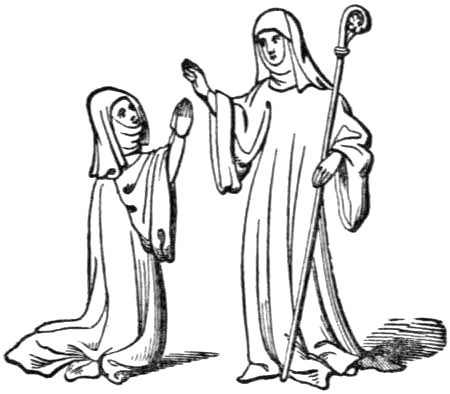
Abbesses, costume of, 57
Abbey, infirmary of, 61
Abbey-church, internal arrangement of, 75
Abbot, duties of, 55;
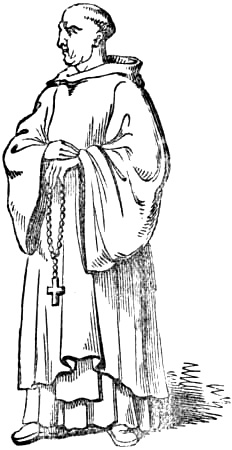
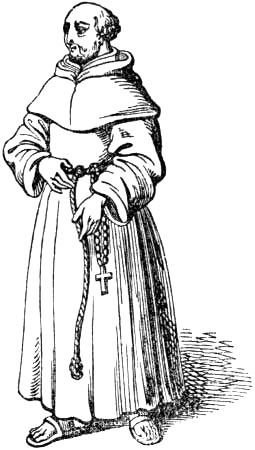
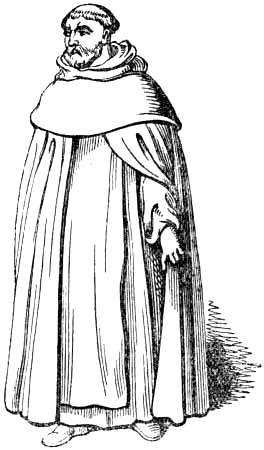
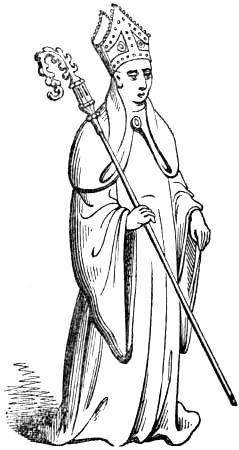
his habit, 57
Abbot-bishop, 5
Abbot’s lodgings, 55, 84
Alien Priories, 34
Ampulla, the Canterbury, 171-73
Anchorages, 132
Anchoresses, bequests to, 129;
Judith the foundress and patroness of the order of, 120;
sketch of, 146
Anchorholds, 130, 134, 138
Anchorites, bequests to, 125-27;
rule for, 121;
their mode of life, 121
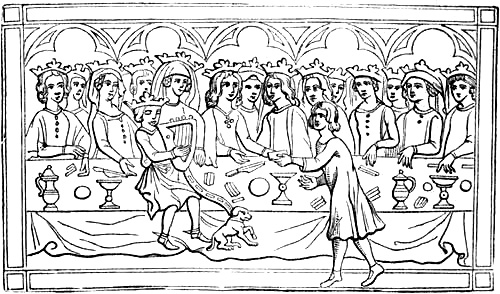
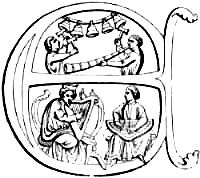
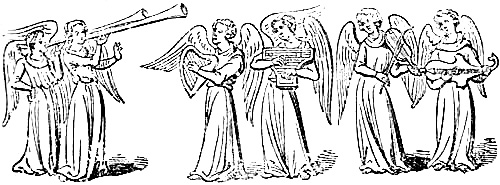
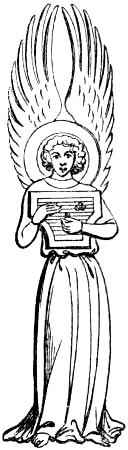
Angel minstrels, 286-88
Anglo-Saxons, St. Augustine the Apostle of the, 6
Arbalesters, the Genoese famous as, 441
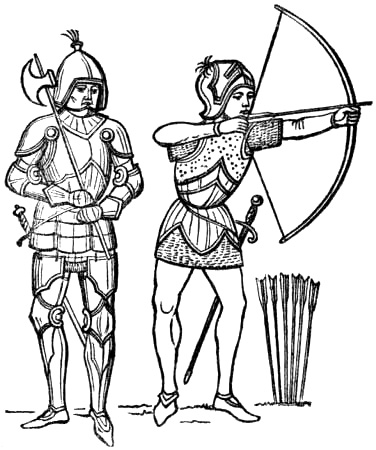
Archers, 438;
corps of enrolled as body guards by Edward III. and French kings, 412;
importance of in battle, 440;
mounted corps of, ib.;
Norman, equipment of at time of Conquest, 438;
skill of English, 440
Archery, practice of by commonality of England protected and encouraged by legislation, 445, 446
Armorial bearings, date of invention of, 331
Armour, details of a suit of thirteenth century, 333;
differences in suits of mediæval, 398, 399;
little worn in the reigns of Elizabeth and James I., 458;
many modifications of in fifteenth century, 452;
of King Henry VIII.’s reign, 453;
of the fourteenth century, 338 et seq.;
of the fifteenth century, 394 et seq.;
various kinds of early, 329, 330, 335, 336
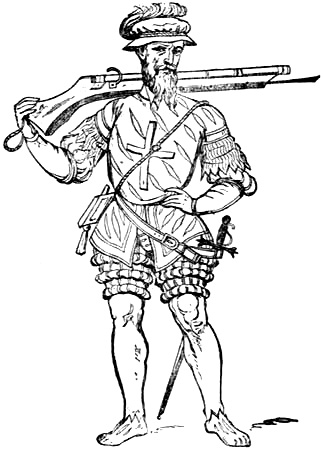
Arquebusier, 458
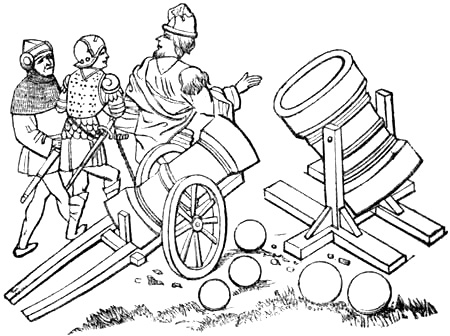
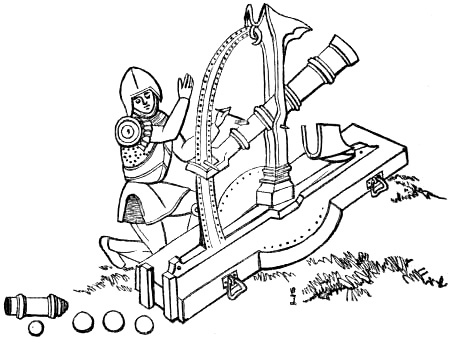
Artillery, ancient, 446;
date of first appearance in field disputed, 447;
first evidence as to the existence of, 440, 447
Augustinians, order of the, 18
Austin friars, order of, 44, 94
Banker, the mediæval, 407
Bard, anecdotes concerning the, 271-73;
the father of the minstrels of mediæval Europe, 270
Basilican Institution, introduction of into Africa by St. Augustine, 4;
into France by St. Martin of Tours, ib.;
into Ireland by St. Patrick, ib.;
into Syria by Hilarion, ib.
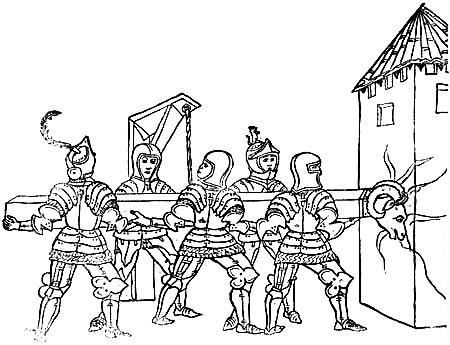
Battering-ram, 385, 450, 451
Bede houses, 24
Benedictine monks, habit of, 1-7;
orders, 17
Benefices, abuses in connection with, 200
Bonhommes, the, 21
Brigittines (female Order of Our Saviour), 21
Britain, exports of when a Roman province, 463
British Church, early history of the, 4
coinage, date of fast, 463
commerce, the beginnings of, 461
Camaldoli, order of, 17
Canons, Secular, cathedral establishments of, 196;
their costume, 197, 198
Canterbury pilgrimage, chief sign of the, its origin and meaning, 170 et seq.
Carmelite friars, order of, 43
Carthusian order, founded by St. Bruno, 15;
Charterhouse (Chartreux) principal house of in England, 15
Carthusians, Cistercians, Clugniacs, and the orders of Camaldoli and Vallambrosa and Grandmont, history of the successive rise of the, 10
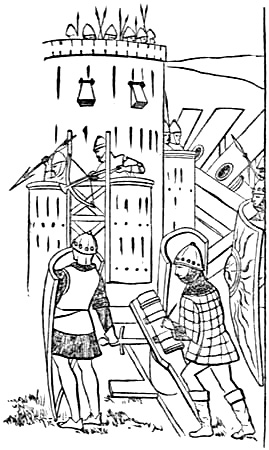
Castle, mode of assaulting a, 381;
various methods of attacking a, 392
Castles, counter-mines used by defenders of mediæval, 387;
Greek fire and stinkpots employed in repelling assailants of, 392;
mines used for effecting breaches in walls of, 385;
places of hospitality as well as of trials of arms, 358
Cells, monastic, 89
Chantry chapels, bequests to, 140
priests, 136, 204, 206
Chapels, private, curious internal arrangement of, 211;
establishments of, 208-10
Chaplains, domestic, 208, 210, 212
Christendom, cœnobitical orders of, 93
Church of England, date of present organization of, 195
Cinque Ports, 480;
ships of the, frequently at war with those of other ports of the kingdom, 483
Cistercian order, founded by Robert de Thierry, 16;
introduced into England A.D. 1128, ib.;
St. Bernard of Clairvaux the great saint of the, 17
Clairvaux, external aspect and internal life of, 12;
founded by St. Bernard, 11
Clergy, comparison between mediæval seculars and modern, 224, 225;
extracts from injunctions of John, Archbishop of Canterbury, on robes of the, 242, 243, 250, 251;
form of degradation for heresy, 214, 215;
friars a popular order of, 223;
parochial, cause of change in condition of the, 193;
rivalry between friars and secular, 223;
secular, 214;
stories illustrating deference of for squire in olden days, 225, 226;
wills of the, 248, 249
Clerical costume of archbishop, 234-236;
of bishop, 235;
of cardinal, 234;
of minor orders, 214, 215;
of pope, 232, 233
Clericus, meaning of the word, 215
Clugniac, order of, 14
Coffin-stones, mediæval, curious symbols on, 193
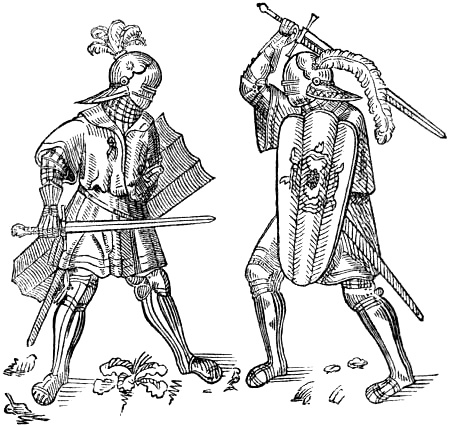
Combat, a mediæval, 375, 376
Commerce, checked by the Conquest, 468;
discovery of sea-passage to India opens up to a career of adventure, 485;
earliest extant document bearing on Saxon, 464;
of England greatly increased during reign of Edward the Confessor, 467;
receives much attention from Government during fourteenth century, 470;
recovers and surpasses its ancient prosperity in reign of Henry II., 469;
the pioneers of, 485
Compostella pilgrimage, legend in connection with badge of the, 169;
offerings made by pilgrims on return from, 190
Convent, the, officials of:
abbot, 55;
almoner, 62;
artificers and servants, 65;
cellarer, 60;
chantor, ib.;
chaplains, 65;
cloister monks, 64;
hospitaller, 61;
infirmarer, 62;
kitchener, 63;
master of the novices, 62;
novices, 65;
porter, 62;
precentor, 58;
prior, 58;
Professed Brethren, 65;
sacrist, 61;
seneschal, 63;
subprior, 60;
succentor, ib.
Council of Hertford, 195;
differences affecting parochial clergy reconciled at, ib.
Council of Lyons, suppression of minor mendicant orders by, 44;
red hat of cardinal first given by Innocent VI. at, 234
Counting-board, the, 501
Cross-bow, not used in war till close of twelfth century, 440;
various forms of, ib.
Croyland, monastery of, 87
Crusades, objects for which they were organised, 159
Crutched friars, order of, 44
Deaconesses, order of, 152
De Pœnetentia friars, order of, 44
Dominican friar, Chaucer’s, 46
friars, order of, 40
Dunstan, Archbishop, reduces all Saxon monasteries to rule of St. Benedict, 7
Education, monasteries famous places of, 66
Edwardian period, armour and arms of the, 347
Egyptian Desert, hermits of the, 148
Eremeti Augustini, order of, 94, 96;
their habit, 96
Eremetical life, curious illustration of, 2
Fairs, sole power of granting right to hold exercised by king, 503;
great, 506
Feudal system, introduction of into England by William the Conqueror, 326;
points of difference between Continental and English, 327
Fontevraud, nuns of, 21
Franciscan friars, order of, 40;
the several branches of, 43
nuns, habit of the, 43
Free towns, mediæval, 530;
Hull an example of one of the, ib.;
manner of laying out, 531-38
Friars, orders of:
Austin, 44;
Carmelites, 43;
Crutched, 44;
de Pœnetentia, 44;
Dominicans, 40;
Franciscans, 40
Chaucer’s type of a certain class of, 39;
convents of, ib.;
pictures of ancient customs and manners of, 45;
the principle which inspired them, 36
Gilbertines, founded by Gilbert of Sempringham, 21
Godrie of Finchale, 116
Grandmontines, order of, 17
Greek Church, costume of monks and nuns in the, 4;
rule of St. Basil followed by all monasteries of, ib.
fire, 449;
used in the Crusades, ib.
Grimlac, rule of, 120, 121
Guesten-halls, 86, 87
Guild priests, 205;
bequests to, 206;
duties of, ib.
Guilds of minstrels, 298;
laws regulating them, 299, 300
Hampton Court, shipping of time of Henry VIII. illustrated at, 484
Harper, the mediæval, 271 et seq.
Henry VIII.’s army, 455;
account of its taking the field, 456;
description of the king’s camp, 458
Heresy, form of degradation for, 214, 215
Hermit, a modern, 119;
form of vow made by mediæval, 98;
popular idea of a, 95;
service for habiting and blessing a, 99;
superstition with regard to a, 100;
typical pictures of a, 117-19
Hermitages, localities of, 101;
descriptions of, 111-17
Hermit-saints, traditional histories of the early, 95 n.;
their costume, 98
Hermits, curious history relating to, 104
Holy Land, early pilgrims to the, 158;
pilgrim entitled to wear palm on accomplishment of pilgrimage to, 167;
special sign worn by pilgrims to, ib.
“Holy Reliques,” an account of, 185-87
Horses, equipment of in fifteenth century, 404;
trappings of at tournaments, 433
Hospitals of the Middle Ages, 23, 24;
foreign examples of, 25
Hospitium, contrast between the Cloister and the, 87;
resorted to by travellers, 529
Houses, description of, given by mediæval traders to various churches and monasteries, 519
Impropriation, evil of, 199
Iona, monastic institution at, 6
Inventories, clerical, 261, 262;
of church furniture, 285
“Isles of Tin,” 461
Jewellery, portable, Saxon goldsmiths famous for, 464
Jousting, 348, 349, 365, 411, 415
Judicial combats, anecdotes illustrative of, 419;
various authorities on the subject of, ib.
Kelvedon Parsonage, 261, 263, 265
Knight, manner of bringing up a, 406;
Chaucer’s portrait of a, 409, 410
Knight-errant, armour and costume of a royal, 349, 350;
graphic account of incidents in single combat of a, 373-75;
squire of a, 352
Knight-errantry, romances of, 354 et seq.
Knighthood, won by deeds of arms in the field and in the lists, 409
Knight Hospitaller, a, 31
Knights of Malta, 33
of St. John of Jerusalem, order of, 29-32
of the Temple, order of, 26, 29, 159
Knights, noblemen and eldest sons of landed gentry made, 408;
ceremony of making essentially a religious one, 409;
equipment of reached its strangest form in reigns of Richard III. and Henry VII. 452
Knights-errant, 369 et seq.
Knights of the Middle Ages, armour, arms, and costume of the, 311 et seq.;
scarcity of authorities for costume and manners of the, 329;
quaint and poetic phrases in romances of the, 367, 368
Laura, the, 3;
original arrangement of the hermits in their, 107
Lindisfarne, monastic institution at, 6
Long-bow, the national arm of the English, 441;
attains climax of its reputation during fourteenth century, 441
London, burgesses of at battle of Hastings, 467;
date of its becoming chief emporium of Britain, 463;
importance of its citizens previous to Conquest, 467;
interesting account of mediæval, 469;
“mysteries,” or trades of, 508;
regulations as to dress of merchants, citizens, and burgesses of the city of, 525
Lord-monks, 223
Marseilles, as a Greek colony, the chief emporium of the world, 462
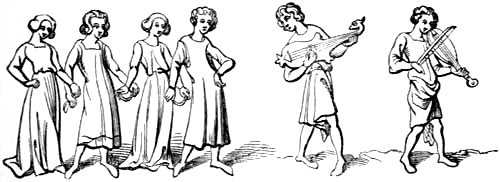
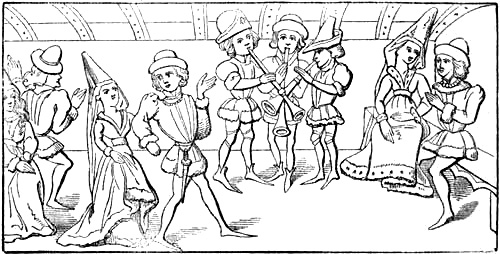
Mediæval dance, a, 281, 282
England, inns of and their signs, 540-44;
picturesque aspect of, 489-92;
population of, 503;
town-halls of, 545;
town houses of county families of, ib.
life and characters, sketches of, from an artist’s point of view, 1
shops, descriptions of, 509, 510
towns, 529;
best specimens of to be found in Normandy and Germany, 535;
Conway a perfect example of one of the, 534;
gradual growth of, 529;
houses of, 534, 535;
inhabitants of, 533;
mode of lodging of population of, ib.;
numerous on the Continent from eleventh to fourteenth centuries, 530;
picturesque views of streets and shops of, 537-40;
some built for specific purposes, 529
trade, 503 et seq.
Merchant, mediæval, an account of his occupation and way of life, 465, 466;
curious epitaph on a brass relating to a, 525;
effigy of a at Northleach, 523
Merchant guilds, 489
navy, the, 475
ships, early, 470, 471;
king at liberty to impress, 481, 482
Merchants, commerce of England, during thirteenth century, carried on by foreign, 470;
details of dresses worn by mediæval, 521;
early English, 465;
law conferring rank on, 465;
munificence of the mediæval, 495;
private naval wars carried on between, 482, 483;
provision in charter of King John as to, 469;
social position of the mediæval, 487, 488;
various classes of distinguished by costume, 487
Middle Ages, armour of the, 329-36;
archers of England famous during the, 439;
combats of the, 411;
consecrated widows of the, 152;
costume of tradespeople of the, 519;
description of the combat between King Arthur and a knight of the, 365, 366;
drill and tactics of the soldiers of the, 377-79;
engines of war of the, 382, 383;
habitations of secular clergy in the, 252-54;
harper the most dignified of the minstrel craft throughout the, 271;
hermits and recluses of the, 93 et seq.;
hospitals of the, 23-25;
hospitium of a monastery in the, 87;
houses of the, 519, 520;
itinerant traders of the, 513, 517;
manner of bringing up a youth of good family in the, 406;
merchant navy of the, 475;
merchant princes of the, 493, 494;
merchants of the, 461 et seq.;
minstrels part of regular establishment of nobles and gentry of the, 275;
monks of the, 1 et seq.;
primitive mode of life of rural English population of the, 513;
ships of the, 470-71;
sketch of life led by a country parson in the, 262, 263;
sumptuary laws regulating dress of merchants of the, 525;
system of Pluralities in the, 200
Military engines, 382 et seq.
exercises and encounters, 410 et seq.
orders:
Knights of St. John of Jerusalem, 29;
Knights of the Temple, 26;
Our Lady of Mercy, 32;
Teutonic Knights, ib.;
Trinitarians, 32-34
Minstrels, mediæval, assist in musical part of divine service, 285;
costume of, 304-309;
curious anecdotes concerning, 294, 295;
duties of, 275 et seq.;
female, 302, 303;
incorporated in a guild, 297;
marriage processions attended by, 282, 283;
often men of position and worth, 294, 295;
part of regular establishment of nobles and gentry, 275-77;
patronised by the clergy, 288;
singular ordinance relating to, 296;
tournaments enlivened by the strains of, 291, 292;
welcome guests at the religious houses, 289, 290
“Minstrels unattached,” 293, 294
Miracle-plays, parish clerks took an important part in, 220;
survival of in Spain, 221
Minstrelsy, in high repute among the Normans, 274;
Grostête of Lincoln a great patron of, 288;
Israelitish compared with music of mediæval England, 267
Mitre, earliest form of the, 236;
transition shape of the from twelfth century, ib.
Monachism, origin of, 1-5
Monasteries, Benedictine, 9;
British, 5;
Saxon, 7;
suppression of, 52
Monastery, arrangement of a Carthusian, 71;
description of a, 72 et seq.;
graphic sketch of the arrival of guests at a, 87
Monastic orders, traditionary histories of the founders and saints of, 1 et seq.;
their suppression in England, 52
Monk, cell of a Carthusian, 123;
pilgrim, 188
Monks, abodes of, 70;
lord, 223
Monumental brasses, 19, 57, 276, 494, 495, 497, 521, 527;
minutiæ of costume of middle ages supplied from, 521;
peculiar features in, 526
Movable tower, a, 387
Music, sketch of the earliest history of, 267-70
Musical instruments, date of invention of, 267;
occasions when used, ib.;
names of, ib. et seq.;
used in the colleges of the prophets, 269;
Saxon, 273;
learned essays on mediæval, 274;
used in celebration of divine worship, 285;
forms of, 309, 310
Order for the Redemption of Captives, 33, 34;
their habit, 34;
their rules, ib.
Ostiary, costume of an, 215 n.
Our Lady of Mercy, order of, 32
Our Lady of Walsingham, shrine of, 180, 181;
a relic from, ib.
Pachomius, written code of laws by, 4
Palmers, 189, 190;
graves of three holy, 193
Parish clerk, frequently the recipient of a legacy, 217;
his duties, 218, 220;
office of an ancient, ib.;
worth of his office, 220
priests, early handbooks for, 227;
instructions for, 162 n.;
points of difference between monks and friars and the, 222
Parochial clergy, 195, 196;
domestic economy of the early, 263-65;
organization of the established by Archbishop of Canterbury, 195
Parsonage houses, early, 254 et seq.;
description of, 259;
furniture of, 261, 262
Pastoral staff, earliest examples of the, 237
Pedlars, their mode of dealing in mediæval times, 513, 515, 517
Pilgrim, an equestrian, 168;
the female, 188;
the penitential, 178
Pilgrimage, chief sign of the Canterbury, 170;
chief signs of the Roman, 168;
Holy Land first object of, 175;
mendicant, 176;
palmers, on return from, received with ecclesiastical processions, 189;
practice to return thanks on returning from, 189;
relics of, 191, 192;
saying of Jerome as to, 157;
special roads to the great shrines of, 178;
sign of the Compostella, 169;
usual places for, 159
Pilgrimages, a pleasant religious holiday, 176;
gathering cry of, 178;
popular English, 161, 162
Pilgrims, 159, 160;
costume of, 164, 177;
description of staff and scrip of, 164-66;
graphic sketch of a company of passing through a town, 179;
insignia of, 164, 192, 193;
office of, 162-64;
special signs of, 167;
singers and musicians employed by, 179;
vow made by, 164
Pioneers of commerce, the, 485
Piracy, prevalence of in mediæval times, 483, 484
Plate armour, first introduction of, 336
“Pleasure fairs,” 507
Priest-hermits, costume of, 97
Priesthood, curious history of way in which many poor men’s sons attained to the, 201
Prior, functions of, 59
Prioress, Chaucer’s description of a, 58
Recluse, service for enclosing a, 148, 150
Recluses, bequests to, 128, 129;
canons concerning, 121;
cells of female, 142;
curious details of the life of, 130;
dress of female, 97;
giving of alms to, 123;
hermitages for female, 130, 131;
popular idea as to the life of, 121;
sketch of, 146-48
Reclusorium, the, 124, 125, 132
Rectors, Saxon, 198, 199
Reformed Benedictine orders, 17
Regular Canons, Premonstratensian branch of, founded by St. Norbert, 21
Rettenden, reclusorium at, 135, 137
Richard of Hampole, life of, 107-10
Rome, pilgrimage to, 168;
number of pilgrims visiting, 168;
description of relics at, 182, 183 n.
Sacred music, 284
Salby abbey, staff of servants at, 66
Saxon soldiers, costume of, 312-18, 322-24;
ornaments of, 324, 325;
romantic fancies in connection with swords of, 320;
weapons used by, 316, 318, 319, 321
Saxons, the, a musical people, 272;
a pastoral rather than an agricultural race, 466;
corn not exported by the, ib.;
famous throughout Europe for goldsmiths’ work and embroidery, ib.;
rage among the for foreign pilgrimages, 464;
traffic in slaves considerable during time of the, 466
Scottish Archers of the Guard, enrolment of the, 442
Secular clergy, comparison between costume of and that of mediæval merchants, 528;
costume of the, 232 et seq.
Shrines, pictures of, 187
Siege, interesting points in a mediæval, 442
Solitaries, mediæval, 94;
curious incident relating to two, 105
Spenser’s description of a typical hermit and hermitage, 118, 119
Squires, duties of, 352
St. Anthony, cœnobite system attributed to, 4;
monks of, ib.
St. Augustine, Canons Secular of, 18;
their costume, ib.;
Canons Regular of, 20;
Chaucer’s pen-and-ink sketch of one of the order, 19
St. Basil, abuse of great church festivals mentioned by, 513;
introduction of Monachism into Asia Minor by, 4;
rule of, ib.
St. Benedict, his rule, 6, 7;
Archbishop Dunstan reduces all Saxon monasteries to rule of, 7
St. Clare, foundress of the female order of Franciscans, 43
St. Edmund’s Bury, abbey of, 65
St. Francis, character of, 37
St. Jean-les-Bons-hommes, priory of, 89
St. John the Hermit, 148
St. Mary, Winchester, abbey of, 66
Sumptuary laws, 525;
civil costume regulated by, 527, 528
Teutonic Knights, order of, 32
Tilting-ground, remains of, to be seen at Carisbrook Castle, 359
Timber fort, 444;
used by William the Conqueror, 391
Tournament, 412;
a miniature, 415;
an historical example of the, 429, 430;
description of encounter between French and English knights at a, 432;
directions for the, 415-17;
form of challenge for a, 431;
form of proclamation inviting to a, 412, 413;
habiliments required by knights at a, ib.;
incidents relating to a, 424, 430;
manner of arranging a, 423;
mode of arming knights for the, 413;
pictures illustrating various scenes of the, 432, 433;
prizes of the, 427;
the joute à outrance, 412;
the joute à plaisance, ib.;
weapons used at a, 415
Tournaments, feasting and merriment usual at, 424;
the mediæval romances safe authorities on all relating to the subject of, 423;
unusual deeds performed at, 426, 427
Town-halls, architectural beauty of continental, 544;
date of earliest English, 545
Towns, provincial, market-days in mediæval, 511, 572;
specimens of various in time of Edward III., 508-10
Traveller, religious houses chiefly the resting-places of the, 103, 490
Trinitarians, order of, 32-34
Vallombrosa, order of, 17
Vestments, mediæval official, description of, 237-241;
abandoned at time of Reformation, 250
Wager of Battle, account of a mediæval, 420-22
Walter of Hamuntesham, beating of by rabble, 64
War-ships, cannon of both iron and brass employed on board English, A.D. 1338, 447;
costume of sailors and soldiers of mediæval, 477;
description of early, 475 et seq.;
list of English, A.D. 1205, and where stationed, 481
Waverley, Cistercian abbey of, 65
Westminster Abbey, grants made by Henry VIII. to, 79
Whale fishing, early, 474
Widowhood, description of a lady who took the vows of, 155, 156
Widows, order of, 152;
dress worn by, 156;
profession or vow of, 154;
service for consecration of, 152, 153
William of Swynderby, 140
Wills, inventories attached to ancient, 211, 212 n.
Wool merchants, costume of mediæval, 523, 525
THE END.
THE RIVERSIDE PRESS LIMITED, EDINBURGH
Footnotes:
[1] We cannot put down all these supernatural tales as fables or
impostures; similar tales abound in the lives of the religious people of
the Middle Ages, and they are not unknown in modern days: e.g., Luther’s
conflict with Satan in the Wartzburg, and Colonel Gardiner’s vision of the
Saviour. Which of them (if any) are to be considered true supernatural
visions, which may be put down as the natural results of spiritual
excitement on the imagination, which are mere baseless legends, he would
be a very self-confident critic who professed in all cases to decide.
[2] Besides consulting the standard authorities on the archæology of the
subject, the student will do well to read Mr. Kingsley’s charming book,
“The Hermits of the Desert.”
[3] Strutt’s “Dress and Habits of the People of England.”
[4] This is the computation of Tanner in his “Notitia Monastica;” but the
editors of the last edition of Dugdale’s “Monasticon,” adding the smaller
houses or cells, swell the number of Benedictine establishments in England
to a total of two hundred and fifty-seven.
[5] If a child was to be received his hand was wrapped in the hanging of
the altar, “and then,” says the rule of St. Benedict, “let them offer
him.” The words are “Si quas forte de nobilibus offert filium suum Deo in
monasterio, si ipse puer minore ætate est, parentes ejus faciant
petitionem et manum pueri involvant in pallu altaris, et sic eum offerunt”
(c. 59). The Abbot Herman tells us that in the year 1055 his mother took
him and his brothers to the monastery of which he was afterwards abbot.
“She went to St. Martin’s (at Tournay), and delivered over her sons to
God, placing the little one in his cradle upon the altar, amidst the tears
of many bystanders” (Maitland’s “Dark Ages,” p. 78). The precedents for
such a dedication of an infant to an ascetic life are, of course, the case
of Samuel dedicated by his mother from infancy, and of Samson and John
Baptist, who were directed by God to be consecrated as Nazarites from
birth. A law was made prohibiting the dedication of children at an earlier
age than fourteen. At f. 209 of the MS. Nero D. vii., is a picture of St.
Benedict, to whom a boy in monk’s habit is holding a book, and he is
reading or preaching to a group of monks.
[6] Engraved in Boutell’s “Monumental Brasses.”
[7] Probably this means that he had “clocks”—little bell-shaped
ornaments—sewn to the lower margin of his tippet or hood.
[8] Mrs. Jameson, “Legends of the Monastic Orders,” p. 137.
[9] Viollet le Duc’s “Dictionary of Architecture,” vol. vi. p. 104.
[10] Ibid. vi. 107.
[11] Ibid. vi. 112.
[12] Ibid. vi. 112.
[13] All its houses were called Temples, as all the Carthusian houses were
called Chartereux (corrupted in England into Charterhouse).
[14] Of the four round churches in England, popularly supposed to have
been built by the Templars, the Temple Church in London was built by them;
that of Maplestead, in Essex, by the Hospitallers; that of Northampton by
Simon de St. Liz, first Norman Earl of Northampton, twice a pilgrim to the
Holy Land; and that of Cambridge by some unknown individual.
[15] The order was divided into nations—the English knights, the French
knights, &c.—each nation having a separate house, situated at different
points of the island, for its defence. These houses, large and fine
buildings, still remain, and many unedited records of the order are said
to be still preserved on the island.
[16] An order, called our Lady of Mercy, was founded in Spain in 1258, by
Peter Nolasco, for a similar object, including in its scope not only
Christian captives to the infidel, but also all slaves, captives, and
prisoners for debt.
[17] Afternoons and mornings.
[18] As an indication of their zeal in the pursuit of science it is only
necessary to mention the names of Friar Roger Bacon, the Franciscan, and
Friar Albert-le-Grand (Albertus Magnus), the Dominican. The Arts were
cultivated with equal zeal—some of the finest paintings in the world were
executed for the friars, and their own orders produced artists of the
highest excellence. Fra Giacopo da Turrita, a celebrated artist in mosaic
of the thirteenth century, was a Franciscan, as was Fra Antonio da
Negroponti, the painter; Fra Fillippo Lippi, the painter, was a Carmelite;
Fra Bartolomeo, and Fra Angelico da Fiesole—than whom no man ever
conceived more heavenly visions of spiritual loveliness and purity—were
Dominicans.
[19]
“By his (i.e. Satan’s) queyntise they comen in,
The curates to helpen,
But that harmed hem hard
And help them ful littel.”—Piers Ploughman’s Creed.
[20] The extract from Chaucer on p. 46, lines 4, 5, 6, seem to indicate
that an individual friar sometimes “farmed” the alms of a district, paying
the convent a stipulated sum, and taking the surplus for himself.
[21] In France, Jacobins.
[22] Wives of burgesses.
[23] Stuffed.
[24] Musical instrument so called.
[25] Piers Ploughman (creed 3, line 434), describing a burly Dominican
friar, describes his cloak or cope in the same terms, and describes the
under gown, or kirtle, also:—
“His cope that beclypped him
Wel clean was it folden,
Of double worsted y-dyght
Down to the heel.
His kirtle of clean white,
Cleanly y-served,
It was good enough ground
Grain for to beren.”
[26] A limitour, as has been explained above, was a friar whose functions
were limited to a certain district of country; a lister might exercise his
office wherever he listed.
[27] Thirty masses for the repose of a deceased person.
[28] Viz., in convents of friars, not in monasteries of monks and by the
secular clergy.
[29] He was forbidden to say more.
[30] A convent of friars used to undertake masses for the dead, and each
friar saying one the whole number of masses was speedily completed,
whereas a single priest saying his one mass a day would be very long
completing the number, and meantime the souls were supposed to be in
torment.
[31] The usual way of concluding a sermon, in those days as in these, was
with an ascription of praise, “Who with the Father,” &c.
[32] Cake.
[33] Choose.
[34] Slip or piece.
[35] Hired man.
[36] Trifles.
[37] Requite.
[38] Staff.
[39] Closely.
[40] Part.
[41] Forbidden.
[42] Would not.
[43] The good man also said he had not seen the friar “this fourteen
nights:”—Did a limitour go round once a fortnight?
[44] The dormitory of the convent.
[45] Infirmarer.
[46] Aged monks and friars lived in the Infirmary, and had certain
privileges.
[47] Wert thou not.
[48] Implying, whether truly or not, that he had been enrolled in the
fraternity of the house, and was prayed for, with other benefactors, in
chapter.
[49] Health and strength.
[50] Doctor.
[51] Little.
[52] Preaching; he was probably a preaching friar—i.e., a Dominican.
[53] Waxed nearly mad.
[54] Lived.
[55] “On the foundation,” as we say now of colleges and endowed schools.
[56]
“Maysters of divinite
Her matynes to leve,
And cherliche [richly] as a cheveteyn
His chaumbre to holden,
With chymene and chaple,
And chosen whom him list,
And served as a sovereyn,
And as a lord sytten.”
Piers Ploughman, l. 1,157.
[57] Just as heads of colleges now have their Master’s, or Provost’s, or
Principal’s Lodge. The constitution of our existing colleges will assist
those who are acquainted with them in understanding many points of
monastic economy.
[58] Ellis’s “Early English Romances.”
[59] Long and well proportioned.
[60] She was of tall stature.
[61] “And as touching the almesse that they (the monks) delt, and the
hospitality that they kept, every man knoweth that many thousands were
well received of them, and might have been better, if they had not so many
great men’s horse to fede, and had not bin overcharged with such idle
gentlemen as were never out of the abaies (abbeys).”—A complaint made to
Parliament not long after the dissolution, quoted in Coke’s Institutes.
[62] A person doing penance.
[63] Hunting.
[64] Without state.
[65] A plan of the Chartreuse of Clermont is given by Viollet le Duc
(Dict. of Architec., vol. i. pp. 308, 309), and the arrangements of a
Carthusian monastery were nearly the same in all parts of Europe. It
consists of a cloister-court surrounded by about twenty square enclosures.
Each enclosure, technically called a “cell,” is in fact a little house and
garden, the little house is in a corner of the enclosure, and consists of
three apartments. In the middle of the west side of the cloister-court is
the oratory, whose five-sided apsidal sanctuary projects into the court.
In a small outer court on the west is the prior’s lodgings, which is a
“cell” like the others, and a building for the entertainment of guests.
See also a paper on the Carthusian priory of Mount Grace, near Thirsk,
read by Archdeacon Churton before the Yorkshire Architectural Society, in
the year 1850.
[66] A bird’s-eye view of Citeaux, given in Viollet le Duc’s “Dictionary
of Architecture,” vol. i. p. 271, will give a very good notion of a
thirteenth-century monastery. Of the English monasteries Fountains was
perhaps one of the finest, and its existing remains are the most extensive
of any which are left in England. A plan of it will be found in Mr.
Walbran’s “Guide to Ripon.” See also plan of Furness, Journal of the
Archæological Association, vi. 309; of Newstead (an Augustinian house),
ibid. ix. p. 30; and of Durham (Benedictine), ibid. xxii. 201.
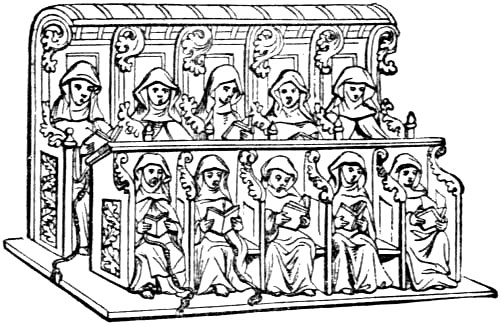
[67] A double choir of the fifteenth century is in King René’s Book of
Hours (Egerton, 1,070), at folio 54. Another semi-choir of Religious of
late fifteenth and early sixteenth century date, very well drawn, may be
found in Egerton, 2,125, f. 117, v.
[68] Lydgate’s Life of St. Edmund, a MS. executed in 1473 A.D., preserved
in the British Museum (Harl. 2,278), gives several very good
representations of the shrine of that saint at St. Edmund’s Bury, with the
attendant monks, pilgrims worshipping, &c.
[69]
“Tombes upon tabernacles, tiled aloft,
******
Made of marble in many manner wise,
Knights in their conisantes clad for the nonce,
All it seemed saints y-sacred upon earth,
And lovely ladies y-wrought lyen by their sides
In many gay garments that were gold-beaten.”
Piers Ploughman’s Creed.
[70] Henry VII. agreed with the Abbot and Convent of Westminster that
there should be four tapers burning continually at his tomb—two at the
sides, and two at the ends, each eleven feet long, and twelve pounds in
weight; thirty tapers, &c., in the hearse; and four torches to be held
about it at his weekly obit; and one hundred tapers nine feet long, and
twenty-four torches of twice the weight, to be lighted at his anniversary.
[71]
“For though a man in their mynster a masse wolde heren,
His sight shal so be set on sundrye werkes,
The penons and the pornels and poyntes of sheldes
Withdrawen his devotion and dusken his heart.”
Piers Ploughman’s Vision.
[72] The chapter-houses attached to the cathedrals of York, Salisbury, and
Wells, are octagonal; those of Hereford and Lincoln, decagonal; Lichfield,
polygonal; Worcester is circular. All these were built by secular canons.
[73] There are only two exceptions hitherto observed: that of the
Benedictine Abbey of Westminster, which is polygonal, and that of Thornton
Abbey, of regular canons, which is octagonal.
[74] And at Norwich it appears to have had an eastern apse. See
ground-plan in Mr. Mackenzie E. C. Walcott’s “Church and Conventual
Arrangement,” p. 85.
[75] Piers Ploughman describes the chapter-house of a Benedictine
convent:—
“There was the chapter-house, wrought as a great church,
Carved and covered and quaintly entayled [sculptured];
With seemly selure [ceiling] y-set aloft,
As a parliament house y-painted about.”
[76] In the “Vision of Piers Ploughman” one of the characters complains
that if he commits any fault—
“They do me fast fridays to bread and water,
And am challenged in the chapitel-house as I a child were;”
and he is punished in a childish way, which is too plainly spoken to bear
quotation.
[77] See note on p. 76.
[78] The woodcut on a preceding page (23) is from another initial letter
of the same book.
[79] A room adjoining the hall, to which the fellows retire after dinner
to take their wine and converse.
[80] The ordinary fashion of the time was to sleep without any clothing
whatever.
[81] In the plan of the ninth-century Benedictine monastery of St. Gall,
published in the Archæological Journal for June, 1848, the dormitory is
on the east, with the calefactory under it; the refectory on the south,
with the clothes-store above; the cellar on the west, with the larders
above. In the plan of Canterbury Cathedral, a Benedictine house, as it
existed in the latter half of the twelfth century, the church was on the
south, the chapter-house and dormitory on the east, the refectory,
parallel with the church, on the north, and the cellar on the west. At the
Benedictine monastery at Durham, the church was on the north, the
chapter-house and locutory on the east, the refectory on the south, and
the dormitory on the west. At the Augustinian Regular Priory of
Bridlington, the church was on the north, the fratry (refectory) on the
south, the chapter-house on the east, the dortor also on the east, up a
stair twenty steps high, and the west side was occupied by the prior’s
lodgings.
At the Premonstratensian Abbey of Easby, the church is on the north, the
transept, passage, chapter-house, and small apartments on the east, the
refectory on the south, and on the west two large apartments, with a
passage between them. The Rev. J. F. Turner, Chaplain of Bishop Cozin’s
Hall, Durham, describes these as the common house and kitchen, and places
the dormitory in a building west of them, at a very inconvenient distance
from the church.
[82] Maitland’s “Dark Ages.”
[83] At Winchester School, until a comparatively recent period, the
scholars in the summer time studied in the cloisters.
[84] For much curious information about scriptoria and monastic libraries,
see Maitland’s “Dark Ages,” quoted above.
[85] The hall of the Royal Palace of Winchester, erected at the same
period, was 111 feet by 55 feet 9 inches.
[86] Its total length would perhaps be about twenty-four paces.
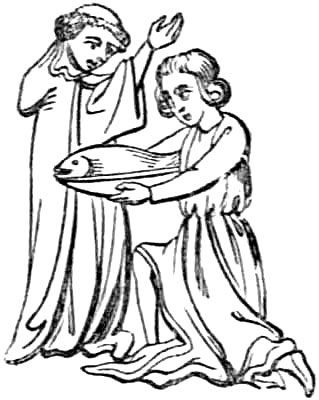
[87] The above woodcut, from the Harleian MS. 1,527, represents, probably,
the cellarer of a Dominican convent receiving a donation of a fish. It
curiously suggests the scene depicted in Sir Edwin Landseer’s “Bolton
Abbey in the Olden Time.”
[88] See an account of this hall, with pen-and-ink sketches by Mr. Street,
in the volume of the Worcester Architectural Society for 1854.
[89] Quoted by Archdeacon Churton in a paper read before the Yorkshire
Architectural Society in 1853.
[90] Ground-plans of the Dominican Friary at Norwich, the Carmelite Friary
at Hulne and the Franciscan Friary at Kilconnel, may be found in Walcott’s
“Church and Conventual Arrangement.”
[91] In the National Gallery is a painting by Fra Angelico, in which is a
hermit clad in a dress woven of rushes or flags.
[92] “The Wonderful and Godly History of the Holy Fathers Hermits,” is
among Caxton’s earliest-printed books. Piers Ploughman (“Vision”) speaks
of—
“Anthony and Egidius and other holy fathers
Woneden in wilderness amonge wilde bestes
In spekes and in spelonkes, seldom spoke together.
Ac nobler Antony ne Egedy ne hermit of that time
Of lions ne of leopards no livelihood ne took,
But of fowles that fly, thus find men in books.”
And again—
“In prayers and in penance putten them many,
All for love of our Lord liveden full strait,
In hope for to have heavenly blisse
As ancres and heremites that holden them in their cells
And coveten not in country to kairen [walk] about
For no likerous lifelihood, their liking to please.”
And yet again—
“Ac ancres and heremites that eaten not but at nones
And no more ere morrow, mine almesse shall they have,
And of my cattle to keep them with, that have cloisters and churches,
Ac Robert Run-about shall nought have of mine.”
Piers Ploughman’s Vision.
[93] Piers Ploughman (“Vision”) describes himself at the beginning of the
poem as assuming the habit of a hermit—
“In a summer season when soft was the sun
In habit as a hermit unholy of works,
Went wild in this world, wonders to hear,
All on a May morning on Malvern Hills,” &c.
And at the beginning of the eighth part he says—
“Thus robed in russet I roamed about
All a summer season.”
[94] For the custom of admitting to the fraternity of a religious house,
see p. 66.
[95] “Officium induendi et benedicendi heremitam.”
[96] We are indebted to Mr. M. H. Bloxam for a copy of it.
[97] “Famulus tuus N.” It is noticable that the masculine gender is used
all through, without any such note as we find in the Service for Inclosing
(which we shall have to notice hereafter), that this service shall serve
for both sexes.
[98] The hermit who interposed between Sir Lionel and Sir Bors, and who
was killed by Sir Lionel for his interference (Malory’s “Prince Arthur,”
III, lxxix.), is called a “hermit-priest.” Also, in the Episcopal Registry
of Lichfield, we find the bishop, date 10th February, 1409, giving to
Brother Richard Goldeston, late Canon of Wombrugge, now recluse at Prior’s
Lee, near Shiffenall, license to hear confessions.
[99]
“Great loobies and long, that loath were to swink [work],
Clothed them in copes to be known from others,
And shaped them hermits their ease to have.”
[100] Wanderers.
[101] Breakers out of their cells.
[102] Kindred.
[103] In “Piers Ploughman” we read that—
“Hermits with hoked staves
Wenden to Walsingham;”
These hooked staves may, however, have been pilgrim staves, not hermit
staves. The pastoral staff on the official seal of Odo, Bishop of Bayeux,
was of the same shape as the staff above represented. A staff of similar
shape occurs on an early grave-stone at Welbeck Priory, engraved in the
Rev. E. L. Cutts’s “Manual of Sepulchral Slabs and Crosses,” plate xxxv.
[104] Blomfield, in his “History of Norfolk,” 1532, says, “It is to be
observed that hermitages were erected, for the most part, near great
bridges (see Mag. Brit., On Warwickshire, p. 597, Dugdale, &c., and
Badwell’s ‘Description of Tottenham’) and high roads, as appears from
this, and those at Brandon, Downham, Stow Bardolph, in Norfolk, and Erith,
in the Isle of Ely, &c.”
[105] In the settlement of the vicarage of Kelvedon, Essex, when the
rectory was impropriated to the abbot and convent of Westminster, in the
fourteenth century, it was expressly ordered that the convent, besides
providing the vicar a suitable house, should also provide a hall for
receiving guests. See subsequent chapter on the Secular Clergy.
[106] From the “Officium et Legenda de Vita Ricardi Rolle.”
[107] When is not stated; he died in 1349.
[108] Afterwards it is described as a cell at a distance from the family,
where he was accustomed to sit solitary and to pass his time in
contemplation. In doing this Sir John Dalton and his wife were, according
to the sentiment of the time, following the example of the Shunammite and
her husband, who made for Elisha a little chamber on the wall, and set for
him there a bed, and a table, and a stool, and a candlestick (2 Kings iv.
10). The Knight of La Tour Landry illustrates this when in one of his
tales (ch. xcv.) he describes the Shunammite’s act in the language of
mediæval custom: “This good woman had gret devocion unto this holy man,
and required and praied hym for to come to her burghe and loged in her
hous, and her husbonde and she made a chambre solitaire for this holy man,
where as he might use his devocions and serve God.”
[109] Either the little window through which she communicated with the
outer world, or perhaps (as suggested further on) a window between her
cell and a guest-chamber in which she received visitors.
[110] A hermitage, partly of stone, partly of timber, may be seen in the
beautiful MS. Egerton 1,147, f. 218 v.
[111] A very good representation of a cave hermitage may be found in the
late MS. Egerton, 2,125, f. 206 v. Also in the Harl. MS. 1,527, at f. 14
v., is a hermit in a cave; and in Royal 10 E IV. f. 130, here a man is
bringing the hermit food and drink.
[112] Eugene Aram’s famous murder was perpetrated within it. See Sir E. L.
Bulwer’s description of the scene in his “Eugene Aram.”
[113] See view in Stukeley’s “Itin. Curios.,” pl. 14.
[114] Suggesting the room so often found over a church porch.
[115] In the year 1490, a dispute having arisen between the abbot and
convent of Easby and the Grey Friars of Richmond, on the one part, and the
burgesses of Richmond, on the other part, respecting the disposition of
the goods of Margaret Richmond, late anchoress of the same town, it was at
length settled that the goods should remain with the warden and brethren
of the friars, after that her debts and the repair of the anchorage were
defrayed, “because the said anchoress took her habit of the said friars,”
and that the abbot and convent should have the disposition of the then
anchoress, Alison Comeston, after her decease; and so to continue for
evermore between the said abbot and warden, as it happens that the
anchoress took her habit of religion. And that the burgesses shall have
the nomination and free election of the said anchoress for evermore from
time to time when it happens to be void, as they have had without time of
mind. (Test. Ebor. ii. 115.)
[116] In June 5, 1356, Edward III. granted to brother Regnier, hermit of
the Chapel of St. Mary Magdalen, without Salop, a certain plot of waste
called Shelcrosse, contiguous to the chapel, containing one acre, to hold
the same to him and his successors, hermits there, for their habitation,
and to find a chaplain to pray in the chapel for the king’s soul, &c.
(Owen and Blakeway’s “History of Shrewsbury,” vol. ii. p. 165). “Perhaps,”
say our authors, “this was the eremitical habitation in the wood of
Suttona (Sutton being a village just without Salop), which is recorded
elsewhere to have been given by Richard, the Dapifer of Chester, to the
monks of Salop.”
[117] “Vita S. Godrici,” published by the Surtees Society.
[118] Simple.
[119] Meddle.
[120] Since the above was written, the writer has had an opportunity of
visiting a hermitage very like those at Warkworth, Wetheral, Bewdley, and
Lenton, still in use and habitation. It is in the parish of Limay, near
Mantes, a pretty little town on the railway between Rouen and Paris.
Nearly at the top of a vine-clad hill, on the north of the valley of the
Seine, in which Mantes is situated, a low face of rock crops out. In this
rock have been excavated a chapel, a sacristy, and a living-room for the
hermit; and the present hermit has had a long refectory added to his
establishment, in which to give his annual dinner to the people who come
here, one day in the year, in considerable numbers, on pilgrimage. The
chapel differs from those which we have described in the text in being
larger and ruder; it is so wide that its rocky roof is supported by two
rows of rude pillars, left standing for that purpose by the excavators.
There is an altar at the east end. At the west end is a representation of
the Entombment; the figure of our Lord, lying as if it had become rigid in
the midst of the writhing of his agony, is not without a rude force of
expression. One of the group of figures standing about the tomb has a late
thirteenth-century head of a saint placed upon the body of a Roman soldier
of the Renaissance period. There is a grave-stone with an incised cross
and inscription beside the tomb; and in the niche on the north side is a
recumbent monumental effigy of stone, with the head and hands in white
glazed pottery. But whether these things were originally placed in the
hermitage, or whether they are waifs and strays from neighbouring
churches, brought here as to an ecclesiastical peep-show, it is hard to
determine; the profusion of other incongruous odds and ends of
ecclesiastical relics and fineries, with which the whole place is
furnished, inclines one to the latter conjecture. There is a bell-turret
built on the rock over the chapel, and a chimney peeps through the
hill-side, over the sacristy fireplace. The platform in front of the
hermitage is walled in, and there is a little garden on the hill above.
The curé of Limay performs service here on certain days in the year. The
hermit will disappoint those who desire to see a modern example of
“An aged sire, in long black weedes yclad,
His feet all bare, his beard all hoarie gray.”
He is an aged sire, seventy-four years old; but for the rest, he is simply
a little, withered, old French peasant, in a blue blouse and wooden
sabots. He passes his days here in solitude, unless when a rare party of
visitors ring at his little bell, and, after due inspection through his
grille, are admitted to peep about his chapel and his grotto, and to
share his fine view of the valley shut in by vine-clad hills, and the
Seine winding through the flat meadows, and the clean, pretty town of
Mantes le jolie in the middle, with its long bridge and its
cathedral-like church. Whether he spends his time
“Bidding his beades all day for his trespas,”
we did not inquire; but he finds the hours lonely. The good curé of Limay
wishes him to sleep in his hermitage, but, like the hermit-priest of
Warkworth, he prefers sleeping in the village at the foot of the hill.
[121] One of the little hermitages represented in the Campo Santo series
of paintings of the old Egyptian hermit-saints (engraved in Mrs. Jameson’s
“Legends of the Monastic Orders”) has a little grated window, through
which the hermit within (probably this John) is talking with another
outside.
[122] That recluses did, however, sometimes quit their cells on a great
emergency, we learn from the Legenda of Richard of Hampole already quoted,
where we are told that at his death Dame Margaret Kyrkley, the recluse of
Anderby, on hearing of the saint’s death, hastened to Hampole to be
present at his funeral.
[123] Wilkins’s “Concilia,” i. 693.
[124] Several MSS. of this rule are known under different names. Fosbroke
quotes one as the rule of Simon de Gandavo (or Simon of Ghent), in Cott.
MS. Nero A xiv.; another in Bennet College, Cambridge; and another under
the name of Alfred Reevesley. See Fosbroke’s “British Monachism,” pp.
374-5. The various copies, indeed, seem to differ considerably, but to be
all derived from the work ascribed to Bishop Poore. All these books are
addressed to female recluses, which is a confirmation of the opinion which
we have before expressed, that the majority of the recluses were women.
[125] Thus the player-queen in Hamlet, iii. 2:—
“Nor earth to me give food, nor heaven light!
Sport and repose lock from me, day, and night!
To desperation turn my trust and hope!
An anchor’s cheer in prison be my scope!
Each opposite, that blanks the face of joy,
Meet what I would have well, and it destroy,” &c.
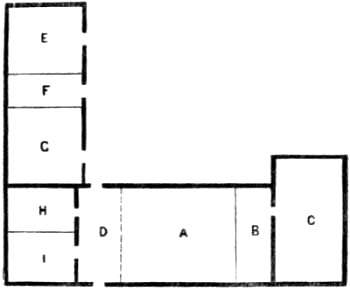
[126] A cell in the north-west angle of Edington Abbey Church, Wilts,
seems to be of this kind.
[127] The wearing a cuirass, or hauberk of chain mail, next the skin
became a noted form of self-torture; those who undertook it were called
Loricati.
[128] The cell of a Carthusian monk, as we have stated, consisted of a
little house of three apartments and a little garden within an inclosure
wall.
[129] This very same picture is given also in another MS. of about the
same date, marked Add. 10,294, at folio 14.
[130] As was probably the case at Warkworth, the hermit living in the
hermitage, while the chantry priest lived in the house at the foot of the
hill.
[131]
“Eremites that inhabiten
By the highways,
And in boroughs among brewers.”
Piers Ploughman’s Vision.
[132] Probably “anchoret” means male, and “recluse” female recluse.
[133] Test. Vetust., ii. 25.
[134] Ibid. ii. 47.
[135] Ibid. ii. 56.
[136] Ibid. ii. 271.
[137] Note p. 87 to “Instructions for Parish Priests,” Early English Text
Society.
[138] Test. Vetust., ii. 131.
[139] Ibid. 178.
[140] Ibid. ii. 98.
[141] Ibid. 356.
[142] Other bequests to recluses occur in the will of Henry II., to the
recluses (incluses) of Jerusalem, England, and Normandy.
[143] Sussex Archæol. Coll., i. p. 174.
[144] Blomfield’s “Norfolk,” ii. pp. 347-8. See also the bequests to the
Norwich recluses, infra.
[145] Stow’s Chronicle, p. 559.
[146] In the “Ancren Riewle,” p. 129, we read, “Who can with more facility
commit sin than the false recluse?”
[147] Owen and Blakeway’s “History of Shrewsbury.”
[148] “Rogerus, &c., delecto in Christo filio Roberto de Worthin, cap.
salutem, &c. Precipue devotionis affectum, quem ad serviendum Deo in
reclusorio juxta capellam Sancti Joh. Babtiste in civitate Coventriensi
constructo, et spretis mundi deliciis et ipsius vagis discurribus
contemptis, habere te asseres, propensius intuentes, ac volentes te,
consideratione nobilis domine, domine Isabelle Regine Anglie nobis pro te
supplicante in hujus laudabili proposito confovere, ut in prefato
reclusorio morari possis, et recludi et vitam tuam in eodam ducere in tui
laudibus Redemptoris, licentiam tibi quantum in nobis est concedi per
presentes, quibus sigillum nostrum duximus apponendum. Dat apud Heywood, 5
Kal. Dec. M.D. A.D. MCCCLXII, et consecrationis nostræ tricessimo
sexto.”—Dugdale’s Warwickshire, 2nd Edit., p. 193.
[149] Fosbroke’s “British Monachism,” p. 372.
[150] Engraved in the Archæological Journal, iv. p. 320.
[151] Reports of the Lincoln Diocesan Archæological Society for 1853, pp.
359-60.
[152] Peter, Abbot of Clugny, tells us of a monk and priest of that abbey
who had for a cell an oratory in a very high and remote steeple-tower,
consecrated to the honour of St. Michael the archangel. “Here, devoting
himself to divine meditation night and day, he mounted high above mortal
things, and seemed with the angels to be present at the nearer vision of
his Maker.”
[153] In the Lichfield Registers we find that, on February 10, 1409, the
bishop granted to Brother Richard Goldestone, late canon of Wombrugge, now
recluse at Prior’s Lee, near Shiffenale, license to hear confessions.
(History of Whalley, p. 55.)
[154] Paper by J. J. Rogers, Archæological Journal, xi. 33.
[155] Twysden’s “Henry de Knighton,” vol. ii. p. 2665.
[156] The translator of this book for the Camden Society’s edition of it,
says “therein,” but the word in the original Saxon English is “ther
thurgh.” It refers to the window looking into the church, through which
the recluse looked down daily upon the celebration of the mass.
[157] “Caput suum decidit ad fenestram ad quam se reclinabit sanctus Dei
Ricardus.”
[158] In one of the stories of Reginald of Durham we learn that a school,
according to a custom then “common enough,” was kept in the church of
Norham on Tweed, the parish priest being the teacher. (Wright’s “Domestic
Manners of the Middle Ages,” p. 117.)
[159] These two expressions seem to imply that recluses sometimes went out
of their cell, not only into the church, but also into the churchyard. We
have already noticed that the technical word “cell” seems to have included
everything within the enclosure wall of the whole establishment. Is it
possible that in the case of anchorages adjoining churches, the churchyard
wall represented this enclosure, and the “cell” included both church and
churchyard?
[160] A commission given by William of Wykham, Bishop of Winchester, for
enclosing Lucy de Newchurch as an anchoritess in the hermitage of St.
Brendun, at Bristol, is given in Burnett’s “History and Antiquities of
Bristol,” p. 61.
[161] “In monasterio inclusorio suo vicino;” it seems as if the writer of
the rubric were specially thinking of the inclusoria within monasteries.
[162] The Ordo Romanus. The Pontifical of Egbert. The Pontifical of Bishop
Lacey.
[163] Guardian newspaper, Feb. 7, 1870.
[164] Surrey Society’s Transactions, vol. iii. p. 218.
[165] The same collect, with a few variations, was used also in the
consecration of nuns. Virgin chastity was held to bring forth fruit a
hundred fold; widowed chastity, sixty fold; married chastity, thirty fold.
[166] Hair-cloth garment worn next the skin for mortification.
[167] King Henry IV., Pt. I., Act i. Sc. 1.
[168] There have come down to us a series of narratives of pilgrimages to
the Holy Land. One of a Christian of Bordeaux as early as 333 A.D.; that
of S. Paula and her daughter, about 386 A.D., given by St. Jerome; of
Bishop Arculf, 700 A.D.; of Willebald, 725 A.D.; of Sæwulf, 1102 A.D.; of
Sigurd the Crusader, 1107 A.D.; of Sir John de Mandeville,
1322-1356.—Early Travels in Palestine (Bohn’s Antiq. Lib.).
[169] At the present day, the Hospital of the Pellegrini at Rome is
capable of entertaining seven thousand guests, women as well as men; to be
entitled to the hospitality of the institution, they must have walked at
least sixty miles, and be provided with a certificate from a bishop or
priest to the effect that they are bonâ-fide pilgrims. (Wild’s “Last
Winter in Rome.” Longmans: 1865.)
[170] In the latter part of the Saxon period of our history there was a
great rage for foreign pilgrimage; thousands of persons were continually
coming and going between England and the principal shrines of Europe,
especially the threshold of the Apostles at Rome. They were the subject of
a letter from Charlemagne to King Offa:—“Concerning the strangers who,
for the love of God and the salvation of their souls, wish to repair to
the thresholds of the blessed Apostles, let them travel in peace without
any trouble.” Again, in the year 1031 A.D., King Canute made a pilgrimage
to Rome (as other Saxon kings had done before him) and met the Emperor
Conrad and other princes, from whom he obtained for all his subjects,
whether merchants or pilgrims, exemptions from the heavy tolls usually
exacted on the journey to Rome.
[171] At the marriage of our Edward I., in 1254, with Leonora, sister of
Alonzo of Castile, a protection to English pilgrims was stipulated for;
but they came in such numbers as to alarm the French, and difficulties
were thrown in the way. In the fifteenth century, Rymer mentions 916
licences to make the pilgrimage to Santiago granted in 1428, and 2,460 in
1434.
[172] King Horn, having taken the disguise of a palmer—“Horn took bourden
and scrip”—went to the palace of Athulf and into the hall, and took his
place among the beggars “in beggar’s row,” and sat on the
ground.—Thirteenth Century Romance of King Horn (Early English Text
Society). That beggars and such persons did usually sit on the ground in
the hall and wait for a share of the food, we learn also from the “Vision
of Piers Ploughman,” xii. 198—
“Right as sum man gave me meat, and set me amid the floor,
I have meat more than enough, and not so much worship
As they that sit at side table, or with the sovereigns of the hall,
But sit as a beggar boardless by myself on the ground.”
[173] In the romance of King Horn, the hero meets a palmer and asks his
news—
“A palmere he there met
And fair him grette [greeted]:
Palmer, thou shalt me tell
All of thine spell.”
[174] Wallet.
[175] Pillow covering.
[176] Called or took.
[177] i.e. Latten (a kind of bronze) set with (mock) precious stones.
[178] Pretending them to be relics of some saint.
[179] See “Archæological Journal,” vol. iii. p. 149.
[180] Mr. Taylor, in his edition of “Blomfield’s Norfolk,” enumerates no
less than seventy places of pilgrimage in Norfolk alone.
[181] A man might not go without his wife’s consent, nor a wife without
her husband’s:—
“To preche them also thou might not wonde [fear, hesitate],
Both to wyf and eke husbande,
That nowther of hem no penance take,
Ny non a vow to chastity make,
Ny no pylgrimage take to do
But if bothe assente thereto.
*****
Save the vow to Jherusalem,
That is lawful to ether of them.”
Instructions for Parish Priests. (Early English Text Society.)
[182] Marked 3,395 d. 4to. The footnote on a previous page (p. 158) leads
us to conjecture that in ancient as in modern times the pilgrim may have
received a certificate of his having been blessed as a pilgrim, as now we
give certificates of baptism, marriage, and holy orders.
[183] See woodcut on p. 90.
[184] “History of Music.”
[185]
“Conscience then with Patience passed, Pilgrims as it were,
Then had Patience, as pilgrims have, in his poke vittailes.”
Piers Ploughman’s Vision, xiii. 215.
[186] Grose’s “Gloucestershire,” pl. lvii.
[187] Girdle.
[188] One of the two pilgrims in our first cut, p. 158, carries a palm
branch in his hand; they represent the two disciples at Emmaus, who were
returning from Jerusalem.
[189] The existence of several accounts of the stations of Rome in English
prose and poetry as early as the thirteenth century (published by the
Early English Text Society), indicates the popularity of this pilgrimage.
[190] Innocente III., Epist. 536, lib. i., t. c., p. 305, ed. Baluzio.
(Dr. Rock’s “Church of our Fathers.”)
[191] “Church of our Fathers,” vol. iii. p. 438, note.
[192] It is seen on the scrip of Lydgate’s Pilgrim in the woodcut on p.
163. See a paper on the Pilgrim’s Shell, by Mr. J. E. Tennant, in the St.
James’s Magazine, No. 10, for Jan., 1862.
[193] “Anales de Galicia,” vol. i. p. 95. Southey’s “Pilgrim to
Compostella.”
[194] “Anales de Galicia,” vol. i. p. 96, quoted by Southey, “Pilgrim to
Compostella.”
[195] Dr. Rock’s “Church of our Fathers,” iii. 424.
[196] “Vita S. Thomæ apud Willebald,” folio Stephani, ed. Giles, i. 312.
[197] The lily of the valley was another Canterbury flower. It is still
plentiful in the gardens in the precincts of the cathedral.
[198] The veneration of the times was concentrated upon the blessed head
which suffered the stroke of martyrdom; it was exhibited at the shrine and
kissed by the pilgrims; there was an abbey in Derbyshire dedicated to the
Beauchef (beautiful head), and still called Beauchief Abbey.
[199] The late T. Caldecot, Esq., of Dartford, possessed one of these.
[200] A very beautiful little pilgrim sign of lead found at Winchester is
engraved in the “Journal of the British Archæological Association,” No.
32, p. 363.
[201] Dr. Rock’s “Church of our Fathers,” vol. iii. p. 430.
[202] Fosbroke has fallen into the error of calling this a burden bound to
the pilgrim’s back with a list: it is the bourdon, the pilgrim’s staff,
round which a list, a long narrow strip of cloth, was wound cross-wise. We
do not elsewhere meet with this list round the staff, and it does not
appear what was its use or meaning. We may call to mind the list wound
cross-wise round a barber’s pole, and imagine that this list was attached
to the pilgrim’s staff for use, or we may remember that a vexillum, or
banner, is attached to a bishop’s staff, and that a long, narrow riband is
often affixed to the cross-headed staff which is placed in our Saviour’s
hand in mediæval representations of the Resurrection. The staff in our
cut, p. 163, looks as if it might have such a list wound round it.
[203] Fosbrooke, and Wright, and Dr. Rock, all understand this to be a
bowl. Was it a bottle to carry drink, shaped something like a gourd, such
as we not unfrequently find hung on the hook of a shepherd’s staff in
pictures of the annunciation to the shepherds, and such as the pilgrim
from Erasmus’s “Praise of Folly,” bears on his back?
[204] Sinai.
[205] Galice—Compostella in Galicia.
[206] Cross.
[207] Asked: people ask him first of all from whence he is come.
[208] Armenia.
[209] Holy body, object of pilgrimage.
[210] Tell us.
[211] The Knight of La Tour Landry, in one of his stories, tells us:
“There was a young lady that had her herte moche on the worlde. And there
was a squier that loved her and she hym. And for because that she might
have better leiser to speke with hym, she made her husbande to understande
that she had vowed in diverse pilgrimages; and her husband, as he that
thought none evelle and wolde not displese her, suffered and held hym
content that she should go wherin her lust.... Alle thei that gone on
pilgrimage to a place for foul plesaunce more than devocion of the place
that thei go to, and covereth thaire goinge with service of God, fowlethe
and scornethe God and our Ladie, and the place that thei goo to.”—Book
of La Tour Landry, chap. xxxiv.
[212] “I was a poor pilgrim,” says one (“History of the Troubadours,” p.
300), “when I came to your court; and have lived honestly and respectably
in it on the wages you have given me; restore to me my mule, my wallet,
and my staff, and I will return in the same manner as I came.”
[213] “Church of our Fathers,” vol. iii. p. 442.
[214] Thus Pope Calixtus tells us (“Sermones Bib. Pat.,” ed. Bignio, xv.
330) that the pilgrims to Santiago were accustomed before dawn, at the top
of each town, to cry with a loud voice, “Deus Adjuva!” “Sancte Jacobe!”
“God Help!” “Santiago!”
[215] Surely he should have excepted St. Thomas’s shrine?
[216] In the Guardian newspaper of Sept. 5, 1860, a visitor to Rome
gives a description of the exhibition of relics there, which forms an
interesting parallel with the account in the text: “Shortly before
Ash-Wednesday a public notice (‘Invito Sagro’) is issued by authority,
setting forth that inasmuch as certain of the principal relics and ‘sacra
immagini’ are to be exposed during the ensuing season of Lent, in certain
churches specified, the confraternities of Rome are exhorted by the pope
to resort in procession to those churches.... The ceremony is soon
described. The procession entered slowly at the west door, moved up
towards the altar, and when the foremost were within a few yards of it,
all knelt down for a few minutes on the pavement of the church to worship.
At a signal given by one of the party, they rose, and slowly defiled off
in the direction of the chapel wherein is preserved the column of the
flagellation (?). By the way, no one of the other sex may ever enter that
chapel, except on one day in the year—the very day of which I am
speaking; and on that day men are as rigorously excluded. Well, all
knelt again for a few minutes, then rose, and moved slowly towards the
door, departing as they came, and making way for another procession to
enter. It was altogether a most interesting and agreeable spectacle.
Utterly alien to our English tastes and habits certainly; but the
institution evidently suited the tastes of the people exactly, and I dare
say may be conducive to piety, and recommend itself to their religious
instincts. Coming from their several parishes, and returning, they chant
psalms.
“It follows naturally to speak a little more particularly about the
adoration of relics, for this is just another of those many definite
religious acts which make up the sum of popular devotion, and supply the
void occasioned by the entire discontinuance of the old breviary offices.
In the ‘Diario Romano’ (a little book describing what is publicly
transacted, of a religious character, during every day in the year), daily
throughout Lent, and indeed on every occasion of unusual solemnity (of
which, I think, there are eighty-five in all), you read ‘Stazione’ at such
a church. This (whatever it may imply beside) denotes that relics are
displayed for adoration in that church on the day indicated. The pavement
is accordingly strewed with box, lights burn on the altar, and there is a
constant influx of visitors to that church throughout the day. For
example, at St. Prisca’s, a little church on the Aventine, there was a
‘Stazione,’ 3rd April. In the Romish Missal you will perceive that on the
Feria tertia Majoris hebdomadæ (this year April 3), there is Statio ad S.
Priscam. A very interesting church, by the way, it proved, being
evidently built on a site of immense antiquity—traditionally said to be
the house of Prisca. You descend by thirty-one steps into the subterranean
edifice. At this little out-of-the-way church, there were strangers
arriving all the time we were there. Thirty young Dominicans from S.
Sabina, hard by, streamed down into the crypt, knelt for a time, and then
repaired to perform a similar act of worship above, at the altar. The
friend who conducted me to the spot, showed me, in the vineyard
immediately opposite, some extraordinary remains of the wall of Servius
Tullius. On our return we observed fresh parties straggling towards the
church, bent on performing their ‘visits.’ It should, perhaps, be
mentioned that prayers have been put forth by authority, to be used on
such occasions.
“I must not pass by this subject of relics so slightly, for it evidently
occupies a considerable place in the public devotions of a Roman Catholic.
Thus the ‘Invito Sagro,’ already adverted to, specifies which relics
will be displayed in each of the six churches enumerated—(e.g. the
heads of SS. Peter and Paul, their chains, some wood of the cross,
&c.)—granting seven years of indulgence for every visit, by whomsoever
paid; and promising plenary indulgence to every person who, after
confessing and communicating, shall thrice visit each of the aforesaid
churches, and pray for awhile on behalf of holy church. There are besides,
on nine chief festivals, as many great displays of relics at Rome, the
particulars of which may be seen in the ‘Année Liturgique,’ pp. 189-206. I
witnessed one, somewhat leisurely, at the Church of the Twelve Apostles,
on the afternoon of the 1st of May. There was a congregation of about two
or three hundred in church, while somebody in a lofty gallery displayed
the relics, his companion proclaiming with a loud voice what each was:
‘Questo e il braccio,’ &c., &c., which such an one gave to this ‘alma
basilica,’—the formula being in every instance very sonorously intoned.
There was part of the arm of S. Bartholomew and of S. James the Less; part
of S. Andrew’s leg, arm, and cross; part of one of S. Paul’s fingers; one
of the nails with which S. Peter was crucified; S. Philip’s right foot;
liquid blood of S. James; some of the remains of S. John the Evangelist,
of the Baptist, of Joseph, and of the Blessed Virgin; together with part
of the manger, cradle, cross, and tomb of our Lord, &c., &c.... I have
dwelt somewhat disproportionally on relics, but they play so conspicuous a
part in the religious system of the country, that in enumerating the
several substitutes which have been invented for the old breviary
services, it would not be nearly enough to have discussed the subject in a
few lines. A visit paid to a church where such objects are exposed, is a
distinct as well as popular religious exercise; and it always seemed to me
to be performed with great reverence and devotion.”
[217] From Mr. Wright’s “Archæological Album,” p. 19.
[218] This slip of lead had probably been put into his coffin. He is
sometimes called Thomas of Acre.
[219] Of Chaucer’s Wife of Bath we read:—
“Thrice had she been at Jerusalem,
And haddé passed many a strangé stream;
At Rome she haddé been, and at Boloyne,
In Galice, at St. James, and at Coloyne.”
[220] Dugdale’s “Monasticon.”
[221] “Crudities,” p. 18.
[222] In Lydgate’s “Life of St. Edmund” (Harl. 2,278) is a picture of King
Alkmund on his pilgrimage, at Rome, receiving the Pope’s blessing, in
which the treatment of the subject is very like that of the illumination
in the text.
[223] The shells indicate a pilgrimage accomplished, but the rod may not
have been intended to represent the pilgrim’s bourdon. In the Harl. MS.
5,102, fol. 68, a MS. of the beginning of the thirteenth century, is a
bishop holding a slender rod (not a pastoral staff), and at fol. 17 of the
same MS. one is putting a similar rod into a bishop’s coffin. The priors
of small cathedrals bore a staff without crook, and had the privilege of
being arrayed in pontificals for mass; choir-rulers often bore staves. Dr.
Rock, in the “Church of our Fathers,” vol. iii., pt. II, p. 224, gives a
cut from a late Flemish Book of Hours, in which a priest, sitting at
confession, bears a long rod.
[224] It is engraved in Mr. Boutell’s “Christian Monuments in England and
Wales,” p. 79.
[225] Engraved in Nichols’s “Leicestershire,” vol. iii., pl. ii., p. 623.
[226] Engraved in the “Manual of Sepulchral Slabs and Crosses,” by the
Rev. E. L. Cutts, pl. lxxiii.
[227] It will be shown hereafter that secular priests ordinarily wore
dresses of these gay colours, all the ecclesiastical canons to the
contrary notwithstanding.
[228] Here is a good example from Baker’s “Northamptonshire:”—“Broughton
Rectory: Richard Meyreul, sub-deacon, presented in 1243. Peter de
Vieleston, deacon, presented in 1346-7. Though still only a deacon, he had
previously been rector of Cottisbrook from 1342 to 1345.”
Matthew Paris tells us that, in 1252, the beneficed clergy in the diocese
of Lincoln were urgently persuaded and admonished by their bishop to allow
themselves to be promoted to the grade of priesthood, but many of them
refused.
The thirteenth Constitution of the second General Council of Lyons, held
in 1274, ordered curates to reside and to take priests’ orders within a
year of their promotion; the lists above quoted show how inoperative was
this attempt to remedy the practice against which it was directed.
[229] A writer in the Christian Remembrancer for July, 1856,
says:—“During the fourteenth century it would seem that half the number
of rectories throughout England were held by acolytes unable to administer
the sacrament of the altar, to hear confessions, or even to baptise.
Presented to a benefice often before of age to be ordained, the rector
preferred to marry and to remain a layman, or at best a clerk in minor
orders.... In short, during the time to which we refer, rectories were
looked upon and treated as lay fees.”
[230] See Chaucer’s poor scholar, hereinafter quoted, who—
“busily gan for the soulis pray
Of them that gave him wherewith to scholaie.”
[231] “Dialogue on Heresies,” book iii. c. 12.
[232] “Norwich Corporation Records.” Sessions Book of 12th Henry VII.
Memorand.—That on Thursday, Holyrood Eve, in the xijth of King Henry the
VIIJ., Sir William Grene, being accused of being a spy, was examined
before the mayor’s deputy and others, and gave the following account of
himself:—“The same Sir William saieth that he was borne in Boston, in the
countie of Lincoln, and about xviij yeres nowe paste or there about, he
dwellyd with Stephen at Grene, his father at Wantlet, in the saide countie
of Lincolne, and lerned gramer by the space of ij yeres; after that by v
or vj yeres used labour with his said father, sometyme in husbandrie and
other wiles with the longe sawe; and after that dwelling in Boston at one
Genet a Grene, his aunte, used labour and other wiles goyng to scole by
the space of ij years, and in that time receyved benet and accolet [the
first tonsure and acolytate] in the freres Austens in Boston of one frere
Graunt, then beying suffragan of the diocese of Lincoln [“Frere Graunt”
was William Grant, titular Bishop of Pavada, in the province of
Constantinople. He was Vicar of Redgewell, in Essex, and Suffragan of Ely,
from 1516 to 1525.—Stubbs’s Registrum Sacrum Anglicanum]; after that
dwelling within Boston wt. one Mr. Williamson, merchaunt, half a yere, and
after that dwellinge in Cambridge by the space of half a yere, used labour
by the day beryng of ale and pekynge of saffron, and sometyme going to the
colleges, and gate his mete and drynke of almes; and aft that the same Sir
William, with ij monks of Whitby Abbey, and one Edward Prentis, went to
Rome, to thentent for to have ben made p’st, to which order he could not
be admitted; and after abiding in Larkington, in the countie of Essex,
used labour for his levyng wt. one Thom. Grene his broder; and after that
the same Sr. Will. cam to Cambridge, and ther teried iiij or v wekes, and
gate his levynge of almes; and after, dwelling in Boston, agen laboured
with dyvs persones by vij or viij wekes; and after that dwelling in
London, in Holborn, with one Rickerby, a fustian dyer, about iij wekes,
and after that the same William resorted to Cambridge, and ther met agen
wt. the said Edward Prentise; and at instance and labour of one Mr. Cony,
of Cambridge, the same Will. Grene and Edward Prentise obteyned a licence
for one year of Mr. Cappes, than being deputee to the Chancellor of the
said univ’sitie, under his seal of office, wherby the same Will. and
Edward gathered toguether in Cambridgeshire releaff toward their exhibicon
to scole by the space of viij weks, and after that the said Edward
departed from the company of the same William. And shortly after that, one
Robert Draper, scoler, borne at Feltham, in the countee of Lincoln,
accompanyed wt. the same Willm., and they forged and made a newe licence,
and putte therin ther bothe names, and the same sealed wt. the seale of
the other licence granted to the same Will. and Edward as is aforeseid, by
which forged licence the same Will. and Robt. gathered in Cambridgeshire
and other shires. At Coventre the same Will. and Robt. caused one Knolles,
a tynker, dwelling in Coventre, to make for them a case of tynne mete for
a seale of a title which the same Robt. Draper holdde of Makby Abbey. And
after that the same Willm. and Robt. cam to Cambridge, and ther met wt.
one Sr. John Manthorp, the which hadde ben lately before at Rome, and ther
was made a prest; and the same Robert Draper copied out the bulle of
orders of deken, subdeken, and p’stehod for the same Willm.; and the same
Willm. toke waxe, and leyed and p’st it to the prynte of the seale of the
title that the said Robert had a Makby aforeseid, and led the same forged
seale in the casse of tynne aforeseid, and with labels fastned ye same to
his said forged bull. And sithen the same Willm. hath gathered in dyvers
shires, as Northampton, Cambridge, Suffolk, and Norfolk, alway shewyng and
feyning hymself that he hadde ben at Rome, and ther was made preste, by
means whereof he hath receyved almes of dyvers and many
persones.”—Norfolk Archæology, vol. iv. p. 342.
[233] Cobbler.
[234] Grease.
[235] York Fabric Rolls, p. 87, note.
[236] “Church of our Fathers,” ii. 441.
[237] Richmond Wills.
[238] “Church of our Fathers,” ii. 408, note.
[239] Newcourt’s “Repertorium.”
[240] Johnson’s “Canons,” ii. 421. Ang. Cath. Lib. Edition.
[241] Johnson’s “Canons,” ii. 421.
[242] One who sang annual or yearly masses for the dead.
[243] Enough.
[244] Chapel of Earl of Northumberland, from the Household Book of Henry
Algernon, fifth Earl of Northumberland, born 1477, and died 1527. (“Antiq.
Repertory,” iv. 242.);
First, a preist, a doctour of divinity, a doctor of law, or a bachelor of
divinitie, to be dean of my lord’s chapell.
It. A preist for to be surveyour of my lorde’s landes.
It. A preist for to be secretary to my lorde.
It. A preist for to be amner to my lorde.
It. A preist for to be sub-dean for ordering and keaping the queir in my
lorde’s chappell daily.
It. A preist for a riding chaplein for my lorde.
It. A preist for a chaplein for my lorde’s eldest son, to waite uppon
him daily.
It. A preist for my lorde’s clark of the closet.
It. A preist for a maister of gramer in my lorde’s hous.
It. A preist for reading the Gospell in the chapel daily.
It. A preist for singing of our Ladies’ mass in the chapell daily.
The number of these persons as chapleins and preists in houshould are xi.
The gentlemen and children of my lorde’s chappell which be not appointed
to attend at no time, but only in exercising of Godde’s service in the
chapell daily at matteins, Lady-mass, hyhe-mass, evensong, and
compeynge:—
First, a bass.
It. A second bass.
Third bass.
A maister of the childer, or counter-tenor.
Second and third counter-tenor.
A standing tenour.
A second, third, and fourth standing tenor.
The number of theis persons, as gentlemen of my lorde’s chapell, xi.
Children of my lorde’s chappell:—
Three trebles and three second trebles.
In all six.
A table of what the Earl and Lady were accustomed to offer at mass on all
holydays “if he keep chappell,” of offering and annual lights paid for at
Holy Blood of Haillis (Hales, in Gloucestershire), our Lady of Walsingham,
St. Margaret in Lincolnshire, our Lady in the Whitefriars, Doncaster, of
my lord’s foundation:—
Presents at Xmas to Barne, Bishop of Beverley and York, when he comes,
as he is accustomed, yearly.
Rewards to the children of his chapell when they do sing the responde
called Exaudivi at the mattynstime for xi. in vespers upon Allhallow
Day, 6s. 8d.
On St. Nicholas Eve, 6s. 8d.
To them of his lordshipe’s chappell if they doe play the play of the
Nativitie upon Xmas Day in the mornynge in my lorde’s chapell before
his lordship, xxs.
For singing “Gloria in Excelsis” at the mattens time upon Xmas Day in
the mg. To the Abbot of Miserewle (Misrule) on Xmas.
To the yeoman or groom of the vestry for bringing him the hallowed
taper on Candlemas Day.
To his lordship’s chaplains and other servts. that play the Play
before his lordship on Shrofetewsday at night, xxs.
That play the Play of Resurrection upon Estur Daye in the mg. in my
lorde’s chapell before his lordship.
To the yeoman or groom of the vestry on Allhallows Day for syngynge
for all Cristynne soles the saide nyhte to it be past mydnyght, 3s.
4d.
The Earl and Lady were brother and sister of St. Christopher Gilde of
Yorke, and pd. 6s. 8d. each yearly, and when the Master of the
Gild brought my lord and my lady for their lyverays a yard of narrow
violette cloth and a yard of narrow rayed cloth, 13s. 4d. (i.e.,
a yard of each to each).
And to Procter of St. Robert’s of Knasbrughe, when my lord and lady
were brother and sister, 6s. 8d. each.
At pp. 272-278, is an elaborate programme of the ordering of my lord’s
chapel for the various services, from which it appears that there were
organs, and several of the singing men played them in turn.
At p. 292 is an order about the washing of the linen for the chapel for a
year. Surplices washed sixteen times a year against the great
feasts—eighteen surplices for men, and six for children—and seven albs
to be washed sixteen times a year, and “five aulter-cloths for covering of
the alters” to be washed sixteen times a year.
Page 285 ordered that the vestry stuff shall have at every removal (from
house to house) one cart for the carrying the nine antiphoners, the four
grailles, the hangings of the three altars in the chapel, the surplices,
the altar-cloths in my lord’s closet and my ladie’s, and the sort (suit)
of vestments and single vestments and copes “accopeed” daily, and all
other my lord’s chapell stuff to be sent afore my lord’s chariot before
his lordship remove.
[Cardinal Wolsey, after the Earl’s death, intimated his wish to have the
books of the Earl’s chapel, which a note speaks of as fine service
books.—P. 314.]
[245] Edited by Mr. Gough Nichols for the Camden Society.
[246] Richard Burré, a wealthy yeoman and “ffarmer of the parsonage of
Sowntyng, called the Temple, which I holde of the howse of St. Jonys,” in
19 Henry VIII. wills that Sir Robert Bechton, “my chaplen, syng ffor my
soule by the span of ix. yers;” and further requires an obit for his soul
for eleven years in Sompting Church.—(“Notes on Wills,” by M. A. Lower,
“Sussex Archæological Collections,” iii. p. 112.)
[247] “Dialogue of Heresies,” iii. c. 12.
[248] See note on previous page, “the altar-cloths in my lord’s closet and
my ladie’s.”
[249] Of the inventories to be found in wills, we will give only two, of
the chapels of country gentlemen. Rudulph Adirlay, Esq. of Colwick
(“Testamenta Eboracensia,” p. 30), Nottinghamshire, A.D. 1429, leaves to
Alan de Cranwill, his chaplain, a little missal and another book, and to
Elizabeth his wife “the chalice, vestment, with two candelabra of laton,
and the little missal, with all other ornaments belonging to my chapel.”
In the inventories of the will of John Smith, Esq., of Blackmore, Essex,
A.D. 1543, occur: “In the chappell chamber—Item a long setle yoyned. In
the chappell—Item one aulter of yoyner’s worke. Item a table with two
leaves of the passion gilt. Item a long setle of waynscott. Item a bell
hanging over the chapel. Chappell stuff: Copes and vestments thre. Aulter
fronts foure. Corporall case one; and dyvers peces of silk necessary for
cusshyons v. Thomas Smith (to have) as moche as wyll serve his chappell,
the resydue to be solde by myn executours.” The plate and candlesticks of
the chapel are not specially mentioned; they are probably included among
the plate which is otherwise disposed of, and “the xiiiij latyn
candlestyckes of dyvers sorts,” elsewhere mentioned.—Essex Archæological
Society’s Transactions, vol. iii. p. 60.
[250] See the Rev. W. Stubbs’s learned and laborious “Registrum Sacrum
Anglicanum,” which gives lists of the suffragan (as well as the diocesan)
bishops of the Church of England.
[251] “Richmondshire Wills,” p. 34.
[252] “Test. Ebor.,” 220.
[253] Ibid., p. 39.
[254] In a pontifical of the middle of the fifteenth century, in the
British Museum, (Egerton, 1067) at f. 19, is an illumination at the
beginning of the service for ordering an ostiary, in which the act is
represented. The bishop, habited in a green chasuble and white mitre, is
delivering the keys to the clerk, who is habited in a surplice over a
black cassock, and is tonsured. At f. 35 of the same MS. is a pretty
little picture, showing the ordination of priests; and at f. 44 v., of the
consecration of bishops. Other episcopal acts are illustrated in the same
MS.: confirmation at f. 12; dedication of a church, f. 100; consecration
of an altar, f. 120; benediction of a cemetery, f. 149 v.; consecration of
chalice and paten, f. 163; reconciling penitents, f. 182 and f. 186 v.;
the “feet-washing,” f. 186.
[255] Outer short cloak.
[256] Was not sufficiently a man of the world to be fit for a secular
occupation.
[257] Obtain.
[258] To pursue his studies.
[259] For another good illustration of a clerk of time of Richard II. see
the illumination of that king’s coronation in the frontispiece of the MS.
Royal, 14, E iv., where he seems to be in attendance on one of the
bishops. He is habited in blue cassock, red liripipe, black purse, with
penner and inkhorn.
[260] “Test. Ebor.,” vol. ii. p. 98.
[261] Ibid., vol. ii. p. 38.
[262] “Test. Ebor.,” vol. ii. p. 143.
[263] Ibid., vol. ii. p. 149.
[264] Archdeacon Hale’s “Precedents in Criminal Causes,” p. 113.
[265] From the duty of carrying holy water, mentioned here and in other
extracts, the clerk derived the name of aqua bajulus, by which he is
often called, e.g., in many of the places in Archdeacon Hale’s
“Precedents in Criminal Causes.”
[266] Ibid., p. 122.
[267] York Fabric Rolls, p. 257.
[268] Ibid., p. 248.
[269] York Fabric Rolls, p. 265.
[270] Ibid., p. 266.
[271] Ibid., p. 248.
[272] Bohn’s Edition, ii. 388.
[273] Hair.
[274] Complexion.
[275] Neatly.
[276] Watchet, a kind of cloth.
[277] Small twigs or trees.
[278] Musical instruments.
[279] As the parish clerk of St. Mary, York, used to go to the people’s
houses with holy water on Sundays.
[280] Grafted lies.
[281] As debtors flee to sanctuary at Westminster, and live on what they
have borrowed, and set their creditors at defiance.
[282] Them.
[283] Their.
[284] Know.
[285] Great and little.
[286] Gave.
[287] Angry.
[288] Difficult nor proud.
[289] Smite, rebuke.
[290] Scrupulous.
[291] Cardinal Otho, the Papal legate in England in the time of Henry
III., was a deacon (Matthew Paris, Sub. Ann. 1237); Cardinal Pandulph, in
King John’s time, was a sub-deacon (R. Wendover, Sub. Ann. 1212).
[292] There is a very fine drawing of an archbishop in pontificalibus of
the latter part of the thirteenth century in the MS. Royal, 2 A. f. 219 v.
[293] “Church of our Fathers,” i. 319.
[294] In a Spanish Book of Hours (Add. 1819-3), at f. 86 v., is a
representation of an ecclesiastic in a similar robe of dark purple with a
hood, he wears a cardinal’s hat and holds a papal tiara in his hand.
[295] Engraved by Dr. Rock, ii. 97.
[296] Engraved in the Archæological Journal, vii. 17 and 19.
[297] A plain straight staff is sometimes seen in illuminations being put
into a bishop’s grave; such staves have been actually found in the coffins
of bishops.
[298] The alb was often of coloured materials. We find coloured albs in
the mediæval inventories. In Louandre’s “Arts Somptuaires,” vol. i. xi.
siecle, is a picture of the canons of St. Martin of Tours in blue albs.
Their costume is altogether worth notice.
[299] For another ecclesiastical procession which shows very clearly the
costume of the various orders of clergy, see Achille Jubinal’s “Anciennes
Tapisseries,” plate ii.
[300] Incisis, cut and slashed so as to show the lining.
[301] Monumenta Franciscana, lxxxix. Master of the Rolls’ publications.
[302] York Fabric Rolls, p. 243.
[303] This word, which will frequently occur, means a kind of ornamental
dagger, which was worn hanging at the girdle in front by civilians, and
knights when out of armour. The instructions to parish priests, already
quoted, says—
In honeste clothes thow muste gon
Baselard ny bawdryke were thou non.
[304] The honorary title of Sir was given to priests down to a late
period. A law of Canute declared a priest to rank with the second order of
thanes—i.e., with the landed gentry. “By the laws, armorial, civil, and
of arms, a priest in his place in civil conversation is always before any
esquire, as being a knight’s fellow by his holy orders, and the third of
the three Sirs which only were in request of old (no baron, viscount,
earl, nor marquis being then in use), to wit, Sir King, Sir Knight, and
Sir Priest.... But afterwards Sir in English was restrained to these
four,—Sir Knight, Sir Priest, and Sir Graduate, and, in common speech,
Sir Esquire; so always, since distinction of titles were, Sir Priest was
ever the second.”—A Decacordon of Quodlibetical Questions concerning
Religion and State, quoted in Knight’s Shakespeare, Vol. I. of Comedies,
note to Sc. I, Act i. of “Merry Wives of Windsor.” In Shakespeare’s
characters we have Sir Hugh Evans and Sir Oliver Martext, and, at a
later period still, “Sir John” was the popular name for a priest. Piers
Ploughman (Vision XI. 304) calls them “God’s knights,”
And also in the Psalter says David to overskippers,
Psallite Deo nostro, psallite; quoniam rex terre
Deus Israel; psallite sapienter.
The Bishop shall be blamed before God, as I leve [believe]
That crowneth such goddes knightes that conneth nought sapienter
Synge ne psalmes rede ne segge a masse of the day.
Ac never neyther is blameless the bisshop ne the chapleyne,
For her either is endited; and that of ignorancia
Non excusat episcopos, nec idiotes prestes.
[305] York Fabric Rolls, p. 268.
[306] Described and engraved in the Sussex Archæological Collections, vii.
f. 13.
[307] Described and engraved in Mr. Parker’s “Domestic Architecture.”
[308] Parker’s “Domestic Architecture,” ii. p. 87.
[309] There are numerous curious examples of fifteenth-century timber
window-tracery in the Essex churches.
[310] The deed of settlement of the vicarage of Bulmer, in the year 1425,
gives us the description of a parsonage house of similar character. It
consisted of one hall with two chambers annexed, the bakehouse, kitchen,
and larder-house, one chamber for the vicar’s servant, a stable, and a
hay-soller (Soler, loft), with a competent garden. Ingrave rectory house
was a similar house; it is described, in a terrier of 1610, as “a house
containing a hall, a parlour, a buttery, two lofts, and a study, also a
kitchen, a milk-house, and a house for poultry, a barn, a stable and a
hay-house.”—Newcourt, ii. p. 281.
Ingatestone rectory, in the terrier of 1610, was “a dwelling-house with a
hall, a parlour, and a chamber within it; a study newly built by the then
parson; a chamber over the parlour, and another within that with a closet;
without the dwelling-house a kitchen and two little rooms adjoining to it,
and a chamber over them; two little butteries over against the hall, and
next them a chamber, and one other chamber over the same; without the
kitchen there is a dove-house, and another house built by the then parson;
a barn and a stable very ruinous.”—Newcourt, ii. 348. Here, too, we
seem to have an old house with hall in the middle, parlour and chamber at
one end and two butteries at the other, in the midst of successive
additions.
There is also a description of the rectory house of West Haningfield,
Essex, in Newcourt, ii. 309, and of North Bemfleet, ii. 46.
[311] Newcourt’s “Repertorum,” ii. 97.
[312] Newcourt, ii. 49.
[313] George Darell, A.D. 1432, leaves one book of statutes, containing
the statutes of Kings Edward III., Richard II., and Henry IV.; one book of
law, called “Natura Brevium;” one Portus, and one Par Statutorum
Veterum.—Testamenta Eboracensia, ii. p. 27.
[314] There are other inventories of the goods of clerics, which will help
to throw light upon their domestic economy at different periods, e.g.,
of the vicar of Waghen, A.D. 1462, in the York Wills, ii. 261, and of a
chantry priest, A.D. 1542, in the Sussex Archæological Collections, iii.
p. 115.
[315] Bohn’s Edition, vol. ii. p. 278.
[316] Matthew Paris, vol. i. p. 285 (Bohn’s edition).
[317] Ibid., vol. ii. p. 193.
[318] Ibid., vol iii. p. 48.
[319] Numb. x. 9.
[320] Exod. xv. 21.
[321] 1 Sam. xviii. 7.
[322] Jer. xxxi. 4.
[323] Is. v. 12.
[324] 1 Sam. x. 5.
[325] 2 Sam. vi. 5.
[326] Psalm lxviii.
[327] Also a paper read before the London and Middlesex Architectural
Society in June, 1871.
[328] The king’s minstrel of the last Saxon king is mentioned in Domesday
Book as holding lands in Gloucestershire.
[329] In the reign of Henry I., Rayer was the King’s Minstrel. Temp. Henry
II., it was Galfrid, or Jeffrey. Temp. Richard I., Blondel, of romantic
memory. Temp. Henry III., Master Ricard. It was the Harper of Prince
Edward (afterwards King Edward I.) who brained the assassin who attempted
the Prince’s life, when his noble wife Eleanor risked hers to extract the
poison from the wound. In Edward I.’s reign we have mention of a King
Robert, who may be the impetuous minstrel of the Prince. Temp. Edward II.,
there occur two: a grant of houses was made to William de Morley, the
King’s Minstrel, which had been held by his predecessor, John de Boteler.
At St. Bride’s, Glamorganshire, is the insculpt effigy of a knightly
figure, of the date of Edward I., with an inscription to John le Boteler;
but there is nothing to identify him with the king of the minstrels. Temp.
Richard II., John Camuz was the king of his minstrels. When Henry V. went
to France, he took his fifteen minstrels, and Walter Haliday, their
Marshal, with him. After this time the chief of the royal minstrels seems
to have been styled Marshal instead of King; and in the next reign but
one we find a Sergeant of the Minstrels. Temp. Henry VI., Walter Haliday
was still Marshal of the Minstrels; and this king issued a commission for
impressing boys to supply vacancies in their number. King Edward IV.
granted to the said long-lived Walter Haliday, Marshal, and to seven
others, a charter for the restoration of a Fraternity or Gild, to be
governed by a marshal and two wardens, to regulate the minstrels
throughout the realm (except those of Chester). The minstrels of the royal
chapel establishment of this king were thirteen in number; some trumpets,
some shalms, some small pipes, and other singers. The charter of Edward
IV. was renewed by Henry VIII. in 1520, to John Gilman, his then marshal,
on whose death Hugh Wodehouse was promoted to the office.
[330] Ellis’s “Early English Metrical Romances” (Bohn’s edition), p. 287.
[331] From Mr. T. Wright’s “Domestic Manners of the English.”
[332] Among his nobles.
[333] Their.
[334] Great chamber, answering to our modern drawing-room.
[335] Couches.
[336] For other illustrations of musical instruments see a good
representation of Venus playing a rote, with a plectrum in the right hand,
pressing the strings with the left, in the Sloane MS. 3,985, f. 44 v. Also
a band, consisting of violin, organistrum (like the modern hurdy-gurdy),
harp, and dulcimer, in the Harl. MS. 1,527; it represents the feast on the
return of the prodigal son. In the Arundel MS. 83, f. 155, is David with a
band of instruments of early fourteenth-century date, and other
instruments at f. 630. In the early fourteenth-century MS. 28,162, at f. 6
v., David is tuning his harp with a key; at f. 10 v. is Dives faring
sumptuously, with carver and cup-bearer, and musicians with lute and pipe.
[337] Mallory’s “History of Prince Arthur,” vol. i. p. 44.
[338] Viz., by making the sign of the cross upon them.
[339] Edward VI.’s commissioners return a pair of organs in the church of
St. Peter Mancroft, Norwich, which they value at 40s., and in the church
of St. Peter, Parmentergate, in the same city, a pair of organs which they
value at £10 (which would be equal to about £70 or £80 in these days), and
soon after we find that 8d. were “paied to a carpenter for makyng of a
plaunche (a platform of planks) to sette the organs on.”
[340] Another, with kettle-drums and trumpets, in the MS. Add. 27,675, f.
13.
[341] A harp with its case about the lower part is in the Add. MS. 18,854,
f. 91.
[342] There are casts of these in the Mediæval Court of the Crystal
Palace.
[343] “Annales Archæologiques,” vol. vi. p. 315.
[344] Ibid., vol. ix. p. 329.
[345] Kettle-drums.
[346] In the account of the minstrel at Kenilworth, subsequently given, he
is described as “a squiere minstrel of Middlesex, that travelled the
country this summer time.”
[347]
“Miri it is in somer’s tide
Swainés gin on justing ride.”
[348]
“Whanne that April with his shourés sote,” &c.
“Than longen folk to gon on pilgrimages.”
[349] Tedious, irksome.
[350] Lose their.
[351] Renders tedious.
[352] Fontenelle (“Histoire du Théâtre,” quoted by Percy) tells us that in
France, men, who by the division of the family property had only the half
or the fourth part of an old seignorial castle, sometimes went rhyming
about the world, and returned to acquire the remainder of their ancestral
castle.
[353] In the MS. illuminations of the thirteenth and fourteenth centuries,
the messenger is denoted by peculiarities of equipment. He generally bears
a spear, and has a very small, round target (or, perhaps, a badge of his
lord’s arms) at his girdle—e.g., in the MS. Add. 11,639 of the close of
the thirteenth century, folio 203 v. In the fifteenth century we see
messengers carrying letters openly, fastened in the cleft of a split wand,
in the MS. of about the same date, Harl. 1,527, folio 1,080, and in the
fourteenth century MS. Add. 10,293, folio 25; and in Hans Burgmaier’s Der
Weise Könige.
[354] It is right to state that one MS. of this statute gives Mareschans
instead of Menestrals; but the reading in the text is that preferred by
the Record Commission, who have published the whole of the interesting
document.
[355] In the romance of Richard Cœur de Lion we read that, after the
capture of Acre, he distributed among the “heralds, disours, tabourers,
and trompours,” who accompanied him, the greater part of the money,
jewels, horses, and fine robes which had fallen to his share. We have many
accounts of the lavish generosity with which chivalrous lords propitiated
the favourable report of the heralds and minstrels, whose good report was
fame.
[356] May we infer from the exemption of the jurisdiction of the Duttons,
and not of that of the court of Tutbury and the guild of Beverley, that
the jurisdiction of the King of the Minstrels over the whole realm was
established after the former, and before the latter? The French minstrels
were incorporated by charter, and had a king in the year 1330, forty-seven
years before Tutbury. In the ordonnance of Edward II., 1315, there is no
allusion to such a general jurisdiction.
[357] One of the minstrels of King Edward the Fourth’s household (there
were thirteen others) was called the wayte; it was his duty to “pipe
watch.” In the romance of “Richard Cœur de Lion,” when Richard, with
his fleet, has come silently in the night under the walls of Jaffa, which
was besieged on the land side by the Saracen army:—
“They looked up to the castel,
They heard no pipe, ne flagel,[A]
They drew em nigh to land,
If they mighten understand,
And they could ne nought espie,
Ne by no voice of minstralcie,
That quick man in the castle were.”
And so they continued in uncertainty until the spring of the day, then
“A wait there came, in a kernel,[B]
And piped a nott in a flagel.”
And when he recognised King Richard’s galleys,
“Then a merrier note he blew,
And piped, ‘Seigneurs or sus! or sus!
King Richard is comen to us!’”
[A] Flageolet.
[B] Battlement.
[358] Was offended.
[359] Repent.
[360] Give.
[361] Travel.
[362] Praise.
[363] Introduction to his “Reliques of Early English Poetry.”
[364] The close-fitting outer garment worn in the fourteenth century,
shown in the engravings on p. 350.
[365] Which Percy supposes to mean “tonsure-wise,” like priests and monks.
[366] Percy supposes from this expression that there were inferior orders,
as yeomen-minstrels. May we not also infer that there were superior
orders, as knight-minstrels, over whom was the king-minstrel? for we are
told “he was but a batchelor (whose chivalric signification has no
reference to matrimony) yet.” We are disposed to believe that this was a
real minstrel. Langham tells us that he was dressed “partly as he would
himself:” probably, the only things which were not according to his wont,
were that my Lord of Leicester may have given him a new coat; that he had
a little more capon’s grease than usual in his hair; and that he was set
to sing “a solemn song, warranted for story, out of King Arthur’s Acts,”
instead of more modern minstrel ware.
[367] Heralds in the fourteenth century bore the arms of their lord on a
small scutcheon fastened at the side of their girdle.
[368] “Annales Archæologiques,” vii. p. 323.
[369] “Eoten,” a giant; “Eotenish,” made by or descended from the giants.
[370] The Harl. MS. 603, of the close of the eleventh century, contains a
number of military subjects rudely drawn, but conveying suggestions which
the artist will be able to interpret and profit by. In the Add. MS.
28,107, of date A.D. 1096, at f. 25 v., is a Goliath; and at f. 1,630 v.,
a group of soldiers.
[371] Didde—did on next his white skin.
[372] Debate—contend.
[373] Cuirbouly—stamped leather.
[374] Latoun—brass.
[375] Compare Tennyson’s description of Sir Lancelot, in the “Lady of
Shalot.”
“His gemmy bridle glittered free,
Like to some branch of stars we see;
Hung in the golden galaxy,
As he rode down to Camelot.”
[376] In the MS. Royal, 1,699, is a picture in which are represented a
sword and hunting-horn hung over a tomb. The helmet, sword, and shield of
Edward the Black Prince still hang over his tomb in Canterbury Cathedral;
Henry IV.’s saddle and helmet over his tomb in Westminster Abbey; and in
hundreds of parish churches helmets, swords, gauntlets, spurs, &c., still
hang over the tombs of mediæval knights.
[377] Probably a bridge with a tower to defend the approach to it.
[378] Couch.
[379] Hewitt’s “Ancient Armour,” i. p. 349.
[380] The album of Villars de Honnecourt, of the thirteenth century,
contains directions for constructing the trebuchet.
[381] Hewitt’s “Ancient Armour,” i. 361.
[382] For much curious detail on this subject see “The Babee’s Book,”
published by the Early English Text Society.
[383] A cover for a bench.
[384] In illustration of the way in which actual warfare was sometimes
treated as if it were a chivalrous trial of skill, take the following
anecdote from Froissart; on the occasion when the French had bribed Amery
de Puy, the governor, to betray Calais, and fell into the ambush which
Edward III. set for them, and the king himself fought under the banner of
Sir Walter Murray:—“The Kyng lyht on the Lord Eustace of Rybemount, who
was a strong and a hardy knyht; there was a long fyht bytwene hym and the
kyng that it was joy to beholde them.... The knight strake the kyng the
same day two tymes on his knees; but finally the kynge himself toke hym
prisoner, and so he yelded his sword to the kyng and sayd, Sir Knyght, I
yeled me as your prisoner, he knewe not as then that it was the kyng.” In
the evening the king gave a supper in the castle, at which the French
prisoners sat as guests; and, “when supper was done and the tables take
away, the kyng taryed styll in the hall with his knyghtes and with the
Frenchmen, and he was bare-heeded, savyng a chapelet of fyne perles that
he ware on his heed. Than the kyng went fro one to another of the
Frenchmen.... Than the kyng come to Sir Eustace of Rybamont, and joyously
to hym he said, ‘Sir Eustace, ye are the knyht in the worlde that I have
sene moost valyant assayle his ennemyes and defende hymselfe, nor I never
founde knyght that ever gave me so moche ado, body to body, as ye have
done this day; wherefore I give you the price above all the knyghtes of my
court by ryht sentence.’ Then the kyng took the chapelet that was upon his
heed, beying bothe faire, goodly, and ryche, and sayd, ‘Sir Eustace, I
gyve you this chapelet for the best doar in armes in this journey past of
either party, and I desire you to bere it this yere for the love of me;
say whersover ye come that I dyd give it you; and I quyte you your prison
and ransom, and ye shall depart to-morowe if it please you.’”
[385] 2 Samuel ii.
[386] Such as that which took place at Windsor Park in the sixth year of
Edward I., for which, according to a document in the Record Office at the
Tower (printed in the “Archælogia,” vol. xvii. p. 297), it appears that
the knights were armed in a tunic and surcoat, a helmet of leather gilt or
silvered, with crests of parchment, a wooden shield, and a sword of
parchment, silvered and strengthened with whalebone, with gilded hilts.
[387] i.e., of the strangers. The challengers are afterwards called the
gentlemen within.
[388] For other forms of challenge, and some very romantic challenges at
full length, see the Lansdowne MS. 285.
[389] Probably the tilt-house (the shed or tent which they have in the
field at one end of the lists).
[390] The Lansdowne MS. says “gentlewomen,” an obvious error; it is
correctly given as above in the Hastings MS.
[391] Dugdale, in his “History of Warwickshire,” gives a curious series of
pictures of the famous combat between John Astle and Piers de Massie in
the year 1438, showing the various incidents of the combat.
[392] The Harleian MS. No. 69, is a book of certain triumphs, containing
proclamations of tournaments, statutes of arms for their regulation, and
numerous other documents relating to the subject. From folio 20 and
onwards are given pictures of combats; folio 22 v. represents spear-play
at the barriers; folio 23, sword-play at the barriers, &c.
[393] In the picture given by Dugdale of the combat between John Astle and
Piers de Massie, the combatants are represented each sitting in his
chair—a great carvad chair, something like the coronation chair in
Westminster Abbey.
[394] Tremouille.
[395] “Oyez!” or perhaps “Ho!”
[396] From Mr. Wright’s “Domestic Manners and Customs of the Middle Ages.”
[397] “Ancient Cannon in Europe,” by Lieut. Brackenbury.
[398] See also Viollet le Duc’s “Dictionary of Architecture.”
[399] The British Museum does not possess this fine work, but a copy of it
is accessible to the public in the Library of the South Kensington Museum.
[400] Afterwards cardinal.
[401] Dun Cow.
[402] “He is so hung round,” says Truewit, in Ben Jonson’s Epicœne,
“with pikes, halberds, petronels, calivers, and muskets, that he looks
like a justice of peace’s hall.” Clement Sysley, of Eastbury House, near
Barking, bequeathed in his will the “gonnes, pikes, cross-bows, and other
weapons, to Thomas Sysley, to go with the house, and remain as standards
for ever in Eastbury Hall.”
[403] A sketch illustrating their construction may be found in Witsen’s
“Sheeps Bouw.” Appendix, Plate 10.
[404] “History of Commerce.”
[405] Sir Harris Nicholas’ “History of the British Navy,” vol. i. p. 21.
[406] In our own day we see the scorn of trade being rapidly softened
down. Many of our commercial houses are almost as important as a
department of State, and are conducted in much the same way. The
principals of these houses are often considerable landholders besides,
have been educated at the public schools and universities, and are frankly
received as equals in all societies. On the other hand, the nobility are
putting their younger sons into trade. At this moment, we believe, the
brother-in-law of a princess of England is in a mercantile house.
[407] Avarice, in “Piers Ploughman’s Vision,” v. 255, says:—
“I have ymade many a knyht both mercer and draper
That payed nevere for his prentishode not a paire of gloves.”
[408] Neatly, properly.
[409] Shields, i.e. écus, French crowns.
[410] Agreement for borrowing money.
[411] Know not his name.
[412] From Mr. Wright’s “Domestic Manners and Customs of the Middle Ages.”
[413] If.
[414] Boxes.
[415] Sweet ointments.
[416] To give relief.
[417] Engraved in Fisher’s Bedfordshire Collections, and in the London and
Middlesex Archæological Society’s Proceedings for 1870, p. 66.
[418] Take the woodcut on p. 531, from MS. Royal, 15 E. I., f. 436.
[419] Taken.
[420] Like.
[421] N’et, i.e. does not eat.
[422] N’is, i.e. is not.