PEACE, PERFECT PEACE
Feeling that on her father's return
she could requite the obligation a
thousandfold, Evelyn consented to
remain with her party as guests of Perdu's
Grand Hotel while the shack at Lost Shoe
Creek was being made ready for their tenancy.
Perdu, lying on a large lake of the same
name, is port of entry, and base of supplies,
to the goldfields beyond. Being at that time
in the third year of its existence it had a
highly developed social and commercial life.
For in its initial season a camp is likely to
be a bedlam of frenzied maniacs shrieking,
Gold, gold, gold! The second season witnesses
a slump proportioned to the inflated
values of its predecessor. But if it weathers
to a third, then some sort of poise is attained,
as steady industries develop and
existence seeks a normal plane. The fancy-women
who flock wherever the nuggets are
thickest, now segregate themselves in a
secluded quarter of the township; married
men send for their families, while the unblessed
bachelor whistles "The Girl I Left
Behind Me," or pays attention to the schoolteacher.
On all sides one sees the effort,
sometimes pitiful, always human and
worthy, from the harsh matrix of the wilderness
to wrest a home. And then follow
the petty complexities of a miscalled civilization.
To Evelyn's surprise, after the first
warm tender of hospitality, she encountered
the same restricted social conditions in
Perdu that obtain in villages on the "outside,"
as the world beyond the mountains in
northern latitudes is termed. Women left
cards on her; heads of rival cliques warned
her one against the other; the wife of the
principal grocer planned a tea in her honor.
On a brilliant summer morning, without
cloud or shadow, mountains and valleys
alike lying exposed to a broadside of sun
that had been warming to its work since
four hours after midnight, Evelyn set out to
return the visit of the town surveyor's wife.
A short cut through the clustered willow
bushes brought her to the back door of their
cabin, where she came upon the hostess at
her washtubs, while from the doorstep the
town surveyor was cleaning his teeth publicly.
Wholly unembarrassed, the good
people greeted their visitor with cordiality,
and conducted her into the living-room,
where babies, cot beds and cooking commingled
with such observances of decency
and taste as a woman of refinement, no
matter how overworked, seems somehow
generally able to contrive. In point of cultivation,
so Evelyn soon discovered, her new
acquaintances were fully her equal. Delighted
as they professed themselves to be
that her stay would be of long duration, yet
to the plans she outlined for her projected
improvement of the district they showed an
almost marked indifference. When she
dropped hints about the free library she intended
to establish, Mr. Grayson began
quite inappositely to brag of having made
more money the previous winter by lumbering
than in the way of his profession, owing
to the fact that "up here, thank God! no one,
man or woman, loses caste by honest labor
of any sort." When she alluded to the art
furniture she thought of importing for her
domicile, Mrs. Grayson cautioned her to be
very careful of her lamp chimneys, the commonest
kind costing fifty cents at local
stores, because, so the storekeepers said, of
the exorbitant freight rates that prevailed.
Also she advised Evelyn to start right in and
do her own washing, as the local laundries
charged something over four dollars for
a dozen simple pieces. When Miss Durant
mentioned the theatre she was arranging to
have built, the opera troupe with which she
already was negotiating for a series of performances
to beguile the long Klondike
winter, the Graysons merely said, almost
with sarcasm, "How nice!" adding that the
camp contrived to get up some fair entertainments
of its own in the hall over the
truckman's stable. Coming to the conclusion
that they were jealous lest her advent
should undermine the social prestige which,
so Hastie had informed her, they enjoyed,
Evelyn rose to take her leave and, kindly
wishful to put them at their ease, admired
the babies, the bearskin rugs, the horns of
mountain sheep and goat upon the wall, the
view, the two geraniums in pots upon the
window-sill; accepted an invitation to a
wild-strawberry picnic, offered to teach
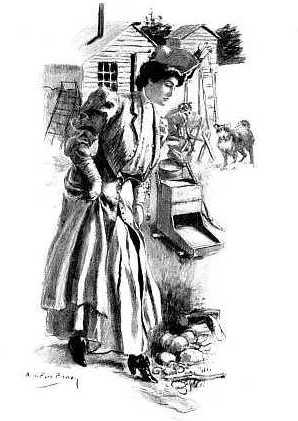
them bridge, and departed in a glow of self-gratulation
at her tact in dealing with the
envious and small-minded.
On the hotel piazza she found the minister
waiting for her, and with him Scarlett.
To the latter she had not spoken since the
day of their difference, for such she chose to
consider it, in regard to Gelly. True, more
than once she had caught sight of him galloping
down the road or striding by on some
official errand, but never had she lifted a
finger to delay him, nor he appeared conscious
of her presence.
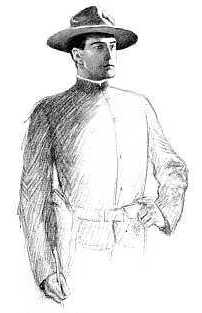
DEPARTED IN A GLOW OF SELF CONGRATULATION AT HER TACT.
Ignoring his greeting, in high good humor
with herself and all the world, Evelyn
opened fire. "Mr. Maclane, I wish you
would tell that young man he owes me an
apology."
Scarlett suppressed a gratified smile.
"Mr. Maclane, will ye convey to the speaker
that she'll have to prove the debt for me to
pay it?"
"Tell him the last time we met he put me
in the wrong," said Evelyn, prettily, the
glow of her goodness toward the envious
Graysons still upon her. "He behaved as
though he thought me narrow, contemptible—and
the worst is, the shoe pinches, because
in a tiny degree I fear it may have
been true."
She waited with a charming air of penitence
for contradiction, but, to her astonishment,
none came.
Instead, "I'm a brute, just," Scarlett remorsefully
described himself. "Who am I
to hold ye up the looking-glass? I'll never
be so rude again."
"Oh"—Miss Durant stiffened perceptibly—"I
do not usually find the reflection unbearable
to contemplate."
"I've lived so long in the open, in primitive
conditions," Scarlett, unmindful of her
interruption, went on, "I always blurt out
whatever pops into my mind. Well, there's
precedent. In Eden, Adam must have called
a spade a spade."
"Ah, my young friend, but there's no
record of his having called Eve a spade,"
observed Maclane, with a twinkle in his
eye.
"Faith, I'll drop the spade, then," laughed
the Irishman, "if she'll let me call her Eve!"
"Tell him," laughed Miss Durant, with
heightened color, "that he goes too far."
"Tell her I'd go farther—to any lengths,
for her, so long as it didn't take me from
her side."
"Tell him he's kissed the blarney-stone."
"Tell her I only practiced on it to keep
my hand in till she should come."
"How dare you!" cried Evelyn, feeling
that she ought to be very angry.
"Come, come, my children, peace," prescribed
Maclane. "Miss Durant, I am here
as a petitioner. One of my dear Indians, in
fact the sister-in-law of Chilkat Jo, has a
baby——"
"Velly damfine Clistian baby!" interpolated
the trader, who was sitting on the
step near by, whittling out a toy canoe.
"Oh, Joseph!" the minister protested,
"when will you learn that a damn baby cannot
be a Christian baby—nor a Christian
baby a damn baby. We are to baptize the
little one this morning," he told Evelyn.
"And I am asked to beg you to stand godmother."
"For a heathen unregenerate, miss!"
Sarah put her head out of the window just
behind the group. "Don't you mix yourself
up with that truck!"
"I'm a bit of a heathen nowadays myself."
Maclane stopped Chilkat Jo's angry outburst.
"My dear Indians have converted me."
"I wonder you aren't afraid of being tried
for heresy, sir," commented Sarah, "talking
that loose way."
"Perhaps I should be," agreed Maclane,
"in the cities across yon mountains. But
here they hold us in a charmed circle, and
who can escape their spell?" He pointed to
the lake, brilliantly ablaze, like a vessel
holding wondrous depths of color, in which
the snow-capped peaks with their V-shaped
crevasses lay mirrored like cameos in turquoise
relief. "My Indians—in my civilized
days I used to preach hell-fire to them, till
they scorned me for it, crying, 'Our children
when they die become birds of song. Why,
then, should we give them to you Christians
to be burned?' Then, again, though I knew
him to be a saint, dedicated in Christ's
name to the service of his fellow-men, I used
to avoid my brother, the Catholic priest, because
his doctrines on the surface differed
from my own! Again, my Indians taught
me, scoffing, 'If Christianity makes enemies
of her ministers, why, we want none of it.'
Yes, all that I have given the heathen have
they requited me a hundredfold, making me
a Christian through the Christ I try to show
to them!"
"I will do what you ask me only too
gladly, Mr. Machine!" cried Evelyn, understanding
that this was the good minister's
way of making peace between herself and
Chilkat Jo. "I shall be proud of my godchild;
and I promise it the finest cup from
Tiffany's——"
"No, no! No presents, please," enjoined
Maclane. "Only kindness, neighborliness,
and an appreciation of the heathen virtues.
The Sergeant here has consented to be godfather."
"The Sergeant!" involuntarily exclaimed
Evelyn.
"Aye! In the short time he has been in
charge, he has completely won the hearts of
the tribe of Raven and Frog. No baptism
complete without him."
"Oh, as a sponsor, I'm painting the town
red," admitted the Irishman. "And the
Claim has a regular column of feeble-minded
puns upon the epidemic. Well, I
only hope the Scarlett creepers won't turn
to Scarlett runners, in time of battle."
"I will tell Lallah that you consent. Be
ready, both, please, when you hear the
chapel bell," directed the minister, going
to the mission.
Scarlett lingered, but as Evelyn took no
notice of him, "Thankee for the pressing invitation,"
he remarked, drawing up a chair
and seating himself beside her. "And are
ye beginning to feel acclimated among us
savages?"
"Oh, you are doing your best!" Evelyn assured
him. "Though I must say, even for
the wilderness, the ideas of social distinction
seem curiously lax. Why, as his head
waiter is off on a spree, Mr. Hastie has offered
me the place—three hundred dollars
a month and tips!"
"Good pay," commented Scarlett. "Why
don't ye take it? I'd ask no better for my
own sister, if I had one."
Evelyn tossed her head. "To pass dishes
to unwashed barbarians in corduroys who
gobble off their knives and drink from their
saucers. Even for your own sister," she
could not forbear asking, "wouldn't you
consider the situation rather primitive?"
"I should, and that's the situation's saving
grace," he promptly replied, "since
primitive man is woman's best friend, once
she makes him realize she will not let him
be her enemy."
Against her will, Evelyn looked at the
speaker with reluctant admiration, forced
to recognize that however ignorant of class
distinctions the poor young man might be,
his was certainly no ordinary mentality.
Accordingly, woman-like, she harked back
to personalities, hoping in shallow waters
to take him, through his very superiority, at
a disadvantage. "Oh, we have nothing to
complain of on the score of friendliness,"
she laughed. "Our matrimonial opportunities
seem limited only by the number of
single men within proposing radius. No,
Sergeant, I am not the belle. That proud
position is disputed by Sarah and the plainest
orphan, who also is the most muscular,
because they frankly tell us, in a land where
hired labor is not to be had a man must
marry to get some one to cook and wash for
him. However, such few score of proposals
as have come my way, I honestly can brag,
are for myself, since I am not considered
a specially useful 'household proposition,'
and oddly enough my great wealth seems
not to impress these poverty-stricken millionaires
in the least degree."
"Oh, I tell ye, in a mining camp one gets
down to first principles, or lack of them,"
commented the soldier. "It's chaos, till
man and woman together evolve a paradise."
Evelyn waited, hoping he also would propose
to her in order that she might refuse
him, not kindly, with the consideration she
had shown the other poor victims who had
laid their hearts at her feet, but with scathing
denunciation of his insolence. Instead
of improving his opportunity, however, the
soldier rose. "Ye'll bid me to the wedding,
Miss Durant?"
"In what capacity—officially, or as a
guest?"
"Not as a mourner, that I swear."
"I may decide to elope."
"Impossible! In my bally those that
want a marriage license have to come to
me."
"I've always had a leaning toward the
nobility," remarked Evelyn, rather maliciously.
"Are there no men of title in the
camp?"
"A handful or so of younger sons," Scarlett
informed her, "and a pathetic lot in the
main they are. 'Remittance Men,' we call
them, because they are on allowance to stay
away from home, avowedly that in a new
country they may turn over a new leaf, but
in reality that their families may be spared
the shame of witnessing their final disintegration.
Be good to such when ye come
across them, Miss Durant, for the sake of
what they ought to be, but don't marry
them, for the whole lot of them together
wouldn't make one decent man."
Evelyn laughed, but her face crimsoned.
"Dear, dear! And suppose, after all, you
disapprove my choice?"
"Faith, I'll exercise my official prerogative
and take ye in charge myself! Meanwhile,
I must turn my attention toward yonder
suspect." He indicated a person with
the deportment of a personage, who, dressed
in the height of fashion, was strolling, tourist-wise,
kodak in hand, down the village
street.
"Why, who can that be?" Evelyn leaned
forward with interest.
"That's my own question. He travels
under the name of the Count St. Hilaire."
"There's something very familiar about
his appearance. I wonder if I mayn't have
met him at Newport, or Washington. If
so, bring him here that I may renew the acquaintance,
Sergeant, please."
"I'll search his title first." Scarlett ran
down the veranda steps. "Now look out for
trouble," he muttered to himself, seeing the
stranger pause opposite a cottage in the
Indian quarter, and level his camera at the
totem-pole in front of it.
A crowd of angry Indians who had been
squatting on mats in the sunshine, making
moccasins and weaving baskets, instantly
rose and swarmed about him, vehemently
protesting in Chinook against this insult to
their sacred emblems, Chilkat Jo acting as
interpreter.
"Shame, shame, cursed shame to photoglaph
the Laven and the Flog!" he cried,
alluding to the totem's tribal device. "Velly
godam Clistian shame!"
"Hold on!" cried Scarlett, impartially, interposing
his tall form between the evidently
frightened foreigner and the avenging
group.
"Mais—ze Klondike barber-pole—I no
steal him; je vous jure, gendarme! I make
ze photographie!"
"Yes, but unless you pay them for it to
show your good will, the Indians think you
are marking them for death," the Sergeant
instructed him. "All right, honest Injun,"
he in turn assured the crowd. "Only sun-picture.
Big man pay you big money."
"Why," exclaimed Evelyn's astonished
voice at Scarlett's elbow, "it is my courier,
Alphonse—he has let his beard grow! That
is the kodak he stole from me!"
"Sacré papier, ze mademoiselle!" shrieked
the man, recognizing her; and off he set as
fast as his trembling limbs could carry him,
Scarlett, reinforced by the children of the
Raven and the Frog, in hot pursuit.
"It's only what you might have expected,
miss," remarked Sarah, consolingly, as in
mortified silence Evelyn returned to the veranda.
"The French is a deceitful nation.
They always have to talk in a foreign language
so you can't understand 'em."
"It's all right!" Flushed and breathless,
Scarlett came up. "He ran plump into Barney's
arms. Here's your camera, Miss Durant.
Later I'll get you to appear against
the Count—just a formality, you know."
"I shall do nothing of the sort!" declared
Evelyn loftily. "Instead, you can fine me
any amount you please for contempt of
court. You doubtless will enjoy doing it!
As for the kodak, you can give it back to
Alphonse. I shall never touch it again!"
"Miss, you are ungrateful," Sarah reproved
her, "and the young man wounded in
the fracas!"
"Wounded!" cried Evelyn, in dismay.
"Oh," disclaimed Scarlett, who was shaking
his fingers as if to cast a pain from them,
"it's nothing. Only in protecting the
Count's beauty from an irate populace I
gave my wrist a twist."
"Oh, a sprained wrist is nothing to boast
of," derided Miss Durant.
"That's why I wasn't boasting of it."
Scarlett turned to go.
"Nevertheless"—Evelyn put a detaining
hand lightly on his arm—"I took a course in
First Aid to the Injured to fit myself for this
life, and I know that a sprain ought to be
treated with something, for fear something
or other should set in. Sarah," she asked in
a whisper, "what treatment does one give a
sprain?"
"Fermentation," prompted the maid, sagaciously.
"That's it: fomentation! Please, Sarah,
go fetch me—whatever one needs for fomentation."
"Believe me, it is not necessary." Scarlett
gave his hand another shake. "It soon
will be all right."
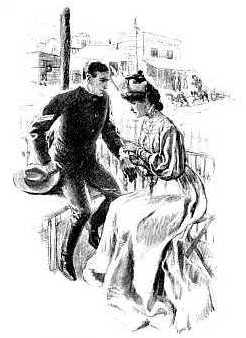
"Sit here!" Evelyn motioned him, peremptorily,
to a chair beside her. "No, on
this side. A soldier's first duty should be to
obey."
"Ah, well, my arms are ever at your service,
even in times of peace." Scarlet
leaned back, luxuriously, as she rolled up
his sleeve.
"Of course, you understand I should do
this for anybody," observed Evelyn, sponging
his wrist with the warm water Sarah
had provided.
"Of course, ye understand I should fight
in defence of anybody's property," he
matched her. "'Tis for that I draw my
pay."
"Is it tender?" inquired Evelyn, pillowing
his hand upon her lap and dabbing it softly
with a towel.
"Tender's not half the word for it." The
patient turned his face aside. "It's the limit
of tenderness, and has to be treated on the
homeopathic principle."
"Miss, he makes light of it!" cried Sarah,
who, under a harsh exterior, was, by nature,
kind. "But his poor brow is simply
wrung with anguish." She mopped the
beads of perspiration that stifled mirth had
brought upon the Sergeant's comely forehead.
"Let us talk of other things to distract
him," ordained Evelyn. "Come, Sergeant,
tell us all about yourself. Begin at the very
beginning."
"Faith, like most babies," he complied, "I
began by being the child of my parents."
"Poor but honest folk, no doubt. Go on!"
"They died before my remembrance of
them. I infer the honesty and inherit the
poverty. I was brought up by an aunt and
uncle, who didn't want me. One time when
I came home from school for the holidays
my aunt just looked up from her novel and
remarked, 'Oh, Jerry, how dirty you are!'
So I ran away to make my fortune."
"Which consists of something over a dollar
a day and your keep."
"And the prospect of a pension for my
widow."
"Your widow!" Evelyn dropped the hand
she was engaged in bandaging. "I didn't
know——"
"Oh, I haven't got one yet," Scarlett hastened
to assure her. "But I shall, please
God, if I live long enough."
"Sergeant, you are talking nonsense,"
said Evelyn. "Pain has made you flighty."
"'Way up in the seventh heaven," assented
Scarlett. "Don't be so cruel as to
call me down."
"There!" Having stuck a final pin in the
handkerchief she had bound about the
wrist, Evelyn folded the soldier's arm
across his breast. "Sarah, go fetch me another
sash, will you? I'm going to use this
one for a sling."
"Which color shall I get you, miss?"
asked the maid, preparing to obey.
Evelyn shrugged her shoulders with indifference.
"I don't care—though I should
think your own taste would lead you to see
that blue goes best with this frock. There,
Sergeant"—having made a creditable cradle
of the ribbon for the soldier's arm and knotted
it behind his neck, she came in front of
him and surveyed her work admiringly—"that
will do, I think. Now, remember, it
must not be unbound for four and twenty
hours. Promise! I wish you would stop
laughing in that silly way and tell me if it
feels all right, really."
"Joyous, beyond words," Scarlett affirmed.
"I only wish I were that chap in the
mythology with a hundred hands—and every
blessed one of them in need of fomentation."
"I suppose you say these inane things to
me because you think me incapable of appreciating
sense," commented Miss Durant.
"Just because all my poor little efforts to do
good up here have seemed superfluous. Oh,
yes"—she checked the protest that rose to
his lips—"you all have been kindness personified,
but I do not think you quite understand
me," she complained, with the injured
quaver of one who at heart knows herself to
be understood only too well. "I'm really not
such an overbearing, ill-natured girl; only,
I acknowledge, a wee bit spoiled. You see,
after my mother died, when I was still a
very small child, in Colorado, my father sent
me to a fashionable school in San Francisco,
and there I began to feel that in Colorado
we had been quite savage. Then, in my
early 'teens I was put at another still more
fashionable school in Chicago, where I was
made to feel that in San Francisco I had
been hopelessly Western. Next, I moved on
to an ultra-fashionable school in New York,
where it was tacitly impressed on me that in
Chicago we had been positively vulgar.
After this came a course of Dresden,
Vienna, London, Paris, by which I realized
that in New York I had been provincial,
crude. On my return I felt myself cosmopolitan,
a finished product. Yet, in this
short space up here you all have made me
wonder if, after all, all the time, I have not
been a bit of a snob. Yes, you can't contradict
me. I know. A thoroughbred would
have taken things as she found them—would
be at home anywhere, while I——"
Having amazed herself far more even than
her hearer by this unexpected burst of confidence,
Miss Durant amazed herself still
more by an unexpected burst of tears.
"Poor child!" Scarlett compassionated
her, while liking her thoroughly for her candor.
"Dear, dear little Evelyn, it's libelling
yourself you are, although it's true, and
that's the sweetest part of it. Here, take
mine!" As she was hunting, between inconsolable
sniffs, for the handkerchief with
which she herself had bandaged him, he tendered
her his own.
"Oh, the sprain—your wrist!" cried Evelyn,
in alarm.
"That's all right," Scarlett reassured her,
while drying her eyes with the hand he had
removed for the purpose from the sling. "It
was the other one that got the twist."
Evelyn drew back. "You mean you dared
let me bind up the wrong one?"
"Ye made your own selection," Scarlett
reminded her, in tones he vainly tried to
render penitent.
"That you did, miss," corroborated Sarah,
coming from the hotel with the blue sash
and tying it about Evelyn's slender waist.
"Give me back my ribbon, my handkerchief!"
demanded Evelyn of Scarlett, furiously.
"Not for four and twenty hours," he answered.
"Not even for you would I break
a promise to a lady."
"Never, never, never will I speak to you
again!" cried Miss Durant.
Just then the chapel bell began to ring
merrily, and at the same moment Maclane
hurried toward them from the mission, an
open hymnal in hand. "Come, my children,
we march in, singing," he explained, pointing
toward the Indians, who were forming
in a procession by the chapel door. "As I
am short of hymnals, you and the Sergeant
will have to share one, Miss Durant. Hymn
674. 'Peace, Perfect Peace.'"
Evelyn stood still. "I absolutely decline
to be associated in any way whatever with
Sergeant Scarlett."
"Oh, my children!" remonstrated the minister.
"How can we talk of missionizing the
heathen when the Gentiles so wrangle
among themselves! Ready, please! Fall
into line!" Striking up the tune, he led the
way.
And, somehow, in despite of her protest,
Miss Durant found herself following, side
by side with the hated young soldier, sharing
the same hymnal, moreover, and joining
her sweet voice with his manly one in praise
of "Peace, Perfect Peace."