"Bettersea trem? Right, miss!"
My wife, who has been married long
enough to feel deeply gratified at
being mistaken for a maiden lady,
smiled seraphically at the conductor,
and allowed herself to be hoisted up
the steps of the majestic vehicle provided
by a paternal county council to
convey passengers—at a loss to the
ratepayers, I understand—from the
Embankment to Battersea.
Presently we ground our way
round a curve and began to cross
Westminster Bridge. The conductor,
whose innate cockney bonhomie his
high official position had failed to
eradicate, presented himself before us
and collected our fares.
"What part of Bettersea did you
require, sir?" he asked of me.
I coughed and answered evasively:—
"Oh, about the middle."
"We haven't been there before,"
added my wife, quite gratuitously.
The conductor smiled indulgently
and punched our tickets.
"I'll tell you when to get down,"
he said, and left us.
For some months we had been considering
the question of buying a dog,
and a good deal of our spare time—or
perhaps I should say of my spare
time, for a woman's time is naturally
all her own—had been pleasantly
occupied in discussing the matter.
Having at length committed ourselves
to the purchase of the animal,
we proceeded to consider such details
as breed, sex, and age.
My wife vacillated between a
bloodhound, because bloodhounds
are so aristocratic in appearance, and
a Pekinese, because they are dernier
cri. We like to be dernier cri even in
Much Moreham. Her younger sister,
Eileen, who spends a good deal of
time with us, having no parents of her
own, suggested an Old English sheep
dog, explaining that it would be company
for my wife when I was away
from home. I coldly recommended a
mastiff.
Our son John, aged three, on being
consulted, expressed a preference for
twelve tigers in a box, and was not
again invited to participate in the
debate.
Finally we decided on an Aberdeen
terrier, of an age and sex to be settled
by circumstances, and I was instructed
to communicate with a gentleman
in the North who advertised
in our morning paper that Aberdeen
terriers were his specialty. In due
course we received a reply. The advertiser
recommended two animals—namely,
Celtic Chief, aged four
months, and Scotia's Pride, aged one
year. Pedigrees were inclosed, each
about as complicated as the family
tree of the House of Hapsburg; and
the favor of an early reply was requested,
as both dogs were being
hotly bid for by an anonymous client
in Constantinople.
The price of Celtic Chief was
twenty guineas; that of Scotia's
Pride, for reasons heavily underlined
in the pedigree, was twenty-seven.
The advertiser, who resided in Aberdeen,
added that these prices did not
cover cost of carriage. We decided
not to stand in the way of the gentleman
in Constantinople, and having
sent back the pedigrees by return of
post, resumed the debate.
Finally Stella, my wife, said:—
"We don't really want a dog with
a pedigree. We only want something
that will bark at beggars and be gentle
with baby. Why not go to the
Home for Lost Dogs at Battersea? I
believe you can get any dog you like
there for five shillings. We will run
up to town next Wednesday and see
about it—and I might get some
clothes as well."
Hence our presence on the tram.
Presently the conductor, who had
kindly pointed out to us such objects
of local interest as the River
Thames and the Houses of Parliament,
stopped the tram in a crowded
thoroughfare and announced that
we were in Battersea.
"Alight here," he announced facetiously,
"for 'Ome for Lost Dawgs!"
Guiltily realizing that there is many
a true word spoken in jest, we obeyed
him, and the tram went rocking and
whizzing out of sight. We had
eschewed a cab.
"When you are only going to pay
five shillings for a dog," my wife had
pointed out, with convincing logic,
"it is silly to go and pay perhaps another
five shillings for a cab. It
doubles the price of the dog at once.
If we had been buying an expensive
dog we might have taken a cab; but
not for a five-shilling one."
"Now," I inquired briskly, "how
are we going to find this place?"
"Haven't you any idea where it
is?"
"No. I have a sort of vague notion
that it is on an island in the middle
of the river, called the Isle of Dogs,
or Barking Reach, or something like
that. However, I have no doubt—"
"Hadn't we better ask some one?"
suggested Stella.
I demurred.
"If there is one thing I dislike," I
said, "it is accosting total strangers
and badgering them for information
they don't possess—not that that
will prevent them from giving it. If
we start asking the way we shall find
ourselves in Putney or Woolwich in
no time!"
"Yes, dear," said Stella soothingly.
"Now I suggest—" My hand
went to my pocket.
"No, darling," interposed my wife,
hastily; "not a map, please!" It is a
curious psychological fact that women
have a constitutional aversion to
maps and railroad time-tables. They
would rather consult a half-witted
errand boy or a deaf railroad porter.
"Do not let us make a spectacle of
ourselves in the public streets again!
I have not yet forgotten the day when
you tried to find the Crystal Palace.
Besides, it will only blow away. Ask
that dear little boy there. He is looking
at us so wistfully."
Yes; I admit it was criminal folly.
A man who asks a London street boy
to be so kind as to direct him to a
Home for Lost Dogs has only himself
to thank for the consequence.
The wistful little boy smiled up at
us. He had a pinched face and large
eyes.
"Lost Dogs' 'Ome, sir?" he said
courteously. "It's a good long way.
Do you want to get there quick?"
"Yes."
"Then if I was you, sir," replied
the infant, edging to the mouth of an
alleyway, "I should bite a policeman!"
And, with an ear-splitting
yell, he vanished.
We walked on, hot-faced.
"Little wretch!" said Stella.
"We simply asked for it," I rejoined.
"What are we going to do
next?"
My question was answered in a
most incredible fashion, for at this
moment a man emerged from a shop
on our right and set off down the
street before us. He wore a species of
uniform; and emblazoned on the
front of his hat was the information
that he was an official of the Battersea
Home for Lost and Starving
Dogs.
"Wait a minute and I will ask
him," I said, starting forward.
But my wife would not hear of it.
"Certainly not," she replied. "If
we ask him he will simply offer to
show us the way. Then we shall have
to talk to him—about hydrophobia,
and lethal chambers, and distemper—and
it may be for miles. I simply
couldn't bear it! We shall have to
tip him, too. Let us follow him
quietly."
To those who have never attempted
to track a fellow creature surreptitiously
through the streets of
London on a hot day, the feat may
appear simple. It is in reality a most
exhausting, dilatory, and humiliating
exercise. Our difficulty lay not so
much in keeping our friend in sight
as in avoiding frequent and unexpected
collisions with him. The
general idea, as they say on field
days, was to keep about twenty
yards behind him; but under certain
circumstances distance has an uncanny
habit of annihilating itself.
The man himself was no hustler.
Once or twice he stopped to light
his pipe or converse with a friend.
During these interludes Stella and
I loafed guiltily on the pavement,
pointing out to one another objects
of local interest with the fatuous
officiousness of people in the foreground
of hotel advertisements. Occasionally
he paused to contemplate
the contents of a shop window. We
gazed industriously into the window
next door. Our first window, I recollect,
was an undertaker's, with ready-printed
expressions of grief for sale
on white porcelain disks. We had
time to read them all. The next was
a butcher's. Here we stayed, perforce,
so long that the proprietor,
who was of the tribe that disposes of
its wares almost entirely by personal
canvass, came out into the street
and endeavored to sell us a bullock's
heart.
Our quarry's next proceeding was
to dive into a public house. We
turned and surveyed one another.
"What are we to do now?" inquired
my wife.
"Go inside, too," I replied with
more enthusiasm than I had hitherto
displayed. "At least, I think I ought
to. You can please yourself."
"I will not be left in the street,"
said Stella firmly. "We must just
wait here together until he comes out."
"There may be another exit," I
objected. "We had better go in. I
shall take something, just to keep up
appearances; and you must sit down
in the ladies' bar, or the snug, or
whatever they call it."
"Certainly not!" said Stella.
We had arrived at this impasse
when the man suddenly reappeared,
wiping his mouth. Instantly and silently
we fell in behind him.
For the first time the man appeared
to notice our presence. He
regarded us curiously, with a faint
gleam of recognition in his eyes, and
then set off down the street at a good
pace. We followed, panting. Once or
twice he looked back over his shoulder
a little apprehensively, I thought.
But we ploughed on.
"We ought to get there soon at
this pace," I gasped. "Hello! He's
gone again!"
"He turned down to the right,"
said Stella excitedly.
The lust of the chase was fairly on
us now. We swung eagerly round
the corner into a quiet by-street.
Our man was nowhere to be seen and
the street was almost empty.
"Come on!" said Stella. "He may
have turned in somewhere."
We hurried down the street. Suddenly,
warned by a newly awakened
and primitive instinct, I looked back.
We had overrun our quarry. He had
just emerged from some hiding place
and was heading back toward the
main street, looking fearfully over his
shoulder. Once more we were in full
cry.
For the next five minutes we practically
ran—all three of us. The
man was obviously frightened out of
his wits, and kept making frenzied
and spasmodic spurts, from which we
surmised that he was getting to the
end of his powers of endurance.
"If only we could overtake him,"
I said, hauling my exhausted spouse
along by the arm, "we could explain
that—"
"He's gone again!" exclaimed
Stella.
She was right. The man had turned
another corner. We followed him
round hotfoot, and found ourselves
in a prim little cul-de-sac, with villas
on each side. Across the end of the
street ran a high wall, obviously
screening a railroad track.
"We've got him!" I exclaimed.
I felt as Moltke must have felt
when he closed the circle at Sedan.
"But where is the Dogs' Home,
dear?" inquired Stella.
The question was never answered,
for at this moment the man ran up
the steps of the fourth villa on the
left and slipped a latchkey into the
lock. The door closed behind him
with a venomous snap and we were
left alone in the street, guideless and
dogless.
A minute later the man appeared
at the ground-floor window, accompanied
by a female of commanding
appearance. He pointed us out to
her. Behind them we could dimly
descry a white tablecloth, a tea cozy
and covered dishes.
The commanding female, after a
prolonged and withering glare,
plucked a hairpin from her head and
ostentatiously proceeded to skewer
together the starchy white curtains
that framed the window. Privacy
secured and the sanctity of the English
home thus pointedly vindicated,
she and her husband disappeared
into the murky background, where
they doubtless sat down to an excellent
high tea. Exhausted and discomfited,
we drifted away.
"I am going home," said Stella in
a hollow voice. "And I think," she
added bitterly, "that it might have
occurred to you to suggest that the
creature might possibly be going
from the Dogs' Home and not to it."
I apologized. It is the simplest
plan, really.

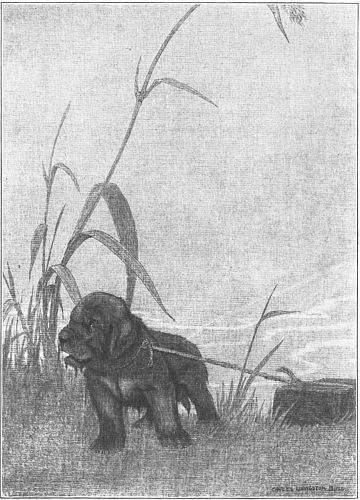 THE LEADING OBJECT PROVED TO BE A SMALL, WET, SHIVERING, WHIMPERING PUPPY