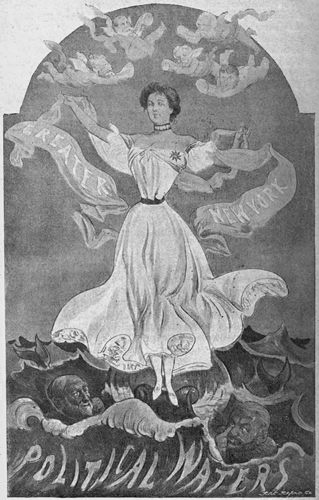
Satan’s Invisible World.
THE POLICE BANDITS OF NEW YORK.
The Lexow Committee experienced great difficulty in procuring evidence
owing to the Reign of Terror which was established in New York by the
police. The story reads more like a description of an Indian province
terrorized by a band of Thugs than a statement of how New York was
governed. When unwilling witnesses—and the vast majority of witnesses
were most unwilling—were placed on the stand, they were thus addressed by
the Chairman:—
Any testimony you give now, under oath, before this Committee with
reference to bribery or corruption, cannot be used against you in any
form, shape, or way. The fact of your confession here before this
Committee will be a complete bar against any prosecution against you
for that offence. In other words, if you sit here and tell the truth,
and confess that you have committed any crime of that description, you
will be absolutely relieved from any punishment for the commission of
that crime. On the other hand, if you swear to anything that is false,
then, not only could you be punished for the crime that you committed,
if you did commit the crime of bribery, but for the crime of false
swearing, or perjury, besides; you understand that?—Vol. iv., p.
3,615.
Notwithstanding this, the amount of perjury committed, especially by
policemen, was appalling. One of them, of the name of Interman, admitted
frankly that it was the common understanding among the members of the
force that it was their duty to swear falsely to conceal the facts about
bribery and corruption. If they spoke the truth they would be bounced or
persecuted, whereas if they came forward and perjured themselves they
would stand high with their superiors. The wrath of a captain who can make
it hot for you next day evidently weighed much more with the police than
the wrath of an offended God, whose mills grind so slowly that retribution
may not begin till the day of judgment.
The answers to questions put to brothel-keepers and others as to their
belief in the binding character of an oath and the reality of a future
state were hardly edifying. One woman, Julia Mahoney, broke the record
for the unhesitating candour with which she answered counsel’s questions.
“Do you not know,” said Mr. Goff, “that you would meet your punishment in
the world hereafter?”
“I hope not,” Julia replied simply.
“And you know that you would be liable to go to the State’s prison?”
persisted Mr. Goff. But Mrs. Mahoney was proof against that threat.
“If I was in prison I would be out in twenty-four hours,” she remarked.
“She has got a pull,” sagely observed Senator Bradley.
It must be admitted that it was a task of uncommon difficulty to extract
the truth from witnesses such as these, who fear not God neither regard
man. Why should they? They have got a pull, and the pull ends all things.
Two competent American observers have recently told us what a policeman is
in an American city. Both confirm to the letter what was stated by a
leading citizen of Chicago five years ago. “Never mind what is said about
this or that system of city government. In Chicago and all the West the
police govern the city, and that is all there is to it.” In New York it
would appear to have been much the same. Mr. Theodore Roosevelt, who was
head of the New York police in the first two years of the Reform
Administration, writing in the Century Magazine for October, says:—
The police occupy positions of great importance. They not merely
preserve order, the first essential of both liberty and civilisation,
but to a large portion of our population they stand as the embodiment
as well as the representative of the law of the land. To the average
dweller in a tenement-house district, especially if born abroad, the
policeman is in his own person all that there is of government: he is
judge, executive and legislature, constitution and town meeting.
The other witness is Mr. Godkin, the editor of the Evening Post, who,
writing in the North American Review seven years back, says of the newly
landed immigrant:—
No sooner has he established himself in a tenement-house or a
boarding-house than he finds himself face to face with three
functionaries who represent to him the government of his new
country—the police justice of the district, the police captain of his
precinct, and the political “district leader.” These are, to him, the
Federal, State and municipal governments rolled into one.... These
three men are to him America. Everything else in the national
institutions in which Americans pride themselves he only sees through
a glass darkly, if he sees it at all.
These dwellers in tenement-houses in New York, to whom the police—of whom
there were then 4,000—are judge, executive, and legislature, constitution
and town meeting, comprise two-thirds of the population of the city. To
the foreign denizen of these districts—say one-half of the whole—the
policeman and his masters of the political machine are all of America that
he can see or understand.
Now let us see what kind of an America the New York police presented to
the eyes of the majority of the population of the city. The Lexow
Committee in its final Report, after commenting on the difficulty of
obtaining evidence owing to the terrorism practised by the police, said of
a typical case:—
This situation was characteristic. A consuming desire to put an end to
an outrageous servitude on the one hand, and a dread lest failure
might result in a still more galling thraldom on the other! It seemed,
in fact, as though every interest, every occupation, almost every
citizen, was dominated by an all-controlling and overshadowing dread
of the police department.
Those in the humbler walks of life were subjected to appalling
outrages which to some extent continued, even to the end of the
investigation. They were abused, clubbed and imprisoned, and even
convicted of crimes on false testimony by policemen and their
accomplices. Men of business were harassed and annoyed in their
affairs, so that they too were compelled to bend their necks to the
police yoke, in order that they might share that so-called protection
which seemed indispensable to the profitable conduct of their affairs.
People of all degrees seemed to feel that to antagonize the police was
to call down upon themselves the swift judgment and persecution of an
invulnerable force, strong in itself, banded together by self-interest
and the community of unlawful gain, and so thoroughly entrenched in
the municipal government as to defy ordinary assault. Strong men
hesitated when required to give evidence of their oppression, and
whispered stories; tricks, subterfuges and schemes of all kinds were
resorted to to withhold from this committee and its counsel the fact
that they had knowledge of acts of corruption or oppression by the
police. The uniform belief was that if they spoke against the police,
or if the police discovered that they had been instrumental in aiding
your Committee, or had given information, their business would be
ruined, they would be hounded from the city, and their lives even
jeopardised.—Vol. i., pp. 25, 26.
For wrongs inflicted by the police there was no redress. Mr. Goff in the
concluding stages of the investigation referred to this phase of the
question in the following significant terms:—
A great many innocent people who have been clubbed by the police in
our city have thought that the city was responsible for the actions of
its employés; but the courts have held time and time again that the
city is not responsible; and then from the further fact that nearly
every policeman in the city has his property in his wife’s name, it
has become a notorious thing that it is useless to bring an action for
assault against a policeman.... Mr. Jerome reminds me now of the
celebrated case of Mr. Fleming; I think it was a Decoration Day
parade. Captain Williams clubbed him in Madison Square, and he got a
judgment of $2,500; but the judgment was never collected. We have
never been able to get it on the record that a judgment against a
police official has been paid.—Vol. v., p. 4,661.
It is not surprising after this to read the answer of a witness, a
journalist of standing, who had been nearly murdered by a police captain
in the cells of the police-station. He was asked if he had taken
proceedings against his assailant. He replied:—
“I never did, sir. It is no use going to law with the Devil, and
Court, and Hell!”
To quote the more formal but not less emphatic finding of the Lexow
Committee:—
It appears, therefore, that the police formed a separate and highly
privileged class, armed with the authority and the machinery for
oppression and punishment, but practically free themselves from the
operation of the criminal law.—Vol. i., p. 30.
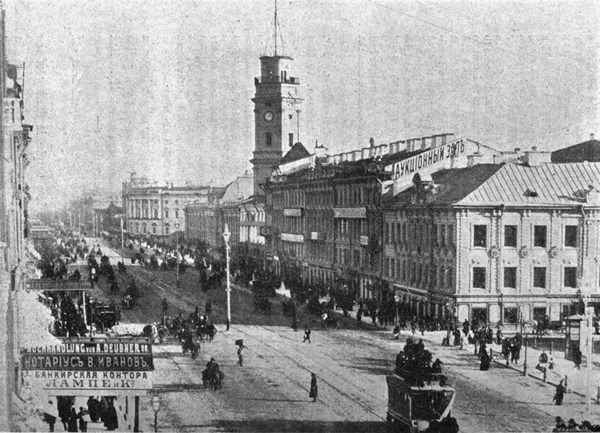
A VIEW IN ST. PETERSBURG.
A City where the Police have as much power as in New York.
THE POWERS AND THE IMPOTENCE OF THE POLICE.
One of the most pathetic of human fallacies is the assumption that you
have only to pass a law in order to extirpate an evil. The touching faith
of English-speaking men in the efficacy of statute-made law is nowhere
more strikingly illustrated than in the great cities of the United States.
The fact that a statute is only so much good paper inked by a
printing-press does not seem to occur to the citizens, even after the
repeated demonstrations of its impotence. Nowhere can severer laws be
found for the suppression of all manner of vice and crime than in those
cities where vice and crime hold high carnival under the patronage of the
police. It has been frequently observed that this habit of finding relief
for moral indignation by placing a stringent law upon the statute-book is
exactly the instinct which leads the private citizen to say “Damn!” There
is a great deal of this swearing at large in the passing of rigorous
statutes, which are no sooner passed than they appear to be forgotten.
Take, for instance, the laws which were passed from time to time to secure
the extirpation of vice and crime in the City of New York. They certainly
did not err in the direction of leniency. The usual complaint of the
police elsewhere is that they are not vested with sufficient power in
order to deal with the vicious and criminal classes. This cannot be said
with truth of the New York police, as will be seen from the following
extract from the proceedings before the Lexow Committee:—
Mr. Moss: We have got a situation here as autocratic as anything than
can be found in St. Petersburg; a law was passed in 1873 for the
purpose of giving the police abundant opportunity to enter such places
for any purpose that they might see fit to enter.
Mr. Goff: Judicial functions have been vested in the Superintendent of
Police, in a policeman of this city, who, on his own motion, can under
Section 285 of the Consolidation Act issue a warrant, and on the
execution of that warrant the doors of any house in the City of New
York may be broken in. If we had time to introduce evidence of cases,
we could do so where from spleen and malice on the part of some common
policeman, the respectable houses have been invaded without colour or
authority of right, except this arbitrary power given to the police by
law.
Senator O’Connor: That is simply a horrible condition of affairs;
better submit to a thousand disorderly houses than that one decent
house should be treated in such a manner.
Mr. Goff: Under the law as it exists to-day in the City of New York, a
policeman who is the Superintendent of Police—that is all he is, a
policeman—has the power to issue his warrant fully equal to that
exercised by the Prefect of Police in St. Petersburg....
Counsel then read as follows:—
“If any member of the police force, or if any two or more
householders, shall report in writing under his or their signature, to
the Superintendent of Police that there are good grounds, and state
them, for believing any house, room or premises within the said city
to be kept or used as a common gaming-house or common gaming premises
or room for playing for wagers, or for money at any game of chance, or
to be kept or used for lewd and obscene purposes or amusements, or the
deposit or sale of lottery tickets or lottery policies, it shall be
lawful for the Superintendent of Police to authorise in writing any
member or members of the police force to enter the same, who may
forthwith arrest all persons there found offending against the law,
but none other, and seize all implements of game or lottery tickets or
lottery policies and convey any person so arrested before a magistrate
and bring the article so seized to the office of the clerk; it shall
be the duty of the said Superintendent of Police to cause such
arrested person to be rigorously prosecuted and such articles seized
to be destroyed as the orders, rules and regulations of the Board of
Police shall direct.”
There has been no law in our country under our system of a more
complete, sweeping and comprehensive measure placed within the powers
of a simple executive office, as the Superintendent of Police is, as
this law. It exceeds that of the Common Law, where the power is vested
in a judicial officer to issue a warrant; but here a policeman may
authorise in writing any members of his police force to enter any
place complained of by either a member of the police force or by two
householders, and arrest all such persons found therein.—Vol. iv.,
4,493-7.
Notwithstanding this right of domiciliary visitation, which equals or
exceeds that possessed by the Prefect of St. Petersburg, we have it
admitted on all hands that it utterly failed in attaining its end. The
police machine, Mr. Goff declared, was by no means inefficient. Regarded
as a machine it was indeed, in his opinion, the most perfect machine ever
invented in New York. Notwithstanding all its mechanical perfection the
result was nothing but organised impotence.
Witness after witness appeared on the stand to attest the extraordinary
inability of the police authorities to cope with the flagrant evils in the
city or in the force under their command. On one occasion it was proved
that the agents of the Society for the Prevention of Crime had been hunted
by a mob of bullies and crooks for half a mile through Bowery. It was a
regular riot, in which the agents for the Society were struck and stoned
through the whole of Captain Devery’s precinct; the police officers
looking on as amused spectators. They were appealed to for assistance, and
took no notice. At last, the hunted men jumped on a car, and escaped with
their lives. But although this riot had taken place in the heart of the
city, and created a scandal through the whole of New York, Superintendent
Byrnes reported that he could not find any evidence that there had been a
riot (p. 4,834.) The extraordinary inability of the police to see what was
going on under their noses, although apparently phenomenal, was so
habitual that it ceased to excite any surprise. Saloons ran open all
Sunday under the eyes of the patrolmen. The Superintendent of the Society
for the Prevention of Crime gave evidence on this subject as follows:—
I pointed out an open saloon to a patrolman, whose name I do not know,
and inquired why he did not close it; he said that if I insisted upon
it, he supposed he must do so; but it would do no good, and only get
him in trouble with the department and cause his removal to some
undesirable precinct.—Vol. v., p. 4,835.
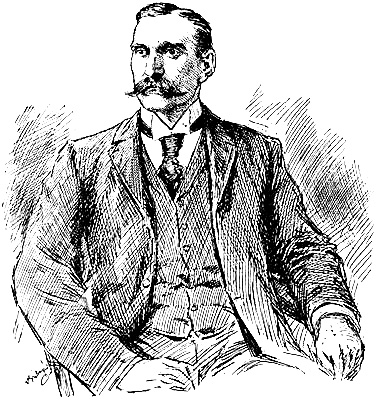
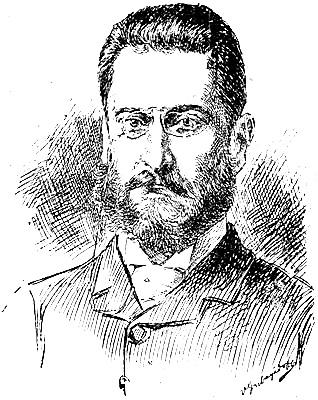
JOHN C. SHEEHAN.
Ex-Police Commissioner. Boss of Tammany.
But it is only when the Police Commissioners, who stand at the head of the
whole force, are under examination that we discover the extent of their
utter inability to find out anything. There was, for instance, Mr.
Sheehan, who at that time was Police Commissioner, and who now is the
titular Boss of Tammany Hall. The question of pool-rooms was under
consideration when he admitted that they existed, and that he knew they
were corrupting the police. Then the Chairman put the following
question:—
And, notwithstanding the fact that you knew or had heard that those
pool-rooms were corrupting the police, you thought it was not
necessary to take any action upon it?
Mr. Sheehan replied:—
I did start an inquiry to find out if those pool-rooms were paying,
what they were paying, and who they were paying it to. I did that
within a few months after I became a Police Commissioner, but I
couldn’t get any authoritative information of any kind on the subject;
but I got it from all sides that they were paying, and it was
believed that they were, but no person would substantiate or stand for
it.—Vol. iv., p. 3,765.
So he abandoned the subject as one which it was no use discussing any
further.
It was just the same with Mr. Commissioner Martin. He was asked concerning
the existence of corruption in the police force. I quote the following
from the Record:—
Examined by Mr. Sutherland: What did you do to restore the tone and
efficiency of the police?
A. The Board of Police was waiting for any evidence of that character
to be brought to it.—Vol. i., p. 483.
Q. What investigation has the Police Commissioners ever instituted to
discover the falsity of those charges?
A. No special investigation.—Vol. i., p. 484.
It was the same thing with disorderly houses.
Examined by Mr. Nicoll: And, during all the years you have been Police
Commissioner, you never have examined the record to see how many there
are or where they are located?
A. No, sir; I have not.
Q. And hasn’t that led you to go to these records to see what houses
were put down as disorderly in this category?
A. No, sir; I have not.
Q. Has the subject of suppression or diminution of these disorderly
houses been a matter of discussion before the Board of Police?
A. No, sir.—Vol. i., p. 528.
Even when crime was discovered, when the criminal was, as it were, taken
red-handed, there seemed to be a strange paralysis that prevented his
appearance in court. This affected other Boards besides that of the
Police. When the action of the Excise Board was under consideration, it
was admitted by Mr. Andrews, a Commissioner of the Board, that in one
notorious case the licence had been obtained by false swearing. Mr. Goff
asked:—
Q. Did you ever, when you discovered these false papers, as you say,
and of perjuries having been committed before the Board—did you ever
take any steps to have the perpetrators called to answer for the
crime?
A. No steps were ever taken for indictment; no.—Vol. iv., p. 4,386.
It was not for want of painstaking on the part of the Legislature that the
police force was not more efficient. Every constable before being
appointed had to comply with the provisions of the Civil Service law,
which were thus explained by Commissioner Martin:—
The candidate is required to have the names of a certain number of
citizens, usually five, to vouch for him as to his character—their
acquaintance with him; and all those papers having been finally
completed, the papers are sent to the Civil Service Board, where
examinations are held from time to time of batches of such applicants.
Application is made to the captain for examination of his character
and as to the persons who signed the paper, and a report is made in
writing by the captain. There are three Civil Service Commissioners
appointed by the Mayor; I do not recollect the names just at this
time. Once a year the Civil Service Board made an examination of all
applicants for patrolmen, and they usually examine in batches of from
400 to 600.—Vol. i., p. 567.
The Commissioners themselves, when asked about the subject, were at a loss
to explain how it was vice and crime flourished under their very eyes. Mr.
John McClave, the Republican Police Commissioner, told the Committee that
he had always voted with his Tammany Commissioners on the Board, because
“he had never known them to do anything wrong.” There was a very touching
little scene described by Mr. McClave’s son-in-law, as to the grief which
the appointment of the Lexow Committee occasioned Mr. McClave. Mr. and
Mrs. McClave were going to a reception one night, and, said Mr. Gideon
Granger, the son-in-law—
Mr. McClave was quite nervous, and Mrs. McClave turned to him and
said, “Why, Johnnie, what is the matter with you?” And he says, “Oh,
nothing, nothing.” And she says, “Oh yes, there is; it is that police
investigation business. I would not worry over that.” And he said, “I
don’t see why it is those hayseed politicians up in Albany want to
come down here and bother us honest men.”—Vol. i., p. 1,162.
Notwithstanding Mr. McClave’s pathetic lament, the Lexow Committee went on
with its work, and the conduct of these “honest men” was brought forth to
the light of day. With results.
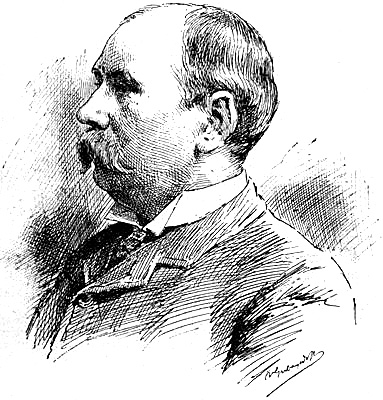
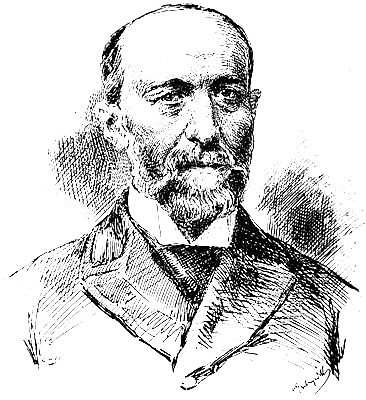
SUPERINTENDENT BYRNES.
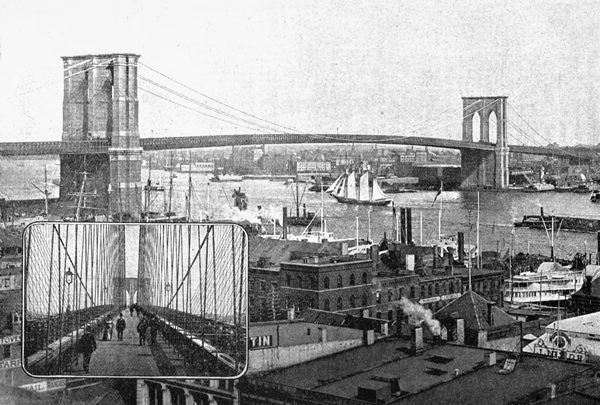
NEW YORK AND BROOKLYN BRIDGE.
PROMOTION BY PULL AND PROMOTION BY PURCHASE.
The New York Police Department as it existed in 1894 was like the Scribes
and Pharisees in the Gospel. It was like unto whited sepulchres, which
indeed appear beautiful outward, but are within full of dead men’s bones
and of all uncleanness. Hardly a single thing that was proved to exist
could have existed if the laws, rules and regulations had been faithfully
enforced. Therefore until the searchlight of the Lexow inquiry was turned
on, it was the correct thing to deny that the abuses, the corruption, the
blackmail had any existence. On paper the New York police was the finest
in the world. It was the most perfectly equipped, and it was armed with
authority as great as that of any autocrat. What then could possibly be
wrong?
The answer of the Lexow Committee, after hearing the evidence, was short
and succinct. Their answer to the question, What is wrong in the Police
Department? might be summed up in one word—Everything. From the crown of
the head down to the sole of the feet, the department was proved to be one
mass of putrefying sores. There was no health in it, and it was worst of
all at the top.
The Lexow Report says:—
The conclusion which has impressed itself upon your Committee is that
the disorganising elements at work in the Police Department are such
that operate from the higher officials down, rather than from the
patrolmen up.—Vol. i., p. 29.
But the origin of the mischief was found to exist not in the department at
all, but outside the department. The first thing that was wrong was that
the police were practically run by Tammany Hall politicians in the
interest of their party, and that the real governing power in the force
lay outside of it. Two of the Police Commissioners in whose hands the
control of the force was nominally lodged were leaders in their own
districts for Tammany Hall, and their sense of their obligations to their
party far outweighed their obligations to the law or to the city. As one
of the witnesses put it bluntly:—
So long as our municipal departments are run by Boss Croker, they will
be regarded as adjuncts of a political organisation, and will be used
to perpetuate its power. A police commission controlled by such
influence is incapable of rendering justice.—Vol. i., p. 114.
From an English point of view what New York needed most was a City
Council, with some effective control over the affairs of the city. The
shadowy unreality known as the Board of Aldermen cuts no figure in the
inquiry into the forces which actually governed New York. Tammany Hall,
the executive committee of Tammany Hall, came much nearer to the ideal of
a Municipal Assembly than the Board of Aldermen. It was to Tammany Hall,
and not to the Board of Aldermen, that the Police Commissioners appealed
when they wanted to enforce their authority over the men under their own
orders. This came out very plainly in Commissioner Martin’s evidence. He
found that his subordinates were taking so active a hand in politics,
joining political clubs and the like, that he wished to check it. He went,
not to the Board of Aldermen, but to Tammany Hall. He was asked:—
Q. Why did you go there?
A. I took occasion to speak in Tammany Hall about it, because there I
could reach people from different assembly districts; I have spoken to
representatives of the different districts about it in my office.
Q. And you went to Tammany Hall to engage their co-operation in
securing greater efficiency of the police force in New York city?
A. To aid in making it efficient; yes, sir.
Q. Was that because there was no other place to go to?
A. There was no other place to go to that would be as effective as
that.—Vol. i., p. 443.
No wonder the Committee reports:—
No stronger illustration is necessary to show how under the then
existing conditions a political faction had impressed itself so
strongly upon the police force that its authority was more potent than
that of the nominal chiefs of the department.—Vol. i., p. 19.
It was to Tammany Hall also that the liquor dealers appealed for
protection from the intolerable exactions of the police. “There was no
other place to go to.” The legal authorities were paralysed by the extreme
distrust felt by Americans in all elective assemblies. Tammany Hall
naturally and inevitably became the one living centre of popular authority
in the city. Its moral authority in New York was something like that of
the Land League over Ireland under Mr. Parnell. The Lexow Committee report
with a certain jealous awe concerning the “supreme head of authority,” Mr.
Richard Croker, who, although a private citizen, unconnected with the
Police Department, but leader of Tammany Hall, “was able to do what all
the other legally constituted authorities failed to accomplish.” They
say:—
The same private citizen whose authority was so potent to accomplish
all this, was able, by a word of command, at once to shut up all the
pool-rooms then in full operation, and which, according to the
testimony up to that time, neither the whole force of police, of
detectives, of superintendent, or of the Commissioners themselves
could effectively close.—Vol. i., pp. 18-19.
“Taken as a whole,” says the Lexow Report, “the records disclose the fact
that the Police Department, from the highest down to the lowest, was
thoroughly impregnated with the political influence of Tammany Hall”; and
they add, what naturally follows, “that the suppression and repression of
crime depended not so much upon the ability of the police to enforce the
law, but rather upon the will of that organisation or faction to have the
law enforced” (vol. i., p. 19).
The leaders of Tammany, no doubt, were not “agin the law” in the abstract.
But they owed their first allegiance to their party, and their first
thought was not of the duty they owed to the city, but of the duty they
owed to Tammany. The claims of that great brotherhood had precedence over
such trifles as the laws of the State, which after all were passed by
“Hayseed” legislators, or, in plain English, by the rustic vote of the
rural districts of the State of New York. One redoubtable worthy, Judge
and ex-Senator Roesch, who figures conspicuously in this American Tartarus
as one of the minor Plutonian deities, gave very interesting evidence on
this point. He was a Judge, an ex-Senator, and a leader of Tammany Hall.
His aid in the latter capacity seems to have been generally invoked by the
various law-breakers of the neighbourhood. He was asked by Senator
O’Connor whether it was not one of the duties of the district leader, “if
the members of his party were labouring under any kind of difficulty at
all, for the purpose of conducting his organisation and making that solid
with the parties, to do what he could to give them aid?”
The Senator answered unhesitatingly, “In every case.” When he was proved
to have received money from keepers of disorderly houses, whose girls were
run in by the police, he said that he received it entirely as a lawyer for
giving legal advice. But he admitted that when he went to the
station-house to bail out the girls, he acted as a political leader. So
the Chairman observed, “You advised as a lawyer and acted as a political
leader in carrying out your advice.” Mr. Senator Roesch is in many ways a
more typical representative of Tammany than Mr. Croker himself. Both,
however, agree on one principle. They always stick by their friends, and
when anything is going they see that, their supporters are not left out in
the cold. This, which would be denounced as scandalous nepotism on the
part of a less democratic Government, was unblushingly proclaimed as the
sole saving principle of appointing officials under Tammany. Senator
Roesch had used his influence or political pull in order to induce the
Police Commissioner Martin to transfer one Sergeant Schryer to another
precinct. Questioned by Mr. Goff before the Committee as to the grounds
for this intervention on his part in the promotion of the police, he made
the following answer:—
A. I will tell you; when a man comes to me and wants to get an
appointment or transfer, or anything like that, I never stop to
consider who is in the place he wants to go to, but my object is to
get him there; necessarily, somebody has got to get out of the way,
and here it happened to be Sergeant Schryer....
If I can get a friend of mine on the force, or get him a promotion or
position on the force, I always try to do it.
Q. And without inquiring, whether or not the man who is going to
suffer by the removal, who was to suffer?
A. That was none of my business; it was sufficient for me to know the
man they appointed to that place was competent and worthy of it, was a
friend or party organisation.
By Senator O’Connor: A political leader or a man holding a high
position here in the city, regardless entirely of the merits of the
man whom he seeks to remove, when requested by one of his
friends—political friends—to secure his position, that leader does
everything in his power to bring about that result?
A. For his friend.
By Mr. Goff: Now, we have it that both parties do it?
A. Certainly.
Q. Only that the Republican leaders do not have a pull?
A. Well, Republican leaders are not in the majority; New York city is
more a Democratic city.—Vol. ii., pp. 1,283-4.
Mr. Roesch confessed with frank brutality the principle upon which all the
politicians acted in relation to the patronage to which they believed they
were entitled. To make room for their friend, to secure a place on the
city pay-rolls for a political comrade, was ample justification for
insisting upon the removal of any officer who might happen to be in the
way. Let no one imagine that this was an exceptional case. Commissioner
Martin admitted frankly that from eighty-five to ninety per cent. of all
the appointments which he had made when he was chairman of the Police
Board were endorsed, in the first instance, by the district leader of
Tammany Hall for the district in which the applicant resided.
Under such a system promotion by merit was practically non-existent. On
this point Commissioner Martin was equally frank. He was questioned very
closely as to whether he had ever promoted an officer simply for merit.
After thinking a bit, he said he thought he could name one or two cases.
Then said Mr. Goff:—
So far as your recollection goes, with the exception of two instances,
so long as you have been police commissioner, you have not recommended
for appointment, promotion or transfer a single man, except one, who
was backed by political influence?
A. I do not recollect of any others. I think there are others of
them.—Vol. vi., p. 448.
But if a district leader of the type of Roesch was able to nominate
officers to the police, what becomes of the law by which all officers were
to be appointed by open competition in an examination conducted according
to Civil Service rules? The answer to this question is twofold. In the
first case, a certain margin was allowed to the Commissioners. They were
not bound always to appoint the candidates who came out on top. If they
were tolerably near the top, it was held to be sufficient. The second
answer is much more extraordinary. It was proved before the Committee that
by connivance with a police clerk it was quite possible for candidates to
be returned as having passed their examinations who had never been in
the examination-hall, and who never had written a single answer to any of
the questions! This was done by personation. A competent person entered
himself in the name of the candidate, filled in his examination papers,
and passed in his name. By this means there was no difficulty in driving a
coach and four through the Civil Service rules. The persons who obtained a
position on the force by this means were known as the pupils of those who
passed their examinations in their study, and were blackmailed
accordingly.
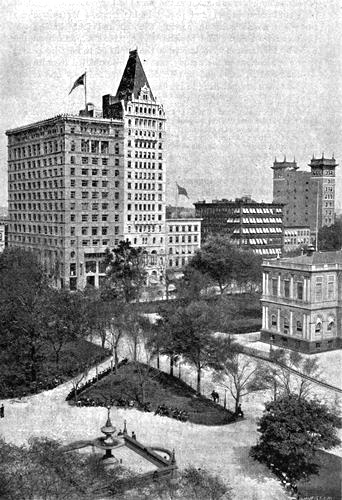
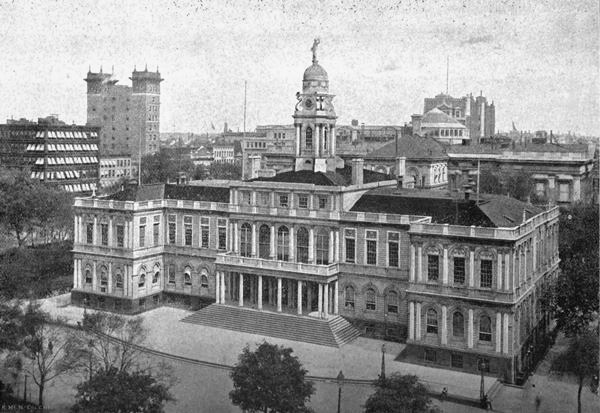
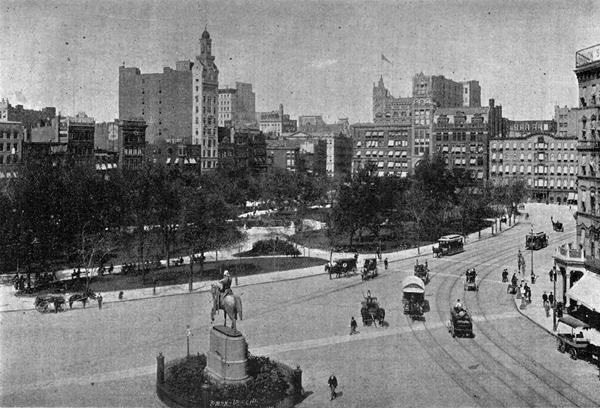
CITY HALL PARK, BROADWAY.
John Schlie, examined by Mr. Moss, described how one of the personators
went gathering in his fees:—
I went down one day with Dave Brant to the police headquarters. We met
an officer; the next thing I know I saw two 10-dollar bills slipped in
his hand: he said, “That is good;” I said, “How did you get that?” He
said, “That is one of my students;” I said, “What do you mean?” he
said, “I passed for them people;” he said, “That is good;” so we went
and had a drink and walked a couple of blocks; he commenced scratching
his head, and he said, “I guess I have another student;” he goes down
there and gets 15 dollars more.—Vol. ii., p. 1,474.
Of course, it was impossible thus to cheat the Civil Service examinations
without the connivance of some of the officials, and this connivance had
to be paid for at a price. Thus the natural process, promotion by pull,
led up to promotion by purchase. The evidence on this point was
overwhelming. It appeared that in a very great number of cases—so many
indeed as practically to establish the rule—candidates who wished to be
appointed to the force had to pay 300 dollars to a go-between, who
negotiated the matter with the police authorities. How much money stuck to
the fingers of the go-between, and how much was passed on to those in
authority, does not clearly appear, but there is no doubt that the sum of
300 dollars was demanded, and paid, as a preliminary before the candidate
could assume the uniform of policeman.
This practice once begun, it rapidly extended. As the initial cost was 300
dollars, each step in promotion cost a larger sum. To be made a sergeant
cost 1,600 dols., while the price of a captaincy was 15,000 dollars! The
police who had purchased their promotion in this fashion naturally felt
that they had a vested interest in their posts. In the British army a
similar system of purchase grew up, but it was one which was regulated by
law and sanctioned by custom, whereas in the case of the New York police
the whole system was under the ban of the law. The Lexow Committee
remarked in their report upon this subject:—
The policeman who pays for his appointment commences his career with
the commission of a crime, and it is not strange that the
demoralisation thus engendered should follow him in his further
career. The captain who pays a fortune for his appointment finds
himself compelled to recoup in order to return the moneys loaned to
him by his friends by resorting to the practices which have been
disclosed in the record before us. It seems incredible that men who
are otherwise law-abiding and efficient should stoop to the
perpetration of the monstrous and debasing practices revealed by this
record, unless influenced by a system existing as the result of the
conditions hereinbefore alluded to. Nor is it strange that, in the
contemplation of these practices by superior officers, inferior
members of the force should have become demoralised, until the
contamination has spread throughout the entire department.—Vol. i.,
pp. 49, 50.
It may be asked how was it that, while the evil was still in its infancy,
and the force as a whole was not yet tainted through and through, its
honest members did not expose the corruption which was being established
in their midst? The answer is that the evil began at the top and spread
downwards. Hence, it was impossible for the private constable to make a
stand without exposing himself to a severe punishment for daring to be
more virtuous than his superiors. The following extract from Gideon
Granger’s evidence will show how this pressure from above operated upon
those below:—
A. I did not come to court because of the threats that were made by
Mr. McClave and Mr. Nicoll, and I knew the power that a police
commissioner has got, to use every bit of the department against
anybody, to accomplish their own ends, and, in fact, he has boasted of
that.
Q. Mr. McClave?
A. Yes, sir; endless power he has boasted of.
Q. What has he said in his boasting?
A. He said police commissioners had more power than the President of
the United States had; repeatedly said that.—Vol. i., p. 1,142.
In considering the action of the police, we ought in justice to remember
that they were living in a city the whole administration of which was
infected by this money canker.
Mr. William M. Ivins, private secretary to Mayor Grace, by whom he was
appointed City Chamberlain, estimated that in his time “assessments”—that
is, money paid by candidates to “guarantee the result” of their
elections—averaged £40,000 per annum. He wrote:—
“The existing system amounts to an almost complete exclusion from
official public life of all men who are not enabled to pay, if not a
sum equal to the entire salary of the office they seek, at least a
very large percentage of it. The poor man, or the moderately
well-to-do man, is thus at once cut off from all political ambition,
because the only key to success is wealth or machine power. The ablest
lawyer at our Bar could not secure a nomination for a judgeship unless
he were able to pay an assessment of from 10,000 dollars to 20,000
dollars (£2,000 to £4,000); while a mere political lawyer, if he have
the means of paying his assessment and stands well with the party
leaders, can without great difficulty secure a nomination, and even an
election, to an office for which he has no peculiar qualifications.”
It would therefore be unjust to judge the police without making due
allowance for the condition of their environment.
One of the most interesting witnesses who came before the Committee was
Captain Creedon. It was in his case that the facts concerning the purchase
of promotion were brought out most clearly.
Creedon was an Irishman, with a distinguished record and a high character.
He joined the police force in 1864, and was made sergeant after fifteen
years in the ranks. He remained sergeant for thirteen years, when he was
promoted to a captaincy. Before he entered the police he had served with
great gallantry in the Union army. He served with his regiment in no fewer
than twenty-three engagements. He entered as a private, rose to be a
sergeant, and his name was down for a first lieutenancy when he left the
army. His record on the police for thirty years’ service was extremely
good, hardly anything being entered to his discredit. Such entries as were
to be found related only to breaches of the technical rules of the force,
and in no way implied any moral guilt.
Captain Creedon was put in the witness-box, and asked how much he had paid
to be made a captain. He denied he had paid anything. As the facts were
perfectly well known, the Committee was much startled by Captain Creedon’s
perjury. But after adjournment had given time for reflection, the worthy
Captain came to the stand and explained that he had denied everything
because he was an Irish revolutionist, and that he had such a dread and
terror of being regarded as an informer, that he preferred to perjure
himself rather than incur that disgrace. He was willing to sacrifice
himself and risk going to gaol for perjury rather than in any way
implicate any of his friends in the improper and illegal transactions in
which he had been engaged.
It was carefully explained to him that he was not in Ireland, and that
nothing he could possibly say on the stand could expose him to the
imputation of being an informer. Having received this assurance, Captain
Creedon opened his mouth and spoke.
The story he had to tell was very simple. Three times he had gone up for
examination for a captaincy before the Civil Service Board. He had passed
creditably every time, but notwithstanding this, he seemed no nearer to
securing an appointment. His friends kept on telling him that he was
simply wasting his time going up for examination after examination. He had
much better stay at home unless he made up his mind to do one thing. He
steadily turned a deaf ear to their representations, until at last four
years after his first application, seeing that no one was promoted without
bribing their superiors, he consented to fall in with the general
practice. As soon as he did this, the way was made plain before him. Mr.
Reppenhagen, the representative of the New York Democracy in his district,
was indicated as the man to approach Police Commissioner Voorhis. Mr.
Reppenhagen saw the Commissioner, and reported to the Captain that the
place could be had for 12,000 dollars. Creedon had not at that time 12,000
dollars to invest in the purchase of a captaincy, but on talking it over
with his friends, they agreed to make up a purse, so as to enable him to
acquire the position which he coveted. While they were raising the money,
Reppenhagen reappeared, and announced that a certain sergeant named
Weigand had offered 12,000 dollars for the captaincy, and that if Creedon
wished to secure it, it would cost him 15,000 dollars. Creedon’s friends
were men of mettle, and they agreed to raise the full sum. Creedon gave
the subscribers notes acknowledging their subscriptions as a loan, which
he afterwards repaid. The money was raised, and deposited in a bank. A Mr.
Martin then appears on the scene as the confidential man of the Police
Commissioner, smelling round after the 15,000 dollars as a rat noses round
a cheese. For some reason or other there was a hitch in the appointment,
and Creedon’s friends and Reppenhagen passed some days in horrible
suspense as to whether or not, in spite of the money being “put up,” the
appointment might go to Sergeant Weigand, while Martin was equally alarmed
lest the 15,000 dollars should slip through his fingers.
The Record contains the following entries:—
John W. Reppenhagen examined by Mr. Goff: Do you remember saying to
Martin further, that as long as Creedon’s friends had put up more
money than Weigand was reported to have put up, that it would play the
devil in the organisation in that district if Creedon was not
appointed?
A. I might have said that.—Vol. v., p. 5,010.
Q. Don’t you remember when you said that to Martin, that Martin said
in word and in substance as follows: “I will go right down and I will
see Voorhis, who is too damned hoggish about this thing.” Do you
remember those words?
A. I don’t remember the words.
Q. When he was in that condition of excitement, and when he struck the
bar several times with his clenched fist, didn’t he say those words,
“That Voorhis wanted everything, almost the earth; he was hoggish, and
he would go right down to New York and talk right up to him, and tell
him he must do the right thing?”
A. In substance he said that—yes.—Vol. v., p. 5,014-5.
Reppenhagen was evidently in a state of great uneasiness about securing
the patronage for which the money had been raised by Creedon’s friends. By
way of enforcing his representations, he reminded Mr. Martin pointedly
that the only chance he had of fingering any of the money was to see that
Creedon’s appointment went through, otherwise he would not make a cent.
Thus pressed, Martin went off to see Voorhis. When he next saw Reppenhagen
he assured him that it was all right, and that Voorhis had pledged his
word to appoint Creedon the next Board Day. Even after this there was a
hitch. It was reported that Weigand was going to be appointed after all.
Reppenhagen then found it necessary to take hold of the affair with a
strong hand.
“John,” said he to Martin, “you had better go down yourself, and stay by
the Commissioner until the appointment is made.” Thus adjured, John went
down, vowing that he would not leave the Commissioner until he had
appointed Creedon. Then at last Creedon was duly appointed.
After this another hitch arose as to the difficulty of paying over the
money. Then it was Mr. Martin’s turn to be uneasy. He said he thought he
had been bilked, and that the money would never be turned over. Creedon’s
friends, however, were men of affairs, and knew the kind of gentry they
were dealing with. They had refused to hand over the money until the
Captain was duly appointed. But now that Creedon was a captain at last
they released the money. When Reppenhagen handed over the fifteen thousand
dollars to Martin, that functionary handed him back five thousand dollars
for himself. How much of the ten thousand dollars went to Commissioner
Voorhis or how much of it stuck to Martin’s fingers the record does not
show. Here, however, was clear and unmistakable evidence as to the
systematic manner in which promotions were arranged for and carried
through between the Commissioners on the one hand and the candidates on
the other.
There is a sequel to this story, which is so exquisitely absurd that it
seems more like opera bouffe than a chapter from recent history. While
the Committee was still engaged in ferreting out how the money was paid
which secured Captain Creedon his captaincy, a startling rumour reached
the Committee that the Police Board had suspended Captain Creedon from
duty on account of his having obtained his captaincy by corrupt means. A
bombshell falling in the court could hardly have created greater
consternation.
To begin with, the Committee was a privileged body. All its proceedings
were privileged. For any outside authority to act upon the testimony which
it had taken without the direct authorisation of the Committee would be a
contempt of the Senate. Further, the evidence given by Captain Creedon was
tendered on the assurance of the Committee that no action could be taken
upon it by any outside authority. They had promised him protection and
immunity from persecution and prosecution, and for the Police Board to use
his own admissions against him, which were privileged communications, the
making of which secured him protection from any action based upon such
admissions, was an indictable offence at the common law. But what made
things worse was that, when the Captain left the stand, he had been
addressed in eulogistic terms by counsel. This was not without cause. His
candour in owning up and admitting everything had enabled the Committee to
penetrate into the depths of the mystery of promotion by purchase. Mr.
Goff had concluded his little speech by declaring that, “In view of
everything; in view of your splendid service to your country, and your
good service on the Police Department, it is the unanimous expression of
the Committee that the public interests would not be served were you to be
disturbed in your present position as police captain” (p. 4,982).
Within an hour of this emphatic and public certificate of commendation,
the Police Board met and suspended Captain Creedon from duty. Not a single
captain or police officer of all the black regiment of clubbers and
blackmailers, whose infamy had been proved before the Committee, and who
had been indicted before the Grand Jury, had been removed from duty. Only
when this honest officer had admitted the truth did they pounce down upon
him and make an example. It is only fair to say that the Board was not
aware when it suspended Creedon of the remarks that had been made by the
counsel of the Committee as he left the witness stand. When they were
rebuked they restored him to his post. But even with this allowance, the
fact that the Commissioners should have only made one suspension, and that
of a man who had confessed and repented of his wrong-doing, while they
left all the other scoundrels unwhipped, was one of the most significant
incidents in the whole course of the inquiry.
But after such an illustration of the methods of the Police Board, is it
very surprising that until the Lexow Committee sat the authorities were
utterly unable to discover any specific evidence as to the corruption into
which the whole force had sunk?
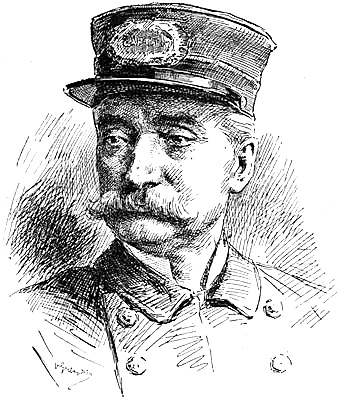
CAPTAIN CREEDON.
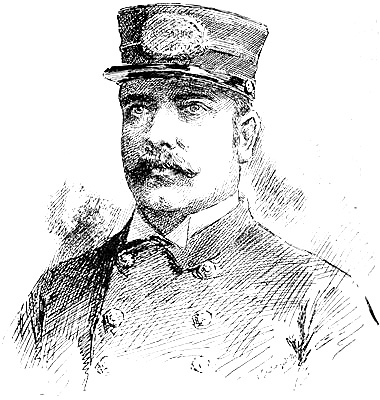
CAPTAIN MAX F. SCHMITTBERGER.
THE AUTOBIOGRAPHY OF A POLICE CAPTAIN.
The following narrative of the career of a police captain of the City of
New York is taken for the most part textually from the evidence tendered
on oath by Captain Max F. Schmittberger, then in command of the Nineteenth
Precinct. The police of New York were four thousand strong, divided for
purposes of administration—and of plunder—into thirty-eight Precincts.
Schmittberger was Captain of the Nineteenth. He gave his evidence almost
at the close of the inquiry, when the essential facts were all proved up
to the hilt by the evidence of a multitude of witnesses. Strange, almost
incredible though it may appear that such an official should make so
remarkable a confession, it is to be remembered that the facts were
already known, and the only chance he had of saving himself was by turning
Queen’s evidence. When he took the stand under subpœna, the Chairman
addressed him as follows:—
We are here on the great State service to ascertain not only
individual or specific cases of fraud or corruption, but the general
system, and any witness who places himself on the stand here, no
matter if he has himself been guilty of the violation of the law, if
he places himself under the protection of this Committee, to serve it,
to aid it in the ascertainment of those questions that the State
Senate has imposed upon us, we shall consider it not only our
obligation and our duty under the circumstances as Senators,
individually and collectively, to do all that we can to see that that
immunity which the law throws about you is safely guarded, but that he
shall hereafter be protected from any of those results that that
testimony might otherwise bring upon him.—Vol. v., pp. 5,311-2.
Thus adjured, Captain Schmittberger did on the 21st of December, 1894,
unfold as remarkable a tale of infamy as ever was deposed on oath by an
officer supposed to be responsible for the enforcement of the law. When he
had closed his testimony, he said, “I have made a clean breast of
everything I know.” Mr. Goff, who was examining him, asked:—
Is it not a fact that, owing to the developments before this Committee
showing the corrupt and rotten condition of affairs in the Police
Department, you feel justified in coming forward and stating all you
know for the benefit of the people of this city and of this State? The
Captain replied: “I feel that the pillars of the church are falling,
and have fallen, and I feel in justice to my wife and my children that
I should do this.”—Vol. v., p. 5,382.
In compiling his autobiography I quote, wherever possible, textually from
his own words, giving the reference in all important points to the page
from which the quotation is taken.
From the Evidence of Captain Schmittberger.
I joined the police force when I was twenty-three years old, on January
28th, 1874. I had previously been a confectioner. I was married when I was
admitted to the force. The Civil Service rules were not in operation then,
neither had I to pay anything, for the practice of paying money for a
position in the force had not commenced so early as 1874.
I was first assigned to the 19th Precinct, then the 29th, better known as
the “Tenderloin.” For three years I served as patrolman. In those years I
discovered the importance of the political pull. The local politician, by
his influence with the Police Commissioners and the chief police
authorities, could generally make the sergeant his mouthpiece, and induce
him to give preference and show favours to patrolmen who were friends and
supporters of the politician. It was decidedly detrimental to discipline,
but it was the principle throughout. A sergeant who was seeking promotion
relied much more on his political pull than upon his record as a police
officer.
Senator O’Connor interrupted to ask:—
Is there any recognition of merit at all in the department as now
conducted, apart from money considerations or political influence?
Captain Schmittberger replied:—
To a very small extent. It is either politics or money.—Vol. v., p.
5,382.
The result has been that in the last ten years the police have
deteriorated. “They are more politicians than anything else” (p. 5,316).
The mischief of the political pull was increased when candidates had to
pay for their appointment. They felt they had purchased their positions,
and were sort of independent.
The system of purchase, which did not exist in 1874, gradually became so
general that if men wanted to get into the department it was necessary to
see one of the “go-betweens,” a set of men of whom one Charley Grant,
Commissioner McClave’s secretary, was very well known. These
purchase-officers made poor policemen, and they felt they had a right to
more protection than the others. When they were rebuked for offences by
their officers they would often defy them, basing their defiance upon the
ground of political influence and power to protect them from the
consequences of their act. This was especially the case with those men who
belonged to political organisations, political clubs.
There was the Pequod Club, for instance, a Tammany club, presided over by
Police Commissioner Sheehan, which I was pressed to join, owing to the
pull it would give me if I belonged to the Commissioner’s club. Several
police captains belonged to it, and the tickets for the club outings, at
five dollars apiece, were forced upon storekeepers and liquor dealers by
the police. They also compelled all the liquor dealers in the precinct to
buy Munzinger’s mineral waters, for Munzinger was secretary of the Pequod.
In the Tenderloin there were a great number of disorderly houses, which
were resorts for the criminals of the whole country, who came there to
meet prostitutes. That precinct of New York was the centre for the
criminal classes. No one interfered with them, it being perfectly well
understood by the police that they were under protection, and they were
under protection because they paid money for protection directly to the
police captain of the precinct. This was necessary, because without his
protection the officers would have closed the house. If they had
interfered with a protected house, they would have been removed to another
beat. Even if outrages occurred they knew they were not to interfere, as
the houses had paid the captain for protection, and no interference was
permitted. I heard once of an officer, of the name of Coleman, who was
killed in a disorderly house, and there never has been an inquest or an
arrest of any persons suspected of the crime, or any judicial inquiry
whatever touching the cause of that officer’s death (p. 5,328).
I was raised to the rank of a roundsman in April, 1880, because I found
Commissioner Whelan’s favourite dog, and I remained in the precinct till
March 6th, 1883. During all that time the state of things was very bad.
French women used to stand out in front of the railing in front of their
houses and pull every man in as he went through the street. When citizens
complained, they got no satisfaction. On one occasion a citizen who
complained was ordered out quick. There was a friction—a very large
one—between him and the Captain. It was even reported in the newspapers
at the time that the Captain had threatened to club the complaining
citizen out of the precinct.
During these early years I had a good record. I had arrested an important
burglar, who had shot at me. I received honourable mention twice; I got
the medal of honour from the department, and also the gold and diamond
medal from the citizens of the precinct for raiding out the thieves there;
I sent over 1,200 people to State prison whom I arrested myself in seven
years as a detective (pp. 5,383-4).
So it came to pass that in March, 1883, I was made sergeant. I remained as
sergeant for seven years, when I was made captain. I had passed at the
head of the Civil Service list, and had some influential political men
recommending me. I paid nothing for my appointment.
When I became captain I objected at first to the levying of blackmail. I
was appointed to the steamboat squad, and I had not been there any time
when detective Vail told me that he collected money from the ship
companies and dock occupants or lessees, and that my predecessors always
received half. I told him I did not care about a thing of that kind. Vail
replied, “You’re a damned fool if you don’t do it; you might as well get
it as well as the others” (p. 5,337). So I told him to go on and do the
collecting. He brought me 190 dollars a month, and I gave him 20 per cent.
commission.
At this time, in the police department when I became captain, it was an
understood thing, and a matter of common understanding among the captains
of the various precincts, that they were to take advantage of any
opportunity that presented itself to make money out of their respective
precincts (p. 5,337).
I did it—we all did it. It was the universal custom. I had a list of the
men and the amounts they received. The wardman brought me half of it to
the station-house. I then returned him 20 per cent. It was a poor
district, and so I was not expected to send any of my share up to the
inspector. He told me himself that he hardly expected anything, as there
wasn’t anything in the precinct. That was true, and therefore I tried to
get another as soon as possible. At the end of thirteen months I was
transferred to the Twenty-fifth Precinct. I brought with me my
confidential collector, Gannon the detective.
When we settled down in the new station we discussed what collections
could be made. We found there was nothing, only the policy shops, of which
there were about ten, and the Liquor Dealers’ Association. There was no
difficulty about either.
The policy shops, all those in the precinct and in the upper part of the
city, are under a man by the name of Parker, and if I remember right,
Parker came to the station-house and saw me, and told me how many shops he
had in the precinct; that was all. He was introduced to Gannon, and Gannon
did the rest (p. 5,341). He fixed the old price that had been understood
for years long before my time—twenty dollars a month per shop. The
Bohemian Liquor Dealers’ Association were equally easy to manage. They
paid eighty dollars per month.
My predecessor before he left had a talk with me about what should be
given to the Inspector. He said he gave him usually from fifty to
seventy-five dollars a month. He used to put the money in an envelope, and
give it to an officer, who would give it to the sergeant in Inspector
Williams’s office. I did not take this course. I went directly to Williams
and handed him fifty dollars in an envelope. He took it in his office at
headquarters without a word (p. 5,343).
I was three months in that precinct. I gave the Inspector a hundred
dollars one month. It was necessary to square him because it was in
Williams’s power to send men up there to raid those policy shops over my
head; I had to prevent him from doing that. Of course, upon consideration
of receiving that sum of money every month he wouldn’t do it (p. 5,344).
I had also to pay 20 per cent. to my collector. In return for this money I
gave protection to the policy shops, and allowed all the liquor dealers to
run open on Sunday. I was in the precinct three months, during which time
I duly reported to headquarters concerning disorderly houses, gambling
houses, &c., in my precinct, but I was very careful to say nothing of the
ten policy shops which paid for protection. It was an understood thing the
law was not to be enforced in the case of those who paid for protection.
After three months I was changed to the Twenty-seventh Precinct. In that
precinct there were ten policy shops and three pool-rooms. I brought
Gannon along with me. The policy shops paid as before, but the pool-rooms
paid two hundred dollars a month. This was the old tariff paid to my
predecessor, and continued, as a matter of course. Besides the usual 20
per cent. to the collector, I had to pay two hundred dollars per month to
Inspector Williams. During the nine months I was in the precinct I handed
him directly eighteen hundred dollars. He made no remark, and I would
merely say, “Here is something for you.” I gave him the same money I
received from the pool-rooms. But in this precinct I drew no money from
the saloons. There had been some trouble with my predecessor, and it had
been arranged that instead of paying the police the liquor dealers were,
in future, to pay direct to Tammany Hall (p. 5,349).
I was removed from this precinct because of the liquor dealers.
Superintendent Byrnes ordered me to make direct bonâ fide excise arrests
where liquor was sold on Sunday. I made over twenty bonâ fide arrests.
The President of the Liquor Dealers threatened the officers to have them
transferred if they made real arrests, and he was as good as his word. I
also was transferred for the same cause. The liquor dealers pulled the leg
of Commissioner Martin, who was a Tammany chief, and we were all
transferred. The Superintendent whose orders I obeyed could not protect
us. He simply told me to keep quiet, that the thing would right itself.
I was transferred to the Fifth Precinct, and there remained only nine
weeks. There were only two pool-rooms, which yielded four hundred dollars
a month, of which I gave fifty dollars to Inspector McAvoy. I put the
money in a blank envelope and left it on his desk at headquarters.
From the Fifth I was removed to the Ninth, where I only remained a month.
I made no collections there. But when I was removed to the Twenty-second I
had better fortune: I remained there from May to December. Here I first
struck disorderly houses. They paid—some ten, others twenty-five, and
others again as much as fifty dollars a month. The policy shops paid the
usual twenty-dollar tariff. There I collected from five hundred to six
hundred dollars per month. The gambling houses were all strictly closed
up.
It was while I was in this precinct that I came across Commissioner
Martin, who was protecting personally a house of ill-fame kept by Mrs.
Sadie West, 234, West Fifty-first Street. A body of citizens had made a
formal complaint. I sent an officer down to make inquiries. Mrs. West
said, “Commissioner Martin is a friend of mine, and don’t you do anything
until you hear from him.” Next day Commissioner Martin, who was at the
head of the Police Board, ordered me to send the officer back to apologise
and say he had made a mistake. “Hold on, Commissioner,” I said; “this
originates from a complaint of citizens.” “Well,” he replied, “I don’t
care; I want you to do what you are told.” So I had to send that officer
back, and he had to apologise (p. 5,363).
That was not the only difficulty I had with the Commissioners.
Commissioner Sheehan did his utmost to induce me to allow a gambling house
to be opened in the precinct by one Maynard, a friend of his friend Mr.
Proctor. The capital which Proctor was to bring to the gambling house was
his pull with Sheehan—the Superintendent’s orders were strict. So I told
Sheehan, whom I met at the Pequod Club. Sheehan told me that there was a
Spanish Club in that house, and I had no right to interfere with it; “if
they played cards among themselves without playing gambling games that I
had no right to interfere.” But the Superintendent said he would break me
if I allowed cards to be played there. When I told Sheehan this he
exclaimed, “Well, if they cannot play, Daly can’t play!” As a matter of
fact Daly was not playing (p. 5,368).
During my stay in this precinct I used to take one hundred and fifty
dollars a month in a closed envelope and give it to Inspector McAvoy at
headquarters. One curious circumstance I remember about him. The Inspector
is a very religious man, and he had conscientious scruples. He asked me
one time if some of the money I gave him came from disorderly houses; if
it did he didn’t want it, because he didn’t want any money of that kind; I
told him no, it hadn’t; he drew the line there (p. 5,370).
Of course as he had been captain in the precinct himself he knew that it
did come from disorderly houses, but he wished to be told it did not. I
reported to headquarters that there were no disorderly houses in the
precinct.
In December, 1893, I was made Captain of the Tenderloin, and have been
there ever since. But the glory had departed owing to the raids made after
Dr. Parkhurst’s action. I did not get more than 200 dols. a month there.
Georgiana Hastings’s house of ill-fame I was warned not to touch, as if I
did I should burn my fingers. I was informed that certain public officials
were in the habit of visiting Georgiana Hastings’s house—some officials
that graced the Bench, and some officials that held commissions in the
City of New York. One night, when a Bench warrant was sent there for
execution, there were two officials, one a judge of a Court in this
city—not of a Civil Court—in the house, and so that warrant was not
executed (p. 5,374). She paid no protection money. She was protected
inviolate by the law on account of the influential character of her
customers.
Last year I made a political contribution of 100 dols. both to Mr. Martin
and to Mr. Sheehan, who were both Police Commissioners and Tammany leaders
in their respective districts. I had nothing much to do with handling
money in payment for promotion. I acted as go-between in the case of
Martens. I took 1,600 dols. of his to Captain Williams, and he got him
made sergeant. Martens afterwards told me it would cost him 14,000 dols.
to be made captain. On the whole, I have been four years a police captain.
In that time I have been in command in six precincts, in every one of
which I found the custom of collections regularly established from of old.
It would seem that the tariff was fixed: the commission to the collectors,
and the proportion for the Inspector. The figures were as follows:—
| Precinct. |
|
Time of Stay. |
|
Sources of Revenue
per Month. |
|
Collectors’
Com.
20 per cent. |
|
Inspectors’
Share. |
|
Total
Net
Receipts. |
| 37 |
|
13 |
months. |
|
Blackmail on ships, $190 |
|
495 |
|
— |
|
1,975 |
| |
| 25 |
|
3 |
" |
|
10 policy shops at $20 |
|
168 |
|
200 |
|
472 |
| Liquor dealers, $80 |
| |
| 27 |
|
9 |
" |
|
10 policy shops at $20 |
|
1,450 |
|
1,800 |
|
3,950 |
| 3 pool-rooms at $200 |
| |
| 5 |
|
2 |
" |
|
2 pool-rooms at $200 |
|
160 |
|
150 |
|
590 |
| |
| 9 |
|
7 |
" |
|
Policy shops, $20 |
|
700 |
|
1,050 |
|
1,750 |
| Houses of ill-fame, $10, |
| $25, and $50 = $500 |
| |
| 19 |
|
12 |
" |
|
Houses of ill-fame, $200 |
|
480 |
|
— |
|
1,920 |
| |
46 |
|
3,453 |
|
3,200 |
|
10,657 |
The ransom extorted from the vicious and criminal classes of a single
precinct by the police would seem to be an irreducible minimum of a
thousand pounds per annum.
The Lexow Committee reported:—
The confessions summarised show the existence throughout the city of a
system so well regulated and understood that upon the assignment of a
new captain no conversation was necessary to instruct the precinct
detectives or wardmen as to their line of conduct. Without a word they
collected the illicit revenue, simplifying their duties as much as
they could, either by granting monopolies of a special kind of crime
to individuals, or imposing upon certain individuals who had knowledge
of a particular class of crime the obligation of collecting for them,
thus collecting monthly from all licensed vice and crime, and paying
over their collections to the captain, deducting for their services
twenty per cent. from the total. Or, rather, at first, paying the
whole to the captain, and receiving twenty per cent. back from him,
and thereafter making the deductions themselves. The captain, on his
side, visited the inspector and paid over to him a substantial
proportion of the amount collected.—Vol. i., pp. 45, 46.
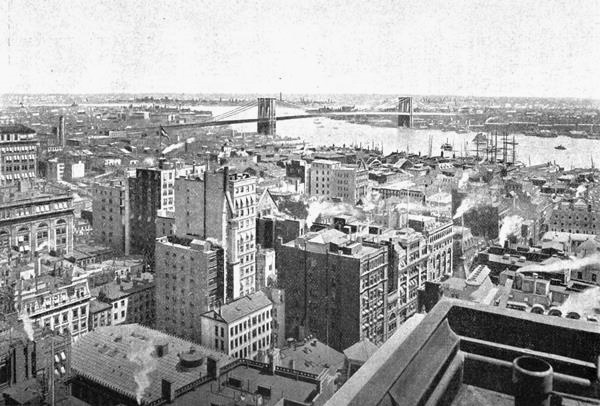
THE CITIES WHERE DWELL THE STRANGERS WITHIN THE GATES.
View of Brooklyn Bridge from a roof in Broadway.
“THE STRANGER WITHIN THE GATES.”
“I was a stranger and ye took me in.” The familiar passage needs to be
interpreted in a different sense if it is to describe the treatment of the
stranger by the police of New York. In the evidence of the men who
practise the confidence trick, the curious fact came out that the police
expressly abandoned strangers to the tender mercies of the Bunco Steerer
and Green Goods dealer. These thieves were forbidden to practise their
arts upon the resident population of New York. But the “guy” was fair
game. The stranger from the country was abandoned to the plunderer, who
indeed could count upon the active co-operation of the police—in return
for a share of the loot. The stranger was taken in indeed. But not in the
sense of the Bible text.
The treatment of Americans who were strangers in the sense of not
possessing a fixed abode within the city limits, was bad. The treatment of
the stranger from over sea, the foreign immigrant, was infinitely worse.
It has been the glory of Columbia, as one of the poets declared, that her
latchkey was never drawn in to the poorest and weakest of Adam’s kin. The
boast is no longer true. Restrictions upon the pauper immigrants from the
Old World have been multiplied of late with ominous rapidity. But the
foreigner had already established himself by the million within the
Republic before the restrictive policy was begun.
In the Civil War, when the negroes were enrolled as soldiers in the
Federal ranks, their presence was excused by the cynical remark that
niggers were good enough food for powder. The foreign denizen of the New
York slums is regarded in much the same light by the police of the city.
Not as food for powder, but as material for plunder—squeezable folk who
have no rights, save that of being allowed to swell the registration list
of their oppressors. The police brigands levied blackmail boldly enough
even when dealing with the cute Yankee and the smart New Yorker. But when
they were let loose on the foreigner their rapacity knew no bounds. They
had the power of a Turkish pasha in an Armenian province, and they used it
almost as ruthlessly. They did not massacre, it is true. There was no
occasion for such extreme measures. Even the Turk would not slaughter his
taxable cattle if they were not guilty of indulging in aspirations after
freedom. No dream of revolt ever crosses the mind of the poor wretches in
the city slums to whom the policeman is the incarnate embodiment of the
whole American Constitution. Back of him stands the whole
Government—City, State, and Federal. What he says goes. So the
foreigner—poor, ignorant, friendless—can only obey.
A witness before the Lexow Committee testified to the existence of a gang
of criminals known as the Essex Market Gang, which had established a
regular reign of terror in the neighbourhood. This witness, whose name was
John Collins, said:—
Last night business people spoke to me; I live nineteen years in that
neighbourhood and begged of me to protect them; it is impossible to
live there with the gang; they can convict any man they want to, and
they can make free any man they want to, because they have got their
witnesses; the leading man is Martin Engel, he owns property over
200,000 dollars, got from ruining people.
Mr. Moss: You can see what power these men have when they have lots of
men swearing to anything, and police officers to make arrests, and
judges holding them and discharging them at will.
Chairman Lexow: If the situation is such as indicated, how is it there
has not been a revolt down there?
Mr. Moss: The class of people are largely those who have come from
foreign countries—countries where they have been used to that sort of
thing, and supposed this Government just about the same, and, perhaps,
a little worse than the place they came from; they are largely Polish
Jews and Russian Jews and foreigners of that class, who have small
understanding of the English language and no knowledge of our custom.
Those are the class of people that are terrorised by this gang.—Vol.
v., p. 4,896.
In small things as in great, the helplessness of the poor foreigner is
conspicuous. Here is an instance of the way in which an Italian shoeblack
was treated for daring to ask an officer, whose boots he had blacked on
credit for a month until the little bill had run up to 75 cents, to settle
up. The bootblack, whose name was Martini, stopped the officer, whose name
was Gwinnen, as he was passing their stand, and said:—
“Gwinnen, why don’t you pay what you owe me?” so he said, “The next
time you stop me on my way going across the street, I will smash you
on the jaw, you dirty Italian son-of-a-bitch;” at the same time my
partner got up and said, “Well, why don’t you pay us?” At the same
time he rushed up against my partner like a cyclone and struck him
right and left with his hand; and he had him all bleeding. I tried to
step in between the two of them to separate them, and this officer
Looney came along from behind me and he grabbed me by the back of the
neck and punched me between the eyes, and he said, “Let us pull the
guinea in.”
Q. Whom did he mean by the guinea?
A. Well, he meant us two; so we went to the station-house, and they
made a charge of disorderly conduct: they claimed that we were
fighting each other, me and my partner.
Q. And both of you were cut and bleeding at this time?
A. Yes, sir.
Q. Were the officers in uniform?
A. All in uniform. When they went into the station-house they told
their story, and when I went to tell my story, they wouldn’t listen.
They heard the policeman’s story, but would not let us tell ours at
all. Another officer took me to the court, and Gwinnen took my partner
along; when we got to the other side of the station-house,
Sixty-seventh and Lexington Avenue, this Gwinnen took off his belt,
doubled it in two, and struck my partner in the face two or three
times.
Q. You were then under arrest?
A. Yes, sir.
Q. And on your way to the police-court?
A. Yes, sir; I appealed to the officer that had me, and I said,
“Officer, tell him that he should not hit him any more;” so after he
turned around my partner was a sight.—Vol. iv., pp. 3576-7.
The sequel of this episode is interesting. The judge, apparently thinking
the poor wretches who were brought before him all bloody had had enough of
it, dismissed the case. Strange to say, the victims in this case
endeavoured to obtain redress. They appealed to the Superintendent, who
promised that the officers should be punished. Nothing was done. They then
made another effort, raised £5 to pay a lawyer, and began an action for
assault. One officer was held for the Grand Jury. But it was postponed
again and again. The lawyer insisted on more money, which was not
forthcoming, and so the Italians lost their £5, had their beating, and do
not even appear to have recovered their 75 cents.
The lesson thus taught, not to throw good money after bad, and the
impossibility of getting justice of a policeman, has been learned so well
that one marvels at the temerity of the brave bootblacks, whose courage
deserved a better fate.
The Lexow Committee in their Report put it on record as their deliberate
conclusion that—
The poor ignorant foreigner residing on the great east side of the
city has been especially subjected to a brutal and infamous rule by
the police, in conjunction with the administration of the local
inferior criminal courts, so that it is beyond a doubt that innocent
people who have refused to yield to criminal extortion, have been
clubbed and harassed and confined in gaol, and the extremes of
oppression have been applied to them in the separation of parent and
child, the blasting of reputation and consignment of innocent persons
to a convict’s cell.—Vol. i.
The case which appears to have produced the deepest impression for wanton
wickedness and ingenious devilry on the minds of the Commissioners was the
attempt to plunder an unfortunate widow woman of the name of Urchittel.
Mrs. Urchittel was a Russian Jewess, who emigrated to the United States in
1891. Her husband had died at Hamburg, from which city she sailed for New
York, where she arrived, accompanied by her four children, the eldest of
whom was fourteen, the youngest three. But it is best to print in her own
simple language the statement of her wrongs:—
In 1891 I came to New York, a widow with four children; my husband
died in Hamburg. Being without means, I applied to the Hebrew
charities on Eighth Street for help, and they were kind enough to
support me for starting a boarding-house in 166 Division Street, and
gave me for furniture and other necessaries, and, besides 60 dollars,
sent immigrants to my boarding-house. My business was increasing
daily, having thirty to thirty-five persons every week, and in eight
months I saved 600 dollars. I worked hard indeed, but I did it gladly,
knowing that this will enable me to support my children, the orphans.
The immigration having been stopped, I had to give up boarding
business, and applying again to the Charities, they supported me
again, giving me 150 dollars, and sent me to Brownsville, where I
bought a restaurant and made a nice living, but having the misfortune
to lose one of my beloved children, I left Brownsville, after staying
there but a little time, and came back to New York.
I bought a cigar store in 33, Pitt Street, corner of Broome, for 175
dollars, and gave the landlord 40 dollars security, and supplied more
goods for 50 dollars. On the second day of my taking possession of the
store a man came in and bought a package of chew tobacco for five
cents. A couple of days later the same man came in, asking me for a
package of chew tobacco, to trust him, which I refused, excusing
myself being recently the owner of that store; I don’t know anybody of
that surrounding. I cannot do it. He took then out a dollar of his
pocket and gave it to me for changing, and having no small change,
only pennies, which he wouldn’t take, I sent my one-year aged daughter
to get other coin for the dollar, and handing same to the man I felt a
tickling in my hand caused by the quarter of the dollar in the hand of
the man, and I said good-bye to him.
On the evening of that day another man came in the store, and told me
that the man who was before asking for chew tobacco without money is a
detective, and that he has a warrant to arrest me, and I can avoid the
trouble by giving the detective 50 dollars, and refusing to do it, I
will be locked up, and my children taken away from me till the
twenty-first year. Not knowing to have done anything wrong, I laughed
at the man, and told him that I wouldn’t give a cent to anybody, and
if that man should come in again, I will chase him out with a broom.
The other night, at 11 o’clock, the children being asleep already, the
same man who asked me to trust him the chew tobacco, and after which I
learned he was a detective, named Hussey, came in with another man who
took away my cousin that came to see me in that night, and the
detective remained with me alone in the store; he told me then that he
knows that I keep a disorderly house and saved 600 dollars of that
dishonest business. If I wanted to escape being arrested, he wanted 50
dollars. I opposed to his assertion, and protested against his wanting
money of me, saying that I ever made a living by honest business, but
he wouldn’t listen to me, and in spite of my protesting and the crying
of my children, I was forced to leave my store and follow him.
As we were two blocks away we met Mr. Hochstein, and crying, I told
him all my trouble, and how I don’t know anything about the false
accusations. It was of no avail; Mr. Hochstein told me that the
detective wants 75 dollars, but he will try to settle it with 50
dollars, but without any money nothing can be done for me, and gave me
also his advice, to pay 10 dollars monthly to the detective I wouldn’t
be troubled at all, and that I should resume my business unhindered. I
repeated again that I don’t know anything about dishonest business,
but it was no use talking more.
I was dragged from corner to corner till three o’clock in the morning,
insisting that I had money with me, 600 dollars I kept it in my
stockings. Weary and tired out, I sat down at the corner of Essex and
Rivington Streets at a dry goods store and took off my stockings,
showing that I had no money in them. “If you don’t want to give the
money,” said the detective to me, “I can’t help it, you must follow me
to the station-house.” Being convinced that it is impossible that I
should escape without giving money, I took out 25 dollars of my
pocket, the only money I had, and handed them over to the detective
standing by a window, which money was parted between Mr. Hochstein and
himself, he taking 13 dollars and Hochstein 12 dollars.
They went with me to Essex Street, and, sending me in through a gate
in the house, where I was kept about two minutes, they sent me home
after with the warning to be prepared with fifty dollars. At seven
o’clock in the morning the detective, Hussey, came to my store asking
for the money. I cried again and begged him to let me go, that I am
not able to give him any more money; but he didn’t want to hear me any
more, and I had to follow him. By the signal of a whistle a man came
near me, and the defective gave me over to him with the remark not to
let me go till I have the fifty dollars. The name of that man is Mr.
Meyer. I went with him to Mr. Lefkovitz, manufacturer of syrups, 154,
Delaney Street, and to Mr. Frank —— for selling the store even for
the fifty dollars, but they didn’t want to buy it, seeing the man
after me and fearing trouble. After trying in vain to sell the store
the detective said to Mr. Meyer, “That bad woman don’t want to give
the money. Take her to the court,” and I had to stay at the trial.
Two bad, disreputed boys were engaged by the detective, Hussey, for
witness. The one said that he gave me fifty cents for gratifying him,
and the other said that he would give me forty cents, and I did not
agree asking fifty, and thus I was detained in default of five
hundred dollars bail. Having been sitting in the court the detective,
Hussey, came in to me on the same day at four o’clock P.M., and told
me that my children are already taken away from my house, and if I can
give him the fifty dollars he can help me even now.
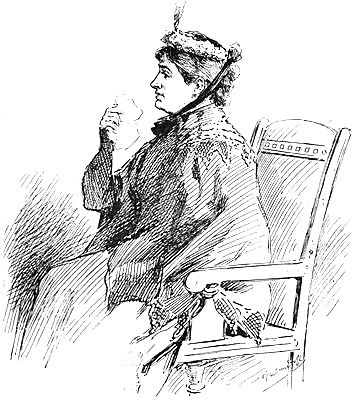
MRS. URCHITTEL.
Hearing the distress of my poor children, I cried loudly, and a lady
took me to a dark room, where I was locked up. Unable to procure bail,
I was imprisoned for three days, and sent after to the Tombs, where I
had to stand trial.
There were about fifty persons to witness that I had always made an
honest living, but they were not asked at all, and being wholly unable
to understand the English language, I couldn’t defend myself. The
lawyer, who was sent from the Hebrew Charities, came too late, and had
to give only the certificate of the society, testifying that I was
supported by them, and led a decent living. It came too late, and I
could not talk any more.
I was fined fifty dollars. My brother sold my store for sixty-five
dollars, and paid the fine.
I ran then crazy for my children, for I didn’t know where they were.
Meeting the detective he told me that they are in the hands of a
society in Twenty-third Street. I ran there, but no one knew of my
children. Finally, after five weeks, I received a postcard of my
child, that the children are at One Hundred and Fifty-first Street and
Eleventh Avenue, and when I got there, and begged to give me back my
children, none would hear me.
Grieved at the depths of my heart, seeing me bereaved of my dear
children, I fell sick, and was laying six months in the Sixty-sixth
Street hospital, and had to undergo a great operation by Professor
Mundy. After I left the hospital, I had the good chance to find a
place in 558, Broadway, where I fixed up a stand by which I am enabled
to make a nice living, to support and educate my children. I went
again to Twenty-third Street, begging to release my children, and that
was denied again. My heart craves to have my children with me.
I have nothing else in the world only them. I want to live, and to die
for them. I lay my supplication before you, honourable sir, father of
family, whose heart beats for your children, and feels what children
are to a faithful mother. Help me to get my children. Let me be mother
to them. Grant me my holy wish, and I will always pray for your
happiness, and will never forget your kind and benevolent act towards
me. Your very humble and faithful servant, (Signed) Caela
Urchittel.—Vol. iii., pp. 2, 961-4.
The piteous plea of this bereaved mother produced a great effect upon the
mind of the Committee. The children had been taken away by the Society for
the Prevention of Cruelty to Children, under an Act which had been passed
with the best intentions in the world, but which, as the case of Mrs.
Urchittel showed, was only too facile an instrument in the hands of the
corrupt police. It will be noticed that in her evidence she said that “two
bad, disreputed boys” were engaged to swear away her character. The
allusion was a reminder of the fact that one of the worst developments of
the system under which the police became bandits was the organisation of a
band of professional perjurers, who would swear anything the police cared
to tell them. Mrs. Urchittel’s character was irreproachable, yet on the
evidence of these scoundrels she was convicted of keeping a house of
prostitution. The man Hochstein, who divided the plunder with the
detective, was a saloon-keeper, and a prominent politician in the
district, who figures very conspicuously in the evidence of other
witnesses before the Committee. No sooner had Mrs. Urchittel given her
evidence than two men came to her and warned her that if she were to
commence with Mr. Hochstein she would get into trouble, and be sent to
prison for two years.
The efforts of the Commissioners to secure the return of the children to
their distracted mother were for a time thwarted by the provisions of the
law which is so hidebound and imperative in its terms that no judge would
venture to interfere with the commitment of the police magistrate. Mr.
Goff called attention to the fact that “the condition of the law in New
York City is that, upon the ipse dixit of one man, children can be taken
from their protectors, fathers and mothers, and secreted away in some
institution, and there is no power invested in any court or in any
official to compel him to reveal where the children are or to restore
them.” The sensation occasioned by this case was so great that the
Commission were able towards the close of their sittings to announce the
gratifying intelligence that they had at last succeeded in securing the
release of the children, who were then, after more than eighteen months,
handed over to their mother. The opinion of the Commissioners on the case
was embodied in the following terms, which I quote from their Report:—
Oppression of the lowly and unfortunate, the coinage of money out of
the miseries of life, is one of the noteworthy abuses into which the
department has fallen....
The evidence of many witnesses shows the existence of a wonderful
conspiracy in the neighbourhood of Essex Market police-court, headed
by politicians, including criminals, professional bondsmen,
professional thieves, police, and those who lay plots against the
unwary, and lead them into habits of law-breaking, or surround them
with a network of false evidence, and then demand money as the price
of salvation, and if they do not receive it, drag their victims into
court and prison, and often to a convict’s cell....
In another case, Mrs. Urchittel, a humble Russian Jewess, ignorant of
our tongue, an honest and impoverished widow with three small
children, whom she was striving to support, was falsely accused by a
precinct detective of keeping a disorderly house in the back room of
her little store where she and her little children slept, and he
demanded a sum of money which she could not pay, whereupon he took her
from her home, dragged her through the streets until three o’clock in
the morning, pulled down and searched her stockings for money, until
she in despair produced all that she had saved for her month’s rent.
This being insufficient, he gave her a short time to obtain the
balance, and she tried to sell her store, but failed, and then he
arrested her again, lodged a false and infamous charge against her,
fastened it upon her by the testimony of miserable tools whom he had
employed for the purpose, and secured her conviction. Her children
passed into the hands of the Society for the Prevention of Cruelty to
Children. Her fine was paid by selling her store, and she was
released, only to fall into a severe and lingering illness. When she
recovered her home was gone, her children were gone, and she was
penniless.
Many cases of similar oppression are found on the record.—Vol. i.,
pp. 43, 44.
Is it any wonder that the Lexow Committee reported under the head of
“Brutality,” as it existed in the police force:—
This condition has grown to such an extent that even in the eyes of
our foreign-born residents our institutions have been degraded, and
those who have fled from oppression abroad have come here to be doubly
oppressed in a professedly free and liberal country.—Vol. i., p. 30.
This is how “Liberty enlightens the world” from her eyrie in the Island of
Manhattan.
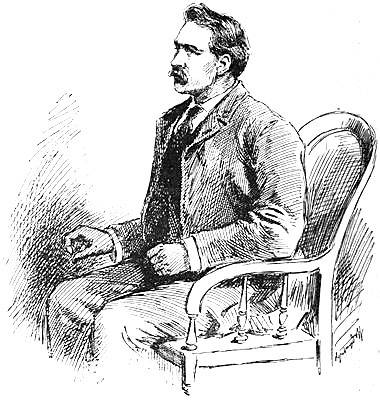
AUGUSTINE E. COSTELLO.
THE SLAUGHTER-HOUSES OF THE POLICE.
Said Mr. Goff at one of the sittings of the Lexow Committee:—
We have, Mr. Chairman, called attention heretofore to what may be
justly termed “slaughter-houses,” known as police-stations, where
prisoners in custody of the officers of the law, and under the law’s
protection, have been brutally kicked and maltreated, almost within
view of the judge presiding in the Court.—Vol. iv., p. 3,598.
Slaughter-houses is not a bad term. The cases in which witnesses swore to
violent assault on prisoners in the cells by policemen were numerous. That
which immediately provoked this observation was a typical one of its kind.
One Frank Prince, who had been keeping a disorderly house in Ninety-eighth
Street, had the temerity to refuse to pay the 100 dollars a month
blackmail which had been demanded by the police. His house was raided, and
he was taken to the station-house. He was accused before the Captain of
having said that he would make him close the other disorderly house in the
district, which presumably was under the Captain’s protection. Now not to
pay blackmail yourself was bad enough; but it was far worse to threaten to
dry up the contributory sources of police revenue. The poor wretch denied
that he had ever uttered such a threat. “Take him into the cell and attend
to him!” said the Captain. Prince was marched out by the wardman, who was
also blackmail collector for the precinct. When they reached the cell, the
turnkey and the wardman kicked him through the doorway, and then following
him in fell to beating him about the head with a policeman’s billy. They
kicked him violently in the abdomen, inflicting permanent injuries, and
declared he deserved to have his brains knocked out. Such was the
“attendance” prisoners received in the police cell to teach them the
heinousness of refusing to pay ransom to the banditti of New York. This
case by no means stood alone.
The most remarkable case of police brutality to prisoners under arrest,
and which is one the best attested in the collection, is that of the Irish
revolutionist, Mr. Augustine E. Costello.
The story of Mr. Costello was wrung from him very reluctantly. He was
subpœnaed on behalf of the State, and confronted with the alternative
of being committed for contempt of Court or of being committed for
perjury. Mr. Costello, being a revolutionary Irishman, had a morbid horror
of doing anything which could in any way lead any one to accuse him, no
matter how falsely, of being an informer. The prejudice against the
witness-box often appears to be much stronger on the part of Irish
Nationalists than the prejudice against the dock. Mr. Augustine E.
Costello is an honourable man of the highest character and the purest
enthusiasm. He was one of those Irishmen who, loving their country not
wisely but too well, crossed the Atlantic for the purpose of righting the
wrongs of Ireland. His zeal brought him into collision with the
Coercionist Government that was then supreme. He was convicted and
sentenced to twelve years’ penal servitude. He was a political offender,
the American Government intervened on his behalf, and the treaty known as
the Warren and Costello Treaty was negotiated, which led to his liberation
before his sentence had expired. During his incarceration in this country
he was confined in several prisons, both in England and Ireland, and thus
had a fair opportunity of forming a first-hand estimate of the interior of
British gaols and the severity of our prison discipline. He was treated,
he reported, with a great deal of rigour, but he was never punished
without warrant of law, and was never pounded or assaulted. It is
characteristic of the Irish political convict that, when Mr. Costello was
asked about this before the Lexow Committee, he carefully inquired whether
his answers would more or less justify “the people on the other side,” and
it was only on being assured that it would do no such thing that he
reluctantly admitted that he had never experienced as a convict in British
gaols anything like the brutality with which he had been treated by the
New York police.
Mr. Costello’s story, in brief, is this. About ten or a dozen years ago he
was on the staff of the New York Herald. By his commission he was
attached to the police headquarters, in which capacity he was necessarily
brought into the closest relations with captains and inspectors. He
discharged his duties with satisfaction to his employers, and without any
complaint on the part of the police. Two lawyers of good standing, who
were called as witnesses, testified that they had known him for years as a
thoroughly honourable man, a newspaper man of talent and ability; one
whose word they would take as soon as that of the President of the United
States. Every one who knew him spoke in the highest terms of his veracity
and scrupulous regard for accuracy.
Mr. Costello in 1885 conceived the idea of publishing a book about the
police under the title of “Our Police Protectors.” His idea was to hand
over 80 per cent. of the profits of the work to the Police Pension Fund,
retaining 20 per cent. as compensation for his work. The book at first was
very successful. The police sold it for the benefit of the Pension Fund,
and the profits were duly paid over by him to the fund in question. But
just as the book was beginning to boom, the Superintendent of Police
brought out a book of his own, entitled “The Great Criminals of New York.”
No sooner had it appeared than the police withdrew all their support from
Mr. Costello’s book, declared they had nothing to do with it officially,
and left him stranded with the unsold copies on his hands. Mr. Costello
appears to have regarded this as natural under the circumstances. He
entered no complaint of the way in which he had been treated over “Our
Police Protectors” by the department, for whose Pension Fund the book was
earning money, but at once set himself with a good heart to bring out
another book of a similar character about the Fire Department.
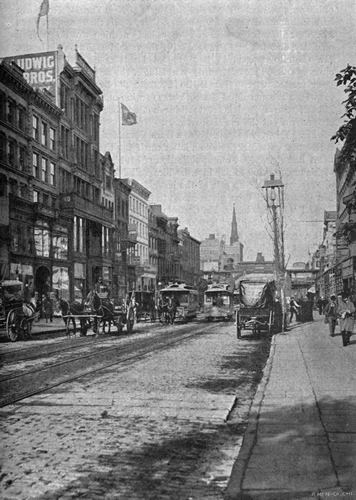
FOURTEENTH STREET, NEW YORK.
Mr. Croker, who was then a Fire Commissioner, and his two colleagues gave
Mr. Costello a letter certifying that the Fire Department had consented to
the publication of his history in consideration of his undertaking to pay
into the Fire Relief Fund a certain portion of the proceeds of the sale of
the book, for the publication of which Mr. Costello had been given access
to the records of the department. Armed with this letter, Mr. Costello set
to work. He printed 2,500 copies of the book, with 900 illustrations. The
book itself was bulky, containing as many as 1,100 pages, and costing
nearly £5,000 to produce, an expenditure which he had incurred entirely on
reliance upon the support of the Fire Department promised him in the
letter written by Mr. Croker and his fellow commissioners. But again an
adverse fate befell the unfortunate Costello. Just as the book was
beginning to boom, another man named Craig, who had a pull at the Fire
headquarters, got out a very cheap book, called the “Old Fire Laddies,”
which he ran in opposition to Mr. Costello’s expensive work. The Fire
officials backed the man with a pull against Mr. Costello, who had no
pull. Friction arose, and the Fire Department withdrew the official letter
on the strength of which Mr. Costello had gone into the work.
But the power of the pull was to make itself felt in a still more painful
fashion. Mr. Costello had several agents canvassing for orders for the
book, and for advertisements. He did his best to obtain from those agents
the Croker letter, and succeeded in doing so in all but two or three
cases. As he had already spent his money, the only thing he could do was
to continue to push his book. His agents, no doubt, when canvassing made
as much capital as they could out of the credentials which Mr. Costello
had originally received from the Fire Department. This was resented, and
it seems to have been decided to “down” Costello. The method adopted was
characteristic. The Fire Commissioners and the Police were two branches of
Tammany administration. When Mr. Costello’s canvassers were going about
their business, they were subjected to arrest. He had as many as
half-a-dozen of his canvassers arrested at various times. They were seized
by the police on one pretext and another, locked up all night in the
police cell, and then liberated the next morning, without any charge being
made against them. The application of this system of arbitrary arrest
effected its purpose. The terrorised canvassers refused to seek orders any
longer for Mr. Costello’s book. One or two, however, still persevered. In
November, 1888, two of them, who had retained the original certificate,
were arrested in the First Precinct at the instance of Captain Murray of
the Fire Department, who said that they were professing to be connected
with the Fire Department, with which they had nothing to do.
Mr. Costello, accompanied by his book-keeper, Mr. Stanley, went down to
the police-station to endeavour to bail his canvassers out. Mr. Costello
had no fear for himself, as he believed Captain McLaughlin was his
friend—a friendship based upon the Captain’s belief that Mr. Costello’s
influence had counted for something in securing his captaincy. Mr.
Costello complained of the repeated arrests, and declared that he would
not let it occur again if he could help it. Captain McLaughlin showed him
the books that had been taken from the imprisoned canvassers, in one of
which there was a loose paper containing the memorandum of sales made on
that day, and a copy of the Croker letter. Mr. Costello at once took
possession of the letter, which he had been trying to call in for some
time. He showed it to the Captain, and then put it in his pocket, telling
the Captain that if it was wanted, he would produce it in court the next
day. The Captain made no objection, and they parted, apparently on
friendly terms.
Mr. Costello had supper, and then went off to the police-headquarters at
seven o’clock, in order to secure an order for the release of his
canvassers. Suspecting nothing, he walked straight into the office, where
he found himself confronted by Inspector Williams. This Inspector was
famous for two things: he had the repute of being the champion clubber of
the whole force, and it was he also who first gave the soubriquet of
“Tenderloin” to the worst precinct in New York. The origin of this phrase
was said to be a remark made by Inspector Williams on his removal from the
Fourth to the Twenty-ninth Precinct. Williams, who was then captain, had
said, “I have been living on rump-steak in the Fourth Precinct; I shall
have some tender loin now.” Mr. Costello picked up this phrase, applied it
to the Twenty-ninth Precinct, coupling it with Williams’s name. Williams
never forgave Costello for this, and on one occasion had clubbed him in
Madison Square.
When Costello saw the Inspector, he felt there was a storm brewing, for
Williams was in one of his usual domineering moods. The moment Mr.
Costello entered, the Inspector accused him of stealing a document out of
Captain McLaughlin’s office, and detained him for five hours. It was in
vain that Mr. Costello explained that the document which he had sent home
by his book-keeper, and placed in his safe, was his property, and would be
produced in court when it was wanted. During the five hours that he stayed
there he noticed what he described as “very funny work” going on. The
Inspector was telephoning here and there; detectives were coming in and
whispering, as if receiving secret orders; and at last, at midnight, two
detectives came in and whispered a message to the Inspector. Thereupon
Williams turned to Costello, ordered him to accompany the detectives, and
consider himself under arrest. A foreboding of coming trouble crossed
Costello’s mind. He asked his book-keeper to accompany him, as he felt
that there was something going to happen, and he wanted him to be an
eye-witness. This, however, did not suit his custodians. On their way down
to the police-station one of the detectives said to Stanley, “You get
away! We do not want you at all.” Costello said, “Well, if you have to go,
you might look up Judge Duffy. I may want his services as well as these
men.” Stanley left, and Costello, with the two detectives, made his way to
the police-station.
It was getting on to one o’clock in the morning. Costello was carrying an
umbrella, as it was raining, when they came in front of the station-house.
The door was wide open, and the light streamed on to the sidewalk. Just as
he was placing his foot on the step he saw two men come towards him. The
bright light cast a shadow, and in that shadow he saw Captain McLaughlin
raise his fist and deal a savage blow at his face. He instinctively drew
back his head, and the Captain’s brass-knuckled fist struck him on the
cheek-bone, knocking him down into the gutter. The detectives stood by,
indifferent spectators of the scene. As Costello lay half-stunned and
bleeding in the muddy gutter, Captain McLaughlin attempted to kick him
several times in his face. Fortunately, his victim had retained hold of
his umbrella, and with its aid was able to keep the Captain’s heavy boots
from kicking him into insensibility.
He struggled to his feet, when Captain McLaughlin went for him again. What
followed is best told by the transcript from the evidence before the Lexow
Committee:—
Augustine E. Costello examined by Mr. Moss. I said to Captain
McLaughlin:—“Now, hold on; I am a prisoner here; this is a cowardly
act on your part; if I have done anything to offend the laws of the
State there is another way of punishing me; this is not right.” You
could hardly recognise me as a human being at this time; I was covered
with blood, mud, and dirt, and had rolled over and over again in
trying to escape the kicks that were rained at me. I hurried myself as
fast as I could into the station-house, thinking that would protect
me; all this time I was being assaulted, the two detectives stood over
me.
Q. What were their names?
A. I cannot recall it just now, but I can get their names later on;
two wardmen of that precinct; there was a second man with the man who
assaulted me; that man, I may tell you, was Captain McLaughlin.
Q. What do you mean; on the sidewalk?
A. On the sidewalk; the man with him, standing right off the kerbstone
on the street; and when I got into the station-house, I asked to be
allowed to wash the blood off myself, and I was feeling more like a
wild beast than a human being.
By Mr. Moss:—Tell us what he did?
A. McLaughlin put himself in all sorts of attitudes and tried to
strike me, and I dodged the blows.
Q. Was that in the general room of the station-house?
A. Yes. Captain Murray, of the Fire Department, was present at the
time; he made the complaint against the two men.
Q. You were a prisoner, and standing in the middle of the
station-house floor while McLaughlin was raining blows at you?
A. Yes. “Now,” I said to him, “McLaughlin, look here, I never felt
myself placed in the position that I do to-night; no man has ever done
to me what you did to-night, and I advise you to let up. Standing
here, if I am assaulted again, you or I will have to die; one man of
two will be taken out of this station-house dead, and so, stop.” At
this time I had my fighting blood up, and had recovered from the
collapse I was thrown into. I said, “You may think me not protected
here; but I have a good strong arm, and if you assault me again, as
sure as there is a God in Heaven, I will never take my hands from your
throat until you kill me or I kill you.” He kept on blustering, but
never struck me again.
Q. What was the nature of the punishment?
A. He had brass-knuckled me.—(Vol. iv., p. 4,527).
Q. You say he desisted at that moment?
A. He desisted at that moment when I said he or I would have to die if
he did not stop. I was then allowed to go into his private room and
wash some of the mud and gutter off my face and hands. I could not
wash the blood off, because that was coming down in torrents; and when
I was going downstairs, somebody kicked me or punched me severely in
the back, and I feel the effects of it yet at times, and I suppose I
always will. Then I was thrown into a cell bleeding, and by this time
a second collapse had come over me, and I must have fainted in the
cell.
Q. Did McLaughlin go into the cell?
A. No; he came down after me, after I was locked up, and made it clear
he gloried in the fact that I was in that condition. So, fearing that
some one would open the cell door during the night, when I would be in
a faint—because I felt very weak from the loss of blood—I took out
my note-book and wrote in it, “If I am found dead here to-morrow, I
want it known I am murdered by Captain McLaughlin and his crowd.” I
hid that in my stocking, that piece of bloody paper. I kept it for a
long time, and I tried to find it to-day, but could not put my hands
on it, and am very sorry I cannot put my hands on it.
Q. Were you persecuted any more that night?
A. I was persecuted in a way that they would not give me any water.
Q. Did you call for water?
A. Yes, and it was denied me; everything was denied me. From loss of
blood and all that I became unconscious; and about five o’clock in the
morning, when I could get a little rest, I was routed out from my bed
and told to get ready; then I asked the privilege of getting something
to brush off my clothes and my shoes, and after paying a little for
it, I did get it; and I was taken out by these two same men that had
arrested me. Now, before I proceed any further, will you let me go
back a little?
Q. Yes.
A. All the five hours I was kept a prisoner at police headquarters
with Inspector Williams standing over me, I might say, with drawn
baton, two detectives were up at my house, which shows this was a
put-up job and conspiracy to degrade me; from quarter after seven or
half-past seven, from the time this happened two detectives were up at
my house bullying my wife and scaring her to death, and all this time
they knew I was down in the hands of Inspector Williams. Inspector
Williams told me this with great glee as I was about to be taken away.
I said, “You must have no heart.” I said, “I don’t mind the
persecution I have been subjected to, but I don’t wish to have that
inflicted on my wife and children; they will go crazy. I beg you to
telephone the station-house, and have those brutes taken out of my
house;” and he did, but they were there up to midnight, and all these
five hours in my house bullying my wife and sending my children into
hysterics.
Q. You went to Court the next morning, did you?
A. Yes, sir. I begged then of the men that they would allow me to buy
a pair of glasses more or less to conceal my lacerated face. I was in
a terrible state. They refused until I got very near the place and I
said, “I will make trouble for somebody if I go in this condition;”
and they let me buy a large pair of blue goggles, and I sent for
Counsellor Charles T. Duffy, who is at present justice of the peace in
Long Island City, and I told him what happened to me, and he said,
“These people are too much for me; I will go and get somebody to
assist you. What do you think of Mr. Hummel?” I said, “Do what you
like about it; have Mr. Hummel.” I paid him a retainer fee, and he
said, “These are infernal brutes, and we ought to break them.” I said,
“I am prepared to do what you tell me.” When the case was brought up
it was laughed out of Court; there was no case for me or my men. They
first had me to get bondsmen before the thing was tried; but there was
no case tried—there was no case to try. Hummel said, “What have you
against this man; he has not destroyed any documents.”—Vol. iv., p.
4,520.
Mr. Costello was taken home, and laid up in bed for five days. His face
had to be sewn up. The doctor, who, by-the-bye, was Mr. Croker’s
brother-in-law, certified that the injury to the face had been produced by
brass knuckles, the cut being too severe to have been produced by the
simple fist. He was threatened with erysipelas, but, fortunately,
recovered.
I should have mentioned that while Mr. Costello was being taken into the
station-house all bloody and muddy, his book-keeper came to obtain access
to him. Captain McLaughlin stopped him, pulled open his overcoat, and
searched his pockets.
“What is this for?” cried Stanley. The Captain made no answer, but
continued the search. “What does this mean?” angrily asked Stanley.
“You know d—— well what it means,” was the reply.
“I do not understand you,” said Stanley. “What is it for?”
“Open the door,” said the Captain to an orderly, “open the door.” The
orderly opened the door. “Now,” said the Captain, “get the Hell out of
here!” and the book-keeper was promptly forced right out, and left on the
sidewalk to reflect upon the irony of events which had subjected the
author of “Our Police Protectors” to such treatment.
It is a very pretty story, and one which naturally provokes the inquiry as
to how such things could be practised with impunity. Mr. Costello himself
said that if there had not been so much Celtic blood in his veins there
would have been several funerals in New York, for he was not only a Celtic
Irishman but a Catholic Irishman, and murder was repugnant both to his
religion and to his nature. Other redress than that which could be gained
by your own right hand it was impossible to obtain, for it was this
witness who made the famous remark previously quoted. Senator O’Connor
asked him, “Did you ever take any proceedings against these men?” and the
witness replied, “I never did, sir. It is no use going to law with the
devil and court and hell!”
He probably thought himself lucky that he had escaped without permanent
disfigurement. One Thomas J. Standant was less fortunate. A policeman
named Schillinberger, of the Eleventh Precinct, who was a very athletic
man, struck Standant a tremendous blow with his fist, which was not, as in
McLaughlin’s case, provided with brass knuckles. Standant’s nose was
smashed, the blood poured from his eyes and ears, and he was carried to
the hospital, where he had to submit to various operations before he
recovered his eyesight and hearing. He was badly disfigured for life. When
he brought an action against the policeman for assault, the officer was
defended by the Corporation Counsel. Schillinberger, although indicted by
the Grand Jury, was never suspended for a moment, but continued on duty
during the whole of the sittings of the Commission.
In another case a witness was produced who could hardly speak
intelligibly. On Thanksgiving morning he had bought a couple of crabs from
an oyster stand, the owner of which had apparently paid blackmail, and was
therefore under the protection of the police. When the policeman on the
beat heard the altercation between the customer and the protected oyster
stand keeper he walked up to the witness and, without a word, delivered a
smashing blow upon his mouth. Two front teeth were splintered up into the
gum, inflicting so severe an injury that it was two days before the
swelling abated sufficiently for the dentist to be able to cut away the
teeth, and four days before the roots could be touched. The dentist
declared that the officer must have had something in his hand, either
brass knuckles or some other weapon of that kind, to splinter the teeth so
badly. But in all those cases the fist seems to have been the favourite
weapon.
The only other case that I shall refer to is that in which the policeman
used his club. There was a fight in the hallway of a house, and one Frank
Angelo had stepped in to try to part the combatants. Up came a policeman
of the name of Zimmerman, who rushed into the midst of the mêlée, and
striking Angelo heavily with his club, knocked his eye out. The eye hung
down on the man’s cheek, and had to be subsequently removed. Angelo, all
bloody, with his eye in this ghastly position, was arrested by his
assailant, and taken to the police-court. The poor fellow, not knowing
what would befall him, sent for a lawyer, who first of all charged him £10
for his professional services, and then said that the only way for him to
get out of the scrape was to pay the officer £5, which he accordingly did.
The judge asked him no question, and discharged the case. It is needless
to say that Angelo brought no action against the policeman. There was no
justice, he said, in New York. Justice there was indeed—hideous,
diabolical, devil’s justice. It is bad enough to have your eye knocked out
with a policeman’s club in the street when you are endeavouring to prevent
a fight, but it is worse to have to pay that policeman £5 for having
performed that operation, and an additional £10 to a lawyer to induce the
ruffian to accept the money.
After reading this, it is not surprising that Mr. Goff, now Recorder of
the City of New York, publicly declared, after a careful examination of
the records of the Police Department for three years, that it could be
proved that the police force was to all intents and purposes and in
practice exempted from and above the operation of the law of the land. Mr.
Goff, after saying that in three years only one policeman had been
convicted for an assault upon a citizen, and remarking that the air of the
trial-room at police headquarters was blue with perjury, continued thus:—
The members of the police force of this city commit offences of the
grade of felony and misdemeanour, and they have gone for years
unpunished and unwhipped for those offences, which, if committed by
citizens, would have resulted in fact in sentence to State’s prison,
and to the penitentiary. In other words, the operation of the law of
this State, so far as it applies to the citizens of New York, and to
all persons as it should, stops short of the police force. Felonious
assaults have been committed upon citizens by policemen, which if
committed by a civilian would result possibly in four or five years’
sentence in Sing Sing, and all the policeman need apprehend is, a
charge against him, with a possible conviction finding him guilty of
assault, and a fine, for instance, of ten days’ pay. A police officer
of this city can brain a citizen with a club, and he may reasonably
expect that all the penalty he will have to pay for that is about the
sum of thirty dollars, while an ordinary citizen, if he commits that
offence, is almost certain to go to State’s prison.—Vol. iii., p.
2,826.
This is not a case of one law for the rich and another for the poor. It is
one law for the citizen and none at all for the policeman.
Some of the evidence taken as to the action of the police supplied the
Committee with very sensational episodes. One witness, for instance, a
truckman, of the name of Lucas, appeared before them with his head in a
frightful state of disfigurement. The man had been drunk, and gone to
sleep on a doorstep, when he was robbed of four dollars. On waking up,
finding that he had lost the money, he asked a policeman if he could find
out anything as to who had robbed him. This seemed to offend the officer,
for he struck Lucas in the face, knocked him down in the gutter, and then
standing over him, belaboured him unmercifully with his club on his face
and head. “For God’s sake!” cried the man, “do not kill me altogether.” A
young man, a stranger, coming past, seeing the outrageous nature of the
assault, asked the policeman to stop. Thereupon another policeman in
citizen’s clothes ran up, knocked him down, jumped on him, and then
marched Lucas and the stranger off to the police-station. The blood
running down Lucas’s neck, drenched his shirt, and one of the picturesque
incidents of the inquiry was the production of the bloody shirt before the
senators. The man was bleeding so freely that the sergeant of the
police-station had to sew up the top of his head. It took twenty-seven
stitches to sew up the wound opened by the policeman’s club. When he got
into the police-station he was again assaulted, and had he not run for the
sergeant, he was of the opinion that he would have been killed altogether.
The next morning he was brought before the judge, and discharged. Nothing
seems to have been done to the officer.
The Committee summed up the whole case in the following sentences:—
It was proven by a stream of witnesses who poured continuously into
the sessions of the committee, that many of the members of the force,
and even superior officers, have abused the resources of physical
power which have been provided for them and their use only in cases of
necessity in the making of arrests and the restraint of disorder, to
gratify personal spite and brutal instincts, and to reduce their
victims to a condition of servility....
Besides this exhibit of convicted clubbers, still wearing the uniform
of the force, there was a stream of victims of police brutality who
testified before your committee. The eye of one man, pushed out by a
patrolman’s club, hung on his cheek. Others were brought before the
committee, fresh from their punishment, covered with blood and
bruises, and in some cases battered out of recognition. Witnesses
testified to severe assaults upon them while under arrest in the
station-houses. The line of testimony might have been endlessly
pursued by your committee.... We emphasise this finding of brutality
because it affects every citizen whatever his condition, because it
shows an invasion of constitutional liberty by one of the departments
of government whose supreme duty it is to enforce the law, and because
it establishes a condition of affairs gravely imperilling the safety
and the welfare of the people in their daily avocations.—Vol. i., p.
31.
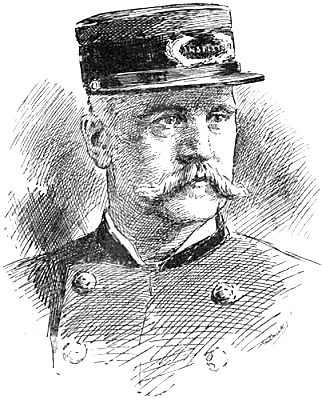
INSPECTOR WILLIAMS, CHIEF CLUBBER OF THE FORCE.
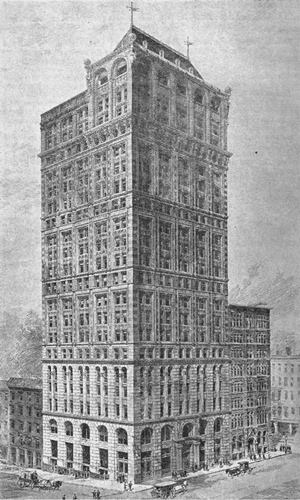
AMERICAN TRACT SOCIETY’S DEPÔT.
(New York is a city whose Buildings are as colossal as the Corruption of its Police.)
KING MCNALLY AND HIS POLICE.
The Confidence Trick is perhaps the form of crime that would most
naturally commend itself to the police banditti of New York. For the force
was engaged all day long in playing a gigantic Confidence Trick upon the
citizens. The gold brick which the swindlers sold to the credulous
countryman was hardly more mythical than the enforcement of the law which
was supposed to be secured by the organisation of the City police. It is
therefore not surprising to learn that the police were hand-and-glove with
the gang of swindlers which, under King McNally, carried on the Green
Goods trade in the City of New York. It was one of the most lucrative of
all the crimes which were carried on under police protection, and one of
the safest. Few of all the stories told before the Lexow Committee display
quite so unblushing a co-partnership between the law-breakers and the law
officers as was revealed in this Green Goods swindle. The rascality of the
rogues was so audacious that it provokes a laugh. For it is possible to
carry impudence to a point where indignation is momentarily submerged by
the sense of the ludicrous. Sheer amazement at the existence of such
preposterous villains begets such a sense of its absurdity, that any
censure seems as much out of place as in the nonsense tales of the
nursery. Yet when the grotesque impression subsides, it is difficult to
find terms strong enough to characterise this systematic misuse of the
powers created for the protection of life and property and the due
observance of the law for the purpose of facilitating fraud and of aiding
and abetting and protecting swindling.
The evidence taken before the Lexow Committee contains a mass of materials
for an exhaustive description of the criminals of New York, and the
various methods by which in 1894 they preyed upon the public; but the
person who undertakes the compilation of such a work is not to be envied.
The Report of the Committee is a very striking illustration of the
wickedness of issuing books without indexes. Here we have five bulky
volumes of evidence without even an index of the names of witnesses. There
is no subject-index of any kind. Witnesses are called and recalled in
bewildering confusion. Nevertheless, even the most cursory perusal of the
evidence brings to light a great many interesting and extraordinary facts
as to the organisation of the criminal classes of the city.
Green Goods are forged or counterfeit bank notes. The pretence is either
that there has been an over-issue of certain denominations of paper money
by the Treasury, or that the plates have been stolen from the Government,
and by this means it is possible to offer to sell ten dollars for one.
McNally, the King of the Green Goods men, employed at times a staff of
thirty-five men. He began his career some twenty years ago as a bully who
was kept by a prostitute. He swindled out of all her money a mistress of
his who kept a restaurant, and started an Opium Joint. He then embarked in
the Green Goods business, kept his carriage, and made his fortune.
The men who work this Confidence Trick seem to have carried their
organised system of swindling to a very high pitch of perfection. Their
master-stroke, however, was the admission of the police to a working
partnership, which enabled them not merely to carry on their swindling
with impunity, but also stood them in good stead whenever a victim had to
be bullied and driven out of the city. King McNally was, unfortunately,
not available for examination, owing to his precipitate departure for
foreign parts as soon as the inquiry began. The Committee, however, was
able to secure evidence which brought out very clearly the main lines of
their operations.
The chief witness was one William Applegate, whose sister accompanied
McNally in his hurried departure to Paris. Applegate had been employed for
three years as one of the gang. He began when nineteen as a
circular-folder, for which he received 8s. a week. These formed the
foundation of the Green Goods business. A Green Goods gang in full
operation is constituted as follows:—
(1) The Backer or Capitalist, who supplies the bank roll—a roll of 10,000
genuine dollar bills, which are shown to the victim. He receives fifty per
cent., out of which he pays the police, and so guarantees the protection
of the gang.
(2) The Writer, who addresses the wrappers in which the circulars, bogus
newspaper-cuttings, etc., are enclosed. He receives the other fifty per
cent., out of which he has to pay the percentage due to the rest of the
gang.
(3) The Bunco Steerer, who is sent to meet the victim at some hotel, fifty
to a hundred miles distant from the city. He is the messenger who gives
the victim the pass-word, and then leads him to the Joint or den where the
swindle is completed. He receives five per cent. of the plunder.
(4) The Old Man, a respectable-looking old gentleman, who says nothing,
but who sits solemnly in the Joint when the “beat” is being carried
through. He receives five dollars.
(5) The Turner, who is represented as the son of the old man, and does the
selling of the bogus notes. His fee is ten dollars.
(6) The Ringer, a confederate behind the partition, who dexterously
replaces the good money shown in the bank roll by the bundles of bogus
notes. His fee is five dollars.
(7) The Tailer, who remains on guard at the railway station, personating a
policeman, for the purpose of bullying any victim who discovers he has
been swindled, and returns to try to recover his money. This gentleman is
also paid five dollars a victim.
With this staff, and the protection of the police, the Green Goods
business can be carried on very successfully. McNally used to take as much
as £1,600 in a single day. Fortunes of £40,000 were accumulated by the
leading backers, although McNally’s pile was not estimated at more than
£20,000.
The first step is the obtaining of directories and the arranging for the
despatch of circulars. The circulars were of the familiar kind, printed as
if typewritten, and addressed by a staff of writers, of whom McNally had
eight or ten kept constantly at work. Enclosed in the envelope with the
circular were slips printed as if they were cut out of newspapers, the
same with intent to deceive, the slip being carefully written by Mr.
McNally, or some member of his gang, for the purpose of giving the reader
to understand that the offer of the circular was bonâ fide and reliable.
These were sent out by thousands, the printer executing orders for 200,000
sets at a time. A slip was also included giving the address to which a
telegram should be sent, in order to secure the advantageous offer made to
the victim by the circular. These addresses were usually vacant lots in
the city, but arrangements were made by bribing the officials of the
telegraph company to hold all telegrams sent to such fictitious addresses
until called for.
The business was carried on a kind of mutual partnership basis. It was
worked somewhat in this fashion. A writer would send out 10,000 circulars
or more a day. One, or perhaps two, of those would hook a victim, who
would telegraph, making an application for the money offered him at such
tempting terms. This victim would belong to the writer of the circular by
which he had been caught. Having thus hooked a victim, he had to be
landed, and for this purpose he had to be brought to town and personally
conducted by a bunco steerer to the den or joints where three confederates
fooled the victim to the top of his bent, and usually succeeded in
fleecing him by one form or another of the confidence trick.
The victim, who was known as a “Come On” or as a “Guy,” was swindled by a
variety of methods. One favourite plan was to undertake to sell the
credulous rustic 10,000 dollars for 650 dollars. For less than 650 dollars
he was told he could not have the “State rights.” The monopoly for his own
State was promised to the favoured individual, whose 650 dollars had to
be paid down on the spot. A locked box was then given him, within which he
was assured there were 10,000 dollars in coin. In reality, there was a
brick, which was all the poor victim got for his money.
Another method of swindling was thus described by the witness Applegate
when under examination by Mr. Goff:—
Q. I hand you two tin boxes; do you recognise those as belonging to
McNally?
A. Yes, sir.
Q. Were those boxes used in his business?
A. Yes, sir.
Q. Here is a third one, and a fourth one; what were those four boxes
used for?
A. They would put the money in one box for the man, in a box like
that, and that would be a deal of from about 300 dollars to 500
dollars; they would put the money in this box and it would be in front
of the victim, and in the meantime a duplicate box would be behind the
partition, and in the duplicate box there would be a brick and some
paper, and they would put the money in this box here on the desk and
lock it up before the victim; it would be on the back of the desk like
that, and then Billy Vosburgh would say, “Get that book,” and with
that they would lift up the desk and that would hide the box from the
victim, and then Walter McNally, who did the ringing, would open his
trap door and take this box in and put the other box out; it would all
be done in a second.
Q. I will now hand you this fifth box; what is that used for?
A. That was used for the bank roll.
Q. What is there—is there a false lid to that?
A. No; there is one, yes.
Q. How was the bank roll brought into play there; explain about that?
A. The bank roll would be laid right in there, 8,200 dollars; it would
be laid there. There was supposed to be 8,200 dollars done up in
packages, with three elastics around them.
Q. Now, I hand you this book, and ask you if those were the packages
there were exchanged for the genuine packages?
A. Yes, sir; these were, as we called them, the dummies.
Q. Explain how they were operated?
A. You see this is a package supposed to be of 5 dollar bills. There
would be a good one on the top, and a good one on the bottom, and here
would lay the same package of genuine money, and Walter would count
out, say, 200 dollars in 5 dollar bills, which would be so much, and
he would say, to save time, “We will measure the packages together,
and, instead of counting each and every bill, we will put the packages
together,” and the victim would think there was the same amount of
money in each one, and then, through sleight-of-hand, he would put
these in the box, and the good money on top; and if the victim wanted
to see the packages again he would show them, and the one on top would
be good money; and if the victim is a hard victim, he might want to
take the money with him, and then Walter would shift these packages,
and, therefore, he got about 60 dollars for 500 dollars or 1,000
dollars.
Q. And the victim would get those packages that we now exhibit,
instead of the packages containing the good money that he has seen?
A. Yes, sir.
Q. There were many of those in use, were there not?
A. Yes, sir, we would never take the elastics off these; we would just
take the elastics off the good money.
Q. Here is a box with a heavy weight; see what is in this box?
A. I guess that is a brick (witness takes out a brick wrapped up in
paper); that is what he would get for his 650 dollars; for a 300
dollar deal he would get half a brick; for 10,000 dollars it would
have to be heavier than for a less amount.—Vol. iii., pp. 2,575-6.
In connection with McNally’s gang there was an Art Gallery fitted up
adjoining a saloon used sometimes as McNally’s headquarters. The chief
feature of this Art Gallery was a great number of pictures representing
treasuries filled with all kinds of money. “Here,” said the Steerer to the
Guy, “is the picture of what you will get in reality.” The effect upon his
imagination of these painted representations of enormous treasure in gold
and silver predisposed the victim to part freely with his money, and
believe the plausible friends who so kindly proposed to point out to him
so short a cut to a fortune. McNally had a private carriage also, with a
footman in livery. “The carriage racket,” as it was called, was thus
described by Applegate:—
Q. Now, proceed and describe the operations of the carriage?
A. Well, previous to the steerer and the guy coming to the carriage,
there would be a satchel put there, a little red satchel.
Q. In the carriage?
A. In the carriage, with a brick and paper in it; there would also be
two or three satchels without anything in it on the seat of the
carriage. Walter Haines would get in with the guy. Walter Haines would
have the money in the bag, the bank roll, and he would put the money
in the satchel, a duplicate satchel to the one that had the brick in
it; he would put the money in the satchel, and after the guy had paid
Haines his money so—we never received theirs before we gave them
ours, and after he made the deal and everything was all right, Haines
would say, “I will go to the depôt,” and the steerer would grab the
satchel and run out, and Walter Haines would slip the money in the
cab, and Haines would say, “The steerer will go with you,” and he
would go away with the steerer.
Q. Were there any cases in which they discovered the fraud before they
left the State?
A. No, we worked kind of snug; when we were working the carriage
racket we worked a little on the snug.
Q. What is that?
A. We did not have the protection we ought to have had, and the
steerer then would have to go with the guy and keep the satchel and
see the guy on the train, and, after he got on the train, he didn’t
care a darn where he went.
Q. And he did not have the facilities as in the turning joint?
A. No, sir; we would not give him the satchel until he got on the
train, and would say, “We will give you this at the proper time and
place.”
Q. Weren’t you in the habit of giving to the guy keys?
A. No; we generally threw the key away and told him to cut it open;
not with the satchel; with the box we gave him keys.
Q. Was there any design in giving the keys with the box?
A. We never gave him the key which fitted the box.
Q. So when they got on the railroad——
A. When a guy gets a box like that there will be some combination on
it, and he will get the wrong key, and he don’t know how to get out of
it.
Q. And you always made sure to give him a key that would not open the
box?
A. Yes, sir; the reason of that is that we gave him a key that fits
the box with the money in, and that would not fit the box that had the
brick in.—Vol. iii., pp. 2,613-5.
There were many ways of swindling the unfortunate guy. When once they are
hooked, they can be played with to almost any extent. In this, as in
higher regions, the saying holds good—
Faith, fanatic faith, once wedded fast
To some dear falsehood, hugs it to the last.
A guy will pay his money down and expect the notes to be sent to his
order. When they fail to turn up, he will come back and buy some more,
which are to be expressed to him. When they do not arrive, he will come
back the third time and do another deal, and see them checked at the
station with his ticket. The baggage-man is accused of stealing the money,
and the guy comes up for a fourth time. In this final purchase he never
allows the box or bag to go out of his own hands. Not until he opens the
precious parcel and finds the brick or counterfeit notes or rolls of
paper, does it dawn upon him that he has been done.
The need for great secrecy and the importance of getting a long way off
the city before opening the box do not seem unreasonable to a man who
knows that he is engaged in a more or less fraudulent transaction. It is
the knowledge of the guy that he is doing a more or less crooked business
which enables the gang to plunder him with such impunity.
Some such methods are probably familiar to the police of all the cities in
the world, but that which was peculiar to New York was the arrangement
made for carrying on this business, not merely with the cognizance of, but
with the active co-operation of the police. This partnership was so close
that in McNally’s case all the business was carried on in conjunction with
a police captain of the name of Meakin, who had as his agent at
headquarters a detective of the name of Hanley. It is difficult to repress
a smile on reading, at the very opening of Applegate’s evidence, how
things were worked.
Every now and then, when the newspapers made too much fuss concerning the
scandals of the Police Department, the authorities would order what is
known as a “general shake-up”—i.e., the captains would be shifted all
round, the assumption being that a new broom would sweep clean, and that
by changing the captains from one precinct to another the abuses that had
created any fuss would be rectified. Unfortunately the whole system of
blackmail and corruption was so elaborately organised that the shifting of
the captains made no change. Each newcomer succeeded to the business, and
carried on the collection of blackmail without losing a single day.
“Business carried on as usual during alterations” might have been posted
up over every police-station in New York; but in the case of Green Goods
men, their business was too profitable to be lost by the captain who had
once got hold of it. The consequence was that, when the shake-up took
place, and Captain Meakin was transferred from the “down-town precinct” to
Harlem at the other end of the island, he carried all the Green Goods men
with him up to his new station. As soon as the order was given that the
shake-up was to be enforced, Captain Meakin sent word to McNally that he
must follow him to Harlem. McNally thereupon told all his writers, Bunco
steerers and Turners that they must pack up their traps, and follow the
Captain to the precinct to which he had been transferred. The notice was
short, and for a moment it seemed as if the smooth course of the Green
Goods business would be interfered with, for several victims were on
their way to the rendezvous fixed by the writers in Captain McNally’s old
precinct. The resources of roguery are not so easily exhausted; the Bunco
steerers were ordered to bring their victims from the down town precinct
to some saloons in Harlem until the gang had arranged with the Captain as
to where the victims were to be plundered in the new precinct.
The saloon in which the confidence trick was played, and the room in which
the victim was relieved of his money, was known as the “Joint,” or the
place where they “beat the victim.” The first thing necessary was,
therefore, to find out a saloon that would be available for the purposes
of the gang. Captain Meakin was a man of resource. He and his wardman met
McNally at a drug store, and arranged with a saloon-keeper of the name of
Hawkins that the joint should be opened in his saloon. The arrangement
made with Hawkins was that he should have a sovereign for every man that
was fleeced at his place.
Very little time was lost in bundling the boxes, with the bricks and all
the other paraphernalia of the craft, into an express waggon. The King
drove up in his carriage with the bank-roll and his liveried coachman,
while the Turners followed by the Elevated Railway. As soon as the
arrangement was fixed up with the King and the Captain and the
Saloon-keeper, the signal was given, and the victims, who were planted at
various saloons in the neighbourhood by the Bunco steerers waiting until
the Police Captain and the King had fixed up arrangements as to the joint,
were brought down and fleeced. Thus, without the loss of a single day the
business was transferred, and was running merrily under the protecting
ægis of Captain Meakin and his police.
For four months this went on, until at last the scandal became so great
that the Police Commissioners received representations from the
inhabitants, and it became evident that the Hawkins saloon would no longer
serve as headquarters. A friendly communication was sent to the thieves by
Detective Charlton. He told them that they would have to quit, but at the
same time he obligingly suggested that the saloon of a man named Day in
the immediate neighbourhood would be quite as convenient, and would serve
equally well as a place for “beating” their victims. To Day’s saloon,
therefore, the Joint was transferred, and business went on for five
months, ten or twelve writers being busily employed in sending out
circulars, as many as fifteen thousand being sometimes despatched in a
single day.
At last an order was issued from headquarters ordering the arrest of all
the Green Goods men of New York. This looked serious, but when you have a
friend in the force you do not get arrested, excepting as a friendly
put-up job. When the order was issued from headquarters, Detective
Charlton was sent by Captain Meakin to inform McNally that they were
going to raid the Joint, and advised him to remove all the stuff before
the police arrived. This timely hint was promptly acted upon, and when the
place was raided nothing was found. The Green Goods men in the meanwhile
had transferred themselves to Jersey, which, being a foreign State, was
beyond the jurisdiction of the Superintendent. But everything was done to
make their sojourn in Jersey pleasant; Captain Meakin gave them a
recommendation to a detective in the Jersey force, who saw to it that they
were not interfered with. In return for those services, Captain Meakin
received from McNally £90 a month, the tariff being fixed at £10 per
writer. The money was paid to Detective Charlton, who handed it over, no
doubt after collecting his commission, to the Captain.
If the matter had only stopped here, the case of the Green Goods men would
not have differed materially from that of the disorderly houses, which all
subsidised the police, and were protected in return. But in the case of
these swindlers, who elevated the confidence trick almost to the level of
a fine art, there was a further development. If any of the writers were
behind in their payments to the King, McNally promptly denounced them to
the Captain, and the defaulting writer was as promptly arrested. By this
means discipline was enforced in the gang and all bad debts avoided.
Again, if any writer refused to follow McNally to the district where he
wanted him, or in any other way allowed his personal preferences to
interfere with the orders of the King, he was denounced and run in by the
obedient, uniformed myrmidons of his majesty.
In order to enforce discipline over the whole of New York City, it was
necessary to supplement the arrangement with Captain Meakin by a similar
understanding with an officer at the headquarters department. This officer
was Charles Hanley. “He was McNally’s right hand man, and any time he got
into trouble or his men got into trouble, the first man he sent for was
Hanley; and Hanley was always sent for.” He represented the Detective
Bureau, and his services were necessary when any unfortunate victim,
discovering that he had nothing but a brick in his box, came back to the
city and made complaint. A considerable number of the guys, or the
victims, never came back, being too thoroughly ashamed of their folly to
face an exposure; but a certain proportion did. These “Come-backs,” as
they were called, naturally applied to the Detective Bureau at the police
headquarters, and there they were taken in hand by McNally’s partner.
Applegate explained the working of this system as follows:—
In cases of a come-back of any kind; in case a man has been swindled
who has found the brick in the box before he has left New York; and as
a rule he would go to the central office and make a holler; Hanley
would always seem to be the detective that would get the man in
charge; the man would be brought up town to try and identify the
people, which he never could do; then we always got the tip to go
away; the man would be brought down town and chased out of town as
being a counterfeiter; and they would pay 500 dollars, and 250 dollars
would go back to the police; the police claimed half of the
deal.—Vol. iii., p. 2,590.
The method, it will be seen, was extremely ingenious. The swindlers had
passed forged notes upon their victim. When he made a complaint, he was
promptly arrested or driven out of the town by the confederates of the
gang in the police for having counterfeit notes in his possession! No
wonder things went “nice and easy.” Applegate described one scene which
had evidently afforded the gang great amusement. A victim, who had been
swindled, and had applied to the police for redress, was handed over in
the usual course to Hanley, who took him up town to the saloon where he
had been robbed, to see if he could find the Bunco steerer who had
inveigled him into the Joint. Applegate himself acted as the go-between on
that occasion. He warned the Steerer to keep out of the way, and then
asked Hanley to bring the Guy down past the windows of the saloon, where
the men who had swindled him could have some fun in watching him as he was
trotted about the street on a false scent. By some strange mistake, and
despite all warnings, the Steerer ran into the Detective and the Guy; but
even this difficulty was overcome, for a few words from the Detective put
it all right, and the Steerer went off without being arrested. For his
part in that little comedy Hanley got one-half of the money of which the
man had been swindled. In this case Hanley’s share of the plunder amounted
to £50. The victim was chased out of the town under the threat of arrest
and imprisonment for having counterfeit notes in his possession.
“You see,” said the witness, apologetically, “the guy is a guy, and you
can do almost anything with him.” It is certainly not difficult, when you
have the police to stand in whenever you get into a tight place.
The only terror which seemed to haunt the mind of the Green Goods men was
that of being shot down by some sharper who made himself up as a guy in
order to possess himself of the bank-roll of genuine money. Appo, a man
who spent most of his life in picking pockets when he was at liberty, and
in doing time in gaol when he was caught, had a rough experience of the
murderous possibilities that the Green Goods man has to face. On one
occasion a Tennessee detective made himself up as a country bumpkin. When
the critical moment came, he clapped his revolver at the head of Appo,
shot out his eye, lodged the bullet in his skull, from which it was never
extracted, and made off with all the money at that time on Appo’s person.
When examined before the Committee, Appo thus explained the modus
operandi by which Green Goods men occasionally got cleaned out and
murdered in the bargain. He said:—
... I take a man; I rig him up; I say, “Do you want to make 5,000
dols. or 10,000 dols.?” “Yes, sir.” “Well, you go up to a hotel room,
and I will touch the wires to a party band, bring him there with his
bank roll, and you play guy; when he comes in and shows his goods,
take your gun, stick him up, and take his money away from him. If he
goes to make a kick, shoot him; he cannot do that much; the law will
protect you; see how Tony Martin got killed there in Brooklyn; them
men got out; it was cold-blooded murder—wilful, deliberate,
premeditated murder.” Fixed up? My case was fixed up there in
Poughkeepsie; the man sneaked up behind me in cold blood and shot me,
and sent me to State prison for three years and two months.—Vol. ii.,
p. 1640-1.
Another ingenious precaution which was taken by McNally was to have the
detectives at the various railway stations surrounding New York in his
pay, so that in case any Guy were to discover that he had been swindled,
and make a fuss at the station, he could be promptly arrested for holding
counterfeit money, and so bullied as to make him thankful to get home
without saying more about it. The detective at the Central Depôt was paid
£10 a month for his services.
The facts as they were detailed before the Lexow Committee were proved by
such overwhelming evidence that the chief criminal, Captain Meakin, of the
police force, was seized with an illness which rendered it impossible for
him to appear in the witness-box. Perjury to an unlimited extent was
familiar enough to the police captains, but the evidence about the Green
Goods gang was too strong even for a police captain to brazen it out. So
it came to pass that Captain Meakin was too dangerously ill during the
sitting of the Committee for his evidence to be taken even at his own
bedside.
The Lexow Committee reported on the subject as follows:—
It appears conclusively that a heavy traffic of this kind has been
systematically carried on by these swindlers, who, in exchange for
protection, shared a large part of their ill-gotten gains with the
police.... The evidence indicated that the first step in the
initiation of business of this character was to establish relations
with the captain of the precinct in which the work was carried on.
It appears, moreover, that men notoriously engaged in the swindling or
confidence business had their headquarters in the city, known to the
police, where they might be ordinarily found, and that those who were
receiving protection plied their trade unmolested, while others, who
had not been fortunate enough to establish relations with the police,
or those who intruded upon districts not assigned to them, would be
warned off and in case of failure to obey would be summarily dealt
with.—Vol. i., p. 39.
Strange and incredible though it may appear that the police should
actually join hands with the criminals of the type of the Green Goods
gang, it was entirely in keeping with the principles which had been
elaborated into a system in dealing with every form of robbery.
The Lexow Committee reported:—
It has been conclusively shown that an understanding existed between
headquarters’ detectives, pawnbrokers and thieves, by which stolen
property may be promptly recovered by the owner on condition that he
repay the pawnbroker the amount advanced on the stolen property. In
almost every instance it also appears that the detective, acting
between the owner and the pawnbroker, receives substantial gratuities
from the owner of the property for the work done in his official
capacity.—Vol. i., p. 40.
But there was a still worse form of co-partnership involved in the
procedure adopted in robberies in houses of ill-fame. A witness of the
name of Lucy C. Harriot, who at the time when she gave her evidence was an
inmate of the workhouse on Blackwell’s Island, but who had an extensive
experience in the disorderly houses of New York, explained the system in
some detail. The police, she said, were able to make robberies in what
were known as panel houses, safe for the thief and profitable to
themselves. When a man was robbed and went to the station-house for
redress, the Captain usually sent down a wardman to the house, who made it
his first duty to represent to the victim the prudence of saying nothing
about it, and of avoiding what would be otherwise a painful exposure. If
the victim persisted, the wardman would pretend to endeavour to find the
girl, but always discovered that she had gone off to Europe, or had
disappeared in some mysterious way. The matter always ended in the man
being scared off. I quote the evidence as given in the Report:—
By Mr. Goff: And after the stranger is scared off, the wardman goes to
the house, and isn’t it a rule that the money he is robbed of is
divided with the police?
A. I have heard it ever since I have been round; that is about nine
years.
Q. Where do you come in when you steal 180 dols.; where does your
profit come in?
A. If the man went away quietly, the wardman would have received 90
dols. of the 180 dols., and I would have got 45 dols. out of the
remaining half.
Q. And the madam for 45 dols.?
A. Yes, sir.
Q. And the wardman gets, in this case, fifty per cent. of the loot?
A. Yes, sir, that is so.—Vol. i., p. 3,620.
By Chairman Lexow: How many houses have you been into to which the
rule as to payment of money and the division of property applies?
A. Every one that ever I entered.
Q. How many?
A. About two dozen, I guess.—Vol. i., p. 3,622.
By Senator Bradley: What you say is a general custom?
A. A common occurrence.
Q. Is that tariff fixed ... the payment of fifty per cent. to the
wardman, or the policeman, in case of panel theft?
A. Yes.
Q. That he should get one-half?
A. Yes, sir.
Q. And that applies to all these twenty-four houses you speak of?
A. Yes, sir, every house I went into of that kind.—Vol. i., p. 3,623.
Excepting in the most barbarous regions of Turkey, where Pashas are
sometimes suspected and accused of winking at the raids of bandits in
consideration of a share of the spoil, has there ever been such a story as
this?
The principle of territorial jurisdiction is so deeply rooted in the
American mind that the New York police seem to have acted upon it in all
their dealings with the criminals whom they shepherded. For instance, they
appear to have parcelled Broadway into blocks, allotting each block to a
different thief, who, of course, paid quit rent for his district to the
police. The understanding was that the policeman was to be free to arrest
the thief if there was a complaint made by the victim, but that so long as
no complaints were made the policeman would “close the other eye,” and
allow the pickpocket a free run. Mr. Goff stated that there was once a
fight between the thieves; that one trespassed upon the other’s domain and
went to a pawnshop about it, and the authorities at police headquarters
threatened to send the first thief up the river if he ever invaded the
second thief’s privileges (vol. v., p. 5,193).
This reverent regard for territorial landmarks is very touching. The New
York police appear to have been as much opposed to poaching as are English
gamekeepers.
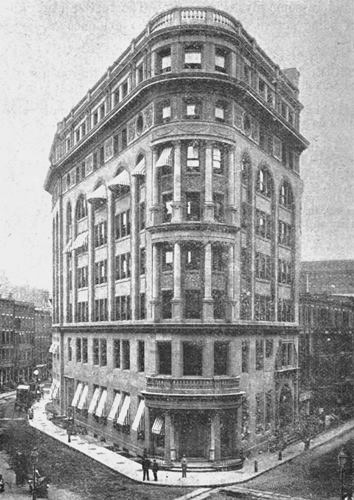
DELMONICO’S.
THE PANTATA OF THE POLICY SHOP AND POOL-ROOM.
Among its other achievements, the Lexow Committee enriched the vocabulary
of our language by the word Pantata. It is a mysterious word of Bohemian
origin. What it precisely meant none of the witnesses could explain. It
had no exact equivalent in the English language, but there was no
difficulty about understanding how it was applied in New York. Pantata, in
its origin, the interpreters explain, meant father-in-law. The term was
used in households to describe your wife’s father, but it was also held to
be the equivalent of Old Man; and one witness declared that in Bohemia,
the country from which the word was exported, it is frequently applied to
the Emperor-King of Austria-Hungary, Francis Joseph, who is said to be
Pantata to his Royal Bohemians.
Whatever may be the original significance of the term, it was applied by
the Bohemian Liquor Dealers’ Association to the Police Captain of the
precinct in which they did their business. He was their Pantata, and from
this beginning the term came to be used as a generic title for the police
official, who was on terms of family relationship with the vicious and
criminal class under his jurisdiction. The New York police captain was in
a special sense the father-in-law, or Father-in-the-Law, to a very
numerous progeny of disreputable people. Instead of being a terror to
evildoers, he became their Pantata, who looked after them with
semi-paternal care, and generally acted as their Father-in-the-Law,
regarding it indeed as his chief function to relax the law in their behalf
in return, of course, for consideration received. So long as his dues were
paid there was nothing that Pantata would not do. He could, for instance,
and did, practically suspend the legislation for Sunday closing. But that
is a mere trifle.
It was proved by the evidence of one witness that the Pantata police did
not hesitate to issue irregular licences of their own for the keeping of
unlicensed saloons, or shebeens, as we would say.
One witness, Anna Newstatel, held a licence once down to the year 1890.
When running a full licensed saloon she paid five dollars a month to the
police. After 1890 her licence was revoked, but in consideration of her
having been a good paying subject, the police told her that she might go
on selling all kinds of liquor without a licence, so long at she
continued to pay her dues to them, in consideration of an initiation fee
of £40 down. The following is the extract from the evidence:—
Q. What was your licence revoked for?
A. For selling liquor on a beer licence.
Q. And after your licence was revoked the police allowed you to sell
everything without a licence?
A. After I paid them 200 dollars at the start and then 50 dollars a
month.
Q. Now did you pay 200 dollars at the start?
A. I said I couldn’t afford to do that—I would sooner rent out the
saloon; and they said if I rent out the saloon as a store, and I
should live private upstairs and carry on my saloon business upstairs
for half of the amount—for 100 dollars to start, and 25 dollars every
month—and I should try that, and they will help me and see that I
shall have customers enough to do business.
Q. In other words, they told you you must go upstairs?
Chairman Lexow: That is to say, they would reduce the amount one-half
if she would do that?
Q. You sold on Sunday as well as on weekdays?
A. Yes, sir.
Q. Now, about the custom that you had. Did the detectives provide you
with the custom; did they give you custom?
A. No, they did not; they came in sometimes themselves and like this,
only they never paid when they came in; only they allowed me to keep
open any hour and all the time.—Vol. v., p. 4,592.
This claim to be supplied with drink whenever they felt they wanted a
glass appears to have been very generally recognised by the liquor dealers
of New York. Sometimes the police would pretend that they would pay, but,
as a matter of fact, the principle of free drinks seems to have been very
widely recognised.
In the regular saloons there was comparatively little necessity for
invoking the assistance of the benevolent Pantata. He had a much wider
field in dealing with the gaming houses, which flourished in every
precinct in New York. According to the law, no gaming house was allowed to
run. Yet, by permission of the police, there were about a thousand of them
running all the time the Lexow Committee was sitting. I had better quote
here the extract from the Lexow Committee’s Report:—
The evidence is conclusive that with reference to this class of vice
the police occupied substantially the same position as they did with
respect to disorderly houses.
It was proven even that while the Committee was actually in session
more than six hundred policy shops were in active operation in the
city, running openly, and from day to day policy slips were secured in
some shops in different portions of the city by detectives in the
employ of your Committee.
Qualified witnesses swore that the general average of open shops was
about one thousand. The testimony disclosed the remarkable fact that
not only were these violators of the law protected by the police in
consideration of a fixed sum of 15 dollars a month per shop, but that
the area of operation of each “king” was so clearly understood and
carefully guarded, that any intruder would be certified to the police,
and would either be compelled to refrain from competition with a
licensed “policy king,” or else would be arrested and condign
punishment would be visited upon him.
It seems clear from the evidence that this division of territory was
largely for the benefit of the police, insuring a more rapid and
easier collection of the tribute to be paid the “policy king” to whom
a particular district had been assigned, paying in bulk at the rate
of fifteen dollars per shop for all the shops running in such district
or districts.
Pool-rooms flourished all over the city in the same way. Large sums
were extorted from their proprietors by the police, and they were
permitted to remain unmolested, openly and publicly running, until a
private citizen, Richard Croker, after a conference with a police
commissioner, enforced their cessation practically in a single day.
This is one of the most remarkable circumstances testified to before
your Committee. And yet nothing was done or attempted to be done until
the private citizen aforesaid commanded that they be closed, and they
were closed, and closed without criminal prosecution.
It appeared subsequently in evidence that these pool-rooms, while
running, had been assessed and had paid for police protection as high
as 300 dollars a month.—Vol. i., p. 3,637.
We have too much betting in England—betting carried on with the active
co-operation of the press—for any English journalist to be able to throw
a stone at New York or Chicago, for the extent to which gambling is
carried on in policy-shops or pool-rooms. The Turf is the great gaming
hell of the Old Country, and nearly every newspaper in the land plays the
part of a tout and tempter to those who wish to gamble. In New York, while
there is betting enough among certain classes, the masses of the people
seem to prefer other forms of risking their money.
A very curious picture is given in the evidence taken by the Lexow
Committee of the prevalence of the gaming habit among all classes of the
population, especially in the poorer districts. After making one or two
ineffectual attempts, I have given up all hope of understanding, much less
of explaining, the precise way in which gambling goes on in pool-rooms.
From the explanations of the witness, the uninitiated outsider can only
discern vaguely that policy is much more akin to the Italian lottery
system than anything which prevails in this country. Any sum can be
staked, from one cent upwards. The gambler chooses a number or
concatenation of numbers. What is called a “saddle” consists of two sets
of numbers, while a “gig” is composed of three. There are many kinds of
“gigs,” which were duly described for the edification of the Committee,
the “police gig” being one of those most in vogue. In the choice of
“saddles” or “gigs”—or, in other words, in the selection of numbers on
which to put his money—the New York gambler is exactly like a Neapolitan,
and in nothing is the resemblance more remarkable than in the respect paid
to dreams. Nearly every policeman, it was declared, had a dream book, and
according as he dreamed, so he would put his money upon the number
indicated by the dream in his pocket oracle. I made a small collection of
dream books when I was in Chicago, and came to the conclusion that the
dream book was much more constantly consulted in that city than the Old or
New Testament. Judging from the evidence before the Committee, dream books
are equally in vogue in New York, but any accident or incident would serve
to suggest a favourite combination of lucky numbers, which would be in
great request until some other incident arose to suggest a new
combination. You staked a cent and stood to win a dollar.
One of the most painful features of this policy gambling was the extent to
which it worked downwards, even to the children. Lads coming from school
would beg a cent in order to try their luck. As they could only pay by
attracting customers, it was impossible to run a policy shop in secrecy.
In less than a couple of days the police were perfectly well aware that a
policy shop had been opened, and it was therefore absolutely necessary to
secure the police in advance. This seems to have been done on strict
business principles, and the partnership between the various kings or
satraps, to whom the police farmed out the precinct, appears to have been
very harmonious.
Bucket-shop and gambling on the tape on the prices quoted on the Stock
Exchange is as common in New York as it is in London; but one ingenious
method of improving on the bucket-shop was brought to light in the course
of this investigation. The disadvantage of the gambling in bonâ fide
Stock Exchange securities is that they are often sluggish, and do not go
up and down with sufficient rapidity to stimulate the excitement of the
gambler. In New York a bogus commission agency established a system of
gambling which beat the bucket-shop hollow. Instead of waiting for the
arrival of genuine prices of real stocks, the genius who ran this
commission agency fixed up a tape machine in his office, and before
business started in the morning wrote out a series of about five hundred
different quotations for stock in purely imaginary companies. When his
gamblers had assembled, he turned a handle, and wound off his tape. He
made the stocks of course go up and down with the requisite rapidity, and
from a gaming point of view it was in every way but one superior to the
ordinary betting on the tape. The one exception, however, was a pretty
considerable drawback, for the proprietor of the establishment knew in
advance what figures would come out, and how the prices would fluctuate.
So long, however, as he did not bet himself, this made no difference to
those who wanted a flutter.
Into the ramifications of the gambling in New York it is not necessary to
follow the Committee in their painstaking investigation. It did not even
draw the line at the Chinese quarter; and those who wish to know all about
Fantah, and the mysteries of the Button Game, will find their curiosity
gratified if they read through the Report. All that need be said is that
no form of gambling was carried on at New York which had not the police
authorities as its protectors, and the rank and file as its patrons. Under
such circumstances, it is hardly to be expected that much progress will be
made in suppressing gambling in New York.
The task indeed, as every policeman knows, is one of great difficulty,
even when the force is entirely free from any suspicion of complicity.
Mr. Moss, who is now at the head of the police at New York, had to admit
last September that, despite all his efforts, pool-rooms had been running;
and, as the newspapers declared, some of the police are Pantatas still. It
was, however, generally admitted that if the Pantata can be exterminated
by zeal, energy, and severity, Mr. Moss is the man to do it.
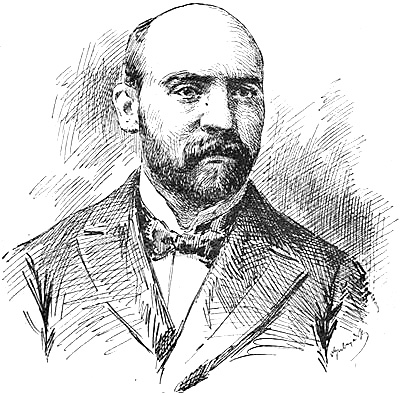
MR. MOSS, HEAD OF THE NEW YORK POLICE.
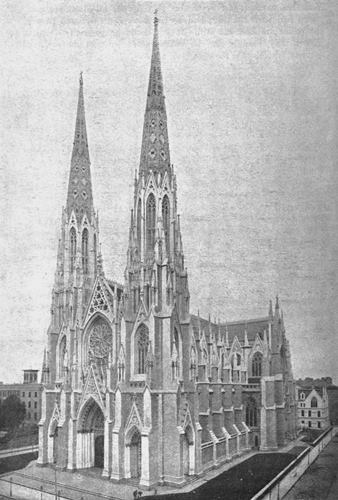
ST. PATRICK’S CATHEDRAL, NEW YORK.
(Roman Catholic.)
FARMERS-GENERAL OF THE WAGES OF SIN.
If the Police Captain was the Pantata of the Gambler, he was the
Farmer-General of the Houses of Ill-fame in his Precinct. His duty, as
defined by the law which he had sworn to enforce, was clear. He was bound
to close every disorderly house in his jurisdiction. His practice was to
let them all run—for a consideration. The Strange Woman, that pathetic
and tragic figure in the streets of all great cities, whose house from of
old was said to be the Way of Hell, going down into the Chambers of Death,
excited in the Police Captain only the sentiment of rapacity. In his eyes
she was merely an asset in his farm, and one of the most valuable.
It was when the Lexow Committee approached this part of the investigation
that they found the greatest difficulties placed in their way.
During the whole of the inquiry the Police Department preserved an
attitude of animosity to the Lexow Committee. This was only natural,
considering that the Committee was engaged in bringing to light all the
misdeeds of the Department for the last three or four years. The Committee
was protected by law, and supported by public opinion; nevertheless, the
police eagerly seized every opportunity that was offered them in order to
embarrass the Committee’s investigations, by intimidating witnesses, and
sometimes by spiriting them away altogether. It was proved that policemen
had gone round to the keepers of disorderly houses, and had begged them to
refuse to appear, or to refuse to testify, promising as an inducement
that, if they would hold their tongues, they should be allowed to run
their houses freely without interference from any one. The tune which all
the policemen sang was “Wait till the clouds roll by.” The Lexow Committee
was but a creature of to-day, while the Police Department was one of the
permanent institutions of the city.
“These fellows have got no pull,” said the police. “You lie low for a
time, and we will protect you.”
When this argument failed, they resorted to menace, threatening to close
up the house, to fling the keepers into gaol, and occasionally, when these
threats failed, they resorted to personal violence.
The Committee, speaking of the terrorism which was employed by the police
in order to prevent witnesses testifying, said:—
In the course of the inquiry, a man rushed into the session of your
Committee, fresh from an assault made upon him by a notorious
politician and two policemen, and with fear depicted upon his
countenance, threw himself upon the mercy of the Committee and asked
its protection, insisting that he knew of no court and of no place
where he could in safety go and obtain protection from his
persecutors.—Vol. i., pp. 25, 26.
The most distinguished exploit of the police, however, during the whole of
the inquiry was the spiriting away of the French Madam, Matilda Hermann,
one of the most notable keepers of disorderly houses in the City of New
York. When it was known that the Committee was after her, and that Madam,
who had been plundered to the bone by the police, was by no means
indisposed to “squeal”—to quote the expressive vernacular of the
Department—there was a consultation among the police authorities as to
what measures should be taken to close her mouth. A considerable number of
people in the same way of business had been induced to migrate to Chicago,
where they remained waiting until such time as the Committee adjourned,
but Madam Hermann was too dangerous a witness. She required special
treatment. A purse was made up for her by the police, which, when the
subscription closed, amounted to 1,700 dollars. She was then under
subpœna, and was expected before the Committee the next day.
At midnight, a police officer in plain clothes came to her house, bundled
her into a carriage in such hot haste that she had not time to complete
her toilet, and whisked her off no one knew where. For some weeks the
police appeared to have triumphed, but after a time the Committee were
able to get upon her track. She had been taken first to New Jersey, and
then from New Jersey had been railroaded through to Canada. From thence,
after moving about from place to place, she had been taken to a Western
city, where at last she was run to ground.
When the agents of the Committee found her she expressed no disinclination
to return to New York and testify. She had fulfilled her part of the
bargain in keeping out of the way as long as she could. Now that she was
discovered she was willing to return. In great triumph she was escorted
back to the city. In order to prevent any attempt at rescue, an additional
staff of men were sent to Philadelphia to meet her. The precaution was
timely, for as soon as they arrived at Jersey City a last desperate
attempt was made by the police to prevent her evidence being taken.
She was in the custody of the Deputy Serjeant-at-Arms of the Senate, who
had a party of resolute men in his train. But notwithstanding this, no
sooner had the party arrived in Jersey City than they were set upon by the
Jersey police, who treated them with the greatest roughness. They
threatened to break their faces, hustled them about, and endeavoured in
the mêlée to get Madam Hermann away. The Deputy Serjeant, however,
stuck to his witness, and finally he, Madam Hermann, and all his men were
arrested, run into the station-house, and locked up.
The sensation which this occasioned can be imagined. Fortunately, the
Committee was in session, otherwise there is no knowing whether the daring
attempt to seize and remove the witness might not have succeeded. The
immediate publicity, however, that was given to the case convinced the
police that the game was up. The Chief of the Police and the Police
Magistrate refused to lend their aid in thwarting the ends of justice, and
the conspirators, led by a lawyer, who was also a senator of the State of
New Jersey, drew off their gang, and reluctantly allowed Madam Hermann to
be brought to New York. The story reads more like an episode from the
Middle Ages than an excerpt from the proceedings of a senatorial
investigation in New York State in the last decade of the nineteenth
century.
The French Madam, as she was called in the precinct, was evidently
regarded by the police as a gold mine. She had three or four houses, with
some twenty-four or twenty-five girls, and was doing a flourishing
business. She paid the police altogether in the seven years that she was
running the sum of over 30,000 dollars, or more than £6,000; i.e., this
woman alone yielded the police a revenue of nearly £1,000 a year. Part of
this money, it should be said, went to the lawyers, who shared it with the
police. Every time she was raided the policeman insisted upon her taking a
lawyer, and told her that if she would take the lawyer of his choice, he
would not swear against her. He would swear that he was not sure of her
identity. This she did, and she was discharged. Every time she took a
lawyer she had to pay from £35 to £80, and the lawyer always told her that
he only got part of the money, as the rest of it went to fix her
detectives. Her evidence on this point was very emphatic. Whether she paid
200 dollars or 100 dollars, the lawyer only got 50 dollars; the rest went
up to the police.
Q. Were you told by the lawyers that that must go up?
A. From the smallest lawyer to the biggest lawyer: every lawyer was
the same.
Q. And every lawyer whose name you have mentioned told you that they
had to give up to the police part of their fees they got from you?
A. Every one of them.—Vol. iv., p. 4,179.
Mrs. Hermann first went into the business from being employed as a
dressmaker for the inmates of disorderly houses. She gradually added house
to house, until she had four houses and twenty-five girls. She had to pay
the police sometimes as much as £200 initiation fee before opening a
house, and then from £60 to £100 per annum as protection money.
In addition to these payments, every policeman in the street received a
dollar or two whenever he chose to ask for it. The method of exacting
this payment was very simple. The policeman said nothing, but simply stood
in front of the door. Of course, no one entered the house as long as he
was there; therefore, as counsel put it, “in order to induce him to take a
little exercise round the block, he was presented with a two-dollar bill.”
This little episode used to occur about twice or thrice a week.
Notwithstanding these payments, she made too much money to be left alone.
She was raided twice in 1890, and on the first occasion the police
extracted the sum of £200 before she was allowed to reopen her premises.
The next year she was prosecuted, and had to forfeit £200 bail in order to
avoid a threatened imprisonment. Immediately after her return she was
again arrested, and had to pay £200 to the detective, who shared it with a
high official at the Central Police Headquarters.
Her business was so profitable that she admitted in Court that she had
been making between £2,000 and £3,000 a year, of which sum the police and
the police lawyers seem to have had a good half. On one occasion, when she
had paid £100 to her lawyer to get off with a fine of £20, she was
liberated on the Friday and re-opened her house on the Saturday.
Notwithstanding the way in which they fleeced their unfortunate victim,
she was still subjected, like all her class, to occasional outbursts of
brutality on the part of members of the force.
When Dr. Parkhurst was making his tour of investigation through “the
avenues of our municipal Inferno,” the wardman was sent round the district
to the keepers of all the disorderly houses to describe Dr. Parkhurst, and
to tell them to look out for him in case he appeared at their house.
Another experience was when she took a house in West Twenty-third Street
to start it as an ordinary boarding-house. She had furnished it, and was
trying to let it. Promptly the wardman of the precinct came to her and
asked her “whether she did not know the law of the precinct.” “You know
very well,” he said, “that you cannot move in here until you see the
Captain.” And then this estimable officer did all he could to convince her
that it was idle trying to run a decent boarding-house, and she had much
better open the house in the regular way. The initiation fee would be
£400, £200 down and the rest to stand over until business was good. There
was to be a further payment of protection money, amounting to £240 a year.
She had not much ready money, whereupon the wardman suggested that she
might pawn her diamonds, for, said he, “the Captain is very bad off for
money.”
Another very amusing thing which came out in her evidence was the argument
used by a detective named Zimmerman to induce her to give him £10. He got
a couple of pounds one day, and came back the next, asking for another £2.
She objected, but he said, “I will be a good friend to you. I have lots
of pull, and my brother has shaved the Superintendent for twenty years,
and I get a great deal; I have a pull on that account.” It is an
interesting illustration of the way in which everything was turned to
account for the levying of blackmail. But we could hardly get lower than
this. The origin of pulls is mysterious; but to have a pull because your
brother shaves the Superintendent is a very mysterious foundation for
political influence. It is, however, but one among the many things in the
evidence that remind us of Turkey. The barber of the Grand Vizier is no
doubt a much more influential person than many a Pasha; and detective
Zimmerman was probably right in believing that his pull was good.
Everywhere, and at every turn, we are confronted by the omnipresent
“pull.” It confirms in the strongest way what Mr. Godkin said long ago as
to the city governments in America being a system of government by
pulls:—
In the ward in which he lives, the foreign immigrant never comes
across any sign of moral right or moral wrong, human or divine
justice. He then perceives very soon that, as far as he is concerned,
ours is not a government of laws, but a government of “pulls.” When he
goes into the only court of justice of which he has any knowledge, he
is told he must have a “pull” on the magistrate or he will fare badly.
When he opens a liquor-store, he is told he must have a “pull” on the
police in order not to be “raided” or arrested for violation of a
mysterious something which he hears called “law.” He learns from those
of his countrymen who have been here longer than he that, in order to
come into possession of this “pull,” he must secure the friendship of
the district leader.—North American Review, 1890.
Mrs. Hermann was only one among a number of other Madams who appeared
before the Committee, but none succeeded in exciting so much sympathy on
the part of the senators. The scandalous way in which the poor woman had
been fleeced, and bullied, and ultimately reduced to penury by the very
officials to whom she was paying protection money, roused the indignation
of the Committee. If the police had protected her in return for their fee,
it would have been a different matter, but, as Senator O’Connor remarked,
indignantly, in addition to paying the monthly tax, and the initiation
fees, raids were got up as an excuse to enable a policeman or a class of
criminal lawyers to extort money out of her. Senator Pound remarked that
it was the practice to protect such women until they became wealthy, and
then squeeze it out of them and leave them destitute. They say that there
is “honour among thieves,” but there seems to be none with the policemen
who handled Mrs. Hermann.
Another Madam, whose case attracted considerable attention, was one
Augusta Thurow, whose misfortunes brought her into intimate relations with
Senator Roesch, and led to the appearance of that redoubtable politician
in the witness-box. The relations between her and the Captain of the
Precinct seem to have been on straight business lines. About a dollar a
month for each girl in the house was the regular tariff. When beginning
business she went round to see the Captain and told him that she was
willing to do the right thing, but she had not much money, and could not
pay a very heavy initiation fee. He met her fairly, and said that he would
send the wardman round, and she was to do what he told her. When the
wardman came he said, “You wait until after the election, and, after the
election is over, you start right in and do business.” After the election
day he returned and said, “Now we will come to terms. Give me twenty-five
dollars a month and there will be no trouble either for you or for me.”
Business went on smoothly until one day she received a summons to go and
see the Captain. When she got there she found a number of other ladies and
gentlemen of her own profession at the station-house. On being admitted
into the Captain’s presence she thought he wanted money. He replied, “I am
not supposed to take money, but you can give me the money;” whereupon she
handed him twenty-five dollars. He then told her that he had sent for her,
not in order to collect the protection fee, which was the duty of the
wardman, but to give her a friendly warning that he had received orders
from the Central Office to close all the disorderly houses in the
precinct. He hoped, therefore, that she would do her business very
carefully, otherwise they might raid her from the Central Office. This was
an incident which was constantly occurring. The Central Office, stirred up
by newspaper reports, or by the representations of decent citizens, issues
orders for enforcing the law. The police captains, instead of executing
the orders of the Central Office in the spirit as well as in the letter,
send word round to all those concerned warning them to be on the alert. By
this means the Captain of the Precinct effectually nullifies the orders
issued from the Central Office, and, even if the Central Office make a
raid on their own account, they find nothing to seize.
It was shortly after this visit that Mrs. Thurow made her first
acquaintance with a redoubtable policeman of the name of Hoch. Of all the
collectors or wardmen who figure in the evidence, Hoch enjoys the most
conspicuous notoriety. He was no sooner entrusted with the collections in
that district than he insisted upon raising the fees for protection. “A
ranch like that,” he said, “is worth seventy-five dollars a month, and
here you are only paying twenty-five dollars, and give me only five
dollars, although you promised me ten dollars.”
“Hoch,” she replied, “I cannot afford it.”
Q. What did he say when you said you could not afford it?
A. He says, “You have got the house, and why don’t you make money? It
is your own fault; and that house is situated in the right spot, and
you can do all the business you want and we won’t interfere with you,
but you must do better than this.”
Q. Did he make any threats then to pull you, if you did not pay a
higher rate?
A. He said, certainly, if I could not do better than that, he would
raid the house.—Vol. i., p. 1,055.
This alarmed the Madam, and off she went to her husband, who was sent in
quest of Judge Roesch, the leader of the Seventh Assembly District, an
ex-senator. “I will go and see somebody, and fix the thing up,” said
Roesch. “But it will cost about one hundred dollars.” The money was paid,
and she did business right away.
Some time after this she was pulled by another detective. She expostulated
against the injustice of being run in, although she was paying protection
money, whereupon the detective remarked sententiously, “Somehow or other
you did not hitch with the Boss.” She went round to the station-house, to
find out what was wrong. The Captain told her that she had to find another
house in the precinct, and he would protect her, but he would not stand
the house in which she was any longer. The cause of this she discovered
when she was told that she could not open the new house until she paid an
initiation fee of £200 for the Captain, and £50 for Hoch.
It is not quite clear how it was that she got at cross purposes with the
police, but one remark made by Hoch would seem to indicate the existence
of an incipient jealousy between the police and Tammany Hall.
Augusta Thurow told the Committee that she said to Hoch:—
“I cannot afford to pay more than I am paying; you people treat me so
terribly, and I had to go to Roesch, and I had to pay him for his
trouble.” He said, “What did you pay him?” I said “Never mind what I
paid him.” He says, “That is how it is with you; you people get us
angry; you give money to the politicians that belong to the
police.”—Vol. i., p. 1,080.
The Chairman asked her to repeat exactly what he said; and she answered,
“He said, ‘You give the money to the politicians that ought to go to the
police. Are the politicians doing for you, or are we doing for you?’”
The evidence of the two Madams, and of a great number of other keepers of
disorderly houses, proved beyond all gainsaying that the police were in
partnership with the prostitutes, and that the firstfruits of the harvest
of shame were paid to the Captain of the Precinct. The Report of the Lexow
Committee thus sums up the result of their investigations:—
The testimony upon this subject, taken as a whole, establishes
conclusively the fact that this variety of vice was regularly and
systematically licensed by the police of the city. The system had
reached such a perfection in detail that the inmates of the several
houses were numbered and classified, and a rateable charge placed upon
each proprietor in proportion to the number of inmates, or in cases of
houses of assignation the number of rooms occupied and the prices
charged, reduced to a monthly rate, which was collected within a few
days of the first of each month during the year. This was true
apparently with reference to all disorderly houses except in the case
of a few specially favoured ones. The prices ran from twenty-five to
fifty dollars monthly, depending upon the considerations aforesaid,
besides fixed sums for the opening of new houses or the resumption of
“business” in old or temporarily abandoned houses, and for “initiation
fees” designed as an additional gratuity to captains upon their
transfer into new precincts. The established fee for opening and
initiation appears to have been five hundred dollars.
Thus it appears that transfers of captains, ostensibly made for the
purpose of reform and of enforcing the discontinuance of the practice,
the prevalence of which seems to have been generally understood,
resulted only in the extortion from these criminal places of
additional blackmail.
As an evidence of the perfect system to which this traffic has been
reduced, your Committee refers to that part of the testimony which
shows that in more than one instance the police officials refused to
allow keepers of disorderly houses to discontinue their business,
threatening them with persecution if they attempted so to do, and
substantially expounding the proposition that they were for the
purpose of making money to share with the police. As an evidence of
the extraordinary conditions to which this system had given rise, it
is proper to call your attention to the fact that in a number of cases
women, who, as keepers of disorderly houses, had paid thousands of
dollars for police protection, had become reduced to the verge of
starvation, while those who had exacted blackmail from them were
living in luxury in houses that had been furnished out of the earnings
of these women, or they were wearing ornaments of jewelry purchased by
them; and even the furniture of their houses had been paid for by
those whom they had protected in the commission of crime.
The evidence establishes, furthermore, that not only the proprietors
of disorderly houses paid for their illegal privileges, but the
outcasts of society paid patrolmen on post for permission to solicit
on the public highways, dividing their gains with them, and, often, as
appears by proof, when brought before the police magistrates and
committed to the penitentiary for disorderly conduct in default of
bail, they compounded their sentence, and secured bail by paying ten
dollars or fifteen dollars to the clerk of the court, or his agents,
and were then released again to ply their calling and to become
victimised as before.
The evidence furthermore shows that in some of the houses of the
character described, visitors were systematically robbed, and when
they made complaint at the station-house the man detailed to examine
into the charge failed to arrest the perpetrator, and frightened the
victim off by threats, and then returned and received his
compensation, an equal division of the plunder between the thief and
the officer.
The testimony taken as a whole conclusively establishes that the
social evil was, and probably still is, fostered and protected by the
police of the city, even to the extent of inducing its votaries to
continue their illegal practices, maintaining substantially a
partnership with them in the traffic, absorbing the largest part of
the resulting profit.—Vol. i., pp. 33-36.
The most startling statement in the whole Report is that which is
contained in the paragraph just quoted. From this it appears that the
police were not merely toll-keepers on the way to hell, but if by any
chance the Strange Woman wished to forsake her chamber of death, they
thrust her back into it. What was it to them that she might wish to save
her soul alive out of the pit? Her duty was to stay there and earn dollars
for the police. Were they not the Farmers-General of the Wages of Sin?
Mrs. Blood, a keeper of houses of ill-fame, was compelled by a Police
Captain to purchase the house of Madame Perot at some 10,000 dollars above
its value, to carry it on as a house of prostitution (vol. v., p. 5,414).
Another Captain smashed in the face of a man named Galingo because he had
taken a house in which the Captain wished to instal a brothel-keeper from
whom he expected to get £200 opening fee and £10 a month afterwards (vol.
iv., p. 4,487). In other cases, witnesses who had intended to leave the
business were compelled to go on running by threat of being raided and
ruined if they dared to think of ceasing to earn fees for the police. The
police had come to believe that they had a vested interest in every
brothel; and when a keeper proposed to quit the business, he felt like an
Irish tenant who is being evicted without compensation for disturbance.
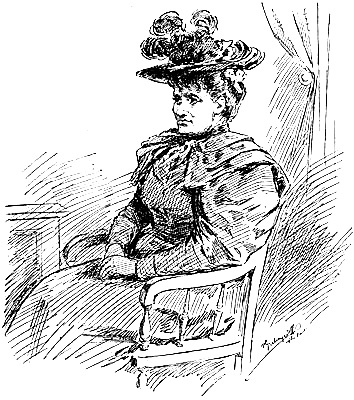
MADAM HERMANN.
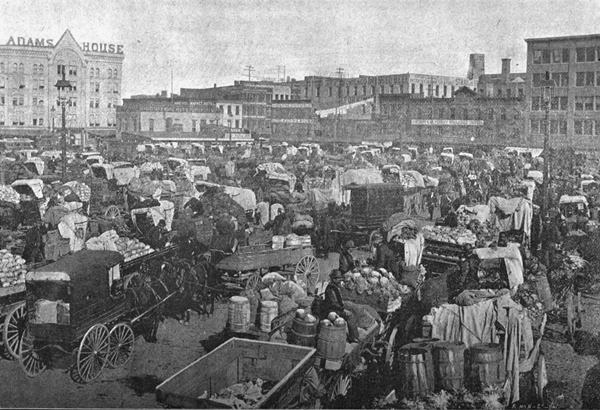
GANSEVOORT MARKET, NEW YORK.
“ALL SORTS AND CONDITIONS OF MEN.”
“After all,” some readers will say, “what does it matter? These people are
all outlaws; they deserve what they get, whatever it is.” But the net of
the New York police was exceeding wide, and the mesh was exceeding fine,
and no class of the community escaped. As the sun riseth upon the evil and
the just, so the blackmailer of the Police Department marked as his prey
the honest and virtuous as well as the vicious and criminal. The Lexow
Committee report:—
The evidence of blackmail and extortion does not rest alone on the
evidence of criminals or persons accused of the commission of crime.
It has been abundantly proven that bootblacks, push-cart, and fruit
vendors, as well as keepers of soda-water stands, corner grocerymen,
sailmakers with flag poles extending a few feet beyond the place which
they occupy, boxmakers, provision dealers, wholesale drygoods
merchants, and builders, who are compelled at times to use the
sidewalk and street, steamboat and steamship companies, who require
police service on their docks, those who give public exhibitions, and
in fact all persons, and all classes of persons whose business is
subject to the observation of the police, or who may be reported as
violating ordinances, or who may require the aid of the police, all
have to contribute in substantial sums to the vast amounts which flow
into the station-houses, and which, after leaving something of the
nature of a deposit, then flow on higher. The commerce of the port
even is taxed when the functions of the police department touch it, so
that the shippers are compelled to submit to exactions in the city of
New York that they do not meet with in any other port.—Vol. i., p.
42.
The chief sufferers, of course, were the poor and those who had no helper.
They were as much at the mercy of their oppressors as the French people
before the Revolution were at the mercy of their nobles. Again and again
the senators expressed their amazement that a population so harassed and
oppressed did not rise in revolt. Their wrongs certainly were immeasurably
greater than those which led to the Tea-party in Boston Harbour and the
Declaration of Independence. The chief abuse, the great grievance, might
be summed up in one sentence. There was no justice for the poor. A witness
of the name of Collins, speaking of the notorious Alderman, Silver Dollar
Smith, and the gang by which he reigned supreme on the east side, said:—
Smith has a regular organisation; you couldn’t convict them people
neither; you couldn’t convict them people in Court neither. It is an
organisation to represent witnesses to condemn people if they have no
money. If they have money to give, they are innocent; they perjure
themselves if they pay money.—Vol. v., p. 4,894.
But it is not necessary to go beyond the finding of the Lexow Committee in
their official Report:—
The co-ordination of all the departments of city government, under the
sway of the dominant Democratic faction in that city, has produced a
harmony of action operating so as to render it impossible for
oppressed citizens, particularly those in the humbler walks of life,
the poor and needy, to obtain redress or relief from the oppression or
the tyranny of the police. Their path to justice was completely
blocked. It is not credible that the abuses shown to exist have been
the creation of but a short time. It is clear from the evidence that
abuses have existed for many years back; that they have been
constantly increasing through the years, but that they did not reach
their full and perfect development until Tammany Hall obtained
absolute control of the city government, and under that control the
practices which have been shown conclusively before your Committee,
were brought into a well regulated and comprehensive system, conducted
apparently upon business principles.—Vol. i., p. 37.
The way in which the criminals in uniform and on the judge’s bench acted
when by any chance they could punish any one for doing what they
themselves were doing all the time has already been remarked in the case
of Captain Creedon, who was the only captain suspended by the Police Board
during the whole investigation. A more cruel case was that of Karl Werner.
This man had tried to bribe a policeman with five dollars, and was
promptly arrested. Every difficulty was placed in the way of letting him
have bail. At last the Court promised to accept bail, and a professional
bondsman offered to give bonds for 100 dollars. His wife raised 95
dollars, and because she could not raise the additional five on the spot,
the bondsman confiscated the 95 dollars, and the poor wretch was sent to
gaol. The professional bondsman is one of the worst of the harpies who
prey upon the unfortunate. Mr. Goff, who reported this incident to the
Commission, deplored the impotence to save the victim of the bondsman and
the police. “It is,” he said, “simply another of the many instances of the
terrible reign of terrorism” (vol. iv., p. 4,225).
Yet at the very time when Werner was being treated so harshly, the police
were collecting blackmail by thousands of dollars every week. At first the
Committee was incredulous. The Chairman asked once:—
Do you conscientiously believe that, notwithstanding these
revelations, notwithstanding the situation that we are brought face to
face with now, and what has occurred, there are police officers to-day
in this city who accept blackmail?
But he was speedily convinced that the revelations and the terrors of
exposure had only reduced the amount of the blackmail levied by reducing
the number of those who could be compelled to pay. The evidence of Captain
Meakin’s collector, Edward Shalvey, was conclusive on this point. He swore
in the witness-box that he had gone on collecting, without making the
slightest change, right down to September:—
Q. You collected from these several places, liquor dealers, policy
shops, and houses of ill-fame as you did under the previous captain?
A. Yes, sir.
Q. Did you ever meet with any refusal to pay from people engaged in
this class of business, or did they all pay as matter of course?
A. They all paid as matter of course.
Q. So that, officer, even beneath the terrible frown of the Lexow
Committee, the collections went on just the same?
A. Yes, sir.
Q. The old, old story continued, is that not so?
A. Yes, sir.
Q. And while, as a matter of fact, while there were exposures made and
being testified to before this Committee since last April or May,
right along the collections continued unbroken, did they not?
A. Yes, sir; not to such an extent.
Q. And the captains took the money in the same way?
A. Yes, sir.
Chairman Lexow: It seems incredible!—Vol. i., pp. 5,407-8.
“It is a tough old world, sir,” as the old stager remarked to an
enthusiastic young Reformer, “and takes a deal of moving.” It is a very
tough old world, and in the whole hemisphere there are few places tougher
than New York.
The contributions paid by contractors to Mr. Croker can easily be
understood. One Michael Moran, who was engaged in the towboat business,
towing garbage under the Street Cleaning Department, made various
subscriptions of from £10 to £30 to Tammany Hall. He was asked why he did
so. He replied that Mr. Croker was the treasurer of the organisation he
was doing some work for. “Tammany Hall, you mean?” asked the Chairman.
“Well, I guess so,” replied Moran. “Don’t you know there is a distinction
between the City and the organisation known as Tammany Hall?” asked the
Chairman. There was no reply. But Moran evidently did not. Tammany Hall
was the organisation that stood for the City. For him it was the City, and
Moran said to subscribe to Tammany was the natural feeling amongst
everybody that worked for the City; “one done it, and I didn’t want to be
left behind by anybody else; I thought I would hold my own end up”:—
Q. Did any one suggest to you the advisability of giving up this
money?
A. I have had conversations with other men that were in the employ of
the City, and we compared notes occasionally to know what was done,
and how we could keep ourselves solid.
No political contributions were made by Moran before Tammany came into
power. So the Chairman asked:—
Q. How is it then that when the Department changed you felt called
upon to send a cheque to Mr. Croker?
A. Well, because I didn’t think I could go on and do the amount of
business I had for the City without recognising the people that were
in power.
In 1892, when the Presidential Election was on, Moran doubled his
subscription. Why was that? He replied:—
I compared notes with somebody in the same business that I was in
myself, and found out somebody was paying a little more than I did,
and I was afraid somebody in my line of business would put in a little
more and I would get left.—Vol. v., pp. 4,912-6.
When once an evil system has got itself established, innumerable other
influences combine to render its extirpation extremely difficult. The
Committee was much scandalised by discovering that for premises whose
licence had been cancelled for immorality, a new licence was granted
almost immediately. But when the President of the Excise Board was asked
to explain, he said:—
There came into consideration property interests; we found that if
licences were refused for places where business was carried on, that
the banks were affected who had loaned money on mortgages, persons who
had loaned on mortgages, the banks who had notes of parties in
business; the rents went to the support of persons who depended upon
them solely; the tax commissioners of the city protested to the Board
of Excise against the refusal to license premises, because it reduces
the value of property, and for that reason reduces the taxable values,
and affected the city in that way; real estate agents and other
persons interested, and owners of property came to us and protested at
the start that we ought not to refuse to allow a reputable business to
be carried on on any premises, because they had been improperly
conducted before.—Vol. iv., p. 4,379.
And it came to pass that no sooner was a saloon closed for vice or crime
than it was opened again with a fresh licence.
The most mournful and tragic part of all these stories of oppression is
that which relates to the treatment of the forlorn and desolate women who
have no money with which to bribe the police. For them there is no mercy.
The theory of the police, as we have seen, seems to have been that
prostitutes existed for the purpose of raising revenue for the force. The
women of the streets were the irregular tax-gatherers of the Department.
Their vice was not merely connived at, but actively encouraged, so long as
the police received their stipulated proportion of the wages of shame.
The women were the bondslaves of the Administration. By law they had no
right to ply for hire; but, in consideration of the payment of a regular
ransom, they were left free to earn their precarious living.
“This is a phase,” said Mr. Goff, “and a revolting phase, of a custom that
exists in New York. I suppose it is the lowest form of oppression and
corruption that possibly could be conceived by the human mind; and that
is, a tax upon these unfortunate women in the streets at night; for they
will not be allowed to walk the streets at night unless they pay so much
to the officer, and this has been the custom in many districts of this
city for years.”—Vol. iv., p. 3,617.
The tariff varied.[1] On some profitable beats,
the licence fee was fifty
cents per night. But as a general rule the rate for “cruising” was a
dollar a week. So long as she paid she was all right—always with the
understanding that the policeman was to be free to arrest her if she was
complained of by any whom she molested. Irregulars—occasional clandestine
unfortunates—were, of course, regarded as interlopers and hunted down
remorselessly. The zeal of the policeman, which was not stirred in the
least by the breach of the law, rose to white heat when a woman who had
not paid her fees attempted to pick up customers.
In theory, in New York—and, alas, in many other great cities—the right
of a woman to freedom from arbitrary arrest without process of trial, and
to redress for wrongful arrest, is absolute. In practice it does not
exist. Every poor woman who is out after dark is liable to be arrested by
a policeman, and to a woman friendless and forlorn there is written over
the portals of every police-station, “All hope abandon ye who enter here.”
Before the Police Justice, the policeman’s word goes. No corroborative
evidence seems to have been demanded in New York. As one worthy testified
before the Committee, he made arrests on general principles, and swore
that his victim was loitering for purposes of prostitution. It was not
necessary that she should commit any overt act, that she should molest any
one, or that any citizen should complain of her molestation. It was enough
that she should be loitering in the street. The oath of the policeman as
to her intent settled her fate. A hurried gabble of words in a crowded
court, and she was packed off to gaol.
This is the besetting sin of all attempts to keep the streets clear of
immoral women by giving men, more or less immoral themselves, absolute
liberty to arrest any woman whom they please to say is loitering for
purposes of prostitution. It was with a flush of pride that I came all
unawares upon a reference made before the Lexow Committee to the case of
Miss Cass, which made the name of Endacott a byword and a reproach in
London some dozen years ago. Counsel had not got the story quite right.
His version curiously mixed up the Trafalgar Square agitation with the
arrest of the dressmaker in Regent Circus, but he had the main idea quite
right. Scotland Yard and Mr. Matthews hit the poor girl a foul blow before
the incident was ended, but it was a welcome thing to find that their
belated vengeance had failed to silence the reverberations of indignation
evoked by her scandalous arrest.
Americans and foreigners are often shocked at the state of London streets.
Mr. Croker, I remember, expressed himself as being much horrified at the
state of Piccadilly at midnight. But better a thousand times have the
scandal of our streets than place the liberty of all women at the mercy of
the police. The arrests of women fell 50 per cent. in London after the
uproar that was made about Miss Cass, and they are not likely to rise so
long as the authorities insist upon the most just and salutary rule then
introduced, that no woman shall be arrested for molesting by solicitation,
unless the citizen who is molested is willing to give evidence next day in
the police-court to that effect. The right of a human being to walk about
the streets, to loiter about the streets, does not depend, and ought not
to depend, upon the chastity of that individual. But if that principle
were to be adopted as a principle of police action, it ought in justice to
be applied impartially to both sexes.
Some very scandalous instances of the arbitrary arrest of innocent women,
and their consignment to prison on the uncorroborated oath of a policeman,
were brought before the Committee. The case of Ettie Kelter is one
instance of the kind of thing that follows inevitably from making the
policeman practically at once sole accuser and sole judge of the right of
a woman to be at large in the streets.
Ettie Kelter was a young married woman of unimpeachable character. She had
lived in Albany until August, 1894, when she came to live in New York. One
Saturday evening in the following month she went out shopping, and being a
stranger in the city she lost her way. She asked a gentleman to direct her
to her destination. He did so. She took the wrong turning, so he called
after telling her where she should go. She had hardly taken a few steps in
the right direction before a young man—a policeman in plain
clothes—seized her arm and dragged her off to the police-station. There
he gave her in charge, declaring he had known her for years. It was in
vain she protested she had never been in the city till the previous month.
She was removed under arrest to another police-station, where she was
locked up in a cell with a prostitute. She was terrified. She had been
dragged through the street at a great rate, and no sooner was she in the
cell than a blood-vessel burst. The blood gushed from her nose and mouth,
scaring her companion, who thought she was bleeding to death. The blood
streamed over the floor of the cell. But all the efforts of her companion
failed to attract the attention of the policeman or the matron. She
hammered at the door with a tin cup, but no one came. Not until the
morning did the officer come to release them from the bloody cell.
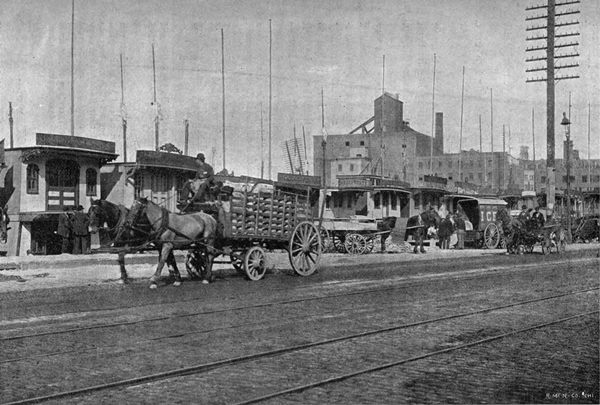
STREET SCENE IN NEW YORK: OYSTER ROW.
Pale, weak, distracted, almost fainting, Ettie Kelter was bundled into
court in the midst of a crowd of the offscourings of the streets, and
brought up before Judge Hogan. She could not hear the charge, nor could
she make out what the Judge said, excepting that he said something about
soliciting. She did not know what it meant, but she passionately denied
that she was anything but a respectable married woman who had only just
come to New York. She might as well have held her peace. “Two months’
imprisonment. After that, three hundred dollars bail good behaviour.” This
was Sunday morning. She was taken back to the cell, and her companion,
who had been sentenced to three months’ imprisonment, showed her a
lawyer’s card. “Send for that man,” she said, “give him twenty dollars and
he will get you out.” Her companion did so and got out. Mrs. Kelter
thought it would be better to send for her husband, who was employed as
fireman on the emigrant ferryboat. The policeman who arrested her
volunteered to go and tell him. But when he saw Kelter the message the
policeman delivered was—
“Now you have a good chance of divorce; I arrested your wife last night,
and she has got two months on the Island.”
She tried to write to her husband. But she had only two cents, and they
would not give her a sheet of paper for less than five, nor would they
send it out for less than fifty cents.
So the poor woman was taken to the Island, and kept there in prison for
twenty-four days. At the end of that time her husband placed fifteen
dollars in an envelope and handed it to Justice Hogan. His wife was
released.
And that kind of infamy was going on all the time. The way in which the
unfortunates were driven from pillar to post and treated as mere cattle,
to be fleeced and plundered, provoked a very remarkable protest from a
Police Captain who had sufficient humanity left in him to see the horror
of the system which he had to administer. He was asked whose fault it was
that the social evil flourished to such an extent. He said it was the
fault of the law:—
Q. The law itself?
A. Yes, sir, if you give the women the same protection by law that you
do a mule and a dog you will do away with two-thirds of the houses of
prostitution and women of the street.—Vol. i., p. 5,198.
In reply to the Chairman he explained how it was that houses of ill-fame
were so much more difficult to deal with than gaming houses. He said:—
Because, Senator, you take the women to court, they are fined a few
dollars and turned out on the street again to go and get more money,
be re-arrested and pay again; the trouble is that prostitutes are
fined.
Q. Wasn’t that done with gamblers as well?
A. Well, you could get their paraphernalia and get them away, but you
couldn’t with the women; a prostitute should never be fined and her
money taken away from her; those women are not bad women until they
are made so; they are dragged off the street and dragged before the
court and their money taken away from them, and then drove out on the
street again; they are not bad until they are drove to it; now, there
were fully 30,000 arrests made from January 1st, 1876, to January 1st,
1878, in that little precinct alone, and I will venture to say there
were not 1,500 women arrested, but arrested over and over again.—Vol.
v., p. 5,213.
He was still further examined by Senator O’Connor:—
Q. I want to ask you a question or two: what do you mean to say, that
if people would give the women the same protection given to mules and
horses prostitutes would be fewer?
A. What I mean by it is this: when they are arrested, instead of
sending them to a magistrate to be fined and money taken from them,
send them to a reformatory and inquire into their history, and you
will find there are a great many of these people that you see lost in
the papers. As I say, the women are not bad naturally; it is only
where they are driven to it. If there was a reformatory and the money
taken from them and taken care of, and put the institution under good
women, good, proper persons to control that reformatory, and not abuse
them, not send them to jail or abuse them, but send them to a
reformatory. You will find some people from Massachusetts, some from
Ohio, some from somewhere else, some from Michigan; send them to their
homes, and if they are foreigners, who have not been here five years,
send them back to Europe, and you will find as a general thing that
the reason why the prostitutes and why the disorderly houses cannot be
overcome is that there is no care taken of them; they haven’t a friend
in the world. There is no friend to a prostitute; everybody bangs her,
everybody beats her; she is dragged into the station-house, taken to
court, fined, and thrown on the street to get more money and bring it
back.—Vol. i., p. 5,214.
These words deserve to be written up in letters of gold in every place
wherever men discuss the question of abating this plague. It is the
verdict of experience upon the habitual resource of the unthinking. “Go
to, let us harry our sisters!” is the first and last word of most of those
who dream it is possible to promote the cause of morality by outraging the
principles of justice.
Of the system in New York there is only one good thing to be said. Bad as
it was, it is infinitely better than the hideous abomination of the
European system of tolerated houses with their police des mœurs and
the compulsory weekly surgical examination of their unhappy inmates.
Better a thousand times even the rude, irregular tyrannies of Hoch and
Koch, and all the diabolical gang of blackmailers, than elaborate all
these infamies into a legalised system stamped with the seal of the
approval of the State and enforced by the dread penalties of the law.
Prostitution, everywhere hateful, is at least less intolerable when it is
free. When to the horrors of prostitution there is added the legalised
slavery of the regulation system, you have indeed the sum of all
villainies, and the abomination that maketh desolate is at last set up in
the very holy of holies.
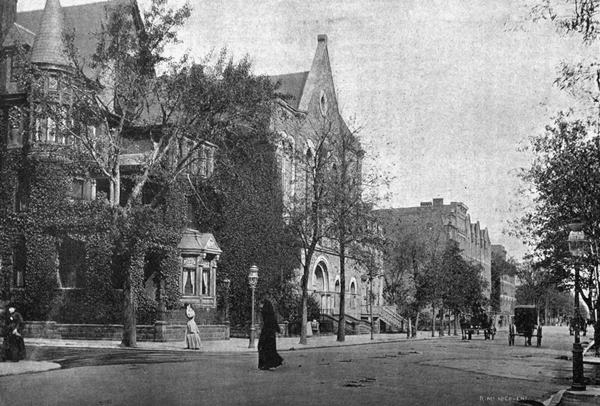
BELIAL ON THE JUDGMENT SEAT.
The effect of law, not law written in the Statute Book, but law
practically enforced among the people, is to evolve a conscience. Not
without deep true meaning was it said of old time “the law is a
schoolmaster to bring us to Christ.” For it is the law, by its pains and
penalties, which educates the individual as to the obligations of morality
and the duty of well-doing. But in New York the universal practice of
permitting all manner of abominations to run, provided the regular fee was
paid to the police, acted as a direct depravation of public morals in
familiarising the worst people in the city with a moral standard which was
in itself a negation of morality. A woman of the name of Flora Waters, who
kept a café with waitresses in a disreputable quarter, formulated with the
utmost precision her belief that she was doing right because her money was
taken by the police:—
Q. You thought the business you were doing was not wrong?
A. I thought it was all right when I paid, because they all said the
money was going to——
Q. I only want to get her moral idea?
A. Because they told me the wardman did not keep the money and it goes
up higher, and it had to be that way, because it was not old in this
country, that people that sold liquors could keep waiters; but I
thought it was nothing wrong, and everybody told me the money went all
through, and everybody knew how it was worked.—Vol. ii., p. 1,363.
Here we have plainly and simply set out the inevitable consequence of any
system of regulation. When the police sanction anything, it is no longer
wrong to practise it. The police-court is the only Sinai of the Slum.
Bad as the police were proved to be in many instances, they were gentlemen
compared with some of the Justices. The fact that such foul creatures were
permitted to sit on the judgment seat and deal out sentences to men and
women, the worst of whom were better than their judge, is the most
melancholy feature of the whole black, bad business. This is the innermost
centre of the New York Inferno.
Among the magistrates or police-court justices who figure conspicuously in
this hideous drama, one Justice Koch appears pre-eminent. I prefer not to
attempt to express the sentiments which are aroused by the spectacle of
such a Justice dispensing justice. Miss Rebecca Fream, a mission-worker
who had in vain endeavoured to secure some redress for the wrongs
inflicted upon her poorer neighbours, was on one occasion ordered out of
his court. She told the Lexow Committee:—
I turned to him, and I said, “Don’t worry yourself; is this what you
call justice?” then I said, “May God pity the poor on the east side,
for with half-drunken judges on the bench whom shall they look to for
justice if God forsakes them; you were half-drunk yesterday when I
applied for a summons, and to-day you are so drunk you can’t see out
of your eyes.”
Q. He made no effort to punish you for contempt of court?
A. No; there was one of the officers, and he turned and said, “By jee,
I wouldn’t take that from anybody.” I said, “If you were in the same
boat with him you would have to take it.”
Chairman Lexow: Fine commentary upon the police-court procedure!
The Witness: That is nothing; that is only a drop in the bucket.—Vol.
iv., p. 4,484-5.
The police-court judge seems in many cases to have been the pivot on which
the whole horrible system of oppression revolved. It would need the pen of
a Zola to describe adequately these shambles of the poor. There was the
headquarters of the foul crew that flourished on perjury and grew fat upon
using the forms of the law to frustrate its aims. It was the paradise of
the professional bondsman, the blackmailer, and all the human vermin that
thrive upon the misfortunes of their fellows. The worst lawbreakers of the
precinct stood inside the rail beside the judge, browbeat and bullied the
unfortunate accused, and practised every kind of extortion with impunity.
The blackguard lawyer, hand-and-glove with the bandit policeman, found an
even more detestable scoundrel than themselves upon the bench. The
fiercest invectives of Juvenal would be too weak to do justice to these
sinks of iniquity, in which honesty was a byword, innocence a
laughing-stock, and the law merely a convenient pretext for levying
blackmail.
The Committee was constantly hearing of the abuses connected with these
courts, but the inquiry closed before they could be taken seriously in
hand. The infamy of the system of bail, which was worked to fill the
pockets of the bondsmen, led to frequent comments. On one occasion the
Chairman remarked—
That seems to me to be a point that has never been properly
accentuated; the commission of the police justice and the general
activity of that character of man is a very great item going to show
their inefficiency. Blumenthal and Hochstein’s reputation was well
known, and their insolvency was an established fact, and yet they went
on bonds to the extent of thousands and thousands of dollars, and
those bonds were even forfeited and not paid, and the men accepted
again.—Vol. v., p. 4,490.
In the Report they say:—
While it was impossible for your Committee to spend much time in
considering police courts, enough is shown upon the record to justify
the conclusion that a very important reason why the police have been
able to carry on and successfully perpetrate their reprehensible
practices, is that at least some of the police justices have
apparently worked in sympathy and collusion with them.—Vol. i., p.
27.
In the examination of a witness named John Collins, Mr. Moss said—
I think that the evils perpetrated by these judges, some of them, are
even worse in their results than the evil practised by the police.
Chairman Lexow: It seems to me that any evil of that kind permitted by
a judge is ten times worse than that committed by any other
individual.
Mr. Moss: Of course, I myself have been before some of these judges
for the society which I represent, and know what it was to be sat down
upon, and outraged and browbeaten.
Senator Bradley: The witness says to me that the judges eat and drink
with these people, and know the character of the people well.—Vol.
v., p. 4,897.
The best way of bringing out this aspect of the administration of justice
in New York is to set forth, without a word of comment, the substance of
the evidence taken concerning the abortionists.
Abortion is not regarded in New York with anything approaching the horror
that is excited by the same crime in the Old World. According to the
evidence given before the Lexow Committee by an expert there were about
two hundred abortionists who advertised every day in New York their
readiness to kill the unborn child. It is an irregular profession that has
regular practitioners. But, like all the other vices, it is a fertile
source of revenue to the police. Dr. Newton Whitehead, a leading
practitioner in this recognised system of antenatal infanticide, was
called before the Committee and testified as to the way in which he was at
once helped and hindered by the police. Whitehead was arrested three times
in six weeks. He was never tried on any one of these occasions. But he had
to pay in bribing the police and feeing the police lawyer the sum of £565.
The doctor was arrested by a policeman called Frink, who insisted that he
should retain for his defence a lawyer of the name of Friend. He was told
that Mr. Friend had got a telephone directly from his house to police
headquarters, so they informed him at once of all these cases, and he was
our lawyer—the police lawyer (vol. iv., p. 4,240). Somewhat reluctantly,
Whitehead sent for Friend. He had to pay him 700 dollars. Friend remarked
apologetically that he would not insist on so much; but “I don’t get this
money myself: I have to turn over 50 per cent. of it to the police.” “Our
lawyer,” indeed!
The policeman Frink then took his prisoner off into a small court-room,
and told him, “In all these cases, Doctor, we expect to have some money
off from them. Pay me 500 dollars and I will guarantee that the case will
be dismissed when it is called.” He paid 500 dollars and the case was
dismissed, the only evidence offered incriminating, not the doctor, but a
midwife, whom, however, they refused to prosecute, as “she did not have
any money, and was not worth bothering with.”
The lawyer, the doctor and the policeman dined together at a saloon in
University Place. During dinner the policeman grew confidential:—
Sergeant Frink remarked to me that that was a very nice place; he said
he knew the proprietor, and he said, “Doctor, this would be a very
nice place if you ever wanted to run a young girl in here, upstairs,
it would be all right; nothing would be said.”—Vol. iv., p. 4,235.
A month later the doctor was again arrested. This time it cost him 475
dollars, paid to the lawyer. He was again arrested in the following month,
and was held for the Grand Jury:—
Q. There was a regular raid on the abortionists at that time, was
there not?
A. Yes, sir.
Q. And all the warrants were issued by Judge Koch?
A. All the warrants were issued by Judge Koch. Yes, sir.
Q. Do you know that any have been convicted?
A. No, sir. It was simply a blackmailing scheme.
Q. Blackmailing by whom?
A. I expect by the police.
Q. Who issued the warrant you were arrested on?
A. Judge Koch.
Q. He seems to have had a monopoly on the issuing of warrants of these
cases?
A. He might have been making money pretty fast out of it.—Vol. iv.,
p. 4,246.
“Judge Koch,” Whitehead said, “sat back in his chair, and he said he was
going to make an example of me,” and he held me to wait the action to the
Grand Jury. He first insisted on 7,500 dollars bail, but after various
interviews with the police lawyer and the police sergeant he reduced it to
2,500 dollars.
About a day or two after he had been held for the Grand Jury a lady came
to see Whitehead, and said she wanted to be treated for abortion.
Whitehead refused to treat her, and said that he had been so badly
blackmailed:—
I told her I thought I would not practise any more; I would leave the
City of New York if they were going to prosecute me that way for
nothing, and she said, “The gentleman who got me in the family way is
a very influential man, and he is a judge, and can do a great deal for
you, doctor.” I told her I did not think he could, because I had been
held for the grand jury. She insisted, and said, “Doctor, who is this
man that held you?” I said, “It was Judge Koch;” she said, “Judge
Koch?” She said, “My God, he seduced me and got me in the family way
five times, and Judge Koch paid the bill.”
Mr. Goff: Proceed, doctor.
A. She left my house, and she went down to Judge Koch at Essex Market,
and Judge Koch sent for me.
Q. Sent for you?
A. Yes, sir, by her. I have got lots of proof of that: there is no
need for him to wriggle out of it, for he cannot; and I went to see
Judge Koch, and he was as sweet as sugar. He told me, “Doctor,” he
says, “I am very sorry about this affair; I did not know that my girl
had ever been to you,” he said. “I will do all I can for
you—everything.” He said there would not anything come of this case.
“Don’t you be afraid;” the girl afterwards——
Q. Wait a while; was there any one present?
A. Mr. Friend here.
Q. Was present when Judge Koch said that to you?
A. Yes, sir.
Q. Just follow the narrative: how did Mr. Friend come to be there in
the room?
Judge Koch waited for him until he came; I sat there about
half-an-hour, and Koch seemed to be holding a case outside, and he
waited until Mr. Friend came; he came in and saw me, and said, “I am
waiting until Friend comes here.”
Q. Judge Koch said?
A. Yes, sir; and when Friend came in he spoke this matter over, and
Friend wanted to know what it was; he said, “It was that Alexander
woman I had trouble with before.”—Vol. iv., p. 4,264.
The “Alexander woman” was an actress, apparently Koch’s mistress. Dr.
Whitehead promised to perform the operation, but put it off. She went away
to another doctor and had the abortion brought about.
“I may say, Mr. Chairman,” said Mr. Goff, in addressing the Committee at
the close of Dr. Whitehead’s evidence, “that of all the terrible exposures
that have been testified to before this Committee, and that have shocked
not only our city but the civilised world, I think the most terrible of
all is that which we have heard this afternoon. I think the Committee has
reached the climax of the horrible in this city.”
“Satan’s Invisible World Displayed,” indeed!
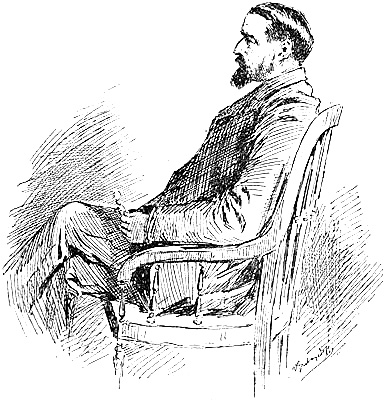
DR. WHITEHEAD.
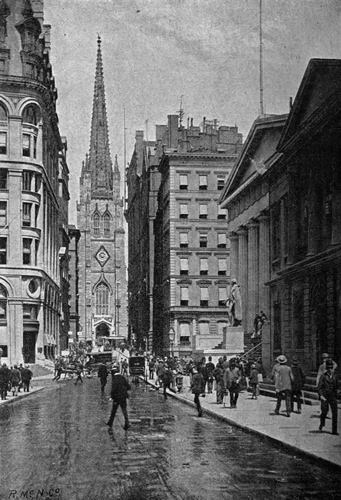
WALL STREET AND TRINITY CHURCH.
THE WORST TREASON OF ALL.
It will be remarked, somewhat impatiently I fear, by the reader of this
long and dismal series of stories of the way in which the municipal Thugs
did their deadly work, But where were the citizens? The good honest
citizens, we are told, are always in a majority. They proved that they
were able to elect their own City Government. Why did they not do it? What
is the use of talking about “the land of liberty,” “the Great Republic,”
and the Democratic principle, if the richest, oldest, and most
highly-educated city in the Western Continent is as impotent to use the
ballot-box to protect itself as if it were a city in the dominions of the
Great Mogul?
The answer of the Lexow Committee—not by any means a complete answer—is
as follows:—
The results of the investigation up to this point may ... be properly
summarised in the general statement that it has been conclusively
shown that in a very large number of the election districts of New
York, almost every conceivable crime against the elective franchise
was either committed or permitted by the police, invariably in the
interest of the dominant Democratic organisation of the City of New
York, commonly called Tammany Hall. The crimes thus committed or
permitted by the police may be classified as follows:—
Arrest and brutal treatment of Republican voters, watchers, and
workers; open violations of the election laws; canvassing for Tammany
Hall candidates; invasion of election booths; forcing of Tammany Hall
pasters upon Republican voters; general intimidation of the voters by
the police directly and by Tammany Hall election district captains in
the presence and with the concurrence of the police; colonisation of
voters, illegal registration and repeating, aided and knowingly
permitted by the police; denial to Republican voters and election
district officers of their legal rights and privileges; co-operation
with and acquiescence in the usurpation by Tammany Hall election
district captains and watchers of alleged rights and privileges, in
violation of law.
In fact, it may be stated as characteristic of the conditions shown to
exist by a cloud of witnesses that the police conducted themselves at
the several polling places upon the principle that they were there,
not as guardians of the public peace to enforce law and order, but for
the purpose of acting as agents of Tammany Hall, in securing to the
candidates of that organisation by means fair or foul the largest
possible majorities. They evidently regarded themselves as coadjutors
of that organisation, stationed at the several polls for the purpose
of securing its success whether by lawful or unlawful means, resorting
to device, oppression, fraud, trickery, crime, and intimidation of
almost every conceivable character....—Vol. i., pp. 15, 16.
It is to be regretted that sufficient time was not at the disposal of
your Committee to enable it to subject every district in the city to a
rigorous examination upon the lines of this branch of inquiry, whereby
a more accurate estimate of the effect of police interference might be
reached. Sufficient, however, appears upon the record to show beyond
peradventure that, owing to the practices above referred to during the
years covered by the investigation, honest elections had no
existence, in fact, in the City of New York, and that, upon the
contrary, a huge conspiracy against the purity of the elective
franchise was connived at and participated in by the municipal police,
whereby the rights and privileges of the individual were trampled
ruthlessly under foot, and crime against the ballot held high
carnival.—Vol. i., p. 17.
The date of this Report, be it remembered, was January 15th, 1895. It may
be supplemented by a very significant admission made by Mr. Goff, himself
a Republican and now Recorder of New York. Speaking of the election frauds
which he did so much to detect and punish in November, 1893:—
It would not be just to lay the blame exclusively upon the Tammany
inspectors, though, of course, being in the majority and in full
control, they were chargeable with all that took place. Republican
inspectors either openly co-operated with or quietly acquiesced in the
perpetration of the fraud.—North American Review, February, 1894,
p. 210.
The fraud on the ballot, to which both parties were privy, was all the
more abominable because the provisions of the law against such abuses were
very strict. But it is a favourite method in other countries than the
United States to salve an uneasy conscience by passing a rigorous law
without taking any precautions to see that it is carried into operation.
This mode of relieving the feelings had been indulged in by New Yorkers in
1890, when the Ballot Reform Act passed into law. But, writing in 1894,
Mr. Goff, who was Counsel to the Committee for the Prosecution of Election
Frauds, said:—
Since the enactment of the reform-ballot law in 1890 no organised
effort has been made to watch its operation or to detect any illegal
practices. The public was satisfied with the popular catch-name of the
Act, and it slept peacefully upon the assurance that fraud was no
longer possible; but the evidence obtained by the volunteer watchers,
and the finding of over sixty indictments by the Grand Jury, mainly
against election officials, demonstrate that false registration, false
voting, and bribery are as easily and as safely practised as they ever
were, and that perjury has enormously increased, owing to the number
of safeguards which must be sworn away by the fraudulent voter and the
collusive inspector.—Ib., p. 204.
There were 1,157 polling stations in New York in 1893, and it was not
possible to obtain competent watchers for all of them. But the evidence
obtained was sufficient to show on how colossal a scale the frauds were
practised, with the co-operation or connivance of both parties.
Ballot-stuffing seems to have been common. Mr. Goff says:—
Almost without exception there were more ballots found in the
ballot-box than the ballot clerk’s number showed to have been
delivered or the poll-list showed to have been voted, and in a great
number of districts more than the registration. How they came there is
to some extent a mystery: but in some places ballots were folded in
duplicate, and in others the pile of ballots on the table was added to
by a sleight-of-hand performance.—Ib., p. 209.
In the Thirty-sixth Election District of the Second Assembly District it
was estimated that 5,000 out of the 12,770 votes counted were fraudulent.
In the Seventh of the Third 567 ballots were found in the box for a
district which had only 508 names on the register. Repeating and
personation were almost universal. The lodging-houses played a leading
part in the squalid and sordid drama. The tramps who use these dossing
kens are all registered. But as they seldom pass three nights in the same
place, they rarely vote where they are registered. That, however, is a
mere detail. Mr. Goff says:—
The same men who registered did not, as a rule, vote upon the names
given. To have them do so would require their maintenance at the
lodging-house, and that would be too expensive. A more economic plan
was adopted. A few days previous to election the proprietors of the
lodging-houses were furnished, by the election-district captains, with
lists of the names registered from their houses. Separate slips for
each name were then supplied, and on election day the tramps, as they
come along, were handed the slips, and they voted on the names thus
given as frequently as they could get the slips. The election workers
were never hard pushed to bring out the registered vote. They simply
sent for the men when they wanted them, and were always supplied with
the required number. Sometimes the floater forgot the name given to
him or could not read the slip; sometimes a man who could not speak
English wrestled with an American name, or an English-speaking man
struggled with a Polish name. In all of these cases the obliging
inspectors helped them out either by looking at the slip or by giving
some sort of pronunciation to the unpronounceable name. In some
election districts there was a rivalry as to who could vote on the
most names, and the man who won the honours was an ex-convict, who
voted eighteen times in two election districts of the Third Assembly
District.—Ib., p. 205.
The evidence taken before the Lexow Committee abounds with vivid little
vignettes of how elections were conducted in New York City only four years
since.
Here, for instance, is what Mr. Louis Meyer, a Republican inspector in the
Third Assembly District, heard given as official directions by Police
Captain Devery to a platoon of policemen on the morning of the November
poll, 1893. The Union League and the City Club had decided to send
watchers to the polls to detect any illegal practices. So by way of
preparing for their reception, Captain Devery told the police in Mr.
Meyer’s hearing:—
There is a lot of silk-stocking people coming from up town to bulldose
you people, and if they open their mouths, stand them on their
heads.—Vol. i., p. 203, Lexow Report.
With such instructions it is not surprising that the police refused to
interfere when their attention was called to the most flagrant breach of
the law. Here is the story of Israel Ellis, Republican poll clerk at the
Fifth Election District of the Third Assembly:—
When several voters came and they were handed sets of ballots, I
wanted to get their names down, but the chairman and the officer told
me it would be sufficient for me to take down the name and the vote.
I told them it was not sufficient, because if I did not do this, there
would be a great deal of repeating done; and they said, “Never mind,
it is none of your business; you do as we tell you; it has been
carried on for a great length of time,” and I still kept on
protesting. And once the chairman of inspectors and another inspector
said if I didn’t shut up they would remove me from the board, and then
the officer said if I would not stop he would take a hand in that too.
Q. The policeman said that to you?
A. Yes, sir; and then several times the repeaters came in openly,
without any fear whatever, and they tried to vote, and each time I
protested and challenged their votes; and one time a repeater came in
and he passed the ballot clerk, he passed the chairman, but I
recognised him as a repeater, and I challenged the man, and I said,
“What is your name?” but the man had forgotten his name, because he
was voting for the second—third—time, and so I caught hold of that
man by the collar and ejected him, and the officer did not say one
word; a second time a man came in to vote which I myself recognised as
voting the second time in that election district; and another witness
told me, whose name I do not know, that he was voting for the third
time, and I waited until the man had voted, and I challenged his vote,
and the man voted, and after he voted I caught hold of that man, and
said, “Officer, I want you to arrest that man;” and the officer looked
at the ceiling, not at me; he did not say a thing, and he did not
arrest the man.
Q. Did you tell the officer what you wanted him to arrest him for?
A. I told him, the officer, that he voted for the second time to my
own knowledge, and the third time to the knowledge of a witness, and
wanted him to arrest him.
Q. And he looked at the ceiling?
A. He looked at the ceiling.—Ib., vol. i., pp. 216-17.
One voter was allowed to vote on the Christian name John. He could not
remember the other name. At the close seventy-two more votes were found in
the ballot-box than there had been voters in the booth.
A similar scene was described as occurring at the Third Election District
by Jacob Subin, a Republican watcher, who deposed that he had seen Mr.
Rosalsky, the captain of the Socialistic Labour Party, protest against a
young man who actually attempted to vote in Mr. Rosalsky’s name under his
very nose. Mr. Rosalsky grabbed hold of him and demanded that he should be
locked up as a repeater caught in the act. Three Tammany heelers thereupon
punched Mr. Rosalsky’s face for him. He called upon the policeman to
protect him. That worthy stretched himself leisurely and replied, “Well, I
guess I am pretty busy just now. I will see you after four o’clock, and
will have more time to spend.” The heelers then were for mauling Rosalsky
more severely; but the Tammany captain interfered, and, as an act of
grace, secured his release on condition that he went right away. Rosalsky
bolted for his life. After this Jacob Subin deemed it wiser to content
himself with a simple protest when he saw such repeating as this:—
I have seen the Tammany Hall heelers bring in five or six men, drill
them into line, and from the appearance of some of them they looked
like Irishmen, and some like recent importations from Chatham Square
or any of those dives, and most of those voted on Hebrew names; but
the fun of it was that they could not pronounce the name under any
circumstances that they were voting, and of course, as a rule, the
chairman of the board of inspectors used to correct them, and in some
instances they forgot their names entirely, and in such cases they
went out of the line, and then the heelers would approach them and
bestow such vile language upon them, and curse them and swear at them
for being so stupid as not to recollect the name of the person they
were voting under; and then they would drill them into line again, and
I protested against them. I attempted to challenge them, and I was
told unless I stopped monkeying with the regular way of doing business
that I would be thrown through the window.—Vol. i., p. 303.
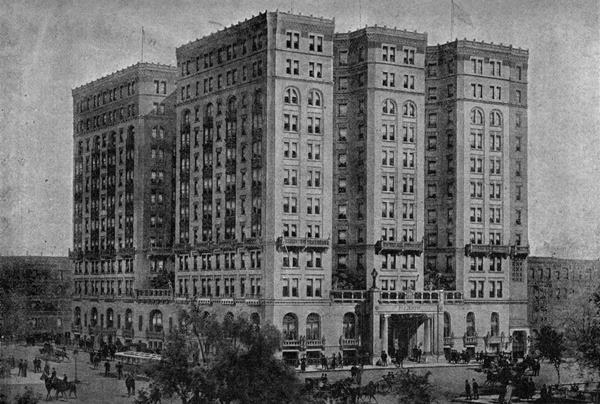
ONE OF THE MONSTER HOTELS OF NEW YORK: HOTEL MAJESTIC.
The appearance of the Tammany captain as master of the revels thus
reported by Jacob Subin is significant. Frank Nichols, in the
Twenty-ninth Election District of the Third Assembly, where they had
eighty-four more votes than they had names on the register, took two
voters to the poll. As he was on the wrong side his men were not allowed
to vote:—
I said, “Why can’t they vote?” and they said, “No, they could not
vote,” and I said, “What was the matter of these people they could not
vote?” and they said, “You go home; go home; you people can’t vote any
more,” and then I was put out in the middle of the street, and the
captain of the election district said, “Take this fellow away from
here,” and a fellow hit me in the eye with a brass knuckle.
Q. Did the police do anything at all?
A. No, sir; he would not arrest a cat that day as long as it belonged
to Tammany Hall; he would not arrest a cat.—Vol. i., p. 301.
Canute A. Deas, who was Inspector of Election at the First Election
District of the Third Assembly, protested fifty times in a single day
against barefaced repeating. The policeman whispered in his ear that he
meant to be fair, but he had his directions to take his orders from the
Chairman of the Board. Captain Devery drove up and stood laughing and
talking with the Tammany captain while the legal voters were in vain
clamouring to be allowed to vote. The Republican watcher was thrown out by
force under the eyes of the policeman:—
Q. Who threw him out?
A. The crowd—the Tammany Hall captain of the district, who was in
there; he was authority for everything.—Ib., vol. i., p. 279.
Examined by Chairman Lexow: When you said that the Tammany Hall
captain was authority for everything, what did you mean?
A. I meant that, whenever he desired to go into the polling place, he
did so, that whatever he wanted was done; it seemed that they all
worshipped him, bowed down to him.—Ib., vol. i., p. 287.
Another witness, Ralph Nathan, described how a Republican captain was
hustled out because he swore that a voter had already voted in four
election districts, for he had followed him round and had seen him do it.
Mr. Nathan said:—
The Tammany henchmen around the Third Assembly district have a
peculiar method of putting a man out; you cannot make a particular
charge of assault against them, hardly, but they push them out and
hustle them out; they have probably ten heelers at every election
district, and the polling place is generally narrow and small, and
they can fill up a place and push you out.—Vol. i., p. 290.
Here also is a description of the method in which repeaters were brought
up when wanted. Mr. C. H. P. Collis, a prominent citizen who acted as
watcher for the Twenty-second Election District of the Second Assembly
District, deposed that he saw repeating going on openly:—
Q. Men voted under names that were not theirs?
A. I cannot go so far as that.
Q. Describe what you did see?
A. I saw a man who sat at my side ticking off the list, and those
names that were not ticked he would take three or four of them, men
who had not voted, and hand them to an active worker, I supposed for
the purpose of having those people hunted up and brought to the
polls, which would be legitimate; but I saw this man take them out in
the street and hand them to the people there.
Q. Hand those names to the people?
A. Yes, sir.
Q. Then what occurred?
A. Then after awhile a man would come in and walk up to the polls.
Q. And would he call off one of those names?
A. Yes, sir. In fact one man had forgotten his name and turned to the
man who brought him in, and said, “What is that?”—and he told him,
“John Kelly,” or whatever the name was.—Vol. i., p. 130-1.
As a pendant to this scene take the following description of what happened
at a previous election, where Mr. Thomas F. Harrington, Republican
watcher, who had been challenging repeaters, was set upon by one Whitty,
an ex-convict, as he was returning to the polling place to attend to his
duties. Whitty was carrying a club and a revolver. Harrington argued with
him, fearing that “they meant to inflict punishment upon me,” and
remonstrated against causing blood to be spilled on election day. Whitty,
however, held on to his man, whereupon, said Harrington:—
I grabbed him by the throat with my left hand and went to strike him
with my right, when the two officers (who had been standing watching
Whitty’s attack) rushed. One officer grabbed me by the coat and raised
his club to strike me, and I told him if he struck me I would kill him
where he stood, and a friend of mine came forward to help me, and the
other officer rushed out and grabbed him, and up with his stick to
strike him; they did not take hold of this Whitty at all; it was me
and my friend they took hold of.
Q. And these policemen made no move to protect you in any wise in this
assault, until you began to defend yourself?
A. No, sir.
Q. And then they laid hold of you and of your friend?
A. Yes, sir.—Vol. i., p. 135.
“We are in the business of carrying elections,” said Boss Tweed, and a
very successful business Tammany has made of it.
But what becomes of popular sovereignty, of the majesty of the ballot, of
the sacred privileges of citizenship?
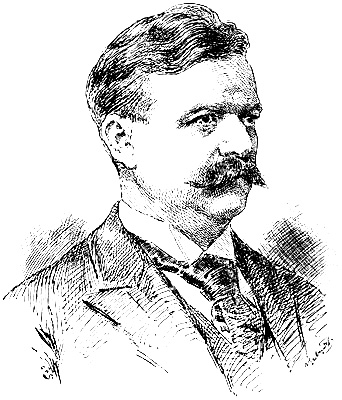
MR. VAN WYCK.
First Mayor of Greater New York.
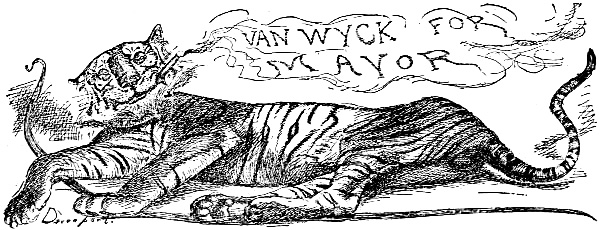
From the Journal, New York.