To be carried into the presence of Pharaoh!—words of significant
import, suggesting speedy condemnation and summary punishment. With arms
strapped tight to his body, with feet bound together under his horse's
girth, guarded on either side by mounted bowmen, surrounded by scores of
their comrades on horseback and on foot, Sarchedon rode slowly on
through the night, and at dawn found himself before the portals of a
flourishing town dedicated to the worship of Bubastis, as revealed in
the outward semblance of the cat.
Here, in one of the noblest cities of his dominions, Pharaoh was
administering justice, according to custom. At sunrise the Egyptian king
ascended his judgment-seat to dispose without appeal of all cases laid
at the royal feet. Therefore had Sarchedon been conducted hither,
through the hours of darkness, to receive the award of his crime.
As they neared their destination, the adjacent country began to teem
with life. Cows and oxen, speckled, spotted, and ring-streaked, dragged
the plough through a lately-irrigated soil, the former doing their work
far more nimbly than their weightier brothers. Playful calves leaped and
frisked behind, marked, like their dams, with the brand of their
respective owners. Slender husbandmen, naked to the waist, followed in
pairs, scattering seed over that rich and generous surface. Scores of
birds from the banks of the neighbouring river followed their movements;
while a steward or overseer in every field directed the toil of the
labourers, taking account of their expenditure and their stores. Peace
and plenty seemed to reign throughout the land, and Sarchedon could not
but reflect he might be looking his last on a world of light, life,
labour, and prosperity.
Unlike his own Assyrian cities, there were no bowmen on these walls, no
guard in this capacious gate, through which all seemed free to pass at
will. Two gigantic sphinxes, indeed, couched half-a-bowshot apart, kept
watch in majestic gravity on either side. Two colossal idols, cat-headed
and of compound form, half man, half monster, faced each other at the
entrance; but within, a crowded market, swarming with peasants, glowed
in gaudy luscious fragrance of fruit and flowers. A thousand tongues
chattered, a thousand arms gesticulated; the ass munched its provender;
the sacred stork pushed its long beak at will into woven basket or
wicker pannier. Merry faces and broad smiles gleamed in the morning sun.
A burst of cymbals rose in the warm serene air, and Pharaoh went up to
his golden judgment-seat, the birthplace of those unanswerable decrees
that signified life and death.
As his guards hurried Sarchedon along the streets, much interest and
curiosity seemed excited by the personal appearance of the prisoner;
while comments flew from lip to lip on his stature, his bearing, and the
probable punishment of his crime.
"Stately as a sycamore," said one, apparently a carpenter by trade, "and
hard as a tamarisk; he will bear impalement as seasoned wood stands
soaking, without a warp. If they keep water from him, my friends, we
shall find him alive on the fourth day."
"Impalement!" interrupted an old hag, grandmother to the first speaker;
"Pharaoh will never order such a goodly youth to the stake. No, no. Let
him be carefully disembowelled; give me a measure of myrrh, a pound or
two of cassia, and a handful of spice—I wouldn't ask you for cinnamon,
oil of cedar, nor palm-wine—and if he look not as tall and comely a
thousand years hence as at this moment, may I never touch salt or
natron, iron probe or linen swaddlers, again."
"Fie, mother!" said a good-humoured peasant, emptying a basketful of
onions and lentils at the feet of a purchaser. "Pharaoh is merciful,
though he lives for ever. The youth may escape with the loss of his
shapely nose, or at worst a thousand blows on the soles of his feet. By
the talons of our Cat, 'tis a goodly measure of manhood; 'twere pity to
make a mummy of it before its time. Why, what hath he done?"
"Ay, what hath he done?" echoed a score of voices, to be answered by a
score of extravagant surmises.
He had slain an Israelite! Bah! they would fine him a quarter of wheat,
and let him go. He had murdered an Egyptian! It was a hanging matter;
but here at Bubastis their dams and banks were raised by working gangs
of such criminals. He would escape with hard labour for life. Not much
worse than their own peasant lot, after all. Better, forsooth, in so far
that such miscreants paid no taxes, and Pharaoh found them enough to
eat. No, it was a blacker business than this. He had insulted a priest;
he had blasphemed Athor; he had put his finger in his mouth to ridicule
Horus; he had said openly that Osiris was a falsehood and Isis a harlot;
he smote Anubis in the muzzle, mocked with feline sounds the majesty of
Bubastis; outrage of outrages, spat on the sacred bull itself! He was a
spy, a stranger disguised as an Israelite, a Philistine—nay, a child of
Seth, with square ears—a worshipper of Abitur in the mountains, a
devil, and a son of devils! Away with him! down with him! slay him! tear
him limb from limb!
The wave gathered force as it advanced; the popular indignation swelled
into ferocity. Instead of merry good-morrows and happy laughter, the
air was filled with yell and shriek and wild revengeful howl. Faces, but
now smiling in content, were distorted with brutal hate and cruel lust
for blood. The crowd surged and swayed through the market-place,
leaping, bristling, closing in like wolves about their prey. Could they
have reached the Assyrian, he must have been torn to pieces ere he
lifted a finger in self-defence. But for those whose trade is war there
exists a professional instinct of brotherhood stronger than any
prejudices of nationality, any credulity of fanaticism. The bowmen who
guarded him recognised in Sarchedon one of their own calling, and made
common cause with a warrior, even against their kindred and countrymen
vociferating for his blood. With the unerring rapidity of discipline,
they formed round their charge in double rank, forcing their way at a
steady even tramp through the wavering crowd, and so opening a space on
every side, kept it clear by bending their formidable bows.
Advancing thus in a long avenue of colossal sphinxes brightened by the
morning sun, they arrived at the entrance of the royal palace. Here,
with an infuriated yell, the populace made a final rush; but were beaten
back by the archers, at the cost of a few broken heads and bloody faces,
though, fortunately for the prisoner, without loss of life or injury to
limb.
The judgment-seat of Pharaoh—a throne of solid gold, elevated on
twenty-four steps of the same metal above the raised floor on which
accusers and accused were stationed face to face—seemed to blaze in a
flood of sunlight, that bathed it from the open sky above.
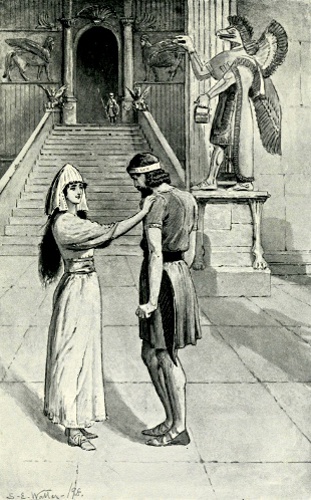
The palace, Sarchedon observed, was built, like those of his own
country, round an unroofed court. It differed but little from the
dwelling of an Assyrian king in architecture and general plan, but was
even more profusely decorated, in a greater variety of sculptures,
minutely designed, gaudily-coloured, and representing many of the lowest
reptiles and animals with a fidelity not entirely pleasing to the eye.
Here, besides the fox, the jackal, the porcupine, the lizard, the
locust, and the asp, were an infinity of compound monsters, the produce
of a theology which persisted in embodying every attribute of its ideal
under a form, however grotesque, that should give tangible expression
to its idolatry. Such were the winged goat, the serpent-headed lion, the
griffin with pinions spread and feathered crest striding over its
mysterious triad of flowers, the bitch, dragging her homely chain,
hanging her heavy teats, canine in all her properties but her sleek
bird's head and delicate beak. Things that creep and things that fly,
from the stork and the raven, the crocodile and the ichneumon, to the
serpent, the beetle, and the bat, filled every interstice on the
variegated walls; while between the crowded figures closely-packed
hieroglyphics recorded for initiated readers the history, the nature,
and the occult signification of each. Deeds of arms too and field
sports, from taking of towns and spearing of the river-horse to
numbering of captives and snaring of song-birds, were handed down to
future ages in imperishable carving; while, at stately intervals, solemn
and majestic, here in the palace of the Pharaohs, towered the statues of
those numerous gods in whom Egypt had ever trusted for succour at her
need.
Osiris, the great benefactor and founder of their nation, the inventor
of agriculture, mechanics, all arts necessary to life; who taught men
how to plough the earth and train the vine; who, in his contest with
Typhon, the principle of evil, was cut asunder into six-and-twenty
pieces; and who, as every true Egyptian firmly believed, would return in
his original form at some future epoch to judge and regenerate mankind.
Had not Isis yonder, his wife and sister, collected the fragments of his
dismembered body to put together and embalm the whole ere, summoning the
high-priest from each of all her temples, she confided to him, and him
alone, as she caused him to think, the sacred deposit, so that each
carried away what he believed to be the body of his god, under solemn
oath that he would never divulge to living man the place of its
sepulture, persuaded that his own temple was the revered and sacred
spot? This mighty deity of the future and the past here revealed himself
for his worshippers to adore in the massive statue of a bull!
Isis, too, with her ten thousand names, sat in a place of honour over
against her lord; and near her Horus, their son, with finger on his lip,
emblem of princely modesty and discretion, supported by his
half-brother, Anubis, the wise and faithful, with human form and a dog's
sagacious head. Multiplied too in many a niche and along many a lofty
corridor, stood erect and threatening the figure of that deity to whom
the city was especially sacred, worshipped under the semblance of a cat.
Avenues of cat-headed monsters kept watch in hall and passage; while
presiding, as it were, in the very entrance of the court, stood a
gigantic image of granite, wearing the short ears of the sacred animal,
its sleek round head, and cruel feline smile.
Immediately behind this dazzling throne, constituting it indeed the very
tribunal of the Pharaohs, watching, as men believed, over sentence and
acquittal, accuser and accused, might be seen the statue of a female
figure, with blinded eyes, serene impassive face, and wings spread out
in front, as though grasping and embracing all within their sweep. This
was Thmei, emblematic goddess of truth and justice, whose essential
attributes were thus typified in her outward form: the blinded eyes
signifying her impartiality, the calm visage her indifference to
consequences, the wings instead of hands her incorruptible nature,
inaccessible to the bribes it was impossible for her to accept.
Standing between his guards, still pinioned and secured, Sarchedon's eye
took in all these details of Pharaoh's sumptuous palace ere the glare of
burnished gold permitted him to observe the judgment-seat and its
occupant. After a time, however, he was able to distinguish the person
of a pale slender sallow man, showing like the wick of a lighted candle
through a blaze of shining raiment, dazzling jewels, and royal Egyptian
state. Pharaoh's attitude was one of extreme exhaustion and fatigue; his
face looked very sad and weary, but in its long narrow eyes, low brow,
and prominent chin there lurked a strange resemblance to the pitiless
features of that colossal figure which was destined hereafter to keep
watch over his tomb.
A case had just been disposed of, trifling, indeed, in its details, and
scarcely worth the intervention of a monarch; but it was the custom of
Egypt, that wherever Pharaoh held his court, he should administer
justice in person, from the pilfering of a handful of lentils to
desecration of an idol, blasphemy against a god, or resistance to the
authority of the king. A dozen strokes of the bastinado had been
awarded for the first offence. Sarchedon, accused of the last, was
brought forward by the archers, and placed at the lowest step of the
throne.
"Unbind him," said Pharaoh, looking round on his men of war with
something of scorn. Then, in the prisoner's own dialect, he addressed
him shortly and sternly: "You are an Assyrian. What do you here?"
The tone was of one who had never known opposition, and the keen dark
eye wandered over Sarchedon from head to foot with something of the
cat's expression, pausing carelessly before she makes up her mind to
pounce.
"My life is in the hand of Pharaoh," answered the prisoner. "I will not
deny my nation nor my name."
"What brought you into Egypt?" continued the king, still in the same
scornful indifferent accents. "Have you any knowledge of my country and
its customs?"
"I came here first as a conqueror," answered the haughty Assyrian. "It
was not for us to learn the manners and customs of the Egyptians, but
to impose on them our own."
The guards, who understood him passably well, exchanged looks of
consternation at this imprudent reply; but something like a smile
crossed Pharaoh's face, and sinking back into the throne, he observed
carelessly,
"Let his accusation be read out."
It was the law of Egypt that, even in the presence of the supreme
authority, all judicial proceedings should be reduced to a written
statement, comprising the charge, the evidence on both sides, and the
defence. It was believed that thus only could be avoided the bias of
skilful oratory and impassioned eloquence, where an offender was
pleading for his life.
A priest—distinguished by gravity of demeanour and wisdom of aspect no
less than by the purity of his linen garments and the reverence he
seemed to command from the bystanders—now read from a roll of papyrus
the terms of the accusation with which the prisoner stood charged. It
set forth in simple language that "he this Assyrian stranger, having
come surreptitiously into the land of Egypt, had there consorted, of his
own free will, with their slaves the Israelites, tampering with their
patriarchs, and inciting that stiff-necked people to revolt; that he
had even headed the outbreak of a gang during a temporary respite from
their labours—an indulgence, it added, which ought never to have been
permitted by the task-master; had hurled that functionary from the
saddle, and well-nigh slain him while bleeding and helpless on the
ground; that such an enormity was in itself an insult to the majesty of
the king, an outrage on the Egyptian nation, and a crime only to be
expiated by death. He laid his charge at the feet of Pharaoh, who, like
Thmei, was the embodiment of truth, justice, and wisdom, and would live
in power and glory for ever."
From out the blaze of splendour flaming round the throne came again that
calm and scornful voice, wearily enunciating the usual formula,
"Produce your witnesses."
Two or three archers belonging to the force that had guarded the working
gang of Israelites here stepped forward, and with them, to the
prisoner's consternation, the younger son of Sadoc—that fragile boy, in
whose defence he had brought down the wrath of Egypt on his own head.
The poor youth had been on horseback since nightfall. Unaccustomed, like
his nation in general, to the exercise of riding, he was a pitiable
object of soreness, fatigue, perplexity, and alarm. The archers gave
their evidence clearly enough. It amounted to little more than the bare
facts of the case. Then they dragged the young Israelite into the
terrible presence of Pharaoh, pale and faint with mortal fear.
"What needs all this weight of testimony?" exclaimed the prisoner in a
loud bold voice. "It is but heaping weariness and vexation on the head
of my lord the king. I deny that I have urged a nation to rebel against
its rulers. I admit that I opposed by force the violence that would have
scourged a helpless child lying in the dust. If this be deadly crime by
the laws of Egypt, would that we had given you a milder code when the
children of Ashur came of late to seek you with bow and spear. I have
spoken. My life is in Pharaoh's hands. Let him take it how and when he
will."
The king looked round on his captains and counsellors with a passing
gleam of animation in his eyes.
"This is a bold fellow," said he. "Which of you would dare speak thus,
while looking death in the face so close?"
Nobody answered; but a murmur went round the circle, to the effect that
"Pharaoh lived for ever!"
The king turned to a venerable man who, with the exception of that
indispensable official the fan-bearer, stood nearest the throne, and
asked him,
"Have these sons of shepherds been numbered according to the royal
decree?"
"The king hath spoken," was the subservient reply, while with a low
obeisance a roll of papyrus was laid at the royal feet.
The fan-bearer handed it to his lord, who scanned it with an angry
frown. "So many!" muttered Pharaoh; "and so poor a tale of work!
Increasing, multiplying, swarming over the land, while they lay it waste
like locusts! Sleeping more than they labour, devouring more than they
produce, hoarding substance, no doubt, and having children at their
desire. Is Pharaoh's arm shortened, or has my hand waxed faint? I must
take order with this scum of nations, lest at last they outnumber us,
spreading through the land to eat it away like a sore. I have reached to
them the sceptre of my protection; it is time they should feel the edge
of my wrath!"
Round the king's neck hung a small image in gold of Thmei, goddess of
Truth, corresponding in every respect with the statue that towered above
his throne. A similar ornament glittered on the breast of the old man
whom he addressed, denoting the regent of his kingdom, a magnate second
only in power to Pharaoh himself. When such an official possessed the
wisdom and courage to oppose the royal decree, for the king's own
welfare and that of his people, his granaries were full, his subjects
prospered, and, to use their own expression, "the land sung for joy."
Too often, however, he was only the echo of his lord.
"The breath of Pharaoh's nostrils shall consume them," was his answer to
the king's outbreak, "even as the wind sweepeth a plague of locusts into
the sea."
Again the evil smile passed across that weary sallow face. Sensual,
selfish, and indolent as was the great ruler of the South, he had yet
the political wisdom that foresees a crisis, the subtlety that prevents
it, and the resolution that opposes it when it comes. His smile, while
it boded no good to the children of Israel, indicated at the same time
that he considered his regent an imbecile old man. The facts of the case
now laid before him had been detailed to his private ear long before he
ascended the judgment-seat, and had been discussed with one of his
confidential advisers; a magician of no mean repute, whose keen
intellect and scientific knowledge influenced his lord no less than did
the startling resources of his art.
This trusted counsellor had pointed out to Pharaoh the impolicy of
permitting one of the Assyrian nation to remain amongst a
people—situated in their very midst—whose increasing prosperity
tyranny and oppression seemed powerless to keep down; and the king
recognised in the bold out-spoken prisoner now before him such a leader
as the Israelites might be glad to obey, should they determine on a
general rising to cast off the Egyptian yoke. True, they had neither
arms nor horses nor war-chariots of iron; but they were formidable
nevertheless in their numbers, their organisation, and their dogged
persistence in some strange inscrutable belief. Pharaoh resolved to find
out more of this stranger from the enemy's country ere he let him slip
through his grasp either by acquittal or condemnation to death.
Assuming, therefore, an air of rigid impartiality, the king turned to
the Israelitish lad, whose terror caused him, as it were, to wither and
shrink under the royal eye.
"You have resisted authority," said Pharaoh, "and created a tumult; but
you are young, and the king is merciful. Take him back to his
dwelling-place," he added sternly to the archers; "scourge him, and let
him go."
Then, while the lad, more dead than alive—dreading, perhaps, his weary
ride homeward fully as much as the subsequent punishment—was led away
between two bowmen, the king once more addressed himself to Sarchedon,
"Assyrian," said he, "your crime, according to our law, must be punished
by impalement. Nevertheless, while I inquire farther into your case, I
grant you a few days' respite before you die. Remove him, and put him in
safe ward. Pharaoh has spoken."
The deep response, "Pharaoh lives for ever!" rose from every quarter of
the court, and Sarchedon was hurried out of the royal presence, even as
a ragged old peasant hobbled into it to demand justice on his neighbour,
who had robbed him of a string of onions and a half-emptied gourd.