On the 10th February, 1898, Mme. Sarah Bernhardt
telephoned to me to come and see her. The
occasion was a serious one. She told me that on
the following day she would leave her house in the
Boulevard Pereire and enter a private hospital in
the Rue d’Armaillé, where she was to undergo a
painful operation. For some time past she had
suffered from a dull, aching pain, and during a
performance of Les Mauvais Bergers, in which she
had to fall flat on her face, she experienced a
sharper pang than usual. She ought to have at
once begun to take care of herself and avoid all
fatigue, but when she returned to her dressing-room,
her first act was to fall on her face again to make
sure that what she had felt was not mere imagination.
She went on making sure in this way
through the remaining forty performances of Les
Mauvais Bergers. Finally, however, she called in
Dr. Pozzi, who immediately discovered serious
internal trouble, and informed her that an operation
must be performed in June. In spite of this, Mme.
Sarah Bernhardt organized a provincial tour; but
her condition suddenly became worse, and Dr.
Pozzi decided that the operation must take place
almost immediately.
A few days before the date fixed, the actress
decided to break the news to her son. She did this
on the eve of his duel with M. Champsaur, of
which, of course, he had not told her.
“You can imagine what a blow it was to him,”
Mme. Sarah Bernhardt remarked to me.
“Were you not afraid?” I asked—I don’t exactly
know why, the great artiste being as gay and alert
as usual.
“Afraid?” she replied. “No; there’s no danger
with Pozzi. It’s just a stroke of bad luck,” she
added bravely, with a smile. “I had a wonderful
run of success last year, too much in fact, and now
this is a set-off.”
“When is the operation to be?” I asked.
“On Wednesday. Don’t forget to come and see
me when I am convalescent. I will tell you all
sorts of fine stories, so that you won’t get bored.”
The operation was perfectly successful, and on the
1st of May, Mme. Sarah Bernhardt, who was then
quite out of danger, was allowed to see her friends
on condition that they should be very few and their
visits very short. As one of these friends, I spent
half-an-hour in the sick-room.
The hospital, situated in the Ternes quarter of
Paris, is a species of small private house with a
courtyard in front, and is as little like a medical
establishment as can be imagined. The patient’s
room, scrupulously neat and clean, was on the first
floor, overlooking a small garden containing a few
large trees. The great artiste was lying on a small
iron bed, her fair hair completely covering her
pillow. She was smiling and gay, as usual; perhaps
a little paler than her wont, that was all. My
mind involuntarily reverted to Lady Macbeth, Doña
Sol, Maria de Neubourg, Phèdre, and Froufrou, and
I thought of all the triumphs, heroic ardour, wild
passion and divine melancholy of thirty years of
art and crowded life abruptly cut short and laid
low under the surgeon’s knife. But the wonderful
vitality of this rare creature, who has always
vanquished every combination of adverse circumstances,
had once more got the better of misfortune.
“I kept on telling myself every day,” she said,
“that this is the price I have to pay for the great
day I had two years ago. I always said something
of this kind was bound to come. Ask Seylor if I
didn’t.”
Mlle. Seylor, Mme. Sarah Bernhardt’s faithful
companion, who has not been absent from her a day
for the last ten years, had just entered the room.
“Didn’t I tell you so, Seylor?” the patient continued.
“When you kissed me and said how happy
you were over my ‘glory,’ as you called it, didn’t I
say, ‘Everything has its bad side as well as its
good. See if I don’t pay dearly for to-day!’”
And a shadow of melancholy came over the great
artiste’s features, but soon disappeared. As the song
of a bird arose from the garden, she exclaimed—
“Listen to that blackbird; isn’t it delightful?
He sings every morning just as if he had been put
there on purpose for me.”
Speaking of the operation, she said—
“It lasted an hour and a half, but I did not feel
the slightest pain either then or afterwards. I have
had no fever at all. At the present moment my
temperature is not above 97°. For two days the
chloroform rather annoyed me, and I had touches of
nausea, but that was all. The only pain I had was
what I inflicted on my son by running the risk.
Poor boy! it’s the first time I have ever made him
suffer of my own free will!”
My eyes wandered round the room. Apart from
a few roses and orchids, there was nothing on the
mantelpiece and tables but portraits of Maurice
Bernhardt as a child, as a youth, and as he is
to-day. There was also a marble bust of him.
“Look!” said Sarah, “there are his first shoe
and his first shirt.”
Hanging from the corner of a mirror were a tiny
little white patent-leather shoe, all shrivelled by
time, and a shirt that might have fitted a doll.
“They never leave me,” she added. “When I
travel, I take them with me, and I felt I must
have them here. I believe they bring me good
luck.”
Before taking leave I inquired as to the probable
duration of the convalescence.
“At the end of the week,” was the reply, “I
shall be able to get up. Within ten days I shall
take a walk in the garden, and within a fortnight
I am to go to St. Germain and complete my convalescence
at the Pavillon Henri IV. Come and
see me soon and we will talk.”
I took advantage of the permission, and in the
course of my visits I was able to take down, from
the great artiste’s own lips, the information contained
in these pages, by far the greater part of which
information will be new to the public.
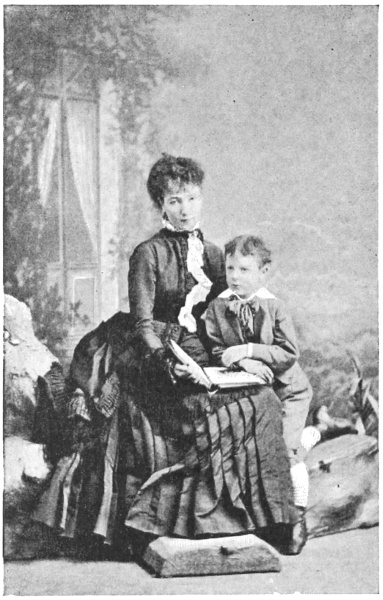
Mme. Sarah Bernhardt and her son Maurice at the age of five.
“I was born in Paris,” Mme. Sarah Bernhardt
told me, “at No. 265 Rue St. Honoré, in the house
also occupied by my old friend, Mme. Guérard, who
is still bright and hearty in spite of her seventy-six
years. She saw me come into the world, and she
was present at the birth of my son Maurice, and of
my grand-daughter.
“My mother, as you know, was a Dutch Jewess.
She was fair, short, and round, with a long body
and short legs, but she had a pretty face and beautiful
blue eyes. She spoke French badly, and with
a strong foreign accent. She had fourteen children,
among them being two pairs of twins. I was the
eleventh child. I was put out to nurse with a concierge,
and the arrangement worked well enough as
long as I was quite small; but I began to find my
confinement wearisome, and one day, when I was
at the window of the concierge’s room—you know
those little arched windows that are still to be seen
in the entresols of old houses—I saw my mother
coming in through the porte-cochère, and I fell out
of the window in my haste to reach her! She
realized the situation, and I was taken home, where
I remained several years with my mother and
sisters. My education had to be thought of, and
as my father insisted on my being baptized, I was
sent to the Augustinian convent at Grandchamp,
Versailles. Thus, at the age of twelve I became a
Christian, was baptized, received my first communion
on the following day, and was confirmed on
the day after with three of my sisters. I became
very pious. I was seized with an extraordinary,
passionate adoration for the Virgin. For a long
time I cherished a tiny gold image of her which
some one had given me. One day it was stolen, to
my great grief.
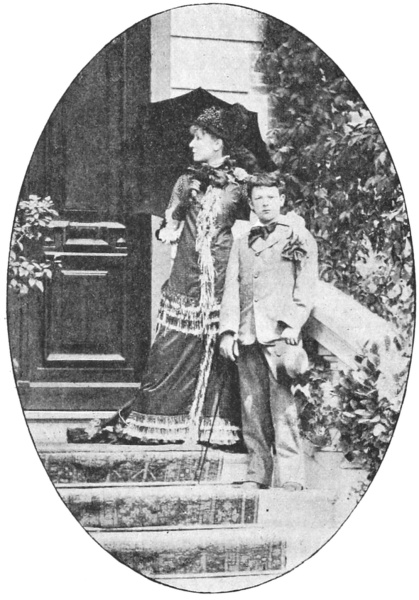
Mme. Sarah Bernhardt and her son Maurice at the age of eleven.
“I was both reserved and fractious. My mother
had little love for me; she preferred my sisters. I
was seldom taken out. Sometimes I was left at the
convent during the holidays. I used to feel sad at
being thus neglected, but the feeling of depression
soon wore off, and the spirit of fun in my nature got
the upper hand. One day, when we heard that all
the schools in France, except ours, had been given
bonbons on the occasion of the baptism of the
Prince Imperial, I proposed to several other girls
that we should run away, and I undertook to manage
it. Being on good terms with the sister in charge
of the gate, I went into her lodge and pretended to
have a hole in my dress under the armpit. To let
her examine the hole I raised my arm towards the
cord communicating with the gate, and whilst she
was looking at my dress I pulled the cord, my
accomplices rushed out, and I followed them. Our
entire stock of provisions, ammunition, and sinews
of war consisted of a few clothes, three pieces of
soap in a bag, and the sum of seven francs fifty
centimes in money. This was to take us to the
other end of the world! A search had to be made
for us, and as the good sisters could hardly undertake
it, the police were set on our track. There
was not much difficulty in finding us, as you may
imagine. We were questioned, and Amelia Pluche—I
shall never forget the traitress’s name—denounced
me as the ringleader. I was sent home
in disgrace, but, nevertheless, returned to the
convent.
“On another occasion, I remember, I had climbed
on to the wall separating the convent from the
cemetery. A grand funeral was in progress, and
the Bishop of Versailles was delivering an address
to quite a crowd. I immediately began to gesticulate,
shout, and sing at the top of my voice so as
to interrupt the ceremony. You can imagine the
scene—a child of twelve sitting astride a wall, and
a bishop interrupted in the midst of a funeral oration!
The scandal was great, and I was again
expelled. My mother did not at all approve of
these escapades, and I was severely scolded, but,
owing no doubt to influence, I was received in the
convent once more. Some time afterwards, having
been sentenced to three days’ solitary confinement
for some offence, I climbed up to the top of a
chestnut-tree in the garden. They sought for me
in vain, and then set the watch-dog to find me.
He promptly sat down at the foot of the tree and
barked. My retreat was thus discovered, but there
was no way of getting me down. The only man
in the convent was an old gardener, who would not
trust himself at such a height, and the ladders were
too short. To all the sisters’ commands and threats
I merely replied: ‘I will die here! I want to die
here!’ Finally they had to promise on oath that
I should be let off my three days’ confinement, and
I came down with the agility of a monkey. I was
very good at gymnastics. My mother, knowing me
to be delicate, urged me to take all sorts of exercise.
I remember that the only prizes I ever got
at the convent were for history, composition, and
gymnastics.
“On my departure from Grandchamp came the
question, What was I to do? I was religious, in
spite of my wayward and passionate temperament.
The patron saint of the convent, St. Augustin,
whose portrait was displayed in every room, was my
first passion, which he shared with the Virgin. I
was strongly inclined to become a nun, but my ideas
in this direction underwent a change soon after my
departure from the convent. My mother provided
me with a finishing governess, Mlle. de Brabander—a
very superior woman, who had educated the
Grand Duchess Marie of Russia. Mlle. de Brabander
adored me. My mother had considerable
difficulty in deciding what to do with me. In spite
of my youth I was asked in marriage by a neighbouring
glover, then by a tanner, and finally by a
chemist, from whom I used to buy medicines. I
refused them all! One of my mother’s friends was
the Duc de Morny, and he suggested that I should
try the stage as a profession. My mother thought
I was not sufficiently pretty; I was too thin, she
considered. Nevertheless, she decided to adopt the
duke’s suggestion. The story of my admission to
the Conservatoire has often been told. I came with
a letter of recommendation from the Duc de Morny,
and I had scarcely recited two verses of La Fontaine’s
fable of The Two Pigeons, when Auber
signed to me to stop and come to him.
“‘Is your name Sarah?’ he asked.
“‘Yes, sir.’
“‘Are you a Jewess?’
“‘By birth, sir, but I have been baptized.’
“‘She has been baptized,’ said Auber to the jury,
‘and it would have been a pity for such a pretty
child not to be.’ Turning to me, he added, ‘You
said your fable very well and you have passed.’
“Consequently I entered the Conservatoire. The
next question was, in which class was I to study?
Beauvallet said, ‘She will be a tragedienne.’ Regnier
maintained, ‘She will be a comedienne,’ and Provost
put them in agreement by declaring ‘She will be
both.’ I joined Provost’s class.
“I began my studies without the slightest enthusiasm.
I set to work because I had been brought
to the Conservatoire for that purpose, but I had
neither taste nor inclination for the profession I was
to enter. I went to the theatre for the first time
in my life two or three days before the entrance
examination. I was taken to the Théâtre Français
to see Amphitryon. It made me cry! The stage
had really no attraction for me. I often felt very
unhappy at the prospect, and wept bitterly. Moreover
I was horribly timid. When I discussed my
real inclinations with my dear governess, Mlle. de
Brabander, I felt more disposed to study painting
than anything else, but I had to give way. Mlle.
de Brabander used to take me to the Conservatoire
every day. My mother gave me the omnibus fare
for both of us. I pocketed it and we walked,
because we both hated coming into contact with all
sorts of people in the omnibus. When we had
enough money, that is to say, every alternate day,
we took a cab, so that we could make sure of being
alone. I have always had a horror of being obliged
to rub shoulders with people I don’t know. If I
can help it, I never stay in a waiting-room or any
public place where I am obliged to inhale other
people’s breath. In this respect I have always
been ferociously unsociable.
“At the commencement of my studies at the
Conservatoire, I had considerable difficulties to
overcome. I inherited from my mother a serious
defect in pronunciation—speaking with clenched
teeth. In all the imitations of my style this point
is seized upon. In my early days the defect was
ten times more pronounced than it is now, and it
clung to me all the time, whereas now it is only
noticeable when I am nervous, generally in the first
act. To cure me of the habit, the Conservatoire
teachers gave me little rubber balls, which prevented
me from closing my mouth. My fellow-pupils
included Croizette, Lloyd, Rousseil, Dica-Petit,
Léontine Massin, and Mme. Provost-Poncin.
Among the men was Coquelin, who was always
very nice to me.
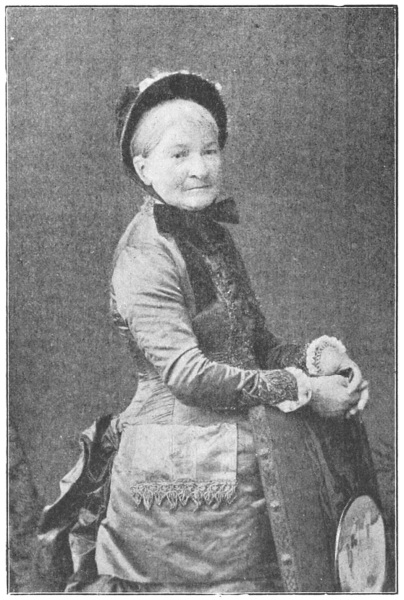
Mme. Guérard.
“At my first competitive examination I took the
second prize for tragedy, and Rousseil the first. In
my last year I took the second prize for comedy, and
Lloyd the first. I could never manage to get a
first. After taking my second prize for tragedy, I
stayed a year at the Conservatoire, in receipt of a
salary of £75, paid by the Comédie Française,
which had views concerning me. Finally it was
arranged that I should make my début at the
Comédie in Iphigénie, with Mme. Devoyod as
Clytemnestre. I knew no one in the company
except Coquelin, who had just entered it, and was
as good to me as he had been at the Conservatoire.
I do not remember experiencing any strong emotions
except a real fear; but I do remember that when I
lifted my long, thin arms—and they were thin!—for
the sacrifice, the whole audience laughed. After
that I played in Scribe’s Valérie, with Coquelin as
Ambroise. Theatrical life was still uninteresting to
me. I never went inside a theatre except to act.
Even now, paradoxical as it may seem, I know
scarcely any plays, and scarcely any artistes except
such as I have encountered at the various theatres
in which I have played.
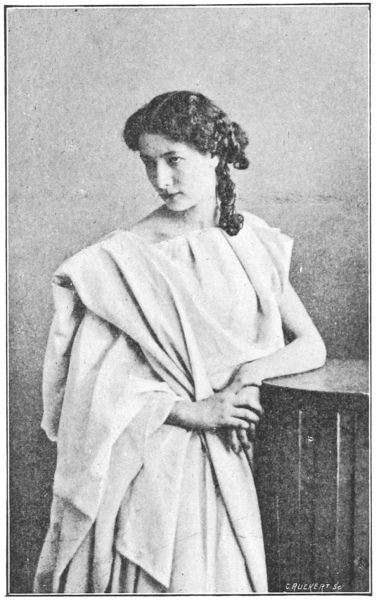
As Junie in Britannicus.
“I was far from resting at the Théâtre Français.
Less than a year after my début, my sister Regina
one evening accidentally trod on Mme. Nathalie’s
train. Mme. Nathalie, who was one of the leading
ladies, pushed the poor girl so roughly that she
knocked her head against a corner and the blood
came. I immediately ‘went for’ Mme. Nathalie,
gave her a resounding smack, and called her a great
stupid! The men were delighted, but the affair
created a terrible scandal. The manager told me
I must apologize to Mme. Nathalie. I replied—
“‘I will apologize to Mme. Nathalie if she will
do the same to my little sister.’
“No arrangement could be made, and I left the
House of Molière for the first time.
“Owing to this very pronounced feature in my
character, no manager would have anything to do
with me. A fairy extravaganza, the Biche au Bois,
was being played at the Porte St. Martin, then
managed by Marc Fournier, and I learnt that Mlle.
Debay, a former Odéon star, who was playing the
Princesse Désirée, had been taken ill. As the part
was in verse, I said to myself, ‘Here’s my chance,’
and went to see Fournier, who engaged me on the
spot. As I was very young, I was asked who
I was, and I replied that I was an orphan. I
rehearsed twice, and the date of my début was
fixed. I sang a duet with Ugalde, who was kind
enough to take the trouble of teaching me how to
sing it. On the very first night it happened that
my guardian was amongst the audience. He immediately
recognized me and came to see me,
horrified, after the first act. I implored him to say
nothing to my mother, but he rushed off and
brought her to the theatre. At first she would not
let me finish, but finally she yielded to reason, and
I played my part to the end, but that was my first
and last appearance in extravaganza.
“After the Porte St. Martin came the Gymnase.
In May 1863 I was engaged by Montigny to
replace Victoria, Lafontaine’s wife. The piece was
a vaudeville in rhymes, and I remember having
to sing—
“It was too absurd!
“I was very useful to Montigny. I had a marvellous
memory, and shrank from no part, however
difficult. I never really loved the stage, but
as it was my profession I did not mean to let the
grass grow under my feet. I was determined to
get to the front. One after another I played in
Le Père de la Débutante, Le Démon du Jeu by
Theodore Barrière, La Maison sans Enfants by
Dumanoir, L’Etourneau by Bayard and Laya, Le
Premier Pas by Labiche and Delacour, and Un
Mari qui lance sa Femme by Raymond Deslandes.
In this last piece (April 28, 1864) I was a Russian
princess, with nothing to do but eat and dance all
the time. This idiotic part disgusted me to such
an extent that I vowed not to play it a second
time. The day after the first performance I went
off to Spain! In the morning I locked my mother
in her room so that she could not interfere with
me, and off I set with my accomplice, a maid who
had been discharged by my mother. We went to
Marseilles and got on board a steamer. The only
other passenger was a rich wine-merchant from the
south of France. You see how practical we were!
My great object was to go to Madrid—I was mad
to see Spain and its museums—and after encountering
a fearful storm we landed at Alicante. I was
dreadfully sick, but fortunately I had brought my
little golden Virgin, and she gave me hope and
consolation.
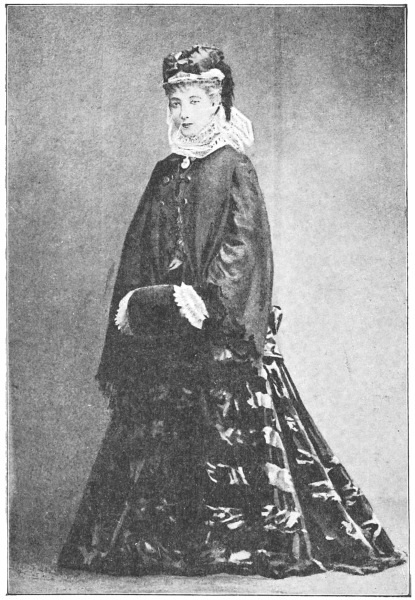
Mme. Sarah Bernhardt when a girl.
“My mother had set the police on my track, but
in vain. At last, however, we were starved out.
At the end of two months I had seen all I wanted
to see in Spain, and as all my money was gone I
was obliged to write to my mother for supplies.
She made me wait some little time, but finally sent
them, and I returned to Paris.
“One day I encountered Camille Doucet, who,
as I told you before, was a friend of our
family.
“‘Well, are you as naughty as ever?’ he asked.
‘Have you been slapping any more of your confrères
lately?’
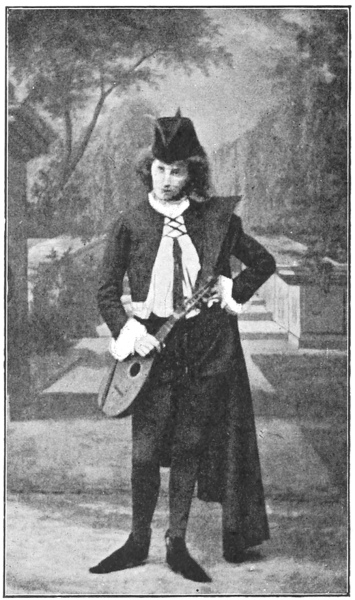
As Zanetto in Le Passant.
“I explained that I had had no opportunity,
and he advised me to apply to the Odéon, then
managed by Chilly and Duquesnel. Chilly was not
much inclined to engage me, but Duquesnel seemed
anxious to do so. Finally he had his way, and it
was decided that I should appear as Junie in
Britannicus (January 14, 1867). Taillade, who
played Nero, insisted at rehearsal that I should kiss
the hem of his garment. I imagine he must have
set about obtaining this act of superfluous civility
from me rather badly; at any rate, I gave him a
sound box on the ear. Camille Doucet must have
thought there was no doubt about my vocation.
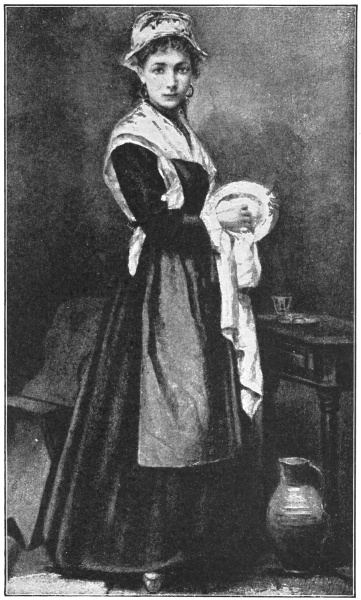
Mme. Sarah Bernhardt in François le Champi.
(From a water-colour by Baudoin.)
“My second appearance was in Le Jeu de
l’Amour et du Hasard. It was a hideous ‘frost’! I
remember wearing a dress with white, blue, and red
stripes to give me a Louis XV. appearance! Moreover
I was as thin as a lath and absolutely unsuited
to the part of Sylvia. Her airs and graces were
never meant for me.
“My first success at the Odéon was as Zacharie
in Athalie. I recited the chorus of women, and this
was the first occasion on which I really impressed
the public. My reception was, I venture to say,
really a triumph. In Le Marquis de Villemer I
next played a wretched part—a thirty-five-year-old
baroness. I wept all the time. George Sand, who
had noticed me, consoled me and promised that
I should appear in L’Autre, which she had just
finished; and she kept her word. Next came
Le Passant. Chilly had been induced with great
difficulty to have this piece played as a benefit
performance. He had no faith in it, and thought
it tiresome and without a future. He had so little
confidence in its success that he absolutely refused
to pay for the costumes, and Agar and I were
obliged to order our own and settle the bills
out of our own pockets. You know how popular
Coppée’s little piece became. Agar and I
played it twice before the Court, with immense
success!1
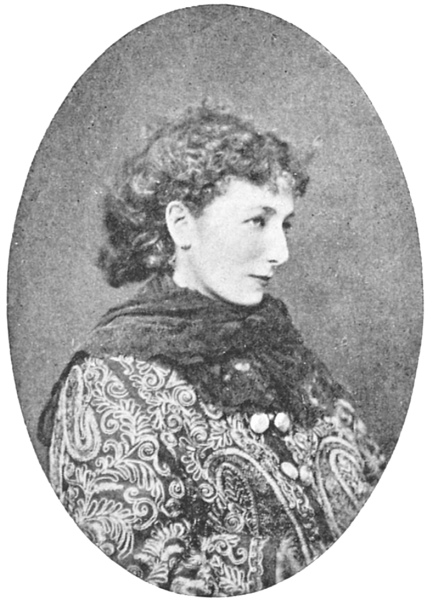
In Le Drame de la Rue de la Paix.
“Kean was being prepared at the Odéon. Chilly
wanted the part of Anne Damby to be given to
Jane Essler, and Dumas had already promised it to
Antonine. Duquesnel advised me to go and see
Dumas, and not to leave the house without a
written authority to at least rehearse the part. I
well remember going to see Dumas. The door was
opened by his daughter, and I found Dumas in his
shirt-sleeves, with a woman leaning on his shoulder—Oceana
I believe she was. I timidly explained
the object of my visit. He listened, looked at me,
and said—
“‘You would do very nicely, but I have promised
the part to Jane Essler.’
“I persisted in my request, and he confessed that
he had also undertaken to give the rôle to Antonine.
“Then, I said, ‘As you have promised it to two
you may just as well promise it to three.’
“Fortunately I had learnt the part, and I began
to recite it to him, inwardly repeating Duquesnel’s
words: ‘Don’t leave him before you get a letter.’
Then I urged him again to let me rehearse the
part, if only for a week.
“Finally Dumas had enough of it, and gave me
a letter for Chilly, to this effect: ‘Jane Essler is
to play Anne Damby, but you can let the bearer
rehearse for a few days.’
“When the others saw me rehearsing for the
part, there was a sensation. The end of it was
that I kept the part and played it with very, very
great success. A well-known incident happened at
the première. Dumas came into his box accompanied
by Oceana, and for three-quarters of an
hour the students shouted ‘A la porte!’ to such
purpose that Dumas was obliged to take the woman
out, put her in a cab, and return to his box, wildly
cheered by the students. Their hostility was
solely against the woman who had forced this
great man to make such a scandalous exhibition
of himself.
“Next came Le Bâtard by Alphonse Touroude,
and L’Autre by George Sand (September 1869),
neither of which has any interesting souvenirs
connected with it.”
The war broke out, and ambulances were soon
being established everywhere. Mlle. Sarah Bernhardt
decided to fit one up at the Odéon at her
own expense, and on September 30 she set to
work. Twenty-two beds were erected, long white
curtains were hung at the windows and portières
over the doors, linen was neatly piled in cupboards,
the dispensary was provided with bottles and drugs,
and the cellars were filled with wood and coal. All
the arrangements having been planned beforehand
and carried out without delay, everything was completed
in forty-eight hours, and there was nothing
more to do but wait for the patients. They came
soon enough! Day and night Mlle. Sarah Bernhardt
and her aides-de-camp were kept at work.
One of her first patients was M. Porel (now the
manager of the Vaudeville theatre, and the husband
of Mme. Réjane), who was slightly wounded by a
fragment of shell. Mlle. Sarah Bernhardt busied
herself not only with the infirmary but with the
office. The ambulance being a military one, and
having to supply daily reports to the central
establishment at the Val-de-Grâce hospital, Mlle.
Bernhardt carefully noted all particulars of the
patients admitted and discharged, and kept all her
accounts with remarkable exactitude.
The war and the Commune over, the theatres
re-opened their doors, and M. André Theuriet
entrusted Mlle. Bernhardt with the principal rôle in
Jean Marie, which had just been accepted at the
Odéon. Her success was striking, and she has kept
this little piece in her répertoire, reviving it time after
time in her tours, just as she has done with Phèdre.
Nothing is more curious and instructive than to
note the opinions of the theatrical critics on Sarah
Bernhardt from this period onward. Sometimes she
was lauded to the skies; at other times attempts
were made to crush her by severe and often unjust
condemnation. To begin with, let us take this
expression of opinion given by the late M.
Francisque Sarcey on October 14, 1871—
If I experienced great pleasure in seeing Jean Marie, it was
because the principal part was taken by Mlle. Sarah Bernhardt.
No one could be more innocently poetic than this young lady.
She will become a great comedienne, and she is already an admirable
artiste. Everything she does has a special savour of its own.
It is impossible to say whether she is pretty. She is thin, and her
expression is sad, but she has queenly grace, charm, and the inexpressible
je ne sais quoi. She is an artiste by nature, and an
incomparable one. There is no one like her at the Comédie
Française.
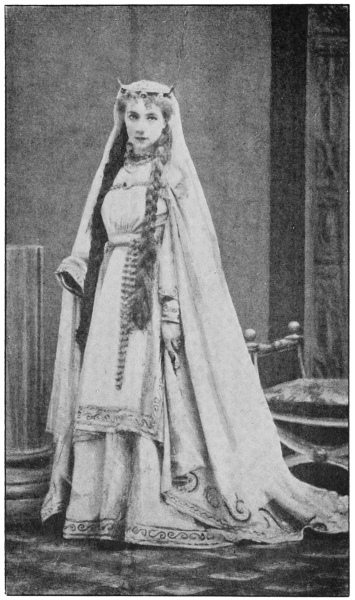
As Cordelia in King Lear.
Ten days afterwards came the first performance
of Fais ce que dois, a one-act piece in verse, by
M. François Coppée. The same critic dismissed
the matter by saying—“The two sisters Bernhardt,
Sarah and Jeanne, have two such insignificant parts
that they can make nothing out of them.” On
November 4, M. Sarcey wrote, in reference to the
impending departure of Mlle. Favart from the
Comédie Française—“Her place should most certainly
be taken by Mlle. Sarah Bernhardt. Any
other choice would be a monstrous injustice.” In
spite of this impassioned declaration, the Odéon
kept its prey. In the same month she appeared
in La Baronne, by MM. Charles Edmond and
Edouard Foussier. By this time it was generally
recognized that the antique peplum suited her
better than modern dress. Two months afterwards
(January 1872) the indefatigable young actress
created the part of Mlle. Aïssé in Louis Bouilhet’s
four-act play of that name. The critic Paul de
Saint-Victor treated her with considerable severity.
Mlle. Sarah Bernhardt, he wrote, played Aïssé very indifferently.
She was weak and despondent, with no energy and no voice. In
passages requiring the utmost fire and passion she did not rise
above a monotonous sing-song. She cannot be said to have killed
the piece, for it had no life in it, but another actress could perhaps
have given it a more tragical and impressive ending. Mlle.
Bernhardt makes it die of languor and inanition.
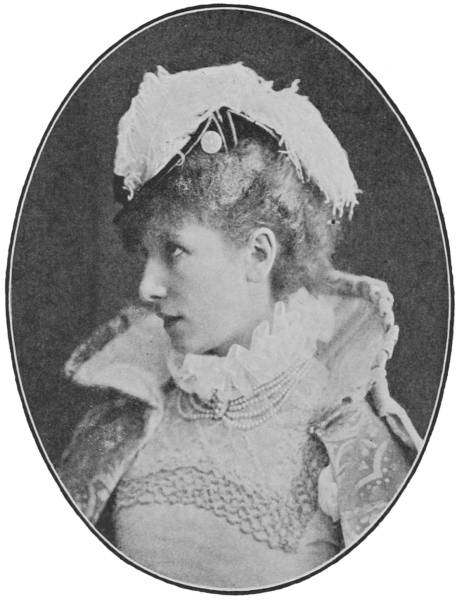
As Doña Sol in Hernani.
Mlle. Bernhardt now arrived at one of the turning-points
in her life. Victor Hugo, who had
returned to France on the downfall of the Empire,
was superintending the revival of his dramas, and
MM. Chilly and Duquesnel decided to bring out
Ruy Blas. One evening there was a big dinner at
Victor Hugo’s, and the guests set themselves to
work to arrange the cast. Every rôle was satisfactorily
allotted except that of the Queen, on which
there was some difference of opinion. M. Paul
Meurice strongly supported Mlle. Jane Essler.
Victor Hugo, observing that Busnach had taken no
part in the discussion, asked him his opinion.
“Ma foi,” exclaimed the dramatist, “I think
Mlle. Sarah Bernhardt is the only possible choice,
and I strongly advise you to have her.”
Busnach argued his case with so much warmth
that on the following day Victor Hugo asked the
artiste to go over the part with him, and accepted
her on the spot. Sarah’s success was unmistakable.
Auguste Vitu wrote of her in the Figaro (February
19, 1872)—
Mlle. Sarah Bernhardt displayed feeling, grace, and even
passion in the comparatively small part of Doña Maria. If, at
the beginning of the second act, she could succeed in getting rid
of the dismal, psalm-like intonation which she erroneously regards
as the proper way to express melancholy, she would perfect a
remarkable creation, which does her honour.
M. Sarcey was warmer in his praise—
No rôle was ever better adapted to Mlle. Sarah Bernhardt’s
talents than that of this melancholy queen. She possesses the
gift of resigned and patient dignity. Her diction is so wonderfully
clear and distinct that not a syllable is missed. At the same
time it is hardly powerful enough for the passionate outbursts in
the last act, but there is a great deal of warmth and feeling in the
impassioned passages at the close.
Immediately after this success the newspapers
began to urge M. Perrin, the manager of the
Théâtre Français, to engage the brilliant star which
had just made its appearance in the theatrical firmament.
Sarah was, however, bound by her engagement
at the Odéon, and the management would not
hear of releasing her. Offers were made to her,
and she decided to take legal proceedings to have
the contract set aside. The decision was against
her, and she was obliged to pay the Odéon the not
excessive indemnity of £200. In this way she
returned to the scene of her début. The event
excited a great deal of comment in the theatrical
world, and especially, as may be imagined, in the
House of Molière. But the success of Ruy Blas
and Le Passant silenced the envious tongues, and
her comrades soon found that they would have to
reckon with the new pensionnaire. She set to work
with astonishing ardour, and made her appearance
on November 5, 1872, in Mademoiselle de Belle-Isle.
There could be no doubt of her possessing
the fire of genius, or of her ability to charm and
touch her audience. There was still a certain want
of power, but she was full of happy inspirations.
Paul de Saint-Victor, however, persisted in opposing
her. He wrote—
Mlle. Bernhardt made a very indifferent début as Gabrielle.
The artificial reputation she made at the Odéon and brought with
her to the Comédie Française does not stand examination. There
is a deadly monotony about her diction. Everything is on the
same level. The only tone in her voice is the low and plaintive
one. When the action of the play quickens and the passions
of the various characters begin to assert themselves, she dwindles
away to nothing, and loses all the fire, force, and colour that the
part ought to have. What good work can Mlle. Sarah Bernhardt
do at the Théâtre Français? The idea of giving her a leading
part in a modern drama is out of the question. The most she
can do is to act as a feeble substitute for Mlle. Favart. The
weakness of her voice and the insufficiency of her talents exclude
her from leading tragedy parts, and I do not see that she can
take her place anywhere except in the background. She might
sigh through the tirades of Atalide in Bajazet or of Aricie in
Phèdre melodiously enough, but that is really the extent of her
powers, and it is not enough to justify the importance attached to
a very unpromising début.
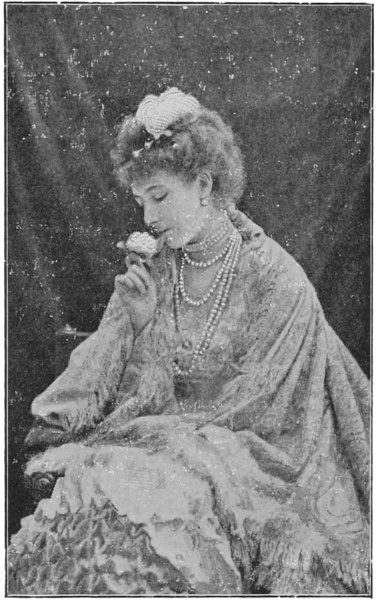
As Léonora in Dalila.
The reader will readily understand that these
unjust criticisms by a celebrated writer are given
here merely as evidence of the vanity of theatrical
criticism.
In January and February 1873, Mlle. Sarah
Bernhardt appeared successively as Junie in
Britannicus, as Mademoiselle de Belle-Isle, and as
Cherubin in Le Mariage de Figaro. With the
exception of M. Sarcey the newspaper critics paid
little attention to her. He thought her one of the
best Cherubins he had ever seen: the incarnation of
the adventurous youngster, the little scamp who is
sure to be never without a sweetheart. She had
all the self-consciousness of the big school-boy, with
the audacity and impetuousness of a young bantam.
She conveyed an impression of desire without
love.
Next month her struggles began again with the
production of Dalila by Edmond About. Her
friends seemed inclined to abandon her. M. Sarcey
was far from encouraging—
I fear, he said, that the management has made a mistake in
already giving Mlle. Sarah Bernhardt leading parts. I do not
know whether she will ever be able to fill them, but she certainly
cannot do so at present. She is wanting in power and breadth of
conception. She impersonates soft and gentle characters admirably,
but her failings become manifest when the whole burden of
the piece rests on her frail shoulders.
Apparently forgetting that, only a year before,
he had declared Mlle. Sarah Bernhardt the only
possible successor to Mlle. Favart, M. Sarcey
added—
After her two celebrated predecessors, Mlles. Fargueil and
Favart, Mlle. Sarah Bernhardt has excited little more than a
benevolent curiosity. She can do nothing really badly, for she
is an artiste to the tips of her fingers, but her voice has no sarcasm
or irony, and is simply hard and distinct. Moreover, her whole
personality is stiff. There is no clinging softness about her. She
is more harsh than cold, and more cold than catlike.
Auguste Vitu indulged in a little fun over her
thinness, and described her as “a needle made to
look as neat as a new pin.” “There is nothing of
the sorceress about her,” he added, “except the
magic wand—herself.”
Paul de Saint-Victor was unmerciful—
It was a singularly unfortunate idea, he wrote, to let Mlle.
Sarah Bernhardt appear in this important part of Léonora, still
alive with the fire breathed into it by Mlle. Fargueil. All the
most essential elements in the character—conquering charm,
sovereign pride, haughty and cutting wit, light and stinging
insolence, pretended pathos and false love—are wanting in her
nature. She displays nothing but a subdued plaintiveness, and
when she tries to intensify her tone she merely strikes a jarring
note. She seeks to be imperious, and is merely violent; her
disdain is without hauteur and her allurements are vulgar. It
is a singular delusion to suppose that she will be able to fill and
sustain a great rôle. All the efforts that are made and will
be made to push her to the front will only display her
inadequacy.
Some envious rivals inspired newspaper attacks
on her on the ground of her nationality. She was
represented as a German Jewess. “Certainly,” she
replied, “I am a Jewess, but not a German,” and
she wrote as follows to M. Jouvin—
I should be really very much obliged if you would include in
your next feuilleton a few words to correct the mistake you made
in your article on the revival of Dalila at the Comédie Française.
Since that day I have received a perfect avalanche of insulting and
threatening letters. Nothing less than this could have induced
me to write to you. I am French, absolutely French. I proved
it during the siege of Paris, and the Society for the Encouragement
of Well-doing awarded me a medal. Would it have done so
if I had been a German? All my family come from Holland.
Amsterdam was the birthplace of my humble ancestors. If I
have a foreign accent—which I much regret—it is cosmopolitan,
but not Teutonic. I am a daughter of the great Jewish race,
and my somewhat uncultivated language is the outcome of our
enforced wanderings. I hope your sense of justice will lead you
to rectify a mistake which may not only affect my son’s future but
is painful to me as a Frenchwoman. I thank you in advance,
and am, etc.,
Sarah Bernhardt.
On the 4th June, 1873, she created Mrs. Douglas
in L’Absent, by Eugène Manuel, and Marthe in Chez
L’Avocat, a one-act piece by Paul Ferrier. The
parts were insignificant, and brought her no increase
of fame. The Press ignored them, almost entirely.
She took no holiday during the summer of this year.
During August she re-appeared in Andromaque, and
the Temps became kind to her again—
Mlle. Sarah Bernhardt was tender, bewitching, coquettish, and
above all feminine. Her performance was like an air, sad and
passionate by turns, played by a master hand on a violoncello.
A fortnight later, September 17, she was playing
Aricie in Phèdre. The Figaro bestowed a few
commonplace compliments on her. She was accused
of being badly dressed, badly got up, and even
with being unmistakably untidy; but M. Sarcey
brought out his most flattering and ecstatic adjectives
in her honour.
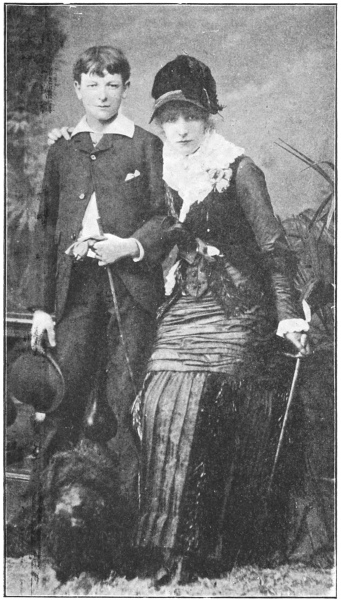
Mme. Sarah Bernhardt and her son Maurice at the age of fifteen.
There can be no doubt about it now. All the opposition
excited by Mlle. Sarah Bernhardt’s success must yield to facts.
She simply delighted the public. The beautiful verses allotted
to Aricie were never better delivered. Her voice is genuine
music. There was a continuous thrill of pleasure among the
entire audience.
In January 1874, Péril en la demeure, by Octave
Feuillet, was revived. She displayed all her tender
poetical grace in the character of the woman on the
brink of surrender to temptation: one of Musset’s
airy creations straying amongst M. Feuillet’s
bourgeois proverbs. In Le Sphinx, by the same
author, produced on the 23rd March, 1874, she
played the rather subordinate rôle of Berthe de
Savigny. The notices of this performance show
it to have been her first unmistakable success.
Hitherto the Paris first-night audiences had merely
tolerated her, but on this occasion she accomplished
the feat of making a secondary part into an important
one. Nevertheless, as one of her critics remarks,
she in no way trespassed on her sister actresses’
preserves. She played with great discretion, but
her graceful movements and the music of her golden
voice created a deep impression. The struggle,
however, was not yet over. A few connoisseurs
admired her greatly, while others regarded her with
positive aversion. Her engagement by M. Perrin
required something very like audacity, and the
wisdom of the step remained doubtful, the majority of
opinions being still unfavourable to her. She excited
intense envy among her rivals. There was great
dissatisfaction among the other ladies of the company
when it was known that M. Perrin intended to
pay £100 for a costume she had ordered for Le
Sphinx. Her next appearance was in a one-act play
in verse, La Belle Paule, by M. Paul Denayrouse,
and in August she re-appeared in Zaïre. This
proved to be the most complete success she had
attained since her engagement at the Comédie
Française. It was far greater than that of any
other member of the cast, as M. Vitu and M.
Sarcey recognized. Paul de Saint-Victor alone
persisted in depreciating her. According to him
she was monotonous, weak, lackadaisical, and hardly
noticeable!
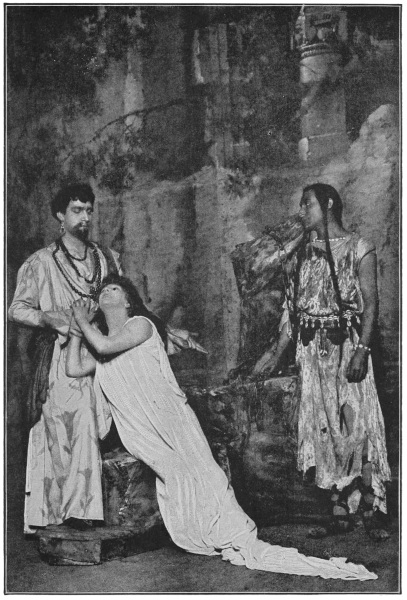
Mme. Sarah Bernhardt as Cleopatra.
On December 22 she played Phèdre for the first
time. The risk was great, the part being one of
the most exhausting in the whole répertoire of the
theatre. During the first act she was intensely and
perceptibly nervous. Her teeth were set, and her
enunciation was hard and abrupt. Her tone was
cold and slightly raucous. But in the second act
she began to gain confidence, and after her
declaration to Hippolyte success began and lasted
to the end. She delivered the final lines with
consummate art, and, in spite of her delicate physique,
she was excellent in the stormy scene with Hippolyte.
In the fourth act she was completely carried
away by her part. At one point she tripped, and,
probably for the first time in her life, mangled a line—she,
the incarnation of poetry! Instead of saying,
“Reconnais sa vengeance aux fureurs de ta
fille,” she exclaimed: “Reconnais sa fureur aux
vengeances de ta fille.” The public, however, paid
no attention to the slip, nor perhaps did the actress
herself. At any rate, she finished in triumph.
M. Sarcey considered her superior to Rachel; and
M. Jouvin, writing in the Presse, declared that
Clairon, who has bequeathed us a summary of her
views on the part, could not have failed to applaud
Mlle. Sarah Bernhardt.
The first performance of La Fille de Roland, by
Henri de Bornier, took place on February 15, 1875,
Mlle. Sarah Bernhardt appearing as Berthe, with
Maubant and Mounet-Sully in other parts. On this
occasion again critical opinion was divided. Paul
de Saint-Victor, in the Moniteur Universel, described
her as merely an agreeable reciter of verses,
without any of the varied and living qualities of the
real tragedienne.
Her delivery is still the same musical jeremiad as before. All
her tirades are given with the same plaintive, sing-song intonation.
When the action quickens the sound rises to a higher key, but the
melody remains unaltered. This constant recitative gives way in
the strong passages to breathless cries, painful to hear. Her outbursts
are those of a breaking voice. They positively wound the
ear.
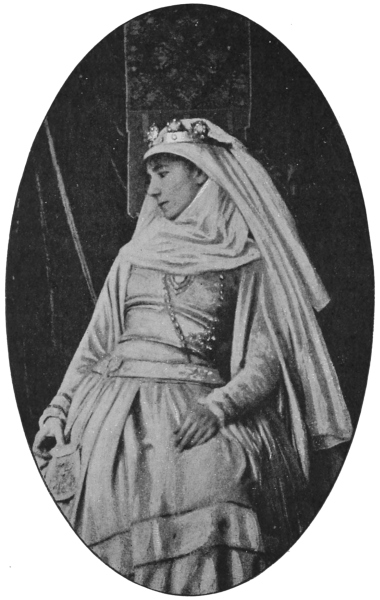
Mme. Sarah Bernhardt in La Fille de Roland.
According to Auguste Vitu, in the Figaro, her
interpretation was fair, and no more. M. Sarcey,
however, observed that it was only justice to admit
that she had made something out of nothing. In
the afternoon preceding the première, she had been
elected a full member, or sociétaire, of the company,
together with her comrade Laroche. Her
antagonists had laid down their arms! In the
evening the astonished critics beheld all the lady
members of the company vigorously applauding the
new sociétaire!
On April 27, 1875 came the revival of Emile
Augier’s Gabrielle, in which Mlle. Sarah Bernhardt
appeared with Coquelin. She was reproached
with making the character allotted to her into an
ideal, poetic, and romantic woman, quite in opposition
to the author’s conception. She re-studied the
part, and in December of the same year she created
quite another Gabrielle. M. Sarcey, who went to
see her, was astonished to observe that she had
effected a complete transformation.
When the Salon opened, Sarah Bernhardt gave
her rivals another unpleasant surprise by exhibiting
busts of Emile de Girardin and Busnach. Her new
departure excited a great sensation. It was impossible
to set a foot behind the scenes of any Paris
theatre without being assailed by such questions as—
“Have you seen the busts? What do you think
of them? Are they really very good?”
Portraits of Mlle. Bernhardt were exhibited at
the Salon by Clairin and Louise Abbéma. The
latter painted her sitter in a black cashmere bodice
with an iron-grey skirt, black guipure chemisette,
black hat and black feathers—the costume worn by
her as Mrs. Clarkson in L’Etrangère. M. Clairin’s
Sarah Bernhardt was in a white cashmere peignoir,
trimmed with white feathers, and with lace ruffles at
the sleeves and neck; black satin slippers, sky-blue
stockings, and a large feather screen: the actress
lying on a cerise velvet divan, with a many-coloured
cushion under her head.
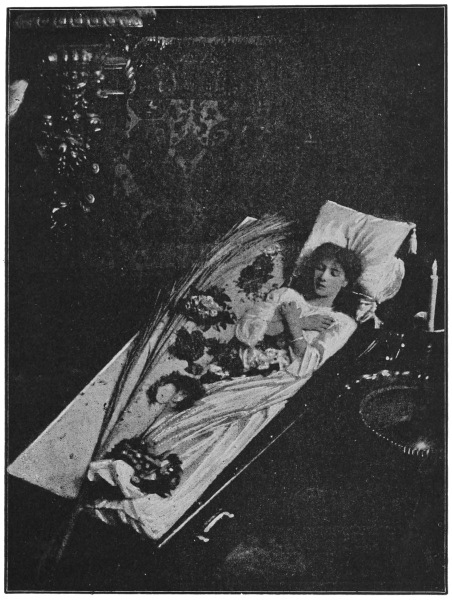
Mme. Sarah Bernhardt in her coffin.
Sarah Bernhardt was now a full-blown Parisian
celebrity, and her fame was destined to go on increasing.
Curiosity began to be felt concerning
even the most insignificant details of her daily
life. This public curiosity stimulated her, as an
independent and original person, to brave the gossip
of the city and its bourgeois hypocrisy. All sorts
of more or less true tales of her eccentricities were
told about this time. She was constantly haunted
by ideas of death, her frail organization being, no
doubt, still incomplete. From time to time she
fainted on the stage, and her unruly imagination
promptly led her to expect the most direful consequences,
but her extraordinary elasticity of temperament
soon supplied her with renewed strength and
vitality, and the complete prostration of to-day was
always followed on the morrow by the most sanguine
anticipations. One day she caused herself to be
measured for a coffin, and had it brought to her
house. This coffin, which she courageously keeps
at the foot of the bed, is made of pear-wood.
The only ornament consists of the artiste’s initials
S. B., with the motto Quand-même! The inside is
lined with white satin, and is provided with a mattress,
bolster, and cushions—a bed fit for the most
charming of coquettes. But for the spectacle of
the lid, always ready to be screwed down, any one
would readily lie on this pleasant, perfumed couch.
Unfortunately, the lid is a stern reality. There is
something else to note. Inspired by a strange but
poetical fancy, Mme. Sarah Bernhardt has lined
the bottom of the coffin with her most cherished
souvenirs. Love-letters and faded bouquets are
there, huddled together pell-mell, awaiting her
coming—waiting to remind her, in the silence of
the tomb, of the sad or happy hours in which she
knew them.
The première of L’Etrangère (May 25, 1876) was
exclusively a personal success for her. The newspapers
spoke severely of M. Dumas’ work—
If Mlle. Sarah Bernhardt, said M. Sarcey, had not thrown the
glamour of her gestures and diction over the silly sentimentality
of Mrs. Clarkson, the public would have burst out laughing. The
piece is simply bad melodrama of the Ambigu type.
Her health was still far from robust, and during a
performance of L’Etrangère (May 25, 1876) a painful
incident occurred. Before the curtain rose M.
Got had asked the indulgence of the public for
Mlle. Sarah Bernhardt, who was indisposed. The
request was far from unnecessary, for as soon as
the young artiste appeared on the stage it was evident
that she was in great pain. The performance followed
its course, but in the middle of her long tirade
in the third act, Mlle. Sarah Bernhardt suddenly
turned pale, threw up her arms, and fell to the floor.
Indescribable excitement arose amongst the audience.
The curtain was promptly lowered, and the
most alarming rumours were in circulation, when
M. Got came forward and made a reassuring speech,
adding, however, that Mlle. Sarah Bernhardt was
far too ill to permit of her reappearing. Mlle.
Lloyd, who had been immediately informed, took
the vacant place, and the performance proceeded, but
the anxiety among actors and public was so great
that when the curtain fell general depression prevailed.
Inquiries were made at midnight, and it
was ascertained that the patient was a little better,
but that absolute rest was necessary, and that the
doctor had forbidden her even to speak.
Her illness led to a rumour that she was about to
retire into a convent. Paragraphs, of which the
following is a specimen, began to appear in the
newspapers—
It is said that an artiste of the Comédie Française was recently
driven by private sorrows to take refuge in the sweets of monastic
solitude. It appears, however, that after two days’ retirement the
comedienne in question came to the conclusion that she was not
yet ripe for the cloister. She bade farewell to the bare walls of
the convent and returned to the theatre, much to the disgust of
her fellow-actresses, who realized only too well that she was
steadily growing not only into a star but into a planet. You
see, M. Sarcey, people can’t do without you!!! (Figaro, July 9,
1876).
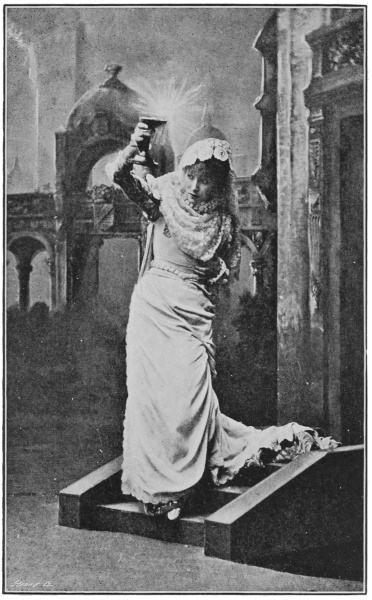
As Doña Sol in Hernani.
None the less Mlle. Sarah Bernhardt continued
to work. On September 27, Rome Vaincue, by M.
Parodi, was brought out, and this time she obtained
a brilliant and unmistakable success. Not a single
discordant note was heard in the chorus of praise.
M. Auguste Vitu wrote—
Draped like an antique statue, her head crowned with long
white curls under her matron’s veil, Mlle. Sarah Bernhardt made
Posthumia one of her finest creations. No other living actress
could have rendered this character with so much nobility, grandeur,
and true feeling. The genuine tears shed by her audience must
have shown her how deeply she had touched their hearts and
minds.
M. Sarcey was quite poetical—
When Parodi came to chat with me about the rehearsals then
going on, he said—“I never imagined how much there was in the
part until I heard Mlle. Sarah Bernhardt play it. She puts into
it all the life it has. I cannot recognize my own verses when they
fall from her lips.” I have indeed rarely seen anything so perfectly
fine, especially as regards the last act. She was no longer a
comedienne, but human nature itself, interpreted by a marvellous
intelligence, a soul full of fire, and the most harmonious and
melodious voice that ever delighted human ears. She acts with
her whole heart and soul. She is a marvellous, incomparable
artiste, one of the élite, or, in a word, a genius.
She appeared in Hernani on November 21, 1877,
with considerable success. She was now unmistakably
the spoilt child of the public. She had
vanquished almost all her adversaries, and practically
every theatre-goer was an admirer of her talent.
She realized this and profited by it. Nevertheless
she had her moments of humility and self-effacement.
She wrote as follows to her manager on New Year’s
Day, 1878—
My dear Monsieur Perrin, I have begun the year badly. I
caught cold this morning when coming back from the cemetery,
and I am far from well. I should have liked to tell you this
evening of all the grateful affection I feel for you. If you could
only understand how entirely I am yours! But all that is difficult
for me to express. I owe everything to you. The good points I
have, you brought out. I tried to become a little somebody,
and you determined that it should be so. Blessings on that determination
of yours, and my loving greetings to you! My illness
depresses me, and I have little hope of completing the year
just begun. Monsieur Perrin, I love you very much.
Sarah Bernhardt.
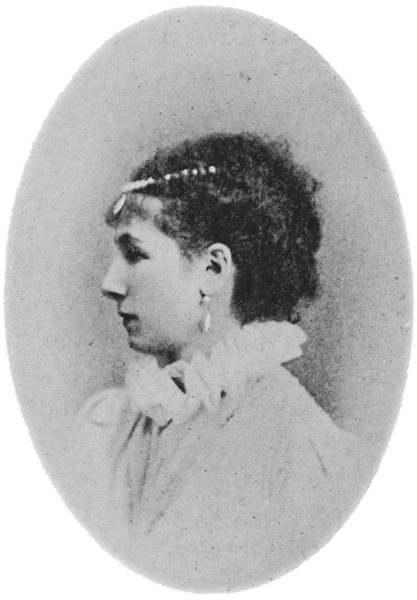
As Doña Sol in Hernani.
Her celebrity was unmistakably shown by the
wild stories which began to be told about her. She
was said to have thrown a live kitten on to a fire; to
have poisoned with her own fair hands two monkeys
which had ceased to please her; to have cut off a
dog’s head with a view to solving the question
whether life continues after decapitation; the skeleton
in her bedroom was all that remained of one of
her victims, etc. As a matter of fact, she was then
keeping two Russian greyhounds, a poodle, a bulldog,
a terrier, a leveret, a parrot, three cats, and
several birds. Afterwards she kept lions! Could a
woman who was so fond of animals torture them as
she was said to have done?
At Bressant’s benefit performance, February 27,
1878, she played two acts from Jean Aicard’s
Othello with M. Mounet-Sully, who failed completely.
M. Sarcey says—
As for Mlle. Sarah Bernhardt, she simply rescued the piece.
Her attitude in the death-agony, her head and arms hanging
over the side of the bed, was so fine, graceful, and tragic, that
enthusiastic applause came from every part of the house.
M. Auguste Vitu summed up his opinion as
follows—
Mlle. Sarah Bernhardt was very fine as Desdemona. It is one
of her best creations. I say nothing of M. Mounet-Sully, whose
efforts were not a success.
On April 2 she appeared for the first time as
Alcmène in Amphitryon. No notice was taken of
this in the newspapers. She again played in Zaïre
(May 30), and Le Sphinx (October 28), with continued
success. In the meantime she made several
ascents in Giffard’s captive balloon at the Exhibition,
to the great scandal of the Boulevards. An
article published by Albert Millaud in the Figaro
gives a very good idea of the spirit of gossip then
prevailing. Sarah Bernhardt replied to his article
in the following letter—
Your kind references to the artiste induce me to write in
defence of the woman. Those who persist in dinning me into
the ears of the public are clever enemies of mine. It is excessively
annoying not to be able to do anything without being
accused of eccentricity. I love balloon ascents, but now I dare
not indulge in them. I have never skinned dogs or burnt cats
alive. My hair is not dyed, and my face has a sufficiently corpse-like
pallor to absolve me from the suspicion of painting. I am
told that my thinness is eccentric, but what am I to do? I should
much prefer to be one of those happy people who are neither too
fat nor too thin. My illnesses are said to attract too much
attention, but they come without warning and strike me down
wherever I may happen to be, and if people are there, so much
the worse. I am reproached with trying to do everything: acting,
sculpture, and painting; but these things amuse me, and bring me
money to spend as best pleases me. Such are my crimes. You
have taken my part, perhaps without intending to do so, but none
the less I thank you heartily. As you applauded the artiste, I
did not like to think that the woman might seem so unpleasant a
contrast; and then it is such a pleasure to complain! Thanks for
your kindness, Monsieur Millaud.
Sarah Bernhardt.
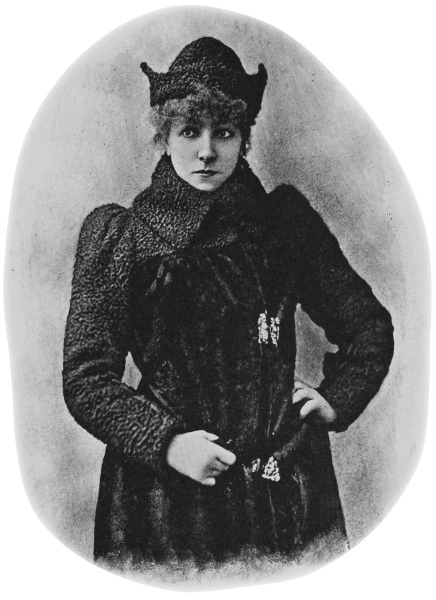
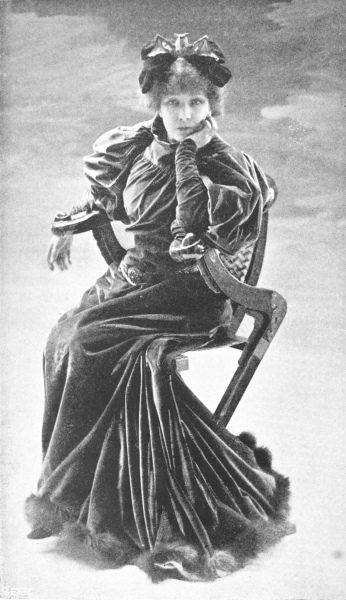
Mme. Sarah Bernhardt in her travelling costume.
Some little time afterwards she published an
account of her ballooning experiences in an amusing
little book entitled, In the Clouds; Impressions of a
Chair, with some very pretty illustrations by Clairin.
The simple and unstudied gaiety of this book
brought it into great favour. Of course she was
accused of another attempt to advertise herself, and
her literary efforts were riddled with epigrams, but
she was beginning to be accustomed to this kind of
thing. Several newspapers asked her to write for
them. The Globe requested her to supply the 1879
Salon critique, and another journal suggested that
she should write an article on England, in which
country she was about to perform. “How in the
world,” exclaimed Albert Millaud, with mingled
astonishment and alarm, “can such a frail creature,
made up of poetry and grace, accomplish such
labours?”
On February 7, 1879, she played Monime in
Mithridate for the first time. The whole success
of the performance fell to her. “If ever a part
suited Mlle. Sarah Bernhardt,” said M. Sarcey,
“Monime is that part.” “Had it been written
expressly for her, it could not have fitted her
better,” exclaimed M. Auguste Vitu. Even the
unappeasable Paul de Saint-Victor had to give way.
The rôle, he wrote, is within the scope of her talents, and is
exactly adapted to her voice. She has all the required uniformity
of tone and touching sweetness, relieved by one or two outbursts
of offended dignity and quietly ironical smiles. She obtained
well-merited applause.
Ruy Blas was reproduced on April 4. According
to M. Claretie it would be impossible to have
a more exquisite impersonation of any poetical
creation, or a better rendering of all the emotions
of the character. Emile Zola, who was then
theatrical critic on the Voltaire, wrote—“Ruy Blas
was played to perfection at the Comédie Française.
Mlle. Sarah Bernhardt is exquisite.” M. Auguste
Vitu gave his opinion in these terms—
Mlle. Sarah Bernhardt did not play the Queen better last night
than she did at the Odéon in 1872, for the simple reason that she
was then perfection itself. Yesterday’s applause and calls before
the curtain must have convinced her that she was quite as
charming as she was six years ago.
The Figaro descriptive writer tells us—
Everybody was attacked by stage fright, and Sarah was far
from being any better than her confrères. In the second act, she
trembled to such an extent that when she tried to take her
attendant Casilda by the chin she could only indicate the act by
a gesture. “For goodness’ sake,” whispered Mlle. Baretta, “don’t
tremble like that; you’ll frighten me horribly.” Back in her
dressing-room, Sarah began to weep copiously, but this time with
joy. Victor Hugo remained only a short time in the front of the
house. Between the first and second acts he paid a visit to Sarah
before her turn came. Before the fifth act Sarah came to the
poet for a little of the encouragement he knows so well how to
administer, and which always gives her so much ardour and
confidence.
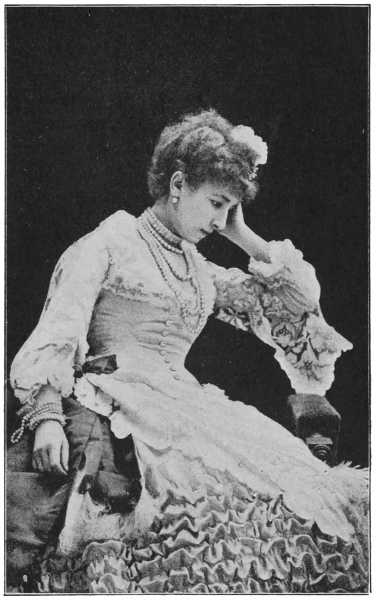
As Léonora in Dalila.
Mlle. Sarah Bernhardt had now been nearly
seven years at the Comédie Française, and those
who knew her were beginning to feel surprise at
the length of her stay. The same year, 1879, was
to witness several events leading up to her final
flight in search of independence and freedom of
movement. Mr. Mayer engaged the Comédie
Française troupe for a series of performances to
be given at the Gaiety Theatre, London, in June.
Sarah was to play in L’Etrangère, Phèdre, Le
Sphinx, Hernani, Andromaque, and Zaïre. The
company left for London on June 1. Next day
Phèdre was played, and L’Etrangère on the 3rd.
Sarah was somewhat coldly received at first, but
British iciness soon melted beneath the tragedienne’s
fire. On the 9th, M. Sarcey felt justified in writing—“The
English can adore two idols at the same
time, and they are now devoted to Mlle. Sarah
Bernhardt.”
On the first evening she insisted on playing the
second act of Phèdre as an interlude. Just as her
turn was coming, she was seized by one of those
“blue funks” by which actors are sometimes liable
to be paralyzed. She fell down in a state of collapse;
her hands and feet became icy cold, and she
had to be rubbed vigorously for ten minutes to put
a little life into her. She was half carried on to the
stage. As was only to be expected, she attacked
her words badly, went on worse, and failed completely.
The audience, however, noticed nothing,
and applauded her frantically. She was “called,”
and was enthusiastically cheered as she stood leaning
on the arm of M. Mounet-Sully, without whose
support she must have fallen, half dead as she was.
But now things began to go wrong. L’Etrangère
had been announced for a Saturday matinée, and
Hernani for the evening. Mlle. Sarah Bernhardt
was in both pieces, but her parts were not very tiring
ones. Like Doña Sol, Mrs. Clarkson has only one
act calling for real exertion. Moreover, Mlle. Sarah
Bernhardt had not played at all since her appearance
in Zaïre, and she had had time to rest. As
a matter of fact—and this was the principal grievance
of the Comédie against her—she did not rest.
She had, for instance, performed Le Passant and
the second act of Phèdre on the Friday night at
a private house, before an aristocratic audience.
When the time came for her to go to the theatre,
she sent her maid to say that she was tired and
could not perform. The effect may easily be
imagined. Every seat was taken, the Saturday
performances being always the best attended. It
was feared that the public would take the announcement,
which would have to be made, as a gross
breach of politeness. How was it possible to
organize another performance at such short notice?
If only she had let them know in the morning!
There was, however, no escape. Coquelin, whose
turn it was to make the announcements for the
week, went before the curtain. In a few well-chosen
words he explained what had occurred,
asked the audience to excuse the Comédie Française,
and wound up by announcing that there
would be no performance. A great commotion
followed, and several hisses were heard—a very
rare occurrence in a good English theatre. Chance
brought an addition to the strength of the company
in the shape of an actor who happened to call at
the theatre for his letters. Some one pointed out
that it would now be possible to play Tartuffe, and
Coquelin was called upon to make another proclamation.
But Coquelin was too disconcerted to do
anything of the kind. “I should be a perfect
weathercock,” he exclaimed. “I really can’t go
on and say the exact opposite of what I said five
minutes before. Let Got go!” Got was the doyen
and sage of the company, the last resource in desperate
emergencies. He went forward and delivered
a little speech to the effect that Tartuffe
would be performed for those who liked to remain,
and that their money would be returned. As for
those who desired to see L’Etrangère, their tickets
would be available for a special matinée, which
would be given on the Wednesday following.
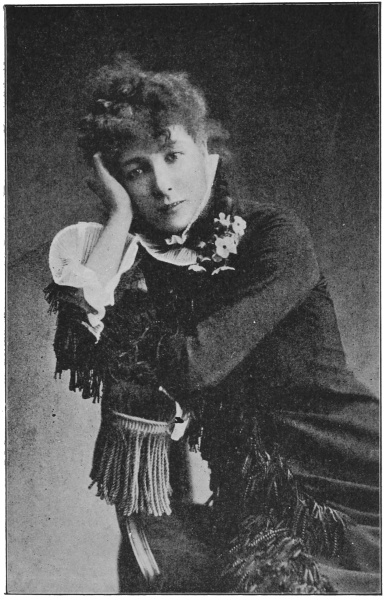
Mme. Sarah Bernhardt in 1877.
Here was a pretty kettle of fish! M. Sarcey, who
had, as usual, accompanied the Comédie Française
troupe, observed—
Another affair of this kind would be more than enough to make
the Comédie Française unpopular in England. Those persons
who, through caprice or a desire to show off, or, to put it differently,
through a mistaken estimate of their own physical powers, place
their confrères in such difficulties, are greatly to blame, and they
may be sure that a day will come when they will have to atone for
such conduct. Spoilt children are amusing until some friend of
the family wants to know at what time they are put to bed.
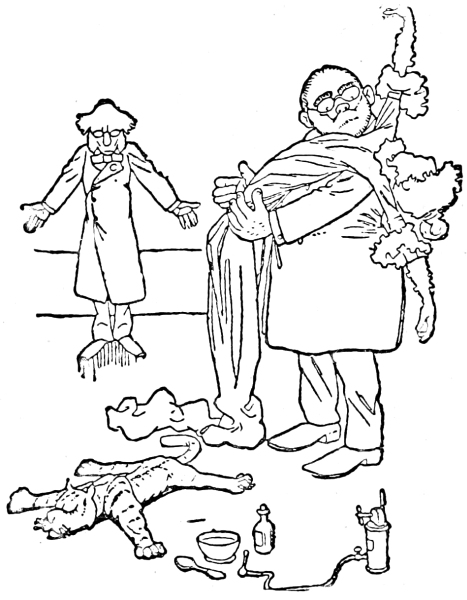
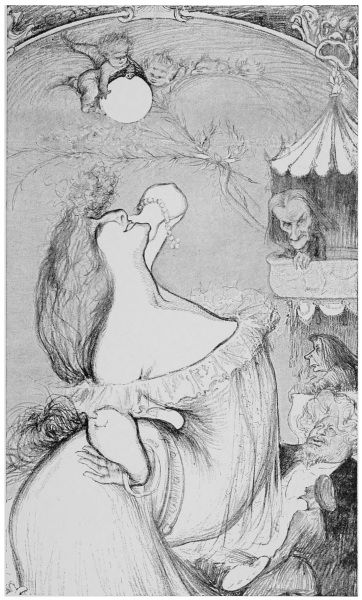
Sarah Bernhardt and F. Sarcey. By Caran d’Ache.
The whole of the French Press rose in wrath.
M. Albert Wolff, in the Figaro, was particularly
aggressive. He raked up all the old grievances
against the actress, and accused her of having gone
about in male attire, and having organized an exhibition
of her sculpture and paintings in London.
Sarah sent him the following reply by telegraph—
London, June 28.
Monsieur Albert Wolff, Figaro Office.
Do you really believe these insane stories, Monsieur Wolff?
Who could have given you such information? In spite of all the
infamous slanders that must have been poured into your ear, I
still think you a friend with a little kindness for me. I give you
my word of honour that I have never worn man’s clothes here in
London; I did not even bring my suit with me. I absolutely
deny the story. I went once, and only once, to the little exhibition
I organized, and that was the day on which admission was by
invitation only. Consequently it is false to say that a single shilling
was paid on purpose for any one to see me. It is true that I give
private performances, but you are aware that I am one of the worst
paid sociétaires of the Comédie Française, and I am entitled to make
up the difference. That I am exhibiting sixteen pictures and
eight pieces of sculpture is perfectly true, but as I brought them
here to sell them I must let them be seen. With regard to the
respect due to the House of Molière, my dear M. Wolff, I maintain
that I uphold it better than anybody, because I am incapable
of inventing such slanders on one of its standard-bearers. If
the silly stories told about me have wearied the Parisians and
decided them, as you lead me to fear, to give me a bad reception,
I will not expose any one to the possibility of having to commit
an act of cowardice, and I will hand in my resignation. If the
London public is incensed against me by the rumours in circulation,
and has decided to change its kindness into hostility, I
hope the Comédie will allow me to leave England at once,
so that the company may not experience the pain of seeing one
of their number hooted and hissed. I send you this letter by
telegraph—a piece of extravagance justified by the importance
I attach to public opinion. I beg you, my dear Monsieur Wolff,
to accord my letter at least as much consideration as you have
given to the calumnies circulated by my enemies.
With a friendly hand-shake, I am, etc.,
Sarah Bernhardt.
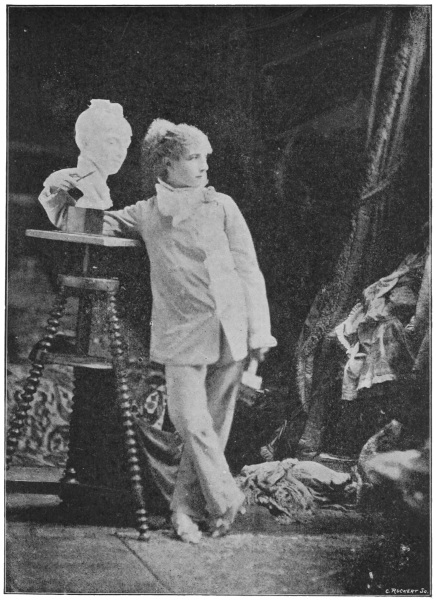
Mme. Sarah Bernhardt as sculptor.
She then handed her formal resignation to Got,
the doyen of the Comédie Française. Her colleagues,
who fully understood how greatly she contributed to
the success of the company, insisted on her withdrawing
her resignation, made her a sociétaire with
a full share in the profits, promised her two months’
holiday every year, and, in short, concealed the iron
hand of interest under the velvet glove of amiability.
Emile Zola took up his vigorous pen and treated
M. Albert Wolff’s hypocritical arguments with scant
ceremony—
One of the principal grievances against her is that she has not
confined herself to dramatic art, but has also taken up sculpture,
painting, and what not. This is too absurd! Not content with
calling her thin and treating her as a lunatic, people want to decide
how she is to use her spare time! She might as well be in prison.
As a matter of fact she is not actually denied the right to practise
painting and sculpture, but she is calmly told that she must not
exhibit her works. This pretension is simply unmitigated rubbish.
We had better pass a law at once to forbid the plurality of talents.
And Mlle. Sarah Bernhardt’s style is considered to have so much
individuality that she has been accused of passing off other people’s
work as her own!
M. Sarcey indulged in a species of funeral oration—
Mlle. Sarah Bernhardt has given in her resignation. The
Comédie will lose a charming actress in her, and will have to temporarily
abandon certain pieces which it will be almost impossible
to perform without her. These pieces, however, are not many.
Mlle. Bernhardt is a heavenly lyre, but she has only two or three
strings. I regret that we must do without her, but, as we know,
no one is indispensable. Actors come and go and their places are
soon filled up, however exceptional their talents may be. No
actress, however great, can walk off with the House of Molière
sticking to the soles of her boots. It will be interesting to see
how Mlle. Bernhardt will succeed when she follows an impresario
and tries her powers on uneducated audiences ignorant of our
language. But, after all, these melancholy reflections are perhaps
uncalled for. The matter may still be put right. Who knows?
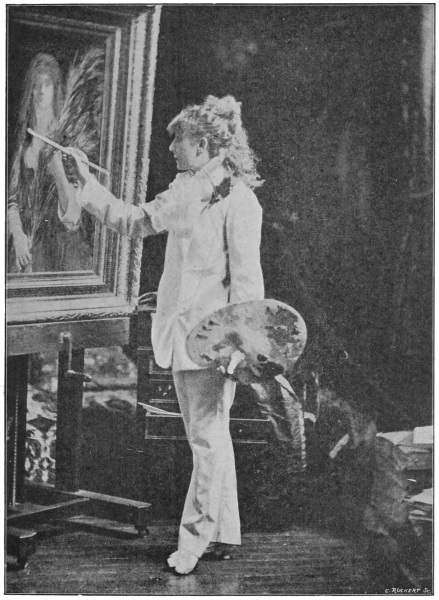
Mme. Sarah Bernhardt as painter.
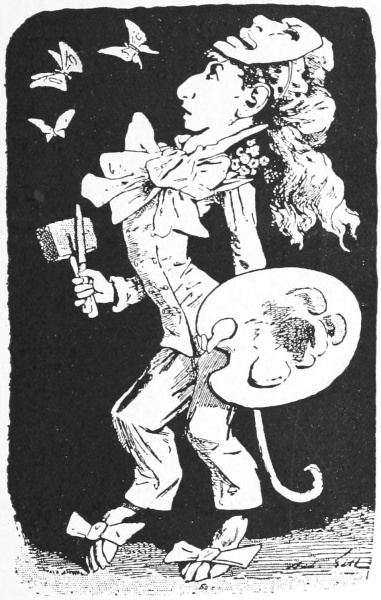
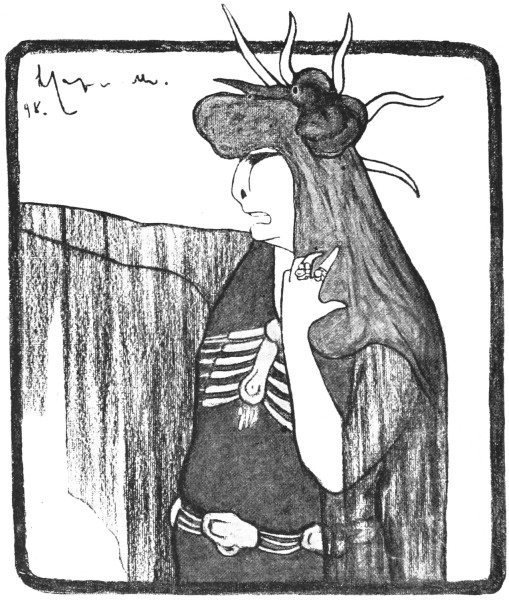
Caricature by André Gill.
The matter was, in fact, put right, but only
temporarily. The Théâtre Français re-opened its
doors on August 2nd, with Les Femmes Savantes
and Le Malade Imaginaire. At midnight the curtain
rose for the well-known ceremony carried out
on such occasions. All the artists of the Comédie
came forward, two by two, according to the time-honoured
custom, bowed to the public, and took
their seats. Loud, continued, and hearty applause
burst forth from every part of the house when
Mlle. Sarah Bernhardt came slowly forward to the
footlights. It was her formal reconciliation with the
Paris public. “We are all delighted about it,” said
M. Sarcey, “and we hope the ‘row’ will be a lesson
to all concerned.”
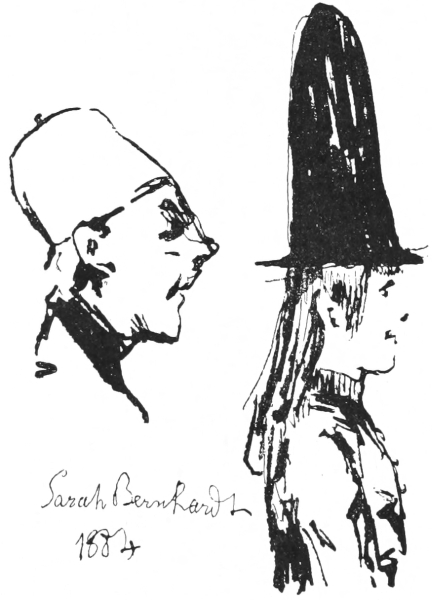
Sketch by Mme. Sarah Bernhardt.
All’s well that ends well; but unfortunately in this
case the end had not been reached. The year 1880
witnessed a great event in Mlle. Sarah Bernhardt’s
life: the severance of her connection with the
Comédie Française. On April 17th, L’Aventurière,
by Emile Augier, was revived, Mlle. Sarah
Bernhardt taking the difficult part of Clorinde.
The newspapers gave her full credit for her usual
ability and charm, but qualified their praise to an
unmistakable extent. M. Sarcey wrote in the
Temps—
Mlle. Sarah Bernhardt’s costume hardly struck me as suitable.
She came on the stage with a head-dress exactly like a nightcap.
Her comprehension of the part was still more unsatisfactory. It
is difficult to understand what she intended to make of the
character. Her Clorinde was absolutely colourless.
In the Moniteur Universal, Paul de Saint-Victor
devoted several columns of scathing and even savage
criticism to an attack on Mlle. Sarah Bernhardt.
Knowing her hold on the public, she might have
ignored this hostility, but her cup of bitterness was
filled to overflowing by M. Auguste Vitu, who,
though a courteous and moderate critic, wrote as
follows in the Figaro—
During the last two acts, the new Clorinde indulged in uncalled-for
exaggerations. She not merely forced a voice which is pleasing
only when used in moderation, but she managed her body and
arms in a style which would do very well for Virginie in
L’Assommoir, but is out of place at the Comédie Française.
This was more than Mlle. Sarah Bernhardt could
bear. She sat down and wrote the following letter
to M. Perrin—
Monsieur l’Administrateur,
You made me play before I was ready. You gave me only
eight stage rehearsals, and there were only three full rehearsals of
the piece. I could not make up my mind to appear under such
conditions, but you insisted upon it. What I foresaw has come to
pass, and the result of the performance has even gone beyond
what I expected. One critic actually charges me with playing
Virginie in L’Assommoir instead of Doña Clorinde in L’Aventurière!
I appeal to Zola and Emile Augier. This is my first failure at the
Comédie Française, and it shall be my last. I warned you at the
dress rehearsal, but you took no notice. I now keep my word.
When you receive this letter I shall have left Paris. Be good
enough, Monsieur l’Administrateur, to accept my resignation as
from this moment, and to believe me, etc.,
Sarah Bernhardt.
April 18, 1880.
Immediately after writing this letter Mlle. Sarah
Bernhardt took the train to Havre, and ran to earth
at Sainte-Adresse. A terrible uproar followed. The
entire Press, the Comédie, the author of the unlucky
play, and the public assailed the fugitive with
showers of violent invective and cutting sarcasm.
The sociétaires of the Comédie were hastily summoned
to a meeting, and they decided to take legal
proceedings with a view to obtaining—
(1) The exclusion of Mlle. Sarah Bernhardt from all rights as
a sociétaire of the Comédie Française.
(2) The confiscation of her proportion of the reserve fund,
amounting to over forty thousand francs.
(3) Three hundred thousand francs damages.
The critics were unanimously against her. Paul
de Saint-Victor opened all the flood-gates of his controversial
invective. M. Sarcey indulged in prophecy,
and delivered himself of the following oracular
saying—“She had better not try to deceive herself.
Her success will not be lasting. She is not one of
those artistes who can bear the whole weight of a
piece on their own shoulders, and who require no
assistance to hold the public attention.”
M. Emile Augier, who had expected great things
from the revival of his play, was much annoyed
by the defection of the principal exponent. He
wrote M. Perrin a letter in which he attempted to
conceal his irritation under the mask of irony—
She was as well prepared as she could be. I go further,
and say she played quite as well as usual, with all her defects
and all her good qualities, with which art has nothing to do.
Moreover, she obtained as much applause as ever from an adoring
public. What, then, was the cause of the trouble? The Press
indulged in some uncomplimentary remarks, and Mlle. Sarah
Bernhardt does not like this kind of thing. With whom does
the fault lie? Evidently with messieurs the critics, who have
hitherto treated her as a spoilt child. Are these ungrateful
Athenians beginning to tire of her success, and to think it
unjustified?
M. Emile Zola, whose devotion to the cause of
generosity and courage does not date from yesterday,
was almost the only journalist to take Mlle.
Sarah Bernhardt’s part, or rather to point out the
faults on both sides, and to make the voice of
wisdom heard amid this outburst of passion. He
reminded Sarah that “it is sometimes an honour to
be attacked.” Whilst Emile Zola, and also Emile de
Girardin, lifted up their voices for peace and reconciliation,
Mlle. Sarah Bernhardt in her retirement
at Sainte-Adresse enthusiastically proclaimed her
joy at what she called her deliverance. “Do you
know how much I earned?” she asked a representative
of the Gaulois. “Barely thirty thousand
francs a year. That may be all very well for people
who intend to remain on the stage until they are
fifty or sixty years old, but in twenty years’ time shall
I still be in this world? I have always had a horror
of growing old on the stage, and I don’t mean to
do it.” Her feeling was in fact so strong on this
point that she incontinently adopted an heroic resolution—to
leave the stage! It had already caused
her too much suffering, she said, and she was quite
decided not to die on it. She thus announced the
result of her cogitations to the representative of
the Gaulois—
“Yes, it’s all settled. I have learnt painting and
sculpture, and I intend to live by that. My sales
bring me in thirty thousand francs a year. My
brush and chisel will make me a second existence,
much calmer and more profitable than the first.”
Observing her guest’s astonishment, she added,
gravely, “with a sad smile which rendered doubt
impossible”—
“I came to this decision when I made up my
mind to leave the Comédie Française.”
Gradually the storm subsided, and the affair
began to be forgotten. The only allusions made
to it were when some other artiste took up one
of Mlle. Sarah Bernhardt’s parts. The Figaro,
for instance, amiably remarked—
M. Emile Augier last night assured Mlle. Croizette, who was
playing Sarah Bernhardt’s rôle in L’Aventurière, that this was the
first time he had known any artiste form an intelligent conception
of the character of Clorinde.
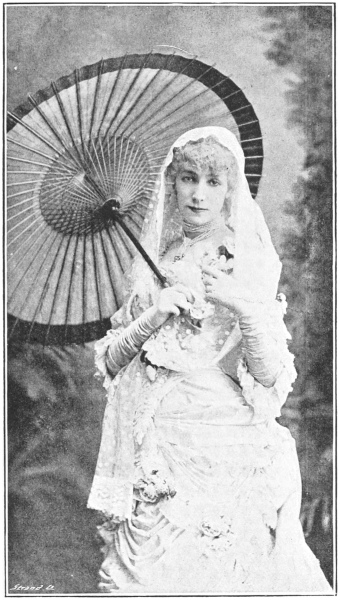
As Adrienne Lecouvreur.
According to M. Sarcey—
Mlle. Bartet has begun to appear as the Queen in Ruy Blas,
the part formerly taken by Mlle. Sarah Bernhardt. Mlle. Bartet
is meeting with considerable success.
It was a very neat way of saying to the fugitive—
“You see after all, you are not indispensable.”
Here is another specimen of the kind remarks
which the newspapers took a keen joy in circulating.
It was reported that Sarah had said, “I shall never
forgive Victor Hugo for letting Mlle. Bartet play
the Queen in Ruy Blas,” to which the poet had
retorted that Mlle. Bartet played the part so well
that her name deserved to be indissolubly connected
with it in future.
Exactly a month after her sensational resignation,
Sarah Bernhardt went to London, not, as might
have been supposed, to sell some of her works of
art, but to give a series of performances with
Mlles. Lalb and Jeanne Bernhardt, and MM.
Dieudonné and Berton. She met with considerable
success, especially in Adrienne Lecouvreur, Froufrou,
and Rome Vaincue. While she was tasting the
joys of this apotheosis, she was by no means forgotten
in the city she had abandoned. On the
18th June, the First Chamber of the Civil Tribunal
resounded for three mortal hours with her name,
and in spite of all the skill of her counsel, Maître
Barboux, the Court ordered her to pay the Comédie
Française 100,000 francs damages, and to forfeit
all right to her share (about 44,000 francs) of the
reserve fund. Her flight thus turned out to be an
expensive affair. There was nothing for it but to
pay, and this was the beginning of the peregrinations
destined to spread Sarah’s fame beyond the seas.
In August we find her travelling through Sweden,
Norway, and Denmark. One of those numerous
incidents which have caused incorrigible patriotism
to be numbered among Sarah’s virtues, occurred at
Copenhagen. In the course of a fête given in her
honour, the German Minister, Baron Magnus, proposed
the health of la belle France. Sarah Bernhardt
immediately interposed with—
“I beg your pardon, Baron, but you mean the
whole of France, don’t you?”
The German Minister found himself in so awkward
a predicament that he promptly left the room,
and it was supposed that he had discovered an
allusion to Alsace-Lorraine in Sarah’s remark.
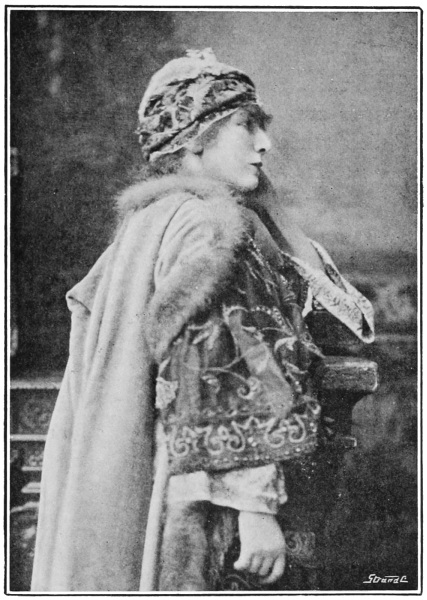
As Adrienne Lecouvreur.
She returned to Paris, but left again almost
immediately. On the 10th September she was at
Nantes, and afterwards she appeared at Bordeaux,
Toulouse, Lyons, and Geneva. She excited wild
enthusiasm everywhere. Medals bearing her image
and superscription, Sarah Bernhardt bracelets and
collars, photographs and biographies were sold in
the streets. At Lyons, the Khedive’s son unsuccessfully
offered £80 for a stage-box. The Old World
soon ceased to afford sufficient scope for her activity.
On the 16th October, 1880, she realized a long-cherished
desire, and sailed from Havre to America
on a tour, under Mr. Abbey’s management. She
took with her all her company, her servants, and
twenty-eight trunks containing innumerable dresses
and particularly one which she was to wear in La
Dame aux Camélias. This wonderful toilette had
cost £480, and fifty work-girls, so the story ran,
had toiled for a whole month to embroider the
camellias on the mantle. Mr. Abbey had promised
the actress a small fortune: £100 for every performance,
plus half the receipts above £480. Sarah
extended her journey to nearly every part of the
States. From the date of her début at New York,
on 10th November, she was incessantly on the move.
She appeared at Boston, Hartford, Montreal, Baltimore,
Philadelphia, Chicago, St. Louis, Cincinnati,
etc. Her répertoire included Adrienne Lecouvreur,
Froufrou, Hernani, Phèdre, Le Passant, and La
Dame aux Camélias. She became the proprietor
of a tame alligator, who soon succumbed to the
champagne diet she inflicted on him. At length, on
the 16th May, 1881, she landed in triumph at
Havre, and was greeted by a cohort of friends from
Paris, and by a crowd estimated, somewhat rashly
perhaps, by the Figaro, at 50,000 persons. She
had earned £36,800 in one hundred and sixty-six
performances. Out of this sum she handed £4000
over to her agent, Jarrett, and £16,000 to her legal
representatives in Paris. Her travelling expenses
amounted to about £8000, so that after paying all
her debts she was left with a balance of £8800.
She brought back from America not only this respectable
sum, but something else: the remembrance
of great ovations, unprecedented triumphs, and
adventures in which she invariably preserved her
dignity. One day she happened to enter a Protestant
church and heard the minister denounce her
as an “imp of darkness, a female demon sent from
the modern Babylon to corrupt the New World.”
Before the day was over, the clergyman received
this note—
My dear confrère,
Why attack me so violently? Actors ought not to be hard
on one another.
Sarah Bernhardt.
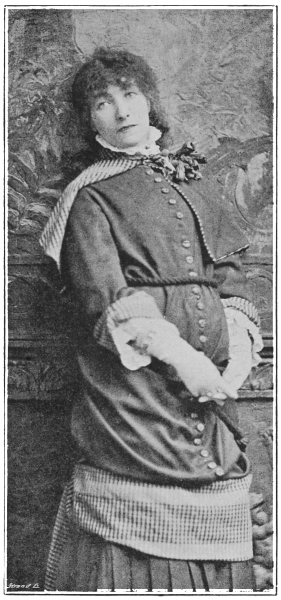
Mme. Sarah Bernhardt in travelling costume, during her first American tour.
On her return to France, she treated her compatriots
to such a surprise as only a grand seigneur
could have conceived. She was urged by a charitable
association at Havre to give a performance in aid of
the funds, and two days after landing she performed
La Dame aux Camélias—the same play which had
been applauded all over the world for a year before
under the name of Camille, but which she had
never yet performed in France. When she appeared
as Marguerite Gauthier, on the 18th of May, 1881,
before the Havre public and many of her Paris
friends, including Halanzier, Lapommeraye, Clairin,
Busnach, Abbéma, and many others, her reception
was a perfect triumph. And yet Dumas had said of
the part, “It is not made for her!”
After her long journey it might have been supposed
that she would rest on her laurels for a time, but
she did nothing of the kind. In June she was in
London, and arrangements were soon in progress
for a long European tour, to commence in October.
Before that date she accomplished another French
tour under the management of M. Félix Duquesnel,
who undertook to give her £2800 for thirty-five
performances of Hernani and La Dame aux Camélias,
between August 27th and October 4th, with Paul
Mounet as Hernani and Angelo as Armand Duval.
M. Duquesnel was the same manager who, years
before, paid her six pounds per month out of his own
pocket at the Odéon. He was now getting his money
back, with interest. Her French tour completed,
she started again, almost without waiting to take
breath, on her great European expedition, under the
management of Mr. Jarrett, who had accompanied
her to America. She visited Russia, Spain, Austria,
Holland, Belgium, Italy, Denmark, Sweden, and
Norway: the whole of Europe, in fact, except
Germany, that country being expressly omitted from
the contract. She opened her tour at the Mint
Theatre, Brussels, the King of the Belgians making
a hasty return to the capital from his country seat
in the Ardennes to see her. At Vienna she organized
an exhibition of her works of art. She next
entered Russia, and reached Moscow on the 10th
December. The last sentence of the following
telegram published in the newspapers gives a fair
idea of the sensation she excited—
Moscow, December 10.—Sarah Bernhardt is extremely hoarse
and cannot perform this evening. General consternation prevails.
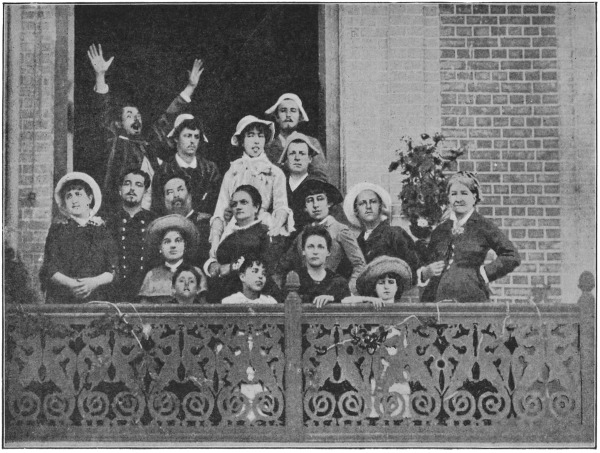
Mme. Sarah Bernhardt and her friends at Sainte-Adresse.
Her success, however, was not unmixed. She
was known to be of Jewish origin, and the Russian
fanatics did not omit to remind her of it. At Odessa
she was pelted with stones, and at Kieff she was
insulted. But these things were mere trifles. At
St. Petersburg her coming created as much excitement
as if it had been an event of national
importance. The prices charged for the series of
twelve performances are significant.
| |
Roubles |
£ |
s. |
d. |
| Pit boxes |
120 = |
13 |
0 |
0 |
| Dress circle boxes (front seats) |
150 = |
16 |
5 |
0 |
| Dress circle (centre box) |
180 = |
19 |
10 |
0 |
| Dress circle front row |
72 = |
7 |
15 |
0 |
| Dress circle 2nd and 3rd rows |
60 = |
6 |
10 |
0 |
| Upper boxes (front) |
150 = |
16 |
5 |
0 |
Her success was prodigious. Not content with
raining flowers on the stage, ladies in the audience
jumped over the partition separating them from the
pit, so that they could approach the great artiste as
closely as possible. She would have received many
costly presents had she not made it known that she
would accept nothing but flowers. At length she
tore herself away from her enthusiastic admirers, to
whom she had appeared in La Princesse Georges,
Rome Vaincue, Hernani, Jean Marie, and La Dame
aux Camélias. From St. Petersburg she went to
Warsaw, and thence to Genoa, where she was seized
with one of those sudden attacks which had recurred
rather too frequently for some time past. In the
middle of the second act of La Dame aux Camélias
she collapsed into a chair with blood pouring from
her mouth. The performance was stopped, but on
the following day the indefatigable woman was en
route again. After playing at Bâle and Lausanne,
she gave a series of six performances, beginning on
the 16th of February at Lyons, where she appeared
in Les Faux Ménages, by Pailleron. Then she
returned to Italy, receiving £240 for each appearance,
and meeting with enthusiastic applause
everywhere. She left Italy, and suddenly Paris was
struck dumb by the following extraordinary and
totally unexpected announcement, published by the
newspapers on the 8th April—
London.—At eight o’clock this (Tuesday) morning, April 4th,
at the Greek Consulate, Sarah Bernhardt was married to her
fellow-actor Daria, who recently took Angelo’s place in her troupe.
The news may appear improbable, seeing that Sarah was at Naples
last Friday, and even performed that evening; but it is none the
less a fact that she left Naples on the following morning, ostensibly
for Nice, took the train on to Paris, and thence to Boulogne,
crossed to Folkestone, and finally reached London, accompanied
by M. Damala.
Marriage was, in fact, the only eccentricity Sarah
had not yet perpetrated, but she was now enabled to
make up for lost time with the kind assistance of
M. Damala, an actor by choice, but formerly an
attaché in the Greek diplomatic service. The newly-married
couple began the first quarter of their
honeymoon by immediately taking the train for
Marseilles, whence they started by special steamer
on April 5th for Spain, to continue the tour. They
returned to Marseilles on May 5th, and performed at
Grenoble, Geneva, Rouen, and Brussels. On the
26th, a benefit performance was given at Paris for
the widow of M. Chéret, and Sarah Bernhardt and
her husband played La Dame aux Camélias for the
first time in the French capital. The performance,
a triumphal success, brought in 59,051 francs
(£2362).
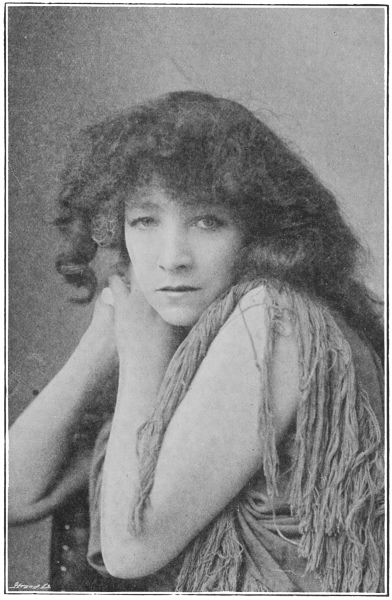
As Léa.
Her wanderings soon began again. London,
Brighton, Blackpool, Manchester, and Scotland saw
the wonderful artiste. In the meantime it was
announced that she had made arrangements for a
four months’ tour in America, and that she and her
husband were to be paid £40,000 for fifty performances.
Then it became known that after so many
wanderings Sarah was to return to Paris and appear
in a new play, Fédora, by M. Sardou, at the Vaudeville.
She had been promised £40 a night for a
minimum of a hundred performances. The première
on December, 12, 1882, met, with considerable
success, but while the perfomances were
proceeding the financial difficulties with which the
artiste had long been struggling were revealed to
the public. She had spent money very freely, and
omitted to balance her income and expenditure.
She carried out all sorts of wild schemes, such as
that of buying the Ambigu theatre for her son
Maurice, then seventeen years of age. The affair
turned out a very expensive one, and in February
1883, big placards posted on the walls of Paris
announced that Mme. Sarah Bernhardt-Damala’s
diamonds and jewellery were to be sold by auction
on the 8th, 9th, and 10th, at the Hôtel des Ventes.
The announcement created a great sensation, much
to the vendor’s advantage, the sale producing no
less than £7128. Actresses such as Mme. Marie
Magnier, Marthe Devoyo, and Julia de Cléry, well-known
demi-mondaines, collectors, and boulevardiers,
competed for the wonders of Sarah’s jewel-case.
The importance of the sale may be estimated by the
following lots, and the prices at which they were
knocked down—
| |
£ |
Very handsome single necklace thickly set with rose
diamonds and enriched with brilliants |
960 |
| Bracelet, 573 pearls in nine rows |
321 |
| Bracelet |
302 |
| Brooch |
150 |
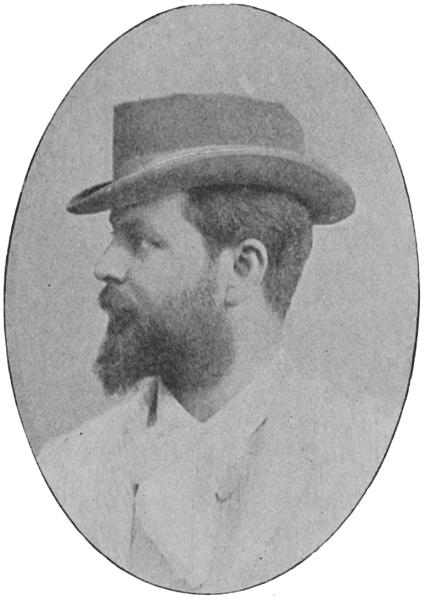
M. Damala.
After the withdrawal of Fédora from the Vaudeville,
Sarah Bernhardt took the play on tour, but it
proved only moderately popular in Belgium and
Holland. The intrepid Sarah now made up her
mind to a brief period of repose, but she was none
the less kept before the Paris public. On April
28, 1883, she appeared with Mme. Réjane, M.
Saint Germain, M. Daubray, and M. Guyon, at
the Trocadéro, in a two-act pantomime by M.
Richepin, entitled Pierrot Assassin. Early in
September the papers published mysterious paragraphs
announcing the return of M. Damala to
Paris, and the agreement of the pair to separate.
The public was not previously aware of M.
Damala’s absence, or of any disagreement in the
household. The initiated, however, knew that the
honeymoon was a short one, that discord had made
its appearance only a few months after the sensational
marriage in London, and that M. Damala
had been obliged to make up his mind to exile—in
Tunis, it was said. The separation did not seem to
be a great affliction to Sarah. At the very beginning
of the season she was in arms and eager for
the fray. On September 17, 1883, in company
with Marais, she revived Froufrou, which she had
never before performed in Paris. This was at the
Porte St. Martin theatre, which had been bought
by her under the name of her son, M. Maurice
Bernhardt, in partnership with M. Derembourg.
The success of the piece was considerable, though
not absolutely complete. Nevertheless Froufrou
ran for ninety-nine nights. Immediately afterwards
(December 20) she brought out Nana Sahib, a
seven-act drama in verse by M. Jean Richepin.
Her own success was very great, though, as usual,
it was not unanimously admitted; but the piece
itself was a failure, in spite of the fact that the
author himself replaced M. Marais a week after the
première. Nana Sahib is connected in theatrical
history with another souvenir. The night before
its production, Mme. Sarah Bernhardt was the
central figure in a terrific scandal. Accompanied
by her son Maurice and M. Jean Richepin, she
made her way into the rooms occupied by Mme.
Marie Colombier, turned all the furniture topsy-turvy,
smashed the ornaments, and finally set upon
the lady of the house and horsewhipped her in a
frenzy of rage. The reason for this conduct was
not far to seek. Mme. Marie Colombier had just
published an abominably offensive book, the title
of which, Sarah Barnum, showed clearly enough
against whom it was directed. The affair created
a great uproar, but no one ventured to blame the
insulted actress for taking the law into her own
hands.
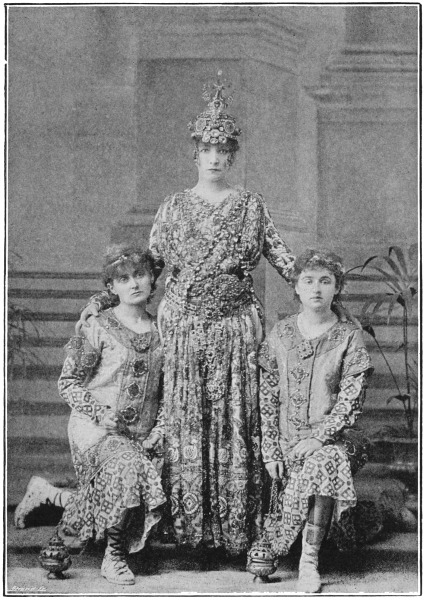
As Théodora.
Nana Sahib was withdrawn after thirty performances,
and on January 26, 1884, Sarah Bernhardt
appeared in La Dame aux Camélias, which thus
became, as it still is, her chief resource. This
revival lasted for more than a hundred nights. On
May 21 it was replaced by an adaptation of
Macbeth, by M. Jean Richepin. This ran for only
a month. At the end of June Mme. Sarah Bernhardt
left for a short foreign tour. Next season, in
consequence of sundry stories which found their way
into the papers, and particularly of an attempt to
poison her, which Paris did not take seriously, she
handed over the Porte St. Martin theatre to M.
Duquesnel, and joined his company at that theatre.
Macbeth was tried again on September 11, but was
withdrawn five weeks afterwards. On December
26 she played Théodora, one of the most undoubted
successes of her career. On this point
there can be no mistaking the testimony of figures.
Théodora ran for two hundred consecutive nights,
and, when the hundredth performance was given,
the piece had already earned nearly a million francs.
After Paris had had enough of Théodora, the piece
was taken to Brussels and London, where it met
with renewed success. It was brought back to the
Porte St. Martin on the 28th October, 1885, and was
given fifty-four times before its chief exponent broke
down, and was compelled, on the 21st December,
to leave the stage before the performance was
over. On the following day she was obliged
to take to her bed, but on the 31st she was able
to appear in Marion de Lorme, though she was
still visibly suffering from overwork. On the 27th
February she gave another trial to a Shakespearean
adaptation—a somewhat indifferent version of
Hamlet, by MM. Cressonnois and Samson, in
which she played Ophelia. Hamlet failed to attract
the public any more than Marion de Lorme, and on
the 5th April Sarah brought out Fédora again.
After sixteen performances she left on her annual
visit to London, and thence to Liverpool, where
she took the steamer for Rio de Janeiro. This was
the beginning of her great American tour under the
management of Messrs. Abbey and Grau. It was
one prodigious triumphal progress from one end
of America to the other. It lasted thirteen months,
and took her through Mexico, Brazil, Chili, the
United States, and Canada; The répertoire, an
extensive one, comprised Fédora, La Dame aux
Camélias, Froufrou, Phèdre, Adrienne Lecouvreur,
Théodora, Hernani, Le Maître de Forges, and Le
Sphinx, M. Philippe Garnier taking the principal
male parts. In Brazil the average receipts were
£720 a night. “Absurdly rich men,” says M. Jules
Lemaître, “wearing black whiskers and covered
with jewels, like idols, used to wait outside the
stage door, and lay their handkerchiefs on the
ground so that dust should not soil the feet of
Phèdre or Théodora.” After her appearance as
Phèdre at Rio de Janeiro she was recalled two
hundred times! The twenty-five performances she
gave brought in £12,800, of which she received
£4000. Three performances at New York realized
£5040, and twenty at Buenos Ayres, where the
total number of spectators reached 80,000, produced
£20,000. The Argentinos’ enthusiasm rose
to such a pitch that they presented her with an
estate of 13,000 acres in the Mission territory, the
best part of the Argentine Republic. She was
obliged to promise the generous donors that she
would take advantage of her first month’s leisure
to come and taste the sweets of repose amongst her
own gazelles and beneath the shade of her own
gardenias and diamelas!
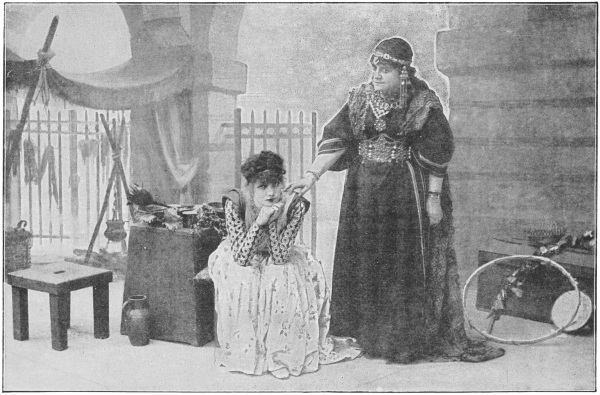
Scene from Théodora. Mme. Sarah Bernhardt. Mme. Marie Laurent.
In the meantime, gossip, the inevitable companion
of the capricious artiste, was not idle. At Rio de
Janeiro the Noirmont scandal occurred. Mme.
Noirmont, intermittently an actress, but better
known in a certain circle of society as “la grande
Marthe,” was a member of the company. What
was the quarrel between the actress and her manageress?
History sayeth not, but the fact remains
that during a rehearsal one day Mme. Noirmont
“went for” Sarah, and gave her a resounding
smack, to the accompaniment of much strong language.
Sarah promptly hauled Mme. Noirmont off
to the nearest police-station, where a summons was
duly issued against the offender. But this was not
enough for Sarah, and one evening, when the curtain
had only just fallen on the second act of Adrienne
Lecouvreur, Sarah seized a horsewhip and paid off
all outstanding scores. Result: a second visit to
the police-station, and a second scandal. Later on,
while the company was at Santiago, another story
got into circulation. In April 1878 the American
papers announced the marriage of Mme. Sarah
Bernhardt and M. Angelo, a member of her troupe.
The New York Morning Journal added that the
marriage was kept secret because the divorce proceedings
against M. Damala were still in progress.
The report was promptly denied, and Sarah sent
the following telegram to the Figaro—
The news of my marriage with Angelo is absurd, because he is
married already, and so am I. Please contradict this mischievous
story. Thanks in advance.
Sarah Bernhardt.
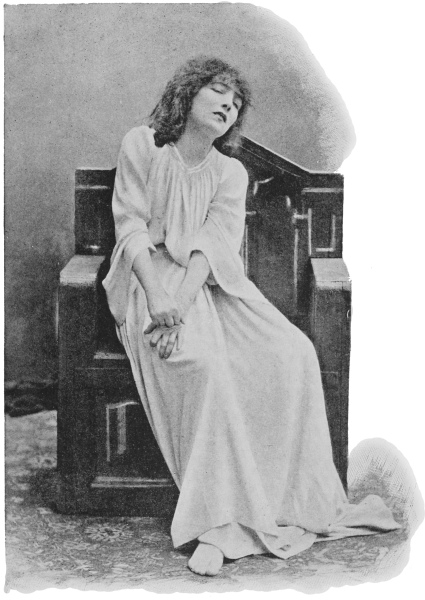
As Lady Macbeth.
After thirteen months’ absence Sarah at length
returned to Europe. The total receipts during her
American tour were a million dollars, of which her
own share was £60,000. She landed in England
on May 6th, not, as might be supposed, to rest,
but to start off again on another tour, under the
management of Mr. Mayer, through England, Scotland,
and Ireland. On August 10th she started for
Cauterets, and begun to prepare for her return to
Paris. She re-opened with La Tosca on November
24, 1887, and long and loud was the applause that
greeted her. M. Sarcey alone withheld unstinted
praise, and took exception, not to the artiste’s talents
but to her use of them, and indulged in criticisms of
the play itself. M. Sardou responded in a letter
addressed to a third person, in which he took advantage
of the opportunity to make a hit at the critics
of his work—
Monsieur,
You ask for my opinion on Sarah Bernhardt. It is simply
that she is an admirable artiste, and that, in La Tosca, she has
far exceeded anything that has been done in our generation by
Georges, Dorval, or Rachel. As for Sarcey, who knows nothing
about painting, music, architecture, or sculpture, and to whom
Nature has harshly denied all sense of the artistic, it is not surprising
that he should be not merely indifferent but even hostile
to any attempt to reproduce the past by means of scenery, costume,
and the representation of former customs. He showed
this feature by his treatment of La Haine, but it would be unjust
to blame him for this defect in his intellect. If he likes to play
the part of the fox who lost his tail, by all means let him do it.
Cordially yours,
V. Sardou.
This time M. Sardou was on the right side. La
Tosca was performed one hundred and twenty-nine
times, and was not taken off the boards until March
25, 1888. Ten days later, Sarah was playing La
Dame aux Camélias and La Tosca at Bordeaux.
Thence she went on to Lisbon and Madrid. Next
the indefatigable traveller began a French tour,
under the management of M. Emile Simon, at Caen.
In July she was in London playing Francillon, at
the Lyceum, with indifferent success. She was soon
off again, her life being now one incessant round of
travel with brief stoppages in Paris. M. Maurice
Grau was once more her manager, and she opened
in October at Antwerp, after which she visited
Liège, Amsterdam, the Hague, Rotterdam, Utrecht,
Arnheim, Brussels, Vienna, Prague, Budapest,
Bucharest, Constantinople, Cairo, and Alexandria.
La Tosca was as great a favourite as it had been in
Paris, but at the Hague the Huguenot scruples of
the Dutch bourgeois led to the performance of the
play being forbidden, on the ground that it contained
attacks on Roman Catholicism which might prove
offensive to persons of that religion. At Bucharest
Sarah was received by Queen Natalie, who, living
as she was in strict retirement, had been unable to
attend any public performance in spite of her great
desire to see the artiste. Sarah accordingly performed
a scene from La Dame aux Camélias for her
at the palace. When the actress uttered the words,
“Shall fallen greatness never rise again?” Queen
Natalie, who applied them to her own case, burst
into tears. Every one present, including Sarah
Bernhardt, shared the poor Queen’s emotion, and
the performance had to be interrupted.
From Bucharest Sarah went on to Italy, Russia,
and Scandinavia, returning to Paris on the 21st
March. Three weeks afterwards, without taking
time for rest, she appeared at the Variétés in Léna, a
piece adapted from the English by M. Pierre Berton,
and in which she added another to the numerous
kinds of death already on her list. The piece, however,
was merely an ephemeral success, and was not
a great triumph for its principal interpreter. M.
Jules Lemaître says—
Mme. Sarah Bernhardt played the earlier acts in a rather offhand
style. Her delivery was sometimes childish and lisping, and
sometimes hard and guttural.
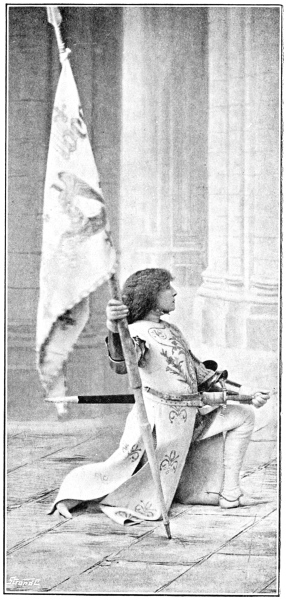
As Jeanne d’Arc.
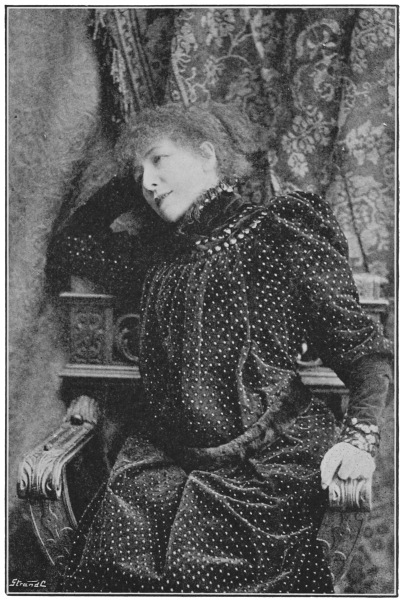
Mme. Sarah Bernhardt on one of her tours.
On the 16th May, Sarah revived La Dame aux
Camélias at the Variétés. In July she went to
London, where she was received with the customary
enthusiasm, and, the summer at an end, she re-appeared
on the 4th September at the Porte St.
Martin theatre in La Tosca, in which she had
triumphed two years before. A month later came
another revival, Théodora, which furnished M.
Sarcey with one more opportunity for lamenting—as,
in fact, he had never ceased to do since Sarah’s
desertion of the Comédie Française—the injury her
foreign tours had done her. Regardless of criticism
and case-hardened by experience against the opinions
of the Press, Mme. Sarah Bernhardt was devoting
all her energies to the rehearsals of Jeanne d’Arc.
Perhaps, however, she was not really far from agreeing
with M. Sarcey. On the eve of one of her tours
she remarked—
Really, I seem to be intended for the export trade! Success
abroad is very nice, but success in France is still better.
She produced M. Jules Barbier’s Jeanne d’Arc
at the Porte St. Martin, on the 3rd January, 1890.
The result was unanimously admitted to be all that
could be desired. M. de Lapommeraye observed—
The entire performance was one continued triumph for Mme.
Sarah Bernhardt, who sent a thrill of the noblest emotion and the
keenest admiration through every heart.
According to M. Henry Bauer, “her success
increased with every act and culminated in a brilliant
triumph.” “This woman has a power within her,”
exclaimed M. Jules Lemaître. “It is impossible to
see her without being moved to tears,” said M.
Sarcey. M. Vitu wrote—
She chiefly surprised every one, including her warmest admirers
as well as her most prejudiced critics, by the extraordinary,
passionate, irresistible force she imparted to the patriotic outbursts
of the heroine. But everything, even praises, must have an end.
What I have said is merely a summary of the expressed opinions
of the entire audience last night, of what Paris will say in a few
days, and of what every one will say in a few months when Paris
and the world will have seen and applauded Sarah again and again
in this the finest of all the fine creations of her career.
In July she was playing in London, and on the
23rd October she appeared at the Porte St. Martin
in Cléopâtre, by MM. Sardou and Moreau. “What
a wonderful actress she is!” exclaims M. de Lapommeraye.
“She appears, she is seen and heard, and
she triumphs.”
“What a pity it is,” regretfully says M. Bauer, “that her prodigious
gifts, her art, and her powers of perception and expression
should ever be wasted on M. Jules Barbier’s verses, or on brigand
stories in prose!”
M. Albert Wolff simply quivers with enthusiasm—
I have long felt that this rare artiste is not merely a great actress,
but the only one of our time. She stands without a rival in the
world. I have never seen Rachel, whose fame still excites Mme.
Sarah Bernhardt to greater efforts even in the hour of her greatest
triumphs, but I do not see how it can be possible for any one to
have more talent than Sarah. Her evening ended in a perfect
ovation.
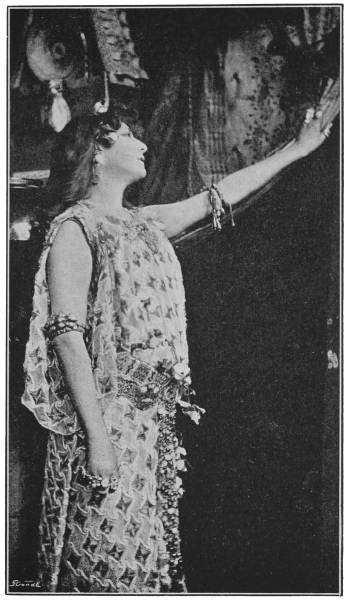
As Cleopatra.
She played Cléopâtre until the beginning of
January 1891, and on the 23rd she set off for
America and Australia, I went to see her a few
days before her departure. I had already paid
several visits about this time to her delightful sanctum
in the Boulevard Pereire. She had been suffering
from an affection of the larynx, and was hardly
able to speak, and I had called to inquire after her
health. To pass away the time while she disposed
of her dressmakers, doctors, attorneys, and what
not, I strolled up and down the well-known hall on
the ground-floor—a hall quite unlike any other that
I have ever seen. In the course of my many journalistic
visits to the houses of Paris celebrities I have
soon become indifferent to the cold and hollow display
of official salons, to M. Renan’s plain walnut-wood
furniture, to M. Zola’s somewhat discordant
profusion of decoration, to Edmond de Goncourt’s
art-treasures, and to the solemn comfort of academic
homes. I have viewed, without faltering, the
gorgeous and imposing ceilings of the Hôtel d’Uzès,
the pompous display of multi-millionaire financiers,
the faintly pretentious coquetry of the popular
actress’s home, the frills and furbelows and knock-me-down
eccentricities of our celebrated painters;
but every time I enter what Sarah Bernhardt calls
her studio, I am immediately struck by an indefinable
something, infinitely pleasing, and not to be met
with elsewhere. No doubt the sensation is partly
physical and partly mental; it must arise from a
combination of the perfumed atmosphere of the
place, the ideally artistic arrangement and extraordinary
diversity of everything, the muffled footfalls
on the thick carpet, the subdued twittering of
birds hidden in the foliage of rare and costly plants,
the intoxicating play of colour on silk and velvet,
the silent welcome of familiar animals, and above
all, the voice and presence of the mistress of the
house when she makes her appearance. But she
is not yet here, and I resume my investigations.
At the first glance it is difficult to see anything
more than a delightful chaos of light and colour,
an odd but harmonious profusion of the Oriental
and the modern. Gradually the eye begins to distinguish
surrounding objects. On the walls, which
are hung with Turkey-red cotton, with a pattern
of graceful plumes, are all sorts of queer weapons,
Mexican sombreros, feather parasols, and trophies
of lances, daggers, sabres, clubs, quivers and arrows,
surmounted by hideous nightmare-like war-masks.
Scattered about are bits of old pottery, Venice
mirrors with wide frames of pale gold, and pictures
by Clairin, some representing Sarah lying on a
couch at full length, half hidden among her furs and
brocaded coverings, others, her son Maurice and her
big white greyhound.
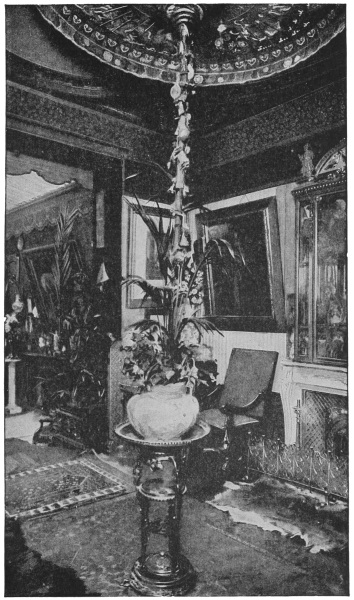
Vestibule of Mme. Sarah Bernhardt’s studio.
Scattered about on stools, on settles, and on the
edges of sundry small articles of furniture are
swarms of Buddhas, Japanese monsters, rare Chinese
curios, bits of pottery, enamel, lacquer, and ivory
work, miniatures, ancient and modern bronzes. In
a special case is a collection of valuable souvenirs:
gold vases, drinking-cups, liqueur-flasks, pyxes,
beautifully carved golden wreaths, and exquisitely
artistic gold and silver filigree. Flowers are on all
sides: bunches of white lilac, Spanish lilies-of-the-valley,
and mimosa, bouquets of roses and chrysanthemums,
mingled with palms reaching to the glass
ceiling. At the further end of the room is the big
cage originally made for Tigrette—a tiger-cat
brought home by Sarah from one of her voyages—and
afterwards occupied by two lion-cubs, Scarpia
and Justinian, reared in freedom but despatched to
the menagerie immediately they displayed an intention
of providing their own food. At present the
wild animals’ cage, with its closely-set bars, serves as
an aviary. In it birds of brilliant plumage sing and
disport themselves on the branches of an artificial
tree. In the corner opposite the cage and on the
right-hand side of the fire-place with its wrought-iron
dogs, is a most magnificent, barbaric, disconcerting
couch—an immense divan made out of a heap of
white bear, beaver, eland, tiger, jaguar, buffalo, and
even crocodile skins. The walls of this lair are
also formed of thick furry skins, falling in luxuriant,
enticing curves over the foot of the couch. Piles of
faintly-tinted silk cushions lie scattered over the furs.
The light falls from above through a canopy of
colourless silk, embroidered with faded flowers and
supported by two dragon-head standards. The
floor is covered from end to end with Oriental
carpets thickly strewn with skins. Jackals’ and
hyenas’ heads and panthers’ paws meet the visitor
at every step.
A servant interrupts my reflections and announces
that Madame is waiting for me. I go up-stairs to
the study, and find the illustrious actress in an ample
cream cashmere peignoir trimmed with lace.
“I have just come out of my bath, and you must
excuse me for keeping you waiting,” she says, with
an outstretched hand and a smile. “I can talk a
little better to-day. What is it you want to know?”
“To begin with,” I reply, “I should like to know
the date of your departure and the extent of your
tour?”
“You will find it all on this paper. I am sure I
could not tell you all these things. On my tours I
often take the train or steamer without even asking
where I am going. What does it matter to me?”
I read as follows—
“Leave Paris, 23rd January, and Havre, 24th;
arrive at New York, 1st February. New York, 1st
February to 14th March; Washington, 16th to
21st March; Philadelphia, 23rd to 28th March;
Boston, 30th March to 4th April; Montreal, 6th to
11th April; Detroit, Indianapolis, and St. Louis,
13th to 18th April; Denver, 20th to 22nd April;
San Francisco, 24th April to 1st May. Leave San
Francisco for Australia, 2nd May. Stay in Australia
about three months. Open at Melbourne, 1st
June; visit Sydney, Adelaide, and Brisbane, completing
engagements at end of August. Return to
San Francisco, 28th September. Principal cities
of the United States, then Mexico and Havana.
Return to New York about 1st March, 1892. If
business then better in South America, take the
Argentine Republic, Uruguay, and Brazil in June,
July, August, September, and October, 1892;
London, January 1893; then Russia and European
capitals.”
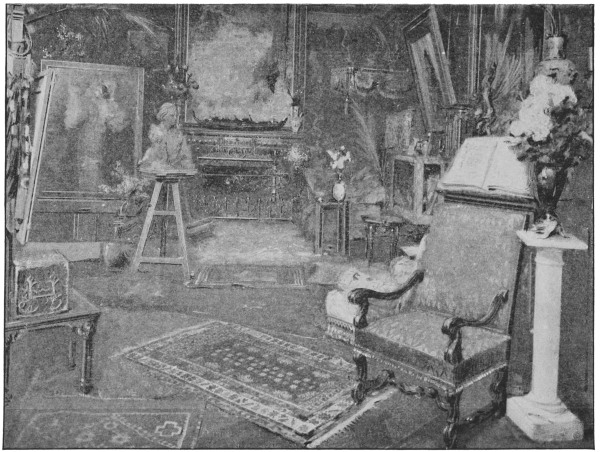
Mme. Sarah Bernhardt’s drawing-room.
“Two years!” I said. “Don’t you feel sorry to
think of leaving Paris for two years?”
“Not at all,” replied the Bohemian genius. “Far
from it; it is just the same thing as going to the
Bois de Boulogne or the Odéon. I love travelling.
I am delighted to be off, and full of joy to get back
again. There is genuine and healthy excitement
in moving from place to place and getting over so
much ground. It never bores me, and then I
haven’t time to be bored. Just think—I have never
stayed more than a fortnight in any one place! At
the end of these two years I shall have gone half
round the world. I know North America already,
and I have been there twice; but this time we are
going to Australia, which will be quite new to me.
We shall stop at the Sandwich Islands and play
before Queen Pomaré, at Honolulu. There’s a
novelty for you!”
“Won’t you miss your home, your comforts, and
your friends?”
“I shall have them all again when I come back,
and my delight will be all the greater for being so
long deprived of them. And as for comfort, we
travel like princes. Very often we have a special
train for ourselves and our baggage. There is a
big car, called the ‘Sarah Bernhardt,’ containing a
fine bedroom, with a four-post bed, bath-room,
drawing-room, and kitchen, all for me, and there
are about thirty beds for the rest of the troupe.
You see how convenient it is; and as the train is
our own, we can stop when we like. When we
come to a specially nice neighbourhood we leave
the train, play ball games on the prairie, have pistol
practice, and amuse ourselves generally. If we
don’t care to get off the train, we turn the beds up
against the sides and have dancing with a piano.
There is plenty of room, as we have three long cars
joined together. You see, we don’t suffer from
ennui!”
“How do you spend your time on these long
sea-voyages?”
“I play chess, draughts, and nain jaune. I don’t
care much for cards, but sometimes I play Chinese
bezique, because it is very long, and passes the
time. I am a very bad player, and I hate to lose—it
enrages me. This is ridiculous and silly, I know,
but there it is! I can’t bear to be beaten!”
“What do you think of American scenery?”
“I don’t like it. Everything is so big—too
big in fact—nothing but mountains with tops that
you can’t see; steppes that stretch away to the
horizon, immense trees and plants, and skies that
look ten times as high as ours. All these things
have a supernatural effect, and when I come back
Paris looks like a dear little trinket in a miniature
case.”
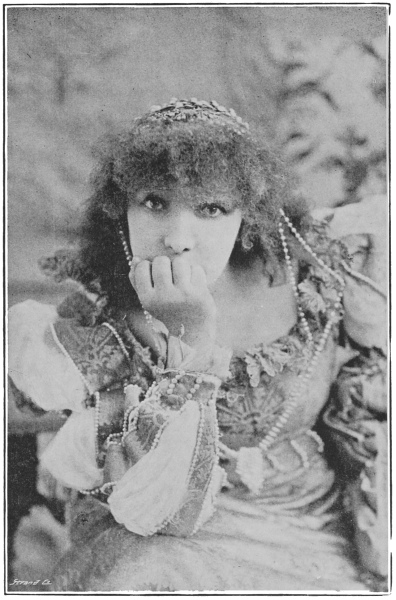
In La Dame de Chalant.
“And the public?”
“I can’t call them anything but delightful! They
adore me! In the principal American cities, every
one of a certain class understands French, and as
the prices are, of course, very high, the audience
is largely composed of this class. In some places
I have regular first-night audiences, who note the
smallest effects and shades of diction.”
“What about those who don’t understand
French?”
“They buy books containing the French text
with the translation opposite. This has a curious
effect; everybody turns over at the same time, and
it sounds like a shower of rain a second long.”
All these details, and the manner in which they
were told, were very amusing. I could have gone
on asking questions all night, but as it was becoming
late I hastened to put my most inquisitive
queries.
“How much baggage do you take?”
“About eighty trunks.”
“Eighty?”
She laughed at my astonishment.
“Yes,” she added, “there are at least forty-five
cases of theatrical costumes. We take nearly two
hundred and fifty pairs of shoes, and they fill one
entire trunk. There is one for linen, one for
flowers, and one for perfumery, and others for my
dresses, hats, etc. I really don’t know how my
maid manages to find what she wants!”
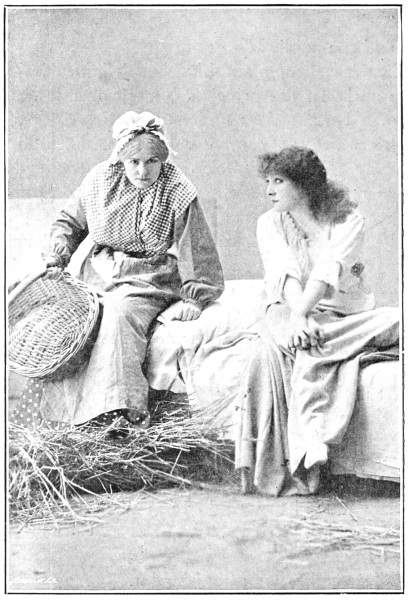
As Pauline Blanchard.
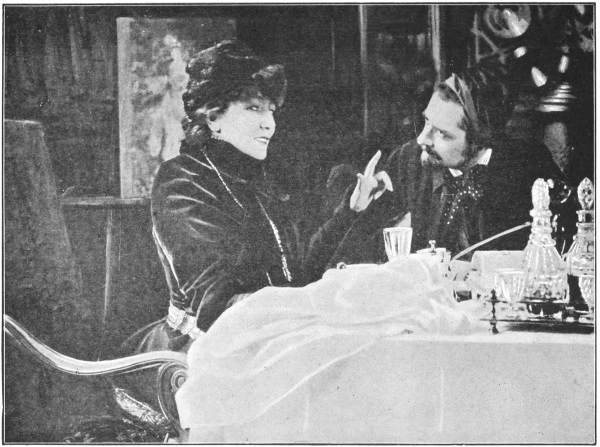
Mme. Sarah Bernhardt and the painter Clairin.
“Would it be indiscreet to ask what payment you
are to receive?”
“Not at all; there is no mystery about it. I get
£120 for every performance, plus one-third of the
receipts, which makes on the average a total of
£240. Oh! I was forgetting: I am allowed £40
a week for hotel expenses.”
In accordance with her programme, Sarah left on
January 23 for her second tour in America. She
followed the route given above, with the exception
of Mexico and Havana, which she omitted. She
was enthusiastically applauded almost everywhere.
In Australia the excitement rose to a frenzy.
Sydney was decorated with flags in her honour;
she was received by members of the Colonial
Cabinet; the horses were taken out of her carriage,
she was borne in triumph, and official receptions
were organized for her. At Sydney she appeared
for the first time in Pauline Blanchard, by MM.
Darmont and Humblot. On this occasion she also
played La Dame de Chalant—a piece that has not
yet been seen in France.
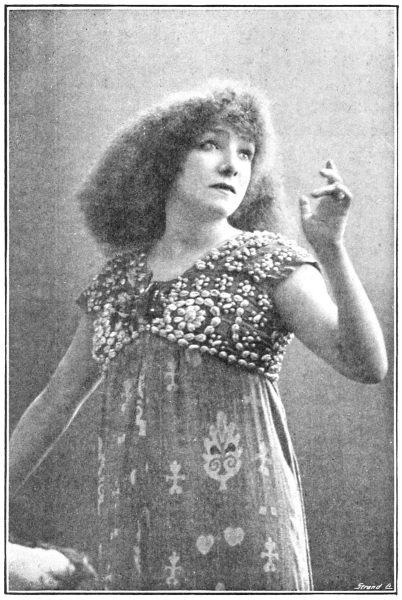
As Izeïl.
During her absence there was some talk of her
returning to the House of Molière for the creation
of La Reine Juana, by M. Parodi, the author of
Rome Vaincue, in which she had scored so many
triumphs. Her own plans, however, were different.
She wanted to make her dream a reality: to be her
own mistress and to work on her own account.
Thus, barely a month after her return to Paris in
May 1892, she set off for London, returned to
France, and started again on a tour through Russia
and the Continental cities, such as Vienna, Copenhagen,
Christiania, etc. It would take too long to
record the triumph she scored in this wild gallop
across Europe. Back in Paris in March 1893, she
immediately began to prepare for another tour in
South America. On the 28th May she played
Phèdre at the Vaudeville in aid of the funds of the
Pouponnière, a charitable organization under the
presidency of Mme. Georges Charpentier, wife of the
well-known publisher. On the 24th May, through
her American impresarii, Messrs. Abbey and Grau,
she purchased the Renaissance theatre. Then
came her tour through South America; dazzling
success, big takings, and back to Paris.
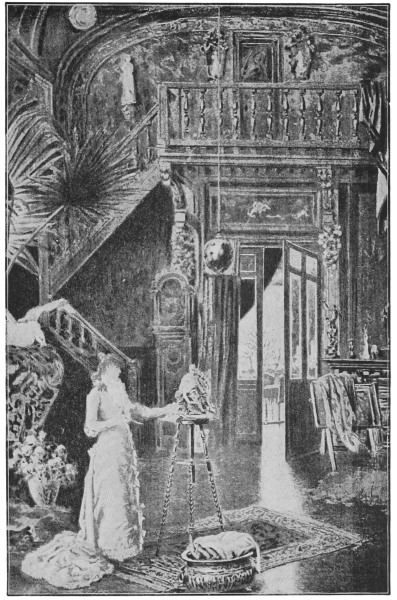
Mme. Sarah Bernhardt in her entrance-hall.
Sarah Bernhardt was now at length installed in
her own theatre, which she was to make her own in
every sense, and which was destined to be for several
years to come the scene of the finest experiments in
dramatic art in all Paris—experiments carried out
with a lavish disregard for everything except the
interests of art. On the 6th November she opened
the Renaissance with a four-act drama by M. Jules
Lemaître, Les Rois.
As one critic expressed it, the Renaissance was
not a shop but almost a temple!
At last, exclaims M. Sarcey, we have seen the great and only
Sarah again, and the Renaissance, under her management, has
opened its doors with Les Rois. How splendid she was, and how
she reminded us of the Sarah of her best days!
She re-appeared in La Dame aux Camélias on the
16th December, and, according to the Figaro—
The interpretation of the play was admirable as far as Mme.
Sarah Bernhardt was concerned. The performance was one of
the great artiste’s best.
M. Sarcey indulged in reminiscences—
I well remember the first occasion on which I saw Mme. Sarah
Bernhardt as Marguerite Gauthier. It was in London, in 1881.
She played the part on several consecutive evenings, and every
time I was there, interested, delighted, and enthusiastic! The
notices I wrote then were simply brimming over with admiration.
The Parisians thought me slightly mad!
On the 24th January, 1894, Izeïl, by MM. Sylvestre
and Morand, was brought out. Every act
elicited enthusiastic applause from the public.
Referring to Sarah, M. Jules Lemaître wrote in the
Journal des Débats—
We owe to her one of the strongest artistic impressions we have
ever experienced. Is it a fact that, for reasons which MM.
Sylvestre and Morand know as well as I, and which the reader
can doubtless guess, her creative has had still more play than her
artistic talent?
M. Sarcey says—
In this delightfully picturesque play she is herself the most
delightful and most picturesque spectacle. She does not look
thirty! The audience was at first quite overcome. Then there
was a furious outburst of applause, and the house rose at her.
What a triumph!
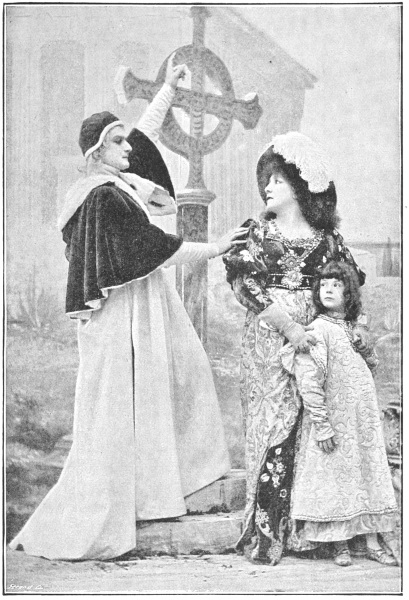
As Gismonda.
These extracts, which might be multiplied ad
infinitum, show Sarah Bernhardt at her apogee.
From this point her supremacy was undisputed, and
any show of criticism was always tempered by
admiring reservations. This was the attitude henceforth
adopted by the entire Press in regard to her
creations. Fédora was revived on the 3rd April,
1894. M. Lemaître remarks on it—
I am not quite sure whether Mme. Sarah Bernhardt can say
“How do you do?” like any ordinary mortal. To be herself
she must be extraordinary, and then she is incomparable.
Off to London in June, she played Izeïl with
tremendous success. On her return she gave
La Femme de Claude on the 19th September.
Gismonda, which she produced on the 1st November,
elicited another poetical outburst of admiration in
the Press. The Figaro speaks of her as attaining
the perfection of her art. M. Bauer, in the Echo de
Paris, calls Gismonda the most wonderful of all her
creations. M. Lemaître, in the Journal des Débats,
says that “as all the laudatory adjectives have
already been used up in her service, it is difficult to
express the adoration evoked by every fresh appearance
of this extraordinary woman.” M. Sarcey alone
was rather reserved in his praise, and described her
as having been applauded with more Italian than
French exaggeration; but he amply atoned for this
when Sarah revived Phèdre on the 24th December
of the same year (1894).
What can I tell you of Sarah that you do not know already?
Her acting is the summit of art. Our grandfathers used to speak
with emotion of Talma and Mlle. Mars. I never saw either the
one or the other, and I have barely any recollection of Rachel,
but I do not believe that anything more original and more perfect
than Mme. Sarah Bernhardt’s performance on Wednesday has
ever been seen in any theatre.
On the 11th February, 1895, came the revival
of Amphitryon, with Coquelin, who unfortunately
remained with her for only a brief period. M.
Sarcey considered the performance wanting in life.
The other critics treated it as a success for Sarah
and Coquelin, but there was no enthusiasm. On
the 15th February, Magda, by the German writer
Sudermann, was produced. All the critics described
her as admirable. On the 5th April, La Princesse
Lointaine, by M. Edmond Rostand, proved an
equally great success for poet and actress. To
London and Scotland again, with Gismonda, Izeïl,
La Princesse Lointaine, La Tosca, Magda, and La
Femme de Claude. Then she made arrangements
to produce Amants, by M. Maurice Donnay, for
which she engaged Mme. Jeanne Granier. In the
meantime what does Sarah do? Rest? Not at
all. On the 5th January the Figaro announced her
departure on that day for America, where she was
to give a series of performances. She was back on
the 4th July, 1896. She took two months’ rest at
Belle-Isle, and on the 30th September she revived
La Dame aux Camélias with phenomenal success.
On the 8th October she recited before the Tsar and
Tsaritsa at Versailles. Lorenzaccio, adapted by M.
Armand Dartois from Musset’s poem, was produced
on the 3rd December, and enabled Sarah to score
yet another triumph.
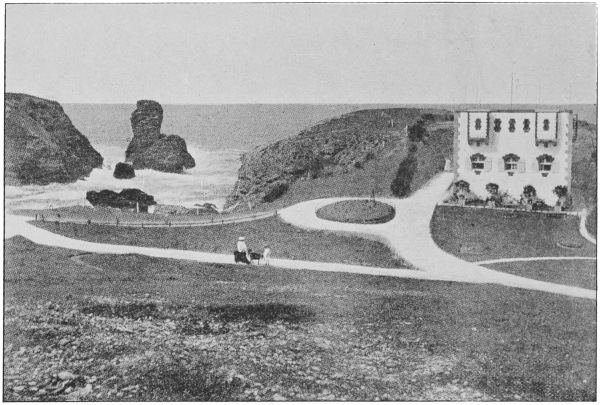
The Fort-aux-Poulains, Belle-Isle, Mme. Sarah Bernhardt’s country residence.