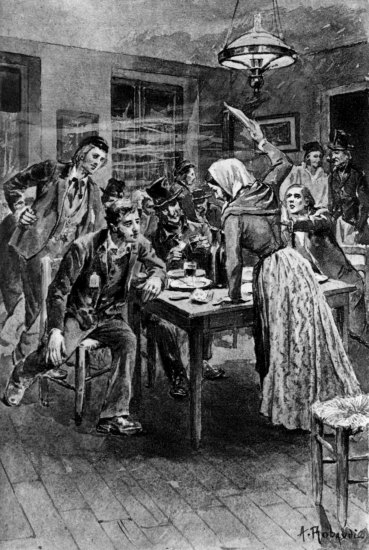
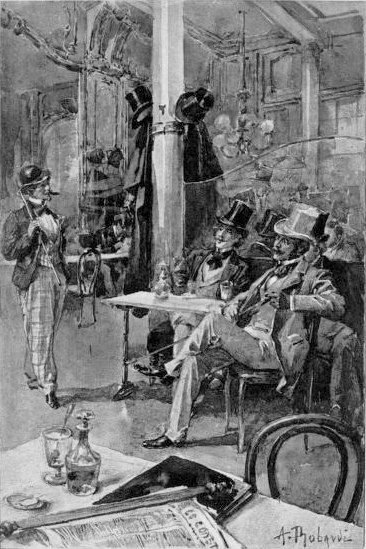
It was only a few days since Albert had returned to Paris, and he had
hardly had time to see his closest friends, when he disappeared again,
and no one knew the reason of his abrupt departure.
When the jovial Mouillot chanced to meet Balivan or Dupétrain or
Célestin, it rarely happened that they did not discuss the conduct of
young Vermoncey.
"What sort of a life is he leading now?" said Mouillot; "he goes off,
and is gone nearly three months; then he comes back, we see him two or
three times, and off he goes again without a word, just at the beginning
of winter, when all sorts of amusements have centred in the capital."
Monsieur Célestin, who had not given out that he had had a definitive
rupture with Albert, contented himself with some such reply as this:
"As I have been entirely unable to understand Albert's moods of late, I
have seen very much less of him. He's a queer fish: one of those people
who fly into a passion without any idea what it's all about; and I
bother my head very little as to what he does or what becomes of him!"
"For my part," said Balivan, "I am very fond of the fellow. He's
heedless and light-headed, but I am sure that he's as straight as a
string, and he's most obliging. He's a mighty bright fellow, too; and if
he'd like, I'd be glad to take a trip to Italy with him."
"If Monsieur Albert had chosen," said Monsieur Dupétrain, "he would have
made a first-class subject for magnetism; he had just the right look in
his eyes to put himself in communication with a somnambulist."
"How about the fair lady that you were paying court to not long ago?"
said Monsieur Célestin, in a sarcastic tone; "have you magnetized her?"
"Madame Baldimer? No; I tried, but I couldn't make it work; she's a
woman who is absolutely free from nervousness."
They asked one another about Tobie Pigeonnier also, who was still
undiscoverable.
"Gad!" said Mouillot; "I wouldn't give five sous for that olive stone
that poor Monsieur Varinet persists in carrying about in his purse."
Madame Plays was not disturbed about Albert, but she was fully
determined to be revenged on little Tobie, who had hoodwinked her so
completely with his alleged duel and was responsible for her having
exhaled an odor of tobacco for two months. Every morning, she sent for a
carriage, entered it with her husband, and took him to a shooting
gallery, thence to a fencing school; and there the submissive husband
was compelled to practise an hour with the pistol, and another hour with
the sword; and his wife constantly scolded him because he could never
succeed in hitting the target or in learning to parry a thrust.
Poor Monsieur Plays would return home tired to death.
"My dear love," he would say to his wife, "I assure you that I prefer to
learn whist; I understand it much better than I do fencing."
"Whether you understand it or not," the fair Herminie would reply,
"you've got to fight with that little Tobie, who isn't likely to be very
formidable. Remember, monsieur, that you are to challenge him, wherever
you meet him!"
And Monsieur Plays would bend his head with an air of resignation; and
when he was on the street, or driving, if he saw a man who resembled
Tobie, he would hasten away in the opposite direction.
Meanwhile, two months had passed since Sans-Cravate had found his
sister, only to lose her again at once. During that time the messenger
had called frequently at Monsieur Vermoncey's, to ask if he had heard
from his son, and if he knew where he had taken his sister. But Albert
had written only two letters to his father; they were very short, and
did not mention the girl he had abducted. One was dated in Alsace, and
the other in Switzerland; he simply said that he was travelling, and
gave no address.
As time passed, Sans-Cravate's hopes grew fainter and fainter; often,
after questioning Monsieur Vermoncey, he would shake his head sadly, and
mutter:
"This looks bad! I tell you, monsieur, I'm very much afraid Monsieur
Albert don't intend to do what's right. I don't like this keeping my
sister away from me and preventing her from writing—for if he didn't
forbid her to do it, I'm sure she'd have let me know where she is before
this. And then, his not making any attempt to get you to forgive him for
what he's done! I'm only a poor devil, without any education, but it
don't seem to me that all that looks like a purpose to keep his
promises."
Monsieur Vermoncey strove to reassure him, saying:
"You can always rely on my word!"
And the messenger would return to his stand, reflecting thus:
"The father's an honorable man, that's sure; he'll never go back on what
he says; but what good does it do me to have the father's word, if the
son don't keep his?"
Since he had seen his sister, since he had conceived the hope that she
would be received into the Vermoncey family, Sans-Cravate had entirely
changed his ways: he no longer drank too much; he had ceased to frequent
wine shops; he was neither quarrelsome nor noisy as before; lastly, he
had ceased to consort with Jean Ficelle, and all that worthy's
insistence was powerless to induce him to leave his place or neglect his
work.
Once only he had met Paul, who was then convalescent, and was crawling
painfully along, on Bastringuette's arm; for it was the middle of the
day, when Elina could not be with her lover.
Sans-Cravate felt that he quivered all over, and that his hand trembled,
when he saw his former comrade's pale, emaciated face. If Paul had been
alone, it is probable that Sans-Cravate would have thrown his arms about
him and begged him to forgive the injury he had done him; but the
presence of Bastringuette reawakened all the pangs of jealousy in his
heart, and he walked quickly away, cursing anew his former friend and
his former mistress.
But, whether because he was still too weak to work, or because he
preferred not to encounter the man who had nearly killed him, Paul did
not return to his former stand.
The cold was sharp, the snow fell in large flakes, and the people on the
streets and the boulevard walked quickly and did not often stop.
Sans-Cravate was in his place, seated on his crochets; on his head was
a broad-brimmed woollen hat, which protected him from the snow; but,
despite the severity of the weather, his neck was bare, as on the
warmest day in summer.
"I say, well-named!" cried Jean Ficelle, as he drew near, blowing on his
fingers; "do you propose to stay here just to let the snow fall on your
nose? This is no weather for customers to take the trouble to come after
us. Let's go and get under cover in a wine shop."
"No, I'm done with wine shops," replied Sans-Cravate, shortly.
"Oho! so it's all up with you, is it? You're not a man at all; you've
forgotten how to laugh or drink or play cards. Good-day! you're lost to
society."
Jean Ficelle walked away. Sans-Cravate had not been alone on the corner
three minutes, when, in spite of the bad weather, a young woman in a
coquettish little cap and silk apron, and struggling with a large
umbrella to shelter her from the snow, walked up to the messenger and
said to him:
"Are you Monsieur Sans-Cravate?"
"Yes, mamzelle."
"My mistress would like to speak to you right away."
"Your mistress! Oh! I guess I know you; aren't you with a lady who lives
in Rue Neuve-Vivienne?"
"Yes, with Madame Baldimer."
"That's the name."
"Will you come?"
"Right away, mamzelle."
Sans-Cravate followed the lady's-maid, and as he walked along he
remembered that he had often carried letters for Albert to the lady in
question; he presumed that she had been the mistress of his sister's
seducer, and he wondered what she could have to say to him. The thought
disturbed and worried him, and he had a feeling of something like terror
as he entered the house, which he recognized perfectly.
Mademoiselle Rosa showed the messenger into her mistress's apartment,
instead of leaving him, as usual, in the anteroom; in the small salon,
she pointed to a chair and said:
"Sit down and wait; madame will come directly."
When the maid had left him, Sans-Cravate looked about in surprise; he
was exceedingly curious to know what this lady, who made him wait in a
salon, could possibly have to say to him. Soon a door opened, and Madame
Baldimer appeared.
She was handsomely dressed, as always, but her face was paler than
usual, and her mind seemed to be absorbed by unpleasant thoughts. Having
made sure that all the doors were closed, she walked toward
Sans-Cravate, and, motioning to him to remain seated, took a chair and
placed it in front of him.
The messenger was confounded; he hardly dared to raise his eyes to the
beautiful woman's face, but waited for her to explain herself. She
speedily broke the silence.
"You are Sans-Cravate?"
"Yes, madame."
"But that name is only a sobriquet which your comrades have given you;
your true name is Étienne Renaud, and you are of Auvergne?"
"Yes, madame."
"You have a sister, of whom a lady at Clermont took charge, and that
sister, who is now seventeen years old and very pretty, a young man from
Paris fell in love with; he seduced her, ran away with her——"
"What, madame!—you know?"
"I know everything; I know all about Albert's conduct. Keep your seat,
and listen to me. For a long time past, led by motives which you cannot
understand, I have had Albert's every movement watched. I knew of his
return to Paris a little more than two months ago; and of your sister's
residence on Rue de Grenelle-Saint-Germain, and of her removal. Lastly,
I know of your interview on Rue Grange-aux-Belles."
"But who can have told you—unless it was my sister—or Monsieur
Albert?"
"Neither the one nor the other! Mon Dieu! you are a messenger, and yet
you do not know that by the free use of money one can be informed of
every act of a person whom one chooses to have watched! Now, listen to
me: you flattered yourself that Albert would keep the promise he made
your sister, that he would repair the wrong he had done her, by marrying
her. He will do nothing of the sort. Albert is like most young men,
inconstant and unfaithful. Possession very soon extinguishes his love.
He was very much in love with your sister when he abducted her, but now
he would cry out at the idea of being faithful to her; as for marrying
her, he never dreamed of it; and since he has learned that Adeline is
the sister of a messenger, he can't understand how anyone else can dream
of such a marriage."
"The coward! the sneak!"
"And now, what do you suppose he has done, after travelling with your
sister for two months, regretting his liberty and the pleasures of Paris
every day, and cursing his folly?"
"Finish, madame, finish!"
"He has hired a little cottage at Lagny for the poor girl, and, after
giving her a sum of money and promising to return, he has left her
there, fully determined never to see her again."
"Great God! the villain! Ah! if that was true!"
"It is all true, and it rests only with you to be with your sister in a
very short time. Here is her address at Lagny, on this paper; if you
need money, take this purse. Take it; I am not offering you alms, but
assisting you to avenge your sister, because your revenge is mine as
well; because, if you have an outrage to wipe out, I have a crime, an
infamous crime, to punish, and I have sworn a solemn oath to attain my
object."
"I shall attain mine too, but I don't need money for that, madame,"
replied Sans-Cravate, pushing away the purse.
"At all events, you will not refuse these pistols; I fancy that they may
be necessary to you."
As she spoke, Madame Baldimer took from her belt a magnificent pair of
pistols and offered them to the messenger, fastening her eyes upon him,
already aflame with the hope of vengeance.
Sans-Cravate pounced upon the weapons, crying:
"Ah! yes, madame; yes, these are what I want most of all! But where is
he? where is he hiding? you must know that too. Oh! I mustn't let him
escape me now!"
"Never fear; trust to me to bring you together. At this moment he is
prowling about the outskirts of Paris; but he is likely to return at any
time, for he is terribly bored to have to stay away. Wait until he is in
Paris; I will let you know of his arrival. But go at once to your
sister. Remember that she is alone, abandoned, and that she dares not
appeal to you now."
"Ah! you are right, madame; poor Liline! I will go to her at once, and
bring her back with me; this time she shan't leave me, I promise you."
"I anticipated your answer. Take this paper; at this address you will
find a man with a carriage. I have engaged him for you, and he will take
you to Lagny and bring you back with your sister."
"Thanks, madame, thanks a thousand times! I am off. My little Liline,
who believed so fully in his promises! But you will surely let me know,
madame, as soon as he's in Paris?"
"You cannot doubt it."
"If I'm not at my stand, I live on Rue Saint-Lazare, corner of Rue
Saint-Georges."
"I know where you live; and I tell you again that, as soon as Albert is
in Paris, I will send you word."
"I count on it, madame; now, I will hurry off and get my sister; after
that, I will find a way to avenge her."
Sans-Cravate put the pistols in his pocket; Madame Baldimer handed him
the address, and he ran at full speed to the place indicated, where he
found a carriage waiting; he jumped in, and shouted to the driver:
"To Lagny! you have been notified, engaged for me. Go at full speed,
kill your horses; I am going after my poor sister, and then I'm going to
kill the blackguard who seduced her, unless he consents to marry her."
The driver seemed indifferent to all this; but as he had been well paid,
he drove rapidly and hardly stopped on the road; so that Sans-Cravate
arrived at Lagny in a very short time.
He glanced at the address Madame Baldimer had given him, and inquired of
a village woman, who directed him to "The Poplars," which was the name
of the cottage he sought. He pointed out an inn and said to the driver:
"Go there and feed your horses; but do it at once and take what you want
yourself in a hurry, for I shall return soon with my sister, and you
must take us back to Paris on the run."
Sans-Cravate followed the directions he had received, and soon
discovered a pretty little cottage surrounded by tall poplar trees,
whose topmost branches waved back and forth over the roof. It had the
aspect of a bourgeois residence; the shutters were painted green, there
was a pretty gate, and flowering plants were in profusion on all sides.
"He was bound to give her a pretty cage, the villain!" thought
Sans-Cravate, as he drew near to the house, "hoping that she would like
it and keep quiet. Ah! he forgot that she had a brother, and that that
brother is Sans-Cravate!"
The messenger rang at the gate, and a peasant girl answered the bell.
"Where is my sister? take me to my sister!" cried Sans-Cravate, pushing
the girl roughly before him. She stared at him with a terrified
expression; she thought that she had to do with a robber, and she was
on the point of shrieking and calling for help. But Adeline had already
appeared in the doorway, for, whenever the bell rang, she flattered
herself that Albert had returned; she ran forward when she saw that it
was a man; then fell into Sans-Cravate's arms, murmuring in a voice
stifled by joy and tears:
"It is my brother! Oh! he will not abandon me!"
Sans-Cravate gazed at his sister, whose pale, thin face had undergone so
great a change in two months that he would have hesitated before
recognizing her.
Adeline led him into a room on the ground floor, and there, gazing at
him anew, with her eyes full of tears, she said:
"You are angry with me, of course; the last time I saw you, you made me
promise to wait for you, and, in spite of that, I went away. But he came
back—and when he learned that I had found you, and that you had gone to
beg his father to forgive us, he cried out that that was ridiculous,
that his father would be furious, that he would separate us or prevent
him from seeing me, and that there was nothing for us to do but leave
Paris at once; I believed him—he urged me so hard—and I went with him.
We travelled a long time; I kept imploring him to write to you to find
out if you had been successful with his father, but he told me we must
wait. At last, about a week ago, he brought me here, to this house, told
me that I should have everything I desired, left me a lot of money, and
went away, saying that he would return soon; so I am always expecting
him, and when you rang I thought it was he."
"Poor sister!" said Sans-Cravate, gazing mournfully at the girl, who
tried to banish the traces of her tears with a smile; "you will wait for
him in vain; he won't come back, the dastard! he has abandoned you,
because he don't mean to repair his crime."
"O my God! can it be possible that Albert doesn't love me? It can't be
true!"
"Oh! you had guessed it already, I am sure; your pale face, the terrible
change in your features since our last meeting, your eyes all red from
crying. Oh! you've been unhappy, you've been grieving a long
time—that's easy to see."
"Well! yes, brother; I admit that I have noticed for some time that
Albert was not so pleasant and loving with me; in fact, he no longer
seemed happy, but I thought he was afraid of his father's anger."
"His father! why, he has consented to your marriage."
"Can that be true? what happiness!"
"No, no, my poor Liline, don't be happy too soon! for it is your seducer
himself who refuses to wipe out his crime and make you his wife."
"He refuses—Albert! Oh! no, my dear brother, that is impossible; at all
events, when he knows—and I haven't dared to tell him that yet—I hoped
to make him very happy when he came back, with such a pleasant
surprise—ah! brother, when he knows that I am going to be a mother, do
you think he will refuse to give a name to his child?"
As she spoke, Adeline hid her face on her brother's shoulder, and he
held her for a moment in his arms.
"A mother!" he murmured; "you, a mother! Ah! yes, he must be
hard-hearted indeed to abandon you if that is so; and yet—the young men
of these days care as little about leaving a poor girl in trouble as
they do about changing a coat. Never mind; I'll see this gentleman, I'll
speak to him, and, sacrebleu! if he has any decent feelings left, I'll
rake 'em up from the bottom of his heart. But meanwhile you must go with
me; we must start this very minute."
"I must leave here—but suppose Albert should come back?"
"Don't you be alarmed! he'll be in Paris before long, and Paris is where
I'm going to take you. Remember that you must trust me, believe what I
say, and obey me. You know perfectly well that I won't deceive you; you
know that your happiness and the honor of our family are what I care
most about."
"Oh! yes, I do know it, brother."
"Then do what I tell you. Make haste and get together what things belong
to you. But leave all the money and jewels that man has given you; for
we'll show him that he's mistaken if he thinks he can pay for your
dishonor with them. If he deserts you, you will stay with me; I have
strong arms, and I'm no longer the sot and loafer I used to be. No, no;
I've had troubles of my own, you see; and trouble is like lead—it makes
your head heavy. I'll tell you about it some day; meanwhile, I'll work
to support you—and your child—and what I give you won't make you
blush, at any rate. Go and do what I say, and be quick; there's a
carriage waiting for us."
Adeline made no reply, but hastened to do her brother's bidding; she
very soon got her things together and made a package of them, which
Sans-Cravate took under one arm; he supported his sister with the other
and said to the peasant, who stared at them with a stupefied expression:
"If the gentleman comes back and asks for the young lady he brought
here, tell him that she went away with her brother—her brother, do you
hear? As for her money and jewelry, he'll find them upstairs;—for you
haven't taken any of 'em, have you, Liline?"
"No, brother," replied the girl, putting her hand to her breast;
"nothing, except this little souvenir, with some of his hair in it."
As she spoke, she showed him a small glass locket, set in gold, in which
there was a lock of hair. But Sans-Cravate put out his hand to take it,
crying:
"No, no; keep nothing that came from him! What do you want of this
souvenir?"
"Oh! brother, let me keep it, I beg you!" faltered the girl, falling on
her knees; "for if he casts me off, it will be the only thing I shall
have to give my child; he will have nothing else that belongs to his
father!"
Sans-Cravate raised his sister, and turned his head aside so that she
might not see the tears which he wiped away with his sleeve.
"All right! keep it," he said; "but let us go," and he led his sister
away.
They soon reached the place where the carriage awaited them.
Sans-Cravate helped his sister in, took his place beside her, and said
to the driver:
"Now for Paris, corner of Rue Saint-Lazare and Rue Saint-Georges; a
magnificent house, between a fruiterer and a grocer. If you go fast,
I'll pay for a good big drink for you."
It was dark, and the journey was melancholy enough; for the brother and
sister, both of whom were suffering the same torments, did not choose to
talk about them, each for fear of increasing the other's unhappiness.
They arrived at last; Sans-Cravate kept his promise to the driver, and
would have given him money too; but he declined it, for he was paid in
advance. He drove away with his carriage, and the messenger, taking his
sister's hand, said to her:
"Follow me, and we'll climb up to my diggings. Look you: don't expect to
find anything very fine, and you'll be less surprised."
Sans-Cravate's lodging would have made an excellent pendant for
Bastringuette's: it was under the eaves, like hers, and consisted of a
bedroom and a closet; there was just the same amount of furniture, not a
piece more; yet there was a vast difference between them, and they had
not the same aspect at all: Sans-Cravate's quarters were as dirty and
disordered as the flower girl's were clean and neat.
Having procured a light, the messenger said to his sister, who was
looking sadly about:
"Dame! this is pretty bad, eh? you don't find any nice furniture here,
like what your seducer gave you. But you're in your brother's room, and
you can give your address without blushing."
"Mon Dieu! dear brother," replied the girl, seizing the messenger's
hand, "you are mistaken if you think that I regret the luxurious life I
have been leading. What do I care whether my furniture is walnut or
mahogany? I never placed any value on that. Ah! the most beautiful
apartment is the one to which one brings a joyful heart!"
"You are right, Liline. When the heart is satisfied, everything seems
beautiful! But, still, it didn't use to be so bad here—because it was
neat and clean and well dusted; there was a person who undertook to take
care of my room, but—that person don't come any more, and since then I
haven't had the heart to look after it—so it ain't surprising that it
looks the way it does!"
"Well! I'll take that person's place, my dear, and you will see that I
too know something about keeping house."
Sans-Cravate kissed his sister and installed her in his room; he gave
her his bed, reserving for himself the closet, where he meant to throw a
few bundles of straw on the floor; he was not hard to suit, and, so long
as his sister could sleep tranquilly, he would be comfortable anywhere.
After a night which seemed very long to them both, because grief and
anxiety banished sleep from their eyelids, Sans-Cravate left his closet
on tiptoe and listened: his sister had fallen into a doze. He walked
softly, in order not to rouse her, and placed on the table beside the
bed all the money he possessed.
"There's enough for a little while," he thought; "our expenses won't be
very large. I've put a few pieces away, thank God! since I've stopped
going to the wine shop, and with Jean Ficelle; I'm mighty proud to have
'em to give her to-day. I'm beginning to think that it ain't the
drinking men that have the most fun, but that the pleasures that work
affords a man are the best and last the longest."
Sans-Cravate went to his usual place, where he sat down and waited.
"She promised to send me word," he said to himself, "as soon as he's
back in Paris, and I'm sure she'll keep her word; for that woman looks
to me like a hussy who has thought a long while about what she intended
to do, and who won't falter on the road."
The day passed, and brought no change in the situation of the messenger
and his sister. After sawing a cord of wood and doing several errands,
Sans-Cravate returned to his sister and gave her the money he had
earned.
"Here," he said, "this is what I'll do every day, and you must look
after the food."
"And Albert?" queried the girl, sadly.
"No news. Patience. We must wait."
"But his father—why haven't you been to see him?"
"I have no business with the father now, but with the son; the father
ain't the one who's got to marry you! He's given his consent, that's all
we can ask of him; he can't force the young man."
"Force him! Oh! I don't want him to be forced, if he no longer loves me;
he would be unhappy after he married me."
"Don't you worry, and don't you bother your head any more about it. It's
my business now."
Liline wept and held her peace. Sans-Cravate let her weep, because his
own experience taught him that there are griefs which admit of no
consolation.
The next day, Sans-Cravate had been at his stand less than an hour when
he saw Madame Baldimer's maid coming toward him. His heart gave a leap
under his waistcoat, because he felt that he was about to learn
something of importance.
Rosa went up to him and handed him a folded paper.
"My mistress told me to give you this," she said.
"Thanks, mamzelle," replied Sans-Cravate, taking the paper with a
trembling hand.
The maid walked away, while the messenger unfolded the paper and read
these words:
"He arrived last night; he is at home."
"At last!" exclaimed Sans-Cravate, crumpling the paper in his fingers;
then he sprang to his feet, folded his crochets, and strode away
toward Albert's residence. He was intensely excited, although he exerted
himself to the utmost to control his emotion. He felt that his sister's
future was about to be decided, and it was for her that he trembled.
Under the porte cochère he stopped, uncertain whether he ought not to
call first upon Monsieur Vermoncey. But he reflected that, if Albert's
father were warned of his intention, he would have his son watched and
would prevent him from giving him satisfaction; and the result of his
reflections was that he ought now to deal with Albert alone.
Sans-Cravate went rapidly up to the young man's apartment. He rang, and
a new servant opened the door.
"I wish to speak to Monsieur Albert," said Sans-Cravate.
"Monsieur Albert is not in," replied the servant, in an almost insolent
tone.
"He must be, for me."
"But my master returned from travelling last night. He is tired, and
cannot receive anyone."
"He will receive me, for I must speak to him. Go and tell him that
Sans-Cravate is here, and that I won't leave the house without seeing
him. He must know that we have got to have an interview, and it's better
to have it now. Go, my boy. I know that there's two entrances, but I've
got my eye on the courtyard; and if your master should try to skip, I'll
jump through the window and land on his shoulders; that would interfere
with his running."
The servant stared at Sans-Cravate in amazement, but went and told his
master. He returned in a very short time, beckoned to Sans-Cravate to
follow him, and ushered him into Albert's bedroom.
Young Vermoncey had just risen; he was dressed in a robe de chambre, and
was lying back carelessly in a capacious easy-chair. His face was
slightly pale when Sans-Cravate entered the room; but he seemed
perfectly placid, and said, with an unembarrassed manner, and with
something very like a smile:
"Is it you, Sans-Cravate? I expected a call from you. Come and sit down,
and let us have a talk."
Surprised at this reception, which aroused the most cheering hopes in
his heart, Sans-Cravate seated himself on the edge of the chair that the
young man indicated, and stammered:
"Yes—yes, Monsieur Albert, it's me. You certainly had good reason to
think I would come; for, you see, this thing's got to be settled! And I
love my sister, my poor Liline, so dearly! But I hope that you still
love her, too?"
Albert threw himself back in his chair and held his feet to the fire, as
he replied:
"Yes, my dear Sans-Cravate; your sister is fascinating—and as gentle
and sweet as an angel. I loved her dearly, and I still love her. So I
mean her to be happy—that is my most earnest desire."
"Oh! then it's all right, monsieur!" cried the messenger, joyfully; "you
mean to make my sister happy—that is to say, you will keep the promise
you made to her when you took her away from Auvergne. Ah! you make me
very happy, too, and you are an excellent young man."
"When I say that I want to see your sister happy, Sans-Cravate,"
rejoined Albert, balancing himself in his chair, "I mean that, to atone
for my thoughtlessness, I propose to assure her comfort, her future. If
I made promises, they were mere words, such as all young men say to
pretty girls, which do not bind one to anything."
Sans-Cravate pushed his chair away; he turned pale, but fastened his
eyes on Albert, and exclaimed, without a trace of his former hesitation:
"We have got to a point where we don't agree, but, sacrédié! we must
settle on something. Monsieur Albert, didn't you seduce my sister, a
simple, innocent maid, who had no idea of love? Will you deny that you
abused her innocence, and that you induced her to leave her home and her
patroness, only by swearing that you would marry her?"
"Mon Dieu! I won't deny anything! I have told you already that I admit
all that. But, once more, every young man takes fifty such oaths; so
much the worse for those who believe them!"
"Then you don't intend to marry my sister?"
Albert threw himself back in his chair again and began to laugh.
"Marry your sister!" he exclaimed. "Nonsense, Sans-Cravate! Why, you
can't think of such a thing! Would such a marriage be well-assorted?
Come, be reasonable; you are an excellent fellow—I have no doubt of
that; but what would people say if I should make you my brother-in-law?
They would say that I'd gone crazy!"
"Take care, monsieur!" said Sans-Cravate, struggling to control his
anger. "Don't throw insults in my face. Messenger as I am, I'm a better
man than you are at this moment!"
"But, for God's sake, Sans-Cravate, listen to me! Is it possible for a
young man to marry all the women he makes love to? Since when have your
morals been so severe? Haven't you been in the habit of carrying my love
letters for me? haven't you been in the secret of all my intrigues? You
knew that I had three or four mistresses at once, and, far from blaming
me, you were the first to laugh about it."
"True—you are right, monsieur. I did your dirty work for you. I was
wrong—and there was someone who told me so at the time. And yet, that
same someone deceived me."
"I tell you again, Sans-Cravate, that I am sorry I ever spoke to your
sister, who was an innocent, virtuous girl. But still we must have mercy
on all sinners. Once more, I will settle a handsome allowance on her,
and——"
Sans-Cravate rose and stamped on the floor, crying:
"Ten thousand devils! Don't talk about money! You fine gentlemen think
you have done everything, when you have undone the strings of your
purse. I tell you that marriage, and nothing else, can undo the wrong
you have done. Your father felt it, for he gave his consent to the
marriage. So you see, monsieur, there's nothing to prevent it."
"Yes," said Albert, with some irritation, "I know that you have seen my
father and extorted his consent; furthermore, I will not deny that, when
I came home last night, after embracing me, he told me of the promise he
had given you; but I told him what my intentions were, and swore that
nothing would induce me to change them."
"Nothing!" muttered Sans-Cravate; "nothing! Not even if I should tell
you that you are a father—that my sister is carrying a child—that she
implores you to give it its father's name? and that is the truth!"
Albert lowered his eyes; he was deeply moved, and tried in vain to
conceal his emotion. Sans-Cravate walked toward him.
"Well! will you cast off that innocent creature?"
Albert was silent for some moments. At last he replied, in a low voice:
"I will provide for the child as well as the mother. But I cannot—it is
impossible for me to marry Adeline, for such a marriage would cover me
with ridicule."
"That is your last word, monsieur?"
"Yes, Sans-Cravate."
The messenger took from his pocket the pistols Madame Baldimer had given
him, and called Albert's attention to them.
"Then this is my last word," he said. "I am ready when you are."
The young man seemed more surprised than alarmed.
"What's this? do you want to fight me, Sans-Cravate?" he said, glancing
at the weapons.
"That surprises you, does it? You thought that I would allow myself to
be dishonored and say nothing; that I would be satisfied with your
excuses? No, no, I must have something more than that. Come, I am
waiting for you, monsieur."
"I am sorry, Sans-Cravate, that I cannot give you the satisfaction you
ask; but it is out of the question. A young man in my position doesn't
fight duels with a messenger!"
"Then a man of your position is content to be a coward and a blackguard.
Then he prefers to be struck and beaten and strangled; and that's what
I'll do to you, if you refuse to fight me."
As he spoke, Sans-Cravate, beside himself with rage, sprang at Albert,
seized him by the collar, shook him violently, and struck him across
the face with the butt of one of his pistols. The young man turned
purple, and shouted:
"I will fight you, monsieur; yes, you are right; we must fight."
"Ah! that's very lucky!" said the messenger, relaxing his grasp. "Shall
it be right away? I'm in a hurry, you see!"
"One always has some arrangements to make before fighting, monsieur."
"I haven't got any."
"I will be ready in two hours. It isn't nine o'clock yet; at eleven, at
the latest, be——"
"Behind Romainville Forest, on the slope from Pantin; there are some
quarries near there, and we shan't be disturbed."
"Very good; I will be there. Shall you have a second?"
"What for?"
"True; between us, seconds are unnecessary. I shall come in a carriage,
with my servant only."
"As you choose. I will go and wait for you, monsieur, and I hope you
won't let me take cold."
Sans-Cravate left the house and started at once for the rendezvous. He
walked less quickly now, knowing that he had plenty of time before him.
Moreover, he was less excited; the certainty that his vengeance was near
at hand appeased his anger. He reflected profoundly. At the moment one
is about to risk his life he remembers the persons whom it would be most
painful to him to leave forever; and, in spite of himself, Sans-Cravate
found that Bastringuette's face often forced its way in among his
recollections.
It was hardly half-past ten when the messenger reached the spot agreed
upon. He sat on the ground and waited. He was on the slope of
Romainville Forest; at his feet were plaster kilns and a brick kiln; in
front of him was the village of Pantin; but the road in that direction,
bordered with high hedges enclosing gardens, was silent and deserted. To
the right were the low hills upon which stands the fortress that
commands the whole plain; and in the hollow at the left, four rows of
poplar trees, forming a rectangle, seemed to indicate a private estate
or a promenade: it was the Pantin cemetery.
Sans-Cravate let his eyes wander in all directions, but frequently
turned them toward Pantin, for that was the only direction from which a
carriage could reach the rendezvous; so he presumed that Albert would
come that way. He took his pistols from his pocket, made sure that they
were properly loaded, and heaved a profound sigh.
The weather was fine, but cold. The trees were without leaves, and few
people passed through the wood; now and then, a peasant went down the
hill toward Pantin, a quarryman appeared at the door of his hut, or a
soldier on the fortifications; but none of them paid any attention to
the messenger.
But as he looked about, Sans-Cravate saw a woman come out of the wood
and walk slowly down toward the cemetery. She was a long distance from
him, but he could tell by her dress and her bearing that she was not a
peasant. A large hat, over which a veil was thrown, made it impossible
to distinguish her features; and still Sans-Cravate said to himself as
he looked after her:
"It seems to me that I know that woman."
While he was trying to think who it could be, he heard the sound of
carriage wheels in the direction of Pantin; and in a moment a cab
appeared on the village street, and stopped as near as possible to the
foot of the hill leading to the wood.
Sans-Cravate paid no further attention to the woman; he hurried down the
slope and soon found himself face to face with Albert, who had left his
carriage.
The young man greeted the messenger with a friendly nod, in which there
was no trace of resentment or anger, and said, pointing to the cemetery:
"Let us go there; nobody but the men working in the brick kiln can see
us, and they will not think of interfering with us; on the contrary,
they will be grateful to us for affording them such an entertaining
spectacle."
Sans-Cravate made no reply, but went with Albert; the servant walked
behind, carrying a case of pistols.
When they reached the road that skirted the cemetery, Albert said:
"I see no reason why we should go any farther.—Give me my pistols,
Joseph."
The servant opened the case and, trembling like a leaf, handed the
pistols to his master. Meanwhile, the messenger, who had taken his from
his pocket, offered them to his adversary, saying:
"Would you prefer to take one of these and give me one of yours? It
shall be as you choose."
Albert glanced at Sans-Cravate's weapons, and exclaimed:
"The devil! you have some very handsome pistols there, Sans-Cravate!
It's a strange thing, but the more I examine them, the more certain I
feel that I know them, that I have seen them somewhere."
"It's quite possible, monsieur, for I got them from an acquaintance of
yours. It was Madame Baldimer who gave them to me."
"Baldimer!" ejaculated Albert. "Ah! yes, it was in her hands that I saw
them. I can remember her saying to me laughingly, more than once: 'I
mean to kill you with these pistols.'—It seems that she did not say it
in jest. Clearly that woman has a bitter grudge against me.—Keep your
own weapons, and I will keep mine, and let us take our places."
Albert walked away some fifteen paces, then asked:
"Is this satisfactory to you?"
"Yes, monsieur," Sans-Cravate replied, in a trembling voice.
"Pull yourself together, my poor Sans-Cravate; you seem agitated."
"It's true, monsieur, I am trembling; though you may be sure that it
ain't with fear. I've never fought with anything but fists, you see. A
man gets hurt that way, but not killed. At all events, I never tried to
fight unfair. And when I think that with this little steel tube I may
kill you—— Look you, monsieur—if you would—it rests with you——"
"Enough! enough, Sans-Cravate! let's not continue our conversation of
this morning. You are the insulted party—fire first."
"No, monsieur; I won't begin."
"It's your right."
"I insulted you this morning, by shaking you; it's your place to begin."
"Listen: my servant will clap his hands three times, and at the third we
will fire together."
"That's all right."
Albert told his servant what he was to do. He clapped his hands, turning
his head so that he could not see the combatants. At the third signal,
Sans-Cravate fired; there was no second report, but Albert fell in the
road.
Sans-Cravate ran to the young man, who had received the bullet in his
side and was bleeding freely. He threw himself on his knees, weeping;
but Albert held out his hand to him and tried to smile.
"You have done your duty—don't be cut up. If I die, you will see that I
haven't forgotten your sister."
"Oh! you won't die, I hope. This wound may not be fatal——"
"Take me to the carriage, and tell them to take me back to my father."
Albert had no strength to say more; he lost consciousness. Sans-Cravate
raised him from the ground, and two plasterers, attracted by the report
of the pistol, helped him to carry the wounded man to the carriage.
Sans-Cravate tried to stop the flow of blood by tying his handkerchief
over the wound. Joseph entered the carriage, and seated himself so that
he could support his master. Sans-Cravate thought of going with them,
but he felt that he lacked courage to take Albert back to his father, so
he allowed the carriage to drive away without him.
Two hours had passed since the duel, and Sans-Cravate was still
wandering about the fields, uncertain what to do, and praying fervently
that Albert would not die of his wound. At last, he decided to return to
Paris. But when he reached the city, he dared not go to his sister; for
he feared that when she saw him she would divine what had happened, and
he did not wish to confess that he had fought with her seducer, until he
had some definite information as to the wounded man's condition. To go
to his usual stand and remain there quietly would have been impossible
to him, so he wandered through the streets at random.
When it began to grow dark, Sans-Cravate could restrain his impatience
no longer; he felt that he must know in what condition Albert was, so he
bent his steps toward his house.
"The doctors must have given their opinions of his wound before now," he
thought; "I'll ask someone, and I won't go back to my sister till I am
satisfied about his condition."
Having determined upon this course, Sans-Cravate was soon in front of
Monsieur Vermoncey's house on Rue Caumartin. The porte cochère was still
open; he went in, and stopped at the concierge's lodge, but found nobody
there; whereupon he decided to go upstairs and question the servants.
When he came to the door of Albert's apartment, it was not closed, and
he saw several lights in the anteroom; but he saw no person, although
the other doors were open; that solitude and confusion froze his heart,
for in it all there was a something silent and depressing which seemed
to denote the presence of death.
The messenger did not know what to do, but he realized that he must
decide upon something. He entered the apartment, but walked very softly
and carefully, as if he were afraid of waking someone. He passed through
the room adjoining the anteroom, and was about to enter another room,
the door of which was open, when he heard a sound as of sobbing. He put
his head forward and saw Monsieur Vermoncey sitting in a chair, with his
face buried in his hands, and apparently in the throes of utter
despair.
Sans-Cravate had no strength either to go forward or to retreat; his
legs gave way under him, he sank on a couch, and sat there, completely
overwhelmed; for he divined only too readily the cause of that wretched
father's grief.
At that moment another door leading into the room where Monsieur
Vermoncey was, on the opposite side from Sans-Cravate, was suddenly
thrown open, and a woman appeared. The messenger recognized the figure
and the hat that had attracted his attention just before the duel. The
woman walked up to Monsieur Vermoncey, with a haughty air, threw aside
her hat and veil, and asked:
"Do you recognize me, monsieur?"
Sans-Cravate was petrified when he saw that it was Madame Baldimer.
Monsieur Vermoncey raised his eyes, which were filled with tears, and
seemed terror-stricken when they fell upon the person who stood before
him.
"You are the woman, madame, who swore to accomplish my son's ruin, and
you have come doubtless to gloat over my despair; for my poor Albert is
dead! he breathed his last in my arms, only a moment after he was
brought home. But what had that unhappy boy done to you that you should
be so bent upon his destruction?"
"He, monsieur—he had done nothing. Indeed, I could have loved him well,
if he had not been your son; but by depriving you of this last child,
the remaining fruit of your marriage, I have avenged my sister—my poor
Marie!"
"Marie!"
"Yes, monsieur; Marie Delbart, the young seamstress whom you seduced
before your marriage. She had a sister, ten years younger than herself,
whom a distant relative had taken with him to America."
"Yes—I think I remember."
"Marie must sometimes have spoken to you of that young sister, who loved
her as a daughter loves her mother, and who wept bitterly when she was
forced to leave her. Well, monsieur, before she died, Marie wrote me a
letter in which she told me the story of her misfortunes, begging me, if
I ever returned to France, to do my utmost to find her child and avenge
her on her unworthy seducer. That letter was not delivered to me until I
had attained my majority; that was in accordance with Marie's wish; but
I was then married to a wealthy planter, Monsieur Baldimer, who was much
older than I, but had raised me to a position I had never dared to hope
for. I should have liked to return to France at once, to carry out my
sister's wishes, but my husband was unwilling to take the journey, and I
had to wait. About fifteen months ago, Monsieur Baldimer died; I turned
all my property into cash and returned to France, my native land, having
taken an oath to fulfil Marie's last wishes. But to find her child was
almost impossible. She had remembered, however, the name of the midwife
who attended her when she became a mother, and who must have aided you
to carry out your shameful determination to send your son to the
Foundling Hospital. By dint of careful searching, I succeeded some time
ago in finding that woman, who is now very old."
Monsieur Vermoncey gazed at Madame Baldimer with an anxious expression,
and faltered:
"You have found her! Ah! I have sought her in vain! Well, madame—go
on—that unfortunate child?——"
"She remembered all the details of the affair. My sister was then living
at Saint-Cloud. When she carried the child away, ostensibly to a nurse,
but really in accordance with your orders, to Paris, to be brought up
with all those unhappy creatures who have no family, that woman,
thinking that there ought to be some way of recognizing the child, if
you should ever want to see him again, burned a little cross on his left
forearm, and wrote on a slip of paper: 'His name is Paul de
Saint-Cloud.'"
At those words, Sans-Cravate started in surprise and muttered:
"Great God! is it possible?"
But his movement and his exclamation were not heard, and Madame Baldimer
continued:
"Armed with this information, I went to the asylum. After many
inquiries, I found out that the child who bore that name had been taken
away, ten years before, by a respectable tradesman, who had adopted him.
But the tradesman's name was half effaced, and it was impossible for me
to learn anything more definite.—As for you, monsieur, it was easy
enough for me to learn all about you. I learned that, after having a
numerous family, you had lost your wife and three of your children, and
that you had only one son left, on whom all your love was lavished; and
I said to myself that divine justice, which had already taken away three
of your children, ought not to leave you this last one, since you had
cast off the one my poor sister gave you. You see, monsieur, I was
justified in relying upon divine justice."
"Enough! enough, madame!" murmured Monsieur Vermoncey, covering his face
with his hands. "Ah! I am severely punished for a fault of my youth. My
Albert is no more. I am alone in the world, for I shall never succeed in
finding the child that Marie gave me, whom I would be only too happy now
to call my son! Ah! there is nothing left for me but to die, too."
Monsieur Vermoncey's voice grew fainter, and as he finished speaking he
succumbed to his grief and swooned. Madame Baldimer pulled the bellrope
and called for help; several servants hurried to the spot, and passed
Sans-Cravate on their way to their master.
The messenger took advantage of the confusion to leave the room where he
was; and he went forth from the apartment and the house without
attracting attention. He walked slowly homeward; but as he was about to
enter his sister's presence, he stopped, for he realized that what he
had to tell her would deal her a cruel blow. He knew that he could
conceal the fact of Albert's death from her for some time, but sooner or
later she must be told, and Sans-Cravate reflected that it was never
well to postpone the news of a disaster; for then one always has before
one the prospect of a distressing scene to come; whereas, when once the
tears are shed, one can at least hope that time will dry them.
Adeline was anxious about her brother, whom she had not seen since the
morning. When she heard him come in, she uttered a little cry of joy,
and would have run into his arms; but when she saw his pale, distressed
face, she paused and began to tremble, for she saw tears in his eyes as
well.
"What has happened, in heaven's name?" she asked. "Have you seen Albert?
does he still refuse to see me?"
"Yes," murmured her brother, looking at the floor. "He cast you off, he
spoke contemptuously of you—and I have punished him for it."
"O mon Dieu! what do you mean?"
"That you have no one but me to support you now; but I will never fail
you."
Adeline was completely crushed; sobs choked her utterance; but at last
the tears came in torrents.
"That is right," said her brother; "cry, my poor Liline, shed tears for
the fate of that young man who had more courage than honorable feeling;
and for me too, for I was compelled to punish him, and I shall always
have that terrible sight before my eyes. But remember that you are a
mother, and that you must live for your child."
Despite his profound sorrow over Albert's death, Sans-Cravate's mind
constantly recurred to what he had learned concerning Paul, his former
comrade.
"He's the man," he thought; "there's no doubt of it—he's Monsieur
Vermoncey's son, and it rests with me to give him the name and rank and
fortune that belong to him. But he deceived me shamefully; he took
Bastringuette away from me—the woman I loved—yes, and love still! He's
with her now, for I met him leaning on the faithless hussy's arm; and if
I helped him to a fortune, he'd enjoy it with her! No, no! sacrédié!
that shan't be. I ain't virtuous enough to return good for evil, and
I'll keep my secret!"