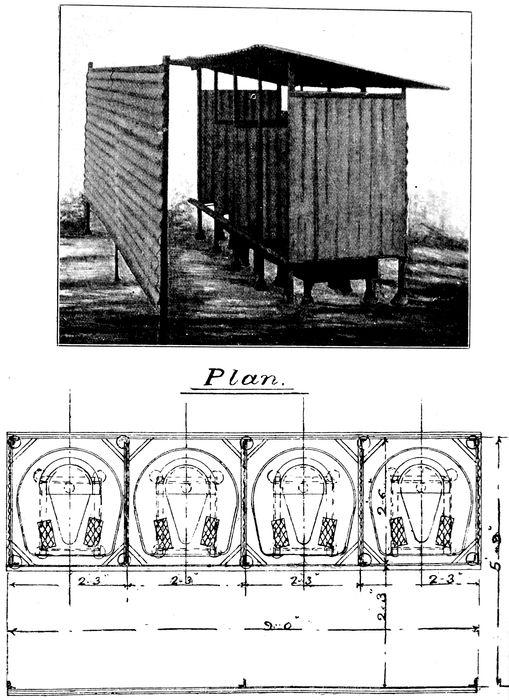
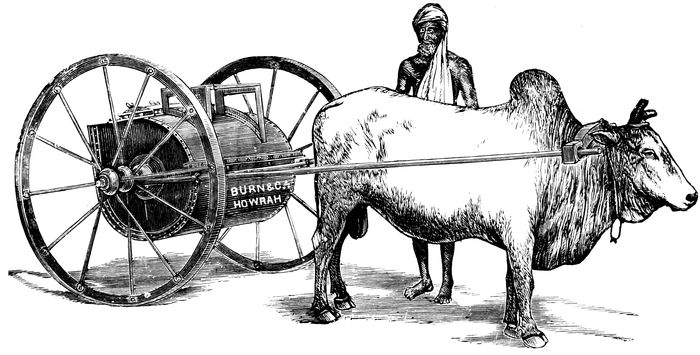
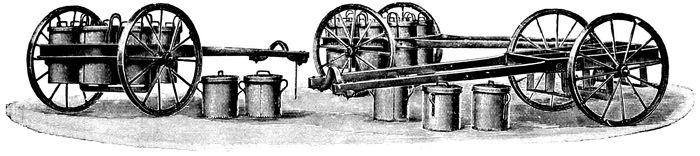
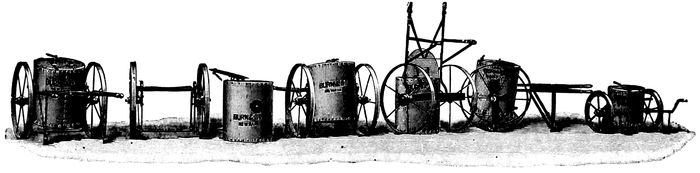
The cover image was created by the transcriber and is placed in the public domain.
BY
G. W. DISNEY
Associate, King’s College, London; Member, Institute, Civil Engineers; Fellow Royal Sanitary Institute; Late Sanitary Engineer to Government, Eastern Bengal and Assam
THIRD EDITION
CALCUTTA & SIMLA
THACKER, SPINK & CO
1914
PRINTED BY
THACKER, SPINK AND CO., CALCUTTA.
THIRD EDITION
DEDICATED
TO
Sir Lancelot Hare, K.C.S.I., C.I.E,
Late Lieutenant-Governor of Eastern Bengal and Assam.
Under whom the Author had the honour of serving for many years.
Ranchi,
The 17th June 1914.
PREFACE TO THIRD EDITION.
The Second Edition of this work being now out
of print for some years it has been suggested to me
that I should re-write the Manual and bring it up
to date. It does not purport to be a highly technical
work, but will, I trust, indicate to those requiring
fuller information where to look for it. Two Chapters
have been added on Road Making and Building
Construction which, it is hoped, will make the book
more useful to those for whom it is written. The
arrangement of the Chapters has also been altered.
My acknowledgments are again due to many
friends who have helped me in revising the Second
Edition of this Manual.
Ranchi, 17th June 1914.
G. W. D.
INTRODUCTION.
v
A concise handbook dealing with the most
important points of the sanitation of Indian Bazaars
is much needed; this is an endeavour to supply the
want and put the information available on the subject
in a convenient form, so as to facilitate the organization,
and control the working of the sanitary department
of a municipality. It is not within the
scope of this work to allude to large waterworks or
drainage schemes, but merely to show how existing
arrangements can be improved.
The real secret of sanitation is the prompt removal
of fæcal matter and refuse from the neighbourhood
of inhabited buildings before it has time
to decay, as in the early stages of putrefaction
emanations are evolved which are highly dangerous
to health; it is also an admitted fact that the common
fly is a considerable factor in disseminating
disease, as it conveys germs on the pads of its feet
from infected matter to the food-supply of the
inhabitants.
My thanks are due to many who have been good
enough to assist me in this work, and especially to
Lieutenant-Colonel Whitwell and Captain J. C.
Vaughan of the Indian Medical Service; to Mr. A.
E. Silk, Sanitary Engineer to the Government of
Bengal; and to Captain D. Meagher, the Officer in
charge of the Government Farm at Allahabad.
G. W. D.
November 1901.
PREFACE TO SECOND EDITION.
vii
The First Edition of this work was favourably
received and, being entirely disposed of within five
months of its issue, indicates that a want was met.
The Manual has been patronised by the Government
of India, the Secretary of State for the Colonies,
the Local Governments of Bengal, Madras, Burma,
Punjab, the United Provinces of Agra and Oude,
Assam, the Central Provinces, the North-West Frontier
Provinces, Baluchistan, and other Administrations,
as well as by several Native States, and by the Nepal
Durbar. A Second Edition with a good deal of additional
matter added, has therefore been prepared,
but this has been called for before the Author was
ready for it, and estimated results have in consequence
been given in several instances instead of recorded
facts. The science of sanitation is, however, progressing
so rapidly, that a good deal of useful information
is available, and advantage has been taken of
criticisms to amplify several points. Additional
information has been given on the Biological System
of Disposal of Sewage, on Markets, and Drain Flushing
among other subjects, and Appendices C to F have
been added.
I take this opportunity of again thanking many
who have assisted me, and for the generous tone of the
criticisms in the public press.
Muzaffarpur, 15th November 1902.
G. W. DISNEY.
CONTENTS. — CHAPTER I. Surface or Storm-Water Drainage.
Owing to the fact that earth for the construction
of most of the huts in a bazaar has been excavated
from the immediate vicinity of the buildings,
it is a matter of much consideration to determine
the most suitable levels the surface drains should
start at, as it is of importance that these should be
as shallow as circumstances admit of in order that
they may obtain the full benefit of purification by
sun and air. By adopting as high a level as possible
at the head of the drain it enables better gradients,
or falls, to be given which aids much in self-cleansing.
The greatest care should be taken not to lose, or waste
what little fall there is in the plains, as this is simply
invaluable. Deep drains rapidly become foul at
the sides and bottom, are difficult to flush owing to the
quantity of water required to do so effectively, and
great temptation is also given to adjacent house-holders
to bridge them over with wide platforms,
the consequence being that, sooner or later, the storm-water
drain, designed as an open one, and for which
it may originally have been more or less suitable,
soon changes its character, and becomes a badly
designed sewer, which imprisons and concentrates
noxious effluvia. When a drain runs beneath a road,
provision should be made for a part of it being
2easily uncovered to admit of examination and
cleaning. All drains should open into others at
acute, and not at right angles, and must join at
top to top, and not at base level; where necessary
the difference of level can be made up by falls.
Surface drainage of small roads.
The surface drainage of small roads and paths
in a bazaar is best provided for by the construction
of a central drain down the middle, to which the
ground is made to slightly slope from each side; this
prevents the accumulation of filth in the so-called
side drains, which are generally merely long pits;
and, provided a slight fall be given, they are self-cleaning
at every shower of rain.
In paths or gullies a small concrete saucer drain
can be constructed, at a cost not exceeding four
annas a lineal foot, into which the house connections
can be made,—the paths being paved with bricks, set
flat, not costing more than Rs. 2–8 per 100 square
feet. These should be laid at a good slope to the
drain, and as only foot traffic need be provided for,
is amply strong enough. In many cases it will be
found that adjacent house-holders are quite willing
to pay for this work, when once a commencement is
made, and the advantage is obvious to them.
Kutcha roadside drains.
In kutcha roadside drains care must be taken
that, in the process of cleaning, which generally
consists in the removal of the bed, they do not in
time become permanent roadside trenches without
fall; it is much better to have no drains at all
than this; mere depressions which, when dry, can be
swept, and which will be washed clean after a heavy
shower of rain, are much preferable. The proper
bed-level of a kutcha drain should be permanently
marked by wooden pegs driven well into the earth,
and built into a masonry pillar, 1 foot 10 inches
square, or by masonry profiles, at intervals of 100 feet
apart; this shows at once if the bed-level or section
has been unduly lowered during the process of cleaning
out.
Flushing.
3When designing a drainage system for a town
it is essential that provision for flushing be made at
the same time, otherwise the drains become receptacles
for filth for about two-thirds of the year.
This can be arranged by the construction of flushing
tanks, which, when full automatically discharge
into the drains, by water mains laid underground
discharging into the head or summits of the drains;
and also by the drains being divided up into convenient
sections by stops or sluices, which are
lifted automatically, or by manual labour, when the
section is full of water, thus ensuring an effective
flush.
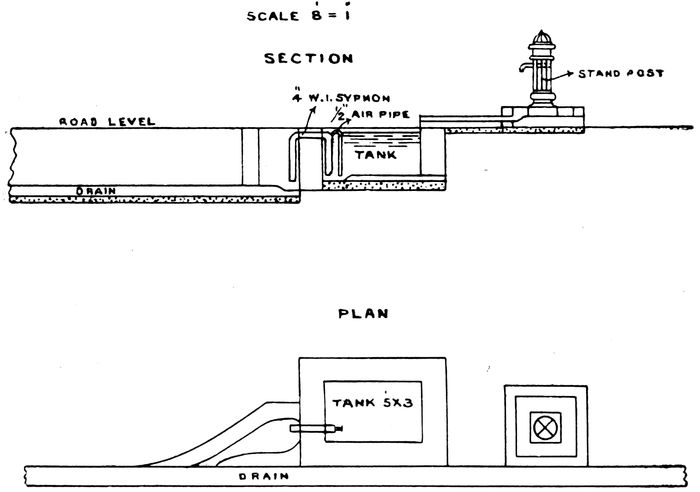
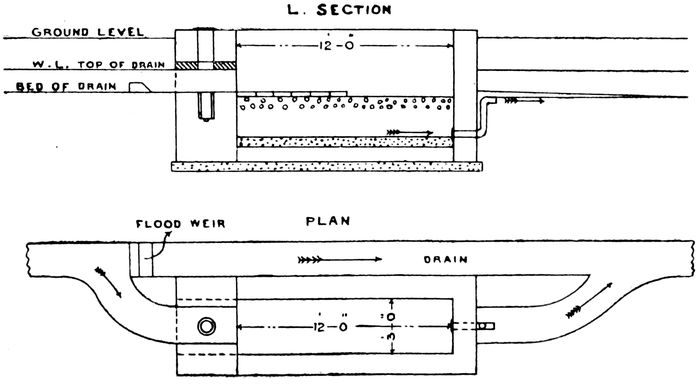
FIG. 1.
AUTOMATIC FLUSHING TANK
A type design of an automatic flushing tank is
shown in Fig. 1. These cost about Rs. 100 each
complete, the syphon pipe alone representing some
Rs. 30. Where sufficient head is not unavailable for
this type, Adams’ Patent Adamic Flusher may be
4suitable. These cost about Rs. 70 for a 4″ pipe size,
and works with a head of 10 inches.
Where sullage water is discharged into storm-water
drains this should be treated in sullage filters
at convenient intervals. See Fig. 18, page 36.
Masonry drains.
The most suitable form for surface drains is
the semi-circular base, with side slopes of 1 to 2·4,
as the discharge is only slightly less than that of
the ovoid section, and the drains are more easy to
construct. They can be easily swept clean, or run
through with a wooden board made to fit the section,
and pushed along by a boy.
The Dacca type rectangular drain, as shown in
Fig. 2, page 5, is very suitable for narrow lanes. The
dimensions can be altered to suit local conditions.
Much useful information as to the preparation
of drainage projects, and tables of discharges of
different sections, will be found in Practical Instructions
in Surface Drainage, by Mr. H. A. Gubbay,
Executive Engineer, Public Works Department, published
by the Government of Bengal.
In most cases, when designing a system of
drainage, it is advisable merely to take the general
surface level of the bazaar as the level to be drained,
leaving artificially caused depressions to be filled
up with the débris of old buildings, and any available
suitable material as opportunity occurs. It is
also generally unnecessary to provide for a very
heavy rainfall. The usual provision in this part of
India is for a run off due to ½ an inch of rainfall
per hour from densely built over, and ¼th of an inch
from suburban areas.
It is more scientific to design the drains with
reference to the possible flushing power and facilities
available, rather than that of the maximum rainfall.
The importance of proper drainage, especially
in connection with checking the spread of malarial
fever by anopheles mosquitoes has, owing to recent
5researches, been fully recognised. These are found
to breed most extensively in the earth-lined drains
alongside streets. Where brick-lined, the current
should be strong enough to wash away the larvæ,
but it is quite otherwise on the numerous kutcha
ones in every bazaar. It is also essential, in
Bengal, to make use of the powers conferred by
the Municipal Act (Section 195) to compel owners to
fill up small depressions which, during the rains,
form extensive and numerous breeding-grounds.
Every attempt should be made each year to brick-line
a section of the roadside drains as money is
available, where funds do not admit of much being
done. Grass and weeds in the earthen drains must
be cleared out at regular intervals during the rains,
and the oftener the better. Mosquitoes of the culex
tribe cannot also be disregarded, as these have been
proved to convey elephantiasis and other diseases,
and stegomyia, which abound in Lower Bengal, are
the hosts of yellow fever.
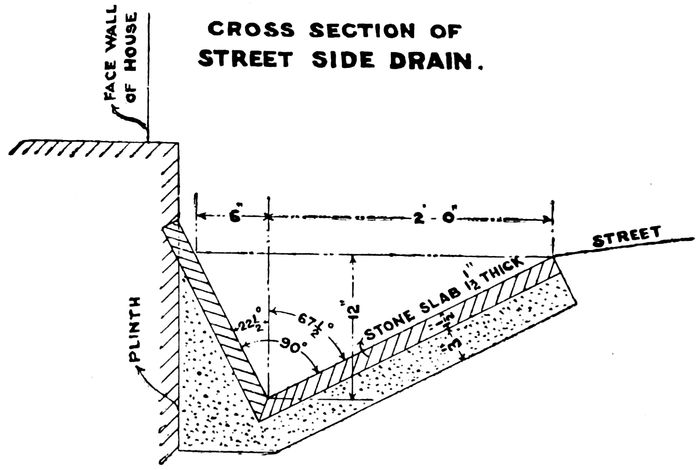
FIG. 2.
CROSS SECTION OF STREET SIDE DRAIN.
CHAPTER II. Water-Supply from Wells and Tanks. — Repairing. — Cleaning. — Disinfecting.
6
Registering wells.
Cleaning and repairing wells.
In order to obtain a comparatively pure water-supply,
under circumstances existent in most bazaars,
it is essential that the spill water from wells be led
away by properly constructed drains beyond what
is known as the cone of filtration; this may be described
as a circle drawn round the mouth of the well,
the radius being equal to the depth of it. Owing to
Indian customs, there is always a considerable
quantity of spill water in the vicinity of a well, and
this, when proper platforms and drains are not
constructed, finds its way back, after contamination,
by the line of least resistance, either down
the sides of the masonry lining, or by cracks and
fissures in the ground. For water supplies from wells
and tanks the main object is to prevent any water
once drawn out, again, after probable contamination,
flowing back into the source of supply.
Arrangements should be made for registering every
well in a municipality where this has not already been
done, and for taking over, or closing all those the
owners refuse, or fail to put in a proper sanitary state.
In Bengal this can be enforced under section 200 of
the Bengal Municipal Act (1894). A copy of the map
of a ward showing the position of all wells and tanks
therein is given in Fig. 3. The Well Register,
which should be corrected yearly, is given in Appendix
C, page 62. It is impossible in most cases, owing
to large numbers, for a Municipality to take over,
repair, and conserve all the wells (in the town of
Muzaffarpur, there were 718 wells) but much good
can be done by acquiring a certain number of the
most useful unowned ones, and making the owners
of others, when in a position to do so, put and
maintain them in a sanitary state. When new wells
are sunk, the owner must be made to construct
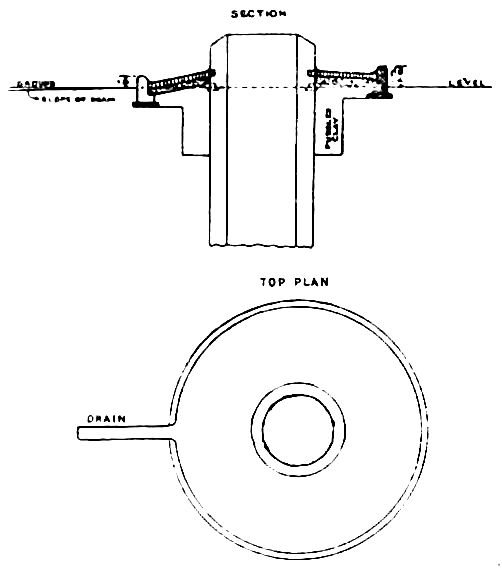
them according to a standard design. Fig. 4 shows
an inexpensive and good form of open well, top, and
platform. From the experience of ten years in the
Muzaffarpur District (from 1891 to 1901), where wells
on the sides of main roads were so treated, this is
possible. Some 400 wells on 725 miles of road were
taken over by the District Board, put in a proper
state of repair, suitable platforms and spill-water
drains constructed, and arrangements made for
annual cleaning out and disinfecting with permanganate
of potash during the hot weather months.
These were eventually greatly appreciated, and,
whereas in the first instance difficulties were experienced
in getting hold of suitable ones, it was of
late years necessary to make careful selections from
the applications received. In addition to this, the
owners of numerous ones, on whom notice was served
that if they did not put them in a sanitary condition,
they would be taken over and repaired by the
District Board, elected to do the work on the prescribed
lines at their own expense. It is a notable
fact that cholera when prevalent in villages close
by, frequently is not found in those where these
wells are situated. This organization is being extended
to villages which have an especially bad sanitary
record. For easy reference the Instructions for
Repairing, Cleaning and Disinfecting Wells are
quoted.
MUZAFFARPUR MUNICIPALITY
WARD Nº 11
FIG. 3.
7
1. The ground round a well must first be excavated
to a depth of at least 5 feet below surface level,
and for a width of 5 feet round the well and sealed
with puddled clay, the well lining being first rebuilt
from this level where necessary, and continued up
for a height of 2 feet 6 inches above ground-level;
the top of the well must be sloped off to prevent
8vessels being placed on it, and consequent splashing
getting back into the well. A properly made platform
resting on suitable foundations, must be built
round the well at 1 foot above at its highest point,
and sloping off to ground-level at its lowest, with
a ridge round it to prevent spill-water draining
away indiscriminately and an opening at its lowest
point, leading into a pucca drain, constructed with
a suitable fall, and continued until natural drainage
is reached, or outside the cone of filtration, so
as to prevent any water lodging in the vicinity of
the well.
2. A closed-in top prevents dust, which may
convey pathogenic germs, gaining access to the
water.
3. Wells should be dewatered, and cleaned out
at least once every year. The sides must be scraped,
and all mud, broken earthen vessels, etc., removed;
quicklime must then be applied to the sides and
bottom of the wells.
4. The only suitable time to clean out wells is
during the hot weather as the water in them is
then at its lowest level.
5. All wells must be cleaned out down to the
well-curb or “Jamot.”
6. Permanganate of potassium is a crystalline
salt-like substance of a purple colour, in the preparation
of which only mineral substances are employed.
FIG. 4.
Well Top
FIG. 5.
FIG. 6.
97. Put one or two ounces of the solid substance
into a dol, or bucket, which has been filled with water
drawn from the well about to be treated. Stir it up,
and pour the red solution thus produced into the
well, leaving the portion of permanganate that is
not yet dissolved at the bottom of the dol. Lower
the dol into the well, fill it with water, draw it up,
pour back the water as before, and repeat the process
till all the permanganate has been dissolved. In
all cases enough permanganate should be added to
produce a faint red colour lasting for 24 hours.
8. If the water in the well is bad, more permanganate
will be necessary. In such a case it will be
found that the strong red colour at first produced
quickly changes to brown, and then fades away.
This is because the permanganate destroys dirt and
is destroyed by it. Therefore, if the water in the
well is clean, a smaller quantity of permanganate
will be necessary. From one to four ounces of permanganate
will be found to be enough for ordinary
wells. If more permanganate is added than is
enough to produce a faint permanent red colour,
it is likely that frogs, that may be in the well, will
be killed. This will, in a few days, give the water a
putrid taste. If the quantity of permanganate is not
enough to produce a faint permanent red colour, it is
unlikely to do good. If possible, the permanganate
should be added at night, in order to leave the wells
undisturbed as long as possible. The water will be
fit to drink on the following morning. If then a red
colour is still present, the water may have an unpleasant
taste, but it is perfectly harmless.
Figure 4 is an illustration of the latest pattern
of well adopted.
New Wells.
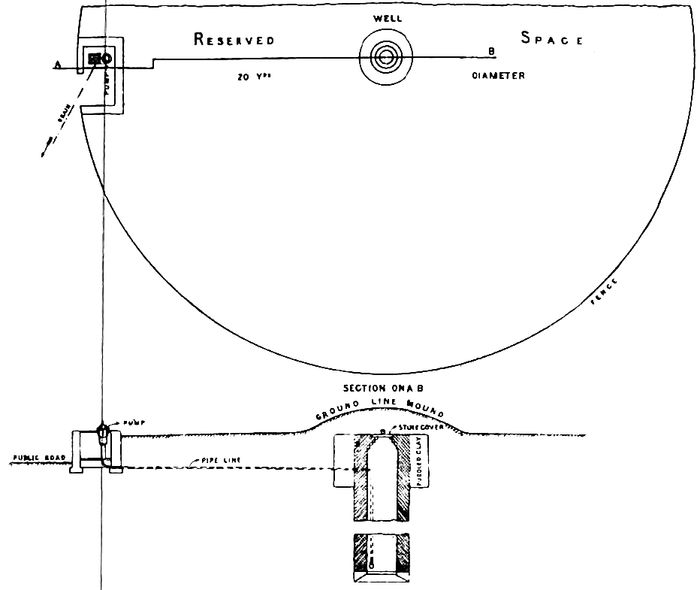
When a new well is proposed, and local conditions
are suitable, a safe form is that designed by
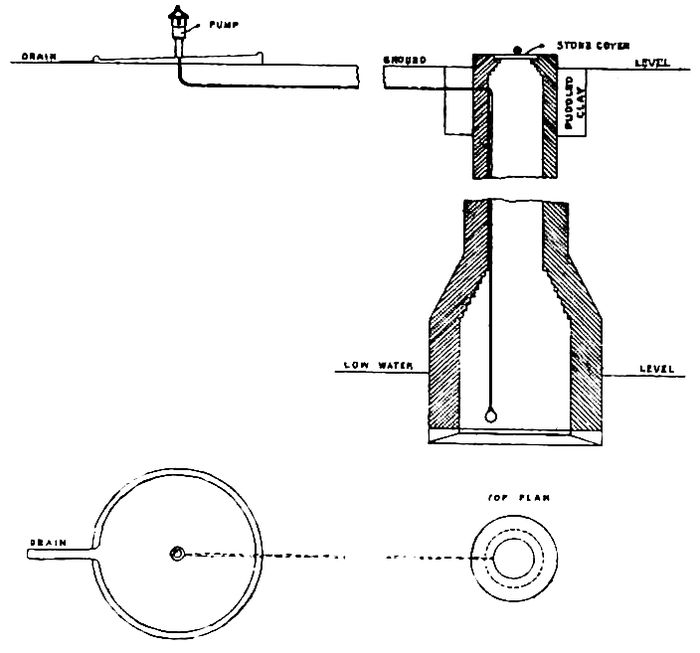
Dr. Cameron of Wigton, N. B. This arrangement is
shown in Fig. 5. The well should be in the centre
of a reserved area of at least 20 yards in diameter,
and the lead pipe leading from it to the pump must
be fitted by brass screw joinings. This is a suitable
design for the vicinity of cutcherries, where an open
space for a reserved area is generally available.
10Another excellent design for a new well, and one
more generally suitable, is shown in Fig. 6. This
prevents any danger of the water being contaminated
by dirty vessels being lowered into it for the purpose
of drawing water.
FIG. 7.
Tube Wells.
Tube wells answer admirably in many localities;
it is, however, always essential to have a bore hole
made first to determine the stratum
which has to be tapped, as
the point of the tube may be easily
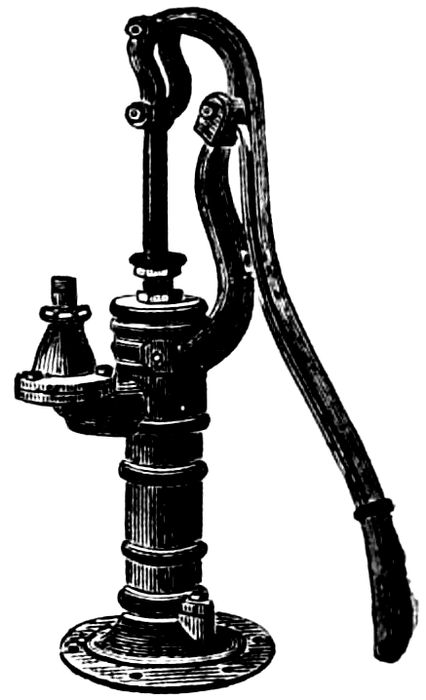
driven through this. An improved
form of pump is shown
in Fig. 7; this obviates the danger
of impure water being put in
the mouth of the pitcher spout
pump in order to make it draw.
The great advantage of tube
wells is that they enable a stratum,
underlying that of impermeable
stiff clay which exists in
many cases, to be tapped, thus
avoiding the danger of contamination by subsoil
water. The supply from a tube well is, however,
limited in quantity.
Where wells are founded on a clay stratum their
efficiency can generally be largely increased at a
trifling cost, by driving a pipe lined boring down until
water-borne sand is met. Great care must, however,
be taken that, when the boring is going on, this stratum
be not passed through, and constant tests of the
discharge obtained at the various depths are therefore
necessary.
Water drawing utensils.
In all cases it is advisable either to provide a
pump on a public well, or iron buckets with light
chains and wooden pullies, so that private water
drawing vessels be not lowered into the water. The
pump should be fixed on the platform surrounding
the well, and not on the top. A light corrugated iron
roof over the mouth of a well is also useful in preventing leaves, and other impurities falling in, and
also in affording shelter to the water-drawers.
11
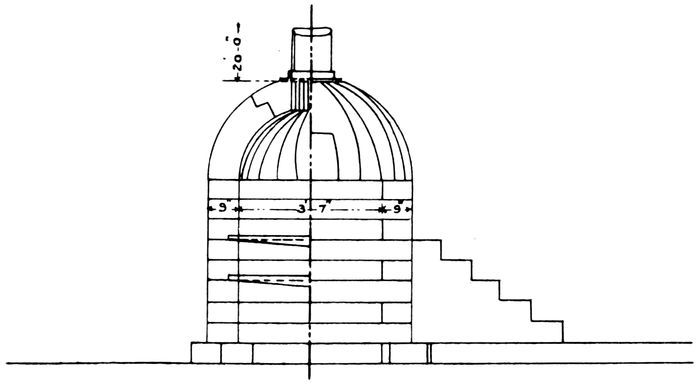
PLAN OF DOME FOR WELL
FIG. 8.
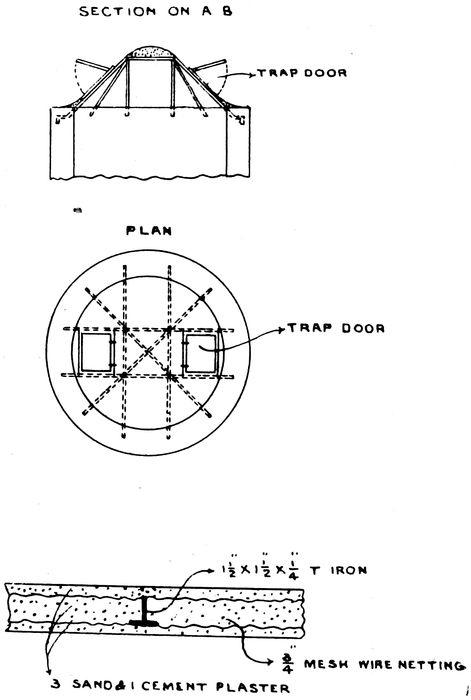
12An effective and economical well cover designed
for Ranchi is shown in Fig. 8, page 11. This, for
a 8′ diameter well, costs about Rs. 90.
Tanks.
A large proportion of the water-supply of a
Municipality is usually taken from tanks, into most
of which the drainage water from the neighbouring
vicinity is washed during the rainy season. This
can be prevented by raising the banks. The sullage
water of a bazaar is indescribably filthy, and if in-drainage
is prevented the tanks will fill up by percolation
as the level of the subsoil water rises—a
bad enough source of supply, but infinitely purer
than the surface water combined with filth from
a crowded area. The excavation of new tanks in a
Municipality should be discouraged as much as
possible, and attention paid to conserving the
existing ones. Small pumps and masonry platforms
for washing purposes draining away from the tanks
will improve matters. In the late Mr. A. E. Silk’s
book on “Municipal Engineering in Bengal” the following
classification of comparative purity of water-supply
is adopted:—
1. Deep spring water.
2. Subterranean or deep well water.
3. Upland surface water.
4. Subsoil water. (If distant from any collection
of houses).
5. Land springs.
6. River water.
7. Surface water from cultivated land.
8. Subsoil water under villages or towns.
Surface water from a bazaar is classified as
sullage.
13
FIG. 9.
14Where tanks are used as a source of drinking
water-supply, they should be properly fenced and
conserved, and the water drawn by a pump. Recent
researches have proved that polluted water, if stored
in a tank or reservoir where it can be preserved from
subsequent contamination, rapidly becomes pure.
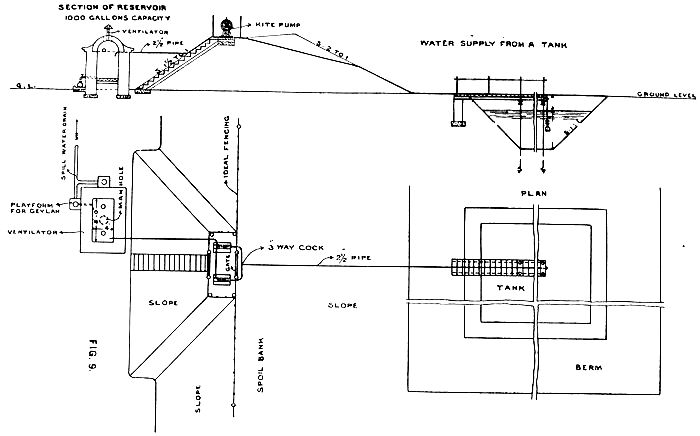
The Type plan, approved by the Sanitary Board of
Behar and Orissa, is shown in Fig. 9, page 13.
This for an existing tank of 100 yards square area is
estimated to cost Rs. 2,700. The pumps, provided in
duplicate, are Kite double action pattern and cost
about Rs. 425 each. The fencing provided is the
Ideal Woven wire fence, 10 strands, 48″ high, and
can be fixed at about 12 annas per yard.
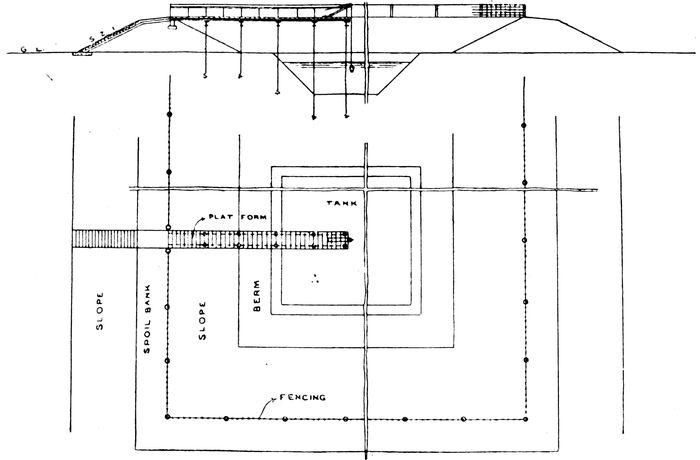
Another and a cheaper method is shown in Fig.
10, page 15. Here the tank is completely fenced in
with the exception of an entrance to a platform which
extends towards the centre of the tank from which the
water can be drawn by hand. Model rules for clearing
out and re-excavating tanks are as follows:—
Excavation.
1. Tanks should be cleared out and re-excavated
during the dry weather months when the level of the
subsoil water is at its lowest. Work should be
commenced in January or February and completed
before the middle of May, but these dates must
depend more or less on the locality, as in some
parts of the Province the prevalence of heavy thunderstorms
in May might make it advisable to complete
the work before then.
2. The re-excavation, until water-level is reached,
should be carried out in regular layers of 1 foot in
depth, an offset of 1 foot being left on the bank side
for each layer. This, when dressed off, will give
a regular side slope of 1 to 1 to the tank. When water-level
is reached, if it be considered necessary to
excavate below this, and if pumping machinery to
dewater the tank is unavailable, the area must be
divided up into compartments of suitable size, separated
by bunds, one, or more of which, can be
dewatered by bailing into the adjacent ones, when
the excavation can be continued to the required
depth, the other compartments being similarly
treated in turn.
15
TYPE DESIGN FOR FENCING IN TANKS
FIG. 10.
Disposal of Spoil.
163. The spoil from the excavations should be
placed on the outside of the embankment formed
round the tank when originally made, and should be
deposited in such a position to preclude, as far as
possible, its being washed back again by rain water.
Dressing and Turfing.
The crest of the embankment should be dressed
off to a slope of 1 in 12 away from the tank, with side
slopes on the outside of 2 to 1. This will prevent
direct contamination of the tank by spill water from
the crest, where persons or carts, may have encamped.
All slopes should be neatly dressed off; all those
above highest water-level being turfed during the
commencement of the ensuing rainy season. This
is very important as it prevents the chance of a
considerable quantity of the excavated earth being
washed back into the tank.
Water-supply for Municipal and Rural areas
is a subject which is, at the present day, receiving
much attention. It is being encouraged by contributions
from Government and from Local Authorities,
by gifts from wealthy Indian gentlemen, and
by loans from Government redeemable in a fixed
period. For rules for the preparation of projects
in the Province of Behar and Orissa see Appendix
F, page 69, and for the table of instalments for the
repayment of loans, Appendix E, page 68. The
comparative death-rate from Cholera and Intestinal
diseases in Municipalities which possess a pipe water-supply,
and those without, need only be glanced at
to prove the vital importance of a pure water-supply,
and even these figures do not adequately indicate the
true position, as further loss of life due to water-borne
diseases, cannot be traced out from the statistics
published. Major S. A. Harris, I.M.S., Sanitary
Commissioner, United Provinces, in his paper on the
effect of a pipe water-supply on the reduction of
Cholera in urban areas, read at the Second All-India
Sanitary Conference at Madras, in November 1912,
quotes the reduction of death-rate per mille before
17and after the provision of a pipe water-supply for the
following places:—
Before.
After.
Dehra Dun
10·19
2·25
Meerut
7·49
3·02
Naini Tâl
10·19
2·86
and stated that the number of years in which the
Cholera death-rate rose above 1 per mille is seen to
have been reduced by the filtered water-supply to
about ½ in Dehra Dun, Meerut, Benares, Lucknow
and Naini Tâl.
The cost of Water Works must vary considerably
according to local conditions. Where the
supply is derived from a source not liable to contamination,
from spring wells, tube wells and infiltration
galleries, where subsequent filtration is
unnecessary, the capital expenditure may vary
from Rs. 3 per head for a tube well, Rs. 4–8 from an
infiltration gallery supply, such as Congeeveram
(Madras), to Rs. 10 and over for a filtered water-supply
derived from a river. The cost of the distribution
system must necessarily vary according to its size,
and the density of population in the area served,
but this, under normal circumstances, may be assumed
at 50 per cent. of that of the Water Works.
As each Province in India has a Sanitary Engineer,
and as the subject of the preparation of a Water
Works project is a highly technical one, it is beyond
the scope of this work to go further than to impress
its importance. Any efficient Water Works started
means a large saving of human life and of much
misery.
CHAPTER III. Road Making. — For Oiling Roads.
18
One of the most important points towards
obtaining a good metalled road is to ensure a
proper foundation for the metal to be consolidated
on, and to see that the sides are well
confined or tied in. Where bricks are used for
this foundation they should be whole ones, not bats,
be tightly packed together and then rammed with
a wooden rammer. The edging should consist of
bricks-on-end well backed up with earth on the out,
or berm side. The same applies where stone is used
for the soling. These must have flat surfaces, be
of fair size, and be well hand-packed together and
rammed. It is not much use doing metalling work
on a raised road until the embankment has at least
2 rains over it to properly consolidate it. This
equally applies to the approaches to bridges on a
kutcha road where the metalled portion should be
extended to a length of at least 10 feet beyond the
toe of the approach slope.
Stone Metal.
In most municipalities it is financially impossible
to thoroughly repair all the roads each year, nor is it
necessary to do so, if the work has been properly done.
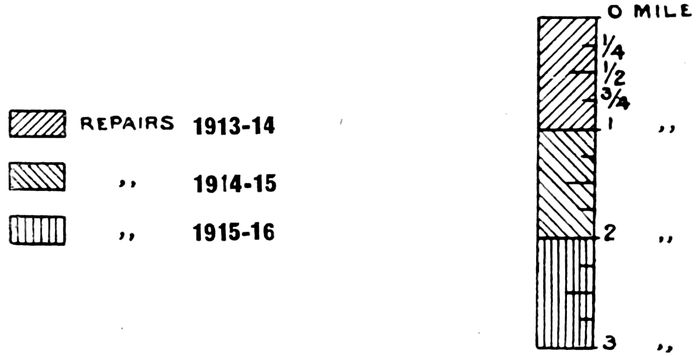
A system of biennial or triennial repairs should
therefore be evolved. A diagram showing how
this can be arranged is shown in Fig. 11, page 19.
In the selection of stone metal it is of great
importance to see that stone of equal grade and hardness
is used, and that surface, or weathered rock,
is not mixed up with the harder material lying
underneath it in the quarries. The stone should be
broken to the size that the largest piece shall pass
19freely through a 1½″ diameter ring. When repairing
existing metalled roads it is essential that all old
metal be picked up, and any rounded, or traffic-worn
portions re-broken, as it is impossible to ensure good
consolidation unless the edges and corners of the
stone metal be sharp. Consolidation should be done
by a heavy roller. A steam roller for preference.
The cost of a 6–ton steam roller is about Rs. 6,000
and the working cost about Rs. 4 per day, but this
must necessarily vary considerably in different localities,
depending on the cost of fuel and labour.
Diagram
FIG. 11.
Oiling Roads.
The roadway must first be swept clear of dust
and foreign material, when the mixture composed
of one part of coal-tar to 20 parts of oil (liquid fuel),
mixed cold, must be sprinkled on through a watering
cart. Men with hard long handled brushes follow
the cart, and brush the mixture into the roadway,
and repeat this operation for the second time in the
reverse direction, when ¼ of a mile has been done.
The oiling lasts for about 2 months, and costs about
Re. 1 per hundred square feet.
Tar-Macadam.
20Although tar-Macadam may be somewhat
ambitious for mofussil municipalities, an abstract
of the specification for MacCabe’s tar-Macadam,
which was kindly supplied to me by the Chief
Engineer of the Calcutta Corporation, is of interest,
see specification Appendix H, page 75. The cost of a
road so laid is Rs. 2–2–0 per square yard, and although
sufficient experience is not available to predict its
life, some has been down for 3 years and is still good.
The materials consist of two parts Pakoor Stone
metal, MacCabe’s patent Bituminous binder of Gas
Co.’s Coal-tar, and Stagg brand English coal-pitch,
in the proportion of 1 of tar to 3 of pitch by weight,
with stone chipping, and sand as a top binder.
Kunkar Metal.
All kunkar metal required for metalling or
repair work should be collected, screened, and stacked
by the middle of May at latest; screening must
be done in the dry weather, otherwise the meshes of
the screen soon clog up when the kunkar is damp,
and the operation is more or less a farce. A specification
for this is given below:—
(1) All kunkar must be washed, cleaned, and
screened during the dry weather months; and must
be of such quality that, being re-washed and rescreened
through an expanded metal screen of ⅜″
mesh, set at an angle of 45°, shall leave a residue of
80 per cent. pure kunkar. If kunkar of a lower
standard is stacked it must either be rejected, or the
cost of bringing the metal up to specification, deducted
from the price paid.
(2) No kunkar should be measured after the 1st
June. All kunkar collection must be completed by
15th May.
Brick Metal.
Brick metalled roads are rarely successful owing
to the difficulty of ensuring that the metal is of
equal hardness throughout, and especially so in a
dry climate, as under heavy traffic the metal soon
wears into brick dust, which either blows away in
the dry season in the form of dust, or is washed away
in the rains; on no account should jhama, or vitrified
21brick, and red brick metal be mixed, as their
degree of hardness is so different.
Morhum & Kutcha Roads.
It is of great importance that excessive slope be
not given in morhum or kutcha roads, otherwise they
will rapidly gutter during heavy rain. A rise of 1 in
50 to the centre of the road will generally be found
to be ample.
Stacking Metal.
In order to control the collection of material
it is essential that all be stacked to gauge, or in
boxes, and that the stacks be of equal size, thus
facilitating measurements.
Consolidation of Metal.
Consolidation of metal must invariably be done
as soon after the rainy season sets in as possible, and
especially so for kunkar. Any heavy rainfall in a
water-bound road after the metal is once laid is invaluable
in helping consolidation, as it fills up all the
interstices which may be left after rolling or ramming;
kunkar should be consolidated by ramming with heavy
wooden rammers, although on a new road a roller will
be of use in forcing the kunkar in between the joints
of the soling bricks, and jamming them into the
earth, thus making a solid foundation. A plentiful
supply of water should be used in the process of consolidation;
this is most essential. Stone and brick
metalling should be consolidated by heavy rollers, a
minimum quantity of surfacing material being used.
It is of great importance to keep the berms well
made up against the metalled portion of a road, otherwise
the metal will rapidly spread out under traffic.
In all cases it is of the greatest importance that
the natural aid afforded by climatic conditions be utilised
in making roads; this is a subject the importance
of which is frequently overlooked. When the consolidation
of metal is seen to be going on after the end of
the rains, unless there are exceptional circumstances
to justify this, the official in charge may be condemned
at sight as being ignorant or incompetent.
Long lengths of road should not be taken up for
repairs at a time, as this causes much inconvenience to
traffic. A furlong is the uttermost limit admissible.
CHAPTER IV. Building Construction.
22
Materials.
Kunkar Lime.
Kunkar lime should be burnt near the site of
works from clean kunkar with coal or charcoal.
When the burnt kunkar is taken out of the kiln it
must not be slaked, but after any clinker has been
removed, should be ground fine enough to pass
through a screen of 400 meshes to the square inch,
and must be used freshly ground. It should contain
over 40 per cent. of Oxide of Calcium.
Stone Lime.
Stone lime should be obtained unslaked.
Before being used it must be slaked and sifted through
a screen of 400 meshes to the square inch.
Lime Mortar.
Lime mortar to consist of fresh lime mixed by
measure with sand or soorki in one of the following
proportions, as may be directed:—
(a)
1 Kunkar lime.
2 Soorki.
(b)
1 Kunkar lime.
1 Soorki.
1 Sand.
(c)
1 Kunkar lime.
2 Sand.
(d)
1 Stone lime.
2 Soorki.
2 Sand.
(e)
1 Stone lime.
3 Soorki.
1 Sand.
(f)
1 Stone lime.
4 Soorki.
(g)
should not be used in the dry season as it sets too quickly.
23The materials should be spread in layers not
exceeding 3 inches in thickness, and then incorporated
in a steam mortar mill, or bylechuki, with sufficient
water to make it into a stiff paste. Mortar which
has once commenced to set should on no account be
used in any work.
Kunkar or Hydraulic lime must invariably be
used for waterworks and for wet foundations.
Soorki.
Soorki must be made from well burnt brick-bats,
and must pass through a sieve of 1 16 × 1 16 mesh.
Freshly burnt bats must only be used.
Sand.
Sand must be clean, sharp, and free from dirt.
Khoa.
Khoa must be broken from thoroughly burnt
bricks to pass through a ring of 1½″ diameter.
Cement.
Portland cement must be of the best quality
of English manufacture and comply with the standard
tests.
Cement Plaster.
Cement plaster to be made of one part of Portland
cement to two parts of sand, and must be properly
mixed and applied fresh, the thickness of each
layer to be ½″ finished. The surface must be kept
covered with wet bags or straw for at least three
days, after it has been completed.
Bricks.
Bricks must be hard, well burnt, sound, true to
shape and size, and free from flaws and other
imperfections, and to be of approved sample.
Brick-Work.
Bricks must be laid true to line and level, with
joints not exceeding ⅜″ in thickness, and of approved
bond. They must be soaked in water for at least
four hours before being used. All joints must be
raked out to a depth of ½″, while the mortar is
fresh.
Pointing.
All joints to be at least ½″ in depth, and thoroughly
cleaned out by watering and rubbing with a
brush. Mortar for pointing to be composed of one
part of lime and one part of soorki, ground very fine
in a mill, or strained through coarse cloth. Flush
24pointing to be lined off true horizontally and vertically
with a string, the lines thus made to be
deepened by a rule made for the purpose.
Culverts.
The type of culverts adopted must be dependent
on the depth of the drain below the surface of the
road. Where arching can be done it is preferable.
Where impracticable, the top should be covered with
stone slabs. Parapets should be provided with stone
copings. All culverts on a road or street should be
numbered, and registered in the form given in Appendix
G, page 74.
The system of quadrennial repairs to bridges
and culverts is an essential towards efficient administration,
and when once successfully introduced,
is economical.
In masonry buildings a damp-proof course, which
may be made with either asphalte, or with a layer of
Portland cement 1″ in thickness, laid at the top of the
plinth, and just above floor-level, is most desirable in
order to prevent damp rising in the walls, if for no
other reason than that it prevents damage to the
masonry, and to the plastering, or pointing.
CHAPTER V. Latrines and Urinals.
25
In dealing with the sanitation of a bazaar,
the provision of scientifically designed latrines and
urinals is a matter of the greatest importance.
There are numerous patterns of these, some very
well arranged as regards the necessary requirements
for efficient working, but many more not so. The
selection of the pattern adopted is frequently a mere
matter of chance, and the attention paid to the
subject by the Municipal Commissioners a minimum
quantity; badly arranged ones are probably just as
expensive to construct in the first instance as good
ones, which are much more useful.
Distribution of Latrines and Urinals.
Ventilation.
Drainage.
A large number of small latrines and urinals
suitably distributed are more effective than a few
large ones, and are not much more costly to construct
and maintain; they should not be grouped
together, or placed back to back, as light and air
should be allowed to play on all sides; for convenience
a small covered annexe may be provided
for the carts. For ventilation purposes it must be
remembered that, owing to the friction of the air on
the sides, a number of small openings are not nearly
of as great value as a large one of the same area.
Where good drainage is unavailable, storm-water
from the roofs should discharge into moveable buckets
which can be easily emptied, thus avoiding saturation
of the soil. Care must however be taken to put
these in places where they cannot be misused.
Latrines at Police Barracks and private houses.
Latrines should be provided at all Police barracks
or out-posts; the prevention of nuisance in a Municipality
is under the control of the local police, and
the out-posts are, in many cases, either unprovided
26with latrines, or have them of such a description
that the men are driven to commit the nuisance they
are supposed to prevent. Similarly, house-owners
should be made to provide suitable arrangements
for their servants.
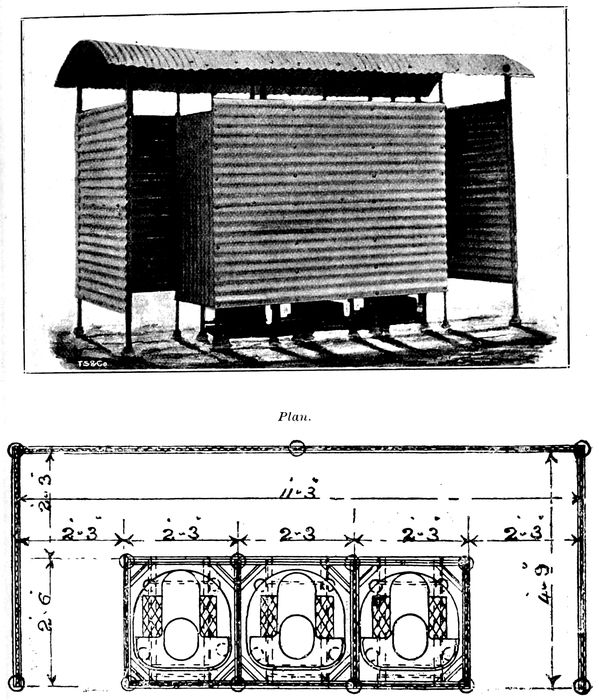
Bailey’s Patent Latrines.
A good latrine in the Indian market is ‘Bailey’s
Patent,’ Fig. 12, page 27. This combines efficient
ventilation of the latrine, with an arrangement of
double trays, thus preventing saturation and consequent
pollution of the soil on which it stands. The
superstructure is made of corrugated iron strongly
braced, and can be made of any number of compartments
required; the patent latrine seat inside is independent
of the superstructure, and can be easily
taken out and cleaned. The seats however are
inconveniently small. They cost from Rs. 114 for
a two-seat to Rs. 324 for an eight-seat one.
Donaldson’s Separation Latrine.
Donaldson’s Separation Latrine, in which the
urine and solid matter are kept separate, is also an
excellent pattern. Separation latrines are, however,
unsuitable where it is proposed to deal with the night-soil
by bacteriological agency, and must seriously
decrease its manurial value also. It is merely a
handy way of disposing of solid fæces.
Alipore Pattern Latrine.
The Alipore pattern latrine is a good type.
Stoneware seats set in brick-work are preferable to
iron ones.
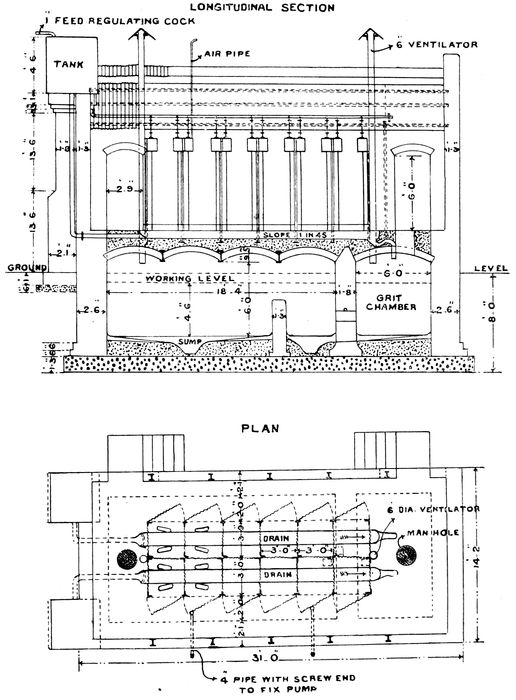
Septic tank latrines are very useful under
suitable circumstances. A design for a 12–seated one
with a separate flushing tank for each seat is shown
in Fig. 13, page 28, the estimated cost being Rs. 4,586,
or Rs. 382 per seat. Before deciding on adopting
a latrine of this description, “Sewage Disposal
in the Tropics,” by Major Clemesha, I.M.S., Sanitary
Commissioner, Bengal, should be consulted.
27
Bailey’s Patent Latrines, with Superstructure “Standard Pattern.”
FIG. 12.
28
PLAN OF 12 SEATED SEPTIC TANK LATRINE
LONGITUDINAL SECTION
PLAN
FIG. 13.
Masonry Latrines.
Disadvantages of Tarring.
29Where masonry latrines or urinals are provided,
the walls and floor should be smooth and well polished
to allow of easy cleaning, and should be white or
some light colour, so that if there is dirt, it can be at
once seen and removed. In latrines for hospitals,
and also in public ones which are much frequented,
it would be an advantage to line the walls to a height
of 3 feet, and also the floors, with glazed tiles or
bricks. This will make them much cleaner and less
forbidding looking. It is an obvious mistake to
coat the lower part of a latrine wall with tar, the
antiseptic value of which, especially in a hot climate,
is soon lost, and which hides and retains dirt in its
composition. The usual practice is to cover a dirty
latrine wall with a fresh layer of tar, thus preserving
an old coat of filth and forming a fresh bed for a new
one.
In all latrines it is of great importance to have
the rear openings of convenient size for the efficient
removal of the buckets from their seats on the
level platform.
Urinals.
A cart urinal in the vicinity of cutcherries will
be found useful. This is merely a receptacle of
convenient size resting on a masonry floor and placed
under a raised and enclosed platform on which the
squatting plate is fixed; the receptacle can be easily
removed and replaced by an empty one; the form is a
convenient one and can be efficiently ventilated.
Hindu Patent Urinal.
Disinfectants.
Bailey’s Patent Urinal, Fig. 14, page 30, is very
suitable. This costs from Rs. 48 for a two-seat to
Rs. 222 for a six-seat one. The patent urinal stands
inside the compartment and can be taken out and
cleaned without difficulty. For disinfecting purposes
chlorinated lime is very useful. It should have 33%
of free chlorine, and must be used fresh as it rapidly
decomposes. Phenyle is also very useful.
Red Hand Marks.
An ingenious way of making Hindus face the
right way, when using latrines, is to make the mark
of an outspread hand in red on the wall which they
should face, as no Hindu will turn his back on this
sign.
Model Rules.
A set of model rules for private privies and urinals
is given in Appendix A, page 57.
30
“Hindu” Patent Urinal, with Corrugated Iron Superstructure.
FIG. 14.
CHAPTER VI. Collection and Removal of Night-Soil.
31
In mofussil towns in Bengal the night-soil is
generally collected from public and private latrines
by conservancy carts drawn by bullocks, and varying
in capacity from 60 to 200 gallons. These, as a
rule, begin work early in the morning so as to
avoid causing a nuisance in the thoroughfares,
travel at a very low rate of speed, not over 2
miles an hour, and only make one trip a day,
in the majority of cases, owing to the distance
the trenching grounds are away from the centre of
the town. This means that a large proportion
of the human excreta remains at least 24 hours
in the receptacles of the latrines in the immediate
vicinity of densely populated localities. In the
temperate climate of England it is accepted as an
axiom that sewage should never be more than 24
hours in finding its way to the outfall, as it is, when
it has begun to decompose, more dangerous than when
fresh and decomposition sets in much more quickly in
the semi-tropical climate of Bengal. In many cases
the quantity of night-soil collected per head per diem
is exceedingly small; the average amount of solid
matter evacuated by natives may be taken at 10
ounces, and of urine 30 ounces, whereas returns from
several municipalities show a quantity varying from
·047 to ·37 of a gallon removed by the conservancy
carts. These quantities are, however, calculated on
the entire area of the municipalities, including the
suburbs, where, owing to the custom of Indians,
the gardens and adjacent fields dispose of a large
quantity. In order to obtain reliable results, the
densely crowded areas should be divided up into
blocks or sections, keeping the
figures well separated in the
municipal books, the density
of population per block calculated
and the quantity of
night-soil removed registered
daily. Many of the Indian
bazaars are long narrow ones,
situated on a high ridge of
ground, in which case it is desirable
to have several trenching
grounds, one for each block
or group of blocks, instead of
having one large one situated
at a considerable distance
from the centre of the town.
32
FIG. 15.—Crawley’s Patent Night-Soil Cart.
33
FIG. 16.—Receptacle Carts.
Conservancy Carts.
Receptacle Carts.
In order to effect the speedy
removal of fæcal matter, the
provision of suitable conservancy
carts is of vital importance.
Fig. 15, page 32, is an
illustration of Crawley’s Patent
Night-Soil Cart, and is a
good one for general purposes.
It is made entirely of wrought
iron, with an air-tight door for
filling and emptying; the
latter is done by releasing a
clip from the front of the barrel
which connects it to the
shafts and opening the lid,
when the barrel turns on its
centre and shoots out the contents.
A 75–gallon capacity
cart costs Rs. 130; a 110–gallon,
Rs. 160; and a 200–gallon
one Rs. 225. Small carts are
preferable to large ones, as they take a shorter time
to fill, and therefore tend to the more speedy removal
of night-soil from crowded localities. They are
34also more easy to handle
at the trenching grounds.
It will sometimes be
found advisable to provide
receptacle carts for removing
receptacles from latrines.
Fig. 16, page 33,
shows this arrangement.
These, however, owing to
their weight, and to the
difficulties of placing and
removing the receptacles
when full cannot, excepting
under special conditions, be
recommended for municipal
purposes. They cost,
including 12–gallon receptacles,
about Rs. 275.
Each latrine must be provided
with a receptacle,
into which the buckets are
emptied, this being placed
in a convenient position at
the back of the latrine; the
cart starts on its rounds
with six empty receptacles,
visits the latrines where it
picks up the full ones, and
replaces them by clean
ones. They are supplied in
6, 12 and 24–gallon sizes to
suit requirements, and the
arrangement avoids the
nuisance of transferring the
contents to a second utensil.
FIG. 17.—Night-Soil Receptacles and Hand Trucks.
Hand Carts.
Hand carts are necessary
in order to remove night-soil
from houses built in
narrow lanes and places
35where it is impossible to get bullock carts into. Fig.
17, page 34, shows a convenient arrangement for this.
The receptacles vary in size from 12 to 33–gallons, and
cost from Rs. 37 to Rs. 68 each; the bodies are
detached from the hand truck by simply raising the
handles and disengaging the two-forked bearings
with the trunnion; they are fitted with a hinged lid
and are made of strong galvanized iron; the hand
truck is of strong and light design, the whole being
of wrought iron.
Cesspools.
Where regularly-flushed masonry-lined side
drains are unavailable, the drainage from houses
must be led into masonry-lined cesspools, which
will be cleaned out daily by the municipal sweepers,
and the contents removed in conservancy carts.
These cesspools should be semi-circular in shape,
and plastered on the inside with Portland cement.
In many cases, where masonry drains exist, it
will be found possible to intercept this sullage,
and purify it through Biological Agency in small
tanks, filled with pieces of vitrified brick, broken
so as to pass through a 2–inch ring. The broken
bricks will last for about a year, when they should
be renewed.
Sullage Filter.
A drawing of a small Sullage Filter is given in
Fig. 18, page 36. The estimated cost of which is
Rs. 180.
Prompt Disposal.
It is of the very greatest importance to insist on
the prompt disposal of night-soil and refuse, and all
means which aid this, good roads, proper care and
feeding of animals, good carts, and the provision
of houses for sweepers, help to a great extent.
Registering Private Latrines.
In order to systematise the removal of night-soil
from private latrines, all these should be registered
and numbered according to the beats of the
attendant, or otherwise definitely indicated and
located, and the sweepers told off accordingly.
Wheels and Axles.
36When purchasing carts especial attention
should be paid to the quality of the wheels and
axles. The carts should not be too heavy and must
be of a convenient height to facilitate working.
SULLAGE FILTER
FIG. 18.
CHAPTER VII. Disposal of Night-Soil and Trenching Grounds.
37
Night-soil is generally disposed of by being
buried in trenches, but these are frequently too deep:
purification largely depends on the action of the
ærobic bacilli, that is, the group of microbes which
live close to the surface of the soil and require air for
their existence; these swarm in the top layers of the
earth, but are not found at a greater depth than
1 foot and diminish enormously in number as this
is approached. In order to obtain the best results,
both from a purificative as well as a manurial point
of view, the burial should be merely superficial and
not exceeding in depth the limit of ordinary cultivation,
in order to ensure the ground being thoroughly
aërated.
Selection of Site.
The sites for trenching grounds should be carefully
selected; light sandy soil unshaded by trees and well
open to the south and west will give the best results.
They should be well above flood level, at least 5 feet
above the highest known flood, situated on the down
stream side of the bazaar, connected by good pucca
roads with it to allow of quick carriage, as time is
the most important factor in the disposal of night-soil,
and should not be in the direction of the prevailing
winds with the town. A fringe or belt of
bamboos between the town and trenching grounds
will be found of the greatest use in keeping off flies
which might be blown into inhabited neighbourhoods,
and which are a most dangerous factor in disseminating
disease.
Burdwan Trenching Ground.
At Burdwan in Bengal there is a successful
example of what can be done with trenching grounds
38from a financial point of view. There the night-soil
of the Northern Section of the Municipality, where
the latrine system is in force, and which has a population
of about 23,000, is mainly disposed of in a
permanent trenching ground of 18 bighas in area.
This is collected from private latrines in covered
buckets and deposited in the conservancy carts at
the public latrines, whence it is removed to the
trenching grounds, where trenchers are told off for
each latrine group, who excavate the trenches and
are in charge of them; these trenches are 3 feet wide,
1½ feet wide, 12 to 15 feet in length and 1 foot apart.
The carts empty the night-soil in from one end until
a height of 9 inches of liquid is attained, the excavated
earth being then replaced. During the rainy
season Indian corn is grown, and in the cold weather
cabbage, cauliflower, Bengal pumpkin, and other
kitchen vegetables, for which there is a ready sale
in the local bazaar.
The trenching ground during the current year
1913–14 has been leased out for Rs. 600.
Cultivation of Jute.
In the damp climate of Bengal jute has been
found to grow very luxuriantly on newly-trenched
ground and yields an abundant crop; it exhausts the
soil so much that after the crop has been cut the field
can be re-trenched, an important point when the subsoil
water is practically 12 or 18 inches from the
surface while the jute is growing. Another advantage
in growing jute is that in certain localities there
is a difficulty in finding a market for vegetables
grown on a trenching ground.
Muzaffarpur Jail.
In Muzaffarpur Jail the trenches were made
1 foot deep, 1 foot wide, and 1 foot apart, and varying
in length according to requirements; 3 inches of
night-soil are filled in and covered over with the
excavated earth; 20 trenches are always kept ready,
being excavated the day before. Corn is found to
grow luxuriantly after the trench has been filled in
for a month, and other kinds of vegetables, excepting
39potatoes, after two months. Urine and sullage water
are buried in different fields and at a considerably
greater depth.
Allahabad.
At the Government Farm at Allahabad (United
Provinces) the system known as the Allahabad
Shallow Trench was in successful operation, and
provided for the whole of the cantonment and half
the municipal population; there is an unlimited
area of land available, the soil being of various kinds,
black cotton, sandy loam and stiff clay. The only
crops grown are grass and sorghum, and it is found
that the manurial value of the night-soil is not
exhausted for three or four years. Trenching can,
however, be done every third year on the same land
without making it “sewage sick;” land which was
worth Rs. 2 will, after trenching, fetch about Rs. 10
per bigha for seven or eight years.
At Meerut for the year 1911–12 the sale-proceeds
of night-soil and city sweepings amounted
to Rs. 12,871, and at Furrakhabad cum Fatehgarh to
Rs. 18,317.
Allahabad Shallow Trench System.
The area required for the contents of a 60–gallon
conservancy cart is 80 sq. ft., the most suitable
dimensions being 16 feet long by 5 feet wide; 3 inches
of the top surface of this space is removed and
placed on the embankments of the plot near which the
first line of trenches is dug; the subsoil thus exposed
is then well cultivated and pulverized to a depth of
9 inches, when the contents of the cart are tipped
into the centre of the trench; the liquid matter
rapidly sinking into the loosened soil, while the solid
excreta remains on the top in a layer less than ⅛ inch
in thickness; 3 inches of earth are then similarly
removed from the next trench which is parallel to
the first, no intervening space being left, and thrown
over the night-soil in the latter. The practical working
is very simple, as all that has to be done, is to see
that a sufficient number of trenches for the daily
supply are dug the day before and the earth from them
40placed over the filled ones. It has been found from
experience that night-soil, thus treated, decomposes
in less than a week and, if dug then, no trace is observable;
the effluvium disappears after three days,
and crops are successfully grown immediately after
trenching. The Shallow Trench System is by far
the most scientific one, but requires a large area of
land, working out to 545 sixty-gallon carts per acre.
At Muzaffarpur during 1912–13, part of the night-soil
was sold for Rs. 1,200, and part of it trenched in the
municipal trenching ground, which was leased out for
Rs. 1,045. The practical objection to this system
is the fly pest. It is therefore only applicable where
the trenching grounds are remote, and to the leeward
side of the town. Sprinkling chloride of lime or
quicklime on the top of the trenches prevents
the breeding of flies. The researches of Majors
Firth and Horrocks, R.A.M.C., published in the British
Medical Journal, however, show that the enteric
bacilli is capable of surviving in soil for much
longer periods than has been believed possible.
These can exist apparently in ordinary soil for 65
days, in sewage-polluted soil for at least 53 days,
while in soil sufficiently dry to be blown about in dust
for 25 days, and for about a similar period when exposed
to a hot summer’s sun. The authors of this
note have also proved experimentally the translation
of infective material from sun-dried and dusty soil
by means of wind, as also by flies which have walked
over or fed on polluted earth, indicating the advisability
of treating night-soil, especially from Military
Cantonments, in septic tanks and filter beds before
applying it to soil—vide Chapter IX, page 50.
Area of Trenching Ground.
In order to arrive at the area necessary for a deep
trenching ground for a bazaar of 10,000 inhabitants,
and assuming that not more than ⅛th of a gallon of
night-soil per head per diem is removed, provision
will have to be made for 1,250 gallons or, say, 200
cub. ft. If the trenches are made 1 foot wide, 1 foot
deep, and 1 foot apart, and are filled with 6 inches
41of night-soil, 400 cub. ft. will be required daily, or
allowing for roads and divisions between the plots,
say 12 acres, for a year’s work, or, in other words,
the area required is, one acre for 833 persons. The
trenches should be divided up into plots or sections
for each latrine circle, excavated, when weather
permits, at least a week before they are used so as
to aërate the earth; the bottom of the trench should
also be dug up to a depth of 9 inches for the same
reason.
The following extract describes somewhat forcibly
what may, and undoubtedly does frequently
occur in many instances:—
“Trenching again is a success in dry soils, but
a good deal of ground is required, and sufficient
trenching ground is not always available within
practically workable distances of the night-soil producing
areas (public and private latrines), and often
enough, whereas it may be quite successful in a given
ground in the hot weather, it will, in the same ground,
however fresh, prove an absolute failure in the rains,
when, owing to the high water-level in the subsoil,
everything trenched is brought to the surface by the
gases of putrefaction, and the entire area trenched
becomes a pestilential bog, crawling with maggots,
bubbling with the foulest odours and swarming with
blue-bottle flies, whose chief delight is to frequent
the houses in the neighbourhood and infect both
food and drink.”
CHAPTER VIII. Collection and Disposal of Refuse.
42
The scavenging of a town and the disposal of the
refuse has probably more effect on its sanitary state
than anything else; dirty rags, dead grass and other
refuse lying about, are ideal homes for germs of
disease to live and flourish in, and these, when a
shower of rain falls, very frequently get washed
into the water-supply. The modern system of
cremation in specially constructed incinerators is
the only safe method of disposal of town sweepings.
Even in England, where the water-supply is, in the
majority of cases, not affected, careful observations
have proved that there is an increased liability to
enteric fever in the localities of refuse heaps. In an
Indian bazaar dependent on wells and tanks for its
water-supply, anything more barbarously insanitary
than the filling up of deep tanks with town refuse is
hard to imagine. Deep burial keeps the germs of
disease alive, probably for years, in the very stratum
the drinking water is frequently taken from.
Dust-bins.
In order to facilitate the collection of refuse,
dust-bins are of great use; they should, however, not
be so large as to become unwieldy, as it is much more
preferable to have numerous small ones conveniently
placed, than a few large ones; the simplest shape is
a circular one of corrugated iron, open at both ends,
provided with a pair of handles, and resting on a
brick on edge platform, with a groove therein into
which the bin fits, on the same level as the street.
When the collecting cart comes round, the bin is lifted,
the contents shovelled into the cart, and the bin then
replaced; these should be cleared at certain fixed
hours, and house-holders ought to be encouraged
43to have private
ones of small
size near their
doors if space
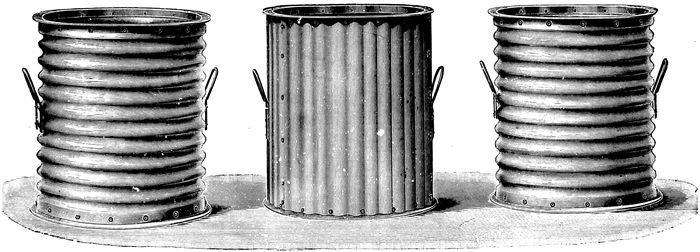
permits. Fig. 19
is an illustration
of these
bins, and being
made of galvanized
iron are not
liable to rust.
They vary in
price—for bins
2 feet 9 inches
in height and 2
feet in diameter
from Rs. 6 each,
without angle
iron rings at top
and bottom, to
Rs. 12–8 each
with rings.
These receptacles
should
not be placed
within 50 feet
of any well or
tank.
FIG. 19.—Corrugated Dust or Refuse Bins.
The selection
of strong and
serviceable refuse
carts is also
a matter of importance,
especially
as regards
the axles and
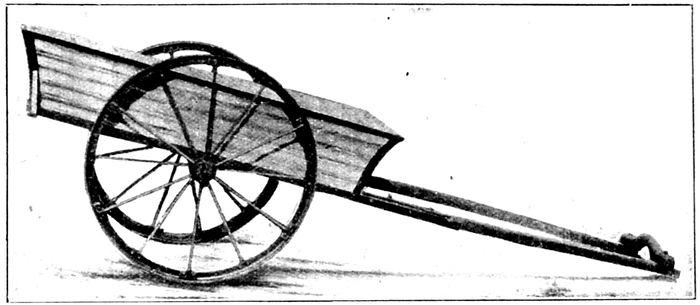
wheels. Fig. 24,
page 48, is an
illustration of a cheap but effective type. The
cost is Rs. 120 for a cart of 30 cub. ft.
44capacity, Rs. 150 for 50 cub. ft., and Rs. 200
for 90 cub. ft.
All the working parts should be of standard
size, duplicates of which can be economically purchased
and kept in stock
in the event of a breakdown,
when they can be
easily fitted by unskilled
labour. This is important,
as few municipalities
have good workshops.
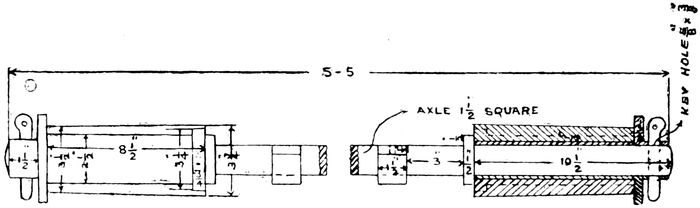
The axle box in
the wheels should invariably
be the full width
of the hub. A new axle,
with axle box and sleeve
or jacket to take the
wear and tear off the
axle, can be made up at
a small cost, Fig. 20.
In the Patna Municipality
this is supplied
complete for Rs. 9–2–0.
AXLE, COLLAR, AND BUSH
FIG. 20.
In Municipalities
where the quality of
work warrants it, it will
be found economical to
maintain a small workshop
where repairs can
be done, but this must
be properly organized.
The following cart Register kept up in Patna
City will simplify control of the carts, and
ensure proper repairs being done. It commences
with an Index, each cart is numbered
consecutively, whether it be water, conservancy
or refuse cart, and the number permanently marked
45on it. At the ledger folios referring to any
cart appears—
1. The number of cart.
2. Date when made.
3. Maker’s name.
4. Where worked (ward and by whom) and below
that
Date.
Note of repairs.
Cost.
Remarks.
1902 12 11
New axle
Rs. 9–2–0
This is of course separate from the Stock Register,
and may appear to be a mere detail of organization,
but is very useful in administration.
For towns and small Municipalities Incineration
is by far the safest, and in most cases, the most economical
method of getting rid of rubbish. If night-soil
be mixed with the rubbish nuisance generally
arises.
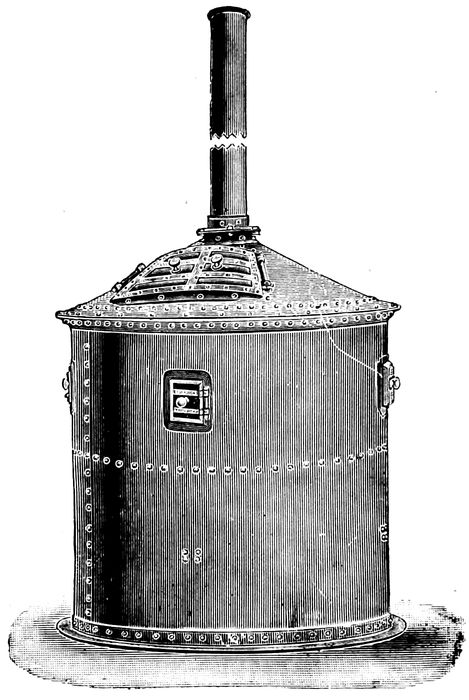
There are various types of incinerators, but for
burning town refuse only a very simple one, merely
a furnace and chimney, is quite enough, and several
of these can be constructed at a very small cost outside
a municipality at convenient centres, where the
smoke will not cause a nuisance. Many of the existing
incinerators have been designed to burn night-soil
as well as refuse, as is generally done in military
camps and forts on the frontier.
Madras Incinerator.
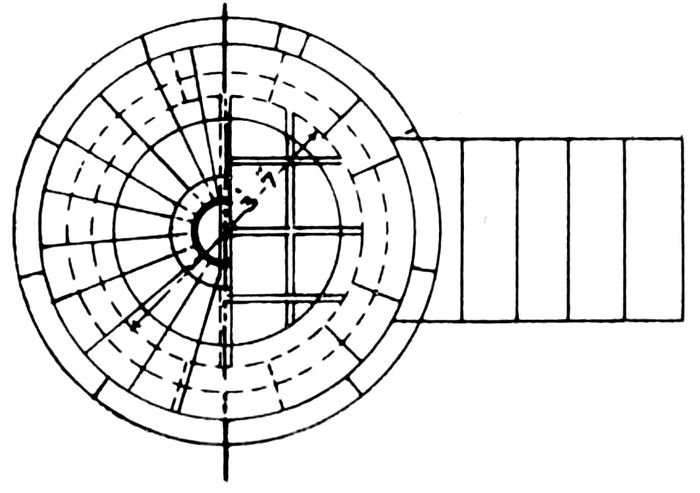
The Madras type Incinerator is shown in Figs. 21
and 22, page 46. These were designed to suit local
conditions by Mr. C. L. Griffith, while Engineer of the
Corporation, and cost Rs. 100 for masonry and Rs. 25
for ironwork. There are a considerable number of
these at work, distributed throughout the Municipal
area, so as to reduce the load for carting to a minimum,
a very important factor in a straggling town.
46
HALF SECTION & ELEVATION
FIG. 21.
PLAN OF AN INCINERATOR
PLAN
FIG. 22.
47The Sealkot Improved Type Incinerator is also
a suitable and economical one. A 4′ diameter one
is capable of burning about 300 cub. ft. of rubbish
daily, and it costs about Rs. 400. See Fig. 23.
FIG. 23.
Harrington’s Improved Incinerator.
Harrington’s Improved Refuse Incinerator has
been in use for several years. Each furnace burns
from 500 to 1,500 cub. ft. of refuse in 24 hours, and is
attended by one man who works in 8–hour shifts,
and who charges the furnace at the top and removes
the ashes from below the fire bars. The fires do not
die out when the furnace is properly charged, and
no coal or other fuel is required. It was patented
by Mr. R. R. Harrington.
Horsfield Incinerator.
The Horsfield Back feed continuous grate type
with 6 cells, designed to dispose of 10 tons each in
24 hours, has been adopted for Colombo, the cost of
48destruction varying from Rs. 1·30 cents to Rs. 1·50
cents per ton.
FIG. 24.—Corrugated iron refuse cart.
Burning Refuse in Stacks.
A large amount of town refuse can be satisfactorily
disposed of by stacking it judiciously and
setting fire to it from the windward side, when it
gradually and steadily burns away. This is, of
course, only practicable during the dry weather
months when the sweepings are comparatively dry.
In this, as in every case of removal, the beats of
the carts should be systematised and a fixed area
allowed to each cart.
Filling hollows with refuse.
Where incineration is not practicable the only
method of disposing of street sweepings is by filling
up hollows or old tanks, when the following rules
should be observed:—
1. The hollow or pit should first be pumped out
quite dry; if wet, a horrible nuisance is caused.
2. Where the hollow or pit is a large one a section
of it should be bunded in, staked off, and filled up to
surface level before the rest is proceeded with.
3. The sweepings, as soon as ground-level is
attained, must be at once covered over with earth,
or the débris from old houses, walls, etc., so as to
49prevent them being exposed and acting as breeding-grounds
for flies.
A rapid and effective method of filling a tank
when land is available round its border is to excavate
shallow pits parallel to its sides, the earth
from which is thrown into the tank, and the pits
then filled in with sweepings.
A form for regulating the progress of the work
of filling up depressions or tanks is given in Appendix
B, page 61.
Unless, under exceptional circumstances, it is
most undesirable to fill up any hollow or tank in the
vicinity of any well from which drinking water is
obtained. It may possibly be found the lesser of
two evils to fill up small tanks or hollows in the
interior of a bazaar with refuse, as these are frequently
in an undescribable state; the charge made by a
Municipality for doing this should, however, be
so adjusted as to admit of the surface being well
covered in with earth, which must, in all cases, be
insisted on. If no charge is made, and no depôt
for the refuse selected, it will be found that the
cartmen will sell it by the cartload to irresponsible
persons, when reasonable precautions as to covering
in with earth and selection of site are not possible,
the consequence being that innumerable breeding-places
for flies are well distributed throughout the
heart of a densely populated neighbourhood, in
places where earth has been from time to time
excavated for building huts.
CHAPTER IX. Biological System for the Disposal of Night-Soil.
50
Since this chapter was written, some 12 years
ago much research work has been carried out in
1906. This was in India first systematised by Dr.
Fowler in his report on “Septic Tanks in Bengal”
and has been carried on by Major Clemesha, I.M.S.,
Sanitary Commissioner, Bengal, whose work on
“Sewage Disposal in the Tropics” published by
Messrs. Thacker, Spink & Co., Calcutta, is a most
useful one and should be consulted by those interested
in the subject.
In the present state of knowledge of the science,
it would be unsafe to discharge the effluent into a
water-supply of small volume used for drinking
purposes below the point of discharge, or in fact into
any water which may be a potential source of water-supply,
unless it be first sterilised. This can be
easily and economically done with chloride of lime.
In dealing with the resultant liquid of bacteriological
treatment it is safest to consider it as a possible
source of danger, and to discharge it either into the
storm-water drains of a town, on land for irrigation
purposes, for which it is most valuable, or into a
large volume of running water, as circumstances
admit of.
The great advantage of bacteriological treatment
of night-soil, and one which it is impossible to overestimate,
is, that it enables the excreta to be disposed
of when fresh, eliminates the necessity of stale night-soil
being carted through crowded thoroughfares at a
very low rate of speed, and consequent danger of the
food and water-supply of the people being contaminated
51by the germs of disease conveyed by flies, or
blown on in the dust. Latrines can be constructed
over septic tanks, the home of the anærobic bacilli,
where the excreta at once passes in, or dumping septic
tanks can be worked at the night-soil depôts, where
the stuff is at present collected, as at Darjeeling.
In Military Cantonments, where enteric is generally
more or less epidemic, it is most important
that the night-soil be treated by biological methods
before it be applied to the soil, as installed at most
of the mills on the banks of the Hooghly, and at the
East Indian Railway Workshops at Jamalpore.
Septic Tanks.
Of the various methods of bacteriological disposal,
the closed septic tank is, for climatic reasons,
the most generally suitable for India. In this the
anærobic bacilli are provided with a congenial working
place in the closed tank; and the ærobic ones are
similarly provided for in the filter beds; the open
septic tank, however, gives equally good results, as
the scum, which rapidly forms on the surface, and
which generally attains a considerable thickness,
enables anærobic conditions to obtain in the tank
itself, but care must be taken that this scum is not
broken.
Filter Beds.
The ærobic Contact Bed filters are merely open
tanks filled with coal, coke, or large cinders, through
which the liquid is allowed to percolate at intervals.
The bacilli live and flourish in these, and do their
work during the periods from 2 to 4 hours the tanks
are charged.
The percolating continuous filters are those over
which the effluent is continuously sprinkled and
through which the fluid slowly percolates. Experiments
have conclusively proved that good results
can be obtained from either when a suitable sewage
is applied.
CHAPTER X. General Sanitation.
52
Trees and tall crops.
All the lower branches of trees in crowded
areas should be pruned; these are useless or superfluous
for shade, and only impede the free circulation
of air. This should be done by sawing off any branch
flush with the main trunk, or with its main branch.
In no case should a ragged stump be left, and, if
possible, the wound should be smeared with tar.
Lopping must be done with a handsaw and in no case
with an axe; the best season for doing this is at the
end of the cold weather, but it can also be done at
the end of the rains. The final form of a tree should
be a straight stem up to 15 or 18 feet, without a
bough, and above that height its natural shape whatever
that may be. This will allow of free ventilation
of the roads and streets. For the same reason no
tall crops, such as Genera, or Indian corn, should be
allowed near houses, and jungle should be kept
cleared as far as possible.
Tanks.
Householders should not be allowed to excavate
small tanks in their compounds to procure earth from
for the plinths of their houses, as these become in
time mere cesspools, where the inmates bathe, wash
their clothes, and often drink the water. Further,
these become suitable breeding-places for mosquitoes.
Plots of ground should be set aside by Municipalities,
where, for proper reasons, earth can be taken. These
common excavations will in time become large tanks,
which can be properly conserved and utilized. For
the same reason earth for roads and railways should
not be removed from isolated pits, but should be
taken so that the resultant excavation forms one
continuous channel running parallel with the road,
53or should be taken in shallow layers so as to avoid
the formation of a pit or hollow, the existence of
which is especially objectionable in the light of recent
research as mosquitoes breed and generate in them,
and so spread malarial fever. Where such hollows
exist, the growth of fish should be encouraged,
as they feed on the mosquito larvæ when present.
Cultivation within urban limits.
From the experience of troops on service, it is
found that camping near recently turned-up soil
is usually followed by fever. Ploughing up of land
for agricultural purposes should, if possible, be prevented
within municipal urban limits. In most
municipalities there is a suburban area which is
pretty well all cultivated, but cultivation in densely
populated areas, as often occurs, should be discouraged.
Dhobies.
Dhobies should not be allowed to wash clothes
in stagnant tanks, as it has been proved that the
spread of parasitic eczema, or dhobies’ itch, is thereby
facilitated. Where a water-supply exists a small
washing platform with taps should be provided free of
charge by the Municipality. Where not, they should
be made to wash in running water, or in tanks specially
passed by the medical officer. It is most important
that all dhobies be registered, licensed and told off
to the different ghats; it may be free of cost to them
in the first instance, but after the system has been
successfully introduced, well-to-do employees can
easily be induced to pay a small annual fee for superior
accommodation. This will eventually fully cover the
cost of the necessary supervising establishment and
incidental expenditure.
Markets.
The importance of the regular inspection and
control of markets, through which the food-supply
of a large proportion of the inhabitants passes, can
hardly be over-estimated. In these, special accommodation
and water-supply suitable for the articles
for sale, e.g., fish, vegetables, meat, and livestock
54should be provided, and a staff employed to see
that the existing laws are duly enforced, and that
the quality of the food-stuff exhibited for sale is
such as should be permitted. Public slaughterhouses
for animals, the inspection of meat, and the
disposal of offal should also be systematically regulated
and inspected. The cost of erecting suitable
market accommodation will soon be repaid and the
investment become a source of income to a Municipality
if the scheme is properly worked. The
great point is the provision of good ventilation,
drainage, and of a water-supply for flushing purposes.
A design of an inexpensive market of 40 stalls for
the Muzaffarpur Municipality constructed in 1902,
at a cost of Rs. 4,786, is given in Fig. 25, page 55.
This for the past three years gave an average income
of Rs. 253. A loan of Rs. 4,800 at 4 per cent., repayable
in 30 years, would entail an annual expenditure
of say Rs. 278 (see Table of calculations of
repayment of loans by equal instalments, Appendix
E, page 68), so the results there are not satisfactory
from a financial point of view.
Disposal of Dead. Burning Ghâts.
The scarcity of timber generally prevailing, and
its consequent expense, makes the process of cremation
among the poorer Hindus frequently a farce,
the corpse being generally merely charred, and then
thrown into the nearest river, which thereby may
be contaminated by the germs of disease; often
the professional cremator does nothing more than
throw the body into the water. It is time that
rich Hindus came forward and constructed proper
crematoria in the towns on the banks of the Ganges
for the suitable disposal of their dead. Coal should be
used and the burning ghâts be looked after by
Brahmins, as at Kalighat in Calcutta. In Muzaffarpur,
a new burning ghât on the banks of the river,
down stream of the town, was opened under the
control of the Municipality. A waiting-room to
shelter the persons accompanying the corpse will be
constructed at the cost of a leading zemindar; and the
sale of fuel was regulated. For the cremation of an
adult corpse this is supplied for about Rs. 2 and for
child Re. 1, varying with the seasons, but private
supply was allowed, provided it be sufficient for
perfect combustion of the body. At least 9 maunds of
mango wood is required to burn an adult corpse properly,
the rate for this being about 5 maunds for a
rupee.
55
FIG. 25.
MUNICIPAL MARKET 40 STALLS
END ELEVATION
PART PLAN
CROSS SECTION
Burial-grounds.
56Mahommedan burial-grounds should not be
allowed near crowded areas, or the sources of water-supply.
In most towns these will be found to be
overcrowded; new ones should be opened under
municipal control, as provided for in sections 254
to 260A, Part VI of the Bengal Municipal Act. An
area of half an acre for every 1,000 Mahommedan
inhabitants is desirable if land is available, but may
be reduced to quarter of an acre where such is very
expensive. This allows of the graves being undisturbed
for a period of seven years.
Ruined houses.
Where a house has been dismantled, or is in
ruins, the owner should be made either to repair it
or remove the materials; the remains of walls serve
as a cover for the committal of nuisances and the
deposit of refuse.
Building Regulations.
Building Regulations should be adopted in all
Municipalities. Those framed for Patna City under
section 241, Part VI, of the Bengal Municipal Act,
are given in Appendix D, page 63. The rule that
no building in any street shall be higher than the
distance from its base to the opposite side of the
street is a very essential one to observe. In the
Bombay Improvement Trust the angle of 63½ from
the opposite side of any street or lane, regulates the
height permissible in any building.
APPENDIX A. MODEL RULES AS TO PRIVATE PRIVIES AND URINALS.
57
(Government of Bengal.)
[See Act III of 1884, Section 350 (c).]
1. (1) No privy shall be placed in the space required by
this Act to be left at the back of a building—
(a) unless the total height of the privy does not exceed
eleven feet; and
(b) unless there is a space of at least four feet between
the nearest wall and the service aperture of
the privy.
(2) No privy situated in, or adjacent to, a building shall
be placed at a distance of less than—
(a) six feet from any other building which is a public
building; or
(b) four feet from any other building which is, or is
likely to be, used as a dwelling-place, or as a
place in which any person is, or is intended to
be, employed in any manufacture, trade or
business.
Provisions of access to service privy from street.
2. (1) No privy shall be placed on any upper floor of a
building.
3. (1) If there is no convenient access from a street to any
privy, the Commissioners may, if they think fit by written
notice, require the owner of the privy to form a passage giving
access to the privy from the street.
Models and type-plans.
(2) Every notice served under sub-rule (1) must require
that such passage be formed at ground-level, but not less than
four feet wide, and be provided with a suitable door, and must
inform the said owner that the passage may, at his option,
be either open to the sky or covered in.
584. Models and type-plans of privies and urinals, approved
by the Commissioners, with estimates of the cost of
constructing privies and urinals in accordance therewith,
shall be kept in the Municipal office and shall be open to inspection
by any person at all reasonable times without
charge; but no person shall be bound to construct any privy
or urinal in accordance with any such model or type plan
if the same be constructed in accordance with the other rules
contained in this Schedule.
Drain.
5. (1) A drain must be provided for every privy and every
urinal.
(2) Such drain must be constructed of some impervious
material, and must connect the floor of the privy or urinal—
(a) with a drain communicating with a municipal
drain or sewer; or
(b) if permitted by the Commissioners, with an impervious
cesspool, the contents of which can be
removed either by hand, or by flow after
filtration.
Floor.
6. (1) The floor of every privy and urinal—
(a) must, if the Commissioners in any case so direct,
be made of one of the following materials to be
selected by the owner of the privy or urinal,
that is to say, glazed tiles, artificial stone or
cement; or
(b) if no such direction is given, must be made of
thoroughly well burnt earthen tiles or bricks
plastered, and not merely pointed, with cement;
and
(c) must be in every part at a height of not less than
six inches above the level of the surface of the
ground adjoining the privy or urinal.
(2) The floor of every privy and every urinal must have
a fall or inclination of at least half an inch to the foot towards
the drain prescribed by rule 5; and the platform must be
similarly sloped towards the aperture.
Walls and roof.
7. The walls and the roof (if any) of every privy and
urinal shall be made of such materials as may be approved
by the Commissioners:
Provided that—
(a) in the case of privies, the entire surface of the walls
below the platform shall either be rendered in
59cement or be made as prescribed in clause (a)
or clause (b) of rule 6.
Platform.
8. The platform of every privy or urinal must either be
plastered with cement or be made of some water-tight nonabsorbent
material as prescribed in rule 6.
Ventilation of privies in, or adjacent to, buildings.
9. Every privy or urinal situated in, or adjacent to, a
building must have an opening, of not less than three square
feet in area, in one of the walls of the privy, as near the top
of the wall as may be practicable, and communicating directly
with the open air.
Regulation of service privies constructed for use in combination with a moveable receptacle for sewage.
10. Every privy must be constructed in accordance
with the following provisions:—
(a) the space beneath the platform of the privy must
be of such dimensions as to admit of one or two
moveable receptacles for sewage of a capacity
not exceeding one cubic foot, being placed and
fitted beneath the platform in such manner
and position as will effectually prevent the
deposit, otherwise than in such receptacle of
any sewage falling or thrown through the
aperture of the platform;
(b) the privy must be so constructed as to afford
adequate access to the said space for the purposes
of cleansing such place and of placing
therein and removing therefrom proper receptacles
for sewage;
(c) the said receptacles must be water-tight, and must
be made of metal if their capacity is over half
a cubic foot, or of well-tarred earthenware
or glazed stoneware if their capacity is less than
half a cubic foot;
(d) the door for the insertion and removal of the receptacles
must be made so as to completely
cover the aperture.
Enforcement of the foregoing rules in the case of future privies or urinals.
11. (1) If any privy or urinal erected or re-erected after
the passing of these rules is so constructed as to contravene
any of the provisions of this Schedule, the Commissioners
may, by written notice, whether or not the offender be prosecuted
under the Municipal Act before a Magistrate, require—
(a) the occupier of the building to which the privy or
urinal belongs, or
60(b) (if the privy or urinal does not belong to a building)
the owner of the land on which the privy or
urinal stands, to make such alterations as may
be specified in the notice with the object of
bringing the privy or urinal into conformity
with the said provisions.
APPENDIX B. REMOVAL OF TOWN SWEEPING.
61
Muzaffarpur Municipality.
WARDS Nos. 1 and 2.
Name of Depôt, Juran-Chupra.
Quantity required to fill up tank or hollow, 67,570 cub. ft.
November 1902.
Serial number of cart.
Name of carter.
Capacity of cart in cub. ft.
Number of trips daily.
Quantity of rubbish in cub. ft. deposited by each cart daily.
Quantity of rubbish in cub. ft. deposited by each cart in month.
1
2
3
4
5
6
7
8
9
10
11
12
13
14
15
16
17
18
19
20
21
22
23
24
25
26
27
28
29
30
31
1
Bechná
24
2
2
3
2
3
2
2
2
2
2
2
2
3
2
3
3
2
2
2
3
2
2
2
2
2
2
3
2
2
3
54·4
1,632
2
Jhoomak Dome
24
2
2
2
2
2
2
2
2
2
2
2
2
2
2
2
2
2
2
2
2
2
2
2
2
2
2
2
2
2
2
48·0
1,440
3
Manglá
24
2
2
2
2
2
2
2
2
2
2
3
2
2
2
2
3
2
2
2
2
2
2
2
2
2
3
2
2
2
2
51·2
1,536
4
Jamná Bará
24
2
2
2
2
2
2
2
2
2
2
2
2
2
2
2
2
2
2
2
2
2
3
2
2
2
2
2
2
2
2
48·6
1,440
5
Musamat Rukminiá
24
2
2
2
2
2
2
2
2
2
2
2
2
2
2
2
2
2
2
2
2
2
2
2
2
2
2
2
2
2
2
48·0
1,440
6
Bhádai
24
2
2
2
2
2
2
2
2
2
2
2
2
2
2
2
2
2
2
2
2
2
2
2
2
2
2
2
2
2
2
49·0
1,488
7
Musamat Rebia
24
2
2
2
2
2
2
2
2
2
2
2
2
2
2
2
2
2
2
2
2
2
2
2
2
2
2
2
2
2
2
48·0
1,440
8
Akloo Chotá
24
2
2
2
2
2
2
2
2
2
2
2
2
2
2
2
2
2
2
2
2
2
2
2
2
2
2
2
2
2
2
48·0
1,440
9
Musamat Bhagwániá
24
2
2
2
2
2
2
2
2
2
2
2
2
2
2
2
2
2
2
2
2
2
2
2
2
2
2
2
2
2
2
48·0
1,440
Total
18
18
19
18
19
19
18
18
18
19
19
18
19
18
19
19
19
18
18
19
18
19
18
18
18
19
19
18
18
19
13,296
Total quantity of rubbish deposited at Depôt during month in cub. ft. 13,296.
Cubical capacity of hollow still remaining to be filled up, 54,274.
APPENDIX C. MUZAFFARPUR MUNICIPALITY.
62
WELL REGISTER.
1902.
Ward II.
Serial number on map.
Mahulla.
Population of Mahulla.
Name of Well.
Condition of well.
Depth.
By whom owned.
Date when last cleaned.
By whom cleaned.
Date of notice to owner.
Remarks.
139
Sarayagunj
Bulaki Sahoo
33 ft.
Hiraman Sahoo
1901
30–5–02
140
Jadoo Baboo
49 ft.
Jadoo Baboo
20–5–02
141
Laljee Chowdhry
37 ft.
Laljee Chowdhry
Do.
142
Rai Babu Permeshar Narayan Mahtha Bahadoor.
30 ft.
Rai Babu Permeshar Narayan Mahtha Bahadoor.
Do.
143
Ditto
25 ft.
Ditto
Do.
144
Ditto
27 ft.
Ditto
Do.
145
Do. in Dharmasalla
54 ft.
Ditto
1901
Do.
146
Ditto
37 ft.
Ditto
1901
Do.
147
Barhamdeo Narain
27 ft.
Barhamdeo Narain
1901
2–6–02
148
B. Buldeo Prosad Sahoo
30 ft.
Buldeo Prosad
20–5–02
149
Ditto
25 ft.
Ditto
Do.
150
Ditto
23 ft.
Ditto
Do.
APPENDIX D. BUILDING REGULATIONS FRAMED UNDER SECTION 241, BENGAL MUNICIPAL ACT. — Introductory. — PART I.— Building Sites. — PART II.— Buildings Generally. — PART III.— Masonry Buildings Generally. — PART IV.— Dwelling-Houses and other Domestic Buildings. — PART V.— Applications for Approval of sites for, and for permission to erect or re-erect, masonry buildings. — PART VI.— Kucha Houses or Huts.
63
1. Any powers of the Chairman under these Rules can
be delegated by him to the Vice-Chairman.
Conditions as to use of building sites.
2. No piece of land shall be used as a site for the erection
of a building.
(1) If the building is to abut on a road, unless the site
is of such a shape that the face of the building can be made
parallel to the line of the road, or as nearly parallel to the
said line as the Chairman may consider practicable; and,
(2) If the building to be erected is a public building, or a
dwelling-house—
(a) Unless the site is certified by the Overseer to be
dry and well-drained, or to be capable of being
dried and well-drained, in which latter case
instruction should be furnished to the applicant
as to what improvements are necessary
before a certificate can be granted. It rests
with the Chairman to decide in each case whether
any certificate is necessary at all.
(b) If the site is a tank filled up with earth, unless the
site has been filled up for at least five years,
with the proviso that if the foundations reach
to the original ground there is no limit as to
time.
(c) If the site has been filled up with or used for depositing
rubbish, offensive matter, or sewage,
unless the site was so filled up or last so used
more than five years previously and unless the
Chairman has examined the site and granted
a certificate to the effect that it is, from a
sanitary point of view, fit to be built upon.
64
Height.
3. (1) If a building is situated at the side of a road no
portion of the building shall be higher than the distance from
its base to the opposite side of the street.
Explanation.—If a building be placed at the edge of
the road its height must not exceed the width of the street;
but if the building or one or more of its stories be set back,
the height of the building may be increased as much as the
basement of the increased portion is distant from the adjoining
edge of the road.
(2) In the case of any building which is re-erected in
a road in existence at the time when these rules come in force
which is less than 25 feet wide but more than 20 feet, the proportion
of height to width may be as five to four up to a limit
of 25 feet.
(3) Notwithstanding anything contained in sub-rule (1)
or sub-rule (2) the Chairman may give permission for building
houses in the cases of roads or lanes of less than 20 feet wide,
after personal inspection in each case.
(4) If a building is situated on a corner plot, the height of
the building shall be regulated by the wider of the intersecting
streets.
Level of floor.
4. The floor or lowest floor of every building erected or
re-erected from the ground-level must be constructed at such
level as will admit of—
(a) The construction of a drain sufficient for the effectual
drainage of the building, and placed at
such level as will admit of the drainage being
led into some Municipal drain at the time
existing or projected.
(b) The provision of the requisite communication with
some drain into which the drainage may lawfully
be discharged, at a point in the upper half
of such drain, or with some other outfall into
which the drainage may lawfully be discharged.
Building over Municipal drain.
5. No foundation of any building shall be placed over
any Municipal drain, nor shall any superstructure whatever,
whether verandah, balcony, eave, or any other portion of the
building, project beyond a vertical line drawn through the
centre of the drain, and if there be no drain, not beyond 1
foot 6 inches from the edge of the road. But no material or
65structure of any kind at or below the level of 6 feet from the
ground, with the exception of entrance culverts, allowed
under Rule 7, shall project over any part of a drain.
Entrance culverts.
6. The applications which are filed for entrance culverts
must contain the following particulars:—
(1) Length.
(2) Breadth beyond drain.
(3) Ventage allowed.
(a) Ordinarily the following dimensions will be allowed
for foot traffic:—
(1) two feet.
(2) ten inches.
(3) same size as area of drain up to a maximum of
three square feet.
The number of entrance culverts in any building shall
not exceed the number of separate shops or dwelling-houses.
The intervening space between culverts over a drain shall
not be covered over by planks, stone slabs or any other
substance.
(b) For wheel traffic the size and the nature of the
entrance culverts are left to the discretion of the
Chairman.
Balcony.
7. No balcony shall be erected in any road, street, or
lane which is not maintained by supports which in the
opinion of the Chairman are sufficiently strong.
Distance between building line and street alignment.
8. In any road laid out after these rules come into force
in which continuous building is allowed, the distance between
the building line and the street alignment shall not be less
than 4 feet.
Plinth.
9. The plinth of any new building must be at least one
foot above the level of the centre of the nearest road, provided
no one is required to build a plinth higher than three feet
above the ground.
Outer walls.
10. The outer walls of a masonry building must be constructed
of burnt brick or some other hard and incombustible
substance.
Walls in building of more than one storey.
11. If a masonry building exceeds 30 feet in height, all
except the topmost storey should be built of well burnt
bricks and lime mortar.
Terrace roof.
6612. No part of a flat terrace roof or part of a parapet
shall extend beyond the outer face of the wall on which it is
supported.
Proportion of site for dwelling-house which may be built upon.
13. The total area covered by all the buildings (including
verandahs erected or re-erected on any site used for a
dwelling-house) shall not exceed three-fourths of the total
area of the site. But in the case of rebuilding this rule will
not apply in a case in which the site is less than 500 square
feet.
Open space in rear of building.
14. Except in localities where the erection of only detached
buildings is allowed, there must ordinarily be, in the
absence of any specific permission of the Chairman to the
contrary, in the rear of every domestic building an open space
extending along the entire width of the building of not less
than 10 feet.
Interior courtyards and outwards open spaces to be raised and kept open.
15. Every interior courtyard and every open space
prescribed by rule 15 must be raised at least six inches above
the level of the centre of the nearest street or road so as to
admit of easy drainage into the street.
16. All living rooms should be so placed as to get light
and air. For that object all such rooms should have at least
one window opening to the outer air direct, or into a verandah.
Height of room.
17. The height of the room on the basement floor shall
be not less than nine feet.
Water spouts.
18. Water spouts should be so arranged as to discharge
water in a Municipal drain or on land belonging to the proprietor
of the house to which the water spout is attached.
Application for approval of site for erection or re-erection of masonry buildings.
19. (1) Every notice under section 237 of the Bengal
Municipal Act for the erection or re-erection of a house not
being a hut must be in writing and should state the boundaries
of the site, the number assigned to it in the assessment book,
and its dimensions.
(2) The site plan sent with such an application must
be drawn to a scale of not less than 1 30th of an inch to a foot,
must be sent in duplicate, and must show—
(a) the boundaries of the site;
67(b) the position of the site in relation to neighbouring
roads;
(c) the circle and holding number in which the building
is proposed to be situated;
(d) the position of the building in relation to its own
site, the proposed means of access, the proposed
drains, privies, and cesspools, the purpose
for which it is to be used, the elevation of the
proposed building, the materials of the walls
and of the roof, and the level of plinth. An
elevation is not required in the case of a one
storied tiled house.
(3) The application and site plan must be signed by the
applicant.
20. After the receipt of any application for approval
of site, or for permission to execute work or both, the Chairman
may require the applicant—
(a) to furnish him with any information on matters
referred to above which has not already been
given in the documents received under these
rules; or
(b) to satisfy him that there are no objections which
may lawfully be taken, on any of the grounds
mentioned above, to the approval of the site
or to the grant of permission to execute the
work.
21. The Chairman should ordinarily take action under
section 21 within fifteen days of the receipt of the application.
22. The Chairman shall sign all passed plans in token
of his approval.
23. The building of all huts can be regulated by the
Commissioners under the powers vested in them by Sections
236, 243, 244 and following ones of the Bengal Municipal Act.
APPENDIX E. Calculation of re-payments of Loans by equal Instalments.
68
The annexed table shows the instalments by which a loan of one lakh of rupees will be refunded by
periodical instalments in a given number of years, interest being calculated at 4, 4½, 5, 5½, 6 and 6¼
per cent.
In the left-hand column, under each term, interest is added, and recovery of the instalments due made
at the end of each year; in the right-hand column interest and instalment are supposed to be due half-yearly:—
Per cent.
Five Years.
Ten years.
Fifteen years.
Twenty years.
Twenty-five years.
Thirty years.
Year.
½ Year.
Year.
½ Year.
4
22,463·0
11,132·4
12,329·2
6,115·65
8,994·14
4,464·96
7,358·18
3,655·55
6,401·21
3,182·32
5,783·01
2,876·78
4½
22,779·3
11,278·9
12,637·9
6,264·19
9,311·41
4,619·94
7,687·64
3,817·69
6,743·92
3,351·84
6,139·15
3,053·53
5
23,097·6
11,425·7
12,950·3
6,414·69
9,634·21
4,777·76
8,024·25
3,985·62
7,095·23
3,525·80
6,505·15
3,235·353
5½
23,417·6
11,574·5
13,266·7
6,567·2
9,962·6
4,938·6
8,367·9
4,153·2
7,454·9
3,704·2
6,880·5
3,422·0
6
23,740·0
11,723·0
13,586·8
6,712·6
10,296 3
5,101·9
8,718·4
4,326·2
7,822·6
3,886·5
7,264·9
3,613·3
6¼
23,901·3
11,798·1
13,748·2
6,799·5
10,465·0
5,184·7
8,986·2
4,414·0
8,009·5
3,979·3
7,460·3
3,710·6
APPENDIX F. Rules for the Preparation, Submission and Execution of Projects of Water-supply, Sewerage or Drainage by Local Authorities (as modified up to the 31st July 1913). — Notification. — Construction. — Fees.
69
No. 818T.-M.—The 13th September 1910.—In exercise
of the powers conferred by clauses (i) and (ii) of sub-section
(1) of section 69 of the Bengal Municipal Act, 1884 (Bengal
Act III of 1884), and by clauses (e) and (m) of section 138
of the Bengal Local Self-Government Act of 1885 (Bengal
Act III of 1885), the Lieutenant-Governor is pleased to
direct that the following rules for the preparation, submission
and execution of projects for water-supply, sewerage
or drainage by local authorities shall be substituted for
the like rules published with Government Notification
No. 1712M., dated the 7th July 1906, at pages 111 to 113,
Part IB of the Calcutta Gazette of the 11th idem, namely:—
Preparation of sketch of project.
1. (1) Whenever a local authority desires to undertake
a project for water-supply or sewerage or a comprehensive
scheme of surface drainage, it shall first cause to be drawn
up a sketch of the project roughly showing its scope and
approximate cost.
(2) Such sketch may be drawn up either by the Sanitary
Engineer at the special request of the local authority and
with the approval of the Sanitary Board and on payment
of the fees prescribed in Rule 8, or by any firm or person
approved by the Sanitary Engineer.
(3) The Sanitary Engineer shall, in all cases, act as
adviser of the local authority.
Submission of sketch, statement and application.
Government of Bihar and Orissa Notification No. 7682M., dated the 8th July 1913.
2. When the sketch of the project has been drawn
up under Rule 1, and it is estimated to cost Rs. 10,000 or
more, or in the case of an estimate of less than Rs. 10,000
if the financial assistance of Government is desired, the local
authority shall submit it to the Sanitary Engineer, who
shall make such recommendations as he may think fit. After
the approval of the Sanitary Engineer has been obtained,
the sketch project shall be submitted by the local authority
70through the Sanitary Board to the Municipal Department of
Government, together with a statement wherein shall be
shown the amount of the funds available to meet the cost
of the project, either from current revenue or by way of
loan or from any other source.
In the case of schemes the total estimated cost of which
is less than Rs. 10,000, not being part of a larger scheme and
for which financial assistance from Government is not required,
the sanction of Government need not be obtained,
but if the local authorities so desire the scheme will be
examined by the Sanitary Engineer.
Conditions precedent to grant of administrative approval.
3. In order to obtain administrative approval to the
execution of the project the local authority shall satisfy
Government—
(1) that the cost of maintenance of the projected
work can be met by the local authority from
revenue;
(2) that any loan required to meet the cost of the
work can be repaid, together with the interest
thereon, within the period that may be
prescribed by the Government; and
(3) that the work can be done effectually in the
manner and for the cost proposed.
Procedure after grant of administrative approval. Preparation of detailed plans and estimates.
4. When the administrative approval of Government
has been obtained, and in no case before, the local authority
may arrange for the preparation of detailed plans and estimates,
and for this purpose may—
(a) cause the plans and estimates to be prepared
by its own officers or by an officer specially
appointed for the purpose and apply to the
Sanitary Engineer for assistance in the selection
and engagement of surveyors to carry
out the work; or
(b) apply to the Sanitary Board for the services of
the Sanitary Engineer; or
(c) apply to Government in the Public Works
Department for the services of their officer; or
(d) apply to the District Board for the services of the
District Engineer; or
(e) with the previous sanction of the Sanitary Board
entrust the work to a private firm of established reputation.
71In cases of (a), (c), (d) and (e), the plans and estimates
while in course of preparation shall be subject to the
examination and control of the Sanitary Engineer.
Submission of detailed plans and estimates to Government through Sanitary Board.
5. The plans and estimates shall, on completion, be
forwarded in duplicate, to the Sanitary Board, together with
a full report on the financial aspect of the scheme and the
state of public feeling in regard to it, and, if a loan is required,
with an application in the prescribed form. In the case of
drainage schemes the estimates must be submitted in Sanitary
Board’s forms Nos. 21 and 22, copies of which may be
obtained from the office of the Sanitary Engineer, and when
the scheme has not been prepared in the Board’s Office they
shall be accompanied by full details of the calculations of
the sizes and strength of the various works, and complete
information as to the prices on which the estimates have
been framed.
The Sanitary Board, after examining the plans, estimates,
report and application, shall submit them to the Municipal
Department of Government with an expression of their
opinion on the merits of the scheme as finally drawn up.
Conditions as to detailed engineering supervision.
6. Where the cost of the projected work is estimated
to amount to Rs. 10,000 or more an adequate provision for
detailed engineering supervision shall be a condition precedent
to the grant of sanction by the Government.
In the absence of special sanction to the contrary, the
local authority shall agree to such one of the following conditions
as may be considered suitable in each case:—
(a) that the work shall be carried out by the Public
Works Department if that Department can
undertake it: in such cases an extra charge
of 15 per cent. on the sanctioned estimates
shall be made for supervision, unless the case
is one of extraordinary difficulty, under which
circumstances a higher charge may be imposed
under the orders of Government; or
(b) that arrangements shall be made with the
District Board for the carrying out of the
work under the supervision of the District
Engineer and his staff; or
(c) that the work shall be carried out under the
supervision of an Engineer qualified for appointment
72as a District Engineer according to
the rules under the Local Self-Government
Act of 1885 (Ben. Act III of 1885) specially
employed for the purpose; or
(d) that the work shall be carried out by private
engineering firm of established reputation:
Provided that the local authority shall not advertise for
tenders or enter into any contract or agreement for the
execution of any works in connection with schemes or parts
of schemes which have been sanctioned by Government
under conditions (b), (c) or (d), until the specification and
form of tender for such contract have been examined and
approved by the Sanitary Engineer. No tender or contract
for any such work shall be accepted until it has been submitted
to the Sanitary Board and they have approved the
acceptance thereof;
And further provided that when the work is carried out
under condition (d), it shall be supervised by an officer
appointed for the purpose by the local authority with the
approval of the Sanitary Board, and shall, while in progress,
be periodically inspected by the Sanitary Engineer.
Report by local authority to the Commissioner in case of small works.
7. Where the estimated cost of works amounts to
less than Rs. 10,000, the local authority shall report, for
the information of the Commissioner of the Division, the
agency by which it is proposed to have the works carried out,
and shall follow the instructions issued by him in the matter.
Bengal Government Notification No. 333T.M., dated the 23rd May 1911.
8. The following fees shall be leviable by the Sanitary
Board from local authorities for the work specified against
each:—
(a) a fee of two per cent. on the estimated cost (excluding
cost of surveys) of all projects and
schemes, for which detailed estimates and
drawings are prepared by the Sanitary
Engineer;
(b) a fee of one-half per cent. on the first Rs. 20,000
and one-quarter per cent. of the balance of
the estimated cost of schemes and projects,
the detailed plans and estimates of which are
examined by the Sanitary Engineer;
(c) a fee of two per cent. on the estimated cost of the
works, when contract, drawings, specifications
73and forms of tender are prepared by the Sanitary
Engineer:
Provided that when both detailed estimates and
drawings and contract drawings, specifications
and forms of tender are prepared by the Sanitary
Engineer, an inclusive fee shall be charged
of three per cent. on the estimated cost of the
works.
Bengal Government Notification No. 819M., dated the 10th April 1908.
Government of Bihar and Orissa Notification No. 7682M., dated the 8th July 1913.
8A. As soon as the services for which fees are leviable
under the preceding rule are rendered, the Sanitary Board
shall through the District Magistrate, demand from the
local authority concerned payment of the fees leviable therefor,
and the Magistrate on receipt of notice of such demand
shall recover the said fees and credit them in the local treasury
in favour of the Public Works Department and inform
the Accountant-General, Bihar and Orissa, and the Examiner
of Local Accounts, Bihar and Orissa.
Bengal Government Notification No. 333T.M., dated the 23rd May 1911.
9. When sketch projects are prepared by the Sanitary
Engineer, no charge will be made for his services or those
of his assistants, Government surveyors, draftsmen, and
tracers; drawing materials and the instruments required
for the work will also be provided at Government expense.
But the local authorities will be required to render reasonable
assistance on the spot in the way of survey coolies, supply
of survey pegs, fixing bench marks, etc., and to pay the
actual cost of the same. They will also be expected in each
case to provide a suitable office properly furnished for the
use of the surveyors and draftsmen.
APPENDIX G. MUZAFFARPUR DISTRICT.
74
SHIUHAR ROAD No. 25, CLASS IA & IIA.
Report, Bridges & Culverts.
Consecutive Number.
Mileage.
Description.
Number of spans & length of each.
Lineal feet of water-way.
Height of H. F. L.
Square feet of water-way.
Width of roadway.
When constructed or arched over.
Dated when last repaired.
General condition of Bridges or Culverts.
Are any urgent repairs necessary.
Remarks.
1
3
Masonry Culvert.
2 × 8
16
5
80
16′
arched 1888–89
APPENDIX H. CORPORATION OF CALCUTTA. — Materials. — Preparation of the Foundation. — Rules for Surfacing Roads. — Rolling.
75
Specification and conditions for surfacing roads MacCabe’s Tar-Macadam.
1. MacCabe’s tar-mac consists of 2 inches Pakoor stone
metal, MacCabe’s patent bituminous binder of Gas Co.’s
coal-tar and “Stag” brand English coal pitch in the proportion
of one of tar to three of pitch by weight, with stone
chippings and sand as top binder.
2. Prior to resurfacing an old stone road with the composition
all irregularities in its surface, gradients or crow-fall
should be corrected, and special care taken to rectify defects,
if any, in all its drainage and water adjuncts, and also remedy
any weakness in the foundation due to bad restoration by the
road cutting agencies.
3. (i) Collect all necessary aforesaid materials including
tools and implements for laying them in situ.
(ii) Sketch out the road area to be treated in convenient
sections.
(iii) Suspend road watering on the previous day in the
section to be treated first and barricade or fence it off.
(iv) Thread out the area to be treated with the patent
composition, as this will avoid feather edge in the centre
tar-mac joint.
(v) Form separate labour gangs for—
(a) Weighing, mixing, and heating pitch and tar—three
men for each tar-heating boiler or cylinder.
(b) General cleaning and sweeping with rough country
or English bass brooms, and removing fine dust
off the road surface before treatment by means
of soft floor brush.
76(c) Carrying pitch and tar composition in pails or
buckets and laying it hot half inch thick on
dry and clean road surface.
(d) Carrying stone metal in cane baskets, spreading
and hand-packing the same carefully to the
required chamber, one man for every three feet
of road width to be so treated.
4. The work of rolling the surface should be commenced
as soon as a section of about 20 or 30 yards in length has been
laid, the metalling gang being kept as busily employed as
possible in laying a further length of materials in the way
specified above. The prepared road surface is to be rolled
with a light six or ten-ton roller when the composition is soft,
as it is absolutely necessary to press the aggregate gently
down into the bituminous sub-binder, and at the same time
to entice (rather than to force) the latter in an upward direction,
so as to fill the voids in the metal and finally cover the
metalled surface. Under no circumstances should the rolling
be carried to such a point that the metal exhibits signs of
crushing or disintegration. The roller should be driven over
the newly laid materials at its lowest speed from the side towards
the centre and after a few journeys over the surface
if it is found that the sub-binder is not working up between
the voids in the metal and does not cover the metal surface,
then such defective places have to be painted and the whole
surface sealed with composition to prevent the admission of
moisture or of any foreign substance into the road. During
the process of consolidation stone chippings at the rate
of 4 cubic feet per hundred square feet should be used and
especially where the floated composition is too soft. If it is
found that any material sticks to the roller wheels a little water
sprinkled on the wheels will at once stop the sticking. The dry
surface may be also sanded if it becomes slippery for horses.
5. All materials to be supplied must be to the satisfaction
of the Engineer. Inferior materials supplied shall be
rejected and the contractor must make good such supply
within 24 hours. In default it shall be competent to the
Engineer to procure a supply of the same at the risk and
cost of the contractor from the market or any other agency.
6. The contractor must maintain the roadway for three
months after completion and keep men in attendance to
promptly spread stone chips and road dust on the soft portions
and nurse the area cut up by the traffic.
777. The contractor must be careful not to injure existing
gas, water or any other pipes or drains or other underground
fixtures. Any damage so caused must be forthwith reported
to the District Engineer, and the contractor shall make good
the same forthwith at his own cost and shall indemnify and
keep indemnified the Corporation from all claims made
therefor. When necessary he shall take up and carefully
relay drains and pipes and lay any additional length that may
be ordered by the Engineer at the cost of the Corporation.
8. The contractor must keep the work properly fenced
and lighted from sun-set to sun-rise, and place such watchmen
at any portion of the road and footpath in which the work is
in progress and is still incomplete, and also round the repairing
materials for use, as may be necessary to protect the
public against accidents. He shall indemnify and keep
indemnified the Corporation and its officers and servants
from all liability in respect of any claims for damages or
otherwise to person or property which may be made by any
person or persons on account of any act, misfeasance or
neglect on the part of the contractor in carrying on the work
or in connection therewith.
9. The contract will be for four months and the contractors
must carry out all works in accordance with the full
programme of work prepared by the Engineer and take in hand
such street or streets as the Engineer may direct and complete
the same within such period as the Engineer may fix therefor.
In default he shall pay to the Corporation liquidated or settled
damages of Rs. 10 (ten) per diem for each and every day
beyond the said period without prejudice to the rights of the
Chairman to cancel the contract and take possession of the
work and have it carried on and completed at the contractor’s
risk and cost by any agency whatever.
10. All damages or other sums due and payable by the
contractor may be received from any moneys due to the contractor
by the Corporation.
11. Payments will be made in accordance with the terms
of the agreement.
12. The Commissioners do not bind themselves to accept
the lowest or any tender, but reserve the right of accepting
the whole or part of the tender.
“A very useful little work, which every Municipality in India ought
at once to possess” * * * and is accurately described by the author
as “a concise handbook dealing with the most important points of
sanitation of Indian Bazaars,” and “an endeavour to put the information
available on the subject in a convenient form, so as to facilitate the
organisation and control the working of the Sanitary Department of a
Municipality.” From the first page to the last there is not a superfluous
word in the manual.
The Bengal Times.
“A work sadly needed in this country, and one everybody concerned
in sanitation, especially if he be a mofussil resident, should possess. We
should think Mofussil Municipal Commissioners and District Board
Members could hardly wish for a better guide.”
The Pioneer.
“Mr. G. W. Disney, District Engineer, Muzaffarpur, has just
published an excellent pamphlet on Sanitation of Mofussil Bazaars, in
which he deals with many problems of urban sanitation in a brief but
satisfactory manner.”
The Indian Daily News.
“Mr. Disney does not pretend to do more than deal with broad principles
of sanitation, and puts the information available on the subject
in a convenient form, so as to facilitate the organization, and control the
working of the Sanitary Department of a Municipality. This, we think,
in the course of his thirty-five pages of carefully compiled information
he may fairly claim to have done.”
The Englishman, Calcutta.
* * * “An admirable little work. It ought to be in the hands of
every Municipal Commissioner and all the local authorities in the smaller
towns. Mr. Disney states he is not writing for the big Municipalities,
where special conditions have to be dealt with. At the same time the
little volume contains suggestions that even those responsible for the
good government of Calcutta might read with profit. Mr. Disney is
especially strong on the necessity of a good drainage system. With regard
to town sweepings the author is in favour of incineration.”
Civil and Military Gazette.
“This is a very useful manual * * * The author does not lay down
expensive and therefore impracticable schemes of sewage disposal, etc.,
but rather directs attention to the possibility of improving the resources
already at the disposal of local bodies. He gives much useful information
and advice as to latrines and urinals, the collection and removal of night-soil,
trenching grounds, disposal of refuse, surface water drainage, and so
forth. The book is illustrated with plans and drawings.”
The Indian Planters’ Gazette.
“In his introduction Mr. Disney truly says:—‘The real secret of
Sanitation is the prompt removal of fæcal matter and refuse from the
neighbourhood of inhabited buildings before it has time to decay, as in
the early stages of putrefaction emanations are evolved which are highly
dangerous to health; it is also an admitted fact that the common fly is a
considerable factor in disseminating disease, as it conveys germs on the
pads of its feet from infected matter to the food-supply of the inhabitants.’
His little brochure deals learnedly and sensibly with latrines, urinals, the
collection, removal, disposal and trenching of every description of town
refuse, with the water-supply from wells, and finally adds some simple
rules for observance of the authorities on the break out of plague on
villages or small towns.”
The Bengal Times.
* * * “Seeing then how deplorably backward we are in mofussil
places, district, town, suburbs, and country, it seems to us we can hardly
do better than adopt Mr. Disney’s system in Bengal districts. Indeed,
why should Government hesitate to buy up his first edition of Sanitation
of Mofussil Bazaars for gratuitous distribution to all Bengal Municipalities,
in view to adopting his project in its entirety!”
Dharam and Karam, Calcutta.
(Published in Bengalee.)
“Mr. G. W. Disney has written a book on Sanitation of Mofussil
Bazaars. There are many large books on the subject of Sanitation, but
in a short pamphlet of 40 pages Mr. Disney has treated the subject-matter,
giving useful rules and instructions in such a brief and concise manner
that we have been pleased to peruse them. Mr. Disney deserves our
thanks for his earnest sympathy with and thought after the inhabitants
of the mofussil towns and bazaars.”
The Indian Medical Gazette.
“An excellent little pamphlet on ‘The Sanitation of Mofussil Bazaars,’
has been recently published by Mr. G. W. Disney. A concise handbook
of this kind was certainly needed, and this should be of great value to the
Health Officer, the Engineer and the Chairman of Local Boards and Municipalities.
“The first chapter deals with latrines and urinals, and how sound
Mr. Disney’s views are may be understood from the following extract
from the preface:—
‘The real secret of sanitation is the prompt removal of fæcal matter
and refuse from the neighbourhood of inhabited buildings before it has
time to decay, as in the early stage of putrefaction emanations are evolved
which are dangerous to health; it is also an admitted fact that the common
fly is a considerable factor in disseminating disease as it conveys
germs on the pads of its feet from infected matter to the food-supply of
the inhabitants.’
“The whole little volume is eminently practical; it is well printed,
fully illustrated, and can be strongly recommended to our readers who
will find many hints of use to them in their capacity as Health Officers.
Our only fault with the little book is that it is too short. It might well
have been expanded.”
The Indian Municipal Journal and Sanitary Record, Bombay.
* * * “The author does not branch out into any startling theories;
his work is more a handbook for those whose business embraces any matter
connected with public cleanliness, and these will find that one of the
most useful features of the book is the information concerning the
makers and the price of every sanitary appliance mentioned. This will
be found very handy by small municipalities who have here a reasonable
standard of cost that will enable them to adjust their expenditure much
more rapidly and avoid the useless trouble and delay of sending out
for tenders—a system not always satisfactory to the purchasing body,
and always troublesome to the tradesman. Mr. Disney very sensibly
advises a wide distribution of small latrines rather than the construction
of a few big ones—it being obvious that the general population will not
walk far for the sake of cleanliness and decency. Mr. Disney
preaches the doctrine of ‘little and often’ in the removal of waste matter,
and it is a point in which every Indian sanitarian will agree with him.”
“True to his theories, Mr. Disney deals with drainage before water-supply.
His recommendations that the water should be pumped from
wells and delivered at some distance from the well-mouth are particularly
sound, for there is no more fruitful source of contamination than the percolation
into the well of dirty water used for washing in its immediate
vicinity.”
* * * “Altogether, Mr. Disney’s book is an indication of the progressive
tendency of sanitation in India—it represents good work done,
and will encourage the doing of more. It is sure to find a handy place
on the desk of municipal secretaries and small town authorities.”
Extract from letter from the Inspector-General of Jails, Bengal, July 8th, 1902.
“I have just got your little book on mofussil sanitation. * * * It is
altogether admirable, and I am strongly recommending it. It might
well have been longer.”
TRANSCRIBER’S NOTES
Silently corrected typographical errors and variations in spelling.
Archaic, non-standard, and uncertain spellings retained as printed.