Part I
ORGANIZING THE FORCE AND EMERGENCY
METHODS
| PAGE |
| I. |
Organizing a Relief Force |
3 |
| |
1. |
The Disaster |
3 |
| 2. |
Tentative Organization |
8 |
| 3. |
Uniting of Relief Forces |
11 |
| 4. |
Beginnings of Rehabilitation Work |
13 |
| 5. |
An Interlude |
19 |
| 6. |
Incorporation of the Funds |
25 |
| II. |
Methods of Distribution |
30 |
| |
1. |
Sources of Contributions |
30 |
| 2. |
Distribution of Food |
36 |
| 3. |
Distribution of Clothing |
55 |
| 4. |
Furnishing Transportation |
58 |
| 5. |
Providing Shelter |
69 |
| 6. |
Safeguarding Health |
89 |
| 7. |
Relieving the Japanese and Chinese |
94 |
| III. |
Questions of Finance |
96 |
| |
1. |
Claims |
96 |
| 2. |
System of Accounting—A Note |
98 |
| 3. |
The Control of Donations |
99 |
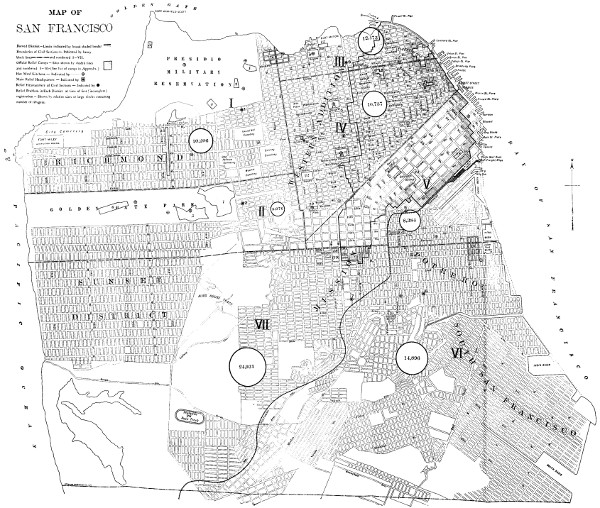
Large map (700 kB)
San Francisco is at the head of one of two narrow
peninsulas which, held apart by the Golden Gate, landlock a
fifty-mile length of harbor. To the west of the city is the
Pacific Ocean itself and to the east, beyond the six to eight-mile
reach of San Francisco Bay, such residence towns as Alameda,
Oakland, and Berkeley, which merge almost into one another.
Many thousands of people who use San Francisco as the center
for their business, travel daily along the city’s principal thoroughfare,
Market Street, to take at its foot one of the ferries which
make frequent runs to the east shore and to Sausalito and Tiburon
on the north beyond the Golden Gate. A smaller number go by
rail to San José and other residence towns on the peninsula, and
each stream is met morning and evening by one of less volume of
those who reverse the process to find residence in the large city
and employment beyond its boundaries.
On Wednesday morning, April 18, 1906, at twelve minutes
past five o’clock, San Francisco, this city of wonderful setting,
suffered an earthquake whose sensible duration was about one
minute. The shock left her powerless to supply light, heat, water,
drainage, to convey her people or to carry their messages; but it
would not have paralyzed her activities had it not been that because
of the breaking of the main water conduits, the fires, thirty of which
were said to have started immediately, could not be controlled.
The fires started on both sides of Market Street, and within
three hours after the earthquake, made a continuous line of flame
from north of Market Street, along the water front, past the Ferry
Building, south of Market Street, and along Mission Street to
beyond Third Street, where was the main station of the only railroad
that ran out of the city. As the fire spread to the southwest
and the north, the whole population seemed cut off from escape
except by going west and south within the city. Comparatively
few knew during the first two days that there was a narrow but
safe way around the fire to the Ferry Building from which the
boats were running. Many of those who did learn of this opportunity,
or who wished to hazard a chance, reached the ferry and
crossed the bay, but many more failed to use this means of reaching
their friends and acquaintances without the city. On the second
and third days small supplies of water were brought to play upon
the fire, but not until the morning of Saturday the twenty-first,
by the use of dynamite, was the advance of the flames stopped.
Along the general line of the city’s own growth in wealth
and breadth the fire moved, destroying the larger part of the wholesale
district, practically all of the retail and the shopping section,
the chief financial centers, the leading hotels, and some of the public
buildings. Large portions of the most expensive residence
sections and multitudes of small hotels and lodging houses, together
with great numbers of less expensive residences and quarters
for working people, were devastated. Thickly populated districts,
such as the “Latin Quarter,” Chinatown, and the section largely
inhabited by the Irish, were entirely burned out.
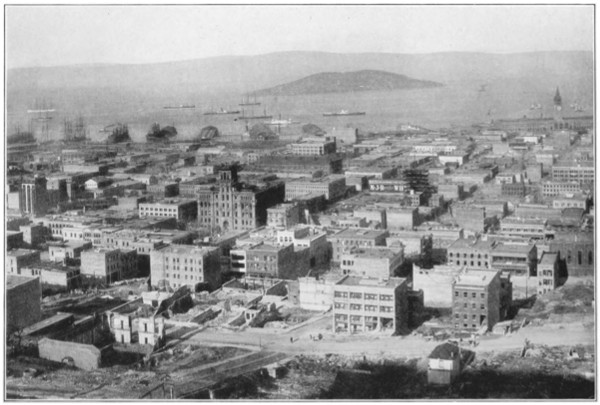
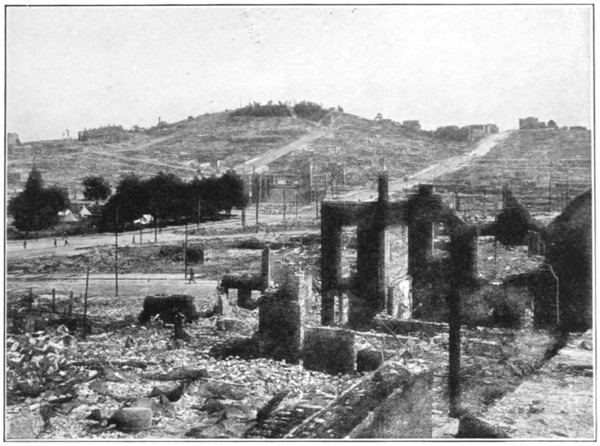
The burned area, the very heart and vitals of the city,
covered 4.7[3] square miles, on which were located 521 blocks, 13
of which were saved, 508 burned. The number of buildings destroyed
was 28,188,[4] the number of persons made homeless about
200,000[5] of San Francisco’s estimated population of 450,000.
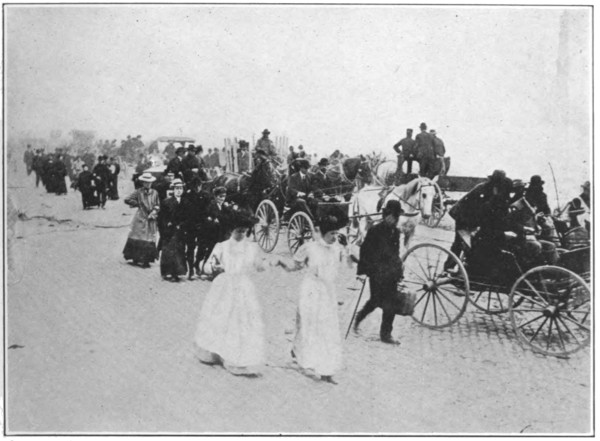
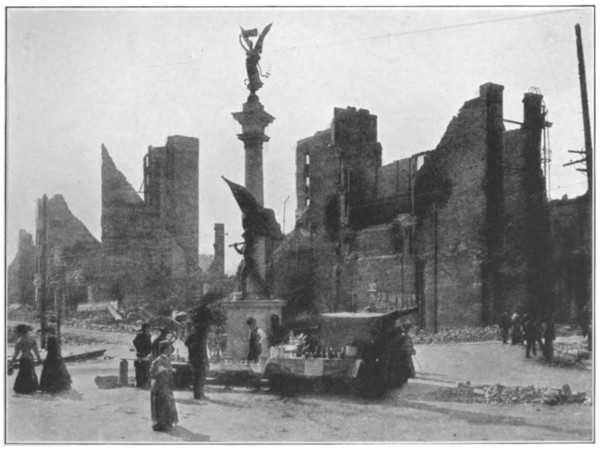
Striving to reach the Ferry Building
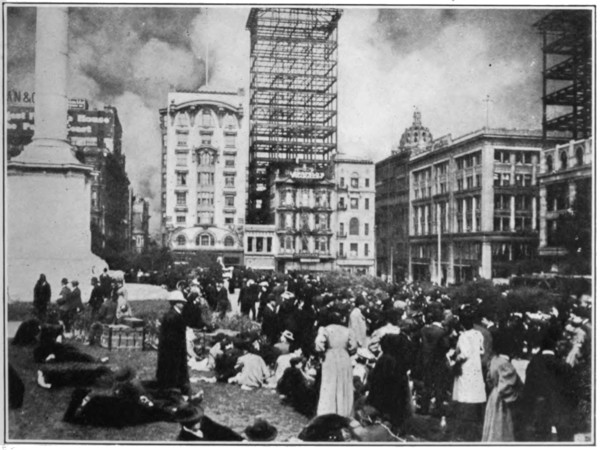
In Union Square, soon to be swept by flames
The Morning of the Disaster
The burned area[6] had a land front of 49,305 feet, or 9.34
miles, and a water front of 9,510 feet, or 1.80 miles, the total
being 58,815 feet, or 11.14 miles. Facing this line on the unburned
side were 527 buildings, of which 506 were wood, 18 brick, one
stone, one adobe, and one corrugated iron. Thus the fire was
stopped against a wall of buildings, 96 per cent of which were wood.
About 20 per cent of the frontage was on wide streets, and the
remainder, 80 per cent, on streets of ordinary width.
Apart from the larger business houses, the public buildings,
and some of the residences of the wealthier citizens, the burned
buildings, including the smaller hotels and lodging houses, were
built of wood. Their destruction was complete. There was
practically no salvage of value from the small wooden dwellings,
destroyed as they were by the fire and not by the earthquake.
The loss of real and personal property has been estimated at
$500,000,000,—about $1,100 per capita of the city’s population.
As only $200,000,000 of insurance money is estimated to have been
collected, there was a net loss of over $650 per capita. The great
loss of income from non-employment, from unrentable property,
and from the general cessation of business, cannot be estimated.
There was quick compensation for the day laborers and other workmen
connected with the building trades, but the recovery for most
of the business men was to be slow and is not yet complete.
The loss of life as a result of both earthquake and fire was
reported by General Greely, after careful inquiry, to be: known
dead, 304; unknown dead, 194; total, 498; number seriously
injured, 415. All persons within the fire zone who were lying sick
either in hospitals or in their own homes were carried to places of
safety. There were, of course, many unwarranted reports of tragic
deaths, such as for instance that numerous men had been shot for
looting and that physicians had put their patients to death rather
than let them die in the flames. The federal troops arrived so
promptly, and with the aid of the militia and the police patrolled
the city so thoroughly, that there were few opportunities to loot.
To the end of June there were but nine deaths by violence in the
whole city, three of which appear to have been brought upon unoffending
men by over-zealous patrols.
It can never be reckoned what it meant to the devastated
city that its own people as a welded body should have manifested
under the shock of the great disaster that quality of the hero
which lifts him, the psychic man, above the physical and leaves
him freed from himself to be spiritually at one with his community.
A witness who lives in Berkeley came to the city early on the
morning of the earthquake and spent that and the following day
in the thick of the refugees. Nowhere along the fire lines was to be
seen the least sign of panic. Women and children without a tear
and with scarcely a murmur trudged weary miles, carrying handfuls
of possessions, or stood silent to watch their homes destroyed.
The chief signs of excitement were shown by those who were
fighting the fire or who were hurrying from one place to another
on official business. At the end of the second day he saw tears for
the first time, the tears of a woman who may have been worn out
by long tramping and by loss of sleep.
How the great deep of the common human heart was broken
up when that sudden disaster came unawares on the people is
borne witness to by many who had their portion of loss and by
many others who came from the outside to help carry the load.
One of the latter wrote to Charities and the Commons[7] a month
afterwards:
“All the fountains of good fellowship, of generosity, of sympathy,
of good cheer, pluck, and determination have been opened wide by the
common downfall. The spirit of all is a marvelous revelation of the good
and fine in humanity, intermittent or dormant under ordinary conditions,
perhaps, but dominant and all-pervading in the shadow of disaster.
“Recently I formed the acquaintance of a man who now drives
an automobile. He had a large machine shop and was a rich man before
the fire. The other day he was working about the automobile while his
passengers were attending a committee meeting at army headquarters.
Presently there approached a man who had purchased $20,000 worth of
machinery at his shops just before the fire.
“The customer said to my friend, ‘Hello R——, what are you
doing here?’
“‘Driving this automobile,’ said R——. ‘What are you doing?’
“‘I’m driving that automobile over there,’ said
the customer,
and the two shook hands and laughed heartily at the grim humor of the
situation.
“The prevailing sentiment could hardly be better shown than by a
motto chalked on one of the little temporary street kitchens. It is:
‘Make the best of it, forget the rest of it.’”
The even temperature of the San Francisco region which
assures mild winters and cool summers and the cessation of rains
from March to October, made climatic conditions that were peculiarly
favorable. There was on April 22 and again in June some
inconvenience from unseasonable rain, but there was no complaint
of serious discomfort by those living in the temporary shelters.
The health of the refugees in general, it was frequently stated, was
improved by the outdoor life. Probably thousands lived during
the summer of 1906 under improved physical conditions; and even
during the rains of the following winter thousands were better off
in the refugee shacks than they had previously been in the poorer
grade of tenements. A winter that brings but little frost and ice
and that accustoms people to live with open doors and to do without
artificial heat is one that simplifies the task of providing shelter
for the homeless, lessens the cost, and causes but few serious
delays to building work. The even temperature is also favorable
for the handling of perishable food supplies, which do not
need to be kept on ice.
San Francisco had an additional advantage in being an
important military and naval center. As the headquarters of the
department of California and of the Pacific Division of the army,
it has within its boundaries three garrison posts with their reservations,—the
Presidio, Fort Mason, and Fort Miley; and without,
Fort Baker opposite the Presidio on the north side of the Golden
Gate, Alcatraz Island facing the Golden Gate, Fort McDowell
within the bay on Angel Island, and Benicia Barracks at the head
of the bay. The United States Navy Department has Mare
Island Navy Yard at the north end of the bay and the Naval
Training Station on Yerba Buena Island. At the time of the
disaster the war ships in the harbor as well as the naval stations
were able to render prompt and valuable service. The army’s
immediate part in fighting the fire and in guarding property, and
its later part in providing food, clothing, and shelter was, as is
shown in the following pages, of outstanding importance.
As the people in brave and solemn silence moved out of the
shattered and fire-swept centers of the city, relief societies were
being formed within the city itself and in suburban towns, and
citizens of places as distant as Los Angeles and Portland, Oregon,
hurried from the south and the north to distribute money and
supplies. Many agencies, with fervor but with no concerted
plan, helped to carry the relief work for the first week, converting
churches into hospitals, and preparing and distributing food in
unlikely but convenient places. But while sporadic groups of
people worked to provide immediate aid in ignorance of one another’s
efforts, the organization of the Citizens’ Committee grew.
At a quarter before seven o’clock on that morning of April
18, the mayor, Eugene E. Schmitz, with a small group of citizens
met in the Hall of Justice, a building shattered by the earthquake
and nearly surrounded by fire. As he hurried to the center of the
city he overtook the federal troops which had been summoned
from Fort Mason and the Presidio by General Funston, who was in
command of the Pacific Division of the army during the temporary
absence of General Greely.[8] The troops had been told to take
orders from the mayor. Under authority from him they served
as police to guard property, not to enforce a military rule. The
mayor assumed almost absolute control of the city government for
a time, superseding all departments and commissions. His first
order was to shoot, not arrest, the looters; his second, to close the
places that sold liquor. The latter wise measure was for two
months strictly enforced.
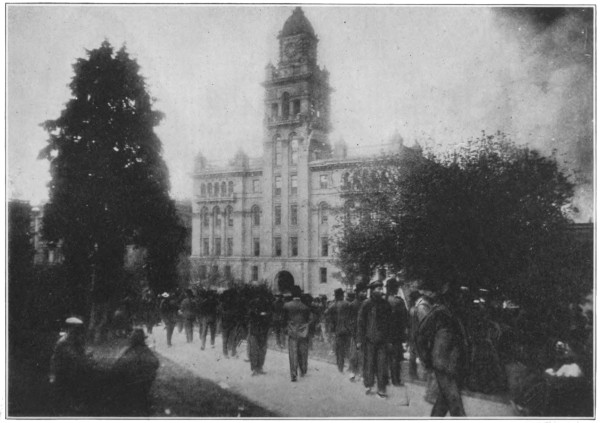
The fire is approaching at the right
The Hall of Justice
The mayor named a Citizens’ Committee[9] of more than 50
persons, 25 of whom came together at three o’clock in the Hall of
Justice, close to the edge of the roaring tempest of flame. It
was difficult to conduct business, with dynamite explosions shaking
the meeting place, so in an hour’s time the mayor moved across the
street to Portsmouth Square where amid boxes of dynamite and in
the shadow of the monument to Robert Louis Stevenson, the transaction
of business continued. The memorial, a drinking fountain
in a granite base with a Spanish galleon at full sail on its summit,
stood untouched. The gilt of the hardy vessel still glittered and,
untarnished beneath, Stevenson’s lines: “To be honest, to be
kind ... to renounce when that shall be necessary and not be
embittered, to keep a few friends but these without capitulation—above
all, on the same grim condition, to keep friends with himself—here
is a task for all that a man has of fortitude and delicacy.”
Two hours later the mayor and his assistants moved five
blocks up the steep side of Nob Hill to the Fairmont Hotel only to
be dislodged the next morning from what must at first have seemed
an impregnable position. Their retreat carried them eight blocks
farther west to the North End Police Station, and by noon still
westward to Franklin Hall on the corner of Fillmore and Bush
Streets, where they could finally halt. While the citizens were
holding their first meetings and the army was helping to fight the
fire, the American National Red Cross was sending across the
continent its representative, Dr. Edward T. Devine, who reached
San Francisco April 23 with Ernest P. Bicknell. Mr. Bicknell
was sent by the committee formed in Chicago for the relief of
San Franciscans.
At its first meeting in the Hall of Justice the Citizens’ Committee,
which was recognized immediately as a representative
body, authorized the mayor to issue orders for food and other
supplies. The mayor did not, however, make much use of this
authority but left the conduct of the relief work to the Finance
Committee, which was appointed at the first meeting, and to the
other sub-committees which were formed at the following meetings.
The chairman of each of these was given power to complete the
membership of his committee. From the first the Finance Committee
of the Citizens’ Committee, with James D. Phelan elected
to be its chairman, stands out as a directing agent of relief.
Interesting items in the minutes of the second meeting of the
Citizens’ Committee are the announcements that there would
be water in the Western Addition by one o’clock of that day,
April 19, and in the Mission the following day, and that there
was press boat service at the foot of Van Ness Avenue.[10]
The Citizens’ Committee continued for over two weeks to
hold daily meetings, to which were submitted the Finance Committee’s
reports of contributions, as well as its methods of relief
expenditures. Its only function in relation to the relief work came
to be to confer in order to exchange information. It was but
natural, therefore, for the mayor to determine to dissolve the
larger committee and leave the control of the relief work, as far
as he had power to determine it, in the hands of the Finance Committee,
which as is shown below had on April 25 come into effective
co-operation with the army and the American National Red Cross.
At the meeting on May 5, the mayor notified Mr. Phelan that the
work of all the relief sub-committees but his was done, and that he
should make his financial statement to the Committee on the
Reconstruction of San Francisco.[11]
The Citizens’ Committee with its list of sub-committees,
hurriedly created, quickly to die, gives an excellent illustration of
the futility of trying to effect an elaborate organization before the
measure of a disaster has been taken or the extent of the means
for recovery learned.
The Finance Committee represented the citizens’ choice to
which had been entrusted the local subscription of over $400,000
and the contribution from the state at large of $250,000. Its
authority had been recognized by the California branch of the
Red Cross, by the Massachusetts Association for Relief of California,
by the New York Chamber of Commerce, and by many
other relief organizations and individuals throughout the country,
as well as by the President of the United States who made public
his recognition of the Finance Committee as official agent of relief.
The relation of the American National Red Cross to the Finance
Committee was not defined during the week following the disaster.
On April 24, before the dissolution of the Citizens’ Committee,
a momentous conference was held at Fort Mason which
was attended by General Greely and General Funston representing
the army; by the mayor, Mr. Phelan, Mr. de Young, and Mr.
E. H. Harriman representing the citizens; and by Dr. Devine,
representing the American National Red Cross and Judge W. W.
Morrow representing the California Branch of the Red Cross.
That a meeting was to be held to determine the jurisdiction of the
Finance Committee and the best method of employing the funds,
had been reported earlier in the same day to the Citizens’ Committee.
At this conference, after a heated argument it was decided
that the military authorities should have entire charge[12] of the
relief stations and the shelters for the homeless, two divisions of
work that previously had been partially carried by sub-committees
of the Citizens’ Committee. It was further decided to
unite the Red Cross with the Finance Committee of the Citizens’
Committee under a new title: Finance Committee of Relief and
Red Cross Funds. This consolidation was immediately approved
by the American National Red Cross which soon afterwards remitted
$400,000 to the new committee.[13]
There were nice questions of policy involved in the determining
of the relation between the army, the civil and state
authorities, and the voluntary relief agencies. Tact was required
and a faithful compliance with the law. April 21, at a conference
of the mayor, the chief of police, General Koster, then
in command of the National Guard, and General Funston, the
question of the effective policing of the city had been considered.
It was agreed that the northern part of the city should be
assigned to the federal troops, the central part to the National
Guard, and the southern to the municipal police. The northern
part was divided into six military districts. On May 2 military
control was extended to the whole city, which was now divided
into eight military districts, with only slight changes in their
boundaries; and on May 8 there was a general re-districting that
resulted in six districts. These military districts have special
significance for this Relief Survey because they later served as the
basis for the seven geographical divisions known as civil or relief
sections, which played a very important part in the relief work.
These were formed on April 29 and coincided practically with the
six military districts of May 8, except that military district six
included civil sections VII and VIII. The civil sections were later
used by the American National Red Cross, by the Executive Commission,
and by the departments of Camps and Warehouses and
of Relief and Rehabilitation.
The boundaries of the sections, the number of refugees
registered in each, the extent of the burned district, and the
location of the more important camps, are given in the map.[14]
The burned district was included almost entirely in Sections IV
and V. Sections I, II,[15] and III contained the largest camps.
Section VI had only one official camp, and Section VII none, but
there were many unsupervised tents and shacks, isolated and in
groups, scattered through these two sections. In extent of territory
they more than equalled the other five sections. They contained
before the fire a large wage-earning population, living in
small homes. This population was much increased after the fire
by an influx from the burned-out part of the city.
An irresistible force had pushed relief through four broad
channels. Food had first to be supplied; then clothing along with
bedding and common household necessities; then shelter; and last,
the means to make one’s own provision for the future. The order
of relief could not be altered by any committee planning. The
great primary needs had first to be met. The amounts that could
be held in reserve for the purpose of essential importance, rehabilitation,
depended on the sum of donations being enough to
leave a surplus after the cost of food, clothing, and temporary
shelter had been met. In the early days the number of persons
that were in the bread line and that lacked shelter was so great
that it looked as if the demands for food, clothing, and other
primary necessities would exhaust any possible relief fund.
The method of distribution of emergency relief is described
in the following chapter, but in order to understand the animus
that underlay the efforts to form an organization that should meet
with public recognition, it must be borne in mind that two strong
currents, representing distinct conceptions of principles of relief,
flowed beneath the surface of the relief administration, sometimes
the one and sometimes the other directing the general course or
impeding an even progress. Such conflict between the conceptions
of the relief task was as inevitable as was the demand for relief
itself, and furnished probably the amount of friction necessary to
wear a deep bed along which later moved a great stream of rehabilitation.
The story of the first efforts to form a compact,
working relief body falls almost into dramatic form. The voice
of authority one day is the civic servant’s, another day the people’s,
a third the military commander’s, a fourth the expert charity
worker’s. The stage in turn seems held by each. But the significant
fact is that underlying the methods of each is the need,
recognized at different periods of time in varying degree, of meeting
the demands of the situation by a grasp of rehabilitation as the
definitive aim.
There was no monopoly of the conception of rehabilitation
as an essential part of the relief work. Before the end of April
the Finance Committee of Relief and Red Cross Funds had been
asked to supply tools to bricklayers and to make loans to individuals.
Individual members had discussed the outstanding importance
of rehousing the people. Agencies and individuals acting
independently of one another had likewise been making tentative
efforts to restore people to self-support.
But there was one group of workers that had been free from
the first to base its initial efforts on the need to measure the disaster
in terms of future rehabilitation. This group, representing the
American National Red Cross, reinforced by the Associated
Charities, had been free to do so because the responsibility of
meeting the emergency was being carried by the army and by the
Citizens’ Committee. Before any distinctive rehabilitation committee
was appointed the office of the Red Cross was besieged by
applicants who in person and by letter begged for aid to remove
their families from the camp life. To some tools were supplied;
to others, transportation. Until May 9, when the Finance Committee
made its first appropriation of $10,000 for special relief,
Dr. Devine drew on a private fund at his disposal to meet rehabilitation
expenditures. For these early expenditures he was
reimbursed from the first appropriation.
May 5 is a noteworthy date. The representative of the
American National Red Cross then began to form a staff of rehabilitation
workers, who put the date May 5 at the head of the
first case record. The secretary of the Boston Associated Charities,
Alice L. Higgins, was appointed secretary to Dr. Devine.
Lee K. Frankel of New York became chairman of a tentative
bureau of special relief.
On May 18, when the Red Cross had formulated its plans for
a registration bureau and for co-operating with the army at the
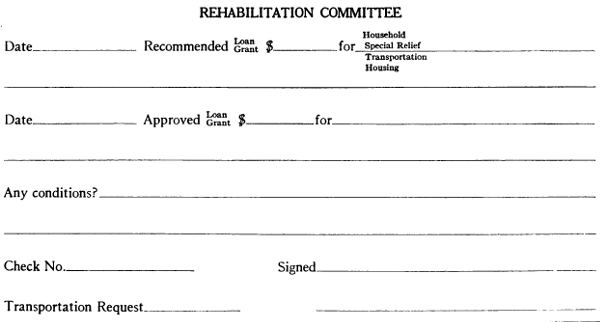
seven civil sections, the Special Relief and Rehabilitation Committee,
or Bureau, as it was ordinarily called, got well under way,
with Oscar K. Cushing as chairman. In a separate section in the
next chapter the relation of this Bureau to the transportation work
is told.
The Bureau started with a force of seven field agents.
The Associated Charities provided the investigators, reinforced
at once by local volunteer and paid relief workers and, after
July 2, by a number of workers sent from east of the Sierras by the
charity organization and kindred societies that had trained them.
The force as a whole represented, without discrimination, various
races and creeds. The Finance Committee after July 2 made an
appropriation to the Associated Charities to cover the cost of
administration.
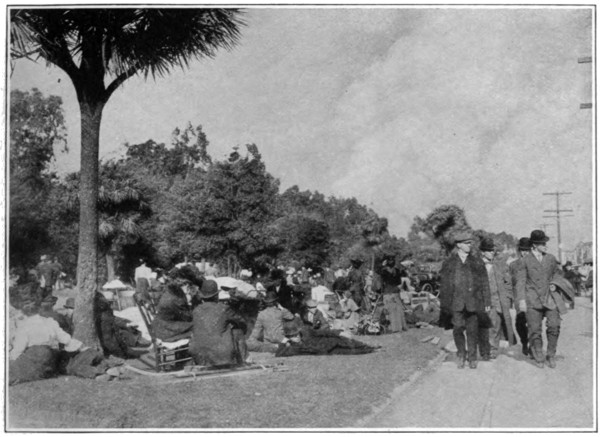
Watching the fire
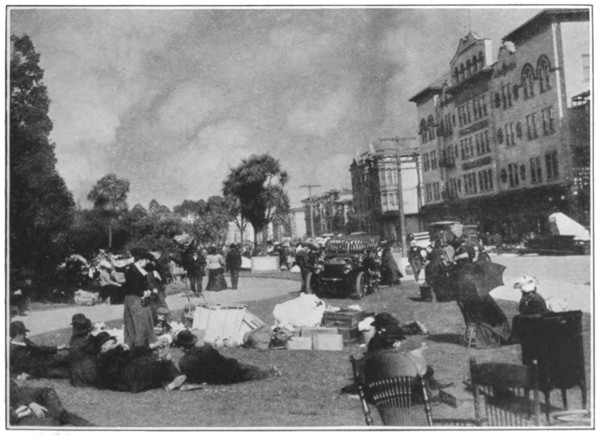
The fire draws near
Refugees in Jefferson Square
During the early period of the alliance between the Associated
Charities and the Rehabilitation Bureau there was difficulty in the
adjustment of work, but the friction was soon overcome and until
July, 1907, under the various régimes, the Associated Charities
continued to be an effective part of the general rehabilitation
machinery. The work of the Bureau grew fast, but it grew naturally
as an outcome of the demands of the situation itself, and
when on June 29, as is stated on page 21, the Finance Committee
appointed its own Rehabilitation Committee,[16] the new committee
was able to take over the work of the Bureau without any waste
of effort.
Early in May, when the Red Cross Rehabilitation Bureau
was being organized, the Finance Committee of Relief and Red
Cross Funds, stimulated by insistent requests that it should state
its plans, called on Dr. Devine, one of its members, to make recommendations
for future work. The New York Chamber of Commerce,
through its representative, James D. Hague, and the
Massachusetts Association for the Relief of California through its
representative Jacob Furth, were urging that their funds be used
as far as possible to provide permanent relief.
Dr. Devine, who already had carefully considered with his
staff of Red Cross workers the general question of rehabilitation,
in a report submitted on May 4 made seven recommendations,
which were considered by a special committee consisting of the
governor, Archbishop Riordan, Rabbi Voorsanger, E. H. Harriman,
and Dr. Devine. The first six recommendations were accepted
by the Finance Committee; the last was rejected. They
read:
1. That the opening of cheap restaurants be encouraged and
facilitated by the sale to responsible persons at army contract prices of any
surplus stores now in hand or en route, the proceeds to be turned into the
relief fund to be expended in the purchase of the same or other supplies
as the Finance Committee or its purchasing agents may direct.
2. That definite provision be made for the maintenance of the
permanent private hospitals which are in position to care for free patients,
by the payment at the rate of $10 per week for the care of patients who are
unable to pay, and that after an accurate estimate has been made of the
number of beds in each hospital, a sufficient sum be appropriated for this
purpose.
3. That provision be made on some carefully devised plan for the
care during the coming year of convalescent patients, and for the care of
aged and infirm persons for whom there is not already sufficient provision.
4. That on the basis of the registration now in progress and subsequent
inquiry into the facts in such cases, special relief in the form of tools,
implements, household furniture, and sewing machines, or in any other
form which may be approved by the committee, be supplied to individuals
and families found to be in need of such relief.
5. That the administration of this special relief fund be entrusted
to a committee of seven with such paid service at its disposal as the special
relief committee may find necessary.
6. That as soon as practicable a definite date be fixed after which
applications for aid from the Relief and Red Cross Funds cannot be considered.
7. That a sum not to exceed $100,000 be set aside to be expended
by the said committee for the immediate employment of both men and
women in some necessary work which is in the public interest but which
cannot be undertaken by the municipality and is not properly a charge
on any private corporation or individual.
In making its own report this special committee said it
assumed “that the supply of food and clothing will be continued
until the absolute need in these directions is met.” It was not
prepared to take action on the seventh recommendation.
At the end of May, no action as a result of the recommendations
having been taken, Dr. Devine urged the Finance Committee
to appoint the committee of seven suggested in the fifth recommendation,
which had been authorized the first of the month, so
that the work of providing shelter more adequate than that provided
by the tents should be begun. For consideration of more
permanent forms of rehabilitation, he thought it might be necessary
to have still another committee.
His advice to the Finance Committee was supplemented on
June 4 by a letter to the chairman, in which he drew a general
outline of the relief course that should be taken. It reiterates in
more specific form the advice given in May. The points emphasized
were:
1. The general distribution of uncooked food and of clothing
should be discontinued by June 30, the date the army proposed to withdraw.
The bread line, the clothing line, and the relief stations, should
then be abandoned.
2. The established charities of the city should, as far as possible,
on that date resume the discharge of their normal functions.
3. The clothing and provisions, tools, sewing machines, and household
furniture remaining on June 30 in the relief stores should be placed at
the disposal of a special relief committee and a central warehouse should
be designated to hold them. Appropriations should be made to the
suggested committee for its administrative expenses, and as its plans
developed, for additional relief.
4. Housing, loans, and other plans for rehabilitation should be
taken up by a legally incorporated body to be formed to administer the
relief funds; one which should be ready to deal in the broadest possible
way with all problems relating to the rehabilitation of families and of
individuals. The hot meal kitchens, it was conjectured, would by the end
of June be on a business basis.
5. The most important task remaining would be to supervise permanent
camps and barracks.[17]
6. The Police Department should give general protection, and the
Health Commission should guard the public health.[18]
To quote the letter:
“What will be needed in each permanent camp after June 30 will
be (1) a business agent authorized by the Finance Committee, and in the
case of public parks by the municipal authorities, to assign tents or rooms
in barracks to particular persons, to collect rents, if rental is charged, to
evict tenants when necessary, and to call upon the police authorities in the
name of this committee, when necessary for the maintenance of order;
(2) a sanitary officer responsible to the health commission; and (3) a
police guard responsible to the police department. The general business
agents should all be responsible to one general superintendent of permanent
camps. The general superintendent of business agents, in the case
of the larger camps, will require a certain number of clerical and administrative
assistants corresponding to the military officers who are now serving
in similar capacities under the military supervision of camps and the
commanding officers of the several camps. Neither the business agent
nor the sanitary superintendent need have anything to do with relief,
except to report cases of destitution which come to their attention to the
Special Relief Committee.”
The mayor, who was futilely trying to determine relief
policies, in a conference with Mr. Phelan a few days later suggested
the importance of appointing the committee urged by Dr.
Devine. He said that he might ask the municipal board of supervisors
to appoint a committee on relief and rehabilitation. This
action, however, he did not take.
General Greely at this time also expressed his appreciation
of the need of a change of relief policy.[19] He and Dr. Devine
agreed as to the next steps to be taken, his point of view concurring
with that expressed in the letter just quoted. He counseled
specifically a separation of questions of administration, sanitation,
and relief, and a thorough co-operation with the municipality in
all matters affecting the administrative policy and sanitation of the
camps. He said further that as an army officer was familiar with
but two aspects of the relief problem,—the distribution of supplies
and the care of camps,—the Finance Committee of the Relief
and Red Cross Funds should appoint an executive committee,
which should be prepared after July 1 to relieve the army of
responsibility.
He asked three of his officers who had been carrying on the
relief work to submit a plan for its further conduct. The resultant
plan, submitted by General Greely to the Finance Committee,
was necessarily a reflex of the military experience of its framers.
Though it was incited by an appreciation of the fact that the
emergency relief period must be superseded by the period for
permanent adjustment, the plan provided for yet further distribution
of necessities rather than in any comprehensive way for
housing and rehabilitation. It called for the organizing of a
bureau with a paid personnel. The chief of the bureau was to be
accountable to the mayor, and was to have under him four sub-chiefs,
three of whom should be army officers, each in charge of a
department,—the departments of distribution and supply, administration,
general superintendence, and finance.
General Greely, realizing the difficulty of having a suitable
man appointed as chief, made later the substitute suggestion of a
commission of three. The mayor and General Greely were present
by invitation at a meeting of the Finance Committee when the
substitute plan was considered. The attitude of the mayor during
this month of June was one of serious interference. The Finance
Committee naturally did not wish to have any public disagreement
with him, and with the knowledge that the army was shortly to
be withdrawn from control of relief work it seemed wise as a
compromise to accept General Greely’s suggestion of a commission
rather than a chief who should be responsible solely to the mayor.
The decision was reached, therefore, for the Finance Committee
to appoint an Executive Commission of three members, one member
to represent the mayor, a second, the American National Red
Cross, and a third, the Finance Committee itself.
On June 22, at a meeting of the Finance Committee at
which 11 of the 21 members were present, announcement was
made that the mayor had appointed a political friend as his
representative on the Executive Commission, and the American
National Red Cross, Dr. Devine. Dr. Devine at the time of the
meeting was absent in the East. The Committee had therefore
to make its appointment. After a discussion, which later became
public, several men were nominated for appointment, two of whom
possessed the confidence of the community on account of their
honorable standing, native ability, readiness freely to serve the
public, and knowledge gained of the relief situation through
arduous volunteer work. The man elected, by a vote of six to
four, was a politician with no previous experience in the relief work.
A scrutiny of the records shows on the part of these local members
of the Executive Commission no indication of effort to use their
positions to further political ends, and one of the two returned to
the Finance Committee the salary of $500 to which he was entitled
as a member of the Commission. There is no record of lack of
harmony, merely the indication of an ineptitude on their part to
meet the needs of the distressed community.
The attitude of the Finance Committee was one of detachment
from, or one might say, suspicion of the Executive Commission.
It refused to define the scope of the Commission’s work,
but directed it to organize and submit a plan of work for approval,
and, for confirmation, the names of the employes it wished to
appoint. The members who had forced the election of a feeble
representative, realizing the mistake of their policy, agreed to
restrict the powers of the Commission, and were ready to vote
to abolish it at the end of the month.
The irony of the situation lay in the fact that the chairman
of the Commission, Dr. Devine (who accepted no salary), and
its secretary, Ernest P. Bicknell (who likewise received no salary),
presented for consideration a plan of work which in substance was
the same as that submitted by the chairman early in June to the
Finance Committee and to General Greely.
The plan[20] called again for a regulation of camps, warehouses,
the hot meal kitchens, the care of the sick in hospitals,
and for making provision for housing, loans, and special relief.
Unlike a rolling stone, however, to reiterate plans meant to gather
moss, so a new suggestion may be noted. It was, that the civilian
chairmen of the seven sections should be men on salary, giving
their entire time, and responsible to the Commission until relieved.
Their duties should include distribution of clothing, meal tickets,
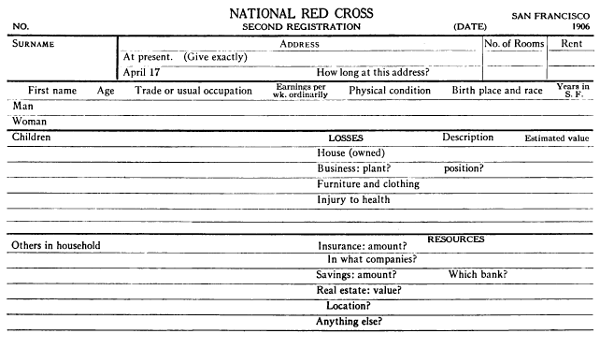
and other relief, and the carrying out of the second registration[21]
then in progress.
Recommendation was made by the Commission that all
executive work should devolve on it, and that it should be held
responsible for initiating relief measures.
The Finance Committee approved the plan in general,
with the exception that the question of special relief be left for
future decision and that no action be taken on housing until
further information had been collected. It did decide, specifically,
that the rehabilitation work should continue in charge of Dr. Devine
as representative of the Red Cross, and should not be transferred
to the Executive Commission while final decision was pending.
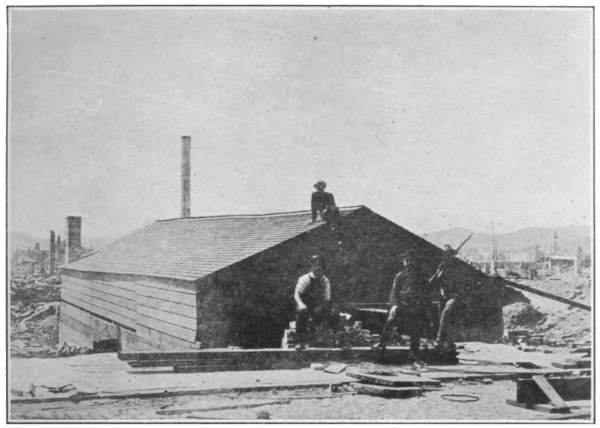
The first bakery rebuilt
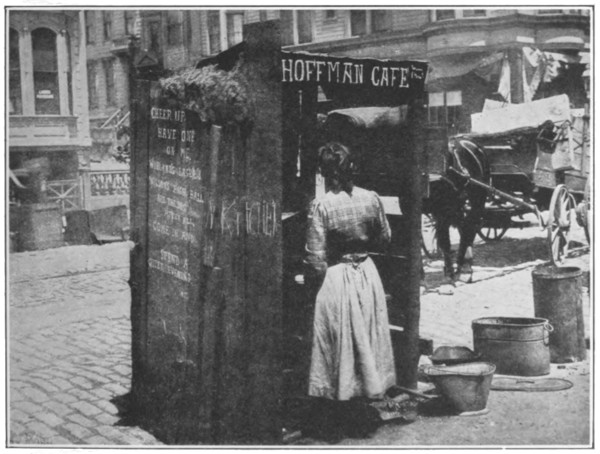
A cheerful kitchen
Supplying Food Under Difficulties
The Executive Commission got rather beaten round the
bush. It was permitted to expend certain appropriations for
sanitation, the care of camps, and the distribution of food, clothing,
and other supplies, under direction of its chairman and a group
of army officers. The relation of the army to the new Commission
was practically what it had before been to the Red Cross representative.
Under the military régime Major A. J. Gaston
was commanding officer of permanent camps; under the new
régime he was general superintendent of camps with authority to
appoint all camp employes.
In the latter part of June Mr. Phelan, acting on Dr. Devine’s
suggestion that the Finance Committee should appoint a Rehabilitation
Committee of its own to supersede the work of the special
Rehabilitation Bureau, did appoint such a committee with Dr.
Devine as chairman and Archbishop Riordan,[22] Bishop Nichols,[23]
Rabbi Jacob Voorsanger, O. K. Cushing, F. W. Dohrmann, and
Dr. John Gallwey as members. Its scope was defined as including
“all aid” to be given to individuals or families other than food or
ordinary clothing. It superseded, as has been already stated,[24] the
Red Cross Rehabilitation Bureau and took over the latter’s unexpended
balance. The Bureau had expended $18,599.70 for 840
applicants.
The Rehabilitation Committee met in Hamilton School
July 2, two and a half months after the beginning of the relief
work in San Francisco. Mr. Bicknell was elected secretary, Mr.
Cushing, treasurer, the latter, with the chairman, having authority
to sign checks in the name of the Committee. When Dr. Devine
returned to New York, August 1, Mr. Bicknell was appointed
a member of the Committee and Mr. Dohrmann then became
chairman, a position he was to hold from the first of August, 1906,
until the close of the rehabilitation work.
During June and July, to repeat, the pressure to give food
and temporary shelter was yielding to the pressure to furnish
permanent shelter and other means of rehabilitation. The problem
of housing was very complicated. No one knew how far shelter
would be provided by private enterprise; no one knew whether
manufacturing plants and wholesale and retail business would
seek old locations; no one knew where the shifting population
would settle. There was delay in collecting insurance, uncertainty
as to the land, labor, and materials available and as to the future
street car service and water and sewer connections. There was
difference of opinion as to whether the subsidized building should be
of a permanent or temporary character, of scattered individual
dwellings or large blocks, as to whether financial aid should be
in the form of bonuses or of loans.
One of the minor notes of irony in this mid-summer situation
lies in the fact that the Finance Committee referred to its own
Rehabilitation Committee for consideration and report the housing
suggestion of one of its members, M. H. de Young, and that the
report that followed, July 10, was signed by Dr. Devine as chairman
both of the Rehabilitation Committee and of the Executive
Commission.[25]
Mr. de Young’s suggestion was that a donation, or as it
was commonly called, a bonus, of not more than $500[26] in any case,
be made in behalf of any resident whose house had been destroyed,
provided that the $500 represented not more than one-third of the
value of the house to be built, and that it be paid to the contractor
after the house was completed and was clear of liens.
The resultant report as submitted stated that the Executive
Commission had, with the approval of the Finance Committee,
appointed a board of consulting architects and builders who
offered their services as expert counsel on general plans and on
designs for suitable dwellings. It also stated that the matter had
been carefully considered by the Rehabilitation Committee and
the Executive Commission, and that the bonus plan was recommended
for such workingmen as could not secure sufficient
funds from banks, building and loan associations, or from other
business or private sources.
Attention was called to the fact that the Rehabilitation
Committee was already studying the general situation so as to
estimate how many loans[27]
were likely to be called for. It was
further stated that there was no anticipation that the bonus plan
would carry far in providing shelter for the families living in tents,
and that no inclusive plan could be framed to provide housing
for all the homeless.
It was recognized, moreover, that first in order of importance
came provision of shelter for the aged, the infirm, the invalided,
and the other adult dependents who had become permanent
city charges. For these the recommendation was to erect permanent
buildings on the cottage pavilion plan to house 1,000
persons; the cost of building to be met from the fund, the maintenance
to be left to the city. It was recognized that there were
two possible alternate plans; namely, to care for the dependent
group in existing private institutions, or to board its members
in private families. A marked advantage of the first plan was that
it provided a permanent addition to the city’s charitable institutions.
The suggestion was intended to supplement what was
already being done in the way of giving care to the sick in hospitals.
It was further recognized that there should be quick effort
made to supply dwellings for the 5,000 persons who before the
disaster had paid moderate rentals, but who were housed in tents
or other temporary shelters. It was also necessary to make
provision for a possible 5,000 persons who were out of the city.
No accurate estimate had been or could be made of those who,
independent of aid, had readjusted themselves.
The proposal made in behalf of the possible 10,000, a proposal
that touched the kernel of the big relief problem, was to
use money lying idle to build houses which should be sold on the
instalment plan, or rented to families that had been living in
San Francisco on April 17. Shelter had to be provided against
the rainy season in order that there might be held in San Francisco
a population of working people. The proposal was intended
also to carry to a workingman the opportunity to own a house of
such character as should serve to set a standard for sanitary and
attractive dwellings. Through the carrying out of this scheme
there were to be brought into happy co-operation the architects,
the builders, the municipality, and the Finance Committee itself.
The first would supply skill and taste; the second, quick and
moderate priced building; the third, suitable conditions of light,
sanitation, ventilation, and fire protection; the fourth, capital
and business security. To assure the last provision there was a
suggestion of the creation of a new corporation to consist of the
mayor, the chairman of the Finance Committee, the representative
of the American National Red Cross, and representatives from
the Executive Commission and the Rehabilitation Committee,
all of whom were to be named by the Finance Committee.
The need to incorporate became more imperative when the
plans to furnish shelter took, by July 15, the following definite
shape:
1. To build a pavilion on the almshouse tract[28] for 1,000 homeless
persons.
2. To appropriate $150,000 to construct and to repair temporary
shelters in the public parks for the use of the homeless during the winter
of 1906-07.
3. To appropriate not more than $500,000 to carry out the bonus
plan.[29]
4. To appropriate a second $500,000, to be used for loans to persons
who had owned or rented houses within the burned district.[30]
5. To set aside $2,500,000 for the acquiring of suitable and convenient
land on which to build dwellings that might be sold for cash or
on the instalment plan to residents who were in business or had other
employment.
Before passing on to the matter of the incorporation of the
funds, one must record the final act of the Executive Commission.
On July 31, after six weeks of precarious, and one might almost
say uneventful life, the Commission voted to turn its records
over to the corporation just created, and to make an inventory of
its supplies and equipment for transfer to the same body.
June and July mark a clearly defined transition period.
In spite of the politically directed episode of the abortive Commission,
rehabilitation plans were being successfully shaped, even
though the ordeals of the withdrawing of the army as a factor in
relief administration and the introducing of the political appointees
were being faced. In spite of temporary set-backs, the work was
getting on a strictly business basis. Delays meant suffering,
yet ultimate community gain, because the Rehabilitation Committee,
in keeping outside the province of the Executive Commission,
drew to itself the best experienced service that was available,
and escaped the danger of being directed or diverted by any
force other than that controlled by right motives.
Now to return to the suggestion of incorporation. From
as early a date as May 4 the question of the incorporation of the
relief funds had been discussed within and without the Finance
Committee. The New York Chamber of Commerce as a large
custodian of relief funds had the matter brought personally to
the attention of members of the Finance Committee through
its representative, James D. Hague, and in writing by its president,
the late Morris K. Jessup. The latter stated, however, that the
determining of the question of incorporation lay with the Finance
Committee. Correspondence in early July with Mr. Hague, the
returned envoy, showed that there was in contemplation the
incorporating of an independent body of men, the majority of
whom should be appointed by the chairman of the Finance
Committee. To this proposed corporation it was suggested
should be transferred the $500,000 then held by the Chamber of
Commerce, with such other moneys as might be entrusted to it.
If such a plan had been carried out there would have been
two authorized bodies administering relief with an encouragement
to other foreign custodians of funds to create similar independent
agencies. The pressure to incorporate came therefore from without
because of the jealous guardianship of funds by the non-local
contributors; from within because of the exigency of the situation
itself.
In the month of July, as has been said, the imminent need
was known to be to provide suitable shelter against the fall and
winter rains. The members of the Finance Committee considered
the question of incorporation from the standpoint of the provision
of a body legally empowered to acquire land and to loan money
for building purposes. As a committee, therefore, it decided on
July 13 to carry out the recommendations made in the letter
written by Dr. Devine to its chairman, three days earlier, which
recommendation, it should be recalled, embodied the earlier
bonus plan suggestion made by one of its own members.
The certificate of incorporation[31] was issued July 20 to
hold for a period of five years. The president of the corporation,
the “San Francisco Relief and Red Cross Funds, a Corporation,”
was James D. Phelan; the first and second vice-presidents, F. W.
Dohrmann and W. F. Herrin; the secretary, J. Downey Harvey.
The president and first vice-president, with M. H. de Young,
Rudolph Spreckels, and Thomas Magee, formed the Executive
Committee. The personnel of the Corporation, with the exception
of the governor of the state and the mayor, who were ex
officio members and directors of the Corporation, was identical with
that of the Finance Committee of Relief and Red Cross Funds
which it superseded, and whose funds it immediately took over.
The newly incorporated body held its meetings at the St.
Francis Technical School on Geary and Gough Streets, which took
the place of the Hamilton School as headquarters for all departments
of the relief work. Later a warehouse was added to the
building to hold the remaining supplies. The meetings were open
to the press, and to officers and employes; and others with whom
the corporation had business were invited as was deemed expedient
to meet with the Executive Committee. At the third meeting,
held late in July, five departments were created:[32]
- A. Finance and Publicity
- B. Bills and Demands
- C. Camps and Warehouses
- D. Relief and Rehabilitation
- E. Lands and Buildings
Each chairman was required to make an investigation of and
report on any undertaking of his department that called for an
appropriation. Each chairman was also a member of the Executive
Committee and was responsible for the appointment of his employes.
He was further responsible for preparing monthly budgets and for
the printing and distribution of all printed matter.
From the plan of organization it is to be seen, of course,
that housing as a reason for incorporation had yielded to the
pressure to make inclusive the treatment by one incorporated
body of all divisions of the many-sided work.
The experiments of the preliminary and transition periods
had tried out many men and methods, so that on the newly incorporated
body were found men of affairs who in the relief work
itself were ready to act in harmony and with method and to come
together in small groups for frequent meetings. If one looks at
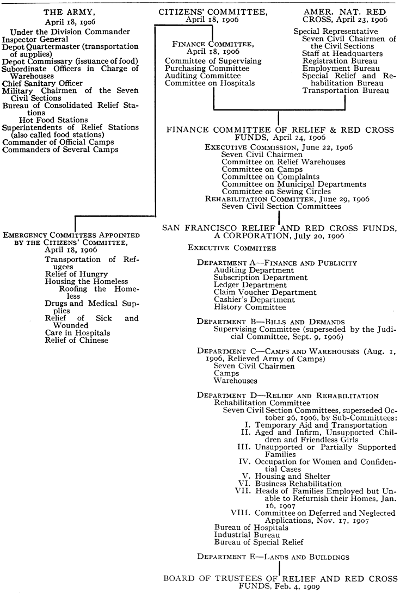
the diagram of organization presented,[33] one sees how gradually
through the trying three months there had been a shaping through
experiment that made the San Francisco Relief and Red Cross
Funds itself a fruition that in germ lay in the union of official
effort and private initiative.
Step by step the confidence of the public at home and abroad
had had to be won. Only through the selection and trying out
of generous-minded and capable men could the suspicions of those
who controlled the contributions in the east have been dispelled.[34]
Only after the abortive effort to make political capital out of
positions of relief administration had fallen flat could the work
itself get into its steady swing. The lessons are clearly written,
however, that there must of necessity be in any great sudden
emergency the creation of public confidence in the administration
of the relief, and that along with a force of persons trained from
within and without to act quickly and with definiteness must be
the voluntary services of men and women on whom the community
itself has learned to rely.
A few notes of later date are added here to round out the account
of organization.
On August 1, 1906, Mr. Bicknell succeeded Dr. Devine as
the representative of the American National Red Cross, and he in
turn was succeeded on October 1 by Mr. Dohrmann.[35]
Early in the year 1907 the County Medical Society urged that
the balance of the relief fund should be used for the erection and
endowment of a free hospital. Impelled by this and similar requests
the Corporation did in February consider seriously the possibility
of closing the work.
One year after the fire (April, 1907):
The Department of Bills and Demands had completed
its work.
The Department of Finance and Publicity was working with
a greatly reduced force as it was relieved of the accounting connected
with claims and subscriptions.
The Department of Camps and Warehouses had under care
a camp population of about 17,614, but no longer distributed food
or other supplies.
The Department of Relief and Rehabilitation had finished
the bulk of its work. The general taking of applications had
ceased for some time. Those on file were being passed upon and
closed as rapidly as possible. The final estimates and appropriations
for this work had been made. From this time on only
exceptional cases, and those few in number, were received. The
Housing Committee still had some work to do in connection with
the completion and inspection of houses granted by it, and with the
payment of the bonuses which it had guaranteed to pay to certain
applicants on the completion of houses which they were building for
themselves. The work of the Bureau of Special Relief was almost
finished. The work of the Hospital Bureau had to continue.
The Department of Lands and Buildings had completed its
building work, with the exception of the Relief Home. The Home
was expected to be finished in May.[36] A few hundred applications
were on file for allotment of bonuses from the second appropriation.
The first appropriation was exhausted.
Two years after the disaster (April 18, 1908):
The Department of Lands and Buildings had completed its
work.
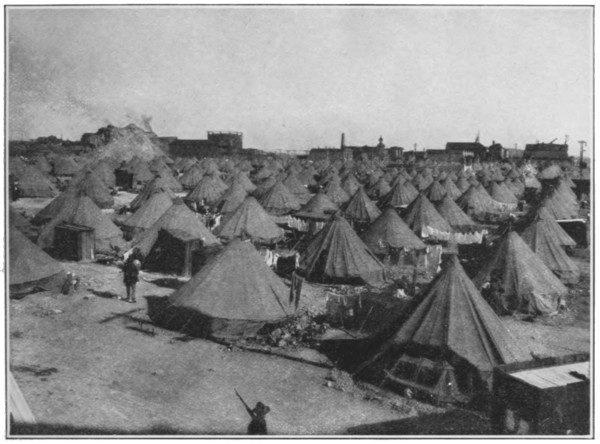
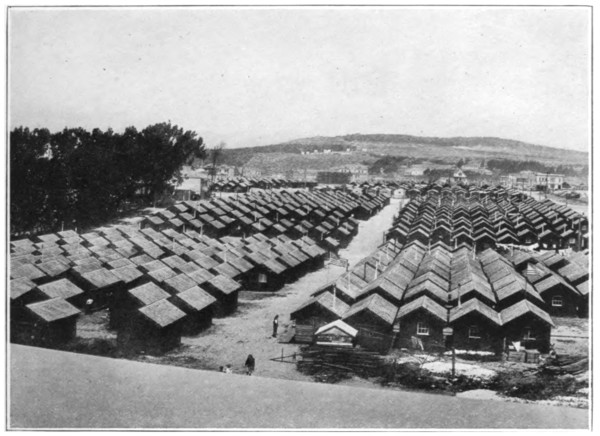
Tent camp, opened May 9, 1906
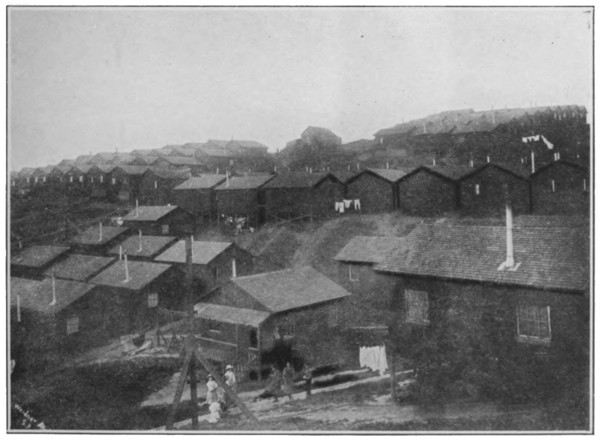
Cottages
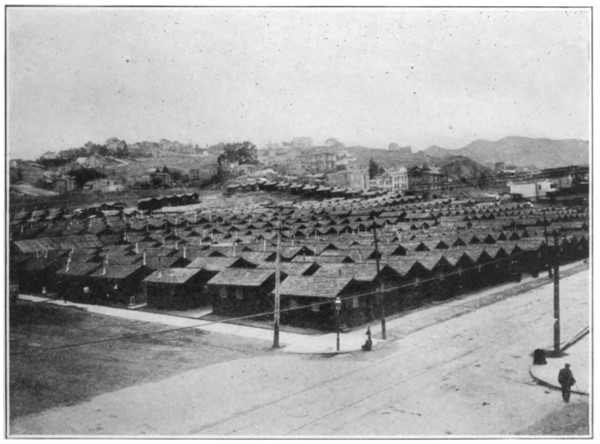
Camp No. 10, Potrero District
The Department of Finance and Publicity, with a small force,
was making the settlements incidental to the closing of the camps
and the refunding of instalments to tenants. It was also preparing
its financial report.
The Department of Camps and Warehouses had removed
cottages from all the public squares but Lobos, where but 479 cottages
and 1,287[37] persons remained. This camp sheltered the poorest
refugees.[38] Stricter sanitary measures could be enforced here
and care be given more cheaply than if the inmates had been removed
to cottages on private land. Bubonic plague in this camp
as well as elsewhere in the city had made precaution necessary.
The Department of Relief and Rehabilitation had become a
supervising agency. It supervised the collection of housing loans,
assisted the Executive Committee in making grants to charitable
institutions, and advised the Associated Charities which was administering
the greater part of the relief needed in moving people from
the camps.[39]
The closing chapter of the complicated story of organization
was reached when, acting on the suggestion of its special representative,
Mr. Dohrmann, the American National Red Cross sent
Mr. Bicknell in January, 1909, to San Francisco to confer about
final plans. Mr. Bicknell had then accepted the recently created
position of national director of the American National Red Cross.
The creation of this position may be said to be one of the results
of the San Francisco relief experience. As a result of conferences[40]
between these two men who had played such a determining part in
San Francisco’s struggle to help its people wisely to regain their
old standing, the Board of Trustees of Relief and Red Cross Funds
was formed in February, 1909.
The
complicated story of organization seems comparatively
unimportant when one’s mind is full of questions as to what
was to be distributed, and how many human beings were in
need of immediate relief. That there was general, quick recognition
of the need is shown by the quantities of supplies hurried to San
Francisco. Five thousand cars were reported April 28 to be on the
road. General C. A. Devol, who had charge of receiving and unloading
all supplies, states, however:[41] “The stores that arrived for the
relief of San Francisco up to July 20 amounted to 1,702 carloads and
five steamship loads, a total of approximately 50,000 tons. At the
height of the operations about 150 carloads were delivered into the
city daily, in addition to stores arriving by steamers.” The chairman
of the Finance Committee reported to Mr. Taft, president of
the American National Red Cross, on November 28, 1906, that the
estimate of total receipts in kind was 1,850 carloads of food supplies,
and 150 carloads of bedding, tenting, clothing, and so forth.
During the first two weeks after the disaster the Southern
Pacific Railroad brought 1,099 carloads of relief supplies into the
city. Under orders of its president, right of way was given to
trains carrying these cargoes, and express time schedules were used
for the sake of speed. These receipts were not all direct donations,
as the contents of a number of carloads had been purchased by the
Finance Committee and by the army from an appropriation of
$2,500,000 made by Congress[42] to be distributed under the direction
of the officers of the Pacific Division. There were also many
donations that were sent to agencies other than the Citizens’ Committee,
the Red Cross, and the army. These cannot be included
in any estimate as there was no complete record of the amounts.
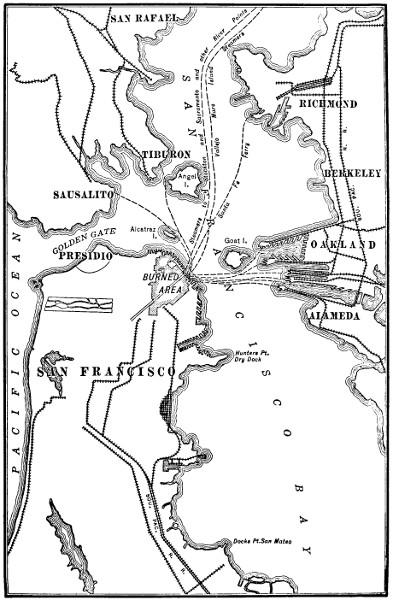
Transportation Routes about San Francisco
Larger map (200 kB)
It was found to be difficult to protect the mass of the rations
in the railroad yards and in transit to the warehouse against seizure
by ordinary thieves and by those who felt justified in disregarding
the usual rights of property. Goods were stolen, in quantities that
could not be reckoned, by those who expected to realize a profit as
well as by those who considered that they had the right to seize
what they felt was destined to meet their need. Some of these
confiscated boxes were addressed not to the relief authorities but
to specified persons and groups of persons in San Francisco or at
other points about the bay. A further incentive to confiscate lay
in the action of the police who, as was generally known, acting on
the orders of the chief of police, had broken open about 100 grocery
and provision stores that were doomed to be destroyed by fire.
The police, after making a rough estimate of the value of the stock,
distributed freely to the destitute.
When the cars reached San Francisco, along with the bulk of
the shipments which were addressed either to the quartermaster
of the army, who was designated to have charge of all supplies sent
to the American National Red Cross, or to the Citizens’ Committee,
were boxes addressed to the mayor, to the churches, to
other organizations of all kinds, and to individuals. It would
have interfered seriously with the work of relief if an effort had
been made to find the persons to whom special boxes were directed.
The American National Red Cross through its representative, in
whose care many boxes with specific directions were sent, did all
that was possible to carry out the intent of the donors, but it
could not in every instance find the intended recipient. Many inquiries
were received as to barrels and boxes which had not reached
their destination, but the cost of tracing these and the cost of
making special deliveries under the then existing conditions were
often greater than the value of the packages themselves.
An illustration of the difficulty of delivering special packages
is the story of eight cases of bread pans which were addressed to the
“Relief Committee” and were quickly distributed among the
refugees. When the manufacturing company that shipped the
cases learned on inquiry of the bakers for whose use they were intended
that they had not received them, it threatened to file a
claim for loss. The trouble, however, lay in the fact that a letter
of instruction addressed to the mayor got effectually separated
from the boxes.
No complete record of cash contributions can be made. Some
of the committees throughout the country expended part of their
funds to purchase supplies to be forwarded to San Francisco or to
relieve refugees at home, or failed to collect all the money reported
to have been contributed. The money reported as subscribed in
the state of California is far from representing the actual value of
relief contributed. Being so near the scene of disaster the California
communities wisely contributed supplies in large quantities
for immediate use and also cared for large numbers of refugees who
came to them. The official reports of contributions cannot therefore
give credit to all communities for all the relief furnished by
each, nor can they show the amounts contributed by the smaller
cities when these forwarded their contributions through the larger
city committees. Nor can a record of contributions sent to the
American Red Cross be found in the published list of contributors
to the committee in San Francisco.
TABLE 1.—CASH RECEIPTS OF THE FINANCE COMMITTEE OF RELIEF
AND RED CROSS FUNDS, AND ITS SUCCESSOR, THE CORPORATION,[43]
TO JUNE 1, 1909
| Cash donations, including San Francisco subscriptions and Red Cross remittances |
$8,921,452.86 |
| Interest on deposits (in part at 3 per cent and in part at 2 per cent) |
97,254.80 |
| Exchange |
1,140.65 |
| Receipts from sales of commodities donated in whole or in part: |
| Sales of surplus flour |
$216,717.15 |
|
| Sales of foodstuffs |
41,498.07 |
| Sales of tents |
14,826.55 |
| Total |
273,041.77 |
| Total receipts from donations |
$9,292,890.08 |
| Receipts from sales of commodities purchased, loans repaid, instalments, etc. |
380,167.86 |
| Total cash receipts |
$9,673,057.94 |
The total cash donations, $8,921,452.86, given in Table 1,
do
not include the $2,500,000 appropriated by Congress, which was disbursed
in the first two months for food, clothing, bedding, shelter,
etc., nor an estimate of the numerous independent funds which were
probably expended within the first month, nor of the enormous
quantity of supplies donated by the people of the country. These
supplied the first needs of the destitute and enabled the Committee
to save its cash for later and more permanent forms of relief.
TABLE 2.—CASH CONTRIBUTIONS FOR THE RELIEF OF SAN FRANCISCO,
TO JUNE 1, 1909, RECEIVED BY THE FINANCE COMMITTEE OF
RELIEF AND RED CROSS FUNDS, AND ITS SUCCESSOR, THE
CORPORATION, AND BY AMERICAN NATIONAL RED CROSS, BY
COUNTRY OF ORIGIN
| Country of origin |
Received by Finance Committee of Relief and Red Cross Funds and the Corporation |
Received by the American National Red Cross |
Total |
| San Francisco |
$413,090.83 |
.. |
$413,090.83 |
| About 2500 cities and towns of the United States |
5,261,898.35 |
$2,967,079.90 |
8,228,978.25 |
| Austria (Sec’t’y Amer. Embassy at Vienna) |
.. |
50.00 |
50.00 |
| Australia |
385.96 |
.. |
385.96 |
| Belgium |
50.00 |
.. |
50.00 |
| Canada |
145,097.15 |
315.50 |
145,412.65 |
| Cape Colony (Americans) |
.. |
464.00 |
464.00 |
| Ceylon |
.. |
32.33 |
32.33 |
| China |
40,000.00 |
.. |
40,000.00 |
| Cuba |
5.00 |
729.30 |
734.30 |
| England |
6,522.58 |
48.30 |
6,570.88 |
| France (Amer. Chamber of Commerce, Paris, $20,850) |
20,850.00 |
385.08 |
21,235.08 |
| Germany |
50.00 |
.. |
50.00 |
| Japan |
98,960.10 |
146,000.00 |
244,960.10 |
| Mexico |
14,286.44 |
193.87 |
14,480.31 |
| Russia |
51.45 |
147.57 |
199.02 |
| Scotland |
.. |
50.40 |
50.40 |
| United States of Colombia (Americans) |
200.00 |
.. |
200.00 |
| Total |
$6,001,447.86 |
$3,115,496.25 |
$9,116,944.11 |
The donations mentioned in Table 2
do not include $100,000
given to the University of California Hospital by the Massachusetts
Association for the Relief of California.
It appears from the figures of the two preceding tables
that while on June 1, 1909, money to the amount of $9,116,944.11
had been contributed for the relief of San Francisco, $8,921,452.86
had been received by the Finance Committee of Relief and Red
Cross Funds and by the Corporation. This difference between
the amount donated and the amount received by the local
organizations to which the work of relief had been entrusted
is explained by the fact that not all the money contributed
through the American National Red Cross had been paid over to
the Finance Committee or to the San Francisco Relief and Red
Cross Funds by June 1, 1909. The disposition made of the money
contributed through the American National Red Cross is shown
in Table 3.
TABLE 3.—DISPOSITION OF CASH CONTRIBUTED FOR THE RELIEF
OF SAN FRANCISCO THROUGH THE AMERICAN NATIONAL RED
CROSS, TO JUNE 1, 1909[44]
| Total donations made through the American National Red Cross |
$3,115,496.25 |
| Remitted to San Francisco to June 1, 1909 |
$2,920,005.00 |
|
| Administration expenses, purchase of relief supplies, and transportation of refugees |
47,073.35 |
| Sent to Italy (for Messina earthquake sufferers, 1909) |
50,000.00 |
| Total disbursements to June 1, 1909 |
3,017,078.35 |
| Balance available from donations, June 1, 1909 |
$98,417.90 |
The statement shows that of the $3,115,496.25 donated
through the American National Red Cross up to June 1, 1909,
$2,920,005.00 had been remitted to San Francisco. The balance
received but not remitted was therefore $195,491.25,[45] of which
$97,073.35 was disbursed directly by the Red Cross. It will be
seen that this balance equals the difference between the total
amount donated for the relief of San Francisco and the amount
of the cash donations received to June 1, 1909.
Food was of course the first necessity, and out of the need
to supply it grew the whole machinery of relief. Before the noon
of Thursday, April 19, the Citizens’ Committee had appointed
a sub-committee on relief of the hungry, with Rabbi Voorsanger
as chairman, to furnish food for the entire population, which for
a time fell into a series of long bread lines. In these lines rich
and poor, Italian, German, Swedish, Chinese, and native fared alike.
The only question was one of need. From the mayor and the
military officers down to the humblest families in the Potrero,
there was a good-humored acquiescence in the hardships of the
situation, and an optimism that was inspiring. Supplies in sufficient
quantities were rushed to the city, and the danger of suffering
from lack of food was averted.
The sub-committee began the distribution of food April 20.
It at once called on the army to furnish an officer, two companies
of infantry, and a troop of cavalry to guard rather than to distribute
what supplies had become available. It took steps to get
flour from points around the bay and studied the situation as
to the bakeries, some of the largest of which had been burned or
damaged. Repairs were being made to some of those damaged,
and a daily output of 50,000 loaves of bread was shortly to be
expected.
The ruling was made that after the committee on relief of
the hungry had received the quantity of bread it needed, the bakers
might sell the remainder at not more than 10 cents a loaf, in quantities
of not more than five loaves to one person. The committee
was furthermore authorized by the Citizens’ Committee to levy
on all supplies wherever found. The following notes show the
general trend of the work during the first week.
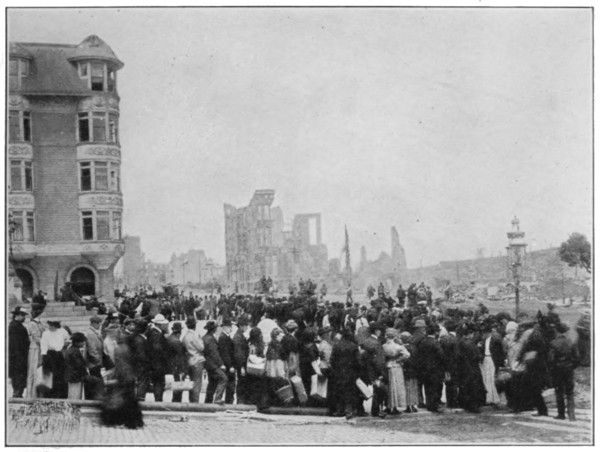
All classes joined the bread line
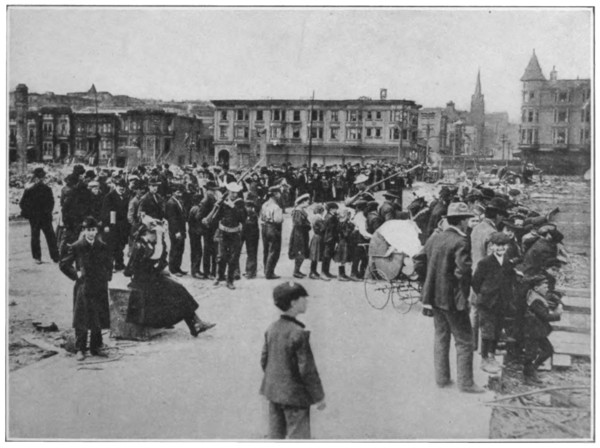
Soldiers gave aid and protection
Relieving the Hungry
On Friday, April 20, while the fire was still spreading, the
general distribution was begun. About 25 wagons were impressed
which were used in the distribution of the provisions seized by
order of the committee. Refugees were standing in line at the
Golden Gate Park Lodge; the Young Men’s Hebrew Association,
Page and Stanyan Streets; St. Mary’s Cathedral, Van Ness
Avenue and O’Farrell Street; at Jefferson and Columbia Squares,
and at the corners of Fifth and Mission Streets and 24th and
Douglas Streets, where food stations had already been established
by the citizens. The committee made use of these for its own
distribution, choosing the Young Men’s Hebrew Association as
its base for general distribution.
The bakeries that day furnished 35,000 loaves of bread.
The chief difficulty lay in transporting to the city the supplies
that were available—5,000 tons of flour at Vallejo and many carloads
of donated goods at Oakland.
On Saturday, April 21, the day the fire was brought under
control, the city was reported to be divided into districts. Five
bakeries were in operation and a committee from Fresno appeared
before the Citizens’ Committee to announce that it had brought
six carloads of supplies. Committees from some nearby communities
put themselves under the direction of the Citizens’
Committee, but the general efficiency of the distribution was
lowered by the fact that still other out of town committees undertook
to make independent distributions.
On Sunday, April 22, arrangements had been made to have
bread baked in the towns of the Santa Clara Valley. It was
found necessary to carry into effect the committee ruling to prevent
alleged exorbitant retail charges for bread.
On Monday, April 23, there was an abundance of supplies
for present use and an over-supply of milk.
On Tuesday, April 24, there was a shortage of sugar and
coffee. Sixty food stations had been established. No stores were
found on investigation to be charging exorbitant prices for food,
but some of the refugees were trying to get more than their share
of food. Confusion was still being caused by the work of the
independent relief committees.
When two days later the committee on relief of the hungry
made its final report to the Finance Committee there had been
established 128 stations and sub-stations, a warehouse in the
Moulder School, Page and Gough Streets, and a branch warehouse
at Spear and Howard Streets. It had had printed a card
for the use of the applicant at the food station and had determined
that rations, except in cases of emergency, should be issued to
each person at intervals of three days. Every card carried a
statement of the amount of food required by a person for a day,
as follows:
Fresh beef, 11⁄4 lbs. or bacon or ham, 3⁄4 lb.
Salt fish, 3⁄4 lb. [Probably as a substitute for meat and not in
addition to it.]
Fresh or canned vegetables, 1 lb.
Flour, 18 oz., or bread, 22 oz.
Rice, 1⁄8 lb. or beans, 1⁄4 lb.
Sugar, 1⁄10 lb.
Coffee, 1⁄10 lb.
Special diet,—eggs, butter, milk, fruit,—was also issued.
This ration was more liberal than that adopted by the
army.[46]
During the trial week the distribution of food was made to
the refugees either from the stations or at the various camps or
shelters. Though a fixed ration was agreed on there could be no
certainty of delivery, as the quantity and variety of the food
supply was indeterminate. The committee in making its report
could give only an approximate estimate of the goods it had seized.
It anticipated that claims would be made against it as well as
against the United States army, the state militia, the police
department, and the various volunteer organizations which had
without authorization seized goods.
It arranged to pay the bakeries at a rate of 5 cents a loaf
for the 255,630 loaves of bread which had been supplied by them to
the committee, part of the payment to be made in flour, and to
pay the Milk Dealers’ Association at a rate of not more than 20
cents a gallon for milk supplied by it. The committee had employed
between three and four hundred men and as many trucks to
transport supplies, but it did not know the extent of its obligation
for the use of the latter.
During the first week after the disaster there was a growing
inclination to turn to the army for the direction of the relief
work. Though the army in common with every other body of
persons had suffered serious losses, its efficiency as an organization
could not be impaired even though the extent of the aid it could
immediately give were lessened.
To the military reservations which lay outside the burned
district refugees immediately fled in numbers, and on April 19,
the day the committee on relief of the hungry began its work,
Major Krauthoff issued from a depot established by him in the
Presidio such food as could be spared from the Presidio itself
and from Forts Mason and Miley. The great army warehouses,
which had stored $2,000,000 worth of supplies, were burned, but
along with the committee on relief of the hungry the army began
to confiscate supplies for use on the reservations. It also purchased
from the posts in the Departments of California and the
Columbia 900,000 rations, the first shipment of which arrived
on April 21. On that same day a steamer from Stockton put in
at Fort Mason with donations of provisions and blankets. These
were immediately distributed among 20,000 refugees.
The committee on relief of the hungry had not been given
full authority nor had its powers been defined. It had no machinery
adequate for the handling of a great bulk of supplies,
and it was hindered by the crossing of efforts on the part of unauthorized
agencies.
The Finance Committee, as has been said in Chapter I,
was the committee of power, and might have assumed responsibility
for perfecting an adequate relief organization, but as it realized
that its efforts could not be as quickly effective as those of the army,
it, as well as the mayor, called on the army to assume control of
the relief work. General Greely consented and on April 29 took
charge of the food issues and gradually put the work under the
direction of 64 officers and 500 enlisted men.
Major C. A. Devol, depot quartermaster, who took over
the tremendous task of unloading cars and boats and transporting
supplies to and from warehouses,[47] quickly introduced order and
economy into the work. Major C. R. Krauthoff, in charge of the
commissary department, was also able soon to reduce to an
efficient routine his work of receiving donated supplies, of purchasing,
selling, and storing supplies, and of issuing properly
balanced rations.
In the report made in July, 1906, to the War Department,
Colonel Febiger, who from April 29 had charge of the organization
of relief stations, and later became chief of the Bureau of Consolidated
Relief Stations, which had been established by the army
to facilitate the relief work, said that on taking charge he had found,
after a most thorough investigation, no instance of extreme
suffering from lack of food or shelter, but many instances of
repeating, so that the number of rations issued was in excess of
the needs of the population. With no accepted general organization
bringing about the co-ordinating of relief, there was of
necessity an exaggerated estimate of the needy.
General Greely, who during his Arctic explorations had
learned what extreme suffering from hunger and cold meant, had
the city canvassed on May 13 in order to find any case of destitution
which might have been overlooked. All of his inspectors,
with 30 officers in addition to the officers directly connected with
the relief work, were ordered to make a special effort to learn of
persons in absolute need of food and decent clothing or of bed and
shelter. The result was that but two such cases were reported.
During the early days orders were issued forbidding all
householders to light fires in their houses. Cooking, in consequence,
was done in the street over open fires or on rusty stoves which
belched smoke out of short sections of pipe. In those days only
candles were permitted for light and they had to be extinguished
at 8 p.m.
Relief Stations and Registration
As stated in Chapter I,[48] the northern part of the city was,
for purposes of policing, put under military control the third day
after the disaster. Later, for purposes of relief, the city was
divided into seven sections, whose boundaries were made coterminous
with those of the army districts. On May 8, each section
was supplied by the army with an officer who made regular reports
to the headquarters of the Bureau of Consolidated Relief Stations,
and with a physician who was responsible for sanitation and for
diet prescriptions. Nine depots and sub-depots were open for
storage of food supplies.
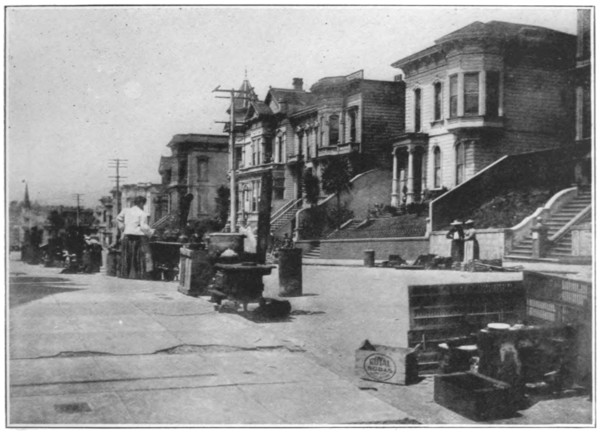
Preparing meals in the street
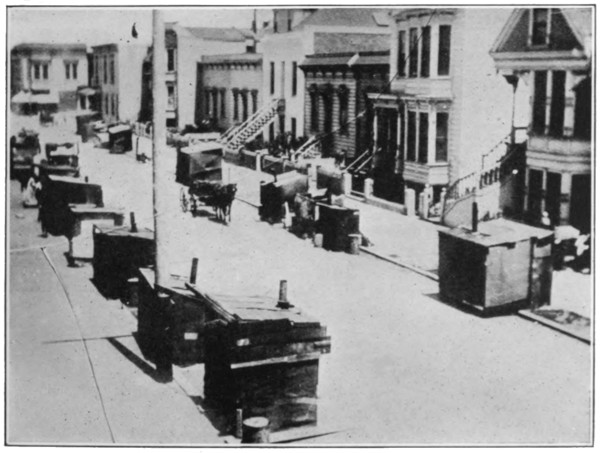
A row of street kitchens
Fires in Houses were Prohibited
To give some idea of the character and origin of the relief
stations a table of the relief stations of Civil Section VI is given:
TABLE 4.—CHARACTER OF LOCATION, ORIGIN, AND DATES OF OPENING
AND CLOSING OF RELIEF STATIONS OF CIVIL SECTION VI
Station
number |
Character of location |
Opened by |
Date
opened |
Date
closed |
| 600 |
Planing Mill |
Citizens of neighborhood |
April 19 |
|
June 12 |
[49] |
| 601 |
Saloon |
Committee, Citizens of neighborhood |
24 |
|
May 21 |
|
| 602 |
Church |
Pastor of same |
26 |
[49] |
July 1 |
|
| 606 |
Butcher shop |
Citizens of neighborhood |
24 |
|
June 1 |
[49] |
| 609 |
Police station |
Committee, Citizens of neighborhood |
25 |
[49] |
(Unknown) |
| 610 |
Shack |
Mission Relief Committee |
20 |
|
(Unknown) |
| 611 |
City Park |
Committee of citizens |
22 |
[49] |
June 2 |
|
| 613 |
(Unknown) |
Committee, Citizens of neighborhood |
22 |
[49] |
May 15 |
|
| 616 |
Bakery |
Citizens of neighborhood |
23 |
|
June 23 |
|
| 618 |
Schoolhouse |
Citizens of neighborhood |
22 |
[49] |
June 16 |
|
| 619 |
Barn |
Volunteers |
21 |
[49] |
June 23 |
|
| 620 |
Hot Meal Kitchen |
Los Angeles Relief Committee |
(Unknown) |
(Unknown) |
| 622 |
Tent |
U. S. Army |
April 25 |
[49] |
June 23 |
|
| 623 |
Maennerbund Hall |
Local Order of Eagles |
20 |
[49] |
May 14 |
|
| 624 |
Public square |
Citizens of neighborhood |
20 |
[49] |
June 14 |
|
| 626 |
Shack |
Citizens of neighborhood |
27 |
[49] |
May 21 |
[49] |
| 627 |
(Unknown) |
Committee, Citizens of neighborhood |
22 |
|
June 9 |
|
| 628 |
Hall |
Committee, Citizens of neighborhood |
20 |
|
June 9 |
|
| 629 |
Residence |
Citizens |
25 |
[49] |
May 13 |
|
| 630 |
Schoolhouse |
Physician and other citizens |
22 |
[49] |
May 31 |
[49] |
| 631 |
(Unknown) |
(Unknown) |
(Unknown) |
May 1 |
|
| 632 |
(Unknown) |
(Unknown) |
(Unknown) |
June 16 |
|
| 634 |
(Unknown) |
Citizens |
April 23 |
|
May 12 |
|
| 635 |
(Unknown) |
(Unknown) |
(Unknown) |
(Unknown) |
| 636 |
Residence |
Society of Native Daughters |
April 26 |
[49] |
May 26 |
[49] |
| 637 |
(Unknown) |
(Unknown) |
(Unknown) |
May 13 |
|
| 641 |
Cellar |
Ancient Order of Hibernians |
April 24 |
[49] |
June 23 |
[49] |
| 642 |
Residence |
Two physicians |
22 |
[49] |
(Unknown) |
| 643 |
City and County Hospital Grounds |
U. S. Army |
25 |
[49] |
(Unknown) |
| 645 |
Saloon |
Ancient Order of Hibernians |
25 |
|
June 20 |
[49] |
| 646 |
Schoolhouse |
Citizens of neighborhood |
23 |
|
June 15 |
|
| 647 |
School |
A physician |
20 |
|
May 1 |
[49] |
There is no information to show that any one of these sub-stations
had been established by the committee on relief of the
hungry. As may be borne in mind, the number of stations in use
on April 26 was reported by the committee on relief of the hungry
to be 128; three days later, on taking charge, the army reported
177; early in May the number dropped, as is shown by Table 5,
to 112.
TABLE 5.—RELIEF STATIONS IN THE SEVEN CIVIL SECTIONS ON
MAY 3 AND ON JUNE 3, 1906
| CIVIL SECTION |
Food
stations
on May 3 |
Food
stations
on June 3 |
Hot meal
kitchens
on June 3 |
Num-
ber |
Headquarters |
| I |
Presidio entrance |
19 |
.. |
4 |
| II |
Oak St. near Stanyan |
8 |
3 |
3 |
| III |
3055 Van Ness Ave. |
5 |
4 |
3 |
| IV |
Hamilton School, Geary and Scott Sts. |
35 |
10 |
4 |
| V |
Buena Vista School, 18th and York Sts. |
9 |
3 |
4 |
| VI |
24th St. and Potrero Ave. |
21 |
5 |
2 |
| VII |
25th and Guerrero Sts. |
15 |
8 |
.. |
| Total |
112 |
33 |
20 |
Dr. Devine as representative of the American National Red
Cross had appointed a civil chairman to be responsible for the
receiving and investigation of applications. After May 1, the
responsibility for the distribution of supplies was divided at each
section between the military officer and the civil chairman. The
civil chairman determined who should receive relief and the
military officer made the necessary requisition on the Bureau of
Consolidated Relief Stations.
The records of relief distribution are incomplete and there
is no means of determining accurately from week to week the
number of persons who received food, clothing, and other supplies,
medical care and shelter. The most complete records[50] are
furnished by the official camps. Colonel Febiger in his July report,
already quoted, says that “313,145 persons were
on May 2 estimated
to be receiving rations, though this number should probably
be reduced to 300,000 to make allowance for repeaters.”
General Greely made estimate that the number of cases of fraudulent
repeating was not more than 3 per cent of the whole.
TABLE 6.—DAILY ISSUES OF RATIONS FROM APRIL 19 TO MAY 12,
1906
| Date |
Number of
persons
(estimated) |
Date |
Number of
persons
(actual) |
| 1906 |
|
1906 |
|
| April |
19 |
100,000 |
May |
1 |
313,117 |
| 20 |
150,000 |
2 |
313,117 |
| 21 |
200,000 |
3 |
279,631 |
| 22 |
225,000 |
4 |
230,207 |
| 23 |
250,000 |
5 |
264,570 |
| 24 |
270,000 |
6 |
262,027 |
| 25 |
290,000 |
7 |
233,989 |
| 26 |
306,000 |
8 |
223,915 |
| 27 |
310,000 |
9 |
222,313 |
| 28 |
315,000 |
10 |
204,637 |
| 29 |
315,000 |
11 |
186,960 |
| 30 |
315,000 |
12 |
147,232 |
| Daily average |
253,833 |
Daily average |
240,143 |
Care has been taken to verify the estimate of the issues,
which has called for some reduction of the totals as given in earlier
reports. This accounts for the slight discrepancy between Colonel
Febiger’s figure for May 2 and that given in the table.
The reason for the large increase in numbers in the bread
line in the days immediately after the disaster is that householders
had by then exhausted their private stock and could not
make purchases, as most of the goods in retail stores had been
confiscated; nor could food be prepared in private houses until
chimneys had on inspection been found safe. From a week to
two or three months, according to the location and the activity
of the inspection, the fire prohibition held. In towns across the bay
people with money in bank had difficulty in securing food because
the banks were temporarily closed and the retail stores could not
determine when they would be able to replenish their stock.
As the number in the bread line in the early part of May
represented two-thirds of the population of a city that had been
raised to a high degree of prosperity by the industry and thrift
of its citizens, there would have been rapid decrease in the number
of applicants for rations even had there been no concerted plan
to reduce numbers. Pressure was brought from without, however,
which, as is shown in the following paragraph, did accelerate the
citizens’ return as a body to the normal means of making provision
for creature needs.
In order that the smaller traders might be encouraged
to resume business and the funds be reserved in a great measure
to give permanent relief, the representatives of the army and
the American National Red Cross co-operated during late April
and early May in a strenuous effort to lessen the number supplied
with rations. The attractiveness of the free food issues was
diminished by reducing the ration items to meat, bread, and vegetables
for all applicants in sound health except such as were living
in the camps under military control. The number of the stations
was rapidly reduced, as shown by Table 5. After the middle of
May, except in cases of invalidism, rations were issued but three
times a week, and an offer was made of a final issue of a month’s
rations to any one who would accept that in place of the regular
allowances. These measures served to concentrate in the permanent
camps those refugees who were to continue as charges
on the relief administration. The work of concentration was
hindered, however, by the numerous private relief stations throughout
the city which could be persuaded only gradually to send their
patrons to the public relief stations. An Associated Charities
worker who knew well the people in one large section of the city
went through the tents with a soldier and demanded the return
of extra bacon, canned goods, and potatoes, which had been laid in
by thrifty refugees who had made use of both public and private
food stations.
The Red Cross began within the first week of the disaster
a general registration of the refugees. As substantially every one
in the city was at that time dependent on the relief stations for
food, the natural way of getting access to the refugees was through
the distribution of rations. Carl C. Plehn, professor of finance
in the University of California, whose experience as director of
the census of the Philippine Islands suggested special fitness for
the work, undertook to prepare a plan, organize the force, and
superintend the work of a registration bureau. The force consisted
of some 200 volunteers from among the public school teachers, an
intelligent and capable, even though inexperienced, group of enumerators.
Their regular employment stopped on April 18, but
their salaries were paid to the end of the school year. Though the
service given was very unequal and largely unsatisfactory, if
judged by the standard of a census bureau or a charity organization
society, it is doubtful whether at the time so high an average
of efficiency could have been obtained in any other way.
On April 27 Professor Plehn submitted a tentative plan for
the registration. By May 7 the cards[51] and instructions had been
printed, a force of 175 persons was in the field, and the work was
well under way. Ten days later 20,000 cards had been filled out
and the canvass was practically completed as far as it could then
be carried.
After excluding duplicates as far as they could be detected,
the 19,438 cards, which represented the same number of families
or household parties, distributed the 84,703 persons included
among the seven sections as follows:
TABLE 7.—FAMILIES AND INDIVIDUALS REGISTERED IN THE SEVEN
CIVIL SECTIONS, MAY, 1906
| Section |
FAMILIES
OR PARTIES
REGISTERED |
INDIVIDUALS
REGISTERED |
| Number |
Per cent |
Number |
Per cent |
| I |
2,590 |
13.3 |
10,206 |
12.1 |
| II |
813 |
4.2 |
3,076 |
3.6 |
| III |
3,097 |
15.9 |
12,473 |
14.7 |
| IV |
2,577 |
13.3 |
10,737 |
12.7 |
| V |
2,220 |
11.4 |
8,384 |
9.9 |
| VI |
2,876 |
14.8 |
14,896 |
17.6 |
| VII |
5,265 |
27.1 |
24,931 |
29.4 |
| Total |
19,438 |
100.0 |
84,703 |
100.0 |
The 84,703 individuals were 28,319 men, 32,650 women,
22,795 children, and 939 persons who were entered under the
heading, “Aged, etc.”[52]
The information recorded on the registration cards varies
in completeness and value on account of the great diversity in
carefulness and capability among the persons who collected it.
Many of the cards were filled out intelligently and conscientiously;
many are wholly unsatisfactory. Taken together, however, they
give a rough picture of that quarter or third, whichever it may
have been, of the city’s population which was still, in the middle
of May, dependent on the general distribution of food for its daily
supplies; and they reflect to some extent the dislocations that were
brought about by the disaster, in residence, occupation, and
circumstances.
It was not the primary object of the registration to furnish
material for a description of the refugees, but to establish
a uniform system of food distribution which should prevent
waste by cutting out repeaters, apportioning the number of
rations to the size of the family, and cutting off persons as they
reached a position where they no longer needed to be dependent.
Other purposes were also in mind. At the beginning, in fact,
the efforts seem to have been made to provide a record of the
persons who received relief, for historical purposes and for aid
in determining their future needs. It was also hoped that the
registration could be made of practical value to the state labor
commissioner, in the free employment bureau[53] which had been
opened. In part for this last reason, information was asked about
former occupation and former employer, union membership, and
present employment.
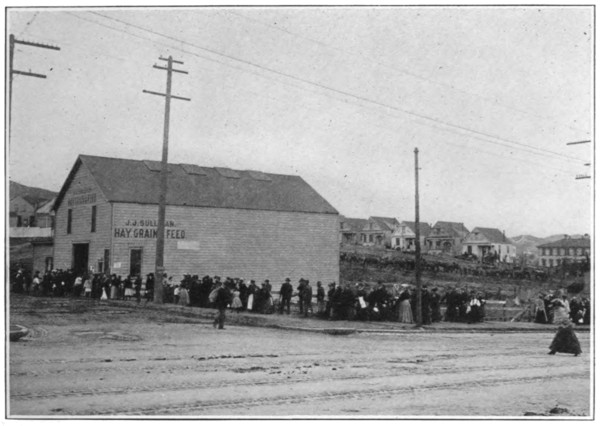
The bread line, Mission District
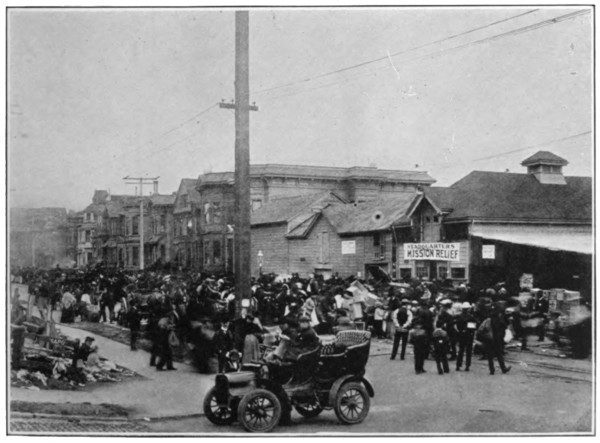
Relief station, Mission District
Distribution of Relief Supplies
The registration was made at the relief stations, the cards
being filled out when applicants came for rations. If the applicant
did not live within the boundaries of the section served by the
station to which he had come he was referred to the proper station.
When the applicant had been registered he was given a food card[54]
bearing a serial number, good for ten days, which stated conspicuously,
so that the attendants could see, even before he reached
the counter, the number of rations to which his family was entitled,
and showed uncanceled the dates on which the card would
be honored. The food card number was entered on the registration
card, which was kept at the relief station. Each time rations were
drawn the date for which they were drawn was canceled on the
card. After the registration had been completed at any station
no rations were issued except on presentation of a food card.
By this system abuses were controlled: no one could draw
supplies from two or more stations, nor two or three times on the
same day from the same station, nor for more persons than he
represented; able-bodied men, for whom by this time there was
abundant opportunity of employment, could be cut off; and at
the expiration of the ten-day period the merits of the case could
be reviewed before granting a renewal of the food card.
It was through its success in establishing a uniform and
workable system of food distribution that the first registration
was most valuable. It did not prove to be of much service in
aiding applicants to find employment, in giving a record of the
entire work of relief, or in furnishing a basis for the rehabilitation
work. That it failed in realizing all that was hoped from it in
these directions was due partly to changes in the labor situation,
which soon made efforts to supply employment superfluous;
partly to some ambiguity and lack of definiteness in the headings
on the card, and the omission of some essential items; but chiefly
to the many omissions on the part of the enumerators, the lack
of uniformity in their interpretation of the headings on the card,
and the large amount of carelessness they exhibited in recording the
information that was secured. The inexperience of the enumerators
in investigation, the immense difficulty of supervising them
adequately when the automobile and the wagon were the only
means of transportation between the far-scattered stations, and
the necessity for getting the whole work done as speedily as possible,
so that there was no time for correcting mistakes or training
investigators, are the simple explanations of these defects.
If all the circumstances are taken into consideration—the
number of persons affected by the disaster, the extent of the
territory to be covered, the difficulty of getting about, the confusion
which still existed among the many elements of the relief
organization, and the inexperience in relief work of those who
made the registration, both university professors and public school
teachers—the results obtained were surprisingly satisfactory. The
registration would have justified itself if it had done nothing more
than systematize the food distribution and contribute toward the
reduction of the bread lines. This it undoubtedly did.
An indication of the effectiveness of the first registration,
as may be seen in Table 11,[55] is the sudden drop in the number of
persons who received rations after May 12, a decrease of 21 per
cent on that day against an average daily decrease for the five
preceding days of slightly over 7 per cent. The marked drop of
May 16 is, however, in part due to the stimulation to self-help
caused by putting into effect the order that rations should be issued
only three times a week. The general use of the food card was an
important factor in bringing about the reduction; another, the
rapid increase in the number of persons gaining self-support. One
special use to which the so-called first registration was put was to
determine who should receive special diet. The diet included meat,
fresh milk, butter and eggs, vegetables, and fruit, and was prepared
for the sick, the aged, and for mothers with infants. The method
of its distribution varied in the different sections and from time to
time, but the policy was to subject its distribution to more direct
control from the central office than the ordinary rations. Issues
of special diet were not finally discontinued until October 1, a
few days before the closing of the last kitchen.
A second general registration[56] was made in June by the
American National Red Cross staff of workers with the aid of the
camp commanders. General Greely appreciated the need of
having a more complete case record of the individuals who were
making use of the camps, in order that a restriction of numbers
might be judiciously and expeditiously made. The relief workers
outside the camps, also, realized clearly the need of a more adequate
registration as a basis for intelligent rehabilitation work.
Hot Meal Kitchens
The Bureau of Consolidated Relief Stations, acting on the
advice of the Finance Committee, opened its first kitchen in Lobos
Square about the middle of May to serve hot meals both to
refugees and to persons able to pay for their food. From immediately
after the disaster kitchens had been established by voluntary
relief committees as the best means of feeding the people living in
or near the camps. One such committee, that of Los Angeles,
sent equipment to furnish five kitchens, with a representative,
Mr. Desmond, of the Desmond Construction Company, to put
them in operation. They were intended freely to furnish food and
they gave timely aid in the early days.
When the Bureau opened its own community kitchens,[57] the
experiment was made as a distinctive part of the effort to reduce
the long bread lines. The kitchens were intended to test the needs
of those applying for free food, because the number of those
willing to accept relief in food was expected to suffer diminution
when a common eating room was offered. They were also to give
a convenient eating place to persons able to pay but not able to
provide their own food, with the privilege of sitting at separate
tables and of ordering a better quality of food than that furnished
at the free tables. They were also to serve to the aged and infirm
better food than had been supplied to them before. The kitchen
system was intended to be economical and sanitary. Sanitary
inspection could be made more thorough when in each encampment
there should be one general kitchen rather than scattered
individual kitchens for the preparing of free rations. Insistence
on the first article of the new experiment—the common eating
room—made Section VII, in the part of the city known as the
Mission, unwilling to open a kitchen. It successfully opposed the
step because it was one that the Mission workers felt would degrade
the people and tend to destroy the privacy of family life.
It must be borne in mind that the kitchen system was
introduced after the bread line had been reduced to less than one-half
its greatest length, and that it threw into conspicuous relief
those who were without power to re-establish themselves or unwilling
to try to do so.
The hot meal kitchens caused no sudden drop in the amount
of food distributed. On May 12 when, as has been already commented
upon, there was a marked decrease in the number of
persons receiving rations, there were but five kitchens in operation;
but the new method did effectively help to weed out those who no
longer needed free rations. Colonel Febiger wrote late in June
that “by the operation of these hot food camps thousands of
dollars were saved for future relief; probably 95 per cent of the
15,000 persons now being supported by food relief were absolutely
in need of it, those not in need either having withdrawn or having
been forced out.”
The kitchens were at first run exclusively by the Desmond
Construction Company under contract with the Bureau of Consolidated
Relief Stations; that company, which had already made
its experiment, having been the only one willing to undertake what
was considered by the contractors to be an undesirable job. When
by June 21 the number of kitchens had been gradually increased
to 27, two other contractors were operating under the Bureau.
The Bureau and the Red Cross provided police protection,
furnished sites for the kitchens, and supplied fuel and water.
Each contractor provided his own buildings or tents, equipment,
and service. The contractor agreed to furnish a wholesome meal,
and to submit his daily menu to the relief officials for approval.
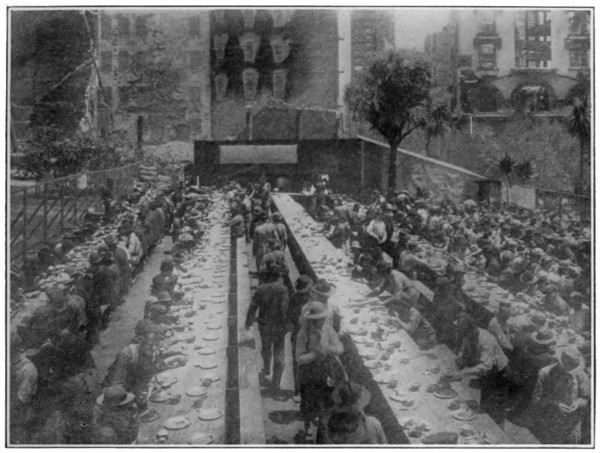
An open air dining room
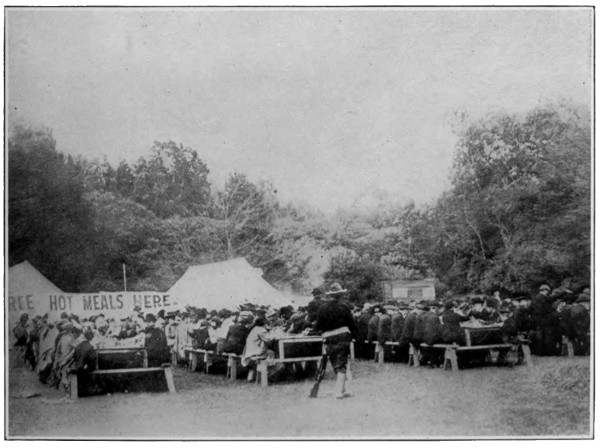
In Golden Gate Park
Hot Meal Kitchens
The following is a typical daily menu:
Meals were supplied to any person who was ready to pay cash or
who possessed a meal ticket. The meal tickets were issued daily
by the Red Cross and were redeemed by it by payment made to
the contractor in cash or in kind from the relief supplies. The
original plan was to serve ten-cent free meals with provision for
granting an extra five-cent purchase to such persons as might be
considered in need of extra food.
Certain kitchens within the Presidio reservation are not
reported on later than July 11, when they were furnishing about
1,200 meals a day. One thousand meals a day would probably
be a liberal estimate for the remainder of the time, thirty days,
that these Presidio kitchens were to remain open, but such an estimate
is not included in Table 8.
TABLE 8.—MEALS SERVED BY HOT MEAL KITCHENS, FROM MAY TO
OCTOBER, 1906, INCLUSIVE
| Month |
MEALS SERVED |
Amounts disbursed
from Relief and Red
Cross Funds in
payment for meals |
| Free |
Paid |
| May |
87,160 |
(Unknown) |
(Unknown) |
| June |
402,522 |
1,027 |
(all in 3 days) |
$46,610.55 |
| July |
486,182 |
3,786 |
(all in 11 days) |
75,756.30 |
| August |
377,776 |
4,608 |
|
61,379.75 |
| September |
109,448 |
684 |
17,746.80 |
| October |
11,875 |
.. |
2,953.14 |
| Total |
1,474,963 |
(Unknown) |
(Unknown) |
From the data on hand we can estimate the proportion of ten-cent
meals at 12.1 per cent and fifteen-cent meals at 87.9 per cent.
The first report of meals paid for is for June 28. Those
who patronized these restaurants paid from 10 to 20 cents for their
meals, the average price being 15 cents. The extent to which this
opportunity was utilized is shown in Table 9.
TABLE 9.—FREE AND PAID MEALS SERVED BY HOT MEAL KITCHENS
ON SPECIFIED DATES IN 1906
| Date |
Free
meals
served |
PAID MEALS SERVED |
| Number |
Per cent of
free meals |
| June 28 |
16,666 |
617 |
3.7 |
| July 1 |
14,087 |
423 |
3.0 |
| August 1 |
15,202 |
191 |
1.3 |
| September 1 |
7,484 |
82 |
1.1 |
The last paid meal was served on September 19, 1906. The
last kitchen closed was that at Speedway Camp, where the final
meal was served October 10, 1906.
Frequent complaints were made that the kitchens supplied
food which lacked in quality and variety, was poorly cooked,
and served on fly-infested tables in unsanitary rooms. In some
instances the complaints were justified, but the army inspections
were thorough, and the contractors on the whole lived up to the
contracts. Some of the complaints were made not by those who
were using the kitchens but by those who were critical of the
kitchen system itself.
It is not possible to estimate the total value of the food
distributed. For food and its distribution the Relief and Red
Cross Funds expended $1,226,567.16. The army report gives
$259,811.20 as expended for subsistence stores, but this is not a
complete statement of the disbursements made by it from the
appropriation from Congress. These sums do not include an
estimate of the value of donations in kind that were used as such
and not sold. General Greely in his report stated that in the food
donations distributed by the army there were about 2,000,000
complete rations, which had to be increased by substitutions
and by purchase to supply the 3,873,745 rations distributed by
the army during May and June. Two commodities that had been
donated in excess of need were flour and potatoes.
TABLE 10.—EXPENDITURES OF SAN FRANCISCO RELIEF AND RED
CROSS FUNDS FOR PURCHASE AND DISTRIBUTION OF FOOD,
TO MAY 29, 1909
| Purchases of food |
| Groceries |
$560,205.77 |
|
| Meat |
182,798.74 |
| Bread |
84,436.10 |
| Milk, fresh |
33,032.64 |
| Fruits and Vegetables |
25,029.01 |
| Flour |
21,848.14 |
| Miscellaneous |
8,029.43 |
| Total |
|
$915,379.83 |
| Distribution of food |
| Stoves, hardware, kitchen utensils, dishes, fuel, etc. |
$30,540.72 |
|
| Labor of all kinds |
39,968.72 |
| Drayage, etc. |
14,787.10 |
| Total |
|
85,296.54 |
| Hot Meal Kitchens |
204,446.54 |
| Bureau of Special Relief |
21,444.25 |
| Grand total |
$1,226,567.16 |
TABLE 11.—PERSONS TO WHOM RATIONS WERE ISSUED IN MAY
AND JUNE, 1906
| Date |
Number
of
persons |
| 1906 |
|
| May |
1 |
313,117 |
| 2 |
313,117 |
| 3 |
279,631 |
| 4 |
230,207 |
| 5 |
264,570 |
| 6 |
262,027 |
| 7 |
233,989 |
| 8 |
223,915 |
| 9 |
222,313 |
| 10 |
204,637 |
| 11 |
186,960 |
| 12 |
147,232 |
| 13 |
139,405 |
| 14 |
126,970 |
| 16 |
97,886 |
| 18 |
91,812 |
| 22 |
73,163 |
| 24 |
62,239 |
| 26 |
39,432 |
| 29 |
54,883 |
| 31 |
44,289 |
| June |
2 |
42,374 |
| 5 |
39,084 |
| 7 |
35,237 |
| 9 |
34,268 |
| 12 |
29,621 |
| 14 |
22,753 |
| 16 |
22,295 |
| 19 |
16,608 |
| 21 |
16,246 |
| 23 |
15,451 |
| 26 |
15,340 |
| 28 |
15,339 |
| 30 |
15,353 |
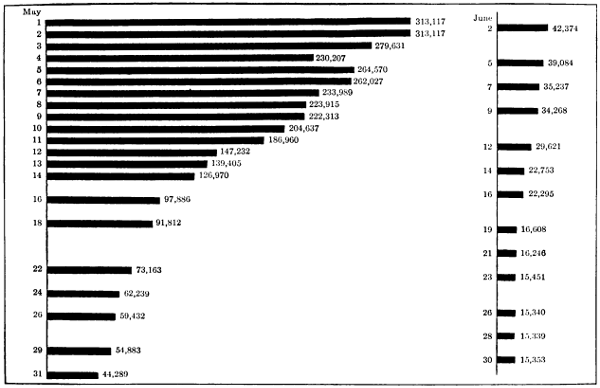
CHART 1.—PERSONS TO WHOM RATIONS WERE ISSUED IN MAY AND JUNE, 1906
Among the persons who received rations, as indicated in the
table and chart, are included both those to whom raw rations were
issued and those who were served with free meals at the hot meal
kitchens.
Of secondary urgency was the demand for clothing. The
requests for clothing were fewer than those for food, though
many refugees fled from the burned areas with no clothing except
nightgowns or calico slips, a poor protection from the cold nights
and chilly April mornings and evenings.
The records of distribution are incomplete. General Greely
estimated the number of persons who received clothing at 200,000.
Much of the clothing donated bore the wellknown mark of the
charity gift in kind. The second hand clothing in many cases
was, to repeat General Greely’s comment, “more or less of a
burden on the Red Cross.” Some was useless; some required
to be cleaned and disinfected. The new clothing was, in the words
of Captain Bradley, who had charge of its distribution, “of old and
dead stock of mediocre and poor quality.” Part of the shoes
and articles of clothing supplied from the army stores and charged
against the appropriation from Congress were of obsolete pattern.
The same criticism was made of some of the household goods donated.
A large number of the cots, for instance, were worthless or
of poor quality. There was the further handicap to the distributor,
of not knowing what donations were to be expected or when
they were to be received. This uncertainty meant serious delays
in supplying the need and severe criticism of the administrators,
but the latter did not feel themselves justified in making purchases
of clothing in large quantities when clothing similar to that ordered
might, later, be received as a gift.
The memory is vivid to some of those who worked in the
refugee camps during the midsummer of 1906, of the children in
striped sweaters and gay Tam-o’-Shanters. The caps were not
suitable for summer wear, but they had been sent in large quantity
with the sweaters to be distributed. The mental picture of Golden
Gate Park with its scattered barracks and tents pitched close to
ornamental lakes and neglected flower beds is accentuated by
the note of high color given by the sweaters and caps.
Distribution of clothing, like the distribution of food, was
quickly undertaken by independent groups of volunteers, who
collected and gave out what could be got in the city itself. While
the fire was spreading the army from its stores in the Presidio
gave blankets and quantities of shoes, shirts, ponchos, and other
clothing for men. As the donations from abroad began to arrive
in large quantities they were quickly handed out without careful
discrimination in sorting or adapting to individual needs.
On May 4 the army, in consultation with Dr. Devine, took
charge of the organization of the clothing and household distribution.
The Crocker School on Page Street was taken for use as
a warehouse. A warehouse for second hand clothing exclusively
was established ten days later in the Everett Grammar School,
on Sanchez Street. Neither was adapted for use as a department
store, but nine departments were organized, each in charge of an
experienced clerk:
- 1. Men’s clothing and hats.
- 2. Men’s furnishings and underwear.
- 3. Women’s furnishings and underwear.
- 4. Boots and shoes.
- 5. Children’s clothing and hats.
- 6. Children’s underwear.
- 7. Bedding and furniture.
- 8. Household goods.
- 9. Tentage.
From the departments went during May a daily average of
twenty truckloads; during June, eighteen. Among the household
goods that had to be handled were towels, sheets, pillows, pillow
cases, blankets, comforters, mattresses, stoves, cooking utensils,
cutlery, dishes, brooms, wash tubs, washboards, boilers, irons,
clotheslines, axes, chairs, tables, and sewing machines.
The method of distribution was similar to that for food.
Each civilian chairman made requisition for the articles that were
found by the superintendents of the stations to be needed within
his section, and each requisition was filled so far as the warehouse
stock would admit. The articles were sent to the separate stations
for distribution. The army had charge of reception and distribution
of goods; the Red Cross, of determining who should be entitled
to aid. The first registration was used as a basis for determining
need, but there was no uniform system of record and various
forms are found to have been in use,—an instance of the necessity
for a general, accepted form of registration and record.
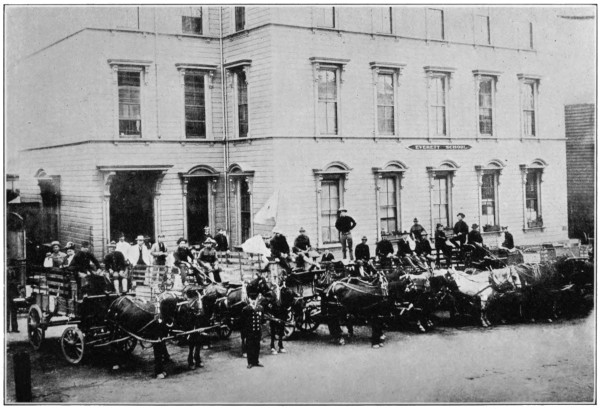
Soldiers guarding the supply wagons
Warehouse for Second Hand Clothing
It was planned to complete by the middle of July the general
distribution of clothing and household goods by determining
whether each refugee at that time had a decent supply which would
prevent present suffering. After that date the Rehabilitation
Committee was to consider further need of clothing and household
goods in relation to general need of rehabilitation. The distribution
did end practically on August 1, when those who had requisitions
for articles that had not been furnished were given by the
Rehabilitation Committee the cash value of the articles called
for on their requisitions as far as approved by the civilian chairmen
of their sections.
The later development of the methods of distributing clothing
shows increased efficiency as greater experience was gained.
After August 15 the Bureau of Special Relief[58] had charge
of filling orders for clothing for those living outside the camps
whose needs were urgent but not great; the more important cases
of need of clothing and household goods were cared for by the
Rehabilitation Committee. From August 6 the residents of the
camps were supplied with all necessary clothing through the
Department of Camps and Warehouses, an arrangement which
continued until the middle of October, after which issues of clothing
were made by requisition through the department headquarters
on the supply of clothing kept in Golden Gate Park. From
December, 1906, the Department of Camps and Warehouses sent
individual requisitions for clothing to the Bureau of Special Relief.
Possibly these were such as it could not itself fill.
All issues of clothing were stopped on May 16, 1907, and the
supply on hand was turned over to the Rehabilitation Committee,
which distributed it among a number of institutions. It is probable,
however, that for a long time only a very small quantity of clothing
had been issued to meet the needs of the aged, infirm, and sick at
Ingleside.[59]
It is to be noted further that as early as August, 1906,
issues were limited, and were made only to destitute persons whose
circumstances could easily be investigated.
The rapid exodus of refugees from the city during the first
week after the disaster meant a desirable lessening of the task
of providing food, clothing, and shelter. The transportation work,
which divides itself into four administrative periods, began the
first day of the fire, when refugees were given free passage across
the bay, down the peninsula, and to points far inland. No special
arrangement was made. The transportation companies merely
threw open their gates and let the people crowd into the boats
and trains. The committee on transportation of refugees, a sub-committee
of the Citizens’ Committee, had comparatively little
work to do. It told the public that the railroads were ready to
carry the people and it made inquiry as to the ability and willingness
of other communities to care for refugees. From many communities,
some distant, came quick, generous offers to care for
definite numbers of people.
When the first period, the period of indiscriminate free
transportation, ended on April 26, the Southern Pacific Railroad,
the only railroad running out of the city and the one that in normal
times carried the greater part of the suburban traffic by ferry
and train to towns across the bay, had transported, according
to an official report, the following number of free passengers:
TABLE 12.—PERSONS CARRIED FROM SAN FRANCISCO AS FREE
PASSENGERS BY THE SOUTHERN PACIFIC RAILROAD,
FROM APRIL 18 TO APRIL 26, 1906
| Destination |
Persons
carried |
| Suburban points around the bay |
226,000 |
| Other points in California |
67,000 |
| Other states |
7,684 |
| Total |
300,684 |
The value of this service, according to the official report,
was $456,000. The report states that on April 19 the refugees,
most of whom went to Oakland and adjoining communities, left
San Francisco at the average rate of 70 per minute. There is no
report from any other transportation company. The 226,000
passengers carried to points around the bay included some thousands
of persons that crossed more than once, many to go back and
forth daily on public or private business, others, a considerable
number, to view the fire and ruins.
On April 25, a committee on transportation was organized
informally by the officials of the various railroads and the men in
charge of relief work, in order to prevent an abuse of free
transportation. The new committee, which was recognized as
authoritative by the Citizens’ Committee, had for chairman
William Sproule of the Southern Pacific Railroad, for secretary
and executive, Oscar K. Cushing. On April 26, a transportation
bureau was opened in a small office on Fillmore Street near Franklin
Hall. The secretary was given power to issue orders for passes
and part-rate tickets, which because of his experience in railroad
business and in social work he could be relied upon to do with
discretion. Each applicant in the long file which day by day
stretched down Fillmore Street and around the corner to Sutter,
a perplexed, restless file of men, women, and children, eager to
be out of the city, was interviewed personally by him to determine
whether the applicant were able to pay any part of his
fare, whether the best way to restore him to self-support was to
grant him transportation, and whether he would be a charge upon
the community to which he wished to go. When letters of recommendation
or personal interviews failed to give the information
desired, a quick investigation was made. If the applicant were
able he paid something toward his ticket but never more than at
the rate of half fare.
On May 10 the railroads stopped the issue of free and reduced
rate tickets as a relief measure. This marked the end of
the second short period of regulated free transportation work. A
week later, on May 18, the transportation work was merged with
that of the Bureau of Special Relief and Rehabilitation,[60] and when
Mr. Cushing became executive head of the joint work no material
change was made in the method of caring for transportation cases.
During the third period, beginning May 10, the period of
united effort, the committee guaranteed to pay in certain cases
reduced railroad rates, at first a half-fare rate, later a one-cent-a-mile
rate. The railroads in their discretion gave in other cases
free passage provided the committee made a brief statement of
the circumstances of the applicant with a recommendation for free
passage.
When the permanent Rehabilitation Committee was organized,
July 2, 1906, the transportation bureau was again merged,
which marked the beginning of the fourth period of its work, the
period of completed organization. During the fourth and last
period, which ended June 2, 1908, when the last transportation
grant was paid, the transportation methods held unchanged with
but occasional variation of rates and with a rapidly decreasing
number of cases to be considered.
The relative importance of the transportation work to the
other rehabilitation work, on the basis of the number of individuals
concerned, steadily decreased from one-half in the first two weeks
to about one-eighth in the middle of July.
Many a case was brought to the attention of the Committee
by a distant relative or friend. For instance, a man wrote from
a little town in Illinois as follows:
“Dear Kind Friend,—I have an aunt by the name of —— ——.
You will do me a favor if you will send Mrs. —— to
Chicago, Ill. I would send the money to pay fare but as I have not got
it to spare I cannot do it. I hope you will be kind-hearted enough to
send her to Chicago. Also arrange to get her meals on the train for her.
You can call on her, Mayor Schmitz, at —— and have a talk with
her. Please get my Aunt Clara to come back if you can do so.——If
there is anything I can do for your City please let me know and I will
try and help you folks at once. There are tears in My eyes as I think
of the beautiful City you once had that is now in ashes. Reply at once.”
“Aunt Clara” could not be found.
An inquiry addressed to a man in whose behalf the Committee
had been asked for help by a Chicago clergyman brought
this terse and satisfactory reply:
“Dear Sir,—We are no longer in need of relief and we do not
desire transportation to Chicago. I have so informed Rev. ——.”
Vague plans, or plans that did not commend themselves, led
to refusal. There were, for instance, a man who thought he
would like to try his fortune in Nome; a Syrian who had an idea
he might get on better in Portland, Oregon, though he had no
relatives there and no prospect of work; a Scotch Australian
with a large family, known to the Associated Charities for years,
who looked hopefully to Australia, though he had left it because
he was a failure there; two girls, domestic servants, who wanted
to go back to Ireland because they “were afraid of the shakes”;
an old man whose only reason for returning to Europe was his
desire to see his son ordained a priest; a widow, “saleslady” by
occupation, who asked to be sent to Los Angeles on the strength
of a letter from a friend, apparently a traveling man living in a
hotel, whose mildly expressed concern for her welfare she took as
a promise to provide a home. A stonemason wanted to leave his
family without resources and try his fortune in Canada. A man
whose family had been sent to Massachusetts in the early days to
leave him free to get a start got tired of trying and wanted to
join them. Another man merely wanted to go away on a visit,
leaving his family behind. After the middle of June, requests
that wife and children be sent away for a visit while the man
stayed behind at work, were refused, though in the abnormal
conditions of the earlier days they were frequently allowed. In
a considerable number of cases, as of carpenters, shoemakers,
domestic servants, and laundresses, transportation was refused
because it was known that nowhere else in the country was the
opportunity so good for work and good pay in those occupations.
In looking over the records one finds many reasons given
for leaving San Francisco. Jewelers, inventors, masseurs, hair
dressers, producers of “art work,” said they could find little
demand for their services in the first few weeks after the fire.
Acrobats, mental science lecturers, teachers of elocution, music,
Hebrew, religion, and higher mathematics, could find no one to
demand their teaching. Saloonkeepers and barmen had lost
their shops through the closing of the saloons, and when they
opened July 5, conditions would be hard because a higher license
was to be asked. It seems like a jest of fate that at a time when
thousands of people were living in tents a tent-sewer could find
no occupation. It also seems curious that physicians and nurses
should have wished to leave the city, but it is a fact that the demand
for their services was decreased rather than increased by the
disaster. Physicians suffered perhaps as much as any other class
of persons, for they lost not only their offices, libraries, and instruments,
but also a large proportion of their patients,—the
profitable, well-to-do ones left town, and the poorer ones were
stimulated by the out-of-door life, plain food, or by necessity,
into unusual good health.[61] Bakers, grocers, and lodging-house
keepers asked for transportation because, though there was a
demand for their services, they had no capital with which to make
a new start. Tailors, dressmakers, milliners, printers, and a
number of others could not, or would not, wait for the demand
which came for them a few weeks later. In the middle of May, for
example, it was thought that ladies’ tailors could not expect to
make a living for six months; early in June employers could not
begin to get the number they wanted. In but few cases could
lack of occupation be accepted as the sole justification for leaving
the city. Carpenters and laborers who could not get work
in San Francisco in June could hardly be expected to get it anywhere.
Sickness was a reason for transporting some of the refugees.
A man who had been hurt in the earthquake was sent to relatives
as soon as he was able to leave the hospital. Another man, whose
little store had been wrecked by the earthquake, he himself injured,
and his wife and one child killed, was sent to his sister in
Chicago, his other children having been provided for by a charitable
organization. A woman suffering from cancer was taken to
her sister in Brooklyn by a nurse who was also being assisted to
reach her destination. It was not uncommon in the earlier days
to find a woman so nervous that her physical condition was a
menace to the prospects of her family. One such woman would
not allow her husband to do any regular work; another was so
irritable that desertion seemed imminent. In such a case as the
last the only hope of saving the family seemed, paradoxically, to
lie in temporary separation. More than one woman who begged
to be sent away for a visit was told, “We are doing this, you
understand, because we are sorry for your husband and want to
give him a chance to get on his feet here; but please encourage
him by writing every week.” The policy, in spite of these instances,
was definitely laid down that families should be kept
together.
There were numerous examples of that re-distributing of responsibility
for dependents which takes place when losses come to
families individually. An aunt or grandmother in Nevada or
Missouri or New York would offer to take care of a little boy or a
young girl, in order to relieve the family in San Francisco. An
epileptic woman whose daughters had lost their work on account
of the fire was given a home by a cousin in Massachusetts. This
cousin, with unnecessary caution, wrote to the woman: “I will
not let him (Dr. Devine) know you have any daughters—only
that you are without a home and in poor health.” A woman had
been visiting her married daughter in San Francisco, and the
daughter, after the fire, could neither entertain her longer nor
pay her fare home. Still another instance was that of a Roumanian,
seventy-seven years old. He had had a home with his granddaughters
for the previous two years, but they were burned out
and his only refuge was the old home in Roumania. Unfavorable
surroundings as a reason for granting transportation may be
illustrated by the case of a young girl who had been living in a
basement with twenty refugees, men and women. She was sent
to her father in Ohio.
The willingness of relatives and friends to receive refugees
determined the transporting of a large number of persons. The
letters that found their way to the files of the Rehabilitation Committee
as evidence that the would-be travelers would not be unprovided
for at the end of their journeys form a unique body of
testimony. They give a glimpse of those obscure wells of charity
in which we all believe, on account of frequent individual instances,
but into whose depths we are seldom allowed to look.
The open-hearted offers of hospitality that went out from humble
homes all over the country were, in fact, a contribution to the
relief fund, though they found no place in the list of donations,
the quality of their mercy being too subtle. They may be given
recognition by a few quotations from many letters:
From Delancey Street, New York, to a Jewish tailor with a
wife and six children:
My dear brother,—I have received your letter, also dispatch, and
in spite of all my efforts I send you only ten dollars. I cannot send you
more for the present. I advise you to come over as soon as you can with
your family, on my responsibility, as there are plenty of work for you.
Don’t spend the time with nothing but come as soon as you possible can.
From a woman in Council Bluffs, to her sister:
You must and had better come here. J—— can work at his
trade here and you can stop with us until you can do better.
From a little California town:
My dear cousin,—I am awfully sorry to hear you and all the
family lost everything. But let you and Jennie and all the family come
right up and stop with us. You will want for nothing as we have plenty
for all and as many more. Hoping you will come right away, ———.
From a Russian woman in Chicago:
Beloved sister,—You shall not think about anything but come to
Chicago———. You shall not worry about anything. Everything
will be provided for you when you arrive here. You shall also get work.
A mother in Michigan wrote to her daughters, who had been
in domestic service:
Girls, for my part I wouldn’t have any desire of living side of the
Pacific ocean any longer and you know we would feel better to have you
back here with us.
Another Michigan letter, from the brother of a refugee:
I want you to come with all your family and share our home until
you get all rested up and see what is best to be done. Old frozen Michigan
ain’t the worst place after all.
A woman in Spokane who offered a home to a friend and her
little girl wrote, with a naïve appreciation of her own generosity
and of the happy combination of disposition and circumstances
to which she was able to refer:
I write to extend my sympathy to you and you know I have a big
heart and a large house and would be only too glad to have you come and
stay with me as long as you want to and it would not cost you one cent.
A man in Nevada who had secured work for a former business
associate, wrote to him:
Through the kindness of friends (and I may say myself), we have
furnished you and wife with a home furnished complete, so if you can get
means to come up you will be O. K., as your rent is paid for a couple of
months.
There could be no doubt that the boy whose mother in Los
Angeles had found work for him, and who wrote him as follows,
would be looked after:
A Mrs. T—— to whom I appealed for you gave me as a loan on
the sly five dollars for your fare down, which must be returned as soon as
possible so please do not use it unless you fail to get a pass.
Some friends in southern California offered a home to three
sisters, working girls:
If you can get passes, which no doubt you can by applying to
Mayor Schmitz, as I have written to him, asking for you, come down and
stay with us for as long as you wish. We have a house in our yard which
we can fix up for you without any inconvenience to us. You can live
there as long as we stay here.
The great majority of these people who were assisted to
leave the city seem to have been those that could easily be spared
from San Francisco during its period of reconstruction. They
were, on the whole, lacking in physical vigor or in mental qualities
of courage and initiative, or in attachment to their city. They
did, however, give the impression that, under less exacting circumstances,
they would have been able to get along creditably. It
seemed fair to expect that in nearly all the cases the substitution
of a more favorable environment would have results so satisfactory
as to justify transportation as a rehabilitation measure,
while the burden of dependence, whatever it might be, would be
so distributed as not to bear heavily in any one place. The
policy of those responsible for decisions was not to send to other
cities persons that were likely to become dependent on charity.
The transportation agreement of the charity organization societies
of the largest cities was respected. The prompt answers to telegraphic
inquiries given by all the eastern cities was a very important
help. It was reassuring to find that the plan that was satisfactory
in ordinary times proved indispensable in the emergency.
For the second period of the work of transportation, which
seems to represent about the average, Table 13 is given.
TABLE 13.—DESTINATION OF PERSONS SENT FROM SAN FRANCISCO
BY THE TRANSPORTATION COMMITTEE, FROM APRIL
26 TO MAY 10, 1906, INCLUSIVE[62]
| Destination |
PERSONS SENT TO
DESTINATION SPECIFIED |
| Men |
Women |
Children |
Total |
| California |
122 |
541 |
379 |
1,042 |
| Oregon |
28 |
103 |
40 |
171 |
| Washington |
20 |
85 |
57 |
162 |
| Colorado |
11 |
46 |
35 |
92 |
| Nevada |
2 |
40 |
11 |
53 |
| Utah |
9 |
26 |
11 |
46 |
| Montana |
5 |
13 |
13 |
31 |
| Arizona |
4 |
8 |
.. |
12 |
| Idaho |
2 |
3 |
3 |
8 |
| Wyoming |
.. |
3 |
.. |
3 |
| New Mexico |
.. |
1 |
.. |
1 |
| East (including Europe) |
188 |
553 |
322 |
1,063 |
| Total |
391 |
1,422 |
871 |
2,684 |
These figures are based, not on a study of individual cases,
but on lists and registers kept by the various committees in charge
of transportation. Although they probably are not absolutely
correct, they are sufficiently exact for the present purpose. The
term Pacific States in the following table includes the tier of
states from Montana to New Mexico; all east of them is called
East. Alaska and British Columbia destinations are included in
Pacific States, and eastern Canadian and European points are
included in East. The number of persons sent to such points was
very small.
The following table shows the number carried for all periods,
exclusive of those carried to suburban points.
TABLE 14.—PERSONS SENT FROM SAN FRANCISCO, BY PERIOD AND
BY GENERAL DESTINATION, APRIL 26, 1906, TO JUNE, 1908[63]
| Period |
Total
number
of
persons
sent |
PERSONS SENT TO |
Average
number
of
persons
sent
per day |
Cali-
fornia
points |
Other
Pacific
States |
East (in-
cluding
Europe) |
Other
foreign
points |
| 1906 |
|
|
|
|
|
|
| 2d Apr. 26-May 10 |
2,684 |
1,042 |
579 |
1,063 |
.. |
|
179.0 |
| 3d May 11-Jun. 30 |
1,015 |
212 |
193 |
609 |
1 |
|
20.0 |
| 4th |
July |
365 |
97 |
70 |
193 |
5 |
|
11.8 |
| August |
350 |
221 |
23 |
106 |
.. |
|
11.3 |
| September |
90 |
32 |
3 |
55 |
.. |
|
3.0 |
| October |
128 |
13 |
45 |
57 |
13 |
[64] |
4.1 |
| November |
77 |
10 |
2 |
13 |
52 |
[64] |
2.6 |
| December |
37 |
11 |
3 |
17 |
6 |
|
1.2 |
| 1907 |
|
|
|
|
|
|
| |
January |
37 |
7 |
6 |
19 |
5 |
|
1.2 |
| February |
31 |
6 |
7 |
18 |
.. |
|
1.0 |
| March |
21 |
3 |
3 |
10 |
5 |
|
[65] |
| April |
22 |
9 |
3 |
10 |
.. |
|
[65] |
| May |
8 |
1 |
4 |
3 |
.. |
|
[65] |
| June |
3 |
.. |
1 |
2 |
.. |
|
[65] |
| July |
4 |
.. |
.. |
4 |
.. |
|
[65] |
| December |
2 |
.. |
.. |
2 |
.. |
|
[65] |
| 1908 |
|
|
|
|
|
|
| |
June |
2 |
.. |
.. |
2 |
.. |
|
[65] |
| Total |
4,876 |
1,664 |
942 |
2,183 |
87 |
|
|
TABLE 15.—TERMS OF TRANSPORTATION OF PERSONS SENT FROM
SAN FRANCISCO IN SECOND AND THIRD PERIODS
| Terms of transportation |
PERSONS TRANSPORTED |
April 26 to
May 10,
inclusive |
May 11 to
June 30,
inclusive |
| Number |
Per cent |
Number |
Per cent |
| Carried free by railroads |
2,096 |
78 |
136 |
13 |
| Low rate paid by Applicant |
588 |
22 |
188 |
19 |
| Committee |
.. |
.. |
597 |
59 |
| Applicant and Committee jointly |
.. |
.. |
94 |
9 |
| Total |
2,684 |
100 |
1,015 |
100 |
TABLE 16.—DESTINATION OF PERSONS SENT FROM SAN FRANCISCO
IN SECOND AND THIRD PERIODS
| Destination |
PERSONS SENT TO
DESTINATIONS SPECIFIED |
April 26 to
May 10,
inclusive |
May 11 to
June 30,
inclusive |
| Number |
Per cent |
Number |
Per cent |
| California points |
1,042 |
38 |
.8 |
212 |
20 |
.9 |
| Other Pacific Coast states |
579 |
21 |
.6 |
193 |
19 |
.0 |
| East |
1,063 |
39 |
.6 |
609 |
60 |
.0 |
| Various foreign points |
.. |
|
.. |
1 |
|
.1 |
| Total |
2,684 |
100 |
|
1,015 |
100 |
|
TABLE 17.—VALUE AT REDUCED RATES OF TRANSPORTATION FURNISHED
THROUGH THE COMMITTEE
| Terms of transportation |
VALUE OF
TRANSPORTATION FURNISHED |
May 11 to
June 30,
1906 |
July 1, 1906,
to June 2,
1908 |
Total |
| Paid by applicant |
$4,987.27 |
$585.47 |
$5,572.74 |
| Paid by Committee |
10,878.32 |
30,921.70 |
41,800.02 |
| Estimate of contribution by railroads |
42,369.40 |
5,015.70 |
47,385.10 |
| Total |
$58,234.99 |
$36,522.87 |
$94,757.86 |
In April in San Francisco, the weather being temperate and
dry, shelter for the homeless may properly be considered an easy
third in order of importance in the supplying of relief. The first
night after the earthquake the people who had been driven from
their homes by fire or by fear of another shock, sought rest in the
public squares and parks, in vacant lots and in military reservations.
Bedding was the necessity carried from their homes by
many refugees who expected to return to them after the danger
was past. Each family took possession of the first spot available.
The more fortunate separated themselves from other families by
means of trunks or boxes, or by a sheet or blanket thrown over a
pole that rested on two stakes driven into the ground. As the
hours passed a few real tents were secured, and shacks were made
out of loose boards, tin cans, and sheet iron. Soon, tents from
the army stores and from private sources were provided in increasing
numbers and were set up with varying degrees of order.
Two hundred thousand persons came out from the burned
district homeless, of whom possibly 75,000 left the city. These latter
are included in the number of refugees that sought transportation,
as shown in the preceding section. Shelter was found in some
parts of the city for a large number through the hospitality of
friends or strangers, through payment for lodging in cash or credit,
or through the use of unoccupied houses. Two thousand persons
found shelter in vacant houses through the efforts of the police.
The capacity to house the needy was swelled by the use of basements,
attics, and barns. The number of the homeless was increased
to some extent by the general rise in rentals, which was
great in certain parts of the city and which forced a small number
of people into the ranks of applicants for shelter. During the
first two weeks perhaps a thousand persons had no shelter but what
they could find in the burned district amid the ruins or on wharves.
Tents were provided in the first days by voluntary agencies,
by the sub-committee on housing the homeless, by the army,
and by the American National Red Cross. The first named committee,
which was one of those hastily appointed by the Citizens’
Committee immediately after the disaster, also built barracks.
It set to work with great energy, but with complete independence
of any other committee, especially of the Finance Committee and
of the committees on relief of the hungry and on transportation,
whose work it therefore overlapped. It appointed another sub-committee,
on roofing the homeless, which canvassed the city for vacant
houses and rooms and then induced but few persons to make use
of its finds. It formulated plans for the construction of two permanent
camps and made recommendations to the army to place all the
homeless in Golden Gate Park, to which park it had as early as
April 20, assisted by an army officer, hauled lumber for the building
of barracks, for the flooring of tents, and for latrines.
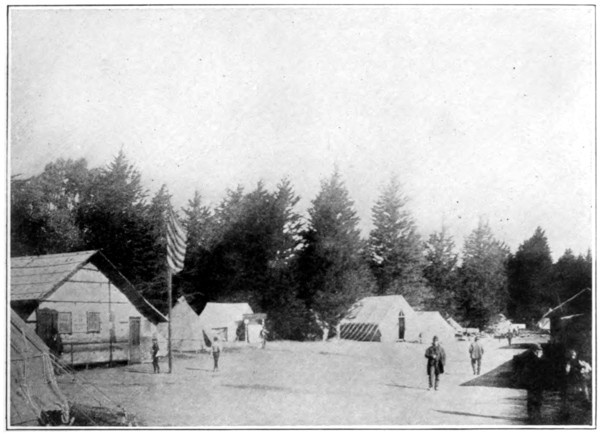
An administration headquarters
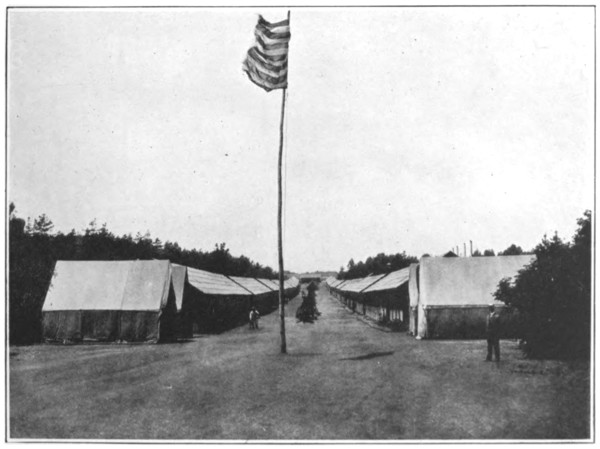
Camp No. 6, The Speedway, showing barracks
Camps in Golden Gate Park
This committee was discharged from duty, on request of
its chairman, two weeks after its appointment, but its members
continued to incur unauthorized expense for at least four weeks
longer. The committee made such a fine showing for speed that
its work got ready recognition, speed in those first days being at
a premium; but its lack of deliberation led to the embarrassment
of the relief authorities. The barracks could not be connected
with street sewers because they were situated on low ground,
so later there was difficulty in disposing of waste and surface
water. One of the camps, Camp 6, could not be given fire
protection, and both camps had to have heavy additions made
to the initial expenditures to secure greater privacy and protection
against drafts. In them the refugees were brought into an
association so close as to be either demoralizing or humiliating.
Both camps would probably soon have been closed if the
authorities had felt justified in abandoning them after the large
expenditure made. The initial mistake was to erect barracks
during the emergency period. Tents, which the army and the
American National Red Cross stood ready to provide, were much
more practical. They could be moved at small expense from
place to place, and until the rainy season set in they furnished
sufficient shelter. Tents, not barracks, were the need of the
emergency period.
The two barracks built in Golden Gate Park by the committee
on housing the homeless were No. 1, known later as Camp 5,
near the Children’s Playground, and No. 2, known later as Camp 6,
or the Speedway Camp. Camp 5 consisted of 18 buildings with 16
two-room apartments in each, separated by a partition only 8 feet
high. The rooms were 10 feet square—a front room with a window
and a door and a rear room with no window or outside door.
Camp 6 was of the same type of construction and consisted of 10
barracks and separate buildings for hospital, laundry, and other
general purposes. The barracks of Camp 5 were occupied from
the first of May to the middle of December; those of Camp 6
from June 1 to the latter part of August of the following year.
As late as the end of May General Greely reported that he
could not get sufficient data on which to base housing recommendations.
The first registration had shown that a little over
a fourth of the applicants to the food stations were living at the
same address when they were registered as on April 17, the day
before the earthquake. In a few cases these people were no doubt
housed in tents or shacks on the site of their burned homes. But
most of them had not lost their homes or personal effects, though
they had been affected by the disaster in other ways. They had
lost their work, or had suffered some injury in health from the
shock, or, merely demoralized by the general confusion and the
abundance of free provisions, had assumed a mental attitude of
dependence not really justified. Most of this last class, to be
sure, did not survive the registration, but there were no doubt
some who were not weeded out until after the canvass had been
made. Sixteen per cent more are known to have been living in
houses at the time of the registration, but as their addresses on
April 17 were not given, it is impossible to know whether or not
they had been driven out of their homes by the disaster.
TABLE 18.—HOUSING OF REGISTERED FAMILIES, BY CIVIL SECTIONS,
MAY, 1906. NUMBERS
Residence at time
of registration |
NUMBER OF FAMILIES HOUSED
AS SPECIFIED IN CIVIL SECTIONS |
Total |
| I |
II |
III |
IV |
V |
VI |
VII |
| Same as on April 17 |
856 |
225 |
572 |
1,105 |
197 |
424 |
1,955 |
5,334 |
| Tent or shack |
741 |
79 |
1,407 |
272 |
1,082 |
467 |
317 |
4,365 |
| A house different from that of April 17 |
640 |
294 |
669 |
924 |
681 |
945 |
2,168 |
6,321 |
| A house; uncertain whether the same as or different from that of April 17 |
336 |
191 |
329 |
257 |
215 |
999 |
804 |
3,131 |
| Total whose addresses in May were given |
2,573 |
789 |
2,977 |
2,558 |
2,175 |
2,835 |
5,244 |
19,151 |
| Addresses in May not given |
17 |
24 |
120 |
19 |
45 |
41 |
21 |
287 |
| Total registration |
2,590 |
813 |
3,097 |
2,577 |
2,220 |
2,876 |
5,265 |
19,438 |
TABLE 19.—HOUSING OF REGISTERED FAMILIES, BY CIVIL SECTIONS.
PERCENTAGES, BASED ON THE TOTAL NUMBER OF FAMILIES
WHOSE ADDRESSES IN MAY, 1906, WERE GIVEN
Residence at time
of registration |
PER CENT OF FAMILIES HOUSED
AS SPECIFIED IN CIVIL SECTIONS |
Total |
| I |
II |
III |
IV |
V |
VI |
VII |
| Same as on April 17 |
33.3 |
28.5 |
19.2 |
43.2 |
9.1 |
15.0 |
37.3 |
27.9 |
| Tent or shack |
28.8 |
10.0 |
47.3 |
10.6 |
49.7 |
16.5 |
6.1 |
22.8 |
| A house different from that of April 17 |
24.9 |
37.3 |
22.5 |
36.1 |
31.3 |
33.3 |
41.3 |
33.0 |
| A house; uncertain whether the same as or different from that of April 17 |
13.0 |
24.2 |
11.0 |
10.1 |
9.9 |
35.2 |
15.3 |
16.3 |
| Total whose addresses in May were given |
100.0 |
100.0 |
100.0 |
100.0 |
100.0 |
100.0 |
100.0 |
100.0 |
Less than a fourth of the 19,438 registered[66] were living in
tents or shacks. These 4,365 families or parties included some
19,000 individuals. As the population of the “official camps”[67]
outside of Golden Gate Park (which was not included in the registration)
was less than 8,500 at the time, and as it was wellknown
that some of the people in the permanent camps were already providing
their own food, it is evident that in the early days of May
about one-half of the registered tent and shack dwellers were
in the unofficial, unsupervised camps and isolated makeshifts for
shelter which were one of the most difficult problems of the situation.
The registration card did not ask what the character of the
dwelling was, and for this reason, as has already been said, the
proportion of persons in tents and shacks was no doubt understated,
since the description given by the enumerator of the
“permanent location” of the family may not always have suggested,
when it should, a tent or a shack to the tabulator.
In May about a third of all were living in houses which were
not their homes on April 17. These families, together with those
who were living in tents and shacks, made up 55.8 per cent of the
total. Considerably over half, therefore, of those who were
receiving rations in the middle of May had presumably been
burned out of their homes, or “shocked out,” as one of them put
it. Many of those who had found house shelter were living under
very unfavorable conditions. Overcrowding does not show on
the registration card, and bad sanitary conditions can only be
guessed at. In 206 cases it was stated that the “house” was a
basement or rear building; occasionally it was a barn.
The seven civil sections[68] naturally present contrasts in the
matter of housing conditions. In Section VII only 6 per cent of
the refugees were living in tents or shacks, while in Sections III and
V almost half of them were. Section VII shows the highest
percentage of families in houses to which they had moved after
the fire, and Section IV is not far behind. The facts which come
out about Section IV at first seem curious. Although it included
about half of the burned area, it had the highest percentage of
families living in the same place as on April 17. The unburned
part of Section IV at the time of the fire probably was more thickly
populated than any equal area in the city, for in other sections
there were great areas either not built upon or occupied by factories,
etc. This was practically one solid residence section filled
mostly with flats and populated by persons employed chiefly in
adjacent parts of the burned district, who thus lost employment,
if not property. Although it contained several permanent camps,
only 10.6 per cent of those who were receiving rations were living
in tents or shacks. It is probable that 43.2 per cent who were
living “at the same address” included a number of Italians on
Telegraph Hill who were already back on the same house lot,
though in shelters improvised from tarpaulins, boards, sheets of
tin, corrugated iron, and other possible, though unusual, building
materials. Most of the Italians and others who lived about Telegraph
Hill had taken refuge, however, in Section III, in which
a part of the Italian quarter lay.
Section V shows the condition that would be expected in
both IV and V,—half the refugees in tents or shacks, only a small
percentage at their former addresses, and the rest crowded into
the housing accommodations nearest to their old homes. It would
have been interesting to tabulate the distance between the two
addresses, but this would have involved so much labor that it
could not be undertaken.
The nationality of the head of the family was given in 14,963
cases, over three-fourths of all. Over two-fifths of these were
native Americans; nearly one-half were Germans and Austrians,
Irish, Italians, English and Scotch, and Scandinavians, of numerical
importance in the order indicated; and the rest represented
many different countries. The facts are shown in Table 20.
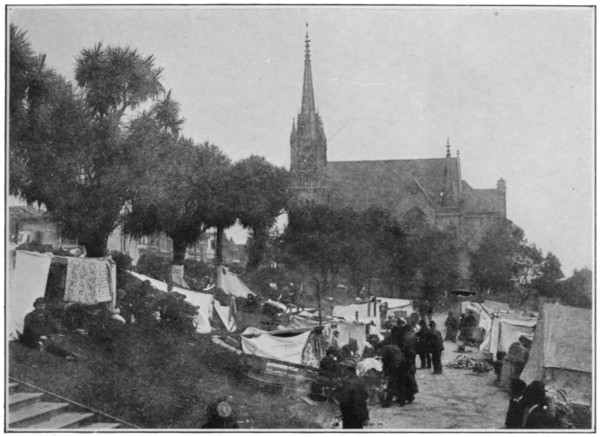
Shelters of sheets and quilts
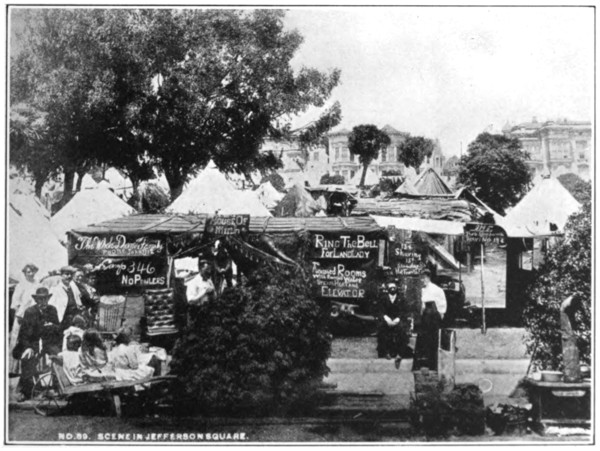
Tents and shacks
Early Shelters in Jefferson Square
It is not possible to compare these figures closely with the
nationality of the population of San Francisco as given in the
United States Census of 1900, because the census figures are for
individuals, while these are for families, the nationality of the
family being inferred from the nationality of its head. In the
census figures the native born children of a German or Irish
father appear as born in the United States, while in the refugee
figures such a family group appears as a unit among the foreign
born. In this way it is evident that if the refugee figures could
have been made up on the same basis of individuals instead of
families, they would have shown a considerably higher proportion
than they do of native born, and a correspondingly lower proportion
of nearly all the foreign nationalities. Possibly the native
born children of foreigners would raise the percentage of native
born among the refugees to an even higher percentage than they
had in the total population of the city. A few comparisons,
however, it is safe to make. The Irish and Italians are represented
much more strongly among the refugees than their proportions
in the population would require; while on the other
hand, a population of over 10,000 Chinese[69] was represented by
only 20 families drawing rations. In Table 20 the nationalities
are arranged in the order of their importance in the population of
the city in 1900. Only the first three groups maintained the same
relative position among the refugees.
TABLE 20.—NATIONALITY OF POPULATION OF SAN FRANCISCO IN
1900, COMPARED WITH NATIONALITY OF HEADS OF FAMILIES
AMONG REFUGEES IN 1906
| Country of birth |
POPULATION OF SAN
FRANCISCO, 1900—
INDIVIDUALS
OF
EACH SPECIFIED
NATIVITY |
REFUGEES, 1906—
HEADS OF FAMILIES
OF EACH SPECIFIED
NATIVITY |
| Number |
Per
cent |
Number |
Per
cent |
| United States |
225,897 |
66.0 |
6,229 |
|
41.7 |
| Germany and Austria |
37,035 |
10.8 |
2,264 |
15.1 |
| Ireland |
15,963 |
4.7 |
2,140 |
14.3 |
| England and Scotland |
11,956 |
3.5 |
972 |
6.5 |
| China |
10,762 |
3.1 |
20 |
0.1 |
| Sweden, Norway, Denmark |
9,591 |
2.8 |
709 |
4.7 |
| Italy |
7,508 |
2.2 |
1,208 |
8.1 |
| Canada |
5,199 |
1.5 |
167 |
1.1 |
| France |
4,870 |
1.4 |
400 |
2.7 |
| Switzerland |
2,085 |
0.6 |
104 |
0.7 |
| Japan |
1,852 |
0.5 |
31 |
0.2 |
| Russia |
1,511 |
0.4 |
125 |
0.8 |
| Mexico |
1,459 |
0.4 |
75 |
0.5 |
| Australia |
1,096 |
0.3 |
24 |
0.2 |
| Other countries |
5,998 |
1.8 |
495 |
3.3 |
| Total |
342,782 |
100.0 |
14,963 |
[70] |
100.0 |
TABLE 21.—NATIONALITY OF HEADS OF FAMILIES AMONG REFUGEES,
BY CIVIL SECTIONS, MAY, 1906. NUMBERS
| Country of birth |
NUMBER OF HEADS OF FAMILIES OF EACH SPECIFIED
NATIONALITY
IN CIVIL SECTIONS |
Total |
| I |
II |
III |
IV |
V |
VI |
VII |
| United States |
1,015 |
354 |
790 |
1,106 |
736 |
177 |
2,051 |
6,229 |
| Germany, Austria |
331 |
85 |
264 |
413 |
289 |
158 |
724 |
2,264 |
| Ireland |
234 |
80 |
228 |
249 |
432 |
169 |
748 |
2,140 |
| Italy |
66 |
14 |
698 |
59 |
90 |
114 |
167 |
1,208 |
| England and Scotland |
169 |
48 |
103 |
133 |
125 |
61 |
333 |
972 |
| Sweden, Norway, and Denmark |
78 |
39 |
88 |
51 |
108 |
113 |
232 |
709 |
| France |
95 |
11 |
79 |
46 |
27 |
31 |
111 |
400 |
| Canada |
24 |
9 |
12 |
31 |
10 |
6 |
75 |
167 |
| Russia |
11 |
10 |
7 |
28 |
29 |
6 |
34 |
125 |
| Switzerland |
18 |
2 |
28 |
9 |
11 |
8 |
28 |
104 |
| Mexico |
24 |
.. |
42 |
3 |
3 |
1 |
2 |
75 |
| Japan |
6 |
.. |
11 |
11 |
.. |
.. |
3 |
31 |
| Australia |
3 |
2 |
3 |
2 |
6 |
1 |
7 |
24 |
| China |
3 |
2 |
9 |
6 |
.. |
.. |
.. |
20 |
| Other countries |
57 |
15 |
142 |
105 |
46 |
56 |
74 |
495 |
| Total |
2,134 |
671 |
2,504 |
2,252 |
1,912 |
901 |
4,589 |
14,963 |
| Unknown |
456 |
142 |
593 |
325 |
308 |
1,975 |
676 |
4,475 |
| Grand total |
2,590 |
813 |
3,097 |
2,577 |
2,220 |
2,876 |
5,265 |
19,438 |
TABLE 22.—NATIONALITY OF HEADS OF FAMILIES AMONG REFUGEES,
BY CIVIL SECTIONS, MAY, 1906. PERCENTAGES BASED ON THE
TOTAL NUMBER OF CASES IN WHICH INFORMATION AS TO NATIVITY
WAS AVAILABLE
| Country of birth |
PER CENT OF HEADS OF FAMILIES OF EACH
SPECIFIED
NATIONALITY IN CIVIL SECTIONS |
Total |
| I |
II |
III |
IV |
V |
VI |
VII |
| United States |
47.5 |
52.7 |
31.6 |
49.1 |
38.6 |
19.6 |
44.6 |
41.6 |
| Germany, Austria |
15.5 |
12.7 |
10.5 |
18.3 |
15.1 |
17.5 |
15.8 |
15.1 |
| Ireland |
11.0 |
11.9 |
9.1 |
11.1 |
22.6 |
18.8 |
16.3 |
14.3 |
| Italy |
3.1 |
2.1 |
27.9 |
2.6 |
4.7 |
12.7 |
3.6 |
8.1 |
| England, Scotland |
7.9 |
7.2 |
4.1 |
5.9 |
6.5 |
6.8 |
7.3 |
6.5 |
| Sweden, Norway, and Denmark |
3.7 |
5.8 |
3.5 |
2.3 |
5.6 |
12.5 |
5.1 |
4.7 |
| France |
4.5 |
1.6 |
3.2 |
2.0 |
1.4 |
3.4 |
2.4 |
2.7 |
| Other countries |
6.8 |
6.0 |
10.1 |
8.7 |
5.5 |
8.7 |
4.9 |
7.0 |
| Total |
100.0 |
100.0 |
100.0 |
100.0 |
100.0 |
100.0 |
100.0 |
100.0 |
The distribution of nationalities varies somewhat in the
different sections. Sections III and VI have a considerably smaller
proportion of native born than the others. Italians are conspicuously
prominent in Section III and Irish in Section V. Germans
and Austrians are relatively most numerous in Sections IV
and VI, and least numerous in Section III; the proportion of
Italian families is less than 5 per cent in all sections except III
and VI; the proportion of Irish varies from 9 per cent in Section
III to 23 per cent in Section V. In Section VI the nationality
of over two-thirds of the families was not given, and in Section II,
as has been explained, the registration was not representative
of the total body of refugees within its boundaries.
The number of persons registered as having been provided
with shelter was but a part of the whole. The estimated number
of persons who were living in shacks and barracks on June 1 was
40,000[71] according to the census taken by General Greely; 42,000
according to the Southern Pacific Railroad; 39,000 according to a
computation made for this Relief Survey.[72] Of this last number,
34,000 were in tents, 5,000 in barracks and rough shacks. There
was a slight increase in the camp population in late May and in
June, due to the return of refugees from Oakland and other points,
but apart from this accretion the camp population was subject to
slight variation.
The first of June a San Franciscan wrote to Charities and the
Commons[73] an account of conditions, which gives a picture of
what life in the camps meant to some of the refugees:
“The courage and energy of the population of San Francisco in the
face not only of disaster but of extreme terror and sudden homelessness
has not been exaggerated, but to a great many the full effect of the strain
is not even yet apparent. The discomforts of living, in spite of adequate
relief, are very great. Wind and fog—for the weather has been unusually
cold for a month, dust unspeakable, cooking out of doors in camps and
streets, lack of water for toilet appliances, the incessant boiling of water
and milk for fear of fever, absence of light and means of transportation
for some time—in short, the total uprooting of all the ordinary habits
of life, is bearing more and more heavily on the women and children.
Schools are closed, thus turning thousands of children literally into the
ruined streets. It is now proposed to have a vacation school in Golden
Gate Park for the children in camps there, but this is only a very small
part of the whole number.
“And for those who stay by the city much of this discomfort will
go on for several months to come. That under such circumstances men
and women become apathetic and lose pride and self-respect when they
can no longer endure the strain of petty hardships, is not surprising.
Archbishop Riordan, on his way to the scene of the disaster, is said to
have predicted, as the worst effect of it, the deterioration of health and
character which would be its inevitable result upon those who are not of
the exceptional stuff of which heroes and pioneers are made.”
The Official Camps
The army had control of some camps from the beginning
and gradually assumed charge of others until 21[74] camps were under
military discipline. These camps became known by the rather
misleading title of “permanent camps.” The first to be brought
under army control were four situated in the Presidio, three in
Golden Gate Park, one in Harbor View, and one in Lobos Square.
During May the Franklin Square camp, those at Fort
Mason, and at 19th and Minnesota Streets were taken over by
the army. Early in June the camps in Jefferson Square, Lafayette
Square, Mission Park, Duboce Park, Hamilton and Washington
Squares were added, and in July, Alamo Square, Precita Park, and
Columbia Park. Each camp was in charge of a camp commander,
who according to the size of the camp, had on his staff clerks, foremen,
laborers, and a nurse for the hospital department.[75] One or
two of the larger camps had a camp carpenter. Plumbing and
carpentry for the smaller camps were done by mechanics from
headquarters.
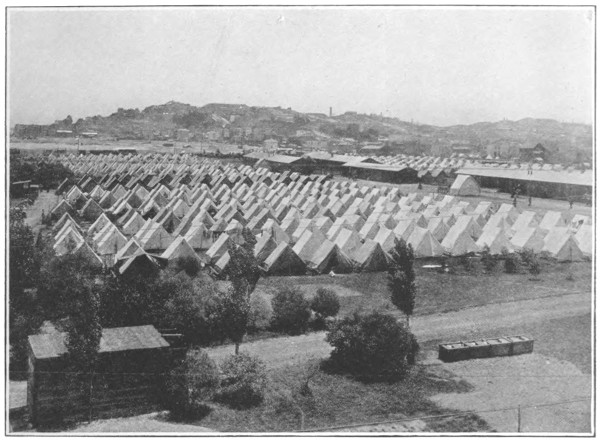
Tent camp, opened May 9, 1906
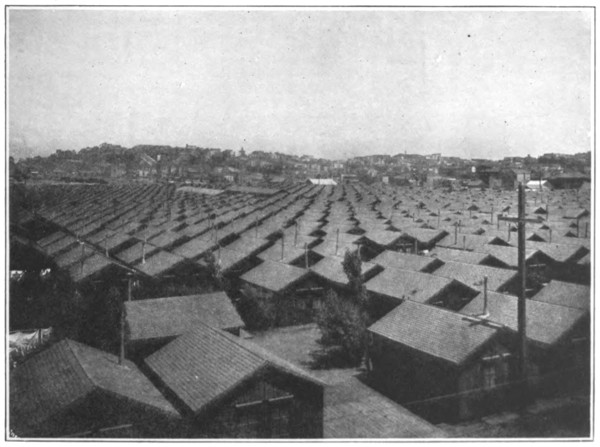
Cottages
Camp No. 9, Lobos Square
During July and August the tents in the permanent camps
were floored. Buildings were put up in each camp containing
latrines and wash and bath-houses with hot and cold running
water.
The unofficial camps, whose moral and sanitary condition
was very unsatisfactory, harbored a large number of refugees.
As late as September 1, 1906, their estimated population was from
10,000 to 15,000. The Finance Committee had tried to have
the campers move into the official camps, but had failed because
the police department, which was the only authority that could
eject, was unwilling to remove any large number of persons. The
police, of course, reflected the attitude of the general public,
which seems to have classed as official, though it was not recognized
as such by the Finance Committee, a large independent
camp, which was a private business venture, renting land to refugees
on which they might erect their own tents. General
Greely, as has been described,[76] had tried to induce removal to the
official camps. The importance of having all camp life under
military discipline can be readily appreciated when one considers
how difficult under any auspices it would be to give sanitary and
moral protection to a large body of persons living under abnormal
conditions.
The three essentials for camp tenants laid down as rules by
General Greely were decency, order, and cleanliness. The camp
commanders tried to get rid of the disorderly element as far as
they could without causing hardship to others. When a person
was ejected from one camp all other camps were notified and he
was not allowed to enter any of them.
The following statement of the number of ejectments from
May, 1906, to January, 1908, shows that there was constant attention
to this problem. The dashes which appear in the columns representing
ejectments, opposite June, 1906, and February and March,
1907, indicate that no ejectments were reported for these months,
though it is probable that ejectments which were not reported
occurred in the months mentioned and in the months between
January, 1908, and the close of the relief work.
TABLE 23.—EJECTMENTS FROM CAMPS DURING THE ENTIRE PERIOD
OF THE RELIEF WORK, BY MONTHS
| Month and year |
Eject-
ments |
| 1906 |
May |
18 |
| June |
.. |
| July |
5 |
| August |
108 |
| September |
75 |
| October |
43 |
| November |
60 |
| December |
35 |
| 1907 |
January |
15 |
| February |
.. |
| March |
.. |
| April |
1 |
| May |
26 |
| June |
11 |
| July |
27 |
| August |
23 |
| September |
10 |
| October |
10 |
| November |
5 |
| December |
4 |
| 1908 |
January |
12 |
Total ejectments
for period |
488 |
Reasons for ejectments, as stated by the camp commanders,
and the number of ejectments for each reason or group of reasons,
are shown in Table 24.
TABLE 24.—REASONS FOR EJECTMENTS FROM CAMPS DURING THE
ENTIRE PERIOD OF THE RELIEF WORK
| Reason for ejectment |
Eject-
ments |
| Drunkenness |
148 |
| Drunken and disorderly conduct |
133 |
| Disturbance of the peace and disorderly conduct |
74 |
| Immorality |
14 |
| Refusal to pay rent |
12 |
| Refusal to work in camp |
10 |
| Vagrancy |
9 |
| Assault |
5 |
| Stealing and burglary |
4 |
| Miscellaneous reasons |
48 |
| Reason not stated |
31 |
| Total |
488 |
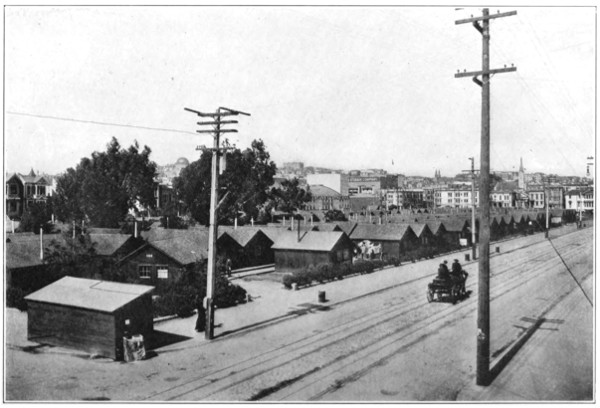
Where the first cottages were built, September, 1906
Camp No. 20, Hamilton Square
Table 25 shows the total population of the official camps for
each month from May, 1906, to June, 1908, inclusive.
TABLE 25.—POPULATION OF OFFICIAL CAMPS, EXCLUSIVE OF INGLESIDE
MODEL CAMP, FROM MAY, 1906, TO JUNE, 1908, INCLUSIVE
(The figure given for each month is the maximum daily total)
| Month and year |
Persons
sheltered |
| 1906 |
May |
13,170 |
| June |
17,274 |
| July |
17,959 |
| August |
18,356 |
| September |
18,305 |
| October |
15,558 |
| November |
13,969 |
| December |
14,245 |
| 1907 |
January |
14,616 |
| February |
15,149 |
| March |
16,447 |
| April |
17,223 |
| May |
17,524 |
| June |
17,592 |
| July |
17,300 |
| August |
15,785 |
| September |
11,424 |
| October |
8,916 |
| November |
5,331 |
| December |
3,367 |
| 1908 |
January |
1,760 |
| February |
1,700 |
| March |
1,392 |
| April |
1,321 |
| May |
1,230 |
| June |
948 |
Although the data available for determining the character of
the camp population are incomplete, from the weekly reports of the
camp commanders we can derive figures which probably represent
a fair average of the conditions. It appears that from September
to December, 1906, about 39 per cent of the persons sheltered were
men, about 31 per cent women, and about 30 per cent children.
Approximately 55 per cent of the members of the camp population
were at work. The proportion of persons who were at work was
about 89 per cent among the men, about 39 per cent among the
women, and about 25 per cent among the children.
The large percentage of men who were working is worthy of
notice. There were numerous complaints during the existence of
the camps that these were harboring a large number of idle,
shiftless men. Those who offered such criticisms failed to take
into account that there is even in normal times a considerable
percentage of unemployed men who spend much of their time in
public places. A part of the apparently well and able-bodied were
in reality incapable of much work, and others though apparently
unemployed were night workers. When the haunts of the idle were
covered with ashes, it is hardly strange that they should have been
found in numbers in the public parks and squares.
In Chapter 1 the story has been told of the need felt for
making some permanent provision for the refugees before the
oncoming of the rainy season. The Corporation, after making a
careful study of the situation in the camps, decided to adopt a
separate cottage plan for temporary as well as for permanent
housing, except in one locality, South Park, whose limited area gave
no space for separate cottages.
On August 1, 1906, the care of the camps passed from the
army to the Department of Camps and Warehouses.[77] From then
until June 30, 1908, when the last camp was closed, that department
had entire charge of maintenance. The Department of
Lands and Buildings was responsible for the construction of the
cottages built to replace the tents. The first of August, 1906, the
Corporation made public its plan to build cottages[78] and let the
contracts for the erection of buildings. Building began September
10, and on the sixteenth 20 cottages in Hamilton Square were completed.
At least two or three months, however, intervened before
any considerable number of houses could be made ready for the
refugees. Before completing its work the Department of Lands
and Buildings had installed in the public squares for use in connection
with the 5,610 cottages which it had built, 667 patent
flush closets, 247 hoppers, over six miles of gas and water pipe and
over five miles of sewer pipe; also the necessary fittings, which
included 325 galvanized sinks, with faucets and traps, and 624
gas brackets.[79]
Thus for the period of approximately six months those who
had no resources to build found house room as best they might.
Many difficulties were met by those who controlled the funds.
Building had had to be delayed because of the extraordinary
amount of work involved in supplying food, clothing, water,
sanitary protection, and temporary shelter. The pressure on the
relief machinery seemed to tax its utmost capacity. When it
was necessary to push rebuilding plans, additional machinery and
more workers had to be provided.
In the official camps the refugees had in large measure been
supplied with tents free of charge. As the time came for the
removal of tents and temporary shacks and the substitution of
wooden buildings, the question was raised, who would be entitled
to their use, and on what terms? Cottages were assigned by the
camp commanders, first, to those in the official camps; second, to
those in shacks and tents outside; third, to those still in the city
who were living in cellars and similar places, including those who
were receiving shelter from friends, and those who were citizens
but were living outside the city. Some who had not been burned
out, but needed to be better housed, received cottages and moved
them for permanent use to lots which they owned or leased.
For seven months the people had been furnished with tents
free of charge, but when the change was made to the wooden
cottages, it was thought best to charge a nominal rental.[80] The
argument was that to give everything and ask nothing in return,
on the one hand killed the self-respect of the efficient class and on
the other gave opportunity to the idle to shirk all civic and social
responsibility; that the no-rent policy had brought about serious
economic disturbances, and its continuance would prepare the way
for yet more serious trouble.
Finally, it was foreseen that the abnormal real estate conditions
which had made it possible for the homeless to secure
shelter, would not be relieved until those living in camp cottages
should seek and be able to secure quarters elsewhere. Accordingly,
it was definitely decided that as fast as buildings were made
available in the camps, they should be leased to refugees by camp
commanders at nominal rates. A special form of lease was provided
which, theoretically, each applicant was compelled to sign
before occupying a cottage.
The San Francisco Relief and Red Cross Funds, a corporation,
was the lessor; and the refugee, the lessee. The lease was in
effect a contract of purchase, for it provided that the tenant
should become the owner of the cottage if he paid his rent to August
1, 1907. In general the applicant agreed to pay a specified rent
and gas rate per month, to comply with all rules and regulations of
the camp department and the camp commanders. He agreed not
to assign his lease to another nor sublet without written consent.
He agreed furthermore to vacate the house at the expiration of
his lease unless through full payment of all rents and charges he
had acquired ownership. In that event he agreed to remove the
house from the camp at his own expense before August, 1907.
Failure to remove meant to forfeit ownership. When on account
of ill-health or other disability a person was not able to pay rent,
the camp commander notified the Rehabilitation Committee.
The shelter furnished by the army and the Finance Committee
was with few exceptions on public land. When the Corporation
was ready to build cottages it asked the park commission
for permission to use certain parks and squares. The commission
having no power to give the authority agreed, on August
17, 1906, to ignore the occupation of parks and squares, on the
understanding that such use was for a period of not more than one
year; the cottages were then to be removed as rapidly as possible.
The parks and squares were the most suitable places in which
to give temporary shelter. The damage and loss to the city from
their use were insignificant, and in the camps policing and sanitation
were supplied. There would have been rivalry among owners
of land to secure the camps, and consequent charges of favoritism,
graft, etc. The parks and squares were well situated with reference
to the centers of industry and the building operations.
Throughout the work the park commissioners co-operated with
the Relief Corporation and rendered valuable assistance. To have
followed the suggestion of the committee on housing the homeless
to establish but one encampment, would have been very unwise.
In the summer following the disaster many persons were hindered
from becoming self-supporting because of their remoteness in
Golden Gate Park from centers of work.
The camp in South Park, already spoken of as unique in
character, consisted of nineteen two-story tenement buildings and
a one-story bath-house and laundry building. Some of the buildings
were divided into 16 suites of two rooms each and the others
into 12 tenements of two rooms each. The total number of rooms
was 656. The maximum population was 648. They had adequate
fire protection and the occupants were required to take part
regularly in a fire drill. There was steady demand for the rooms,
by reason of the nearness of the camp to the shipping and manufacturing
districts. The tenements were full almost all the time.
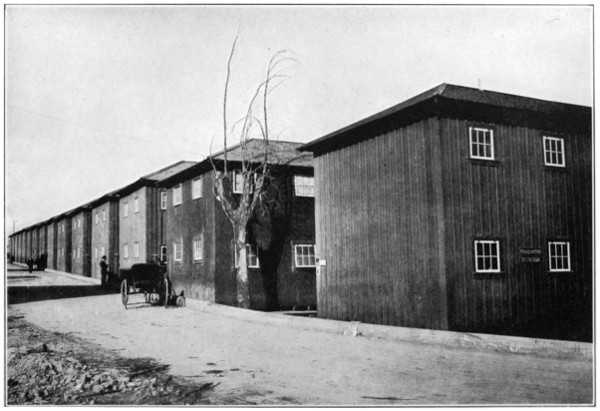
Where two-story tenements were built
Camp No. 28, South Park
Removal from the Camps
The terms of the contract signed by applicants fixed, in
large measure, the conditions under which cottages could be
removed from the camps and become the permanent property of
their owners.[81] Whenever a person proved to the Department that
he had purchased or leased a lot in the city and county of San
Francisco, he was permitted at his own expense to move his
house.
In June, 1907, the park commissioners requested the Relief
Corporation to clear the public squares of cottages by August 17.
Clearing the squares and parks of these cottages proved to be a difficult
task, for many occupants sought delay on the ground of being
unable to secure other quarters. In a few cases the persons had
either to be evicted or to have the houses pulled down over their
heads. On account of the poverty of many occupants, and in order
to secure better sanitary supervision while the fear of bubonic plague
lasted, the camp at Lobos Square was retained after the others had
been abandoned. It was used by the poorest of the refugees from
other camps, as well as by its own unusual number of dependents.
This camp was not entirely abandoned till June 30, 1908.[82]
Cottages to the number of 5,343 were removed from the
camps, all but a few to be used as dwellings. Real estate firms
which applied to purchase cottages to establish them in groups on
their own lots were refused by the Department on the ground that
any such arrangement would tend to perpetuate camp life; lacking
superintendence and control, such camp life would be worse than
that which then existed. Despite the action of the Department,
however, large vacant lots were sub-divided and rented to individual
owners of cottages.[83] Seventy-four of the cottages were
given to philanthropic agencies and were installed by them in
various parts of the city for use as club rooms or for similar purposes.
The work of the Associated Charities in moving and repairing
cottages deserves special mention. The Corporation arranged
with the Associated Charities to move from the camps the cottages
belonging to widows with children and to families having incapacitated
breadwinners. The moving of cottages, which began in
July, 1907, was not ended until the latter part of June, 1908.[84]
The amount of work accomplished at a cost comparatively small
shows excellent business management. The greater part of the
work of moving, installing, and repairing the cottages was done
by unemployed carpenters, plumbers, and laborers. “Considering
the number of cottages moved and made habitable, we have had
very few complaints as to the workmanship,” is noted in a report
of the Associated Charities,—a comment that could not be made
in connection with many houses erected by the regular contractors.
The efforts being made by families permanently to own
homes are shown by the following figures: The number of cottagers
buying lots was 208; paying ground rent, 447; owning own
property, 30; given one month’s rent to move from camp but
present condition unknown, 18. Total, 703.
Under the supervision of the Associated Charities the 208
families buying lots bid fair, according to reports given in 1908,
to own them in the immediate future. It is doubtless true that
but for the direction of the society these families never would
have seriously considered owning a house and lot.
From August 1, 1906, to June 30, 1908, there is accurate
information from which to determine the cost of the camps.
During this period 7,171,522 days’ shelter was furnished at a cost
of $884,558.81 for construction of cottages and of $453,000.04 for
maintenance, a total of $1,337,558.85, a daily per capita cost of
18.7 cents. The daily per capita cost of maintenance was 6 cents.
No allowance is here made for the value of the tents in use from
August 1 till they were replaced by the cottages, but their value
is more than offset by that of the cottages when they were
vacated.[85]
For the whole period of the relief work, the cost of the camps
was as follows:
TABLE 26.—COST OF CAMPS DURING THE ENTIRE PERIOD OF THE
RELIEF WORK
| Value of shelter furnished by the army as reported by General Greely |
$421,195.08 |
| Paid by Finance Committee for shelter up to August 1, 1906 |
187,056.56 |
| Paid for sanitation of camps and city up to August 1, 1906 |
155,473.60 |
| Cost of building camp cottages and tenements after August 1, 1906 |
884,558.81 |
| Paid by Department of Camps and Warehouses, for maintenance after August 1, 1906 |
453,000.04 |
| Total |
$2,101,284.09 |
In addition to the shelter furnished at Ingleside and the
Relief Home, an estimate of 11,000,000[86] days of shelter for the
entire relief period may be given, a figure that is probably too
small. From it we get an average daily per capita cost of 19.1
cents.
The apparently greater cost of shelter for the early period is
due possibly to too low an estimate of the number of days’ shelter
furnished outside of official camps. It must be kept in mind that
the disbursements given above include all disbursements for
sanitation and for medical care in the camps, and also that the
residents of the camps included a large proportion of aged, infirm,
and dependent persons. The actual cost would be reduced if it
were possible to deduct the value of the tents and cottages at the
time they ceased to be used.
What is astounding in this story of giving shelter to a great
displaced city population of 250,000[87] souls is not the number of
days that shelter had to be provided or the sum total of cost.
The astounding fact is that when Camp Lobos, the last stamping
ground of the residuum,[88] was closed to refugees on June 30, 1908,
the number of persons that had to be cared for by the Associated
Charities and the Relief Home was so small. In June, 1906,
40,000 persons were living at the expense of the relief funds in camps
and shacks; two years later, leaving out of consideration those who
had been given shelter at Ingleside, only 703 had to be aided by
charitable agency to obtain permanent shelter.
This section may well be closed by a brief and necessarily
inadequate statement of the social work undertaken in connection
with the camp life. Four important settlements were swept
to ashes by the fire,—the South Park Settlement, a pioneer work in
San Francisco, the Telegraph Hill Neighborhood Association, the
Nurses’ Settlement, and the Columbia Park Boys’ Club. The
residents of each showed, as did the Associated Charities, their
power of readjusting their work to meet the new demands for
service. They transferred their activity to the camps where they,
as well as groups of other volunteers, tried to improve social
conditions.
Various organizations of women co-operated also to help
carry on the work of the sewing center at the Hearst Grammar
School, which was established the middle of May by the representative
of the American National Red Cross, in connection with its
employment bureau. Here volunteers met and distributed garments
and taught women and girls to sew, giving materials to
some in exchange for their work on garments, which were distributed
to other refugees. The work grew so that sewing circles
were opened in various camps and other suitable places, which
furnished proper clothing and gave employment and instruction
to women and girls. By July, 1907, over 75,000 garments had
been made in the 75 centers that had been established in camps,
churches, public schools, and settlements. The work itself had
been brought under the Corporation as a part of its Department
of Relief and Rehabilitation, and had been given the name of
Industrial Bureau, with Lucile Eaves as director, Rev. D. O.
Crowley as adviser, and six seamstresses on salary. Miss Eaves,
formerly head worker of the South Park Settlement, had been
in charge of the sewing circles before the incorporation of the San
Francisco Relief and Red Cross Funds. There is no account of
expenditures made for this work to August 1, 1906. After that
date the Corporation expended $37,895.70. The two largest
items of expenditure were $28,521.09 for dry goods and other
supplies and $4,464 for service.
Temporary social halls were built at the expense of the
Corporation to be used by residents of the camps as meeting
places and by social workers for kindergartens, day nurseries,
reading rooms, sewing classes, and improvement clubs, for religious
meetings, for lectures, and for concerts.
The story of the quick recovery of the settlements themselves
and of how, awaiting the building of new quarters, they by
makeshifts got the people together, cannot be told here. To show
in a measure what it meant to the social worker to find himself
suddenly bereft of all the means to serve his end, the following
paragraphs written by a probation officer are given:
“On the morning of April 20, practically every vestige of the three
years’ work of the juvenile court had vanished.
“Our office was cleaned out; little piles of delicate white ash
represented our records, compiled with such care and toil. Where the
detention home stood was a heap of tangled scrap iron. Three out of
five of our officers were homeless. Our probationers were scattered to the
four winds of heaven. Fortunately, none of the children in detention
was injured; during the first day of the fire they were safely conveyed to
a sand-dump camp at the western edge of the city.”
Sanitation was at once recognized to be a pressing problem.
As has been told, latrines were quickly built in the camps and in
other parts of the city, and a large force of plumbers was kept at
work to repair leaks in sewers so as to prevent the seepage of sewage
into the water supply. Citizens were ordered to boil all drinking
water and the authorities took charge of all milk as soon as it was
delivered to the city. Sanitary orders were cheerfully obeyed.
“Obey the Sanitary Law or be shot” tacked on a partially wrecked
house showed that some of the refugees held to a pioneer code.
That they did so, and that the authorities were alert, the excellent
health record of the months that followed bears testimony. The
sanitary problem was to a small degree lessened by the fact that
with the terror of the earthquake and fire in their eyes, the vicious
and parasitic classes fled from the city; to a large degree by the
fact that nature was kind in giving conditions that were peculiarly
favorable to life in the open.
To put emphasis on sanitation was an essential. Colonel
G. H. Torney,[89] of the army medical department, was placed in
charge of all sanitary work, both of the camps and of the city.
By April 28 a medical officer had been assigned to each of the six
military districts.[90] This officer assigned inspectors to make daily
inspections of the camps in his district, to keep a close watch for
infectious diseases, and to see that there was a large force of
scavengers. The expense of the work was borne by the army and
was drawn from the Congressional appropriation.
Because of the army’s efficiency during the first few weeks
there was no serious outbreak of disease, though there was for
a short time a fear that smallpox might become epidemic. As
long, however, as the city authorities permitted groups of people to
live in isolated camps proper sanitary supervision was impossible.
The greatest danger was from the flies and from the use of water
drawn in the early days from wells and other unusual sources of
supply. As soon as possible sterilizers were installed in the camps
and weekly tests made of the water used in each.
Early in May a physician named by the city authorities was
stationed at each district headquarters to have charge of all health
regulations and to be subject to the orders of Colonel Torney.
The services of the army officers were retained to make
reports on conditions until the middle of May, when the division
into sanitary districts was abandoned and Colonel Torney’s duties
were changed so that he might become chief sanitary officer of
permanent camps under General Greely, the division commander.
An army medical officer was then assigned to each official camp.
He was responsible for the sanitation of his camp, but not for
territories beyond its boundaries. He could be called upon to
advise the civil authorities who were responsible for the final
removal of all camp garbage and refuse after it had been taken
from the camps designated to places outside camp limits.
The board of health, acting under orders of the Executive
Commission, appointed a health corps which was paid by the
Finance Committee of Relief and Red Cross Funds and subject
to the direction of the camp commander. The personnel of the
corps under the board of health in each camp consisted, varying
according to the camp population, of one to two surgeons, one to
four nurses, a pharmacist, and from two to ten laborers. There
were for service at large one surgeon, two dentists, two sanitary
inspectors, one pharmacist, six laborers, and two chauffeurs.
The total number in the corps was: surgeons, 24; nurses, 26;
dentists, 2; laborers, 89; inspectors, 2; pharmacists, 15; chauffeurs, 2.
Taking into account the character of the camp population,
a considerable part of which was of the class that does not understand
the need of sanitary precautions, the freedom from epidemic
during the first few months is remarkable. A report of the
medical department of the army shows that 30 cases of typhoid
fever occurred in April, 55 in May, and 10 up to June 23, 1906.
As the average number of cases per month reported by the
city to the state board of health for the two years previous to the
fire was only 12, there is apparently an increase of this disease during
April and May. The 30 cases which developed in April must
have been due to infection previous to April 18, so that unless the
statistics of either the army or the city board of health are incorrect,
an increase of this disease must have threatened before the fire.
Of the 95 cases which developed between April 18 and June 23
only five developed in official camps. Of smallpox there were
123 cases between April 18 and June 23. Five of these were
reported by the board of health as camp cases, but none of them
originated in official camps under army control.
In October and November, 1906, there was a decided increase
in the number of cases of typhoid fever, the bureau of hospitals
alone having charge at one time of 155 cases. The patients came
from camps, official and unofficial, and from houses. The epidemic,
if it can be called such, was found to be carried not by
contaminated milk or water but by flies. The sanitation methods
of the board of health had not been good enough to protect the
refugees in the various camps. The board of health, therefore,
not the Department of Camps and Warehouses, was responsible
for the number of typhoid fever cases.
The care of the sick was a minor problem of the relief work.
The number of persons seriously injured by the fire and earthquake
was but 415. Most of the hospitals stood outside the burned
section, and though some of them suffered heavy damage by the
earthquake, no demand had to be made for hospital facilities that
could not be met fairly adequately. Some of the sick were immediately
cared for in neighboring communities, and by the army in
its hospitals at the Presidio and at Fort Mason, and in a field
hospital established in Golden Gate Park.[91] At one time during
the summer following the disaster many of the city hospital
beds were vacant, even though numerous chronic cases became
hospital charges when relatives and friends were no longer financially
able to provide for them.
The physicians and nurses who came immediately after the
disaster to San Francisco to offer their services could not be
utilized, as the demand for medical and nursing service was not
greater than could be supplied by local physicians and nurses.
A party of fourteen nurses that came from Seattle soon after the
disaster reported for duty at five o’clock one afternoon. “Have
you return transportation?” asked the chairman of the committee
that received them. “Yes,” was the answer. “Well, there is
a train which starts for Seattle tomorrow morning at nine o’clock,”
was the laconic order.
In this incident we see the need of a clearing house of information
to be established as one of the very first agencies in a large
work of relief. It would in this case have prevented the sending of
unnecessary nurses and physicians and would have saved expense.
More important, however, would have been its service in standardizing
the methods of record keeping and in preventing overlapping
of work of the various departments.[92]
There was immediate need of medical supplies to replace
the stock destroyed by fire. But the sub-committees on drugs
and medical supplies and on care of the sick and wounded, appointed
by the Citizens’ Committee, could find little to do in those
early days after the disaster, as the army practically took charge
of the distribution of the medical supplies and was using the California
Red Cross as its agent. This branch of the Red Cross not
only cared for some of the sick directly, but did much more important
work in collecting information as to the needs of the sick
and as to the condition of the hospitals throughout the city.
The Finance Committee, acting early in May on the advice
of Colonel Torney, established 26 free dispensaries which were
supplied by the army with drugs and other medical supplies. It
was careful not to compete with retail trade, so closed any dispensary
near which a retail drug store was later opened. The
Finance Committee also appointed early in May a committee on
hospitals and authorized it to make payments to designated
hospitals for the care of destitute patients. The hospitals which
were to receive payments from the relief funds were at first named
by the board of health, later by the Finance Committee itself,
which made selection of six hospitals. An executive officer, a
physician, was appointed to pass on the eligibility of the patients
who applied for free care and to determine the time of discharge of
each from the hospital.
In July this executive officer, whose title was that of supervisor
of accredited hospitals, served under direction of the Executive
Commission; but after August 1 he was subject to the Corporation,
an arrangement which held until July 1, 1908, when the
Bureau of Hospitals of the Department of Relief and Rehabilitation
was closed. The Associated Charities was then given authority
by the Corporation to send destitute patients directly to the
hospitals. The Corporation reimbursed the hospitals for care
given. The hospitals selected to receive patients whose care was
paid for from the funds were changed from time to time.
The value of the compensation to hospitals was at first equivalent
to $13 or $14 a week for each patient. On July 18 the Executive
Commission had fixed the maximum rate of $2.00 per day without
supplies. This was to cover cost of operations and attendance. It
had remained in force until the Bureau of Hospitals was closed.
The Bureau’s records, which are inadequate in some respects,
show that the highest number of hospital cases for one week, 276,
was reached during the period of the typhoid epidemic. Later
reports show an average of about 212 patients per week from
August, 1906, to September, 1907. Of the patients sent to hospitals
through the Bureau 10 per cent were children, 35 per cent men,
and 55 per cent women.
The financial report of the Corporation shows that the
total cost for the care of the sick to May 29, 1909, was $344,165.07.
In addition, food, medical supplies, and furnishings were given to
hospitals to the value of $97,670.16. Of the $344,165.07, there was
expended previous to August 1, 1906, $107,396.43. The sum of
$278,070.76 was paid directly to hospitals for the care of patients,
on presentation of vouchers, while the balance of $66,094.31,
though not paid directly to the hospitals, was expended in various
ways for the benefit of the hospital patients. Between August
1, 1906, and June 1, 1909, $231,110.46 was paid directly to hospitals
for the care of patients. This latter sum, less $1,960.25 which
cannot be distributed, represents 134,373 days of hospital care at
an average cost of $1.71 per patient per day. The average rates
of the different hospitals varied from $1.07 to $2.00.
Although the rates paid by the relief funds were often less
than the actual cost to the hospitals of caring for patients in normal
times, it was to the advantage of the hospitals to care for the sick,
many of whom they would have had to take in any case. The
volume of business helped to lower the per capita cost of maintenance.
It was also an incentive to the directors to increase
their facilities and to private benefactors to give money toward
their support.
The Japanese asked for very little relief, in part because
many had difficulty in speaking English, but more generally
because all were aware of the anti-Japanese feeling of a small but
aggressive part of the community; this in spite of the fact that
Japan contributed directly to the local committee and through
the American National Red Cross nearly a quarter of a million
dollars.
On April 20, independent relief associations were formed by
Japanese residents in San Francisco and Oakland, but on the same
day they wisely united under the name Japanese Relief Association
to care for practically all their fellow countrymen.
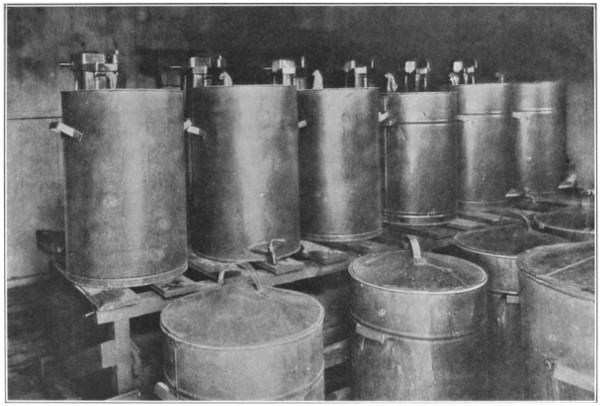
Tanks for Sterilizing Water, Lobos Square Camp
The Japanese Relief Association estimated the number of
their countrymen made destitute by the fire to be over 10,000,
which is about 3 per cent of the total number of persons made
dependent for short or long periods of time. On July 6, 1906, not
over 100 Japanese were receiving assistance from the Relief and
Red Cross Funds. Of these about 50 were receiving shelter only,
in Lafayette Square, and 50 were receiving help at relief stations.
That is, the Japanese constituted not more than one-half of 1 per
cent of the bread line and about a quarter of 1 per cent of the population
of the official camps. Even at the beginning the number receiving
help from the Relief and Red Cross Funds was probably
not much greater. The Relief Survey estimates that the total
value of relief of all kinds furnished by the army and the Finance
Committee to Japanese did not exceed $3,000. Among the 30,000
or more persons who applied for rehabilitation, there was not one
Japanese. Their own relief association, assisted by Japanese
throughout the state, within ten days after the disaster sent
between 7,000 and 8,000 of them to places outside of San Francisco.
On July 6 some of these had returned and the number of
Japanese refugees then in the city was estimated by the association
to be 4,000, two hundred of whom it was supplying with
provisions.
China contributed $40,000 to the San Francisco Relief and
Red Cross Funds for the general work of relief.
There is not much information available about the Chinese.
They probably received altogether more food than the Japanese
and they certainly received more in the way of shelter, yet the
total value of all aid given them was relatively insignificant.
Like the Japanese, and for the same reasons, they did not ask for
much. At the beginning a separate camp was established for
them,—Number 3, in the Presidio reservation. The population
of this camp on May 8, 1906, was 186. Later, when cottages
were built in Portsmouth Square, on the border of Chinatown,
37 out of the 153 cottages were assigned to Chinese. Not over 140
applications for rehabilitation were made by Chinese. About
half of the number were assisted at an average expenditure of
about $70. Nearly all these cases were brought to the notice
of the Committee by social workers, as only a few Chinese applied
voluntarily for relief. Ten thousand dollars is a liberal estimate
of the value of relief given to the Chinese.
The
word “claim” as used in the relief accounting was applied
to anything from a time check for a day’s work to
a ten thousand dollar demand for goods seized, a usage that
arose from the fact that for the first few days, when there was no
available cash, many obligations were incurred that were a proper
charge on the relief funds though not authorized by the Finance
Committee.
Some claims were made by those who suffered a change of
sentiment toward contributing relief. During the hours of urgent
need men donated their goods, workmen gave their labor, and
professional men, their services, who when later they saw the size
of the relief funds could not resist the insidious craving to have a
share of the big whole. There is the instance of men belonging
to one of the building trades who did work for which they expected
no pay but later were not satisfied to take the $4.00 a day
offered as payment by the Finance Committee. They demanded
$6.00 because other men were receiving that amount for a day’s
work. Business houses within and without the city evinced the
same spirit.
Day by day the flood of claims swelled. Claimants and
their attorneys laid siege to the Finance Committee and tried by
bribes and threats of lawsuits to collect their claims. A large
force of clerks and a special committee were kept hard at work
trying to learn the merits of the claims. The Finance Committee
itself day after day was compelled, instead of discussing necessary
relief measures, to give the greater part of its sessions to the hearing
or to the discussion of these claims.[93]
The circumstances of seizure had varied. Often when the
fire was almost upon a store somebody would assume authority
and break it open to give the stock to the people. In such a case
the stock would have been destroyed by fire and there was no
justice in the claim for seizure except where the owner as a consequence
lost insurance. Irresponsible individuals who had no
connection with relief committees had seized goods and impressed
vehicles. Those who suffered loss through such lawless acts
were unfortunate, but they had no real claim to reimbursement
from the relief funds.
The same may be said of the individuals, the business houses,
and the transportation companies whose goods were stolen, not
seized, from freight cars and warehouses. Many claims for regrettable
losses which might have been legitimate if brought
against state, city, or person, were unjust when brought against
the relief funds. Fraudulent attempts were also made to collect
from the relief funds for losses that had no connection with the
relief work and for losses that had never occurred. It was a perplexing
problem to deal with these thousands of claims, the difficulties
of which were increased by the insistence of those with
the least valid claims.
The last report of the Department of Bills and Demands
dated March 16, 1907, gives the following figures:
TABLE 27.—DISPOSAL OF CLAIMS ACTED UPON BY THE DEPARTMENT
OF BILLS AND DEMANDS, TO MARCH 16, 1907
| Disposal of claims |
CLAIMS PRESENTED |
| Number |
Amount
claimed |
| Claims rejected as a whole |
1,164 |
$451,369.59 |
| Claims cancelled, withdrawn, etc. |
101 |
13,269.54 |
| Claims donated |
18 |
10,528.20 |
| Claims approved in whole or in part |
9,669 |
2,242,003.00 |
| Total |
10,952 |
$2,717,170.33 |
TABLE 28.—PAYMENTS UPON CLAIMS ACTED UPON BY THE DEPARTMENT
OF BILLS AND DEMANDS, TO MARCH 16, 1907
| Disposal of claims |
CLAIMS PRESENTED |
PAYMENTS MADE |
| Number |
Amount
claimed |
Amount |
Per cent
of amount
claimed |
| Claims approved in whole or in part |
9,669 |
$2,242,003.00 |
$1,501,781.52 |
67.0 |
| All claims |
10,952 |
2,717,170.33 |
1,501,781.52 |
55.3 |
After March 16, 1907, a few long pending and new claims
were paid. Some law suits had been settled, and a few were still
pending against the Corporation when this report was prepared.
It thus appears that the trustees of the relief funds paid over
a million and a half dollars for expenditures, many of which they
had not authorized and were unable to control. They tried to
pay only such part of the claims as represented supplies and service
used in relief work. Just claims were cut down as a rule, so that
a comparatively small number of claims were paid in full.
In deciding the merits of claims the supervising and judicial
committees appointed sub-committees of experienced men to
supplement their own technical knowledge. Many claims for
liquor destroyed by soldiers and citizens were presented, but the
Finance Committee decided to pay no liquor claims. The enormous
disbursements for automobile service and for transportation
of supplies were made chiefly in payment of emergency claims.
Claims of various sorts were paid by the War Department out
of the Congressional appropriation of $2,500,000. Other claims
were paid by the state. As the Relief Corporation could get no
information about such claims it is possible that there were duplicate
payments.
The accounting system of the Relief and Red Cross Funds
has been criticized because it did not readily yield information as
to the amounts expended for various purposes, and because it was
complicated. The first seems a fair criticism, for contributors to
funds and the public in general are more interested in the cost of
various forms of relief than in the state of the appropriations.
The system of appropriations to the departments for different
purposes was based on carefully prepared budgets. It was good
for controlling expenditures and for keeping a check on departments
and bureaus. For those not directly connected with the
work, additional information in simple form might easily have
been given. The intricacy of the accounting, however, seems
justified by the results. It was devised to make the handling
of the money as secure as possible. So far as the local auditors
and the auditor of the War Department have been able to discover
there was only one transaction that looked like misappropriation
of money. About $1,000 received by a camp employe from
certain authorized sales was for a short time kept back. The
apparent shortage, easily detected by the accounting department,
was made good.
Considering the extraordinary conditions under which the
work was organized, such a showing is remarkable. When men
undertake the thankless task of handling a large relief fund, if
they have a keen sense of responsibility and a realization of the
difficulties ahead they will wish to disburse the fund through a
system which is as safe as possible. It is worth while for them not
only to prevent misappropriation but even the appearance of it.
The employes of such a committee will find satisfaction, when
accused of graft and stealing,—an accusation suffered many times
by the San Francisco workers,—in showing their accusers just how
the money is guarded and that it is impossible for them to steal.
A system that insures such security is worth the extra cost.
As a result, primarily, of the publication of sensational
stories in the press of the country, the plans of the Corporation
were at times seriously embarrassed by the withholding of funds
by eastern committees and by the possible danger of those funds
being dispensed by independent agencies.
The studies in rehabilitation show that the suspension of
grants on August 20, 1906, the period of arrested progress, had a
serious effect upon the rehabilitation work. It caused a change
of relief policy so that families given grants in one period were
treated differently from those in another. It meant for many
families a long wait from August 20 to the middle of October when
the embargo was lifted. The Corporation had worked out a wise,
comprehensive program on the basis of estimated income and
then suddenly had to question whether the income might not
be $3,000,000 less. Inevitably every department suffered from
uncertainty and hesitation. The results of such an intolerable
condition were more clearly perceived in rehabilitation than in
the other work, but what the withholding of funds meant in reduced
efficiency would be hard to estimate.
The two most important funds, those of Massachusetts and
the New York Chamber of Commerce,[94] were eventually transferred,
the latter with the restriction that it be used for business rehabilitation.
Only a number of small funds were permanently held,
but the harm was done. The warning should be heeded in future
disasters. It is possible for a relief committee, when its work
is hardest, to be tied up because of a few newspaper stories
which may or may not have foundation in fact.
The investigator sent by the Massachusetts committee
because of the newspaper stories, after investigation cordially
endorsed the work of the Relief Corporation and made but few
criticisms.
What is the remedy? It cannot be too plainly stated that
there must be only one relief committee or corporation.[95] There
must be no division of responsibility for distribution. If there
must be reform it must be within the relief corporation itself.
If one of the eastern committees in command of large funds had
set up its own agency in San Francisco, it would have been guilty
of improper trusteeship. That much is evident. The suggestion
has been made that the committees in charge of the larger funds
should each have had a representative on the Finance Committee.
Mr. Bicknell, for instance, came first to San Francisco as the
representative of the Chicago Commercial Association and the
Mayor’s committee funds. But such representation would not
include the smaller fund committees. A more inclusive plan is
desirable. The gradual strengthening of the American National
Red Cross seems to point the way. The Red Cross should become
so fully recognized as the national agency for all disaster
funds that it should eventually, in any given case, receive all
funds not sent directly to a local committee. Its relation to
local committees will be strengthened and it can be relied upon to
suggest and whenever necessary push changes in relief measures.
In San Francisco and each subsequent disaster of any proportions,
the American National Red Cross has been represented by its
expert agents. Its strength has been materially increased by
the appointment of a permanent director. The withholding of
funds once subscribed for a particular disaster should become an
impossibility as the status of the national agent is recognized.
We have alluded to one form of restriction, that of requiring
that a specified fund be used for a specified form of rehabilitation.
Such restriction must of course be accepted after an effort has
been made, and has failed, to persuade the forwarding committee
to lift the restriction. But restrictions upon relief in kind are
doubly dangerous and ill-advised. In the San Francisco disaster
the “flour” episode gives an apt illustration. Certain forms of food
were donated in quantities in excess of the needs. These were
flour, potatoes, and condensed milk, all three of them valuable
forms of food in an emergency. The potatoes, as it was the end of
the season, did not keep well in large masses and the refugees,
living in tents or in basements or attics, had little room for
storage. Besides, the universal practice in San Francisco and
the vicinity where fresh vegetables can be bought the year round,
is to buy in small quantities from day to day or week to week and
not store in the fall for winter use. The Finance Committee,
unable to dispose of the potatoes to refugees, decided to sell the
surplus stock. The sale does not appear to have been made,
perhaps because they were unsaleable. At any rate large quantities
spoiled and had to be thrown away.
It was natural to think that condensed and evaporated milk
would be necessities of prime importance. They were valuable,
but on account of local conditions were not needed in great quantities.
The supply of milk from the ranches outside the city was
not much diminished by the earthquake. By confiscation and
by arrangement with dealers an abundant supply of fresh milk
was secured for distribution to the refugees.
Many committees throughout the country sent flour as the
most useful form of food. It came so fast that for lack of warehouses
in which to store it (practically all city warehouses having
been burned) part of it was put aboard three transports and in
the army warehouses, and finally a vast quantity was stacked up
in the open air. The transports were not adapted to preserving
flour in good condition so they could not long be used as storehouses.
The Finance Committee, confronted by the problem of
finding storage for the vast supply received, and knowing that
it was several times as much as could be reasonably distributed,
decided on May 17 to sell 4,000,000 pounds. This was vigorously
objected to by the Minneapolis committee which had sent
15 per cent of the 16,000,000 pounds received. It insisted that
its flour should be distributed,—the very flour sent, not flour purchased
later with cash from the sale of Minneapolis flour. This
episode led to newspaper publicity and protests. The lesson is,
that restrictions upon relief in kind are unsatisfactory and embarrassing
and should always be placed upon a discretionary
basis. The Minneapolis committee claimed that title to its
flour had been transferred to the destitute of San Francisco, not
to the Red Cross or to the Finance Committee, who were apparently
to be considered solely as the servants of distribution. The
position is an impossible one in which to place a self-respecting
committee.
Many donors of money gave specific directions as to the
use to which they wished it put. There was the man who sent
$1.00 with a request to hand it to some worthy sufferer and let
him report to the donor; and there was the refugee who, after he
had found employment elsewhere, sent a small sum, more than
enough to pay for the three days’ rations he had received in the
bread line, with the request that the balance be given to a soldier
who had been kind to him. Jewelers sent money for jewelers,
artists for artists, teachers for teachers, physicians for physicians,
the people of one town for their fellow townsmen in San Francisco.
Money was also sent to individuals connected with the
relief funds to be applied to specific purposes. Fortunately,
there were enough unrestricted funds available to assist all classes
and carry out the intent of all donors. It was not necessary to
open a special account for each of these trusts.
No actual restriction as to the purpose of expenditure,
imposed either by donors directly or by the custodians of large
funds, was in itself onerous to the relief authorities, but the circumstances
attendant upon the remittance of restricted funds
caused more or less embarrassment during nearly the whole
period of the relief work.