In the morning Hori discovered that his military
survey map somehow had been mistaken for
a sheet of wrapping paper the day before. The
torn-off section had served to carry rice cakes in
my pocket. The tearing had strangely traversed
mountains, valleys, and rivers along almost the
line we purposed following. As Hori was still
unemancipated from the idea that not to know
where one is is to be lost, he was rather in a maze
for the next few days, as we continually wandered
off the edge of the map into unknown regions.
He must have marvelled at times over the kindness
of the Providence which had guided our
steps from Kyoto to Nagoya.
The valley of the Kiso earnestly seeks to attest
the theory that the inhabitants of localities
with a similar climate and topography tend to
have similar ideas, especially in working out
ways of doing the same thing. The wide sweeping
view with the snow-topped mountains on the
horizon might have been Switzerland, and for a
more decisive deceiving of the eye into thinking
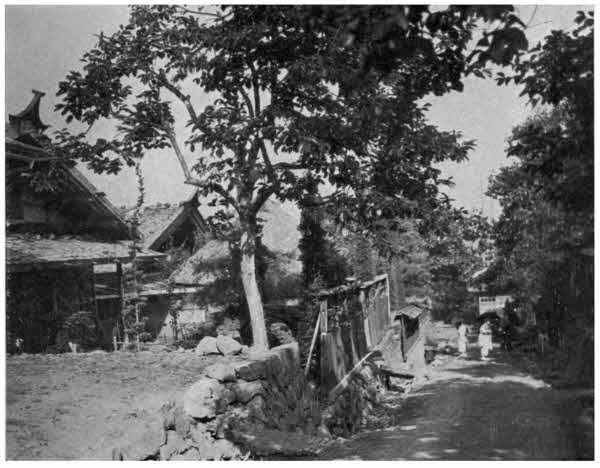
so the cottages of the peasants had the overhanging
roof of the Swiss chalet with the same pitch
and the same arrangement of rows of boulders on
them. It is a province, also, of trousered women.
We came upon a wistful-eyed, pink-cheeked,
timid fairy of the mountains. She was carrying
on her back a huge, barrel-shaped basket and she
bent forward as she slowly walked along, her eyes
fixed on a handful of wild flowers in her fingers.
Even our modest knowledge of the folklore of
the land told us that she must be a princess who
had been captured by ugly trolls. They had set
her to impossible labour as their revenge against
her beauty. A young man whose niche in the
world was beyond our determining—although we
thought he might be a student on a vacation walking
trip—had caught up with us a half-hour before
and had been measuring his step with ours.
When he discovered that I wished to take a picture
of the princess he assisted with such effective
blandishment of speech that she halted for an instant.
When I asked that I might also photograph
him, he laughed and vaulted up among the
rocks and disappeared.
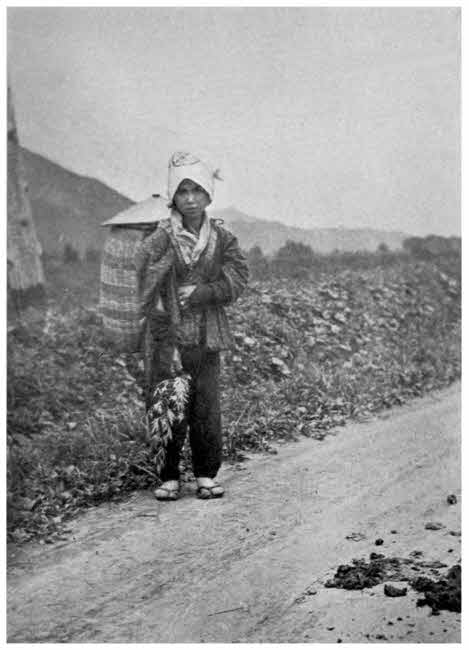
WE CAME UPON A WISTFUL-EYED, TIMID FAIRY OF THE MOUNTAINS
A little farther along we met the six sisters
of the princess. They were carrying burdens
equally as large and heavy as had she, but they
were not so pretty nor so wistful, albeit they were
just as timid. We never could find any key to
the mystery why our appearance along the highway
would sometimes be as startling as if we
were ghostly apparitions, and at other times it
would merely bring about a casual interest and
staring, if it brought any interest at all. Upon
this occasion it was a panic. The six maidens beheld
us, they shrieked in unison, and they jumped
from the road, trying to hide behind rocks and
trees. Their lithe limbs might have carried them
like fawns, if their shoulders had been freed
from the huge baskets, but, as it was, their flight
was more like that of some new and enormous variety
of the beetle tribe, evoluted so far as to wear
cotton clothes and to have pretty human heads
turbaned under blue and white handkerchiefs.
As a son of Daguerre, I should have tarried for
an instant to photograph their amazing struggle,
but an upsetting obsession of chivalry hurried us
on. By the time we turned to look back they
had scrambled to the road, all six princesses accounted
for. They, too, turned to look at us
and from the safety of distance began to laugh.
The comedy might thus have ended if it had not
been that at that instant Hori rounded the bend
of the road with his thumb pressed vigorously
against the strident bicycle bell. The beetles (or,
better to say, the wingless butterflies) again took
flight. We awaited their second reappearance.
This time they did not venture laughter until they
reached the curve and made sure of no further
dismay.
Hori dismounted and pushed the bicycle along
and we entered into one of our unending discussions.
A subject sometimes in debate was O-Owre-san’s
and my intense interest—our curiosity—in
the conversations that Hori had with passersby
along the road or in the shops. Sometimes,
when we had made some simple inquiry in a
shop, Hori would ask a long question; the shopkeeper
would answer; Hori would enter a counter
dissertation; the shopkeeper would make his reply
to that; Hori would reply; the shopkeeper
would reply; Hori would reply; and then it might
be that the shopkeeper would have the conclusion.
Hori might then turn to us with: “He says
‘no.’”
In the port city shops where English is spoken,
if there is but one clerk he will answer your
questions immediately. If there are two, every
question is thoroughly discussed in Japanese before
answering, and if there be three, four, or
five clerks, the debate goes on to extraordinary
length. Again and again we asked Hori for a
complete translation but it must have been that he
believed within himself that he had asked the
question in the simplest terms, for we seldom got
a verbatim translation.
We were in the midst of some such discussion
when we looked up to see an old man standing
before us, leaning on a long staff. His white
beard fell benignly and his steady eyes carried
a message of goodwill. He returned our greetings
by a dignified inclination of his head. We
were at the peak of the road and, as often may
be found at such points, there was a small rest tea-house
for travellers. We asked the old man if he
would sit down with us and share a pot of tea.
The iron pot, filled with mountain spring water,
steamed hospitably on the hibachi and the fragrance
of the tea was a friendly invitation to relax.
Our guest stood his long staff in the corner, sat
down on a cushion, and drew his feet from his
dusty sandals. After the true manner of happily
met travellers he was easily persuaded to tell us
the tale of his wanderings. The translation is
somewhat rhetorical but, as Hori explained, the
tale was told in the language of etiquette.
“I was born,” said he, “in the forty-first year
of the rule of the Shogun Ienari. I was young
and am now old. My eighty and seven summers
have seen the downfall of the once mighty before
the rising to full glory of the Meiji, and now,
from the Palace of Yedo, shine upon us the divine
rays of the Way of Heaven. Great is the
Mercy of Enlightenment. The Eternal Glory is
the Way.
“As a child I knew these mountains which you
see. The provinces of our land were then fortified
by many castles and these roads were
traversed by armed men. The castles have been
razed to the ground but the temples of the gods
still stand. The two-sworded warriors have gone
but I, a humble pilgrim, walk the roads they once
knew. The white clouds rest in the blue sky above
Fuji-san as when I looked upon them as a child.
The clouds will rest above Fuji when these eyes
shall see them not.
“In the fourteenth year of my youth I took
the vow that my life should be lived in honouring
the holy images of Buddha, each and all as my
steps might find them, from the shrines erected
by the peasants to the bronze statues of the great
temples. I took the very staff which you see and
the clothes that were upon my back and bade my
family good-bye. Through the kindness in the
hearts of men, the lowly and the mighty, the gods
have provided me with food and rest. I have
travelled without illness and my spirit has known
the joy of the Way.”
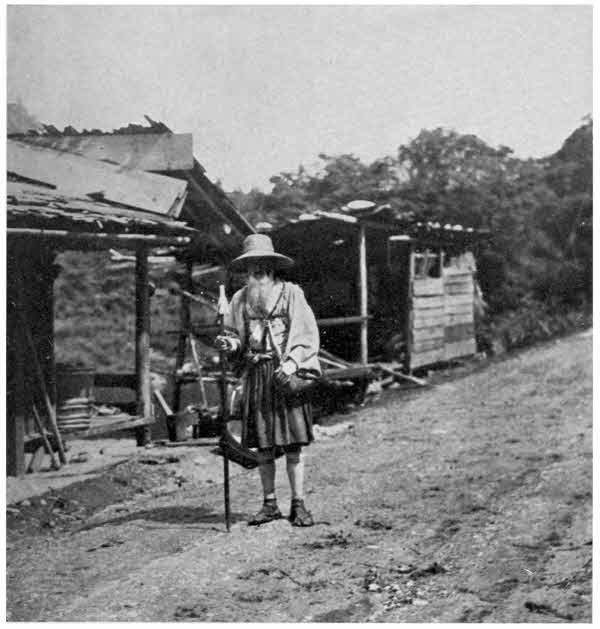
“IN THE FOURTEENTH YEAR OF MY YOUTH I TOOK THE VOW THAT MY LIFE SHOULD BE
LIVED IN HONORING THE HOLY IMAGES OF BUDDHA”
In those years that his bowl had not gone empty
of rice, never, it may be believed, did anyone give
to him as a beggar asking. Japan is of the East,
possessing the intuition that the spiritual is a
mystic interflow.
His eyes were young; they were not clouded
in contemplation of the abstract. They sparkled
from a delight in life. It had not been demanded
of him that his vicarious pilgrimage should be
one of tragic sacrifice. He had given and he
had received. While his theoretical faith might
be that life is an illusion and only the Way is
eternal, nevertheless he was born to love his
fellowmen and he could not escape from the practical
faith that was in him that this temporal life
must be of some use and of some meaning. I remembered
in strange comparison a sturdy British
unemployed whom I had once come upon. He
was lying under a hedge in Monmouthshire. He
borrowed a pipeful of tobacco and then turned
over onto his back to gaze into the blue sky.
After a time he said: “Activity is a fever. Therefore
it is a disease. Laziness is a promise. Rest
and forgetfulness are divine.” He did not make
the effort to add a good-bye when I left him.
A path of our pilgrim led over the road which
we had just travelled. We parted, bowing many
times. Hori unfolded his ravaged map and found
a village named Narii a few miles farther along.
The railroad down in the valley according to the
map went somewhere near Narii. Hori’s nerves
had been rasped by the temperamental vagaries
of the bicycle on the steep slopes and he decided
to await a train, promising to meet us.
After a time our path dropped down to the
bed of the river. Across a bridge the road forked,
one branch continuing along the valley and the
other winding off into the hills. The hill trail,
particularly as it led into the unknown regions
off Hori’s map, tempted, and we shouted down
an inquiry to some children playing in the water.
They were successfully attempting to get as wet
as possible while remaining as dirty as possible.
There is a mystery which overhangs grimy Japanese
children. When the little noses present a constant
temptation to the seiyo-jin handkerchief that
in itself is a caste sign that you will find the faces
of their fathers and mothers unhappy, dull, and
lustreless. When the children are brightly scoured
and polished there is a general appearance of
happiness and contentment in the community. It
is not the simple equation that poverty equals
dirt; one village is scrubbed and the next one is
not—otherwise neither seems richer nor poorer
except in happy looks.
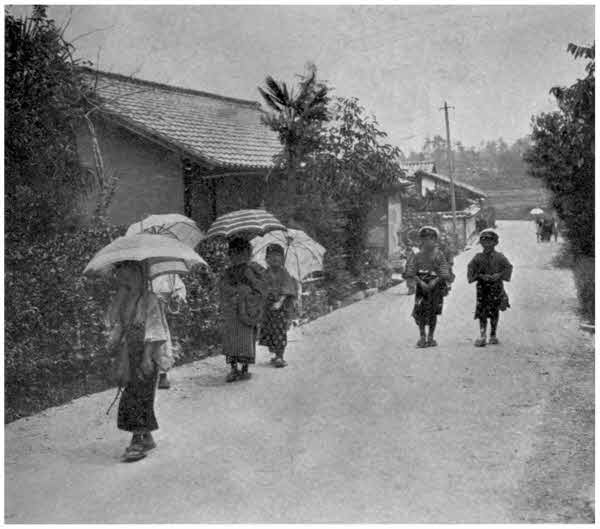
When we called to the children in the Kiso they
splashed out of the water like wild animals and
scattered in all directions, but as two naked infants
too small to run had been left on the shore,
first the girls and then the boys began to edge
back. They remained to stare. We pointed up
the mountain path and asked if it led to Narii.
Their gestures evinced a fierce encouragement to
essay the ridges as if they had the contempt of
the untamed for anything as conventional as a
broad valley road. As a matter of fact they were
undoubtedly saying that the valley road did not
lead to Narii. We discovered this later when we
could look down from the heights. Hori’s railroad
tunnelled the hills.
According to local belief our path carried us
over the “backbone” of the empire, and this
crossing spot is considered sacred ground. Accordingly
we should have paid special homage to
the local deity whose shrine we passed, but as we
were foreigners and in ignorance, the god perhaps
forgave us. Furthermore, we unknowingly passed
a particularly renowned view of very holy Mount
Ontake. We probably did see the mountain, but
being uninformed, as I said, of this special view,
we did not hold ourselves in proper restraint
until reaching the exact spot for appreciation.
Instead we luxuriously and squanderously revelled
in all four directions of the compass. It is always
thus with the ignorant. Their indiscriminate
enthusiasm is more irritating to the intellectuals
than no appreciation at all. I was later
most depressingly snubbed for having missed the
sacred view by a scholar of things Japanese. He
knew it from prints and sacred writings. He said
that he himself would have journeyed to see the
reality if it had not been for the probable annoyance
of having to come in contact with so many
natives on the journey. He appeared to be
impatient that the British Museum does not commandeer
all views, temples, and abiding places of
art around the world and establish turnstiles
which will keep the natives out and let the scholars
in. When he actually grasped that our only reason
for having arrived at that particular spot
at all was that we had taken a turning to the
right instead of to the left, he declared that our
ideas of travelling evidence the same intelligence
as might the tripping of tumbling beans and that
our very presence at sacred places was a sacrilege.
We turned a corner that hung sharply over the
precipice. Around the bend the shelf spread
out into a miniature meadow. A peasant was
lying on the grass and his straw-bonneted ox was
leisurely nibbling. We sat down beside him
and O-Owre-san began searching in his rucksack
for a remaining cake of chocolate. During this
hunt the peasant kept his eyes carefully and
earnestly averted. I made the remark to him
that the view was kirei and he replied by a nervous
hei. O-Owre-san found the chocolate and broke
it into three parts. He handed one of the
squares to the peasant. The fingers that reached
out for it were trembling.
The man had imaginative eyes. It was plain
to see that he was suffering from some lively
remembrance of a mountain folklore demon story.
He knew that we were foxes or badgers who
had assumed human form, and that we had come
to him with no good intentions. He suspected a
subtle poison. But he had courage from one
thought. It is the common knowledge of the
countryside that while the demands of demon
badgers may not be directly refused, their evil
intent may often be thwarted by the crafty intelligence
of man. The immediate problem was
how to avoid the appearance of refusing to eat
the mysterious cake which was now getting soft
and moist in his hand. Suddenly he popped the
chocolate into his mouth, tin foil and all. Then
he pushed back the square into his hand almost
in the same movement. I pretended not to be
watching. He dropped his hand with elaborate
carelessness into the thickness of the grass. I felt
a sense of dramatic relievement myself.
During those minutes the ox had been no such
respecter of enchantment as had his master. Instead,
he had stood sniffing at our boots and
pulling up bits of grass round and about our
ankles, all the time rolling a pair of red, angry
eyes. Asiatic beasts of burden find something
antagonistic to their complaisance in the odour
of the Caucasian and this individual ox was progressing
toward a positive bovine dissatisfaction.
Furthermore, we were sitting on the sweetest
and most tender tufts of grass remaining. We
courteously dismissed the peasant to go his way.
His marked alacrity was quite welcome.
We lingered on the grass for a little while and
I told O-Owre-san my guesses. I elaborated
them into the hazard that the poor man—he
had not once turned to look back over his shoulder—might
even then be fearing that the slight
taste from the chocolate would turn him into a
frog and his ox into a stork to eat him up; or
perhaps he might be in distress that he and his
beast might grow smaller and smaller until they
would disappear into thin air.
O-Owre-san had been examining the faintness
of the path. “I hope none of these things happen
until the man gets over the hills to Narii. The
hoof prints make an excellent trail,” he said.
It was time to sling on our packs and follow.
When we reached the next turn we could see
the peasant’s straw hat and the ox’s straw bonnet
bobbing along just over the bush tops. We
maintained this distance without closing the gap.
As O-Owre-san had predicted, the hoof marks
were useful. The path often grew so faint that
it had no other resolute indication. We had
been sure, without thought of other possibility,
that the crest of the hill we were climbing would
be the summit of the range. When we reached
the crest we stood looking up at another peak
rising from a shallow valley at our feet.
“Which way does the ox say to go?” I asked.
The hoof marks were there in the soft earth,
but where our feet had stopped there they had
stopped. They stopped as absolutely as if the
peasant and his ox had been whisked away in a
chariot to the sunset sky. The bushes were too
low for concealment. There was no cave, nor
hole in the earth.
If there be no such thing as magic, in the
Japanese mountains at least, where did that man
and his beast go? The disappearance was as complete
as the most exacting enchanter could have
desired. We found no answer to the riddle and
the sun was sinking, adding the next question of
how we were going to get out of the hills in
the night time if we delayed for scientific investigation.
We succumbed to expediency and took
a five-mile-an-hour pace over such trail as we had
left, guessing at the turns. When we finally
reached the next crest, deep in the valley we
could see Narii. Before descending the steep,
dropping path, we sat down near a spring where
the birds had come to drink. They were singing
evening songs mightily. Bright wild flowers were
scattered in the open spaces between the intense
green of the fern patches. The world was lustily
at peace.
When we did start we swung down the long
hill almost at a run and in a half-hour reached
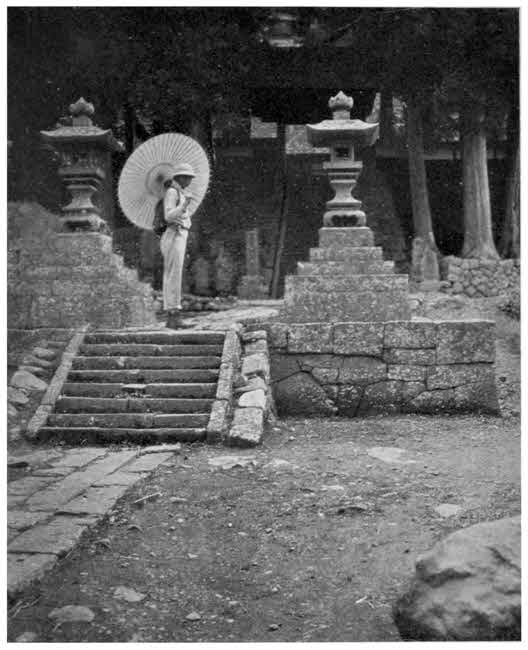
the edge of the village to find Hori sitting under
a stone lantern in the temple yard. The evening
peace had made us positive that this is the best
of all possible worlds, but Hori was entertaining
a different idea. He looked exceedingly gloomy.
We were impatient of any discontent. If he
had said that men were starving for rice in the
village beyond, the fitting answer would have
seemed to us the historic words of the good queen:
“Give them cake.” Undoubtedly when the message
about the starving peasants was brought to
that Lady of France she was sitting under the
shrubbery at Versailles, and the birds were singing,
and it was springtime, and perhaps the fountains
were playing. Impellingly she realized with
an insight deeper than any historian has ever
appreciated that upon such a glorious day, if there
is any such thing as right or justice at all in
this world, a certain amount of cake should be
everybody’s inalienable possession.
As it happened, Hori’s worry had nothing to
do with altruistic sorrow for starving villagers,
but existed from a lively interest in our own affairs.
The town was very poor, he explained, a
town come down in the world from ancient prosperity.
Its neck was hung with the millstone
of decayed graces and thinned blood. The inn
was so old that it was senile. Hori had established
some excuse before entering the door for inspection
which later allowed his rejection of the inn’s
hospitality, but it would never do for us in
turn to venture in for a glance around. That
would be needlessly raising the expectation of the
ancient host. We would find, he suggested, that
it would be only five or six or seven miles to the
next village. As we had had twenty-five or more
miles behind us and most of those had been along
mountain paths, we were not so inevitably tempted
at that hour of night to be particular in a choice
of roofs as Hori, who had come by train, was
imagining.
The inn, in truth, was very old. By any law
of survival chances the wandering wings should
have burned to earth long ago. To greet us there
were no smiling and chattering maids gathered
behind a mistress; instead, an old man and a
very small girl, his granddaughter or more likely
his great-granddaughter, met us in the dark
entrance with protests that the house was unworthy
of our presence. We hastily denied
them their words. Hori could employ the polite
phrases of Japan. We impulsively, directly, and
bluntly told them “no.” It was not alone the
pathos of the two figures which appealed. It
was somewhat that their dignity had not surrendered
to ruin, and it was somewhat a something
else, indescribable, in the atmosphere that
charmed.
We followed the master along a labyrinthine
corridor. The soft wood planks of the floor
had been polished to a deep reddish gleam under
the bare feet of generations of hurrying ne-sans.
He led us past inner courtyards to the farthest
wing. Our room hung over the river at an elbow
of the stream. Even with the shogi pushed wide
open we were hidden completely from the eyes
of the town by heavily leafed trees.
The mats on the floor had turned a dingy,
mottled brown and black from their once light
golden yellow, but they were clean. The sacred
takemona corner still compelled its importance.
It had been built in an age when the demand for
its existence was the ardent faith of the builders
rather than an architectural tradition. The room
was about thirty-five feet long and fifteen feet
deep, perhaps a little larger. The ceiling was
proportionately high.
Hori was still doubtful, not gloomily so, but
from the knowledge that an inn is proved by its
service. The host was kneeling, as immobile as
a temple image, awaiting our orders. His skin
was as bloodless as the vellum of the painting
which hung behind him. His watchful eyes, however,
were intensely bright in their deep sockets.
Hori began inquiries about dinner. The ancient
bowed his head to the floor, drawing in his breath
sharply against his teeth. Dinner was now being
prepared for his family, he said, but it would be
unworthy of his guests. The formal phrase of
polite deprecation carried this truth, as Hori
discovered by further questioning; it was not
that the dinner was or was not worthy—it was
the failure of quantity. We should not have long
to wait, said our host, but food would have to
be sent for.
As we sat in a circle planning what we should
have, the old man smiled and pointed to a patched
square in the matting. Underneath the square,
he said, was a depression for holding bronze
braziers. When the nobility, in the old feudal
times, had travelled the Nakescendo trail, this
was the room of honour that had been given to
the daimyos. It had been often the custom for
the retainers of a daimyo themselves to prepare
his dinner over the braziers. Our sitting there,
planning what we should have, had reminded him
of the dead past. His words came slowly as if
between each word of recollection his spirit journeyed
back into the very maw of oblivion and
then had to return again to the world.
“Are the braziers still hidden there?” Hori
interrupted.
Yes, the braziers were under the floor or somewhere
to be found.
Hori turned to us and put us through a questioning
until he rediscovered the word “picnic”
for his vocabulary. “That’s what we will have,
a picnic, right here,” he declared, and he turned
back to the host to explain. The old man almost
gasped, at least approaching as near to such
escape of emotion as he probably ever had at
the request of a guest.
“But you will then have to have a special
waitress,” he said. “My granddaughter is indeed
too young for that privilege.” Always when he
used depreciatory adjectives about the child’s unworthiness
he failed lamentably to harden his
caressing tone. She was, however, as he had
said, little older than a baby. The services of
a maid we should have to pay for, but, under
the spell of the conjuring up of the memories of
those bygone revels in our room, what cared we
for saving our precious yen? We had become
reincarnations of the two-sworded swaggerers.
We waved our arms grandiloquently.
“Tell him to send for fowls for the pot,” we
oratorically assailed Hori. “Let us mix rich
sauces and warm the sake. And tell him to remember
that for us there can be but one choice—the
maid to serve our dinner must be the prettiest
maid in all Narii.”
I had not the slightest idea that Hori would
translate our exact words, but I found later that
such was his act.
Thus the mountain village of Narii faced a
problem. Two foreigners, and a Japanese almost
as alien as a foreigner, had appeared from nobody
knew where, not preceded, ’twas true, by
retainers as had been the travellers of old, but
nevertheless demanded the old-time service with
as much gusto as if they were accustomed to
having what they wished. They had asked that
the prettiest maid in all Narii be called to the
inn to exercise the privilege of guarding the steaming
rice box. It was obvious that there could
be only one prettiest maid, and all Narii knew
with one mind that the prettiest maid was the
daughter of the Shinto priest. However, the
daughter of a priest is not a likely candidate for
service in an inn, even if the master has ever
been a faithful devotee of the temple. Nevertheless
there was the honour of the hospitality
of Narii at stake. Messengers (or even appropriately,
it might be said, heralds) were sent to explain
the problem to the maid and her father,
and to use, if necessary, the pressure of “the
state demands.”
Thus came O-Hanna-san to the inn. (In all
Japan there cannot be a prettier, a more bashful,
or a more modest maiden.) Her eyes were downcast
behind long black lashes. Her soft cheek
flushed and paled—perhaps somewhat from the
excitement of the adventure. Neither she nor
her friends had ever seen one of that strange race,
the foreigner. And, indeed, even a priest’s daughter
may think that to be chosen as the prettiest
maid——!! Ah, her courage failed her to glance
up and words would not come to her lips to answer
their questions, but they did not seem to be
so very predatory nor so very fearsome—and they
were very hungry.
Two great bronze braziers had been filled with
glowing charcoal. The foreigners and the outer-world
Japanese who could speak their strange
words were busily cooking the fowls, chopped into
dice, and they were arguing about their respective
talents and abilities, as do all amateur cooks.
Perhaps she could now look up for an instant
unobserved. No, a glance met her eyes
and she felt hot blushes grow again on her
cheek.
While they feasted and laughed she had to
run many times to the kitchen for forgotten dishes.
When she passed along the hall by the entrance
to the street she was each time stopped and
besieged by the questions of the gathered mob.
(Some of those inquiring investigators had also
gathered outside the wall of my bath an hour
before. I had been suddenly aware of an eye
at every crack and crevice of the boards as I was
cautiously stepping into the superheated tub.
There was not a sound, merely the glitter of their
star-scattered eyes.)
The foreigners put sugar on their rice and one
of them even put sugar in his tea. They handled
their chopsticks so awkwardly that it was marvellous
that they did not spill the rice grains on the
matting. She thought of the twenty rules in etiquette
for the proper and graceful use of chopsticks
and she imagined that if there had been a
ten score of rules they might have all been
broken. At last the three feasters finished their
mighty meal and stretched out on the cushions
to smoke in deep contentment. She doubted
whether they had even noticed that her superior
kimono was not such as a maid of an inn would
possess. After the feast her quick feet, in spotless
white tabi, carried away the bowls and little
tables. Then she sat down by the door to await
any further clapping of hands.
The host came in, moving silently across the
matting. He kneeled and bent his forehead to
the floor. Before the meal he had himself arranged
the flowers, in an old iron vase, to stand
in the takemona corner. We tried to express our
appreciation for the flowers and our admiration
of the vase.
We asked him how old the inn was. It had
been his father’s before him, and his grandfather’s
before his father. Yes, in those days the Nakescendo
had rivalled the Tokaido, and yearly, on
the hastening to Yedo to give obeisance to the
Shogun, the great nobles of the northwest provinces
with their armed retainers had had to pass
through Narii. In the pride of their gifts to
the Shogun, in their numbers, in their courage,
they had never yielded place to the envoys from
the great families of the South. This now forgotten
inn had then been famous. Our room,
overhanging the river, he repeated, had been only
given to the daimyos. The samurai had crowded
the other rooms. The inn had boasted a score,
two score, of trained and pretty ne-sans to wait
upon those fiery warriors. (The modern geisha,
in many of her accomplishments, is daughter to
the inn maidens of the feudal days who sang and
danced and played musical instruments in addition
to the graces of more domestic duties.) The
inn had then rung with shouting and laughter,
and sometimes the dawn of the morning start of
the cavalcade found the retainers still sitting
around the feast.
On the road to Yedo their purses had hung full,
but the great city always plunged both its hands
into those purses filled from the rice taxes, and
it was often quite another story—the return journey
back to the provincial castles. No rare occurrence
was it indeed, for some haughty samurai
to declare in the morning that he could not pay
his inn bill, however modest it might be. Upon
one occasion a certain warrior had been forced
to leave in pledge the first mistress of his heart—his
sword. A daimyo, overlord of a province,
could, of course, never be in debt to an innkeeper,
although he might leave a gift for his host instead
of money. When such eventuality as that arose
the host would declare (wisely) that his hospitality
had been unworthy of any remuneration and
that he was a thousand times repaid by the magnificence
of the gift.
Yes, went on the old man, once a noble upon
leaving the door had caused a vase to be unwrapped
from its encasements of one silken bag
after another and had given it to the inn. The
donor had written a poem of dedication with his
own hand. The vase was shaped like a bottle and
the inn had been called “The Bottle Inn” from
that day, seventy years in the past. Our host, a
youth on that day, had thought that the inn would
ever be rich and renowned. He sighed. The
tradition of its renown had faded and been forgotten
in this age of railways. No longer did
turbulent guests demand that the bottle be brought
out and shown.
If his dramatic genius had been subtly leading
us toward turbulence, we obeyed the pulling of
the strings. We demanded to know whether the
vase was still under his roof. Our host smiled.
The sacred vase was hidden safely. Would we
like to see it?
He returned, carrying an old wooden box. The
great-granddaughter dragged the unredeemed
sword after her. The well-worn scabbard of the
sword was of mediocre, conventional design, but
the blade had been forged by one of the famous
sword makers. Hori read the sword’s origin
from the characters carved in the steel. The old
man slowly slipped the sword back into the scabbard,
leaving us to ponder what might have been
the tragic fate of the ronin that he had never returned
for his pledge.
No casket of precious metal can be so alluringly
suggestive of trove as the simple, unpainted,
pine boxes into which the Japanese put their
treasures. A woven cord clasped down the lid
of the box. The untying of it began the breathless
ceremony. When the lid was lifted we saw the
first silken wrapping, then came another, and another,
and another. Some were of brocade, some
were of faded plain colour,—red, blue, or rose.
Finally the drawing string of the last bag was
pulled open and the old man lifted the bottle.
It was of yellow pottery with a thick brown
glaze overrunning the sides. The mouth of the
vase was capped by a bronze and silver band
carved with an irregular motif.
The trustee of the possession allowed us to
pass it from hand to hand.
What was one of our reasons for being in Narii
at that very moment? It was that our eyes were
prying for those rarer treasures in Japan which
may be sometimes gleaned “away from the beaten
path.” Unaccountable chance had led us to the
inn. The old man was hopelessly beaten in his
contest with poverty. I knew that he did not
wish to sell, but if there should be the jingling
of a few yen—was it likely that he could refuse?
Our eyes were gleaming with desire. Surely,
even if it were a venal sin to take away the
bottle from The Bottle Inn the very greatness
of the temptation would have brought its own
special forgiveness. But because temptation and
conscience can generally be argued around to our
satisfaction, the gods have ironically added impulse
as the third part of us. It must have been
some such impulse which was the irrational lever
which moved us to action. We soared to the
heights. It was a superior endurance to any
flight that it is likely either of us will ever attempt
again. Truly such virtue is more regretted
than gloried in. We did not take the bottle with
us. It still functions in its environment, in harmony
with its tradition. Taken away it could
be only a superior vase with a history, an object
of art. In that old inn it is a living part, an
inspiration. In the forgotten village of Narii no
numbered museum tag hangs around its neck.
The bottle dropped back into the brocade bag
lined with faded crimson silk. Then the other
wrappings, one by one, muffled it. It went into
the box, the lid was fitted into place, and the cord
was tied. Do we gain strength from resisting
such temptation? The writers of the Holy
Church of the Middle Ages said so. By refusing
that bottle I merely gained exhaustion. This
moment I am stifled by the dust of the ashes of
that murdered passion. My conscience replies
with no response. It has lost the vitality of recoil,
and thus, if ever such time may come, I may
yet glory in a greater vandalism, some supreme
Hunnish act, and there will be no rasping regret.
The breezes up among the snows of the mountains
came down into the valley for the night.
Wherever they were going they seemed to be
quite undetermined as to their path. They blow
from every side and into every corner of the
room by turn. Little by little, to escape the
draughts, we had kept pushing along the wooden
shutters until we were at length completely walled
in. It was not possible to imagine that a few
miles away, down on the rice plains, the millions
were nudely stifling while we were going to bed
to get warm. The daughter of the priest had been
dragging layers of bedding to the door and, when
we clapped our hands, she had innumerable mattresses
for each of us. For once it was unnecessary
to stretch the mosquito netting. There
seemed to be nothing left but to blow out the
lights and cry: “O yasumi nasai!” to the retreating
patter of her footsteps.
“What’s the midget granddaughter waiting
for?” I asked Hori.
“She wants you to go to bed,” said he from
under his quilt.
I jumped into the soft centre of my mattresses
as requested. Then the butterfly dropped on her
knees and crept backward around our beds. Out
of a box she was pouring a train of powder until
she had us each enclosed in a magic circle.
“Why?” I demanded.
Kenjiro laughed at me.
“It’s nomi-yoke,” he said. “Insect powder—what
do you say in America? Bug medicine?”
I insisted that I had not seen the sign of a
bug or an insect or a flea or anything looking like
a marauder.
“Of course not,” Hori stopped me as if I
should have known better. “It’s just courtesy
to honoured guests, to show you that they would
wish to protect you if there were any. If there
were crawlers,” he concluded with some scorn,
“do you suppose they’d make such an effort to
call attention to the fact?”
That bushido explanation satisfied Hori but I
was doubtful. For the sake of verification I carefully
destroyed the integrity of the rampart
around my bed by opening up passages through
the powder. I was willing to display a few bites
in the morning to prove the truth. I went to
sleep dreaming about two-sworded samurai who
looked like pinch bugs, and they were swaggering
around a wall of insect powder. However, the
morning proved that Hori was quite correct. The
delicate attention had been born of pure courtesy.