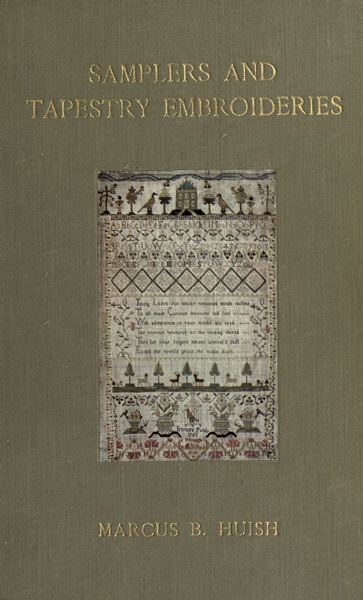
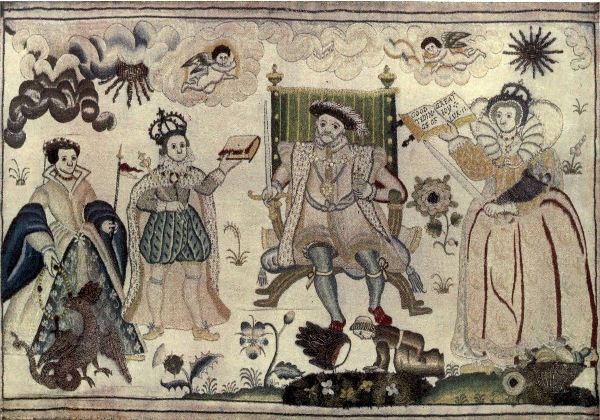
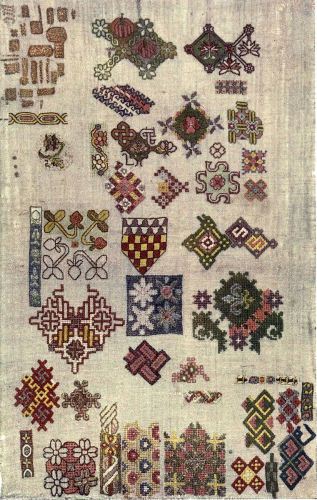
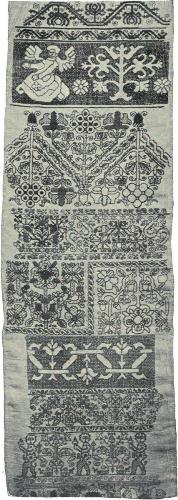
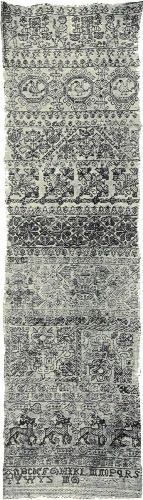
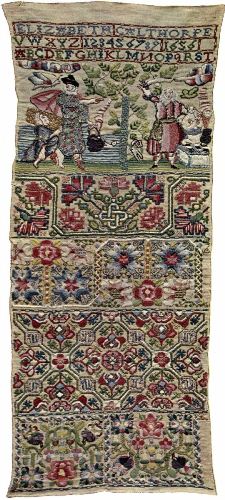
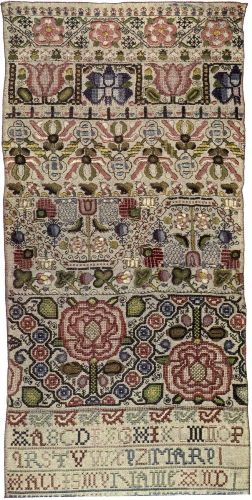
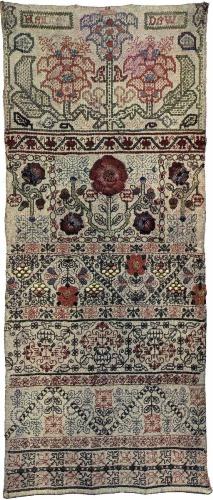
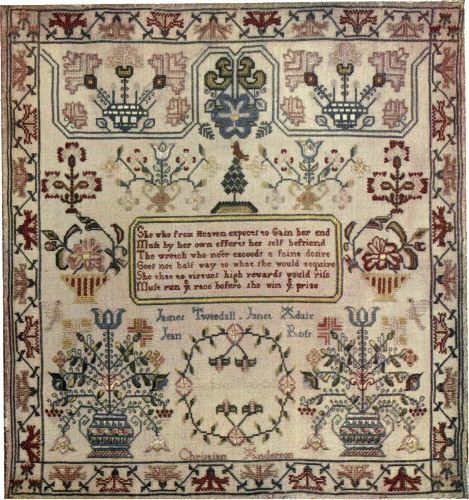
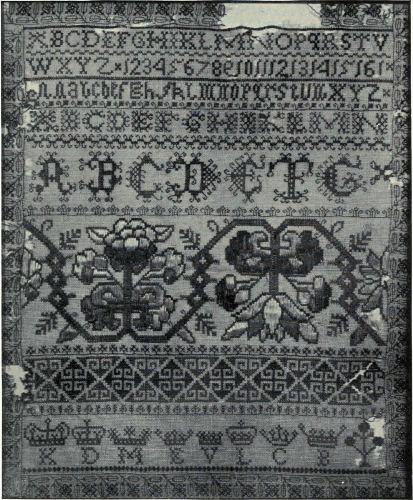
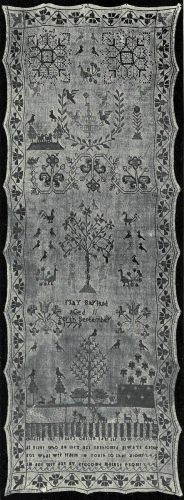
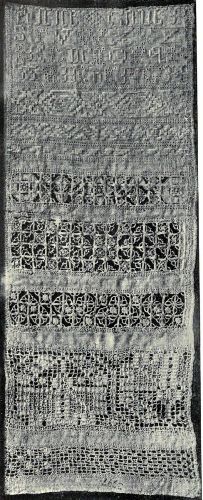
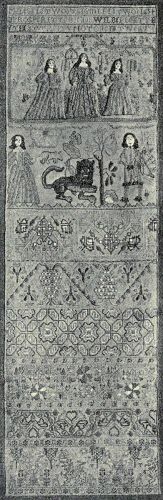
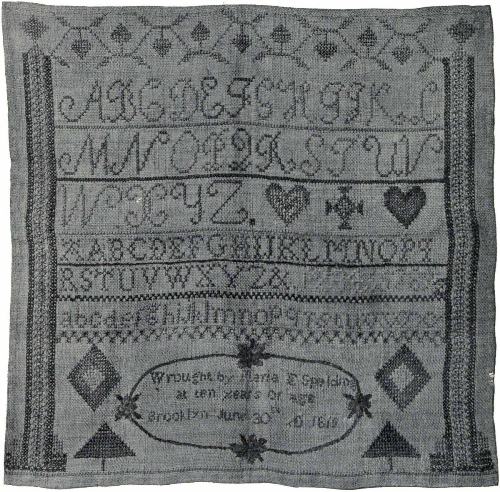
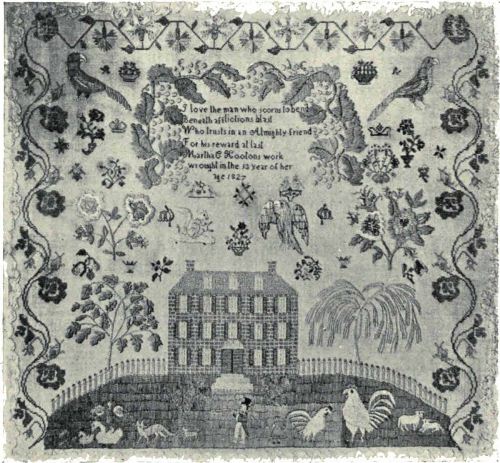
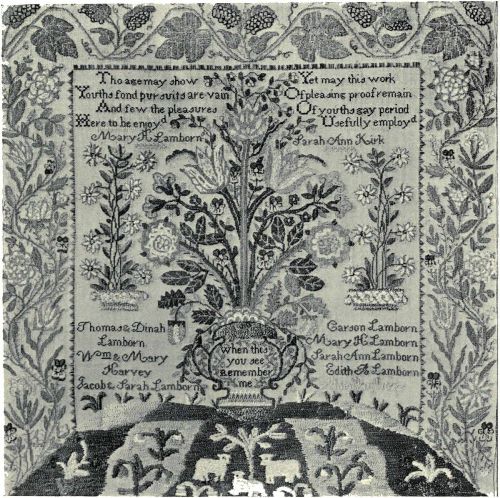
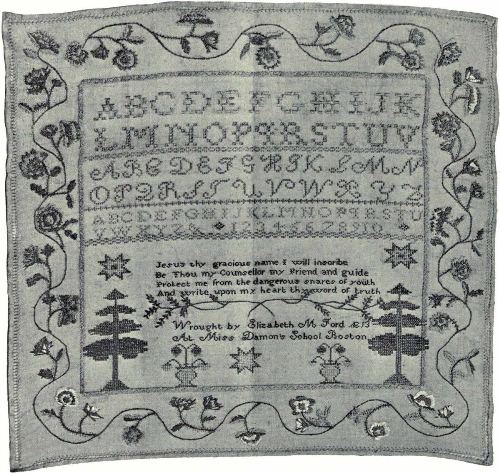
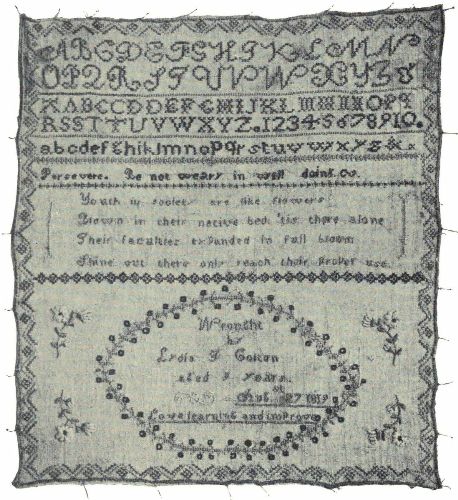
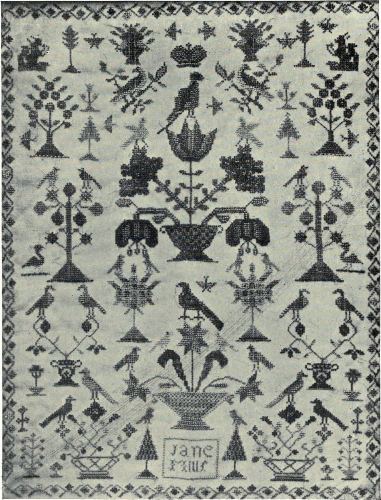
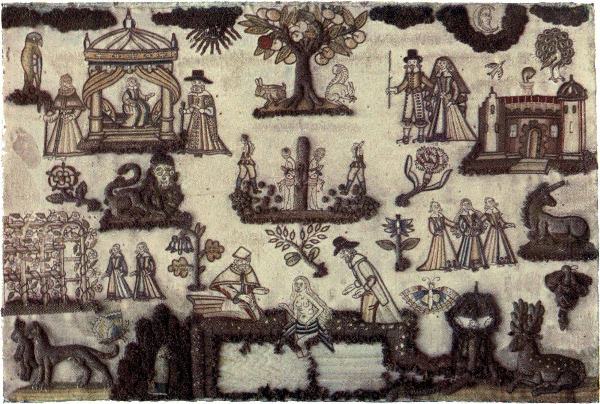
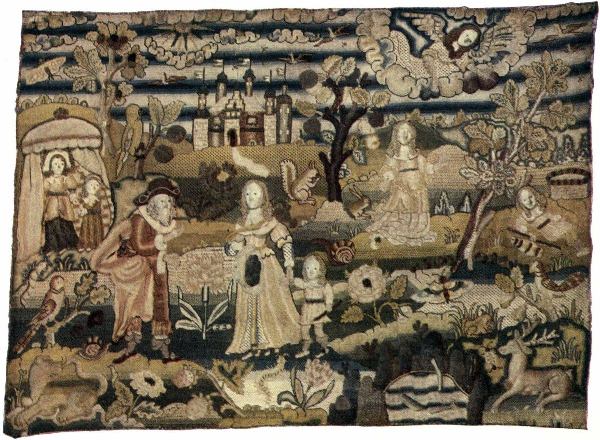
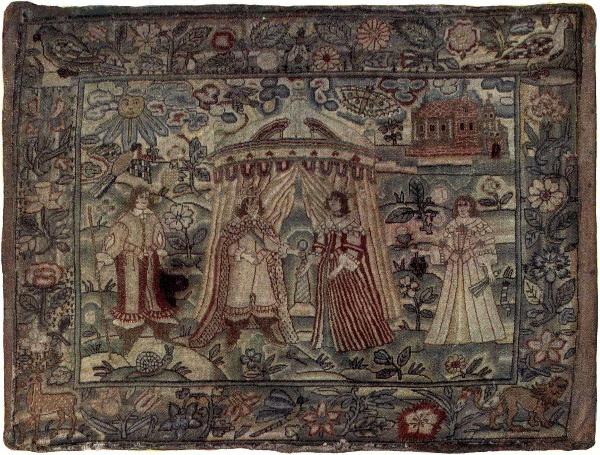
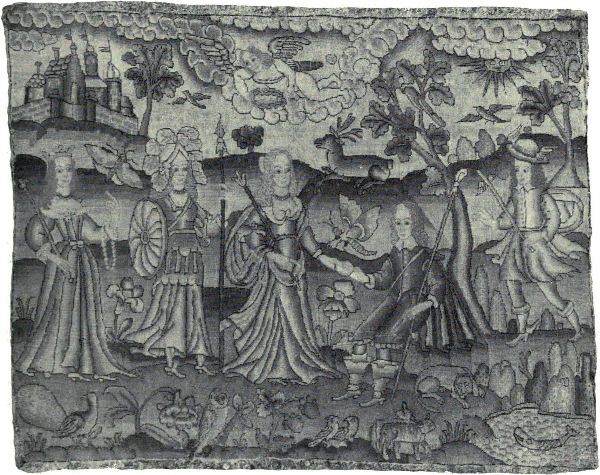
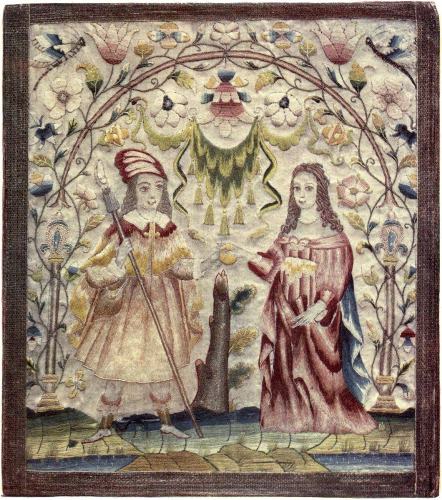
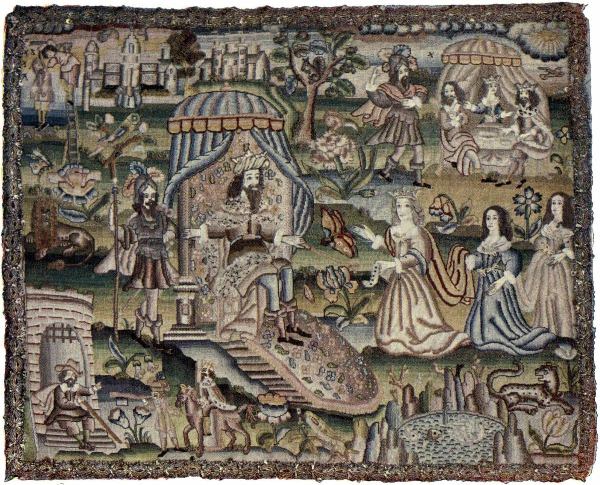
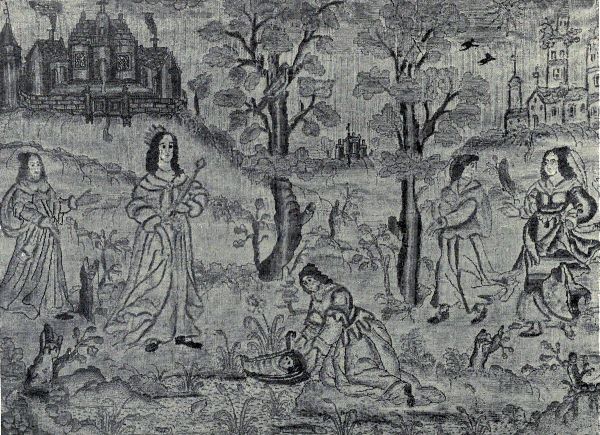
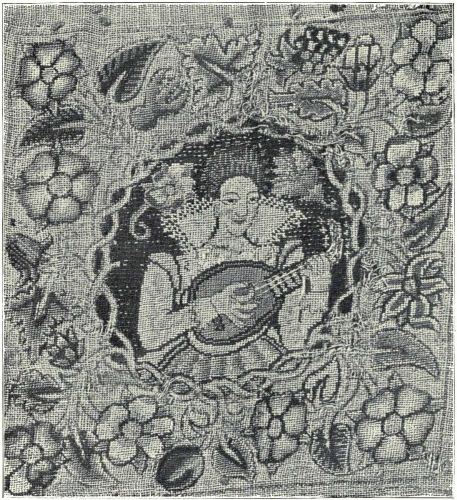
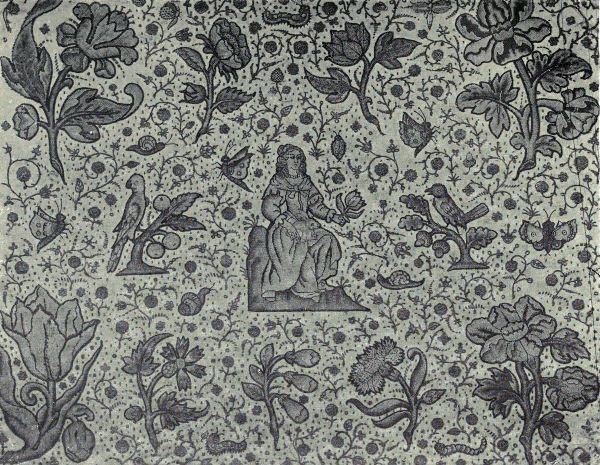
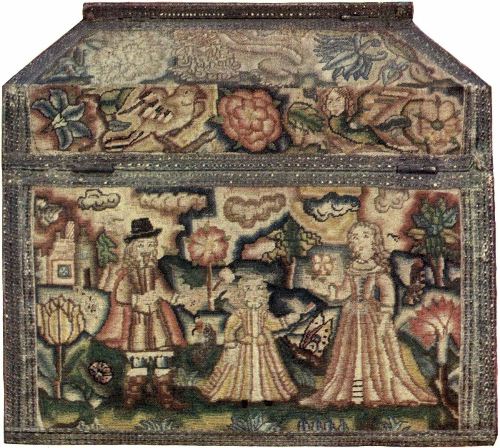
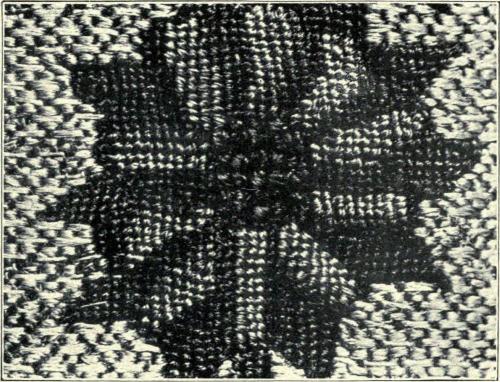
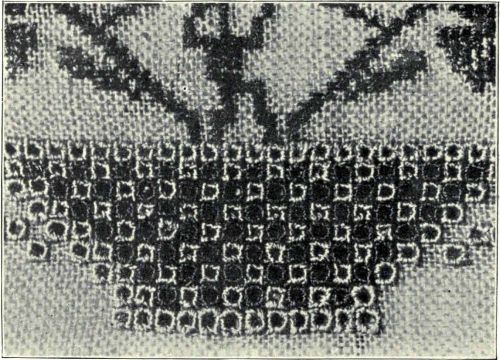
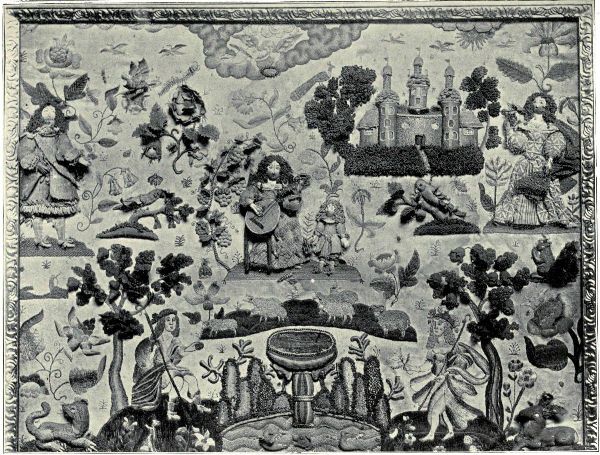
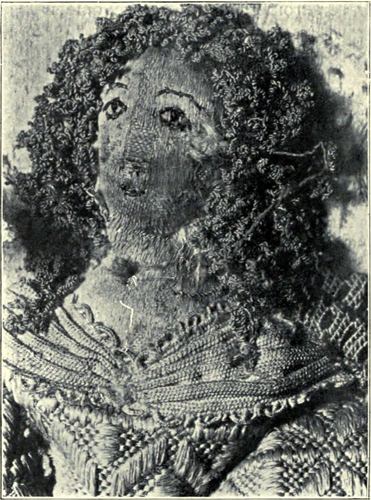
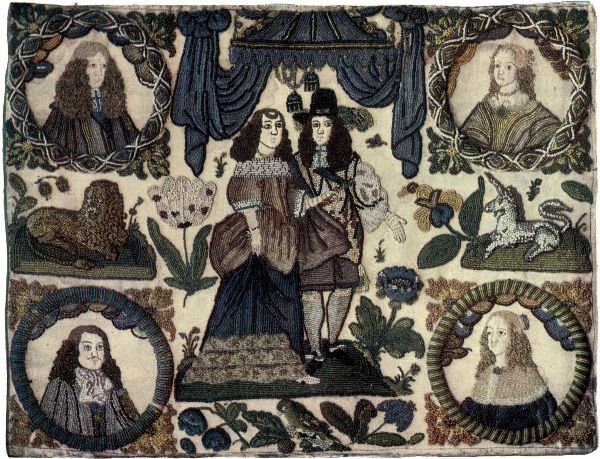
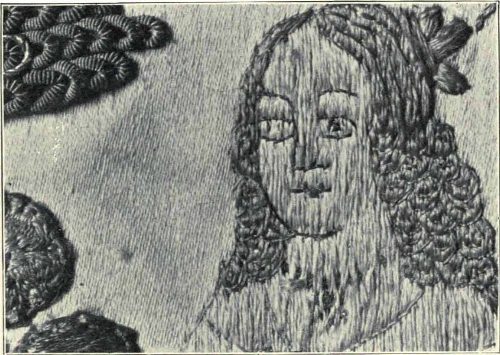
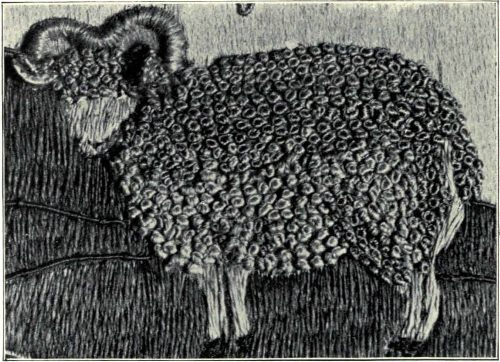
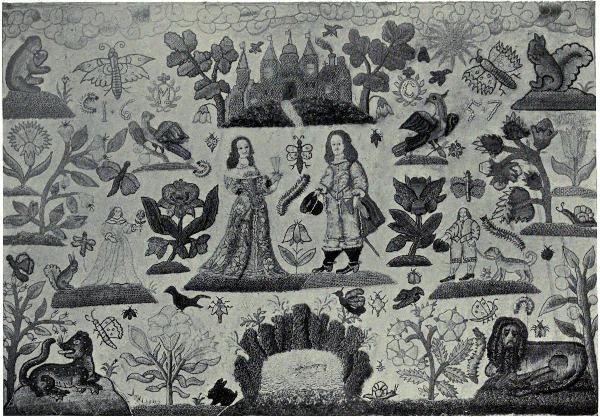
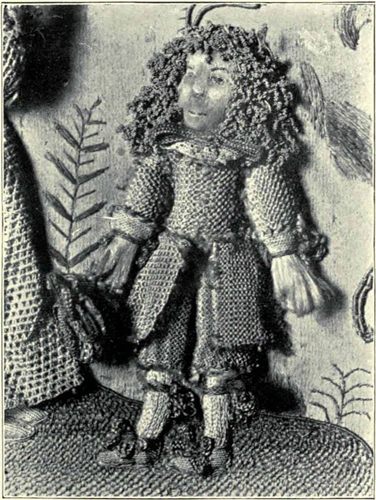
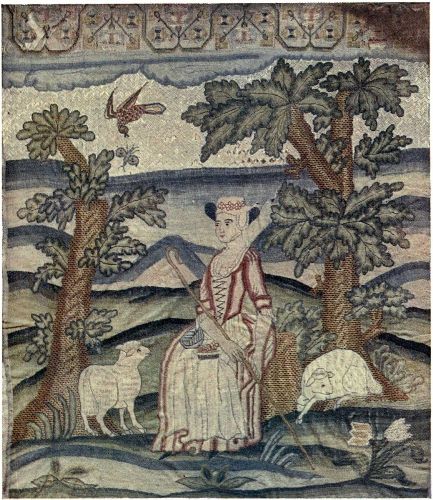
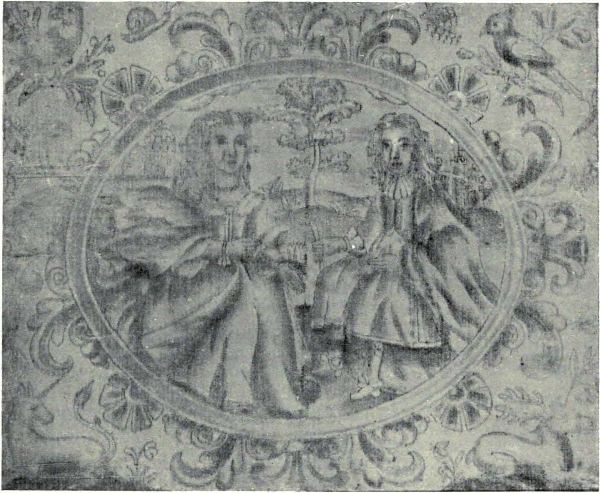
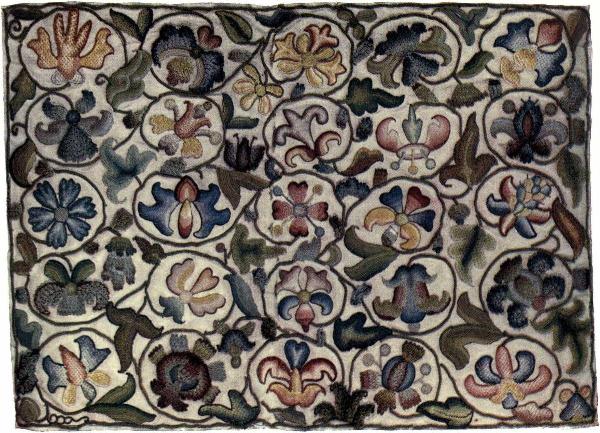
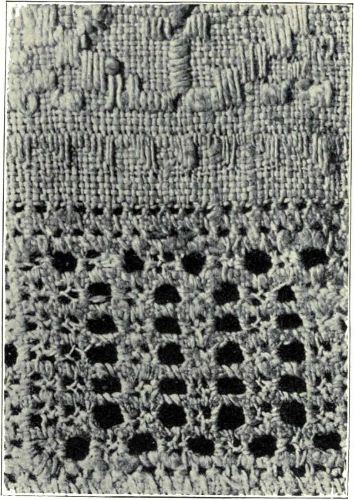
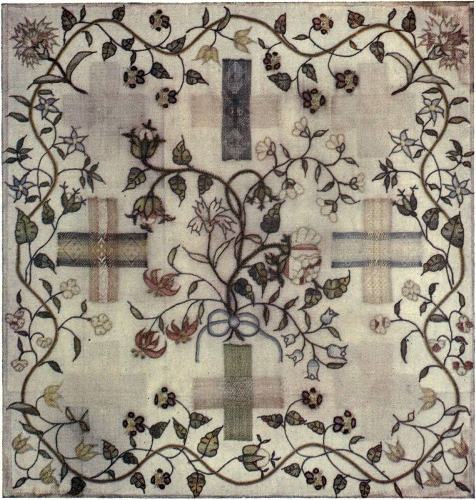
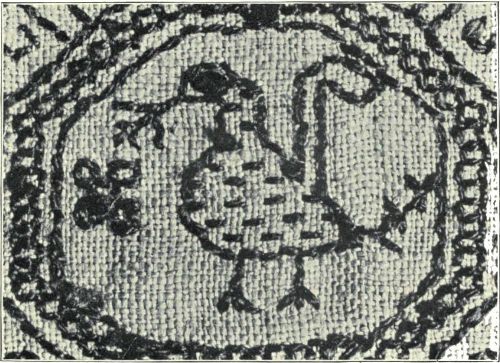
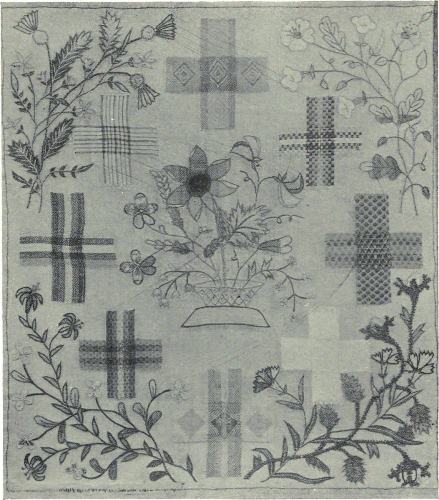
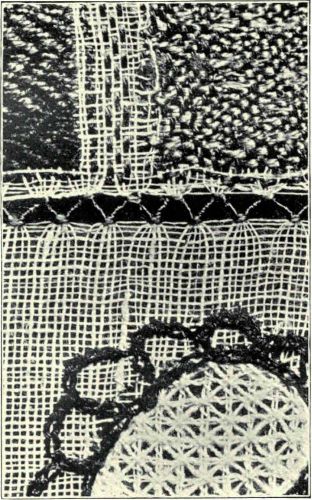
Plate II.—Sampler by M. C. 16th-17th Century.
This early pattern Sampler is described at p. 16.
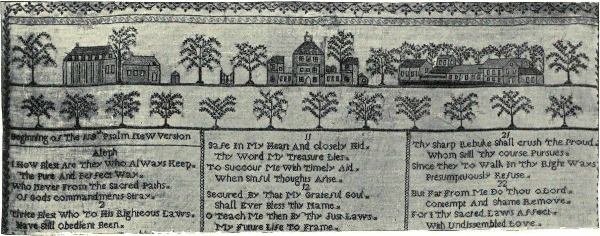
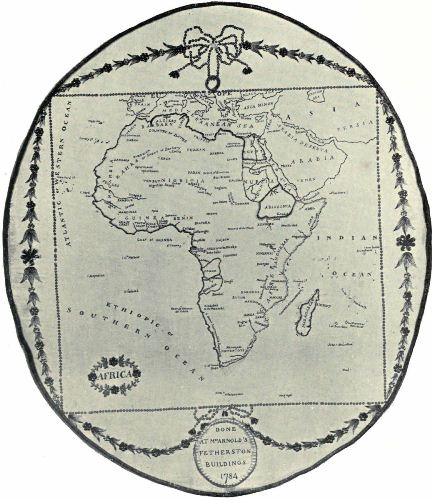
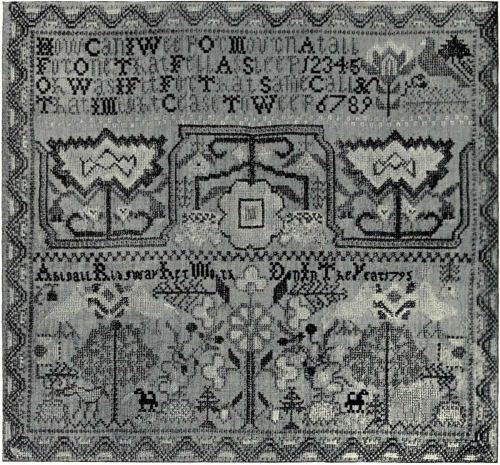
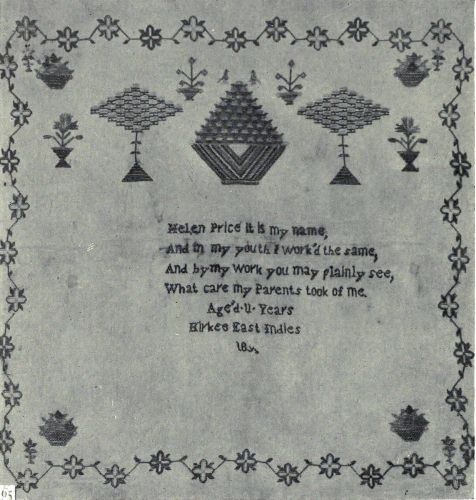
Fig. 3.—Upper Portion of Sampler by Pupil in Orphan School, Calcutta, 1797.
Author’s Collection.
The sampler as a pattern, or example, from which to learn varieties of
needlework, whether of design or stitches, must have existed almost as
long as the Art of Embroidery, which we know dates back into as distant a
past as any of the Arts. But when we set about the investigation of its
evolution, we did not propose to trouble our readers with the history of
an infancy which would have been invested with little interest and less
Art; we did, however, hope to be able to extend our illustrated record
backwards to a date which would be limited only by the ravages which time
had worked upon the material of which the sampler was composed—a date
which would probably take us back to an epoch when the Art displayed upon
it was of an unformed but still of an interesting character.
We must at the outset admit that we have been altogether disappointed in
our quest. For some two hundred and fifty years, which most will admit to
be a fair stretch of time, we can easily compile a record of genuinely
dated and well-preserved specimens, filling not only every decade, but
almost every year. The Art displayed, whether it be in design or dexterity
with the needle, improves as we proceed backwards, until, in the exact
centre of the seventeenth century, we arrive at a moment when little is
left to be desired. We then have before us a series of samplers wherein
the design is admirable, the stitches are of great variety, and the
materials of which they are composed are, in an astonishing number of
instances, as fresh and well preserved as those of to-day. But at that
moment, to our astonishment, the stream is arrested, and the supply fails,
for no, at present, discoverable reason. This sudden arrest can in no way
be explained. It would appear as if, with the downfall of the monarchy
under Charles I., with which it almost exactly corresponds, a holocaust
had been made of every sampler that existed. It is most exasperating, for
it is as if one had studied the life of a notable character backwards
through its senility, old age, and manhood, to lose all trace of its youth
and infancy. Nor is there any apparent reason for this failure of the
output. As we shall show later on, needlework for a century previously was
in the heyday of its fashion. Every article of dress and furniture was
decked out with it. As an instance, the small branch of needlework which
we discuss in our second part was mainly in vogue in the first half of the
seventeenth century, when we are searching in vain for specimens of
samplers. Samplers, too, for generations previously are recorded in the
literature of the time as common objects of household furniture. The
specimens even of our earliest recorded decade cover no less than five
years, 1651 (three), 1649, 1648 (three), 1644, 1643, and yet beyond the
last-named date we encounter an entire blank.
This cannot be the limit of dated specimens. Earlier ones must exist, but
the publicity of a very well advertised exhibition, which brought
notifications of samplers by the thousand, did not produce them. Neither
have the public museums, nor indefatigable collectors of many years’
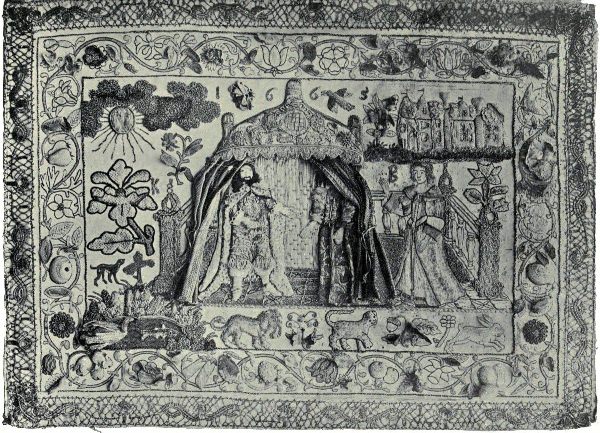
standing, been able to obtain them, save two of the earliest years, 1643
and 1644, which have been acquired by the Victoria and Albert Museum, and
of which that of 1643 is reproduced in Fig. 7. Our study of the sampler
must therefore be based upon the materials at our disposal, and from these
we shall analyse it with reference to its raison d’être, age, decorative
qualities, characteristics, and the persons by whom it was worked.
In these days of sober personal attire, in which the adornment of our
houses is almost entirely confined to the products of the loom, the
absorbing interest which needlework possessed, and the almost entire
possession which, in the Middle Ages, it took of the manual efforts of
womankind, is apt to be lost sight of. In 1583, Stubbes, in his “Anatomy
of Abuses,” wrote that the men were “decked out in fineries even to their
shirts, which are wrought throughout with needlework of silke, curiously
stitched with open seams and many other knacks besides,” and that it was
impossible to tell who was a gentleman “because all persons dress
indiscriminately in silks, velvets, satins, damasks, taffeties, and such
like.” So, too, as regards the fair sex it was the same, from the Queen,
who had no less than 2,000 dresses in her wardrobe, downwards. In France,
almost at the same moment (in 1586), a petition was prepresented to
Catherine de Medicis on “The Extreme Dearness of Living,” setting forth
that “mills, lands, pastures, woods, and all the revenues are wasted on
embroideries, insertions, trimmings, tassels, fringes, hangings, gimps,
needleworks, small chain stitchings, quiltings, back stitchings, etc., new
diversities of which are invented daily.” Everyone worked with the needle.
We read that the lady just named gathered round her her daughters, their
cousins, and sometimes the exiled Marie Stuart, and passed a great portion
of the time after dinner in needlework. A little later Madame de Maintenon
worked at embroidery, not only in her apartments, but even when riding or
driving she was “hardly fairly ensconced in her carriage than she pulled
her needlework out of the bag she carried with her.”
The use of embroidery was not confined to personal adornment, but was
employed in the decoration of the various objects which then went to make
up the furniture of a house, such as curtains, bed-hangings, tablecloths,
chair coverings, cushions, caskets, books, purses, and even pictures.
The luxury of the dwelling and the household had also of late increased to
an extent that called for the possession of numbers of each article,
whether it were clothing, table, or bed napery. Identification by marking
and numbering became necessary, and as, probably, the very limited library
of the house seldom contained books of ornamental lettering and numerals,
samplers were made to furnish them. The evolution of the sampler is thus
easily traceable. First of all consisting of decorative patterns thrown
here and there without care upon the surface of a piece of canvas (see
Plate II.); then of designs placed in more orderly rows, and making in
themselves a harmonious whole; then added thereto alphabets and figures
for the use of those who marked the linen, and as an off-shoot imitation
of tapestry pictures by the additions of figures, houses, etc. Finally it
was adopted as an educational task in the schools, as a specimen of
phenomenal achievement at an early age, and as a means whereby moral
precept might be prominently advertised.
As we have said, the samplers which have come down to us, and the age of
which is certified by their bearing a date, do not extend beyond two
hundred and seventy years, but those even of that age are writ all over
with evidence that the sampler was then a fully developed growth, and must
have been the descendant of a long line of progenitors. That they were in
vogue long before this is proved by the references to them in literature
as articles the use of which was a common one. Before proceeding further
it may be well to cite some of these.
The earliest record which we have met with is one by the poet Skelton
(1469-1529), who speaks of “the sampler to sowe on, the laces to
embroide.”
The next is an inventory of Edward VI. (1552), which notes a parchment
book containing—
“Item: Sampler or set of patterns worked on Normandy canvas, with
green and black silks.”
To Shakespeare we naturally turn, and are not disappointed, for we find
that in his “Midsummer Night’s Dream,” Act iii. scene 2, Helena addresses
Hermia as follows:—
“O, is all forgot?
All schooldays’ friendship, childhood innocence?
We, Hermia, like two artificial gods,
Have with our needles created both one flower,
Both on one sampler, sitting on one cushion,
Both working of one song, both in one key,
As if our hands, our sides, voices, and minds
Had been incorporate.”
And in “Titus Andronicus,” Act ii. scene 4, Marcus speaks of Philomel as
follows:—
“Fair Philomel, she but lost her tongue,
And in a tedious sampler sewed her mind.”
Sir Philip Sidney (1554-86), in his “Arcadia,” introduces a sampler as
follows:—
“And then, O Love, why dost thou in thy beautiful sampler set such a
work for my desire to take out?”
And Milton in “Comus” (1634):—
“And checks of sorry grain will serve to ply
The sampler, and to tear the housewife’s wool.”
In “The Crown Garland of Golden Roses,” 1612, is “A short and sweet sonnet
made by one of the Maides of Honor upon the death of Queene Elizabeth,
which she sowed upon a sampler, in red silk, to a new tune of ‘Phillida
Flouts Me’”; beginning
“Gone is Elizabeth whom we have lov’d so dear.”
In the sixteenth century samplers were deemed worthy of mention as
bequests; thus Margaret Tomson, of Freston in Holland, Lincolnshire, by
her will proved at Boston, 25th May 1546, gave to “Alys Pynchbeck, my
systers doughter, my sampler with semes.”
In Lady Marian Cust’s work on embroidery, mention is made of a sampler of
the reign of Henry VIII., and a rough illustration is given of it; we have
endeavoured to trace this piece, but have been unable to find it either in
the possession of Viscount Middleton or of Lord Midleton, although both of
them are the owners of other remarkable specimens of needlework.
It is evident from these extracts that samplers were common objects at
least as early as the sixteenth century.
········
The sampler in its latest fashion differed very materially both in form
and design from its progenitors. Consisting originally of odds and ends
of decorative designs, both for embroidery and lacework, scattered without
any order over the surface of a coarse piece of canvas, its first
completed form was one of considerable length and narrow breadth, the
length being often as much as a yard, and the breadth not more than a
quarter. The reason for this may well have been the necessity of using a
breadth of material which the looms then produced, for the canvas is
utilised to its full extent, and is seldom cut or hemmed at the sides. Be
that as it may, the shape was not an inconvenient one, for whilst its
width was sufficient to display the design, its height enabled a quantity
of patterns to follow one another from top to bottom. These consisted at
first of designs only, in embroidery and lace, to which were subsequently
added numerals and alphabets. Later followed texts, and then verses,
which, with the commencement of the eighteenth century, practically
supplanted ornaments. The sampler thereupon ceased to be a text-book for
the latter, and became only a chart on which are set out varieties of
lettering and alphabets. Still later it was transformed into a medium for
the display of the author’s ability in stitching, the alphabet even
disappearing, and the ornament (if such it can be called) being merely a
border in which to frame a pretty verse, and a means whereby empty spaces
could be filled, Art at that epoch not having learnt that an empty space
could be of any value to a composition. How these changes came about, with
their approximate dates, may now be considered.
The approximate date of any sampler, which is not more than two hundred
and fifty years old, should, from the illustrations given in this volume,
be capable of being arrived at without much difficulty, and it is,
therefore, only those undated specimens which, from their appearance, may
be older than that period that call for consideration here. They are but
few in number, and a comparison of one or two of them may be of service as
indicating the kind of examination to which old specimens should be
subjected.
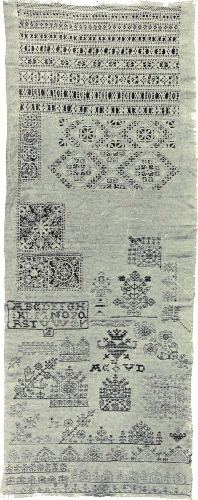
Fig. 4.—Sampler of Cut and Embroidered Work.
Early 17th Century.
The late Canon Bliss.
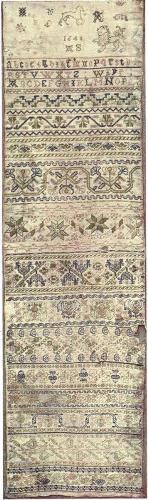
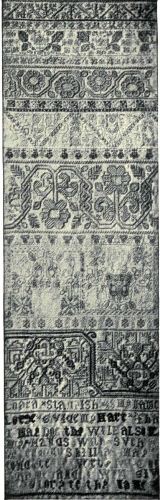
Plate III.—Portion of Long Sampler by A. S.
Dated 1648.
Author’s Collection.
Owing to its great length this Sampler is not shown in its entirety. A
portion of the upper part, which consists of various unconnected designs,
and figures of birds, beetles, flies, and crayfish, has been omitted. In
the portion illustrated is a man with a staff followed by a stag bearing a
leaf in its mouth, a unicorn and lion, and the initials “A.S.,” with date
1648. The bands of ornaments which follow are in several instances those
which find a place nearly two centuries later as the borders of Samplers
still. The lower portion is interesting for the changes which are rung
upon the oak leaf and acorn. The silks of which it is made are in three
colours only—blue, pink, and a yellowish green—which are worked upon a
coarsish linen. Size, 34¾ × 8½. It is in the author’s collection. A
somewhat similar Sampler, dated 1666, is in the Victoria and Albert Museum.
The earliest samplers present but little of the regularity of design which
marks the dated ones. They were made for use and not for ornament, a
combination which was probably always aimed at in those where regularity
and order marked the whole. They would resemble that illustrated in Plate
II., which bears evidence that it was nothing more or less than an
example, whence a variety of patterns could be worked, for in almost every
instance the design is shown in both an early and complete condition. It
is somewhat difficult to assign a date to it, but the employment of silver
and gold wirework to a greater or lesser extent in almost every
part,[2] the coarse canvas upon which it is worked, and the colours, point
to its being of the Elizabethan or early Jacobean period, the linked S’s
in Fig. 5 perhaps denoting the Stuart period. One of the two specimens of
1648 (Plate III.) continues in its upper portion this dropping of the
decoration in a haphazard way on the canvas, although the greater part of
it is strictly confined to rows of regular form. At first sight Fig. 4
should for the same reason be assigned to an earlier date than 1648, for
the greater, and not the lesser, portion of it is embroidered without any
apparent design. But more careful consideration discloses the fact that
the sampler was evidently begun at the top with thorough regularity, and
it was only at a later stage that the worker probably tired, and decided
to amuse herself with more variety and less formality. Nor can an earlier
date be assigned to Fig. 5 on account of the irregularity and
incompleteness of the lines, which have evidently been carried out no
further than to show the pattern.[3]
Fig. 5.—Portion of Sampler. 17th Century.
Fig. 6.—Portion of Sampler of Cut and Embroidered Work.
17th Century.
The late Mrs Head.
The forms which the lettering takes will probably be found to be one of
the best guides to the age of the early samplers, and on this ground Fig.
6, with its peculiar G and its reversed P for a Q, may be earlier than
1650, although the stags and the pear-shaped ornament beneath them
are closely allied to those in Plate III., dated 1648.
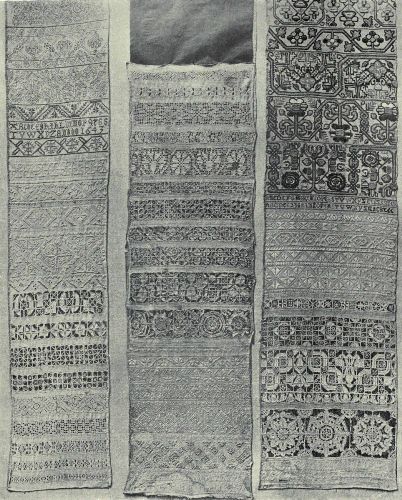
Fig. 7.—Samplers in the Victoria and Albert Museum.
Dated 1643, 1667, and 1696.
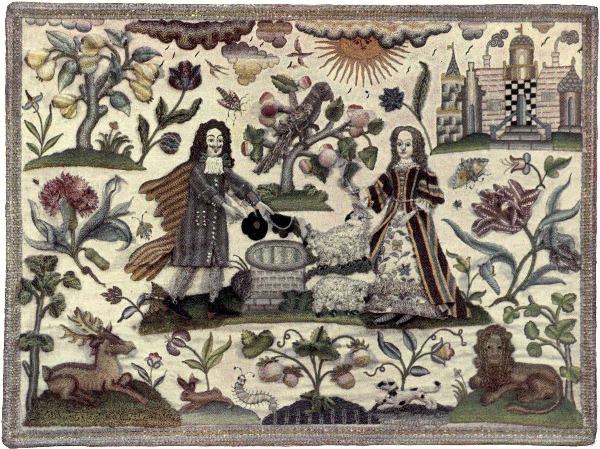
Plate IV.—Sampler by Elizabeth Calthorpe.
Dated 1656.
Mrs Charles Longman.
This small Sampler (it measures only 17 × 7) is a remarkable testimony to
the goodness of the materials used by our ancestors, and the care that has
been taken in certain instances to preserve these early documents of
family history. For it is over two hundred and sixty years since Elizabeth
Calthorpe’s very deft fingers produced what even now appears to be a very
skilled performance, and every thread of silk and of the canvas groundwork
is as fresh as the day that it emerged from the dyer’s hands. The design
is one of the unusual pictorial and ornamental combinations, the pictorial
representing the Sacrifice of Isaac in two scenes.
Texts and mottoes also furnish a clue to age, for they extend backwards
beyond 1686 on but one known sampler, namely that of Martha Salter in the
Victoria and Albert Museum, dated 1651, which has the maxim, “The feare of
God is an excellent gift,” although on such articles as purses and the
like they are to be found much earlier, and the “Sonnet to Queen
Elizabeth,” to which we have referred, shows that they were in vogue in
1612.
Age may also be approximated by the ornament and by the material of which
the sampler is made, which differs as time goes on. The following table
has been formed from many specimens that have come under my inspection; it
shows the earliest date at which various forms of ornament appear on dated
samplers so far as I have been able to trace them.
| Adam and Eve, figure of |
|
1709 |
| Alphabet |
|
1643 |
| Border enclosing sampler |
|
1726 |
| Border of flowing naturalistic flowers |
|
1730 |
| Boxers (and until 1758) |
|
1648 |
| Crown |
|
1691 |
| Eyelet form of lettering (? Anne Gover’s, circ. 1610) |
|
1672 |
| Fleur-de-Lys (see, however, Plate III.) |
|
1742 |
| Flower in vase |
|
1742 |
| Heart |
|
1751 |
| House |
|
1765 |
| Inscription |
|
1662 |
| Motto or text |
|
1651 |
| Mustard-coloured canvas |
|
1728 |
| Name of maker (? Anne Gover’s, circ. 1610) |
|
1648 |
| Numerals |
|
1655 |
| Rows of ornament (latest 1741) |
|
1648 |
| Stag (but only common between 1758 and 1826) |
|
1648 |
| The Spies to Canaan |
|
1804 |
| Verse (? Lora Standish, circ. 1635) |
|
1696 |
It is from this, rather than from any other feature, that we trace the
evolution of the sampler. Originally a pattern sheet of devices and
ornaments, there were added to it in time alphabets and numerals of
various kinds, which the increased luxury of the house called for as aids
to the marking of the linen and clothes. Later on the monotony of
alphabets and numerals was varied by the addition of the maker’s name, the
year, an old saw or two, and ultimately flights into moral or religious
verse.
Although a sampler without either alphabets or numerals would seem to be
lacking in the very essence of its being, it is almost certain that the
earliest forms did not contain either, but (like that in Plate II.) were
merely sheets of decorative designs. For the need of pattern-books of
designs would as certainly precede that of copy-books of alphabets and
numerals, as the pleasure of embroidering designs upon garments preceded
that of marking their ownership by names, and their quantity by figures. A
sampler would seldom, if ever, be used as a text-book for children to
learn letters or figures from, except with the needle, and the need for
lettering and figuring upon them would, therefore, as we have said, only
arise when garments or napery became sufficiently common and numerous to
need marking. This period had clearly been reached when our earliest dated
samplers were made, for, out of dated specimens of the seventeenth century
that I have examined, two-thirds carry the alphabet upon them, and the
majority have the numerals. It is rare to find later samplers without
them, those of the eighteenth century containing assortments of every
variety of lettering, Scottish ones especially laying themselves out for
elaborately designed and florid alphabets. With the advent of the
nineteenth century, however, the sampler began to lose its raison
d’être, and quite one-half of those then made omit either the alphabet,
or numerals, or both.
Initials, which are followed by signatures, occur upon samplers of the
earliest date. It is true that one or two of the undated samplers, which
probably are earlier than any of the dated ones, carry neither, but as a
rule initials, or names, are found upon all the early specimens. Thus the
early one in Plate II. has the initials “M. C.,” and the two dated in 1648
are marked respectively “A. S.” and “Rebekah Fisher,” and that of 1649,
“S. I. D.” In later times unsigned samplers are the exception.
The earliest inscriptions are practically only signatures, thus: “Mary
Hall is my name and when I was thirteen years of age I ended this in
1662”; or, somewhat amplified: “Ann Wattel is my name with my needle and
thred I ded this sam and if it hath en beter I wold——” (Remainder
illegible.)[4]
The earliest inscriptions, other than a signature such as the foregoing,
that I have met with are Lora Standish’s (Fig. 43) and Miles Fletwood’s
referred to under “American Samplers,” dated 1654 (Fig. 44), and which has
the rhyme, “In prosperity friends will be plenty but in adversity not one
in twenty.” The next, dated 1686, has a saw which is singularly
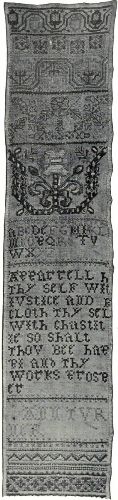
appropriate to a piece of needlework: “Apparell thy self with ivstice and
cloth thy self with chastitie so shall thov bee happi and thy works
prosper. Ann Tvrner” (Fig. 8). It is dated 1686.
Fig. 8.—Long Sampler, signed Ann Turner, 1686.
The late Mr A. Tuer.
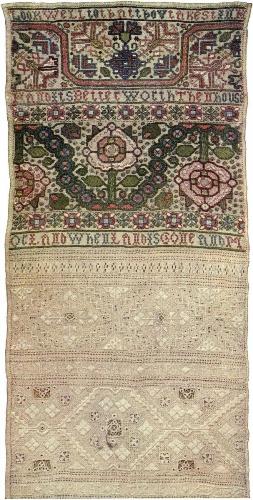
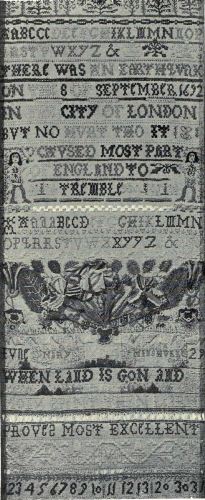
In Plate VI., on a sampler of the same year, we have wording which is not
infrequently met with in the cycles which follow, as, for instance, in Mrs
Longman’s sampler, dated 1696, and in one of 1701. It runs thus:—
“Look well to that thoo takest in Hand Its better worth then house or
Land. When Land is gone and Money is spent Then learning is most
Excelent Let vertue be Thy guide and it will keep the out of pride
Elizabeth Creasey Her Work done in the year 1686.”
Dated in 1693-94 are the set of samplers recording national events, to
which reference will be made elsewhere. In the last-named year (1694) a
sampler bears the verse:
“Love thou thee Lord and he will be a tender father unto thee.”
And one of 1698, “Be not wise in thy own eyes.”—Sarah Chamberlain.
Plate V.—Portion of Sampler by Mary Hall.
Dated 1662.
This plate only shows the upper half of a remarkably preserved Sampler.
Like its fellow (Plate VI.) it is distinguished by its admirable
decorative qualities of colour and design. The lower portion, not
reproduced, consists of three rows of designs in white thread, and four
rows of drawn work. The inscription, which is in the centre, and is
reproduced in part, runs thus:
“MaRy HaLL IS My NaMe AnD WHen I WaS THIRTeen
yeaRS OF AGE I ENDED THIS In 1662.”
Size, 34 x 8½.
Fig. 9.—Sampler by Eliz. Baker. Dated 1739.
A preference for saws rather than rhymes continues until the eighteenth
century is well advanced. The following are instances:—
“If you know Christ you need know little more if not Alls lost that
you have LaRnt before.”—Elisabeth Bayles, 1703.
“The Life of Truth buteafieth Youth and maketh it lovely to behold
Blessed are they that maketh it there staey and pryes it more than
gold it shall be to them a ryoul diadem transending all earthly
joy.”—Elisabeth Chester, 1712.
“Keep a strict guard over thy tongue, thine ear and thine eye, lest
they betray thee to talk things vain and unlawful. Be sparing of thy
words, and talk not impertinently or in passion. Keep the parts of thy
body in a just decorum, and avoid immoderate laughter and levity of
behaviour.”—Sarah Grimes, 1730.
“Favour is deceitful And beauty is vain But a woman that feareth the
Lord She shall be praised.”—Mary Gardner, aged 9, 1740.
Another undated one of the period is:—
“Awake, arise behold thou Hast thy Life ALIFe ThY Breath ABLASt at
night LY Down Prepare to have thy Sleep thy Death thy Bed Thy Grave.”
One with leisure might search out the authors of the doggerel religious
and moral verses which adorned samplers. The majority are probably due to
the advent of Methodism, for we only find them occurring in any numbers in
the years which followed that event. It may be noted that “Divine and
Moral Songs for Children,” by Isaac Watts, was first published in 1720,
that Wesley’s Hymns appeared in 1736, and Dr Doddridge’s in 1738.
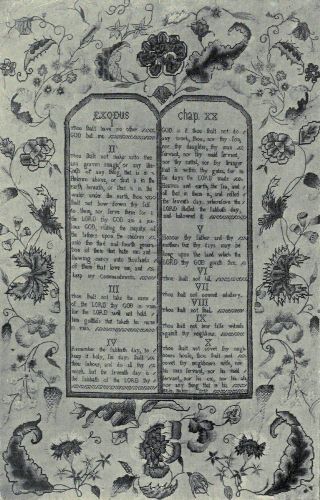
We may here draw attention to the eighteenth-century fashion of setting
out the Lord’s Prayer and the Ten Commandments (Fig. 9), and other
lengthy manuscripts from the Old Testament in tablets similar to those
painted and hung in the churches of the time. The tablets in the samplers
are flanked on either side by full length figures of Christ and Moses, or
supported by the chubby winged cherubs of the period which are the common
adornments of the Georgian gravestones. In the exhibition at The Fine Art
Society’s were specimens dated 1715, 1735, 1740, 1757, and 1762, the
Belief taking, in three instances, the place of the Commandments. On
occasions the pupil showed her proficiency in modern languages as well as
with the needle, by setting out the Lord’s Prayer in French, or even in
Hebrew.
Contemporaneously with such lengthy tasks in lettering as the Tables of
the Law, came other feats of compassing within the confines of a sampler
whole chapters of the Bible, such as the 37th Chapter of Ezekiel, worked
by Margaret Knowles in 1738; the 134th Psalm (a favourite one), by
Elizabeth Greensmith in 1737, and of later dates the three by members of
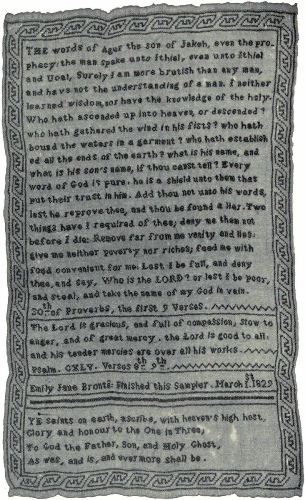
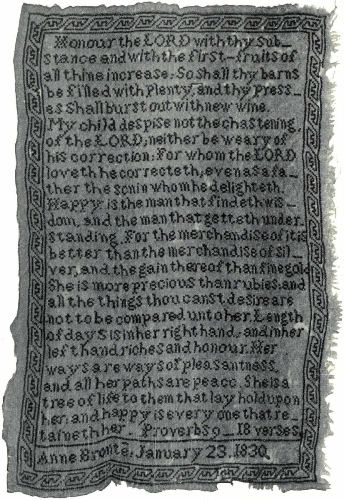
the Brontë family.
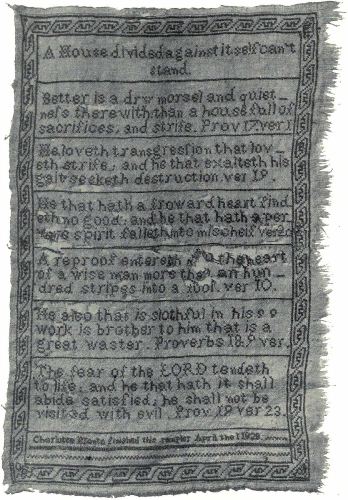
The last-named samplers (Figs. 10, 11, and 12) by three sisters of the
Brontë family which, through the kindness of their owner, Mr Clement
Shorter, I am able to include here, have, it will be seen, little except a
personal interest attaching to them. In comparison with those which
accompany them they show a strange lack of ornament, and a monotony of
colour (they are worked in black silk on rough canvas) which deprive them
of all attractiveness in themselves. But when it is remembered who made
them, and their surroundings, these appear singularly befitting and
characteristic. For, as the dates upon them show, they were produced in
the interval which was passed by the sisters at home between leaving one
ill-fated school, which caused the deaths of two sisters, and their
passing to another. It was a mournful, straitened home in which they
lived, one in which it needed the ardent Protestantism that is breathed in
the texts broidered on the samplers to uphold them from a despair that can
almost be read between the lines. It was also, for one at least of
them, a time of ceaseless activity of mind and body, and we can well
understand that the child Charlotte, who penned, between the April in
which her sampler was completed and the following August, the manuscript
of twenty-two volumes, each sixty closely written pages, of a catalogue,
did not take long to work the sampler which bears her name. The ages of
the three girls when they completed these samplers were: Charlotte, 13;
Emily Jane, 11; and Anne, 10.
Fig. 10.—Sampler by Charlotte Brontë.
Dated 1829.
Mr Clement Shorter.
Fig. 11.—Sampler by Emily Jane Brontë.
Dated 1829.
Mr Clement Shorter.
Fig. 12.—Sampler by Anne Brontë.
Dated 1830.
Mr Clement Shorter.
But the lengthiest task of all was set to six poor little mortals in the
Orphans’ School, near Calcutta, in Bengal, East Indies. These wrought six
samplers “by the direction of Mistress Parker,” dividing between them the
longest chapter in the Bible, namely, the 119th Psalm. It was evidently a
race against time, for on each is recorded the date of its commencement
and finish, being accomplished by them between the 14th of February and
the 23rd of June 1797. At the top of each is a view of a different portion
of the school; one of these is reproduced in Fig. 3.
Returning to the chronological aspect of sampler inscriptions. As the
eighteenth century advances we find verses coming more and more into
fashion, although at first they are hardly distinguishable from prose, as,
for instance, in the following of 1718:—
“You ask me why I love, go ask the glorius son, why it throw the world
doth run, ask time and fat [fate?] the reason why it flow, ask dammask
rosees why so full they blow, and all things elce suckets fesh which
forceeth me to love. By this you see what car my parents toock of me.
Elizabeth Matrom is my name, and with my nedell I rought the same, and
if my judgment had beene better, I would have mended every letter. And
she that is wise, her time will pris (e), she that will eat her
breakfast in her bed, and spend all the morning in dressing of her
head, and sat at deaner like a maiden bride, God in His mercy may do
much to save her, but what a cas is he in that must have her.
Elizabeth Matrom. The sun sets, the shadows fleys, the good consume,
and the man he deis.”
More than one proposal has been made, in all seriousness, during the
compilation of this volume, that it would add enormously to its interest
and value if every inscription that could be found upon samplers were
herein set out at length. It is needless to say that it has been
altogether impossible to entertain such a task. It is true that the
feature of samplers which, perhaps, interests and amuses persons most is
the quaint and incongruous legends that so many of them bear, but I shall,
I believe, have quite sufficiently illustrated this aspect of the subject
if I divide it into various groups, and give a few appropriate examples of
each. These may be classified under various headings.
These are, perhaps, more frequent than any others. Especially is this the
case with those referring to Easter, which is again and again the subject
of one or other of the following verses:—
“The holy feast of Easter was injoined
To bring Christ’s Resurrection to our Mind,
Rise then from Sin as he did from the Grave,
That by his Merits he your Souls may save.
“White robes were worn in ancient Times they say,
And gave Denomination to this Day
But inward Purity is required most
To make fit Temples for the Holy Ghost.”
Mary Wilmot, 1761.
Or the following:—
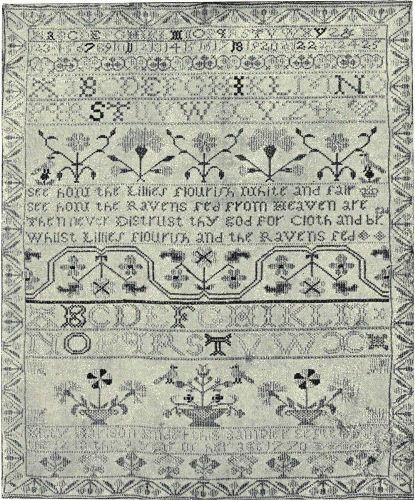
“See how the lilies flourish wite and faire,
See how the ravens fed from heaven are;
Never distrust thy God for cloth and bread
While lilies flourish and the Raven’s fed.”
Mary Heaviside, 1735.
Or the variation set out on Fig. 19.
Plate VI.—Portion of Sampler by Elizabeth Creasey.
Dated 1686.
The Late Mr A. Tuer.
This Sampler, of which only the upper half is reproduced, is remarkable
not only for the decorative qualities of its design but for its perfect
state of preservation. It consists, besides the four rows which are seen,
of one other in which the drawn work is subservient in quantity to the
embroidery, and of seven rows in which the reverse is the case. The
inscription, which is set out below, alternates in rows with those of the
design. The butter colour of the linen ground is well reproduced in the
plate. The original measures 32×8.
INSCRIPTION.
“Look Well to that thou takest in
Hand Its Better Worth Then house
Or Land When Land is gone and
Money is spent Then learn
ing is most Excelent
Let vertue Be Thy guide and it will kee
p the out of pride Elizabeth Creasey
Her work Done in the year 1686.”
As also in that by Kitty Harison, in our illustration, Fig. 13.
Fig. 13.—Easter Sampler by Kitty Harison. Dated 1770.
The Christmas verse is usually:—
“Glory to God in the Highest”;
but an unusual one is that in Margaret Fiddes’s sampler, 1773:—
“The Night soon past, it ran so fast. The Day
Came on Amain. Our Sorrows Ceast Our Hopes
Encreast once more to Meet again A Star appears
Expells all Fears Angels give Kings to
Know A Babe was sent With that intent to
Conquer Death below.”
Ascension Day is marked by:—
“The heavens do now retain our Lord
Until he come again,
And for the safety of our souls
He there doth still remain.
And quickly shall our King appear
And take us by the hand
And lead us fully to enjoy
The promised Holy Land.”
Sarah Smith, 1794.
Whilst Passion Week is recognisable in:—
“Behold the patient Lamb, before his shearer stands,” etc.
The Crucifixion itself, although it is portrayed frequently in German
samplers (examples in The Fine Art Society’s Exhibition were dated 1674,
1724, and 1776), is seldom, if ever, found in English ones, but for Good
Friday we have the lines:—
“Alas and did my Saviour bleed
For such a worm as I?”
Amongst all the verses that adorn samplers there were none which
apparently commended themselves so much as those that dedicated the work
to Christ. The lines usually employed are so familiar as hardly to need
setting out, but they have frequent varieties. The most usual is:—
“Jesus permit thy gracious name to stand
As the first Effort of young Phoebe’s hand
And while her fingers on this canvas move
Engage her tender Heart to seek thy Love
With thy dear Children let her Share a Part
And write thy name thyself upon her Heart.”
Harriot Phoebe Burch, aged 7 years, 1822.
A variation of this appears in the much earlier piece of Lora Standish
(Fig. 43).
Another, less common, but which again links the sampler with a religious
aspiration, runs:—
“Better by Far for Me
Than all the Simpsters Art
That God’s commandments be
Embroider’d on my Heart.”
Mary Cole, 1759.
Verses to be used upon rising in the morning or at bedtime are not
unfrequent; the following is the modest prayer of Jane Grace Marks
(1807).
“If I am right, oh teach my heart
Still in the right to stay,
If I am wrong, thy grace impart
To find that better way.”
But one in my possession loses, by its ludicrousness, all the
impressiveness which was intended:—
“Oh may thy powerful word
Inspire a breathing worm
To rush into thy kingdom Lord
To take it as by storm.
Oh may we all improve
Thy grace already given
To seize the crown of love
And scale the mount of heaven.”
Sarah Beckett, 1798.
Lastly, a prayer for the teacher:—
“Oh smile on those whose liberal care
Provides for our instruction here;
And let our conduct ever prove
We’re grateful for their generous love.”
Emma Day, 1837.
The fact that “Religion never was designed to make our pleasures less”
appears seldom or never to have entered into the minds of those who set
the verses for young sampler workers. From the earliest days when they
plied their needle their thoughts were directed to the shortness of life
and the length of eternity, and many a healthy and sweet disposition must
have run much chance of being soured by the morbid view which it was
forced to take of the pleasures of life. For instance, a child of seven
had the task of broidering the following lines:—
“And now my soul another year
Of thy short life is past
I cannot long continue here
And this may be my last.”
And one, no older, is made to declare that:—
“Thus sinners trifle, young and old,
Until their dying day,
Then would they give a world of gold
To have an hour to pray.”
Or:—
“Our father ate forbidden Fruit,
And from his glory fell;
And we his children thus were brought
To death, and near to hell.”
Or again:—
“There’s not a sin that we commit
Nor wicked word we say
But in thy dreadful book is writ
Against the judgment day.”
A child was not even allowed to wish for length of days. Poor little
Elizabeth Raymond, who finished her sampler in 1789, in her eighth year,
had to ask:—
“Lord give me wisdom to direct my ways
I beg not riches nor yet length of days
My life is a flower, the time it hath to last
Is mixed with frost and shook with every blast.”
A similar idea runs through the following:—
“Gay dainty flowers go simply to decay,
Poor wretched life’s short portion flies away;
We eat, we drink, we sleep, but lo anon
Old age steals on us never thought upon.”
Not less lugubrious is Esther Tabor’s sampler, who, in 1771, amidst
charming surroundings of pots of roses and carnations, intersperses the
lines:—
“Our days, alas, our mortal days
Are short and wretched too
Evil and few the patriarch says
And well the patriarch knew.”
A very common verse, breathing the same strain, is:—
“Fragrant the rose, but it fades in time
The violet sweet, but quickly past the Prime
White lilies hang their head and soon decay
And whiter snow in minutes melts away
Such and so with’ring are our early joys
Which time or sickness speedily destroys.”
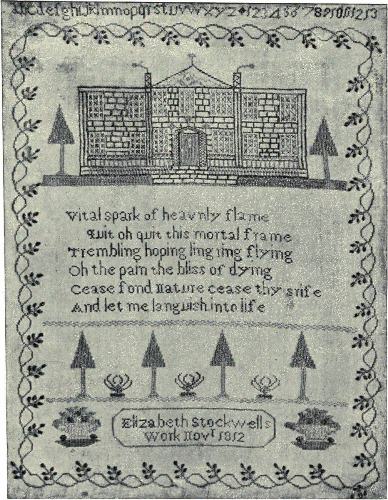
And the melancholy which pervades the verse on the sampler of Elizabeth
Stockwell (Fig. 14) is hardly atoned for by the brilliant hues in which
the house is portrayed.
Plate VII.—Sampler by Hannah Dawe.
17th Century.
Formerly in the Author’s Collection.
This is a much smaller specimen than we are wont to find in “long”
Samplers, for it measures only 18 × 7¼. It differs also from its
fellows in that the petals of the roses in the second and third of the
important bands are in relief and superimposed. The rest of the
decoration, on the other hand, partakes much more of an outline character
than is usual. As a specimen of a seventeenth-century Sampler it leaves
little to be desired. It is signed Hannah Dawe.
Fig. 14.—Sampler by Elizabeth Stockwell. 1832.
The late Mr A. Tuer.
The gruesomeness of the grave is forcibly brought to notice in a sampler
dated 1736:—
“When this you see, remember me,
And keep me in your mind;
And be not like the weathercock
That turn att every wind.
When I am dead, and laid in grave,
And all my bones are rotten,
By this may I remembered be
When I should be forgotten.”
Ann French put the same sentiment more tersely in the lines:—
“This handy work my friends may have
When I am dead and laid in grav.” 1766.
It is a relief to turn to the quainter and more genuine style of Marg’t
Burnell’s verse taken from Quarles’s “Emblems,” and dated 1720:—
“Our life is nothing but a winters day,
Some only breake their fast, & so away,
Others stay dinner, & depart full fed,
The deeper age but sups and goes to bed.
Hee’s most in debt, that lingers out the day,
Who dyes betimes, has lesse and lesse to pay.”
This verse has crossed the Atlantic, and figures on American samplers.
But the height of despair was not reached until the early years of the
nineteenth century, when “Odes to Passing Bells,” and such like, brought
death and the grave into constant view before the young and hardened
sinner thus:—
ODE TO A PASSING BELL
“Hark my gay friend that solemn toll
Speaks the departure of a soul
’Tis gone, that’s all we know not where,
Or how the embody’d soul may fare
Only this frail & fleeting breath
Preserves me from the jaws of death
Soon as it fails at once I’m gone
And plung’d into a world not known.”
Ann Gould Seller, Hawkchurch, 1821.
Samplers oftentimes fulfilled the rôle of funeral cards, as, for instance,
this worked in black:—
“In memory of my beloved Father
John Twaites who died April 11 1829.
Life how short—Eternity how long.
Also of James Twaites
My grandfather who died Dec. 31, 1814.
How loved, how valu’d once, avails thee not
To whom related, or by whom begot,
A heap of dust alone remains of thee,
’Tis all thou art, and all the proud shall be.”
Curiously enough, whilst compiling this chapter the writer came across an
artillery non-commissioned officer in the Okehampton Camp who, in the
intervals of attending to the telephone, worked upon an elaborate Berlin
woolwork sampler, ornamented with urns, and dedicated “To the Memory of my
dear father,” etc.
That the young person who wrought the sampler had very much choice in the
selection of the saws and rhymes which inculcate obedience to parents and
teachers is hardly probable, and it is not difficult to picture the
households or schools where such doctrines as the following were set out
for infant hands to copy:—
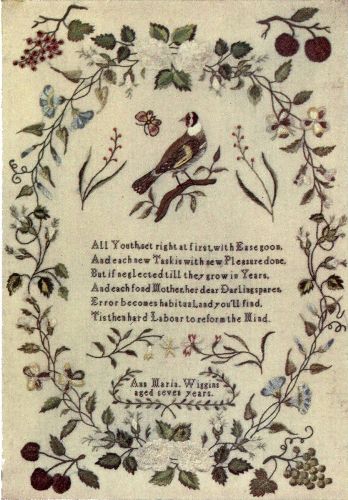
“All youth set right at first, with Ease go on,
And each new Task is with new Pleasure done,
But if neglected till they grow in years
And each fond Mother her dear Darling spares,
Error becomes habitual and you’ll find
’Tis then hard labour to reform the Mind.”
The foregoing is taken from the otherwise delightful sampler worked by a
child with the euphonious name of Ann Maria Wiggins, in her seventh year,
that is reproduced in Plate XII.
Preceptors also appear to have thought it well to early impress upon
pliable minds the dangers which beset a child inclined to thoughts of
love:—
“Oh Mighty God that knows how inclinations lead
Keep mine from straying lest my Heart should bleed.
Grant that I honour and succour my parents dear
Lest I should offend him who can be most severe.
I implore ore me you’d have a watchful eye
That I may share with you those blessings on high.
And if I should by a young youth be Tempted,
Grant I his schemes defy and all He has invented.”
Elizabeth Bock, 1764.
Samplers were so seldom worked by grown-up folk that one can hardly
believe that the following verse records an actual catastrophe to the
peace of mind of Eleanor Knot:—
ON DISINGENUITY
“With soothing wiles he won my easy heart
He sigh’d and vow’d, but oh he feigned the smart;
Sure of all friends the blackest we can find
Are those ingrates who stab our peace of mind.”
A not uncommon and much more agreeable verse sets forth the duties of man
towards woman in so far as matrimony is concerned:—
“Adam alone in Paradise did grieve
And thought Eden a desert without Eve,
Until God pitying his lonesome state
Crown’d all his wishes with a lovely mate.
Then why should men think mean, or slight her,
That could not live in Paradise without her.”
Samplers bearing the foregoing verse are usually decorated with a picture
of our first parents and the Tree of Knowledge, supported by a demon and
angel.
The parent or teacher sometimes spoke through the sampler, as thus, in
Lucia York’s, dated 1725:—
“Oh child most dear
Incline thy ear
And hearken to God’s voice.”
Or again:—
“Return the kindness that you do receive
As far as your ability gives leave.”
Mary Lounds.
“Humility I’d recommend
Good nature, too, with ease,
Be generous, good, and kind to all,
You’ll never fail to please.”
Susanna Hayes.
Amongst these may be noted:—
“Happy is he, the only man,
Who out of choice does all he can
Who business loves and others better makes
By prudent industry and pains he takes.
God’s blessing here he’ll have and man’s esteem,
And when he dies his works will follow him.”
Of those dealing with wealth or poverty none, perhaps, is more incisive
than this:—
“The world’s a city full of crooked streets,
And Death’s the market-place where all men meet;
If life was merchandise that men could buy
The rich would always live, the poor alone would die.”
An American sampler has the following from Burns’s “Grace before Meat”:—
“Some men have meat who cannot eat
And some have none who need it.
But we have meat and we can eat,
And so the Lord be thanked.”
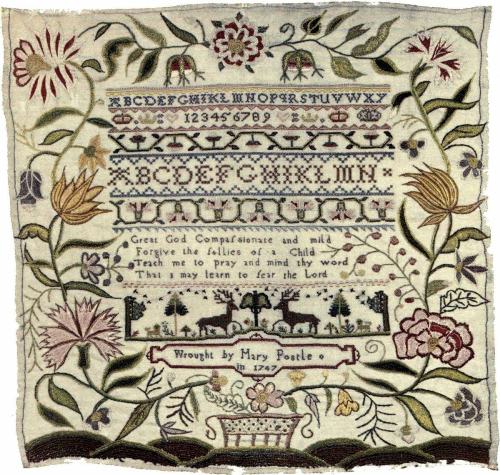
Plate VIII.—Sampler by Mary Postle. Dated 1747.
Mrs C. J. Longman.
An early specimen of a bordered Sampler, dated 1747, the rows being
relegated to a small space in the centre, where they are altogether an
insignificant feature in comparison with the border. Some of the ornament
to which we have been accustomed in the rows survives, as for instance the
pinks, but a new one is introduced, namely, the strawberry. Here are also
the Noah’s Ark animals, trees, etc., which henceforward become common
objects and soon transform the face of the Sampler. The border itself is
in evident imitation of the worsted flower work with which curtains,
quilts, and other articles were freely adorned in the early eighteenth century.
The following dates from 1740, and has as appendix the line, “God prosper
the war”:—
“The sick man fasts because he cannot eat
The poor man fasts because he hath no meat
The miser fasts to increase his store
The glutton fasts because he can eat no more
The hypocrite fasts because he’d be condemned
The just man fasts cause he hath offended.”
An American version of this ends with:—
“Praise God from whom all blessings flow
We have meat enow.”
That self-conceit was not always considered a failing, is evident from the
following verses:—
“This needlework of mine may tell
That when a child I learned well
And by my elders I was taught
Not to spend my time for nought,”
which is concentrated and intensified in one of Frances Johnson, worked in
1797:—
“In reading this if any faults you see
Mend them yourself and find no fault in me.”
In a much humbler strain is this from an old sampler in Mrs Longman’s
collection:—
“When I was young I little thought
That wit must be so dearly bought
But now experience tells me how
If I must thrive, then I must bowe
And bend unto another will,
That I might learn both arte & skill.”
Owing to the portrayal of an insect, which was not infrequently met with
in days gone by, upon the face of the sampler which bears the following
lines, it has been suggested that they were presumably written by that
creature:—
“Dear Debby
I love you sincerely
My heart retains a grateful sense of your past kindness
When will the hours of our
Separation be at an end?
Preserve in your bosom the remembrance
of your affectionate
Deborah Jane Berkin.”
The following, coming about the date when the abolition of the slave trade
was imminent, may have reference to it:—
“THERE’S mercy in each ray of light, that mortal eye e’er saw,
There’s mercy in each breath of air, that mortal lips can draw,
There’s mercy both for bird, and beast, in God’s indulgent plan,
There’s mercy for each creeping thing—But man has none for man.”
Elizabeth Jane Gates Aged 12 years, 1829.
Riddle samplers, such as that of Ann Witty, do not often occur:—
| “I had both |
Money |
and a |
Friend |
by both I set great store |
| I lent my |
to my |
and took his word therefor |
| I asked my |
of my |
and nought but words I got |
| I lost my |
and my |
for sue him, I would not.” |
Here, too, is an “Acrostick,” the first letters of whose lines spell the
name of the young lady who “ended” it “Anno Dom. 1749.”
“A virgin that’s Industrious Merits Praise,
Nature she Imitates in Various Ways,
Now forms the Pink, now gives the Rose its blaze.
Young Buds, she folds, in tender Leaves of green,
Omits no shade to beautify her Scene,
Upon the Canvas, see, the Letters rise,
Neatly they shine with intermingled dies,
Glide into Words, and strike us with Surprize.”
E. W.
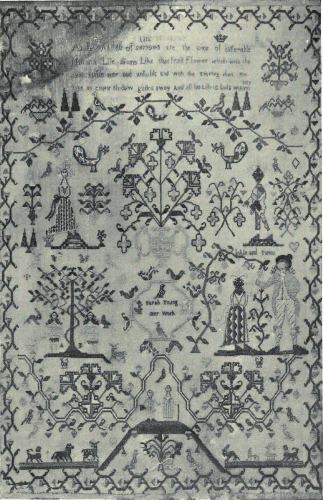
As illustrations of tales the sampler of Sarah Young (Fig. 15) is an
unusual example. It deals with Sir Richard Steele’s story of the loves of
Inkle and Yarico. Inkle, represented as a strapping big sailor, was cast
away in the Spanish Main, where he met and loved Yarico, an Indian girl,
but showed his baseness by selling her for a slave when he reached
Barbadoes in a vessel which rescued him. The story evidently had a
considerable, if fleeting, popularity, for it was dramatised.
Whilst important clues to the age of a sampler may be gathered from its
form and legend, its design and colouring are factors from which almost as
much may be learnt.
Design can be more easily learned from considering in detail the
illustrations, which have been mainly chosen for their typifying one or
other form of it, but certain general features are so usually present that
they may be summarised here.
No one with any knowledge of design can look through the specimens of
samplers selected for this volume without noting, first, that it is, in
the earlier specimens, appropriate to the subject, decorative in
treatment, and lends itself to a variety of treatment with the needle.
Secondly, that the decoration is not English in origin, but is usually
derived from foreign sources. Indeed, if we are to believe an old writer
of the Jacobean time, the designs were
“Collected with much praise and industrie,
From scorching Spaine and freezing Muscovie,
From fertile France and pleasant Italie,
From Poland, Sweden, Denmarke, Germanie,
And some of these rare patternes have been set
Beyond the boundes of faithlesse Mahomet,
From spacious China and those Kingdomes East
And from great Mexico, the Indies West.
Thus are these workes farre fetch’t and dearly bought,
And consequently good for ladyes thought.”
Thirdly, that after maintaining a remarkable uniformity until the end of
the seventeenth century, design falls away, and with rare exceptions
continuously declines until it reaches a mediocrity to which the term can
hardly be applied.
Fig. 15.—Sampler by Sarah Young. About 1750.
Mrs Head.
The same features are noticeable in the colouring. The samplers of the
Caroline period are in the main marked by a softness and delicacy, with a
preference for tender and harmonious shades of pinks, greens, and blues,
but these quickly pass out of the schemes of colouring until their revival
a few years ago through the influence of Japan and the perspicuity, of Sir
Lazenby Liberty. This delicacy is not, as some suppose, due to time
having softened the colours, for examination shows that fading has seldom
taken place, in fact one of the most remarkable traits of the earlier
samplers is the wonderful condition of their colouring (see Mrs Longman’s
sampler of 1656, Plate IV., as an example). Towards the end of the
seventeenth century the adoption of a groundwork of roughish
close-textured canvas of a canary hue also militated against this ensemble
of the colour scheme, which is now and again too vivid, especially in the
reds, a fact which may, in part, be due to their retaining their original
tint with a persistency that has not endured with the other dyes.
During the early Georgian era sampler workers seem to have passed through
a stage of affection for deep reds, blues, and greens, with which they
worked almost all their lettering. The same colours are met with in the
large embroidered curtains of the time; it is probably due to the
influence of the tapestries and the Chinese embroideries then so much in
vogue.
In the opening years of the eighteenth century a pride in lettering gave
rise to a series of samplers of little interest or artistic value,
consisting, as they did, of nothing else than long sentences, not readily
readable, and worked in silks in colours of every imaginable hue used
indiscriminately, even in a single word, without any thought bestowed on
harmony or effect of colouring.
Later on, towards the middle of the century, more sober schemes of colour
set in, consisting in the abandonment of reds and the employment of little
else than blues, greens, yellows, and blacks (see Plate IX.), which are
attractive through their quietness and unity. Subsequently but little
praise can be bestowed upon samplers so far as their design is concerned.
Occasionally, as in that of Mr Ruskin’s ancestress (Plate X.), a result
which is satisfactory, both in colour and design, is arrived at, but this
is generally due to individual taste rather than to tuition or example. In
this respect samplers only follow in the wake of all the other
arts—furniture and silversmiths’ work, perhaps, excepted, as regards both
of which the taste displayed was also individual rather than national.
An evil which cankered later sampler ornamentation was a desire for
novelty and variety. The earliest samplers exhibit few signs of attempts
at invention in design. A comparison of any number of them shows ideas
repeated again and again with the slightest variation. The same floral
motives are adapted in almost every instance, and one and all may well
have been employed since the days when they arrived from the Far East,
brought, it may be, by the Crusaders. But it is in no derogatory spirit
that I call attention to this lack of originality. A craftsman is doing a
worthier thing in assimilating designs which have shown their fitness by
centuries of use, patterns which are examples of fine decorative ornament
that really beautifies the object to which it is applied, than in
inventing weak and imperfect originals. No architect is accused of
plagiarism if he introduces the pointed arch, and the great designs of the
past are free and out of copyright. The Greek fret, or the Persian rose,
is as much the property of anyone as the daisy or the snowdrop, and it was
far better to make sound decorative pieces of embroidery on the lines of
these than to attempt, as was done later on, feeble originals, which have
nothing ornamental or decorative in their composition. The workers of the
East, when perfection was arrived at in a design, did not hesitate to
reproduce it again and again for centuries.
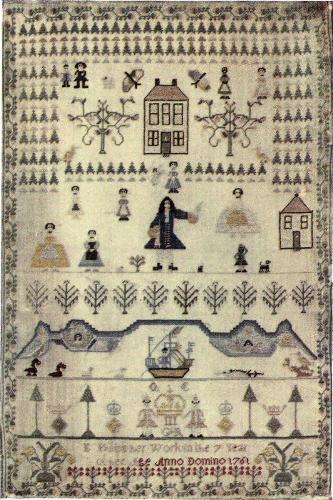
Plate IX.—Sampler by E. Philips. Dated 1761.
Author’s Collection.
Were it not that this Sampler was produced by little Miss Philips at the
tender age of seven, there would be a probability that it was unique
through its containing a portrait of the producer. For in no other example
have we so many evidences pointing to its being a record of actual facts.
For instance, there is clearly shown a gentleman pointing to his wife (in
a hooped costume), and having round him his five girls of various ages,
the youngest in the care of a nurse. In the upper left corner is his son
in charge of a tutor, whilst on the right are two maid-servants, one being
a woman of colour. This fashion for black servants is further emphasised
by the negro boy with the dog. That these should be present in this family
is not remarkable, for by the lower illustration it is evident that Mr
Philips was a traveller who had crossed the seas in his ship to where
alligators, black swans and other rare birds abounded. The work was
executed in 1761, the second year of George the Third, whose monogram and
crown are supported by two soldiers in the costume of the period. It has
been most dexterously carried out by the young lady, and it is conceived
in a delicate harmony of greens and blues which was not uncommon at that
time. Size, 19 × 12½. An adaptation of this Sampler has been utilised
as the drop scene to the play of “Peter Pan.”
But the mistress of a ladies’ improving school would hardly like her
pupils to copy time after time the same designs—designs which perhaps
resembled those of a rival establishment. Such a one would be oblivious to
the fact that an ornamentalist is born not made, that the best design is
traditional, and that pupils would be far more worthily employed in
perpetuating ornamentation which had been invented by races intuitively
gifted for such a purpose, than in attempting feeble products of her
own brain. So, too, results show that she was, as a rule, unaware that
good design is better displayed in simplicity than in pretentiousness. As
that authority on design, the late Lewis Day, wrote in his volume on
Embroidery, “The combination of a good designer and worker in the same
person is an ideal very occasionally to be met with, and any attempt to
realise it generally fails.”
Samplers show in increasing numbers as the end approaches that their
designers were ignorant of most of the elementary rules of ornamentation
in needlework, such, for instance, as that the pictorial is not a suitable
subject for reproduction, nor the delineation of the human figure, nor
that the floral and vegetable kingdom, whilst lending itself better than
aught else, should be treated from the decorative, and not the realistic
point of view.
We will now pass on to consider generally the forms of decoration most
usually met with.
Whilst embroideries in imitation of tapestries deal almost entirely with
the portrayal of the human figure, samplers of the same period, and that
the best, for the most part avoid it. This is somewhat remarkable, for the
design of the Renaissance, which was universally practised at the time
upon which we are dwelling, was almost entirely given up to weaving it
into other forms, and the volumes which treat of embroidery show how
frequently it occurs in foreign pieces of needlework. The omission is a
curious one, but the reason for it is, apparently, not far to seek. If we
examine the earlier pieces we shall see that practically one type of
figure only presents itself. Save in exceptional pieces, such as Mrs
Longman’s early piece (Plate IV.), where the figures are clearly copied
from one of the small tapestry pieces so in vogue at that date (1656), or
Mrs Millett’s piece (Fig. 16), the figures which appear upon samplers are
all cast in one mould, and in no way improve but rather mar the
composition.
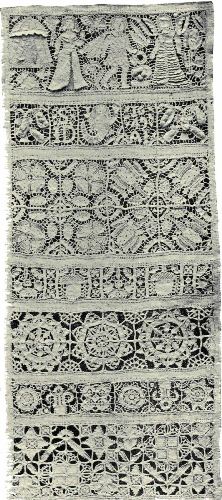
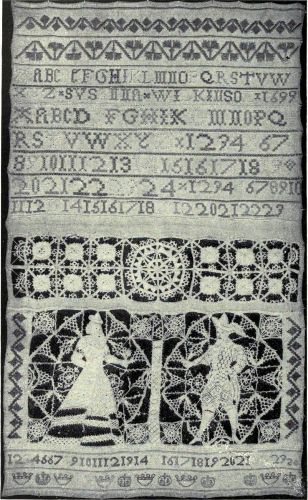
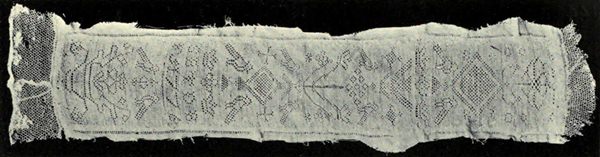
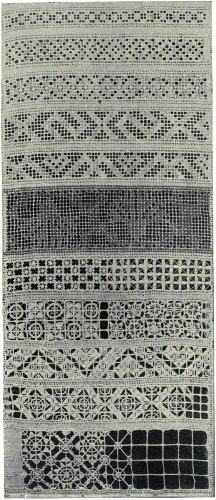
This last-named drawn-work sampler is a specimen altogether apart for
beauty of design and workmanship. Doubts have been expressed as to its
English origin, but portions of the ornament, such as the acorn, and the
Stuart S in the lowest row, are thoroughly English; besides, as we have
seen, design in almost every one of the seventeenth-century samplers is
infected with foreign motives. The uppermost panel is supposed to
represent Abraham, Sarah, and the Angel. To the left is the tent, with the
folds worked in relief, in a stitch so fine as to defy ordinary eyesight.
Sarah, who holds up a hand in astonishment at the angel’s announcement,
has her head-dress, collar, and skirt in relief, the latter being sewn
with microscopic fleurs-de-lis. The winged angel to the left of Abraham
has a skirt composed of tiny scallops, which may represent feathers. A
rabbit browses in front of the tent. The centre of the second row is
occupied by a veiled mermaid, her tail covered with scalloped scale in
relief. She holds in either hand a cup and a mask. The lettering in the
two flanking panels is “S.I.D. 1649 A.I.” The decorative motive of the
outer panels is peapods in relief, some open and disclosing peas. Roses
and tulips fill the larger square below, and these are followed by a row
(reversed) of tulips and acorns. Four other rows complete the sampler,
which only measures 18½ × 6¾. In order to give it a larger size the
lowest row is not reproduced. I have seen another drawn-work sampler which
antedates that just described by a year. It is of somewhat coarse texture
but is good in design, and bears in a panel at the side initials and the
date. The Victoria and Albert Museum has also two somewhat similar
drawn-work samplers—one by Elizabeth Wood, dated 1666, which contains
the Stuart S’s; the other (undated) has the arms of James I.
Fig. 16.—Drawn-Work Sampler by S. I. D.
Dated 1649.
Mrs C. F. Millett.
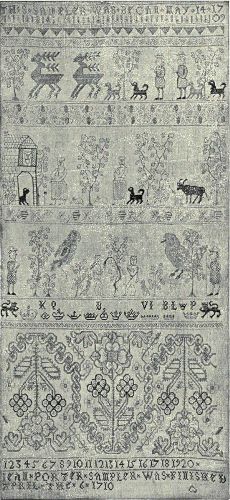
Fig. 17.—Sampler by Jean Porter. 1709-10.
A type of figure prevalent in early samplers has puzzled collectors who
possess specimens containing it. It wears a close-fitting costume and has
arms extended, and has received the name of a “Boxer,” presumably from its
attitude and costume. It and a companion are continuously depicted for
nearly a century, finally disappearing about 1742, but maintaining their
attitude with less variation than any other form of ornament, the only
alteration being in the form of the trophy which they hold in one hand. It
is this trophy, if we may use such a term, that negatives the idea of
their being combatant figures, and it almost with certainty places them in
the category of the Greek Erotes, the Roman Amores, or the Cupids of the
Renaissance. It is difficult to give a name to the trophy in most of the
samplers, and the worker was clearly often in doubt as to its structure.
In some it resembles a small vase with a lid, in others a spray with
branches or leaves on either side. In one of 1673 it takes the form of a
four-petalled flower, and in one of 1679 that of an acorn, which is
repeated in samplers of 1684, 1693, and 1694, this repetition being
probably due to the acorn being a very favourite subject for design under
the Stuarts. In a sampler of 1693 acorns are held in either hand. In one
of 1742 (Fig. 18), the object held is a kind of candelabra. The little
figures themselves preserve a singular uniformity of costume, which again
points to their being the nude Erotes, clothed, to suit the times, in a
tight-fitting jerkin and drawers. These are always of gayest colours. On
occasions (as in a sampler dated 1693) they don a coat, and have long
wigs, bringing them into line with the prevailing fashion.
When these figures disappear their place is taken by those of our first
parents in the Garden of Eden, the incongruity of which is well depicted
in the sampler illustrated in Fig. 17. This piece of work, which took
nearly a year to complete—it was begun on 14th May 1709, and finished on
6th April 1710—is unlike any other that I have seen of that period, for
it antedates, by nearly half a century, the scenes from real life which
afterwards became part and parcel of every sampler. Adam and Eve became
quite common objects on samplers after 1760.[5]
Mention need only be made here of the dressed figures which occur in
samplers dated during the reign of George the Third. They are sometimes
quaint (as in Plates IX. and XI.),
but they hardly come into any scheme
of decoration. The squareness of the stitch used in later samplers renders
any imitation of painting such as was attempted altogether a failure.
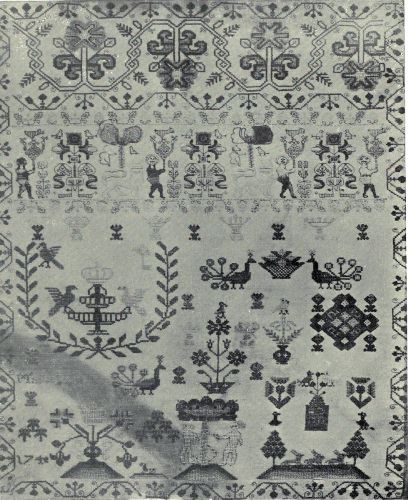
Fig. 18.—Sampler. Name Illegible. Date 1742.
Formerly in the Author’s Collection.
Animals in any true decorative sense hardly came into sampler ornament.
Whilst the tapestry pictures teem with them, so that one wanting in a lion
or stag is a rarity, in samplers, probably, the difficulty of obtaining
rounded forms with the stitch used in the large grained canvas was a
deterrent. The lion only being found on the Fletwood sampler of 1654 (Fig.
44) and the stag, which in tapestry pictures usurps the place of the
unicorn, appears but rarely on samplers before the middle of the
eighteenth century, when it came into fashion, and afterwards occurs with
uninterrupted regularity so long as samplers were made.
This neglect of animals is hardly to be deplored, for when they do occur
they are little else than caricatures (see, for instance, those in Plate
III.). Birds, which lend themselves to needlework, appear in the later
samplers (Plate XI. and Fig. 18), but hardly as part of any decorative
scheme.
With the practically insignificant exceptions which we have just noticed,
the ornamentation of the sampler was confined to floral and geometrical
motives, and whilst the latter were for the most part used in drawn-work
samplers, the former constituted the stock whence the greater part of the
decoration employed in the older examples was derived.
Amongst the floral and vegetable kingdom the selection was a wide one, but
a few favourites came in for recognition in almost every sampler, partly
because of their decorative qualities, and partly from their being
national badges. With few exceptions they were those which were to be met
with in English seventeenth-century gardens, and undoubtedly, in some
instances, may have been adapted by the makers from living specimens.
Chief among the flowers was the rose, white and red, single and double,
the emblem for centuries previously of two great parties in the State, a
badge of the Tudor kings, a part of the insignia of the realm, and
occupying a foremost place upon its coinage. In sampler ornamentation it
is seldom used either in profile or in bud, but generally full face, and
more often as a single than as a double flower. As a form of decoration it
may have been derived from foreign sources, but it clearly owed its
popularity to the national significance that attached to it.
The decorative value of the pink or carnation has been recognised from the
earliest times, and a piece of Persian ornament is hardly complete without
it. It is not surprising, therefore, that the old sampler workers utilised
it to the full, and in fact it appears oftener than the rose in
seventeenth-century specimens. Ten of the thirteen exhibits of that
century at The Fine Art Society’s Exhibition in 1900 contained it as
against seven where the rose was figured. It maintains this position
throughout, and the most successful of the borders of bordered samplers
are those where it is utilised. Specimens will be found in Plates III.,
IV., and VI.
The decorative value of the honeysuckle was hardly appreciated, and it
only appeared on samplers of the date of 1648 (Plate III.), 1662 (Plate
V.), 1668, 1701, and 1711, in the Exhibition, and the undated one
reproduced in Fig. 4.
Plate X.—Sampler by Catherine Tweedall. Dated 1775.
Mrs Arthur Severn.
The Sampler is noteworthy not only on account of its harmonious colour
scheme, its symmetry of parts, and the excellence of its needlework, but
as having been wrought by a young lady who afterwards became Mrs Ruskin,
and the grandmother of John Ruskin. Her name, Cathrine Tweedall, is worked
in the lower circle, and is illegible in the otherwise admirable
reproduction, owing to its being in a faded shade of the fairest pink. The
verse was probably often read by her renowned grandson, and may perchance
have spurred his determination to strive in the race in which he won so
“high a reward.” Mrs Arthur Severn, to whom the Sampler belongs, notes
that the Jean Ross whose name also appears upon it was the sister of the
great Arctic explorer. The date of the Sampler is 1775.
Sampler workers were very faithful to the strawberry, which, after
appearing in almost every one of the seventeenth-century long samplers,
was a favourite object for the later borders, and it may be seen
almost unaltered in specimens separated in date by a century at least. We
give in Fig. 31 a very usual version of it. (See also Plate XIII.)
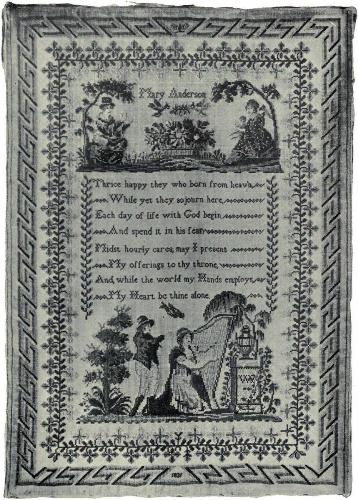
Fig. 19.—Sampler by Mary Anderson. 1831.
Lady Sherborne.
Other fruits and flowers which now and again find a place are the fig,
which will be seen in Plate III.; the pineapple, the thistle (Fig. 21),
and the tulip in samplers dated 1662, 1694, 1760, and 1825 (Plate XIII.).
Although the oak tree acquired political significance after the flight of
Charles II., that fact can in no way account for such prominence being
attached to its fruit and its foliage as, for instance, is the case in
samplers dated 1644 and 1648 (Plate III.), where varieties of these are
utilised in a most decorative fashion in several of the rows of ornament,
or in another of the following years (Fig. 16). But, curiously enough,
after appearing in almost every seventeenth-century sampler, it
disappeared entirely at the commencement of the eighteenth century.
The crown seems to have been suddenly seized upon by sampler makers as a
form of decoration, and for half a century it was used with a tiresome
reiteration. It had, of course, been largely used in Tudor decoration, and
on the restoration of the monarchy it would be given prominence. But it
probably was also in vogue because it lent itself to filling up spaces
caused by alphabets not completing a line, and also because it allowed of
variation through the coronets used by different ranks of nobility. We
have seen in the sampler, Fig. 20, that the coronet of each order was used
with a letter beneath, indicating duke, earl, etc. On occasions crowns
were also used with some effect as a border. It is possible that the
fashion for coronets was derived from foreign samplers, where this form
of decoration was frequently used about the end of the seventeenth
century, doubtless owing to the abundance of ennobled personages; they may
well have come over with many other fancies which followed in the train of
the House of Hanover. The earliest sampler in the Exhibition before
referred to which bore a crown was one of 1693; but the coronet was there
placed in conjunction with the initials M. D., and might be that of a
titled lady who worked it. After that it appeared in one dated 1705 (where
it was clearly a royal one connected with “Her Majesti Queen Anne”), and
in samplers dated 1718, 1726, 1728 (1740, in which there were at least
fifty varieties), and so on almost yearly up to 1767, after which it
gradually disappeared, two only out of seventy subsequent samplers
containing it. These were dated 1798 and 1804. In countries where almost
every family bore a rank which warranted the use of a coronet, there would
be a reason for their appearance as part of what would have to be
embroidered on table linen, etc.
Fig. 20.—Sampler. Scottish (?). 18th Century.
Formerly in the Author’s Collection.
Note.—The bright colouring, coarse canvas, and ornate lettering of this
piece suggest a Scottish origin. It dates from about 1730, and is one of
the earliest of the bordered samplers, the border being at present an
altogether insignificant addition. It is also one of the first specimens
of decoration with crowns and coronets, the initials underneath standing
for king, duke, marquis, earl, viscount, lord, count, and baron.
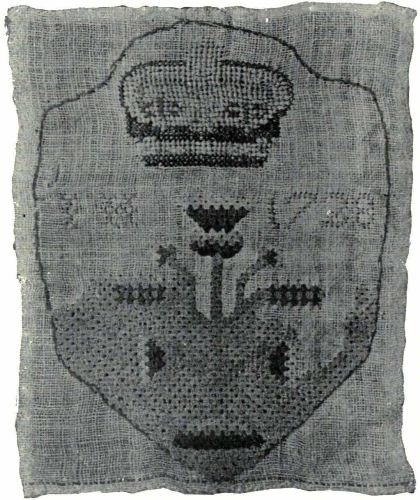
Fig. 21.—Sampler by J. H. [Jane Heath]. A.D. 1725.
Mr Ashby Sterry.
The tiny sampler with crown illustrated in Fig. 21 was one of four
contributed to the Exhibition by Mr Ashby Sterry, each of them
representing a generation in his family. It is unfinished, the background
only having been completed in the lower half; its crown and thistle denote
its Scottish origin.
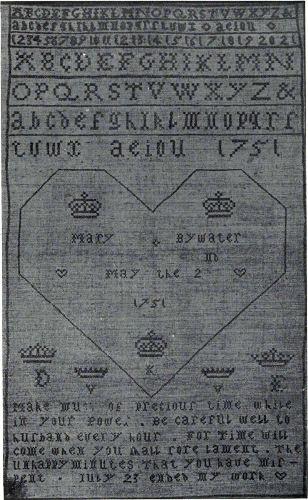
Fig. 22.—Sampler by Mary Bywater. 1751.
Formerly in the Author’s Collection.
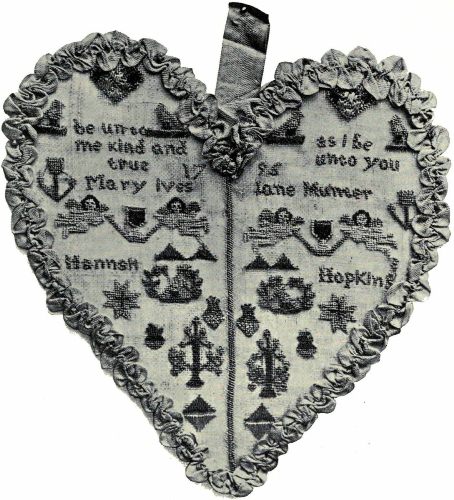
Fig. 23.—Heart-shaped Sampler by Mary Ives.
Dated 1796.
Miss Haldane.
Note.—This delightful little sampler is reproduced in its full size, and
is most delicately adorned with a pink frilled ribbon edging. We do not
know which of the three ladies whose names it bears worked it, or to which
of them the lines, “Be unto me kind and true as I be unto you,” were
addressed. The date, it will be seen, is 1796, and it shows that at the
end of the century there was still an affection for the little flying
Cupids so usual upon eighteenth-century gravestones. We have remarked upon
the absence of the cross in samplers: even here we do not find it,
although we have the heart and anchor.
This emblem, which one would have imagined to be a much more favourite
device with impressionable little ladies than the crown, is more seldom
met with. In fact, it only figured on four of the hundreds of samplers
which composed the Exhibition, and in three of these cases it was in
conjunction with a crown. When it is remembered how common the heart used
to be as an ornament to be worn, and how it is associated with the crown
in foreign religious Art, its infrequency is remarkable. The unusually
designed small sampler (the reproduction being almost the size of the
original), Fig. 22, dated 1751, simply worked in pale blue silk, on a fine
khaki-coloured ground, has a device of crowns within a large heart. Fig.
23 shows a sampler in the form of a heart, and has, in conjunction with
this symbol, anchors. It is dated 1796.
The sampler with a border was the direct and natural outcome of the
sampler in “rows.” A case, for instance, probably occurred, as in Fig.
24,[6] where a piece of decoration had a vacant space at its sides, and
resort was at once had to a portion of a row, in this case actually the
top one. From this it would follow as a matter of course that the
advantage, from a decorative point of view, of an ornamental framework was
seen and promptly followed. The earliest border I have seen is that
reproduced in Fig. 25, from a sampler dated 1726, but it is certain that
many must exist between that date and 1700, the date upon the sampler in
Fig. 24 just referred to. The 1726 border consists of a pattern of
trefoils, worked in alternating red and yellow silks, connected by a
running stem of a stiff angular character; the device being somewhat akin
to the earlier semi-border in Fig. 24.
Fig. 24.—Drawn-work Sampler by S. W. a.d. 1700.
Mrs C. J. Longman.
It is astonishing with what persistency the samplerists followed the
designs which they had had handed to them in the “row” samplers, confining
their attentions to a few favourites, and repeating them again and again
for a hundred and fifty years, and losing, naturally, with each repetition
somewhat of the feeling of the original. We give a few examples which
show this persistency of certain ideas.

Fig. 25.—Border of Mary Lounds’s Sampler. a.d. 1726.
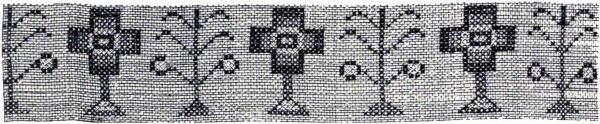
Fig. 26.—Border of Mary Heaviside’s Sampler. a.d. 1735.
The border in Fig. 26 is dated 1735, and presents but little advance from
a decorative point of view. It is the production of Mary Heaviside, and is
upon an Easter sampler, which bears, besides the verse to the Holy Feast
of Easter, the Lord’s Prayer and the Belief. The border may possibly
typify the Cross and the Tree of Life.
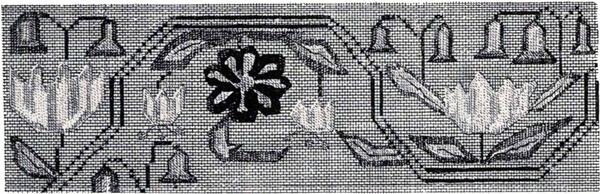
Fig. 27.—Border of Elizabeth Greensmith’s Sampler. Aged 10. July ye 26, 1737.
Elizabeth Greensmith’s sampler (Fig. 27), worked two years later, in 1737,
is more pretentious in form, the body of the work being taken up with a
spreading tree, beneath which repose a lion and a leopard. The border
consists of an ill-composed and ill-drawn design of yellow tulips,
blue-bells, and red roses. The stem, which runs through this and almost
every subsequent design, is here very feebly arranged; it is, however,
only fair to say that the work is that of a girl in her tenth year.

Fig. 28.—Border of Margaret Knowles’s Sampler. Aged 9. a.d. 1738.
Margaret Knowles’s sampler (Fig. 28), made in the next year—A.D. 1738—is
the earliest example I know of the use on a border of that universal
favourite the pink, which is oftentimes hardly distinguishable from the
corn blue-bottle. In the present instance it is, however, flattened almost
out of recognition, whilst the design is spoilt by the colossal
proportions of the connecting stem. In the second row of the sampler, Fig.
24, it is seen in a much simpler form, and it will also be found in Plate VI.
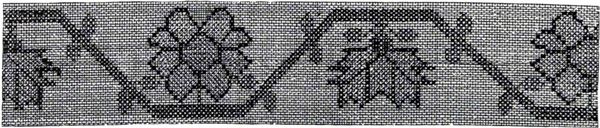
Fig. 29.—Border to Sampler by Elizabeth Turner. a.d. 1771.
Plate XI.—Sampler by Ann Chapman. Dated 1779.
Mrs C. J. Longman.
Incongruity between the ornament and the lettering of a Sampler could
hardly be carried to a more ludicrous extreme than in Ann Chapman’s, which
is here reproduced in colour. The two points of Agur’s prayer, which fills
the panel, are that before he dies vanity shall be removed far from him,
and that he shall have neither poverty nor riches. Yet as surroundings and
supporters to this appeal we have two figures posing as mock shepherd and
shepherdess, and decked out in all the vanities of the time. Agur’s prayer
was apparently often selected, for we see it again in the Sampler of Emily
Jane Brontë (Fig. 10), but there it has the quietest of ornament to
surround it, and it is worked in black silk; whereas in the present case
there is no Sampler in the collection where the whole sheaf of colours has
been more drawn upon.
The remaining illustrations of borders are selected as being those
where the design is well carried out, and as showing how the types
continue. The first (Fig. 29), worked by Elizabeth Turner in 1771,
represents a conventional rose in two aspects; the second, by Sarah Carr
(Fig. 30), in 1809, is founded on the honeysuckle; whilst the third (Fig.
31) is a delightfully simple one of wild strawberries that is frequently
found in samplers from the earliest (in Plate II.) onwards. In that from
which this example is taken, worked by Susanna Hayes in 1813, it is most
effective with its pink fruit and green stalks and band. It will be
noticed that it even crossed the Atlantic, for it reappears in Mr
Pennell’s American sampler, Plate XIII.
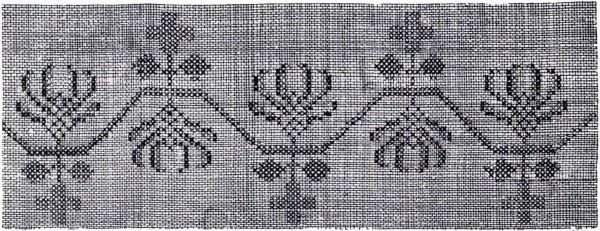
Fig. 30.—Border to Sampler by Sarah Carr. a.d. 1809.

Fig. 31.—Border to Sampler by Susanna Hayes. a.d. 1813.
How even the border degenerated as the nineteenth century advanced may be
seen in the monotonous Greek fret used in the three samplers of the
Brontës (Figs. 10, 11, 12), and in that of Mary Anderson (Fig. 19).
Miscellanea respecting Samplers
Under this heading we group what remains to be said concerning samplers,
namely:—
In modern times samplers have been almost universally the product of
children’s hands; but the earliest ones exhibit so much more proficiency
that it would seem to have been hardly possible that they could have been
worked by those who were not yet in their teens. This supposition is in a
way supported by an examination of samplers. Of those prior to the year
1700, I have seen but one in which the age of the maker is mentioned. It
reads thus, “Mary Hall is my name and when I was thirteen years of age I
ended this in 1662.” On the other hand, the rhyme which we quoted at page
50, attached to one in Mrs Longman’s possession, which, although undated,
is certainly of the seventeenth century, points to it being the work of a
grown-up and possibly a married lady.
It is not until we reach the year 1704 that I have found a sampler (Fig.
32) which was the product of a child under ten, namely, that bearing the
inscription “Martha Haynes ended her sampler in the 9th year of her age,
1704.”
This is quickly followed by one by “Anne Michel, the daughter of John and
Sarah Michel ended Nov. the 21 being 11 years of age and in the 3 year of
Her Majesti Queen Anne and in the year of ovr Lord 1705.”
1740 is the next date upon one worked by Mary Gardner, aged 9 (page 27).
Fig. 32.—Small Sampler by Martha Haynes.
Dated 1704.
Late in the Author’s Collection.
From 1750 onwards the majority of samplers are endorsed with the age of
the child, and the main interest in the endorsements lies in the
remarkable proficiency which many of them exhibit, considering the youth
of the worker, and in the tender age at which they were wrought. Almost
one half of the tiny workers have not reached the space when their years
are marked with two figures, and we even have one mite of six producing
the piece of needlework reproduced in Fig. 33, and talking of herself as
in her prime in the verse set out upon it.
Fig. 33.—Sampler by Sarah Pelham, aged 6.
But perhaps the most remarkable achievement is the “goldfinch” sampler
illustrated in Plate XII., which was worked by Ann Maria Wiggins at the
age of seven.
It is not unreasonable to suppose that samplers were on occasions worked
by children of both sexes. One’s own recollection carries back to canvas
and Berlin wool-work having been one way of passing the tedious hours of a
wet day. But specimens where the Christian name of a male appears are few
and far between, and more often than not they are worked in conjunction
with others, which would seem to indicate that they are only there as part
and parcel of a list (which is not unusual) of the family. In the sampler
illustrated in Fig. 34 the boy’s name, Robert Henderson, is in black silk,
differing from any of the rest of the lettering, which is perhaps
testimony to his having produced it. This sampler shows the perpetuation
until 1762 of the form in which rows are the predominant feature. A
sampler, formerly in the author’s collection, was more clearly that of a
boy, being signed Lindsay Duncan, Cuper [sic], 1788. Another Scottish
one bears the name or names Alex. Peter Isobel Dunbar, whilst a third of
the same kind is signed “Mathew was born on April 16, 1764, and sewed this
in August, 1774.”
The ravages of time and the little value attached to them have probably
reduced to very small numbers the tiny samplers such as those which are
seen in Figs. 35 and 36, and which must have usually been very infantine
efforts. Those illustrated, however, show the progress made by two
sisters, Mary and Lydia Johnson, in two years. Presumably Lydia was the
elder, and worked the sampler which bears her name and the date 1784. This
was copied by her sister Mary in the following year, but in a manner which
showed her to be but a tyro with the needle; nor much advanced in
stitchery in the following year, in which she attempted the larger
sampler which bears her name. Lydia, on the other hand, in the undated
sampler, but which was probably made in the year 1786, showed progress in
everything except the power of adapting the well-known design of a pink to
the small sampler on which she was engaged, as to which she clearly could
not manage the joining of the pattern at the corners. The originals of
these samplers measure from four to six inches in their largest
dimensions.
Fig. 34.—Scottish Sampler by Robert Henderson. Dated 1762.
Fig. 35.—Small Samplers by Mary Johnson. 1785-6.
Author’s Collection.
Fig. 36.—Small Samplers by Lydia Johnson. 1784.
Author’s Collection.
Collectors, in discussing samplers among themselves, have wondered whether
it would be possible to assign differences in construction and material to
their having been produced in localities where the characteristic forms
and patterns had not permeated. But those specimens which the author has
examined, and which by a superscription gave a clue as to their place of
origin, certainly afford insufficient foundation for such assumptions. In
the first place, samplers so marked are certainly not sufficiently
numerous to warrant any opinion being formed on the subject, and, as to
those not so marked, the places where they have been found cannot be taken
into account as being their birthplaces, as families to whom they have for
long belonged may naturally have removed from quite different parts of the
kingdom since the samplers were made.
It is surprising how seldom the workers of samplers deemed it necessary to
place upon them the name of the district which they inhabited. There are
few who followed the example of the girl who describes herself on a
sampler dated 1766, thus:—
“Ann Stanfer is my name
And England is my nation
Blackwall is my dwelling place
And Christ is my salvation.”
Fig. 37.—Scottish Sampler by Mary Bayland. 1779.
The only names of places in England recorded on samplers in The Fine Art
Society’s Exhibition were Chipping Norton, Sudbury, Hawkchurch, and
Tottenham, and certain orphan schools or hospitals, such as Cheltenham and
Ashby. Curiously enough, the Scottish lassies were more particular in
adding their dwelling-place, thus, in the sampler reproduced in Fig. 37,
and which is interesting as a survival as late as 1779 of a long sampler,
Mary Bayland gives her residence as Perth, and others have been noted at
Cupar, Dunbar, and elsewhere in Scotland. It might be expected that these
Scottish ones would differ materially from those made far away in the
southern parts of the kingdom, but whilst those in Figs. 32 and 34 have a
certain resemblance and difference from others in the decoration of their
lettering, that in Fig. 36 might well have been worked in England, showing
that there were no local peculiarities such as we might expect.
It will be seen that two of the American samplers figured here have their
localities indicated, namely Miss Damon’s school at Boston (Fig. 50) and
Brooklyn (Fig. 47).
Fig. 38.—Sampler by Mary Minshull.
Dated June 29, 1694.
A largely added interest might have been given to samplers had a fashion
arisen of lettering them with some historical occurrence which was then
stirring the locality, but unfortunately their makers very rarely rose to
so much originality. Three rare instances were to be seen in The Fine Art
Society’s Exhibition. These, curiously enough, came together from
different parts of the country—one from Nottingham, a second from
Hockwold, Norfolk, and the third from the author’s collection in
London—but they were worked by two persons only, one by Mary Minshull,
and two by Martha Wright. They are all unusual in their form of decoration
(as will be seen by that illustrated in Fig. 38), and were practically
similar in design, colour, and execution, each having a set of single
pinks worked in high relief in the centre of the sampler. Their presence
together was certainly a testimony to the all-embracing character of
the Exhibition. The inscriptions upon them were as follows:—
(1) “The Prince of Orang landed in the West of England on the 5th of
November 1688, and on the 11th April 1689 was crowned King of England,
and in the year 1692 the French came to invade England, and a fleet of
ships sent by King William drove them from the English seas, and took,
sunk, and burned twenty-one of their ships.”—Signed “Martha Wright,
March 26th, 1693.”
(2) “There was an earthquake on the 8th September 1692 in the City of
London, but no hurt tho it caused most part of England to
tremble.”—Signed “Mary Minshull.”
Plate XII.—Sampler by Ann Maria Wiggins.
19th Century.
Mrs C. J. Longman.
This “Goldfinch” Sampler was one of the most elaborate Samplers in the
Bond Street Exhibition, and is really a wonderful production for a child
of seven years of age. It was probably made early in the nineteenth century.
The third was a combination of the two inscriptions.
Nothing of a similar character in work of the eighteenth century has come
under my notice, but the Peace of 1802 produced the following lines on a
sampler:—
“Past is the storm and o’er the azure sky serenely shines the sun
With every breeze the waving branches nod their kind assent.”
ON PEACE
“Hail England’s favor’d Monarch: round thy head
Shall Freedom’s hand Perennial laurels spread.
Fenc’d by whose sacred leaves the royal brow
Mock’d the vain lightnings aim’d by Gallic foe
Alike in arts and arms illustrious found
Proudly Britannia sits with laurel crown’d
Invasion haunts her rescued Plains no more
And hostile inroads flies her dangerous shore
Where’er her armies march her ensigns Play
Fame points the course and glory leads the way.
*******
O Britain with the gifts of Peace thou’rt blest
May thou hereafter have Perpetual rest
And may the blessing still with you remain
Nor cruel war disturb our land again.
“The Definitive Treaty of Peace was signed March 27th 1802
proclaimed in London April the 29th 1802—Thanksgiving June the 1st
1802.
Mary Ann Crouzet
Decbr 17 1802.”
Later samplers gave expression to the universal sympathy elicited by the
death of Queen Charlotte.
Needlework maps may very properly be classed under the head of samplers,
for they originated in exactly the same way, namely, as specimens of
schoolgirl proficiency, which when taken home were very lasting memorials
of the excellence of that teaching termed “the use of the globes.”
Maps were only the product of the latter half of the eighteenth century;
at least, none that I have seen go back beyond that time, the earliest
being dated 1777. Their interest for the most part is no more than that of
a map of a contemporary date; for instance, the North America reproduced
in Fig. 39 has nothing whatever in the way of needlework to recommend it,
but it shows what any map would, namely, how little was known at that date
of the Western States or Canada.
A map of Europe in the Exhibition, dated 1809, was a marvellous specimen
of patient proficiency in lettering, every place of note being wonderfully
and minutely sewn in silk. The executant was Fanny le Gay, of Rouen.
Fig. 39.—Map of North America by M.A.K. 1738.
Fig. 40.—Map of England and Wales by Ann Brown.
A map printed on satin or other material was sometimes worked over, not
always as regards all the lettering, but as to the markings of the
degrees of latitude and longitude,[7] and some of the principal names.
These have naturally less interest and value as specimens of needlework
than those which are entirely hand worked, although for the purposes of
geographical reference they were at all events reliable, which is more
than can be said for some of the original efforts; as, for instance, that
of little Ann Brown, whose map of England and Wales is reproduced (Fig.
40). Starting bravely, her delineation of Northumberland takes her well
down the canvas, so that by the time she has reached Newcastle she has
carried it abreast of Dumfries in Scotland, and Cork in Ireland! Yorkshire
is so expansive that it grows downward beyond Exeter and Lundy Island,
which last-named places have, however, by some mishap, crept up to the
northward of Manchester and Leeds. It is a puzzle to think where the
little lassie lived who could consort London with Wainfleet, the River
Thames with the Isle of Wight, Lichfield with Portland, or join France to
England. Although one would imagine that the dwelling-place of the
sempstress would usually be made notable in the map either by large
lettering or by more florid colouring, we have not found this to be the
case.
Fig. 41.—Map of Africa. Dated 1784.
The map of Africa (Fig 41), which is surrounded by a delightful border of
spangles, and which seems to have been used as a fire-screen, is
interesting now that so much more is known of the continent, for many of
the descriptions have undergone considerable change, such as the Grain
Coast, Tooth Coast, and Slave Coast, which border on the Gulf of Guinea.
The sampler is also noteworthy as having been done at Mrs Arnold’s, which
was presumably a school in Fetherstone Buildings, High Holborn, hardly the
place where one would expect to find a ladies’ seminary nowadays.
Tapestry pictures have such a Royalist air about them that it is hardly
probable that they found favour with the Puritan damsels of the Stuart
reigns, and, consequently, it may be doubted whether the fashion for
making them crossed the Atlantic to the New World with the Pilgrim
Fathers, or those who followed in their train. Samplers, on the other
hand, with their moralities and their seriousness, would seem to be quite
akin to the old-fashioned homes of the New Englanders, and doubtless
there must be many specimens hanging in the houses of New England and
elsewhere which were produced from designs brought from the Old Country,
but over which a breath of native art has passed which imparts to them a
distinctive interest and value. Three notable ones, we know, crossed the
Atlantic with the early settlers. One, that of Anne Gower (spelled Gover
on the sampler), first wife of Governor Endicott (Fig. 42), is now a
cherished possession of the Essex Institute, Salem, Massachusetts. As
Governor Endicott’s wife arrived at Salem in 1628, and died the following
year, we have in her sampler the earliest authentic one on record. The
inscription of very well-designed and elaborately-worked letters,
difficult to distinguish in the photograph, is:—
ANNE ♢ GOVER
S T V W X Y Z
J K L M N O P Q R
A a B C d E F G H
Fig. 42.—Drawn-Work Sampler by Anne Gover,
First Wife of Govr. J. Endicott.
Fig. 43.—Sampler of Loara Standish,
Daughter of the Pilgrim Father, Miles Standish,
now in Pilgrim Hall, Plymouth, U.S.A.
Fig. 44.—Sampler bearing Names of
Miles and Abigail Fleetwood. Dated 1654.
Property of Mrs Frank Boxer.
Fig. 45.—Sampler by Abigail Ridgway. 1795.
Mr A. D. Drake’s Collection.
Plate XIII.—American Sampler by Martha C. Barton. Dated 1825.
Mr Joseph Pennell.
Mr Joseph Pennell’s Sampler, which finds a place here as a specimen of
American work, has little to distinguish it from its fellows that were
produced in England in the reign of George IV. The border, it is true,
only preserves its uniformity on two of the four sides, but where it does
it is designed on an old English pattern, that of the wild strawberry. So,
too, we find the ubiquitous stag and coach dogs, Noahs, ash trees, birds, and flower baskets.
The sampler itself is a beautiful specimen of drawn work, and the
lettering is the same colour as the linen. If, as must probably be the
case, it was worked by her as a child, it was made in England, and its
date may be the end of the first decade of the seventeenth century. The
second, by Lora Standish, is now in the Pilgrim Hall, Plymouth (Fig. 43).
Lora was the daughter of Miles Standish, the Pilgrim Father, who went to
Boston in February 1621, and it bears the inscription:—
“Loara Standish is My Name
Lord Guide My Heart that I may do Thy Will
And fill my hands with such convenient Skill
As will conduce to Virtue void of Shame
And I will give the Glory to Thy Name.”
Fig. 46.—Sampler by Elizabeth Easton. 1795.
Mr A. W. Drake’s Collection.
The earliest dated sampler in America of which I have cognisance, and one
which may have been worked in that country, is that bearing the names of
Miles and Abigail Fletwood (Fleetwood?) (Fig. 44). It is dated 1654, and
has been owned by the descendants of Mrs Henry Quincy since 1750, and is
now in the possession of Mrs Frank Boxer of Cambridge, Massachusetts, who
has kindly furnished me with particulars concerning it. It bears the
following inscription:—
“In prosperity friends will be plenty,
But in adversity not one in twenty,”
which, it is thought, may possibly have reference to the reverses of Miles
Fletwood and his relationship to Cromwell. It is somewhat remarkable for a
sampler to bear the names of husband and wife for it necessarily
presupposes its having been worked after marriage.
Fig. 47.—Sampler by Maria E. Spalding. 1815.
Dr J. W. Walker’s Collection.
Fig. 48.—Sampler by Martha C. Hooton. 1827.
Mr A. W. Drake’s Collection.
If one may judge from the photographs which collectors in America have
sent me, and for which I have to thank Dr James W. Walker of Chicago and
Mr A. W. Drake of New York, and those noted in an article on the subject
in the
Century Magazine,[8] specimens between the period just named,
that is the middle of the seventeenth century and the end of the
eighteenth century, are rare. We have but two such figured, each dated
1795, and, as will be seen by the illustrations (Figs. 45 and 46), they
are entirely British in character. I am glad, however, to add several
interesting specimens of later date from the collections of these
gentlemen. Unfortunately, not having the originals, I can only give them
in monochrome. Plate XIII., however, represents in colour an American
sampler. It belongs to Mr Pennell, the well-known artist and author, and
was worked by an ancestress, Martha C. Barton, in 1825. From Mrs Longman’s
collection I also give (Fig. 51) one, worked in silk on a curious loose
canvas, which was obtained by her in Massachusetts, and has the following
inscription:—
“Persevere. Be not weary in well doing.
Youth in society are like flowers
Blown in their native bed, ’tis there alone
Their faculties expand in full bloom
Shine out, there only reach their proper use.
“Wrought by Lydia J. Cotton. Aged 9 years. August 27. 1819. Love
learning and improve.”
It has been my endeavour in this volume to confine the survey of samplers
and embroideries entirely to the production of the English-speaking race,
in part because other authors have drawn almost all their material from
foreign sources, and the subject is sufficiently ample and interesting
without having recourse to them, and also because the collections
containing foreign samplers or embroideries are very few, and although
they, perhaps, surpass the efforts of our own countrywomen in the variety
of their stitches and the proficiency with which they are executed, they
take a less important place where interest of subject is the main
recommendation.
Fig.—49. American Sampler of the Lamborn Family. 1827.
Mr A. W. Drake’s Collection.
Fig. 50.—American Sampler by Elizabeth M. Ford.
Dr Jas. W. Walker’s Collection.
Fig. 51.—American Sampler by Lydia J. Cotton. Dated 1819.
Mrs C. J. Longman.
Nevertheless as the acquisition of them may add an interest to those who
never fail on their travels to inspect the contents of every curiosity
shop they come across, the following description of them which Mrs C. J.
Longman, who possesses a most important collection, has been good enough
to furnish, may not be out of place.
“My collection of foreign samplers includes specimens from the following
countries: Germany, Holland, Belgium, Denmark, Sweden, France,
Switzerland, Italy, Spain, and Portugal, but by far the largest number of
my foreign samplers come from Germany, and, next to English ones, the
German seem more easy to obtain than those of any other country. In Spain
and Portugal there are also a fair number in the market.
“The dated samplers abroad seem to begin at about the same period as in
England, namely, the middle of the seventeenth century. The earliest
specimens that I possess from these several countries are as follows:
Germany, 1674; Switzerland, 1675; Italy, seventeenth century (undated);
Spain, early eighteenth century (undated); Belgium, 1724; Holland, 1726;
Denmark, 1742; France, 1745; Portugal, early nineteenth century (undated).
“There are a few marked characteristics which seem to belong to the
different countries, which it is interesting to note.
“In the German samplers, the initials of the worker and the date are
almost always given, enclosed together, in a little garland or frame; but
I have never seen the name signed in full. I have only once seen a German
sampler with an inscription on it; in that case ‘Fur uns geoffert’ is
worked above a representation of the Crucifixion.
“The seventeenth-century German samplers are rather small, and much
squarer in shape than English ones of the same date. With the eighteenth
century long, narrow ones came in, a quite common size being 44 in. long,
by about 10 in. broad, the usual width of the linen; the selvage is left
at the top and bottom.
“There is seldom much arrangement in the earlier German samplers. They
usually have one alphabet, and various conventional flowers, birds, and
other designs scattered over them.
“With the long shape of sampler a more methodical arrangement came in. A
typical one is as follows: Lines of alphabets and numerals across the top,
some large subjects in the centre, and designs for borders arranged in
lines across the bottom.
“The central subjects very often include a representation of the
Crucifixion and emblems of the Passion, namely, the crown of thorns,
scourge, ladder, nails, hammer, tweezers, sponge, hour-glass, dice, cock.
Adam and Eve under the Tree of Knowledge is another favourite subject, and
animals such as lions, deer, or parrots frequently occur. One does not
often find houses or domestic scenes. One sampler, dated 1771, has a
christening depicted on it, which I imagine to be very unusual.
“The borders are very various. In them trefoils, grapes, conventional
pinks, roses, pears, and lilies and occasionally deer and birds are worked
in; but I have never seen the ‘Boxers’ or other figures that one finds in
the English borders, and I have only one specimen with acorns.
“The earliest German samplers seem to be worked entirely in cross-stitch,
beautifully fine, and the same on both sides of the material; the
back-stitching so often found on early English ones I have never seen. In
the eighteenth century other stitches were sometimes used, and I have one
German sampler, dated 1719, which is almost entirely worked in knots. On
others some elaborate stitches are shown, which are mostly worked in
square patches, and are not made use of for improving the design of the
samplers.
“The earliest examples of darned samplers that I have seen come from
Germany, and I think that one may give the Germans the credit of inventing
them; for, whereas, in England they do not appear much before the end of
the eighteenth century, I have a German one dated 1725, and several others
from the middle of the same century. The darns on these samplers show
every kind of ordinary and damask darning, the material being usually cut
away from underneath and the hole entirely filled in. I have never seen
German darning worked into designs of flowers, birds and so on, as we see
on English darned samplers.
“As in all countries, the colours of the earlier German samplers are the
best, but they are in no case striking.
“Dutch samplers seem quite distinct in character from German ones. All
those that I have seen are broader than they are long, and they are worked
across the material, the selvage coming at the sides, instead of at the
top and bottom. They are usually dated, and signed with initials. One of
their main characteristics is to have elaborate alphabets worked in two or
more colours. The second colour is very often worked round an ordinary
letter as a sort of frame or outer edge, and gives it a clumsy, rather
grotesque appearance. The Dutch samplers might, as a rule, be described as
patchy. Without any obvious arrangement they have houses, ships, people,
animals, etc., scattered over them. The stitch used is mainly
cross-stitch; but back-stitch, an open kind of satin-stitch, and
bird’s-eye-stitch are also often seen.
“Belgian samplers, as far as I have seen, approach more nearly to the
German in style. I have one, however, dated 1798, which is quite distinct
in character. It is 64 in. in length, with a large, bold alphabet of
letters over 2 in. long worked on it, such as might be used for marking
blankets.
“I have only three specimens of Danish samplers, but they are all
remarkable for the great variety of stitches introduced. I have a Danish
sampler, and also a Swedish one of about 1800 worked on fine white muslin,
both giving patterns of stitches for the ‘Töndu’ muslin drawn work. These
patterns imitate both needlepoint and pillow laces, threads are drawn out
one way of the material, the remaining ones being drawn together with a
great variety of stitches, so as to follow the intricacies of lace
patterns. This work was much used for adorning elbow ruffles, fichues,
etc., and it is very like some Indian muslin work, though the stitches are
slightly different.
“French samplers, as far as I have seen, are also remarkable for the
fineness of the stitches. They are usually dated and signed in full, and
often have inscriptions worked on them. One large French map of Europe in
my collection has 414 names worked on it in fine cross-stitch, many of
them being worked on a single thread of material, which is a fine muslin.
“Swiss samplers show fine work, but a great lack of effect. One dated 1675
has several borders on it, worked in the back-stitch so much used in
England at that date.
“From Italy I have no important coloured samplers, but several point-coupé
ones. They are undated but belong to the seventeenth century. These
samplers show a beauty of design which is rather in contrast to that of
English ones of the same kind and date, there being a grace and meaning
about the Italian patterns that one seldom finds in English specimens of
drawn work, fine as these are. A typical coloured Italian sampler of about
1800 is as follows: The sampler is nearly square, and is divided into
three parts. In the upper division a Latin cross is worked at the side,
and the rest of the space is filled with two alphabets, numerals, and the
name of the worker, but no date. In the second division a cross is worked,
and fourteen emblems of the Passion. In the third division are various
trees, figures, animals, etc., some local colour being given by an orange
and a lemon tree in pots.
“Spain is well represented in my collection. For beauty of colouring and
designs I think that it stands far ahead of any other country. Spanish
samplers are generally large; they are sometimes square, sometimes long in
shape. They are as a rule entirely covered with border patterns, which in
the square shape are worked along the four sides parallel to the edge; and
which in the long shape runs in lines across the sampler, with a break in
the middle, where the border changes to another pattern, thus giving the
impression that the sampler is joined up the centre. The patterns of the
borders vary a great deal; I have counted thirty different ones on one
sampler. They are mostly geometric, and not based on any natural objects,
but the designs are so skilfully handled and elaborately worked out as to
take away any appearance of stiffness; and in them the prim acorn, bird,
or trefoil of the English and German border patterns are never seen. I
have one Spanish sampler, dated 1738, of a quite different type to all my
others. It is divided into three panels. The top panel is filled with
floral designs, the centre with a gorgeous coat of arms, and the lower
panel contains a representation of St George and the Dragon.
“The colours used in Spanish samplers are very striking, and their
blending in the different borders is very happy and effective. Most of the
early specimens are worked almost entirely in satin-stitch, although
cross-stitch and back-stitch are also sometimes introduced. The samplers
are usually hem-stitched round the edge, and occasionally contain some
drawn work. I have one early specimen in which the drawn part is worked
over in coloured silks.
“The Spanish samplers that I have seen seldom have the alphabet worked on
them, and are rarely dated. On the other hand, they often have the name of
the worker signed in full.
“Portugal is only represented in my collection by samplers worked in the
nineteenth century; it is therefore hardly fair to compare these specimens
with the earlier ones of other countries, for everywhere samplers began
to deteriorate in that century. The Portuguese samplers that I possess are
eminently commonplace and can well be described as ‘Early Victorian.’
“It must be remembered that my remarks on foreign samplers are based on
specimens belonging to the seventeenth and eighteenth centuries. With few
exceptions I have not tried to collect modern ones, which approximate much
more to each other in the different countries.
“Looking back over this brief survey, and comparing foreign samplers with
English, one or two differences at once stand out. The foreign samplers
are seldom worked in a pictorial form. They hardly ever, except in France,
have verses or texts worked on them. The age of the worker is never given.
This is much to be regretted, as in these three things lies much of the
personal interest of the English sampler.
“On the other hand, from a practical point of view, if one goes to one’s
samplers as to pattern-books for good stitches, designs and effects of
colour, England no longer takes the first place, and one would turn for
these to the samplers of Germany, Scandinavia, Spain, and Italy.”
Many of the Anglo-Indian mothers who reared and brought up families in the
East Indies in the days when the young ones had to pass all their youth in
that country, regardless of climatic stress, must have trained their girls
in the cult of sampler-making, and the same schooling went on in the
seminaries at Calcutta and elsewhere, as we have seen in the specimen
illustrated in Fig. 2. I am able to give another illustration (Fig. 52),
which is not otherwise remarkable except for the fact that it was worked
by a child at Kirkee, and shows how insensibly the European ornament
becomes orientalised as it passes under Eastern influence. It is the only
sampler in which there is any use made of plain spaces, and even here it
is probably only accidental.
Fig. 52.—Sampler by Helen Price. Made at Kirkee, East Indies.
Dated 18—.
Late in the Author’s Collection.
Although, undoubtedly, much of the ornament upon samplers consists of
designs that have been handed down from generation to generation by means
of the articles themselves, pattern-books have not been altogether lacking
even from early days. They have not, however, rivalled either in quantity
or quality those which treat of the sister Art of lace-making, for, so far
as is known, early English treatises on the subject are limited to some
half a dozen, and these occupy themselves as much with lacework as with
embroidery.
The first English book that is known is in reality a foreign one; it is
entitled, “New and Singular Patternes and Workes of Linnen Serving for
Patternes to make all sorts of Lace Edginges and Cut Workes. Newly
invented for the profite and contentment of Ladies, Gentilwomen and others
that are desireous of this Art. By Vincentio. Printed by John Wolfe 1591.”
We have not been able to find a copy, and therefore can do no more than
chronicle its existence.
A volume upon which needleworkers of the seventeenth century must have
relied much more largely for their ideas was published in its early years
under the title of “The Needle’s Excellency. A New Booke wherein are
divers admirable workes wrought with the needle. Newly invented and cut in
copper for the pleasure and profit of the industrious. Printed for James
Boler, and are to be sold at the Syne of the Marigold in Paules
Churchyard.” This treatise went to twelve editions at least, but,
nevertheless, is very rare. The twelfth, “enlarged with divers newe
workes, needleworkes, purles, and others never before printed. 1640,” is
to be found in the British Museum Library, but even that copy has suffered
considerably from usage, for many plates are missing, and few are in
consecutive order. The title-page consists of an elaborate copper plate,
in which are to be seen Wisdom, Industrie, and Follie; Industrie, seated
in the middle under a tree with a formal garden behind her, is showing
Follie, who is decked out in gorgeous Elizabethan costume, her work, and
Follie is lifting her hands in astonishment at it. Following the
title-page comes a lengthy poem by Taylor, the Water Poet, upon the
subject of needlework. So far as one can judge from the samplers of the
period, the designs for needlework in the book, which consist of formal
borders, have been very seldom copied, but some for drawn work undoubtedly
have a close resemblance to those which we see in existing pieces. Another
book, which I have been unable to find in the Museum, is described as
“Patternes of Cut Workes newly invented and never published before: Also
Sundry Sorts of Spots, as Flowers, Birdes, and Fishes, etc., which will
fitly serve to be wrought, some with gould, some with silke, and some with
creuell in coullers; or otherwise, at your pleasure.”
From “The Needle’s Excellency” we have many clues as to needlework in the
early seventeenth century. First of all, as to the articles for which
samplers would be required, the following are mentioned: “handkerchiefs,
table cloathes for parloures or for halls, sheetes, towels, napkins,
pillow beares.” Then as to the objects which were delineated on
embroideries, it states that:—
“In clothes of Arras I have often seene
Men’s figured counterfeits so like have beene
That if the parties selfe had been in place
Yet Art would vie with nature for the grace.”
Again,
“Flowers, Plants and Fishes,
Beasts, Birds, Flyes and Bees,
Hills, Dales, Plains, Pastures,
Skies, Seas, Rivers, Trees,
There’s nothing ne’er at hand or farthest sought
But with the needle may be shap’d and wrought.”
It would seem from the foregoing that the volumes would be of more profit
to the worker of embroidered pictures than to sampler-makers, and this was
no doubt the case; for when the former went out of fashion, the books
dealing with the subject disappeared too, and nothing further of any note
was published, except in the beginning of the last century, when the
National Schools were furnished with manuals which dealt more with plain
sewing than with decorative needlework.
I can hardly close my remarks upon the entertaining subject, the
elucidation of and material for which has filled many spare hours, without
a word of regret at having to pen the elegy of the sampler.
It may be said that even so long ago as the era of the Spectator there
were those who sounded its death knell, and who considered that the days
when a lady crowded a thousand graces on to the surface of a garter were
gone for ever. For did it not go to the heart of one of Mr Spectator’s
correspondents to see a couple of idle flirts sipping their tea for a
whole afternoon, in a room hung round with the industry of their
great-grandmothers, and did he not implore that potentate to take the
laudable mystery of embroidery into his serious consideration?
But even then there were matrons who upheld the craft, and of whom an
epitaph could be written that “she wrought the whole Bible in tapestry,
and died in a good old age after having covered three hundred yards of
wall in the Mansion House.” Besides, the samplers themselves show that the
industry, if not the Art, continued all through that century and for at
least half of the nineteenth.
The decadence of the sampler has never been more tenderly or pathetically
dealt with than in the description given of the dame’s school in the
sketch entitled “Lucy,” in Miss Mitford’s “Our Village.”[9]
... There are seven girls now in the school working samplers to be
framed. “Such a waste of silk, and time, and trouble!” I said to Mrs
Smith, and Mrs Smith said to me. Then she recounted the whole battle
of the samplers, and her defeat; and then she sent for one which, in
spite of her declaration that her girls never finished anything, was
quite completed (probably with a good deal of her assistance), and of
which, notwithstanding her rational objection to its uselessness, Lucy
was not a little proud. She held it up with great delight, pointed out
all the beauties, selected her own favourite parts, especially a
certain square rosebud, and the landscape at the bottom; and finally
pinned it against the wall, to show the effect that it would have when
framed. Really, that sampler was a superb thing in its way. First came
a plain pink border; then a green border, zig-zag; then a crimson,
wavy; then a brown, of a different and more complicated zig-zag; then
the alphabet, great and small, in every colour of the rainbow,
followed by a row of figures, flanked on one side by a flower, name
unknown, tulip, poppy, lily—something orange or scarlet, or
orange-scarlet; on the other by the famous rosebud, then divers
sentences, religious and moral;—Lucy was quite provoked with me for
not being able to read them; I daresay she thought in her heart that I
was as stupid as any of her scholars; but never was MS. so illegible,
not even my own, as the print-work of that sampler;—then last and
finest, the landscape, in all its glory. It occupied the whole narrow
line at the bottom, and was composed with great regularity. In the
centre was a house of a bright scarlet, with yellow windows, a green
door, and a blue roof: on one side, a man with a dog; on the other, a
woman with a cat—this is Lucy’s information; I should never have
guessed that there was any difference, except in colour, between the
man and the woman, the dog and the cat; they were in form, height, and
size, alike to a thread, the man grey, the woman pink, his attendant
white, and hers black. Next to these figures, on either side, rose two
fir-trees from two red flower-pots, nice little round bushes of a
bright green or intermixed with brown stitches, which Lucy explained,
not to me—“Don’t you see the fir-cones, sir? Don’t you remember how
fond she used to be of picking them up in her little basket at the
dear old place? Poor thing, I thought of her all the time that I was
working them! Don’t you like the fir-cones?”—After this, I looked at
the landscape almost as lovingly as Lucy herself.
Fig. 53.—Beadwork Sampler by Jane Mills.
19th Century.
Late in the Author’s Collection.
Note.—The only modern sampler in The Fine Art Society’s Exhibition in
which beadwork was employed. This is the more remarkable as it apparently
dates from about the period when beadwork was so much in fashion for
purses, etc. As we shall see in our illustrations of pictures in imitation
of tapestry (Plate XXI.), beadwork was very common in the seventeenth
century, but we have not seen a single specimen of this material dated in
the eighteenth century, unless it be this one, which we place at the end
of the eighteenth or the beginning of the nineteenth century.
It has been prophesied that:—
“Untill the world be quite dissolv’d and past
So long at least the needles use shall last.”
I trow not, if for “use” the word “Art” may be substituted.
It is true that recent International Exhibitions have included some
marvellous specimens of adroitness in needlework, such, for instance, as
the wonders from Japan; but these tours de force, and even the skilled
productions from English schools, as, for instance, “The Royal School of
Art Needlework,” and which endeavour fitfully to stir up the dying embers
of what was once so congenial an employment to womankind, are no
indications of any possibility of needlework regaining its hold on either
the classes or the masses.
Samplers can never again be a necessity whereby to teach the young idea,
and every year that passes will relegate them more and more into the
category of interesting examples of a bygone and forgotten industry.
Fig. 54.—Sampler by Elizabeth Clarkson. 1881.
Author’s Collection.
One sampler dated within the last half century finds a place in this book,
but it is indeed a degraded object, and is included here to show to what
the fashion had come in the Victorian era, an era notable for huge sums
being expended on Art schools, and over a million children receiving Art
instruction at the nation’s expense. The sampler is dated 1881, and was
the work of a lady of seventeen years of age. The groundwork is a common
handkerchief, the young needlewoman evidently considering that its
puce-coloured printed border was a better design than any she could
invent. It was produced at a school, for there are broidered upon it the
names of thirty-five other girls, besides seven bearing her own
patronymic. As will be seen by the reproduction (Fig. 54), it is adorned
with no less than nine alphabets, not one of which contains an artistic
form of lettering. As to the ornament, the cross and anchor hustle the
pawnbroker’s golden balls, and formless leaves surround the single word
“Love,” all that the maker’s invention could supply of sentimentality.
This is apparently the best that the deft fingers of Art-taught girlhood
could then produce. The flash in the pan that, round about the date of its
creation, was leading to the production of the “chairback” in crewels,
collapsed before machine-made imitations, and well it might when even a
knowledge of how to stitch an initial is unnecessary, as we can obtain by
return of post from Coventry, at the price of a shilling or so a hundred,
a roll of our names in red, machine-worked, lettering. Truly it seems as
if any use for needlework in the future will be relegated to an occasional
spasmodic effort, such as when war confronts us and our soldiers are
supposed to be in need of a hundred thousand nightcaps or mufflers.
The decay of needlework amongst the children of the middle classes may
perhaps be counterbalanced by other useful employments, but undoubtedly
with those of a lower stratum of society the lack of it has simply
resulted in their filling the blank with the perusal of a cheap
literature, productive of nothing that is beneficial either to mind or
body.
Plate XIV.—Embroidered Picture: Christ in the Temple, Stoning of Martyrs, etc. About 1625.
Formerly in the Author’s Collection.
One of the quaintest of the Embroidery pictures. Differing as it does from
the majority of its fellows in the costume of its figures, and valuable as
it is as a record of the dress of the first years of the seventeenth
century, the piquancy and variety of the subjects depicted combine with
these to give it an unusual interest. As regards the dress, it denotes a
period towards the close of the reign of James I. The ruff is still worn
by the doctors, but the boots of the gentleman who walks with a lady are
very close to the fashion of Charles I. The subjects combine religious and
mundane. The former comprise Christ in the Temple instructing the doctors,
Susannah and the Elders, and a remarkable scene of Martyrs at the stake,
one of the latter being in the uncomfortable position of having a stone
protruding from his forehead. The latter show the squire and his lady
beside their residence, young ladies out for an airing, and others about
to enter a Pergola. Its maker has not only been happy through the vitality
imparted to the human puppets, but has succeeded equally well with animal
life; witness the rabbit and squirrel beneath the apple tree and the
greyhound and hare in the lower corner. The water in which Susannah laves
her legs is worked in imitation of ripples, and looks fresher than the
rest owing to the recent removal of the talc with which it was covered.
The clouds in the upper part of the moss, etc., in the lower portion come
dark in the reproduction as they are made of purl, which has tarnished. It
will be noted that those of the pictures in which the surface is not
entirely covered with embroidery are usually worked upon white satin. This
was a fashion of the time, and supplanted velvet, the material hitherto
used, owing, it is assumed, to its being an easier material to work upon,
but also probably to its beautiful surface resembling a background of
parchment, and to the magnificent quality which was then made.
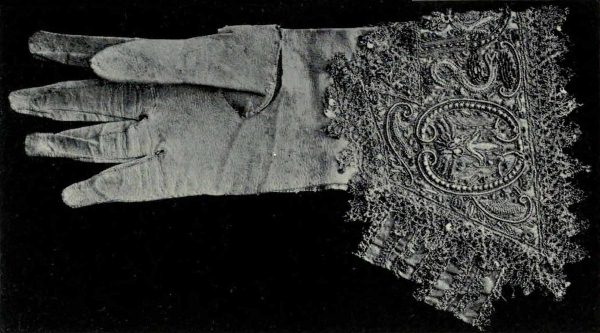
Fig. 55.—Embroidered Glove. Early 17th Century.
Formerly in the Author’s Collection.