Early Days of independence—"Central American Federation"—Constitutional
Presidents—Executive power—Chamber of Congress—The
Cabinet—Justice—The courts—Prisons and prisoners—Employment
and treatment—Police force—How distributed—Education—Colleges
and schools—State-aided education—Teaching staffs—Primary
education—Posts and telegraphs—Improved interstate parcels post.
The breaking away from Spanish dominion (although
the seeds of revolution were laid as far back as 1811)
did not take place until ten years later, and coincided
with the successful termination of the struggle for
liberty which occurred in Mexico under the patriot
priest Hidalgo. Salvador gained its freedom, comparatively
speaking, without bloodshed; and on
September 15, 1821, it was declared a free and independent
State. In the year following an attempt was
made to annex the country to the Mexican Empire,
under the rule of the ambitious and unscrupulous
Emperor Agustin Yturbide, during his very brief
reign, in 1822. As history relates, this presumptuous
Mexican was born in Valladolid (now known as Morelia)
on September 27, 1783, and he was sentenced to
death and shot on July 19, 1824.
It is to the credit of Salvador that it was the one
Central American State which firmly resisted the
invasion of the Mexican troops; but in the end it had
to submit to a far superior force, commanded by
General Filisola, and was then formally incorporated
into the Mexican Empire. This humiliation endured,
however, for a very brief time, since in the following
year Yturbide met his violent death, after which a
Constitutional Convention was called, and in 1824 a
Federal Republic was declared bearing the name of the
"Central American Federation." This was composed
of the five States—Salvador, Guatemala, Honduras,
Nicaragua and Costa Rica—the first President being
General Manuel José Arce.
Party jealousies and personal ambitions, however,
soon brought about disintegration, and in spite of the
efforts of some far-seeing patriots, who considered that
in union alone lay the hope of peace, security and
prosperity for their country, the form of government
proved wholly impracticable. Nevertheless it continued
for a few years to struggle along, General
Francisco Morazán, doing his best to maintain order
and to save the union from disruption. Notwithstanding
all his efforts, the Federation was dissolved in
1839, and the five States again became independent
Sovereign Republics. Three years later General
Morazán unwisely made another effort to reunite the
countries; but his attempt was treacherously rewarded
by a conspiracy against his life, followed by his execution
in San José, Costa Rica, in the month of
September, 1842.
Since his death various attempts have been made
from time to time, to reunite the several Republics,
the last effort of this kind having been prosecuted by
General Zelaya, perhaps one of the most unscrupulous
and dishonest, as well as one of the cruellest, Spanish-Americans
who has ever attained supreme power.
Whatever chances of success a United Central
America might have had, under the auspices of a
Zelaya it could have never met with anything but
failure. General Zelaya, in spite of frantic efforts to
maintain his position, was himself chased from Nicaragua
in 1909, and is now said to be living in Europe
upon the proceeds of the money which he is declared
to have filched from his country during his long and
oppressive reign.
In the year 1885, General Justo Rufino Barríos,
President of Guatemala, had sought to accomplish
what Morazán had failed to do; but his efforts ended
equally in disaster. On August 13, 1886, the Constitution
which is at present in force was promulgated,
and General Menéndez was elected as first
President under that Constitution by popular vote in
1887, for the term ending in 1890. He was succeeded
by General Carlos Ezeta, who was inaugurated on
March 1, 1891. The third President was General
Rafael Gutierrez. Then followed General Tomás
Regaládo; Don Pedro José Escalón; General Fernando
Figueroa; and the ruling President, Doctor
Manuel Enrique Araujo.
The form of government in vogue is that of a
free, sovereign and independent Republic—that is to
say, democratic, elective, and representative. The
Constitution now in existence is contained in a
code of articles. The Government is divided into
Legislative, Executive, and Judicial sections. The
Legislative power is vested in the National Assembly,
which is composed of one Chamber, and having the
title of the National Chamber of Deputies. This consists
of 42 members, three Deputies being elected for
each Department by direct popular vote for a term of
one year, the right to vote being vested in every male
citizen who is over eighteen years of age. It is to be
observed that every Salvadorean is not only privileged,
but is compelled to vote, thus doing his duty to the
State.
The Executive consists of a President and a Vice-President,
who are elected by popular vote for a term
of four years. In addition to being Chief Magistrate,
the President is also Commander-in-Chief of the Army.
In the event of a failure to elect the Executive, a
President is chosen by a majority of votes in the
Congress from among the three candidates having
polled the largest number of votes in the popular
election. He is not eligible for re-election either as
President or as Vice-President until four years shall have
elapsed. The date of the Executive's inauguration is
on March 1 following the election, which is usually
held in the month of November.
The administration of each of the fourteen different
Departments is in the hands of a Governor, who is
selected by the President from personal knowledge of
both his capacity and temperament. Besides administering
the civil affairs of the territory under his jurisdiction,
this official is usually either a military man or
one possessed of adequate military knowledge; and he is
thus Commandant of the military of his Department.
It was my pleasure to meet, and spend some considerable
time in the company of, many of the
Governors of the different Departments, and I was
deeply impressed with their general thoroughness of
purpose, their keen desire in all cases to further the
interests of their Departments, and to apply to their
benefit any and every advantage which could be
adapted from the governments of other countries.
The municipalities, on the other hand, are managed
entirely by their own officials, all of whom are elected
by the people themselves. The officials comprise an
Alcade, or Mayor, a Syndic and several Regidores, or
Aldermen, these being numbered according to the size
of the population. A good deal of competition exists
for office, and at the time of election much amusement
is derived from watching the canvassing in progress.
There is a decidedly healthy appearance of municipal
enterprise in most of the towns of Salvador, and, taking
these as a whole, they seem to be uncommonly well
administered. In the accepted sense of the word, there
is no real poverty, no slums, no crying "graft" scandal
demanding redress, as in our much-vaunted civilization,
and such charities as are rendered necessary in the
form of hospital relief and medical attention are
rendered cheerfully and as a matter of course, entailing
neither a favour nor a dependence upon either
party.
In Salvador, as in all the Latin-American Republics,
the President is a reality, and not a mere figure-head.
He makes his presence felt, and yet, in a perfectly
constitutional manner; he associates the form of a
democracy with the reality of government. For many
years past the people have had, and have to-day, an
excellent example of a thoroughly sensible and dignified
Chief Executive, who has firmly upheld the good name
of the country and piloted it with a strong, and even
masterly, hand through a maze of difficulties. Of
General Fernando Figueroa as of Doctor don Manuel
Enrique Araujo, it may truthfully be said that they
have kept before them a lofty ideal of the honour of
their nation, and one which has been the one incentive
in guiding their policy. The whole demeanour of these
distinguished men has been productive of the country's
esteem, while their real qualities for administration
have not been denied even by their most determined
political opponents.
The personnel of the present Ministry in Salvador
reflects the best intelligence and the greatest administrative
ability of that country, the President having
selected from among the former members of the
Cabinet, and added to their number, such persons as
enjoy the confidence of the majority of the Congress;
and he has retained them as his advisers and his
coadjutors so long as, and not longer than, that confidence
continues. The present Cabinet consist of the
following:
Ministers or Secretaries of State.
Foreign Affairs, Justice and Beneficence: Doctor don Francisco Dueñas.
Interior, Industry ("Fomento"), Public Instruction and Agriculture:
Doctor don Teodosio Corranza.
Finances and Public Credit: Don Rafael Guirola, D.
Sub-Secretaries of State.
Foreign Affairs: Doctor don Manuel Castro, R.
Justice and Beneficence: Doctor don José Antonio Castro, V.
Interior: Doctor Cecilio Bustamente.
Industry ("Fomento"): Ingeniéro José Maria Peralta Lagos.
Public Instruction: Doctor Gustavo Baron.
Agriculture: Don Miguel Dueñas.
Finance and Public Credit: Don Carlos G. Prieto.
War and Marine: Don Eusebio Bracamonte.
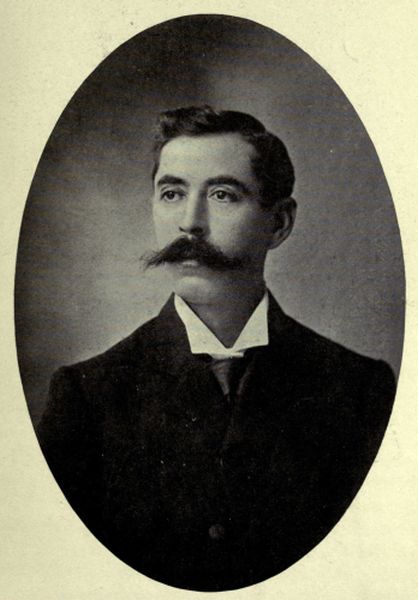
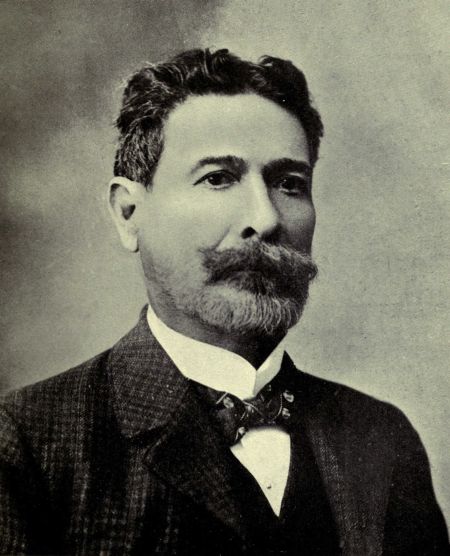
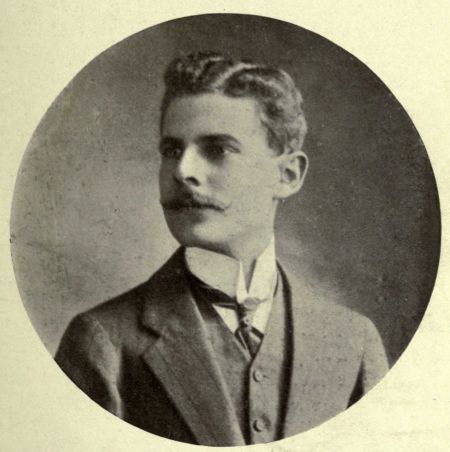
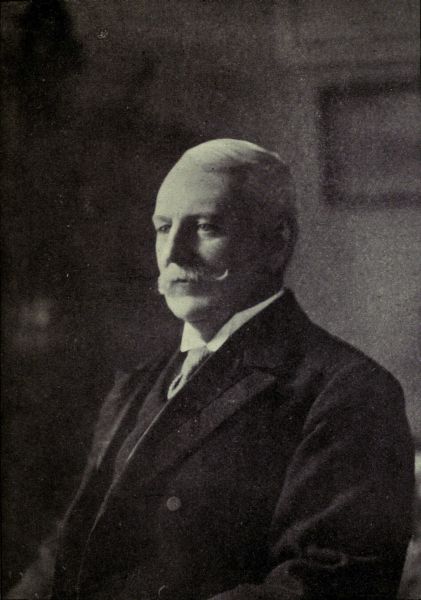
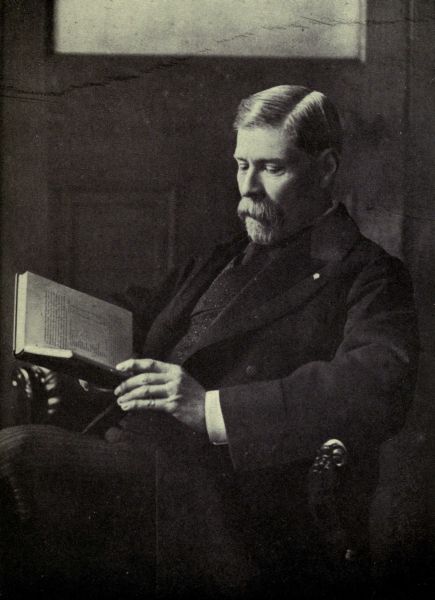
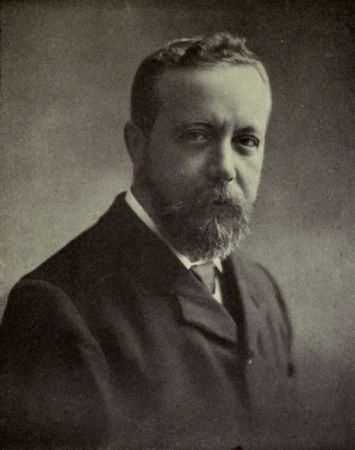
H. E. Dr. Manuel Enrique Araujo;
President of the Republic of Salvador 1911-1915.
Perhaps it is the Ministry of the Interior which is
charged with the most numerous and most important
sections. Upon this Department depend the General
Direction of the Post-Office; the General Direction of
the Telegraph and Telephones; the General Direction
of Police; the Direction of the National Printing
Establishment; the Direction of the Superior Council
of Health; the General Direction of Vaccination, as
well as of the Municipal Treasury and many other small
offices that complete the establishments included in
the public administration.
The number of measures carried out by this one
Ministry during the years 1907 and 1908 amounted,
more or less, to 3,600. The subjects that came under
the jurisdiction of the Secretaryship of State are also
many and complex; and in order to attain results
they demand both constant attention and an intimate
knowledge of the administrative laws, the many
special regulations, the numerous statutes and dispositions
which exist, as well as any quantity of minor
laws.
The Judicial Power is vested in a Supreme Court,
which holds its sittings in the city of San Salvador;
two District Courts, which are also held in the city;
District Courts which are held in the cities of Santa
Ana, San Miguel, and Cojutepeque, as well as periodical
Circuit Courts held in different districts; and
there is a long list of Justices of the Peace.
The Justices of the Supreme Court are elected by
the National Assembly for a term of two years, while
the Judges of the First and Second Instance are
appointed by the Supreme Court for a term of two
years. The Justices of the Minor Courts are elected
by popular vote.
As in most Latin-American countries, the course of
justice is not always speedy, all depositions, no matter
how trivial the case under trial may be, nor whether
it be civil or criminal, having to be laboriously written
out, "examination-in-chief" and "cross-examination"
being practices little known. Naturally, an immense
amount of valuable time is thus consumed, and the
results are anything but conclusive.
To a considerable extent the administration of
justice in Central America is based upon the same
principles as those in force in the United States, and
it is generally admitted, especially by those who have
suffered from them, that these are far from perfect.
The theory of Latin-American justice is excellent, such
theory being that every man is entitled to justice
speedily and without delay, freely and without price.
We all know that this is not the experience of
litigants generally, and in no part of Latin America
can the administration of justice be considered entirely
perfect. Salvador is not worse off than any of its
neighbours in this respect, while, on the other hand,
there is a decided amount of respect entertained for
the judiciary, and few verdicts have been given which
have called forth any protest, nor many rulings handed
down which have excited conflict among the public.
Travellers in Latin-American countries, more often
than not such as pay but a very superficial visit to
those lands, are in the habit of drawing pitiful pictures
of the cruelty practised upon prisoners and injustice
shown towards litigants, and they indulge in harrowing
accounts of "nauseating filth," "poisonous stenches,"
"germs of disease," "bad food," and numerous other,
blood-curdling horrors. However true such descriptions
of some countries are, and I rather imagine that
most of them are the outcome of vivid imagination on
the one hand and of blind prejudice upon the other, it
is certain that nothing of this kind can be truthfully
said about Salvador.
It would be ridiculous to suppose that this Republic
more than any other builds luxuriously-equipped and
comfortable prison-houses, to act as an encouragement
for the committing of crime. The object of punishment,
we are told, is prevention of evil, and we all
know that under no circumstances can it be made
incentive to good. The punishments inflicted upon
Salvadorean prisoners are based upon much about the
same scale as in other countries; but the physical
condition of the prisoners as a whole is infinitely
better than that which is to be met with in any other
Latin-American country, with the two exceptions of
Peru and Mexico.[1] Of all three countries I may say
with every justice that the present prison system is of
a much more lenient and humane nature than that of
any other country in either the old or new world. I
state this deliberately and after having visited most of
the prisons in Latin-American Republics, as well as
many of those to be found in Europe and the United
States.
It is the object of the Government of Salvador to
make as much use of prisoners' services as is legitimate,
and at the same time to find for them intelligent and
useful occupations. While hard work is not always
compulsory, and is not always an accompaniment of a
sentence to imprisonment, every encouragement is
offered to prisoners to engage themselves in some kind
of work; and in many instances substantial payments
are derived from some of the work thus undertaken,
all such payments being carefully preserved for the use
of the prisoners, and handed over to them at the time
of their release. Thus, for instance, in the Penitenciaría
Central, at San Salvador, which is the chief
penal establishment in the Republic, many of the
prisoners are engaged in making furniture for the
public offices, as well as military and police uniforms,
boots, etc., likewise for use in the army and the police
force. I am not sure whether any payment is made
to prisoners for this kind of contribution; but in other
penal establishments which I visited I observed that
the prisoners were making baskets, mats, toys, and
other small articles, which were offered to visitors for
a trifling sum, and in other cases were sent to the
public market for sale.
At the Penitenciaría at Santa Ana the same method
was in vogue with regard to employing prisoners, some
remarkably good furniture, police clothing, and military
boots and shoes, being turned out here also. In this
establishment, as well as in others, the utmost cleanliness
prevails. The long rows of airy and well-ventilated
cells are well lighted, the walls and ceilings
being whitewashed and the floors, built of red brick,
kept scrupulously clean. No furniture of any kind is
allowed to remain in the cells during the day, but at
night mattresses with clean blankets are thrown down
side by side, and the prisoners sleep with their day-clothes
folded up and placed under their heads or
deposited under the mattresses.
In other cells there are light canvas or wooden cots
of an easily detachable nature, which are folded up
and put away during the daytime, so that the cells
are always free from encumbrances of any kind.
Prisoners are allowed to move about freely (unless
under very severe punishment due to violence) from
the cells to the yard, and most of them are engaged
during the daytime in weaving baskets, sewing
materials, or doing some other kind of work which
may be congenial to them. They are not compelled
to wear any special form of clothing nor a degrading
uniform, while some are even permitted to smoke.
Although strictly guarded by armed soldiers, I did
not, when I visited these establishments, witness a
single instance of brutality or overbearing demeanour
on the part of these guardians; on the other hand,
there seemed to be a sort of fraternity between them
and their wards, chatting and laughter proceeding,
apparently, without objection upon the part of the
Governor or Superintendents.
The area of the prison cells was in no case less than
10 feet by 6 feet, and in some instances it was found
to be considerably larger. All ablutionary exercises
take place in the paved yard of the prison, and
prisoners are compelled to bathe at least once a week
in the open air; those who are so inclined may take a
bath once every day. The food, which I had the
opportunity of tasting, seemed thoroughly wholesome
and plentiful, meat being provided in quantities as
well as boiled maize, beans (frijoles), and coffee of
excellent quality.
I can only repeat that, from close personal observation,
I am unable to endorse any of the harrowing
descriptions of prison barbarities, which I have referred
to above, as applying in any way to Salvadorean
penitentiaries.
Considerable attention has been paid to the establishment
and maintenance of a thoroughly efficient
Police Force, by the late Director-General, General
Enrique Bará, who has studied the question of Police
administration in Europe and the United States, and
has applied most of the good points which he found
existing there to the Police organization in the
Republic of Salvador.
All Police are under the control of the Minister of
the Interior—Ministerio de Gobernación—although
the organization itself is a military one. The severest
discipline is maintained, and the men are moderately
well paid. They seem, moreover, to be drawn from
the better classes instead of from the worst, as is so
often, unfortunately, the case in some parts of Latin
America.
All the larger towns, such as Santa Ana, San Miguel,
Sonsonate, La Unión, etc., have their own well-organized
Police Force, each placed under a responsible
officer, but all of them directly dependent upon, and
subject to control from, the Capital. Especial care is
taken to organize both the day and night corps, and,
as a consequence of the strictness which is maintained,
very few robberies, and scarcely any murders, take
place nowadays in the Capital or chief towns.
The Superior Officers of the Police Force consist of
the following:
1 Director-General.
1 Sub-Director.
1 Secretario de la Dirección (Secretary to the Director-General).
1 Tesorero Específico (Special Treasurer).
1 Instructor.
1 Ayudante de la Dirección (Adjutant to the Director).
1 Juez Especial de Policia (Special Police Magistrate).
1 Secretario del Juzgado de Policia (Secretary to the Police Magistrate).
1 Guarda-Almacén (Storekeeper).
1 Escribiente de la Dirección (Amanuensis to the Director).
1 Escribiente del Juzgado (Amanuensis to the Magistrate).
1 Escribiente de la Comandancia (Amanuensis to the Commandant).
1 Medico del Cuerpo (Doctor to the Corps).
1 Practicante (Assistant-Surgeon).
1 Telegrafista (Telegraphist).
3 Barberos (Barbers).
2 Asistentes (Assistants).
The present Director-General of the Police is General
Gregorio Hernández A., who was appointed in the
month of May last (1911).
The Capital is divided up into seven different
districts or zones, each zone being policed as follows:
Zone 1: 1 Comandante (Chief Superintendent in Charge), 1 Sergeant,
4 Inspectors, and 60 Policemen.
Zone 2: Same as Zone 1.
Zone 3: 1 Comandante, 1 Sergeant, 3 Inspectors, and 60 Policemen.
Zone 4: 1 Comandante, 1 Sergeant, 2 Inspectors, and 64 Policemen.
Zone 5: 1 Comandante, 1 Sergeant, 2 Inspectors, and 64 Policemen.
Zone 6: 1 Comandante, 1 Sergeant, 2 Inspectors, and 56 Policemen.
Zone 7: 1 Comandante, 1 Sergeant, 2 Inspectors, and 40 Policemen.
In this last zone the policemen are mounted.
The different Departments are also well policed, as
follows:
New San Salvador (Santa Tecla), having 1 Comandante (Superintendent
and Director), 2 Inspectors, and 40 Policemen.
Sonsonate: 1 Comandante (Superintendent and Director), 1 Sub-Director,
1 Secretario, 3 Inspectors, and 32 Policemen.
Cojutepeque: 1 Director, 2 Inspectors, and 25 Policemen.
Atiquizaya: 1 Director, 1 Inspector Secretario, 1 Sub-Inspector (or
Second Inspector), and 15 Policemen.
San Vicente: 1 Comandante (Director), 3 Inspectors, and 21 Policemen.
Ahuachapán: 1 Director, 1 Secretario, 3 Inspectors, and 27 Policemen.
Chalchuápa has two Zones, which are policed as follows: First:
1 Director, 2 Inspectors, and 27 Policemen. Second: 1 Director,
2 Inspectors, and 18 Policemen.
Santa Ana: 1 Director, 1 Sub-Director, 1 Secrétario, 1 Guarda-Almacen,
2 Escribientes, 150 Policemen, 1 Comandante de Dragones, 1 Sergeant,
and 40 Mounted Men.
San Miguel: 1 Director, 1 Sub-Director, 4 Inspectors, and 57 Policemen.
La Unión: 1 Director, 1 Sub-Director, 3 Inspectors, and 40 Policemen.
Zacatecoluca: 1 Director, 2 Inspectors, and 18 Policemen.
The total personnel of the Salvadorean Police Force
is as follows:
| In the Capital (including the Superior Officers above mentioned) | 454 | men. |
| New San Salvador (Santa Tecla) | 43 | " |
| Sonsonate | 38 | " |
| Cojutepeque | 28 | " |
| Atiquizaya | 18 | " |
| San Vicente | 25 | " |
| Ahuachapán | 32 | " |
| Chalchuapa | 20 | " |
| Usulután | 21 | " |
| Santa Ana | 174 | " |
| San Miguel | 63 | " |
| La Unión | 51 | " |
| Zacatecoluca | 21 | " |
| Total | 988 | men. |
The Government of Salvador are of opinion, and
very rightly so to my thinking, that inasmuch as
education is compulsory it ought to be free, since
the State, by depriving parents of the labour of their
children, entails some sacrifices on them. It has also
relieved them of the burden of paying any kind of
school fees; and this in a country like Salvador, which
possesses naturally a great proportion of humble inhabitants,
to whom the payment of even the lightest
fees would appear an immense taxation, means a great
deal. To organize a system of collecting fees from
among the people living long distances from the
Capital would also have been onerous; and the
Government saves all this, and many other outlays,
while procuring the best results from its educational
system. The benefits arising, moreover, will be reaped
by future generations, since a liberal education is a
matter in which all citizens are interested; and there
is certainly no hardship in calling upon all to contribute
by means of a moderate tax towards that
end.
As I have said, the happiest results have been
achieved by the Government's broad and comprehensive
system of education in Salvador. The authorities
combine with the municipalities in carrying out their
arrangements, and the teachers of both sexes are
drawn from among the best and most cultured classes
of the community.
There has been established since July, 1907, a Board
of Education (Junta de Educación), which is subject to
the directorship of a specially-appointed Minister and
Sub-Secretario of Public Instruction. In the month
of November, 1907, an important conference was
summoned, and held meetings at the Capital, at which
the curriculum to be adopted was fully discussed, and
the plans for the carrying on of all places of private
and public education was entirely reorganized. The
whole system of conducting elementary, normal, and
advanced schools, holding day and night classes, granting
scholarships and holding periodical examinations,
has now been placed upon a thoroughly sound and
comprehensive basis; and it is only just to say that
in this respect the Republic of Salvador compares
most favourably with any country in Europe, or with
any educational system in the United States of
America.
The education of the sexes is conducted in the same
elementary schools, and not only is this found an
economy, but the feminine mind is found here (as in
Scotland and elsewhere) to become strengthened when
put through the curriculum given to boys and men.
Competition is greater between the sexes than between
rivals of the same sex, and a correspondingly higher
standard of achievement is obtained. It has been
found in Latin America, where until recent years
women were kept in ignorance and were denied the
attainment of any but social positions in the community,
that constant intercourse between the sexes
had led to a more perfect development of character,
and had materially diminished shyness. Marriages
are now made of a safer kind, and a new and more
intelligent class of citizen is springing up, all of which
facts will tend in due course to bring about a more
complete political settlement and the introduction of
permanent order among the people. Although by no
means as yet extinct, the conventual existence for the
women of Salvador is fast diminishing, and they are
commencing to realize the advantages and pleasures
of living under freer and less morbid conditions than
formerly.
Santa Ana seems to be essentially the educational
centre of the Republic; for whereas schools, colleges,
and Universities are to be found in all of the Departments,
in Santa Ana there are no fewer than thirty-three
such establishments, besides several private schools
and seminaries. San Salvador has between 6 and 7 important
educational institutes, and many small private
schools; Cuscutlán has 8 or 9; La Paz, 7 or 8; Sonsonate,
5 or 6; while Ahuachapán, Chalatenango,
Cabañas, San Vicente, La Unión, Morazán, and La
Libertad, are all similarly well provided.
The teaching staff at present employed under
Government control numbers something over 1,100,
and is divided up into Directors, Sub-Directors, Auxiliary
Professors, these being composed of both the
male and the female sex. These latter are in a small
minority, but, still, there are over 278 Lady Directors,
over 120 Sub-Directors, and 100 Professors.
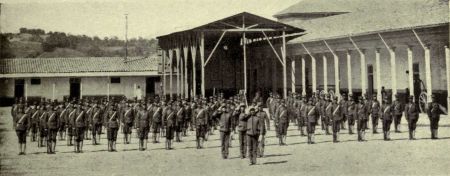
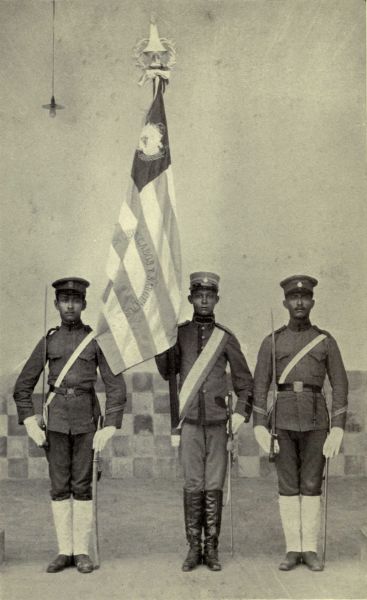
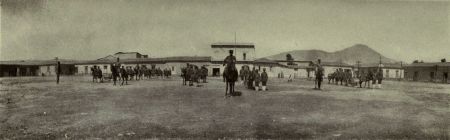
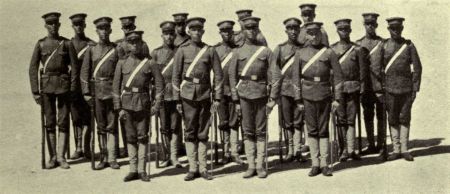
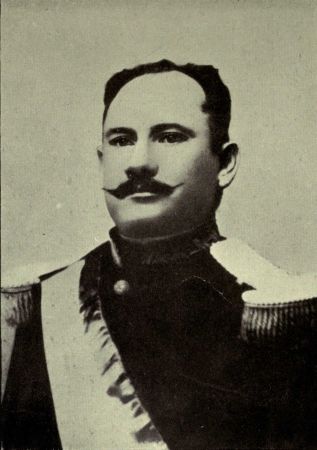
The 3rd Company, Sergeants' School, in Review Order.
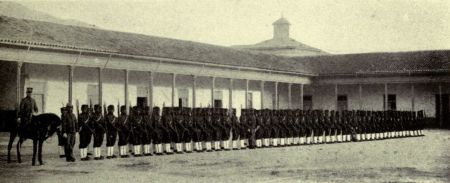
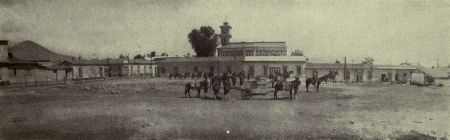
Company in line, Sergeants' School.
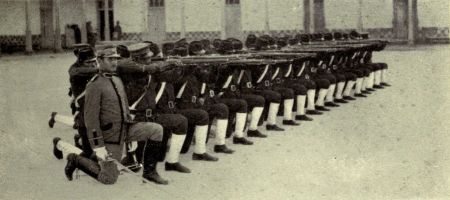
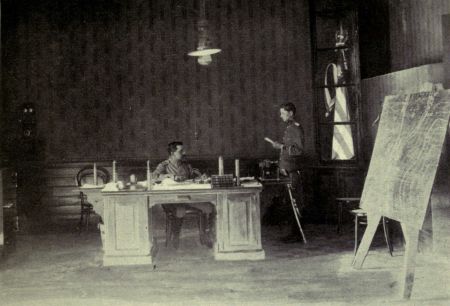
Section of Riflemen kneeling, Sergeants' School.
The proportion of pupils matriculating is extremely
high, and in this respect the girls come very close in
point of number, as also in the number of marks
obtained, to the boys. The Government provides all the
necessary books, stationery, models, apparatus, etc., for
the use of the pupils, and these latter are not put to one
penny expenditure for anything that they may require.
It is considered absolutely proper and consistent with
the dignity of the family for a Salvadorean child to
receive a Government free education; and as this
is divorced from all compulsory religious instruction,
children of all denominations, or of none, can participate.
As a matter of fact, practically all attending
are of the Roman Catholic faith, but no dogmatic
teaching is resorted to in any establishment under
Government control.
Mention should be made of the very useful and
successful educational establishments which the Government
has organized and supported since 1907, such as
the Medical and Surgical College, Chemistry and
Dental Schools, Commerce and Industry College, as
well as the National University, which has been
entirely remodelled and reorganized since December 15,
1907.
Upon several occasions the Government has found
the necessary money to send a particularly promising
pupil to Europe or to the United States, for the
purposes of study and receiving the finest training
that the world of art and letters can offer. The last
pupil to be sent to study music at the expense of the
Government was Señorita Natalia Ramos, who left for
Italy in the month of May (1911), and is now making
good progress there. In every sense of the word the
Salvadorean Government has proved a "paternal
Government" in these respects; and many a genius
has been rescued from probable obscurity, and much
dormant talent has been fostered and encouraged for
the benefit of the community at large as well as to the
lasting advantage of the individual.
Attention on the part of the Government is now
being given to a further modification in the system
of primary instruction; and this is being effected
gradually, it being proposed as a preliminary to
establish several high schools throughout the country.
A School of Agriculture, with all necessary elements
and machinery, was inaugurated during the year 1908.
Mixed primary schools in the country now number 132,
with a total number of registered pupils amounting to
34,752. Expenditures for 1907 under this head were
nearly $400,000, and in addition there are many
private institutions where primary instruction only
is given. Academic teaching is in the charge of
the National University of San Salvador, embracing
schools of law, medicine, pharmacy, dentistry, civil
engineering, etc.
In no other part of the Government service has
greater improvement been manifested than in the
Department of Posts. This Department is supported
out of its own revenues, and the service during the
past few years has been extended to a very considerable
extent, while the credit of the Central Office has
been maintained by punctuality in the payments of
the foreign postal service. Among the more notable
Conventions celebrated have been those with the
Republic of Mexico for the exchange of parcels and
money orders, and a triweekly postal service introduced
to the neighbouring Republic of Guatemala via
Jerez; a postal service has also been established with
the same country via Zacapa. It is satisfactory to be
able to state that since the inauguration of these
additional services, which took place early in 1907,
scarcely any interruptions have occurred, not even in
the rainiest weather, a fact which may be attributed
to the zeal and ability of the officials and employés of
the Postal Department.
The annual expenditure of this branch of the public
service has increased from $87,084 in 1902, $102,787
in 1903, $121,756 in 1904, $142,855 in 1905, $161,662
in 1906, to over $200,000 in 1910. The regularity
and rapidity with which the house-to-house postal
deliveries take place in the Capital and principal cities
of the Republic have frequently been noticed, and
favourably commented upon, by foreigners sojourning
in Salvador. Honesty among the employés is no less
a feature of the postal arrangements in this Republic,
where all public servants are reasonably paid and are as
diplomatically handled, so that general contentment
obtains among the large class of public servants
employed.
The Parcel Post Department is also exhibiting from
year to year notable increases, as the following figures
will show: $44,613.55 in 1901; $58,096.27 in 1902;
$68,467.30 in 1903; $88,557.60 in 1904; $90,662.72
in 1905; $93,295.80 in 1906; and for the first six
months in 1907 the figures given are $51,654.86, or at
the rate of $103,000 for the whole year.
A Postal Convention for the exchange of money
orders between Salvador and Great Britain was signed
in London on June 27, 1907, in San Salvador on the
following August 27, 1907, and, after being approved
by the President, General Figueroa, took effect on
September 5, 1907, the exchange offices being situated
at San Salvador and London respectively.
The telegraph and telephone service has also
increased consistently, especially since 1903, at which
time as an economic measure, and for the convenience
of the public, a considerable reduction took place in
the amounts of the charges. There has been a large
increase in telephonic connections, and several new
offices have been established, while the old ones have
been considerably improved, necessitating large outlays
for this purpose, as well as for works and
materials. Many hundreds of miles of new telephone
and telegraph lines have been added to the system, of
late there has been a marked increase in the telephone
and telegraph apparatus, and the personnel of the system
has been proportionately augmented. There have been
two handsome towers constructed at San Salvador, and
another at Santa Ana, for the introduction of wires to
the Central Offices, and the system in vogue leaves
little to be desired either in regard to efficiency or completeness.
The general budget for telegraphs and telephones
has risen steadily, from a little over $260,000,
in 1902, to over $500,000, in 1910.
During the year 1910 the number of cablegrams
received in the Republic were as follows: Cables sent
from Salvador, 7,877; received in the Republic, 8,723.
In those transmitted there were used 61,727 words,
and in those received 75,950. Total of cables sent
and received, 16,600 = 137,677 words. The amount
represented in cost was $96,450.47, and of this the
Government received $23,994.27.
Considerable progress has been made in Salvador in
connection with wireless telegraphy, this being one of
the first—if not the first—of the Central American
Republics to adopt the new system of communication.
By the time these pages are in the hands of the reading
public, the Government will have completed two
additional wireless stations, one at Planes de Renderos,
near the Capital (San Salvador), and the other at the
Port of La Libertad. With the completion of these
stations, wireless communication will have been established
between the Capital and all the ports of the
Republic.
The electric light service used and supported by the
Government has also increased. In 1902 the total
cost was barely $25,000, whereas to-day it amounts to
over $50,000, exclusive of the value of subventions by
which several of the electric light companies have been
aided by the Government.
In connection with the recently-held Central
American Conference convened in Guatemala City, and
at which representatives of all five Central American
States were present, great improvements were resolved
upon in reference to the postal arrangements between
these States. It was determined, for instance, to
introduce a much more comprehensive parcels post;
and although the dimensions of articles which may be
sent were not much extended, the character of the
commerce carried through the post was considerably
broadened, with beneficial results to all of the different
States. It was, among other things, decided to prevent
any libellous or indecent publications passing
through the Post-Office; and here a distinct improvement
has been made upon British Post-Office methods,
which permit of the carrying of any sort of literature
so long as it is covered from inspection. The Central
American postal authorities reserve the right—and
exercise it—to open and retain anything which they
suspect to be of a dangerous or wrongful nature, and
thus they act with more intelligence than some of their
European brethren.
The Regulation for the Control of the Postal Service,
as passed by the Government on September 26,
1893, was found wholly unfit for this important
branch; and from that date to the present, continual
reforms have been introduced into the postal service,
which now stands among the best regulated in Central
America. In the Fiscal Estimate of the year 1907,
passed by the National Congress, several notable
economies were introduced, such as the suppression of
some of the too numerous employés, and reduction of
the salaries of others; while these measures seemed
opportune, they did not work well in practice, neither
did they give good results. The Ministry was obliged,
therefore, to again make alterations in order to insure
permanent order in the postal department.
By a resolution of September 28 and October 24
respectively, the Government arranged to suppress
the office of Administrator of the Post-Offices in the
different Capitals of the Departments, joining the
functions of that to those of the Administrator of
Revenues, but without augmenting the pay for this
additional service. From this arrangement, however,
the offices of Santa Ana, Sonsonate, and San Miguel,
were excepted, while some others were annexed to the
Department of the Fiscal Receiver and to the respective
telegraph-offices.
At present the active staff of the Postal Service of
the Republic is composed of 327 individuals, organized
in the following departments: General Direction;
Departmental Administrations; Postal Contractors.
The General Direction is subdivided thus: Sub-Direction;
Secretary; Bookkeeper and Cashier; Office of
Postal Statistics; Keeper of Stores; Amanuensis; and
Keeper of the Archives. The Chiefs are those of the
Foreign Department, of the Interior, of Registered
Letters, of Parcels Post, and of Poste Restante and
Unclaimed Letters Department. There are besides
five Assistants, two Transmitters of Postal Specie,
twenty-two letter-carriers, and forty-eight junior
postmen.
The Exchange Offices include three Administrators,
three Superintendents, and six letter-carriers. Those
of the first class are—six Administrators, six superintendents,
sixteen letter-carriers, and twenty-five
postmen. Those of the second class are—six Administrators
and eight letter-carriers. Those of the third
class are—nineteen Administrators and an equal
number of letter-carriers. Those of the fourth class
are—forty-three Administrators and forty-three letter-carriers;
and these are again sub-administered by the
respective municipalities. There are seven Postal
Contractors, who have in their service some forty or
fifty subordinates. Three Postal Agencies complete
the service, namely—one in Panama (Central America),
one in the Sitio del Niño (a station on the Salvador
Railway), and the other in Parras Lempa.