SALT MINES AND CASTLES — (1) PARIS—LONDON—VERSAILLES
“Your name’s not on the passenger list,” said Craig when I walked
into the waiting room of the Patuxent airport. “You’d better see
what you can do about it.” It was a hot spring night and I had
just flown down from Washington, expecting to board a transatlantic
plane which was scheduled to take off at midnight.
“There must be some mistake,” I said. “I checked on that just
before I left Washington.” Craig went with me to the counter
where I asked the pretty WAVE on duty to look up my name. It
wasn’t on her list.
“Let’s see what they know about this at the main office,” she
said with an encouraging smile as she dialed Naval Air Transport
in Washington. The next ten minutes were grim. The officer at
the other end of the line wanted to know with whom I had checked.
Had it been someone in his office? I didn’t know. All I knew was
that I had to get on that plane. I had important papers which had
to be delivered to our Paris office without delay. Was I a courier?
Yes, I was—well, that is, almost, I faltered to the WAVE ensign
who had been transmitting my replies. “Here, you talk to him,”
she said, adding, as she handed me the receiver, “I think he can
fix it up.”
After going through the same questions and getting the same
answers a second time, the officer in Washington asked to speak
to the yeoman who was supervising the loading of the plane. He
was called in and I waited on tenterhooks until I heard him say,
“Yes, sir, I can make room for the lieutenant and his gear.” Turning
the phone over to the WAVE, he asked with a reassuring grin,
“Feel better, Lieutenant?”
I was so limp with relief that I scarcely noticed the tall spare
man in civilian clothes who had just come up to the counter.
“That’s Lindbergh,” said Craig in a low voice. “Do you suppose
he’s going over too?”
Half an hour later we trooped out across the faintly lighted field
to the C-54 which stood waiting. Lindbergh, dressed now in the
olive-drab uniform of a Naval Technician, preceded us up the
steps. There were ten of us in all. With the exception of three
leather-cushioned chairs, there were only bucket seats. Craig and
I settled ourselves in two of these uninviting hollows and began
fumbling clumsily with the seat belts. Seeing that we were having
trouble, Lindbergh came over and with a friendly smile asked if
he could give us a hand. After deftly adjusting our belts, he returned
to one of the cushioned seats across the way.
Doors slammed, the engines began to roar and, a few seconds
later, we were off. We mounted swiftly into the star-filled sky
and, peering out, watched the dark Maryland hills drop away. We
dozed despite the discomfort of our bent-over positions and didn’t
come to again until the steward roused us several hours later with
coffee and sandwiches. Afterward he brought out army cots and
motioned to us to set them up if we wanted to stretch out. As soon
as we got the cots unfolded and the pegs set in place, he turned out
the lights.
Craig was dead to the world in a few minutes but I couldn’t get
back to sleep. To the accompaniment of the humming motors, the
events of the past weeks began to pass in review: that quiet April
afternoon at Western Sea Frontier Headquarters in San Francisco
when my overseas orders had come through—those orders I had
been waiting for so long, more than a year. It was in March of
1944 that I first learned there was a chance of getting a European
assignment, to join the group of officers working with our armies
in the “protection and salvaging of artistic monuments in war
areas.” That was the cumbersome way it was described. The
President had appointed a commission with a long name, but it
came to be known simply as the Roberts Commission. Justice
Roberts of the Supreme Court was the head of it. It was the first
time in history that a country had taken such precautions to safeguard
cultural monuments lying in the paths of its invading armies.
It was the commission’s job to recommend to the War Department
servicemen whose professional qualifications fitted them for
this work. I had been in the Navy for two years. Before that I had
been director of the California Palace of the Legion of Honor, one
of San Francisco’s two municipal museums of the fine arts. The
commission had recommended me, but it was up to me to obtain
my own release. I had been in luck on that score. My commanding
officer had agreed to let me go. And more important, my wife
had too. Only Francesca had wanted to know why Americans
should be meddling with Europe’s art treasures. Weren’t there
enough museum directors over there to take care of things? Of
course there were in normal times. But now they needed men in
uniform—to go in with the armies.
And after all that planning nothing had happened, until three
weeks ago. Then everything had happened at once. The orders
directed me to report to SHAEF for duty with the Monuments,
Fine Arts and Archives Section, G-5, and additional duty with the
Allied Control Council for Germany.
The papers had been full of stories about German salt mines—the
big one at Merkers where our troops had found the Nazi
gold and the treasures from the Berlin museums. I was going to
Germany. Would I find anything like that?
I had flown to Washington to receive last-minute instructions.
I was to make the trip across by air and was given an extra allowance
of twenty-five pounds to enable me to take along a dozen
Baedekers and a quantity of photographic paper for distribution
among our officers in the field. I had been introduced to Craig
Smyth while in the midst of these final preparations. Like me, he
was a naval lieutenant and his orders were identical with mine. He
was a grave young Princetonian, formerly on the staff of the
National Gallery of Art in Washington.
It was raining when we reached Stevensville, Newfoundland,
early the next morning. After an hour’s stop we were on our way
again. Shortly before noon we struck good weather and all day
long sea and sky remained unvaryingly blue. Late in the afternoon
we landed on the island of Terceira in the Azores. We had set
our watches ahead two hours at Stevensville. Now we set them
ahead again. We took off promptly at seven. This was the last
lap of the journey—we’d be in Paris in the morning. Presently
our fellow passengers settled down for the night. Two of the
cushioned chairs were empty, so Craig and I took possession. They
were more comfortable than the cots, and as soon as the steward
turned out the lights I dropped off to sleep.
It was still dark when I awoke hours later, but there was enough
light for me to distinguish two black masses of land rising from the
sea. On one, the beacon of a lighthouse revolved with monotonous
regularity. We had just passed over two of the Channel Islands.
The dawn came rapidly and a pink light edged the eastern horizon.
It was not long before we sighted the coast of France. We flew
into rosy clouds and, as they billowed about the plane, we caught
tantalizing glimpses of the shore line below. The steward pointed
out one promontory and told us it was Brest. Soon we had a
spectacular view of Mont St. Michel and the long causeway over
which I had driven years before on a sketching tour in Normandy.
I wondered what had become of Mère Poulard and her wonderful
omelettes and lobster. Some people said they had brought more
visitors to Mont St. Michel than the architecture. Very likely she
was dead and the Germans had probably disposed of her fabulous
cuisine.
We had lost two more hours in the course of the night, so it was
only seven-thirty when we swooped down at Orly field, half an
hour from Paris. It was a beautiful morning and the sun was so
bright that it took us a few minutes to get accustomed to the glare.
As we walked over to the airport office, we had our first glimpse
of war damage at close range—bombed-out hangars and, scattered
about the field, the wreckage of German planes. But the airport
was being repaired rapidly. Trim new offices had been built and
additional barracks were nearing completion. Craig and I booked
places on the afternoon plane for London and then climbed onto
the bus waiting to take us into Paris.
Thanks to various delays in getting out of Washington, we had
missed the Paris celebration of VE-Day by a margin of three days.
So we were about to see the wonderful old city at the beginning of
a period of readjustment. But a peaceful Sunday morning is no
time to judge any city—least of all Paris. Everything looked the
same. The arcades along the right side of the Rue de Rivoli and
the gardens at the left were empty, as one would expect them to
be. We turned into the Rue Castiglione and came to a halt by the
column in the Place Vendôme.
After we had checked our bags at the ATC office, we walked
over to the Red Cross Club on the Place de la Concorde. We
shaved, washed and then had doughnuts and coffee in the canteen.
Our next move was to call Lieutenant Colonel Geoffrey Webb,
the British officer who was head of the MFA&A Section at SHAEF
headquarters in Versailles. Before the war, Colonel Webb had
been Slade Professor of Art at Cambridge. I explained to him that
Smyth and I had arrived but that our orders directed us to report
first to Naval Headquarters in London—ComNavEu—and that
as soon as we had complied with them we would be back. That
was all right with the colonel. He said that Lieutenant Kuhn,
USNR, his deputy, was away on a three-day field trip and wouldn’t
be returning before the middle of the week. And we were primarily
Charlie Kuhn’s problem.
With that formality out of the way, we retrieved our luggage
and wheedled the ATC into giving us transportation to the Royal
Monceau, the Navy hotel out near the Étoile. It was time to relax
and luxuriate in the thought that it was May and that we were in
Paris—that climatic and geographic combination so long a favorite
theme of song-writers. I thought about this as we drove along
the Champs Élysées. The song writers had something, all right—Paris
in May was a wonderful sight. But they had been mooning
about a gala capital filled with carefree people, and the Paris of
May 1945 wasn’t like that. Architecturally, the city was as elegant
as ever, but the few people one saw along the streets looked anything
but carefree. And there were no taxis. Taxis have always
seemed to me as much a part of Paris as the buildings themselves.
In spite of a superficial sameness, Paris had an air of empty magnificence
that made one think of a beautiful woman struck dumb by
shock. I wondered if my thoughts were running away with me,
but found that Craig’s impressions were much the same.
These musings were cut short by our arrival at the hotel. The
Navy had done all right for itself. The same efficient French staff
that had presided over this de luxe establishment in prewar days
was still in charge. I left the Baedekers and photographic paper
for Charlie Kuhn, and then Craig and I walked to Naval Headquarters
in the Rue Presbourg. There we attended to routine matters
in connection with our orders. It was almost noon by the time
we got squared away, so we retraced our steps to the Monceau.
Lunch there was a demonstration of what a French chef could do
with GI food.
Midafternoon found us headed back to Orly in a Navy jeep. Our
plane was scheduled to leave at four. This was no bucket-seat job,
but a luxurious C-47 equipped with chairs of the Pullman-car
variety, complete with antimacassars. We landed at Bovingdon
less than two hours later and from there took a bus up to London.
Naval Headquarters was in Grosvenor Square. With the American
Embassy on one side of it, the Navy on another, and the
park in the center used by the Navy motor pool, the dignified old
square was pretty thoroughly Americanized.
London was still crowded with our armed forces. The hotels
were full, so we were assigned to lodgings in Wimpole Street.
These were on the third floor of a pleasant, eighteenth century
house, within a stone’s throw of No. 50, where Elizabeth Barrett
had been wooed and won by Robert Browning. An inspection of
our quarters revealed that the plumbing was of the Barrett-Browning
period; but the place was clean and, anyway, it wasn’t likely
that we’d be spending much time there. It had been a long day and
we were too tired to think of anything beyond getting a bite to eat
and hitting the sack.
For our two days in London we had “Queen’s weather”—brilliant
sunshine and cloudless skies. Our first port of call early the
next morning was the Medical Office, where we were given various
inoculations. From there Craig and I went across the square to the
American Embassy for a long session with Sumner Crosby, at that
time acting as the liaison between the Roberts Commission and its
British counterpart, the Macmillan Committee. Sumner provided
us with a great deal of useful information. The latest reports from
Germany indicated that caches of looted art were being uncovered
from day to day. The number of these hiding places ran into the
hundreds. The value of their contents was, of course, incalculable.
Only a fraction of the finds had as yet been released to the press.
Craig and I began licking our chops at the prospect of what lay
ahead. Had we made a mistake in planning to stay two days in
London? Perhaps we could get a plane back to Paris that evening.
Sumner thought not. There were several things for us to do on the
spot, things that would be of use to us in our future activities. One
was to call on Colonel Sir Leonard Woolley, the British archaeologist
who, with his wife, was doing important work for the Macmillan
Committee. Another was to see Jim Plaut, a naval lieutenant
at the London office of OSS. He would probably have valuable
information about German museum personnel. It would be helpful
to know the whereabouts of certain German scholars, specifically
those whose records were, from our point of view, “clean.”
Sumner made several appointments for us and then hurried off
to keep one of his own. Craig and I stayed on at the office to study
the reports. Sumner had already given us the glittering highlights.
By noon our heads were filled with facts and figures that made E.
Phillips Oppenheim seem positively unimaginative. And The
Arabian Nights—that was just old stuff.
It was late afternoon when we finished calling on the various
people Sumner had advised us to see, but plenty of time remained
to do a little sightseeing before dinner. The cabbie took us past
Buckingham Palace, along the Embankment, Birdcage Walk, the
Abbey, the Houses of Parliament and finally to St. Paul’s. What
we saw was enough to give a cruel picture of the damage the Germans
had inflicted on the fine old monuments of London.
Craig and I flew back to Orly the following evening, arriving
too late to obtain transportation into Paris. We spent an uncomfortable
night in the barracks at the airport and drove to the Royal
Monceau early the next morning. It was stiflingly hot and I was
in a bad humor in spite of the soothing effect of a short haircut—the
kind Francesca said needed a couple of saber scars to make it
look right. My spirits fell still lower when Craig and I were told
that we could stay only two nights at the hotel. Since we were assigned
to SHAEF, it was up to the Army to billet us. It seemed
rather unfriendly of the Navy, but that’s the way it was and there
wasn’t anything we could do about it.
After lunch we set out for Versailles in a Navy jeep. It was a
glorious day despite the heat, and the lovely drive through the
Bois and on past Longchamps made us forget our irritation at
the Navy’s lack of hospitality. The office of the Monuments, Fine
Arts and Archives Section was in two tiny “between-floor” rooms
in the Grandes Écuries—the big stables which, together with their
matching twin, the Petites Écuries, face the main palace.
When we arrived Colonel Webb was deep in conference with a
lady war correspondent. The tall, rangy colonel, who reminded me
of a humorous and grizzled giraffe, came out to welcome Craig
and me. His cordiality was overwhelming at first, but we soon
learned the reason. Miss Bonney, the correspondent, was giving the
colonel a bad time and he needed moral support. She was firing a
rapid barrage of searching questions, and in some cases the colonel
didn’t want to answer. I was fascinated by his technique. He obviously
didn’t wish to offend his inquisitor, but on the other hand
he wasn’t going to be pressed for an expression of opinion on
certain subjects. At times he would parry her query with one of his
own. At others he would snort some vague reply which got lost in
a hearty laugh. Before the interview was over, it was Miss Bonney
who was answering the questions—often her own—not the colonel.
Neither Craig nor I could make much of what we heard, but
after Miss Bonney’s departure the colonel took us into his confidence.
Somewhere this indomitable lady had got hold of stray bits
of information which, properly pieced together, made one of the
most absorbing stories of the war, as far as Nazi looting of art
treasures was concerned. The time was not yet ripe to break the
story, according to the colonel, so it had been up to him to avoid
giving answers which would have filled in the missing pieces of
the puzzle.
Then the colonel proceeded to tell us about the Einsatzstab
Rosenberg, the infamous “task force”—to translate the word literally—organized
under the direction of Alfred Rosenberg, the
“ideological and spiritual leader” of the Reich, for the methodical
plundering of the great Jewish collections and the accumulated
artistic wealth of other recognized “enemies of the state.” Rosenberg
was officially responsible for cultural treasures confiscated in
the occupied countries. He had virtually unlimited resources at
his command. In the fall of 1940, not long after his appointment,
Rosenberg received a congratulatory letter from Göring in which
the Reichsmarschall promised to support energetically the work of
his staff and to place at its disposal “means of transportation and
guard personnel,” and specifically assured him the “utmost assistance”
of the Luftwaffe. Even before the war, German agents had
accumulated exhaustive information concerning collections which
were later to be confiscated. The whereabouts of every object of
artistic importance was known. Paintings, sculpture, tapestries,
furniture, porcelain, enamels, jewels, gold and silver—all were a
matter of record. When the Nazis occupied Paris, the Rosenberg
Task Force was able to go into operation with clocklike precision.
And so accurate was their information that in many instances they
even knew the hiding places in which their more foresighted victims
had concealed their valuables.
The headquarters of the E.R.R.[1] had been set up in the Musée
du Jeu de Paume, the little museum in the corner of the Tuileries
Gardens overlooking the Place de la Concorde. The large staff was
composed mainly of Germans, but some of the members were
French. Looted treasures poured into the building, to be checked,
labeled and shipped off to Germany. But it was more than a clearing
house. The choicest things were placed on exhibition and to
these displays the top-flight Nazis were invited—to select whatever
caught their fancy. Hitler had first choice, Göring second.
It did not occur to the members of the E.R.R. staff that their every
move was watched. A courageous Frenchwoman named Rose
Valland had ingratiated herself with the “right people” and had
become a trusted member of the staff. During the months she
worked at the museum, she had two main objectives. One was to
sabotage the daily work as much as possible by making intentionally
stupid mistakes and by encouraging the French laborers, engaged
by the Germans, to do likewise. The other, and far and
away the more important, was the compilation of a file, complete
with biographical data and photographs, of the German personnel
at the Jeu de Paume. How she ever accomplished this is a mystery.
The colonel said that Mlle. Valland, now a captain in the French
Army, was working with the official French committee for Fine
Arts. She had already provided our Versailles office with a copy
of her E.R.R. file. Later in the summer I met Captain Valland, a
robust woman with gray hair and the most penetrating brown eyes
I have ever seen. I asked her how she had ever had the courage to
do what she had done. She said with a laugh, “I could never do it
again. The Gestapo followed me home every night.”
After regaling us with this account of the E.R.R., Colonel Webb
whetted our appetites still further with an outline of what his
deputy, Charlie Kuhn, was up to. As the result of a “signal,” he
had taken off by plane for Germany, and at the moment was
either in the eastern part of Bavaria or over the Austrian border,
trying to trace two truckloads of paintings and tapestries which two
high-ranking Nazis had spirited away from the Laufen salt mine at
the eleventh hour. Latest information indicated that the finest
things from the Vienna Museum had been stored at Laufen, which
was in the mountains east of Salzburg; and it was further believed
that the “top cream” of the stuff—the Breughels, Titians and
Velásquezes—was in those two trucks. These pictures were world-famous
and consequently not marketable, so there was the appalling
possibility that the highjackers had carried them off with the
idea of destroying them—Hitler’s mad Götterdämmerung idea.
There was also the possibility that they intended to hold the pictures
as a bribe against their own safety.
Back at the hotel that night, Craig and I reviewed the events of
the day. What we had learned from Colonel Webb was only an
affirmation of the exciting things we had gleaned from the reports
in the London office. We were desperately anxious to get into Germany
where we could be a part of all these unbelievable adventures
instead of hearing about them secondhand. Strict censorship
was still in force, so we weren’t able to share our exuberance with
our respective families in letters home. But we could at least exult
together over the fantastic future shaping up before us.
We found Charlie Kuhn at the office the next morning. He was
a tall quiet fellow with a keen sense of humor, whom I had first
known when we had been fellow students at Harvard back in the
twenties. During the intervening years we had met only at infrequent
intervals. He had remained to teach and had become an outstanding
member of the Fine Arts faculty in Cambridge, while I
had gone to a museum. His special field of scholarship was German
painting and it was this attribute which had led the Roberts
Commission to nominate him for his present assignment as Deputy
Chief of the MFA&A Section. He had already been in the Navy
for two years when this billet was offered him. Notwithstanding
his obvious qualifications for his present job, he had so distinguished
himself in the earlier work upon which he had been engaged—special
interrogation of German prisoners—that it had required
White House intervention to “liberate” him for his new
duties. No closeted scholar, Charlie chafed under the irritations of
administrative and personnel problems which occupied most of his
time.
That morning at Versailles he was fresh from his adventures in
the field, and we buttonholed him for a firsthand account. Yes,
the trucks had been located. They had been abandoned by the
roadside, but everything had been found intact. The reports had
not been exaggerated: the trucks had contained some of the finest
of the Vienna pictures and also some of the best tapestries. They
were now in a warehouse at Salzburg and would probably remain
there until they could be returned to Vienna. As to their condition,
the pictures were all right; the tapestries had mildewed a bit, but
the damage wasn’t serious.
It was hard to settle down to the humdrum of office routine after
his recital of these adventures. Charlie said he wanted to ship us
off to Germany as soon as possible because there was so much to be
done and so few officers were available.
It turned out that we weren’t destined for nearly so swift an invasion
of Germany as we had hoped. Later that afternoon Charlie
received a letter from the Medical Officer at Naval Headquarters
in Paris informing him that Lieutenants Howe and Smyth had not
completed their course of typhus shots, and that he would not recommend
their being sent into Germany until thirty days after the
second and final shot. Charlie wanted to know what this was all
about, and we had to admit that we had not been given typhus injections
before leaving the States, and had only received the first one
in London. After deliberating about it most of the following morning,
Colonel Webb and Charlie decided that, if we were willing
to take the chance, they’d cut the waiting period to ten days. We
were only too willing.
Craig and I made good use of the waiting period. We were put
to work on the reports submitted at regular intervals by our officers
in the field. These reports contained information concerning art
repositories. It was our job to keep the card file on them up to date;
to make a card for each new one; to sort out and place in a separate
file those which had become obsolete; to check duplications. Each
card bore the name of the place, a brief description of the contents,
and a map reference consisting of two co-ordinates. In Germany
there was much duplication in the names of small towns and
villages, so these map references were of great importance.
There was also a file on outstanding works of art which were
known to have been carried off by the Germans or hidden away for
safekeeping, but the whereabouts of which were as yet unknown—such
things, for example, as the crown jewels of the Holy Roman
Empire, the Michelangelo Madonna and Child from Bruges, the
Ghent altarpiece, the treasure from the Cathedral of Metz, the
stained glass from Strasbourg Cathedral, and the Veit Stoss altarpiece.
The list read like an Almanach de Gotha of the art world.
So far as our creature comforts were concerned, they suffered a
great decline when we moved out to Versailles. Our lodging there
was a barren, four-story house at No. 1 Rue Berthier. Craig had a
room on the ground floor, while I shared one under the eaves with
Charlie Kuhn. Judging from the signs still tacked up in various
parts of the house, it had been used as a German billet during
the occupation; and judging by its meager comforts, only the
humblest ranks had been quartered there. No spruce Prussian
would have put up with such austerity. A couple of British soldiers
also were living there. They were batmen for two officers quartered
in a near-by hotel and, for a hundred francs a week, they agreed to
do for us as well. They brought us hot water in the morning,
polished our shoes each day and pressed our uniforms.
Outwardly our life was rather magnificent, for we usually had
our meals at the Trianon Palace Hotel just inside the park grounds.
It was a pleasant walk from the Rue Berthier, and an even pleasanter
one from the office, involving a short cut behind the main
palace and across the lovely gardens. On the whole the gardens
had been well kept up and a stroll about the terraces or through
the long allées was something to look forward to when the weather
was fine. Craig and I got into the habit of retiring to a quiet corner
of the gardens after work with our German books. There we would
quiz each other for an hour or two a day. We made occasional trips
into Paris but, more often than not, we followed a routine in which
the bright lights—what few there were—played little part.
At the end of our ten-day “incubation” period, Charlie gave us
our instructions. We were to go to Frankfurt by air and from there
to Bad Homburg by car. At Bad Homburg we were to report to
ECAD headquarters, that is, the European Civil Affairs Division,
where we would be issued further orders. As members of a pool of
officers attached to ECAD, we could be shifted about from one
part of Germany to another.
Charlie told us that he and Colonel Webb would be moving to
Frankfurt in a few days as SHAEF Headquarters was soon to be
set up there. The MFA&A office would continue to function with
a joint British and American staff until the dissolution of SHAEF
later in the summer. But that would not take place, he said, until
the four zones of occupation had been established.
We left for the airport at six-thirty in the morning. Our French
driver asked us which airport we wanted. Craig and I looked at
each other in surprise. What field was there besides Orly? The
answer was Villacoublay. We had never heard of it, so we said
Orly. We couldn’t have been more wrong. When we finally
reached Villacoublay we found great confusion. We couldn’t even
find out whether our plane had taken off.
After making three attempts to get a coherent answer from the
second lieutenant who appeared to be quietly going mad behind
the information counter, I gave up.
“This is where you take over, Craig,” I said. I had suddenly
developed an evil headache and had lost all interest in going any
place. I walked over to my luggage, which I had dumped in front
of the building, and plunked myself down on top of it, put on dark
glasses and went to sleep. An hour later, Craig shook me.
“Come on,” he said. “I’ve found a B-17 that’s going to Frankfurt.”
We piled our gear onto a truck and rumbled out over the
bumpy field for a distance of half a mile. One of the B-17’s crew
was sitting unconcernedly in the grass.
“We’d like to go to Frankfurt,” said Craig.
“Okay,” he said, “we’ll be going along pretty soon.” He was
disconcertingly casual. But the trip wasn’t. We ran into heavy fog
and got lost, so it took us nearly three hours to make the run which
shouldn’t have taken more than two.
We finally landed in a green meadow near Hanau. Craig said
he’d look for transportation if I’d stand guard over our luggage.
It was an agreeable assignment. The day was warm, the meadow
soft and inviting. I took out my German book and a chocolate bar,
curled up in the grass and hoped he’d be gone a long time.
Craig came back an hour and a half later with a jeep. We were
about twenty miles outside Frankfurt. On the way in the driver
said that the city had been eighty percent destroyed. He hadn’t
exaggerated. As we turned into the Mainzer Landstrasse, we saw
nothing but gutted buildings on either side. We continued up the
Taunus Anlage and I recognized the Opera House ahead. At first
I thought it was undamaged. Then I saw that the roof was gone,
and only the outer walls remained. Most of the buildings were
like that. This was just the shell of a city.
Our first stop was SHAEF headquarters, newly established in
the vast I. G. Farben building which, either by accident or design,
was completely undamaged. There we got another car to take us to
Bad Homburg.
The little resort town where the fashionable world of Edward
VII’s day had gone to drink the waters and enjoy the mineral baths
consisted mostly of hotels. Some of them were occupied by our
troops. Others were being used as hospitals for wounded German
soldiers. The big Kurhaus had received a direct hit, but the rest
of the buildings appeared to be undamaged.
At ECAD headquarters we were assigned a billet in the Grand
Hotel Parc. That sounded pretty snappy to us—another Royal
Monceau, maybe. The billeting officer must have guessed our
thoughts, because he shook his head glumly and said, “’Tain’t anything
special. Don’t get your hopes up.”
It was nice of him to have prepared us for the rat hole which
was the Grand Hotel Parc. This shabby structure, built around
three sides of a narrow courtyard, had an air of vanished refinement
about it, but it could hardly have rated a star in Baedeker.
Yet it must have had a certain cachet fifty years ago, for in the
entrance hallway hung a white marble plaque. Its dim gold letters
told us that Bismarck’s widow had spent her declining years “in
peaceful happiness beneath this hospitable roof.”
Our room was on the fourth floor. The stairs, reminiscent of a
lighthouse, might have been designed for a mountain goat. We
thought we had struck the ultimate in drabness at the Rue Berthier,
but this was worse. The room itself was worthy of its approach.
When I opened the big wardrobe I half expected a body to fall
out. Two sofas masquerading as beds occupied corners by the
window. The window gave onto the dingy courtyard. We silently
made up our beds with Army blankets and sprinkled them lavishly
with DDT powder.
“Do you suppose there’s such a thing as a bathroom?” Craig
asked.
“I’d sooner expect to find one in an igloo,” I said. “Maybe
there’s a pump or a trough somewhere out in back. Why don’t you
go and see?”
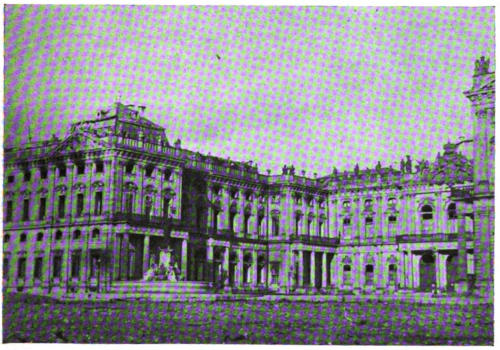
The Residenz at Würzburg. The palace of the Prince-Bishops was
gutted by fire in March 1945. The magnificent ceiling by Tiepolo
miraculously escaped serious damage.
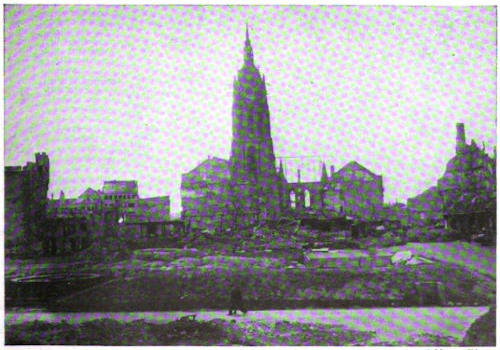
Ruined Frankfurt. In the center, the cathedral. Only the tower and the
walls of the nave remain standing.
International News Photo
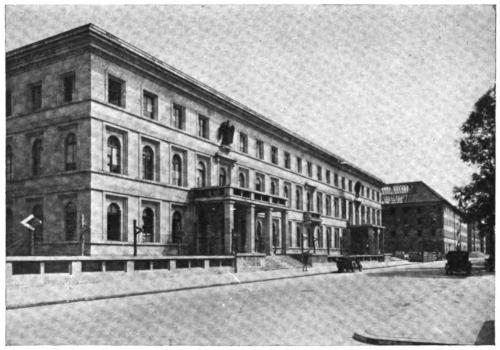
The Central Collecting Point at Munich, formerly the Administration Building
of the Nazi Party. The director of the Central Collecting Point was Lieutenant
Craig Smyth, USNR.
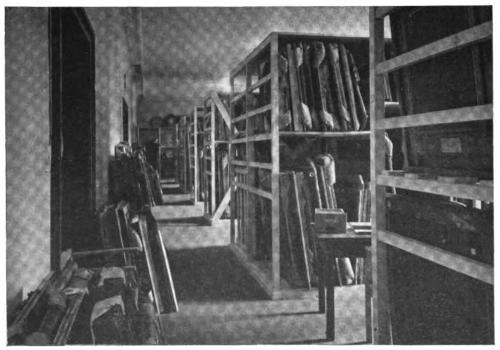
A typical storage room in the Central Collecting Point at Munich. The racks
for pictures were built by civilian carpenters under the direction of American
Monuments officers.
When he returned fifteen minutes later he was in high spirits.
“There’s a bathroom all right and it’s got hot water,” he said, “but
you have to be a combination of Theseus and Daniel Boone to find
it. Come along, I’ll show you the way.”
It was clever of him to find it a second time. I took a piece of red
crayon with me and marked little arrows on the walls to show
which turns to make. They were a timesaver to us during the next
couple days.
After breakfast the next morning, we telephoned 12th Army
Group Headquarters in Wiesbaden and talked with Lieutenant
George Stout, USNR, who, with Captain Bancel La Farge, was in
charge of the advance office of MFA&A in Germany. Stout suggested
that we come on over. It was a pleasant drive along the Autobahn,
with the blue Taunus mountains in the distance. Parts of
Wiesbaden had been badly mauled, but the destruction was negligible
compared with Frankfurt. Although many buildings along
the main streets had been hit, the colonnaded Kurhaus, now a Red
Cross Club, was intact. So was the Opera House.
We found George on the top floor of a dingy building in the
center of the town. I hadn’t seen him for fifteen years but he
hadn’t changed. His face was a healthy brown, his eyes were as
keen and his teeth as dazzlingly white as ever. George was in his
middle forties. His oldest boy was in the Navy but George didn’t
look a day over thirty. The Roberts Commission had played in
luck when they had got him. Of course he was an obvious choice—tops
in his field, the technical care and preservation of pictures. He
was known and respected throughout the world for his brilliant
research work at Harvard, where he presided over the laboratory of
the Fogg Museum.
“Bancel’s got jobs lined up for you fellows, but I think he’d like
to tell you about them himself,” George said. “He ought to be
back tonight.”
“Can’t you tell us in a general way what they are?” I asked.
“I think one of them is going to be in Frankfurt and the other
will probably be in Munich. You see, all the stuff from the Merkers
mine is in the vaults of the Reichsbank at Frankfurt and it ought to
be moved to a place where it can be permanently stored.”
The “stuff” he referred to was the enormous collection of paintings
and sculpture—comprising the principal treasures of the Berlin
museums—which George himself had brought out of the
Merkers mine in Thuringia. He had carried out the operation virtually
singlehanded and in the face of extraordinary difficulties
just before the end of hostilities.
“As for Munich,” he continued, “repositories are springing up
like mushrooms all through Bavaria. Most of it is loot and we’re
going to have to set up some kind of depot where we can put the
things until they can be returned to the countries from which the
Nazis stole them.”
“What are your plans?” I asked.
“Well, if the trucks show up,” he said, “I want to get started for
Siegen this afternoon. That’s in Westphalia. It’s another mine—copper,
not salt—and it’s full of things from the Rhineland museums.
I’ve got to take them up to Marburg. We have two good
depots there.”
We lunched with George and then returned to Bad Homburg.
There wasn’t anything for us to do but wait around until we heard
from Captain La Farge. To fill in the time we took our German
books and spent the afternoon studying in the Kurpark.
The telephone was ringing in the entrance lobby as we walked
in at five. It was Captain La Farge. He had just returned and
wanted to see us at once. I said I didn’t know whether we could
get transportation. He chuckled and said, “Tell them a general
wants to see you.” Craig and I dashed over to the Transportation
Office and tried it out. It worked. So, for the second time
that day, we found ourselves on the road to Wiesbaden.
Captain La Farge was waiting for us in the office where we had
seen George that morning. He was a tall, slender man in his early
forties. With a high-domed head and a long, rather narrow face,
he was the classic New Englander. His eyes were hazel and, at that
first meeting, very weary. But he had one of the most ingratiating
smiles and one of the most pleasant voices I had ever heard. He
reminded me of an early Copley portrait.
Without much preamble he launched into a detailed explanation
of the plans he had for us.
“I want you to take over the Frankfurt job,” he said to me, “and
I am sending you down to Munich, Smyth. As George probably
told you, we’ve got to set up two big depots. The one in Frankfurt
will be mainly for German-owned art which is now coming in
from repositories all over this part of Germany. The one in
Munich will be chiefly for loot, though there will be German-owned
things down in Bavaria too. Both jobs are equally interesting,
equally important and, above all, equally urgent.”
We were to get started without delay. Craig would be attached
to the Regional Military Government office in Munich, I to the
Military Government Detachment in Frankfurt. Captain La Farge
suggested that I investigate the possibility of requisitioning the
university buildings for a depot, and advised Craig to consider one
of the large Nazi party buildings in Munich which he had been
told was available.
On the way home that night Craig and I compared notes on our
new assignments. I was frankly envious of Craig, not only because
there was something alluring about all that loot, but because I
loved Munich and the picturesque country around it. In turn,
Craig thought I had drawn a fascinating job—one that involved
handling the wonderful riches of Berlin’s “Kaiser Friedrich,” admittedly
one of the world’s greatest museums.
The following morning we parted on the steps of the Grand
Parc Hotel. Craig took off first, in a jeep with trailer attached, a
crusty major for his companion. Half an hour later a jeep appeared
for me. On the way over to Frankfurt I thought about the experiences
of the past three weeks. It had been fun sharing them with
Craig and I wished that we might have continued this odyssey together.
I didn’t realize how soon our paths were to cross again.
(2) ASSIGNED TO FRANKFURT
The Military Government Detachment had its headquarters in a
gray stone building behind the Opera House. It was one of the
few in the city that had suffered relatively little damage. I reported
to the Executive Officer, a white-haired major named James Franklin.
After I had explained the nature of the work I was expected
to do, he took me around to the office of Lieutenant Julius Buchman,
the Education and Religious Affairs Officer, who had also the
local MFA&A problems as part of his duties. Buchman couldn’t
have been more pleasant, and said he’d do everything he could to
help. There was an air of quiet good humor about him that I liked
at once. I learned that he was an architect by profession and had
studied at the Bauhaus in Dessau before the war. He spoke fluent
German. I told him that first of all I’d like to get settled, so he
guided me to Captain Wyman Ooley, the Billeting Officer.
Ooley was a happy-go-lucky fellow, the only Billeting Officer I
ever met who was always cheerful. He had been a schoolteacher in
Arkansas. Together we drove out to the residential section where
a group of houses had been set aside for the Military Government
officers. This part of the city had not been heavily bombed and
each one of the houses had a pretty garden.
“I’ll tell you, I’ve got a real nice room in that house over there,”
he said, pointing to a gray stucco house partly screened by a row
of trees. “But it’s for lieutenant colonels. It’s empty right now, but
I might have to throw you out later.” Thinking that lieutenant
colonels would be very likely to have ideas about good plumbing,
I quickly said I’d take the chance.
The front door was locked. Ooley called, “Lucienne!” One of
the upper windows was instantly flung open and a woman, dust-cloth
in hand, leaned out, waved and disappeared. A moment later
she reappeared at the front door. Lucienne, all smiles, was as
French as the tricolor. Ooley explained in pidgin French, with gestures,
that I was to have a room on the second floor, wished me luck
and departed. Lucienne bustled up to the second floor chattering
away at a great rate, expressing surprise and delight that I was
“officier de la Marine” and also taking considerable satisfaction in
having recognized my branch of the service.
She threw open a door and then dashed off to the floor above,
still chattering and gesticulating. I was left alone to contemplate
the splendor before me—an enormous, airy bedroom looking out on
a garden filled with scarlet roses. This couldn’t be true. Even
lieutenant colonels didn’t deserve this. The room had cream-colored
walls, paneled and decorated with chinoiserie designs. A
large chest of drawers and a low table were decorated in the same
manner. In one corner was an inviting chaise longue, covered in
rose brocade. Along the end wall stood the bed—complete with
sheets and a pillow. The built-in wardrobe had full-length mirrors
which reflected the tall French windows and the garden beyond.
As I stood there trying to take it all in, Lucienne appeared again.
With her was a dapper little fellow whom she introduced as her
husband, René. He acknowledged the introduction and then solemnly
introduced Lucienne. After this bit of mock formality, he
explained that he and Lucienne had charge of all the houses in the
block. If anything was not to my liking I was to let them know and
it would be righted at once.
Further conversation revealed that the two of them had been
deported from Paris early in 1941 and been obliged to remain in
Frankfurt, working for the Germans, ever since. All through the
bombings, I asked? But of course, and they had been too terrible.
During one of the worst raids they had been imprisoned in the
bomb shelter. The falling stones had blocked the exit. They had
had to remain under the ground for forty-eight hours. They had
been made deaf by the noise, yes, for two months. And the concussion
had made them bleed from the nose and the ears. I asked if
they expected to go back to Paris. Yes, of course, but they were in
no hurry. It was very nice in Germany, now that the Americans
were there. With that they left me to unpack and get settled.
When I had finished, I decided to explore a bit. There were two
other bedrooms on the second floor. Neat labels on the doors indicated
that they were occupied by lieutenant colonels. There were
two other doors at the end of the hall. Neither one was labeled, so
I peered in. They were the bathrooms. And what bathrooms!
Marble floors, tiled walls, double washbasins and built-in tubs. Although
it was only the middle of the morning, I had to sample one
of those magnificent tubs. And as a kind of tribute to all this elegance,
I felt constrained to discard my khakis and put on blues.
Captain La Farge had stressed the urgency of setting up an art
depot, so the next ten days were given over to that project. Buchman
generously shelved his own work to help me with it. Together
we inspected the University of Frankfurt. The newest of
the German universities, it had opened its doors at the outbreak of
the first World War. The main administration building, an imposing
structure of red sandstone, had been badly damaged by incendiaries
but could be repaired. It would be a big job, but we
could worry about that later. The first step was to have it allocated
for our use. That had to be done through the proper Army
“channels.” Buchman steered me through. Then we had to obtain
an estimate of the repairs. It took three days to get one from
the university architect. It was thorough but impractical and had
to be completely revised. We took the revised estimate to the
Army Engineers and asked them to make an inspection of the
building and check the architect’s figures. They were swamped
with work. It would be a week before they could do anything. I
said it was a high priority job, hoping to speed things along. But
the Engineers had heard that one before. We’d have to be patient.
Charlie Kuhn and Colonel Webb had moved up to Frankfurt
and were established at SHAEF headquarters in the I. G. Farben
building. Their office was only a few blocks from mine, and during
my negotiations for the use of the university building I was in
daily communication with them.
While waiting for the Engineers to make the promised inspection,
I made a couple of field trips with Buchman. The first was a
visit to Schloss Kronberg, a few kilometers from Frankfurt. It
was a picturesque medieval castle, unoccupied since the first part
of the seventeenth century. Valuable archives were stored there.
We wanted to see if they were in good condition, and also to
make sure that the place had been posted with the official “Off
Limits” signs.
A flock of geese scattered before us as we drove up to the entrance
at the end of a narrow, winding road. We knocked on the
door of the caretaker’s cottage and explained the purpose of our
visit to the old fellow who timidly appeared with a large bunch
of keys. He limped ahead of us across the cobbled courtyard, and
we waited while he fitted one of the keys into the lock.
A wave of heavy perfume issued from the dark room as the door
swung open. When our eyes had become accustomed to the dim
light, we saw that we were in the original Waffenraum of the
castle. But, in addition to the clustered weapons affixed to the
walls, there were five sarcophagi in the center of the vaulted room.
Around them stood vases filled with spring flowers. On the central
sarcophagus rested a spiked helmet of the first World War. The
others were unadorned.
The old caretaker explained that the central tomb was that of
the Landgraf of Hesse who had died thirty years ago. Those on
either side contained the remains of his two sons who had likewise
died in the first World War. The other two coffins were
those of the elder son’s wife and of a princess of Baden who had
been killed in one of the air raids on Frankfurt in 1944. All five
sarcophagi had originally stood in the little chapel across the
courtyard. It had been destroyed by an incendiary bomb the winter
before.
We left this funerary chamber with a feeling of relief and continued
our inspection of the castle. A winding ramp in one of the
towers led to the floors above. From the top story we had a superb
view of the broad Frankfurt plain spread out below. The caretaker
told us he had watched the bombings from that vantage
point. The great banqueting hall, with a musicians’ gallery at one
end, had been emptied of its original furnishings and was now a
jumble of papers stacked in piles of varying heights. These were
part of the Frankfurt archives. Others were stored in two rooms
on the ground floor. All of the rooms were dry and weatherproof,
so there was nothing further to be done about them for the present.
There was no place in Frankfurt as yet to which they could be
moved. “Off Limits” signs had been posted. They would discourage
souvenir hunters from unauthorized delving.
On our way back to the car the caretaker told us that the castle
still belonged to Margarethe, Landgräfin of Hesse, the youngest
sister of the last Kaiser. Although she was now in her seventies,
she came every day to put fresh flowers beside the tombs of her
husband and her two sons. She lived at a newer castle, Schloss
Friedrichshof, only a few kilometers away. He apparently didn’t
know that Schloss Friedrichshof had been taken over by the Army
and was being used as an officers’ country club. The old Landgräfin
was living modestly in one of the small houses on the property.
Her scapegrace son, Prince Philip, as I learned later, had
played an active role in the artistic depredations of the Nazi ringleaders.
I was to hear more of the Hesse family before the end
of the year.
A second excursion took us still farther afield. On an overcast
morning two days later, Buchman, Charlie Kuhn, Captain Rudolph
Vassalle (who was the Public Safety Officer of the detachment)
and I set out in the little Opel sedan which had been assigned the
MFA&A office. We struck out to the east of Frankfurt on the road
to Gelnhausen. We stopped at this pleasant little town with its
lovely, early Gothic church and went through the formality of obtaining
clearance from the local Military Government Detachment
to make an inspection in that area.
From there we continued by a winding secondary road which led
us through increasingly hilly country to Bad Brückenau. Our mission
there was twofold: Captain Vassalle wanted to track down a
young Nazi officer, reportedly a member of the SS, and to find a
warehouse said to contain valuable works of art. I had gathered
from Buchman that many such reports petered out on investigation.
Still, there was always the chance that the one you dismissed
as of no importance would turn out to be something worth while.
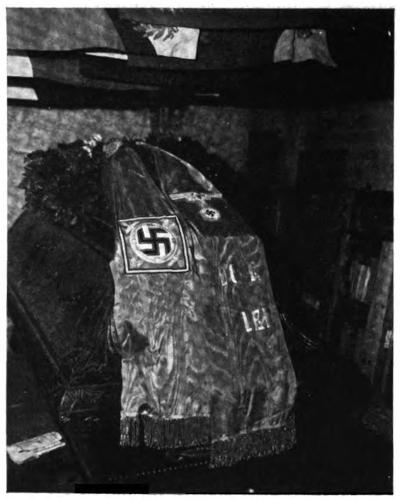
The bronze coffin of Friedrich Wilhelm of Prussia was
found in a mine near Bernterode.
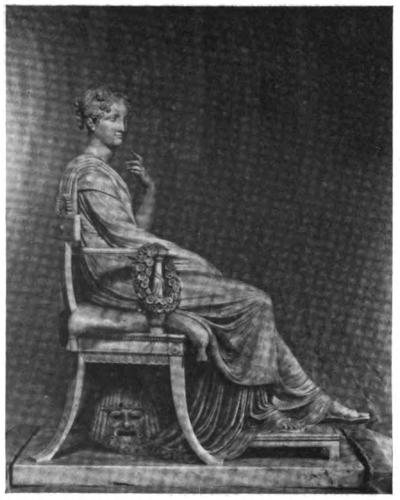
Canova’s life-size marble statue of Napoleon’s sister
was found at the monastery of Hohenfurth.
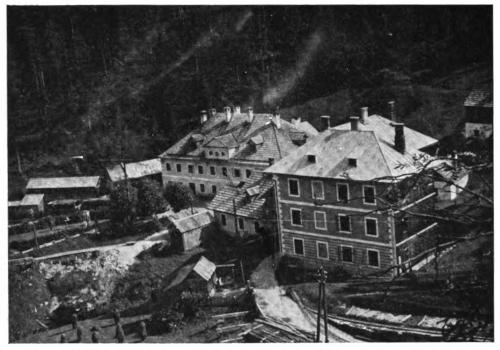
The administration buildings at the salt mine at Alt Aussee, Austria. Removal
of stolen art treasures from the mine was carried out late in 1945.
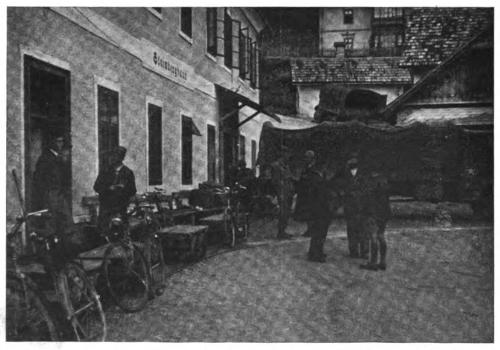
Truck at entrance to the main building of the mine is being loaded with
paintings, to be taken to Munich for dispersal to their owner nations.
After making several inquiries, we eventually located a small
house on the edge of town. In response to our insistent hammering,
the door of the house was finally opened by a pallid young man
probably in his late twenties. If he was the object of the captain’s
search he had certainly undergone a remarkable metamorphosis,
for he bore little resemblance to the dapper officer of whom Captain
Vassalle carried a photograph for identification. The captain
seemed satisfied that he was the man. So leaving them in conversation,
the three of us followed up the business of the reported
works of art. The other two occupants of the house—an old man
and a young woman who may have been the wife of the man who
had opened the door—responded to our questions with alacrity
and took us to the cellar. There we were shown a cache of pictures,
all of them unframed and none of them of any value. They appeared
to be what the old man claimed—their own property,
brought to Bad Brückenau when they had left Frankfurt to escape
the bombings. In any case, we made a listing of the canvases, identifying
them as best we could and making notations of the sizes,
and also admonishing the couple not to remove them from the
premises.
After that the old man took us across the back yard to a large
modern barn which was heavily padlocked. Once inside he unshuttered
a row of windows along one side of the main, ground-floor
room. It was jammed to the ceiling with every conceivable
item of household furnishings: chairs, tables, beds, bedding, kitchen
utensils and porcelain. But no pictures. We poked around enough
to satisfy ourselves that first appearances were not deceiving. They
weren’t, so, having made certain that the old fellow, who claimed
to be merely the custodian of these things, understood the regulations
forbidding their removal, we picked up Captain Vassalle.
He had completed his interrogation of the alleged SS officer and
placed him under house arrest.
Our next objective was an old Schloss which, according to our
map, was still a good hour’s drive to the northeast. As it was nearly
noon and we were all hungry, we decided to investigate the possibilities
of food in the neighborhood. On our way back through
Bad Brückenau we stopped at the office of a small detachment of
troops and asked where we could get some lunch. The hospitable
second lieutenant on duty in the little stucco building, which had
once been part of the Kurhaus establishment, gave us directions to
the sprawling country hotel, high up above the town, where his
outfit was quartered. He said that he would telephone ahead to
warn the mess sergeant of our arrival.
For a little way we followed along the Sinn, which flows through
the grassy valley in which Bad Brückenau nestles. Then we began
to mount sharply and, for the next fifteen minutes, executed a series
of hairpin turns and ended abruptly beside a rambling structure
which commanded a wonderful view of the valley and the wooded
hills on the other side. Our hosts were a group of friendly young
fellows who seemed delighted to have the monotony of their rural
routine interrupted by our visit. They asked Charlie and me the
usual question—what was the Navy doing in the middle of Germany—and
got our stock reply: we are planning to dig a canal
from the North Sea to the Mediterranean.
We had a heavy downpour during lunch, and we waited for the
rain to let up before starting out again. Then we took the winding
road down into town, crossed the river and drove up into the hills
on the other side of the valley. An hour’s drive brought us to upland
meadow country and a grove of handsome lindens. At the
end of a long double row of these fine trees stood Schloss Rossbach.
“Castle” was a rather pompous name for the big seventeenth
century country house with whitewashed walls and heavily barred
ground-floor windows.
We were received by the owners, a Baron Thüngen and his wife,
and explained that we had come to examine the condition of the
works of art, which, according to our information, had been placed
there for safekeeping. They ushered us up to a comfortable sitting
room on the second floor where we settled down to wait while the
baroness went off to get the keys. In the meantime we had a few
words with her husband. His manner was that of the haughty
landed proprietor, and he looked the part. He was a big, burly
man in his sixties. He was dressed in rough tweeds and wore a
matching hat, adorned with a bushy “shaving brush,” which he
hadn’t bothered to remove indoors. That may have been unintentional,
but I idly wondered if it weren’t deliberate discourtesy
and rather wished that I had kept my own cap on. I wished also
that I could have matched his insolent expression, but thought it
unlikely because I was frankly enjoying the obvious distaste which
our visit was causing the old codger.
However, his attitude was almost genial compared with that of
his waspish wife, who reappeared about that time, armed with a
huge hoop from which a great lot of keys jangled. The baroness,
who was much younger than her husband, had very black hair and
discontented dark eyes. She spoke excellent English, without a
trace of accent. I felt reasonably sure that she was not German but
couldn’t guess her nationality. It turned out that she was from the
Argentine. She was a sullen piece and made no effort to conceal
her irritation at our intrusion. She explained that neither she nor
her husband had anything to do with the things stored there; that,
in fact, it was a great inconvenience having to put up with them.
She had asked the young woman who knew all about them to join
us.
The young woman in question arrived and was completely
charming. She took no apparent notice of the baroness’ indifference,
which was that of a mistress toward a servant whom she
scarcely knew. Her fresh, open manner cleared the atmosphere
instantly. She introduced herself as Frau Holzinger, wife of the
director of Frankfurt’s most famous museum, the Staedelsches
Kunstinstitut. Because of conditions in Frankfurt, and more particularly
because their house had been requisitioned by the American
military authorities, she had come to Schloss Rossbach with her
two young children. Country life, she continued, was better for the
youngsters and, besides, her husband had thought that she might
help with the things stored at the castle. I had met Dr. Holzinger
when I went one day to have a look at what remained of the museum,
so his wife and I hit it off at once. I was interested to learn
that she was Swiss and a licensed physician. She smilingly suggested
that we make a tour of the castle and she would show us
what was there.
The first room to be inspected was a library adjoining the sitting
room in which we had been waiting. Here we found a quantity of
excellent French Impressionist paintings, all from the permanent
collection of the Staedel, and a considerable number of fine Old
Master drawings. Most of these were likewise the property of the
museum, but a few—I remember one superb Rembrandt sketch—appeared
to have come from Switzerland. Those would, of course,
have to be looked into later, to determine their exact origin and
how they came to be on loan at the museum. But for the moment
we were concerned primarily with storage conditions and the
problem of security. In another room we found an enormous collection
of books, the library of one of the Frankfurt museums. In
a third we encountered an array of medieval sculpture—saints of
all sizes and description, some of carved wood, others of stone,
plain or polychromed. These too were of museum origin.
The last storage room was below ground, a vast, cavernous
chamber beneath the house. Here was row upon row of pictures,
stacked in two tiers down the center of the room and also along
two sides. From what we could make of them in the poor light,
they were not of high quality. During the summer months they
would be all right in this underground room, but we thought that
the place would be very damp in the winter. Frau Holzinger assured
us that this was so and that the pictures should be removed
before the bad weather set in.
The baroness chipped in at this point and affably agreed with
that idea, undoubtedly happy to further any scheme which involved
getting rid of these unwelcome objects. She also warned
us that the castle was far from safe as it was, what with roving
bands of Poles all over the countryside. As we indicated that we
were about to take our leave, she elaborated upon this theme, declaring
that their very lives were in danger, that every night she and
her husband could hear prowlers in the park. Since they—as Germans—were
not allowed to have firearms, they would be at the
mercy of these foreign ruffians if they should succeed in breaking
into the castle. By this time we were all pretty fed up with the
whining baroness. As we turned to go, Charlie Kuhn, eyeing her
coldly, asked, “Who brought those Poles here in the first place,
madam? We didn’t.”
To our delight, the weather had cleared and the sun was shining.
Ahead of us on the roadway, the foliage of the lindens made
a gaily moving pattern. Our work for the day was done and we
still had half the afternoon. I got out the map and, after making
some quick calculations, proposed that we could take in Würzburg
and still get back to Frankfurt at a reasonable hour. We figured
out that, with the extra jerry can of gas we had with us, we could
just about make it. We would be able to fill up at Würzburg for
the return trip. So, instead of continuing on the road back to Bad
Brückenau, we turned south in the direction of Karlstadt.
It was pleasant to be traveling a good secondary road instead of
the broad, characterless Autobahn, on which there were no unexpected
turns, no picturesque villages. There was little traffic, so
we made very good time. In half an hour we had threaded our way
through Karlstadt-on-the-Main. In this part of Franconia the Main
is a capricious river, winding casually in and out of the gently undulating
hills. A little later we passed the village of Veitschöchheim
where the Prince-Bishops of Würzburg had an elaborate country
house during the eighteenth century. The house still stands, and
its gardens, with a tiny lake and grottoes in the Franco-Italian manner,
remain one of the finest examples of garden planning of that
day. As we drove by we were glad that this inviting spot had not
attracted the attention of our bombers.
Alas, such was not the case with Würzburg, as we realized the
minute we reached its outskirts! The once-gracious city, surely one
of the most beautiful in all Germany, was an appalling sight. Its
broad avenues were now lined with nothing but the gaping, ruined
remnants of the stately eighteenth century buildings which had
lent the city an air of unparalleled distinction and consistency of
design. High on its hilltop above the Main, the mellow walls of
the medieval fortress of Marienberg caught the rays of the late
afternoon sun. From the distance, the silhouette of that vast structure
appeared unchanged, but the proud city of the Prince-Bishops
which it overlooked was laid low.
We drove slowly along streets not yet cleared of rubble, until
we came to the Residenz, the great palace of the Prince-Bishops,
those lavish patrons of the arts to whom the city owed so much
of its former grandeur. This magnificent building, erected in the
first half of the eighteenth century by the celebrated baroque architect,
Johann Balthasar Neumann, for two Prince-Bishops of the
Schönborn family, was now a ghost palace, its staring glassless
windows and blackened walls pathetic vestiges of its pristine splendor.
We walked up to the main entrance wondering if it could really
be true that the crowning glory of the Residenz—the glorious ceiling
by Tiepolo, representing Olympus and the Four Continents—was,
as we had been told, still intact. With misgivings we turned
left across the entrance hall to the Treppenhaus and mounted the
grand staircase. We looked up and there it was—as dazzling and
majestically beautiful as ever—that incomparable fresco, the masterpiece
of the last great Italian painter. Someone with a far
greater gift for words than I may be able to convey the exaltation
one experiences on seeing that ceiling, not just for the first time but
at any time. I can’t. It leaves artist and layman alike absolutely
speechless. I think that, if I had to choose one great work of art, it
would be this ceiling in the Residenz. You can have even the Sistine
ceiling. I’ll take the Tiepolo.
For the next half hour we examined every corner of it. Aside
from a few minor discolorations, the result of water having seeped
through the lower side of the vault just above the cornice, the
fresco was undamaged. Considering the destruction throughout
the rest of the building, I could not understand how this portion of
the palace could be in such a remarkable state of preservation. The
explanation was an interesting example of how good can sometimes
come out of evil. Some forty years ago, as I remember the
story, there was a fire in the Residenz. The wooden roof over a
large portion, if not all, of the building was burned away. When
it came to replacing the roof, the city fathers decided it would be
a prudent idea to cover the part above the Tiepolo with steel and
concrete. This was done, and consequently, when the terrible conflagration
of March 1945 swept Würzburg—following the single
raid of twenty minutes which destroyed the city—the fresco was
spared. As we wandered through other rooms of the Residenz—the
Weisser Saal with its elaborate stucco ornamentation and the
sumptuous Kaiser Saal facing the garden, once classic examples of
the Rococo—I wished that those city fathers had gone a little farther
with their steel and concrete.
We stopped briefly to examine the chapel in the south wing.
Here, miraculously enough, there had been relatively little damage,
but the caretaker expressed concern over the condition of the roof
and said that if it weren’t repaired before the heavy rains the ceiling
would be lost. Knowing how hard it was to obtain building
materials for even the most historic monuments when people didn’t
have a roof over their heads, we couldn’t reassure him with much
conviction.
The spectacle of ruined Würzburg had a depressing effect upon
us, so we weren’t very talkative on our way back to Frankfurt. We
passed through only one town of any size, Aschaffenburg, which,
like Würzburg, had suffered severe damage. Although I had not
been long in Germany and had seen but few of her cities, I was
beginning to realize that the reports of the Allied air attacks had
not been exaggerated. I was ready to believe that there were only
small towns and villages left in this ravaged country.
One morning Charlie Kuhn rang up to say that I should meet
him at the Reichsbank early that afternoon. This was something
I had been looking forward to for some time, the chance to look
at the wonderful things from the Merkers mine which were temporarily
stored there. With Charlie came two members of the
MFA&A organization whom I had not seen since Versailles and
then only briefly. They had been stationed at Barbizon, as part of
the Allied Group Control Council for Germany (usually referred
to simply as “Group CC”) the top level policy-making body as
opposed to SHAEF, which dealt with the operational end of
things. These two gentlemen were John Nicholas Brown, who
had come over to Germany with the assimilated rank of colonel as
General Eisenhower’s adviser on cultural affairs, and Major Mason
Hammond, in civilian life professor of the Classics at Harvard.
It had been decided, now that we were about to acquire a permanent
depot in which to store the treasures, to make one Monuments
officer responsible for the entire collection. By this transfer
of custody, the Property Control Officer in whose charge the things
were at present, could be relieved of that responsibility. Major
Hammond had with him a paper designating me as custodian.
Knowing in a general way what was stored in the bank, I felt that
I was on the point of being made a sort of director, pro tem, of the
Kaiser Friedrich Museum.
The genial Property Control Officer, Captain William Dunn,
was all smiles at the prospect of turning his burden over to someone
else. But before this transfer could be made, a complete check
of every item was necessary. Major Hammond knew just how he
wanted this done. I was to have two assistants, who could come
over the next morning from his office in Hoechst, twenty minutes
from Frankfurt. The three of us, in company with Captain Dunn,
would make the inventory.
We wandered through the series of rooms in which the things
were stored. In the first room were something like four hundred
pictures lined up against the wall in a series of rows. In two adjoining
rooms were great wooden cases piled one above another. In a
fourth were leather-bound boxes containing the priceless etchings,
engravings and woodcuts from the Berlin Print Room. Still another
room was filled with cases containing the renowned Egyptian collections.
It was rumored that one of them held the world-famous
head of Queen Nefertete, probably the best known and certainly
the most beloved single piece of all Egyptian sculpture. It had occupied
a place of special honor in the Berlin Museum, in a gallery
all to itself.
Still other rooms were jammed with cases of paintings and sculpture
of the various European schools. In a series of smaller alcoves
were heaped huge piles of Oriental rugs and rare fabrics. And last,
one enormous room with bookshelves was filled from floor to ceiling
with some thirty thousand volumes from the Berlin Patent Office.
Quite separate and apart from all these things was a unique
collection of ecclesiastical vessels of gold and silver, the greater
part of them looted from Poland. These extremely precious objects
were kept in a special vault on the floor above.
Captain Dunn brought out a thick stack of papers. It was the
complete inventory. Major Hammond said that the two officers
who would help with the checking were a Captain Edwin Rae and
a WAC lieutenant named Standen. Aside from having heard that
Rae had been a student of Charlie Kuhn’s at Harvard, I knew
nothing about him. But the name Standen rang a bell: was she, by
any chance, Edith Standen who had been curator of the Widener
Collection? Major Hammond smilingly replied, “The same.” I
had known her years ago in Cambridge where we had taken
Professor Sachs’ course in Museum Administration at the same
time. I remembered her as a tall, dark, distinguished-looking
English girl. To be exact, she was half English: her father had
been a British Army officer, her mother a Bostonian. Recalling her
very reserved manner and her scholarly tastes, I found it difficult to
imagine her in uniform.
Early the following morning, I met my cohorts at the entrance
to the Reichsbank. I was pleasantly surprised to find that Captain
Rae was an old acquaintance if not an old friend. He also had been
around the Fogg Museum in my time. Edith looked very smart in
her uniform. She had a brisk, almost jovial manner which was not
to be reconciled with her aloof and dignified bearing in the marble
halls of the Widener house at Elkins Park. We hunted up Captain
Dunn and set to work. Our first task was to count and check off
the paintings stacked in the main room. We got through them
with reasonable speed, refraining with some difficulty from pausing
to admire certain pictures we particularly fancied. Then we
tackled the Oriental rugs, and that proved to be a thoroughly
thankless and arduous task. We had a crew of eight PWs—prisoners
of war—to help us spread the musty carpets out on the floor.
Owing to the fact that the smaller carpets—in some cases they
were hardly more than fragments—had been rolled up inside larger
ones, we ended with nearly a hundred more items than the inventory
called for. That troubled Captain Dunn a bit, but I told him
that it didn’t matter so long as we were over. We’d have to start
worrying only if we came out short. By five o’clock we were tired
and dirty and barely a third of the way through with the job.
The next day we started in on the patent records. There had
been a fire in the mine where the records were originally stored.
Many of them were slightly charred, and all of them had been
impregnated with smoke. When we had finished counting the
whole thirty thousand, we smelled just the way they did. As a
matter of fact we hadn’t wanted to assume responsibility for these
records in the first place. Certainly they had nothing to do with
art. But Major Hammond had felt that they properly fell to us
as archives. And of course they were archives of a sort.
On the morning of the third day, as I was about to leave my
office for the Reichsbank, I had a phone call from Charlie Kuhn.
He asked me how the work was coming along and then, in a
guarded voice, said that something unexpected had turned up
and that he might have to send me away for a few days. He told
me he couldn’t talk about it on the telephone, and anyway, it wasn’t
definite. He’d probably know by afternoon. I was to call him later.
This was hardly the kind of conversation to prepare one for a
humdrum day of taking inventory, even if one were counting real
treasure. And for a person with my curiosity, the morning’s work
was torture.
When I called Charlie after lunch he was out but had left word
that I was to come to his office at two o’clock. When I got there he
was sitting at his desk. He looked up from the dispatch he was
reading and said with a rueful smile, “Tom, I am going to send you
out on a job I’d give my eyeteeth to have for myself.” Then he
explained that certain developments had suddenly made it necessary
to step up the work of evacuating art repositories down in
Bavaria and in even more distant areas. For the first time in my
life I knew what was meant by the expression “my heart jumped a
beat”—for that was exactly what happened to mine! No wonder
Charlie was envious. This sounded like the real thing.
Charlie told me that I was to fly down to Munich the next morning
and that I would probably be gone about ten days. To save time
he had already had my orders cut. All I had to do was to pick them
up at the AG office. I was to report to Third Army Headquarters
and get in touch with George Stout as soon as possible. Charlie
didn’t know just where I’d find George. He was out in the wilds
somewhere. As a matter of fact he wasn’t too sure about the exact
location of Third Army Headquarters. A new headquarters was
being established and the only information he had was that it would
be somewhere in or near Munich. The name, he said, would be
“Lucky Rear” and I would simply have to make inquiries and be
guided by signs posted along the streets.
I asked Charlie what I should do about the completion of the
inventory at the Reichsbank, and also about the impending report
from the Corps of Engineers on the University of Frankfurt building.
He suggested that I leave the former in Captain Rae’s hands
and the latter with Lieutenant Buchman. Upon my return I could
take up where I had left off.
That evening I threw my things together, packing only enough
clothes to see me through the next ten days. Not knowing where I
would be billeted I took the precaution of including my blankets.
Even at that my luggage was compact and light, which was desirable
as I was traveling by air.
(3) MUNICH AND THE BEGINNING OF FIELD WORK
The next morning I was up before six and had early breakfast. It
was a wonderful day for the trip, brilliantly clear. The corporal
in our office took me out to the airfield, the one near Hanau where
Craig Smyth and I had landed weeks before. It was going to be
fun to see Craig again and find out what he had been up to since
we had parted that morning in Bad Homburg. The drive to
the airfield took about forty-five minutes. There was a wait of
half an hour at the field, and it was after ten when we took off in
our big C-47. We flew over little villages with red roofs, occasionally
a large town—but none that I could identify—and now and
then a silvery lake.
Just before we reached Munich, someone said, “There’s Dachau.”
Directly below us, on one side of a broad sweep of dark pine trees,
we saw a group of low buildings and a series of fenced-in enclosures.
On that sunny morning the place looked deserted and
singularly peaceful. Yet only a few weeks before it had been filled
with the miserable victims of Nazi brutality.
In another ten minutes we landed on the dusty field of the
principal Munich airport. Most of the administration buildings
had a slightly battered look but were in working order. It was a
welcome relief to take refuge from the blazing sunshine in the cool
hallway of the main building. The imposing yellow brick lobby
was decorated with painted shields of the different German states
or “Länder.” The arms of Bavaria, Saxony, Hesse-Nassau and the
rest formed a colorful frieze around the walls.
A conveyance of some kind was scheduled to leave for town in
a few minutes. Meanwhile there were sandwiches and coffee for
the plane passengers. By the time we had finished, a weapons
carrier had pulled up before the entrance. Several of us climbed
into its dust-encrusted interior. It took me a little while to get my
bearings as we drove toward Munich. I had spotted the familiar
pepper-pot domes of the Frauenkirche from the air but had recognized
no other landmark of the flat, sprawling city which I had
known well before the war.
It was not until we turned into the broad Prinz Regenten-Strasse
that I knew exactly where I was. As we drove down this
handsome avenue, I got a good look at a long, colonnaded building
of white stone. The roof was draped with what appeared to
be an enormous, dark green fishnet. The billowing scallops of the
net flapped about the gleaming cornice of the building. It was the
Haus der Deutschen Kunst, the huge exhibition gallery dedicated
by Hitler in the middle thirties to the kind of art of which he approved—an
art in which there was no place for untrammeled freedom
of expression, only the pictorial and plastic representation
of all the Nazi regime stood for. The dangling fishnet was part of
the elaborate camouflage. I judged from the condition of the
building that the net had admirably served its purpose.
In a moment we rounded the corner by the Prinz Karl Palais.
Despite the disfiguring coat of ugly olive paint which covered its
classic façade, it had not escaped the bombs. The little palace,
where Mussolini had stayed, had a hollow, battered look and the
formal garden behind it was a waste of furrowed ground and straggling
weeds. We turned left into the wide Ludwig-Strasse and
came to a grinding halt beside a bleak gray building whose walls
were pockmarked with artillery fire. I asked our driver if this were
Lucky Rear headquarters and was told curtly that it wasn’t, but
that it was the end of the line. It was MP headquarters and I’d have
to see if they’d give me a car to take me to my destination, which
the driver said was “’way the hell” on the other side of town.
Before going inside I looked down the street to the left. The
familiar old buildings were still standing, but they were no longer
the trim, cream-colored structures which had once given that part
of the city such a clean, orderly air. Most of them were burned
out. Farther along on the right, the Theatinerkirche was masked
with scaffolding. At the end of the street the Feldherren-Halle,
Ludwig I’s copy of the Loggia dei Lanzi, divested of its statuary,
reared its columns in the midst of the desolation.
It was gray and cool in the rooms of the MP building, but the
place was crowded. Soldiers were everywhere and things seemed
to be at sixes and sevens. After making several inquiries and
being passed from one desk to another, I finally got hold of a
brisk young sergeant to whom I explained my troubles. At first he
said there wasn’t a chance of getting a ride out to Lucky Rear.
Every jeep was tied up and would be for hours. They had just
moved into Munich and hadn’t got things organized yet. Then all
at once he relented and with a grin said, “Oh, you’re Navy, aren’t
you? In that case I’ll have to fix you up somehow. We can’t have
the Navy saying the Army doesn’t co-operate.”
He walked over to a window that looked down on the courtyard
below, shouted instructions to someone and then told me I’d find a
jeep and driver outside. “Think nothing of it, Lieutenant,” he said
in answer to my thanks. “Maybe I’ll be wanting a ship to take me
home one of these days before long. Have to keep on the good side
of the Navy.”
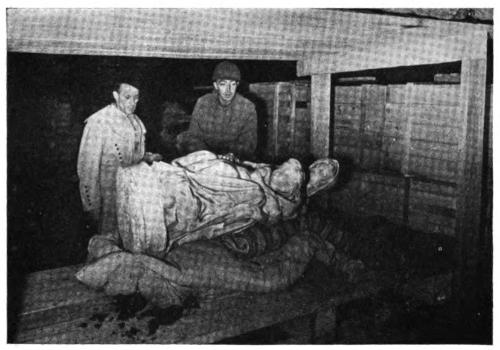
In the Kaiser Josef chamber of the Alt Aussee mine Karl Sieber and Lieutenant
Kern view Michelangelo’s Madonna and Child, stolen from a church
at Bruges.
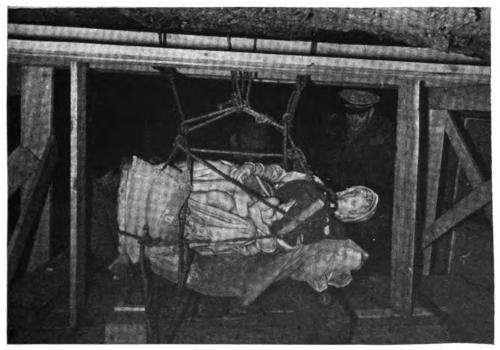
Lieutenants Kovalyak, Stout and Howe pack the Michelangelo Madonna for
return to Bruges. The statue was restored to the Church of Notre Dame in
September of 1945.
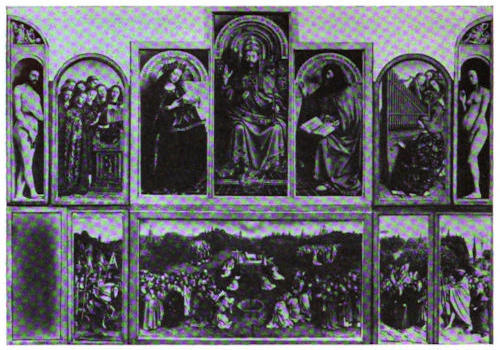
The famous Ghent altarpiece by van Eyck was flown from the Alt Aussee
mine to Belgium in the name of Eisenhower as a token restitution.
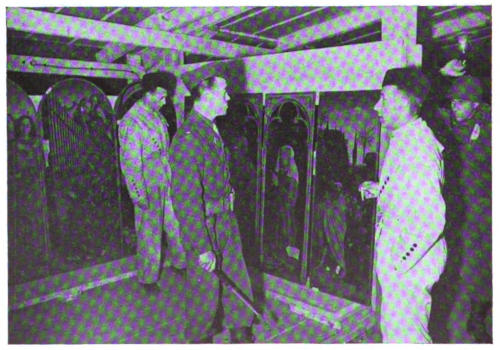
Karl Sieber, German restorer, Lieutenant Kern, American Monuments officer,
and Max Eder, Austrian engineer, examine the panels of the Ghent altarpiece
stored in the Alt Aussee mine.
On my way out I gathered up my luggage from the landing below
and climbed into the waiting jeep. We turned the corner and followed
the Prinz Regenten-Strasse to the river. I noticed for the first
time that a temporary track had been laid along one side. This
had been done, the driver said, in order to cart away the rubble
which had accumulated in the downtown section. We turned right
and followed the Isar for several blocks, crossed to the left over the
Ludwig bridge, then drove out the Rosenheimer-Strasse to the east
for a distance of about three miles. Our destination was the enormous
complex of buildings called the Reichszeugmeisterei, or
Quartermaster Corps buildings, in which the rear echelon of General
Patton’s Third Army had just established its headquarters.
Even in the baking sunlight of that June day, the place had a
cold, unfriendly appearance. We halted for identification at the
entrance, and there I was introduced to Third Army discipline.
One of the guards gave me a black look and growled, “Put your
cap on.” Startled by this burly order, I hastily complied and then
experienced a feeling of extreme irritation at having been so easily
cowed. I could at least have asked him to say “sir.”
The driver, sensing my discomfiture, remarked good-naturedly,
“You’ll get used to that sort of thing around here, sir. They’re
very, very fussy now that the shooting’s over. Seems like they don’t
have anything else to worry about, except enforcing a lot of regulations.”
This was my first sample of what I learned to call by its
popular name, “chicken”—a prudent abbreviation for the exasperating
rules and regulations one finds at an Army headquarters.
Third Army had its share of them—perhaps a little more than its
share. But I didn’t find that out all at once. It took me all of two
days.
My driver let me out in front of the main building, over the
central doorway of which the emblem of the Third Army was
proudly displayed—a bold “A” inside a circle. The private at the
information desk had never heard of the “Monuments, Fine Arts
and Archives Section,” but said that if it was a part of G-5 it would
be on the fifth floor. I found the office of the Assistant Chief of
Staff and was directed to a room at the end of a corridor at least
two blocks long. I was told that the officer I should see was Captain
Robert Posey. I knew that name from the reports I had studied
at Versailles, as well as from a magazine article describing his discovery,
months before, of some early frescoes in the little Romanesque
church of Mont St. Martin which had been damaged by bombing.
The article had been written by an old friend of mine, Lincoln
Kirstein, who was connected with the MFA&A work in Europe.
When I opened the door of the MFA&A office, George Stout was
standing in the middle of the room. The expression of surprise on
his face changed to relief after he had read the letter I handed him
from Charlie Kuhn.
“You couldn’t have arrived at a more opportune time,” he said.
“I came down from Alt Aussee today to see Posey, but I just missed
him. He left this morning for a conference in Frankfurt. I wanted
to find out what had happened to the armed escort he promised me
for my convoys. We’re evacuating the mine and desperately shorthanded,
so I’ve got to get back tonight. It’s a six-hour drive.”
“Charlie said you needed help. What do you want me to do?”
I asked. I hoped he would take me along.
“I’d like to have you stay here until we get this escort problem
straightened out. I was promised two half-tracks, but they didn’t
show up this morning. I’ve got a call in about them right now.
It’s three o’clock. I ought to make Salzburg by five-thirty. There’ll
surely be some word about the escort by that time, and I’ll phone
you from there.”
Before he left, George introduced me to Lieutenant Colonel
William Hamilton, the Assistant Chief of Staff, and explained to
him that I had come down on special orders from SHAEF to help
with the evacuation work. George told the colonel that I would be
joining him at the mine as soon as Captain Posey returned and provided
me with the necessary clearance. After we had left Colonel
Hamilton’s office, I asked George what he meant by “clearance.”
He laughed and said that I would have to obtain a written permit
from Posey before I could operate in Third Army territory. As
Third Army’s Monuments Officer, Posey had absolute jurisdiction
in all matters pertaining to the fine arts in the area occupied by his
Army. At that time it included a portion of Austria which later
came under General Mark Clark’s command.
“Don’t worry,” said George. “I’ll have you at the mine in a few
days, and you’ll probably be sorry you ever laid eyes on the place.”
I went back to the MFA&A office and was about to settle down
at Captain Posey’s vacant desk. I looked across to a corner of the
room where a lanky enlisted man sat hunched up at a typewriter.
It was Lincoln Kirstein, looking more than ever like a world-weary
Rachmaninoff. Lincoln a private in the U. S. Army! What a far
cry from the world of modern art and the ballet! He was thoroughly
enjoying my astonishment.
“This is a surprise, but it explains a lot of things,” I said, dragging
a chair over to his desk. “So you are the Svengali of the Fine
Arts here at Third Army.”
“You mustn’t say things like that around this headquarters,” he
said apprehensively.
During the next two hours we covered a lot of territory. First
of all, I wanted to know why he was an enlisted man chained to a
typewriter. With his extraordinary intelligence and wide knowledge
of the Fine Arts, he could have been more useful as an
officer. He said that he had applied for a commission and had been
turned down. I was sorry I had brought up the subject, but knowing
Lincoln’s fondness for the dramatic I thought it quite possible
that he had wanted to be able to say in later years that he had
gone through the war as an enlisted man. He agreed that he could
have been of greater service to the Fine Arts project as an officer.
Then I asked him what his “boss”—he was to be mine too—was
like. He said that Captain Posey, an architect in civilian life, had
had a spectacular career during combat. In the face of almost insurmountable
obstacles, such as lack of personnel and transportation
and especially the lack of any real co-operation from the higher-ups,
he had accomplished miracles. Now that the press was devoting
more and more space to the work the Monuments officers
were doing—the discovery of treasures in salt mines and so on—they
were beginning to pay loving attention to Captain Posey
around the headquarters.
I gathered from Lincoln that the present phase of our activities
appealed to the captain less than the protection and repair of historic
monuments under fire. If true, this was understandable
enough. He was an architect. Why would he, except as a matter
of general cultural interest, find work that lay essentially in the
domain of a museum man particularly absorbing? It seemed reasonable
to assume that Captain Posey would welcome museum men
to shoulder a part of the burden. But I was to learn later that my
assumption was not altogether correct.
Eventually I had to interrupt our conversation. It was getting
late, and still no word about the escort vehicles. Lincoln told me
where I would find the officer who was to have called George. He
was Captain Blyth, a rough-and-ready kind of fellow, an ex-trooper
from the state of Virginia. The outlook was not encouraging. No
vehicles were as yet available. Finally, at six o’clock, he rang up
to say that he wouldn’t know anything before morning.
Lincoln returned from chow, I gave him the message in case
George called while I was out and went down to eat. It was after
eight when George telephoned. The connection from Salzburg was
bad, and so was his temper when I told him I had nothing to report.
Lincoln usually spent his evenings at the office. That night we
stayed till after eleven. Here and there he had picked up some fascinating
German art books and magazines, all of them Nazi publications
lavishly illustrated. They bore eloquent testimony to Hitler’s
patronage of the arts. The banality of the contemporary work
in painting was stultifying—dozens of rosy-cheeked, buxom
maidens and stalwart, brown-limbed youths reeking with “strength
through joy,” and acres of idyllic landscapes. The sculpture was
better, though too often the tendency toward the colossal was
tiresomely in evidence. It was in recording the art of the past,
notably in the monographs dealing with the great monuments of
the Middle Ages and the Baroque, that admirable progress had
been made. I asked Lincoln enviously how he had got hold of these
things. He answered laconically that he had “liberated” them.
Captain Blyth had good news for me the next morning. Two
armored vehicles had left Munich for the mine. I gave the message
to George when he called just before noon.
“They’re a little late,” he said. “Thanks to the fine co-operation
of the 11th Armored Division, I am being taken care of from this
end of the line. I’ll try to catch your fellows in Salzburg and tell
them to go back where they came from. I am sending you a letter
by the next convoy. It’s about a repository which ought to be evacuated
right away. I can’t give you any of the details over the phone
without violating security regulations. As soon as Posey gets back,
you ought to go to work on it. After that I want you to help me
here.”
After George had hung up, I asked Lincoln if he had any idea
what repository George had in mind. Lincoln said it might be
the monastery at Hohenfurth. It was in Czechoslovakia, just over
the border from Austria. While we were discussing this possibility,
Craig Smyth walked in.
As soon as he had recovered from the surprise of finding me at
Captain Posey’s desk, he explained the reason for his visit. Something
had to be done right away about the building he was setting
up as a collecting point. He had been promised a twenty-four-hour
guard. He had been promised a barrier of barbed wire. So far,
Third Army had failed to provide either one. A lot of valuable stuff
had already been delivered to the building, and George was sending
in more. He couldn’t wait any longer.
“Let’s have a talk with Colonel Hamilton,” I said. As we walked
down to the Assistant Chief of Staff’s office, Craig told me that the
buildings he had requisitioned were the ones Bancel La Farge had
suggested when we saw him at Wiesbaden a month ago.
“Can’t this matter wait until Captain Posey returns?” the colonel
asked.
“I am afraid it can’t, sir,” said Craig. “As you know, the two
buildings were the headquarters of the Nazi party. The Nazis
meant to destroy them before Munich fell. Having failed to do so,
I think it quite possible that they may still attempt it. Both buildings
are honeycombed with underground passageways. Only this
morning we located the exit of one of them. It was half a block
from the building. We hadn’t known of its existence before. The
works of art stored in the building at present are worth millions
of dollars. In the circumstances, I am not willing to accept the
responsibility for what may happen to them. I must have guards
or a barrier at once.”
The colonel reached for the telephone and gave orders that a
cordon of guards was to be placed on the buildings immediately.
He made a second call, this time about the barbed wire. When he
had finished he told Craig that the guard detail would report that
afternoon; the barbed wire would be strung around the building
the next morning. We thanked the colonel and returned to Posey’s
office.
We found two officers who had just come in from Dachau. They
were waiting to see someone connected with Property Control.
They had brought with them a flour sack filled with gold wedding
rings; a large carton stuffed with gold teeth, bridgework, crowns
and braces (in children’s sizes); a sack containing gold coins (for
the most part Russian) and American greenbacks. As we looked
at these mementos of the concentration camp, I thought of the
atrocity film I had seen at Versailles and wondered how anyone
could believe that those pictures had been an exaggeration.
I went back with Craig to his office at the Königsplatz. The damage
to Munich was worse than I had realized. The great Deutsches
Museum by the river was a hollow-eyed specter, but sufficiently
intact to house DPs. Aside from its twin towers, little was left of
the Frauenkirche. The buildings lining the Brienner-Strasse had
been blasted and burned. Along the short block leading from the
Carolinen Platz to the Königsplatz, the destruction was total: on
the left stood the jagged remnants of the little villa Hitler had
given D’Annunzio; on the right was a heap of rubble which had
been the Braun Haus. But practically untouched were the two
Ehrentempel—the memorials to the “martyrs” of the 1923 beer-hall
“putsch.” The colonnades were draped with the same kind of
green fishnet that had been used to camouflage the Haus der
Deutschen Kunst. The classic façades of the museums on either
side of the square—the Glyptothek and the Neue Staatsgalerie—were
intact. The buildings themselves were a shambles.
I followed Craig up the broad flight of steps to the entrance of
the Verwaltungsbau, or Administration Building. It was three
stories high, built of stone, and occupied almost an entire block.
True to the Nazi boast, it looked as though it had been built to
“last a thousand years.” And it was so plain and massive that I
didn’t see how it could change much in that time. There was
nothing here that could “grow old gracefully.” The interior
matched the exterior. There were two great central courts with
marble stairs leading to the floor above.
Although the building had not been bombed, it had suffered
severely from concussion. Craig said that when he had moved in
two weeks ago the skylights over the courts had been open to the
sky. On rainy days one could practically go boating on the first
floor. There had been no glass in the windows. Now they had
been boarded up or filled in with a translucent material as a substitute.
All of the doors had been out of line and would not lock.
But the repairs were already well under way and, according to
Craig, the place would be shipshape in another month or six weeks.
He said that his colleague, Hamilton Coulter, a former New York
architect now a naval lieutenant, was directing the work and
doing a magnificent job. Even under normal conditions it would
have been a staggering task. With glass and lumber at a premium,
to say nothing of the scarcity of skilled labor, a less resourceful man
would have given up in despair.
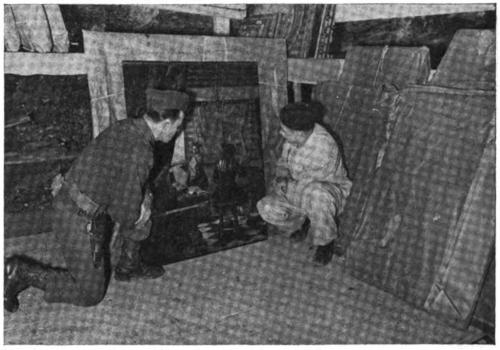
Vermeer’s Portrait of the Artist in His Studio in the Alt Aussee mine was
purchased by Hitler for his proposed museum. It has been returned to
Vienna.
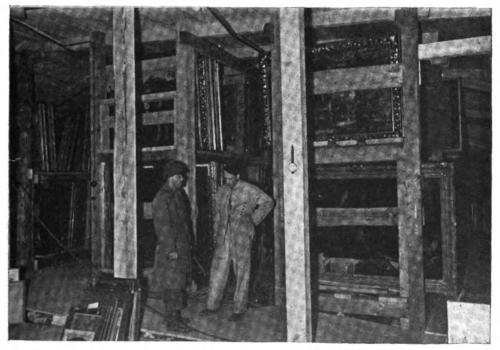
One of the picture storage rooms in the mine, constructed with wooden partitions
and racks. The temperature was constant, averaging 40° Fahrenheit in
summer, 47° in winter.
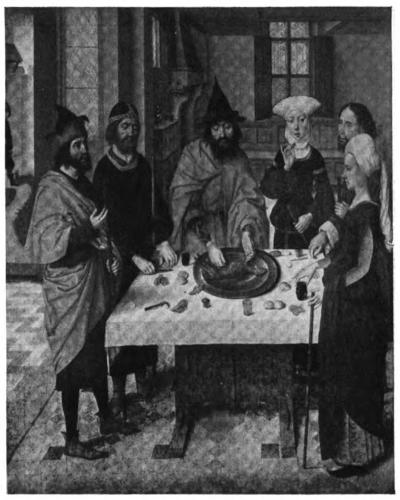
Panel from the Louvain altarpiece, Feast of the Passover,
by Bouts, was stored at Alt Aussee.
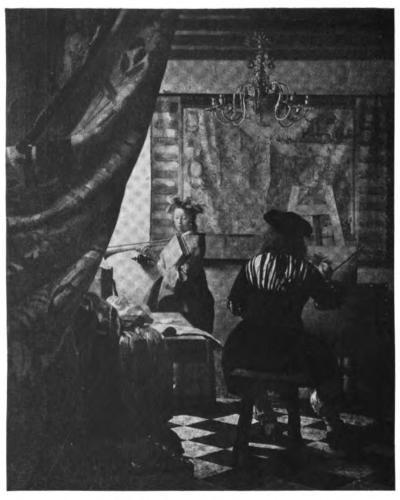
Hitler acquired the Czernin Vermeer for an alleged
price of 1,400,000 Reichsmarks.
Craig was rapidly building up a staff of German scholars and
museum technicians to assist him in the administration of the
establishment. It would soon rival a large American museum in
complexity and scope. Storage rooms on the ground floor had
been made weatherproof. Paintings and sculpture were already
pouring in from the mine at Alt Aussee—six truckloads at a time.
In accordance with standard museum practice, Craig had set up an
efficient accessioning system. As each object came in, it was identified,
marked and listed for future reference. Quarters had been
set aside for a photographer. Racks were being built for pictures.
A two-storied record room was being converted into a library.
Craig had also requisitioned the “twin” of this colossal building—the
Führerbau, where Hitler had had his own offices. This
was only a block away on the same street and also faced the Königsplatz.
It was connected with the Verwaltungsbau by underground
passageways. It was in the Führerbau that the Munich Pact of
1938—the pact that was to have guaranteed “peace in our time”—had
been signed. Craig showed me the table at which Mr. Chamberlain
had signed that document. Craig was using it now for a
conference table.
Repairs were being concentrated on the Administration Building,
since its “twin” was being held in reserve for later use. At the
moment, however, a few of the rooms were occupied by a small
guard detail. The truck drivers and armed guards who came each
week with the convoys from the mine were also billeted there.
Just as Craig and I were finishing our inspection of the Führerbau,
a convoy of six trucks, escorted by two half-tracks, pulled into
the parking space behind the building. The convoy leader had a
letter for me. It was the one George Stout had mentioned on the
telephone. Lincoln was right. The repository George had in
mind was the monastery at Hohenfurth. In his letter he stressed
the fact that the evacuation should be undertaken at once. He
suggested that I try to persuade Posey to send Lincoln along to
help me.
Craig had a comfortable billet in the Kopernikus-Strasse, a four-room
flat on the fourth floor of a modern apartment building. The
back windows looked onto a garden. Over the tops of the poplar
trees beyond, one could see the roof of the Prinz Regenten Theater
where, back in the twenties, I had seen my first complete performance
of Wagner’s Ring. Craig told me that the theater was undamaged
except for the Speisesaal where, in prewar days, lavish
refreshments were served during intermissions. That one room
had caught a bomb.
I accepted Craig’s invitation to share the apartment with him
while in Munich and made myself at home in the dining room. It
had a couch, and there was a sideboard which I could use as a chest
of drawers. The bathroom was across the hall and he said that
the supply of hot water was inexhaustible. By comparison, the
officers’ billets at Third Army Headquarters were tenements.
Ham Coulter had similar quarters on the ground floor. We
stopped there for a drink on our way to supper at the Military Government
Detachment. “Civilized” was the word that best described
Ham. He was a tall, broad-shouldered fellow with sleek black
hair, finely-chiseled features and keen, gray eyes. When he smiled,
his mouth crinkled up at the corners, producing an agreeably sarcastic
expression. Ham poured out the drinks with an elegance the
ordinary German cognac didn’t deserve. They should have been
dry martinis. I liked him at once that first evening, and when I
came to know him better I found him the wittiest and most amiable
of companions. He and Craig were a wonderful combination.
They had the greatest admiration and respect for each other, and
during the many months of their work together there was not the
slightest disagreement between them.
The officers’ dining room that evening was a noisy place. The
clatter of knives and forks and the babble of voices mingled with
the rasping strains of popular American tunes pounded out by a
Bavarian band. As we were about to sit down, the music stopped
abruptly and a second later struck up the current favorite, “My
Dreams Are Getting Better All the Time.” Colonel Charles Keegan,
the commanding officer, had entered the dining hall. I was
puzzled by this until Ham told me that it happened every night.
This particular piece was the colonel’s favorite tune and he had
ordered it to be played whenever he came in to dinner. The colonel
was a colorful character—short and florid, with a shock of white
hair. He had figured prominently in New York politics and would
again, it was said. He had already helped Craig over a couple of
rough spots and if some of his antics amused the MFA&A boys,
they seemed to be genuinely fond of him.
While we were at dinner, three officers came and took their
places at a near-by table. Craig identified one of them as Captain
Posey. I had been told that he was in his middle thirties, but he
looked younger than that. He had a boyish face and I noticed that
he laughed a great deal as he talked with his two companions.
When he wasn’t smiling, there was a stubborn expression about
his mouth, and I remembered that Lincoln had said something
about his “deceptively gentle manner.” On our way out I introduced
myself to him. He was very affable and seemed pleased at
my arrival. But he was tired after the long drive from Frankfurt,
so, as soon as I had arranged to meet him at his office the next day,
I joined Ham and Craig back at the apartment.
I got out to Third Army Headquarters early the following
morning and found Captain Posey already at his desk, going
through the papers which had accumulated during his absence.
We discussed George’s letter at considerable length, and I was
disappointed to find that he did not intend to act on it at once.
Somehow it had never occurred to me that anyone would question
a proposal of George’s.
For one thing, Captain Posey said, he couldn’t spare Lincoln; and
for another, there was a very pressing job much nearer Munich
which he wanted me to handle. He then proceeded to tell me of a
small village on the road to Salzburg where I would find a house
in which were stored some eighty cases of paintings and sculpture
from the Budapest Museum. He showed me the place on the map
and explained how I was to go about locating the exact house upon
arrival. I was to see a certain officer at Third Army Headquarters
without delay and make arrangements for trucks. He thought I
would need about five. It shouldn’t take more than half a day to
do the job if all went well. After this preliminary briefing, I was
on my own.
My first move was to get hold of the officer about the trucks.
How many did I need? When did I want them and where should
he tell them to report? I said I’d like to have five trucks at the
Königsplatz the following morning at eight-thirty. The officer
explained that the drivers would be French, as Third Army was
using a number of foreign trucking companies to relieve the existing
shortage in transportation.
Later in the day I had a talk with Lincoln about my plans and
he gave me a piece of advice which proved exceedingly valuable—that
I should go myself to the trucking company which was to
provide the vehicles, and personally confirm the arrangements.
So, after lunch I struck out in a jeep for the west side of Munich, a
distance of some seven or eight miles.
I found a lieutenant, who had charge of the outfit, and explained
the purpose of my visit. He had not been notified of the
order for five trucks. There was no telephone communication between
his office and headquarters, so all messages had to come by
courier, and the courier hadn’t come in that day. He was afraid he
couldn’t let me have any trucks before the following afternoon. I
insisted that the matter was urgent and couldn’t wait, and, after
much deliberating and consulting of charts, he relented. I told him
a little something about the expedition for which I wanted the
trucks and he showed real interest. He suggested that I ought to
have extremely careful drivers. I replied that I should indeed, as
we would be hauling stuff of incalculable value.
Thereupon he gave me a harrowing description of the group
under his supervision. All of them had been members of the
French Resistance Movement—ex-terrorists he called them—and
they weren’t afraid of God, man or the Devil. Well, I thought, isn’t
that comforting! “Oh, yes,” he said, “these Frenchies drive like
crazy men. But,” he continued, “one of the fellows has got some
sense. I’ll see if I can get him for you.” He went over to the window
that looked out on a parking ground littered with vehicles of
various kinds. Here and there I saw a mechanic bent over an open
hood or sprawled out beneath a truck. The lieutenant bellowed,
“Leclancher, come up here to my office!”
A few seconds later a wiry, sandy-haired Frenchman of about
forty-five appeared in the doorway. Leclancher understood some
English, for he reacted with alert nods of the head as the lieutenant
gave a brief description of the job ahead, and then turned and asked
me if I spoke French. I told him I did, if he had enough patience.
This struck him as inordinately funny, but I was being quite serious.
What really pleased him was the fact that I was in the Navy. He
said that he had been in the Navy during the first World War.
Then and there a lasting bond was formed, though I didn’t appreciate
the value of it at the time.
Eight-thirty the next morning found me pacing the Königsplatz.
Not a truck in sight. Nine o’clock and still no trucks. At nine
thirty, one truck rolled up. Leclancher leaped out and with profuse
apologies explained that the other four were having carburetor
trouble. There had been water in the gas, too, and that hadn’t
helped. For an hour Leclancher and I idled about, whiling away
the time with conversation of no consequence, other than that it
served to limber up my French. At eleven o’clock Leclancher
looked at his watch and said that it would soon be time for lunch.
It was obvious that he understood the Army’s conception of a day
as a brief span of time, in the course of which one eats three meals.
If it is not possible to finish a given job during the short pauses
between those meals, well, there’s always the next day. I told him
to go to his lunch and to come back as soon as he could round up
the other trucks. In the meantime I would get something to eat
near by.
When I returned shortly after eleven thirty—having eaten a
K ration under the portico of the Verwaltungsbau in lieu of a
more formal lunch—my five trucks were lined up ready to go. I
appointed Leclancher “chef de convoi”—a rather high-sounding
title for such a modest caravan—and he assigned positions to the
other drivers, taking the end truck himself. Since my jeep failed
to arrive, I climbed into the lead truck. The driver was an amiable
youngster whose name was Roger Roget. During the next few
weeks he was the lead driver in all of my expeditions, and I took
to calling him “Double Roger,” which I think he never quite
understood.
To add to my anxiety over our belated start, a light rain began
to fall as we pulled out of the Königsplatz and turned into the
Brienner-Strasse. We threaded our way cautiously through the
slippery streets choked with military traffic, crossed the bridge over
the Isar and swung into the broad Rosenheimer-Strasse leading to
the east.
Once on the Autobahn, Roger speeded up. The speedometer
needle quivered up to thirty-five, forty and finally forty-five miles
an hour. I pointed to it, shaking my head. “We must not exceed
thirty-five, Roger.”
He promptly slowed down, and as we rolled along, I forgot the
worries of the morning. I dozed comfortably. Suddenly we struck
an unexpected hole in the road and I woke up. We were doing
fifty. This time I spoke sharply, reminding Roger that the speed
limit was thirty-five and that we were to stay within it; if we didn’t
we’d be arrested, because the road was well patrolled. With a
tolerant grin Roger said, “Oh, no, we never get arrested. The MPs,
they stop us and get very angry, but—” with a shrug of the shoulders—“we
do not understand. They throw the hands up in the
air and say ‘dumb Frenchies’ and we go ahead.”
“That may work with you,” I said crossly, “but what about me?
I’m not a ‘dumb Frenchy.’”
For the next hour I pretended to doze and at the same time kept
an eye on the speedometer. This worked pretty well. Now and
again I would look up, and each time, Roger would modify his
speed.
Presently we came to a bad detour, where a bridge was out. We
had to make a sharp turn to the left, leave the Autobahn and
descend a steep and tortuous side road into a deep ravine. That
day the narrow road was slippery from the rain, so we had to crawl
along. The drop into the valley was a matter of two or three hundred
feet and, as we reached the bottom, we could see the monstrous
wreckage of the bridge hanging drunkenly in mid-air. The
ascent was even more precarious, but our five trucks got through.
We had now left the level country around Munich and were in
a region of rolling hills. Along the horizon, gray clouds half concealed
the distant peaks. Soon the rain stopped and the sun came
out. The mountains changed to misty blue against an even bluer
sky. The road rose sharply, and when we reached the crest, I caught
a glimpse of shimmering water. It was Chiemsee, largest of the
Bavarian lakes.
In another ten minutes the road flattened out again and we
came to the turnoff marked “Prien.” There we left the Autobahn
for a narrow side road which took us across green meadows. Nothing
could have looked more peaceful than this lush, summer countryside.
Reports of SS troops still hiding out in the near-by forests
seemed preposterous in the pastoral tranquillity. Yet only a few
days before, our troops had rounded up a small band of these die-hards
in this neighborhood. The SS men had come down from the
foothills on a foraging expedition and had been captured while
attempting to raid a farmhouse. It was because of just such incidents,
as well as the ever-present fire hazard, that I had been sent
down to remove the museum treasures to a place of safety.
The road was dwindling away to a cow path and I was beginning
to wonder how much farther we could go with our two-and-a-half-ton
trucks, when we came to a small cluster of houses. This was
Grassau. I had been told that a small detachment of troops was
billeted there, so I singled out the largest of the little white houses
grouped around the only crossroads in the village. It had clouded
over and begun to rain again. As I entered the gate and was crossing
the yard, the door of the house was opened by a corporal.
He didn’t seem surprised to see me. Someone at Munich had
sent down word to Prien that I was coming, and the message had
reached him from there. I asked if he knew where the things I
had come for were stored. He motioned to the back of the house
and said there were two rooms full of big packing cases. He explained
that he and one other man had been detailed to live in the
house because of the “stuff” stored there. They had been instructed
to keep an eye on the old man who claimed to be responsible for it.
That would be Dr. Csanky, director of the Budapest Museum, who,
according to my information, would probably raise unqualified hell
when I came to cart away his precious cases. The corporal told me
that the old man and his son occupied rooms on the second floor.
I was relieved to hear that they were not at home. It would make
things much simpler if I could get my trucks loaded and be on my
way before they returned. It was already well after two and I
wanted to start back by five at the latest. I asked rather tentatively
about the chances of getting local talent to help with the loading,
and the corporal promptly offered to corral a gang of PWs who
were working under guard near by.
While he went off to see about that, I marshaled my trucks.
There was enough room to back one truck at a time to the door of
the house. A few minutes later the motley “work party” arrived.
There were eight of them in all and they ranged from a young fellow
of sixteen, wearing a faded German uniform, to a reedy old
man of sixty. By and large, they looked husky enough for the job.
I knew enough not to ask my drivers to help, but knew that the
work would go much faster if they would lend a hand. Leclancher
must have read my thoughts, for he immediately offered his services.
As soon as the other four saw what Leclancher was doing,
they followed suit.
There were eighty-one cases in all. They varied greatly in size,
because some of them contained sculpture and, consequently, were
both bulky and heavy. Others, built for big canvases, were very
large and flat but relatively light. We had to “design” our loads in
such a way as to keep cases of approximately the same type together.
This was necessary for two reasons: first, the cases would
ride better that way, and second, we hadn’t any too much space. As
I roughly figured it, we should be able to get them all in the five
trucks, but we couldn’t afford to be prodigal in our loading.
The work went along smoothly for an hour and we were just finishing
the second truck when I saw two men approaching. They were
Dr. Csanky and his son. This was what I had hoped to avoid. The
doctor was a dapper little fellow with a white mustache and very
black eyes. He was wearing a corduroy jacket and a flowing bow
tie. The artistic effect was topped off by a beret set at a jaunty
angle. His son was a callow string bean with objectionably soulful
eyes magnified by horn-rimmed spectacles. They came over to the
truck and began to jabber and wave their arms. We paid no attention
whatever—just kept on methodically lifting one case after
another out of the storage room.
The dapper doctor got squarely in my path and I had to stop. I
checked his flow of words with a none too civil “Do you speak
English?” That drew a blank, so I asked if he spoke German. No
luck there either. Feeling like an ad for the Berlitz School, I inquired
whether he spoke French. He said “Yes,” but the stream of
Hungarian-French which rolled out from that white mustache was
unintelligible. It was hopeless. At last I simply had to take him
by the shoulders and gently but firmly set him aside. This was
the ultimate indignity, but it worked. At that juncture he and the
string bean took off. I didn’t know what they were up to and I
didn’t care, so long as they left us alone.
Our respite was short-lived. By the time we had the third truck
ready to move away, they were back. And they had come with reinforcements:
two women were with them. One was a rather handsome
dowager who looked out of place in this rural setting. Her
gray hair, piled high, was held in place by a scarlet bandanna, and
she was wearing a shabby dress of green silk. Despite this getup,
there was something rather commanding about her. She introduced
herself as the wife of General Ellenlittay and explained in
perfect English that Dr. Csanky had come to her in great distress.
Would I be so kind as to tell her what was happening so that she
could inform him?
“I am removing these cases on the authority of the Commanding
General of the Third United States Army,” I said. If she were
going to throw generals’ names around, I could produce one too—and
a better one at that.
Her response to my pompous pronouncement was delivered
charmingly and with calculated deflationary effect. “Dear sir, forgive
me if I seemed to question your authority. That was not my
intention. It is quite apparent that you are removing the pictures,
but where are you taking them?”
“I am sorry, but I am not at liberty to say,” I replied. That too
sounded rather lordly, but I consoled myself by recalling that Posey
had admonished me not to answer questions like that.
She relayed this information to Dr. Csanky and the effect was
startling. He covered his face with his hands and I thought he was
going to cry. Finally he pulled himself together and let forth a
flood of unintelligible consonants. His interpreter tackled me again.
“Dr. Csanky is frantic. He says that he is responsible to his government
for the safety of these treasures and since you are taking
them away, there is nothing left for him to do but to blow his brains
out.”
My patience was exhausted. I said savagely, “Tell Dr. Csanky
for me that he can blow his brains out if he chooses, but I think it
would be silly. If you must know, Madame, I am a museum director
myself and you can assure him that no harm is going to come to his
precious pictures.”
I should never have mentioned that I had even so much as been
inside a museum, for, from that moment until we finished loading
the last truck, the little doctor never left my side. I was his “cher
collègue,” and he kept up a steady barrage of questions which the
patient Madame Ellenlittay tried to pass along to me without interrupting
our work.
As we lined the trucks up, preparatory to starting back to Munich,
Dr. Csanky produced several long lists of what the cases contained.
He asked me to sign them. This I refused to do but explained to
him through the general’s wife that if he cared to have the lists
translated from Hungarian and forwarded to Third Army Headquarters,
they could be checked against the contents and eventually
returned to him with a notation to that effect.
Our little convoy rolled out of Grassau at six o’clock, leaving
the group of Hungarians waving forlornly from the corner. Just
before we turned onto the Autobahn, Leclancher signaled from the
rear truck for us to stop. He came panting up to the lead truck with
a bottle in his hand. With a gallant wave of the arm he said that
we must drink to the success of the expedition. It was a bottle of
Calvados—fiery and wonderful. We each took a generous swig
and then—with a rowdy “en voiture!”—we were on our way again.
It was a nice gesture.
The trip back to Munich was uneventful except for the extraordinary
beauty of the long summer evening. The sunset had all the
extravagance of the tropics. The sky blazed with opalescent clouds.
As we drove into Munich, the whole city was suffused with a coral
light which produced a more authentic atmosphere of Götterdämmerung
than the most ingenious stage Merlin could have contrived.
It was nearly nine when we rolled into the parking area behind
the Führerbau—too late to think about unloading and also, I was
afraid, too late to get any supper. We had pieced out with K
rations and candy bars, but were still hungry. A mess sergeant,
lolling on the steps of the building, reluctantly produced some lukewarm
stew. After we had eaten, I prevailed on one of the building
guards to take my five drivers out to their billets south of town. It
was Saturday night. I told Leclancher we would probably be making
a longer trip on Monday and that I would need ten drivers. He
promised to select five more good men, and we arranged to meet in
the square as we had that morning. But Monday, he promised,
they would be on time.
After checking the tarpaulins on my five trucks, I sauntered over
to the Central Collecting Point on the off-chance that Craig might
be working late. I found him looking at some of the pictures which
George had sent in that day from the mine. The German packers
whom Craig had been able to hire from one of the old established
firms in Munich—one which had worked exclusively for the museums
there—had finished unloading the trucks only a couple of
hours earlier. Most of the things in this shipment had been found
at the mine, so now the pictures were stacked according to size in
neat rows about the room. In one of them we found two brilliant
portraits by Mme. Vigée-Lebrun. Labels on the front identified
them as the likenesses of Prince Schuvalov and of the Princess
Golowine. Marks on the back indicated that they were from the
Lanckoroncki Collection in Vienna, one of the most famous art
collections in Europe. Hitler was rumored to have acquired it en
bloc—through forced sale, it was said—for the great museum he
planned to build at Linz. In another stack we came upon a superb
Rubens landscape, a fine portrait by Hals and two sparkling allegorical
scenes by Tiepolo. These had no identifying labels other
than the numbers which referred to lists we didn’t have at the moment.
However, Craig said that the documentation on the pictures,
as a whole, was surprisingly complete. Then we ran into a lot of
nineteenth century German masters—Lenbach, Spitzweg, Thoma
and the like. These Hitler had particularly admired, but they didn’t
thrill me. I was getting sleepy and suggested that we had had
enough art for one day. I still had a report of the day’s doings to
write up for Captain Posey before I could turn in, so we padlocked
the room and took off.
Even though the next day was Sunday, it was not a day of rest
for me. The trek to Hohenfurth, scheduled for Monday, involved
infinitely more complicated preliminary arrangements than the
easy run of yesterday. Captain Posey got out maps of the area
into which the convoy would be traveling; gave me the names of
specific outfits from whom I would have to obtain clearance as well
as escorts along the way; and, most important of all, supplied information
concerning the material to be transported. None of it, I
learned, was cased. He thought it consisted mainly of paintings,
but there was probably also some furniture. This wasn’t too definite.
Nor did we have a very clear idea as to the exact number of
trucks we would need. I had spoken for ten on the theory that a
larger number would make too cumbersome a convoy. At least I
didn’t want to be responsible for more at that stage of the game,
inexperienced as I was. In the circumstances, two seasoned packers
might, I thought, come in handy, so I was to see if I could borrow a
couple of Craig’s men. There was the problem of rations for the
trip up and back. Posey procured a big supply of C rations, not so
good as the K’s, but they would do. While at Hohenfurth we
would be fed by the American outfit stationed there. It was a
good thing that there was so much to be arranged, because it kept
me from worrying about a lot of things that could and many that
did happen on that amazing expedition.
In the afternoon I went out to make sure of my trucks and on
the way back put in a bid for the two packers. My request wasn’t
very popular, because Craig was shorthanded, but he thought he
could spare two since it was to be only a three-day trip—one day
to go up, one day at Hohenfurth, and then back the third day.
Craig gloomily predicted that I’d never get ten trucks loaded in
one day, but I airily tossed that off with the argument that we had
loaded five trucks at Grassau in less than four hours. “But that
stuff was all in cases,” he said. “You’ll find it slow going with loose
pictures.” Of course he was right, but I didn’t believe it at the
time.
(4) MASTERPIECES IN A MONASTERY
We woke up to faultless weather the following morning, and on
the way down to the Königsplatz with Craig I was in an offensively
optimistic frame of mind. All ten of my trucks were there. This
was more like it—no tiresome mechanical delays. We were all
set to go. Leclancher had even had the foresight to bring along an
extra driver, just in case anything happened to one of the ten.
That was a smart idea and I congratulated him for having thought
of it.
It wasn’t till I started distributing the rations that I discovered
our two packers were missing. But that shouldn’t take long to
straighten out. Craig’s office was just across the way. I found them
cooling their heels in the anteroom. They looked as though they
had come right out of an Arthur Rackham illustration—stocky
little fellows with gnarled hands and wizened faces as leathery as
the Lederhosen they were wearing. Each wore a coal-scuttle hat
with a jaunty feather, and each had a bulging bandanna attached
to the end of a stick. There was much bowing and scraping. The
hats were doffed and there was the familiar “Grüss Gott, Herr Kapitän,”
when I walked in.
Craig appeared and explained the difficulty. Until the last minute,
no one had thought to ask whether the men had obtained a
Military Government permit to leave the area—and of course they
hadn’t. With all due respect to the workings of Military Government,
I knew that it would take hours, even days, to obtain the
permits. So, what to do? I asked Craig what would happen if
they went without them. He didn’t know. But if anyone found out
about it, there would be trouble. I didn’t see any reason why anyone
should find out about it. The men would be in my charge and
I said I’d assume all responsibility.
Meanwhile the two Rackham characters were shifting uneasily
from one foot to the other, looking first at Craig and then at me,
without the faintest idea what the fuss was all about. Craig reluctantly
left it up to me. Not wanting to waste any more time, I told
the little fellows that everything was “in Ordnung” and bundled
them off to the waiting trucks.
Again our way led out to the east, the same road we had taken
two days before; and again I was perched up in the lead truck with
Double Roger. The country was more beautiful than ever in the
morning sunlight. We skirted the edge of Chiemsee and sped on
through Traunstein. The mountains loomed closer, their crests
gleaming with snow. Roger commented that it was “la neige
éternelle,” and I was struck by the unconscious poetry of the phrase.
To save time we ate our midday rations en route, pulling off to
one side of the Autobahn in the neighborhood of Bad Reichenhall.
Farther on we came to a fork in the highway. A sign to the right
pointed temptingly to Berchtesgaden, only thirty kilometers away.
But our road was the one to the left—to Salzburg. In another few
minutes we saw its picturesque fortress, outlined against the sky,
high above the town.
I had to make some inquiries in Salzburg. Not knowing the exact
location of the headquarters where I could obtain the information
I needed, I thought it prudent to park the convoy on the outskirts
and go on ahead with a single truck. It probably wasn’t going to be
any too easy, even with exact directions, to get all ten of them
through the narrow streets, across the river and out the other side.
This was where a jeep would have come in handy. I had been a
fool not to insist on having one for this trip.
Leclancher asked if he might go along with Roger and me. The
three of us drove off, leaving the other nine drivers and the two
little packers to take their ease in the warm meadow beside which
we had halted. It was about three miles into the center of town
and the road was full of confusing turns. But on the whole it was
well marked with Army signs. Before the end of the summer I
became reasonably proficient in translating the cabalistic symbols
on these markers, but at that time I was hopelessly untutored and
neither of my companions was any help. After driving through
endless gray archways and being soundly rebuked by the MPs for
going the wrong direction on several one-way streets, we found
ourselves in a broad square paved with cobblestones. It was the
Mozartplatz.
The lieutenant colonel I was supposed to see had his office in
one of the dove-colored buildings facing the square. It was a big,
high-ceilinged room with graceful rococo decorations along the
walls and a delicate prism chandelier in the center. I asked the
colonel for clearance to proceed to Linz with my convoy. After I
had explained the purpose of my trip to Hohenfurth, he offered to
expedite the additional clearance I would need beyond Linz.
He rang up the headquarters of the 65th Infantry Division which
was stationed there. In a few minutes everything had been arranged.
The colonel at the other end of the line said that he would
send one of his officers to the outskirts of the city to conduct us
to his headquarters on our arrival. There would be no difficulty
about billets. He would also take care of our clearance across the
Czechoslovakian border the following day. I thanked the colonel
and hurried down to rejoin Leclancher and Roger.
Since the proposed Autobahn to Linz had never been finished,
we had to take a secondary highway east of Salzburg. Our road
led through gently rolling country with mountains in the distance.
I was grateful for the succession of villages along the way. They
were a relief after the monotony of the Autobahn and also served to
control the speed of the convoy. We wound through streets so
narrow that one could have reached out and touched the potted
geraniums which lined the balconies of the cottages on either side.
Laughing, towheaded children waved from the doorways as we
passed by. Roger, intent on his driving, didn’t respond to the exuberance
of the youngsters, and I wondered if he might be thinking
of the villages of his own country, where the invaders had left a
bitter legacy of wan faces.
It was after seven when we reached the battered outskirts of
Linz, the city of Hitler’s special adoration. He had lavished his
attention on the provincial old town, his mother’s birthplace, hoping
to make it a serious rival of Vienna as an art center. To this
end, plans for a magnificent museum had been drawn up, and already
an impressive collection of pictures had been assembled
against the day when a suitable building would be ready to receive
them.
We approached the city from the west—its most damaged sector.
It was rough going, as the streets were full of chuckholes and narrowed
by piles of rubble heaped high on both sides. There was no
sign of an escort, so we drew up beside an information post at a
main intersection. Our cavalcade was too large to miss, as long
as we stayed in one place. We waited nearly an hour before a jeep
came along. A jaunty young lieutenant came over, introduced
himself as the colonel’s “emissary” and said that he had been
combing the town for us. The confusion of the debris-filled streets
had caused us to take a wrong turn and, consequently, we had
missed the main thoroughfare into town. The lieutenant, whose
name was George Anderson, led us by a devious route to a large,
barrackslike building with a forecourt which afforded ample parking
space for the trucks. Billets had already been arranged, as
promised, but to get food at such a late hour was another matter.
However, by dint of coaxing in the right quarter, Anderson even
contrived to do that.
As we drove off in his jeep to the hotel where the officers were
billeted, he remarked with a laugh that he wouldn’t be able to do
as well by me but thought he could dig up something. The hotel
was called the “Weinzinger,” and Anderson said that Hitler had
often stayed there. Leaving me to get settled, he went off on a
foraging expedition. He returned shortly with an armful of rations,
a bottle of cognac and a small contraption that looked like a tin
case for playing cards. This ingenious little device, with a turn of
the wrist, opened out into a miniature stove. Fuel for it came in
the form of white lozenges that resembled moth balls. Two of
these, lighted simultaneously, produced a flame of such intensity
that one could boil water in less than a quarter of an hour. I got
out my mess kit while Anderson opened the rations, and in ten
minutes we whipped up a hot supper of lamb stew. With a generous
slug of cognac for appetizer, the lack of variety in the menu
was completely forgotten.
While we topped off with chocolate bars, I asked him about
conditions up the line in the direction of Hohenfurth.
“You won’t have any trouble once you reach Hohenfurth, because
it’s occupied by our troops,” he said, “but before swinging
north into Czechoslovakia you’ll have to pass through Russian-held
Austrian territory.”
This was bad news, for I had no clearance from the Russians. I
hadn’t foreseen the need of it. Captain Posey couldn’t have known
about it either because he was punctilious and would never have let
me start off without the necessary papers.
I had heard stories of the attitude of the Russians toward anyone
entering their territory without proper authorization. An officer in
Munich told me that his convoy had been stopped. He had been
subjected to a series of interrogations and not allowed to proceed
for a week.
“Could your colonel obtain clearance for me from the Russians?”
I asked.
“He could try, but it would probably take weeks,” Anderson
said. “If you’re in a hurry, your best bet is to take a chance and go
on through without clearance. You never can tell about the Russians.
They might stop you and again they might not.”
Then I mentioned my problem children—my German packers.
Anderson didn’t think the Russians would look on them with much
favor, if my trucks were stopped and inspected. I asked about another
road to Hohenfurth. Perhaps there was one to the west of
the Russian lines. He didn’t know about any other route but said
that we could take a look at the big map in the O.D.’s office on the
next floor.
To my great relief, it appeared that there was another road—one
which ran parallel with the main road, four or five miles to the west
of it. But Anderson tempered enthusiasm with the remark that
it might not be wide enough for my two-and-a-half-ton trucks.
There was nothing on the map to indicate whether it was much
more than a cow path and the duty officer didn’t know. One of the
other officers might be able to tell me. I could ask in the morning.
That night I worried a good deal about the hazards that seemed
to lie ahead, and woke up feeling depressed. Things, I reflected,
had been going too well. I should have guessed that there would
be rough spots here and there. After early breakfast I called to
thank the colonel, Anderson’s chief, for his kindness, and while
in his office had a chance to inquire about the alternate route.
“The back road is all right,” he said without hesitation. “Take
it by all means. You will cross the Czech frontier just north of
Leonfelden. A telephone call to our officer at the border control
will fix that up. You should be able to make Hohenfurth in about
two hours. The C.O. at Hohenfurth is Lieutenant Colonel Sheehan
of the 263rd Field Artillery Battalion.”
On my way through the outer office I stopped for a word with
Lieutenant Anderson, and while there the colonel gave instructions
about the call to the border control post. That done, Anderson
said, “If you’ve got a minute, there’s something I want to show
you.” I followed him down the stairs and through the back entrance
of the hotel to the broad esplanade beside the Danube.
The river was beautiful that morning. Its swiftly flowing waters
were really blue.
We walked over to the river where a white yacht tugged at her
moorings. She was the Ungaria, presented by Hitler to Admiral
Horthy, the Hungarian Regent. Anderson took me aboard and we
made a tour of her luxurious cabins. She was about a hundred
twenty feet over all and her fittings were lavish to the last detail.
The vessel was now in the custody of the American authorities, but
her original crew was still aboard.
After this unexpected nautical adventure, Anderson took me to
my trucks and saw us off on the last lap of the journey. Beyond
Urfahr, the town across the Danube from Linz, we turned north.
It was slow going for the convoy because the road was steep and
winding. Our progress was further impeded by an endless line of
horse-drawn carts and wagons, all moving in the direction of Linz.
Most of them were filled with household furnishings. Presently
the road straightened out and we entered a region of rolling, upland
meadows and deep pine forests. After an hour and a half’s
drive we reached Leonfelden, a pretty village with a seventeenth
century church nestling in a shallow valley. Just beyond it was
the frontier. We identified ourselves to the two officers—one
American, the other Czech—and continued on our way. Our entry
into Czechoslovakia had been singularly undramatic. In another
twenty minutes we pulled into Hohenfurth.
It was not a particularly prepossessing village on first sight.
Drab, one-story houses lined the one main street. The headquarters
of the 263rd Field Artillery Battalion occupied an unpretentious
corner building. Lieutenant Colonel John R. Sheehan, the
C.O., was a big, amiable fellow, with a Boston-Irish accent.
“If you’ve come for that stuff in the monastery,” he said, “just
tell me what you need and I’ll see that you get it. I’m anxious to
get the place cleared out because we’re not going to be here much
longer. When we leave, the Czechs are going to take over.” The
colonel called for Major Coleman W. Thacher, his “Exec,” a
pleasant young Bostonian, and told him to see that I was properly
taken care of. The major, in turn, instructed his sergeant to show
me the way to the monastery and to provide billets for my men.
It was after eleven, but the sergeant said we’d have time to take
a look at the monastery before chow. He suggested that we take
the trucks to the monastery, which was not more than three-quarters
of a mile from headquarters. We drove down a narrow side
street to the outskirts of town. The small villas on either side were
being used for officers’ billets. The street ended abruptly, and up
ahead to the left, on a slight eminence, I saw the cream-colored
walls of the monastery.
A curving dirt road wound around to the entrance on the west
side. The monastery consisted of a series of rambling buildings
forming two courtyards. In the center of the larger of these stood
a chapel of impressive proportions. An arched passageway, leading
through one of the buildings on the rim of the enclosure, provided
the only means of access to the main courtyard. It had plenty of
“Old World charm” but looked awfully small in comparison with
our trucks.
Leclancher pooh-poohed my fears and said he’d take his truck
through. He did—that is, part way through. With a hideous
scraping sound the truck came to a sudden stop. The bows supporting
the tarpaulin had not cleared the sloping sides of the pointed
arch. This was a fine mess, for it was a good two hundred yards
from the entrance to the building, behind the chapel, in which the
things were stored. It would prolong the operation beyond all
reason if we had to carry them all that way to the trucks. And
what if it rained? As if in answer to my apprehension, it suddenly
did rain, a hard drenching downpour. I should have had more
faith in the resourcefulness of my Frenchmen; at that critical juncture
Leclancher announced that he had found the solution. The
bows of the trucks could be forced down just enough to clear the
archway.
As soon as this had been done, nine of the trucks filed through
and lined up alongside the buttresses of the chapel. The tenth
remained outside to take the drivers and the two packers to chow.
After seeing to it that they were properly cared for, the sergeant
deposited me at the officers’ mess.
At lunch, Colonel Sheehan introduced me to the military Government
Officer of his outfit, Major Lewis W. Whittemore, a bluff
Irishman, who gave me considerable useful information about the
setup at the monastery.
“Mutter, an elderly Austrian, is in charge of the collections stored
there—a custodian appointed by the Nazis. He is a dependable
fellow so we’ve allowed him to stay on the job. You’ll find him
thoroughly co-operative,” said the major. “One of the buildings
of the monastery is being used as a hospital for German wounded.”
“Are there any monks about the place?” I asked.
“Hitler ran them all out, but a few have returned. When Hohenfurth
is turned over to the Czechs, it will make quite a change in
this Sudetenland community. Even the name is going to be
changed—to its Czech equivalent, Vysi Brod. All the signs in
town will be printed in Czech, too. It will be the official language.
Except for a few families, the entire population is German.”
“How will that work?” I asked.
The major apparently interpreted my question as an expression
of disapproval of the impending change-over, for he said rather
belligerently, “The Czechs in this region have had a mighty raw
deal from the Germans during the past few years.” I rallied weakly
with the pious observation that two wrongs had never made a right
and that I hoped some satisfactory solution to the knotty problem
could be reached.
By the time we had finished lunch the rain had dwindled to a
light drizzle. I started out on foot to the monastery, leaving word
at the colonel’s quarters for the sergeant to meet me in the courtyard
of the Kloster. He got there about the same time I did, and
together we started looking for Dr. Mutter, the Austrian custodian.
We went first to the library of the monastery—a beautiful baroque
room lined with sumptuous bookcases of burled walnut surmounted
with elaborate carved and gilded scroll-shaped decorations. The
room was beautifully proportioned, some seventy feet long and
about forty feet wide. Tall French windows looked out on the
peaceful monastery garden, which, for lack of care, was now overgrown
with tangled vines and brambles. Along the opposite side
of the handsome room stood a row of massive sixteenth century
Italian refectory tables piled high with miscellaneous bric-a-brac:
Empire candelabra, Moorish plates, Venetian glass, Della Robbia
plaques and Persian ceramics. Across one end, an assortment of
Louis Quinze sofas and chairs seemed equally out of place. What,
I wondered, were these incongruous objects doing in this religious
establishment?
The explanation was soon forthcoming. The sergeant found Dr.
Mutter in a small room adjoining the library. He was a lanky,
studious individual with a shock of snow-white hair, prominent
teeth and a gentle manner which just missed being fawning. Hohenfurth’s
Uriah Heep, I thought unkindly. The moment he began to
speak in halting English, I revised my estimate of him. He was
neither crafty nor vicious. On the contrary, he was just a timid,
and, at the moment, frightened victim of circumstance. What German
I know has an Austrian flavor, and when I trotted this out he
was so embarrassingly happy that I wished I had kept my tongue in
my head. But it served to establish an entente cordiale which
proved valuable during the next few days. They were to be more
hectic than I had even faintly imagined.
After a little introductory palaver, I explained that I had come
to remove the collections which had been brought to the monastery
by the Germans, and that I would like to make a preliminary tour
of inspection. I suggested that we look first at the paintings.
“Paintings?” he asked doubtfully. “You mean the modern pictures?
They are not very good—just the work of some of the
Nazi artists. They were brought here—and quite a lot of sculpture
too—when it was announced that Hitler was coming to Hohenfurth
to see the really important things.”
Then I learned what he meant by the “really important things”—room
after room, corridor after corridor, all crammed with furniture
and sculpture, methodically looted from two fabulous collections,
the Rothschild of Vienna and the Mannheimer of Amsterdam.
By comparison, the Hearst collection at Gimbel’s was trifling.
The things I had seen in the library were only a small part of this
mélange. In an adjoining chamber—a vaulted gallery, fifty feet
long—there were a dozen pieces of French and Dutch marquetry.
And stacked against the walls were entire paneled rooms, coffered
ceilings and innumerable marble busts. Next to that was a room
crowded with more of the same sort of thing, except that the pieces
were small and more delicate. In one corner I saw an extraordinary
table made entirely of tortoise shell and mounted with exquisite
ormolu.
It was an antique-hunter’s paradise, but for me quite the reverse.
How was I going to move all of this stuff? Dr. Mutter
could see that I was perplexed, and apologetically added that I
had seen only a part of the collections. Remembering that I had
asked to see the pictures, he took me to a corner room containing
approximately a hundred canvases. As he had said, they were a
thoroughly dull lot—portraits of Hitler, Hess and some of the
other Nazi leaders, tiresome allegorical scenes, a few battle subjects
and a group of landscapes. The labels pasted on the backs indicated
that they had all been shown at one time or another in
exhibitions at the Haus der Deutschen Kunst in Munich. While I
was looking at them, Dr. Mutter shyly confessed that he was a
painter but that he didn’t admire this kind of work.
On the floor below, there was a forest of contemporary German
sculpture—plaster casts, for the most part, all patinated to
resemble bronze. In addition there were a few portrait busts in
bronze and one or two pieces in glazed terra cotta. The terra-cotta
pieces had some merit. The sculpture occupied one entire
side of a broad corridor which ran around the four sides of a charming
inner garden. The corridor had originally been open but the
archways were now glassed in. Turning a corner, we came upon a
jumble of architectural fragments—carved Gothic pinnacles, sections
of delicately chiseled moldings, colonnettes, Florentine well-heads
and wall fountains. At one end was a pair of elaborate
gilded wrought-iron doors and at either side were handsome wall
lanterns, also of wrought iron. These too were Mannheimer, Dr.
Mutter replied, when I hopefully asked if they were not a part of
the monastery fittings.
As final proof of the looters’ thorough methods, I was shown a
vaulted reception hall, into the walls of which had been set a large
and magnificent relief by Luca della Robbia, a smaller but also
very beautiful relief of the Madonna and Child by some Florentine
sculptor of the fifteenth century, and an enormous carved stone
fireplace of Renaissance workmanship. The hall was stacked with
huge cases as yet unpacked, and from the ceiling were suspended
two marvelous Venetian glass chandeliers—exotic accents against
a background of chaste plaster walls.
This partial tour of inspection ended with a smaller room across
from the reception hall where Dr. Mutter proudly exhibited what
he considered the finest thing of all—a life-sized, seated marble
portrait by Canova. It was indeed a distinguished piece of work.
Hitler had bought the statue in Vienna, so Dr. Mutter said, from
the Princess Windischgrätz. It had been destined for the Führer
Museum at Linz.
I learned afterward that the statue had belonged at one time to
the Austrian emperor, Franz Josef. Canova began the statue in
1812 as a portrait of Maria-Elisa, Princess of Lucca—a sister of
Napoleon. The sculptor’s more celebrated portrait of Napoleon’s
sister Pauline had been carved a few years earlier. When Maria-Elisa
lost her throne and fortune, she was unable to pay for the portrait.
But Canova was resourceful: he changed the portrait into a
statue of Polyhymnia, the Muse of poetry and song. He accomplished
this metamorphosis by idealizing the head and adding the
appropriate attributes of the Muse. Later the statue was given
to Franz Josef. Eventually it passed into the collection of his
granddaughter—the daughter of Rudolf, who died at Mayerling—the
Princess Windischgrätz.
The statue was one of the most delicate and graceful examples
of the great neoclassic master’s style, and I marveled both at its
cold perfection and the fact that it had come through its travels
completely unscathed. For all her airy elegance, the Muse must
weigh at least a ton and a half, I calculated—suddenly coming down
to earth with the realization that I would be expected to take her
back to Munich!
Over Dr. Mutter’s protest that I had not yet seen everything, I
said that I should get my men started. There was no time to be
lost. Colonel Sheehan provided eight men and, after cautioning
them about the value and fragility of the objects, I detailed Dr.
Mutter to supervise their work. The first job was to bring some of
the furniture down to the ground floor. As yet we had no packing
materials, so we could do no actual loading. The next step was to
show the packers what we were up against. At first they went from
room to room shaking their heads and muttering, but after I had
explained that we would only select certain things, they cheered up
and set to work. Luckily, some of the furniture had a fair amount
of protective padding—paper stuffed with excelsior—and that
could be used until we were able to get more. We had enough,
they agreed, to figure on perhaps two truckloads. Leaving them
to mull over that, I went off to round up a couple of the trucks.
Here was another problem. Not only did the furniture have to be
brought down a long flight of stone stairs, but to reach the stairs
in the first place it had to be carried a distance of two hundred
yards. Once down the stairs it had to be carried another two hundred
yards down a long sloping ramp to the only doorway opening
onto the courtyard. I told Leclancher to bring one of the
trucks around to that doorway and then took off in search of paper,
excelsior, rope and blankets. In one of the near-by sheds I found
only a small supply of paper and some twine. We would need
much more.
Major Whittemore came to the rescue and drove me to a lumber
and paper mill several kilometers away. As we drove along he
told me that he had been having trouble with the German managers
of the mill, but they knew now that he meant business, so I
was not to ask for what I wanted, I was to tell them. At the mill
I got a generous supply of paper, excelsior and rope and, on my
return to the monastery, sent one of the trucks back to pick it up.
But there wasn’t a spare blanket to be had in all of Hohenfurth.
When I got back, it looked like moving day. The ramp was
already lined with tables, chairs and chests. Dr. Mutter was running
back and forth, cautioning one GI not to drop a delicate
cabinet, helping another with an overambitious armful of equal
rarity and all the while trying in vain to check the numbers marked
on the pieces as they flowed down the stairs in a steady stream.
Meanwhile, my two packers trudged up and down the ramp, lugging
heavy chests and monstrous panels which looked more than
a match for men twice their size.
In spite of their concerted efforts, we didn’t have anything like
enough help, so I appealed to Leclancher. With discouraging independence,
he indicated that his men were drivers, not furniture
movers, and that he couldn’t order them to help. But he would put
it up to them. After a serious conference with them, Leclancher
reported that they had agreed to join the work party. Now, with
a crew of twenty, things moved along at a faster pace. With a
couple of the GIs, the two packers and I set to work loading the
first truck. Here was where the little Rackhamites shone. In half
an hour the first truck was packed and ready to be driven back to its
place beside the chapel wall. The second truck was brought up
and before long joined its groaning companion, snugly parked
against a buttress.
Presently, the eight GIs trooped out into the courtyard. It was
half past five and time for chow. The Frenchmen knocked off too,
leaving Dr. Mutter, the two packers and me to take stock of the
afternoon’s accomplishment. While we were thus engaged, Leclancher
came to tell me that my driver, the one I called “Double
Roger,” was feeling sick and wanted to see a doctor. In the confusion
of the afternoon’s work I hadn’t noticed that he was not
about. We found him curled up in the back of the truck and feeling
thoroughly miserable. I drove him down to the Medical Office
in the village and there Dr. Sverdlik, the Battalion Surgeon, examined
him. Roger’s complaint was a severe pain in the midriff and
the doctor suggested heat treatments. He said that the German
surgeon up at the monastery hospital had the necessary equipment.
That seemed simple enough, since the drivers were billeted in
rooms adjoining the hospital wing. But I reckoned without
Roger. What? Be treated by a German doctor? He was terrified
at the prospect, and it required all my powers of persuasion to
talk him into it. Finally he agreed, but only after Dr. Sverdlik had
telephoned to the hospital doctor and given explicit instructions. I
also had to promise to stand by while the doctor ministered to
him.
The German, Major Brecker, was methodical and thorough. He
found that Roger had a kidney infection and recommended that he
be taken to a hospital as soon as possible. I explained that we
would not be returning to Munich for at least two days and asked
if the delay would be dangerous. He said that he thought not. In
the meantime he would keep Roger under a “heat basket.” Roger
eyed this device with suspicion but truculently allowed it to be
applied. When I went off to my supper, twenty minutes later, he
was sleeping peacefully—but not alone. Three of his fellow
drivers were sprawled on cots near by, just in case that Boche had
any intentions of playing tricks on their comrade. Maybe not, but
they were taking no chances! What a lot of children they were, I
thought, as I walked wearily down to supper.
That evening I asked the colonel if I could get hold of some
PWs to help out with the work the following day. He said that
there was a large camp between Hohenfurth and Krummau and
that I could have as many as I wanted. So I put in a bid for sixteen.
After arranging for them to be at the monastery at eight the
next morning, I went to my own quarters which were in a house just
across the way.
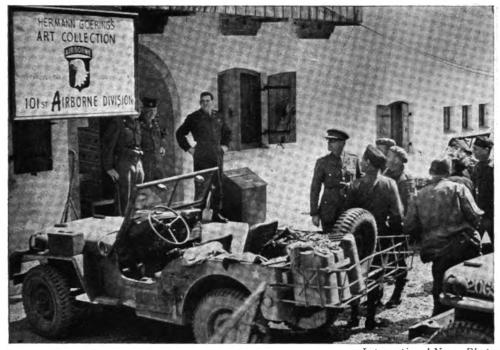
At the Rest House at Unterstein near Berchtesgaden, Major Harry
Anderson supervises the removal of the Göring Collection, brought from
Karinhall, near Berlin.
International News Photo
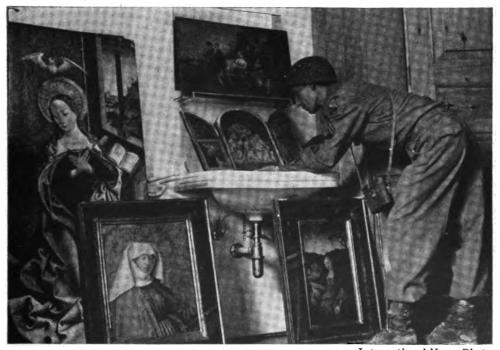
One of the forty rooms in the Rest House in which the Göring pictures,
1,100 in all, were exhibited before their removal to Munich for subsequent
restitution.
International News Photo
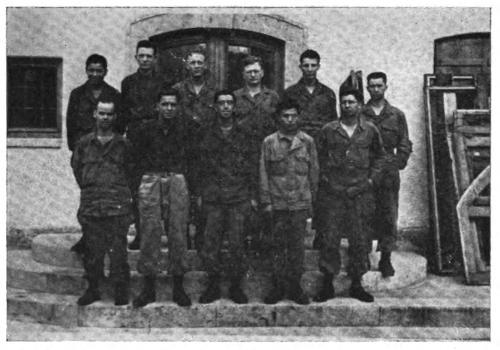
The GI Work Party which assisted the Special Evacuation Team (Lieutenants
Howe, Moore and Kovalyak) pack the Göring Collection for
removal from Berchtesgaden to Munich.
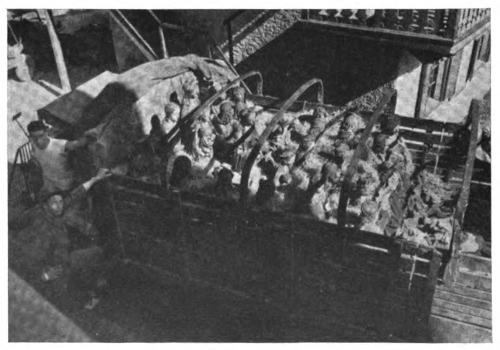
Truck loaded with sculpture from the Göring Collection at Berchtesgaden.
Statues were packed upright in excelsior for removal to the Central
Collecting Point in Munich.
I had one little errand of mercy to take care of before I turned
in. There was a recreation room on the first floor and adjoining
it a makeshift bar. Most of the officers had gone to the movies, so
I managed to slip in unobserved and pilfer two bottles of beer.
Tucking them inside my blouse, I made off for the monastery.
There, after some difficulty in finding my way around the dark passageways,
I located the rooms occupied by my two little packers.
They were making ready for bed, but when they saw what I had
for them, their leathery old faces lighted up with ecstatic smiles.
If I had been a messenger from heaven, they couldn’t have been
happier. Leaving them clucking over their unexpected refreshments,
I went back to my own billet and fell into bed. I hadn’t had
exactly what one would call a restful day myself.
That beer worked wonders I hadn’t anticipated. When I arrived
at the monastery a little before eight the next morning I found that
my two packers, together with Dr. Mutter, had been at work since
seven. As yet there was no sign of the Frenchmen, but I thought
that they would probably show up before long. At eight my gang
of PWs appeared and the sergeant who brought them explained
that I wouldn’t be having the crew of GIs who had helped out
the day before. When I protested that I needed them more urgently
than ever, he informed me that the combination of GI and PW
labor simply wouldn’t work out; that I certainly couldn’t expect to
have them both doing the same kind of work together. I said that
I most certainly could and did expect it. Well, my protest was
completely unavailing, and if I had to make a choice I was probably
better off with the sixteen PWs. Perhaps my two packers
could get enough work out of them to compensate for the loss of
the GIs.
I had just finished assigning various jobs to the PWs when
Leclancher turned up. “May I have a word with you?” he asked.
“It is about Roger.”
“What about Roger? Is he any worse?” I asked.
“No, but he is not any better either,” he said. “Is it possible
that we shall be returning to Munich tomorrow morning?”
“Not the ghost of a chance,” I said. “We shan’t be through
loading before tomorrow night. We’re too shorthanded.”
“But if we all pitched in and worked, even after supper?” he
asked.
“It would make a big difference,” I said. “But it’s entirely up
to you. It’s certainly worth a try if the drivers are willing.”
I’ll never forget that day. I never saw Frenchmen move with
such rapidity or with such singleness of purpose. When five o’clock
came, we had finished loading the fifth truck. Taking into account
the two from the preceding day, that left only three more trucks
to fill. Leclancher came to me again. The drivers wanted to work
until it got dark. That meant until nine o’clock. Knowing that the
two packers were equally eager to get back to Munich, I agreed. I
hurried off to call the sergeant about the PWs. Special arrangements
would have to be made to feed them if we were keeping
on the job after supper. Also, I had to make sure that someone at
Battalion Headquarters would be able to provide a vehicle to take
them back to their camp.
While the drivers went off to chow and the PWs were being
fed in the hospital kitchen, I joined Dr. Mutter and the packers to
discuss these new developments. I felt sure that I would be returning
to Hohenfurth in another few days with additional trucks to
complete the evacuation. That being the case, some preliminary
planning was necessary. I instructed Dr. Mutter to call in a stonemason
to remove the Della Robbia relief and the other pieces
which had been set into the walls, so that they would be ready for
packing when we came back. I gave him a written order which
would enable him to lay in a supply of lumber for packing cases
which would have to be built for some of the more fragile pieces.
Lastly, the four of us surveyed the storage rooms and made an estimate
of the number of trucks we would need for the things still
on hand.
To save time I had a couple of chocolate bars for my supper and
was ready to resume work when our combined forces reappeared.
The next two hours and a half went by like a whirlwind and by
eight o’clock we knotted down the tarpaulin on the last truck.
Everybody was content. Even the PWs seemed less glum than
usual, but that was probably because they had been so well fed in
the hospital kitchen.
If we were to make it through to Munich in the one day, we
would have to start off early the next morning. Accordingly I left
word that the trucks were to be lined up outside the monastery
entrance at seven-thirty sharp. Then I went down to the colonel’s
quarters to see about an armed escort for the convoy. I found
Colonel Sheehan and Major Thacher making preparations to “go
out on the town.” They looked very spruce in their pinks and were
in high spirits.
“We missed you at supper,” said the colonel. “How’s the work
coming along?”
“My trucks are loaded and ready to roll first thing in the morning
if I can have an escort,” I said.
“That calls for a celebration,” he said. “Pour yourself a drink.
I’ll make a bargain with you. You can have the escort on one condition—that
you join our party tonight.”
I didn’t protest. I thought it was a swell idea. A few minutes
later, the captain with whom I was billeted arrived and the four
of us set out for an evening of fun.
In the short space of two days I had grown very fond of these
three officers, although we had met only at mealtime. They were,
in fact, characteristic of all the officers I had encountered at Hohenfurth—friendly,
good-natured and ready to do anything they could
to help. That they were all going home soon may have had something
to do with their contented outlook on life, and they deserved
their contentment. As members of the 26th Division, the famous
“Yankee Division,” they had seen plenty of action, and as we drove
along that night in the colonel’s car, my three companions did a
lot of reminiscing.
While they exchanged stories, I had a chance to enjoy the romantic
countryside through which we were passing. We were, the
colonel had said, headed for Krummau, an old town about fifteen
miles away.
The road followed along the winding Moldau River, which had
an almost supernatural beauty in the glow of the late evening light.
The bright green banks were mirrored, crystal clear, on its unrippled
surface, as were the rose-gold colors of the evening clouds.
We crossed the river at Rosenberg, and as we went over the
bridge I noticed that it bore—as do all bridges in that region—the
figure of St. John Nepomuk, patron saint of Bohemia. The castle,
perched high above the river, was the ancestral seat of the Dukes
of Rosenberg who ruled this part of Bohemia for hundreds of years.
One of them murdered his wife and, according to the legend, she
still haunted the castle. Robed in white, she was said to walk the
battlements each night between eleven-thirty and twelve. Major
Thacher thought that we should test the legend by paying a visit to
the castle on our return from Krummau later that evening.
When we arrived in Krummau it was too dark to see much of the
old town except the outline of the gray buildings which lined the
narrow streets. Our objective was a night club operated by members
of an underground movement which was said to have flourished
there throughout the years of Nazi oppression. There was
nothing in any way remarkable about the establishment, but it
provided a little variety for the officers stationed thereabouts. My
companions were popular patrons of the place. They were royally
welcomed by the proprietor, who found a good table for us, not
too near the small noisy orchestra. Two pretty Czech girls joined
us and we all took turns dancing. There were so many more men
than girls that we had to be content with one dance each. Then
the girls moved on to another table.
We whiled away a couple of hours at the club before the colonel
said that we should be starting back. I hoped that we would be in
time to pay our respects to the phantom duchess, but the clock in
the square was striking twelve when we rumbled through the empty
streets of Rosenberg. It had begun to rain again.
At six the next morning, I looked sleepily out the window. It
was still raining. We would have a slow trip unless the weather
cleared, and I thought apprehensively of the steep road leading
into Linz. Fresh eggs—instead of the usual French toast—and two
cups of black coffee brightened my outlook on the soggy morning
and I was further cheered to find the convoy smartly lined up like
a row of circus elephants when I reached the monastery at seven-thirty.
Leclancher had taken the lead truck and the ailing Roger
was bundled up in the cab of one of the others.
Dr. Mutter waved agitated farewells from beneath the ribs of a
tattered umbrella as we slid slowly down the monastery drive.
At the corner of the main street of the village we picked up our
escort, two armed jeeps. They conducted us to the border where
we gathered in two similar vehicles which would set the pace for
us into Linz. The bad weather was in one respect an advantage:
there was practically no traffic on the road.
At Linz I stopped long enough to thank Anderson and his colonel
for the escort vehicles they had produced on a moment’s notice
that morning in response to a call from Colonel Sheehan. This third
pair of jeeps were very conscientious about their escort duties. The
one in the vanguard kept well in the lead and would signal us
whenever he came to a depression in the road. This got on Leclancher’s
nerves, for I heard him muttering under his breath every
time it happened. But I was so glad to have an escort of any kind
that I pretended not to notice his irritation.
When we reached Lambach, midway between Linz and Salzburg,
we lost this pair of guardians but acquired two sent on from
the latter city. While waiting for them to appear, I scrounged
lunch for myself and the drivers at a local battery. As soon as the
new escorts arrived we started on again and pulled into Salzburg
at two-thirty. This time there were no delays and we threaded our
way through the dripping streets and out on to the Autobahn without
mishap.
I now had only one remaining worry—the bad detour near
Rosenheim. Again, perhaps thanks to the weather, we were in
luck and found this treacherous by-pass free of traffic. As we rolled
into Munich, the rain let up and by the time we turned into the
Königsplatz, the sun had broken through the clearing skies.
My first major evacuation job was finished. As soon as I got my
drivers fixed up with transportation back to their camp and the
members of our escort party fed and billeted I could relax with a
clear conscience. It was a little after five-thirty, and Third Army’s
inflexible habits about the hour at which all enlisted men should
eat didn’t make this problem such an easy one. Third Army Headquarters
was a good twenty minutes away, so I took the men to the
Military Government Detachment where the meal schedule was
more elastic. Afterward I shepherded them to their billets and
went off to my own. I would have to write up a report of the expedition
for Captain Posey, but that could wait.
(5) SECOND TRIP TO HOHENFURTH
The first order of business the next morning was a conference with
Captain Posey. I gave him a complete account of the Hohenfurth
trip and presented my recommendations for a second and final
visit to complete the evacuation. It was my suggestion that I return
to the monastery with the same trucks—as soon as they could
be unloaded and serviced—and that he send up another officer with
at least eight additional trucks, the second convoy to arrive by the
time I had completed the loading of my own. I proposed taking
four packers this time instead of two, the idea being that two of
the packers could help me with the loading while the others were
building cases for the fragile objects which would have to be crated.
I mentioned also the impending withdrawal of our troops from
Hohenfurth, which would make later operations of such nature impossible.
This was of course no news to Captain Posey as, presumably, it
had been the determining factor in the removal of the Hohenfurth
things in the first place. He approved my plan and advised me
to get my trucks lined up, and said he would see what he could
do about sending an additional officer. I didn’t like the sound of
that. Too often I had used those same words myself when confronted
with a difficult request. Furthermore, it had been my
experience with the Army in general thus far—and with Third
Army in particular—that “out of sight, out of mind” was a favorite
motto. I had no intention of going back to Hohenfurth until I
had a definite promise that reinforcements would be forthcoming.
I think that my insistence piqued the captain a bit. But at that
point I was feeling exceedingly brisk and businesslike—a mood
which I found new and stimulating. It would be better to have a
clear understanding now as to who would join me in Hohenfurth;
as I explained to Captain Posey, I would like to give the officer
some detailed instructions, preferably oral ones, before I started
off.
I spent the rest of that day and most of the following one at the
Verwaltungsbau supervising the unloading of the ten trucks from
Hohenfurth and making trips out to the trucking company headquarters
to conclude arrangements for continued use of the vehicles.
Also, I had to put in a request for eight others. It was
gratifying to find that every piece we had packed at Hohenfurth
came through without a scratch. My two packers, to whom all
credit for this belonged, were equally elated. My request for the
services of four packers was met with black looks, but when I
promised that we’d not be gone more than four or five days, Craig
acquiesced.
Late in the afternoon of the second day, I went again to Posey’s
office. He was not there but I found Lincoln, as usual hunched
morosely over his typewriter. He said he had good news for me.
Captain Posey had pulled a fast one and snatched a wonderful
guy away from Jim Rorimer, Monuments Officer at Seventh Army—a
fellow named Lamont Moore. Moore was already, he thought, on
his way down to Munich to make the trip to Hohenfurth. When
I said I didn’t know Moore, Lincoln proceeded to tell me about him.
“Lamont was director of the educational program at the National
Gallery in Washington before he went into the Army. Before
that he had a brilliant record at the Newark Museum. The
two of you ought to get along famously. Lamont’s got a wonderful
sense of humor. He’s exceedingly intelligent and he’s had a
lot of experience in evacuation work.”
“Where did you know him?” I asked.
“We were in France last winter. That was before he was commissioned.
He’s a lieutenant now,” Lincoln said.
“That sounds perfect. But I want to ask you a question about
something else and I want a truthful answer. I have a sneaking notion
that you knew all the time what was in that monastery
at Hohenfurth. How about it?”
“Furniture and sculpture, you mean, instead of paintings?” he
asked. “Of course I didn’t.”
“Well, maybe you didn’t, but perhaps you can imagine how I
felt when I found that the Mannheimer collection alone contained
more than two thousand items, and that the Rothschild pieces totaled
up to a similar figure.”
Lincoln’s chuckle belied his protestations. “I’ve got another
piece of news for you,” he said. “John Nicholas Brown and Mason
Hammond are arriving tomorrow. I thought you might like to
see them before you return to Hohenfurth.”
“You told me once that Captain Posey, like many another officer,
doesn’t relish visitors from higher headquarters,” I said. “Am I
to infer a connection between his absence from the office and the
impending arrival of these two distinguished emissaries from the
Group Control Council?”
He assured me that I was not, but I left the office wondering
about it all the same.
That evening George Stout paid one of his rare and fleeting visits
to Munich. On these occasions he stayed either with Craig or Ham
Coulter. This time the four of us—all “strays” from the Navy—gathered
in Ham’s quarters.
“The work at the mine,” George said, “is going along as rapidly
as can be expected in the circumstances. But it’s got to be stepped
up. I came down to find out how soon you could join me.”
“I’m going back to Hohenfurth again,” I said. “Lamont Moore
is to meet me there.”
George was glad to hear this and said that he and Lamont had
worked together at the Siegen mine in Westphalia. He confirmed
all of the good things Lincoln had told me about Lamont and said
that he’d like to have both of us at Alt Aussee. He promised to
have a talk with Posey about it, because he was of the opinion
that these big evacuation jobs should be handled by a team rather
than by a single officer. According to George, a team of at least
three—and preferably four—officers would be the perfect setup.
Then the work could be divided up. Each officer would have specific
duties, assigned to him on the basis of his particular talents.
But all members of the team would have responsibilities of equal
importance. It would be teamwork in the real sense of the term.
Like all of George’s proposals, this one sounded very sensible.
At the same time, when I recalled the haphazard way I had been
obliged to conduct operations thus far myself, I wondered if it
weren’t Utopian. That didn’t discourage George. When he had
a good idea he never let go of it. And, if we had only been a
larger group, I am convinced that his brain child about teams
would have had wonderful results. As it was, the events of the
next few weeks were to demonstrate how effective the scheme was
on a small scale.
When I got out to Third Army Headquarters the next morning,
George had already come and gone. I would have liked to ask
Posey about their conversation but he didn’t seem to be in a chatty
mood—at least not on that subject. However, he did have a few
caustic things to say about “people from high headquarters who
have nothing better to do than travel around and interrupt the work
of others.”
Knowing that he was referring to Messrs. Brown and Hammond—Lincoln’s
assurance of the night before to the contrary notwithstanding—I
piously observed that high-level visitors to the field
might do quite a lot of good. For one thing, the fact that they had
taken the trouble to visit it emphasized the importance of the work
they had come to inspect; and, for another, it pleased the officer
in the field to have his job noticed by the boys at the top. I
thought I sounded pretty convincing, but sensing that I was not,
I turned to other topics.
About that time John and Mason arrived. Our last meeting
had taken place in the vaults of the Reichsbank at Frankfurt several
weeks before. Mason referred to that and jokingly accused me of
having run out on him. When I told him that I was about to return
to Hohenfurth he announced loudly that that was perfect—he
and John would drop in to see me there. I said that would be fine
but, when I noted the expression on Captain Posey’s face, I added to
myself, “fine, if they get the clearance.” Before coming up to see
me, they expected to visit one or two places south of Munich, so
they wouldn’t reach Hohenfurth before the end of the week.
Captain Posey was a great believer in the old theory that the
Devil finds work for idle hands, at least as far as I was concerned.
That same afternoon he casually suggested that I take a “little run
down into the Tyrol” for him and inspect a castle about which he
had been asked to make a report. He proposed the trip with such
prewar insouciance that it sounded like a pleasant holiday excursion.
As a matter of fact it was an appealing suggestion, despite
my plans for an early morning start to Hohenfurth.
It was a beautiful summer day and my jeep driver asked if a
friend of his, a sergeant who was keen about photography, might
come along. I agreed and the three of us headed out east of Munich
on the Autobahn. It was fun to be riding in an open jeep instead
of an enclosed truck.
We reached Rosenheim in record time and there struck south
into the mountains. Our objective was the little village of Brixlegg,
between Kufstein and Innsbruck. We were on the main
road to the Brenner Pass. Italy was temptingly close. We stopped
from time to time so that the sergeant could get a snapshot of some
particularly dramatic vista. But there was an embarrassment of
riches—every part of the road was spectacularly beautiful.
Brixlegg was a tiny cluster of picturesque chalets, but it had not
been tiny enough to elude the attentions of the air force. On the
outskirts we saw the shattered remains of what had been an important
factory for the manufacture of airplane parts. Happily, the
bombers had concentrated their efforts on the factory. The little
village had suffered practically no damage at all.
We located our castle without difficulty. It was Schloss Matzen,
one of the finest castles of the Tyrol—the property of a British
officer, Vice-Admiral Baillie-Grohman. This gentleman had requested
a report on the castle from the American authorities. We
found everything in perfect order. The admiral’s cousin—a Hungarian
baron named Von Schmedes who spoke excellent English—was
in residence. He showed us over the place. The castle was an
example of intelligent restoration. According to the inscription on
a plaque over the entrance, the aunt of the present owner had
devoted her life to this task.
Although an “Off Limits” sign was prominently displayed on
the premises, the baron was fearful of intruders. As the castle
stood some distance from the main highway, I thought he was
being unduly apprehensive. He said that an official letter of warning
to unwelcome visitors would be an added protection. To
please him I wrote out a statement to the effect that the castle was
an historic monument, the property of a British subject, etc., and
signed it in the name of the Commanding General of the Third
U. S. Army.
On our way out we were shown two rooms on the ground floor
which were filled with polychromed wood sculpture from the
museum at Innsbruck. The baron said that additional objects from
the Innsbruck museum were stored in a near-by castle, Schloss
Lichtwert.
It was but a few minutes’ drive from Schloss Matzen, so I decided
to have a look at it. Schloss Lichtwert, though not nearly so picturesque
either in character or as to site, was the more interesting
of the two. It stood baldly in the middle of a field and was actually
a big country house rather than a castle.
We were hospitably received by a courtly old gentleman, Baron
von Iname, to whom I explained the reason for our visit. One of
his daughters offered to do the honors, saying that her father was
extremely deaf. We followed her to a handsome drawing room
on the second floor, where several other members of the family
were gathered in conversation around a large table set with coffee
things. In one of the wall panels was a concealed door, which the
daughter of the house opened by pressing a hidden spring. Leading
the way, she took us into a room about twenty feet square filled
with violins, violas and ’cellos. They hung in rows from the ceiling,
like hams in a smokehouse. Fräulein von Iname said that the
collection of musical instruments at Innsbruck was a very fine one.
We were standing in a Stradivarius forest.
When we passed back into the drawing room, the father whispered
a few words to his daughter. She turned to us smiling and
said, “Father asked if I had pointed out to you the thickness of the
walls in this part of the castle. He is very proud of the fact that
they date from the fourteenth century and that our family has always
lived here. He also asks me to invite you to take coffee with
us.”
Knowing that coffee was valued as molten gold, I declined the
invitation on the grounds that we had a long trip ahead of us.
Thanking her for her courtesy, we left. It was after eleven when
we got back to Munich. We had driven a little more than three
hundred miles.
Bad weather and bad luck attended us all the way to Hohenfurth
the next day. Less than an hour out on the Autobahn, we came
upon a gruesome accident—an overturned jeep and the limp figures
of two GIs at one side of the road, the mangled body of a German
soldier in the center of the pavement. An ambulance had already
arrived and a doctor was ministering to the injured American soldiers.
The German was obviously beyond medical help. As soon as
the road was cleared, we continued—but at a very sober pace.
On the other side of Salzburg we had carburetor trouble which
held us up for nearly two hours. It was after five thirty when we
reached Linz. We stopped there for supper and I had a few words
with the colonel who had looked after us so well a few days
before. He seemed surprised to see me again, and rather agitated.
“You can get through this time,” he said, “but don’t try to come
back this way.”
“What do you mean, sir?” I asked, puzzled by his curt admonition.
Apparently annoyed by my query, he said brusquely, “Don’t
ask any questions. Just do as I say—don’t come back this way.”
At supper I saw Lieutenant Anderson again and I broached the
subject to him. “Does the colonel mean that the Russians are
expected to move up to the other side of the Danube?” I asked.
“Take a good look at the bridge when you cross over tonight,”
he said.
It was my turn to be nettled now. “Look here, I don’t mean to
be intruding on any precious military secret, but I am expecting a
second convoy to join me at Hohenfurth in two days; if the other
trucks aren’t going to be able to get through I ought to let the
people at Third Army Headquarters know.”
“Well, frankly I don’t know just what the score is, but the colonel
probably has definite information,” he said. “What I meant about
the bridge is that it’s jammed with people and carts, all coming
over to the west side of the Danube. It’s been like that for the
past two days and it can mean only one thing—that the Russians
aren’t far behind.”
This wasn’t too reassuring, but I decided to take a fatalistic attitude
toward it. If I had to find some other route back from Hohenfurth,
I’d worry about it when the time came. I did, however, try
to get through to Third Army Headquarters on the phone. Posey’s
office didn’t answer, so I asked Anderson to put in a call for me in
the morning.
It was slow going over the bridge, but we finally forced our way
through the welter of carts and wagons. Once we were in open
country, the traffic thinned out and we moved along at a faster
pace. The Czech and American officers at the frontier recognized
us and waved us through without formality. We arrived in Hohenfurth
a little before nine. I knew the ropes this time, so it was a
simple matter to get the men billeted in the monastery. After that
I went on to my own former billet. When I reached the house, I
found a group of officers in the recreation room. They were holding
an informal meeting. Colonel Sheehan was presiding and motioned
to me to join the group. He had just returned from the headquarters
at Budweis with important news. His own orders had
come through, so he would be pulling out for home in a few days.
But of greater concern to me was the news that the Czechs would
definitely take over at the end of the week. We would still have
some troops in the area, but their duties would be greatly curtailed.
I would have to finish the job at the monastery as fast as possible
and head back to Munich.
We resumed our work at the monastery with surprisingly few
delays. It was almost as if there had been no interruption of our
earlier operations. This time I had double the number of PWs,
so I did not have to call on the drivers to help with the loading.
During my absence, Dr. Mutter had put a stonemason to work on
the pieces which had been set into the wall, and these now lay
like parts of a puzzle in a neat pattern on the floor of the reception
hall, ready to be packed. He had also procured lumber and nails,
so my two extra packers were able to get to work on the cases
which had to be built. By evening, seven of the trucks were loaded,
leaving only one more to do the next day.
That night I consulted one of the officers, who had a wide knowledge
of the roads in that area, about an alternate route to Munich.
He showed me, on the map, a winding back road which would take
me through Passau—instead of Linz and Salzburg—to Munich. It
was, he said, a very “scenic route” but longer than the way I had
come. He felt sure, though, that I could get my trucks through, that
there were no bad detours, etc. It was comforting to know that this
route existed as a possibility—just in case. But I still had hopes of
being able to go back by way of Linz, in spite of the colonel’s warning.
The next day was the Fourth of July—not that I expected either
my French or German associates to take special notice of the fact.
Still I was glad that I had only one truck to load on the holiday. I
took advantage of the later breakfast hour, knowing that my faithful
German packers would be on the job at seven o’clock as usual.
When I arrived at the monastery at nine-thirty, I found that the
last truck was already half loaded. There was enough room to add
the two cases containing the Della Robbia plaque and the Renaissance
fireplace taken out of the wall; and, if we were careful, we
might find a place for the fifteenth century Florentine relief which
the stonemason had also painstakingly removed. Once that was
done, there was nothing to do but wait for the arrival of Lieutenant
Moore and the additional trucks.
I called the workmen together. In halting German, I explained
the significance of the Fourth of July and announced that there
would be no more work that day. It was providentially near the
lunch hour. I could send the PWs back to their camp as soon as
they had eaten. The German packers, intent on returning to
Munich as soon as possible, chose to get on with the cases they
were building. Dr. Mutter and I retired to his study to take stock of
the receipts we had thus far made out. As for the French drivers,
they had disappeared to their quarters.
After lunching at the officers’ mess, I decided to celebrate the
Glorious Fourth in my own quiet way. Major Whittemore had lent
me a car, so I set out on an expedition of my own devising. Ever
since the night of our trip to Krummau, I had wanted to explore the
castle of Rosenberg, and this seemed the logical time to do it.
Rosenberg was only eight kilometers away.
It was a sleepy summer afternoon. Not a leaf was stirring as
I followed the winding Moldau into the pretty village with its
storybook castle. The road to the castle was rough and tortuous,
reminding me of a back road in the Tennessee mountain country.
Just as I was beginning to wonder if the little sedan were equal to
the climb, the road turned sharply into a level areaway before the
castle courtyard.
I parked the car and went in search of the caretaker. When I
found no one, I ascended a flight of stone steps which led from the
courtyard to the second floor. The room at the head of the stairs
was empty, but I heard voices in the one adjoining. Two cleaning
women were scrubbing the floor, chattering to each other as they
worked. They were startled to see me, but one of them had the
presence of mind to scurry off and return a few minutes later with
the archetype of all castle caretakers. He had been custodian for the
past fifty-six years. Lately there hadn’t been many visitors.
He took me first to the picture gallery—a long high-ceilinged
room with tall windows looking out over the river. There were
a dozen full-length canvases around the rough plaster walls, past
Dukes of Rosenberg and their sour-faced Duchesses. The clou of
the collection was a tubercular lady in seventeenth century costume.
The caretaker solemnly informed me that she was the ill-fated
duchess who paced the ramparts of the castle every night just before
twelve. She had lived, he told me, in the fourteenth century.
When I mentioned as tactfully as possible that her gown indicated
she had been a mere three hundred years ahead of the styles, he
gave me a dirty look as much as to say, “a disbeliever.” I did my
best to erase this unfortunate impression and proceeded to the next
series of apartments. They included a weapon room, a sumptuous
state bedchamber reserved for royal visitors, several richly furnished
reception rooms, and a long gallery called the Crusaders’
Hall—a copy, the caretaker said, of a room in the Palace at Versailles.
Here hung full-length portraits of such historic personages
as Godefroy de Bouillon, Robert Guiscard and Frederick Barbarossa—all
done by an indifferent German painter of the last century.
Notwithstanding its ostentatious atmosphere, the gallery
had a dignity quite in keeping with the musty elegance of the castle.
I thanked the old man, gave him a couple of cigarettes and returned
to the car. It was time for me to be getting back to the
monastery.
I gauged my arrival nicely. As I pulled up to the entrance, the
guard at the archway came over to the car to tell me that eight
trucks had just driven through. When I reached the courtyard
the last of them was backing up against the chapel wall.
A tall, rangy lieutenant, wearing the familiar helmet liner prescribed
by Third Army regulations, walked up to the car as I was
getting out and said, “Good afternoon, sir. Dr. Livingstone, I
presume?”
So this was Lamont Moore. Just as Lincoln had predicted, I
liked him at once. There was a quiet self-possession about him,
coupled with a quizzical, humorous expression, which was pleasantly
reassuring. I have never forgotten the impression of Olympian
calm I received at that first meeting. In succeeding months,
there were many times when Lamont got thoroughly riled, but his
composure never deserted him. His even temper and his sense of
humor could always be depended upon to leaven the more impetuous
actions of his companions.
Without wasting breath on inconsequential conversation, he suggested
that we “case the joint.” After introducing him to Dr.
Mutter, who was still hovering around like a distracted schoolmaster,
we made a tour of the premises. By the time we had finished
I had the comforting, if somewhat unflattering, feeling that
he had a clearer understanding of the work there than I, notwithstanding
the time I had spent at the monastery.
On our way down to the village afterward, I asked Lamont if he
had had any difficulty coming up through Linz. He said no, but that
he also had been warned not to return that way.
As soon as he had found a billet, we settled down to talk over
the loading of his trucks. “The colonel says that we’ll have to finish
the job in a hurry. The Czechs are taking over at the end of the
week,” I said. “And if the Russians move up to the Danube, we
won’t be able to go back by way of Linz. We’ll have to return by
way of Passau.”
“I understand that there isn’t any bridge over the Danube at
Passau,” Lamont said quietly. At that I got excited, but in the
same quiet voice Lamont said, “Don’t worry. We’ve got more important
things to think about—something to drink, for example.”
We went over to the officers’ club, arriving just in time to be
offered a sample of the Fourth of July punch which two of the
officers had been mixing that afternoon. From the look of things,
they had perfect confidence in their recipe, which called for red
wine, armagnac and champagne. After the first sip I didn’t have
to be told there would be fireworks in Hohenfurth that evening.
Lamont and I began to discuss mutual friends and acquaintances
in the museum world, a habit deeply ingrained in members of our
profession. We agreed that a mutual “hate” often brought people
together more quickly than a mutual admiration. Then inconsistently—it
was probably the punch—we started talking about
Lincoln, whom we both liked very much.
“It was Lincoln who told me what a fine fellow you are, Lamont,”
I said.
“That’s interesting,” he said with a noiseless laugh. “He said
the same thing about you.”
Comparing notes, we found that Lincoln had given us identical
vignettes of each other.
“Tell me something about the work you’ve been doing in
MFA&A. This is my first real job, so I’m still a neophyte,” I said.
Lamont rolled his eyes wearily and said, “Oh, I’ve been evacuating
works of art for the past four months, and I wonder sometimes
if it’s ever going to end. Siegen was my big show. It was
the foul and dripping copper mine in Westphalia where the priceless
treasures from the Rhineland museums were stored. The shaft
was two thousand feet deep and some of the mine chambers were
more than half a mile from the shaft. Walker Hancock of First
Army and George Stout had inspected it originally and advised
immediate evacuation. But no place was available. First Army was
pushing eastward, so all Walker could do was to reassure himself
from time to time that the contents were adequately guarded.
“Shortly before VE-Day, I received a cryptic telegram at Ninth
Army Headquarters stating that, as of midnight that particular
night, Siegen was my headache. Then followed weeks of activity
in which Walker, Steve and I were involved.”
“Who is Steve?” I asked.
“Steve Kovalyak of Punxsutawney, Pennsylvania,” said Lamont.
“I think he’s with George at Alt Aussee now. I hope you’ll
meet him. He’s a great character.
“A bunker at Bonn was approved as a new repository for the
Siegen treasures. I surveyed the roads to Bonn and found them
impossible for truck transport. George was called to Alt Aussee.
Walker went off to see about setting up a collecting point at Marburg.
“Then I was called back to Ninth Army Headquarters. The
evacuation of Siegen was momentarily at a standstill.
“Later I returned and, with Walker’s and Steve’s assistance,
completed the evacuation. We moved everything to Marburg, except
the famous Romanesque doors from the church of Santa Maria
im Kapitol. Walker took them to the cathedral at Cologne, along
with the Aachen crown jewels.
“Siegen was the second major evacuation—perhaps you could
say it was the first carried out by a team of MFA&A officers.”
“What was the first?” I asked.
“The Merkers mine, where the Nazi gold and the Berlin Museum
things were stored. That was the most spectacular of the early
evacuations—that and Bernterode.”
“What about Bernterode?” I asked. I had read Hancock’s official
report of the operation and had seen some snapshots taken in
the mine, so I was curious to have a firsthand account.
“Walter Hancock was the officer in charge of the evacuation,”
said Lamont. “Like Siegen, it was a deep-shaft mine, so the contents
had to be brought up by an elevator. It was a hell of a job to
get the elevator back in working order. The dramatic thing about
Bernterode was the discovery of a small chapel, or shrine, constructed
in one of the mine chambers and then completely walled
up.
“In this concealed shrine, the Nazis had placed the bronze sarcophagi
of Frederick the Great, Frederick William—the Soldier
King—and those of Von Hindenburg and his wife. On the coffins
had been laid wreaths, ribbons and various insignia of the Party.
Around and about them were some two hundred regimental banners,
many of them dating from the early Prussian wars.
“When Walker was ready to take the coffins out of the mine, he
found they were so large and heavy that they’d have to come up
one at a time. He was standing at the top of the shaft as the coffin
of Frederick the Great rose slowly from the depths. As it neared
the level, a radio in the distance blared forth the ‘Star-Spangled
Banner.’ And just as the coffin came into view, the radio band
struck up ‘God Save the King.’ The date,” Lamont added significantly,
“was May the eighth.”
If I thought I was going to get much sleep that night, I reckoned
without the patriotic officers of the Yankee Division, who were
hell-bent on making it a really Glorious Fourth. It had been my
mistake in the first place to move into quarters directly over the
recreation room. It wasn’t much of a bedroom anyway—just an alcove
with an eighteenth century settee for a bed. I was resting precariously
on this spindly collector’s item when the door was flung
open and Major Thacher shouted that I was wanted below. I told
him to go away. To my surprise he did—but only to return a few
minutes later with reinforcements. I must come down at once—colonel’s
orders, and if I wouldn’t come quietly, they’d carry me
down. Before I could get off my settee, it was pitched forward
and I sprawled on the floor. What fun it was for everybody—except
me! I put on a dressing gown and was marched down the
stairs. I had been called in, as a naval officer, to settle an argument:
Who had won the Battle of Jutland? The Battle of Jutland,
of all things! At that moment I wasn’t at all sure in what war it had
been fought, let alone who had won it. But assuming an assurance
I was far from feeling I declared that it had been a draw. My luck
was with me that night after all, for that had been the colonel’s
contention. So I was allowed to return to my makeshift bed.
Lamont took some of the wind out of my sails by assuring me
the next morning that the British had defeated the German fleet
at Jutland in 1916.
But we were having our own battle of Hohenfurth that morning,
so I was too preoccupied to give Jutland more than a passing
thought. Just before noon, as we finished our fourth truck, John
Nicholas Brown and Mason Hammond arrived. Mason, as was
his custom when traveling about Germany, was bundled up in a
great sheepskin coat—the kind used by the Wehrmacht on the
Russian front—and looked like something out of Nanook of the
North. John, less arctically attired, hailed us gaily from the back
seat of the command car.
Lamont and I suspended operations to show them around. We
were pleased by their comments on our work—how admirably it
was being handled and so on—but we struck a snag when we
showed them Canova’s marble Muse. Lamont and I had just about
decided to leave her where she was. Our two visitors thought
that would be a pity, a downright shame. We pointed out that to
transport the statue would be a hazardous business, even if we succeeded
in getting it onto a truck in the first place. We had no equipment
with which to hoist anything so heavy. On our inspection
tour they kept coming back to the subject of the Canova, and Lamont
gave me an irritated look for having called their attention to
it at all.
At lunch, which we had with the colonel, they fixed us. When
the subject of the statue was brought up, the colonel instantly
agreed to provide us with a winch and also two extra trucks. We
needed the trucks all right, but we weren’t particularly happy about
the winch.
As soon as we got back to the monastery, we broke the news to
Dr. Mutter. The Muse was about to take a trip. He held up his
hands in dismay and said it would take us half a day to get the
statue loaded. When we told the German packers what we had
in mind, they made a few clucking noises, and then began the
necessary preparations. The first thing they did was to get hold of
two logs, each about six feet in length and five inches in diameter.
With the help of a dozen PWs, they got them placed beneath the
base of the statue. From that point on, it was a matter of slowly
rolling the statue as the logs rolled. It was arduous work. A
distance of well over four hundred yards was involved, and the last
half of it was along a sloping ramp where it was particularly difficult
to keep the heavy marble under control.
Once the truck was reached, it was necessary to set up a stout
runway from the ground to the bed of the truck. This done, the
next move was to place heavy pads around the base of the statue, so
that the cable of the winch would not scratch the surface of the
marble. It was a tense moment. Would the winch be strong
enough to drag its heavy burden up the runway? It began to grind,
and slowly the Muse slid up the boards, paused for a quivering
instant and then glided majestically along the bed of the truck.
There were cheers from the PWs who had gathered around the
truck to watch. We all sighed with relief, and then congratulated
the little packers who had engineered the whole operation. Dr.
Mutter kept shaking his head in disbelief. He told us that when
the statue had been brought to the monastery in the first place, it
had taken three hours to unload it. The present operation had
taken forty-five minutes.
After this triumph, the loading of the remaining trucks seemed
an anticlimax, but we kept hard at it for the next six hours. By
seven o’clock, all ten of them were finished. All told, we would be
a convoy of eighteen trucks.
We were on the point of starting down to the village for supper,
when Dr. Mutter, even more agitated than he had been before,
rushed up and implored us to grant him a great favor. Would we,
out of the kindness of our hearts—oh, he knew he had no right to
ask such a favor—would we take him and his wife and little girl
along with us to Linz the next day? Linz was his home, he had a
house there. He had brought his family to Hohenfurth only because
the Nazis wouldn’t allow him to give up his duties as custodian
of the collections at the monastery. Now the Czechs were
going to be in complete control. He and his family were Austrians
and there was no telling what would happen to them.
How news does get around, I thought to myself. We hadn’t said
a word about the Czechs taking over, but when I expressed the
proper surprise and asked him where he had heard that rumor, he
wagged his head as much as to say, “Oh, I know what I am talking
about, all right!”
My heart wasn’t exactly bleeding for Dr. Mutter, but at the
thought of his little girl, who was about the age of my own, I
couldn’t say no. I told him to be ready to leave at seven the next
morning. I didn’t tell him how uncertain it was that we would ever
get to Linz at all.
It was pouring when I crawled out of my bed at six A.M. I seemed
to specialize in bad weather, particularly when starting out with a
convoy! At the monastery everything was in order. At the last
minute I decided to tell Dr. Mutter there was a possibility—even
a probability—that we would not be able to cross over at Linz, and
I told him why. He was terrified when I mentioned the prospect
of being stopped by the Russians. I assured him that we would
drop him and his family off at one of the villages on the other
side of the Austrian border, if we found there was going to be
trouble. It was cold comfort but the best I had to offer.
I climbed into the lead truck, Lamont into the tenth, and Leclancher,
as usual, took over the last truck. Leclancher, with his
customary ability to pull a rabbit out of a hat at a critical juncture,
had found among his drivers one who spoke some Russian, so we
had put him at the controls of the first truck. It might make a good
impression.
Once again we had a jeep escort to the border, and there we
picked up three others to conduct us as far as Linz. The cocky
little sergeant in the jeep that was to lead came over to my truck,
squinted up at me and said, “You look nervous this morning,
Lieutenant.”
Well, I thought, if it’s that apparent, what’s the use of denying
it? “I am,” I said. “This is a big convoy and it’s filled with millions
of dollars’ worth of stuff. I’d hate to have anything happen
to it.”
He whistled at that. Then, rubbing his hands briskly, he retorted,
“And nothing is going to happen to it.”
He took off and we swung in behind him. The first hour was a
long one. There was more traffic than ever before—a steady stream
of carts all moving toward Linz. At last we shifted into low gear,
and I knew that we were on the steep grade leading down to
Urfahr. If there were going to be trouble, we’d know it in a minute.
At that moment, the sergeant in the lead jeep turned around
and waved. I thought, There’s trouble ahead. But he was only
signaling that the road was clear.
We rolled over the rough cobblestones onto the bridge. I saw
the gleaming helmet liners of the new escort awaiting us as we
drew up to the center of the span. I motioned to one of our new
guardians that we would stop at the first convenient place on
the other side.
We were such a long convoy that I thought we’d be halfway
through Linz before our escort directed us to pull over to the curb.
There we unloaded the Mutter family and their luggage. The doctor
and his wife were tearfully grateful and the little girl smiled
her thanks.
I was feeling relaxed and happy and wanted to share my relief
with someone, so I suggested to Lamont that we pay our respects
to the colonel who had warned us not to come through Linz. It
was a letdown to find only a warrant officer in the colonel’s anteroom.
But he remembered us and was surprised to see us again.
He said we had been lucky; the latest news was that the Russians
would move up to the opposite side of the Danube by noon. We
left appropriate messages for the colonel and his adjutant, returned
to our trucks and headed west toward Lambach.
As on the previous trip, the escort turned back at that point. A
new one—this time an impressive array of six armed jeeps—shepherded
us from there. We stopped for lunch with a Corps of Engineers
outfit of the 11th Armored Division on the outskirts of
Schwannenstadt. The C.O., Major Allen, and his executive officer,
Captain Myers, welcomed us as warmly as if we had been commanding
generals instead of a motley crew of eighteen French
drivers, plus twelve “noncoms” from the escorting jeeps—a total
of thirty-two, including Lamont and me. We doled out K rations
to our four packers, for we couldn’t take civilians into an Army
mess.
After lunch I telephoned ahead to Salzburg to ask for an escort
from there to Munich, requesting that it meet us on the edge of
town, east of the river. The weather had cleared, and drying
patches of water on the road reflected a blue sky. By the time we
had sighted Salzburg it was actually hot. As we rolled into
the outskirts we were enveloped in clouds of dust from the steady
procession of military vehicles. We waited in vain for our new
escort. After an hour we decided to proceed without one. I didn’t
like the idea very much, but it was getting on toward five o’clock,
and we wanted to reach Munich in time for supper. We fell far
short of our goal, being forced to stop once because of a flat tire,
and a second time because of carburetor trouble. These two delays
cost us close to two hours. At seven o’clock we halted by the placid
waters of Chiemsee and ate cold C rations in an idyllic setting. It
was after nine when we lumbered into the parking area behind the
Gargantuan depot at the Königsplatz. Lamont and I had twin
objectives—hot baths and bed. It didn’t take us long to achieve
both!
We had had every intention of making an early start the next
morning, not so much because of any blind faith in Benjamin
Franklin’s precepts, but simply because they stopped serving breakfast
in the Third Army mess shortly before eight o’clock. In fact,
the first thing one saw on entering the mess hall was a large placard
which stated peremptorily, “The mess will be cleared by 0800. By
order of the Commanding General.” And such was Third Army
discipline—we had a different name for it—that the mess hall
was completely devoid of life on the stroke of eight.
It was a little after seven when I woke up. Lamont was still
dead to the world, so I shaved and dressed before waking him.
There was a malevolent gleam in his eyes when he finally opened
them. He asked frigidly, “Are you always so infernally cheerful at
this hour of the morning?” I told him not to confuse cheerfulness
with common courtesy, and mentioned the peculiar breakfast habits
of the Third Army.
We arrived at the mess hall with a few minutes to spare. The
sergeant at the entrance asked to see our mess cards. We had
none but I explained that we were attached to the headquarters.
“Temporary duty?” he asked.
“Yes, just temporary duty,” I said with a hint of thankfulness.
“Then you can’t eat here. Take the bus to the Transient Officers’
Mess downtown.”
I asked about the bus schedule. “Last bus left at 0745,” he said.
It was then 0750.
“Well, how do you like ‘chicken’ for breakfast?” I asked Lamont
as we walked out to the empty street.
There was nothing to do but walk along until we could hail a
passing vehicle. We had gone a good half mile before we got a
lift. Knowing that the downtown mess closed at eight, I thought
we’d better try the mess hall at the Military Government Detachment
where the officers usually lingered till about eight-thirty.
Among the laggards we found Ham Coulter and Craig. After airing
our views on the subject of Third Army hospitality, we settled
down to a good breakfast and a full account of our trip back from
Hohenfurth. We told Craig that a couple of our French drivers
were to meet us at the Collecting Point at nine. They were to
bring some of the trucks around for unloading before noon. It was
a Saturday and in Bavaria everything stopped at noon. Once
in a great while Craig could persuade members of his civilian
crew to work on Saturday afternoons, but it was a custom they
didn’t hold with, so he avoided it whenever possible. There
were those who frowned on this kind of “coddling,” as they called
it, but they just didn’t know their Bavarians. Craig did, and I think
he got more work out of his people than if he had tried to change
their habits.
We spent part of the morning with Herr Döbler, the chief packer,
at the Collecting Point, helping him decipher our trucking lists,
hastily prepared at Hohenfurth in longhand. Meanwhile the trucks,
one after another, drew up to the unloading platform and disgorged
their precious contents. The descent of the marble Muse
caused a flurry of excitement. Our description of loading the statue
had lost nothing in the telling and we were anxious to see how she
had stood the trip. The roads had been excruciatingly rough in
places, especially at Linz and on the dread detour near Rosenheim.
At each chuckhole I had offered up a little prayer. But my
worries had been groundless—she emerged from the truck in all
her gleaming, snow-white perfection.
Just before noon, Captain Posey summoned Lamont and me to
his office. He cut short our account of the Hohenfurth operation
with the news that we were to leave that afternoon for the great
mine at Alt Aussee. At last we were to join George—both of us.
George was going to have his team after all.
A command car had already been ordered. The driver was to
pick us up at one-thirty. Posey got out a map and showed us the
road we were to take beyond Salzburg. As his finger ran along
the red line of the route marked with the names St. Gilgen, St.
Wolfgang, Bad Ischl and Bad Aussee, our excitement grew. Untold
treasures were waiting to be unearthed at the end of it.
He said that the trip would take about six hours. We could perhaps
stop off at Bad Aussee for supper. Two naval officers—Lieutenants
Plaut and Rousseau, both of them OSS—had set up a
special interrogation center there, an establishment known simply
as “House 71,” and were making an intensive investigation of German
art-looting activities. They lived very well, Posey said with a
grin. We could do a lot worse than to sample their hospitality. I
knew Jim Plaut and Ted Rousseau—in fact had seen them at Versailles
not so many weeks ago—so I thought we could prevail on
them to take us in.
The mention of food reminded Lamont that we ought to pick
up a generous supply of rations—the kind called “ten-in-ones”—somewhere
along the road. The captain gave us a written order
for that, and also provided each of us with a letter stating that we
were authorized to “enter art repositories in the area occupied by
the Third U. S. Army.” Our earlier permits had referred to specific
localities. These were blanket permits—marks of signal favor,
we gathered from the ceremonious manner in which they were
presented to us.
There were various odds and ends to be attended to before we
could get off, among them the business of our PX rations. That
was Lamont’s idea. He said that we might not be able to get them
later. He was right; they were the last ones we were able to lay
our hands on for three weeks.
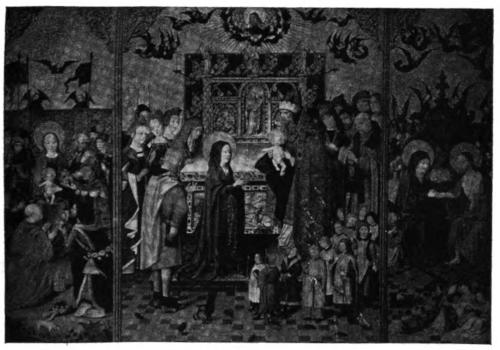
German altarpiece from the Louvre Museum, by the Master of the Holy Kinship,
was acquired by Göring in exchange for paintings from his own collection.
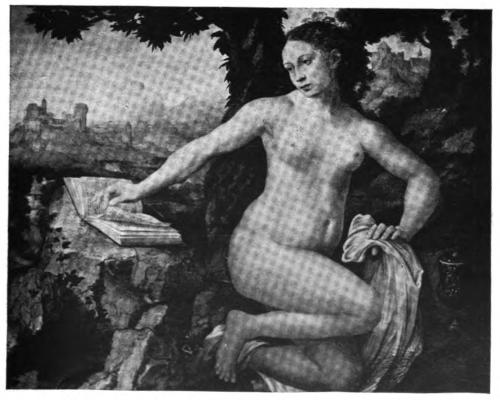
This panel, Mary Magdalene, by van Scorel, was given to Hitler by Göring.
Shortly before the war’s end the Führer returned it to Göring for safekeeping.
Wing of an Italian Renaissance altarpiece by del Garbo, representing
Saint John the Evangelist and Saint Justin.
Life-size statue of polychromed wood, The Magdalene, by Erhardt,
was formerly owned by the Louvre.
(6) LOOT UNDERGROUND: THE SALT MINE AT ALT AUSSEE
It was nearly two o’clock by the time we were ready to start. I was
now so familiar with the road between Munich and Salzburg that
I felt like a commuter. Just outside Salzburg, Lamont began looking
for signs that would lead us to a Quartermaster depot. He
finally caught sight of one and, after following a devious route
which took us several miles off the main road, we found the depot.
We were issued two compact and very heavy wooden boxes bound
with metal strips. We dumped them on the floor of the command
car and drove on into town.
Across the river, we picked up a secondary road which led out
of the city in a southeasterly direction. For some miles it wound
through hills so densely wooded that we could see but little of the
country. Then, emerging from the tunnel of evergreens, we skirted
Fuschl See, the first of the lovely Alpine lakes in that region.
Somewhere along its shores, we had been told, Ribbentrop had had
a castle. It was being used now as a recreation center for American
soldiers.
Our road led into more rugged country. We continued to
climb and with each curve of the road the scenery became more
spectacular. After an hour’s drive we reached St. Gilgen, its neat
white houses and picturesque church spire silhouetted against the
blue waters of St. Wolfgang See. Then on past the village of
Strobl and finally into the crooked streets of Bad Ischl, where the
old Emperor Franz Josef had spent so many summers. From Bad
Ischl our road ribboned through Laufen and Goisern to St. Agatha.
Beyond St. Agatha lay the Pötschen Pass. The road leading up
to it was a series of hairpin turns and dangerous grades. As we
ground slowly up the last steep stretch to the summit, I wondered
what route George was using for his convoys from the mine.
Surely not this one. Large trucks couldn’t climb that interminable
grade. I found out later that this was the only road to Alt Aussee.
On the other side of the pass, the road descended gradually
into a rolling valley and, in another half hour, we clattered into the
narrow main street of Bad Aussee. From there it was only a few
miles to Alt Aussee. Midway between the two villages we hoped
to find the house of our OSS friends.
We came upon it unexpectedly, around a sharp bend in the
road. It was a tall, gabled villa, built in the gingerbread style of
fifty years ago. Having pictured a romantic chalet tucked away in
the mountains, I was disappointed by this rather commonplace
suburban structure, standing behind a stout iron fence with padlocked
gates, within a stone’s throw of the main highway.
Jim and Ted received us hospitably and took us to an upper
veranda with wicker chairs and a table immaculately set for dinner.
We were joined by a wiry young lieutenant colonel, named
Harold S. Davitt, who bore a pronounced resemblance to the Duke
of Windsor. He was the commanding officer of a battalion of the
11th Armored Division stationed at Alt Aussee, the little village
just below the mine. Colonel Davitt’s men constituted the security
guard at the mine. He knew and admired our friend George Stout.
It was strange and pleasant to be again in an atmosphere of well-ordered
domesticity. To us it seemed rather a fine point when
one of our hosts rebuked the waitress for serving the wine in the
wrong kind of glasses.
During dinner we noticed a man pacing about the garden below.
He was Walter Andreas Hofer, who had been Göring’s agent and
adviser in art matters. A shrewd and enterprising Berlin dealer
before the war, Hofer had succeeded in ingratiating himself with
the Reichsmarschall. He, more than any other single individual,
had been responsible for shaping Göring’s taste and had played the
stellar role in building up his priceless collection of Old Masters.
Some of his methods had been ingenious. He was credited with
having devised the system of “birthday gifts”—a scheme whereby
important objects were added to the collection at no cost to the
Reichsmarschall. Each year, before Göring’s birthday on January
twelfth, Hofer wrote letters to wealthy industrialists and businessmen
suggesting that the Reichsmarschall would be gratified to
receive a token of their continued regard for him. Then he would
designate a specific work of art—and the price. More often
than not, the piece in question had already been acquired. The
prospective donor had only to foot the bill. Now and then the
victim of this shakedown protested the price, but he usually came
through.
In Hofer, the Reichsmarschall had had a henchman as rapacious
and greedy as himself. And Hofer had possessed what his master
lacked—a wide knowledge of European collections and the international
art market. Göring had been a gold mine and Hofer had
made the most of it.
Hofer had been arrested shortly after the close of hostilities. He
had been a “guest” at House 71 for some weeks now, and was
being grilled daily by our “cloak and dagger boys.” They were
probing into his activities of the past few years and had already
extracted an amazing lot of information for incorporation into an
exhaustive report on the Göring collection and “how it grew.”
Hofer was just one of a long procession of witnesses who were
being questioned by Plaut and Rousseau in the course of their tireless
investigation of the artistic depredations of the top Nazis.
These OSS officers knew their business. With infinite patience,
they were cross-examining their witnesses and gradually extracting
information which was to lend an authentic fascination to their
reports.
Hofer’s wife, they told us, had ably assisted her husband. Her
talents as an expert restorer had been useful. She had been charged
with the technical care of the Göring collection—no small job when
one stopped to consider that it numbered over a thousand pictures.
Indeed, there had been more than enough work to keep one person
busy all the time. We learned that Frau Hofer was living temporarily
at Berchtesgaden where, until recently, she had been allowed
to attend to emergency repairs on some of the Göring pictures
there.
We turned back to the subject of Hofer, who had not yet finished
his daily constitutional and could be seen still pacing back
and forth below us. He was, they said, a voluble witness and had
an extraordinary memory. He could recall minute details of complicated
transactions which had taken place several years before.
On one occasion Hofer had recommended an exchange of half a
dozen paintings of secondary importance for two of the very first
quality. As I recall, the deal involved a group of seventeenth century
Dutch pictures on the one hand, and two Bouchers on the
others. Hofer had been able to reel off the names of all of them
and even give the price of each. It was just such feats of memory,
they said with a laugh, that made his vague and indefinite answers
to certain other questions seem more than merely inconsistent.
Listening to our hosts, we had forgotten the time. It was getting
late and George would be wondering what had happened to us.
There had been a heavy downpour while we were at dinner. The
weather had cleared now, but the evergreens were dripping as we
pulled out of the drive.
The road to Alt Aussee ran along beside the swift and milky
waters of an Alpine river. It was a beautiful drive in the soft evening
light. The little village with its winding streets and brightly
painted chalets was an odd setting for GIs and jeeps, to say nothing
of our lumbering command car.
We found our way to the Command Post, which occupied a
small hotel in the center of the village. There we turned sharply
to the right, into a road so steep that it made the precipitous grades
over which we had come earlier that afternoon seem level by
comparison. We drove about a mile on this road and I was beginning
to wonder if we wouldn’t soon be above the timber line—perhaps
even in the region of “eternal snow” to which Roger had once
so poetically referred—when we came to a bleak stone building
perched precariously on a narrow strip of level ground. Behind it,
a thousand feet below, stretched an unbroken sea of deep pine
forests. This was the control post, and the guard, a burly GI
armed with a rifle, signaled us to stop. We asked for Lieutenant
Stout. He motioned up the road, where, in the gathering dusk, we
could distinguish the outlines of a low building facing an irregular
terrace. It was a distance of about two hundred yards. We drove
on up to the entrance where we found George waiting for us.
He took us into the building which he said contained the administrative
offices of the salt mine—the Steinbergwerke, now a government
monopoly—and his own living quarters. We entered a
kind of vestibule with white plaster walls and a cement floor. A
narrow track, the rails of which were not more than eighteen inches
apart, led from the entrance to a pair of heavy doors in the far wall.
“That,” said George, “is the entrance to the mine.”
He led the way to a room on the second floor. Its most conspicuous
feature was a large porcelain stove. The woodwork was
knotty pine. Aside from the two single beds, the only furniture
was a built-in settle with a writing table which filled one corner.
The table had a red and white checked cover and over it, suspended
from the ceiling, was an adjustable lamp with a red and
white checked shade. Opening off this room was another bedroom,
also pine-paneled, which was occupied by the captain of the
guard and one other officer. George apologized for the fact that
the only entrance to the other room was through ours. Apparently,
in the old days, the two rooms had formed a suite—ours
having been the sitting room—reserved for important visitors to
the mine. For the first few days there was so much coming and
going that we had all the privacy of Grand Central Station, but
we soon got used to the traffic. George and Steve Kovalyak shared
a room just down the hall. Lamont had spoken of Steve when we
had been at Hohenfurth, and I was curious to meet this newcomer
to the MFA&A ranks. George said that Steve would be back
before long. He had gone out with Shrady. That was Lieutenant
Frederick Shrady, the third member of the trio of Monuments
Officers at the mine.
While Lamont and I were getting our things unpacked, George
sat and talked with us about the work at the mine and what he expected
us to do. As he talked he soaked his hand in his helmet liner
filled with hot water. He had skinned one of his knuckles and an
infection had set in. The doctors wanted to bring the thing to a head
before lancing it the next day. I had noticed earlier that one of his
hands looked red and swollen. But George hadn’t said anything
about it. As he was not one to relish solicitous inquiries, I refrained
from making any comment.
George outlined the local situation briefly. The principal bottle-neck
in the operation lay in the selection of the stuff which was to
be brought out of the various mine chambers. There were, he said,
something like ten thousand pictures stored in them, to say nothing
of sculpture, furniture, tapestries, rugs and books. At the moment
he was concentrating on the pictures and he wanted to get the
best of them out first. The less important ones—particularly the
works of the nineteenth century German painters whom Hitler
admired so much—could wait for later removal.
He and Steve and Shrady had their hands full above ground.
That left only Sieber, the German restorer, who had been at the
mine ever since it had been converted into an art repository, to
choose the paintings down below. In addition Sieber had to supervise
the other subterranean operations, which included carrying the
paintings from the storage racks, dividing them into groups according
to size, and padding the corners so that the canvases
wouldn’t rub together on the way up to the mine entrance. Where
we could be of real help would be down in the mine chambers,
picking out the cream of the pictures and getting them up
topside. (George’s vocabulary was peppered with nautical expressions.)
In the midst of his deliberate recital, we heard a door slam.
The chorus of “Giannina Mia” sung in a piercingly melodic baritone
echoed from the stairs. “Steve’s home,” said George.
A second later there was a knock on the door and the owner of
the voice materialized. Steve looked a bit startled when he caught
sight of two strange faces, but he grinned good-naturedly as George
introduced us.
“I thought you were going out on the town with Shrady tonight,”
said George.
“No,” said Steve, “I left him down in the village and came back
to talk to Kress.”
Kress was an expert photographer who had been with the Kassel
Museum before the war. He had been captured when our troops
took over at the mine just as the war ended. Since Steve’s arrival,
he had been his personal PW. Steve was an enthusiastic amateur
and had acquired all kinds of photographic equipment. Kress, we
gathered, was showing him how to use it. Their “conversations”
were something of a mystery, because Steve knew no German,
Kress no English.
“I use my High German, laddies,” Steve would say with a
crafty grin and a lift of the eyebrows, as he teetered on the balls of
his feet.
We came to the conclusion that “High German” was so called
because it transcended all known rules of grammar and pronunciation.
But, for the two of them, it worked. Steve—stocky, gruff
and belligerent—and Kress—timid, beady-eyed and patient—would
spend hours together. They were a comical pair. Steve
was always in command and very much the captor. Kress was
long-suffering and had a kind of doglike devotion to his master,
whose alternating jocular and tyrannical moods he seemed to accept
with equanimity and understanding. But all this we learned
later.
That first evening, while George went on with his description of
the work, Steve sat quietly appraising Lamont and me with his
keen, gray-green eyes. He had worked with Lamont at Bernterode,
so I was his main target. Now and then he would look over at
George and throw in a remark. Between the two there existed an
extraordinary bond. As far as Steve was concerned, George was
perfect, and Steve had no use for anyone who thought otherwise.
If, at the end of a hard day, he occasionally beefed about George
and his merciless perfection—well, that was Steve’s prerogative.
For his part, George had a fatherly affection for Steve and a quiet
admiration for his energy and resourcefulness and the way he
handled the men under him.
Presently Steve announced that it was late and went off to bed.
I wondered if he had sized me up. There was a flicker of amusement
in Lamont’s eyes and I guessed that he was wondering the
same thing. When George got up to go, he said, “You’ll find hot
water down in the kitchen in the morning. Breakfast will be at
seven-thirty.”
Steve roused us early with a knock on the door and said he’d
show us the way to the kitchen. We rolled out, painfully conscious
of the cold mountain air. Below, in the warm kitchen, the sun
was pouring in through the open door. There were still traces of
snow on the mountaintops. The highest peak, Steve said, was
Loser. Its snowy coronet glistened in the bright morning light.
When my eyes became accustomed to the glare, I noticed that
there were several other people in the kitchen. One of them, a
wrinkled little fellow wearing Lederhosen and white socks, was
standing by the stove. Steve saluted them cheerfully with a wave
of his towel. They acknowledged his greeting with good-natured
nods and gruff monosyllables. These curious mountain people, he
said, belonged to families that had worked in the mine for five
hundred years. They were working for us now, as members of his
evacuation crew.
We washed at a row of basins along one wall. Above them
hung a sign lettered with the homely motto:
“Nach der Arbeit
Vor dem Essen
Hände waschen
Nicht vergessen.”
It rang a poignant bell in my memory. That same admonition to
wash before eating had hung in the little pension at near-by
Gründlsee where I had spent a summer fifteen years ago.
Our mess hall was in the guardhouse down the road, the square
stone building where the sentry had challenged us the night before.
We lined up with our plates and, when they had been heaped with
scrambled eggs, helped ourselves to toast, jam and coffee and sat
down at a long wooden table in the adjoining room. George was
finishing his breakfast as the three of us came in. With him was
Lieutenant Shrady, who had recently been commissioned a Monuments
officer at Bad Homburg. Subsequently he had been sent
down to Alt Aussee by Captain Posey. He was a lean, athletic,
good-looking fellow. Although he helped occasionally with the
loading, his primary duties at the mine were of an administrative
nature—handling the workmen’s payrolls through the local Military
Government Detachment, obtaining their food rations, making
inspections in the area, filing reports and so on. After he and
George had left, Steve told us that Shrady was a portrait painter.
Right now he was working on a portrait of his civilian interpreter-secretary
who, according to Steve, was something rather special in
the way of Viennese beauty. This was a new slant on the work at
the mine and I was curious to know more about the glamorous
Maria, whom Steve described as being “beaucoup beautiful.” But
George was waiting to take us down into the mine. As we walked
up the road, Steve explained to us that the miners worked in two
shifts—one crew from four in the morning until midday, another
from noon until eight in the evening. The purpose of the early
morning shift was to maintain an uninterrupted flow of “stuff”
from the mine, so that the daytime loading of the trucks would not
bog down for lack of cargo.
At the building in which the mine entrance was located we
found George with a group of the miners. It was just eight o’clock
and the day’s work was starting. We were introduced to two
men dressed in white uniforms which gave them an odd, hybrid
appearance—a cross between a street cleaner and a musical-comedy
hussar. This outfit consisted of a white duck jacket and trousers.
The jacket had a wide, capelike collar reaching to the shoulders.
Two rows of ornamental black buttons converging at the waistline
adorned the front of the jacket, and a similar row ran up the
sleeves from cuff to elbow. In place of a belt, the jacket was held
in place by a tape drawstring. A black garrison cap completed the
costume.
The two men were Karl Sieber, the restorer, and Max Eder, an
engineer from Vienna. It was Eder’s job to list the contents of each
truck. Perched on a soapbox, he sat all day at the loading entrance,
record book and paper before him on a makeshift desk. He wrote
down the number of each object as it was carried through the door
to the truck outside. The truck list was made in duplicate: the original
was sent to Munich with the convoy; the copy was kept at the
mine to be incorporated in the permanent records which Lieutenant
Shrady was compiling in his office on the floor above.
In the early days of their occupancy, the Nazis had recorded the
loot, piece by piece, as it entered the mine. The records were voluminous
and filled many ledgers. But, during the closing months
of the war, such quantities of loot had poured in that the system
had broken down. Instead of a single accession number, an object
was sometimes given a number which merely indicated with what
shipment it had arrived. Occasionally there would be several numbers
on a single piece. Frequently a piece would have no number
at all. In spite of this confusion, Eder managed somehow to produce
orderly lists. If the information they contained was not always
definitive, it was invariably accurate.
George was anxious to get started. “It’s cold down in the mine,”
he said. “You’d better put on the warmest things you brought with
you.”
“How cold is it?” I asked.
“Forty degrees, Fahrenheit,” he said. “The temperature doesn’t
vary appreciably during the year. I believe it rises to forty-seven in
the winter. And the humidity is equally constant, about sixty-five
per cent. That’s why this particular salt mine was chosen as a
repository, as you probably know.”
While we went up to get our jackets and mufflers, George ordered
Sieber to hitch up the train. When we returned we noticed
that the miners, who resembled a troop of Walt Disney dwarfs,
were wearing heavy sweaters and thick woolen jackets for protection
against the subterranean cold.
The train’s locomotion was provided by a small gasoline engine
with narrow running boards on either side which afforded foothold
for the operator. Attached to it were half a dozen miniature flat-cars
or “dollies.” The miners called them “Hünde,” that is, dogs.
They were about five feet long, and on them were placed heavy
wooden boxes approximately two feet wide. The sides were roughly
two feet high.
Following George’s example, we piled a couple of blankets on
the bottom of one of the boxes and squeezed ourselves in. Each
box, with judicious crowding, would accommodate two people
facing each other.
At a signal from Sieber, who was sardined into a boxcar with
George, one of the gnomes primed the engine. After a couple of
false starts, it began to chug and the train rumbled into the dim
cavern ahead. For the first few yards, the irregular walls were
whitewashed, but we soon entered a narrow tunnel cut through the
natural rock. It varied in height and width. In some places there
would be overhead clearance of seven or eight feet, and a foot or
more on either side. In others the passageway was just wide enough
for the train, and the jagged rocks above seemed menacingly close.
There were electric lights in part of the tunnel, but these were
strung at irregular intervals. They shed a dim glow on the moist
walls.
George shouted that we would stop first at the Kaiser Josef mine.
The track branched and a few minutes later we stopped beside a
heavy iron door set in the wall of the passageway. This part of the
tunnel was not illuminated, so carbide lamps were produced. By
their flickering light, George found the keyhole and unlocked the
door.
We followed him into the unlighted mine chamber. Flashlights
supplemented the wavering flames of the miners’ lamps. Ahead of
us we could make out row after row of huge packing cases. Beyond
them was a broad wooden platform. The rays of our flashlights
revealed a bulky object resting on the center of the platform.
We came closer. We could see that it was a statue, a marble statue.
And then we knew—it was Michelangelo’s Madonna from Bruges,
one of the world’s great masterpieces. The light of our lamps
played over the soft folds of the Madonna’s robe, the delicate
modeling of the face. Her grave eyes looked down, seemed only
half aware of the sturdy Child nestling close against her, one hand
firmly held in hers. It is one of the earliest works of the great
sculptor and one of his loveliest. The incongruous setting of the
bare boards served only to enhance its gentle beauty.
The statue was carved by Michelangelo in 1501, when he was
only twenty-six. It was bought from the sculptor by the Mouscron
brothers of Bruges, who presented it to the Church of Notre Dame
early in the sixteenth century. There it had remained until September
1944, when the Germans, using the excuse that it must be
“saved” from the American barbarians, carried it off.
In the early days of the war, the statue had been removed from
its traditional place in the Chapel of the Blessed Sacrament to a
specially built shelter in another part of the church. The shelter
was not sealed, so visitors could see the statue on request. Then
one afternoon in September 1944, the Bishop of Bruges, prompted
by the suggestion of a German officer that the statue was not
adequately protected, ordered the shelter bricked up. That night,
before his orders could be carried out, German officers arrived at
the church and demanded that the dean hand over the statue.
With an armed crew standing by, they removed it from the shelter,
dumped it onto a mattress on the floor of a Red Cross lorry and
drove away. At the same time, they perpetrated another act of
vandalism. They took with them eleven paintings belonging to
the church. Among them were works by Gerard David, Van Dyck
and Caravaggio. The statue and the pictures were brought to the
Alt Aussee mine. It was a miracle that the two lorries with their
precious cargo got through safely, for the roads were being constantly
strafed by Allied planes.
Now we were about to prepare the Madonna for the trip back.
This time she would have more than a mattress for protection.
In the same mine chamber with the Michelangelo was another
plundered masterpiece of sculpture—an ancient Greek sarcophagus
from Salonika. It had been excavated only a few years ago and
was believed to date from the sixth century B.C. Already the Greek
government was clamoring for its return.
On our way back to the train, George said that the other cases—the
ones we had seen when we first went into the Kaiser Josef
mine—contained the dismantled panels of the Millionen Zimmer
and the Chinesisches Kabinett from Schönbrunn. The Alt Aussee
mine, he said, had been originally selected by the Viennese as a
depot for Austrian works of art, which accounted for the panels
being there. They had been brought to the mine in 1942. Then,
a year later, the Nazis took it over as a repository for the collections
of the proposed Führer Museum at Linz.
We boarded the train again and rumbled along a dark tunnel
to the Mineral Kabinett, one of the smaller mine chambers. Again
there was an iron door to be unlocked. We walked through a
vestibule into a low-ceilinged room about twenty feet square. The
walls were light partitions of unfinished lumber. Ranged about
them were the panels of the great Ghent altarpiece—the Adoration
of the Mystic Lamb—their jewel-like beauty undimmed after five
hundred years. The colors were as resplendent as the day they
were painted by Hubert and Jan van Eyck in 1432.
This famous altarpiece, the greatest single treasure of Belgium,
had also been seized by the Germans. One of the earliest examples
of oil painting, it consisted originally of twelve panels, eight of
which were painted on both sides. It was planned as a giant triptych
of four central panels, with four panels at either side. The
matching side panels were designed to fold together like shutters
over a window. Therefore they were painted on both sides.
I knew something of the history of the altarpiece. It belonged
originally to the Cathedral of St. Bavon in Ghent. Early in the
nineteenth century, the wings had been purchased by Edward Solly,
an Englishman living in Germany. In 1816, he had sold them to
the King of Prussia and they were placed in the Berlin Museum.
There they had remained until restored to Belgium by the terms
of the Versailles Treaty. From 1918 on, the entire triptych was
again in the Cathedral of St. Bavon. In 1933, the attention of the
world was drawn to the altarpiece when the panel in the lower left-hand
corner was stolen. This was one of the panels painted on
both sides. The obverse represented the Knights of Christ; the
reverse, St. John the Baptist.
According to the story, the thief sent the cathedral authorities
an anonymous letter demanding a large sum of money and guarantee
of his immunity for the return of the panels. As proof that
the panels were in his possession, he is said to have returned the
reverse panel with his extortion letter. The authorities agreed to
these terms but sought to lay a trap for the culprit. Their attempt
was unsuccessful and nothing was heard of the panel until a year
or so later.
On his deathbed, the thief—one of the beadles of the cathedral—confessed
his guilt. As he lay dying, he managed to gasp, “You
will find the panel ...” but he got no further. The panel has never
been found.
In May 1940, the Belgians entrusted the altarpiece to France for
safekeeping. Packed in ten cases, it was stored in the Château of
Pau together with many important works of art from the Louvre.
The Director of the French National Museums, mindful of his
grave responsibilities, obtained explicit guarantees from the Germans
that these treasures would be left inviolate. By the terms of
this agreement, confirmed by the Vichy Ministry of Fine Arts, the
Ghent altar was not to be moved without the joint consent of the
Director of the French National Museums, the Mayor of Ghent
and the German organization for the protection of French monuments.
Notwithstanding this contract, the Director of the French National
Museums learned quite by accident in August 1942 that the
altarpiece had just been taken to Paris. Dr. Ernst Büchner, who
was director of the Bavarian State Museums, in company with three
other German officers had gone to Pau the day before with a truck
and ordered the Director of the Museum there to hand over the
retable. A telegram from M. Bonnard, Vichy Minister of Fine
Arts, arriving simultaneously, reinforced Dr. Büchner’s demands.
Nothing was known of its destination or whereabouts, beyond the
fact that it had been taken to Paris.
There the matter rested until the summer of 1944. With the
arrival of Allied armies on French soil, reports of missing masterpieces
were received by our MFA&A officers. The Ghent altarpiece
was among them. But there were no clues as to where it had
gone. Months passed and by the time our troops had approached
Germany, our Monuments officers, all similarly briefed with photographs
and other pertinent data concerning stolen works of art,
began to hear rumors about the Lamb. It might be in the Rhine
fortress of Ehrenbreitstein; perhaps it had been taken to the
Berghof at Berchtesgaden or possibly to Karinhall, Göring’s palatial
estate near Berlin. And then again it might have been flown
out of the country altogether—to one of the neutral countries,
Spain or Switzerland.
Captain Posey and Private Lincoln Kirstein picked up additional
rumors from museum directors in Luxembourg. They had heard
that the altarpiece was in a salt mine, but they had also been told
that it was in the vaults of the Berlin Reichsbank. It was impossible
to reconcile these conflicting pieces of information. Finally,
near Trier, Posey and Kirstein tracked down a young German
scholar who had been in France during the occupation.
Lincoln told me later that it was hard to believe that this unassuming
fellow had been high in the confidence of Göring and other
members of the Nazi inner circle. From him they learned that the
altarpiece had been taken to Alt Aussee.
Then followed the rapid advance across Germany. To Posey
and Kirstein it was a period of agonizing suspense. They couldn’t
be sure that Third Army would move into the area in which the
mine lay. Just as their hopes began to fade, occupancy of the
cherished area did fall to Third Army. Tactical troops were alerted
to the importance of the isolated mountain region. It was of no
significance as a military objective and would doubtless otherwise
have been left unoccupied for the moment. They pressed forward
through Bad Ischl and the wild confusion of capitulating German
troops to the wilder confusion of surrendering SS units in the little
village of Alt Aussee itself. From there it was but a mile to the
mine.
When they reached the mine, they found it heavily guarded by
men of the 80th Infantry Division, but the mine had been dynamited.
It wasn’t possible to go into the mine chambers. Armed
with acetylene lamps, Posey and Lincoln entered the main tunnel.
They groped their way along the damp passageway for a distance
of a quarter of a mile or more before they reached the debris of the
first block. After assessing the damage they returned to consult the
Austrian mineworkers. The miners said it would take from ten
days to two weeks to clear the passageway. Captain Posey thought
that the Army Engineers could do it in less than a week, perhaps
in two or three days. Both were wrong. They entered the first
mine chamber the next day.
And now, here before us, stood the fabulous panels which they
had found on that May morning a few weeks before. While we
examined them, Sieber pieced out the one gap in the story of the
altarpiece: the Nazis had taken it from Paris to the Castle of
Neuschwanstein where a restorer from Munich worked on the blisters
which had developed on some of the panels. The altarpiece
remained at the castle for two years. It was brought to the mine
in the summer of 1944. Pieces of waxed paper were still affixed
to the surface of the panels, on the places where the blisters had
been laid. The big panel representing St. John had split lengthwise
with the grain of wood. This had happened at the mine.
Sieber had repaired it, and George said he had done a good job.
As we were leaving the Mineral Kabinett, Sieber asked me if Andrew
Mellon really had offered ten million dollars for the altarpiece.
People had said so in Berlin. I hated to tell him that the
story was without foundation, so far as I knew.
When we came out of the mine at noon we found that Steve
and Shrady had finished loading two trucks. They said they had
enough pictures left to fill two more. The afternoon crew would
be coming on at four. In the meantime it was up to Lamont and
me to select at least two hundred paintings, so that the loading
could go on without interruption.
After lunch we returned to the mine with Sieber. This time the
trip on the train was much longer. Our objective was a part of the
mine called the Springerwerke. Owing to the peculiar honeycomb
structure of the mine network, it had been necessary to establish
guard posts at intervals along the tunnels. One of these was at
the entrance to the Springerwerke. Two GIs were on duty. It
was a dismal assignment as well as a cold one. They were bundled
up in fleece-lined coats which had been made for German
troops on the Russian front. George and Steve had obtained about
two hundred of these coats and were using them for packing unframed
pictures. Each time a convoy of empty trucks returned from
Munich, they counted the coats carefully to make sure that none
had disappeared.
The Springerwerke contained more than two thousand paintings.
They were arranged in two tiers around three sides and
down the center of a room fifty feet long and thirty feet wide. In
one section we found thirty or forty Italian paintings of the fourteenth
and fifteenth centuries from the well known Lanz Collection
of Amsterdam. Next to them we came upon the group of
canvases, which the Germans in their greedy haste had filched
from Bruges when they had made off with the Michelangelo
Madonna. Aside from these two lots, the pictures had been stored
according to size rather than by provenance. It was a bewildering
assortment. Quality was to be our guide in making this initial
selection. And as a kind of corollary, we were to set aside for shipment
all pictures bearing the infamous “E.R.R.” stencil—the initials
of the Rosenberg looting organization. We had Sieber and
four of the gnomes to help. Sieber stood by with list and flashlight.
Two of the gnomes hauled out the pictures for us to examine. The
other two put protective pads of paper filled with excelsior across
the corners of the ones chosen.
By the end of the afternoon we had picked out between a hundred
and fifty and two hundred paintings. The crew which had
come on at four had already gone up with one trainload. We took
stock of the lot waiting to go. We hadn’t done so badly: our selection
included works of Hals, Breughel, Titian, Rembrandt, Tintoretto,
Rubens, Van Dyck, Lancret, Nattier, Reynolds, and a raft
of smaller examples of the seventeenth century Dutch school. Not
a dud among them, we agreed smugly.
Before we knocked off for supper, Sieber showed us an adjoining
room divided into small compartments. Each one contained a
miscellaneous assortment of art objects—pictures, porcelain, bric-a-brac
of various kinds. Each compartment bore a label with the
name of a different family, fifteen or twenty in all. They were the
pilfered possessions of Viennese Jewish families. Our feelings
were of both pathos and disgust. After working with the fruits of
looting on a grand scale, we found these trifles sordid evidences of
greedy persecution.
Lamont and I spent the next two days in the Springerwerke. We
worked nights as well. It was a molelike existence. On the third
morning we transferred our base of operations to the Kammergrafen,
the largest of the mine caverns and the most remote. It
was three-quarters of a mile from the mine entrance. Whereas the
other mine chambers were on one level, the great galleries of the
Kammergrafen were on several. Beyond those in which floors had
been laid, there were vast unlighted caves of echoing blackness.
The galleries were so high that those on the first level could
accommodate three tiers of pictures between floor and ceiling, while
those on the second had four tiers.
The records listed six thousand pictures. In addition there were
quantities of sculpture, hundreds of examples of the very finest
eighteenth century French cabinetwork, tapestries and rugs, and
the books and manuscripts of the Biblioteca Herziana in Rome—one
of the greatest historical libraries in the world. Kammergrafen
was quality and quantity combined, for here had been stored the
collections for Linz.
Among the pictures, for example, were canvases from the Rothschild,
Gutmann and Mannheimer collections, the celebrated tempera
panels of the fourteenth century Hohenfurth altarpiece, Rembrandts
and other great Dutch masters from the stock of Goudstikker,
who had been the Duveen of Amsterdam, a collection of
French pictures known as the “Sammlung Berta,” and hundreds
of nineteenth century German paintings, these last the objects of
Hitler’s special veneration.
The sculpture ranged from ancient to modern, with notable emphasis
on examples of the Gothic period. There were Egyptian
tomb figures, Roman portrait busts, Renaissance and Baroque
bronzes, exquisite French marbles of the eighteenth century and
delicate Tanagra figurines. A bewildering hodgepodge of the
plastic arts.
There were tapestries from Cracow, furniture from the Castle
at Posen, rows of inlaid tables and cabinets from the Vienna
Rothschilds, shelves and cases filled with the finest porcelains,
prints and drawings of the sixteenth, seventeenth and eighteenth
centuries, the decorations from the Reichskanzlei in Berlin, and
Hitler’s own purchases from the annual exhibitions of German art
in Munich. Such was the Kammergrafen treasure. And the best of
it, as I have said before, was to have adorned the galleries of the
unbuilt Führer Museum at Linz, the city by the Danube which
Hitler aspired to raise to the dignity of Vienna.
The rarest treasure of that collection was the celebrated Vermeer
Portrait of the Artist in His Studio. This superb work of the seventeenth
Dutch master, by whom there are only some forty unquestioned
examples in the world, had been for years in the collection
of Count Czernin at Vienna. The collection was semipublic; I had
visited it before the war. Known simply as the “Czernin Vermeer,”
the picture had long been coveted by the great collectors. It had
remained for Hitler to succeed where others had failed: he acquired
this masterpiece in 1940 for an alleged price of one million,
four hundred thousand Reichsmarks—part of his earnings from the
sale of Mein Kampf. He boasted at the time that Mr. Mellon had
offered six million dollars for it. Whether the sale was made under
duress is still a matter of controversy. Members of the Czernin family
today contend that it was. The picture has now been returned
to Vienna where the matter will be ultimately decided.
Rivaling the Vermeer in international significance were the
fifteen cases of paintings and sculpture from Monte Cassino. The
paintings included Titian’s Danaë, Raphael’s Madonna of the Divine
Love, Peter Breughel’s Blind Leading the Blind, a Crucifixion
by Van Dyck, an Annunciation by Filippino Lippi, a Sacra Conversazione
by Palma Vecchio, a Landscape by Claude Lorraine, and
Sebastiano del Piombo’s Portrait of Pope Clement VII. Among the
sculpture were antique bronzes of the greatest rarity and importance
from Herculaneum and Pompeii. All had belonged to the
Naples Museum. In 1943 the Italians had placed them, together
with one hundred and seventy-two other cases of objects from the
Naples Museum, in the Abbey of Monte Cassino for safekeeping.
The following January, arrangements were made for all of the
cases to be returned to the Vatican. When they arrived, fifteen
were missing. Members of the Hermann Göring Division had
carried them off as a birthday gift for the Reichsmarschall. Göring
was incensed, when he learned of the arrival of these treasures, and
refused to accept them. There is reason to believe that such was
his reaction, for he had striven to maintain a semblance of legality
in his art transactions. Even this rapacious collector could not have
interpreted the behavior of his loyal officers as “correct,” so far as
the Monte Cassino affair was concerned. After the Reichsmarschall’s
refusal of the cases, they were brought to Alt Aussee for
storage, pending their later return to Italy.
The Springerwerke had been child’s play compared with the
task confronting us in the Kammergrafen. We began arbitrarily
with the big pictures. Titian, Tintoretto, Veronese, Van Dyck,
Rubens, Rembrandt—all were represented in profusion. Many of
them were from private collections in Holland, Belgium and France,
and were unknown to us save through reproduction. It was a
great lesson in connoisseurship, particularly when we had exhausted
the “stars” and come to the lesser masters. The Dutch
school of the seventeenth century was abundantly represented.
There were scores, hundreds, of still lifes and flower paintings.
My predilection for them amused Lamont and Sieber. I had always
admired these incredibly deft creations of the seventeenth century
Dutch artists, and here was an unparalleled opportunity to study
them.
There was one peculiar thing about our selections: if a picture
looked good to us down in the mine, it invariably looked better
when we examined it later in the light of day at the mine entrance.
This happened time and again. I remember one instance in particular.
The painting was a large Rembrandt, a study of two dead
peacocks. Down in the mine we had looked at it without much
enthusiasm, though we admired it, and had even hesitated to include
it in that first selection, which was to number only the best
of the best. The next morning, as it was being loaded onto the
truck, we were struck by its distinction.
And I remember the next time I saw that picture: it was at the
Rijksmuseum in Amsterdam. It was included in the small group
of outstanding Dutch masterpieces returned to Holland by special
plane as a gesture of token restitution in the name of General
Eisenhower!
Lamont and I liked Sieber, the German restorer. Lamont referred
to him as the “tragic Gilles in white.” Not that there was
anything particularly tragic about him, any more than there was
about the plight in which most Nazis found themselves. He made
no bones about having joined the Party in the early thirties—ironically
enough at the suggestion of one of his clients, a Jewish art
dealer, who had thought it would be a good thing for Sieber’s
business. Sieber had been a restorer of pictures in Berlin and had
done a little dealing on the side. It was the half-mournful expression
he perpetually wore, together with his white costume, that
accounted for Lamont’s appellation. George had described him as
a good, run-of-the-mill restorer, perhaps a little better than average.
He had sized him up as a man ninety-eight per cent preoccupied
with his profession and possibly two per cent concerned
with politics. And George, as I think I have observed before, was
a good judge of men. Sieber was a quiet, willing worker. He was
neither fawning on the one hand, nor arrogant on the other. When
you asked him a question, you always got a considered answer.
One evening we drew Sieber out on the subject of the attempted
destruction of the mine. We had heard several versions of this
fantastic plot and, according to one, Sieber had been instrumental
in foiling the conspirators. The story was as follows: On the
tenth, thirteenth and thirtieth of April 1945, Glinz, the Gauinspektor
of Ober-Donau, had come to the mine with eight great
cases marked in black letters “Marmor—Nicht stürzen,” that is,
“Marble—Don’t drop.” He was acting on explicit instructions
from Eigruber, Gauleiter of the region, to place them at strategic
positions in the mine tunnels. Each case contained a hundred-pound
bomb. Had these bombs been detonated, the entire contents
of the mine would have been destroyed. The resulting cave-ins
would have blocked every means of access. It would have taken
months to repair the apparatus which carried off the water seeping
constantly into the mine chambers. By that time the treasures they
contained would have been completely ruined. It is generally
agreed that Eigruber had obtained Hitler’s tacit consent to this
artistic Götterdämmerung, if not his actual approval of it.
I learned later that Captain Posey found a letter from Martin
Bormann, Hitler’s deputy, stating in the first paragraph that the
contents of the mine must, at all costs, be kept from falling into
the hands of the enemy. And then the second paragraph stated that
the contents of the mine must not be harmed.
Members of the Austrian resistance movement got wind of this
diabolical plan and took Sieber into their confidence. His intimate
knowledge of the mine passageways enabled him to set off small
charges of dynamite here and there along the tunnels without endangering
the contents of the chambers beyond. The resulting
damage was slight and served a twofold purpose: it gave the impression
that the mine had been permanently walled up; and, if
that ruse were discovered, immediate access to the art works themselves
was denied the plotters. Eigruber did discover that his
attempt had been thwarted and in his rage gave orders for the
counterconspirators to be rounded up and shot. But by that time it
was the seventh of May, so the tragedy was mercifully averted.
Sieber told the story in a straightforward, factual way. I don’t
think it mattered to him who got control of the mine, but it was
simply unthinkable that any harm should come to the precious
things it housed. It was very much to his credit that he never capitalized
on the part he played in this affair. The only other reference
he made to it was when he later showed us the places where he had
set off the charges of dynamite.
During all the time we were at the mine, Sieber made only one
request of us. It came at the very end of our stay and was reasonable
enough: he asked if we could expedite his return to Germany.
There seemed to be little prospect of regular employment for him
in Austria, but that was of less concern to him than the welfare
of his wife and young daughter who lived with him in a house
near the mine. Some months later, one of our officers tried to get
him a job in Wiesbaden, but he was not acceptable to the Military
Government authorities there because of his political affiliations.
The last I heard of him, he and his family were still at Alt Aussee,
waiting for permission to go back to Germany. I hope they finally
got it.
Our concentrated efforts underground produced the desired results.
Pictures were coming out of the mine at such a prodigious
rate that George called a halt. Enough of a backlog had been
accumulated to make further selection down in the mine unnecessary
for a couple of days. Lamont and I had better help with the
actual loading.
Loading a truck was a specialized operation, and George had
perfected the technique. Lamont, Steve and Shrady were his pupils.
That left me the only neophyte. So far I had had experience
only with the loading of cases and heavier objects such as furniture
and sculpture.
Packing pictures, especially unframed ones—and there were a
great many of the latter at Alt Aussee—was an altogether different
problem. The first step was to place a length of waterproof paper
over the side bars of the truck and spread it smoothly on the floor
to the center of the truck bed. For this we had a large supply of
stout, green, clothlike paper which had been used by the Wehrmacht
as protection against gas attacks. Then a strip of felt was
laid over the paper. The third step was to place “sausages” in two
rows, end to end, on the floor of the truck. The space between the
rows would depend on the size of the pictures to be loaded, for they
were intended to cushion the shock as the trucks rumbled along
over bumpy roads. The “sausages” had been George’s invention.
Packing materials of all kinds were at a premium, and certain types
just didn’t exist. To make up for the lack of the usual packer’s
pads, George had improvised this substitute. In one of the mine
chambers he had found a large supply of ordinary curtain material
of machine-made ecru lace. This had been cut up into yard
lengths, eighteen inches wide. When rolled around a central core
of coarser cloth, or sometimes excelsior, and tied with string, they
were a very satisfactory “ersatz” product. We used to refer to them
augustly as the pads made from Hitler’s window curtains. Their
manufacture was periodically one of the major industries at the
mine. George had trained a crew of the gnomes and they loved
to turn them out. It was easy work. Seated at long benches they
resembled a kind of Alpine “husking bee.”
Once the paper, felt and “sausages” were in place, the pictures
could be brought to the truck. One after another they were placed
in a stack leading from the sideboards of the truck to the center.
Pads and small blankets were inserted between them to prevent
rubbing. To ensure safe packing, all the pictures in a given
row had to be carefully selected as to size, ranging from large to
medium in one, and from medium to small in another. That was
the most tedious part of the entire operation. As soon as a row had
been “built,” it required only a few minutes to bring first the felt
and then the green paper over the top of the row, tuck both down
along the sides, and then lash the whole stack firmly to the side
of the truck. By this method it was possible to load as many as a
hundred and fifty medium-sized canvases on a single truck, for
three rows of twenty-five each could be built up on either side of
our big two-and-a-half-ton trucks. A truck loaded in this way
could often accommodate several pieces of sculpture as well.
Carefully padded and swathed in blankets, these could be placed
down the center. The final step was to adjust the tarpaulin
over the bows and to close the tailboard. A truck of the size we
used could normally be loaded in two hours.
We were at the mercy of the weather, as far as loading was concerned.
On rainy days we could work on only one truck at a time,
because there was but one doorway with a protective stoop under
which a single truck could park. Taking advantage of the sunny
mornings, we would divide up into two teams—George and Steve
on one truck, Lamont and I on another. As soon as a truck was
filled and the tarpaulin securely fastened down, it was driven to
one side of the narrow terrace in front of the building. The average
convoy consisted of six trucks.
We had a crew of eighteen Negro drivers. Barboza, the C.O.,
was a very starchy lieutenant, Jamaica born. He and his men were
billeted down in the little town of Bad Aussee. They were magnificent
drivers but a bit reckless. Their occasional disregard for
their vehicles was a worry to George. It would have been so with
any drivers, I guess. A breakdown on the steep mountain roads
could be a serious matter. It meant the complete disruption of the
convoy schedule, involving reloading en route. To provide for
this contingency, we made a practice of loading the trucks to three-quarters
of their capacity. The contents of a single truck could
thus be absorbed by the others.
When a convoy was ready to start, either George or I would
lead off in a jeep and escort the six trucks down the precipitous
road to Alt Aussee. Two half-tracks from the 11th Armored Division,
as front and rear guards, would be waiting to accompany
the convoy to Munich.
At breakfast one morning George said, “This looks like a good
day to load the gold-seal products.” He meant the Michelangelo
Madonna and the Ghent altarpiece. This was an important event,
for they were unquestionably the two most precious things still at
the mine. Every possible precaution would have to be taken to
make this operation a success. It must go off without a hitch. If
anything happened to either of these masterpieces, the repercussions
would be catastrophic. They would overshadow all the accomplishments
of our MFA&A officers.
For the past several days, George and Steve had been working
on the Madonna. She was now heavily padded and trussed up like
a ham, ready to be brought out of the mine. We all went down to
the Kaiser Josef chamber where we had first seen her. George
made a final inspection of the ropes and pulleys which had been
set up to hoist her onto the waiting train. Then, with a satisfied
smile, he said, “I think we could bounce her from Alp to Alp, all
the way to Munich, without doing her any harm.”
Once the statue was gently loaded on the little flat car, the
train pulled slowly out of the mine chamber and switched back
onto the track of the main tunnel. From there it chugged slowly—George
walking alongside—to the mine entrance where the truck
stood waiting. This truck and the one which was to carry the altarpiece
had been put in perfect condition. And George had put the
fear of God into the two drivers, both of whom he had personally
chosen from our crew. A dozen of the gnomes were waiting to lift
the marble onto the truck. We slid it cautiously to the fore part
where boards had been laid parallel and nailed to the floor.
These would prevent shifting. On either side of the statue, small
packing cases about two feet square were arranged in even rows
and lashed firmly to the sides of the truck. These cases had been
stored in a chamber of the mine called the Kapelle. They contained
the coin collection intended for the Linz Museum and were
accordingly marked “Münz Kabinett” or Coin Room. Blankets
were wedged in between the cases and the statue. The large case
containing the Greek sarcophagus from Salonika was set in place
behind the statue and similarly secured to the floor and at the
sides. That done, the truck was ready to go.
As George was putting the finishing touches on the packing, he
said, “Tom, will you go down and get the ‘Lamb’?” To be entrusted
with the removal of the great altarpiece was an exciting
assignment. I wanted to share it with someone who would also get
a kick out of telling his grandchildren that he had actually brought
the famous panels out of their underground hiding place. I called
Lamont, and the two of us, followed by eight of the gnomes,
hitched four of the “dogs” to the little engine and proceeded to
the Mineral Kabinett. One of the “dogs,” especially designed to
carry pictures of unusual height, had a lower bed than the others.
We would use this one for the big central panel of the altarpiece.
Otherwise it would not clear a portion of the mine tunnel where
the jagged rocks hung low over the track.
The panels were now in their cases, and it was a relatively simple
matter to carry them from the storage room to the train. We
had to make two trips down and back in order to get all ten cases
up to the mine entrance. They were much lighter than the statue,
but the loading was a more exacting undertaking. Lashing them
upright in parallel rows, in the truck, and stowing cases on either
side for ballast, took time. We didn’t finish until well after six.
It had taken most of the day to load the “gold-seal products.”
Mary Magdalene by Cranach. Göring was especially
fond of Cranach’s work and owned many paintings by him.
The Mystic Marriage of Saint Catherine by David was one of the
finest in the Göring Collection.
Diana, an exquisite Boucher acquired by Göring
from the Rothschild Collection, has been returned to France.
Atalanta and Meleager by Rubens, found in the
Göring Collection, was from the Goudstikker Collection of Amsterdam.
That night we held a conference in George’s room. He was to
go to Munich the next morning with the convoy to supervise the
unloading of the Madonna and the “Lamb” at the depot. He
expected to come back directly, but might have to go on up to
Frankfurt. He mapped out the work he wanted us to do while
he was away. In addition to the job at the mine, there was a
special one down at Bad Ischl. A series of famous panels by Albrecht
Altdorfer, one of the greatest German painters of the fifteenth
century, was stored on the second floor of a highly combustible
old inn. These panels were among his finest works and
belonged to the monastery of St. Florian outside Linz. Fifty or
sixty pieces of sculpture—mostly polychromed wood figures,
fifteenth century Gothic—also the property of the monastery, were
stored there too. George thought we’d better figure on two trucks.
We were to pick up the stuff, bring it back to the mine and then
send it to Munich with the next convoy.
We made notations of what he had told us, and then Steve produced
drinks—something of an occasion, for liquor was hard to
come by at the mine. Somehow he had got hold of a bottle of cognac
and insisted on making “Alpine Specials.” This was a drink
consisting of a jigger of cognac and an equal amount of a pink
syrupy liquid resembling grenadine. Steve prized the syrup. Eder,
the chemical engineer at the mine, had concocted it especially for
him. The mixture made a drink of dubious merit. We drank to the
success of George’s trip to Munich.
The convoy got off early the next morning. Lamont and I went
down with George as far as the village. Two half-tracks were
waiting to escort the trucks to Munich. They were equipped with
radios for intercommunication, in case of delays along the way.
Between Alt Aussee and Salzburg, the road led through isolated
country. Conditions were as yet far from settled. Small bands of
SS troops still lurked in the mountains. The half-tracks weren’t
just going along for the ride.
When we returned to the mine, we found Steve and Shrady in
conversation. They were planning an excursion and asked us to
join them. We expressed pious disapproval of letting up on the
job the minute George’s back was turned. Steve’s answer was,
“That’s a crock. I haven’t taken a day off in two weeks. You can
do as you like, me lads; I’m off to see the wizard.” The two of
them climbed into the sporty Mercedes-Benz convertible which
Shrady had recently acquired, and drove off down the mountain.
“I have an idea,” said Lamont. “They can have their fun today.
We’ll have ours tomorrow, while they pick up the Altdorfer panels
at Bad Ischl.”
Lamont turned to the loading of trucks, while I went down to
the Kammergrafen with Sieber. In the course of the morning I
selected approximately two hundred pictures. We concentrated
on those of small size, which were stored on the top racks, and the
work went rapidly. Among the paintings we chose was one which
had a typewritten label on the back. I read the words “Von dem
Führer noch nicht entschieden”—not yet decided upon by the
Führer. I asked Sieber what this signified. He explained that every
picture intended for the Linz Museum—and this was one of them—had
to be personally approved by Hitler before it could be officially
included in the prospective collection. I could easily understand
that the Führer would have wanted to examine the more important
acquisitions, but that each canvas had to receive his personal approval
struck me as preposterous. Hitler had entrusted the formation
of his collections first to Dr. Hans Posse, a noted scholar, and,
after his death, to Dr. Hermann Voss, director of the Dresden
Gallery. This meticulous procedure, involving the submission of
all pictures to the Führer in Munich, must have been trying to
those two luminaries of the German art world.
When I came up from the mine for lunch I found that Lamont
had completed the loading of two trucks. As the stock of pictures
in the packing room at the mine entrance was almost exhausted,
he said that he would join Sieber and me in making further selections.
We returned to the Kammergrafen and continued with the
smaller pictures.
On one of the top shelves we found a cardboard carton bearing
the name of Dr. Helmut von Hümmel, who had been connected
with the formation of the Linz collections. The label indicated that
the contents had been destined for the museum. On the carton appeared
the word “Sittenbilder.” Lamont and I knew the word
“Bilder” meant pictures, but the other two syllables conveyed
nothing. Sieber knew very little English but tried to explain. He
thought perhaps the word meant “customs,” or something like
that. I thought that I understood him. He probably meant that
they were little scenes from everyday life.
We opened the carton. On top were three small watercolors,
with beautiful gray-blue mounts and carved, gilt frames. If they
were not by François Boucher, they were by a close pupil. The
workmanship was exquisite and they were highly pornographic. So
these were “Sittenbilder.” In our limited German we tried to tell
Sieber that they might be called “scenes from life,” but hardly
everyday life.
The rest of the things in the carton were of the same order,
some of them contemporary, all of them licentious. None approached
the first three watercolors in sheer virtuosity of technique.
We wondered just which department of the Linz Museum
would have harbored them.
Later we showed them to Steve. When he looked at the three
watercolors he asked, “Who did those?”
“They look very much like Boucher,” I said without thinking.
“Boucher?” asked Steve incredulously. “Not the fellow who
painted that ‘Holy Family’ I saw this afternoon?”
Lamont said quickly, “Tom means a pupil of Boucher, not
Boucher himself.”
“Well, that’s more like it,” said Steve. “I didn’t see how an
artist who painted anything so beautiful as that big picture could
paint smutty things like these.”
The Holy Family to which he referred was a sensitive and tender
representation. Steve’s point was well taken. The fact that
he had not seen much eighteenth century French painting didn’t
alter the validity of his argument.
On our way up from the Kammergrafen that afternoon we
stopped at the Kapelle. This was one of the mine chambers which
I had visited only long enough to take out some of the cases used
in packing the Bruges Madonna. In addition to the Münz Kabinett
collections, the Kapelle contained the magnificent collection of
Spanish armor—casques, breastplates, full suits of armor, and a
great number of firearms—which had been gathered together at
Schloss Konopischt by the late Archduke Franz Ferdinand. Most
of it was of sixteenth century workmanship, exquisitely inlaid with
gold and silver. Formerly Austrian, it had been the property of
the Czech government since the last World War. Nonetheless, the
Germans had carried it off, using some flimsy nationalistic argument
to justify their action. While the atmosphere of the mine
was excellent for paintings, it was not satisfactory for metal objects.
Consequently, every piece in the Konopischt collection had
been heavily coated with grease to keep it from oxidizing.
Their storage room, the Kapelle, was—as the name indicates—a
chapel, dedicated to the memory of Dollfuss, the Austrian Chancellor.
It had an electrically illuminated altar, hewn from a block
of translucent salt crystal, which was one of the sights of the mine.
That night when Steve and Shrady returned from their outing we
all had hot chocolate and cheese and crackers in the comfortable
kitchen on the ground floor of the main building. They had had a
wonderful day. Maria, Shrady’s interpreter-secretary, had been
with them. They had gone first to St. Wolfgang. There a sentry
had tried to prevent them from driving up the road leading to the
little church. Leopold, the Belgian king, was living near there
with his wife, and motorists were not allowed on that road. But
they had got around the sentry and gone into the church to see the
wonderful carved altarpiece by Michael Pacher. Steve had brought
us some colored photographs of it. Afterward they had had a
swim in the lake and a picnic lunch. And in the afternoon—this
had been the high spot of the day—they had gone over to Bad
Ischl and called on Franz Léhar. The old fellow had been delighted
to see them, had played the Merry Widow waltz for them
and given them autographed photographs. It sounded like fun.
Our day at the mine had been very prosaic in comparison. Mention
of Bad Ischl reminded Lamont of his scheme for the next day.
He proposed to Steve and Shrady that they should call for the
Altdorfer panels. They fell in with the suggestion at once, and
before we could explain that we thought we’d take the day off,
Steve was telling us about some of the things we should see in
the neighborhood.
We slept late and when we got up the sky was gray and threatening.
It was no day for an outing. In fact it was so cold that we
decided we’d be warmer down in the mine. There was still one
series of chambers which we had not explored. This was the
Mondsberg, and it took us almost three-quarters of an hour to
reach it. The pictures were arranged on racks as in the Kammergrafen
and the Springerwerke, only in the Mondsberg there were a
great many contemporary paintings. It didn’t take us long to run
through them. They were all obviously German-owned and, judging
from the labels, the great majority of the canvases had been
included in the annual exhibitions at the Haus der Deutschen
Kunst in Munich.
Ranged along one side of the main chamber was a row of old
pictures. These were of high quality, and we went through them
carefully. I came to a canvas which looked vaguely familiar. It
was the portrait of a young woman dressed in a gown of cherry
brocade. I guessed it to be sixteenth century Venetian, perhaps by
Paris Bordone. I said to Lamont, “I’m sure I’ve seen that picture
somewhere, but I can’t place it.”
“Let’s see if there’s any mark on the back that might give you a
lead,” said Lamont.
He found a label and started reading aloud, “California Palace
of the Legion of Honor, San Francisco....”
I thought he was joking. But not at all. There was the printed
label of my museum. And there too in my own handwriting appeared
the words “Portrait of a Young Woman, by Paris Bordone”!
No wonder the portrait had looked familiar. I had borrowed
it from a New York art dealer for a special loan exhibition
of Venetian painting in the summer of 1938. I learned from the
mine records that the dealer had subsequently sold the picture to a
Jewish private collector in Paris. The Nazis had confiscated it
with the rest of his collection. It was a weird business finding it
seven years later in an Austrian salt mine.
After supper that evening Shrady asked us to go down to Alt
Aussee with him. Some Viennese friends of his were having an
evening of music. The weather had cleared and the snow on the
mountains was pink in the afterglow as we drove down the winding
road from the mine. The house, a small chalet, stood on the
outskirts of the village. Our host, his wife and their two daughters,
had taken refuge there just before the Russians reached
Vienna.
He introduced us to Dr. Victor Luithlen, one of the curators of
the Vienna Museum, who had driven over from Laufen. Many
of the finest things from the museum were stored in the salt mine
there. Dr. Luithlen was the custodian.
Both he and Shrady played the piano well. Luithlen played some
Brahms and Shrady followed with the music he had composed for
a ballet based on Poe’s “Raven.” Shrady said that it had been
produced by the Russian Ballet in New York. It was a very flamboyant
piece and Shrady performed it with terrific virtuosity.
Afterward coffee and strudel were served. The atmosphere of
the household was casual and friendly. I was reminded of what
an Austrian friend of mine had once told me: “In other countries,
conditions are often serious, but not desperate; in Austria they are
often desperate but never serious.”
Thinking that George Stout might have returned from Munich,
Lamont and I went back up to the mine that night before the others.
George had just come in. He brought exciting but disturbing news.
We were to continue the work at Alt Aussee for another ten days.
Then we were to transfer our base of operations to Berchtesgaden.
Our job there would be the evacuation of the Göring collection!
On our way through Salzburg we were to pick up the pictures and
tapestries from the Vienna Museum. These were the paintings by
Velásquez, Titian and Breughel which had been highjacked by the
Nazis two months ago and later retrieved by our officers. The disturbing
part of what George had to tell was that he was going to
leave us to carry on alone at the mine. He would try to join us at
Berchtesgaden. But there was a possibility that he might not be
able to make it.
Months ago George had put in a request for transfer to the
Pacific. He felt that things were shaping up on the European scene
and that others could carry on the work. There would be a big
job protecting and salvaging works of art in Japan. He didn’t
think that a program had been planned. He had offered his services.
He had already told us that he had asked for this assignment,
but we had never considered it as a possibility of the present or
even of the immediate future. Now it looked as though it might
materialize at once. In any case he was going up to Frankfurt the
day after tomorrow to find out.
“As senior officer, Tom,” George said, “you will take over as
headman of the team. I’ll take you down to see Colonel Davitt
before I go. He is responsible for the security guard here at the
mine and has been extremely co-operative. You should go to him
if you have any complaints about the arrangements after I am
gone.”
Back in our rooms that night Lamont said, “I have a hunch that
this is the last we’ll see of George. It’s not like him to talk the
way he did tonight if he hasn’t a pretty good idea that he won’t be
coming back.”
Together we mapped out a tentative division of the work ahead.
Steve, who had come into the room in time to hear George’s news,
joined our discussion. It was after midnight when the first meeting
of the “three powers” broke up.
While George was in Munich he had been informed of the imminent
withdrawal of Third Army from the part of Austria in
which we were working. No one could, or would, tell him the
exact date, but it appeared likely that it would take place within
two weeks. It was difficult for me to understand why the arrival
of another American army—General Mark Clark’s Fifth from
Italy—should cause the cessation of our operations. But of course
the Army had its own way of doing things. We were attached to
Third Army and if they were getting out, we would have to get
out with them. All along we had known that this might happen
before we could empty the mine. It was quite probable that Fifth
Army would want to resume the work, but it would take time.
Such a delay would impede the processes of restitution, and we
had therefore been giving first attention to the finest things.
Having taken stock of the paintings, sculpture and furniture on
which we were going to concentrate in the time we had left, we
spent George’s last day working as usual. The loading went well
and we finished four more trucks. Another convoy would be ready
to take off in the morning.
George had his own jeep and driver and could make better time
than the convoy, so after early breakfast we went down to Colonel
Davitt’s office. George explained the change in his own plans and
said that I would be taking over at the mine. Then he thanked
the colonel for his co-operation. It was a long speech for George.
When he had finished, Colonel Davitt said, “In all the time
you’ve been here, you haven’t made a single unreasonable demand.
If Lieutenant Howe can come anywhere near that record, we’ll get
along all right.”
Compliments embarrassed George, so he said good-by as quickly
as possible and climbed into his jeep. He wished me luck and
drove off. I waited for Lamont to come down with the convoy and
give me a lift back up the mountain.
(7) THE ROTHSCHILD JEWELS; THE GÖRING COLLECTION
We had our share of troubles during those last ten days at Alt
Aussee. They began that first day of my investiture as head of the
team. Lamont and I were sorting pictures in the room at the mine
entrance. It was early in the afternoon and we were about to start
loading our third truck. I had just said to Lamont that I thought
the morning’s convoy had probably passed Salzburg, when a jeep
pulled up to the door. The driver called out to us that one of our
trucks had broken down at Goisern. That was an hour’s drive from
the mine. Why hadn’t we been notified earlier? I asked. He didn’t
know. Perhaps there hadn’t been anybody around to bring back
word. Maybe the driver had thought he could repair the truck.
We got hold of Steve and the three of us started for Goisern in
the messenger’s jeep. We’d have to transfer the load, so an empty
truck followed us. We were thankful that the breakdown hadn’t
happened while the convoy was going over the Pötschen Pass. It
would have been a tough job to shift the pictures from one truck to
another on that steep and dangerous part of the road. It was bad
enough as it was, because it looked as though we’d have rain. One
of the trucks had a lot of very large pictures. We hoped that it
wasn’t the one that had broken down.
It was a little after three when we reached Goisern. The truck
had been parked by the headquarters of a small detachment of
troops on the edge of town. There were several houses near by
but plenty of room for us to maneuver the empty truck alongside.
The Negro driver of the stranded truck said that it had “thrown a
rod” and would have to be taken to Ordnance for repairs. That
meant that the vehicle would be laid up for two or three weeks.
We’d have to see about a replacement. The main thing was to
get on with the unloading before it began to rain. And it was the
truck with the big pictures.
With the two trucks lined up alongside, and only a few inches
apart, we could hoist the pictures over the sideboards. In this
way each row of paintings was kept in the same order. Lamont
and Steve boarded the empty truck, while one of the gnomes from
the mine and I started unlashing the first stack of loaded pictures.
Before long a crowd of women and children had collected to watch
this unusual operation. There were excited “oh’s” and “ah’s” as
we began to transfer one masterpiece after another—two large Van
Dycks, a Veronese, a pair of colossal decorative canvases by Hubert
Robert, a Rubens, and so on. The spectators were quiet and well
behaved, whispering among themselves. They didn’t pester us
with questions. We rather enjoyed having an audience. We finished
the job in an hour and a half.
It wasn’t too soon, for as we were securing the tarpaulin at the
rear of the newly loaded truck, it began to pour. We parked the
truck, arranged for an overnight guard, then climbed into our jeep
and started back to the mine. In a few minutes the rain turned to
hail. The stones were so large that we were afraid they’d break
the windshield of the jeep. We pulled over to the side of the road
and waited for the storm to let up. While we waited, the gnome
told us that sometimes the hailstones were large enough to kill
sheep grazing in the high meadows. Only the summer before he
had lost two of his own lambs during one of the heavy summer
storms. He swore that the stones were the size of tennis balls.
We were thoroughly soaked and half frozen when we got back
to the mine. But we had won our race with the weather, and the
truck would proceed to Munich with the next convoy.
During the next three days we were beset by a series of minor
difficulties. Two of the trucks broke down on the way up to the
mine to be loaded. It took half a day to get replacements, so the
convoy was delayed. One night the guard on duty at the mine
entrance developed an unwarranted interest in art and poked
around among the pictures which Lamont and I had carefully
stacked according to size for loading the next morning. No harm
was done, but it caused a delay. He was under strict orders to let
no one into the temporary storage room and was not to go in
there himself. It was partly our fault; we shouldn’t have trusted
him with the key. The captain of the guard was notified and
appropriate disciplinary action taken. The gnomes developed a
tendency to prolong their regular rest periods beyond a point Steve
considered reasonable, and we had to come to an understanding
about that. On the whole, however, the work went fairly well.
Even the great chambers of the Kammergrafen were beginning
to thin out. They were far from empty, but we had cleared them of
a substantial part of the external loot, that is, the loot which had
come from countries outside Germany. There were still quantities
of things taken from Austrian collections, but they had not been
our primary concern. The time had come to make a final check, to
make sure that we had not overlooked anything important in the
category of external loot.
Together with Sieber, we started this last inspection. We checked
off the pictures first. Our work there had been pretty thorough.
After that the sculpture. This also seemed to be well weeded out.
And the furniture too.
Sieber was ahead of us with his flashlight. The light fell on
two cartons standing in a dark corner behind a group of Renaissance
bronzes. I asked what was in them. Sieber shrugged his
shoulders. They had never been opened. He had forgotten that
they were there. We dragged them out and looked for an identifying
label. Sieber recalled that one of the former custodians at the
mine had said the things inside were “sehr wertvoll”—very valuable,
but he knew nothing more.
We carried the boxes to a table where there was better light. They
were the same size, square, and about two feet high. They were
not heavy. We pried open the lid of one of them with great care.
It might be Roman glass, and that stuff breaks almost when you
look at it. But it wasn’t Roman glass. Inside was a row of small
cardboard boxes. I lifted the lid and removed a layer of cotton. On
the cotton beneath lay a magnificent golden pendant studded with
rubies, emeralds and pearls. The central motif, a mermaid exquisitely
modeled and wrought in iridescent enamel, proclaimed the
piece the work of an Italian goldsmith of the Renaissance. The surrounding
framework of intricate scrolls, shells and columns blazed
with jewels.
There were forty boxes filled with jewels—necklaces, pendants
and brooches—all of equal splendor. The collection was worth a
fortune. Each piece bore a minute tag on which appeared an identifying
letter and a number. These were Rothschild jewels. And we
had stumbled on them quite by accident.
Lamont and I agreed that they should be taken to Munich without
delay. There they could be stored in a vault. Furthermore we
decided to deliver them ourselves. It wouldn’t do to risk such
precious objects with the regular convoy. We admonished Sieber
to say nothing about our find. In the meantime we would keep
the two boxes under lock and key in our room.
That night we told Steve we had a special surprise for him.
After barring the door against unexpected visitors, we emptied the
boxes onto one of the beds. We told him not to look until we
were ready. We arranged each piece with the greatest care,
straightening out the links of the necklaces, adjusting the great
baroque pearls of the pendants, balancing one piece with another,
until the whole glittering collection was spread out on
the white counterpane. Then we signaled to Steve to turn around.
“God Almighty, where did you find those?” he asked.
While we were telling him how we had happened onto the two
cartons that afternoon, he kept shaking his head, and when we had
finished, said solemnly, “They’re beyond my apprehension.” The
expression stuck and from that time on we invoked it whenever we
were confronted with an unexpected problem.
Early the following morning we stowed the jewels in the back
seat of our command car and set out for Munich. Halfway to Salzburg
we encountered Captain Posey, headed in the opposite direction.
He was surprised to see us, and still more surprised when
we told him what we had in the car. He was on his way to the
mine. There were some things he wanted to tell us about our next
job—at Berchtesgaden—but if we would come to his office the next
day that would be time enough. He wasn’t going to stay at the
mine more than a couple of hours. He should be back in Munich
before midnight. He said there was one thing we could do when
we reached Salzburg—call on the Property Control Officer and arrange
for clearance on the removal of the Vienna Museum pictures
to the Munich depot. This was an important part of the plan which
George had outlined, so we said that we’d see what we could do.
We had some difficulty finding the right office. There were two
Military Government Detachments in Salzburg—one for the city,
and the other for the region. They were on opposite sides of the
river. We caught Lieutenant Colonel Homer K. Heller, the Property
Control Officer, as he was leaving for lunch. I explained that
it was our intention to call for the paintings and tapestries on our
way to Berchtesgaden the following week. He said he could not
authorize the removal; that we would have to see Colonel W. B.
Featherstone at the headquarters across the river. If the colonel
gave his O.K., it would be all right with him. He didn’t think that
the colonel would take kindly to the idea. This was a surprise.
Who would have the temerity to question the authority of Third
Army? Lamont was amused. He told me I could have the pleasure
of tackling Colonel Featherstone alone.
It was after two o’clock before the colonel was free. Nothing
doing on the Vienna pictures. That would require an O.K. from
Verona. Why Verona, I asked? “General Clark’s headquarters,”
was the answer. Didn’t I know that the Fifth Army was taking
over the area very shortly? Then the colonel, in accents tinged
with sarcasm, expressed his satisfaction at finally meeting one of
the Monuments officers of the Third Army. He had heard such a
lot about them and the wide territory they had covered. He had
been told that a group of them was working at the Alt Aussee mine,
but I was the first one he had laid eyes on.
I gathered that he was mildly nettled by Third Army in general
and by me in particular. As a matter of fact, the colonel’s attitude
about the Vienna pictures was logical: why move them out of
Austria? If, as he supposed, they were to be returned to Vienna
eventually, why take them all the way to Munich? I had no answer
to that and took refuge in the old “I only work here” excuse. He
found it rather droll that the Navy should be mixed up in this
high-class van and storage business. I had too, once, but the novelty
had worn off. I rejoined Lamont and the jewels. I wondered what
Captain Posey would have to say to all this.
We reached Munich too late that afternoon to see Craig at the
depot, so we took the jewels with us to his quarters. I had not seen
him since my departure for Alt Aussee some weeks before. In the
interim, there had been a tightening up on billeting facilities. As
a result he and Ham Coulter were now sharing a single apartment.
I was the only one adversely affected by this arrangement. Craig
no longer had a spare couch for chance guests.
When Lamont and I walked in, we found them talking with a
newly arrived naval lieutenant. He was Lane Faison, who had
been around Harvard in my day. In recent years he had been
teaching at Williams and was at present in OSS. After we had been
there a little while, Lamont asked very casually, “Would you boys
care to see the Rothschild jewels?”
Ham wanted to know what the hell he was talking about. “Well,
we have two boxes filled with them here in the hall,” Lamont said.
For the second time we displayed the treasures. Craig’s enthusiasm
was tempered with concern for their safety. He was relieved
when we said we had come purposely to put them in one of the
steel vaults at the depot. We went with him to the Königsplatz
forthwith and stowed them safely for the night.
Lamont and I continued on our way to Third Army Headquarters.
Lincoln was working late. When we walked in he looked
up from his typewriter and said “Hello” in a flat voice. Lincoln
was in one of his uncommunicative moods. We left him alone and
busied ourselves with letters from home which we found on
Posey’s desk. Lincoln went on with his typing. Presently he
stopped and said, “George’s orders came through. He’s gone to
the Pacific.”
“It ought to be interesting work,” said Lamont.
“Oh, you knew about his orders?” asked Lincoln.
“No,” said Lamont.
That broke the mood. We had a lively session for the next hour.
Lincoln was always a reservoir of information, a lot of it in the
realm of rumor, but all of it fascinating. That evening he was
unusually full of news. He had a perfect audience in Lamont and
me because we had been completely out of touch with things while
at the mine.
After exhausting his stock of fact and fiction, he produced his
latest box of food from home. There were brandied peaches, tins
of lobster and caviar, several kinds of cheese, dried fruits and
crackers. It was a combination you’d never risk at home, if you
were in your right mind.
“You do very well for yourself,” I said when he had the refreshments
spread out on his desk.
“My wife knows the enlisted men’s motto: ‘Nothing is too good
for our boys, and nothing is what they get.’”
We finished the box and Lincoln showed us an article he had
written on Nazi sculpture. We were reading it when Captain
Posey came in. He asked if we had stopped in Salzburg to see
Colonel Heller. I told him what had happened there. If he was
annoyed, he gave no sign of it. He rummaged in his desk and
brought out a list of instructions for us in connection with the
operation at Berchtesgaden. He suggested that we stop there on
the way back to Alt Aussee; it wouldn’t be very much out of our
way. He gave us the names of the officers we should see about
billeting, and so on. It would be well to have all these things
settled in advance. Then he gave us some special orders for Lieutenant
Shrady, who was to be transferred to Heidelberg, now that
the evacuation of the mine was ending.
Captain Posey said that I was to take over the Mercedes-Benz.
It had been obtained originally for the evacuation team. We were
to take it with us to Berchtesgaden. I could make good use of the
car, transportation facilities being what they were, but I didn’t
relish the prospect of taking it from Shrady. He had spent money
of his own fixing it up and looked on it as his personal property. I
told Captain Posey how I felt. He said he had a letter for me
which would take care of the matter. It was a letter directing me
to deliver Lieutenant Shrady’s orders and to appropriate the car.
When we saw Faison at the depot the next morning, he asked
if he might drive back with us. He was joining Plaut and Rousseau
at House 71 to work with them on the investigation of Nazi art
looting. I said we’d be glad to have him. The three of us started
off after early lunch. We were looking forward to the Berchtesgaden
detour. None of us had been there during the Nazi regime
and I, for one, was curious to see what changes had taken place in
the picturesque resort town since I had last seen it fifteen years
before.
We took the Salzburg Autobahn past Chiemsee almost to Traunstein,
and then turned off to the southwest. This was the finest
secondary road I ever traveled. It led into the mountains and the
scenery was worthy of Switzerland. Thanks to perfectly banked
turns, we made the ninety-mile run in two hours.
The little town was as peaceful and quiet as I remembered it. In
fact it was so quiet that Lamont and I had difficulty locating an
Army outfit to give us directions. We learned that the 44th AAA
Brigade had just moved in and that the last remnants of the
famous 101st Airborne Division were pulling out. There was no
love lost between the two, as we found out later. Consequently,
when I asked an officer of the AAA Brigade where I would find
Major Anderson of the 101st Airborne, he informed me curtly that
that outfit was no longer at Berchtesgaden. Then I asked if he
knew where the Göring collection was. He didn’t seem to know
what I was talking about, so I rephrased my question, inquiring
about the captured pictures which had been on exhibition a short
time ago. Yes, he knew vaguely that there had been some kind of
a show. He thought it had been over in Unterstein, not in Berchtesgaden.
Well, where was Unterstein? He said it was about four
kilometers to the south, on the road to the Königssee.
His directions weren’t too explicit, but eventually we found the
little back road which landed us in Unterstein ten minutes later.
In a clearing on the left side of the road stood the building we
were looking for. It was a low rambling structure of whitewashed
stucco in the familiar Bavarian farmhouse style. It had been a rest
house for the Luftwaffe. The center section, three stories high,
had a gabled roof with widely overhanging eaves. On either side
were long wings two stories high, similarly roofed. The casement
windows were shuttered throughout.
We found Major Harry Anderson on the entrance steps. He was
a husky fellow with red hair and a shy, boyish manner. He was not
altogether surprised to see us because George had stopped by on
his last trip to Munich and told him we’d be arriving before long.
How soon could we start to work on the collection? In four or five
days’ time, we thought. Could he make some preliminary arrangements
for us? We would need billets for three officers, that is, the
two of us—and Lieutenant Kovalyak. No, there would be four,
we had forgotten to include the Negro lieutenant in charge of the
truck drivers. Then there would be twenty drivers. Could we say
definitely what day we’d arrive? Lamont and I made some rapid
calculations. It was a Tuesday. How about Friday evening? That
was fine. The sooner the better as far as the major was concerned.
He was slated to pull out the minute the job was done, so we
couldn’t start too soon to suit him.
He asked if we’d care to take a preliminary look around but we
declined. It was getting late and we still had a hard three-hour
drive ahead of us. As we turned to go, Jim Plaut and Ted Rousseau
came out of the building. They had been expecting Faison but were
surprised to find him with us. Wouldn’t we all have dinner with
them that night at House 71? They had come over from Bad
Aussee that afternoon, bringing Hofer with them. They had been
quizzing him about certain pictures in the collection and he had
wanted to refresh his memory by having a look at them. They
pointed to a stocky German dressed in gray tweeds who stood a
little distance away talking with a tall, angular woman. We recognized
him as the man we had seen pacing the garden at House 71
weeks before—the evening Lamont and I first reported to George
at the mine. That was his wife, they said. Would we mind taking
Hofer back with us? If we could manage that, they’d take Faison
with them. There were some urgent matters they’d like to talk
over with him in connection with their work. We agreed and Ted
brought Hofer to the car.
As we left he called out, “Wiederschauen, liebe Mutti,” and kept
waving and throwing kisses to his tall wife. I was struck by the
stoical expression on her face. She watched us go but made no
effort to return his salutations. I wondered if she gave a damn.
Hofer was a loquacious passenger. All the way to Bad Aussee
he kept up a line of incessant chatter, half in English, half in German,
on all sorts of subjects. He gesticulated constantly with both
hands, notwithstanding the fact that one of them was heavily bandaged.
He explained that he had scalded it. The bandage had been
smeared with evil-smelling ointment which had soaked through. As
he gestured the air was filled with a disagreeable odor of medication.
Did we know Salzburg? Ah, such a lovely city, so musical!
Did we know Stokowski? He knew him well. “Then you’ll probably
be interested to know that he has just married one of the
Vanderbilt heiresses, a girl of nineteen,” I said. But I must be
joking. Was it really so?
I was getting bored with this chatterbox when he suddenly began
to talk about Göring and his pictures. We asked him the obvious
question: What did Göring really like when it came to paintings?
Well, he was fond of Cranach. Yes, we knew that. And
Rubens; he had greatly admired Rubens. And many of the Dutch
masters of the seventeenth century. But according to Hofer it
was he who had directed the Reichsmarschall’s taste. Then, to
my surprise, he mentioned Vermeer. Did we know about the Vermeer
which Göring had bought? After that he went into a lengthy
account of the purchase, leading up to it with an involved story of
the secrecy surrounding the transaction, which had many confusing
details. When we pulled up before House 71, Hofer was still
going strong. Lamont and I were worn out.
Shrady departed the following morning in compliance with the
orders I had brought him. He left the Mercedes-Benz behind. If I
could have foreseen the trouble that car was going to cause us,
nothing could have tempted me to add it to our equipment. Even
then Lamont eyed it with suspicion, but we were both talked out
of our misgivings by Steve, who rubbed his hands with satisfaction
at the prospect of the éclat it would lend our future operations.
With Shrady’s going, we fell heir to his duties. During our last
three days at the mine they complicated our lives considerably.
There were records to be put in order, reports to be finished, pay
accounts to be adjusted, ration books to be extended for the skeleton
crew which would remain at the mine. In addition, I had to see
Colonel Davitt about the reduction and reorganization of the
guard, and make provision for different billeting and messing
facilities.
In the midst of these preparations, Ted Rousseau telephoned
from House 71. Were we planning to take Kress, the photographer,
with us to Berchtesgaden? We certainly were. Steve would
sooner have parted with his right eye. Well, they wanted to interrogate
him before we left. How long would they need him? A
few days. I suggested they start right away. We’d be needing him
too. Steve was wild when he heard about it. I agreed that it was a
nuisance but that we’d have to oblige. The OSS boys came for
Kress that afternoon. Steve watched them, balefully, as they drove
off down the mountain. Then he resumed the work he had been
doing on his big Steyr truck. This was a cumbersome vehicle which
he and Kress had been putting in order. It had belonged originally
to the Einsatzstab Rosenberg and was part of Kress’ photographic
unit. He and Steve were refitting it to serve our purposes in a similar
capacity. It was a fine idea, but so far they hadn’t been able to
get it in running order. Steve had had it painted. When he had
nothing better to do, he tinkered with the dead motor. Next to
Kress, the truck was his most prized possession.
I returned to Shrady’s old office where I found Lamont in conversation
with Dr. Hermann Michel. Michel was a shadowy
figure who had been working at the mine with Sieber and Eder
throughout our stay. When Posey and Lincoln Kirstein had arrived
at Alt Aussee in May, he had identified himself as one of
the ringleaders of the Austrian resistance movement and vociferously
claimed the credit of saving the mine. Since then he had
been working in the mine office. Captain Posey had given him
permission to make a routine check of the books and archives
stored there. He was such a talkative fellow that we kept out
of his way as much as possible. And we didn’t like his habit of
praising himself at the expense of others. He was forever running
to Plaut and Rousseau at House 71 with written and oral reports,
warning them to beware of this or that man in the mine organization.
Lamont looked decidedly harassed when I walked in. Michel
was protesting our demands for a complete set of the records. We
were to leave them in Colonel Davitt’s care when we closed the
mine. Michel had taken the opportunity to say a few unpleasant
things about Sieber. We finally made it clear to him that there
would be no nonsense about the records, and also that what we
did about Sieber was our business. We finally packed him off still
protesting and shaking his head.
The afternoon before our departure Lamont and I had to go
over to St. Agatha. The little village lay in the valley on the other
side of the Pötschen Pass. We were to verify the report that a
small but important group of paintings was stored in an old inn
there. A fine Hubert Robert Landscape, given to Hitler by Mussolini,
was said to be among them.
We went first to the Bürgermeister who had the key. He drove
with us to the inn. It was an attractive Gasthaus, built in the early
eighteenth century. The walls were frescoed and a wrought-iron
sign hung over the doorway. When we arrived the proprietress
was washing clothes in the arched passageway through the center
of the building.
She took us to a large corner room on the second floor. There
were some fifty pictures, all of them enormous and unframed. The
Bürgermeister helped us shift the unwieldy canvases about, so that
we could properly examine them. They were, for the most part, of
indifferent quality—sentimental landscapes by obscure German
painters of the nineteenth century.
But we did find five that were fine: the mammoth landscape with
classical ruins by Hubert Robert, the eighteenth century French
master—this was the one Mussolini had given the Führer; an excellent
panel by Pannini—it too a landscape; a Van Dyck portrait;
a large figure composition by Jan Siberechts, the seventeenth century
Flemish painter; and a painting by Ribera, the seventeenth
century Spanish artist. We set them aside and said we’d return for
them in a few days.
We had hoped to leave for Berchtesgaden by midmorning the
next day, but we didn’t get off until three in the afternoon. At the
last minute I received word from Colonel Davitt’s office that the
Mercedes-Benz was to be left at the mine. I said that since we had
no escort vehicle, it was an indispensable part of our convoy. That
being the case, the colonel’s adjutant said we could take the car,
but on condition that we return it within twenty-four hours. I said
I’d see what I could do about that.
Steve fumed while I talked. When I hung up the receiver he
said, “Don’t be a damn fool. Once the car’s out of his area, the
colonel hasn’t got a thing to say about it. Let’s get going.”
Sieber and Eder, together with a dozen of the gnomes, were
waiting in front of the mine building when we came down the
stairs. Lamont was already in the car. I gave final instructions to
the captain of the guard, said good-bys all around, and got in the
car myself. Everybody smiled and waved as we drove off.
The evacuation had been a success. Ninety truckloads of paintings,
sculpture and furniture had been removed from the mine during
the past five weeks. Although it was by no means empty, the
most important treasures had been taken out. Third Army was
withdrawing from the area. From now on the mine would be the
responsibility of General Clark’s forces.
We were a lengthy cavalcade. Lamont and I took the lead. Steve
followed in the Steyr truck, in running order at last. Behind him
trailed five trucks. We were to pick up eight more at Alt Aussee.
It wasn’t going to be easy to keep such a long convoy in line. If
we could only stay together until we got over the pass, the rest of
the trip wouldn’t be too difficult.
We made it over the pass without mishap. From time to time
Lamont looked back to make sure the trucks were still following.
He couldn’t count them all, they were so strung out and the road
was so winding. But we had instructed the Negro lieutenant to
give orders to his men to signal the truck ahead in case of trouble,
so we felt reasonably sure that everything was in order. When we
reached Fuschl See we stopped along the lake shore to take count.
One after another eight trucks pulled up. Five were missing. Fifteen
minutes passed and still no sign of the laggards. Steve said
not to worry, to give them another quarter of an hour.
The blue waters of the lake were inviting. Schiller might have
composed the opening lines of Wilhelm Tell on this very spot.
“Es lächelt der See, er ladet zum Bade.” Steve and Lamont decided
to have a swim. I dipped my hand in the water; it was icy. While
they swam I kept an eye out for the missing vehicles. Presently
two officers drove by in a jeep. I hailed them and ask if they had
seen our trucks. They had—about ten miles back two trucks had
gone off the road. They thought there had been two or three
others at the scene of the accident. Lamont and Steve dressed
quickly. Steve said he’d go on with the eight trucks and meet us in
Salzburg. Then Lamont and I started back toward Bad Ischl.
We hadn’t gone more than five miles when we came upon three
of our vehicles. We signaled them to pull over to the side of the
road. At first we couldn’t make out what the drivers were saying—all
three talked at once. We finally got the story. A driver had
taken a curve too fast and had lost control of his truck. The
one behind had been following too closely and had also crashed
over the side. The first driver had got pinned under his truck and
they had had to amputate a finger before he could be extricated.
The lieutenant in charge had stayed behind to take care of things.
He had told them to try to catch up with the rest of the convoy.
By the time they had given us all the details, we realized that
they had been drinking. And we guessed that alcohol had
also had something to do with the truck going off the road. We
would have something to say to the lieutenant when he reached
Berchtesgaden. He was new on the job, having replaced Lieutenant
Barboza only two days ago. We were thankful that our precious
packing materials had been put in two of the trucks up ahead.
Steve was waiting for us in the Mozart Platz when we reached
Salzburg an hour and a half later with our three trucks in tow. He
told the drivers where they could get chow. The three of us went
across the river to the Gablerbräu, the small hotel for transients, for
our own supper. The Berchtesgaden operation hadn’t begun
auspiciously.
Our troubles weren’t over. When we pulled into Berchtesgaden
at eight o’clock, we couldn’t find Major Anderson, so we had to
fend for ourselves. We managed to put the drivers up for the one
night in a barracks by the railway station before going on to Unterstein
ourselves. The lieutenant in charge of the drivers hadn’t
turned up when we were ready to go, so I left word that he was to
report to me first thing the next morning. While we three felt
unhappy over the lack of billeting arrangements for us, we were
too tired to think much about it that night. Bed was all that mattered.
The officer on duty at the Unterstein rest house said there
was an empty room over the entrance hall which we could use
until we got permanent quarters. There were three bunks, so we
moved in.
By contrast, everything started off beautifully the following
morning. Major Anderson appeared as we were finishing breakfast.
His apologies were profuse and he did everything he could to
make amends. We declined his offer to obtain rooms for us at the
elegant Berchtesgadener Hof in town. We wanted to be on the
spot. There was plenty of room in the rest house where we would
be working; and we could mess with the half-dozen officers billeted
in the adjacent barracks. The major introduced us to Edward
Peck, the sergeant, who had been working on an inventory of the
collection.
Together we made a tour of the premises. The paintings alone
filled forty rooms. Four rooms and a wide corridor at the end of
the ground-floor hall were jammed with sculpture. Still another
room was piled high with tapestries. Rugs filled two rooms adjoining
the one with the tapestries. Two more rooms were given over
to empty frames, hundreds of them. There was the “Gold Room”
where the objects of great intrinsic value were kept under lock and
key. And there were three more rooms crammed with barrels,
boxes and trunks full of porcelain. One very large room was a sea
of books and magazines, eleven thousand altogether. A small
chapel on the premises was overflowing with fine Italian Renaissance
furniture.
The preliminary survey was discouraging. Although the objects
were infinitely more accessible than those at the mine had been,
this advantage was largely offset by the fact that they were all loose
and would have to be packed individually. Even the porcelain in
barrels would have to be repacked.
Our first request was for a work party of twelve men—GIs, not
PWs. We suggested to the young C.O., Major Paul Miller, that
he call for volunteers. If possible, we wanted men who might
prefer this kind of job to guard duty or other routine work. They
could start in on the books while we mapped out our plan of attack
on the rest of the things. Steve went off with Major Miller
to select the crew, and Lamont and I settled down to discuss other
problems with Major Anderson and Sergeant Peck.
It was the sergeant’s idea that the collection could be packed up
one room at a time. He had compiled his inventory with that
thought in mind. Unfortunately we couldn’t carry out the evacuation
in that order. We explained why his system wouldn’t work:
paintings, for example, had to be arranged according to size.
Otherwise we couldn’t build loads that would travel safely. Even
if we could have packed the pictures as he suggested—one room at
a time—it would have meant the loss of valuable truck space. We
assured him that, in the long run, our plan was the practical one.
It did, however, involve considerable preliminary work. The first
job would be to assemble all of the pictures—and there were a
thousand of them—in a series of rooms on one floor of the building.
As the sergeant had not quite finished his lists, we agreed to devote
our energies to the books for the rest of the day. By morning he
would have his inventory completed. Then the pictures could be
shifted.
Lamont and I wanted to know more about the collection. How
did it get to Berchtesgaden in the first place? Major Anderson
was the man who could answer our questions.
As the war ended, the French reached the town ahead of the
Americans. They had it to themselves for about three days and had
raised hell generally. Göring’s special train bearing the collection
had reached Berchtesgaden just ahead of the French. The collection,
having been removed from the Reichsmarschall’s place, Karinhall,
outside Berlin, was to have been stored in an enormous
bunker by his hunting lodge up the road. But there hadn’t been
time. The men in charge of the train got only a part of the things
unloaded. Some of them were put in the bunker, others in a villa
near by. Most of the collection was left in the nine cars of the
train. The men had been more interested in unloading a stock of
champagne and whisky which had been brought along in two of the
compartments.
When the French entered the town, the train was standing on a
siding not far from the bunker. They may have made off with a
few of the things, but there were no apparent depredations. They
peppered it along one side with machine-gun fire. However, the
damage had been relatively slight.
Then the French had cleared out and the train was, so to speak,
dumped in Major Anderson’s lap, since he was the Military Government
Officer with the 101st Airborne Division. Under his
supervision, the collection had been transferred from the train,
from the bunker and from the villa, to the rest house. Later he had
been instrumental in having it set up as an exhibition. The exhibition
had been a great success—perhaps too great a success. He
meant that it had attracted so much attention that some of the
higher-ups began to worry about the security of the things. Finally
he had received orders that the show was to close and of course he
had complied at once.
He said that General Arnold had come to see the exhibition the
day after that. We asked if he had let him in. Well, what did we
think? But he had turned down a three-star general who had come
along after hearing that General Arnold had been admitted. The
general, he said, was hopping mad.
The major’s most interesting experience in connection with the
collection was his visit with Frau Göring. He heard that some of
the best pictures were in her possession, so he took a run down to
Zell am See where she was staying in a Schloss belonging to a
South American. He found the castle; he found Emmy; and he
found the pictures. There were indeed some of the best pictures—fifteen
priceless gems of the fifteenth century Flemish school, from
the celebrated Renders collection of Brussels. Göring had bought
the entire collection of about thirty paintings. We knew that M.
Renders was already pressing for the return of his treasures, claiming
that he had been forced to sell them to the Reichsmarschall.
But that was another story.
Frau Göring wept bitterly when the major took the pictures, protesting
that they were her personal property and not that of her
husband. On the same visit he had recovered another painting in
the collection. Frau Göring’s nurse handed over a canvas measuring
about thirty inches square. She said Göring had given it to
her the last time she saw him. As he placed the package in her
hands he had said, “Guard this carefully. It is of great value. If
you should ever be in need, you can sell it, and you will not want for
anything the rest of your life.” The package contained Göring’s
Vermeer.
Major Anderson stayed for lunch. As we walked back from the
mess, a command car pulled up in front of the rest house. Bancel
La Farge and a man in civilian clothes climbed out. I hadn’t seen
Bancel for two months. He was a major now. The civilian with
him was an old friend of mine, John Walker, Chief Curator of the
National Gallery at Washington and a special adviser to the Roberts
Commission. John had flown over to make a brief inspection
tour of MFA&A activities. Bancel was serving as his guide. They
were on their way to Salzburg and Alt Aussee.
Major Anderson proposed a trip to the Eagle’s Nest, Hitler’s
mountain hide-out, suggesting that the visitors could look at the
Göring pictures that evening. Lamont and I said we had work to
do, but we were easily talked out of that.
You could see the Eagle’s Nest from the rest house. It was
perched on top of the highest peak of the great mountain range
which rose sharply from the pine forests across the valley. We
crossed to the western side and began a steep ascent. About a
thousand feet above the floor of the valley we came to Obersalzberg,
once a select community of houses belonging to the most
exalted members of the Nazi hierarchy. In addition to the Berghof,
Hitler’s massive chalet, it included a luxurious hotel—the Platter
Hof—SS barracks, and week-end “cottages” for Göring and Martin
Bormann. The British bombed Obersalzberg in April 1945. The
place was now in ruins. The Berghof was still standing but gutted
by fire and stripped of all removable ornamentation by souvenir
hunters.
We continued up the winding road carved from the solid rock,
through three tunnels, at length emerging onto a terraced turnaround,
around, five thousand feet above Berchtesgaden. The major told
us that the road had been built by slave labor. Three thousand
men had worked on it for almost three years.
Portrait of a Young Girl by Chardin (left) and Young Girl with Chinese Figure by Fragonard (right) were acquired by
Göring from the confiscated Rothschild Collection of Paris. The paintings have been returned to France.
Christ and the Adulteress, the fraudulent Vermeer, for
which Göring exchanged 137 paintings of unquestioned authenticity.
Portrait of the Artist’s Sister by Rembrandt.
One of the five Rembrandts in the Göring Collection.
The Eagle’s Nest was still four hundred feet above. From the
turnaround there were two means of access: an elevator and a
footpath. The elevator shaft, hewn out of the mountain itself, was
another feat of engineering skill. A broad archway of carved stone
marked the entrance. Beside the elevator stood a sign which read,
“For Field Grade Officers Only”—that is, majors and above.
“A sentiment worthy of the builder,” Lamont observed as we
took to the footpath.
On our steep climb we wondered what Steve would say to such
discrimination. We hadn’t long to wait. He made a trip to the
Eagle’s Nest a few days later. When stopped by the guard, he
looked at him defiantly and asked, “What do you take me for, a
Nazi?” Steve rode up in the elevator.
The Eagle’s Nest was devoid of architectural distinction. Built
of cut stone, it resembled a small fort, two stories high. From the
huge, octagonal room on the second floor—a room forty feet
across, with windows on five sides—one could look eastward into
Austria, southward to Italy. A mile below lay the green valleys
and blue lakes of Bavaria. They used to say that every time Hitler
opened a window a cloud blew in. The severity of the furnishings
matched the bleakness of the exterior. An enormous conference
table occupied the center of the room. Before the stone fireplace
stood a mammoth sofa and two chairs. A smaller room adjoined
the main octagon at a lower level. The heavy carpet was frayed
along one side. The caretaker, pointing to the damage, said that in
his frequent frenzies Hitler used to gnaw the carpet, a habit which
had earned him the nickname of “Der Teppich-Beisser,” the rug-biter.
Considering the labor expended on this mountain eyrie, the
place had been little used. The same caretaker told us that Hitler
had never stayed there overnight. Daytime conferences had been
held there occasionally, but that was all.
It was late when we got back to the rest house, so our guests
postponed their inspection of the Göring collection until the following
morning. That evening Lamont and I made a second and
more thorough survey of the rooms in which the paintings were
stacked. We began with a room which contained works of the
Dutch, Flemish, German and French schools. The inventory listed
five Rembrandt portraits. One was the Artist’s Sister; another was
his son Titus; the third was his wife, Saskia; the fourth was the portrait
of a Bearded Old Man; and the fifth was the likeness of a
Man with a Turban.
We examined the backs of the pictures for markings which
might give us clues to previous ownership. Two of the portraits—those
of Saskia and of the artist’s sister—had belonged to Katz,
one of the best known Dutch dealers. I had been surprised to learn
in Paris that Katz, a Jew, had done business with the Nazis. But
I was also told that only through acceding to their demands for
pictures had he been able to obtain permits for his relatives to leave
Holland. According to the information I received, he had succeeded
thereby in smuggling twenty-seven members of his family
into Switzerland. A revealing commentary on the extent and
quality of his paintings.
The portrait of Titus had been in the Van Pannwitz collection.
Mme. Catalina van Pannwitz, South American born, but a resident
of the Netherlands, I believe, had sold a large part of her collection
to Göring. Whether it had been a bona fide or a forced sale
was said to be a moot question.
Another important Dutch private collection, that of Ten Cate
at Almelo, had “contributed” the Man with a Turban. And the
Bearded Old Man had been bought from the Swiss dealer, Wendland,
who had agents in Paris. He had allegedly discovered the
painting in Marseilles.
These five pictures posed an interesting problem in restitution.
To whom should they be returned? Who were the rightful
owners—as of the summer of 1945?
At the time we were beginning our work on the Göring collection,
definite plans for the restitution of works of art were being
formulated by the American Military Government. They were an
important part of the general restitution program then being
planned by the Reparations, Deliveries and Restitution Division of
the U. S. Group Control Council. Pending the implementation of
the program, the Monuments, Fine Arts and Archives Section of
U. S. Forces, European Theater, was the technical custodian of all
art works eventually to be restituted.
Bancel La Farge, who became Chief of the Section when SHAEF
dissolved, had outlined the plans to us on our way back from the
Eagle’s Nest that afternoon. There were two main categories of
works of art slated for prompt restitution to the overrun countries
from which they had been taken. The first included all art objects
easily identifiable as loot—the great Jewish collections and
the property of other “enemies of the state” which had been seized
by the Nazis. The second embraced all art works not readily identifiable
as loot, but for which some compensation was known or
believed to have been paid by the Nazis.
The actual restitution was to be made on a wholesale scale.
Works of art were to be returned en bloc to the claimant nations,
not to individual claimants of those nations. To expedite this “mass
evacuation” country by country, properly qualified art representatives
would be invited to the American Occupied Zone, specifically
to the Central Collecting Point at Munich, where they could
present their claims. Once their claims were substantiated—either
by documents in their possession or by records at the Collecting
Point—the representatives would be responsible for the actual
removal.
We asked Bancel how the various representatives were to be
selected. He explained that several of the overrun countries had
set up special Fine Arts Commissions. The one in France was
called the Commission de Récupération Artistique. The one in
Holland had an unpronounceable name, so it was known simply as
“C.G.R.”—the initials stood for the name translated into French,
Commission de Récupération Générale. And the one in Belgium
had such a long name that he couldn’t remember it offhand.
Czechoslovakia, Poland and Greece would probably establish similar
committees before long. Each commission would choose a
representative and submit his name to the MFA&A Section for approval.
Once the names were approved and the necessary military
clearances obtained, the representatives could enter the American
Zone, proceed to Munich and start to work.
Bancel said that each representative would have to sign a receipt
in the name of his country before he could remove any works of
art from the Collecting Point. The receipt would release our government
from all further responsibility for the objects concerned—as
of the time they left the Collecting Point. Furthermore, it would
contain a clause binding the receiving nation to rectify any mistakes
in restitution. For example, if the Dutch representative inadvertently
included a painting which later turned out to be the
property of a Belgian, then, by the provisions of the receipt,
Holland would be obligated to return that painting to Belgium.
The chief merit of this system of fine arts restitution lay in the
fact that it relieved American personnel of the heavy burden
of settling individual claims. From the point of view of our government,
this was an extremely important consideration because of
the limited number of men available for so formidable an undertaking.
And from the point of view of the receiving nations, the
system had the advantage of accelerating the recovery of their
looted treasures.
In the room where Lamont and I had seen the Rembrandts, we
found a pair of panels by Boucher, the great French master of the
eighteenth century. Each represented an ardent youth making
amorous advances to a coy and but half-protesting maiden in a
rustic setting. They were appropriately entitled Seduction and
were said to have been painted for the boudoir of Madame de
Pompadour. According to the inventory, the panels had been
bought from Wendland, the dealer of Paris and Lucerne.
These slightly prurient canvases flanked one of the most beautiful
fifteenth century Flemish paintings I had ever seen, The Mystic
Marriage of St. Catherine by Gerard David. The Madonna with
the Child on her lap was portrayed against a landscape background,
St. Catherine kneeling at her right, dressed in russet velvet. Round
about were grouped five other female saints, each richly gowned
in a different color. It was not a large composition, measuring only
about twenty-five inches square, but it possessed the dignity and
monumentality of a great altarpiece. The authenticity of its sentiment
put to shame the facile virtuosity of the two Bouchers which
stood on either side.
The second room we visited that evening contained an equally
miscellaneous assortment of pictures. Here the canvases were
even more varied in size. A Dutch Interior by Pieter de Hooch, a
View of the Piazza San Marco by Canaletto, and two Courbet landscapes
were lined up along one wall. The de Hooch, an exceptionally
fine example of the work of this seventeenth century master,
was listed in the inventory as having belonged to Baron Édouard
de Rothschild of Paris. The Courbets were something of a rarity,
as Göring had few French paintings of the nineteenth century.
One of the landscapes, a winter scene, was an important work,
signed and dated 1869. The inventory did not indicate from whom
it had been acquired. In one corner stood a full-length portrait
of the Duke of Richmond by Van Dyck. Our list stated that it had
come from the Katz collection. Beside it was a brilliant landscape
by Rubens. There were perhaps ten other pictures in the room,
among them several nondescript panels which appeared to be by
an artist of the fifteenth century Florentine school, a portrait by the
sixteenth century German master, Bernhard Strigel, a “fête champêtre”
by Lancret, and two or three seascapes of the seventeenth
century Dutch school.
Lamont and I had been looking at this assemblage for some little
time before we noticed an unframed canvas standing on the washbasin
by the window. The upper edge of the picture leaned against
the wall mirror at an angle which made it difficult to get a good
look at the composition from where we stood. Closer inspection
revealed the subject to be Christ and the Woman Taken in Adultery.
I studied it for a few minutes and was still puzzled. Turning to
Lamont I asked, “What do you make of this? I can’t even place
it as to school, let alone guess the artist.”
“Unless I am very much mistaken,” he said slowly, “that is the
famous Göring ‘Vermeer.’”
“You’re crazy,” I said. “Why, I could paint something which
would look more like a Vermeer than that.”
We consulted the inventory. Lamont was right. A few lines
below the listing of the Rubens landscape—a picture I had just
been admiring in another part of the room—appeared the entry
“Vermeer, Jan ... ‘The Adulteress’ ... Canvas, 90 cm. × 96 cm.”
The subject coincided with that of the picture on the washbasin.
The measurements were identical.
I tried to visualize the picture properly framed, properly lighted
and hanging in a richly furnished room. But still I couldn’t conceive
how such trappings could blind one to the flat greens and
blues, the lack of subtlety in the modeling of the flesh tones, the
absence of that convincing rendering of the “total visual effect”
which Vermeer had so completely mastered.
“Who attributed this painting to Vermeer?” I asked.
“I don’t know,” said Lamont, “but it is related stylistically to the
‘Vermeer,’ in the Boymans Museum at Rotterdam, the Christ at
Emmaus.”
So this was the painting Hofer was talking about; this was the
painting Göring had given the nurse. One of the notorious Van
Meegeren fakes.
Lamont’s reference to the Boymans’ “Vermeer” called to mind
the great furor in the art world nearly a decade ago when that
picture had turned up in the art market.
Dr. Bredius, the famous connoisseur of Dutch painting, discovered
the picture in Paris in 1936. He was convinced that it
was a hitherto unknown work by Vermeer, the rarest of all Dutch
masters. The subject matter was of special interest to Dr. Bredius,
for the only other Vermeer which dealt with a religious theme was
the one in the National Gallery at Edinburgh.
The past history of the picture was as reassuring as that of many
another accepted “old master.” Dr. Bredius learned that it had
belonged to a Dutch family. One of the daughters had married a
Frenchman in the middle eighties. The picture had been a wedding
present and she had taken it with her to Paris. But their house
had been too small for such a large painting—it was four feet
high and nearly square—so the canvas had been relegated to the
attic. According to the story, they hadn’t known that it was particularly
valuable or they might have sold it. In any case, the picture
remained in the attic until the couple died. It had come to
light again when the house was being dismantled.
Through Dr. Bredius, the Boymans Museum had become interested
in the picture. Other experts were called in. A few questioned
it, but the majority accepted it as a Vermeer. In 1937, the
directors of the Boymans Museum purchased the Christ at Emmaus
for the staggering price of three hundred and seventy-five thousand
dollars.
Unknown to the outside world, several more Vermeers were
“discovered” during the war years. All were of religious subjects.
One was bought at a fantastic price by Van Beuningen, the great
private collector of Rotterdam; another by the Nazi-controlled
Dutch Government for an exorbitant sum; and a third by Hermann
Göring. Though the Reichsmarschall did not pay cash for
his Vermeer, the price was high; he traded one hundred and thirty-seven
pictures from his collection. According to Hofer, his adviser
and agent, the paintings he gave in exchange were all of high
quality.
The final chapter in the story of these newly found Vermeers
is one of the most interesting in the annals of the art world. At the
close of the war, Dr. van Gelder, the director of the Mauritshuis—the
museum at The Hague—and other Dutch art authorities began
an official investigation. It was curious that so many lost Vermeers
had come to light in such a short space of time. It was recalled
that in 1942 an artist named Van Meegeren had delivered a million
guilders to a Dutch bank for credit to his account. The money
was in thousand-guilder notes, which the Germans had ordered
withdrawn from circulation at that time. The artist was not known
to be a man of means and his mediocre talents as a painter could
not have enabled him to amass such a fortune.
Van Meegeren was questioned and finally admitted that he had
painted the Christ at Emmaus and the other lately discovered
“Vermeers.” Even after he had made a full confession, there were
certain Dutch critics who doubted the truth of his statements.
This nettled Van Meegeren, and he promptly offered to demonstrate
his prowess. His choice of a subject might have been symbolic:
Jesus Confounding the Doctors. It took him two months to
finish the picture. The work was done in the presence of several
witnesses. He painted entirely from memory, using no models.
In the course of the demonstration, he explained the ingenious
methods he had used to defraud the experts. In the first place his
compositions were original but painted in the style of Vermeer. In
the second, he used old canvas and only the pigments known to the
Dutch masters of the seventeenth century. It had not been difficult
to pick up at auctions old paintings of little value. It was not always
necessary to remove the existing pictures. He frequently
adapted portions of them to his own compositions, or, conversely,
rearranged his to take advantage of part of an old picture. He
was scrupulously careful to avoid modern zinc white and used
only lead white which had been employed by the artists of the
seventeenth century. He took equal precautions with his other
colors, using ground lapis lazuli and cochineal for his blues and
reds. He had obtained these, at great expense, from abroad.
At the time I was evacuating the Göring pictures, the Dutch
government was completing its investigation of Van Meegeren’s
activities. Subsequently, the Ministry of Education, Arts and
Sciences publicly announced its findings, confirming the fact that
Henrik van Meegeren was the author of the celebrated picture in
the Boymans Museum and also of “other forgeries done so marvelously
that the best art experts pronounced them genuine.”
Bancel La Farge and John Walker returned the following morning.
Although it was Sunday, our crew of GIs had reported for
work at seven-thirty and, under Steve’s supervision, continued to
pack books. Some eight thousand volumes remained to be placed
in cases before they could be loaded onto the trucks. While this
work was in progress Lamont and I made a tour of the pictures with
our guests. We looked again at the rooms we had visited the night
before, singling out the paintings we thought would be of greatest
interest to them, such as the best of the Dutch and Flemish masters,
the Cranachs, the eighteenth century French pictures and the
finest sculptures. We concluded the tour at noon. Our visitors had
to get started on their way to the mine at Alt Aussee.
After lunch Lamont joined the crew at work on the books, while
I went in search of Sergeant Peck. We had explained to him that
all of the paintings would have to be numbered before we could
prepare them for loading. The sergeant had agreed, but I was not
certain that he altogether understood why we were so insistent
on this point. I found Peck in his room at the end of the south
wing of the rest house. As usual, he was working on the inventory.
He was a serious, scholarly fellow. Before entering the Army,
he had been an art teacher at an Ohio college, so his present assignment
was very much to his liking. He had done a remarkably fine
job on the inventory. It was a detailed seventy-page document giving
the title of each picture, the name of the artist, the dimensions
of the canvas and, where known, the name of the collection from
which it had been acquired.
I told him that we hoped to get started on the pictures the next
morning. We would arrange them in rooms on the second floor
of the center section of the building. Those rooms were the ones
most accessible to the door leading to our loading platform. We
would want him to be responsible for checking off each picture
as it was carried onto the truck. Since there were more than a
thousand paintings in the inventory, there was only one practical
way this checking could be done: by going through all the rooms
and numbering each picture, setting down the corresponding
number on the correct entry in the inventory.
I asked if he could spare the time to help me with the numbering
that afternoon. He agreed; so, armed with the inventory and
some chalk, we began with the rooms on the second floor. By
midafternoon we had finished marking two hundred pictures.
Lamont could start with these the next forenoon. They would
keep him busy until we had numbered an additional batch.
At three Steve and I drove over to Brigade Headquarters to make
arrangements for escort vehicles. We expected to have our first
convoy ready to leave for Munich the following afternoon. It was
only a ninety-mile run, Autobahn all the way, so two jeeps would
suffice.
The 44th AAA Brigade was established in General Keitel’s
old headquarters, about two miles northwest of Berchtesgaden.
With its smooth gravel driveways and well-tended lawns, the place
had the air of a luxurious country club. The administrative offices
were located in an L-shaped building, a modern adaptation of the
familiar Bavarian provincial style. The surrounding buildings—barracks
and small houses—had been designed in the same style.
We were received by Captain Putman, the Chief of Staff’s adjutant,
a brisk young man, who promised to provide us with the
necessary escort vehicles.
“Cocky fellow, wasn’t he?” said Steve as we left the office.
“Yes, but I have a feeling we’ll get our jeeps on schedule,” I
said.
My hunch was right. Only once during the entire Berchtesgaden
operation did the escort vehicles fail to report for duty at the appointed
hour. That one time was when Captain Putman had a
day off.
By noon the next day our first convoy of four trucks was ready
for the road. Two of the trucks were filled with books, twenty-seven
cases of them. The other two contained twenty-five cases,
but not cases of books: four were filled with glassware (308
pieces); seven contained porcelain (1135 pieces); eight contained
gold and silver plate (415 pieces); and the remaining six were
packed with rugs. These were from Karinhall, near Berlin, the
largest of Göring’s seven households.
As soon as we had dispatched the convoy, Lamont and four
members of the work party resumed the sorting and stacking of
the numbered paintings. Sergeant Peck and I, with two helpers
to shift the larger canvases, proceeded with the numbering. Steve
took off for Alt Aussee to pick up Kress, the photographer, and his
paraphernalia.
That night Lamont decided we should improve our quarters.
This involved moving from the room we occupied at the front of
the building to a much larger one at the back. The new room had
several advantages which the old one lacked. It had been the reading
room of the rest house in the days of the Luftwaffe occupancy
and was attractively paneled in natural oak with built-in bookshelves.
It was thirty feet long and fifteen wide, nearly twice the
size of our former room, and opened onto a broad porch. There
were French doors and two large windows which afforded a spectacular
view of the mountain range to the east. The Eagle’s Nest
crowned the highest of the peaks. At one end of the room was an
alcove, with a built-in desk and couch. With a little fixing up, it
could be turned into a comfortable sitting room.
Before we could transfer our belongings to this spacious apartment,
we had to clear out a few of the Reichsmarschall’s—half a
dozen pieces of sculpture and three large altarpieces. The outstanding
piece of sculpture was a life-size statue of the Magdalene which
Göring had acquired from the Louvre. Similarly, the most important
of the three altarpieces was a big triptych which also had come
from the Louvre. Göring did not remove these objects by force. He
obtained them by exchange after prolonged negotiations with the
officials of the museum. According to the information given me,
both parties were well pleased with the trade. As I recall, the
Louvre received six objects from the Reichsmarschall’s collection in
return for the triptych and the statue. I was told that one of the
six pieces was a painting by Coypel, the eighteenth century French
artist, which had belonged to one of the Paris Rothschilds. It was
because they were of German workmanship that Göring particularly
coveted the pieces which he obtained from the Louvre. It is
presumed that this did not prejudice the Louvre in their favor.
The statue, portraying the Magdalene clothed only in her long
blonde tresses, was known as “la belle allemande,” the beautiful
German. It was an exceptionally fine example, in polychromed
wood, of the work of Gregor Erhardt, a Swabian sculptor of the
first quarter of the sixteenth century. I fancied that Göring detected
a resemblance between the statue and his wife. Lamont and
I carried the statue down to the first floor of the rest house and
placed it at the foot of the stairs.
It was one of the last objects we packed for shipment and, during
our stay at Berchtesgaden, I had the uncomfortable feeling that
I had caught Frau Göring on her way to the bath. I was not the
only one with that idea. One evening I found the GI guard draping
a raincoat about the Magdalene’s shoulders. I had given strict
orders that the guards were to touch nothing in the collection, so
I stopped to have a word with him on the subject. He said with a
sheepish look, “I didn’t mean to break the rules, sir, but I thought
Emmy looked cold.”
The altarpiece which Göring acquired from the Louvre was a
sumptuous affair consisting of three panels painted with nearly life-size
figures against a gold background. It was by the Master of the
Holy Kinship, an artist of the Cologne School of the fifteenth century.
The large center panel represented the Presentation in the
Temple; the right-hand panel, the Adoration of the Magi; the left-hand
panel, Christ Appearing to Mary. During its recent peregrinations
the central panel had cracked from top to bottom. But fortunately
the cleavage, which ran through the center of the middle
panel, fell in an area devoid of figures. An adroit restorer could
easily repair the damage. We shifted the altarpiece to an adjoining
room.
The two remaining altarpieces were works of the fifteenth century
French school. One represented the Crucifixion; the other, the
Passion of Christ. The Crucifixion had belonged to the Paris
dealer Seligmann, whose collection had been confiscated by the
Nazis. The inventory did not show the name of the former owner
of the other panel. A highly imaginative composition with nocturnal
illumination, it was attributed to the rare French master,
Jean Bellegambe. As we carried the altarpieces into the room in
which we had placed the one from the Louvre, I remarked to Lamont
that for a godless fellow Göring seemed to have had a nice
taste for religious subjects. The pieces of sculpture, which we added
to the collection in the lower hallway, were also of devotional character:
two Gothic statues of St. George and the Dragon, one of St.
Barbara, and two of the Madonna and Child.
We brought three large wardrobes from our old room, placed
two of them at right angles to the walls to form a partition, and set
the third in a corner of the new room. The beds came next. In
another hour we had the furniture arranged to our satisfaction.
By the time we had added a silver lamp, borrowed temporarily from
the Göring collection, and tacked up a few of our photographs, the
place looked as though we had been living there for weeks.
Without Steve the loading went more slowly, but we managed
to finish three trucks by two o’clock the next day. The driver of
one of the escort jeeps had brought us a message from Munich that
it would simplify the work at the Central Collecting Point if we dispatched
the trucks in groups of three or four instead of waiting until
we had six loaded. At the Alt Aussee mine we hadn’t been able
to work on such a schedule because we lacked sufficient escort vehicles.
We didn’t have that problem at Berchtesgaden because the
shorter distance made possible a one day turnaround. The jeeps
could easily make the round trip in half a day. Accordingly, we
sent off our second convoy that afternoon. The trucks contained
the rest of the books—forty-three cases in all—sixty-five paintings
and fifteen of the larger pieces of sculpture.
In anticipation of Kress’ arrival, we spent the next morning assembling
all the paintings that appeared to have suffered recent
damage of any kind. His first job would be to make a photographic
record which we would include in our final report on the evacuation
of the collection. We found thirty-four pictures in this category.
Only two had sustained serious injury. These were the side panels
of a large triptych by the sixteenth century Italian artist, Raffaellino
del Garbo. They had been badly splintered by machine-gun fire
while the collection was still aboard the special train which had
brought it to Berchtesgaden. Three other panels bore the marks
of stray bullets, but the harm done was relatively slight. In general,
the damage consisted of minor nicks and scratches and water
spots. Considering the hazards to which the collection had been
exposed, the pictures had come through remarkably well. I was
reminded of what George Stout had said, “There’s a lot of nonsense
talked about the fragility of the ‘old masters.’ By and large,
they are a hardy lot. Otherwise they wouldn’t have lasted this
long.”
We had worked our crew all day Sunday, so we told them to
knock off as soon as we had finished selecting and segregating the
damaged pictures. With the afternoon to ourselves, we turned
our attention to the miscellaneous assortment of objects in the
“Gold Room.” This was the name given the small room on the
ground floor in which Sergeant Peck had stored the things of great
intrinsic value. There were seventy-five pieces in all: gold chalices
studded with precious stones; silver tankards; reliquaries of gold
and enamel work; boxes of jade and malachite; candelabra, clocks
and lamps of marble and gold; precious plaques of carved ivory;
and sets of gold table ornaments. They presented a specialized
packing job which Lamont and I could handle better alone than
with inexperienced helpers.
Our first problem was to find some small packing cases. We
searched the rest house without success. Then Lamont remembered
seeing a pile of individual wooden file cabinets in the little
chapel where most of the furniture was stored. These were admirably
suited to our purpose. They were rectangular boxes about
six feet long and two feet high. Each was divided into three compartments.
There were thirty of them—more than enough for the
job. We had a supply of flannel cloths which we had borrowed
from a packing firm in Munich. After wrapping each piece, we
placed it in one of the compartments of the file cabinet. We stuffed
the compartments with excelsior so that the objects could not move
about.
A few of the items were equipped with special leather cases.
Among these were two swords: one, with a beautifully etched
blade of Toledo steel, had been presented to Göring by the Spanish
air force; the other, with a jewel-studded gold handle, had been a
gift from Mussolini. There was also a gold baton encrusted with
precious stones, a present from the Reichsmarschall’s own air
force.
Of all these objects, perhaps twenty were of modern workmanship.
In contrast to the older things, they were ornate without being
beautiful. Ugliest of the lot was a standing lamp. The stalk, eight
inches in diameter, was a shaft of beaten gold. The shade, with a
filigree design, was also of gold, as were the pull cords. Rivaling it
in costly vulgarity was a set of gold table ornaments. The large
centerpiece consisted of an elliptical framework. At each end
and in the center of the two sides stood Egyptian maidens, fashioned
of gold, four feet high. The German slang word for such
stuff is “kitsch.” I think the closest English equivalent is “corny.”
Toward the end of the afternoon we were waited on by a delegation
of three officers from the 101st Airborne Division. They
had come to inquire if we would consider turning over to them the
gold sword which Mussolini had given to Göring. They wanted it
as a trophy for a club of 101st Airborne officers which they were
organizing. They planned to set up a clubroom when they got
back home and have annual reunions. The sword, they said, would
be such an appropriate souvenir. I told them that I had been directed
to ship everything to Munich and did not have authority
to make any other disposition of objects in the collection. But,
since the sword could not be regarded as a “cultural object”—a
fact which I called to their attention—I suggested that they take
the matter up with Third Army Headquarters in Munich. I refrained
from informing them that, for all of me, they could have
their pick of the modern objects in the “Gold Room.”
We made an interesting discovery that afternoon. Rummaging
in a closet off the “Gold Room” we found a stack of photograph
albums. At the bottom of the heap lay an enormous portfolio. It
contained architect’s drawings for the proposed expansion of Karinhall.
The estate, greatly enlarged, was to have become a public
museum. We had heard that Göring intended to present his art
collection to the Reich on his sixtieth birthday. Here was concrete
proof of those intentions. Each drawing bore the date “January
1945.”
Steve returned in triumph at noon the next day. With him in
the command car was Kress, looking more timid than ever. Steve
said that Kress had had a bad time after we left Alt Aussee; the
boys at House 71 had clapped him in jail and left him there for
two days before interrogating him. Steve had been “burned up”
about it and had given them a piece of his mind. He said contemptuously
that he had known all along they didn’t have anything
on Kress. But he was content to let bygones be bygones.
Steve had his man Friday back again.
He pointed happily to the six-by-six which had pulled up behind
the command car. All of Kress’ photographic equipment was
packed up inside it. There was a tremendous lot of stuff: three
large cameras, a metal table for drying prints, reflectors, a sink,
pipes of various sizes, boxes of film and paper, and a couple of
large cabinets. Steve planned to get everything installed at once.
Kress was to sleep in one of the rooms of the rest house. An adjoining
room was to be set up as a darkroom.
We showed Steve our new quarters and suggested that Kress
take over our old room. The one next door would make a good
darkroom. I asked Steve how he was going to get all the stuff installed.
He’d have to have a plumber. That didn’t bother Steve.
He asked me to tell the mess sergeant that Kress was to have his
meals with the civilian help in the kitchen. He’d take care of
everything else. Steve was as good as his word. He found a
plumber and by the end of the day Kress was ready to start work.
Notwithstanding these interruptions, Lamont and I managed to
load and dispatch a convoy of three trucks. This third convoy contained
two hundred paintings, thirty tapestries, fifteen more pieces
of large sculpture and a dozen pieces of Italian Renaissance furniture.
At odd moments during our first days at Berchtesgaden, we had
worried about the sculpture. In the first three convoys we had disposed
of only thirty of the two hundred and fifty pieces. Most of
those remaining were just under life size. We had no materials
with which to build crates. And even if we had had the lumber, the
labor of building them would have greatly delayed the evacuation.
That evening we found the solution of the problem. The three of
us were standing on the open porch outside our room after supper.
Two of the trucks were parked by the loading platform directly
below. Why not make a checkerboard pattern of ropes, strung
waist high across the truck bed? The floor of the truck could be
padded with excelsior. We could set a statue in each of the
squares. The ropes would hold each piece in place. If we stuffed
quantities of excelsior between the statues, they wouldn’t rub.
Perhaps it was a crazy idea. On the other hand, it might work.
The following morning Steve and two of the men prepared the
truck while Lamont and I selected the statues for the trial load.
We chose thirty of the largest pieces. We figured on seven or eight
rows, with four statues in each row. Kress set up his camera on
the porch and photographed the progress of the operation. One
by one the long row of madonnas, saints and angels was set in place.
We hadn’t been far off in our calculations. There were twenty-nine
in all. The truck looked like a tumbrel of the French Revolution
filled with victims for the guillotine. It was a new technique in the
packing of sculpture. Steve said we’d have to send George Stout a
photograph. “And we’ll have to send for more excelsior, too,”
Lamont said. He was quite right. We had used up the last shred.
That afternoon Steve combed the countryside for a fresh supply
of excelsior, returning just before supper with three new bales. In
the meantime, Lamont went over, with Kress, the paintings to be
photographed. Sergeant Peck and I completed numbering the last
of the pictures.
The next day we loaded three more trucks. With Steve on hand
to crack the whip over the men, the loading went fast, so fast in
fact that Sergeant Peck had a hard time checking off the paintings
as they were hoisted onto the trucks. We packed four hundred pictures,
the cases containing the gold and silver objects which Lamont
and I had finished the day before, and another dozen pieces of furniture.
The convoy—our fourth—got off in the early afternoon.
We placed a special guard on the truck with the sculpture to make
sure that the driver didn’t smoke on the way.
We finished one more truck and stopped for a cigarette. It was
a hot day and we didn’t feel like doing any more work. Steve had
gone up to the darkroom to see Kress. Lamont said, “Let’s go up
to Munich.”
“That suits me, but what excuse have we got?” I asked.
“If we must have an excuse, I can think of at least four,” he said
thoughtfully. “We’re out of cigarettes and candy. We ought to be
on hand when they unpack the sculpture at the Collecting Point.
We’ve worked for a week without taking a day off. And perhaps
there’ll be some mail for us at Posey’s office.”
“What about the little brown bear? Do you think he’ll mind
our taking off?” I asked. This was Lamont’s name for Steve, but it
was never used when he was within earshot.
“Steve’s had his trip for this week,” said Lamont, meaning
Steve’s trip to Alt Aussee.
Sergeant Peck, who had overheard part of our conversation,
asked if he might join us. We told him to be ready in ten minutes
and went off to notify Steve of our plans and to pack up our
musette bags. Steve was so busy helping Kress with his developing
that he scarcely paid any attention to us. After leaving him a
final injunction to have at least three trucks loaded before we
got back the next evening, we called for the command car. The
driver, a restless redhead named Freedberg, who hated the monotonous
routine at Berchtesgaden, was delighted with the idea of going
to Munich. Sergeant Peck appeared and we set off.
We chose the shorter road through the mountains and overtook
the convoy on the Autobahn, halfway to Munich. The front escort
jeep was holding the speed down to thirty-five miles an hour, in
accordance with my instructions. The driver waved envyingly as
we passed them doing fifty. Twenty miles from Munich, Freedberg
turned west off the Autobahn and took the back road from Bad
Tölz, a short cut which brought us directly to Third Army Headquarters.
We arrived at Captain Posey’s office just as Lincoln Kirstein was
leaving for chow. He told us that the captain had gone to Pilsen
the middle of the week but was due back that evening. “There’s
quite a lot of mail for both of you,” Lincoln said. He handed us
each a thick batch of letters. It was the first mail I had received
from home in six weeks. There were forty-two letters!
“I told you there’d be mail for us,” said Lamont with a satisfied
smile.
We had supper with Craig Smyth and Ham Coulter at the Detachment
that evening. Craig said that the convoy had not arrived
before he left the Collecting Point, but two of his German workmen
were to be on duty the next morning, even though it was
Sunday. We arranged to meet him at his office and supervise the
unloading. Lincoln had said that Posey would not be back before
ten, so we spent the evening with Craig and Ham at their apartment.
Just before we returned to Third Army Headquarters, Ham gave
us a small paper-bound volume. It was entitled The Ludwigs of
Bavaria. The author was Henry Channon.
“This is one of the most fascinating books I’ve ever read,” Ham
said. “You might take it along with you.”
I thanked him, and stuck it in my musette bag. Before our operations
in Bavaria ended two months later, that little book had come
to mean a great deal to the members of the evacuation team. We
called it our “Bavarian bible.” So alluring were Channon’s descriptions
of the “Seven Wonders of Bavaria” that whenever we had a
free day—or even a few hours to ourselves—we made excursions
to these architectural fantasies: the swirling, baroque churches of
Wies, Weltenburg, Ottobeuren and Vierzehnheiligen; the Amalienburg
and the palace of Herrenchiemsee. The Residenz at
Würzburg, which we had seen, was one of the seven. Unofficially
we added an eighth to the list: Schloss Linderhof, Ludwig II’s opulent
little palace near Oberammergau—ornate and vulgar, yet fascinating
in its lonely mountain setting. But these were extracurricular
activities, falling outside the orbit of our official work.
We found Captain Posey at his office when we got there a few
minutes before ten that evening. He asked us for a complete account
of our operations at Berchtesgaden. We reported that we
had sent a total of fourteen truckloads up to Munich the first
week; that we had cleaned out half the pictures, but that we had
just begun on the sculpture. We estimated that it would take us
another ten days to finish; we would probably fill seventeen or
eighteen more trucks.
We asked him what plans he would have for us when we completed
the job. He said he might send us to the Castle of Neuschwanstein.
The place was full of things looted from Paris. In fact,
it was one of the major repositories of the Einsatzstab Rosenberg.
The French were clamoring to have it evacuated. Then there was
another big repository in a Carthusian monastery at Buxheim. That
too contained loot from Paris. Perhaps we could take a run down to
both places and size up the jobs after we had finished with the
Göring things. The captain was tired after his long trip, so we
didn’t go into details about either of the two prospective assignments.
He offered us a billet for the night and the three of us
turned in shortly after eleven. It was none too soon for me: I still
had forty-two unopened letters from home in the pocket of my
jacket.
When we arrived at the Collecting Point the next morning, the
two German workmen who had been with me at Hohenfurth were
starting to unpack the truck with the sculpture. Lamont and I
examined each statue as it was lifted from its nest of excelsior. All
twenty-nine had come through without a scratch. Our experiment
was a success. We would be able to use the same technique
with the rest of the sculpture. I instructed the workmen to leave
all of the excelsior in the truck, as we had none to spare.
I persuaded Craig to drive back to Berchtesgaden with us for the
night. He looked tired and I thought the change would do him
good. His responsibilities at the Collecting Point—the “Bau,” as
we called it (our abbreviation for Verwaltungsbau)—were heavy;
and he never took a day off.
On the return trip he told us his latest troubles. Only three days
ago a small bomb had exploded in the basement of the “Bau.” It
had blown one of the young German workmen to bits. Craig gave
all the grisly details, which included discovering one of the poor
fellow’s arms in a heap of debris fifty feet from the scene of the
explosion. The tragedy had had one beneficial result. For weeks
Craig had been harping on the subject of additional guards for the
Collecting Point. His words had fallen on deaf ears—until the
bomb episode. He said that a general and three colonels arrived
at the building within half an hour. Since then everyone had been
so “security-conscious” that he had had no further difficulty in
obtaining the desired number of guards. The Bomb Disposal Unit
inspected the premises and some pointed comments were made
about the thoroughness of the original survey.
In our absence Steve had loaded three trucks. As a reward for
his labors, I suggested that he take Craig up to the Eagle’s Nest
the following morning. While they were gone, Lamont and I finished
three more loads. We had the convoy of six lined up by
noon. Craig returned to Munich in one of the escort jeeps. This
fifth convoy contained one hundred and sixty-seven paintings, one
hundred and six pieces of sculpture, twenty-five tapestries, sixty-eight
cases filled with bibelots, and fifty-three pieces of furniture.
It was our largest convoy out of Berchtesgaden thus far.
It was also the first one to break down. Late in the afternoon,
the rear escort jeep arrived at the rest house with word that two
of the trucks had broken down fifteen miles out of Berchtesgaden.
Steve and I drove to Berchtesgaden to arrange to have them towed
in for reloading. I also wanted to do a little investigating. There
could be little excuse for breakdowns on the Munich road if the
trucks had been in good mechanical condition when they started
out.
On the way into town, Steve said, “Tom, I think I know what
caused the trouble. I didn’t think of it till just now. But the other
day on the road back from Alt Aussee, two six-by-sixes passed me
at a hell of a clip. I thought I recognized the drivers as two of
ours.”
I questioned the lieutenant in charge of the drivers. He professed
ignorance of any unauthorized junkets back to Alt Aussee.
“I am going to have a word with Tiny,” said Steve as we left
the lieutenant’s room. Tiny was the head mechanic and the only
one of the entire crew who was always on the job. Steve wanted
to talk to him alone, so I waited in the car.
A few minutes later he came back with a satisfied grin on his
face. “I got the whole story,” he said. “The drivers have been
racing back and forth to Alt Aussee all the time we’ve been here.
They were crazy about it up at the mine. Tiny says they hate it
here at Berchtesgaden.”
“Well, we’ll fix that,” I said. I went back to see the lieutenant.
“How many drivers have you got and how many trucks?” I asked.
“Sixteen drivers and thirteen trucks,” he said.
“Send eight of the drivers and five of the trucks up to Munich
first thing in the morning and have them report to the trucking
company. We can finish the job here without them.”
Steve always sang when he was in a particularly happy frame of
mind. That evening, on the way back to the rest house, he was in
exceptionally good voice.
Five days later we completed the evacuation of the Göring collection.
The last two convoys, of four and seven trucks respectively,
contained the larger pictures, one hundred and seventy-seven of
them; sixty pieces of sculpture, twenty miscellaneous cases, sixty-seven
pieces of furniture and two hundred empty picture frames.
We had heavy rain that last week and the mud was ankle-deep
around the loading platform. Although it was early August, the
nights were cold and the rest house, emptied of its treasures, was a
cheerless place. We were glad to see the last of the trucks pull out
of the drive. It had been a strenuous operation—thirty-one truckloads
in thirteen days. In the early afternoon we would collect our
personal belongings and return to Munich.
(8) LOOTERS’ CASTLE: SCHLOSS NEUSCHWANSTEIN
A telephone call from Brigade Headquarters changed our plans.
It was Major Luther Miller of G-2. He had just made an inspection
of a house belonging to one of Göring’s henchmen and
there was a lot of “art stuff” in it. He had reported the find to
Third Army Headquarters and Captain Posey had told him to get
in touch with me. Could I go up to the house with him that afternoon?
Major Miller picked me up after lunch. He was a handsome
fellow, tall and sparely built. He had an easy, pleasant manner.
As we drove along he gave me further details about the house to
which we were going. It had been occupied until the day before
by Fritz Görnnert and his wife. Görnnert had been the social secretary
and close confidant of Göring. The Görnnerts had been living
on the second and third floors. They shared the house with a
man named Angerer, who had the first floor. Both Görnnert and
Angerer had been apprehended and were now in jail. Major Miller
had found a suspiciously large number of tapestries and other art
objects on the premises. He thought they might be loot.
The house was an unpretentious villa hidden among pine trees
high up in the hills above the town. The place was under guard.
On the ground floor we examined the contents of a small store-room.
There were several cases bearing Angerer’s name and three
or four large crates containing Italian furniture. A similar store-room
on the second floor contained a dozen tapestries, a pile of
Oriental rugs, a large collection of church vestments and nearly a
hundred rare textiles mounted on cardboard. I noticed that the
tapestries, vestments and textiles were individually tagged and that
the markings were in French.
Concealed beneath the tapestries were ten cases, each one about
two feet square and a foot high. Major Miller hadn’t seen these
before. On each one was stenciled in Gothic letters: “Reichsmarschall
Hermann Göring.” They contained a magnificent collection
of Oriental weapons.
In a room which Görnnert had apparently used for a study we
found six handsome leather portfolios filled with Old Master
drawings. The drawings were by Dutch and French artists of the
seventeenth and eighteenth centuries.
There was a possibility that all of these things, with the exception
of the weapon collection, which Göring had probably entrusted to
Görnnert, were the legitimate property of the tenants. It was
equally possible that they had been illegally acquired. In the circumstances,
Major Miller wished me to take charge of them. I
said that I could take them to the Central Collecting Point at
Munich where they would be held in safekeeping until ownership
had been determined.
The house had been thoroughly ransacked. Drawers had been
pulled out and their contents disarranged. Closet doors stood open
and the clothing on the hangers had been gone over. The beds were
rumpled, for even the mattresses had been searched. Despite the
topsy-turvy look of things, there was no evidence of wanton destruction.
The search had been thorough and methodical. I asked
the major what his men had been looking for, but his answer was
noncommittal. He did say, though, that the discovery of documents
hidden in a false partition in the living room had prompted
the search.
The following morning Steve, Lamont and I went to the Görnnert
house in the command car. It would have been difficult to
take a large truck up the narrow winding road. In any case, I
thought we could probably load all of the stuff in the command
car. Major Miller had sent one of his officers ahead with the
key. The house had been searched again. This time it looked as
though a cyclone had struck it. Pillows had been ripped open;
drawers had been emptied on the floor; clothes were scattered
all over the bedrooms. I was relieved to find that the things which
we had come to take away had not been tampered with. I asked
the lieutenant with the key what had been going on in the house,
and he muttered something about “those CIC boys.” I seemed to
have touched on a sore subject, so I didn’t pursue the matter.
Lamont, who knew the ways of the Army far better than I, said
that probably there had been a “jurisdictional dispute” over who
had the right to search the place and that perhaps two different outfits
had taken a crack at it. I was glad that Major Miller’s emissary
was there to bear witness to our behavior.
We bundled up the rugs, tapestries and textiles and got out as
quickly as possible. They completely filled the command car.
Lamont and Steve sat in front with the driver. I wedged myself in
between the top of the pile and the canvas top of the car. There
was no room for the ten cases of weapons, so I sent a message to
Major Miller to have one of his men deliver them to us later in the
day.
When we got back to the rest house, Kress had dismantled his
darkroom and after lunch we loaded the photographic equipment
onto the one truck we had held over for that purpose. There was
ample space for the things from the Görnnert house. Before packing
them we had to make a complete list of the items. There were
two hundred and thirteen church vestments, eighty-one mounted
textiles, twenty rugs and eleven tapestries. It was suppertime when
we finished. As the ten cases of weapons hadn’t arrived, we decided
to wait till morning and load everything at once.
That evening Major Anderson of the 101st Airborne came over
with the official receipt which I was to sign. It was an elaborate
document comprising Sergeant Peck’s seventy-page inventory and
a covering letter from the C.O. of the 101st Airborne Division to
the Commanding General of the Third Army stating that I had received
from Major Anderson the entire Göring collection for delivery
to the Central Collecting Point at Munich. Having discharged
his responsibility, the major was free to go home to the
U.S.A. That called for a celebration and he had brought a bottle of
cognac. It was sixty years old. He said that it came from Hitler’s
private stock at the Berghof. Even Steve, who had harbored a
slight grudge toward Anderson since the night of our arrival in
Berchtesgaden, relented and the four of us toasted the successful
evacuation of the Göring treasures.
The major had another surprise for us: he had engaged a room
at the Berchtesgadener Hof. He insisted that the three of us move
over from the rest house. The next day was Sunday. What would
be the point of going up to Munich? We had been working hard
for two weeks. Why not take life easy for a day or two?
The Berchtesgadener Hof was a luxurious resort hotel. Its appointments
were modern and lavish. In the days of the Nazi regime,
it had been patronized by all visiting dignitaries, save the
chosen few who had been invited to stay at the Berghof or the small
hotel at Obersalzberg. It was now being used by the Army as a
“leave hotel.” We had an enormous double room with twin beds
and a couch. We had our own private terrace. The room faced
south with a wonderful view of the mountains. We even had a
telephone which worked. I hadn’t seen such magnificence since
the Royal Monceau in Paris. There was a room for our driver on
the top floor. The final de luxe touch was the schedule of meal
hours; breakfast wasn’t even served until eight-thirty. It was hard
to believe that we were in Germany.
We were awakened early by a call from Major Miller. He had
another job for me—two, in fact. They had been interrogating
Görnnert and he had told them that several pieces of valuable
sculpture had been buried in the grounds of his house. The major
had located the spot and the things were to be excavated before
noon. Also he wanted me to go with him to inspect a cache of
pictures reported hidden in a forester’s house not far from Berchtesgaden.
I said I’d be ready in an hour.
The phone rang again. This time it was Captain Posey. Had
we remembered to pick up the pictures at St. Agatha? The ones
Mussolini had given to Hitler? No, we hadn’t. We were to be
sure to attend to that before we returned to Munich. Steve was
cursing these early callers and Lamont was shaking his head sadly.
Our life of ease was getting off to a hell of a poor start.
When Major Miller and I reached the Görnnert place, the Sergeant
of the Guard and one of his men were standing beside a hole
in the ground some twenty yards behind the house. The hole was
about six feet square and four feet deep. Four bundles wrapped in
discolored newspaper lay on the ground at the edge of the excavation.
The first bundle I opened contained a wood statue of the
Madonna and Child, about eighteen inches high. It had been an
attractive example of the fifteenth century French school, but
moisture had seriously damaged the original polychromy and the
wood beneath was soft and pulpy. The next two bundles contained
pieces of similar workmanship, but they were not polychromed.
One was a Madonna and Child; the other a figure of St.
Barbara. Although they were damp, the wood had not disintegrated.
The fourth package contained the prize of the lot, an ivory
figure of the Madonna and Child. It was a fine piece from the
hand of a French sculptor of the late fourteenth century. The
ivory was discolored but otherwise in good condition. I wrapped
the statues in fresh paper and put them in the car.
Our next objective was the little village of Hintersee, a few
kilometers west of Berchtesgaden. The forester’s house, a large
chalet with overhanging eaves, stood at the edge of a meadow several
hundred yards from the road. I explained the purpose of our
visit to the young woman in peasant dress who answered our knock.
She took us to a room on the second floor which was filled with
unframed canvases stacked in neat rows along the walls. They
were the work of contemporary German painters and, according
to the young woman, had been the property of the local Nazi organization.
From my point of view, the trip had been a waste of
time. There wasn’t a looted picture in the lot. While I looked at
the paintings, Major Miller thumbed through a pile of books on a
big table in one corner of the room. Among them he found a volume
called Die Polnische Grausamkeit—The Polish Atrocity. A characteristic
sample of German propaganda, it was a compilation of
“horror photographs” illustrating the alleged inhuman treatment
of Germans by the Poles. It added a gruesome touch to our visit.

Removal of treasures from the castle of
Neuschwanstein was completed by Captain Adams and Captain de Brye.
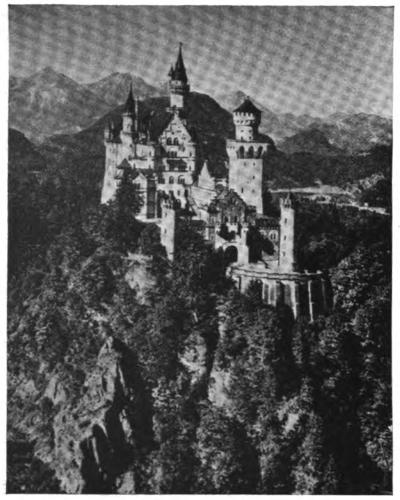
Neuschwanstein—Ludwig II’s fantastic castle
in which the Nazis stored looted art treasures
from France.
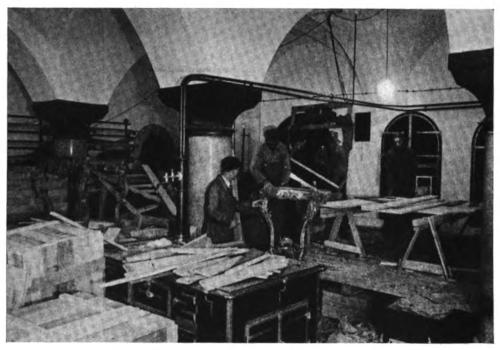
Neuschwanstein. Packing looted furniture for return to France. The carpentry
shop was set up in the castle kitchen. (Note the large range in the
foreground.)
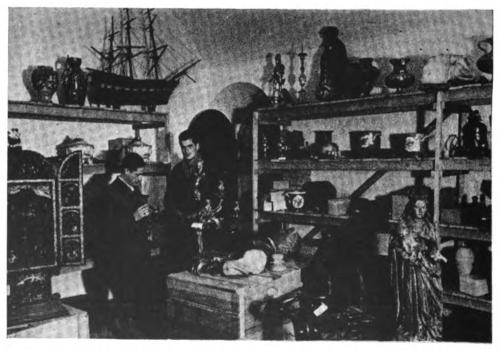
Neuschwanstein. Typical storage room in the castle. In adjoining room Lieutenants
Howe, Moore and Kovalyak packed 2,000 pieces of gold and silver
looted from M. David-Weill.
When I got back to the hotel at noon I found messages from
Steve and Lamont. Steve had gone over to Unterstein to see about
the repairs on his Steyr truck, the one he and Kress had spent so
much time on—fitting it up as a mobile photographic unit. There
was also some work to be done on the Mercedes-Benz, which had
been standing idle, concealed behind a clump of bushes by the rest
house, during our evacuation of the Göring collection. Steve had
been right about the car; Colonel Davitt at Alt Aussee had not
pressed his claim to it.
Lamont had taken off for St. Agatha in a truck borrowed from
Brigade Headquarters to pick up the Hitler-Mussolini pictures.
There was also a message brought down by courier from Captain
Posey’s office. It contained a list of three places in the vicinity
of Berchtesgaden which should be inspected on the chance that
they contained items from the Göring collection. One of them was
the forester’s hut at Hintersee which I had just seen. The other two
were castles in the neighborhood: Schloss Stauffeneck-Tiereck and
Schloss Marzoll. I asked Major Anderson at lunch what he knew
about them. He had nothing to contribute on the subject and said
I’d probably draw a blank on all three. After removing the Göring
things from the train, he had taken the precaution of publishing a
notice to all residents of the area instructing them to declare all art
works in their possession. He had done this as a means of recovering
objects which might have been sequestered by Göring’s agents
and objects which might have been surreptitiously removed from
the train while it stood on the siding. The results had been disappointing.
Only about thirty pictures had been turned in and
none of them was in any way connected with Göring.
The major’s prediction was correct. Lamont, Steve and I visited
the two castles the next day. In addition to their own furnishings,
Schloss Stauffeneck-Tiereck and Schloss Marzoll contained
only books from the University of Munich. These fruitless researches
took all day. It was after five when we left Berchtesgaden.
It was raining when we reached Munich three hours later. Kress
had no place to stay and it took us an hour to locate a civilian
agency which provided billets for transients. The only thing they
had to offer was a room for one night in a ruined nunnery on the
Mathilde-Strasse. It was a gloomy place. There was no light and
the windows were without glass. One of the Sisters, candle in
hand, led us along a dark corridor to a small single room at the
back. We followed with our flashlights. We gave Kress a box of
K rations and told him we’d come back for him in the morning.
Steve was of two minds about the place: on the one hand it wasn’t
good enough for Kress; on the other he was impressed by the compassion
of the Sisters in offering refuge to strangers. He wanted
me to point out to Kress the anomaly of his being given sanctuary
by the Church. I convinced him that my German wasn’t fluent
enough. We thanked the Sister and went off to find ourselves a
billet. We decided on the Excelsior, the hotel for transient officers.
We were several miles from Third Army Headquarters, whereas
the hotel was only a few blocks away.
I didn’t like driving the Mercedes-Benz around Munich, even
though I had got away with it so far. The Third Army regulation
forbidding officers to drive was strictly enforced. Perhaps my
uniform baffled the MPs. It consisted of a Navy cap with blue
cover, a British battle jacket with Navy shoulder boards, khaki
trousers and black riding boots. It was my personal opinion that
the MPs mistook the shoulder bars for the insignia of a Polish
officer. The Poles, and the other liaison officers as well, were allowed
to drive their own cars. Steve used to pooh-pooh my apprehensions
about the MPs. “They’re a bunch of dumbheads,” he
would say. “I ought to know. I used to be one.” All the same,
he didn’t do much daytime driving around town.
Captain Posey had our next job lined up for us. We were to
evacuate the records of the Einsatzstab Rosenberg—the German
art-looting organization—from Neuschwanstein Castle. The job
would include the removal of part of the stolen art treasures also.
The captain told us that the castle contained a great quantity of
uncrated objects, mostly gold and silver. They presented a serious
security problem and it wasn’t safe to leave them there indefinitely.
Even though the French were anxious to get everything back from
Neuschwanstein, for the present they would have to be content
with the gold and the silver objects and as many of the smaller
cases as we could handle. It would be more practicable to ship
the larger things—furniture, sculpture and pictures—direct to
France by rail. This possibility was being investigated. It would
save moving the things twice—first from Neuschwanstein to
Munich, and then from Munich to Paris. But the records were
badly needed at the Collecting Point in connection with the identification
of the plunder stored there. So we were to concentrate on
them and on the objects of great intrinsic value.
It was going to take three or four days to line up the trucks
necessary for this operation. There was a critical shortage of transportation
at the moment because all available vehicles were being
used to haul firewood. This was popularly known as “Patton’s pet
project.” For some weeks it had first priority after foodstuffs.
We welcomed the delay, for it gave us time to make a trip to
Frankfurt. All three of us had urgent business to attend to there.
Lamont’s and Steve’s records had to be straightened out. Both
of them had been working in the field for so long that the headquarters
to which they were technically assigned had lost track
of them. And I wanted to find out what had happened to the
personal belongings I had left in Frankfurt months ago. When I
left I had expected to be gone ten days.
In the back of our minds, too, lurked the hope of becoming “incorporated”
as a Special Evacuation Team. That’s what we were
in fact, but we wanted to be recognized as such in name. The three
of us worked well together and did not want to be separated. The
decision would rest with Major La Farge and Lieutenant Kuhn.
We wheedled a command car out of the sergeant at the motor
pool and took off late in the afternoon. Lamont, Steve and I rode
in the Mercedes-Benz, the command car following. I had little confidence
in our rakish convertible. The car had been behaving well
enough mechanically, but the tires were paper-thin. They were an
odd size and we had not been able to get any replacements. It was
reassuring to know that the sturdy command car was trailing along
behind.
We arrived at Ulm in time for supper. Long before we reached
the city, we could see the soaring single spire of the cathedral silhouetted
against the sky. There was literally nothing left of the
old city. All the medieval houses which, with the cathedral, had
made it one of the most picturesque cities in Germany, lay in ruins.
But the cathedral was undamaged.
We stopped for gas just outside Ulm. To our surprise, the
Army attendant filled our tanks. This was Seventh Army territory.
In Third Army area the maximum was five gallons. I mentioned
this to the attendant. He said, “There’s no gas shortage
here. General Patton must be building up one hell of a big stockpile.”
We spent the night in Stuttgart. As the main transient hotel was
full, we were assigned rooms at a small inn on the outskirts of the
battered city. It took us an hour to find the place, so it was past
midnight when we turned in.
The next morning we detoured a few kilometers in order to visit
the castle at Ludwigsburg. The little town was laid out in the
French manner, and its atmosphere was that of a miniature Versailles.
The caretaker told us that the kings of Württemberg had
lived at the castle until 1918. Our visit to it was the one pleasant
experience of the day, which happened to be my birthday. We had
our first flat tire in the castle courtyard, a second one an hour later,
and a third between Mannheim and Darmstadt. It was Sunday and
we had a devilish time finding places where we could get the
inner tubes repaired. It was ten P.M. when we pulled into Frankfurt.
The trip from Stuttgart had taken eleven hours instead of
the usual four. We had spent seven hours on tire repairs.
My old room with the pink brocaded furniture was vacant, so I
moved in for the night. In my absence it had been successively
occupied by three lieutenant colonels. All of my belongings had
been boxed and stored away in the closet. Lamont and Steve put
up at the house next door.
We called on Bancel La Farge and Charlie Kuhn at USFET
Headquarters the next morning. We were lucky to find them together.
Their office at that time was a kind of house divided against
itself. Thanks to the organizational whim of a colonel, Bancel and
Charlie had to spend part of the day in the office at the big Farben
building—where we found them—and part at their office in Höchst.
Höchst was about six miles away. The remnant of the U. S.
Group Control Council, which had not yet moved up to Berlin, was
located there—in another vast complex of I. G. Farben buildings.
It was an exhausting arrangement.
Bancel and Charlie looked tired—and worried too. They seemed
glad to see us, but they were preoccupied and upset about something.
Presently Charlie showed us a document which had just
reached his desk a few days earlier. It was unsigned and undated.
It bore the letterhead “Headquarters U. S. Group Control Council.”
The subject was “Art Objects in the U. S. Zone.”[2] In the first
paragraph reference was made to the great number and value of
the art objects stored in emergency repositories throughout the
U. S. Zone. Farther on, the art objects were divided into three
classes, according to ownership.
Those in “Class C” were defined as “works of art, placed in the
U. S. Zone by Germany for safekeeping, which are the bona fide
property of the German nation.”
Concerning the disposition of the works of art thus described,
the letter had this to say: “It is not believed that the U. S. would
desire the works of art in Class C to be made available for reparations
and to be divided among a number of nations. Even if this is
to be done, these works of art might well be returned to the U. S.
to be inventoried, and cared for by our leading museums.”
The next, and last, sentence contained this extraordinary proposal:
“They could be held in trusteeship for return, many years
from now, to the German people if and when the German nation
had earned the right to their return.”
Clipped to the document was a notation, dated July 29, 1945,
bearing the signature of the Chief of Staff of General Lucius D.
Clay, Deputy Military Governor. It read, in part, “General Clay
states that this paper has been approved by the President for implementation
after the close of the current Big 3 Conference.”
We were dumfounded. No wonder Bancel and Charlie were
worried. It had never occurred to any of us that German national
art treasures would be removed to the United States. After speculating
on the possible consequences attendant on an implementation
of the document, we dropped the subject. Momentarily there
was nothing to do but wait—and hope that the whole matter would
be dropped.
By comparison, our personal problems seemed insignificant. But
Charlie and Bancel heard us out. They approved our idea of remaining
together as a team working out of USFET. I was already
permanently assigned to USFET and there were two vacancies on
their T.O. (Table of Organization) to which Lamont and Steve
could be appointed. The necessary “paper work” took up most of
the day and involved a trip to ECAD headquarters at Bad Homburg.
At five o’clock we had our new orders.
Steve suggested that we drive up to Marburg to see Captain Hancock,
the Monuments officer in charge of the two great art repositories
which had been established there. They were the prototype
of the Central Collecting Point at Munich. However, they differed
in an important respect from the one at Munich: they contained
practically no loot. Virtually everything in them belonged to
German museums and had been recovered by our Monuments officers
from the mines in which the Germans had placed them for
safekeeping during the war.
Marburg, some fifty miles north of Frankfurt, lay in the Regierungsbezirk,
or government district, of Kassel, which was in turn
a subdivision of the Province of Hesse. It was a two-hour drive, but
we stopped en route for supper with a Quartermaster outfit at
Giessen, so it was nearly eight o’clock when we arrived.
We found Walker Hancock in his office in the Staatsarchiv building.
He was a man in the middle forties, and of medium height.
His face broke into a smile and his fine dark eyes lighted up with
an expression of genuine pleasure at the sight of Lamont and
Steve. This was the first time they had seen one another since the
close of the war when they had been working together in Weimar.
I had never met Walker Hancock, but I had heard more about him
than about any other American Monuments officer. I knew that
he had had a distinguished career as a sculptor before the war and
that he had been the first of our Monuments officers to reach
France. He had been attached to the First Army until the end of
hostilities. Lamont was devoted to Walker, and Steve’s regard
for him bordered on worship. While the three of them reminisced,
I found myself responding to his warmth and sincerity.
He wouldn’t hear of our returning to Frankfurt that night. He
wanted to show us the things in his two depots and we wouldn’t
be able to see more than a fraction of them before morning. The
few that we did see whetted our appetite for more. In the galleries
on the second floor we saw some of the finest pictures from the
museums of the Rhineland: there were three wonderful Van
Goghs. One was the portrait of Armand Rollin, the young man
with a mustache and slouch hat. It belonged to the Volkwang
Museum at Essen. Color reproductions of this portrait had, in
recent years, rivaled those of Whistler’s Mother in popularity.
Walker said that it had been covered with mold when he found it
in the Siegen mine with the rest of the Essen pictures. His assistant,
Sheldon Keck, formerly the restorer of the Brooklyn Museum,
had successfully removed the mold before it had done any serious
damage.
The second Van Gogh was the famous large still life entitled
White Roses. The third was a brilliant late landscape. There
were other magnificent nineteenth century canvases: the bewitching
portrait of M. and Mme. Sisley by Renoir, a full-length Manet,
and a great Daumier. Walker climaxed the display with the celebrated
Rembrandt Self-Portrait from the Wallraf-Richartz Museum
of Cologne. This was the last and most famous of the portraits the
artist painted of himself.
We spent the night at the Gasthaus Sonne, a seventeenth century
inn facing the old market place. The proprietor reluctantly
assigned us two rooms on the second floor. They were normally
reserved for the top brass. Judging from the austerity of the furnishings
and the simplicity of the plumbing, I thought it unlikely
that we would be routed from our beds by any late-arriving generals.
Walker met us for breakfast the next morning with word that
the war with Japan had ended. Announcements in German had
already been posted in several of the shop windows. Though
thrilling to us, the news seemed to make very little impression on
the citizens of the sleepy university town. The people in the streets
were as unsmiling as ever. If anything, some of them looked a little
grimmer than usual.
We drove to the Staatsarchiv building with Walker. He took
us to a room containing a fabulous collection of medieval art objects.
There were crosses and croziers, coffers and chalices, wrought
in precious metals and studded with jewels—masterpieces of the
tenth, eleventh and twelfth centuries. The most arresting individual
piece was the golden Madonna, an archaic seated figure two
feet high, dating from the tenth century. These marvelous relics
of the Middle Ages belonged to the Cathedral of Metz. It was
one of the greatest collections of its kind in the entire world. Its
intrinsic value was enormous; its historic value incalculable.
Walker said that arrangements were being made for its early return
to the cathedral. The French were planning an elaborate
ceremony in honor of the event.
It was a five-minute drive to the other depot under Captain
Hancock’s direction. This was the Jubiläumsbau, or Jubilee Building,
a handsome structure of pre-Nazi, modern design. It was the
headquarters of the archaeological institute headed by Professor
Richard Hamann, the internationally famous medieval scholar. It
also housed the archives of “Photo Marburg,” the stupendous
library of art photographs founded and directed by the professor.
Walker was putting the resources of Photo Marburg to good use,
compiling a complete photographic record of the objects in his
care.
Among the treasures stored in the Jubiläumsbau were some of
the choicest masterpieces from the Berlin state museums. Perhaps
the most famous were the twin canvases by Watteau entitled
Gersaint’s Signboard. Regarded by many as the supreme work of
the greatest painter of the French Rococo period, the two pictures
had been the prized possessions of Frederick the Great. Painted
to hang side by side forming a continuous composition, they represented
the shop of M. Gersaint, dealer in works of art. It is said
that the paintings were finished in eight days. They were painted
in the year 1732 when the artist was at the height of his career. I
was told that, during the early years of the war, Göring made overtures
to the Louvre for one of its finest Watteaus. According to
the story, the negotiations ended abruptly when the museum signified
its willingness to part with the painting in exchange for
Gersaint’s Signboard.
The brilliant French school of the eighteenth century was further
represented at the Jubiläumsbau by a superb Boucher—the
subject, Mercury and Venus—and two exquisite Chardins: The
Cook, one of his most enchanting scenes of everyday life, and the
Portrait of a Lady Sealing a Letter, an unusually large composition
for this unpretentious painter whose canvases are today worth a
king’s ransom.
There were masterpieces of the German school; the great series
of Cranachs which had belonged to the Hohenzollerns filled one
entire room. Excellent examples of Rubens and Van Dyck represented
the Flemish school; Ruysdael and Van Goyen, the Dutch.
The high quality of every picture attested to the taste and connoisseurship
of German collectors.
Walker said that he hoped to arrange a public exhibition of the
pictures. Marburg had been neglected by our bombers. Only one
or two bombs had fallen in the city and the resulting damage had
been slight. Concussion had blasted the windows of the Staatsarchiv,
but the Jubiläumsbau was untouched. Perhaps he would
put on a series of small exhibitions, say fifty pictures at a time.
The members of his local German committee were enthusiastic
about the project. It would be an important first step in the rehabilitation
of German cultural institutions which was an avowed
part of the American Fine Arts program. Thanks to the hesitancy
of an officer at higher headquarters who was exasperatingly “security-conscious,”
Walker did not realize his ambition until three
months later, on the eve of his departure for the United States.
We celebrated VJ-Day on our return to Frankfurt that evening.
The big Casino, behind USFET headquarters, was the scene of the
principal festivities. Drinks were on the house until the bar closed
at ten. It was a warm summer night and the broad terrace over
the main entrance was crowded. An Army band blared noisily inside.
Civilian attendants skulked in the background, avidly collecting
cigarette butts from the ash trays and the terrace floor. They
reaped a rich harvest that night.
The Mercedes-Benz presented a problem. Its status was a dubious
one. Since it was still registered with an MG Detachment in
Austria, I felt uncomfortable about driving it around Germany.
At Charlie Kuhn’s suggestion we filed a request with the Naval
headquarters in Frankfurt for assignment of the vehicle to our
Special Evacuation Team. The request was couched in impressive
legal language which Charlie thought would do the trick. Armed
with a copy of this request, I felt confident that we would not be
molested by inquisitive MPs on our trip back to Munich.
We didn’t get started until late afternoon, having wasted two
hours dickering with the Transportation Officer at the Frankfurt
MG Detachment for a spare tire. We returned by way of Würzburg
and Nürnberg. It was dark when we reached Nürnberg, but
the light of the full moon was sufficient to reveal the ruined walls
and towers of the old, inner city. As we struck south of the city to
the Autobahn, we could see the outlines of the vast unfinished stadium,
designed to seat one hundred and forty thousand people.
We had to proceed cautiously since many of the bridges had been
destroyed and detours were frequent. As a result it was midnight
when we reached Munich. The transient hotel was full, so we
had to be content with makeshift quarters at the Central Collecting
Point.
In our absence the transportation situation had eased up a little.
Captain Posey told us the next morning that six trucks would be
available in the early afternoon. We decided to keep the command
car for the trip to Neuschwanstein and leave the Mercedes-Benz
in Munich to be painted. In anticipation of registration papers
from the Navy, we thought it would be appropriate to have the
car painted battleship gray and stenciled with white letters reading
“U. S. Navy.” One of the mechanics in the garage at the Central
Collecting Point agreed to do this for us in exchange for a bottle
of rum and half a bottle of Scotch. Officers at Third Army Headquarters
had bar privileges plus a liquor ration, but the enlisted
men didn’t fare so well.
Our base of operations for the evacuation of the Castle of
Neuschwanstein was the picturesque little town of Füssen, some
eighty miles south of Munich, in the heart of the “Swan country.”
This region of southern Bavaria, celebrated for its association with
the name of Richard Wagner, is one of the most beautiful in all
Germany. The mountains rise sharply from the floor of the level
green valley. The turreted castle, perched on top of one of the
lower peaks, at an elevation of a thousand feet, is visible for miles.
Built in the eighteen-seventies by Ludwig II, the “Mad King” of
Bavaria, it was the most fantastic creation of that exotic monarch
whose passion for building nearly bankrupted his kingdom. When
we saw the castle rising majestically from its pine-covered mountaintop,
we were struck by the incongruity of our six-truck convoy
lumbering through the romantic countryside.
We presented our credentials to a swarthy major who was the
commanding officer of the small MG Detachment at Füssen. He
arranged for our billets at the Alte Post, the hotel where officers
of the Detachment were quartered, and, after we had deposited
our gear in a room on the fourth floor, conducted us to the Schloss.
The steep road to the lower courtyard of the castle wound for
more than a mile up the side of the mountain. At the castle entrance,
the major identified us to the guard and our six trucks filed
into the courtyard. In the upper courtyard, reached by a broad
flight of stone steps, we found the caretaker who had the keys to
the main section of the castle. He did not, however, have access to
the wing in which the records of the Einsatzstab Rosenberg were
stored. The only door to that part of the building had been locked
and sealed by Lieutenant James Rorimer, the Monuments officer of
the Seventh Army, when the castle had first fallen into American
hands. We had brought the key with us from Third Army Headquarters.
Before examining those rooms, we made a tour of the four main
floors of the castle. The hallways and vaulted kitchens on the first
floor were filled to overflowing with enormous packing cases and
uncrated furniture, all taken from French collections. Three
smaller storage rooms resembling the stock rooms of Tiffany’s and
a porcelain factory combined, were jammed with gold and silver
and rare china. Most of the loot had been concentrated on the first
floor, but the unfinished rooms of the second had been fitted with
racks for the storage of paintings. In addition to the looted pictures,
there were several galleries of stacked paintings from the
museums of Munich. The living apartments on the third floor,
divested of their furnishings, were filled with stolen furniture,
Louis Quinze chairs, table and sofas and ornate Italian cabinets
lined the walls of rooms and corridors. They contrasted strangely
with scenes from the Wagner operas which King Ludwig had
chosen as the theme for the mural decorations. Only the gold-walled
Throne Room and, on the floor above, the lofty Fest-Saal,
were devoid of loot.
We proceeded to the wing of the castle which contained the
records. Having broken the seals and unlocked the door, we entered
a hallway about thirty feet long. The doors opening onto
this hallway were also locked and sealed. Behind them lay the
offices of the Einsatzstab Rosenberg. They were crowded with
bookshelves and filing cabinets. In one room stood a huge show-case
filled with fragile Roman glass. The rooms of the second
floor were full of French furniture and dozens of small packing
cases. These cases were made of carefully finished quarter-sawed
oak. We had seen similar ones in the Göring collection. They
had been the traveling cases for precious objects belonging to the
Rothschilds. These too contained Rothschild treasures—exquisite
bibelots of jade, agate, onyx and jasper, and innumerable pieces of
Oriental and European porcelain.
At one end of the hallway were two rooms which had been
used as a photographic laboratory. We had brought Kress with
us. Steve went off to make arrangements to install his equipment,
while Lamont and I calculated the number of men we would need
for the evacuation work the next morning. We asked the major
for twenty—two shifts of ten.
The Neuschwanstein operation lasted eight days. We worked
nights as well, because there were thousands of small objects—many
of them fragile and extremely valuable—which we could
not trust to the inexpert hands of our work party. There was no
electricity in the small storage rooms, so we had to work by candlelight.
It took us one evening to pack the Roman glass and the four
succeeding evenings, working till midnight, to pack the two thousand
pieces of gold and silver in the David-Weill collection. The
Nazi looters had thoughtfully saved the well-made cases in which
they had carted off this magnificent collection from M. David-Weill’s
house in Paris. There were candelabra, dishes, knives,
forks, spoons, snuffboxes—the rarest examples of the art of the
French goldsmiths of the seventeenth and eighteenth centuries.
This unique collection had created a sensation when it was exhibited
in Paris a few years before the war. The fact that the incomparable
assemblage would probably one day be left to the Louvre
by the eminent connoisseur, who had spent a lifetime collecting it,
had not deterred the Nazi robbers. He was a Jew. That justified
its confiscation. Aside from the pleasure it gave me to handle the
beautiful objects, I relished the idea of helping to recover the
property of a fellow Californian: M. David-Weill had been born
in San Francisco. The Nazis had been methodical as usual. Every
piece was to have been systematically recatalogued while the collection
was at Neuschwanstein. On some of the shelves we found
slips of paper stating that this or that object had not yet been photographed—“noch
nicht fotografiert.”
The tedious manual labor involved in packing small objects and
the great distance which the packed cases had to be carried when
ready for loading were the chief difficulties at Neuschwanstein.
Not only did the cases have to be carried several hundred feet from
the storage rooms to the door of the castle; but from the door to
the trucks was a long trek, down two flights of steps and across a
wide courtyard. In this respect the operation resembled the evacuation
of the monastery at Hohenfurth.
Three months after our partial evacuation of the castle, a team
composed of Captain Edward Adams, Lieutenant (jg) Charles
Parkhurst, USNR, and Captain Hubert de Brye, a French officer,
completed the removal of the loot. This gigantic undertaking required
eight weeks. If I remember the figures correctly, more than
twelve thousand objects were boxed and carted away. The cases
were built in a carpenter shop set up in the castle kitchens. One
hundred and fifty truckloads were delivered to the railroad siding
at Füssen and thence transported to Paris. It was an extraordinary
achievement, carried out despite heavy snowfall. The only operation
which rivaled it was the evacuation of the salt mine at Alt
Aussee.
The last morning of our stay at Füssen, Lamont and I had a special
mission to perform. A German art dealer named Gustav
Rochlitz was living at Gipsmühle, a five-minute drive from Hohenschwangau,
the small village below the castle. For a number of
years Rochlitz had had a gallery in Paris. His dealings with the
Nazis, in particular his trafficking in confiscated pictures, had
been the subject of special investigation by Lieutenants Plaut and
Rousseau, our OSS friends. They were the two American naval
officers who were preparing an exhaustive report on the activities
of the infamous Einsatzstab Rosenberg. They had interrogated
Rochlitz and placed him under house arrest. In his possession were
twenty-two modern French paintings, including works by Dérain,
Matisse and Picasso, formerly belonging to well known Jewish
collections. He had obtained them from Göring and other leading
Nazis in exchange for old master paintings. We were to relieve
Herr Rochlitz of these canvases.
At the farmhouse in which Rochlitz and his wife were living,
the maid of all work who answered our knock said that no one
was at home. Herr Rochlitz would not be back before noon.
Lamont and I returned to our jeep and started back across the
fields to the highway. We had driven about a hundred yards
when we saw a heavy-set sullen-faced man of about fifty walking
toward us.
“I’ll bet that’s Rochlitz,” I said to Lamont. Stopping the car, I
called out to him, “Herr Rochlitz?”
After a moment’s hesitation, he nodded.
“Hop in, we want to have a talk with you,” I said.
We returned to the farmhouse and followed our truculent host
up the stairs to a sitting room on the second floor. There we were
joined by his wife, a timid young woman who, like her husband,
spoke fluent English.
I said that we had come for the pictures. Rochlitz made no protest.
He brusquely directed his wife to bring them in. As she left
the room, I thought it odd that he hadn’t gone along to help her.
But she returned almost immediately with the paintings in her
arms. All twenty-two were rolled around a long mailing tube.
Together they spread the canvases about the room, on the table,
on the chairs and on the floor. They were, without exception,
works of excellent quality. One large early Picasso, the portrait of
a woman and child, was alone worth a small fortune.
I was wondering what Rochlitz had given in exchange for the
lot, when he began to explain how the pictures had come into his
possession. He must have taken us for credulous fools, because
the story he told made him out a victim of tragic circumstance.
He said that Göring had made an offer on several of his pictures.
Rochlitz had accepted but insisted on being paid in cash. Göring
had agreed to the terms and the pictures were delivered. Then,
instead of paying in cash, Göring had forced him to accept these
modern paintings. He had protested, but to no avail. Of course
these pictures were all right in their way, he said deprecatingly,
but he was not a dealer in modern art. Naturally he did not know
that they had been confiscated. It was all a dreadful mistake, but
what could he do? I said that I realized how badly he must have
felt and that I knew he would be relieved to learn that the pictures
were now going back to their rightful owners.
The pictures were carefully rerolled and we got up to leave. At
the door, Rochlitz told us that he had lost his entire stock. He had
stored all of his paintings at Baden-Baden, in the French Zone.
Did we think he would be able to recover them? We assured him
that justice would be done and, leaving him to interpret that remark
as he saw fit, drove off with the twenty-two pictures.
(9) HIDDEN TREASURES AT NÜRNBERG
On our return to Munich that evening, Craig told us that preparations
were being made for the immediate restitution of several
important masterpieces recovered in the American Zone. General
Eisenhower had approved a proposal to return at once to each of
the countries overrun by the Germans at least one outstanding
work of art. This was to be done in his name, as a gesture of “token
restitution” symbolizing American policy with regard to ultimate
restitution of all stolen art treasures to the rightful owner nations.
It was felt that the gracious gesture on the part of the Commanding
General of United States Forces in Europe would serve to reaffirm
our intentions to right the wrongs of Nazi oppression. In
view of the vast amount of art which had thus far been recovered,
it would be months before it could all be restored to the plundered
countries. Meanwhile these “token restitutions” would be an
earnest of American good will. They would be sent back from
Germany at the expense of the United States Government. Thereafter,
representatives of the various countries would be invited to
come to our Collecting Points to select, assemble and, in transportation
of their own providing, remove those objects which the
Germans had stolen.
Belgium was to receive the first token restitution. The great
van Eyck altarpiece—The Adoration of the Mystic Lamb—was
the obvious choice among the stolen Belgian treasures.
The famous panels had been reposing in the Central Collecting
Point at Munich since we had removed them from the salt mine
at Alt Aussee. A special plane had been chartered to fly them to
Brussels. The Belgian Government had signified approval of air
transportation. Direct rail communication between Munich and
Brussels had not been resumed, and the highways were not in
the best of condition. By truck, it would be a rough two-day trip;
by air, a matter of three hours.
Bancel La Farge had already flown from Frankfurt to Brussels,
where plans had been made for an appropriate ceremony on the
arrival of the altarpiece. The American Ambassador was to present
the panels to the Prince Regent on behalf of General Eisenhower.
It was to be an historic occasion.
I went out to the airport to confirm the arrangements for the
C-54. It was only a fifteen-minute drive from the Königsplatz to
the field. I was also to check on the condition of the streets: they
were in good shape all the way.
The plane was to take off at noon. Lamont, Steve and I supervised
the loading of the ten precious cases. We led off in a jeep.
The truck followed with the panels. Four of the civilian packers
went along to load the cases onto the plane. Captain Posey was
to escort the altarpiece to Brussels.
When we got to the airport we learned that the plane had not
arrived. There would be a two-hour delay. At the end of two
hours, we were informed that there was bad weather south of
Brussels. All flights had been canceled for the day. We drove back
to the Collecting Point at the Königsplatz and had just finished
unloading the panels when a message came from the field. The
weather had cleared. The plane would be taking off in half an
hour. I caught Captain Posey as he was leaving the building for
his office at Third Army Headquarters. The cases were reloaded
and we were on our way to the field in fifteen minutes.
The truck was driven onto the field where the big C-54 stood
waiting. In another quarter of an hour the panels were aboard
and lashed securely to metal supports in the forepart of the passenger
compartment. Captain Posey, the only passenger, waved
jauntily as the doors swung shut. Enviously we watched the giant
plane roll down the field, lift waveringly from the airstrip and
swing off to the northwest. The altarpiece was on the last lap of
an extraordinary journey. We wished George Stout could have
been in on this.
The plane reached Brussels without mishap. The return of the
great national treasure was celebrated throughout the country. Encouraged
by the success of this first “token restitution,” Major La
Farge directed that a similar gesture be made to France. At the Collecting
Point Craig selected seventy-one masterpieces looted from
French private collections. The group included Fragonard, Chardin,
Lancret, Rubens, Van Dyck, Hals, and a large number of
seventeenth century Dutch masters. Only examples of the highest
quality were chosen.
Ham Coulter, the naval officer who worked with Craig at the
“Bau,” was the emissary appointed to accompany the paintings to
Paris. It was decided to return them by truck, inasmuch as it would
have been impracticable to attempt shipping uncrated pictures by
air. The convoy consisted of two trucks—one for the pictures, the
other for extra gasoline. It was a hard two-day trip from Munich
to Paris. Ham got through safely, but reported on his return that
the roads had been extremely rough a good part of the way. He
had delivered the pictures in Paris to the Musée du Jeu de Paume,
the little museum which the Germans had used during the Occupation
as the clearinghouse for their methodical plundering of the
Jewish collections. His expedition had been marred by only one
minor incident. When the paintings were being unloaded at the
museum, one of the women attendants watching the operation
noticed that some of the canvases were unframed. She had asked,
“And where are the frames?” This was too much for Coulter. In
perfect French, the courteous lieutenant told her precisely what she
could do about the frames.
Shortly after the return of the Ghent altarpiece, Captain Posey
was demobilized. His duties as MFA&A Officer at Third Army
Headquarters in Munich were assumed by Captain Edwin Rae. I
had not seen Rae since the early summer when he and Lieutenant
Edith Standen had been assigned to assist me in inventorying the
collections of the Berlin museums in the vaults of the Reichsbank
at Frankfurt. Edwin was a meticulous fellow, gentle but determined.
Although by no means lacking in a sense of humor, he
resented joking references to a fancied resemblance to Houdon’s
well known portrait of Voltaire, and I didn’t blame him.
He took on his new responsibilities with quiet assurance and in
a short time won the complete confidence of his superiors at Third
Army Headquarters. Throughout his long tenure of office, he
maintained an unruffled calm in the face of obstacles which would
have exhausted a less patient man. He was responsible for all
matters pertaining to the Fine Arts in the Eastern Military District
of the American Zone—that is, Bavaria—an area more than twice
the size of the two provinces Greater Hesse and Württemberg-Baden
comprising the Western Military District of our Zone.
During the early days of Captain Rae’s regime, Charlie Kuhn
paid a brief visit to Munich. He had just completed the transfer
of the Berlin Museum collections from Frankfurt to the Landesmuseum
at Wiesbaden. The university buildings in Frankfurt—which
I had requisitioned for a Collecting Point—had proved unsuitable.
The repairs, he said, would have taken months. On the
other hand, the Wiesbaden Museum, though damaged, was ideal
for the purpose. Of course there hadn’t been a glass left in any of
the windows, and the roof had had to be repaired. But thanks to
the energy and ingenuity of Walter Farmer, the building had been
rehabilitated in two months. Captain Farmer was the director of
the new Collecting Point. When I asked where Farmer had got the
glass, Charlie was evasive. All he would say was that Captain
Farmer was “wise in the ways of the Army.”
Charlie was headed for Vienna to confer with Lieutenant Colonel
Ernest Dewald, Chief of the MFA&A Section at USFA Headquarters
(United States Forces, Austria). Colonel Dewald wanted to
complete the evacuation of the mine at Alt Aussee, which was
now under his jurisdiction. For this project he hoped to obtain
the services of the officers who had worked there when the mine
had been Third Army’s responsibility. Captain Rae was reluctant
to lend the Special Evacuation Team, because there was still
so much work to be done in Bavaria. But he agreed, provided
that Charlie could sell the idea to the Chief of Staff at Third
Army. This Charlie succeeded in doing, and departed for Vienna
a day later. Steve was crazy to see Vienna—I think his parents had
been born there—so Charlie took him along.
After they had left, Captain Rae requested Lamont and me to
make an inspection trip to northern Bavaria. Our first stop was
Bamberg. There we examined the Neue Residenz, which Rae
contemplated establishing as an auxiliary Collecting Point to
house the contents of various repositories in Upper Franconia. Reports
reaching his office indicated that storage conditions in that
area were unsatisfactory. Either the repositories were not weatherproof,
or they were not being adequately guarded.
It was also rumored that UNRRA was planning to fill the
Neue Residenz with DPs—Displaced Persons. Captain Rae was
determined to put a stop to that, because the building, a fine example
of late seventeenth century architecture, was on the SHAEF
List of Protected Monuments. This fact should have guaranteed its
immunity from such a hazard. Even during combat, the SHAEF
list had been a great protection to monuments of historic and artistic
importance. Now that no “doctrine of military necessity” could
be invoked to justify improper use of the building, Rae did not propose
to countenance its occupancy by DPs.
The Neue Residenz contained dozens of empty, brocaded
rooms—but no plumbing. We decided that it would do for a Collecting
Point and agreed with Rae that the DPs should be housed
elsewhere if possible. The officer from the local MG Detachment,
who was showing us around, confirmed the report that UNRRA
intended to move in. He didn’t think they would relinquish the
building without a protest. The influx of refugees from the Russian
Zone had doubled the town’s normal population of sixty
thousand.
It was a disappointment to find that the superb sculpture in the
cathedral across the square was still bricked up. The shelters had
proved a needless precaution, for Bamberg had not been bombed.
Only the bridge over the Regnitz had been blown up, and the
Germans had done that themselves.
From Bamberg we drove north to Coburg, where we had a twofold
mission. First we were to obtain specific information about
ten cases which contained a collection of art objects belonging to a
prince of Hesse. The cases were said to be stored in Feste Coburg,
the walled castle above the town. If they were the property of
Philip of Hesse, then they would probably be taken into custody
by the American authorities. We had been told that he was in
prison. His art dealings during the past few years were being reviewed
by the OSS officers charged with the special investigation
of Nazi art-looting activities. Philip was the son of the Landgräfin
of Hesse. It was in the flower-filled Waffenraum of her
castle near Frankfurt that I had seen the family tombs months
before.
If, on the other hand, the cases belonged to a different prince of
Hesse—one whose political record was clean—and storage conditions
were satisfactory, we would simply leave them where they
were for the time being.
Our second objective was Schloss Tambach, a few kilometers
from Coburg. Paintings stolen by Frank, the Nazi Governor of
Poland, from the palace at Warsaw were stored there. Schloss
Tambach also contained pictures from the Stettin Museum. Stettin
was now in the Russian Zone of Occupied Germany.
On our arrival in Coburg, Lamont and I drove to the headquarters
of the local MG Detachment, which were located in the Palais
Edinburgh. This unpretentious building was once the residence of
Queen Victoria’s son, the Duke of Edinburgh. There we arranged
with Lieutenant Milton A. Pelz, the Monuments officer of the
Coburg Detachment, to inspect the storage rooms at the castle.
Pelz was a big fellow who spoke German fluently. He welcomed
us hospitably and took us up to the castle where we met Dr.
Grundmann, who had the keys to the storage rooms. This silent,
sour-faced German was curator of the Prince’s collections. He said
that his employer was Prince Ludwig of Hesse, a cousin of Philip.
The cases contained paintings and objets d’art which had been in
the possession of the family for years. Grundmann had personally
removed them from Ludwig’s estate in Silesia the day before the
Russians occupied the area.
Ludwig’s most important treasure was the world-famous painting
by Holbein known as the Madonna of Bürgermeister Meyer.
Painted in 1526, it had hung for years in the palace at Darmstadt.
The Dresden Gallery owned a seventeenth century replica. Early
in the war, Prince Ludwig had sent the original to his Silesian
castle for safekeeping. Grundmann had brought it back to Bavaria
along with the ten cases now at Coburg. From Coburg he had
taken the Holbein to Schloss Banz, a castle not far from Bamberg.
He said that the Prince was living at Wolfsgarten, a small
country place near Darmstadt. Ludwig was eager to regain possession
of the painting. Did we think that could be arranged? We
told him he would have to obtain an authorization from Captain
Rae at Munich.
Schloss Tambach was a ten-minute drive from Coburg. This
great country house, built around three sides of a courtyard, belonged
to the Countess of Ortenburg. She occupied the center
section. A detachment of troops was billeted in one wing. The
other was filled with the Stettin and Warsaw pictures. There were
over two hundred from the Stettin Museum. Nineteenth century
German paintings predominated, but I noticed two fine Hals portraits
and a Van Gogh landscape among them.
The civilian custodian, answerable to the MG authorities at
Coburg, was Dr. Wilhelm Eggebrecht. He had been curator of the
Stettin Museum until thrown out by the Nazis because his wife was
one-quarter Jewish. He was a mousy little fellow with a bald head
and gold-rimmed spectacles. He asked apprehensively if we intended
to send the paintings back to Russian-held Stettin. We
said that we had come only to check on the physical security of
the present storage place. So far as we knew, the paintings would
remain where they were for the present. This inconclusive piece
of information seemed to reassure him.
The paintings looted from Warsaw were the pièces de résistance
of the treasures at Schloss Tambach—especially the nine great canvases
by Bellotto, the eighteenth century Venetian master. Governor
Frank had ruthlessly removed the pictures from their
stretchers and rolled them up for shipment. As a result of this
rough handling, the paint had flaked off in places, but the damage
was not serious. When we examined the pictures, they were spread
out on the floor. They filled two rooms, forty feet square. Later
they were taken to the Munich Collecting Point and mounted on
new stretchers, in preparation for their return to Warsaw.
When we got back to Munich, Steve had returned from Vienna.
He had news for us. Charlie Kuhn had already left for Frankfurt.
Colonel Dewald was coming to Munich in a few days to talk to
Colonel Roy Dalferes, Rae’s Chief of Staff at Third Army, about
reopening the Alt Aussee mine. Either Charlie or Bancel would
come down from USFET Headquarters when Dewald arrived. A
new man had joined the MFA&A Section at USFA—Andrew
Ritchie, director of the Buffalo Museum. He had come over as a
civilian. Steve thought that Ritchie would be the USFA representative
at Munich. There was a lot of stuff at the Collecting
Point which would eventually go back to Austria. It would have
to be checked with the records there. That would be Ritchie’s job.
Steve told us also that Lincoln Kirstein had gone home. His
mother was seriously ill and Lincoln had left on emergency orders.
The three of us went to Captain Rae’s office. Lamont and I had
to make a report on our trip to Coburg. Rae had a new assignment
for us. He had just received orders from USFET Headquarters to
prepare the Cracow altarpiece for shipment. It was to be sent
back to Poland as a token restitution. This was the colossal carved
altarpiece by Veit Stoss which the Nazis had stolen from the
Church of St. Mary at Cracow. Veit Stoss had been commissioned
by the King of Poland in 1477 to carve the great work. It had
taken him ten years. After the invasion of Poland in 1939, the
Nazis had carted it off, lock, stock and barrel, to Nürnberg. They
contended that, since Veit Stoss had been a native of Nürnberg, it
belonged in the city of his birth.
The missing altarpiece was the first of her looted treasures for
which Poland had registered a claim with the American authorities
at the close of the war. After months of diligent investigation,
it was found by American officers in an underground bunker
across the street from the Albrecht Dürer house in Nürnberg. In
addition to the dismantled figures of the central panel—painted
and gilded figures of hollow wood ten feet high—the twelve
ornate side panels, together with the statues and pinnacles surmounting
the framework, had been crowded into the bunker.
The same bunker contained another priceless looted treasure—the
coronation regalia of the Holy Roman Empire. Among these
venerable objects were the jeweled crown of the Emperor Conrad—commonly
called the “Crown of Charlemagne”—dating from the
eleventh century, a shield, two swords and the orb. Since 1804 they
had been preserved in the Schatzkammer, the Imperial Treasure
Room, at Vienna. In 1938, the Nazis removed them to Nürnberg,
basing their claim to possession on a fifteenth century decree of the
Emperor Sigismund that they were to be kept in that city.
On the eve of the German collapse, two high officials of the city
had spirited away these five pieces. The credit for recovering the
treasures goes to an American officer of German birth, Lieutenant
Walter Horn, professor of art at the University of California. The
two officials at first disclaimed any knowledge of their whereabouts.
After hours of relentless grilling by Lieutenant Horn, the
men finally admitted their guilt. They were promptly tried, heavily
fined and sent to prison. Three months later, at the request of the
Austrian Government, the imperial treasures were flown back to
Vienna. This historic shipment contained other relics which the
Nazis had taken from the Schatzkammer—relics of the greatest
religious significance. They included an alleged fragment of the
True Cross, a section of the tablecloth said to have been used at the
Last Supper, a lance venerated as the one which had touched the
wounds of Christ, and links from the chains traditionally believed
to have bound St. Peter, St. Paul and St. John.
On Captain Rae’s instructions, Steve and I went to Nürnberg to
pack the Stoss altarpiece. (At that time the coronation regalia was
still in the bunker, where, on the afternoon of our arrival, we had
an opportunity to examine it.) We found that the heavy framework
which supported the altar panels was not stored in the bunker.
Because of its size—the upright pieces were thirty feet high—it had
been taken to Schloss Wiesenthau, an old castle outside Forchheim,
thirty miles away.
Leaving Steve to start packing the smaller figures and pinnacles,
I got hold of a semitrailer, the only vehicle long enough to accommodate
a load of such length. It was an hour’s drive to the castle.
With a crew of twenty PWs, I finished loading the framework in
two hours and returned to Nürnberg in time for supper.
That evening Steve and I figured out the number of trucks we
would need for the altarpiece. Lamont had remained in Munich
to make tentative arrangements, pending word from us. He was
going to ask for ten trucks and we came to the conclusion that this
would be about the right number—in addition, of course, to the
semitrailer for the supporting framework. We got out our maps
and studied our probable route to Cracow. One road would take
us through Dresden and Breslau; another by way of Pilsen and
Prague. Perhaps we could go one way and return the other. In
either case we would have to pass through Russian-occupied territory.
It would probably take some time to obtain the necessary
clearances. We figured on taking enough gas for the round trip,
since we doubted if there would be any to spare in Poland. Altogether
it promised to be a complicated expedition, but already
we had visions of a triumphal entry into Cracow.
Our ambitious plans collapsed the following morning. While
Steve and I were at breakfast, I was called to the telephone. The
corporal in Captain Rae’s office was on the wire. I was to return
to Munich at once. Major La Farge was arriving from Frankfurt
and wanted to see me that night. Plans for the trip to Cracow
were indefinitely postponed. Internal conditions in Poland were
too unsettled to risk returning the altarpiece.
Our plans had miscarried before, but this was our first major disappointment.
We had begun to look on the Polish venture as the
fitting climax of our work as a Special Evacuation Team. On the
way back to Munich, Steve said he had a feeling that the team was
going to be split up.
Steve’s misgivings were prophetic. At Craig’s apartment after
dinner, Bancel La Farge outlined the plans he had for us. Colonel
Dalferes had acceded to Colonel Dewald’s request. Lamont, Steve
and a third officer—new to MFA&A work—were to resume the
evacuation of the salt mine at Alt Aussee. If the snows held off, it
would be possible to carry on operations there for another month
or six weeks.
I was to return to USFET Headquarters at Frankfurt as Deputy
Chief of the MFA&A Section, replacing Charlie Kuhn who had
just received his orders to go home. I knew that Charlie would
soon be eligible for release from active duty, but had no idea that
his departure was so imminent.
We didn’t have much to say to one another on the way to our
quarters that night. Steve had already made up his mind that he
wasn’t going to like the new man. Lamont said that he thought it
was going to be an awful anticlimax to reopen the mine. And for
me, the prospect of routine administrative work at USFET was uninviting.
After three months of strenuous and exciting field work,
it wouldn’t be easy to settle down in an office. All three of us felt
that the great days were over.
During our last week together in Munich we had little time to
feel sorry for ourselves. Everyone was preoccupied with the restitution
program. We had our full share of the work. Another important
shipment was to be made to Belgium. It was to include the
Michelangelo Madonna, the eleven paintings stolen from the
church in Bruges when the statue was taken, and the four panels
by Dirk Bouts from the famous altarpiece in the church of St.
Pierre at Louvain. These panels, which formed the wings of the
altarpiece, had been removed by the Germans in August 1942.
Before the first World War one wing had been in the Berlin Gallery,
the other in the Alte Pinakothek at Munich. As in the case of
the Ghent altarpiece, they had been restored—unjustly, according
to the Germans—to Belgium by the Versailles Treaty.
This shipment to Belgium represented the first practical application
of the “come and get it” theory of restitution, evolved by Major
La Farge. Belgium had already received the Ghent altarpiece as
token restitution. Now it was up to the Belgians to carry on at
their own expense. The special representatives who came down
from Brussels to supervise this initial shipment were Dr. Paul
Coremans, a great technical expert, and Lieutenant Pierre Longuy
of the Ministry of Fine Arts. They had their own truck but had
been unable to bring suitable packing materials. We had an ample
supply of pads and blankets which we had stored at the Collecting
Point after our evacuation of the Göring collection. We placed
them at the disposal of the Belgians. But it was Saturday and no
civilian packers were available. Dr. Coremans gratefully accepted
the offer of our services. Steve, Lamont and I loaded the truck. It
was the last operation of the Special Evacuation Team.
The Belgians had no sooner departed than the French and
Dutch representatives arrived. Captain Hubert de Brye for France
looked more like a sportsman than a scholar; but he was a man of
wide cultivation and had a sense of humor which endeared him to
his associates in Munich. He and Ham Coulter were kindred spirits
and became great friends.
Ham, who had been responsible for the rehabilitation of both
the Collecting Point and the Führerbau, now had two assistants—Captain
George Lacy and Dietrich Sattler, the latter a German
architect. Through this division of the work, Ham found time for
new duties: he took the foreign representatives in tow, arranged
for their billets, their mess cards, their PX rations and so on. It
was an irritating but not a thankless job, for the recipients of his
attentions were devoted to their “wet nurse.”
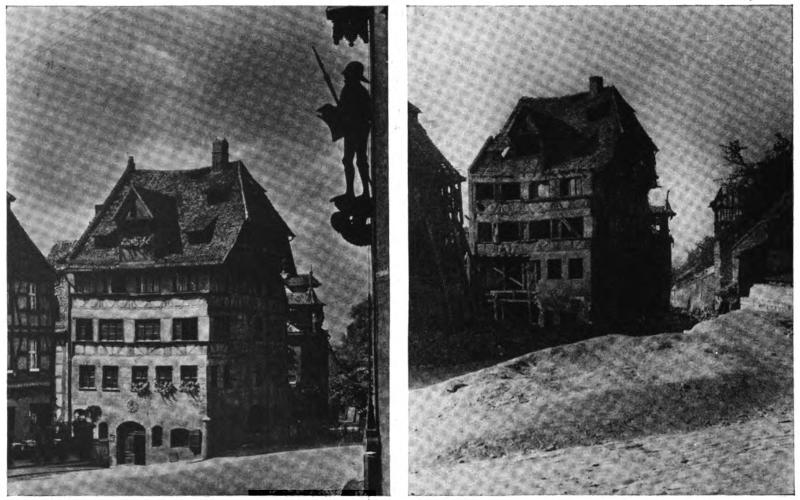
The Albrecht Dürer house at Nürnberg—before and after the German collapse. In an underground bunker across
the street were stored the crown jewels of the Holy Roman Empire and the famous Veit Stoss altarpiece.
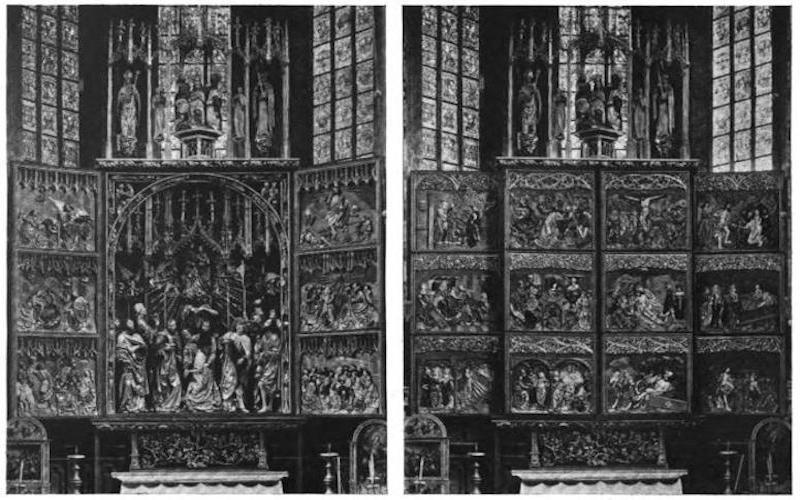
The Veit Stoss altarpiece from the Church of Our Lady in Cracow, which was carried off by the Nazis at the
beginning of the war, has been returned to Poland. Left, open; right, closed.
The Dutch representative was Lieutenant Colonel Alphonse
Vorenkamp. He was a little man with gray hair, shrewd gray
eyes and steel-rimmed spectacles. An eminent authority on Dutch
painting, he had been for several years a member of the faculty at
Smith College. He enjoyed the unusual distinction of having
served in both the American and Dutch Armies during the present
war.
I had met him in San Francisco in 1944, shortly after his discharge
from the service. He had been a buck private; and I
gathered from the story of his experiences that our Army had released
him in self-defense. He told me that he often had difficulty
in understanding the drill sergeant. Once, without thinking he had
stepped out of formation and asked politely, “Sergeant, would you
mind repeating that last order!” Vorenkamp said that he had paid
dearly for his indiscretion, so dearly in fact that he had seriously
considered changing his name from Alphonse to Latrinus. Alphonse,
he said, was a ridiculous name for a Dutchman anyway.
He preferred to be called Phonse.
Released from the Army, he had gone back to his teaching. Then,
only a few months ago, the Dutch Government had requested his
services in connection with the restitution of looted art. They had
offered him a lieutenant-colonelcy and he had accepted.
The Dutch, as well as the British and French, had made a practice
of conferring upon qualified civilians ranks consistent with the
responsibilities of given jobs. Our government’s failure to do likewise—so
far as the art program was concerned—resulted in a disparity
in rank which frequently placed American MFA&A personnel
at a great disadvantage.
Of all the foreign representatives, none served his country more
zealously than Phonse Vorenkamp. Throughout the fall and winter
months, his convoys shuttled back and forth between Munich
and Amsterdam. When I last heard from him—in the late spring—he
had restored to Holland more than nine hundred paintings, upward
of two thousand pieces of sculpture, porcelain and glass, along
with truckloads of tapestries, rugs and furniture.
I left Munich on a rainy morning at the end of September. Lamont
and Steve were planning to depart for Alt Aussee at the same
time. The three of us had agreed to meet in front of the Collecting
Point at eight-thirty. I was a few minutes late and when I got there
the guard at the entrance said they had already gone. I hadn’t felt
so forlorn since the day Craig and I had parted in Bad Homburg
months before. As I started down the steps to the command car,
Phonse Vorenkamp called from the doorway. He had come to
work a little earlier than usual, just to see me off. He was full of
waspish good humor, joked about the magnificence of my new job
in Frankfurt, and promised to look me up when he came through
with his first convoy. The driver stepped on the starter and, as we
rounded the corner into the Brienner-Strasse, Phonse waved us on
our way.
(10) MISSION TO AMSTERDAM; THE WIESBADEN MANIFESTO
I reported to Major La Farge upon arrival. Since my visit to
Frankfurt with Lamont and Steve six weeks before, there had
been several changes in the MFA&A Section. With the removal
to Berlin of the Monuments officers attached to the U. S.
Group Control Council, our office at USFET Headquarters in
Frankfurt had been transferred to Höchst. The move was logical
enough because we were part of the Restitution Control Branch
of the Economics Division, which was located there. For all practical
purposes, however, we would have been better off in Frankfurt,
since our work involved daily contacts with other divisions—all
located at the main headquarters.
The Höchst office was a barnlike room, some thirty feet square,
on the second floor of the Exposition Building. It required considerable
ingenuity to find the room, for it was tucked in behind a
row of laboratories occupied by white-coated German civilians, former
employees of I. G. Farben, who were now working for the
American Military Government. At one end of the room were
desks for the Chief and Deputy Chief. The rest of the furniture
consisted of four long work tables and two small file cabinets. The
staff was equally meager—Major La Farge, Lieutenant Edith
Standen, Corporal James Reeds and a German civilian stenographer.
The first few days were a period of intensive indoctrination. The
morning I arrived, Bancel defined the relationship between our
office and the one at Berlin; and between us and the two districts
of the American Zone—the Eastern District, which was under
Third Army, and the Western District, under Seventh Army. He
described the Berlin office as the final authority in determining
policy. In theory, if not always in fact, a given policy was adopted
only after an exchange of views between the Frankfurt-Höchst office
and the one in Berlin. The activation of policy was our function.
USFET—that is, our office—was an operational headquarters.
Berlin was not.
And how did we activate policy? By means of directives. Directives
to whom? To Third Army at Munich and Seventh Army
at Heidelberg. That sounded simple enough, until Bancel explained
that a directive was not exactly an imperial decree. Just
as it was our prerogative to activate policies approved by Berlin,
so it was the prerogative of the Armies to implement our directives
as they deemed expedient. He reminded me that the two
Armies were independent and autonomous within their respective
areas. In other words, we could tell them what to do, but not
how to do it. Bancel was an old hand at writing directives, knowing
how to give each phrase just the right emphasis. At first the
longer ones seemed stilted and occasionally ambiguous. But I was
not accustomed to military jargon. Later I came to realize that
Army communications always sounded stilted; and what I had
mistaken for ambiguity was often deliberate circumlocution, calculated
to soften the force of an unpalatable order.
Bancel said there were more important things to worry about
than the composition of directives. One was the problem of token
restitutions. He was sorry to postpone the one to Poland, but that
couldn’t be helped. Now that France and Belgium had received
theirs, Holland was next on the list. The ceremony in Brussels
had made a great hit. He thought a similar affair might be arranged
at The Hague. Vorenkamp was selecting a group of pictures
at the Collecting Point. We would provide a plane to fly
them to Amsterdam. Captain Rae was to notify our office as soon
as Vorenkamp was ready to leave—probably within the next two
days. In the meantime Bancel was having orders cut for me to go
to Holland. I was to see the American ambassador, explain the
idea of these token restitutions, and sound him out on the subject
of planning a ceremony similar to the one our ambassador had
arranged in Brussels. Colonel Anthony Biddle, Chief of the Allied
Contacts Section at USFET Headquarters, had promised Bancel
to write a letter of introduction for me to take to The Hague.
Bancel suggested that I make tentative arrangements with the
motor pool for a car and driver.
It was almost noon and Bancel had an appointment in Frankfurt
at twelve-thirty. He just had time to catch the bus. After he
left, Reeds and the stenographer went out to lunch, so Edith Standen
and I had the office to ourselves. We had a lot to talk over, as I
had not seen her since June when we worked together on the inventory
of the Berlin Museum collections at the Reichsbank.
In the meantime, she had been stationed at Höchst. When the
Group CC outfit—to which she was officially attached—moved to
Berlin, she had preferred to remain with the USFET office. On the
Organizational Chart of the MFA&A Section, Edith was listed as
the “Officer in Charge of Technical Files.” Actually she was in
charge of a great many other things as well. When the Chief and
Deputy Chief were away from headquarters at the same time—and
they often were—Edith took over the affairs of the Section. She
must have been born with these remarkable administrative gifts,
for she could have had little opportunity to develop them as the
cloistered curator of the Widener Collection where, as she said
herself, she was “accustomed to the silent padding of butlers and
the spontaneous appearance of orchids and gardenias among the
Rembrandts and the Raphaels.”
I asked her if there had been any new developments regarding
the proposed removal of German-owned art to the United States.
Yes, there had been. But nothing conclusive. There was a cable
from General Clay to the War Department early in September.[3]
The cable spoke of “holding German objects of art in trust for
eventual return to the German people.” But it didn’t contain the
clause “if and when the German nation had earned the right to
their return” which had appeared in the original document. Besides
the cable, there had been a communication from Berlin asking
for an estimate of the cubic footage in art repositories of the
American Zone. It was a question impossible to answer accurately.
But Bancel and Charlie had figured out a reply, citing the approximate
size of one of the repositories and leaving it up to Berlin to
multiply the figures by the total number in the entire zone. Now
that John Nicholas Brown and Charlie Kuhn were back in the
United States, they might be able to discourage the projected
removal. I had only one piece of information to contribute on the
subject: a letter from George Stout saying that he had been asked
by the Roberts Commission to give an opinion, based on purely
technical grounds, of the risk involved in sending paintings to
America. He did so, stating that to remove them would cube the
risk of leaving them in Germany.
When Corporal Reeds returned to the office, Edith and I went
across the street to the Officers’ Mess. While we were at lunch,
she told me that Jim Reeds had been a discovery of George’s. He
had been with George and Bancel at their office in Wiesbaden.
Jim was a tall, serious fellow with sandy hair and a turned-up nose.
Edith said that he had been a medical student before the war and
that he came from Missouri. There was so much paper work to do
in the office that he never got caught up. The German typist was
slow and inaccurate. Jim had to do over nearly half the letters he
gave her to copy. But his patience was inexhaustible and he never
complained.
Bancel didn’t get back from Frankfurt until late in the afternoon.
The return of the Veit Stoss altarpiece had come up again
and he had had a long talk about it with the Polish liaison officer
at USFET, who was a nephew of the Archbishop of Cracow. After
that he had had a session with Colonel A. J. de la Bretesche, the
French liaison officer. And, for good measure, he had to take up
the problem of clearance for the two Czech representatives who
would be arriving in a few days. He said wearily that practically
all of his days were like that, now that restitution was going full
speed ahead. I told him that I had had an uneventful but profitable
afternoon, going through the correspondence which had accumulated
on his desk. There had been several telephone calls, among
them one from Colonel Walter Kluss. Bancel said he would answer
that one in person, as he wanted to introduce me to the colonel, who
was chief of the Restitution Control Branch. Restitution involved
settling the claims of the occupied countries for everything the
Germans had taken from them. These claims covered every conceivable
kind of property—factory equipment, vehicles, barges,
machinery, racehorses, livestock, household furniture, etc.
The colonel’s office was at the end of the corridor. On our way
down the hall, Bancel said that the Army could do with a few
more officers like Colonel Kluss. This observation didn’t give me
a very clear picture of the colonel, but when I met him I knew
what Bancel meant. There was an unassuming friendliness and
simplicity about him that I didn’t usually associate with full
colonels. His interest in the activities of the MFA&A Section was
genuine and personal. He was particularly fond of Bancel and
Edith and, during our visit with him that afternoon, spoke admiringly
of the work which they and Charlie Kuhn had done. While
other sections of the Restitution Control Branch were still generalizing
about restitution, the MFA&A Section had tackled the problem
realistically. It wasn’t a question of mapping out a program
which might work. The program did work. The wisdom and foresight
of Bancel’s planning appealed to the practical side of Colonel
Kluss’ nature and, throughout the months of our association with
him, he was never too busy to help us when we went to him with
our troubles.
Bancel and I took the seven o’clock bus over to Frankfurt that
evening. We had dinner at the Officers’ Mess in the Casino behind
USFET Headquarters. We were joined there by Lieutenant William
Lovegrove, the officer whom Bancel had selected as our representative
at Paris in connection with the restitution of looted art
works to the French. With the arrival of the French representative
in Munich, regular shipments would soon be departing for
France. Their destination in Paris was to be the Musée du Jeu de
Paume, which was now the headquarters of the Commission de
Récupération Artistique, the commission composed of officials from
the French museums charged with the task of sorting and distributing
the plundered treasures. Among the officials selected to assist
in this work was Captain Rose Valland, the courageous Frenchwoman
who, as I mentioned earlier, had spied on the Nazi thieves
in that same museum during the Occupation.
We had roughly estimated that it would require from three to
six months to send back the main bulk of the French loot from
Germany. Mass evacuation, as I have mentioned before, had the
advantage of accelerating restitution. It had the disadvantage of
rendering difficult our procedure of evaluating and photographing
objects before they were returned. It was our intention that Lieutenant
Lovegrove should obtain the desired photographs and appraisals.
American military establishments in France were being
drastically reduced, but we planned to attach him to the USFET
Mission to France. We had been told that the Mission would be
withdrawn in the early spring. If Lovegrove’s work weren’t finished
by that time, Bancel thought it might be possible to attach him
to our Paris Embassy when the Mission folded.
When Bancel introduced me to Lovegrove that evening at the
Casino, I thought he would be very much at home in an embassy.
He was of medium height, bald, had a pink and white complexion
and wore a small mustache. He was self-possessed without being
blasé. Lovegrove was a sculptor and had lived in Paris for many
years before the war. Bancel said that he spoke a more perfect
French than most Frenchmen.
Subsequent developments proved the wisdom of Bancel’s choice.
Lovegrove was exceedingly popular with his French associates at
the Musée du Jeu de Paume. His extraordinary tact and his capacity
for hard work were equally remarkable.
I particularly remember our last meeting. It was in February,
when I was stopping briefly in Paris on my way home from Germany.
By that time hundreds of carloads of stolen art had been
received at the Jeu de Paume. There were one or two final matters
which I wished to take up with M. Henraux and M. Dreyfus,
members of the Commission de Récupération Artistique. When
Lovegrove and I arrived at the museum, we found these two
charming, elderly gentlemen in their office. With them was M.
David-Weill. He was examining a fine gold snuffbox. The office
was littered with gold and silver objects. They were part of the
fabulous collection which Lamont, Steve and I had packed by
candlelight in the Castle of Neuschwanstein six months before.
During the second week of October, I left for Amsterdam. It
was a three-hundred-mile drive from Frankfurt. Cassidy, the driver
of the jeep, was a New Jersey farm boy who, unlike most drivers,
preferred long trips to short local runs. The foothills of the Taunus
Mountains were bright with fall coloring along the back road to
Limburg. From there we turned west to the Rhine. Then, skirting
the east bank of the river, we crossed over into the British Zone
at Cologne. From Cologne—where we lunched at a British mess—our
road led through Duisburg, Wesel and the skeleton of Emerich.
We crossed the Dutch frontier at five and continued through
battered Arnhem to Utrecht. Utrecht was full of exuberant Canadians.
I stopped at the headquarters of the local Town Major to
inquire about a mess for transient officers. A friendly lieutenant,
a blonde Dutch girl on his arm, was on his way to supper and suggested
that I join them. He said that Cassidy could eat at a Red
Cross Club.
The dining room in the officers’ hotel was noisy and crowded.
Most of the officers, the lieutenant explained, were going home in
a few days. It was good to be in a city which, superficially at least,
showed no scars of battle.
We reached Amsterdam about nine-thirty. At night the canals
were confusing. Cassidy and I looked in vain for the Town Major.
Finally we found a Canadian “leave hotel.” The enlisted man on
duty at the desk dispensed with the formality of the billet permit I
should have obtained from the Town Major, and assigned us
rooms on the same floor. Cassidy decided that the Canadians were
a democratic outfit.
Bancel had instructed me to inform the Dutch Restitution Commission,
known as the “C.G.R.,” that Lieutenant Colonel Vorenkamp
was scheduled to reach Amsterdam at noon on the day following
my arrival, so the next morning I went to the headquarters
of the commission to deliver Major La Farge’s message. The commission
occupied the stately old Goudstikker house on the Heerengracht.
Before the war, Goudstikker had been a great Dutch art
dealer. In the galleries of this house had been held many fine
exhibitions of Dutch painting. During the German Occupation of
the Netherlands, an unscrupulous Nazi named Miedl had “acquired”
the entire Goudstikker stock from the dealer’s widow. We
had found many of the Goudstikker pictures at Alt Aussee and in
the Göring collection.
Bancel had told me to ask for Captain Robert de Vries. I was
informed that the captain was in London. In his stead Nicolaes
Vroom, his scholarly young deputy, received me. He had had no
word of Colonel Vorenkamp’s impending arrival. Vroom transmitted
the message immediately to Jonkheer Roel, director of the
Rijksmuseum. Twenty minutes later, this distinguished gentleman
appeared in Vroom’s office. With him were Lieutenant Colonel H.
Polis and Captain ter Meer, both of whom were attached to the
C.G.R. They were delighted to know about the plane which I told
them was due at Schiphol Airport. Telephonic connections with
Munich had not yet been re-established. They had to depend on
the USFET Mission at The Hague for transmission of all messages
from the American Zone. It often took days for a telegram to get
through.
There was barely time enough to telephone for a truck to meet
the plane. Also Mr. van Haagen, Permanent Secretary of Education
and Science, must be notified at once. I was told that he would
accompany us to the airport. In another hour we were all on our
way to Schiphol.
We waited two hours at the field and still no sign of the plane
from Munich. The weather was fine at the airport, but there were
reports of heavy fog to the south. At two o’clock we returned to
Amsterdam and lunched at the Dutch officers’ mess. My hosts apologized
for the food. They said that they no longer received British
Army rations. The menu was prepared from civilian supplies. It
was a Spartan diet—cheese, bread and jam, and weak coffee. But
they shared it so hospitably that only a graceless guest would have
complained of the lack of variety. Captain ter Meer said that it was
more palatable than the tulip bulbs he had lived on the winter
before.
After lunch, Cassidy and I drove to the USFET Mission at The
Hague. Colonel Ira W. Black, Chief of the Mission, arranged for
me to see the American ambassador. The temporary offices of our
embassy were located in a tall brick building on the edge of the city.
I presented Colonel Biddle’s letter to Mr. Stanley Hornbeck, the
ambassador, who looked more like a successful businessman than a
diplomat. He frowned as he read, and when he had finished, said
gruffly, “Commander, Tony Biddle is a charming fellow and I am
very fond of him. I’d like to be obliging, but we’ve had too damn
many celebrations and ceremonies in this country already. We need
more hard work instead of more holidays. It’s very nice about the
pictures coming back, but steel mills and machinery would be a lot
more welcome.”
I hadn’t expected this reaction and, having had little experience
with ambassadors—irascible or otherwise—I hardly knew what to
say. After an embarrassing pause, I ventured the remark that a
very simple ceremony would be enough.
After his first outburst, the ambassador relented to the extent of
saying he’d think it over. As I left his office, he called after me,
“My bark’s worse than my bite.”
On my way back to Amsterdam, I concluded unhappily that as a
diplomatic errand boy I was a washout. I’d better go back to loading
trucks.
When I reached the hotel I found a message that the plane with
Vorenkamp and the pictures had arrived. I met Phonse the following
morning at the Goudstikker house. He introduced me to Lieutenant
Hans Jaffé, a Dutch Monuments officer, who bore a striking
resemblance to Robert Louis Stevenson. Several weeks later
Jaffé was chosen as the Dutch representative for the Western District
of the American Zone. His work at Seventh Army Headquarters
in Heidelberg was comparable to that of Vorenkamp’s in
Munich. He was intelligent and industrious. During the next few
months he was as successful in his investigations of looted Dutch
art works as Phonse was in Bavaria. Jaffé didn’t reap so rich a harvest,
but that was only because there was less loot in his territory.
He and Phonse took me to the Rijksmuseum where the twenty-six
paintings from Munich were being unpacked. They were a
hand-picked group consisting mainly of seventeenth century Dutch
masters, which included four Rembrandts. One of the Rembrandts
was the Still Life with Dead Peacocks which Lamont and I had
taken out of the mine at Alt Aussee. There was a twenty-seventh
picture: it was the fraudulent Vermeer of the Göring collection.
Phonse had brought it back to be used as evidence against its author,
the notorious Van Meegeren.
The Rijksmuseum was holding a magnificent exhibition, appropriately
entitled “The Return of the Old Masters.” Among the
one hundred and forty masterpieces, which had been stored in
underground shelters for the past five years, were six Vermeers,
nine paintings by Frans Hals, and seventeen Rembrandts, including
the famous Night Watch.
That evening Phonse took Cassidy and me to the country place
occupied by the officers of the C.G.R. It was called “Oud Bussum”
and was near Naarden, about fifteen miles from Amsterdam. The
luxurious house had been the property of a well known Dutch
collaborator. Many high-ranking Nazis had been entertained there.
As a mark of special favor I was given the suite which had been
used by Göring.
At dinner I sat between Colonel W. C. Posthumus-Meyjes, Chief
of the Restitution Commission, and Phonse Vorenkamp. The
colonel, to the regret of his associates, was soon to relinquish his
duties in order to accept an important diplomatic post in Canada.
Toward the end of the meal, Phonse asked me how I had made out
with the ambassador. I gave a noncommittal reply. He looked at
me shrewdly through his steel-rimmed spectacles and said, “We
would not expect your ambassador to arrange a ceremony. That is
for us to do. It is for us to express our gratitude to General Eisenhower.”
(Phonse was as good as his word. A few weeks later, officials of
the Netherlands Government arranged a luncheon in one of the
rooms of the Rijksmuseum. It was the first affair of its kind in the
history of the museum. Only the simplest food was served, but the
table was set with rare old silver, porcelain and glass. Colonel
Kluss and Bancel represented USFET Headquarters. I was told
that no one enjoyed himself more than the American ambassador.)
The next morning Phonse suggested that I return with him in
the plane. He had it entirely to himself except for the empty
packing cases which he was taking back to Munich. He said that
the slight detour to Frankfurt could be easily arranged. So I sent
Cassidy back in the jeep and at noon Phonse and I—sole occupants
of the C-47 which had been chartered in the name of General Eisenhower—took
off from Schiphol Airport. An hour and twenty minutes
later we landed at Frankfurt.
Before the end of October, a token restitution was made to
Czechoslovakia. The objects chosen were the famous fourteenth
century Hohenfurth altarpiece and the collections of the Army
Museum at Prague. Both had been stolen by the Nazis. The altarpiece,
evacuated from the Alt Aussee mine, was now at the Central
Collecting Point in Munich. The Army Museum collections were
stored at Schloss Banz, near Bamberg. Lieutenant Colonel František
Vrečko and Captain Egon Suk, as representatives of the Czech
Government, were invited to USFET Headquarters. We arranged
for them to proceed from there to Schloss Banz, where they were
met by Lieutenant Walter Horn. I have mentioned Horn before as
the Monuments officer whose remarkable sleuthing resulted in recovery
of the five pieces of the coronation regalia at Nürnberg.
While the Czech officers were en route, we directed Captain Rae at
Third Army to arrange for the delivery of the Hohenfurth panels
to Schloss Banz. Captain Rae, in turn, designated Lieutenant Commander
Coulter to transport them from Munich. (Both Ham Coulter
and I had received our additional half-stripe earlier in the
month.) This joint operation was carried out successfully and, in
succeeding months, restitution to Czechoslovakia became a matter
of routine shipments at regular intervals.
Also before the end of October, we became involved again in
the complicated problem of the Veit Stoss altarpiece. Major Charles
Estreicher was selected as the Polish representative. The major
spent several days at our office in Höchst studying our files for additional
data on Polish loot in the American Zone before continuing
to Munich and Nürnberg. Because of the condition of the
roads, the actual return of the altarpiece as a token restitution to
Poland was delayed until the early spring.
While we were in the midst of these negotiations Bancel conferred
with Colonel Hayden Smith at USFET headquarters in
Frankfurt on the subject of the proposed removal of German-owned
works of art to the United States. Colonel Smith was Chief
of Staff to Major General C. L. Adcock, Deputy Director of the
office of military government, U. S. Zone. Bancel impressed upon
the colonel the practical difficulties involved and stressed the technical,
not the moral objections to shipping valuable works of art to
America. As a result of this conference the colonel asked Bancel to
prepare a memorandum on the subject for submission to his chief.
The finished memorandum which Edith and I helped Bancel
prepare followed the general pattern of a staff study—a statement
of the “problem” with specific suggestions relating to its solution.
It contained an eloquent plea for the importation of additional
MFA&A personnel to assume responsibility for the project and
called attention to acute shortages in packing materials and transportation
facilities. It also pointed out that the advisability of
moving fragile objects across the ocean would be balanced against
the advantages of leaving them in the Central Collecting Points,
all three of which had been made weatherproof months before
and were now provided with sufficient coal to prevent deterioration
of the objects during the winter months.
Nothing came of our recommendations. Within two weeks,
Colonel Harry McBride, administrator of the National Gallery in
Washington, arrived in Berlin to expedite the first shipment. He
flew down to Frankfurt two days later to discuss ways and means
with Major La Farge. We learned from him that General Clay’s
recommendation for immediate removal had been approved by the
highest national authority. The General was now in Washington.
The futility of protest was obvious. Bancel told the colonel
that our Monuments officers were strongly opposed to the project.
He said that some of them might request transfer rather than comply
with the order. The colonel replied that such requests would, in
all probability, be refused. The only other alternative—open defiance
of the order—could have but one consequence, a court-martial.
And, assuming that our officers elected to face court-martial,
what would be gained? Nothing, according to the colonel;
the order would still be carried out. If trained MFA&A personnel
were not available, then the work would have to be done by such
officers and men as might be obtainable, experienced or not.
Bancel realized that his primary duty was the “protection and salvage”
of art works. If he deliberately left them at the mercy of
whatever troops might be available to do the packing, then he
would be guilty of dereliction of duty. This interpretation afforded
him some consolation.
As Bancel had predicted, our Monuments officers lost no time
in registering their disapproval. They expressed their sentiments
as follows:
U. S. FORCES, EUROPEAN THEATER[4]
GERMANY
7 November 1945
1. We, the undersigned Monuments, Fine Arts and Archives
Specialist Officers of the Armed Forces of the United States, wish
to make known our convictions regarding the transportation to the
United States of works of art, the property of German institutions
or nationals, for purposes of protective custody.
2. a. We are unanimously agreed that the transportation of
those works of art, undertaken by the United States Army, upon
direction from the highest national authority, establishes a precedent
which is neither morally tenable nor trustworthy.
b. Since the beginning of United States participation in the
war, it has been the declared policy of the Allied Forces, so far as
military necessity would permit, to protect and preserve from deterioration
consequent upon the processes of war, all monuments,
documents, or other objects of historic, artistic, cultural, or archaeological
value. The war is at an end and no doctrine of “military
necessity” can now be invoked for the further protection of the
objects to be moved, for the reason that depots and personnel,
both fully competent for their protection, have been inaugurated
and are functioning.
c. The Allied nations are at present preparing to prosecute individuals
for the crime of sequestering, under pretext of “protective
custody,” the cultural treasures of German-occupied countries. A
major part of the indictment follows upon the reasoning that even
though these individuals were acting under military orders, the
dictates of a higher ethical law made it incumbent upon them to
refuse to take part in, or countenance, the fulfillment of these
orders. We, the undersigned, feel it our duty to point out that,
though as members of the armed forces, we will carry out the orders
we receive, we are thus put before any candid eyes as no less culpable
than those whose prosecution we affect to sanction.
3. We wish to state that from our own knowledge, no historical
grievance will rankle so long, or be the cause of so much justified
bitterness, as the removal, for any reason, of a part of the heritage
of any nation, even if that heritage be interpreted as a prize of war.
And though this removal may be done with every intention of altruism,
we are none the less convinced that it is our duty, individually
and collectively, to protest against it, and that though our obligations
are to the nation to which we owe allegiance, there are yet
further obligations to common justice, decency, and the establishment
of the power of right, not might, among civilized nations.
This document was drafted and signed by a small group of
Monuments officers at the Central Collecting Point in Wiesbaden.
Before being submitted to Major La Farge for whatever action he
deemed appropriate, it was signed by twenty-four of the thirty-two
Monuments officers in the American Zone. The remaining eight
chose either to submit individual letters expressing similar views,
or orally to express like sentiments. The document came to be
known as the “Wiesbaden Manifesto.” Army regulations forbade
the publication of such a statement; hence its submission to Major
La Farge as Chief of the MFA&A Section.
Further protests against the policy which prompted the Wiesbaden
Manifesto appeared in the United States a few months later.
The action of our Government was sharply criticized and vigorously
defended in the press. Letters to and from the State Department
and a petition submitted to the President concerning the issue
appear in the Appendix to this book.
Preparations for the shipment—appropriately nicknamed “Westward
Ho”—took precedence over all other activities of the
MFA&A office during the next three weeks. Its size was determined
soon after Colonel McBride’s arrival. General Clay cabled
from Washington requesting this information and the shipping
date. After hastily consulting us, our Berlin office replied that two
hundred paintings could be made ready for removal within ten
days.
The next problem was to decide how the selection was to be
made. Should the pictures be chosen from the three Central Collecting
Points—Munich, Wiesbaden and Marburg? Time was
short. It would be preferable to take them from one depot. Wiesbaden
was decided upon. Quality had been stressed. The best
of the Kaiser Friedrich Museum pictures were at Wiesbaden.
The decision to confine the selection to the one Central Collecting
Point had the additional advantage of avoiding the disruption
of MFA&A work at the other two depots, Munich and Marburg.
Craig Smyth had long been apprehensive about “Westward Ho,”
feeling that any incursion on the Bavarian State Collections would
be disastrous to his organization at the Munich Collecting Point.
He said that his entire staff of non-Nazi museum specialists would
walk out. This would seriously impede the restitution program in
the Eastern Military District.
So far as Marburg was concerned, I had been in the office the
day Bancel told Walker Hancock of the decision to take German-owned
works of art to America. Walker looked at Bancel as
though he hadn’t understood him. Then he said simply, “In that
case I can’t go back to Marburg. Everything that we were able
to accomplish was possible because I had the confidence of certain
people. I can’t go back and tell them that I have betrayed them.”
And he hadn’t gone back to Marburg. Instead he went to Heidelberg
for two days without telling anyone where he was going.
When he finally returned, it was only to close up his work at
Marburg, in the course of which he undertook to explain as best he
could to Professor Hamann, the distinguished old German scholar
with whom he had been associated, the decision concerning the
removal of the pictures. “I quoted the official statement,” Walker
said, “about the paintings being held in trust for the German people
and added that there was no reason to doubt it. Very slowly he
said, ‘If they take our old art, we must try to create a fine new art.’
Then, after a long pause, he added,’I never thought they would
take them.’”
Once it had been decided to limit selection of the paintings to
the Wiesbaden Collecting Point, there arose the question of appointing
an officer properly qualified to handle the job. It called for
speed, discrimination and an expert knowledge of packing. There
was a ten-day deadline to be met. Two hundred pictures had to be
chosen. And the packing would have to be done with meticulous
care. We considered the possibilities. Captain Walter Farmer
couldn’t be spared from his duties as director of the Collecting
Point. Lieutenant Samuel Ratensky, Monuments officer for Greater
Hesse, was an architect, not a museum man. Captain Joseph
Kelleher was one of our ablest officers; but he was just out of
the hospital where he had been laid up for three months with a
broken hip. The doctor had released him on condition that he be
given easy assignments for the next few weeks.
At this critical juncture, Lamont Moore telephoned from Munich.
He and Steve had just completed the evacuation of the mine at Alt
Aussee. Lamont said that they were coming up to Frankfurt. Steve
had enough points to go home—enough and to spare. Lamont
thought he’d take some leave. Bancel signaled from the opposite
desk. I told Lamont to forget about the leave; that we had a job
for him. Bancel sighed with relief. Lamont’s was a different kind
of sigh.
Lamont’s arrival was providential. Aside from his obvious qualifications
for the Wiesbaden assignment, he and Colonel McBride
were old friends from the National Gallery where, as I have
mentioned before, Lamont had been director of the educational
program. The colonel was content to leave everything in his
hands. Lamont and I spent an evening together studying a list of
the pictures stored at Wiesbaden. He typed out a tentative selection.
The next day he and the colonel went over to the Collecting
Point for a preliminary inspection.
Steve was momentarily tempted by the prospect of having a part
in the undertaking. But when I told him there was a chance of his
being included in a draft of officers scheduled for immediate redeployment,
he decided that he’d had his share of packing. Maybe
he’d come back in the spring, if there was work still to be done.
His parting gift was the Mercedes-Benz, a temporary legacy, as it
turned out: two weeks later the car was stolen from the motor
pool where I had left it for minor repairs. Steve didn’t like the
idea of having to wait at a processing center before proceeding to
his port of embarkation. He cheered up when he learned that he
was headed for one near Marburg. He went off in high spirits at
the prospect of seeing his old friend Walker Hancock again.
Under Lamont’s skillful supervision, preparations for the shipment
proceeded according to schedule. Lamont chose Captain
Kelleher as his assistant. Together they located the cases from
Captain Farmer’s records. Only a few of the Kaiser Friedrich
pictures had been taken out of the cases in which they had been
originally packed for removal from Berlin to the Merkers mine.
The larger cases contained as many as a dozen pictures. It was
slow work opening the cases and withdrawing a particular canvas
for repacking. Seldom were any two of the specified two hundred
paintings in a single case. When they were all finally assembled,
each one was photographed. In the midst of the proceedings, the
supply of film and paper ran out. The nearest replacements were
at Mannheim. A day was lost in obtaining the necessary authorization
to requisition fresh supplies. It took the better part of another
day to make the trip to Mannheim and back. Thanks to Lamont’s
careful calculations, maximum use was made of the original cases
in repacking the two hundred paintings after a photographic record
had been made of their condition.
While these operations were in progress, detailed plans for the
actual shipment of the paintings had to be worked out. Colonel
McBride and Bancel took up the matter of shipping space with
General Ross, Chief of Transportation. Sailing schedules were
consulted. An Army transport, the James Parker, was selected. As
an alternative, temporary consideration was given to the idea of
trucking the pictures to Bremen and sending them by a Naval vessel
from there. But the Bremen sailing schedules were unsatisfactory.
A special metal car was requisitioned to transport the cases from
Frankfurt, by way of Paris, to Le Havre. A twenty-four-hour guard
detail was appointed to accompany the car from Frankfurt to the
ship. Trucks and escort vehicles were procured for the twenty-five-mile
trip from Wiesbaden to the Frankfurt rail yards.
It was decided that Lamont should be responsible for delivering
the pictures to the National Gallery in Washington where they
were to be placed in storage. Bancel drafted the orders. He
worked on them a full day. It took two more days to have them
cut. They were unique in one respect: Lamont, a second lieutenant,
was appointed officer-in-charge. His designated assistant was
a commander in the Navy. This was Commander Keith Merrill, an
old friend of Colonel McBride’s, who happened to be in Frankfurt.
He offered his services to the colonel and subsequently crossed on
the James Parker with Lamont and the pictures.
Lamont and Joe Kelleher finished the packing one day ahead of
schedule. The forty-five cases, lined with waterproof paper, were
delivered to the Frankfurt rail yards and loaded onto the car. From
there the car was switched to the station and attached to the night
train for Paris.
Bancel and I returned to the office to take up where we had left
off. As usual, Edith Standen had taken care of everything while we
had been preoccupied with the “Westward Ho” shipment. There
had been no major crises. Judging from the weekly field reports,
restitution to the Dutch and the French was proceeding without
interruption. Edith produced a stack of miscellaneous notations:
The Belgian representative had arrived in Munich. The Stockholm
Museum had offered a supply of lumber to be used in repairing
war-damaged German buildings of cultural importance. There
had been two inquiries concerning a modification of Law 52 (the
Military Government regulation which forbade trafficking in works
of art). A report from Würzburg indicated that emergency repairs
to the roof of the Residenz were nearing completion. Lieutenant
Rorimer had called from Heidelberg about the books at
Offenbach.
Of all the problems which confronted the MFA&A Section, none
was more baffling than that of the books at Offenbach. There were
more than two million of them. They had been assembled from
Jewish libraries throughout Europe by the Institut zur Erforschung
der Judenfrage—Institute for the Investigation of the Jewish Question—at
Frankfurt. At the close of the war, a small part of the
collection was found in a large private house in Frankfurt. The
rest was discovered in a repository to the north of the city, at Hungen.
The house in Frankfurt had been bombed, leaving undamaged
only the books stored in the cellar. One hundred and twenty
thousand volumes were removed from the damp cellar to the
Rothschild Library, which, though damaged, was still intact. Examination
of this portion of the collection revealed that it contained
more than sixty libraries looted from occupied countries.
Subsequently, the rest of the collection was transferred from Hungen
to an enormous warehouse at Offenbach, across the river from
Frankfurt. The ultimate disposition of this library—probably the
greatest of its kind in the world—was the subject of heated discussions,
both written and oral. Several leading Jewish scholars had
expressed the hope that it could be kept together and eventually
established in some center of international study. Our immediate
responsibility was the care of the books in their two present locations.
That alone was exceedingly difficult. It would take months,
perhaps years, to make an inventory.
Judge Samuel Rifkind, General Clay’s Adviser on Jewish Affairs,
had requested that twenty-five thousand volumes be made available
for distribution among the DP camps. I referred the request
to the two archivists who had recently joined our staff, Paul Vanderbilt
and Edgar Breitenbach. While I sympathized with the
tragic plight of the Jewish DPs, there were the unidentified legal
owners of the books to be taken into account. One of our archivists
felt that we should accede to the judge’s request; the other disagreed.
The matter was referred to Berlin for a decision. After
several weeks, we received word from Berlin that no books were
to be released. The judge persisted. Ten days later, Berlin reconsidered.
The books could be released—that is, twenty-five thousand
of them—on condition that no rare or irreplaceable volumes were
included in the selection. Also, the volumes chosen were to be
listed on a custody receipt. Up to the time of my departure from
Frankfurt, no books had been released.
During the latter part of November, we concentrated on future
personnel requirements for the MFA&A program in the American
Zone. Current directives indicated that drastic reductions in Military
Government installations throughout the Zone could be expected
in the course of the next six or eight months. Already we
had begun to feel the impact of the Army’s accelerated redeployment
program. Bancel and I took stock of our present resources.
We had lost four officers and three enlisted men since the first of
the month. To offset them, we had gained two civilians; but they
were archivists, urgently needed in a specialized field of our work.
We couldn’t count on them as replacements.
We drew up a chart showing the principal MFA&A offices and
depots in each of the three Länder. In Bavaria, for example, there
were at Munich the Land office and the Central Collecting Point;
a newly-established Archival Collecting Point at Oberammergau
and the auxiliary collecting point at Bamberg; and two secondary
offices, one in Upper Bavaria, another in Lower Bavaria. In Greater
Hesse, there were the Land office and the Central Collecting Point
at Wiesbaden; the offices at Frankfurt and Kassel; and the Collecting
Points at Offenbach and Marburg. In Württemberg-Baden,
the smallest of the three Länder, the Land office was at Stuttgart.
There was a secondary one at Karlsruhe. The principal repositories,
requiring MFA&A supervision, were the great mines at
Heilbronn and Kochendorf.
We hoped that certain of these establishments could be closed
out in a few months; others would continue to operate for an indefinite
period. We regarded the Land offices as permanent; likewise
the Collecting Points, with the exception of Marburg. And
Marburg would have to be maintained until it had been thoroughly
sifted for loot, or until we received authorization to effect interzonal
transfers. Most of the Rhineland museums were in the British
Zone, but the collections were at Marburg. The British had requested
their return. Until our Berlin office approved the request,
we could do nothing.
It was impossible to make an accurate forecast of our personnel
needs. Nevertheless we entered on the chart tentative reductions
with accompanying dates. The chart would serve as a basic guide
in the allocation of civilian positions when the conversion program
got seriously under way. A number of our officers had already
signified their intentions of converting to civilian status, if the
promised program ever materialized.
Early in December, Bancel went home on thirty-days’ leave.
Allowing two weeks for transportation each way, he would be
gone about two months. In his absence, I was Acting Chief of the
Section. Under the Navy’s new point system, I had been eligible
for release on the first of November, but had requested an extension
of active duty in anticipation of Bancel’s departure. I was
not looking forward with enthusiasm to the period of his absence,
because of the personnel problems which lay ahead.
My apprehensions were justified. Our chart, based on a realistic
concept of the work yet to be done, was rejected by the Personnel
Section. I was told that each Land would draw up its own T.O.
(Table of Organization). Perhaps there could be some co-ordination
at a later date. Even the T.O. of our own office at USFET
was thrown back at us with the discouraging comment that the
proposed civil service ratings would have to be downgraded. During
the next eight weeks there must have been a dozen personnel
conferences between the top brass of USFET and the Military
Governors of the three Länder, and between them and the moguls
of the Group Control Council. Not once, to my knowledge, was
the MFA&A Section consulted. For a while I exhorted applicants
for civilian MFA&A jobs to be patient; but as the weeks went by
and the job allocations failed to materialize, applications were
withdrawn. Stars and Stripes contributed to my discomfort with
glittering forecasts of Military Government jobs paying from seven
to ten thousand dollars a year. There were positions which paid
such salaries, but Stars and Stripes might have stressed the fact
that there were many more which paid less. I remember one mousy
little sergeant who applied for a job with us. In civilian life he
had received a salary of twelve hundred dollars a year. On his
application blank he stipulated, as the minimum he would accept,
the sum of six thousand dollars.
Fortunately there were diversions from these endless personnel
problems. Edith and I fell into the habit of going over to Wiesbaden
on Saturday afternoons. It was a relief to escape from the
impersonal life at our headquarters to the friendly country atmosphere
of the Land and City Detachments. We were particularly
fond of our Monuments officers there.
They were a dissimilar trio—Captain Farmer, Lieutenant Ratensky
and Captain Kelleher. Walter Farmer presided over the Collecting
Point. Walter seldom relaxed. He was an intense fellow,
jumpy in his movements, and unconsciously brusque in conversation.
He was an excellent host, loved showing us about the Collecting
Point—particularly his “Treasure Room” with its wonderful
medieval objects—and, at the end of a tour, invariably produced
a bottle of Tokay in his office.
Sam Ratensky, MFA&A officer for the Land, was short, slender
and had red hair. In civilian life he had been associated with
Frank Lloyd Wright and was deeply interested in city-planning.
Sam usually looked harassed, but his patience and understanding
were inexhaustible. He was accurate in his appraisals of people
and had a quiet sense of humor.
Joe Kelleher, Sam’s deputy, was a “black Irishman.” The war
had temporarily interrupted his brilliant career in the Fine Arts
department at Princeton. At twenty-eight, Joe had the poise, balance
and tolerance of a man twice that age. With wit and charm
added to these soberer qualities, he was a dangerously persuasive
character. On one occasion, during Bancel’s absence, he all but
succeeded in hypnotizing our office into assigning a disproportionate
number of our best officers to the MFA&A activities of
Greater Hesse. When Sam Ratensky went home in February, Joe
succeeded him as MFA&A officer for the Land. He held this post
until his own release several months later. His intelligent supervision
of the work was a significant contribution to the success of
the American fine arts program in Germany.
Another Monuments officer whose visits to Wiesbaden rivaled
Edith’s and mine in frequency was Captain Everett Parker Lesley,
Jr. He disliked his given name and preferred to be called “Bill.”
Lesley had been in Europe since the invasion. He was known as
the “stormy petrel” of MFA&A. And with good reason. He was
brilliant and unpredictable. A master of oral and written invective,
he was terrible in his denunciation of stupidity and incompetence.
During the fall months, Bill was attached to the Fifteenth Army
with headquarters at Bad Nauheim. This was the “paper” army,
so called because its function was the compilation of a history of
the war. Bill was writing a report of MFA&A activities during
combat. He was a virtuoso of the limerick. I was proud of my own
repertoire, but Bill knew all of mine and fifty more of his own
composing. He usually telephoned me at the office when he had
turned out a particularly good one.
Upon the completion of his report for Fifteenth Army, Lesley
was appointed MFA&A Officer at Frankfurt. As a part of his duties,
he assumed responsibility for the two million books at Offenbach
and the Rothschild Library. Within a week he had submitted a
report on the two depots and drafted practical plans for their effective
reorganization.
While Walter Farmer was on leave in England before Christmas,
Joe Kelleher took charge of the Wiesbaden Collecting Point. The
Dutch and French restitution representatives had gone home for
the holidays. Joe had the spare time to examine some of the unopened
cases. He asked Edith and me to come over one evening.
He said that he might have a surprise for us. I said we’d come and
asked if I might bring Colonel Kluss, Chief of the Restitution Control
Branch. The colonel had never seen the Collecting Point.
We drove over in the colonel’s car. After early dinner with Joe
at the City Detachment, we went down to the Collecting Point.
Joe unlocked the “Treasure Room” and switched on the lights. The
colonel whistled when he looked around the room.
“Those are the Polish church treasures which the Nazis swiped,”
said Joe, pointing casually to the gold and silver objects stacked on
shelves and tables. “There’s something a lot more exciting in that
box.”
He walked over to a packing case about five feet square which
stood in the center of the room. The lid had been unscrewed but
was still in place. It was marked in black letters: “Kiste 28, Aegypt.
Abteilung—Bunte Königin—Tel-el-Amarna—NICHT KIPPEN!”—Case
28, Egyptian Department—Painted Queen—Tel-el-Amarna—DON’T
TILT! Joe grinned with satisfaction as I read the markings.
The Painted Queen—Queen Nefertete. This celebrated head, the
most beautiful piece of Egyptian sculpture in the world, had been
one of the great treasures of the Berlin Museum. It was a momentous
occasion. There was every reason to believe that the German
museum authorities had packed the head with proper care. Even so,
the case had been moved around a good deal in the meantime, first
from the Merkers mine to the vaults of the Reichsbank in Frankfurt,
and then from Frankfurt to Wiesbaden. There was not much
point in speculating about that now. We’d know the worst in a
few minutes.
Joe and I laid the lid aside. The box was filled with a white
packing material. At first I thought it was cotton, but it wasn’t.
It was glass wool. In the very center of the box lay the head,
swathed in silk paper. Gingerly we lifted her from the case and
placed her on a table. We unwound the silk paper. Nefertete was
unharmed, and as bewitching as ever. She was well named: “The
beautiful one is here.”
While we studied her from every angle, Joe recounted the story
of the Nefertete, her discovery and subsequent abduction to Berlin.
She was the wife of Akhnaton, enlightened Pharaoh of the fourteenth
century B.C. This portrait of her was excavated in the winter
of 1912 by Dr. Ludwig Borchardt, famous German Egyptologist, on
the site of Tel-el-Amarna, Akhnaton’s capital. In compliance with
the regulations of the Egyptian Government, Borchardt submitted
a list of his finds at Tel-el-Amarna to M. Maspero of the Cairo
Museum. According to the story, Maspero merely glanced at the
list, to make certain that a fifty-fifty division had been made, and
did not actually examine the items. The head was taken to Berlin
and placed in storage until after the first World War. When it
was placed on exhibition in 1920, the Egyptian Government protested
loudly that Dr. Borchardt had deceived the authorities of the
Cairo Museum and demanded the immediate return of the head.
(The Egyptian Government was again pressing its claim in March
1946.)
After replacing Nefertete in her case, Joe showed the colonel
the collection of rare medieval treasures, including those of the
Guelph Family—patens, chalices and reliquaries of exquisite workmanship
dating from the eleventh and twelfth centuries. With a
fine sense of showmanship he saved the most spectacular piece till
the last: the famous Crown of St. Stephen, the first Christian king
of Hungary, crowned by the Pope in the year 1000. It was adorned
with enamel plaques, bordered with pearls and studded with great
uncut gems. Joe said there was a difference of opinion among
scholars as to the exact date and provenance of the enamels. The
crown was surmounted by a bent gold cross. According to Joe, the
cross had been bent for four hundred years and would never be
straightened. During the sixteenth century, the safety of the
crown was endangered. It was entrusted to the care of a Hungarian
noblewoman, who concealed it in a compartment under the
seat of her carriage. The space was small and when the lid was
closed and weighted down by the occupant of the carriage, the cross
got bent. The Hungarian coronation regalia included three other
pieces: a sword, an orb, and a scepter. The scepter was extremely
beautiful. The stalk was of rich gold filigree and terminated in a
spherical ornament of carved rock crystal. The regalia was kept
in a specially constructed iron trunk with three locks, the keys to
which were entrusted to three different nobles. At the close of the
present war, American troops apprehended a Hungarian officer
with the trunk. Perhaps he was trying to safeguard the regalia as
his predecessor in the sixteenth century had done. In any case, the
American authorities thought they’d better relieve him of that
grave responsibility.
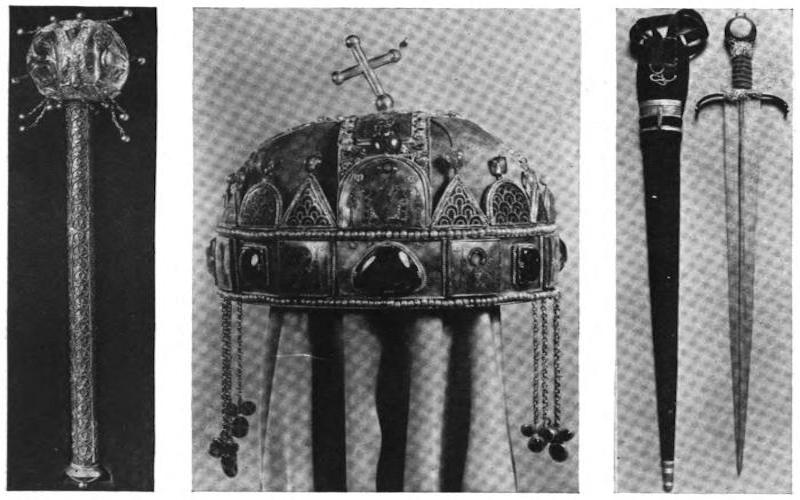
The Hungarian Crown Jewels. Left, the scepter. Center, the celebrated Crown of St. Stephen. Right,
the sword. These priceless treasures fell into the hands of the American authorities in Germany at
the war’s close.
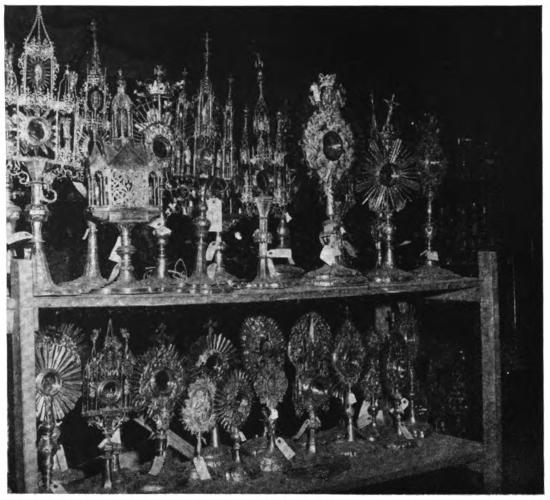
View of the Treasure Room at the Central Collecting Point, Wiesbaden, showing
treasures stolen from Polish churches.
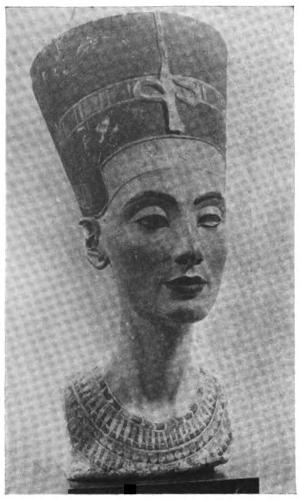
The celebrated Egyptian sculpture, Queen
Nefertete, formerly in the Berlin Museum,
discovered in the Merkers salt mine.
A few days after our visit to Wiesbaden with Colonel Kluss, I
received a letter from home enclosing a clipping from the December
7 edition of the New York Times. The clipping read as follows:
$80,000,000 PAINTINGS ARRIVE FROM EUROPE ON
ARMY TRANSPORT
A valuable store of art, said to consist entirely of paintings worth
upward of $80,000,000, arrived here last night from Europe in the
holds of the Army transport James Parker.
Where the paintings came from and where they are going was a
mystery, and no Army officer on the pier at Forty-fourth Street and
North River, where the Parker docked with 2,483 service passengers,
would discuss the shipment, or even admit it was on board.
It was learned elsewhere that a special detail of Army officers was
on the ship during the night to take charge of the consignment,
which will be unloaded today.
Unusual precautions were taken to keep the arrival of the paintings
secret. The canvases were included in more than forty crates
and were left untouched during the night under lock and key.
Presumably the shipment was gathered at sites in Europe where
priceless stores of paintings and art objects stolen by the Nazis from
the countries they overran were discovered when Allied forces
broke through into Germany and the dominated countries.
The White House announced in Washington two months ago
that shipments of art would be brought here for safekeeping, to
be kept in “trust” for the rightful owners, and the National Gallery
of Art, through its chairman, Chief Justice Harlan Fiske Stone, was
asked to provide storage and protection for the works while they
are in this country. The gallery is equipped with controlled ventilation
and expert personnel for the storage and handling of such
works.
The White House announcement gave no listing of the paintings,
but it is known that among the vast stores seized, including caches
in Italy as well as Germany, and Hermann Goering’s famous $200,000,000
art collection, [were] included many of the world’s art
treasures and works of the masters.
By coincidence, I received that same day a copy of the New York
Times Overseas Weekly edition of December 9, which carried substantially
the same story, except for the fact that it stated unequivocally
that the paintings shipped to America were Nazi loot.
Edith and I were gravely disturbed by the inaccuracy of the
statements in these articles. Our concern was increased by the fact
that the articles had appeared in so reliable a publication as the
Times. What could have happened to the official press release on
the subject issued on the twenty-fourth of November when the
James Parker was ready to sail?[5] And why all the mystery? I
reread the December 7 clipping. To me there was the implication
that we were shipping loot in wholesale lots to the United States.
That would be alarming news to the countries whose stolen art
works we were already returning as rapidly as possible.
The Times story most emphatically called for a correction. But
if a statement from our office were sent through channels, it probably
wouldn’t reach New York before Easter. Edith looked up
from her work. There was a glint in her eye. She asked, “Will
you do me a favor? I’d like to write the letter of correction.”
I told her to go ahead. Ten minutes later she showed me the
rough draft. It covered all the points. I reworked a phrase here
and there but made no important changes and, as soon as it was
typed and cleared, I signed and mailed it. As published in the
New York Times two weeks later, on January 2, 1946, the letter
read as follows:
TO THE EDITOR OF THE NEW YORK TIMES
On Dec. 7 The Times printed a report to the effect that $80,000,000
worth of paintings, presumably from the stores of art
objects stolen by the Nazis, had arrived from Europe in the Army
transport James Parker. Your Overseas Weekly edition of Dec. 9
repeated this information but stated categorically that the paintings
were Nazi loot.
It is true that the James Parker brought to America some 200
paintings of inestimable value, but none of them is loot or of
dubious ownership. They are the property of the Kaiser Friedrich
Museum in Berlin. A press release from the Office of Military
Government for Germany (U.S.), dated Nov. 24, states that these
“priceless German-owned paintings, which might suffer irreparable
damage if left in Germany through the winter, have been selected
for temporary storage in the United States. These paintings have
been gathered from various wartime repositories in the United
States Zone of Germany and are being shipped to Washington to
insure their safety and to hold them in trust for the people of
Germany. The United States Government has promised their
return to the German people.”
It cannot be stated too emphatically that the policy of the American
Military Government is to return all looted works of art to
their owner nations with the greatest possible speed. Since the
restitution in August of the famous van Eyck altarpiece, “The
Mystic Lamb,” to Belgium, a steady stream of paintings, sculpture,
fine furniture and other art objects has poured from the highly
organized collecting points of the United States Zone to the liberated
countries. Few, if any, looted works of art of any importance
are of unknown origin; and though, among the vast masses of
material taken from the Jews and other “enemies of the state” for
what was always described as “safekeeping” there will undoubtedly
be many pieces whose ownership will be difficult to determine, it
appears unlikely that these will be found to be of great value.
The shipment of German-owned paintings to the United States
is thus a project entirely separate from the main objectives of the
Monuments, Fine Arts and Archives Section of the Office of Military
Government—namely, the restitution of loot and the re-establishment
of the German museums and other cultural organizations.
To confuse this shipment, which was directed by the
highest national authority, with what is now the routine work of
preservation, identification and restitution performed by trained
specialist personnel is to mislead our Allies and to underrate the accomplishments
of a small group of disinterested and hard-working
Americans.
Thomas C. Howe Jr.
Lieut. Comdr., USNR, Deputy Chief; Director
on Leave, California Palace of the
Legion of Honor, San Francisco.
European Theatre, Dec. 18, 1945.
The main objectives of the Monuments, Fine Arts and Archives
Section of American Military Government in Germany were defined
in my letter to the New York Times as “the restitution of
loot and the re-establishment of the German museums and other
cultural institutions.” Honorable and constructive objectives. And,
as expressed in that letter, unequivocal and reassuring both to the
liberated countries of Europe and to the Germans. Yet how difficult
of attainment! How difficult even to keep those objectives
clearly in mind when confronted simultaneously—as our officers
often were—with a dozen problems of equal urgency!
At close range it was impossible to look objectively at the overall
record of our accomplishments. But homeward bound in February
I had that opportunity. The pieces of the puzzle began to fit
together and the picture took shape. It was possible to determine
to what extent we have realized our objectives.
So far as restitution is concerned, the record has been a success.
During the summer months our energies were devoted to obvious
preliminary preparations. They included the establishment of
Central Collecting Points at Munich, Marburg and Wiesbaden. Immediately
thereafter, the contents of art repositories in the American
Zone were removed to those central depots. The Central Collecting
Points, organized and directed by Monuments officers with
museum experience, were staffed with trained personnel from
German museums. The one at Munich was primarily reserved for
looted art, since the majority of the cultural booty was found in
Bavaria. The Collecting Points at Wiesbaden and Marburg, on
the other hand, housed German-owned collections brought from
repositories in which storage conditions were unsatisfactory.
The process of actual restitution was inaugurated by token restitutions
in the name of General Eisenhower to Belgium, Holland,
France and Czechoslovakia. Circumstances beyond our control
postponed similar gestures of good will to Poland and Greece.
Representatives of the liberated countries were invited to the
American Zone to identify and remove the loot from the collecting
points. According to late reports, the restitution of loot was continuing
without interruption.
Shortly after my return, there were disquieting rumors of drastic
reductions in American personnel connected with cultural restitution
in Germany. I earnestly hope that these rumors are without
foundation. Such reductions would be disastrous to the completion
of a program which has reflected so creditably on our government.
The re-establishment of German museums and other cultural
institutions—our second main objective—has been, to a large extent,
sacrificed in the interests of restitution. This brings up again
the urgent need for the immediate replenishment of our dwindling
Fine Arts personnel in Germany. Our moral responsibility for the
continuation of this phase of the MFA&A program is a grave one.
It was understandably neglected during the first six months of our
occupation in Germany. And it would be unfair to argue that the
British have far outdistanced us in this field. That they have done
so is undeniably true. However, the British found but little loot in
their zone. Consequently, they have been able to make rapid strides
in the reconstitution of German collections and cultural institutions,
while we have been preoccupied with restitution.
Notwithstanding that preoccupation, our Monuments officers
were instrumental in arranging a series of impressive exhibitions
of German-owned masterpieces. The first of these was held at
Marburg in November 1945. A second and more ambitious show,
which included many of the finest treasures of the Bavarian State
Galleries, opened at Munich in January 1946. A third, comprising
paintings and sculptures from the museums of Berlin and Frankfurt,
was presented at Wiesbaden in February.
All these exhibitions were accompanied by catalogues with German
and English texts. Those of Munich and Wiesbaden were
lavishly illustrated. The Munich catalogue contained several plates
showing the rooms in which the exhibition was held—lofty, spacious
galleries recalling the marble halls of our own National
Gallery at Washington.
At the time of my departure from Germany, little was known of
French and Russian procedures with regard to cultural rehabilitation
in their respective zones of occupation. Their Military Governments
have made provisions for personnel capable of carrying
on work similar to ours and that of the British.
The caliber of the men drawn into the project from all branches
of our Armed Forces has been cited as an important factor in the
success of the Monuments, Fine Arts and Archives program. I
would like to cite another factor which I consider equally important:
There was no arbitrary drafting of personnel; participation
was voluntary. The resulting spontaneity and its value to the spirit
of the work cannot be exaggerated.
APPENDIX
The following is the complete list of the paintings transferred
from Germany and now stored at the National Gallery, according
to its News Release of December 14, 1945:
Albrecht Altdorfer: Rest on the Flight into Egypt
Albrecht Altdorfer: Landscape with Satyr Family
Albrecht Altdorfer: Nativity
Albrecht Altdorfer: Christ’s Farewell to His Apostles
Christoph Amberger: Cosmographer Sebastian Münster
Jacopo Amigioni: Lady as Diana
Fra Angelico: Last Judgment
Austrian Master (ca. 1400): Christ, Madonna, St. John
Austrian Master (ca. 1410): Crucifixion
Hans Baldung Grien: Altar of Halle
Hans Baldung Grien: Graf von Löwenstein
Hans Baldung Grien: Pietà
Hans Baldung Grien: Pyramus and Thisbe
Giovanni Bellini: The Resurrection
Bohemian (ca. 1350): Glatyer Madonna
Hieronymus Bosch: St. John on Patmos
Botticelli: Giuliano de Medici, and frame
Botticelli: Madonna of the Lilies
Botticelli: St. Sebastian
Botticelli: Simonetta Vespucci
Botticelli: Venus
Dirk Bouts: Madonna and Child
Dirk Bouts: Virgin in Adoration
Peter Breughel: Dutch Proverbs
Peter Breughel: Two Monkeys
Angelo Bronzino: Portrait of a Young Man
Angelo Bronzino: Portrait of a Young Man
Angelo Bronzino: Ugolino Martelli
Hans Burgkmair: Holy Family
Giovanni Battista Caracciolo: Cosmos and Damian
Caravaggio: Cupid as Victor
Vittore Carpaccio: Entombment of Christ
Andrea del Castagno: Assumption of the Virgin
Chardin: The Draughtsman
Chardin: Still Life
Petrus Christus: Portrait of a Girl
Petrus Christus: St. Barbara and a Carthusian Monk
Joos van Cleve: Young Man
Cologne Master (ca. 1400): Life of Christ
Cologne Master (ca. 1350): Madonna Enthroned, Crucifixion
Correggio: Leda and the Swan
Francesco Cossa: Allegory of Autumn
Lucas Cranach, the Elder: Frau Reuss
Lucas Cranach, the Elder: Lucretia
Lucas Cranach, the Elder: Rest on the Flight into Egypt
Daumier: Don Quixote
Piero di Cosimo: Mars, Venus and Cupid
Lorenzo di Credi: Young Girl
Albrecht Dürer: Madonna
Albrecht Dürer: Madonna with the Goldfinch
Albrecht Dürer: Young Woman
Albrecht Dürer: Hieronymus Holzschuher
Albrecht Dürer: Cover for Portrait of Hieronymus Holzschuher
Adam Elsheimer: The Drunkenness of Noah
Adam Elsheimer: Holy Family
Adam Elsheimer: Landscape with the Weeping Magdalene
Adam Elsheimer: St. Christopher
Jean Fouquet: Etienne Chevalier with St. Stephen
French (ca. 1400): Coronation of the Virgin
French Master (ca. 1400): Triptych
Geertgen tot Sint Jans: John the Baptist
Geertgen tot Sint Jans: Madonna
Giorgione: Portrait of a Young Man
Giotto: Death of the Virgin
Jan Gossaert: Baudouin de Bourbon
Jan Gossaert: Christ on the Mount of Olives
Francesco Guardi: The Balloon Ascension
Francesco Guardi: St. Mark’s Piazza in Venice
Francesco Guardi: Piazzetta in Venice
Frans Hals: Hille Bobbe
Frans Hals: Nurse and Child
Frans Hals: Portrait of a Young Man
Frans Hals: Portrait of a Young Woman
Frans Hals: Singing Boy
Frans Hals: Tyman Oosdorp
Meindert Hobbema: Landscape
Hans Holbein: George Giesze
Hans Holbein: Old Man
Hans Holbein: Portrait of a Man
Pieter de Hooch: The Mother
Pieter de Hooch: Party of Officers and Ladies
Willem Kalf: Still Life
Willem Kalf: Still Life
Philips Konninck: Dutch Landscape
Georges de la Tour: St. Sebastian
Filippino Lippi: Allegory of Music
Fra Filippo Lippi: Adoration of the Child
Pietro Lorenzetti: St. Humilitas Raises a Nun
Pietro Lorenzetti: Death of St. Humilitas
Claude Lorrain: Italian Coast Scene
Lorenzo Lotto: Christ’s Farewell to His Mother
Bastiano Mainardi: Portrait of a Man
Manet: In the Winter Garden
Andrea Mantegna: Cardinal Mezzarota
Andrea Mantegna: Presentation in the Temple
Simon Mannion: Altar of St. Omer (two panels)
Simone Martini: Burial of Christ
Masaccio: Birth Platter
Masaccio: Three Predelle
Masaccio: Four Saints
Quentin Massys: The Magdalene
Master of the Darmstadt Passion: Altar Wings
Master of Flémalle: Crucifixion
Master of Flémalle: Portrait of a Man
Master of the Virgo inter Virgines: Adoration of the Kings
Hans Memling: Madonna Enthroned with Angels
Hans Memling: Madonna Enthroned
Hans Memling: Madonna and Child
Lippo Memmi: Madonna and Child
Antonello da Messina: Portrait of a Man
Jan Mostaert: Portrait of a Man
Aelbert Ouwater: Raising of Lazarus
Palma Vecchio: Portrait of a Man
Palma Vecchio: Young Woman
Giovanni Paolo Pannini: Colosseum.
Giovanni di Paolo: Christ on the Cross
Giovanni di Paolo: Legend of St. Clara
Joachim Patinir: Rest on the Flight into Egypt
Sebastiano del Piombo: Roman Matron
Sebastiano del Piombo: Knight of the Order of St. James
Antonio Pollaiuolo: David
Nicolas Poussin: St. Matthew
Nicolas Poussin: Amaltea
Raphael: Madonna Diotalevi
Raphael: Madonna Terranova
Raphael: Solly Madonna
Rembrandt: Landscape with Bridge
Rembrandt: John the Baptist
Rembrandt: Joseph and Potiphar’s Wife
Rembrandt: Vision of Daniel
Rembrandt: Moses Breaking the Tablets of the Law
Rembrandt: Susanna and the Elders
Rembrandt: Tobias and the Angel
Rembrandt: Minerva
Rembrandt: Rape of Proserpina
Rembrandt: Self Portrait
Rembrandt: Hendrickje Stoffels
Rembrandt: Man with Gold Helmet
Rembrandt: Old Man with Red Hat
Rembrandt: Rabbi
Rembrandt: Saskia
Rubens: Landscape (shipwreck of Aeneas)
Rubens: St. Cecilia
Rubens: Madonna Enthroned with Saints
Rubens: Andromeda
Rubens: Perseus and Andromeda
Rubens: Isabella Brandt
Jacob van Ruysdael: View of Haarlem
Andrea Sacchi(?): Allesandro del Boro
Sassetta: Legend of St. Francis
Sassetta: Mass of St. Francis
Martin Schongauer: Nativity
Seghers: Landscape
Luca Signorelli: Three Saints (altar wing)
Luca Signorelli: Three Saints (altar wing)
Luca Signorelli: Portrait of a Man
Francesco Squarcione: Madonna and Child
Jan Steen: Inn Garden
Jan Steen: The Christening
Bernardo Strozzi: Judith
Gerard Terborch: The Concert
Gerard Terborch: Paternal Advice
Giovanni Battista Tiepolo: Carrying of the Cross
Giovanni Battista Tiepolo: St. Agatha
Giovanni Battista Tiepolo: Rinaldo and Armida
Tintoretto: Doge Mocenigo
Tintoretto: Old Man
Titian: Venus with Organ Player
Titian: Self Portrait
Titian: Lavinia
Titian: Portrait of a Young Man
Titian: Child of the Strozzi Family
Cosma Tura: St. Christopher
Cosma Tura: St. Sebastian
Adriaen van der Velde: The Farm
Roger Van der Weyden: Altar with Scenes from the Life of Mary
Roger Van der Weyden: Johannes-alter Altar with Scenes from the Life of John the Baptist
Roger Van der Weyden: Bladelin Altar
Roger Van der Weyden: Portrait of a Woman
Roger Van der Weyden: Charles the Bold
Jan Van Eyck: Crucifixion
Jan Van Eyck: Madonna in the Church
Jan Van Eyck: Giovanni Arnolfini
Jan Van Eyck: Man with a Pink
Jan Van Eyck: Knight of the Golden Fleece
Lucas van Leyden: Chess Players
Lucas van Leyden: Madonna and Child
Velásquez: Countess Olivares
Domenico Veneziano: Adoration of the Kings
Domenico Veneziano: Martyrdom of St. Lucy
Domenico Veneziano: Portrait of a Young Woman
Vermeer: Young Woman with a Pearl Necklace
Vermeer: Man and Woman Drinking Wine
Andrea del Verrocchio: Madonna and Child
Andrea del Verrocchio: Madonna and Child
Watteau: Fête Champêtre
Watteau: French Comedians
Watteau: Italian Comedians
Westphalian Master (ca. 1250): Triptych
Konrad Witz: Crucifixion
Konrad Witz: Allegory of Redemption
On January 15, 1946, Mr. Rensselaer W. Lee, President of the
College Art Association of America, sent the following letter to the
Secretary of State:
My dear Mr. Secretary:
The members of the College Art Association of America, a constituent
member of the American Council of Learned Societies,
have been disturbed by the removal to this country of works of art
from Berlin museums.
Information that we have received from abroad leads us to believe
that the integrity of United States policy has been questioned
as a result of this action. We have also been informed that adequate
facilities and American personnel now exist in the American zone
in Germany to assure the proper care of art treasures in that area.
We would therefore urge that the department of State clarify
this action, and would strongly recommend that assurances be given
that no further shipments are contemplated.
Copies of this letter were sent to members of the American
Commission for the Protection and Salvage of Artistic and Historic
Monuments in War Areas.
The State Department replied on January 25:
My Dear Mr. Lee:
Your letter of January 15, urging the Department to clarify the
action taken in removing to the United States certain works of art
from German museums, has been received. In the absence of the
Secretary, I am replying to your letter and am glad to give you additional
information on this question.
The decision to remove these works of art to this country was
made on the basis of a statement by General Clay that he did not
have adequate facilities and personnel to safeguard German art
treasures and that he could not undertake the responsibility of their
proper care.
You indicated in your letter that you have been informed that
adequate facilities and personnel now exist in the American zone
for the protection of these art treasures. I must inform you that our
information, based upon three separate investigations, is precisely
to the contrary. The redeployment program has, as you no doubt
realize, reduced American personnel in Germany and this reduction
is applied to arts and monuments and this personnel as well as
to other branches.
The coal situation in Germany is critical and has made it impossible
to provide heat for the museums. General Clay cannot be
expected to provide heat for the museums if that means taking it
away from American forces, from hospitals, or from essential utility
needs.
We are furthermore advised that the security situation was not
such as to ensure adequate protection in Germany. In short, the
Department’s information is such that it cannot agree with your
premise.
It was realized that the “integrity of United States policy” might
be questioned by some if these works of art were removed to this
country. After a careful review of the facts, it was decided that
the most important aspect was to safeguard these priceless treasures
by bringing them to this country where they could be properly
cared for. It was hoped that the President’s pledge that they would
be returned to Germany would satisfy those who might be critical
of this Government’s motives.
Sincerely yours,
For the Acting Secretary of State:
James W. Riddleberger
Chief, Division of Central European Affairs[6]
In April the author of this book received from Frederick Mortimer
Clapp, director of the Frick Collection, New York, the following
letter regarding the removal of German-owned works of
art to this country. A copy of the resolution which accompanied
this letter and a list of those who subsequently signed the resolution
are also printed below.
1 East 70th Street
New York 21, New York
April 24, 1946
Dear
Since we believe that it is impossible to defend on technical,
political or moral grounds the decision to ship to this country two
hundred internationally known and extremely valuable pictures belonging
indisputably, by prewar gift or purchase, to German institutions,
notably the Kaiser Friedrich Museum of Berlin, we propose
to memorialize the President in a resolution to be signed by a
group of like-minded people interested in or associated with the
arts.
We also intend to point out that no reason can be found for
even temporarily alienating these works of art from the country
to which legally they belong.
We represent no organized movement or institution. We merely
wish as American citizens to go on record by appealing to our
government to set right an ill considered action arising from an
error of judgment which, however disinterested in intention, has
already done much to weaken our national condemnation of German
sequestrations of the artistic heritage or possessions of other
nations under the subterfuge of “protective custody,” or openly
as loot.
The moral foundations of our war effort and final victories will
be subtly undermined if we, who understand the implications, pass
over in silence an action taken by our own officials that, in outward
appearance at least cannot be distinguished from those, detestable
to all right thinking people, which the Nazis’ policy of pillage
inspired and condoned.
The Monuments Officers attached to our armed forces with
their specialized knowledge of the practical risks involved unanimously
condemned the decision. Those Americans whose profession
it is to study and preserve old paintings deplore it. On ethical
grounds it is disapproved by the opinion of enlightened laymen.
We therefore consider the protest we will make to be our plain
and simple duty, for it is our considered judgment that no explanation
or excuse acceptable to the public conscience can be found for
sending fragile old masters across the sea to this country. The
physical hazards, the momentous responsibilities and the intellectual
ambiguities inherent in such an act are only too grossly evident.
The historical repercussions that will follow it can be
imagined in the light of past situations of a similar kind. It is
well known that the Nazis inculcated in the German mind a fanatical
belief that we are destructive barbarians. All future deterioration
of these pictures will now, rightly or wrongly, be laid at our
door.
We should be glad if you would care to join us and others,
who have already expressed to us their sense of the unjustified impropriety
of the action to which we refer in demanding the immediate
return to Germany of these panels and canvasses, the
cancellation of all plans to exhibit them in this country and the
countermanding at once of any contemplated further shipments.
The text of the proposed resolution is enclosed. As one of the
principal reasons for submitting it to our government is to forestall
further action of a similar kind with reference to pictures or
objects of art belonging to German museums, as well as to rectify
the existing situation, may I earnestly request you to signify your
approval, if you are so minded, by signing the resolution and
returning it to me before May 6.
Sincerely yours,
Signed: Frederick Mortimer Clapp.
On May 9, 1946, Dr. Clapp and Mrs. Juliana Force, director of
the Whitney Museum, sent President Truman the following resolution,
a copy of which was enclosed with the above letter:
RESOLUTION
Whereas in all civilized countries one of the most significant
public reactions during the recent war was the horrified indignation
caused by the surreptitious or brazen looting of works of art by
German officials in countries they had conquered;
And Whereas that indignation and abhorrence on the part of
free peoples was a powerful ingredient in the ardor and unanimity
of their support of the war effort of democratically governed states
in which the private opinions of citizens are the source and controlling
directive of official action;
And Whereas two hundred important and valuable pictures belonging
to the Kaiser Friedrich and other Berlin museums have
been removed from Germany and sent to this country on the still
unestablished ground of ensuring their safety;
And Whereas it is apparent that disinterested and intelligent
people believe that this action cannot be justified on technical, political
or moral grounds and that many, including the Germans themselves,
may find it hard to distinguish between the resultant situation
and the “protective custody” used by the Nazis as a camouflage
for the sequestration of the artistic treasures of other countries;
Be It Therefore Resolved that we, the undersigned, respectfully
request the President to order the immediate safe return to
Germany of the aforesaid paintings, the cancellation of any plans
that may have been made to exhibit them in this country and the
countermanding without delay of any further shipments of the
kind that may have been contemplated.
This resolution was signed by:
- Abbott, Jere
- Director
- Smith College Museum of Art
- Northampton, Mass.
- Abbott, John E.
- Executive Vice-President
- The Museum of Modern Art
- New York, N.Y.
- Adams, Philip R.
- Director
- Cincinnati Museum
- Cincinnati, Ohio
- Barber, Professor Leila
- Vassar College
- Poughkeepsie, N. Y.
- Baker, C. H. Collins
- Henry E. Huntington Library and Art Gallery
- San Marino, Calif.
- Barr, Alfred H.
- The Museum of Modern Art
- New York, N. Y.
- Barzun, Jacques
- History Department
- Columbia University
- New York, N. Y.
- Baur, John I. H.
- Curator of Painting
- Brooklyn Museum
- Brooklyn, N. Y.
- Biebel, Franklin
- Assistant to Director
- Frick Collection
- New York, N.Y.
- Breeskin, Mrs. Adelyn
- Acting Director
- Baltimore Museum of Art
- Baltimore, Md.
- Burdell, Dr. Edwin S.
- Director
- The Cooper Union
- New York, N. Y.
- Chase, Elizabeth
- Editor “Bulletin”
- Yale University Art Gallery
- New Haven, Conn.
- Claflin, Professor Agnes Rindge
- Vassar College
- Poughkeepsie, N. Y.
- Clapp, Frederick Mortimer
- Director
- Frick Collection
- New York, N. Y.
- Cole, Grover
- Instructor in Ceramics
- University of Michigan
- Ann Arbor, Mich.
- Cook, Walter W. S.
- Chairman
- Institute of Fine Arts
- New York University, N. Y.
- Courier, Miss Elodie
- Dir. of Circulating Exhibitions
- The Museum of Modern Art
- New York, N. Y.
- Crosby, Dr. Sumner
- Assistant Professor, History of Art
- Yale University
- New Haven, Conn.
- Cunningham, Charles C.
- Director
- Wadsworth Atheneum
- Hartford, Conn.
- Dawson, John P.
- Professor of Law
- University of Michigan
- Ann Arbor, Mich.
- Faisan, Professor Lane, Jr.
- Williams College
- Williamstown, Mass.
- Faunce, Wayne M.
- Vice-Director
- American Museum of Natural History
- New York, N. Y.
- Fisher, H. H.
- Hoover Library
- Stanford University
- Palo Alto, Calif.
- Force, Mrs. Juliana
- Director
- Whitney Museum of American Art
- New York, N. Y.
- Goodrich, Lloyd
- Research Curator
- Whitney Museum of American Art
- New York, N. Y.
- Gores, Walter J.
- Professor and Chairman of Design
- University of Michigan
- Ann Arbor, Mich.
- Haight, Mary N.
- Assistant Curator of Ancient Art
- Yale University Art Gallery
- New Haven, Conn.
- Hamilton, George Heard
- Curator of Paintings
- Yale University Art Gallery
- New Haven, Conn.
- Hamlin, Talbot F.
- Librarian, Avery Architectural Library
- Columbia University
- New York, N.Y.
- Hammett, Ralph W.
- Professor of Architecture
- University of Michigan
- Ann Arbor, Mich.
- Hancock, Walter
- Director of Sculpture
- Pennsylvania Academy of the Fine Arts
- Philadelphia, Pa.
- Hayes, Bartlett H., Jr.
- Director
- Addison Gallery of American Art
- Andover, Mass.
- Hebran, Jean
- Professor of Architecture
- University of Michigan
- Ann Arbor, Mich.
- Helm, Miss Florence
- Old Merchant’s House
- New York, N. Y.
- Howe, Thomas Carr, Jr.
- Director
- California Palace of the Legion of Honor
- San Francisco, Calif.
- Hudnut, Joseph
- Dean
- Graduate School of Architecture
- Harvard University
- Cambridge, Mass.
- Hume, Samuel J.
- Director
- Berkeley Art Association
- Berkeley, Calif.
- Ivins, William M., Jr.
- Counselor and Curator of Prints
- The Metropolitan Museum of Art
- New York, N.Y.
- Janson, H. W.
- Assistant Professor
- Department of Art and Archaeology
- Washington University
- St. Louis, Mo.
- Jewell, Henry A.
- Department of Art and Archaeology
- Princeton University
- Princeton, N. J.
- Kaufmann, Edgar
- Curator of Industrial Art
- The Museum of Modern Art
- New York, N.Y.
- Keck, Sheldon
- Restorer
- The Brooklyn Museum
- Brooklyn, N. Y.
- Kirby, John C.
- Assistant Administrator
- Walters Gallery
- Baltimore, Md.
- Kirstein, Lincoln
- New York, N. Y.
- Kubler, Professor George
- Yale University
- New Haven, Conn.
- Lee, Rensselaer W.
- Princeton, N. J.
- Marceau, Henri
- Assistant Director
- Philadelphia Museum of Art
- Philadelphia, Pa.
- Mcllhenny, Henry
- Curator of Decorative Arts
- Philadelphia Museum of Art
- Philadelphia, Pa.
- McMahon, A. Philip
- Chairman
- Fine Arts Department
- Washington Square College
- New York University
- New York, N. Y.
- Meeks, Everett V.
- Dean
- Yale School of the Fine Arts
- New Haven, Conn.
- Meiss, Millard
- Professor
- Columbia University
- New York, N. Y.
- Miner, Miss Dorothy E.
- Librarian
- Walters Gallery
- Baltimore, Md.
- More, Hermon
- Curator
- Whitney Museum of American Art
- New York, N. Y.
- Morley, Dr. Grace McCann
- Director
- San Francisco Museum of Art
- San Francisco, Calif.
- Morse, John D.
- Editor
- Magazine of Art
- New York, N. Y.
- Myer, John Walden
- Assistant Director
- Museum of the City of New York
- New York, N. Y.
- Myers, George Hewitt
- President
- Textile Museum of the District of Columbia
- Washington, D. C.
- Nagel, Charles, Jr.
- Director
- The Brooklyn Museum
- Brooklyn, N. Y.
- O’Connor, John, Jr.
- Assistant Director
- Carnegie Institute
- Pittsburgh, Pa.
- Packard, Miss Elizabeth G.
- Walters Gallery
- Baltimore, Md.
- Parker, Thomas C.
- Director
- American Federation of Arts
- Washington, D. C.
- Peat, Wilbur D.
- Director
- John Herron Art Institute
- Indianapolis, Ind.
- Phillips, John Marshall
- Assistant Director and Curator of the Garvan Collections
- Yale University Art Gallery
- New Haven, Conn.
- Poland, Reginald
- Director
- Fine Arts Society of San Diego
- San Diego, Calif.
- Porter, Allen
- Secretary
- The Museum of Modern Art
- New York, N. Y.
- Porter, Vernon
- Director
- Riverside Museum
- New York, N. Y.
- Post, Chandler
- Fogg Museum of Art
- Harvard University
- Cambridge, Mass.
- Rathbone, Perry T.
- Director
- City Art Museum of St. Louis
- St. Louis, Mo.
- Reed, Henry Hope
- New York, N. Y.
- Rich, Daniel Catton
- Director
- The Art Institute of Chicago
- Chicago, Ill.
- Riefstahl, Mrs. Elizabeth
- Librarian
- Wilbour Egyptological Library
- The Brooklyn Museum
- Brooklyn, N. Y.
- Ritchie, Andrew C.
- Director
- Albright Art Gallery
- Buffalo, N. Y.
- Robinson, Professor David M.
- Department of Art and Archaeology
- Johns Hopkins University
- Baltimore, Md.
- Ross, Marvin Chauncey
- Curator of Medieval Art
- Walters Gallery
- Baltimore, Md.
- Rowe, Margaret T. J.
- Curator
- Hobart Moore Memorial Collection
- Yale University Art Gallery
- New Haven, Conn.
- Saint-Gaudens, Homer
- Director
- Carnegie Institute
- Pittsburgh, Pa.
- Scholle, Hardinge
- Director
- Museum of the City of New York
- New York, N.Y.
- Setze, Josephine
- Assistant Curator of American Art
- Yale University Art Gallery
- New Haven, Conn.
- Sexton, Eric
- Camden, Me.
- Shelley, Donald A.
- Curator of Paintings
- New York Historical Society
- New York, N. Y.
- Sizer, Theodore
- Director
- Yale University Art Gallery
- New Haven, Conn.
- Slusser, Jean Paul
- Professor of Painting and Drawing
- University of Michigan
- Ann Arbor, Mich.
- Smith, Professor E. Baldwin
- Department of Art and Archaeology
- Princeton University
- Princeton, N. J.
- Soby, James Thrall
- New York, N. Y.
- Spinden, Dr. Herbert J.
- Curator
- Indian Art and Primitive Cultures
- The Brooklyn Museum
- Brooklyn, N. Y.
- Sweeney, James Johnson
- Director
- Department of Painting and Sculpture
- The Museum of Modern Art
- New York, N. Y.
- Sweet, Frederick
- Associate Curator, Painting and Sculpture
- The Art Institute of Chicago
- Chicago, Ill.
- Tee Van, John
- Department of Tropical Research and Special Events
- New York Zoological Park
- Bronx, N. Y.
- Vail, R. W. G.
- Director
- New York Historical Society
- New York, N. Y.
- Walker, Hudson D.
- President
- American Federation of Arts
- New York, N.Y.
- Wall, Alexander J.
- New York Historical Society
- New York, N. Y.
- Washburn, Gordon
- Director
- Museum of Art
- Rhode Island School of Design
- Providence, R. I.
- Weissman, Miss Polaire
- Museum of Costume Art
- New York, N. Y.
- Wissler, Dr. Clark
- American Museum of Natural History
- New York, N. Y.
- Wind, Edgar
- Smith College
- Northampton, Mass.
- York, Lewis E.
- Chairman
- Department of Painting
- Yale University Art Gallery
- New Haven, Conn.
- Zigrosser, Carl
- Curator of Prints and Drawings
- Philadelphia Museum of Art
- Philadelphia, Pa.
- Stoddard, Whitney S.
- Assistant Professor of History and Art
- Williams College
- Williamstown, Mass.
Dr. Clapp and Mrs. Force subsequently announced that they had
received eight additional signatures which arrived too late to be affixed
to the original copy of the resolution. They included: Frances
A. Comstock, Donald Drew Egbert, Henry A. Judd, Sherley W.
Morgan, Richard Stillwell—all of Princeton University; Robert
Tyler Davis, Portland Museum, Portland, Maine; Frederick Hartt,
Acting Director, Smith College Museum of Art; and George Rowley,
Princeton Museum of Historic Art.
Statement by the American Commission for the Protection
and Salvage of Artistic and Historic Monuments in War
Areas, Owen J. Roberts, Chairman.
National Gallery of Art, Washington 25, D. C.
Washington, May 14, 1946: The members of the Commission
have received copies of a resolution signed by Dr. Frederick M.
Clapp, Director of the Frick Collection; Mrs. Juliana Force,
Director of the Whitney Museum of American Art, and others who
criticize the action of the United States Government, taken at the
Direction of the President and the United States Army Command
in Germany, in bringing to this country certain paintings from German
museums for safekeeping until conditions in Germany warrant
their return. The Clapp resolution compares the action taken by
the United States Government to looting operations carried on by
the Nazis during the war.
The Commission has also noted the statements issued by the
White House on September 26, 1945, and by the War Department
on December 6, 1945, that the works of art of bona fide German
ownership, which may be brought to this country for safekeeping,
will be kept in trust for the German people and will be returned
to Germany when conditions there warrant.
The Commission has also noted the statement issued by the late
Chief Justice Stone, Chairman of the Board of Trustees of the National
Gallery of Art, on December 14, 1945, that the Trustees of
the National Gallery, at the request of the Secretary of State, had
agreed to arrange for the storage space for such paintings as might
be brought to this country by the United States Army for safekeeping,
and that he felt the Army “deserved the highest praise for the
care exercised in salvaging these great works of art and in making
provisions for their safety until they can be returned to Germany.”
The Commission accepts without reservation the promise of the
United States Government, as voiced by its highest officials, that the
works of art belonging to German museums and brought to this
country for safekeeping, will be returned to Germany when conditions
there warrant.
The Commission is strongly of the opinion that the resolution
sponsored by Dr. Clapp, Mrs. Force, and others is without justification
and is to be deplored.
- Hon. Owen J. Roberts, Chairman
- Philadelphia, Pennsylvania
- David E. Finley, Vice Chairman
- Director, National Gallery of Art
- Washington, D.C.
- Huntington Cairns, Secretary
- Secretary, National Gallery of Art
- Washington, D.C.
- Dr. William Bell Dinsmoor
- Columbia University, New York
- Hon. Herbert H. Lehman
- New York
- Paul J. Sachs
- Professor of Fine Arts, Harvard University
- Cambridge, Massachusetts
- Francis Cardinal Spellman
- Archbishop of New York
- Francis Henry Taylor
- Director, Metropolitan Museum of Art
- New York
The following letters were released on June 10, 1946:
THE WHITE HOUSE
Washington
May 22, 1946
Dear Mrs. Force:
This is in acknowledgment of the letter to the President, signed
by yourself and Dr. Frederick M. Clapp, Director, The Frick Collection,
with which you enclosed a resolution signed by ninety-five
of your colleagues in connection with the two hundred valuable
paintings removed from Germany to this country for safekeeping.
These paintings were removed to this country last year on the
basis of information to the effect that adequate facilities and personnel
to ensure their safekeeping did not exist in Germany. Our
military authorities did not feel that they could take the responsibility
of safeguarding them under such conditions and it was therefore
decided that they would have to be shipped to this country
until such time as they could safely be returned to Germany. It was
realized at the time that this action might lead to criticism but it
was taken, nevertheless, because it was considered that the most
important aspect was to safeguard these priceless treasures. It was
hoped that the President’s pledge that they would be returned to
Germany, contained in a White House press release on September
26, 1945, would satisfy those who might be critical of this Government’s
motives.
I know of no plans to make any further shipments of art objects
from Germany to the United States nor of any plans for the exhibition
of the two hundred paintings now in this country. While a
definite date for the return of these pictures has not as yet been set,
I can assure you that this Government will honor its pledge to effect
their return as soon as conditions warrant.
Very sincerely yours,
(signed) William D. Hassett
Secretary to the President.
DEPARTMENT OF STATE
Washington
May 22, 1946
My dear Mrs. Force and Dr. Clapp:
I have received your letter of May 9, 1946, and its enclosed resolution,
signed by 95 of your colleagues, urging the President to
order the immediate safe return to Germany of the 200 paintings
which were brought to this country last year.
When these paintings were found by our forces in southern
Germany every effort was made to assure their preservation. It soon
became evident that adequate facilities and personnel to ensure
their safe keeping could not be guaranteed. Consequently our military
authorities, realizing the magnitude of their responsibility in
preserving these priceless treasures, requested that they be relieved
of this heavy responsibility and that the paintings be shipped to this
country where they could be properly cared for. This Government
reluctantly gave its approval to this request, knowing that such
action would lead to criticism of its motives. The decision was taken
because there seemed no other way to ensure preservation of these
unique works of art. In order to dispel doubts as to the reasons for
this action the White House released a statement to the press on
September 26, 1945, which explained the situation and included a
pledge that the paintings would be returned to their rightful owners.
That pledge still holds good and while a definite date for the return
of the paintings to Germany has not as yet been set, you may
rest assured that this will be done as soon as conditions warrant.
The resolution also recommended that plans to exhibit these
paintings in this country be cancelled and that further shipments of
German works of art to this country be countermanded. I have
never heard of any plans to make additional shipments of works
of art from Germany to the United States nor do I know of any
plans to exhibit the paintings which are now in this country.
Sincerely yours,
For the Secretary of State:
(signed) Dean Acheson
Under Secretary.
Following are Dr. Clapp’s and Mrs. Force’s replies, also released
on June 10:
June 3, 1946
My dear Mr. President:
Permit us to thank you for your kind attention to the resolution,
signed by us and ninety-five of our colleagues prominent on the
staffs of museums or experts in the history and preservation of art,
relative to the shipment to this country of two hundred famous
paintings formerly in the Kaiser Friedrich and other museums of
Berlin.
In addressing the resolution in question to you we felt that we
were following the time-honored American custom of bringing to
our government’s attention a consensus of opinion on the part of
those who have special practical familiarity with old pictures and
personal, sometimes long, acquaintance with European history and
culture in its emotional and intellectual aspects.
Should you, in the course of events, undertake further inquiries
into the problem created by the shipment referred to in our resolution,
we shall be happy to be so informed.
Respectfully yours,
June 3, 1946
Dear Mr. Hassett:
In reply to your letter of the twenty-second permit us to say that
should the President make further inquiries into the subject covered
by our resolution with reference to two hundred pictures selected
chiefly from the collections of the Kaiser Friedrich Museum and
brought to this country, we should be pleased to be kept informed.
We, and our ninety-five colleagues in museums and universities
who have had long experience with old paintings and are interested
in the history and preservation of works of art, would also be glad
to know when the pictures referred to are returned to Germany
since we are as yet uninformed whether the conditions which are
held not to warrant their return are of a practical or a political
nature.
This question obviously cannot but be uppermost in our minds
in view of the fact that present conditions in Germany are apparently
such as to warrant leaving there thousands of German-owned
works of art of great moment which belong not only to the
Kaiser Friedrich Museum but to the museums of other cities in the
American zone, including the great collection of the Alte Pinakothek
in Munich, where under satisfactory conditions and auspices
an exhibition of early German art, including masterpieces by Dürer,
Grünewald and others, is now being held.
It is in fact one of our perplexities that we have never been told
why our officials discriminated against important pictures and art
objects (many times the number of those urgently transported to
this country for safekeeping) which were also formerly in the
Kaiser Friedrich and other museums, not forgetting those which
were in South German churches. Were they just left to their fate?
If it were convenient at any time to pass on to the President our
continued anxieties on these important points we should be happy
to have you do so.
Sincerely yours,
June 3, 1946
Dear Mr. Acheson:
In reply to your letter of the twenty-second with reference to our
resolution supported by the signatures of ninety-five of our colleagues
prominent in museums or experts in the history and preservation
of old masters and other works of art, permit us to say that,
in the absence of Secretary Byrnes, we took the liberty of sending
you the resolution.
We are aware of the statement released by the White House on
September 26, 1945 explaining the situation and promising to return
the pictures to Germany when conditions there should warrant
such action. We are, however, still uninformed why the unanimous
advice of the monuments officers, who had special training and
technical knowledge not only of the conditions required for the
preservation of old masters but of the certain dangers to which
journeys subject them, was disregarded.
We have also never been told whether the conditions believed to
jeopardize the safety of these important pictures were of a practical
or of a political nature. Neither do we know why, out of the great
and extensive collections of the Kaiser Friedrich only two hundred
pictures were selected nor by whom the selection was made. More
serious still no official mention has ever been made of the fact that
there were in the possession of the other museums of Berlin and
other cities, including the famous collection of the Alte Pinakothek
in Munich, as well as in the churches of the American Zone, art objects
and pictures many times more numerous than the paintings
actually brought to this country for safekeeping. One cannot but
ask: Were satisfactory conditions found for them or were they
merely left to their fate?
These are questions that have given and still give rise to rumors,
unhappy conjectures and ambiguous interpretations which we deplore.
Unreasonably or otherwise the whole situation is confused
by implications that we feel will not be laid until the pictures deposited
in Washington have been sent back with the least possible
delay to their rightful owners on whom devolves an unequivocable
responsibility for their care and preservation.
Sincerely yours,