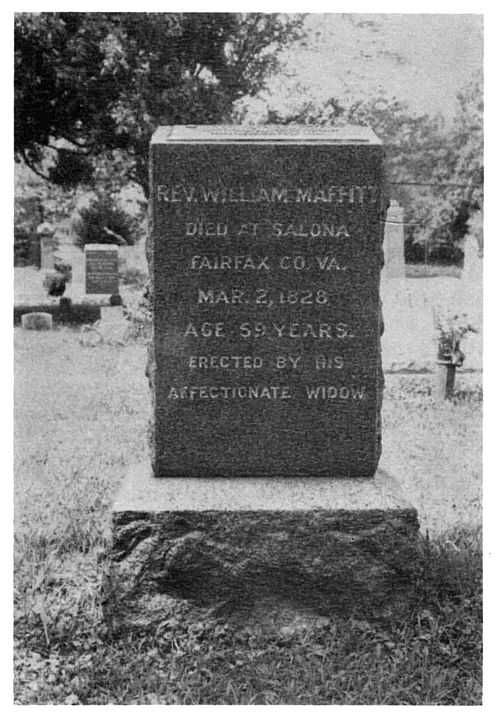
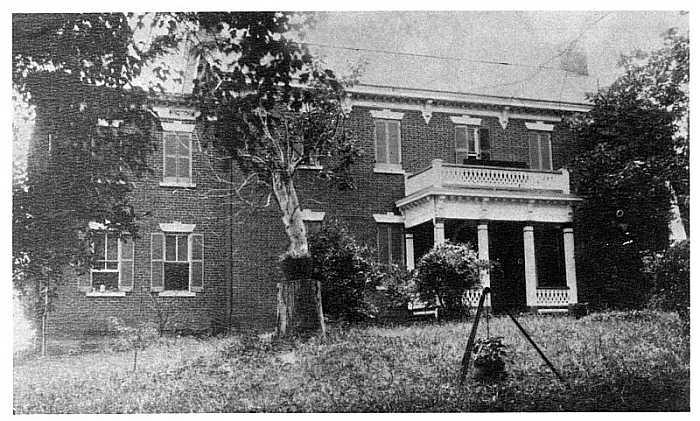
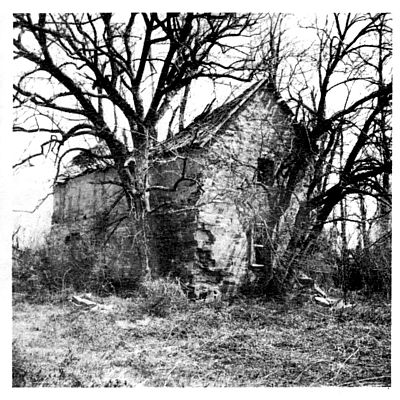
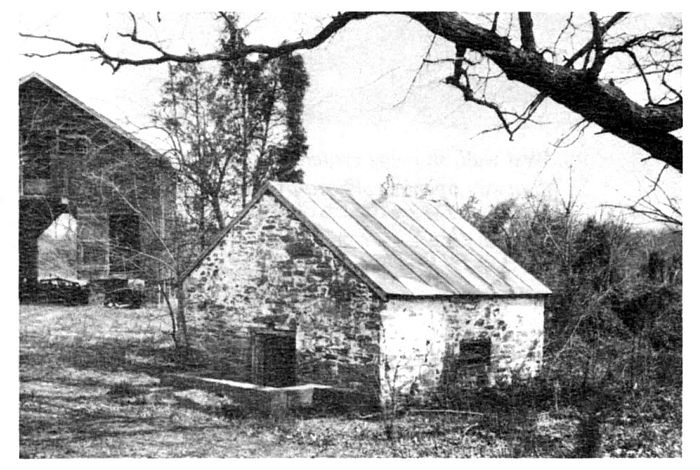
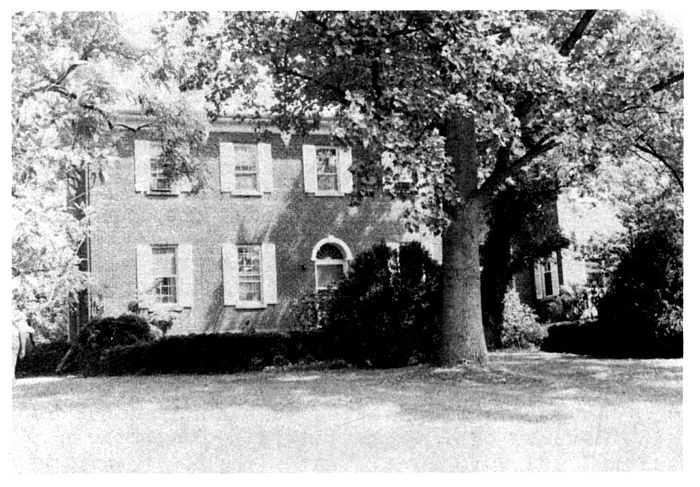
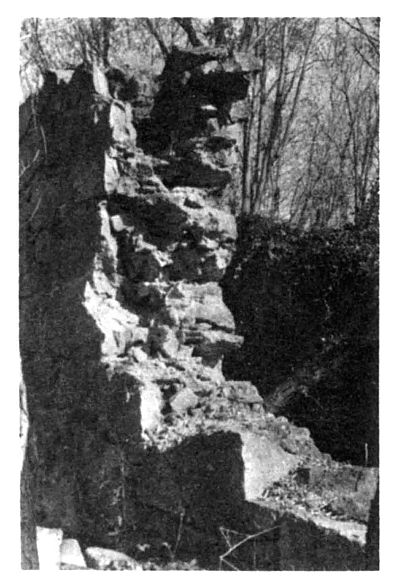
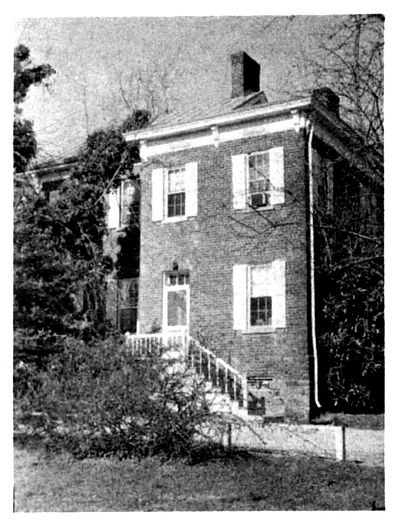
The first occupant of record of the house at Salona,
William Maffitt, is surrounded by legends. Supposedly,
Maffitt built Salona in 1801. Maffitt was from South
Carolina. Maffitt went to Princeton. Maffitt preached
the funeral sermon for George Washington. Maffitt had
a boys' school at Salona. Maffitt lived at Salona with
his wife Harriotte Lee Turberville Maffitt, who deserted
her three children by her first marriage. Dolley Madison
spent the night with the Maffitts at Salona when she
fled from the White House during the English invasion
of Washington.
The available documents give a different picture.
William Maffitt was born in Cecil County, Maryland,
in 1769, eldest son of Samuel and Ann Strawbridge
Maffitt.[18] His father was a justice of the peace, elder
in the Presbyterian Church, owner of a flourishing farm
and a mill, and was a major under George Washington
during the American Revolution.
The Rev. Mr. John H. Johns made his contribution
to the Maffitt legends:
The Rev. William Maffit [sic] was a
son of Samuel Maffit, an elder of
this church. Having been licensed
October 9th, 1794, by New Castle
Presbytery, he went, April 1st, 1795,
to Alexandria, Va., in Baltimore
Presbytery. He had delicate health,
and was pastor there for only a brief
period, when he went to Salina [sic]
six miles from Washington, and there
became principal of a school, which
he continued to teach for many years.
He married twice, each time to a
widow Lee, of the noted Lee family of
Virginia. He died in 1828.[19]
Although many young men of Cecil County attended
Princeton, the University does not have Maffitt recorded
as a student, and his name does not appear in
the official list of early Princeton graduates.[20] He
probably attended some theological school because on
October 9, 1794, the New Castle Presbytery appointed
him to supply various New Castle Presbytery congregations.[21]
At that time, he seems to have been teaching
at the Wilmington Academy.[22]
On April 7, 1795, he was transferred to the Baltimore
Presbytery, with residence in Alexandria.[23] On
April 14, 1795, he was hired by the Alexandria Academy
to teach Latin and English to 35 students for the sum
of 200 pounds a year.[24]
In 1798, George Washington wrote regarding the education
of Martha Washington's grandson, George Washington
Parke Custis:
If he (Custis) was to go to Alexandria,
his Studies must be conducted at the
Academy or in his own chamber. The
first, after coming from a large and
celebrated College, he would consider
as degrading, and in the other case
(being left alone) he would attend
very little to them while Mr. Moffet
was discharging the trust reposed in
him at the Academy.[25]
An Alexandria historian, Mary Powell, wrote that:
"The school was attended by the best classes of Alexandria
boys and able instruction was given in the classics,
history, and elocution." She also observed: "The
Rev. McWhirr and the Rev. Mr. Moffat were both Presbyterian
clergymen who taught during the lifetime of
General Washington. Mr. Leary succeeded Mr. Moffat ..."[26]
In 1801 the Alexandria Gazette reported that the
trustees of the Alexandria Academy:
express their satisfaction at the progress
of every branch taught in the
academy ... reading and spelling; the
accurate and extensive knowledge of
English grammar and of the Latin classics,
reflect the highest honor on the
capacity and diligence of Mr. Maffitt,
the teacher.
[27]
Maffitt remained at the Academy until 1804 when
he notified the board of trustees that he intended to
"relinquish his situation as principal" on June 8.
No hint of his future plans was given.
[28]
At least as early as 1799, Maffitt became a member
of Masonic Lodge 22
[29] and took "part in other community
activities befitting a schoolmaster and minister.
On December 24, 1799, the Alexandria Gazette reported:
Friday next being St. John's Day,
Brother Maffitt, at the request of
Lodges 22 and 47, will deliver a
Charity Sermon at the Presbyterian
Meeting house at which all the brethren
are requested to attend. N.B. it is
expected that every brother will appear
with his badge of mourning—and
those of Lodge 22 in full mourning.
[30]
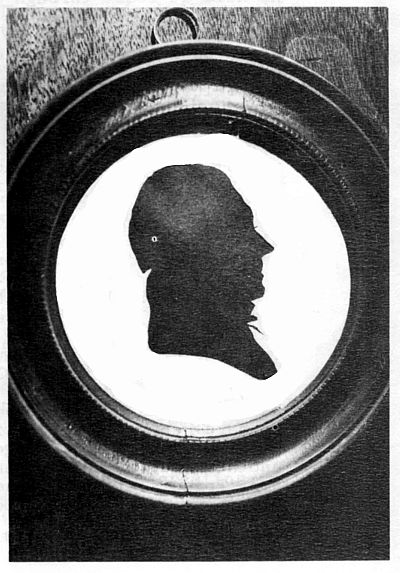
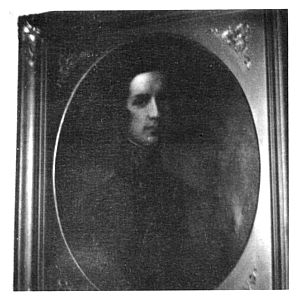
A physiognotrace of "William Maffett, chaplain."
Courtesy of
Alexandria-Washington Lodge No. 22, A. F. & A. M., Alexandria, Virginia.
George Washington, a member of Lodge 22, had died on
December 14, 1799, and the call was to a memorial service.
Maffitt did not, as legend claims, preach the
funeral sermon, although he did march with the clergy
in the lodge's funeral procession from Alexandria to
Mount Vernon to attend the ceremony.[31]
Earlier in 1799, the minutes of the General Assembly
of the Presbyterian Church show that Rev. William
Maffitt was assigned to Bladensburg.[32] There is no
record of his actual presence there and he was not re-assigned.[33]
For the rest of his life, his listings in
the minutes show him "without charge." Although Maffitt
was a licensed minister, there is some doubt that he
was ever ordained.[34]
On January 14, 1800, the subscribers to the establishment
of a Washington Society met at Gadsby's Tavern
and William Maffitt was named to the committee to form
the constitution and by-laws.[35] On January 28, Maffitt
was appointed chaplain of the society,[36] a post which
he held at least through 1803. On February 23, 1800,
the society was called to meet at Gadsby's at 10 a.m.
"to move in procession to the Presbyterian Meeting House
where an oration will be delivered by the Rev. Mr.
Maffitt, commemorative of the distinguished merits of
the Illustrious Washington."[37] Again, on February 22,
1803, the Washington Society called on Maffitt to deliver
a memorial sermon on the first president "at the Presbyterian
Church at 12 o'clock. There will be instrumental
and vocal music and the day will be announced by
a discharge of 16 rounds from the Market Square."[38]
On February 18, 1801, the Rev. Mr. Maffitt was
elected a director of the Alexandria Library Co., and
was re-elected to this post in 1802, 1803, and 1804.[39]
On May 5, 1803, the Rev. Dr. Muir, pastor of the
Presbyterian Meeting House, married the Rev. William
Maffitt to Mrs. Harriotte Turberville.[40] Harriotte
(or Henrietta) was the daughter of Richard Henry Lee,
a brother of Philip Ludwell Lee, and his second wife,
Anne Gaskins Pinckard, widow of Thomas Pinckard.
Harriotte was born December 10, 1773 at Chantilly, the
Richard Henry Lee estate in Westmoreland County.[41] Her
siblings included a younger sister Sarah who married
another cousin, Edmund Jennings Lee, and the youngest
son, Francis Lightfoot Lee.[42] Her first marriage in
December, 1794, was to Richard Lee Turberville, a cousin
and neighbor, who died in 1799,[43] leaving his widow
with their three children: Cornelia, Richard, and
George. Richard and Harriotte Turberville had settled
at Chantilly in Fairfax County and Richard apparently
died there.[44]
When Harriotte and William Maffitt were married,
he was still principal of the Alexandria Academy,
living in Alexandria, and active in community affairs.
But between June 8, 1804, the date of Maffitt's resignation
from the Academy, and early 1805, he moved to
Chantilly with his wife, their first child, and the
three children of Harriotte's first marriage. It is
probable that the move took place in 1804, soon after
his resignation.
Legal guardian of the three Turberville children
was Thomas Lee, Harriotte's oldest brother.[45] After
his death in 1805, William Maffitt was named guardian.[46]
In this capacity he had to keep accurate accounts of
his expenditures on behalf of the children and of income
received on their property, all of which were
matters of court record. These records indicate that
Maffitt was living at Chantilly at that time.
William and Harriotte had two daughters, both
christened in the Presbyterian Meeting House: Ann Lee,
born March 23, 1804, and christened on April 20, and
Harriotte, born March 16, 1805, and christened on
April 17, 1805.[47] Harriotte died right after the birth
of the second daughter, probably on April 11 or 12,
1805, because on April 12, Maffitt began paying rent
to the three Turberville heirs for the use of their
property. This was recorded for the first time in his
accounts for 1805.[48]
That he had a school on the Chantilly estate seems
highly probable, because starting in 1805, he charged
the two Turberville boys for board and tuition, but
not for transportation.[49] In 1805, Maffitt was listed
for the first time on the Fairfax County personal property
tax rolls.[50] In 1810, the county census listed
him as having under his roof two males under 10, five
males between 10 and 16, one male between 26 and 45,
five females under 10, and one female between 26 and
45.[51]
The guardian accounts give some interesting insights
into day-by-day activities. Buying new shoes and mending
old ones for the two boys were constant expenses. Regular
sums of money were sent to Mrs. Lee, Harriotte's
sister Sally, to pay for Cornelia Turberville's board,
education, and small purchases. Books and supplies
were bought for the boys. A large portion of the estate
was rented out, and so were some of the slaves.
The chimney and cellar were repaired; a new barn was
built.[52]
The accounts also show that Cornelia Turberville
was married to Charles C. Stuart in 1817, rather than
1814, as some sources report. Up to the time of the
marriage, Maffitt referred to Cornelia as "C. Turberville";
afterwards he formally termed her "Mistress
Stuart." He also listed money given George Turberville
to buy articles to attend his sister's wedding.[53]
Historians credit Cornelia and her husband with building
a house named "Chantilly" in honor of the estate
of her grandfather, Richard Henry Lee, in Westmoreland
County.[54] Yet the Maffitt accounts specifically refer
to "my rent of Chantilly" in 1814,[55] three years before
the Turberville-Stuart marriage. Moreover, a public
sale was held "at Chantilly" in 1817,[56] with cash
paid to C. C. Stuart from its proceeds.[57]
Curiously, the accounts show that Maffitt continued
to pay rent to the Turberville heirs through 1814,
the year when, for the first time, we definitely know
he was living at Salona. Does this mean that Maffitt
himself built Salona between 1812, when he purchased
the property, and 1814, or that the house already
existed and was rented to a tenant through the first
part of 1814? That Maffitt was there in August 1814 is
proven by the documented fact that President Madison
stayed at Salona overnight with Mr. Maffitt.
Robert Gamble, in his volume on Sully, quotes a
letter which states that Richard Bland Lee, Jr.,
was under the tutelage of the Reverend Mr. Maffitt
at some time preceding 1805.
[58] This again would suggest
that Maffitt had a school at Chantilly, close to
Richard Bland Lee's home at Sully. Another biographer
mentions that
Edmund Jennings (Lee) was born at
Alexandria, then in the District of
Columbia, on the 3rd of May, 1797....
Mr. Lee received his earliest educational
training at the school of the
Rev. Mr. Maffitt in Fairfax, a school
of high repute at that day.
[59]
Unfortunately no dates or locations are given by the
letter-writer or the biographer.
In his history of the Old Presbyterian Meeting
House, William B. McGroarty described Maffitt in a
footnote as "a Presbyterian minister who conducted
a school for boys in Fairfax County near Alexandria."
[60]
Neither Chantilly nor Salona was very close to Alexandria.
A letter from A. C. Stuart to Elizabeth Collins
Lee in 1805 states that:
Mr. Maffitt intended to leave the place
where he now resides and purchase a small
farm, that he, Frank (Francis Lightfoot
Lee, Harriotte's youngest brother) intended
to do the same, that they were
to spend their time in the pursuit of
agriculture, botany, and philosophy.
[61]
Was this wish expressed because Chantilly was not
Maffitt's property but that of his stepchildren, because
Maffitt was lonely without Harriotte, or because
he wanted to give up teaching for farming? Somehow,
from the guardianship accounts, it seems likely that
Maffitt did not farm the Turberville acres, but rented
out whatever he could, while he busied himself otherwise.
Usually the Alexandria Gazette carried announcements
of the openings of new schools, but no announcement
of Maffitt's school ever seems to have appeared.
Because Maffitt performed the marriage of Gazette publisher
Samuel Snowden to Mary Longden on January 8,
1802,[62] such an announcement might have been expected.
Neither did the Gazette report Maffitt's departure
from the Alexandria area.
Probably Maffitt was still living at Chantilly
when he married for the second time between 1807 and
1811 before William Maffitt, Jr., was born. His
second wife was Ann Beale Carter Carter (1767-1852),[63]
widow of Charles B. Carter. Ann, also known as Nancy,
was the daughter of Robert Wormely Carter of Sabine
Hall in Richmond County, and Winifred Beale.[64] William,
Jr., the only child of this marriage, was born in
November, 1811, and christened in the Presbyterian
Meeting House in February 1812.
[65]
In August 1812, Maffitt was appointed a trustee
of an academy to be established in Haymarket. Among
those serving with him were Ludwell Lee of Belmont,
Francis Lightfoot Lee, then living at Sully, and William
Fitzhugh of Ravensworth.[66]
Meanwhile, in 1809, James Madison, Secretary of
State under Thomas Jefferson, had been elected President.
On June 18, 1812, Madison signed a declaration
of war against England. The causes of the war, sometimes
called the Second War of Independence, were basically
several aspects of nationalism. Some resentment
against the British still smouldered, fanned by British
contempt and condescension toward her former colonists.
Because many English sailors deserted their ships to
sail under American colors, British ships intercepted
American vessels and "impressed" their seamen. Furthermore,
many American politicians wanted to annex Canada.
Neither the war nor the President was popular with
the people, who thought the President weak and called
the conflict "Mr. Madison's War." Attempted American
invasion of Canada was a fiasco and by August 23, 1814,
the British forces were so close to Washington that
the clear and present danger of an actual invasion of
the American capital seemed imminent.
John Graham, Chief Clerk in the Department of
State, and two other clerks, Stephen Pleasanton and
Josiah King, packed the valuable public records of the
State Department in coarse linen bags which Pleasanton
had purchased earlier. These included the original
Declaration of Independence, articles of confederation,
federal constitution, treaties and laws and many other
papers. Stephen Pleasanton found conveyances, loaded
the bags into them and took them to a mill 3 miles
beyond Georgetown, where they were concealed. Pleasanton
spent the night of August 23, 1814, at Salona with
the Rev. Mr. Maffitt. The next day, fearing that the
mill might be too accessible to the British, who were
fast approaching Washington, Pleasanton took the state
papers to Leesburg for safety.
[67]
Dolley Madison, the President's popular wife,
could hear in the President's House the sounds of cannon
"from a skirmish at Bladensburg." The President had
gone to meet Gen. William H. Winder, commander of
the military district, and had left his wife instructions
to "take care of my self, and of the cabinet
paper, public and private."
[68]
Writing to her sister, Lucy Todd, Dolley cooly
reported that her husband
desires that I should be ready at a moment's
warning to enter my carriage and
leave the city.... I am accordingly ready;
I have pressed as many cabinet papers
into trunks to fill one carriage; our
private property must be sacrificed, as
it is impossible to procure wagons for
its transportation.
[69]
She continued the letter on Wednesday, August 24:
Two messengers, covered with dust, come
to bid me fly.... At this late hour, a
wagon has been procured; I have had it
filled with the plate and most valuable
articles belonging to the house....
Our kind friend, Mr. Carroll, has come
to hasten my departure, and is in a
very mad humor because I insist on waiting
until the large picture of Gen.
Washington is secured, and it requires
to be unscrewed from the wall. The
process was found too tedious for these
perilous moments; I have ordered the
frame to be broken, and the canvas taken
out; it is done—and the precious portrait
placed in the hands of two gentlemen
of New York, for safekeeping....
When I shall again write to you, or
where I shall be tomorrow, I cannot
tell!!
[70]
Apparently Dolley spent the night of August 24
in a tent in the American encampment at Tennallytown,
and the next day crossed over into Virginia where she
spent the night of August 25 with Matilda Lee Love at
Rokeby. The roads were crowded with refugees and the
exodus was slow. As the Loves had often been guests at
the President's House, Dolley did not have to spend
night with strangers. In her reminiscences, Matilda
Love wrote:
In the following spring of 1814, it (the
war) came more home to us, as the British
got into our southern waters, and in
August came up to Washington and burnt
all the public buildings.... As I lived
about ten miles from Washington, Mrs.
Madison and a number of city people took
refuge at my home the night the British
took Washington....
They watched the flames of the burning capital from
Rokeby that night.[71]
Irving Brant, definitive biographer of Madison,
writes of the departure of the Madisons from the capital:
The travels of President and Mrs. Madison
after the battle have long been involved
in obscurity and contradiction owing to
the meagerness of early records (Dolley's
letters about it were eaten by mice), uncertain
memories and the derogatory stories
circulated by political detractors. The
facts bear little resemblance to the popular
stories in which the Jones and Carroll
families are nonexistent, Dolley wanders
forlornly from house to house, while
Madison, split in person rather than personality,
simultaneously hides in a miserable
hovel in the Virginia woods and flees
in terror into the distant hills of Maryland.
Actually, a clear record was left by participants
and observers. The original
plan was for Madison to join Secretary
Jones and their families at Bellevue and
proceed by way of the Little Falls bridge
to Wiley's Tavern on Difficult Run near
the Great Falls. From there the President
and cabinet members would cross the Potomac
and join the army. Time growing short,
Madison changed the rendezvous to Foxall's
Foundry. With that route from the White
House clogged by the militia's flight, he
sent Tench Ringgold to the foundry with
word that he was crossing at Mason's Ferry
and would meet his wife and party at Salona,
the home of the Reverend John [sic] Maffitt,
three miles above the Little Falls bridge....
[72]
Madison, Rush and Mason rode to Wren's
Tavern at Falls Church. Monroe and Ringgold
took the Leesburg road, stopped
briefly at Rokeby, the home of Richard
Henry Love, two miles above Little Falls,
and went on to Wiley's Tavern. From Wren's
Tavern the President went to the Minor
home and from there to Salona, where he
spent the night with the Maffitts.
But Mrs. Madison failed to come. She
and her party had stopped only a mile
away at Rokeby, with her young friend
Matilda Lee Love, an occasional overnight
guest at the White House....
The next morning, Madison went back
to Wren's Tavern—looking for his wife,
he told Colonel George Graham, who
gave him a guard of two dragoons.
Returning to Salona, the President
learned that Mrs. Madison and the
Jones and Carroll families had gone
by on their way to Wiley's Tavern.
He and Rush followed along the Old
Dominion Road (Mason being detained
for a time) and took refuge from the
hurricane in a house at "The Crossroads"
five miles from the Little Falls bridge.
[73]
At midnight, the President went to the new Conn's
Ferry above Great Falls, and at daybreak he crossed the
river into Montgomery County, Maryland. Mrs. Madison
stayed at Wiley's Tavern until the President sent her
word that Washington was clear of the enemy.[74]
A more romantic but apocryphal story of the Madison's
flight from Washington was written in 1914 by a columnist
known as "The Rambler" for the Washington Star.[75] In this
version, Dolley crossed the Potomac on "the Causeway
Ferry," then passed Nelson's mill, went on to Falls
Church, and finally drove up "to Salona Hall, the home
of Parson Maffitt, and was welcomed by Mrs. Maffitt."
He further recounts that Mrs. Madison was refused shelter
at two country places before she reached Salona, though
this did not seem reasonable.
[76]
The oft-told story of Dolley Madison's having been
refused sanctuary on her way to Salona by several households
is not borne out by all published accounts. Apparently,
the account which does have most corroboration
is that regarding the day following the night she and
her party stayed at Rokeby.
Mrs. Madison went on the next morning, August 25,
to meet her husband at a tavern near Great Falls, probably
Wiley's on Difficult Run. This had been prearranged,
and on arrival she went upstairs to wait for Mr. Madison.
Shortly, the lady of the establishment called out to her
in rage, saying, "Miss Madison! If that's you, come down
and go out! Your husband has got mine out fighting,
and d—— you, you shan't stay in my house; so get out!"
Other refugees joined in the outburst, even those who
had once been guests of the Madisons at the President's
mansion, and agreed she should be expelled from all
doors. Nearby, there was another tavern, and Mrs. Madison
and her party gained admittance there to wait for her
husband's arrival later that evening.
[77]
After the excitement of Madison's visit was over,
Salona must have reverted to its normal calm. At last
Maffitt had realized his dream of farming; the personal
property tax records and inventory of his estate clearly
define Salona as a working farm.
But his fortunes declined, if we can judge by his
personal property tax assessments. Maffitt was assessed
for 18 horses and mules and 21 black slaves in 1812; in
1814, when a very detailed account was rendered by the
county, Maffitt was shown to have 19 slaves, 12 horses
and mules and a coache (4-wheeled carriage) valued at
$450. In all of Fairfax County that year, only Thomas
Fairfax, William Robinson and Bushrod Washington had
coaches of higher value than his and their vehicles were
evaluated at $500 each.
By the year of his death, 1828, only 13 slaves and
3 horses were listed, and the total evaluation of his
personal property was listed at $150. The inventory of
William Maffitt's estate did show that he had 116 head
of livestock on the place including horses, oxen, sheep,
hogs and cattle. He was growing turnips, corn, rye, oats,
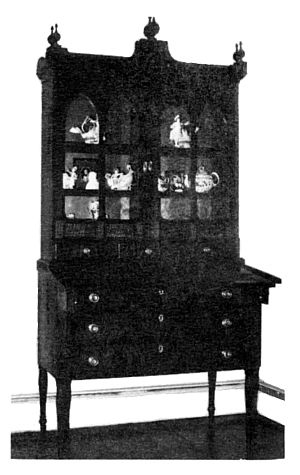
hay and orchard grass. The long list of household furnishings
included three desks and two bookcases of high
evaluation, indicating there were books in them. (See
appendix for full inventory.) The fortunes of his widow,
Ann Carter Maffitt, declined further, until by 1835,
she was dropped off the county's personal property tax
rolls.
[78]
For many years, William Maffitt had continued to
serve as guardian to his first wife's Turberville children.
Although Cornelia Turberville continued to live
with her aunt in Alexandria until her marriage in 1817,
her two brothers seem to have lived at Salona. In June
1815, Richard Turberville drowned in the Potomac while
visiting his cousin Matilda Lee Love at nearby Rokeby.[79]
Maffitt's accounts for June 23, 1815, report the expenditure
of $37.50 for Richard's coffin. He may have
been buried in the graveyard on the Salona property.
[80]
The other brother, George Turberville, at some
time in childhood became a deaf mute as the result of
typhoid fever. Maffitt's accounts do not reveal the
date of the onset of this affliction, but they do show
that in April 1818 George entered "The Asylum" in
Hartford, Connecticut. At that time, Maffitt advanced
George $100 for board and tuition and $100 for travel.[81]
George still returned to Salona for vacations, because
in July 1819, Harriotte Maffitt wrote to him:
It is now my time to write to you my Dear
Brother. We are glad the time is so near
when we expect you. When you come home
we will go to George Town to meet you.
Dr. Muir has been here and he preached
here. Aunt Whann and Aunt Sally Maffitt
have been here. Uncle Whann has gone to
travel. I hope you will be well acquainted
with the History of the Bible and particularly
the life and miracles of our Blessed
Saviour. We have not heard from Chantilly
for some time, I hope we will go up soon.
Cousin Sally Lee is there. We expect
Aunt Edmund Lee will come here very soon.
Sister Cornelia expects Mrs. Mary Tollaver,
your Cousin up to see her this summer.
Do you know Mr. Harrison of Alexandria?
He is coming here to preach for us in
August. Do you love me? I pray to God
to bless and preserve you. Old Mrs. Randle
is very well we went to see her yesterday.
When you come home you must go to see her
with us. I saw Miss Betty Jones last Sabbathe.
She asked me when I had heard from
you answer my letter very soon if you
please. Tell me how the deaf and dumb
are and if they improve. You must love
and obey your teachers. Papa Mama and all
the girls send their affectionate love to
you.
I am your affectionate sister.
Harriotte Maffitt.
[82]
P.S.
All the Boys send their
respects to you.
Another letter, this one from William C. Woodbridge
to the Reverend William Maffitt from "Asylum,"
was dated February 21, 1820, and referred to a fight
between George Turberville and another student.
Woodbridge wrote:
It seems he was ridiculed & resented
it & was then challenged. He says he
was wounded in the knee & his antagonist
the same. We learned it from his boasting
of it to our pupils. He now expresses
entire disapprobation. He made the question
to you by my request.
Woodbridge refers to George's independence and pride
which must be checked. Obviously, this letter was one
of many exchanged between Woodbridge and Maffitt regarding
George's progress
[83] and is evidence that George
wrote home to his stepfather as well as to his sisters.
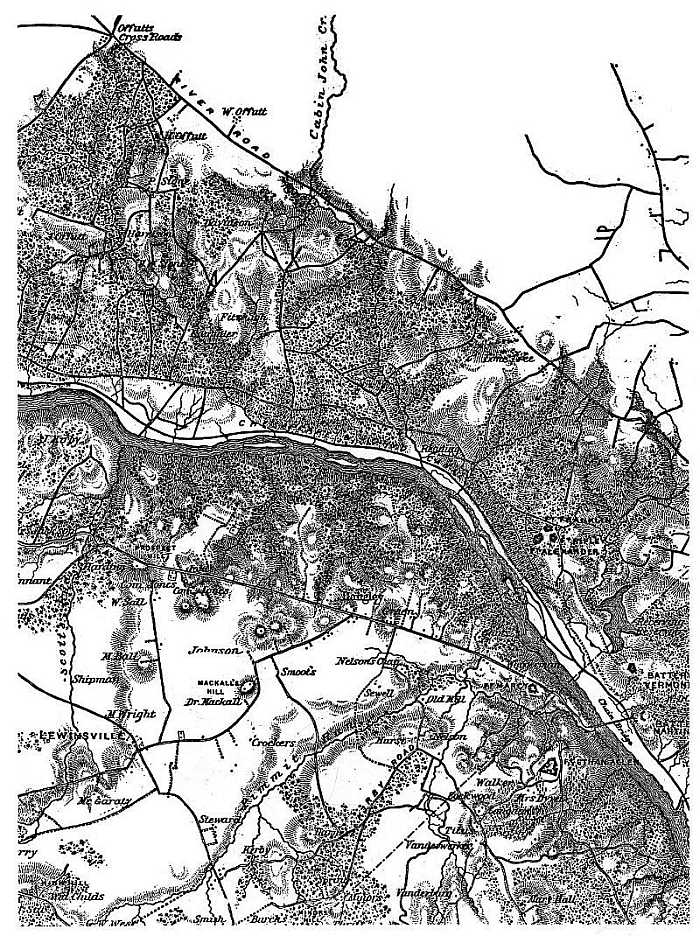
Although William Maffitt died before the Lewinsville
Presbyterian Church was founded, church historians
claim him as a founding father, saying that he was appointed
by the Washington Presbytery to preach and set
up a mission near Langley.
[84] Harriotte's letter may
lend credence to this, although there is no report of
such an assignment in the Minutes which list Maffitt
only as "without charge" after 1800.
[85]
One reason for this belief may have arisen because
of a bequest in the will of Elizabeth Lee Jones, the
"Miss Betty Jones" of Harriotte's letter. Daughter of
Lettice Corbin Turberville and Catesby Jones of Westmoreland
County, Miss Betty lived at "Sharon" on part
of the George Turberville grant. Her will, dated
April 16, 1822, left four acres of her property "as a
site for a church and churchyard ... dedicated to the
uses and purposes of divine worship in such manner
and subject to such rules as shall ... be prescribed
by the Rev'd William Maffitt" and eight other ministers:
—Carnahan, Wells Andrews, William Hill, John Mathews,
J. B. Hoge, William C. Walton, M. Baker, and Samuel
D. Hoge, all representatives of the Presbyterian Church.
William Maffitt was a witness to this will. Apparently,
this was Maffitt's primary connection with the establishment
of the Presbyterian Church at Lewinsville.
[86]