——“Equidem credo quia sit divinitus illis Ingenium.”
FIRST AMERICAN FROM THE SECOND LONDON EDITION.
PHILADELPHIA:
CAREY AND LEA—CHESNUT STREET.
........
1832.
iiE. MERRIAM AND CO. PRINTERS,
Brookfield, Mass.
iiiTO
WILLIAM BABINGTON,
M.D. F.R.S.
THESE CONVERSATIONS ARE DEDICATED,
IN REMEMBRANCE
OF SOME DELIGHTFUL DAYS PASSED IN HIS
SOCIETY,
AND IN GRATITUDE
FOR AN UNINTERRUPTED FRIENDSHIP OF
A
QUARTER OF A CENTURY.
PREFACE.
iv
These pages formed the occupation of the
Author during some months of severe and
dangerous illness, when he was wholly incapable
of attending to more useful studies,
or of following more serious pursuits. They
constituted his amusement in many hours,
which otherwise would have been unoccupied
and tedious; and they are published in
the hope, that they may possess an interest
for those persons, who derive pleasure from
the simplest and most attainable kind of
rural sports, and who practice the art, or
patronize the objects of contemplation, of
the Philosophical Angler.
viThe conversational manner and discursive
style were chosen as best suited to the state
of health of the Author, who was incapable
of considerable efforts and long-continued attention;
and he could not but have in mind
a model, which has fully proved the utility
and popularity of this method of treating
the subject—The Complete Angler, by Walton
and Cotton.
The characters, chosen to support these
Conversations, are—Halieus, who is supposed
to be an accomplished fly fisher;
Ornither, who is to be regarded as a gentleman
generally fond of the sports of the
field, though not a finished master of the
art of angling; Poietes, who is to be considered
as an enthusiastic lover of nature,
and partially acquainted with the mysteries
of fly fishing; and Physicus, who is described
uninitiated as an angler, but as a
viiperson fond of inquiries in natural history
and philosophy.
These personages are of course imaginary,
though the sentiments attributed to them, the
Author may sometimes have gained from recollections
of real conversations with friends,
from whose society much of the happiness of
his early life has been derived; and in the
portrait of the character of Halieus, given
in the last dialogue, a likeness, he thinks,
will not fail to be recognized to that of the
character of a most estimable Physician, ardently
beloved by his friends, and esteemed
and venerated by the public.
He has limited his description of fish to
the varieties of the Salmo most usual in the
fresh waters of Europe, and which may
be defined as a genus having eight fins,
the one above the tail fleshy, and without
spines.
viiiIt is to be hoped M. Cuvier’s new work
on fishes will supply accurate information
on this genus, which is still very imperfectly
known.
Laybach, Illyria,
Sep. 30, 1828.
CONTENTS.
ix
FIRST DAY.
Vindication of fly-fishing—Poem in praise of Walton—Distinguished
anglers—Fishing, a natural, philosophical, and
scientific pursuit—Scenery—Fish possessed of little sensibility—Praise
of fly-fishing—Field-sports related to natural
history—Proposed fishing excursion—Comparison of
a river to human life
Trout fishing—Flies—May-fly and gray drake—Alder fly—Object
of fishing—Escape of a fish after being hooked—Sense
of smelling in fish—Baits—The natural fly—Pricked
trout—Local habits of animals—Trout of the Colne—Throwing
the fly—Trout described—Spots on trout—Perch—Anecdote—Haunts
of trout—Evening fishing—Management of
a fish when hooked—Flies of different seasons—Fishing season—Difference
of the gillaroo from trout—Diminution of
flies in some rivers—Gillaroo trout found only in Ireland—Par
or samlet—Other varieties of trout—Dr. Darwin—Experiment
xon trout by Mr. Tonkin of Polgaron—Cause of the
varieties of trout—Mule fish—Crossing the breed—Impregnation
of the ova of fish—Experiment of Mr. Jacobi on this
point—Causes that hasten or retard the maturity of the ova—Why
fish approach shallows to spawn—Admiration of the
designs of Providence
Scenery—Loch Maree—Eagles—The inn—The river Ewe—Sea
trout—Poaching highlander—Salmon—Cause of fish being
drowned—Salmon—Death by suffocation—Nature of
pain—Instances of death without pain—Sea trout—Crimping—The
dinner—The double snipe—Value of temperance
in eating and drinking—Wading in boots a bad practice—Salmon
and trout compared—Varieties of salmon
Salmon fishing—Produce of a morning’s sport—Rivers of
Norway and Sweden—English rivers—Salmon rivers—Scotch
rivers—Irish rivers—The Sabbath day—Instincts—Instincts
to animals what revelation is to man
Grayling—Anatomy of the grayling—Grayling fishing—Scenery—Habits
of the grayling—Grayling rivers—Baits
for grayling—Generation of eels—Migration of eels—The
conger eel
Scenery—Natural history—Origin of the common house fly—Bees
and ants—The libellula—Ephemeræ—Michaelmas
daisy—Humble bee—Thoughts on death, suggested by this
insect
Fishing for hucho—Hereditary instinct—Causes of variety in
trout—Salmo hucho—Taking a salmo hucho—Resemblance
of the hucho to trout—Interior of the hucho examined—Habits
of the hucho—Pleasure of angling—Cockney fishermen—Lame
boy and his boats—Amusements—Sea serpent—Kraken—Mermaid—Austrian
method of conveying
fish—Education—The press—Effect of continuous fishing—Difference
xiiof rivers—Angling for frogs—Water ouzel—Umbla—Laveret—Organization
of the hucho—Craniology—Fat
and flesh of the hucho—Naturalization of fish—The
Traun—Colour of water—Colour of the ocean—Waterfalls—Reflections—The
late Mr. B. West
FIRST DAY. HALIEUS—POIETES—PHYSICUS—ORNITHER. INTRODUCTORY CONVERSATION—SYMPOSIAC. — Scene, London.
Phys.—Halieus, I dare say you know where
this excellent trout was caught: I never ate a
better fish of the kind.
Hal.—I ought to know, as it was this morning
in the waters of the Wandle, not ten miles
from the place where we sit, and it is through
my means that you see it at table.
Phys.—Of your own catching?
Hal.—Yes, with the artificial fly.
14Phys.—I admire the fish, but I cannot
admire the art by which it was taken; and I
wonder how a man of your active mind and
enthusiastic character can enjoy what appears
to me a stupid and melancholy occupation.
Hal.—I might as well wonder in my turn,
that a man of your discursive imagination and
disposition to contemplation should not admire
this occupation, and that you should venture to
call it either stupid or melancholy.
Phys.—I have at least the authority of a
great moralist, Johnson, for its folly.
Hal.—I will allow no man, however great
a philosopher, or moralist, to abuse an occupation
he has not tried; and as well as I remember,
this same illustrious person praised
the book and the character of the great Patriarch
of Anglers, Isaac Walton.
Phys.—There is another celebrated man,
however, who has abused this your patriarch,
Lord Byron, and that in terms not very qualified.
He calls him, as well as I can recollect,
“A quaint old cruel coxcomb.”[1] I must say,
15a practice of this great fisherman, where he
recommends you to pass the hook through the
body of a frog with care, as though you loved
him, in order to keep him alive longer, cannot
but be considered as cruel.
Hal.—I do not justify either the expression
or the practice of Walton in this instance; but
remember, I fish only with inanimate baits, or
imitations of them, and I will not exhume or
expose the ashes of the dead, nor vindicate the
memory of Walton, at the expense of Byron,
who, like Johnson, was no fisherman: but the
moral and religious habits of Walton, his simplicity
of manners, and his well-spent life, exonerate
him from the charge of cruelty; and
the book of a coxcomb would not have been
so great a favourite with most persons of refined
taste. A noble lady, long distinguished
at court for pre-eminent beauty and grace, and
whose mind possesses undying charms, has
written some lines in my copy of Walton,
which, if you will allow me, I will repeat to
you.
Albeit, gentle Angler, I
Delight not in thy trade,
Yet in thy pages there doth lie
So much of quaint simplicity,
16So much of mind,
Of such good kind,
That none need be afraid,
Caught by thy cunning bait, this book,
To be ensnared on thy hook.
Gladly from thee, I’m lured to bear
With things that seem’d most vile before,
For thou didst on poor subjects rear
Matter the wisest sage might hear.
And with a grace,
That doth efface
More labour’d works, thy simple lore
Can teach us that thy skilful lines,
More than the scaly brood confines.
Our hearts and senses, too, we see,
Rise quickly at thy master hand,
And, ready to be caught by thee,
Are lured to virtue willingly.
Content and peace,
With health and ease,
Walk by thy side. At thy command
We bid adieu to worldly care,
And joy in gifts that all may share.
Gladly, with thee, I pace along,
And of sweet fancies dream;
Waiting till some inspired song,
Within my memory cherish’d long,
Comes fairer forth,
With more of worth;
Because that time upon its stream
Feathers and chaff will bear away,
But give to gems a brighter ray.
C. C. 1812.
17And though the charming and intellectual author
of this poem is not an angler herself, yet I
can quote the example of her lovely daughters to
vindicate fly fishing from the charge of cruelty,
and to prove that the most delicate and refined
minds can take pleasure in this innocent amusement.
One of these young ladies, I am told,
is a most accomplished and skilful salmon
fisher. And if you require a poetical authority
against that of Lord Byron, I mention the
philosophical and powerful poet of the lakes, and
the author of
who is a lover both of fly fishing and fly fishermen.
Gay’s poem you know, and his passionate
fondness for the amusement, which was his
principal occupation in the summer at Amesbury;
and the late excellent John Tobin, author
of the Honey Moon, was an ardent angler.
Phys.—I am satisfied with your poetical
authorities.
Hal.—Nay, I can find authorities of all
18kinds, statesmen, heroes, and philosophers;
I can go back to Trajan, who was fond of
angling. Nelson was[3] a good fly fisher, and
as a proof of his passion for it, continued the
pursuit even with his left hand. Dr. Paley
was ardently attached to this amusement; so
much so, that when the Bishop of Durham inquired
of him, when one of his most important
works would be finished, he said, with great
simplicity and good humour, “My Lord, I shall
work steadily at it when the fly fishing season
is over,” as if this were a business of his life.
And I am rather reserved in introducing living
characters, or I could give a list of the highest
names of Britain, belonging to modern times, in
science, letters, arts, and arms, who are ornaments
of this fraternity, to use the expression
borrowed from the freemasonry of our forefathers.
Phys.—I do not find much difficulty in
understanding why warriors, and even statesmen,
fishers of men, many of whom I have
19known particularly fond of hunting and shooting,
should likewise be attached to angling;
but I own, I am at a loss to find reasons for a
love of this pursuit amongst philosophers and
poets.
Hal.—The search after food is an instinct
belonging to our nature; and from the savage
in his rudest and most primitive state, who
destroys a piece of game, or a fish, with a club
or spear, to man in the most cultivated state of
society, who employs artifice, machinery, and
the resources of various other animals, to
secure his object, the origin of the pleasure is
similar, and its object the same: but that kind
of it requiring most art may be said to characterize
man in his highest or intellectual
state; and the fisher for salmon and trout with
the fly employs not only machinery to assist
his physical powers, but applies sagacity to
conquer difficulties; and the pleasure derived
from ingenious resources and devices, as well
as from active pursuit, belongs to this amusement.
Then as to its philosophical tendency,
it is a pursuit of moral discipline, requiring
patience, forbearance, and command of temper.
As connected with natural science, it may be
vaunted as demanding a knowledge of the
20habits of a considerable tribe of created beings—fishes,
and the animals that they prey upon,
and an acquaintance with the signs and tokens
of the weather and its changes, the nature
of waters, and of the atmosphere. As to its
poetical relations, it carries us into the most
wild and beautiful scenery of nature; amongst
the mountain lakes, and the clear and lovely
streams that gush from the higher ranges of
elevated hills, or that make their way through
the cavities of calcareous strata. How delightful
in the early spring, after the dull and
tedious time of winter, when the frosts disappear
and the sunshine warms the earth and
waters, to wander forth by some clear stream,
to see the leaf bursting from the purple bud,
to scent the odours of the bank perfumed by
the violet, and enamelled, as it were, with the
primrose and the daisy; to wander upon the
fresh turf below the shade of trees, whose
bright blossoms are filled with the music of
the bee; and on the surface of the waters to
view the gaudy flies sparkling like animated
gems in the sunbeams, whilst the bright and
beautiful trout is watching them from below;
to hear the twittering of the water-birds, who,
alarmed at your approach, rapidly hide themselves
21beneath the flowers and leaves of the
water-lily; and as the season advances, to find
all these objects changed for others of the
same kind, but better and brighter, till the
swallow and the trout contend as it were for
the gaudy May fly, and till in pursuing your
amusement in the calm and balmy evening, you
are serenaded by the songs of the cheerful thrush
and melodious nightingale, performing the offices
of paternal love, in thickets ornamented with the
rose and woodbine.
Phys.—All these enjoyments might be obtained
without the necessity of torturing and
destroying an unfortunate animal, that the true
lover of nature would wish to see happy in a
scene of loveliness.
Hal.—If all men were Pythagoreans and
professed the Brahmin’s creed, it would undoubtedly
be cruel to destroy any form of
animated life; but if fish are to be eaten, I
see no more harm in capturing them by skill
and ingenuity with an artificial fly, than in
pulling them out of the water by main force
with the net; and in general, when taken by
the common fishermen, fish are permitted to
die slowly, and to suffer in the air, from the
want of their natural element; whereas, every
22good angler, as soon as his fish is landed,
either destroys his life immediately, if he
is wanted for food, or returns him into the
water.
Phys.—But do you think nothing of the
torture of the hook, and the fear of capture,
and the misery of struggling against the powerful
rod?
Hal.—I have already admitted the danger
of analysing, too closely, the moral character
of any of our field sports; yet I think it cannot
be doubted that the nervous system of
fish, and cold-blooded animals in general, is
less sensitive than that of warm-blooded animals.
The hook usually is fixed in the cartilaginous
part of the mouth, where there are
no nerves; and a proof that the sufferings of
a hooked fish cannot be great is found in the
circumstance, that though a trout has been
hooked and played for some minutes, he will
often, after his escape with the artificial fly in
his mouth, take the natural fly, and feed as
if nothing had happened; having apparently
learnt only from the experiment, that the artificial
fly is not proper food. And I have
caught pikes with four or five hooks in their
mouths, and tackle which they had broken
23only a few minutes before; and the hooks
seemed to have had no other effect than that
of serving as a sort of sauce piquante, urging
them to seize another morsel of the same kind.
Phys.—Fishes are mute, and cannot plead,
even in the way that birds and quadrupeds do,
their own cause; yet the instances you quote
only prove the intense character of their appetites,
which seem not so moderate as Whiston
imagined, in his strange philosophical romance
on the Deluge; in which he supposes, that
in the antediluvian world the heat was much
greater than in this, and that all terrestrial
and aerial animals had their passions so exalted
by this high temperature, that they were
lost in sin, and destroyed for their crimes;
but that fish, living in a cooler element, were
more correct in their lives, and were therefore
spared from the destruction of the primitive
world. You have proved, by your examples,
the intensity of the appetite of hunger in fishes;
Spalanzani has given us another proof of the
violence of a different appetite, or instinct, in
a cold-blooded animal, that has most of the
habits of the genus—the frog; which, in the
breeding season, remains attached to the female,
24though a limb, or even his head, is removed from
the body.
Hal.—This is likewise in favour of my argument,
that the sensibility of this class of animals
to physical pain is comparatively small.
Phys.—The advocates for a favourite pursuit
never want sophisms to defend it. I have
even heard it asserted, that a hare enjoys
being hunted. Yet I will allow that fly-fishing,
after your vindication, appears amongst
the least cruel of field-sports;—I can go no
farther; as I have never thought of trying
it, I can say nothing of its agreeableness as
an amusement, compared with hunting and
shooting.
Hal.—I wish that you would allow me to
convince you, that for a contemplative man,
as you are, and a lover of nature, it is far
superior, more tranquil, more philosophical,
and, after the period of early youth, more
fitted for a moderately active body and mind,
requiring less violent exertion; and, pursued
with discretion, affording an exercise conducive
to health. There is a river, only a
few miles off, where I am sure I could obtain
permission for you, and our friend Poietes, to
fish.
25Phys.—I am open to conviction on all subjects,
and have no objection to spend one May-day
with you in this idle occupation; premising,
that you take at least one other companion, who
really loves fishing.
Hal.—You, who are so fond of natural history,
even should you not be amused by fishing,
will, I am sure, find objects of interest on the
banks of the river.
Phys.—I fear I am not entomologist enough
to follow the life of the May-fly, but I shall
willingly have my attention directed to its
habits. Indeed, I have often regretted that
sportsmen were not fonder of zoology; they
have so many opportunities, which other persons
do not possess, of illustrating the origin
and qualities of some of the most curious forms
of animated nature; the causes and character
of the migrations of animals; their relations to
each other, and their place and order in the
general scheme of the universe. It has always
appeared to me, that the two great sources of
change of place of animals, was the providing
of food for themselves, and resting-places and
food for their young. The great supposed
migrations of herrings from the poles to the
temperate zone have appeared to me to be
26only the approach of successive shoals from
deep to shallow water, for the purpose of
spawning. The migrations of salmon and
trout are evidently for the purpose of depositing
their ova, or of finding food after they
have spawned. Swallows, and bee-eaters, decidedly
pursue flies over half the globe; the
scolopax or snipe tribe, in like manner, search
for worms and larvæ,—flying from those countries
where either frost or dryness prevents
them from boring,—making generally small
flights at a time, and resting on their travels
where they find food. And a journey from
England to Africa is no more for an animal
that can fly, with the wind, one hundred miles
in an hour, than a journey for a Londoner to
his seat in a distant province. And the migrations
of smaller fishes or birds always occasion
the migration of larger ones, that prey
on them. Thus, the seal follows the salmon,
in summer, to the mouths of rivers; the hake
follows the herring and pilchard; hawks are
seen in great quantities, in the month of May,
coming into the east of Europe, after quails
and land-rails; and locusts are followed by numerous
birds, that, fortunately for the agriculturist,
make them their prey.
27Hal.—It is not possible to follow the
amusement of angling, without having your
attention often directed to the modes of life
of fishes, insects, and birds, and many curious
and interesting facts, as it were, forced upon
your observation. I consider you (Physicus),
as pledged to make one of our fishing party;
and I hope, in a few days, to give you an invitation
to meet a few worthy friends on the
banks of the Colne. And you (Poietes), who,
I know, are an initiated disciple of Walton’s
school, will, I trust, join us. We will endeavour
to secure a fine day; two hours, in a
light carriage with good horses, will carry us
to our ground; and I think I can promise you
green meadows, shady trees, the song of the
nightingale, and a full and clear river.
Poiet.—This last is, in my opinion, the
most poetical object in nature. I will not fail
to obey your summons. Pliny has, as well as
I recollect, compared a river to human life.
I have never read the passage in his works,
but I have been a hundred times struck with
the analogy, particularly amidst mountain
scenery. The river, small and clear in its
origin, gushes forth from rocks, falls into deep
glens, and wantons and meanders through a
28wild and picturesque country, nourishing only
the uncultivated tree or flower by its dew or
spray. In this, its state of infancy and youth,
it may be compared to the human mind in
which fancy and strength of imagination are
predominant—it is more beautiful than useful.
When the different rills or torrents join, and
descend into the plain, it becomes slow and
stately in its motions; it is applied to move
machinery, to irrigate meadows, and to bear
upon its bosom the stately barge;—in this
mature state, it is deep, strong, and useful.
As it flows on towards the sea, it loses its force
and its motion, and at last, as it were, becomes
lost, and mingled with the mighty abyss of waters.
Hal.—One might pursue the metaphor still
further, and say, that in its origin—its thundering
and foam, when it carries down clay from
the bank, and becomes impure, it resembles
the youthful mind, affected by dangerous passions.
And the influence of a lake, in calming
and clearing the turbid water, may be compared
to the effect of reason in more mature
life, when the tranquil, deep, cool and unimpassioned
mind is freed from its fever, its
troubles, bubbles, noise and foam. And, above
29all, the sources of a river—which may be considered
as belonging to the atmosphere—and its
termination in the ocean, may be regarded as
imaging the divine origin of the human mind,
and its being ultimately returned to, and lost in,
the Infinite and Eternal Intelligence from which
it originally sprung.
Hal.—I am delighted to see you, my worthy
friends, on the banks of the Colne; and am
happy to be able to say, that my excellent host
has not only made you free of the river for
this day’s angling, but insists upon your dining
with him,—wishes you to try the evening fishing,
and the fishing to-morrow morning,—and
proposes to you, in short, to give up twenty-four
hours to the delights of an angler’s May-day.
Poiet.—We are deeply indebted to him;
and I hardly know how we can accept his
offer, without laying ourselves under too great
an obligation.
Hal.—Fear not: he is as noble minded a
man as ever delighted in good offices; and so
31benevolent, that I am sure he will be almost
as happy in knowing you are amused, as you
can be in your sport; and he hopes for an additional
satisfaction in the pleasure of your
conversation.
Poiet.—So let it be.
Hal.—I will take you to the house; you
shall make your bow, and then you will be all
free to follow your own fancies. Remember,
the dinner hour is five; the dressing bell rings
at half-past four; be punctual to this engagement,
from which you will be free at seven.
Poiet.—This is really a very charming villa
scene, I may almost say, a pastoral scene.
The meadows have the verdure which even
the Londoners enjoy as a peculiar feature of
the English landscape. The river is clear,
and has all the beauties of a trout stream, of
the larger size,—there rapid, and here still, and
there tumbling in foam and fury over abrupt
dams upon clean gravel, as if pursuing a natural
course. And that island with its poplars
and willows, and the flies making it their
summer paradise, and its little fishing-house,
are all in character; and if not extremely picturesque,
it is at least a very pleasant scene,
32from its verdure and pure waters, for the lovers
of our innocent amusement.
Hal.-It is ten o’clock: you may put up
your rods, or take rods from the hall, for so
hospitable is the master of this mansion, that
every thing is supplied to our hands. And
Physicus, as you are the only one of our party
ignorant of the art of fly fishing, I will fit you
with a rod and flies; and let me advise you to
begin with a line shorter than your rod, and
throw at first slowly and without effort, and
imitate us as well as you can. As for precepts,
they are of little value; practice and imitation
will make you an angler.
Poiet.—I shall put together my rod, and fish
with my own flies. It may be fancy, but I always
think I do best with tackle with which
I am used to fish.
Hal.—You are right; for fancy is always
something: and when we believe that we can
do things better in a particular way, we really
do, by the influence of imagination, perform
them both better and with less effort. I agree
with moralists, that the standard of virtue
should be placed higher than any one can reach;
for in trying to rise, man will attain a more
excellent state of being than if no effort were
33made. But to our business. As far as the
perfection of the material for the angler is concerned,
the flies you find on this table are as
good as can be made, and for this season of
the year, there is no great variety on this river.
We have had lately some warm days, and
though it is but the 18th of May, yet I know
the May-fly has been out for three or four
days, and this is the best period of this destructive
season for the fisherman. There are, I observe,
many male flies on the high trees, and
some females on the alders.
Phys.—But I see flies already on the water,
which seem of various colors,—brown and gray,
and some very pale,—and the trout appear to
rise at them eagerly.
Hal.—The fly you see is called by fishermen
the alder fly, and appears generally in
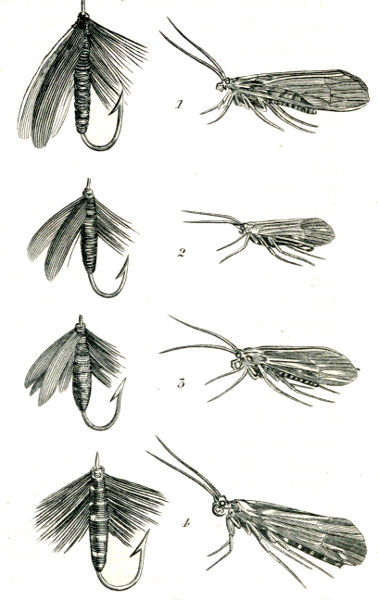
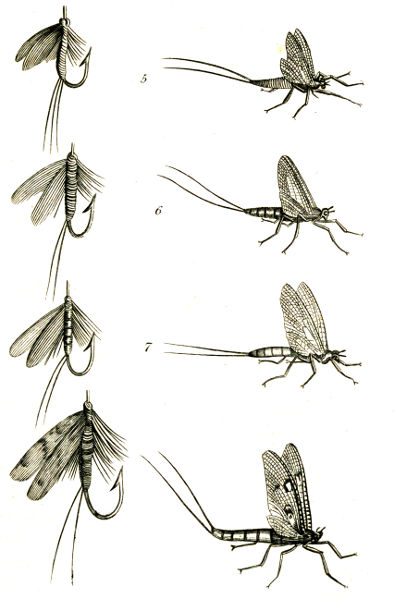
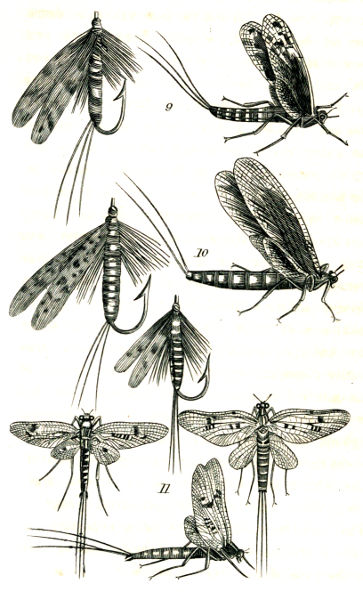
large quantities before the May-fly. Imitations
of this fly, and of the green and the gray drake
of different shades, are the only ones you will
need this morning, though I doubt if the last
can be much used, as the gray drake is not yet
on the water in any quantity.
Phys.—Pray can you give us any account
of these curious little animals?
34Hal.—We ought to draw upon your stores
of science for information on these subjects.
Phys.—I really know nothing of Entomology,
but I am desirous of acquiring knowledge.
Hal.—I have made few observations on
flies as a philosophical naturalist. What I
know I will state at another time. But see,
the green drake is descending upon the water,
and some are leaving the alders to sport in the
sunshine, and to enjoy the pleasures of their
brilliant, though short existence; and their life,
naturally ephemeral, is made one of scarcely a
moment, by the fishes and birds: that which
the swallow or the duck spares is caught by
the fish. The fly is new, and in the imitation,
I recommend the olive tint, or what the Irish
call the green monkey. That is, an artificial
fly, with a wing of dyed yellow drake’s feather,
a body of yellow monkey’s fur, and a small
quantity of olive mohair for legs. For myself,
I shall fish for some time with a large red
alder fly, and I dare say, with as much success.
That is, with a fly with a dark peacock’s
harle for body, a red hackle for legs, and wings
of the land-rail below, and starling above.
Poiet.—The water is quite in motion, what
noble fish I see on the feed! I never beheld
35a finer sight, though I have often seen the
May-fly on well-stocked waters.
Hal.—This river is most strictly preserved;
not a fish has been killed here since last
August, and this is the moment when the large
fish come to the surface, and leave their cad
bait search and minnow hunting. But I have
hardly time to talk; I have hold of a good
fish: they take either alder or May-fly, and
having never been fished for this year, they
make no distinction, and greedily seize any
small object in motion on the water. You
see the alder-fly is quite as successful as the
May-fly; but there is a fish which has refused
it, and because he has been feeding, glutton-like,
on the May-fly: that is the fifth he has
swallowed in a minute. Now I shall throw
the drake a foot above him. It floats down,
and he has taken it. A fine fish; I think at
least 4lbs. This is the largest fish we have
yet seen, but in the deep water still lower
down, there are still greater fish. One of
5lbs. I have known taken here, and once a
fish a little short only of 6lbs.
Poiet.—I have just landed a fish which I
suppose you will consider as a small one; yet
I am tempted to kill him.
36Hal.—He is not a fish to kill, throw him
back, he is much under 2lbs., and, as I ought
to have told you before, we are not allowed to
kill any fish of less size; and I am sure we
shall all have more than we ought to carry
away even of this size. Pray put him into the
well, or rather give him to the fisherman to
turn back into the water.
Poiet.—I cannot say I approve of this manner
of fishing: I lose my labour.
Hal.—As the object of your fishing, I
hope, is innocent amusement, you can enjoy
this, and show your skill in catching the animal;
and if every fish that took the May-fly
were to be killed, there would be an end to
the sport in the river, for none would remain
for next year.
Phys.—The number of flies seems to increase
as the day advances, and I never saw
a more animated water scene: all nature seems
alive; even the water-wagtails have joined the
attack upon these helpless and lovely creations
from the waters.
Hal.—It is now one o’clock; and between
twelve and three is the time when the May-fly
rises with most vigour. It is a very warm
day, and with such a quantity of fly, every fish
37in the river will probably be soon feeding.
See, below the wear, there are two or three
large trout lately come out; and from the quiet
way in which they swallow their prey, and
from the size of the tranquil undulation that
follows their rise, I suspect they are the giants
of this river. Try if you cannot reach them:
one is near the bank in a convenient place for
a throw, for the water is sufficiently rough to
hide the deception, and these large fish do
not take the fly well in calm water, though
with natural flies on the hook they might all
be raised.
Poiet.—I have him! Alas! he has broken
me, and carried away half my bottom line.
He must have been a fish of 7 or 8lbs. What
a dash he made! He carried off my fly by
main force.
Hal.—You should have allowed your reel
to play and your line to run: you held him
too tight.
Poiet.—He was too powerful a fish for my
tackle; and even if I had done so, would probably
have broken me by running amongst the
weeds.
Hal.—Let me tell you, my friend, you should
never allow a fish to run to the weeds, or to
38strike across the stream; you should carry him
always down stream, keeping his head high, and
in the current. If in a weedy river you allow a
large fish to run up stream, you are almost sure
to lose him. There, I have hooked the companion
of your lost fish on the other side of the
stream,—a powerful creature: he tries, you see,
to make way to the weeds, but I hold him tight.
Poiet.—I see you are obliged to run with
him, and have carried him safely through the
weeds.
Hal.—I have him now in the rapids on the
shallow, and I have no fear of losing him, unless
he strikes the hook out of his mouth.
Poiet.—He springs again and again.
Hal.—He is off; in one of these somersets
he detached the steel, and he now leaps to celebrate
his escape. We will leave this place,
where there are more great fish, and return to
it after a while, when the alarm produced by
our operations has subsided.
Phys.—That fish take the artificial fly at
all is rather surprising to me, for in its most
perfect form it is but a rude imitation of nature;
and from the greedy manner in which it
is seized, fish, I think, cannot possess a refined
sense of smell, or any nervous system corresponding
39to the nasal one in animals that breathe
air: no scent can be given to water by an artificial
fly, or, at least, none like that of the natural
fly.
Hal.—The principal use of the nostrils in
fishes, I believe, is to assist in the propulsion
of water through the gills for performing the
office of respiration, but I think there are
some nerves in these organs which give fishes
a sense of the qualities of the water, or of substances
dissolved in, or diffused through it,
similar to our sense of smell, or, perhaps,
rather our sense of taste, for there can be no
doubt that fishes are attracted by scented pastes
and scented worms, which are sometimes used
by anglers that employ ground-baits; and in
old angling-books there are usually receipts for
attracting fish in this manner, and though the
absurdity of many of these prescriptions is manifest,
yet I do not think this proves that they are
entirely useless, for, upon such principles, all the
remedies for diseases in the old pharmacopœias
would be null.
With respect to the fly, as it usually touches
the stream by a very small surface, that of the
air-bubbles on the fringes on its legs, it can
scarcely affect the water so as to give it any
40power of communicating smell. And as you
have seen a ripple or motion on the water is
necessary to deceive fishes; and as they look
at the fly from below, they see distinctly only
the legs and body, which, when the colours are
like those of the natural fly, may easily deceive
them; the wings, which are the worst
imitated parts of the artificial fly, seldom appear
to them, except through the different
refractive power of the moving water and the
atmosphere, and when immersed, they form
masses not unlike the wings of a drowned fly,
or one wetted in rising.
It is now a quarter of an hour since we left
the large pool: let us return to it; I see the
fish are again rising.
Poiet.—I am astonished! It appears to me
that the very same fish are again feeding. There
are two fish rising nearly in the same spot where
they rose before: can they be the same fish?
Hal.—It is very possible. It is not likely
that three other fish of that size should occupy
the same haunts.
Poiet.—But I thought after a fish had been
41hooked, he remained sick and sulky for some
time, feeling his wounds uncomfortable.
Hal.—The fish that I hooked is not rising
in the same place, and therefore, probably, was
hurt by the hook; but one of these fish seems
to be the same that carried off your fly, and it
is probable that the hook only struck him in a
part of the mouth where there are no nerves;
and that he suffered little at the moment, and
does not now feel his annoyance.
Poiet.—I have seen him take four or five
flies: I shall throw over him. There, he rose,
but refused the fly. He has at least learnt, from
the experiment he has made, to distinguish the
natural from the artificial fly.
Hal.—This, I think, always happens after
a fish has been hooked with an artificial fly.
He becomes cautious, and is seldom caught
that year, at least with the same means in the
same pool: but I dare say that fish might be
taken with a natural fly; or, what is better,
two upon the hook.
Poiet.—Pray try him.
Hal.—I am no artist at this kind of angling,
but Ornither I know has fished in June with
the clubs at Stockbridge, where this method of
fishing is usual. Pray let him try his fortune,
42though it is hardly fair play; and it is rather to
endeavour to recover your tackle, than for the
sake of the fish, that I encourage him to make
the essay.
Poiet.—Pray make no apologies for the
trial. Such a fish—certainly a monster for
this river—should be caught by fair means, if
possible, but caught by any means.
Orn.—You lost that fish, and you overrate
his size, as you will see, if I have good luck. I
put my live flies on the hook with some regret
and some disgust. I will not employ another
person to be my minister of cruelty, as I remember
a lady of fashion once did, who was very fond
of fishing for perch, and who employed her
daughter, a little girl of nine years of age, to pass
the hook through the body of the worm! Now
there is a good wind, and the fish has just taken
a natural fly. I shall drop the flies, if possible,
within a few inches of his nose. He has risen.
He is caught! I must carry him down stream
to avoid the bed of weeds above. I now have
him on fair ground, and he fights with vigour.
Fortunately, my silk worm gut is very strong,
for he is not a fish to be trifled with. He begins
to be tired; prepare the net. We have him safe,
and see your link hangs to his lower jaw: the
43hook had struck the cartilage on the outside of
the bone, and the fly, probably, was scarcely felt
by him.
Phys.—I am surprised! That fish evidently
had discovered that the artificial fly was a dangerous
bait, yet he took the natural fly which
was on a hook, and when the silk-worm gut
must have been visible.
Hal.—I do not think he saw either the
gut or the hook. In very bright weather and
water, I have known very shy fish refuse even
a hook baited with the natural fly, scared probably
by some appearance of hook or gut.
The vision of fishes when the surface is not
ruffled is sufficiently keen. I have seen them
rise at gnats so small as to be scarcely visible
to my eye.
Phys.—You just now said, that a fish
pricked by the hook of an artificial fly would
not usually take it again that season.
Hal.—I cannot be exact on that point: I
have known a fish that I have pricked retain
his station in the river, and refuse the artificial
fly, day after day, for weeks together; but his
memory may have been kept awake by this
practice, and the recollection seems local and
associated with surrounding objects; and if a
44pricked trout is chased into another pool, he
will, I believe, soon again take the artificial
fly. Or if the objects around him are changed,
as in Autumn, by the decay of weeds, or by
their being cut, the same thing happens; and
a flood, or a rough wind, I believe, assists the
fly-fisher, not merely by obscuring the vision
of the fish, but, in a river much fished, by
changing the appearance of their haunts: large
trouts almost always occupy particular stations,
under, or close to, a large stone or tree; and,
probably, most of their recollected sensations
are connected with this dwelling.
Phys.—I think I understand you, that the
memory of the danger and pain does not last
long, unless there is a permanent sensation
with which it can remain associated,—such as
the station of the trout; and that the recollection
of the mere form of the artificial fly,
without this association, is evanescent.
Orn.—You are diving into metaphysics;
yet I think, in fowling, I have observed that
the memory of birds is local. A woodcock,
that has been much shot at and scared in a
particular wood, runs to the side where he has
usually escaped, the moment he hears the
dogs; but if driven into a new wood, he seems
45to lose his acquired habits of caution, and becomes
stupid.
Poiet.—This great fish, that Ornither has
just caught, must be nearly of the weight I
assigned to him.
Hal.—O no! he is, I think, above 5lbs.,
but not 6lbs.; but we can form a more correct
opinion by measuring him, which I can
easily do, the but of my rod being a measure.
He measures, from nose to fork, a very
little less than twenty-four inches, and, consequently,
upon the scale which is appropriate
to well-fed trouts, should weigh 5lbs. 10oz.—which,
within an ounce, I doubt not, is his
weight.
Phys.—O! I see you take the mathematical
law, that similar solids are to each other in the
triplicate ratio of one of their dimensions.
Hal.—You are right.
Phys.—But I think you are below the mark,
for this appears to me an extraordinarily thick
fish.
Hal.—He is a well-fed fish, but, in proportion,
not so thick as my model, which was
a fish of 17 inches by 9 inches, and weighed
2lbs.; this is my standard solid. We will try
him. Ho! Mrs. B.!—bring your scales, and
46weigh this fish. There, you see, he weighs 5lbs.
10½oz.
Phys.—Well, I am pleased to see this fish,
and amused with your sport; but though I
have been imitating you in throwing the fly, as
well as I can, yet not a trout has taken notice of
my fly, and they seem scared by my appearance.
Hal.—Let me see you perform. There
are two good trout taking flies opposite that
bank, which you can reach. You threw too
much line into the water, and scared them
both; but I will take you to the rapid of the
Tumbling Bay, where the river falls; there
the quickness of the stream will prevent your
line from falling deep, and the foam will conceal
your person from the view of the fish.
And let me advise you to fish only in the
rapids till you have gained some experience in
throwing the fly. There are several fish rising
in that stream.
Phys.—I have raised one, but he refused
my fly.
Hal.—Now you have a fish.
Phys.—I am delighted;—but he is a small
one.
Hal.—Unluckily it is a dace.
47Phys.—I have now a larger fish, which has
pulled my line out.
Hal.—Give him time. That is a good
trout. Now wind up; he is tired, and your
own. I will land him. He is a fish to keep,
being above 2lbs.
Phys.—I am well pleased.
Hal.—There are many larger trouts here:
go on fishing and you will hook some of them.
And when you are tired of this rapid, you will
find another a quarter of a mile below. And
continue to fish with a short line, and drop
your fly, or let it be carried by the wind
on the water, as lightly as possible. Well,
Poietes, what success?
Poiet.—I have been fishing in the stream
above; but the flies are so abundant, that the
large fish will not take my artificial fly, and I
have caught only three fish, all of which the
fisherman has thrown into the water, though I
am sure one of them was more than 2lbs.
Hal.—You may trust his knowledge: with
a new angler, our keeper would be apt rather
to favour the fisherman than the fish. But
we will have all fish you wish to be killed,
and above 2lbs., put into the well of the boat,
where they can be examined, and, if you desire,
48weighed and measured, and such kept as
are worth keeping. No good angler should
kill a fish, if possible, till he is needed to be
crimped; for the sooner he is dressed after
this operation the better;—and I assure you,
a well-fed trout of the Colne, crimped and
cooled ten minutes before he is wanted for the
kettle or the gridiron, is a fish little inferior to
the best salmon of the best rivers. It is now
nearly two o’clock, and there is a cloud over
the sun; the fly is becoming less abundant;
you are now likely, Poietes, to have better
sport. Try in that deep pool, below the Tumbling
Bay; I see two or three good fish rising
there, and there is a lively breeze. The
largest fish refuses your fly again and again;
try the others. There, you have hooked him;
now carry him down stream, and keep his
head high, out of the weeds. He plunges and
fights with great force;—he is the best-fed
fish I have yet seen at the end of the line, and
will weigh more in proportion to his length.
I will land him for you. There he is,—and
measures 19 inches; and I dare say his weight
is not much short of 3lbs. We will preserve
him in the well.
Poiet.—He has hardly any spots, and is silvery
49all over; and the whole of the lower part
of his body is beautifully clean.
Hal.—He is likewise broad-backed; and
you may observe his few spots are black, and
these are very small. I have always remarked,
in this river, that the nearer the fish approach
to perfection, the colour of the body becomes
more uniform,—pale olive above, and bright
silver below; and these qualities are always
connected with a small head,—or rather, an oval
body, and deep-red flesh.
Poiet.—May not the red spots be marks of
disease—a hectic kind of beauty? For I observed
in a very thin and poor fish, and great-headed,
that I caught an hour ago, which had
leeches sticking to it, a number of red spots, and
a long black back, and black or bluish marks
even on the belly.
Hal.—I do not think red spots a symptom
of disease; for I have seen fish in other rivers,
and even small fish in this river, in perfectly
good season, with red spots; but the colours
of fish are very capricious, and depend upon
causes which cannot be easily defined. The
colouring matter is not in the scales, but in
the surface of the skin immediately beneath
them, and is probably a secretion easily affected
50by the health of the animal. I have known
fish, from some lakes in Ireland, mottled in a
most singular way,—their colour being like
that of the tortoise: the nature of the water,
exposure to the light, and probably the kind
of food, produce these effects. I think it possible,
when trout feed much on hard substances,
such as larvæ and their cases, and
the ova of other fish, they have more red spots,
and redder fins. This is the case with the
gillaroo and the char, who feed on analogous
substances: and the trout, that have similar
habits, might be expected to resemble them.
When trout feed most on small fish, as minnows,
and on flies, they have more tendency
to become spotted with small black spots, and
are generally more silvery. The Colne trout
are, in their advanced state, of this kind; and
so are the trout called in Ireland buddocks and
dolochans, found in Loch Neah. Particular
character becomes hereditary, and the effects of
a peculiar food influence the appearance of the
next generation. I hope, Ornither, you have
had good sport.
Orn.—Excellent! Since you left me, below
the wear, I have hooked at least fifteen or
twenty good fish, and landed and saved eight
51above 2lbs.; but I have taken no fish like the
great one which I caught by poaching with
the natural flies. The trout rose wonderfully
well within the last quarter of an hour, but
they are now all still; and the river, which
was in such active motion, is now perfectly
quiet, and seems asleep and almost dead.
Hal.—It is past four o’clock, and some
dark, heavy clouds are come on,—the fly is
off. It is almost the hour for the signal of
the dressing bell; and there is nothing more
to be done now till evening. But see! our
host is come to examine our fish in the well,
and to enquire about our sport; and, I dare
say, will order some of our fish to be dressed for
the table.
Host.—I hope, gentlemen, you have been
amused?
Hal.—Most highly, sir. As a proof of it,
there are in the fish-well eighteen good trout,—and
one not much short of 6lbs.; three
above 4lbs., and four above 3lbs. in weight.
I hope you will order that great fish for your
dinner.
Host.—We will see. He is a fine fish,
and fit for a present, even for a prince—and
you shall take him to a prince. Here is a
52fish, and there another, of the two next sizes,
which I am sure will cut red. Prepare them,
fisherman. And, Halieus, you shall catch two
or three perch, for another dish; I know there
are some good ones below the piles of the
wear; I saw them hunting small fish there
yesterday morning. Some minnows, ho!—and
the perch rods!
Hal.—I am tired, sir, and would willingly
avoid minnow fishing after such a morning’s
sport.
Host.—Come, then, I will be a fisher for
the table. I have one—and another, that will
weigh nearly a pound apiece. Now, there is
a cunning perch that has stolen my minnow;
I know he is a large one. He has robbed me
again and again; and if I fish on in this way,
with the hook through the upper lip, will, I
dare say, carry away all the minnows in the
kettle. I shall put on a strong small hook, on
a stout, though fine, gut, with slender wire
round the top, and pass the hook through the
back fin of the minnow, and try my sagacity
against his. Lo! I have him!—and a very
strong fish he is, and gone to the bottom; but
even though the greatest perch in the river, he
cannot bite the gut,—he will soon be tired
53and taken. He now comes up, and is landed.
He must be above 3lbs.—a magnificent perch!
Kill him and crimp him, fisherman; take our two
trout, and the three perch, to the kitchen, and
let them be dressed as usual. You shall have
a good dish of fish, worthy of such determined
anglers. But I see one of your party coming
up by the side of the river, who seems tired and
out of spirits.
Hal.—It is Physicus, who has this day
commenced his career as a fly fisher; and who,
I dare say, has been as successful as the uninitiated
generally are. I hope you have followed
my advice, and been fortunate?
Phys.—I caught two trout in the rapid
where you left me; but they were small, and
the fisherman threw them in. Below the wear,
in the quick stream, I caught two dace, and
what astonished me very much, a perch, which
you see here, and which I thought never took
the fly.
Hal.—O yes, sometimes; and particularly
when it is below the surface: and what more?
Phys.—By creeping on my knees, and
dropping my fly over the bank, I hooked a
very large fish which I saw rising, and which
was like a salmon; but he was too strong for
54my tackle, ran out all my line, and at last broke
off by entangling my link in a post in the river.
I have been very unlucky! I am sure that fish
was larger than the great one Ornither took
with the natural fly.
Hal.—Come, you have been initiated, and
I see begin to take an interest in the sport,
and I do not despair of your becoming a distinguished
angler.
Phys.—With time and some patience: but
I am sorry I tortured that enormous fish without
taking him.
Hal.—I dare say he was a large fish; but
I have known very correct, and even cool, reasoners
in error on a point of this kind. You
are acquainted with Chemicus; he is not an
ardent fisherman, and certainly not addicted
to romance; I will tell you an anecdote respecting
him. He accompanied me to this
very spot last year, on a visit to our host, and
preferred angling for pike to fly fishing. After
the amusement of a morning, he brought back
with him to the house one pike, and with some
degree of disappointment complained that he
had hooked another of an enormous size, which
carried off his tackle by main force, and which
he was sure must have been above 10lbs. At
55dinner, on the table, there were two pikes; one
the fish that Chemicus had caught, and another
a little larger, somewhat more than 3lbs. We
put some questions as to who had caught this
second pike, which we found had been taken
by our host, who smiling, and with some kind
of mystery, asked Chemicus if he thought it
weighed 10lbs. Chemicus refused to acknowledge
an identity between such a fish and the
monster he had hooked; when my friend took
out of his pocket a paper containing some
hooks and tackle carefully wrapped up, and
asked Chemicus if he had ever seen such an
apparatus. Chemicus owned they were the
hooks and tackle the great fish had carried
away. “And I found them,” said our friend,
“in the mouth of that very little fish which you
see on the table, and which I caught half an hour
ago.”
Host.—I answer for the correctness of this
anecdote, but I do not sanction its application
to the case of our novitiate in angling. I have
seen a fish under that bank where he was so
unfortunate, which I am sure was above four
pounds, and which I dare say was the subject of
his unsuccessful experiment.
Poiet.—From what our host has just said,
56I conclude, Halieus, that fish do not usually
change their stations.
Hal.—Large trouts unquestionably do not;—they
always hide themselves under the same
bank, stone, stock, or weed, as I said this
morning before, and come out from their permanent
habitations to feed; and when they
have fled to their haunt, they may be taken
there by the hand; and on this circumstance
the practice of tickling trout is founded. A
favourite place for a large trout in rivers is an
eddy behind a rock or stone, where flies and
small fishes are carried by the force of the
current: and such haunts are rarely unoccupied;
for if a fish is taken out of one of them,
his place is soon supplied by another, who quits
for it a less convenient situation.
Phys.—So much knowledge and practice is
required to become a proficient, that I am afraid
it is too late in life for me to begin to learn a
new art.
Hal.—Do not despair. There was—alas!
that I must say there was—an illustrious philosopher,
who was nearly of the age of fifty
before he made angling a pursuit, yet he became
a distinguished fly-fisher, and the amusement
occupied many of his leisure hours during the
last twelve years of his life. He, indeed, applied
57his pre-eminent acuteness, his science, and
his philosophy to aid the resources, and exalt
the pleasures of this amusement. I remember
to have seen Dr. Wollaston, a few days after he
had become a fly-fisher, carrying at his buttonhole
a piece of caoutchouc, or Indian rubber,
when, by passing his silk-worm link through a
fissure in the middle, he rendered it straight and
fit for immediate use. Many other anglers will
remember other ingenious devices of my admirable
and ever-to-be lamented friend.
(They go to dinner.)
(They return from the house.)
Hal.—You have, I am sure, gentlemen,
dined well; no one ever dined otherwise in
this house. It is a beautiful calm evening,
and many fish might be caught where we
fished in the morning; but I will take you to
another part of the river; you shall each catch
a fish, and then we will give over; for the
evening’s sport should be kept till a late season,—July
or August,—when there is little
fly on in the day-time: and it would be spoiling
58the diversion of our host, to catch or prick
all the fish in the upper water; and with a
gentleman so truly liberal, and so profuse of
his means of giving pleasure to others, no improper
liberties should be taken. I shall not
fish myself, but shall have my pleasure in
witnessing your sport. It must be in a boat,
and you must steal slowly up the calm water,
and glide like aerial beings on the surface,
making no motion in the water, and showing
no shadow. Your fly must be an orange or
brown palmer with a yellow body; for the
gray drake is not yet on the water. The fish
here are large, and the river weedy, so you
must take care of your fish and your tackle.
Poiet.—We have at least passed over half-a-mile
of water, and have seen no fish rise;
yet there is a yellowish or reddish fly in the
air, which moves like a drake; and there are
clouds of pale brown flies encircling the alders.
Now I think I see a large trout rise below
that alder.
Hal.—That is not a trout, for he rises in
a different place now, and is probably a large
roach or chub; do not waste your time upon
him. You may always know a large trout
when feeding in the evening. He rises continuously,
59or at small intervals,—in a still
water almost always in the same place,—and
makes little noise,—barely elevating his mouth
to suck in the fly, and sometimes showing
his back-fin and tail. A large circle spreads
around him, but there are seldom many bubbles
when he breaks the water, which usually indicate
the coarser fish: we will wait a few
minutes; I know there must be trout here,
and the sun is setting, and the yellow fly, or
dun cut, coming on the water. See, beneath
that alder is a trout rising, and now there is
another thirty yards higher up. Take care,
get your line out in another part of the water,
and in order, for reaching the fish, and do not
throw till you are sure you can reach the
spot, and throw at least half-a-yard above
the fish.
Orn.—He rose, I suppose, at a natural
fly, the moment before my fly touched the
water.
Hal.—Try again. You have hooked him,
and you have done well not to strike when he
rose. Now hold him tight, wind up your
line, and carry him down the stream. Push
the boat down stream, fisherman. Keep your
fish’s head up. He begins to tire,—and there
60is landed. A fine well-fed fish, not much less
than 4lbs. Throw him into the well. Now,
Poietes, try that fish rising above,—and there
are two more.
Poiet.—I have him!
Hal.—Take care. He has turned you, and
you have suffered him to run out your line,
and he is gone into the weeds under the willow:
let him fall down stream.
Poiet.—I cannot get him out.
Hal.—Then wind up. I fear he is lost,
yet we will try to recover him by taking the
boat up. The line is loose: he has left the
link entangled in the weeds, and carried your
fly with him. He must have been a large
fish, or he could not have disentangled himself
from so strong a gut. Try again, there are
fish now rising above and below; where the
water is in motion, opposite that willow, there
are two fish rising.
Poiet.—I have one of them.
Hal.—Now you are doing well. Down
with the boat, and drag your fish downwards.
Continue to do so, as there are weeds all
round you. You can master him now; keep
him high, and he is your own. Put the net
under him, and bring him into the boat; he
61is a well-fed fish, but not of the proper size
for a victim: about 2lbs. Now, Physicus,
try your fortune with the fish above that rises
so merrily still. You have him! Now use
him as Poietes did the last. Very well; I
see he is a large fish,—take your time. He is
landed; a fish nearly of 3lbs., and in excellent
season.
Phys.—Anche Io son Pescatore—I am too a
fisherman—a triumph.
Hal.—Now we have finished our fishing,
and must return to the light supper of our
host. It would be easy now, and between
this hour and ten, to take half-a-dozen large
fish in this part of the water; but for the
reason I have already stated, it would be improper.
Poiet.—Pray would not this be a good
part of the water for day-fishing?
Hal.—Undoubtedly, a skilful angler might
take fish here in the day; but the bank is
shaded by trees, there is seldom any sensible
wind on the water, and the apparatus and the
boat in motion are easily perceived in the daylight;
and the water is so deep, that a great
quantity of fly is necessary to call up the fish;
and in general there is a larger quantity of fly in
62hot summer evenings, than even in the brightest
sunshine.
Phys.—The fly appears to me like a moth
that is now on the water.
Hal.—It is.
Poiet.—What flies come on late in the
season here?
Hal.—Flies of the same species; some
darker, and some with a deeper shade of red;
and there are likewise the true moths, the
brown and white, which, in June and July,
are seized with avidity by the fish; and being
large flies, take large fish.
Orn.—Surely the May-fly season is not the
only season for day-fishing in this river?
Hal.—Certainly not. There are as many
fish to be taken perhaps in the Spring fishing;
but in this deep river they are seldom in good
season till the May-fly has been on, and a
fortnight hence they will be still better than
even now. In September there may be good
fish taken here; but the autumnal flies are
less plentiful in this river than the spring flies.
Phys.—Pray tell me what are the species
of fly which take in these two seasons.
Hal.—You know that trout spawn or deposit
their ova and seminal fluid in the end of
63the autumn or beginning of winter, from the
middle of November till the beginning of January,
their maturity depending upon the temperature
of the season, their quantity of food,
&c. For some time (a month or six weeks)
before they are prepared for the sexual function,
or that of re-production, they become less
fat, particularly the females; the large quantity
of eggs and their size probably affecting the
health of the animal, and compressing generally
the vital organs in the abdomen. They are at
least six weeks or two months after they have
spawned before they recover their flesh: and the
time when these fish are at the worst is likewise
the worst time for fly-fishing, both on account of
the cold weather and because there are fewer
flies on the water than at any other season.
Even in December and January there are a few
small gnats or water-flies on the water in the
middle of the day, in bright days, or when there
is sunshine. These are generally black, and
they escape the influence of the frost by the effects
of light on their black bodies, and probably
by the extreme rapidity of the motions of their
fluids, and generally of their organs. They are
found only at the surface of the water, where the
temperature must be above the freezing point.
64In February a few double-winged water-flies
which swim down the stream are usually found
in the middle of the day,—such as the willow-fly;
and the cow-dung-fly is sometimes carried
on the water by winds. In March there are several
flies found on most rivers. The grannam
or green-tail-fly, with a wing like a moth, comes
on generally morning and evening, from five till
eight o’clock, A. M. in mild weather in the end of
March and through April. Then there are the
blue and the brown, both Ephemeræ, which
come on, the first in dark days, the second in
bright days; these flies, when well imitated, are
very destructive to fish. The first is a small
fly with a palish-yellow body, and slender beautiful
wings, which rest on the back as it floats
down the water. The second, called the cob in
Wales, is three or four times as large, and has
brown wings, which likewise protrude from the
back, and its wings are shaded like those of a
partridge, brown and yellow brown. These
three kinds of flies lay their eggs in the water,
which produce larvæ that remain in the state of
worms, feeding and breathing in the water till
they are prepared for their metamorphosis and
quit the bottoms of the rivers, and the mud
and stones, for the surface, and the light and
65air. The brown fly usually disappears before
the end of April, likewise the grannam; but
of the blue dun, there is a succession of different
tints, or species, or varieties, which appear
in the middle of the day all the summer
and autumn long. These are the principal
flies on the Wandle—the best and clearest
stream near London. In early spring these
flies have dark olive bodies; in the end of
April and the beginning of May they are
found yellow; and in the summer they become
cinnamon-coloured; and again, as the
winter approaches, gain a darker hue. I do
not, however, mean to say that they are the
same flies, but more probably successive generations
of Ephemeræ of the same species.
The excess of heat seems equally unfavourable,
as the excess of cold, to the existence of
the smaller species of water-insects, which,
during the intensity of sunshine, seldom appear
in summer, but rise morning and evening
only. The blue dun has in June and July a
yellow body, and there is a water-fly which in
the evening is generally found before the moths
appear, called the red-spinner. Towards the
end of August, the Ephemeræ appear again
in the middle of the day: a very pale small
66Ephemera, which is of the same colour as that
which is seen in some rivers in the beginning
of July. In September and October this kind
of fly is found with an olive body, and it becomes
darker in October, and paler in November.
There are two other flies which
appear in the end of September, and continue
during October if the weather be mild: a large
yellow fly with a fleshy body and wings like
a moth; and a small fly with four wings, with
a dark or claret-coloured body, that when it
falls on the water has its wings like the great
yellow fly, flat on its back. This, or a claret-bodied
fly, very similar in character, may be
likewise found in March or April, on some
waters. In this river I have often caught
many large trout in April and the beginning
of May, with the blue dun, having the yellow
body; and in the upper part of the stream
below St. Albans, and between that and Watford,
I have sometimes, even as early as April,
caught fish in good condition: but the true
season for the Colne is the season of the May-fly.
The same may be said of most of the
large English rivers containing large trouts,
and abounding in May-fly;—such as the Test
and the Kennet; the one running by Stockbridge,
67the other by Hungerford. But in the
Wandle at Carshalton and Beddington, the
May-fly is not found; and the little blues are
the constant, and when well imitated, killing
flies on this water; to which may be joined
a dark alder-fly, and a red evening fly. In
the Avon, at Ringwood and Fordingbridge,
the May-fly is likewise a killing fly; but as
this is a grayling river, the other flies, particularly
the grannam and blue and brown, are
good in spring, and the alder-fly or pale blue
later, and the blue dun in September and October,
and even November. In the streams
in the mountainous parts of Britain, the spring
and autumnal flies are by far the most killing.
The Usk was formerly a very productive trout
stream, and the fish being well-fed by the
worms washed down by the winter floods,
were often in good season, cutting red, in
March, and the beginning of April: and at
this season the blues and browns, particularly
when the water was a little stained after a
small flood, afforded the angler good sport.
In Herefordshire and Derbyshire, where trout
and grayling are often found together, the same
periods are generally best for angling; but in the
Dove, Lathkill, and Wye, with the natural May-fly,
68many fish may be taken; and in old times,
in peculiarly windy days, or high and troubled
water, even the artificial May-fly, according to
Cotton, was very killing.
Poiet.—I have heard various accounts of the
excellent fishing in some of the great lakes in Ireland.
Can you tell us any thing on the subject,
and if the same flies may be used in that island?
Hal.—I have been several times in Ireland,
but never at this season, which is considered
as best for lake-fishing. I have heard
that in some of the lakes in Westmeath, very
large trout, and great quantities may be taken
in the beginning of June, with the very flies
we have been using this day. Wind is necessary;
and a good angler sometimes takes in
a day, or rather formerly took, from ten to
twelve fish, which weighed from 3 to 10lbs.,
and which occasionally were even larger. In
the summer after June, and in the autumn,
the only seasons when I have fished in Ireland,
I have seldom taken any large trout; but
in the river Boyle, late in October, after a flood,
I once had some sport with these fish, that were
running up the river from Lock Key to spawn.
I caught one day two above 3lbs. that took a
large reddish-brown fly of the same kind as a
69salmon fly; and I saw some taken that weighed
5lbs., and heard of one that equalled 9lbs. These
fish were in good season, even at this late period,
and had no spots, but were coloured red and
brown—mottled like tortoise-shell, only with
smaller bars. I have in July, likewise, fished
in Loch Con, near Ballina, and Loch Melvin,
near Ballyshannon. In Loch Con, the party
caught many small good trout, that cut red;
and in the other I caught a very few trout only,
but as many of them were gillaroo or gizzard
trout as common trout.
Poiet.—This must have been an interesting
kind of fishing. In what does the gillaroo differ
from the trout?
Hal.—In appearance very little, except
that they have more red spots, and a yellow
or golden-coloured belly and fins, and are generally
a broader and thicker fish; but internally
they have a different organization, possessing
a large thick muscular stomach, which
has been improperly compared to a fowl’s,
and which generally contains a quantity of
small shell-fish of three or four kinds: and
though in those I caught the stomachs were full
of these shell-fish, yet they rose greedily at the
fly.
70Poiet.—Are they not common trout which
have gained the habit of feeding on shell-fish?
Hal.—If so, they have been altered in a
succession of generations. The common trouts
of this lake have stomachs like other trouts,
which never, as far as my experience has
gone, contain shell-fish; but of the gillaroo
trout, I have caught with a fly some not
longer than my finger, which have had as
perfect a hard stomach as the larger ones,
with the coats as thick in proportion, and the
same shells within; so that this animal is at
least now a distinct species, and is a sort of
link between the trout and char, which has a
stomach of the same kind with the gillaroo, but
not quite so thick, and which feeds at the bottom
in the same way. I have often looked in the
lakes abroad for gillaroo trout, and never found
one. In a small lake at the foot of the Crest of
the Brenner, above 4000 feet above the level of
the sea, I once caught some trout, which, from
their thickness and red spots, I suspected were
gillaroo, but on opening the stomach I found I
was mistaken; it had no particular thickness,
and was filled with grasshoppers: but there
71were char, which fed on shell-fish, in the same
lake.
Poiet.—Are water-flies found on all rivers?
Hal.—This is a question which I find it
impossible to answer; yet from my own experience
I should suppose, that in all the habitable
parts of the globe certain water-flies exist wherever
there is running water. Even in the most
ardent temperature, gnats and musquitoes are
found, which lay their congeries of eggs on the
water, which, when hatched, become first worms,
afterwards small shrimp-like aurelia, and lastly
flies. There are a great number of the largest
species of these flies on stagnant waters and
lakes, which form a part of the food of various
fishes, principally of the carp kind: but the true
fisherman’s flies,—those which are imitated in our
art, principally belong to the northern, or at least
temperate part of Europe, and I believe are nowhere
more abundant than in England. It appears
to me, that since I have been a fisherman,
which is now the best part of half a century, I
have observed in some rivers where I have been
accustomed to fish habitually, a diminution of the
numbers of flies. There were always some
seasons in which the temperature was favourable
to a quantity of fly; for instance, fine warm days
72in spring for the grannam, or brown fly; and like
days in May and June for the alder-fly, May-fly,
and stone-fly; but I should say that within
these last twenty years I have observed a general
diminution of the spring and autumnal flies,
except in those rivers which are fed from
sources that run from chalk, and which are
perennial—such as the Wandle, and the
Hampshire and Buckinghamshire rivers; in
these streams the temperature is more uniform,
and the quantity of water does not vary much.
I attribute the change of the quantity of flies
in the rivers to the cultivation of the country.
Most of the bogs or marshes which fed many
considerable streams are drained; and the consequence
is, that they are more likely to be
affected by severe droughts and great floods—the
first killing, and the second washing
away the larvæ and aurelias. May-flies thirty
years ago were abundant in the upper part of
the Teme river in Herefordshire, where it
receives the Clun: they are now rarely seen.
Most of the rivers of that part of England,
as well as of the west, with the exception of
those that rise in the still uncultivated parts
of Dartmoor and Exmoor, are rapid and
unfordable torrents after rain, and in dry
73summers little more than scanty rills; and
Exmoor and Dartmoor, almost the only considerable
remains of those moist, spongy, or
peaty soils, which once covered the greatest
part of the high lands of England, are becoming
cultivated, and their sources will gradually
gain the same character as those of our midland
and highly-improved counties. I cannot give
you an idea of the effects of peat mosses and
grassy marshes on the water thrown down
from the atmosphere, better, than by comparing
their effects to those of roofs of houses
of thatched straw, as contrasted with roofs of
slate, on a shower of rain. The slate begins
to drop immediately, and sends down what it
receives in a rapid torrent, and is dry soon
after the shower is over. From the sponge-like
roof of thatch, on the contrary, it is long
before the water drops; but it continues dropping
and wet for hours after the shower is over
and the slate dry.
Poiet.—You spoke just now of the gillaroo
trout, as belonging only to Ireland. I can,
however, hardly bring myself to believe, that
such a fish is not to be found elsewhere. For
lakes with shell-fish and char are common in
various parts of Europe, and as the gillaroo
74trout is congenerous, it ought to exist both in
Scotland and the Alpine countries.
Hal.—It is not possible from analogies of
this kind to draw certain inferences. Subterraneous
cavities and subterranean waters are
common in various countries, yet the Proteus
Anguinus is only found in two places in Carniola—at
Adelsburg and Sittich. As I mentioned
before, I have never yet met with a gillaroo
trout except in Ireland. It is true, it is
only lately that I have had my attention directed
to this subject, and other fishermen or
naturalists may be more fortunate.
Poiet.—Have you ever observed any other
varieties of the trout kind, which may be considered
as, like the gillaroo, forming a distinct
species?
Hal.—I think the par, samlet, or brandling,
common to most of our rivers, which
communicate with the sea, has a claim to be
considered a distinct species; yet the history
of this fish is so obscure, and so little understood,
that, perhaps, I ought not to venture
to give an account of it. But in doing so,
you will consider me as rather asking for new
information, than as attempting a satisfactory
view of this little animal.
75Orn.—I have seen this fish in the rivers of
Wales and Herefordshire, and have heard it
asserted, on what appeared to me good authority,
that it was a mule,—the offspring of a
trout and a salmon.
Hal.—This opinion, I know, has been
supported by the fact, that it is found only
in streams, which are occasionally visited by
salmon; yet I know no direct evidence in
favour of the opinion, and I should think it
much more probable, if it be a mixed race, that
it is produced by the sea trout and common
trout. In a small river, which runs into the
Moy, near Ballina in Ireland, I once caught
in October a great number of small sea trout,
which were generally about half-a-pound in
weight, and were all males; and unless it
be supposed, that the females were in the
river likewise, and would not take the fly,
these fish, in which the spermatic system was
fully developed, could only have impregnated
the ova of the common river trout. The sea
trout and river trout are, indeed, so like each
other in character, that such a mixture seems
exceedingly probable; but I know no reason
why such mules should always continue small,
except that it may be a mark of imperfection.
76The only difference between the par and common
small trout is in the colours, and its
possessing one or two spines more in the pectoral
fin. The par has large blue or olive
bluish marks on the sides, as if they had been
made by the impression of the fingers of a
hand; and hence the fish is called in some
places fingerling. The river and sea trout
seem capable of changing permanently their
places of residence; and sea trout appear often
to become river trout. In this case they lose
their silvery colour, and gain more spots; and
in their offspring these changes are more distinct.
Fish, likewise, which are ill-fed remain
small; and pars are exceedingly numerous in
those rivers where they are found, which are
never separated from the sea by impassable
falls; from which I think it possible that they
are produced by a cross between sea and river
trout. The varieties of the common trout are
almost infinite; from the great lake trout,
which weighs above 60 or 70lbs., to the trouts
of the little mountain brook or small mountain
lake, or tarn, which is scarcely larger than
the finger. The smallest trout spawn nearly
at the same time with the larger ones, and
their ova are of the same size; but in the
77large trout there are tens of thousands, and in
the small one rarely as many as forty,—often
from ten to forty. So that in the physical
constitution of these animals, their production
is diminished as their food is small in quantity;
and it is remarkable, that the ova of
the large and beautiful species which exist in
certain lakes, and which seem always to associate
together, appear to produce offspring,
which, in colour, form, and power of growth
and reproduction, resemble the parent fishes;
and they generally choose the same river for
their spawning. Thus, in the lake of Guarda,
the Benacus of the ancients, the magnificent
trout, or Salmo fario, which in colour and
appearance is like a fresh run salmon, spawns
in the river at Riva, beginning to run up
for that purpose in June, and continuing
to do so all the summer; and this river is
fed by streams from snow and glaciers in
the Tyrol, and is generally foul: whilst the
small spotted common trouts, which are likewise
found in this lake, go into the small
brooks, which have their sources not far off,
and in which, it is probable, they were originally
bred. I have seen taken in the same
net small fish of both these varieties which
78were as marked as possible in their characters:—one
silvery, like a young salmon,
blue on the back, and with small black spots
only; the other, with yellow belly and red
spots, and an olive-coloured back. I have
made similar observations in other lakes, particularly
in that of the Tarun near Gmunden,
and likewise at Loch Neah in Ireland. Indeed,
considering the sea trout as the type of
the species trout, I think all the other true
trouts may not improperly be considered as
varieties, where the differences of food and
of habits have occasioned, in a long course of
ages, differences of shape and colours, transmitted
to offspring in the same manner as in
the variety of dogs, which may all be referred
to one primitive type.[4]
79Phys.—I am somewhat amused at your
idea of the change produced in the species of
trout by the formation of particular characters
by particular accidents, and their hereditary
transmission. It reminds me of the ingenious
but somewhat unsound views of Darwin on
the same subject.
Hal.—I will not allow you to assimilate
my views to those of an author, who, however
ingenious, is far too speculative; whose poetry
has always appeared to me weak philosophy,
and his philosophy indifferent poetry: and to
whom I have been often accustomed to apply
Blumenbach’s saying, that there were many
things new and many things true in his doctrines;
but that what was new was not true,
and what was true was not new.
Poiet.—I think Halieus is quite in the
right to be a little angry at your observation,
Physicus, in making him a disciple of a writer,
who, as well as I can recollect, has deduced
the genesis of the human being, by a succession
of changes dependant upon irritabilities, sensibilities,
and appetencies, from the fish; blending
the wild fancies of Buffon with the profound
ideas of Hartly, and thus endeavouring
to give currency to an absurd romance, by
80mixing with it some philosophical truths. I
hope your parallel will induce him to do us
the favour to state his own notions more at
large.
Hal.—Physicus has mistaken me; and I
will explain. What I mentioned of the varieties
of dogs as sprung from one type, he will, I
am sure, allow me to apply, with some modifications,
to all our cultivated breeds of animals,
whether horses, oxen, sheep, hogs, geese,
ducks, turkies, or pigeons; and he will allow,
that certain characters gained by accidents,
either from peculiar food, air, water, or domestic
treatment, are transmitted to, and often
strengthened in the next generation; the qualities
being, as it were, doubled when belonging
to both parents, and retained in spite of
counteracting causes. It will be sufficient for
me to mention only a few cases. The blood-horse
of Arabia, is become the favourite of the
north of Europe, and the colts possess all the
superior qualities of their parents, even in the
polar circle. The offspring of the Merino
sheep retain the fineness of their wool in England
and Saxony. Poultry, bantams, tumbling
and carrier pigeons, geese, ducks, turkies, &c.,
all afford instances of the same kind; and in
81the goose and duck, not only is the colour of the
feathers changed, but the form of the muscles of
the legs and wings; those of the wings, being little
employed, become weak and slender; those of
the legs, on the contrary, being much used, are
strong and fleshy; and it is well to know this, as,
in the young birds, the muscles of the legs and
thighs are the best parts for the epicure, a large
quantity of flesh being developed there, but not
yet hardened or rendered tough by exercise.
These facts are of the same kind and depend on
the same principles, as the peculiarity of the
breeds or races in trouts. Fish in a clear cool
river, that feed much on larvæ, and that swallow
their hard cases, become yellower, and the red
spots increase so as to outnumber the black ones;
and these qualities become fixed in the young
fishes, and establish a particular variety. If
trout from a lake, or another river of a different
variety, were introduced into this river, they
would not at once change their characters; but
the change would take place gradually. Thus
I have known trout from a lake in Scotland,
remarkable for their deep red flesh, introduced
into another lake, where the trout had only
white flesh, and they retained the peculiar redness
of their flesh for many years. At first they
82all associated together in spawning in the brook
which fed the lake, but those newly introduced
were easily known from their darker backs
and brighter sides. By degrees, however,
from the influence of food and other causes,
they became changed; the young trout of the
introduced variety had flesh less red than
their parents; and in about twenty years the
variety was entirely lost, and all the fish were
in their original white state. A very speculative
reasoner might certainly defend the hypothesis,
of the change of species in a long
course of ages, from the establishment of particular
characters as hereditary. It might be
said, that trout, after having thickened their
stomachs by feeding on larvæ with hard cases,
gained the power of eating shell-fish, and were
gradually changed to gillaroos and to char;
their red spots and the yellow colour of their
belly and fins increasing. In the same manner
it might be said, that the large trout which feed
almost entirely on small fishes, gained more
spines in the pectoral fins, and became a new
species; but I shall not go so far, and I know
no facts of this kind. The gillaroo and the
char appear always with the same characters:
83and I have never seen any fish that seemed
in a state of transition from a trout to gillaroo
or a char; which I think, must have been the
case if such changes took place. I hope, after
this explanation, Physicus will not find any
analogy between my ideas and those of a school,
to which I am not ambitious of being thought
to belong; and that he will allow my views to
be sound, or at least founded upon correct
analogies.
Poiet.—Do you know any facts of a similar
kind in confirmation of your idea that the par
is a mule?
Hal.—I have heard of similar instances,
but I cannot say I have myself witnessed them.
The common carp and the cruscian are said to
produce a mixed race, and likewise the rud and
the roach; but I have never paid much attention
to varieties of the carp kind. A friend
of mine informed me, that in a branch of the
Test, into which graylings had recently been
introduced, his fisherman caught a fish, which
appeared to be from a cross between the trout
and grayling, having the high back fin of the
grayling, and the head and spots of the trout:
this is the more remarkable, if correct, as the
grayling spawns in the late spring, and the
84trout in the late autumn or winter: yet I do
recollect that I once took a grayling in the end
of November, in which the ova were so large,
as nearly to be ready for protrusion. The
fisherman of the Gründtl See, in Styria, informed
me, that he had seen a fish which he
believed to be a mule between the trout and
char, the fins of which resembled those of a
trout, though the body was in other respects
like that of a char. The seasons at which these
two species spawn approach nearer to each
other; but the char spawns in still and the
trout in running water. In general the trout
are mature before the char, yet I have seen in
the Leopoldstein See, in Styria, a female char,
of which the eggs were almost fully developed
as early as June: the fisherman of the Gründtl
See said, that these peculiar fish were very
rare, and that he caught only one in about
500 char. It is not, I think, impossible, that
it may be an umbla, a fish that might be expected
to be found in that deep, cold, Alpine
lake, a peculiar species and not a mixed variety.
It is a fertile and very curious subject for new
experiments, that of crossing the breeds of
fishes, and offers a very interesting and untouched
field of investigation, which I hope
85will soon be taken up by some enlightened
country gentleman, who in this way might
make not only curious but useful discoveries.
Poiet.—So much science would be required
to make these experiments with success,
and there would be so many difficulties
in the way of preserving fishes at the time
they are proper for reproduction, that I fear
very few country gentlemen would be capable
of prosecuting the inquiry.
Hal.—The science required for this object
is easily attained, and the difficulties are quite
imaginary. The impregnation of the ova of
fishes is performed out of the body, and it is
only necessary to pour the seminal liquor from
the melt upon the ova in water. Mr. Jacobi,
a German gentleman, who made many
years ago experiments on the increase of trout
and salmon, informs us, that the ova and melt
of mature fish, recently dead, will produce
living offspring. His plan of raising trout
from the egg was a very simple one. He had
a box made with a small wire grating at one
end in the cover, for admitting water from a
fresh source or stream, and at the other end
of the side of the box there were a number of
holes to permit the exit of the water: the
86bottom of the box was filled with pebbles and
gravel of different sizes, which were kept covered
with water that was always in motion.
In November or the beginning of December,
when the trout were in full maturity for
spawning, and collected in the rivers for this
purpose upon beds of gravel, he caught males
and females in a net, and by the pressure of
his hands, received the ova in a basin of water,
and suffered the melt or seminal fluid to pass
into the basin; and after they had remained
a few minutes together, he introduced them
upon the gravel in the box, which was placed
under a source of fresh, cool, and pure water.
In a few weeks the eggs burst, and the box
was filled with an immense number of young
trout, which had a small bag attached to the
lower part of their body containing a part of
the yolk of the egg, which was still their nourishment.
In this state they were easily carried
from place to place in confined portions of
fresh water for some days, requiring apparently
no food; but, after about a week, the nourishment
in their bag being exhausted, they began
to seek their food in the water, and rapidly
increased in size. As I have said before,
Mr. Jacobi assures us, that the experiment
87succeeded as well with mature fish, that had
been killed for the purpose of procuring the
roe and melt, these having been mixed together
in cold water immediately after they
were taken out of the body. I have had this
experiment tried twice, and with perfect success,
and it offers a very good mode of increasing
to any extent the quantity of trout in
rivers or lakes, for the young ones are preserved
from the attacks of fishes, and other
voracious animals or insects, at the time when
they are most easily destroyed, and perfectly
helpless. The same plan, I have no doubt,
would answer equally well with grayling or
other varieties of the salmo genus. But in
all experiments of this kind, the great principle
is, to have a constant current of fresh and
aerated water running over the eggs. The
uniform supply of air to the fœtus in the egg
is essential for its life and growth, and such
eggs as are not supplied with water saturated
with air are unproductive. The experimenter
must be guided exactly by the instinct of the
parent fishes, who take care to deposit the impregnated
eggs, that are to produce their offspring,
only in sources continually abounding in fresh
and aerated water.
88Phys.—But as every species of fish has a particular
and usually different time for spawning, I
do not see how it could be contrived to cross
their breeds, or how the ova of a trout, which
spawns in December, could be impregnated by
the seminal fluid of the grayling, which spawns
in May; for I conclude it would be impossible
to preserve the eggs of a fish out of the body in a
state in which they could retain or recover their
vitality.
Hal.—I believe I mentioned before, that I had
found instances, in which the ova of fish were
developed at a different period from their natural
one; and I have no doubt, that a little inquiry
respecting the habits of fishes would enable us to
acquire a knowledge of the circumstances, which
either hasten or retard their maturity. Plenty of
food and a genial season hasten the period of
their reproduction, which is delayed by want of
proper nourishment, and by unfavourable weather.
Males and females likewise, confined from each
other, have their generative powers impeded;
and trout, grayling, and salmon, will not deposit
their ova except in running water; so that by
keeping them in tanks, the period of their maturity
might be considerably altered. I have seen
char even, which had been kept in confined water
89from September till July; and so slow had
been the progress of the ova, that they appeared
to be about this time fit for exclusion, though, in
the natural course of things, they would have been
ripe in the end of October of the year before. By
attending to and controlling all these circumstances,
I have no doubt many interesting experiments
might be made, as to the possibility of
modifying the varieties of the salmo, by impregnating
the ova of one species with the seminal
fluid of another. With fishes of other genera the
task would be still more easy. Carp, perch, and
pike, deposit their ova in still water in spring
and summer, when it is supplied with air by the
growth of vegetables: and it is to the leaves
of plants, which afford a continual supply of
oxygen to the water, that the impregnated eggs
usually adhere; so that researches of this kind
might be conducted within doors in close
vessels, filled with plants, exposed to the sun.
I have myself kept minnows and sticklebacks
alive for many months in the same confined
quantity of water, containing a few confervæ;
and their ova and melt increased in the same
manner, as if they had been in their natural
situation.
90Orn.—I conclude from your statements,
Halieus, that nothing more is required for the
production of fishes from impregnated eggs,
than a constant supply of water of a certain
temperature furnished with air; and of course
the same principles will apply to fishes of the
sea.
Hal.—There can be no doubt of it: and
fishes in spawning time always approach great
shallows, or shores covered with weeds, that,
in the process of their growth, under the influence
of the sunshine, constantly supply pure
air to the water in contact with them.
Poiet.—In every thing belonging to the
economy of nature, I find new reasons for
wondering at the designs of Providence,—at
the infinite intelligence by which so many
complicated effects are produced by the most
simple causes. The precipitation of water from
the atmosphere, its rapid motion in rivers, and
its falls in cataracts, not only preserve this
element pure, but give it its vitality, and render
it subservient even to the embryo life of the
fish; and the storms which agitate the ocean,
and mingle it with the atmosphere, supply at
once food to marine plants, and afford a principle
91of life to the fishes which inhabit its depths.
So that the perturbation and motion of the
winds and waves possess a use, and ought
to impress us with a beauty higher and more
delightful even than that of the peaceful and
glorious calm.
THIRD DAY. HALIEUS—POIETES—ORNITHER—PHYSICUS. SCENE—DENHAM. — Morning.
92
Hal.—You will soon take your leave, gentlemen,
of this agreeable villa, but we must catch
at least two brace of trout, to carry with us to
London as a present for two worthy patrons of
the angle. For though I know our liberal
host will have a basket of fish packed up for
each of our party, yet fish taken this morning
will be imagined a more acceptable present
than those caught yesterday. The May-fly is
already upon the water, though not in great
quantity, and it will consequently be more easy
to catch the fish, which I see are rising with
great activity. I advise you to go to the deep
water below, where you will find the largest
fish, and I will soon follow you.
93Poiet.—I hope I shall catch a large fish,—a
companion to that which Ornither took
yesterday with a natural fly.
[Halieus leaves them fishing, and returns
to the house; but soon comes back and joins
his companions, whom he finds fishing below
in the river.]
Hal.—Well, gentlemen, what sport?
Poiet.—The fish are rising every where;
but though we have been throwing over them
with all our skill for a quarter of an hour, yet
not a single one will take, and I am afraid we
shall return to breakfast without our prey.
Hal.—I will try; but I shall go to the
other side, where I see a very large fish rising.
There!—I have him at the very first throw.
Land this fish, and put him into the well.
Now I have another; and I have no doubt
I could take half a dozen in this very place,
where you have been so long fishing without
success.
Phys.—You must have a different fly; or
have you some unguent or charm to tempt the
fish?
Hal.—No such thing. If any of you will
94give me your rod and fly, I will answer for it,
I shall have the same success. I take your
rod, Physicus.—And lo! I have a fish!
Phys.—What can be the reason of this?
It is perfectly inexplicable to me. Yet Poietes
seems to throw as light as you do, and as well
as he did yesterday.
Hal.—I am surprised, that you, who are a
philosopher, cannot discover the reason of this.
Think a little.
All.—We cannot.
Hal.—As you are my scholars, I believe
I must teach you. The sun is bright, and
you have been, naturally enough, fishing
with your backs to the sun, which, not being
very high, has thrown the shadows of your
rods and yourselves upon the water, and you
have alarmed the fish, whenever you have
thrown a fly. You see I have fished with
my face towards the sun, and though inconvenienced
by the light, have given no alarm.
Follow my example, and you will soon have
sport, as there is a breeze playing on the
water.
Phys.—Your sagacity puts me in mind
of an anecdote which I remember to have
heard respecting the late eloquent statesman,
95Charles James Fox; who, walking up Bond-street
from one of the club-houses with an
illustrious personage, laid him a wager, that
he would see more cats than the Prince in
his walk, and that he might take which side
of the street he liked. When they got to the
top, it was found, that Mr. Fox had seen thirteen
cats, and the Prince not one. The royal
personage asked for an explanation of this apparent
miracle, and Mr. Fox said, “Your Royal
Highness took, of course, the shady side of
the way, as most agreeable; I knew that the
sunny side would be left to me, and cats
always prefer the sunshine.”
Hal.—There! Poietes, by following my
advice you have immediately hooked a fish;
and while you are catching a brace, I will
tell you an anecdote, which as much relates to
fly-fishing as that of Physicus, and affords an
elucidation of a particular effect of light.
A manufacturer of carmine, who was aware
of the superiority of the French colour, went
to Lyons for the purpose of improving his
process, and bargained with the most celebrated
manufacturer in that capital for the
acquisition of his secret, for which he was
to pay a thousand pounds. He was shown
96all the processes, and saw a beautiful colour
produced, yet he found not the least difference
in the French mode of fabrication and
that which he had constantly adopted. He
appealed to the manufacturer, and insisted
that he must have concealed something. The
manufacturer assured him that he had not,
and invited him to see the process a second
time. He minutely examined the water and
the materials, which were the same as his
own, and, very much surprised, said, “I have
lost my labour and my money, for the air
of England does not permit us to make good
carmine.” “Stay,” says the Frenchman, “do
not deceive yourself: what kind of weather
is it now?” “A bright sunny day,” said
the Englishman. “And such are the days,”
said the Frenchman, “on which I make my
colour. Were I to attempt to manufacture
it on a dark or cloudy day, my result would
be the same as yours. Let me advise you,
my friend, always to make carmine on bright
and sunny days.” “I will,” says the Englishman;
“but I fear I shall make very little in
London.”
Poiet.—Your anecdote is as much to the
purpose as Physicus’s; yet I am much obliged
97to you for the hint respecting the effect of
shadow, for I have several times in May and
June had to complain of too clear a sky, and
wished, with Cotton, for
A day with not too bright a beam;
A warm, but not a scorching, sun.
Hal.—Whilst we have been conversing,
the May-flies, which were in such quantities,
have become much fewer; and I believe the
reason is, that they have been greatly diminished
by the flocks of swallows, which every
where pursue them: I have seen a single
swallow take four, in less than a quarter of a
minute, that were descending to the water.
Poiet.—I delight in this living landscape!
The swallow is one of my favourite birds, and
a rival of the nightingale; for he cheers my
sense of seeing as much as the other does my
sense of hearing. He is the glad prophet of the
year—the harbinger of the best season: he lives
a life of enjoyment amongst the loveliest forms
of nature: winter is unknown to him; and he
leaves the green meadows of England in autumn,
for the myrtle and orange groves of Italy, and
for the palms of Africa:—he has always objects
of pursuit, and his success is secure. Even the
98beings selected for his prey are poetical, beautiful,
and transient. The ephemeræ are saved
by his means from a slow and lingering death in
the evening, and killed in a moment, when they
have known nothing of life but pleasure. He is
the constant destroyer of insects,—the friend of
man; and, with the stork and the ibis, may be
regarded as a sacred bird. His instinct, which
gives him his appointed seasons, and teaches him
always when and where to move, may be regarded
as flowing from a Divine Source; and
he belongs to the Oracles of Nature, which speak
the awful and intelligible language of a present
Deity.
FOURTH DAY. HALIEUS—POIETES—ORNITHER—PHYSICUS. FISHING FOR SALMON AND SEA TROUT. — Scene—Loch Maree, West of Rosshire, Scotland. Time—Middle of July. — THE DINNER.
99
Poiet.—I begin to be tired. This is really
a long day’s journey; and these last ten miles
through bogs, with no other view than that of
mountains half hid in mists, and brown waters
that can hardly be called lakes, and with no
other trees than a few stunted birches, that look
so little alive, that they might be supposed immediately
descended from the bog-wood, every
where scattered beneath our feet, have rendered
it extremely tedious. This is the most barren
part of one of the most desolate countries I have
ever passed through in Europe; and though the
inn at Strathgarve is tolerable, that of Auchnasheen
is certainly the worst I have ever seen,—and
I hope the worst I shall ever see. We
100ought to have good amusement at Pool Ewe, to
compensate us for this uncomfortable day’s journey.
Hal.—I trust we shall have sport, as far as
salmon and sea trout can furnish sport. But
the difficulties of our journey are almost over.
See, Loch Maree is stretched at our feet, and a
good boat with four oars will carry us in four or
five hours to our fishing ground; a time that will
not be misspent, for this lake is not devoid of
beautiful, and even grand scenery.
Poiet.—The scenery begins to improve; and
that cloud-breasted mountain on the left is of the
best character of Scotch mountains: these woods,
likewise, are respectable for this northern country.
I think I see islands also in the distance: and the
quantity of cloud always gives effect to this kind
of view; and perhaps, without such assistance to
the imagination, there would be nothing even
approaching to the sublime in these countries;
but cloud and mist, by creating obscurity and
offering a substitute for greatness and distance,
give something of an alpine and majestic character
to this region.
Orn.—As we are now fixed in our places
in the boat, you will surely put out a rod or
two with a set of flies, or try the tail of the par
101for a large trout or salmon: our fishing will
not hinder our progress.
Hal.—In most other lakes I should do so;
here I have often tried the experiment, but
never with success. This lake is extremely
deep, and there are very few fish which haunt
it generally except char; and salmon seldom
rest but in particular parts along the shore,
which we shall not touch. Our voyage will
be a picturesque, rather than an angling one.
I see we shall have little occasion for the oars,
for a strong breeze is rising, and blowing directly
down the lake; we shall be in it in a
minute. Hoist the sails; On we go!—we
shall make our voyage in half the number of
hours I had calculated upon; and I hope to
catch a salmon in time for dinner.
Poiet.—The scenery improves as we advance
nearer the lower parts of the lake. The
mountains become higher, and that small island
or peninsula presents a bold, craggy outline;
and the birch wood below it, and the pines
above, form a scene somewhat Alpine in character.
But what is that large bird soaring
above the pointed rock, towards the end of the
lake? Surely it is an eagle!
Hal.—Your are right, it is an eagle, and of
102a rare and peculiar species—the gray or silver
eagle, a noble bird! From the size of the
animal, in must be the female; and her aery is
in that high rock. I dare say the male is not
far off.
Phys.—I think I see another bird, of a
smaller size, perched on the rock below, which
is similar in form.
Hal.—You do: it is the consort of that
beautiful and powerful bird; and I have no
doubt their young ones are near at hand.
Poiet.—Look at the bird! How she dashes
into the water, falling like a rock, and raising
a colume of spray: she has dropped from a
great height. And now she rises again into
the air: what an extraordinary sight!
Hal.—She is pursuing her prey, and is one
of our fraternity,—a catcher of fish. She has
missed her quarry this time, and has soared further
down towards the river, to fall again from a
great height. There! You see her rise with a
fish in her talons.
Poiet.—She gives an interest to this scene,
which I hardly expected to have found. Pray
are there many of these animals in this country?
Hal.—Of this species, I have seen but these
two, and I believe the young ones migrate as
103soon as they can provide for themselves; for
this solitary bird requires a large space to move
and feed in, and does not allow its offspring to
partake its reign, or to live near it. Of other
species of the eagle, there are some in different
parts of the mountains, particularly of the Osprey,
and of the great fishing or brown eagle.
I once saw a very fine and interesting sight
above one of the Crags of Ben Weevis, near
Strathgarve, as I was going, on the 20th of August,
in pursuit of black game. Two parent
eagles were teaching their offspring—two young
birds, the manœuvres of flight. They began by
rising from the top of a mountain in the eye of
the sun (it was about midday, and bright for
this climate). They at first made small circles,
and the young birds imitated them; they paused
on their wings, waiting till they had made their
first flight, and then took a second and larger
gyration,—always rising towards the sun, and
enlarging their circle of flight so as to make a
gradually extending spiral. The young ones
still slowly followed, apparently flying better as
they mounted; and they continued this sublime
kind of exercise, always rising, till they became
mere points in the air, and the young ones were
lost, and afterwards their parents, to our aching
104sight. But we have touched the shore, and the
lake has terminated: you are now on the river
Ewe.
Poiet.—Are we to fish here? It is a broad
clear stream, but I see no fish, and cannot think
it a good angling river.
Hal.—We are nearly a mile above our fishing
station, and we must first see our quarters
and provide for our lodging, before we begin our
fishing: to the inn we have only a short walk.
Poiet.—Why this inn is a second edition of
Auchnasheen.
Hal.—The interior is better than the exterior,
thanks to the Laird of Brahan: we shall find
one tolerable room and bed; and we must put up
our cots and provide our food. What is our store,
Mr. Purveyor?
Phys.—I know we have good bread, tea, and
sugar. Then there is the quarter of roe-buck
presented to us at Gordon Castle; and Ornither
has furnished us with a brace of wild ducks,
three leash of snipes, and a brace of golden
plovers, by his mountain expedition of yesterday;
and for fish we depend on you. Yet our host
says there are fresh herrings to be had, and small
cod-fish, and salmon and trout in any quantity,
and the claret and the Ferintosh are safe.
105Hal.—Why we shall fare sumptuously. As
it is not time yet for shooting grouse, we must
divide our spoil for the few days we shall stay
here. Yet there are young snipes and plovers
on the mountains above, and I have no doubt we
might obtain the Laird’s permission to kill a roe-buck
in the woods or a hart on the mountains;
but this is always an uncertain event, and I advise
you, Ornither, to become a fisherman.
Orn.—I shall wait till I see the results of
your skill. At all events, in this country I can
never want amusement, and I dare say there are
plenty of seals at the mouth of the river, and
killing them is more useful to other fishermen
than catching fish.
Hal.—Let there be a kettle of water with
salt ready boiling in an hour, mine host, for the
fish we catch or buy; and see that the potatoes
are well dressed: the servants will look to the
rest of our fare. Now for our rods.
Poiet.—This is a fine river; clear, full, but
not too large: with the two handed rod it may
be commanded in most parts.
Hal.—It is larger than usual. The strong
wind which brought us so quickly down has
made it fuller; and it is not in such good
106order for fishing as it was before the wind
rose.
Poiet.—I thought the river was always the
better for a flood, when clear.
Hal.—Better after a flood from rain; for
this brings the fish up, who know when rain
is coming, and likewise brings down food and
makes the fish feed. But when the water is
raised by a strong wind, the fish never run, as
they are sure to find no increase in the spring
heads, which are their objects in running.
Poiet.—You give the fish credit for great
sagacity.
Hal.—Call it instinct rather; for if they
reasoned, they would run with every large
water, whether from wind or rain. What the
feeling or power is, which makes them travel
with rain, I will not pretend to define. But
now for our sport.
Poiet.—The fish are beginning to rise; I
have seen two here already, and there is a
third, and a fourth—scarcely a quarter of a
minute elapses without a fish rising in some
parts of the pool.
Hal.—As the day is dark, I shall use a
bright and rather a large fly with jay’s hackle,
kingfisher’s feather under the wing, and golden
107pheasant’s tail, and wing of mixed grouse and
argus pheasant’s tail. I shall throw over these
fish: I ought to raise one.
Poiet.—Either you are not skilful, or the
fish know their danger: they will not rise.
Hal.—I will try another and a smaller fly.
Poiet.—You do nothing.
Hal.—I have changed my fly a third time,
yet no fish rises. I cannot understand this.
The water is not in good order, or I should
certainly have raised a fish or two. Now I
will wager ten to one, that this pool has been
fished before to-day.
Orn.—By whom?
Hal.—I know not; but take my wager and
we will ascertain.
Orn.—I shall ascertain without the wager
if possible. See, a man connected with the
fishery advances, let us ask him.—There
you see; it has been fished once or twice by
one, who claims without charter the right of
angling.
Hal.—I told you so. Now I know this, I
shall put on another kind of fly, such as I am
sure they have not seen this day.
Poiet.—It is very small and very gaudy, I
believe made with humming bird’s feathers.
108Hal.—No. The brightest Java dove’s
hackle; kingfisher’s blue, and golden pheasant’s
feathers, and the red feathers of the
paroquet. There was a fish that rose and
missed the fly—a sea trout. There, he has
taken it, a fresh run fish, from his white belly
and blue back.
Poiet.—How he springs out of the water!
He must be 6 or 7lbs.
Hal.—Under five, I am sure; he will soon
be tired. He fights with less spirit: put the
net under him. There, he is a fine fed sea
trout, between 4 and 5lbs. But our intrusive
brother angler (as I must call him) is coming
down the river to take his evening cast. A
stout Highlander, with a powerful tail,—or, as
we should call it in England, suite. He is
resolved not to be driven off, and I am not sure
that the Laird himself could divert him from
his purpose, except by a stronger tail, and
force of arms; but I will try my eloquence
upon him. “Sir, we hope you will excuse
us for fishing in this pool, where it seems you
were going to take your cast; but the Laird
has desired us to stand in his shoes for a few
days, and has given up angling while we are
here; and as we come nearly a thousand miles
109for this amusement, we are sure you are too
much of a gentleman to spoil our sport; and
we will take care to supply your fish kettle
while we are here, morning and evening, and
we shall send you, as we hope, a salmon before
night.”
Poiet.—He grumbles good sport to us, and
is off with his tail: you have hit him in the
right place. He is a pot fisher, I am sure,
and somewhat hungry, and, provided he gets
the salmon, does not care who catches it!
Hal.—You are severe on the Highland
gentleman, and I think extremely unjust. Nothing
could be more ready than his assent,
and a keen fisherman must not be expected to
be in the best possible humour, when he finds
sport which he believes he has a right to, and
which perhaps he generally enjoys without
interruption, taken away from him by entire
strangers. There is, I know, a disputed point
about fishing with the rod, between him and
the Laird; and it would have been too much
to have anticipated a courteous greeting from
one, who considers us as the representatives of
an enemy. But I see there is a large fish which
has just risen at the tail of the pool. I think he
is fresh run from the sea, for the tide is coming
110in. My fly and tackle are almost too fine for so
large a fish, and I will put on my first fly with a
very strong single gut link and a stretcher of
triple gut. He has taken my fly, and I hold
him—a powerful fish: he must be between 10
and 15lbs. He fights well, and tries to get up
the rapid at the top of the pool. I must try my
strength with him, to keep him off that rock, or
he will break me. I have turned him, and he is
now in a good part of the pool: such a fish cannot
be tired in a minute or two, but requires from
ten to twenty, depending upon his activity and
strength, and the rapidity of the stream he moves
against. He is now playing against the strongest
rapid in the river, and will soon give in,
should he keep his present place.
Poiet.—You have tired him.
Hal.—He seems fairly tired: I shall bring
him in to shore. Now gaff him; strike as
near the tail as you can. He is safe; we must
prepare him for the pot.—Give him a stunning
blow on the head to deprive him of sensation,
and then make a transverse cut just below the
gills, and crimp him, by cutting to the bone on
each side, so as almost to divide him into slices:
and now hold him by the tail that he may bleed.
There is a small spring, I see, close under that
111bank, which I dare say has the mean temperature
of the atmosphere in this climate, and is
much under 50°—place him there, and let him
remain for ten minutes; then carry him to the
pot, and before you put in a slice let the water
and salt boil furiously, and give time to the water
to recover its heat before you throw in another;
and so proceed with the whole fish: leave
the head out, and throw in the thickest pieces
first.
Phys.—Why did you not crimp your trout?
Hal.—We will have him fried. Our poacher
prevented me from attending to the preparation;
but for frying he is better not crimped, as he is
not large enough to give good transverse slices.
Poiet.—This salmon is a good fish, and fresh
as you said from the sea. You see the salt-water
louse adheres to his sides, and he is bright
and silvery, and a thick fish; I dare say his
weight is not less than 14lbs., and I know of no
better fish for the table than one of that size.
Phys.—It appears to me that so powerful a
fish ought to have struggled much longer: yet,
without great exertions on your part, in ten
minutes he appeared quite exhausted, and lay
on his side as if dying: this induces me to suppose,
that there must be some truth in the vulgar
112opinion of anglers, that fish are, as it were,
drowned by the play of the rod and reel.
Hal.—The vulgar opinion of anglers on this
subject I believe to be perfectly correct: though,
to apply the word drowning to an animal that
lives in the water is not quite a fit use of language.
Fish, as you ought to know, respire by
passing water, which always holds common air
in solution, through their gills or bronchial membrane,
by the use of a system of muscles surrounding
the fauces, which occasion constant
contractions and expansions, or openings and
closings of this membrane, and the life of the
fish is dependant on the process in the same
manner as that of a quadruped is on inspiring
and expiring air. When a fish is hooked in the
upper part of the mouth by the strength of the
rod applied as a lever to the line, it is scarcely
possible for him to open the gills as long as this
force is exerted, particularly when he is moving
in a rapid stream; and when he is hooked in
the lower jaw, his mouth is kept closed by the
same application of the strength of the rod, so
that no aerated water can be inspired. Under
these circumstances he is quickly deprived of his
vital forces, particularly when he exhausts his
strength by moving in a rapid stream. A fish,
113hooked in a part of the mouth where the force of
the rod will render his efforts to respire unavailing,
is much in the same state as that of a deer
caught round the neck by the lasso of a South
American peon, who gallops forwards, dragging
his victim after him, which is killed by strangulation
in a very short time. When fishes are
hooked foul, that is, on the outside of the
body, as in the fins or tail, they will often
fight for many hours, and in such cases very
large salmon are seldom caught, as they retain
their powers of breathing unimpaired; and
if they do not exhaust themselves by violent
muscular efforts, they may bid defiance to the
temper and the skill of the fisherman. A
large salmon, hooked in the upper part of
the mouth in the cartilage or bone, will sometimes
likewise fight for a long while, particularly
if he keep in the deep and still parts
of the river: for he is able to prevent the
force of the hook, applied by the rod, from interfering
with his respiration, and by a powerful
effort, can maintain his place, and continue
to breathe in spite of the exertions of the angler.
A fish, in such case, is said to be sulky, and his
instinct, or his sagacity, generally enables him
to conquer his enemy. It is, however, rarely
114that fishes hooked in the mouth are capable of
using freely the muscles subservient to respiration;
and their powers are generally, sooner or
later, destroyed by suffocation.
Poiet.—The explanation that you have
just been giving us of the effects of playing
fish, I confess alarms me, and makes me more
afraid than I was before, that we are pursuing
a very cruel amusement; for death by strangling,
I conceive, must be very laborious, slow,
and painful.
Phys.—I think as I did before I was an
angler, as to the merciless character of field-sports;
but I doubt if this part of the process
of the fly-fisher ought so strongly to alarm
your feelings. As far as analogies from warm-blooded
animals can apply to the case, the
death that follows obstructed respiration is
quick, and preceded by insensibility. There
are many instances of persons who have recovered
from the apparent death produced by
drowning, and had no recollection of any violent
or intense agony; indeed, the alarm or
passion of fear generally absorbs all the sensibility,
and the physical suffering is lost in
the mental agitation. I can answer from
my own experience, that there is no pain
115which precedes the insensibility occasioned by
breathing gasses unfitted for supporting life,
but oftener a pleasurable feeling, as in the case
of the respiration of nitrous oxide. And in the
suffocation produced by the gradual abstraction
of air in a close room where charcoal is burning,
we have the record of the son of a celebrated
chymist, that the sensation which precedes the
deep sleep that ends in death is agreeable.
There is far more pain in recovering from the
insensibility produced by the abstraction of air
than in undergoing it, as I can answer from my
own feelings; and it is, I believe, quite true,
what has been asserted, that the pain of being
born, which is acquiring the power of respiration,
is greater than that of dying, which is losing the
power.
Orn.—I have heard, that persons, who have
been recovered from the insensibility produced
by hanging, have never any recollection of the
sufferings which preceded it; and as the blood
is immediately determined to the head in this
operation, probably apoplectic insensibility is
almost instantaneous.
There is on record a very remarkable trial
respecting the death of an Italian, who was for
many years in the habit of being hanged for the
116purpose of producing the temporary excitement
of organs that had lost their power, and who ultimately
fell a victim to this depraved and dangerous
practice; but I will not dwell upon this
case, which is well authenticated, and which is
equally revolting to good feelings and delicacy.
Hal.—The laws of nature are all directed by
Divine Wisdom for the purpose of preserving life
and increasing happiness. Pain seems in all
cases to precede the mutilation or destruction of
those organs which are essential to vitality, and
for the end of preserving them; but the mere process
of dying seems to be the falling into a deep
slumber; and in animals, who have no fear of
death dependent upon imagination, it can hardly
be accompanied by very intense suffering. In
the human being, moral and intellectual motives
constantly operate in enhancing the fear of death,
which, without these motives in a reasoning being,
would probably become null, and the love
of life be lost upon every slight occasion of pain
or disgust; but imagination is creative with
respect to both these passions, which, if they
exist in animals, exist independent of reason,
or as instincts. Pain seems intended by an
all-wise Providence to prevent the dissolution
of organs, and cannot follow their destruction.
117I know several instances in which the process
of death has been observed, even to its termination,
by good philosophers; and the instances
are worth repeating: Dr. Cullen, when
dying, is said to have faintly articulated to one
of his intimates, “I wish I had the power of
writing or speaking, for then I would describe
to you how pleasant a thing it is to die.” Dr.
Black, worn out by age and a disposition to
pulmonary hemorrhage, which obliged him to
live very low, whilst eating his customary meal
of bread and milk, fell asleep, and died in so
tranquil a manner, that he had not even spilt
the contents of the spoon which he held in his
hand. And the late Sir Charles Blagden, whilst
at a social meal with his friends, Mons. and
Mad. Berthollet and Gay-Lussac, died in his
chair so quietly, that not a drop of the coffee
in the cup which he held in his hand was
spilt.
Poiet.—Give us no more such instances,
for I do not think it wise to diminish the love
of life, or to destroy the fear of death.
Hal.—There is no danger of this. These
passions are founded on immutable laws of
our nature, which philosophy cannot change;
and it would be good if we could give the same
118security of duration to the love of virtue and the
fear of vice or shame, which are connected
with immutable interests, and which ought to
occupy far more the consideration of beings
destined for immortality.—But to our business.
Now we have fish for dinner, my task is
finished: Physicus and Poietes, try your skill.
I have not fished over the best parts of this
pool: you may catch a brace of fish here before
dinner is ready.
Phys.—It is too late, and I shall go and
see that all is right.
Poiet.—I will take one or two casts; but
give me your fly: I like always to be sure that
the tackle is taking.
Hal.—Try at first the very top of the pool,—though
I fear you will get nothing there;
but here is a cast which I think the Highlander
can hardly have commanded from the other
side, and which is rarely without a good fish.
There, he rose: a large trout of 10lbs., or a
salmon. Now wait a few minutes. When a
fish has missed the fly, he will not rise again till
after a pause—particularly if he has been for
some time in the fresh water. Now try him
again. He has risen, but he is a dark fish that
has been some time in the water, and he tries to
119drown the fly with a blow of his tail. I fear you
will not hook him except foul, when most likely
he would break you. Try the bottom of the
pool, below where I caught my fish.
Poiet.—I have tried all the casts, and nothing
rises.
Hal.—Come, we will change the fly for that
which I used.
Poiet.—Now I have one: he has taken the
fly under water, and I cannot see him.
Hal.—Straighten your line, and we shall soon
see him. He is a sea trout, but not a large one.
Poiet.—But he fights like a salmon, and must
be near 5lbs.
Hal.—Under 3lbs.; but these fish are always
strong and active, and sometimes give more sport
than larger fish. Shorten your line, or he will
carry you over the stones and cut the link gut.
He is there already: you have allowed him to
carry out too much line; wind up as quick as
you can, and keep a tight hand upon him. He
is now back to a good place, and in a few minutes
more will be spent. I have the net. There, he
is a sea trout of nearly 3lbs. This will be a good
addition to our dinner: I will crimp him, that
you may compare boiled sea trout with broiled,
and with salmon. Now, if you please, we will
120cool this fish at the spring, and then go to our
inn.
Poiet.—If you like. I am endeavouring to
find a reason for the effect of crimping and cold
in preserving the curd of fish. Have you ever
thought on this subject?
Hal.—Yes: I conclude that the fat of
salmon between the flakes of the muscles is
mixed with much albumen and gelatine, and
is extremely liable to decompose, and by keeping
it cool, the decomposition is retarded; and
by the boiling salt and water, which is of
a higher temperature than that of common
boiling water, the albumen is coagulated, and
the curdiness preserved. The crimping, by
preventing the irritability of the fibre from
being gradually exhausted, seems to preserve
it so hard and crisp, that it breaks under the
teeth; and a fresh fish not crimped is generally
tough. A friend of mine, an excellent angler,
has made some experiments on the fat of fish;
and he considers the red colour of trout, salmon,
and char, as owing to a peculiar coloured
oil, which may be extracted by alcohol; and
this accounts for the want of it in fish that
have fed ill, and after spawning. In general,
121the depth of the red colour and the quantity
of curd are proportional.
Poiet.—Would not the fish be still better,
or at least possess more curd, if caught in a
net and killed immediately? In the operation
of tiring by the reel there must be considerable
muscular exertion, and I should suppose expenditure
of oily matter.
Hal.—There can be no doubt but the fish
would be in a more perfect state for the table
from the nets; yet a fish in high season does
not lose so much fat during the short time he
is on the hook, as to make much difference; and
I am not sure, that the action of crimping after
does not give a better sort of crispness to the
fibre. This, however, may be fancy; we will
discuss the matter again at table. See! our
companion on the lake, the eagle, is coming
down the river, and has pounced upon a fish
in the pool near the sea.
Phys.—I fear he will interfere with our
sport: let us request Ornither to shoot him.
I wish to see him nearer, and to preserve him
as a specimen for the Zoological Society.
Hal.—O! no. He will not spoil our sport;
and I think it would be a pity to deprive this
spot of one of its poetical ornaments. Besides,
122the pool where he is now fishing contains
scarcely any thing but trout; it is too shallow
for salmon, who run into the cruives.
Poiet.—I am of your opinion, and shall
use my eloquence to prevent Ornither from
attempting the life of so beautiful a bird; so
majestic in its form, so well suited to the
scenery, and so picturesque in all its habits.
The Innkeeper.—Gentlemen, dinner is
ready.
Hal.—Now take your places. What think
you of our fish?
Phys.—I never ate better; but I want the
Harvey or Reading sauce.
Hal.—Pray let me intreat you to use no
other sauce than the water in which he was
boiled. I assure you this is the true Epicurean
way of eating fresh salmon: and for
the trout, use only a little vinegar and mustard,—a
sauce à la Tartare, without the
onions.
Poiet.—Well, nothing can be better; and
123I do not think fresh net-caught fish can be
superior to these.
Hal.—And these snipes are excellent.
Either my journey has given me an appetite,
or I think they are the best I ever tasted.
Orn.—They are good, but I have tasted
better.
Hal.—Where?
Orn.—On the continent; where the common
snipe, that rests during its migration from
the north to the south in the marshes of Italy
and Carniola, and the double or solitary snipe,
become so fat, as to resemble that bird, which
was formerly fattened in Lincolnshire, the ruff;
and they have, I think, a better flavour from
being fed on their natural food.
Hal.—At what time have you eaten them?
Orn.—I have eaten them both in spring
and autumn; but the autumnal birds are the
best, and are like the ortolan of Italy.
Hal.—Where does the double snipe winter?
Orn.—I believe in Africa and Asia Minor.
They are rarely seen in England, except driven
by an east wind in the spring, or a strong
north wind in the autumn. Their natural
progress is to and from Finland and Siberia,
through the continent of Europe, to and from
124the east and south.[5] In autumn they pass
more east, both because they are aided by
125west winds, and because the marshes in the
east of Europe are wetter in that season; and
in spring they return, but the larger proportion
through Italy, where they are carried by the
126Sirocco, and which at that time is extremely wet.
Come, let us have another bottle of claret: a
pint per man is not too much after such a day’s
fatigue.
Hal.—You have made me president for these
four days, and I forbid it. A half pint of wine
for young men in perfect health is enough, and
you will be able to take your exercise better, and
feel better for this abstinence. How few people
calculate upon the effects of constantly renewed
fever, in our luxurious system of living in England!
The heart is made to act too powerfully,
the blood is thrown upon the nobler parts, and,
with the system of wading adopted by some
sportsmen, whether in shooting or fishing, is delivered
either to the hemorrhoidal veins, or, what
is worse, to the head. I have known several
free livers, who have terminated their lives by
apoplexy, or have been rendered miserable by
palsy, in consequence of the joint effects of cold
feet and too stimulating a diet; that is to say, as
much animal food as they could eat, with a pint
or perhaps a bottle of wine per day. Be guided
by me, my friends, and neither drink nor wade.
I know there are old men who have done both,
and have enjoyed perfect health; but these are
devil’s decoys to the unwary, and ten suffer for
127one that escapes. I could quote to you an instance
from this very county, in one of the
strongest men I have ever known. He was not
intemperate, but he lived luxuriously, and waded
as a salmon fisher for many years in this very
river; but before he was fifty, palsy deprived
him of the use of his limbs, and he is still a living
example of the danger of the system which
you are ambitious of adopting.
Orn.—Well, I give up the wine, but I intend
to wade in Hancock’s boots to-morrow.
Hal.—Wear them, but do not wade in
them. The feet must become cold in a stream
of water constantly passing over the caoutchouc
and leather, notwithstanding the thick stockings.
They are good for keeping the feet
warm, and I think where there is exercise, as
in snipe shooting, they may be used without any
bad effects. But I advise no one to stand still
(which an angler must do sometimes) in the
water, even with these ingenious water-proof
inventions. All anglers should remember old
Boerhaave’s maxims of health, and act upon
them: “Keep the feet warm, the head cool,
and the body open.”
Phys.—I am sorry we did not examine
more minutely the weight and size of the fish
128we caught, and compare the anatomy of the
salmon and the sea trout; but we were in too
great a hurry to see them on the table, and
our philosophy yielded to our hunger.
Hal.—We shall have plenty of opportunities
for this examination; and we can now walk
down to the fishing-house and see probably
half a hundred fish of different sizes, that have
been taken in the cruives, this evening, and
examine them at our leisure.
All.—Let us go!
Phys.—I never saw so many fish of this
kind before; and I conclude that heap of
smaller fish is composed of trout.
Hal.—Certainly. Let us compare one of
the largest trout with a salmon. I have selected
two fresh run fish, which, from their curved
lower jaws, are, I conclude, both males. The
salmon you see is broader, has a tail rather
more forked, and the teeth in proportion are
rather smaller. The trout, likewise, has larger
and more black brown spots on the body; and
the head of the trout is a little larger in proportion.
The salmon has 14 spines in the
pectoral fins, 10 in each of the ventral, 13 in the
anal, 21 in the caudal, and 15 in the dorsal.
The salmon measures 38½ inches in length
129and 21 inches in girth, and his weight, as you
see, is 22¼lbs. The trout has one spine less
in the pectoral, and two less in the anal fin, and
measures 30¼ inches in length, and 16 inches
in girth, and his weight is 11lbs. We will now
open them. The stomach of the salmon, you
perceive, contains nothing but a little yellow
fluid, and, though the salmon is twice as large,
does not exceed much in size that of the trout.
The stomach of the trout, unlike that of the
salmon, will be found full of food: we will
open it. See, there are half digested sand
eels which come out of it.
Phys.—But surely the stomachs of salmon
must sometimes, when opened, contain food?
Hal.—I have opened ten or twelve, and
never found any thing in their stomachs but
tape-worms, bred there, and some yellow fluid;
but, I believe, this is generally owing to their
being caught at the time of migration, when
they are travelling from the sea upwards, and
do not willingly load themselves with food.
Their digestion appears to be very quick, and
their habits seem to show, that after having
taken a bait in the river they do not usually
seek another, till the work of digestion is nearly
performed: but when they are taken at sea,
130and in rivers in the winter, food, I am told,
is sometimes found in their stomachs. The sea
trout is a much more voracious fish, and, like
the land trout, is not willingly found with an
empty stomach.
Phys.—I presume the sea trout is the fish
called by Linnæus, in his Fauna, Salmo Eriox?
Hal.—I know not: but I should rather
think that fish a variety of the common salmon.
Phys.—But there are surely other species of
salmon, that live in the sea and come into our
rivers: I have heard of fish called grays, bull
trout, scurfs, morts, peales, and whitlings.
Hal.—I have never been able to identify
more than the salmo salar, or salmon, and
salmo trutta, or sea trout, in the rivers of
Britain and Ireland. The whitlings I believe
to be the young of the sea trout. A sea trout
which I saw in Ireland, called a bull trout, was
of the same kind as these you see here, but
fresh water trout are sometimes carried in floods
to the sea, and come back larger and altered
in colour and form, and are then mistaken for
new species: and as each river possesses a
peculiar variety belonging to it, this, with differences
depending upon food and size, will, I
think, account for the peculiarities of particular
131fish, without the necessity of supposing them
distinct species. I remember many years ago,
the first time I ever fished for salmon in spring
in the Tweed, I caught with the fly, one fine
morning in March, two fish nearly of the same
length: one was a male of the last season,
that had lost its melt; the other a female fresh
from the sea. They were so unlike, that they
did not appear of the same species: the spent
or kipper salmon was long and lean, showing
an immense head, spotted all over with black
and brown spots, and the belly almost black;
the other bright and silvery, without spots,
and the head small. Even the pectoral and
anal fins had more spines in the newly run fish,
some of the smaller ones having been probably
rubbed off in spawning by the other. I would
not for some time, till assured by an experienced
fisherman, believe, that the spent fish
was a salmon; and when their flesh was compared
on the table, one was white, flabby, and
bad, and without curd; the other of the brightest
pink, and full of dense curd. Then, though
of the same length, one weighed only 4lbs., the
other 9½lbs. When it is recollected, that different
salmon and sea trout spawn at different
times in the same river, and that fish of the
132same year, being born at different seasons, from
Christmas to Lady-day,—and having migrated
to the sea in spring—run up the rivers of all
sizes in summer and autumn—the young salmon
from 2 to 10lbs. in weight, the young
sea trout from ½ to 3lbs. in weight—it is not
difficult to account for the variety of names
given by casual observers to individuals of
these two species. But I must not forget my
promise of sending a fish to the Highlander,
with whose sport we have interfered. There
is a good salmon, which shall be taken to him
immediately, and for which I shall pay the
taxman his usual price of 5d. per pound.
FIFTH DAY. HALIEUS—POIETES—ORNITHER—PHYSICUS. — MORNING. — THE INN.
133
Hal.—Well, is your tackle all ready? It is
a fine fresh and cloudy morning, with a gentle
breeze—a day made for salmon fishing.
[They proceed to the river.]
Hal.—Now, my friends, I give up the two
best pools to you till one o’clock; and I shall
amuse myself above and below—probably with
trout fishing. As there is a promise of a mixed
day, with—what is rare in this country—a
good deal of sunshine, I will examine your
flies a little, and point out those I think likely
to be useful; or rather, I will show you my
flies, and, as you all have duplicates of them,
you can each select the fly which I point out,
and place in it a part of the book where it may
134easily be found. First: when the cloud is on,
I advise the use of one of these three golden
twisted flies, with silk bodies, orange, red and
pale blue, with red, orange, and gray hackle,
golden pheasant’s hackle for tail, and kingfisher’s
blue and golden pheasant’s brown
hackle under the wing; beginning with the
brightest fly, and changing to the darker one.
Should the clouds disappear, and it become
bright, change your flies for darker ones, of
which I will point out three:—a fly with a
brown body and a red cock’s hackle, one with
a dun body and black hackle and light wing,
and one with a black body, a hackle of the same
colour, and a brown mallard’s wing. All these
flies have, you see, silver twist round their
bodies, and all kingfisher’s feather under the
wing, and golden pheasant’s feather for the
tail. For the size of your flies, I recommend
the medium size, as the water is small to-day;
but trying all sizes, from the butterfly
size of a hook of half an inch in width, to one
of a quarter. Now, Physicus, cast your orange
fly into that rapid at the top of the pool; I saw
a large fish run there this moment. You fish
well, were common trout your object; but, in
salmon fishing, you must alter your manner
135of moving the fly. It must not float quietly
down the water; you must allow it to sink a
little, and then pull it back by a gentle jerk—not
raising it out of the water,—and then let it
sink again, till it has been shown in motion, a
little below the surface, in every part of your
cast. That is right,—he has risen.
Phys.—I hold him. He is a noble fish!
Hal.—He is a large grilse, I see by his
play; or a young salmon, of the earliest born
this spring. Hold him tight; he will fight
hard.
Phys.—There! he springs out of the water!
Once, twice, thrice, four times! He is a merry
one!
Hal.—He runs against the stream, and will
soon be tired,—but do not hurry him. Pull
hard now, to prevent him from running round
that stone. He comes in. I will gaff him for
you. I have him! A goodly fish of this tide.
But see, Poietes has a larger fish at the bottom
of the great pool, and is carried down by him
almost to the sea.
Poiet.—I cannot hold him! He has run
out all my line.
Hal.—I see him: he is hooked foul, and I
fear we shall never recover him, for he is going
136out to sea. Give me the rod,—I will try and
turn him; and do you run down to the entrance
of the pool, and throw stones, to make
him, if possible, run back. Ay! that stone has
done good service; he is now running up into
the pool again. Now call the fisherman, and
tell him to bring a long pole, to keep him if
possible from the sea. You have a good assistant,
and I will leave you, for tiring this fish
will be at least a work of two hours. He is
not much less than 20lbs. and is hooked under
the gills, so that you cannot suffocate him by
a straight line. I wish you good fortune; but
should he turn sulky, you must not allow him
to rest, but make the fisherman move him with
the pole again; your chance of killing him
depends upon his being kept incessantly in
action, so that he may exhaust himself by
exercise. I shall go and catch you some river
trout for your dinner;—but I am glad to see,
before I take my leave of you, that Ornither
has likewise hold of a fish,—and, from his
activity, a lusty sea trout.
[He goes, and returns in the afternoon.]
Hal.—Well, Poietes, I hope to see your
fish of 20lbs.
137Poiet.—Alas! he broke me,—turned sulky,
and went to the bottom; and when he was
roused again, my line came back without the
fly; so that I conclude he had cut my links
by rubbing them against some sharp stone.
But I have caught two grilses and a sea
trout since, and lost two others, salmons or
grilses, that fairly got the hooks out of their
mouths.
Hal.—And, Ornither, what have you done?
Well, I see,—a salmon, a grilse, and a sea trout.
And Physicus?
Phys.—I have lost three fish; one of which
broke me, at the top of the pool, by running
amongst the rocks; and I have only one small
sea trout.
Hal.—Your fortune will come another day.
Why, you have not a single crimped fish for
dinner, and it is now nearly two o’clock; and
you have been catching for the picklers, for
those fish may all go to the boiling-house. I
must again be your purveyor. Can you point
out to me any part of this pool where you have
not fished?
All.—No.
Hal.—Then I have little chance.
Phys.—O yes! you have a charm for catching
fish.
138Hal.—Let me know what flies you have
tried, and I may perhaps tell you if I have
a chance. With my small bright humming
bird, as you call it, I will make an essay.
Poiet.—But this fishery is really very
limited; and two pools for four persons a
small allowance.
Hal.—If you could have seen this river
twenty years ago, when the cruives were a
mile higher up, then you might have enjoyed
fishing. There were eight or ten pools, of
the finest character possible for angling, where
a fisherman of my acquaintance has hooked
thirty fish in a morning. The river was then
perfect, and it might easily be brought again
into the same state; but even as it is now, with
this single good pool and this second tolerable
one, I know no place where I could, in the
summer months, be so secure of sport as here—certainly
no where in Great Britain.
Poiet.—I have often heard the Tay and
the Tweed vaunted as salmon rivers.
Hal.—They were good salmon rivers, and
are still very good, as far as the profit of the
proprietor is concerned; but, for angling, they
are very much deteriorated. The net fishing,
which is constantly going on, except on Sundays
139and in close time, suffers very few fish
to escape; and a Sunday’s flood offers the
sole chance of a good day’s sport, and this
only in particular parts of these rivers. I
remember the Tweed and the Tay in a far
better state. The Tweed, in the late Lord
Somerville’s time, always contained taking-fish
after every flood in the summer. In the
Tay, only ten years ago, at Mickleure, I was
myself one of two anglers who took eight fine
fish,—three of them large salmon,—in a short
morning’s fishing: but now, except in spring
fishing, when the fish are little worth taking,
there is no certainty of sport in these rivers;
and one, two, or three fish (which last is of
rare occurrence,) are all even an experienced
angler can hope to take in a day’s skilful and
constant angling.
Poiet.—You have fished in most of the
salmon rivers of the north of Europe,—give us
some idea of the kind of sport they afford.
Hal.—I have fished in some, but perhaps
not in the best; for this it is necessary to go
into barbarous countries—Lapland, or the extreme
north of Norway; and I have generally
loved too much the comforts of life to make
any greater sacrifices than such as are made
140in our present expedition. I have heard the
river at Drontheim boasted of as an excellent
salmon river,—and I know two worthy anglers
who have tried it; but I do not think they
took more fish in a day than I have sometimes
taken in Scotland and Ireland. All the Norwegian
rivers that I tried (and they were in
the south of Norway) contained salmon. I
fished in the Glommen, one of the largest
rivers in Europe; in the Mandals, which appeared
to me the best fitted for taking salmon;
the Arendal and the Torrisdale;—but, though
I saw salmon rise in all these rivers, I never
took a fish larger than a sea trout; of these I
always caught many—and even in the fiords, or
small inland salt-water bays; but I think never
any one more than a pound in weight. It
is true, I was in Norway in the beginning of
July, in exceedingly bright weather, and when
there was no night; for even at twelve o’clock
the sky was so bright, that I read the smallest
print in the columns of a newspaper. I was
in Sweden later—in August: I fished in the
magnificent Gotha, below that grand fall Trolhetta,
which to see is worth a voyage from
England: but I never raised there any fish
worth taking: yet a gentleman from Gothenburg
141told me he had formerly taken large
trout there. I caught, in this noble stream,
a little trout about as long as my hand; and
the only fish I got to eat at Trolhetta was
bream. The Falkenstein, a darker water, very
like a second-rate Scotch river—say the Don—abounds
in salmon; and there I had a very
good day’s fishing. I took six fish, which
gave me great sport; they were grilses, under
6lbs; but I lost a salmon, which I think was
above 10lbs. This river, I conceive, must be,
generally, excellent; it is not covered with
saw-mills, like most of the Norwegian rivers;
its colour is good, and it is not so clear as the
rivers of the south of Norway.
Phys.—Do you think the saw-mills hurt
the fishing?
Hal.—I do not doubt it. The immense
quantity of sawdust which floats in the water,
and which forms almost hills along the banks,
must be poisonous to the fish, by sometimes
choking their gills, and interfering with their
respiration. I have never fished for salmon
in Germany. The Elbe and the Weser, when
I have seen them, were too foul for fly fishing;
and in the Rhine, in Switzerland, and
its tributary streams, I have never seen a
142salmon rise. I once hooked a fish, under the
fall at Schaffausen, which in my youthful
ardour I thought was a salmon, but it turned
out to be an immense chub—a villanous and
provoking substitute. And our islands, as
far as I know, may claim the superiority over all
other lands for this species of amusement. In
England it is, however, a little difficult to get
a day’s salmon fishing. The best river I
know of is the Derwent, that flows from the
beautiful lake of Keswick; and I caught once,
in October, a very large salmon there, and
raised another; but it is only late in the
autumn, that there is any chance of sport,
though I have heard the spring salmon fishing
boasted of. At Whitwell, in the Hodder,
I have heard of salmon and sea trout being
taken—but I have never fished in that river.
The late Lord Bolinbroke caught many salmon
at Christchurch; but a fish a week is as
much as can be expected in that beautiful, but
scantily stocked, river. Small salmon and sea
trout, or sewens, as they are called in the
country, may be caught, after the autumnal
floods, I believe, in most of the considerable
Welsh, Devonshire, and Cornish streams; but
I have fished in many of them without success.
143The Conway I may except: this river,
in the end of October, will sometimes, after a
great flood, furnish a good day’s sport, and,
if the net fishers could be set aside, several
days’ sport. I have known two salmon, one
above 20lbs., taken here in a day; and I have
taken myself fine sea trout, or sewens,—which,
in an autumnal flood in Wales, are found in
most of the streams near the sea.
Poiet.—I have heard a Northumberland man
boast of the rivers of that county, as affording
good salmon fishing.
Hal.—I have no doubt that salmon are sometimes
caught in the Tyne, the Coquet, and the
Till; but, in the present state of these rivers,
this is a rare occurrence. I was once, for a
week, on a good run of the North Tyne; I fished
sometimes, but I never saw a salmon rise;
and the only place in this river, where, from my
own knowledge, I can assert salmon have been
caught with the artificial fly, was at Mounsey,
very high up the river. There, in 1820, two
grilses were caught, in the end of August. I
have recorded this as a sort of historical occurrence;
and I dare say most of the counties of
England, in which there are salmon rivers,
would, upon a minute inquiry, furnish such
144instances, if they contained salmon fishers.
Yorkshire, Devonshire, and Cornwall, with the
sea on both sides, ought to furnish a greater
number.
Phys.—Give us some little account of the
Scotch and Irish rivers.
Hal.—I fear I shall tire you by attempting
any details on this subject, for they are so
many, that I ought to take a map in my hands;
but I will say a few words on those in which
I have had good sport. First, the Tweed:—of
this, as you will understand from what I
mentioned before, I fear I must now say
“fuit.” Yet still, for spring salmon fishing,
it must be a good river. The last great sport
I had in that river was in 1817, in the beginning
of April. I caught, in two or three
hours, at Merton, four or five large salmon,
and as many in the evening at Kelso—and
one of them weighed 25lbs. But this kind of
fishing cannot be compared to the summer fishing:
the fish play with much less energy, and
in general are in bad season; and the fly used
for fishing is almost like a bird—four or five
times larger than the summer fly, and the
coarsest tackle may be employed. I have
heard, that Lord Home has sometimes taken
145thirty fish in a day, in spring fishing. About,
and above Melrose, I have taken, in a morning
in July, two or three grilses; and in
September the same number. I have known
eighteen taken earlier, by an excellent salmon
fisher, at Merton; and the late Lord Somerville
often took six or seven fish in a day’s angling.
The same “fuit” I must apply to most of the
Scotch rivers. Of the Tay I have already
spoken. In the Dee I have never caught salmon,
though I have fished in two parts of it,
but it was in bad seasons. In the Don I have
seen salmon rise, and hooked one, but never
killed a fish. In the Spey I enjoyed one of
the best days’ sport (perhaps the very best) I
ever had in my life: it was in the beginning of
September, in close time; the water was low,
and as net fishing had been given over for
some days, the lower pools were full of fish.
By a privilege, which I owed to the late Duke
of Gordon, I fished at this forbidden time, and
hooked twelve or thirteen fish in one day.
One was above 30lbs., but it broke me by the
derangement of my reel. I landed seven or
eight,—one above 20lbs., which gave me great
play in the rapids above the bridge. I returned
to this same spot in 1813, the year
146after: the river was in excellent order, and it
was the same time of the year, but just after a
flood,—I caught nothing; the fish had all run
up the river; the pools, where I had such
sport the year before, were empty. I have
fished there since, with a like result,—but
this was before the 12th of August, the close
day. In the Sutherland and Caithness rivers,
many salmon, I have no doubt, may still be
caught. The Brora, Sutherland, in 1813 and
1814, was an admirable river: I have often
rode from the mansion of the princely and
hospitable lord and lady of that county, after
breakfast, and returned at two or three o’clock,
having taken from three to eight salmon—several
times eight. There were five pools
below the wears of the Brora, which always
contained fish; and at the top of one pool,
which from its size was almost inexhaustible,
I have taken three or four salmon the same
day. Another pool, nearer the sea, was
almost equal to it; and at that time I should
have placed the Brora above the Ewe for certainty
of sport. When I fished there last, in
1817, the case was altered, and I caught only
two or three fish in the very places where I
had six years before been so successful. In
147the Helmsdale there are some good pools, and
I have caught fine fish there when the river
has been high. I have fished in the river at
Thurso, but without success—it was always
foul when I made my attempt. I have heard
of a good salmon river in Lord Reay’s county,
the Laxford; its name, of Norwegian origin,
would seem to be characteristic.[6] Along the
coast of Scotland, most of the streams, if taken
at the right time, afford sport. In this county
the Beauly is a good river, and I have caught
salmon in that very beautiful spot below the
falls of Kilmarnock. The Ness, at Inverness,
and the Awe and Lochy, I have fished in, but
without success. I may say the same of the
Ayr, and of the rivers which empty themselves
into the Solway Frith. A little preserved
stream, at Ardgowan, was formerly excellent,
after a flood in September, for sea trout, and
later for salmon: I have had good sport there,
and some of my friends have had better.
In Ireland there are some excellent rivers;
and, what you will hardly believe possible,
comparing the characters of the two nations,
some of them are taken better care of than the
Scotch river; which arises a good deal from
148the influence of the Catholic priests, when
they are concerned in the interests of the proprietors,
on the Catholic peasantry. I should
place the Erne, at Ballyshannon, as now the
first river, for salmon fishing from the banks
with a rod, in the British dominions; and the
excellent proprietor of it, Dr. Shiel, is liberal
and courteous to all gentlemen fly fishers.
The Moy, at Ballina, is likewise an admirable
salmon river; and sport, I believe, may almost
always be secured there in every state of the
waters; but the best fishing can only be commanded
by the use of a boat. I have taken in
the Erne two or three large salmon in the
morning; and in the Moy, three or four grilses,
or, as they are called in Ireland, grauls; and
this was in a very bad season for salmon fishing.
The Bann, near Coleraine, abounds in
salmon: but, in this river, except in close time,
when it is unlawful to fish there, there are few
good casts. In the Bush, a small river about
seven miles to the east of the Bann, there is
admirable salmon fishing, always after great
floods; but in fine and dry weather it is of
little use to try. I have hooked twenty fish
in a day, after the first August floods, in this
river; and, should sport fail, the celebrated
149Giant’s Causeway is within a mile of its mouth,
and furnishes to the lovers of natural beauty,
or of geological research, almost inexhaustible
sources of interest. The Blackwater, at Lismore,
is a very good salmon river: and the
Shannon, above Limerick and at Castle Connel,
whenever the water is tolerably high, offers
many good casts to the fly fisher; but they
can only be commanded by boats. But there
is no considerable river along the northern
or western coast,—with the exception of the
Avoca, which has been spoiled by the copper
mines,—that does not afford salmon, and if
taken at the proper time, offer sport to the
salmon fisher.—But it is time for us to return
to our inn.
Poiet.—Should it be a fine day to-morrow,
I think we shall have good sport: the high
tide will bring up fish, and the rain and wind
of yesterday will have enlarged the river.
Hal.—To-morrow we must not fish: it is
the Lord’s day, and a day of rest. It ought
likewise to be a day of worship and thanksgiving
to the Great Cause of all the benefits
150and blessings we enjoy in this life, for which
we can never sufficiently express our gratitude.
Poiet.—I cannot see what harm there can
be in pursuing an amusement on a Sunday,
which you yourself have called innocent, and
which is apostolic: nor do I know a more appropriate
way of returning thanks to the Almighty
Cause of all being, than in examining
and wondering at his works in that great
temple of nature, whose canopy is the sky;
and where all the beings and elements around
us are as it were proclaiming the power and
wisdom of Deity.
Hal.—I cannot see how the exercise of
fishing can add to your devotional feelings; but,
independent of this, you employ a servant to
carry your net and gaff, and he, at least, has a
right to rest on this one day. But even if you
could perfectly satisfy yourself as to the abstracted
correctness of the practice, the habits of the
country in which we now are, form an insurmountable
obstacle to the pursuit of the amusement:
by indulging in it, you would excite the
indignation of the Highland peasants, and might
perhaps expiate the offence by a compulsory
ablution in the river.
151Poiet.—I give up the point: I make it a
rule never to shock the prejudices of any person,
even when they appear to me ridiculous; and I
shall still less do so in a case where your authority
is against me; and I have no taste for
undergoing persecution, when the cause is a
better one. I now remember, that I have often
heard of the extreme severity with which the
sabbath discipline is kept in Scotland. Can you
give us the reason of this?
Hal.—I am not sufficiently read in the
Church History of Scotland to give the cause
historically; but I think it can hardly be doubted,
that it is connected with the intense feelings of
the early Covenanters, and their hatred with
respect to all the forms and institutes of the
church of Rome, the ritual of which makes the
Sunday more a day of innocent recreation than
severe discipline.
Phys.—Yet the disciples of Calvin, at Geneva,
who, I suppose, must have hated the pope
as much as their brethren of Scotland, do not so
rigidly observe the Sunday; and I remember
having been invited by a very religious and
respectable Genevese to a shooting party on
that day.
152Hal.—I think climate and the imitative
nature of man modify this cause abroad. Geneva
is a little state, in a brighter climate than
Scotland, almost surrounded by Catholics, and
the habits of the French and Savoyards must
influence the people. The Scotch, with more
severity and simplicity of manners, have no such
examples of bad neighbours, for the people of
the north of England keep the Sunday much in
the same way.
Poiet.—Nay, Halieus, call them not bad
neighbours; recollect my creed, and respect at
least, what, if error, was the error of the western
Christian world for 1000 years. The rigid
observance of the seventh day appears to me
rather a part of the Mosaic, than of the Christian
dispensation. The Protestants of this
country consider the Catholics bigots, because
they enjoin to themselves and perform certain
penances for their sins; and surely the Catholics
may see a little still more resembling that spirit,
in the interference of the Scotch in innocent
amusements, on a day celebrated as a festive
day, that on which our Saviour rose to immortal
life, and secured the everlasting hopes of the
Christian. I see no reason why this day
should not be celebrated with singing, dancing,
153and triumphal processions, and all innocent
signs of gladness and joy. I see no reason
why it should be given up to severe and solitary
prayers, or to solemn and dull walks; or why,
as in Scotland, whistling even should be considered
as a crime on Sunday, and humming a
tune, however sacred, out of doors, as a reason
for violent anger and persecution.
Orn.—I agree with Poietes, in his views of
the subject. I have suffered from the peculiar
habits of the Scotch church, and therefore
may complain. Once in the north of
Ireland, when a very young man, I ventured
after the time of divine service to put together
my rods, as I had been used to do in the
Catholic districts of Ireland, and fish for sea
trout in the river at Rathmelton, in pure innocence
of heart, unconscious of wrong, when I
found a crowd collect round me—at first I
thought from mere curiosity, but I soon discovered
I was mistaken; anger was their motive,
and vengeance their object. A man soon
came up, exceedingly drunk, and began to
abuse me by various indecent terms: such as
a Sabbath breaking papist, &c. It was in
vain I assured him I was no papist, and no
intentional Sabbath breaker; he seized my rod
154and carried it off with imprecations; and it
was only with great difficulty, and in exciting
by my eloquence the pity of some women who
were present, and who thought I was an ill-used
stranger, that I recovered my property.
Another time I was walking on Arthur’s Seat,
with some of the most distinguished professors
of Edinburgh attached to the geological opinions
of the late Dr. Hutton; a discussion took
place upon the phenomena presented by the rocks
under our feet, and, to exemplify a principle,
Professor Playfair broke some stones, in which
I assisted the venerable and amiable philosopher.
We had hardly examined the fragments,
when a man from a crowd, who had been
assisting at a field preaching, came up to us
and warned us off, saying, “Ye think ye are
only stane breakers; but I ken ye are Sabbath
breakers, and ye deserve to be staned with
your ain stanes!”
Hal.—Zeal of every kind is sometimes
troublesome, yet I generally suspect the persons,
who are very tolerant, of scepticism.
Those who firmly believe, that a particular
plan of conduct is essential to the eternal welfare
of man, may be pardoned if they show even
anger, when this conduct is not pursued. The
155severe observance of the Sabbath is connected
with the vital creed of these rigid presbyterians;
it is not therefore extraordinary, that they should
enforce it even with a perseverance that goes
beyond the bounds of good manners and courtesy.
They may quote the example of our
Saviour, who expelled the traders from the
temple even by violence.
Phys.—I envy no quality of the mind or
intellect in others; be it genius, power, wit, or
fancy: but if I could choose what would be
most delightful, and I believe most useful to
me, I should prefer a firm religious belief to
every other blessing; for it makes life a discipline
of goodness; creates new hopes, when
all earthly hopes vanish; and throws over the
decay, the destruction of existence, the most
gorgeous of all lights; awakens life even in
death, and from corruption and decay calls up
beauty and divinity; makes an instrument of
torture and of shame the ladder of ascent to
paradise: and, far above all combinations of
earthly hopes, calls up the most delightful
visions of palms and amaranths, the gardens
of the blest, the security of everlasting joys,
where the sensualist and the sceptic view only
gloom, decay, annihilation, and despair!
156Poiet.—You transiently referred, Halieus,
yesterday, to that instinct of salmons which
induces them to run up rivers from the sea on
the approach of rain. You have had so many
opportunities of attending to the instincts of
the inferior animals, that I should be very
glad to hear your opinion on that very curious
subject, the nature and developement of instincts
in general.
Hal.—You must remember, that, in the conversation
to which you allude, I avoided even
to pretend to define the nature of instinct; but
I shall willingly discuss the subject; and I
expect from yourself, Ornither and Physicus,
more light thrown upon it than I can hope to
bestow.
Orn.—I believe we have each a peculiar
view on this matter. In discussion we may
enlighten and correct each other. For myself,
I consider instincts merely as results of
organization, a part of the machinery of organized
forms. Man is so constituted, that
his muscles acquire their power by habit; their
motions are at first automatic, and become
voluntary by associations, so that a child must
learn to walk as he learns to swim or write;
but in the colt or chicken, the limbs are formed
157with the powers of motion; and these animals
walk as soon as they have quitted the womb
or the egg.
Phys.—I believe it possible, that they may
have acquired these powers of motion in the
embryo state; and I think I have observed,
that birds learn to fly, and acquire the use of
their wings, by continued efforts, in the same
manner as a child does that of his limbs.
Orn.—I cannot agree with you: the legs
of the fœtus are folded up in the womb of the
mare; and neither the colt nor the chicken
can ever have performed, in the embryo state,
any motions of their legs similar to those
which they have perfectly at their command
when born. Young birds cannot fly as soon
as they are hatched, because they have no
wing feathers; but as soon as these are developed,
and even before they are perfectly
strong, they use their wings, fly, and quit their
nests without any education from their parents.
Compare a young quail, when a few days old,
with a child of as many months: he flies, runs,
seeks his food, avoids danger, and obeys the
call of his mother; whilst a child is perfectly
helpless, and can perform few voluntary motions:
has barely learnt to grasp, and can
158neither stand nor walk. But to see the most
perfect instance of instinct, as contrasted with
acquired knowledge, look at common domestic
poultry, as soon as they are excluded from the
egg: they run round their mother, nestle in
her feathers, and obey her call, without education:
she leads them to some spot where
there is soft earth or dung, and instantly begins
scratching with her feet; the chickens watch
her motions with the utmost attention; if an
earthworm or larva is turned up, they instantly
seize and devour it, but they avoid eating
sticks, grass, or straws; and though the hen
shows them the example of picking up grain,
they do not imitate her in this respect, but for
some days prefer ants, or the larvæ of ants, to
a barley corn. They may have heard the
cluck of their mother in the egg, and having
felt the warmth of her feathers agreeable, you
may consider, Physicus, their collecting under
her wings, and obeying her call, as an acquired
habit. But I will mention another circumstance
where habit or education is entirely out of the
question. Does the mother see the shadow of
a kite on the ground, or hear his scream in the
air, she instantly utters a shrill suppressed cry;
the chickens, though born that day, and searching
159round her with glee and animation for the
food which her feet were providing for them,
instantly appear as if thunder struck; those
close to her crouch down and hide themselves in
the straw; those further off, without moving
from the place, remain prostrate; the hen looks
upward with a watchful eye; nor do they resume
their feeding till they have been called
again by the cluck of their mother, and warned
that the danger is over.
Phys.—I certainly cannot explain the acquaintance
of the little animals with the note
of alarm of the mother, except upon the
principle you have adopted; and I fairly own,
that their selection of animal food appears
likewise instinctive: yet it is possible, that this
selection may depend upon some analogy between
the smell of these animal matters and
the yolk, which was for a long time their food
in the egg.
Orn.—I find I must multiply examples.
Examine young ducks which have been hatched
under a hen; they no sooner quit the shell,
than they fly to their natural element, the
water, in spite of the great anxiety and terror
of their foster-parent, who in vain repeats that
sound to which her natural children are so obedient.
160Being in the water, they seize insects
of every kind, which they can only know from
their instincts to be good for food; and when
they are hatched in the May-fly season, they
pursue these large ephemeræ with the greatest
avidity, and make them their favourite food. It
is impossible, I think, to explain these facts,
except by supposing, that they depend upon
feelings or desires in the animals developed
with their organs, which are not acquired, and
which are absolutely instinctive. I will mention
another instance. A friend of mine was travelling
in the interior of Ceylon; on the banks
of a lake he saw some fragments of shells of
the eggs of the alligator, and heard a subterraneous
sound: his curiosity was excited,
and he was induced to search beneath the surface
of the sand: besides two or three young
animals lately come from the shell, he found
several eggs which were still entire: he broke
the shell of one of them, when a young alligator
came forth, apparently perfect in all its
functions and motions; and when my friend
touched it with a stick, it assumed a threatning
aspect, and bit the stick with violence. It made
towards the water, which (though born by
the influence of the sunbeams on the burning
161sand) it seemed to know was its natural and
hereditary domain. Here is an animal which,
deserted by its parents, and entirely submitted
to the mercy of nature and the elements, must
die if it had to acquire its knowledge; but all
its powers are given, all its wants supplied; and
even its means of offence and defence implanted
by strong and perfect instincts. I will mention
one fact more. Swallows, quails, and many
other birds, migrate in large flocks when their
usual food becomes scarce; and in these cases
it may be said (I anticipate a remark of Physicus),
that the phenomenon depends upon imitation,
and that the young birds follow the old
ones who have before made the same flight.
But I will select the young cuckoo for an unexceptionable
example of the instinctive nature
of this quality. He is produced from an egg
deposited by his mother in the nest of another
bird, generally the hedge sparrow. He destroys
all the other young ones hatched in the
same nest, and is supplied with food by his
foster-parent, after he has deprived her of all
her natural offspring. Quite solitary, he is no
sooner able to fly than he quits the country of
his birth, and finds his way, with no other
guide than his instinct, to a land where his
162parents had gone many weeks before him; and
he is not pressed to make this migration by
want of food, for the insects and grains on
which he feeds are still abundant. The whole
history of the origin, education, and migration
of this singular animal, is a history of a succession
of instincts, the more remarkable, because
in many respects contrary to the usual
order of nature.
Phys.—I have been accustomed to refer
many of the supposed instincts of animals, such
as migrations, building nests, and selection of
food, to imitation; but, I confess, I cannot
explain the last fact you have brought forward
on this principle. Pray, Ornither, let me state
your view, as I understand it, that we may not
differ as to the meaning of language. I conclude
you adopt Hartley’s view of association,
that the motions of the muscles in man are
first automatic, and become voluntary by association;
and that reason is the application of
voluntary motions for a particular end. For
instance: a child is not afraid of fire, but,
bringing its hand near the fire, it is burnt, and
the convulsions of the muscles produced by
the pain ends in removing the hand from the
source of pain. These motions by association
163are made voluntary; and after this experiment
he avoids the fire by reason, and takes care
always to perform those motions which remove
his limbs from this destructive agent. But in
contrasting instinct with this slow process, you
would say, most animals, without having felt
the effects of fire, have an innate dread of it;
and in the same way, without having been
taught, or experienced pleasure or pain from
the object, young ducks seek the water, young
chickens avoid it: their organs have a fitness
or unfitness for certain functions, and they
use them for these functions without education.
In short, the instinctive application of the
organ is independent of experience, and forms
part of a train of pure sensations.
Orn.—I have no objection to the statement
you make of my view of the subject; but
I certainly should give to it a little more refinement
and generality. In all the results of
reason, ideas are concerned but never in those
of instinct. Without memory there can be no
reason; but in instinct nothing can be traced
but pure sensation.
Poiet.—Though in the animal world no
ideas seem connected with instincts, yet they
are all intended for specific and intelligent
164ends. Thus the swallow travels to a country
where flies are found; the salmon migrates
from the sea to the sources of fresh rivers,
where its eggs may receive a supply of aerated
water, and without this migration the race would
be extinct: and in this way all the instincts of
animals may be referred to intelligence, which,
though not belonging to the animal, must be
attributed to the Divine Mind. Is it not then
reasonable to refer instinct to the immediate
impulse of the Author of Nature upon his
creatures? His omnipresence and omnipotence
cannot be doubted, and to the infinite mind
the past, the present, and the future are alike;
and creative and conservative power must
equally belong to it.
Hal.—That instincts depend upon impulses
immediately derived from the Deity is an
opinion which, though it perhaps cannot be
confuted, yet does not please me so much as
to believe them dependent upon the formation
of organs, and the result of the general laws
which govern the system of the universe; and
it is in favour of this opinion that they are
susceptible of modifications. Thus, in domesticated
animals they are always changed;
the turkey and the duck lose their habits of
165constructing nests, and the goose does not
migrate. In supposing them the result of
organization and hereditary, they might be
expected to be changed by circumstances, as
they are actually found to be. Without referring
the instincts of animals to the immediate
impulse of the Deity, they appear to me to
offer the most irresistible and convincing argument
that can be brought forward against
atheism. They demonstrate combinations, the
result of the most refined intelligence, which
can only be considered as infinite. Take any
one of the lowest class of animals, insects for
instance, not only is their organization fitted
to all their wants; but their association in
society is provided for, and the laws of a perfect
social community, as it were, are adopted
by beings, that we are sure cannot reason. In
the hive bee, for instance, the instinct of the
workers leads them to adopt and obey a queen;
and if she is taken away from them, or dies,
they have the power of raising another from
offspring in the cells by an almost miraculous
process: they work under her government for
a common object, allow males only to exist for
the purpose of impregnating females, who preserve
the society, and under whose government
166they send forth swarms, which readily
place themselves under the protection of man.
In the geometrical construction of their cells,
the secretion of wax from their bodies, the
collecting their food, and the care of the brood,
there is a series of results which it requires a
strong reason to follow, and which are the
consequences of invariable instincts. Bees,
since they have been noticed by naturalists,
have the same habits, and, as it is probable
that there have been many thousand of generations
since the creation, it is evident, that the
instincts of the first bees have been hereditary
and invariable in their offspring; and it cannot
be doubted, that they do now, as they did
four thousand years ago, make some cells in
combs larger than others for the purpose of
containing the eggs and future grubs of drones,
that are to be produced by a grub, which
they are educating for a queen bee; and that
these cells are connected with the common cells
by a series, in which the most exact geometrical
laws of transition are observed. An
eminent philosopher has deduced an argument
in favour of the existence of Deity from the
analogy of the universe to a piece of mechanism,
which could only be the work of an
167intelligent mind; but there is this difference:
in all the productions of nature, the principle,
not only of perfection, but likewise of conservation,
is found, marking a species of intelligence
and power which can be compared
to nothing human. The first created swarm
of bees contained beings provided with all
the instincts necessary for the perpetual continuance
of the species; and some of these
instincts can scarcely be understood by man,
requiring the most profound geometrical knowledge,
even to calculate their results; and other
instincts involve what in human society would
be the most singular state of policy, combining
contrasted moral causes and contradictory interests.
It is impossible not to be lost in awe
at the contemplation of this chain of facts;
the human mind cannot fail to acknowledge
in them the strongest proofs of their being
produced by infinite wisdom and unbounded
power; and the devout philosopher can scarcely
avoid considering with respect a little insect,
endowed with faculties producing combinations,
which human reason vainly attempts to
imitate, and can scarcely understand.
Phys.—I agree with you, that if instinct
be supposed the result of organization, and
168that the first animal types were so created as
to transmit their instincts invariably, generation
after generation, it does offer a most triumphant
and incontrovertible argument for
the existence of an all-powerful intelligent
Cause.—Even in the instance which led to
this conversation, the instinct which carries
salmon from the sea to the sources of rivers,
it is only lately philosophers have discovered,
that the impregnated eggs cannot produce
young fishes independent of the influence
of air; and thus an animal goes many hundred
miles under the direction of an instinct, the use
of which human reason has at length developed,
and man is supplied with an abundant food
by the result of a combination, in consequence
of which a species is preserved.
Poiet.—I do not understand, Halieus,
your objections to the view I have adopted,
which is sanctioned by the authority of a
good ethic philosopher, Addison. Allowing the
omnipresence and constant power of Deity, I
do not see how you can avoid admitting his
actual interference in all the phenomena of
living nature.
Hal.—As I said before, I cannot confute
your view; but, upon this principle, gravitation
169and the motion of the planets round the sun,
and all the other physical phenomena of the
universe, would be owing to the immediate
action of the Divinity. I prefer the view,
which refers them to motion and properties,
the results of general laws impressed on matter
by Omnipotence. This view is, I think, simpler;
but it is difficult to form any distinct
opinion on so high and incomprehensible a
subject, on which, perhaps, after all, it is wiser
to confess our entire ignorance, and to bow
down in humble adoration to the one incomprehensible
Cause of all being.
Poiet.—I agree with you in your last sentence,
but I still adhere to my own view, and
I hope you will not object to a favourite
opinion of mine, that instincts are to animals
what revelation is to man, intended to supply
wants in their physical constitution, which in
man are provided for by reason; and that revelation
is to him as an instinct, teaching him
what reason cannot—his religious duties, the
undying nature of his intellectual part, and
the relations of his conduct to eternal happiness
and misery.
Hal.—“Davus sum, non Œdipus.” I will
not attempt to discuss this view of yours,
170Poietes; but I think I may say, that all the
instincts of animals seem to be connected with
pleasure; and in man the feeling of love and
the gratifying the appetites, which approach
nearest to instincts, are likewise highly delightful,
and perhaps there is no more pleasurable
state of the human mind than when,
with intense belief, it looks forward to another
world and to a better state of existence, or is
absorbed in the adoration of the supreme and
eternal intelligence.
Hal.—Well met, my friends! It is a fine
warm morning, there is a fresh breeze, the
river is in excellent order for fishing, and I
trust our good behaviour yesterday will ensure
us sport to-day. There must be a great many
fresh run fish in the pool; and after twenty-four
hours’ rest, some of those that were indisposed
to take on Saturday evening, may
have acquired appetite. Prepare your tackle,
and begin: but whilst you are preparing, I will
mention a circumstance which every accomplished
fly fisher ought to know. You changed
your flies on Saturday with the change of
weather, putting the dark flies on for the
bright gleams of the sun, and the gaudy flies
172when the dark clouds appeared: now, I will
tell you of another principle, which it is as
necessary to know as the change of flies for
change of weather; I allude to the different
kinds of fly to be used in particular pools, and
even for particular parts of pools. You have
fished in this deep pool; and if you were to
change it for a shallower one, such as that
above, it would be proper to use smaller flies
of the same colour; and in a pool still deeper,
larger flies; likewise in the rough rapid at the
top, a larger fly may be used than below at
the tail of the water: and in the Tweed or
Tay, I have often changed my fly thrice in the
same pool, and sometimes with success—using
three different flies for the top, middle, and bottom.
I remember, that when I first saw Lord
Somerville adopt this fashion, I thought there
was fancy in it; but experience soon proved
to me how accomplished a salmon fisher was
my excellent and lamented friend, and I adopted
the lesson he taught me, and with good results,
in all bright waters.
Poiet.—I will try the correctness of your
principle. Look at the fly now on my line;
where would you recommend me to cast it?
Hal.—It is a large gaudy fly, and is fit for
173no part of this pool, except the extremely
rough head of the torrent: there I dare say it
will take in this state of the waters.
Poiet.—Good, I hooked a large fish, but
alas! he is off: Yet I thought he was fairly
caught.
Hal.—The hook, I think, turned round at
the moment you struck, and carried off some
scales from the outside of his mouth.
Poiet.—You are right: see, the scales are
on the hook. I cannot raise another fish: I
have tried almost all over the pool. I thought
I saw a fish rise at the tail of the rapid.
Hal.—You did: he refused the fly. Now
put on a fly one third of the size and of the
same colour, and I think you will hook that
fish.
Poiet.—I have done so—and he is fast;
and a fine fish; I think a salmon.
Hal.—It is a salmon, and one above 10lbs.
Play him with care, and do not let him run
into the rough part of the stream, where the
large stones are.
Poiet.—It is, I think, the most active fish
I have yet played with. See how high he
leaps! He is making for the sea.
Hal.—Hold him tight, or you will lose him.
174Poiet.—Fear me not. I trust, in spite of
his strength, I shall turn him. You see, I
show him the but of the rod, and his force is
counterpoised by a very long lever.
Hal.—You do well. But he has made a
violent spring, and, I fear, is off.
Poiet.—He is!—but not, I think, by any
fault of mine: he has carried off something.
Hal.—You played that fish so well, that I
am angry at his loss: either the hook, link, or
line, failed you.
Poiet.—It is the hook, which you see is
broken, and not merely at the barb, but likewise
in the shank. What a fool I was ever
to use one of these London or Birmingham
made hooks.
Hal.—The thing has happened to me often.
I now never use any hooks for salmon fishing,
except those which I am sure have been made
by O’Shaughnessy, of Limerick; for even
those made in Dublin, though they seldom
break, yet they now and then bend; and the
English hooks, made of cast steel in imitation
of Irish ones, are the worst of all. There is a
fly nearly of the same colour as that which is
destroyed; and I can tell you, that I saw it
made at Limerick by O’Shaughnessy himself,
175and tied on one of his own hooks. Should you
catch with it a fish even of 30lbs. I will answer
for its strength and temper: it will neither break
nor bend.
Poiet.—Whilst I am attaching your present,
so kindly made, to my line, pray tell me
how these hooks are made, for I know you
interested yourself in this subject when at
Limerick.
Hal.—Most willingly. I have even made
a hook, which, though a little inferior in form,
in other respects, I think, I could boast as
equal to the Limerick ones. The first requisite
in hook-making is to find good malleable
iron of the softest and purest kind—such
as is procured from the nails of old horse-shoes.
This must be converted by cementation
with charcoal into good soft steel, and that
into bars or wires of different thickness for
different sized hooks, and then annealed. For
the larger hooks, the bars must be made in
such a form as to admit of cutting the barbs;
and each piece, which serves for two hooks,
is larger at the ends, so that the bar appears
in the form of a double pointed spear, three,
four, or five inches long: the bars for the
finer hooks are somewhat flattened. The artist
176works with two files, one finer than the
other for giving the point and polishing the hook,
and he begins by making the barb, taking care
not to cut too deep, and filing on a piece of
hard wood, such as box wood, with a dent to
receive the bar, made by the edge of the file.
The barb being made, the shank is thinned
and flattened, and the polishing file applied
to it; and by a turn of the wrist round a circular
pincers, the necessary degree of curvature
is given to it. The hook is then cut from the
bar, heated red hot, by being kept for a moment
in a charcoal fire; then plunged, while
hot, into cold water; then tempered, by being
put on iron, that has been heated in the same
fire till it becomes a bright blue, and, whilst still
hot, it is immersed in candle-grease, where it
gains a black colour; it is then finished.
Phys.—Nothing seems simpler than this
process. Surely London might furnish manufacturers
for so easy a manipulation; and I
should think one of our friends, who is so admirable
a cutler, might even improve upon the
Irish process; at least the tempering might be
more scientifically arranged; for instance, by
the thermometer, and a bath of fusible metal,
the temperature at which steel becomes blue
177being 580° Fahrenheit, might be constantly
preserved.
Hal.—Habit teaches our Irish artists this
point with sufficient precision. We should
have such hooks in England, but the object
of the fishing tackle makers is to obtain them
cheap, and most of their hooks are made to
sell, and good hooks cannot be sold but at a
good price.
Poiet.—I have heard formerly a good
angler complain, that the Limerick hooks were
too heavy and clumsy. He preferred hooks
made at Kendal in Cumberland.
Hal.—I saw, twenty years ago, hooks far too
heavy made at Limerick; but this O’Shaughnessy
is, I think, a better maker than his father
was, and the curve and the general form of the
hook is improved. It has now, I think, nearly
the best form of a curve for catching and holding,
the point protruding a little. The Kendal
hook holds well, but is not so readily fixed by
the pull in the mouth of the fish. The early
Fellows of the Royal Society, who attended to
all the useful and common arts, even improved
fish hooks; and Prince Rupert, an active member
of that illustrious body, taught the art of
tempering hooks to a person of the name of
Kirby; under whose name, for more than a
178century, very good hooks were sold. I shall
take a walk towards the lake to enjoy a view
of its cloud-capped mountains, and I hope to
find, on my return, that you have all had your
satisfaction in a good day’s salmon fishing.
Phys.—We shall crimp and cool a salmon,
if we catch a good one, for our dinner.
Hal.—Do so.
Orn.—But before you leave us, I wish you
would be good enough to inform us why the
salmon here are so different from those I have
seen elsewhere: for instance, some caught in
the Alness, in Rosshire, which we saw in passing
round the south coast of Ross. These
appear to me thicker and brighter fish, and one
that I measured was 30 inches long, and 17 in
circumference.
Hal.—I think I have seen broader fish than
even those of this river; but the salmon which
you happen to remember for comparison, belonged
to a small stream, which, I think, in
general, are thinner and longer than those in
great rivers; and what I mentioned on a former
occasion with respect to trout holds good likewise
with regard to salmon; each river has a
distinct kind. It is scarcely possible to doubt,
that the varieties of the salmon, which haunt
179the sea, come to the same rivers to breed in
which they were born, or where they have
spawned before. And this could hardly happen
unless they confined their migrations to a certain
space in the sea, the boundaries of which
may be regarded as the shore and probably
deep water, which may be considered as effectual
a limit almost as land; for fish do not willingly
haunt very deep water, which even in
summer is of low temperature, approaching to
40°, and contains little or no vegetable food or
insects, which the smaller fishes search for,
and the larger fishes follow the smaller. It is
however possible, that in winter, all fish fond
of heat will seek water rather deeper than in
summer; and char and umbla in lakes are
usually found in the deepest parts, being fond
of cool water, and they come to spawn whenever
the shallow water of the lakes becomes
cool, in October or November. We cannot
judge of the senses of animals that breathe
water,—that separate air from water by their
gills; but it seems probable, that, as the quality
of the water is connected with their life and
health, they must be exquisitely sensible to
changes in water, and must have similar relations
to it, that an animal with the most delicate
180nasal organs has to air. A vulture or a
dog scents not only particular food and particular
game at great distances, but even makes
of the smell a kind of language; and I doubt
not, that when dogs, that have been blindfolded
and carried away from their home, return to
it, it is by the sense of smelling: to them each
town, lane, or field, must have a particular
scent. And I have seen even a blind horse,
an animal in which the sense of smelling is
less acute, evidently find his way by it to his
master’s house and stable, which was, indeed,
near a tan-yard. The state of parts of water,
in the sea or great lakes, produced by the impregnations
carried down by particular streams,
is much more permanent than a like state in
air: so that though the knowledge given by
the nasal organs may be more easily communicated
at a distance by winds, yet that
produced by streams on the bronchiæ of fishes
is more invariable, and a migratory fish is less
likely to be deceived. Yet in great floods,
often connected with storms, or violent motion
in the waters near the shore, salmon sometimes
mistake their river. I remember in this way,
owing to a tremendous flood, catching with
the fly a large salmon, that had mistaken his
181river, having come into the Bush, near the
Giant’s Causeway, instead of the Bann. No
fish can be more distinct in the same species
than the fish of these two rivers, their length
to their girth being nearly in a ratio of 20:9
and 20:13.—I am going; good sport to
you.
Hal.—I am sure I may congratulate you
on your sport, for I see on the bank a fine
salmon, three grauls or grilses, and three large
sea trout.
Orn.—You have not seen all, for we have
crimped two fish—one a large salmon, and
the other a trout almost a yard long, and both
in excellent season. We have had great sport,
and sport even of a kind which you will not
guess at; for, when the tide was falling, the
fish ceased to rise at the fly, and I thought of
trying them with a bait; so we sent for our
swivel tackle, and put par or samlet on our
hooks, as we bait for pike—cutting off one
ventral fin on one side, and one pectoral fin
on the other; and making the par spin in the
most rapid streams, we had several runs from
182fish, and it was in this way that Poietes
caught this large sea trout, which gave excellent
sport.
Hal.—This kind of fishing is not uncommon.
I have often caught salmon in the
Tay, fishing with pars; but though the fish
ran at the bait, when they would not rise at
the fly while the tide was ebbing, they would
have taken the par better still while it was
flowing.
Phys.—From my experience to-day, I conclude
the salmon has habits different from the
trout; for I think the fish which broke my
hook rose again at the artificial fly in the same
place.
Hal.—I think you are mistaken. Salmon
are usually shyer even than trout, and I never
knew one in this season, that had been pricked
even slightly, rise again at the artificial fly in the
same pool. I should say, that their habits were
precisely the same, but with more sagacity on
the side of the salmon. It must have been
another fish that rose at your fly in the same
place. After such severe discipline, I do not
think a fish would rise for many hours, even at a
natural bait.
183Poiet.—Your experience is so great, that
I dare say I was mistaken, yet it seemed a fish
of the same size.
Hal.—Salmon often in this season haunt
the streams in pairs; but so far from rising
again after being pricked, they appear to me
to learn, when they have been some time in
the river, that the artificial fly is not food,
even without having been touched by the
hook. In the river at Galway, in Ireland, I
have seen above the bridge some hundreds of
salmon lying in rapid streams, and from five
to ten fishermen tempting them with every variety
of fly, but in vain. After a fish had been
thrown over a few times, and risen once or
twice and refused the fly, he rarely ever took
any notice of it again in that place. It was generally
nearest the tide that fish were taken,
and the place next the sea was the most successful
stand, and the most coveted; and when
the water is low and clear in this river, the
Galway fishermen resort to the practice of
fishing with a naked hook, endeavouring to
entangle it in the bodies of the fish; a most
unartistlike practice. In spring fishing, I have
known a hungry, half-starved salmon rise at
the artificial fly a second time, after having
184been very slightly touched by it; but even this
rarely happens, and when I have seen it, the
water has been coloured.
Phys.—Can you tell us why the fish rise
better at the fly when the tide is flowing, than
when it is ebbing? There seems no reason
why flies should be sought for by the fish
at one of these seasons, rather than at the
other.
Hal.—The turn of the salt water brings
up aquatic insects, and perhaps small fish;
and I suppose salmon know this, and search
for food at a time when it is likely to be
found. I cannot think, that in these pools
they can be on the look-out for flies, for there
are never any on the surface of the water;
and I imagine they take the gaudy fly, with
its blue kingfisher and golden pheasant’s feathers,
for a small fish.
Orn.—I have always supposed that they
took it for a libella, or dragon-fly; for I have
often seen these brilliant flies haunting the
water.
Hal.—I never saw a dragon-fly drop on
the water, or taken by a fish; and salmon
sometimes rise even in the salt water, where
dragon-flies are never found. There is no
185difficulty in explaining why salmon in inland
rivers should take flies, where natural flies are
abundant; but fish, when they have lain long
in pools in the river and fed on natural flies,
will no longer take these bright flies, and
then even a trout-fly is often most successful.
I have sometimes thought that the rising of
salmon and sea trout at these bright flies, as
soon as they come from the sea into rivers,
might depend upon a sort of imperfect memory
of their early food and habits; for flies form a
great part of the food of the salmon fry, which,
for a month or two after they are hatched,
feed like young trouts—and in March and
April the spring flies are their principal nourishment.
In going back to fresh water, they
may perhaps have their habits of feeding recalled
to them, and naturally search for their
food at the surface.
Poiet.—This appears to me very probable.—But
it is late, and we must return and compare
the crimped trout and salmon; and I hope
we shall have another good day to-morrow,
for the clouds are red in the west.
Phys.—I have no doubt of it, for the red
has a tint of purple.
Hal.—Do you know why this tint portends
fine weather?
186Phys.—The air, when dry, I believe, refracts
more red, or heat-making, rays; and
as dry air is not perfectly transparent, they
are again reflected in the horizon. I have
generally observed a coppery or yellow sunset
to foretel rain; but, as an indication of wet
weather approaching, nothing is more certain
than a halo round the moon, which is produced
by the precipitated water; and the larger
the circle, the nearer the clouds, and consequently
the more ready to fall.
Hal.—I have often observed, that the old
proverb is correct—
A rainbow in the morning is the shepherd’s warning:
A rainbow at night is the shepherd’s delight.
Can you explain this omen?
Phys.—A rainbow can only occur when
the clouds containing, or depositing, the rain
are opposite to the sun,—and in the evening
the rainbow is in the east, and in the morning
in the west; and as our heavy rains, in this
climate, are usually brought by the westerly
wind, a rainbow in the west indicates, that
the bad weather is on the road, by the wind,
to us; whereas the rainbow in the east proves,
that the rain in these clouds is passing from us.
187Poiet.—I have often observed, that when
the swallows fly high, fine weather is to be
expected or continued; but when they fly low,
and close to the ground, rain is almost surely
approaching. Can you account for this?
Hal.—Swallows follow the flies and gnats,
and flies and gnats usually delight in warm
strata of air; and as warm air is lighter, and
usually moister, than cold air, when the warm
strata of air are high, there is less chance of
moisture being thrown down from them by
the mixture with cold air; but when the warm
and moist air is close to the surface, it is
almost certain, that, as the cold air flows down
into it, a deposition of water will take place.
Poiet.—I have often seen sea-gulls assemble
on the land, and have almost always observed,
that very stormy and rainy weather was
approaching. I conclude, that these animals,
sensible of a current of air approaching from
the ocean, retire to the land to shelter themselves
from the storm.
Orn.—No such thing. The storm is their
element; and the little petrel enjoys the heaviest
gale, because, living on the smaller sea
insects, he is sure to find his food in the spray
of a heavy wave—and you may see him flitting
188above the edge of the highest surge. I believe,
that the reason of this migration of seagulls,
and other sea birds, to the land, is their security
of finding food. They may be observed,
at this time, feeding greedily on the
earth worms and larvæ, driven out of the
ground by severe floods; and the fish, on
which they prey in fine weather in the sea,
leave the surface, when storms prevail and go
deeper. The search after food, as we agreed
on a former occasion, is the principal cause
why animals change their places. The different
tribes of the wading birds always migrate when
rain is about to take place; and I remember
once, in Italy, having been long waiting, in
the end of March, for the arrival of the double
snipe in the Campagna of Rome,—a great
flight appeared on the 3d of April, and the
day after heavy rain set in, which greatly interfered
with my sport. The vulture, upon the
same principle, follows armies; and I have no
doubt, that the augury of the ancients was a
good deal founded upon the observation of the
instincts of birds. There are many superstitions
of the vulgar owing to the same source.
For anglers, in spring, it is always unlucky to
see single magpies,—but two may be always
189regarded as a favourable omen; and the reason
is, that in cold and stormy weather one magpie
alone leaves the nest in search of food, the
other remaining sitting upon the eggs or the
young ones; but when two go out together,
the weather is warm and mild, and thus favourable
for fishing.
Poiet.—The singular connexions of causes
and effects, to which you have just referred,
make superstition less to be wondered at, particularly
amongst the vulgar; and when two
facts, naturally unconnected, have been accidentally
coincident, it is not singular that this
coincidence should have been observed and
registered, and that omens of the most absurd
kind should be trusted in. In the west of England,
half a century ago, a particular hollow
noise on the sea coast was referred to a spirit or
goblin, called Bucca, and was supposed to foretel
a shipwreck: the philosopher knows, that sound
travels much faster than currents in the air—and
the sound always foretold the approach of a very
heavy storm, which seldom takes place on that
wild and rocky coast, surrounded as it is by the
Atlantic, without a shipwreck on some part of its
extensive shores.
Phys.—All the instances of omens you have
190mentioned are founded on reason; but how can
you explain such absurdities as Friday being an
unlucky day, the terror of spilling salt, or meeting
an old woman? I knew a man, of very high
dignity, who was exceedingly moved by these
omens, and who never went out shooting without
a bittern’s claw fastened to his buttonhole by
a ribband—which he thought ensured him good
luck.
Poiet.—These, as well as the omens of death
watches, dreams, &c., are for the most part
founded upon some accidental coincidences;
but spilling of salt, on an uncommon occasion,
may, as I have known it, arise from a disposition
to apoplexy, shown by an incipient numbness
in the hand, and may be a fatal symptom; and
persons, dispirited by bad omens, sometimes prepare
the way for evil fortune; for confidence
in success is a great means of ensuring it. The
dream of Brutus, before the field of Philippi,
probably produced a species of irresolution and
despondency, which was the principal cause of
his losing the battle: and I have heard, that the
illustrious sportsman, to whom you referred just
now, was always observed to shoot ill, because
he shot carelessly, after one of his dispiriting
omens.
191Hal.—I have in life met with a few things,
which I found it impossible to explain, either
by chance coincidences or by natural connexions;
and I have known minds of a very
superior class affected by them,—persons in the
habit of reasoning deeply and profoundly.
Phys.—In my opinion, profound minds are
the most likely to think lightly of the resources
of human reason: it is the pert, superficial
thinker who is generally strongest in every
kind of unbelief. The deep philosopher sees
chains of causes and effects so wonderfully and
strangely linked together, that he is usually
the last person to decide upon the impossibility
of any two series of events being independent
of each other; and in science, so many natural
miracles, as it were, have been brought to
light,—such as the fall of stones from meteors
in the atmosphere, the disarming a thunder
cloud by a metallic point, the production of
fire from ice by a metal white as silver, and
referring certain laws of motion of the sea to
the moon,—that the physical inquirer is seldom
disposed to assert, confidently, on any
abstruse subjects belonging to the order of
natural things, and still less so on those relating
to the more mysterious relations of moral
events and intellectual natures.
SEVENTH DAY. HALIEUS—POIETES—ORNITHER—PHYSICUS. GRAYLING FISHING. — Scene—Leintwardine, near Ludlow. Time—Beginning of October. — NOON.
192
Hal.—You have reached your quarters.
Here is your home—a rural, peaceable, and
unassuming inn, with as worthy a host and
hostess as may be found in this part of the
country. The river glides at the bottom of the
garden, and there is no stream in England
more productive of grayling. The surrounding
scenery is not devoid of interest, and the
grounds in the distance are covered with stately
woods, and laid out (or rather their natural
beauties developed) by the hand of a master,
whose liberal and enlightened mind even condescended
to regard the amusements of the
angler; and he could hardly have contributed
in a more effectual manner to their comforts,
193than by placing the good people, who were
once his servants, in this comfortable inn.
Phys.—Are we to fish according to any
rule, as to quantity or size of fish?
Hal.—You are at perfect liberty to fish as
you like; but as it is possible you may catch
grayling only of this year, and which are not
longer than the hand, I conclude you will
return such pigmies to the river, as a matter of
propriety, though not of necessity.
Poiet.—This river seems formed of two
other streams, which join above our inn.
What are the names of its sources?
Hal.—The small river to the left is called
the Teme, or Little Teme, and though the
least stream, it gives name to the river: the
other, and more copious stream, is called the
Clun. The Little Teme contains principally
trout; the Clun, both trout and grayling: but
the fish are more abundant in the meadows,
between this place and Downton, than in
other parts of the river; for above, the stream
is too rapid and shallow to be favourable to
their increase; and below, it is joined by
other streams, and becomes too abundant in
coarse fish.
Poiet.—I cannot understand why the grayling
194should be so scarce a fish in England. It
is abundant in many districts on the continent;
but in this island it is found, I believe, only
in a few rivers, and does not exist, I think,
either in Ireland or Scotland. Yet, being an
Alpine fish, and naturally fond of cool water,
it might have been expected among the Highlands.
Hal.—I formerly used to account for this,
by supposing it an imported fish, and not
indigenous; but, in some of my continental
excursions, I have seen it living only under
such peculiar circumstances, that I doubt the
correctness of this my early opinion.
Poiet.—Which was, I conclude, that it
was introduced by the monks, in the time
when England was under the See of Rome.
As a favourite fish of St. Ambrose it was worth
cultivating, as well as for its own sake; and I
think you have done wrong to relinquish this
idea, for, as far as my recollection serves me,
the rivers that contain it are near the ruins of
great monasteries. The Avon, near Salisbury;
the Ure, near Fountain’s Abbey; the Wye, near
the great Abbey of Tintern; and, if I am not
mistaken, in the lower part of this valley there
195are the remains of an extensive establishment of
friars.
Hal.—But there are rivers near the ruins of
some of the most magnificent establishments of
this kind in Europe, and those nearest the continent,
where the grayling is not found; for
instance, in the Stour, at Canterbury. And if
the grayling be an imported fish, it is wonderful,
that it should not be found in the rivers in Kent,
and along the south-west coast of England, as
in Dorsetshire, Devonshire, and Cornwall, where
the monastic establishments were numerous;
and why it should be found in some rivers in the
mountainous parts of Wales, as in that near
Llan-wrted and the Dee; not near Val Crusis
Abbey, but fifteen miles higher up, between Corwen
and Bala.
Poiet.—It may have been a fish imported
from the continent, and carried to a number of
rivers, only a few of which may have suited
its habits, and has remained there and multiplied.
Hal.—There may be truth in what you are
now imagining, for the grayling requires a number
of circumstances in a river to enable it to
increase.
Poiet.—What circumstances are these?
196Hal.—A temperature in the water which
must be moderate—neither too high nor too
low. Grayling are never found in streams that
run from glaciers—at least near their source;
and they are killed by cold or heat. I once put
some grayling from the Teme, in September,
with some trout, into a confined water, rising
from a spring in the yard at Downton; the grayling
all died, but the trout lived. And in the
hot summer of 1825, great numbers of large
grayling died in the Avon, below Ringwood,
without doubt killed by the heat in July.
Poiet.—But I have heard of grayling
being common in Lapland—at least so says
Linnæus.
Hal.—I think it must be another species
of the same genus; the same as Back’s grayling
found by Captain Franklin and his companions
in North America, and distinguished
by a much larger back fin. Having travelled
with the fishing-rod in my hand through most
of the Alpine valleys in the south and east
of Europe, and some of those in Norway
and Sweden, I have always found the char
in the coldest and highest waters; the trout,
in the brooks rising in the highest and coldest
mountains; and the grayling always lower,
197where the temperature was milder: and if
in hot countries, only at the foot of mountains,
not far from sources which had the
mean temperature of the atmosphere,—as in
the Vipacco, near Goritzia, and in the streams
which gush forth from the limestone caverns
of the Nordic Alps. Besides temperature,
grayling require a peculiar character in the
disposition of the water of rivers. They
do not dwell, like trout, in rapid shallow
torrents; nor, like char or chub, in deep pools
or lakes. They require a combination of
stream and pool; they like a deep still pool
for rest, and a rapid stream above, and a gradually
declining shallow below, and a bottom
where marl or loam is mixed with gravel;
and they are not found abundant except in
rivers that have these characters. It is impossible
to have a more perfect specimen of
a grayling river than that now running before
us, in this part of its course. You see a succession
of deep still pools under shady banks
of marl, with gentle rapids above, and a long
shelving tail, where the fish sport and feed.
Should there be no such pools in a river, grayling
would remain, provided the water was
clear, and would breed; but they cannot stem
198rapid streams, and they are gradually carried
down lower and lower, and at last disappear.
You know the Test, one of the finest trout
streams in Hampshire, and of course in England;
when I first knew this stream, twenty
years ago, there were no grayling in it. A gentleman
brought some from the Avon, and introduced
them into the river at Longstock, above
Stockbridge. They were for two or three years
very abundant in that part of the river; but
they gradually descended, and though they
multiplied greatly, there are now scarcely any
above Stockbridge. There were, four years
ago, many in the river just below; but this
year there are very few there, and the great
proportion that remains is found below Houghton.
I ought to mention, that the water is
particularly fitted for them, and they become
larger in this river than in their native place,
the Avon,—some of them weighing between 3
and 4lbs. The trout, in all its habits of migration,
runs upward, seeking the fresh and
cool waters of mountain sources to spawn in:
the grayling, I believe, has never the same
habit of running up stream; I never saw one
leaping at a fall, where trout are so often seen.
Their large back fin seems intended to enable
199them to rise and sink rapidly in deep pools;
and the slender nature of the body, towards
the tail, renders them much more unfit for
leaping cataracts than trout and salmon. The
temperature of the water, and its character as
to still and stream, seem of more importance
than clearness; for I have seen grayling taken
in streams, that are almost constantly turbid,—as
in the Inn and the Salza in the Tyrol. This
fish appears to require food of a particular
kind, feeding much upon flies and their larvæ,
and not usually preying upon small fish, as the
trout. It has a very strong stomach, in texture
like that of the gillaroo trout, and is exceedingly
fond of those larvæ which inhabit
cases, and are usually covered with sand or
gravel. I once caught a grayling in the
Wochain Save, that weighed about a pound
and a half, the stomach of which equalled in
size a very large walnut, and contained some
small shells, and two or three white round pebbles
as large as small beans. In accordance
with their general habits of feeding, grasshoppers
are amongst their usual food in the
end of summer and autumn; and at all seasons,
maggots, upon fine tackle and a small hook,
offer a secure mode of taking them,—the pool
200having been previously baited for the purpose
of angling, by throwing in a handful or two a
few minutes before.
Poiet.—You just now said, that you thought
the Lapland fish, considered by Linnæus as
grayling, was the same as Back’s grayling; but
I find, in the Appendix to Captain Franklin’s
narration, two graylings described as belonging
to the northern regions,—one the Coregonus
Signifer, and another, which appears to differ
very little from it, except being small in size.
This seems to agree as nearly as possible with
our grayling, with a difference of at most one
spine in the back fin. May not this in fact be
the same fish as the grayling of the Alps, only
rendered in a succession of generations fit for a
colder climate?
Hal.—This is certainly possible: there is no
doubt, that, in many successive generations,
animals may be fitted to bear changes, which
would have destroyed their progenitors. It is
said by Bloch, that graylings are found in the
Caspian Sea, and in the Baltic,—masses of
saline water; though, as I have proved, the
grayling of England will not bear even a brackish
water, without dying. And notwithstanding
the severity of the winter in high northern latitudes,
201streams under the ice may retain a temperature
not much lower than some of the Alpine
rivers. I have seen grayling in Carniola, in a
source at the hottest season not quite 50°; and
as, in large bodies of water, the deepest part,
in frost, is generally the warmest—about 40°,
the degree at which water is heaviest—I see no
reason why grayling may not be habituated to
such a temperature—coolness being generally
favourable to their existence. But see, the fog
which had filled the valley and hid the mountains
from our sight is clearing away, and I fear it
will be a hot day. Before the sun becomes too
bright is the best time for fishing, in such a
day as this. As soon as the fog is fairly off, the
water-flies will begin to appear, and fish to sport.
Phys.—I see the fog has already disappeared
from the deep water in the meadow, where I
suppose the warmth of the air from the considerable
mass of the water, is greater; and which
is further removed from the hills sending down
currents of cold air, from the mixture of which
with the moist warm air above the river this
phenomenon is produced. I see some yellow
flies beginning to come out; they have already
felt the influence of the warm air: and look!
202a fish has just risen opposite that bank,
and he rises again: let us prepare our tackle.
Poiet.—What flies shall we employ?
Hal.—I recommend at least three; for the
grayling lies deeper and is not so shy a fish as
the trout; and, provided your link is fine, is
not apt to be scared by the cast of flies on the
water. The fineness of the link, and of the
guts to which your flies are attached, is a most
essential point, and the clearer the stream the
finer should be the tackle. I have known
good fishermen foiled by using a gut of ordinary
thickness, though their fly was of the
right size and colour. Very slender transparent
gut of the colour of the water is one
of the most important causes of success in
grayling fishing. Let me see your book: I
will select a fine stretcher. Now, for the
lowest fly, use a yellow-bodied fly, with red
hackle for legs, and landrail’s wing: for the
second, a blue dun, with dun body; and for
the highest, the claret coloured body, with
blue wings; and let your first dropper fly be
about three feet from the stretcher and from
the other dropper, and let the hanging link
which attaches them be 3½ inches long.
203Phys.—There are several fish rising: I
shall throw at that opposite—he appears large.
Hal.—It is a trout and not a grayling.
Phys.—How do you know?
Hal.—By his mode of rising. He is lying
at the top of the water, taking the flies as they
sail down by him, which a grayling scarcely
ever does. He rises rapidly from the bottom
or middle of the water, on the contrary—darting
upwards, and, having seized his fly, returns
to his station. There! a grayling has risen.
I do not mean, however, that this habit is invariable;
I have sometimes seen trout feed
like grayling, and grayling like trout, but
neither of these fish emits bubbles of air in
rising, as dace and chub do.
Phys.—I have one! He has taken my blue
dun, and must be a small one, for he plays
with no vigour.
Hal.—He is about ¾lb.—a fish of two
years and a half old—very good for the table.
I will land him if possible.
Phys.—There! He is off!
Hal.—This happens often with grayling: their
mouths are tender, and unless the hook catches
in the upper lip, which is rather thick, it is more
than an equal chance that the fish escapes you.
204Phys.—Here, I have another, that has taken
the stretcher, and as it is a larger hook, I hope
he may be held. He is likewise a larger fish—but
how oddly he spins! This, I suppose,
must be owing to his large back fin, by which
the stream carries him round. There he is:
he has quite twisted my link; it would not be
amiss to have swivels for this kind of fishing.
Hal.—It is a fish in good season,—dark
above, fair below, and weighs, I should suppose,
about 1¼lb.
Phys.—As this is the first grayling I have
seen of my own taking, I must measure, weigh,
and examine him.
Hal.—We can do this hereafter. See, our
fish barrel; he can be kept alive till a more
convenient time of the day.
Phys.—I am disposed to gratify my curiosity
immediately: for to acquire information is at
least as interesting to me as catching fish. I
shall kill him by a blow on the head. He is
not, I suppose, worth crimping afterwards?
Hal.—Certainly not, at this time; and it
is not necessary with a fish of this size, which
ought to be fried; but if we catch a large grayling,
approaching to 2lbs., he shall be killed,
205crimped, and boiled, like our Denham trout;
you will then find him excellent, and not inferior,
in my opinion, to the best perch—more
like the most exquisitely tasted of all our fish,
the red mullet.
Phys.—Out of the water, this is a handsome
fish, broader round the middle, and
more hog-backed than the trout, but gracefully
tapering towards the tail. The belly, I see, is
silvery with yellow; and the pectoral, ventral,
and anal fins are almost gold-coloured; the
back gray with small black spots, and the back
fin of a beautiful bright purple, with black
and blue spots. It has likewise an agreeable
odour; so that both from its colour and smell
it does not seem undeserving the title given
it by St. Ambrose, of the flower of fishes. It
measures, I find, 14 inches in length; in
girth 7½. It weighs 17 ounces. It has 10
spines in the pectoral fin, 23 in the dorsal, 16
in the ventral, 14 in the anal, and 18 in the
caudal.
Hal.—Now for its anatomy. Its stomach
is very thick, not unlike that of a char or
gillaroo trout, and contains flies, gravel, and
larvæ, with their cases. The liver and bowels
do not differ much from those of a trout; and
206the ovaria or roe, with eggs as large as mustard
seed, are on each side the air bladder.
Though a thicker fish, the grayling does not
weigh much more than the trout in proportion
to his length: the greater breadth of back is
compensated by the more rapid tapering of
tail, and a trout in very high season will sometimes
equal in weight a grayling of the same
length. The ova in this fish, and in the species
generally, are very small at this time of the
year; but in the beginning of April, the season
of their spawning, they become nearly as large
as the ova of the trout—of the size of pepper-corns.
But I see, Poietes, your rod is in
order, and there are many fish rising in this
deep pool, some of which are large grayling.
The blue dun is on in quantity, and we have
both cloud and wind, which half an hour ago
we had no right to expect. Let me advise you
to use three flies of different shades of the dun:
the stretcher, a pale blue with yellow body;
the first dropper, a winged fly with dun body;
and the third, a similar fly with dark body.
There, you see; he rose and refused your
stretcher—and again he has a second time
refused it. I think the colour of the dubbing
is too bright: try a winged fly for the stretcher
207with a greenish body. Good—he has taken
it, and ought to be a large fish. Now we have
him: he is at least sixteen inches long, and in
good season. Ornither, I advise you to use
the same kind of fly, and to put up your tackle
precisely in the same way as Poietes has done.
Poiet.—How well they rise! At that moment
I had two on my line: one of them is
gone, but I hope I shall land the other.
Hal.—Fish with activity while the cloud
lasts. I fear the sun is coming out, when it
will be more difficult to take fish. I shall try
the next pool, and I advise you to follow me
and fish by turns,—passing each other, and
taking different pools below, and so wend your
way downwards, fishing wherever you see fish
sporting. There is no better part of the river
than that pool below you, and you cannot take
a wrong direction. Immediately beyond Burrington
Bridge you will find two excellent
pools, and I advise you to go no farther down
to-day. If you take a fish approaching 2lbs.,
keep him alive in the fish barrel for crimping;
the smaller fish you can kill, and carry with
some rushes in your basket; we shall at least
be able to send a dish of grayling to the patron
of our sport at Downton.
208
Hal.—Well, gentlemen, I hope you have
been successful.
Poiet.—We have had good sport; but I
have been for some time reposing on this bank,
and admiring the scene below. How fine are
these woods! How beautiful these banks! the
hills in the distance approach to the character
of mountains; and the precipitous cliff, which
forms the summit of that distant elevation,
looks like a diluvian monument, and as if it
had been bared and torn by a deluge, which it
had stemmed.
Hal.—It is one of the Clee hills, and its
termination is basaltic, and such rocks usually
assume such forms. But though this spot is
beautiful, to-morrow, I hope to show you a
more exquisite landscape,—cliffs and woods,
and gushing waters, of a character still more
romantic. We will return to our inn by a
shorter road; but tell me, have you caught a
large fish amongst you, and preserved him for
crimping?
Poiet.—We have preserved two fishes in
the barrel, but I fear they are much below
your proposed size.
209Hal.—They are good fish, and of the average
size of the large grayling in this stream—16
inches long, and about 1½lb.; they will
make a good variety boiled and placed in the
middle of the fried fish. And how many have
you caught altogether?
Poiet.—I have basketed (to coin a word)
three trout and six grayling.
Phys.—And I have taken seven grayling.
I caught trout likewise, but, not considering
them in proper season, I returned them to the
river: but Ornither has been the most successful—he
has killed ten grayling.
Hal.—The trout is rarely good in this river—at
least I never saw one that cut red, and
yet I have taken them in July, when their
external appearance was perfect and beautiful;
but they have, to my taste, always a flabby and
soft character of flesh, and at all seasons here
are inferior for the table to grayling; yet they
often attain a considerable size. There are
few small fish in these streams, and I suppose
the grayling, which are most numerous, deprive
the trout of their proper share of the food,
depending upon larvæ and flies.
Phys.—As we are walking through these
meadows, pray give us some information as to
210the habits of the grayling, and its localities in
England: I have been so much pleased with
my sport, that I shall become, with St. Ambrose,
a patron of the fish.
Hal.—The habits of the grayling, like those
of most other fish, are very simple. He is, I
believe, to a certain extent, gregarious—more
so than the trout, and less so than the perch,
and the usual varieties of the carp species
known in England. His form and appearance
you have seen. He is as yet scarcely in his
highest or most perfect season, which is in the
end of November or beginning of December,
when his back is very dark, almost black, and his
belly and lower fins are nearly gold-coloured;
but his brightness, like that of most other fishes,
depends a good deal upon the nature of the
water: and on the continent I have seen fishes
far more brilliantly coloured than in England—the
lower part almost a bright orange, and
the back fin approaching to the colour of the
damask rose, or rather of an anemone. The
grayling spawns in April, and sometimes as
late as the beginning of May: the female is
generally then followed by two or three males.
She deposits her ova in the tales of sharp
streams, and the males, rubbing against her,
211shed upon the ova the melt or semi-fluid. I
do not know how long a time is required for
the exclusion of the young ones; but in the
end of July, or beginning of August, they are
of the size of sprats, four or five inches long,
and already sport merrily at a fly. Though
I have often taken grayling in bad season,
yet I have rarely observed upon them the same
kind of leech,[7] or louse, which is so often
found upon the trout; from which I infer,
that they seldom hide themselves, or become
torpid in the mud. The grayling hatched in
May or June, I conclude, become the same
year, in September or October, nine or ten
inches long, and weigh from five ounces to half
212a pound; and the year after they are from
twelve to fifteen inches long, and weigh from
three-quarters to a pound; and these two sizes,
as you have seen, are the fish that most usually
rise at the fly. The first size in this river is
called shote, which is a Celtic word, I believe,
applied likewise in the west of England to small
trout. Of their growth after the second year
I cannot speak; this must depend much on
their food and place of residence. Marsigli
says, they do not grow after the third year,
and at this age, in Austria, they are sometimes
a cubit long; but though I have fished much
in that country, I never saw any so long. If
they are taken into new and comparatively still
water recently made, and where food is plenty,
they grow very fast: under these circumstances,
I have seen them above 3lbs. In the Test,
where, as I mentioned before, the grayling has
been only recently introduced, they have sometimes
been caught between 3 and 4lbs.—in
this river I never took one above 2lbs. but I
have heard of one being taken of 2½lbs. The
grayling is a rare fish in England, and has
never been found in Scotland and Ireland (as
Poietes observed before;) and there are few
rivers containing all the conditions necessary for
213their increase. I know of no grayling river
farther west than the Avon, in Hampshire: they
are found in some of the tributary streams of this
river which rise in Wiltshire. I know of no
river containing them on the north coast west of
the Severn: there are very few only in the
upper part of this river, and in the streams which
form it in North Wales. There are a few in
the Wye and its tributary streams. In the Lug,
which flows through the next valley, in Herefordshire,
many grayling are found. In the Dee,
as I have said before, they are found, but are
not common. In Derbyshire and Staffordshire,
the Dove, the Wye, the Trent, and the Blithe,
afford grayling; in Yorkshire, on the north
coast, some of the tributary streams of the Ribble,—and
in the south, the Ure, the Wharfe,
the Humber, the Derwent, and the streams that
form it, particularly the Rye. There may be
some other localities of this fish unknown to me;
but as I have fished much, and enquired much
respecting the places where it is found, I
think my information tolerably correct and
complete.
Phys.—Is this fish to be fished for in
spring?
214Hal.—He is to be fished for at all times, for
he is rarely so much out of season as to be a
bad fish; and when there are flies on the water,
he will generally take them: but as the trout
may be considered as a spring and summer fish,
so the grayling may be considered as a winter
and autumnal fish.
Phys.—Of course the grayling is taken in
spring with the same imitation of flies as the
trout?
Hal.—The same. As far as flies are concerned,
these two species feed alike; though I
may say, generally, that the grayling prefers
smaller flies, and the varieties of the ephemeræ
or phryganeæ, of the smallest size, form their
favourite food. Yet grayling do not refuse
large flies; and in the Avon and Test, May
flies, and even moths, are greedily taken in the
summer by large grayling. Flies, likewise,
that do not inhabit the water, but are blown
from the land, are good baits for grayling.
There is no method more killing, for large
grayling, than applying a grasshopper to the
point of a leaded hook, the lead and shank
of which are covered with green and yellow
silk, to imitate the body of the animal. This
mode of fishing is called sinking and drawing.
215I have seen it practised in this river with as
much success as maggot fishing; and the fish
taken were all of the largest size; the method
being most successful in deep holes, where the
bottom was not visible, which are the natural
haunts of such fish. In the winter, grayling
rise for an hour or two, in bright and tolerably
warm weather; and, at this time, the smallest
imitations of black or pale gnats that can be
made, on the smallest sized hook, succeed
best in taking them. In March, the dark-bodied
willow fly may be regarded as the
earliest fly; the imitation of which is made by
a dark claret dubbing and a dun hackle, or four
small starling’s wing feathers. The blue dun
comes on in the middle of the day in this
month, and is imitated by dun hackles for
wings and legs, and an olive dubbing for body.
In milder weather, in morning and evening in
this month, and through April, the green tail,
or grannom, comes on in great quantities, and
is well imitated by a hen pheasant’s wing
feather, a gray or red hackle for legs, and a
dark peacock’s harle, or dark hare’s ear fur,
for the body. The same kind of fly, of a
larger size, with paler wings, kills well in the
evening, through May or June. The imitation
216of a water insect called the spider fly,
with a lead-coloured body and woodcock’s
wings, is said to be a killing bait, on this and
other rivers, in the end of April and beginning
of May; but I never happened to see it on the
water. The dark alder fly, in May and June,
is taken greedily by the fish: it is imitated by
a dark-shaded pheasant’s wing, black hackle for
legs, and a peacock’s harle, ribbed with red silk,
for the body. At this season, and in July,
imitations of the black and red palmer worms,
which I believe are taken for black or brown,
or red beetles or cockchaffers, kill well; and, in
dark weather, there are usually very light duns
on the water. In August, imitations of the house
fly and blue bottle, and the red and black ant fly,
are taken, and are particularly killing after floods
in autumn, when great quantities of the fly are
destroyed and washed down the river. In this
month, in cloudy days, pale-blue duns often appear;
and they are still more common in September.
Throughout the summer and autumn,
in fine calm evenings, a large dun fly, with a
pale yellow body, is greedily taken by grayling
after sunset; and the imitation of it is very killing.
In the end of October, and through November,
there is no fly fishing but in the middle
217of the day, when imitations of the smaller duns
may be used with great success; and I have
often seen the fish sport most, and fly fishing
pursued with the greatest success, in bright sunshine,
from twelve till half-past two o’clock,
after severe frosts in the morning; and I once
caught, under these circumstances, a very fine
dish of fish on the 7th of November. It was in
the year 1816; the summer and autumn had
been peculiarly cold and wet, and, probably in
consequence of this, the flies were in smaller
quantity at their usual season, and there was a
greater proportion later in the year.
Grayling, if you take your station by the
side of a river, will rise nearer to you than
trout, for they lie deeper, and therefore are
not so much scared by an object on the bank;
but they are more delicate in the choice of
their flies than trout, and will much oftener
rise and refuse the fly. Trout, from lying
nearer the surface, are generally taken before
grayling, where the water is slightly coloured,
or after a flood: and in rain, trout usually rise
better than grayling, though it sometimes happens,
when great quantities of flies come out
in rain, grayling, as well as trout, are taken
with more certainty than at any other time;—the
218artificial fly, in such cases, looks like a
wet fly, and allures even the grayling, which generally
is more difficult to deceive than trout
in the same river.
Phys.—As I was looking into a ditch coming
down the river, which is connected with
it, I saw a very large eel at the bottom, that
appeared to me to be feeding on a small grayling:—are
there many of this fish in the Teme,
and do they breed here?
Hal.—There are many of this fish in the
river; but to your question, do they breed
here? I must answer in the negative. The
problem of their generation is the most abstruse,
and one of the most curious, in natural
history; and though it occupied the attention
of Aristotle, and has been taken up by most
distinguished naturalists since his time, it is
still unsolved.
Phys.—I thought there was no doubt on
the subject. Lacepede, whose book is the
only scientific one on fishes I have read with
attention, asserts, in the most unqualified way,
that they are viviparous.
Hal.—I remember his assertion, but I looked
in vain for proofs.
Phys.—I do not remember any facts219brought forward on the subject; but tell us
what you think upon it.
Hal.—I will tell you all I know, which is
not much. This is certain, that there are
two migrations of eels,—one up and one down
rivers, one from and the other to the sea; the
first in spring and summer, the second in autumn
or early winter. The first, of very small
eels, which are sometimes not more than two
or two and a half inches long; the second, of
large eels, which sometimes are three or
four feet long, and weigh from 10 to 15, or
even 20lbs. There is great reason to believe,
that all eels found in fresh water are the results
of the first migration: they appear in
millions in April and May, and sometimes
continue to rise as late even as July and the
beginning of August. I remember this was
the case in Ireland, in 1823. It had been
a cold backward summer, and when I was
at Ballyshannon, about the end of July, the
mouth of the river, which had been in
flood all this month, under the fall, was
blackened by millions of little eels, about as
long as the finger, which were constantly
urging their way up the moist rocks by the
side of the fall. Thousands died, but their
220bodies remaining moist, served as the ladder
for others to make their way; and I saw some
ascending even perpendicular stones, making
their road through wet moss, or adhering to
some eels, that had died in the attempt. Such
is the energy of these little animals, that they
continue to find their way, in immense numbers,
to Loch Erne. The same thing happens
at the fall of the Bann, and Loch Neagh
is thus peopled by them: even the mighty
Fall of Shaffhausen does not prevent them from
making their way to the Lake of Constance,
where I have seen many very large eels.
Phys.—You have shown, that some eels
come from the sea, but I do not think the
facts prove, that all eels are derived from that
source.
Hal.—Pardon me—I have not concluded.
There are eels in the Lake of Neufchatel,
which communicates by a stream with the
Rhine; but there are none in the Leman Lake,
because the Rhone makes a subterraneous fall
below Geneva; and though small eels can
pass by moss or mount rocks, they cannot
penetrate limestone, or move against a rapid
descending current of water, passing, as it
were, through a pipe. Again: no eels mount
221the Danube from the Black Sea; and there
are none found in the great extent of lakes,
swamps, and rivers communicating with the
Danube,—though some of these lakes and
morasses are wonderfully fitted for them, and
though they are found abundantly in the same
countries, in lakes and rivers connected with
the ocean and the Mediterranean. Yet, when
brought into confined water in the Danube,
they fatten and thrive there. As to the instinct,
which leads young eels to seek fresh
water, it is difficult to reason;—probably they
prefer warmth, and, swimming at the surface
in the early summer, find the lighter water
warmer, and likewise containing more insects,
and so pursue the courses of fresh water, as
the waters from the land, at this season, become
warmer than those of the sea. Mr.
J. Couch (Lin. Trans. T. xiv. p. 70) says,
that the little eels, according to his observation,
are produced within reach of the tide, and
climb round falls to reach fresh water from
the sea. I have sometimes seen them, in
spring, swimming in immense shoals in the
Atlantic, in Mount Bay, making their way to
the mouths of small brooks and rivers. When
the cold water from the autumnal floods begins
222to swell the rivers, this fish tries to return to
the sea; but numbers of the smaller ones hide
themselves during the winter in the mud, and
many of them form, as it were, masses together.
Various authors have recorded the
migration of eels in a singular way,—such as Dr.
Plot, who, in his History of Staffordshire, says,
that they pass in the night, across meadows,
from one pond to another: and Mr. Arderon
(in Trans. Royal Soc.) gives a distinct account
of small eels rising up the flood-gates
and posts of the water-works of the city of
Norwich; and they made their way to the
water above, though the boards were smooth
planed, and five or six feet perpendicular.
He says, when they first rose out of the water
upon the dry board, they rested a little—which
seemed to be till their slime was thrown out,
and sufficiently glutinous—and then they rose
up the perpendicular ascent with the same
facility as if they had been moving on a plane
surface.—(Trans. Abr. vol. ix. p. 311.) There
can, I think, be no doubt, that they are assisted
by their small scales, which, placed like those
of serpents, must facilitate their progressive
motion: these scales have been microscopically
observed by Lewenhoeck.—(Phil. Trans. vol.
223iv.) Eels migrate from the salt water of different
sizes, but I believe never when they are
above a foot long—and the great mass of them
are only from two and a half to four inches.
They feed, grow, and fatten in fresh water.
In small rivers they are seldom very large;
but in large deep lakes they become as thick
as a man’s arm, or even leg; and all those of
a considerable size attempt to return to the
sea in October or November, probably when
they experience the cold of the first autumnal
rains. Those that are not of the largest size,
as I said before, pass the winter in the deepest
parts of the mud of rivers and lakes, and do
not seem to eat much, and remain, I believe,
almost torpid. Their increase is not certainly
known in any given time, but must depend upon
the quantity of their food: but it is probable
they do not become of the largest size, from the
smallest, in one or even two seasons; but this,
as well as many other particulars, can only be
ascertained by new observations and experiments.
Blotch states, that they grow slowly, and mentions,
that some had been kept in the same pond
for fifteen years. As very large eels, after having
migrated, never return to the river again, they must
(for it cannot be supposed that they all die immediately
224in the sea) remain in salt water; and
there is great probability, that they are then
confounded with the conger, which is found of
different colours and sizes—from the smallest to
the largest—from a few ounces to one hundred
pounds in weight. The colour of the conger is
generally paler than that of the eel; but, in the
Atlantic, it is said, that pale congers are found
on one side of the Wolf Rock, and dark ones
on the other. The conger has breathing tubes,
which are said not to be found in the other eel;
but to determine this would require a more minute
examination than has yet been made. Both the
conger and common eel have fringes along the
air bladder, which are probably the ovaria; and
Sir E. Home thinks them hermaphrodite, and
that the seminal vessels are close to the kidneys.
I hope this great comparative anatomist will
be able to confirm his views by new dissections,
and some chemical researches upon
the nature of the fringes and the supposed
melt. If viviparous, and the fringes contain
the ova, one mother must produce tens of
thousands, the ova being remarkably small;
but it appears more probable, that they are
oviparous, and that they deposit their ova in
parts of the sea near deep basins, which remain
225warm in winter. This might be ascertained by
experiment, particularly on the coasts of the
Mediterranean. I cannot find, that they
haunt the Arctic ocean, which is probably of
too low a temperature to suit their feelings or
habits; and the Caspian and the Black Sea
are probably without them, from their not
being found in the Volga or Danube; these,
being shallow seas, are perhaps too cold for
them in winter. From the time (April) that
small eels begin to migrate, it is probable
that they are generated in winter; and the
pregnant eels ought to be looked for in November,
December, and January. I opened
one in December, in which the fringes were
abundant, but I did not examine them under
the microscope, or chemically. I trust this
curious problem will not remain much longer
unsolved.
Poiet.—This is a beautiful day, and, I think,
for fishing, as well as for the enjoyment of
the scenery, finer than yesterday. The wind
blows from the south, and is balmy; and though
a few clouds are collecting, they are not sufficiently
dense to exclude the warmth of the
sun; and, as lovers of the angle, we ought
prefer his warmth to his light.
Hal.—I do not think, as the day advances,
there will be any deficiency of light; and I
shall not be sorry for this, as it will enable
you to see the grounds of Downton, and the
distances in the landscape, to more advantage:
nor will light interfere much with our sport in
this valley, where, as you see, there is no want
of shade.
Poiet.—This spot is really very fine. The
fall of water, the picturesque mill, the abrupt
227cliff, and the bank, covered with noble oaks,
above the river, compose a scene such as I
have rarely beheld in this island.
Hal.—We will wander a little longer
through the walks. There you will enter a
subterraneous passage in the rock beyond the
mossy grotto. Behold, the castle, or mansion-house,
clothed in beautiful vegetables, of which
the red creeper is most distinct, rises above on
the hill! After we have finished our walk and
our fishing, I will, if you please, take you to
the house, and introduce you to its worthy
master, whom to know is to love, to whom
all good anglers should be grateful, and who
has a strong claim to a more extensive gratitude—that
of his country and of society—by his
scientific researches on vegetable nature, which
are not merely curious, but useful, and which
have already led to great improvements in our
fruits and plants, and generally extended the
popularity of horticulture.
Phys.—We shall be much obliged to you
for the favour—provided always, you know
it will not be an intrusion.
Hal.—Trust this to me. And now, as all
circumstances are favourable, begin your fishing.
I recommend to you that fine pool below
228the bridge; there are always grayling to be
caught there—and already I see some rising.
Phys.—With what imitation of flies shall
we fish?
Hal.—As yesterday; a yellow fly for your
stretcher, and two duns for the droppers. There,
you have a good fish. And now another—both
grayling.
Phys.—I shall try the rapid at the top of
this long large pool; I see several fish rising
there.
Hal.—Do so. You will catch fish there—trout,
but I fear no grayling.
Phys.—Why not?
Hal.—In that part of the stream the water
is too rough for grayling, and they like to be
nearer the deep water. Lower down, in the
same pool, there are large grayling to be
caught.
Phys.—You are in the right; the fish I have
is a large trout—at least he is not much less
than 2lbs. I have landed him; shall I keep
him?
Hal.—As you please: he is as good as he
ever was, or ever will be in this water.
Phys.—There are now more yellow flies out
than I have seen before this season. They have
229appeared suddenly, as if sprung from that large
alder. Though you gave us in a former conversation
some account of the flies used in fishing,
yet I hope you have not forgot your promise, to
favour us with some more details on this subject,
which, both as connected with angling, and with
a curious part of natural history, is very interesting.
Hal.—I wish it was in my power to give you
information from my own experience, but, I am
sorry to say, this has been very limited; and
though the English are peculiarly the fly fishing
nation, yet our philosophical anglers have not
contributed much to this department of science,
and what has been done is principally by
foreigners, amongst whom Swammerdam, Reaumur,
and above all De Geer, are pre-eminent.
To attempt to collect and apply the knowledge
accumulated by these celebrated men, would
carry us far beyond the limits of a day’s conversation;
and as a great proportion of the insects
that fly, walk, or crawl, are the food of
fishes, a dissertation, or discourse on this subject,
would be almost a general view of natural history.
You know that frogs, crawfish, snails,
earthworms, spiders, larvæ of every kind, millipedes,
beetles, squillæ, moths, water flies, and
230land flies, are all eaten by trout; and I once
heard the late Sir Joseph Banks say, that he
found a large toad stuck in the throat of a trout;
but as the skin of this animal is furnished with an
exceedingly acrid secretion, it probably had been
disgorged after being swallowed by a fish
exceedingly hungry. But though I have found
most of the insect tribes, and many small fishes,
even of the most ravenous kind, as pike, in the
stomachs of trout, it never happened to me to see
a toad there. I might give you an account of
the birth and life of frogs, which, with respect to
their generation, resemble fish, and which, when
first excluded from the egg, may be considered in
the tadpole state as fish; and you would not
find their singular metamorphosis without interest.
Or I could detail to you the true
histories which naturalists have given of the
habits of snails and earthworms, and of the
sexual relations of these apparently contemptible
animals;—but this is too delicate
a subject to dwell on. Even the renewing
or change of shell in the crawfish, when
it falls in its soft state an easy prey to fish,
is a curious inquiry not only for the physiologist,
but likewise for the chemist. On
these points, I must request you to refer to
231writers in Natural History: yet I shall perform
my promise, and say a few words on
winged insects, which, in their origin and
metamorphosis, offer the most extraordinary
known miracles perhaps of terrestrial natures.
You must be acquainted with the origin of our
common house flies?
Phys.—We know, that they spring from
maggots, and that both the common and blue
bottle fly deposit their ova in putrid animal
matter, were the eggs are hatched and produce
maggots, that, after feeding upon the decomposing
animal material, gradually change,
gain a hard or horny coat, seem as if entombed,
and wait in a kind of apparent death or slumber,
till they are mature for a new birth, when
they burst their coatings and appear in the
character of novel beings—fitted to inhabit
another element.
Hal.—The history of the birth and metamorphosis
of all other winged insects is very
similar, but with peculiarities dependent upon
their organs, wants, and habits. You know
the curious details with which we have been
furnished by natural historians of bees and
ants, which live in a kind of society. The ant
flies, of which, as I mentioned to you, imitations
232are sometimes used by fishermen, were
originally maggots, and became furnished with
wings—not, however, passing through the aurelia
state for this last transformation.
Poiet.—I beg your pardon, but, having
lately read an account of these animals in the
very interesting book, called “An Introduction
to Entomology,” I think I can correct you in
one particular; which is, that the maggot of the
ant does assume the form of a chrysalis or pupa,
before it becomes a winged animal.
Hal.—It is true, that the immediate transition
of the maggot is into a pupa, then into an ant,
which is furnished with a kind of case, from
which the wings emerge for their perfect transformation
into the fly or imago state. The males
die soon after the sexual intercourse; the
females, when impregnated, lose their wings,
and either voluntarily or by force enter into
society with neuter or working ants, for the purpose
of raising a new generation.
Poiet.—You are perfectly right; and though
it would be irrelevant to our present object, I
could almost wish, for the sake of amusing our
friends, that you would detail to us some other
parts of the marvellous history of these wonderful
animals, which, if not so well authenticated,
233might be supposed a philosophical romance.
Such as the neuter or working ants feeding each
other and the offspring; the manner in
which they make, defend, and repair their
dwellings, provide their food, watch and attend
to the female, and take care of her eggs; their
extraordinary mode of acquiring and defending
the aphides and cocci, which bear to them the
same relation that cattle do to man, which are
fed by them with so much care, and the milk
of which forms so important a part of their
food; the predatory excursions of a particular
species to carry off pupa, which they bring up
as slaves.
Hal.—To enter into any of the details of
the history of insects in society, would carry
us into an interminable, though interesting
subject, that would soon lose all relation to fly
fishing; and I fear what I have to say, even
on the winged insects connected with this amusement,
will occupy too much of your time, for we
have not more than an hour to devote to this
object.
Poiet.—Tell us what you please; we are
attentive.
PHRYGANEÆ,
With their Imitations.
Frederick Sc.
EPHEMERÆ
With their Imitations or Hooks
Frederick Sc.
EPHEMERÆ,
With their Imitations or Hooks
Frederick Sc.
Hal.—The various individuals of the gryllus,
or grasshopper tribe, spring from larvæ,
234that do not differ much from the perfect
insect, except in possessing no wings. The
eggs are deposited in our meadows, and many
species of this animal are gregarious, and their
immigrations in swarms are well known. The
butterfly and moths, as you know, lay eggs
which produce caterpillars, and these caterpillars,
after feeding upon vegetable food, spin
themselves or frame houses or beds, cocoons,
in which they are transformed into aurelias,
and from which they burst forth as perfect
winged insects. The libellula, or dragon fly,
the most voracious of the winged insect tribe,
deposits her eggs in such a manner, that the
larvæ fall into the water, and, after destroying
and feeding upon almost all the aquatic insects
found in this element, and changing their skins
at various times, they emerge in their winged
form the tyrants of the insect generations in
the air. The gnats and tipulæ have a similar
existence. The gnat, the female of which
only is said by De Geer to bite man, or suck
human blood, in Sweden, lays her egg in a
kind of little boat or cocoon of her own spinning.
These eggs are hatched on the surface
of the water, and produce the larvæ, which
undergo another change into peculiar nymphæ,
235that still retain the power of swimming and
moving, from which the perfect insect is produced
during the summer heat. The flies,
which I mentioned to you in a former conversation,
under the name of the grannom, or
green tail, (see fig. 2,) are of the class phryganeæ,
which includes all those water flies
that have long antennæ, and wings something
like those of moths, but usually veined and
without powder. The yellow flies, which you
saw a short time since sporting on the banks
of the river, are of this kind. The phryganeæ
(see fig. 1, 2, 3, and 4,) have four wings, which,
when closed, lie flat on their backs, the two
upper ones being folded over the lower ones:
the flies called by anglers the willow fly, the
alder fly, (see fig. 4,) and the dun cut, are of
this kind. The phryganeæ lay their eggs on
the leaves of willows, or other trees, that
overhang the water; they are fastened by a
sort of gluten to the surface of the leaf: when
hatched, they produce small hexapode larvæ,
which fall into the water, and by a curious
economy of nature collect round themselves,
some, parts of plants, or small sticks; some,
gravel; and some, even shell fish. They spin
themselves a sort of case of silk from their
236bodies, and by a gluten, that exudes from
this case, cement their materials together.
They feed upon aquatic plants, and sometimes
upon insects, protruding only their head and
legs from the case. When about to undergo
transmutation, they quit their cases, rise to the
surface, and wait for this process of nature in
the air; but some species fix themselves on
plants or stones: they burst the skin of the
larvæ, and appear perfect animals, male and
female, fitted for the office of reproduction.
In the early spring, the species which are
called green tails, from the colour of the bags
of eggs in the female, appear in the warm
gleams of sunshine that happen in cloudy
days, and they then cover the face of the
water, and are greedily seized on by the fish.
As the season advances they appear principally
in the morning and evening. In the heat of
summer the phryganeæ are almost nocturnal
flies, and seem to have the habits of moths:
at this season, now, I should say, the few flies
that appear are generally seen in the day-time.
The ephemeræ, another class of flies peculiarly
interesting to the fisherman, differ from the
phryganeæ in carrying their wings perpendicularly
on their backs, and in having long
237filaments or hairs in their tails. The March
brown, (see fig. 8,) the various shades of duns,
(see fig. 5, 6, and 7,) which I described to you
on a former occasion; the green (see fig. 9 and
10,) and white May fly, the red spinner, (see
fig. 11,) are all of the class ephemeræ. These
flies are produced from larvæ which inhabit
the water, which can both crawl and swim, and
which generally live in holes they make in
the bottom. They change their coats several
times before they become nymphæ. They
quit their skin on the surface of the water, but
even after they are flies, they have another
transformation to undergo before they are
perfect animals fitted for generation. They
make use of their wings only to fly to some
dry bank, or trunk of a tree, where they gradually
disencumber themselves of the whole of
the outward habiliment they brought from the
water, including their wings. They become
lighter, more beautiful in colour, and then
begin their sports in the sunshine—appearing
like what might be imagined of spirits freed
from the weight of their terrestrial covering.
This last transmutation has been observed and
fully described by some celebrated naturalists,
in the case of the May flies, and one or two
238other species, and it probably will be found a
general circumstance attached to the class: I
have often observed what appeared to me to be
the cast-off skins of the small species of ephemeræ
on the banks of rivers and floating in the
water. The green ephemera, or May fly, lays
her eggs sitting on the water, which instantly
sink to the bottom: and most of the duns, or
small slender-winged flies, do the same. The
gray or glossy-winged May fly, commonly called
the gray drake, performs regular motions in the
air above the water, rising and falling, and sitting,
as it were, for a moment on the surface, and
rising again, at which time she is said to deposit
her eggs. To attempt to describe all the variety
of ephemeræ, that sport on the surface of the
water at different times of the day, throughout
the year, would be quite an endless labour.
Some of them appear to live only a few hours,
and none of them, I believe, have their existence
protracted to more than a few days. In spring
and autumn a new variety of these flies sometimes
appears every day, or even in different
parts of the same day. Of the beetle, or
colyoptera genus, there are many varieties fed
on by fishes. These insects, which are distinguished,
as you know, by four wings, two husky-like
239shells above, and two slender and finer ones
below, are bred from eggs, which they deposit in
the ground, or in the excrement of animals,
and which, producing larvæ in the usual way,
are converted into beetles, and these larvæ
themselves are good bait for fish. The brown
beetle, or cockchaffer, the fern fly, and the
gray beetle, which are abundant in the meadows
in the summer, are often blown into the water,
and are the most common insects of this kind
eaten by fishes. Whether the ditisci and hydrophili,
the water beetles, are ever eaten by trout,
I know not, but it is most probable. These
singular animals are most commonly found
in stagnant waters; fitted for flying, swimming,
diving, and walking, they are omnivorous, and
usually fly from pool to pool in the evening.
They deposit their eggs in the water, where
their larvæ live, but which, to undergo transmutation
into the beetle, migrate to the land.
But there is hardly any insect that flies, including
the wasp, the hornet, the bee, and the
butterfly, that does not become at some time
the prey of fishes. I have not, however, the
knowledge, or if I had, have not the time, to
go through the lists of these interesting little
animals; but of the family of one of them I
must speak—the ichneumons, that deposit
240their eggs in caterpillars, or the larvæ of
other flies, and which feed on the unfortunate
animal in which they are hatched, and come
out of its interior when dead, as if it had been
their parent. To enter into the philosophy
of this subject, and to study the organs and
faculties of these various insect tribes, in their
functions of respiration, nutrition, and reproduction,
would be sufficient for the labour of
a life. To know what has already been done
would demand the close and studious application
of a comprehensive mind; and to
complete this branch of science in all its
parts is probably almost above human powers:
but much might be done if enlightened persons
would follow the example of De Geer,
Reaumur, and Huber, and study minutely
the habits of particular tribes; and it is probable,
that physiology might be much advanced
by minutely investigating the simplest
forms of living beings; and that particularly
with respect to the functions of generation a
minute study of the modifications of which the
forms of animals seems susceptible, particularly
in the hymenopterous, or bee tribe, might lead
to very important results.
Poiet.—Even in a moral point of view, I
241think the analogies derived from the transformation
of insects admit of some beautiful
applications, that have not been neglected by
pious entomologists. The three states—of
the caterpillar, pupa, or aurelia, and butterfly—have,
since the time of the Greek poets,
been applied to typify the human being—its
terrestrial form, apparent death, and ultimate
celestial destination; and it seems more extraordinary
that a sordid and crawling worm
should become a beautiful and active fly—that
an inhabitant of the dark and fœtid dunghill
should in an instant entirely change its form,
rise into the blue air, and enjoy the sunbeams,—than
that a being, whose pursuits here have
been after an undying name, and whose purest
happiness has been derived from the acquisition
of intellectual power and finite knowledge,
should rise hereafter into a state of being, where
immortality is no longer a name, and ascend
to the source of Unbounded Power and Infinite
Wisdom.
Phys.—I have been listening, Halieus, to
your account of water-flies with attention, and
I only regret, that your details were not more
copious; let me now call your attention to that
Michaelmas daisy. A few minutes ago, before
242the sun sunk behind the hill, its flowers were
covered with varieties of bees, and some wasps,
all busy in feeding on its sweets. I never saw
a more animated scene of insect enjoyment.
The bees were most of them humble bees, but
many of them some new varieties to me, and
the wasps appeared different from any I have
seen before.
Hal.—I believe this is one of the last autumnal
flowers that insects of this kind haunt.
In sunny days it is their constant point of resort,
and it would afford a good opportunity to the entomologist
to make a collection of British bees.
Poiet.—I neither hear the hum of the bee,
nor can I see any on its flowers. They are
now deserted.
Phys.—Since the sun has disappeared, the
cool of the evening has, I suppose, driven the
little winged plunderers to their homes; but
see, there are two or three humble bees which
seem languid with the cold, and yet they have
their tongues still in the fountain of honey. I
believe one of them is actually dead, yet his
mouth is still attached to the flower. He has
fallen asleep, and probably died whilst making
his last meal of ambrosia.
Orn.—What an enviable destiny, quitting
243life in the moment of enjoyment, following an
instinct, the gratification of which has been
always pleasurable! so beneficent are all the
laws of Divine Wisdom.
Phys.—Like Ornither, I consider the destiny
of this insect as desirable, and I cannot
help regarding the end of human life as most
happy, when terminated under the impulse of
some strong energetic feeling, similar in its nature
to an instinct. I should not wish to die
like Attila in a moment of gross sensual enjoyment:
but the death of Epaminondas or Nelson
in the arms of victory, their whole attention
absorbed in the love of glory and of their country,
I think really enviable.
Poiet.—I consider the death of the martyr
or the saint as far more enviable; for in this
case, what may be considered as a divine
instinct of our nature, is called into exertion,
and pain is subdued, or destroyed, by a secure
faith in the power and mercy of the Divinity.
In such cases man rises above mortality, and
shows his true intellectual superiority. By intellectual
superiority I mean that of his spiritual
nature, for I do not consider the results of
reason as capable of being compared with those
of faith. Reason is often a dead weight in life,
244destroying feeling, and substituting, for principle,
calculation and caution; and, in the
hour of death, it often produces fear or despondency,
and is rather a bitter draught than
nectar or ambrosia in the last meal of life.
Hal.—I agree with Poietes. The higher
and more intense the feeling, under which
death takes place, the happier it may be
esteemed; and I think even Physicus will be
of our opinion, when I recollect the conclusion
of a conversation in Scotland. The immortal
being never can quit life with so much pleasure
as with the feeling of immortality secure, and
the vision of celestial glory filling the mind,
affected by no other passion than the pure and
intense love of God.
NINTH DAY. HALIEUS—POIETES—ORNITHER—PHYSICUS. FISHING FOR HUCHO. — Scene—The Fall of the Traun, Upper Austria. Time—July . — AT TABLE.
245
Poiet.—This is a glorious scene! And the
fall of this great and clear river, with its accompaniments
of wood, rock, and snow-clad
mountain, would alone furnish matter for discussion
and conversation for many days. This
place is quite the paradise of a poetical angler;
the only danger is that of satiety with regard
to sport; for these great grayling and trout
are so little used to the artificial fly, that they
take almost any thing moving on the top of
the water. You see I have put on a salmon
fly, and still they rise at it, though they never
can have seen any thing like it before—and it
is, in fact, not like any thing in nature.
246Hal.—You are right, they never have seen
any thing like it before; but, in its motion, it
is like a large fly, and this is the season for
large flies. The stone fly and the May fly,
you see, occasionally drop upon the water, and
the colour of your large fly is not unlike that
of the stone fly; but if, instead of being here
in the beginning of July, you had visited this
spot, as I once did, in the beginning of June,
you would have found more difficulty in catching
grayling here, though not so much as in
our English rivers—in the Test, the Derwent,
or the Dove.
Poiet.—How could this be?
Hal.—At this season the large flies had not
yet appeared; the small blue dun was on the
water, and I was obliged to use a fly the same
as that which suits our spring and late autumnal
fishing. The fish refused all large flies, but
took greedily small ones; and, as usually
happens when small flies are used, more fish
escaped after being hooked than were taken;
and these I found, the next day, were become
as sagacious as our Dove or Test fish, and
refused the artificial fly, though they greedily
took the natural fly.
Phys.—These fish, then, have the same
habits as our English salmons and trouts?
247Hal.—The principle to which I have referred
in two former conversations must be
general, though it has seemed to me, that they
lost this memory sooner than the fish of our
English rivers, where fly fishing is common.
This, however, may be fancy, yet I have referred
it to a kind of hereditary disposition,
which has been formed and transmitted from
their progenitors.
Phys.—However strange it may appear, I
can believe this. When the early voyagers
discovered new islands, the birds upon them
were quite tame, and easily killed by sticks
and stones, being fearless of man; but they
soon learned to know their enemy, and this
newly acquired sagacity was possessed by their
offspring, who had never seen a man. Wild
and domesticated ducks are, in fact, from the
same original type: it is only necessary to
compare them, when hatched together under
a hen, to be convinced of the principle of the
hereditary transmission of habits,—the wild
young ones instantly fly from man, the tame
ones are indifferent to his presence.
Poiet.—No one can be less disposed than
I am to limit the powers of living nature, or
to doubt the capabilities of organized structures;
248but it does appear to me quite a dream,
to suppose that a fish, pricked by the hook of
the artificial fly, should transmit a dread of it
to its offspring, though he does not even long
retain the memory of it himself.
Hal.—There are instances quite as extraordinary—but
I will not dwell upon them, as
I am not quite sure of the fact which we are
discussing; I have made a guess only, and
we must observe more minutely to establish
it; it may be even as you suppose—a mere
dream.
Poiet.—I shall go and look at the fall:
I am really satiated with sport; this is the
twentieth fish I have taken in an hour, and it
is a grayling of at least fifteen inches long;
and there is a trout of eighteen, and several
salmon trout, which look as if they had run
from the sea.
Hal.—These salmon trout have run from
a sea, but not from a salt sea; they are fish of
the Traun See, as it is called by the Germans,
or Traun Lake, which is emptied by this river.
Phys.—Tell us why they are so different
from the river trout, or why there should be
two species or varieties in the same water.
Hal.—Your question is a difficult one, and
249it has already been referred to in a former
conversation; but I shall repeat what I stated
before,—that qualities occasioned by food, peculiarities
of water, &c. are transmitted to the
offspring, and produce varieties which retain
their characters as long as they are exposed to the
same circumstances, and only slowly lose them.
Plenty of good food gives a silvery colour and
round form to fish, and the offspring retain
these characters. Feeding much on larvæ and
on shell-fish thickens the stomach, and gives
a brighter yellow to the belly and fins, which
become hereditary characters. Even these
smallest salmon trout have green backs, only
black spots, and silvery bellies; from which it
is evident, that they are the offspring of lake
trout, or lachs forelle, as it is called by the
Germans; whilst the river trout, even when
4 or 5lbs., as we see in one of these fish,
though in excellent season, have red spots.—But
why that exclamation?
Poiet.—What an immense fish! There he is!
Hal.—I see nothing.
Poet.—At the edge of the pool, below the
fall, I saw a fish, at least two or three feet
long, rising with great violence in the water,
as if in the pursuit of small fish; and at the
250same time I saw two or three minnows or
bleaks jump out of the water. What fish is
it?—a trout? It appeared to me too long and
too slender for a trout, and had more the character
of a pike;—yet it followed, and did not,
like a pike, make a single dart.
Hal.—I see him: it is neither a pike nor
a trout, but a fish which I have been some
time hoping and expecting to see here, below
the fall—a salmo hucho, or huchen. I am delighted,
that you have an opportunity of seeing
this curious fish, and of observing his habits.
I hope we shall catch him.
Poiet.—Catch him! we have no tackle
strong enough.
Hal.—I am surprised to hear a salmon
fisher talk so: yet he is too large to take a
fly, and must be trolled for. We must spin
a bleak for him, or small fish, as we do for
the trout of the Thames or the salmon of the
Tay. Ornither, you understand the arrangement
of this kind of tackle—look out in my
book the strongest set of spinning hooks you
can find, and supply them with a bleak; and
whilst I am changing the reel, I will give you
all the information (which, I am sorry to say,
is not much) that I have been able to collect
251respecting this fish from my own observation
or the experience of others. The hucho is the
most predatory fish of the salmo genus, and
is made like an ill-fed trout, but longer and
thicker. He has larger teeth, more spines in
the pectoral fin, a thicker skin, a silvery belly,
and dark spots only on the back and sides—I
have never seen any on the fins. The ratio
of his length to his girth is as 8 to 18, or, in
well fed fish, as 9 to 20; and a fish, 18 inches
long by 8 in girth, weighed 16,215 grains.
Another, 2 feet long, 11 inches in girth, and
3 inches thick, weighed 4lbs. 2¼oz. Another,
26 inches long, weighed 5lbs. 5oz. Of the
spines in the fins, the anal has 9, the caudal
20, the ventral 9, the dorsal 12, the pectoral
17: having numbered the spines in many, I
give this as correct. The fleshy fin belonging
to the genus is, I think, larger in this species
than in any I have seen. Bloch, in his work
on fishes, states that there are black spots on
all the fins, with the exception of the anal, as
a character of this fish: and Professor Wagner
informs me he has seen huchos with this
peculiarity; but, as I said before, I never saw
any fish with spotted fins—yet I have examined
those of the Danube, Save, Drave,
252Mur, and Izar: perhaps this is peculiar to
some stream in Bavaria—yet the huchos in
the collection at Munich have it not. The
hucho is found in most rivers tributary to the
Danube—in the Save and Laybach rivers
always; yet the general opinion is, that they
run from the Danube twice a year, in spring and
autumn. I can answer for their migration in
spring, having caught several in April, in
streams connected with the Save and Laybach
rivers, which had evidently come from the
still dead water into the clear running streams,
for they had the winter leech, or louse of the
trout upon them: and I have seen them of
all sizes, in April, in the market at Laybach,
from six inches to two feet long; but they are
found much larger, and reach 30, or even 40,
pounds. It is the opinion of some naturalists,
that it is only a fresh water fish; yet this I
doubt, because it is never found beyond certain
falls—as in the Traun, the Drave, and
the Save; and, there can be no doubt, comes
into these rivers from the Danube; and probably,
in its larger state, is a fish of the Black
Sea. Yet it can winter in fresh water; and
does not seem, like the salmon, obliged to haunt
the sea, but falls back into the warmer waters
253of the great rivers, from which it migrates in
spring, to seek a cooler temperature and to
breed. The fishermen at Gratz say they
spawn in the Mur, between March and May.
In those I have caught at Laybach, which,
however, were small ones, the ova were not
sufficiently developed to admit of their spawning
that spring. Marsigli says, that they
spawn in the Danube in June. You have
seen how violently they pursue their prey: I
have never taken one without fish in his stomach;
yet, when small, they will take a fly.
In the Kleingraben, which is a feeder to the
Laybach river, and where they are found of
all sizes—from 20lbs. downwards—the little
ones take a fly, but the large ones are too
ravenous to care about so insignificant a morsel,
and prey like the largest trout, often hunting
in company, and chasing the small fish into the
narrow and shallow streams, and then devouring
them.—But I see your tackle is ready.
As a more experienced angler in this kind of
fishing, you will allow me to try my fortune with
this fish. I still see him feeding; but I must
keep out of sight, for he has all the timidity
peculiar to the salmo genus, and, if he catch
sight of me, will certainly not run at the bait.
254Orn.—You spin the bleak for him, I see,
as for a great trout. O! there! he has run at
it—and you have missed him. What a fish!
You surely were too quick, for he sprung out
of the water at the bleak.
Hal.—I was not too quick; but he rose
just as the bleak was on the surface, and saw me.
Poiet.—I think I see him moving in another
part of the pool.
Hal.—You are right; he has run again at the
bleak, but only as it shone on the surface. He
has taken it.
Orn.—He fights well, and runs towards
the side where the rock is.
Hal.—Take the net and frighten him from
that place, which is the only one where there
is danger of loosing him. He is clear now,
and begins to tire, and in a few minutes more
he will be exhausted.—Now land him.
Poiet.—A noble fish! But how like a
trout—exactly like a sea trout in whiteness,
and I think in spots.
Hal.—He is much narrower, or less broad,
as you would immediately discover, if you had
a sea trout here. But now we must try another
pool, or the tail of this; that fish was
not alone, and at the moment he took the bait,
I think I saw the water move from the stir
255of another. Take your rod and fit your
own tackle, Ornither; half the glory of catching
this fish is yours, as you prepared
the hooks. I see you are in earnest; the
blood mounts in your face. Oh! oh! Ornither!
you have pulled with too much violence,
and broken your tackle. Alas! alas!
the fish you hooked was the consort of mine:
he will not take again.
Orn.—The gut was bad, for I do not think
I struck too violently. What a loss! How
hard, to let the first fish of the kind I ever
angled for escape me!
Hal.—There are probably more: try again.
Orn.—Behold! the loss was more owing
to the imperfection of the tackle than to my
ardour; for the two end hooks only are gone,
and you may see the gut worn.
Hal.—The thing is done, and is not worth
comment. If you can, let the next fish that
rises hook himself. When we are ardent, we
are bad judges of the effort we make; and an
angler, who could be cool with a new species
of salmo, I should not envy. Now all is right
again: try that pool. There is a fish—ay!
and another, that runs at your bait; but they
are small ones, not much more than twice as
large as the bleak; yet they show their spirit,
256and though they cannot swallow it, they have
torn it. Put on another bleak. There! you
have another run.
Orn.—Ay, it is a small fish, not much more
than a foot long; yet he fights well.
Hal.—You have him, and I will land him.
I do not think such a fish a bad initiation into
this kind of sport. He does not agitate so much
as a larger one, and yet gratifies curiosity.
There, we have him. A very beautiful fish;
yet he has the leech, or louse, though his belly
is quite white.
Orn.—This fish is so like a trout, that, had
I caught him when alone, I should hardly
have remarked his peculiarities; and I am not
convinced, that it is not a variety of the common
trout, altered, in many generations, by the
predatory habits of his ancestors.
Hal.—How far the principle of change of
character and transmission of such character
to the offspring will apply, I shall not attempt
to determine, and whether all the varieties of
the salmo with teeth in their mouth may not
have been produced from one original; yet
this fish is now as distinct from the trout, as
the char or the umbla is; and in Europe, it
exists only below great falls in streams connected
257with the Danube, and is never found in
rivers of the same districts connected with the
Rhine, Elbe, or which empty themselves into
the Mediterranean; though trout are common
in all these streams, and salmon and sea trout
in those connected with the ocean. According
to the descriptions of Pallas, it occurs in
the rivers of Siberia, and probably exists in
those that run into the Caspian; and it is remarkable,
that it is not found where the eel is
usual—at least this applies to all the tributary
streams of the Danube, and, it is said, to the
rivers of Siberia. Wherever I have seen it,
there have been always coarse fish—as chub,
white fish, bleak, &c., and rivers containing
such fish are its natural haunts, for it requires
abundance of food, and serves to convert these
indifferent poor fish into a better kind of
nourishment for man. We will now examine
the interior of these fish. You see the stomach
is larger than that of a trout, and the stomachs
of both are full of small fish. In the larger
one there is a chub, a grayling, a bleak, and two
or three small carp. The skin you see is thick;
the scales are smaller than those of a trout; it
has no teeth on the palate, and the pectoral
fin has four spines more, which, I think, enables
258it to turn with more rapidity. You will
find at dinner, that, fried or roasted, he is a
good fish. His flesh is white, but not devoid
of curd; and though rather softer than that of
a trout, I have never observed in it that muddiness,
or peculiar flavour, which sometimes
occurs in trout, even when in perfect season.
I shall say a few words more on the habits
of this fish. The hucho, as you have seen,
preys with great violence, and pursues his
object as a foxhound or a greyhound does. I
have seen them in repose: they lie like pikes,
perfectly still, and I have watched one for many
minutes, that never moved at all. In this
respect their habits resemble those of most
carnivorous and predatory animals. It is probably
in consequence of these habits, that they
are so much infested by lice, or leeches, which
I have seen so numerous in spring as almost
to fill their gills, and interfere with their respiration,
in which case they seek the most
rapid and turbulent streams to free themselves
from these enemies. They are very shy, and
after being hooked avoid the baited line. I
once saw a hucho, for which I was fishing,
follow the small fish, and then the lead of the
tackle; it seemed as if this had fixed his attention,
259and he never offered at the bait afterwards.
I think a hucho, that has been pricked by the
hook, becomes particularly cautious, and possesses,
in this respect, the same character as
the salmon. In summer, when they are found
in the roughest and most violent currents,
their fins (particularly the caudal fin) often
appear worn and broken; at this season they
are usually in constant motion against the
stream, and are stopped by no cataract or dam,
unless it be many feet in height, and quite inaccessible.
In the middle of September I
have caught huchos perfectly clean in rapid cool
streams, tributary to the Laybach and the Sava
rivers; and, from the small developement of
their generative system at this time, I have
no doubt that they spawn in spring. On the
13th of September, 1828, I caught, by spinning
the dead small fish, three huchos, that
had not a single leech upon their bodies, and
they were the first fish of the kind I ever saw
free from these parasites.
Orn.—I am so much pleased with my good
fortune in catching this fish, that I shall try
all day to-morrow with the bait, for more of
the same kind.
Hal.—You may do so; but many of these
260fish cannot be caught; they migrate generally
when the water is foul, and, except in the
spring and autumn, do not so readily run at
the bait. I was once nearly a month seeking
for one in rivers in which they are found,
between the end of June and that of July,
without being able to succeed in even seeing
one alive; and as far as my information goes,
the two places where there is most probability
of taking them, are at Laybach and Ratisbon,
in the tributary streams to the Sava, and in
the Danube; and the best time, in the first of
these situations, is in March and April, and
in the second, in May. I am told, likewise,
that the Izar, which runs by Munich, is a
stream where they may be caught, when the
water is clear: but I have never fished in this
stream—it having been foul, either from rain,
or the melting of the snows, whenever I
have been at Munich; but I have seen in the
fish-market at Munich very large huchos.
Late in the autumn, or in early spring, this
river must be an interesting one to fish in,
as the schill, or perca lucio perca, and three
other species of perca are found in it—the
zingel, the apron, and the perca schratz—all
fish of prey, and excellent food. I have eaten
261them, but never taken them; they are rare in
European rivers, though not, like the hucho,
peculiar to the tributary streams of the Danube.
The schill is found likewise in the Sprey and in
the Hungarian lakes, and, according to Bloch,
the zingel in the Rhone.
Poiet.—I should like extremely to fish in
the Izar: it is, I think, a new kind of pleasure
to take a new kind of fish, even though it is
not unknown to Natural Historians. But the
most exquisite kind of angling, in my opinion,
would be that of angling in a river never fished
in by Europeans before; and I can scarcely
imagine sport of a higher kind than that which
involves a triple source of pleasure—catching
a fish, procuring good food for the table, and
making a discovery in Natural History, at the
same time. Sir Joseph Banks, who was
always a great amateur of angling, had often this
kind of gratification. And to Captain Franklin
and Dr. Richardson, in their expedition to
the Arctic Ocean, when they were almost
starving, what a delightful circumstance it
must have been, to have taken with a fly those
large grayling, which they mention, of a new
species, equally beautiful in their appearance,
and good for the table!
262Hal.—When a boy, I have felt an interest
in sea fishing, for this reason—that there was
a variety of fish; but the want of skill in the
amusement—sinking a bait with a lead and
pulling up a fish by main force, soon made
me tired of it. Since I have been a fly-fisher,
I have rarely fished in the sea, and then
only with a reel and fine tackle from the rocks,
which is at least as interesting an amusement
as that of the Cockney fishermen, who fish
for roach and dace in the Thames, which I
have tried twice in my life, but shall never try
again.
Phys.—You are severe on Cockney fishermen,
and, I suppose, would apply to them
only, the observation of Dr. Johnson, which
on a former occasion you would not allow to
be just: “Angling is an amusement with a
stick and a string; a worm at one end, and a
fool at the other.” And to yourself you would
apply it with this change: “a fly at one end,
and a philosopher at the other.” Yet the
pleasure of the Cockney Angler appears to me
of much the same kind, and perhaps more continuous
than yours; and he has the happiness
of constant occupation and perpetual pursuit
in as high a degree as you have; and if we
263were to look at the real foundations of your
pleasure, we should find them, like most of the
foundations of human happiness—vanity or
folly. I shall never forget the impression
made upon me some years ago, when I was
standing on the pier at Donegal, watching the
flowing of the tide: I saw a lame boy of fourteen
or fifteen years old, very slightly clad,
that some persons were attempting to stop in
his progress along the pier; but he resisted
them with his crutches, and, halting along,
threw himself from an elevation of five or six
feet, with his crutches, and a little parcel of
wooden boats, that he carried under his arm,
on the sand of the beach. He had to scramble
or halt at least 100 yards, over hard rocks,
before he reached the water, and he several
times fell down and cut his naked limbs on the
bare stones. Being in the water, he seemed
in an ecstacy, and immediately put his boats in
sailing order, and was perfectly inattentive to
the counsel and warning of the spectators, who
shouted to him, that he would be drowned.
His whole attention was absorbed by his boats.
He had formed an idea, that one should outsail
the rest, and when this boat was foremost he
was in delight; but if any one of the others
264got beyond it he howled with grief; and once
I saw him throw his crutch at one of the unfavoured
boats. The tide came in rapidly—he
lost his crutches, and would have been
drowned, but for the care of some of the spectators:
he was however wholly inattentive to any
thing save his boats. He is said to be quite
insane and perfectly ungovernable, and will not
live in a house, or wear any clothes, and his
whole life is spent in this one business—making
and managing a fleet of wooden boats,
of which he is sole admiral. How near this
mad youth is to a genius, a hero, or to an angler,
who injures his health and risks his life by
going into the water as high as his middle, in
the hope of catching a fish which he sees rise,
though he already has a pannier full.
Hal.—Or a statesman, working by all means,
fair and foul, to obtain a blue ribband. Or a fox-hunter,
risking his neck to see the hounds destroy
an animal, which he preserves to be destroyed,
and which is good for nothing. Or an
aged, licentious voluptuary, using all the powers
of a high and cultivated intellect to destroy
the innocence of a beautiful virgin—for a
transient gratification to render her miserable,
and by making a flaw in an inestimable and
brilliant gem, utterly to destroy its value.
265Phys.—You might go on and cite almost
all the objects of pursuit of rational beings, as,
by distinction, they are called. But to return to
your favourite amusement. I wonder, that, with
such a passion for angling, you have never
made an expedition in one of our whalers—with
Captain Scoresby for instance: you would then
have enjoyed sport of a new kind.
Hal.—I should like much to see a whale
taken, but I do not think the sight worth
the dangers and privations of such a voyage.
It would only be an amusing spectacle and
not an enterprise, unless indeed I employed
myself the harpoon; and after all it must be
a tedious operation, that of watching the sinking
and rising of a fish obedient to a natural
instinct, which, in this instance, is the cause of
his death.
Poiet.—How?
Hal.—The whale, having no air bladder,
can sink to the lowest depths of the ocean,
and, mistaking the harpoon for the teeth of
a sword fish or a shark, he instantly descends,
this being his manner of freeing himself from
these enemies, who cannot bear the pressure
of a deep ocean, and from ascending and descending
in small space, he puts himself in the
266power of the whaler; where as, if he knew his
force, and were to swim on the surface in a
straight line, he would break or destroy the
machinery by which he is arrested, as easily as a
salmon breaks the single gut of a fisher when
his reel is entangled.
Poiet.—My amusement in such a voyage
would be to look for the kraken and the sea
snake.
Hal.—You have a vivid imagination, and
might see them.
Poiet.—Then you do not believe in the
existence of these wonderful animals?
Hal.—No more than I do in that of the
merman, or mermaid.
Poiet.—Yet we have histories, which seem
authentic, of the appearance of these monsters,
and there are not wanting persons who assert,
that they have seen the mermaid even in these
islands.
Hal.—I disbelieve the authenticity of these
stories. I do not mean to deny the existence
of large marine animals having analogies to
the serpent; the conger we know is such an
animal: I have seen one nearly ten feet long,
and there may be longer ones, but such animals
do not come to the surface. The only
sea snake, that has been examined by naturalists,
267turned out to be a putrid species of
shark—the squalus maximus. Yet all the
newspapers gave accounts of this as a real
animal, and endowed it with feet, which do
not belong to serpents. And the sea snakes,
seen by American and Norwegian captains,
have, I think, generally been a company of
porpoises, the rising and sinking of which in
lines would give somewhat the appearance of
the coils of a snake. The kraken, or island
fish, is still more imaginary. I have myself
seen immense numbers of enormous urticæ
marinæ, or blubbers, in the north seas, and in
some of the Norwegian fiords, or inland bays,
and often these beautiful creatures give colour
to the water; but it is exceedingly improbable,
that an animal of this genus should ever
be of the size, even of the whale; its soft
materials are little fitted for locomotion, and
would be easily destroyed by every kind of
fish. Hands and a finny tail are entirely
contrary to the analogy of nature, and I
disbelieve the mermaid upon philosophical
principles. The dugong and manatee are the
only animals combining the functions of the
mammalia with some of the characters of
fishes, that can be imagined, even as a link,
268this part of the order of nature. Many of
these stories have been founded upon the long-haired
seal seen at a distance, others on the
appearance of the common seal under particular
circumstances of light and shade, and
some on still more singular circumstances. A
worthy baronet, remarkable for his benevolent
views and active spirit, has propagated a story
of this kind, and he seems to claim for his
native country the honour of possessing this
extraordinary animal; but the mermaid of
Caithness was certainly a gentleman, who
happened to be travelling on that wild shore,
and who was seen bathing by some young
ladies at so great a distance, that not only
genus but gender was mistaken. I am acquainted
with him, and have had the story
from his own mouth. He is a young man,
fond of geological pursuits, and one day in the
middle of August, having fatigued and heated
himself by climbing a rock to examine a particular
appearance of a granite, he gave his clothes
to his Highland guide, who was taking care of
his pony, and descended to the sea. The
sun was just setting, and he amused himself
for some time by swimming from rock to rock,
and having unclipped hair and no cap, he
269sometimes threw aside his locks, and wrung
the water from them on the rocks. He happened
the year after to be at Harrowgate, and
was sitting at table with two young ladies
from Caithness, who were relating to a wondering
audience the story of the mermaid they
had seen, which had already been published
in the newspapers: they described her, as she
usually is described by poets, as a beautiful
animal, with remarkably fair skin, and long
green hair. The young gentleman took the
liberty, as most of the rest of the company
did, to put a few questions to the elder of the
two ladies—such as, on what day and precisely
where this singular phenomenon had
appeared. She had noted down, not merely
the day, but the hour and minute, and produced
a map of the place. Our bather referred
to his journal, and showed, that a human
animal was swimming in the very spot at that
very time, who had some of the characters
ascribed to the mermaid, but who laid no claim
to others, particularly the green hair and fish’s
tail; but being rather sallow in the face, was
glad to have such testimony to the colour of his
body beneath his garments.
Poiet.—But I do not understand upon
270what philosophical principles you deny the existence
of the mermaid. We are not necessarily
acquainted with all the animals that
inhabit the bottom of the sea; and I cannot
help thinking there must have been some
foundation for the fable of the Tritons and
Nereids.
Hal.—Ay; and of the ocean divinities, Neptune
and Amphitrite!
Poiet.—Now I think you are prejudiced.
Hal.—I remember the worthy baronet, whom
I just now mentioned, on some one praising
the late Sir Joseph Banks very highly,
said, “Sir Joseph was an excellent man—but
he had his prejudices.” What were they? said
my friend. “Why, he did not believe in the
mermaid.” Pray still consider me as the
baronet did Sir Joseph—prejudiced on this
subject.
Orn.—But give us some reasons for the impossibility
of the existence of this animal.
Hal.—Nay, I did not say impossibility; I am
too much of the school of Isaac Walton to talk
of impossibility. It doubtless might please God
to make a mermaid; but I do not believe God
ever did make one.
Orn.—And why?
271Hal.—Because wisdom and order are found
in all his works, and the parts of animals are
always in harmony with each other, and always
adapted to certain ends consistent with the
analogy of nature; and a human head, human
hands, and human mammæ, are wholly inconsistent
with a fish’s tail. The human head is
adapted for an erect posture, and in such a
posture an animal with a fish’s tail could not
swim; and a creature with lungs must be on
the surface several times in a day—and the
sea is an inconvenient breathing place; and
hands are instruments of manufacture—and
the depths of the ocean are little fitted for
fabricating that mirror which our old prints
gave to the mermaid. Such an animal, if created,
could not long exist; and, with scarcely
any locomotive powers, would be the prey of
other fishes, formed in a manner more suited
to their element. I have seen a most absurd
fabrication of a mermaid, exposed as a show
in London, said to have been found in the
Chinese seas, and bought for a large sum of
money. The head and bust of two different
apes were fastened to the lower part of a kipper
salmon, which had the fleshy fin, and all the
distinct characters, of the salmo salar.
272Orn.—And yet there were people who believed
this to be a real animal.
Hal.—It was insisted on, to prove the truth
of the Caithness story. But what is there
which people will not believe?
Poiet.—In listening to your conversation
we have forgotten our angling, and have lost
some moments of fine cloudy weather.
Hal.—I thought you were tired of catching
trouts and graylings, and I therefore did not
urge you to continue your fly-fishing; and
this part of the river does not contain so many
grayling as the pools above—but there are
good trout, and it is possible there may be
huchos. Let me recommend to you to put on
minnow tackle—that tackle with the five small
hooks; and, as we have minnows and bleaks,
you may perhaps hook trout, or even huchos;
and in half an hour our fish dinner at the inn
will be ready. I shall return there, to see
that all is right, and shall expect you when
you have finished your fishing.
[They all meet in the dining-room of the
inn.]
Hal.—Well, what sort of sport have you
had since I left you?
273Poiet.—We have each caught a trout and
two large chubs, and have had two or three
runs besides—but we saw no huchos; and
though several large grayling rose in one of
the streams, and we tried to catch them by
spinning the minnow in every possible way,
yet they took no notice of our bait.
Hal.—This is usually the case. I have
heard of anglers who have taken grayling with
minnows, but it is a rare occurrence, and
never happened to me. Your dinner, I dare
say, is now ready; and you know it is a dinner
entirely of the genus salmo, with vegetables
and fruit. You have hucho from the Traun,
and char from Aussee, and trout from the
Traun See, that were brought alive to the inn,
and have only just been killed and crimped,
and are now boiling in salt and water; and
you have likewise grayling and laverets from
the Traun See, which are equally fresh, and
will be fried.
Phys.—I think, in this part of the continent,
the art of carrying and keeping fish is better
understood than in England. Every inn has
a box containing grayling, trout, carp, or char,
into which water from a spring runs; and no
one thinks of carrying or sending dead fish
for a dinner. A fish barrel full of cool water,
274which is replenished at every fresh source
amongst these mountains, is carried on the
shoulders of the fisherman. And the fish,
when confined in wells, are fed with bullock’s
liver, cut into fine pieces, so that they are
often in better season in the tank or stew than
when they were taken. I have seen trout,
grayling, and char even, feed voraciously, and
take their food almost from the hand. These
methods of carrying and preserving fish have,
I believe, been adopted from the monastic
establishments. At Admondt, in Styria, attached
to the magnificent monastery of that
name, are abundant ponds and reservoirs for
every species of fresh water fish; and the char,
grayling, and trout are preserved in different
waters—covered, enclosed, and under lock and
key.
Poiet.—I admire in this country not only
the mode of preserving, carrying, and dressing
fish, but I am delighted, generally, with the
habits of life of the peasants, and with their
manners. It is a country in which I should
like to live; the scenery is so beautiful, the
people so amiable and good-natured, and their
attentions to strangers so marked by courtesy
and disinterestedness.
275Phys.—They appear to me very amiable and
good; but all classes seem to be little instructed.
Poiet.—There are few philosophers amongst
them, certainly; but they appear very happy,
and
Where ignorance is bliss, ’tis folly to be wise.
We have neither seen nor heard of any instances
of crime since we have been here. They fear
their God, love their sovereign, are obedient to
the laws, and seem perfectly contented. I know
you would contrast them with the active and
educated peasantry of the manufacturing districts
of England; but I believe they are much
happier, and I am sure they are generally
better.
Phys.—I doubt this: the sphere of enjoyment,
as well as of benevolence, is enlarged by
education.
Poiet.—I am sorry to say I think the system
carried too far in England. God forbid,
that any useful light should be extinguished!
Let persons who wish for education receive it;
but it appears to me, that, in the great cities in
England, it is, as it were, forced upon the population;
and that sciences, which the lower
classes can only very superficially acquire, are
276presented to them; in consequence of which
they often become idle and conceited, and
above their usual laborious occupations. The
unripe fruit of the tree of knowledge is, I believe,
always bitter or sour; and scepticism and
discontent—sicknesses of the mind—are often
the results of devouring it.
Hal.—Surely you cannot have a more religious,
more moral, or more improved population
than that of Scotland?
Poiet.—Precisely so. In Scotland, education
is not forced upon the people—it is sought
for, and is connected with their forms of faith,
acquired in the bosoms of their families, and
generally pursued with a distinct object of
prudence or interest: nor is that kind of education
wanting in this country.
Phys.—Where a book is rarely seen, a newspaper
never.
Poiet.—Pardon me—there is not a cottage
without a prayer book; and I am not sorry,
that these innocent and happy men are not
made active and tumultuous subjects of King
Press, whom I consider as the most capricious,
depraved, and unprincipled tyrant, that ever
existed in England. Depraved—for it is to be
bought by great wealth; capricious—because
277it sometimes follows, and sometimes forms, the
voice of the lowest mob; and unprincipled—because,
when its interests are concerned, it
sets at defiance private feeling and private character,
and neither regards their virtue, dignity,
nor purity.
Hal.—My friends, you are growing warm.
I know you differ essentially on this subject;
but surely you will allow that the full liberty of
the press, even though it sometimes degenerates
into licentiousness, and though it may sometimes
be improperly used by the influence of wealth,
power, or private favour, is yet highly advantageous,
and even essential to the existence of
a free country; and, useful as it may be to the
population, it is still more useful to the government,
to whom, as expressing the voice of the
people, though not always vox Dei, it may be
regarded as oracular or prophetic.—But let us
change our conversation, which is neither in
time nor place.
Poiet.—This river must be inexhaustible for
sport: I have nowhere seen so many fish.
Hal.—However full a river may be of trout
and grayling, there is a certain limit to the sport
of the angler, if continuous fishing be adopted
in the same pools. Every fish is in its turn
278made acquainted by diurnal habit with the artificial
fly, and either taken or rendered cautious;
so that, in a river fished much by one or two
good anglers, many fish cannot be caught, except
under peculiar circumstances of very windy,
rainy, or cloudy weather, when many flies
come on; or at night, or at the time the water is
slightly coloured by a flood, or when fish change
their haunts in consequence of a great inundation.
In the Usk, in Monmouthshire, when it
was very full of fish in the best fishing time,
when the spring brown and dun flies were on the
water, it was not usual for some excellent anglers,
who composed a party of nine, and who
fished in this river for ten continuous days, to
catch more than two or three fish each person.
But one day, when the water was coloured by
a flood, in which case the artificial fly could not
be distinguished by the fish from the natural fly,
I caught twelve or fourteen of the same fish,
that had been in the habit of refusing my flies
for many days successively. This was in the
end of March, 1809, when the flies always came
on the water with great regularity; the blues in
dark days, the browns in bright days, between
twelve and two o’clock in the middle of the
day. In rivers where the artificial fly has
279never been used, I believe all the fish will
mistake good imitations for natural flies, and in
their turn, to use an angler’s phrase, “taste
the steel;” but even very imperfect imitations
and coarse tackle, which are only successful
at night or in turbid water, are sufficient to
render fish cautious. This I am convinced of,
by observing the difference of the habits of fish
in strictly preserved streams, and in streams
where even peasants have fished with the
coarsest tackle. I might quote the Traun at
Ischl, where the native fisherman used three
or four of the coarsest flies on the coarsest
hair links made of four or five or six hairs,
and the Traun at Gmunden, where they are
not allowed to fish. The fish that rose took
with much more certainty at Gmunden than at
Ischl.
At a time when many flies are on, particularly
large ones, a few days of continuous
fishing, even with a single rod, will soon make
the sport indifferent in the best rivers; but
the larger and the deeper the river the longer
it continues, because fish change their stations
occasionally, and pricked fish sometimes leave
their haunts, which are occupied by others;
and graylings are more disposed to change
their places than trouts.
280As instances of the difference in this respect
between large and small rivers, I may quote
the Vockla and the Agger in Upper Austria.
The first of these rivers, when I fished in it
in 1818, was full of trout and grayling, and I
believe I was the first person, for at least many
years, that had ever thrown an artificial fly
upon it. It is a small stream, from eight to
fifteen yards wide, and can every where be
commanded by the double-handed rod, and is
generally shallow. The first day that I fished
in this stream, which was in the beginning of
August, at every throw I hooked a fish, and
I took out and restored again to their element
in the course of a few hours more than one
hundred and fifty trout and grayling. The
next day I fished in the same places, but with
a very different result: I caught only half a
dozen large fish: the third morning, going
over the same ground, I had great difficulty
even to get a brace of fish for my dinner, and
those, as well as I recollect, I caught by throwing
in places which had not been fished before.
I ought to mention, that the space of water
where this experiment was made did not
exceed half a mile in length. I shall now
speak of the Agger, which is a much larger
281and deeper river than the Vockla, and cannot
be commanded in any part by a double-handed
rod, being at least from forty to sixty
yards across. The first time I fished this
river, I had the same kind of sport as in the
Vockla; the second day, under the same favourable
circumstances, there were fewer rises
than on the first day, but still sufficient to give
good sport; and it was the fourth day before
it became difficult to catch a good dish of fish,
and necessary to seek new water. The greater
depth of the water, and the change of place of
the fish, particularly the grayling, explain this,
to say nothing of the greater number of fish
which the larger river contained. I am, of
course, speaking of one of the best periods of
fly-fishing, when many large flies, of which
imitations are easily found, have been on the
water. In spring (a bad season for fly-fishing
in high Alpine countries) I have thrown great
varieties of flies on these two highly stocked
streams, and have found it difficult to get a
brace of fish for the table, as the trout and
grayling were all lying at the bottom, not expecting
any winged food at this season.
A river that runs into a large lake affords,
at its junction with the lake, by far the best
282place for continuous angling, particularly for
trout in autumn. The fish are constantly
running up the river for the purpose of spawning,
and every day offers a succession of new
shoals, of which many will take the fly; I say
many, because at this season some of the fish,
particularly the females, are capricious, and refuse
a bait, of which, under other circumstances
they are greedy. I may say the same with
respect to the exit of a river from a lake, to
which successions of fishes resort, and though
trout are found abundantly in such places, yet
they are often still better places for grayling
when these fish exist in the lake, the tendency
of grayling being rather, as I said on another
occasion, to descend than to ascend waters,
whilst that of the trout is the contrary. The
same principles apply to salmon and sea-trout
fishing, which run up rivers from basins of the
sea: the best situations for continuous angling
are those parts of the river where there is a
succession of fishes from the tide.
Poiet.—You spoke just now of peasants
fishing with the fly in Austria: I thought this
art was entirely English; and though I have
travelled much, I do not recollect ever to have
seen fly-fishing practised by native anglers
abroad.
283Hal.—I assure you there are fishers with
the artificial fly in different parts of Switzerland,
Germany, and Illyria, though always
with rude tackle, and usually upon rapid
streams. Besides the Traun I can mention
the Rhine, the Rhone, and the Drave, as rivers
where I have seen fish caught with rude imitations
of flies used by native anglers. In
Italy, where trout and grayling are very rare,
and only found amongst the highest mountain
chains, I have never seen any fly-fishers, but
near Ravenna I have sometimes seen anglers
for frogs, who threw their bait exactly as we
throw a fly, and caught great numbers of these
animals: and the nature of their apparatus
surprised me more than their method of using
it. Instead of a hook and bait they employed
a small dry frog, tied to a long piece of twine,
the fore legs of which projected like two hooks,
and this they threw at a distance, by means
of a long rod. The frogs rose like fish and
gorged the small dry frog, by the legs of
which they were pulled out of the water. I
was informed by one of these fishermen, that
he sometimes took 200 frogs in this way in a
morning, and that the frogs never swallowed
284any bait when still or apparently dead, but
caught at whatever was moving or appeared
alive on the surface of the water; so that this
amphibia feeds like a nobler animal, the eagle,
only on living prey.
Poiet.—You say trout are rare in Italy, yet
on Ash-wednesday, a great day for the consumption
of fish in Rome, I remember to have
seen some large trout, which, I was told, were
from the Velino, above the falls of Terni.
Hal.—I once went almost to the source of
this river, above Rieti, in the hopes of catching
trout, but I was unsuccessful. I saw some
taken by nets, but the fish were too few, and
the river too foul, from the deposition of calcareous
matter, to render it a good stream for
the angler. In this journey I saw some trout
in brooks in the Sabine country, that I dare
say might have been taken by the fly, but they
were small, and like the brook trout of England.
In these streams, as well as in the
Velino and other torrents, I found the water-ouzel,
which, as far as my knowledge extends,
is always a companion of the trout, and I
believe feeds much upon the same larvæ or
water-flies.
Orn.—These singular little birds, as I have
285witnessed, walk under water. I have often
watched them running beneath the surface of
the sides of streams, and passing between
stones. I conclude they were then in the act
of searching for, or feeding upon larvæ.
Hal.—I suppose so, and I hope Ornither
will shoot one to give us an opportunity of
examining the contents of their stomachs, and
of knowing with certainty the nature of their
food.
Phys.—The char[8] is a most beautiful and
excellent fish, and is, of course, a fish of prey.
Is he not an object of sport to the angler?
Hal.—They generally haunt deep cool
lakes, and are seldom found at the surface till
late in the autumn. When they are at the
surface, however, they will take either fly or
minnow. I have known some caught in both
these ways; and have myself taken a char,
even in summer, in one of those beautiful,
small, deep lakes in the Upper Tyrol, near
Nazereit; but it was where a cool stream
entered from the mountain; and the fish did
not rise, but swallowed the artificial fly under
water. The char is always in its colour a very
brilliant fish, but in different countries there
286are many varieties in the tint. I do not remember
ever to have seen more beautiful fish
than those of Aussee, which, when in perfect
season, have the lower fins and the belly of
the brightest vermilion, with a white line on
the outside of the pectoral, ventral, anal, and
lower part of the caudal fin, and with vermilion
spots, surrounded by the bright olive shade of
the sides and back: the dorsal fin in the char
has 11 spines, the pectoral 14, the ventral 9,
the anal 10, and the caudal 20. I have fished
for them in many lakes, without success, both
in England and Scotland, and also amongst the
Alps; and I am told the only sure way of
taking them is by sinking a line with a bullet,
and a hook having a live minnow attached
to it, in the deep water which they usually
haunt; and in this way, likewise, I have no
doubt the umbla, or ombre chevalier, might be
taken.
Poiet.—I have never happened to see this
fish.
Hal.—It is very like char in form, but is without
spots, and has a white and silvery belly.
On the table, its flesh cuts white or cream-colour,
and it is exceedingly like char in flavour. Feb.
11, 1827, one was brought me from the lake of
287Bourget, in Savoy; it was said to be small for
this fish; it was 15 inches long, and 7½ in circumference.
In the dorsal fin there were 12
spines, in the pectoral 9, in the ventral 8, in the
anal 11, and in the caudal 24.
Poiet.—Is it found in this country?
Hal.—From some descriptions I have heard
of certain species of the salmo found in the
Maun See, Traun See, and Leopoldstadt See,
I think it is. Bloch says, that it is peculiar to
the lakes of Geneva and Neufchatel; but what
I have just said must convince you of the inaccuracy
of this statement, as I dare say the
fish exists in other deep waters of a like character
amongst the Alps. It is a fish closely allied
to the char, and congenerous both in form and
habits.
Phys.—You mentioned, among the fish for
dinner, the laveret: I never heard of this fish
before.
Hal.—It is a fish known in England by the
name of shelley, or fresh water herring; in
Wales, by that of guinead; in Ireland, by that
of pollan; and in Scotland, by that of vengis.
In colour it is most like a grayling, but with
broader and larger scales: it is common in the
large lakes of most Alpine countries, and is
288known at Geneva by the name of ferra; and
I believe that the salmo ceruleus, or wartmann
of Bloch, or the gang-fisch of the lake of
Constante, from a comparison that I made of
it with the ferra, is a variety of the same fish.
It sometimes is as large as 2lbs.; and when
quite fresh, and well fried or boiled, is an exceedingly
good fish, and calvers like a grayling.
The laveret of different lakes has appeared
to me to vary in the number of the spines in
the fins. One, brought me from the lake of
Zurich, 13 inches long, and 8 inches in girth,
had 12 spines in the dorsal fin, 15 in the
pectoral fins, 11 in the ventral, 13 in the anal,
and 18 in the caudal. The gang-fisch, from
the lake of Constanz, which was of a bluer
colour, but, I think decidedly, only a variety
of the same fish, was 7¾ inches long, and 4 in
girth, had 12 spines in the dorsal fin, 15 in
the pectoral, 11 in the ventral, 12 in the anal,
and 18 in the caudal. A laveret, from the
Traun See, had 12 spines in the dorsal fin, 17
in the pectoral, 13 in the ventral fin, 12 in the
anal fin, and 24 in the caudal fin. One from the
Hallstadt See was a larger and broader fish, but
did not differ from the laveret, of the Traun
See, except in having two spines less in the tail.
Poiet.—Is this fish ever taken with the line?
289Hal.—I believe only with nets. It feeds
on vegetables; and in the stomachs of those I
have opened, I have never found either flies or
small fishes.
Orn.—Now the hucho is dressed, and on
the same table with other species of the salmo,
I perceive his peculiarities more distinctly;
and, in addition to those you have mentioned,
he appears to me to have a stronger upper
jaw, and a larger projection of bone below the
orbit of the eye.
Hal.—He has; and you will find a similar
character in the pike and perch, and, I believe,
in most fishes of prey; and the use of it seems
to be, to strengthen the fulcrum of the lever
on which the lower jaw moves, so as to afford
the means of greater strength to the whole
muscular apparatus, by means of which the
fish seizes his prey.
Poiet.—These fishes, then, are analogous
to the predatory animals of the feline genus,
which have this part of the head exceedingly
strong; and it is here that the craniologists or
phrenologists fix the organ of courage: does
290not this extensive chain of analogies offer an argument
in favour of this long agitated and generally
unpopular doctrine?
Phys.—In my opinion, it offers, like most of
the facts which have been brought forward to
prove the truths of the view of Gall and Spurzheim,
an argument rather unfavourable, when
thoroughly and minutely examined.
Poiet.—How?
Phys.—In these rapacious and predatory
animals, the organization of the head must be
connected with the functions of the jaws, as
the construction of the shoulder-blade must be
related to the use of the fore leg, which, being
intended to strike and seize by talons, must
have a powerful support and a strong bony
apparatus in the shoulder, which might as
well be called the organ of courage as the
projection below the frontal bone: but these
animals have no more what is called courage
in man, than they have what is called reason:
they face danger when they are hungry, but
almost always fly when their appetite is satisfied:
a hen, in defending her chickens against
a powerful dog, or the game cock, in fighting
for the female, or the timid stag, at the time of
the sexual intercourse, shows quite as much of
291this quality as the most ferocious royal tiger.
Courage is the result of strong passions or
strong motives; and in man it usually results
from the love of glory or the fear of shame;
and it appears to me a perfectly absurd idea,
that of connecting it with an organ, which is
merely intended to assist the predatory habits
and the mastication of a carnivorous animal.
Hal.—I agree with Physicus in this view of
the subject. I once heard a physiologist of
some reputation deducing an argument in favour
of craniology from the form of the skull of the
beaver, which he called a constructive animal,
and contended, that there was something
of the same character in the skulls of distinguished
architects: now, the skull of the beaver
is so formed, that he is able to use his jaws for
cutting down the trees with which he makes his
dam; and if this analogy were correct, the
architect ought unquestionably to employ his
teeth for the same purpose; and though I have
known distinguished men, who have been in the
habit of using knives for cutting furniture with a
sort of nervous restlessness of hand, I do not
recollect to have heard of the teeth being employed
in the same way; and I think it would
be quite as correct, to find the architectural or
292constructive organ in the opposite part of the
body, the tail, as the beaver makes a more ingenious
use of this part than even of his mouth.
Pray, have you ever observed, Poietes, any particular
protuberance in the nether parts of any of
our distinguished architects?
Poiet.—I am not a craniologist; but I would
have the doctrine overturned by facts, and not by
ridicule; and I have certainly seen some remarkable
instances, which were favourable to
the system.
Hal.—My experience is entirely on the
opposite side; and I once saw a distinguished
craniologist in error on a point, which he considered
as the most decided. He was shown
two children, one of whom was possessed of
great mathematical acquirements, the other
of extraordinary musical taste. With the utmost
confidence he pronounced judgment, and
was mistaken. It appeared to me, that, whilst
he was examining the two heads, he hummed
an air, which, being out of tune, was not responded
to by the musical child; but somehow
struck the fancy of the mathematical
one.
Orn.—This hucho is a very good fish, and,
indeed, I can praise all the varieties of the
salmon on the table that I have yet tasted.
293Phys.—Amongst them, I prefer the char,
which, I think, is even better than the best
fresh salmon I ever tasted.
Poiet.—This char is surprisingly red and
full of curd; I wonder at its fat: It comes from
the Grundtl See, which is a high Alpine lake,
covered with ice more than half the year:
what food can the fish find in so pure and
cold a water?
Hal.—Minnows and small chubs are found
in this lake; and the flies which haunt it in
summer have been aquatic larvæ in the autumn,
winter, and spring; and there are
usually great quantities of small shell fish,
which live in the deeper parts of this water;
so that char may find food even in winter;
and cold, or the repose to which it leads,
seems favourable to the development or conservation
of fat. Most of the polar animals
(the whale, moose, seal, and white bear, for
instance) are loaded with this substance; and
the salmon of the Arctic Ocean are remarkable
for their quantity of curd: those that run
up the rivers in Russia from the White Sea
are said to be fatter and better, than those
caught in the streams which run into the
Baltic.
294Orn.—I agree with Physicus in his praise
of the char: we are indebted to you for an
excellent entertainment.
Hal.—At Lintz, on the Danube, I could
have given you a fish dinner of a different
description, which you might have liked as
a variety. The four kinds of perch, the spiegel
carpfen, and the siluris glanis; all good fish,
and which I am sorry we have not in England,
where I doubt not they might be easily
naturalized, and they would form an admirable
addition to the table in inland counties.
Since England has become Protestant, the
cultivation of fresh water fish has been much
neglected. The burbot, or lotte, which already
exists in some of the streams tributary
to the Trent, and which is a most admirable
fish, might be diffused without much difficulty;
and nothing could be more easy than to naturalize
the spiegel carpfen and siluris; and
I see no reason why the perca lucio perca and
zingel should not succeed in some of our clear
lakes and ponds, which abound in coarse fish.
The new Zoölogical Society, I hope, will attempt
something of this kind; and it will be
a better object than introducing birds and
beast of prey—though I have no objection to
295any source of rational amusement or philosophical
curiosity.
Poiet.—A fish dinner such as you have
just described, combined with one such as
we have enjoyed to-day, might, I think, be
made an interesting experimental lecture on
natural history. The analogies of the different
species and genera of fishes, so distinct
in the form of their organs, are likewise marked
in the appearance and taste of their flesh.
The salmon and the char may be regarded as
the generic types of the salmo. By trout,
which have sometimes red and sometimes
white flesh, they are connected with the grayling
and hucho. By the grayling the trout is
connected with the laveret, and by the laveret
the genus salmo is connected with the carp
genus. The char is immediately connected
with the grayling, and laveret by the umbula.
By the sea trout the salmon is connected with
the trout; and by the hucho, with the pike
and perch families.
Hal.—We will arrange a dinner of this
kind in England, and by means of it follow
the analogies of salt and fresh water fishes. But
the time for our parting is almost arrived.—Let
296us drink a glass each of this old wine of
the Danube to our next happy meeting, and
go and take a last look of the Fall of Traun,
whilst our carriages are preparing.
[They walk to the rock above the Fall of
the Traun.]
Hal.—See, the cataract is now in great
beauty; the river above is coloured by the
setting sun, and the glow of the rosy light on
the upper stream is beautifully and wonderfully
contrasted with the tints of the cataract below.
Have you ever seen any thing so fine?
Poiet.—The lights are beautiful; but I
have certainly seen a finer combination of features
in the Fall of the Velino, at Terni, though
that water is not clear; but, even with this
defect, it is certainly the most perfect of European
falls. This cascade of the Traun, though
not so elevated as that of Terni, and not so
large as that of Schaffhausen, yet, from its perfect
clearness, and the harmony of the surrounding
objects, ranks high, as to picturesque effect,
amongst the waterfalls of Europe; and the
wonderful transparency of its pale-green water
gives it a peculiar charm in my eyes, enhanced
297as it is now by the light of the glowing western
sky; and the tints of the quadrant iris on its
spray are not brighter than those of its stream
and foam.
Orn.—We have now followed this water at
least thirty miles, and wherever we have seen it,
it has always displayed the same characters of
clearness and rapidity—of green stream and
white foam; and we have traced it from the
snowy mountains of Styria to the plains of
Upper Austria, where it serves to purify the
darker Danube. How is it, that it has preserved
its transparency, though so many of its tributary
streams have been foul, either from the
thunder storm, or from the sudden melting of
snows?
Hal.—The three small lakes and the two
larger ones, which are in fact its reservoirs,
are the cause of this. The Gründtl See furnishes
its principal stream, and this lake is fed
by two others—Töplitz See and Lahngen See;
and the tributary streams, which unite at Aussee,
from Alten Aussee and Oden See, though
one is blue and the other yellow, yet combine
to give a tint, which is nearly the same
as that from the stream of the Gründtl See, and
which the river retains throughout its course
298Yet I have seen even this river very foul, but
only in a part of its course, below Ischel. I
was once at that place, when the thunder
storm of a night having washed the dust of the
roads into the river, it was extremely turbid
from Ischel to the Traun See. It rendered
the upper part of this large lake coloured; but,
notwithstanding this, the river came from the
lower part of it perfectly clear, and I caught fish
in it there with a fly, which, at its entrance into
the lake was quite impossible.
Poiet.—You, Halieus, must certainly have
considered the causes which produce the
colours of waters. The streams of our own
island are of a very different colour from these
mountain rivers, and why should the same
element or substance assume such a variety of
tints?
Hal.—I certainly have often thought upon
the subject, and I have made some observations
and one experiment in relation to it. I
will give you my opinion with pleasure, and,
as far as I know, they have not been brought
forward in any of the works on the properties
of water, or on its consideration as a chemical
element. The purest water with which we
are acquainted is undoubtedly that which falls
299from the atmosphere. Having touched air
alone, it can contain nothing but what it gains
from the atmosphere, and it is distilled without
the chance of those impurities, which may
exist in the vessels used in an artificial operation.
We cannot well examine the water
precipitated from the atmosphere, as rain, without
collecting it in vessels, and all artificial
contact gives more or less of contamination;
but in snow, melted by the sunbeams, that
has fallen on glaciers, themselves formed from
frozen snow, water may be regarded as in its
state of greatest purity. Congelation expels
both salts and air from water, whether existing
below, or formed in, the atmosphere; and in
the high and uninhabited regions of glaciers,
there can scarcely be any substances to contaminate.
Removed from animal and vegetable
life, they are even above the mineral kingdom;
and though there are instances in which the
rudest kind of vegetation (of the fungus or
mucor kind) is even found upon snows, yet this
is a rare occurrence; and red snow, which is
occasioned by it, is an extraordinary and not
a common phenomenon towards the pole, and
on the highest mountains of the globe. Having
examined the water formed from melted snow
300on glaciers in different parts of the Alps, and
having always found it of the same quality,
I shall consider it as pure water, and describe
its characters. Its colour, when it has any
depth, or when a mass of it is seen through,
is bright blue; and, according to its greater or
less depth of substance, it has more or less
of this colour: as its insipidity, and its other
physical qualities, are not at this moment objects
of your inquiry, I shall not dwell upon
them. In general, in examining lakes and
masses of water in high mountains, their colour
is of the same bright azure. And Captain Parry
states, that the water on the Polar ice has the
like beautiful tint. When vegetables grow in
lakes, the colour becomes nearer the sea green,
and as the quantity of impregnation from their
decay increases—greener, yellowish green, and
at length, when the vegetable extract is large
in quantity—as in countries where peat is found—yellow,
and even brown. To mention instances,
the Lake of Geneva, fed from sources
(particularly the higher Rhone) formed from
melting snow, is blue; and the Rhone pours
from it, dyed of the deepest azure, and retains
partially this colour till it is joined by the Soane,
which gives to it a greener hue. The Lake of
301Morat, on the contrary, which is fed from
a lower country, and from less pure sources,
is grass green. And there is an illustrative instance
in some small lakes fed from the same
source, in the road from Inspruck to Stutgard,
which I observed in 1815 (as well as I recollect)
between Nazareit and Reiti. The highest lake
fed by melted snows in March, when I saw it,
was bright blue. It discharged itself by a small
stream into another, into which a number of
large pines had been blown by a winter storm,
or fallen from some other cause: in this lake
its colour was blue green. In a third lake, in
which there were not only pines and their
branches, but likewise other decaying vegetable
matter, it had a tint of faded grass green;
and these changes had occurred in a space
not much more than a mile in length. These
observations I made in 1815: on returning to
the same spot twelve years after, in August
and September, I found the character of the
lakes entirely changed. The pine wood washed
into the second lake had disappeared; a large
quantity of stones and gravel, washed down by
torrents, or detached by an avalanche, supplied
their place: there was no perceptible difference
of tint in the two upper lakes; but the
302lower one, where there was still some vegetable
matter, seemed to possess a greener hue. The
same principle will apply to the Scotch and
Irish rivers, which, when they rise or issue
from pure rocky sources, are blue, or bluish
green; and when fed from peat bogs, or alluvial
countries, yellow, or amber-coloured, or brown—even
after they have deposited a part of their
impurities in great lakes. Sometimes, though
rarely, mineral impregnations give colour to
water: small streams are sometimes green or
yellow from ferruginous depositions. Calcareous
matters seldom affect their colour, but
often their transparency, when deposited, as
is the case with the Velino at Terni, and the
Anio at Trivoli; but I doubt if pure saline
matters, which are in themselves white, ever
change the tint of water.
Orn.—On what then does the tint of the
ocean depend, which has itself given name to
a colour?
Hal.—I think probably on vegetable matter,
and, perhaps, partially, on two elementary
principles, iodine and brome, which it certainly
contains, though these are possibly the
results of decayed marine vegetables. These
give a yellow tint, when dissolved in minute
303portions in water, and this, mixed with the
blue of pure water, would occasion sea green.
I made, many years ago, being on the Mer de
Glace, an experiment on this subject. I threw
a small quantity of iodine, a substance then
recently discovered, into one of those deep
blue basins of water, which are so frequent on
that glacier, and, diffusing it as it dissolved
with a stick, I saw the water change first to
sea green in colour, then to grass green, and
lastly to yellowish green: I do not, however,
give this as a proof, but only as a fact favourable
to my conjecture.
Poiet.—It appears to me to confirm your
view of the subject, that snow and ice, which
are merely pure crystallized water, are always
blue, when seen by transmitted light. I have
often admired the deep azure in crevices in
masses of snow in severe winters, and the
same colour in the glaciers of Switzerland,
particularly at the arch where the Arve issues,
in the Valley of Chamouni. We thank you
for your illustration.
Hal.—In return, I ask you for some further
remarks on this grand waterfall. You said
just now, you preferred the fall of the Velino
for picturesque effect to any other waterfall
304you have seen; yet it is a small river compared
even with the Traun, and nothing compared
with the Gotha, the Rhine, or, above
all, the Glommen.
Poiet.—Size is merely comparative: I
prefer the fall of the Velino, because its parts
are in harmony. It displays all the force and
power of the element, in its rapid and precipitous
descent, and you feel, that even man
would be nothing in its waves, and would be
dashed to pieces by its force. The whole
scene is embraced at once by the eye, and the
effect is almost as sublime as that of the Glommen,
where the river is at least one hundred
times as large; for the Glommen falls, as it
were, from a whole valley upon a mountain of
granite, and unless where you see the giant
pines of Norway, fifty or sixty feet in height,
carried down by it and swimming in its whirlpools
like straws, you have no idea of its magnitude
and power: yet still, I think, considering
it in all its relations, this is the most awful
fall of water I have seen, as that of Velino is
the most perfect and beautiful. I am not sure,
that I ought not to place the fall of the Gotha
above that of the Rhine, both for variety of
effect and beauty; and the river, in my opinion,
305is quite as large, and the colour of the water
quite as beautiful.
Hal.—But our horses are ready, and the
time of separation arrives. I trust we shall
all have a happy meeting in England in the
winter. I have made you idlers at home and
abroad, but I hope to some purpose; and, I
trust, you will confess the time bestowed upon
angling has not been thrown away. The most
important principle perhaps in life is to have a
pursuit—a useful one if possible, and at all
events an innocent one. And the scenes you
have enjoyed—the contemplations to which
they have led, and the exercise in which we
have indulged, have, I am sure, been very salutary
to the body, and, I hope, to the mind.
I have always found a peculiar effect from this
kind of life; it has appeared to bring me back
to early times and feelings, and to create
again the hopes and happiness of youthful
days.
Phys.—I felt something like what you described,
and were I convinced that in the cultivation
of the amusement, these feelings would
increase, I would devote myself to it with passion;
but, I fear, in my case this is impossible.
Ah! could I recover any thing like that freshness
306of mind, which I possessed at twenty-five,
and which, like the dew of the dawning morning,
covered all objects and nourished all
things that grew, and in which they were
more beautiful even than in mid-day sunshine,—what
would I not give!—All that I have
gained in an active and not unprofitable life.
How well I remember that delightful season,
when, full of power, I sought for power in
others; and power was sympathy, and sympathy
power;—when the dead and the unknown,
the great of other ages and of distant
places, were made, by the force of the imagination,
my companions and friends;—when
every voice seemed one of praise and love;
when every flower had the bloom and odour
of the rose; and every spray or plant seemed
either the poet’s laurel, or the civic oak—which
appeared to offer themselves as wreaths
to adorn my throbbing brow. But, alas! this
cannot be; and even you cannot have two
springs in life—though I have no doubt you
have fishing days, in which the feelings of youth
return, and that your autumn has a more vernal
character than mine.
Poiet.—I do not think Halieus had ever
any season, except a perpetual and gentle
307spring; for the tones of his mind have been
always so quiet, it has been so little scorched
by sunshine, and so little shaken by winds,
that, I think, it may be compared to that sempivernal
climate fabled of the Hesperides,
where the same trees produced at once buds,
leaves, blossoms, and fruits.
Hal.—Nay, my friends! spare me a little,
spare my gray hairs. I have not perhaps
abused my youth so much as some of my
friends, but all things that you have known, I
have known; and if I have not been so much
scorched by the passions from which so many
of my acquaintances have suffered, I owe it
rather to the constant employment of a laborious
profession, and to the exertions called
for by the hopes, wants, and wishes of a rising
family, than to any merits of my own, either
moral or constitutional. For my health, I
may thank my ancestors, after my God, and I
have not squandered what was so bountifully
given; and though I do not expect, like our
arch-patriarch, Walton, to number ninety years
and upwards, yet, I hope, as long as I can
enjoy in a vernal day the warmth and light of
the sunbeams, still to haunt the streams—following
the example of our late venerable
308friend, the President of the Royal academy,[9]
in company with whom, when he was an octogenarian,
I have thrown the fly, caught trout,
and enjoyed a delightful day of angling and
social amusement, in the shady green meadows
by the bright clear streams of the Wandle.
ADDITIONAL NOTES. — ( On the par, page 75 . ) — ( On the scolaphax, page 124 . )
309
The author, in supposing that the par may be produced from
a cross between the river trout and the sea trout, does not mean
to attach any importance to this idea. The fish differs so little
from the common trout, that it may be questioned, whether it
is not more entitled to the character of a variety than of a species.
In many rivers on the continent, the author has seen
small trout with olive or brown marks, like those of the British
par; and a friend informs him, that he has caught fish of the
same kind in the streams connected with the Lake of Geneva.
In rivers, flowing into the Danube, these small fish are very
common; but, as well as he remembers, their marks are pale,
or yellowish-brown, or olive, and not dark or blue like those of
our par. The salmon does not belong to any of these localities,
but the hucho haunts the tributary streams of the Danube. The
smelts, or young of the salmo hucho, and sea trout, and lake
trout, are all distinguished by the uniform dark colour of the
back, and the silvery whiteness of the belly. He does not remember
to have seen any of the streaked, or par varieties of
trout in rivers, in which there was only one species, or variety
of large salmo. The mottled colour of the skin is, he thinks, the
strongest argument in favour of this little fish, being from a cross
of two varieties, or races, which may be the case, and yet the
fish be capable of breeding, and gaining this character of a peculiar
variety; and he supposes different kinds of pars may be
produced by crosses of the sea trout, the hucho, the lake trout,
with the river trouts, or perhaps of the salmon, and this would
account for their great numbers, and the various tints of the
marks on their sides. If the hucho, as he believes, generally
spawns late in the winter, it may sometimes meet with trout
spawning at the same time. He has seen salmon and trout in
the Tweed in a similar state of maturity at the same period;
and, in 1816, he remembers, that he took large female salmon,
that had the period of parturition protracted as late as March.
310
I shall say a few words on the congeners of this bird (the
solitary snipe,) and on the three varieties so much better
known in Europe. The woodcock feeds indiscriminately upon
earthworms, small beetles, and various kinds of larvæ, and its
stomach sometimes contains seeds, which I suspect have been
taken up in boring amongst the excrements of cattle; yet the
stomach of this bird has something of the gizzard character,
though not so much as that of the land-rail, which I
have found half filled with seeds of grasses, and even containing
corn, mixed with may-bugs, earth-worms, grasshoppers, and
caterpillars. The woodcock, I believe, breeds habitually only
in high northern latitudes, yet there are woods in England, particularly
one in Sussex, near the borders of Hampshire, in
which one or two couple of these birds, it is said, may always
be found in summer. I suspect these woodcocks are from the
offspring of birds which had paired for their passage, but being
detained by an accident happening to one of them, staid and
raised a young brood in England, and the young ones probably
had their instincts altered by the accidents of their being born
in England, and being in a place well supplied with food. It is
not improbable, that they likewise raised young ones, and that the
habit of staying has become hereditary. There can be no doubt,
that woodcocks are very constant to their local attachments;
woodcocks, that have been preserved in a particular wood for a
winter, always return to it, if possible, the next season. Many
woodcocks breed in Norway and Sweden in the great, extensive,
and moist pine woods, filled with bogs and morasses, which cover
these wild countries, but probably a still greater number breed
further north, in Lapland, Finland, Russia, and Siberia. It is I
believe a fable, that they ever raise their young habitually in
the high Alpine or mountainous countries of the central or
southern parts of Europe. These countries indeed in summer
are very little fitted for their feeding; they cannot bore
where it is either dry or frosty, and the glacier, as well as the
arid sand or rock, are equally unfitted for their haunts. They
leave the north with the first frost, and travel slowly south till
they come to their accustomed winter quarters; they do not
usually make a quick voyage, but fly from wood to wood, reposing
and feeding on their journey: they prefer for their
haunts, woods near marshes or morasses; they hide themselves
under thick bushes in the day, and fly abroad to feed in
the dusk of the evening. A laurel, or a holly-bush, is a favourite
place for their repose: the thick and varnished leaves of
these trees prevents the radiation of heat from the soil, and
they are less affected by the refrigerating influence of a clear
sky, so that they afford a warm seat for the woodcock. Woodcocks
311usually begin to fly north on the first approach of spring,
and their flights are generally longer, and their rests fewer, at
this season than in the autumn.
In the autumn they are driven from the north to the south by
the want of food, and they stop wherever they can find food.
In the spring, there is the influence of another powerful instinct
added to this, the sexual feeling. They migrate in pairs, and
pass as speedily as possible to the place where they are likely
to find food, and to raise their young, and of which the old birds
have already had the experience of former years. Scarcely
any woodcocks winter in any part of Germany. In France
there are a few found, particularly in the southern provinces,
and in Normandy and Brittany. The woods of England,
especially of the west and south, contain always a certain
quantity of woodcocks, but there are far more in the moist soil
and warmer climate of Ireland; but in the woods of southern
Italy and Greece, near marshes, they are far more abundant;
and they extend in quantities over the Greek Islands, Asia
Minor, and northern Africa.
The snipe is one of the most generally distributed birds
belonging to Europe. It feeds upon almost every kind of
worm, or larvæ, and, as I have said before, its stomach sometimes
contains seeds and rice; it prefers a country cold
in the summer to breed in; but wherever there is much fluid
water, and great morasses, this bird is almost certain to be
found. Its nest is very inartificial, its eggs large, and the
young ones soon become of an enormous size, being, often before
they can fly, larger than their parents. Two young ones
are usually the number in a nest, but I have seen three.
The old birds are exceedingly attached to their offspring, and
if any one approach near the nest they make a loud and
drumming noise above the head, as if to divert the attention
of the intruder. A few snipes always breed in the marshes of
England and Scotland, but a far greater number retire for
this purpose to the Hebrides and the Orkneys. In the heather
surrounding a small lake in the Island of Hoy, in the Orkneys,
I found in the month of August, in 1817, the nests of ten or
twelve couple of snipes. I was grouse-shooting, and my dog
continually pointed them, and, as there were sometimes three
young ones and two old ones in the nest, the scent was very
powerful. From accident of the season these snipes were very
late in being hatched, for they usually fly before the middle of
July; but this year, even as late as the 15th of August, there
were many young snipes that had not yet their wing feathers.
Snipes are usually fattest in frosty weather, which, I believe,
is owing to this, that in such weather they haunt only warm
springs, where worms are abundant, and they do not willingly
quit these places, so that they have plenty of nourishment and
rest, both circumstances favourable to fat. In wet, open weather
they are often obliged to make long flights, and their food is
312more distributed. The jack-snipe feeds upon smaller insects
than the snipe: small white larvæ, such as are found in black
bogs, are its favourite food, but I have generally found seeds
in its stomach, once hemp-seeds, and always gravel. I know
not where the jack-snipe breeds, but I suspect far north. I
never saw their nest or young ones in Germany, France, Hungary,
Illyria, or the British Islands. The common snipe breeds
in great quantities in the extensive marshes of Hungary and
Illyria; but I do not think the jack-snipe breeds there, for, even
in July and August, with the first very dry weather, many
snipes, with ducks and teal, come into the marshes in the south
of Illyria, but the jack-snipe is always later in its passage,
later even than the double-snipe, or the woodcock. In 1828,
in the drains about Laybach, in Illyria, common snipes were
seen in the middle of July. The first double snipes appeared
the first week in September, when likewise woodcocks were
seen; the first jack-snipe did not appear till three weeks later
than the 29th of September. I was informed at Copenhagen,
that the jack-snipe certainly breeds in Zealand, and I saw a
nest with its eggs, said to be from the island of Sandholm,
opposite Copenhagen, and I have no doubt that this bird and
the double-snipe sometimes make their nests in the marshes
of Holstein and Hanover. An excellent sportsman and good
observer informs me, that, in the great royal decoy, or marsh-preserve,
near Hanover, he has had ocular proofs of double-snipes
being raised from the nest there; but these birds require
solitude and perfect quiet, and, as their food is peculiar,
they demand a great extent of marshy meadow. Their stomach
is the thinnest amongst birds of the scolopax tribe, and, as
I have said before, their food seems to be entirely the larvæ of
the tibulæ, or congenerous flies.
3. I have known a person who fished with him at Merton, in
the Wandle. I hope this circumstance will be mentioned in
the next edition of that most exquisite and touching Life of our
Hero, by the Laureate, an immortal monument raised by Genius
to Valour.
4. I have known the number of spines in the pectoral fins different,
in different varieties of trout; I have seen them 12, 13,
and 14: but the anal fin always, I believe, contains 11 spines,
the dorsal 12 or 13, the ventral 9, and the caudal 21. The
smallest brook trout, when well and copiously fed, will increase
in stews to four or five pounds in weight, but never attains the
size or characters of lake trout.
Mr. Tonkin of Polgaron put some small river trout, 2½ inches
in length, into a newly-made pond. He took some of these out
the second year, and they were above 12 inches in length; the
third year, he took one out that was 16 inches; and the fourth
year, one of 25 inches: this was in 1734. (Carew’s Survey of
Cornwall, p. 87. Lord de Dunstanville’s edition.)
5. From the food, and the remains of food, found in the stomach
of the double snipe, I think I have ascertained, that it requires
a kind of worm, which is not found in winter even in
the temperate climes of Europe; and that it feeds differently
from the snipe. There are certainly none found after the
end of October in either Illyria or Italy; and I believe the
same may be said of the end of May, as to their summer migration,
or their breeding migration. I have opened the stomachs
of at least a dozen of these birds, and their contents were
always of the same kind, long slender white hexapode larvæ, or
their skins, of different sizes, from that of the maggot of the
horse-fly to one thrice as long. I believe all these insects were
the larvæ of tibulæ of different species. In the stomach of the
common snipe, which is stronger and larger, I have generally
found earth-worms, and often seeds, and rice, and gravel. I
conjecture, that, in the temperate climates of Europe, most
of the aquatic larvæ on which the solitary snipe feeds are converted
into flies in the late spring and autumn, which probably
limits the period of their migration. In 1827 the solitary snipe
passed through Italy and Illyria between the 15th of March and
the 6th of May. I heard of the first at Ravenna the 17th of
March, and I shot two near Laybach on the 5th of May; but
though I was continually searching for them for a fortnight after,
I found no more. This year they returned from the north
early; and I saw some in the marshes of Illyria on the 19th of
August. In 1828 they were later in their vernal passage, and
likewise in their return. I found them in Illyria through May,
as late as the 17th, on which day I shot three, and they did not
re-appear till the beginning of September. I found one on the
3d, and three on the 4th, and twenty were shot on the 7th.
As this bird is rarely seen in England, I shall mention its peculiarities.
It is more than one-third larger than the common
snipe, and has a breast spotted with gray feathers. Its beak is
shorter than that of the snipe; the old ones have feathers almost
pure white in their tails, and as they spread them when
rising, they are easily distinguished by this character from the
snipe; but in the young birds that I have seen in August, this
character was wanting. They are usually very fat, particularly
the young birds; their weight varies from six to nine ounces;
but even the fattest ones are rarely above seven ounces and a
half; and though I have killed more than a hundred, I can speak
of half-a-dozen only that weighed above eight ounces and a
half. In spring they are usually found in pairs, the female being
rather larger, and having a paler breast: in autumn they
are solitary. They prefer wet meadows to bogs, or large, deep
marshes. They usually lie closer than snipes, and seldom fly
far. Their flight is straight, like that of a jack snipe, and they
are easily shot.
Attention to the migrations of birds might, I have no doubt,
lead to important indications respecting the character and changes
of the weather and the seasons. The late migration of the
solitary snipe this year (1828) seems to have been an indication
of a wet and backward summer in the north of Europe.
But to form opinions upon facts of this kind requires much
knowledge and caution. The perfection of the larvæ of the tibulæ
on which this snipe feeds depends upon a number of circumstances:
the temperature of the last year; the period when the
eggs were laid; the heat of the water when they were deposited,
and the quantity of rain since. The migration of the solitary
snipe is only one link in a great chain of causes and effects,
all connected, and extending from Africa to Siberia.
7. I may mention one remarkable instance as an exception,
which has recently occurred to me, the 21st of May, 1828.
I was fishing in the Save, between Wochain and Veldes, in
some deep, clear, bright, green pools. I caught five or six
grayling between 15 and 17 inches long, that had all leeches
near the tail; they were beautifully coloured, and had probably
got these parasitic animals after their spawning, when
they reposed. Of course this was the time when they were
in their worst season, as they were just beginning to recover
from the work of generation. At this time they often rose at
and refused the fly, but there were as yet no large flies on the
water. The leech was a small greenish dark worm, about an
inch or an inch and a half long, like a common leech in form
and colour.
Some presumed printer’s errors have been corrected, including normalizing
punctuation and capitalization. Inconsistent spelling and hyphenation has been left as printed unless
specifically noted below.
In the original book, some fractions were printed
in the form 1 1-2 and others in the form 1½. These have all been normalized to
the form 1½. An incorrect page number in the Table of Contents has been changed.
Further corrections are listed below.