W E left Mr. Parris in the early part of November, 1691, at the crisis
of his controversy with the inhabitants of Salem Village, under
circumstances which seemed to indicate that its termination was near
at hand. The opposition to him had assumed a form which made it quite
probable that it would succeed in dislodging him from his position.
But the end was not yet. Events were ripening that were to give him a
new and fearful strength, and open a scene in which he was to act a
part destined to attract the notice of the world, and become a
permanent portion of human history. The doctrines of demonology had
produced their full effect upon the minds of men, and every thing was
ready for a final display of their power. The story of the Goodwin
children, as told by Cotton Mather, was known and read in all the
dwellings of the land, and filled the imaginations of a credulous age.
Deputy-governor Danforth had begun the work of arrests; and persons
charged with witchcraft, belonging to neighboring towns, were already
in prison.
Mr. Parris appears to have had in his family several slaves, probably
brought by him from the West Indies. One of them, whom he calls, in
his church-record book, "my negro lad," had died, a year or two
before, at the age of nineteen. Two of them were man and wife. The
former was always known by the name of "John Indian;" the latter was
called "Tituba." These two persons may have originated the "Salem
witchcraft." They are spoken of as having come from New Spain, as it
was then called,—that is, the Spanish West Indies, and the adjacent
mainlands of Central and South America,—and, in all probability,
contributed, from the wild and strange superstitions prevalent among
their native tribes, materials which, added to the commonly received
notions on such subjects, heightened the infatuation of the times, and
inflamed still more the imaginations of the credulous. Persons
conversant with the Indians of Mexico, and on both sides of the
Isthmus, discern many similarities in their systems of demonology with
ideas and practices developed here.
Mr. Parris's former residence in the neighborhood of the Spanish Main,
and the prominent part taken by his Indian slaves in originating the
proceedings at the village, may account for some of the features of
the transaction.
During the winter of 1691 and 1692, a circle of young girls had been
formed, who were in the habit of meeting at Mr. Parris's house for the
purpose of practising palmistry, and other arts of fortune-telling,
and of becoming experts in the wonders of necromancy, magic, and
spiritualism. It consisted, besides the Indian servants, mainly of the
following persons:—
Elizabeth, daughter of Mr. Parris, was nine years of age. She seems to
have performed a leading part in the first stages of the affair, and
must have been a child of remarkable precocity. It is a noticeable
fact, that her father early removed her from the scene. She was sent
to the town, where she remained in the family of Stephen Sewall, until
the proceedings at the village were brought to a close. Abigail
Williams, a niece of Mr. Parris, and a member of his household, was
eleven years of age. She acted conspicuously in the witchcraft
prosecutions from beginning to end. Ann Putnam, daughter of Sergeant
Thomas Putnam, the parish clerk or recorder, was twelve years of age.
The character and social position of her parents gave her a prominence
which an extraordinary development of the imaginative faculty, and of
mental powers generally, enabled her to hold throughout. This young
girl is perhaps entitled to be regarded as, in many respects, the
leading agent in all the mischief that followed. Mary Walcot was
seventeen years of age. Her father was Jonathan Walcot (vol. i. p.
225). His first wife, Mary Sibley, to whom he was married in 1664, had
died in 1683. She was the mother of Mary. It is a singular fact, and
indicates the estimation in which Captain Walcot was held, that,
although not a church-member, he filled the office of deacon of the
parish for several years before the formation of the church. Mercy
Lewis was also seventeen years of age. When quite young, she was, for
a time, in the family of the Rev. George Burroughs: and, in 1692, was
living as a servant in the family of Thomas Putnam; although,
occasionally, she seems to have lived, in the same capacity, with that
of John Putnam, Jr., the constable of the village. He was a son of
Nathaniel, and resided in the neighborhood of Thomas and Deacon Edward
Putnam. Mercy Lewis performed a leading part in the proceedings, had
great energy of purpose and capacity of management, and became
responsible for much of the crime and horror connected with them.
Elizabeth Hubbard, seventeen years of age, who also occupies a bad
eminence in the scene, was a niece of Mrs. Dr. Griggs, and lived in
her family. Elizabeth Booth and Susannah Sheldon, each eighteen years
of age, belonged to families in the neighborhood. Mary Warren, twenty
years of age, was a servant in the family of John Procter; and Sarah
Churchill, of the same age, was a servant in that of George Jacobs,
Sr. These two last were actuated, it is too apparent, by malicious
feelings towards the families in which they resided, and contributed
largely to the horrible tragedy. The facts to be exhibited will enable
every one who carefully considers them, to form an estimate, for
himself, of the respective character and conduct of these young
persons. It is almost beyond belief that they were wholly actuated by
deliberate and cold-blooded malignity. Their crime would, in that
view, have been without a parallel in monstrosity of wickedness, and
beyond what can be imagined of the guiltiest and most depraved
natures. For myself, I am unable to determine how much may be
attributed to credulity, hallucination, and the delirium of
excitement, or to deliberate malice and falsehood. There is too much
evidence of guile and conspiracy to attribute all their actions and
declarations to delusion; and their conduct throughout was stamped
with a bold assurance and audacious bearing. With one or two slight
and momentary exceptions, there was a total absence of compunction or
commiseration, and a reckless disregard of the agonies and destruction
they were scattering around them. They present a subject that justly
claims, and will for ever task, the examination of those who are most
competent to fathom the mysteries of the human soul, sound its depths,
and measure the extent to which it is liable to become wicked and
devilish. It will be seen that other persons were drawn to act with
these "afflicted children," as they were called, some from contagious
delusion, and some, as was quite well proved, from a false,
mischievous, and malignant spirit.
Besides the above-mentioned persons, there were three married women,
rather under middle life, who acted with the afflicted children,—Mrs.
Ann Putnam, the mother of the child of that name; Mrs. Pope; and a
woman, named Bibber, who appears to have lived at Wenham. Another
married woman,—spoken of as "ancient,"—named Goodell, had also been
in the habit of attending their meetings; but she is not named in any
of the documents on file, and was probably withdrawn, at an early
period, from participating in the transaction.
In the course of the winter, they became quite skilful and expert in
the arts they were learning, and gradually began to display their
attainments to the admiration and amazement of beholders. At first,
they made no charges against any person, but confined themselves to
strange actions, exclamations, and contortions. They would creep into
holes, and under benches and chairs, put themselves into odd and
unnatural postures, make wild and antic gestures, and utter incoherent
and unintelligible sounds. They would be seized with spasms, drop
insensible to the floor, or writhe in agony, suffering dreadful
tortures, and uttering loud and piercing outcries. The attention of
the families in which they held their meetings was called to their
extraordinary condition and proceedings; and the whole neighborhood
and surrounding country soon were filled with the story of the strange
and unaccountable sufferings of the "afflicted girls." No explanation
could be given, and their condition became worse and worse. The
physician of the village, Dr. Griggs, was called in, a consultation
had, and the opinion finally and gravely given, that the afflicted
children were bewitched. It was quite common in those days for the
faculty to dispose of difficult cases by this resort. When their
remedies were baffled, and their skill at fault, the patient was said
to be "under an evil hand." In all cases, the sage conclusion was
received by nurses, and elderly women called in on such occasions, if
the symptoms were out of the common course, or did not yield to the
prescriptions these persons were in the habit of applying. Very soon,
the whole community became excited and alarmed to the highest degree.
All other topics were forgotten. The only thing spoken or thought of
was the terrible condition of the afflicted children in Mr. Parris's
house, or wherever, from time to time, the girls assembled. They were
the objects of universal compassion and wonder. The people flocked
from all quarters to witness their sufferings, and gaze with awe upon
their convulsions. Becoming objects of such notice, they were
stimulated to vary and expand the manifestations of the extraordinary
influence that was upon them. They extended their operations beyond
the houses of Mr. Parris, and the families to which they belonged, to
public places; and their fits, exclamations, and outcries disturbed
the exercises of prayer meetings, and the ordinary services of the
congregation. On one occasion, on the Lord's Day, March 20th, when the
singing of the psalm previous to the sermon was concluded, before the
person preaching—Mr. Lawson—could come forward, Abigail Williams
cried out, "Now stand up, and name your text." When he had read it, in
a loud and insolent voice she exclaimed, "It's a long text." In the
midst of the discourse, Mrs. Pope broke in, "Now, there is enough of
that." In the afternoon of the same day, while referring to the
doctrine he had been expounding in the preceding service, Abigail
Williams rudely ejaculated, "I know no doctrine you had. If you did
name one, I have forgot it." An aged member of the church was present,
against whom a warrant on the charge of witchcraft had been procured
the day before. Being apprised of the proceeding, Abigail Williams
spoke aloud, during the service, calling by name the person about to
be apprehended, "Look where she sits upon the beam, sucking her
yellow-bird betwixt her fingers." Ann Putnam, joining in, exclaimed,
"There is a yellow-bird sitting on the minister's hat, as it hangs on
the pin in the pulpit." Mr. Lawson remarks, with much simplicity, that
these things, occurring "in the time of public worship, did something
interrupt me in my first prayer, being so unusual." But he braced
himself up to the emergency, and went on with the service. There is no
intimation that Mr. Parris rebuked his niece for her disorderly
behavior. As at several other times, the people sitting near Ann
Putnam had to lay hold of her to prevent her proceeding to greater
extremities, and wholly breaking up the meeting. The girls were
supposed to be under an irresistible and supernatural impulse; and,
instead of being severely punished, were looked upon with mingled
pity, terror, and awe, and made objects of the greatest attention. Of
course, where members of the minister's family were countenanced in
such proceedings, during the exercises of public worship, on the
Lord's Day, in the meeting-house, it was not strange that people in
general yielded to the excitement. But all did not. Several members of
the family of Francis Nurse, Peter Cloyse and wife, and Joseph Putnam,
expressed their disapprobation of such doings being allowed, and
absented themselves from meeting. Perhaps others took the same course;
but whoever did were marked, as the sequel will show.
In the mean while the excitement was worked up to the highest pitch.
The families to which several of the "afflicted children" belonged
were led to apply themselves to fasting and prayer, on which occasions
the neighbors, under the guidance of the minister, would assemble, and
unite in invocations to the Divine Being to interpose and deliver them
from the snares and dominion of Satan. The "afflicted children" who
might be present would not, as a general thing, interrupt the prayers
while in progress, but would break out with their wild outcries and
convulsive spasms in the intervals of the service. In due time, Mr.
Parris sent for the neighboring ministers to assemble at his house,
and unite with him in devoting a day to solemn religious services and
earnest supplications to the throne of Mercy for rescue from the power
of the great enemy of souls. The ministers spent the day in Mr.
Parris's house, and the children performed their feats before their
eyes. The reverend gentlemen were astounded at what they saw, fully
corroborated the opinion of Dr. Griggs, and formally declared their
belief that the Evil One had commenced his operations with a bolder
front and on a broader scale than ever before in this or any other
country.
This judgment of the ministers was quickly made known everywhere; and,
if doubt remained in any mind, it was suppressed by the irresistible
power of an overwhelming public conviction. Individuals were lost in
the universal fanaticism. Society was dissolved into a wild and
excited crowd. Men and women left their fields, their houses, their
labors and employments, to witness the awful unveiling of the demoniac
power, and to behold the workings of Satan himself upon the victims of
his wrath.
It must be borne in mind, that it was then an established doctrine in
theology, philosophy, and law, that the Devil could not operate upon
mortals, or mortal affairs, except through the intermediate
instrumentality of human beings in confederacy with him, that is,
witches or wizards. The question, of course, in all minds and on all
tongues, was, "Who are the agents of the Devil in afflicting these
girls? There must be some among us thus acting, and who are they?" For
some time the girls held back from mentioning names; or, if they did,
it was prevented from being divulged to the public. In the mean time,
the excitement spread and deepened. At length the people had become so
thoroughly prepared for the work, that it was concluded to begin
operations in earnest. The continued pressure upon the "afflicted
children," the earnest and importunate inquiry, on all sides, "Who is
it that bewitches you?" opened their lips in response, and they began
to select and bring forward their victims. One after another, they
cried out "Good," "Osburn," "Tituba." On the 29th of February, 1692,
warrants were duly issued against those persons. It is observable,
that the complainants who procured the warrants in these cases were
Joseph Hutchinson, Edward Putnam, Thomas Putnam, and Thomas Preston.
This fact shows how nearly unanimous, at this time, was the conviction
that the sufferings of the girls were the result of witchcraft. Joseph
Hutchinson was a firm-minded man, of strong common sense, and from his
general character and ways of thinking and acting, one of the last
persons liable to be carried away by a popular enthusiasm, and was
found among the earliest rescued from it. Thomas Preston was a
son-in-law of Francis Nurse.
As all was ripe for the development of the plot, extraordinary means
were taken to give publicity, notoriety, and effect to the first
examinations. On the 1st of March the two leading magistrates of the
neighborhood, men of great note and influence, whose fathers had been
among the chief founders of the settlement, and who were
Assistants,—that is, members of the highest legislative and judicial
body in the colony, combining with the functions of a senate those of
a court of last resort with most comprehensive jurisdiction,—John
Hathorne and Jonathan Corwin, entered the village, in imposing array,
escorted by the marshal, constables, and their aids, with all the
trappings of their offices; reined up at Nathaniel Ingersoll's
corner, and dismounted at his door. The whole population of the
neighborhood, apprised of the occasion, was gathered on the lawn, or
came flocking along the roads. The crowd was so great that it was
necessary to adjourn to the meeting-house, which was filled at once by
a multitude excited to the highest pitch of indignation and abhorrence
towards the prisoners, and of curiosity to witness the novel and
imposing spectacle and proceedings. The magistrates took seats in
front of the pulpit, facing the assembly; a long table or raised
platform being placed before them; and it was announced, that they
were ready to enter upon the examination. On bringing in and
delivering over the accused parties, the officers who had executed the
warrants stated that they "had made diligent search for images and
such like, but could find none." After prayer, Constable George Locker
produced the body of Sarah Good; and Constable Joseph Herrick, the
bodies of Sarah Osburn, and Tituba Mr. Parris's Indian woman. The
evidence seems to indicate, that, on these occasions, the prisoners
were placed on the platform, to keep them from the contact of the
general crowd, and that all might see them.
Sarah Good was first examined, the other two being removed from the
house for the time. In complaining of her, and bringing her forward
first, the prosecutors showed that they were well advised. There was a
general readiness to receive the charge against her, as she was
evidently the object of much prejudice in the neighborhood. Her
husband, who was a weak, ignorant, and dependent person, had become
alienated from her. The family were very poor; and she and her
children had sometimes been without a house to shelter them, and left
to wander from door to door for relief. Whether justly or not, she
appears to have been subject to general obloquy. Probably there was no
one in the country around, against whom popular suspicion could have
been more readily directed, or in whose favor and defence less
interest could be awakened. She was a forlorn, friendless, and
forsaken creature, broken down by wretchedness of condition and
ill-repute. The following are the minutes of her examination, as found
among the files:—
"The Examination of Sarah Good before the Worshipful Esqrs.
John Hathorne and Jonathan Corwin.
"Sarah Good, what evil spirit have you familiarity
with?—None.
"Have you made no contracts with the Devil?—No.
"Why do you hurt these children?—I do not hurt them. I
scorn it.
"Who do you employ then to do it?—I employ nobody.
"What creature do you employ then?—No creature: but I am
falsely accused.
"Why did you go away muttering from Mr. Parris his house?—I
did not mutter, but I thanked him for what he gave my child.
"Have you made no contract with the Devil?—No.
"Hathorne desired the children all of them to look upon her,
and see if this were the person that hurt them; and so they
all did look upon her, and said this was one of the persons
that did torment them. Presently they were all tormented.
"Sarah Good, do you not see now what you have done? Why do
you not tell us the truth? Why do you thus torment these
poor children?—I do not torment them.
"Who do you employ then?—I employ nobody. I scorn it.
"How came they thus tormented?—What do I know? You bring
others here, and now you charge me with it.
"Why, who was it?—I do not know but it was some you brought
into the meeting-house with you.
"We brought you into the meeting-house.—But you brought in
two more.
"Who was it, then, that tormented the children?—It was
Osburn.
"What is it you say when you go muttering away from persons'
houses?—If I must tell, I will tell.
"Do tell us then.—If I must tell, I will tell: it is the
Commandments. I may say my Commandments, I hope.
"What Commandment is it?—If I must tell you, I will tell:
it is a psalm.
"What psalm?
"(After a long time she muttered over some part of a psalm.)
"Who do you serve?—I serve God.
"What God do you serve?—The God that made heaven and earth
(though she was not willing to mention the word 'God'). Her
answers were in a very wicked, spiteful manner, reflecting
and retorting against the authority with base and abusive
words; and many lies she was taken in. It was here said that
her husband had said that he was afraid that she either was
a witch or would be one very quickly. The worshipful Mr.
Hathorne, asked him his reason why he said so of her,
whether he had ever seen any thing by her. He answered 'No,
not in this nature; but it was her bad carriage to him: and
indeed,' said he, 'I may say with tears, that she is an
enemy to all good.'"
The foregoing is in the handwriting of Ezekiel Cheever. The following
is in that of John Hathorne:—
"Salem Village, March the 1st, 1692.—Sarah Good, upon
examination, denied the matter of fact (viz.) that she ever
used any witchcraft, or hurt the abovesaid children, or any
of them.
"The abovenamed children, being all present, positively
accused her of hurting of them sundry times within this two
months, and also that morning. Sarah Good denied that she
had been at their houses in said time or near them, or had
done them any hurt. All the abovesaid children then present
accused her face to face; upon which they were all
dreadfully tortured and tormented for a short space of time;
and, the affliction and tortures being over, they charged
said Sarah Good again that she had then so tortured them,
and came to them and did it, although she was personally
then kept at a considerable distance from them.
"Sarah Good being asked if that she did not then hurt them,
who did it; and the children being again tortured, she
looked upon them, and said that it was one of them we
brought into the house with us. We asked her who it was: she
then answered, and said it was Sarah Osburn, and Sarah
Osburn was then under custody, and not in the house; and the
children, being quickly after recovered out of their fit,
said that it was Sarah Good and also Sarah Osburn that then
did hurt and torment or afflict them, although both of them
at the same time at a distance or remote from them
personally. There were also sundry other questions put to
her, and answers given thereunto by her according as is also
given in."
It will be noticed that the examination was conducted in the form of
questions put by the magistrate, Hathorne, based upon a foregone
conclusion of the prisoner's guilt, and expressive of a conviction,
all along on his part, that the evidence of "the afflicted" against
her amounted to, and was, absolute demonstration. It will also be
noticed, that, severe as was the opinion of her husband in reference
to her general conduct, he could not be made to say that he had ever
noticed any thing in her of the nature of witchcraft. The torments the
girls affected to experience in looking at her must have produced an
overwhelming effect on the crowd, as they did on the magistrate, and
even on the poor, amazed creature herself. She did not seem to doubt
the reality of their sufferings. In this, and in all cases, it must be
remembered that the account of the examination comes to us from those
who were under the wildest excitement against the prisoners; that no
counsel was allowed them; that, if any thing was suffered to be said
in their defence by others, it has failed to reach us; that the
accused persons were wholly unaccustomed to such scenes and exposures,
unsuspicious of the perils of a cross-examination, or of an
inquisition conducted with a design to entrap and ensnare; and that
what they did say was liable to be misunderstood, as well as
misrepresented. We cannot hear their story. All we know is from
parties prejudiced, to the highest degree, against them. Sarah Good
was an unfortunate and miserable woman in her circumstances and
condition: but, from all that appears on the record, making due
allowance for the credulity, extravagance, prejudice, folly, or
malignity of the witnesses; giving full effect to every thing that can
claim the character of substantial force alleged against her, it is
undeniable, that there was not, beyond the afflicted girls, a particle
of evidence to sustain the charge on which she was arraigned; and
that, in the worst aspect of her case, she was an object for
compassion, rather than punishment. Altogether, the proceedings
against her, which terminated with her execution, were cruel and
shameful to the highest degree.
On the conclusion of her examination, she was removed from the
meeting-house, and Sarah Osburn brought in. Her selection, as one of
the persons to be first cried out upon, was judicious. The public mind
was prepared to believe the charge against her. Her original name was
Sarah Warren. She was married, April 5, 1662, to Robert Prince, who
belonged to a leading family, and owned a valuable farm. He died
early, leaving her with two young children, James and Joseph.
In the early colonial period, it was the custom for persons who
desired to come from the old country to America, but had not the means
to defray the expenses of the passage, to let or sell themselves, for
a greater or less length of time, to individuals residing here who
needed their service. The practice continued down to the present
century. Emigrants who thus sold themselves for a period of years were
called "redemptioners." Alexander Osburn came over from Ireland in
this character. The widow of Robert Prince bought out the residue of
his time from the person to whom he was thus under contract, for
fifteen pounds, and employed him to carry on her farm. After a while,
she married him. This, it is probable, gave rise to some criticism;
and, as her boys grew up, became more and more disagreeable to them.
The marriage, as was natural, led to unhappy results. In 1720, after
Osburn had been dead some years, a curious case was brought into
court, in which the sons of Robert Prince testified that Osburn
treated their mother and them with great cruelty and barbarity. They
had become of age before their mother's death, and had signed their
names to a deed conveying away land belonging to their patrimony. The
object of the suit was to invalidate the conveyance by proving that
they were compelled by Osburn to sign the deed, he using threats and
violence upon them at the time. There was an extraordinary conflict of
testimony in the trial; some witnesses strongly corroborating the
accusations of the Princes, and some equally strong in vindication of
the character of Osburn. It was shown, that, in the opinion of several
of his neighbors, he was an industrious, respectable, and worthy
person. It is difficult to determine the precise merits of the case.
After the death of his wife, Osburn married Ruth, a daughter of
William Cantlebury, and widow of William Sibley. She was a woman of
unquestioned excellence of character, and of a large landed estate.
Osburn was her third husband, the first having been Thomas Small.
After her marriage to Osburn, he and she joined the church, and were
reputable persons in all respects. He was well regarded as a citizen,
and often on the parish committee. Neither he nor the widow Sibley
appear to have been implicated in the witchcraft proceedings in any
other particular than that he testified that his then wife Sarah had
not been for some time at meeting. There is no indication that this
was volunteer testimony. He and his wife Ruth were among the firmest
opponents of Mr. Parris. There is no mention of his having had
children by either of his American wives. His son John, who probably
came with him to the country, was an inhabitant of the Village; and
his name is on the rate-list, for the last time, in 1718, his father
having died some years before. The Osborne family, in this part of the
country, does not appear to have sprung from this source.
Without attempting to decide where, or in what proportions, the blame
is to be laid, the fact is evident, that the marriage of the widow
Sarah Prince to Alexander Osburn was an unhappy one. Her mind became
depressed, if not distracted. For some time, she had been bedridden.
Of course, as she had occupied a respectable social position, and was
a woman of property, her case naturally gave rise to scandal. Rumor
was busy and gossip rife in reference to her; and it was quite natural
that she should have been suggested for the accusing girls to pitch
upon. The following is an account of her examination by the
magistrates, in the handwriting of John Hathorne:—
"Sarah Osburne, upon examination, denied the matter of fact,
viz., that she ever understood or used any witchcraft, or
hurt any of the abovesaid children.
"The children above named, being all personally present,
accused her face to face; which, being done, they were all
hurt, afflicted, and tortured very much; which, being over,
and they out of their fits, they said that said Sarah
Osburne did then come to them, and hurt them, Sarah Osburne
being then kept at a distance personally from them. Sarah
Osburne was asked why she then hurt them. She denied it. It
being asked of her how she could so pinch and hurt them, and
yet she be at that distance personally from them, she
answered she did not then hurt them, nor ever did. She was
asked who, then, did it, or who she employed to do it. She
answered she did not know that the Devil goes about in her
likeness to do any hurt. Sarah Osburne, being told that
Sarah Good, one of her companions, had, upon examination,
accused her, she, notwithstanding, denied the same,
according to her examination, which is more at large given
in, as therein will appear."
The following is in the handwriting of Ezekiel Cheever:—
"Sarah Osburn her Examination.
"What evil spirit have you familiarity with?—None.
"Have you made no contract with the Devil?—No: I never saw
the Devil in my life.
"Why do you hurt these children?—I do not hurt them.
"Who do you employ, then, to hurt them?—I employ nobody.
"What familiarity have you with Sarah Good?—None: I have
not seen her these two years.
"Where did you see her then?—One day, agoing to town.
"What communications had you with her?—I had none, only
'How do you do?' or so. I do not know her by name.
"What did you call her, then?
"(Osburn made a stand at that; at last, said she called her
Sarah.)
"Sarah Good saith that it was you that hurt the children.—I
do not know that the Devil goes about in my likeness to do
any hurt.
"Mr. Hathorne desired all the children to stand up, and look
upon her, and see if they did know her, which they all did;
and every one of them said that this was one of the women
that did afflict them, and that they had constantly seen her
in the very habit that she was now in. Three evidences
declared that she said this morning, that she was more like
to be bewitched than that she was a witch. Mr. Hathorne
asked her what made her say so. She answered that she was
frighted one time in her sleep, and either saw, or dreamed
that she saw, a thing like an Indian all black, which did
pinch her in her neck, and pulled her by the back part of
her head to the door of the house.
"Did you never see any thing else?—No.
"(It was said by some in the meeting-house, that she had
said that she would never believe that lying spirit any
more.)
"What lying spirit is this? Hath the Devil ever deceived
you, and been false to you?—I do not know the Devil. I
never did see him.
"What lying spirit was it, then?—It was a voice that I
thought I heard.
"What did it propound to you?—That I should go no more to
meeting; but I said I would, and did go the next
sabbath-day.
"Were you never tempted further?—No.
"Why did you yield thus far to the Devil as never to go to
meeting since?—Alas! I have been sick, and not able to go.
"Her husband and others said that she had not been at
meeting three years and two months."
The foregoing illustrates the unfairness practised by the examining
magistrate. He took for granted, as we shall find to have been the
case in all instances, the guilt of the prisoner, and endeavored to
entangle her by leading questions, thus involving her in
contradiction. By the force of his own assumptions, he had compelled
Sarah Good to admit the reality of the sufferings of the girls, and
that they must be caused by some one. The amount of what she had said
was, that, if caused by one or the other of them, "then it must be
Osburn," for she was sure of her own innocence. This expression, to
which she was driven in self-exculpation, was perverted by the
reporter, Ezekiel Cheever, and by the magistrate, into an indirect
confession and a direct accusation of Osburn. In the absence of Good,
the magistrate told Osburn that Good had confessed and accused her.
This was a misrepresentation of one, and a false and fraudulent trick
upon the other. Considering the feeble condition of Sarah Osburn
generally, the snares by which she was beset, the distressing and
bewildering circumstances in which she was placed, and the infirm
state of her reason, as evidenced in her statement of what she saw, or
dreamed that she saw and heard,—not having a clear idea which,—her
answers, as reported by the prosecutors, show that her broken and
disordered mind was essentially truthful and innocent.
Sarah Osburn was removed from the meeting-house, and Tituba brought in
and examined, as follows:—
"Tituba, what evil spirit have you familiarity with?—None.
"Why do you hurt these children?—I do not hurt them.
"Who is it then?—The Devil, for aught I know.
"Did you never see the Devil?—The Devil came to me, and bid
me serve him.
"Who have you seen?—Four women sometimes hurt the children.
"Who were they?—Goody Osburn and Sarah Good, and I do not
know who the others were. Sarah Good and Osburn would have
me hurt the children, but I would not.
"(She further saith there was a tall man of Boston that she
did see.)
"When did you see them?—Last night, at Boston.
"What did they say to you?—They said, 'Hurt the children.'
"And did you hurt them?—No: there is four women and one
man, they hurt the children, and then they lay all upon me;
and they tell me, if I will not hurt the children, they will
hurt me.
"But did you not hurt them?—Yes; but I will hurt them no
more.
"Are you not sorry that you did hurt them?—Yes.
"And why, then, do you hurt them?—They say, 'Hurt children,
or we will do worse to you.'
"What have you seen?—A man come to me, and say, 'Serve me.'
"What service?—Hurt the children: and last night there was
an appearance that said, 'Kill the children;' and, if I
would not go on hurting the children, they would do worse to
me.
"What is this appearance you see?—Sometimes it is like a
hog, and sometimes like a great dog.
"(This appearance she saith she did see four times.)
"What did it say to you?—The black dog said, 'Serve me;'
but I said, 'I am afraid.' He said, if I did not, he would
do worse to me.
"What did you say to it?—I will serve you no longer. Then
he said he would hurt me; and then he looks like a man, and
threatens to hurt me. (She said that this man had a
yellow-bird that kept with him.) And he told me he had more
pretty things that he would give me, if I would serve him.
"What were these pretty things?—He did not show me them.
"What else have you seen?—Two cats; a red cat, and a black
cat.
"What did they say to you?—They said, 'Serve me.'
"When did you see them?—Last night; and they said, 'Serve
me;' but I said I would not.
"What service?—She said, hurt the children.
"Did you not pinch Elizabeth Hubbard this morning?—The man
brought her to me, and made pinch her.
"Why did you go to Thomas Putnam's last night, and hurt his
child?—They pull and haul me, and make go.
"And what would they have you do?—Kill her with a knife.
"(Lieutenant Fuller and others said at this time, when the
child saw these persons, and was tormented by them, that she
did complain of a knife,—that they would have her cut her
head off with a knife.)
"How did you go?—We ride upon sticks, and are there
presently.
"Do you go through the trees or over them?—We see nothing,
but are there presently.
"Why did you not tell your master?—I was afraid: they said
they would cut off my head if I told.
"Would you not have hurt others, if you could?—They said
they would hurt others, but they could not.
"What attendants hath Sarah Good?—A yellow-bird, and she
would have given me one.
"What meat did she give it?—It did suck her between her
fingers.
"Did you not hurt Mr. Curren's child?—Goody Good and Goody
Osburn told that they did hurt Mr. Curren's child, and would
have had me hurt him too; but I did not.
"What hath Sarah Osburn?—Yesterday she had a thing with a
head like a woman, with two legs and wings.
"(Abigail Williams, that lives with her uncle Mr. Parris,
said that she did see the same creature, and it turned into
the shape of Goodie Osburn.)
"What else have you seen with Osburn?—Another thing, hairy:
it goes upright like a man, it hath only two legs.
"Did you not see Sarah Good upon Elizabeth Hubbard, last
Saturday?—I did see her set a wolf upon her to afflict her.
"(The persons with this maid did say that she did complain
of a wolf. She further said that she saw a cat with Good at
another time.)
"What clothes doth the man go in?—He goes in black clothes;
a tall man, with white hair, I think.
"How doth the woman go?—In a white hood, and a black hood
with a top-knot.
"Do you see who it is that torments these children
now?—Yes: it is Goody Good; she hurts them in her own
shape.
"Who is it that hurts them now?—I am blind now: I cannot
see.
"Written by Ezekiel Cheever.
"Salem Village, March the 1st, 1692."
Another report of Tituba's examination has been preserved, and may be
found in the second volume of the collection edited by Samuel G.
Drake, entitled the "Witchcraft Delusion in New England." It is in the
handwriting of Jonathan Corwin, very full and minute, and shows that
the Indian woman was familiar with all the ridiculous and monstrous
fancies then prevalent. The details of her statement cover nearly the
whole ground of them. While indicating, in most respects, a mind at
the lowest level of general intelligence, they give evidence of
cunning and wariness in the highest degree. This document is also
valuable, as it affords information about particulars, incidentally
mentioned and thus rescued from oblivion, which serve to bring back
the life of the past. Tituba describes the dresses of some of the
witches: "A black silk hood, with a white silk hood under it, with
top-knots." One of them wore "a serge coat, with a white cap." The
Devil appeared "in black clothes sometimes, sometimes serge coat of
other color." She speaks of the "lean-to chamber" in the parsonage,
and describes an aërial night ride "up" to Thomas Putnam's. "How did
you go? What did you ride upon?" asked the wondering magistrate. "I
ride upon a stick, or pole, and Good and Osburn behind me: we ride
taking hold of one another; don't know how we go, for I saw no trees
nor path, but was presently there when we were up." In both reports,
Tituba describes, quite graphically, the likenesses in which the Devil
appeared to his confederates; but Corwin gives the details more fully
than Cheever. What the latter reports of the appearances in which the
Devil accompanied Osburn, the former amplifies. "The thing with two
legs and wings, and a face like a woman," "turns" into a full woman.
The "hairy thing" becomes "a thing all over hairy, all the face hairy,
and a long nose, and I don't know how to tell how the face looks; is
about two or three feet high, and goeth upright like a man; and, last
night, it stood before the fire in Mr. Parris's hall."
It is quite evident that the part played by the Indian woman on this
occasion was pre-arranged. She had, from the first, been concerned
with the circle of girls in their necromantic operations; and her
statements show the materials out of which their ridiculous and
monstrous stories were constructed. She said that there were four who
"hurt the children." Upon being pressed by the magistrate to tell who
they were, she named Osburn and Good, but did "not know who the others
were." Two others were marked; but it was not thought best to bring
them out until these three examinations had first been made to tell
upon the public mind. Tituba had been apprised of Elizabeth Hubbard's
story, that she had been "pinched" that morning; and, as well as
"Lieutenant Fuller and others," had heard of the delirious exclamation
of Thomas Putnam's sick child during the night. "Abigail Williams,
that lives with her uncle Parris," had communicated to the Indian
slave the story of "the woman with two legs and wings." In fact, she
had been fully admitted to their councils, and made acquainted with
all the stories they were to tell. But, when it became necessary to
avoid specifications touching parties whose names it had been decided
not to divulge at that stage of the business, the wily old servant
escapes further interrogation, "I am blind now: I cannot see."
Proceedings connected with these examinations were continued several
days. The result appears, in the handwriting of John Hathorne, as
follows:—
"Salem Village, March 1, 1691/2.—Tituba, an Indian woman,
brought before us by Constable Jos. Herrick, of Salem, upon
suspicion of witchcraft by her committed, according to the
complaint of Jos. Hutchinson and Thomas Putnam, &c., of
Salem Village, as appears per warrant granted, Salem, 29th
February, 1691/2. Tituba, upon examination, and after some
denial, acknowledged the matter of fact, as, according to
her examination given in, more fully will appear, and who
also charged Sarah Good and Sarah Osburn with the same.
"Salem Village, March the 1st, 1691/2.—Sarah Good, Sarah
Osburn, and Tituba, an Indian woman, all of Salem Village,
being this day brought before us, upon suspicion of
witchcraft, &c., by them and every one of them committed;
Tituba, an Indian woman, acknowledging the matter of fact,
and Sarah Osburn and Sarah Good denying the same before us;
but there appearing, in all their examinations, sufficient
ground to secure them all. And, in order to further
examination, they were all per mittimus sent to the jails
in the county of Essex.
"Salem, March 2.—Sarah Osburn again examined, and also
Tituba, as will appear in their examinations given in.
Tituba again acknowledged the fact, and also accused the
other two.
"Salem, March 3.—Sarah Osburn, and Tituba, Indian, again
examined. The examination now given in. Tituba again said
the same.
"Salem, March 5.—Sarah Good and Tituba again examined; and,
in their examination, Tituba acknowledged the same she did
formerly, and accused the other two above said.
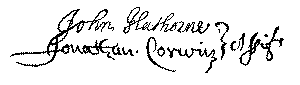
"Salem, March the 7th, 1691/2.—Sarah Good, Sarah Osburn,
and Tituba, an Indian woman, all sent to the jail in Boston,
according to their mittimuses, then sent to their
Majesties' jail-keeper."
It will be noticed that the magistrates did not venture to put into
this their final record, what they had unfairly tried to make Sarah
Osborn believe, that Sarah Good had been a witness against her. The
jail at Ipswich was at a distance of at least ten miles from the
village meeting-house, by any road that could then have been
travelled. The transference of the prisoners day after day must have
been very fatiguing to a sick woman like Sarah Osburn. Sarah Good
seems to have been able to bear it. Samuel Braybrook, an assistant
constable, having charge of her, says, that, on the way to Ipswich,
she "leaped off her horse three times;" that she "railed against the
magistrates, and endeavored to kill herself." He further testified,
that, at the very time she was performing these feats, Thomas Putnam's
daughter, "at her father's house, declared the same." As Braybrook was
many miles from Thomas Putnam's house, at the moment when his
wonderful daughter exercised this miraculous extent of vision, it
would have been more satisfactory to have had some other testimony to
the fact. I mention this to show of what stuff the evidence in these
cases was made, and the credulity with which every thing was
swallowed. The prisoners were put to examination each day.
Osburn and Good steadily maintained their innocence. Tituba all along
declared herself guilty, and accused the other two of having been
with her in confederacy with the Devil. Mr. Parris made the following
deposition, in relation to these examinations, to which he
subsequently swore in Court, at the trial of Sarah Good:—
"The Deposition of Sam: Parris, aged about thirty
and nine years.—Testifieth and saith, that Elizabeth
Parris, Jr., and Abigail Williams, and Ann Putnam, Jr., and
Elizabeth Hubbard, were most grievously and several times
tortured during the examination of Sarah Good, Sarah Osburn,
and Tituba, Indian, before the magistrates at Salem Village,
1 March, 1692. And the said Tituba being the last of the
above said that was examined, they, the above said afflicted
persons, were grievously distressed until the said Indian
began to confess, and then they were immediately all quiet
the rest of the said Indian woman's examination. Also Thomas
Putnam, aged about forty years, and Ezekiel Cheever, aged
about thirty and six years, testify to the whole of the
above said; and all the three deponents aforesaid further
testify, that, after the said Indian began to confess, she
was herself very much afflicted, and in the face of
authority at the same time, and openly charged the abovesaid
Good and Osburn as the persons that afflicted her, the
aforesaid Indian."
By comparing these depositions with the other documents I have
presented, it will be seen how admirably the whole affair was
arranged, so far as concerned the part played by Tituba. She commences
her testimony by declaring her innocence. The afflicted children are
instantly thrown into torments, which, however, subside as soon as
she begins to confess. Immediately after commencing her confession,
and as she proceeds in it, she herself becomes tormented "in the face
of authority," before the eyes of the magistrates and the awestruck
crowd. Her power to afflict ceases as she breaks loose from her
compact with the Devil, who sends some unseen confederate, not then
brought to light, to wreak his vengeance upon her for having
confessed. Tituba, as well as the girls, showed herself an adept in
the arts taught in the circle.
All we know of Sarah Osburn beyond this date are the following items
in the Boston jailer's bill "against the country," dated May 29, 1692:
"To chains for Sarah Good and Sarah Osburn, 14 shillings:" "To the
keeping of Sarah Osburn, from the 7th of March to the 10th of May,
when she died, being nine weeks and two days, £1. 3s. 5d."
The only further information we have of Tituba is from Calef, who
says, "The account she since gives of it is, that her master did beat
her, and otherwise abuse her, to make her confess and accuse (such as
he called) her sister-witches; and that whatsoever she said by way of
confessing or accusing others was the effect of such usage: her master
refused to pay her fees, unless she would stand to what she had said.
Calef further states that she laid in jail until finally "sold for her
fees." The jailer's charge for her "diet in prison for a year and a
month" appears in a shape that corroborates Calef's statements, which
were prepared for publication in 1697, and printed in London in 1700.
Although zealously devoted to the work of exposing the enormities
connected with the witchcraft prosecutions, there is no ground to
dispute the veracity of Calef as to matters of fact. What he says of
the declarations of Tituba, subsequent to her examination, is quite
consistent with a critical analysis of the details of the record of
that examination. It can hardly be doubted, whatever the amount of
severity employed to make her act the part assigned her, that she was
used as an instrument to give effect to the delusion.
Now let us consider the state of things that had been brought about in
the village, and in the surrounding country, at the close of the first
week in March, 1692. The terrible sufferings of the girls in Mr.
Parris's family and of their associates, for the two preceding months,
had become known far and wide. A universal sympathy was awakened in
their behalf; and a sentiment of horror sunk deep into all hearts, at
the dread demonstration of the diabolical rage in their afflicted and
tortured persons. A few, very few, distrusted; but the great majority,
ninety-nine in a hundred of all the people, were completely swept into
the torrent. Nathaniel Putnam and Nathaniel Ingersoll were entirely
deluded, and continued so to the end. Even Joseph Hutchinson was, for
a while, carried away. The physicians had all given their opinion that
the girls were suffering from an "evil hand." The neighboring
ministers, after a day's fasting and prayer, and a scrutinizing
inspection of the condition of the afflicted children, had given it,
as the result of their most solemn judgment, that it was a case of
witchcraft. Persons from the neighboring towns had come to the place,
and with their own eyes received demonstration of the same fact. Mr.
Parris made it the topic of his public prayers and preaching. The
girls, Sunday after Sunday, were under the malign influence, to the
disturbance and affrightment of the congregation. In all companies, in
all families, all the day long, the sufferings and distraction
occurring in the houses of Mr. Parris, Thomas Putnam, and others, and
in the meeting-house, were topics of excited conversation; and every
voice was loud in demanding, every mind earnest to ascertain, who were
the persons, in confederacy with the Devil, thus torturing, pinching,
convulsing, and bringing to the last extremities of mortal agony,
these afflicted girls. Every one felt, that, if the guilty authors of
the mischief could not be discovered, and put out of the way, no one
was safe for a moment. At length, when the girls cried out upon Good,
Osburn, and Tituba, there was a general sense of satisfaction and
relief. It was thought that Satan's power might be checked. The
selection of the first victims was well made. They were just the kind
of persons whom the public prejudice and credulity were prepared to
suspect and condemn. Their examination was looked for with the utmost
interest, and all flocked to witness the proceedings.
In considering the state of mind of the people, as they crowded into
and around the old meeting-house, we can have no difficulty in
realizing the tremendous effects of what there occurred. It was felt
that then, on that spot, the most momentous crisis in the world's
history had come. A crime, in comparison with which all other crimes
sink out of notice, was being notoriously and defiantly committed in
their midst. The great enemy of God and man was let loose among them.
What had filled the hearts of mankind for ages, the world over, with
dread apprehension, was come to pass; and in that village the great
battle, on whose issue the preservation of the kingdom of the Lord on
the earth was suspended, had begun. Indeed, no language, no imagery,
no conception of ours, can adequately express the feeling of awful and
terrible solemnity with which all were overwhelmed. No body of men
ever convened in a more highly wrought state of excitement than
pervaded that assembly, when the magistrates entered, in all their
stern authority, and the scene opened on the 1st of March, 1692. A
minister, probably Mr. Parris, began, according to the custom of the
times, with prayer. From what we know of his skill and talent in
meeting such occasions, it may well be supposed that his language and
manner heightened still more the passions of the hour. The marshal, of
tall and imposing stature and aspect, accompanied by his constables,
brought in the prisoners. Sarah Good, a poverty-stricken, wandering,
and wretched victim of ill-fortune and ill-usage, was put to the bar.
Every effort was made by the examining magistrate, aided by the
officious interference of the marshal, or other deluded or
evil-disposed persons,—who, like him, were permitted to interpose
with charges or abusive expressions,—to overawe and confound, involve
in contradictions, and mislead the poor creature, and force her to
confess herself guilty and accuse others. In due time, the "afflicted
children" were brought in; and a scene ensued, such as no person in
that crowd or in that generation had ever witnessed before.
Immediately on being confronted with the prisoner, and meeting her
eye, they fell, as if struck dead, to the floor; or screeched in
agony; or went into fearful spasms or convulsive fits; or cried out
that they were pricked with pins, pinched, or throttled by invisible
hands. They were severally brought up to the prisoner, and, upon
touching her person, instantly became calm, quiet, and fully restored
to their senses. With one voice they all declared that Sarah Good had
thus tormented them, by her power as a witch in league with the Devil.
The truth of this charge, in the effect produced by the malign
influence proceeding from her, was thus visible to all eyes. All saw,
too, how instantly upon touching her the diabolical effect ceased; the
malignant fluid passing back, like an electric stream, into the body
of the witch. The spectacle was repeated once and again, the acting
perfect, and the delusion consummated. The magistrates and all present
considered the guilt of the prisoner demonstrated, and regarded her as
wilfully and wickedly obstinate in not at once confessing what her
eyes, as well as theirs, saw. Her refusal to confess was considered as
the highest proof of her guilt. They passed judgment against her,
committed her to the marshal, who hurried her to prison, bound her
with cords, and loaded her with irons; for it was thought that no
ordinary fastenings could hold a witch. Similar proceedings, with
suitable variations, were had with Sarah Osburn and Tituba. The
confession of the last-named, the immediate relief thereafter of the
afflicted children, and the dreadful torments which Tituba herself
experienced, on the spot, from the unseen hand of the Devil wreaking
vengeance upon her, put the finishing touch to the delusion. The
excitement was kept up, and spread far and wide, by the officers and
magistrates riding in cavalcade, day after day, to and from the town
and village; and by the constables, with their assistants, carrying
their manacled prisoners from jail to jail in Ipswich, Salem, and
Boston.
The point was now reached when the accusers could safely strike at
higher game. But time was taken to mature arrangements. Great
curiosity was felt to know who the other two were whom Tituba saw in
connection with Good and Osburn in their hellish operations. The girls
continued to suffer torments and fall in fits, and were constantly
urged by large numbers of people, going from house to house to witness
their sufferings, to reveal who the witches were that still afflicted
them. When all was prepared, they began to cry out, with more or less
distinctness; at first, in significant but general descriptions, and
at last calling names. The next victim was also well chosen. An
account has been given, in the
First Part, of the notoriety which
circumstances had attached to Giles Corey. In 1691 he became a member
of the church, being then (Vol. I. p. 182) eighty years of age. Four
daughters, all probably by his first wife Margaret, the only children
of whom there is any mention, were married to John Moulton, John
Parker, and Henry Crosby, of Salem, and William Cleaves, of Beverly.
On the 11th of April, 1664, Corey was married to Mary Britt, who died,
as appears by the inscription on her gravestone in the old Salem
burial-ground, Aug. 27, 1684. Martha was his third wife. Her age is
unknown. It was entered on the record of the village church, at the
time of her admission to it, April 27, 1690; but the figures are worn
away from the edge of the page. She was a very intelligent and devout
person.
When the proceedings relating to witchcraft began, she did not approve
of them, and expressed her want of faith in the "afflicted children."
She discountenanced the whole affair, and would not follow the
multitude to the examinations; but was said to have spoken freely of
the course of the magistrates, saying that their eyes were blinded,
and that she could open them. It seemed to her clear that they were
violating common sense and the Word of God, and she was confident that
she could convince them of their errors. Instead of falling into the
delusion, she applied herself with renewed earnestness to keep her own
mind under the influence of prayer, and spent more time in devotion
than ever before. Her husband, however, was completely carried away by
the prevalent fanaticism, believed all he heard, and frequented the
examinations and the exhibitions of the afflicted children. This
disagreement became quite serious. Her preferring to stay at home,
shunning the proceedings, and expressing her disapprobation of what
was going on, caused an estrangement between them. Her peculiar course
created comment, in which he and two of his sons-in-law took part.
Some strong expressions were used by him, because she acted so
strangely at variance with everybody else. Her spending so much time
on her knees in devotion was looked upon as a matter of suspicion. It
was said that she tried to prevent him from following up the
examinations, and went so far as to remove the saddle from the horse
brought up to convey him to some meeting at the village connected with
the witchcraft excitement. Angry words, uttered by him, were heard and
repeated. As she was a woman of notable piety, a professor of
religion, and a member of the church, it was evident that her case, if
she were proceeded against, would still more heighten the panic, and
convulse the public mind. It would give ground for an idea which the
managers of the affair desired to circulate, that the Devil had
succeeded in making inroads into the very heart of the church, and was
bringing into confederacy with him aged and eminent church-members,
who, under color of their profession, threatened to extend his
influence to the overthrow of all religion. It was, indeed,
established in the popular sentiments, as a sign and mark of the
Devil's coming, that many professing godliness would join his
standard.
For a day or two, it was whispered round that persons in great repute
for piety were in the diabolical confederacy, and about to be
unmasked. The name of Martha Corey, whose open opposition to the
proceedings had become known, was passed among the girls in an
under-breath, and caught from one to another among those managing the
affair. On the 12th of March, Edward Putnam and Ezekiel Cheever,
having heard Ann Putnam declare that Goody Corey did often appear to
her, and torture her by pinching and otherwise, thought it their duty
to go to her, and see what she would say to this complaint; "she being
in church covenant with us." They mounted their horses about "the
middle of the afternoon," and first went to the house of Thomas Putnam
to see his daughter Ann, to learn from her what clothes Goody Corey
appeared to her in, in order to judge whether she might not have been
mistaken in the person. The girl told them, that Goody Corey, knowing
that they contemplated making this visit, had just appeared in spirit
to her, but had blinded her so that she could not tell what clothes
she wore. Highly wrought upon by the extraordinary statement of the
girl, which they received with perfect credulity, the two brethren
remounted, and pursued their way. Goody Corey had heard that her name
had been bandied about by the accusing girls: she also knew that it
was one of their arts to pretend to see the clothes people were
wearing at the time their spectres appeared to them. This required,
indeed, no great amount of necromancy; as it is not probable that
there was much variety in the costume of farmer's wives, at that time,
while about their ordinary domestic engagements.
They found her alone in her house. As soon as they commenced
conversation, "in a smiling manner she said, 'I know what you are come
for; you are come to talk with me about being a witch, but I am none:
I cannot help people's talking of me.'" Edward Putnam acknowledged
that their visit was in consequence of complaints made against her by
the afflicted children. She inquired whether they had undertaken to
describe the clothes she then wore. They answered that they had not,
and proceeded to repeat what Ann Putnam had said to them about her
blinding her so that she could not see her clothes. At this she
smiled, no doubt at Ann's cunning artifice to escape having to say
what dress she then had on. She declared to the two brethren, that
"she did not think that there were any witches." After considerable
talk, in which they did not get much to further their purpose, they
took their leave. The account of this interview, given by Putnam and
Cheever, indicates that Martha Corey was a sensible, enlightened, and
sprightly woman, perfectly free from the delusion of the day,
courteous in her manners and bearing, and a Christian, well grounded
in Scripture.
The two brethren returned forthwith to Thomas Putnam's house. Ann
told them that Goody Corey had not troubled her, nor her spectre
appeared, in their absence. She was not inclined to afford them an
opportunity to apply the test of the dress. Both the women showed
great acuteness and caution. As Corey expected the visit, and had
heard that the girls pretended to be able to say what dress persons
were wearing, she probably had attired herself in an unusual way on
the occasion, to put them at fault, and expose the falseness of their
claims to preternatural knowledge; and Ann Putnam—her sagacity
suggesting the risk she was running in the matter of Corey's
dress—took refuge in the pretence of blindness. The brethren were too
much under delusion to see through the sharp practice of both of them,
but considered the fact of Corey's inquiring of them whether Ann
described her dress, as, under the circumstances, proof positive
against the former.
Wishing to make assurance doubly sure, and to fasten the charge upon
Martha Corey, the managers of the affair sent for her to come to the
house of Thomas Putnam two days after this conference. Edward Putnam
was present, and testified that his niece Ann, immediately upon the
entrance of Goodwife Corey, experienced the most dreadful convulsions
and tortures and distinctly and positively declared that Corey was the
author of her sufferings. This was regarded as conclusive evidence;
and, on the 19th of March, a warrant was issued for her arrest. She
was brought to the house of Nathaniel Ingersoll, on Monday the 21st;
and the following is the account of her examination, in the
handwriting of Mr. Parris. The proceedings took place in the
meeting-house at the village. They were introduced by a prayer from
the Rev. Nicholas Noyes. On some of these occasions Mr. Hale and
perhaps others, but usually Mr. Noyes or Mr. Parris officiated. We may
suppose, from what we know of their general deportment in connection
with these scenes, that their performances, under the cover of a
devotional exercise, expressed and enforced a decided prejudgment of
the case in hand against the prisoners, and partook of the character
of indictments as much as of prayers.
"The Examination of Martha Corey.
"Mr. Hathorne: You are now in the hands of
authority. Tell me, now, why you hurt these persons.—I do
not.
"Who doth?—Pray, give me leave to go to prayer.
"(This request was made sundry times.)
"We do not send for you to go to prayer; but tell me why you
hurt these.—I am an innocent person. I never had to do with
witchcraft since I was born. I am a gospel woman.
"Do not you see these complain of you?—The Lord open the
eyes of the magistrates and ministers: the Lord show his
power to discover the guilty.
"Tell us who hurts these children.—I do not know.
"If you be guilty of this fact, do you think you can hide
it?—The Lord knows.
"Well, tell us what you know of this matter.—Why, I am a
gospel woman; and do you think I can have to do with
witchcraft too?
"How could you tell, then, that the child was bid to
observe what clothes you wore, when some came to speak with
you?
"(Cheever interrupted her, and bid her not begin with a lie;
and so Edward Putnam declared the matter.)
"Mr. Hathorne: Who told you that?—He said the
child said.
"Cheever: You speak falsely.
"(Then Edward Putnam read again.)
"Mr. Hathorne: Why did you ask if the child told
what clothes you wore?—My husband told me the others told.
"Who told you about the clothes? Why did you ask that
question?—Because I heard the children told what clothes
the others wore.
"Goodman Corey, did you tell her?
"(The old man denied that he told her so.)
"Did you not say your husband told you so?
"(No answer.)
"Who hurts these children? Now look upon them.—I cannot
help it.
"Did you not say you would tell the truth why you asked that
question? how came you to the knowledge?—I did but ask.
"You dare thus to lie in all this assembly. You are now
before authority. I expect the truth: you promised it. Speak
now, and tell who told you what clothes.—Nobody.
"How came you to know that the children would be examined
what clothes you wore?—Because I thought the child was
wiser than anybody if she knew.
"Give an answer: you said your husband told you.—He told me
the children said I afflicted them.
"How do you know what they came for? Answer me this truly:
will you say how you came to know what they came for?—I
had heard speech that the children said I troubled them, and
I thought that they might come to examine.
"But how did you know it?—I thought they did.
"Did not you say you would tell the truth? who told you what
they came for?—Nobody.
"How did you know?—I did think so.
"But you said you knew so.
"(Children: There is a man whispering in her ear.)
"Hathorne continued: What did he say to you?—We
must not believe all that these distracted children say.
"Cannot you tell what that man whispered?—I saw nobody.
"But did not you hear?—No.
"(Here was extreme agony of all the afflicted.)
"If you expect mercy of God, you must look for it in God's
way, by confession. Do you think to find mercy by
aggravating your sins?—A true thing.
"Look for it, then, in God's way.—So I do.
"Give glory to God and confess, then.—But I cannot confess.
"Do not you see how these afflicted do charge you?—We must
not believe distracted persons.
"Who do you improve to hurt them?—I improved none.
"Did not you say our eyes were blinded, you would open
them?—Yes, to accuse the innocent.
"(Then Crosby gave in evidence.)
"Why cannot the girl stand before you?—I do not know.
"What did you mean by that?—I saw them fall down.
"It seems to be an insulting speech, as if they could not
stand before you.—They cannot stand before others.
"But you said they cannot stand before you. Tell me what
was that turning upon the spit by you?—You believe the
children that are distracted. I saw no spit.
"Here are more than two that accuse you for witchcraft. What
do you say?—I am innocent.
"(Then Mr. Hathorne read further of Crosby's evidence.)
"What did you mean by that,—the Devil could not stand
before you?
"(She denied it. Three or four sober witnesses confirmed
it.)
"What can I do? Many rise up against me.
"Why, confess.—So I would, if I were guilty.
"Here are sober persons. What do you say to them? You are a
gospel woman; will you lie?
"(Abigail cried out, 'Next sabbath is sacrament-day; but she
shall not come there.')
"I do not care.
"You charge these children with distraction: it is a note of
distraction when persons vary in a minute; but these fix
upon you. This is not the manner of distraction.—When all
are against me, what can I help it?
"Now tell me the truth, will you? Why did you say that the
magistrates' and ministers' eyes were blinded, you would
open them?
"(She laughed, and denied it.)
"Now tell us how we shall know who doth hurt these, if you
do not?—Can an innocent person be guilty?
"Do you deny these words?—Yes.
"Tell us who hurts these. We came to be a terror to
evil-doers. You say you would open our eyes, we are
blind.—If you say I am a witch.
"You said you would show us.
"(She denied it.)
"Why do you not now show us?—I cannot tell: I do not know.
"What did you strike the maid at Mr. Tho. Putnam's with?—I
never struck her in my life.
"There are two that saw you strike her with an iron rod.—I
had no hand in it.
"Who had? Do you believe these children are bewitched?—They
may, for aught I know: I have no hand in it.
"You say you are no witch. Maybe you mean you never
covenanted with the Devil. Did you never deal with any
familiar?—No, never.
"What bird was that the children spoke of?
"(Then witnesses spoke: What bird was it?)
"I know no bird.
"It may be you have engaged you will not confess; but God
knows.—So he doth.
"Do you believe you shall go unpunished?—I have nothing to
do with witchcraft.
"Why was you not willing your husband should come to the
former session here?—But he came, for all.
"Did not you take the saddle off?—I did not know what it
was for.
"Did you not know what it was for?—I did not know that it
would be to any benefit.
"(Somebody said that she would not have them help to find
out witches.)
"Did you not say you would open our eyes? Why do you not?—I
never thought of a witch.
"Is it a laughing matter to see these afflicted persons?
"(She denied it. Several prove it.)
"Ye are all against me, and I cannot help it.
"Do not you believe there are witches in the country?—I do
not know that there is any.
"Do not you know that Tituba confessed it?—I did not hear
her speak.
"I find you will own nothing without several witnesses, and
yet you will deny for all.
"(It was noted, when she bit her lip, several of the
afflicted were bitten. When she was urged upon it that she
bit her lip, saith she, What harm is there in it?)
"(Mr. Noyes: I believe it is apparent she
practiseth witchcraft in the congregation: there is no need
of images.)
"What do you say to all these things that are apparent?—If
you will all go hang me, how can I help it?
"Were you to serve the Devil ten years? Tell how many.
"(She laughed. The children cried there was a yellow-bird
with her. When Mr. Hathorne asked her about it, she laughed.
When her hands were at liberty, the afflicted persons were
pinched.)
"Why do not you tell how the Devil comes in your shape, and
hurts these? You said you would.—How can I know how?
"Why did you say you would show us?
"(She laughed again.)
"What book is that you would have these children write
in?—What book? Where should I have a book? I showed them
none, nor have none, nor brought none.
"(The afflicted cried out there was a man whispering in her
ears.)
"What book did you carry to Mary Walcot?—I carried none. If
the Devil appears in my shape—
"(Then Needham said that Parker, some time ago, thought this
woman was a witch.)
"Who is your God?—The God that made me.
"What is his name?—Jehovah.
"Do you know any other name?—God Almighty.
"Doth he tell you, that you pray to, that he is God
Almighty?—Who do I worship but the God that made [me]?
"How many gods are there?—One.
"How many persons?—Three.
"Cannot you say, So there is one God in three blessed
persons?
[The answer is destroyed, being written in the fold of the
paper, and wholly worn off.]
"Do not you see these children and women are rational and
sober as their neighbors, when your hands are fastened?
"(Immediately they were seized with fits: and the
standers-by said she was squeezing her fingers, her hands
being eased by them that held them on purpose for trial.
"Quickly after, the marshal said, 'She hath bit her lip;'
and immediately the afflicted were in an uproar.)
"[Tell] why you hurt these, or who doth?
"(She denieth any hand in it.)
"Why did you say, if you were a witch, you should have no
pardon?—Because I am a —— woman."
"Salem Village, March the 21st, 1692.—The Reverend Mr.
Samuel Parris, being desired to take, in writing, the
examination of Martha Corey, hath returned it, as aforesaid.
"Upon hearing the aforesaid, and seeing what we did then
see, together with the charges of the persons then present,
we committed Martha Corey, the wife of Giles Corey, of Salem
Farms, unto the gaol in Salem, as per mittimus then given
out."
The foregoing is a full copy of the original document. One of Giles
Corey's daughters, Deliverance, had married, June 5, 1683, Henry
Crosby, who lived on land conveyed to him by her father in the
immediate neighborhood. He was the person whose written testimony was
read by the magistrate. Its purport seems to have been to prove that
Martha Corey had said that the accusing girls could not stand before
her, and that the Devil could not stand before her. She had,
undoubtedly, great confidence in her own innocence, and in the power
of truth and prayer, to silence false accusers, and expressed herself
in the forcible language which Parris's report of the examination
shows that she was well able to use. It is almost amusing to see how
the pride of the magistrates was touched, and their wrath kindled, by
what she was reported to have said, "that the magistrates' and
ministers' eyes were blinded, and that she would open them." It
rankled in Hathorne's breast: he returns to it again and again, and
works himself up to a higher degree of resentment on each recurrence.
Mr. Noyes's ire was roused, and he, too, put in a stroke. It will be
noticed, that she avoided a contradiction of her husband, and could
not be brought to give the names of persons from whom she had received
information. "If you will all go hang me, how can I help it?" "Ye are
all against me." "What can I do, when many rise up against me?" "When
all are against me, what can I [say to] help it?" Situated as she was,
all that she could do was to give them no advantage, or opportunity to
ensnare her, and to avoid compromising others; and it must be allowed
that she showed much presence and firmness of mind. Her request, made
at the opening of the examination, and at "sundry times," to "go to
prayer," somewhat confounded them. She probably was led to make and
urge the request particularly in consequence of the tenor of Mr.
Noyes's prayer at the opening. She felt that it was no more than fair
that there should be a prayer on her side, as well as on the other. It
might well be feared, that, if allowed to offer a prayer, coming from
a person in her situation, an aged professor, and one accustomed to
express herself in devotional exercises, it might produce a deep
impression upon the whole assembly. To refuse such a request had a
hard look; but, as the magistrates saw, it never would have done to
have permitted it. It would have reversed the position of all
concerned. The latter part of the examination has the appearance that
she was suspected to be unsound on a particular article of the
prevalent creed. It is much to be regretted that the abrasion of the
paper at the folding has obliterated her last answer to this part of
the inquisition. It is singular that Mr. Parris has left the blank in
her final answer. Probably she used her customary expression, "I am a
gospel woman." The writing, at this point, is very clear and distinct;
and a vacant space is left, just as it is given above.
The fact that Martha Corey was known to be an eminently religious
person, and very much given to acts of devotion, constituted a serious
obstacle, no doubt, in the way of the prosecutors. Parris's record of
the examination shows how they managed to get over it. They gave the
impression that her frequent and long prayers were addressed to the
Devil.
The disagreement between her and her husband, touching the witchcraft
prosecutions, brought him into a very uncomfortable predicament. With
his characteristic imprudence of speech, he had probably expressed
himself strongly against her unbelief in the sufferings of the girls
and her refusal to attend the exhibitions of their tortures, or the
examination of persons accused. He was, unquestionably, highly shocked
and incensed at her open repudiation of the whole doctrine of
witchcraft. Although he had become, in his old age, a professor and a
fervently religious man, perhaps he fell back, in his resentment of
her course, into his life-long rough phrases, and said that she acted
as though the Devil was in her. He might have said that she prayed
like a witch. Being entirely carried away by the delusion, he had his
own marvellous stories to tell about his cattle's being bewitched,
&c. His talk, undoubtedly, came to the ears of the prosecutors; and
they seem to have taken steps to induce him to come forward as a
witness against her. The following document is among the papers:—
"The evidence of Giles Corey testifieth and saith, that last
Saturday, in the evening, sitting by the fire, my wife asked
me to go to bed. I told her I would go to prayer; and, when
I went to prayer, I could not utter my desires with any
sense, nor open my mouth to speak.
"My wife did perceive it, and came towards me, and said she
was coming to me.
"After this, in a little space, I did, according to my
measure, attend the duty.
"Some time last week, I fetched an ox, well, out of the
woods about noon: and, he laying down in the yard, I went to
raise him to yoke him; but he could not rise, but dragged
his hinder parts, as if he had been hip-shot. But after did
rise.
"I had a cat sometimes last week strangely taken on the
sudden, and did make me think she would have died presently.
My wife bid me knock her in the head, but I did not; and
since, she is well.
"Another time, going to duties, I was interrupted for a
space; but afterward I was helped according to my poor
measure. My wife hath been wont to sit up after I went to
bed: and I have perceived her to kneel down on the hearth,
as if she were at prayer, but heard nothing.
"At the examination of Sarah Good and others, my wife was
willing
"March 24, 1692."
The foregoing document does not express the idea that he thought his
wife was a witch. He states what he observed, and what happened to him
and to his cattle. He evidently supposed they were bewitched, and that
he was obstructed, in going to prayer, in a strange manner; but he
does not, in terms, charge it upon her. It gives an interesting
insight of the innermost domestic life of the period, in a farmhouse,
and exhibits striking touches of the character and ways of these two
old people. It illustrates the state of the imagination prevailing
among those who were carried away by the delusion. If an ox had a
sprained muscle, or a cat a fit of indigestion, it was thought to be
the work of an evil hand. Poor old Giles had come late to a religious
life, and, it is to be feared, was a novice in prayer. It is no wonder
that he was not an adept in "uttering his desires," and experienced
occasionally some difficulty in arranging and expressing his
devotional sentiments.
There is something very singular in the appearance of the foregoing
deposition. Purporting to be a piece of testimony, it was not given in
the usual and regular way. It does not indicate before whom it was
made. It is not attested in the ordinary manner; apparently, was not
sworn to in the presence of persons authorized to act in such cases;
was never offered in court or anywhere. It is a disconnected paper
found among the remnants of the miscellaneous collection in the
clerk's office, and is evidently an unfinished document; the words in
Italics, at the close, being erased by a line running through them.
It is probable that the parties who tried to get the old man to
testify against his wife discovered that they could not draw any thing
from him to answer their designs, but that there was danger that his
evidence would be favorable to her, and gave up the attempt to use him
on the occasion. The fact that he would not lend himself to their
purposes perhaps led to resentment on their part, which may explain
the subsequent proceedings against him.
The document, in its chirography, suggests the idea that it was
written by Mr. Noyes, which is not improbable, as Corey was a member
of his congregation and church. Noyes was deeply implicated in the
prosecutions, and violent in driving them on. The handwriting of the
original papers reveals the agency of those who were the most busy in
procuring evidence against persons accused. That of Thomas Putnam
occurs in very many instances. But Mr. Parris was, beyond all others,
the busiest and most active prosecutor. The depositions of the child
Abigail Williams, his niece and a member of his family, were written
by him, as also a great number of others. He took down most of the
examinations, put in a deposition of his own whenever he could, and
was always ready to indorse those of others.
It will be remembered, that, when Tituba was put through her
examination, she said "four women sometimes hurt the children." She
named Good and Osburn, but pretended to have been blinded as to the
others. Martha Corey was, in due time, as we have seen, brought out.
The fourth was the venerable head of a large and prominent family, and
a member of the mother-church in Salem. She had never transferred her
relations to the village church, with which, however, she had
generally worshipped, and probably communed. Being one of the chief
matrons of the place, she was seated in the meeting-house with ladies
of similar age and standing, occupying the same bench or compartment
with the widow of Thomas Putnam, Sr. The women were seated separately
from the men; and the only rule applied among them was eminence in
years and respectability.
It has always been considered strange and unaccountable, that a person
of such acknowledged worth as Rebecca Nurse, of infirm health and
advanced years, should have been selected among the early victims of
the witchcraft prosecutions. Jealousies and prejudices, such as often
infest rural neighborhoods, may have been engendered, in minds open to
such influences, by the prosperity and growing influence of her
family. It may be that animosities kindled by the long and violent
land controversy, with which many parties had been incidentally
connected, lingered in some breasts. There are decided indications,
that the passions awakened by the angry contest between the village
and "Topsfield men," and which the collisions of a half-century had
all along exasperated and hardened, may have been concentrated against
the Nurses. Isaac Easty, whose wife was a sister of Rebecca Nurse, and
the Townes, who were her brothers or near kinsmen, were the leaders
of the Topsfield men. It is a significant circumstance, in this
connection, that to one of the most vehement resolutions passed at
meetings of the inhabitants of the village, against the claims of
Topsfield, Samuel Nurse, her eldest son, and Thomas Preston, her
eldest son-in-law, entered their protest on the record; and, on
another similar occasion, her husband Francis Nurse, her son Samuel,
and two of her sons-in-law, Preston and Tarbell, took the same course.
So far as the family sided with Topsfield in that controversy, it
naturally exposed them to the ill-will of the people of the village.
An analysis of the names and residences of the persons proceeded
against, throughout the prosecutions, will show to what an extent
hostile motives were supplied from this quarter. The families of
Wildes, How, Hobbs, Towne, Easty, and others who were "cried out" upon
by the afflicted children, occupied lands claimed by parties adverse
to the village. What, more than all these causes, was sufficient to
create a feeling against the Nurses, is the fact that they were
opposed to the party which had existed from the beginning in the
parish composed originally of the friends of Bayley. To crown the
whole, when the excitement occasioned by the extraordinary doings in
Mr. Parris's family began to display itself, and the "afflicted
children" were brought into notice, the members of this family, with
the exception, for a time, of Thomas Preston, discountenanced the
whole thing. They absented themselves from meeting, on account of the
disturbances and disorders the girls were allowed to make during the
services of worship, in the congregation, on the Lord's Day.
Unfriendly remarks, from whatever cause, made in the hearing of the
girls, provided subjects for them to act upon. Some persons behind
them, suggesting names in this way, whether carelessly or with
malicious intent, were guilty of all the misery that was created and
blood that was shed.
It became a topic of rumor, that Rebecca Nurse was soon to be brought
out. It reached the ears of her friends, and the following document
comes in at this point:—
"We whose names are underwritten being desired to go to
Goodman Nurse his house, to speak with his wife, and to tell
her that several of the afflicted persons mentioned her; and
accordingly we went, and we found her in a weak and low
condition in body as she told us, and had been sick almost a
week. And we asked how it was otherwise with her: and she
said she blessed God for it, she had more of his presence in
this sickness than sometime she have had, but not so much as
she desired; but she would, with the apostle, press forward
to the mark; and many other places of Scripture to the like
purpose. And then, of her own accord, she began to speak of
the affliction that was amongst them, and in particular of
Mr. Parris his family, and how she was grieved for them,
though she had not been to see them, by reason of fits that
she formerly used to have; for people said it was awful to
behold: but she pitied them with all her heart, and went to
God for them. But she said she heard that there was persons
spoke of that were as innocent as she was, she believed;
and, after much to this purpose, we told her we heard that
she was spoken of also. 'Well,' she said, 'if it be so, the
will of the Lord be done:' she sat still a while, being as
it were amazed; and then she said, 'Well, as to this thing I
am as innocent as the child unborn; but surely,' she said,
'what sin hath God found out in me unrepented of, that he
should lay such an affliction upon me in my old age?' and,
according to our best observation, we could not discern that
she knew what we came for before we told her.
Israel Porter,
Elizabeth Porter.
"To the substance of what is above, we, if called thereto,
are ready to testify on oath.
Daniel Andrew,
Peter Cloyse."
Elizabeth Porter, who joins her husband in making this statement, was
a sister of John Hathorne, the examining magistrate, and the
mother-in-law of Joseph Putnam, who was among the very few that
condemned the proceedings from the first. She stood, therefore,
between the two parties. The character of each of the signers and
indorsers of this interesting paper is sufficient proof that its
statements are truthful. It cannot but excite the most affecting
sensibilities in every breast. This venerable lady, whose conversation
and bearing were so truly saint-like, was an invalid of extremely
delicate condition and appearance, the mother of a large family,
embracing sons, daughters, grandchildren, and one or more
great-grandchildren. She was a woman of piety, and simplicity of
heart. In all probability, she shared in the popular belief on the
subject of witchcraft, and supposed that the sufferings of the
children were real, and that they were afflicted by an "evil hand." At
the very time that she was sorrowfully sympathizing with them and Mr.
Parris's family, and praying for them, they were circulating
suspicions against her, and maturing their plans for her destruction.
Rebecca Nurse was a daughter of William Towne, of Yarmouth, Norfolk
County, England, where she was baptized, Feb. 21, 1621. Her sister
Mary, who married Isaac Easty, was baptized at the same place, Aug.
24, 1634. The records of the First Church at Salem, Sept. 3, 1648,
give the baptism of "Joseph and Sarah, children of Sister Towne."
Sarah was at that time seven years of age. She became the wife of
Edmund Bridges, and afterwards of Peter Cloyse.
On the 23d of March, a warrant was issued, on complaint of Edward
Putnam, and Jonathan, son of John Putnam, for the arrest of "Rebecca,
wife of Francis Nurse;" and the next morning, at eight o'clock, she
was brought to the house of Nathaniel Ingersoll, in the custody of
George Herrick, the marshal of Essex. There were several distinct
indictments, four of which, for having practised "certain detestable
arts called witchcraft" upon Ann Putnam, Mary Walcot, Elizabeth
Hubbard, and Abigail Williams, are preserved. The examination took
place forthwith at the meeting-house. The age, character, connections,
and appearance of the prisoner, made the occasion one of the extremest
interest. Hathorne, the magistrate, began the proceedings by
addressing one of the afflicted: "What do you say? Have you seen this
woman hurt you?" The answer was, "Yes, she beat me this morning."
Hathorne, addressing another of the afflicted, said, "Abigail, have
you been hurt by this woman?" Abigail answered, "Yes." At that point,
Ann Putnam fell into a grievous fit, and, while in her spasms, cried
out that it was Rebecca Nurse who was thus afflicting her. As soon as
Ann's fit was over, and order restored, Hathorne said, "Goody Nurse,
here are two, Ann Putnam the child, and Abigail Williams, complain of
your hurting them. What do you say to it?" The prisoner replied, "I
can say, before my eternal Father, I am innocent, and God will clear
my innocency." Hathorne, apparently touched for the moment by her
language and bearing, said, "Here is never a one in the assembly but
desires it; but, if you be guilty, pray God discover you." Henry
Kenney rose up from the body of the assembly to speak. Hathorne
permitted the interruption, and said, "Goodman Kenney, what do you
say?" Then Kenney complained of the prisoner, "and further said, since
this Nurse came into the house, he was seized twice with an amazed
condition." Hathorne, addressing the prisoner, said, "Not only these,
but the wife of Mr. Thomas Putnam, accuseth you by credible
information, and that both of tempting her to iniquity and of greatly
hurting her." The prisoner again affirmed her innocence, and said, in
answer to the charge of having hurt these persons, that "she had not
been able to get out of doors these eight or nine days." Hathorne
then called upon Edward Putnam, who, as the record says, "gave in his
relate," which undoubtedly was a statement of his having seen the
afflicted in their sufferings, and heard them accuse Rebecca Nurse as
their tormentor. Hathorne said, "Is this true, Goody Nurse?" She
denied that she had ever hurt them or any one else in her life.
Hathorne repeated, "You see these accuse you: is it true?" She
answered, "No." He again put the question, "Are you an innocent person
relating to this witchcraft?" It seems, from his manner, that he was
beginning really to doubt whether she might not be innocent; and
perhaps the feeling of the multitude was yielding in her favor.
Here Thomas Putnam's wife cried out, "Did you not bring the black man
with you? Did you not bid me tempt God, and die? How oft have you eat
and drank your own damnation?" This sudden outbreak, from such a
source, accompanied with the wild and apparently supernatural energy
and uncontrollable vehemence with which the words were uttered, roused
the multitude to the utmost pitch of horror; and the prisoner seems to
have been shocked at the dreadful exhibition of madness in the woman
and in the assembly. Releasing her hands from confinement, she spread
them out towards heaven, and exclaimed, "O Lord, help me!" Instantly,
the whole company of the afflicted children "were grievously vexed."
After a while, the tumult subsided, and Hathorne again addressed her,
"Do you not see what a solemn condition these are in? When your hands
are loosed, the persons are afflicted." Then Mary Walcot and Elizabeth
Hubbard came forward, and accused her. Hathorne again addressed her,
"Here are these two grown persons now accuse. What say you? Do not you
see these afflicted persons, and hear them accuse you?" She answered,
"The Lord knows I have not hurt them. I am an innocent person."
Hathorne continued, "It is very awful to all to see these agonies, and
you, an old professor, thus charged with contracting with the Devil by
the effects of it, and yet to see you stand with dry eyes where there
are so many wet." She answered, "You do not know my heart." Hathorne,
"You would do well, if you are guilty, to confess, and give glory to
God."—"I am as clear as the child unborn." Hathorne continued, "What
uncertainty there may be in apparitions, I know not: yet this with me
strikes hard upon you, that you are, at this very present, charged
with familiar spirits,—this is your bodily person they speak to; they
say now they see these familiar spirits come to your bodily person.
Now, what do you say to that?"—"I have none, sir."—"If you have,
confess, and give glory to God. I pray God clear you, if you be
innocent, and, if you are guilty, discover you; and therefore give me
an upright answer. Have you any familiarity with these spirits?"—"No:
I have none but with God alone." It looks as if again the magistrate
began to open his mind to a fair view of the case. He seems to have
sought satisfaction in reference to all the charges that had been
made against her. She was suffering from infirmities of body, the
result not only of age, but of the burdens of life often pressing down
the physical frame, particularly of those who have borne large
families of children. The magistrate had heard some malignant gossip
of this kind, and he asked, "How came you sick? for there is an odd
discourse of that in the mouths of many." She replied that she
suffered from weakness of stomach. He inquired, more specifically,
"Have you no wounds?" Her answer was, that her ailments and
weaknesses, all her bodily infirmities, were the natural effects of
what she had experienced in a long life. "I have none but old
age."—"You do know whether you are guilty, and have familiarity with
the Devil; and now, when you are here present, to see such a thing as
these testify,—a black man whispering in your ear, and birds about
you,—what do you say to it?"—"It is all false: I am
clear."—"Possibly, you may apprehend you are no witch; but have you
not been led aside by temptations that way?"—"I have not." At this
point, it almost seems that Hathorne was yielding to the moral effect
of the evidence she bore in her deportment and language, the impress
of conscious innocence in her countenance, and the manifestation of
true Christian purity and integrity in her whole manner and bearing.
Instead of pressing her with further interrogatories, he gave way to
an expression, in the form of a soliloquy or ejaculation, "What a sad
thing is it, that a church-member here, and now another of Salem,
should thus be accused and charged!" Upon hearing this rather
ambiguous expression of the magistrate, Mrs. Pope fell into a grievous
fit.
Mrs. Pope was the wife of Joseph Pope, living with his mother, the
widow Gertrude Pope, on the farm shown on the map. She had followed up
the meetings of the circle, been a constant witness of the sufferings
of the "afflicted children," and attended all the public examinations,
until her nervous system was excited beyond restraint, and for a while
she went into fits and her imagination was bewildered. She acted with
the accusers, and participated in their sufferings. On some occasions,
her conduct was wild and extravagant to the highest degree. At the
examination of Martha Corey, she was conspicuous for the violence of
her actions. In the midst of the proceedings, and in the presence of
the magistrates and hundreds of people, she threw her muff at the
prisoner; and, that missing, pulled off her shoe, and, more successful
this time, hit her square on the head. Hers seems, however, to have
been a case of mere delusion, amounting to temporary insanity. That it
was not deliberate and cold-blooded imposture is rendered probable by
the fact, that she was rescued from the hallucination, and, with her
husband, among the foremost to deplore and denounce the whole affair.
But, when a woman of her position acted in this manner, on such an
occasion, and then went into convulsions, and the whole company of
afflicted persons joined in, the confusion, tumult, and frightfulness
of the scene can hardly be imagined, certainly it cannot be described
in words.
Quiet being restored, Hathorne proceeded: "Tell us, have you not had
visible appearances, more than what is common in nature?"—"I have
none, nor never had in my life."—"Do you think these suffer voluntary
or involuntary?"—"I cannot tell."—"That is strange: every one can
judge."—"I must be silent."—"They accuse you of hurting them; and,
if you think it is not unwillingly, but by design, you must look upon
them as murderers."—"I cannot tell what to think of it." This answer
was considered as very aspersive in its bearing upon the witnesses,
and she was charged with having called them murderers. Being hard of
hearing, she did not always take in the whole import of questions put
to her. She denied that she said she thought them murderers; all she
said, and that she stood to to the last, was that she could not tell
what to make of their conduct. Finally, Hathorne put this question,
and called for an answer, "Do you think these suffer against their
wills or not?" She answered, "I do not think these suffer against
their wills." To this point she was not afraid or unwilling to go, in
giving an opinion of the conduct of the accusing girls. Infirm, half
deaf, cross-questioned, circumvented, surrounded with folly, uproar,
and outrage, as she was, they could not intimidate her to say less, or
entrap her to say more.
Then another line of criminating questions was started by the
magistrate: "Why did you never visit these afflicted
persons?"—"Because I was afraid I should have fits too." On every
motion of her body, "fits followed upon the complainants, abundantly
and very frequently." As soon as order was again restored, Hathorne,
being, as he always was, wholly convinced of the reality of the
sufferings of the "afflicted children," addressed her thus, "Is it not
an unaccountable case, that, when you are examined, these persons are
afflicted?" Seeing that he and the whole assembly put faith in the
accusers, her only reply was, "I have got nobody to look to but God."
As she uttered these words, she naturally attempted to raise her
hands, whereupon "the afflicted persons were seized with violent fits
of torture." After silence was again restored, the magistrate pressed
his questions still closer. "Do you believe these afflicted persons
are bewitched?" She answered, "I do think they are." It will be
noticed that there was this difference between Rebecca Nurse and
Martha Corey: The latter was an utter heretic on the point of the
popular faith respecting witchcraft; she did not believe that there
were any witches, and she looked upon the declarations and actions of
the "afflicted children" as the ravings of "distracted persons." The
former seems to have held the opinions of the day, and had no
disbelief in witchcraft: she was willing to admit that the children
were bewitched; but she knew her own innocence, and nothing could move
her from the consciousness of it. Mr. Hathorne continued, "When this
witchcraft came upon the stage, there was no suspicion of Tituba, Mr.
Parris's Indian woman. She professed much love to that child,—Betty
Parris; but it was her apparition did the mischief: and why should not
you also be guilty, for your apparition doth hurt also?" Her answer
was, "Would you have me belie myself?" Weary, probably, of the
protracted proceedings, her head drooped on one side; and forthwith
the necks of the afflicted children were bent in the same way. This
new demonstration of the diabolical power that proceeded from her
filled the house with increased awe, and spread horrible conviction of
her guilt through all minds. Elizabeth Hubbard's neck was fixed in
that direction, and could not be moved. Abigail Williams cried out,
"Set up Goody Nurse's head, the maid's neck will be broke." Whereupon,
some persons held the prisoner's head up, and "Aaron Way observed that
Betty Hubbard's was immediately righted." To consummate the effect of
the whole proceeding, Mr. Parris, by direction of the magistrates,
"read what he had in characters taken from Mr. Thomas Putnam's wife in
her fits." We shall come to the matter thus introduced by Mr. Parris,
at a future stage of the story. It is sufficient here to say, that it
contained the most positive and minute declarations that the
apparition of Rebecca Nurse had appeared to her, on several occasions,
and horribly tortured her. After hearing Parris's statement, Hathorne
asked the prisoner, "What do you think of this?" Her reply was, "I
cannot help it: the Devil may appear in my shape." It may be
mentioned, that Mrs. Ann Putnam was present during this examination,
and, in the course of it, went into the most dreadful bodily agony,
charging it on Rebecca Nurse. Her sufferings were so violent, and held
on so long, that the magistrates gave permission to her husband to
carry her out of the meeting-house, to free her from the malignant
presence of the prisoner. The record of the examination closes thus:—
"Salem Village, March 24th, 1691/2.—The Reverend Mr. Samuel
Parris, being desired to take in writing the examination of
Rebecca Nurse, hath returned it as aforesaid.
"Upon hearing the aforesaid, and seeing what we then did
see, together with the charges of the persons then present,
we committed Rebecca Nurse, the wife of Francis Nurse of
Salem Village, unto Her Majesty's jail in Salem, as per
mittimus then given out, in order to further examination."
The presence of Ann Putnam, the mother, on this occasion; the
statement from her, read by Mr. Parris; and the terrible sufferings
she exhibited, produced, no doubt, a deep effect upon the magistrates
and all present. Her social position and personal appearance
undoubtedly contributed to heighten it. For two months, her house had
been the constant scene of the extraordinary actings of the circle of
girls of which her daughter and maid-servant were the leading
spirits. Her mind had been absorbed in the mysteries of spiritualism.
The marvels of necromancy and magic had been kept perpetually before
it. She had been living in the invisible world, with a constant sense
of supernaturalism surrounding her. Unconsciously, perhaps, the
passions, prejudices, irritations, and animosities, to which she had
been subject, became mixed with the vagaries of an excited
imagination; and, laid open to the inroads of delusion as her mind had
long been by perpetual tamperings with spiritual ideas and phantoms,
she may have lost the balance of reason and sanity. This, added to a
morbid sensibility, probably gave a deep intensity to her voice,
action, and countenance. The effect upon the excited multitude must
have been very great. Although she lived to realize the utter
falseness of all her statements, her monstrous fictions were felt by
her, at the time, to be a reality.
In concluding his report of this examination, Mr. Parris says, "By
reason of great noises by the afflicted and many speakers, many things
are pretermitted." He was probably quite willing to avoid telling the
whole story of the disgraceful and shocking scenes enacted in the
meeting-house that day. Deodat Lawson was present during the earlier
part of the proceedings. He says that Mr. Hale began with prayer; that
the prisoner "pleaded her innocency with earnestness;" that, at the
opening, some of the girls, Mary Walcot among them, declared that the
prisoner had never hurt them. Presently, however, Mary Walcot screamed
out that she was bitten, and charged it upon Rebecca Nurse. The marks
of teeth were produced on her wrist. Lawson says, "It was so disposed
that I had not leisure to attend the whole time of examination." The
meaning is, I suppose, that he desired to withdraw into the
neighboring fields to con over his manuscript, and make himself more
able to perform with effect the part he was to act that afternoon.
"There was once," he says, "such an hideous screech and noise (which I
heard as I walked at a little distance from the meeting-house) as did
amaze me; and some that were within told me the whole assembly was
struck with consternation, and they were afraid that those that sat
next to them were under the influence of witchcraft." The whole
congregation was in an uproar, every one afflicted by and affrighting
every other, amid a universal outcry of terror and horror.
As it was a part of the policy of the managers of the business to
utterly overwhelm the influence of all natural sentiment in the
community, they coupled with this proceeding against a venerable and
infirm great-grandmother, another of the same kind against a little
child. Immediately after the examination of Rebecca Nurse was
concluded, Dorcas, a daughter of Sarah Good, was brought before the
magistrates. She was between four and five years old. Lawson says,
"The child looked hale and well as other children." A warrant had been
issued for her apprehension, the day before, on complaint of Edward
and Jonathan Putnam. Herrick the marshal, who was a man that magnified
his office, and of much personal pride, did not, perhaps, fancy the
idea of bringing up such a little prisoner; and he deputized the
operation to Samuel Braybrook, who, the next morning, made return, in
due form, that "he had taken the body of Dorcas Good," and sent her to
the house of Nathaniel Ingersoll, where she was in custody. It seems
that Braybrook did not like the job, and passed the handling of the
child over to still another. Whoever performed the service probably
brought her in his arms, or on a pillion. The little thing could not
have walked the distance from Benjamin Putnam's farm. When led in to
be examined, Ann Putnam, Mary Walcot, and Mercy Lewis, all charged her
with biting, pinching, and almost choking them. The two former went
through their usual evolutions in the presence of the awe and terror
stricken magistrates and multitude. They showed the marks of her
little teeth on their arms; and the pins with which she pricked them
were found on their bodies, precisely where, in their shrieks, they
had averred that she was piercing them. The evidence was considered
overwhelming; and Dorcas was, per mittimus, committed to the jail,
where she joined her mother. By the bill of the Boston jailer, it
appears that they both were confined there: as they were too poor to
provide for themselves, "the country" was charged with ten shillings
for "two blankets for Sarah Good's child." The mother, we know, was
kept in chains; the child was probably chained too. Extraordinary
fastenings, as has been stated, were thought necessary to hold a
witch.
There was no longer any doubt, in the mass of the community, that the
Devil had effected a lodgement at Salem Village. Church-members,
persons of all social positions, of the highest repute and profession
of piety, eminent for visible manifestations of devotion, and of every
age, had joined his standard, and become his active allies and
confederates.
The effect of these two examinations was unquestionably very great in
spreading consternation and bewilderment far and wide; but they were
only the prelude to the work, to that end, arranged for the day. The
public mind was worked to red heat, and now was the moment to strike
the blow that would fix an impression deep and irremovable upon it. It
was Thursday, Lecture-day; and the public services usual on the
occasion were to be held at the meeting-house.
Deodat Lawson had arrived at the village on the 19th of March, and
lodged at Deacon Ingersoll's. The fact at once became known; and Mary
Walcot immediately went to the deacon's to see him. She had a fit on
the spot, which filled Lawson with amazement and horror. His turn of
mind led him to be interested in such an excitement; and he had become
additionally and specially exercised by learning that the afflicted
persons had intimated that the deaths of his wife and daughter, which
occurred during his ministry at the village, had been brought about by
the diabolical agency of the persons then beginning to be unmasked,
and brought to justice. He was prepared to listen to the hints thus
thrown out, and was ready to push the prosecutions on with an
earnestness in which resentment and rage were mingled with the
blindest credulity. After Mary Walcot had given him a specimen of what
the girls were suffering, he walked over, early in the evening, to Mr.
Parris's house; and there Abigail Williams went into the craziest
manifestations, throwing firebrands about the house in the presence of
her uncle, rushing to the back of the chimney as though she would fly
up through its wide flue, and performing many wonderful works. The
next day being Sunday, he preached; and the services were interrupted,
in the manner already described, by the outbreaks of the afflicted,
under diabolic influence. The next day, he attended the examination of
Martha Corey. On Wednesday, the 23d, he went up to Thomas Putnam's, as
he says, "on purpose to see his wife." He "found her lying on the bed,
having had a sore fit a little before: her husband and she both
desired me to pray with her while she was sensible, which I did,
though the apparition said I should not go to prayer. At the first
beginning, she attended; but, after a little time, was taken with a
fit, yet continued silent, and seemed to be asleep." She had
represented herself as being in conflict with the shape, or spectre,
of a witch, which, she told Lawson, said he should not pray on the
occasion. But he courageously ventured on the work. At the conclusion
of the prayer, "her husband, going to her, found her in a fit. He took
her off the bed to sit her on his knees; but at first she was so stiff
she could not be bended, but she afterwards sat down." Then she went
into that state of supernatural vision and exaltation in which she was
accustomed to utter the wildest strains, in fervid, extravagant, but
solemn and melancholy, rhapsodies: she disputed with the spectre about
a text of Scripture, and then poured forth the most terrible
denunciations upon it for tormenting and tempting her. She was
evidently a very intellectual and imaginative woman, and was perfectly
versed in all the imagery and lofty diction supplied by the prophetic
and poetic parts of Scripture. Again she was seized with a terrible
fit, that lasted "near half an hour." At times, her mouth was drawn on
one side and her body strained. At last she broke forth, and
succeeded, after many violent struggles against the spectre and many
convulsions of her frame, in saying what part of the Bible Lawson was
to read aloud, in order to relieve her. "It is," she said, "the third
chapter of the Revelation."—"I did," says Lawson, "something scruple
the reading it." He was loath to be engaged in an affair of that kind
in which the Devil was an actor. At length he overcame his scruples,
and the effect was decisive. "Before I had near read through the first
verse, she opened her eyes, and was well." Bewildered and amazed, he
went back to Parris's house, and they talked over the awful
manifestations of Satan's power. The next morning, he attended the
examination of Rebecca Nurse, retiring from it, at an early hour, to
complete his preparation for the service that had been arranged for
him that afternoon.
I say arranged, because the facts in this case prove long-concerted
arrangement. He was to preach a sermon that day. Word must have been
sent to him weeks before. After reaching the village, every hour had
been occupied in exciting spectacles and engrossing experiences,
filling his mind with the fanatical enthusiasm requisite to give force
and fire to the delivery of the discourse. He could not possibly have
written it after coming to the place. He must have brought it in his
pocket. It is a thoroughly elaborated and carefully constructed
performance, requiring long and patient application to compose it, and
exhausting all the resources of theological research and reference,
and of artistic skill and finish. It is adapted to the details of an
occasion which was prepared to meet it. Not only the sermon but the
audience were the result of arrangement carefully made in the stages
of preparation and in the elements comprised in it. The preceding
steps had all been seasonably and appositely taken, so that, when the
regular lecture afternoon came, Lawson would have his voluminous
discourse ready, and a congregation be in waiting to hear it, with
minds suitably wrought upon by the preceding incidents of the day, to
be thoroughly and permanently impressed by it. The occasion had been
heralded by a train of circumstances drawing everybody to the spot.
The magistrates were already there, some of them by virtue of the
necessity of official presence in the earlier part of the day, and
others came in from the neighborhood; the ministers gathered from the
towns in the vicinity; men and women came from all quarters, flocking
along the highways and the by-ways, large numbers on horseback, and
crowds on foot. Probably the village meeting-house, and the grounds
around it, presented a spectacle such as never was exhibited
elsewhere. Awe, dread, earnestness, a stern but wild fanaticism, were
stamped on all countenances, and stirred the heaving multitude to its
depths, and in all its movements and utterances. It is impossible to
imagine a combination of circumstances that could give greater
advantage and power to a speaker, and Lawson was equal to the
situation. No discourse was ever more equal, or better adapted, to its
occasion. It was irresistible in its power, and carried the public
mind as by storm.
The text is Zechariah, iii. 2: "And the Lord said unto Satan, The Lord
rebuke thee, O Satan! even the Lord that hath chosen Jerusalem rebuke
thee: is not this a brand plucked out of the fire?" After an allusion
to the rebellion of Satan, and his fall from heaven with his "accursed
legions," and after representing them as filled "with envy and malice
against all mankind," seeking "by all ways and means to work their
ruin and destruction for ever, opposing to the utmost all persons and
things appointed by the Lord Jesus Christ as means or instruments of
their comfort here or salvation hereafter," he proceeds, in the manner
of those days, to open his text and spread out his subject, all along
exhibiting great ability, skill, and power, showing learning in his
illustrations, drawing aptly and abundantly from the Scriptures, and,
at the right points, rising to high strains of eloquence in diction
and imagery.
He describes, at great length and with abundant instances ingeniously
selected from sacred and profane literature, the marvellous power with
which Satan is enabled to operate upon mankind. He says,—
"He is a spirit, and hence strikes at the spiritual part,
the most excellent (constituent) part of man. Primarily
disturbing and interrupting the animal and vital spirits, he
maliciously operates upon the more common powers of the soul
by strange and frightful representations to the fancy or
imagination; and, by violent tortures of the body, often
threatening to extinguish life, as hath been observed in
those that are afflicted amongst us. And not only so, but he
vents his malice in diabolical operations on the more
sublime and distinguishing faculties of the rational soul,
raising mists of darkness and ignorance in the
understanding.... Sometimes he brings distress upon the
bodies of men, by malignant operations in, and diabolical
impressions on, the spirituous principle or vehicle of life
and motion.... There are certainly some lower operations of
Satan (whereof there are sundry examples among us), which
the bodies and souls of men and women are liable unto. And
whosoever hath carefully observed those things must needs be
convinced, that the motions of the persons afflicted, both
as to the manner and as to the violence of them, are the
mere effects of diabolical malice and operations, and that
it cannot rationally be imagined to proceed from any other
cause whatever.... Satan exerts his malice mediately by
employing some of mankind and other creatures, and he
frequently useth other persons or things, that his designs
may be the more undiscernible. Thus he used the serpent in
the first temptation (Gen. iii. 1). Hence he contracts and
indents with witches and wizards, that they shall be the
instruments by whom he may more secretly affect and afflict
the bodies and minds of others; and, if he can prevail upon
those that make a visible profession, it may be the better
covert unto his diabolical enterprise, and may the more
readily pervert others to consenting unto his subjection. So
far as we can look into those hellish mysteries, and guess
at the administration of that kingdom of darkness, we may
learn that witches make witches by persuading one the other
to subscribe to a book or articles, &c.; and the Devil,
having them in his subjection, by their consent, he will use
their bodies and minds, shapes and representations, to
affright and afflict others at his pleasure, for the
propagation of his infernal kingdom, and accomplishing his
devised mischiefs to the souls, bodies, and lives of the
children of men, yea, and of the children of God too, so far
as permitted and is possible.... He insinuates into the
society of the adopted children of God, in their most solemn
approaches to him, in sacred ordinances, endeavoring to look
so like the true saints and ministers of Christ, that, if it
were possible, he would deceive the very elect (Matt. xxiv.
24) by his subtilty: for it is certain he never works more
like the Prince of darkness than when he looks most like an
angel of light; and, when he most pretends to holiness, he
then doth most secretly, and by consequence most surely,
undermine it, and those that most excel in the exercise
thereof."
The following is a specimen of the style in which he stirred up the
people:—
"The application of this doctrine to ourselves remains now
to be attended. Let it be for solemn warning and awakening
to all of us that are before the Lord at this time, and to
all others of this whole people, who shall come to the
knowledge of these direful operations of Satan, which the
holy God hath permitted in the midst of us.
"The Lord doth terrible things amongst us, by lengthening
the chain of the roaring lion in an extraordinary manner, so
that the Devil is come down in great wrath (Rev. xii. 12),
endeavoring to set up his kingdom, and, by racking torments
on the bodies, and affrightening representations to the
minds of many amongst us, to force and fright them to become
his subjects. I may well say, then, in the words of the
prophet (Mic. vi. 9), 'The Lord's voice crieth to the city,'
and to the country also, with an unusual and amazing
loudness. Surely, it warns us to awaken out of all sleep, of
security or stupidity, to arise, and take our Bibles, turn
to, and learn that lesson, not by rote only, but by heart. 1
Pet. v. 8: 'Be sober, be vigilant; because your adversary
the Devil goes about as a roaring lion, seeking whom amongst
you he may distress, delude, and devour.'... Awake, awake
then, I beseech you, and remain no longer under the dominion
of that prince of cruelty and malice, whose tyrannical fury
we see thus exerted against the bodies and minds of these
afflicted persons!... This warning is directed to all manner
of persons, according to their condition of life, both in
civil and sacred order; both high and low, rich and poor,
old and young, bond and free. Oh, let the observation of
these amazing dispensations of God's unusual and strange
Providence quicken us to our duty, at such a time as this,
in our respective places and stations, relations and
capacities! The great God hath done such things amongst us
as do make the ears of those that hear them to tingle (Jer.
xix. 3); and serious souls are at a loss to what these
things may grow, and what we shall find to be the end of
this dreadful visitation, in the permission whereof the
provoked God as a lion hath roared, who can but fear? the
Lord hath spoken, who can but prophesy? (Amos iii. 8.) The
loud trumpet of God, in this thundering providence, is blown
in the city, and the echo of it heard through the country,
surely then the people must and ought to be afraid (Amos
iii. 6).... You are therefore to be deeply humbled, and sit
in the dust, considering the signal hand of God in singling
out this place, this poor village, for the first seat of
Satan's tyranny, and to make it (as 'twere) the rendezvous
of devils, where they muster their infernal forces;
appearing to the afflicted as coming armed to carry on their
malicious designs against the bodies, and, if God in mercy
prevent not, against the souls, of many in this place.... Be
humbled also that so many members of this church of the Lord
Jesus Christ should be under the influences of Satan's
malice in these his operations; some as the objects of his
tyranny on their bodies to that degree of distress which
none can be sensible of but those that see and feel it, who
are in the mean time also sorely distressed in their minds
by frightful representations made by the devils unto them.
Other professors and visible members of this church are
under the awful accusations and imputations of being the
instruments of Satan in his mischievous actings. It cannot
but be matter of deep humiliation, to such as are innocent,
that the righteous and holy God should permit them to be
named in such pernicious and unheard-of practices, and not
only so, but that he who cannot but do right should suffer
the stain of suspected guilt to be, as it were, rubbed on
and soaked in by many sore and amazing circumstances. And
it is a matter of soul-abasement to all that are in the bond
of God's holy covenant in this place, that Satan's seat
should be amongst them, where he attempts to set up his
kingdom in opposition to Christ's kingdom, and to take some
of the visible subjects of our Lord Jesus, and use at least
their shapes and appearances, instrumentally, to afflict and
torture other visible subjects of the same kingdom. Surely
his design is that Christ's kingdom may be divided against
itself, that, being thereby weakened, he may the better take
opportunity to set up his own accursed powers and dominions.
It calls aloud then to all in this place in the name of the
blessed Jesus, and words of his holy apostle (1 Peter v. 6),
'Humble yourselves under the mighty hand of God.'
"It is matter of terror, amazement, and astonishment, to all
such wretched souls (if there be any here in the
congregation; and God, of his infinite mercy, grant that
none of you may ever be found such!) as have given up their
names and souls to the Devil; who by covenant, explicit or
implicit, have bound themselves to be his slaves and
drudges, consenting to be instruments in whose shapes he may
torment and afflict their fellow-creatures (even of their
own kind) to the amazing and astonishing of the standers-by.
I would hope I might have spared this use, but I desire (by
divine assistance) to declare the whole counsel of God; and
if it come not as conviction where it is so, it may serve
for warning, that it may never be so. For it is a most
dreadful thing to consider that any should change the
service of God for the service of the Devil, the worship of
the blessed God for the worship of the cursed enemy of God
and man. But, oh! (which is yet a thousand times worse) how
shall I name it? if any that are in the visible covenant of
God should break that covenant, and make a league with
Satan; if any that have sat down and eat at Christ's Table,
should so lift up their heel against him as to have
fellowship at the table of devils, and (as it hath been
represented to some of the afflicted) eat of the bread and
drink of the wine that Satan hath mingled. Surely, if this
be so, the poet is in the right, "Audax omnia perpeti. Gens
humana ruit per vetitum nefas:" audacious mortals are grown
to a fearful height of impiety; and we must cry out in
Scripture language, and that emphatical apostrophe of the
Prophet Jeremy (chap. ii. 12), 'Be astonished, O ye heavens,
at this, and be horribly afraid: be ye very desolate, saith
the Lord.'... If you are in covenant with the Devil, the
intercession of the blessed Jesus is against you. His prayer
is for the subduing of Satan's power and kingdom, and the
utter confounding of all his instruments. If it be so, then
the great God is set against you. The omnipotent Jehovah,
one God in three Persons; Father, Son, and Holy Ghost, in
their several distinct operations and all their divine
attributes,—are engaged against you. Therefore know
ye that are guilty of such monstrous iniquity, that He
that made you will not save you, and that He that formed you
will show you no favor (Isa. xxvii. 11). Be assured, that,
although you should now evade the condemnation of man's
judgment, and escape a violent death by the hand of justice;
yet, unless God shall give you repentance (which we heartily
pray for), there is a day coming when the secrets of all
hearts shall be revealed by Jesus Christ (Rom. ii. 16).
Then, then, your sin will find you out; and you shall be
punished with everlasting destruction from the presence of
the Lord, and doomed to those endless, easeless, and
remediless torments prepared for the Devil and his angels
(Matt. xxv. 41).... If you have been guilty of such
impiety, the prayers of the people of God are against you on
that account. It is their duty to pray daily, that Satan's
kingdom may be suppressed, weakened, brought down, and at
last totally destroyed; hence that all abettors, subjects,
defenders, and promoters thereof, may be utterly crushed and
confounded. They are constrained to suppress that kindness
and compassion that in their sacred addresses they once bare
unto you (as those of their own kind, and framed out of the
same mould), praying with one consent, as the royal prophet
did against his malicious enemies, the instruments of Satan
(Ps. cix. 6), 'Set thou a wicked man over him, and let Satan
stand at his right hand' (i.e.), to withstand all that is
for his good, and promote all that is for his hurt; and
(verse 7) 'When he is judged, let him be condemned, and let
his prayer become sin.'
"Be we exhorted and directed to exercise true spiritual
sympathy with, and compassion towards, those poor, afflicted
persons that are by divine permission under the direful
influence of Satan's malice. There is a divine precept
enjoining the practice of such duty: Heb. xiii. 3, 'Remember
them that suffer adversity, as being yourselves also in the
body.' Let us, then, be deeply sensible, and, as the elect
of God, put on bowels of mercy towards those in misery (Col.
iii. 12). Oh, pity, pity them! for the hand of the Lord hath
touched them, and the malice of devils hath fallen upon
them.
"Let us be sure to take unto us and put on the whole armor
of God, and every piece of it; let none be wanting. Let us
labor to be in the exercise and practice of the whole
company of sanctifying graces and religious duties. This
important duty is pressed, and the particular pieces of that
armor recited Eph. vi. 11 and 13 to 18. Satan is
representing his infernal forces; and the devils seem to
come armed, mustering amongst us. I am this day commanded to
call and cry an alarm unto you: Arm, arm, arm!
handle your arms, see that you are fixed and in a readiness,
as faithful soldiers under the Captain of our salvation,
that, by the shield of faith, ye and we all may resist the
fiery darts of the wicked; and may be faithful unto death in
our spiritual warfare; so shall we assuredly receive the
crown of life (Rev. ii. 10). Let us admit no parley, give no
quarter: let none of Satan's forces or furies be more
vigilant to hurt us than we are to resist and repress them,
in the name, and by the spirit, grace, and strength of our
Lord Jesus Christ. Let us ply the throne of grace, in the
name and merit of our Blessed Mediator, taking all possible
opportunities, public, private, and secret, to pour out our
supplications to the God of our salvation. Prayer is the
most proper and potent antidote against the old Serpent's
venomous operations. When legions of devils do come down
among us, multitudes of prayers should go up to God. Satan,
the worst of all our enemies, is called in Scripture a
dragon, to note his malice; a serpent, to note his subtilty;
a lion, to note his strength. But none of all these can
stand before prayer. The most inveterate malice (as that of
Haman) sinks under the prayer of Esther (chap. iv. 16). The
deepest policy (the counsel of Achitophel) withers before
the prayer of David (2 Sam. xv. 31); and the vastest army
(an host of a thousand thousand Ethiopians) ran away, like
so many cowards, before the prayer of Asa (2 Chron. xiv. 9
to 15).
"What therefore I say unto one I say unto all, in this
important case, Pray, pray, pray.
"To our honored magistrates, here present this day, to
inquire into these things, give me leave, much honored, to
offer one word to your consideration. Do all that in you
lies to check and rebuke Satan; endeavoring, by all ways and
means that are according to the rule of God, to discover his
instruments in these horrid operations. You are concerned in
the civil government of this people, being invested with
power by their Sacred Majesties, under this glorious Jesus
(the King and Governor of his church), for the supporting of
Christ's kingdom against all oppositions of Satan's kingdom
and his instruments. Being ordained of God to such a station
(Rom. xiii. 1), we entreat you, bear not the sword in vain,
as ver. 4; but approve yourselves a terror of and punishment
to evil-doers, and a praise to them that do well (1 Peter
ii. 14); ever remembering that ye judge not for men, but for
the Lord (2 Chron. xix. 6); and, as his promise is, so our
prayer shall be for you, without ceasing, that he would be
with you in the judgment, as he that can and will direct,
assist, and reward you. Follow the example of the upright
Job (chap. xxix. 16): Be a father to the poor; to these poor
afflicted persons, in pitiful and painful endeavors to help
them; and the cause that seems to be so dark, as you know
not how to determine it, do your utmost, in the use of all
regular means, to search it out.
"There is comfort in considering that the Lord Jesus, the
Captain of our salvation, hath already overcome the Devil.
Christ, that blessed seed of the woman, hath given this
cursed old serpent called the Devil and Satan a mortal and
incurable bruise on the head (Gen. iii. 15). He was too much
for him in a single conflict (Matt. iv.). He opposed his
power and kingdom in the possessed. He suffered not the
devils to speak, because they knew him (Mark i. 34). He
completed his victory by his death on the cross, and
destroyed his dominion (Heb. ii. 14), that through death he
might destroy death, and him that had the powers of death,
that is the Devil; and by and after his resurrection made
show openly unto the world, that he had spoiled
principalities and powers, triumphing over them (Col. ii.
15). Hence, if we are by faith united to him, his victory is
an earnest and prelibation of our conquest at last. All
Satan's strugglings now are but those of a conquered enemy.
It is no small comfort to consider, that Job's exercise of
patience had its beginning from the Devil; but we have seen
the end to be from the Lord (James v. 11). That we also may
find by experience the same blessed issue of our present
distresses by Satan's malice, let us repent of every sin
that hath been committed, and labor to practise every duty
which hath been neglected. Then we shall assuredly and
speedily find that the kingly power of our Lord and Saviour
shall be magnified, in delivering his poor sheep and lambs
out of the jaws and paws of the roaring lion."
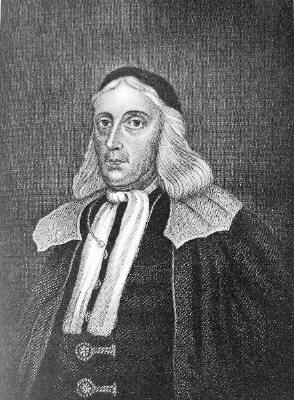
WILLIAM STOUGHTON.
Eng.d at J. Andrews's by R. Babson
These extended extracts are given from Lawson's discourse, partly to
enable every one to estimate the effect it must have produced, under
the circumstances of the occasion, but mainly because they present a
living picture of the sentiments, notions, modes of thinking and
reasoning, and convictions, then prevalent. No description given by a
person looking back from our point of view, not having experienced the
delusions of that age, no matter who might attempt the task, could
adequately paint the scene. The foregoing extracts show better, I
think, than any documents that have come down to us, how the subject
lay in the minds of men at that time. They bring before us directly,
without the intervention of any secondary agency, the thoughts,
associations, sentiments, of that generation, in breathing reality.
They carry us back to the hour and to the spot. Deodat Lawson rises
from his unknown grave, comes forth from the impenetrable cloud which
enveloped the closing scenes of his mortal career, and we listen to
his voice, as it spoke to the multitudes that gathered in and around
the meeting-house in Salem Village, on Lecture-day, March 24, 1692. He
lays bare his whole mind to our immediate inspection. In and through
him, we behold the mind and heart, the forms of language and thought,
the feelings and passions, of the people of that day. We mingle with
the crowd that hang upon his lips; we behold their countenances,
discern the passions that glowed upon their features, and enter into
the excitement that moved and tossed them like a tempest. We are thus
prepared, as we could be in no other way, to comprehend our story.
The sermon answered its end. It re-enforced the powers that had begun
their work. It spread out the whole doctrine of witchcraft in a
methodical, elaborate, and most impressive form. It justified and
commended every thing that had been done, and every thing that
remained to be done; every step in the proceedings; every process in
the examinations; every kind of accusation and evidence that had been
adduced; every phase of the popular belief, however wild and
monstrous; every pretension of the afflicted children to
preternatural experiences and communications, and every tale of
apparitions of departed spirits and the ghosts of murdered men, women,
and children, which, engendered in morbid and maniac imaginations, had
been employed to fill him and others with horror, inspire revenge, and
drive on the general delirium. And it fortified every point by the law
and the testimony, by passages and scraps of Scripture, studiously and
skilfully culled out, and ingeniously applied. It gave form to what
had been vague, and authority to what had floated in blind and
baseless dreams of fancy. It crystallized the disordered vagaries,
that had been seething in turbulent confusion in the public mind, into
a fixed, organized, and permanent shape.
Its publication was forthwith called for. The manuscript was submitted
to Increase and Cotton Mather of the North, James Allen and John
Bailey of the First, Samuel Willard of the Old South, churches in
Boston, and Charles Morton of the church in Charlestown. It was
printed with a strong, unqualified indorsement of approval, signed by
the names severally of these the most eminent divines of the country.
The discourse was dedicated to the "worshipful and worthily honored
Bartholomew Gedney, John Hathorne, Jonathan Corwin, Esqrs., together
with the reverend Mr. John Higginson, pastor, and Mr. Nicholas Noyes,
teacher, of the Church of Christ at Salem," with a preface, addressed
to all his "Christian friends and acquaintance, the inhabitants of
Salem Village." It was republished in London in 1704, under the
immediate direction of its author. The subject is described as
"Christ's Fidelity, the only Shield against Satan's Malignity;" and
the titlepage is enforced by passages of Scripture (Rev. xii. 12, and
Rom. xvi. 20). The interest of the volume is highly increased by an
appendix, giving the substance of notes taken by Lawson on the spot,
during the examinations and trials. They are invaluable, as proceeding
from a chief actor in the scenes, who was wholly carried away by the
delusion. They describe, in marvellous colors, the wonderful
manifestations of diabolical agency in, upon, and through the
afflicted children; resembling, in many respects, reports of spiritual
communications prevalent in our day, although not quite coming up to
them. These statements, and the preface to the discourse, are given in
the Appendix to this volume. In a much briefer form, it was printed by
Benjamin Harris, at Boston, in 1692; and soon after by John Dunton, in
London.
Before dismissing Mr. Lawson's famous sermon, our attention is
demanded to a remarkable paragraph in it. His strong faculties could
not be wholly bereft of reason; and he had sense enough left to see,
what does not appear to have occurred to others, that there might be a
re-action in the popular passions, and that some might be called to
account by an indignant public, if not before a stern tribunal of
justice, for the course of cruelty and outrage they were pursuing,
with so high a hand, against accused persons. He was not entirely
satisfied that the appeal he made in his discourse to the people to
suppress and crush out all vestiges of human feeling, and to stifle
compassion and pity in their breasts, would prevail. He foresaw that
the friends and families of innocent and murdered victims might one
day call for vengeance; and he attempts to provide, beforehand, a
defence that is truly ingenious:—
"Give no place to the Devil by rash censuring of others,
without sufficient grounds, or false accusing any willingly.
This is indeed to be like the Devil, who hath the title,
Διαβολος, in the Greek, because he is the
calumniator or false accuser. Hence, when we read of such
accusers in the latter days, they are, in the original,
called Διαβολοι, calumniatores (2 Tim. iii. 3).
It is a time of temptation amongst you, such as never was
before: let me entreat you not to be lavish or severe in
reflecting on the malice or envy of your neighbors, by whom
any of you have been accused, lest, whilst you falsely
charge one another,—viz., the relations of the afflicted
and relations of the accused,—the grand accuser (who loves
to fish in troubled waters) should take advantage upon you.
Look at sin, the procuring cause; God in justice, the
sovereign efficient; and Satan, the enemy, the principal
instrument, both in afflicting some and accusing others.
And, if innocent persons be suspected, it is to be ascribed
to God's pleasure, supremely permitting, and Satan's malice
subordinately troubling, by representation of such to the
afflicting of others, even of such as have, all the while,
we have reason to believe (especially some of them), no kind
of ill-will or disrespect unto those that have been
complained of by them. This giving place to the Devil avoid;
for it will have uncomfortable and pernicious influence
upon the affairs of this place, by letting out peace, and
bringing in confusion and every evil work, which we heartily
pray God, in mercy, to prevent."
This artifice of statement, speciously covered,—while it outrages
every sentiment of natural justice, and breaks every bond of social
responsibility,—is found, upon close inspection, to be a shocking
imputation against the divine administration. It represents the Deity,
under the phrases "sovereign efficient" and "supremely permitting" in
a view which affords equal shelter to every other class of criminals,
even of the deepest dye, as well as those who were ready and eager to
bring upon their neighbors the charge of confederacy with Satan.
The next Sunday—March 27—was the regular communion-day of the
village church; and Mr. Parris prepared duly to improve the occasion
to advance the movement then so strongly under way, and to deepen
still more the impression made by the events of the week, especially
by Mr. Lawson's sermon. He accordingly composed an elaborate and
effective discourse of his own; and a scene was arranged to follow the
regular service, which could not but produce important results. An
unexpected occurrence—a part not in the programme—took place, which
created a sensation for the moment; but it tended, upon the whole, to
heighten the public excitement, and, without much disturbing the
order, only precipitated a little the progress of events.
It may well be supposed, that the congregation assembled that day with
minds awfully solemnized, and altogether in a condition to be deeply
affected by the services. A respectable person always prominently
noticeable for her devout participation in the worship of the
sanctuary, and a member of the church, had, on Monday, after a public
examination, been committed to prison, and was there in irons, waiting
to be tried for her life for the blackest of crimes,—a confederacy
with the enemy of the souls of men, the archtraitor and rebel against
the throne of God. On Thursday, another venerable, and ever before
considered pious, matron of a large and influential family, a
participant in their worship, and a member of the mother-church, had
been consigned to the same fate, to be tried for the same horrible
crime. A little child had been proved to have also joined in the
infernal league. No one could tell to what extent Satan had lengthened
his chain, or who, whether old or young, were in league with him.
Every soul was still alive to the impressions made by Mr. Lawson's
great discourse, and by the throngs of excited people, including
magistrates and ministers, that had been gathered in the village.
The character and spirit of Mr. Parris's sermon are indicated in a
prefatory note in the manuscript, "occasioned by dreadful witchcraft
broke out here a few weeks past; and one member of this church, and
another of Salem, upon public examination by civil authority,
vehemently suspected for she-witches." The running title is, "Christ
knows how many devils there are in his church, and who they are;" and
the text is John vi. 70, 71, "Jesus answered them, Have not I chosen
you twelve, and one of you is a devil? He spake of Judas Iscariot, the
son of Simon; for he it was that should betray him, being one of the
twelve."
Peter Cloyse was born May 27, 1639. He came to Salem from York, in
Maine, and was one of the original members of the village church. He
appears to have been a person of the greatest respectability and
strength of character. He married Sarah, sister of Rebecca Nurse, and
widow of Edmund Bridges. She was admitted to the village church, Jan.
12, 1690, being then about forty-eight years of age. It may well be
supposed that she and her family were overwhelmed with affliction and
horror by the proceedings against her sister. But, as she and her
husband were both communicants, and it was sacrament-day, it was
thought best for them to summon resolution to attend the service.
After much persuasion, she was induced to go. She was a very sensitive
person, and it must have required a great effort of fortitude. Her
mind was undoubtedly much harrowed by the allusions made to the events
of the week; and, when Mr. Parris announced his text, and opened his
discourse in the spirit his language indicates, she could bear it no
longer, but rose, and left the meeting. A fresh wind blowing at the
time caused the door to slam after her. The congregation was probably
startled; but Parris was not long embarrassed by the interruption,
and she was attended to in due season. At the close of the service,
the following scene occurred. I give it as Parris describes it in his
church-record book:—
"After the common auditory was dismissed, and before the
church's communion at the Lord's Table, the following
testimony against the error of our Sister Mary Sibley, who
had given direction to my Indian man in an unwarrantable way
to find out witches, was read by the pastor:—
"It is altogether undeniable that our great and blessed God,
for wise and holy ends, hath suffered many persons, in
several families, of this little village, to be grievously
vexed and tortured in body, and to be deeply tempted, to the
endangering of the destruction of their souls; and all these
amazing feats (well known to many of us) to be done by
witchcraft and diabolical operations. It is also well known,
that, when these calamities first began, which was in my own
family, the affliction was several weeks before such hellish
operations as witchcraft were suspected. Nay, it was not
brought forth to any considerable light, until diabolical
means were used by the making of a cake by my Indian man,
who had his direction from this our sister, Mary Sibley;
since which, apparitions have been plenty, and exceeding
much mischief hath followed. But, by these means (it seems),
the Devil hath been raised amongst us, and his rage is
vehement and terrible; and, when he shall be silenced, the
Lord only knows. But now that this our sister should be
instrumental to such distress is a great grief to myself,
and our godly honored and reverend neighbors, who have had
the knowledge of it. Nevertheless, I do truly hope and
believe, that this our sister doth truly fear the Lord; and
I am well satisfied from her, that, what she did, she did it
ignorantly, from what she had heard of this nature from
other ignorant or worse persons. Yet we are in duty bound to
protest against such actions, as being indeed a going to the
Devil for help against the Devil: we having no such
directions from nature, or God's word, it must therefore be,
and is, accounted, by godly Protestants who write or speak
of such matters, as diabolical; and therefore calls this our
sister to deep humiliation for what she has done, and all of
us to be watchful against Satan's wiles and devices.
"Therefore, as we, in duty as a church of Christ, are deeply
bound to protest against it, as most directly contrary to
the gospel, yet, inasmuch as this our sister did it in
ignorance as she professeth and we believe, we can continue
her in our holy fellowship, upon her serious promise of
future better advisedness and caution, and acknowledging
that she is indeed sorrowful for her rashness herein.
"Brethren, if this be your mind, that this iniquity should
be thus borne witness against, manifest it by your usual
sign of lifting up your hands.—The brethren voted
generally, or universally: none made any exceptions.
"Sister Sibley, if you are convinced that you herein did
sinfully, and are sorry for it, let us hear it from your own
mouth.—She did manifest to satisfaction her error and grief
for it.
"Brethren, if herein you have received satisfaction, testify
it by lifting up your hands.—A general vote passed; no
exception made.
"Note.—25th March, 1692. I discoursed said sister
in my study about her grand error aforesaid, and also then
read to her what I had written as above to be read to the
church; and said Sister Sibley assented to the same with
tears and sorrowful confession."
This proceeding was of more importance than appears, perhaps, at first
view. It was one of Mr. Parris's most skilful moves. The course,
pursued by the "afflicted" persons had, thus far, in reference to
those engaged in the prosecutions, been in the right direction. But it
was manifest, after the exhibitions they had given, that they wielded
a fearful power, too fearful to be left without control. They could
cry out upon whomsoever they pleased; and against their accusations,
armed as they were with the power to fix the charge of guilt upon any
one by giving ocular demonstration that he or she was the author of
their sufferings, there could be no defence. They might turn, at any
moment, and cry out upon Parris or Lawson, or either or both of the
deacons. Nothing could withstand the evidence of their fits,
convulsions, and tortures. It was necessary to have and keep them
under safe control, and, to this end, to prevent any outsiders, or any
injudicious or intermeddling people, from holding intimacy with them.
Parris saw this, and, with his characteristic boldness of action and
fertility of resources, at once put a stop to all trouble, and closed
the door against danger, from this quarter.
Samuel Sibley was a member of the church, and a near neighbor of Mr.
Parris. He was about thirty-six years of age. His wife Mary was
thirty-two years of age, and also a member of the church. They were
persons of respectable standing and good repute. Nothing is known to
her disadvantage, but her foolish connection with the mystical
operations going on in Mr. Parris's family; and of this she was
heartily ashamed. Her penitent sensibility is quite touchingly
described by Mr. Parris. It is true that what she had done was a
trifle in comparison with what was going on every day in the families
of Mr. Parris and Thomas Putnam: but she had acted "rashly," without
"advisedness" from the right quarter, under the lead of "ignorant
persons;" and therefore it was necessary to make a great ado about it,
and hold her up as a warning to prevent other persons from meddling in
such matters. Her husband was an uncle of Mary Walcot, one of the
afflicted children; and it was particularly important to keep their
relatives, and members of their immediate families, from taking any
part or action in connection with them, except under due
"advisedness," and the direction of persons learned in such deep
matters. The family connections of the Sibleys were extensive, and a
blow struck at that point would be felt everywhere. The procedure was
undoubtedly effectual. After Mary Sibley had been thus awfully rebuked
and distressingly exposed for dealing with "John Indian," it is not
likely that any one else ever ventured to intermeddle with the
"afflicted," or have any connection, except as outside spectators,
with the marvellous phenomena of "diabolical operations." It will be
noticed, that, while Mr. Parris thus waved the sword of disciplinary
vengeance against any who should dare to intrude upon the forbidden
ground, he occupied it himself without disguise, and maintained his
hold upon it. He asserts the reality of the "amazing feats" practised
by diabolical power in their midst, and enforces in the strongest
language the then prevalent views and pending proceedings.
The operations of the week, including the solemn censure of Mary
Sibley, had all worked favorably for the prosecutors and managers of
the business. The magistrates, ministers, and whole body of the
people, had become committed; the accusing girls had proved themselves
apt and competent to their work; the public reason was prostrated, and
natural sensibility stunned. All resisting forces were powerless, and
all collateral dangers avoided and provided against. The movement was
fully in hand. The next step was maturely considered, and, as we shall
see, skilfully taken.
It is to be observed, that there was, at this time, a break in the
regular government of Massachusetts. In the spring of 1689, the people
had risen, seized the royal governor, Sir Edmund Andros, and put him
in prison. They summoned their old charter governor, Simon Bradstreet,
then living in Salem, eighty-seven years of age, to the chair of
state; called the assistants of 1686 back to their seats, who provided
for an election of representatives by the people of the towns; and the
government thus created conducted affairs until the arrival of Sir
William Phipps, in May, 1692, when Massachusetts ceased to be a
colony, and was thenceforth, until 1774, a royal province. During
these three years, from May, 1689, to May, 1692, the government was
based upon an uprising of the people. It was a period of pure and
absolute independence of the crown or parliament of England. Although
Bradstreet's faculties were unimpaired and his spirit true and firm,
his age prevented his doing much more than to give his loved and
venerated name to the daring movement, and to the official service, of
the people. The executive functions were, for the most part, exercised
by the deputy-governor, Thomas Danforth, who was a person of great
ability and public spirit. Unfortunately, at this time he was
zealously in favor of the witchcraft prosecutions. Bradstreet was
throughout opposed to them. Had time held off its hand, and his
physical energies not been impaired, he would undoubtedly have
resisted and prevented them. Danforth, it is said by Brattle, came to
disapprove of them finally: but he began them by arrests in other
towns, months before any thing of the kind was thought of in Salem
Village; and he contributed, prominently, to give destructive and
wide-spread power, in an early stage of its development, to the
witchcraft delusion here.
After the lapse of a week, preparations were completed to renew
operations, and a higher and more commanding character given to them.
On Monday, April 4, Captain Jonathan Walcot and Lieutenant Nathaniel
Ingersoll went to the town, and, "for themselves and several of their
neighbors," exhibited to the assistants residing there, John Hathorne
and Jonathan Corwin, complaints against "Sarah Cloyse, the wife of
Peter Cloyse of Salem Village, and Elizabeth Procter of Salem Farms,
for high suspicion of sundry acts of witchcraft." There the plan of
proceedings in reference to the above-said parties was agreed upon. It
was the result of consultation; communications probably passing with
the deputy-governor in Boston, or at his residence in Cambridge. On
the 8th of April, warrants were duly issued, ordering the marshal to
bring in the prisoners "on Monday morning next, being the eleventh day
of this instant April, about eleven of the clock, in the public
meeting-house in the town." It had been arranged, that the examination
should not be, as before, in the ordinary way, before the two local
magistrates, but, in an extraordinary way, before the highest tribunal
in the colony, or a representation of it. For a preliminary hearing,
with a view merely to commitment for trial, this surely may justly be
characterized as an extraordinary, wholly irregular, and, in all
points of view, reprehensible procedure. When the day came, the
meeting-house, which was much more capacious than that at the village,
was crowded; and the old town filled with excited throngs. Upon
opening proceedings, lo and behold, instead of the two magistrates,
the government of the colony was present, in the highest character it
then had as "a council"! The record says,—
"Salem, April 11, 1692.—At a Council held at Salem, and
present Thomas Danforth, Esq., deputy-governor; James
Russell, John Hathorne, Isaac Addington, Major Samuel
Appleton, Captain Samuel Sewall, Jonathan Corwin, Esquires."
Russell was of Charlestown, Addington and Sewall of Boston, and
Appleton of Ipswich. Mr. Parris, "being desired and appointed to write
the examination, did take the same, and also read it before the
council in public." This document has not come down to us; but
Hutchinson had access to it, and the substance of it is preserved in
his "History of Massachusetts."
The marshal (Herrick) brought in Sarah Cloyse and Elizabeth Procter,
and delivered them "before the honorable council:" and the examination
was begun.
The deputy-governor first called to the stand John Indian, and plied
him, as was the course pursued on all these occasions, with leading
questions:—
"John, who hurt you?—Goody Procter first, and then Goody
Cloyse.
"What did she do to you?—She brought the book to me.
"John, tell the truth: who hurts you? Have you been
hurt?—The first was a gentlewoman I saw.
"Who next?—Goody Cloyse.
"But who hurt you next?—Goody Procter.
"What did she do to you?—She choked me, and brought the
book.
"How oft did she come to torment you?—A good many times,
she and Goody Cloyse.
"Do they come to you in the night, as well as the day?—They
come most in the day.
"Who?—Goody Cloyse and Goody Procter.
"Where did she take hold of you?—Upon my throat, to stop my
breath.
"Do you know Goody Cloyse and Goody Procter?—Yes: here is
Goody Cloyse."
We may well suppose that these two respectable women must have been
filled with indignation, shocked, and amazed at the statements made by
the Indian, following the leading interrogatories of the Court. Sarah
Cloyse broke out, "When did I hurt thee?" He answered, "A great many
times." She exclaimed, "Oh, you are a grievous liar!" The Court
proceeded with their questions:—
"What did this Goody Cloyse do to you?—She pinched and bit
me till the blood came.
"How long since this woman came and hurt you?—Yesterday, at
meeting.
"At any time before?—Yes: a great many times."
Having drawn out John Indian, the Court turned to the other afflicted
ones:—
"Mary Walcot, who hurts you?—Goody Cloyse.
"What did she do to you?—She hurt me.
"Did she bring the book?—Yes.
"What was you to do with it?—To touch it, and be well.
"(Then she fell into a fit.)"
This put a stop to the examination for a time; but it was generally
quite easy to bring witnesses out of a fit, and restore entire
calmness of mind. All that was necessary was to lift them up, and
carry them to the accused person, the touch of any part of whose body
would, in an instant, relieve the sufferer. This having been done, the
examination proceeded:—
"Doth she come alone?—Sometimes alone, and sometimes in
company with Goody Nurse and Goody Corey, and a great many I
do not know.
"(Then she fell into a fit again.)"
She was, probably, restored in the same way as before; but, her part
being finished for that stage of the proceeding, another of the
afflicted children took the stand:—
"Abigail Williams, did you see a company at Mr. Parris's
house eat and drink?—Yes, sir: that was in the sacrament."
I would call attention to the form of the foregoing questions.
Hutchinson says that "Mr. Parris was over-officious: most of the
examinations, although in the presence of one or more magistrates,
were taken by him." He put the questions. They show, on this occasion,
a minute knowledge beforehand of what the witnesses are to say, which
it cannot be supposed Danforth, Russell, Addington, Appleton, and
Sewall, strangers, as they were, to the place and the details of the
affair, could have had. The examination proceeded:—
"How many were there?—About forty, and Goody Cloyse and
Goody Good were their deacons.
"What was it?—They said it was our blood, and they had it
twice that day."
The interrogator again turned to Mary Walcot, and inquired,—
"Have you seen a white man?—Yes, sir: a great many times.
"What sort of a man was he?—A fine grave man; and, when he
came, he made all the witches to tremble.
"(Abigail Williams confirmed the same, and that they had
such a sight at Deacon Ingersoll's.)
"Who was at Deacon Ingersoll's then?—Goody Cloyse, Goody
Nurse, Goody Corey, and Goody Good.
"(Then Sarah Cloyse asked for water, and sat down, as one
seized with a dying, fainting fit; and several of the
afflicted fell into fits, and some of them cried out, 'Oh!
her spirit has gone to prison to her sister Nurse.')"
The audacious lying of the witnesses; the horrid monstrousness of
their charges against Sarah Cloyse, of having bitten the flesh of the
Indian brute, and drank herself and distributed to others, as deacon,
at an infernal sacrament, the blood of the wicked creatures making
these foul and devilish declarations, known by her to be utterly and
wickedly false; and the fact that they were believed by the deputy,
the council, and the assembly,—were more than she could bear. Her
soul sickened at such unimaginable depravity and wrong; her nervous
system gave way; she fainted, and sunk to the floor. The manner in
which the girls turned the incident against her shows how they were
hardened to all human feeling, and the cunning art which, on all
occasions, characterized their proceedings. That such an insolent
interruption and disturbance, on their part, was permitted, without
rebuke from the Court, is a perpetual dishonor to every member of it.
The scene exhibited at this moment, in the meeting-house, is worthy of
an attempt to imagine. The most terrible sensation was naturally
produced, by the swooning of the prisoner, the loudly uttered and
savage mockery of the girls, and their going simultaneously into fits,
screaming at the top of their voices, twisting into all possible
attitudes, stiffened as in death, or gasping with convulsive spasms of
agony, and crying out, at intervals, "There is the black man
whispering in Cloyse's ear," "There is a yellow-bird flying round her
head." John Indian, on such occasions, used to confine his
achievements to tumbling, and rolling his ugly body about the floor.
The deepest commiseration was felt by all for the "afflicted," and men
and women rushed to hold and soothe them. There was, no doubt, much
loud screeching, and some miscellaneous faintings, through the whole
crowd. At length, by bringing the sufferers into contact with Goody
Cloyse, the diabolical fluid passed back into her, they were all
relieved, and the examination was resumed. Elizabeth Procter was now
brought forward.
In the account given, in the First Part, of the population of Salem
Village and the contiguous farms, her husband, John Procter, was
introduced to our acquaintance. From what we then saw of him, we are
well assured that he would not shrink from the protection and defence
of his wife. He accompanied her from her arrest to her arraignment,
and stood by her side, a strong, brave, and resolute guardian, trying
to support her under the terrible trials of her situation, and ready
to comfort and aid her to the extent of his power, disregardful of all
consequences to himself. The examination proceeded:—
"Elizabeth Procter, you understand whereof you are charged;
viz., to be guilty of sundry acts of witchcraft. What say
you to it? Speak the truth; and so you that are afflicted,
you must speak the truth, as you will answer it before God
another day. Mary Walcot, doth this woman hurt you?—I never
saw her so as to be hurt by her.
"Mercy Lewis, does she hurt you?
"(Her mouth was stopped.)
"Ann Putnam, does she hurt you?
"(She could not speak.)
"Abigail Williams, does she hurt you?
"(Her hand was thrust in her own mouth.)
"John, does she hurt you?—This is the woman that came in
her shift, and choked me.
"Did she ever bring the book?—Yes, sir.
"What to do?—To write.
"What? this woman?—Yes, sir.
"Are you sure of it?—Yes, sir.
"(Again Abigail Williams and Ann Putnam were spoke to by the
Court; but neither of them could make any answer, by reason
of dumbness or other fits.)
"What do you say, Goody Procter, to these things?—I take
God in heaven to be my witness, that I know nothing of it,
no more than the child unborn.
"Ann Putnam, doth this woman hurt you?—Yes, sir: a great
many times.
"(Then the accused looked upon them, and they fell into
fits.)
"She does not bring the book to you, does she?—Yes, sir,
often; and saith she hath made her maid set her hand to it.
"Abigail Williams, does this woman hurt you?—Yes, sir,
often.
"Does she bring the book to you?—Yes.
"What would she have you do with it?—To write in it, and I
shall be well."
Turning to the accused, Abigail said, "Did not you tell me that your
maid had written?" Goody Procter seems to have been utterly amazed at
the conduct and charges of the girls. She knew, of course, that what
they said was false; but perhaps she thought them crazy, and therefore
objects of pity and compassion, and felt disposed to treat them
kindly, and see whether they could not be recalled to their senses,
and restored to their better nature: for Parris, in his account, says
that at this point she answered the question thus put to her by
Abigail thus: "Dear child, it is not so. There is another judgment,
dear child." But kindness was thrown away upon them; for Parris says
that immediately "Abigail and Ann had fits." After coming out of them,
"they cried out, 'Look you! there is Goody Procter upon the beam.'"
Instantly, as we may well suppose, the whole audience looked where
they pointed. Their manner gave assurance that they saw her "on the
beam," among the rafters of the meeting-house; but she was invisible
to all other eyes. The people, no doubt, were filled with amazement at
such supernaturalism. But John Procter, her husband, did not believe a
word of it: and it is not to be doubted that he expressed his
indignation at the nonsense and the outrage in his usual bold, strong,
and unguarded language, which brought down the vengeance of the girls
at once on his own head; for Parris, in his report, goes on to say:—
"(By and by, both of them cried out of Goodman Procter
himself, and said he was a wizard. Immediately, many if not
all of the bewitched had grievous fits.)
"Ann Putnam, who hurt you?—Goodman Procter, and his wife
too.
"(Afterwards, some of the afflicted cried, 'There is Procter
going to take up Mrs. Pope's feet!' and her feet were
immediately taken up.)
"What do you say, Goodman Procter, to these things?—I know
not. I am innocent.
"(Abigail Williams cried out, 'There is Goodman Procter
going to Mrs. Pope!' and immediately said Pope fell into a
fit.)"
At this point, the deputy, or some member of the Court interposed, if
I interpret rightly Parris's report, which is here obscurely
expressed, inasmuch as he does not say who spoke; but the import of
the words indicates that they proceeded from some member of the Court,
who was perfectly deceived:—
"You see, the Devil will deceive you: the children could see
what you was going to do before the woman was hurt. I would
advise you to repentance, for the Devil is bringing you out.
"(Abigail Williams cried out again, 'There is Goodman
Procter going to hurt Goody Bibber!' and immediately Goody
Bibber fell into a fit. There was the like of Mary Walcot,
and divers others. Benjamin Gould gave in his testimony,
that he had seen Goodman Corey and his wife, Procter and his
wife, Goody Cloyse, Goody Nurse, and Goody Griggs in his
chamber last Thursday night. Elizabeth Hubbard was in a
trance during the whole examination. During the examination
of Elizabeth Procter, Abigail Williams and Ann Putnam both
made offer to strike at said Procter; but, when Abigail's
hand came near, it opened,—whereas it was made up into a
fist before,—and came down exceeding lightly as it drew
near to said Procter, and at length, with open and extended
fingers, touched Procter's hood very lightly. Immediately,
Abigail cried out, her fingers, her fingers, her fingers
burned; and Ann Putnam took on most grievously of her head,
and sunk down.)"
Hutchinson, after giving Parris's account of this examination,
expresses himself thus: "No wonder the whole country was in a
consternation, when persons of sober lives and unblemished characters
were committed to prison upon such sort of evidence. Nobody was safe."
All things considered, it may perhaps be said, that, filled as the
witchcraft proceedings were throughout with folly and outrage, there
was nothing worse than this examination, conducted by the
deputy-governor and council, on the 11th of April, 1692, in the great
meeting-house of the First Church in Salem. It must have been a scene
of the wildest disorder, particularly in the latter part of it. No
wonder that the people in general were deluded, when the most learned
councillors of the colony countenanced, participated in, and gave
effect to, such disorderly procedures in a house of worship, in the
presence of a high judicial tribunal, and of the then supreme
government of the colony!
Benjamin Gould gave his volunteer testimony without "advisedness," and
quite incontinently. He brought out Goodman Corey before the managers
were quite ready to fall upon him; and he antedated, by a considerable
length of time, any such imputation upon Goody Griggs. It was well for
Elizabeth Hubbard to have been in a trance, so that she could not hear
the mention of her aunt's name. The council seems to have adjourned to
the next day, at the same place, when Mr. Parris "gave further
information against said John Procter," which, unfortunately, has not
come down to us. The result was, that Sarah Cloyse, John Procter, and
Elizabeth his wife, were all committed for trial, and, with Rebecca
Nurse, Martha Corey, and Dorcas Good, were sent to the jail in Boston,
in the custody of Marshal Herrick.
The proceedings of the 11th and 12th of April produced a great effect
in driving on the general infatuation. Judge Sewall, who was present
as one of the council, in his diary at this date, says, "Went to
Salem, where, in the meeting-house, the persons accused of witchcraft
were examined; was a very great assembly; 'twas awful to see how the
afflicted persons were agitated." In the margin is written,
apparently some time afterwards, the interjection "Væ!" thrice
repeated,—"Alas, alas, alas!" What perfectly deluded him and
Danforth, and everybody else, were the exhibitions made by the
"afflicted children." This is the grand phenomenon of the witchcraft
proceedings here in 1692. It, and it alone, carried them through.
Those girls, by long practice in "the circle," and day by day, before
astonished and wondering neighbors gathered to witness their
distresses, and especially on the more public occasions of the
examinations, had acquired consummate boldness and tact. In simulation
of passions, sufferings, and physical affections; in sleight of hand,
and in the management of voice and feature and attitude,—no
necromancers have surpassed them. There has seldom been better acting
in a theatre than they displayed in the presence of the astonished and
horror-stricken rulers, magistrates, ministers, judges, jurors,
spectators, and prisoners. No one seems to have dreamed that their
actings and sufferings could have been the result of cunning or
imposture. Deodat Lawson was a man of talents, had seen much of the
world, and was by no means a simpleton, recluse, or novice; but he was
wholly deluded by them. The prisoners, although conscious of their own
innocence, were utterly confounded by the acting of the girls. The
austere principles of that generation forbade, with the utmost
severity, all theatrical shows and performances. But at Salem Village
and the old town, in the respective meeting-houses, and at Deacon
Nathaniel Ingersoll's, some of the best playing ever got up in this
country was practised; and patronized, for weeks and months, at the
very centre and heart of Puritanism, by "the most straitest sect" of
that solemn order of men. Pastors, deacons, church-members, doctors of
divinity, college professors, officers of state, crowded, day after
day, to behold feats which have never been surpassed on the boards of
any theatre; which rivalled the most memorable achievements of
pantomimists, thaumaturgists, and stage-players; and made considerable
approaches towards the best performances of ancient sorcerers and
magicians, or modern jugglers and mesmerizers.
The meeting of the council at Salem, on the 11th of April, 1692,
changed in one sense the whole character of the transaction. Before,
it had been a Salem affair. After this, it was a Massachusetts affair.
The colonial government at Boston had obtruded itself upon the ground,
and, of its own will and seeking, irregularly, and without call or
justification, had taken the whole thing out of the hands of the local
authorities into its own management. Neither the town nor the village
of Salem is responsible, as a principal actor, for what subsequently
took place. To that meeting of the deputy-governor and his associates
in the colonial administration, at an early period of the transaction,
the calamities, outrages, and shame that followed must in justice be
ascribed. Had it not taken place, the delusion, as in former instances
and other places here and in the mother-country, would have remained
within its original local limits, and soon disappeared. That meeting,
and the proceedings then had, gave to the fanaticism the momentum that
drove it on, and extended its destructive influence far and wide.
The next step in the proceedings is one of the most remarkable
features in the case. It is, in some points of view, more suggestive
of suspicion, that there was, behind the whole, a skilful and cunning
management, ingeniously contriving schemes to mislead the public mind,
than almost any other part of the transaction. Mary Warren, as has
been said, was a servant in the family of John Procter. She was a
member of the "circle" that had so long met at Mr. Parris's house or
Thomas Putnam's. She was a constant attendant at its meetings, and a
leading spirit among the girls. She did not take an open part against
her master or mistress at their examination, although she acted with
avidity and malignity against them as an accusing witness at their
trials, two months afterwards. It is to be noticed, that Ann Putnam
and Abigail Williams, at the examination of Elizabeth Procter, April
11, accused her of having induced or compelled "her maid to set her
hand to the book."
On the 18th of April, warrants were got out against Giles Corey and
Mary Warren, both of Salem Farms; Abigail Hobbs, daughter of William
Hobbs, of Topsfield; and Bridget Bishop, wife of Edward Bishop, of
Salem,—to be brought in the next forenoon, at about eight o'clock, at
the house of Lieutenant Nathaniel Ingersoll, of Salem Village. How
Mary Warren became transformed from an accuser to an accused, from an
afflicted person to an afflicter, is the question. It is not easy to
fathom the conduct of these girls. They appear to have acted upon a
plan deliberately formed, and to have had an understanding with each
other. At the same time, occasionally, they had or pretended to have a
falling-out, and came into contradiction. This was perhaps a mere
blind, to prevent the suspicion of collusion. The accounts given of
Mary Warren seem to render it quite certain that she acted with
deliberate cunning, and was a guilty conspirator with the other
accusers in carrying on the plot from the beginning. No doubt, it
frequently occurred to those concerned in it, that suspicions might
possibly get into currency that they were acting a part in concert. It
was necessary, by all means, to guard against such an idea. This may
be the key to interpret the arrest and proceedings against Mary
Warren. If it is, the affair, it must be confessed, was managed with
great shrewdness and skill. She conducted the stratagem most
dexterously. All at once she fell away from the circle, and began to
talk against the "afflicted children," and went so far as to say, that
they "did but dissemble." Immediately, they cried out upon her,
charged her with witchcraft, and had her apprehended. After being
carried to prison, she spoke in strong language against the
proceedings. Four persons of unquestionable truthfulness, in prison
with her, on the same charge, prepared a deposition to this effect:
"We heard Mary Warren several times say that the magistrates might as
well examine Keysar's daughter that had been distracted many years,
and take notice of what she said, as well as any of the afflicted
persons. 'For,' said Mary Warren, 'when I was afflicted, I thought I
saw the apparitions of a hundred persons;' for she said her head was
distempered that she could not tell what she said. And the said Mary
told us, that, when she was well again, she could not say that she saw
any of the apparitions at the time aforesaid." I will now give the
substance of her examination, which commenced on the 19th of April.
Mr. Parris was, as usual, requested to take minutes of the
proceedings, which have been preserved:—
"Examination of Mary Warren, at a Court held at Salem
Village, by John Hathorne and Jonathan Corwin, Esqrs.
"(As soon as she was coming towards the bar, the afflicted
fell into fits.)
"Mary Warren, you stand here charged with sundry acts of
witchcraft. What do you say for yourself? Are you guilty or
not?—I am innocent.
"Hath she hurt you? (Speaking to the sufferers.)
"(Some were dumb. Betty Hubbard testified against her, and
then said Hubbard fell into a violent fit.)
"You were, a little while ago, an afflicted person; now you
are an afflicter. How comes this to pass?—I look up to God,
and take it to be a great mercy of God.
"What! do you take it to be a great mercy to afflict others?
"(Now they were all but John Indian grievously afflicted,
and Mrs. Pope also, who was not afflicted before hitherto
this day; and, after a few moments, John Indian fell into a
violent fit also.)"
"Well, here" (Mr. Parris, the reporter, goes on to say) "was one that
just now was a tormenter in her apparition, and she owns that she had
made a league with the Devil." The marvel was, that, having before
been a sufferer, as one of the afflicted accusers, she had then, at
that moment, appeared in the opposite character, and owned herself to
have become a confederate with the Evil One. Having established this
conviction in the minds of the magistrates and spectators, the point
was reached at which she completed the delusion by appearing to break
away from her bondage to Satan, assume the functions of a confessing
and abjuring witch, and retake her place, with tenfold effect, among
the accusing witnesses. The manner in which she rescued herself from
the power of Satan exhibits a specimen of acting seldom surpassed. The
account proceeds thus:—
"Now Mary Warren fell into a fit, and some of the afflicted
cried out that she was going to confess; but Goody Corey,
and Procter and his wife, came in, in their apparition,
and struck her down, and said she should tell nothing."
What is given here in Italics, as an "apparition," was of course
based upon the declarations of the accusing witnesses. It was an art
they often practised in offering their testimony. They would cry out,
that the Devil, generally in the shape of a black man, appeared to
them at the time, whispering in the ear of the accused, or sitting on
the beams of the meeting-house in which the examinations were
generally conducted. On this occasion, they declared that three of the
persons, then in jail in some other place, came in their apparitions,
forbade Mary Warren's confession, and struck her down. To give full
effect to their statement, she went through the process of tumbling
down. Although nothing was seen by any other person present, the
deception was perfect. The Rev. Mr. Parris wrote it all down as having
actually occurred. His record of the transaction goes on as follows:—
"Mary Warren continued a good space in a fit, that she did
neither see nor hear nor speak.
"Afterwards she started up, and said, 'I will speak,' and
cried out, 'Oh, I am sorry for it, I am sorry for it!' and
wringed her hands, and fell a little while into a fit again,
and then came to speak, but immediately her teeth were set;
and then she fell into a violent fit, and cried out, 'O
Lord, help me! O good Lord, save me!'
"And then afterwards cried again, 'I will tell, I will
tell!' and then fell into a dead fit again.
"And afterwards cried, 'I will tell, they did, they did,
they did;' and then fell into a violent fit again.
"After a little recovery, she cried, 'I will tell, I will
tell. They brought me to it;' and then fell into a fit
again, which fits continuing, she was ordered to be led out,
and the next to be brought in, viz., Bridget Bishop.
"Some time afterwards, she was called in again, but
immediately taken with fits for a while.
"'Have you signed the Devil's book?—No.'
"'Have you not touched it?—No.'
"Then she fell into fits again, and was sent forth for air.
"After a considerable space of time, she was brought in
again, but could not give account of things by reason of
fits, and so sent forth.
"Mary Warren called in afterwards in private, before
magistrates and ministers.
"She said, 'I shall not speak a word: but I will, I will
speak, Satan! She saith she will kill me. Oh! she saith she
owes me a spite, and will claw me off. Avoid Satan, for the
name of God, avoid!' and then fell into fits again, and
cried, 'Will ye? I will prevent ye, in the name of God.'"
The magistrate inquired earnestly:—
"'Tell us how far have you yielded?'
"A fit interrupts her again.
"'What did they say you should do, and you should be well?'
"Then her lips were bit, so that she could not speak: so she
was sent away."
Mr. Parris, the reporter of the case, adds:—
"Note that not one of the sufferers was afflicted during her
examination, after once she began to confess, though they
were tormented before."
She was subsequently examined in the prison several times, falling
occasionally into fits, and exhibiting the appearance of a
long-continued conflict with Satan, who was supposed to be resisting
her inclination to confess, and holding her with violence to the
contract she had made with him. The magistrates and ministers beheld
with amazement and awe what they believed to be precisely a similar
scene to that described by the evangelists when the Devil strove
against the power of the Saviour and his disciples, and would not quit
his hold upon the young man, but "threw him down, and tare him." At
length, as in that case, Satan was overcome. After a protracted, most
violent, and terrible contest, Mary Warren got released from his
clutches, and made a full and circumstantial confession.
Whoever studies carefully the account of Mary Warren's successive
examinations can hardly question, I think, that she acted a part, and
acted it with wonderful cunning, skill, and effect.
This examination, beginning on Tuesday, the 19th of April, continued
after she was committed to prison in Salem, at the jail there, for
several days, and was renewed at intervals until the middle of May.
After she had thoroughly broken away from Satan, she revealed all that
she had seen and heard while associating with him and his confederate
subjects: her testimony was implicitly received, and it dealt death
and destruction in all directions. It is a circumstance strongly
confirming this view, that Mary Warren was soon released from
confinement. It was the general practice to keep those, who confessed,
in prison, to retain in that way power over them, and prevent their
recanting their confessions. She is found, by the papers on file, to
have acted afterwards, as a capital witness, against ten persons, all
of whom were convicted, and seven executed. Besides these, she
testified, with the appearance of animosity and vindictiveness,
against her master John Procter, and her mistress his wife; thus
contributing to secure the conviction of both, and the death of the
former. In how many more cases she figured in the same character and
to the same effect is unknown, as the papers in reference to only a
very small proportion of them have come down to us. The interpretation
I give to the course of Mary Warren exhibits her guilt, and that of
those participating in the stratagem, as of the deepest and blackest
dye. But it seems to be the only one which a scrutiny of the details
of her examinations, and of the facts of the case, allows us to
receive. The effect was most decisive. The course of the accusing
children in crying out against one of their own number satisfied the
public, and convinced still more the magistrates, that they were
truthful, honest, and upright. They had before given evidence that
they paid no regard to family influence or eminent reputation. They
had now proved that they had no partiality and no favoritism, but were
equally ready to bring to light and to justice any of their own circle
who might fall into the snare of the Evil One, and become confederate
with him. No dramatic artist, no cunning impostor, ever contrived a
more ingenious plot; and no actors ever carried one out better than
Mary Warren and the afflicted children.
Giles Corey incurred hostility, perhaps, because his deposition
relating to his wife did not come up to the mark required. It is also
highly probable, that, though incensed at her conduct at the time,
reflection had brought him to his senses; and that the circumstances
of her examination and commitment to prison produced a re-action in
his mind. If so, he would have been apt to express himself very
freely. His examination took place April 19th, in the meeting-house at
the Village. The girls acted their usual part, charging him, one by
one, with having afflicted them, and proving it on the spot by
tortures and sufferings. After they had severally got through, they
all joined at once in their demonstrations. The report made by Parris
says, "All the afflicted were seized now with fits, and troubled with
pinches. Then the Court ordered his hands to be tied." The magistrates
lost all control of themselves, and flew into a passion, exclaiming,
"What! is it not enough to act witchcraft at other times, but must you
do it now, in face of authority?" He seems to have been profoundly
affected by the marvellousness of the accusations, and the exhibition
of what to him was inexplicable in the sufferings of the girls; and
all he could say was, "I am a poor creature, and cannot help
it."—"Upon the motion of his head again, they had their heads and
necks afflicted." The magistrates, not having recovered their
composure, continued to pour their wrath upon him, "Why do you tell
such wicked lies against witnesses?"—"One of his hands was let go,
and several were afflicted. He held his head on one side, and then
the heads of several of the afflicted were held on one side. He drew
in his cheeks, and the cheeks of some of the afflicted were sucked
in." Goody Bibber was on hand, and played her accompaniment. She also
uttered malignant charges against him, and "was suddenly seized with a
violent fit." One of Bibber's statements was that he had called her
husband "damned devilish rogue." Through all this outrage, Corey was
firm in asserting his innocence. His language and manner were serious,
and solemnized by a sense of the helplessness of his situation and the
wicked falsehoods heaped upon him. His disagreement with his wife
about the witchcraft proceedings being well known, the accusers
endeavored to make it out that they had often quarrelled. But he
insisted that the only difference which had before existed between
them was a conflict of opinion on one point. In his family devotions,
he used this expression, "living to God and dying to sin." She "found
fault" with the language, and criticised it. He thought it was all
right! The characteristic spirit of the old man was roused most
strikingly by one of the charges. Bibber and others testified that
Corey had said he had seen the Devil in the shape of a black hog and
was very much frightened. He could not stand under the imputation of
cowardice, and lost sight of every other element in the accusation but
that. The magistrate asked, "What did you see in the cow-house? Why do
you deny it?"—"I saw nothing but my cattle."—"(Divers witnessed that
he told them he was frighted.)"—"Well, what do you say to these
witnesses? What was it frighted you?"—"I do not know that ever I
spoke the word in my life."
But while his character retained its manliness, and his soul was truly
insensible to fear, he was very much oppressed and distressed by his
situation. The share he had, with two of his sons-in-law, in bringing
his wife into her awful condition, and in driving on the public
infatuation at the beginning, was more than he could endure to think
of, and he was charged with having meditated suicide. Perhaps he had
already formed the purpose afterwards carried into effect, and may
have dropped expressions, under that thought, which to others might
appear to indicate a design of self-destruction. He was accused of
having said that "he would make away with himself, and charge his
death upon his son." His sons-in-law, Crosby and Parker, were acting
with the crowd that were pursuing him to his death. Little did it
enter the imagination of any one then, that there was a method by
which he could "make away with himself," leaving the entire act of the
destruction of his life upon his persecutors, and the sin to be
apportioned between him and them by the All-wise and All-just.
Abigail Hobbs had been a reckless vagrant creature, wandering through
the woods at night like a half-deranged person; but she had wit enough
to see that there was safety in confession. She pretended to have
committed, by witchcraft, crimes enough to have hanged her a dozen
times. If she had stood to her confession, we should have heard of her
no more.
Bridget Bishop's examination filled the intervals of time while Mary
Warren was being carried out of the meeting-house to recover from her
fits. Both Parris and Ezekiel Cheever took minutes of it, from which
the substance is gathered as follows:—
On her coming in, the afflicted persons, at the same moment, severally
fell into fits, and were dreadfully tormented. Hathorne addressed her,
calling upon her to give an account of the witchcrafts she was
"conversant in." She replied, "I take all this people to witness that
I am clear." He then asked the children, "Hath this woman hurt you?"
They all cried out that she had. The magistrate continued, "You are
here accused by four or five: what do you say to it?"—"I never saw
these persons before, nor I never[A] was in this place before. I never
did hurt them in my life."
At a meeting of the afflicted children and others, some one declared
that Bridget Bishop was present "in her shape" or apparition, and,
pointing to a particular spot, said, "There, there she is!" Young
Jonathan Walcot, exasperated by his sister's sufferings, struck at the
spot with his sword; whereupon Mary cried out, "You have hit her, you
have torn her coat, and I heard it tear." This story had been brought
to Hathorne's ears; and abruptly, as if to take her off her guard, he
said, "Is not your coat cut?" She answered, "No." They then examined
the coat, and found what they regarded as having been "cut or torn two
ways." It was probably the fashion in which the garment was made; for
she was in the habit of dressing more artistically than the women of
the Village. At any rate, it did not appear like a direct cut of a
sword; but Jonathan got over the difficulty by saying that "the sword
that he struck at Goody Bishop was not naked, but was within the
scabbard." This explained the whole matter, so that Cheever says, in
his report, that "the rent may very probably be the very same that
Mary Walcot did tell that she had in her coat, by Jonathan's striking
at her appearance"! Parris says, with more caution, more indeed than
was usual with him, "Upon some search in the Court, a rent, that seems
to answer what was alleged, was found."
Hathorne, having heard the scandals they had circulated against her,
proceeded: "They say you bewitched your first husband to death."—"If
it please Your Worship, I know nothing of it."—"What do you say of
these murders you are charged with?"—"I hope I am not guilty of
murder." As she said this, she turned up her eyes, probably to give
solemnity to her declaration. At the opening of the examination, she
looked round upon the people, and called them to witness her
innocence. She had found out by this time, that no justice could be
expected from them; and feeling, with Rebecca Nurse on a recent
similar occasion, "I have got nobody to look to but God," she turned
her eyes heavenward. Instantly, the eyeballs of all the girls were
rolled up in their sockets, and fixed. The effect was awful, and still
more increased as they went, after a moment or two, into dreadful
torments. Hathorne could no longer contain himself, but broke out, "Do
you not see how they are tormented? You are acting witchcraft before
us! What do you say to this? Why have you not a heart to confess the
truth?" She calmly replied, "I am innocent. I know nothing of it. I am
no witch. I know not what a witch is." The "afflicted children"
charged her with having tried to persuade them to sign the Devil's
book. As she had never before seen one of them, she was indignant at
this barefaced falsehood, and, as Cheever says, "shook her head" in
her resentment; which, as he further says, put them all into great
torments. Parris represents that in every motion of her head they were
tortured. Marshal Herrick, as usual, put in his oar, and volunteered
charges against her. She bore herself well through the shocking scene,
and did not shrink, at its close, from expressing her unbelief of the
whole thing: "I do not know whether there be any witches or no." When
she was removed from the place of examination, the accusers all had
fits, and broke forth in outcries of agony. After being taken out, one
of the constables in charge of her asked her if she was not troubled
to see the afflicted persons so tormented; and she replied, "No." In
answer to further questions, she indicated that she could not tell
what to think of them, and did not concern herself about them at all.
Giles Corey, Bridget Bishop, Abigail Hobbs, together with Mary Warren,
were duly committed to prison.
Two days after, April 21, warrants were issued "against William Hobbs,
husbandman, and Deliverance his wife; Nehemiah Abbot, Jr., weaver;
Mary Easty, the wife of Isaac Easty; and Sarah Wilds, the wife of John
Wilds,—all of the town of Topsfield, or Ipswich; and Edward Bishop,
husbandman, and Sarah his wife, of Salem Village; and Mary Black, a
negro of Lieutenant Nathaniel Putnam's, of Salem Village also; and
Mary English, the wife of Philip English, merchant in Salem." All of
them were to be delivered to the magistrates for examination at the
house of Lieutenant Nathaniel Ingersoll, at about ten o'clock the next
morning, in Salem Village; and were brought in accordingly.
What the papers on file enable us to glean of these nine persons is
substantially as follows: William Hobbs was about fifty years of age,
and one of the earliest settlers of the Village, although his
residence was on the territory afterwards included in Topsfield. His
daughter Abigail, of whom I have just spoken, appears from all the
accounts to have acted at this stage of the transaction a most wicked
part, ready to do all the mischief in her power, and allowing herself
to be used to any extent to fasten the imputation of witchcraft upon
others. Several persons testified that, long before, she had boasted
that she was not afraid of any thing, "for she had sold herself body
and soul to the Old Boy;" one witness testified, that, "some time last
winter, I was discoursing with Abigail Hobbs about her wicked
carriages and disobedience to her father and mother, and she told me
she did not care what anybody said to her, for she had seen the Devil,
and had made a covenant or bargain with him;" another, Margaret
Knight, testified, that, about a year before, "Abigail Hobbs and her
mother were at my father's house, and Abigail Hobbs said to me,
'Margaret, are you baptized?' And I said, 'Yes.' Then said she, 'My
mother is not baptized, but I will baptize her;' and immediately took
water, and sprinkled in her mother's face, and said she did baptize
her 'in the name of the Father, Son, and Holy Ghost.'"
She was arrested, and brought to the Village, on the 19th of April.
The next day, she began her operations by declaring that "Judah White,
a Jersey maid" that lived with Joseph Ingersoll at Casco, "but now
lives at Boston," appeared to her "in apparition" the day before, and
advised her to "fly, and not to go to be examined," but, if she did
go, "not to confess any thing:" she described the dress of this
"apparition,"—she "came to her in fine clothes, in a sad-colored silk
mantle, with a top-knot and a hood."—"She confesseth further, that
the Devil in the shape of a man came to her," and charged her to
afflict the girls; bringing images made of wood in their likeness with
thorns for her to prick into the images, which she did: whereupon the
girls cried out that they were hurt by her. She further confessed,
that, "she was at the great meeting in Mr. Parris's pasture, when they
administered the sacrament, and did eat of the red bread and drink of
the red wine, at the same time." This confession established her
credibility at once; and, the next day, the warrants were issued for
the nine persons above mentioned, against whom they had secured in her
an effective witness. She had resided for some time at Casco Bay; and
we shall soon see how matters began in a few days to work in that
direction. There are two indictments against this Abigail Hobbs: one
charging her with having made a covenant with "the Evil Spirit, the
Devil," at Casco Bay, in 1688; the other with having exercised the
arts of witchcraft upon the afflicted girls, at Salem Village, in
1692.
When her unhappy father was brought to examination, he found that his
daughter was playing into the hands of the accusers; and that his
wife, overwhelmed by the horrors of the situation, although for a time
protesting her innocence and lamenting that she had been the mother of
such a daughter, had broken down and confessed, saying whatever might
be put in her mouth by the magistrates, the girls, or the crowd. Under
these circumstances, he was brought forward for examination. Parris
took minutes of it. It is to be regretted, that the paper is much
dilapidated, and portions of the lines wholly lost. What is left shows
that the mind of William Hobbs rose superior to the terrors and
powers arrayed against it. The magistrate commenced proceedings by
inquiring of the girls, pointing to the prisoner, "Hath this man hurt
you?" Several of them answered "Yes." Goody Bibber, who seems
generally to have been a very zealous volunteer backer of the girls,
on this occasion, for a wonder, answered "No." The magistrate,
addressing the prisoner, "What say you? Are you guilty or
not?"—Answer: "I can speak in the presence of God safely, as I must
look to give account another day, that I am as clear as a new-born
babe."—"Clear of what?"—"Of witchcraft."—"Have you never hurt
these?"—"No." Abigail Williams cried out that he "was going to Mercy
Lewis!" Whereupon Mercy was seized with a fit. Then Abigail cried out
again, "He is coming to Mary Walcot!" and Mary went into her fit. The
magistrate, in consternation, appealed to him: "How can you be clear,"
when your appearance is thus seen producing such effects before our
eyes? Then the children went into fits all together, and "hallooed" at
the top of their voices, and "shouted greatly." The magistrate then
brought up the confession of his wife against him, and expostulated
with him for not confessing; the afflicted, in the mean while,
bringing the whole machinery of their convulsions, shrieks, and uproar
to bear against him: but he calmly, and in brief terms, denied it.
The circle of accusing girls seems to have been a receptacle, into
which all the scandal, gossip, and defamation of the surrounding
country was emptied. Some one had told them that William Hobbs was not
a regular attendant at meeting. They passed it on to the magistrate,
and he put this question to the accused: "When were you at any public
religious meeting?" He replied, "Not a pretty while."—"Why
so?"—"Because I was not well: I had a distemper that none knows." The
magistrate said, "Can you act witchcraft here, and, by casting your
eyes, turn folks into fits?"—"You may judge your pleasure. My soul is
clear."—"Do you not see you hurt these by your look?"—"No: I do not
know it." After another display of awful sufferings, caused, as they
protested, by the mere look of Hobbs, the magistrate, with triumphant
confidence, again put it home to him, "Can you now deny it?" He
answered, "I can deny it to my dying day." The magistrate inquired of
him for what reason he withdrew from the room whenever the Scriptures
were read in his family. He plumply denied it. Nathaniel Ingersoll and
Thomas Haynes testified that his daughter had told them so. The
confessions of his wife and daughter were over and over again brought
up against him, but to no effect. "Who do you worship?" said the
magistrate. "I hope I worship God only."—"Where?"—"In my heart." The
examination failed to confound or embarrass him in the least. He could
not be drawn into the expression of any of the feelings which the
conduct of his graceless and depraved daughter or his weak and
wretched wife must have excited. He quietly protested that he knew
nothing about witchcraft; and, towards the close, with solemn
earnestness of utterance, declared that his innocence was known to the
"great God in heaven."
He was committed for trial. All that the documents in existence inform
us further, in relation to William Hobbs, is that he remained in
prison until the 14th of the next December, when two of his neighbors,
John Nichols and Joseph Towne, in some way succeeded in getting him
bailed out; they giving bonds in the sum of two hundred pounds for his
appearance at the sessions of the Court the next month. But it was
not, even then, thought wholly safe to have him come in; and the fine
was incurred. He appeared at the term in May, the fine was remitted,
and he discharged by proclamation. On the 26th of March, 1714, he gave
evidence in a case of commonage rights. He was then seventy-two years
of age. Of his wife and daughter, I shall again have occasion to
speak.
For all that is known of the case of Nehemiah Abbot, we are indebted
to Hutchinson, who had Parris's minutes of the examination before him.
Hutchinson says, that, of "near an hundred" whose examinations he had
seen, he was the only one who, having been brought before the
magistrates, was finally dismissed by them. Perhaps even this case was
not an exception: for a document on file shows that a person named
Abbot of the same locality was subsequently arrested and imprisoned;
but unfortunately the Christian name has been obliterated, or from
some cause is wanting. It seems, from Hutchinson's minutes, that he
protested his innocence in manly and firm declarations. Mary Walcot
testified that she had seen his shape. Ann Putnam cried out that she
saw him "upon the beam." The magistrates told him that his guilt was
certainly proved, and that, if he would find mercy of God, he must
confess. "I speak before God," he answered, "that I am clear from this
accusation."—"What, in all respects?"—"Yes, in all respects." The
girls were struck with dumbness; and Ann Putnam, re-affirming that he
was the man that hurt her, "was taken with a fit." Mary Walcot began
to waver in her confidence, and Mercy Lewis said, "It is not the man."
This unprecedented variance in the testimony of the girls brought
matters to a stand; and he was sent out for a time, while others were
examined:—
"When he was brought in again, by reason of much people, and
many in the windows, so that the accusers could not have a
clear view of him, he was ordered to be abroad, and the
accusers to go forth to him, and view him in the light,
which they did in the presence of the magistrates and many
others, discoursed quietly with him, one and all acquitting
him; but yet said he was like that man, but he had not the
wen they saw in his apparition. Note, he was a hilly-faced
man, and stood shaded by reason of his own hair; so that for
a time he seemed to some bystanders and observers to be
considerably like the person the afflicted did describe."
Such is Parris's statement, as quoted by Hutchinson. What was the real
cause or motive of this discrepancy among the witnesses does not
appear. The facts, that at first they went into fits in beholding him,
were all struck dumb for a while, and Ann Putnam saw him on the beam,
were likely to have an unfavorable effect upon the minds of the
people, and threatened to explode the delusion. But Ann, with a
quickness of wit that never failed to meet any emergency, when Mercy
Lewis said it was not the man, cried out in a fit, "Did you put a mist
before my eyes?" She conveyed the idea that the power of Satan blinded
her, and caused her to mistake the man. This answered the purpose;
and, although Abbot got clear, for the time at least, all were more
than ever convinced that the Evil One, in misleading Ann, had shown
his hand on the occasion.
The examination of Sarah Wildes had no peculiar features. The
afflicted children and Goody Bibber saw her apparition sitting on the
beam while she was bodily present at the bar, and went through their
usual fits and evolutions. She maintained her innocence with dignity
and firmness; and the magistrate, prejudging the case against her,
rebuked her obstinacy in not confessing, in his accustomed manner.
No account has come down of the examinations of Edward Bishop, or
Sarah his wife. He was the third of that name, probably the son of the
"Sawyer." His wife Sarah was a daughter of William Wildes of Ipswich,
and, it would seem, a sister of John Wildes, the examination of whose
wife has just been mentioned. Some of the evidence indicates that she
was a niece of Rebecca Nurse. They all belonged to that class of
persons who, under the general appellation of "the Topsfield men," had
been in such frequent collision with the people of the Village. Edward
Bishop was forty-four years of age, and his wife forty-one. They had a
family, at the time of their imprisonment, of twelve children. Sarah
Bishop had been dismissed from the church at the Village, and
recommended to that at Topsfield, May 25, 1690. They had land in
Topsfield, as well as in the Village, and were more intimately
connected in social relations with the former than the latter place.
They effected their escape from prison, and survived the storm. Mary,
the wife of Philip English, was committed to prison. We have no record
of her examination.
Mary Black, the negro woman, belonged to Nathaniel Putnam, but lived
in the family of his son Benjamin. Her examination shows that she was
an ignorant but an innocent person. She knew nothing about the matter,
and had no idea what it all meant. To the questions with which the
magistrate pressed her, her answers were, "I do not know," "I cannot
tell." The only fact brought out against her besides the actings of
the girls was this: "Her master saith a man sat down upon the form
with her about a twelvemonth ago." Parris, in his minutes, gives this
piece of evidence, but does not enlighten us as to its import. The
magistrate asked her, "What did the man say to you?" Her answer was:
"He said nothing." This is all they got out of her; and it is all the
light we have on the mysterious fact, that a man was once seated, at
some time within twelve months, on the same form or bench with poor
Mary Black. The magistrate asked the girls, "Doth this negro hurt
you?" They said "Yes."—"Why do you hurt them?"—"I did not hurt
them." This question was put to her, "Do you prick sticks?" perhaps
the meaning was, Do you prick the afflicted children with sticks? The
simple creature evidently did not know what they were driving at, and
answered, "No: I pin my neckcloth." The examiner asked her, "Will you
take out the pin, and pin it again?" She did so, and several of the
afflicted cried out that they were pricked. Mary Walcot was pricked in
the arm till the blood came, Abigail Williams was pricked in the
stomach, and Mercy Lewis was pricked in the foot. It is probable,
that, in this case, the girls, as they often appear to have done,
provided themselves by concert beforehand with pins ready to be stuck
into the assigned parts of their bodies, and managed to get the queer
and unusual question put. The whole thing has the appearance of being
pre-arranged; and it answered the purpose, filling the crowd with
amazement, and excluding all possible doubt from the minds of the
magistrates. Mary was committed to prison, where she remained until
discharged, in May, 1693, by proclamation from the governor.
Mary Easty, wife of Isaac Easty, and sister of Rebecca Nurse and
Sarah Cloyse, was about fifty-eight years of age, and the mother of
seven children. Her husband owned and lived upon a large and valuable
farm, which not many years since was the property and country
residence of the late Hon. B.W. Crowninshield, and is now in the
possession of Thomas Pierce, Esq. Her examination was accompanied by
the usual circumstances. The girls had fits, and were speechless at
times: the magistrate expostulated with her for not confessing her
guilt, which he regarded as demonstrated, beyond a question, by the
sufferings of the afflicted. "Would you have me accuse myself?"—"How
far," he continued, "have you complied with Satan?"—"Sir, I never
complied, but prayed against him all my days. What would you have me
do?"—"Confess, if you be guilty."—"I will say it, if it was my last
time, I am clear of this sin." The magistrate, apparently affected by
her manner and bearing, inquired of the girls, "Are you certain this
is the woman?" They all went into fits; and presently Ann Putnam,
coming to herself, said "that was the woman, it was like her, and she
told me her name." The accused clasped her hands together, and Mercy
Lewis's hands were clenched; she separated her hands, and Mercy's were
released; she inclined her head, and the girls screamed out, "Put up
her head; for, while her head is bowed, the necks of these are
broken." The magistrate again asked, "Is this the woman?" They made
signs that they could not speak; but afterwards Ann Putnam and others
cried out: "O Goody Easty, Goody Easty, you are the woman, you are the
woman!"—"What do you say to this?"—"Why, God will know."—"Nay, God
knows now."—"I know he does."—"What did you think of the actions of
others before your sisters came out? did you think it was
witchcraft?"—"I cannot tell."—"Why do you not think it is
witchcraft?"—"It is an evil spirit; but whether it be witchcraft I do
not know." She was committed to prison.
It will be noticed that seven out of the nine examined at this time
either lived in Topsfield or were intimately connected with the church
and people there. The accusing girls had heard them angrily spoken of
by the people around them, and availed themselves, as at all times, of
existing prejudices, to guide them in the selection of their victim.
The escape of Abbot, and the wavering, in his case and that of Easty,
indicated by the magistrates on this occasion, alarmed the
prosecutors; and they felt that something must be done to stiffen
Hathorne and Corwin to their previous rigid method of procedure. The
following letter was accordingly written to them that very day,
immediately after the close of the examinations:—
"These to the Honored John Hathorne and Jonathan Corwin,
Esqrs., living at Salem, present.
"Salem Village, this 21st of April, 1692.
"Much Honored,—After most humble and hearty thanks
presented to Your Honors for the great care and pains you
have already taken for us,—for which you know we are never
able to make you recompense, and we believe you do not
expect it of us; therefore a full reward will be given you
of the Lord God of Israel, whose cause and interest you have
espoused (and we trust this shall add to your crown of glory
in the day of the Lord Jesus): and we—beholding continually
the tremendous works of Divine Providence, not only every
day, but every hour—thought it our duty to inform Your
Honors of what we conceive you have not heard, which are
high and dreadful,—of a wheel within a wheel, at which our
ears do tingle. Humbly craving continually your prayers and
help in this distressed case,—so, praying Almighty God
continually to prepare you, that you may be a terror to
evil-doers and a praise to them that do well, we remain
yours to serve in what we are able,
"Thomas Putnam."
What was meant by the "wheel within a wheel," the "high and dreadful"
things which were making their ears to tingle, but had not yet been
disclosed to the magistrates, we shall presently see. On the 30th of
April, Captain Jonathan Walcot and Sergeant Thomas Putnam (the writer
of the foregoing letter) got out a warrant against Philip English, of
Salem, merchant; Sarah Morrel, of Beverly; and Dorcas Hoar, of the
same place, widow. Morrel and Hoar were delivered by Marshal Herrick,
according to the tenor of the warrant, at 11, a.m., May 2, at
the house of Lieutenant Nathaniel Ingersoll, in Salem Village. The
warrant has an indorsement in these words: "Mr. Philip English not
being to be found. G.H." As the records of the examinations of Philip
English and his wife have not been preserved, and only a few
fragments of the testimony relating to their case are to be found, all
that can be said is that the girls and their accomplices made their
usual charges against them. There are two depositions in existence,
however, which afford some explanation of the causes that exposed Mr.
English to hostility, and indicate the kind of evidence that was
brought against him. Having many landed estates, in various places,
and extensive business transactions, he was liable to frequent
questions of litigation. He was involved, at one time, in a lawsuit
about the bounds of a piece of land in Marblehead. A person named
William Beale, of that town, had taken great interest in it adversely
to the claims of English; and some harsh words passed between them. A
year or two after the affair, Beale states, "that, as I lay in my bed,
in the morning, presently after it was fair light abroad in the room,"
"I saw a dark shade," &c. To his vision it soon assumed the shape of
Philip English. On a previous occasion, when riding through Lynn to
get testimony against English in the aforesaid boundary case, he says,
"My nose gushed out bleeding in a most extraordinary manner, so that
it bloodied a handkerchief of considerable bigness, and also ran down
upon my clothes and upon my horse's mane." He charged it upon English.
These depositions were sworn to in Court, in August, 1692, and
January, 1693. How they got there does not appear, as English was
never brought to trial. All that relates to Mr. English and his wife
may be despatched at this point. On the 6th of May, a warrant was
procured at Boston, "To the marshal-general, or his lawful deputy," to
apprehend Philip English wherever found within the jurisdiction, and
convey him to the "custody of the marshal of Essex." Jacob Manning, a
deputy-marshal, delivered him to the marshal of Essex on the 30th of
May; and he was brought before the magistrates on the next day, and,
after examination, committed to prison. He and his wife effected their
escape from jail, and found refuge in New York until the proceedings
were terminated, when they returned to Salem, and continued to reside
here. She survived the shock given by the accusation, the danger to
which she had been exposed, and the sufferings of imprisonment, but a
short time. They occupied the highest social position. He was a
merchant, conducting an extensive business, and had a large estate;
owning fourteen buildings in the town, a wharf, and twenty-one sail of
vessels. His dwelling-house, represented in the frontispiece of this
volume, stood until a recent period, and is remembered by many of us.
Its site was on the southern side of Essex Street, near its
termination; comprising the area between English and Webb Streets. It
must have been a beautiful situation; commanding at that time a full,
unobstructed view of the Beverly and Marblehead shores, and all the
waters and points of land between them. The mansion was spacious in
its dimensions, and bore the marks of having been constructed in the
best style of elegance, strength, and finish. It was indeed a curious
and venerable specimen of the domestic architecture of its day. A
first-class house then; in its proportions, arrangements, and
attachments, it would compare well with first-class houses now. Mrs.
English was a lady of eminent character and culture. Traditions to
this effect have come down with singular uniformity through all the
old families of the place. She was the only child of Richard
Hollingsworth, and inherited his large property. The Rev. William
Bentley, D.D., in his "Description of Salem," and whose daily life
made him conversant with all that relates to the locality of Mrs.
English's residence, says that the officer came to apprehend her in
the evening, after she had retired to rest. He was admitted by the
servants, and read his warrant in her bedchamber. Guards were placed
around the house. To be accused by the afflicted children was then
regarded as certain death. "In the morning," says Bentley, "she
attended the devotions of her family, kissed her children with great
composure, proposed her plan for their education, took leave of them,
and then told the officer she was ready to die." Dr. Bentley suggests
that unfriendly feelings may have existed against Mr. English in
consequence of some controversies he had been engaged in with the town
about the title to lands; that the superior style in which his family
lived had subjected them to vulgar prejudice; that the existence of
this feeling becoming known to the "afflicted girls" led them to cry
out against him and his wife. It may be so. They availed themselves of
every such advantage; and particularly liked to strike high, so as the
more to astound and overawe the public mind.
I find no further mention of Sarah Morrel. She doubtless shared the
fate of those escaping death,—a long imprisonment. When Dorcas Hoar
was brought in, there was a general commotion among the afflicted,
falling into fits all around. After coming out of them, they vied with
each other in heaping all sorts of accusations upon the prisoner;
Abigail Williams and Ann Putnam charging her with having choked a
woman in Boston; Elizabeth Hubbard crying out that she was pinching
her, "and showing the marks to the standers by. The marshal said she
pinched her fingers at the time." The magistrate, indignantly
believing the whole, said, "Dorcas Hoar, why do you hurt these?"—"I
never hurt any child in my life." The girls then charged her with
having killed her husband, and with various other crimes. Mary Walcot,
Susanna Sheldon, and Abigail Williams said they saw a black man
whispering in her ear. The spirit of the prisoner was raised; and she
said, "Oh, you are liars, and God will stop the mouth of liars!" The
anger of the magistrates was roused by this bold outbreak. "You are
not to speak after this manner in the Court."—"I will speak the truth
as long as I live," she fearlessly replied. Parris says, at the close
of his account, "The afflicted were much distressed during her
examination." Of course, she was sent to prison.
Susanna Martin of Amesbury, a widow, was arrested on a warrant dated
April 30, and examined at the Village church May 2. She is described
as a short active woman, wearing a hood and scarf, plump and well
developed in her figure, of remarkable personal neatness. One of the
items of the evidence against her was, that, "in an extraordinary
dirty season, when it was not fit for any person to travel, she came
on foot" to a house at Newbury. The woman of the house, the substance
of whose testimony I am giving, having asked, "whether she came from
Amesbury afoot," expressed her surprise at her having ventured abroad
in such bad walking, and bid her children make way for her to come to
the fire to dry herself. She replied "she was as dry as I was," and
turned her coats aside; "and I could not perceive that the soles of
her shoes were wet. I was startled at it, that she should come so dry;
and told her that I should have been wet up to my knees, if I should
have come so far on foot." She replied that "she scorned to have a
drabbled tail." The good woman who treated Susanna Martin on this
occasion with such hospitable kindness received the impression, as
appears by the import of her deposition, that, because Martin came
into the house so wonderfully dry, she was therefore a witch. The only
inference we are likely to draw is, that she was a particularly neat
person; careful to pick her way; and did not wear skirts of the
dimensions of our times.
The language reported by this witness to have been used by Susanna
Martin created in her, at the time, visible mortification, as well as
resentment. A writer at the period, not by any means inclined to give
a representation favorable to the prisoners, reports her expression
thus: "She scorned to be drabbled." She was undoubtedly a woman who
spoke her mind freely, and with strength of expression, as the
magistrates found. From this cause, perhaps, she had shocked the
prejudices and violated the conventional scrupulosities then
prevalent, to such a degree as to incur much comment, if not scandal.
There had been a good deal of gossip about her; and, some time before,
she had been proceeded against as a witch. But there was no ground for
any serious charges against her character. Like Mrs. Ann Hibbens,
perhaps the head and front of her offending was that she had more wit
than her neighbors. She certainly was a strong-minded woman, as her
examination shows. Two reports of it, each in the handwriting of
Parris, have come down to us. They are almost identical, and in
substance as follows:—
On the appearance of the accused, many of the witnesses against her
instantly fell into fits. The magistrate inquired of them,—
"Hath this woman hurt you?"
"(Abigail Williams declared that she had hurt her often.
'Ann Putnam threw her glove at her in a fit,' and the rest
were struck dumb at her presence.)
"What! do you laugh at it? said the magistrate.—Well I may
at such folly.
"Is this folly to see these so hurt?—I never hurt man,
woman, or child.
"(Mercy Lewis cried out, 'She hath hurt me a great many
times, and plucks me down.' Then Martin laughed again.
Several others cried out upon her, and the magistrate again
addressed her.)
"What do you say to this?—I have no hand in witchcraft.
"What did you do? did you consent these should be hurt?—No,
never in my life.
"What ails these people?—I do not know.
"But what do you think ails them?—I do not desire to spend
my judgment upon it.
"Do you think they are bewitched?—No: I do not think they
are.
"Well, tell us your thoughts about them.—My thoughts are
mine own when they are in; but, when they are out, they are
another's.
"Who do you think is their master?—If they be dealing in
the black art, you may know as well as I.
"What have you done towards the hurt of these?—I have done
nothing.
"Why, it is you, or your appearance.—I cannot help it.
"How comes your appearance just now to hurt these?—How do I
know?
"Are you not willing to tell the truth?—I cannot tell. He
that appeared in Samuel's shape can appear in any one's
shape.
"Do you believe these afflicted persons do not say
true?—They may lie, for aught I know.
"May not you lie?—I dare not tell a lie, if it would save
my life."
At this point, the marshal declared that "she pinched her hands, and
Elizabeth Hubbard was immediately afflicted. Several of the afflicted
cried out that they saw her upon the beam" of the meeting-house over
their heads; and there was, no doubt, a scene of frightful excitement.
The magistrate, in the depth of his awe and distress, earnestly
appealed to the accused, "Pray God discover you, if you be guilty."
Nothing daunted, she replied, "Amen, amen. A false tongue will never
make a guilty person." A great uproar then arose. The accusers fell
into dreadful convulsions, among the rest John Indian, who cried out,
"She bites, she bites!" The magistrate, overcome by the sight of these
sufferings, again appealed to her, "Have not you compassion for these
afflicted?" She calmly and firmly answered, "No: I have none." The
uproar rose higher. The accusers all declared that they saw the "black
man," Satan himself, standing by her side. They pretended to try to
approach her, but were suddenly deprived of the power of locomotion.
John Indian attempted to rush upon her, but fell sprawling upon the
floor. The magistrate again appealed to her: "What is the reason these
cannot come near you?"—"I cannot tell. It may be the Devil bears me
more malice than another."—"Do you not see God evidently discovering
you?"—"No, not a bit for that."—"All the congregation besides think
so."—"Let them think what they will."—"What is the reason these
cannot come to you?"—"I do not know but they can, if they will; or
else, if you please, I will come to them."—"What was that the black
man whispered to you?"—"There was none whispered to me." She was
committed to prison.
In the mean while, preparations had been going on to bring upon the
stage a more striking character, and give to the excited public mind a
greater shock than had yet been experienced. Intimations had been
thrown out that higher culprits than had been so far brought to light
were in reserve, and would, in due time, be unmasked. It was hinted
that a minister had joined the standard of the Arch-enemy, and was
leading the devilish confederacy. In the accounts given of the
diabolical sacraments, a man in black had been described, but no name
yet given. As Charles the Second, while they were hanging the
regicides, at the Restoration, was looking about for a preacher to
hang, and used Hugh Peters for the occasion; so the "afflicted
children," or those acting behind them, wanted a minister to complete
the dramatis personæ of their tragedy. His connection with the
society and its controversies, and the animosities which had thus
become attached to him, naturally suggested Mr. Burroughs. He was then
pursuing, as usual, a laborious, humble, self-sacrificing ministry, in
the midst of perils and privations, away down in the frontier
settlements on the coast of Maine, and little dreamed of what was
brewing, for his ruin and destruction, in his former parish at the
village. This is what Thomas Putnam had in his mind when he spoke of a
"wheel within a wheel," and "the high and dreadful" things not then
disclosed that were to make "ears tingle."
It was necessary to be at once cautious and rapid in their movements,
to prevent the public from getting information which, by reaching the
ears of Burroughs, might put him on his guard. It was no easy thing to
secure him at the great distance of his place of residence. If he
should become apprised of what was going on, his escape into remoter
and inaccessible settlements would have baffled the whole scheme.
Nothing therefore was done at the village, but the steps to arrest him
originated at Boston. Elisha Hutchinson, a magistrate there, issued
the proper order, addressed to John Partridge of Portsmouth,
Field-marshal of the provinces of New Hampshire and Maine, dated April
30, 1692, to arrest George Burroughs, "preacher at Wells;" he being
"suspected of a confederacy with the Devil." Partridge was directed to
deliver him to the custody of the marshal of Essex, or, not meeting
him, was requested to bring him to Salem, and hand him over to the
magistrates there. The "afflicted children" had begun, shortly before,
to use his name. Abigail Hobbs had resided some years before at Casco;
and from her they obtained all the scandal she had heard there, or
chose to fabricate to suit the purpose of the prosecutors. The way in
which the minds of the deluded people were worked up against Mr.
Burroughs is illustrated in a deposition subsequently made to this
effect:—
Benjamin Hutchinson testified, that, on the 21st of April, 1692, about
eleven o'clock in the forenoon, Abigail Williams told him that she saw
a person whom she described as Mr. George Burroughs, "a little black
minister that lived at Casco Bay." Mr. Burroughs was of small stature
and dark complexion. She gave an account of his wonderful feats of
strength, said that he was a wizard; and that he "had killed three
wives, two for himself and one for Mr. Lawson." She affirmed that she
saw him then. Mr. Burroughs, it will be borne in mind, was at this
time a hundred miles away, at his home in Maine. Hutchinson asked her
where she saw him. She said "There," pointing to a rut in the road
made by a cart-wheel. He had an iron fork in his hand, and threw it
where she said Burroughs was standing. Instantly she fell into a fit;
and, when she came out of it, said, "'You have torn his coat, for I
heard it tear.'—'Whereabouts?' said I. 'On one side,' said she. Then
we came into the house of Lieutenant Ingersoll; and I went into the
great room, and Abigail came in and said, 'There he stands.' I said,
'Where? where?' and presently drew my rapier." Then Abigail said, he
has gone, but "'there is a gray cat.' Then I said, 'Whereabouts?'
'There!' said she, 'there!' Then I struck with my rapier, and she fell
into a fit; and, when it was over, she said, 'You killed her.'" Poor
Hutchinson could not see the cat he had killed any more than
Burroughs's coat he had torn. Abigail explained the mystery to his
satisfaction, by saying that the spectre of Sarah Good had come in at
the moment, and carried away the dead cat. This was all in broad
daylight; it being, as Hutchinson testified, "about twelve o'clock."
The same day, "after lecture, in said Ingersoll's chamber," Abigail
Williams and Mary Walcot were present. They said that "Goody Hobbs, of
Topsfield, had bit Mary Walcot by the foot." Then both fell into a
fit; and on coming out, "they saw William Hobbs and his wife go both
of them along the table." Hutchinson instantly stabbed, with his
rapier, "Goody Hobbs on her side," as the two girls declared. They
further said that the room was "full of them," that is of witches, in
their apparitions; then Hutchinson and Eleazer Putnam "stabbed with
their rapiers at a venture." The girls cried out, that they "had
killed a great black woman of Stonington, and an Indian who had come
with her:" the girls said further, "The floor is all covered with
blood;" and, rushing to the window, declared that they saw a great
company of witches on a hill, and that three of them "lay dead"
there,—"the black woman, the Indian, and one more that they knew
not." This was about four o'clock in the afternoon. This evidence was
given and received in court. It shows the audacity with which the
girls imposed upon the credulity of a people wrought up by their arts
to the highest pitch of insane infatuation; and illustrates a
condition of things, at that time and place, that is truly
astonishing.
On the evening before Hutchinson was imposed upon, as just described,
by Abigail Williams and Mary Walcot, Ann Putnam had made most
astonishing disclosures, at her father's house, in his presence and
that of Peter Prescott, Robert Morrel, and Ezekiel Cheever. An account
of the affair was drawn up by her father, and sworn to by her, in
these words:—
"The Deposition of Ann Putnam, who testifieth and
saith, on the 20th of April, 1692, at evening, she saw the
apparition of a minister, at which she was grievously
affrighted, and cried out, 'Oh, dreadful, dreadful! here is
a minister come! What! are ministers witches too? Whence
came you, and what is your name? for I will complain of you,
though you be a minister, if you be a wizard.' Immediately I
was tortured by him, being racked and almost choked by him.
And he tempted me to write in his book, which I refused with
loud outcries, and said I would not write in his book though
he tore me all to pieces, but told him it was a dreadful
thing that he, which was a minister, that should teach
children to fear God, should come to persuade poor creatures
to give their souls to the Devil. 'Oh, dreadful, dreadful!
Tell me your name, that I may know who you are.' Then again
he tortured me, and urged me to write in his book, which I
refused. And then, presently, he told me that his name was
George Burroughs, and that he had had three wives, and that
he had bewitched the two first of them to death; and that he
killed Mrs. Lawson, because she was so unwilling to go from
the Village, and also killed Mr. Lawson's child because he
went to the eastward with Sir Edmon, and preached so to the
soldiers; and that he had bewitched a great many soldiers to
death at the eastward when Sir Edmon was there; and that he
had made Abigail Hobbs a witch, and several witches more.
And he has continued ever since, by times, tempting me to
write in his book, and grievously torturing me by beating,
pinching, and almost choking me several times a day. He also
told me that he was above a witch. He was a conjurer."
Her father and the other persons present made oath that they saw and
heard all this at the time; that "they beheld her tortures and
perceived her hellish temptations by her loud outcries, 'I will not, I
will not write, though you torment me all the days of my life.'" It
will be observed that this was the evening before Thomas Putnam wrote
his letter to the magistrates, preparing them for something "high and
dreadful" that was soon to be brought to light.
A similar scene took place not long afterwards, in the presence of her
father and her uncle Edward, to which they also testify. It was thus
described by her under oath:—
"The Deposition of Ann Putnam, who testifieth and
saith, that, on the 8th of May, at evening, I saw the
apparition of Mr. George Burroughs, who grievously tortured
me, and urged me to write in his book, which I refused. He
then told me that his two first wives would appear to me
presently, and tell me a great many lies, but I should not
believe them. Then immediately appeared to me the forms of
two women in winding-sheets, and napkins about their heads,
at which I was greatly affrighted; and they turned their
faces towards Mr. Burroughs, and looked very red and angry,
and told him that he had been a cruel man to them, and that
their blood did cry for vengeance against him; and also told
him that they should be clothed with white robes in heaven,
when he should be cast into hell: and immediately he
vanished away. And, as soon as he was gone, the two women
turned their faces towards me, and looked as pale as a white
wall; and told me that they were Mr. Burroughs's two first
wives, and that he had murdered them. And one of them told
me that she was his first wife, and he stabbed her under the
left arm, and put a piece of sealing-wax on the wound. And
she pulled aside the winding-sheet, and showed me the place;
and also told me, that she was in the house where Mr. Parris
now lives, when it was done. And the other told me, that Mr.
Burroughs and that wife which he hath now, killed her in the
vessel, as she was coming to see her friends, because they
would have one another. And they both charged me that I
should tell these things to the magistrates before Mr.
Burroughs' face; and, if he did not own them, they did not
know but they should appear there. This morning, also, Mrs.
Lawson and her daughter Ann appeared to me, whom I knew, and
told me Mr. Burroughs murdered them. This morning also
appeared to me another woman in a winding-sheet, and told me
that she was Goodman Fuller's first wife, and Mr. Burroughs
killed her because there was some difference between her
husband and him."
This was indeed most extraordinary language and imagery to have been
used by a child of twelve years of age. It is not strange, that, upon
a community, whose fancies and fears had been so long wrought upon,
holding their views, the effect was awfully great. The very fact that
it was a child that spoke made her declarations seem supernatural.
Then, again, they were accompanied with such ocular demonstration, in
her terrible bodily sufferings, that none remained in doubt of the
truthfulness and reality of what they listened to and beheld. It did
not enter their imaginations, for a moment, that there was any
deception or imposture, or even delusion, on her part. Her case is
truly a problem not easily solved even now. While we are filled with
horror and indignation at the thought that she figures as a capital
and fatal witness in all the trials, it is impossible not to feel that
a wisdom greater than ours is necessary to fathom the dark mystery of
the phenomena presented by her and her mother and other accusers, in
this monstrous and terrible affair.
These occurrences, happening just before Mr. Burroughs was brought to
the village as a prisoner, were bruited from house to house, from
mouth to mouth, and worked the people to a state of horrified
exasperation against him; and he was met with execration, when, on the
4th of May, Field-marshal Partridge appeared with him at Salem, and
delivered him to the jailer there. When we consider the distance and
the circumstances of travel at that time, it is evident that the
officers charged with the service acted with the greatest promptitude,
celerity, and energy. The tradition is, that they found Mr. Burroughs
in his humble home, partaking of his frugal meal; that he was
snatched from the table without a moment's opportunity to provide for
his family, or prepare himself for the journey, and hurried on his way
roughly, and without the least explanation of what it all meant. As
soon as it was known that he was in jail in Salem, arrangements were
commenced for his examination. The public mind was highly excited; and
it was determined to make the occasion as impressive, effective, and
awe-striking as possible. Another "field-day" was to be had. On the
9th of May, a special session of the Magistracy was held,—William
Stoughton coming from Dorchester, and Samuel Sewall from Boston, to
sit with Hathorne and Corwin, and give greater solemnity and severity
to the proceedings. Stoughton presided. The first step in the
proceedings was to have a private hearing, in the presence of the
magistrates and ministers only; and the report of what passed there
gives proof of what is indicated more or less clearly in several
passages in the accounts that have come down to us in reference to Mr.
Burroughs,—that he was regarded as not wholly sound in doctrine on
points not connected with witchcraft, was treated with special
severity on that account, and made the victim of bigoted prejudice
among his brethren and in the churches. In this secret inquisition, he
was called to account for not attending the communion service on one
or two occasions; he being a member of the church at Roxbury. It was
also brought against him, that none of his children but the eldest had
been baptized. What the facts, in these respects, were, it is
impossible to say; as we know of them only through the charges of his
enemies. After this, he was carried to the place of public meeting;
and, as he entered the room, "many, if not all, the bewitched were
grievously tortured." After the confusion had subsided, Susanna
Sheldon testified that Burroughs' two wives had appeared to her "in
their winding-sheets," and said, "That man killed them." He was
ordered to look on the witness; and, as he turned to do so, he
"knocked down," as the reporter affirms, "all (or most) of the
afflicted that stood behind him." Ann Putnam, and the several other
"afflicted children," bore their testimony in a similar strain against
him, interspersing at intervals, all their various convulsions,
outcries, and tumblings. Mercy Lewis had "a dreadful and tedious fit."
Walcot, Hubbard, and Sheldon were cast into torments simultaneously.
At length, they were "so tortured" that "authority ordered them" to be
removed. Their sufferings were greater than the magistrates and people
could longer endure to look upon. The question was put to Burroughs,
"what he thought of these things." He answered, "it was an amazing and
humbling providence, but he understood nothing of it." Throwing aside
all the foolish and ridiculous gossip and all the monstrous fables
that belong to the accusations against him, and looking at the only
known facts in his history, it appears that Mr. Burroughs was a man of
ingenuous nature, free from guile, unsuspicious of guile in others; a
disinterested, humble, patient, and generous person. He had suffered
much wrong, and endured great hardships in life; but they had not
impaired his readiness to labor and suffer for others. There was no
combativeness or vindictiveness in his disposition. Even in the midst
of the unspeakable outrages he was experiencing on this occasion, he
does not appear to be incensed or irritated, but simply "amazed." To
have such horrid crimes laid to him, instead of rousing a violent
spirit within him, impressed him with a humbling sense of an
inscrutable Providence. There is a remarkable similarity in the manner
in which Rebecca Nurse and George Burroughs received the dreadful
accusations brought against them. "Surely," she said, "what sin hath
God found out in me unrepented of that he should lay such an
affliction upon me in my old age?" His words are, "It is an humbling
providence of God." The more we reflect upon this language, and go to
the depths of the spirit that suggested it, the more we realize, that,
in each case, it arose from a sanctified Christian heart, and is an
attestation in vindication and in honor of the sufferers from whose
lips it fell, that outweighs all passions and prejudices, reverses all
verdicts, and commands the conviction of all fair and honest minds.
After the "afflicted" had been sent out of the room, there was
testimony to show that Mr. Burroughs had given proof of physical
strength, which, in a man of his small stature, was sure evidence that
he was in league with the Devil. Many marvellous statements were made
to this effect, some of the most extravagant of which he denied. He
undoubtedly was a person of great strength. He had cultivated muscular
exercise and development while an undergraduate at Cambridge, and was
early celebrated as a gymnast. After a while, the accusers and
afflicted were again brought in. Abigail Hobbs testified that she was
present at a "witch meeting, in the field near Mr. Parris's house," in
which Mr. Burroughs acted a conspicuous part. Mary Warren swore that
"Mr. Burroughs had a trumpet which he blew to summon the witches to
their feasts" and other meetings "near Mr. Parris's house." This
trumpet had a sound that reached over the country far and wide,
sending its blasts to Andover, and wakening its echoes along the
Merrimack, to Cape Ann, and the uttermost settlements everywhere; so
that the witches, hearing it, would mount their brooms, and alight, in
a moment, in Mr. Parris's orchard, just to the north and west of the
parsonage; but its sound was not heard by any other ears than those of
confederates with Satan. While the girls were giving their testimony,
every once in a while they would be dreadfully choked, appearing to be
in the last stages of suffocation and strangulation; and, coming to,
at intervals, would charge it upon Burroughs or other witches, calling
them by name; generally, however, confining their selection to persons
already apprehended, and not bringing in others until measures were
matured. Mr. Burroughs was committed for trial.
The examination of Mr. Burroughs presented a spectacle, all things
considered, of rare interest and curiosity,—the grave dignity of the
magistrates; the plain, dark figure of the prisoner; the half-crazed,
half-demoniac aspect of the girls; the wild, excited crowd; the
horror, rage, and pallid exasperation of Lawson, Goodman Fuller and
others, also of the relatives and friends of Burroughs's two former
wives, as the deep damnation of their taking off and the secrets of
their bloody graves were being brought to light; and the child on the
stand telling her awful tale of ghosts in winding-sheets, with napkins
round their heads, pointing to their death-wounds, and saying that
"their blood did cry for vengeance" upon their murderer. The prisoner
stands alone: all were raving around him, while he is amazed;
astounded at such folly and wrong in others, and humbly sensible of
his own unworthiness; bowed down under the mysterious Providence, that
permitted such things for a season, yet strong and steadfast in
conscious innocence and uprightness.
To complete the proceedings against Burroughs at this time, and raise
to the highest point the public abhorrence of him, effective use was
made of Deliverance Hobbs, the wife of William Hobbs, of whom I have
spoken before. She was first examined April 22. During the earlier
part of the proceedings, she maintained her integrity and protested
her innocence in a manner which shows that her self-possession held
good. But the examination was protracted; her strength was exhausted;
the declarations of the accusers, their dreadful sufferings, the
prejudgment of the case against her by the magistrates, and the
combined influences of all the circumstances around her, broke her
down. Her firmness, courage, and truth fled; and she began to confess
all that was laid to her charge. The record is interesting as showing
how gradually she was overwhelmed and overcome. But while mentioning
the names of others whom she pretended to have been associated with as
witches, she did not speak of Burroughs. She referred to those who had
been brought out before that date, but not to him. The intended
movement against him had not then been divulged. On the 3d of May, the
day before he arrived, after it was known that officers had been sent
to arrest him, she was examined again. On this occasion, she charged
Burroughs with having been present, and taken a leading part in
witch-meetings, which she had described in detail, at her first
examination, without mentioning him at all. This proves that the
confessing prisoners were apprised of what it was desired they should
say, and that their testimony was prepared for them by the managers of
the affair. The following is one of the confessions made by this
woman, subsequent to her public examination. I give it partly to show
what a flood of falsehood was poured upon Burroughs, and partly
because it will serve as a specimen of the stuff of which the
confessions were composed:—
"The First Examination of Deliverance Hobbs in
Prison.—She continued in the free acknowledging herself to
be a covenant witch: and further confesseth she was warned
to a meeting yesterday morning, and that there was present
Procter and his wife, Goody Nurse, Giles Corey and his wife,
Goody Bishop alias Oliver; and Mr. Burroughs was their
preacher, and pressed them to bewitch all in the village,
telling them they should do it gradually, and not all at
once, assuring them they should prevail. He administered the
sacrament unto them at the same time, with red bread and red
wine like blood. She affirms she saw Osburn, Sarah Good,
Goody Wilds, Goody Nurse: and Goody Wilds distributed the
bread and wine; and a man in a long-crowned white hat sat
next the minister, and they sat seemingly at a table, and
they filled out the wine in tankards. The notice of this
meeting was given her by Goody Wilds. She, herself affirms,
did not nor would not eat nor drink, but all the rest did,
who were there present; therefore they threatened to torment
her. The meeting was in the pasture by Mr. Parris's house,
and she saw when Abigail Williams ran out to speak with
them; but, by that time Abigail was come a little distance
from the house, this examinant was struck blind, so that she
saw not with whom Abigail spake. She further saith, that
Goody Wilds, to prevail with her to sign, told her, that, if
she would put her hand to the book, she would give her some
clothes, and would not afflict her any more. Her daughter,
Abigail Hobbs, being brought in at the same time, while her
mother was present, was immediately taken with a dreadful
fit; and her mother, being asked who it was that hurt her
daughter, answered it was Goodman Corey, and she saw him and
the gentlewoman of Boston striving to break her daughter's
neck."
On the next day, warrants were procured against George Jacobs, Sr.,
and his grand-daughter, Margaret Jacobs. They were forthwith seized
and brought in by Constable Joseph Neal, of Salem, whose return is as
follows: "May 10, 1692. Then I apprehended the bodies of George
Jacobs, Sr., and Margaret, daughter of George Jacobs, Jr., according
to the tenor of the above warrant." The examinations, on this
occasion, were held at the house of Thomas Beadle, in the town of
Salem. All the preliminary examinations, so far as existing documents
show, were either in the meeting-house at the village or that of the
town; or at the house of Nathaniel Ingersoll at the village, or Thomas
Beadle in the town,—both being inns, or places of public
entertainment. Beadle's house was on the south side of Essex Street,
on land now occupied by Nos. 63 and 65. The eastern boundary of the
lot was forty-nine feet from Ingersoll's Lane, now Daniels Street. Its
front on Essex Street was about sixty feet, and its depth about one
hundred and forty-five feet. What is now No. 65 is on the very spot
where Beadle's tavern stood; and with the exception of six feet built,
as an addition, on the eastern side, subsequently to 1733, is probably
the identical house. The ground now occupied by No. 63 was then an
open space. It appears by bills of expenses brought "against the
country," that the inn of Samuel Beadle, a brother of Thomas, was also
sometimes used for purposes connected with the prosecutions. Thomas
Beadle's bill amounted to £58. 11s. 5d.; that of Samuel to £21.
The latter, being near the jail, was probably used for the
entertainment of constables and the keeping of their horses, as well
as other incidental purposes connected with the transportation of
prisoners.
A tradition has long prevailed, that the house, still standing, of
Judge Jonathan Corwin, at the western corner of North and Essex
Streets, was used at these examinations. One form in which this
tradition has come down is probably correct. The grand jury was often
in session while the jury for trials was hearing cases in the
Court-house. There may not have been suitable accommodations for both
in that building. The confused sounds and commotions incident to the
trials would have been annoying to the grand jury. The tradition is,
that a place was provided and used temporarily by that body, in the
Corwin house, supposed to have been the spacious room at the
southeastern corner. As the investigations of the grand jury were not
open to the public, its occasional sittings would not be seriously
incompatible with the convenience of a family, or detrimental to the
grounds or apartments of a handsome private residence. Indeed, it
would hardly have been allowable or practicable to have had the
examinations before the magistrates in any other than a public house.
They were always frequented by a promiscuous crowd, and generally
scenes of tumultuary disorder.
George Jacobs, Sr., was an aged man. He is represented in the evidence
as "very gray-headed;" and he must have been quite infirm, for he
walked with two staffs. His hair was in long, thin, white locks; and,
as he was uncommonly tall of stature, he must have had a venerable
aspect. Perhaps he was the "man in a long-crowned white hat," referred
to by Deliverance Hobbs. The examination shows that his faculties were
vigorous, his bearing fearless, and his utterances strong and decided.
The magistrates began: "Here are them that accuse you of acts of
witchcraft."—"Well, let us hear who are they and what are they." When
Abigail Williams testified against him, going through undoubtedly her
usual operations, he could not refrain from expressing his contempt
for the whole thing by a laugh; explaining it by saying, "Because I am
falsely accused—your worships all of you, do you think this is true?"
They answered, "Nay: what do you think?" "I never did it."—"Who did
it?"—"Don't ask me." The magistrates always took it for granted that
the pretensions and sufferings of the girls were real, and threw upon
the accused the responsibility of explaining them. They continued:
"Why should we not ask you? Sarah Churchill accuseth you. There she
is." Jacobs was of opinion that it was not for him to explain the
actions of the girls, but for the prosecuting party to prove his
guilt. "If you can prove that I am guilty, I will lie under it." Then
Sarah Churchill, who was a servant in his family, said, "Last night, I
was afflicted at Deacon Ingersoll's; and Mary Walcot said it was a man
with two staves: it was my master." It seems, that, after the
proceedings against Burroughs were over, a meeting of "the circle"
took place in the evening, at Deacon Ingersoll's, at which there was
a repetition of the actings of the girls; and that Mary Walcot
suggested to Churchill to accuse her master. This shows the way in
which the delusion was kept up. Probably, such meetings were held at
one house or another in the village, and fresh accusations brought
forward, continually. Jacobs appealed to the magistrates, trying to
recall them to a sense of fairness. "Pray, do not accuse me: I am as
clear as your worships. You must do right judgment." Sarah Churchill
charged him with having hurt her; and the magistrates, pushing her on
to make further charges, said to her, "Did he not appear on the other
side of the river, and hurt you? Did not you see him?" She answered,
"Yes, he did." Then, turning to him, the magistrates said, "There, she
accuseth you to your face: she chargeth you that you hurt her
twice."—"It is not true. What would you have me say? I never wronged
no man in word nor deed."—"Is it no harm to afflict these?"—"I never
did it."—"But how comes it to be in your appearance?"—"The Devil can
take any likeness."—"Not without their consent." Jacobs rejected the
imputation. "You tax me for a wizard: you may as well tax me for a
buzzard. I have done no harm." Churchill said, "I know you lived a
wicked life." Jacobs, turning to the magistrates, said, "Let her make
it out." The magistrates asked her, "Doth he ever pray in his family?"
She replied, "Not unless by himself." The magistrates, addressing him:
"Why do you not pray in your family?"—"I cannot read."—"Well, but
you may pray for all that. Can you say the Lord's Prayer? Let us hear
you." The reporter, Mr. Parris, says, "He missed in several parts of
it, and could not repeat it right after many trials." The magistrates,
addressing her, said, "Were you not frighted, Sarah Churchill, when
the representation of your master came to you?"—"Yes." Jacobs
exclaimed, "Well, burn me or hang me, I will stand in the truth of
Christ: I know nothing of it." In answer to an inquiry from the
magistrates, he denied having done any thing to get his son George or
grand-daughter Margaret to "sign the book."
The appearance of the old man, his intrepid bearing, and the stamp of
conscious innocence on all he said, probably produced some impression
on the magistrates, as they did not come to any decision, but
adjourned the examination to the next day. The girls then came down
from the village in full force, determined to put him through. When he
was brought in, they accordingly, all at once, "fell into the most
grievous fits and screechings." When they sufficiently came to, the
magistrates turned to the girls: "Is this the man that hurts you?"
They severally answered,—Abigail Williams: "This is the man," and
fell into a violent fit. Ann Putnam: "This is the man. He hurts me,
and brings the book to me, and would have me write in the book, and
said, if I would write in it, I should be as well as his
grand-daughter." Mercy Lewis, after much interruptions by fits: "This
is the man: he almost kills me." Elizabeth Hubbard: "He never hurt me
till to-day, when he came upon the table." Mary Walcot, after much
interruption by fits: "This is the man: he used to come with two
staves, and beat me with one of them." After all this, the
magistrates, thinking he could deny it no longer, turn to him, "What
do you say? Are you not a witch?" "No: I know it not, if I were to die
presently." Mercy Lewis advanced towards him, but, as soon as she got
near, "fell into great fits."—"What do you say to this?" cried the
magistrates. "Why, it is false. I know not of it any more than the
child that was born to-night." The reporter says, "Ann Putnam and
Abigail Williams had each of them a pin stuck in their hands, and they
said it was this old Jacobs." He was committed to prison.
The following piece of evidence is among the loose papers on file in
the clerk's office:—
"The Deposition of Sarah Ingersoll, aged about
thirty years.—Saith, that, seeing Sarah Churchill after her
examination, she came to me crying and wringing her hands,
seemingly to be much troubled in spirit. I asked her what
she ailed. She answered, she had undone herself. I asked her
in what. She said, in belying herself and others in saying
she had set her hand to the Devil's book, whereas, she said,
she never did. I told her I believed she had set her hand to
the book. She answered, crying, and said, 'No, no, no: I
never, I never did.' I asked her then what made her say she
did. She answered, because they threatened her, and told her
they would put her into the dungeon, and put her along with
Mr. Burroughs; and thus several times she followed me up
and down, telling me that she had undone herself, in belying
herself and others. I asked her why she did not deny she
wrote it. She told me, because she had stood out so long in
it, that now she durst not. She said also, that, if she told
Mr. Noyes but once she had set her hand to the book, he
would believe her; but, if she told the truth, and said she
had not set her hand to the book a hundred times, he would
not believe her.
"Sarah Ingersoll."
This paper has also the signature of "Ann Andrews."
This incident probably occurred during the examination of George
Jacobs; and the bitter compunction of Churchill was in consequence of
the false and malignant course she had been pursuing against her old
master. It is a relief to our feelings, so far as she is regarded, to
suppose so. Bad as her conduct was as one of the accusers, on other
occasions after I am sorry to say as well as before, it shows that she
was not entirely dead to humanity, but realized the iniquity of which
she had been guilty towards him. It is the only instance of which we
find notice of any such a remnant of conscience showing itself, at the
time, among those perverted and depraved young persons. The reason,
why it is probable that this exhibition of Churchill's penitential
tears and agonies of remorse occurred immediately after the first day
of Jacobs's examination, is this. It was one of the first, if not the
first, held at the house of Thomas Beadle. Sarah Ingersoll would not
have been likely to have fallen in with her elsewhere. It is evident,
from the tenor and purport of the document, that the deponent was not
entirely carried away by the prevalent delusion, and probably did not
follow up the proceedings generally. But it was quite natural that her
attention should have been called to proceedings of interest at
Beadle's house, particularly on that first occasion. She lived in the
immediate vicinity. The indorsement by Ann Andrews, the daughter of
Jacobs, increases the probability that the occurrence was at his
examination.
The representatives of the family of John Ingersoll,—a brother of
Deacon Nathaniel Ingersoll,—in 1692, occupied a series of houses on
the west side of Daniels Street, leading from Essex Street to the
harbor. The widow of John's son Nathaniel lived at the corner of Essex
and Daniels Streets; the next in order was the widow of his son John;
the next, his daughter Ruth, wife of Richard Rose; the next, the widow
of his son Richard; the last, his son Samuel, whose house lot extended
to the water. Sarah, the witness in this case, was the wife of Samuel,
and afterwards became the second wife of Philip English. One of her
children appears to have married a son of Beadle. Their immediate
proximity to the Beadle house, and consequent intimacy with his
family, led them to become conversant with what occurred there; and
Sarah Ingersoll was, in that way, likely to meet Churchill, and to
have the conversation with her to which she deposes.
This brief deposition of Sarah Ingersoll is, in many particulars, an
important and instructive paper. It exhibits incidentally the means
employed to keep the accusing girls and confessing witnesses from
falling back, and, by overawing them, to prevent their acknowledging
the falseness of their testimony. It shows how difficult it was to
obtain a hearing, if they were disposed to recant. It presents Mr.
Noyes—as all along there is too much evidence compelling us to
admit—acting a part as bad as that of Parris; and it discloses the
fact, that Mr. Burroughs, although not yet brought to trial, was
immured in a dungeon.
No papers are on file, or have been obtained, in reference to the
examination of Margaret Jacobs, which was at the same time and place
with that of her grandfather. We shall hear of her in subsequent
stages of the transaction.
On the same day—May 10—that George and Margaret Jacobs were
apprehended and examined, a warrant was issued against John Willard,
"husbandman," to be brought to Thomas Beadle's house in Salem. On the
12th, John Putnam, Jr., constable, made return that he had been to
"the house of the usual abode of John Willard, and made search for
him, and in several other houses and places, but could not find him;"
and that "his relations and friends" said, "that, to their best
knowledge, he was fled." On the 15th, a warrant was issued to the
marshal of Essex, and the constables of Salem, "or any other marshal,
or marshal's constable or constables within this their majesty's
colony or territory of the Massachusetts, in New England," requiring
them to apprehend said Willard, "if he may be found in your
precincts, who stands charged with sundry acts of witchcraft, by him
done or committed on the bodies of Bray Wilkins, and Samuel Wilkins,
the son of Henry Wilkins," and others, upon complaint made "by Thomas
Fuller, Jr., and Benjamin Wilkins, Sr., yeomen; who, being found, you
are to convey from town to town, from constable to constable, ... to
be prosecuted according to the direction of Constable John Putnam, of
Salem Village, who goes with the same." On the 18th of May, Constable
Putnam brought in Willard, and delivered him to the magistrates. He
was seized in Groton. There is no record of his examination; but we
gather, from the papers on file, the following facts relating to this
interesting case:—
It is said that Willard had been called upon to aid in the arrest,
custody, and bringing-in of persons accused, acting as a
deputy-constable; and, from his observation of the deportment of the
prisoners, and from all he heard and saw, his sympathies became
excited in their behalf: and he expressed, in more or less unguarded
terms, his disapprobation of the proceedings. He seems to have
considered all hands concerned in the business—accusers, accused,
magistrates, and people—as alike bewitched. One of the witnesses
against him deposed, that he said, in a "discourse" at the house of a
relative, "Hang them: they are all witches." In consequence of this
kind of talk, in which he indulged as early as April, he incurred the
ill-will of the parties engaged in the prosecutions; and it was
whispered about that he was himself in the diabolical confederacy. He
was a grandson of Bray Wilkins; and the mind of the old man became
prejudiced against him, and most of his family connections and
neighbors partook of the feeling. When Willard discovered that such
rumors were in circulation against him, he went to his grandfather for
counsel and the aid of his prayers. He met with a cold reception, as
appears by the deposition of the old man as follows:—
"When John Willard was first complained of by the afflicted
persons for afflicting of them, he came to my house, greatly
troubled, desiring me, with some other neighbors, to pray
for him. I told him I was then going from home, and could
not stay; but, if I could come home before night, I should
not be unwilling. But it was near night before I came home,
and so I did not answer his desire; but I heard no more of
him upon that account. Whether my not answering his desire
did not offend him, I cannot tell; but I was jealous,
afterwards, that it did."
Willard soon after made an engagement to go to Boston, on
election-week, with Henry Wilkins, Jr. A son of said Henry Wilkins,
named Daniel,—a youth of seventeen years of age, who had heard the
stories against Willard, and believed them all, remonstrated with his
father against going to Boston with Willard, and seemed much
distressed at the thought, saying, among other things, "It were well
if the said Willard were hanged."
Old Bray Wilkins must go to election too; and so started off on
horseback,—the only mode of travel then practicable from Will's Hill
to Winnesimit Ferry,—with his wife on a pillion behind him. He was
eighty-two years of age, and she probably not much less; for she had
been the wife of his youth. The old couple undoubtedly had an active
time that week in Boston. It was a great occasion, and the whole
country flocked in to partake in the ceremonies and services of the
anniversary. On Election-day, with his wife, he rode out to
Dorchester, to dine at the house of his "brother, Lieutenant Richard
Way." Deodat Lawson and his new wife, and several more, joined them at
table. Before sitting down, Henry Wilkins and John Willard also came
in. Willard, perhaps, did not feel very agreeably towards his
grandfather, at the time, for having shown an unwillingness to pray
with him. The old man either saw, or imagined he saw, a very
unpleasant expression in Willard's countenance. "To my apprehension,
he looked after such a sort upon me as I never before discerned in
any." The long and hard travel, the fatigues and excitements of
election-week, were too much for the old man, tough and rugged as he
was; and a severe attack of a complaint, to which persons of his age
are often subject, came on. He experienced great sufferings, and, as
he expressed it, "was like a man on a rack."
"I told my wife immediately that I was afraid that Willard
had done me wrong; my pain continuing, and finding no
relief, my jealousy continued. Mr. Lawson and others there
were all amazed, and knew not what to do for me. There was
a woman accounted skilful came hoping to help me, and after
she had used means, she asked me whether none of those evil
persons had done me damage. I said, I could not say they
had, but I was sore afraid they had. She answered, she did
fear so too.... As near as I remember. I lay in this case
three or four days at Boston, and afterward, with the
jeopardy of my life (as I thought), I came home."
On his return, he found his grandson, the same Daniel who had warned
Henry Wilkins against going to Boston with John Willard, on his
death-bed, in great suffering. Another attack of his own malady came
on. There was great consternation in the neighborhood, and throughout
the village. The Devil and his confederates, it was thought, were
making an awful onslaught upon the people at Will's Hill. Parris and
others rushed to the scene. Mercy Lewis and Mary Walcot were carried
up to tell who it was that was bewitching old Bray, and young Daniel,
and others of the Wilkinses who had caught the contagion, and were
experiencing or imagining all sorts of bodily ails. They were taken to
the room where Daniel was approaching his death-agonies; and they both
affirmed, that they saw the spectres of old Mrs. Buckley and John
Willard "upon his throat and upon his breast, and pressed him and
choked him;" and the cruel operation, they insisted upon it, continued
until the boy died. The girls were carried to the bedroom of the old
man, who was in great suffering; and, when they entered, the question
was put by the anxious and excited friends in the chamber to Mercy
Lewis, whether she saw any thing. She said, "Yes: they are looking
for John Willard." Presently she pretended to have caught sight of his
apparition, and exclaimed, "There he is upon his grandfather's belly."
This was thought wonderful indeed; for, as the old man says in a
deposition he drew up afterwards, "At that time I was in grievous pain
in the small of my belly."
Mrs. Ann Putnam had her story to tell about John Willard. Its
substance is seen in a deposition drawn up about the time, and is in
the same vein as her testimony in other cases; presenting a problem to
be solved by those who can draw the line between semi-insane
hallucination and downright fabrication. Her deposition is as
follows:—
"That the shape of Samuel Fuller and Lydia Wilkins this day
told me at my own house by the bedside, who appeared in
winding-sheets, that, if I did not go and tell Mr. Hathorne
that John Willard had murdered them, they would tear me to
pieces. I knew them when they were living, and it was
exactly their resemblance and shape. And, at the same time,
the apparition of John Willard told me that he had killed
Samuel Fuller, Lydia Wilkins, Goody Shaw, and Fuller's
second wife, and Aaron Way's child, and Ben Fuller's child;
and this deponent's child Sarah, six weeks old; and Philip
Knight's child, with the help of William Hobbs; and Jonathan
Knight's child and two of Ezekiel Cheever's children with
the help of William Hobbs; Anne Eliot and Isaac Nichols with
the help of William Hobbs; and that if Mr. Hathorne would
not believe them,—that is, Samuel Fuller and Lydia
Wilkins,—perhaps they would appear to the magistrates.
Joseph Fuller's apparition the same day also came to me, and
told me that Goody Corey had killed him. The spectre
aforesaid told me, that vengeance, vengeance, was cried by
said Fuller. This relation is true.
"Ann Putnam."
It appears by such papers as are to be found relating to Willard's
case, that a coroner's jury was held over the body of Daniel Wilkins,
of which Nathaniel Putnam was foreman. It is much to be regretted that
the finding of that jury is lost. It would be a real curiosity. That
it was very decisive to the point, affirmed by Mercy Lewis and Mary
Walcot, that Daniel was choked and strangled by the spectres of John
Willard and Goody Buckley, is apparent from the manner in which Bray
Wilkins speaks of it. In an argument between him and some persons who
were expressing their confidence that John Willard was an innocent
man, he sought to relieve himself from responsibility for Willard's
conviction by saying, "It was not I, nor my son Benjamin Wilkins, but
the testimony of the afflicted persons, and the jury concerning the
murder of my grandson, Daniel Wilkins, that would take away his life,
if any thing did." Mr. Parris, of course, was in the midst of these
proceedings at Will's Hill; attended the visits of the afflicted girls
when they went to ascertain who were the witches murdering young
Daniel and torturing the old man; was present, no doubt, at the solemn
examinations and investigations of the sages who sat as a jury of
inquest over the former, and, in all likelihood, made, as usual, a
written report of the same. As soon as he got back to his house, he
discharged his mind, and indorsed the verdict of the coroner's jury by
this characteristic insertion in his church-records: "Dan: Wilkins.
Bewitched to death." The very next entry relates to a case of which
this obituary line, in Mr. Parris's church-book, is the only
intimation that has come down to us, "Daughter to Ann Douglas. By
witchcraft, I doubt not." Willard's examination was at Beadle's, on
the 18th. With this deluge of accusations and tempest of indignation
beating upon him, he had but little chance, and was committed.
While the marshals and constables were in pursuit of Willard, the time
was well improved by the prosecutors. On the 12th of May, warrants
were issued to apprehend, and bring "forthwith" before the magistrates
sitting at Beadle's, "Alice Parker, the wife of John Parker of Salem;
and Ann Pudeator of Salem, widow." Alice, commonly called Elsie,
Parker was the wife of a mariner. We know but little of her. We have a
deposition of one woman, Martha Dutch, as follows:—
"This deponent testified and saith, that, about two years
last past, John Jarman, of Salem, coming in from sea, I
(this deponent and Alice Parker, of Salem, both of us
standing together) said unto her, 'What a great mercy it
was, for to see them come home well; and through mercy,' I
said, 'my husband had gone, and come home well, many times.'
And I, this deponent, did say unto the said Parker, that 'I
did hope he would come home this voyage well also.' And the
said Parker made answer unto me, and said, 'No: never more
in this world.' The which came to pass as she then told me;
for he died abroad, as I certainly hear."
Perhaps Parker had information which had not reached the ears of
Dutch, or she may have been prone to take melancholy views of the
dangers to which seafaring people are exposed. It was a strange kind
of evidence to be admitted against a person in a trial for witchcraft.
Samuel Shattuck, who has been mentioned (vol. i. p. 193) in connection
with Bridget Bishop, had a long story to tell about Alice Parker. He
seems to have been very active in getting up charges of witchcraft
against persons in his neighborhood, and on the most absurd and
frivolous grounds. Parker had made a friendly call upon his wife; and,
not long after, one of his children fell sick, and he undertook to
suspect that it was "under an evil hand." In similar circumstances, he
took the same grudge against Bridget Bishop. Alice Parker, hearing
that he had been circulating suspicions to that effect against her,
went to his house to remonstrate; an angry altercation took place
between them; and he gave his version of the affair in evidence. There
was no one to present the other side. But the whole thing has, not
only a one-sided, but an irrelevant character, in no wise bearing upon
the point of witchcraft. All the gossip, scandal, and tittle-tattle of
the neighborhood for twenty years back, in this case as in others,
was raked up, and allowed to be adduced, however utterly remote from
the questions belonging to the trial.
The following singular piece of testimony against Alice Parker may be
mentioned. John Westgate was at Samuel Beadle's tavern one night with
boon companions; among them John Parker, the husband of Alice. She
disapproved of her husband's spending his evenings in such company,
and in a bar-room; and felt it necessary to put a stop to it, if she
could. Westgate says that she "came into the company, and scolded at
and called her husband all to nought; whereupon I, the said deponent,
took her husband's part, telling her it was an unbeseeming thing for
her to come after him to the tavern, and rail after that rate. With
that she came up to me, and called me rogue, and bid me mind my own
business, and told me I had better have said nothing." He goes on to
state, that, returning home one night some time afterwards, he
experienced an awful fright. "Going from the house of Mr. Daniel King,
when I came over against John Robinson's house, I heard a great noise;
... and there appeared a black hog running towards me with open mouth,
as though he would have devoured me at that instant time." In the
extremity of his terror, he tried to run away from the awful monster;
but, as might have been expected under the circumstances, he tumbled
to the ground. "I fell down upon my hip, and my knife run into my hip
up to the haft. When I came home, my knife was in my sheath. When I
drew it out of the sheath, then immediately the sheath fell all to
pieces." And further this deponent testifieth, that, after he got up
from his fall, his stocking and shoe was full of blood, and that he
was forced to crawl along by the fence all the way home; and the hog
followed him, and never left him till he came home. He further stated
that he was accompanied all the way by his "stout dog," which
ordinarily was much inclined to attack and "worry hogs," but, on this
occasion, "ran away from him, leaping over the fence and crying much."
In view of all these things, Westgate concludes his testimony thus:
"Which hog I then apprehended was either the Devil or some evil thing,
not a real hog; and did then really judge, or determine in my mind,
that it was either Goody Parker or by her means and procuring, fearing
that she is a witch." The facts were probably these: The sheath was
broken by his fall, his skin bruised, and some blood got into his
stocking and shoe. The knife was never out of the sheath until he drew
it; there was no mystery or witchcraft in it. Nothing was ever more
natural than the conduct of the dog. When he saw Westgate frightened
out of his wits at nothing, trying to run as for dear life when there
was no pursuer, staggering and pitching along in a zigzag direction
with very eccentric motions, falling heels over head, and then
crawling along, holding himself up by the fence, and all the time
looking back with terror, and perhaps attempting to express his
consternation, the dog could not tell what to make of it; and ran off,
as a dog would be likely to have done, jumping over the fences,
barking, and uttering the usual canine ejaculations. Dogs sympathize
with their masters, and, if there is a frolic or other acting going
on, are fond of joining in it. The whole thing was in consequence of
Westgate's not having profited by Alice Parker's rebuke, and
discontinued his visits by night to Beadle's bar-room. The only reason
why he saw the "black hog with the open mouth," and the dog did not
see it, and therefore failed to come to his protection, was because he
had been drinking and the dog had not.
We find among the papers relating to these transactions many other
instances of this kind of testimony; sounds heard and sights seen by
persons going home at night through woods, after having spent the
evening under the bewildering influences of talk about witches, Satan,
ghosts, and spectres; sometimes, as in this case, stimulated by other
causes of excitement.
Perhaps some persons may be curious to know the route by which
Westgate made out to reach his home, while pursued by the horrors of
that midnight experience. He seems to have frequented Samuel Beadle's
bar-room. That old Narragansett soldier owned a lot on the west side
of St. Peter's Street, occupying the southern corner of what is now
Church Street, which was opened ten years afterwards, that is, in
1702, by the name of Epps's Lane. On that lot his tavern stood. He
also owned one-third of an acre at the present corner of Brown and St.
Peter's Streets, on which he had a stable and barn; so that his
grounds were on both sides of St. Peter's Street,—one parcel on the
west, nearly opposite the present front of the church; the other on
the east side of St. Peter's Street, opposite the south side of the
church. From this locality Westgate started. He probably did not go
down Brown Street, for that was then a dark, unfrequented lane, but
thought it safest to get into Essex Street. He made his way along that
street, passing the Common, the southern side of which, at that time,
with the exception of some house-lots on and contiguous to the site of
the Franklin Building, bordered on Essex Street. The casualty of his
fall; the catastrophe to his hip, stocking, and shoe; and the witchery
practised upon his knife and its sheath,—occurred "over against John
Robinson's house," which was on the eastern corner of Pleasant and
Essex Streets. Christopher Babbage's house, from which he thought the
"great noise" came, was next beyond Robinson's. He crawled along the
fences and the sides of the houses until he reached the passage-way on
the western side of Thomas Beadle's house, and through that managed to
get to his own house, which was directly south of said Beadle's lot,
between it and the harbor.
There is one item in reference to Alice Parker, which indicates that
the zeal of the prosecutors in her case, as in that of Mr. Burroughs,
and perhaps others, was aggravated by a suspicion that she was
heretical on some points of the prevalent creed of the day. Parris
says that "Mr. Noyes, at the time of her examination, affirmed to her
face, that, he being with her at a time of sickness, discoursing with
her about witchcraft, whether she were not guilty, she answered, 'if
she was as free from other sins as from witchcraft, she would not ask
of the Lord mercy.'" The manner of expression in this passage shows
that it was thought that there was something very shocking in her
answer. Mr. Noyes "affirmed to her face." No doubt it was thought that
she denied the doctrine of original and transmitted, or imputed sin.
Ann Pudeator (pronounced Pud-e-tor) was the widow of Jacob Pudeator,
and probably about seventy years of age. The name is spelt variously,
and was originally, as it is sometimes found, Poindexter. She was a
woman of property, owning two estates on the north line of the Common;
that on which she lived comprised what is between Oliver and Winter
Streets. She was arrested and brought to examination on the 12th of
May. There is ground to conclude, from the tenor of the documents,
that she was then discharged. Some people in the town were determined
to gratify their spleen against her, and procured her re-arrest. The
examination took place on the 2d of July, and she was then committed.
The evidence was, if possible, more frivolous and absurd than in other
cases. The girls acted their usual parts, giving, on this occasion, a
particularly striking exhibition of the transmission of the diabolical
virus out of themselves back into the witch by a touch of her body.
"Ann Putnam fell into a fit, and said Pudeator was commanded to take
her by the wrist, and did; and said Putnam was well presently. Mary
Warren fell into two fits quickly, after one another; and both times
was helped by said Pudeator's taking her by the wrist."
When well acted, this must have been one of the most impressive and
effective of all the methods employed in these performances. To see a
young woman or girl suddenly struck down, speechless, pallid as in
death; with muscles rigid, eyeballs fixed or rolled back in their
sockets; the stiffened frame either wholly prostrate or drawn up into
contorted attitudes and shapes, or vehemently convulsed with racking
pains, or dropping with relaxed muscles into a lifeless lump; and to
hear dread shrieks of delirious ravings,—must have produced a truly
frightful effect upon an excited and deluded assembly. The constables
and their assistants would go to the rescue, lift the body of the
sufferer, and bear it in their arms towards the prisoner. The
magistrates and the crowd, hushed in the deepest silence, would watch
with breathless awe the result of the experiment, while the officers
slowly approached the accused, who, when they came near, would, in
obedience to the order of the magistrates, hold out a hand, and touch
the flesh of the afflicted one. Instantly the spasms cease, the eyes
open, color returns to the countenance, the limbs resume their
position and functions, and life and intelligence are wholly restored.
The sufferer comes to herself, walks back, and takes her seat as well
as ever. The effect upon the accused person must have been
confounding. It is a wonder that it did not oftener break them down.
It sometimes did. Poor Deliverance Hobbs, when the process was tried
upon her, was wholly overcome, and passed from conscious and calmly
asserted innocence to a helpless abandonment of reason, conscience,
and herself, exclaiming, "I am amazed! I am amazed!" and assented
afterwards to every charge brought against her, and said whatever she
was told, or supposed they wished her to say.
On the 14th of May, warrants were issued against Daniel Andrew; George
Jacobs, Jr.; his wife, Rebecca Jacobs; Sarah Buckley, wife of William
Buckley; and Mary Whittredge, daughter of said Buckley,—all of Salem
Village; Elizabeth Hart, wife of Isaac Hart, of Lynn; Thomas Farrar,
Sr., also of Lynn; Elizabeth Colson, of Reading; and Bethiah Carter,
of Woburn. There is nothing of special interest among the few papers
that are on file relating to Hart, Colson, or Carter. The constable
made return that he had searched the houses of Daniel Andrew and
George Jacobs, Jr., but could not find them. He brought in forthwith
the bodies of Sarah Buckley, Mary Whittredge, and Rebecca Jacobs.
Farrar and the rest were brought in shortly afterwards.
Daniel Andrew was one of the leading men of the village, and the
warrant against him was proof that soon none would be too high to be
reached by the prosecutors. He felt that it was in vain to attempt to
resist their destructive power; and, getting notice in some way of the
approach of the constable, with his near neighbor, friend, and
connection, George Jacobs, Jr., effected his escape, and found refuge
in a foreign country.
Rebecca, the wife of George Jacobs, Jr., was the victim of a partial
derangement. Her daughter Margaret was already in jail. Her husband
had escaped by a hurried flight, and his father was in prison awaiting
his trial. She was left in a lonely and unprotected condition, in a
country but thinly settled, in the midst of woods. The constable came
with his warrant for her. She was driven to desperation, and was
inclined to resist; but he persuaded her to go with him by holding out
the inducement that she would soon be permitted to return. Four young
children, one of them an infant, were left in the house; but those who
were old enough to walk followed after, crying, endeavoring to
overtake her. Some of the neighbors took them into their houses. The
imprisonment of a woman in her situation and mental condition was an
outrage; but she was kept in irons, as they all were, for eight
months. Her mother addressed an humble but earnest and touching
petition to the chief-justice of the court at Salem, setting forth her
daughter's condition; but it was of no avail. Afterwards, she
addressed a similar memorial to "His Excellency Sir William Phips,
Knight, Governor, and the Honorable Council sitting at Boston," in the
following terms:—
"The Humble Petition of Rebecca Fox, of Cambridge,
showeth, that, whereas Rebecca Jacobs (daughter of your
humble petitioner) has, a long time,—even many months,—now
lain in prison for witchcraft, and is well known to be a
person crazed, distracted, and broken in mind, your humble
petitioner does most humbly and earnestly seek unto Your
Excellency and to Your Honors for relief in this case.
"Your petitioner,—who knows well the condition of her poor
daughter,—together with several others of good repute and
credit, are ready to offer their oaths, that the said Jacobs
is a woman crazed, distracted, and broken in her mind; and
that she has been so these twelve years and upwards.
"However, for (I think) above this half-year, the said
Jacobs has lain in prison, and yet remains there, attended
with many sore difficulties.
"Christianity and nature do each of them oblige your
petitioner to be very solicitous in this matter; and,
although many weighty cases do exercise your thoughts, yet
your petitioner can have no rest in her mind till such time
as she has offered this her address on behalf of her
daughter.
"Some have died already in prison, and others have been
dangerously sick; and how soon others, and, among them, my
poor child, by the difficulties of this confinement may be
sick and die, God only knows.
"She is uncapable of making that shift for herself that
others can do; and such are her circumstances, on other
accounts, that your petitioner, who is her tender mother,
has many great sorrows, and almost overcoming burdens, on
her mind upon her account; but, in the midst of all her
perplexities and troubles (next to supplicating to a good
and merciful God), your petitioner has no way for help but
to make this her afflicted condition known unto you. So, not
doubting but Your Excellency and Your Honors will readily
hear the cries and groans of a poor distressed woman, and
grant what help and enlargement you may, your petitioner
heartily begs God's gracious presence with you; and
subscribes herself, in all humble manner, your sorrowful and
distressed petitioner,
Rebecca Fox."
No heed was paid to this petition; and the unfortunate woman remained
in jail until—after the delusion had passed from the minds of the
people—a grand jury found a bill against her, on which she was
brought to trial, Jan. 3, 1693, and acquitted. There is no more
disgraceful feature in all the proceedings than the long imprisonment
of this woman, her being brought to trial, and the obdurate deafness
to humanity and reason of the chief-justice, the governor, and the
council.
No papers are found relating to the examination of Thomas Farrar; but
the following deposition shows the manner in which prosecutions were
got up:—
"The Deposition of Ann Putnam, who testifieth and
saith, that, on the 8th of May, 1692, there appeared to me
the apparition of an old, gray-headed man, with a great
nose, which tortured me, and almost choked me, and urged me
to write in his book; and I asked him what was his name, and
from whence he came, for I would complain of him; and he
told me he came from Lynn, and people do call him 'old
Father Pharaoh;' and he said he was my grandfather, for my
father used to call him father: but I told him I would not
call him grandfather; for he was a wizard, and I would
complain of him. And, ever since, he hath afflicted me by
times, beating me and pinching me and almost choking me, and
urging me continually to write in his book."
"We, whose names are underwritten, having been conversant
with Ann Putnam, have heard her declare what is above
written,—what she said she saw and heard from the
apparition of old Pharaoh,—and also have seen her tortures,
and perceived her hellish temptations, by her loud outcries,
'I will not write, old Pharaoh,—I will not write in your
book.'
Thomas Putnam,
Robert Morrell."
She had heard this person spoken of as "old Father Pharaoh," with his
"great nose;" and, from a mere spirit of mischief,—for the fun of the
thing,—cried out upon him. Many of the documents exhibit a levity of
spirit among these girls, which show how hardened and reckless they
had become. The following depositions are illustrative of this state
of mind among them:—
"The Deposition of Clement Coldum, aged sixty
years, or thereabout.—Saith that, on the 29th of May, 1692,
being at Salem Village, carrying home Elizabeth Hubbard from
the meeting behind me, she desired me to ride faster. I
asked her why. She said the woods were full of devils, and
said, 'There!' and 'There they be!' but I could see none.
Then I put on my horse; and, after I had ridden a while, she
told me I might ride softer, for we had outridden them. I
asked her if she was not afraid of the Devil. She answered
me, 'No: she could discourse with the Devil as well as with
me,' and further saith not. This I am ready to testify on
oath, if called thereto, as witness my hand.
"Clement Coldum."
"The Testimony of Daniel Elliot, aged twenty-seven
years or thereabouts, who testifieth and saith, that I,
being at the house of Lieutenant Ingersoll, on the 28th of
March, in the year 1692, there being present one of the
afflicted persons, who cried out and said, 'There's Goody
Procter.' William Raymond, Jr., being there present, told
the girl he believed she lied, for he saw nothing. Then
Goody Ingersoll told the girl she told a lie, for there was
nothing. Then the girl said she did it for sport,—they must
have some sport."
Sarah Buckley was examined May 18, and her daughter Mary Whittredge
probably on the same day. We have Parris's report of the proceedings
in reference to the former. The only witnesses against her were the
afflicted children. They performed their grand operation of going into
fits, and being carried to the accused and subjected to her touch; Ann
Putnam, Susanna Sheldon, and Mary Warren enacting the part in
succession. Sheldon cried out, "There is the black man whispering in
her ear!" The magistrates and all beholders were convinced. She was
committed to prison, and remained in irons for eight months before a
trial, which resulted in her acquittal. So eminently excellent was the
character of Goodwife Buckley, that her arrest and imprisonment led to
expressions in her favor as honorable to those who had the courage to
utter them as to her. The following certificates were given, previous
to her trial, by ministers in the neighborhood:—
"These are to certify whom it may or shall concern, that I
have known Sarah, the wife of William Buckley, of Salem
Village, more or less, ever since she was brought out of
England, which is above fifty years ago; and, during all
that time, I never knew nor heard of any evil in her
carriage, or conversation unbecoming a Christian: likewise,
she was bred up by Christian parents all the time she lived
here at Ipswich. I further testify, that the said Sarah was
admitted as a member into the church of Ipswich above forty
years since; and that I never heard from others, or observed
by myself, any thing of her that was inconsistent with her
profession or unsuitable to Christianity, either in word,
deed, or conversation, and am strangely surprised that any
person should speak or think of her as one worthy to be
suspected of any such crime that she is now charged with. In
testimony hereof I have here set my hand this 20th of June,
1692.
William Hubbard."
"Being desired by Goodman Buckley to give my testimony to
his wife's conversation before this great calamity befell
her, I cannot refuse to bear witness to the truth; viz.,
that, during the time of her living in Salem for many years
in communion with this church, having occasionally frequent
converse and discourse with her, I have never observed
myself, nor heard from any other, any thing that was
unsuitable to a conversation becoming the gospel, and have
always looked upon her as a serious, Godly woman.
"John Higginson."
"Marblehead, Jan. 2, 1692/3.—Upon the same request, having
had the like opportunity by her residence many years at
Marblehead, I can do no less than give the alike testimony
for her pious conversation during her abode in this place
and communion with us.
Samuel Cheever."
William Hubbard was the venerable minister of Ipswich, described by
Hutchinson as "a man of learning, and of a candid and benevolent
mind, accompanied with a good degree of catholicism." He is described
by another writer as "a man of singular modesty, learned without
ostentation." He will be remembered with honor for his long and
devoted service in the Christian ministry, and as the historian of New
England and of the Indian wars.
John Higginson was worthy of the title of the "Nestor of the
New-England clergy." He was at this time seventy-six years old, and
had been a preacher of the gospel fifty-five years. For thirty-three
years he had been pastor of the First Church in Salem, of which his
father was the first preacher. No character, in all our annals, shines
with a purer lustre. John Dunton visited him in 1686, and thus speaks
of him: "All men look to him as a common father; and old age, for his
sake, is a reverend thing. He is eminent for all the graces that adorn
a minister. His very presence puts vice out of countenance; his
conversation is a glimpse of heaven." The fact, that, while his
colleague, Nicholas Noyes, took so active and disastrous a part in the
prosecutions, he, at an early stage, discountenanced them, shows that
he was a person of discrimination and integrity. That he did not
conceal his disapprobation of the proceedings is demonstrated, not
only by the tenor of his attestation in behalf of Goodwife Buckley,
but by the decisive circumstance that the "afflicted children" cried
out against his daughter Anna, the wife of Captain William Dolliver,
of Gloucester; got a warrant to apprehend her; and had her brought to
the Salem jail, and committed as a witch. They never struck at
friends, but were sure to punish all who were suspected to disapprove
of the proceedings. How long Mrs. Dolliver remained in prison we are
not informed. But it was impossible to break down the influence or
independence of Mr. Higginson. It is not improbable that he believed
in witchcraft, with all the other divines of his day; but he feared
not to bear testimony to personal worth, and could not be brought to
co-operate in violence, or fall in with the spirit of persecution. The
weight of his character compelled the deference of the most heated
zealots, and even Cotton Mather himself was eager to pay him homage.
Four years afterwards, he thus writes of him: "This good old man is
yet alive; and he that, from a child, knew the Holy Scriptures, does,
at those years wherein men use to be twice children, continue
preaching them with such a manly, pertinent, and judicious vigor, and
with so little decay of his intellectual abilities, as is indeed a
matter of just admiration."
Samuel Cheever was a clergyman of the highest standing, and held in
universal esteem through a long life.
From passages incidentally given, it has appeared that it was quite
common, in those times, to attribute accidents, injuries, pains, and
diseases of all kinds, to an "evil hand." It was not confined to this
locality. When, however, the public mind had become excited to so
extraordinary a degree by circumstances connected with the
prosecutions in 1692, this tendency of the popular credulity was very
much strengthened. Believing that the sufferer or patient was the
victim of the malignity of Satan, and it also being a doctrine of the
established belief that he could not act upon human beings or affairs
except through the instrumental agency of some other human beings in
confederacy with him, the question naturally arose, in every specific
instance, Who is the person in this diabolical league, and doing the
will of the Devil in this case? Who is the witch? It may well be
supposed, that the suffering person, and all surrounding friends,
would be most earnest and anxious in pressing this question and
seeking its solution. The accusing girls at the village were thought
to possess the power to answer it. This gave them great importance,
gratified their vanity and pride, and exalted them to the character of
prophetesses. They were ready to meet the calls made upon them in this
capacity; would be carried to the room of a sick person; and, on
entering it, would exclaim, on the first return of pain, or difficulty
of respiration, or restless motion of the patient, "There she is!"
There is such a one's appearance, choking or otherwise tormenting him
or her. If the minds of the accusing girls had been led towards a new
victim, his or her name would be used, and a warrant issued for his
apprehension. If not, then the name of some one already in confinement
would be used on the occasion. It was also a received opinion, that,
while ordinary fastenings would not prevent a witch from going
abroad, "in her apparition," to any distance to afflict persons, a
redoubling of them might. Whenever one of the accusing girls pretended
to see the spectres of persons already in jail afflicting any one,
orders would forthwith be given to have them more heavily chained.
Every once in a while, a wretched prisoner, already suffering from
bonds and handcuffs, would be subjected to additional manacles and
chains. This was one of the most cruel features in these proceedings.
It is illustrated by the following document:—
"The Deposition of Benjamin Hutchinson, who
testifieth and saith, that my wife was much afflicted,
presently after the last execution, with violent pains in
her head and teeth, and all parts of her body; but, on
sabbath day was fortnight in the morning, she being in such
excessive misery that she said she believed that she had an
evil hand upon her: whereupon I went to Mary Walcot, one of
our next neighbors, to come and look to see if she could see
anybody upon her; and, as soon as she came into the house,
she said that our two next neighbors, Sarah Buckley and Mary
Whittredge, were upon my wife. And immediately my wife had
ease, and Mary Walcot was tormented. Whereupon I went down
to the sheriff, and desired him to take some course with
those women, that they might not have such power to torment:
and presently he ordered them to be fettered, and, ever
since that, my wife has been tolerable well; and I believe,
in my heart, that Sarah Buckley and Mary Whittredge have
hurt my wife and several others by acts of witchcraft.
"Benjamin Hutchinson owned the above-written evidence to be
the truth, upon oath, before the grand inquest, 15-7, 1692."
The evidence is quite conclusive, from considerations suggested by the
foregoing document, and indications scattered through the papers
generally, that all persons committed on the charge of witchcraft were
kept heavily ironed, and otherwise strongly fastened. Only a few of
the bills of expenses incurred are preserved. Among them we find the
following: For mending and putting on Rachel Clenton's fetters; one
pair of fetters for John Howard; a pair of fetters each for John
Jackson, Sr., and John Jackson, Jr.; eighteen pounds of iron for
fetters; for making four pair of iron fetters and two pair of
handcuffs, and putting them on the legs and hands of Goodwife Cloyse,
Easty, Bromidg, and Green; chains for Sarah Good and Sarah Osburn;
shackles for ten prisoners; and one pair of irons for Mary Cox. When
we reflect upon the character of the prisoners generally,—many of
them delicate and infirm, several venerable for their virtues as well
as years,—and that they were kept in this cruelly painful condition
from early spring to the middle of the next January, and the larger
part to the May of 1693, in the extremes of heat and cold, exposed to
the most distressing severities of both, crowded in narrow, dark, and
noisome jails under an accumulation of all their discomforts,
restraints, privations, exposures, and abominations, our wonder is,
not that many of them died, but that all did not break down in body
and mind.
Sarah Buckley and her daughter were not brought to trial until after
the power of the prosecution to pursue to the death had ceased. They
were acquitted in January, 1692. Their goods and chattels had all been
seized by the officers, as was the usual practice, at the time of
their arrest. In humble circumstances before, it took their last
shilling to meet the charges of their imprisonment. They, as all
others, were required to provide their own maintenance while in
prison; and, after trial and acquittal, were not discharged until all
costs were paid. Five pounds had to be raised, to satisfy the claims
of the officers of the court and of the jails, for each of them. The
result was, the family was utterly impoverished. The poor old woman,
with her aged husband, suffered much, there is reason to fear, from
absolute want during all the rest of their days. Their truly Christian
virtues dignified their poverty, and secured the respect and esteem of
all good men. The Rev. Joseph Green has this entry in his diary: "Jan.
2, 1702.—Old William Buckley died this evening. He was at meeting the
last sabbath, and died with the cold, I fear, for want of comforts and
good tending. Lord forgive! He was about eighty years old. I visited
him and prayed with him on Monday, and also the evening before he
died. He was very poor; but, I hope, had not his portion in this
life." The ejaculation, "Lord forgive!" expresses the deep sense Mr.
Green had, of which his whole ministry gave evidence, of the
inexpressible sufferings and wrongs brought upon families by the
witchcraft prosecutions. The case of Sarah Buckley, her husband and
family, was but one of many. The humble, harmless, innocent people who
experienced that fearful and pitiless persecution had to drink of as
bitter a cup as ever was permitted by an inscrutable Providence to be
presented to human lips. In reference to them, we feel as an
assurance, what good Mr. Green humbly hoped, that "they had not their
portion in this life." Those who went firmly, patiently, and calmly
through that great trial without losing love or faith, are crowned
with glory and honor.
The examination and commitment of Mary Easty, on the 21st of April,
have already been described. For some reason, and in a way of which we
have no information, she was discharged from prison on the 18th of
May, and wholly released. This seems to have been very distasteful to
the accusing girls. They were determined not to let it rest so; and
put into operation their utmost energies to get her back to
imprisonment. On the 20th of May, Mercy Lewis, being then at the house
of John Putnam, Jr., was taken with fits, and experienced tortures of
unprecedented severity. The particular circumstances on this occasion,
as gathered from various depositions, illustrate very strikingly the
skilful manner in which the girls managed to produce the desired
effect upon the public mind.
Samuel Abbey, a neighbor, whether sent for or not we are not informed,
went to John Putnam's house that morning, about nine o'clock. He found
Mercy in a terrible condition, crying out with piteous tones of
anguish, "Dear Lord, receive my soul."—"Lord, let them not kill me
quite."—"Pray for the salvation of my soul, for they will kill me
outright." He was desired to go to Thomas Putnam's house to bring his
daughter Ann, "to see if she could see who it was that hurt Mercy
Lewis." He found Abigail Williams with Ann, and they accompanied him
back to John Putnam's. On the way, they both cried out that they saw
the apparition of Goody Easty afflicting Mercy Lewis. When they
reached the scene, they exclaimed, "There is Goody Easty and John
Willard and Mary Whittredge afflicting the body of Mercy Lewis;" Mercy
at the time laboring for breath, and appearing as choked and
strangled, convulsed, and apparently at the last gasp. "Thus," says
Abbey, "she continued the greatest part of the day, in such tortures
as no tongue can express." Mary Walcot was sent for. Upon coming in,
she cried out, "There is the apparition of Goody Easty choking Mercy
Lewis, pressing upon her breasts with both her hands, and putting a
chain about her neck." A message was then despatched for Elizabeth
Hubbard. She, too, saw the shape of Goody Easty, "the very same woman
that was sent home the other day," aided in her diabolical operations
by Willard and Whittredge, "torturing Mercy in a most dreadful
manner." Intelligence of the shocking sufferings of Mercy was
circulated far and wide, and people hurried to the spot from all
directions. Jonathan Putnam, James Darling, Benjamin Hutchinson, and
Samuel Braybrook reached the house during the evening, and found Mercy
"in a case as if death would have quickly followed." Occasionally,
Mercy would have a respite; and, at such intervals, Elizabeth Hubbard
would fill the gap. "These two fell into fits by turns; the one being
well while the other was ill." Each of them continued, all the while,
crying out against Goody Easty, uttering in their trances vehement
remonstrances against her cruel operations, representing her as
bringing their winding-sheets and coffins, and threatening to kill
them "if they would not sign to her book." Their acting was so
complete that the bystanders seem to have thought that they heard the
words of Easty, as well as the responses of the girls; and that they
saw the "winding-sheet, coffin," and "the book." In the general
consternation, Marshal Herrick was sent for. What he saw, heard,
thought, and did, appears from the following:—
"May 20, 1692.—The Testimony of George Herrick,
aged thirty-four or thereabouts, and John Putnam,
Jr., of Salem Village, aged thirty-five years or
thereabouts.—Testifieth and saith, that, being at the house
of the above-said John Putnam, both saw Mercy Lewis in a
very dreadful and solemn condition, so that to our
apprehension she could not continue long in this world
without a mitigation of those torments we saw her in, which
caused us to expedite a hasty despatch to apprehend Mary
Easty, in hopes, if possible, it might save her life; and,
returning the same night to said John Putnam's house about
midnight, we found the said Mercy Lewis in a dreadful fit,
but her reason was then returned. Again she said, 'What!
have you brought me the winding-sheet, Goodwife Easty? Well,
I had rather go into the winding-sheet than set my hand to
the book;' but, after that, her fits were weaker and weaker,
but still complaining that she was very sick of her stomach.
About break of day, she fell asleep, but still continues
extremely sick, and was taken with a dreadful fit just as we
left her; so that we perceived life in her, and that was
all."
Edward Putnam, after stating that the grievous afflictions and
tortures of Mercy Lewis were charged, by her and the other four girls,
upon Mary Easty, deposes as follows:—
"I myself, being there present with several others, looked
for nothing else but present death for almost the space of
two days and a night. She was choked almost to death,
insomuch we thought sometimes she had been dead; her mouth
and teeth shut; and all this very often until such time as
we understood Mary Easty was laid in irons."
Mercy's fits did not cease immediately upon Easty's being apprehended,
but on her being committed to prison and chains by the magistrate in
Salem.
An examination of distances, with the map before us, will show the
rapidity with which business was despatched on this occasion. Abbey
went to John Putnam, Jr.'s house at nine o'clock in the morning of May
20. He was sent to Thomas Putnam's house for Ann, and brought her and
Abigail Williams back with him. Mary Walcot was sent for to the house
of her father, Captain Jonathan Walcot, and went up at one o'clock,
"about an hour by sun." Then Elizabeth Hubbard, who lived at the house
of Dr. Griggs, "was carried up to Constable John Putnam's house:"
Jonathan Putnam, James Darling, Benjamin Hutchinson, and Samuel
Braybrook got there in the evening, as they say, "between eight and
eleven o'clock." In the mean time, Marshal Herrick had arrived. Steps
were taken to get out a warrant. John Putnam and Benjamin Hutchinson
went to Salem to Hathorne for the purpose. They must have started soon
after eight. Hathorne issued the warrant forthwith. It is dated May
20. Herrick went with it to the house of Isaac Easty, made the arrest,
sent his prisoner to the jail in Salem, and returned himself to John
Putnam's house "about midnight;" staid to witness the apparently
mortal sufferings of Mercy until "about break of day;" returned to
Salem; had the examination before Hathorne, at Thomas Beadle's: the
whole thing was finished, Mary Easty in irons, information of the
result carried to John Putnam's, and Mercy's agonies ceased that
afternoon, as Edward Putnam testifies.
I have given this particular account of the circumstances that led to
and attended Mary Easty's second arrest, because the papers belonging
to the case afford, in some respects, a better insight of the state of
things than others, and because they enable us to realize the power
which the accusing girls exercised. The continuance of their
convulsions and spasms for such a length of time, the large number of
persons who witnessed and watched them in the broad daylight, and the
perfect success of their operations, show how thoroughly they had
become trained in their arts. I have presented the occurrences in the
order of time, so that, by estimating the distances traversed and the
period within which they took place, an idea can be formed of the
vehement earnestness with which men acted in the "hurrying
distractions of amazing afflictions" and overwhelming terrors. This
instance also gives us a view of the horrible state of things, when
any one, however respectable and worthy, was liable, at any moment, to
be seized, maligned, and destroyed.
Mary Easty had previously experienced the malice of the persecutors.
For two months she had suffered the miseries of imprisonment, had just
been released, and for two days enjoyed the restoration of liberty,
the comforts of her home, and a re-union with her family. She and
they, no doubt, considered themselves safe from any further outrage.
After midnight, she was roused from sleep by the unfeeling marshal,
torn from her husband and children, carried back to prison, loaded
with chains, and finally consigned to a dreadful and most cruel death.
She was an excellent and pious matron. Her husband, referring to the
transaction nearly twenty years afterwards, justly expressed what all
must feel, that it was "a hellish molestation."
One of the most malignant witnesses against Mary Easty was "Goodwife
Bibber." She obtruded herself in many of the cases, acting as a sort
of outside member of the "accusing circle," volunteering her aid in
carrying on the persecutions. It was an outrage for the magistrates or
judges to have countenanced such a false defamer. There are, among the
papers, documents which show that she ought to have been punished as a
calumniator, rather than be called to utter, under oath, lies against
respectable people. The following deposition was sworn to in Court:—
"The Testimony of Joseph Fowler, who testifieth
that Goodman Bibber and his wife lived at my house; and I
did observe and take notice that Goodwife Bibber was a woman
who was very idle in her calling, and very much given to
tattling and tale-bearing, making mischief amongst her
neighbors, and very much given to speak bad words, and would
call her husband bad names, and was a woman of a very
turbulent, unruly spirit."
Joseph Fowler lived in Wenham, and was a person of respectability and
influence. His brother Philip was also a leading man; was employed as
attorney by the Village Parish in its lawsuit with Mr. Parris; and
married a sister of Joseph Herrick. They were the grandsons of the
first Philip, who was an early emigrant from Wales, settling in
Ipswich, where he had large landed estates. Henry Fowler and his two
brothers, now of Danvers, are the descendants of this family: one of
them, Augustus, distinguished as a naturalist, especially in the
department of ornithology; the other, Samuel Page Fowler, as an
explorer of our early annals and local antiquities. In 1692, one of
the Fowlers conducted the proceedings in Court against the head and
front of the witchcraft prosecution; and the other had the courage, in
the most fearful hour of the delusion, to give open testimony in the
defence of its victims. It is an interesting circumstance, that one of
the same name and descent, in his reprint of the papers of Calef and
in other publications, has done as much as any other person of our day
to bring that whole transaction under the light of truth and justice.
John Porter, who was a grandson of the original John Porter and the
original William Dodge and a man of property and family, with his wife
Lydia; Thomas Jacobs and Mary his wife; and Richard Walker,—all of
Wenham, and for a long time neighbors of this Bibber,—testify, in
corroboration of the statement of Fowler, that she was a woman of an
unruly, turbulent spirit, double-tongued, much given to tattling and
tale-bearing, making mischief amongst her neighbors, very much given
to speak bad words, often speaking against one and another, telling
lies and uttering malicious wishes against people. It was abundantly
proved that she had long been known to be able to fall into fits at
any time. One witness said "she would often fall into strange fits
when she was crossed of her humor;" and another, "that she could fall
into fits as often as she pleased."
On the 21st of May, warrants were issued against the wife of William
Basset, of Lynn; Susanna Roots, of Beverly; and Sarah, daughter of
John Procter of Salem Farms; a few days after, against Benjamin, a son
of said John Procter; Mary Derich, wife of Michael Derich, and
daughter of William Basset of Lynn; and the wife of Robert Pease of
Salem. Such papers as relate to these persons vary in no particular
worthy of notice from those already presented.
On the 28th of May, warrants were issued against Martha Carrier, of
Andover; Elizabeth Fosdick, of Malden; Wilmot Read, of Marblehead;
Sarah Rice, of Reading; Elizabeth How, of Topsfield; Captain John
Alden, of Boston; William Procter, of Salem Farms; Captain John Flood,
of Rumney Marsh; —— Toothaker and her daughter, of Billerica; and
---- Abbot, between Topsfield and Wenham line. On the 30th, a warrant
was issued against Elizabeth, wife of Stephen Paine, of Charlestown;
on the 4th of June, against Mary, wife of Benjamin Ireson, of Lynn.
Besides these, there are notices of complaints made and warrants
issued against a great number of people in all parts of the country:
Mary Bradbury, of Salisbury; Lydia and Sarah Dustin, of Reading; Ann
Sears, of Woburn; Job Tookey, of Beverly; Abigail Somes, of
Gloucester; Elizabeth Carey, of Charlestown; Candy, a negro woman; and
many others. Some of them have points of interest, demanding
particular notice.
The case of Martha Carrier has some remarkable features. It has been
shown, by passages already adduced, that every idle rumor; every thing
that the gossip of the credulous or the fertile imaginations of the
malignant could produce; every thing, gleaned from the memory or the
fancy, that could have an unfavorable bearing upon an accused person,
however foreign or irrelevant it might be to the charge, was allowed
to be brought in evidence before the magistrates, and received at the
trials. We have seen that a child under five years of age was
arrested, and put into prison. Children were not only permitted, but
induced, to become witnesses against their parents, and parents
against their children. Husbands and wives were made to criminate each
other as witnesses in court. When Martha Carrier was arrested, four of
her children were also taken into custody. An indictment against one
of them is among the papers. Under the terrors brought to bear upon
them, they were prevailed on to be confessors. The following shows how
these children were trained to tell their story:—
"It was asked Sarah Carrier by the magistrates,—
"How long hast thou been a witch?—Ever since I was six
years old.
"How old are you now?—Near eight years old: brother Richard
says I shall be eight years old in November next.
"Who made you a witch?—My mother: she made me set my hand
to a book.
"How did you set your hand to it?—I touched it with my
fingers, and the book was red: the paper of it was white.
"She said she never had seen the black man: the place where
she did it was in Andrew Foster's pasture, and Elizabeth
Johnson, Jr., was there. Being asked who was there besides,
she answered, her aunt Toothaker and her cousin. Being
asked when it was, she said, when she was baptized.
"What did they promise to give you?—A black dog.
"Did the dog ever come to you?—No.
"But you said you saw a cat once: what did that say to
you?—It said it would tear me in pieces, if I would not set
my hand to the book.
"She said her mother baptized her, and the Devil, or black
man, was not there, as she saw; and her mother said, when
she baptized her, 'Thou art mine for ever and ever. Amen.'
"How did you afflict folks?—I pinched them.
"And she said she had no puppets, but she went to them that
she afflicted. Being asked whether she went in her body or
her spirit, she said in her spirit. She said her mother
carried her thither to afflict.
"How did your mother carry you when she was in prison?—She
came like a black cat.
"How did you know it was your mother?—The cat told me so,
that she was my mother. She said she afflicted Phelps's
child last Saturday, and Elizabeth Johnson joined with her
to do it. She had a wooden spear, about as long as her
finger, of Elizabeth Johnson; and she had it of the Devil.
She would not own that she had ever been at the
witch-meeting at the village. This is the substance.
"Simon Willard."
The confession of another of her children is among the papers. It runs
thus:—
"Have you been in the Devil's snare?—Yes.
"Is your brother Andrew ensnared by the Devil's
snare?—Yes.
"How long has your brother been a witch?—Near a month.
"How long have you been a witch?—Not long.
"Have you joined in afflicting the afflicted persons?—Yes.
"You helped to hurt Timothy Swan, did you?—Yes.
"How long have you been a witch?—About five weeks.
"Who was in company when you covenanted with the
Devil?—Mrs. Bradbury.
"Did she help you afflict?—Yes.
"Who was at the village meeting when you were
there?—Goodwife How, Goodwife Nurse, Goodwife Wildes,
Procter and his wife, Mrs. Bradbury, and Corey's wife.
"What did they do there?—Eat, and drank wine.
"Was there a minister there?—No, not as I know of.
"From whence had you your wine?—From Salem, I think, it
was.
"Goodwife Oliver there?—Yes: I knew her."
In concluding his report of the trial of this wretched woman, whose
children were thus made to become the instruments for procuring her
death, Dr. Cotton Mather expresses himself in the following
language:—
"This rampant hag (Martha Carrier) was the person of whom
the confessions of the witches, and of her own children
among the rest, agreed that the Devil had promised her that
she should be queen of Hell."
It is quite evident that this "rampant hag" had no better opinion of
the dignitaries and divines who managed matters at the time than they
had of her. The record of her examination shows that she was not
afraid to speak her mind, and in plain terms too. When brought before
the magistrates, the following were their questions and her answers.
The accusing witnesses having severally made their charges against
her, declaring that she had tormented them in various ways, and
threatened to cut their throats if they would not sign the Devil's
book, which, they said, she had presented to them, the magistrates
addressed her in these words: "What do you say to this you are charged
with?" She answered, "I have not done it." One of the accusers cried
out that she was, at that moment, sticking pins into her. Another
declared that she was then looking upon "the black man,"—the shape in
which they pretended the Devil appeared. The magistrate asked the
accused, "What black man is that?" Her answer was, "I know none." The
accusers cried out that the black man was present, and visible to
them. The magistrate asked her, "What black man did you see?" Her
answer was, "I saw no black man but your own presence." Whenever she
looked upon the accusers, they were knocked down. The magistrate,
entirely deluded by their practised acting, said to her, "Can you look
upon these, and not knock them down?" Her answer was, "They will
dissemble, if I look upon them." He continued: "You see, you look upon
them, and they fall down." She broke out, "It is false: the Devil is a
liar. I looked upon none since I came into the room but you." Susanna
Sheldon cried out, in a trance, "I wonder what could you murder
thirteen persons for." At this, her spirit became aroused: the
accusers fell into the most intolerable outcries and agonies. The
accused rebuked the magistrate, charging him with unfairness in not
paying any regard to what she said, and receiving every thing that the
accusers said. "It is a shameful thing, that you should mind these
folks that are out of their wits;" and, turning to those who were
bringing these false and ridiculous charges against her, she said,
"You lie: I am wronged." The energy and courage of the prisoner threw
the accusers, magistrates, and the whole crowd into confusion and
uproar. The record closes the description of the scene in these words:
"The tortures of the afflicted were so great that there was no
enduring of it, so that she was ordered away, and to be bound hand and
foot with all expedition; the afflicted, in the mean while, almost
killed, to the great trouble of all spectators, magistrates, and
others."
Parris closes his report of this examination as follows:—
"Note.—As soon as she was well bound, they all had
strange and sudden ease. Mary Walcot told the magistrates
that this woman told her she had been a witch this forty
years."
This shows the sort of communications the girls were allowed to hold
with the magistrates, exciting their prejudices against accused
persons, and filling their ears with all sorts of exaggerated and
false stories. However much she may have been maligned by her
neighbors, some of whom had long been in the habit of circulating
slanders against her, the whole tenor of the papers relating to her
shows that she always indignantly repelled the charge of being a
witch, and was the last person in the world to have volunteered such a
statement as Mary Walcot reported.
The examination of Martha Carrier must have been one of the most
striking scenes of the whole drama of the witchcraft proceedings. The
village meeting-house presented a truly wild and exciting spectacle.
The fearful and horrible superstition which darkened the minds of the
people was displayed in their aspect and movements. Their belief,
that, then and there, they were witnessing the great struggle between
the kingdoms of God and of the Evil One, and that every thing was at
stake on the issue, gave an awe-struck intensity to their expression.
The blind, unquestioning confidence of the magistrates, clergy, and
all concerned in the prosecutions, in the evidence of the accusers;
the loud outcries of their pretended sufferings; their contortions,
swoonings, and tumblings, excited the usual consternation in the
assembly. In addition to this, there was the more than ordinary bold
and defiant bearing of the prisoner, stung to desperation by the
outrage upon human nature in the abuse practised upon her poor
children; her firm and unshrinking courage, facing the tempest that
was raised to overwhelm her, sternly rebuking the magistrates,—"It is
a shameful thing that you should mind these folks that are out of
their wits;"—her whole demeanor, proclaiming her conscious innocence,
and proving that she chose chains, the dungeon, and the scaffold,
rather than to belie herself. Seldom has a scene in real life, or a
picture wrought by the inspiration of genius and the hand of art, in
its individual characters or its general grouping, surpassed that
presented on this occasion.
Hutchinson has preserved the record of another examination of a
different character. An ignorant negro slave-woman was brought before
the magistrates. She was cunning enough, not only to confess, but to
cover herself with the cloak of having been led into the difficulty by
her mistress.
"Candy, are you a witch?—Candy no witch in her country.
Candy's mother no witch. Candy no witch, Barbados. This
country, mistress give Candy witch.
"Did your mistress make you a witch in this country?—Yes:
in this country, mistress give Candy witch.
"What did your mistress do to make you witch?—Mistress
bring book and pen and ink; make Candy write in it."
Upon being asked what she wrote, she took a pen and ink, and made a
mark. Upon being asked how she afflicted people, and where were the
puppets she did it with, she said, that, if they would let her go out
for a moment, she would show them how. They allowed her to go out, and
she presently returned with two pieces of cloth or linen,—one with
two knots, the other with one tied in it. Immediately on seeing these
articles, the "afflicted children" were "greatly affrighted," and
fell into violent fits. When they came to, they declared that the
"black man," Mrs. Hawkes, and the negro, stood by the puppets of rags,
and pinched them. Whereupon they fell into fits again. "A bit of one
of the rags being set on fire," they all shrieked that they were
burned, and "cried out dreadfully." Some pieces being dipped in water,
they went into the convulsions and struggles of drowning persons; and
one of them rushed out of the room, and raced down towards the river.
Candy and the girls having played their parts so well, there was no
escape for poor Mrs. Hawkes but in confession, which she forthwith
made. They were both committed to prison. Fortunately, it was not
convenient to bring them to trial until the next January, when, the
delusion having blown over, they were acquitted.
Besides those already mentioned, there were others, among the victims
of this delusion, whose cases excite our tenderest sensibility, and
deepen our horror in the contemplation of the scene. It seems, that,
some time before the transactions took place in Salem Village, a
difficulty arose between two families on the borders of Topsfield and
Ipswich, such as often occur among neighbors, about some small matter
of property, fences, or boundaries. Their names were Perley and How. A
daughter of Perley, about ten years of age, hearing, probably, strong
expressions by her parents, became excited against the Hows, and
charged the wife of How with bewitching her. She acted much after the
manner of the "afflicted girls" in Salem Village, which was near the
place of her residence. Very soon the idea became current that Mrs.
How was a witch; and every thing that happened amiss to any one was
laid at her door. She was cried out against by the "afflicted
children" in Salem Village, and carried before the magistrates for
examination on the 31st of May, 1692. Upon being brought into her
presence, the accusers fell into their usual fits and convulsions, and
charged her with tormenting them. To the question, put by the
magistrates, "What say you to this charge?" her answer was, "If it was
the last moment I was to live, God knows I am innocent of any thing in
this nature." The papers connected with her trial bear abundant
testimony to the excellent character of this pious and amiable woman.
A person, who had lived near her twenty-four years, states, in her
deposition, "that she had found her a neighborly woman, conscientious
in her dealing, faithful to her promises, and Christianlike in her
conversation." Several others join in a deposition to this effect:
"For our own parts, we have been well acquainted with her for above
twenty years. We never saw but that she carried it very well, and that
both her words and actions were always such as well became a good
Christian."
The following passages illustrate the wicked arts sometimes used to
bring accusations upon innocent persons, and give affecting proof of
the excellence of the character and heart of Elizabeth How:—
"The Testimony of Samuel Phillips, aged about
sixty-seven, minister of the word of God in Rowley, who
saith that Mr. Payson (minister of God's word also in
Rowley) and myself went, being desired, to Samuel Perly, of
Ipswich, to see their young daughter, who was visited with
strange fits; and, in her fits (as her father and mother
affirmed), did mention Goodwife How, the wife of James How,
Jr., of Ipswich, as if she was in the house, and did afflict
her. When we were in the house, the child had one of her
fits, but made no mention of Goodwife How; and, when the fit
was over, and she came to herself, Goodwife How went to the
child, and took her by the hand, and asked her whether she
had ever done her any hurt; and she answered, 'No, never;
and, if I did complain of you in my fits, I knew not that I
did so.' I further can affirm, upon oath, that young Samuel
Perley, brother to the afflicted girl, looked out of a
chamber window (I and the afflicted child being without
doors together), and said to his sister, 'Say Goodwife How
is a witch,—say she is a witch;' and the child spake not a
word that way. But I looked up to the window where the youth
stood, and rebuked him for his boldness to stir up his
sister to accuse the said Goodwife How; whereas she had
cleared her from doing any hurt to his sister in both our
hearing; and I added, 'No wonder that the child, in her
fits, did mention Goodwife How, when her nearest relations
were so frequent in expressing their suspicions, in the
child's hearing, when she was out of her fits, that the said
Goodwife How was an instrument of mischief to the child.'"
Mr. Payson, in reference to the same occasion, deposed as follows:—
"Being in Perley's house some considerable time before the
said Goodwife How came in, their afflicted daughter, upon
something that her mother spake to her with tartness,
presently fell into one of her usual strange fits, during
which she made no mention (as I observed) of the abovesaid
How her name, or any thing relating to her. Some time after,
the said How came in, when said girl had recovered her
capacity, her fit being over. Said How took said girl by the
hand, and asked her whether she had ever done her any hurt.
The child answered, 'No; never,' with several expressions to
that purpose."
The bearing of Elizabeth How, under accusations so cruelly and
shamefully fabricated and circulated against her, exhibits one of the
most beautiful pictures of a truly forgiving spirit and of Christlike
love anywhere to be found. Several witnesses say, "We often spoke to
her of some things that were reported of her, that gave some suspicion
of that she is now charged with; and she, always professing her
innocency, often desired our prayers to God for her, that God would
keep her in his fear, and support her under her burden. We have often
heard her speaking of those persons that raised those reports of her,
and we never heard her speak badly of them for the same; but, in our
hearing, hath often said that she desired God that he would sanctify
that affliction, as well as others, for her spiritual good." Others
testified to the same effect. Simon Chapman, and Mary, his wife, say
that "they had been acquainted with the wife of James How, Jr., as a
neighbor, for this nine or ten years;" that they had resided in the
same house with her "by the fortnight together;" that they never knew
any thing but what was good in her. They "found, at all times, by her
discourse, she was a woman of affliction, and mourning for sin in
herself and others; and, when she met with any affliction, she seemed
to justify God and say that it was all better than she deserved,
though it was by false accusations from men. She used to bless God
that she got good by affliction; for it made her examine her own
heart. We never heard her revile any person that hath accused her with
witchcraft, but pitied them, and said, 'I pray God forgive them; for
they harm themselves more than me. Though I am a great sinner, I am
clear of that; and such kind of affliction doth but set me to
examining my own heart, and I find God wonderfully supporting me and
comforting me by his word and promises.'"
Joseph Knowlton and his wife Mary, who had lived near her, and
sometimes in the same family with her, testified, that, having heard
the stories told about her, they were led to—
"take special notice of her life and conversation ever
since. And I have asked her if she could freely forgive them
that raised such reports of her. She told me yes, with all
her heart, desiring that God would give her a heart to be
more humble under such a providence; and, further, she said
she was willing to do any good she could to those who had
done unneighborly by her. Also this I have taken notice,
that she would deny herself to do a neighbor a good turn."
The father of her husband,—James How, Sr., aged about ninety-four
years,—in a communication addressed to the Court, declared that—
"he, living by her for about thirty years, hath taken notice
that she hath carried it well becoming her place, as a
daughter, as a wife, in all relations, setting aside human
infirmities, as becometh a Christian; with respect to myself
as a father, very dutifully; and as a wife to my son, very
careful, loving, obedient, and kind,—considering his want
of eyesight, tenderly leading him about by the hand.
Desiring God may guide your honors, ... I rest yours to
serve."
The only evidence against this good woman—beyond the outcries and
fits of the "afflicted children," enacted in their usual skilful and
artful style—consisted of the most wretched gossip ever circulated in
an ignorant and benighted community. It came from people in the back
settlements of Ipswich and Topsfield, and disclosed a depth of absurd
and brutal superstition, which it is difficult to believe ever existed
in New England. So far as those living in secluded and remote
localities are regarded, this was the most benighted period of our
history. Except where, as in Salem Village, special circumstances had
kept up the general intelligence, there was much darkness on the
popular mind. The education that came over with the first emigrants
from the mother-country had gone with them to their graves. The system
of common schools had not begun to produce its fruit in the thinly
peopled outer settlements. There is no more disgraceful page in our
annals than that which details the testimony given at the trial, and
records the conviction and execution, of Elizabeth How.
But the dark shadows of that day of folly, cruelty, and crime, served
to bring into a brighter and purer light virtues exhibited by many
persons. We meet affecting instances, all along, of family fidelity
and true Christian benevolence. James How, as has been stated, was
stricken with blindness. He had two daughters, Mary and Abigail.
Although their farm was out of the line of the public-roads, travel
very difficult, and they must have encountered many hardships,
annoyances, and, it is to be feared, sometimes unfeeling treatment by
the way, one of them accompanied their father, twice every week, to
visit their mother in her prison-walls. They came on horseback; she
managing the bridle, and guiding him by the hand after alighting.
Their humble means were exhausted in these offices of reverence and
affection. One of the noble girls made her way to Boston, sought out
the Governor, and implored a reprieve for her mother; but in vain. The
sight of these young women, leading their blind father to comfort and
provide for their "honored mother,—as innocent," as they declared her
to be, "of the crime charged, as any person in the world,"—so
faithful and constant in their filial love and duty, relieved the
horrors of the scene; and it ought to be held in perpetual
remembrance. The shame of that day is not, and will not be, forgotten;
neither should its beauty and glory.
The name of Elizabeth How, before marriage, was Jackson. Among the
accounts rendered against the country for expenses incurred in the
witchcraft prosecutions are these two items: "For John Jackson, Sr.,
one pair of fetters, five shillings; for John Jackson, Jr., one pair
of fetters, five shillings." There is also an item for carrying "the
two Jacksons" from one jail to another, and back again. No other
reference to them is found among the papers. They were, perhaps, a
brother and nephew of Elizabeth How. There is reason to suppose that
her husband, James How, Jr., was a nephew of the Rev. Francis Dane, of
Andover.
The examination of Job Tookey, of Beverly, presents some points worthy
of notice. He is described as a "laborer," but was evidently a person,
although perhaps inconsiderate of speech, of more than common
discrimination, and not wholly deluded by the fanaticism of the times.
He is charged with having said that he "would take Mr. Burroughs's
part;" "that he was not the Devil's servant, but the Devil was his."
When the girls testified that they saw his shape afflicting persons,
he answered, like a sensible man, if they really saw any such thing,
"it was not he, but the Devil in his shape, that hurts the people."
Susanna Sheldon, Mary Warren, and Ann Putnam, all declared, that, at
that very moment while the examination was going on, two men and two
women and one child "rose from the dead, and cried, 'Vengeance!
vengeance!'" Nobody else saw or heard any thing: but the girls
suddenly became dumb; their eyes were fixed on vacancy, all looking
towards the same spot; and their whole appearance gave assurance of
the truth of what they said. In a short time, Mary Warren recovered
the use of her vocal organs, and exclaimed, "There are three men, and
three women, and two children. They are all in their winding-sheets:
they look pale upon us, but red upon Tookey,—red as blood." Again,
she exclaimed, in a startled and affrighted manner, "There is a young
child under the table, crying out for vengeance." Elizabeth Booth,
pointing to the same place, was struck speechless. In this way, the
murder of about every one who had died at Royal Side, for a year or
two past, was put upon Tookey. Some of them were called by name; the
others, the girls pretended not to recognize. The wrath and horror of
the whole community were excited against him, and he was committed to
jail, by the order of the magistrates,—Bartholomew Gedney, Jonathan
Corwin, and John Hathorne.
No character, indeed, however blameless lovely or venerable, was safe.
The malignant accusers struck at the highest marks, and the consuming
fire of popular frenzy was kindled and attracted towards the most
commanding objects. Mary Bradbury is described, in the indictment
against her, as the "wife of Captain Thomas Bradbury, of Salisbury, in
the county of Essex, gentleman." A few of the documents that are
preserved, belonging to her case, will give some idea what sort of a
person she was:—
"The Answer of Mary Bradbury to the Charge of Witchcraft,
or Familiarity with the Devil.
"I do plead 'Not guilty.' I am wholly innocent of any such
wickedness, through the goodness of God that have kept me
hitherto. I am the servant of Jesus Christ, and have given
myself up to him as my only Lord and Saviour, and to the
diligent attendance upon him in all his holy ordinances, in
utter contempt and defiance of the Devil and all his works,
as horrid and detestable, and, accordingly, have endeavored
to frame my life and conversation according to the rules of
his holy word; and, in that faith and practice, resolve, by
the help and assistance of God, to continue to my life's
end.
"For the truth of what I say, as to matter of practice, I
humbly refer myself to my brethren and neighbors that know
me, and unto the Searcher of all hearts, for the truth and
uprightness of my heart therein (human frailties and
unavoidable infirmities excepted, of which I bitterly
complain every day).
Mary Bradbury."
"July 28, 1692.—Concerning my beloved wife, Mary Bradbury,
this is what I have to say: We have been married fifty-five
years, and she hath been a loving and faithful wife to me.
Unto this day, she hath been wonderful laborious, diligent,
and industrious, in her place and employment, about the
bringing-up of our family (which have been eleven children
of our own, and four grandchildren). She was both prudent
and provident, of a cheerful spirit, liberal and charitable.
She being now very aged and weak, and grieved under her
affliction, may not be able to speak much for herself, not
being so free of speech as some others may be. I hope her
life and conversation have been such amongst her neighbors
as gives a better and more real testimony of her than can be
expressed by words.
"Owned by me,
Tho. Bradbury."
The Rev. James Allin made oath before Robert Pike, an assistant and
magistrate, as follows:—
"I, having lived nine years at Salisbury in the work of the
ministry, and now four years in the office of a pastor, to
my best notice and observation of Mrs. Bradbury, she hath
lived according to the rules of the gospel amongst us; was a
constant attender upon the ministry of the word, and all the
ordinances of the gospel; full of works of charity and mercy
to the sick and poor: neither have I seen or heard any thing
of her unbecoming the profession of the gospel."
Robert Pike also affirmed to the truth of Mr. Allin's statement, from
"upwards of fifty years' experience," as did John Pike also: they both
declared themselves ready and desirous to give their testimony before
the Court.
One hundred and seventeen of her neighbors—the larger part of them
heads of families, and embracing the most respectable people of that
vicinity—signed their names to a paper, of which the following is a
copy:—
"Concerning Mrs. Bradbury's life and conversation, we, the
subscribers, do testify, that it was such as became the
gospel: she was a lover of the ministry, in all appearance,
and a diligent attender upon God's holy ordinances, being of
a courteous and peaceable disposition and carriage. Neither
did any of us (some of whom have lived in the town with her
above fifty years) ever hear or ever know that she ever had
any difference or falling-out with any of her
neighbors,—man, woman, or child,—but was always ready and
willing to do for them what lay in her power night and day,
though with hazard of her health, or other danger. More
might be spoken in her commendation, but this for the
present."
Although this aged matron and excellent Christian lady was convicted
and sentenced to death, it is most satisfactory to find that she
escaped from prison, and her life was saved.
The following facts show the weight which ought to have been attached
to these statements. The position, as well as character and age, of
Mary [Perkins] Bradbury entitled her to the highest consideration, in
the structure of society at that time. This is recognized in the title
"Mrs.," uniformly given her. She had been noted, through life, for
business capacity, energy, and influence; and, in 1692, was probably
seventy-five years of age, and somewhat infirm in health. Her husband,
Thomas Bradbury, had been a prominent character in the colony for more
than fifty years. In 1641, he was appointed, by the General Court,
Clerk of the Writs for Salisbury, with the functions of a magistrate,
to execute all sorts of legal processes in that place. He was a deputy
in 1651 and many subsequent years; a commissioner for Salisbury in
1657, empowered to act in all criminal cases, and bind over offenders,
where it was proper, to higher courts, to take testimonies upon oath,
and to join persons in marriage. He was required to keep a record of
all his doings. If the parties agreed to that effect, he was
authorized to hear and determine cases of every kind and degree,
without the intervention of a jury. The towns north of the Merrimac,
and all beyond now within the limits of New Hampshire, constituted the
County of Norfolk; and Thomas Bradbury, for a long series of years,
was one of its commissioners and associate judges. From the first, he
was conspicuous in military matters; having been commissioned by the
General Court, in 1648, Ensign of the trainband in Salisbury. He rose
to its command; and, in the latter portion of his life, was
universally spoken of as "Captain Bradbury." All along, the records of
the General Court, for half a century, demonstrate the estimation in
which he was held; various important trusts and special services
requiring integrity and ability being from time to time committed to
him. His family was influentially connected. His son William married
the widow of Samuel Maverick, Jr., who was the son of one of the
King's Commissioners in 1664: she was the daughter of the Rev. John
Wheelwright, a man of great note, intimately related to the celebrated
Anne Hutchinson, and united with her by sympathy in sentiment and
participation in exile.
Robert Pike, born in 1616, was a magistrate in 1644. He was deputy
from Salisbury in 1648, and many times after; Associate Justice for
Norfolk in 1650; and Assistant in 1682, holding that high station, by
annual elections, to the close of the first charter, and during the
whole period of the intervening and insurgent government. He was
named as one of the council that succeeded to the House of Assistants,
when, under the new charter, Massachusetts became a royal province. He
was always at the head of military affairs, having been commissioned,
by the General Court, Lieutenant of the Salisbury trainband in 1648;
and, in the later years of his life, he held the rank and title of
major. John Pike, probably his son, resided in Hampton in 1691, and
was minister of Dover at his death in 1710.
Surely, the attestations of such men as the Pikes, father and son, and
the Rev. James Allin, to the Christian excellence of Mary Bradbury,
must be allowed to corroborate fully the declarations of her
neighbors, her husband, and herself.
The motives and influences that led to her arrest and condemnation in
1692 demand an explanation. The question arises, Why should the
attention of the accusing girls have been led to this aged and most
respectable woman, living at such a distance, beyond the Merrimac? A
critical scrutiny of the papers in the case affords a clew leading to
the true answer.
The wife of Sergeant Thomas Putnam, as has been stated (vol. i. p.
253), was Ann Carr of Salisbury. Her father, George Carr, was an early
settler in that place, and appears to have been an enterprising and
prosperous person. The ferry for the main travel of the country across
the Merrimac was from points of land owned by him, and always under
his charge. He was engaged in ship-building,—employing, and having
in his family, young men; among them a son of Zerubabel Endicott,
bearing the same name.
Among the papers in the case is the following:—
"The Deposition of Richard Carr, who testifieth and
saith, that, about thirteen years ago, presently after some
difference that happened to be between my honored father,
Mr. George Carr, and Mrs. Bradbury, the prisoner at the bar,
upon a sabbath at noon, as we were riding home, by the house
of Captain Tho: Bradbury, I saw Mrs. Bradbury go into her
gate, turn the corner of, and immediately there darted out
of her gate a blue boar, and darted at my father's horse's
legs, which made him stumble; but I saw it no more. And my
father said, 'Boys, what do you see?' We both answered, 'A
blue boar.'
"Zerubabel Endicott testifieth and saith, that I
lived at Mr. George Carr, now deceased, at the time above
mentioned, and was present with Mr. George Carr and Mr.
Richard Carr. And I also saw a blue boar dart out of Mr.
Bradbury's gate to Mr. George Carr's horse's legs, which
made him stumble after a strange manner. And I also saw the
blue boar dart from Mr. Carr's horse's legs in at Mrs.
Bradbury's window. And Mr. Carr immediately said, 'Boys,
what did you see?' And we both said, 'A blue boar.' Then
said he, 'From whence came it?' And we said, 'Out of Mr.
Bradbury's gate.' Then said he, 'I am glad you see it as
well as I.' Jurat in Curia, Sept. 9, '92."
Stephen Sewall, the clerk of the courts, with his usual eagerness to
make the most of the testimony against persons accused, adds to the
deposition the following:—
"And they both further say, on their oaths, that Mr. Carr
discoursed with them, as they went home, about what had
happened, and they all concluded that it was Mrs. Bradbury
that so appeared as a blue boar."
At the date of this occurrence, Richard Carr was twenty years of age,
and Zerubabel Endicott a lad of of fifteen.
It is not to be wondered at that there was "some difference between"
George Carr and Mrs. Bradbury, if he was in the habit of indulging in
such talk about her as he took the leading part in on this occasion.
He evidently encouraged in his "boys" the absurd imaginations with
which their credulity had been stimulated. They were prepared by
preconceived notions to witness something preternatural about the
premises of Mrs. Bradbury; and, in their jaundiced vision, any animal,
moving in and out of the gate, might naturally assume the likeness of
a "blue boar." Such ideas circulating in the family, and among the
apprentices of Carr, would soon be widely spread. No doubt, Zerubabel,
on his visits to his home, told wondrous stories about Mrs. Bradbury.
His brother Samuel, then a youth of eighteen, had his imagination
filled with them; and some time after, on a voyage to "Barbadoes and
Saltitudos," in which severe storms and various disasters were
experienced, attributed them all to Mrs. Bradbury; and, "in a bright
moonshining night, sitting upon the windlass, to which he had been
sent forward to look out for land," the wild fancies of his excited
imagination took effect. He heard "a rumbling noise," and thought he
saw the legs of some person. "Presently he was shook, and looked over
his shoulder, and saw the appearance of a woman, from her middle
upwards, having a white cap and white neckcloth on her, which then
affrighted him very much; and, as he was turning of the windlass, he
saw the aforesaid two legs." Such superstitious phantasms seem to be
natural to the experiences of sailor-life, and perhaps still linger in
the forecastle and at the night-watch.
The habit of maligning Mrs. Bradbury as a witch dated back in the Carr
family more than thirteen years, as the following deposition proves. I
give it precisely as it is in the original. As in a few other
instances in this work, the spelling and punctuation are preserved as
curiosities. Like all the papers in the case, with one exception,
presented in court against Mrs. Bradbury, it is in the handwriting of
Sergeant Thomas Putnam:—
[Transcriber's Note: Spelling and
punctuation in the passage below are as in the original.]
"The Deposistion of James Carr.
who testifieth and saith that about 20 years agoe one day as I was accidently
att the house of mr wheleright and his daughter the widdow maverick then liued
there: and she then did most curtuously invite me to com oftener to the house
and wondered I was grown such a stranger. and with in a few days affter one
evening I went thether againe: and when I came thether againe: william
Bradbery was yr who was then a suter to the
said widdow but I did not know it tell affterwards: affter I
came in the widdow did so corsely treat the sd william
Bradbery that he went away semeing to be angury: presently
affter this I was taken affter a strange maner as if liueing
creaturs did run about euery part of my body redy to tare me
to peaces and so I continewed for about 3 qurters of a year
by times & I applyed myself to doctor Crosbe who gave me a
grate deal of visek but could make non work tho he steept
tobacco in bosit drink he could make non to work where upon
he tould me that he beleved I was behaged: and I tould him I
had thought so a good while: and he asked me by hom I tould
him I did not care for spaking for one was counted an honest
woman: but he uging I tould him and he said he did beleve
that mis Bradbery was a grat deal worss then goody martin:
then presently affter this one night I being a bed & brod
awake there came sumthing to me which I thought was a catt
and went to strick it ofe the bed and was sezed fast that I
could not stir hedd nor foot. but by and coming to my
strenth I herd sumthing a coming to me againe and I prepared
my self to strick it: and it coming upon the bed I did
strick at it and I beleve I hit it: and after that visek
would work on me and I beleve in my hart that mis Bradbery
the prisoner att the barr has often afflected me by acts of
wicthcraft.
"Jurat in Curia Sep.mr. 9. 92."[B]
But the whole of George Carr's family did not sympathize in this
morbid state of prejudice, or cherish such foolish and malignant
fancies, against Mrs. Bradbury. One of the sons, William, had married,
Aug. 20, 1672, Elizabeth, daughter of Robert Pike. It appears, by the
following deposition, which is in the handwriting of Major Pike, that
there had been another love affair between the families, leading to a
melancholy result, inflaming still more the morbid and malign
prejudice against Mrs. Bradbury; but William repudiated it utterly:—
"The Testimony of William Carr, aged forty-one, or
thereabouts, is that my brother John Carr, when he was
young, was a man of as good capacity as most men of his age;
but falling in love with Jane True (now wife of Captain
John March), and my father being persuaded by [——] of the
family (which I shall not name) not to let him marry so
young, my father would not give him a portion, whereupon the
match broke off, which my brother laid so much to heart that
he grew melancholy, and by degrees much crazed, not being
the man, that he was before, to his dying day.
"I do further testify that my said brother was sick about a
fortnight or three weeks, and then died; and I was present
with him when he died. And I do affirm that he died
peaceably and quietly, never manifesting the least trouble
in the world about anybody, nor did not say any thing of
Mrs. Bradbury nor anybody else doing him hurt; and yet I was
with him till the breath and life were out of his body."
The usual form, jurat in curia, is written at the foot of this
deposition, but evidently by a much later hand; and this leads me to
mention the improbability that any testimony in favor of the accused
ever reached the Court at the trials. They had no counsel: the
attorney-general had prejudged all the cases; and his mind and those
of the judges repudiated utterly any thing like an investigation.
Every friendly voice was silenced. The doors were closed against the
defence. Robert Pike, an assistant under the old and a councillor
under the new government, endeavored in vain to enter them.
William Carr was a person of great respectability, and bore the
appointment, by the General Court, of land-surveyor for the towns in
the northern part of the present county of Essex.
The member of the family who—as stated in the foregoing
deposition—prevented the match, all the circumstances seem to
indicate, was Mrs. Ann Putnam. She perhaps had experienced the effects
of a too early marriage, bringing the burden of life upon the
constitution and the character before they are mature enough to bear
it. She may have attributed to this cause the troubles and trials with
which her cup had been so bitterly filled, and the blasting of the
happiness of her youth. Half deranged, as perpetual excitement from
the parish quarrels in reference to Mr. Bayley had made her, she may
have become morbidly opposed to the equally early marriage of a
brother. Added to this was the fact that Henry True had married one of
Mrs. Bradbury's daughters, and that Jane True was his sister. It
cannot be doubted that she entertained the same ideas about Mrs.
Bradbury as her father and brothers, James and Richard; and, for this
reason, also opposed the match of her brother John. Wishing to be
relieved from the self-reproach of having caused his derangement and
death, when the witchcraft delusion broke out at Salem Village and she
became wholly absorbed by it, as all other deaths and misfortunes were
ascribed to it, she avowed and maintained the belief, as some had
suspected at the time, that the happiness, health, reason, and life of
her brother had been destroyed by diabolical agency, practised by Mrs.
Bradbury.
In the state of things long subsisting between the Bradbury and Carr
families, we find an explanation of the movement made against Mrs.
Bradbury. Young Ann Putnam may have often heard her unpleasantly
spoken of by her mother, and it was natural that she should have
"cried out against her."
The family of Mrs. Ann Putnam seem to have had constitutional traits
that illustrate and explain her own character and conduct. They were
excitable and sensitive to an extraordinary degree. Their judgment,
reason, and physical systems, were subject to the power of their
fancies and affections. One of her brothers, in consequence of being
badly coquetted with and jilted by a young widow, was thrown into an
awful condition of body and mind "for about three-quarters of a year."
The reason, health, and heart of another were broken; and he sunk into
an early grave, in consequence of having been crossed in love. The
death of her sister Bayley may have been caused by the unhappy
controversies in the village parish. We have seen, and shall see, the
all but maniac condition to which excitement brought her own mind. At
last, the heaviest blow that can fall upon a fond wife suddenly
snapped the brittle cord of her life. These considerations must be
borne in mind, while we attempt to explain her conduct, and should
throw the weight of pity and charity into the scales, if mortal
judgment ventures to estimate her guilt. They are known to the
Infinite Mind, and never overlooked by divine mercy.
I have introduced these singular private details to illustrate what
the documents all along show,—that the proceedings against persons
charged with witchcraft, in 1692, were instigated by all sorts of
personal grudges and private piques, many of them of long standing,
fomented and kept alive by an unhappy indulgence of unworthy feelings,
always ready to mix themselves with popular excitements, and leading
all concerned headlong to the utmost extent of mischief and wrong.
The case of Mary Bradbury has been allowed to occupy so large a space,
because I desire to disabuse the public mind of a great error on this
subject. It has been too much supposed, that the sufferers in the
witchcraft delusion were generally of the inferior classes of society,
and particularly ignorant and benighted. They were the very reverse.
They mostly belonged to families in the better conditions of life,
and, many of them, to the highest social level. They were all persons
of great moral firmness and rectitude, as was demonstrated by their
bearing under persecutions and outrage, and when confronting the
terrors of death. Their names do not deserve reproach, and their
memories ought to be held in honor.
The following account of the examination of Elizabeth Cary of
Charlestown, given by her husband, Captain Cary, a shipmaster, has the
highest interest, as written at the time by one who was an
eye-witness, and participated in the sufferings of the occasion:—
"May 24.—I having heard, some days, that my wife was
accused of witchcraft; being much disturbed at it, by advice
went to Salem Village, to see if the afflicted knew her: we
arrived there on the 24th of May. It happened to be a day
appointed for examination; accordingly, soon after our
arrival, Mr. Hathorne and Mr. Corwin, &c., went to the
meeting-house, which was the place appointed for that work.
The minister began with prayer; and, having taken care to
get a convenient place, I observed that the afflicted were
two girls of about ten years old, and about two or three
others of about eighteen: one of the girls talked most, and
could discern more than the rest.
"The prisoners were called in one by one, and, as they came
in, were cried out at, &c. The prisoners were placed about
seven or eight feet from the justices, and the accusers
between the justices and them. The prisoners were ordered to
stand right before the justices, with an officer appointed
to hold each hand, lest they should therewith afflict them:
and the prisoners' eyes must be constantly on the justices;
for, if they looked on the afflicted, they would either fall
into fits, or cry out of being hurt by them. After an
examination of the prisoners, who it was afflicted these
girls, &c., they were put upon saying the Lord's Prayer, as
a trial of their guilt. After the afflicted seemed to be out
of their fits, they would look steadfastly on some one
person, and frequently not speak; and then the justices said
they were struck dumb, and after a little time would speak
again: then the justices said to the accusers, 'Which of you
will go and touch the prisoner at the bar?' Then the most
courageous would adventure, but, before they had made three
steps, would ordinarily fall down as in a fit: the justices
ordered that they should be taken up and carried to the
prisoner, that she might touch them; and as soon as they
were touched by the accused, the justices would say, 'They
are well,' before I could discern any alteration,—by which
I observed that the justices understood the manner of it.
Thus far I was only as a spectator: my wife also was there
part of the time, but no notice was taken of her by the
afflicted, except once or twice they came to her, and asked
her name. But I, having an opportunity to discourse Mr. Hale
(with whom I had formerly acquaintance), I took his advice
what I had best do, and desired of him that I might have an
opportunity to speak with her that accused my wife; which he
promised should be, I acquainting him that I reposed my
trust in him. Accordingly, he came to me after the
examination was over, and told me I had now an opportunity
to speak with the said accuser, Abigail Williams, a girl
eleven or twelve years old; but that we could not be in
private at Mr. Parris's house, as he had promised me: we
went therefore into the alehouse, where an Indian man
attended us, who, it seems, was one of the afflicted; to him
we gave some cider: he showed several scars, that seemed as
if they had been long there, and showed them as done by
witchcraft, and acquainted us that his wife, who also was a
slave, was imprisoned for witchcraft. And now, instead of
one accuser, they all came in, and began to tumble down like
swine; and then three women were called in to attend them.
We in the room were all at a stand to see who they would cry
out of; but in a short time they cried out 'Cary;' and,
immediately after, a warrant was sent from the justices to
bring my wife before them, who were sitting in a chamber
near by, waiting for this. Being brought before the
justices, her chief accusers were two girls. My wife
declared to the justices, that she never had any knowledge
of them before that day. She was forced to stand with her
arms stretched out. I requested that I might hold one of her
hands, but it was denied me: then she desired me to wipe the
tears from her eyes, and the sweat from her face, which I
did; then she desired she might lean herself on me, saying
she should faint. Justice Hathorne replied she had strength
enough to torment these persons, and she should have
strength enough to stand. I speaking something against their
cruel proceedings, they commanded me to be silent, or else I
should be turned out of the room. The Indian before
mentioned was also brought in, to be one of her accusers;
being come in, he now (when before the justices) fell down,
and tumbled about like a hog, but said nothing. The justices
asked the girls who afflicted the Indian: they answered she
(meaning my wife), and that she now lay upon him. The
justices ordered her to touch him, in order to his cure, but
her head must be turned another way, lest, instead of
curing, she should make him worse by her looking on him, her
hand being guided to take hold of his; but the Indian took
hold of her hand, and pulled her down on the floor in a
barbarous manner: then his hand was taken off, and her hand
put on his, and the cure was quickly wrought. I being
extremely troubled at their inhuman dealings, uttered a
hasty speech, 'That God would take vengeance on them, and
desired that God would deliver us out of the hands of
unmerciful men.' Then her mittimus was writ. I did with
difficulty and charge obtain the liberty of a room, but no
beds in it; if there had been, could have taken but little
rest that night. She was committed to Boston prison; but I
obtained a habeas corpus to remove her to Cambridge
prison, which is in our county of Middlesex. Having been
there one night, next morning the jailer put irons on her
legs (having received such a command); the weight of them
was about eight pounds: these irons and her other
afflictions soon brought her into convulsion fits, so that
I thought she would have died that night. I sent to entreat
that the irons might be taken off; but all entreaties were
in vain, if it would have saved her life, so that in this
condition she must continue. The trials at Salem coming on,
I went thither to see how things were managed: and finding
that the spectre evidence was there received, together with
idle, if not malicious stories, against people's lives, I
did easily perceive which way the rest would go; for the
same evidence that served for one would serve for all the
rest. I acquainted her with her danger; and that, if she
were carried to Salem to be tried, I feared she would never
return. I did my utmost that she might have her trial in our
own county; I with several others petitioning the judge for
it, and were put in hopes of it: but I soon saw so much,
that I understood thereby it was not intended; which put me
upon consulting the means of her escape, which, through the
goodness of God, was effected, and she got to Rhode Island,
but soon found herself not safe when there, by reason of the
pursuit after her; from thence she went to New York, along
with some others that had escaped their cruel hands, where
we found his Excellency Benjamin Fletcher, Esq., Governor,
who was very courteous to us. After this, some of my goods
were seized in a friend's hands, with whom I had left them,
and myself imprisoned by the sheriff, and kept in custody
half a day, and then dismissed; but to speak of their usage
of the prisoners, and the inhumanity shown to them at the
time of their execution, no sober Christian could bear. They
had also trials of cruel mockings, which is the more,
considering what a people for religion, I mean the
profession of it, we have been; those that suffered being
many of them church members, and most of them unspotted in
their conversation, till their adversary the Devil took up
this method for accusing them.
Jonathan Cary."
The only account we have, written by one who had actually experienced,
in his own person, what it was to fall into the hands of those who got
up and carried on the prosecutions, is the following. Captain Alden
had probably been from an early stage in their operations in the eye
of the accusing girls. He was meant, perhaps, by what often fell from
them about "the tall man in Boston." We are left entirely to
conjecture as to the reason why they singled him out, as not one of
them, we may be quite sure, had ever seen him. It may be that some
person who had experienced discipline under his orders as a naval
commander bore him a grudge, and took pains to suggest his name to the
girls, and provided them with the coarse, vulgar, and ridiculous
scandal they so recklessly poured out upon him:—
"An Account how John Alden, Sr., was dealt with at Salem
Village.
"John Alden, Sr., of Boston, in the county of Suffolk,
mariner, on the twenty-eighth day of May, 1692, was sent for
by the magistrates of Salem, in the county of Essex, upon
the accusation of a company of poor distracted or possessed
creatures or witches; and, being sent by Mr. Stoughton,
arrived there on the 31st of May, and appeared at Salem
Village before Mr. Gedney, Mr. Hathorne, and Mr. Corwin.
"Those wenches being present who played their juggling
tricks, falling down, crying out, and staring in people's
faces, the magistrates demanded of them several times, who
it was, of all the people in the room, that hurt them. One
of these accusers pointed several times at one Captain Hill,
there present, but spake nothing. The same accuser had a man
standing at her back to hold her up. He stooped down to her
ear: then she cried out, 'Alden, Alden afflicted her.' One
of the magistrates asked her if she had ever seen Alden. She
answered, 'No.' He asked her how she knew it was Alden. She
said the man told her so.
"Then all were ordered to go down into the street, where a
ring was made; and the same accuser cried out, 'There stands
Alden, a bold fellow, with his hat on before the judges: he
sells powder and shot to the Indians and French, and lies
with the Indian squaws, and has Indian papooses.' Then was
Alden committed to the marshal's custody, and his sword
taken from him; for they said he afflicted them with his
sword. After some hours, Alden was sent for to the
meeting-house in the Village, before the magistrates, who
required Alden to stand upon a chair, to the open view of
all the people.
"The accusers cried out that Alden pinched them then, when
he stood upon the chair, in the sight of all the people, a
good way distant from them. One of the magistrates bid the
marshal to hold open Alden's hands, that he might not pinch
those creatures. Alden asked them why they should think that
he should come to that village to afflict those persons that
he never knew or saw before. Mr. Gedney bid Alden to
confess, and give glory to God. Alden said he hoped he
should give glory to God, and hoped he should never gratify
the Devil: but appealed to all that ever knew him, if they
ever suspected him to be such a person; and challenged any
one that could bring in any thing on their own knowledge,
that might give suspicion of his being such an one. Mr.
Gedney said he had known Alden many years, and had been at
sea with him, and always looked upon him to be an honest
man; but now he saw cause to alter his judgment. Alden
answered, he was sorry for that, but he hoped God would
clear up his innocency, that he would recall that judgment
again; and added, that he hoped that he should, with Job,
maintain his integrity till he died. They bid Alden look
upon the accusers, which he did, and then they fell down.
Alden asked Mr. Gedney what reason there could be given why
Alden's looking upon him did not strike him down as
well; but no reason was given that I heard. But the accusers
were brought to Alden to touch them; and this touch, they
said, made them well. Alden began to speak of the providence
of God in suffering these creatures to accuse innocent
persons. Mr. Noyes asked Alden why he should offer to speak
of the providence of God: God, by his providence (said Mr.
Noyes), governs the world, and keeps it in peace; and so
went on with discourse, and stopped Alden's mouth as to
that. Alden told Mr. Gedney that he could assure him that
there was a lying spirit in them; for I can assure you that
there is not a word of truth in all these say of me. But
Alden was again committed to the marshal, and his mittimus
written.
"To Boston Alden was carried by a constable: no bail would
be taken for him, but was delivered to the prison-keeper,
where he remained fifteen weeks; and then, observing the
manner of trials, and evidence then taken, was at length
prevailed with to make his escape.
"Per John Alden."
Alden made his escape about the middle of September, at the bloodiest
crisis of the tragedy, and just before the execution of nine of the
victims, including that of Giles Corey. He is understood to have fled
to Duxbury, where his relatives secreted him. He made his appearance
among them late at night; and, on their asking an explanation of his
unexpected visit at that hour, replied that he was flying from the
Devil, and the Devil was after him. After a while, when the delusion
had abated, and people were coming to their senses, he delivered
himself up, and was bound over to the Superior Court at Boston, the
last Tuesday in April, 1693, when, no one appearing to prosecute, he,
with some hundred and fifty others, was discharged by proclamation,
and all judicial proceedings brought to a close. It is to be feared,
that ever after, to his dying day, when the subject of his experience
on the 31st of May, 1692, was referred to, the old sailor indulged in
rather strong expressions in relating his reminiscences of Rev. "Mr.
Nicholas Noyes," "Mr. Bartholomew Gedney," and the "wenches" of Salem
Village.
Captain John Alden was a son of John Alden, ever memorable as one of
the first founders of Plymouth Colony. He had been for more than
thirty years a resident of Boston, a member of the church, and in all
respects a leading and distinguished man. For some time, he had been
commander of the armed vessel belonging to the colony, and was a brave
and efficient officer and an able and experienced mariner. He had
seen service in French and Indian wars, had acted two years before,
that is in 1690, as commissioner in conducting negotiations with the
native tribes, and, at a later period, was charged with important
trusts as a naval commander. He was a man of large property, and
seventy years of age. He was, as well he might be, utterly confounded
and amazed in finding himself charged as a principal culprit in the
Salem witchcraft. The accusing girls were evidently delighted to get
hold of such a notable and doughty character; and their tongues were
released, on the occasion, from all restraints of decorum and decency.
When the ring was formed around him "in the street," in front of
Deacon Ingersoll's door, his sword unbuckled from his side, and such
foul and vulgar aspersions cast upon his good name, he felt, no doubt,
that it would have been better to have fallen into the hands of
savages of the wilderness or pirates on the sea, than of the crowd of
audacious girls that hustled him about in Salem Village. It was a
relief to his wounded honor, and gave leisure for the workings of his
indignant resentment, to escape from them into Boston jail. Not only
his old shipmate, Bartholomew Gedney, but, as will be seen, the
learned attorney-general, who was present, and witnessed the whole
affair, was fully convinced of his guilt.
The wife of an honest and worthy man in Andover was sick of a fever.
After all the usual means had failed to check the symptoms of her
disease, the idea became prevalent that she was suffering under an
"evil hand." The husband, pursuant of the advice of friends, posted
down to Salem Village to ascertain from the afflicted girls who was
bewitching his wife. Two of them returned with him to Andover. Never
did a place receive such fatal visitors. The Grecian horse did not
bring greater consternation to ancient Ilium. Immediately after their
arrival, they succeeded in getting more than fifty of the inhabitants
into prison, several of whom were hanged. A perfect panic swept like a
hurricane over the place. The idea seized all minds, as Hutchinson
expresses it, that the only "way to prevent an accusation was to
become an accuser."—"The number of the afflicted increased every day,
and the number of the accused in proportion." In this state of things,
such a great accession being made to the ranks of the confessing
witches, the power of the delusion became irresistibly strengthened.
Mr. Dudley Bradstreet, the magistrate of the place, after having
committed about forty persons to jail, concluded he had done enough,
and declined to arrest any more. The consequence was that he and his
wife were cried out upon, and they had to fly for their lives. They
accused his brother, John Bradstreet, with having "afflicted" a dog.
Bradstreet escaped by flight. The dog was executed. The number of
persons who had publicly confessed that they had entered into a league
with Satan, and exercised the diabolical power thus acquired, to the
injury, torment, and death of innocent parties, produced a profound
effect upon the public mind. At the same time, the accusers had
everywhere increased in number, owing to the inflamed state of
imagination universally prevalent which ascribed all ailments or
diseases to the agency of witches, to a mere love of notoriety and a
passion for general sympathy, to a desire to be secure against the
charge of bewitching others, or to a malicious disposition to wreak
vengeance upon enemies. The prisons in Salem, Ipswich, Boston, and
Cambridge, were crowded. All the securities of society were dissolved.
Every man's life was at the mercy of every other man. Fear sat on
every countenance, terror and distress were in all hearts, silence
pervaded the streets; all who could, quit the country; business was at
a stand; a conviction sunk into the minds of men, that a dark and
infernal confederacy had got foot-hold in the land, threatening to
overthrow and extirpate religion and morality, and establish the
kingdom of the Prince of darkness in a country which had been
dedicated, by the prayers and tears and sufferings of its pious
fathers, to the Church of Christ and the service and worship of the
true God. The feeling, dismal and horrible indeed, became general,
that the providence of God was removed from them; that Satan was let
loose, and he and his confederates had free and unrestrained power to
go to and fro, torturing and destroying whomever he willed. We cannot,
by any extent of research or power of imagination, enter fully into
the ideas of the people of that day; and it is therefore absolutely
impossible to appreciate the awful condition of the community at the
point of time to which our narrative has led us.
In the midst of this state of things, the old colony of Massachusetts
was transformed into a royal province, and a new government organized.
Sir William Phips, the governor, arrived at Boston, with the new
charter, on the evening of the 14th of May. William Stoughton, of
Dorchester, superseded Thomas Danforth as deputy-governor. In the
Council, which took the place of the Assistants, most of the former
body were retained. Bartholomew Gedney had a few years before been
dropped from the board of Assistants. He was now placed in the Council
with John Hathorne, Jonathan Corwin, Samuel Appleton, and Robert Pike,
of this county. The new government did not interfere with the
proceedings in progress relating to the witchcraft prosecutions, at
the moment. Examinations and commitments went on as before; only the
magistrates, acting on those occasions, were re-enforced by Mr.
Gedney, who presided at their sessions. The affair had become so
formidable, and the public infatuation had reached such a point, that
it was difficult to determine what ought to be done. Sir William
Phips, no doubt, felt that it was beyond his depth, and yielded
himself to the views of the leading men of his council. Stoughton was
in full sympathy with Cotton Mather, whose interest had been used in
procuring his appointment over Danforth. Through him, Mather acquired,
and held for some time, great ascendency with the governor. It was
concluded best to appoint a special court of Oyer and Terminer for the
witchcraft trials. Stoughton, the deputy-governor, was commissioned as
chief-justice. Nathaniel Saltonstall of Haverhill; Major John Richards
of Boston; Major Bartholomew Gedney of Salem; Mr. Wait Winthrop,
Captain Samuel Sewall, and Mr. Peter Sargent, all three of
Boston,—were made associate judges. Saltonstall early withdrew from
the service; and Jonathan Corwin, of Salem, succeeded to his place on
the bench of the special court. A majority of the judges were citizens
of Boston.
Jonathan Corwin had been associated with Hathorne in conducting the
examinations that have been described. He was a son of George Corwin,
who has been noticed in the account of Salem Village.
A shade of illegality rests upon the very existence of this special
court. There has always been a question whether the new charter gave
to the governor and council power to create it without the concurrence
of the House of Representatives. It has been held that such a court
could have no other lawful foundation than an act of the General
Court. Hutchinson was evidently of this opinion. This question was a
very serious one; for, as that considerate and able historian and
eminent judicial officer says, the tribunal that passed sentence in
the witchcraft prosecutions was "the most important court to the life
of the subject which was ever held in the province." The time required
to convene the popular branch of the government is itself, in all
cases, an element of safety. In this case, it would have carried the
country beyond the period of the delusion, and saved its annals from
their darkest and bloodiest page. The condition of things when he
arrived, had his counsellors been wise, would have led Sir William
Phips forthwith to issue writs of election of deputies, before taking
any action whatever. In a free republican government, the executive
department ought never to attempt to dispose of difficult matters of
vital importance without the joint deliberations and responsibility of
the representatives of the people.
So far as the composition of the court is considered, no objection can
be made. The justices were all members of the council, and belonged to
the highest order, not only of the magistracy, but of society
generally. They constituted as respectable a body of gentlemen as
could have been collected. Thomas Newton, of Boston, was commissioned
to act as attorney-general. The official title of marshal ceasing with
the new government, George Corwin was appointed sheriff of the county
of Essex. Herrick appears to have continued in the service as deputy.
Sheriff Corwin was twenty-six years of age. He was the grandson of the
original George Corwin, and the son of John. His mother was
grand-daughter of Governor Winthrop of Massachusetts, and daughter of
Governor Winthrop of Connecticut. His wife was a daughter of
Bartholomew Gedney; so that it appears that two of the judges were his
uncles, and one his father-in-law. These personal connections may be
borne in mind, as affording ground to believe, that, in the discharge
of his painful duties, he did not act without advice and suggestions
from the highest quarter.
The court-house in which the trials were held stood in the middle of
what is now Washington Street, near where Lynde and Church Streets,
which did not then exist, now enter it, fronting towards Essex Street.
The building was also used as a town-house; Washington Street being,
for this reason, then called "Town-house Lane." Off against the
court-house, on the west side of the lane, was the house of the Rev.
Nicholas Noyes, on the site of the residence of the late Robert
Brookhouse. Opposite to it was the estate of Edward Bishop, which
fronted westerly on "Town-house Lane" a little over a hundred feet,
including the present Jeffrey Court, and extending a few feet beyond
the corner of the house of Dr. S.M. Cate, over a portion of Church
Street. Its depth, towards St. Peter Street, was about three hundred
and forty-five feet. Edward Bishop held this estate in the right of
his wife Bridget, the widow of Thomas Oliver who had died about 1679.
Not long after this marriage, Bishop removed to his farm at Royal
Side. In 1685, the "old Oliver house" was either removed or rebuilt,
and a new one erected on the same premises, which was occupied by
tenants in 1692. These items are given because they will help to
illustrate the narrative, and enable us to understand points of
evidence in the approaching trial. It is a curious circumstance, that
the first public victim of the prosecutions, Bridget Bishop, had been
the nearest neighbor and lived directly opposite, to the person who,
more than any other inhabitant of the town, was responsible for the
blood that was shed,—Nicholas Noyes. The jail, at that time, was on
the western side of Prison Lane, now St. Peter Street, north of the
point where Federal Street now enters it. The meeting-house stood on
what has always been the site of the First Church. The "Ship Tavern"
was on ground the front of which is occupied, at present, by "West's
Block," nearly opposite the head of Central Street. It had long been
owned and kept by John Gedney, Sr. Two of his sons, John and
Bartholomew, had married Susanna and Hannah Clarke. John died in 1685.
His widow moved into the family of her father-in-law; and, after his
death in 1688, continued to keep the house. In 1698 she was married to
Deliverance Parkman, and died in 1728. The tavern, in 1692, was known
as the "Widow Gedney's." The estate had an extensive orchard in the
rear, contiguous, along its northern boundary, to the orchard of
Bridget Bishop, which occupied ground now covered by the Lyceum
building, and one or two others to the east of it.
The Court was opened at Salem in the first week of June, 1692. In the
mean time, the attorney-general, to prepare for the management of the
cases, came to Salem. He addressed the following letter to Isaac
Addington, Secretary of the province:—
"Salem, 31st May, 1692.
"Worthy Sir,—I have herewith sent you the names of
the prisoners that are desired to be transmitted by habeas
corpus; and have presumed to send you a copy thereof, being
more, as I presume, accustomed to that practice than
yourself, and beg pardon if I have infringed upon you
therein. I fear we shall not this week try all that we have
sent for; by reason the trials will be tedious, and the
afflicted persons cannot readily give their testimonies,
being struck dumb and senseless, for a season, at the name
of the accused. I have been all this day at the Village,
with the gentlemen of the council, at the examination of the
persons, where I have beheld strange things, scarce credible
but to the spectators, and too tedious here to relate; and,
amongst the rest, Captain Alden and Mr. English have their
mittimus. I must say, according to the present appearances
of things, they are as deeply concerned as the rest; for the
afflicted spare no person of what quality soever, neither
conceal their crimes, though never so heinous. We pray that
Tituba the Indian, and Mrs. Thacher's maid, may be
transferred as evidence, but desire they may not come
amongst the prisoners but rather by themselves; with the
records in the Court of Assistants, 1679, against Bridget
Oliver, and the records relating to the first persons
committed, left in Mr. Webb's hands by the order of the
council. I pray pardon that I cannot now further enlarge;
and, with my cordial service, only add that I am, sir, your
most humble servant,
Hutchinson says that there was no colony or province law against
witchcraft in force when the trials began; and that the proceedings
were under an act of James the First, passed in 1603. By that act,
persons convicted were to be sentenced to "the pains and penalties of
death as felons." By the colonial law, conviction of capital crimes
did not incapacitate the party affected from disposing of property. In
this and other respects, there were points of difference, which caused
some inconvenience in carrying out the practice of the mother-country;
and the attorney-general had to supply the want of experience in the
local officers.
It may here be mentioned, that no record of the doings of this special
court are now to be found, and our only information respecting them is
obtained in brief and imperfect statements of writers of the time.
Perhaps Hutchinson had the use of the records. He gives the dates of
the several sessions of the courts, and of the conviction and
execution of the prisoners. Some of the depositions sworn to in court
are on file, but without giving in many instances the date when thus
offered in the trials. In some cases, they state when they were laid
before the grand jury. Only a small part of them are preserved. The
matter they contain was, to a considerable extent, brought forward at
the preliminary examinations, and has been already adduced. In the
following account of the trials, some further use will be made of
these depositions.
Bridget Bishop was the only person tried at the first session of the
Court. She was brought through Prison Lane, up Essex Street, by the
First Church, into Town-house Lane, to the Court-house. Cotton Mather
says,—
"There was one strange thing with which the court was newly
entertained. As this woman was under a guard, passing by the
great and spacious meeting-house, she gave a look towards
the house; and immediately a demon, invisibly entering the
meeting-house, tore down a part of it: so that, though there
was no person to be seen there, yet the people, at the
noise, running in, found a board, which was strongly
fastened with several nails, transported into another
quarter of the house."
It is probable that the streets were thronged by crowds eager to get a
sight of the prisoner; and that the doors, fences, and house-tops were
occupied. Some, perhaps, got into the meeting-house; and, in
clambering up to the windows, a board may have been put in
requisition, and left misplaced. Incredible almost as it is, this
circumstance seems, from Mather's language,—"the court was
entertained,"—to have been brought in evidence at the trial, and
regarded as weighty and conclusive proof of Bridget's guilt.
One or two points in the evidence adduced against her, in addition to
those mentioned heretofore, deserve consideration. The position taken,
at her trial, by the Rev. John Hale of Beverly demands criticism. The
charge of witchcraft had been made against her on more than one
occasion before; particularly about the year 1687, when she resided
near the bounds of Beverly, at Royal Side. A woman in the
neighborhood, subject to fits of insanity, had, while passing into
one of them, brought the accusation against her; but, on the return of
her reason, solemnly recanted, and deeply lamented the aspersion. In a
violent recurrence of her malady, this woman committed suicide. Mr.
Hale had examined the case at the time, and exonerated Bridget Bishop,
who was a communicant in his church, from the charge made against her
by the unhappy lunatic. He was satisfied, as he states, that "Sister
Bishop" was innocent, and in no way deserved to be ill thought of. He
hoped "better of said Goody Bishop at that time." Without any pretence
of new evidence touching the facts of the case, he came into court in
1692, and related them, to the effect and with the intent to make them
bear against her. He described the appearance of the throat of the
woman, after death, as follows:—
"As to the wounds she died of, I observed three deadly ones;
a piece of her windpipe cut out, and another wound above
that through the windpipe and gullet, and the vein they call
jugular. So that I then judged and still do apprehend it
impossible for her, with so short a pair of scissors, to
mangle herself so without some extraordinary work of the
Devil or witchcraft."
If this was his impression at the time, it is strange that he did not
then say so. But there is no appearance of any criminal proceedings
having been had, by the grand jury or otherwise, against "Sister
Bishop" on the occasion. On the contrary, Mr. Hale seems to have
acquiesced in the opinion, that the derangement of the woman was
aggravated, if not caused, by her being overmuch given to searching
and pondering upon the dark passages and mysterious imagery of
prophecy. The truth, in all probability, is, that Mr. Hale's suspicion
was an after-thought. The effect produced upon his mental condition by
the statements and actings of the "afflicted children" in 1692 was
unconsciously transferred to 1687. The delusion, in which he was then
fully participating, led him to put a different interpretation upon
the suicidal wounds and horrible end of the wretched maniac, five or
six years before.
A piece of evidence, which illustrates the state of opinion at that
time, relating to our subject, given in this case, is worthy of
notice. Samuel Shattuck was a hatter and dyer. His house was on the
south side of Essex Street, opposite the western entrance to the
grounds of the North Church. Before her removal to the village,
Bridget Bishop was in the habit of calling at Shattuck's to have
articles of dress dyed. He states that she treated him and his family
politely and kindly; or, as he characterized her deportment after his
mind had become jaundiced against her, "in a smooth and flattering
manner." He tells his story in a deposition written by him, and signed
and sworn to in Court by himself and wife, June 2, 1692. It is as
follows:—
"Our eldest child, who promised as much health and
understanding, both by countenance and actions, as any other
children of his years, was taken in a very drooping
condition; and, as she came oftener to the house, he grew
worse and worse. As he would be standing at the door, would
fall out, and bruise his face upon a great step-stone, as if
he had been thrust out by an invisible hand; oftentimes
falling, and hitting his face against the sides of the
house, bruising his face in a very miserable manner.... This
child taken in a terrible fit, his mouth and eyes drawn
aside, and gasped in such a manner as if he was upon the
point of death. After this, he grew worse in his fits, and,
out of them, would be almost always crying. That, for many
months, he would be crying till nature's strength was spent,
and then would fall asleep, and then awake, and fall to
crying and moaning; and that his very countenance did
bespeak compassion. And at length, we perceived his
understanding decayed: so that we feared (as it has since
proved) that he would be quite bereft of his wits; for, ever
since, he has been stupefied and void of reason, his fits
still following of him. After he had been in this kind of
sickness some time, he has gone into the garden, and has got
upon a board of an inch thick, which lay flat upon the
ground, and we have called him; he would come to the edge of
the board, and hold out his hand, and make as if he would
come, but could not till he was helped off the board.... My
wife has offered him a cake and money to come to her; and he
has held out his hand, and reached after it, but could not
come till he had been helped off the board, by which I judge
some enchantment kept him on.... Ever since, this child hath
been followed with grievous fits, as if he would never
recover more; his head and eyes drawn aside so as if they
would never come to rights more; lying as if he were, in a
manner, dead; falling anywhere, either into fire or water,
if he be not constantly looked to; and, generally, in such
an uneasy, restless frame, almost always running to and
fro, acting so strange that I cannot judge otherwise but
that he is bewitched: and, by these circumstances, do
believe that the aforesaid Bridget Oliver—now called
Bishop—is the cause of it: and it has been the judgment of
doctors, such as lived here and foreigners, that he is under
an evil hand of witchcraft."
The means used to give this direction to the suspicions of Shattuck
and his wife are described in the notice of Bridget Bishop, in the
First Part of this work.
Shattuck was a son of the sturdy Quaker of that name who, thirty years
before, had given the government of the colony so much trouble, and
seems to have inherited some of his notions. In his deposition, he
mentions, as corroborative proof of Bridget Bishop's being a witch,
that she used to bring to his dye-house "sundry pieces of lace," of
shapes and dimensions entirely outside of his conceptions of what
could be needed in the wardrobe, or for the toilet, of a plain and
honest woman. He evidently regarded fashionable and vain apparel as a
snare and sign of the Devil.
The imaginations of several persons in Shattuck's immediate
neighborhood seem to have been wrought up to a high point against
Bridget Bishop. John Cook lived on the south side of the street,
directly opposite the eastern entrance to the grounds of the North
Church, on its present site. John Bly's house was on a lot contiguous
to the rear of Cook's, fronting on Summer Street. One of Cook's sons
(John), aged eighteen, testified, that,—
"About five or six years ago, one morning about sun-rising,
as I was in bed, before I rose, I saw Goodwife Bishop,
alias Oliver, stand in the chamber by the window: and she
looked on me and grinned on me, and presently struck me on
the side of the head, which did very much hurt me; and then
I saw her go out under the end window at a little crevice,
about so big as I could thrust my hand into. I saw her again
the same day,—which was the sabbath-day,—about noon, walk
across the room; and having, at the time, an apple in my
hand, it flew out of my hand into my mother's lap, who sat
six or eight foot distance from me, and then she
disappeared: and, though my mother and several others were
in the same room, yet they affirmed they saw her not."
Bly and his wife Rebecca had a difficulty with Bishop in reference to
payment for a hog they had bought of her. The following is from their
testimony at her trial. After stating that she came to their house and
quarrelled with them about it, they go on to say that the animal—
"was taken with strange fits, jumping up, and knocking her
head against the fence, and seemed blind and deaf, and would
not eat, neither let her pigs suck, but foamed at the mouth;
which Goody Henderson, hearing of, said she believed she was
overlooked, and that they had their cattle ill in such a
manner at the Eastward, when they lived there, and used to
cure them by giving of them red ochre and milk, which we
also gave the sow. Quickly after eating of which, she grew
better; and then, for the space of near two hours together,
she, getting into the street, did set off, jumping and
running between the house of said deponents and said
Bishop's, as if she were stark mad, and, after that, was
well again: and we did then apprehend or judge, and do
still, that said Bishop had bewitched said sow."
William Stacey testified, that, as he was "agoing to mill," meeting
Bishop in the street, some conversation passed between them, and
that,—
"being gone about six rods from her, the said Bishop, with a
small load in his cart, suddenly the off-wheel slumped or
sunk down into a hole upon plain ground; that this deponent
was forced to get one to help him get the wheel out.
Afterwards, this deponent went back to look for said hole
where his wheel sunk in, but could not find any hole."
Stacey further deposed, that, on another occasion, he—
"met the said Bishop by Isaac Stearns's brick-kiln. After he
had passed by her, this deponent's horse stood still with a
small load going up the hill; so that, the horse striving to
draw, all his gears and tackling flew in pieces, and the
cart fell down."
These mishaps and marvels occurred in Summer Street, near the foot of
Chestnut Street, where the ground was then much lower than it is now.
Stacey was ascending the street, on his way through High Street to his
father's mill, at the South River.
Stacey concluded his testimony as follows:—
"This deponent hath met with several other of her pranks at
several times, which would take up a great time to tell of.
"This deponent doth verily believe that the said Bridget
Bishop was instrumental to his daughter Priscilla's death.
About two years ago, the child was a likely, thriving child;
and suddenly screeched out, and so continued, in an unusual
manner, for about a fortnight, and so died in that
lamentable manner."
Many of the extraordinary "pranks," charged upon Bridget Bishop, had
their scene near to her dwelling-house. John Louder, a servant of John
Gedney, Sr., some years before, had a controversy with her about her
fowls, "that used to come into our orchard or garden." He swore as
follows:—
"Some little time after which, I, going well to bed, about
the dead of the night, felt a great weight upon my breast,
and, awakening, looked; and, it being bright moonlight, did
clearly see said Bridget Bishop, or her likeness, sitting
upon my stomach; and, putting my arms off of the bed to free
myself from the great oppression, she presently laid hold of
my throat, and almost choked me, and I had no strength or
power in my hands to resist, or help myself; and, in this
condition, she held me to almost day. Some time after this,
my mistress (Susannah Gedney) was in our orchard, and I was
then with her; and said Bridget Bishop, being then in her
orchard,—which was next adjoining to ours,—my mistress
told said Bridget that I said or affirmed that she came, one
night, and sat upon my breast, as aforesaid, which she
denied, and I affirmed to her face to be true, and that I
did plainly see her; upon which discourse with her, she
threatened me. And, some time after that, I, being not very
well, stayed at home on a Lord's Day; and, on the afternoon
of said day, the doors being shut, I did see a black pig in
the room coming towards me; so I went towards it to kick it,
and it vanished away."
Louder goes on to say, that, immediately after this, on the same
occasion while he was staying at home from meeting, he saw a black
thing jump into the window, and it came and stood just before his face
"upon the bar." The body of it looked like a monkey, only the feet
were like a cock's feet with claws, and the face somewhat more like a
man's than a monkey's. He says that he was greatly affrighted, "not
being able to speak or help myself by reason of fear, I suppose;" and
that his mysterious visitor made quite a speech to him, representing
that it was a messenger sent to say, that, if he would "be ruled by
him, he should want for nothing in this world." The virtuous and
indignant Louder says that he answered, "You devil, I will kill you!"
and gave it a blow with his fist, but "could feel no substance; and it
jumped out of the window again." It immediately came in by the porch,
although the doors were shut, and said, "You had better take my
counsel." Hereupon Louder struck at it with a stick, hitting the
ground-sill and breaking the stick, but felt no substance. Louder
concludes his testimony as follows:—
"The arm with which I struck was presently disenabled. Then
it vanished away, and I opened the back-door and went out;
and, going towards the house-end, I espied said Bridget
Bishop in her orchard going towards her house, and, seeing
her, had no power to set one foot forward, but returned in
again: and, going to shut the door, I again did see that or
the like creature, that I before did see within doors, in
such a posture as it seemed to be agoing to fly at me; upon
which I cried out, 'The whole armor of God be between me and
you.' So it sprang back and flew over the apple-tree,
flinging the dirt with its feet against my stomach, upon
which I was struck dumb, and so continued for about three
days' time; and also shook many of the apples off from the
tree which it flew over."
Before removing to his farm, Edward and Bridget Bishop made the
alterations, before mentioned, on their town estate. John Bly, Sr.,
aged fifty-seven years, and William Bly, aged fifteen, were employed
in the operation of removing the cellar wall of "the ould house;" and
testified, that they found in holes and crevices of said cellar wall
"several puppets made up of rags and hogs' bristles, with headless
pins in them with the points outward."
Upon such evidence, Bridget Bishop was condemned, and executed the
next week. The death-warrants, in these trials, were collected
together in one envelope, marked as such. The envelope remains, but
its contents have all been abstracted. The death-warrant of Bridget
Bishop was probably overlooked when the others were gathered together.
The consequence is that it has been preserved, and is the only one
known to be in existence.
The sheriff seems to have proceeded, immediately after the execution,
to the clerk's office, and indorsed his return on the warrant. When he
wrote it, he added, after the word "dead,"—"and buried her on the
spot." On its occurring to him that the burying of the body was not
mentioned in the warrant, he drew his pen through the words; as
is seen in the photograph. This superfluous clause, thus partially
obliterated, is the only positive evidence we have of the disposal of
the bodies at the time. They were undoubtedly all thrown into pits dug
among the rocks, on the spot, and hastily covered by the officers
having in charge the details of the executions. There were no prayers
over their graves, except those uttered by themselves in their last
moments.
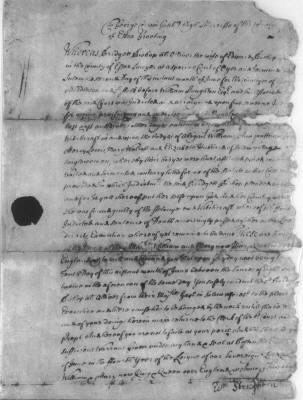
[View larger image
(383K)]
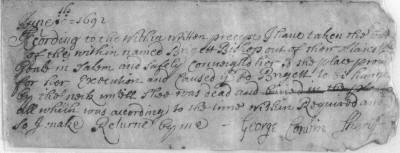
[View larger image
(327K)]
The descendants of Bridget Bishop are very numerous in Salem;
embracing some of our oldest and most respectable families, and
branching widely from them. There is no evidence of issue by her first
marriage. Thomas Oliver, her second husband, had daughters by a former
wife, who were represented in the next generation under the names of
Hilliard, Hooper, and Jones. By his wife Bridget, he had but one
child,—a daughter, Christian, born May 8, 1667. She married Thomas
Mason, and died in 1693; leaving an only child, Susannah, born August
23, 1687. Edward Bishop was her guardian. She married John Becket in
1711, and by him had a son, John, and six daughters, as follows:
Susannah, married to David Felt, Elizabeth to William Peele, Sarah to
Nathaniel Silsbee, Rebecca to William Fairfield, Eunice to Thorndike
Deland, and Hannah to William Cloutman.
After the condemnation of Bridget Bishop, the Court took a recess, and
consulted the ministers of Boston and the neighborhood respecting the
prosecutions. The response of the reverend gentlemen, while urging,
in general terms, the importance of caution and circumspection in the
methods of examination, decidedly and earnestly recommended that the
proceedings should be vigorously carried on; and they were, indeed,
vigorously carried on.
Hutchinson says, that, "at the first trial, there was no colony or
provincial law against witchcraft in force. The statute of James the
First must therefore have been considered as in force in the province,
witchcraft not being an offence at common law. Before the adjournment,
the old colony law, which makes witchcraft a capital offence, was
revived with the other local laws, as they were called, and made a law
of the province." The General Court, which thus revived the law making
witchcraft a capital offence, met, June 8, two days before the
execution of Bridget Bishop. The proceedings that took place at Salem
were thus assumed as a provincial matter, for which the immediate
locality was not responsible, but the legislature, clergy, and people
of the country at large.
The Court met again on Wednesday, the 29th of June; and, after trial,
sentenced to death Sarah Good, Sarah Wildes, Elizabeth How, Susanna
Martin, and Rebecca Nurse, who were all executed on the 19th of July.
Calef says, that, at the trial of Sarah Good,—
"One of the afflicted fell in a fit; and, after coming out
of it, cried out of the prisoner for stabbing her in the
breast with a knife, and that she had broken the knife in
stabbing of her. Accordingly, a piece of the blade of a
knife was found about her. Immediately, information being
given to the Court, a young man was called, who produced a
haft and part of the blade, which the Court, having viewed
and compared, saw it to be the same; and, upon inquiry, the
young man affirmed that yesterday he happened to break that
knife, and that he cast away the upper part,—this afflicted
person being then present. The young man was dismissed and
she was bidden by the Court not to tell lies; and was
improved after (as she had been before) to give evidence
against the prisoners."
Hutchinson, in relating this circumstance, refers to a case tried
before Sir Matthew Hale, when a similar kind of falsehood was proved
against an "afflicted" witness; notwithstanding which he says the
person on trial was found guilty, "and the judge and all the court
were fully satisfied with the verdict."
Sarah Good appears to have been an unfortunate woman, having been
subject to poverty, and consequent sadness and melancholy. But she was
not wholly broken in spirit. Mr. Noyes, at the time of her execution,
urged her very strenuously to confess. Among other things, he told her
"she was a witch, and that she knew she was a witch." She was
conscious of her innocence, and felt that she was oppressed, outraged,
trampled upon, and about to be murdered, under the forms of law; and
her indignation was roused against her persecutors. She could not bear
in silence the cruel aspersion; and, although she was just about to be
launched into eternity, the torrent of her feelings could not be
restrained, but burst upon the head of him who uttered the false
accusation. "You are a liar," said she. "I am no more a witch than you
are a wizard; and, if you take away my life, God will give you blood
to drink." Hutchinson says that, in his day, there was a tradition
among the people of Salem, and it has descended to the present time,
that the manner of Mr. Noyes's death strangely verified the prediction
thus wrung from the incensed spirit of the dying woman. He was
exceedingly corpulent, of a plethoric habit, and died of an internal
hemorrhage, bleeding profusely at the mouth.
We have no information relating to the execution of Elizabeth How. Her
gentle, patient, humble, benignant, devout, and tender heart bore her,
no doubt, with a spirit of saint-like love and faith, through the
dreadful scenes. We cannot doubt, that, in death as in life, she
forgave, prayed for, and invoked blessing upon her persecutors.
Neither has any thing come down in reference to the deportment of
Sarah Wildes or Susanna Martin. We may take it for granted, that the
former was a patient and humble, but firm and faithful sufferer; and
that the latter displayed the great energy of spirit, and probably the
strength of language, for which she was remarkable. Of the case of
Rebecca Nurse we have more information.
The character, age, and position of this venerable matron created an
impression, which called, to the utmost, all the arts and efforts of
the prosecution to counteract. Many who had gone fully and earnestly
in support of the proceedings against others paused and hesitated in
reference to her; and large numbers who had been overawed into silence
before, bravely came forward in her defence. The character of
Nathaniel Putnam has been described. He was a man of extraordinary
strength and acuteness of mind, and in all his previous life had been
proof against popular excitement. The death of his brother Thomas,
seven years before, had left him the head and patriarch of his great
family: as such, he was known as "Landlord Putnam." Entire confidence
was felt by all in his judgment, and deservedly. But he was a strong
religionist, a life-long member of the Church, and extremely strenuous
and zealous in his ecclesiastical relations. He was getting to be an
old man; and Mr. Parris had wholly succeeded in obtaining, for the
time, possession of his feelings, sympathy, and zeal in the management
of the Church, and secured his full co-operation in the witchcraft
prosecutions. He had been led by Parris to take the very front in the
proceedings. But even Nathaniel Putnam could not stand by in silence,
and see Rebecca Nurse sacrificed. A curious paper, written by him, is
among those which have been preserved:—
"Nathaniel Putnam, Sr., being desired by Francis
Nurse, Sr., to give information of what I could say
concerning his wife's life and conversation, I, the
abovesaid, have known this said aforesaid woman forty years,
and what I have observed of her, human frailties excepted,
her life and conversation have been according to her
profession; and she hath brought up a great family of
children and educated them well, so that there is in some
of them apparent savor of godliness. I have known her differ
with her neighbors; but I never knew or heard of any that
did accuse her of what she is now charged with."
A similar paper was signed by thirty-nine other persons of the village
and the immediate vicinity, all of the highest respectability. The men
and women who dared to do this act of justice must not be forgotten:—
"We whose names are hereunto subscribed, being desired by
Goodman Nurse to declare what we know concerning his wife's
conversation for time past,—we can testify, to all whom it
may concern, that we have known her for many years; and,
according to our observation, her life and conversation were
according to her profession, and we never had any cause or
grounds to suspect her of any such thing as she is now
accused of.
| "Israel Porter. |
Samuel Abbey. |
|
Elizabeth Porter. |
Hepzibah Rea. |
| Edward Bishop, Sr. |
Daniel Andrew. |
| Hannah Bishop. |
Sarah Andrew. |
| Joshua Rea. |
Daniel Rea. |
| Sarah Rea. |
Sarah Putnam. |
| Sarah Leach. |
Jonathan Putnam. |
| John Putnam. |
Lydia Putnam. |
| Rebecca Putnam. |
Walter Phillips, Sr. |
| Joseph Hutchinson, Sr. |
Nathaniel Felton, Sr. |
| Lydia Hutchinson. |
Margaret Phillips. |
| William Osburn. |
Tabitha Phillips. |
| Hannah Osburn. |
Joseph Houlton, Jr. |
| Joseph Holton, Sr. |
Samuel Endicott. |
| Sarah Holton. |
Elizabeth Buxton. |
| Benjamin Putnam. |
Samuel Aborn, Sr. |
| Sarah Putnam. |
Isaac Cook. |
| Job Swinnerton. |
Elizabeth Cook. |
| Esther Swinnerton. |
Joseph Putnam." |
| Joseph Herrick, Sr. |
|
An examination of the foregoing names in connection with the history
of the Village will show conclusive proof, that, if the matter had
been left to the people there, it would never have reached the point
to which it was carried. It was the influence of the magistracy and
the government of the colony, and the public sentiment prevalent
elsewhere, overruling that of the immediate locality, that drove on
the storm.
Israel Porter was the head of a great and powerful family. His wife
Elizabeth was, as has been stated, a sister of Hathorne, the examining
magistrate. Edward and Hannah Bishop were the venerable heads and
founders of a large family. They lived in Beverly, and must each have
been about ninety years of age. The list contains the names of the
heads of the principal families in the village,—such as John and
Rebecca Putnam, the Hutchinsons, Reas, Leaches, Houltons, and
Herricks; and, in the neighborhood, such as the Feltons, Osbornes, and
Samuel Endicott. The most remarkable fact it discloses is that it
contains the name of one of the two complainants who procured the
warrant against Rebecca Nurse,—Jonathan Putnam, the eldest son of
John; and also of his wife Lydia. Subsequent reflection, and the
return of his better judgment, satisfied him that he had done a great
wrong to an innocent and worthy person; and he had the manliness to
come out in her favor. This document ought to have been effectual in
saving the life of Rebecca Nurse. It will for ever vindicate her
character, and reflect honor upon each and every name subscribed to
it.
One of the most cruel features in the prosecution of the witchcraft
trials, and which was practised in all countries where they took
place, was the examination of the bodies of the prisoners by a jury of
the same sex, under the direction and in the presence of a surgeon or
physician. The person was wholly exposed, and every part subjected to
the most searching scrutiny. The process was always an outrage upon
human nature; and in the cases of the victims on this occasion, many
of them of venerable years and delicate feelings, it was shocking to
every natural and instinctive sentiment. There is reason to fear that
it was often conducted in a rough, coarse, and brutal manner. Marshal
Herrick testifies, that, "by order of Their Majesties' justices," he,
accompanied by the jail-keeper Dounton, and Constable Joseph Neal,
made an examination of the body of George Jacobs. In persons of his
great age, there would, in all likelihood, be shrivelled, desiccated,
and callous places. They found one on the old man, under his right
shoulder. Herrick made oath that it was a veritable witch teat, and
his deposition describes it as follows: "About a quarter of an inch
long or better, with a sharp point drooping downwards, so that I took
a pin, and run it through the said teat; but there was neither water,
blood, or corruption, nor any other matter." As proof positive that
this was "the Devil's mark," Herrick and the turnkey testify that "the
said Jacobs was not in the least sensible of what had been done"!
The mind loathes the thought of handling in this way refined and
sensitive females of matronly character, or persons of either sex,
with infirmities of body rendered sacred by years. The results of the
examination were reduced to written reports, going into details, and,
among other evidences in the trials, spread before the Court and
jury.[C]
The evidence in the case of Rebecca Nurse was made up of the usual
representations and actings of the "afflicted children." Mary Walcot
and Abigail Williams charged her with having committed several
murders; mentioning particularly Benjamin Houlton, John Harwood, and
Rebecca Shepard, and averring that she was aided therein by her sister
Cloyse. Mr. Parris, too, gave in a deposition against her; from which
it appears, that, a certain person being sick, Mercy Lewis was sent
for. She was struck dumb on entering the chamber. She was asked to
hold up her hand, if she saw any of the witches afflicting the
patient. Presently she held up her hand, then fell into a trance; and
after a while, coming to herself, said that she saw the spectres of
Goody Nurse and Goody Carrier having hold of the head of the sick man.
Mr. Parris swore to this statement with the utmost confidence in
Mercy's declarations.
The testimony of three persons particularly is required to be given,
as illustrating the extraordinary extent to which the minds of those
involved in the affair were under infatuation or hallucination.
Mrs. Ann Putnam was about thirty years of age. For six months she had
been constantly absorbed in what was then, as now, regarded as
spiritualism. Her house had been the scene of a perpetual series of
wonders supposed to be disclosures and manifestations of a
supernatural character. Apparitions, spectral shapes of living
witches, ghosts of their murdered victims, and demons generally, were
of daily and hourly occurrence. The dread secrets of the world unknown
had been revealed to her in waking fancies and dreams by night. An
originally sensitive and imaginative nature had been wrought into a
condition in which her mental faculties were at once enfeebled and
exalted. Besides all this, there were the trials to which her
constitution had been subjected by the experiences of maternity so
early begun, and the pressure upon her mind and heart of the anxieties
and cares incident to a large family of young children. An
accumulation of disappointments, vexations, and consuming griefs,
spread like a dark cloud over her life,—the deaths of her own
children, and of her sister Bayley and her children, and of her sister
Baker's children; and, finally, the long-continued, and constantly
recurring sufferings, tortures, convulsions, fits, and trances of her
daughter Ann, and her servant-woman Mercy Lewis, under, as she fully
believed, a diabolical hand.—These things must have given to her
countenance and tones of voice a wonderful impressiveness to all who
looked upon or listened to them. Her eminent social position, her
general reputation,—for Lawson, who knew her well, calls her "a very
sober and pious woman," so far as he could judge,—the stamp of
profound earnestness marked on all her language, the glow which
morbid excitement long experienced gave to her expression, must have
arrested, to a high degree, the attention of the assembled multitude.
An air of sadness, in the wild ravings of imagination, pervades her
testimony. I present her deposition in full, as one of the phenomena
of this strange transaction:—
"The Deposition of Ann Putnam, the wife of Thomas
Putnam, aged about thirty years, who testifieth and saith,
that, on the 18th March, 1692, I being wearied out in
helping to tend my poor afflicted child and maid, about the
middle of the afternoon I lay me down on the bed to take a
little rest; and immediately I was almost pressed and choked
to death, that, had it not been for the mercy of a gracious
God and the help of those that were with me, I could not
have lived many moments: and presently I saw the apparition
of Martha Corey, who did torture me so as I cannot express,
ready to tear me all to pieces, and then departed from me a
little while; but, before I could recover strength or well
take breath, the apparition of Martha Corey fell upon me
again with dreadful tortures, and hellish temptation to go
along with her. And she also brought to me a little red book
in her hand and a black pen, urging me vehemently to write
in her book; and several times that day she did most
grievously torture me, almost ready to kill me. And, on the
19th March, Martha Corey again appeared to me; and also
Rebecca Nurse, the wife of Francis Nurse, Sr.: and they both
did torture me a great many times this day with such
tortures as no tongue can express, because I would not yield
to their hellish temptations, that, had I not been upheld by
an Almighty arm, I could not have lived while night. The
20th March, being sabbath-day, I had a great deal of respite
between my fits. 21st March, being the day of the
examination of Martha Corey, I had not many fits, though I
was very weak; my strength being, as I thought, almost gone:
but, on the 22d March, 1692, the apparition of Rebecca Nurse
did again set upon me in a most dreadful manner, very early
in the morning, as soon as it was well light. And now she
appeared to me only in her shift, and brought a little red
book in her hand, urging me vehemently to write in her book;
and, because I would not yield to her hellish temptations,
she threatened to tear my soul out of my body, blasphemously
denying the blessed God, and the power of the Lord Jesus
Christ to save my soul; and denying several places of
Scripture which I told her of, to repel her hellish
temptations. And for near two hours together, at this time,
the apparition of Rebecca Nurse did tempt and torture me,
and also the greater part of this day, with but very little
respite. 23d March, am again afflicted by the apparitions of
Rebecca Nurse and Martha Corey, but chiefly by Rebecca
Nurse. 24th March, being the day of the examination of
Rebecca Nurse, I was several times afflicted in the morning
by the apparition of Rebecca Nurse, but most dreadfully
tortured by her in the time of her examination, insomuch
that the honored magistrates gave my husband leave to carry
me out of the meeting-house; and, as soon as I was carried
out of the meeting-house doors, it pleased Almighty God, for
his free grace and mercy's sake, to deliver me out of the
paws of those roaring lions, and jaws of those tearing
bears, that, ever since that time, they have not had power
so to afflict me until this 31st May, 1692. At the same
moment that I was hearing my evidence read by the honored
magistrates, to take my oath, I was again re-assaulted and
tortured by my before-mentioned tormentor, Rebecca Nurse."
"The Testimony of Ann Putnam, Jr., witnesseth and
saith, that, being in the room when her mother was
afflicted, she saw Martha Corey, Sarah Cloyse, and Rebecca
Nurse, or their apparition, upon her mother."
Mrs. Ann Putnam made another deposition under oath, at the same trial,
which shows that she was determined to overwhelm the prisoner by the
multitude of her charges. She says that Rebecca Nurse's apparition
declared to her that "she had killed Benjamin Houlton, John Fuller,
and Rebecca Shepard;" and that she and her sister Cloyse, and Edward
Bishop's wife, had killed young John Putnam's child; and she further
deposed as followeth:—
"Immediately there did appear to me six children in
winding-sheets, which called me aunt, which did most
grievously affright me; and they told me that they were my
sister Baker's children of Boston; and that Goody Nurse, and
Mistress Carey of Charlestown, and an old deaf woman at
Boston, had murdered them, and charged me to go and tell
these things to the magistrates, or else they would tear me
to pieces, for their blood did cry for vengeance. Also there
appeared to me my own sister Bayley and three of her
children in winding-sheets, and told me that Goody Nurse had
murdered them."
There is in this deposition a passage which illustrates one of the
doctrines held at the time on the subject of witchcraft. Mrs. Ann
Putnam "testifieth and saith, that, on the first day of June, 1692,
the apparition of Rebecca Nurse did again fall upon me, and almost
choke me; and she told me, that, now she was come out of prison, she
had power to afflict me, and that now she would afflict me all this
day long." The reference here is probably to the fact, that, on the
1st of June, she with many other prisoners was transferred from the
jail in Boston to that in Salem; and that, "all that day long" being
outside of prison walls, she had greater power to afflict than when
chained in a cell. This was undoubtedly the received opinion, and it
is curiously illustrated in the foregoing passage.
The only breath of disparagement against the character of Goodwife
Nurse that can be found in any of the papers is in the following
deposition:—
"The Deposition of Sarah Houlton, relict of
Benjamin Houlton, deceased, who testifieth and saith, that,
about this time three years, my dear and loving husband,
Benjamin Houlton, deceased, was as well as ever I knew him
in my life till one Saturday morning, that Rebecca Nurse,
who now stands charged for witchcraft, came to our house,
and fell a railing at him because our pigs got into her
field. Though our pigs were sufficiently yoked, and their
fence was down in several places, yet all we could say to
her could no ways pacify her; but she continued railing and
scolding a great while together, calling to her son Benj.
Nurse to go and get a gun and kill our pigs, and let none of
them go out of the field, though my poor husband gave her
never a misbeholding word. And, within a short time after
this, my poor husband going out very early in the morning,
as he was coming in again, he was taken with a strange fit
in the entry; being struck blind and stricken down two or
three times, so that, when he came to himself, he told me he
thought he should never have come into the house any more.
And, all summer after, he continued in a languishing
condition, being much pained at his stomach, and often
struck blind: but, about a fortnight before he died, he was
taken with strange and violent fits, acting much like to our
poor bewitched persons when we thought they would have died;
and the doctor that was with him could not find what his
distemper was. And, the day before he died, he was very
cheerly; but, about midnight, he was again most violently
seized upon with violent fits, till the next night, about
midnight, he departed this life by a cruel death.
"Jurat in Curia."
In explanation of the import of this testimony, it is to be observed,
that the estate of Benjamin Houlton was contiguous to that of Francis
Nurse. They were separated by a fence, which, as in such cases, was
required for half its length to be kept in order by one party, the
remaining half by the other. What the exact facts were cannot be
ascertained, as we have the story of one side only. The widow Houlton
appears to have been a tender-hearted, and, for aught we know, good
woman. Some years afterwards, she was married, as his second wife, to
Benjamin Putnam,—a very respectable person, and, on the death of his
father Nathaniel, the head of that branch of the family. He was, for
many years, deacon of the church. But she was, it must be conceded, a
prejudiced witness; and her judgment for the time was wholly
beclouded by the prevalent superstitions. The garden had been, from
the days of Townsend Bishop, a choice portion of the Nurse estate. In
all farms, it was a most important and valuable item; and was
generally under the special care and management of the wife,
daughters, and younger lads of the husbandman. Rebecca Nurse was an
efficient helpmeet; contributing her whole share to the success of the
great enterprise of clearing the estate, as well as in bringing up and
educating a large family. It was, no doubt, very provoking to her, as
it would be to any one, to have vegetable and flower beds devastated
by the ravages of a neighbor's stray pigs. To what extent her "railing
and scolding" went, she was not allowed to contribute her statement,
to enable us to judge. The affair probably produced considerable
gossip, and seems to be alluded to in Nathaniel Putnam's certificate
in behalf of Rebecca Nurse. There is reason to believe that the widow
Houlton was one of the first to realize what great injustice had been
done by her and others to the good name of Rebecca Nurse.
Notwithstanding this evidence, so deeply were the jury impressed with
the eminent virtue and true Christian excellence of this venerable
woman, that, in spite of the clamors of the outside crowd, the
monstrous statements of accusing witnesses, and the strong leaning of
the Court against her, the jury brought in a verdict of "Not guilty."
Calef, and Hutchinson after him, describe the effect, and what
followed:—
"Immediately, all the accusers in the Court, and, suddenly
after, all the afflicted out of Court, made an hideous
outcry; to the amazement, not only of the spectators, but
the Court also seemed strangely surprised. One of the judges
expressed himself not satisfied: another of them, as he was
going off the bench, said they would have her indicted anew.
The chief-justice said he would not impose on the jury, but
intimated as if they had not well considered one expression
of the prisoner when she was upon trial; viz., that when one
Hobbs, who had confessed herself to be a witch, was brought
into Court to witness against her, the prisoner, turning her
head to her, said, 'What! do you bring her? She is one of
us;' or words to that effect. This, together with the
clamors of the accusers, induced the jury to go out again,
after their verdict, 'Not guilty.'"
The foreman of the jury, Thomas Fisk, made this statement on the 4th
of July, a few days after the trial:—
"After the honored Court had manifested their
dissatisfaction of the verdict, several of the jury declared
themselves desirous to go out again, and thereupon the Court
gave leave; but, when we came to consider the case, I could
not tell how to take her words as an evidence against her,
till she had a further opportunity to put her sense upon
them, if she would take it. And then, going into Court, I
mentioned the words aforesaid, which by one of the Court
were affirmed to have been spoken by her, she being then at
the bar, but made no reply nor interpretation of them;
whereupon these words were to me a principal evidence
against her."
Upon being informed of the use made of her words, the prisoner put in
the following declaration:—
"These presents do humbly show to the honored Court and
jury, that I being informed that the jury brought me in
guilty upon my saying that Goodwife Hobbs and her daughter
were of our company; but I intended no otherwise than as
they were prisoners with us, and therefore did then, and yet
do, judge them not legal evidence against their
fellow-prisoners. And I being something hard of hearing and
full of grief, none informing me how the Court took up my
words, and therefore had no opportunity to declare what I
intended when I said they were of our company."
It was perfectly natural for her to have spoken of them as "of our
company," not only from the fact that they had long been crowded
together in the same jails, but as they had accompanied each other in
the transferrence from one jail to another, from time to time. A few
days before, a large party, of which she was one, had been brought
from Boston, spending the whole day together on the route. Sarah Good,
John Procter and wife, Susanna Martin, Bridget Bishop, and Alice
Parker happen to be mentioned as belonging to it. Calef further
states:—
"After her condemnation, the governor saw cause to grant a
reprieve, which, when known (and some say immediately upon
granting), the accusers renewed their dismal outcries
against her; insomuch that the governor was by some Salem
gentlemen prevailed with to recall the reprieve, and she was
executed with the rest.
"The testimonials of her Christian behavior, both in the
course of her life and at her death, and her extraordinary
care in educating her children, and setting them a good
example, under the hands of so many, are so numerous, that
for brevity they are here omitted."
The extraordinary conduct of "the Salem gentlemen," in preventing the
intended exercise of executive discretion and clemency on this
occasion, is explained, it is probable, by the fact, stated by Neal in
his "History of New England," that there was an organized association
of private individuals, a committee of vigilance, in Salem, during the
continuance of the delusion, who had undertaken to ferret out and
prosecute all suspected persons. He says that many were arrested and
thrown into prison by their influence and interference. It is hardly
to be doubted, that the persons who busied themselves to prevent the
reprieve of Rebecca Nurse acted under the authority and by the
direction of this self-constituted body of inquisitors. The agency of
such unauthorized and irresponsible combinations is always of
questionable expediency. When acting in the same line with an excited
populace, they are extremely dangerous.
There is no more disgraceful record in the judicial annals of the
country, than that which relates the trial of this excellent woman.
The wave of popular fury made a clear breach over the judgment-seat.
The loud and malignant outcry of an infatuated mob, inside and outside
of the Court-house, instead of being yielded to, ought to have been,
not only sternly rebuked, but visited with prompt and exemplary
punishment. The judges were not only overcome and intimidated from the
faithful discharge of their sacred duty by a clamoring crowd, but they
played into their hands. Hutchinson justly remarks, that their conduct
was in violation of that rule to execute "law and justice in mercy,"
which ought always to be written on their hearts. "In a capital case,
the Court often refuses a verdict of 'Guilty;' but rarely, if ever,
sends a jury out again upon one of 'Not guilty.'" The statement made
by the foreman of the jury, with the subsequent explanation of the
prisoner, taken in connection with the ground on which the
chief-justice sent the jury out again after rendering their verdict of
"Not guilty," made it the duty of the Court and the executive to give
to her the benefit of that verdict.
At the trial of her mother, Sarah Nurse—aged twenty-eight years or
thereabouts—offered this piece of testimony: that, "being in the
Court, this 29th of June, 1692, I saw Goodwife Bibber pull pins out of
her clothes, and held them between her fingers, and clasped her hands
round her knee; and then she cried out, and said, Goody Nurse pinched
her." In all these trials, Mercy Lewis was a principal witness and
actor; yet we find, among the papers, testimony from the most
respectable and reliable persons, that she was not to be trusted.
There was also testimony which ought to have broken the force of the
depositions of Ann Putnam and her mother. Four days after the
examination and commitment of Rebecca Nurse, John Tarbell and Samuel
Nurse went to the house of Thomas Putnam to find out in what way their
mother had been made the object of such shocking accusations. They
were men whose credibility was never brought in question. Their
declarations, on this occasion, were not disputed, and, if not true,
might have been overthrown; for there were many witnesses of the facts
they stated. Tarbell swore as follows: "Upon discourse of many things,
I asked whether the girl that was afflicted did first speak of Goody
Nurse, before others mentioned her to her. They said she told them she
saw the apparition of a pale-faced woman that sat in her grandmother's
seat, but did not know her name. Then I replied and said, 'But who was
it that told her that it was Goody Nurse?' Mercy Lewis said it was
Goody Putnam that said it was Goody Nurse. Goody Putnam said that it
was Mercy Lewis that told her. Thus they turned it upon one another,
saying, 'It was you,' and 'It was you that told her.'" Samuel Nurse
testified to the same.
There was another piece of evidence, which, though brought against
Rebecca Nurse, bears harder, as we read it now, upon Ann Putnam than
any one else, and makes it more difficult to palliate her conduct on
the supposition of partial insanity. It is, all along, one of the
obscure problems of our subject to determine how far delusion may have
been accompanied by fraud and imposture. Edward Putnam testified, that
"Ann Putnam, Jr., was bitten by Rebecca Nurse, as she said, about two
of the clock of the day" after Rebecca Nurse had been committed to
jail, and while she was several miles distant, in Salem; and the said
Nurse also struck said Ann Putnam with her spectral chain, leaving a
mark, "being in a kind of a round ring, and three streaks across the
ring: she had six blows with a chain in the space of half an hour; and
she had one remarkable one, with six streaks across her arm." Edward
Putnam swears, "I saw the mark, both of bite and chains." The Court,
no doubt, were solemnly impressed by this amazing evidence; but it is
hard to avoid the conclusion that Ann Putnam was guilty of elaborate
falsehood and a studied trick.
In the trials at this session, one of the "afflicted children" cried
out against the Rev. Samuel Willard, of the Old South Church, in
Boston. "She was sent out of Court, and it was told about that she was
mistaken in the person." There was surely evidence enough against the
honesty and credibility of the accusers to leave the judges without
excuse, and justly meriting perpetual condemnation for not paying heed
to it.
The case of Rebecca Nurse proves that a verdict could not have been
obtained against a person of her character charged with witchcraft in
this county, had not the most extraordinary efforts been made by the
prosecuting officer, aided by the whole influence of the Court and
provincial authorities. The odium of the proceedings at the trials and
at the executions cannot fairly be laid upon Salem, or the people of
this vicinity.
But nothing can extenuate the infamy that must for ever rest upon the
names of certain parties to the proceedings. Not to attempt here to
measure the guilt of the accusing witnesses, it may be mentioned that
it was the deliberate conviction of the family of Rebecca Nurse, that
Mr. Parris, more than all other persons, was responsible for her
execution; whether by his officious activity in driving on the
prosecution, or in preventing her reprieve, cannot be known. Of the
prominent part taken by Mr. Noyes in the cruel treatment of this
woman, there is no room for doubt. The records of the First Church in
Salem are darkened by the following entry:—
"1692, July 3.—After sacrament, the elders propounded to
the church,—and it was, by an unanimous vote, consented
to,—that our sister Nurse, being a convicted witch by the
Court, and condemned to die, should be excommunicated; which
was accordingly done in the afternoon, she being present."
The scene presented on this occasion must have been truly impressive
at the time, as it is shocking to us in the retrospect. The action of
the church, at the close of the morning service, of course became
universally known; and the "great and spacious meeting-house" was
thronged by a crowd that filled every nook and corner of its floor,
galleries, and windows. The sheriff and his subordinates brought in
the prisoner, manacled, and the chains clanking from her aged form.
She was placed in the broad aisle. Mr. Higginson and Mr. Noyes—the
elders, as the clergy were then called—were in the pulpit. The two
ruling elders—who were lay officers—and the two deacons were in
their proper seats, directly below and in front of the pulpit. Mr.
Noyes pronounced the dread sentence, which, for such a crime, was then
believed to be not merely an expulsion from the church on earth, but
an exclusion from the church in heaven. It was meant to be understood
as an eternal doom. As it had been proved, in his estimation, beyond a
question, that she had given her soul to the Devil, he delivered her
over to the great adversary of God and man.
From the dismal cell, which, for but a few days longer, was to hold
her body, he proclaimed the transferrence of her soul to—
"A dungeon horrible on all sides round,
As one great furnace flamed; yet from those flames
No light, but rather darkness visible;
Regions of sorrow, doleful shades, where peace
And rest can never dwell; hope never comes
That comes to all; but torture without end,
As far removed from God, and light of heaven,
As from the centre thrice to the utmost pole."
Language and imagery, exhausting the resources of the divine genius of
the greatest of poets, fail to give expression to what was felt to be
the import of this fearful sentence. It sunk the recipient of it below
the reach of human sympathy. She was regarded, by that blinded
multitude, with a horror that cast out pity, and was full of hate. But
in our view now, and, as we believe, in the view of God and angels
then, she occupied an infinite height above her persecutors. Her mind
was serenely fixed upon higher scenes, and filled with a peace which
the world could not take away, or its cruel wrongs disturb. She went
back to her prison walls, and then to the scaffold, with a pious and
humble faith which has not failed to be recorded among men, as it has
been rewarded where the wicked cease from troubling, and the weary are
at rest.
Calef, as already quoted, gives the impression produced by her
demeanor at her death. Hutchinson expresses in the following words the
judgment of history and the sense of all coming times:—
"Mr. Noyes, the minister of Salem, a zealous prosecutor,
excommunicated the poor old woman, and delivered her to
Satan, to whom he supposed she had formally given herself up
many years before; but her life and conversation had been
such, that the remembrance thereof, in a short time after,
wiped off all the reproach occasioned by the civil or
ecclesiastical sentence against her."
It is impossible to close the story of the lot assigned to this good
woman by an inscrutable Providence, without again contemplating it in
a condensed recapitulation. In her old age, experiencing a full share
of all the delicate infirmities which the instincts of humanity
require to be treated with careful and reverent tenderness, she was
ruthlessly snatched from the bosom of a loving family reared by her
pious fidelity in all Christian graces, from the side of the devoted
companion of her long life, from a home that was endeared by every
grateful association and comfort; immured in the most wretched and
crowded jails; kept loaded with irons and bound with cords for months;
insulted and maligned at the preliminary examinations; outraged in her
person by rough and unfeeling handling and scrutiny; and in her
rights, by the most flagrant and detestable judicial oppression, by
which the benefit of a verdict, given in her favor, had been torn
away; carried to the meeting-house to receive the sentence of
excommunication in a manner devised to harrow her most sacred
sentiments; and finally carted through the streets by a route every
foot of which must have been distressing to her infirm and enfeebled
frame; made to ascend a rough and rocky path to the place of
execution, and there consigned to the hangman. Surely, there has
seldom been a harder fate.
Her body was probably thrown with the rest into a hole in the crevices
of the rock, and covered hastily and thinly over by the executioners.
It has been the constant tradition of the family, that, in some way,
it was recovered; and the spot is pointed out in the burial-place
belonging to the estate, where her ashes rest by the side of her
husband, and in the midst of her children. It is certain, that, at
least, one other body was thus exhumed, and taken to its own proper
place of burial. From the known character of Francis Nurse and his
sons and sons-in-law, we may be sure that what others could do they
did not suffer to remain undone. It is left to the imagination to
present the details of the sad and secret enterprise. In the darkness
of midnight, they found and identified the body, and bore it tenderly
in their arms along the silent roads and by-ways, across fields and
over fences, to the old home, where it was received by the assembled
family, mourned over, and cared for; and, during that or the ensuing
night, deposited, with tears and prayers, in their own consecrated
grounds. Her descendants of successive generations owned and
reverently guarded the spot. They own and guard it to-day. The
interesting reminiscences connected with the early history of the
Nurse house have been alluded to. It has witnessed an extraordinary
variety of the conditions of domestic vicissitude. Scenes rising
before the mind in contemplative retrospection, while gazing upon it,
present the extremest contrasts of human experience. On the evening of
the 25th of October, 1678, Mary and Elizabeth Nurse were married. Such
an occurrence was undoubtedly the occasion of the highest joy and
gladness in a happy household. The old mansion shone in light, and
echoed voices of cheer. How altered its aspect! What darkness and
silence brooded over and within it, while those same daughters waited,
watched, and listened, through the solemn hours of that night of woe
and horror, for the coming of their father, husbands, and brothers,
bearing to the home, from which she had been so cruelly torn, the
remains of their slaughtered mother!
The subsequent history of the house presents a circumstance of
singular interest in connection with our story. All the members of
the three branches of the Putnam family, with the exception of Joseph,
seem to have been carried away by the witchcraft delusion, in its
early stages, and were more or less active in pushing on the
prosecutions. We have seen how fierce was the maniac testimony of Mrs.
Ann Putnam and her daughter against Rebecca Nurse. The lapse of time,
by a Providence that wonderfully works its ends, has repaired the
breaches made by folly and wrong. The descendants of the numerous
family of Mrs. Ann Putnam have disappeared from the scene: none of
them bearing the name are in the village. The descendants of Deacon
Edward Putnam have also scattered in emigration to other places.
Nathaniel and John, the heads of the other two branches of the family,
although involved in the witchcraft delusion, each signed papers in
favor of Rebecca Nurse; their descendants, as well as those of Joseph,
are still numerous in the village, hold their old position of
respectability and influence, and many of them occupy the lands of
their ancestors. Stephen, the grandson of Nathaniel, married Miriam,
the grand-daughter of John. Their son Phinehas, in 1784, bought the
Nurse homestead from Benjamin Nurse, the great-grandson of Rebecca.
Orin Putnam, the great-grandson of Phinehas, to whom the estate
descends, married in 1836 the daughter of Allen Nurse, a direct
descendant of Rebecca, and placed her at the head of her old ancestral
homestead. The children of that marriage, with their father and
grandfather, constitute the family that dwell in and own the
venerable mansion. This singular restoration, suggesting such pleasing
sentiments, adds another to the remarkable elements of interest
belonging to the history of the Townsend-Bishop House.
The descendants of Francis and Rebecca Nurse are numerous, and have
honorably perpetuated the name. Among them may be mentioned the Rev.
Peter Nurse, a graduate of Harvard College in 1802, for some years
librarian of that institution, an excellent scholar, and long
universally respected as a clergyman; and Amos Nurse, a graduate of
the same college in 1812,—an eminent physician connected with the
medical faculty of Bowdoin College, a man of distinguished talent and
influence in public affairs, and senator in Congress from the State of
Maine.
The Court met again on the 5th of August, and tried George Burroughs;
John Procter and Elizabeth, his wife; George Jacobs, Sr.; John
Willard; and Martha Carrier. They were all condemned, and, with the
exception of Elizabeth Procter, executed on the 19th of the same
month.
Hutchinson describes the trial of Burroughs. After speaking of the
evidence of the "afflicted persons" and the confessing witches, he
mentions other circumstances which were thought to corroborate it:
"One was, that, being a little man, he had performed feats beyond the
strength of a giant; viz., had held out a gun of seven feet barrel
with one hand, and had carried a barrel full of cider from a canoe to
the shore." Burroughs said that an Indian present at the time did the
same. Instantly, the accusers said it was "the black man, or the
Devil, who," they swore, "looks like an Indian." Another piece of
evidence was, that he went from one place to another, on a certain
occasion, in a shorter time than was possible had not the Devil helped
him. He said, in answer, that another man accompanied him. Their reply
to this was, that it was the Devil, using the appearance of another
man. So whatever he said was turned against him. Hutchinson says,
"Upon the whole, he was confounded, and used many twistings and
turnings, which, I think, we cannot wonder at." This fair and
judicious writer, like Brattle, appears in the foregoing remark to
have adopted the common scandal, put in circulation by parties
interested to disparage Mr. Burroughs. The papers in this case, that
have come down to us, are more numerous than in reference to many
others among the sufferers; and they do not bear such an impression.
Mr. Burroughs was astounded at the monstrous folly and falsehood with
which he was surrounded. He was a man without guile, and incapable of
appreciating such wickedness. He tried, in simplicity and
ingenuousness, to explain what was brought against him; and this,
probably, was all the "twisting and turning" he exhibited.
Hutchinson had the benefit of consulting all the papers belonging to
this and other trials; but neither he nor Calef seems to have noticed
one remarkable fact: many of the depositions, how many we cannot
tell, were procured after the trials were over, and surreptitiously
foisted in among the papers to bolster up the proceedings. We find,
for instance, the following deposition:—
"Thomas Greenslitt, aged about forty years, being
deposed, testifieth that, about the first breaking-out of
this last Indian war, being at the house of Captain Joshua
Scotto at Black Point, he saw Mr. George Burrows, who was
lately executed at Salem, lift a gun of six-foot barrel or
thereabouts, putting the forefinger of his right hand into
the muzzle of said gun, and that he held it out at arms'
end, only with that finger: and further this deponent
testifieth, that, at the same time, he saw the said Burrows
take up a full barrel of molasses with but two of the
fingers of one of his hands in the bung, and carry it from
the stage head to the door at the end of the stage, without
letting it down; and that Lieutenant Richard Hunniwell and
John Greenslitt were then present, and some others that are
dead. Sept. 15, '92."
Not only the date to this deposition, but its express language, proves
that it could not have been used at the trial. There is another, to
the same effect and of the same date, that is, nearly a month after
Burroughs was thrown into his grave. There are others of the same
kind. This stamps the management of the prosecutions, and of those
concerned in the charge of the papers, with an irregularity of the
grossest kind, which partakes strongly of the character of fraud and
falsehood.
When it was found that there was beginning to grow up a want of
confidence in "spectre evidence" and the testimony of the afflicted
children, those concerned in the prosecutions became alarmed lest a
re-action of public sentiment might take place. The persons who had
brought Mr. Burroughs to his death concluded that their best escape
from public indignation was to accumulate evidence against him after
he was in his grave, particularly on the point of his superhuman
strength; and they got up these depositions, and caused them to be put
among the papers on file. Great stress was laid, by those who were
interested in damaging his character and suppressing sympathy in his
fate, upon this particular proof of his having been in confederacy
with the Devil. Increase Mather said, that, in his judgment, it was
conclusive evidence that he "had the Devil to be his familiar," and
that, had he been on the jury, he could not, on this account, have
concurred in a verdict of acquittal; and Cotton Mather, feeling the
importance of making the most of Mr. Burroughs's extraordinary
strength, gives way to his tendency to indulge in the marvellous, as
follows:—
"God had been pleased so to leave this George Burroughs,
that he had ensnared himself by several instances which he
had formerly given of preternatural strength, and which were
now produced against him. He was a very puny man, yet he had
often done things beyond the strength of a giant. A gun of
about seven-foot barrel, and so heavy that strong men could
not steadily hold it out with both hands,—there were
several testimonies given in by persons of credit and honor,
that he made nothing of taking up such a gun behind the lock
with but one hand, and holding it out, like a pistol, at
arms' end. Yea, there were two testimonies, that George
Burroughs, with only putting the forefinger of his right
hand into the muzzle of a heavy gun, a fowling-piece of
about six or seven foot barrel, did lift up the gun, and
hold it out at arms' end,—a gun which the deponents thought
strong men could not with both hands lift up, and hold at
the butt end, as is usual."
It is further observable, in reference to the foregoing deposition
from Greenslitt, that it was given six days after the condemnation of
his mother, Ann Pudeator, and a week before her execution. Cotton
Mather says that he "was overpersuaded by others to be out of the way
upon George Burroughs's trial," six weeks before. He did not fail,
however, to come to Salem to be with his mother at her trial and until
her death, and being here was compelled to give his deposition. His
mother's life was at the mercy of the prosecutors; and he was tempted,
in the vain hope of conciliating that mercy, to gratify them by making
the statement about Burroughs a month after his execution, and whom it
could not then harm. What he said was probably no more than the truth.
It has been found that the power of the human muscles can be
cultivated to a surprising extent; and the feats ascribed to
Burroughs, without making much allowance for a natural degree of
exaggeration, have been fully equalled in our day.
Calef gives the following account of his execution:—
"Mr. Burroughs was carried in a cart with the others,
through the streets of Salem, to execution. When he was upon
the ladder, he made a speech for the clearing of his
innocency, with such solemn and serious expressions as were
to the admiration of all present. His prayer (which he
concluded by repeating the Lord's Prayer) was so well
worded, and uttered with such composedness and such (at
least seeming) fervency of spirit, as was very affecting,
and drew tears from many, so that it seemed to some that the
spectators would hinder the execution. The accusers said the
black man stood and dictated to him. As soon as he was
turned off, Mr. Cotton Mather, being mounted upon a horse,
addressed himself to the people, partly to declare that he
(Mr. Burroughs) was no ordained minister, and partly to
possess the people of his guilt, saying that the Devil often
had been transformed into an angel of light; and this
somewhat appeased the people, and the executions went on.
When he was cut down, he was dragged by a halter to a hole,
or grave, between the rocks, about two feet deep; his shirt
and breeches being pulled off, and an old pair of trousers
of one executed put on his lower parts: he was so put in,
together with Willard and Carrier, that one of his hands,
and his chin, and a foot of one of them, was left
uncovered."
Cotton Mather, not satisfied with this display of animosity, at a
moment when every human heart, however imbittered by prejudice, is
hushed for the time in solemn silence, attempts, in an account
afterwards given of Mr. Burroughs's trial, to blacken his character by
an elaborate dressing-up of the absurd stories told by the accusers,
and a perverse misrepresentation of the demeanor of the accused. He
relates with apparent glee what was regarded as a wonderful
achievement of adroitness on the part of Chief-justice Stoughton in
trapping Mr. Burroughs, and putting the laugh upon him in Court.
"It cost the Court a wonderful deal of trouble to hear the
testimonies of the sufferers; for, when they were going to
give in their depositions, they would for a long while be
taken with fits, that made them quite uncapable of saying
any thing. The chief judge asked the prisoner, who he
thought hindered these witnesses from giving their
testimonies; and he answered, he supposed it was the Devil.
The honorable person then replied, 'How comes the Devil so
loath to have any testimony borne against you?' Which cast
him into very great confusion."
From what fell from him, at the preliminary examination, it is evident
that it did not occur to him as a possibility that human nature could
be capable of the guilt of such a wilful fabrication and imposture on
the part of the "afflicted children." He beheld their sufferings, and
he knew his own innocence. He felt, whatever his theological creed
might have been, that a Devil was required to explain the mystery. The
apparent sufferings of the accusing witnesses convinced Court, jury,
and all, of the guilt of the accused. The logic of the chief-justice
was perfectly absurd. For, if the Devil caused the sufferings, he was
an adverse party to the prisoner. This, however, overthrows the whole
theory of the prosecution, which was that the prisoner and the Devil
were in league with each other. But the judge, jury, and people, all
equally blinded and stupefied by the delusion, did not see it; and
they chuckled over the alleged confusion of the prisoner. All
thoughtful persons will concur in Mr. Burroughs's opinion, that, if
ever a diabolical power had possession of human beings, it was in the
case of the wretched creatures who enacted the part of the accusing
girls in the witchcraft proceedings. In his account of the trial,
Mather makes statements which show that he was privy to the fact, that
testimony, subsequently taken, was lodged with the evidence belonging
to the case. The documents prove that it was done to an extent beyond
what he acknowledges.
Considering that none dared to show the least sympathy with the
persons on trial, that they had none to counsel or stand by them, that
the public passions were incensed against them as against no other
persons ever charged with crime,—it being vastly more flagrant than
any other crime, a rebellion against heaven and earth, God and man; a
deliberate selling of the soul to the Arch-enemy of souls for the ruin
of all other souls,—in view of all these things, it is truly
astonishing, that, by the documents themselves, proceeding, as in
almost all cases they do, from hostile and imbittered sources, we are
compelled to the conviction, that, in their imprisonments, trials, and
deaths, the victims of this savage delusion manifested—in most cases
eminently, and in all substantially—the marks, not only of innocent,
but of elevated and heroic minds. A review of what can be gleaned in
reference to Mr. Burroughs at Casco Bay and Salem Village, and a
considerate survey and scrutiny of all that has reached us from the
day of his arrest to the moment of his death, have left a decided
impression, that he was an able, intelligent, true-minded man;
ingenuous, sincere, humble in his spirit; faithful and devoted as a
minister; and active, generous, and disinterested as a citizen. His
descendants, under his own name and the names of Newman, Fowle,
Holbrook, Fox, Thomas, and others, have been numerous and respectable.
The late Isaiah Thomas, LL.D., was one of them.
From the account given of John Procter, in the
First Part, it is
apparent that he was a person of decided character, and, although
impulsive and liable to be imprudent, of a manly spirit, honest,
earnest, and bold in word and deed. He saw through the whole thing,
and was convinced that it was the result of a conspiracy, deliberate
and criminal, on the part of the accusers. He gave free utterance to
his indignation at their conduct, and it cost him his life.
A few days before his trial, he made his will. There is no reference
in it to his particular situation. His signature to the document is
accurately represented among the autographs given in this work. It was
written while the manacles were on him. Notwithstanding the danger to
which any one was exposed who expressed sympathy for convicted or
accused persons, or doubt of their guilt, a large number had the
manliness to try to save this worthy and honest citizen. John Wise,
one of the ministers of Ipswich, heads the list of petitioners from
that place. The document is in his handwriting. Thirty-one others
joined in the act, many of them among the most respectable citizens of
that town. Mr. Wise was a learned, able, and enlightened man. He had a
free spirit, and was perhaps the only minister in the neighborhood or
country, who was discerning enough to see the erroneousness of the
proceedings from the beginning. The petition is as follows:—
"The Humble and Sincere Declaration of us, Subscribers,
Inhabitants in Ipswich, on the Behalf of our Neighbors, John
Procter and his Wife, now in Trouble and under Suspicion of
Witchcraft.
"TO THE HONORABLE COURT OF ASSISTANTS NOW SITTING IN BOSTON.
"Honored and Right Worshipful,—The aforesaid John Procter
may have great reason to justify the Divine Sovereignty of
God under these severe remarks of Providence upon his peace
and honor, under a due reflection upon his life past; and so
the best of us have reason to adore the great pity and
indulgence of God's providence, that we are not exposed to
the utmost shame that the Devil can invent, under the
permissions of sovereignty, though not for that sin
forenamed, yet for our many transgressions. For we do at
present suppose, that it may be a method within the severer
but just transactions of the infinite majesty of God, that
he sometimes may permit Sathan to personate, dissemble, and
thereby abuse innocents and such as do, in the fear of God,
defy the Devil and all his works. The great rage he is
permitted to attempt holy Job with; the abuse he does the
famous Samuel in disquieting his silent dust, by shadowing
his venerable person in answer to the charms of witchcraft;
and other instances from good hands,—may be arguments.
Besides the unsearchable footsteps of God's judgments, that
are brought to light every morning, that astonish our
weaker reasons; to teach us adoration, trembling,
dependence, &c. But we must not trouble Your Honors by being
tedious. Therefore, being smitten with the notice of what
hath happened, we reckon it within the duties of our
charity, that teacheth us to do as we would be done by, to
offer thus much for the clearing of our neighbors'
innocency; viz., that we never had the least knowledge of
such a nefandous wickedness in our said neighbors, since
they have been within our acquaintance. Neither do we
remember any such thoughts in us concerning them, or any
action by them or either of them, directly tending that way,
no more than might be in the lives of any other persons of
the clearest reputation as to any such evils. What God may
have left them to, we cannot go into God's pavilion clothed
with clouds of darkness round about; but, as to what we have
ever seen or heard of them, upon our consciences we judge
them innocent of the crime objected. His breeding hath been
amongst us, and was of religious parents in our place, and,
by reason of relations and properties within our town, hath
had constant intercourse with us. We speak upon our personal
acquaintance and observation; and so leave our neighbors,
and this our testimony on their behalf, to the wise thoughts
of Your Honors.
| Jno. Wise. |
Nathanill Perkins. |
Benjamin Marshall. |
| William Story. Senr. |
Thomas Lovkine. |
John Andrews Jur. |
| Reinalld Foster. |
William Cogswell. |
William Butler. |
| Thos. Chote. |
Thomas Varny. |
William Andrews. |
| John Burnum Sr. |
John Fellows. |
John Andrews. |
| William Thomsonn. |
Wm. Cogswell Jur. |
John Chote Ser. |
| Tho. Low Senr. |
Jonathan Cogswell. |
Joseph Procter. |
| Isaac Foster. |
John Cogswell Ju. |
Samuel Gidding. |
| John Burnum junr. |
John Cogswell. |
Joseph Evleth. |
| William Goodhew. |
Thomas Andrews. |
James White. |
| Isaac Perkins. |
Joseph Andrews." |
|
I have given the names of the men who signed this paper, as copied
from the original. It is due to their memory; and their descendants
may well be gratified by the testimony thus borne to their courage and
justice.
Their neighbors living near the bounds of the village presented the
following paper, in the handwriting of Felton, the first signer. From
the appearance of the document, it seems that a portion of it,
probably containing an equal number of names, has been cut out by
scissors.
"We whose names are underwritten, having several years known
John Procter and his wife, do testify that we never heard or
understood that they were ever suspected to be guilty of the
crime now charged upon them; and several of us, being their
near neighbors, do testify, that, to our apprehension, they
lived Christian-like in their family, and were ever ready to
help such as stood in need of their help.
"Nathaniel Felton, Sr., and Mary his wife.
Samuel Marsh, and Priscilla his wife.
James Houlton, and Ruth his wife.
John Felton.
Nathaniel Felton, Jr.
Samuel Frayll, and An his wife.
Zachariah Marsh, and Mary his wife.
Samuel Endecott, and Hanah his wife.
Samuel Stone.
George Locker.
Samuel Gaskil, and Provided his wife.
George Smith.
Edward Gaskil."
In addition to this testimony in their favor, evidence was offered, at
their trial, that one of the accusing witnesses had denied, out of
Court, what she had sworn to in Court; and declared that she must, at
the time, have been "out of her head," and that she had never intended
to accuse them. It was further proved, that another of the accusing
witnesses acknowledged that she had sworn falsely, and tried to
explain away her testimony in Court, acknowledging that what the girls
said was "for sport. They must have some sport." But neither the
testimony in their favor from those who had known them through life,
nor the palpable and decisive manner in which the evidence against
them had been impeached and exposed, could open the eyes of the
infatuated Court and jury.
After his conviction, he requested, in vain, time enough to prepare
himself for death, and make the necessary arrangements of his business
and for the welfare of his family; and the statement has come down to
us, that Mr. Noyes refused to pray with him, unless he would confess
himself guilty. The following letter, addressed by him to the
ministers named, in behalf of himself and fellow-prisoners, gives a
truly shocking account of the outrages connected with the
prosecutions. It illustrates the courage of the writer in exposing
them, and is a sensible and manly appeal and remonstrance. There is
ground for supposing that the ministers addressed were known not to be
entirely carried away by the delusion. The fact that Mr.
Mather—meaning, of course, Increase Mather—is the first named,
corroborates other evidence that he was beginning to entertain doubts
about the propriety of the proceedings. Of the Rev. James Allen, much
has been said in connection with the Townsend-Bishop farm. He had been
a clergyman in England, and was silenced by the Act of Uniformity, in
1662. He came to New England; and, after officiating as an assistant
to the Rev. Mr. Davenport, in the First Church at Boston, for six
years, was ordained as its preacher in 1668. He was of independent
fortune, and subsequently took a leading part with those opposed to
the party that had favored the witchcraft prosecutions. He must have
known Rebecca Nurse quite intimately, and much of the influence used
in her favor, and which almost saved her, may be attributed to him;
there was a particular intimacy between him and Increase Mather, and
together they held Cotton Mather somewhat in check, occasionally at
least. The Rev. Joshua Moody had been settled in the ministry at
Portsmouth, New Hampshire. In the maintenance of the principles of
religious liberty he suffered a long imprisonment, and was afterwards
exiled by arbitrary power. He was then invited to the First Church in
Boston, where he preached from 1684 to 1693, when he returned to
Portsmouth. He died in 1697. By his active exertions, Mr. and Mrs.
English were enabled to escape from the jail at Boston. The Rev.
Samuel Willard, pastor of the Old South Church in Boston, was one of
the most revered and beloved ministers in the country. His
publications were numerous, learned, and valuable; consisting of
discourses, tracts, and volumes. His "Body of Divinity" is an
elaborate and systematic work, comprising two hundred and fifty
lectures on the Assembly's Catechism. That Procter was not in error in
supposing Mr. Willard open to reason on the subject is demonstrated by
the fact, that the "afflicted girls" were beginning to cry out against
this eminent divine. The Rev. John Bailey was one of the ejected
ministers who had here sought refuge from oppression in the
mother-country. He was a distinguished person, associated with Mr.
Allen and Mr. Moody in the ministry of the First Church at Boston.
Cotton Mather made him the subject of the strongest eulogium in his
"Magnalia." Procter addressed his letter to these persons because he
believed them to be superior in wisdom and candid in spirit. It cannot
be doubted that the good men did what they could in his behalf, but in
vain.
"Salem Prison, July 23, 1692.
"Mr. Mather, Mr. Allen, Mr. Moody, Mr. Willard, and Mr.
Bailey.
"Reverend Gentlemen,—The innocency of our case,
with the enmity of our accusers and our judges and jury,
whom nothing but our innocent blood will serve, having
condemned us already before our trials, being so much
incensed and enraged against us by the Devil, makes us bold
to beg and implore your favorable assistance of this our
humble petition to His Excellency, that if it be possible
our innocent blood may be spared, which undoubtedly
otherwise will be shed, if the Lord doth not mercifully step
in; the magistrates, ministers, juries, and all the people
in general, being so much enraged and incensed against us
by the delusion of the Devil, which we can term no other, by
reason we know, in our own consciences, we are all innocent
persons. Here are five persons who have lately confessed
themselves to be witches, and do accuse some of us of being
along with them at a sacrament, since we were committed into
close prison, which we know to be lies. Two of the five are
(Carrier's sons) young men, who would not confess any thing
till they tied them neck and heels, till the blood was ready
to come out of their noses; and it is credibly believed and
reported this was the occasion of making them confess what
they never did, by reason they said one had been a witch a
month, and another five weeks, and that their mother made
them so, who has been confined here this nine weeks. My son,
William Procter, when he was examined, because he would not
confess that he was guilty, when he was innocent, they tied
him neck and heels till the blood gushed out at his nose,
and would have kept him so twenty-four hours, if one, more
merciful than the rest, had not taken pity on him, and
caused him to be unbound.
"These actions are very like the Popish cruelties. They have
already undone us in our estates, and that will not serve
their turns without our innocent blood. If it cannot be
granted that we can have our trials at Boston, we humbly beg
that you would endeavor to have these magistrates changed,
and others in their room; begging also and beseeching you,
that you would be pleased to be here, if not all, some of
you, at our trials, hoping thereby you may be the means of
saving the shedding of our innocent blood. Desiring your
prayers to the Lord in our behalf, we rest, your poor
afflicted servants,
"John Procter [and others]."
The bitterness of the prosecutors against Procter was so vehement,
that they not only arrested, and tried to destroy, his wife and all
his family above the age of infancy, in Salem, but all her relatives
in Lynn, many of whom were thrown into prison. The helpless children
were left destitute, and the house swept of its provisions by the
sheriff. Procter's wife gave birth to a child, about a fortnight after
his execution. This indicates to what alone she owed her life.
John Procter had spoken so boldly against the proceedings, and all who
had part in them, that it was felt to be necessary to put him out of
the way. He had denounced the entire company of the accusers, and
their revenge demanded his sacrifice. They brought the whole power of
their cunning and audacious arts to bear against him, and pursued him
to the death with violence and rage. The manly and noble deportment
exhibited in his dying hour seems to have made a deep impression on
the minds of some, and gave an effectual blow to the delusion. The
descendants of John Procter have always understood that his remains
were recovered from the spot where the hangman deposited them, and
placed in his own grounds, where they rest to-day.
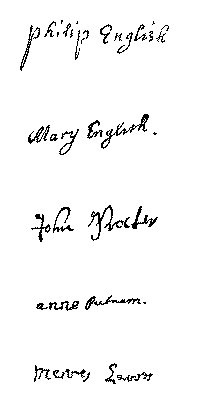
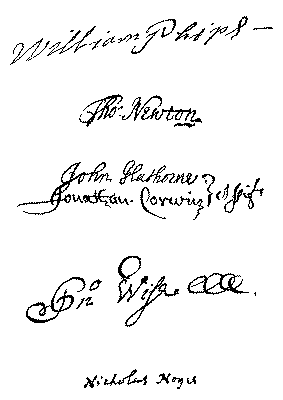
No account has come to us of the deportment of George Jacobs, Sr., at
his execution. As he was remarkable in life for the firmness of his
mind, so he probably was in death. He had made his will before the
delusion arose. It is dated Jan. 29, 1692; and shows that he, like
Procter, had a considerable estate. Bartholomew Gedney is one of
the attesting witnesses, and probably wrote the document. After his
conviction, on the 12th of August, he caused another to be written,
which, in its provisions, reflects light upon the state of mind
produced by the condition in which he found himself. In his infirm old
age, he had been condemned to die for a crime of which he knew himself
innocent, and which there is some reason to believe he did not think
any one capable of committing. He regarded the whole thing as a wicked
conspiracy and absurd fabrication. He had to end his long life upon a
scaffold in a week from that day. His house was desolated, and his
property sequestered. His only son, charged with the same crime, had
eluded the sheriff,—leaving his family, in the hurry of his flight,
unprovided for—and was an exile in foreign lands. The crazy wife of
that son was in prison and in chains, waiting trial on the same
charge; her little children, including an unweaned infant, left in a
deserted and destitute condition in the woods. The older children were
scattered, he knew not where, while one of them had completed the
bitterness of his lot by becoming a confessor, upon being arrested
with her mother as a witch. This grand-daughter, Margaret, overwhelmed
with fright and horror, bewildered by the statements of the accusers,
and controlled probably by the arguments and arbitrary methods of
address employed by her minister, Mr. Noyes,—whose peculiar function
in these proceedings seems to have been to drive persons accused to
make confession—had been betrayed into that position, and became a
confessor, and accuser of others. Under these circumstances, the old
man made a will, giving to his son George his estates, and securing
the succession of them to his male descendants. But, in the mean
while, without his then knowing it, Margaret had recalled her
confession, as appears from the following documents, which tell their
own story:—
"The Humble Declaration of Margaret Jacobs unto the Honored
Court now sitting at Salem showeth, that, whereas your poor
and humble declarant, being closely confined here in Salem
jail for the crime of witchcraft,—which crime, thanks be to
the Lord! I am altogether ignorant of, as will appear at the
great day of judgment,—may it please the honored Court, I
was cried out upon by some of the possessed persons as
afflicting them; whereupon I was brought to my examination;
which persons at the sight of me fell down, which did very
much startle and affright me. The Lord above knows I knew
nothing in the least measure how or who afflicted them. They
told me, without doubt I did, or else they would not fall
down at me; they told me, if I would not confess, I should
be put down into the dungeon, and would be hanged, but, if I
would confess, I should have my life: the which did so
affright me, with my own vile, wicked heart, to save my
life, made me make the like confession I did, which
confession, may it please the honored Court, is altogether
false and untrue. The very first night after I had made
confession, I was in such horror of conscience that I could
not sleep, for fear the Devil should carry me away for
telling such horrid lies. I was, may it please the honored
Court, sworn to my confession, as I understand since; but
then, at that time, was ignorant of it, not knowing what an
oath did mean. The Lord, I hope, in whom I trust, out of the
abundance of his mercy, will forgive me my false forswearing
myself. What I said was altogether false against my
grandfather and Mr. Burroughs, which I did to save my life,
and to have my liberty: but the Lord, charging it to my
conscience, made me in so much horror, that I could not
contain myself before I had denied my confession, which I
did, though I saw nothing but death before me; choosing
rather death with a quiet conscience, than to live in such
horror, which I could not suffer. Where, upon my denying my
confession, I was committed to close prison, where I have
enjoyed more felicity in spirit, a thousand times, than I
did before in my enlargement. And now, may it please Your
Honors, your declarant having in part given Your Honors a
description of my condition, do leave it to Your Honors'
pious and judicious discretions to take pity and compassion
on my young and tender years, to act and do with me as the
Lord above and Your Honors shall see good, having no friend
but the Lord to plead my cause for me; not being guilty, in
the least measure, of the crime of witchcraft, nor any other
sin that deserves death from man. And your poor and humble
declarant shall for ever pray, as she is bound in duty, for
Your Honors' happiness in this life, and eternal felicity in
the world to come. So prays Your Honors' declarant,
Margaret Jacobs."
The following letter was written by this same young person to her
father. Let it be observed that her grandfather had been executed the
day before, partly upon her false testimony.
"From the Dungeon in Salem Prison.
"August 20, 1692.
"Honored Father,—After my humble duty remembered
to you, hoping in the Lord of your good health, as, blessed
be God! I enjoy, though in abundance of affliction, being
close confined here in a loathsome dungeon: the Lord look
down in mercy upon me, not knowing how soon I shall be put
to death, by means of the afflicted persons; my grandfather
having suffered already, and all his estate seized for the
king. The reason of my confinement is this: I having,
through the magistrates' threatenings, and my own vile and
wretched heart, confessed several things contrary to my
conscience and knowledge, though to the wounding of my own
soul; (the Lord pardon me for it!) but, oh! the terrors of a
wounded conscience who can bear? But, blessed be the Lord!
he would not let me go on in my sins, but in mercy, I hope,
to my soul, would not suffer me to keep it any longer: but I
was forced to confess the truth of all before the
magistrates, who would not believe me; but it is their
pleasure to put me in here, and God knows how soon I shall
be put to death. Dear father, let me beg your prayers to the
Lord on my behalf, and send us a joyful and happy meeting in
heaven. My mother, poor woman, is very crazy, and remembers
her kind love to you, and to uncle; viz., D.A. So, leaving
you to the protection of the Lord, I rest, your dutiful
daughter,
Margaret Jacobs."
A temporary illness led to the postponement of her trial; and, before
the next sitting of the Court, the delusion had passed away.
The "uncle D.A.," referred to, was Daniel Andrew, their nearest
neighbor, who had escaped at the same time with her father. She calls
him "uncle." He was, it is probable, a brother of John Andrew who had
married Ann Jacobs, sister of her father. Words of relationship were
then used with a wide sense.
Margaret read the recantation of her confession before the Court, and
was, as she says, forthwith ordered by them into a dungeon. She
obtained permission to visit Mr. Burroughs the day before his
execution, acknowledged that she had belied him, and implored his
forgiveness. He freely forgave, and prayed with her and for her. It is
probable, that, at the same time, she obtained an interview with her
grandfather for the same purpose. At any rate, the old man heard of
her heroic conduct, and forthwith crowded into the space between two
paragraphs in his will, in small letters closely written (the jailer
probably being the amanuensis), a clause giving a legacy of "ten
pounds to be paid in silver" to his grand-daughter, Margaret Jacobs.
There is the usual declaration, that it "was inserted before sealing
and signing." This will having been made after conviction and sentence
to death, and having but two witnesses, one besides the jailer, was
not allowed in Probate, but remains among the files of that Court. As
a link in the foregoing story, it is an interesting relic. The legacy
clause, although not operative, was no doubt of inexpressible value to
the feelings of Margaret: and the circumstance seems to have touched
the heart even of the General Court, nearly twenty years afterwards;
for they took pains specifically to provide to have the same sum paid
to Margaret, out of the Province treasury.
She was not tried at the time appointed, in consequence, it is stated,
of "an imposthume in the head," and finally escaped the fate to which
she chose to consign herself, rather than remain under a violated
conscience. In judging of her, we cannot fail to make allowance for
her "young and tender years," and to sympathize in the sufferings
through which she passed. In making confession, and in accusing
others, she had done that which filled her heart with horror, in the
retrospect, so long as she lived. In recanting it, and giving her body
to the dungeon, and offering her life at the scaffold, she had secured
the forgiveness of Mr. Burroughs and her aged grandfather, and
deserves our forgiveness and admiration. Every human heart must
rejoice that this young girl was saved. She lived to be a worthy
matron and the founder of a numerous and respectable family.
George Jacobs, Sr., is the only one, among the victims of the
witchcraft prosecutions, the precise spot of whose burial is
absolutely ascertained.
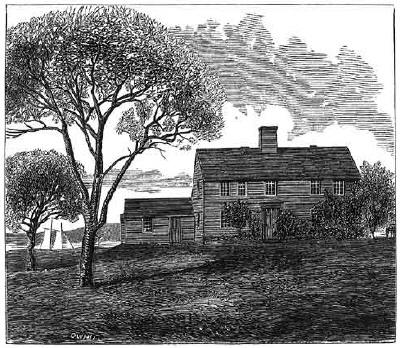
THE JACOBS HOUSE.
The tradition has descended through the family, that the body, after
having been obtained at the place of execution, was strapped by a
young grandson on the back of a horse, brought home to the farm, and
buried beneath the shade of his own trees. Two sunken and weather-worn
stones marked the spot. There the remains rested until 1864, when they
were exhumed. They were enclosed again, and reverently redeposited in
the same place. The skull was in a state of considerable preservation.
An examination of the jawbones showed that he was a very old man at
the time of his death, and had previously lost all his teeth. The
length of some parts of the skeleton showed that he was a very tall
man. These circumstances corresponded with the evidence, which was
that he was tall of stature; so infirm as to walk with two staffs;
with long, flowing white hair. The only article found, except the
bones, was a metallic pin, which might have been used as a breastpin,
or to hold together his aged locks. It is an observable fact, that he
rests in his own ground still. He had lived for a great length of time
on that spot; and it remains in his family and in his name to this
day, having come down by direct descent. It is a beautiful locality:
the land descends with a gradual and smooth declivity to the bank of
the river. It is not much more than a mile from the city of Salem, and
in full view from the main road.
John Willard appears to have been an honest and amiable person, an
industrious farmer, having a comfortable estate, with a wife and three
young children. He was a grandson of Old Bray Wilkins; whether by
blood or marriage, I have not been able to ascertain. The indications
are that he married a daughter of Thomas or Henry Wilkins, most
probably the former, with both of whom he was a joint possessor of
lands. He came from Groton; and it is for local antiquaries to
discover whether he was a relative of the Rev. Samuel Willard of
Boston. If so, the fact would shed much light upon our story. There
is but one piece of evidence among the papers relating to his trial
that deserves particular notice. It shows the horrid character of the
charges made by the girls against prisoners at the bar, from their
nature incapable of being refuted and which the prisoners knew to be
false, but the Court, jury, and crowd implicitly believed. It also
illustrates the completeness of the machinery got up by the "accusing
girls" to give effect to their evidence. In addition to the evil
gossip that could be scoured from all the country round, and to
spectres of witches and ghosts of the dead, they brought into the
scene angels and divine beings, and testified to what they were told
by them. "The shining man," or the white man, was meant, in the
following deposition, to be a spirit of this description:—
"The Testimony of Susanna Sheldon, aged eighteen
years or thereabouts.—Testifieth and saith, that, the day
of the date hereof (9th of May, 1692), I saw at Nathaniel
Ingersoll's house the apparitions of these four
persons,—William Shaw's first wife, the Widow Cook, Goodman
Jones and his child; and among these came the apparition of
John Willard, to whom these four said, 'You have murdered
us.' These four having said thus to Willard, they turned as
red as blood. And, turning about to look at me, they turned
as pale as death. These four desired me to tell Mr.
Hathorne. Willard, hearing them, pulled out a knife, saying,
if I did, he would cut my throat."
The deponent goes on to say, that these several apparitions came
before her on another occasion, and the same language and actions took
place, and adds:—
"There did appear to me a shining man, who said I should go
and tell what I had heard and seen to Mr. Hathorne. This
Willard, being there present, told me, if I did, he would
cut my throat. At this time and place, this shining man told
me, that if I did go to tell this to Mr. Hathorne, that I
should be well, going and coming, but I should be afflicted
there. Then said I to the shining man, 'Hunt Willard away,
and I would believe what he said, that he might not choke
me.' With that the shining man held up his hand, and Willard
vanished away. About two hours after, the same appeared to
me again, and the said Willard with them; and I asked them
where their wounds were, and they said there would come an
angel from heaven, and would show them. And forthwith the
angel came. I asked what the man's name was that appeared to
me last, and the angel told his name was Southwick. And the
angel lifted up his winding-sheet, and out of his left side
he pulled a pitchfork tine, and put it in again, and
likewise he opened all the winding-sheets, and showed all
their wounds. And the white man told me to tell Mr. Hathorne
of it, and I told him to hunt Willard away, and I would; and
he held up his hand, and he vanished away."
In the same deposition, this girl testifies that "she saw this Willard
suckle the apparitions of two black pigs on his breasts;" that Willard
told her he had been a witch twenty years; that she saw Willard and
other wizards kneel in prayer "to the black man with a long-crowned
hat, and then they vanished away."
Such was the kind of testimony which the Court received with
awe-struck and bewildered credulity, and which took away the lives of
valuable and blameless men. All we know of the manner of Willard's
death is a passage from Brattle, who states that a deep impression was
produced by the admirable deportment of the sufferers during the awful
scenes before and at their executions; giving every evidence of
conscious innocence and a Christian character and faith, on the part
especially of "Procter and Willard, whose whole management of
themselves from the jail to the gallows, and whilst at the gallows,
was very affecting, and melting to the hearts of some considerable
spectators whom I could mention to you: but they are executed, and so
I leave them."
On the 9th of September, the Court met again; and Martha Corey,
Mary Easty, Alice Parker, Ann Pudeator, Dorcas Hoar, and Mary
Bradbury were tried and condemned; and, on the 17th, Margaret Scott,
Wilmot Reed, Samuel Wardwell, Mary Parker, Abigail Faulkner,
Rebecca Eames, Mary Lacy, Ann Foster, and Abigail Hobbs received the
same sentence. Those in Italics were executed Sept. 22, 1692. Of the
circumstances in relation to them, in reference to their death and at
the time of their execution, but little information has reached us.
The following extract from Mr. Parris's church-records presents a
striking picture:—
"11 September, Lord's Day.—Sister Martha Corey—taken into
the church 27 April, 1690—was, after examination upon
suspicion of witchcraft, 27 March, 1692, committed to prison
for that fact, and was condemned to the gallows for the
same yesterday; and was this day in public, by a general
consent, voted to be excommunicated out of the church, and
Lieutenant Nathaniel Putnam and the two deacons chosen to
signify to her, with the pastor, the mind of the church
herein. Accordingly, this 14 September, 1692, the three
aforesaid brethren went with the pastor to her in Salem
Prison; whom we found very obdurate, justifying herself, and
condemning all that had done any thing to her just discovery
or condemnation. Whereupon, after a little discourse (for
her imperiousness would not suffer much), and after
prayer,—which she was willing to decline,—the dreadful
sentence of excommunication was pronounced against her."
Calef informs us, that "Martha Corey, protesting her innocency,
concluded her life with an eminent prayer upon the ladder."
Nothing has reached us particularly relating to the manner of death of
Alice or Mary Parker, Ann Pudeator, Margaret Scott, or Wilmot Reed.
They all asserted their innocence; and their deportment gave no ground
for any unfavorable comment by their persecutors, who were on the
watch to turn every act, word, or look of the sufferers to their
disparagement. Wilmot Reed probably adhered to the unresisting
demeanor which marked her examination. It was all a mystery to her;
and to every question she answered, "I know nothing about it." Of Mary
Easty it is grateful to have some account. Her own declarations in
vindication of her innocence are fortunately preserved; and her noble
record is complete in the following documents. The first appears to
have been addressed to the Special Court, and was presented
immediately before the trial of Mary Easty. No explanation has come
down to us why Sarah Cloyse was not then also brought to trial.
Circumstances to which we have no clew rescued her from the fate of
her sisters.
"The Humble Request of Mary Easty and Sarah Cloyse to the
Honored Court humbly showeth, that, whereas we two sisters,
Mary Easty and Sarah Cloyse, stand now before the honored
Court charged with the suspicion of witchcraft, our humble
request is—First, that, seeing we are neither able to plead
our own cause, nor is counsel allowed to those in our
condition, that you who are our judges would please to be of
counsel to us, to direct us wherein we may stand in need.
Secondly, that, whereas we are not conscious to ourselves of
any guilt in the least degree of that crime whereof we are
now accused (in the presence of the living God we speak it,
before whose awful tribunal we know we shall ere long
appear), nor of any other scandalous evil or miscarriage
inconsistent with Christianity, those who have had the
longest and best knowledge of us, being persons of good
report, may be suffered to testify upon oath what they know
concerning each of us; viz., Mr. Capen, the pastor, and
those of the town and church of Topsfield, who are ready to
say something which we hope may be looked upon as very
considerable in this matter, with the seven children of one
of us; viz., Mary Easty: and it may be produced of like
nature in reference to the wife of Peter Cloyse, her sister.
Thirdly, that the testimony of witches, or such as are
afflicted as is supposed by witches, may not be improved to
condemn us without other legal evidence concurring. We hope
the honored Court and jury will be so tender of the lives of
such as we are, who have for many years lived under the
unblemished reputation of Christianity, as not to condemn
them without a fair and equal hearing of what may be said
for us as well as against us. And your poor suppliants shall
be bound always to pray, &c."
The following was presented by Mary Easty to the judges after she had
received sentence of death. It would be hard to find, in all the
records of human suffering and of Christian deportment under them, a
more affecting production. It is a most beautiful specimen of strong
good-sense, pious fortitude and faith, genuine dignity of soul, noble
benevolence, and the true eloquence of a pure heart; and was evidently
composed by her own hand. It may be said of her—and there can be no
higher eulogium—that she felt for others more than for herself.
"The Humble Petition of Mary Easty unto his Excellency Sir
William Phips, and to the Honored Judge and Bench now
sitting in Judicature in Salem, and the Reverend Ministers,
humbly showeth, that, whereas your poor and humble
petitioner, being condemned to die, do humbly beg of you to
take it in your judicious and pious consideration, that your
poor and humble petitioner, knowing my own innocency,
blessed be the Lord for it! and seeing plainly the wiles and
subtilty of my accusers by myself, cannot but judge
charitably of others that are going the same way of myself,
if the Lord steps not mightily in. I was confined a whole
month upon the same account that I am condemned now for,
and then cleared by the afflicted persons, as some of Your
Honors know. And in two days' time I was cried out upon
them, and have been confined, and now am condemned to die.
The Lord above knows my innocency then, and likewise does
now, as at the great day will be known to men and angels. I
petition to Your Honors not for my own life, for I know I
must die, and my appointed time is set; but the Lord he
knows it is that, if it be possible, no more innocent blood
may be shed, which undoubtedly cannot be avoided in the way
and course you go in. I question not but Your Honors do to
the utmost of your powers in the discovery and detecting of
witchcraft and witches, and would not be guilty of innocent
blood for the world. But, by my own innocency, I know you
are in the wrong way. The Lord in his infinite mercy direct
you in this great work, if it be his blessed will that no
more innocent blood be shed! I would humbly beg of you, that
Your Honors would be pleased to examine these afflicted
persons strictly, and keep them apart some time, and
likewise to try some of these confessing witches; I being
confident there is several of them, has belied themselves
and others, as will appear, if not in this world, I am sure
in the world to come, whither I am now agoing. I question
not but you will see an alteration of these things. They say
myself and others having made a league with the Devil, we
cannot confess. I know, and the Lord knows, as will ...
appear, they belie me, and so I question not but they do
others. The Lord above, who is the Searcher of all hearts,
knows, as I shall answer it at the tribunal seat, that I
know not the least thing of witchcraft; therefore I cannot,
I dare not, belie my own soul. I beg Your Honors not to deny
this my humble petition from a poor, dying, innocent person.
And I question not but the Lord will give a blessing to your
endeavors."
The parting interview of this admirable woman with her husband,
children, and friends, as she was about proceeding to the place of
execution, is said to have been a most solemn, affecting, and truly
sublime scene. Calef says that her farewell communications, on this
occasion, were reported, by persons who listened to them, to have been
"as serious, religious, distinct, and affectionate as could well be
expressed, drawing tears from the eyes of almost all present."
Ann Pudeator had been formerly the wife of a person named Greenslitt,
who left her with five children. Her subsequent husband, Jacob
Pudeator, died in 1682, and by will gave her his whole estate, after
the payment of legacies, of five pounds each, to her Greenslitt
children, who appear to have been living in 1692 at Casco Bay. These
provisions, as well as the expressions used by Pudeator, indicate that
he regarded her with affection and esteem. The following document is
all that we know else of her character particularly, except that she
was a kind neighbor, and ever prompt in offices of charity and
sympathy.
"The Humble Petition of Ann Pudeator unto the Honored Judge
and Bench now sitting in Judicature in Salem, humbly
showeth, that, whereas your poor and humble petitioner,
being condemned to die, and knowing in my own conscience, as
I shall shortly answer it before the great God of heaven,
who is the Searcher and Knower of all hearts, that the
evidence of Jno. Best, Sr., and Jno. Best, Jr., and Samuel
Pickworth, which was given in against me in Court, were all
of them altogether false and untrue, and, besides the
abovesaid Jno. Best hath been formerly whipped and likewise
is recorded for a liar. I would humbly beg of Your Honors to
take it into your judicious and pious consideration, that my
life may not be taken away by such false evidences and
witnesses as these be; likewise, the evidence given in
against me by Sarah Churchill and Mary Warren I am
altogether ignorant of, and know nothing in the least
measure about it, nor nothing else concerning the crime of
witchcraft, for which I am condemned to die, as will be
known to men and angels at the great day of judgment.
Begging and imploring your prayers at the Throne of Grace in
my behalf, and your poor and humble petitioner shall for
ever pray, as she is bound in duty, for Your Honors' health
and happiness in this life, and eternal felicity in the
world to come."
Abigail, the wife of Francis Faulkner, and daughter of the Rev.
Francis Dane, of Andover, who was among those sentenced on the 17th of
September, had been examined, on the 11th of August, by Hathorne,
Corwin, and Captain John Higginson, sitting as magistrates. Upon the
prisoner's being brought in, the afflicted fell down, and went into
fits, as usual. The magistrates asked the prisoner what she had to
say. She replied, "I know nothing of it." The girls then renewed their
performances, declaring that her shape was at that moment torturing
them. The magistrates asked her if she did not see their sufferings.
She answered, "Yes; but it is the Devil does it in my shape." Ann
Putnam said that her spectre had afflicted her a few days before,
pulling her off her horse. Upon the touch of her person, the
sufferings of the afflicted would cease for a time. The prisoner held
a handkerchief in her hand. The girls would screech out, declaring
that, as she pressed the handkerchief, they were dreadfully squeezed.
She threw the handkerchief on the table; and they said, "There are the
shapes of Daniel Eames and Captain Floyd [two persons then in prison
on the charge of witchcraft] sitting on her handkerchief." Mary Warren
enacted the part of being dragged against her will under the table by
an invisible hand, from whose grasp she was at once released, upon the
prisoner's being made to touch her. Notwithstanding all this, she
protested her innocence, and was remanded to jail. On the 30th, she
was brought out again. In the mean while, six had been executed. The
usual means were employed to break her down; but all that was gained
was, that she owned she had expressed her indignation at the conduct
of the afflicted, and was much excited against them "for bringing her
kindred out, and she did wish them ill: and, her spirit being raised,
she did pinch her hands together, and she knew not but that the Devil
might take that advantage; but it was the Devil, and not she, that
afflicted them." This was the only concession she would make; and they
were puzzled to determine whether it was a confession, or not,—it
having rather the appearance of clearing herself from all implication
with the Devil, and leaving him on their hands—at any rate, they
concluded to regard it in the latter sense; and she was duly
convicted, and sentenced to death. Sir William Phips ordered a
reprieve; and, after she had been thirteen weeks in prison, he
directed her to be discharged on the ground of insufficient evidence.
This, I think, is the only instance of a special pardon granted during
the proceedings.
Samuel Wardwell, like most of the accused belonging to Andover, had
originally joined the crowd of the confessors; but he was too much of
a man to remain in that company. He took back his confession, and met
his death. While he was speaking to the people, at the gallows,
declaring his innocency, a puff of tobacco-smoke from the pipe of the
executioner, as Calef informs us, "coming in his face, interrupted his
discourse: those accusers said that the Devil did hinder him with
smoke." The wicked creatures followed their victims to the last with
their malignant outrages. The cart that carried the prisoners, on this
occasion, to the hill, "was for some time at a set: the afflicted and
others said that the Devil hindered it," &c.
The route by which they were conveyed from the jail, which was at the
north corner of Federal and St. Peter's Streets, to the gallows, must
have been a cruelly painful and fatiguing one, particularly to infirm
and delicate persons, as many of them were. It was through St.
Peter's, up the whole length of Essex, and thence probably along
Boston Street, far towards Aborn Street; for the hill could only be
ascended from that direction. It must have been a rough and jolting
operation; and it is not strange that the cart got "set." It seems
that the prisoners were carried in a single cart. It was a large one,
provided probably for the occasion; and it is not unlikely that the
reason why some who had been condemned were not executed, was that the
cart could not hold them all at once. They were executed, one in June,
five in July, five in August, and eight in September, with the
intention, no doubt, by taking them in instalments, to extend the acts
of the tragedy, from month to month, indefinitely.
It was necessary for the safety of the accusers and prosecutors to
prevent a revulsion of the public mind, or even the least diminution
of the popular violence against the supposed witches. As they all
protested their innocence to the moment of death, and exhibited a
remarkably Christian deportment throughout the dreadful scenes they
were called to encounter from their arrest to their execution, there
was reason to apprehend that the people would gradually be led to feel
a sympathy for them, if not to entertain doubts of their guilt. To
prevent this, and remove any impressions favorable to them that might
be made by the conduct and declarations of the convicts, the
prosecutors were on the alert. After the prisoners had been swung off,
on the 22d of September, "turning him to the bodies, Mr. Noyes said,
'What a sad thing it is to see eight firebrands of hell hanging
there!'" It was the last time his eyes were regaled by such a sight.
There were no more executions on Witch Hill.
Three days before, a life had been taken by the officers of the law in
a manner so extraordinary, and marked by features so shocking, that
they find no parallel in the annals of America, and will continue to
arrest for ever the notice of mankind. The history and character of
old Giles Corey have been given in preceding parts of this work. The
only papers relating to him, on file as having been sworn to before
the Grand Jury, are a few brief depositions. If he had been put on
trial, we might have had more. Elizabeth Woodwell testifies, that "she
saw Giles Corey at meeting at Salem on a lecture-day, since he has
been in prison. He or his apparition came in, and sat in the
middlemost seat of the men's seats, by the post. This was the
lecture-day before Bridget Bishop was hanged. And I saw him come out
with the rest of the people." Mary Walcot, of course, swore to the
same. And Mary Warren swore that Corey was hostile to her and
afflicted her, because he thought she "caused her master (John
Procter) to ask more for a piece of meadow than he (Corey) was willing
to give." She also charged him with "afflicting of her" by his spectre
while he was in prison, and "described him in all his garments, both
of hat, coat, and the color of them,—with a cord about his waist and
a white cap on his head, and in chains." There is reason to believe,
that, while in prison, he experienced great distress of mind. Although
he had been a rough character in earlier life, and given occasion to
much scandal by his disregard of public opinion, he always exhibited
symptoms of a generous and sensitive nature. His foolish conduct in
becoming so passionately engaged in the witchcraft proceedings, at
their earliest stage, as to be incensed against his wife because she
did not approve of or believe in them, and which led him to utter
sentiments and expressions that had been used against her; and so far
yielding to the accusers as to allow them to get from him the
deposition, which, while it failed to satisfy their demands, it was
shameful for him to have been persuaded to give,—all these things,
which after his own apprehension and imprisonment he had leisure to
ponder upon, preyed on his mind. He saw the awful character of the
delusion to which he had lent himself; that it had brought his
prayerful and excellent wife to the sentence of death, which had
already been executed upon many other devout and worthy persons. He
knew that he was innocent of the crime of witchcraft, and was now
satisfied that all others were. Besides his own unfriendly course
towards his wife, two of his four sons-in-law had turned against her.
One (Crosby) had testified, and another (Parker) had allowed his name
to be used, as an adverse witness. In view of all this, Corey made up
his mind, determined on his course, and stood to that determination.
He resolved to expiate his own folly by a fate that would satisfy the
demands of the sternest criticism upon his conduct; proclaim his
abhorrence of the prosecutions; and attest the strength of his
feelings towards those of his children who had been false, and those
who had been true, to his wife. He caused to be drawn up what has
been called a will, although it is in reality a deed, and was duly
recorded as such. Its phraseology is very strongly guarded, and made
to give it clear, full, and certain effect. It begins thus: "Know ye,
&c., that I, Giles Corey, lying under great trouble and affliction,
through which I am very weak in body, but in perfect memory,—knowing
not how soon I may depart this life; in consideration of which, and
for the fatherly love and affection which I have and do bear unto my
beloved son-in-law, William Cleeves, of the town of Beverly, and to my
son-in-law, John Moulton, of the town of Salem, as also for divers
other good causes and considerations me at the present especially
moving;" and proceeds to convey and confirm all his property—"lands,
meadow, housing, cattle, stock, movables and immovables, money,
apparel, ... and all other the aforesaid premises, with their
appurtenances"—to the said Cleeves and Moulton "for ever, freely and
quietly, without any manner of challenge, claim, or demand of me the
said Giles Corey, or of any other person or persons whatsoever for me
in my name, or by my cause, means, or procurement;" and, in the use of
all the language applicable to that end, he warrants and binds himself
to defend the aforesaid conveyance and grant to Cleeves and Moulton,
their heirs, executors, administrators, and assigns for ever. The
document was properly signed, sealed, and delivered in the presence of
competent witnesses, whose several signatures are indorsed to that
effect. It was duly acknowledged before "Thomas Wade, Justice of the
Peace in Essex," and recorded forthwith. This transaction took place
in the jail at Ipswich.
His whole property being thus securely conveyed to his faithful
sons-in-law, and placed beyond the reach of his own weakness or change
of purpose, Corey resolved on a course that would surely try to the
utmost the power of human endurance and firmness. He knew, that, if
brought to trial, his death was certain. He did not know but that
conviction and execution, through the attainder connected with it,
might invalidate all attempts of his to convey his property. But it
was certain, that, if he should not be brought to trial and
conviction, his deed would stand, and nothing could break it, or
defeat its effect. He accordingly made up his mind not to be tried.
When called into court to answer to the indictment found by the Grand
Jury, he did not plead "Guilty," or "Not guilty," but stood mute. How
often he was called forth, we are not informed; but nothing could
shake him. No power on earth could unseal his lips.
He knew that he could have no trial that would deserve the name. To
have pleaded "Not guilty" would have made him, by his own act, a party
to the proceeding, and have been, by implication, an assent to putting
his case to the decision of a blind, maddened, and utterly perverted
tribunal. He would not, by any act or utterance of his, leave his case
with "the country" represented by a jury that embodied the passions of
the deluded and infatuated multitude around him. He knew that the
gates of justice were closed, and that truth had fled from the scene.
He would have no part nor lot in the matter; refused to recognize the
court, made no response to its questions, and was dumb in its
presence. He stands alone in the resolute defiance of his attitude. He
knew the penalty of suffering and agony he would have to pay; but he
freely and fearlessly encountered it. All that was needed to carry his
point was an unconquerable firmness, and he had it. He rendered it
impossible to bring him to trial; and thereby, in spite of the power
and wrath of the whole country and its authorities, retained his right
to dispose of his property; and bore his testimony against the
wickedness and folly of the hour in tones that reached the whole
world, and will resound through all the ages.
When Corey took this ground, the Court found itself in a position of
no little difficulty, and was probably at a loss what to do. No
information has come to us of the details of the proceedings. If the
usages in England on such occasions were adopted, the prisoner was
three times brought before the Court, and called to plead; the
consequences of persisting in standing mute being solemnly announced
to him at each time. If he remained obdurate, the sentence of peine
forte et dure was passed upon him; and, remanded to prison, he was
put into a low and dark apartment. He would there be laid on his back
on the bare floor, naked for the most part. A weight of iron would be
placed upon him, not quite enough to crush him. He would have no
sustenance, save only, on the first day, three morsels of the worst
bread; and, on the second day, three draughts of standing water that
should be nearest to the prison door: and, in this situation, such
would be alternately his daily diet till he died, or till he answered.
The object of this terrible punishment was to induce the prisoner to
plead to the indictment; upon doing which, he would be brought to
trial in the ordinary way. The motive that led prisoners to stand mute
in England is stated to have been, most generally, to save their
property from confiscation. The practice of putting weights upon them,
and gradually increasing them, was to force them, by the slowly
increasing torture, to yield.
How far the English practice was imitated in the case of Corey will
remain for ever among the dread secrets of his prison-house. The
tradition is, that the last act in the tragedy was in an open field
near the jail, somewhere between Howard-street Burial Ground and Brown
Street. It is said that Corey urged the executioners to increase the
weight which was crushing him, that he told them it was of no use to
expect him to yield, that there could be but one way of ending the
matter, and that they might as well pile on the rocks. Calef says,
that, as his body yielded to the pressure, his tongue protruded from
his mouth, and an official forced it back with his cane. Some persons
now living remember a popular superstition, lingering in the minds of
some of the more ignorant class, that Corey's ghost haunted the
grounds where this barbarous deed was done; and that boys, as they
sported in the vicinity, were in the habit of singing a ditty
beginning thus:—
"'More weight! more weight!'
Giles Corey he cried."
For a person of more than eighty-one years of age, this must be
allowed to have been a marvellous exhibition of prowess; illustrating,
as strongly as any thing in human history, the power of a resolute
will over the utmost pain and agony of body, and demonstrating that
Giles Corey was a man of heroic nerve, and of a spirit that could not
be subdued.
It produced a deep effect, as it was feared that it would. The bearing
of all the sufferers at all the stages of the proceedings, and at
their execution, had told in their favor; but the course of Giles
Corey profoundly affected the public mind. This must have been noticed
by the managers of the prosecutions; and they felt that some
extraordinary expedient was necessary to renew, and render more
intense than ever, the general infatuation. From the very beginning,
there had been great skill and adroitness in arranging the order of
incidents, and supplying the requisite excitements at the right
moments and the right points. Some persons—it can only be conjectured
who—had, all along, been behind the scenes, giving direction and
materials to the open actors. This unseen power was in the village;
and the movements it devised generally proceeded from Thomas Putnam's
house, or the parsonage. It was on hand to meet the contingency
created by Corey's having actually carried out to the last his
resolution to meet a form of death that would, if any thing could,
cause a re-action in the public mind; and the following stratagem was
contrived to turn the manner of his death into the means of more than
ever blinding and infatuating the people. It was the last and one of
the most artful strokes of policy by the prosecutors. On the day after
the death of Corey, and two days before the execution of his wife,
Mary Easty, and the six others, Judge Sewall, then in Salem, received
a letter from Thomas Putnam to this effect:—
"Last night, my daughter Ann was grievously tormented by
witches, threatening that she should be pressed to death
before Giles Corey; but, through the goodness of a gracious
God, she had at last a little respite. Whereupon there
appeared unto her (she said) a man in a winding-sheet, who
told her that Giles Corey had murdered him by pressing him
to death with his feet; but that the Devil there appeared
unto him, and covenanted with him, and promised him that he
should not be hanged. The apparition said God hardened his
heart, that he should not hearken to the advice of the
Court, and so die an easy death; because, as it said, it
must be done to him as he has done to me. The apparition
also said that Giles Corey was carried to the Court for
this, and that the jury had found the murder; and that her
father knew the man, and the thing was done before she was
born."
Cotton Mather represented this vision, made to Ann Putnam, as proof
positive of a divine communication to her, because, as he says, she
could not have received her information from a human source, as
everybody had forgotten the affair long ago; and that she never could
have heard of it, happening, as it did, before she was born. Bringing
up this old matter to meet the effect produced by Corey's death was
indeed a skilful move; and it answered its purpose probably to a
considerable extent. The man whom Corey was thus charged with having
murdered seventeen years before died in a manner causing some gossip
at the time; and a coroner's jury found that he had been "bruised to
death, having clodders of blood about the heart." Bringing the affair
back to the public mind, with the story of Ann Putnam's vision, was
well calculated to meet and check any sympathy that might threaten to
arise in favor of Corey. But the trick, however ingenious, will not
stand the test of scrutiny. Mather's statement that everybody had
forgotten the transaction, and that Ann could only have known of it
supernaturally, is wholly untenable; for it was precisely one of those
things that are never forgotten in a country village: it had always
been kept alive as a part of the gossip of the neighborhood in
connection with Corey; and her own father, as is unwittingly
acknowledged, knew the man, and all about it. Of course, the girl had
heard of it from him and others. The industry that had ransacked the
traditions and collected the scandal of the whole country, far and
near, for stories that were brought in evidence against all the
prisoners, had not failed to pick up this choice bit against Corey.
The only reason why it had not before been brought out was because he
had not been on trial. The man who died with "clodders of blood about
his heart," seventeen years before, was an unfortunate and worthless
person, who had incurred punishment for his misconduct while a servant
on Corey's farm, and afterwards at the hands of his own family: and he
does not appear to have mended his morals upon passing into the
spiritual world; for the statement of his ghost to Ann Putnam, that
the jury had found Corey guilty of murder, and that the Court was
hindered by some enchantment from proceeding against him, is disproved
by the record which is—as has been mentioned in the
First Part,
vol.
i. p. 185—that the man was carried back to his house by Corey's wife,
and died there some time after; and the Court did no more than fine
Corey for the punishment he had inflicted upon him while in his
service, and which the evidence showed was repeated by his parents
after his return to his own family.
Thomas Putnam's letter and Ann's vision were the last things of the
kind that occurred. The delusion was approaching its close, and the
people were beginning to be restored to their senses.
When it became known that Corey's resolution was likely to hold out,
and that no torments or cruelties of any kind could subdue his firm
and invincible spirit, Mr. Noyes hurried a special meeting of his
church on a week-day, and had the satisfaction of dealing the same
awful doom upon him as upon Rebecca Nurse. The entry in the record of
the First Church is as follows:—
"Sept. 18, G. Corey was excommunicated: the cause of it was,
that he being accused and indicted for the sin of
witchcraft, he refused to plead, and so incurred the
sentence and penalty of pain fort dure; being undoubtedly
either guilty of the sin of witchcraft, or of throwing
himself upon sudden and certain death, if he were otherwise
innocent."
This attempt to introduce a form of argument into a church act of
excommunication is a slight but significant symptom of its having
become felt that the breath of reason had begun to raise a ripple upon
the surface of the public mind. It increased slowly, but steadily to a
gale that beat with severity upon Mr. Noyes and all his
fellow-persecutors to their dying day.
After the executions, on the 22d of September, the Court adjourned to
meet some weeks subsequently; and it was, no doubt, their expectation
to continue from month to month to hold sessions, and supply, each
time, new cart-loads of victims to the hangman. But a sudden collapse
took place in the machinery, and they met no more. The executive
authority intervened, and their functions ceased. The curtain fell
unexpectedly, and the tragedy ended. It is not known precisely what
caused this sudden change. It is probable, that a revolution had been
going on some time in the public mind, which was kept for a while from
notice, but at last became too apparent and too serious to be
disregarded. It has generally been attributed to the fact, that the
girls became over-confident, and struck too high. They had ventured,
as we have seen, to cry out against the Rev. Samuel Willard, but were
rebuked and silenced by the Court. Whoever began to waver in his
confidence of the correctness of the proceedings was in danger of
being attacked by them; and, as a general thing, when a person was
"cried out upon," it may be taken as proof that he had spoken against
them. Increase Mather, the president of Harvard College, called by
Eliot "the father of the New-England clergy," was understood not to go
so far as his son Cotton in sustaining the proceedings; and a member
of his family was accused. The wife of Sir William Phips sympathized
with those who suffered prosecution, and is said to have written an
order for the release of a prisoner from jail. She was cried out upon.
It may have been noticed, that, though Jonathan Corwin sat with
Hathorne as an examining magistrate and assistant, and signed the
commitments of the prisoners, he never took an active part, but was a
silent and passive agent in the scene. He was subsequently raised to
the bench; but there is reason to believe that his mind was not clear
as to the correctness of the proceedings. This probably became known
to the accusing girls; for they cried out repeatedly against his
wife's mother, a respectable and venerable lady in Boston. The
accusers, in aiming at such characters, overestimated their power; and
the tide began to turn against them. But what finally broke the spell
by which they had held the minds of the whole colony in bondage was
their accusation, in October, of Mrs. Hale, the wife of the minister
of the First Church in Beverly. Her genuine and distinguished virtues
had won for her a reputation, and secured in the hearts of the people
a confidence, which superstition itself could not sully nor shake. Mr.
Hale had been active in all the previous proceedings; but he knew the
innocence and piety of his wife, and he stood forth between her and
the storm he had helped to raise: although he had driven it on while
others were its victims, he turned and resisted it when it burst in
upon his own dwelling. The whole community became convinced that the
accusers in crying out upon Mrs. Hale, had perjured themselves, and
from that moment their power was destroyed; the awful delusion was
dispelled, and a close put to one of the most tremendous tragedies in
the history of real life. The wildest storm, perhaps, that ever raged
in the moral world, became a calm; the tide that had threatened to
overwhelm every thing in its fury, sunk back to its peaceful bed.
There are few, if any, other instances in history, of a revolution of
opinion and feeling so sudden, so rapid, and so complete. The images
and visions that had possessed the bewildered imaginations of the
people flitted away, and left them standing in the sunshine of reason
and their senses; and they could have exclaimed, as they witnessed
them passing off, in the language of the great master of the drama and
of human nature, but that their rigid Puritan principles would not, it
is presumed, have permitted them, even in that moment of rescue and
deliverance, to quote Shakspeare,—
"The earth hath bubbles, as the water has,
And these are of them. Whither are they vanished?
Into the air; and what seemed corporal, melted
As breath into the wind."
Sir William Phips well knew that the public sentiment demanded a stop
to be put to the prosecutions. Besides that many of the people had
lost all faith in the grounds on which they had been conducted, an
influence from the higher orders of society began to make itself felt.
Hutchinson says, "Although many such had suffered, yet there remained
in prison a number of women of as reputable families as any in the
towns where they lived, and several persons, of still superior rank,
were hinted at by the pretended bewitched, or by the confessing
witches. Some had been publicly named. Dudley Bradstreet, a justice of
peace, who had been appointed one of President Dudley's council, and
who was son to the worthy old governor, then living, found it
necessary to abscond. Having been remiss in prosecuting, he had been
charged by some of the afflicted as a confederate. His brother, John
Bradstreet, was forced to fly also."
The termination of the proceedings was probably effectually secured by
the spirited course of certain parties in Andover, who, at the first
moment of its appearing that the public sentiment was changing,
commenced actions for slander against the accusers.
The result of the whole matter was, that, while some of the judges,
magistrates, and ministers persisted in their fanatical zeal, the
great body of the people, high and low, were rescued from the
delusion.
While, in the course of our story, we have witnessed some shocking
instances of the violation of the most sacred affections and
obligations of life, in husbands and wives, parents and children,
testifying against each other, and exerting themselves for mutual
destruction, we must not overlook the many instances in which filial,
parental, and fraternal fidelity and love have shone conspicuously. It
was dangerous to befriend an accused person. Procter stood by his wife
to protect her, and it cost him his life. Children protested against
the treatment of their parents, and they were all thrown into prison.
Daniel Andrew, a citizen of high standing, who had been deputy to the
General Court, asserted, in the boldest language, his belief of
Rebecca Nurse's innocence; and he had to fly the country to save his
life. Many devoted sons and daughters clung to their parents, visited
them in prison in defiance of a bloodthirsty mob; kept by their side
on the way to execution; expressed their love, sympathy, and reverence
to the last; and, by brave and perilous enterprise, got possession of
their remains, and bore them back under the cover of midnight to their
own thresholds, and to graves kept consecrated by their prayers and
tears. One noble young man is said to have effected his mother's
escape from the jail, and secreted her in the woods until after the
delusion had passed away, provided food and clothing for her, erected
a wigwam for her shelter, and surrounded her with every comfort her
situation would admit of. The poor creature must, however, have
endured a great amount of suffering; for one of her larger limbs was
fractured in the all but desperate attempt to rescue her from the
prison-walls.
The Special Court being no longer suffered to meet, a permanent and
regular tribunal, called the Superior Court of Judicature, was
established, consisting of the Deputy-governor, William Stoughton,
Chief-justice; and Thomas Danforth, John Richards, Wait Winthrop, and
Samuel Sewall, associate justices. They held a Court at Salem, in
January, 1693. Hutchinson says that, on this occasion, the Grand Jury
found about fifty indictments. The following persons were brought to
trial: Rebecca Jacobs, Margaret Jacobs, Sarah Buckley, Job Tookey,
Hannah Tyler, Candy, Mary Marston, Elizabeth Johnson, Abigail Barker,
Mary Tyler, Sarah Hawkes, Mary Wardwell, Mary Bridges, Hannah Post,
Sarah Bridges, Mary Osgood, Mary Lacy, Jr., Sarah Wardwell, Elizabeth
Johnson, Jr., and Mary Post. The three last were condemned, but not
executed: all the rest were acquitted. Considering that the "spectral
evidence" was wholly thrown out at these trials, the facts that the
grand jury, under the advice of the Court, brought in so many
indictments, and that three were actually convicted, are as
discreditable to the regular Court as the convictions at the Special
Court are to that body. It has been said that the Special Court had
not an adequate representation of lawyers in its composition; and the
results of its proceedings have been ascribed to that circumstance. It
has been held up disparagingly in comparison with the regular Court
that succeeded it. But, in fact, the regular Court consisted of
persons all of whom sat in the Special Court, with the exception of
Danforth. But his proceedings in originating the arrests for
witchcraft in the fall of 1691, and his action when presiding at the
preliminary examination of John Procter, Elizabeth Procter, and Sarah
Cloyse, at Salem, April 11, 1692, show that, so far as the permission
of gross irregularities and the admission of absurd kinds of testimony
are concerned, the regular Court gained nothing by his sitting with
it, unless his views had been thoroughly changed in the mean time. The
truth is, that the judges, magistrates, and legislature were as much
to blame, in this whole business, as the ministers, and much more slow
to come to their senses, and make amends for their wrong-doing.
All the facts known to us, and all the statements that have come down
to us, require us to believe, that none who confessed, and stood to
their confession, were brought to trial. All who were condemned either
maintained their innocence from the first, or, if persuaded or
overcome into a confession, voluntarily took it back and disowned it
before trial. If this be so, then the name of every person condemned
ought to be held in lasting honor, as preferring to die rather than
lie, or stand to a lie. It required great strength of mind to take
back a confession; relinquish life and liberty; go down into a
dungeon, loaded with irons; and from thence to ascend the gallows. It
relieves the mind to think, that Abigail Hobbs, wicked and shocking
as her conduct had been towards Mr. Burroughs and others, came to
herself, and offered her life in atonement for her sin.
The Court continued the trials at successive sessions during the
spring, all resulting in acquittals, until in May, 1693, Sir William
Phips, by proclamation, discharged all. Hutchinson says, "Such a
jail-delivery has never been known in New England." The number then
released is stated to have been one hundred and fifty. How many had
been apprehended, during the whole affair, we have no means of
knowing. Twenty, counting Giles Corey, had been executed. Two at
least, Ann Foster and Sarah Osburn, had died in jail: it is not
improbable that others perished under the bodily and mental sufferings
there. We find frequent expressions indicating that many died in
prison. A considerable number of children, and some adults whose
friends were able to give the heavy bonds required and had influence
enough to secure the favor, had some time before been removed to
private custody. Quite a considerable number had succeeded in breaking
jail and eluding recapture. Upon the whole, there must have been
several hundreds committed. Even after acquittal by a jury, and the
Governor's proclamation, none were set at liberty until they had paid
all charges; including board for the whole time of their imprisonment,
jailer's fees, and fees of Court of all kinds. The families of many
had become utterly impoverished.
The sufferings of the prisoners and of their relatives and connections
are perhaps best illustrated by presenting the substance of a few of
the petitions for their release, found among the files. The friends of
the parties, in these cases, were not in a condition to give the
bonds, and they probably remained in jail until the general discharge;
and how long after, before the means could be raised to pay all dues,
we cannot know.[D]
Margaret Jacobs had to remain in jail after the Governor's
proclamation had directed the release of all prisoners, because she
could not pay the fees and charges. Her grandfather had been executed,
and all his furniture, stock, and moveable property seized by the
marshal or sheriff. Her father escaped the warrant by a sudden flight
from his home under the cover of midnight, and was in exile "beyond
the seas;" her mother and herself taken at the time by the officers
serving the warrants against them; the younger children of the family,
left without protection, had dispersed, and been thrown upon the
charity of neighbors; the house had been stripped of its contents,
left open, and deserted. She had not a shilling in the world, and knew
not where to look for aid. She was taken back to prison, and remained
there for some time, until a person named Gammon, apparently a
stranger, happened to hear of her case, and, touched with compassion,
raised the money required, and released her. It was long before the
affairs of the Jacobs' family were so far retrieved as to enable them
to refund the money to the noble-hearted fisherman. How many others
lingered in prison, or how long, we have no means of ascertaining.
In reviewing the proceedings at the examinations and trials, it is
impossible to avoid being struck with the infatuation of the
magistrates and judges. They acted throughout in the character and
spirit of prosecuting officers, put leading and ensnaring questions to
the prisoners, adopted a browbeating deportment towards them, and
pursued them with undisguised hostility. They assumed their guilt from
the first, and endeavored to force them to confess; treating them as
obstinate culprits because they would not. Every kind of irregularity
was permitted. The marshal was encouraged in perpetual interference to
prejudice the persons on trial, watching and reporting aloud to the
Court every movement of their hands or heads or feet. Other persons
were allowed to speak out, from the body of the crowd, whatever they
chose to say adverse to the prisoner. Accusers were suffered to make
private communications to the magistrates and judges before or during
the hearings. The presiding officers showed off their smartness in
attempts to make the persons on trial before them appear at a
disadvantage. In some instances, as in the case of Sarah Good, the
magistrate endeavored to deceive the accused by representing falsely
the testimony given by another. The people in and around the
court-room were allowed to act the part of a noisy mob, by clamors and
threatening outcries; and juries were overawed to bring in verdicts of
conviction, and rebuked from the bench if they exercised their
rightful prerogative without regard to the public passions. The
chief-justice, in particular, appears to have been actuated by violent
prejudice against the prisoners, and to have conducted the trials, all
along, with a spirit that bears the aspect of animosity.
There is one point of view in which he must be held responsible for
the blood that was shed, and the infamy that, in consequence, attaches
to the proceedings. It may well be contended, that not a conviction
would have taken place, but for a notion of his which he arbitrarily
enforced as a rule of law. It was a part of the theory relating to
witchcraft, that the Devil made use of the spectres, or apparitions,
of some persons to afflict others. From this conceded postulate, a
division of opinion arose. Some maintained that the Devil could employ
only the spectres of persons in league with him; others affirmed, that
he could send upon his evil errands the spectres of innocent persons,
without their consent or knowledge. The chief-justice held the former
opinion, against the judgment of many others, arbitrarily established
it as a rule of Court, and peremptorily instructed juries to regard it
as binding upon them in making their verdicts. The consequence was
that a verdict of "Guilty" became inevitable. But few at that time
doubted the veracity of the "afflicted persons," which was thought to
be demonstrated to the very senses by their fits and sufferings, in
the presence of the Court, jury, and all beholders. When they swore
that they saw the shapes of Bridget Bishop, or Rebecca Nurse, or
George Burroughs, choking or otherwise torturing a person, the fact
was regarded as beyond question.
The prisoners took the ground, that the statements made by the
witnesses, even if admitted, were not proof against them; for the
Devil might employ the spectres of innocent persons, or of whomsoever
he chose, without the knowledge of the persons whose shapes were thus
used by him. When Mrs. Ann Putnam swore that she had seen the spectre
of Rebecca Nurse afflicting various persons; and that the said
spectre acknowledged to her, that "she had killed Benjamin Houlton,
and John Fuller, and Rebecca Shepard,"—the answer of the prisoner
was, "I cannot help it: the Devil may appear in my shape." When the
examining magistrate put the question to Susanna Martin, "How comes
your appearance to hurt these?" Martin replied, "I cannot tell. He
that appeared in Samuel's shape, a glorified saint, can appear in any
one's shape." The Rev. John Wise, in his noble appeal in favor of John
Procter, argued to the same point. But the chief-justice was
inexorably deaf to all reason; compelled the jury to receive, as
absolute law, that the Devil could not use the shape of an innocent
person; and, as the "afflicted" swore that they saw the shapes of the
prisoners actually engaged in the diabolical work, there was no room
left for question, and they must return a verdict of "Guilty."
In this way, innocent persons were slaughtered by a dogma in the mind
of an obstinate judge. Dogmas have perverted courts and governments in
all ages. A fabrication of fancy, an arbitrary verbal proposition, has
been exalted above reason, and made to extinguish common sense. The
world is full of such dogmas. They mislead the actions of men, and
confound the page of history. "The king cannot die" is one of them. It
is held as an axiom of political and constitutional truth. So an
entire dynasty, crowded with a more glorious life than any other, is
struck from the annals of an empire. In the public records of
England, the existence of the Commonwealth is ignored; and the traces
of its great events are erased from the archives of the government,
which, in all its formulas and official papers, proclaims a lie. A
hunted fugitive, wandering in disguise through foreign lands, without
a foot of ground on the globe that he could call his own, is declared
in all public acts, parliamentary and judicial, and even by those
assuming to utter the voice of history, to have actually reigned all
the time. In our country and in our day, we are perplexed, and our
public men bewildered, by a similar dogma. The merest fabric of human
contrivance, a particular form of political society, is impiously
clothed with an essential attribute of God alone; and ephemeral
politicians are announcing, as an eternal law of Providence, that "a
State cannot die." The mischiefs that result, in the management of
human affairs, from enthroning dogmas over reason, truth, and fact,
are, as they ever have been, incalculable.
Chief-justice Stoughton appears to have kept his mind chained to his
dogma to the last. It rendered him wholly incapable of opening his
eyes to the light of truth. He held on to spectral evidence, and his
corollary from it, when everybody else had abandoned both. He would
not admit that he, or any one concerned, had been in error. He never
could bear to hear any persons express penitence or regret for the
part they had taken in the proceedings. When the public delusion had
so far subsided that it became difficult to procure the execution of a
witch, he was disturbed and incensed to such a degree that he
abandoned his seat on the bench. During a session of the Court at
Charlestown, in January, 1692-3, "word was brought in, that a reprieve
was sent to Salem, and had prevented the execution of seven of those
that were there condemned, which so moved the chief judge that he said
to this effect: 'We were in a way to have cleared the land of them;
who it is that obstructs the cause of justice, I know not: the Lord be
merciful to the country!' and so went off the bench, and came no more
into that Court."
I have spoken of the judges as appearing to be infatuated, not on
account of the opinions they held on the subject of witchcraft, for
these were the opinions of their age; nor from the peculiar doctrine
their chief enforced upon them, for that was entertained by many, and,
as a mere theory, was perhaps as logically deducible from the
prevalent doctrines as any other. Their infatuation consisted in not
having eyes to see, or ears to hear, evidences continually occurring
of the untruthful arts and tricks of the afflicted children, of their
cunning evasions, and, in some instances, palpable falsehoods. Then,
further, there was solid and substantial evidence before them that
ought to have made them pause and consider, if not doubt and
disbelieve. We find the following paper among the files:—
The Testimony of John Putnam, Sr., and Rebecca his
Wife, saith that our son-in-law John Fuller, and our
daughter Rebecca Shepard, did both of them die a most
violent death (and died acting very strangely at the time
of their death); further saith, that we did judge then that
they both died of a malignant fever, and had no suspicion of
withcraft of any,
neither can we accuse the prisoner at the bar of any such
thing."
When we recall the testimony of Ann Putnam the mother, and find that
the afflicted generally charged the death of the above-named persons
upon the shape of Rebecca Nurse, we perceive how absolutely Captain
John Putnam and his wife discredit their testimony. The opinion of the
father and mother of Fuller and Shepard ought to have had weight with
the Court. They were persons of the highest standing, and of
recognized intelligence and judgment. They were old church-members,
and eminently orthodox in all their sentiments. They were the heads of
a great family. He had represented the town in the General Court the
year before. No man in this part of the country was more noted for
strong good sense than Captain John Putnam. This deposition is
honorable to their memory, and clears them from all responsibility for
the extent to which the afflicted persons were allowed to sway the
judgment of the Court. Taken in connection with the paper signed by so
large a portion of the best people of the village, in behalf of
Rebecca Nurse, it proves that the blame for the shocking proceedings
in the witchcraft prosecutions cannot be laid upon the local
population, but rests wholly upon the Court and the public
authorities.
The Special Court that condemned the persons charged with witchcraft
in 1692 is justly open to censure for the absence of all
discrimination of evidence, and for a prejudgment of the cases
submitted to them. In view of the then existing law and the practice
in the mother-country under it, they ought to have the benefit of the
admission that they did, in other respects than those mentioned, no
more and no worse than was to be expected. And Cotton Mather, in the
"Magnalia," vindicates them on this ground:—
"They consulted the precedents of former times, and precepts
laid down by learned writers about witchcraft; as, Keeble on
the Common Law, chap. 'Conjuration' (an author approved by
the twelve judges of our nation): also, Sir Matthew Hale's
Trials of Witches, printed anno 1682; Glanvill's Collection
of Sundry Trials in England and Ireland in the years 1658,
'61, '63, '64, and '81; Bernard's Guide to Jury-men;
Baxter's and R.B., their histories about Witches, and their
Discoveries; Cotton Mather's Memorable Providences relating
to Witchcraft, printed 1685."
So far as the medical profession at the time is concerned, it must be
admitted that they bear a full share of responsibility for the
proceedings. They gave countenance and currency to the idea of
witchcraft in the public mind, and were very generally in the habit,
when a patient did not do well under their prescriptions, of getting
rid of all difficulty by saying that "an evil hand" was upon him.
Their opinion to this effect is cited throughout, and appears in a
large number of the documents. There were coroners' juries in cases
where it was suspected that a person died of witchcraft. It is much
to be regretted that none of their verdicts have been preserved. Drawn
up by an attending "chirurgeon," they would illustrate the state of
professional science at that day, by informing us of the marks,
indications, and conditions of the bodily organization by which the
traces of the Devil's hand were believed to be discoverable. All we
know is that, in particular cases, as that of Bray Wilkins's grandson
Daniel, the jury found decisive proof that he had died by "an evil
hand."
It is not to be denied or concealed, that the clergy were instrumental
in bringing on the witchcraft delusion in 1692. As the supposed agents
of the mischief belonged to the supernatural and spiritual world,
which has ever been considered their peculiar province, it was thought
that the advice and co-operation of ministers were particularly
appropriate and necessary. Opposition to prevailing vices and attempts
to reform society were considered at that time in the light of a
conflict with Satan himself; and he was thought to be the ablest
minister who had the greatest power over the invisible enemy, and
could most easily and effectively avert his blows, and counteract his
baleful influence. This gave the clergy the front in the battle
against the hosts of Belial. They were proud of the position, and were
stimulated to distinguish themselves in the conflict. Cotton Mather
represents that ministers were honored by the special hostility of the
great enemy of souls, "more dogged by the Devil than any other men,"
just as, according to his philosophy, the lightning struck the
steeples of churches more frequently than other buildings because the
Prince of the Power of the Air particularly hated the places where the
sound of the gospel was heard. There were, moreover, it is to be
feared, ministers whose ambition to acquire influence and power had
been allowed to become a ruling principle, and who favored the
delusion because thereby their object could be most surely achieved by
carrying the people to the greatest extremes of credulity,
superstition, and fanatical blindness.
But justice requires it to be said that the ministers, as a general
thing, did not take the lead after the proceedings had assumed their
most violent aspect, and the disastrous effects been fully brought to
view. It may be said, on the contrary, that they took the lead, as a
class, in checking the delusion, and rescuing the public mind from its
control. Prior to the time when they were called upon to give their
advice to the government, they probably followed Cotton Mather: after
that, they seemed to have freed themselves generally from his
influence. The names of Dane and Barnard of Andover, Higginson of
Salem, Cheever of Marblehead, Hubbard and Wise of Ipswich, Payson and
Phillips of Rowley, Allin of Salisbury, and Capen of Topsfield, appear
in behalf of persons accused. To come forward in their defence shows
courage, and proves that their influence was in the right direction,
even while the proceedings were at their height. Mr. Hale, of Beverly,
abandoned the prosecutions, and expressed his disapprobation of them,
before the government or the Court relaxed the vigor of their
operations, as is sufficiently proved by the fact that the "afflicted
children" cried out against his wife. Willard, and James Allen, and
Moody, and John Bailey, and even Increase Mather, of Boston, openly
discountenanced the course things were taking. The latter circulated a
letter from his London correspondent, a person whose opinion was
entitled to weight, condemning in the strongest terms the doctrine of
the chief-justice, as follows: "All that I speak with much wonder that
any man, much less a man of such abilities, learning, and experience
as Mr. Stoughton, should take up a persuasion that the Devil cannot
assume the likeness of an innocent, to afflict another person. In my
opinion, it is a persuasion utterly destitute of any solid reason to
render it so much as probable." The ministers may have been among the
first to bring on the delusion; but the foregoing facts prove, that,
as a profession, they were the first to attempt to check and
discountenance the prosecutions. While we are required, in all
fairness, to give this credit to the clergy in general, it would be
false to the obligations of historical truth and justice to attempt to
palliate the conduct of some of them. Whoever considers all that Mr.
Parris, according to his own account, said and did, cannot but shrink
from the necessity of passing judgment upon him, and find relief in
leaving him to that tribunal which alone can measure the extent of
human responsibility, and sound the depths of the heart. Lawson threw
into the conflagration all the combustible materials his eloquence and
talents, heated, it is to be feared, by resentment, could contribute.
Dr. Bentley, in his "Description and History of Salem" (Mass. Hist.
Coll., 1st series, vol. vi.) says, "Mr. Noyes came out and publicly
confessed his error, never concealed a circumstance, never excused
himself; visited, loved, blessed, the survivors whom he had injured;
asked forgiveness always, and consecrated the residue of his life to
bless mankind." It is to be hoped that the statement is correct. There
were several points of agreement between Noyes and Bentley. Both were
men of ability and learning. Like Bentley, Noyes lived and died a
bachelor; and, like him, was a man of lively and active temperament,
and, in the general tenor of his life, benevolent and disinterested.
Perhaps congeniality in these points led Bentley to make the
statement, just quoted, a little too strong. He wrote more than a
century after the witchcraft proceedings; just at that point when
tradition had become inflated by all manner of current talk, of fable
mixed with fact, before the correcting and expunging hand of a severe
scrutiny of records and documents had commenced its work. The drag-net
of time had drawn along with it every thing that anybody had said; but
the process of sifting and discrimination had not begun. His kindly
and ingenuous nature led him to believe, and prompted him to write
down, all that was amiable, and pleasing to a mind like his. So far as
the records and documents give us information, there is reason to
apprehend, that Mr. Noyes, like Stoughton, another old bachelor, never
recovered his mind from the frame of feeling or conviction in which it
was during the proceedings. His name is not found, as are those of
other ministers, to any petitions, memorials or certificates, in favor
of the sufferers during the trials, or of reparation to their memories
or to the feelings of their friends. He does not appear to have taken
any part in arresting the delusion or rectifying the public mind.
Of Cotton Mather, more is required to be said. He aspired to be
considered the leading champion of the Church, and the most successful
combatant against the Satanic powers. He seems to have longed for an
opportunity to signalize himself in this particular kind of warfare;
seized upon every occurrence that would admit of such a coloring to
represent it as the result of diabolical agency; circulated in his
numerous publications as many tales of witchcraft as he could collect
throughout New and Old England, and repeatedly endeavored to get up
cases of the kind in Boston. There is some ground for suspicion that
he was instrumental in originating the fanaticism in Salem; at any
rate, he took a leading part in fomenting it. And while there is
evidence that he endeavored, after the delusion subsided, to escape
the disgrace of having approved of the proceedings, and pretended to
have been in some measure opposed to them, it can be too clearly shown
that he was secretly and cunningly endeavoring to renew them during
the next year in his own parish in Boston.[E]
How blind is man to the future! The state of things which Cotton
Mather labored to bring about, in order that he might increase his own
influence over an infatuated people, by being regarded by them as
mighty to cast out and vanquish evil spirits, and as able to hold
Satan himself in chains by his prayers and his piety, brought him at
length into such disgrace that his power was broken down, and he
became the object of public ridicule and open insult. And the
excitement that had been produced for the purpose of restoring and
strengthening the influence of the clerical and spiritual leaders
resulted in effects which reduced that influence to a still lower
point. The intimate connection of Dr. Mather and other prominent
ministers with the witchcraft delusion brought a reproach upon the
clergy from which they have not yet recovered.
In addition to the designing exertions of ambitious ecclesiastics, and
the benevolent and praiseworthy efforts of those whose only aim was to
promote a real and thorough reformation of religion, all the passions
of our nature stood ready to throw their concentrated energy into the
excitement (as they are sure to do, whatever may be its character), so
soon as it became sufficiently strong to encourage their action.
The whole force of popular superstition, all the fanatical
propensities of the ignorant and deluded multitude, united with the
best feelings of our nature to heighten the fury of the storm. Piety
was indignant at the supposed rebellion against the sovereignty of
God, and was roused to an extreme of agitation and apprehension in
witnessing such a daring and fierce assault by the Devil and his
adherents upon the churches and the cause of the gospel. Virtue was
shocked at the tremendous guilt of those who were believed to have
entered the diabolical confederacy; while public order and security
stood aghast, amidst the invisible, the supernatural, the infernal,
and apparently the irresistible attacks that were making upon the
foundations of society. In baleful combination with principles, good
in themselves, thus urging the passions into wild operation, there
were all the wicked and violent affections to which humanity is
liable. Theological bitterness, personal animosities, local
controversies, private feuds, long-cherished grudges, and professional
jealousies, rushed forward, and raised their discordant voices, to
swell the horrible din; credulity rose with its monstrous and
ever-expanding form, on the ruins of truth, reason, and the senses;
malignity and cruelty rode triumphant through the storm, by whose fury
every mild and gentle sentiment had been shipwrecked; and revenge,
smiling in the midst of the tempest, welcomed its desolating wrath as
it dashed the mangled objects of its hate along the shore.
The treatment of the prisoners, by the administrative and subordinate
officers in charge of them, there is reason to apprehend, was more
than ordinarily harsh and unfeeling. The fate of Willard prevented
expressions of kindness towards them. The crime of which they were
accused put them outside of the pale of human charities. All who
believed them guilty looked upon them, not only with horror, but hate.
To have deliberately abandoned God and heaven, the salvation of Christ
and the brotherhood of man, was regarded as detestable, execrable, and
utterly and for ever damnable. This was the universal feeling at the
time when the fanaticism was at its height; or, if there were any
dissenters, they dared not show themselves. What the poor innocent
sufferers experienced of cruelty, wrong, and outrage from this cause,
it is impossible for words to tell. It left them in prison to neglect,
ignominious ill-treatment, and abusive language from the menials
having charge of them; it made their trials a brutal mockery; it made
the pathway to the gallows a series of insults from an exasperated
mob. If dear relatives or faithful friends kept near them, they did it
at the peril of their lives, and were forbidden to utter the
sentiments with which their hearts were breaking. There was no
sympathy for those who died, or for those who mourned.
It may seem strange to us, at this distance of time, and with the
intelligence prevalent in this age, that persons of such known,
established, and eminent reputation as many of those whose cases have
been particularly noticed, could possibly have been imagined guilty
of the crime imputed to them. The question arises in every mind, Why
did not their characters save them from conviction, and even from
suspicion? The answer is to be found in the peculiar views then
entertained of the power and agency of Satan. It was believed that it
would be one of the signs of his coming to destroy the Church of
Christ, that some of the "elect" would be seduced into his
service,—that he would drag captive in his chains, and pervert into
instruments to further his wicked cause, many who stood among the
highest in the confidence of Christians. This belief made them more
vehement in their proceedings against ministers, church-members, and
persons of good repute, who were proved, by the overwhelming evidence
of the "afflicted children" and the confessing witches, to have made a
compact with the Devil. There is reason to fear that Mr. Burroughs,
and all accused persons of the highest reputation before for piety and
worth, especially all who had been professors of religion and
accredited church-members, suffered more than others from the severity
of the judges and executive officers of the law, and from the rage and
hatred of the people. It was indeed necessary, in order to keep up the
delusion and maintain the authority of the prosecutions, to break down
the influence of those among the accused and the sufferers who had
stood the highest, and bore themselves the best through the fiery
ordeal of the examinations, trials, and executions.
It is indeed a very remarkable fact, which has justly been enlarged
upon by several who have had their attention turned to this subject,
that, of the whole number that suffered, none, in the final scene,
lost their fortitude for a moment. Many were quite aged; a majority,
women, of whom some, brought up in delicacy, were wholly unused to
rough treatment or physical suffering. They must have undergone the
most dreadful hardships, suddenly snatched from their families and
homes; exposed to a torrent of false accusations imputing to them the
most odious, shameful, and devilish crimes; made objects of the
abhorrence of their neighbors, and, through the notoriety of the
affair, of the world; carried to and fro, over rugged roads, from jail
to jail, too often by unfeeling sub-officials; immured in crowded,
filthy, and noisome prisons; heavily loaded with chains, in dungeons;
left to endure insufficient attention to necessary personal wants,
often with inadequate food and clothing; all expressions of sympathy
for them withheld and forbidden,—those who ought to have been their
comforters denouncing them in the most awful language, and consigning
them to the doom of excommunication from the church on earth and from
the hope of heaven. Surely, there have been few cases in the dark and
mournful annals of human suffering and wrong, few instances of "man's
inhumanity to man," to be compared with what the victims of this
tragedy endured. Their bearing through the whole, from the arrest to
the scaffold, reflects credit upon our common nature. The fact that
Wardwell lost his firmness, for a time, ought not to exclude his name
from the honored list. Its claim to be enrolled on it was nobly
retrieved by his recantation, and his manly death.
There is one consideration that imparts a higher character to the
deportment of these persons than almost any of the tests to which the
firmness of the mind of man has ever been exposed. There was nothing
outside of the mind to hold it up, but every thing to bear it down.
All that they had in this world, all on which they could rest a hope
for the next, was the consciousness of their innocence. Their fidelity
to this sense of innocence—for a lie would have saved them—their
unfaltering allegiance to this consciousness; the preservation of a
calm, steadfast, serene mind; their faith and their prayers, rising
above the maledictions of a maniac mob, in devotion to God and
forgiveness to men, and, as in the case of Martha Corey and George
Burroughs, in clear and collected expressions,—this was truly
sublime. It was appreciated, at the time, by many a heart melted back
to its humanity; and paved the way for the deliverance of the world,
we trust for ever, from all such delusions, horrors, and spectacles.
The sufferers in 1692 deserve to be held in grateful remembrance for
having illustrated the dignity of which our nature is capable; for
having shown that integrity of conscience is an armor which protects
the peace of the soul against all the powers that can assail it; and
for having given an example, that will be seen of all and in all
times, of a courage, constancy, and faithfulness of which all are
capable, and which can give the victory over infirmities of age,
weaknesses and pains of body, and the most appalling combination of
outrages to the mind and heart that can be accumulated by the violence
and the wrath of man. Superstition and ignorance consigned their names
to obloquy, and shrouded them in darkness. But the day has dawned; the
shadows are passing away; truth has risen; the reign of superstition
is over; and justice will be done to all who have been true to
themselves, and stood fast to the integrity of their souls, even to
the death.
The place selected for the executions is worthy of notice. It was at a
considerable distance from the jail, and could be reached only by a
circuitous and difficult route. It is a fatiguing enterprise to get at
it now, although many passages that approach it from some directions
have since been opened. But it was a point where the spectacle would
be witnessed by the whole surrounding country far and near, being on
the brow of the highest eminence in the vicinity of the town. As it
was believed by the people generally that they were engaged in a great
battle with Satan, one of whose titles was "the Prince of the Power of
the Air," perhaps they chose that spot to execute his confederates,
because, in going to that high point, they were flaunting him in his
face, celebrating their triumph over him in his own realm. There is no
contemporaneous nor immediately subsequent record, that the
executions took place on the spot assigned by tradition; but that
tradition has been uniform and continuous, and appears to be verified
by a singular item of evidence that has recently come to light. A
letter written by the late venerable Dr. Holyoke to a friend at a
distance, dated Salem, Nov. 25, 1791, has found its way back to the
possession of one of his grand-daughters, which contains the following
passage: "In the last month, there died a man in this town, by the
name of John Symonds, aged a hundred years lacking about six months,
having been born in the famous '92. He has told me that his nurse had
often told him, that, while she was attending his mother at the time
she lay in with him, she saw, from the chamber windows, those unhappy
people hanging on Gallows' Hill, who were executed for witches by the
delusion of the times." John Symonds lived and died near the southern
end of Beverly Bridge, on the south side of what is now Bridge Street.
He was buried from his house, and Dr. Bentley made the funeral prayer,
in which he is said to have used this language: "O God! the man who
with his own hands felled the trees, and hewed the timbers, and
erected the house in which we are now assembled, was the ancestor of
him whose remains we are about to inter." It is inferrible from this
that Symonds was born in the house from which he was buried. Gallows
Hill, now "Witch Hill" is in full view from that spot, and would be
from the chamber windows of a house there, at any time, even in the
season when intervening trees were in their fullest foliage, while no
other point in that direction would be discernible. From the only
other locality of persons of the name of Symonds, at that time, in
North Fields near the North Bridge, Witch Hill is also visible, and
the only point in that direction that then would have been.
"Witch Hill" is a part of an elevated ledge of rock on the western
side of the city of Salem, broken at intervals; beginning at Legg's
Hill, and trending northerly. The turnpike from Boston enters Salem
through one of the gaps in this ridge, which has been widened,
deepened, and graded. North of the turnpike, it rises abruptly to a
considerable elevation, called "Norman's Rocks." At a distance of
between three and four hundred feet, it sinks again, making a wide and
deep gulley; and then, about a third of a mile from the turnpike, it
re-appears, in a precipitous and, at its extremity, inaccessible
cliff, of the height of fifty or sixty feet. Its southern and western
aspect, as seen from the rough land north of the turnpike, is given in
the headpiece of the Third Part, at the beginning of this volume. Its
sombre and desolate appearance admits of little variety of
delineation. It is mostly a bare and naked ledge. At the top of this
cliff, on the southern brow of the eminence, the executions are
supposed to have taken place. The outline rises a little towards the
north, but soon begins to fall off to the general level of the
country. From that direction only can the spot be easily reached. It
is hard to climb the western side, impossible to clamber up the
southern face. Settlement creeps down from the north, and has
partially ascended the eastern acclivity, but can never reach the
brink. Scattered patches of soil are too thin to tempt cultivation,
and the rock is too craggy and steep to allow occupation. An active
and flourishing manufacturing industry crowds up to its base; but a
considerable surface at the top will for ever remain an open space. It
is, as it were, a platform raised high in air.
A magnificent panorama of ocean, island, headland, bay, river, town,
field, and forest spreads out and around to view. On a clear summer
day, the picture can scarcely be surpassed. Facing the sun and the
sea, and the evidences of the love and bounty of Providence shining
over the landscape, the last look of earth must have suggested to the
sufferers a wide contrast between the mercy of the Creator and the
wrath of his creatures. They beheld the face of the blessed God
shining upon them in his works, and they passed with renewed and
assured faith into his more immediate presence. The elevated rock,
uplifted by the divine hand, will stand while the world stands, in
bold relief, and can never be obscured by the encroachments of society
or the structures of art,—a fitting memorial of their constancy.
When, in some coming day, a sense of justice, appreciation of moral
firmness, sympathy for suffering innocence, the diffusion of refined
sensibility, a discriminating discernment of what is really worthy of
commemoration among men, a rectified taste, a generous public spirit,
and gratitude for the light that surrounds and protects us against
error, folly, and fanaticism, shall demand the rearing of a suitable
monument to the memory of those who in 1692 preferred death to a
falsehood, the pedestal for the lofty column will be found ready,
reared by the Creator on a foundation that can never be shaken while
the globe endures, or worn away by the elements, man, or time—the
brow of Witch Hill. On no other spot could such a tribute be more
worthily bestowed, or more conspicuously displayed.
The effects of the delusion upon the country at large were very
disastrous. It cast its shadows over a broad surface, and they
darkened the condition of generations. The material interests of the
people long felt its blight. Breaking out at the opening of the
season, it interrupted the planting and cultivating of the grounds. It
struck an entire summer out of one year, and broke in upon another.
The fields were neglected; fences, roads, barns, and even the
meeting-house, went into disrepair. Burdens were accumulated upon the
already over-taxed resources of the people. An actual scarcity of
provisions, amounting almost to a famine, continued for some time to
press upon families. Farms were brought under mortgage or sacrificed,
and large numbers of the people were dispersed. One locality in the
village, which was the scene of this wild and tragic fanaticism, bears
to this day the marks of the blight then brought upon it. Although in
the centre of a town exceeding almost all others in its agricultural
development and thrift,—every acre elsewhere showing the touch of
modern improvement and culture,—the "old meeting-house road," from
the crossing of the Essex Railroad to the point where it meets the
road leading north from Tapleyville, has to-day a singular appearance
of abandonment. The Surveyor of Highways ignores it. The old, gray,
moss-covered stone walls are dilapidated, and thrown out of line. Not
a house is on either of its borders, and no gate opens or path leads
to any. Neglect and desertion brood over the contiguous grounds.
Indeed, there is but one house standing directly on the roadside until
you reach the vicinity of the site of the old meeting-house; and that
is owned and occupied by a family that bear the name and are the
direct descendants of Rebecca Nurse. On both sides there are the
remains of cellars, which declare that once it was lined by a
considerable population. Along this road crowds thronged in 1692, for
weeks and months, to witness the examinations.
The ruinous results were not confined to the village, but extended
more or less over the country generally. Excitement, wrought up to
consternation, spread everywhere. People left their business and
families, and came from distant points, to gratify their curiosity,
and enable themselves to form a judgment of the character of the
phenomena here exhibited. Strangers from all parts swelled the
concourse, gathered to behold the sufferings of "the afflicted" as
manifested at the examinations; and flocked to the surrounding
eminences and the grounds immediately in front of Witch Hill, to catch
a view of the convicts as they approached the place selected for their
execution, offered their dying prayers, and hung suspended high in
air. Such scenes always draw together great multitudes. None have
possessed a deeper, stronger, or stranger attraction; and never has
the dread spectacle been held out to view over a wider area, or from
so conspicuous a spot. The assembling of such multitudes so often, for
such a length of time, and from such remote quarters, must have been
accompanied and followed by wasteful, and in all respects deleterious,
effects. The continuous or frequently repeated sessions of the
magistrates, grand jury, and jury of trials; and the attendance of
witnesses summoned from other towns, or brought from beyond the
jurisdiction of the Province, and of families and parties interested
specially in the proceedings,—must have occasioned an extensive and
protracted interruption of the necessary industrial pursuits of
society, and heavily increased the public burdens.
The destruction dealt upon particular families extended to so many as
to constitute in the aggregate a vast, wide-spread calamity.[F]
The facts that belong to the story of the witchcraft delusion of 1692,
or that may in any way explain or illustrate it, so far as they can be
gathered from the imperfect and scattered records and papers that have
come down to us, have now been laid before you. But there are one or
two inquiries that force themselves upon thoughtful minds, which
demand consideration before we close the subject.
What are we to think of those persons who commenced and continued the
accusations,—the "afflicted children" and their associates?
In some instances and to some extent, the steps they took and the
testimony they bore may be explained by referring to the mysterious
energies of the imagination, the power of enthusiasm, the influence of
sympathy, and the general prevalence of credulity, ignorance,
superstition, and fanaticism at the time; and it is not probable,
that, when they began, they had any idea of the tremendous length to
which they were finally led on.
It was perhaps their original design to gratify a love of notoriety or
of mischief by creating a sensation and excitement in their
neighborhood, or, at the worst, to wreak their vengeance upon one or
two individuals who had offended them. They soon, however, became
intoxicated by the terrible success of their imposture, and were swept
along by the frenzy they had occasioned. It would be much more
congenial with our feelings to believe, that these misguided and
wretched young persons early in the proceedings became themselves
victims of the delusion into which they plunged every one else. But we
are forbidden to form this charitable judgment by the manifestations
of art and contrivance, of deliberate cunning and cool malice, they
exhibited to the end. Once or twice they were caught in their own
snare; and nothing but the blindness of the bewildered community saved
them from disgraceful exposure and well-deserved punishment. They
appeared as the prosecutors of every poor creature that was tried, and
seemed ready to bear testimony against any one upon whom suspicion
might happen to fall. It is dreadful to reflect upon the enormity of
their wickedness, if they were conscious of imposture throughout. It
seems to transcend the capabilities of human crime. There is, perhaps,
a slumbering element in the heart of man, that sleeps for ever in the
bosom of the innocent and good, and requires the perpetration of a
great sin to wake it into action, but which, when once aroused, impels
the transgressor onward with increasing momentum, as the descending
ball is accelerated in its course. It may be that crime begets an
appetite for crime, which, like all other appetites, is not quieted
but inflamed by gratification.
Their precise moral condition, the degree of guilt to be ascribed, and
the sentence to be passed upon them, can only be determined by a
considerate review of all the circumstances and influences around
them.
For a period embracing about two months, they had been in the habit of
meeting together, and spending the long winter evenings, at Mr.
Parris's house, practising the arts of fortune-telling, jugglery, and
magic. What they had heard in the traditions and fables of a credulous
and superstitious age,—stories handed down in the interior
settlements, circulated in companies gathered around the hearths of
farmhouses, indulging the excitements of terrified imaginations;
filling each other's minds with wondrous tales of second-sight, ghosts
and spirits from the unseen world, together with what the West-Indian
or South-American slaves could add,—was for a long time the food of
their fancies. They experimented continually upon what was the
spiritualism of their day, and grew familiar with the imagery and the
exhibitions of the marvellous. The prevalent notions concerning
witchcraft operations and spectral manifestations came into full
effect among them. Living in the constant contemplation of such
things, their minds became inflamed and bewildered; and, at the same
time, they grew expert in practising and exhibiting the forms of
pretended supernaturalism, the conditions of diabolical distraction,
and the terrors of demonology. Apparitions rose before them, revealing
the secrets of the past and of the future. They beheld the present
spectres of persons then bodily far distant. They declared in
language, fits, dreams, or trance, the immediate operations upon
themselves of the Devil, by the agency of his confederates. Their
sufferings, while thus under "an evil hand," were dreadful to behold,
and soon drew wondering and horror-struck crowds around them.
At this point, if Mr. Parris, the ministers, and magistrates had done
their duty, the mischief might have been stopped. The girls ought to
have been rebuked for their dangerous and forbidden sorceries and
divinations, their meetings broken up, and all such tamperings with
alleged supernaturalism and spiritualism frowned down. Instead of
this, the neighboring ministers were summoned to meet at Mr. Parris's
house to witness the extraordinary doings of the girls, and all they
did was to indorse, and pray over, them. Countenance was thus given to
their pretensions, and the public confidence in the reality of their
statements established. Magistrates from the town, church-members,
leading people, and people of all sorts, flocked to witness the awful
power of Satan, as displayed in the tortures and contortions of the
"afflicted children;" who became objects of wonder, so far as their
feats were regarded, and of pity in view of their agonies and
convulsions.
The aspect of the evidence rather favors the supposition, that the
girls originally had no design of accusing, or bringing injury upon,
any one. But the ministers at Parris's house, physicians and others,
began the work of destruction by pronouncing the opinion that they
were bewitched. This carried with it, according to the received
doctrine, a conviction that there were witches about; for the Devil
could not act except through the instrumentality of beings in
confederacy with him. Immediately, the girls were beset by everybody
to say who it was that bewitched them. Yielding to this pressure, they
first cried out upon such persons as might have been most naturally
suggested to them,—Sarah Good, apparently without a regular home, and
wandering with her children from house to house for shelter and
relief; Sarah Osburn, a melancholy, broken-minded, bed-ridden person;
and Tituba, a slave, probably of mixed African and Indian blood. At
the examination of these persons, the girls were first brought before
the public, and the awful power in their hands revealed to them. The
success with which they acted their parts; the novelty of the scene;
the ceremonials of the occasion, the magistrates in their imposing
dignity and authority, the trappings of the marshal and his officers,
the forms of proceeding,—all which they had never seen before; the
notice taken of them; the importance attached to them; invested the
affair with a strange fascination in their eyes, and awakened a new
class of sentiments and ideas in their minds. A love of distinction
and notoriety, and the several passions that are gratified by the
expression by others of sympathy, wonder, and admiration, were brought
into play. The fact that all eyes were upon them, with the special
notice of the magistrates, and the entire confidence with which their
statements were received, flattered and beguiled them. A fearful
responsibility had been assumed, and they were irretrievably committed
to their position. While they adhered to that position, their power
was irresistible, and they were sure of the public sympathy and of
being cherished by the public favor. If they faltered, they would be
the objects of universal execration and of the severest penalties of
law for the wrongs already done and the falsehoods already sworn to.
There was no retracing their steps; and their only safety was in
continuing the excitement they had raised. New victims were constantly
required to prolong the delusion, fresh fuel to keep up the
conflagration; and they went on to cry out upon others. With the
exception of two of their number, who appear to have indulged spite
against the families in which they were servants, there is no evidence
that they were actuated by private grievances or by animosities
personal to themselves. They were ready and sure to wreak vengeance
upon any who expressed doubts about the truth of their testimony, or
the propriety of the proceedings; but, beyond this, they were very
indifferent as to whom they should accuse. They were willing, as to
that matter, to follow the suggestions of others, and availed
themselves of all the gossip and slander and unfriendly talk in their
families that reached their ears. It was found, that a hint, with a
little information as to persons, places, and circumstances, conveyed
to them by those who had resentments and grudges to gratify, would be
sufficient for the purpose. There is reason to fear, that there were
some behind them, giving direction to the accusations, and managing
the frightful machinery, all the way through. The persons who were
apprehended had, to a considerable extent, been obnoxious, and subject
to prejudice, in connection with quarrels and controversies related in
Part I., vol. i. They were "Topsfield men," or the opponents of Bayley
or of Parris, or more or less connected with some other feuds. As
further proof that the girls were under the guidance of older heads,
it is obvious, that there was, in the order of the proceedings, a
skilful arrangement of times, sequences, and concurrents, that cannot
be ascribed to them. No novelist or dramatist ever laid his plot
deeper, distributed his characters more artistically, or conducted
more methodically the progress of his story.
In the mean while, they were becoming every day more perfect in the
performance of their parts; and their imaginative powers, nervous
excitability, and flexibility and rapidity of muscular action, were
kept under constant stimulus, and attaining a higher development. The
effect of these things, so long continued in connection with the
perpetual pretence, becoming more or less imbued with the character of
belief, of their alliance and communion with spiritual beings and
manifestations, may have unsettled, to some extent, their minds. Added
to this, a sense of the horrid consequences of their actions,
accumulating with every pang they inflicted, the innocent blood they
were shedding, and the depths of ruin into which they were sinking
themselves and others, not only demoralized, but to some extent,
perhaps, crazed them. It is truly a marvel that their physical
constitutions did not break down under the exhausting excitements, the
contortions of frame, the force to which the bodily functions were
subjected in trances and fits, and the strain upon all the vital
energies, protracted through many months. The wonder, however, would
have been greater, if the mental and moral balance had not thereby
been disturbed.
Perpetual conversance with ideas of supernaturalism; daily and nightly
communications, whether in the form of conscious imposture or honest
delusion, with the spiritual world, continued through a great length
of time,—as much at least as the exclusive contemplation of any one
idea or class of ideas,—must be allowed to be unsalutary. Whatever
keeps the thoughts wholly apart from the objects of real and natural
life, and absorbs them in abstractions, cannot be favorable to the
soundness of the faculties or the tone of the mind. This must
especially be the effect, if the subjects thus monopolizing the
attention partake of the marvellous and mysterious. When these things
are considered, and the external circumstances of the occasion, the
wild social excitement, the consternation, confusion, and horror, that
were all crowded and heaped up and kept pressing upon the soul without
intermission for months, the wonder is, indeed, that not only the
accusers, prosecutors, and sufferers, but the whole people, did not
lose their senses. Never was the great boon of life, a sound mind in a
sound body, more liable to be snatched away from all parties. The
depositions of Ann Putnam, Sr., have a tinge of sadness;—a
melancholy, sickly mania running through them. Something of the kind
is, perhaps, more or less discernible in the depositions of others.
Let us, then, relieve our common nature from the load of the
imputation, that, in its normal state, it is capable of such
inconceivable wickedness, by giving to these wretched persons the
benefit of the supposition that they were more or less deranged. This
view renders the lesson they present more impressive and alarming. Sin
in all cases, when considered by a mind that surveys the whole field,
is itself insanity. In the case of these accusers, it was so great as
to prove, by its very monstrousness, that it had actually subverted
their nature and overthrown their reason. They followed their victims
to the gallows, and jeered, scoffed, insulted them in their dying
hours. Sarah Churchill, according to the testimony of Sarah
Ingersoll, on one occasion came to herself, and manifested the
symptoms of a restored moral consciousness: but it was a temporary
gleam, a lucid interval; and she passed back into darkness,
continuing, as before, to revel in falsehood, and scatter destruction
around her. With this single exception, there is not the slightest
appearance of compunction or reflection among them. On the contrary,
they seem to have been in a frivolous, sportive, gay frame of thought
and spirits. There is, perhaps, in this view of their conduct and
demeanor, something to justify the belief that they were really
demented. The fact that a large amount of skilful art and adroit
cunning was displayed by them is not inconsistent with the supposition
that they had become partially insane; for such cunning and art are
often associated with insanity.
The quick wit and ready expedients of the "afflicted children" are
very remarkable. They were prompt with answers, if any attempted to
cross-examine them, extricated themselves most ingeniously if ever
brought into embarrassment, and eluded all efforts to entrap or expose
them. Among the papers is a deposition, the use of which at the trials
is not apparent. It does not purport to bear upon any particular case.
Joseph Hutchinson was a firm-minded man, of strong common sense. He
could not easily be deceived; and, although he took part in the
proceedings at the beginning, soon became opposed to them. It looks as
if, by close questions put to the child, Abigail Williams, on some
occasion of his casually meeting her, he had tried to expose the
falseness of her accusations, and that he was made to put the
conversation into the shape of a deposition. It is as follows:—
"The Deposition of Joseph Hutchinson, aged
fifty-nine years, do testify as followeth: "Abigail
Williams, I have heard you speak often of a book that has
been offered to you. She said that there were two books: one
was a short, thick book; and the other was a long book. I
asked her what color the book was of. She said the books
were as red as blood. I asked her if she had seen the books
opened. She said she had seen it many times. I asked her if
she did see any writing in the book. She said there were
many lines written; and, at the end of every line, there was
a seal. I asked her, who brought the book to her. She told
me that it was the black man. I asked her who the black man
was. She told me it was the Devil. I asked her if she was
not afraid to see the Devil. She said, at the first she was,
and did go from him; but now she was not afraid, but could
talk with him as well as she could with me."
There is an air of ease and confidence in the answers of Abigail,
which illustrates the promptness of invention and assurance of their
grounds which the girls manifested on all occasions. They were never
at a loss, and challenged scrutiny. Hutchinson gained no advantage,
and no one else ever did, in an encounter with them.
Whatever opinion may be formed of the moral or mental condition of the
"afflicted children," as to their sanity and responsibility, there can
be no doubt that they were great actors. In mere jugglery and sleight
of hand, they bear no mean comparison with the workers of wonders, in
that line, of our own day. Long practice had given them complete
control over their countenances, intonations of voice, and the entire
muscular and nervous organization of their bodies; so that they could
at will, and on the instant, go into fits and convulsions, swoon and
fall to the floor, put their frames into strange contortions, bring
the blood to the face, and send it back again. They could be deadly
pale at one moment, at the next flushed; their hands would be clenched
and held together as with a vice; their limbs stiff and rigid or
wholly relaxed; their teeth would be set; they would go through the
paroxysms of choking and strangulation, and gasp for breath, bringing
froth and blood from the mouth; they would utter all sorts of screams
in unearthly tones; their eyes remain fixed, sometimes bereft of all
light and expression, cold and stony, and sometimes kindled into
flames of passion; they would pass into the state of somnambulism,
without aim or conscious direction in their movements, looking at some
point, where was no apparent object of vision, with a wild, unmeaning
glare. There are some indications that they had acquired the art of
ventriloquism; or they so wrought upon the imaginations of the
beholders, that the sounds of the motions and voices of invisible
beings were believed to be heard. They would start, tremble, and be
pallid before apparitions, seen, of course, only by themselves; but
their acting was so perfect that all present thought they saw them
too. They would address and hold colloquy with spectres and ghosts;
and the responses of the unseen beings would be audible to the fancy
of the bewildered crowd. They would follow with their eyes the airy
visions, so that others imagined they also beheld them. This was
surely a high dramatic achievement. Their representations of pain, and
every form and all the signs and marks of bodily suffering,—as in the
case of Ann Putnam's arm, and the indentations of teeth on the flesh
in many instances,—utterly deceived everybody; and there were men
present who could not easily have been imposed upon. The
Attorney-general was a barrister fresh from Inns of Court in London.
Deodat Lawson had seen something of the world; so had Joseph Herrick.
Joseph Hutchinson was a sharp, stern, and sceptical observer. John
Putnam was a man of great practical force and discrimination; so was
his brother Nathaniel, and others of the village. Besides, there were
many from Boston and elsewhere competent to detect a trick; but none
could discover any imposture in the girls. Sarah Nurse swore that she
saw Goody Bibber cheat in the matter of the pins; but Bibber did not
belong to the village, and was a bungling interloper. The accusing
girls showed extraordinary skill, ingenuity, and fancy in inventing
the stories to which they testified, and seemed to have been familiar
with the imagery which belonged to the literature of demonology. This
has led some to suppose that they must have had access to books
treating the subject. Our fathers abhorred, with a perfect hatred, all
theatrical exhibitions. It would have filled them with horror to
propose going to a play. But unwittingly, week after week, month in
and month out, ministers, deacons, brethren, and sisters of the church
rushed to Nathaniel Ingersoll's, to the village and town
meeting-houses, and to Thomas Beadle's Globe Tavern, and gazed with
wonder, awe, and admiration upon acting such as has seldom been
surpassed on the boards of any theatre, high or low, ancient or
modern.
There is another aspect that perplexes and confounds the judgments of
all who read the story. It is this: As it is at present the universal
opinion that the whole of this witchcraft transaction was a delusion,
having no foundation whatever but in the imaginations and passions;
and as it is now certain, that all the accused, both the condemned and
the pardoned, were entirely innocent,—how can it be explained that so
many were led to confess themselves guilty? The answer to this
question is to be found in those general principles which have led the
wisest legislators and jurists to the conclusion, that, although on
their face and at first thought, they appear to be the very best kind
of evidence, yet, maturely considered, confessions made under the hope
of a benefit, and sometime even without the impulses of such a hope,
are to be received with great caution and wariness. Here were
fifty-five persons, who declared themselves guilty of a capital, nay,
a diabolical crime, of which we know they were innocent. It is
probable that the motive of self-preservation influenced most of them.
An awful death was in immediate prospect. There was no escape from
the wiles of the accusers. The delusion had obtained full possession
of the people, the jury, and the Court. By acknowledging a compact
with Satan, they could in a moment secure their lives and liberty. It
was a position which only the firmest minds could safely occupy. The
principles and the prowess of ordinary characters could not withstand
the temptation and the pressure. They yielded, and were saved from an
impending and terrible death.
As these confessions had a decisive effect in precipitating the public
mind into the depths of its delusion, gave a fatal power to the
accusers, and carried the proceedings to the horrible extremities
which have concentrated upon them the attention of the world, they
assume an importance in the history of the affair that demands a full
and thorough exposition. At the examination of Ann Foster, at Salem
Village, on the 15th of July, 1692, the following confession was,
"after a while," extorted from her. It was undoubtedly the result of
the overwhelming effect of the horrors of her condition upon a
distressed and half-crazed mind. It shows the staple materials of
which confessions were made, and the forms of absurd superstition with
which the imaginations of people were then filled:—
The Devil appeared to her in the shape of a bird at several
times,—such a bird as she never saw the like before; and
she had had this gift (viz., of striking the afflicted down
with her eye) ever since. Being asked why she thought that
bird was the Devil, she answered, because he came white and
vanished away black; and that the Devil told her she should
have this gift, and that she must believe him, and told her
she should have prosperity: and she said that he had
appeared to her three times, and always as a bird, and the
last time about half a year since, and sat upon a
table,—had two legs and great eyes, and that it was the
second time of his appearance that he promised her
prosperity. She further stated, that it was Goody Carrier
that made her a witch. She told her, that, if she would not
be a witch, the Devil would tear her to pieces, and carry
her away,—at which time she promised to serve the Devil;
that she was at the meeting of the witches at Salem Village;
that Goody Carrier came, and told her of the meeting, and
would have her go: so they got upon sticks, and went said
journey, and, being there, did see Mr. Burroughs, the
minister, who spake to them all; that there were then
twenty-five persons met together; that she tied a knot in a
rag, and threw it into the fire to hurt Timothy Swan, and
that she did hurt the rest that complained of her by
squeezing puppets like them, and so almost choked them; that
she and Martha Carrier did both ride on a stick or pole when
they went to the witch-meeting at Salem Village, and that
the stick broke as they were carried in the air above the
tops of the trees, and they fell: but she did hang fast
about the neck of Goody Carrier, and they were presently at
the village; that she had heard some of the witches say that
there were three hundred and five in the whole country, and
that they would ruin that place, the village; that there
were also present at that meeting two men besides Mr.
Burroughs, the minister, and one of them had gray hair; and
that the discourse among the witches at the meeting in Salem
Village was, that they would afflict there to set up the
Devil's kingdom.
The confession of which the foregoing is the substance appears to have
been drawn out at four several examinations on different days, during
which she was induced by the influences around her to make her
testimony more and more extravagant at each successive examination.
Her daughter, Mary Lacy, called Goody Lacy, was brought up on the
charge of witchcraft at the same time; and, upon finding the mother
confessing, she saw that her only safety was in confessing also. When
confronted, the daughter cried out to the mother, "We have forsaken
Jesus Christ, and the Devil hath got hold of us. How shall we get
clear of this Evil One?" She proceeded to say that she had accompanied
her mother and Goody Carrier, all three riding together on the pole,
to Salem Village. She then made the following statement: "About three
or four years ago, she saw Mistress Bradbury, Goody Howe, and Goody
Nurse baptized by the old Serpent at Newbury Falls; that he dipped
their heads in the water, and then said they were his, and he had
power over them; that there were six baptized at that time, who were
some of the chief or higher powers, and that there might be near about
a hundred in company at that time." It being asked her "after what
manner she went to Newbury Falls," she answered, "the Devil carried
her in his arms." She said, that, "if she did take a rag, and roll it
up together, and imagine it to represent such and such a person, then
that, whatsoever she did to that rag so rolled up, the person
represented thereby would be in like manner afflicted." Her daughter,
also named Mary Lacy, followed the example of her mother and
grandmother, and made confession.
An examination of the confessions shows, that, when accused persons
made up their minds to confess, they saw, that, to make their safety
secure, it was necessary to go the whole length of the popular
superstition and fanaticism. In many instances, they appear to have
fabricated their stories with much ingenuity and tact, making them
tally with the statements of the accusers, adding points and items
that gave an air of truthfulness, and falling in with current notions
and fancies. They were undoubtedly under training by the girls, and
were provided with the materials of their testimony. Their depositions
are valuable, inasmuch as they enable us to collect about the whole of
the notions then prevalent on the subject. If, in delivering their
evidences, any prompting was needed, the accusers were at their
elbows, and helped them along in their stories. If, in any particular,
they were in danger of contradicting themselves or others, they were
checked or diverted. In one case, a confessing witch was damaging her
own testimony, whereupon one of the afflicted cried out that she saw
the shapes or apparitions of other witches interfering with her
utterance. The witness took the hint, pretended to have lost the power
of expressing herself, and was removed from the stand.
In some cases, the confessing witches showed great adroitness, and
knowledge of human nature. When a leading minister was visiting them
in the prison, one of them cried out as he passed her cell, calling
him by name, "Oh! I remember a text you preached on in England, twenty
years since, from these words: 'Your sin will find you out;' for I
find it to be true in my own case." This skilful compliment, showing
the power of his preaching making an impression which time could not
efface, was no doubt flattering to the good man, and secured for her
his favorable influence.
Justice requires that their own explanation of the influences which
led them to confess should not be withheld.
The following declaration of six women belonging to Andover is
accompanied by a paper signed by more than fifty of the most
respectable inhabitants of that town, testifying to their good
character, in which it is said that "by their sober, godly, and
exemplary conversation, they have obtained a good report in the place,
where they have been well esteemed and approved in the church of which
they are members:"—
"We whose names are underwritten, inhabitants of Andover,
when as that horrible and tremendous judgment, beginning at
Salem Village, in the year 1692, by some called witchcraft,
first breaking forth at Mr. Parris's house, several young
persons, being seemingly afflicted, did accuse several
persons for afflicting them; and many there believing it so
to be, we being informed, that, if a person was sick, the
afflicted person could tell what or who was the cause of
that sickness: John Ballard of Andover, his wife being sick
at the same time, he, either from himself, or by the advice
of others, fetched two of the persons called the afflicted
persons from Salem Village to Andover, which was the
beginning of that dreadful calamity that befell us in
Andover, believing the said accusations to be true, sent for
the said persons to come together to the meeting-house in
Andover, the afflicted persons being there. After Mr.
Barnard had been at prayer, we were blindfolded, and our
hands were laid upon the afflicted persons, they being in
their fits, and falling into their fits at our coming into
their presence, as they said: and some led us, and laid our
hands upon them; and then they said they were well, and that
we were guilty of afflicting them. Whereupon we were all
seized as prisoners, by a warrant from the justice of the
peace, and forthwith carried to Salem; and by reason of that
sudden surprisal, we knowing ourselves altogether innocent
of that crime, we were all exceedingly astonished and
amazed, and consternated and affrighted, even out of our
reason; and our nearest and dearest relations, seeing us in
that dreadful condition, and knowing our great danger,
apprehended there was no other way to save our lives, as the
case was then circumstanced, but by our confessing ourselves
to be such and such persons as the afflicted represented us
to be, they, out of tenderness and pity, persuaded us to
confess what we did confess. And, indeed, that confession
that it is said we made was no other than what was suggested
to us by some gentlemen, they telling us that we were
witches, and they knew it, and we knew it, which made us
think that it was so; and, our understandings, our reason,
our faculties almost gone, we were not capable of judging of
our condition; as also the hard measures they used with us
rendered us incapable of making our defence, but said any
thing, and every thing which they desired, and most of what
we said was but in effect a consenting to what they said.
Some time after, when we were better composed, they telling
us what we had confessed, we did profess that we were
innocent and ignorant of such things; and we hearing that
Samuel Wardwell had renounced his confession, and was
quickly after condemned and executed, some of us were told
we were going after Wardwell.
"Mary Osgood.
Mary Tyler.
Deliverance Dane.
Abigail Barker.
Sarah Wilson.
Hannah Tyler."
The means employed, and the influences brought to bear upon persons
accused, were, in many cases, such as wholly to overpower them, and to
relieve their confessions, to a great extent, of a criminal character.
They were scarcely responsible moral agents. In the month of October,
Increase Mather came to Salem, to confer with the confessing witches
in prison. The result of his examinations is preserved in a document
of which he is supposed to have been the author. The following
extracts afford some explanation of the whole subject:—
"Goodwife Tyler did say, that, when she was first
apprehended, she had no fears upon her, and did think that
nothing could have made her confess against herself. But
since, she had found, to her great grief, that she had
wronged the truth, and falsely accused herself. She said
that, when she was brought to Salem, her brother Bridges
rode with her; and that, all along the way from Andover to
Salem, her brother kept telling her that she must needs be
a witch, since the afflicted accused her, and at her touch
were raised out of their fits, and urging her to confess
herself a witch. She as constantly told him that she was no
witch, that she knew nothing of witchcraft, and begged him
not to urge her to confess. However, when she came to Salem,
she was carried to a room, where her brother on one side,
and Mr. John Emerson on the other side, did tell her that
she was certainly a witch, and that she saw the Devil before
her eyes at that time (and, accordingly, the said Emerson
would attempt with his hand to beat him away from her eyes);
and they so urged her to confess, that she wished herself in
any dungeon, rather than be so treated. Mr. Emerson told
her, once and again, 'Well, I see you will not confess!
Well, I will now leave you; and then you are undone, body
and soul, for ever.' Her brother urged her to confess, and
told her that, in so doing, she could not lie: to which she
answered, 'Good brother, do not say so; for I shall lie if I
confess, and then who shall answer unto God for my lie?' He
still asserted it, and said that God would not suffer so
many good men to be in such an error about it, and that she
would be hanged if she did not confess; and continued so
long and so violently to urge and press her to confess, that
she thought, verily, that her life would have gone from her,
and became so terrified in her mind that she owned, at
length, almost any thing that they propounded to her; that
she had wronged her conscience in so doing; she was guilty
of a great sin in belying of herself, and desired to mourn
for it so long as she lived. This she said, and a great deal
more of the like nature; and all with such affection,
sorrow, relenting, grief, and mourning, as that it exceeds
any pen to describe and express the same."
"Goodwife Wilson said that she was in the dark as to some
things in her confession. Yet she asserted that, knowingly,
she never had familiarity with the Devil; that, knowingly,
she never consented to the afflicting of any person, &c.
However, she said that truly she was in the dark as to the
matter of her being a witch. And being asked how she was in
the dark, she replied, that the afflicted persons crying out
of her as afflicting them made her fearful of herself; and
that was all that made her say that she was in the dark."
"Goodwife Bridges said that she had confessed against
herself things which were all utterly false; and that she
was brought to her confession by being told that she
certainly was a witch, and so made to believe it,—though
she had no other grounds so to believe."
Some explanation of the details which those, prevailed upon to
confess, put into their testimony, and which seemed, at the time, to
establish and demonstrate the truth of their statements, is afforded
by what Mary Osgood is reported, by Increase Mather, to have said to
him on this occasion:—
"Being asked why she prefixed a time, and spake of her being
baptized, &c., about twelve years since, she replied and
said, that, when she had owned the thing, they asked the
time, to which she answered that she knew not the time. But,
being told that she did know the time, and must tell the
time, and the like, she considered that about twelve years
before (when she had her last child) she had a fit of
sickness, and was melancholy; and so thought that that time
might be as proper a time to mention as any, and accordingly
did prefix the said time. Being asked about the cat, in the
shape of which she had confessed that the Devil had appeared
to her, &c., she replied, that, being told that the Devil
had appeared to her, and must needs appear to her, &c. (she
being a witch), she at length did own that the Devil had
appeared to her; and, being pressed to say in what
creature's shape he appeared, she at length did say that it
was in the shape of a cat. Remembering that, some time
before her being apprehended, as she went out at her door,
she saw a cat, &c.; not as though she any whit suspected the
said cat to be the Devil, in the day of it, but because some
creature she must mention, and this came into her mind at
that time."
This poor woman, as well as several others, besides Goodwife Tyler,
who denied and renounced their confessions, manifested, as Dr. Mather
affirms, the utmost horror and anguish at the thought that they could
have been so wicked as to have belied themselves, and brought injury
upon others by so doing. They "bewailed and lamented their accusing of
others, about whom they never knew any evil" in their lives. They
proved the sincerity of their repentance by abandoning and denouncing
their confessions, and thus offering their lives as a sacrifice to
atone for their falsehood. They were then awaiting their trial; and
there seemed no escape from the awful fate which had befallen all
persons brought to trial before, and who had not confessed or had
withdrawn their confession. Fortunately for them, the Court did not
meet again in 1692; and they were acquitted at the regular session, in
the January following.
In one of Calef's tracts, he sums up his views, on the subject of the
confessions, as follows:—
"Besides the powerful argument of life (and freedom from
hardships, not only promised, but also performed to all that
owned their guilt), there are numerous instances of the
tedious examinations before private persons, many hours
together; they all that time urging them to confess (and
taking turns to persuade them), till the accused were
wearied out by being forced to stand so long, or for want of
sleep, &c., and so brought to give assent to what they said;
they asking them, 'Were you at such a witch meeting?' or,
'Have you signed the Devil's book?' &c. Upon their replying
'Yes,' the whole was drawn into form, as their confession."
This accounts for the similarity of construction and substance of the
confessions generally.
Calef remarks:—
"But that which did mightily further such confessions was
their nearest relations urging them to it. These, seeing no
other way of escape for them, thought it the best advice
that could be given; hence it was, that the husbands of
some, by counsel, often urging, and utmost earnestness, and
children upon their knees intreating, have at length
prevailed with them to say they were guilty."
One of the most painful things in the whole affair was, that the
absolute conviction of the guilt of the persons accused, pervading the
community, took full effect upon the minds of many relatives and
friends. They did not consider it as a matter of the least possible
doubt. They therefore looked upon it as wicked obstinacy not to
confess, and, in this sense, an additional and most conclusive
evidence of a mind alienated from truth and wholly given over to
Satan. This turned natural love and previous friendships into
resentment, indignation, and abhorrence, which left the unhappy
prisoners in a condition where only the most wonderful clearness of
conviction and strength of character could hold them up. And, in many
cases where they yielded, it was not from unworthy fear, or for
self-preservation, but because their judgment was overthrown, and
their minds in complete subjection and prostration.
There can, indeed, hardly be a doubt, that, in some instances, the
confessing persons really believed themselves guilty. To explain this,
we must look into the secret chambers of the human soul; we must read
the history of the imagination, and consider its power over the
understanding. We must transport ourselves to the dungeon, and think
of its dark and awful walls, its dreary hours, its tedious loneliness,
its heavy and benumbing fetters and chains, its scanty fare, and all
its dismal and painful circumstances. We must reflect upon their
influence over a terrified and agitated, an injured and broken spirit.
We must think of the situation of the poor prisoner, cut off from
hope; hearing from all quarters, and at all times, morning, noon, and
night, that there is no doubt of his guilt; surrounded and overwhelmed
by accusations and evidence, gradually but insensibly mingling and
confounding the visions and vagaries of his troubled dreams with the
reveries of his waking hours, until his reason becomes obscured, his
recollections are thrown into derangement, his mind loses the power of
distinguishing between what is perpetually told him by others and what
belongs to the suggestions of his own memory: his imagination at last
gains complete ascendency over his other faculties, and he believes
and declares himself guilty of crimes of which he is as innocent as
the child unborn. The history of the transaction we have been
considering, affords a clear illustration of the truth and
reasonableness of this explanation.
The facility with which persons can be persuaded, by perpetually
assailing them with accusations of the truth of a charge, in reality
not true, even when it is made against themselves, has been frequently
noticed. Addison, in one of the numbers of his "Spectator," speaks of
it in connection with our present subject: "When an old woman," says
he, "begins to dote, and grow chargeable to a parish, she is generally
turned into a witch, and fills the whole country with extravagant
fancies, imaginary distempers, and terrifying dreams. In the mean
time, the poor wretch that is the innocent occasion of so many evils
begins to be frighted at herself, and sometimes confesses secret
commerces and familiarities that her imagination forms in a delirious
old age. This frequently cuts off charity from the greatest objects of
compassion, and inspires people with a malevolence towards those poor,
decrepit parts of our species in whom human nature is defaced by
infirmity and dotage."
This passage is important, in addition to the bearing it has upon the
point we have been considering, as describing the state of opinion and
feeling in England twenty years after the folly had been exploded
here. In another number of the same series of essays, he bears
evidence, that the superstitions which here came to a head in 1692 had
long been prevalent in the mother-country: "Our forefathers looked
upon nature with more reverence and horror before the world was
enlightened by learning and philosophy, and loved to astonish
themselves with the apprehensions of witchcraft, prodigies, charms,
and enchantments. There was not a village in England that had not a
ghost in it; the churchyards were all haunted; every large common had
a circle of fairies belonging to it; and there was scarce a shepherd
to be met with who had not seen a spirit." These fancies still linger
in the minds of some in the Old World and in the New.
After allowing for the utmost extent of prevalent superstitions, the
exaggerations incident to a state of general excitement, and the
fertile inventive faculties of the accusing girls, there is much in
the evidence that cannot easily be accounted for. In other cases than
that of Westgate, we find the symptoms of that bewildered condition of
the senses and imagination not at all surprising or unusual in the
experience of men staggering home in midnight hours from tavern
haunts. Disturbed dreams were, it is not improbable, a fruitful
source of delusion. A large part of the evidence is susceptible of
explanation by the supposition, that the witnesses had confounded the
visions of their sleeping, with the actual observations and
occurrences of their waking hours. At the trial of Susanna Martin, it
was in evidence, that one John Kembal had agreed to purchase a puppy
from the prisoner, but had afterwards fallen back from his bargain,
and procured a puppy from some other person, and that Martin was heard
to say, "If I live, I will give him puppies enough." The circumstances
seem to me to render it probable, that the following piece of evidence
given by Kembal, and to which the Court attached great weight, was the
result of a nightmare occasioned by his apprehension and dread of the
fulfilment of the reported threat:—
"I, this deponent, coming from his intended house in the
woods to Edmund Elliot's house where I dwelt, about the
sunset or presently after; and there did arise a little
black cloud in the north-west, and a few drops of rain, and
the wind blew pretty hard. In going between the house of
John Weed and the meeting-house, this deponent came by
several stumps of trees by the wayside; and he by impulse he
can give no reason of, that made him tumble over the stumps
one after another, though he had his axe upon his shoulder
which put him in much danger, and made him resolved to avoid
the next, but could not.
"And, when he came a little below the meeting-house, there
did appear a little thing like a puppy, of a darkish color.
It shot between my legs forward and backward, as one that
were dancing the hay.[G] And this deponent, being free from
all fear, used all possible endeavors to cut it with his
axe, but could not hurt it; and, as he was thus laboring
with his axe, the puppy gave a little jump from him, and
seemed to go into the ground.
"In a little further going, there did appear a black puppy,
somewhat bigger than the first, but as black as a coal to
his apprehension, which came against him with such violence
as its quick motions did exceed his motions of his axe, do
what he could. And it flew at his belly, and away, and then
at his throat and over his shoulder one way, and go off, and
up at it again another way; and with such quickness, speed,
and violence did it assault him, as if it would tear out his
throat or his belly. A good while, he was without fear; but,
at last, I felt my heart to fail and sink under it, that I
thought my life was going out. And I recovered myself, and
gave a start up, and ran to the fence, and calling upon God
and naming the name Jesus Christ, and then it invisibly
away. My meaning is, it ceased at once; but this deponent
made it not known to anybody, for fretting his wife."[H]
We are all exposed to the danger of confounding the impressions left
by the imagination, when, set free from all confinement, it runs wild
in dreams, with the actual experiences of wakeful faculties in real
life. It is a topic worthy the consideration of writers on evidence,
and of legal tribunals. So also is the effect, upon the personal
consciousness, of the continued repetition of the same story, or of
hearing it repeated by others. Instances are given in books,—perhaps
can be recalled by our own individual experience or observation,—in
which what was originally a deliberate fabrication of falsehood or of
fancy has come, at last, to be regarded as a veritable truth and a
real occurrence.
A thorough and philosophical treatise on the subject of evidence is,
in view of these considerations, much needed. The liability all men
are under to confound the fictions of their imaginations with the
realities of actual observation is not understood with sufficient
clearness by the community; and, so long as it is not understood and
regarded, serious mistakes and inconveniences will be apt to occur in
seasons of general excitement. We are still disposed to attribute more
importance than we ought to strong convictions, without stopping to
inquire whether they may not be in reality delusions of the
understanding. The cause of truth demands a more thorough examination
of this whole subject. The visions that appeared before the mind of
the celebrated Colonel Gardiner are still regarded by the generality
of pious people as evidence of miraculous interposition, while, just
so far as they are evidence to that point, so far is the authority of
Christianity overthrown; for it is a fact, that Lord Herbert of
Cherbury believed with equal sincerity and confidence that he had been
vouchsafed a similar vision sanctioning his labors, when about to
publish what has been pronounced one of the most powerful attacks ever
made upon our religion. It is dangerous to advance arguments in favor
of any cause which may be founded upon nothing better than the
reveries of an ardent imagination!
The phenomena of dreams, of the exercises and convictions which occupy
the mind, while the avenues of the senses are closed, and the soul is
more or less extricated from its connection with the body,
particularly in the peculiar conditions of partial slumber, are among
the deep mysteries of human experience. The writers on mental
philosophy have not given them the attention they deserve.
The testimony in these trials is particularly valuable as showing the
power of the imagination to completely deceive and utterly falsify the
senses of sober persons, when wide awake and in broad daylight. The
following deposition was given in Court under oath. The parties
testifying were of unquestionable respectability. The man was probably
a brother of James Bayley, the first minister of the Salem Village
parish.
"The Deposition of Joseph Bayley, aged forty-four
years.—Testifieth and saith, that, on the twenty-fifth day
of May last, myself and my wife being bound to Boston, on
the road, when I came in sight of the house where John
Procter did live, there was a very hard blow struck on my
breast, which caused great pain in my stomach and amazement
in my head, but did see no person near me, only my wife
behind me on the same horse; and, when I came against said
Procter's house, according to my understanding, I did see
John Procter and his wife at said house. Procter himself
looked out of the window, and his wife did stand just
without the door. I told my wife of it; and she did look
that way, and could see nothing but a little maid at the
door. Afterwards, about half a mile from the aforesaid
house, I was taken speechless for some short time. My wife
did ask me several questions, and desired me, that, if I
could not speak, I should hold up my hand; which I did, and
immediately I could speak as well as ever. And, when we came
to the way where Salem road cometh into Ipswich road, there
I received another blow on my breast, which caused so much
pain that I could not sit on my horse. And, when I did
alight off my horse, to my understanding, I saw a woman
coming towards us about sixteen or twenty pole from us, but
did not know who it was: my wife could not see her. When I
did get up on my horse again, to my understanding, there
stood a cow where I saw the woman. After that, we went to
Boston without any further molestation; but, after I came
home again to Newbury, I was pinched and nipped by something
invisible for some time: but now, through God's goodness to
me, I am well again.—Jurat in curia by both persons."
Bayley and his wife were going to Boston on election week. It was a
good two days' journey from Newbury, as the roads then were, and
riding as they did. According to the custom of the times, she was
mounted on a pillion behind him. They had probably passed the night at
the house of Sergeant Thomas Putnam, with whom he was connected by
marriage. It was at the height of the witchcraft delirium. Thomas
Putnam's house was the very focus of it. There they had listened to
highly wrought accounts of its wonders and terrors, had witnessed the
amazing phenomena exhibited by Ann Putnam and Mercy Lewis, and their
minds been filled with images of spectres of living witches, and
ghosts of the dead. They had seen with their own eyes the tortures of
the girls under cruel diabolical influence, of which they had heard so
much, and realized the dread outbreak of Satan and his agents upon the
lives and souls of men.
They started the next morning on their way through the gloomy woods
and over the solitary road. It was known that they were to pass the
house of John Procter, believed to be a chief resort of devilish
spirits. Oppressed with terror and awe, Bayley was on the watch, his
heart in his mouth. The moment he came in sight, his nervous agitation
reached its climax; and he experienced the shock he describes. When he
came opposite to the house, to his horror there was Procter looking at
him from the window, and Procter's wife standing outside of the door.
He knew, that, in their proper persons and natural bodies, they were,
at that moment, both of them, and had been, for six weeks, in irons,
in one of the cells of the jail at Boston. Bayley's wife, from her
position on the pillion behind him, had her face directed to the other
side of the road. He told her what he saw. She looked round to the
house, and could see nothing but a little maid at the door. After one
or two more fits of fright, he reached the Lynn road, had escaped from
the infernal terrors of the infected region, and his senses resumed
their natural functions. It was several days before his nervous
agitations ceased. Altogether, this is a remarkable case of
hallucination: showing that the wildest fancies brought before the
mind in dreams may be paralleled in waking hours; and that mental
excitement may, even then, close the avenues of the senses, exclude
the perception of reality, and substitute unsubstantial visions in the
place of actual and natural objects.
There may be an interest in some minds to know who the "little maid at
the door" was. The elder children of John Procter were either married
off, or lived on his farm at Ipswich, with the exception of Benjamin,
his oldest son, who remained with his father on the Salem farm.
Benjamin had been imprisoned two days before Bayley passed the house.
Four days before, Sarah, sixteen years of age, had also been arrested,
and committed to jail. This left only William, eighteen years of age,
who, three days after, was himself put into prison; Samuel, seven;
Abigail, between three and four years of age; and one still younger.
No female of the family was then at the house older than Abigail. This
poor deserted child was "the little maid." Curiosity to see the
passing strangers, or possibly the hope that they might be her father
and mother, or her brother and sister, brought her to the door.
In the terrible consequences that resulted from the mischievous, and
perhaps at the outset merely sportive, proceedings of the children in
Mr. Parris's family, we have a striking illustration of the principle,
that no one can foretell, with respect either to himself or others,
the extent of the suffering and injury that may be occasioned by the
least departure from truth, or from the practice of deception. In the
horrible succession of crimes through which those young persons were
led to pass, in the depth of depravity to which they were thrown, we
discern the fate that endangers all who enter upon a career of
wickedness.
No one can have an adequate knowledge of the human mind, who has not
contemplated its developments in scenes like those that have now been
related. It may be said of the frame of our spiritual, even with more
emphasis than of our corporeal nature, that we are fearfully and
wonderfully made. In the maturity of his bodily and mental
organization, health gliding through his veins, strength and symmetry
clothing his form, intelligence beaming from his countenance, and
immortality stamped on his brow, man is indeed the noblest work of
God. In the degradation and corruption to which he can descend, he is
the most odious and loathsome object in the creation. The human mind,
when all its faculties are fully developed and in proper proportions,
reason seated on its rightful throne and shedding abroad its light,
memory embracing the past, hope smiling upon the future, faith leaning
on Heaven, and the affections diffusing through all their gentle
warmth, is worthy of its source, deserves its original title of "image
of God," and is greater and better than the whole material universe.
It is nobler than all the works of God; for it is an emanation, a part
of God himself, "a ray from the fountain of light." But where, I ask,
can you find a more deplorable and miserable object than the mind in
ruins, tossed by its own rebellious principles, and distorted by the
monstrously unequal development of its faculties? You will look in
vain upon the earthquake, the volcano, or the hurricane, for those
elements of the awful and terrible which are manifested in a community
of men whose passions have trampled upon their principles, whose
imaginations have overthrown the government of reason, and who are
swept along by the torrent until all order and security are swallowed
up and lost. Such a spectacle we have now been witnessing. We have
seen the whole population of this place and vicinity yielding to the
sway of their credulous fancies, allowing their passions to be worked
up to a tremendous pitch of excitement, and rushing into excesses of
folly and violence that have left a stain on their memory, and will
awaken a sense of shame, pity, and amazement in the minds of their
latest posterity.
There is nothing more mysterious than the self-deluding power of the
mind, and there never were scenes in which it was more clearly
displayed than the witchcraft prosecutions. Honest men testified, with
perfect confidence and sincerity, to the most absurd impossibilities;
while those who thought themselves victims of diabolical influence
would actually exhibit, in their corporeal frames, all the appropriate
symptoms of the sufferings their imaginations had brought upon them.
Great ignorance prevailed in reference to the influences of the body
and the mind upon each other. While the imagination was called into a
more extensive and energetic action than at any succeeding or previous
period, its properties and laws were but little understood: the extent
of the connection of the will and the muscular system, the reciprocal
influence of the nerves and the fancy, and the strong and universally
pervading sympathy between our physical and moral constitutions, were
almost wholly unknown. These important subjects, indeed, are but
imperfectly understood at the present day.
It may perhaps be affirmed, that the relations of the human mind with
the spiritual world will never be understood while we continue in the
present stage of existence and mode of being. The error of our
ancestors—and it is an error into which men have always been prone to
fall, and from which our own times are by no means exempt—was in
imagining that their knowledge had extended, in this direction, beyond
the boundary fixed unalterably to our researches, while in this
corporeal life.
It admits of much question, whether human science can ever find a
solid foundation in what relates to the world of spirits. The only
instrument of knowledge we can here employ is language. Careful
thinkers long ago came to the conclusion, that it is impossible to
frame a language precisely and exclusively adapted to convey abstract
and spiritual ideas, even if it is possible, as some philosophers have
denied, for the mind, in its present state, to have such ideas. All
attempts to construct such a language, though made by the most
ingenious men, have failed. Language is based upon imagery, and
associations drawn from so much of the world as the senses disclose to
us; that is, from material objects and their relations. We are here
confined, as it were, within narrow walls. We can catch only glimpses
of what is above and around us, outside of those walls. Such glimpses
may be vouchsafed, from time to time, to rescue us from sinking into
materialism, and to keep alive our faith in scenes of existence
remaining to be revealed when the barriers of our imprisonment shall
be taken down, and what we call death lift us to a clearer and broader
vision of universal being.
Of the reality of the spiritual world, we are assured by consciousness
and by faith; but our knowledge of that world, so far as it can go
into particulars, or become the subject of definition or expression,
extends no further than revelation opens the way. In all ages, men
have been awakened to the "wonders of the invisible world;" but they
remain "wonders" still. Nothing like a permanent, stable, or distinct
science has ever been achieved in this department. Man and God are all
that are placed within our ken. Metaphysics and Theology are the names
given to the sciences that relate to them. The greater the number of
books written by human learning and ingenuity to expound them, the
more advanced the intelligence and piety of mankind, the less, it is
confessed, do we know of them in detail, the more they rise above our
comprehension, the more unfathomable become their depths. Experience,
history, the progress of light, all increase our sense of the
impossibility of estimating the capacities of the human soul. So also
we find that the higher we rise towards the Deity, in the
contemplation of his works and word, the more does he continue to
transcend our power to describe or imagine his greatness and glory.
The revelation which the Saviour brought to mankind is all that the
heart of man need desire, or the mind of man can comprehend. We are
God's children, and he is our Father. That is all; and, the wiser and
better we become, the more we are convinced and satisfied that it is
enough.
There are, undoubtedly, innumerable beings in the world of spirits,
besides departed souls, the Redeemer, and the Father. But of such
beings we have, while here, no absolute and specific knowledge. In
every age, as well as in our own, there have been persons who have
believed themselves to hold communication with unseen spirits. The
methods of entering into such communication have been infinitely
diversified, from the incantations of ancient sorcery to the mediums
and rappings of the present day. In former periods, particularly where
the belief of witchcraft prevailed, it was thought that such
communications could be had only with evil spirits, and, mostly, with
the Chief of evil spirits. They were accordingly treated as criminal,
and made the subject of the severest penalties known to the law. In
our day, no such penalties are attached to the practice of seeking
spiritual communications. Those who have a fancy for such experiments
are allowed to amuse themselves in this way without reproach or
molestation. It is not charged upon them that they are dealing with
the Evil One or any of his subordinates. They do not imagine such a
thing themselves. I have no disposition, at any time, in any given
case, to dispute the reality of the wonderful stories told in
reference to such matters. All that I am prompted ever to remark is,
that, if spirits do come, as is believed, at the call of those who
seek to put themselves into communication with them, there is no
evidence, I venture to suggest, that they are good spirits. I have
never heard of their doing much good, substantially, to any one. No
important truth has been revealed by them, no discovery been made, no
science had its field enlarged; no department of knowledge has been
brought into a clearer light; no great interest has been promoted; no
movement of human affairs, whether in the action of nations or the
transactions of men, has been advanced or in any way facilitated; no
impulse has been given to society, and no elevation to life and
character. It may be that the air is full of spiritual beings,
hovering about us; but all experience shows that no benefit can be
derived from seeking their intervention to share with us the duties or
the burdens of our present probation. The mischiefs which have flowed
from the belief that they can operate upon human affairs, and from
attempting to have dealings with them, have been illustrated in the
course of our narrative. In this view of the subject, no law is
needed to prevent real or pretended communication with invisible
beings. Enlightened reflection, common sense, natural prudence, would
seem to be sufficient to keep men from meddling at all with practices,
or countenancing notions, from which all history proclaims that no
good has ever come, but incalculable evil flowed.
For the conduct of life, while here in these bodies, we must confine
our curiosity to fields of knowledge open to our natural and ordinary
faculties, and embraced within the limits of the established condition
of things. Our fathers filled their fancies with the visionary images
of ghosts, demons, apparitions, and all other supposed forms and
shadows of the invisible world; lent their ears to marvellous stories
of communications with spirits; gave to supernatural tales of
witchcraft and demonology a wondering credence, and allowed them to
occupy their conversation, speculations, and reveries. They carried a
belief of such things, and a proneness to indulge it, into their daily
life, their literature, and the proceedings of tribunals,
ecclesiastical and civil. The fearful results shrouded their annals in
darkness and shame. Let those results for ever stand conspicuous,
beacon-monuments warning us, and coming generations, against
superstition in every form, and all credulous and vain attempts to
penetrate beyond the legitimate boundaries of human knowledge.
The phenomena of the real world, so far as science discloses them to
our contemplation; the records of actual history; the lessons of our
own experience; the utterances of the voice within, audible only to
ourselves; and the teachings of the Divine Word,—are sufficient for
the exercise of our faculties and the education of our souls during
this brief period of our being, while in these bodies. In God's
appointed time, we shall be transferred to a higher level of vision.
Then, but not before, we may hope for re-union with disembodied
spirits, for intercourse with angels, and for a nearer and more open
communion with all divine beings.
The principal difference in the methods by which communications were
believed to be made between mortals and spiritual beings, at the time
of the witchcraft delusion and now, is this. Then it was chiefly by
the medium of the eye, but at present by the ear. The "afflicted
children" professed to have seen and conversed with the ghosts of
George Burroughs's former wives and of others. They also professed to
have seen the shapes or appearances of living persons in a disembodied
form, or in the likeness of some animal or creature. Now it is
affirmed by those calling themselves Spiritualists, that, by certain
rappings or other incantations, they can summon into immediate but
invisible presence the spirits of the departed, hold conferences with
them, and draw from them information not derivable from any sources of
human knowledge. There is no essential distinction between the old and
the new belief and practice. The consequences that resulted from the
former would be likely to result from the latter, if it should obtain
universal or general credence, be allowed to mix with judicial
proceedings, or to any extent affect the rights of person, property,
or character.
The "afflicted children" at Salem Village had, by long practice,
become wonderful adepts in the art of jugglery, and probably of
ventriloquism. They did many extraordinary things, and were believed
to have constant communications with ghosts and spectres; but they did
not attain to spiritual rapping. If they had possessed that power, the
credulity of judges, ministers, magistrates, and people, would have
been utterly overwhelmed, and no limit could have been put to the
destruction they might have wrought.
If there was any thing supernatural in the witchcraft of 1692, if any
other than human spirits were concerned at all, one thing is beyond a
doubt: they were shockingly wicked spirits, and led those who dealt
with them to the utmost delusion, crime, and perdition; and this
example teaches all who seek to consult with spirits, through a medium
or in any other way, to be very strict to require beforehand the most
satisfactory and conclusive evidence of good character before they put
themselves into communication with them. Spirits who are said to
converse with people, in these modern ages, cannot be considered as
having much claim to a good repute. No valuable discovery of truth, no
important guidance in human conduct, no useful instruction, has ever
been conveyed to mankind through them; and much mischief perhaps may
have resulted from confiding in them. It is not wise to place our
minds under the influence of any of our fellow-creatures, in the
ordinary guise of humanity, unless we know something about them
entitling them to our acquaintance; much less so, to take them into
our intimacy or confidence. Spirits cannot be put under oath, or their
credibility be subjected to tests. Whether they are spirits of truth
or falsehood cannot be known; and common caution would seem to dictate
an avoidance of their company. The fields of knowledge opened to us in
the works of mortal men; the stores of human learning and science; the
pages of history, sacred or profane; the records of revelation; and
the instructions and conversation of the wise and good of our
fellow-creatures, while in the body,—are wide enough for our
exploration, and may well occupy the longest lifetime.
In its general outlines and minuter details, Salem Witchcraft is an
illustration of the fatal effects of allowing the imagination inflamed
by passion to take the place of common sense, and of pushing the
curiosity and credence of the human mind, in this stage of our being,
while in these corporeal embodiments, beyond the boundaries that ought
to limit their exercise. If we disregard those boundaries, and try to
overleap them, we shall be liable to the same results. The lesson
needs to be impressed equally upon all generations and ages of the
world's future history. Essays have been written and books published
to prove that the sense of the miraculous is destined to decline as
mankind becomes more enlightened, and ascribing a greater or less
tendency to the indulgence of this sense to particular periods of the
church, or systems of belief, or schools of what is called philosophy.
It is maintained that it was more prevalent in the mediæval ages than
in modern times. Some assert that it has had a greater development in
Catholic than Protestant countries; and some, perhaps, insist upon the
reverse. Some attempt to show that it has manifested itself more
remarkably among Puritans than in other classes of Protestant
Christians. The last and most pretentious form of this dogma is, that
the sense of the miraculous fades away in the progress of what
arrogates to itself the name of Rationalism. This is one of the
delusive results of introducing generalization into historical
disquisitions. History deals with man. Man is always the same. The
race consists, not of an aggregation, but of individuals, in all ages,
never moulded or melted into classes. Each individual has ever
retained his distinctness from every other. There has been the same
infinite variety in every period, in every race, in every nation.
Society, philosophy, custom, can no more obliterate these varieties
than they can bring the countenances and features of men into
uniformity. Diversity everywhere alike prevails. The particular forms
and shapes in which the sense of the miraculous may express itself
have passed and will pass away in the progress of civilization. But
the sense itself remains; just as particular costumes and fashions of
garment pass away, while the human form, its front erect and its
vision towards the heavens, remains. The sense of the miraculous
remains with Protestants as much as with Catholics, with Churchmen as
much as with Puritans, with those who reject all creeds, equally with
those whose creeds are the longest and the oldest. In our day, it must
have been generally noticed, that the wonders of what imagines itself
to be Spiritualism are rather more accredited by persons who aspire to
the character of rationalists than by those who hold on tenaciously to
the old landmarks of Orthodoxy.
The truth is, that the sense of the miraculous has not declined, and
never can. It will grow deeper and stronger with the progress of true
intelligence. As long as man thinks, he will feel that he is himself a
perpetual miracle. The more he thinks, the more will he feel it. The
mind which can wander into the deepest depths of the starry heavens,
and feel itself to be there; which, pondering over the printed page,
lives in the most distant past, communes with sages of hoar antiquity,
with prophets and apostles, joins the disciples as they walk with the
risen Lord to Emmaus, or mingles in the throng that listen to Paul at
Mars' Hill,—knows itself to be beyond the power of space or time, and
greater than material things. It knows not what it shall be; but it
feels that it is something above the present and visible. It realizes
the spiritual world, and will do so more and more, the higher its
culture, the greater its freedom, and the wider its view of the
material nature by which it is environed, while in this transitory
stage of its history.
The lesson of our story will be found not to discard spiritual things,
but to teach us, while in the flesh, not to attempt to break through
present limitations, not to seek to know more than has been made known
of the unseen and invisible, but to keep the inquiries of our minds
and the action of society within the bounds of knowledge now
attainable, and extend our curious researches and speculations only as
far as we can here have solid ground to stand upon.
To explain the superstitious opinions that took effect in the
witchcraft delusion, it is necessary to consider the state of biblical
criticism at that period. That department of theological learning was
then in a very immature condition.
The authority of Scripture, as it appeared on the face of the standard
version, seemed to require them to pursue the course they adopted; and
those enlarged and just principles of interpretation which we are
taught by the learned of all denominations at the present day to apply
to the Sacred Writings had not then been brought to the view of the
people or received by the clergy.
It was gravely argued, for instance, that there was nothing improbable
in the idea that witches had the power, in virtue of their compact
with the Devil, of riding aloft through the air, because it is
recorded, in the history of our Lord's temptation, that Satan
transported him in a similar manner to the pinnacle of the temple,
and to the summit of an exceedingly high mountain. And Cotton Mather
declares, that, to his apprehension, the disclosures of the wonderful
operations of the Devil, upon and through his subjects, that were made
in the course of the witchcraft prosecutions, had shed a marvellous
light upon the Scriptures! What a perversion of the Sacred Writings to
employ them for the purpose of sanctioning the extravagant and
delirious reveries of the human imagination! What a miserable
delusion, to suppose that the Word of God could receive illumination
from the most absurd and horrible superstition that ever brooded in
darkness over the mind of man!
One of the sources of the delusion of 1692 was ignorance of many
natural laws that have been revealed by modern science. A vast amount
of knowledge on these subjects has been attained since that time. In
our halls of education, in associations for the diffusion of
knowledge, and in a diversified and all-pervading popular literature,
what was dark and impenetrable mystery then has been explained,
accounted for, and brought within the grasp of all minds. The
contemplation of the evils brought upon our predecessors by their
ignorance of the laws of nature cannot but lead us to appreciate more
highly our opportunities to get knowledge in this department. As we
advance into the interior of the physical system to which we belong;
are led in succession from one revelation of beauty and grandeur to
another, and the field of light and truth displaces that of darkness
and mystery; while the fearful images that disturbed the faith and
bewildered the thoughts of our fathers are dissolving and vanishing,
the whole host of spirits, ghosts, and demons disappearing, and the
presence and providence of God alone found to fill all scenes and
cause all effects,—our hearts ought to rise to him in loftier
adoration and holier devotion. If, while we enjoy a fuller revelation
of his infinite and all-glorious operations and designs than our
fathers did, the sentiment of piety which glowed in their hearts like
a coal from the altar of God has been permitted to grow dim in ours,
no reproach their errors and faults can possibly authorize will equal
that which will justly fall upon us.
Another cause of their delusion was too great a dependence upon the
imagination. We shall find no lesson more clearly taught by history,
by experience, or by observation, than this, that man is never safe
while either his fancy or his feeling is the guiding principle of his
nature. There is a strong and constant attraction between his
imagination and his passions; and, if either is permitted to exercise
unlimited sway, the other will most certainly be drawn into
co-operation with it, and, when they are allowed to act without
restraint upon each other and with each other, they lead to the
derangement and convulsion of his whole system. They constitute the
combustible elements of our being: one serves as the spark to explode
the other. Reason, enlightened by revelation and guided by conscience,
is the great conservative principle: while that exercises the
sovereign power over the fancy and the passions, we are safe; if it is
dethroned, no limit can be assigned to the ruin that may follow. In
the scenes we have now been called to witness, we have perceived to
what lengths of folly, cruelty, and crime even good men have been
carried, who relinquished the aid, rejected the counsels, and
abandoned the guidance of their reason.
Another influence that operated to produce the catastrophe in 1692 was
the power of contagious sympathy. Every wise man and good citizen
ought to be aware of the existence and operation of this power. There
seems indeed to be a constitutional, original, sympathy in our nature.
When men act in a crowd, their heartstrings are prone to vibrate in
unison. Whatever chord of passion is struck in one breast, the same
will ring forth its wild note through the whole mass. This principle
shows itself particularly in seasons of excitement, and its power
rises in proportion to the ardor and zeal of those upon whom it acts.
It is for every one who desires to be preserved from the excesses of
popular feeling, and to prevent the community to which he belongs from
plunging into riotous and blind commotions, to keep his own judgment
and emotions as free as possible from a power that seizes all it can
reach, draws them into its current, and sweeps them round and round
like the Maelstrom, until they are overwhelmed and buried in its
devouring vortex. When others are heated, the only wisdom is to
determine to keep cool; whenever a people or an individual is rushing
headlong, it is the duty of patriotism and of friendship to check the
motion.
In this connection it may be remarked—and I should be sorry to bring
the subject to a close without urging the thought upon your
attention—that the mere power of sympathy, the momentum with which
men act in a crowd, is itself capable of convulsing society and
overthrowing all its safeguards, without the aid or supposed agency of
supernatural beings. The early history of the colony of New York
presents a case in point.
In 1741, just half a century after the witchcraft prosecutions in
Massachusetts, the city of New York, then containing about nine
thousand inhabitants, witnessed a scene quite rivalling, in horror and
folly, that presented here. Some one started the idea, that a
conspiracy was on foot, among the colored portion of the inhabitants,
to murder the whites. The story was passed from one to another.
Although subsequently ascertained to have been utterly without
foundation, no one stopped to inquire into its truth, or had the
wisdom or courage to discountenance its circulation. Soon a universal
panic, like a conflagration, spread through the whole community; and
the results were most frightful. More than one hundred persons were
cast into prison. Four white persons and eighteen negroes were hanged.
Eleven negroes were burned at the stake, and fifty were transported
into slavery. As in the witchcraft prosecutions, a clergyman was among
the victims, and perished on the gallows.
The "New-York Negro Plot," as it was called, was indeed marked by all
the features of absurdity in the delusion, ferocity in the popular
excitement, and destruction along the path of its progress, which
belonged to the witchcraft proceedings here, and shows that any
people, given over to the power of contagious passion, may be swept by
desolation, and plunged into ruin.
One of the practical lessons inculcated by the history that has now
been related is, that no duty is more certain, none more important,
than a free and fearless expression of opinion, by all persons, on all
occasions. No wise or philosophic person would think of complaining of
the diversities of sentiment it is likely to develop. Such diversities
are the vital principle of free communities, and the only elements of
popular intelligence. If the right to utter them is asserted by all
and for all, tolerance is secured, and no inconvenience results. It is
probable that there were many persons here in 1692 who doubted the
propriety of the proceedings at their commencement, but who were
afterwards prevailed upon to fall into the current and swell the tide.
If they had all discharged their duty to their country and their
consciences by freely and boldly uttering their disapprobation and
declaring their dissent, who can tell but that the whole tragedy might
have been prevented? and, if it might, the blood of the innocent may
be said, in one sense, to be upon their heads.
The leading features and most striking aspects of the witchcraft
delusion have been repeated in places where witches and the
interference of supernatural beings are never thought of: whenever a
community gives way to its passions, and spurns the admonitions and
casts off the restraints of reason, there is a delusion that can
hardly be described in any other phrase. We cannot glance our eye over
the face of our country without beholding such scenes: and, so long as
they are exhibited; so long as we permit ourselves to invest objects
of little or no real importance with such an inordinate imaginary
interest that we are ready to go to every extremity rather than
relinquish them; so long as we yield to the impulse of passion, and
plunge into excitement, and take counsel of our feelings rather than
our judgment,—we are following in the footsteps of our fanatical
ancestors. It would be wiser to direct our ridicule and reproaches to
the delusions of our own times than to those of a previous age; and it
becomes us to treat with charity and mercy the failings of our
predecessors, at least until we have ceased to imitate and repeat
them.
It has been my object to collect and arrange all the materials within
reach necessary to give a correct and adequate view of the passage of
history related and discussed in this work, and to suggest the
considerations and conclusions required by truth and justice. It is
worthy of the most thoughtful contemplation. The moralist,
metaphysician, and political philosopher will find few chapters of
human experience more fraught with instruction, and may well ponder
upon the lessons it teaches, scrutinize thoroughly all its periods,
phases, and branches, analyze its causes, eliminate its elements, and
mark its developments. The laws, energies, capabilities, and
liabilities of our nature, as exhibited in the character of
individuals and in the action of society, are remarkably illustrated.
The essential facts belonging to the transaction, gathered from
authentic records and reliable testimonies and traditions, have been
faithfully presented. The Witchcraft Delusion of 1692, so far
as I have been able to recover it from misunderstanding and oblivion,
has been brought to view; and I indulge the belief, that the subject
will commend itself to, and reward, the study of every meditative
mind.
I know not in what better terms the discussion of this subject can be
brought to a termination, than in those which express the conclusions
to which one of our own most distinguished citizens was brought, after
having examined the whole transaction with the eye of a lawyer and the
spirit of a judge. The following is from the Centennial Discourse
pronounced in Salem on the 18th of September, 1828, by the late Hon.
Joseph Story, of the Supreme Court of the United States:—
"We may lament, then," says he, "the errors of the times, which led to
these prosecutions. But surely our ancestors had no special reasons
for shame in a belief which had the universal sanction of their own
and all former ages; which counted in its train philosophers, as well
as enthusiasts; which was graced by the learning of prelates, as well
as by the countenance of kings; which the law supported by its
mandates, and the purest judges felt no compunctions in enforcing. Let
Witch Hill remain for ever memorable by this sad catastrophe, not to
perpetuate our dishonor, but as an affecting, enduring proof of human
infirmity; a proof that perfect justice belongs to one judgment-seat
only,—that which is linked to the throne of God."
In the work which has now reached its close, many strange phases of
humanity have been exposed. We have beheld, with astonishment and
horror, the extent to which it is liable to be the agent and victim of
delusion and ruin. Folly that cannot be exceeded; wrong, outrage, and
woe, melting the heart that contemplates them; and crime, not within
our power or province to measure,—have passed before us. But not the
dark side only of our nature has been displayed. Manifestations of
innocence, heroism, invincible devotion to truth, integrity of soul
triumphing over all the terrors and horrors that can be accumulated in
life and in death, Christian piety in its most heavenly radiance, have
mingled in the drama, whose curtain is now to fall. Noble specimens of
virtue in man and woman, old and young, have shed a light, as from
above, upon its dark and melancholy scenes. Not only the sufferers,
but some of those who shared the dread responsibility of the crisis,
demand our commiseration, and did what they could to atone for their
error.
The conduct of Judge Sewall claims our particular admiration. He
observed annually in private a day of humiliation and prayer, during
the remainder of his life, to keep fresh in his mind a sense of
repentance and sorrow for the part he bore in the trials. On the day
of the general fast, he rose in the place where he was accustomed to
worship, the Old South, in Boston, and, in the presence of the great
assembly, handed up to the pulpit a written confession, acknowledging
the error into which he had been led, praying for the forgiveness of
God and his people, and concluding with a request to all the
congregation to unite with him in devout supplication, that it might
not bring down the displeasure of the Most High upon his country, his
family, or himself. He remained standing during the public reading of
the paper. This was an act of true manliness and dignity of soul.
The following passage is found in his diary, under the date of April
23, 1720, nearly thirty years afterwards. It was suggested by the
perusal of Neal's "History of New England:"—
"In Dr. Neal's 'History of New England,' its nakedness is
laid open in the businesses of the Quakers, Anabaptists,
witchcraft. The judges' names are mentioned p. 502; my
confession, p. 536, vol. ii. The good and gracious God be
pleased to save New England and me, and my family!"
There never was a more striking and complete fulfilment of the
apostolic assurance, that the prayer of a righteous man availeth much,
than in this instance. God has been pleased, in a remarkable manner,
to save and bless New England. The favor of Heaven was bestowed upon
Judge Sewall during the remainder of his life. He presided for many
years on the bench where he committed the error so sincerely deplored
by him, and was regarded by all as a benefactor, an ornament, and a
blessing to the community: while his family have enjoyed to a high
degree the protection of Providence from that day to this; have
adorned every profession, and every department of society; have filled
with honor the most elevated stations; have graced, in successive
generations, the same lofty seat their ancestor occupied; and been the
objects of the confidence, respect, and love of their fellow-citizens.
Your thoughts have been led through scenes of the most distressing and
revolting character. I leave before your imaginations one bright with
all the beauty of Christian virtue,—that which exhibits Judge Sewall
standing forth in the house of his God and in the presence of his
fellow-worshippers, making a public declaration of his sorrow and
regret for the mistaken judgment he had co-operated with others in
pronouncing. Here you have a representation of a truly great and
magnanimous spirit; a spirit to which the divine influence of our
religion had given an expansion and a lustre that Roman or Grecian
virtue never knew; a spirit that had achieved a greater victory than
warrior ever won,—a victory over itself; a spirit so noble and so
pure, that it felt no shame in acknowledging an error, and publicly
imploring, for a great wrong done to his fellow-creatures, the
forgiveness of God and man.
Our Essex poet, whose beautiful genius has made classical the banks of
his own Merrimac, shed a romantic light over the early homes and
characters of New England, and brought back to life the spirit, forms,
scenes, and men of the past, has not failed to immortalize, in his
verse, the profound penitence of the misguided but upright judge:—
"Touching and sad, a tale is told,
Like a penitent hymn of the Psalmist old,
Of the fast which the good man life-long kept
With a haunting sorrow that never slept,
As the circling year brought round the time
Of an error that left the sting of crime,
When he sat on the bench of the witchcraft courts,
With the laws of Moses and 'Hale's Reports,'
And spake, in the name of both, the word
That gave the witch's neck to the cord,
And piled the oaken planks that pressed
The feeble life from the warlock's breast!
All the day long, from dawn to dawn,
His door was bolted, his curtain drawn;
No foot on his silent threshold trod,
No eye looked on him save that of God,
As he baffled the ghosts of the dead with charms
Of penitent tears, and prayers, and psalms,
And, with precious proofs from the sacred Word
Of the boundless pity and love of the Lord,
His faith confirmed and his trust renewed,
That the sin of his ignorance, sorely rued,
Might be washed away in the mingled flood
Of his human sorrow and Christ's dear blood!"