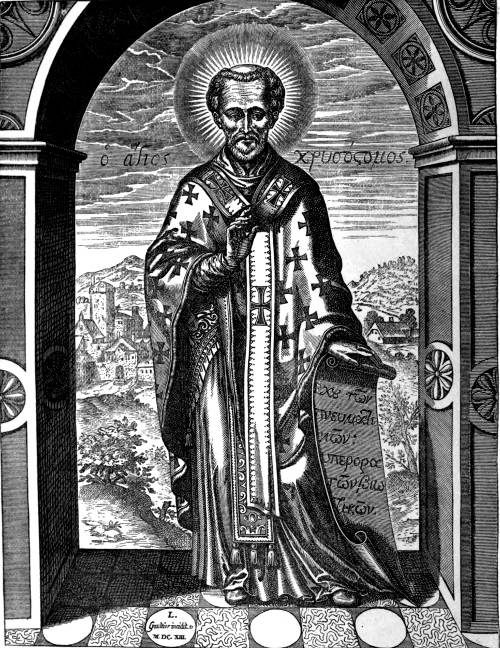
SURVEY OF CHRYSOSTOM’S THEOLOGICAL TEACHING—PRACTICAL TONE OF
HIS WORKS—REASON OF THIS—DOCTRINE OF MAN’S NATURE—ORIGINAL
SIN—GRACE—FREE-WILL—HOW FAR CHRYSOSTOM PELAGIAN—LANGUAGE
ON THE TRINITY—ATONEMENT—JUSTIFICATION—THE TWO
SACRAMENTS—NO TRACE OF CONFESSION, PURGATORY, OR MARIOLATRY—RELATIONS
TOWARDS THE POPE—LITURGY OF CHRYSOSTOM—HIS
CHARACTER AS A COMMENTATOR—VIEWS ON INSPIRATION—HIS
PREACHING—PERSONAL APPEARANCE—REFERENCES TO GREEK CLASSICAL
AUTHORS—COMPARISON WITH ST. AUGUSTINE.
The main characteristics of Chrysostom as a theologian and
interpreter of Scripture, as well as a pastor and preacher,
have, it is hoped, been already indicated in the course of
the preceding narrative; but it may be desirable to supplement,
by a fuller and more methodical survey, notices
which were necessarily sometimes brief and incidental in
the biographical chapters.667
Some evidence, therefore, of his theological teaching and
method of interpretation will first of all be collected from
his writings, and arranged under different heads. Two
difficulties in the way of executing this task faithfully
should be borne in mind: first, the voluminous bulk of
Chrysostom’s works (as Suidas observed, that it belonged to
God rather than man to know them all), which renders a
successful search for the selection of what are really the
most telling passages in illustration of each point far from
easy; secondly, that Chrysostom, being a preacher rather
than a writer, was of course liable to slip into inexact or
exaggerated language, under the influence of excitement, or
a desire to make an impression on the feelings of his hearers.
An attentive perusal, however, of his writings leads the
reader to the conclusion that he was very seldom carried
away by the impulse of the moment into merely vague or
rhetorical expressions, and that he was especially preserved
from this failing by his habit of combining the expository
with the practical and hortatory line of preaching. His
discourses are careful commentaries as well as practical
addresses. Week after week it was his custom to go
through some book of Holy Scripture, verse by verse, clause
by clause, almost word by word; endeavouring with all
diligence and patience to ascertain the exact meaning of the
passage before him, to place it clearly before his audience,
and to base his practical exhortation upon it.
The remark has been so often repeated, as to have
become almost a truism, that the theology of the East is
distinguished from the theology of the West by its more
speculative, metaphysical character. It deals more especially
with the most profound and abstract mysteries—the
being and nature of the Godhead, of angels, of the whole
spiritual realm. It might, therefore, occasion some surprise
to find the homilies of Chrysostom marked by such an
eminently practical tone. But the apparent contradiction
is easily explained. It is precisely because Greek philosophy
and theology were chiefly concerned with the most
abstract questions, that the Greek preacher, speaking on
matters not abstract, but practical, relating to moral conduct,
is especially free in his language from philosophical or
technical terms. On the other hand, in the Western Church
exactly the reverse occurs. The best intellectual powers of
the Roman having been mainly exercised on jurisprudence,
the mind of Roman theologians naturally turned most
powerfully towards practical questions which had most
affinity to that science with which they were chiefly conversant—such
as the relation of man to God, the nature of
sin, the means of discharging the debt owed by man, the
problem of the free-will of man, and providence of God.
Western theology is coloured by the language of Roman
law, as Eastern theology is coloured by the language of
Greek philosophy. “Merit,” “satisfaction,” “decrees,” “forensic
justification,” “imputed righteousness,” are terms which
do not occur in the writings of the Greek theologian, because
they are the expressions of ideas in which he felt no interest.
They are the offspring of the Roman mind, in which legal
ideas were dominant. Hence the Western theologian is
most technical and scientific in the region of practical questions;
the Greek, on the other hand, is more entirely free
from the influence of philosophy in that region than in any
other.
In accordance with this distinction, we find that Chrysostom,
in treating of those practical questions with which,
as a preacher and pastor, he was mainly concerned—the
nature and the work of Jesus Christ, providence, grace,
the nature of man, sin, faith, repentance, good works, and
the like—casts his thoughts into the most free, natural,
untechnical, and therefore forcible language possible.
To consider first of all his exposition of man’s nature.
The majority of the Oriental fathers made a triple division,
into body, soul, and spirit—the soul (ψυχή) being equivalent
to the animal life, the spirit (πνεῦμα or ψυχὴ λογική) to the
reason. Chrysostom makes a twofold division only, into
body and soul, and reserves the word “spirit” to designate the
Holy Spirit.668 Man, when first created, came like a pure
golden statue fresh out of the artist’s hands, destined, if he
had not fallen, to enjoy a yet higher and nobler dignity than
he then possessed.669 His being made “in the image of God”
Chrysostom interprets to signify that dominance over the
lower animals which God Himself exercises over the whole
creation, and the peculiar superiority of man’s nature to
theirs consists in his reasoning power, as well as in his
endowment with the gift of immortality.670 Man fell through
his own weakness and indolent negligence (ῥᾳθυμία), and
then became deprived of that immortality and divine wisdom
with which he had been previously gifted; but his nature
was not essentially changed, it was only weakened.671 Evil is
not an integral part of man; it is not an inherent substantial
force (δύναμις ἐνυπόστατος):672 it is the moral purpose (προαίρεσις)
which is perverted when men sin. If evil was a part
of our nature, it would be no more reprehensible than
natural appetites and affections. If man’s will was not
unfettered, there would be no merit in goodness and no
blame in evil. There is no constraint either to holiness or
to sin; neither does God compel to the one, nor do the
fleshly appetites compel to the other.673 The body was not,
as the Manichæans erroneously maintained, the seat of sin;
it was the creation of God equally with the soul; the
whole burden, therefore, of responsibility in sin must be
thrown on the “moral purpose.” Here was the root of all
evil; the conception of necessity and immutability is bound
up with the idea of nature. We do not try to alter that
which is by nature (φύσει): sin therefore is not by nature,
because by means of education, laws, and punishments we
do seek to alter that.674 Sin is through the moral purpose
which is susceptible of change, and till the moral purpose
has come into activity sin cannot properly be said to exist:
infants, therefore, and very young children, are free from sin.675
Our first parents fell through moral negligence (ῥᾳθυμία);
and this is the principal cause of sin now. They marked
out a path which has been trodden ever since; they yielded
to appetite, and the force of the will has been weakened
thereby in all their posterity, who have become subject to
the punishment of death; so that though sin is not a part
of man’s nature, yet his nature is readily inclined to evil
(ὀξυῤῥεπὴς πρὸς κακίαν): but this tendency will be controlled
by the moral purpose if that is in a healthy condition.676
Chrysostom would thus readily allow the expressions
“hereditary tendency to sin,” “hereditary liability to the
punishment of death,” but he shrinks from the expression
“hereditary sin.” His anxiety to insist on the complete
freedom of the human will was very natural in the earnest
Christian preacher of holiness, who lived in an age when men
were frequently encountered who, in the midst of wickedness,
complained that they were abandoned to the dominion of
devils or to the irresistible course of fate. They transferred
all guilt from themselves to the powers of evil, all responsibility
to the Creator Himself, who had withdrawn from
them, as they maintained, the protection of His good providence.
To counteract the disastrous effects of such philosophy,
which surrendered the will to the current of the
passions, like an unballasted ship cast adrift before the
storm, it was indeed necessary to maintain very resolutely
and boldly the essential freedom of the will, to insist on
man’s moral responsibility, and the duty of vigilant, strenuous
exertion. Chrysostom frequently exposes the absurdity as
well as the moral evil of a doctrine of necessity. If human
actions are necessary and preordained results of circumstances,
then teaching and government become mere pieces
of acting, destitute of any practical influence; they are also
unjust, since you have no right to punish a person who has
acted under compulsion. Such a theory ought, also, logically
to paralyse human industry. If a plentiful harvest is predetermined
by the decrees of fate, you may spare yourself
the trouble of ploughing, sowing, and other laborious operations;
or, if Clotho has turned her distaff in the other direction,
all your exertions will fail to produce an abundant
crop. Such a doctrine is repugnant to our natural sense,
and contradicts our own consciousness and inward experience.
We feel that we are free, and all human action
proceeds on the principle of supposing man to be free. We
teach and we punish. The plea of necessity would be
rejected in a court of law as an impudent and futile excuse
for crime. Such a theory is utterly at variance also with
God’s mode of addressing man, which always implies freedom
of volition; as, for instance, “If ye will hearken unto me,
ye shall eat the fat of the land; but if ye will not hearken,
the sword shall devour you.”677
Profoundly convinced, therefore, of a universal tendency
to sin on the one hand, but of an essential freedom of the
will on the other, Chrysostom sounds alternately the note
of warning and of encouragement—warning against that
weakness, indolence, languor of the moral purpose which
occasions a fall; encouragement to the full use of those
powers with which all men are gifted, and to avoid that
despondency which will prevent a man from rising again
when he has fallen. St. Paul repented, and, not despairing,
became equal to angels; Judas repenting, but despairing,
was hurried into self-inflicted death. Despair was the
devil’s most powerful instrument for working the destruction
of man.678 Chrysostom therefore earnestly combated any
view of Christian life which daunted and discouraged man’s
efforts, by winding them too high, or placing before them
an unattainable standard. Men sometimes said we cannot
be like St. Peter and St. Paul, because we are not gifted
with their miraculous power. But, he replies, you may
emulate their Christian graces: these are within the reach
of all, and these are, by our Lord’s own declaration, the most
important. “By this shall all men know that ye are my
disciples, if ye have love one to another;” the moral works
of the Apostles, works of love, mercy, and faith, were far
more instrumental in the conversion of the world than their
merely miraculous powers.679
Urgently, however, as Chrysostom, in his desire to stimulate
exertion and strengthen the moral life, insists on the
absolute freedom of the will, he maintains no less clearly
the insufficiency of man’s nature to accomplish good without
the Divine assistance. No one has described in more forcible
language the powerful hold of sin upon human nature. Sin
is like a terrible pit, containing fierce monsters, and full of
darkness.680 It is more terrible than a demon,681 it is a great
demon;682 it is like fire; when once it has got a hold on the
thoughts of the heart, if it is not quenched it spreads further
and further, and becomes increasingly difficult to subdue;683 it
is a heavy burden, more oppressive than lead.684 Christ saw
us lying cast away upon the ground, perishing under the
tyranny of sin, and He took compassion on us.685 In the
infant weakness and liability to sin are inherent, though not
sin itself. The moral nature of the infant is like a plant,
which will grow healthily by a process of natural development,
unless exposed to injurious influences; but it requires
the protection of grace, “therefore we baptize infants to
impart holiness and goodness, as well as to establish a
relationship with God.” This passage is quoted by St.
Augustine in his earnest vindication of Chrysostom from
Pelagianism.686 But the passages on which Augustine mainly
depends to prove Chrysostom’s adherence to the tenet of
original sin are in his exposition of Romans v. 12-14:—“Death
reigned from Adam to Moses. How reigned? In
likeness of the transgression of Adam, who is a figure of
One to come. How a figure? Because, as he became a
cause of death to those who were born from him, although
they had not eaten of the tree, even so Christ has become
to His posterity the procurer of righteousness, though they
have not done righteousness, which He has bestowed upon
us all through His cross.” Augustine quotes also his observation
on Christ’s tears over the grave of Lazarus:—“He
wept to think that men, who were capable of immortality,
had been made mortal by the devil;” and his remarks on
Genesis i. 28, about the subjection of the lower animals to
man: “that man’s present dread of wild beasts was entirely
owing to the Fall, and had not existed previous to that: it
was inherited by all Adam’s posterity, because they inherited
his degradation through the Fall.” All these passages, however,
do not amount to more than the doctrine of a universally
inherited tendency to sin, and therefore liability to its
punishment, death. In his interpretation of the passage,
“the free gift is of many offences unto justification,” this
last word is plainly taken by him in the sense of making
man righteous, not accounting him as such.687
His conception of the relation between the will and
power of God on the one hand, and man’s freedom on the
other, appears to be this:—All men, without exception,
are through Christ called to salvation; predestination
means no more than God’s original design, conceived prior
to the Fall, of bringing all men to salvation. So, after the
Fall, His redemptive plan or purpose embraces all men; but,
on the other hand, it constrains no one. According to His
absolute will all men are to be saved; but the accomplishment
of His purpose is limited by the freedom of choice
which He has Himself bestowed on man, whereby man may
either accept the proffered favour and be eternally blessed,
or reject it and be eternally condemned. God’s election of
those who are called is not compulsory, but persuasive;688
hence, many of those who have been called perish through
their rejection of grace: they, and not God, are the authors
of their own condemnation. God knows beforehand what
each man will be, good or bad; but He does not constrain
him to be one or the other.689 The illustration of the potter
in Romans ix. 20 must not be pressed too closely; St.
Paul’s object simply is to enforce the duty of unconditional
obedience. A vessel of wrath is one who obdurately resists
God’s grace; he was never intended by God to be a vessel
of wrath. “The vessels of mercy are said to have been prepared
afore by God unto glory,” but the vessels of wrath to
be fitted (not by God—He is not mentioned—but by sin)
unto destruction.690 So again, he acutely observes that, in the
account of the final judgment (St. Matt. xxv.), the destiny
of the good only is referred to God. “Come, ye blessed of
my Father, inherit the kingdom prepared for you;” but,
“Depart, ye cursed” (not “of my Father”), “into everlasting
fire, prepared” (not for you, but) “for the devil and his
angels.”
On St. John vi. 44, he remarks, it is perfectly true that
only they who are drawn and taught by the Father can
come to Christ; but away with the paltry pretence that
those who are not thus drawn and taught are emancipated
from blame; for this very thing, the being led and instructed,
depends on their own moral choice. Two factors, therefore,
Divine grace which presents, and human will which appropriates,
are co-efficients in the work of man’s salvation;
God’s love and man’s faith must work hand in hand. God
provides opportunities, encourages by promises, arouses by
calls; and the moment these are responded to, the moment
man begins to will and to do what is right, he is abundantly
assisted by grace. But Chrysostom recognises nothing
approaching the doctrine of final perseverance. St. Paul
might have relapsed, Judas might have been saved (De
Laud. Ap. Pauli, Hom. ii. 4). In his commentary on
Phil. ii. 12-13, “It is God which worketh in us both to will
and to do of his good pleasure,” the spontaneity of man’s
will is carefully maintained. It may be said, if God works
the will in us, why does the apostle exhort us to work? for
if God wrought the wish, it is vain to speak of obedience;
the whole work is God’s from the beginning. No! Chrysostom
says, what St. Paul means is, that if your will works,
God will augment your will, and quicken it into activity and
zeal. Hast thou given alms? you are the more prompted
to give; hast thou abstained from giving? negligence will
increase upon you. The histories of Abraham, Job, Elijah,
St. Paul, and other saints, are frequently cited to prove his
central principle, that God in the moral and spiritual sense
helps those only who help themselves. “When He, who
knows the secrets of our hearts, sees us eagerly prepare for
the contest of virtue, He instantly supplies us with His
assistance, lightening our labours, and strengthening the
weakness of our nature. In the Olympian contests the
trainer stands by as a spectator merely, awaiting the issue,
and unable to contribute anything to the efforts of the contender;
whereas our Master accompanies us, extends His
hand to us, all but subdues our antagonist, arranges everything
to enable us to prevail, that He may place the amaranthine
wreath upon our brows.”691 God does not anticipate
(φθάνει) man’s own volitions (βουλήσεις), but when these
are once bent in the right direction, God’s grace powerfully
promotes them; and without this divine co-operation holiness
is unattainable.692 But as, according to Chrysostom’s
conceptions, the first movement towards good moral practice
comes from the man himself, he often speaks of a man’s
salvation depending on his own moral choice. He is not,
therefore, in harmony with the mind of our Church as
expressed in the Article, that “we have no power to do good
works, pleasant and acceptable to God, without the grace of
God preventing us, that we may have a good will;” but his
language thoroughly concurs with the subsequent clause,
“and working with us when we have that good will.” In
the technical language of theology, he recognises assisting,
but not prevenient, grace.
It has been well remarked by Mr. Alexander Knox
(“Remains,” vol. iii. 79), that “the advocates for efficient
grace have been too generally antiperfectionists, and the
perfectionists, on the other hand, too little aware that we
are not sufficient so much as to think anything as of ourselves,
but that it is God which worketh in us both to will
and to do of His good pleasure.” The perfect conception of
the true Christian standard of character could only be found,
he thought, in a union of the systems of St. Chrysostom
and St. Augustine. It must not be imagined, however, that
Chrysostom regarded Divine grace as merely accessory or
subsidiary to man’s own will and purpose. He fails not to
represent it as indispensable to every human soul, however
powerfully inclined of itself to good. The human will,
weakened and depraved by evil, is not for a moment to rank
as co-ordinate in its action with the work of the Holy
Spirit: the real efficient force in the work of sanctification
is the Holy Spirit. The beginnings, indeed (ἀρχαί), are our
own, and we must contribute what we can, small and cheap
though it be, because, unless we do our part, we shall not
obtain the Divine assistance; but though the initiatory step
is ours, the accomplishment of the work is altogether God’s,
and, since the major part is His, we commonly say that the
whole is His.693
He invariably speaks of the Old Dispensation as a period
when Divine grace was given in less measure than under
the Gospel, because then sin had not been blotted out, nor
death vanquished. The achievements of holy men like
Abraham and Job in this period were therefore deserving
of peculiar praise, and their faults, on the other hand, were
entitled to more indulgent judgment, because they laboured
under disadvantages. When the Lamb which taketh away
the sins of the world had been slain, and the reconciliation
between man and God had been effected, then spiritual gifts
of a higher order were imparted as a sign and a pledge that
the old hostility had ceased.694
Turning now to theology, strictly so called, to the being
and nature of the Godhead, we find comparatively little said
by Chrysostom, except incidentally, on a subject more congenial
to the theologian and student than to the earnest,
practical preacher. In opposition to the rationalistic doctrine
of the Arians, who affected to comprehend the Divine
Nature, he strenuously maintained, as we have seen,695 its
inscrutability, and denounced any curious investigation of it
as at once foolish and profane. God has condescended to
appear to us in a form which is intelligible, and it is presumption
to attempt to penetrate beyond the limits which
He has placed to a knowledge of Himself. Chrysostom
takes the dogma of the one substance (ὁμοουσία), established
at Nice, as the basis of his position against the Arians, and
seeks to prove it, not by speculative argument, after the
manner of the Alexandrian school, but by reference to Holy
Scripture. He uses the word “substance” (οὐσία) to
designate the essential nature and “person” (ὑπόστασις),
the personality of the Godhead, and points out that words
which relate to the οὐσία, as Lord and God, are applied to
all the Persons; whereas the other terms—Father, Son,
Holy Spirit—indicating distinction of personality, are each
applied to one Person only in the Godhead. Yet the
Persons are not related to the substance as parts to the
whole: God the Son is to God the Father as a beam of the
sun, inseparable from Him, identical with Him in substance,
yet retaining His own personality.696 He is equally
careful to guard the divinity of Christ against the rationalising
school of Paul of Samosata, and the distinctness of
His personality as against the Sabellians. St. Paul, he
observes, does not dwell too much upon the abasement of
Christ, lest Paul of Samosata should take advantage;
neither does he dwell exclusively upon the exaltation, lest
Sabellius should spring upon him.697
The equal divinity and distinct personality of the Holy
Ghost are no less clearly and forcibly demonstrated by a
collection and comparison of passages. St. Paul, for
instance, in 1 Cor. xii. 6, speaks of God as “working all in
all;” in verse 11 of the same chapter, he uses the same
language of the Holy Spirit. Into any metaphysical,
abstract discussion of the nature of the Godhead Chrysostom
does not enter. He simply endeavours to guard the faith
of the Church by a careful exposition of Holy Scripture,
on which that faith was based, and by an exposure of the
one-sided, or perverted, interpretations on which the current
forms of heresy depended.
The union of the two natures in the person of our blessed
Lord was, as is well known, a subject of constant speculation
and of prolific error in the first five centuries. Here, again,
the good sense of Chrysostom, united to his careful study of
Holy Scripture, enabled him to hold the balance between
two divergent methods—one which attended too exclusively
to the humanitarian point of view, the other which brought
out the divinity, but at the expense of the manhood. He
earnestly maintains the veritable assumption of humanity
by the Word. Our nature could not have been elevated to
the divine if the Saviour had not really partaken of it;
neither could He have brought help to our race if He had
appeared in the unveiled glory of His Godhead, for sun and
moon, earth and sea, and even man himself, would have
perished at the brightness of His presence. Therefore He
veiled his Godhead in flesh, and came not as the Lord in
outward semblance, but in lowliness and abasement.698 And
this very condescension enhanced His dignity and extended
His dominion: before the Incarnation He was adored by
angels only, but afterwards by the whole race of redeemed
man.699 He assumed our nature, even in its liability to death,
but not as contaminated by sin.700 There were in Him three
elements—body and soul making up the human nature, and
the Logos or Word making up the divine. These two
natures were united but not fused. “We, indeed, are body
and soul, but He is God and soul and body; remaining what
He was, He took that which He was not, and having become
flesh, He remained God, being the Word. The one He
became He assumed; the other He was. Let us not then
confound, neither let us divide; one God, one Christ the
Son of God; and when I say one, I speak of union, not
fusion” (ἕνωσιν λέγω οὐ σύγχυσιν).701 Jesus Christ was
subject to death, susceptible of pain and all those emotions
and sensations which belong to the human body, otherwise
His would not have been a real body, but the weakness pertaining
to human nature was entirely overruled by the
constant operation of the Logos. If He is said to have been
lowered or exalted, this was only as man, since the Godhead
was incapable of either, being absolutely perfect. When the
Holy Ghost is said to have descended upon Him at His
baptism, this must be considered to refer to His human
nature only; the manhood, not the Godhead, is anointed.
Or when we read that He walked not in Judæa, because the
Jews sought to kill Him, and then, just afterwards, that He
passed through the midst of His enemies unscathed, we
have a direct manifestation, in close correspondence, of the
Godhead and the manhood.702
In speaking of the redemptive work of our blessed Lord,
Chrysostom’s language is too rapturously eloquent to be very
precise. There are in him several traces of the idea which
began with Irenæus, and was developed by Origen, that the
devil through the Fall acquired an actual right over man,
and that a kind of pious fraud was practised upon him to
deprive him of this right through the Incarnation and death
of Jesus. By the noiseless, unostentatious manner in which
our Saviour assumed humanity, veiling His Godhead under
it, He, as it were, stole unawares upon the devil, who
was not fully conscious of the majesty and might of his
adversary. The devil assaulted Christ as if Christ had been
merely man, and he was disappointed in his expectation.
He was vanquished by his own weapons, his tyranny was
destroyed by means of those very things which were his
strength; the curse of sin and of death were his most
trusted pieces: Christ submitted Himself to be bruised by
them, and yet crushed them by His submission.703
On the other hand, we find also in Chrysostom the customary
conception of a debt discharged, a ransom paid, a
sacrifice offered once for all. “Adam sinned and died;
Christ sinned not and yet died. Wherefore? that he who
sinned and died might be able, through Him who died but
sinned not, to throw off the grasp of death. This is what
takes place also in money transactions. Often some one
who is a debtor, not being able to pay, is detained in bonds;
another, who owes nothing but is able to lay down the sum,
pays it and releases the responsible person. Thus has it
been in the case of man. Man was the debtor, was detained
by the devil, and could not pay; Christ owed nothing, nor
was He holden by the devil, but He was able to pay the
debt. He came and He paid down death on behalf of him
who was detained in bondage.704
From this point of view the person to whom the debt is
due and is discharged is the devil; from another, the satisfaction
is regarded as due to God, owing to the violation of
man’s obedience, and is paid to Him through the sacrifice
of a sinless life. “It was right that all men should fulfil
the righteousness of God; but, since no one did this, Christ
came and completely fulfilled it.”705 He was Himself both
the sacrificer and the victim; the cross being the altar. He
suffered outside the city that the prophecy, “He was
numbered with the transgressors,” might be fulfilled, and
also that the universality of the sacrifice might be proclaimed.706
Chrysostom is not careful to distinguish between
the alienation of man from God, and of God from man
through the Fall. He represents the hostility as in some
sort existing on both sides. Christ did the work of a
mediator by interposing Himself between the two parties,
and reconciling each to the other. The references to such a
fundamental verity are of course numerous, often full of
beauty of expression and tenderness of feeling, and glowing
earnestness. What he specially delights to dwell upon, as
might be expected from his warm, affectionate disposition,
is the exceeding love of Christ to man, and the hearty return
which gratitude for such a benefit ought to draw forth from
us. Like St. Paul, he often will break forth, in the midst
of some argument or practical address, into a burst of
rapturous and adoring praise. “What reward shall I give
unto the Lord for all the benefits which He hath done unto
me? Who shall express the noble acts of the Lord, or show
forth all His praise? He abased Himself that He might
exalt thee; He died to make thee immortal; He became a
curse that thou mightest obtain a blessing.... When
the world lay in darkness, the light of the Cross was held
up like a torch shining in a dark place, and the light at the
top of it was the Sun of Righteousness Himself.”707
Chrysostom’s doctrine of justification is naturally coloured
by his ethics. Maintaining, as he did, that the corruption
of man’s nature consisted in a weakness of the moral purpose,
a crooked tendency of the will, rather than in any inherent
indelible stain in that nature itself, his exhortations are
directed rather to inculcate energetic action, a gradual
process of improvement of the will with the Divine help,
than that entire dependence through faith on the mercy of
God which springs out of a deep conviction of the sinner’s
own insufficiency. The logical tendency of the Augustinian
view of the intense and radical depravity of man’s nature is
to induce a total repudiation of the efficacy of personal
effort, a total disavowal of all personal merit. Hence
justification comes to be regarded as purely an act of
acquittal on God’s part, a boon which the despairing sinner
by an act of faith thankfully accepts. Such is not the
position of Chrysostom, or of those who, like the Cambridge
Divines of the seventeenth century, have trodden in his
footsteps. With him the condition of a pardoned sinner
consists rather in that renovation of the spiritual and moral
life which is the result of long and laborious effort, aided of
course by Divine grace, a succession of moral acts eventually
producing “a new creature.” Faith is not so much regarded
merely as the instrument or hand held out, by which God’s
gift is appropriated, as the first in a row of good works, a
fruitful source of all good action. “Abraham,” he says,
“believed God, and it was counted to him for righteousness.
Why? To prove that belief itself, in the first instance, and
obedience to the call of God, come from our own good
judgment (εὐγνωμοσύνη); but as soon as the foundation
of faith is laid, we require the alliance of the Holy Spirit,
that it may remain constantly unshakable and inflexible.”708
“Faith is the mother of all good, the sure staff of man’s
tottering footsteps, the anchor of his tempest-tossed soul,
without which he would be like a ship cast adrift on the
sea to the mercy of winds and waves.”709 “It is more stable
and secure than reason, for it carries its own proof with it;
the conclusions of reason may be diverted by counter-arguments,
but faith stands above argument, and is not
distracted by it.”710
He does not, indeed, shrink from a bold declaration of
the value of good works, but he is far from teaching men to
depend on them as efficient causes of salvation. They are
to be stored up as a kind of viaticum for our journey to the
other world. “As those who are in a foreign country, when
they wish to return to their own land, take pains, a long
time beforehand, to collect means sufficient for their journey,
so surely ought we, who are but strangers and settlers on
this earth, to lay up a store of provisions through spiritual
virtue, that when our Master shall command our return into
our native country, we may be prepared and may carry part
of our store with us, having sent the other in advance.”711
On the other hand, he constantly insists that it is the favour
and mercy of God alone which, in the end, bestows salvation
on us. Faith and good works are necessary conditions, but
not efficient causes of salvation. God has graciously willed
that they who have faith and good works shall be saved:
let no man therefore boast. We could not do good works
without God’s assisting grace, nor could they in the end and
at the best save us if it were not His merciful and gracious
will.712 Therefore, let no one pride himself on his good works;
above all things, let him cultivate a spirit of humility and
modesty: St. Paul, after all his labours, confessed that he
was not meet to be called an apostle, but was what he was
by the grace of God.713 “What is impossible with men is
possible with God.” “Tell me not I have sinned much, and
how can I be saved? Thou art not able, but thy Master is
able so to blot out thy sins that no trace even of them shall
remain. In the natural body, indeed, though the wound
may be healed, yet the scar remains; but God does not suffer
the scar even to remain, but, together with release from
punishment, grants righteousness also, and makes the sinner
to be equal to him who has not sinned. He makes the sin
neither to be nor to have been.... Sin is drowned in the
ocean of God’s mercy, just as a spark is extinguished in a
flood of water.”714
It was, no doubt, the trustful dependence of Chrysostom
on Divine grace, coupled with his firm conviction of the free
capacity of man to turn to what is good, which enabled him
to pitch all his exhortations to Christian holiness in such a
singularly cheerful, hopeful tone. To his sanguine temperament
it seemed as if man’s natural capacities for good, aided
by grace obtained through prayer, could accomplish anything.
“The effect of prayer on the heart is like that of the rising
sun upon the natural world; as the wild beasts come forth
by night to prowl and prey, but the sun ariseth, and they
get them away together and lay them down in their dens,
so, when the soul is illuminated by prayer, the irrational and
brutal passions are put to flight, anger is calmed, lust is
extinguished, envy is expelled; prayer is the treasure of the
poor, the security of the rich; the poorest of all men is rich
if he can pray, and the rich man who cannot pray is miserably
poor. Ahab without prayer was impotent amidst his
splendour; Elijah with prayer was mighty in his coarse
garment of sheepskin.”715 “It is impossible, impossible that
a man who calls constantly on God with proper zeal should
ever sin; his spirit is proof against temptation so long as the
effect of his praying lasts, and when it begins to fail, then he
must pray again. And this may be done anywhere, in the
market or in the shop, since prayer demands the outstretched
soul rather than the extended hands.”716 Long prayers were
to be avoided; they gave great opportunities to Satan to
distract the attention, which could not easily bear a lengthened
strain. Prayers should be frequent and short; thus
we should best comply with the direction of St. Paul to pray
without ceasing.717
It remains to collect some notices of Chrysostom’s teaching
with reference to the two Sacraments.
The number of those who, as Christian children of decidedly
Christian parents, were baptized in infancy appears
to have been small at this period, compared with those who,
like Chrysostom himself, joined the ranks of the Church at
a later epoch of life. There were many whose parents, or
who themselves, hovered not so much between Christianity
and any definite form of paganism, as between Christianity
and worldliness. The sermons addressed by Chrysostom
and his contemporaries to catechumens, and the frequent
allusions to them, the minute directions respecting their
instruction, their division into classes, the custom of calling
the first part of the service to which they were admitted the
Missa Catechumenorum, prove that numerous they must
have been. I have failed to find any passages in which
Chrysostom urgently inculcates infant baptism, and, considering
his views respecting original sin, this is not surprising;
but he earnestly denounces a custom of deferring
baptism, prevalent among those who were already believers,
or professing to be such. Often it was delayed till men
believed themselves to be at the point of death—a practice
which he especially deprecates, because at such a time
“the recipient was often in a restless, suffering state of
mind and body, most unfit to receive that holy sacrament;
the entrance of the priest was regarded by the sorrowful
attendants as a certain evidence of the approaching end;
and when the sick man could not recognise those who were
present, or hear a voice, or answer in those words by which
he was to enter into a blessed covenant with our Lord, but
lay like a log or a stone, what possible advantage could
there be in the reception of the sacrament?”718 Again, it
was often delayed till a man conceived that he had received
a distinct call and intimation that it was the will of God.
This Chrysostom regarded as being too often a mere cloak
for moral indolence, a reluctance of men to bind themselves
under the high responsibilities of the Christian vocation.719
He certainly considered baptism as being not merely a
solemn initiation into the Christian covenant, and instrument
of remission of sin, but also of moral renovation.
This, however, is represented as a blessing naturally derivable
from the entrance into the new and holy federal
relation with God. In his comment on the passage, “and
such were some of you; but ye are washed, but ye are
sanctified, but ye are justified in the name of our Lord
Jesus Christ,” he observes that such words signify that they
were not only purified from past uncleanness, but had
become holy and righteous. “For such is the benevolence
of the Divine gift; if an imperial letter consisting of a few
lines discharges men from liability to punishment for any
number of offences, and advances others to great honour,
much more will the Holy Spirit of God, which can do all
things, release us from all wickedness, bestow on us
abundant righteousness, and fill us with much confidence.”
The nature of the baptized was, therefore, like a vessel
which had not only been cleansed from past defilements, but
recast in the furnace so as to come out in a new shape.720
He is far, however, from regarding such a change as final.
The virtue of baptism is effectual at the time, but the grace
then given is as a trust to be carefully guarded; a talent
to be traded with, a seed of righteousness to be diligently
cultivated, the dawning of a light to shine more and more
unto the perfect day. As Christ becomes at that time the
clothing, the food, the habitation of the Christian, the recipient
of these favours has to take care that he does not
wrong this intimate relationship. Therefore he is ordered to
say at baptism, “I renounce thee, Satan;” that is the
declaration of a covenant with his Master. A firm determination
to abandon past sin and eradicate evil habits—in
a word, repentance—should take place previous to baptism.
“Just as the painter freely alters the lineaments of his
picture, when it is sketched in outline, by rubbing out or
putting in, but when once he has added the colour, he is no
longer at liberty to make alterations; in like manner erase
evil habits before baptism, before the true colouring of the
Holy Spirit has been thrown over the soul: take care
when this has been received, and the royal image shines
forth clearly, that you do not blot it out any more, and
inflict wounds and scars on the beauty given thee by
God.”721
In another place he contrasts the baptism of the Jews, of
John the Baptist, and of Jesus Christ. “The first was only
a cleansing of the body from ceremonial defilements, the
second was a means of enforcing an exhortation to repentance,
the third was accompanied by remission of sins: it
releases and purges the soul from sin, and gives a supply
of the Holy Spirit.”722 “When the merciful God saw the
extremity of our weakness, and the incurable nature of our
sickness, requiring a great work of healing, He conferred
upon us that renovation which comes through the laver of
regeneration, in order that, being divested of the old man,
that is, of evil works, and having put on the new, we might
go forward in the path of virtue.”723
In considering those passages which relate to the Holy
Eucharist, it must be carefully borne in mind that Chrysostom
lived in an age when that Sacrament had not become
a battle-field of controversy. He was under no constraint
in his language, because he did not feel that every word he
used was liable to be criticised, or misunderstood, or torn to
pieces in the strife of contending parties. He enjoyed
because he disputed not. Filled with thankfulness and joy
to overflowing for the unspeakable benefits derived from that
Sacrament, he is not cautious or scrupulously precise in his
expressions, but gives the freest rein to the enthusiasm of
his feelings; his object being not to support any rigidly
defined theory or system, but to infuse a certain spirit, to
encourage a proper moral tone and temper in reference to
the whole subject.
Three ideas, however, are apparent as dominant in his
mind—a sacrifice, a presence of Christ, a reception of Christ.
In several of the passages about to be presented, all the three
points will appear in similar and simultaneous force. In
one homily,724 where he severely censures the too prevalent
custom of attending the Eucharist on great festivals only,
and then behaving in a disorderly manner, the worshippers
hustling and trampling on one another in their tumultuous
haste to approach the holy table, and then hurrying out of
church immediately after the reception, without waiting for
the conclusion of the service—“What,” he exclaims, “O
man, art thou doing? When Christ is present, and the
angels are standing by, and the awe-inspiring table is spread
before thee, dost thou withdraw?... If you are invited
to a feast and are filled before the other guests, you do not
dare to withdraw while the rest of your friends are still
reclining at the table; and here, when the mysteries of
Christ are being celebrated, and the holy feast is still going
on, dost thou retreat in the middle?” Again: “Since, then,
we are about to see this evening, as a lamb slain and sacrificed,
Him who was crucified, let us approach, I pray you, with
trembling awe. The angels, who surpass our nature, stood
beside His empty tomb with great reverence; and shall we,
who are about to stand beside, not an empty sepulchre, but
the very table which bears the Lamb, shall we approach
with noise and confusion?”725 Again: “It is now time to
draw near the awe-inspiring table.... Christ is present,
and He who arranged that first table, even He arranges this
present one. For it is not man who makes the things which
are set before us become the body and blood of Christ, but
it is Christ Himself, who was crucified for us. The priest
stands fulfilling his part (σχῆμα) by uttering the appointed
words, but the power and the grace are of God. ‘This is
my body,’ He says. This expression changes the character
(μεταῤῥυθμίζει) of the elements, and as that sentence, ‘increase
and multiply,’ once spoken, extends through all time,
enabling the procreative power of our nature, even so that
expression, ‘this is my body,’ once uttered, does at every
table in the churches from that time to the present day,
and even till Christ’s coming, make the sacrifice perfect.”726
Speaking of the sacrifice of Isaac, he observes that it was
perfect so far as Abraham was concerned, because his intention
did not fail, though the knife was not actually drawn
across his son’s throat; “for a sacrifice is possible even
without blood—the initiated (i.e. the baptized) know what
I mean: on this account, also, that sacrifice was made
without blood, since it was destined to be a figure of this
sacrifice of ours.”727
Perhaps the most significant passage with reference to the
sacrificial idea is one where, after contrasting the many
and ineffective sacrifices of the Jews with the one perfect,
efficacious sacrifice of Christ, he proceeds: “What then? do
we not offer every day? We do offer certainly, but making
a memorial of His death; and this memorial is one, not
many. How one, not many? Because the sacrifice was
offered once for all, as that great sacrifice was in the Holy
of Holies. This is a figure of that great sacrifice as that
was of this; for we do not offer one victim to-day and
another to-morrow, but always the same: wherefore the
sacrifice is one. Well, on this ground, because He is offered
in many places, are there many Christs? Nay, by no means,
but one Christ everywhere, complete both in this world and
in the other; one body. As then, though offered in many
places, He is but one body, so is there but one sacrifice.
Our High Priest is He who offers the sacrifice which cleanses
us. We offer that now which was offered then; which is
indeed inconsumable. This takes place now for a memorial
of what took place then: ‘Do this,’ said He, ‘for my memorial.’
We do not then offer a different sacrifice as the
high priest formerly did, but always the same; or, rather, we
celebrate a memorial of a Sacrifice.”728
There are other passages in which the idea, no less prominently
set forth, is that of a holy feast. Elijah bequeathed
his mantle and a double portion of his spirit to Elisha, “but
the Son of God, when He ascended, left us His own flesh....
He who did not decline to shed His blood for all, and
imparts to us again His flesh and blood, what will He refuse
to do for our salvation?”729 Again: “Consider, O man, what
kind of sacrifice thou art about to touch, what kind of table
to approach; reflect that thou who art but dust and ashes
receivest the body and blood of Christ.”730 The sedulous care
with which he urges the duty of moral cleansing before
venturing to approach the holy table proceeds chiefly from
regarding it as a holy feast. “How shall we behold the
sacred passover? How shall we receive the sacred feast?
How partake of the adorable mysteries with that tongue
whereby we trampled on the Law of God and defiled our
soul? for if one would not touch a royal robe with defiled
hands, how shall we receive the Lord’s body with an unclean
tongue?”731
These passages, which are but a few specimens extracted
from a large number on the same subject, are yet sufficient
to show how easy it would be for the partisans of contending
schools to press the language of Chrysostom into support
of their own system. The truth is, that in the case of this,
as of other subjects, we find in Chrysostom and his contemporaries
the raw material, which has been wrought out by
the toil and strife of later times into definite sharply chiselled
dogmas. Nothing, therefore, can really be more unfair than
to regard, as a direct friend or opponent, one who lived and
wrote long before controversy had arisen on the subjects of
which he treated. He might innocently employ expressions
which we should deem it incautious to use, because we
know the interpretation of which they are susceptible, or
because we see in them incipient symptoms of an idea which
in process of time grew into a mischievous error. It is
instructive also to notice how harmless doctrines which
afterwards became mischievous were when they were not
pushed to an extremity, not made integral parts of a system
of belief. It does not occur to us, for instance, for a moment
to suppose that such invocation of saints as was manifestly
approved by Chrysostom was the least detrimental to that
free intercourse which ought to exist between the soul
of man and God Himself. As Dr. Pusey has observed:
“Through volumes of St. Augustine and St. Chrysostom there
is no mention of any reliance except on Christ alone.”732
There is not the least approach to that system of stepping-stones
or halting-places between God and man, which the
Roman Church established by means of confession, saint-worship,
and, above all, Mariolatry.
There is no trace in Chrysostom of priestly confession as
an ordinance of the Church. When he speaks of the misery
which ensues on the commission of sin, he urges the sinner
to relieve his conscience by a free confession with repentance
and tears. “And why are you ashamed to do so?” he proceeds,
“for to whom do you confess? Is it to a man or a
fellow-servant who might reproach or expose you? Nay, it
is to the Lord, tender and merciful: it is to the physician
that you show your wound.”733 Again, in speaking of prayer,
he contrasts the freedom of access to God with the difficulties
and impediments which encounter the delivery of a petition
to some great man. “This last could be reached only through
porters, flatterers, parasites; whereas God is invoked without
the intervention of any one, without money, without expense
of any kind.”734 This reads like a prophetical sarcasm on a
Church which ultimately made a traffic of dispensing what
cannot really be dispensed by man, because it is the free gift
of God.
Nor is there any symptom in Chrysostom of a tendency
to the theory of Purgatory. The condition of man after
death is always represented by him as final and irrevocable.
His tone, when exhorting to repentance, is always in harmony
with the following passage: “For the day will come
when the theatre of this world will be dissolved, and
then it is not possible to contend any longer: this is the
season of repentance, that of judgment; this of contest, that
of crowning; this of labour, that of repose.”735
But of all medieval additions to the purer faith of primitive
times, Mariolatry has grown to the most extraordinary
dimensions.736 Of any tendency to this error there is in
Chrysostom a remarkable absence. In fact, his notices of
the Blessed Virgin, not very frequent, are on the whole, we
might almost say, unnecessarily disparaging. In his commentary
on the Marriage Feast at Cana, he suggests that the
Virgin, in mentioning the failure of wine to our Lord, may
have been anxious to draw out His miraculous powers,
partly to place the guests under an obligation to Him,
partly to enhance her own dignity through the display of
her Son’s divine powers. He considers that the appeal
sprang from the same feeling which prompted His brethren
to say, “Show Thyself to the world;” and he proceeds to
observe that our Lord, while never failing to manifest dutiful
reverence and affectionate care towards His mother, has
taught us, by His conduct and language to her, that the tie
of mere earthly kindred entitled her not to higher privileges,
and placed her in no more intimate spiritual relationship
with Himself than any one might through love and obedience
enjoy. “Who is my mother, and who are my brethren?
and looking round about on His disciples, He said, Behold
my mother and my brethren; for whosoever shall do the will
of my Father, the same is my brother, and my sister, and
mother.” “Heavens!” Chrysostom exclaims, “what honour!
what reward! to what a pinnacle does He exalt those who
follow Him! How many women have blessed the Holy
Virgin and her womb, and have longed to be such mothers!
What then prevents it? Behold, he opens a broad way for
us: not women only, but men also are permitted to be
placed in the same rank.” “The demand to see Him was
made by His mother in an ambitious spirit: she wished to
show to the people how much authority she possessed over
Him; at any rate, the request was unreasonable and unseasonable.
If she and His brethren desired to speak with
Him on matters of doctrine, they might have done so in the
presence of the others; but if on private matters, it was
an ill-timed interruption to His discourse on weightier subjects.”737
Again: “When a woman in the company cried
out, ‘Blessed is the womb that bare Thee!’ He instantly
corrected her: ‘Yea, rather blessed are they that hear the
word of God and keep it.’” It is possible that the general
sentiment of the age may have regarded the Virgin with
more veneration, but Chrysostom could not have ventured
to use such language had the cultus been in any but its
very earliest stage, if then. She is called holy by him; she
intercedes738 for Eve, who is a type of herself, but of worship
paid to her there is not the slightest evidence.739
It is almost superfluous to observe that Chrysostom knew
and acknowledged nothing of papal supremacy, in the sense
which those words conveyed to the minds of later generations.
In common with the rest of Christendom, he paid
great deference and respect to the metropolitan at Rome,
and he was quite free from those feelings of jealousy which
were entertained by the patriarchs of Constantinople, as
time went on, owing to the increasing pretensions and exactions
of the Roman See. If he respects Innocent, as occupying
the chair of St. Peter, he equally respects Flavian,
bishop of Antioch (who was not in communion with Rome),
for the same reason; he calls him “our common father and
teacher, who has inherited St. Peter’s virtue and his chair.”
The letter written to Innocent during exile was addressed
also to the Bishops of Milan and Aquileia. In his commentary
on Galatians ii. he proves the equality of St. Paul
with St. Peter. No doubt he assigns an eminent rank to St.
Peter, speaking of him as “leader of the band” (κορυφαῖος)
of apostles, and as intrusted with the “presidency” (προστασίαν)
of the brethren: but these words do not imply
absolute authority, and the same appellations are applied
to St. Paul also.
Scattered up and down the discourses of Chrysostom there
are abundant references to the liturgical forms, and manner
of using them, which were in vogue in his time. If we had
no other authority, we could learn from him alone that
the service consisted of two parts—the first, called Missa
Catechumenorum, because the catechumens were permitted
to be present at it, which included an opening salutation of
“Peace be with you,” with the response, “And with thy
spirit;” psalms sung antiphonally; appointed lessons according
to the season or the day (as Genesis was read during
Lent, the Acts of the Apostles in Pentecost, that is, during
the fifty days between Easter and Whitsun Day); the sermon,
frequently in Chrysostom’s case on the lesson for the day,
the preacher usually sitting, and the people standing; then
prayers, announced by the deacon, for the catechumens, the
“possessed,” and the penitents; the benediction by the
bishop, and dismissal by the deacon, who bade them “depart
in peace.” The second part of the service then began, called
Missa Fidelium, because the baptized only were permitted
to be present. Chrysostom strongly denounces an increasing
tendency on the part of many to remain during this second
and more sacred portion without participating. He plainly
declares that all those who were baptized should communicate,
and tells them, if they were not worthy to receive the
Eucharist, neither could they be worthy to join in the
prayers which preceded the reception, and therefore they
ought to quit the church, with the catechumens and penitents,
when the deacon commanded all unbaptized, ungodly,
and unbelieving persons to depart.740 The usual order of the
Missa Fidelium was “the silent prayer” (εὐχὴ διὰ σιωπῆς),
on part of the priest and people (which the latter too often
abused, Chrysostom feared, to imprecate vengeance on their
enemies741); then a prayer somewhat equivalent to our bidding
prayer in form, and to our prayer for the Church Militant in
substance, the deacon bidding or proclaiming the forms, and
the people responding; then a prayer of invocation made by
the bishop, which was also called “collecta,” because in it
the prayers of the people were considered to be gathered
or summed up; the oblations of the people presented by the
deacons; the kiss of peace, the reading of the diptychs, the
ablution of the priest’s hands, the bringing of the elements
to the bishop at the altar, while the priests stood on each
side, and deacons held large fans to drive away the flies; a
secret prayer offered by the bishop; the benediction, “The
grace of our Lord Jesus Christ,” etc., to which the people
responded “And with thy spirit;” followed by “Lift up
your hearts”—“We lift them up unto the Lord;” “Let us
give thanks to our Lord God”—“It is meet and right so to
do;” a long thanksgiving, terminating with the Ter Sanctus,
in which the people joined; the consecration prayer, including
the words of our Lord at the time of institution, and an
invocation of the Holy Spirit to make the elements become
the body and blood of Christ; a prayer for all members of
the Church, living and dead; the doxology, the Creed;
a prayer of the bishop for sanctification; the words pronounced
by him, “Holy things for holy people” (τὰ ἅγια
τοῖς ἁγίοις); the reception by the clergy and laity in both
kinds, taking the elements into their hands; concluding
prayers, and dismissal by the deacon proclaiming, “Go in
peace.” Nearly all of the forms indicated in this sketch are
more or less clearly referred to or quoted in Chrysostom’s
works, and from these, with the aid of other contemporary
writers and documents, we might construct a liturgy which
would more nearly resemble that actually used by him than
the liturgy called by his name resembles it.742 For in this,
as in the so-called liturgy of Basil, it is impossible now to
determine how much was actually composed by the Father
who gave his name to it. It cannot be proved that Chrysostom
actually corrected or improved at all the liturgy
which he found in use at Constantinople. It may only have
come to be called after him as being the greatest luminary
who ever occupied the see. The statement, however, made
in a tract ascribed to Proclus, Patriarch of Constantinople in
the fifth century, is not in itself improbable, that Chrysostom
found the existing liturgy so long that many of the congregation,
being men of business, and pressed for time, left
before the service was concluded, or came in after it had
begun, and therefore he abridged and otherwise altered it.
In any case, many alterations were made by different
churches and bishops in the course of time, as in other
liturgies, so also in those which bear the name of Basil and
Chrysostom; and hence, as Montfaucon, Savile, Cave, and
others have remarked, you cannot find any two copies which
are exactly alike.
A critical estimate of Chrysostom’s value as a commentator
hardly falls within the scope of an essay on his life, but a
few general observations on this head may not be deemed
out of place here. The same fact was the cause in him of
much excellence and some defect in this department. He
was a preacher whose primary object was to convert souls.
This earnest, practical aim, of which he never lost sight,
helped to protect him from lapsing into idle, fanciful, mystical
interpretations of Scripture; but, on the other hand, it
hindered his entering so fully into all the historical, grammatical,
or even doctrinal questions which might be raised
about a passage as he would have done had he been exclusively
a commentator. His dominant aim being to affect
the heart and the moral practice of his hearers, he is content
when he has elicited from the passage all that will be most
useful for that purpose, and the continuity of the commentary
is frequently marred by sudden digressions. His ignorance
of Hebrew was of course fatal to his being an accurate
interpreter of the Old Testament, since he was entirely
dependent on the Septuagint translation. And even in
Greek, though few would deny him the merit of fine scholarship
on the whole, though his command of the language as
an orator is masterly, his style luminous, his diction copious
and rich without being offensively ornate or redundant, yet
his hold upon the language for critical purposes is neither
that of a man who spoke it when it was in its purest stage,
nor that of a scholar who, living in a later age and speaking
a different tongue, has made a careful, laborious study of it
as a dead language.
But two invaluable qualifications for an interpreter Chrysostom
did possess—a thorough love for the Sacred Book,
and a thorough familiarity with every part of it. There is
no topic on which he dwells more frequently and earnestly
than on the duty of every Christian man and woman to study
the Bible; and what he bade others do, that he did pre-eminently
himself. He rebukes the silly vanity of rich
people who prided themselves on possessing finely written
and handsomely bound copies of the Bible, but who knew
little about the contents. Study of the Bible was more
necessary for the layman than the monk, because he was
exposed to more constant and formidable temptations. The
Christian without a knowledge of his Bible was like a
workman without his tools. Like the tree planted by the
water-side, the soul of the diligent reader would be continually
nourished and refreshed. There were no difficulties
which would not yield to a patient study of it. Neither
earthly grandeur, nor friends, nor indeed any human thing,
could afford in suffering such comfort as the reading of Holy
Scripture, for this was the companionship of God.743
The honest, straightforward common sense which marks
his practical exhortations was a useful quality to him also
as an interpreter. One of his principles is, that sound doctrine
could not be extracted from Holy Scripture but by a
careful comparison of many passages not isolated from their
context.744 Allegorical interpretations were by no means to
be rejected, but to be used with caution; men too often made
the mistake of dictating what Scripture should mean instead
of submitting to be taught by it: they introduced a meaning
instead of eliciting it.745 Thus, though he often accepts
popular types—as Boaz and Ruth are figures of Christ and
His bride the Church; and Noah, Joseph, Joshua, are all in
different ways representative of our Lord; though sometimes
particular expressions in Messianic prophecies are forced,
for instance, in Isaiah’s description of Immanuel, the “butter
and honey” there spoken of he supposes to be intended to
indicate the reality of our Lord’s humanity746—yet his customary
aim is to discover the literal sense and direct historical
bearing of the passage. At the same time he fully recognises
a general foreshadowing of Jesus Christ, and the complete
fulfilment in Him ultimately of prophecies which immediately
refer to persons and events nearly, if not quite, contemporaneous
with the utterance. He fails not also to point
out the moral aspect of prophecy as a system of teaching
rather than prediction, as preparatory to the advent of Jesus
Christ in the flesh, not only by informing men’s minds, but
disciplining their hearts to receive Him.747 Hence the holy
men who lived, under the Old Dispensation, in faith on
God’s promises, knew Christ as it were by anticipation, and
were to be reckoned as members of the one body.748
He had a clear conception of the essential coherence
between the Old and New Testament. He observes that
the very words “old” and “new” are relative terms: new
implies an antecedent old, preparatory to it. The condition
of the recipients, the circumstances and age in which they
lived, being different, necessitated a difference in the treatment.
A physician treated the same patient at different
times by directly contrary methods; sometimes administering
sweet, sometimes bitter medicines, sometimes using the
lancet, sometimes cautery, but always with the same ultimate
end in view—the health of his patient. So the Old and
New Testaments were different, but not, as the Manichæans
maintained, antagonistic. The commandment, “Thou shalt
not kill,” attacked the fruit and consequence of vice; the
precept, “Whosoever is angry with his brother without a
cause,” etc., struck at the root. This was an illustration in
a small instance of the general truth that the New Dispensation
was only a completion and expansion of the Old.
Those, therefore, who rejected the Old Testament dishonoured
the New, which was based upon it, and presupposes it.749
He is equally rational in his manner of accounting for
the variations in the Gospel narratives. That they differ
in details, but agree in essential matters, he regards as a
powerful evidence of veracity. Exact and verbal coincidence
in every particular would have excited in the minds of
opponents a suspicion of concerted agreement.750 Authors
might write variously without being at variance; if there
had been ten thousand evangelists, yet the Gospel itself
would have been but one.751 Each evangelist tells substantially
the same tale, but varied according to the readers for
whom he wrote, and the special object which he had in
view. So St. Matthew wrote in Hebrew for the Jews, St.
Mark for the disciples in Egypt, St. John to set forth the
divine aspect of our Lord’s life. Thus we have variety in
unity, and unity in variety.752
In his commentaries on the Epistles he is careful to consider
each as a connected whole; and, in order to impress
this on his hearers, he frequently recapitulates at the
beginning of a homily all the steps by which the part under
consideration has been reached. In his introductions to
each letter he generally makes useful observations on the
author, the time, place, and style of composition, the
readers for whom it was intended, the general character
and arrangement of its contents. He regarded the Bible
as in such a sense written under the inspiration of God, that
no passage, no word even, was to be despised;753 that men
wrote as they were moved by the Holy Spirit, but not to
the total deprivation of their own human understanding
and personal character. The prophet was not like the seer
who spoke under constraint, not knowing what he said; he
retained his own faculties and style; only all his powers
were quickened, energised by the Spirit to the utterance of
words which unassisted he could not have uttered.754
Chrysostom’s influence as a preacher was not aided by
any external advantages of person. Like so many men who
have possessed great powers of command over the minds of
others—like St. Paul, Athanasius, John Wesley—he was
little of stature; his frame was attenuated by the austerities
of his youth and his habitually ascetic mode of life; his
cheeks were pale and hollow; his eyes deeply set, but bright
and piercing; his broad and lofty forehead was furrowed by
wrinkles; his head was bald. He frequently delivered his
discourses sitting in the ambo, or high reading-desk, just
inside the nave, in order to be near his hearers and well
raised above them. But these physical disadvantages were
more than compensated by other more important qualities.
A power of exposition which unfolded in lucid order, passage
by passage, the meaning of the book in hand; a rapid transition
from clear exposition, or keen logical argument, to
fervid exhortation, or pathetic appeal, or indignant denunciation;
the versatile ease with which he could lay hold of
any little incident of the moment, such as the lighting of
the lamps in the church, and use it to illustrate his discourse;
the mixture of plain common-sense, simple boldness,
and tender affection, with which he would strike home to
the hearts and consciences of his hearers—all these are not
only general characteristics of the man, but are usually to
be found manifested more or less in the compass of each
discourse. It is this rare union of powers which constitutes
his superiority to almost all the other Christian preachers
with whom he might be, or has been, compared. Savonarola
had all, and more than all, his fire and vehemence, but
untempered by his sober, calm good sense, and wanting his
rational method of interpretation. Chrysostom was eager
and impetuous at times in speech as well as in action, but
never fanatical. Jeremy Taylor combines, like Chrysostom,
real earnestness of purpose with rhetorical forms of expression
and florid imagery; but, on the whole, his style is far
more artificial, and is overlaid with a multifarious learning
from which Chrysostom’s was entirely free. Wesley is
almost his match in simple, straightforward, practical
exhortation, but does not rise into flights of eloquence like
his. The great French preachers, again, resemble him in
his more ornate and declamatory vein, but they lack that
simpler common-sense style of address which equally distinguished
him. Whether the sobriquet of Chrysostomos,
“the golden mouth,” was given to him in his lifetime is
extremely doubtful; at any rate, it seems not to have been
commonly used till afterwards. John is the only name by
which he is mentioned in the writings of historians who
were most nearly contemporaneous, but the other was a well-known
appellation before the end of the fifth century.755
The preservation of Chrysostom’s discourses we owe
mainly to the custom, prevalent in the Eastern Church at
that time, of having the sermons of famous preachers taken
down by shorthand writers as they were spoken; but some
of them Chrysostom published himself.756 To what extent
they may have been written before preaching it is impossible
to say. The expository parts were evidently the result of
previous study and preparation; the actual diction of the
practical portions he may have left to the suggestion of the
moment, though the main subjects of his address had been
always decided upon beforehand. Extempore remarks were
frequently called forth by the behaviour of the congregation,
or some passing incident. The discourse delivered after
his return from exile we also know to have been purely
impromptu; and Suidas observes that he “had a tongue
which exceeded the cataracts of the Nile in fluency, so
that he delivered many of his panegyrics on the martyrs
extempore without the least hesitation.”757 His hearers were
sometimes rapt in such profound attention that pickpockets
took advantage of it:758 sometimes they were melted to tears,
or beat their breasts and faces, and uttered groans and cries
to Heaven for mercy; at other times they clapped their
hands or shouted—marks of approbation frequently paid at
that time to eloquent preachers, but always sternly reproved
by Chrysostom.
Although his style is generally exuberantly rich, yet it is
seldom offensively redundant, for every word is usually
telling; and at times he is epigrammatically terse. A few
instances will suffice:—“The fire of sin is large, but it is
quenched by a few tears;” “Pain was given on account of
sin, yet through pain sin is dissolved;” “Riches are called
possessions (κτήματα) that we may possess them, not be
possessed by them;” “You are master of much wealth, do
not be a slave to that whereof God has made you master;”
“Scripture relates the sins of saints, that we may fear; the
conversion of sinners, that we may hope.” He refers to a
visitation of Antioch by an earthquake, as God “shaking
the city, but establishing your minds; making the city
crumble, but consolidating your judgment.”
His familiarity with classical Greek authors is apparent
sometimes in direct references. He speaks of “the smoothness
of Isocrates, the weight of Demosthenes, the dignity
of Thucydides, the sublimity of Plato.”759 He quotes the
beginning of the “Apology,” to show that if Socrates did
not put a high value on mere fine talking, how much less
should the Christian.760 He illustrates the readiness of men
to supply the wants of the monk by a passage from Plato,
where Crito says that his money, and that of Cebes and
many others, is at the disposal of Socrates; and, go where
he will, he may rely on finding friends.761 Sometimes we
detect a thought derived, it may have been unconsciously,
from classical sources. When he compares the crowd of the
congregation before him to the sea, and the play upon the
surface of that sea of heads to the effect of a strong west
wind stirring and bending the ears of corn,762 it is impossible
not to think that the idea was suggested by the well-known
simile in Homer (Il. ii. 147). Again, when, in speaking of
David’s sin, he compares the body to a chariot and the soul
to the charioteer, and says that, when the soul is intoxicated
by passion, the chariot is dragged along at random, it can
hardly be fanciful to see a reflection of Plato’s celebrated
image of the charioteer and horses in the “Phædrus.”763
But whatever admiration Chrysostom may have retained
of those authors whom he had studied in his youth, it was
confined to their language, for with their ideas and modes
of thought he had, so far as we can judge, abandoned all
sympathy. Nor was this unnatural. Christianity existed in
such close contact with Pagan corruption, and it had suffered
so much from Pagan persecution, that the revulsion of earnest
Christians from all things Pagan was total and indiscriminating.
“The old order changeth, yielding place to new;”
and the new, having fought a hard struggle with the old, is
for a long time incapable of recognising merit in anything
belonging to it. There are several allusions in Chrysostom
to the “Republic” of Plato, but they are always depreciative.
He fastens on a few points, such as the regulations about
marriage and female work, and condemns it on these as
absurd and childish, quite failing to consider the idea in its
grandeur as a whole.764 Yet it is instructive to notice that
he never hesitates to assign to Plato the first place among
the heathen philosophers, dignifying him with the title of
Coryphæus.765 He often compares the failure of Plato’s
teaching to regenerate men in every rank with the successful
labours of St. Paul and the other apostles; but while he
rejoices that the writings and doctrine of the philosopher
were eclipsed by the tentmaker and fisherman, and well-nigh
forgotten, he evidently regarded it as the most signal triumph
which Christianity had achieved.766
Unquestionable as the intellectual genius of Chrysostom
was, yet it is rather in the purity of his moral character, his
single-minded boldness of purpose, and the glowing piety
which burns through all his writings, that we find the secret
of his influence. If it was rather the mission of Augustine
to mould the minds of men so as to take a firm grasp of
certain great doctrines, it was the mission of Chrysostom to
inflame the whole heart with a fervent love of God. Rightly
has he been called the great teacher of consummate holiness,
as Augustine was the great teacher of efficient grace;767
rightly has it been remarked that, like Fénélon, he is to be
ranked among those who may be termed disciples of St. John,
men who seem to have been pious without intermission from
their childhood upwards, and of whose piety the leading
characteristics are ease, cheerfulness, and elevation; while
Augustine belongs to the disciples of St. Paul, those who
have been converted from error to truth, or from sin to
holiness, and whose characteristics are gravity, earnestness,
depth.768 If Augustine has done more valuable service in
building up the Church at large, Chrysostom is the more
loveable to the individual, and speaks out of a heart overflowing
with love to God and man, unconstrained by the
fetters of a severe and rigid system. Yet it is precisely on this
account that he has not been so generally appreciated as he
deserves. His tone is too catholic for the Romanist, or for
the sectarian partisan of any denomination. “It would be
easy to produce abundant instances of his oratorical abilities;
I wish it were in my power to record as many of his evangelical
excellencies.” Such is the verdict of a narrow-minded
historian,769 and the comparative estimation in which he held
St. Augustine and St. Chrysostom may be inferred from the
number of pages in his History given to each: St. Augustine
is favoured with 187, Chrysostom with 20. But he whose
judgment is not cramped by the shackles of some harsh and
stiff theory of Gospel truth will surely allow that Chrysostom
not only preached the Gospel but lived it. To the last
moment of his life he exhibited that calm, cheerful faith,
that patient resignation under affliction, and untiring perseverance
for the good of others, which are pre-eminently
the marks of a Christian saint. The cause for which he
fought and died in a corrupt age was the cause of Christian
holiness; and, therefore, by the great medieval poet of
Christendom he is rightly placed in Paradise between two
men who, widely different indeed in character and circumstances
from him and from one another, yet resembled him
in this, that they freely and courageously spoke of God’s
“testimonies even before kings, and were not ashamed”—Nathan
the Seer, and Anselm the Primate of all England:—
“Natan profeta, e’l metropolitano
Crisostomo, ed Anselmo....”
770