Footnotes have been collected at the end of each chapter, and are
linked for ease of reference.
Minor errors, attributable to the printer, have been corrected. Please
see the transcriber’s note at the end of this text
for details regarding the handling of any textual issues encountered
during its preparation.
The cover image has been created, based on title page information, and
is added to the public domain.
The last of the “Louisiana.”
CASTLEMON’S WAR SERIES.
Sailor Jack, the Trader
BY
HARRY CASTLEMON,
AUTHOR OF “GUNBOAT SERIES,” “ROCKY MOUNTAIN SERIES,”
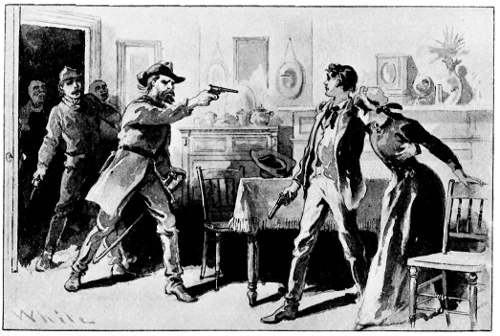
“Well, by gum! Am I dreamin’? Is
this Tom Randolph or his hant?”
“I don’t wonder that you are surprised.
It’s Tom Randolph easy enough, though I
can hardly believe it myself when I look in
the glass. There isn’t a nigger in the settlement
that isn’t better clad and better mounted
than I am.”
“Well, I have seen you when you looked a
trifle pearter, that’s a fact.”
“And what brought me to this? The Yankees
and their cowardly sympathizers. I don’t
blame the boys in blue so much, for brave soldiers
always respect one another, even though
their sense of duty compels them to fight
under different flags; but the traitors we have
2right here among us are too mean to be of any
use. And the meanest one among them is
Rodney Gray.”
The first speaker was Lieutenant Lambert,
who, by his zealous efforts to serve the cause
of the South, brought about the bombardment
of Baton Rouge, and the person whom he
addressed was the redoubtable Captain Tom
himself, who had just returned to Mooreville
after undergoing two months’ military discipline
at Camp Pinckney.
The last time we saw these two worthies was
shortly after the Confederate General Breckenridge
made his unsuccessful attempt to
capture Baton Rouge, and the conscripting
officer, Captain Roach, disappeared so completely
that no one had ever heard a word of
him since, and the veteran Major Morgan,
backed by fifty soldiers who hated all Home
Guards and other skulkers as cordially as they
hated the Yankees, came to take his place.
Knowing that Captain Roach had been very
remiss in his duty, that he had spent more time
in visiting and eating good dinners than he
had in sending conscripts to the army, Major
3Morgan hardly gave himself time to take possession
of the office in Kimberley’s store before
he declared that that sort of work was going
to cease entirely, and that everyone in his district
who was liable to military duty, Home
Guards as well as civilians, must start for the
camp of instruction at once or be taken there
by force. The news spread rapidly, and in a
very few hours everyone in the settlement had
heard it. The wounded and disabled veterans
of the Army of the Centre, of whom there
were a goodly number in the neighborhood,
were overjoyed to learn that at last there was
a man in the conscripting office who could not
be trifled with, and some of the civilians, who
came under the exemption clause of the Conscription
Act, secretly cherished the hope that
Captain Tom and his first lieutenant might be
sent to serve under Bragg, who did not scruple
to shoot his soldiers for the most trivial offences.
As to Tom and his Home Guards, they did
not at first pay much attention to the major’s
threats. It was right that civilians should be
forced to shoulder muskets, since they would
not do it of their own free will, but as for
4them, they were State troops, and the government
at Richmond could not order them
around as it pleased. Besides, they had great
confidence in Mrs. Randolph’s powers of persuasion.
She would never permit her son to
go into the army, and having managed Captain
Roach pretty near as she pleased, the Home
Guards did not see why she could not manage
Major Morgan as well; but when it became
noised abroad that the latter had curtly refused
Mrs. Randolph’s invitation to dinner, intimating
that he was not ordered to Mooreville to
waste his time in visiting and nonsense, they
were terribly frightened, and demanded that
Captain Tom should “see them through.”
When they enlisted in his company, he promised
to stand between them and the Confederate
authorities, and now was the time for him
to make that promise good; but Tom was as
badly frightened as they were, and did not
know what to do. When his mother suggested
that it might be well for him to put his commission
in his pocket, and ride to Mooreville
and talk the matter over with the major, Tom
almost went frantic.
5“Go down there and face that despot
alone,” he exclaimed, “while he has fifty
veterans at his back to obey his slightest
wish? I’d about as soon be shot and have
done with it. Besides, what have I got to
ride? The Yankees have stolen me afoot.”
Captain Tom knew well enough that he was
not telling the truth. It wasn’t Yankees who
“stole him afoot,” but men who wore the
same kind of uniform he did. You will remember
that we compared the short visit of
Breckenridge’s army to a plague of locusts.
Everything in the shape of eatables in and
around Mooreville, as well as some articles of
value, disappeared and were never heard of
afterward; and among those articles of value
were several fine horses, Tom Randolph’s
being one of the first to turn up missing. His
expensive saddle and bridle disappeared at
the same time, and now, if Tom wanted to go
anywhere, he was obliged to walk or ride a
plough mule bare-back, which was harrowing
to his feelings. He wouldn’t appear before a
Confederate officer of rank in any such style
as that, he said, and that was all there was
6about it. But, as it happened, the conscripting
officer had a word to say on that point.
On the morning following his arrival in the
village a couple of strange troopers galloped
into Mr. Randolph’s front yard and drew up
at the steps with a jerk. Captain Tom’s heart
sank when he saw them coming, for something
told him that they were after him and nobody
else; and paying no heed to the earnest entreaties
of his mother, who assured him that
he might as well face them one time as another,
for he could not save himself by flight, he disappeared
like a shot through the nearest door,
leaving her to explain his absence in any way
she thought proper. But after taking a
second look at the unwelcome visitors, Mrs.
Randolph knew it would be of no use to try
to shield the timid Home Guard. The trooper
who ascended the steps, leaving his comrade to
hold his horse, was a rough-looking fellow, as
well he might be, for he had seen hard service.
The little pieces of metal on his huge Texas
spurs tinkled musically, his heavy cavalry sabre
clanked against his heels as he walked, and
Mrs. Randolph thought there was something
7threatening in the sound. He lifted his cap
respectfully, but said in a brisk business tone:
“I’d like to see Tom Randolph, if you
please.”
“Do you mean Captain Randolph?” corrected
the lady.
“No, ma’am. He was given to me as plain
Tom Randolph, and that is the only name I
know him by. I’d like to see him, if you
please.”
“Will you step in while I go and find
him?”
“Thank you, no. I have no time to sit
down. I am in a great hurry.”
“You can spare a moment to tell me, his
mother, what you are going to do with him,
can you not?”
“All I can say is that the major wants to
see him at once,” was the short answer.
“Do you know what the major wants of him,
so that I can explain——”
“Pardon me if I say that no explanations
are necessary. It is enough for him to know
that Major Morgan wants to see him without
a moment’s delay.”
8The tone in which the words were spoken
satisfied Mrs. Randolph that the impatient
trooper could not be put off any longer, so she
turned about and went into the house. She
knew that Tom had gone straight to her room,
and when she tried the door she found that he
had locked himself in.
“Who’s there?” demanded a husky voice
from the inside.
“It is I, my dear, and I am alone,” was the
reply. “Let me in at once. Now, call all
your courage to your aid, and show yourself
the brave soldier you were on the night you
knocked that Yankee sentinel down with the
butt of a musket and escaped being sent to
a Northern prison-pen,” she continued, as she
slipped through the half open door, which was
quickly closed and locked behind her. “Major
Morgan wants to see you at his office, and, my
dear, you had better go at once. The man at
the door will not wait much longer.”
“I don’t care if he won’t,” shouted Captain
Tom, who was terribly alarmed. “If he gets
tired of standing there, let him go back
where he came from and tell that major that
9I—what business has that fellow got out
there?”
Tom chanced to look through the window
while he was talking, and when he saw one of
the troopers ride down the carriage-way as if
he were going to the rear of the house, it
flashed upon him that the man was going there
to watch the back door. At the same moment
the jingling of spurs and the rattling of a
sabre were heard in the next room, the door
knob was tried by a strong hand, and something
that might have been the toe of a heavy
boot was propelled with considerable force
against the door itself.
“Open up here,” commanded a stern voice
on the other side. “Do it at once, or I shall
be obliged to force an entrance.”
This threat brought Captain Tom to his
senses. In a second the door was unlocked
and opened, and the soldier stepped into the
room.
“By what right does Major Morgan——”
began Tom.
“I don’t know a thing about it,” was the
quick reply. “It is no part of my duty to
10inquire into my superior’s private affairs. All
I can say is that I am commanded to bring
Tom Randolph before him without loss of
time. You are Tom Randolph, I take it.
Then saddle up and come with me.”
“But the Yankees stole my horse and I
have nothing to ride except a mule,” whined
Tom.
“Then ride the mule or come afoot. Make
up your mind to something, for I am going to
start in half a minute by the watch.”
“You will give my son time to exchange
his citizen’s clothes for his captain’s uniform,
of course,” ventured Mrs. Randolph.
“Sorry I haven’t an instant to wait, but the
color of his clothes will make no sort of difference
to Major Morgan,” was the reply. “Now
then, will you order up that mule, or walk, or
ride double with my man?”
“Are you an officer?” faltered Tom.
“Not much of one—only a captain.”
“Well, that puts a different look on the
matter entirely,” said Tom, who up to this
time thought he was being ordered around by
a private soldier. “Since you are an officer
11I expect to receive an officer’s treatment from
you, and I don’t wish to be addressed——”
“That’s all right. But hurry up, for the
time is precious.”
Being satisfied at last that his meeting with
the dreaded conscript officer could not be delayed
any longer, Captain Tom hastened to
his room after his commission, while his
mother sent a darky to the stable-yard to
bring up the solitary mule that had been left
there when the few remaining field-hands
went to work in the morning. And a very
sorry-looking beast it proved to be when it
was led to the door—too decrepit to work, and
so weak with age that it fairly staggered as
Tom threw his weight upon the sheepskin
which the thoughtful darky had placed on
the animal’s back to serve in lieu of a saddle.
A sorry picture Captain Tom made, too,
when he was mounted; but he had no choice
between going that way and riding double
with a private, and that was a thing he could
not bring himself to do.
While they were on their way to town Captain
Tom made several fruitless attempts to
12induce his captors—for that was just what they
were—to give him some idea of what he might
expect when he presented himself before the
major; but although he could not prevail
upon them to say a word on that subject, he
was able to make a pretty shrewd guess as to
the nature of the business in hand, and if he
had known that he was going to prison for a
long term of years he could not have felt so
utterly wretched and disheartened.
“If I were going to jail I might have a chance
to get pardoned out,” thought Tom, “but the
only way to get out of the army is to be killed
or have an arm or leg shot off. I’d be perfectly
willing to go if Jeff Davis and all his
Cabinet could be compelled to go too. I’m
afraid I am in for trouble this time, sure.”
If Captain Tom had any lingering doubts on
this point they were dispelled in less than half
a minute after he entered the enrolling office.
He had never before met the grizzly veteran
who sat at Captain Roach’s desk with a multitude
of papers before him, and when their
short interview was ended Captain Tom hoped
from the bottom of his heart that he might
13never meet him again. He proved to be just
what he looked—a thorough soldier, who had
come there with the determination to perform
his disagreeable duty without fear or favor.
Every man in the office was a stranger to Tom.
There were stacks of carbines and cavalry
sabres in all the corners, horses saddled and
bridled were hitched to the rack in front of
the door, and there were a few tanned and
weather-beaten soldiers standing around ready
to start at the word, but there was not a Home
Guard to be seen.
“This is Tom Randolph, sir,” was the way
in which one of the guards brought the new-comer
to the notice of the conscript officer.
“Don’t sit down,” he added a moment later,
as Tom drew a chair toward him. “Take
off your hat.”
Captain Randolph was amazed, for this was
not the way he had always been treated in
that office. Hitherto he had been a privileged
character, and had had as much to say
as Captain Roach himself; but now things
were changed, and for the first time in his
life Tom was made to see that he was not of so
14much importance in the world as he had supposed
himself to be. He took off his hat, but
noticed that the soldiers in the room did not
remove theirs, and that nettled him. So did
the manner in which the major acknowledged
the introduction, if such it could be called.
He did not offer to shake hands as Tom thought
he would, but merely looked over the top of
his spectacles for a moment. Then he pulled
a sheet of paper toward him, ran his finger
down the list of names written on it until he
had found the one he wanted, and made a short
entry opposite to it; after which he pushed
away the paper and said:
“Report at one o’clock this afternoon.
That’s all.”
“But, major,” Tom almost gasped, “what
am I to report for?”
“What for? Why, marching orders, of
course.”
“Well, will you tell me where I am to
march?”
“Along the road that leads to the camp of instruction.
Where else should a recruit march
to, I’d like to know. You’re conscripted.”
15“But, major,” protested Tom, drawing forth
an official envelope with hands that trembled
so violently that he could scarcely control
them, “I really don’t see how you can conscript
me. I am a captain in the State troops,
and there’s my commission from the governor.”
“It isn’t worth straws,” answered the major,
snapping his fingers in the air. “Don’t want
to see it. Besides, you have resigned.”
“But my resignation has not been accepted.”
“That doesn’t matter. It will be, for there
are no such things as State troops now, I am
happy to say. You’re liable to military duty
easy enough, and—that’s all.”
“I retain my rank, don’t I, sir?” said Tom.
It was astonishing what an effect this simple
question had upon the occupants of the room.
Some quickly turned their faces to the wall,
others tiptoed through the nearest doors, and
all shook with suppressed merriment. The
major jerked his spectacles off his nose, looked
hard at Tom to see if he were really in earnest,
and cleared his throat before he replied:
16“No, sir; you will begin as Private Randolph,
but will be given every opportunity to
show what you are made of, and to win a commission
that is worth something more than the
paper it happens to be written on. Don’t
worry about that. Well, sergeant, where are
the men I ordered you to bring before me?”
Hardly able to tell whether he was awake
or dreaming, Tom Randolph yielded to the
friendly hand that was laid upon his arm, and
suffered himself to be led away from the desk,
his place being immediately filled by four
brawny soldiers, who raised their hands with a
military salute. The first words one of them
spoke aroused Tom from his stupor and interested
him.
“We didn’t find Lambert and Moseley to
home, sir. They must have had warnin’, I
reckon, for they’ve took to the bresh.”
“They needn’t think to escape me by resorting
to any such trick as that,” said the
major grimly. “They owe a duty to their
country in this hour of her peril, and they’ve
got to do it. I’ll have a detail watch their
houses night and day till they come back.”
17Tom Randolph could hardly believe that the
soldier who laid his hand upon his arm and
conducted him to a remote corner of the room,
so that they could talk without danger of being
overheard, was the same captain who had
been so impatient and peremptory with him
and his mother a short time before, but such
was the fact. Having performed his duty and
brought his prisoner to the office, as he had
been told to do, the captain had thrown off his
soldier airs and was as jolly and friendly a
fellow as one would care to meet.
“You see you are going to have good company
while you are in camp,” said he.
“I don’t know what you call good company,”
snarled Tom. “Lambert is nothing
more than a common overseer, while Moseley
is a chicken and hog thief. Good company,
indeed!”
“But we heard that they are officers in your
company of Home Guards,” said the captain
in a surprised tone.
“They were chosen against my earnest protest,”
replied Tom, “but they have never been
commissioned by the governor. Their election
18was not legal, and so I didn’t report it. But,
captain, I don’t think your major has any
authority to ride over the governor in this
rough way.”
“Hasn’t he a right to conscript everyone
who does not come under the exemption
clause?” answered the captain. “If you have
read that act I will venture to say that you
did not see the words ‘Home Guards’ in it.
Come now.”
“But I am my father’s overseer,” said Tom,
switching off on another track.
“Since when?”
“Since long before Breckenridge made his
attack on Baton Rouge.”
“Where are you employed?”
“On the home plantation.”
“Your father doesn’t need two overseers on
the home plantation, does he? He has claimed
exemption for—what’s his name?—Larkin.”
“And didn’t he say a word about me?”
“The records of the office don’t show it.
Now let me tell you something. If your father
wants to claim exemption for you instead of
Larkin no doubt he can manage it with General
19Ruggles, who is in command at Camp
Pinckney. Major Morgan has no authority to
act in such cases. Just now your duty is to
go home and make ready to report at one
o’clock sharp. Don’t be a second behind time
unless you want to get the rough side of the
major’s tongue.”
“What shall I do to get ready?”
“Why, pack up a suit or two of your strongest
clothes, an extra pair of shoes and stockings,
and a few blankets, which I assure you
will come handy for shelter tents when you
take the field.”
“And you don’t think of any way in which
I can get out of it?” said Tom in a choking
voice.
“Oh, no. That’s a dead open and shut.
You’ve got to go to camp and stay there while
your friends are working to get you out, if
that is what you want them to do. But I
wouldn’t let them make any move in that
direction if I were you. Why don’t you go
with us and make a man of yourself? We are
whipping the Yankees right along, and you
will have plenty of chances to distinguish
20yourself. We’re bound to gain our independence,
and don’t you want to be able to
say that you had a hand in it?”
The captain’s earnest words did not send any
thrill of patriotism into the heart of Tom Randolph,
who just then wished that the Yankees
would sweep through Mooreville in irresistible
numbers, put an end to the war in a moment,
and so keep him from going to Camp Pinckney.
He turned sorrowfully away from the
captain, who had really tried to befriend him
by giving what he thought to be good advice,
mounted his aged mule, and set out for home.
His mother’s face brightened when he dismounted
at the foot of the steps, but fell
instantly when Tom told her that she had better
take a good long look at him while she had
the chance, for after that day was past she
would never see him again. Of course there
was mourning in that house when he told his
story, and the gloom that rested there was but
partially dispelled by Mr. Randolph’s promise
to discharge Larkin without loss of time and
claim exemption for Tom in his stead.
“If you could do it this minute it would
21not keep me from going to the camp of instruction,”
whined Tom, “for the major has no
authority to do anything but conscript everybody
he can get his hands on.”
“Has he warned Ned Griffin and Rodney
Gray?” inquired Mrs. Randolph.
“That’s so,” exclaimed Tom angrily.
“What a dunce I was not to speak to the
captain about those fellows! But I was so
taken up with my own affairs that I never
once thought of it. However, I’ll think of it
when I go down to the office at one o’clock, I
bet you. And, father, if you get on the track
of Lambert and Moseley, don’t fail to let the
major know it. If I’ve got to be disgraced
I want them to keep me company.”
“I will bear it in mind,” answered Mr.
Randolph. “And since one o’clock isn’t so
very far off, hadn’t you better get ready?”
The conscript thought this a very heartless
suggestion and so did his mother; but they
could not deny that there was reason in it, and
so preparations for Tom’s departure were
made at once. The parting which took place
an hour or so later was a tearful one on Tom’s
22part as well as his mother’s, but there was not
very much sorrow exhibited by the black
servants who crowded into the dining-room to
shake his hand, as they were in duty bound to
do, and Tom made the mental resolution that,
when he returned from Camp Pinckney to take
his place as overseer on the plantation, he
would see them well paid for their indifference.
He rode in his mother’s carriage this time,
accompanied by his father and a bundle of
things that would have filled a soldier’s knapsack
to overflowing. When the carriage turned
into the street that ran past Kimberley’s store,
Tom thrust his head out of the window, but
instantly pulled it in again to say, while tears
of vexation filled his eyes and ran down his
cheeks:
“There’s a bigger crowd of people in front
of the office than I ever saw before. No doubt
some of them will be glad to know I have been
conscripted; but if you have the luck I am
sure you will have, I shall be back to turn the
laugh on them before many days have passed
over my head. Just look, father, and remember
the name of every one who has a slighting
23word or glance for me, so that I may settle with
him at some future time. I hope Rodney and
Ned Griffin are there.”
“You’ve got your wish,” replied Mr.
Randolph, after he had run his eye over the
crowd, which extended clear across the street
to the hitching-rack. “Rodney and Ned are
there, but they seem to be standing on the
outskirts.”
Tom mastered up courage enough to look
again, and then he saw what his father meant
by “the outskirts.” There were three distinct
classes of people in that gathering. In
the middle of the crowd and in front of the
office stood two score conscripts, who were
closely guarded by half as many of Major
Morgan’s veterans. Some of the conscripts
seemed resolved to make the best of the situation,
and joked and laughed with their friends
and relatives who had assembled to see them
off, and who formed the third class that stood
outside the guards; but Tom noticed that
most of their number looked very unhappy
indeed. Tom did not see Rodney and Ned,
but he discovered several disabled veterans of
24Bragg’s army with whom he had a speaking
acquaintance, and they in turn discovered him
and sent up a shout of welcome.
“Hey-youp! Here comes another, and I do
think in my soul it’s Captain Tommy Randolph,”
exclaimed one. “It’s him, for I know
that there kerridge.”
“An’ they tell me that you might jest as well
be in the army to onct as to be in that camp,”
chimed in a second veteran. “There aint no
sich thing as gettin’ away when they get a grip
onto you.”
“Not by no means,” cried a third. “Kase
why, don’t you know that they keep a pack of
nigger hound dogs there that aint got nothin’ in
the wide world to do but jest chase deserters?”
The tone in which the taunting words were
uttered was highly exasperating to Tom, whose
face grew red with anger.
“I wouldn’t mind them,” said his father
soothingly. “That’s only soldiers’ fun. They
don’t mean anything by it.”
“I’ll try not to mind them now, but I’ll get
even with every one of them when I come
back,” said Tom savagely.
25Stepping out of the carriage, and showing
himself to that little mob of laughing, jeering
soldiers, was one of the most trying ordeals
that Tom Randolph ever passed through, but
there was no way to escape it. As he hurried
through their ranks toward the guards, who
stood aside to let him pass, they sent a few
more words of advice and encouragement after
him.
“Where’s all your purty clothes, Tommy?”
inquired one. “Go home to onct an’ get ’em.
If you don’t, them fule Yanks will think you
are nothin’ but a dog-gone private.”
“Don’t listen to him, Tommy,” said another.
“The Yanks always pick for officers in battle,
an’ they’re dead shots, I tell you.”
“You’re mighty right,” chorused a dozen
voices. “I never did see anybody who could
shoot like them Yanks. I’m glad I aint got
to face ’em agin, tell your folks. I wouldn’t
do it for all the money the Confedrit gov’ment
is worth.”
“It’s a disgrace the way those fellows are
allowed to go on,” said Tom to the first soldier
he met when he entered the office, and who
26turned out to be the captain whose acquaintance
he had made that morning. “Why don’t
you put a stop to it?”
“Aw! They want some sport, don’t they?”
was the answer. “Let them go ahead with it
until they get tired, and then they will stop.
Besides, you might as well get used to such
talk one time as another, for you will hear
plenty of it in the army.”
“But you mustn’t permit them to force me
into the army,” whispered Tom to his father.
“If you do, you will always be sorry for it,
because you will never see me again.”
In a dazed sort of way Tom reported to the
major, and then tried to hide himself in a
corner of the office where he would be out of
sight of his tormentors, but he was quickly
routed from there by one of the major’s men,
who told him to go outside where he would be
under the eye of the guard. Of course his
appearance was the signal for another outburst
from the veterans, but he wisely tried to drown
their gibes by entering into conversation with
a conscript who looked as disconsolate and
wretched as Tom himself felt. His father had
27given the bundle into his keeping, and taken
his place outside the guards with the rest of
the exempts, and Tom began to realize how it
seemed to be alone in a crowd. Rodney and
Ned did not come near him, and that made him
angry and threaten vengeance. They might at
least shake hands with him and assure him of
their sympathy, Tom thought, but if they had
been foolish enough to attempt it, it is more
than probable that he would have turned his
back upon them. More than that, Rodney
Gray was not a hypocrite. Having had the
most to do with the breaking up of Tom’s
company of Home Guards, he would have
uttered a deliberate untruth if he had said he
was sorry to see him conscripted. He wasn’t;
he would have been sorry to see him stay at
home.
“And when he reaches the camp of instruction
I hope some strict drill-sergeant will put
him through an extra course of sprouts to pay
him for the mean trick he tried to play on
Dick Graham,” said Rodney to his friend Ned.
“I could have told things that would have got
all the Pinckney guards down on him if I had
28been so disposed, and now I am glad I didn’t
do it. There he goes. Good-by, Tom Randolph.”
“Fall in!” shouted a stentorian voice.
“Not off there, but here, with the right resting
where I stand. Haven’t you Home Guards
been drilled enough to learn how to fall in in
two ranks? Face out that way toward the
hitching-rack. Now listen to roll-call!”
In ten minutes more the conscripts had
answered to their names and were headed
toward Camp Pinckney, marching in a crooked
straggling line with their bundles on their
shoulders and armed guards on each side of
them. There were forty-five in all, and two-thirds
of them were Home Guards. There
were many sober and tearful faces among the
spectators when they moved away, and even
the discharged veterans must have taken the
matter seriously, for they did not utter one
taunting word.
CHAPTER II. LAMBERT’S SIGNAL-FIRE.
29
A few of Tom Randolph’s fellow-sufferers
had repeatedly declared in his hearing
that they never would be taken to Camp
Pinckney alive; but when the roll was called
inside the stockade at sunset the following
day, their dreary, toilsome march having been
completed by that time, every one of them
answered to his name. Not one of their number
had made his escape, and indeed it would
have been foolhardy to attempt it, for the
guards were alert and watchful, and it was
whispered along the line that they had strict
orders to shoot down the first man who tried
to break away.
Not to dwell too long upon this part of our
story, it will be enough to say that Tom Randolph
remained in the camp of instruction for
two solid months, during which time he suffered
more than he thought it possible for
30mortal man to endure. He was given plenty
to eat, such as it was, but scarcely a night
passed that he was not aroused from a sound
sleep to go on post or to repel an assault that
was never made, and during the day-time he
was drilled in the school of the soldier and
company, and in the manual of arms, until all
the muscles in him ached so that he could not
lie still after he went to bed. Every hour in
the day indignities were put upon him that
caused his blood to boil, and he made matters
worse by resenting them on the spot, the result
being that he did more police duty than any
other man in camp. Time and again he
sought an interview with the commandant,
intending to complain of his treatment and
ask when he might look for his release, but
he never saw the general except from a distance,
and then was not permitted to approach
him. All this while his father, who visited
him at irregular intervals, bringing news from
the outside world, was doing his best; but
there were so many difficulties in his way, and
so much red tape to be gone through, that he
found himself balked at every point, and it is
31a wonder he was not tempted to give it up as
a task beyond his powers.
“You see Roach’s books show that I claimed
exemption for Larkin, and I’m afraid that’s
against us,” he said to Tom one day, after
talking the matter over with General Ruggles.
“But you have as much right to change
your mind as other folks, I suppose,” replied
Tom.
“Of course I have, but that isn’t the point.
If Larkin were here to take your place in camp
the work might be easier; but you see he isn’t.
He has skipped.”
“Skipped where?”
“Out in the woods, to keep company with
Lambert and Moseley, I suppose. And when
he went he left word with some of the neighbors
that if anything happened to my buildings
during the next few weeks, I might thank
him for it. He put out as soon as I told him
that I couldn’t pay the beef and bacon the
government demanded as the price of his
exemption.”
“Did you tell Major Morgan that you
wouldn’t pay it?”
32“Certainly, and I told General Ruggles so;
but that didn’t scare them at all. If they want
beef and bacon they’ll just take it.”
“Well, now, if that isn’t a pretty way for
a common overseer to treat a gentleman I
wouldn’t say so,” declared Tom, who really
thought that Larkin ought to have stayed
at home and been conscripted in his place.
“What difference does one man make in the
size of an army, anyway? The general could
let me go as well as not.”
“But he won’t, unless certain forms are complied
with. Be as patient as you can, and remember
that I shall leave no stone unturned.”
“Get an honorable discharge while you are
about it, so that I shall not be called upon to
go through with this performance a second
time,” said Tom.
It is true that a single recruit made no great
difference in the strength of an army, but for
some reason that no one but General Ruggles
could have explained it made all the difference
in the world so far as Tom Randolph’s release
from military duty was concerned. One day,
about six weeks after the conversation above
33recorded, Mr. Randolph walked into camp and
told Tom that he was a free man—or rather
that he would be in a few hours, for Larkin had
been captured by Major Morgan’s scouts, and
was now on his way to camp to take Tom’s
place.
“And am I to have an honorable discharge?”
inquired Tom, who was so overjoyed
that he could hardly speak.
“No; and I was foolish to ask for it,” said
his father in disgust. “The general laughed
in my face and said you hadn’t done anything
worthy of it. Don’t say a word about it, but
thank your lucky stars that you have escaped
being ordered to the front.”
When the man Larkin and a few other conscripts
were brought in under guard, Tom
Randolph was standing as near the big gate as
the camp regulations would allow him to get,
waiting impatiently for somebody to come out
of the commandant’s office and tell him he
could go home. He was mean enough to try
to attract Larkin’s attention when the latter
tramped wearily into the stockade, but the
man was so wrapped up in his troubles that he
34could hardly have recognized his best friend, if
he had had one among the curious crowd that
was gathered about the gate. Tom was a little
disappointed, but quickly dismissed Larkin
from his mind when he saw his father approaching
with an expression on his face that
was full of good news.
“Come right along,” said he. “It’s all
settled now. There stands the officer who
has orders to pass us out.”
“So the general has consented to do me
justice at last, has he?” exclaimed Tom, who
was not half as grateful as he ought to have
been. “And he kept me here all these weary
days and allowed me to be insulted and
abused on account of that man Larkin, did he?
Thank him for nothing. But I’ll fix some
others who are as much to blame for my being
here as General Ruggles is. I haven’t wasted
all my time since I have been in jail, I tell you.”
“I brought a mule for you to ride,” continued
his father. “But don’t you think we
had better bunk with the guard to-night? It
will be as dark as a pocket in an hour, and
besides it is going to rain.”
35“I don’t care if it rains pitchforks. I’ll
face them rather than remain in this dreary
hole a moment longer,” declared the liberated
conscript. “And I am not going to the barracks
after my clothes or blankets. I will
them to the first man who can put his hands
on them.”
Tom reached home in due time in spite of
the rain and other discomforts that attended
him on his journey, and it is scarcely necessary
to say that his mother welcomed him as
one risen from the dead. Her husband had told
her doleful stories of Tom’s life in camp, and she
was afraid that he would sink under his many
hardships before his release could be effected.
But Tom was not as badly off as he pretended
to be. A few days’ rest made him as uneasy
and full of meanness as he had ever been in
his life; but it is fair to say that his uneasiness
was due to an unaccountable delay in the
carrying out of a certain little programme
which he had arranged while living in the
stockade. This was what he meant when he
told his father that he had not wasted his
time since he had been in jail.
36During the month of September it became
known to the guards and conscripts at Camp
Pinckney that a meeting of cotton and tobacco
planters had been held in Richmond “to consider
the expediency of the purchase by the
Confederacy, or of a voluntary destruction of
the entire cotton and tobacco crop,” to keep it
from falling into the hands of the Union
forces. It is hard to tell why the news was so
long in coming down to Louisiana, for the
meeting, which was described as “one of the
largest, wealthiest, and most intelligent that
had ever assembled in the city,” was held as
early as February. Among the other resolutions
acted upon by this patriotic assemblage
was one calling upon the Southern people to
destroy all their property in advance of the
invading armies, even to their homes, so that
the conquest of the United States should be
a barren one. Of course this resolution met
the hearty approval of those of the Camp
Pinckney guards and conscripts who had no
property worth speaking of, and some of them
declared that if General Ruggles would let
them have their own way for twenty-four
37hours they would destroy thousands of bales
of cotton which the owners would never burn
themselves so long as they saw a prospect of
selling them to the Yankees. This set Tom
Randolph to thinking, and with the aid of
some of the Pearl River Home Guards who
were still on duty at the camp, he made up
a nice little plan to revenge himself on several
of the Mooreville people who had incurred his
enmity. It might have been successful, too,
if Tom had not allowed his unruly tongue to
upset it. As soon as he reached home he
began waiting and watching for some signs of
activity on the part of the Pearl River vagabonds,
but up to this time the clouds that
hung over the swamp, and which he watched
every night with anxious eyes, had not been
lighted by any signal-fires.
The life that Tom Randolph now led was
dreary and monotonous in the extreme; no
healthy boy could have endured it for a week.
Did he take Larkin’s place as overseer and do
his work? Well, hardly; and he never had
any intention of doing it. The field-hands did
the work as well as the overseeing, and Tom
38spent his time in loafing or in riding about the
country on a bare-back mule. It is true that
Major Morgan’s “drag-net” had not cleared
the neighborhood of everyone who was subject
to military duty, for a few of the desperate
ones, like Lambert and Moseley, had taken to
the woods, and a few others had joined the
Yankees in Baton Rouge, where they were
safe from pursuit; but it had caught the most
of the able-bodied men and boys of Tom’s
acquaintance, and now he found himself
almost alone. He saw Rodney and Ned now
and then, but never spoke to them if he could
help it, or visited them on their plantations;
for since they, with Mrs. Griffin’s aid, kept
him from being sent to a Northern prison, he
disliked them more than he did before. He
had never got over being surprised at Mr.
Gray’s action in standing between Ned and
the conscript officer, while he permitted the
other telegraph operator, Drummond, to take
his chances. Mr. Gray must be Union at
heart or else he would not have done that;
and if he was Union he ought to be driven out
of the country. Tom found a world of consolation
39in the reflection that he would soon be
even with him.
It was while the returned conscript was taking
his usual morning ride on his mule, with a
gunny-sack for a saddle, that he met his old
first lieutenant, as described at the beginning
of the last chapter. He knew that the man was
living in the woods, otherwise he would have
had him for company at Camp Pinckney, and
he was surprised to find him riding along a
public road in broad daylight. Lambert was
also mounted on a mule, the property of his
late employer, which he had appropriated to
his own use without troubling himself to ask
permission. He remembered that Tom had
once drawn a sword upon him, and flattered
himself that in Camp Pinckney his tyrannical
captain was being well paid for that and other
indignities he had put upon his Home Guards;
consequently he was not a little astonished and
vexed to find him breathing the air of freedom
on this particular morning.
“How did you manage to get away from
them fellers, anyhow?” inquired Lambert,
nodding in the direction of the camp.
40“I have influence with the governor,” replied
Tom loftily. “I did not want to stay,
and consequently I didn’t.”
“Afeared of the Yanks, was you!” continued
Lambert with something like a sneer.
“No more afraid than yourself. You took
to your heels and are in danger every moment
of being caught and sent to camp, while I faced
the music at once and will never have to do it
again. I am discharged from military service
for all time to come.”
“Well, by gum! I won’t do none,” said
Lambert fiercely; and Tom noticed that every
time he spoke he looked behind and on both
sides as if he were in constant fear that Major
Morgan’s men might steal a march upon him.
“I say let them that brung the war on do the
fightin’. I didn’t have no hand in it, an’
nuther am I goin’ to holp ’em out. Yes, I’m
livin’ in the woods now, me an’—an’ some
other fellers; but I have to come out once in a
while to get grub an’ things, you know.”
“Then why don’t you come at night?”
asked Tom.
“Kase it suits me better to come in the daytime.
41I aint a-skeared. There’s plenty kiver
handy.”
“But if you dismount and take to your
heels you’ll lose your mule.”
“Who keers? ’Tain’t my mu-el, an’ if they
take him I can easy get another. What you
drivin’ at now?”
“I am my father’s overseer.”
“Shucks! You couldn’t tell, to save your
life if a corn row was laid off straight or not.”
“No matter for that,” said Tom sharply.
“As long as I hold the position I can live at
home and show myself openly; and that’s
more than you can do. Have you seen that
converted Confederate and his Yankee friend
lately?”
“Who’s them?” inquired Lambert.
“Why, Ned Griffin and Rodney Gray.”
“Oh, yes; I see ’em every day ’most.
They’re livin’ down there snug as you please,
an’ as often as I——”
“Go on,” said Tom, when the man paused
suddenly. “As often as you what?”
“As often as I want to see ’em I see ’em,”
added Lambert.
42“That isn’t what you were about to say at
first,” replied Tom. “I hope you are not a
friend of theirs?”
“Look a-here, cap’n, wasn’t I first leftenant
of the Home Guards?”
“You were, and a very good officer you
made, except when you took it upon yourself
to act without waiting for orders from me;
and then you always brought yourself into
trouble. Can you be trusted?”
“If I can’t, what’s the reason I was ’lected
to that office?” asked Lambert in reply.
“What do you want of me?”
“The members of the Randolph family are
not quite as poor as some people seem to think,
I want you to understand,” said Tom in a
mysterious whisper. “We have several little
articles hidden away that our neighbors know
nothing about, and next week we shall have
some store tea and coffee and salt to hand
around to those who need them. Your shoes
are full of holes, too. You ought to have a
new pair.”
If Lambert had given utterance to the
thoughts that were in his mind, he would
43have said that his old commander would miss
it if he hoped to bribe him in this way.
There were few people in the settlement who
did not stand in need of the articles Tom
mentioned, but Lambert knew where he could
get them for the asking. Still he wanted to
know what Tom wished him to do, and said
so.
“You fought the conscript officers offen me
long’s as you could, an’ I aint likely to disremember
it,” he replied.
“I kept you out of the army for more than a
year, and now is the time for you to pay me
for it,” replied Tom impressively. “Now
listen while I tell you something. You know
that our government has ordered every planter
who owns cotton to burn it so that it will not
fall into the hands of the Yankees, don’t
you?”
“No!” answered Lambert. He was surprised,
for this was news to him; but he saw
what Tom was trying to get at.
“Well, it is the truth, and those who do not
comply with the order will be punished in some
way, and their property destroyed by our own
44soldiers. Now there’s old man Gray; he has
cotton.”
“And he won’t never burn it,” exclaimed
Lambert.
“That’s the idea exactly. He’d rather sell
it to the Yankees for sixty cents a pound;
and so far as I can see there is nothing to
hinder him from doing it.”
“Less’n some of our fellers slip up an’
burn it for him,” put in Lambert.
“You’ve hit it again,” exclaimed Tom, who
told himself that he wasn’t going to have any
trouble at all in bringing the man to do the
work he had suddenly laid out for him. “He
can sell his cotton if nobody stops him, but my
father can’t sell his because he is known to be
a loyal Confederate. Do you think that’s fair
or right?”
“I know it aint,” answered Lambert. “Gray
is Union, and oughter be sent amongst the
Yanks where he b’longs; but your paw is Confedrit
and so am I. Do you want me to tech
off that cotton?”
“Well, no; not exactly that. You know
where it is, I suppose?”
45“There aint much of anything in the woods
in this country that I don’t know something
about,” said Lambert with a grin. “I reckon
I might find it if I took a notion.”
“That is what I thought, and now I come to
the point. While I was in camp I learned that
a squad of our soldiers is coming here some
day to look after the very cotton we are talking
about,” said Tom, who did not think it
would be just the thing to say that he had proposed
the expedition himself, and accurately
described the bayou in which Mr. Gray’s four
hundred bales could be found. “Now if you
happen to see that squad while you are riding
about the country——”
“I’ll take leg-bail mighty sudden, I bet
you,” interrupted Lambert.
“Without offering to show them where the
cotton is hidden?” cried Tom.
“You bet! I aint got no call to go philanderin’
about the woods with a passel of soldiers,
an’ if you was the friend you pertend to
be you wouldn’t ask sich a thing of me.”
“Why, man alive, they are Home Guards,”
began Tom.
46“Then I wouldn’t trust none of ’em as fur
as I could sling a church house,” replied
Lambert.
“And besides, they don’t know that you
have been conscripted, for they belong to
the Pearl River bottoms, miles away from
here.”
“No odds; Major Morgan’s men can give me
all the dodgin’ I want to do, an’ if them Pearl
River fellers don’t find that cotton till I show
it to ’em they’ll never find it. I jest aint
goin’ to run no fule chances on bein’ tooken to
that camp.”
Tom Randolph wished now that he hadn’t
broached the subject to Lambert at all, for
what assurance had he that the man, whom he
knew to be vindictive and untrustworthy,
would not go straight to Mr. Gray and tell
him all about it?
“I thought you were a friend of mine, but
since you are not it’s all right,” said Tom, intimating
by a wave of his hand that Lambert’s
refusal was a matter of no moment whatever.
“But come with me to the house, and let me
see if I can’t find something for you.” And as
47he spoke he looked down at the man’s broken
shoes and bare, sunbrowned ankles.
“Shucks!” exclaimed Lambert. “I don’t
need to go beggin’ shoes an’ stockin’s of
nobody; an’ as for the salt an’ store tea that
you’ve been talkin’ about, I have them in the
woods every day.”
“I don’t believe it,” said Tom bluntly.
“It don’t make no odds to me whether you
do or not, but it’s a fact.”
“Where do you get them? You haven’t
the cheek to go to Baton Rouge, after the part
you played in having the place bombarded by
the Union fleet. You wouldn’t dare show
your face there, and I don’t believe you have
any friends to bring goods through the lines
for you. I haven’t forgotten that old man
Gray wanted that mob to thrash me as if I
were a nigger, and I hope you remember that
he was strongly in favor of hanging you. Ned
Griffin warned you, and you jumped out of
bed and ran for your life.”
“Do you reckon I’ve disremembered all the
things that happened that night?” said Lambert
with a scowl. “I aint, I bet you, an’
48mebbe you’ll find it out some of those days.
I aint nobody’s coward, an’ I dast do a good
many things when I make up my mind to it.
You jest watch, an’ you’ll see fire some of
those nights. But when you see it you may
know that no Pearl River Home Guards didn’t
have a hand in it.”
“Will you do it yourself?” said Tom gleefully.
“I aint a-sayin’ who’ll do it, but it’ll be
done. I’ve been mistreated an’ used like a
dog all along of this war, an’ I’m a-goin’ to
even up with somebody to pay for it.”
“And when the work is done come to my
house; ask for anything I’ve got and I will
give it to you. Where are you going now?”
asked Tom, as the man began digging his heels
into his mule’s sides and tugging at one of the
reins in the effort to turn the beast around.
“I reckon I’d best be joggin’ along back.
I’ve been out from under kiver ’most long
enough. You watch out an’ you’ll see that
fire; that’s every word I’ve got to say about
it.”
The two separated and rode off in different
49directions—the one in a brown study, and the
other shaking his head and muttering angry
words to himself. Lambert was very well
satisfied with the result of the interview, for it
had suggested something to him that he never
would have thought of himself, but Tom could
not drive away the thought that perhaps it
would have been better for him if he had
turned his mule’s head down the road instead
of up when he left his father’s gate that
morning.
“I know that Lambert was awfully angry at
me because I shook my sword in his face, but
what else could I do when he acted as if he
were about to rush up the steps and lay violent
hands upon me in mother’s presence?” soliloquized
Tom. “Perhaps I talked too much
and at the wrong time; but if Lambert plays
me false, I’ll put every Yankee scouting party
that comes along on his trail. I’ll keep a
bright lookout for that fire, as he told me, but
I shall not draw an easy breath until I see it.
Then I shall feel safe, for of course if he fires
that cotton he will not tell on himself.”
Tom went up to his room at his usual hour
50for retiring, but instead of going to bed he
drew a big rocking-chair in front of a window
that looked out toward Rodney Gray’s plantation,
and seated himself in it to watch for
Lambert’s signal fire—the light on the clouds
which would tell him that one of Mooreville’s
most respected citizens was being punished
because he, Tom Randolph, didn’t like him.
He had no assurance from Lambert that he
would see the blaze that night, but he hoped
he would, and he resolved that he would sit
at that window for six months, if necessary,
rather than miss the sight and the gratification
it would afford him.
“Lambert’s face grew as black as a thunder-cloud
when I reminded him that Mr. Gray was
one of the mob who wanted to hang him for
bringing about the bombardment of Baton
Rouge,” thought Tom, “and I know he will
have revenge for that if he gets half a chance.”
Tom had not yet made up for the sleep he
lost at Camp Pinckney, and in less than half
an hour he was slumbering heavily. It was
long after midnight when he awoke with a
start and a feeling that there was something
51unusual going on. His eyes rested on the
window when they were opened, and the sight
he saw through the panes sent a thrill all
through him and brought him to his feet in an
instant. The glare on the sky told him there
was a fire raging somewhere in the depths of
the forest, and that it must be a big one, for
the whole heavens in that direction were
illuminated by it.
“He’s done it; as sure as the world he’s
done it,” said Tom, who was highly excited.
“It’s all the proof I want that I am not so
much of a nobody as some people make me
out to be. But I had no idea that baled cotton
would give out such a blaze as that. However,
four hundred bales, if they were all
in one place, would make a pretty good-sized
pile.”
Tom’s first impulse was to rush downstairs
and tell his mother the good news, but he was
afraid she might not keep it to herself. She
would be likely to call his father’s attention to
the light in the sky, and that was a thing Tom
did not care to have her do. Mr. Randolph
had changed wonderfully of late—ever since
52he missed salt from his table and learned that
cotton was worth sixty cents a pound in
Northern markets—and Tom had not failed
to notice it. He wasn’t half as good a Confederate
as he used to be, and even showed
a desire to be friendly with Mr. Gray and
Rodney, who belonged to that unpatriotic
class of planters spoken of by the Southern
historian who “were known to buy every
article of their consumption in Yankee markets,”
that is to say, in Baton Rouge. This
being the case Tom did not go downstairs and
tell what was going on in the swamp for fear
his father might have something sharp and
unpleasant to say about it. He sat in his
chair and watched the light until it began to
fade away before the stronger light of the rising
sun, and then went to bed, happy in the
reflection that there was one traitor in the
neighborhood who would not make a fortune
out of the unholy war that had been forced
upon the South by Lincoln’s hirelings.
It was almost noon when he opened his eyes
again, and the first move he made was for the
window that looked toward the swamp that
53inclosed Rodney Gray’s plantation on three
sides. Of course all signs of the conflagration
had long since disappeared, but it had left
gloom and anxiety in the house below, as Tom
found when he went down to eat the late
breakfast that had been kept warm for him.
His mother seemed to have grown a dozen
years older since he last saw her.
“What is the matter?” he demanded.
“Your face is as long as my arm.”
“O Tommy, did you see it last night?” she
asked in reply.
“See what last night?” faltered Tom, who
began to have a faint suspicion that it would
be a wise thing for him to make his mother
believe, if he could, that he had slept soundly
through it all.
“Why, the fire. Someone’s cotton has been
destroyed. Mr. Walker, who lives on the
plantation below, saw the light and came up
this morning and told your father about it,
and together they have gone to the swamp to
look into the matter.”
“Oh! the swamp,” repeated Tom with a
chuckle. “That’s all right, and father need
54not have troubled himself to ride so far without
his breakfast. Please tell the girl to give
me a bite of something. Old man Gray has
some cotton in there, I believe.”
“But, my dear, we have two hundred bales
in there, too.”
The tone in which the words were uttered
struck Tom dumb and motionless for a moment.
Then he groped blindly for the nearest chair
and dropped into it. It was true that his
father had a fortune hidden not more than
half a mile from the bayou in which Mr. Gray’s
four hundred bales were concealed, and up to
that moment he had forgotten all about it. It
was also true that all the cotton that had been
run into the swamp was plainly marked with
the initials of the owners’ names, but Tom
didn’t know whether Lambert could read or
not. He had never thought to ask him, and
now he blamed himself for his stupidity. If
it was the Pearl River vagabonds, and not
Lambert, who applied the torch, there was the
same trouble to be feared. Tom took particular
pains to tell the men with whom he conspired
to destroy Mr. Gray’s property that
55every bale of it was marked R. W. G., but he
now remembered, with a sinking at his heart
that almost drove him crazy, that these Home
Guards were as ignorant as the mules and
horses they rode on their plundering expeditions,
and perhaps there was not one among
them who knew one letter from another. The
fear that the wrong pile might have been
committed to the flames threw him into a terrible
state of mind.
“I don’t wonder that you are sadly
troubled,” said his mother, in a sympathizing
tone. “But I suppose it is about what we
can look for in times like these. I never did
expect to save that cotton. I was sure that if
the Yankees did not steal it the rebels would
destroy it.”
(Mrs. Randolph called them “rebels” now.
A few months before she would have spoken
of them as “Confederates” or “our own
brave soldiers.”)
“Take it away,” yelled Tom, addressing the
girl, who just then brought his breakfast in from
the kitchen. “I don’t want anything to eat.
I never want anything more as long as I live.
56How many thousand dollars was that cotton
worth?”
“You’ll fret yourself sick if you give way
to your feelings like this,” protested his
mother. “We are not sure that anyone has
troubled our cotton; we only fear it.”
“It would be on a par with the luck that has
attended me all through this miserable war if
every pound of it was gone up in smoke,” said
Tom in a discouraged voice. “It’s some consolation
to know that we are all poor together,
for of course the men who knew where to find
our cotton knew where to find Gray’s and
Walker’s also.”
With these words Tom snatched his hat
from the rack in the hall, and went down the
steps and out to the gate to watch for his
father’s return. The latter was a long time
coming, and his face wore so dejected a look
when he rode up and passed into the yard, that
Tom could not find it in his heart to speak to
him. He simply turned about and went into
the house to wait, with as much fortitude as
he could command, for his father to come in
and tell the terrible news that was so plainly
57written on his face. His wife, who met him at
the door, did not say a word until he had
seated himself in the chair he usually occupied
by the front window, and then she whispered
the question:
“Is it all gone, George?”
“Every bale,” replied Mr. Randolph with a
groan. “In the first place, nearly three hundred
thousand dollars’ worth of niggers ran
away and left us with barely a handful to do
our work for us, and now the cotton I was
depending on to start me afresh when the
war ended has run away too; or gone up in
the elements, which amounts to the same
thing.”
“Of course Mr. Gray’s cotton——” stammered
Tom.
“Wasn’t touched,” said Mr. Randolph, finishing
the sentence for him. “You may believe
it or not, but it is a fact that our cotton
alone was destroyed. Walker and I found Mr.
Gray and Rodney and Griffin and a dozen or
so others in the swamp when we got there, and
they had been trying to drag some of my bales
out of reach of the flames; but they didn’t go
58there until morning, and of course were too
late to be of any use.”
“The cowards!” exclaimed Tom bitterly.
“If they saw the fire when it was burning, why
didn’t they go at once?”
“Would you have done it?” replied his
father. “They thought the fire had been set
by soldiers and were afraid to go out in the
dark; but if the soldiers had had a hand in it
they would have burned other cotton. It was
the work of someone who has a spite against
us, and he has made beggars of us. I haven’t
a dollar of good money, or a thing that can be
turned into money; and even if I had, you and
your Home Guards have made yourselves so
obnoxious to the Baton Rouge people that I
wouldn’t dare go there to trade. Oh, yes;
we’re fit candidates for the poorhouse if there
was one in the county.”
Tom Randolph covered his face with his
hands and trembled violently. He could not
speak, but told himself that the world would
not have held half so much trouble for him if
that man Lambert had never been born into it.
CHAPTER III. MR. RANDOLPH CARRIES TALES.
59
When Tom Randolph and the man Lambert
brought their interview to a close
and rode away in different directions, as we
have recorded, the latter turned into the first
lane he came to, and finally disappeared in the
woods. For three or four miles or more he
rode along the fence that separated a wide
corn-field from the timber, passed in the rear of
Mr. Gray’s extensive home plantation, and at
last came out into the road again opposite the
house in which Ned Griffin and his mother now
lived. Having made sure that there were none
of Major Morgan’s men in sight (he feared
them and the Baton Rouge people more than
he did the boys in blue) Lambert crossed the
road and threw down the bars that gave
entrance into the door-yard. The noise aroused
Ned’s hounds, whose sonorous yelping quickly
brought their master to the porch.
60“Oh, it’s you, is it?” said Ned, when he
saw who his visitor was. “I don’t know how
to explain it, but I have been looking for you
all day. Have you done anything for your
country since I seen you last?”
Ned’s manner would have made Tom Randolph
open his eyes, and might, perhaps, have
aroused his suspicions, there was so much unbecoming
familiarity in it. More than that,
his words seemed to imply that there was some
sort of an understanding between him and the
ex-Home Guard. The latter seated himself on
the end of the porch, pulled his cob pipe from
his pocket and tapped his thumb-nail with the
inverted bowl to show that it was empty,
whereupon Ned went into the house and presently
came out again with a plug of navy
tobacco in his hand. The sight of it made
Lambert’s eyes glisten.
“I aint seen the like very often since the
war come onto us,” said he, as he proceeded
to cut off enough of the weed to fill his pipe;
“an’ this here nigger-heel that we uns have to
put up with nowadays aint fitten for a white
man to use. Do you know, I think Rodney
61Gray is jest one of the smartest fellers there is
a-goin’?”
“I’ve always thought and said so,” replied
Ned. “But what has he done lately that is
so very bright?”
“Hirin’ me to watch that cotton of his’n so
that I could tell him if I see anybody castin’
ugly eyes at it,” said Lambert, settling back
at his ease on the gallery so that he could
enjoy his smoke to the best advantage.
“When you told me that Rodney would
take it as a friendly act on my part if I would
do that much for him, I didn’t think there
was the least bit of use in it, but now I know
there is. I run up agin somebody a while
ago, an’ who do you think it was?”
“I’m sure I don’t know, but I hope it wasn’t
anyone who had designs on that cotton.”
“It was that Tom Randolph,” answered
Lambert.
“You must be dreaming!” exclaimed Ned.
“Them’s the very same words I axed myself
when I first see Tom comin’ t’wards me on his
mu-el, kase I couldn’t b’lieve it was him till I
listened to him talk; then I knowed it was
62Tom, for almost the first thing he said was
meanness. He’s made it up with some of the
Home Guards at Camp Pinckney.”
“Gracious!” cried Ned, becoming frightened.
“They’re the worst lot of ruffians in
the world. They shoot their prisoners.”
“So I’ve heerd tell,” said Lambert indifferently.
“Well, them’s the fine chaps that Tom
has made it up with to burn old man Gray’s
cotton, an’ he wanted to know if I would
sorter guide them to the place where it was,
an’ I told him I wouldn’t, kase I aint going
to take no chances on bein’ tooken to that
camp. I’m scared of them Pearl River
chaps.”
“You’d better be, for they would just as
soon shoot you as anybody else, simply to keep
their hands in. Now, how are we going to
keep them from finding that cotton?”
“That’s the very thing that’s been a-pesterin’
of me ever since Tom spoke to me about
it,” answered Lambert.
“If you don’t act as their guide they can
easily find somebody else who will do it rather
than be shot,” said Ned in an anxious tone.
63“I don’t believe Rodney has enjoyed a night’s
sound sleep since he had his first talk with
the Federal provost marshal at Baton Rouge.
But he is bound to save his father’s property
if he can, and you must do all in your power
to help him.”
“Do you remember what you said on the
night you rid up to my door an’ warned
me that the citizens allowed to hang me for
what I done down the river?” replied Lambert.
“You said that old man Gray was tryin’
to talk ’em out of it by tellin’ ’em that if they
done it they would be sorry in the mornin’,
didn’t you? Well, I don’t forget a man who
does me a good turn any more’n I forget one
who does me a mean one.” And when he said
this he scowled fiercely, for he was thinking of
Tom Randolph.
“Well, have you any plan in your head?”
continued Ned.
“Nary plan. I jest rid down to get some
good tobacker an’ to tell you to warn Rodney
to look out for breakers. What’s the reason
you don’t want me to go nigh his house for a
few days?”
64“That’s my business—and Rodney’s,” said
Ned shortly.
“’Taint mine,” laughed Lambert, “but if
you asked me to make a rough guess——”
“But I don’t ask you to make a rough
guess,” interrupted Ned. “Or a smooth one
either. Did Tom Randolph tell you how he
got out of Camp Pinckney?”
“——a rough guess, I should say that Rodney’s
got one of two things in hidin’ down
there; either a deserter from our side, or a
Yankee pris’ner that he is waitin’ for a chance
to send to Baton Rouge. But ’taint none of
my business, an’ I won’t tell,” said Lambert
with good-natured persistence. And then he
stopped, for when he looked up into Ned’s
face he saw that it had suddenly grown very
pale. “I aint said a word about it to nobody,
an’ aint goin’ to; but you tell Rodney that
when he wants friends, as most likely he will,
they’ll be around. Me an’ Moseley an’ the
rest didn’t want to go into the army, an’ we’re
bound we won’t; but for all that we’re not the
cowards that some folks take us to be.”
“You have something on your mind, and I
65am sure of it,” said Ned, as the man touched
a match to his pipe and arose from his seat on
the porch. “If you will tell me what it is, so
that I can carry it to Rodney, I’ll give you a
pair of shoes for yourself and Moseley.”
“Them’s jest the things that Tom Randolph
offered to give me if I would guide them Home
Guards to Mr. Gray’s cotton,” said Lambert
with a grin ,“an’ now I’m goin’ to get’em without
goin’ to all that trouble an’ risk. Beats
me how Rodney can fight the Yanks the best
he knows how for fifteen months, an’ then
turn square around an’ buy shoes an’ salt
an’ things of ’em. Looks to me as though
the Yanks would ’a’ shot him the first thing
they done.”
“They are not savages, to shoot a man after
he quits fighting,” said Ned impatiently. “It
takes Confederate Home Guards to do that.
What do you say? Do you want the shoes or
not?”
“Bring ’em out, an’ I will tell you all I had
in my head when I rid into this yard,” was
the answer, and Ned turned about and went
into the house. When he returned he brought
66the shoes, which Lambert received with the
remark that he knew some planters in the
neighborhood who had willingly paid fifty
dollars for footwear that wasn’t half as
good.
“But if they had had greenbacks instead of
rebel scrip they could have got their shoes for
a good deal less,” replied Ned. “There isn’t
a Confederate in the country loyal enough to
refuse Yankee money when it is offered to
him. Major Morgan wouldn’t do it. Now,
what are your plans?”
“The only thoughts I had in my head when
I rid into the yard, was that I would come
here an’ get a bit of good tobacker, an’ tell
you an’ Rodney that Tom Randolph was tryin’
to have your cotton burned,” replied Lambert,
placing the shoes under his arm, and
backing away as if he feared Ned might try
to snatch them. “That’s all, honest Injun.”
“And haven’t you hit upon any plan to
head those Home Guards off?”
“Nary plan, kase they aint found the cotton
yet. When they do, like as not I’ll think up
somethin’.”
67“Then it will be too late to save the cotton,”
said Ned in disgust. “If you are going to do
anything, you want to move before they get
into the swamp.”
“They’ll be some cotton burned, most
likely; I aint sayin’ there won’t,” observed
Lambert, placing one hand on his mule’s neck
and vaulting lightly upon his back. “But
you can tell Rodney that his paw’s will stay
on the ground as long as anybody’s. That’s
the onliest plan I’ve got in my head. When I
get time to think up somethin’ else I’ll let
you know.”
Lambert rode out of the yard, stopping on
the way to put up the bars behind him, and
Ned Griffin went in to his unfinished supper.
His mother, who had overheard every word
that passed between him and his visitor,
looked frightened.
“I can’t imagine how the thing got wind,”
said Ned in reply to her inquiring glances,
“but Lambert seems to know all about it. I
am not afraid that he will lisp it, but I am
afraid it will get to the knowledge of some
enemy who will set Morgan after us.”
68“O Ned, that would be dreadful,” said
Mrs. Griffin with a perceptible shudder.
“I believe you. I don’t know what the
penalty is for helping a deserter, but I believe
the major would send us to the front to pay
us for it.”
“I think you ought to tell Rodney,” said
Mrs. Griffin.
“He knows it as well as I do and is quite as
anxious; but the man can’t walk or ride, and
how are we going to get him inside the Yankee
lines? We can’t take him there in a carriage,
for the roads are too closely watched. Of
course I shall stand Rodney’s friend, but my
‘rough guess’ is that we’ll wish that friend
of ours had gone somewhere else for the help
he needed.”
That night Ned Griffin was aroused from a
sound sleep by his mother, who rapped upon
the door of his room, and told him in a trembling,
excited voice that either Lambert had
proved himself a traitor, or else the Pearl
River ruffians had stumbled upon some enemy
of Mr. Gray who was willing to act as guide,
for they had certainly found the cotton and
69fired it. Ned was thunderstruck. He hurried
on the few clothes he could find in the dark
conveniently, and ran out to the porch; but
when he had taken one look at the bright spot
on the sky, which seemed to be growing
brighter and larger every moment, and compared
its bearings with those of well-known
landmarks in the range of his vision, he drew
a long breath of relief.
“I almost knew that Lambert did not tell
the truth when he assured me he had nothing
on his mind,” said Ned to his frightened
mother, who had followed him to the porch.
“Go back and sleep easy. That isn’t Mr.
Gray’s cotton.”
“Are you quite sure of it? How do you
know?” inquired Mrs. Griffin. “It must be
cotton, for there is no house in that direction.”
“Stand here in front of me and I will show
you why I know it is not Mr. Gray’s,”
answered Ned. “Now, squint along the side
of that post that stands on the edge of the gallery,
and bring your eye to bear on that low
place in the timber-line. Do you see it?
Well, there’s where Mr. Gray’s cotton is.
70The pile that’s burning is half a mile farther
off and a mile farther to the right.”
“Do you know who owns it?”
“It belongs to Mr. Randolph, who has nobody
to thank for it but his dutiful son Tom.”
“Ned, do you know what you are saying?”
said his mother somewhat sharply.
“I am quite sure on that point. Tom was
too handy with his sword in the first place,
and with his tongue in the second. He ought
to have had better sense than to put such an
idea into Lambert’s head. That man can do
as much damage of this sort as he likes, and
those who don’t know any better will blame
the rebel guerillas or the Yankee cavalry for
it.”
“Do you think Lambert started that fire?”
“I am as well satisfied of it as though I had
stood by and seen him strike the match that
set it going. Half an hour more will tell the
story at any rate. Now you run back to bed,
and I will stay here and watch that low place
in the trees I showed you a moment ago. If
no blaze appears in that direction I shall know
that this is Lambert’s work.”
71Mrs. Griffin retired, and Ned sat there on
the porch with the hounds for company, and
looked first at the bright glow on the sky and
then at the low place in the timber, until day
dawned and Mr. Gray and two or three of
his neighbors rode up to the bars and accosted
him.
“Have you been in there?” asked his employer
anxiously.
“No, sir,” replied Ned emphatically. “I
saw the fire, but not knowing what sort of men
I might find around it I thought it best to
keep away from it. But I don’t think it was
your cotton.”
He did not say that he was as certain as he
wanted to be that the loss was Mr. Randolph’s,
and that it had been brought upon him by
Tom’s insane desire to be revenged upon some
members of the Gray family, for he knew
there were one or two men in the party who
would not rest easy until they had seen Tom
severely punished. So he awaited an opportunity
to say a word to Mr. Gray in private.
“I am sorry it was anybody’s cotton, but of
course I should be glad to know it was not
72mine,” said Ned’s employer, with an effort to
smile and look as cheerful as usual. “But if
mine didn’t go last night it may go next week,
so I don’t know that it makes much difference.
Between Yankees and Confederates we planters
stand a poor show of selling a pound of
this almost priceless commodity.”
“Sixty cents a pound!” groaned one of
Mr. Gray’s companions. “Good money, too,
worth a hundred cents on a dollar, and now it
has vanished in flames and smoke.”
“It wasn’t your cotton either, Mr. Randall,”
Ned hastened to assure him. “Rodney
and I have spent two weeks locating the cotton
hidden in our swamp, and we can tell within
two points of the compass the direction in
which every planter’s property lies from his
gallery and mine. The pile that was burned
last night was half-way between yours and Mr.
Gray’s.”
“Whose was it, then?”
“Mr. Randolph’s.”
“I am very sorry to hear it,” said Mr. Gray
earnestly. “If it is the truth, Mr. Randolph
will be left in very bad shape.”
73“Not worse than the rest of us, I reckon,”
said Randall impatiently. “He did all he
could to help on the war, and now he’s afraid
to go to the front and help fight it out. It
serves him right.”
Mr. Gray might have retorted that there
were others in the same boat—that Mr. Randall
himself had been a fierce secessionist when the
war first broke out and the Union armies and
gunboats were far away, but now professed to
be a strong Union man because he was anxious
to save his cotton from being confiscated; but
he said not a word in reply. He turned away
from the bars, and Ned Griffin hastened to the
stable-yard to put the saddle on his horse.
His riding nag and Rodney’s were among
the few that had been left to their owners when
Breckenridge’s army retreated after the battle
of Baton Rouge, and the reason they were left
was because the boys had done so much hospital
duty both before and after the fight.
The rebel soldiers repaid their kindness by
doing as little stealing as possible under the
circumstances; but when the rear-guard disappeared
from view the two friends could not
74find any bacon and meal for breakfast. But
their flocks of chickens and the few scrub cows
that were relied on to supply the plantations
with milk and butter were not molested, and
Ned and Rodney were thankful for that. The
former came up with Mr. Gray and his party
before they had gone very far, and when they
reached Rodney’s place they were joined by
Rodney himself, who seemed to be on the
watch for them. He waved his hat in the air
when he saw his father and Ned approaching,
but put it on his head quickly when he discovered
that they were not alone. In a moment
more he would have said something to be sorry
for, because he knew whose cotton had been
burned and who was responsible for it. After
greeting his father and exchanging opinions
with him and his friends, he fell back to the
rear and rode by Ned’s side, but could find
no opportunity to compare notes with him.
However, each understood what the other would
have said if he could.
Half an hour’s riding brought them to the
pile of smoking cinders and ashes that covered
the spot where Mr. Randolph’s cotton had been
75concealed inside a dense thicket of trees and
bushes whose interior had been cleared away
to receive it. The road made by the heavy
four-mule wagons in passing in and out of the
woods had been so carefully filled with logs
and tree-tops that scarcely a trace of it could
be seen now, and its owner had indulged
in the hope that, with the exception of a
few neighbors and faithful servants, no one
knew the hiding-place of all that was left of
his once abundant wealth; but some enemy
had found it out, and he was a ruined man.
This was the opinion expressed by every one
of Mr. Gray’s party, for when they came to
examine the ground, which they did immediately
upon their arrival, they did not find a
single hoof-print save those that had been
made by their own riding horses.
“There’s no cavalry been in here,” said Mr.
Randall, who was the first to give utterance to
the thoughts that were in the minds of all,
“and, according to my way of thinking, that
proves something.”
There were a few half-consumed bales on the
outside of the smoking pile, and it was while
76the party was engaged in pulling these farther
out of reach of the fire that Mr. Randolph and
his neighbor appeared on the scene. Mr.
Walker looked somewhat relieved, but remarked
in an undertone that there might have
been more than one fire even if he didn’t see
it, and rode away at a rapid pace to assure
himself of the safety of his own cotton, while
Mr. Randolph sat on his mule and gazed
mournfully at the blackened pile before him.
There was no one who could say a word to
comfort him, for by this time the planters were
all satisfied in their own minds that someone
with whom they were well acquainted had
done the work; and if that was the case, it
might not be a great while before their own
cotton would disappear in the same way.
They gradually drew away and left him to
his gloomy reflections, and then it was that
Rodney and Ned had a chance to compare
notes and say a word to Mr. Gray in private.
When the latter had listened to Ned’s story,
all he had to say was that it would have been
better for the community if Mr. Randolph had
not been so persistent in his efforts to have
77Tom released from military duty. Of course
he and the boys did not fail to satisfy themselves
that the cotton in which they were most
interested was still safe in its place of concealment,
and Mr. Randolph did the same; that is,
he spent all the forenoon in visiting the different
localities in which his neighbors’ cotton
had been hidden, and when he found, as he
had suspected from the first, that he was the
only sufferer, his thoughts were bitter and
revengeful indeed. To make matters worse
Mr. Walker said to him while they were on
their way home:
“If you were the only Confederate in the
settlement I could easily explain this business;
but why you should be singled out among so
many is something I can’t understand, unless
it is because your son Tom has served the
cause with too much zeal.”
“Tom hasn’t done any more than others,
nor as much,” replied Mr. Randolph. “Rodney
Gray served fifteen months in the army,
and here he is living in perfect security and
entirely unmolested by our conscript officers,
although he is known to be hand-and-glove
78with the enemies of his country. I believe he
has assisted escaped Yankee prisoners, even if
others do not.”
“Perhaps he has,” said Mr. Walker, who
was one of those disbelieving ones who laughed
the loudest when Tom told of his desperate
fight with “Uncle Sam’s Lost Boys,” who had
been chased by bloodhounds while they were
terrorizing the country between Camp Pinckney
and Mooreville. Mr. Walker knew, of
course, that there were four escaped prisoners
somewhere in the woods, who ran when they
could, and killed their pursuers as often as
a fight was forced upon them, but he did not
believe that Tom Randolph had been a captive
in their hands as he pretended, or that he
had escaped by knocking his guard on the
head with the butt of a musket. He knew
Tom too well to put faith in any such story.
He did not believe, either, that Rodney Gray
would go back on his record as a loyal Confederate
by helping runaway Yankees inside
the lines at Baton Rouge.
“Perhaps he has, though it is a hard tale
for me to swallow,” continued Mr. Walker.
79“But if you’d said that Rodney was given to
helping deserters I’d believe you. He’s got
one in hiding this very minute.”
“How do you know that?” demanded Mr.
Randolph, now beginning to show some interest
in what his companion was saying.
“You can’t keep anything from the niggers
these times, and yesterday I overheard
two of my house servants talking about it
when they thought they were alone,” answered
Mr. Walker. “It seems that Rodney and
young Griffin found the man in the woods half
dead from wounds and hunger and exhaustion,
and took him home to nurse him back to
health. There wouldn’t be anything so very
bad about that, and I don’t suppose Major
Morgan would object to it if he knew it; but
the man doesn’t want to go back to camp, and
as soon as he is able to travel Rodney allows
to take him to the river. There’s something
wrong in that, I reckon.”
“I should say there was,” exclaimed Mr.
Randolph, who told himself that now was the
time to make his more fortunate neighbor suffer
as keenly as he was suffering himself in
80losing his valuable store of cotton. “Such
work as that must be against the law, and the
conscript officer ought to do something about
it.”
“That’s what I think,” said Mr. Walker;
and then the two relapsed into silence, for
neither was willing to speak the thoughts
that were passing through his mind.
When they reached the cross-roads they
separated, Mr. Walker keeping on toward
home, while Tom’s father, believing it to be a
good plan to strike while the iron was hot,
turned his mule in the direction of Kimberley’s
store. He found Major Morgan there; in fact
he was always there, for it was his place of
business, and wasted not a moment in conveying
to him the startling information he had
received from his friend Walker: but to his
unbounded surprise the major took it very
coolly. He listened until Mr. Randolph had
told his story and then broke out almost
fiercely:
“Do you for a moment imagine that I would
have been ordered here if I had not been
thought capable of attending to affairs in my
81district? That news is old. I knew all about
it a week ago.”
“Then why didn’t you arrest Rodney
Gray a week ago?” said Mr. Randolph
hotly.
“Because I am tired of working on evidence
that is furnished me by tale-bearers. You’ve
got something against that young Gray or you
would not tell me this. I am satisfied to let
that deserter stay where he is for the present.
He’s getting well there; he would die at Camp
Pinckney.”
“You ought to be inside the Yankee lines,”
declared Mr. Randolph, his rage getting the
better of his prudence. “There’s where you
belong.”
“And there’s where you will start for if you
don’t leave my office this instant,” roared the
major, rising to his feet and upsetting his
chair in the act. “Captain!”
But Mr. Randolph did not linger for the
captain to present himself. He hastened
through the door, glancing nervously at the
soldiers he passed on the way for fear they
might stop him, swung himself upon his mule,
82and started for home, lost in wonder. It
seemed that in some very mysterious manner
Rodney had gained an influence with the
crusty conscript officer equal to that which he
exercised with the Federals in Baton Rouge.
Well, he had; but there was no mystery about
it, only a little strategy. Rodney had been
intrusted by the major with a few gold pieces
which he had exchanged in Baton Rouge for
greenbacks, and it wasn’t likely that the
officer was going to be hard on the boy who
kept his pocket filled with good money. Even
inside the Confederate lines greenbacks passed
at par, and would buy more than rebel scrip,
on which there was a heavy discount. But
Rodney did not carry news; that is to say,
neither side could wring from him a word of
information concerning the doings of the other
side. The Federal provost marshal knew this
and so did Major Morgan, and the consequence
was they were both willing to trust
him. To quote Rodney’s own language, he
had fought for fame and didn’t get it, and now
he was working for money. All he had in
prospect was wrapped up in his father’s cotton,
83which was the source of no little anxiety
and trouble to him.
Rodney was not aware that the major knew
he was harboring a rebel deserter, who had
been badly wounded while escaping from the
stockade at Camp Pinckney, and was careful
to keep the fact from the knowledge of all
except those who could be trusted. He did
not care to receive callers, for fear there might
be a spy or mischief-maker among them, and
relied upon his hounds to give him warning
when anyone rode up to the front bars. They
acted so savagely when they rushed in a body
down the walk to meet a stranger, that the
latter, whoever he might be, usually thought
it prudent to hail the house before venturing
to dismount, thus giving Rodney time to get
the deserter into some inner room where he
would be out of sight. But one morning,
about two weeks after the occurrence of the
events we have just recorded, he had visitors
so many in number that they stood in no fear
of the hounds, nor did they hail the house.
They simply threw down one or two of the top
bars, jumped their horses over the rest, and
84came up on a gallop, their leader drawing rein
in front of the open door, just in time to catch
a momentary glimpse of the deserter as he
vanished into a back room. Rodney’s heart
sank. He had had all his work and worry for
nothing. Of course his unwelcome visitors,
who were Federal cavalrymen, would take the
deserter to Baton Rouge when they went and
ship him off to a Northern prison. The officer
in command of the squad, which was a much
larger one than Rodney had ever seen scouting
through the country before, proved to be a
captain whose acquaintance he had formed
during one of his visits to the provost marshal’s
office, and he walked out on the porch
and faced him as if he had nothing to conceal.
“Good-morning,” said he, with a military
salute. “What brought you out here in such
a hurry and so far from your base?”
The captain waved his hand toward the
back-yard as if to say to his men that they
were at liberty to break ranks and quench
their thirst at the well, and then he answered
Rodney’s question.
“We came out to pay our respects to the
85conscript officer in Mooreville, but he was
uncivil enough to light out before we could
exchange a word with him,” said the captain.
“We didn’t want to ride all the way out here
for nothing, and so we changed our scouting
party into a cotton-burning expedition. I
don’t suppose you would know a bale of cotton
if you ran against it, would you?”
The words were spoken in jest, but Rodney
knew there was a good deal of truth in them,
for he looked over the captain’s shoulder and
saw a negro standing at the bars under guard.
He was one of Mr. Randall’s field-hands, who
had assisted in hauling his master’s cotton
into the swamp.
CHAPTER IV. THE PHANTOM BUSHWHACKERS.
86
“I am not exactly on a cotton-burning
expedition either,” continued the captain,
after he had drained the gourd which
one of his men brought him, filled with water
fresh from the well, “but I am ordered to look
around and find it, so that I can tell whether
or not it will pay the government to send out
wagons to haul it in. But if it is in such a
bad place that we can’t get it out, of course
we shall have to burn it to keep the enemy
from profiting by it. I understand that there
is a good deal of cotton hidden about here
somewhere, but I hope yours is where nobody
will find it.”
“I haven’t a bale to bless myself with,”
replied Rodney.
“Perhaps not, but your father has; several
of them,” said the officer with a smile. “But
I tell you it will go against the grain for us to
87touch anything that belongs to you, after what
you did for some of our escaped prisoners.”
“Then why can’t you give us a chance to
take it inside your lines and sell it?” inquired
Rodney. “If it is the policy of the Federal
government to drain the South of cotton, don’t
you see that every bale we put into your
hands will be one bale less for the Confederates?”
“I understand that very well, but you see
your rebel record is dead against you. You
fought us like fury for more than a year, and
now, when you find that you are in a fair way
to get soundly whipped, you want to turn
around and make money out of us. That
plan won’t work, Johnny. If you could blot
out your war record, or if you knew some solid
Union man you could trust to sell your cotton
for you, why then——”
“There isn’t a man, Union or rebel, in
Louisiana that I would trust to do work of
that kind,” declared Rodney with emphasis.
“I don’t say whether my father has any
cotton or not; but if he has he would tell you
Yanks to burn it and welcome before he would
88give any friend of his a chance to cheat him
out of it. Who buys cotton in the city—the
government?”
“No; speculators. The government grabs
it without so much as saying ‘by your leave.’”
“Do you give those speculators military
protection?”
“Not yet. They take their own chances,
and protect themselves if they go outside the
pickets. But they are working for protection,
and some day they’ll get it.”
“Do they pay in gold?”
“Not as anybody has ever heard of,” replied
the captain with a laugh. “Confederate scrip
for one thing, and——”
“I wouldn’t look at it,” exclaimed Rodney.
“I wouldn’t give a bale of good cotton for a
cart-load of Confederate scrip.”
“A fine loyal grayback you are to talk that
way about your country’s shinplasters,” said
the captain with another hearty laugh. “If
all rebel soldiers are like you, I don’t see why
your armies didn’t fall to pieces long ago.”
“It is because they are held together by
discipline that would drive Union soldiers into
89mutiny in less than a week,” said Rodney
bitterly. “I’ll take to the woods with the rest
of the outlaws before they shall ever have an
opportunity to try it on me again, and I know
hundreds of others who feel the same way.
But I wish you would tell a sorry rebel how
to change cotton into money. If you will, I
may become a trader myself.”
“If by money you mean something besides
Confederate rags, I must tell you that it is
what you will not see until every rebel has
laid down his arms and quit fighting the government,
because all cotton brought within
our lines has to be purchased on contracts for
payment at the close of the war——”
“Then go ahead with your burning expedition,”
said Rodney, who thought he had never
heard anything quite so preposterous.
“You’ll get mighty little cotton about here
on those terms.”
“——at the close of the war,” continued
the captain, paying no heed to the interruption,
“because, if paid for in coin or green-backs,
the money would be sure, sooner or
later, to find its way into the rebel treasury.
90Your authorities will not steal their own
money, for they know how worthless it is;
but they’ll steal ours, and use it too, every
chance they get. I suppose that darky out
there at the bars can show me where the
cotton is concealed?”
“He knows where every bale of it is,” answered
Rodney. “He helped hide it.”
“He declares he don’t want to go to Baton
Rouge with us, but if he acts as my guide I
shall have to take him along, or you fellows
who lose cotton will kill him.”
“And no doubt you will kill him if he
refuses to act as your guide, so he is bound
to be killed any way you fix it,” said Rodney
in disgust. “He’ll not be harmed if he stays
at home after you leave, and nobody knows it
better than he does. Ask him and see.”
“Prepare to mount!” shouted the captain,
thinking his men had wasted time enough at
the well. “By the way,” he added, in a lower
tone, “who’s your company, and why did he
dig out in such haste when I rode up to the
door? He’s a reb, I know it by the cut of
his jib.”
91“He’s a conscript I know, but he’s a deserter
as well, and as good a Union man as you are.
He was in pretty bad shape when I found him
running from the hounds, but he is able to
travel now, and if you will leave him here a few
days longer he will be glad to take refuge
inside your lines,” whispered Rodney, believing
that the surest way for his patient to escape
trouble was to give the captain opportunity to
parole him then and there. “He hasn’t done
any fighting, and never means to if he can
help it.”
“Then he can stay and welcome, for all I
care,” replied the captain. “I never run a
man in as a prisoner unless I have reason to
think he is dangerous.”
“Where did you find Mr. Randall’s black
man, and how did you come to pick him up
for a guide?” inquired Rodney.
“I don’t know that I ought to tell you, but
didn’t one of your neighbors lose some cotton
a while ago? His name is Randolph, and he
wants us to look out for a worthless fellow
named Lambert, who, he thinks, burned the
cotton for him. He told me to go quietly up
92to Randall’s and ask for Mose, and I would
find in him a good guide; but I was in no case
to speak Randolph’s name in anybody’s hearing,
and you see what pains I have taken not
to do it. But I don’t care. It’s spite work on
Randolph’s part.”
“Of course it is,” answered Rodney, who
was so discouraged that he had half a mind to
say that he would return to the army, and
stay there until one side or the other was
whipped into submission. “Mr. Randolph will
work against everyone in the settlement now.”
“Very likely. Misery loves company, you
know; and perhaps there are more men working
against you than you think for. Do you
know this Lambert, and has he any cause to be
down on you?”
“I do know him, but he hasn’t the shadow
of an excuse to be at enmity with me or any
of my family,” said Rodney in surprise. And
then it was on the end of his tongue to add
that Lambert was working for him—standing
guard over his cotton to see that no one
troubled it, but he afterward had reason to be
glad that he did not say it.
93“Then he is jealous, or I should say envious,
of you, because you are rich and he is poor,”
said the captain, reining his horse about in
readiness to follow his men, who were now
riding toward the bars. “If he and his
friends can sell your cotton so that they can
pocket the money they’ll do it——”
“But they can’t. He shan’t,” exclaimed
Rodney, who was utterly confounded. “He
hasn’t brains enough to carry out such a bare-faced
cheat, nor the power, either; though no
doubt his will is good enough.”
“Randolph says it is; and he says further,
that when Lambert finds that he can’t make
anything out of that cotton, he’ll burn it.
But I must be riding along. I’ll be back
before dark, and if this deserter of yours
would be glad of my escort, I’ll take him to
Baton Rouge with me. What would your
Home Guards do to you if they should jump
down on you and find him here under your
roof?”
“It’s a matter I don’t like to think of,”
answered Rodney, “and I shall feel safer if
you take him away. Good-by; but I can’t
94wish you good luck. I wish I had never seen
you,” he added under his breath, “for you
have robbed me of all my peace of mind.
So Lambert is a traitor, is he? and my plan
for gaining his good will hasn’t amounted to
shucks. I’ll tell father about it the first
thing in the morning, and would do it to-day
if I didn’t want to see that captain when he
returns.”
The deserter came out of his hiding-place
when summoned, and eagerly promised to be
on hand to accompany the Federal soldiers to
Baton Rouge. He didn’t know what he would
do for a living when he got there, he said, but
it would be a great comfort to know that he
would not be forced into the army to fight
against the old flag. Rodney was too down-hearted
to say anything encouraging, but he
gave him a short note to Mr. Martin, who would
see that he did not suffer while he was looking
for employment. Then he walked out on the
porch, for he wanted to be alone, and at that
moment Ned Griffin rode into the yard.
“O Rodney!” he exclaimed. “Did that
cotton-burning expedition stop here, and do
95you know that there’s the very mischief to
pay? That nigger of Randall’s will never
show them where his master’s cotton is hidden,
but he’ll take them as straight as he can to
yours and Walker’s. I tell you that cotton is
gone up unless we do something.”
“Have you any suggestions to make?”
asked Rodney.
“Let’s engage all the teams we can rake
and scrape and haul it somewhere else,” said
Ned at a venture.
“What good will that do? It’s in as fine a
hiding-place now as there is in the country,
and where are the wagons to come from? And
the harness? It is all I can do to find gears
for eight plough-mules.”
Ned rode away to turn his horse into the
stable-yard, spent a long time in taking a
drink at the well, and finally came back and
sat down on the porch.
“What do you think of that scoundrel
Lambert, anyway?” he inquired.
“That my plan for getting on his blind side
did not work as well as we thought it was going
to. He has got even with Tom Randolph for
96drawing a sword on him, and now he intends
to get square with my father for threatening
him with a nigger’s punishment.”
“I was with the mob that night,” said the
young overseer angrily, “heard every word
that was said, and know that your father never
threatened Lambert with anything. He defended
him and Tom as well, and sent me to
warn them that they had better clear out
while the way was open to them. And the
last time I saw Lambert he pretended to be
grateful to Mr. Gray for what he said and did
that night. Oh, the villain!”
But it did no good to rail at Lambert for his
perfidy, nor yet to discuss the situation, for
the one was safely out of their reach, and talking
and planning only served to show them
how very gloomy and perplexing the other
was. It was simply exasperating to know that
they were utterly helpless, but that was the
conclusion at which they finally arrived.
Time might make all things right, or it might
reduce Mr. Gray to poverty; and all they
could do was to wait and see what it had in
store for them.
97Ned Griffin had been in Rodney’s company
about two hours when one of the hounds suddenly
gave tongue, and the whole pack went
racing down to the bars. There was no one in
sight, but after listening a moment the boys
heard the tramping of a multitude of hoofs up
the road in the direction in which the Federal
soldiers had disappeared with Mr. Randall’s
field-hand for a guide. As the boys arose to
their feet the leading fours of the column came
into view.
“Sure’s you live that’s them,” whispered
Ned. “But what brought them back so
soon?”
Rodney hadn’t the least idea, but suggested
that possibly the negro guide had missed his
way.
“If he did he missed it on purpose; but
that’s a thing he could not be hired to do for
fear the Yankees would shoot him,” replied
Ned. “He may have given them the slip.”
“Never in this world,” answered Rodney
emphatically. “When that darky left my
bars he was riding double with one of the
troopers, and there was a guard on each side
98of him. If he tried to run, he is dead enough
now.”
The boys ran to the bars to wait for the
captain, who rode at the head of the column,
to approach within speaking distance, and
when he did the words he addressed to them
almost knocked them over. He appeared to
be as pleasant and good-natured as usual, but
some of the men behind him looked ugly.
“Why didn’t you tell me that that cotton
down there in the swamp is guarded by a
battalion of phantom bushwhackers?” said
he.
“A battalion of what?” exclaimed Rodney,
as soon as he could speak.
“Bushwhackers. Sharpshooters,” replied
the captain.
“Home Guards?” inquired Ned.
“I don’t know about that, but I judge that
they have your cotton under their protection,
for all they tried to do was to kill the darky
so that he couldn’t show us where it was.
The men who rode in the rear of the line never
heard the whistle of a bullet, although they
sung around me and the nig pretty lively; and
99when the nig dropped they ceased firing on
the instant. We charged the woods in every
direction, but never saw one of them, nor did
they make the least attempt to ambush us, as
they could have done if they had felt like it.”
Rodney Gray had seldom been so astonished.
He looked hard at the captain and
did not know what to say. The whole thing
was a mystery he could not explain on the
spur of the moment. The captain sat on his
horse in front of the bars while he talked, but
the line passed on until the rear fours came up
and halted. Then the boys saw that there was
a rude litter slung between two of the horses,
and that the form of Mr. Randall’s unfortunate
field-hand was stretched upon it. Rodney
walked up to the litter at once, but Ned
timidly held back. There was a crimson stain
on the bandage the negro wore about his
head, and Ned could not endure the sight of
blood.
“Oh, he isn’t dead,” said the captain, “but
he’s too badly hurt to go any farther just now.
Besides, we can’t move as rapidly as we would
like as long as we have him with us, and I
100would take it as a favor if you will care for
him until his master can be sent for.”
“Throw down those bars, Ned,” said Rodney,
looking back over his shoulder as he
started on a run for the house. “Bring him
along and I will have a place fixed for him.
Phantom bushwhackers!” he said to himself.
“Now who do you suppose they were? Not
Lambert and his gang certainly, for they
haven’t the pluck to do such a thing; but I
can think of no others who would be likely to
turn bushwhackers. Now’s your chance for
freedom and safety,” he added, pausing long
enough to shake hands with the deserter and
help him down from the porch. “Be ready to
mount behind one of those Yanks when you
get the word, and good luck to you.”
Rodney’s first care was to see that the
wounded guide was made as comfortable as
circumstances would permit, and his second
to send one of his own field-hands to bring Mr.
Randall and a doctor. After that, when he
had answered a farewell signal from the deserter,
and the last of the Federal column had
disappeared down the road, he and Ned went
101back to the porch, and sat down to talk the
matter over.
“I am as frightened now as I ever was in
the army,” said Rodney honestly. “I never
could stand a mystery.”
“There’s no mystery about this business,”
replied Ned. “The Yanks lost their guide,
and had sense enough to give up the search
and come back. That’s all there is of it.”
“But who shot him?”
“Lambert and his crowd, and nobody else,”
answered Ned positively. “If they were
Home Guards, why were they so careful that
their bullets should miss everyone except
the darky? They didn’t want to hurt the
soldiers; they only wanted to send them back,
and they took the only method they could to
do it.”
“Well, if it was Lambert, and he is determined
to protect that cotton for his own profit,
how am I going to haul it from the swamp
myself if I ever have a chance to move it?”
demanded Rodney. “Will he not be likely
to bushwhack me too?”
“By gracious!” gasped Ned, sinking back
102in his chair, “this is a very pretty mess, I
must say. I never once thought of such a
thing; but if that’s his game, he’ll bushwhack
you or anybody else who tries to move that
cotton. However,” he added a moment later,
his face brightening as a cheering thought
passed through his mind, “what’s the odds?
We are not ready to move the cotton yet, and
until we are let’s take comfort in the thought
that no one who wants to steal it, be he Union
or rebel, will dare venture near it. Perhaps
by the time you are ready to sell it, Lambert
will have been bushwhacked himself. How do
you intend to treat him from this time on?”
“As an enemy with whom I cannot afford
to be at outs,” replied Rodney. “If he does
any work for me I shall pay him for it; and
although I shall not try to put any soldiers on
his trail, I’ll go into the woods myself and
hunt him down like a wild hog the minute I
become satisfied that he is trying to play me
false. I came to this plantation on purpose to
watch father’s cotton, and I really wonder if
Lambert imagines he can spirit it away without
my knowing anything about it.”
103“It’s the greatest scheme I ever heard of,”
said Ned. “But it cannot be carried out.
We’ve got to go to work in earnest now to put
up the bacon and beef your father promised to
give as the price of my exemption, and while
we are doing it, it will be no trouble for us to
keep an eye on that cotton.”
Rodney Gray afterward declared that work
and plenty of it was all that kept him alive
during the next three months, and it is a fact
that as the year drew to a close, with anything
but encouraging prospects for the ultimate
success of the Union forces in the field, Rodney’s
spirits fell to zero. Although he never
confessed it to Ned Griffin, the latter knew, as
well as he knew anything, that all Rodney’s
hopes and his father’s were centred on the
speedy putting down of the rebellion, but just
now it looked as though that was going to be
a hard, if not an impossible, thing to do.
“Burnside’s repulse at Fredericksburg in the
East had its Western counterpart in Sherman’s
defeat on the Yazoo, and indeed the
whole year presented no grand results in favor
of the national armies except the capture of
104New Orleans.” But if Rodney had only
known it, some things, many of which took
place hundreds of miles away and on deep
water, were slowly but surely working together
for his good. He knew that General Banks
had relieved General Butler in command of
the Department of the Gulf; that he had an
army of thirty thousand men and a fleet of
fifty-one vessels under his command; that his
object in coming was to “regulate the civil
government of Louisiana, to direct the military
movements against the rebellion in that
State and in Texas, and to co-operate in the
opening of the Mississippi by the reduction of
Port Hudson,” which was on the east bank of
the river twenty-five miles above Baton Rouge.
As he straightway made the latter place his
base of operations, and gradually brought
there an army of twenty-five thousand men,
Mooreville and all the surrounding country
came within his grasp. Major Morgan and
his fifty veterans took a hasty leave, Camp
Pinckney was abandoned, and Confederate
scouting parties were seldom seen at Rodney’s
plantation and Ned’s, although it was an everyday
105occurrence for companies of blue-coats to
stop at one place or the other and make
inquiries about the “Johnnies” that were
supposed to be lurking in the neighborhood.
They never said “cotton” once, and this led
Ned Griffin to remark that perhaps the new
general had driven the speculators away from
Baton Rouge and did not intend to allow any
trading in his department.
“Don’t say that out loud, or you will give
me the blues again!” exclaimed Rodney.
“If it gets to Lambert’s ears, good-by cotton.”
“I didn’t think of that,” answered Ned,
frightened at the bare suggestion of such a
misfortune. “It will be much more to our
interest to make Lambert believe, if we can,
that traders will be thicker than dewberries
the minute Port Hudson and Vicksburg are
taken. That will make him hold his hand if
anything will.”
As to Lambert, he “showed up” as often
as he stood in need of any supplies, and sometimes
loitered about for half a day, as if waiting
for the boys to question him concerning a
matter that, for reasons of his own, he did not
106care to touch upon himself. He would have
given something to know what they thought
of the “phantom bushwhackers” and their
methods, but Rodney and Ned never said a
word to him about it. The negro guide, who
was more frightened than hurt, quickly recovered
from his injuries, and within a day or
two after he was taken to his master’s house
ran away to the freedom he knew was awaiting
him in Baton Rouge, and that made one
less to tell where the cotton was concealed.
“I suppose the next bushwhacker will be a
fellow about my size,” was what Rodney often
said to himself. “I have half a mind to
pounce on Lambert the next time he comes
here and take him to Baton Rouge, but I
don’t know whether that would be the best
thing to do or not, and my father can’t advise
me.” Then he would recall the Iron Duke’s
famous ejaculation, and adapt it to his own
circumstances by adding, “Oh, that a Union
man or the end would come!”
Since he was so positive that a Union man
was the friend he needed, it would seem that
Rodney ought not to have been at a loss to
107find him right there in the settlement. If
there were any faith to be put in what he saw
and heard every time he went to Mooreville
and Baton Rouge, there were no other sort of
men in the country—not one who had ever
been a Confederate or expressed the least
sympathy for those who openly advocated
secession. According to their own story,
scraps of which came to Rodney’s ears now
and then, Mr. Randolph and Tom had done
little but talk down secession and stand up
for the Union ever since Fort Sumter was
fired upon, and Mr. Biglin, the red-hot rebel
who put the bloodhounds on the trail of the
escaped prisoners Rodney was guiding to the
river, declared that his well-known love for
the old flag had nearly cost him his life. He
was glad to see Banks’ army in Baton Rouge,
he said, for now he could speak his honest
sentiments without having his sleep disturbed
by the fear that his rebel neighbors would
break into his house before morning and hang
him to the plates of his own gallery. The
country was full of cowardly, hypocritical
men like these, and what troubled Rodney
108and Ned more than anything else was the fact
that they seemed to have more influence and
be on closer terms with the Federals than did
the honest rebels who had ceased to fight
because they knew they were whipped. Rodney’s
friend, Mr. Martin, who lived in Baton
Rouge and kept a sharp eye on these “converted
rebels,” whose hatred for the Union
and everybody who believed in it was as
intense and bitter as it had ever been, told
him that Mr. Biglin and others like him were
using every means in their power and making
all sorts of false affidavits to secure trade permits,
and seemed in a fair way to get them
too. Indeed, so certain were they that they
would succeed in their efforts, that they were
going out some day to look at the cotton in
the Mooreville district, and see what the prospects
were for hauling it out. They were even
engaging teams to do the work. They were
not to have military protection, Mr. Martin
said, but that was scarcely necessary, for the
Union cavalry had swept the country of Home
Guards and conscript soldiers for a hundred
miles around.
109“But the Union cavalry hasn’t cleared the
country of the bushwhackers who shot Mr.
Randall’s nigger,” said Ned Griffin, who
always had a cheering word to say when Rodney
was the most disheartened. “If Mr.
Martin’s story is true, I hope Biglin will come
himself and give them a fair chance at him.”
And Mr. Biglin did come himself, although
Rodney thought he was too much of a coward
to venture so far into the country. He and
half a dozen other civilians rode into the yard
one day and asked Rodney for a drink of
water, but that was only done to give them a
chance to draw from him a little information
about cotton. Rodney greeted them in as
friendly a manner as he thought the occasion
called for, and conducted them around the
house to the well.
“I tell you it seems good to get out in the
fresh air once more, and to know that while
here I am in no danger of being gobbled up by
a conscript officer and hustled away to fight
under a flag I have always despised,” said Mr.
Biglin, putting his hands into his pockets and
walking up and down in front of the well.
110“So you have turned overseer, have you,
Rodney?”
“I believe that was what I told you on the
day I saw you in Mr. Turnbull’s front yard,”
was the answer. “I mean just before that
darky of yours came up——”
“Yes, yes; I remember all about it now,” said
Mr. Biglin hastily. And then he tried to turn
the conversation into another channel, for fear
that Rodney would go on to tell that the information
that darky brought was what caused
Mr. Biglin to put the hounds on the trail of the
escaped Union prisoners. “Fine place you
have here. A little rough, of course, but it’s
new yet. And I presume it suits you, for, if I
remember rightly, you always were fond of
shooting and riding to the hounds. Have you
any cotton?”
“Not a bale. Not a pound.”
Mr. Biglin looked surprised, and so did his
companions. The former looked hard at the
boy for a moment, and then changed the form
of his inquiry.
“Oh, ah!” said he. “Has your father
got any?”
111“Perhaps you had better go and ask him,”
replied Rodney.
“That’s just what we did not more than an
hour ago, but he wouldn’t give us any satisfaction.”
“Then you have good cheek to come here
expecting me to give you any,” said the young
overseer, growing angry. “My father is quite
competent to attend to his own business.”
“I suppose he is. Why, yes; of course;
but what’s the use of cutting off your nose to
spite your face? We know you have cotton
and plenty of it; and since you can’t sell it
yourselves——”
“Why can’t we?” interposed Rodney.
Mr. Biglin acted as though he had no patience
with one who could ask so foolish a
question.
“Because of your secession record,” said he.
“You were in the Southern army, and your
father is a rebel.”
“So are you,” said Rodney bluntly.
“I may have appeared to be at times in
order to save my life, but I never was a secessionist
at heart,” said Mr. Biglin loftily. “I
112don’t care who hears me say it, I am for the
Union now and forever, one and—and undivided.
And General Banks’ provost marshal,
or whatever you call him, knows it.”
“If he believes it, he is the biggest dunderhead
in the world and isn’t fit for the position
he holds,” exclaimed Rodney. “I know you
to be a vindictive, red-hot rebel, and since
things have turned out as they have, I am
sorry I did not tell the —th Michigan’s boys
that you put the hounds on——”
“I never did it in this wide world,” protested
Mr. Biglin, trying to look astonished,
but turning white instead.
“Never did what?” inquired Rodney.
“Put hounds on anybody’s trail. You had
better be careful what you say.”
“You don’t show your usual good sense in
talking that way,” said one of the civilians.
“Our friend has influence enough to make you
suffer for it if he feels so inclined.”
“And I had influence enough to make his
house a heap of ashes long ago if I had felt
like it,” retorted Rodney. “I can prove every
word I say any day and shall be glad of the
113chance.” And then he wondered what he
would do if his visitors should take him at his
word. He knew that he could not prove his
assertions without mentioning the name of
Mrs. Turnbull, and that was something he
could not be made to do until he had her
full and free consent.
“You are quite at liberty to tell what you
know about me and my record during this
war,” observed Mr. Biglin, as he swung himself
upon his horse and turned the animal’s
head toward the bars, “and you may have to
tell it, whether you want to or not.”
With this parting shot, which he hoped
would leave Rodney in a very uncomfortable
frame of mind, Mr. Biglin rode away, followed
by his friends, and passing through the bars
turned up the road leading toward the swamp
in which Mr. Gray’s cotton was concealed.
No sooner had they disappeared than Ned
Griffin, who was always on the watch and
knew when Rodney had visitors he did not
want to see, threw down the bars and rode
into the yard.
CHAPTER V. THE COTTON THIEVES.
114
“Who are those men, and what did they
want?” inquired Ned, as he got off
his horse at the foot of the steps. “Are they
cotton traders?”
“I wish I hadn’t gone at them quite so
rough,” replied Rodney. “You know what a
red-hot rebel Biglin has always been, don’t
you?”
“I should say so. If he could have his way
he’d hang every Union man in the country.”
“Well, he had the impudence to declare in
my presence, not more than five minutes ago,
that he’d always been strong for the Union and
dead against secession, and it made me so indignant
that I said things which drove him
away before he had time to make his business
known. But he told me he had questioned
my father about cotton and got no satisfaction.”
115“And did he think you would give it to him
when your father would not?” demanded
Ned.
“He and his friends seemed to think so, but
I gave them to understand—Great Scott!”
“Hallo! What’s come over you all on a
sudden?” exclaimed Ned, as Rodney jumped
to his feet and gazed anxiously up the road in
the direction in which Mr. Biglin and his party
had just disappeared.
“Who knows but I have let them go to their
death?” answered Rodney. “They don’t
know that one party who tried to find that cotton
was fired upon in the woods, and I was so
provoked at Biglin that I forgot to tell them.”
“W-h-e-w!” whistled Ned. “I never
thought of it either. Well, let them go on
and find it out for themselves. They wouldn’t
have believed you if you had told them. They
would have said right away that you were
trying to keep them out of the woods, and that
would have made them all the more determined
to go in. I should be sorry to see any of them
shot, but now that I am here I’m going to stay
with you and see the thing out.”
116Nothing could have suited Rodney Gray
better. He was lonely and depressed and felt
the need of cheerful company, so he went with
Ned when the latter turned his horse into the
stable-yard, and repeated to him every word
of the conversation that took place while Mr.
Biglin and his friends were at the well.
“There’s just one thing about it,” said Ned,
when he had heard the story. “If Biglin
hasn’t already got a permit to trade he is certain
as he can be that he’s going to have it,
and that’s what brought him out here. But I
can’t imagine what he meant when he said you
might be obliged to tell what you know about
him and his record.”
“No more can I, but I should be glad to do
it if it were not for bringing Mrs. Turnbull’s
name into the muss. Has Biglin got any
money, do you think, or does he intend to
pay for his cotton in promises? If I were in
father’s place I would not take his note for a
picayune, for there’s no telling where Biglin
will be at the close of the war.”
“That’s so,” assented Ned. “But we’ll
not worry about money until we see some in
117prospect, will we? We haven’t lost the cotton
yet.”
And they didn’t lose it that day and neither
did Mr. Biglin and his party find it, for the
very thing happened that Rodney was afraid
of. He and Ned sat on the porch for an hour
or more, conversing in low tones and waiting for
and dreading something, they could scarcely
have told what, when the clatter of hoofs up
the road set the hounds’ tongues in motion
and took them out to the bars in a body. It
took Rodney and Ned out there too, and when
they gained the middle of the road they saw
three horses bearing down upon them with
their bridles and stirrups flying loose in the
wind and their saddles empty. A little farther
up the highway were a couple of mounted men,
who were bending low over the pommels of
their saddles, plying their whips as rapidly as
they could make their arms move up and down,
and a few rods behind them were two more
riderless horses. Both men and animals appeared
to be frightened out of their senses.
The leading horses would not stop, but dashed
frantically into the bushes by the roadside
118rather than permit the two boys to capture
them, and the men, as well as the horses that
brought up the rear, went by like the wind,
and without in the least slackening their headlong
flight.
“Well, I do think in my soul! What’s
up?” whispered Ned, who had dodged nimbly
out of the road to escape being run down.
“There were seven in the party, and only
two have returned,” murmured Rodney.
“They must have seen something dreadful
in there,” faltered Ned.
“Beyond a doubt they have been fired
upon, but I don’t believe they saw anything,”
answered Rodney. “They heard the whistle
of bullets and buckshot, most likely, and it
scared them half to death. Come on. Let’s
hurry.”
“Where are you going?” demanded Ned,
as Rodney turned about and ran toward the
house.
“After my horse. There are five men missing,
and it may be that some of them were
shot. And even if they were unhorsed and
not hurt at all, they need help if they are as
119badly frightened as the two that just went
by.”
Not being a soldier, Ned Griffin was in no
haste to ride into a dark swamp to brave an
invisible bushwhacker, who might be as ready
to shoot him as anybody else, but when Rodney
broke into a run and started for the stable-yard,
he kept close at his heels. The two
saddled their horses with all haste, and with
the eager and excited hounds for a body-guard,
rode through the bars just in time to
meet the two survivors of Mr. Biglin’s party,
who had at last found courage enough to stop
their frantic steeds and come back.
“O Rodney; this is an awful day for us!”
cried one of the frightened men. “I wish we
had never heard of that cotton.”
“The cotton is all right if you will keep
your thievish hands off from it,” replied Rodney.
“What’s the matter with you, and
where are Mr. Biglin and the rest?”
“Dead or prisoners, the last one of them.
There’s a whole regiment in there, and they
opened on us before we had left the road half
a mile behind.”
120“A whole regiment of what?”
“Indians, judging by the way they yelled,
though I suppose they were Yankee soldiers
out on a scout.”
“Not much!” exclaimed Rodney.
“How do you know what they were? You
didn’t see them.”
“Did you?”
“Well, no; but I heard them yell, and I
heard their bullets singing, too. The swamp
is full of them.”
“If they were Federal scouts you would
have seen them,” said Rodney. “They would
have closed around you before you had a
chance to draw the revolver I see sticking out
of your coat pocket.”
“It’s empty,” said the man, producing the
weapon. “I never was in a fight before and
never want to be again; but I tried to give
them as good as they sent.”
“If you did not see any of the attacking
party, what did you shoot at?”
“I fired in the direction from which the
yells sounded, and so did all of us. As for
the bullets, you couldn’t tell which way they
121came from, for they clipped the trees on all
sides. Where are you and Griffin going?”
“Into the swamp to see if we can be of use
to anybody.”
“I really wish you would, for I wouldn’t
dare go back there myself. If they were not
Yankees, who were they?”
“Didn’t you just tell me that I wasn’t
there?” asked Rodney.
“But all the same you have a pretty good
idea who they were, and you don’t want to
bring yourself into trouble by shielding
them.”
“I am not trying to shield anybody,”
answered Rodney.
“Do you think they were citizens who tried
to kill us because they didn’t want us to find
their cotton?” inquired the second man, who
had not spoken before.
“If you had a fortune hidden out there in
the woods, would you let anybody steal it from
you if you could help it?” asked Rodney in
reply. “I don’t think you would.”
“But we expect every day to get a permit
to trade in cotton,” said the first speaker,
122“and that will give us license to take it wherever
we can find it.”
“I reckon not,” said the boy hotly. “General
Banks has a right to order his soldiers to
take cotton or anything else for the benefit of
his government or to cripple the Confederacy,
but he has no shadow of a right to license
stealing by civilians, and I don’t think he will
do it. If he does, there will be some of the
liveliest fighting around here he ever heard
of.”
“If I thought those villains in there were
citizens I’d——”
“You’d what?” said Rodney, when the
man paused and looked at his companion.
“Do you want to kick up another civil war
right here in your own neighborhood? Both
of you own property, and if you desire to save
it you will take care what you do. If you
will go into the house and sit down for an hour
or two we may be back with news of your
friends.”
“I’ll not do it,” replied the man, who had
not yet recovered from his fright, “for there’s
no telling how soon those ruffians may come
123this way. I will ride into Baton Rouge and
send some soldiers out here.”
So saying he and his companion wheeled
their horses and galloped away, and the two
boys rode on toward the swamp.
“Now look at you!” said Ned, when they
were once more alone. “You have paved the
way for the neatest kind of a fuss. Did you
notice what Mr. Louden said about sending
soldiers out here?”
“I did; but when he tries it I think he’ll
find he has not been hired to take the command
of the Department of the Gulf out of
the hands of General Banks. If Banks is
anything like the generals I have served under
he’ll not take suggestions from anybody, much
less a civilian. I told the truth when I hinted
that that cotton might have been protected
by citizens, for that is what Lambert and his
gang are.”
“But Louden thought you meant planters,”
urged Ned.
“I can’t help what he thought; and I
noticed, too, that he suspected me of shielding
the bushwhackers, because I would not tell who
124they were. Oh, I know we shall see fun
before we hear the last of that cotton, but
we’ll hold fast to it as long as we can.”
The boys rode rapidly while they talked,
and in a few minutes turned off the road and
plunged into the tangled recesses of as gloomy
a piece of timber as could have been found
anywhere—just the finest place in the world
for an ambuscade, as Rodney remarked when
he led the way into it. They could not see
ten feet in any direction, but they heard something
before they had gone a mile into the
swamp. The hounds gave tongue savagely
and dashed away in a body, a wild shriek of
terror arose from a thicket close in front of
Rodney’s horse, and in the next instant up
bobbed Mr. Biglin. But he didn’t show any
of the courage of which he had boasted. His
face was very white, and his empty hands were
held high above his head. He had as fair a
view of Rodney’s face as he ever had in his
life, but was so badly frightened that he did
not recognize him.
“Don’t you see that I surrender?” he yelled.
“Call off your bloodhounds.”
Mr. Biglin Surrenders.
125“All right,” said the boy, who rather enjoyed
the spectacle. “The dogs won’t hurt
you. Come out of the bushes and tell us all
about it.”
“O Rodney, is that you?” exclaimed Mr.
Biglin, but he wasn’t quite sure of it, and
didn’t think it safe to lower his uplifted
hands. “Where are they? They have been
beating the woods in every direction to find
me.”
“They? Who?”
“I am sure I don’t know, but there’s a regiment
of them. They shot down every horse
in the party before we knew there was danger
near, and then set out to hunt us at their
leisure. Have you seen them? Where are
they now?”
“Come out and tell us where the other four
are,” said Rodney, who had by this time satisfied
himself that Mr. Biglin had escaped
uninjured. “Your horses are all right, and
so are Miles and Louden. Ned and I had a
short talk with them not more than an hour
ago.”
“I am surprised to hear it,” said Mr. Biglin,
126with a long-drawn sigh of relief. “I was
sure they had all been killed.” He put down
his hands and came out of his concealment as
he spoke, but he stepped cautiously as if
afraid of making a noise, and cast timid
glances on all sides of him. “It’s just awful
to be shot at in that cold-blooded way, isn’t
it? I don’t see how you stood it so long in
the army.”
“Do you imagine that I stayed there and
let the Yanks pop at me because I thought it
was funny?” demanded Rodney. “I stayed
so long for the reason that I couldn’t help myself.
Miles and Louden have gone on to the
city, and I reckon your horses must be there
by this time if they kept on running.”
“And did the horses escape also?” said Mr.
Biglin, who looked as though he didn’t know
whether to believe it or not. “It’s really
wonderful how any of us came out alive.”
Instead of replying Rodney threw back his
head and shouted “Hey-youp!” so loudly
that the woods rang with the sound.
“What made you do that?” said Mr. Biglin
in a frightened whisper, at the same time
127backing toward the thicket from which he had
just emerged. “Do you want to show the
enemy where we are?”
“No; but I want to let your four friends
know where we are.”
He raised his war-whoop a second time, following
it up by calling out the names of the
missing men and telling them to come on, for
there was nothing to be afraid of. There was
a long silence—so long that Rodney began to
fear the party had become widely separated
during the hurried stampede of its members;
but after a while a faint answering shout came
to his ears, then another and another, and
finally he could hear the missing men making
their way through the bushes in his direction.
When they came up it was found that not one
of them had been injured by the shower of
bullets which had whistled about their ears
thicker than any hailstones they ever saw, but
they were all pale and nervous, and begged
Rodney and Ned to take them out of the
woods by the shortest and easiest route. Seeing
that two of them were almost ready to
drop with fear or exhaustion, the boys gave
128them their horses and led the way on foot.
Not a word was said until they found themselves
safe in the road, and then Mr. Biglin
recovered his courage and the use of his
tongue.
“Quite a thrilling experience for men who
do not claim to be fighters,” said he, taking
off his hat and wiping away the sweat which
stood on his forehead in big drops. “And
a most wonderful escape for all of us. If I’d
had the least suspicion that such a thing was
going to happen, you wouldn’t have caught
me going into that swamp. But the men who
fired on us, whoever they are, must be punished
for their audacity. They couldn’t have
been Union troops, for as soon as we recovered
from the astonishment and panic into which
we were thrown by their first volley, we
shouted to them that we had a permit from
General Banks, but it didn’t do any good.”
“It did harm, though,” remarked one of
his companions, “for I am positive that their
yells grew louder and that the bullets came
much thicker than before. Have you boys
any idea who they were?”
129This was a question that neither of them
intended to answer if he could help it. If
they said what they thought, Mr. Biglin
would carry their story straight to the Federal
provost marshal, or to someone else in authority
in Baton Rouge, and it might lead to something
that would end in bloodshed. Lambert’s
actions said as plainly as words that if he
couldn’t profit by the sale of that cotton himself,
nobody else should lay hands upon it,
and having driven away two parties who had
tried to discover its hiding-place, it was barely
possible that he might have gained courage
enough to resist soldiers, if any were sent into
the swamp to drive him out. Lambert was
showing himself a good friend just now, however
disagreeable and dangerous he might
prove to be by and by, and Rodney did not
want General Banks to send troopers after
him. When the Union man he was waiting
for “turned up,” the general might rid the
settlement of Lambert’s presence as soon as he
pleased.
“If I didn’t know that Tom Randolph’s
company of Home Guards was broken up, I
130should blame them for this day’s work,” said
one of Mr. Biglin’s companions.
“How do you know the company was
broken up?” inquired Rodney.
“Why, I heard they were all conscripted
long ago.”
“That may be; but they didn’t all go to
Camp Pinckney. Some of them took to the
woods.”
“But even if they would fire upon their old
friends and neighbors, which isn’t probable,
they have no interest in protecting the cotton
in the swamp, for they don’t own a dollar’s
worth of it.”
“I don’t care who they are,” said Mr. Biglin.
“They will find that the arm of our
government is long enough to reach them
wherever they hide themselves.”
“Our government!” repeated Rodney.
“Which one do you mean?”
“There is but one, young man, and you
rebels can’t break it up, try as hard as you
will.”
It made Rodney angry to hear Mr. Biglin
talk in this strain, but before he could frame
131a suitable rejoinder the planter switched him
off on another track by inquiring:
“Now, how are we to get to the city?”
“I am sure I don’t know unless you walk,”
answered Rodney.
“Can’t you raise five saddle nags on your
place?”
“No, sir. And if I could, I wouldn’t let
them go inside the Yankee lines. I’d never
see them again.”
“I give you my word that I will take the
best of care of them.”
“You couldn’t take any sort of care of them.
In less than five minutes after you reached the
city my horses would be gone, and when you
found them again, if you ever did, they would
have some company’s brand on them. I know
what I am talking about, for I have been a
cavalryman myself. I have known regiments
in the same brigade to steal from one another.”
“In that case wouldn’t the brand show
where the horse belonged?”
“It might if it was let alone, but it is easy
to change it. I stole a horse from company I
once, and when he was found in my possession
132a week or two afterward, there was my company
letter D on his flank as plain as the nose
on your face.”
“And didn’t you have to give him up to his
rightful owner?”
“Course not. I said if he wasn’t my horse,
how came that letter D branded on him, and
that settled it. Won’t you go in and rest a
few minutes?”
As Rodney said this he waved his hand toward
the house, whose front door stood invitingly
open, but Mr. Biglin replied that he did
not care to sit down until he was out of sight
of the swamp, and beyond the reach of the terrible
Home Guards who made their hiding-place
there. So he and his companions walked
on, and Rodney and Ned turned into the yard.
“Our government!” Rodney said over and
over again while they were at the well watering
their horses. “He’d give everything he’s got
if he could see it broken up this minute.”
“Of course he would, but he and his kind
stand higher with the Federals than you do,”
replied Ned. “Now, all we can do is to possess
our souls in patience and wait for the
133next act on the programme. Let’s see if Mr.
Biglin’s government will send soldiers to protect
him in his cotton-stealing.”
It was very easy for Ned to talk of waiting
patiently, but it was a hard thing to do. He
and Rodney looked anxiously for the appearance
of the cavalry that Mr. Biglin and one of
his friends had threatened to send against the
men who had driven them from the swamp,
but they never came. They saw and talked
with a good many troopers, who drank all
the milk they could find and asked about the
Johnnies that were supposed to be “snooping
around” in that part of the country, but to
the boys’ great relief they did not say a word
about cotton or Home Guards, and Rodney
hoped he had seen the last of Mr. Biglin. He
was ready to make terms with a genuine Yankee
who would offer him sixty cents a pound
for his father’s cotton, but he wanted nothing
to do with converted rebels. He and Ned
made several trips to the city, bringing out
each time some things that were not contraband
of war, and some others that would have
caused the prompt confiscation of his whole
134wagon load if they had been discovered, but
his friend Mr. Martin, on whom he relied for
information of every sort, could not give him
any advice on the subject that was nearest to
his heart.
“The city is full of men who are working
their level best to get permits,” said he, “but
I am told it takes lots of influence and a clean
record to get them.”
“Then Biglin will never have the handling
of my father’s cotton,” said Rodney with a
sigh of satisfaction. “His record is as bad as
mine.”
“Much worse,” answered Mr. Martin, “for
you never went back on your friends and became
a spy and informer. That is just what
that man Biglin has done, but I have reason
to think he isn’t making much at it. Someone
has been telling true stories about him,
and the provost marshal knows his history
like a book. O Rodney, why didn’t you
keep out of the rebel army and proclaim yourself
a Union man at the start, no matter
whether you were or not. You would have
plain sailing now.”
135Rodney laughed and said it was too late to
think of that; and besides, why didn’t Mr.
Martin proclaim himself a Union man at the
start? Perhaps he wouldn’t have been so
closely watched.
Rodney saw and talked with Lambert about
three times a week, but the ex-Home Guard
did not volunteer any information regarding
his doings in the swamp, and the boy took
care not to ask him for any. He never inquired
how or where the man lived, how many
companions he had, whether or not they ever
held communication with their friends in
Mooreville—in fact, Lambert more than once
complained to Ned Griffin that Rodney did
not seem to care any more for the conscripts
who were watching night and day to protect
his father’s cotton than he did for the wild
hogs he was shooting for his winter’s supply
of bacon. When Rodney first began hunting
these hogs it was with the expectation that
every pound of meat he secured would have to
be turned over to the agents of the Confederate
government as the price of Ned Griffin’s exemption;
but when General Banks began
136massing his army at Baton Rouge with a view
of operating against Port Hudson, and the
country roundabout had been cleared of rebel
soldiers and conscript officers, Rodney hadn’t
troubled himself much about the exemption
bacon. He was glad to believe he would not
be called on to pay it.
Affairs went on in a very unsatisfactory way
until the middle of February before any event
that was either exciting or interesting occurred
to break the monotony, if we except one single
thing—the Emancipation Proclamation. Of
course the news that the slaves had been freed
created something of an excitement at first,
especially among such men as Lambert and
his outlaws who never had the price of a pickaninny
in their pockets, but it had little effect
upon Rodney Gray and his father, because
they had been looking for it for six months.
In September President Lincoln told the
Southern people very plainly that if they did
not lay down their arms and return to their
allegiance he would declare their slaves free,
and now he had kept his promise. Rodney
remembered how he had laughed at his cousin
137Marcy, and how angry he was at him when the
latter declared that if the South tried to break
up the government she would lose all her negroes,
but now he saw that Marcy was right.
More than that, he knew that the North
had the power and the will to enforce
the proclamation. Mr. Martin gave him a
copy of it and he took it home with him,
intending to read it to his negroes; but the
news reached the plantation before he did, and
he found the field-hands gathered about the
kitchen waiting for him.
“Is Moster Linkum done sot we black ones
all free?” they demanded in chorus, as Rodney
rode among them.
“Who told you anything about it?” he
asked, in reply.
“De cutes’ little catbird you ebber see done
sot hisself up dar on de ridge-pole, an’ sung it
to we black ones,” answered the driver; and
then they all shouted and laughed at the top
of their voices. “Is we free sure ’nough?”
added the driver.
“That depends upon whether you are or
not,” answered Rodney, taking the proclamation
138from his pocket and holding it aloft so
that all could see it. “In the first place, who
owns this part of Louisiana right around here?
In whose possession is it?”
“De Yankees, bress the Lawd,” said the
negroes, with one voice.
“Then you are not free, and Mr. Lincoln
says so.”
“Why, Moss Rodney, please sar, how come
dat?” stammered the driver, and all the black
faces around him took on a look of deep disappointment
and sorrow.
“I have Mr. Lincoln’s own words for it,”
replied Rodney. “This paper says, in effect,
that the slaves are free in all States in rebellion,
except in such parts as are held by the
armies of the United States. Do the Yankees
around here belong to the armies of the United
States, and are they holding this country—this
part of the State? Then you will not be
free until the rebels come in and drive them
out.”
“O Lawd! O Lawd!” moaned the driver.
“Den we uns won’t nebber be free. Dem
rebels won’t luf us go.”
139“That’s what I think, so you had better dig
out while you have the chance. You are
bound to have your freedom some day, and
you might as well take it now. Don’t go off
like thieves in the night, but come up here
boldly and shake hands with me as you would
if you were going back to the home plantation.
And when you get sick of the Yankees
and their ways, come back, and I will
treat you as well as I ever did. Bob, you
had better go for one. You don’t earn your
salt here.”
This was all Rodney had to say regarding
the Emancipation Proclamation, but it was
more than his darkies bargained for. While
they were glad to know that they were free
men and women, they were not glad to see
Rodney so perfectly willing to let them go.
He didn’t care a snap whether they went or
stayed, and that made them all the more
anxious to stay where they were sure of getting
plenty to eat and clothes to wear. Bob
and one other worthless negro took Rodney at
his word, and left the plantation that very
afternoon, but they did not go to the house to
140bid him good-by. They packed their bundles
in secret, and slipped away “like thieves in
the night”; but, before they had been gone
two hours, Lambert marched them back to the
bars at the muzzle of his rifle.
CHAPTER VI. THE MAN HE WANTED TO SEE.
141
“What in the world did you bring those
useless fellows back here for?” was
the way in which Rodney Gray welcomed
Lambert when he marched the two negroes up
to the porch where he was sitting. “I was in
hopes I had seen the last of them.”
“Why, dog-gone it, they’re yourn, an’ I
jest want to see if what they have been tellin’
me is the truth,” said Lambert in a surprised
tone. “I found ’em pikin’ along the highway
with them packs onto their backs an’ no
passes into their pockets——”
“Don’t need no passes no mo’,” interrupted
Bob in a surly voice. “I am jes as free as
you be, Mistah Lambert.”
“Jest listen at the nigger’s imperdence!”
cried Lambert, astonished and angry because
Rodney did not at once take Bob to task for
his freedom of speech. “This is what comes
142of havin’ so many Yankees prowlin’ about the
country.”
“That’s about the size of it. Bob is as free
as you or I, and here is the paper that says
so,” declared Rodney, taking a printed copy
of the proclamation from his pocket.
“Who writ that there paper, an’ where did
you get it?”
“The city is flooded with copies of it, and
the first scouting party that rides through here
will scatter it right and left among the negroes.
President Lincoln wrote it.”
“What right’s he got to do anything of the
sort? The niggers don’t belong to him.”
“Well, he’s done it, any way, and you
and your friends will have to come out of
the swamp and go to work if you hope to get
anything to eat. My father says we can’t help
ourselves, and that’s why I talked to Bob and
the rest the way I did a while ago.”
“But I aint agreein’ to no such arrangement,”
replied Lambert, who could scarcely
have felt more aggrieved and insulted if he
had been the largest slaveholder in the State.
“Nobody asked my father if he would agree
143to it, either; but he’ll have to take war as it
comes, and so will you and all of us. The
blacks are lost to us and you will have to go
to work; I don’t see any way out of it. You
might as well turn your prisoners loose
and let them go among the Yanks if they
want to.”
The ignorant Lambert could not yet understand
the situation, for it took him a long time
to get new things through his head, and this
was the first he had heard of the Emancipation
Proclamation. He looked hard at Rodney to
see if he was in earnest, then swung his
clubbed rifle in the air and shouted “Git!”
at the top of his voice; whereupon the frightened
darkies took to their heels and disappeared
in an instant. But they did not retreat
in the direction of the road. They made the
best of their way to their cabins in the quarter
and hid themselves there. When they were
out of sight Lambert put his rifle under his
arm and pulled out his cob pipe.
“I’m more of a secessioner now nor I ever
was before,” said he. “We uns have just got
to whop in this war, kase if we don’t our
144niggers will be gone, an’ where’ll I get a job of
overseein’?”
“You’ll never be an overseer again,” answered
Rodney. “You will have to go into
the field and hoe cotton and cane yourself.”
“Not by no means I won’t,” said Lambert
fiercely. “That there is nigger’s work, an’ I
can’t seem to stoop to it. It don’t make no
sort of difference to rich folks like you how the
war ends, kase you’ve got cotton, an’ cotton is
money these times. I aint got nary thing.”
Lambert watched Rodney out of the corners
of his eyes while he was applying a
lighted match to the tobacco with which he
had filled his pipe, but the boy had nothing to
say. He thought there was a threat hidden
under Lambert’s last words.
“There’s one thing about it,” the latter continued
after a little pause, “if we get whopped
I won’t be the only poor man there is in
Louisiany, tell your folks.”
With this parting shot he turned his mule
about and rode out of the yard. And Rodney,
angry as he was, let him go. He knew
now just what he had to expect from the ex-Home
145Guard and made the mental resolution
that, if his father would consent, he would be
prepared to make a prisoner of Lambert the
next time he met him.
“Something of the sort must be done, and
before long, too,” thought Rodney when he
went to bed that night, “or the first thing we
know our cotton will go the way Mr. Randolph’s
did. If the cotton was mine I would
promise to hand Lambert a few hundred dollars
as soon as it was sold, but then he is so
treacherous I couldn’t put any faith in his
promises. I wish he had kept away from here
to-day. His visit worried me more than Lincoln’s
proclamation.”
Rodney intended to go home and lay the
matter before his father as soon as he had seen
the hands fairly at work in the morning; but
just as he arose from his breakfast Mr. Gray
rode into the yard, accompanied by a stranger
whose appearance and actions attracted Rodney’s
attention at once and amused him not a
little. He sat on a bare-back mule (Mr. Gray’s
fine horses and saddles had disappeared with
Breckenridge’s men), with his shoulders
146humped up, his head drawn down between
them, his arms stiffened and his hands braced
firmly against the mule’s withers, and his
broad back bent in the form of an arch. He
wore a blue flannel suit, a black slouch hat, a
flowing neck-handkerchief tied low on his
breast, and finer shoes and stockings than
Rodney himself had been in the habit of wearing
of late. He had a sharp blue eye, a
bronzed face, a heavy blond mustache, and
gazed about him with the air of one who might
know a thing or two, even if he didn’t know
how to ride a mule bare-back. Rodney hastened
down the steps to welcome his father,
and then looked inquiringly at the young man
in blue, who placed his clenched hands on his
hips and stared hard at Rodney.
“De oberseer he gib us trouble,
An’ he dribe us round a spell;
We’ll lock him up in de smokehouse cellar,
Wid de key frown in de well.
De whip is los’, de hand-cuff broken,
An’ ole moster’ll have his pay;
He’s ole ’nough, big ’nough, an’ oughter knowed better
Dan to went an’ run away,”
147sang the stranger in a melodious tenor voice.
“Hallo, Johnny!”
“Hallo, yourself,” replied Rodney. He
was so astonished at this strange greeting that
he did not know what else to say. He gazed
earnestly at the singer, but there was no smile
of recognition under the blond mustache,
though the blue eyes twinkled merrily. Then
he looked toward his father for an explanation,
but that gentleman, who had by this
time dismounted, stood with his folded arms
resting on his mule’s back, and had not a word
of explanation to offer.
“You are a very nice-looking rebel, I must
say,” were the visitor’s next words.
“I am aware of it,” returned Rodney; “but
they are the best I’ve got to my back.”
“I was speaking of you and not of your
clothes,” said the stranger hastily. “My
good mother away up in North Carolina long
ago taught me——”
“Jack! O Jack!” shouted Rodney joyfully.
With one jump he reached his cousin’s
side, and seizing his outstretched hand in both
his own, fairly dragged him to the ground.
148“Easy, easy!” cautioned Mr. Gray.
“That’s Jack, but he isn’t quite as sound as
he was the last time you met him.”
“I am overjoyed to see you after so long
a separation,” said Rodney, in some degree
moderating the energy of his hand-shaking.
“How did you leave Marcy and his mother?
and has Marcy always been true to his colors,
as he so often declared he would be, no matter
what happened? How came you here when
nobody dreamed of seeing you, and where
have you been to get hurt?”
“I have been offsetting your work,” replied
Jack, rolling alongside Rodney, sailor
fashion, as the latter slipped an arm through
his own and led him to the porch. “You
worked fifteen months to make this unholy
rebellion successful, and I worked sixteen
months and more to put it down; so you
might as well have stayed at home with your
mother.”
“Then you have been at sea?” exclaimed
Rodney.
“Correct. There’s where I belong, you
know. And I heard in a roundabout way
149that Marcy has had a brief experience, also.
He was pilot on one of our gunboats during
the fights at Roanoke Island, but where he is
now I haven’t the least idea. It is a long
time since I got a word from home,” said the
sailor sadly. “I am on my way there now,
and figuring to make some money by the trip.
I am dead broke.”
“Haven’t you a discharge?”
“A sort of one, but nary cent of cash.”
“How does that come? Why didn’t your
paymaster settle with you when he handed
over your discharge?”
“Well, the first one couldn’t very handily,
because he was captured, together with his
money and accounts; and the second one
couldn’t do it either, for he was captured too,
and his money and books went to the bottom
of the Gulf of Mexico, or into the hands of
that pirate Semmes, which amounts to the
same thing.”
“Why, Jack, what do you mean? You
must have been in a fight.”
“That was what I thought when I found
myself stranded on the deck of a strange ship
150without a bag or hammock to bless myself
with, and no mess number,” said Jack, with
a laugh. “My first vessel, the Harriet Lane,
was captured at Galveston on New Year’s Day,
and my second, the Hatteras, was sunk on the
night of the 11th by the Alabama. Yes, I
have been in two or three fights.”
“Of course we heard about the two you
mention, but never once thought of your being
there,” said Rodney. “Were you shot?”
“Oh, no. I was struck on the shoulder by
something, don’t know what, when the gunboat
Westfield was blown up by her crew to
keep her from falling into the hands of the
rebels. If I hadn’t been a good swimmer I
should now be rusticating at Tyler, Texas, or
some other Southern watering-place.”
“Well, now, take this big chair—you have
grown to be a pretty good-sized fellow since
I last saw you—and settle back at your ease
and tell us all about it,” said Rodney.
“What do you mean when you say you are
figuring on making some money this trip?
And if you are dead broke, where did you get
that blue suit? They don’t issue that style of
151clothes to the foremast hands in the navy, do
they? Or are you an officer?”
“One at a time,” replied Jack. “One at a
time, and your questions will last a heap
longer. I am a trader.”
“O Jack,” exclaimed Rodney, who was all
excitement in a moment. “Then you are just
the man we are looking for. Have you a
permit?”
“Well, I—you see—that is to say, no; I
haven’t.”
“Then you are not the man we want to see
at all,” said Rodney in a disappointed tone.
“You can’t trade without it.”
“I am painfully aware of the fact. And
perhaps you wonder how I am going to buy
cotton when I am dead broke, don’t you? I
have influential friends; and thereby hangs a
tale as long as a yardarm.”
“Suppose you leave off bothering your
cousin now and go home with us,” suggested
Mr. Gray, when he saw that Rodney was settling
himself to listen to a lengthy story.
“We haven’t seen you at the house very
often of late, and you are almost as much of
152a stranger to your mother as you would be if
you lived in Vicksburg. We haven’t heard
all Jack’s war history yet, and perhaps he
will give it to us to-night after supper.”
Rodney was glad to agree to the proposition,
and at his request Ned Griffin was invited to
make one of the party, for he was sure to be
one of the most interested listeners. In fact
the Grays had come to look upon Ned as one
of the family. Jack’s story was not a long
one, and you ought to hear it, in order to
know how he happened to “turn up” there
in Mooreville when, as Rodney said, no one
dreamed of seeing him, and we will tell it in
our own way, leaving out a good deal of
what Jack called “sailor lingo.”
The last time we saw Jack Gray was so long
ago that you have perhaps forgotten that we
ever mentioned his name. Instead of following
in the footsteps of his father and becoming
a planter, Jack had sailed the blue water from
his earliest boyhood, and was the elder brother
of our Union hero, Marcy Gray, who was
taken from his home at dead of night by a
party of blue-jackets to serve as pilot on
153Captain Benton’s gunboat during the fight
at Roanoke Island. Jack was Union all over,
and, even when it was dangerous for him to do
so, could hardly refrain from expressing his
contempt for those who were trying to break
up the government. When we first brought
him to your notice he had already had some
thrilling experience with the enemies of the
flag under which he had sailed all over the
world, his vessel, the brig Sabine, having been
one of the first to fall into the power of the
Confederate cruiser Sumter.
If you have read “Marcy, the Blockade-Runner,”
you will remember that the Sabine
was under the command of men who did not
intend to remain prisoners a minute longer
than they were obliged to; that the rebel banner
had no sooner been hoisted at the peak
in the place of their own flag, than they began
laying plans to haul it down again, and that
the captured brig was in the hands of the
prize crew not more than twelve hours. Captain
Semmes could not burn her as he would
have been glad to do, for it so happened that
she had a neutral cargo on board. The sugar
154and molasses with which her hold was filled
were consigned to an English port in the island
of Jamaica, and if he had destroyed it by
applying the torch to the Sabine, the rebel
commander would surely have brought his
government into trouble with England. That
was something he could not afford to do, so he
determined to take his prize into the nearest
Cuban port, in the hope that the Spanish authorities
would permit him to land the cargo and
sell the brig for the benefit of the Confederate
government. There is every reason to believe
that he would have been disappointed, for
Spain was too friendly to the United States to
give aid and comfort to her enemies; but
before the matter could be put to the test the
Sabine’s men, with Jack Gray at their head,
quietly overpowered the rebel prize crew that
had been put aboard of her and filled away
for Key West, which was the nearest Federal
naval station. When they arrived there they
turned their five prisoners over to the commandant
and set sail for Boston, taking with
them the valuable cargo that ought to have
gone to Jamaica. When off the coast of North
155Carolina they had a short but rather exciting
race with Captain Beardsley’s privateer
Osprey, on which Marcy Gray, Sailor Jack’s
brother, was serving as pilot; but the Sabine
was too swift to be overhauled, and her skipper
too wide-awake to be deceived by the sight
of the friendly flag which their pursuers
gave to the breeze in the hope of alluring the
defenceless merchantman to her destruction.
How the brig’s owners accounted for the
cargo of molasses and sugar they so unexpectedly
found on their hands Jack Gray
neither knew nor cared, for his first and only
thought was to reach home and see how his
mother and Marcy were getting on. In this
the master of the Sabine stood his friend by
securing for him a berth as second officer on
board the fleet schooner West Wind, which,
while claiming to be an honest coaster, was
really engaged in a contraband trade that
would have made her a lawful prize to the
first Federal blockader that happened to overhaul
and search her. Jack knew all about it
and understood the risk he was taking; but
he accepted the position when it was offered,
156because he could not see that there was any
other way for him to get home. Although the
schooner’s cargo was consigned to a well-known
American firm in Havana, the owners did not
mean that it should go there at all. They intended
that it should be run through the
blockade and sold at Newbern. Captain Frazier
explained all this to Jack, and though the
latter did not believe in giving aid and comfort
to the enemies of the Old Flag, he not only
accepted the position of second mate and pilot
of the West Wind, but also invested two-thirds
of his hard-earned wages in quinine, calomel,
and other medicines of which the Confederacy
stood much in need, and sold them in Newbern
so as to clear about twelve hundred dollars.
But it wasn’t money that Jack Gray cared for
just then. He wanted to see his mother and
Marcy.
The enterprise was successful. Captain
Frazier ran down the coast without falling in
with any of the blockaders, Sailor Jack took
the schooner through Oregon Inlet without
the least trouble, the Confederates were ready
to pay gold for her cargo, and then Captain
157Frazier loaded with cotton for Bermuda, while
his pilot, with one of the West Wind’s foremast
hands for company, set out for home on
foot. We have told how he came like a thief
in the night and aroused his brother by tossing
pebbles against his bedroom window, and
what he did during the short time he remained
under his mother’s roof. We have also described
some of the exciting incidents that
happened when Marcy took him out to the
blockading fleet in the Fairy Belle—how they
ran foul of Captain Beardsley’s schooner as
they were passing through Crooked Inlet, and
were afterward hailed by a steam launch, whose
commanding officer would have given everything
he possessed if he could have brought
that same schooner within range of his howitzer
for about two minutes—but they found
one of the cruisers, the Harriet Lane, without
much trouble and Sailor Jack remained aboard
of her, while Marcy filled away for home.
And we may add that the latter never heard
from his brother again until he read in the
papers that his vessel had been captured at
Galveston.
158Bright and early the next morning, after a
short interview with Captain Wainwright, the
commander of the Harriet Lane, Jack Gray
was shipped with due formality and rated as
“seaman” on the books of the paymaster,
who ordered his steward to serve him two
suits of clothes and the necessary small stores.
Ten minutes afterward, having rigged himself
out in blue and tossed his citizen’s suit
through one of the ports into the sea, Jack
was working with the crew as handily as
though he had been attached to that particular
vessel all his life. Of course he had never
been drilled with small-arms or in handling
big guns; but being quick to learn, his mates
never had reason to call him a lubber, nor was
he ever sent to the mast for awkwardness or
neglect of duty.
The Harriet Lane had been built for the
revenue service, and was considered to be the
finest vessel in it. She was small, not more
than five hundred tons burden, but she was
swift; and if a suspicious craft appeared in
the offing, the Lane, oftener than any other
steamer, was sent out to see who she was and
159what business she had there. Consequently
the life Jack led aboard of her was as full of
excitement and active duty as he could have
wished it to be. Much to Marcy’s regret she
took no part in the fight at Roanoke Island.
Not being intended for so heavy work, she
remained outside to watch for blockade runners,
and so Marcy never had a chance to see
how his brother looked in a blue uniform.
Not long after that they were still farther
separated. For weeks there had been rumors
that the government intended to make an
effort to recapture some of the ports on the
Gulf of Mexico that had been seized by the
Confederates; but whether New Orleans, Galveston,
or Mobile was to be taken first, or
whether the Lane was to have a hand in it,
nobody knew. The last question was answered
when all the vessels that could be
spared from the Atlantic blockading fleet,
Jack’s among the number, were ordered to
report to Flag-officer Farragut at Ship Island
in the Gulf of Mexico. On the way they
picked up a large fleet of mortar schooners
which had been ordered to rendezvous at Key
160West, and reached their destination six weeks
in advance of the army of General Butler,
which was to co-operate with them in the capture
of New Orleans. But the time was not
passed in idleness. They ran down to the
mouths of the Mississippi, and worked a full
month to get their vessels over the bar into
the river. They found but fifteen feet of
water there, while many of the fleet drew from
three to seven feet more, so that, when they
had been lightened almost to the bare hull, the
tugs had to pull them through a foot or more
of mud. It was tiresome and discouraging
work, but the same patience, determination,
and skill that carried Flag-officer Goldsborough
safely through the gale at Hatteras enabled
Farragut to overcome the obstructions at the
mouths of the Mississippi, and on the 8th of
April five powerful steam sloops, two large
sailing vessels, seventeen gunboats, and twenty-one
mortar schooners were fairly over the bar
and ready for business. But three more
weary weeks passed before active operations
were begun, during which Farragut and
Butler met at Ship Island and decided upon a
161plan of operations, and the river up to the
forts was carefully surveyed, so that the Union
commanders, by simply looking at the compasses
in their binnacles, could tell how far off
and in what direction each fort and battery
lay, and how they ought to elevate and train
their guns in order to reach them. Of course
the rebels were not idle while these surveys
were being made, and protested against them
with every cannon they could bring to bear
upon the boats and men engaged in the work;
but “in spite of all dangers and difficulties
the surveys were accomplished and maps prepared
showing the bearing and distance from
every point on the river to the flagstaffs in the
forts.”
On the morning of the 17th the rebels began
the fight in earnest by sending down a fire-raft
that had been saturated with tar and turpentine;
but a boat which put off from the
Iroquois towed the raft ashore, where it burned
itself out, doing no harm to anybody. Then
the mortar schooners took a hand and pounded
Fort Jackson with their thirteen-inch shells
until they set it on fire and destroyed all the
162clothing and commissary stores it contained.
Then the barrier which extended straight
across the river from Fort Jackson, and was
formed of dismantled vessels securely anchored
and bound together with heavy chains, was
cut, and Farragut was ready to perform the
feat that made him famous the world over and
placed him where he rightfully belonged—at
the head of our navy. He ran by the forts
with the loss of but a single vessel, the Varuna,
which was the swiftest and weakest in the
squadron. Having been built for a merchantman
she was not intended for such work as
Farragut put upon her, but she won the honors
of the fight before she went down, having
helped sink or disable six of the rebel fleet,
any one of which was fairly her match.
The Lane took no part in this fight, but
remained behind to guard Porter’s mortar
schooners, which dropped down the river as
soon as Farragut’s boats had passed the forts
and closed with the Confederate fleet which
came gallantly down the river to meet them.
“But our position was one of great danger,
and we knew it,” said Sailor Jack at this point
163in his narrative. “There were at least fifteen
vessels in the rebel fleet, two of which, the
Louisiana and Manassas, the former mounting
sixteen heavy guns, were the main reliance
of the enemy, and supposed to be able to deal
with us as the Merrimac dealt with the
Cumberland in Hampton Roads. But we
never saw the Louisiana until the thing was
over, although we afterward learned that she
had been assigned an important position in
the fight. The other iron-clad was on hand,
and began operations by shoving a fire-raft
against the flagship, which ran aground in
trying to escape from her. But instead of
coming on down the river and destroying our
mortar fleet, as she could have done very
easily, for such wooden boats as the Lane
could not have stood against her five minutes,
she rounded to and went back after Farragut,
who ordered the Mississippi to sink her.
She didn’t succeed in doing that, but she
riddled the Manassas with a couple of broadsides,
set her on fire, and let her float down
the river with the current. I tell you I was
frightened when I saw that ugly-looking thing
164bearing down on us. We opened fire on her,
and in a few minutes she blew up and went
down out of sight.”
Shortly after this, Jack went on to relate,
one of the most important and impressive
incidents of the seven days’ fight took place on
board the Harriet Lane. When Porter received
a note from Flag-officer Farragut stating
that he had passed the forts in safety, destroying
the Confederate flotilla on the way, and
was on the point of starting for New Orleans,
and suggesting that possibly the forts might
surrender if summoned to do so, Porter sent a
boat ashore to see what the rebels thought
about it; and the answer was that they didn’t
acknowledge that they had been whipped yet.
Although the forts had been battered out of
shape by the shower of heavy shells that had
been rained into them, the garrisons could still
find shelter in the bomb-proofs, and if it was
all the same to Porter they would hold out a
while longer. But the men who had to fight
the guns did not look at it that way. They
were ready to give up, for they knew they
would have to do it sooner or later; and when
165Porter began another bombardment, which he
did without loss of time, the men began deserting
by scores, and the next day the rebel commander
hauled down his flag.
“These battles were all won by the navy,”
said Jack proudly, “and everything on and
along the river was destroyed by or surrendered
to the navy, for the soldiers didn’t come
up till the trouble was all over. We went up
with our little fleet and anchored abreast of
Fort Jackson. A boat was sent ashore, and
when it came back it brought General Duncan
and two or three other high-up rebel officers,
who did not act at all like badly beaten men,
and they were received aboard the Lane and
taken into the cabin, where the terms of
capitulation were to be drawn up and signed.
They hadn’t been gone more than five minutes
when some of the crew happened to look up
the river, and there was that big iron-clad, the
Louisiana, bearing down on us, a mass of
flames. Then I was frightened again, I tell
you. Mounting, as she did, sixteen heavy
guns, she must have had all of twenty thousand
pounds of powder in her magazine, and
166what would become of us if she blew up in the
midst of our fleet? There wouldn’t be many
of us left to tell the story. It was an act of
treachery on the part of the rebel naval officers
which Farragut was prompt to punish by sending
them North as close prisoners, while the
army officers were given their freedom under
parole.”
“Did she do any damage when she blew
up?” asked Rodney, who was deeply interested
in the story.
“Not any to speak of,” replied Jack, “because
the explosion took place before she got
among us. Of course word was sent below as
soon as we caught sight of her, and the order
was promptly signalled to every vessel in sight
to play out her cable to the bitter end, and
stand by to sheer as wide as possible from the
blazing iron-clad as she drifted down; but we
had hardly set to work to obey the order when
there was a wave in the air, which I felt as
plainly as I ever felt a wave of water pass over
my head; the Lane heeled over two streaks,
everything loose on deck was jostled about,
and then there was a rumbling sound, not half
167as loud as you would think it ought to be, and
the danger was over. The Louisiana blew up
before she got to us, and that was a lucky
thing for the Harriet Lane.”
And Jack might have added that it was a
lucky thing for the whole country, for the
commander, Porter, who was in the Lane’s
cabin with the rebel officers, was afterward the
fighting Admiral Porter, who commanded the
Mississippi squadron. His death at that crisis
would have beenbeen a national loss.
CHAPTER VII. SAILOR JACK IN ACTION.
168
The city of New Orleans surrendered to
Flag-officer Farragut, who held it under
his guns until General Butler came up with
his soldiers to take it off his hands; and then
he kept on up the river with a portion of his
victorious fleet to effect a junction with the
Mississippi squadron at Vicksburg, while the
remainder of his vessels, one of which was the
Harriet Lane, sailed away to hoist the flag of
the Union over the port of Galveston, and
break up the blockade running that was going
on there. This force appeared before Galveston
in May, but no earnest efforts were made
to compel a surrender until October; and even
then no serious attempt was made to take and
hold the city. The commanding naval officer
was content to establish a close blockade of the
port, and nothing could have suited Jack
Gray better. Galveston was a noted place for
169blockade runners, and it was seldom indeed
that one escaped when the Lane sighted and
started in pursuit of her. Every capture
meant prize money.
“We made the most of the money that was
made off that port last summer, but of course
we didn’t get it all ourselves,” explained Jack.
"If you are cruising by yourself and make a
capture while another ship is within signalling
distance of you, the law says you must divide
with that ship, although she may not have
done a thing to help you take the prize; but
if you belong to a squadron, every vessel in it
has a share in every prize you make. Fortunately
for us there were but four ships in
our squadron off Galveston, and every time we
took a prize somebody would sing:
“‘Here’s enough for four of us;
Thank Heaven there’s no more of us—
God save the king.’”
Things went on in this satisfactory way
until General Banks took command at New
Orleans in December, and sent a regiment to
assist the naval forces at Galveston, it being
a part of his duty to “direct the military
170movements against the rebellion in the State
of Texas.” Not more than a third of the
regiment had arrived, the rest being on its
way, when the rebel general Magruder, who
had just been appointed to the chief command
in Texas, formed a bold plan for the recapture
of the city, and carried it out successfully on
New Year’s morning. He had six thousand
men and several cotton-clad vessels to help
him, and of course the battle could end in but
one way.
Galveston stands upon a long, narrow island
in the bay, and is connected with the mainland
by a bridge two miles in length, built
upon piles. This bridge ought to have been
destroyed, but it wasn’t, and when Magruder
charged across it with his six regiments, he
confidently expected to sweep away like so
many cobwebs the little handful of Federals
standing at the other end; but he didn’t.
Aided by a hot fire from the Harriet Lane
and Westfield, they repulsed every charge he
made, and no doubt would have continued to
do so if two of his best vessels, the Neptune
and Bayou City, protected by cotton bales
171piled twenty feet high upon their low decks,
so that at a distance they looked like common
cotton transports, and manned by a regiment
of sharpshooters, had not hastened to his aid.
“We had our own way with the troops on
the bridge until those two boats came dashing
down at us, and then things began to look
squally,” said Jack. “We steamed up to
meet them, but it wasn’t long before we
wished we hadn’t done it. We didn’t disable
them with our bow-guns as we hoped to
do, and, indeed, it was as much as a man’s
life was worth to handle the guns at all, for
the sharpshooters behind the cotton bales sent
their bullets over our deck like hailstones.
One time I grabbed hold of a train tackle with
four other men to help run out the No. 2
gun, and the next I knew I was standing there
alone. The four had been shot dead, but I
wasn’t touched. All this while the rebel
boats were coming at us full speed, and the
next thing I knew they struck us with terrible
force, bow on, one on each side. But,” added
Jack, with a chuckle of satisfaction, “one of
them got hurt worse than we did. The Neptune172was disabled by the shock, and grounded
in shoal water; but the men on her were game
to the last. They fought to win and shot to
kill; for, no matter which way I looked, I saw
somebody drop every minute.”
“And what became of the other boat?”
inquired Rodney.
“The Bayou City? Oh, she drifted away,
but rounded-to and came at us again, hitting
us pretty near in the same place; but the
second time she didn’t drift away. She made
fast to and boarded us. When I saw those
graybacks swarming over the hammock nettings,
and heard that Captain Wainwright and
most of the other officers had been killed, I
knew I had to do something or go to prison;
so I just took a header overboard through the
nearest port and struck out for the Westfield,
which was a mile or so astern, and trying to
come to our aid.”
Jack was not quite correct when he said he
“struck out,” after taking a header through
the port. He turned on his back and floated,
for he was afraid that if he showed any signs
of life he would be discovered and picked off
173by some sharpshooter. He permitted the
current to whirl him around now and then, so
that he could keep his bearings and hold a
straight course for the Westfield, but before he
had floated half a mile, he discovered that he
was making straight for as hot a place as that
from which he had just escaped. The flagship
Westfield had run hard and fast aground
within easy range of a battery which the
rebels had planted on the shore, and although
two other gunboats came up and tried to drag
her into deep water, she was being literally
cut to pieces before Jack Gray’s eyes; and
more than that, her commander was making
preparations to abandon her to her fate.
“Then I began to look wild again, and took
a sheer off to give the flagship plenty of room
to blow up in,” said Jack. “Captain Renshaw,
her commandant, was a regular, and I
knew well enough that he would not leave his
vessel in such shape that the rebels could fix
her up and use her against us, though I was not
prepared for what happened a few minutes
later. While I was moving along with the
current, not daring to swim lest I should attract
174the notice of some wide-awake sharpshooter,
I saw Renshaw send off his men by
the boat-load until at last there were but two
boats left alongside the Westfield. One of
these put off loaded to the water’s edge, but
the other remained, and I knew it was waiting
for Renshaw to fire the train he had laid to
the magazine; and that made me sheer off a
little farther, although I began swimming the
best I knew how in the hope that one of the
boats would wait for me to catch on behind.
In a minute or two more Captain Renshaw
came out, and that was the first and last I ever
saw of him. He stepped into his boat, but
before it had moved twenty feet away the
flagship blew up, smashing the two small boats
into kindling-wood and sending every man in
them to kingdom come.”
No one else who was as close to the Westfield
as Jack Gray was at that moment escaped with
his life, and he did not come off unscathed.
While he was gazing around him in a dazed
sort of way, gasping for breath and utterly
unable to realize what had happened, a piece
of the Westfield’s wreck which had been blown
175high in air descended with frightful velocity,
and barely missing his head struck him a glancing
blow on the shoulder and shot down into
the water out of sight. And it was but one of
a score of such dangerous missiles which rained
upon him during the next few seconds. They
plunged into the water perilously near to him
and splashed it in his face from all directions.
The most of them were no bigger than the head
they threatened to break, while others were as
large as a barn door. At first Jack thought
the safest place would be nearer the bottom of
the river; but when he saw how some of the
heaviest pieces of the wreck dove out of sight
when they struck the water, he decided that
he could not go deep enough to escape them,
and that the best plan would be to look upward
and try to dodge them when he saw that
they were coming too close; but by the time
he came to this conclusion and turned upon
his back, the storm was over and the air above
him was clear. It was the narrowest escape
he had ever had, and Jack Gray had been in
some tight places.
Having satisfied himself that he was no
176longer in danger of being knocked senseless
by falling wreckage, Jack turned upon his
face and struck out for the nearest gunboat, or
rather tried to; for his right arm was almost
useless. He could thrust it through the water
in front of him, but when he endeavored to
swim with it, it dropped to his side like a piece
of lead.
“And that’s the way it felt for three or four
days, although I was under good care all the
time,” continued Jack. “I was picked up after
I had floated and swum with one hand a distance
of three miles, reported the loss of my vessel,
and told what little I knew about the blowing
up of the Westfield, and then I was glad to
go into the hands of the doctor, for I found
that I was worse hurt than I thought I was.
But you may be sure I didn’t say so. If
there is anything that is despised aboard ship
it is a sojer, which is the name we give to men
who can work and won’t, and so I kept on
doing duty when I ought by rights to have
been in my hammock. I pulled twenty miles
on the night of the 11th of January to escape
capture, and of course the exertion gave me a
177big set-back; but I haven’t got to that part
of my story yet.”
Jack Gray watched and waited anxiously to
hear from some of his shipmates, but not a
word did he get from anybody; and this led
him to believe that he was the only one of the
Harriet Lane’s crew who escaped death or
capture. The direct results of the fight were
that the rebels, with very small loss to themselves,
captured the Lane, caused the destruction
of the flagship of the squadron, secured
possession of two coal barges that were lying
at the wharf and nearly four hundred prisoners;
but “the indirect results were still
more important.” The whole State of Texas
came back under their flag, and blockade running
went on as though it had never been
interfered with at all. It was done principally
by small schooners like Captain Beardsley’s
Hattie, which took out cotton and brought
back medicines, guns, ammunition, and cloth
that was afterward made into uniforms for the
Confederate soldiers. And the worst of it was
that it was kept up to the end of the war. Of
course word was sent to New Orleans at once,
178and Commodore Bell came down with a small
fleet to shut up the port; but he brought no
soldiers with him to hold the city, for General
Banks couldn’t spare a single regiment. He
had made up his mind to capture Port Hudson,
and needed all the men he could get.
Among the vessels that came down with
Commodore Bell was the Hatteras, the slowest
old tub in the fleet, and much to his disgust
Jack Gray was ordered aboard of her. The
badge he wore on his arm showed that he had
been a quartermaster on board the Lane, but
he was transferred without any rating at all,
it being optional with Captain Blake, the commander
of the Hatteras, whether he would
continue him as a quartermaster or put him
before the mast. Jack had already served four
months beyond the year for which he enlisted,
but he made no complaint, although he had
firmly resisted all efforts on the part of the
Lane’s officers to induce him to re-enlist for
three years or during the war.
“I might have had a commission as well as
not,” said Jack, “for there wasn’t a watch
officer aboard the Lane who could have passed
179a better examination than I could. Indeed, I
hadn’t been aboard of her twenty-four hours
before I found that I knew more about a ship
than most of the men who commanded me.
But as often as I thought of staying in the
service, something told me I had better get
out; and that was the reason why I refused to
re-enlist or accept a commission.”
The fact was that, so long as the speedy
Lane was capturing a valuable blockade runner
or two every week, and money was coming
into his pockets faster than he could have
earned it in any other business, Jack Gray was
quite willing to remain a quartermaster, and
so he said nothing to Captain Wainwright concerning
the honorable discharge that rightfully
belonged to him; but now the case was
different, and Jack wanted to go home and see
how his mother and Marcy were getting on.
He had been ordered aboard a vessel that
couldn’t catch a mud-turtle in a stern chase,
and consequently there was no more excitement
or prize money for him. The paymaster
who ought to have paid him off and given him
his discharge had been captured with all his
180money and books, and Jack knew that his
accounts would have to be settled in Washington;
and there was so much red tape in
Washington that there was no telling whether
or not they would ever be settled. After
thinking the matter over, Jack wrote a letter
to Commodore Bell, telling him how the matter
stood and asking for his discharge, and
gave it into the hands of the captain of the
Hatteras to be forwarded. The first result was
about what he thought it would be. He had
to pull off his petty officer’s badge and go
before the mast. He was also assigned to an
oar in the first cutter, and that was one of the
best things that ever happened to Jack Gray.
Nowhere else in the world is life such a
burden as aboard a vessel lying on a station
with nothing but routine work to do. Jack
found it so and chafed and fretted under it,
but not for long. One day, about an hour
after the dinner pennant had been hauled
down, the lounging, lazy crew of the Hatteras
were startled by the cry of “Sail ho!” from
the lookout. Signal was at once made to the
Brooklyn, Commodore Bell’s flagship, and the
181answer that came back was an order for the
Hatteras to run out and see who and what the
visitor was. Of course the crew were glad
to be afloat once more, and some of them
began talking about prize money; but others
declared that if the stranger had any speed at
all and desired to keep out of the way, the
Hatteras would never get nearer to her than
she was at that moment. But the sequel
proved that the stranger did not want to keep
out of the way, although at first she acted like
it. She rounded to and turned her head out
to sea as if she were fleeing from pursuit; but
all the while the war ship came nearer and
nearer to her, until the officer at the masthead
made out that the chase was a large steamer
under sail. This fact was duly communicated
to the flagship by signal, and then the old
Hatteras seemed to wake up and try to show
a little speed; but Captain Blake became suspicious
and ordered his ship cleared for action,
with everything in readiness for a determined
attack or a vigorous defense.
The pursuit continued for twenty miles, and
finally night set in with no moon but plenty
182of starlight. Jack Gray, who had stood at
one of the broadside guns until he was tired,
had just given utterance to the hope that the
chase would improve the opportunity to run
out of sight or else come about and give them
battle, just as she pleased, when an officer at
the masthead sent down the startling information
that the stranger had rounded-to and was
coming back. Beyond a doubt that meant
that something was going to happen. She
hove in sight almost immediately, and in less
time than it takes to tell it stopped her engines
within a hundred yards, the captain of the
blockader ringing his stopping bell at the same
instant.
“What ship is that?” shouted the Union
commander, from his place on the bridge.
“Her Britannic Majesty’s steamer Vixen!”
was the reply. “What ship is that?”
“This is the United States ship Hatteras,”
answered Captain Blake. “I will send a boat
aboard of you.”
“When we heard this conversation,” said
Jack, “we made up our minds that we had
been chasing an English ship. Mind you, I
183don’t say a friendly ship, for England never
was and never will be friendly to the United
States. She would be glad to see us broken
up to-morrow, and is doing all she dares to
help the rebels along. Of course it was our
captain’s duty to find out whether or not the
other captain had told him the truth, and the
only way he could do it was by sending an
officer off to examine his papers. He had the
first cutter called away, and, as that was the
boat to which I belonged, I lost no time in taking offtaking off
my side-arms and tumbling into her. And
that was all that saved me from falling into
Semmes’ power a second time.”
Jack then went on to say that, as soon as the
officer had taken his place in the stern-sheets,
the cutter was shoved off from the Hatteras
and pulled around her stern; but just as she
began swinging around with her bow toward
the supposed English ship a most exciting and
unexpected thing happened. A voice came
from the latter’s deck, so clear and strong that
the cutter’s crew could hear every word:
“This is the Confederate steamer Alabama!”
And before the astonished blue-jackets
184had time to realize that they had been
trapped the roar of a broadside rent the air,
and shells and solid shot went crashing into
the wooden walls of the doomed Hatteras.
Semmes afterward took great credit to himself
because he did not strike the Federal ship in
disguise, but gave her “fair warning.” How
long was it after he gave warning that he fired
his broadside into her? Not two seconds. He
took all the advantage he could, and yet there
was no one who protested louder or had more
to say about trickery and cowardice when the
Federal officers took advantage of him. He
made a great fuss because Captain Winslow
protected the machinery and boilers of the
Kearsarge with chains, as Admiral Farragut
protected his vessels when he ran past the
forts at New Orleans.
The roar of the Confederate steamer’s guns
had scarcely ceased before an answering broadside
came from the Union war ship. Without
the loss of a moment both vessels were put under
steam and the action became a running fight,
the blue-jackets standing bravely to their guns
and giving their powerful antagonist as good
185as she sent. The cutter’s crew tried in vain to
return to their vessel. They rowed hard, but
every turn of her huge paddle-wheels left
them farther behind, and finally they gave up
in despair and laid on their oars and watched
the conflict. It was desperate but short. In
just thirteen minutes from the time it began
the Hatteras hoisted a white light at her masthead
and fired an off-gun to show that she had
been beaten.
“Fortune of war,” sighed the officer who
was sitting in the cutter’s stern-sheets beside
the coxswain. “But I tell you, men, I hate to
see our old ship surrendered to that pirate.
Back, port; give way, starboard! We haven’t
surrendered, and we want to get away from
here before they catch sight of us.”
No cutter’s crew ever pulled harder than
Jack Gray and his shipmates pulled in obedience
to this order. Jack forgot that he had a
crippled arm, and when the cutter came about
and pointed her head toward the shore more
than twenty miles away, he rowed as strong an
oar as he ever did in his life. He listened
anxiously for the hail that would tell him the
186cutter had been discovered, but heard none;
but he saw and reported something that sent
an exultant thrill through the heart of every
one of his companions.
“Mr. Porter,” said he, in tones which intense
excitement rendered husky. “Our old
tub has been surrendered, but she’ll never do
the rebels any good. She’s sinking, sir.”
“Thank Heaven!” murmured the officer,
whirling around as if he had been shot.
He couldn’t see anything through the darkness
except the white light that the blockader
had hoisted at her masthead in token of surrender,
and which was swaying about in a
way that would have been unaccountable to a
landsman; but the blue-jackets knew she was
going to the bottom. She went rapidly, too,
for Captain Blake afterward reported that in
two minutes from the time he left her the
Hatteras disappeared, bow first. Then Jack
thought that Mr. Porter would order the
cutter back to assist in picking up the crew,
but he didn’t do it. They would have reached
the sinking vessel too late to be of any service,
and besides Mr. Porter thought it his duty to
187report to the Flag-officer at once, believing
that if the Brooklyn were promptly warned
she could capture or sink the Alabama before
she had time to get very far away. But the
fleet had already been warned by the sound of
the guns that the Hatteras had encountered
an armed enemy of some description, and
several steamers were hastening to the rescue;
scattering widely in the pursuit, to cover as
much space as possible and increase their
chances of falling in with the enemy. The
cutter passed these vessels at so great a distance
that she could not attract the attention
of any of them, and it was not until they had
pulled all the way to Galveston, and boarded
one of the blockading fleet which remained
behind, that the particulars of the fight
became known. None of the pursuing
steamers ever saw the Alabama, which sailed
away for the coast of Yucatan; but as one of
them was returning to her anchorage the next
morning, baffled and beaten in the chase, she
fell in with the sunken Hatteras, whose royal
masts were just above water. The night pennant
floating from one of them told the melancholy
188story; but if Jack Gray and his shipmates
had not escaped just as they did, it
might have been a long time before Commodore
Bell would have known that the
dreaded Alabama had been in his immediate
vicinity. But her day was coming. The first
time she met a Union war ship that was anywhere
near her match she was sent to the
bottom.
Once more Jack was without a vessel, and
had no clothes “to bless himself with” except
those he stood in; but that didn’t trouble him
half as much as did the discharge he was
anxious to get. He and the rest of the
cutter’s men were sent aboard the flagship
when she returned to her anchorage, and that
suited him, for it gave him a fair chance to
gain the commodore’s ear—a task he set himself
to accomplish as soon as the excitement
had somewhat died away. But the Flag-officer
was a regular, and like all regulars he
moved in ruts of opinion so deep that a yoke
of oxen could not have pulled him out. He
couldn’t give Jack a discharge, he said,
because he didn’t know when or where he
189enlisted, for how long, or anything about it.
He couldn’t give him any money, either, for
his name was not borne on the paymaster’s
books. He could give him a paper stating
that he had done service in the Union navy
and let him go home, and that was all he could
do for him.
“And that’s the kind of a discharge I got,”
said Jack with a laugh. “But it proved to
be good enough and strong enough to take me
through the provost guards in New Orleans
and get me a pass to come up here. I have
not drawn a cent from Uncle Sam, so he owes
me a year’s wages and better, as well as a lot
of prize money. The commodore dispatched a
vessel to New Orleans with his report of the
loss of the Hatteras, and I was permitted to
take passage on her.”
“How did you feel when you found yourself
in a strange city with no money in your
pocket and no friends to go to?” inquired
Ned Griffin.
“I didn’t think much about it, because I
never let a little thing like that worry me,”
said Jack with another laugh. “I did not by
190any means intend to go hungry, or sleep on the
Levee, if my pockets were empty. There were
several of our vessels in the river, and I knew
I could ship whenever I felt like it; but I had
made up my mind that I would not go afloat
again until I had said ‘hello!’ to my relatives
up here in Mooreville.”
The first boat that left the dispatch steamer
took Jack ashore and landed him on the Levee
among some river craft that belonged to the
quartermaster’s department of Banks’ army.
Being a deep-water man he did not bestow
more than a passing glance upon them, but
turned his face toward the docks above at
which a large fleet of sea-going vessels was
moored; and as he walked he kept a bright
lookout for two things—a sailorman who could
tell him what had happened in the world since
he left it (being on the blockade Jack thought
was almost as bad as being out of the world),
and a soldier who could direct him to the
office of the provost marshal. As he stepped
from the Levee to the nearest dock his gaze became
riveted upon a rakish looking fore-and-aft
schooner that lay there discharging a miscellaneous
191cargo. She looked familiar to him.
She was painted white with a green stripe at
her water-line, and bore the name “Hyperion,
Portland,” on her stern; but Jack Gray was
positive that he had known and sailed on her
when she was painted black with a red stripe
at the water-line, and went by a very different
name. He dodged up the after gang-plank
to the deck and took another look. He
had had charge of that deck more than once.
Everything on and about it was familiar to
him, not excepting the face of the lank Yankee
skipper, whose head and shoulders at that moment
emerged from the companion-way. Jack
turned about and approached him with a
comical smile on his countenance.
“Want a pilot this trip, Captain Frazier?”
said he.
“No, I don’t,” was the surly reply. He
looked searchingly into Jack’s face, but could
not remember that he had ever seen him
before.
“No offence, I hope,” continued the latter.
“But I served you so well before that I think
you might give me a lift when you see me
192stranded here without a shot in the locker.
I took the West Wind through Oregon Inlet
when——”
“Mr. Gray—Jack!” said the captain, in an
excited whisper. “Sh! Not another word out
of you; not a whimper. Come below with
me.”
Shaking all over with suppressed merriment
Jack Gray followed the skipper down the
stairs and into the cabin, the door of which
was quickly but softly closed and locked.
“Sit down,” continued the captain. “And
if you care a cent for me don’t speak above
your breath. Where have you been? That
uniform says you belong to the navy.”
“I did, but I don’t belong now,” replied
Jack. “Shortly after I made that trip with
you I shipped for a year, but have been kept
over my time. I have been on the blockade,
and have helped capture many a fine craft like
this one.”
“Sh! Don’t speak so loud,” whispered
Captain Frazier, for it was he. “But you
couldn’t do harm to this craft now, for she is
engaged in honest business.”
193“No private ventures stowed away among
her cargo?” said Jack.
“Nary venture. There’s no need of it, for I
make money hand over fist in an honest way.
I am a cotton trader. Got a permit and everything
all square. And cotton will be worth a
dollar a pound by the time I get back to New
York.”
“What do you pay for it here?”
“That depends on the man I am dealing
with. If he is a Union man I give him from
seven to ten cents in greenbacks, which will
buy eighty per cent. more stuff than Confederate
scrip. If he is a good rebel, or if he is surrounded
by rebel neighbors who are keeping
an eye on his movements, I give him ten cents
in rebel money.”
“Where do you get rebel money?” asked
Jack.
“Anywhere—everywhere. I can get all I
want for thirty cents on a dollar, and have
bought some as low as twenty. It will be
lower than that in less than a month. But,
mind you, no one around here knows that I
have been a blockade runner. And I am not
194at the head of this business. My Boston
owners are doing it all and I am simply their
agent. But are you really aground?”
“I never told a straighter story in my life,”
answered Jack, who went on to describe how
he happened to be in that condition. When
his hasty narrative was finished Captain
Frazier said:
“There’s always room aboard my schooner
for such a sailorman as I know you to be, and
if you want to sign with me as my chief officer
I shall be glad to have you. And you must
let me advance you money enough to provide
for your immediate wants.”
When Jack reached this part of his story
Rodney knew where that blue suit came from.
CHAPTER VIII. BAD NEWS FROM MARCY.
195
Sailor Jack and his old commander
spent two hours locked in the Hyperion’s
cabin, and if a stranger could have seen how
very cordial and friendly they were, or had
heard the peals of laughter that arose when
one or the other described some amusing scene
through which he had passed since they last
met, he never would have dreamed that one
had risked life and liberty in doing what he
could to put down the rebellion, while the
other had run an equal risk in bringing aid
and comfort to it.
Captain Frazier had been a daring and successful
blockade runner as long as his Boston
owners could make money by it, and there
were not many cruisers on the Atlantic coast
that had not, at one time or another, sighted
and given chase to the fleet West Wind, nor
were there very many officers and sailormen
196who could not recognize her as far as they
could see her. When light swift steamers
were added to the blockading fleet the business
became too uncertain and dangerous to
be longer followed, and Captain Frazier was
honest enough to say that he was glad to stop
it, for, being a Yankee, he had never had any
heart for it any way.
When the Mississippi was cleared as far as
Port Hudson, and all that immense cotton
country on both sides the river was thrown
open to traffic, Captain Frazier’s owners saw
an opportunity to do business in an honest
way and were prompt to improve it. Armed
with a pocketful of credentials one of the firm
hastened to New Orleans to obtain a permit
to trade in cotton, and the West Wind was
ordered to a neutral port “for repairs.”
When she again appeared on the high seas
she did not look at all like herself, and even
her name had been changed. She went to
Portland, Me., and stayed there long enough
to get a charter, and then sailed to Boston and
loaded up with commissary stores for Banks’
army. On the way down she was boarded by
197more than one officer who had chased her
when she was a blockade runner, and now she
was in New Orleans (safe, too, although surrounded
by Federal war ships) and making
ready to take a cargo of cotton to New York.
“I grew ten years older during the twelve
months I was engaged in running the blockade,”
said Captain Frazier, in concluding his
story, “but I had lots of fun and saw no end
of excitement. And now to come back to
business. Didn’t I hear you say, while you
were serving as pilot and second mate of the
West Wind, that you have relatives here in
Louisiana and that they raise cotton? I
thought so. Well, now, have they got any
that they want to sell?”
“I don’t know; but I can find out. I did
not intend to leave this country without seeing
them. How far is Baton Rouge above
here?”
“Not far; a hundred and fifty miles, I
should say.”
“Well, if I can get there and obtain a pass
that will take me through the lines as far as
Mooreville, I can easily find them.”
198“You can get there, and I’ll see that you
have a bushel of passes if you need them. If
they’ve got any cotton I want it.”
“You can’t have it, captain, for any such
price as you have been paying others. I’ll
not stand by and see my uncle gouged in any
such way as that. And I shall hold out for
greenbacks, too.”
“Certainly; of course. That’s all right;
but as for the price, I guess you will take
what I please to——”
Captain Frazier stopped and looked hard
at Jack, who gazed fixedly at him in
return. Each knew what the other was
thinking of.
“I don’t know that my uncle Rodney has
any cotton,” continued Jack. “But if he
has, you can afford to give him at least
twenty-five cents a pound, greenback money,
for it. He is bound to lose his niggers, and, if
he is robbed of his cotton, what will he have
to start on when the war is over?”
“Judging by the way you look out for the
pennies you’re as much of a Yankee as I am,”
said Captain Frazier with a laugh. “You’ll
199swamp my owners at this rate; but seeing it’s
you, I suppose I shall have to submit to be
robbed myself. Now listen while I tell you
something. General Banks came here on purpose
to take Port Hudson, Grant is coming
down to capture Vicksburg, and when the
Mississippi is open from Memphis to the sea
there’ll be a fortune for the first man who is
lucky enough to get a permit to trade in cotton
on the river. My agent, who has an office
ashore and to whom I will introduce you this
afternoon, has heard enough to satisfy him
that there are half a million bales concealed in
the woods and swamps along the river, and
that the owners, both Union and rebel, are
eager to sell before the Confederate government
has a chance to destroy it; and they
would rather sell it for a small sum in good
money than for ten times the amount in such
money as they grind out at Richmond. Now,
my idea is to charter a river steamer—a light-draught
one—so that she can run up any small
tributary, and put a man with a business head
on board of her with instructions to buy every
pound of cotton he can hear of between this
200port and Memphis. How would you like the
berth?”
“That depends on whether or not I can be
of any service to my uncle and his friends,”
replied Jack. “What is there in it?”
“A big commission or a salary, just as you
please.”
The matter wasn’t settled either one way or
the other at this interview. Jack took dinner
with Captain Frazier and went ashore with
him in the afternoon to be introduced to the
“agent,” who wasn’t an agent at all, but the
head of a branch house which the enterprising
Boston firm had established in New Orleans.
He might properly have been called a cotton
factor. When the captain told him who and
what Jack was, and what he had done to make
the firm’s first venture in contraband goods
successful, adding that he was going up to
Baton Rouge to see whether or not there was
any cotton to be had at or near that place, the
agent became interested, and promised to
assist Jack by every means in his power.
“I didn’t see how a civilian could help me
along with the military authorities,” said
201Jack, in concluding his interesting narrative,
“but I wasn’t long in finding out. The agent,
as I shall always speak of him, gave me a letter
to the provost marshal in New Orleans and
another to the officer holding the same position
in Baton Rouge, and those letters made
things smooth for me. I supposed, of course,
that I should have to foot it from the city to
Mooreville, but the marshal kindly furnished
me with a horse to ride, the only condition
imposed being that I should send it back the
first good chance I got. Captain Frazier advanced
me money to buy a citizen’s outfit and
pay travelling expenses, and here I am.”
“And right glad I am to see you,” said Rodney,
as Jack settled back in his chair with an
air which seemed to say that he had finished
his story at last. “But you are a slick one.”
“No more so than some other folks,” retorted
Jack. “It’s a wonder you have not
brought yourself into serious trouble by your
smuggling and giving aid to escaped prisoners.”
“But, Jack, I assure you that we were in
sore need of the things I have smuggled
through the lines,” said Rodney earnestly.
202“We couldn’t possibly get along without
them.”
“And neither can I get along without making
this war refund to my mother every dollar
she is likely to lose by it,” answered his
cousin. “The whole South is going to be impoverished
before this thing is over. My folks
had no hand in bringing these troubles upon
us, and I don’t mean that they shall suffer
through the folly of a few fanatics, if I can
help it.”
“But, Jack, you will take up with the
agent’s offer and put a trading boat on the
river, will you not?” said Rodney.
“Port Hudson and Vicksburg have not been
captured yet,” suggested Mrs. Gray.
“No, but they’re going to be,” said Jack
confidently. “And until that happens I
might better be at home than anywhere else,
for I can’t do anything here. If I find that
mother and Marcy are getting on all right, you
have my promise that I will return and do my
best to get your four hundred bales to market.”
“Bully for you,” exclaimed Rodney joyfully.
“You are just the man we wanted to
203see after all. I wish you could take the cotton
to-night, don’t you, father?”
“I’ll tell you what I’ll do. I will speak to
the agent and Captain Frazier about it, and
see if I can induce them to send a boat after
your cotton, so that the Hyperion can take it
out on her next trip. I might have made some
such arrangement before I left New Orleans,
but I didn’t know whether or not you had
any cotton. What’s become of those bushwhackers
of whom Uncle Rodney has given
me an interesting account?”
“Do you mean Lambert and his men?
I suppose they are still hiding in the swamp.”
“Protecting your cotton?” added Jack.
“Well, they’ll have to be ‘neutralized,’ as
McClellan said of the Merrimac. As I understand
it, those bushwhackers don’t mean that
you or anybody else shall touch that cotton
unless they can make something by it. It’s
a little the queerest thing I ever heard of, but
so far they seem to have been your best friends.”
“I have been studying about that a good
deal,” answered Rodney. “And the conclusion
I have come to is that when we get ready
204to taketo take charge of our property, and not before,
we’ll have to get rid of Lambert in some manner.
He is the leader, and if he were out of
the way I think his men would scatter. I’ll
make a prisoner of him if father will consent.”
“O Rodney, you must not attempt it,”
exclaimed his mother. “Lambert has the reputation
of being a dangerous man.”
“I don’t know where or how he came by
that reputation,” said the boy with a smile.
“I know he is treacherous, and if I should
make the attempt and fail, I should have to
look out for him. He’d as soon bushwhack me
as anybody else. But I don’t intend to fail.”
Sailor Jack’s time was so short, and there
were so many other things to be talked about,
that this matter was presently dropped, to be
taken up again and settled at some future day.
When Jack started for Baton Rouge the next
morning, with his uncle and cousin for company,
the only conclusion they had been able
to reach was that Mr. Gray should hold fast to
his cotton, if he could, until he heard from
Jack, who would forward his letter under cover
to the provost marshal in Baton Rouge so that
205it would be sure to reach its destination. If it
were sent to the care of Rodney’s Confederate
friend, Mr. Martin, the Federal authorities
might not take the trouble to deliver it.
The next step was to obtain the provost
marshal’s consent to the arrangement, and
that was easily done. He knew that Jack had
risked his life for the Union, and that his cousin
lent a helping hand to escaped prisoners
as often as the opportunity was presented; so
he readily promised to take charge of all the
letters that came from the North addressed to
Rodney Gray, and hand them over without
reading them. He gave Jack a pass authorizing
him to leave the city on business, and a
note to the quartermaster which brought him
a permit to take passage for New Orleans on
one of the steamers attached to the quartermaster’s
department. Rodney and his father
saw him off and then turned their faces toward
the hospitable home of Mr. Martin, where they
were to remain until morning.
“It was just no visit at all,” said Rodney
in a discouraged tone. “When Jack said he
was a trader and that he had influential friends,
206I wouldn’t have taken anything I can think
of now for our chances of getting that cotton
off our hands. As the matter stands, everything
depends on ‘ifs.’ If Marcy and his
mother are getting on all right, and if Jack
decides to come back and take up with Captain
Frazier’s offer, we shall have a show; otherwise
not.”
This state of affairs was galling to Rodney
Gray, who could not bear to be kept in suspense;
but exciting events were transpiring
up the river every day, and in trying to keep
track of them Rodney lost sight of his troubles
for a brief season. General Grant, who had
taken command of the army that was operating
against Vicksburg, had gone to work as if
he were thoroughly in earnest, and there wasn’t
a soldier under him who was more anxious for
his complete triumph than was this ex-Confederate
hero of ours. Rodney was soldier
enough to know that neither Vicksburg nor
Port Hudson could be taken by assault, and
that they could not be starved into surrender
so long as supplies of every sort could be run
into them from the Red River country. They
207must be surrounded on the river side as well
as on the land side, and Rodney was impatient
to learn what General Grant was going to do
about it. Fortunately the latter had an able
assistant in David D. Porter, who had commanded
Farragut’s mortar schooners at New
Orleans. He was now an acting rear admiral
and commanded the Mississippi squadron, and
most loyally did he second General Grant in
his efforts to capture the rebel stronghold.
The very first move Porter made excited
Rodney’s unbounded admiration and made
his heart beat high with hope. He ordered
the ram Queen of the West to run the batteries
and destroy the transports that were engaged
in bringing supplies to Vicksburg. Owing to
some trouble with her steering gear it was
broad daylight when the ram started on her
dangerous mission, and she was a fair target
for the hundred heavy guns which the rebels
had mounted on the bluffs. But she went
through, stopping on the way long enough to
make a desperate attempt to sink the steamer
Vicksburg, which the rebels, after General
Sherman’s defeat at Chickasaw Bayou, had
208brought down from the Yazoo to be made into
a gunboat. She failed in that, but ran by the
batteries without receiving much injury, and
began operations by capturing a steamer
which she kept with her as tender, and burning
three others that were loaded with provisions.
“If she keeps that up Vicksburg is a
goner,” said Rodney to his friend Ned
Griffin.
“One would think you are glad of it,” said
the latter. “That’s a pretty way for a rebel
soldier to talk.”
“Rebel soldier no longer,” replied Rodney.
“I know when I have had enough. I’m
whipped, and now I want the war to end. It’s
bound to come some of these days, and I wish
it might come this minute.”
But unfortunately the Queen did not “keep
it up” as Rodney hoped she would. As long
as her commander obeyed orders and devoted
his attention to transports, he was successful;
but when he got it into his head that he could
whip a fort with his single wooden vessel, he
ruined himself just as Semmes did when he
209thought he could beat a war ship in a fair
fight, because he had sunk one weak blockader
and burned sixty-five defenceless merchantmen.
Colonel Ellet, who commanded the
Queen, ran up Red River, where he captured
the New Era with a squad of Texas soldiers,
twenty-eight thousand dollars in Confederate
money, and five thousand bushels of corn; and
flushed with victory ran up twenty miles
farther to the fort—and lost his vessel. He
escaped with a few of his men, but the ram
fell into the hands of the enemy, who repaired
her in time to assist the Webb in sinking the
Indianola—a fine new iron-clad that had run
the Vicksburg batteries without receiving a
scratch. Then all the rebels in Rodney’s
vicinity were jubilant, and Rodney himself
was correspondingly depressed. On the day
the unwelcome news came Lambert rode into
the yard on his way home from Mooreville.
He wasn’t afraid to go there now that there
was no conscript officer to trouble him.
“I heered about it,” he said, in answer to
an inquiry from the anxious Rodney. “We
allow to raise that there fine iron-clad, an’
210show the Yanks what sort of fighting she can
do when she’s in the hands of men. That’ll
make three good ships we’ll have, an’ with
them we can easy clean out the Yankee fleet
at Vicksburg.”
That was just what Rodney knew the rebels
would try to do, and their exploit with the
Arkansas proved that they were at all times
ready to take desperate chances. Lambert
never would have thought of such a thing himself,
so he must have been talking with someone
who was pretty well informed.
“What do you mean by we?” asked
Rodney.
“I heered Tom Randolph an’ others among
’em discussin’ the projec’ down to the store,”
replied Lambert.
“Tom Randolph! He’s a pretty fellow to
talk of cleaning anybody out.”
“That’s what I thought. He never had no
pluck ’ceptin’ on the day he drawed his sword
on me. An’ he never would ’a’ done it if his
maw hadn’t been right there to his elbow. I
aint likely to disremember him for that.”
“But you took an ample revenge by burning
211his father’s cotton, did you not? Lambert,
that was a cowardly thing for you to do.”
Rodney’s tone was so positive that the ex-Home
Guard did not attempt to deny the
accusation. “Who’s been a-carryin’ tales on
me?” he demanded. “I want you to understand
that nobody can’t draw a sword on me
an’ shake it in my face too, like Tom Randolph
done. I just dropped in to see if you
could let me have a side of bacon this evenin’.”
Without making any reply Rodney arose
from his chair and led the way toward the
smoke-house. While he was taking down the
bacon Lambert kept up an incessant talking to
prevent him from saying more about Mr. Randolph’s
cotton, and when Rodney handed the
meat out of the door he wheeled his mule and
rode quickly away; but he had said enough to
make the boy very uneasy. How long would
it be before he would avenge some fancied insult
by touching a match to Mr. Gray’s cotton?
During the next few days Rodney did not
do much overseer’s work on his plantation,
and neither did Ned Griffin. To quote from
212the latter they became first-class all-around
loafers; and so anxious were they to miss no
item of news which might have come down
from Vicksburg that they visited every man
in the neighborhood who was known to have
made a recent trip to Baton Rouge or have a
late paper in his possession, and the information
they picked up during their rides was far
from encouraging. There was a heavy force of
men at work upon the sunken iron-clad, as
well as upon the Webb, which had been seriously
injured during her fight with the
Indianola, and when the latter was raised and
the other fully repaired, the control of the
river below Vicksburg would be fairly within
the grasp of the Confederates. If Porter sent
a few more boats below the batteries to be
captured, the rebels would soon have a powerful
and almost irresistible fleet; but in this
hope they were destined to be disappointed,
as they had been in many others.
It so happened that the next boat to pass
under the iron hail of Vicksburg’s guns was
very different from the Indianola. The
papers described her as a “turreted monster—the
213most formidable thing in the shape of an
iron-clad that had ever been seen in the Western
waters.” It was just daylight when the
Confederate gunners discovered her moving
slowly down with the current, and the fire that
was poured upon her by almost eighteen miles
of batteries ought, by rights, to have sunk
anything in the form of a gunboat that ever
floated; but the monster, with the heavy
black smoke rolling from her chimneys, passed
safely on through the whole of it without
firing a single gun in reply, and disappeared
from view. Then there was excitement in
Vicksburg and in Richmond too, for the news
went to the capital as quickly as the telegraph
could take it. The Queen of the West, which
now floated the Confederate flag and had come
up to Warrenton to see how her friends were
getting on, turned and took to her heels, and
orders were sent down the river to have the
Indianola blown up without delay, so that she
might not be recaptured by this new enemy.
The order was obeyed, and the powerful iron-clad
which might have given a better account
of herself in rebel hands than she did while in
214possession of her lawful owners, was once more
sent to the bottom.
Meanwhile the turreted monster held silently
on her way, moving as rapidly as a five-mile
current could take her, and at last grounded
on a sand-bar. Not till then did the rebels
awake to the fact that they had been deceived.
When they found courage enough to go
aboard of her they saw, to their amazement
and chagrin, that she was not a gunboat at all,
but a coal-barge that had been fitted up to
represent one. She had been set afloat for the
purpose of bringing out the whole fire of the
batteries, so that Admiral Porter and General
Grant, who had decided to effect a lodgement
below the city, might know just how severe
would be the cannonade that their vessels
would be subjected to. Of course the Confederates
were angry over the loss of the
Indianola, but the soldiers of Grant’s army,
who had thronged the bank on the Louisiana
side and shouted and laughed to see the fun,
looked upon the whole affair as the best kind
of a joke. In speaking of it in his report
Admiral Porter said: “An old coal-barge
215picked up in the river was the foundation we
had to build on. The casemates were made of
old boards in twelve hours, with empty pork-barrels
on top of each other for smoke-stacks
and two old canoes for quarter-boats. Her
furnaces were built of mud, and were only
intended to make black smoke instead of
steam.” This was the contrivance which
frightened the rebels into destroying the finest
gunboat that ever fell into their hands, and
which is known to history as “Porter’s
dummy.” The enemy’s chances for getting
control of the river were farther off than
before, and Rodney said he would surely see
the day when his cousin’s trading boat would
be making regular trips up and down the
Mississippi.
“But do you suppose the rebels will throw
no obstacles in your way?” demanded Ned
Griffin. “Do you imagine that they will let
you run off cotton at your pleasure? When
Vicksburg and Port Hudson fall the river will
be lined with guerillas, and some day they
will burn your trading boat.”
Taken in connection with what happened
216afterward these words of Ned’s seemed almost
prophetic.
Having become satisfied that the rebels were
not going to build up a navy in the river as
they fondly hoped to do, Rodney began to
think more about his absent cousin and the
letters he had promised to write. The first
one that came through the hands of the provost
marshal was mailed at New Orleans and
did not contain a word that was encouraging.
Captain Frazier’s agent could not put a boat
on the river just now for three reasons: He
couldn’t get a permit, it wouldn’t be a safe
venture at this stage of the game, and he had
as much cotton on hand already as he could
attend to.
“That hope is knocked in the head,” said
Rodney.
“It is no more than I expected,” replied
Mr. Gray, after he had read the letter. “Saving
that cotton is going to be the hardest task
you ever set for yourself. Others have been
ruined by this terrible and utterly useless war,
and why should we think to escape? Let us
keep our many blessings constantly in mind,
217and spend less time in worrying over the
troubles that may come upon us in the future.
None of our family have been killed or sent to
prison, and isn’t that something to be thankful
for?”
And Mr. Gray might have added that
another thing to be grateful for was the fact
that the family had not become bitter enemies,
as was the case with some whose members had
fought under the opposing flags. Jack and
Marcy were strong for the Union, and Rodney
had been the hottest kind of a rebel; but that
made no sort of change in the affectionate
regard they had always cherished for one
another. Some Union men bushwhacked
their rebel neighbors, and some Confederate
guerillas relentlessly persecuted their Union
relatives; but there was no such feeling in the
family whose boys have been the heroes of
this series of books. Consequently, when the
next letter came from Jack, written at his
home in far-away North Carolina, and containing
the startling intelligence that Marcy
Gray had been forced into the rebel army in
spite of all his efforts to keep out of it, Rodney
218was as angry a boy as you ever saw, while
his father and mother could hardly have
expressed more sorrow if they had heard that
Marcy had been killed. The paragraph in
Jack’s letter which contained the bad news
read as follows:
"I almost wish I hadn’t been so anxious to
see home and friends once more, for no news
at all is better than the crushing words mother
said to me as soon as I got into the house. I
wished I had stayed in the service; and if I
ever go back you may rest assured that I shall
fight harder than I did before to put down
this rebellion. Poor Marcy wasn’t here to
welcome me. He was surprised and captured
in mother’s presence, thrust into the common
jail at Williamston, and finally shipped south
with a lot of other conscripts, to act as guard
at that horrible prison-pen at Millen, Ga.
For months Marcy had been a refugee, living
in the swamp with a few other Union men and
boys who hid there to escape being forced into
the army, and until a few weeks ago he beat
Beardsley, Shelby, Dillon, and the rest at
219every job they tried to put up on him; but he
was caught napping at last, and I never
expect to see or hear of him again. Mother is
almost broken-hearted, but being a woman she
bears up under it better than I do. But
hasn’t there been a time here since Marcy was
dragged away! The work was done by
strange soldiers, but Marcy’s friends knew
who was to blame for it, and took vengeance
immediately. The three men whose names I
have mentioned were burned out so completely
that they didn’t have even a nigger cabin to
go into, and two pestiferous little snipes, Tom
Allison and Mark Goodwin by name, whose
tongues have kept the settlement in a constant
turmoil, were bushwhacked.
“I will write you fuller particulars after a
while, but just now I am rather ‘shuck up.’
Of course this upsets all my plans; my place
is at home with mother. I inclose Captain
Frazier’s card, to which I have appended his
New Orleans address. I told him all about
your cotton, and he and the agent will be only
too glad to help you get it to market as soon
as they think it safe to make the attempt.
220You can trust them, but be sure and hold out
for twenty-five cents, greenback money. Captain
Frazier promised me he would give it.”
The rest of the page was filled with loving
messages from Marcy’s sorrowing mother, and
at the bottom was a hasty scrawl that stood
for Sailor Jack’s name.
Mr. Gray brought this letter from Baton
Rouge, and finding Rodney at home with his
mother, gave it to him to read aloud. The
boy’s voice became husky before he read half
a dozen lines, and Mrs. Gray’s eyes were filled
with tears. When it was finished Rodney
handed it back to his father with the remark:
“I am a good deal of Jack’s opinion that
we shall never see or hear of Marcy again. I
know by experience that the petty tyrants we
call officers make the service so hard that a
volunteer can scarcely stand it, and how much
mercy do you think they will have on a conscript?
They would as soon kill him as to
look at him. No better fellow than Marcy
ever lived, and to think that I—I deserve killing
myself.”
221Rodney arose hastily from his chair, staggered
up to the room he still called his own,
threw himself upon the bed and buried his
tear-stained face in his hands. He had not
forgotten, he never would forget, that episode
at the Barrington Military Academy in which
Bud Goble and his minute-men bore prominent
parts. Marcy had freely forgiven him
for what he did to bring it about, but it was
always fresh in Rodney’s mind. How terribly
the memory of it tortured him now!
CHAPTER IX. RODNEY IS ASTONISHED.
222
Rodney Gray had promised himself no
end of pleasurable excitement when his
sailor cousin returned to take command of
a trading boat on the river, for he had made
up his mind that he would accompany Jack
wherever he went. He was as well satisfied as
Ned Griffin was that the fall of Vicksburg and
Port Hudson would be the signal for instant
and increased activity among the guerillas
who infested the country as far up as New
Madrid, and that picking up cotton along the
river with an unarmed boat would be a hazardous
undertaking.
The Mississippi is the most tortuous of
rivers, and there is none in the world better
adapted to guerilla warfare. Frequently the
distance a steamer has to traverse in going
around a bend is from twelve to thirty times
greater than it is in a direct line across the
223country. The great bend at Napoleon is a
notable example. A steamboat has to run
fifteen miles to get around it, while the neck
of land that makes the bend is but a mile
wide. This was a famous guerilla station
during the war until Commander Selfridge
cut a ditch across the neck and turned the
Mississippi into a new channel. A band of
guerillas, with a howitzer or two mounted in
wagons, would fire into a transport at the
upper end of the bend (they seldom troubled
armed steamers), and failing to sink or disable
her there, would travel leisurely across the
country and be ready to try it again when the
steamboat arrived at the lower end. What
made this sort of warfare particularly exasperating
was the fact that the guerillas did
not live along the river, but came from remote
points, fifty or a hundred miles back in the
country. If a gunboat hove in sight they
would take to their heels; and if the gunboat
landed a company or two of small-arm men
and burned the nearest dwellings, as all gunboats
were ordered to do in cases like the one
we are supposing, the chances were that they
224punished people who were no more to blame
for what the guerillas did than you or your
chum.
The majority of the men who carried on this
style of fighting were worthless fellows, like
Lambert and Moseley, who had everything to
make and nothing to lose by it; and we may
anticipate events a little by saying that they
came to look upon trading boats as their legitimate
prey. If there was a fortune for the man
who was lucky enough to get a permit to trade
in cotton, there was also plenty of danger for
him. Rodney would have entered upon this
adventurous life with the same enthusiasm he
exhibited when he set out for the North to aid
in “driving the Yankees out of Missouri,”
but there was little prospect that he would
ever see any of it now that Jack had decided
to remain at home with his mother. To do
him justice he did not mourn over his disappointment,
or the possible loss of his father’s
cotton, as he did over the dire misfortune that
had befallen his cousin Marcy.
“I wish I stood in his shoes this minute,
and that he stood in mine,” Rodney said to
225his mother more than once. “I could stand
the hard knocks he is likely to receive, but
Marcy can’t.”
Remembering that Jack had promised to
send “fuller particulars” when he felt more
in the humor for writing, Rodney spent more
time in riding to and from the provost marshal’s
office than he did in managing his plantation,
but that official had received no letters for him.
In the meantime the situation at Vicksburg
grew more encouraging every day. Severe
battles had been fought and the soldiers of
the Union, always victorious, had gained a
footing below Vicksburg where there was no
water to interfere with their movements, as
there was in the inundated Yazoo country, and
Colonel Grierson, at the head of seventeen
hundred cavalry, was raiding through the
State in the direction of Baton Rouge, stealing
nothing but fresh horses and food for his men,
but thrashing the rebels whenever he met
them (except on one occasion when he lost
seven hundred men in a single engagement),
cutting railroads and telegraph lines in every
direction, and destroying commissary trains
226and depots by the score. It was this famous
raid which first “demonstrated that the Confederacy
was but a shell, strong on the outside
by reason of its organized armies, but hollow
within and destitute of resources to sustain,
or of strength to recruit these armies.”
“They say he’s coming sure enough,” remarked
Ned Griffin one day, “although in
some places he has had to ride over wide
stretches of country where the water stood six
feet deep on a level. That’s pluck. What are
you going to do with our exemption bacon?”
“And our horses,” added Rodney. “If
the Yanks are hungry when they reach this
plantation, they can take the exemption bacon
and welcome. I’d much rather they should
have it than it should go to feed rebels. But
our horses they can’t have; or at least they’ll
have to hunt for them before they get them.
Where is Grierson now?”
“They’ve got the report in Mooreville that
he was last heard from up about Port Hudson,”
replied Ned.
“Then we’ve no time to lose,” said Rodney.
“His scouts, of course, are a long way ahead
227of him, and may be here any hour. Let’s take
care of the horses the first thing we do.
There’s nothing else on your place or mine
worth stealing, unless it is the bacon.”
The boys were none too soon in looking out
for their riding nags, for the expected scouts
arrived the next morning about breakfast
time, and although Rodney had seen some
dusty, dirty, and ragged soldiers in his day, he
told himself that these rough-riding Yankees,
who threw down his bars and rode into the
yard as though they had a perfect right there,
would bear off the palm. They were a jovial,
good-natured lot, however, and well they
might be; for their long raid from La Grange,
Tenn., was nearly finished. Another night
would see them safely quartered among their
friends in Baton Rouge.
“Hallo, Johnny,” was the way in which the
foremost soldier greeted Rodney, who advanced
to meet the raiders. “Where’s your well or
spring or whatever it is you get drinking water
from? Any graybacks around here? Trot
out your guns and things of that sort, and save
us the trouble of looking for them.”
228“The well is around there,” replied Rodney,
jerking his thumb over his shoulder. “And
there’s nothing in the house more dangerous
than a case-knife. If you don’t believe it, look
and see.”
This invitation was quite superfluous, for
some of the raiders, who had ridden around to
the well and dismounted, were in the house
almost before Rodney ceased speaking. He
heard their heavy footsteps in the hall in
which his black housekeeper had just finished
laying the breakfast, and when he turned
about they had cleared the table of the victuals
they found on it, and one was in the act of
draining the coffee-pot.
“Where are all your horses, Johnny?”
asked the latter, as he put down his empty
cup. “Mine’s played out, and I must have
another.”
“You’ll not find him on this plantation,”
was the reply. “General Breckenridge’s men
passed through here not long ago, and that
means that there are few horses in the country.
If yours has given out you will have to take
a mule or walk.”
229“How does it come that you are not in the
army?” inquired another, with his mouth full
of bacon and corn pone.
“I’ve been there, but you Yanks whipped
me so bad I was glad to get home.”
By this time the lieutenant in command of
the troopers had made himself known, and to
him Rodney presented his papers, which included
his discharge, standing pass from the
provost marshal, and his permit to trade within
the Union lines. As he handed the papers to
the officer his attention was drawn to two persons
near him, who were by far the most dilapidated
specimens of humanity Rodney had
ever seen. Every line of their faces was indicative
of exposure and suffering, and their
clothing, what little they wore, looked as
though it might fall in pieces at any moment.
They were plainly fit candidates for the hospital,
and it was a mystery to Rodney how
they managed to keep the heavy infantry muskets
which rested across their saddles from
slipping out of their grasp. By the time he
made these observations the lieutenant had
read the first line of the pass, which happened
230to be the first paper he opened, and when he
saw the name it bore he looked at one of the
dilapidated specimens of whom we have spoken
and said, with a grin:
“If you have been telling a straight story,
Johnny, how does it come that you don’t
recognize your cousin when you see him standing
before your face and eyes?”
Rodney Gray was utterly confounded. He
looked at the officer and then at the person to
whom the words were addressed, but he could
not speak until he heard the reply given in
a familiar voice:
“I have told you nothing but the truth, sir,
and if that is Rodney Gray he will bear me
out in everything I have said.”
The sick and exhausted stranger reeled
about on his mule for an instant, his musket
fell to the ground, and he would have followed
headlong if Rodney had not sprung
forward and received him in his arms. He
eased him tenderly to the ground, supported
his head on one knee, and looked up at the
lieutenant.
“Who is it?” he asked in a husky voice.
231“He says his name is Marcy Gray, that he
lives in North Carolina, and is an escaped conscript,”
was the answer. “That’s all I know
about him. Captain Forbes picked him and
his partner up somewhere about Enterprise,
and they’ve been with us ever since.”
Rodney took one more glance at the white
face on his knee, and then raised the limp,
almost lifeless form in his arms, carried it
into the house, and laid it on his own bed.
“I said you could never stand the hard
knocks that would be given to a conscript,
and I reckon you’ve found it out, haven’t
you?” were the first words he spoke.
But Marcy—Rodney began to believe now
that it was really his cousin Marcy who had
come to him in this strange way, though he
never would have suspected it if the officer had
not told him so—did not even whisper a reply.
He never moved a finger, but lay motionless
where Rodney had placed him. He was so
still, his face was so white, and his faint breath
came at so long intervals that Rodney feared
he was already past such help as he could give
him; and it was not until half a bucket of
232water had been dashed into his face, a cupful
at a time, that he began showing any signs of
life. Then he put his arms around his cousin’s
neck and drew the latter’s tanned face close
to his own white one; but it was very little
strength he could put into the embrace.
“O Rodney, I am so tired,” he said, in a
scarcely audible whisper.
“It’s a wonder you are not dead,” replied
his cousin in a choking voice. “I never
thought to see you again, but you are all right
now. Every Yank in this country is my
friend.”
“Then look out for Charley, and don’t let
them hurt him,” whispered Marcy, for he was
too weak to talk. “They haven’t been very
civil to us, for they think we are spies sent out
to draw them into ambush.”
“You look like it, I must say,” exclaimed
Rodney. “But who is Charley?”
“Charley Bowen, my partner; the man
who escaped when I did, and who has stuck to
me like a brother through it all. He knows
the country, and if it hadn’t been for him I
wouldn’t have got ten miles from the stockade.
233Give me a big drink of water, and then go out
and say a good word for him. Bring him in
if they will let you.”
After Marcy had drained the cup that was
held to his lips Rodney hastened out to see
what he could do for Charley, and to secure
his papers, which were worth more than their
weight in gold to him. He found them on the
gallery where the lieutenant had left them, and
the lieutenant himself was in the back yard
looking on while one of the soldiers shifted his
saddle from his broken-down beast to the back
of one of Rodney’s plough-mules, all of which
had been brought in from the field.
“A fair exchange is no robbery, Johnny,”
said the officer, as Rodney approached him.
“And besides, you get the butt end of this
trade. My mule is bigger than yours, and
will be better and stronger after he has had a
rest and a chance to fill out.”
“What are you going to do with those conscripts?”
inquired Rodney.
“I haven’t orders to do anything with
them,” answered the lieutenant. “But of
course I am expected to take them to Baton
234Rouge and turn them over to the provost
marshal.”
“Why can’t you leave them here with me?
I will look out for them.”
“And you a discharged rebel? You’re a
cool one, Johnny.”
“But that boy in the house is my cousin,
and as strong for the Union as you or any
man in your squad. Besides, he is ill and
can’t go any farther, and he wants his partner
to stay with him. If the provost marshal
doesn’t tell you that I am all right with the
authorities in Baton Rouge, you can come
back here and get him.”
“You are very kind; but we are not
making any excursions into the country just
for the fun of the thing. We have ridden
far enough already. What’s the matter out
there, Allen?”
“Big dust up the road, sir,” replied the
soldier who had been left at the bars. “Coming
fast too, sir.”
“Boots and saddles!” exclaimed the lieutenant,
throwing himself on the back of Rodney’s
plough-mule. “Sergeant, form skirmish-line
235among the trees to the right of the
house.”
“You’re taking trouble for nothing,” said
Rodney. “There are no rebs about here.
That’s a Yankee scouting party from Baton
Rouge.”
The lieutenant didn’t know whether it was
or not, and so, like a good soldier, he made
ready to fight, and to send word to his superior
in the rear if he found himself confronted by
a force of the enemy too strong for him to
withstand. He kept his eye on the sentry,
who had faced his horse toward the bars in
readiness to dash through them and join his
comrades if the rapidly approaching squad
proved to be rebels, but he did not retreat,
nor did he discharge his carbine, which he
held at “arms port.” He stuck to his post
until the foremost of the squad rode into
view around a turn in the road and then
called out:
“Who comes there?”
Rodney did not hear the reply, and the challenged
parties were concealed from his sight
by trees and bushes; but he knew they were
236Federal troopers when he heard the sentry
continue:
“Halt! Dismount! Advance one friend
and give an account of yourself.” Then he
waved his hand toward the house as a signal
for some officer to come out and receive the
report.
The lieutenant answered the signal and
Rodney went with him; and when he reached
the bars whom should he see standing in the
road talking to the sentry but the corporal of
the —th Michigan cavalry, who seemed to
have a way of turning up most opportunely.
He shook hands with Rodney, and told the
lieutenant that he had been sent out with a
few men to see if he could learn anything
about Colonel Grierson, who ought to have
been safe in Baton Rouge two or three days
ago.
“Judging by their looks, and the way they
eat and trade mules, these are some of Grierson’s
men,” said Rodney.
The lieutenant corroborated the statement,
and said that the reason they had been so long
delayed was because they were obliged to pass
237through miles of bottom land where the water
was almost swimming deep. The colonel was
but a short distance in the rear, and might be
expected to come along any moment. Then
he plied the corporal with questions as to what
Grant and Porter were doing at Vicksburg,
and it was not until his patience was well-nigh
exhausted that Rodney saw opportunity to
say a word for himself. The instant there was
a pause in the conversation he broke in with:
“Now, corporal, be kind enough to tell the
lieutenant how I stand with the provost
marshal.”
“All right in every spot and place,” replied
the soldier quickly. “What’s the matter?
Have these raiders been stealing something?”
“Oh, I don’t mind the little grub they ate,
or the mules they took in exchange for their
crow-baits,” answered Rodney. “They’re
welcome to everything on the place if they
will only leave my cousin with me. Is my
word good when I say that I will be responsible
for his safe keeping?”
“Your word is always good,” said the corporal,
who was much astonished. “But how
238came your cousin back here? I thought he
went to New Orleans to ship on a cotton
boat.”
“But this is another one—his brother
Marcy, who came here with these Yanks.
They’ll kill him if they try to take him any
farther, and I want him left here with me.
His partner, too.”
“Well, if this isn’t a little ahead of anything
I ever heard of I wouldn’t say so,”
exclaimed the corporal. “Where did you
pick him up, lieutenant?”
The latter explained briefly, as we shall do
presently, adding that he didn’t think he had
any right to grant Rodney’s request.
“I didn’t really suppose you had, sir,” said
the corporal. “But I was going to make a
suggestion. I will ride on until I meet the
colonel—that is what my orders oblige me to
do—and when I see a chance I’ll say—have
you got any grub in the house?”
“Plenty of it, such as it is,” answered
Rodney.
“It’s good enough for a hungry soldier, I’ll
be bound. Tell your housekeeper to dish up
239enough for the colonel and three or four of his
staff, and I’ll ride on and ask him if he’s
hungry. He can’t well help it after such a
raid as he has made, and then I’ll tell him
that I know where he can get a good breakfast
and bring him right here to your house.
After he has eaten his fill he’ll be good-natured,
and then you and I will talk to him
about your cousin.”
The lieutenant laughed heartily as he
listened to this programme. “It’s a very
ingenious arrangement, corporal,” said he, as
the non-commissioned officer beckoned to his
men, who were still waiting at the place where
they had been halted by the sentry. “And I
think it ought to succeed. But as I can’t
wait for the colonel without disobeying my
orders, which are to scout on ahead, what
shall I do with the conscripts?”
“Leave a guard with them,” suggested
Rodney.
“I suppose I might do that, and since the
colonel is a volunteer like myself, I’ll risk it.
If he were a regular I wouldn’t think of it for
a moment.”
240“Another cousin!” muttered the corporal,
as he swung himself into his saddle. “How
many more of your family are going to fall
down on you out of the clouds? It’s the
strangest thing I ever heard of.”
“And you’ll never hear the like again,”
answered Rodney. “But I do not look for
any more. Two cousins are all I have.”
The corporal laughed and rode on up the
road to meet the expected raiders, and the
lieutenant told his sergeant to call in the men
who were still holding their positions on the
skirmish-line which had been formed when
that warning dust was seen rising above the
tree-tops. He told Charley Bowen that he
could remain behind to receive orders from
Colonel Grierson when he arrived, and detailed
two troopers to keep watch on him and Marcy
Gray.
“This isn’t at all regular; I ought to take
those conscripts to Baton Rouge, and I am
soldier enough to know it,” said the lieutenant,
addressing himself to Rodney. “But
you seem to be all right with that corporal,
and if you and he can make it all right with
241Colonel Grierson I shall be glad of it. I have
heard your cousin’s story and should be glad
to listen to the additions I know you can make
to it, but haven’t time just now.”
“It confirms one’s faith in human nature to
meet a kind-hearted soldier now and then,”
said Rodney, who knew that the lieutenant
could have compelled the conscripts to go on
with him if he had been so disposed. “I am
very grateful to you, and will do you a good
turn if I get half a chance. Whenever you
scout through this country drop in and have a
bowl of milk. I can’t offer you any to-day, for
your men have made away with all I had.
Good-by. This is what I get by befriending
escaped prisoners,” he added mentally, as he
started on a run for the house. “If I hadn’t
taken so much trouble to help that corporal
where would Marcy be now?”
As it was, he was lying at his ease on
Rodney’s bed instead of riding along the
dusty road toward Baton Rouge, reeling in his
seat from very weakness. Charley Bowen sat
close by holding his hand, and the two
troopers who had been detailed to guard them
242were lounging on the gallery just outside the
window. The hand that rested in Bowen’s
palm was not white like its owner’s face, but
very much swollen and discolored, and Rodney
noticed it at once.
“What’s the matter?” he inquired.
“How did you get hurt?”
“He was triced up by the thumbs till he
fainted,” replied Bowen, speaking for his
comrade.
Rodney’s face turned all sorts of colors.
“General Lee himself couldn’t make me
believe that the punishment was deserved,”
said he through his teeth. “That boy drilled
alongside of me for almost four years at the
Barrington Military Academy, and a better
soldier never shouldered a musket. He knows
more than the man who triced him up. What
was it done for?”
“Because Marcy didn’t shoot a Yankee
prisoner whose hand was inside the deadline,”
replied Bowen.
“And his hand wasn’t inside the deadline,”
said Marcy in a faint voice. “It was
under the rail which marked the line, and the
243poor fellow was trying to get hold of an old
tin cup that someone had thrown there, so
that he could dig a hole in the ground to protect
him from the weather. If I had been a
volunteer and had shot that man, I would
have received a month’s leave of absence.”
Rodney sat down on the edge of the bed
and looked at the two troopers who were leaning
half-way through the window, listening.
His face showed that he could hardly believe
the story even if his cousin did tell it.
“There’s a man in our company who
escaped from Andersonville, and he declares
that such things really happened,” said one of
the soldiers. “Besides being starved to death
our fellows are shot without any provocation
at all.”
“And because you wouldn’t murder that
Yankee somebody triced you up by the
thumbs,” said Rodney in a voice that was
choked with anger. “Who reported you?”
“The sentry in the next box, who saw it
all,” replied Marcy. “He tried to get a shot
at the man himself, but the prisoner’s friends
closed around him and hustled him out of
244sight; and that made the sentry so angry that
he reported me before we were relieved from
post.”
“How can the rebels hope to win in this
war when they torture their own men for
not committing murder?” exclaimed Rodney
hotly.
“Why, I thought you were a rebel,” said
one of the soldiers at the window.
“So I was,” answered Rodney honestly.
“But, as I have said a hundred times before,
I know when I have had enough. When I
was whipped I quit.”
Both the troopers extended their hands, and
after Rodney had shaken them cordially he
walked over and shook hands with Charley
Bowen, and tried to thank him for what he
had done for Marcy; but his voice grew husky
and finally broke, and so he gave it up as a
task beyond his powers.
“I am a Georgia cracker,” said Bowen,
“and the boys used to call me ‘goober-grabbler’;
but I know a good fellow when I see
him, and I don’t want any thanks for doing
for your cousin what I am sure he would have
245done for me if he had known the country as
well as I do. He assured me that we could
find friends if I would guide him to Baton
Rouge, and I was doing the best I could at it
when we fell in with Captain Forbes.”
“I know I should never have seen Marcy
again if it hadn’t been for you, because he told
me so, and you are more than welcome to a
share in everything the war has left us. Now
I must tear myself away for a few minutes, for
I have work to do. Don’t let Marcy talk; he
is too weak.”
So saying Rodney hastened from the room
to order Colonel Grierson’s breakfast, and to
write a short note to his mother, requesting
that the only doctor in the country for miles
around who had been able to keep out of the
army might be sent to his plantation as soon
as he could be found, to prescribe for Marcy
Gray, who had come to him in a most remarkable
manner. He didn’t stop to explain how,
for he hadn’t time; but he made his mother
understand that Marcy was in need of prompt
medical attention. Rodney knew that his
father would at once answer the note in person,
246and when he arrived he could tell him
as much of his cousin’s story as he knew
himself.
The note was sent off by one of the negroes,
who was quickly summoned from the field to
take it; and after Rodney had satisfied himself
that the colonel’s breakfast was coming
on as well as he could desire, and had given
instructions regarding a second meal that was
to be made ready for the conscripts and their
guards, he went back to Marcy.
CHAPTER X. MARK GOODWIN’S PLAN.
247
Matters could not have worked more to
Rodney Gray’s satisfaction if he had
had the planning of them himself. The hasty
note he wrote to his mother brought Mr. Gray
to the plantation within an hour, and with
him came the doctor, who, for a wonder, was
found at home by the messenger whom Mrs.
Gray had despatched to bring him. He
lanced Marcy’s hands, which had not received
the least medical attention since the day they
were wounded by the cruel cord that held him
suspended in the air so that his toes barely
touched the ground, bandaged them in good
shape, and gave him some medicine; and all
the time Mr. Gray stood in an adjoining room
listening, while his eyes grew moist, to Rodney’s
hurried description of the events of the
morning. Before he had time to ask many
248questions the bars rattled again, and the
hounds gave tongue as Colonel Grierson and
two or three of his officers rode into the yard.
His weary, travel-stained soldiers were close
behind, but the most of them kept on down
the road, while only a small body-guard
remained to watch over the safety of the commanding
officer. Rodney’s friend the corporal
came into the yard with the colonel, and
winked and nodded in a way that was very
encouraging. Rodney stood on the veranda
and saluted, while the two troopers seized
their carbines and presented arms.
“Come right in, sir,” said the boy. “I
have been waiting for you.”
“Thank you. The corporal promised us a
breakfast if we would stop here, and so we
thought it advisable to stop. I hope you’ll
not object if we sit down just as we are,” said
the colonel, who was as dirty and ragged as
any of his men, “for we have scant time to
stand on ceremony. Are these the guards
that were left with the conscripts? Forbes,
step in and see if they are the ones you picked
up at Enterprise.”
249Forbes was the captain who had been sent
with a squad of thirty-five men to perform the
perilous duty of cutting the telegraph-wires
north of Macon, and the gallant and daring
exploit by which he saved his small force
from falling into the clutches of three thousand
rebels we have yet to describe. He
recognized Marcy and his friend Bowen as the
conscripts who had surrendered themselves
to him at Enterprise, shook hands with one,
patted the other on the head and said he
guessed it was all right, and that they could
remain with Rodney as long as they pleased.
“There,” said the doctor. “Those words
will do the patient more good than all the
medicine I could give him. Homesickness is
what troubles him more than anything else,
but now that he is safe among his relatives he
will soon get over that.”
Captain Forbes replied that he hoped so, and
went out to join the colonel at the table, while
Rodney made haste to serve up the breakfast
that had been prepared for the two conscripts
and their guards. Of course the corporal was
not forgotten, and he said he had been living
250on army bacon and hard-tack just long enough
to give him a sharp appetite for the chicken
and corn bread with which his plate was filled.
When Rodney went into the hall to see if his
other guests were well served, Captain Forbes
cheered his heart by remarking that, as the
conscripts were not prisoners, they were at
liberty to do as they pleased about going or
staying.
In twenty minutes more the colonel had
galloped away with his body-guard, the plantation
house was quiet, Marcy was sleeping
the sleep of exhaustion, and Charley Bowen
was sitting on the porch with Mr. Gray and
Rodney, who listened with deep interest while
he told of the adventures that had befallen
him and his partner since they took leave of
the stockade at Millen, which was as much of
a prison to the conscript guards as it was to the
unhappy Union soldiers who were confined on
the inside. Their food was of rather better
quality, and they had more of it; but that was
about all the difference there was between
them. Bowen’s short narrative prepared them
to hear something interesting when Marcy
251awoke; but that did not happen for eighteen
hours, and during that time the doctor made
a second visit and Mr. Gray went home and
brought his wife, who shed tears abundantly
when she saw the thin, wan face on the pillow.
But his long refreshing sleep and the knowledge
that he was among friends, and that the
dreaded stockade with all its harrowing
associations was miles away, never to come
before him again except in his dreams, did
wonders for Marcy Gray. When he awoke
his eye was as bright as ever, and the strong
voice in which he called out: “If there is a
good Samaritan in this house I wish he would
bring me a drink of water,” was delightful to
hear. Rodney, who had just arisen from the
lounge on which he had passed the night in
an adjoining room, lost no time in bringing
the water, and his cousin’s hearty greeting
reminded him of the good old days at Barrington
before the war came with its attendant
horrors, and set the boys of the family to
fighting under different flags.
“The only thing I have had enough of since
I left home is water,” said Marcy; and Rodney
252was glad to see that he was strong enough
to sit up in bed and hold the cup with his own
hand. “This isn’t all a dream, is it? If it is,
I hope I shall never wake up.”
“It is not a dream,” Rodney assured him.
“Look at your hands. Do you dream that it
hurts you to move them? And do you dream
that you see your aunt?” he added, making
way for Mrs. Gray, who at that moment came
into the room and bent over the couch.
Another good sign was that Marcy awoke
hungry. He did not say so, for it was too early
in the morning for breakfast and Marcy never
made trouble if he could help it; but Rodney
suspected it, and in a few minutes the banging
of stove-lids bore testimony that he was busy
in the kitchen, where he was soon joined by
Charley Bowen, who said he was the best cook
in Georgia. The latter had been given a room
to himself, but finding the shuck mattress too
soft and warm for comfort, he went out on the
gallery during the night and slept there, with
Rodney’s hounds for company. While these
two worked in the kitchen, Mrs. Gray sat by
Marcy’s bedside and told him of Sailor Jack’s
253visit, and of the letters that had since been
received from him, so he could understand
that, although his sudden appearance was a
great surprise to his friends, it was not quite
as bewildering as it would have been had they
not been aware that he was doing guard duty
at Millen. She was going on to tell of Jack’s
plans, which had been upset by Marcy’s arrest,
when Rodney, who stood in the door listening,
broke in with:
“What will you put up against my roll of
Confederate scrip that we don’t see Jack in this
country again in less than a month? I wrote
him yesterday, and it was a letter that will
bring him as quickly as he can come; that is,
if he thinks it safe to leave his mother. And,
Marcy, you’ll have to stay, for you can’t go
back among those rebels without running the
risk of being dragged off again; and I know
what I am talking about when I say that in
our army desertion means death.”
“What sort of a fellow are you to talk
about ‘rebels’ and ‘our army’ in the same
breath?” demanded Marcy.
“I am as strong for the Union as General
254Grant, and wish I could do as much for it as
he is doing to-day,” replied Rodney earnestly.
“You never expected to hear me utter such
sentiments, did you? Well, I am honest. I
want peace, and so does everybody except
Jeff Davis and a few others high in authority.
I’ll bring Jack here if I can, and then we’ll
become traders, all of us. We want to save
what we can from the wreck.”
By the time breakfast was served and eaten,
and the conscripts had exchanged their rags for
whole suits of clothing, Mr. Gray and Ned
Griffin came to swell their number, and to hear
Marcy tell how he and his comrade managed
to escape from Millen and to elude their pursuers
afterward. Marcy protested that he
wasn’t going to lie abed when there was no
need of it, so he was propped up with pillows
in the biggest rocking-chair the house afforded,
and pulled out to the porch, where the family
assembled to listen to his story, which ran
about as follows:
When we took leave of Marcy Gray to resume
the history of his cousin Rodney’s adventures
and exploits, he was a refugee from
255home and living in the woods in company with
a small party of men and boys who had fled
there to avoid the enrolling officers, as well as
to escape persecution at the hands of their
rebel neighbors. By a bold piece of strategy
Marcy had relieved his mother of the presence
of her overseer, Hanson by name, who had
managed to keep her in constant trouble and
anxiety ever since the first gun was fired from
Sumter. Hanson made it his business to keep
informed on all matters that related to the private
life of the occupants of the great house;
in fact it was suspected that Beardsley, Shelby,
and some other wealthy rebels paid him to do
it. It was rumored that Mrs. Gray had a
large sum of money hidden somewhere about
her premises, and if that was a fact, these
enemies, who were all the while working
against her in secret, desired above all things
to know it. They wanted the money themselves
if it could be found, and even went so
far as to bring four ruffians from a distant
point to break into the house at night and
steal it. If they failed to line their own
pockets, it was their intention to induce the
256Richmond authorities to interest themselves
in the matter. A law enacted by the Confederate
Congress at the breaking out of the
war provided that all debts owing to Northern
men should be repudiated, and the amount
of those debts turned into the Confederate
treasury. Marcy often declared that his
mother did not owe anybody a red cent; but
it would have been easy for such men as
Beardsley and Shelby to swear that she did,
and that, instead of complying with the law,
she was hoarding the money for her own use.
If this could be proved against her, Mrs. Gray
would have to surrender her gold or go to jail;
but somehow Marcy was always in the way
whenever her secret enemies tried to collect
evidence against her. Being always on his
guard he never could be made to acknowledge
that there was a dollar in or around the great
house, and Beardsley undertook to remove
him so that he and his fellow-conspirators
could have a clear field for their operations;
and he did it by taking Marcy to sea with
him as pilot on his privateer and blockade
runner.
257But for a long time nothing worked to
Beardsley’s satisfaction. His fine dwelling
was burned while he was at sea, and the
Federal cruisers drove his blockade runner
into port and kept her there until Marcy set
fire to her as she lay at her moorings. This he
did on the night he left home to join the
refugees in the swamp. He had a narrow
escape that night, and would certainly have
been packed off to Williamston jail before
morning if it had not been for the black boy
Julius, who loyally risked his own life to give
Marcy warning. Beardsley and Shelby were
finally “gobbled up” by Union cavalry and
taken to Plymouth, which had been captured
by some of Goldsborough’s gunboats and
garrisoned by the army; but, unfortunately
for Marcy, they did not remain prisoners for
any length of time. If Beardsley had any
luck at all it showed itself in the easy way he
had of slipping through the hands of the
Yankees. He was captured by Captain Benton,
who commanded the vessel on which
Marcy did duty as pilot during the battles of
Roanoke Island, and in the end was turned
258over to General Burnside, who made the mistake
of parolling him with the captured garrison.
That was the plea that Beardsley set up
when he and his companions, of whom there
were about a dozen, were taken into the presence
of the Federal commander at Plymouth.
“I’ve been parolled,” said he, “me and all
the fellers you see with me. We promised,
honor bright, that we wouldn’t never take up
arms agin the United States, and we’ve kept
that promise. So what makes you snatch us
away from our peaceful homes and firesides,
and bring us here to shut us up, when we aint
never done the least thing?”
“But all the same you belong to the Home
Guards who were organized for the purpose of
persecuting Union people,” said the colonel.
“Never heered of no Home Guards,” replied
Beardsley, looking astonished. “There aint
no such things in our country, is there, boys?”
Of course Beardsley’s companions bore willing
testimony to the truth of the statement,
and when he and Shelby boldly declared that
they would prove their sincerity by taking the
oath then and there, if the colonel would administer
259it to them, it settled the matter so far
as they were concerned. Their companions
were willing to follow their example rather
than suffer themselves to be sent to a Northern
prison, and the result was that in less than
forty-eight hours after Marcy Gray received
the gratifying intelligence that he had seen
the last of Beardsley and Shelby, for a while
at least, they were at home again and eager to
take vengeance on the boy whom they blamed
more than anyone else for their short captivity.
“How did the Yankees get onto our trail so
easy, and know all about that Home Guard
business, if Marcy Gray didn’t tell ’em?” said
Beardsley, when he and his friends found themselves
safe outside the trenches at Plymouth
and well on their way homeward. “When
Marcy made a pris’ner of his mother’s overseer
and took him among the Yankees he give
’em our names, told ’em where we lived and
all about it; and I say he shan’t stay in the
settlement no longer. I’ll land him in Williamston
jail before I am two days older; and
when he gets there he won’t come back in
260a hurry. I’ll see if I can’t have him sent to
some regiment down on the Gulf coast; then,
if he runs away, as he is likely to do the first
chance he sees, he can’t get home.”
“Be you goin’ to keep that oath, cap’n?”
inquired one of Beardsley’s companions.
“Listen at the fule! Course I’m going to
keep it. I didn’t promise nothin’ but that I
wouldn’t never bear arms agin the Yankee
government, nor lend aid and comfort to its
enemies, without any mental observation, did
I? What do you reckon that means, Shelby?”
“Mental reservation,” corrected Colonel
Shelby, who did not like to be addressed with
so much familiarity. “It means that you did
not swear to one thing while you were thinking
about another.”
“Then I took the oath honest, ’cause I
wasn’t thinkin’ about Marcy Gray at all while
the colonel was readin’ it to me; but I am
thinkin’ of him now. I didn’t promise that I
wouldn’t square yards with him for settin’ the
Yanks onto me, and I’ll perceed to do it before
I sleep sound.”
Beardsley was as good as his word, or tried
261to be; but it took him longer than two days
to land Marcy Gray in Williamston jail. He
laid a good many plans to capture him, but
somehow they were put into operation just too
late to be successful. And what exasperated
Beardsley and Shelby almost beyond endurance,
and drove Tom Allison and Mark Goodwin
almost frantic, was the fact that Marcy
did not keep himself in hiding as closely as he
used to do. He rode to Nashville whenever
he felt like it, and went in and out of the post-office
as boldly as he ever did; but he was
always accompanied by Ben Hawkins and
three or four other parolled rebels, and no one
dared lay a hand on him. Ben Hawkins, you
will remember, was the man who created something
of a sensation by making a defiant
speech in the post-office shortly after he had
been released on parole by General Burnside.
He declared that he had had all the fighting
he wanted and did not intend to go back to
the army; and when that blatant young rebel
Tom Allison, who had never shouldered a
musket and did not mean to, so far forgot his
prudence as to call Hawkins a coward, the
262latter flew into a rage and threatened to
“twist” Tom’s neck for him.
“Did Hawkins and his parolled comrades
know that you served on a Union gunboat
during the fight at Roanoke Island?” asked
Rodney, when his cousin reached this point in
his narrative.
“Of course they knew it; and they knew,
too, that Jack was serving on one of the
blockading fleet, but it didn’t seem to make
the least difference in their friendship for me.
Hawkins was the man who helped me get that
treacherous overseer out of mother’s way, and
he and the other parolled prisoners who found
a home in our refugee camp had relatives
in the settlement; and those relatives found
means to warn us whenever a cavalry raid was
expected out from Williamston.”
“You must have led an exciting life,”
observed Rodney.
Marcy replied that he found some excitement
in dodging the rebel cavalry and in
listening to the sounds of the skirmishes that
frequently took place between them and the
Union troopers that scouted through the country
263from Plymouth; but there wasn’t a bit to
be seen during the weary days he passed on
the island, afraid to show his head above the
brush wind-break lest some lurking Confederate
should send a bullet into it. Nor was
there any pleasure in the lonely night trips he
made to and from his mother’s house whenever
it came his turn to forage for his companions.
Keeping the camp supplied with
provisions was a dangerous duty, and he had
to do his share of it. It was always performed
under cover of the darkness, for if any
of their number had been seen carrying supplies
away from a house during the daytime,
it would have been reported to the first squad
of rebel cavalry that rode through the settlement,
and that house would have been burned
to the ground. To make matters worse the
refugees learned, to their great consternation
and anger, that there was an enemy among
them; that one who ate salt with them every
day and slept under the same trees at night,
who took part in their councils, heard all the
reports, good and bad, that were brought in,
and knew the camp routine so well that he
264could tell beforehand what particular refugee
would go foraging on a certain night, and
name the houses he would visit during his
absence—someone who knew all these things
was holding regular communication with enemies
in the settlement, who made such good
use of the information given them by this
treacherous refugee that they brought untold
suffering to Marcy Gray and his mother, and
severe and well-merited punishment upon
themselves. In order that you may understand
how it was brought about we must
describe some things that Marcy did not
include in his narrative, for the very good
reason that he knew nothing of them.
We have said that Tom Allison and his
friend and crony Mark Goodwin were angry
when they saw Marcy Gray and his body-guard
riding about the country, holding their
heads high as though they had never done
anything to be ashamed of. Tom and Mark
were together all the time, and their principal
business in life was to bring trouble to some
good Union family as often as they saw opportunity
to do so without danger to themselves.
265The burning of Beardsley’s fine schooner had
opened their eyes to the fact that Marcy and
his fellow-refugees could not be trifled with,
that there was a limit to their patience, and
that it was the height of folly to crowd them
too far.
“There’s somebody in this neighborhood
who ought to be driven out of it,” declared
Mark Goodwin, while he and Tom Allison
were riding toward Nashville one morning,
trying to make up their minds how and where
to pass the long day before them. “Don’t
it beat you how Marcy and his body-guard
dodge in and out of the woods when there are
no Confederate soldiers around, and how close
they keep themselves at all other times?”
“Marcy knows what’s going on in the settlement
as well as he did when he lived here,”
answered Tom. “He’s got friends, and plenty
of them.”
“Everything goes to prove it,” said Mark,
“and those friends ought to be driven away
from here.”
“That’s what I say; but who are they?
Name a few of them.”
266“We’ll never be able to call any of them by
name until we put a spy in the camp of those
refugees to keep us posted on all.”
“Mark,” exclaimed Tom, riding closer to
his companion and laying his riding whip
lightly on his shoulder, “you’ve hit it, and I
wonder we did not think of it before. Every
general sends out spies to bring him information
which he could not get in any other way,
and although we are not generals we are good
and loyal Confederates, and what’s the reason
we can’t do the same? Have you thought of
anybody?”
“There’s Kelsey, for one.”
“Great Scott, man! He won’t do. Beardsley,
Shelby, and a few others offered Kelsey
money to find out whether Marcy and his
mother were Union or Confederate, and tried
to have him employed on that plantation as
overseer after Hanson was spirited away, so
that he could find out if there was any
money in the house; and Marcy knows all
about it.”
“There’s mighty little goes on that he
doesn’t know about, and I can’t for the life of
267me see how he keeps so well posted,” observed
Mark.
“Then Beardsley and Shelby tried to induce
Kelsey to burn Mrs. Gray’s house, and Marcy
knows about that, too,” continued Tom.
“Wouldn’t he be a plum dunce to let such a
man as that come into camp to spy on him?
Besides, Kelsey is too big a coward to undertake
the job.”
“And he couldn’t make the refugees believe
that he had turned his coat and become Union
all on a sudden,” assented Mark. “No, Kelsey
won’t do. We ought to make a bargain
with somebody who is already in the camp and
who is supposed to be Marcy’s friend. How
does Buffum strike you?”
“Have you any reason to believe that he is
not Marcy’s friend?”
“No; but I believe that a man who is on
the make as he is would do almost anything
for gain. He’s no more Union than I am. He
kept out of the army because he was afraid he
would be killed if he went in; and besides,
he knew that Beardsley’s promise, to look out
for the wants of his family while he was gone,
268wasn’t good for anything. By taking up with
the refugees he made sure of getting enough
to eat, but,” added Mark, sinking his voice to
a whisper, “he didn’t make sure of anything
else—any money, I mean.”
“Whew!” whistled Tom. “Perhaps there
is something in it. Let’s ride over and see
what Beardsley thinks about it. You are not
afraid to trust him.”
No, Mark wasn’t afraid to take Captain
Beardsley or any other good Confederate into
his confidence, and showed it by turning his
horse around and putting him into a lope.
They talked earnestly as they rode, and the
conclusion they came to was that Mark had
hit upon a fine plan for punishing a boy who
had never done them the least harm, and that
the lazy, worthless Buffum was just the man
to help them carry it out successfully. Captain
Beardsley thought so too, after the scheme
had been unfolded to him. They found him
with his coat off and a hoe in his hands working
with his negroes; but he was quite ready
to come to the fence when they intimated that
they had something to say to him in private.
269Beardsley’s field-hands had disappeared rapidly
since the flag which they knew to be the
emblem of their freedom had been given to the
breeze at Plymouth, and those who remained
were the aged and crippled, who were wise
enough to know that they could not earn their
living among strangers, and the vicious and
shiftless (and Beardsley owned more of this
sort of help than any other planter in the
State), who were afraid that the Yankees
would work them too hard. The “invaders”
believed that those who wouldn’t work couldn’t
eat, and lived up to their principles by putting
some implement of labor into the hands
of the contrabands as fast as they came inside
the lines.
“They’re a sorry lookin’ lot,” said Captain
Beardsley, as he came up to the fence, rested
his elbow on the top rail, and glanced back at
his negroes, “and I am gettin’ tol’able tired
of the way things is goin’, now I tell you.
Sixty thousand dollars’ wuth of niggers has
slipped through my fingers sence this war was
brung on us, dog-gone the luck, and that’s
what I get for bein’ a Confedrit. If I’d been
270Union like them Grays, I’d ’a’ had most of my
hands with me yet.”
“I have a plan for getting even with those
Grays, if you’ve got time to listen to it,” said
Mark.
“I’ve got time to listen to anybody who will
show me how to square yards with the feller
who sneaked up like a thief in the night and
set fire to my schooner,” replied Beardsley
fiercely.
“But when Marcy did that wasn’t you
trying to make a prisoner of him?” said
Tom.
“Course I was. And I had a right to,
’cause aint he Union? If he aint, why didn’t
he run Captain Benton’s ship aground when
the fight was goin’ on down there to the Island?
He had chances enough.”
“The Yankees would have hung him if he’d
done that.”
“S’pos’n they did; aint better men than
Marcy Gray been hung durin’ this war, I’d like
to know? I wish one of our big shells had hit
that gunboat ’twixt wind and water and sent
her to the bottom with every soul on board;
271but it didn’t happen so, and Marcy was let
come home to burn the only thing I had left in
this wide world to make my bread and butter
with. Why, boys, everything I’ve got that
schooner made for me on the high seas—niggers,
plantation, and all; and now she has
been tooken from me, dog-gone the luck.
How is it you’re thinkin’ of gettin’ even
with him?”
Mark Goodwin had not proceeded very far
with his explanation before he became satisfied
that he had hit upon something which met
the captain’s hearty approval, for the latter
rested his bearded chin on his breast, wagged
his head from side to side as he always did
when he was very much pleased and wanted
to laugh, and pounded the top rail with his
clenched hand. He let Mark explain without
interruption, and when the boy ceased speaking
he backed away from the fence, rested his
hands on his knees, and gave vent to a single
shout of merriment.
“It’ll work; I just know it’ll work,” said
he, as soon as he could speak, “and you
couldn’t have picked out a better man for the
272job than that sneak Buffum. He’s beholden
to me and wants money. Go down and tell
him I want to see him directly.”
Then Beardsley rested his folded arms on
the fence and fell to shaking his head again.
CHAPTER XI. BEN MAKES A FAILURE.
273
“But, captain,” said Tom Allison, who
was delighted by this prompt and emphatic
indorsement of his friend’s plan, “are
you sure the thing can be done without bringing
suspicion upon any of us? You have a lot
of property that will burn, and so has Mark’s
father’s and mine. Remember that. Are you
positive that Buffum can be trusted, and has
he courage enough to take him through?”
“Nobody aint a-going to get into no trouble
if you uns do like I tell you and go and send
Buffum up here to me,” replied Beardsley.
“Am I likely to disremember that I’ve got a
lot of things left that will burn as easy as my
dwellin’ house did? and do you reckon I’d
take a hand in the business if I wasn’t sure it
would work? Your Uncle Lon has got a little
sense left yet. And I’ll pertect you uns too,
if you will keep still tongues into your heads
274and let me do all the talkin’. You’ll find
Buffum down to his house if you go right
now. I seen him pikin’ that-a-way acrosst the
fields when I rode up from Nashville not
more’n two hours ago. Tell him I want to see
him directly, and then watch out. Somethin’s
goin’ to happen this very night.”
“Who do you think will be captured first?”
asked Mark.
“Marcy Gray, of course,” replied Tom.
“He must be first, or at least one of the first,
for by the time two or three foragers have been
captured on two or three different nights, the
rest of the refugees will become suspicious and
change their way of sending out foragers.”
“S’pos’n they do,” exclaimed Beardsley.
“Won’t Buffum be right there in their camp,
to take notus of every change that is made,
and as often as he comes home can’t he slip up
here and post me? Now, you hurry up and
tell Buffum I want to see him directly.”
As Beardsley emphasized his words by turning
away from the fence and hastening toward
the place where he had dropped his hoe, the
boys did not linger to ask any more questions,
275but jumped their horses over the ditch and
started in a lope for Buffum’s cabin.
“I almost wish we had gone straight to
Buffum’s in the first place and kept away
from Beardsley,” said Mark as they galloped
along. “It is bound to end in the breaking
up of that band of refugees, and when it is
done, Beardsley will claim all the honor, and
perhaps declare that the plan originated in his
own head.”
“And he’ll have to stand the brunt of it
if things don’t work as we hope they will,”
added Tom. “If he lisps it in his daughter’s
presence it will get all over the State in
twenty-four hours, and then there’ll be some
hot work around here.”
Half an hour’s riding brought the boys to
Buffum’s cabin, which stood in the middle of
a ten-acre field that had been planted to corn,
and so rapidly did they approach it that they
caught the owner in the act of dodging out of
the door with a heavy shot-gun in his hands.
Believing that he had been fairly surprised
and was about to fall into the hands of Confederate
troopers, the man’s cowardly nature
276showed itself. He leaned his gun against the
cabin and raised both hands above his head in
token of surrender; but when he had taken a
second look and discovered that he had been
frightened without good reason, he snatched
up his gun again and aimed it at Tom Allison’s
head.
“Halt!” he shouted. “I’ll die before I
will be tooken.”
“Why didn’t you talk that way before you
saw who we were?” demanded Tom. “You
can’t get up a reputation for courage by any
such actions. Captain Beardsley wants to
see you at his house.”
“What do you reckon he wants of me?”
inquired the man, letting down the hammers
of his gun and seating himself on the doorstep.
“Aint nary soldier behind you, is
they?”
“We haven’t seen a soldier for a week,” replied
Tom. “We haven’t come here to get
you into trouble——”
“But to put you in the way of making some
money,” chimed in Mark.
“Well, you couldn’t have come to a man
277who needs money wuss than I do,” said
Buffum, becoming interested. “What do you
want me to do?”
“We want you to break up that camp of
refugees down there in the swamp.”
“Then you’ve come to the wrong pusson,”
said Buffum, shaking his head in a very decided
way. “Don’t you know that I’m livin’
in that camp, and that I don’t never come
out ’ceptin’ when I know there aint no rebel
soldiers scoutin’ around?”
“How does it happen that you know when
there are no rebel scouts in the settlement?”
inquired Mark. “Somebody must keep you
posted.”
“I’ve got friends, and good ones, too.”
“So I supposed,” continued Mark. “And
you know on what nights Marcy Gray goes to
his mother’s house after grub, don’t you? I
thought so. Well, if you will let us know
when he expects to go there again it will be
money in your pocket.”
“How much money?” asked Buffum; and
his tone and manner encouraged the boys to
believe that, if sufficient inducement were held
278out, he might be depended on to supply the
desired information. He picked up a twig
that lay near him, and broke it in pieces with
fingers that trembled visibly.
“You can set your own price,” replied
Mark. “And bear in mind that you will not
run the slightest risk. Who is going to suspect
you if you take pains to remain in camp
on the night Marcy is captured? Now will
you go down and talk to Beardsley about
it?”
“You’re sure you didn’t see nary soldier
while you was comin’ up here?” said the
man doubtfully.
“We didn’t, and neither did we hear of
any. You don’t want to follow the road, for
you will save time and distance by going
through the woods. You will find Beardsley
in the field north of where his house used to
stand. You’ll go, won’t you?”
Buffum said he would think about it, and
the boys rode away, satisfied that he would
start as soon as they were out of sight.
“So far so good, with one exception,” said
Tom, as they rode out of the field into the
279road. “We talked too much, and Beardsley
told us particularly to keep still.”
“I don’t care if he did,” answered Mark
spitefully. “This is my plan, and if it works
I want, and mean to have, the honor of it. I
hope it will get to Marcy’s ears, for when he is
in the army I want him to know that I put
him there.”
“He’ll know it,” said Tom with a laugh.
“Buffum’s wife was in the cabin, and heard
every word we said.”
While Tom and Mark were spending their
time in this congenial way, Marcy Gray and
his fellow-refugees were finding what little
enjoyment they could in acting as camp-keepers,
or visiting their friends and relatives
in the settlement. Just now there was little
scouting done by either side. The Confederates
at Williamston had lost about as many
men as they could afford to lose in skirmishes
with the Federals, who were always strong
enough to drive them and to take a few
prisoners besides, and had grown weary of
searching for a camp of refugees which they
began to believe was a myth.
280“It’s always stillest jest before a storm,”
Ben Hawkins had been heard to say, “and
this here quiet is goin’ to make all we uns so
careless that the first thing we know some of
us will turn up missin’.”
And on the night following the day during
which Tom Allison and Mark Goodwin paid
their visit to Buffum’s cabin, Ben came very
near making his words true by turning up
missing himself. The camp regulations required
that every member should report at
sunset, unless he had received permission to
remain away longer, and especially were the
foragers expected to be on hand to make preparations
to go out again as soon as night fell.
Ben Hawkins was one of three who went out
on the night of which we write, and he came
back shortly before daylight to report that he
had barely escaped surprise and capture in his
father’s house.
“But I’ve got the grub all the same,” said
he, placing a couple of well-filled bags upon
the ground near the tree under which he slept in
good weather. “I was bound I wouldn’t come
without it, and that’s what made me so late.”
281“Did you see them?” asked the refugees
in concert. “Were they soldiers from
Williamston?”
“Naw!” replied Hawkins in a tone of disgust.
“They were some of Shelby’s pesky
Home Guards. Leastwise the two I saw were
Home Guards, but I wasn’t clost enough to
recognize their faces. Now I want you all to
listen and ask questions next time you go out,
and find, if you can, who all is missin’ in the
settlement. I had a tol’able fair crack at
them two, and I don’t reckon they’ll never
pester any more of we uns.”
The man Buffum was there and listening to
every word, and he had so little self-control
that it was a wonder he did not betray himself.
Probably he would if it had not been
that all the refugees showed more or less
agitation.
“Didn’t I say that we uns would get too
careless for our own good?” continued Hawkins.
“I’ve got so used to goin’ and comin’
without bein’ pestered that I didn’t pay no
attention to what I was doin’, and ’lowed
myself to be fairly ketched in the house. I’d
282’a’ been took, easy as you please, if I’d ’a’ had
soldiers to deal with.”
“Where are the two foragers who went out
with you?” inquired Marcy.
“Aint they got back yet?” exclaimed
Hawkins, a shade of anxiety settling on his
bronzed features. “I aint seed ’em sence I
left ’em up there at the turn of the road, like
I always do when we go after grub. They
went their ways and I went mine, and I aint
seed ’em sence. What will you bet that they
aint tooken?”
The refugees talked the matter over while
they were eating breakfast and anxiously
awaiting the appearance of the missing foragers,
and asked one another if Mr. Hawkins
would be likely to lose any buildings because
Ben had been detected in the act of carrying
two bags of provisions from his house. Ben
said cheerfully that he did not look for anything
else, and that he expected to spend a
good many nights in setting bonfires in different
parts of the settlement. No one hinted
that this sudden activity on the part of the
Home Guards might be the result of a conspiracy,
283and, so far as he knew, Marcy Gray
was the only one who suspected it. The
houses toward which the foragers bent their
steps, when they separated at the turn, stood
at least three miles apart and in different
directions, and it seemed strange to Marcy
that those particular houses should have been
watched on that particular night. He thought
the matter would bear investigation, and with
this thought in his mind he set out immediately
after breakfast, with the black boy
Julius for company, to see if any of the Home
Guards had paid an unwelcome visit to his
mother since he took leave of her the day
before. On his way he passed through the
field in which the overseer Hanson had been
taken into custody and marched off to Plymouth,
and the negroes who were at work
there at once gathered around to tell him the
news. Early as it was, they had had ample
time to learn all about it.
“Did the Home Guards trouble my
mother?” asked Marcy after listening to
their story.
“No, sah; dey didn’t. But dey gobble up
284two of dem refugees so quick dey couldn’t
fight, but dey don’t git Moster Hawkins kase
he too mighty handy wid his gun.”
“Do you know whether or not he shot any
of them?”
“We’s sorry to be ’bleeged to say he
didn’t,” was the reply. “You want to watch
out, Marse Mahcy, an’ don’t luf nobody round
hyar know when you comin’ home nex’ time.”
Marcy had already decided to follow this
course, but he did not say anything to the
talkative darkies about it. If he had decided
at the same time that he wouldn’t mention it
in camp, it would have been better for him.
While Marcy was visiting his mother (and
all the while he was in her presence there were
four trusty negroes outside, watching the
house), Tom Allison and Mark Goodwin were
trying to learn what had become of the two
refugees who had fallen into the hands of the
Home Guards; and when they found that
both Beardsley and Shelby were absent from
home on business, they thought they knew.
“They have been taken to jail,” said Mark,
who was delighted over the success of his plan,
285but angry at Beardsley because the latter did
not wait a few nights and make sure of Marcy
Gray, instead of capturing two men who were
of no consequence one way or the other.
“But between you and me, I don’t envy the
Home Guards the task they have set for themselves.
If all the refugees are like Hawkins
somebody is going to get hurt.”
While Mark talked in this way he and Tom
were riding toward Beardsley’s plantation,
and now they turned through his gate, passed
the ruins of his dwelling, and finally drew rein
in front of the house in which the overseer
lived when Beardsley thought he could afford
to hire one, but which was now occupied by
his own family. His daughter came to the
door, and the boys saw at once that she knew
all about it.
“Paw and Shelby has took them two fellers
to Williamston,” she said in her ordinary tone
of voice, as though there was nothing secret in
it. “And they’re goin’ to bring some of our
soldiers back with ’em, kase he ’lows, paw
does, that it wouldn’t be safe for him and
Shelby to fool with Mahcy Gray. He’s got
286too many friends, and paw ’lows that he aint
got no more houses to lose.”
Tom and Mark turned away without making
any reply or asking any questions. They did
not want to hear any more. Beardsley had
cautioned them not to say a word about it, and
here he had gone and told it to his daughter,
which was the same as though he had written
out a full description of Mark’s plan and put
it on the bulletin-board in the post-office.
When Tom looked into his companion’s face
he was surprised to see how white it was.
“Mark,” said he in a low whisper, “we’re
in the worst scrape of our lives, and if we
come safely out of it I’ll promise that I will
never again try to interfere with Marcy Gray.
He can go into the army or stay out of it, just
as he pleases. If he ever finds out what we
have been up to what will become of us?”
“If he hasn’t found it out already it is his
own fault,” replied Mark, who had never
before been so badly frightened. “Everybody
in the settlement knows it, and some
enemy of ours will be sure to tell him. Tom,
I wish we had let him alone.”
287But Mark’s repentance came too late. The
mischief had been done, and Marcy Gray was
industriously collecting evidence against him
and his companion in guilt. He had already
heard enough to satisfy him on three points:
that the plan for capturing the refugees in
detail originated with Tom and Mark, that
Captain Beardsley had undertaken to do the
work, and that at least one of the refugees was
a traitor. But unfortunately he shot wide of
the mark when he began casting about for
someone on whom to lay the blame. He suspected
one of Ben Hawkins’ comrades who
had been captured and parolled at Roanoke
Island. There were seven of them, and one of
their number, beyond a doubt, had furnished
the information that enabled the Home Guards
to capture the two men who had been taken to
Williamston. He never once suspected the
man Buffum. If he had, he would have dismissed
the suspicion with a laugh, for everyone
knew that Buffum was too big a coward to
take the slightest risk.
When Marcy took leave of his mother he
rode straight to Beardsley’s, and was not very
288much surprised to learn that the captain had
left home early that morning to “’tend to
some business over Williamston way.” His
ignorant daughter tried to be very secretive,
and succeeded so well that Marcy would have
been stupid indeed if he hadn’t been able to
tell what business it was that took her father
“over Williamston way.” Then he changed
the subject and surprised her into giving him
some other information.
“Hawkins made a lively fight for the Home
Guards last night, did he not?” said Marcy.
“How many of them did he kill?”
“Nary one. Didn’t hit nary one, nuther,”
answered the girl. “Paw ’lowed that if Ben
had had a gun he’d ’a’ hurt somebody; but he
popped away with a little dissolver, and you
can’t hit nothin’ with a dissolver. Mind you,
I don’t know nothin’ about it only jest what
the niggers told me.”
“Some folks might believe that story, but
I don’t,” said Marcy to himself, as he wheeled
his horse and rode from the yard. “When the
darkies get hold of any news they don’t go to
you with it.”
289From Beardsley’s Marcy went to Nashville,
stopping as often as he met anyone willing to
talk to him, and going out of his way to visit
the homes of the two refugees who had been
captured the night before, and everywhere
picking up little scraps of evidence against
Tom, Mark, and Beardsley; but everyone was
so positive that there could not be a traitor in
the camp of the refugees, that Marcy himself
began to have doubts on that point. Ben
Hawkins’ father and mother took him into the
house and showed him the chair in which Ben
was sitting when four masked men rushed into
the room, two through each door, and tried to
capture him.
“But my Ben, he aint a-skeered of no
Home Guards,” said Mr. Hawkins proudly.
“Before you could say ‘Gen’ral Jackson’ with
your mouth open, he riz, an’ when he riz he was
shootin’. An’ it would ’a’ done you good to
see the way them masked men humped themselves.
They jest nacherly fell over each other
in tryin’ to get to the doors, an’ Ben, he made
a grab fur the nighest, thinkin’ to pull off
the cloth that was over his face, so’t we all
290could see who it was; but he couldn’t get clost
enough. Then Ben, he run too; but he come
back after the grub. He said he had been sent
fur it an’ was goin’ to have it. Ben ’lowed
that, if they had been soldiers instead of Home
Guards, we wouldn’t never seen him no more.”
“And I am afraid that we shall have to deal
with soldiers from this time on,” replied Marcy.
“You wait and see if Beardsley doesn’t bring
some from Williamston when he comes back.”
“That there man is buildin’ a bresh shanty
over his head as fast as he can,” said Mr.
Hawkins. “He won’t have nary nigger cabin
if this thing can be proved on him.”
“But there is going to be the trouble. We
can’t prove it; and if some of the Home Guards
could be frightened into making a confession,
Beardsley would have no trouble in proving
by his folks that he wasn’t outside of his
house last night.”
It was five o’clock that afternoon when Marcy
returned to camp and made his report. He
found there several refugees who had spent the
day in the settlement, and the stories they had
to tell differed but little from his own; but
291Marcy noticed that there wasn’t one who
ventured to hint that there was a spy and informer
in the camp. Consequently he said
nothing about it himself, but quietly announced
that he had concluded to change his
night for foraging. He did not hesitate to
speak freely, for he noticed that there was not
a single parolled prisoner present. But Buffum
was there and heard every word.
“It’s my turn to skirmish to-morrow
night,” said he. “But with the consent of
all hands I think I will put it off until
Monday night.”
“You must have some reason for wanting
to do that,” said Mr. Webster, who you will
remember was the man who guided Marcy to
the camp on the night Captain Beardsley’s
schooner was burned.
“I have a very good reason for it,” replied
Marcy. “The prime movers in this matter—Tom
Allison and Mark Goodwin who got up
the scheme, and Beardsley who is carrying it
out—are enemies of mine, and they would
rather see me forced into the army than anybody
else.” And Marcy might have added
292that they were after him and nobody else,
and that when they captured him the rest of
the refugees would be permitted to live in
peace.
“If that is the case, you ought not to go
foraging at all,” said Mr. Webster.
“When I cast my lot with you I expected
to share in all your dangers,” said Marcy
quietly. “It wouldn’t be right, but it would
be cowardly for me to remain safe in camp
eating grub that others foraged at the risk of
being captured or shot, and I’ll not do it. I
will do my part as I have always tried to do,
but I claim the right to bother my enemies all
I can by choosing my own time.”
“That’s nothin’ more’n fair,” observed
Buffum. “I’ll go in your place to-morrer
night an’ you can go in mine on Monday.”
“All right,” said Marcy. “But don’t go
near my mother’s house to-morrow. It might
be as dangerous for you as for me.”
When all the refugees reported at sundown,
as the camp regulations required them to do,
Marcy’s plan for escaping capture at the
hands of the Home Guards was explained to
293them, and it resulted, as Tom Allison said it
would, in a complete change in the camp
routine. The plan promised to work admirably.
The three men composing the new detail
which went foraging that night made their
way to their homes in safety, visited a while
with their families, and returned with a supply
of provisions without having seen any signs of
the enemy; but the old detail would surely
have been captured, for their houses were
watched all night long, not by Home Guards,
but by Confederate veterans who had been
sent from Williamston at Beardsley’s suggestion
and Shelby’s. On the night following
Mrs. Gray’s house was not only watched but
searched from cellar to garret; but that was
done simply to throw Marcy off his guard,
and we are sorry to say that it had the desired
effect. The Confederate soldiers knew they
would not find Marcy that night, for Captain
Beardsley told them so; and Beardsley himself
had been warned by his faithful spy, Buffum,
that Marcy would not go foraging again
until Monday night. By this time all the
refugees became aware that there was someone
294among them who could not be trusted,
and the knowledge exasperated them almost
beyond the bounds of endurance. The danger
was that they might do harm to an innocent
man, for they declared that the smallest scrap
of evidence against one of their number would
be enough to hang him to the nearest tree.
“I can find that spy and will, too, if this
thing goes on any longer,” said Ben Hawkins,
when he and Marcy and Mr. Webster were
talking the matter over one day.
“Then why don’t you do it?” demanded
Marcy. “It has gone on long enough
already.”
“I’ll do it to-morrow night if you two will
stand by me,” said Ben, and Marcy had never
heard him talk so savagely, not even when he
threatened to “twist” Tom Allison’s neck for
calling him a coward.
“We’ll stand by you,” said Mr. Webster;
and although he did not show so much anger,
he was just as determined that the man who
was trying to betray them into the power of
the Confederates should be severely punished.
“What are you going to do?”
295“I am going to pull that Tom Allison out
of his bed by the neck, and say to him that he
can take his choice between givin’ me the
name of that traitor, an’ bein’ hung up to the
plates of his paw’s gallery,” replied Ben.
“That’ll be the way to do it,” said Buffum,
who happened to come up in time to overhear
a portion of this conversation. In fact Buffum
was always listening. He showed so
great a desire to be everywhere at once, and to
know all that was going on, that it was a
wonder he was not suspected. But perhaps
he took the best course to avoid suspicion.
For a man who was known to be lacking in
courage, he displayed a good deal of nerve
in carrying out the dangerous part of Mark
Goodwin’s programme that had been assigned
to him.
“Will you help?” inquired Hawkins.
“Well, no; I don’t know’s I want to help,
kase you all might run agin some rebels when
you’re goin’ up to Allison’s house,” replied
Buffum. “I’d a heap ruther stay in camp.
I never was wuth much at fightin’, but I can
forage as much grub as the next man.”
296There was another thing Buffum could do as
well as the next man, but he did not speak of
it. He could slip away from camp after everybody
else was asleep or had gone out foraging,
make his way through the woods to Beardsley’s
house, remain with him long enough to
give the captain an idea of what had been going
on among the refugees during the day, and
return to his blanket in time to have a refreshing
nap and get up with the others; he had
done it repeatedly, and no one was the wiser
for it. He slipped away that night after listening
to Ben Hawkins’ threat to hang Tom
Allison to the plates of his father’s gallery,
and perhaps we shall see what came of it.
Under the new rule it was Ben’s turn to go
foraging that night, and he went prepared for
a fight. He was armed with three revolvers,
Marcy’s pair besides his own, and took with
him two soldier comrades who could be depended
on in any emergency. They did not
separate and give the rebels opportunity to
overpower them singly, but kept together,
ready to shoot or run as circumstances might
require. They were not molested for the
297simple reason that the Confederates, as we
have said, were watching other houses, knowing
nothing of the new regulation that was in
force. They returned with an ample supply
of food, and reported that Marcy’s plan had
thrown the enemy off the trail completely.
The next day was Sunday, and Ben devoted
a good portion of it to making up for the sleep
he had lost the night before, and the rest to
selecting and instructing the men that were
to accompany him to Mr. Allison’s house.
There were nine of them, and with the exception
of Mr. Webster and Marcy they were all
Confederate soldiers. This made it plain to
Marcy that Ben did not expect to find the
traitor among the men who wore gray jackets.
They set out as soon as night fell, marching
along the road in military order, trusting to
darkness to conceal their movements, and
moving at quick step, for Mr. Allison’s house
was nearly eight miles away. They had
covered more than three-fourths of the distance,
and Ben was explaining to Marcy how
the house was to be surrounded by a right-and-left
oblique movement, which was to begin as
298soon as the little column was fairly inside Mr.
Allison’s gate, when their steps were arrested
by a faint, tremulous hail which came from
the bushes by the roadside. In a second
more half a dozen cocked revolvers were
pointed at the spot from which the voice
sounded.
“Out of that!” commanded Ben. “Out
you come with a jump.”
“Dat you, Moss’ Hawkins?” came in
husky tones from the bushes.
“It’s me; but I don’t know who you are,
an’ you want to be in a hurry about showin’
yourself. One—two——”
“Hol’—hol’ on, if you please, sah. Ise
comin’,” answered the voice, and the next
minute a badly frightened black man showed
himself. “Say, Moss’ Hawkins,” he continued,
“whar’s you all gwine?”
“I don’t know as that is any of your business,”
answered Ben.
“Dat I knows mighty well,” the darky
hastened to say. “Black ones aint got no
truck wid white folkses business; but you all
don’t want to go nigher to Mistah Allison’s.
299Da’s a whole passel rebels up da’. I done see
’em.”
“What are they doin’ up there?” inquired
Ben, who was very much surprised to hear it.
The black man replied that they were not
doing anything in particular the last time he
saw them, only just loitering about as if they
were waiting for something or somebody.
They hadn’t come to the house by the road,
but through the fields and out of the woods;
and the care they showed to keep out of sight
of anyone who might chance to ride along the
highway, taken in connection with the fact
that both Beardsley and Shelby had been
there talking to them, and had afterward left
by the way of a narrow lane that led to a piece
of thick timber at the rear of the plantation—all
these things made the darkies believe that
the rebels were there for no good purpose, and
so some of their number had left the quarter
as soon as it grew dark, to warn any Union
people they might meet to keep away from
Mr. Allison’s house.
“Well, boy, you’ve done us a favor,” said
Ben, when the darky ceased speaking, “and
300if I had a quarter in good money I would give
it to you. But there’s a bill of some sort in
rebel money. It’s too dark to see the size of
it, but mebbe it will get you half a plug of
tobacco. How many rebs are there in the
party?”
“Sarvant, sah. Thank you kindly, sah,”
said the black boy, as he took the bill. “Da’s
more’n twenty of ’em in de congregation, an’
all ole soldiers. A mighty rough-lookin’ set
dey is too.”
“That’s the way all rebs look,” said Ben.
“I know, for I have been one of ’em. What
do you s’pose brought the soldiers there?”
The darky replied that he couldn’t make
out why they came to the house; but he knew
that the officer in command had said something
to Tom, in the presence of his father and
mother, that threw them all into a state of
great agitation. Tom especially was terribly
frightened, and wanted to ride over and pass
the night with Mark Goodwin; but his father
wouldn’t let him go for fear something would
happen to him on the road.
“Well, Timothy——” began Ben.
301“Jake, if you please, sah,” corrected the
negro.
“Well, Jake, if you keep still about meetin’
us nobody will ever hear of it. Off you go,
now. The jig’s up, boys, an’ we might as well
strike for camp.”
CHAPTER XII. SURPRISED AND CAPTURED.
302
“I haven’t the least doubt but what the
nigger told the truth,” continued Ben
Hawkins, as Mr. Allison’s black boy disappeared
in the darkness and his men gathered
about him to hear what else he had to say.
“Everything goes to prove that we uns talked
our plans over in the presence of somebody
who went straight to Beardsley an’ Shelby
with it; an’ them two went to work an’ brung
soldiers enough up to Allison’s house to scoop
us all in the minute we got there. But we uns
aint goin’ to be scooped this night, thanks to
that nigger. Twenty, or even six veterans is
too many fur we uns to tackle, ’specially sence
some of us aint never smelled much powder,
an’ so we’re goin’ home. Now, who’s the
traitor, do you reckon?”
There was no answer to this question. If
the refugees suspected anybody, they did not
303speak his name. It was a serious matter to accuse
one of their number, none of them were
willing to take the responsibility, and so they
wisely held their peace.
“We aint got no proof agin anybody,”
continued Ben, “an’ I don’t know’s I blame
you all fur not wantin’ to speak out. But
mind this: I shall have an eye on everybody
in camp—everybody, I said—an’ the fust one
who crooks his finger will have to tell a tol’able
straight story to keep out of trouble. Fall in,
and counter-march by file, left. Quick time
now, an’ keep your guns in your hands, kase
when them rebs up to the house find that
we uns aint goin’ to run into their trap, they
may try to head us off.”
The return march was made in silence, each
member of the squad being engrossed with his
own thoughts. Tom Allison and Mark Goodwin
were uppermost in their minds, and there
was not one of the refugees who did not tell
himself that it would be better for the settlement
if those two mischief-makers were well
out of it. They reached camp without any
trouble and reported their failure and talked
304about it as freely as though they never suspected
that there was somebody in their midst
who was to blame for it. Acting on the hint
Ben Hawkins gave them the parolled Confederates
watched everybody, their comrades
as well as the civilians, and talked incessantly
in the hope that the guilty one might be led to
betray himself by an inadvertent word or gesture;
but they paid the least attention to the
man who could have told them the most about
it. Ben Hawkins would have suspected himself
almost as soon as he would have suspected
Buffum.
Monday evening came all too soon for Marcy
Gray, who, with a feeling of depression he had
never before experienced, made ready to take
his turn at foraging. He announced that it
was his intention to go to his mother’s house
alone, because one person might be able to approach
the dwelling unobserved, while three
could not make a successful fight if the enemy
were on the watch. No one offered objection
to this arrangement, if we except the boy
Julius, who positively refused to be left behind,
declaring that if his master would not
305take him to the main-land in his boat, he
would swim the bayou and follow him anyhow.
When the time came for Marcy to start he
shook hands with all the refugees, Buffum included,
and pushed off from the island alone.
He concealed his canoe when he reached the
other shore and was about to plunge into the
woods, when a slight splashing in the water
and the sound of suppressed conversation came
from the bank he had just left. At least two
or three persons were shoving off from the
island to follow him, and Marcy, believing
that he could call them by name, waited for
them to come up. The night was so dark and
the bushes so thick that his friendly pursuers
did not see him until the bow of their boat
touched the shore and they began to step
out.
“Now, Ben,” said Marcy reproachfully,
“I shall feel much more at my ease if you will
turn around and go back.”
“Oh, hursh, honey!” replied Julius.
“We uns gwine fight de rebels, too.”
“Don’t you know that if you and your
306friends are captured you will be treated as
deserters?” continued Marcy, addressing
himself to Hawkins and paying no attention
to Julius. “You have been ordered to report
for duty and haven’t done it, and I suppose
you know what that means.”
“A heap better’n you do at this time, but
not better’n you will if you are tooken an’
packed off to Williamston,” answered Ben.
“You’d die in less’n a month if you was
forced into the army, kase you aint the right
build to stand the hard knocks you’ll get.
But we uns don’t ’low to be took pris’ner or
let you be took, either.”
“I appreciate your kindness——” began
Marcy.
“You needn’t say no more, kase we uns has
made it up to go with you, an’ we aint goin’
to turn back,” interrupted Ben. “We uns
will stay outside the house an’ watch, an’ you
can go in an’ get the grub. Pull the boat
ashore, boys, an’ shove her into the bresh out
of sight.”
There is no use in saying that Marcy did
not feel relieved to know that he would have
307four friends at his back if he got into trouble,
because he did. There were three Confederate
veterans, and Julius made the fourth friend;
but Julius counted, for he had already proved
that he was worth something in an emergency.
Marcy made no further effort to turn them
back, but shook them all warmly by the hand
and led the way toward his mother’s plantation.
It took them two hours to reach it, for
they kept under cover of the woods as long as
they could, and followed blind ditches and
brush-lined fences when it became necessary
for them to cross open fields, and so cautious
were they in their movements that when Ben
came to a halt behind a rose-bush in full
view of the great house, he gave it as his
opinion that an owl would not have seen or
heard them, if there had been one on the
watch.
“An’ although we uns aint seen no rebels,
that don’t by no means prove that there aint
none around,” added Ben. “Marcy, you stay
here, an’ the rest of us will kinder sneak
around t’other side the house an’ take a look
at things. Julius, you come with me, kase
308you know the lay of the land an’ I don’t.
You two boys go that-a-way; an’ if you run
onto anything don’t stop to ask questions, but
shoot to kill. It’s a matter of life an’ death
with all of we uns, except the nigger.”
Marcy’s friends moved away in different
directions, and, when they were out of sight
and hearing, he walked around the rose-bush
and sat down on the ground so close to the
house that he could recognize the servants
who passed in and out of the open door,
through which a light streamed into the darkness.
He longed to call one of them to his
hiding-place and send a comforting message to
the anxious mother, who he knew was waiting
for him in the sitting room, but he was afraid
to do it. There wasn’t a negro on the place
who could be trusted as far as that. If he
tried to attract the notice of one of them, the
darky would be sure to shriek out with terror
and seek safety in flight, and Marcy did not
want to frighten his mother. So he sat still
and waited for Ben Hawkins, who, after half
an hour’s absence, returned with the gratifying
intelligence that the coast was clear, and
309Marcy could go ahead with his foraging as
soon as he pleased.
“If there’s ary reb in this here garding he
must be hid in the ground, or else some of
we uns would surely have stepped onto him,”
said Ben. “Beardsley didn’t look fur you to
come to-night, an’ that’s all the proof I want
that we uns has got ahead of that traitor of
ourn fur once, dog-gone his pictur’.”
“Where are the rest of the boys?” whispered
Marcy.
“They’re gardin’ three sides of the house,
an’ when you go in I’ll stay here an’ guard the
fourth,” answered Ben. “Off you go, now.
Crawl up.”
Marcy lingered a moment to shake Ben’s
hand, and then arose to his feet and walked
toward the house. If Ben’s report was correct
there was no need of concealment. He stopped
on the way to speak to the darkies in the
kitchen, and his sudden appearance at the
door threw them into the wildest commotion.
They made a simultaneous rush for the rear
window, intending to crawl through and take
to their heels; but the sound of his familiar
310voice reassured them. Raising his hand to
silence their cries of alarm Marcy said impressively:
“Do you black ones want to see me captured
by the rebels? Or do you want to frighten
my mother to death? If you don’t, keep
still.”
“Moss’ Mahcy,” protested the cook, who
was the first to recover from her fright, “dey
aint no rebels round hyar. I aint seed none
dis whole blessed——”
“For all that there may be some concealed
in the garden and ready to jump on me at any
moment,” interrupted Marcy. “Now, don’t
go to prowling about. If you do you will be
frightened again, for I have friends out there
in the bushes and you might run upon them
in the dark.”
So saying Marcy turned from the kitchen
and went into the house, passing on the way
two large baskets which had been filled with
food and placed in the hall ready to his hand,
so that there would be nothing to detain him
in so dangerous a place as his mother’s house
was known to be. Mrs. Gray came from the
311sitting room to meet him, for she heard his
step the moment he crossed the threshold.
“O Marcy! I am so glad to see you, but
I am almost sorry you came,” was the way in
which she greeted him.
“Seen anything alarming?” inquired the
boy.
“No; and that very circumstance excites
my suspicion. There are Confederate soldiers
in the neighborhood, for Morris saw several of
them in Nashville this morning. I shall never
become accustomed to this terrible way of
living.”
“No more shall I, but the only way to put
a stop to it is to—what in the world is that?”
exclaimed Marcy; for just then a smothered
cry of astonishment and alarm, that was suddenly
cut short in the middle, sounded in the
direction of the kitchen, followed by an indescribable
commotion such as might have been
made by the shuffling feet of men who were
engaged in a hand-to-hand contest. A second
afterward pistol-shots—not one or a dozen, but
a volley of them rattled around the house,
telling Marcy in plain terms that Ben Hawkins
312and his comrades had been assailed on all
sides.
“O Marcy, they’ve got you!” cried Mrs.
Gray; and forgetful of herself, and thinking
only of his safety, she flung her arms
about his neck and threw herself between him
and the open door, protecting his person with
her own.
“Not yet,” replied the boy between his
clenched teeth. “I might as well die here as
in the army.”
MARCY CAPTURED AT LAST.
Tightening his grasp on his mother’s waist
Marcy swung her behind him with one arm, at
the same time reaching for the revolver whose
heavy butt protruded from the leg of his right
boot; but before he could straighten up with
the weapon in his hand, two men in Confederate
uniform rushed into the room from the
hall, and two cocked revolvers were pointed at
his head. Resistance would have been madness.
The men had him covered, their ready
fingers were resting on the triggers, and an
effort on Marcy’s part to level his own weapon
would have been the signal for his death.
These things happened in much less time than
313we have taken to describe them, and all the
while a regular fight, a sharp one, too, had
been going on outside the house, and with the
rattle of carbines and revolvers were mingled
the screams of the terrified negroes; but
Marcy Gray and his mother did not know it.
Their minds were filled with but one thought,
and that was that Beardsley had got the upper
hand of them at last.
“If you move an eyelid you are a dead conscript,”
said the foremost of the two rebels at
the door, and whom Marcy afterward knew as
Captain Fletcher. As he spoke he came into
the room and took the revolver from Marcy’s
hand.
“Captain, I see the mate to that sticking
out of his boot,” said the other soldier; and
not until the captain had taken possession of
that revolver also did his comrade think it
safe to put up his weapon.
At this moment the firing outside ceased as
suddenly as it had begun. Captain Fletcher
noticed it if Marcy did not, and ordered his
man to “go out and take a look and come in
and report.” Then Marcy led his mother to
314the sofa and sat down beside her, while the
captain stood in the middle of the room with
his revolver in his hand and looked at him.
“You’ve got me easy enough,” said Marcy,
trying to put a bold face on the matter.
“And now I should like to know what you
intend to do with me.”
“My orders are to take you to Williamston,”
replied the captain, who seemed to be a
good fellow at heart. “I am sorry, but you
would have saved yourself and me some
trouble if you had gone there the minute you
were conscripted.”
“I never knew before that I had been conscripted,”
answered Marcy.
“Every man and boy in the Confederacy
who is able to do duty must go into the army,”
said the captain slowly and impressively.
“If he will not go willingly he’ll be forced in.”
“There are so many men and boys in the
Confederacy who do not want to go into the
service that I should think it would take half
your army to hunt them up.”
“It’s a heap of bother,” admitted the captain,
“and it takes men we cannot afford to
315spare from the front just now. Perhaps you
had better take a few clothes and a blanket
with you; but I shall have to ask your mother
to get them, for I want you where I can keep
an eye on you. Captain Beardsley says——”
“Go on,” said Marcy, when the captain
paused and caught his breath. “You can’t
tell me anything about Beardsley that I don’t
know already. He and Shelby are at the bottom
of this, and I am well aware of it. I don’t
see why you don’t hang those men. They
have taken the oath of allegiance to the
United States Government.”
“I don’t approve of anything like that, but
all’s fair in war,” replied the captain, who
seemed to know all about it. “A loyal
soldier wouldn’t have done it, but Beardsley
and Shelby are civilians and the Yanks
frightened them into it. However, they are
working for our side as hard as they ever did,
and that’s about all we care for.”
When the captain ceased speaking Mrs.
Gray arose from the sofa and went to Marcy’s
room to pack a valise for him. There were no
traces of tears on her white, set face, and her
316step was as firm as it ever was. She was bearing
up bravely, for she had long schooled herself
for just such a scene as this. When she
left the room the captain slipped his revolver
into its holster, took possession of an easy-chair,
and leaned back in it with a long-drawn
sigh.
“I’d rather face a dozen Yanks than one
woman,” said he. “I hope she’ll not break
down when she bids you good-by.”
“You need have no fears on that score,”
answered Marcy. “I judge you don’t like
the unpleasant work you are engaged in any
too well, and my mother will do nothing to
make it harder for you.”
“You’re mighty right, I don’t like it,” said
the captain emphatically. “Any place in the
world but an invalid corps. They have all the
dirty work to do. It suits some cowards, but
I’d rather be at the front, and there I hope to
go next week. Well, corporal?” he added,
turning to the man he had sent out of the
room a few minutes before. “How many of
them were there?”
“A dozen or so, sir, judging by the fight
317they made and the work they did,” replied
the soldier.
“Are you speaking of my friends?”
inquired Marcy, who now remembered that
there had been something of a commotion outside
the house. “Well, there were just three
of them, not counting an unarmed negro boy.”
“Do you want me to believe that three conscripts
could stand off twenty old soldiers?”
demanded the corporal.
“Great Scott!” exclaimed Marcy, who was
really surprised. “Did you bring twenty
men here to capture me? You are a brave
lot.”
“Braver than you who took to the woods to
keep from going into the army,” answered the
angry corporal. “We can’t find hair nor
hide of them, sir,” he added, turning to his
officer. “But they left us four dead men to
remember them by, and nary one wounded.”
Marcy was horrified. Ben Hawkins had
followed his own advice and shot to kill. He
was glad to hear the corporal say that his
friends had managed to escape in the darkness,
but what effect would the gallant fight
318they made have upon his own prospects? He
was glad, too, that there was a commissioned
officer among his captors, for he did not like
the way the corporal glared at him. And
finally, would his capture bring Tom Allison
and Mark Goodwin into trouble with the
refugees?
“It certainly did bring them into trouble,”
interrupted Rodney. “They were bushwhacked.”
“How do you know?” demanded Marcy,
starting up in his chair.
“Jack said so in his last letter. And he
said, further, that your good friends Beardsley
and Shelby, and one other whose name I
have forgotten, were burned out so clean that
they didn’t have a nigger cabin left to shelter
them.”
“Were Tom and Mark killed?”
“I suppose they were, but Jack wasn’t
explicit on that point. You would be sorry
to hear it, of course.”
“I certainly would, for I used to be good
friends with those boys before a few crazy
men kicked up this war and set us together
319by the ears,” said Marcy sadly. “But they
could blame no one but themselves. I wonder
that Beardsley wasn’t bushwhacked also.”
Then Marcy settled back in his chair and
went on with his story. He told how he
listened to the conclusion of the corporal’s
report, during which he learned, what he had
all along more than half suspected, that the
Confederates had surrounded the house and
were lying concealed in the garden when he
and his companions arrived. They saw
Marcy’s friends reconnoiter the premises, but
made no effort to capture them for the reason
that they had received strict orders not to
move until Captain Fletcher gave the signal,
which he did as soon as he saw Marcy enter
the house. He and the corporal lost no time
in following and coming to close quarters with
him, for they knew they would find the boy
armed, and that it would be dangerous to give
him a chance to defend himself. When they
left their place of concealment and ran around
the kitchen, they encountered Aunt Martha
the cook, who saw and recognized their uniforms
as they passed her window, and started
320at the top of her speed for the house, hoping
to warn her young master so that he could
escape through the cellar, as he had done once
before. But the corporal seized her, promptly
choked off the warning cry that arose to her
lips, and then began that furious struggle that
had attracted Marcy’s attention.
“She was strong and savage,” said the
captain with a laugh, “and for a time it
looked as though she would get the better of
both of us. If she didn’t do that, I was afraid
she would make such a fight that you would
hear it and dig out; but fortunately two of
my men came to our aid just in the nick of
time.”
“I hope you didn’t hurt her,” said Marcy.
“I choked her into silence, you bet,”
replied the corporal, who then stated that the
firing began when the Confederates rose to
their feet and tried to capture Marcy’s friends.
They got more bullets than captives, however,
and the captain had four less men under his
command now than he had when the fight
commenced.
“You have wagons on the place, I suppose?”
321said the captain to Marcy, when the
corporal intimated by a salute that his report
was ended. “Very well. We’ll have to borrow
one of them to take the bodies to Williamston.
I did intend to visit two other houses
to-night, but I shouldn’t make anything by it
now, for of course the whole settlement has
been alarmed by the firing. Go and see about
that wagon, corporal.”
As the non-commissioned officer disappeared
through one door Marcy’s mother came in at
another, carrying a well-filled valise in her
hand. It was not locked, and she opened and
presented it for the captain’s inspection.
“There is nothing in it except a few articles
which I know will be useful to my boy while
he is in the army,” said she.
“That assurance is sufficient,” replied the
captain. “Now, as soon as the corporal
reports that wagon ready, we will rid your
house of our unwelcome presence. I am sorry
indeed that I had this work to do, but the
Yankees are to blame for it. If they hadn’t
shot me almost to death in the last battle I
was in, I should now be at the front where I
322belong. I wish your son might have got
away, but I was ordered to take him and I was
obliged to do it.”
“We have seen enough of this war to know
that a soldier’s business is to do as he is told,
no matter who gets hurt by it,” said Marcy,
speaking for his mother, who seated herself on
the sofa by his side and looked at him as
though she never expected to see him again.
“I don’t mind telling you, captain, that if I
could have had my own way, I should have
been fighting under the Old Flag long ago.”
“So I have heard; and there are a good
many men in our army who think as much of
the Union as Abe Lincoln does,” answered the
captain truthfully. “But don’t say that again
unless you know who you are talking to.”
“Have you any idea where Marcy will be
sent?” asked Mrs. Gray, speaking with an
effort.
“Of course I don’t know for certain, but my
impression is that he will have to do guard
duty somewhere. The authorities used to
send conscripts from this State to fill out
North Carolina regiments in the field, but
323they don’t trouble themselves to do it now.
They put them on guard duty wherever they
want them, and send volunteers to the front.”
“Let that ease your mind, mother,” said
Marcy, with an attempt at cheerfulness. “If
I am to stay in the rear I shan’t have such a
very hard time of it.”
The captain opened his eyes, smiled incredulously,
and once or twice acted as if he
were on the point of speaking; but he thought
better of it, and just then the corporal returned
to report that the men had been called
in and the wagon was waiting at the door.
Captain Fletcher went into the hall while
Marcy took leave of his mother, and this gave
the latter opportunity to whisper in his ear,
as her head rested on his shoulder:
“Be careful of that valise, and the first
chance you get take the money out of it.
You will find one vest in there, and the gold is
in the right-hand pocket. O Marcy, this blow
will kill me.”
“You mustn’t let it. I shall surely return,
and when I do I want you and Jack here to
welcome me.”
324The leave-taking was not prolonged,—it
would have been torture to both of them,—and
when Captain Fletcher reached the carriage
porch, where the corporal stood holding three
horses by the bridle, Marcy was at his side.
“Mount that horse and come on,” said the
captain. “When we overtake the wagon you
can put your valise in it.”
But that valise was much too valuable to be
placed in the wagon, or anywhere else that a
thieving Confederate could get his hands on
it, so Marcy replied that if it was all the same
to the captain he would tie it to the horn of his
saddle, where he could keep an eye on it. He
mounted the horse that was pointed out to
him, kissed his hand to his mother, said a
cheery good-by to the weeping blacks, who had
at last found courage to come into the house,
and rode on after the wagon, which had by this
time passed through the front gate into the
road. Marcy was the only prisoner the Confederates
captured that night, and he had cost
them the lives of four men. The soldier who
had once owned the horse he was riding was
one of the unfortunates. Marcy would have
325given much, to know whether Ben Hawkins
and his comrades escaped unscathed, but that
was something he never expected to hear, for
he was by no means as sure that he would
come back to his home as he pretended to be.
Others had been killed, and what right had
he to assume that he would escape?
“This scout hasn’t amounted to a row of
pins,” observed Captain Fletcher, when he
and Marcy came up with the wagon and rode
behind it. “I expected to find the country
alive with Yankee cavalry and to fight my
way against a small army of refugees, who
would ambush me from the time I left
Williamston till I got back. That is the
reason I brought so large a squad with me. I
have been out four days, and what have I to
show for my trouble? Four dead men and
three prisoners. I don’t like such work, and
shall get back to Virginia as soon as I can.”
The captain relapsed into silence, and during
the rest of the journey Marcy was at
liberty to commune undisturbed with his own
gloomy thoughts.
CHAPTER XIII. IN WILLIAMSTON JAIL.
326
“Fresh fish! where did you come from?
Are you a deserter or a conscript?”
It was about two o’clock in the afternoon.
Marcy Gray was in Williamston jail at last,
and this was the way he was welcomed when
the heavy grated door clanged behind him.
Much to his relief he was not thrust into a cell
as he thought he would be, but into a large
room which was already so crowded that it
did not seem as though there could be space
for one more. The inmates gathered eagerly
about him, all asking questions at once, and
although some of them affected to look upon
their capture and confinement as a huge joke,
Marcy saw at a glance that the majority were
as miserable as he was himself. While he told
his story in as few words as possible he looked
around for the two foragers who had been
captured on the night that Ben Hawkins was
327surprised in his father’s house, and failing to
discover them he shouted out their names.
They had had a few days’ experience as prisoners,
and could perhaps give him some needed
advice.
“Oh, they’re gone,” said one.
“Gone where?” inquired Marcy.
“Nobody knows. This room was cleaned
out on the very day they were brought in, and
your two friends went with the rest to do
guard duty somewhere down South. All of
us you see here have been captured during the
last two or three days.”
“How long do you think it will be before
we will be shipped off?”
“It won’t be long,” said the prisoner, “for
this room is about as full as it will hold.
What are you anyway? Union or secesh?”
Before Marcy could make any reply to this
unexpected question, someone who stood behind
him gave him a gentle poke in the ribs.
He took it for a warning, as indeed it was
intended to be, and turned away without saying
a word. The incident frightened him, for
it proved that there were some among the
328prisoners whom their companions in misery
were afraid to trust. He began to wonder how
it would be possible for him to secure possession
of the gold pieces which his thoughtful
mother had placed in his vest pocket. There
were some hard-looking fellows among the
prisoners, men of the Kelsey and Hanson
stamp, and Marcy was not far wrong when he
told himself it would never do to let them
know or suspect that he was well supplied
with good money. Holding fast to his blanket
and valise he freed himself from the crowd as
soon as he could, and taking his stand by an
open grated window, began looking about in
search of a face whose owner seemed to him
worthy of confidence; for Marcy felt the need
of a friend now as he had never felt it before.
As good fortune would have it, the first man
who attracted his notice was Charley Bowen,
and he turned out to be the one who had
given him the warning poke in the ribs. His
was an honest face if there ever was one, and
Marcy liked the way the man conducted himself.
He took no part in the joking and
laughing. He looked as serious as Marcy felt,
329but did not seem to be utterly cast down, as
many of the prisoners were, because he knew
he was going to be forced into the army.
When he saw that Marcy’s eyes were fixed
upon him with an inquiring look, he gradually
worked his way out of the crowd and
came up to the window.
“You look as though you had been used to
better quarters than these and better company,
too,” was the way he began the conversation.
“And so do you,” replied Marcy.
“I never was shut up in jail before, if that
is what you mean. You see I don’t belong in
this part of the country. I got this far on my
way up from Georgia, intending to get outside
the Confederate lines if I could, but I was
gobbled at last, and within sight of the Union
flag at Plymouth.”
“That was hard luck indeed,” answered
Marcy. “You earned your freedom and
ought to have had it. Why, you must have
travelled four or five hundred miles. What
excuse did the rebels make for arresting
you?”
“Don’t use that word here,” said the man
330hastily. “It’s dangerous. We have the best
of reasons for believing that there are spies
among us searching for deserters, and they
will go straight to the guards with every word
you say. The man who asked if you are
Union or secesh is one of them.”
“Why are they so anxious to find deserters?”
asked Marcy.
“To make an example of them, I suppose.
At any rate the guards took a deserter out of
this room on the day I came, and we’ve never
seen him since. The men who captured me
did not make any excuse for holding me, if
that was the question you were going to ask.
They simply said that I couldn’t be of any use
to the Yanks in Plymouth, but could be of a
good deal of use in the Confederate army, and
so they brought me along. Who are you?
and what’s your name?”
Marcy had not talked with the man very
long before he made up his mind that he had
found the friend he needed; but still he was
afraid to trust him too far on short acquaintance.
He told Bowen that he was neither a
deserter nor a conscript, but a refugee, and
331owed his capture to personal enemies, who
would be sure to suffer for it sooner or later;
but he did not say that he intended to escape
if his captors gave him half a chance, or that
he had some good money in his valise. Consequently
he was not a little surprised and
alarmed when Bowen turned his back to the
rest of the prisoners, and said in an earnest
whisper:
“Have you been searched?”
“No,” answered Marcy. “What will I
have to be searched for? My mother presented
my valise for Captain Fletcher’s inspection,
but he was gentleman enough to say he
wouldn’t look into it.”
“Well, you’ll be searched, and that too just
as soon as old Wilkins learns something of
the circumstances under which you were
captured,” continued Bowen in the same
earnest whisper. “It don’t stand to reason
that your mother would have packed your
carpetbag without slipping in a little money,
if she had any, and Wilkins is hot after
money.”
“Who is Wilkins, anyhow?”
332“The Confederate captain who commands
here, and he’s a robber. He goes through
every man who comes into the jail, and you
will not escape. Why, he was mean enough
to take three dollars in scrip from me. He
said I would have no use for money, for the
government would furnish me with grub and
clothes. If you’ve got anything you want to
save you’d better let me have it.”
“But how do I know that it will be any
safer with you than it is with me?” demanded
Marcy. “What assurance have I that you
will give it back when I want it?”
“You haven’t any. You’ll have to take
my word for it.”
This was honest at any rate, and something
prompted Marcy to take out the key of his
valise and slip it into Bowen’s hand.
“Look for my vest and feel in the right-hand
pocket,” he whispered; and then he
turned around to engage the nearest of the
prisoners in conversation and draw their
attention away from Bowen if he could. It
looked like a hopeless task. The room was so
full that it did not seem possible that any of
333its inmates could make a move without being
seen by somebody; but as soon as he showed
a disposition to talk he found plenty ready
and eager to listen, for he was the last arrival
and brought the latest news from the outside
world. He kept as many as could
crowd around him interested for perhaps five
minutes, and then his narrative was brought
to a close by a commotion in the farther end of
the room and the entrance of a Confederate
corporal, who elbowed his way into the crowd,
calling for Marcy Gray.
“Here!” replied the owner of that name.
“What do you suppose he wants of me?” he
added in an undertone.
“Most likely he wants to take your descriptive
list,” said one of the prisoners, with a
wink at his companions.
“But that was done when I came in,” said
Marcy.
“Did old Wilkins do it?” said the conscript.
“I don’t reckon he did, for he has
been off somewhere since morning. If he’s
got back he will want to see you himself.”
That somebody wanted to see him was made
334plain to Marcy in a very few seconds, for the
corporal worked his way through the crowd
until he caught sight of the new prisoner, who
was ordered to pick up his plunder and “come
along down to the office”; and, what was
more, the corporal watched him to see that
he did not leave any of his “plunder”
behind.
“That proves that the descriptive list of
your valise hasn’t been taken,” whispered one
of the prisoners, as Marcy followed the corporal
toward the door.
When he picked up his valise he noticed
that the key was in the lock, and of course
Bowen must have put it there; but whether
he had had time to examine the vest and find
the precious gold pieces was a question that
could not be answered now. “Old Wilkins”
would no doubt answer it in about five
minutes, was what Marcy said to himself, as
he followed his guide down a flight of stairs
into a wide hall, which was paved with brick
and lined on both sides with dark, narrow
cells. Marcy shuddered when he glanced at
the pale, hollow-eyed captives on the other
335side of the grated doors, who crowded up to
look at him as he passed along the hall.
“Who are these?” he whispered to his
conductor.
“Deserters and the meanest kind of Yankee
sympathizers,” was the answer. “Men who
give aid and comfort to the enemy while
honest soldiers are risking their lives at the
front.”
“What’s going to be done with them, do
you know?”
“The deserters will be shot, most likely,
and every one of the rest ought to be hung.
That’s what would be done with them if I had
my way.”
Marcy’s heart sank within him. If the
corporal could have his way what would be
done with him? was the question that came
into his mind. He had not only given aid and
comfort to the Federals but had served on one
of their gunboats; and how did he know but
that the commander of the prison would order
him into one of those crowded cells after he
had taken the descriptive list of his valise, or,
in plain English, had robbed it of everything
336of value? While Marcy was thinking about
it the corporal pushed open a door and
ushered him into the presence of Captain
Wilkins, who sat tilted back in a chair, with
his feet on the office table and a cob pipe in
his mouth. Although he was resplendent in
a brand-new uniform he did not look like a
soldier, and Marcy afterward learned that he
wasn’t. He was a Home Guard, and would
have been a deserter if he had seen the least
prospect before him of being ordered to the
front.
“Private Gray, sir,” said the corporal, waving
his hand in Marcy’s direction.
His interview with Captain Wilkins, of
whom he had already learned to stand in fear,
was not a long one, but it did much to satisfy
Marcy that the man was not as well acquainted
with his history as he was afraid he might be.
His first words, however, showed that he knew
all about the fight that had taken place in
Mrs. Gray’s door-yard when the boy was
captured.
“So you are the chap who cost the lives of
some of my best men, are you?” said he,
337after he had given Marcy a good looking over.
“Do you know what I have a notion to do
with you?”
Marcy replied that he did not, being careful
to address the captain as “sir,” for he knew
it would be folly to irritate such a man as he
was. He expected to hear him declare that he
would put him into the dungeon and keep him
there on bread and water as long as he remained
in the jail; but instead of that the
captain said:
“I would like to send you to the field without
an hour’s delay, so that the Yankees could
have a chance at you. There’s where such
cowards as you belong. Why didn’t you
come in when you knew you had been conscripted
and save me the trouble of sending
for you?”
“I didn’t know it, sir,” replied Marcy.
“Well, it was your business to know that
every able-bodied man in the Confederacy has
been placed absolutely under control of our
President while the war lasts,” continued the
captain. “You were mighty good to yourself
to stay at home living on the fat of the land,
338while your betters are fighting and dying for
the flag, but I’ll put you where you will see
service; do you hear? How many more men
are there in that camp of refugees up there?”
“About twenty, sir,” answered Marcy.
“Twenty more cowards shirking duty!”
exclaimed the captain, taking his feet off the
table and banging his fist upon it. “But I’ll
have them out of there if it takes every man
I’ve got; do you hear? I say I’ll have them
out of that camp and into the army, where
they will be food for powder. Let me see
your baggage.”
As Captain Wilkins said this he nodded to
the corporal, who seized Marcy’s valise and
turned its contents upon the floor. There
were not many things brought to light—only
an extra suit of clothes, two or three handkerchiefs,
as many shirts and pairs of stockings,
and a pair of shoes; but each of these articles
was carefully examined by the corporal, who
went about his work as though he was used
to it, as indeed he was. He had examined a
good deal of luggage for the captain, who had
nothing to say when he saw him confiscate
339any article of clothing that struck his fancy,
or which he thought he could sell or trade to
his comrades of the Home Guards. Marcy
caught his breath when he saw the corporal
run his fingers into the right-hand pocket of
the vest in which his mother had placed the
gold pieces, and felt much relieved when the
soldier did not pull out anything. Then his
blanket, which Marcy had rolled up and tied
with strings so that he could sling it over his
shoulder, soldier fashion, was shaken out, but
there was not a thing in it to reward the
corporal’s search. The latter looked disappointed
and so did Captain Wilkins, who commanded
Marcy to turn all his pockets inside
out. He did so, but there was nothing in
them but a broken jack-knife that was not
worth stealing.
“You must be poor folks up your way,”
said the captain. “Where’s your scrip?”
“I haven’t a dollar’s worth of scrip, sir,”
said Marcy truthfully. “In fact I’ve seen
little of it during the war.”
It never occurred to Captain Wilkins to ask
if Marcy had seen any other sort of money,
340for gold was something he had not taken from
the pockets of a single conscript. He put his
feet on the table again, touched a lighted
match to his pipe, and told Marcy that he
could go back upstairs. Glad to escape so
easily the boy tumbled his clothing into his
valise, gathered up his blanket, and went; and
the sentry who stood in the hall at the head of
the stairs opened the door for him.
“What did you have? What did you
lose?” were the questions that arose on all
sides when he entered the room he had left
a few minutes before.
“Not a thing,” answered Marcy, glancing at
Charley Bowen, who stood among the prisoners,
looking as innocent and unconcerned as a man
could who had almost a hundred dollars in
gold in his pocket. “And they gave my
things a good overhauling, too.”
“What did you do with your scrip, anyway?
Put it in your shoe?”
“I didn’t have any,” said Marcy. “If I
had the corporal would have found it sure, for
he turned everything inside out.”
Marcy elbowed his way to the nearest window
341to roll up his blanket and repack his
valise, and after a while Bowen came up.
“If it hadn’t been for you they would have
stolen me poor,” Marcy found an opportunity
to whisper to him. “They are nothing but
robbers.”
“What did I tell you?” replied Bowen.
“Put your hand into my coat-pocket, and you
will find it safe; but I warn you that you will
lose it if you don’t watch out. There are
some among the prisoners who would steal it
in a minute if they got a good chance. What
do you intend to do with it anyway?” he
added, after Marcy had transferred the gold
coins to his own pocket without attracting anybody’s
attention. “The first time you try to
spend any of it, someone will rob you.”
“It may come handy some day,” whispered
Marcy. “Since you have showed yourself to
be a true friend I don’t mind telling you that
I don’t mean to serve under the rebel flag a
day longer than I am obliged to.”
“Are you going to make a break?” said
Bowen eagerly.
“I am, if I see the ghost of a show.”
342“You’re a boy after my own heart, and if
you want good company I will go with you.”
Nothing could have suited Marcy Gray better.
The fact that Bowen had travelled hundreds
of miles through a country that was in
full possession of the enemy, and had even
come within sight of the Union lines before he
was captured, proved that he was not only a
brave and persevering man, but that he was
skilled in woodcraft as well; and such a man
would be an invaluable companion if they
could only manage to escape at the same time.
Bowen said it would be impossible for them to
escape from the jail, for in addition to the
sentry, who stood in the hall and could look
through the grated door into the room and see
every move that was made among the prisoners,
the building was surrounded by guards
every night. It would be folly for them to
make the attempt until they were certain of
success, for no man in the rebel army ever
deserted more than once.
“But whether we escape in one month or
two we’ll have something to think about and
live for, so that our minds will not be constantly
343dwelling upon our misfortunes; and
that’s a great thing in a case like this, I tell
you,” said Bowen. “We must keep up a
brave heart by thinking about pleasant things,
or else it will not be long before we shall be
moping like those poor fellows over there in
the corner. They’re all the time worrying, and
the first they know they will be down sick.”
“I suppose that is the right way to do, but
it is awful hard for a conscript to be jolly,”
said Marcy, who was thinking of his mother
and of Jack, whom he might never see again.
“I know it; but it is the only way for us to
do if we want to keep on our feet.”
When five o’clock came and the long table
which occupied the middle of the room had
been cleared of the men who had been sitting
and lying upon it, and the supper was brought
in, Marcy Gray began to realize that being
shut up in jail meant something. While
Bowen talked he had been slowly working his
way through the crowd toward the table, and
now Marcy saw what his object was in doing
it. The supper, which consisted of bean soup
and corn bread, was brought in in small
344wooden tubs which were placed upon the table,
together with a sufficient number of pans
and spoons to accommodate about half the
prisoners at once. No sooner had these pans
and spoons been set on the table than Bowen
seized two of them as quick as a flash, and
filled the pans with soup with one hand, while
he passed Marcy a generous piece of corn
bread with the other.
“Now get over there by the window before
somebody jostles you and spills it all,” said
he; and although Marcy, acting upon the
suggestion, succeeded in reaching the window
without losing his supper, it was not owing to
any consideration that was shown him by the
prisoners, who made a regular charge upon
the table, pushing and crowding, and acting
altogether like men who were more than half
famished. Marcy said, in a tone of disgust,
that they reminded him of a lot of pigs.
“I don’t know’s I blame them,” said
Bowen, swallowing a spoonful of his soup
with the remark that it was somewhat better
than common. “You will soon learn to push
and shove with the rest.”
345“I hope not,” replied Marcy.
“Then you’ll have to eat out of a dirty
dish; that’s all.”
“Do you mean to say that someone will
have to use this pan and spoon after I get
through with them?”
“That’s just what I mean. You see there
are not more than half enough to go around.”
“Well, why don’t they wash them?”
“Too much trouble, I suppose. And
besides, anything is good enough for a conscript.”
Marcy did not in the least enjoy his supper.
The soup was so badly smoked that it was not
fit to eat, and the corn bread was not more
than half baked. More than that, one of the
prisoners urged him to make haste and “get
away with that soup,” for he wanted the pan
as soon as he could have it.
“Don’t mind him,” said Bowen. “Take
your time. That’s the way they will all serve
you when you get left.”
Up to this time Marcy Gray had not been
troubled very much with the pangs of home-sickness.
One seldom is when the bright sun
346is shining and he can see what is going on
around him. It is when the quiet of night
comes and everybody else is asleep that the
young soldier thinks of home and the friends
he has left behind him. It was so with Marcy
Gray at any rate. When the supper dishes
had been removed, and somebody had touched
a match to a couple of sputtering candles
which threw out just light enough to show
how desolate and cheerless the big room really
was, and the prisoners began arranging their
blankets and quilts, and the joking and laughing
ceased, then it was that Marcy’s fortitude
was put to the test. He thought of his
mother, of Jack, and Ben Hawkins, who had
proved so stanch a friend to him, and told
himself that he would never see them again.
He had heard that nostalgia (that is the name
the doctors give to homesickness) killed people
sometimes, and he was sure it would kill him
before the month was ended.
“What are you doing at that window?”
demanded Bowen, breaking in upon his
revery.
“I am watching the sentry in the yard below,”
347answered Marcy. “I wish I was in his
place. It wouldn’t take me long to slip away in
the darkness and draw a bee-line for home.”
“Well, you just let that sentry alone and
come here and lie down,” said Bowen.
“What’s the use? I can’t go to sleep.”
“You can and you must. Sleep and eat all
you can, hold your thoughts under control,
and so keep up your strength. Come here
and lie down.”
Marcy knew that Bowen’s advice was good,
but it was hard to follow it. Reluctantly he
stretched himself upon the man’s blanket,—there
was no room on the floor for him to
spread his own,—pulled his valise under his
head for a pillow, and listened while Bowen
told of some exciting and amusing incidents
that had fallen under his observation while he
was trying to reach the Union lines. On
three occasions, he said, he had acted as guide
to small parties of escaped Federals who were
slowly working their way out of Dixie, but
somehow he never could induce them to remain
very long in his company.
“They had the impudence to tell me that I
348didn’t know anything about the geography
of my own State,” said Bowen in an injured
tone.
“That’s what I think myself,” replied
Marcy. “Whatever put it into your head to
come away up here to North Carolina, when you
might have taken a short cut to the coast?”
“There you go just like the rest of them,”
said Bowen. “It shows how much you know
of the situation down South. The Confederacy
is like an empty egg-shell. There’s nothing
on the inside—no soldiers to be afraid of—nothing
but niggers, who are only too glad to
feed and shelter a Union man. You’re safe
while you stay on the inside, but the minute
you try to get out is when the danger begins,
for there’s the shell in the shape of the armies
by which the Confederacy is surrounded.
There was no need of my being captured, and
that’s what provokes me. When I caught
sight of the Union flag in Plymouth I thought
I was safe and so, instead of keeping to the
woods, I came out and followed the road; and
here I am. If I had held to the course that
I followed all through my long journey, I’d
349have been among the boys in blue now instead
of being shut up in jail.”
“Did old Wilkins conscript you?”
“The minute I struck the jail. He took
my descriptive list, robbed me of the little
money I had left, and told me I could make
up my mind to fight until the Confederates
gained their independence.”
“You’ll die of old age before that day
comes,” said Marcy.
“That’s what I think, and it’s what more
than half the people down South think.
There are men and boys in the Confederate
army who are as strong for the Union as Abe
Lincoln is; but if they said so, or if they
shirked their duty, they would be shot before
they saw another sun rise. Now, if they put
you and me on guard duty at one of their
prison pens we’ll not stay there any longer
than we feel like it.”
Bowen continued to whisper in this encouraging
strain until long after the rest of
the prisoners were wrapped in slumber; and
finally Marcy’s eyes grew heavy and he fell
asleep himself.
CHAPTER XIV. THE PRISON PEN.
350
When Marcy Gray awoke the next
morning he made the mental resolution
that from that time forward, no matter
what happened or how homesick he might be,
he would follow Bowen’s advice and example
to the letter, eat and sleep all he could and
keep up a brave heart, so as to be in readiness
to improve the first opportunity for escape
that presented itself. Fortunately some
things occurred that made it comparatively
easy for him to hold to his resolve for a few
days at least. After some more smoked bean
soup and half-baked corn bread had been
served for breakfast (and this time Marcy did
just what Bowen said he would, and pushed
and crowded with the rest in order to get a
clean pan to eat from), the grated door that
led into the hall was thrown open and the
commander of the prison appeared on the
351threshold with Captain Fletcher at his side.
The latter held in his hand the book in which
Marcy had seen his name and descriptive list
entered the day before. A hush of expectancy
fell upon the prisoners, who surged
toward the door in a body. Something out of
the ordinary was about to happen, and they
were impatient to know what it was.
“Get back there!” shouted Captain Wilkins.
“You seem to be in a mighty hurry to
leave these good quarters, but some of you
will wish yourselves back here before many
days have passed over your heads.”
These words had a depressing effect upon
some of the prisoners, but they were very
cheering to Marcy Gray and his friend Bowen.
The captain made it plain that they were to be
sent off in some direction, and anything was
better than being shut up in that gloomy jail.
“As fast as your names are called pick up
your plunder and go down into the yard and
fall in for a march of seventy-five miles,” continued
the captain. “That will be your first
taste of a soldier’s life.”
“Seventy-five miles,” repeated Marcy.
352“We must be going to Raleigh, and from
there it is about a hundred miles by rail to
Salisbury. By gracious, Bowen, if they send
us there I’ll not be much over two hundred
miles from home.”
“I hope they’ll not separate us,” was the
reply. “That’s what I am afraid of now.”
Captain Fletcher called off the names as
they were written in his book, and the
prisoners one after another disappeared down
the stairs. Some responded with a cheerful
“here,” and walked as briskly as though they
were going home instead of into the army,
while others answered in scarcely audible
tones and moved with slow and reluctant
steps. When Bowen’s name was called he
lingered long enough to give Marcy’s hand a
friendly squeeze, and when he passed through
the door out of sight he seemed to have taken
all the boy’s courage with him; but when his
own name was called a few minutes later,
Marcy was himself again. He went into the
jail yard and fell into the line that was being
formed there under command of an officer he
had not seen before. On the opposite side of
353the yard was a company of soldiers, veterans
on the face of them, who were standing at
“parade rest,” and Marcy straightway concluded
that they were the men who were to
guard the prisoners during the march. Marcy
hoped they would continue to act in that
capacity as long as an escort was needed. He
wasn’t afraid of veterans, but he did not want
any Home Guards put over him.
“What have you got in your grip?”
inquired the officer, as Marcy fell into his
place in line.
“Clothing, sir,” answered the boy, holding
out the valise as if he thought the officer
wished to inspect it.
“I am willing to take your word for it,”
said the latter, who no doubt knew that Captain
Wilkins had given the valise a thorough
examination. “I was going to suggest that
you had better wrap its contents in your
blanket and leave the grip behind. It will
only be in your way, and you don’t want too
much luggage on the march.”
Marcy thought the suggestion a good one,
and with the officer’s permission he fell out
354long enough to act upon it. By the time he
took his place in line again the prisoners who
were to be sent away were all assembled in the
yard, and the commander and Captain Fletcher
had come out of the jail. The few unfortunates
who remained behind were suspected of
being deserters, and they were to be detained
until their record could be investigated. Captain
Fletcher handed his book to the strange
officer, who proceeded to call the roll a second
time, for he had to receipt for the men committed
to his care as if they had been so many
bags of corn. When this had been done the
prisoners were marched through the gate into
one of Williamston’s principal streets, the
guards with loaded muskets on their shoulders
fell in on both sides of them, and their weary
journey, which was to end at a point more than
three hundred miles away, was fairly begun.
They were nearly three weeks on the road,
and during that time not an incident happened
that was worthy of record. Marcy afterward
said that all he could remember was that he
was hungry all the time, and too tired and
sleepy to think of escape, even if it had been
355safe to attempt it. Their veteran guards, who
accompanied them no farther than Raleigh,
told them that from that point they would
travel by rail, and so they did as far as the
rails went; but miles of the road-bed had to
be traversed on foot because the road itself
had been torn up by raiding parties of Union
cavalry, who, after heating the rails red-hot,
had wrapped them around trees or twisted
them into such fantastic shapes that nothing
but a rolling-mill could have straightened
them out again.
At Raleigh a company of militia took
charge of the conscripts (that was what everyone
called them and what they called themselves
now), and then their sufferings began.
Their new guards were absolutely without
feeling. The commanding officer either could
not or would not keep them supplied with
food, nor would he permit them to leave the
ranks long enough to get a drink of water.
Marcy, who found it hard to keep up under
such circumstances, wanted to try what power
there might be in one of his gold pieces, but
Bowen would not listen to it.
356“Not for the world would I have these ruffians
know that you have good money in your
pocket,” said he earnestly. “They would
make some excuse to shoot you in order to get
it. Hold fast to every dollar of it, for you will
see the time when you will need it worse than
you think you do now.”
It was not until they arrived within a few
miles of their destination that Marcy and his
companions learned where they were going,
and what they were expected to do when they
got there. Some of the militia who were
doing guard duty at the Millen prison pen had
been ordered to Savannah, and the conscripts
were to take their places; but beyond the fact
that Millen was situated somewhere in the
eastern part of Georgia, a few miles south of
Waynesborough, their ignorant guards could
not tell them a thing about it.
“It must be pretty close to the coast, and
that’s the way we’ll go when we get ready to
make a break,” said Marcy.
“And what would we do if we succeeded in
reaching the coast?” demanded Bowen. “It
would be the worst move we could make, for
357it would take us right into danger. There are
no Union war ships stationed off the Georgia
coast, and even if there were, how could we
get out to them? No, sir. We’ll go the other
way and strike for the Mississippi.”
“And cross three States?” exclaimed Marcy,
astounded at the proposition. “Why, it must
be four or five hundred miles in a straight
line.”
“No matter if it’s a thousand,” said Bowen
obstinately. “We’ll be safe if we go that way,
and we’ll be captured and shot if we go the
other. If we can only pass Macon I’ll be
among friends.”
“And if we can strike the Mississippi about
Baton Rouge I would be among friends,” said
Marcy. “But across three States that are no
doubt infested with Home Guards and bloodhounds!
Bowen, you’re crazy.”
“Not so crazy as you will show yourself to
be if you try to reach the coast,” was the reply.
“But we haven’t started yet, and you will
have plenty of time to think it over and decide
if you will go with me or strike out by yourself.”
358This conversation had a disheartening effect
upon Marcy, who knew that if his clear-headed
companion left him to take care of himself,
his chances for seeing home and friends again
were very slim indeed. While he was thinking
about it, and trying to grasp the full meaning
of the words “across three States infested
with Home Guards and bloodhounds,” the
train stopped at Millen Junction and the conscripts
were ordered to disembark. As fast as
they left the cars they were drawn up in line
near the depot, which was afterward burned
by Sherman’s cavalry, and the roll was called.
After that they were formally turned over to
the commander of the prison, who was there to
receive them, and marched out to the stockade.
Marcy had just time to note that it was a
gloomy looking place and that a deep silence
brooded over it, before he was marched into
the fort, whose cannon commanded the prison
at all points. There they were divided into
messes and assigned to quarters, with the understanding
that they were to go on duty the
next morning at guard-mount. The barracks
were crowded when Marcy first went into them,
359but some of the militia were ordered to Savannah
that afternoon, and when they were
gone he and Bowen were able to find a bunk.
They had managed to be put into the same
mess, and that was something to be thankful
for.
So far the conscripts had nothing to complain
of. Their supper was abundant and passably
well cooked, and it was delightful to know
that they could get a drink of water when
they wanted it, without asking permission of
some petty tyrant who was quite as likely to
refuse as he was to grant the request. But
Marcy looked forward with some misgivings
to guard-mount the next morning. The idea
of putting raw recruits through that complicated
ceremony was a novel one to him, and
although he had no fears for himself, he was
afraid that the awkwardness of some of his
companions would bring upon them the wrath
of the adjutant; that is, if the latter was at
all strict, and liked to see things done in military
form. Before he went to his bunk, however,
he found that he had little to fear on that
score. A sergeant came into the barracks with
360a paper in his hand, and began warning the recruits
for guard duty the next day, ordering
them to fall in line in front of him as fast as
their names were called. Marcy’s was one of
the first on the list, and when it was read off
he stepped promptly to his place, dressed to
the right, and came to a front. The sergeant,
who knew a well-drilled man when he saw him,
was surprised. He looked curiously at Marcy
for a moment, and then went on calling off the
names of the guard.
“I’ll bet I made a mistake in showing off
that way,” thought Marcy. “As soon as this
company is organized they will take me out
of the ranks and make me a corporal or something,
and that would be a misfortune, for I
shouldn’t have half the chance to talk to
Bowen that I’ve got now.”
There were forty recruits warned for duty,
and when they were all standing before him
the sergeant said that when they heard the
bugle sound the adjutant’s call at nine o’clock
in the morning, they would be expected to
assemble on the parade ground, and when
they got there they would be armed and
361told what to do. Then, having performed
his duty, the sergeant faced them to the
right and broke ranks, at the same time
looking hard at Marcy and jerking his head
over his shoulder toward the door. Marcy
followed him when he left the barracks, and
when they were out of hearing of everybody
the sergeant said:
“Where have you been drilled?”
“At the Barrington Military Academy. I
was there almost four years. But don’t say
anything about it, will you?”
“You’re sure you’re not a deserter?” continued
the sergeant.
“No!” gasped Marcy. “I am a refugee.
I haven’t even been conscripted. I was
arrested in my mother’s presence and shoved
into Williamston jail; and if I were a deserter,
don’t you suppose Captain Wilkins
would have known it? What put that into
your head?”
“Oh, I saw you had been drilled somewhere,
and I didn’t know but it was in the army. If
that was the case you would be in a bad row
of stumps among these Home Guards. If one
362of them could prove that you are a deserter he
would get a thirty days’ furlough.”
“And what would be done with me?”
“I am sure I don’t know, but nobody would
ever see you again after General Winder got
his hands on you.”
“Who is General Winder?” inquired
Marcy.
“He is the officer who has charge of all the
Southern prisons, and it is owing to him that
the Yanks are starving and dying by scores
right here in this stockade,” said the sergeant
bitterly.
“Starving and dying by scores!” ejaculated
Marcy, who had never heard of such a thing
before.
“That’s what I said. There were twenty-three
bodies brought through that gate yesterday,
and eighteen this morning.”
“Well, we can’t give them what we haven’t
got, can we?” demanded the sergeant.
“Winder could send us grub if he wanted
to——”
363“I know he could,” interrupted Marcy.
“There’s plenty of it along the road between
here and Raleigh. I saw it.”
“But as long as he doesn’t see fit to forward
it we can’t issue it to the prisoners,” added
the sergeant. “You don’t want some Home
Guard to report to him that you are a deserter,
do you?”
“I should say not,” exclaimed Marcy. “If
that’s the sort of a brute he is, I would stand
no show at all with him. But no one can
prove that I have ever been in the army
before.”
“They might put you to some trouble to
prove that you haven’t, and my object in
bringing you out here was to warn you that
you’d better not throw on any military airs
while you stay in this camp.”
“I am very grateful to you,” replied
Marcy, who did not expect to find a sympathizing
friend in a rebel non-commissioned
officer. “You are not a Home Guard?”
“Not much. I was one of the first men in
our county to volunteer, but I couldn’t stand
hard campaigning, and so I asked to be put
364on light duty, and I had influence enough to
carry my point. But I would have stayed in
the army till I died if I had dreamed that I
would be sent to help guard a slaughterhouse;
for that is just what this stockade is.
The commander is nothing but a Home Guard,
but he hates conscripts as bad as he does
Yankees, and you want to watch out and do
nothing to incur his displeasure.”
“I don’t know how to thank you——” began
Marcy.
“That’s all right. I knew as soon as I
looked at you that you are as much out of
place here as I am, and I don’t want to see
you get into trouble. Of course you won’t repeat
what I have said to you.”
“Not by a long shot. You have done me
too great a favor.”
The two separated, and Marcy went into the
barracks and sought his bunk, feeling as if he
were in some way to blame for the sufferings
of the Union soldiers who were confined within
the stockade. That they should be allowed to
perish for want of food, when there was an
abundance of it scattered along the line of the
365railroad within easy reach of the prison,
seemed so terrible to Marcy that he could not
dismiss it from his mind so that he could go
to sleep. He did not then know that the Confederate
commissary was the worst managed
branch of the army, and that General Bragg’s
men had been on short rations while in Corinth
there was a pile of hard tack as long and
high as the railroad depot that was going to
waste. Our starving boys in Libby prison
could look through the grated windows upon
the fertile fields of Manchester, “waving with
grain and alive with flocks and herds,” and
General Lee wrote that there were supplies
enough in the country, and if the proper
means were taken to procure them there would
not be so many desertions from his army.
Every Union soldier who died for want of food
in Southern prison pens was deliberately murdered,
and the Richmond papers declared
that General Winder was to blame for it. If
the latter had not been summoned by death to
answer before a higher tribunal, there is no
doubt but that he would have been hanged by
sentence of court martial as Captain Wirz was.
366Marcy Gray scarcely closed his eyes in
slumber that night, and when he did, his
sleep was disturbed by horrible dreams in
which starving prisoners and unfeeling Confederate
officers bore prominent parts. He
arose from his bunk as weary and dispirited
as he was when he got into it, breakfasted on
a cup of sweet potato coffee and a small piece
of corn bread, and when the adjutant’s call
sounded was one of the first to appear on the
parade ground; but he did not take as much
pains to fall in like a soldier as he did the day
before. On the contrary he seemed to be the
greenest one among the conscripts, for when
he was commanded to “dress up a little on the
right centre” he did not move until the adjutant
shook his sword at him and asked if
he were hard of hearing.
In only one particular did this guard-mount
resemble those in which Marcy had often taken
part at the Barrington Academy. The guard,
which was composed of an equal number of
Home Guards and conscripts, was divided into
two platoons with an officer of the guard in
command of each, and an officer of the day in
367command of the whole, and there all attempts
to follow the tactics ceased except when the
adjutant saluted the new officer of the day
and reported, “Sir, the guard is formed.”
There was no band to sound off and no marching
in review. Instead of that the officer of
the day said to one of his lieutenants, “Go
ahead, Billy, and fill up the boxes,” and in
obedience to the order, the same sergeant who
had warned the conscripts for duty the night
before placed himself at the head of the
first platoon, to which Marcy belonged, and
marched them to the commander’s headquarters,
where they were supplied with old-fashioned
muskets and cartridge-boxes.
“Give me that gun!” shouted the sergeant,
who was out of all patience when he saw that
some of the conscripts held their pieces at trail
arms, and that others placed them on their
shoulders as they might have done if they had
been going to hunt squirrels in the woods.
“Now watch me. This is shoulder arms.
Put your guns that way, all of you, and keep
them there.”
So saying he marched the platoon away to
368relieve the sentries on post. Marcy was No. 6,
and this brought him to a station about the
middle of the eastern side of the stockade.
When his number was called he followed
the sergeant up a ladder and into a box from
which a grizzly Home Guard had been keeping
watch during the morning hours. The latter,
instead of bringing his musket to arms port,
as he ought to have done when passing his
orders, dropped the butt of it to the floor and
rested his chin on his hands, which he clasped
over the muzzle.
“There aint nothing much to do but jest
loaf here and keep an eye on them abolitionists,”
said he, jerking his head toward the
stockade. “Do you see that dead-line down
there? Well, if you see one of ’em trying to
get over or under it shoot him down; and
don’t stop to ask him no questions, neither.
I’d like mighty well to get a chance to do it,
kase I want thirty days home. I reckon that’s
all, aint it, sard?”
The sergeant said he reckoned it was, and
when the two went down the ladder Marcy
stepped to the side of his box and took his first
369view of the inside of a Southern prison pen.
He had seen a picture of Camp Douglas in an
illustrated paper which Captain Burrows gave
him one day when he was in Plymouth, and
had taken note that the Confederate prisoners
there confined were provided with comfortable
quarters, into which they could retreat in
stormy weather, and where they could find
shade when the sun grew too hot for them;
but there was nothing of the kind inside this
stockade. There was no shelter from sun or
rain except such as the prisoners had been able
to provide for themselves. There were multitudes
of little tents made of blankets, which
were hardly high enough for a man to crawl
into, and scattered among them were mounds
of earth that looked so much like graves that
Marcy was startled when he saw a ragged,
emaciated apparition, which had once been an
able-bodied Union soldier, slowly emerge from
one of them and throw himself down upon the
ground as if he didn’t care whether he ever got
up again or not. The stockade was crowded
with just such pitiful objects, who dragged
their skeleton forms wearily over the sun-baked
370earth or lay as motionless as dead men
under the shelter of their little tents. It was
a spectacle to which no language could do
justice, and Marcy turned from it sick at heart
to make an examination of the stockade itself.
It was built of pine logs set upright in the
ground and scored on each side so that they
would stand closely together, and they were
held in place by heavy planks which were
spiked across them on the outside near the top.
Built upon little platforms, located at regular
intervals around the top of the stockade, were
sentry boxes like the one Marcy now occupied,
to which access was gained by ladders leading
from the ground outside. On the inside of
the stockade, about fifteen feet from it and
running parallel to it all the way around, was
a railing three feet high made by nailing strips
of boards to posts that had been firmly set in
the ground. It was an innocent looking thing,
but it had sent into eternity more than one
brave man who had incautiously approached
it. It was the dead-line.
“But it will never be the death of anybody
while I am on post,” thought Marcy, wondering
371how any man could want a furlough bad
enough to shoot a fellow being down in cold
blood. “I never could look my mother or
Jack in the face if I should do a deed like
that, and I’d never have a good night’s rest.
Heaven will never smile upon a cause upheld
by men who are as cruel as these rebels are.
They ought to be whipped.”
Long before the time arrived for him to be
relieved Marcy became so affected by the sight
of the misery and suffering he had no power
to alleviate that he wanted to drop his
musket and take to his heels; and he would
have welcomed a cyclone or an earthquake, or
any other convulsion of nature, that would
have shut it out from his view forever. On
several occasions some of the thirsty wretches
approached within a few feet of the dead-line,
with battered, smoke-begrimed cups or
pieces of bent tin in their hands, to drink
from the sluggish stream that flowed through
the pen—for the water was clearer there
than it was anywhere else—and then it was
that the fiendish nature of the sentry in the
next box on the right showed itself. As
372often as a prisoner drew near to the stream
with a dish in his hand, this man would cock
his musket, bring it to a ready, and crane his
long neck eagerly forward, as if he hoped that
the soldier might forget himself and approach
close enough to the fatal line to give him an
excuse for shooting. Once or twice Marcy
was on the point of warning the boys in blue
to keep farther away, but he remembered in
time that he had been told to ask no questions,
and that was the same as an order forbidding
him to speak to the prisoners. To his
great joy the sentry who was so anxious to
have a furlough did not earn it that day. At
length Marcy saw the relief approaching, and
then he took the first long, easy breath he had
drawn for four miserable hours. He passed
his orders in as few words as possible and
hurried down the ladder, feeling as if he had
just been released from prison himself. He
marched around the stockade with the relief,
and was surprised to see how extensive it was.
It was not crowded like Andersonville, nor
were the sanitary conditions quite so bad; but
they were bad enough, and the mortality was
373just as great in proportion to the number of
prisoners confined in it. When they reached
the barracks the platoon to which he belonged
was drilled for half an hour at stacking arms,
and it was not until the movement was accomplished
to his satisfaction that the officer of
the guard allowed them to break ranks and go
to dinner.
“You look as though you had had a spell
of sickness,” were the first words his friend
Bowen said to him, when the two found
opportunity to exchange a few words in
private. “What’s the matter?”
“Wait until you have stood in one of those
boxes for four hours, and see if you don’t feel
as bad as I look,” answered Marcy. “It’s
awful, and I don’t see how I can go there again.
Why, Charley, the sentry who stood next to
me fairly ached to shoot one of those poor
fellows. I never saw a quail hunter more
eager to get a shot than he was.”
“Did the prisoner come near the dead-line?”
“There must have been fifty or more of
them who came to the bayou to get a drink;
374but they were not within ten feet of the dead-line.”
“And what did you do?”
“I? I didn’t do anything.”
“Well, the next time that thing happens, I
would make a little demonstration, if I were
in your place,” said Bowen. “You can act
as if you were going to shoot, but of course
you needn’t unless you have to.”
“Do you want me to understand that I
will be reported if I don’t?”
“That’s what I mean. I have had a talk
with some of these Home Guards this morning,
and have found out what sort of chaps they
are. If you are too easy with the prisoners
you’ll get them down on you, and then they’ll
tell on you whether you do anything wrong
or not. And you want to keep out of the
clutches of the captain, for he’s a heathen.”
Marcy afterward had occasion to remember
this warning.
CHAPTER XV. ON ACCOUNT OF THE DEAD-LINE.
375
The life that Marcy Gray led during the
next three weeks can be compared to
nothing but a nightmare. His duties were not
heavy, but the trouble was that when he tried
to go to sleep he saw the inside of the prison
pen as plainly as he did while he was standing
in his box. He saw long lines of dead men carried
out, too, and tumbled unceremoniously into
the trenches outside the stockade, where they
were left without a head-board to show who
they were or where they came from. All this
while he was losing flesh and strength as well
as courage, and Bowen declared that, if they
did not “make a break” very soon, Marcy
would have to go into the hospital.
“I feel as though I ought to go there now,”
said the latter wearily. “To tell the honest
truth, I haven’t pluck enough to make a
break for liberty; we are too closely watched.
376When I am on post after dark, I notice that
an officer or a corporal comes around every
hour to see if the guard is all right.”
“That happens only on pleasant nights;
but I have noticed that on stormy nights the
officer of the guard hugs his comfortable
quarters as closely as we do our boxes,” replied
Bowen. “You’ll pick up and be yourself
again as soon as we are out of reach of
this place, and you mustn’t give way to your
gloomy feelings. The next rainy night that
we are on post together we’ll skip. I have
been making inquiries about the country west
of here, and know just how to travel in order
to reach my home. All you’ve got to do is to
be ready to move when I say the word, and I
will take you safely through.”
It would have been very comforting to hear
Bowen talk in this confident way, if Marcy
had only been able to believe that the man
could keep his promise; but unfortunately he
could not get up any enthusiasm. The spiritless
prisoners inside the stockade were not more
indifferent to their fate than he was to his.
There had been no attempts at escape that
377Marcy knew anything about, but two unfinished
tunnels had been discovered and filled
up, and the pack of “nigger dogs” that the
commander used in tracking fugitives had
been brought into the pen and exhibited to the
prisoners, so that they might know what they
had to expect in case they succeeded in getting
outside the stockade. But Bowen declared
that the hounds would not bother him
and Marcy. If they escaped during a storm
the rain would wash away the scent so that
they could not be tracked.
It was while Marcy was in this unfortunate
frame of mind that something occurred to
arouse him from his lethargy and drive him
almost to desperation. It was on the morning
following the day on which a fresh lot of
prisoners had been received into the pen.
Marcy stood near the gate when they went in,
and noticed that there were not more than
half a dozen blankets in the party, that some
of them were barefooted, and others destitute
of coats and hats.
“Them Yanks haint got nothin’ to trade,”
said a Home Guard who stood near him.
378“Whose fault is it?” replied Marcy. “They
never looked that way when they were captured.”
“No, I don’t reckon they did. Them
fellars up the country have went through ’em
good fashion. But I don’t blame ’em for that.
I only wish I could get the first pull at a Yank
who has a good coat or a pair of number ten
shoes onto his feet. I wouldn’t be goin’
around ragged like I am now, I bet you.”
It was one of these fresh prisoners who
caused Marcy Gray to fall into the clutches of
the commander of the prison, whom Bowen
had denounced as a “heathen.” He went on
post at twelve o’clock the next day, Bowen
occupying the box on his right, while the
Home Guard who said he would like to have
a chance to steal a coat and a pair of shoes
stood guard in the one on his left. The new
prisoners had had time to take in the situation,
and to learn that if they preferred a shelter
of some sort to the bare ground, or cooked
rations instead of raw ones, they were at
liberty to provide themselves with these luxuries
if they could, for their captors would not
379furnish them. But how could they be expected
to build dug-outs when they did not
have even pocket knives to dig with? and how
could they bake corn bread when every flat
stone and piece of board that could be found
was in the possession of someone who would
not part with it for love or money? There
was a treasure lying on the ground in front of
Marcy’s box, and directly under the strip of
board that marked the inner edge of the dead-line.
It was a battered tin cup. How it
came there, and why someone had not tried
to obtain possession of it, was a mystery; but
it had been discovered by a party of new-comers,
perhaps a dozen of them in all, who
looked at the cup with longing eyes and then
glanced apprehensively at Marcy, who leaned
on his musket and looked down on them.
One of the most daring of the party seemed
determined to make an effort to secure the
cup, but as often as he bent forward as if he
were about to make a dash for it, his comrades
seized him and pulled him back.
“Poor fellow,” thought Marcy, who admired
the prisoner’s courage. “He little
380knows how glad I would be to tell him to
come and get it. The cup isn’t inside the
dead-line anyway, and if he makes a grab for
it he can have it for all I will do to stop him.”
The result of this mental resolution was the
same as though Marcy had announced it in
words. As quick as thought the daring soldier
made a jump for the dead-line, snatched
the cup from the ground, and in a second more
was back among his comrades, who closed
around him in a body, effectually covering
him from the three muskets, Marcy’s, Bowen’s,
and the Home Guard’s, that were pointed in
his direction. They ran among the tents and
dug-outs and mingled with the other prisoners,
so that it would have been impossible for the
guards to identify a single one of them.
“Good for the Yank!” thought Marcy.
“That’s what I call pluck. He’ll have something
to dig with at any rate, and perhaps he
can straighten that cup out so that he can
cook his corn meal in it.”
If Marcy and Bowen had fired at the man it
would have been with the intention of missing
him, but not so with the Home Guard on the
381left, who would have drawn a fine bead in the
hope of winning a thirty days’ furlough. The
latter was fighting mad. He shook his fist at
Marcy and shouted in stentorian tones:
“Corporal of the guard, number ’leven!”
“By gracious!” gasped Marcy. “He’s
going to report it.”
He glanced toward Bowen’s box, and knew
by the way his friend shook his head at him
that there was trouble in store for somebody;
but how could he be blamed more than anyone
else? than the Home Guard, for instance,
who had as fair a chance to shoot as any
blood-thirsty rebel could ask for? The corporal
came promptly and went into the Home
Guard’s box, and Marcy could see the angry
man pointing out the position of the cup and
flourishing his clenched hand in the air to give
emphasis to something he was saying. After
the corporal had heard his story he descended
the ladder and came into Marcy’s box.
“Sentry, what were you put here for, anyway?”
were the first words he spoke. “Why
didn’t you shoot that man?”
“There were two reasons why I didn’t do
382it,” answered Marcy. “My orders are to
shoot if I see a prisoner trying to get over or
under the dead-line, but that man didn’t try
to get over or under, for the cup wasn’t inside.
It was under that strip of board.”
“No matter. It was at the dead-line, and it
was your business to pop him over,” said the
corporal. “I am afraid the old man will give
you a taste of military discipline when you
come off post.”
“Why should he? I haven’t disobeyed any
order. And the other reason why I didn’t
shoot was because I didn’t have time. That
Yank was as swift as a bird on the wing, and
before you could wink twice he was back
among his friends, and I couldn’t see him.”
“Then why didn’t you shoot into the
crowd?” demanded the corporal.
“And kill or wound somebody who hadn’t
done a thing?” exclaimed Marcy.
“Why, what’s the matter with you? I shall
begin to think pretty soon that you are a
Yank yourself. Of course you ought to have
fired into the crowd and made an example of
somebody. What’s one Yank more or less,
383anyway? I believe in shooting everyone who
comes down here.”
“Why didn’t that man in the next box
shoot?” inquired Marcy. “He had the same
chance I had, and is as much to blame because
that Yank made a dash to the dead-line and
got the cup.”
“Not much he aint. The thing happened
directly in front of your post, it was your
duty to kill that man, you disobeyed orders
by not doing it, and of course I shall have to
report you.”
“If I get into trouble by it I shall shoot at
the next man who comes within twenty feet of
the dead-line,” said Marcy.
“You’ll be sorry you didn’t make that resolution
long ago,” replied the corporal, as
he backed down the ladder. He went into
Bowen’s box to hear what he had to say
about it, and then went back to headquarters;
and two hours later the relief came
around.
“If I had been in your box I would have
been on my way home by this time to-morrow,”
said the Home Guard, as he and Marcy
384and Bowen fell into their places in the rear of
the line. “You’ll never have another chance
like that to earn a furlough. Why didn’t you
shoot that there Yank?”
“Why didn’t you?” retorted Marcy.
“You had as good a show as I.”
“Not much, I didn’t. He was closter to you
nor he was to me, and besides I didn’t have
time.”
“Neither did I. I never could hit a moving
object with a single bullet.”
“You could have showed your good will if
you had been a mind to. That’s what I think,
and less’n the old man has changed mightily
sense I jined his comp’ny, it’s what he’ll think
about it, too.”
The unhappy Marcy had made up his mind
that he would have to stand punishment of
some sort for permitting a prisoner to put his
hand under the dead-line; and his worst fears
were confirmed when he came within sight of
the barracks and saw all the officers of the
guard and the commander of the prison standing
there, and three Home Guards stationed
close by, with muskets in their hands. When
385the platoon was halted before the door and
brought to a front, the captain said:
“No. 12, step out here.”
As that was the number of the post from
which Marcy had just been relieved, he moved
one pace to the front and saluted.
“So you are the low-down conscript who
presumes to set my orders at defiance, are
you?” continued the captain. “What were
you put in that box for? Why did you allow
that prisoner to come to the line?”
“Sir, my orders were——” began Marcy.
“Shut up!” shouted the captain, growing
red in the face. “If you talk back to me I’ll
put a gag in your mouth. Trice him up, and
leave him that way till he learns who’s boss of
this camp.”
Without saying a word, one of the three
Home Guards before spoken of took Marcy’s
musket from his hand, while another unbuckled
the belt that held his cartridge-box.
Then they laid hold of his arms, and with the
officer of the guard marching in front and the
third soldier bringing up the rear, led him to
a tree that stood before the door of the captain’s
386quarters. It did not take them more
than two minutes to do their cruel work, and
when it was over and the officer of the guard
moved away with two of his men, leaving the
other to keep watch over the culprit with a
loaded musket, Marcy Gray was standing
on his toes, and his arms were drawn high
above his head by a strong cord which had
been tied around his thumbs and thrown over
a limb of the tree. The pain was intense, but
the boy shut his teeth hard and gave no sign
of suffering till his head fell over on his
shoulder and he fainted dead away. When
he came to himself he was lying in his bunk,
his wounded hands were resting in a basin of
hot water which Bowen was holding for him,
and another good-hearted conscript was keeping
his head and face wet with water he had
just drawn from the well. Their countenances
were full of sympathy, and there were signs of
rage to be seen as well.
“This is rough on me, boys,” groaned
Marcy.
“While you were hanging to that tree I
asked some questions about Captain Denning,”
387whispered Bowen, “and now I know
who he is, and where he hails from. He owns
a fine plantation about twenty miles from
where I live when I am at home, and we shall
pass it on our way to the river.”
“O Charley, let’s go to-night,” murmured
Marcy. “I shall die if I stay here any
longer.”
“That’s what I have thought all along, and
I am with you when we go on post at twelve
o’clock. It’s going to rain like smoke in less
than half an hour, and when it begins it will
keep it up for a day or two. I am glad if you
have been waked up, but sorry it had to be
done in this way.”
“Captain Denning will be sorry for it, too,”
said Marcy.
In spite of the agony he was in, but one
thought filled Marcy Gray’s mind, and that
was that under no circumstances would he
pass another day alive in that camp. No
matter how great the danger might be, he
would escape that very night. He would go
with a musket in his hand and a box of cartridges
by his side, and if he were recaptured,
388it would be after every bullet in those cartridges
had found a lodgement in the body of
some Home Guard. He did not have very
much to say, but Bowen knew by the expression
on his face that Marcy was thoroughly
aroused at last.
Marcy did not want any supper, but managed
to eat a little, and to slip a generous
piece of corn bread in his pocket for the lunch
he knew he would need before morning. The
storm did not come in half an hour, as Bowen
had predicted, but it came a little later, and
when the two went on post at twelve o’clock,
the night was as dark as a pocket, and the
rain was falling in torrents.
“Splendid weather,” Bowen found opportunity
to whisper to Marcy. “It couldn’t be
better. Listen for my signal, for we must start
as soon as the guard is out of the way.”
“You’ll take your gun?” said Marcy.
“Of course, and I’ll use it too, before I will
allow myself to be brought back here.”
If it was a splendid night for their purpose it
was a terrible one for the prisoners, especially
for the new-comers who had not had time
389to finish their dug-outs. To make matters
worse for them there had been a sudden and
noticeable change in the temperature. It was
almost freezing cold, and protected as he was
by the walls of his box, and by his warm
blanket, which he had tied over his shoulders
like a cloak, Marcy shivered as he stood with
his musket in the hollow of his arm and his
aching, bandaged hands clasped in front of
him. He stood thus for ten minutes when he
heard a gentle tapping at the foot of his ladder.
That was the signal agreed upon between
him and Bowen, and without a moment’s hesitation
Marcy wheeled around and backed to
the ground.
“Is this you, Charley?” he whispered. “I
can’t see a thing.”
“No more can I,” was the answer, “but I
know where we are and which way we want to
go, and that’s enough. Grab hold of the tail
of my blanket and I will pilot you to the railroad
track. Mark my words: We’ll never
hear a hound-dog on our trail. They’ll think
we have struck for the coast, and that’s the
way they’ll go to find us.”
390If we were to write a full history of the long
tramp these two fugitives made before they
found themselves safe at Rodney Gray’s home,
as we have described in a former chapter, it
would be to repeat the experience of hundreds
of escaped Union prisoners whose thrilling
stories have already been given to the world.
Captain Denning’s “nigger dogs” never once
gave tongue on their trail, and at no time were
they in serious danger of falling into the hands
of their enemies. Of course there were other
Home Guards and other dogs in Alabama and
Mississippi, and more than once they were pursued
by them; but every negro they met on
the road was their friend, and, believing Marcy
and Bowen to be escaped Federals, took big
risks to help them on their way. During the
three days they rested at Bowen’s home in
Georgia they were in more danger than at any
other time, for Bowen’s neighbors were all
rebels. They knew that he had been forced
into the army, and if they had suspected that
he was hiding in the loft of his father’s cotton
gin, they would have left no stone unturned to
effect his capture. But outside of Bowen’s
391family no one knew it except one or two faithful
blacks, who could be trusted, and after they
had made up for the sleep they had lost, and
some of Marcy’s money had been expended for
clothing, shoes, and blankets, the fugitives set
out to pay their respects to the commander
of the prison from which they had escaped.
They remained on his plantation a part of one
night, and when they left, everything that
would burn was in flames. It was a high-handed
proceeding, and many a soldier not
wanting in courage would have hesitated
about taking chances so desperate; but fortunately
another rain storm washed out their trail
and if they were pursued they never knew it.
“There’s one thing I am sorry for,” said
Marcy, as he and Bowen halted for a moment
on the summit of a little rise of ground from
which they had a fair view of the destructive
work that was going on on the plantation they
had just left. “I am not revengeful, but I do
think Captain Denning ought to be punished
for giving me these hands that I may not be
able to use for months, and I wish he could
know that I had a hand in starting that fire.”
392Marcy’s hands certainly were in a bad way.
They needed medical attention, but if there was
a surgeon in the country they had not been
able to find it out. Bowen gave them the best
care he could, but Marcy was so nearly helpless
that he could not even carry his musket.
He took no note of time or of the progress they
made, but left everything to his friend Bowen,
who could always tell him where they were,
how many miles they had made that day, and
how far they would have to travel before they
could get something to eat. If he sometimes
drew on his imagination, and shortened the
distance to the Mississippi by a hundred miles
or so, who can blame him? He knew that
everything depended on keeping up Marcy’s
courage.
At last, when the homesick boy became
so weary and foot-sore that he could
scarcely drag himself along the dusty road,
he noticed with a thrill of hope that the
negroes who befriended him and Bowen no
longer spoke of “Alabam’” but had a good
deal to say about “Mississipp’”; and this
made it plain to Marcy that they were slowly
393drawing near to the end of their journey, and
that his companion had been deceiving him.
“If you are as well acquainted with the
country as you pretend to be, how does it
come that you didn’t know when we passed
the boundary line into the State of Mississippi?”
said he. “But I don’t care. I remember
enough of geography to know about
where we are now, and that we will save time
and distance if we strike a straight south-east
course, for that is the way Baton Rouge
lies from here.”
Bowen, who had long been out of his reckoning,
was quite willing to resign the leadership,
and it was a fortunate thing for them that he
was; for the course Marcy marked out brought
them in due time to the Ohio and Mobile
Railroad a few miles north of Enterprise. A
night or two before they got there (they
always traveled at night and slept during the
daytime), they were kept busy dodging small
bodies of Confederate soldiers who were journeying
along the same road and in the same
direction with themselves. They were evidently
concentrating at some point in advance,
394but where and for what purpose the fugitives
could not determine until some negroes, to
whom they appealed for assistance, told them
of Grierson’s raid.
“Dat Yankee come down hyar from some
place up de country, an’ he whop an’ he burn
an’ he steal eberyting he see,” said one of
the blacks gleefully. “But de rebels gwine
cotch him at Enterprise, an’ you two best not
go da’.”
This glorious news infused wonderful life
and strength into Marcy Gray. He forgot his
aching hands and feet, and from that time
carried his own musket and moved as if he
were set on springs. He would hardly consent
to halt long enough to take needed rest,
for he was anxious to intercept Grierson if
possible, and warn him that the rebels were
concentrating to resist his further advance.
But as it happened Colonel Grierson was miles
away, and it was Captain Forbes, with a squad
of thirty-five men, who had been detached
from the main body to cut the telegraph north
of Macon, that the fugitives found and warned.
They ran upon them by accident, and at
395first thought they had fallen into the hands
of the rebels. One bright moonlight night
they were hurrying along a road which ran
through a piece of thick timber, when all on a
sudden they were brought to a standstill by
four men, who stepped from the shade of the
trees and covered them with their guns before
they said a word. They were soldiers, for their
brass buttons showed plainly in the dim light;
but whether they wore the blue or the gray was
a momentous question that the fugitives could
not answer. When one of them spoke it was
in a subdued voice.
“Who comes there?” he demanded.
“Friends,” replied Marcy in tones just
loud enough to be heard and understood.
Then, believing that the truth would hold
its own anywhere, he added desperately;
“We are escaped conscripts on our way to
the Mississippi, and we want to see Grierson.”
“Advance, friends, but be careful how you
take them guns from your shoulders,” was the
next order; and when Marcy drew nearer and
saw that the speaker wore the yellow chevrons396of a corporal of cavalry on his arms, his joy
knew no bounds. When he and Bowen had
been relieved of their muskets and cartridge-boxes
the corporal inquired:
“Where are the rest of you?”
“There are no more of us,” answered Marcy.
“We are alone.”
“Mebbe you are and mebbe you aint,” said
the corporal. “Jones, you take ’em down to
the captain and hurry back as quick as you
can, for we may need you here.”
The corporal was suspicious and in bad
humor about something, and so was the captain
when they found him. He had been riding
hard all day, and had halted in the woods
to give his jaded men and horses an hour or
two of rest. He knew that he had been led
into a trap by false information, and by
a treacherous guide who managed to escape
amid a shower of bullets that was rained upon
him as soon as his treachery was discovered;
and while his men slept the captain rolled
restlessly about on the ground, trying to think
up some plan by which he could save his small
command from falling into the hands of the
397Confederates, who were making every effort
to cut him off from Grierson’s column. He
had been assured that the way to Enterprise
was clear, and that if he went in any other
direction he would have to fight his way
through, and now came these two escaped conscripts
with a different story. It was little
wonder that Captain Forbes did not put
much faith in what they had to say, or
that he spoke sharply when he addressed
them.
“How do you know that the Confederate
troops you say you saw along the road were
striking for Enterprise?” he inquired.
“Because the negroes told us so, and during
our journey we have always found that the
negroes told us the truth,” answered Marcy,
who did most of the talking.
“And you say you have come from Millen?”
“Yes, sir. We were on post there when we
escaped.”
“Do you know where Millen is?”
“Of course we know where it is.”
“Well, now, what I want to know is this:
398Why did you take such a long tramp through
the country when you were within less than a
hundred miles of the coast?”
Bowen answered this question, giving their
reasons as we have given them to the reader,
but the captain acted as though he did not
believe a word of it. Marcy tried to help him
out by telling of the relatives he expected to
meet when he reached the Mississippi River,
and the story was so improbable that the captain
told them bluntly that he believed they
were spies, that they had come into his camp
to see how many men he had under his command,
and that they hoped to escape to their
friends with the information. Marcy was surprised
and hurt to find himself suspected by
the officer he wanted to help.
“I assure you, sir——” he began.
“I’ve had that trick played on me twice
during this scout, and if it is played on
me again it will be my own fault,” interrupted
the captain. “Consider yourselves in
arrest.”
He ordered a sentry to be placed over them
at once, and we may add that Marcy and his
399friend were under suspicion all the time, and
under guard most of the time they remained
with Grierson’s men.
The next morning at daylight Captain
Forbes resumed his rapid march, and in two
hours’ time arrived within sight of Enterprise,
which, to his amazement and alarm, he found
to be filled with rebel soldiers. There were
three thousand of them. They were in motion
too, and that proved that they were aware of
his coming and making ready to attack him.
A fight meant annihilation or capture, and
there was but one way to prevent it. Halting
his men in the edge of a piece of woods out of
sight of the enemy, Captain Forbes called a
single officer to his side and galloped boldly
toward the town. He was gone half an hour,
and when he returned he placed himself at
the head of his squad and led it in a headlong
retreat, which did not end until the captain
reported to Colonel Grierson at Pearl River.
In speaking of this dashing exploit history
says: “The captain, understanding his danger,
tried to bluff the enemy and succeeded.
He rode boldly up to the town and demanded
400the instant surrender of the place to Colonel
Grierson. Colonel Goodwin, commanding the
Confederate force, asked an hour to consider
the proposition, to which request Forbes was
only too willing to accede. That hour, with
rapid riding, delivered his little company from
its embarrassing situation.”
That rapid retreat was about as much as
Marcy and Bowen could stand after their long
walk across the country. They were given
broken-down plough-mules to ride, and these
delightful beasts, which took every step under
protest and “bucked” viciously when pressed
too hard, had well-nigh jolted the breath out
of them by the time they reached the main
column at Pearl River. But they journeyed
more leisurely after that, all the most dangerous
places along their line of march having
been left behind, and when the fugitives
learned that they were within forty-eight
hours’ ride of Baton Rouge, and that the column
would pass through Mooreville on the following
day, they asked and obtained permission
to accompany the scouts that were sent
on ahead the next morning. That was the
401way they came to ride into Rodney Gray’s
dooryard as we have recorded.
“You have heard my story,” concluded
Marcy, settling contentedly back among the
pillows. “Now, who is going to give me a
drink of water?”
“How you must have suffered,” said his
aunt, with tears in her eyes.
“It’s all over now,” replied the young hero
cheerfully, “and I am anxious to send word
to mother. I wish one of you would write to
her at Plymouth, care of Captain Burrows, and
I am sure he will have the letter delivered.”
“Do you know that you slept for eighteen
straight hours?” replied Rodney. “Well,
that gave me time to write the letter and take
it to Baton Rouge and mail it to the address
Jack gave me before he went home. Now
that you are safe I don’t see what there is to
hinder Jack from carrying out his plan of
becoming a cotton trader. If he wants to pay
back to his mother every dollar she is likely
to lose by this war, I don’t know any better
thing for him to do.”
“Did you say as much in your letter?”
402“I said all that and more. I am sure he
will come, if it is only to see you.”
“Rodney, you’re a brick,” exclaimed
Marcy. “But I wish you could tell me more
about Tom Allison and Mark Goodwin.”
But Rodney couldn’t, for the very good
reason that all Jack said about it was that
they had been bushwhacked; and with this
meagre information Marcy was obliged to be
satisfied.
CHAPTER XVI. SAILOR JACK, THE TRADER.
403
It was a long time before Marcy Gray could
bring himself to believe that he was not
dreaming, and that he would awake to find
himself a conscript guard at the Millen prison
pen, but this uncertainty did not prevent him
from making long strides toward recovery.
His faithful friend Bowen declared that he
could see him getting well. In less than a week
he was strong enough to ride to Baton Rouge
with Rodney. He reported to the provost
marshal, who listened in amazement to his
story, and gave him and Bowen a standing
pass in and out of the Union lines. At the
end of two weeks he began to wonder why he
did not hear from Jack, and at the end of
three that wished-for individual presented
himself in person, much to the delight of all
his relatives. He rode into Rodney’s yard in
company with Mr. Gray, as he had done on a
404former occasion, and no sooner did his eyes
rest upon Marcy, who sprang down the steps
to meet him, than he began quoting something.
“This accident and flood of fortune
So far exceed all instance, all discourse,
That I am ready to distrust mine eyes,
And wrangle with my reason that persuades me
To any other trust,”
exclaimed Jack, as he swung himself from his
mule and clasped his strong arms about the
brother he had never thought to see again.
“How are you, conscript?”
“O Jack!” was all Marcy could say in
reply.
“She’s pretty well,” said the sailor, who
knew that Marcy would have asked about his
mother if his heart hadn’t been so full, “and
has grown ten years younger since she heard
you were safe among friends.”
He shook hands with Rodney, whom he addressed
as “Johnny,” and then walked up to
Bowen and fairly doubled him up with one of
his sailor grips.
“You are the man I have to thank for saving
405my brother’s life, are you?” said he in a
trembling voice. “I don’t know that I shall
ever have a chance to show how grateful I am
to you, but if you ever need a friend you will
always find him in Jack Gray.”
It was a happy meeting altogether, and if
one might judge by the way he acted, Sailor
Jack himself didn’t know whether he was
awake or dreaming. Marcy’s hands still
showed the effect of his unmerited punishment,
and when his big brother looked at them, an
expression came upon his face that might have
made Captain Denning a trifle uneasy if he
had been there to see it.
“My orders are to bring you home with me,
young man,” said he. “And, Bowen, you
must go, too.”
“Don’t you think it would be dangerous?”
inquired Rodney, who had somehow got it
into his head that Marcy would have to live
with him as long as the war continued.
“Union people are safer in our country now
than they ever were before,” answered Jack.
“There’s been some shooting done up there
since I wrote to you.”
406“O Jack!” exclaimed Marcy. “Were Tom
and Mark very badly hurt?”
“Hurt!” repeated the sailor. “Well, I
reckon so. They were killed deader’n herrings,
and so were Beardsley, Shelby, and
Dillon. Buffum, the spy who was the means
of getting you captured, was hanged, and so
was mother’s old overseer, Hanson. I tell
you, Rodney, the country is full of Union
men, and they have been carrying things with
a high hand since Marcy went away.”
“I should think they had,” said the latter,
who had never been more astounded. “I am
sorry to hear about Tom and Mark.”
“Well, then, why didn’t they mind their
own business? If they’d had a grain of common
sense they would have known that they
were bound to get paid off sooner or later.
They brought it on themselves, and it is a
wonder to me that they were not dealt with
long before.”
“Jack,” said Marcy suddenly. “You had
no hand in it?”
“Not a hand. Not a finger, though there’s
no telling what I might have done if Captain
407Denning had been there, and I had known
that he triced you up for nothing. Your
friends, the refugees, didn’t need any help
from me. There are eighty or a hundred of
them now, and they have become regular guerillas.
They are well armed, and when I came
away were talking of raiding Williamston
and burning the jail. I think you will be safe
at home, for rebel cavalry don’t scout through
our section any more.”
“How soon do you expect to go?” inquired
Rodney.
“Just as soon as I can fill up the Hyperion’s
hold,” replied Jack. “She is due in New
Orleans week after next, and I want a boatload
of cotton ready for her when she pulls in
to the wharf. So you can trot out your four
hundred bales as soon as you get ready, and
I will give you twenty-five cents greenback
money for it. I was dead broke when I was
here before, but I’m wealthy now,” added
Jack, pulling from his pocket a roll of bills
that was almost as big as his wrist. “Marcy,
that’s mother’s money.”
“I am overjoyed to hear it,” said the boy.
408“And she was overjoyed to get rid of it, for
it has been nothing but a botheration to her
ever since she drew it from the bank. Old
Morris showed me where you and he buried it
on the night you dug it out of the cellar wall,
and I brought it to New Orleans and exchanged
it for greenbacks at a premium that
made me open my eyes. I am first officer of
the Hyperion, and in partnership with her
owners. I do not expect to have time to make
more than two or three trips on her before the
Mississippi is opened, and then I hope to
come back here and run a trading boat on
the river.”
“Where will I be while you are doing
that?” inquired Marcy.
“At home with your mother, where all good
boys ought to be. You will get not less than a
dollar for your cotton,” said Jack, turning to
Rodney, “perhaps a dollar ten, minus the
freight——”
“You don’t mean it!” Rodney almost
gasped; for Jack’s matter-of-fact way of speaking
of the fortune that seemed about to drop
into his father’s hands took his breath away.
409“What’s the reason I don’t mean it? I
hope you don’t imagine that I am going to let
anyone speculate with your property!” exclaimed
the sailor. “Whatever the market
price is when your cotton is landed in New
York, that you will get, less the freight the
Hyperion will charge you for taking it there.
The twenty-five cents I am authorized to offer
you is business; what you will receive over
and above that will be owing to kinship.
Your father and mine were brothers. Now
what shall we do with that man Lambert;
send him North for a guerilla or what?”
“I am perfectly willing to buy him off,”
said Mr. Gray. “I can afford to be liberal,
for I really believe we would have lost our cotton
if it hadn’t been for him and his ’phantom
bushwhackers.’”
“I am afraid he’ll not let you buy him off
for any reasonable sum,” said Rodney.
“You might try him the first chance you
get and find out what he is willing to do,”
suggested Jack. “Any way to get rid of him,
so that he will not bushwhack the teamsters
we shall send into the woods after the cotton.”
410“I suppose you have a permit this time,”
observed Rodney.
“Right from headquarters. We didn’t ask
for military protection, and it isn’t likely that
we would have got it if we had; but we are at
liberty to take as many bales of cotton through
the lines as we can buy. General Banks’
signature is on our permit, and he is supreme
in this Department.”
Before Mr. Gray and Jack went home that
night a plan of operations had been decided
upon. The former were to engage all the
wagons and mules that could be found in the
neighborhood to haul Mr. Gray’s four hundred
bales to Baton Rouge, while Rodney was to
seek an interview with Lambert and “buy him
off” if he could. Rodney declared that he
had the hardest part of the work to do, and he
set about it, not by going into the woods to
hunt up the ex-Home Guard, but by riding to
the city to ask the advice and assistance of the
provost marshal. As he was about to mount
his horse he said to Marcy:
“If that man Lambert comes here while I
am gone, please tell him to come again to-morrow
411morning, for I want to see him on important
business. If you question him a little,
no doubt you will be surprised at the extent of
his information. There’s little goes on in the
settlement that he doesn’t know all about.”
Rodney’s interview with the marshal must
have been in the highest degree satisfactory,
for when he came back at night he was laughing
all over; but his cousin Marcy looked
troubled.
“He’s been here,” said the latter, without
waiting to be questioned, “and he was as impudent
as you please.”
“It’s no more than I expected,” replied
Rodney. “What did he say?”
“That them fellers might jest as well give
up hirin’ teams to haul out that cotton till
after you had made some sort of a bargain
with him,” answered Marcy.
“That’s all right. Did he say he’d come to-morrow?”
“Yes, he said he would be here to listen to
what you have to say, and if you don’t talk to
suit him he’ll start another bonfire.”
“That’s all right,” said Rodney again.
412“I was afraid he might take it into his head
to start it to-night, in which case I should be
under the disagreeable necessity of bushwhacking
him before I slept. But if he puts it off
till to-morrow, he’ll never set any more bonfires.
Did you ever hear of such impudence
before?”
For some reason or other Rodney Gray was
in excellent spirits that evening. He did not
go to bed until long after midnight, and when
he did, he could not sleep for more than ten
minutes at a time. But when morning came
he sobered down, and his face took on the
determined expression that Marcy had so often
seen there during those exciting days at the
Barrington Academy, when Dick Graham stole
the flag and the Minute-men burned Unionists
out of house and home. Just as they arose
from the breakfast table Ned Griffin threw
down the bars and rode into the yard, and that
made four resolute fellows, counting in
Charley Bowen, who were ready to see Lambert
and talk to him about Mr. Gray’s cotton.
They all wore sack coats, and in each of the
outside pockets was a loaded revolver.
413“I am afraid Lambert will weaken when he
sees this crowd,” said Ned. “Perhaps he’ll
not come into the yard at all. Wouldn’t it
be a good scheme for a couple of us to go into
the house out of sight?”
“I don’t think it would,” answered Rodney.
“Lambert knows how many there are of us,
and if he doesn’t find us all on the porch when
he comes his suspicions will be aroused. He’ll
not come alone, you may be certain of that.”
And sure enough he didn’t. When he rode
up to the bars half an hour later he had two
companions with him, and they all carried guns
on their shoulders. There was something aggressive
in the way they jerked out the bars
and dropped them on the ground, and Rodney
noticed that Lambert did not take the trouble
to put them up behind him as he usually did.
This was the way he took of showing Rodney
that he held some power in his hands, and
that he intended to use it for his own personal
ends.
“What did I tell you?” said the young
master of the plantation, who was angry in an
instant. “He’s brought Moseley and another
414long-haired chap, whose name I do not now
recall, and thinks he’s going to ride over me
rough-shod. Of course he will demand a
private interview, and I will grant it. All
you’ve got to do is to come when you hear me
shoot. I’ll show him that I am in no humor
to put up with any more of his nonsense.”
“Don’t run any risks,” cautioned Marcy.
“Your mother says that Lambert is a dangerous
man.”
“I’ll prove to you, before this thing is over,
that he is the biggest coward in the Confederacy,”
replied Rodney.
The near approach of Lambert and his
friends cut short the conversation. They did
not get off their mules, but rode straight up to
the porch; and then Rodney knew why they
left the bars down behind them. Their bearing
was insolent, and the first words Lambert
uttered were still more so.
“Look a-here, Rodney Gray,” said he,
“I’d like to know what them fellers mean by
goin’ round the settlement hirin’ teams to haul
that cotton outen the swamp without sayin’
a word to me about it.”
415“I don’t know why you should be consulted,”
was the quiet reply. “Since when
has that cotton belonged to you?”
“I’ve had an intrust in it ever sence I began
watchin’ it for you an’ your paw,” said
Lambert.
“You never had an interest in it, but my
father is willing to pay you for keeping an eye
on it, if we can agree upon terms.”
“That’s what I call business,” said Lambert,
his face brightening. “How much you
willin’ to give?”
“What are you willing to take?”
“I can’t set no figures till I know how much
the cotton is wuth to you,” said Lambert.
“How much you goin’ to get for it?”
“I can’t tell until it is sold in New York,”
answered Rodney, controlling his rising anger
with an effort.
“Are you tryin’ to make me b’lieve that
you are goin’ to let some abolitionist run that
cotton outen the country without payin’ you
a cent down for it!” shouted Lambert. “I
don’t b’lieve a word of it.”
“You needn’t yell so. I am not deaf.”
416“Then if you aint you can hear what I’ve
got to tell you,” said the man, raising his
voice a full octave higher. “I won’t have no
more foolin’. How much you goin’ to get for
that cotton?”
“It’s none of your business. You understand
that, I suppose?”
By this time Lambert had succeeded in
working himself into a furious passion, but if
he had possessed ordinary common sense he
never would have done it. He thought he
could frighten Rodney, but should have known
better. The boy sat tilted back in his chair,
with his feet on the gallery railing and his
thumbs hooked in the armholes of his vest,
and his very attitude ought to have warned
the ex-Home Guard that he was treading on
dangerous ground, and that there was a point
beyond which Rodney would not be driven.
The latter’s reply to his insolent question
capped the climax.
“Whoop!” yelled Lambert, flourishing his
rifle above his head. “It aint none of my
business, aint it? I’ll make it my business to
make a beggar of you this very night. I’ll
417send that cotton of yourn where I sent Randolph’s
to pay that no-account boy of his’n
for shakin’ his sword at me.”
“You have fully made up your mind to
burn my father’s cotton, have you?” said
Rodney.
“Yes, I have. It shan’t never be hauled
outen them woods less’n I get fifty cents a
pound, cash in hand, for it. That Yankee
cousin of yourn is goin’ to run it up North an’
get a dollar for it. I heered all about it an’
you needn’t think to fool me. Will you give
it or not?”
“I certainly will not.”
“You hearn what he says, boys,” said Lambert
to his companions. “I always said that
this was a rich man’s war an’ a poor man’s
fight, didn’t I; an’ now you see it for yourselves,
don’t you? Let’s go right back to the
woods an’ set her a-goin’.”
“Bang!” said one of Rodney’s revolvers,
and to Marcy’s inexpressible horror Lambert
dropped his rifle and fell headlong from his
mule, which set up a sonorous bray and
started for the bars at top speed. “Bang!”
418said the other revolver an instant later, and
Moseley let go his hold upon his gun and
clung to his mule with both hands. The result
of the next shot was still more terrifying.
The third man made a frantic effort to turn
his beast toward the bars; but before he could
put him in motion a bullet passed through the
mule’s head, and he and his rider came to the
ground together. It was done in much less
time than it takes to tell it. Rodney’s companions
jumped to their feet, but before they
could draw their weapons it was all over.
“Rodney, Rodney, what have you done?”
cried Marcy in great alarm.
“I have simply proved my words,” replied
his cousin, walking leisurely down the steps,
pushing his revolver into his pocket as he
went. “Did I not say,” he added, picking
up the three guns, one after the other, and firing
their contents into the air, “that I would
show Lambert to be the biggest coward in the
Confederacy? Get up, here. It’s my turn to
be sassy now. Moseley, dismount.”
Rodney Surprises Lambert.
Moseley obeyed with alacrity, and at the
same time Lambert raised himself on his elbow
419and gazed about him with a bewildered air.
Then he felt of his head, and examined his
hand to see if there was blood upon it. The
third man could not move without assistance,
for the mule had fallen upon his leg and
pinned him to the ground.
“Get up,” repeated Rodney, taking Lambert
by the arm and helping him rather
roughly to his feet. “Now you and Moseley
sit down on the steps till I am ready to talk
to you. Lend a hand here, a couple of you.”
Hardly able to realize what had taken place
before their eyes, Rodney’s companions
hastened down the steps to roll the dead mule
off his rider, so that the man could get up.
When he was placed upon his feet he was
found to be so weak from fright that he could
scarcely stand; so Marcy and Ned helped him
to a seat on the steps. Then they stood back
and looked closely at Lambert and Moseley.
Their faces were very white, and Lambert was
covered with dust from head to foot, but there
wasn’t the sign of a wound on either of them.
It was bewildering.
“Mister Rodney,” ventured Lambert, when
420he had made sure that he was still alive and
had the use of his tongue, “I hope you don’t
bear me no grudge for them words I spoke to
you a while ago.”
“Oh, no,” replied Rodney cheerfully.
“But you have had your say, and I can’t
waste any more time with you now. Moseley,
I believe you would be a harmless sort of rebel
if you were out of Lambert’s company.”
“Yes, I would, sah,” whimpered the hog
thief. “Every bit of meanness I have done
was all owin’ to him, sah.”
“Jest listen at the fule!” exclaimed Lambert.
“Consequently I think I will let you and
your friend here—what’s his name?”
“Longworth, sah; Joe Longworth,” replied
the owner of the name.
“Ah, yes! I know you now. I believe I
will let you two off on one condition. Wait
until I get through!” cried Rodney, turning
fiercely upon Lambert, who had made several
attempts to interrupt him. “You did lots of
talking a little while back, and now it’s my
turn. That condition is, Moseley, that you
421take your gang out of the woods and keep it
out from this time on, unless I tell you to
take it back.”
“I’ll do it, sah,” said Moseley earnestly.
“Sure’s you live——”
“He can’t, Mister Rodney,” exclaimed
Lambert. “There aint nobody but me can do
that, kase I’m the captain of ’em.”
“You’re not the captain of them any longer.
They will have to elect someone to take your
place, for you are going to start for Baton
Rouge in less than fifteen minutes.”
When Lambert heard this he almost fell off
the step on which he was sitting. Without
giving him time to recover himself sufficiently
to utter a protest, Rodney again addressed ex-Lieutenant
Moseley.
“If you will do that, you can go to my
father after our cotton has been shipped, and
he will give each of you some money,” said
Rodney. “I don’t know how much, but it will
be a larger sum than you ever owned before at
one time. It will be good money, too.”
“Say, Mister Rodney,” faltered Lambert,
“what’s the reason I can’t have a share?”
422“But if you don’t do it,” continued Rodney,
“if you interfere in any way with the
teamsters who will go into the swamp to-morrow
to haul that cotton out, the last one
of you will be hunted down and shot, or sent
to a Northern prison to keep company with
Lambert. How many did you leave behind
when you came here?”
“Four, sah,” replied Moseley.
“Only seven of you altogether!” exclaimed
Rodney. “Well, I think I can promise you
a hundred dollars apiece in greenbacks, and
that will be equal to six or eight hundred dollars
in Confederate scrip.”
Moseley’s eyes glistened and so did Longworth’s;
but Lambert’s grew dim with tears,
and his face was a sight to behold. The man
had less courage than Rodney gave him credit
for, and the boy wondered what his mother
would think of this “dangerous” person if
she could see him now. He couldn’t even talk,
and Rodney was glad of it, for he wanted to
finish his instructions to Moseley and take
down the names of his companions without
being interrupted.
423“Longworth, is that your beast?” said
Rodney, with a nod toward the dead mule.
“I am sorry I had to shoot him, and I
shouldn’t have done it if you hadn’t tried to
run off. When you are ready to come out of
the woods and put in a crop, I will give you
another and better one to take his place; but
I’ll not furnish you anything to ride as long
as you are playing bushwhacker.”
After a little more conversation, and before
Lambert had recovered from the stupor into
which he had been thrown by Rodney’s
ominous words, Moseley and Longworth
started for the swamp to spread consternation
among their companions by telling what a
desperate fighter the young overseer was when
aroused, and what terrible things he had
threatened to do if his demands were not complied
with, while Rodney and his cousin went
into the house, leaving Ned and Bowen to
watch the prisoner.
“I don’t see how you could bring yourself
to do it,” said Marcy.
“Do it! Do what?” replied Rodney
innocently.
424“I thought sure you had killed Lambert
and wounded Moseley, and when I saw Longworth
come to the ground as if he had been
struck by lightning——”
“That’s nothing,” laughed Rodney. “If
you could see a platoon of cavalry floored as
quickly as he was, perhaps you would open
your eyes. As to Lambert, I didn’t shoot
within a foot of his head, although I shoved
my revolver so close to his face that the smoke
went into his eyes and blinded him for a
minute or two. I shot even wider of the mark
when I pulled on Moseley, and no doubt he
dropped his gun because Lambert did. It was
not my intention to touch either one of them.
I thought it would be a good plan to let them
understand who they were fooling with and
what I could do if I set about it. But I meant
to hit that mule. Now, will you ride to Baton
Rouge with me?”
“Of course I will; but you are not going to
send Lambert up North?”
“That is a matter with which I have nothing
to do, but beyond a doubt it’s where Lambert
will bring up before he is many weeks
425older. As soon as it becomes known that he
is in the hands of the Yanks, the Union people
he persecuted so outrageously, while Tom
Randolph was captain of the Home Guards,
will prefer charges against him, and that will
be bad for Lambert.”
“I wish you thought it safe to let him go,”
said Marcy, who could not bear to see anyone
in trouble.
“But I don’t, you see. Of course he would
make all sorts of promises, but he’d burn that
cotton of ours as soon as he could get to it.”
When the events we have just described became
known in the settlement, they created
almost as much excitement as did the news of
the firing upon Sumter, but of course it was a
different sort of excitement. The Union men
whom Lambert had robbed and abused went
into the city by dozens to bear testimony
against him, and then hastened home to repair
their wagons and harness so that they could
earn the four dollars a day, “greenback
money,” that Sailor Jack offered them for
hauling out his uncle’s cotton. Everyone
who had cotton to sell and teams for hire,
426with one exception, was happy; and that exception
was Mr. Randolph, who was the most
miserable man in the State. He had not only
lost the most of his cotton (he had about
twenty bales that Jack said he would buy),
but since Lambert’s arrest he had learned why
he lost it. That was a matter which Tom desired
above all things to keep from his father’s
knowledge; but Lambert had told all he knew
about him in the hope that, if he were sent to
prison, his old captain would have to go with
him. Tom himself had some fears on this
score, but thus far no one in the settlement
had thought it worth while to trouble him.
Such treatment as that made Tom angry.
“Nobody pays any more attention to me
than if I was a stump-tailed yellow dog,” he
complained to his mother, who was the only
friend he had in the world. “Father will
scarcely speak when I am around, and when
I go to town, the men who used to go out
of their way to salute me and say ‘Good-morning,
Captain Randolph,’ won’t look at
me. It wasn’t so when we were rich.”
“That is true,” assented his mother. “I
427have always heard it said that one’s pocket-book
is one’s best friend, and I believe it.
Tommy, don’t you think, if you could fix up
a wagon and earn a little money, it would
be better than idling away your time doing
nothing?”
“And drive crow-bait mules and work for
Rodney Gray?” exclaimed Tom. “Mother,
I am surprised at you. Think what a comedown
that would be for one who has been a
captain in the Confederate service!”
Mrs. Randolph did not say that it would
have been a good thing for the captain if he
had been content to remain a civilian, but she
thought so.
There were others in the neighborhood who
had never performed any manual labor, rich
planters before the war, who had nothing to do
but spend the money their slaves made for
them, but they did not talk as Tom did. They
took off their coats and went to work, and
never stopped to see whether the shoulder that
was under the opposite side of a cotton bale
belonged to a white man or a negro. Rodney
Gray, who superintended the work while
428Sailor Jack went to New Orleans to charter a
river steamer, paid them their greenbacks every
night, and the planters took them home and
hid them for fear that a squad of rebel cavalry
might make a night raid into the settlement
and steal them. Jack did not ask for military
protection, but he had it, for every day or
two a company of Federal troopers galloped
through the country, ready to do battle
with any “Johnnies” who might try to interfere
with the work. Rodney was always glad
to see them. He knew that the Confederate
authorities would not permit that cotton to be
shipped if they could prevent it, and he never
left it unguarded. Moseley and his five companions
were in his pay, and earned two dollars
a night by holding themselves ready at all
times to drive off any marauders who might
try to burn it. On one memorable night they
proved their worth and earned five times that
amount. Moseley, who seemed to have grown
several inches taller since Rodney last saw
him, proudly reported that he had had a
regular pitched battle about three o’clock
that morning, and that he had driven the
429enemy from the field in such confusion that
they left their wounded behind them. And,
what was more to the point, he produced three
injured rebels to show that he told nothing
but the truth.
By the time Sailor Jack returned with the
steamer he had chartered, Mr. Gray’s cotton
was all on the levee at Baton Rouge awaiting
shipment to New Orleans, and Rodney’s teams
were hard at work hauling in Mr. Walker’s.
By this time, too, everyone in the southwestern
part of the State knew what was going on at
Mooreville, and Union men and rebels, living
as far away as the Pearl River bottoms, came
to Jack and begged, with tears in their eyes,
that he would take their cotton also and save
them from utter ruin. Jack assured them
that he would be glad to buy every bale, provided
they would put it where he could get
hold of it without running the risk of being
bushwhacked; but there was the trouble. The
guerillas became very active all on a sudden,
and almost every morning someone would
report to Rodney that he “seen a light on the
clouds over that-a-way, and jedged that some
430poor chap had been losin’ cotton the night
afore.” On one or two occasions Rodney saw
such lights on the sky, and if his heart was
filled with sympathy for the planter who was
being ruined by the wanton destruction of his
property, there was still room enough in it for
gratitude to his sailor cousin, through whose
manœuvring his father had been saved from a
similar fate.
Jack Gray was a “hustler,” and he “hustled”
his men to such good purpose that in
ten days more his chartered steamer was
loaded to her guards, and Mr. Gray and a few
of his neighbors were rich and happy, while
Rodney was very miserable and unhappy, for
his cousin and Charley Bowen were going
away. Jack had been told to take Marcy home
with him, and Jack’s rule was to obey orders
if he broke owners. Anxious to remain with
Marcy as long as he could, Rodney accompanied
him to New Orleans and saw his father’s
cotton loaded into the Hyperion’s hold. A
few days afterward he waved his farewell to
Marcy as the swift vessel bore him down the
river, and then turned his face homeward to
431wait for Grant and Banks to open the Mississippi.
But his patience was sadly tested, for
it was not until July 4 that Grant’s army
marched into Vicksburg. After an active campaign
of eighty days the modest man who afterward
commanded all the Union armies “gained
one of the most important and stupendous victories
of the war,” inflicting upon the enemy a
loss of ten thousand in killed and wounded,
capturing twenty-seven thousand prisoners, two
hundred guns, and small arms and munitions
of war sufficient for an army of sixty thousand
men. General Banks took possession of Port
Hudson on the 9th, and no Northern boy
shouted louder than Rodney Gray did when
he heard of it. The river was open at last,
and Jack Gray and his trading boat could
make their appearance as soon as they
pleased.
But this was not all the glorious news that
Rodney heard about that time. On the 3d of
July, at Cemetery Ridge in far-off Pennsylvania,
there had been a desperate charge of
fifteen thousand men and a bloody repulse
that “marked the culmination of the Confederate
432power.” When General Lee saw Pickett’s
lines and Anderson’s fading away before
the terrible fire of the Union infantry, he also
saw “the fading away of all hope of recognition
by the government of Great Britain. The
iron-clad war vessels, constructed with Confederate
money by British ship-builders and
intended for the dispersion of the Union fleets
blockading Wilmington and Charleston, and
which were supposed to be powerful enough
to send the monitors, one by one, to the bottom
of the sea, were prevented from leaving
English ports by order of the British government”;
but if Pickett’s charge had been successful,
those iron-clads would have sailed in
less than a week, and France and England,
who were waiting to see what would come of
the invasion of Pennsylvania, would have
recognized the Confederacy. It is no wonder
that General Lee’s soldiers fought hard for
victory when they knew there was so much
depending upon it. The boys in blue who
whipped them at Cemetery Ridge are deserving
of all honor.
We must not forget to say that before these
433things happened Sailor Jack ran up from New
Orleans to tell what he had done with Marcy,
and to make a settlement with his uncle.
“I’ve made a successful trip,” said he gleefully,
“and, Uncle Rodney, you have that
much to your credit in the Chemical Bank of
New York.”
As he said this he handed Mr. Gray a certificate
of deposit calling for a sum of money
so large that Rodney opened his eyes in
amazement.
“Of course I had to take Marcy to New
York with me,” continued Jack, “but two
days after we got there Captain Frazier found
a Union storeship that was about to sail with
provisions for the blockading fleet; and as
she had a lot of mail and stuff aboard for Captain
Flusser, whom I knew to be serving on
the Miami in Albemarle Sound, I managed to
obtain permission for Marcy to take passage
on her, believing that if he could reach the
Miami he could also reach Plymouth, and
from there it would be easy for him to get
home. I expect to find a letter from him
when I return to New York, and he also promised
434to write you in care of the provost marshal
at Baton Rouge.”
There was one thing Jack did before he went
back to New Orleans that at first disgusted
Rodney Gray, though he was afterward very
glad of it. He paid over to Mr. Randolph
every dollar his twenty bales sold for in New
York, not even deducting the Hyperion’s
freight bill, so that unfortunate gentleman
was not quite as badly off as he thought. He
had a little money with which to make a new
start when the war ended.
CHAPTER XVII. CONCLUSION.
435
One of the most soul-stirring scenes that
Rodney Gray ever witnessed occurred a
short time subsequent to the fall of Vicksburg.
He and his father and Ned Griffin stood on
the Baton Rouge levee and saw the steamer
Imperial dash by on her way to New Orleans.
The swift vessel, which came from St. Louis,
moved as if she were a living thing and knew
that she was speaking not only to the Confederacy,
but to the world. To the Confederates
she said that the last vestige of their power
and authority had disappeared from the Mississippi
forever; that its waters were free to
the commerce of the great West, which should
nevermore be interrupted. And to France and
England, who had been hoping and plotting
for our downfall, she said that “thenceforth
the country was to be one nation, under one
flag, with Liberty and Union forever.”
436Exciting and interesting events happened
rapidly after that, but we can touch upon but
few of them, for our “War Series” ought to
end with the war record of the characters
that have appeared in it. Rodney, who was
waiting impatiently for Sailor Jack to make
his appearance, spent the most of his time on
the Baton Rouge levee, so as to be the first to
welcome him when he came up with his trading
boat. On one memorable night he reached
home after dark, as he usually did, put his
horse into the stable-yard, and went into the
house; and there, just as we found him on
a former occasion, seated in Rodney’s own
rocking-chair, with his feet resting upon the
back of another and a book in his hand,
was Dick Graham. When Rodney entered
the room Dick merely turned his head
slightly and looked at him as he might
have done if they had parted an hour or
two before.
“I always knew you had cheek,” exclaimed
Rodney, as soon as he could speak. “Dick,
old boy, how are you?”
“Pretty and well, thank you,” answered
437Dick, dropping the book and jumping to his
feet.
We shall not attempt to describe that meeting,
for we could not do it justice. Just consider
that they have got through gushing over
each other, and that they are sitting down
quietly, talking like veterans who have seen
fifteen months of the hardest kind of service.
“I don’t know how I missed seeing you,”
said Rodney, “for I was on the levee almost
all day yesterday, and saw every boat that
came in. How did you get home? and where
did you leave your folks?”
“I got home easy enough, and left the
folks in St. Louis. My discharge from
Bragg’s army put me on the right side of both
rebs and Yanks, and the money you so generouslygenerously
provided brought me all the grub I
wanted. I found the folks at home, but they
didn’t remain there long after I joined them,
for there was almost too much guerilla warfare
going on in Kansas and western Missouri
to make it pleasant for non-combatants. So
we dug out for St. Louis, and we’ve been there
ever since. I couldn’t get a letter to you, but
438I knew I could come myself as soon as the
river was opened, and here I am. A pass
from the provost marshal took me through
the lines, and Mr. Turnbull was kind enough
to hitch up a team and bring me to your
father’s house, where I stopped last night. I
heard some astonishing stories about Marcy
and that sailor brother of his, and am sorry
indeed that Marcy has gone home to stay. I
should like much to see him.”
“And he would be delighted to see you,
but I don’t look for him until this trouble is
all over. Sailor Jack is liable to come along
any day; and Dick, we’ll go with him and
help him buy cotton.”
“Oh, you needn’t think that you and Jack
are going to have a picnic,” replied Dick
with a smile. “I talked with some of the
officers of the boat on my way down, and they
seemed to think that Uncle Sam’s tin-clads
will have all they can do to keep the river
clear of guerillas. They’ll not let traders
take cotton out of the country if they can
help it.”
It goes without saying that in Dick Graham’s
439company Rodney was almost as happy
as he desired to be. He was blessed with perfect
health, his family had in a great measure
escaped the horrors of war which fell to the
lot of so many others, there was no cotton in
the woods for him to worry over, the man
Lambert, who was a thorn in his side for so
many months, had been sent to Camp Douglas
for his merciless persecution of the Union people
in the settlement, his father’s check was
good at the bank for a larger amount than it
had ever been before, and one of the few things
Rodney had to wish for now was that the
war might end with the battle of Gettysburg.
Many brave soldiers on both sides declared
that would have been the result of the fight
if the arrogance of Jeff Davis had not stood
in the way. He continued to slaughter men
and desolate homes in the vain effort to make
himself the head of a new nation. Great battles
were yet to be fought to satisfy one man’s
ambition and desire for power. Hood’s army
of forty-five thousand men was to be annihilated
at Nashville, and Sherman’s march to
the sea accomplished before the “day of
440Appomattox” dawned upon the country.
And Sailor Jack was to try his hand at being
a trader.
He made his appearance about a week after
Dick Graham did, and quite as unexpectedly,
and so the boys were not on the levee to meet
him. He secured a pass from the provost
marshal, borrowed a horse, and rode out to his
uncle’s plantation. Dick Graham had never
seen him before, but when he got through
shaking hands he was willing to believe that
the sailor was glad to make his acquaintance.
“If I do say it myself I think I am well
equipped for the business,” said Jack in response
to Rodney’s inquiries. “My boat is
the Venango, which is guaranteed to carry a
full deck-load on a heavy dew, my officers are
all river men and my deck-hands whites; for
I wasn’t going to take darkies among the
rebels to be captured and sent back into
slavery.”
“Why, Jack,” said Mrs. Gray, “you talk
as if you were going into danger.”
“Well, I am not as sanguine of keeping out
of it as I was a few weeks ago,” said the sailor.
441“If I can hold fast to the Venango until I can
load up the Hyperion twice, I shall think myself
lucky. And I shall make a good thing
out of it besides.”
Mr. Gray did not raise any objections when
Rodney and Dick made ready to accompany
Jack to Baton Rouge on the following morning,
for he knew that if he were a boy he
would want to go himself. He went with them
to the city, and stood on the levee when the
Venango backed away from it and turned her
head up the river. When the boys could no
longer distinguish him among the crowd which
had assembled to see them off, they went into
the cabin that Jack occupied in common with
the river captain whom he had hired to run
the vessel, and sat down to wait for dinner.
“This looks to me like hunting for a needle
in a haystack,” said Rodney. “How are you
going to manage? Do you intend to keep on
up the river until someone hails you with the
information that he has cotton to sell?”
“Not precisely,” laughed Jack. “We
don’t do business in that uncertain way. My
first landing will be at a plantation ten miles
442above Bayou Sara, if you know where that is,
and there I hope to find cotton enough to load
this boat about four times.”
“Why, how did you hear of it?”
“I received my orders from our agent in
New Orleans, if that is what you mean; but
how he heard of it I don’t know, and didn’t
think to inquire. I wish this steamer was
four times bigger than she is.”
“Why didn’t you charter a large one while
you were about it?”
“I couldn’t, for their owners were too anxious
to have them go back to their regular
trade, which has so long been interrupted by
the blockade at Vicksburg. They can make
more money at it.”
After dinner had been served and eaten in
what had once been the Venango’s passenger
cabin, but which was now given over to the use
of the officers of the boat, the boys walked out
on the boiler-deck and saw a stern-wheeler
coming toward them with a big bone in her
teeth. She was painted a sort of dirt color
that did not show very plainly against the
background of the high bank she was passing,
443and it was a long time before the boys could
make her out; but they told each other that
she was the oddest looking craft they had ever
seen. She had no “Texas” (that is the name
given to the cabin in which the officers sleep),
and her pilot house stood on the roof of her
passenger cabin. Her main deck was not open
like the Venango’s, but was inclosed with
casemates provided with port-holes, two in the
bow and three on the side that was turned toward
them. She was following the channel in
the right of the bend while the light-draft
trading boat was holding across the point of
the bar on the opposite side, so that there was
the width of the river between them; but when
they came abreast of each other, the stranger’s
bow began swinging around, and in a few minutes
she was running back up the Mississippi
in company with the Venango, and only a few
rods astern.
“She must be one of the mosquito fleet—a
tin-clad,” exclaimed Dick. “They say the
river is full of them, but I didn’t happen to
see one on my way down. She and her kind
are intended to fight guerillas.”
444“That’s what she is,” said Jack. “And
she’s the first I ever saw.”
“But what is she following us for?” asked
Rodney. “Perhaps she wants to see your
papers.”
“Then why doesn’t she whistle five times
to let me know that she wants to communicate?”
answered Jack. “She is giving us a
convoy.”
“It’s very kind of Admiral Porter, or whoever
it was told her to do it,” said Rodney.
“If we are to be protected in this way we
shall never have anything to fear from guerillas.
She has six broadside guns, two bow-chasers,
and a field howitzer on her roof, nine
in all. She ought to make a good fight.”
“Oh, she will do well enough for guerillas,”
said Jack, “but how long do you imagine
she would stay above water if a battery
should open on her?”
Jack Gray was not the only one who had
little faith in tin-clads, but some of the most
desperate engagements that were fought in
Western waters were fought by these very
vessels. If they wanted to go anywhere they
445did not stop because there was a battery in
their way. Take one exploit of the Juliet as
a fair specimen of what they could do as often
as the exigencies of the service demanded it.
When this fleet little gunboat was commanded
by Harry Gorringe, the man who afterward
brought over the Egyptian obelisk that now
stands in Central Park, New York, she carried
Admiral Porter past a long line of Confederate
batteries, which poured upon her a fire so
accurate and rapid that thirty-five shells were
exploded inside her casemates in less than
three minutes. The engineer on watch was
killed with his hand on the throttle, but her
machinery was not touched; and finding that
she had come through the ordeal safe if not
sound, she rounded to and went back to help
a vessel which had not been so fortunate as
herself. The Venango’s escort kept company
with her until she turned in to the plantation
where Jack hoped to obtain his first load of
cotton, and then turned about and went down
the river again, Jack and the boys waving
their thanks to the officers who stood on her
boiler-deck, and the Venango’s pilot wishing
446her good luck and warning the master of the
plantation at the same time by giving a long
blast on his whistle.
Sailor Jack began his trading at a fortunate
time and under the most favorable conditions.
Not only was he one of the first to
enter the field after Vicksburg fell, but the
men with whom his mother’s thirty thousand
dollars enabled him to form partnership were
so influential and shrewd, and had so many
ways of finding out things which no one inside
the Union lines was supposed to know anything
about, that Jack never left port without
knowing right where to find his next
cargo of cotton. That is to say, he knew it
on every occasion except one, and then he was
ordered into a trap which he would have kept
out of if he had been left to himself.
The cotton he found above Bayou Sara was on
what was known as the Stratton plantation,
and there was so much of it that he had to make
four trips to carry it to New Orleans, where it
was loaded into the Hyperion’s hold. One day
when his own deck-hands and all the plantation
darkies were busy loading for the last run,
447Jack was approached by three men in butternut,
who wanted to know what he was giving
for cotton, whether he paid in greenbacks or
Confederate scrip, and if he would be willing
to run up the river two hundred miles farther
and get a thousand bales that several citizens
up there were anxious to sell.
“Which side of the river is the cotton on?”
asked Jack.
“Over there,” said one of the men, pointing
toward the opposite shore.
“Too many rebs,” said Jack shortly.
“Thar haint been ary reb in our country
fur more’n six months, dog-gone if thar has,”
replied the man earnestly.
“Well, I can’t make any promises. The
matter does not rest with me, but with the
agent in New Orleans.”
“I suppose you pay cash on delivery?”
“Hardly. I don’t carry enough money to
make it an object for prowling guerillas to
rob me.”
“What’s Stratton got to show fur the cotton
of his’n you have tooken down the
river?”
448“Due-bills, which will be cashed on sight.”
“But he’ll have to go to New Orleans to
have ’em cashed, an’ me an’ my neighbors
dassent go thar. We’ve been in the Confedrit
army.”
“Is there no Union man up there whom you
can trust to do business for you?”
“Thar aint one of that sort within forty
mile of us.”
“Then you are in a bad way, and I don’t
know how you will work it to get greenbacks
for your cotton.”
“Couldn’t you run up there an’ buy it out
an’ out if we gin you a little somethin’ for
your trouble?”
“No, I couldn’t. I am not the only trader
there is on the river, and if you watch out you
may find somebody willing to take the risk.
I am not willing.”
“They gave up mighty easy,” observed
Rodney, as the three men turned away and
walked slowly up the bank.
“Don’t you know the reason?” replied
Jack. “They had no use for me when they
found that I don’t carry a large sum of
449money with me. They haven’t a bale of cotton,
and I doubt if they have been in the rebel
army. They are guerillas and robbers like
those in Missouri that Dick told us about.
No doubt I shall have to go up into that
country after this lower river has been cleared
of cotton, but I’ll tell the captain to keep as
far from the Arkansaw shore as the channel
will let him go.”
This little incident reminded the boys that
the war was not yet ended, and that they
might hear more about it at any time. They
heard more about it when they arrived at New
Orleans and found the steamer Von Phul
lying at the levee with her cabin shot full of
holes. She had been fired into by a battery of
field-pieces twenty miles below Memphis, but
her captain was brave, as most of the river
men were, and could not be stopped as long as
his engines were in working order. He reported
the matter to the captain of the first
gunboat he met, and the latter hastened up
and shelled the woods until he set them on
fire; but the battery that did the mischief
was probably a dozen miles away.
450“There’s no telling how long it will be before
we shall come here with our boat looking just
like that,” said Jack. “And the worst of it
is, we shall have to take whatever the rebs
please to give us without firing a shot in reply.
I don’t like that pretty well.”
But for a long time the Venango was a
lucky vessel. She was not obliged to go very
far out of reach of a gunboat to find her cargoes,
for the planters who owned cotton took
pains to place it on the river at points where it
would be under Federal protection. But the
supply was exhausted after a while, and then
Jack was ordered into the dreaded Arkansas
region, where guerillas were plenty and gunboats
and soldiers stationed far apart. Then
their troubles began, and Rodney and Dick
smelled powder again. On one trip the Venango
was fired into at three different points,
but owing to her speed and the width of the
river, which was almost bank full, she escaped
without a scratch. On another occasion the
rebels shot with better aim, and sent a shell
through one of her smoke-stacks and two
more through her cabin; but little damage
451was done, for the missiles did not explode
until they passed through the steamer and
struck the bank on the opposite side. After
that it was seldom that Jack reported to his
agent without adding: “Of course I was fired
into on the way down,” and sometimes he was
obliged to say that he had had men killed or
wounded. But that was to be expected. A
wooden boat couldn’t make a business of running
batteries at regular intervals without losing
men once in a while.
The winter passed in this way, Rodney and
Dick never missing a trip, and all the while
the agent was besieged by planters living
along the Arkansas shore who had cotton to
sell, who had permits to ship it and papers to
prove that they had always been loyal to the
government, and who were ready to stake
their reputation as gentlemen upon the truth
of the statement that the trading boat that
came to their landings would not run the
slightest risk of falling into the hands of
guerillas. When the agent spoke to Jack
about it the latter said:
“If you want to take the responsibility,
452why, all right. If you order me to go after
that cotton I’ll go; but before you do it, I’d
like to have you recall the fact that the trading
boats Tacoma and George Williams were
all right and made money until they were sent
to the Arkansas shore, and then they went up in
smoke. And every shot that has been fired at
my boat came from the west bank of the river.”
“This cotton is at Horseshoe Bend opposite
Friar’s Point,” continued the agent, “and
you will have five or six gunboats within less
than a dozen miles of you.”
“What of that?” replied Jack. “A party
of half a dozen men could set fire to the boat
and ride away to Texas before the gunboats
would know anything about it. They might
as well be a hundred miles away.”
“And more,” the agent went on, “two of
the planters who own this cotton are willing
to remain here as hostages, and they say that
if anything happens to you or your boat we
can do what we please with them.”
“What of that?” repeated Jack. “If the
Venango is burned, who is going to punish
those hostages? We have no right to do it,
453and you do not for a moment suppose that
General Banks would interest himself in the
matter? He’s got government business to attend
to, and don’t care a cent what happens to
us or any other civilians. I’ll go after the
cotton if you say so, but you’ll never see the
Venango again, and the firm will have to pay
for her.”
This frightened the agent for a while, and
he told Jack to stay on the safe side of the
river and let the Arkansaw people get their
cotton to market the best way they could.
These orders remained in force about three
months, and then came a fateful day when the
only cotton the agent knew anything about
was on the Arkansas side, eight miles above
Skipwith’s Landing.
“I really think it will be a safe undertaking,”
said the agent, “for you will be within
plain sight of two iron-clads and the ram
Samson, which are lying at Skipwith’s.”
“I wouldn’t give that for all the help I’ll
get from the whole of them,” declared Jack,
snapping his fingers in the air. “They’ll not
know that trouble has come to me till they see
454my boat in flames, and how long will it take
one of those tubs of iron-clads to get up steam
and run eight miles against the current of the
Mississippi? The Venango will be in ashes
before one of them will come within shelling
distance of us.”
“But there’s the Samson. She can run
seventeen miles an hour against a four-mile
current.”
“And what is the Samson but a carpenter
shop, with no guns and a crew of darkies? Do
you want me to go there or not?”
The agent did what Longstreet is said to
have done when General Lee told him to order
Pickett’s useless charge at Gettysburg; he
looked down at the ground and evaded a direct
answer.
“We want cotton enough to fill out the
Hyperion’s cargo,” said he, “and that’s the
only batch on the river that I have been able
to hear of.”
“Then I’ll start after it in less than an hour;
but whether or not I’ll get it is another and a
deeper question. Good-by.”
Jack walked off whistling, for trouble sat
455lightly on his broad shoulders, but the moment
he stepped on the Venango’s boiler-deck and
faced the two boys sitting there, they knew
what had happened as well as they did when
it was explained to them.
“I can see Arkansas written all over you,”
exclaimed Rodney.
“And can you see that I want you two to
be ready to leave the boat at Baton Rouge?”
replied Jack. “We’ll not make a landing,
but just run close enough to give you a chance
to jump.”
“I never could jump worth a cent,” said
Dick.
“Look here, Jack, we’re not little boys to
be disposed of in any such way as you propose.
We have seen as much service as you have,
and if it is all the same to you we’ll stay here.
I am not going home to worry my folks with
the report that you are going into such danger
that you thought it best to drop us overboard,”
chimed in Rodney.
“If the guerillas catch us they’ll only put
us afoot,” observed Dick. “That’s what they
did with the Tacoma’s crew.”
456Good-natured Jack turned on his heel and
walked away, showing by his actions that he
did not expect his order to be obeyed. In an
hour’s time the Venango was on her way up
the river. She passed Skipwith’s Landing
the next night after dark, running close enough
in to give the boys an indistinct view of the
long black hull of the ram Samson, lying
alongside the repair shops, and the battle-scarred
iron-clads at anchor a short distance
farther up, and in due time she was whistling
for the landing on the Arkansas shore eight
miles above. It was dark there, and the boys
could see nothing but a dense forest outlined
against the sky, and not the first sign of a clearing;
but that there was somebody on the
watch was made evident a few minutes later,
for an iron torch basket filled with blazing
“fat wood,” such as steamers use when making
a landing or coaling at night, was planted
upon the levee, and the pilot steered in by the
aid of the light it threw out. There were three
men on the levee and a few bales of cotton
near by.
“Is that all you have?” demanded Jack,
457as the Venango’s bow touched the bank and a
couple of deck-hands sprang ashore with a
line.
“What boat is that?” asked one of the
men.
Jack gave her name, adding the information
that he had been sent there for cotton,
and there wasn’t enough in sight to load a
skiff.
“Oh, we’ve got plenty more back there in
the woods,” was the answer.
“But I don’t want it back there in the
woods,” shouted Jack, from his perch on the
roof. “I want it on the levee where I can get
at it.”
“We’ve got teams enough to haul it out
faster than you can load it. It’s all right,
cap’n. I had a long talk with your agent
only a few days ago.”
“It’s all wrong, and you may depend upon
it,” said Rodney in a low tone.
Jack Gray was of the same opinion, and if
he had not been afraid that the men with
whom he was associated in business would
accuse him of cowardice, he would have cut
458the bow-line, which had by this time been
made fast to a tree on the bank, and backed
away with all possible speed. Instead of doing
that, he descended the stairs and walked
down the gang-plank, while Rodney and
Dick drew off to one side to compare
notes.
“If it’s all right, what’s the reason they
didn’t have the cotton ready for us?” said
the latter.
“That’s what I’d be pleased to know,” said
Rodney. “Do you believe there’s any cotton
here?”
“Not a bale except the few you see on the
levee, and which were put there for a blind.
Your cousin believes he’s in a trap or else his
face told a wrong story.”
“That’s my opinion, too. Now don’t you
think it would be a good plan for us to put
the skiff into the water and go down and tell
those gunboats about it?”
“It might, but what shall we tell them?
There’s been nothing done yet,” replied Dick,
as he followed Rodney to the main-deck.
That was true, but there was something
459done by the time they got the skiff overboard.
It was lying bottom up on the guard just
abaft the door that gave entrance into the
engine-room on the port side, that is, the side
away from the bank, and the oars that belonged
to it were stowed under the thwarts.
Jack was ashore, the mates were on the forecastle,
the deck-hands busy with the breast
and stern lines, the captain was at his post on
the roof, the engineer was at the throttle,
slowly turning the wheel to work the boat
broadside to the bank, and there was no one
to observe their movements. Noiselessly they
pushed the skiff into the water, then stepped
in and shipped the oars and pulled toward the
steamer’s bow, edging away a little into the
darkness so that they could not be seen by
anyone on shore. A subdued exclamation of
surprise and alarm burst from their lips when
they pulled far enough ahead so that they
could look over the bow toward the cotton-bales
on the bank. There were a score of men
there now, and with the exception of the three
who were there when the boat touched the
bank, they were all armed and wore spurs.
460“Guerillas?” whispered Dick.
“Do you think we will have anything to
tell the gunboats?” asked Rodney. “Turn
her around and pull the best you know
how.”
“It looks cowardly to run away and leave
Jack,” replied Dick, laying out all his strength
on his oar.
“We wouldn’t do it if we could help him in
any other way. But they won’t hurt him.
It’s the boat they’re after,” said Rodney;
but even while the words were on his lips he
could not help wondering if the guerillas did
not expect to find a large sum of money on the
boat, and whether their disappointment would
not make them so angry that they would take
vengeance on somebody. But there was no
way in which he could stop it except by bringing
a gunboat to the rescue, and with this
object in view he “pulled the best he knew
how.” He and Dick kept the skiff in the
channel in order to get the benefit of the
current, and in less time than they thought
to do so, brought themselves within hailing
distance of one of the iron-clads.
461“Boat ahoy!” shouted a hoarse voice from
her deck.
“Trading boat Venango!” responded Rodney,
hoping to give the officer of the deck
some idea of the nature of their business.
The latter must have heard and understood,
for he told them to come alongside; and when
the order had been obeyed, not without a good
deal of difficulty, for the current ran like a
mill sluice, and the officer of the deck had
listened to their hasty story, he went below to
speak to the captain, who, after a long delay,
sent word for them to be brought into the
cabin. But the sequel proved that he had
done something in the meantime. He had
told the ensign on watch to arouse the executive,
to have two companies of small-arm
men called away, and to send word to the
Samson to raise steam immediately. Being a
regular, the captain lost no time. After listening
to what the boys had to say, he gave them
permission to go aboard the Samson with the
small-arm men, and in ten minutes more the
boat that could run seventeen miles an hour
against a four-mile current was ploughing her
462way up the river at an astonishing rate of
speed. But the guerillas hadn’t wasted any
time either. Before the ram had left the iron-clads
a mile astern, a small, bright light,
which grew larger and brighter every instant,
shone through the darkness ahead, and presently
the Venango came floating down with
the current, a mass of flame. After robbing
her of everything of value, the guerillas had
applied the torch and turned her adrift. But
where were Jack Gray and her crew? This
question was answered at day-light the next
morning when Rodney and Dick pulled the
skiff back to the landing, where they found
Jack sitting on a cotton-bale, and whittling a
stick as composedly as though such a thing as
a guerilla had never been heard of. His crew
were asleep behind the levee, and Jack was
keeping watch for a steamer bound down.
The guerillas hadn’t bothered him any to
speak of, he said, although they did swear a
little when they learned that he had no money.
They affirmed that if they couldn’t make a dollar
a pound out of their cotton, the Yankees
shouldn’t do it, and they would burn every
463trading boat that Jack or anybody else put on
the river. But they never burned another boat
for Jack. A steamer which came along that
afternoon took him and his crew to New
Orleans, and there he took leave of the boys,
who did not see him again for a long time.
But before they parted, however, he showed
them a letter from Marcy, in which the latter
stated that Charley Bowen had shipped on a
Union gunboat at Plymouth. Being a deserter
from the rebel army, he was afraid to enlist in
the land forces, for if he were captured and
recognized he would certainly be shot to death.
He thought there would be little danger of
that if he went to sea.
The trading business having been broken
up Rodney was anxious to see his home once
more, and that was where he and Dick started
for as soon as they had seen the Hyperion
drop down the river with Jack Gray on board.
Rodney’s father and mother had heard of the
loss of the Venango, but they did not know
what had become of her company, and the
boys’ return was an occasion for rejoicing.
At the end of the month Dick Graham also
464went home, and then Rodney was lonely
indeed. If he hadn’t had plenty of work and
energy enough to go at it, it is hard to tell
what he would have done with himself. For
want of some better way of passing his leisure
moments he made an effort to learn what had
become of Billings, Cole, Dixon, and all the
other Barrington boys who had promised, with
him, to enlist in the Confederate army within
twenty-four hours after they reached home.
He knew their several addresses, but the only
one he heard from was Dixon, the tall Kentuckian
who, good rebel as he was, always interfered
whenever the hot heads among the
academy boys tried to haul down the Old Flag
and run the Stars and Bars up in its place.
And the reply he received did not come from
Dixon himself but from his sister, who told
Rodney that her brother had been killed at
the head of his regiment while gallantly leading
a charge upon a Federal battery. He
went into the Confederate army a private and
died a colonel.
“Bully for Dixon,” said Rodney, with tears
in his eyes. “He always was a brave boy.”
465At last Atlanta fell, Sherman marched to
the sea, the battle of Five Forks was fought,
the grand result of which was to reduce General
Lee’s army of seventy-six thousand to
less than twenty-nine thousand men, and then
came the surrender at Appomattox. A short
time afterward came also a joyous letter from
Marcy Gray, in which he said that although
Plymouth had once been recaptured by the
rebels, aided by their formidable iron-clad, the
Albemarle, which had worsted the Union gunboats
every time they met her, the city did
not remain in the hands of the enemy any
longer than it took Lieutenant Cushing to
blow up the iron-clad with his torpedo; and
then, their main-stay being gone, the rebels
again surrendered. He and his mother had not
been troubled in any way since the night Captain
Fletcher took him to Williamston jail.
If it had not been for the papers that occasionally
came into their hands, they would not
have known that dreadful battles were being
fought in the next State. There had been
peace and quiet in the settlement since Allison,
Goodwin, and Beardsley were bushwhacked.
466It was a terrible thing for Christians to do, but
the refugees had been driven to it, and through
no fault of their own. The two foragers who
were captured on the night that Ben Hawkins
was surprised in his father’s house, and who
were sent South to act as guards at the Andersonville
prison pen, had escaped after a few
months’ service, and were now at home with
their families. So were Hawkins and all the
rest of the prisoners who were captured and
paroled at Roanoke Island, and they had
never been molested. No word had been received
from Charley Bowen since he shipped
in the Union Navy, but Marcy hoped to see
him again at no distant day, for he never could
forget that Charley saved his life. Sailor
Jack had made a “good thing” out of his
trading, and had promised his mother that he
would not go to sea any more. As a family
they were prosperous and hoped to be happy,
now that the cause of the war was dead and
the war itself ended. Marcy concluded his interesting
letter by saying:
“While I write, the flag my Barrington girl
gave me is waving from the house-top, and
467there is not a rebel banner floating to taint the
breeze that kisses it. May it ever be so—one
flag, one country, one destiny.”
“Amen,” said Rodney Gray solemnly.
THE END OF THE SERIES.
The
Famous
Castlemon
Books.
by
Harry
Castlemon.
Specimen Cover of the Gunboat Series.
No author of the present day has become a greater favorite with boys than
“Harry Castlemon;” every book by him is sure to meet with hearty reception
by young readers generally. His naturalness and vivacity lead his
readers from page to page with breathless interest, and when one volume is
finished the fascinated reader, like Oliver Twist, asks “for more.”
⁂ Any volume sold separately.
GUNBOAT SERIES. by Harry Castlemon. 6 vols., 12mo. Fully illustrated. Cloth, extra, printed in colors. In box
$7 50
Frank, the Young Naturalist
1 25
Frank in the Woods
1 25
Frank on the Prairie
1 25
Frank on a Gunboat
1 25
Prank before Vicksburg
1 25
Frank on the Lower Mississippi
1 25
GO AHEAD SERIES. By Harry Castlemon. 3 vols., 12mo. Fully illustrated. Cloth, extra, printed in colors. In box
$3 75
Go Ahead; or, The Fisher Boy’s Motto
1 25
No Moss; or, The Career of a Rolling Stone
1 25
Tom Newcombe; or, The Boy of Bad Habits
1 25
ROCKY MOUNTAIN SERIES. By Harry Castlemon. 3 vols., 12mo. Fully illustrated. Cloth, extra, printed in colors. In box
$3 75
Frank at Don Carlos’ Rancho
1 25
Frank among the Rancheros
1 25
Frank in the Mountains
1 25
SPORTSMAN’S CLUB SERIES. By Harry Castlemon. 3 vols., 12mo. Fully illustrated. Cloth, extra, printed in colors. In box
$3 75
The Sportsman’s Club in the Saddle
1 25
The Sportsman’s Club Afloat
1 25
The Sportsman’s Club among the Trappers
1 25
FRANK NELSON SERIES. By Harry Castlemon. 3 vols. 12mo. Fully illustrated. Cloth, extra, printed in colors. In box
$3 75
Snowed Up; or, The Sportsman’s Club in the Mts
1 25
Frank Nelson in the Forecastle; or, The Sportsman’s Club among the Whalers
1 25
The Boy Traders; or, The Sportsman’s Club among the Boers
1 25
BOY TRAPPER SERIES. By Harry Castlemon. 3 vols., 12mo. Fully illustrated. Cloth, extra, printed in colors. In box
$3 75
The Buried Treasure; or, Old Jordan’s “Haunt”
1 25
The Boy Trapper; or, How Dave Filled the Order
1 25
The Mail Carrier
1 25
ROUGHING IT SERIES. By Harry Castlemon. 3 vols., 12mo. Fully illustrated. Cloth, extra, printed in colors. In box
$3 75
George in Camp; or, Life on the Plains
1 25
George at the Wheel; or, Life in a Pilot House
1 25
George at the Fort; or, Life Among the Soldiers
1 25
ROD AND GUN SERIES. By Harry Castlemon. 3 vols., 12mo. Fully illustrated. Cloth, extra, printed in colors. In box
$3 75
Don Gordon’s Shooting Box
1 25
Rod and Gun
1 25
The Young Wild Fowlers
1 25
FOREST AND STREAM SERIES. By Harry Castlemon. 3 vols., 12mo. Fully illustrated. Cloth, extra, printed in colors. In box
$3 75
Joe Wayring at Home; or, Story of a Fly Rod
1 25
Snagged and Sunk; or, The Adventures of a Canvas Canoe
1 25
Steel Horse; or, The Rambles of a Bicycle
1 25
WAR SERIES. By Harry Castlemon. 4 vols., 12mo. Fully illustrated. Cloth, extra, printed in colors. In box
5 00
True to his Colors
1 25
Rodney, the Partisan
1 25
Marcy, the Blockade Runner
1 25
Marcy, the Refugee
1 25
OUR FELLOWS; or, Skirmishes with the Swamp Dragoons. By Harry Castlemon. 16mo. Fully illustrated. Cloth, extra
1 25
Alger’s
Renowned
Books.
by
Horatio
Alger, Jr.
Specimen Cover of the Ragged Dick Series.
Horatio Alger, Jr., has attained distinction as one of the most popular
writers of books for boys, and the following list comprises all of his best
books.
⁂ Any volume sold separately.
RAGGED DICK SERIES. By Horatio Alger, Jr. 6 vols., 12mo. Fully illustrated. Cloth, extra, printed in colors. In box
$7 50
Ragged Dick; or, Street Life in New York
1 25
Fame and Fortune; or, The Progress of Richard Hunter
1 25
Mark, the Match Boy; or, Richard Hunter’s Ward
1 25
Rough and Ready; or, Life among the New York Newsboys
1 25
Ben, the Luggage Boy; or, Among the Wharves
1 25
Rufus and Rose; or, the Fortunes of Rough and Ready
1 25
TATTERED TOM SERIES. (First Series.) By Horatio Alger, Jr. 4 vols., 12mo. Fully illustrated. Cloth, extra, printed in colors. In box
5 00
Tattered Tom; or, The Story of a Street Arab
1 25
Paul, the Peddler; or, The Adventures of a Young Street Merchant
1 25
Phil, the Fiddler; or, The Young Street Musician
1 25
Slow and Sure; or, From the Sidewalk to the Shop
1 25
TATTERED TOM SERIES. (Second Series.) 4 vols., 12mo. Fully illustrated. Cloth, extra, printed in colors. In box
$5 00
Julius; or the Street Boy Out West
1 25
The Young Outlaw; or, Adrift in the World
1 25
Sam’s Chance and How He Improved it
1 25
The Telegraph Boy
1 25
LUCK AND PLUCK SERIES. (First Series.) By Horatio Alger, Jr. 4 vols., 12mo. Fully illustrated. Cloth, extra, printed in colors. In box
$5 00
Luck and Pluck; or John Oakley’s Inheritance
1 25
Sink or Swim; or, Harry Raymond’s Resolve
1 25
Strong and Steady; or, Paddle Your Own Canoe
1 25
Strive and Succeed; or, The Progress of Walter Conrad
1 25
LUCK AND PLUCK SERIES. (Second Series.) By Horatio Alger, Jr. 3 vols., 12mo. Fully illustrated. Cloth, extra, printed in colors. In box
$5 00
Try and Trust; or, The Story of a Bound Boy
1 25
Bound to Rise; or Harry Walton’s Motto
1 25
Risen from the Ranks; or, Harry Walton’s Success
1 25
Herbert Carter’s Legacy; or, The Inventor’s Son
1 25
CAMPAIGN SERIES. By Horatio Alger, Jr. 3 vols., 12mo. Fully illustrated. Cloth, extra, printed in colors. In box.
$3 75
Frank’s Campaign; or, The Farm and the Camp
1 25
Paul Prescott’s Charge
1 25
Charlie Codman’s Cruise
1 25
BRAVE AND BOLD SERIES. By Horatio Alger, Jr. 4 vols., 12mo. Fully illustrated. Cloth, extra, printed in colors. In box
$5 00
Brave and Bold; or, The Story of a Factory Boy
1 25
Jack’s Ward; or, The Boy Guardian
1 25
Shifting for Himself; or, Gilbert Greyson’s Fortunes
1 25
Wait and Hope; or, Ben Bradford’s Motto
1 25
PACIFIC SERIES. By Horatio Alger, Jr. 4 vols. 12mo. Fully illustrated. Cloth, extra, printed in colors. In box
$5 00
The Young Adventurer; or, Tom’s Trip Across the Plains
1 25
The Young Miner; or, Tom Nelson in California
1 25
The Young Explorer; or, Among the Sierras
1 25
Ben’s Nugget; or, A Boy’s Search for Fortune. A Story of the Pacific Coast
1 25
ATLANTIC SERIES. By Horatio Alger, Jr. 4 vols., 12mo. Fully illustrated. Cloth, extra, printed in colors. In box
$5 00
The Young Circus Rider; or, The Mystery of Robert Rudd
1 25
Do and Dare; or, A Brave Boy’s Fight for Fortune
1 25
Hector’s Inheritance; or, Boys of Smith Institute
1 25
Helping Himself; or, Grant Thornton’s Ambition
1 25
WAY TO SUCCESS SERIES. By Horatio Alger, Jr. 4 vols., 12mo. Fully illustrated. Cloth, extra, printed in colors. In box
$5 00
Bob Burton
1 25
The Store Boy
1 25
Luke Walton
1 25
Struggling Upward
1 25
New Book by Alger.
DIGGING FOR GOLD. By Horatio Alger, Jr. Illustrated 12mo. Cloth, black, red and gold
1 25
A
New Series
of Books.
Indian Life
and
Character
Founded on
Historical
Facts.
Specimen Cover of the Wyoming Series.
By Edward S. Ellis.
⁂ Any volume sold separately.
BOY PIONEER SERIES. By Edward S. Ellis. 3 vols., 12mo. Fully illustrated. Cloth, extra, printed in colors. In box
$3 75
Ned in the Block House; or, Life on the Frontier
1 25
Ned in the Woods. A Tale of the Early Days in the West
1 25
Ned on the River
1 25
DEERFOOT SERIES. By Edward S. Ellis. In box containing the following. 3 vols., 12mo. Illustrated
$3 75
Hunters of the Ozark
1 25
Camp in the Mountains
1 25
The Last War Trail
1 25
LOG CABIN SERIES. By Edward S. Ellis. 3 vols., 12mo. Fully illustrated. Cloth, extra, printed in colors. In box
$3 75
Lost Trail
1 25
Camp Fire and Wigwam
1 25
Footprints in the Forest
1 25
WYOMING SERIES. By Edward S. Ellis. 3 vols., 12mo. Fully illustrated. Cloth, extra, printed in colors. In box
$3 75
Wyoming
1 25
Storm Mountain
1 25
Cabin in the Clearing
1 25
New Books by Edward S. Ellis.
Through Forest and Fire. 12mo. Cloth
1 25
On the Trail of the Moose. 12mo. Cloth
1 25
By C. A. Stephens.
Rare books for boys—bright, breezy, wholesome and instructive; full of
adventure and incident, and information upon natural history. They blend
instruction with amusement—contain much useful and valuable information
upon the habits of animals, and plenty of adventure, fun and jollity.
CAMPING OUT SERIES. By C. A. Stephens. 6 vols., 12mo. Fully illustrated. Cloth, extra, printed in colors. In box
$7 50
Camping Out. As recorded by “Kit”
1 25
Left on Labrador; or The Cruise of the Schooner Yacht “Curfew.” As recorded by “Wash”
1 25
Off to the Geysers; or, The Young Yachters in Iceland.
As recorded by “Wade”
1 25
Lynx Hunting. From Notes by the author of “Camping Out”
1 25
Fox Hunting. As recorded by “Raed”
1 25
On the Amazon; or, The Cruise of the “Rambler.” As recorded by “Wash”
1 25
By J. T. Trowbridge.
These stories will rank among the best of Mr. Trowbridge’s books for the
young—and he has written some of the best of our juvenile literature.
JACK HAZARD SERIES. By J. T. Trowbridge. 6 vols., 12mo. Fully Illustrated. Cloth, extra, printed in colors. In box
$7 50
Transcriber’s Note
Errors deemed most likely to be the printer’s have been corrected, and
are noted here. The references are to the page and line in the original.
The following issues should be noted, along with the resolutions.