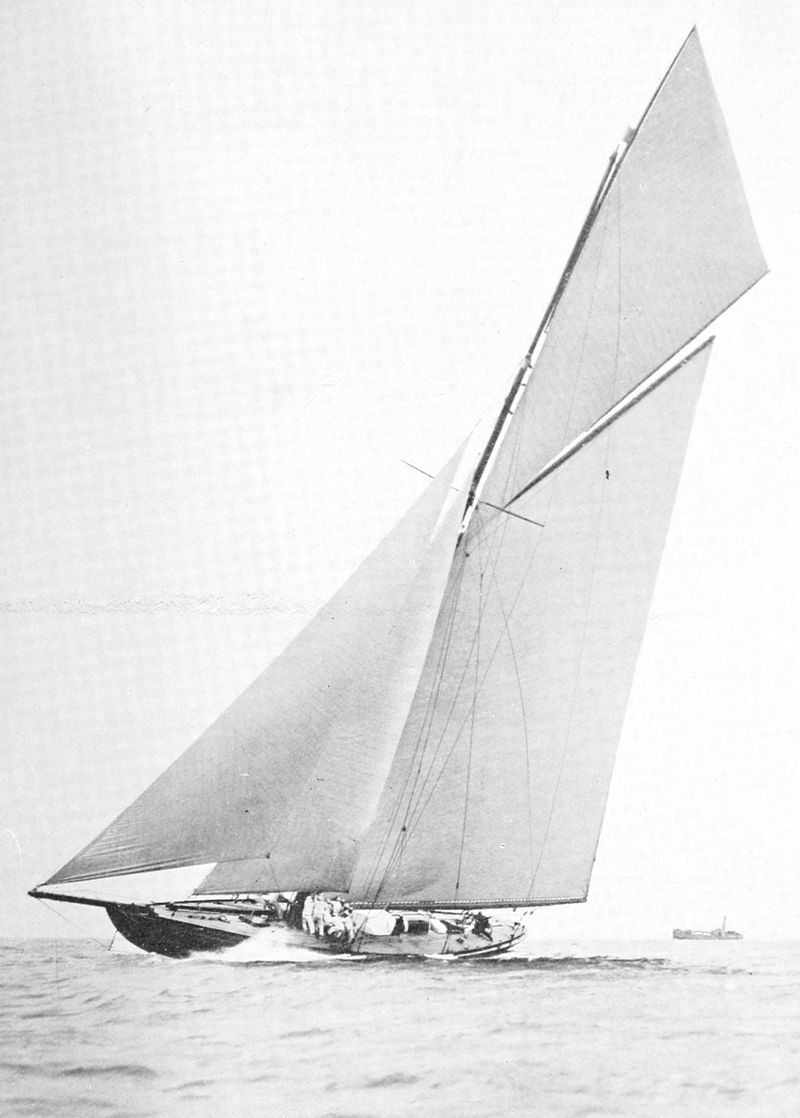
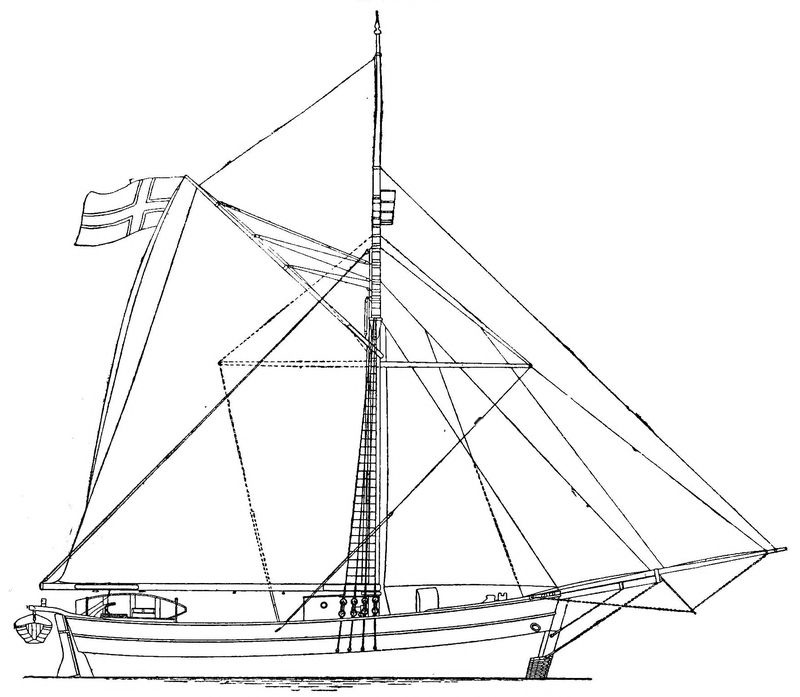
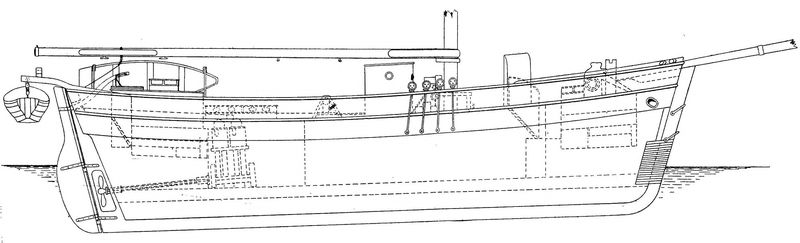
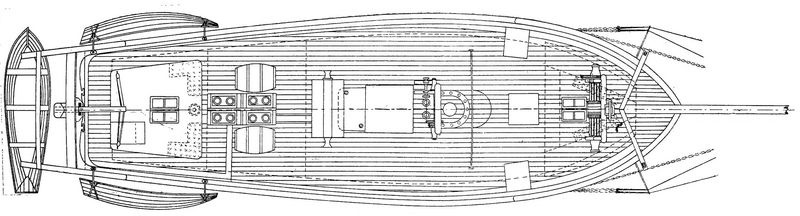
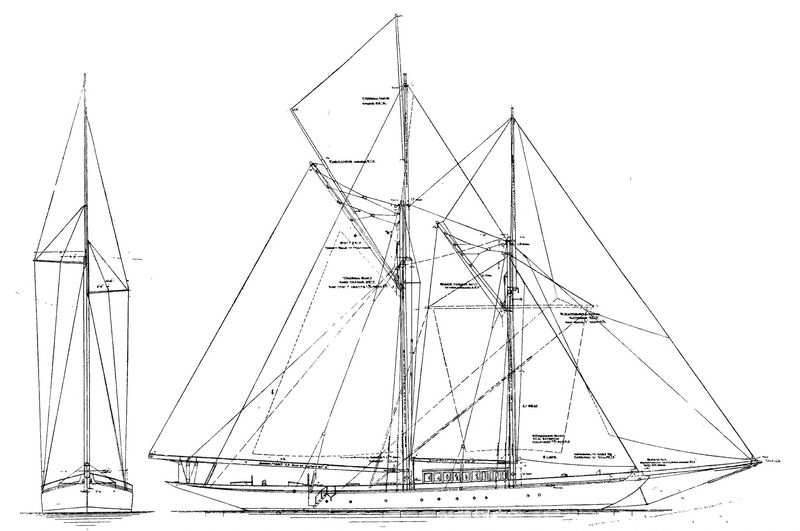
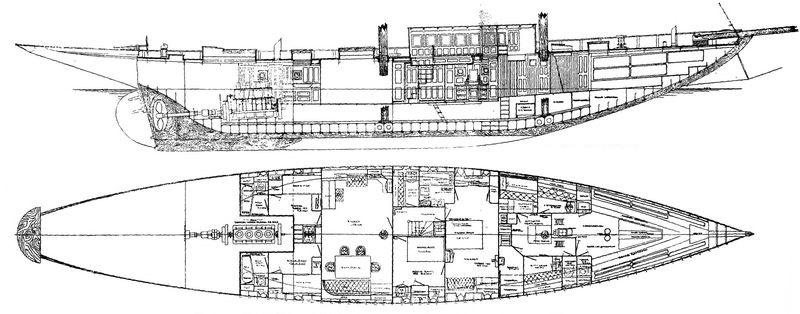
Footnote anchors are denoted by [number],
and the footnotes have been placed at the end of the book.
New original cover art included with this eBook is
granted to the public domain.
All changes noted in the ERRATA have
been applied to the etext. Each change is indicated
by a dotted gray underline.
Some minor changes to the text are noted at the end of the book.These are indicated by a dashed blue underline.
SAILING SHIPS
SAILING SHIPS
THE STORY OF THEIR DEVELOPMENT
FROM THE EARLIEST TIMES
TO THE PRESENT DAY
BY
E. KEBLE CHATTERTON
WITH A HUNDRED AND
THIRTY ILLUSTRATIONS
LONDON
SIDGWICK & JACKSON, LTD.
3 ADAM STREET, ADELPHI, W.C.
1909
All rights reserved.
IN PIAM MEMORIAM
PATRIS DILECTISSIMI
QVI ME
AD MARIS NAVIVMQVE
STVDIVM
PRIMVS EXCITAVIT
PREFACE.
This history of sailing ships has been written primarily for the
general reader, in the hope that the sons and daughters of a
naval nation, and of an Empire that stretches beyond the
seas, may find therein a record of some interest and assistance in
enlarging and systematising their ideas on the subject, especially as
regards the ships of earlier centuries. It is not necessary to look
far—no further than the poster-designs on advertisement-hoardings—to
observe the errors into which our artists of to-day are liable to fall
owing to lack of historical knowledge in this subject; and to put
(for instance) triangular headsails with a rectangular sail on the
“bonaventure mizzen-mast” of an early sixteenth-century ship, is
an inaccuracy scarcely to be pardoned.
Quite recently one of the chief librarians in one of our biggest
national treasure-houses informed me that when an artist, who had
been commissioned to illustrate a certain work, came to him for
guidance as to the ships of a recent period, he was at a loss where to
lay his hands on a book which should show him what he wished to
know by picture and description. Only after much search was the
requisite knowledge obtained.
I trust that both the yachtsman and sailorman will find in these
pages something of the same exciting pleasure which has been mine
in tracing the course of the evolutions through which their ships
have passed. Those whose work or amusement it is to acquaint
themselves with the sailing ship and her ways, and for lack of time
and opportunity are unable to seek out the noble pedigree of what
Ruskin truly described as “one of the loveliest things man ever
made, and one of the noblest,” may care to learn what were the
changing conditions which combined to bring about such a highly
complex creature as the modern sailing ship. Perhaps at some time
when handling a rope, a spar, a tiller or a sail, they may have wondered
how it all began; what were the origins of all those various
parts of a ship’s “furniture”; why some essential portions have
scarcely changed; and how other portions are the outcome of time,
experiment, and science. I hope that to neither the amateur nor the
professional sailor I shall seem impertinent if I have attempted to
tell them something about their ship which they did not know before.
But if, on the other hand, I shall have succeeded in increasing their
love for the sailing ship by outlining her career, I trust that this may
be allowed to counterbalance the defects which, in a subject of so
vast a scope, are hardly to be avoided in spite of considerable care
and the generous assistance of many kind friends.
Finally, I make my appeal to the younger generation, to whom
ships and the sea have in all times suggested so much that is bound
up with adventure and brave deeds. The present moment sees us at
a stage in the history of ships when the Royal Navy as a whole, and
the Merchant Service almost entirely, have no longer any convenience
for sail. There is a dire need in the latter for both officers and men,
whilst on shore the conditions of employment are exactly the reverse.
Surely it is only by a mutual adjustment of the two that both problems,
on sea and land, can possibly be overcome; and it is only by
winning the enthusiasm of the boy who is to become father of the
man that the sailor’s love for the sea can be handed on from generation
to generation. We have received from our ancestors a splendid
heritage, a unique legacy—the mastery of the seas. That legacy
brings with it a commensurate responsibility, to retain what our forefathers
fought for so dearly. Perhaps to the healthy-minded Anglo-Saxon
boy, not yet too blasé and civilised to feel no thrill in reading
his Marryat, Cook, Ballantyne, Henty, Fenn, or the glorious sea-fights
and discoveries in history itself—perhaps to him this book may
be of some assistance in visualising the actual ships of each historical
period.
I desire to return thanks to many who, from motives of personal
friendship or of love for ships, have so readily lent me their assistance
in the course of this work. If I have omitted to include the names of
any to whom my obligations are due it is from no sense of ingratitude.
Especially I am anxious to return thanks to Dr. Wallis Budge and
Mr. H. R. Hall of the Egyptian Department of the British Museum,
as well as to the officials in other departments of the same institution,
particularly those of the Coin Room, the Print Room, the Manuscript
Room, Greek and Roman Antiquities, and British and Mediæval Antiquities:
to Mr. Clifford Smith of the Victoria and Albert Museum,
South Kensington, and to Mr. R. C. Flower of the Public Record
Office for assistance in research: to Dr. Hoyle of the Manchester
Museum for permission to use photographs of two Egyptian models:
to the Board of Education for permission to reproduce photographs
of models in the South Kensington Museum: to the Curator of the
Royal Naval College Museum, Greenwich, for granting special
facilities for studying the collection of models: to the British Consul
at Christiania, for assistance in obtaining photographs of Viking
ships: to M. Ernest Leroux for permission to use the illustration of
the navis actuaria found on the Althiburus mosaic: to the Elder
Brethren of Trinity House, jointly with Messrs. Cassell and Co.,
for allowing me to reproduce Phineas Pett’s Royal Prince: to the
Committee of the Royal Victoria Yacht Club, Ryde, for permission
to reproduce Messrs. West’s photograph of the rare print of the
Alarm, Fig. 113: to Captain Roald Amundsen for the plans of the
Gjöa: to the authorities of the British Museum for many illustrations
either sketched, photographed, or reproduced from their catalogues:
to Lieut.-Colonel A. Leetham, Curator of the Royal United
Service Museum, Whitehall, for permission to photograph models
and prints: to Captain C. E. Terry for the illustration of the Santa
Maria: to Mr. A. E. M. Haes for the photograph of the Oimara:
to Messrs. Camper and Nicholsons, Limited, for the plans of the
yacht Pampas: to Messrs. White Brothers for the lines of the yacht
Elizabeth: to Messrs. Fores for the illustrations of the Xarifa and
Kestrel: and to Mr. H. Warington Smyth for the Nugger in Fig. 8,
the two illustrations of Scandinavian and Russian ships in Figs. 30
and 31, and the American schooner in Fig. 91. I wish also to
acknowledge Mr. Warington Smyth’s extreme courtesy in offering to
allow me to use any of the other sketches in his delightful book
“Mast and Sail in Europe and Asia,” and only regret that circumstances
prevented my being able to avail myself more fully of so
generous an offer.
The illustrations in Figs. 26 and 27 appear by arrangement with
Mr. John Murray: Fig. 51 by arrangement with the Clarendon
Press, Oxford: and Figs. 30, 31, 87-90, 92, 93, 95, 102, 104, 106,
111, 112, 114, 115, and the Plans, by arrangement with the editor of
The Yachting Monthly. Thanks are also due to two artists skilled in
marine subjects—to Mr. Charles Dixon for his two pictures in colour,
at once lively and accurate; and to Mr. Norman S. Carr, not only for
the initial letters of the chapters, but for thirty or more sketches
specially drawn for this book.
Finally, I have to express my thanks to Mr. John Masefield, who
has been kind enough to read the proofs, while the book was passing
through the press, and to give me the benefit of his valuable advice.
line 8, for “with three reefs already taken in” read “close-reefed.” (Fig. 13 shows three turns taken
with the brails or bunt-lines, so as to make a close reef.)
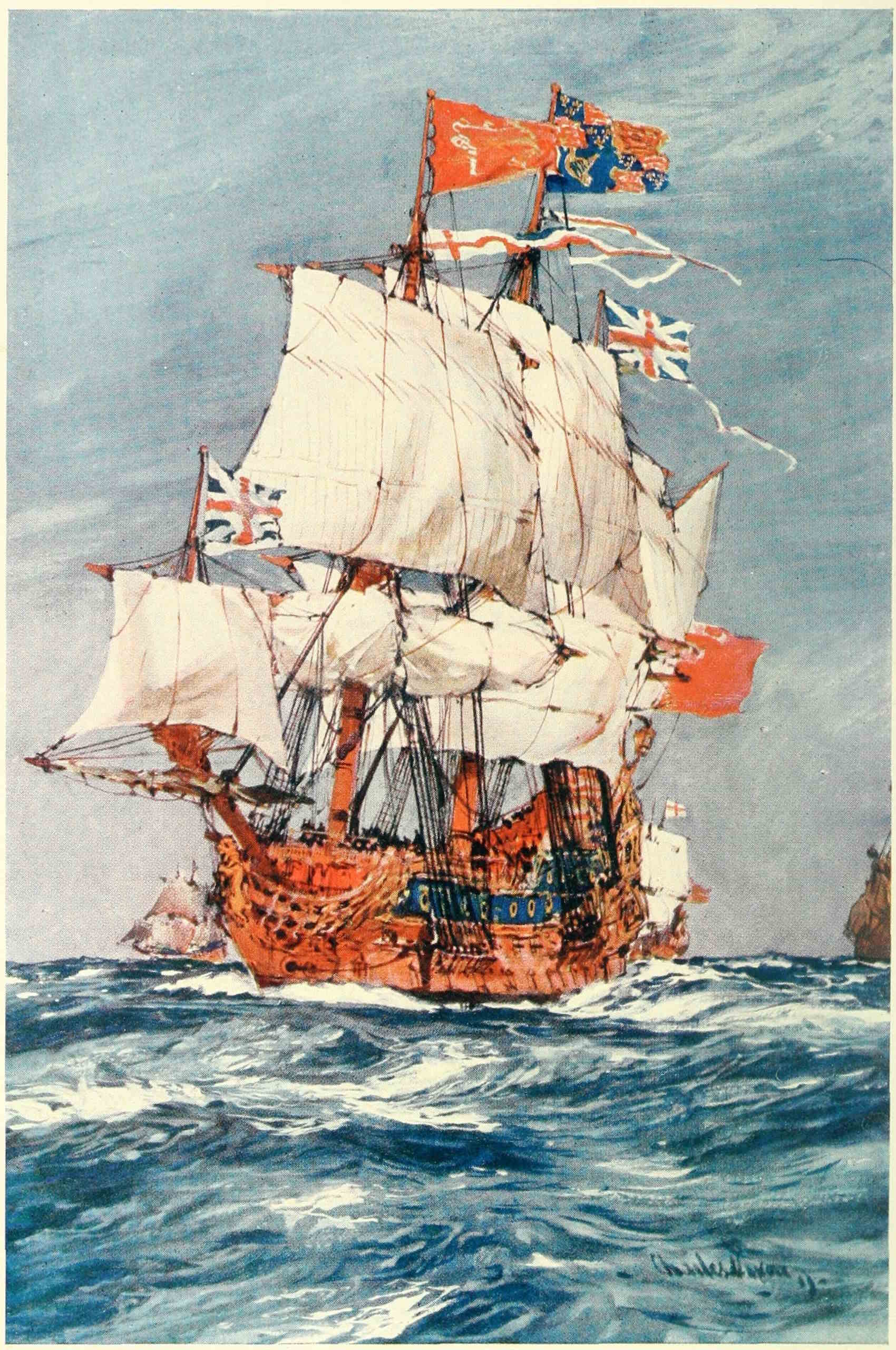
From the painting at Trinity House, by permission of the Elder Brethren. Block by arrangement with Messrs. Cassell & Co., from Traill and Mann’s “Social England,” iv. 69.
” ” Longitudinal and Horizontal Sections (see p. 332).
CHAPTER I. INTRODUCTORY.
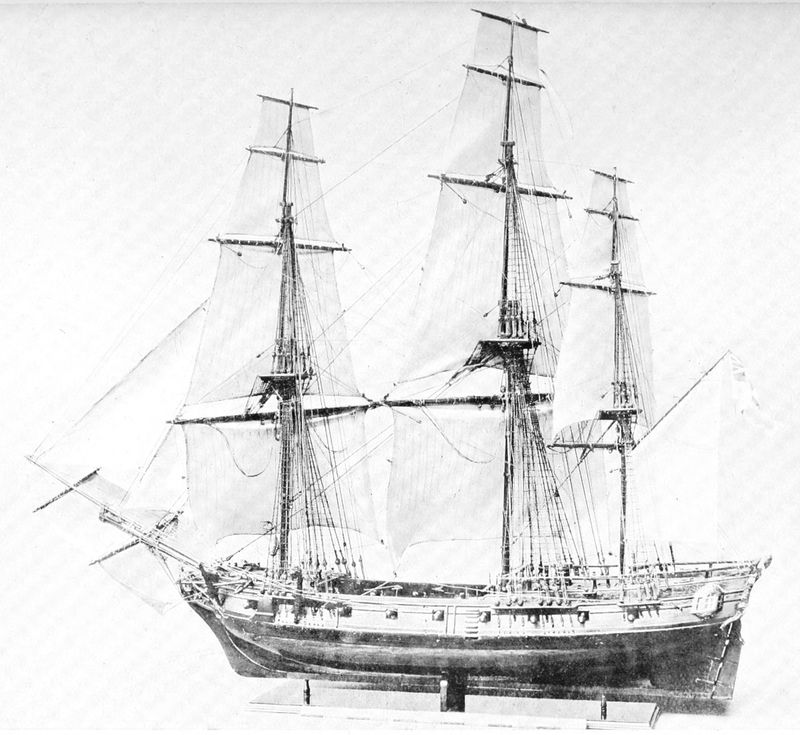
A short time ago one of our Naval
Museums came into possession of a
certain model of a sailing ship. She
was a fine vessel, one of the first of
the old “wooden walls” to be built
in the reign of the late Queen. The
Curator wisely determined to have
this model fully rigged with all her
spars, sails, and gear, just as the
original had been in her days of
active service. Every detail was
correct; every halyard and brace were made of proportionate
thickness. Even the right kind of “stuff” was
found, after some difficulty, for the cable. An efficient
rigger, too, was found, who happened to have served on
this same ship.
Finally, when the model was completed the Curator
looked at it and said, “Now it will be possible for those
who come after us to tell exactly how a sailing ship was
rigged; in a few years’ time there won’t be a man alive
who will know how to do it.”
It is with a similar desire, to preserve all that can be
gathered, that an attempt is made in the present book to
collect into one continuous narrative the historical data
available concerning the evolution of that fast-disappearing
object—the sailing ship. With the advent of steam was
hoisted the signal for abolishing sail; and although for a
long time the famous old clippers put up a keen fight, yet
for commercial purposes, when passengers and mails,
merchandise and perishable food, had to be hurried from
one side of the world to the other without loss of time, it
became impossible for a sailing ship, that depended so
entirely on the mercy of wind and weather, to compete
successfully with the steamship. By 1840, it will be
remembered, steamers had commenced crossing the
Atlantic, and within the next ten or fifteen years the
sailing ship, except for such long voyages as to China,
Australia, and other distant countries, was for ever doomed.
Perhaps these beautiful creatures, oversparred and undermanned
though they are nowadays, will be allowed, in
spite of competition and low freights, to remain with us
a little longer. It is probable that the introduction of the
motor, instead of assisting to complete the departure of
sails, will help in their being retained: for it has now been
found commercially profitable to instal the internal-combustion
engine in ships of a size not exceeding about seven
hundred tons. By this means sail can be used in a fair
wind, and the motor can take her along in calms, as well
as in tolerable weather against a head wind. In entering
harbours and leaving there will also be a saving of the
charge for a tug. Perhaps when the marine-motor industry
has become more perfect it will be possible to fit a
sufficiently powerful motor to a 4000-ton barque.
If that should be possible, then it would be indeed
welcome news to hear that the sluicing ebb of sailing ships
and sailormen had stopped. (For, of course, no one nowadays,
except perhaps the lady passenger, would ever think
of honouring the marine mechanics on board a liner or
battleship with the title of “sailor,” whose knowledge of
seamanship is so elementary that they can as a rule
neither sail a boat nor make a splice, let alone go up
aloft.) But at present, when it is difficult to get enough
officers and men for the steam merchant service, it is
doubtful if the sailing ship, except in the case of a few
deep-sea vessels and the coasters, fishermen, pilots, and
yachts round our coasts, will be encouraged to remain
with us.
In setting forth whatever may be of interest in the
following pages I have, following the example of that
illustrious Elizabethan, Richard Hakluyt, taken “infinite
cares,” travelled many miles from port to port to talk with
every kind of sailorman—deep-sea, coaster, or yacht’s hand—with
fishermen, pilots, shipbuilders, riggers, marine architects,
and sail-makers. In addition to this, I have been
fortunate in gaining access to libraries containing, in
various languages and of both ancient and modern date,
invaluable accounts of ships of earlier days. The study of
coins (curiously overlooked by some writers on ancient
ships) has enabled me to submit some definite knowledge
concerning craft of the classical age. The study of old
fonts in this country, especially in those churches which
were dedicated in the name of St. Nicholas, the patron
of sailors, has helped to confirm the otherwise scanty
evidence for the period between the tenth and fourteenth
centuries. But perhaps the most valuable and
interesting material is the illustration of an Egyptian
sailing ship of the XII. Dynasty. This model, rigged
for sailing up and rowing down the Nile, will be discussed
in Chapter II. Hitherto we have had to depend for our
knowledge of Egyptian ships on the illustrations found on
the tombs. Although in recent years some models of
boats have been discovered in these tombs, yet that which
I am enabled to reproduce (Figs. 5 and 6) is the only one
showing the boat properly rigged that has hitherto been
unearthed. This model was discovered in the season of
1906-1907 at Rifeh, by Professor Flinders Petrie, and is
the finest example that has yet reached England. It is
now in the Manchester Museum, and I am indebted to
Dr. Hoyle, the Director of the Museum, for his courtesy
in enabling me to reproduce this very interesting model
here.
Notwithstanding the deplorable fact that there are gaps
existing at those critical stages where information would
be the most welcome, it is nevertheless possible to
construct a fairly continuous narrative of the development
of the sailing ship. It will be noticed that in addition to
the information to be found in ancient tombs of Egypt
we have the evidence of ancient coins, vases, terra-cotta
and wooden models, lamps, monuments, excavations in
Scandinavia, England, Scotland, Germany. Coming to
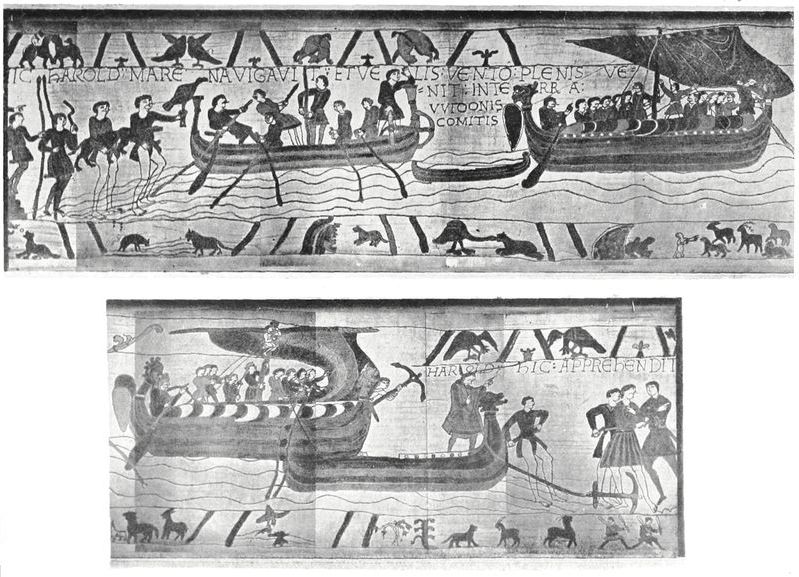
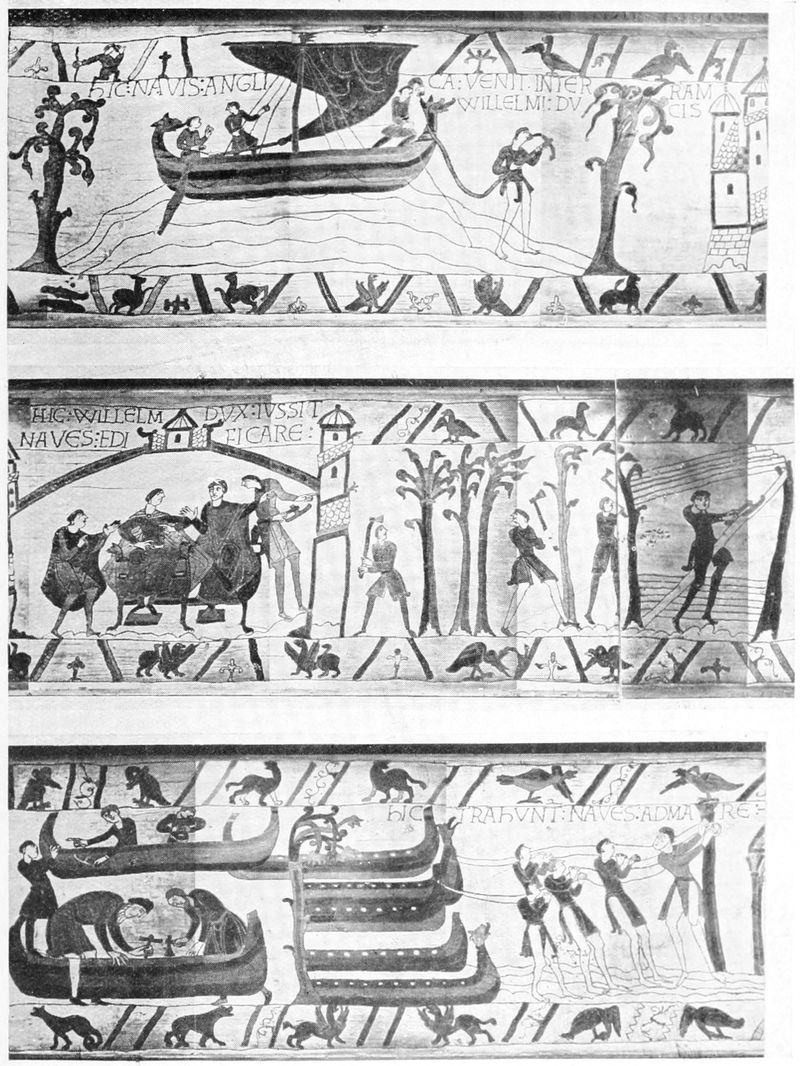
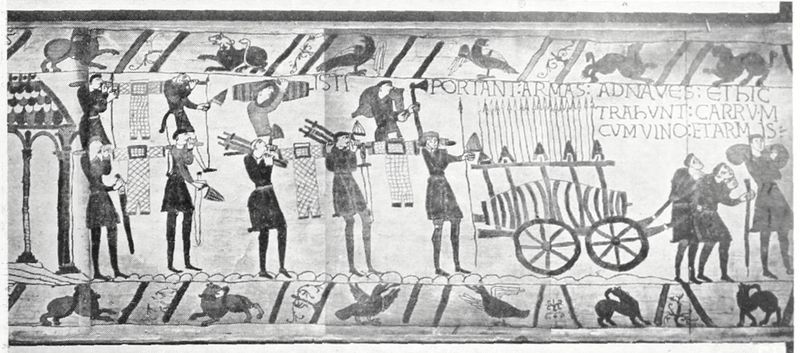
more modern times, there is the Bayeux Tapestry, with its
excellent copy in the South Kensington Museum. We
have, too, the pictorial representations on ancient seals
and coins of this country. There are some reproductions
of ships in old manuscripts; but it is an unfortunate fact
that, except in comparatively modern times, it is rare to
find the ship commemorated in paintings. Even when it is
found, it is often represented with less regard to marine
accuracy than to pictorial effect. When one considers
the high position both Venice and Genoa occupied during
the Middle Ages, alike in respect of art and maritime
pursuits, it is difficult to understand why so remarkably
few pictures of ships remain to us among the Old Masters.
In both religious and secular paintings the ship is conspicuous
by its absence. Perhaps it may be that artists
had not received sufficient encouragement to paint marine
subjects and that the gulf which to-day exists between
the landsman and the sailor was equally great then.
However, various painters have seen fit to take the
Pilgrimage of St. Ursula as their theme. Memling’s
celebrated panels on the reliquary of that saint, now in St.
John’s Hospital, Bruges, are of interest for our purpose,
for no fewer than four of the six panels contain pictures of
ships belonging to the period of the artist. The date of
these miniatures is some time not later than the year 1489.
Old printed books of the sixteenth century onwards frequently
contain illustrations of ships of the time. Among
the books, for instance, presented to the South Kensington
Museum on the death of Lady Dilke will be found an interesting
illustrated French translation of the Acts of the
Apostles. The ships (of mediæval design) illustrating the
Voyages of St. Paul are of value as showing the rig and
details of the craft contemporary with the artist. These
and similar illustrations, excepting always when the artist
has become too fantastic and imaginative, are important links
in connecting the story of the ships of ancient days with the
modern full-rigged ship. Coming down to the seventeenth
century, the paintings of the Dutch artists Jan Van de
Cappelle, of Willem Van de Velde the younger, Bakhuizen,
Ruisdael, and Cuyp give us the most interesting
details as to rigging and hull. Claude’s picture, in the
National Gallery, of the “Embarkation of St. Ursula,”
painted towards the end of the seventeenth century, shows
the high-pooped ship of his own day. Charles Brooking
of the eighteenth century, Turner and Clarkson Stanfield
of the nineteenth, show us in their pictures many invaluable
minutiæ of sailing ships. And even if Ruskin’s
criticism hold good, that Stanfield’s ships never look
weather-beaten but “always newly painted and clean,”
yet for our purpose this is no disadvantage; and it will be
appreciated still more in a few years when our descendants
go into art galleries to seek out from contemporary paintings
the appearance of ships of the Victorian period.
Happily the ships of our day have been perpetuated
by such admirable marine artists as Moore, Wyllie, Vicat
Cole, Napier Hemy, Dixon, Somerscales, Tuke, and
others. But in addition to pictures, we have at hand
some hundreds of models of vessels in the South Kensington
Museum, the Royal Naval College, Greenwich,
the Royal United Service Museum, Whitehall, in the
Louvre, in Continental churches, museums, and arsenals,
and in many private collections. Some of these models
in Greenwich and South Kensington have been rigged
from historical information in the museums themselves.
It is impossible to deny the important influence that
these wonderful little ships may have on the youthful
minds of our nation, which has had the privilege for so
many years of being called maritime. But to the student
of ships of any age they are the greatest aid in assisting
him—far greater, indeed, than pages of description, far
greater also than the work of any painter—to realise the
vessels that carried our ancestors across the seas. I am as
certain that we owe to the Government the greatest
thanks for putting these facilities before the public as I
am uncertain that the same public appreciates them in the
manner they deserve.
From all these sources, then, already enumerated, we
are to begin to reconstruct as far as possible the ships of
all ages. If we should be accused of arguing at times by
inference without actual facts before us, let us be allowed
to say this much: there are signs in a ship’s lines and
rigging which, to the landsman, are devoid of meaning,
but to the man who has been wont to handle ships, and
perhaps to design and build them, they are full of significance.
Generally speaking, to the former a model is a
nicely-carved piece of wood, adorned with a maze of
complicated strings. Curves of hull, the position of the
masts, the amount of sail area aft or forward, go for
nothing. To the expert every inch of rope has its definite
value, every line of her design speaks of speed or seaworthiness,
or of the opposite. The careful balance of
sails will show whether she is, to use sailor slang, “as
handy as a gimlet” or as hard-mouthed a beast as ever
was governed by a rudder. Therefore, if, in looking at
the lines and rig of a ship of the Phœnicians, we should
say, without being able to quote any historian of antiquity,
that she would never go to windward because her sail area
was deficient and her draught of water too slight, and
assume from this that the Phœnicians always waited for a
fair wind or rowed with oars, we must not be accused of
proving too much. This is not a matter for the archæologist,
but for the practised mariner with some knowledge
of the theory of his art. Any sailor, for instance, on looking
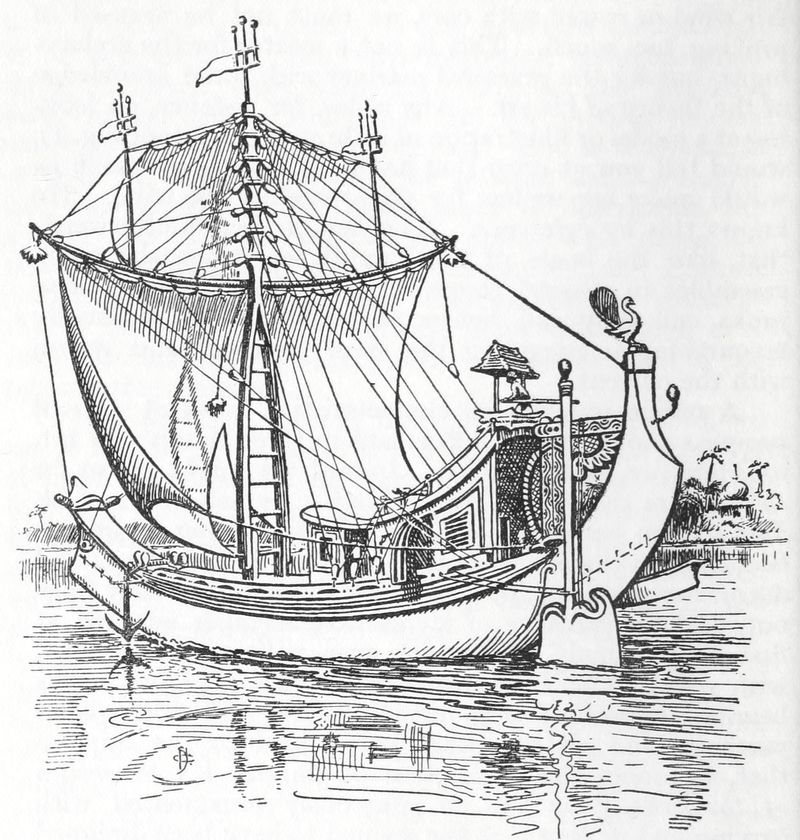
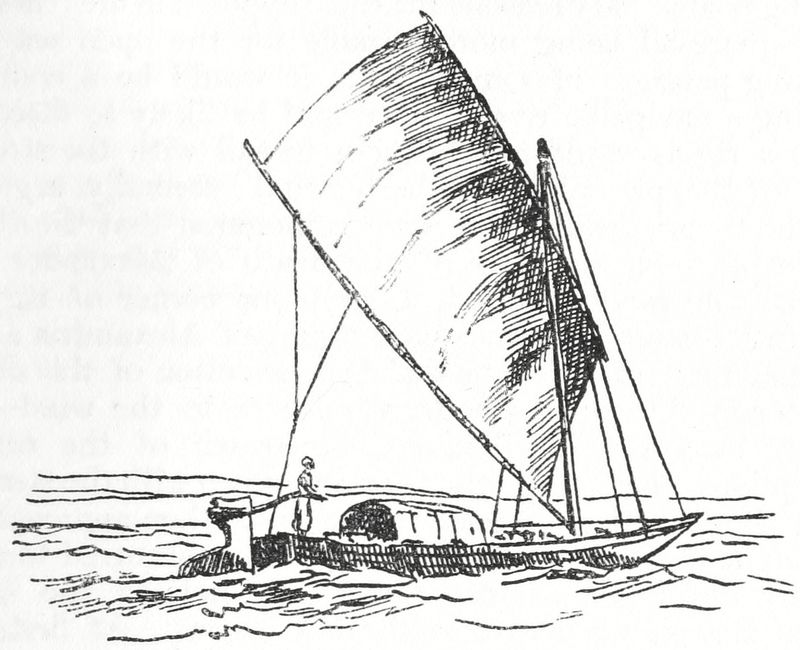
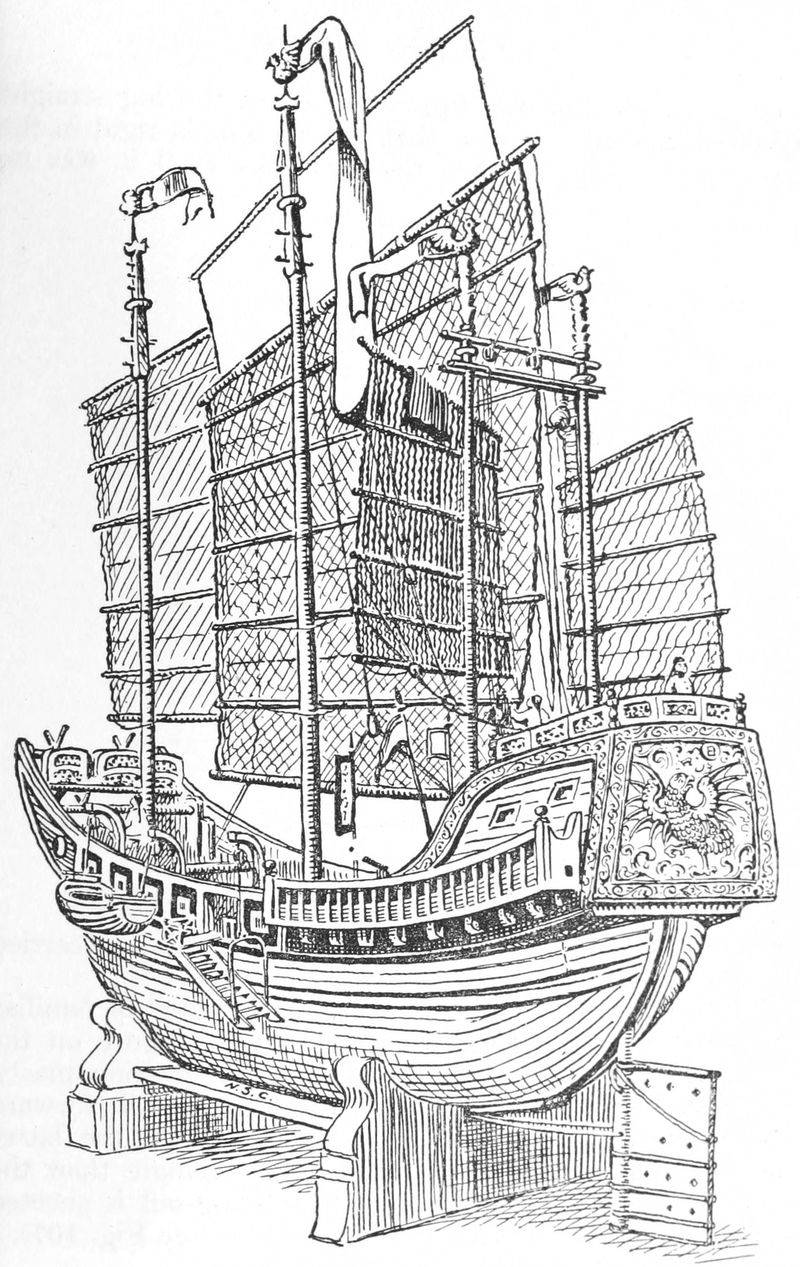
at a model or illustration of a Burmese junk (see Fig. 1),
would tell you at once that her lines and rig are such as
would make her useless for going against the wind. He
knows this by inference. As a fact, he learns afterwards
that, like the boats of the Egyptians—which she much
resembles in general shape, in mast, and in sail—these
junks can only sail before the wind (which is usually
favourable) in ascending the river Irawadi, and return
with the current.
Fig. 1. Burmese Junk.
A nation exhibits its characteristics, its exact state of
progress and degree of refinement in three things: its art,
its literature, and its ships. Indeed we might go so far
as to affirm that these last are but a branch of the first.
Just as the house was at first merely a thing of utility,
becoming in the course of time adorned with carvings and
decoration, so the ship, from being the rough, clumsy dug-out,
with the advance of civilisation becomes adorned at
first with animals’ heads, with eyes, with a human head,
with coloured hull, and at a subsequent stage with sails
bearing devices of high artistic merit. Finally, gilded
portholes and gilded sterns were added to the ship, so
that, to quote the description of Charles I.’s Sovereign
of the Seas, “she was so gorgeously ornamented with
carving and gilding that she seemed to have been designed
rather for a vain display of magnificence than for the
service of the State.”
The development of the ship, then, is parallel to the
development of the State. In the rude ages she is a
rough creature, remaining more like the tree out of which
she is made than a thing of being. In the hands of a
nation that has reached a high degree of civilisation,
though she is still made of oak from the forest, yet she
has lost all resemblance to the tree-trunk. Instead, she
has acquired a most wonderful personality of her own.
The wood of the tree has become merely the means of
expressing the most admirable combination of delicacy
and strength, of slender lines and powerful masses.
Thus we must go to the East, the birthplace of
civilisation, to trace the beginnings of our subject. We
shall for this reason start from Egypt and Phœnicia,
and, tracing the development through Greek and Roman
times, advance to Northern and Western Europe and
further west still to America. And in covering a period
of roughly 8000 years, in spite of the enormous difference
in time, in nations, in geographical and other conditions,
we shall find that no feature is more amazing than the
extraordinary spirit of conservatism which has spread
itself universally over both ships and their sailors. So
remarkable are the examples of this, even under widely
opposed conditions, that I have thought it worth while
here to submit some of the more important ones as being
worthy of special consideration.
First, let us take the shape of the Egyptian ship, from
which the Greeks and Romans eventually obtained their
shipbuilding ideas. The high poop and the rockered bow
with its bold sweep aft have, it is not too much to assert,
influenced the whole world’s shipping ever since. True,
the ancient galleys of the Greeks and Romans possess a
straighter keel and a pointed bow. But this was done
for a purpose. These galleys were fighting ships; and as
the ram had to be placed forward in such a manner that
keel, stempost, and strut-frames centred their combined
force at the extreme point, the shape of the bow could not
follow that of the Egyptians. The keel, too, was flat and
straight, because it was the custom of the Greeks and
Romans to haul their galleys ashore nearly every night.
Again, we must bear in mind that the Roman or Greek
war vessel was primarily a rowing boat and not a sailing
ship, and that mast and sail were always lowered before
going into battle. Yet, for all that, the Greek vases bearing
pictures of war galleys still show the Egyptian stern.
But when we come to consider the Greek and Roman
merchant ships, we find the Egyptian stern and a modified
Egyptian bow unmistakably present. And we must
remember that the merchant ships were primarily sailing
ships and only used their oars as auxiliaries.
Throughout the ages many of these general lines of the
Egyptian ships have been followed. We see them appearing
in the prehistoric ships of Norway, in the Viking ships
of old, and in the ships of the Baltic to-day. We see this
conservatism in the ships of the twelfth, thirteenth, and
fourteenth centuries, in the caravels and caracks and galleons
of the fifteenth and sixteenth centuries. We see it down
to about the time of the Royal George in 1746; and even
since then, when the great sweep from bow up to the
extreme height of the poop-deck was modified until it
practically disappeared, yet we find traces of it in the
forecastle and raised quarter-deck of the modern sailing
ship. And to continue the argument one step further, I
suppose if you could by sending a current of electricity
through one of the Egyptian naval architects, now lying
as a mummy in one of our museums, bring him to
life, so that you might take him to see the yachts racing
during Cowes Week, he would not hesitate to say that
such ships as White Heather II. and the newest Shamrock
were based on the designs he had made for his masters
under the Twelfth Dynasty. If the reader will take the
trouble of comparing the Rifeh model (Figs. 5 and 6) with
the lines of the latest British yachts now being built under
the new universal rule, and then recollect how many years
have passed in the interim, he will not cease to wonder
that the same “overhang” at bow and stern is as prevalent
on the Solent as it was on the Nile. Whatever else these
facts may prove, they certainly show what a high state of
civilisation the Egyptian had attained; more, perhaps, than
we realise at present. The naval architects of that time
must indeed have lacked as little that we could teach them
in design nowadays as—we know from subsequent excavations—the
shipbuilders of Viking times could learn from
our shipbuilders of to-day.
An additional proof of the wisdom and knowledge of
the ancients is to be found in the rig of their ships. The
squaresail of the Egyptians was very like that used subsequently
by the Greeks and Romans, and afterwards by
the Vikings and many of the Norwegian and Russian
ships to-day. It survived, moreover, beyond the Middle
Ages, the only important difference being that three and
sometimes two additional masts were provided with squaresails,
with a lateen sail on the mizzen and a spritsail
and sprit topsail forward. Thus, though the headsails of
a modern full-rigged ocean ship have been altered during
the last hundred and fifty years, yet the arrangement of
her lower courses is practically that of the single sail of
the Egyptians, omitting for the present certain details
which do not alter the method of harnessing the wind as
a means of propulsion. They had in these early times
learned the value of stretching a sail on yards. They
had, besides, understood where to place backstays and a
forestay to support the mast, and they had adopted the
use of braces to the yards as well as of topping lifts.
The eyes painted on the ships of the Greeks and
Romans still survive to-day in the hawse holes on either
side of a ship’s bow. And this belief of the ancients that
by means of these eyes the vessel could see her way was
but one article in the general creed still shared by every
sailor, amateur and professional alike, that a ship, of all
the creations of man, is indeed a living thing. Mr. F. T.
Bullen, in a delightful little essay, has demonstrated the
varying ways in which a ship will manifest her personality.
In “The Way of the Ship” Mr. Bullen also remarks:
“Kipling has done more, perhaps, than any other living
writer to point out how certain fabrics of man’s construction
become invested with individuality of an unmistakable
kind, and of course so acute an observer cannot
fail to notice how pre-eminently is this the case with
ships.”
Though you may build two ships on the same yard
from the same plans by the same builder, yet their personalities
are different. The yachtsmen who elect to have
a one-design class know very well that though you may
raffle as to the ownership of each ship, yet there will
always be one or two of the fleet that will be superior to
the rest. But the ancients were before the yachtsmen in
discovering that a mere contrivance of wood and metal
should have a distinct character of its own.
The decoration of the bow and stern of the ship has
existed for many hundreds of years; and though the
figurehead was especially prominent during the Middle
Ages, it is now fast disappearing both from sailing ships of
commerce and from yachts also. On steamers it is hardly
ever seen except on the steam yacht. The decorated stern,
too, so prevalent up to the eighteenth century, has now
vanished; although the final traces of this may be noticed
in the old-fashioned architecture to which the modern
Royal steam yachts of this country still cling, and in the
gold beading which frequently ornaments the name of a
steamship under her stern.
In Northern latitudes we find the most extraordinary
cases of historical obstinacy; the rig and hull of the Scandinavians
have remained practically unaltered for some two
or three thousand years. The very word “snekkja,”
applied to the ancient longships of the Scandinavians, is
still used to-day. Moreover, the “bonnet,” which was
attached to the foot of the sail to give additional area—unlaced,
of course, in dirty weather—was used by the
Vikings; was adopted from them by the ships of mediæval
England; and is still used to-day by the ships of Scandinavia,
and in England by the Lowestoft “drifters” that go
forth to fish in the North Sea, as well as by the pleasure
and trading wherries that sail up and down the Norfolk
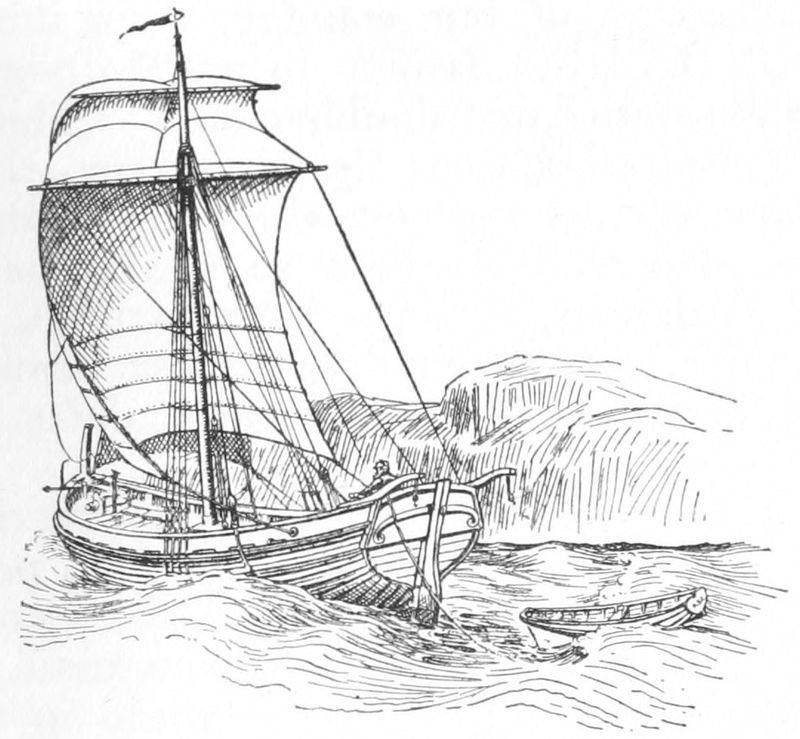
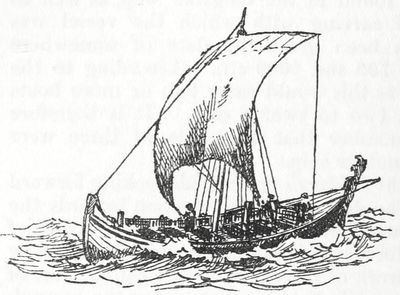
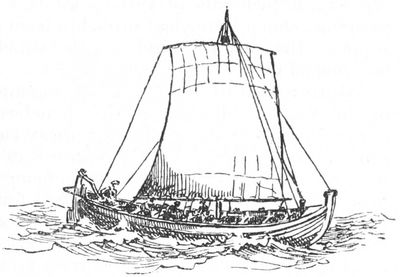
Broads. Fig. 2 shows a Norwegian “jaegt,” with bonnet
and bowlines.
Fig. 2.Norwegian “Jaegt.”
The influence of this dogged conservative spirit of the
Norwegians is to be seen extending over Great Britain in
other ways. No one who has visited the Orkney and
Shetland Isles can have failed to have noticed the close
similarity between their boats and those of the Norwegian.
Until about forty years ago their fishing boat was exactly
a Norwegian “yawl,” the most obvious descendant from the
lines of a Viking ship. Indeed, until about the year 1860
all the larger fishing boats of the Shetlands were imported
in boards direct from Norway ready for putting together
at Lerwick. The type is still farther preserved in the
whale-boats that are despatched from the mother ships in
various parts of the world to harpoon the cachalot. And,
not to weary the reader with yet more examples of the
great influence which these Viking ships have had on the
naval architecture of our country, it is interesting to
remark that the latest fashion in yacht design is the so-called
“canoe-stern” or “double-ender.” This, of course,
derives its inspiration from the Norwegian ships of the
present day; and, as we have already said, they in their
turn have conservatively held to the models of their
ancestors. Whether, as some have thought, the Viking
“double-ender” can trace a direct descent from the ships
of Egypt is a point that we must defer to another
chapter.
Next to the squaresail rig, none has survived so persistently
as the lateen. I think that in all probability it
was adapted, a few centuries before the introduction of
Christianity, from the Egyptian squaresail. Its very
appearance and the corner of the world in which it is
found as the prevailing rig both suggest that. It is
reasonable to assume that in the course of years, when the
more experienced Easterns began to discover the art of
sailing against the wind and to find that the rig of the
Nile boats was not suitable for this, there would be
evolved a modification of the Egyptian sail to allow of
tacking. This, probably, was the origin of the lateen sail
of the dhow. It is of extreme antiquity, and has endured
with but little alteration from the time of Alexander the
Great, about 350 B.C. The prevalence of this kind of
rig in the Red Sea, the Indian Ocean, off the East Coast
of Africa, especially as far south as Zanzibar, is well
known. The fact that it is still found everywhere up and
down the Mediterranean, on the Nile and on Swiss lakes,
shows how firmly established did this lateen rig become in
the course of time. As we shall see, at a subsequent stage
the lateen sail was adopted by our mediæval ships for the
mizzen, and this continued right down till the close of the
eighteenth century. It will assist us to realise this conservatism
if we remember that the ships of St. Paul’s time
were of a similar kind to these Eastern ships of which we
are now speaking. Let me here be allowed to quote again
from an author who has sailed in every sea and been preserved
to tell us in so many charming records what many
others have seen but not troubled to notice. In a further
essay on “The Sea in the New Testament” Mr. Bullen,
referring to the ships in which St. Paul voyaged, remarks:
“On the East African coast, even to this day, we find
precisely the same kind of vessels, the same primitive
ideas of navigation, the same absence of even the most
elementary notions of comfort, the same touching faith in
its being always fine weather as evinced by the absence of
any precautions against a storm.
“Such a vessel as this [i.e., St. Paul’s] carried one huge
sail bent to a yard resembling a gigantic fishing-rod, whose
butt, when the sail was set, came nearly down to the deck,
while the tapering end soared many feet above the masthead.
As it was the work of all hands to hoist it, and
the operation took a long time, when once it was hoisted
it was kept so if possible, and the nimble sailors, with their
almost prehensile toes, climbed by the scanty rigging and,
clinging to the yard, gave the sail a bungling furl.” Again,
referring to the sailors’ activities on the ship in which St.
Paul was sailing, Mr. Bullen goes on: “They sounded
and got twenty fathoms, and in a little while found the
water had shoaled to fifteen. Then they performed a piece
of seamanship which may be continually seen in execution
on the East African coast to-day—they let their anchors
down to their full scope of cable and prayed for daylight.
The Arabs do it in fair weather or foul—lower the sail,
slack down the anchor, and go to sleep. She will bring
up before she hits anything.” I have received a like
testimony from one who has also cruised in those parts
within recent years.
The prevalence of the fighting top has been maintained
from the time of the Egyptians down to the present day.
To mention but a few instances, the fighting top is seen in
a battleship of Rameses III. (about B.C. 1200), and it is
found on ancient seals of the thirteenth century of the
present era, and so on, of course, through the Middle
Ages to our latest battleships.
From the times of the Egyptians the stern was always
reserved for the owner or captain and officers. This custom
was that of the Greeks, the Romans, the Vikings, and the
English right down to the building of H.M.S. Dreadnought
a short while ago, when the longstanding practice of the
officers being quartered aft and the men forward was for
the first time broken, to the satisfaction, I understand, of
neither officers nor men. There has always been a sense
of reverence on the part of the sailor for the poop-deck,
and though in the Merchant Service many of the old
ways have recently disappeared, yet the custom in the
Navy, of “saluting the deck” in honour of the Sovereign
is, of course, well known. In ancient illustrations we see
the place of honour always placed aft.
Finally we must needs refer to the extraordinary
longevity of the Mediterranean galley. Adapted from
the Egyptians by the Greeks and afterwards the Romans,
it flourished, especially in the Adriatic, up to the sixteenth
century in a modified form, and only the advent
of steam finally closed its career. Even now the
gondola will be recognised as bearing a family likeness,
and the prow of the latter still shows the survival
of the spear-heads which were used in the manœuvre of
ramming.
These, then, are some of the characteristics that have
been persistent during the course of development of the
sailing ship. Each national design and each nation’s rig
are the survival of all that has been found to be the best for
that particular locality. The more ships a nation builds,
the more they sail to other ports—seeing other kinds of
ships, comparing them with their own, and adopting whatever
is worth while—so much the faster does the ship improve.
This, indeed, has been the custom throughout the
history of the English nation. When she sent her ships
to the Mediterranean at the time of the Crusades, her
sailors returned home with new ideas. Thus, the ships in
which Richard, with his large fleet, voyaged to Palestine
in 1190 would be still of the Viking type. Only a hundred
and thirty years had elapsed since William the
Conqueror landed in similar boats, as we know from
the Bayeux tapestry. When Richard was in the Mediterranean
he was joined by a number of galleys. It is not
assuming too much to say that an exchange of visits
would be made between the crews of the respective ships.
The difference in ships would most certainly be criticised,
for of all people who inhabit this planet, none are more
critical of each other’s possessions than sailormen. The
Mediterranean inhabitants, having reached civilisation
earlier than the dwellers of Northern Europe, and having
had the advantage of living nearer, both historically and
geographically, to the first builders of ships, would no
doubt have been far in advance of the shipbuilders of
Northern Europe. Therefore, it is fairly certain that the
English returned from the Crusades knowing far more of
maritime matters than when they had set out. At any rate,
it is significant that the illustrations of ships of the date of
1238, or about fifty years after Richard set forth to the East,
show the Viking-like ship greatly modified. The beginnings
of the stern-castle and fore-castle and of fighting top are
now seen. It seems to me highly probable that the idea
for these was obtained from the galleys, still influenced in
their architecture by the methods of fighting adopted by
the Greeks and the Romans.
The English nation, more than perhaps any other, has
been characterised not so much by her inventiveness as by
her skill in adapting other nations’ ideas. The present age
of electricity and other inventions illustrates the general
truth of this statement. Thus, her ships of to-day are the
result of continually improving on the designs of other
nations. From Norway she got her first sailing ships;
from the Mediterranean she assuredly derived considerable
knowledge in maritime matters generally. Certainly from
Spain she learned much of the art of navigation, of rigging
and of shipbuilding. From the French, as we go down
through time, she acquired a vast increase of her knowledge
of ship-designing and shipbuilding. Not the least
of this was the importance to a vessel of fine lines. The
Dutch taught us a good deal of seamanship and tactics, as
we know from Pepys’s Diary. Finally, about the year
1850, after the American clippers had raced all our big
ships of the mercantile marine off the ocean, England
learned to build clippers equally fast and superior in
strength, and so regained the sea-carrying trade she had
lost. In yacht designing also she has learned much from
American architects, as the Germans within the last few
years have learned from us.
Sailing ships are the links which bind country to
country, continent to continent. They have been at once
the means of spreading civilisation and war. It is a fact
that the number of new ships to be built increases proportionately
as the trade of a country prospers, and one of
the first signs of bad trade is the decrease in the shipbuilder’s
orders. But, good trade or bad trade, peace or
war, there will always be a summons in the sea which
cannot be resisted. It summoned the Egyptians to sail
to the land of Punt to fetch incense and gold. It summoned
the Phœnicians across the Bay of Biscay to the tin
mines of Cornwall. It called the Vikings to coast along
the Baltic shores for pillage and piracy. It called the
Elizabethans to set forth from Bristol and London in
order to find new trade routes, new markets for their
goods, fresh sources of their imports. It calls some for
trade, some for piracy, some for mere adventure, as in the
case of the yachtsman of to-day. It seduces ships from
the safety of snug harbours only to be tossed about by the
billows of a trackless expanse. The sea ever has been,
ever is, and ever will be, uncertain, fickle, unkind. In
spite of the fact that for 8000 years and more shipbuilders,
designers, and seamen have by experience and invention
sought every possible means to overcome its terrors and
to tame its fury; in spite of the fact that these men have
never succeeded in getting the upper hand, yet the call of
the sea will ever be obeyed. When once she has fascinated
you, when once you have consented to her cry and
got the salt into your veins, you become as much the slave
of the sea as any Roman underling that pulled at the oar
of an ancient galley. The sea calls you; you hoist up
your sails, and come.
CHAPTER II. EARLY EGYPTIAN SHIPS FROM ABOUT 6000 B.C.
The earliest information that we can find
about the sailing ship comes, of course,
from Egypt: for although the first signs
of the dawn of culture were seen in
Babylonia, yet that is an inland country
and not a maritime region. Notwithstanding
the fact that to the east of the Syro-Arabian
desert there flow the navigable rivers of the Tigris and
Euphrates, and granting that it is only reasonable to
suppose that the earliest inhabitants on the banks of these
important streams did actually engage in the building
of some sort of boat or ship, yet we are not in a position
to make any statement from definite evidence. The age
of the Babylonian civilisation is exceedingly remote, and
long prior to that of the Egyptians, but that is the
most that we can say. What their rowing or sailing
craft were like—who knows? The discoveries made in
this, the most historic corner of the world, by Layard
and his successors have told us something about the
craft that breasted the waters of the Tigris, but this
information belongs to no period earlier than 700 or
900 B.C. Whether subsequent discoveries may lift up
the curtain that hides from our view the remains, or at
least the crude designs, of the first objects that were
ever propelled by wood or sail is entirely a matter of
uncertainty.
Of one thing we may rest assured—that Babylonia
was in a comparatively high state of civilisation about six
thousand years before the Christian era. For at about
this date from the East came Babylonian settlers, who
found their way towards the setting sun and, finally halting
to the North-West of the Red Sea, colonised the
region on either side of the Nile. Here, then, they arrived
from Babylonia, not a barbarian wild tribe, but, as we
know from the most learned Egyptologists, a highly
civilised people, possessing great ability in certain arts and
of definite intellectual development. It would be only
natural that a band of emigrants that had been living by
the banks of the Tigris or Euphrates should eventually
settle by a river. An Englishman who has lived all his
life on the lower reaches of the Thames, is far more likely
to fix his habitation on the shores of a colonial river than
to trek inland and ultimately “bring up” in the middle of
a grazing country. The new inhabitants of the land that
we know by the name of Egypt would feel themselves at
home by its river. Whatever knowledge they had possessed
of boat-building in Babylonia they carried with
them across the Arabian desert and put into practice
along the banks of the Nile. The accompanying illustration
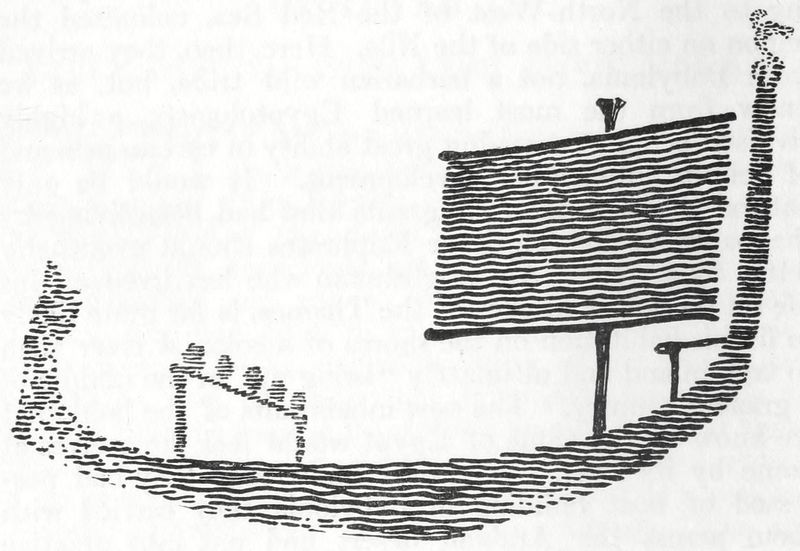
(Fig. 3) will show to what ability these colonisers or
their immediate successors had attained. Here will be
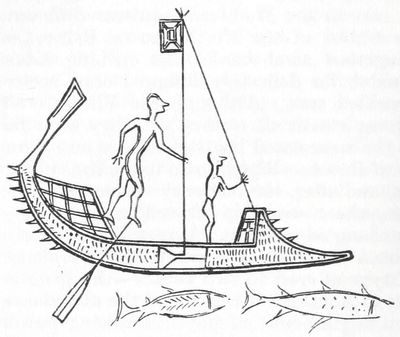
noticed the earliest form of sailing ship in existence. The
mast, the square sail, the high bow and the curve of the
hull are to us of the highest possible interest as showing
the first beginnings of the modern full-rigged ship or
yacht. This illustration has been taken from an amphora
found in Upper Egypt and now in the British Museum.
The date ascribed to it by the ablest Egyptologists is that
of the Pre-Dynastic period, which for the sake of clearness
we may regard as about 6000 B.C.
Fig. 3. Egyptian Ship of about 6000 b.c.
On other vases of this period, some of which may also
be seen in the British Museum, are to be found curious
crescent-shaped designs that have been sometimes taken
for primitive ships by previous writers. Even to the most
imaginative it must have been difficult to have given
these curious drawings the right to be called boats. The
extraordinary erections on what would be the deck, have
not any right to be called masts or sails. To any one with
the slightest practical knowledge of boats and their ways,
it is amusing to find that even these primitive ideas should
have been thought to depict any kind of river craft. But
I have been enabled to discuss this matter with such
eminent Egyptologists as Dr. Wallis Budge, the Keeper
of the Egyptian and Assyrian Antiquities in the British
Museum, and Mr. H. R. Hall, both of whom are of the
opinion that these designs do not represent ships at all.
Dr. Budge suggests that they represent “zarebas,” a
word that became very familiar to English people during
Kitchener’s campaign in Egypt. In that case, the structures
that have been mistaken for masts would represent
erections to frighten away enemies or wild beasts.
Another theory is that the series of straight lines below
what was taken for the ship’s hull, and which were wrongly
supposed to represent waves, are perhaps the piles on
which the dwelling is built. I have, therefore, omitted
such designs as not bearing on the subject of sailing ships.
Starting with a definite illustration before us of a
sailing boat of about 8000 years ago, our mind naturally
wanders back to the period when the first boat was ever
made. Picture, if you will, the prehistoric man standing
by the banks of the Tigris or Euphrates gazing in utter
helplessness and awe at the liquid mass gurgling on its
way to the Persian Gulf. He sees the fishes able to
swim beneath its surface and the waterfowl to float above.
Then when his mind has reached a sufficiently developed
state to permit of his being able to reason, he begins to
wonder if he—the superior to fish and fowl—could also be
supported in the water until he has reached the other side
of the river on which he has as yet never set foot. So,
on a day, greatly daring, he entrusts his body to the
flowing stream, and at length discovers that by certain
exercises he is able to float and swim across to the other
side. A new accomplishment has been made, a new
world has been opened out to him. When he gets back
home he begins to reason still further. How can he carry
himself, his family, his goods to the other side? One
day, perhaps, while hewing down a tree for his hut, a
branch falls into the water. Behold! it possesses the
ability of the water-fowl—it floats. So he hews down the
trunk itself, sits across it, and for sport, launches off from
the bank. Lo! the trunk supports both its own weight
and his.
Thus encouraged, his primitive mind sets slowly to
work. “If I get a bigger trunk and hollow it out, it will
carry me, my family and my property across to the other
shore.” So having turned the trunk into a boat, he makes
of the branch a punting-pole. At a later stage he puts on
a cross-piece to one end of the pole and thus propels
himself by paddling, until this in turn becomes an oar.
Since human nature differs but little from age to age,
and its chief tendency is ever to proceed along the route
of least resistance, he begins to seek some means of
motion without work. His descendants improve upon
the tree-trunk until it has become more shapely and less
clumsy. Then while returning home one evening, tired
out with paddling and hunting, he rests on his paddle for
a moment! Yet still his boat moves. He holds up the
blade of his paddle and the canoe moves a little faster.
He stands up, and, the larger the space that is exposed to
the wind blowing in the direction in which he is travelling,
the more quickly still does the little ship run on. Next
day he brings with him a stick which he erects in the boat.
That will save him standing. To the stick he makes fast
a hide and spreading it to the wind sails faster than anything
he has ever seen float on the water.
This is all very well in following winds: he can get
along, too, when the wind is abeam, although he has to
keep helping her with his paddle—such a lot of lee-way
does she make; but every time the breeze gets ahead as
he winds round the reaches of the Tigris he has to lower
the sail and mast. This is too much for him. His mind
is not able to conceive of such a manœuvre of tacking:
how could a boat possibly go against the wind? It is
unthinkable. He would be a fool to try and reason
otherwise against a law of nature. Not, indeed, until
thousands of years after him is tacking invented. The
Egyptians at any rate did not understand it. Their ships
were built for sailing up and rowing down the Nile, and
there is abundant evidence to show the mast lowered
down on to the top of the after cabin and the oarsmen
propelling the boat with the stream.
The prehistoric man has thus made almost the same
kind of boat that the savage or half-civilised race makes
to-day. The American Indian, the Negro and the
undeveloped Asiatic races cannot create any boat superior
to the dug-out, because their lack of intelligence is a fatal
barrier. But just as the first inventors of flying machines
have begun by studying the action of birds on the wing,
so in navigation as in aviation. The early boatbuilders
who followed the rough dug-out gave a shape to their
ships that was derived from the creatures of the water.
If the reader will look at the “bows” and underbody of a
fish he will see how the general lines of the ship began.
If, too, he will look at the stern and “counter” of the
duck and swan he will easily notice the resemblance to
the overhang of the early Egyptian boats. This is not so
fanciful as may appear at first sight. The ancients
certainly were affected by the waterfowl in their designing
of ships, and the graceful neck of the swan was a regular
decoration for the stern of the later Roman ships. It is
but common-sense that when man is about to study the
method of navigating water or air, he should begin by
copying from the creatures that spend their whole time
in this activity.
For the development of the art of shipbuilding, few
countries could be found as suitable as Egypt. Surrounded
on the East by the Red Sea, and by the Mediterranean on
the North, it had the additional blessing of a long navigable
river running through its midst. Of inestimable
value to any country as this is, the equable and dry
climate of Egypt, the peacefulness of the waters of the
Nile, the absence of storms and the rarity of calms
combined with the fact that, at any rate, during the whiter
and early spring months, the gentle north wind blew up
the river with the regularity of a trade wind, so enabling
the ships to sail against the stream without the aid of
oars—these were just the conditions that many another
nation might have longed for. Very different, indeed,
were the circumstances which had to be wrestled with in
the case of the first shipbuilders and sailormen of Northern
Europe. It is but natural, therefore, that the Egyptians
became great sailors and builders: we should have been
surprised had the reverse been the case.
In earlier times our sources of Egyptian history were
limited almost entirely to what could be derived from
ancient Greek and Roman writers. Nor was this of anything
but a vague and unreliable character. Happily within
our own time this has been supplemented, to an enormous
degree, by Egyptian exploration. The first beginnings
of this are found in the scientific study of Egyptian
monuments, which began about the middle of the nineteenth
century. The foundation for the interpretation of
hieroglyphic inscriptions was laid in the Rosetta Stone,
now fortunately in the British Museum. Discovered at
the close of the eighteenth century, its bilingual writing in
Egyptian and Greek paved the way for future scholars.
Englishmen, German, French and American students
have since engaged in the fascinating pursuit of
systematically and with scrupulous care, excavating the
temples and palaces of the older civilisation that lived
on the banks of the Nile thousands of years before the
Incarnation. Encouraged alike by the settled state of
political affairs in Egypt, and by the support granted in
the interests of research by the Egyptian and European
Governments, the excavation and preservation of these
unique monuments have gone steadily on from year to
year. It is from the annual reports of these exploration
societies, as well as from the explorers themselves, that we
are able to present the details of the Egyptian sailing
ships.
It would have been strange if a nation with such a
vast waterway, and living in such close proximity to the
Mediterranean and Red Seas, should not have left behind
some memorials of her shipping. Happily we have no
need for disappointment, for the information surviving to
us is of two kinds. Firstly, we have the wall-pictures of
the ancient buildings, which show almost everything that
a picture could tell of a ship and her rigging. These
wonderful illustrations have been faithfully copied on the
spot. But besides these, within recent years have been
unearthed most interesting little wooden model boats.
These are of two kinds, those made in the form of a
funeral bark, and those which are models of the actual
ships that sailed up the Nile at the time they were made.
In the former the dead man is seen lying under a canopy
or open deck-house with or without rowers. These funeral
barks, not being sailing boats, are only of interest in pursuing
our present subject as showing us the general lines
and shape of the hull, together with the steering and rowing
arrangements.
It is the models of sailing ships that demand our
attention. These were placed in the tombs with the
intention of providing the deceased with the means of
sailing about on the streams of the underworld. Very
touching is the care of the ancients that man’s most
beautiful creation—his ship—should not be separated
from him even in death. (We shall see, later on, a similar
devotion expressed in the burial of the Vikings.) Models
of houses and of granaries, with curious little men working
away, so that the departed should not be lacking for
food while he sailed about the underworld, are also found.
Some of these models of ships, granaries and soul-houses
are to be seen in the British Museum and the South
Kensington Collection. The reader who is interested in
the subject will find additional information in the fascinating
book by Professor Flinders Petrie.[1] Each boat was
provided with masts and sails and elaborately decorated
steering oars. Dr. Budge, in his guide to the Third and
Fourth Egyptian Rooms of the British Museum, points
out that another religious idea was connected with these
boats, namely, the conception of the boat of the Sun-god,
called the “Boat of the Million of Years,” in which
the souls of the beatified were believed to travel nightly
in the train of the Sun-god as he passed through the
underworld from West to East.
The Egyptians thought that by a use of words of
magical power, the models placed in the tombs, whether
of boats or houses or granaries, could be transformed into
ghostly representations of their originals on earth. “The
boat,” adds Dr. Budge, “was considered to be such a
necessary adjunct to the comfort of the deceased in the
next world, that special chapters of the Book of the Dead
were compiled for the purpose of supplying him with the
words of power necessary to enable him to obtain it.
Thus, ‘Tell us our name,’ say the oar-rests: and the
deceased answers, ‘Pillars of the Underworld is your
name.’ ‘Tell me my name,’ saith the Hold: ‘Aker’ is
thy name. ‘Tell me my name,’ saith the Sail: ‘Nut,’
(i.e., heaven) is thy name,” &c.[2]
But let us make a survey of the development of the
Egyptian ship from the time prior to the Dynasties until
the third or fourth century before the Christian era.
Ancient Egyptian history has been divided by scholars
into three periods—the Old Kingdom, the Intermediate,
and the New Kingdom. These again have been subdivided
into Dynasties, of which the First to the Tenth
are covered by the Old Kingdom, the Eleventh to the
Seventeenth, by the Intermediate, and the Eighteenth to
the Twentieth, by the New Kingdom. Afterwards the
various Foreign Dynasties of Mercenaries formed the
Twenty-second to the Twenty-fifth. The Twenty-sixth
was the time of the Restoration, the Twenty-seventh to
the Thirty-first represented the time of the Persians.
This will assist us in following the changes that came
about in the ships with the progress of time.
We have already drawn attention to the illustration of
a ship, or rather sailing boat, in Fig. 3, belonging to that
remote period anterior to the Dynasties. There can be
no possible doubt as to her being intended by the artist,
who painted this design on the amphora, for a sailing
vessel of some kind, though the mast and square-sail are
set much further forward than is found later in Egyptian
ships. There is a figurehead on the extreme point of the
stempost. Below is a small platform, possibly for the
look-out man whom we see later in Egyptian ships armed
with a pole for taking soundings. Right aft is a small
cabin for the owner or distinguished traveller. Probably
she was a decked ship and steered by one or more oars
from the quarter. The reader will notice a great similarity
between the stern of this vessel and that of the Bœotian
sailing boat shown in Fig. 11.
From the earliest times up to about the year 3000 B.C.,
the Egyptian craft are less ships than boats. The sailing
boats of the third dynasty are decked and fitted with a
lowering mast, which when not in use is lifted bodily out
of its sockets and rests on the roof of the after cabin.
The boat was then propelled by paddles, with a look-out
man forward, the steersmen aft, and the commander
amidships armed with a thong-stick to urge the rowers on.
The sailing boats of the fourth and fifth dynasties become
gradually bigger and more seaworthy, but the mast and
rigging show only slight advance. The former, from the
third dynasty to the eleventh, is in the shape of the letter
A. It fits into grooves either in the deck or the side of the
ship, and at first has no backstays or shrouds. Being a
double mast these are not necessary. The sail at this
period is deep and narrow, reaching from the top of the
mast down to the deck, being fitted with both yard and
boom. Braces are attached to the ends of the yards but
no sheets are shown. During the fourth and fifth dynasties,
while the A-shaped mast remains, backstays are added, sometimes
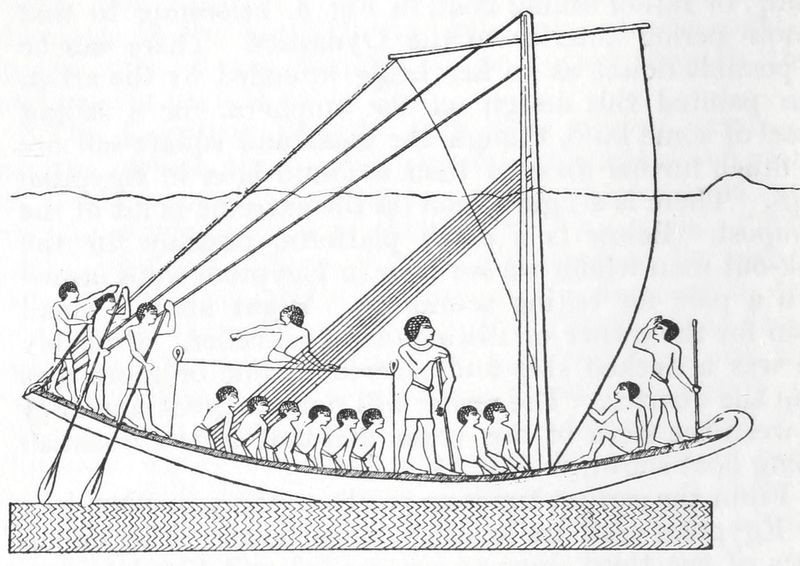
numbering as many as nine or ten (see Fig. 4). These
would become essential as the ship grew larger and her
gear heavier. These backstays lead from roughly three-quarters
of the way up the mast down to the spot about a
quarter of the ship’s length forward of the stern. An
additional stay from the top of the mast to the extremity
of the stern is also frequently shown. Two or three men
are seen steering with paddles, standing on the overhanging
counter. On big ships the steersmen number as many
as five, and the paddlers with their faces turned in the
direction in which the ship was proceeding are shown to
be twenty-two or twenty-three on each side. The fact
that only one man is shown sitting aft holding a brace in
each hand, must be an additional proof of the gentleness
of the northerly wind on the Nile and the absence of
squalls. No cleats are shown, and in anything much
above a zephyr his weight and strength must have been
sorely tried. The forestay, the enormous overhang both
at bow and stern, the look-out man forward with his pole
for taking soundings of the Nile, and possibly for tilting
the ship’s head off whenever she got aground—an experience
that is far from rare on the Nile even to-day—the
presence of the commander with his thong-stick, are still
shown in the ships of the fourth and fifth dynasties.
Fig. 4. Egyptian Ship of the Fifth Dynasty.
As showing the wonderful influence which Egyptian
ships of this period exercised on the rig of the Far East,
and even of the Far North-East, let me be permitted to
call attention to the Burmese Junk in Fig. 1. I will ask
the reader to note very carefully her A-shaped mast, her
squaresail, her steering paddle at the side, and most
important of all the general sweep of the lines of her hull,
coming right up from the overhanging bow to the raised
overhanging poop. This is the Burmese junk of to-day,
which, like the Egyptian ships of old, finds the prevailing
wind favourable for sailing up against the river Irawadi,
and when returning down the stream, lowers her sail and
rows down with the current. Between the Chinese and
Burmese junks of to-day and the Egyptian ships of about
six thousand years ago there are so many points of
similarity that we are not surprised when we remember
that the Chinese, like the Egyptians, derived their earliest
culture from Babylonia, and that India—using the name
in its widest geographical sense to include Burma—is
mainly, as to its culture at least, an offshoot from the
Chinese. Until quite recently, China remained in the
same state of development for four thousand years. If
that was so with her arts and life generally, it has been
especially so in the case of her sailing craft. I am not
contending that the Chinese junk is identical with the
ancient Egyptian ship, but I submit that between the two
there is such close similarity as to show a common
influence and a remarkable persistence in type.
But whilst engaged in this present work, I became
interested in a half-civilised tribe called the Koryak,
dwelling around the sea of Okhotsk, in the North-West
Pacific. Here, in this remote corner of undeveloped
Siberia, they have remained practically forgotten by the
rest of the world, except for a few occasional visits from
the land side by the Cossacks, and from the shore side by
the American whalers. Recently, thanks to the Russians,
a few have begun to embrace Christianity, but for the
most part, they remain in their primitive state with habits
too repulsive to mention. Naturally, since (as we have
already pointed out) a nation exhibits its state of progress
in its art, its literature and its ships, we are not surprised
to find that the Koryak craft have, at any rate in respect
of rigging, several highly important similarities to the
Egyptian ship of the fourth and fifth dynasties. Thus,
besides copying the ancients in steering with an oar, the
fore-end of the prow of their sailing boats terminates in a
fork through which the harpoon-line is passed, this fork
being sometimes carved with a human face which they
believe will serve as a protector of the boat. Instead of
rowlocks they have, like the early Egyptians, thong-loops,
through which the oar or paddle is inserted. Their sail,
too, is a rectangular shape of dressed, reindeer skins sewed
together. But it is their mast that is especially like the
Egyptians and Burmese. The following description,
written by a member of the Jesup Expedition which
recently visited the Koryaks, is notable:
“Instead of a mast, they employ a more primitive
contrivance. Three long poles are tied together at one
end with a thong which passes through drill-holes, and are
set up in the manner of a tripod. On one side, the whole
length of the sail is sewed to a yard, the middle of which is
slung from the top of the tripod by means of a stout thong.
The tripod is set up in the middle of the boat by tying
both ends of one of the poles to the ribs on one side of the
boat, while the third pole is fastened on the other side of
the boat. The sail can revolve around the top of the
tripod, and is set in the direction required by the wind,
by means of braces and sheets made of thong, which are
fastened to the rails.”[3]
Lacking the civilisation of the ancient Egyptians,
wanting, too, no doubt the wood wherewith to build their
boats, the Koryaks’ sailing craft are made of seal skins.
But there can be little doubt that their rigging is of
European rather than of Asiatic origin. Possibly it came
from Egypt to India and China and so further north to
the Sea of Okhotsk. At any rate, although the Egyptian
ships we have been considering had a double and not a
treble mast, yet it must not be supposed that the latter
did not exist, for Mr. Villiers Stuart, some years ago, found
on the walls of a tomb belonging to the Sixth Dynasty at
Gebel Abu Faida, the painting of a boat with a treble
mast made of three spars arranged like the edges of a
triangular pyramid.
After about the period of the fifth Dynasty the sail,
instead of being deep and narrow, becomes wide and
shallow. Instead of the several steersmen with their
paddles at the stern, we have one large oar in the centre
of the stern, resting on a large wooden fork and worked
by one steersman by means of a lanyard. If the reader
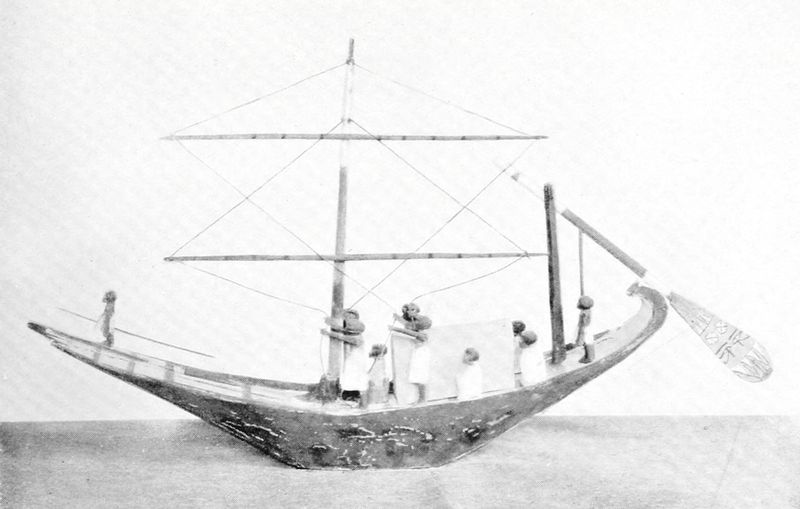
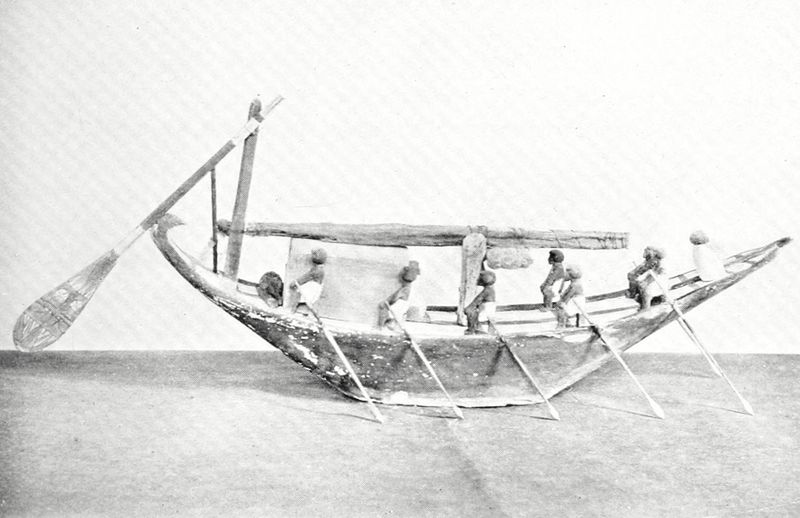
will refer to Figs. 5 and 6, he will see this quite clearly.
These are the interesting little models already alluded to
as having been discovered by Professor Flinders Petrie,
and which are now in the Manchester Museum. This
most instructive “find” was made by the British School
of Archæology in the season of 1906-7 at Rifeh, whilst
excavating the tomb of the sons of an Egyptian Prince
belonging to the Twelfth Dynasty. In the coffins were
these two excellent little ships, the one, as will be seen,
with her mast and yards, braces, topping lifts and halyards
for sailing up the Nile; while the other ship shews very
clearly the mast lowered in a tabernacle on to the cabin,
the foot of the mast being balanced by the weight of a
stone—exactly the practice of the Norfolk wherries of to-day,
saving that instead of stone lead is used. The steersmen
will be noticed and the highly decorated blade of the
steering oar. Unfortunately, before being photographed,
the oar in Fig. 5 has been placed too high. It should, of
course, have been dropped lower beneath the water-line.
Notice, too, that the rowers sit now with their backs to
the bow. Paddles have been dispensed with, and finding
that so much more power could be obtained by putting
the whole weight on to the oar, rowing has been taken to
instead of paddling. The little figure with a cloak round
his shoulders in the bows (Fig. 6), is the look-out man.
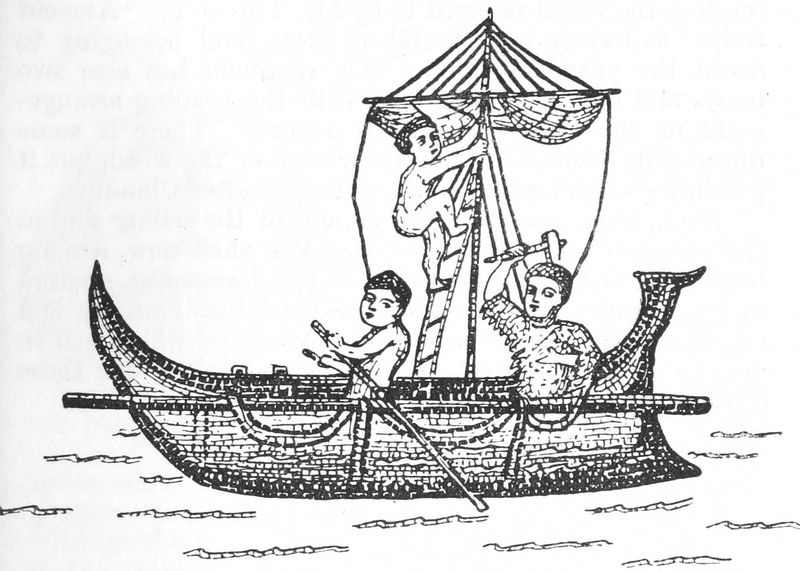
Fig. 5. Model of an Egyptian Ship of the Twelfth Dynasty.Fig. 6. Model of an Egyptian Ship of the Twelfth Dynasty.
In Fig. 5, the look-out man with his pole is also seen
forward; the crew are gathered round the mast to haul at
the halyards, and get in the sheets and braces; for now
that the sail does not reach right down to the deck, sheets
have become indispensable. It will also be remarked that
the boom has been introduced to make the sail set better.
The amount of sheer given to the boat is enormous,
although the curve-in of the top of the stern is exceedingly
attractive. Assuming that the dimensions of the model
are proportionate she must have had precious little grip of
the water, and if, when on an expedition to the land of
Punt, the Egyptians ever encountered a beam wind, their
ships must have made a terrible lot of lee-way. For even
a light breeze, coming at right angles to those overhanging
bows with no great draught amidships, would drive her
head right off the wind. The steersman would naturally
stand to leeward, to get a pull on his steering-thong or
lanyard in order to luff her up, and prevent her sagging
too much to leeward. At a later date, when, as we shall
see, an oar was used each side for steering in place of only
one at the extreme stern, the helmsman stood on the lee
side and worked the lee steering oar. By reason of its size,
this would have some of the effects of the leeboards on a
Thames Barge or Dutchman.
Although these two models are the finest tomb group
that have yet reached England, yet others have been
found at Sakkara, and elsewhere, sometimes with a hull
painted yellow and a cabin with an awning painted to
imitate leather, in which the proprietor, more carefully
made and of better wood than his sailors, sat with his box
by his side. Another boat model was of light papyrus
with flower-shaped prow and stern. It was painted green,
and carried a light shelter under which the owner usually
stood.[4]
These ships of the Twelfth Dynasty have an additional
interest for us, since they belong to the time when Egypt
was enjoying the fullest prosperity, and had reached its
highest degree of civilisation in its capital of Thebes. But
it is in the illustrations of ships afforded by excavations in
connection with the Temple of Deir-el-Bahari that we
find the most detailed information. The south wall of the
middle terrace of this building is most informative, depicting
as it does the naval expedition to the land of Punt.
In Egyptian history various expeditions are mentioned to
Punt. One occurred as early as the fifth Dynasty, for
it is recorded in a tomb of a dynasty later. During the
eleventh Dynasty, a similar expedition was made under
Sankh-kara, and Ramases III. also sent an expedition.
These last two voyages are said to have started from a
harbour on the Red Sea which was reached from Koptos,
probably the modern Kosseir, and to have returned there.
Although it is now thought by some Egyptologists that
Queen Hatshopsitu did not send an expedition to Punt,
but that she was only copying the expedition of the
eleventh Dynasty, and that these Punt reliefs are merely
replicas of other reliefs still to be discovered in the older
temple, depicting an expedition under Nebkheruna, yet it
is a doubtful point and by no means settled by critics.
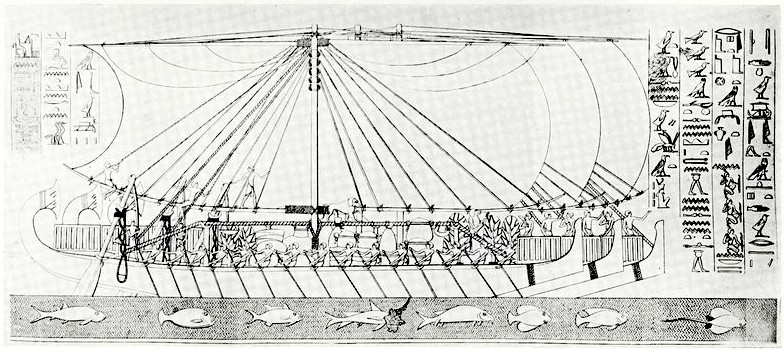
But supposing these are the ships of the Egyptian
Queen of the eighteenth Dynasty, they are seen with
fifteen oarsmen a side, whilst two look-out men are standing
forward in a kind of open-work forecastle. The general
shape of the ship by now has become considerably
modified. Whilst there is still considerable overhang
both at bow and stern, yet she is long on the waterline.
The bow resembles nothing so much as that of a modern
gondola. There is a beautiful line sweeping up aft to a
raised poop with an ornamentation curving gracefully inboard
to another open-work castle or cabin. These illustrations
of the eighteenth Dynasty show how thoroughly
the Egyptians had mastered the art of shipbuilding.
When a ship is sailing on the sea, she is thrown up by the
motion of the waters till she rests pivoted on the crest of
a wave. The middle of the ship is thus supported, but the
bow and stern, not being waterborne, have a tendency to
droop while the centre of the ship tends to bulge up.
This is technically known among naval architects as
“hogging.” In the case of ships with an enormous overhang,
unsupported by water, such as was the case of the
Egyptian ships and is now the fashion with our modern
yachts, this hogging would need to be guarded against.
Only recently the writer saw on the south coast a modern
yacht with no beam but considerable length and overhang.
She had been badly built and the “hogging” was very
noticeable a little forward of amidships. Her skipper
gave her a very bad name altogether.
In the Hatshopsitu ships we see the “hogging” strain
guarded against by a powerful truss of thick rope. This
truss leads from forward, sometimes being bound round—undergirding—the
prow: sometimes it is made fast inside,
perhaps to the deck or to the floors. It then leads
aft, being stretched on forked posts until it reaches the
mast, where it is wound round in a sort of clove-hitch, and
then continues aft
again being stretched on other forked
posts until it is finally girded round the counter. This
truss was as large as a man’s waist, and has been calculated
by Commander T. M. Barber of the United States’ Navy
to have been able to withstand a strain of over 300 tons.[5]
The manner of steering from the centre of the stern
with one oar has given way to that of using an oar on
each quarter. Each oar rests on a forked post rising
above the head of the steersman who works the oar with
a thong loop. As already pointed out, it is noticeable
that he uses the lee steering oar always. It is probable
that going to the land of Punt, the prevailing North wind
favoured them. But returning, if the wind was foul,
they would have to row. Even had they understood the
art of tacking at this time they would have had some
difficulty. As far as one can gather from the look of
a ship of this kind, as soon as ever the lee oar was pushed
over so that she came up into the wind, she would get into
stays and not pay off on to the other tack except with the
aid of the oarsmen.
In these Punt pictures, too, will be noticed the fact
that the rowers have their oars in thongs instead of the
later invention—pins or rowlocks. These ships were certainly
decked, but that was probably only down the centre,
for though we see the ship crowded with all sorts of
merchandise, yet the rowers’ bodies are only visible from
the knees upwards. They were probably placed on a
lower platform.
Just as in the course of time the double and treble
mast gave way to the single spar, and the deep, narrow
sail to the broad, shallow square-sail, so later, about the
year 1250 B.C., we find that the boom was discarded, and
therefore at any rate, by now, sheets must have been
introduced. But before we pass from Hatshopsitu’s ships
(about 1600 B.C.) let us examine the sail of that time.
So much confusion exists in the mind of many who see
occasional pictures of these early vessels that it may be
well to make an effort to clear this matter up. The
yard was of two pieces lashed together in the middle; the
same statement applies to the boom. Pulleys not being
yet invented, the two halyards that raised the yard, led
through two empty squares formed by a framework of
wood acting as fair-leads. These halyards led aft, and
being belayed well abaft the mast were used as powerful
stays to the latter. Let it be understood at once that the
boom remained fixed, being lashed to the mast by thongs.
From the top of the mast below the yard depended a
series of topping lifts about seventeen in number. These
coming out from the mast at varying angles spread over
the whole length of the boom, and took the weight of the
latter, supporting also the sail and yard when lowered.
Contrary to the subsequent practice of the Greeks and
Romans, the yard was the spar that was raised or lowered
by the halyards. Thus, when sail was struck the two
halyards would be slacked off, the yard would descend on
to the boom, the sail would be rolled up while the
topping-lifts would hold the entire weight. The two
braces, leading down not quite from the extremities of the
yard, a single sheet made fast a little forward of the
middle of the boom, a forestay and also a single backstay
were also used, but side rigging never.
From about the year 1250 B.C. onwards, the sail was no
longer furled by slacking away the halyards, but, having
dispensed with the boom, brails of about four in number
usually hung from the yard which was now not lowered
but a fixture. Consequently on coming to an anchorage
the brails would be used for furling the sail to the yard—still
standing owing to the weight and consequent exertion
needed to hoist it again. This, then, remained the
accepted rig of the Phœnicians, Greeks and Romans for
over a thousand years as we shall see from the evidence of
coins and vases.
The importance of the various expeditions of the
Egyptians to Punt cannot be over-estimated. They are
the earliest attempt at organising a fleet of powerful ships
to voyage far away from home waters. Exactly where
Punt was situated it is not possible to say, because the
name was given to various regions at different times.
Sometimes it is the modern Somaliland, or the shore
opposite: at other times it is somewhere in a more
southerly direction. But wherever Punt may have been,
it was either to the East or South of Egypt. The real
motive of these expeditions was to increase the commerce
of Egypt, to open up trade with the neighbouring
countries, and especially to obtain incense for the burials
of the Egyptians. Such commodities as ivory, leopard
skins, ostrich feathers and gold were also brought back.
I am indebted for much information with reference to
these expeditions to a most interesting publication of the
Egypt Exploration Fund,[6] and to the work of a German
scholar.[7] In the illustrations of the Punt expedition
as depicted in Hatshopsitu’s Temple, we see five ships
arriving. Two have struck sail and are moored. The
first ship has sent out a small boat which is fastened
by ropes to a tree on the shore, while bags and amphora,
probably containing food and drink, are being unloaded to
present to the chief of Punt. The other three ships are
coming up with sail set, showing us the most interesting
details as to their rigging. On one of them the pilot
is seen giving the command “To the port side.” There
is an inscription annexed to this illustration, which, as stated
above, can now be deciphered. It reads thus:—“These
are the ships, which the wind brought along with it.”
And again, “The voyage on the sea, the attainment of the
longed-for aim in the holy land, the happy arrival of the
Egyptian soldiers in the land of Punt, according to the
arrangement of the divine Prince Amon, Lord of the terrestrial
thrones in Thebes, in order to bring to him the treasures
of the whole land in such quantities as will satisfy him.”
We see, too, the ships being loaded with the produce
of Punt. The Egyptians are bringing the cargo across a
gangway from the shore to the ship. There are bags of
incense and gold, ebony, tusks of elephants, skins of
panthers, frankincense trees piled up in confusion on the
ships’ decks. Monkeys, too, have been obtained, which
have been truthfully depicted as amusing themselves by
walking along the truss. Any one who has ever taken a
monkey on board a sailing ship knows that the first thing
he does is to run up the rigging. It is a small point this,
but it shows that the artist was anxious to be truthful and
exact in his details.
The hieroglyphic inscription accompanying this illustration
is virtually the bill of lading. It gives a detailed and
accurate account of all the articles destined for transport.
The translation of this according to Dr. Duemichen is:
“The loading of the ships of transport with a great
quantity of the magnificent products of Arabia, with all
kinds of precious woods of the holy land, with heaps of
incense-resin, with verdant incense trees, with ebony, with
pure ivory, with gold and silver from the land of Amu,
with the (odorous) Tepes wood and the Kassiarind, with
Aham-incense and Mestemrouge, with Anau-monkeys,
Kop-monkeys, and Tesem-animals, with skins of leopards
of the South, with women and children. Never has a
transport (been made) like this one by any king since the
creation of the world.”
Fig. 7. Egyptian Ship (in the Temple of Deir-el-Bahari).
Finally (see Fig. 7) we are shown three vessels of the fleet
returning to Thebes richly laden. The accompanying inscription
in this case reads: “The excursion was completed
satisfactorily; happy arrival at Thebes to the joy of the
Egyptian soldiers. The (Arabian and Ethiopian) princes,
after they had arrived in this country, bring with them costly
things of the land of Arabia, such as had never yet been
brought that could be compared with what they brought,
by any of the Egyptian kings, for the supreme majesty
of this god Amon-Ra, Lord of the terrestrial thrones.”
“If the expedition really landed at Thebes,” says Dr.
Edouard Naville, “we must suppose that at that time,
long before Ramases II., who is said to have made a canal
from the Nile to the Red Sea, there was an arm of the
Nile forming a communication with the sea, which extended
much farther north than it does now.”[8]
When we remember the splendour and gaiety of the
court at Thebes, the many gorgeous festivals that were
held on the water, the Egyptians’ love of pleasure and their
intense joy in living, we are neither surprised to learn of
the great fêtes that celebrated the safe return of these
voyagers, nor of the fact that a company of royal dancers
accompanied the ships to enliven the navigation with song
and dance. That the Egyptians dearly loved their ships
and set them in high honour cannot be disputed. Besides
burying them in the tombs of their rulers, there were times
when sacred boats were carried out of the temples on the
occasion of high festivals and dragged along by sledges.
Professor Maspero[9] believes that the navigation of the
Red Sea by the Egyptians was far more frequent than is
usually imagined, and the same kinds of vessels in which
they coasted along the Mediterranean from the mouth of
the Nile to the southern coast of Syria, conveyed them
also, by following the coast of Africa, as far as the straits of
Bab-el-Mandeb. These ships were, of course, somewhat
bigger and more able than the Nile boats, though they
were built on the same model. They were clinker-built
with narrow sharp stem and stern, with enormous sheer
rising from forward to the high stern. They were not
open boats but decked, and we find hieroglyphics denoting
the pilot’s orders “Pull the oar,” “To the port side.”
Heavier, bigger, with more freeboard and no hold, the
Egyptian merchant ships, crowded with their cargo and a
complement of fifty sailors, pilots, and passengers, barely
afforded room for working the ship properly. The length
of ships of the size that went to Punt has been thought to
be about sixty-five feet, or much smaller than such modern
yachts as “Shamrock” and “Nyria.”
We have already mentioned the wonderful influence
the rig of the Egyptians exercised to the eastward, but
though the old squaresail rig has gone from Egypt, yet
to-day we can still see very similar boats and almost the
same rig on the Orange Laut of the Malay West Coast.
The overhanging bow and stern, the great sheer from
forward to the high poop, the large single squaresail, now
converted practically into a lug-sail, are still there to keep
alive the memory of the ships of the Dynasties.
I have already referred in the previous chapter to the
lateen sail having been adapted from the Egyptian rig a
few centuries before the Christian era. But it is probable
that between the squaresail rig and the lateen there was just
one intermediate stage. By tilting the yard at a different
angle to the mast, instead of it being at right angles, so
that the foot came down lower, and the peak of the sail was
pointed higher, it would be found that the ship would hold
a better wind. This is amply borne out by the Egyptian
“Nugger” (see Fig. 8), which is still in use on the Nile
above the second cataract, and is being replaced only very
slowly by the lateen. There is a relief on a sarcophagus
found in the precincts of the Vatican, and now in the
Lateran Museum, which certainly resembles the “Nugger”
in its transition from the squaresail to the lateen. (The date
of this is about 200 A.D.). The only important difference
is that the Vatican relief shows a topsail added. Finally,
discarding the boom altogether, the lateen sail comes with
the foot of the sail lower still, and consequently the peak
much higher, being but an exaggerated form of our
modern lug-sail so prevalent in sailing dinghies. This
remains, as we have pointed out above, as the characteristic
sail of the Mediterranean, the Nile and Red Sea.
Fig. 8. An Egyptian Nugger.
Before we close this chapter one must refer to the
vexed question as to when the ancients discovered that
wonderful art of sailing against the wind—tacking. In
the absence of any definite knowledge, I hold the opinion
that this first came into practice on the Nile about the
time the nugger, or dhow was introduced as the rig for
sailing boats. My reasons for this supposition are: firstly,
the squaresail being more suitable for the open sea and
making passages of some length, it would be a country
having a navigable river that would be likely to discover
such a rig as would enable them to sail with the stream
against the prevailing northerly wind; secondly, arguing
on the theory (which has many adherents) that the dhow
came in about the time of the death of Alexander the
Great who revolutionised at least one corner of Egypt,
leaving behind his name to the port of Alexandria as an
eternal memorial, I hold that the invention of this dhow
rig made the ship to come very close to the wind—far
closer than the old-fashioned squaresail of the earlier
Egyptians. Realising, when coming down with the stream,
that they could go so near to the wind when approaching
the right bank, why—surely it must have occurred to such
highly developed minds—could they not do the same
when zigzagging across to the left shore? At first, no
doubt, they pulled her head round with their oars, until,
perhaps, on one occasion, she carried so much way from
the last shore that she came round of her own accord—shook
herself for a moment, as she hung for a short time
in stays—and then paid off on the other tack. After that,
the whole art of going to windward was revealed. My
third reason is based on the fact that the Saxons, who
settled around the mouth of the Elbe and subjugated the
Thuringians after the death of Alexander the Great, did
possess this knowledge of tacking.
Unless it were with the intention of tacking, it is
difficult to see why the dhow, or nugger rig should have
prevailed. But we do know that this form of sail was
extant about the time of Alexander; therefore, tacking
must be at least as old as the death of Alexander in the
fourth century B.C. A squaresail-ship whether ancient or
modern will go no nearer the wind than seven points,
whereas the fore-and-after will sail as close as five. This,
as soon as the fact was fully realised on the Nile, would
hasten that day when tacking was first found out.
Egypt, after flourishing so mightily for so many
hundreds of years, had its decline not less than its rise.
Just as the earlier Egyptian sculptures are superior to the
later ones in sincerity and fidelity, becoming subsequently
more stiff and formal, so her shipping eventually deteriorated,
and the mastery of the seas passed into the
hands of the Phœnicians.
CHAPTER III. ANCIENT SHIPS OF PHŒNICIA, GREECE, AND ROME. [10]
It is almost impossible to exaggerate
the potent influence exercised
by the Phœnicians, as
successors of the Egyptians, in
being the maritime nation of the
world. Happy in their origin by
the Persian Gulf, fortunate, too,
in having had the Egyptians
before them, and so benefiting
by the knowledge and experience of the latter, they had
developed and prospered through the centuries parallel
with the Dynastic peoples. Much that we should wish to
know about the Phœnicians is wanting, but we have more
than adequate material for the means of realising something
of the range and intensity of their sway.
Migrating, like the first Egyptians, westward, they had
settled around the Levant, to the north of Palestine.
Already, in prehistoric days, they had expanded still
further westward into Greece, founding Thebes in Bœotia,
and teaching the barbarian inhabitants of that country the
elements of civilisation. Everywhere in the ancient world,
from remote ages until a century or two before the Incarnation,
Phœnician ships were as numerous in the waters
of the Mediterranean, as British vessels in all parts of the
world are to-day. Possessing a genius for trade, a keen
love for the sea and for travel, they had the complete
mastery of the commerce and fisheries of the Ægean Sea,
until as late as the eighth century B.C. They dragged up
from the waters its shell fish to make purple dies; they
burrowed into the earth to extract silver; they opened up
commerce wherever it was possible, exchanging such products
of the East as woven fabrics and highly-wrought
metal work. They built factories on islands and promontories,
and gave to the towns along the coast-line—especially
of the eastern side of Greece—Phœnician
names. Troubling but little about inland situations,
they made their strong settlements to be their island
homes.
Although eventually the Phœnicians were driven out
of the Ægean, yet their effect on the inhabitants of Greece
was a lasting one. As Greece had received from the
Phœnicians her first culture, so she had adopted their
religion and their species of ships. We shall see, presently,
how very similar the ships of the Greeks and
Phœnicians were. But before proceeding thus far, let us
remember that, though the Phœnicians were developing
while the Egyptians were declining, yet, indubitably, they
owed a vast amount to the civilisation of the latter. Why
the Phœnicians, more than any other people, were influenced
by the Egyptians is not hard to understand if we
realise that they alone were allowed to trade to the mouths
of the Nile. The Egyptians guarded their kingdom inviolate
against all other merchants of the Mediterranean,
although Achaian pirates from the North at times swept
down to the Nile Delta. Not until the Twenty-Sixth
Dynasty, when Egypt was reunited, and again made a
strong kingdom, were the Milesian and other Greek
traders allowed to begin commercial operations with the
land of the Pharaohs.
Broadly speaking, the Phœnician ships were identical
with those of about the time of Ramases III. (1200 B.C.).
The fixed yard, the absence of boom, the brails suspending
from the yard, the sweep of the lines aft to the
overhanging stern, the double steering oar—these characteristics,
which in the last chapter we left with the
Egyptians, are all seen in the ships of the Phœnicians.
The chief noticeable difference is that the latter have
altered the bow so that she has a ram. It was the
Phœnicians, too, who invented the bireme and trireme in
order that speed might be obtained through increasing the
height without adding to the length of the ship. The
ships become somewhat larger than those of the Egyptians,
for the reason that they have to voyage much further
afield. Consequently the sail is sometimes found bigger,
too, and instead of four brails, six is the usual number
seen. The Phœnician bireme had as many as eleven or
twelve rowers each side, sails being only used in a fair
wind, but never at all in battle. In addition to its crew
of seamen, a Phœnician trireme often carried thirty
marines, sometimes of a nation different from the
Phœnicians.
Right to the end, even when decline had at last taken
the place of a rise, the Phœnicians remained good sailormen.
Whenever a superior foe overcame them, they were
used by their new master with deadly effect against his
next enemy. We have an instance of this in the fifth
century B.C., when, Phœnicia and Cyprus having been
defeated by Cambyses, the latter utilised the strong
Phœnician fleet against Amasis, the Egyptian king. And
again, in the following century, when Xerxes had enforced
the most rigorous conscription, and every maritime
people in his dominions had been compelled to put forth
its full strength, we find it recorded that the most trustworthy
portion of the fleet, far superior to the Egyptians,
was composed of ships of the Phœnician cities, the kings
of Tyre and Sidon appearing in person, each at the head
of his own contingent. Other things being equal, that
side was usually victorious which had the Phœnicians with
them. For the Phœnicians had the instinct of sailormen;
they knew how to build and design their ships to withstand
a fight; they had the ships, they had the men, and,
what was more important still, they knew how to use
both.
But the Phœnicians were more than mere traders or
fighters: they were the world’s greatest explorers—until
the fifteenth and sixteenth centuries of our era. It was
they who voyaged out of the Mediterranean across the
turbulent Bay of Biscay to Cornwall and perhaps Ireland.
I am of the firm opinion that they also continued their
travels further eastward across the North Sea: we will
deal with that, however, in the next chapter. At any rate
about the beginning of the sixth century B.C. they circumnavigated
Africa, obeying the orders of Neco, an Egyptian
king, “who”—to continue in Hakluyt’s Elizabethan
English—“(for trial’s sake) sent a fleet of Phœnicians
downe the Red sea: who setting forth in the Autumne
and sailing Southward till they had the Sunne at noone-tide
upon their sterbourd (that is to say, having crossed
the Æquinoctial and the Southerne tropique) after a long
Navigation, directed their course to the North, and in the
space of 3. yeeres environed all Africk, passing home
through the Gaditan streites, and arriving in Egypt.”[11]
It was the Phœnicians, too, who with the Israelites in
the time of Solomon sailed down the Red Sea to Eastern
Africa, Persia, and Beluchistan. Some, indeed, have
thought that the Phœnicians sailed out of the Mediterranean
and keeping their course to the westward were
the first to discover America. Whether this is true or
not is a matter for dispute, but it is quite possible. I
have seen a little seven-ton cutter yacht that came across
on her own bottom, and she is not half the size of the old
Phœnician ships. Nor had she a few dozen galley slaves
on board to pull at the oars: still less the room wherein
to stow them.[12] There is, then, nothing at all improbable
in the Phœnicians having gone so far afield. They were
not pressed for time, and could afford to wait till the
weather suited them. Given a fair wind they could not
have had better shaped canvas for the voyage than theirs.
Every sailor will tell you that there is nothing to beat the
squaresail for ocean passages, and those who have tried
the fore-and-aft rig for deep-sea sailing have lived to wish
they had had a rectangular sail set across the mast, so as
to avoid the fear of gybing as in a fore-and-after. Lord
Brassey, when, in the famous race across the Atlantic in
1905, he commanded his own yacht the Sunbeam, afterwards
endorsed these opinions about the respective merits of the
square-sail and of the fore-and-aft rig.
Moreover, the Phœnicians had ample brails for reefing.
True, the ship would roll considerably with so shallow a
keel, but her length would be of some assistance, and no
doubt the skipper would see to it that the crew steadied
her with their oars.
Either from the Egyptians or the Phœnicians—but
almost certainly from the latter—the people down the
east coast of Africa learnt the art of navigation pretty
thoroughly, for we know from Hakluyt that when, at the
end of the fifteenth century of our era, Vasco da Gama
doubled the Cape of Good Hope and called at the East
African ports, he found that the arts of navigation were
as well understood by the Eastern seamen as by himself.
This would seem to imply that these Africans
had years ago reached the state of advancement in sailing
a ship already possessed by the more civilised parts of the
world.
Our evidence as to the actual shape and rig of the
Phœnician craft is of two kinds. Firstly, thanks to the
discoveries of the late Sir Austin Layard and his successors,
we have one or two representations of ships. One of these
is a rowing boat pure and simple, very tubby, and obviously
never intended to be used with a sail. Secondly, we have
the evidence of coins of the towns of Phœnicia. I have
been so fortunate as to be able to reproduce two of the
latter, both being of Sidon.
With regard to the first class, these date back to a
period of about 700 B.C. On a relief belonging to the
Palace of Sennacherib found near Nineveh, and now in
the British Museum, and also on a relief of the Palace of
Khorsabad, built by King Sargon, there are depicted
ancient Phœnician ships. This latter is now in the
Louvre. But these reliefs do not tell us very much,
though they are of assistance if read in conjunction with
the coins. The upper deck of the ship from the Sennacherib
Palace was reserved for the combatants while
fighting, and for persons of quality when making a
passage. We see the latter reclining in the sunshine,
and the look-out man in the bows. A mast with forestay,
braces and sail furled to the yard, would be also on the
top deck, but these would be of no considerable size. A
row of shields ran round as a protection against the
enemy’s darts, and the stem ended in a powerful ram. At
least seventeen oarsmen in two banks on each side worked
the ship, while a couple of steering oars, after the manner
of the Egyptians, kept her on her course. This was a
bireme for war purposes.
Fig. 9. Phœnician Ship. From a coin of Sidon, c. 450 B.C.
But the ship depicted in the Palace of Khorsabad,
while not showing any sail, indicates very clearly a mast
with stays leading fore
and aft to the bow
(which ends in a horse’s
head) and to the stern.
The shape of this craft,
if it was anything like
the
Phœnician ships,
which came to Northern
Europe, would
certainly seem to prove
that the Phœnicians
continued their voyage
further east to Norway;
for here, with the high
tapering stern and bow,
and the decoration of
the latter, is what
could very easily be taken for the early design of the Viking
ships. She is entirely different from the Egyptian type of
ship, though she has evidently been based on the latter.
Passing now to the two coins of Sidon, these are both
probably of about the year 450 B.C. Fig. 9 is from a coin
in the British Museum. It is a little indistinct, but the
Egyptian stern is still seen, though the ram, as already
referred to, is at the bows. The double steering oars are
faintly visible, though the long line of shields, which
survived well into the middle ages, is clearly defined.
The curve of the keel-line is very beautiful, and she must
have been very fast, as indeed we know from historians
similar shaped vessels in Greece were. Although such a
ship was of great length, yet by reason of the curve of the
keel, having the greatest depth amidships, and because of
the design of the stern, she would probably steer pretty
easily. This, of course, was essential in the naval
manœuvres that were undertaken in fights. As to the
sails, if the reader has already followed us in the previous
chapter, these call for but little explanation again. The
yard is ordinarily kept fixed. The sails hang apparently
in two sections like so many curtains, being divided at the
mast. The same peculiarity is to be seen in the Irrawadi
junks referred to previously.
For shortening sail in a blow, or for stowing when
coming to anchor, the six brails seen depending from the
yard would be wound round the sail, once or twice, by
sending a couple of men to the top of the yard, the crew
below throwing up the rope to be passed round sail and
yard. It was a clumsy method, but it sufficed. The
reader may remember that the Dutchmen have used this
principle since the sixteenth century, and the Thames
barge of to-day still follows the general idea. The only
real difference is that in the Dutchman and Thames barge,
being fore-and-aft rigged, the brail comes horizontally—at
right angles to the mast—instead of vertically, and
parallel to the mast, whilst, of course, going aloft is unnecessary.
Even this Dutch brailing system was derived
from that used by the lateen-sails of the Mediterranean.
(See the mizzen of the Santa Maria, in Fig. 45.) In
detail, too, there is a slight difference, for the modern ships
we are mentioning have a ring, or fair-lead, for the brail
to come through, one end being fastened to the sail, the
standing part passing through the ring on the leach of the
sail and so back to the mast.
What we have said regarding this illustration is applicable
also to Fig. 10. But happily this shows us some
important details in the stern. First, the staff with
crescent-top denotes that she was the admiral’s flagship.
The curved-line immediately below represents part of the
structure called the aphlaston (ἀ + Φλαζω = I crush). This
was placed as a protection for the ship against the terrible
damage that might be done by the enemy charging into
her and ramming her. A still better example of this
detail will be noticed
in Fig. 14. One can
easily trace this as
having come from the
Egyptian ships of the
eighteenth dynasty
that went to Punt.
Immediately below
this, in Fig. 10 again,
and hanging down,
may be either a protection
against the
enemy or, as will be
seen in the ship of
Odysseus (Fig. 16), a
kind of decoration
resembling some rich
carpet, to ornament the stern where the admiral was
located in authority. This second Phœnician illustration
is from a coin in the Hunterian Collection, Glasgow.
Fig. 10. Phœnician Ship. From a coin of Sidon, c. 450 B.C.
It has been said that some of the larger Phœnician
ships were as long as 300 feet, though this statement
needs to be taken with caution. At any rate, it is
accurate to describe them as being long, straight, narrow,
and flat-bottomed, and as carrying sometimes as many as
fifty oarsmen. Although the crescent-shape had for so
long a time been almost a convention for the design of the
ship, yet the nation that could found so important and
prosperous a colony as Carthage, and that built ships both
for Egyptians and Persians, would not be likely to be
held down too tightly by custom where their own clever
genius and invaluable practical experience taught them
otherwise. By completely modifying the bow as it had
been customary in the Egyptian ships, the Phœnicians
started a new fashion in naval architecture which, permeating
through Greek and Roman history, is still found in
the galleys of the Adriatic as late as the eighteenth century
of our era. Those bows, with or without the ram, even
on a Maltese sailing galley, show their ancient Phœnician
ancestry in an undeniable manner.
Our information regarding ancient Greek and Roman
ships is derived from the following sources: the writings
of Homer, Herodotus, Thucydides, Cicero, Cæsar, Tacitus,
Xenophon, Lucian, Pliny, Livy, Æschylus, Aristophanes,
Euripides, Plutarch, Sophocles, and others; the inventories
of the Athenian arsenals of the fourth century B.C.;
ancient Greek vases; reliefs discovered in Southern Europe
at various periods; monuments and tombs; mosaics found
in North Africa, ancient coins; the Voyages of St. Paul;
and finally ancient remains such as fibulæ, terra-cotta
models, and earthenware lamps.
From these diverse channels of information we find
that the Phœnicians who invented the bireme and the
trireme, who had adopted the Egyptian stern and rigging
for their ships, handed these features on to the Greeks,
and they, in turn, to the Romans. The earliest Greek
ships were afloat in the thirteenth century B.C., and by
about the year 800 B.C. maritime matters had taken the
greatest hold on the dwellers in the Greek peninsula and
the western coasts of Asia Minor. The fierce race for
wealth which to-day we see going on in America had its
precedent in the eighth century before the Christian era
in the north-eastern corner of the Mediterranean. Very
quickly the contestants found that the shortest route to
affluence was viâ the sea. Indeed, following the example
of their first teachers, the Phœnicians, so zealously did
they keep to their ships that the Milesian sea-traders
formed a party in the State known as “the men never off
the water.” In the seventh century, if not earlier, the
Greeks were prosperously fishing in the Black Sea; and
though the dangers of rounding Mount Athos in the
Ægean were in those days to some extent analogous to
the perils which a sailing ship to-day suffers in doubling
Cape Horn, yet in the fourth century B.C., Xerxes, rather
than risk a series of shipwrecks to his fleet in the stormy
seas at the foot of this mountain, had the sandy isthmus
connecting the mainland pierced with a canal.
Greece lacked the advantage to be found in a Tigris, a
Euphrates, or Nile. Her rivers are so short, and their
descent to the sea so rapid, that navigation was utterly impossible.
But for what she missed in rivers she was amply
compensated in respect of the peculiar formation of the
coast. Endowed with the same blessing that makes the
west coast of Scotland so attractive (but happily without
the drawback of the Atlantic immediately outside the
lochs), Greece had her delightful inlets and arms of the
seas running far up into the land. The peaceful waters
of the Grecian archipelago, the mildness of its climate,
the absence of tides, the comparative smoothness of
the water—except for occasional squalls with a nasty
short sea—these were factors every bit as encouraging
for the art of navigation as ever the conditions
that smiled on the Egyptians. In some respects they
were more stimulating in proportion as the sea makes a
better sailor than even the biggest river. Add to this
that there was at hand an ample supply of good wood and
that the southern shores of the Euxine were rich not
merely in timber but in iron, copper and red-lead. Could
the shipbuilder’s paradise possibly be more complete?
There was just one drawback from which, as it seems
to me, the nations on the Mediterranean compared with
the inhabitants of Northern Europe have always suffered:
even till to-day, or at any rate up to the introduction of
steam, the tendency of the Mediterraneans has been to
build sailing boats rather than sailing ships. The very
conditions that prompted naval architecture at all limited
their scope. I mean, of course, that whereas along the
coasts washed by the Baltic, the North Sea and the
English Channel, the sea-farers had either to build a ship
or nothing, the case in the Mediterranean was different.
The treacherous waters of the North Sea or Baltic, the
existence of dangerous sand banks and rushing tides,
were an unfair match for delicately designed craft accustomed
to sun-speckled seas. Although the Viking craft
had their full complement of rowers, yet they were far
abler ships than the over-oared boats of Greece and those
of the early days of Rome. Right down to the time of the
Spanish Armada, and after, the tendency was ever for the
galley or galleass—the rowed ship rather than the sailing
ship—to linger as long as possible, whereas in the North
the reverse has been the case. I attribute the prevalence
of the “galley” type of craft to two causes—the geographical
conditions of Southern Europe and the abundance
of slaves. When any amount of physical rowing power
could be got with such ease and absence of expense, it was
not likely that the sailing ship, per se, would advance. I
think there can be no doubt at all that this condition of
affairs kept back both the rig and design of shipping for
very many years. The Southerner’s first aim was to create
a craft that would be fast; the Northerner’s object was to
have a ship that would be seaworthy. The difference
between being able to ride out a gale and that of being
able to manœuvre with all possible despatch in comparatively
sheltered waters, will be found to be the basis of the
characteristic features that separate the craft of Northern
and Southern Europe.
Fig 11.Greek Ship. From Bœotian fibula of the eighth centuryB.C.
In Fig. 11 we have some indication of a Greek sailing
ship or boat of about the eighth century, when, as we have
just said, there existed the great passion for the sea as a
means to wealth. This illustration has been sketched
from a Bœotian fibula, made of bronze, and now in the
British Museum. The boat has not the appearance of being
particularly seaworthy, although it is perfectly clear that
she is a sailing craft. The aphlaston already alluded to
will be noticed
at the stern.
The bow shows
the Phœnician
influence with
its ram-like features,
and this
characteristic
continued to
exist with similar
prominence
till at any rate
the beginning
of the Christian
era. Opinions
differ as to
whether the
teeth-like projections
at bow
and stern are just the extending horizontal timbers. Personally,
I believe they are separate fixtures with bronze
or iron tips, those at the bow for preventing the ram going
too far into the enemy’s ship; those at the stern affording a
protection against being rammed by the enemy. The forestay
leads down to what is apparently a primitive forecastle,
and the man in the stern is standing on a platform,
but so crude is the draughtsmanship that it would be unsafe
to affirm that this was raised as high as the forecastle.
Some have thought that this stern arrangement may denote
a latticed cabin, but this seems doubtful. However, it is
quite clear that the skipper is either steering or rowing with
his foot as the primitive gondolier, while his mate is busy
as the look-out. The design at the top of the mast has
been thought to be a lantern, but it might also be a flag.
Fig. 12.Greek War Galley. From a vase, c. 500 B.C.
Although not shown in this example, many of the
early Greek ships had two forestays and a backstay. The
mast was supported at its foot by a prop, and when
lowered it lay aft in a rest, being raised and lowered by
means of the forestays, like the custom of the Thames barge
and the Norfolk wherry-man. Fig. 12 represents a war-galley
taken from a Greek vase of about 500 B.C. It will
be found in the Second Vase Room of the British Museum.
The sail (ἱστίον) will be seen hanging from the yard,
together with the brails as already described. The two
halyards come down on either side of the mast. We
should presume that, having the brails, the Greek ships
were accustomed to reefing: but we have actual evidence
from the expression used by Aristophanes “ἄκροισι χρῆσθαι
ἱστίος,” “to keep the sails close-reefed.” Similarly
Euripides has the phrase “ἄκροισι λαίφουσ κραπέδοις,”
“under close-reefed sails” (lit. “with the outermost edges
of the sail”). The reefing method is better shown in
Fig. 13. If it came on to blow two hands would be sent
aloft to go out along the yard. The brails one by one
would be thrown up to the men, who would pass each
brail once or thrice round the yard, according to the
number of reefs required to be taken in. Fig. 13 shows a
ship
close-reefed. That this is no
fanciful picture will be seen by the reader who cares to
compare the relief on the tomb of Naevoleja Tyche at
Pompei,[13] on which will be noticed one man on deck
getting ready the brails to throw them up, while two
other members of the crew are already out on the yard,
and two more still are climbing up the rigging to help
them, probably by taking up the ends of the brails.
Each yard was composed of two spars lashed together
as in the Maltese galley and Japanese junk of to-day. The
Latin word for a yard was always used in the plural—antennæ—to
signify the two parts lashed in one. The
boar’s head—a very favourite symbol for this purpose in
early ships—will be noticed at the bow of the war-galley
in Fig. 12. Above it is the forecastle, and running thence
astern is a flying deck, in order that the fighting men
might not hinder the work of the rowers. The two banks
of oars will be immediately noticed. Astern sits the
steersman with his two steering-oars. That which hangs
from the stern below is the gangway for going aboard.
The crew either hauled their ships ashore at night, or,
laying out anchors from the bows seaward, carried stern
ropes ashore to a rock. The gangway shown was lowered
to the land side, and the crew came aboard from aft. The
reader who is familiar with the Yorkshire cobble and the
method adopted for beaching by the fishermen on the coast
above the Humber will find additional interest in this.
The ship in Fig. 13 is a merchantman. The gangways
are very noticeable. So also is the Egyptian stern with
the steering oars. Amidships will be seen the wattled
screens or washboards, acting as bulwarks for keeping out
the spray. A similar arrangement was customary on the
Viking ships, and remains to this day on Norwegian ships
of that kind. At the stern of both this ship and that of
the previous figure will be noticed an ornament resembling
some plant. Perhaps to us moderns the most striking
feature of the ship is her beautiful bow: indeed, had one
not seen the actual vase, one might easily have said that
the design was taken from a modern schooner bow. There
are so many points about this merchant ship that attract
us in looking at her that we wonder, not unnaturally, if
we have advanced so much after all during these fourteen
hundred years since she was designed, for such a bow and
such a stern would win applause in any port.
Fig. 13.Greek Merchantman. From a vase, c. 500 B.C.
The war-galleys were called longships, and the merchant
vessels roundships. This aptly describes the chief difference
which separated them. Whilst the former were essentially
rowing-ships, depending on oars only as auxiliaries, the
merchant ship was primarily a sailing vessel. Nevertheless
she carried twenty oars, not so much for progression as
for turning the ship’s head off the wind, and perhaps for
getting under way and in entering harbour. These
trading ships were generally built throughout of pine,
while the war galleys were of fir, cypress, cedar, or
pine, according to the nature of the forests at hand.
The merchantmen had keels of pine, but were provided
with false keels of oak when they had to be
hauled ashore or put on a slip for repairs or other reasons.
It was the custom, however, to keep the merchant ships
afloat. We have already pointed out that the galleys, on
the contrary, were usually hauled ashore at night, and
since the friction of their keels would tend to split the
wood it was customary for these latter to be of oak. The
masts and yards and oars were of fir or pine. The timber
for the keel was selected with especial care, as indeed with
so much hard wear and tear it was necessary. Among
other woods that were also used may be mentioned plane,
acacia, ash, elm, mulberry and lime—these being employed
especially for the interior of the hull. Alder, poplar and
timber of a balsam tree were used also. Like the Koryaks
and the very earliest inhabitants of Northern Europe, in
some outlandish districts of the Mediterranean the sides
of the ship were of leather instead of wood, but this would
be only in cases where the inhabitants were still unlearned
or there was a scarcity of timber.
The ancients did not allow the timber to season
thoroughly, because it would become thereby too stiff
to bend. Steaming boxes apparently had not come into
use in shipbuilding. However, after the tree was felled it
was allowed some time for drying, and then, when the ship
was built, some time elapsed for the wood to settle. The
seams were caulked with tow and other packing, being fixed
with tar or wax, the underbody of the ship being coated
with wax, tar, or a combined mixture, the wax being
melted over a fire until soft enough to be laid on with
a brush. Seven kinds of paint were used, viz., purple,
violet, yellow, blue, two kinds of white, and green for
pirates in order that their resemblance to the colour of the
waves might make them less conspicuous. As we shall
see in Fig. 21, elaborate designs were painted along the
sides, but this appears to have been a later custom. The
latest discoveries in Northern Africa show this decoration
round the side to be very frequent about the second century
of the Christian era. Earlier Greek ships had only patches
of colour on the bows, blue or purple, or vermilion; the
rest of the hull was painted with black tar like many of the
coasters and fishing smacks of to-day. The painting on the
bows was probably to facilitate the recognition of the direction
taken by a vessel. Ships were not copper-bottomed,
but sometimes a sheathing of lead with layers of tarred sail-cloth
interposed between was affixed to the hull.
Fig. 14.Stern of a Greek
Ship (c. 600 B.C.).
Nails of bronze and iron, and pegs of wood were used for
fastening the planking, the thickness of the latter varying
from 2¼ to 5¼ inches. In order to fortify the warships against
the terrible shock of ramming, she had to be strengthened
by wales running longitudinally around her sides. Fig. 14
shows the stern of a Greek ship of about the fifth century B.C.
The wales or strengthening timbers just mentioned will be
easily seen. Fig. 15 exhibits another example of the boar’s-head
bow. These two illustrations are taken from a coin
of Phaselis, in Lycia, now preserved in the British Museum.
The aphlaston will be immediately recognised in Fig. 14.
Like the Egyptian ships, these ancient vessels were
also provided with a stout cable—the ὑπόζωμα in Greek,
tormentum in Latin. The spur for ramming was shod
with metal—iron or copper—and was at first placed below
the water line, but subsequently came above it. The
space between the oar-ports was probably about three
feet, each oarsman occupying about five feet of room in
width. A galley having thirty-one seats for rowing would
have about seventeen feet of beam. The draught of these
warships was nevertheless very small—perhaps not more
than four or five feet.
Fig. 15.Boar’s-head Bow of a
Greek Ship (c. 600 B.C.).
The old method of naval warfare consisted in getting
right up to the enemy and engaging him alongside in
a hand-to-hand fight, spears and bows and arrows being
used. There is an Etruscan vase in the British Museum
of the sixth century, which shows this admirably. At a
later date this method was altered in favour of ramming.
The ship would bear down on the enemy, and an endeavour
would be made to come up to him in such a way as to
break off all his oars at one side, thereby partially disabling
him. But if the enemy were smart enough, he would be
able to go on rowing until the critical moment, when with
great dexterity, he would suddenly shorten his oars inwards.
We have also referred to the protection of the
stern against the wicked onslaught of the ram, but the
ship ramming, lest her spur should penetrate too far into
the enemy’s stern and so break off, had usually, above, a
head which acted as a convenient buffer. But we must
not forget that sails and mast were lowered before battle,
since the galley was much more handy under oars alone.
The excitement of a whole week’s bumping races on the
Isis must be regarded as very slow compared to the
strenuous plashing of oars, the shouts of the combatants,
and the ensuing thud and splintering of timbers that
characterised a Mediterranean engagement.
The reader will find in Fig. 16 one of the finest specimens
of a Greek sailing galley with one bank of oars. It
is taken from a vase in the Third Room in the British
Museum, the date being about 500 B.C. As many as eight
brails are shown here. The number of these gradually
became so great that we find in the Athenian inventories
of the fourth century B.C. that the rigging of a trireme and
quadrireme included eighteen brails. No doubt, as time
went on, it was found more convenient to be able to brail
the sail up at closer intervals. In the present illustration
the sail is furled right up to the yard and the rowers are
doing all the work. Before passing on to another point
we must not fail to notice the fighting bridge or forecastle,
the shape of the blades of the oars, and the decoration of
the stern previously alluded to. A capital instance here is
afforded us of the ever watchful eye which we mentioned
in our introductory chapter as being a notable feature of
the ancient ship. It is worth while remarking, as showing
the extent of this practice, that a representation of an eye
is still to be found as a distinguishing attribute on the
Portuguese fishing boats to-day.
Fig. 16.The Ship of Odysseus. From a Greek vase of about 500 B.C.
At the very first, on the Greek as on the Egyptian
ships, thongs were used for rowlocks, but subsequently
holes were left, as seen in the illustration, for the oars to be
passed through. Because the mast had to be taken down
before battle, the war galleys were not fully decked all over.
Amidships she was open, but, as we have already seen
bridges or gangways extended fore and aft on either side
of the mast, so that the fighting crew should in no way
interfere with the oarsmen. Partial decks were also found
at bow and stern. Even in the time of Cæsar, we find
that completely covered vessels were not in general use.
These flying bridges were placed on supports and then
covered with planks as shown in Fig. 12, leaving the
intermediate hold undecked. The sail was made of several
pieces of white canvas or cloth. Not infrequently they
were coloured, a black sail being a universal sign of
mourning, while a purple or vermilion denoted the ship of
an admiral or sovereign. Just as pirates were wont to
paint their ships the colour of the sea, so in the time of
war, on board scout-ships, both sails and ropes were dyed
of that hue. One can easily understand that with the
powerful rays of the southern sun their disguise would
have been effectual.
Ropes were made of twisted ox-hide, or fibres of the
papyrus plant. This was the usual practice for many
years also in other parts of Europe. The edges of the sail
were bound with hide, the skins of hyena and seal being
especially used for this purpose, as the sailors believed this
would keep off lightning. The Koryaks, also, still employ
seal-hide for sails and ropes. Later on, windlasses were
introduced for working the halyards and cables of the
larger ships. After the crew had gone aboard the galley,
and everything was ready for getting under way, the gangway
would be slung from the stern, and three poles would
be used for pushing off from the shore. It is interesting
to remark that the word used for this pole by Homer—κοντὸς.—is
still found in the word “quant,” given to a
long pole for pushing the Norfolk wherries in calms along
the banks.
Fig. 17.Terra-cotta Model of Greek Ship of the Sixth CenturyB.C.
The vessel shown in Fig. 17 is a terra-cotta model of a
merchant ship. The socket for the mast will easily be seen.
The high stern aft must not be supposed to have been
raised to such an altitude solely for the convenience of the
steersman. The greatest foe that the merchantman had
to contend with was the pirate who swept down and robbed
him of his cargo. Therefore, to obtain some protection,
these traders were usually fitted with turrets of great
height, by means of which missiles could be hurled down
on to the enemy below. It is possible that the side
“castles” shown were also used as some protection for the
steersmen, one standing in each with the protection of a
roof over him. Probably, too, on these occasions the
score of oars would be brought out in order to manœuvre
quickly. A merchant ship sometimes carried as many as
eight of these turrets (two in the bows, two in the stern
and four amidships). They were easily movable and were
known to have reached to a height of twenty feet. The
model here shown belongs to the sixth century B.C. It
will be noticed that she has a very flat bottom, but
this would be a convenience whenever she had to be
beached, for there were only two sailing seasons—in the
spring, and in the months between midsummer and autumn.
After the setting of the Pleiads, the ship was beached and
a stone fence built around her to keep off wind and
weather. This custom, then, would somewhat modify
her lines below the waterline. It was, further, the custom
to pull the plug out when laying up for the winter, so that
the water should not rot the bottom. Tackle and sail and
steering oars were carefully stored at home until the fair
weather returned once more. These were the customs as
far back as 700 B.C.
The model we have just alluded to was found in
Cyprus, and is now in the British Museum. Many others
similar to this have also been found. There is an amusing
legend that Kinyras, king of Cyprus, having promised to
send fifty ships to help the Greeks against Troy, sent only
one, but she carried forty-nine others of terra-cotta manned
by terra-cotta figures.
Although the Phœnicians probably must be credited
with the honour of having invented the trireme, a ship
with a triple arrangement of oars, yet the Greeks were
responsible for having developed the use of this to a
considerable extent, especially after the fifth century B.C.
Eventually the word “trireme” denoted not necessarily
that she had this triple arrangement, but became a
generic expression for warships. We have in later
history similar instances of the same designation remaining
to a ship even when she has entirely altered the right
to her previous definition. Thus the galleass, which was
essentially a rowing vessel, frequently bore the same name
during the Middle Ages, even when she was a sailing ship
proper. A similar instance may be found in the different
meanings which the words “barge,” “wherry,” “yawl,”
“cutter,” and “barque” denote at different times.
Triremes had two kinds of sails and two kinds of masts,
but before battle the larger sail and the larger mast were
always put ashore. Such enormous yards and masts
would be very much in the way on boats of this kind.
Regarding the arrangement of the oars of the trireme
much controversy has been raised. The theories of thirty
or more banks of oars have now been pretty well dismissed.
The amount of freeboard that this would have given to a
ship must necessarily have been colossal, and militated
against the very object they had in view, viz., handiness.
It is highly probable that the crew consisted of two
hundred rowers, sixty-two on the highest tier, fifty-four
on the middle and fifty-four on the lowest, in addition
to thirty fighting men stationed on the highest deck.
The upper oars would thus pass over what we now call
the gunwale, the second and third rows being through
port holes. Even when very large numbers of oarsmen
are mentioned, we must not suppose that there were so
many lines of rowers as that; several men were needed to
each oar. Considering their weight and the size of later
ships, this would seem to be very necessary.
Before we pass from the subject of the trireme, it is
not without interest to mention that in the year 1861
Napoleon III. had constructed a trireme 39 metres in
length and 5½ metres in beam. She carried 130 oarsmen,
who were placed two by two. Of these forty-four were
on the first row, the same number on the second, and
forty-two on the top. Like her ancestors she had a three-fold
spur, a rostrum, and two steering oars. But to us a
far more important piece of information lies in the fact
that she was actually experimented with on the sea at
Cherbourg in good weather. It was found that she bore
out all that had ever been written by the ancient historians
concerning her: for she was both very fast and could be
manœuvred with great ease.[14] According to the ancients,
a trireme could average as much as seven and a half knots
an hour, covering one hundred and ten during a day. The
merchant ship was going at a good pace when she reeled
off her five knots an hour. Her average was about sixty
knots in a day: but during a whole day and night, with a
favourable wind, she was capable of doing as much as a
hundred and thirty. Comparing this speed with the craft
of to-day, it may be worth noting that the average day’s
run of a moderate-sized coaster would work out at a
hundred or hundred and twenty knots. The speed
of the ships of the Mediterranean was not slow, then,
though they would appear ridiculous if compared with
some of the marvellous passages made by the famous old
clippers of the second half of the nineteenth century of
our era.
The navigation employed by the Greeks was that of
coasting from port to port, from one headland across a
bay to another. There was no such thing, of course, as
being able to lay a compass course from one point to
another out of sight. The system of buoyage was also
non-existent, but there were lighthouses, as we know from
designs on ancient pottery and reliefs. On certain points
of the land the Greeks erected high towers, the most
ancient of these being at the entrance to the Ægean Sea—about
800 B.C. Later, about the period of 300 B.C., a
tower was raised on the island of Pharos, near Alexandria.
At its summit two wooden fires were kept burning constantly,
so that the flame by night and the smoke by day
might aid the primitive navigators. In the fourth century
B.C., however, Pytheas, by means of an instrument called
the gnomon, which indicated the height of the sun by the
direction of the shadow cast on a flat surface, determined
the day of the summer solstice, to which the greatest
height of the sun corresponds. He thus succeeded in
fixing the latitude of Marseilles.
Fig. 18.A Coin of Apollonia,
showing Shape of Anchor.
We have already mentioned that when a galley was
cleared for action she sent her big spars and sails ashore.
One set of double halyards of course served for these, the
larger sails and spars being no doubt for fair weather when
near the shelter of the land. Mr. Torr in his excellent
little book,[15] which is a mine of information, the result
of considerable classical research, gives the name of akation
to the smaller gear—mast, sail and yard included. He
mentions the very interesting fact that the expression
“hoisting the akation” became synonymous with “running
away” from the enemy. Aristophanes
made use of the phrase
in a play produced in 411 B.C.
The names dolon in 201 B.C.
and artemon found mentioned
about 100 B.C., were also used to
indicate the smaller masts and
sails. We shall refer to this
latter again presently. Anchors
are supposed to have been among
the inventions of Anacharsis.
In the earliest times they were,
as one would expect, merely a
heavy weight of stone. Then
they were made of iron, and later
on of lead. Fig. 18 shows that
the shape was a cross between a modern “mushroom” anchor
and the ordinary one in everyday use. The triangular space
at the crown was used for bending on a tripping line. The
illustration is of a coin found in Apollonia (in Thrace), and
now in the British Museum. The date is about 420 B.C.
Two anchors were carried by galleys, and three or four
by merchantmen. Even in those days the mariners understood
the usefulness of marking the position of their anchors
with cork floats. The cables were of chain and of rope.
Flags and lights were used on the admiral’s ship, three
being allowed for the latter and one for galleys.
Fig. 19.A Roman Warship.
The illustration in Fig. 19 has been taken from De
Baïf’s book,[16] not so much because it gives a representative
picture of what a Roman warship was like, as for the fact
that the various parts of the ship may by this means be
made somewhat clearer than if we had an ancient relief
before us. I have, up till now, throughout this chapter,
included Roman vessels under the description given to the
Greek ships, there being for a long time but little difference.
In Fig. 19, A is the fighting top; BB are the ends or
“horns” of the sail yards; CC are the antennæ or yards;
D is the mast; E is the carchesium or upper part of the
mast to which the halyards led; F is the trachelus, being
half-way up the mast; G is the pterna or heel of the
mast; HH are the opiferi funes or braces; I is a
rope—calos (ladder); KK are the backstays; L is the
figurehead, the parasemon or distinguishing mark, so that
in a fleet of ships, each alike as to rig and size, this would
be very necessary; M is the stern; N is the turret or forecastle
already discussed above; O is the prow; P is the
all-vigilant eye which the ship was supposed to possess; Q
is the rostrum, beak or boar’s head, while R is the rostrum
tridens with its three-toothed ram; S is the epotides
or cathead whence the anchor was let down. The word is
used by Euripides and Thucydides. T is the katastroma
or flying deck, that the marines might be able to fight
without hindering the rowers; V, of course, shows the
oars, X the hull; Y is the dryochus which properly means
one of the trestles or props on which the keel for a new
ship is laid; Z is the clavus or handle of the tiller;
“&” refers to the tiller itself.
Fig. 20 is also taken from De Baïf, and is reproduced
here not as being an accurate representation of a Roman
sailing ship, but because it well illustrates by its exaggeration
several points not easily discernible in other reproductions.
The inclined mast in the bows carries the
artemon sail, but it is out of all proportion. A is the
steersman; BB are the oarsmen; C is the πρωράτης, or in
Latin proreta—the look-out man; D represents the beak—τα
ἀκρωτήρια, the extremities of the ship; E is the θρόνος,
or seat of authority for the steersman. (Compare a
similarity in the illustration of Furttenbach’s galley, in
Fig. 58.)
Fig. 20.Roman Ship.
Coming now to the ships of much later date, the
dimensions were sometimes pushed to vast extremes.
Exulting as we rightly are in these days of magnificent
liners of immense tonnage and luxurious comfort, it seems
astounding that the ancients, when they had embraced
self-indulgence whole-heartedly and set forth to throw
away their fine
energies in
wasteful and
extravagant
pleasures,
should at so
early a date
have built
mammoth
ships fitted
with the most
luxurious
deck-houses,
with bronze
baths and
marbled rooms,
with paintings
and statues and
mosaics in their
sumptuous saloons, with libraries and covered walks along
the decks, ornamented with rows of vines and fruit trees
planted in flower-pots. Even the ample luxury and the
small trees on the decks of the Mauretania have not yet
reached to such excesses of civilisation. Throughout the
third century B.C., several of these monstrosities were built
by the kings of Sicily, Macedonia, Alexandria and Asia.
The size of one of these “floating palaces” (to use here
aptly a much abused expression) may be gathered from
the dimensions of one of them, which was 280 cubits
long, 38 cubits wide, while the stem rose to a height of
48 cubits above the water. Nevertheless, her draught, in
spite of so much top-hamper, did not exceed 4 cubits, and
she carried seven rams, was fitted with a double and stern,
and had no less than four steering paddles.
Could we but see some of these ancient mammoth
ships, could we but wander through their saloons looking
up at the wonderful statuary, marvelling at the spaciousness
of the tiled galleries, how interesting it would be!
How we should thrill with delight at being once more
transported into the ships of Roman times! Of course,
you will say, such a thing is impossible. Even if representations
are preserved on tomb or mosaic of contemporary
ships it would be ridiculous to expect that the
ships themselves should still exist. But we all know that
truth is sometimes wonderfully romantic, and in the
history of ships there are some amazing surprises always
ready for our attention. Let us say at once, then, that
two of these floating palaces of the time of Caligula are
in existence to-day in Italy. Their details are interesting
to the highest degree, and the following account, based, as
will be seen, on actual experiences of those who have been
into the ships, agrees with the historical descriptions
already referred to. For the valuable particulars of
these two ships of Caligula, I am indebted to Mr. St.
Clair Baddeley and to Señor Malfatti.[17]
Caligula possessed that overpowering passion for water
and ships which throughout the world’s history has always
manifested itself in explorer or privateer, yachtsman, or
whomsoever else. Suetonius[18] says that this megalomaniac
had built two galleys with ten banks of oars,
each having a poop that blazed with jewels and sails that
were parti-coloured. These “galleys” were fitted with
baths, galleries, saloons, and supplied with a great variety
of growing trees and vines. In one of these ships, Caligula
was wont to sail in the daytime along the coast
of Campania, feasting amidst dancing and concerts of
music.
Now, in the northern end of the Lake of Nemi, not
far from the Campanian coast, there still lie to this day, at
right angles to each other, two such galleys as Suetonius
describes. Recent research beneath the water has revealed
much that is invaluable to us in the study of the sailing
ship. From the inscriptions on several lengths of lead
piping laid for the purpose of supplying the galleys with
water, and which have been brought up by divers, it is
proved that these belonged to Caligula, and that therefore
they are of the remote period of 37-41 A.D. And this
date has been further corroborated by the discovery of tiles
and bronze sculptures found on board.
The history of the efforts to make these galleys speak
to us from the depths of their watery grave is almost as
interesting as their very existence. During the fifteenth
century, owing to the fact that fishermen on the lake
frequently in their nets drew ashore objects of wood and
bronze, divers were sent below and discovered the undoubted
existence of a ship of some sort. At last ropes
were made fast and endeavours were made to draw the
vessel to shallow water, but these efforts were only crowned
with the unfortunate result of breaking off part of the
stem. However, the nails were found to be of bronze,
whilst in length some were as much as a cubit. The wood
was discovered to be larch, and the vessel to be sheathed
with lead, covering a stiff lining of woollen-cloth padding
fastened on by bronze studs. It is important to note that
the ancients in 37 A.D. had the good sense to realise what
Sir Philip Howard, and other naval authorities in the time
of Charles II., did not discover until the year 1682, that
lead sheathing round a ship, used with iron nails, was bound
to set up corrosion.[19]
Further operations on Lake Nemi were suspended until
the year 1535, when an expert went below to the ship
again. A large amount of her wood was brought to the
surface, and was found to consist of pine and cypress, as
well as the larch previously noticed. The pegs were of
oak, and many bronze nails in perfect preservation were
rescued from the deep. These, said the diver, fastened the
plate of lead to the hull of the ship. There was also a
lining of linen between the lead and the timber, whilst
within the ship were pavements of tiles two feet square,
and segments of red marble and enamel. He also makes
reference to the rooms of this watery palace. As to her
size, this was found to be about 450 feet long, and about
192 broad, whilst the height from keel to deck was about
51 feet.
Various attempts were made in 1827 by means of a
diving bell, but no success resulted, and it was not until
September of 1905 that a fresh search was made by
divers, when both galleys were located at a depth of
thirty feet of water. “By attaching long cords with corks
to the galleys, the divers,” says Mr. Baddeley, “sketched
out in outlines on the surface the shape of the vessels.”
The length of the other vessel was found to be 90 feet by
26 feet beam. The decks were paved with elaborate
mosaic work in porphyry, green serpentine and rosso
antico, intermingled with richly-coloured enamel. The
bulwarks were found to be cast in solid bronze and to have
been once gilded, for traces of the latter were manifest.
From the other vessel lying nearer in-shore, the divers
brought up various beautiful sculptures. The outer edge
of the vessel is covered with cloth smeared with pitch,
and over this occur folds of thin sheet lead, doubled over
and fastened down upon it with copper nails.
It is thought that these galleys were designed by their
builder Caligula in imitation of those he used along the
Campanian coast which, though sailing ships, were rather
of the nature of floating villas. As to their purpose, it is
probable that they were connected with the worship of
Virbius and of Diana. There, then, at the bottom of
Lake Nemi, these two galleys lie—still in existence, though
owing to their long immersion and the depth of the water
their ultimate recovery is extremely doubtful.
Among the many interesting items of marine information
which we are enabled to gather from the voyages of
St. Paul, we find[20] that the lead-line was in use, for we are
told that “they sounded and found it twenty fathoms: and
when they had gone a little further they sounded again
and found it fifteen fathoms.” Also they “were in all in
the ship two hundred threescore and sixteen souls,” so she
was a vessel of considerable size. Then in the morning,
having espied a snug little creek with a good shore for
beaching, “when they had slipped their anchors they left
them in the sea, at the same time loosing the rudder bands,
hoisted up the artemon, and made towards the beach.”
They had, no doubt long previously, learned the action
which has saved many hundreds of ships, at all times of
the world’s history, from foundering, by detaching the cable
from the ship and not waiting to heave up the anchor.
Moreover, they had found a nice beach under their lee, so
the artemon or foresail was hoisted up the small foremast,
and she would be able to make the beach without too
much way on, and without the enormous amount of work
that would have been necessary had the mainsail been set—a
proceeding, considering the weather about, that they
were not anxious to attempt. “Artemon” is the word
used in the Greek of the New Testament: the translation
of this as “mainsail” in the authorised version is of course
quite wrong. The later ships were fitted with a mainsail
and mast, but also a small foremast tilted at an angle of
perhaps twenty-three degrees projected out from the bows,
on which another small square sail was set. This was the
artemon or foresail, and it would be in just such a manœuvre
as this, or for giving the ship a sheer when getting up the
cable or when coming into port even in fine weather, that
this headsail would be found of the greatest use. We
must not forget that this kind of foremast and foresail
continued right till the beginning of the nineteenth century
on all full-rigged ships, in the form of bowsprit and spritsail,
until the triangular headsails with which we are so
familiar nowadays came in. Finally, before we leave the
voyages of St. Paul, we must not omit to notice the
reference to the statement that after the anchors had
been slipped they loosed the rudder bands. Instead of
leaving the rudders to get foul of the stern cables when
they had put out the four anchors, or to run the risk of
being dashed to pieces by the waves, the ropes extending
from the stern to the extremities of the steering oars
would be hauled up so that the blades were quite clear
of the water. It was a similar operation to a Thames
barge hauling up her leeboards. Therefore, having cast
off their anchors and being under way again, the rudder-ropes
would necessarily be lowered. The same method
of “rudder-bands” obtained among the Vikings. If the
reader will turn to Fig. 29, of the Gogstad Viking ship, he
will readily appreciate this point.
I am not going to enter here into any discussion as to
the authorship of the Acts of the Apostles, but whoever
he may have been had an accurate knowledge of the ships
of his time, for we are able to see just the same kind of
ship as St. Paul’s in a merchantman of about the year 50
A.D. and another of seventeen years later. The artemon
mast and sail are well shown. It was, of course, the
artemon mast that was the forerunner of the modern
bowsprit. One can estimate the size of the mercantile
ships of the Mediterranean of about the first and second
centuries from Lucian, who refers to a merchantman
engaged in the corn-carrying trade between Egypt and
Italy. Her length was 180 feet, her breadth a little more
than a quarter of her length, while her depth from upper
deck to bottom of hold was 43½ feet. The registered
tonnage of the largest trading ships was about 150.
Fig. 21.Roman Merchant Ships.
We have in Fig. 21 a very instructive illustration of
two Roman merchant ships of about the year 200 A.D.
This has been copied from a relief found near the mouth
of the Tiber. The advance in shipbuilding since the times
of the Egyptians has continued. The great high stern is
still there, the bow remaining lower than the poop. The
steering oar is very well shown, together with the “rudder
bands” that we have just spoken of. They will be found
to be two in number, coming down from the ship’s quarter,
and passing through holes bored in the blade of the rudder.
The tiller is of considerable length. The decoration under
the stern with classical figures is very beautiful, while
above is the familiar swan’s neck which accentuates the
general duck-like lines of the ship. Three bollards aft and
four forward, are seen for mooring purposes. The shape
of the stem is worth noting for this must have been fairly
common in big ships, and we shall find something very
similar in the vessels of Northern Europe up to the
fourteenth century. The rigging shows to what knowledge
they had attained by now. The dead-eyes for
setting up the shrouds, the purchase for getting the powerful
forestay down tight, together with a similar arrangement
on the artemon mast, are deserving of careful notice.
The mainsail will be seen to be hoisted by two halyards,
foot-ropes apparently being provided for the men sent up
to furl it. I have noticed that in most of the old illustrations
depicting men going aloft, the sailors usually ascend
naked. This will be observed in the present illustration.
The obvious conclusion is that they wished to be perfectly
free and unfettered in their movements and to run no risk
of their garments
being caught in the
rigging. The ships
are moored to the
quay by taking the
stay of the artemon
ashore. There is a
different figurehead
on the bows of each
ship, while in the
background, to the
left of the middle
of the picture, will
be seen the warning
beacon previously
alluded to, the building
below it with
small windows being
probably the leading
lights for coming into
the harbour. The sail
has a triangular topsail
in two pieces
without a yard of its
own. The yard of
the mainsail appears
now to be made in
one piece instead of two, but the point where, owing
to the binding together of the two pieces, the yard was
thickest, is still so in the centre. The sheets and braces
will be recognised at once, but we must say a word regarding
the brails that were now employed. If the reader will
examine the sail shown set in this illustration, he will find
that the brails pass through rings on the fore-side of the
canvas, then either through the top of the sail or just over it,
between the yard and the edge of the sail itself, and so down
to the stern. In the picture
three of the brails are seen
coming down so as to be
within reach of the steersman.
The action of brailing
or reefing, then, must have
been somewhat similar to
the process of drawing up
the domestic blinds that
are familiar to us by the
name of Venetian. The
reader will no doubt have
seen many drop-curtains
in our theatres of to-day
worked on the same principle
as these brails worked
the Roman sails.
Fig. 22.Roman Ship entering Harbour. From an earthenware lamp in the British Museum.
The sails were not
infrequently ornamented.
The present illustration
shows a sail bearing the
devices of a Roman emperor.
Topsails had come
into use quite a hundred
and fifty years before this ship, but they were far more
popular on the Mediterranean than in the more boisterous
waters of Northern Europe.
Fig. 22, taken from an earthenware lamp in the British
Museum, shows another ship of this period entering harbour.
The sail is furled to the yard, there is a crew of six on
board, one of whom is at the helm, one is at the stern
blowing a trumpet announcing their approach—an incident
that one often sees depicted in the early seals of English
ships—three men are engaged in furling the sails, and the
man in the bows is standing by to let go the anchor. At
the extreme left of the picture will be seen the lighthouse.
I am sorry it is not possible to give the reader a better
illustration of this lamp, but it is of such nature as almost
to defy satisfactory reproduction. Fig. 23, taken from
another lamp in the same museum, represents a harbour
with buildings on the quay in the background. A
man is seen fishing from his boat in the foreground, with
another man ashore about to cast a net into the water.
Fig. 23.Fishing-boat in Harbour. From an earthenware lamp in the British Museum.
I am fortunate in being able to supplement our previous
knowledge of ships of this period by some important information
that has been brought to light through excavations
and discoveries near Tunis in Northern Africa.
These were completed by M. P. Gauckler only as recently
as the year 1904, and I am indebted to his very interesting
account[21] for much of the information to be
derived from these. In a building at Althiburus, near to
Tunis, a mosaic was unearthed containing about thirty
representations of several kinds of sailing and rowing boats.
Below nearly every one the artist has thoughtfully put the
name of each craft, usually in both Greek and Latin. Not
one of these is a war-vessel. This is exceedingly fortunate,
since hitherto we have possessed far less information of
the trading vessels than of the biremes, triremes and
Liburnian galleys. But the ships in the Althiburus mosaic
all belong entirely to the mercantile marine. The discovery,
in fact, has brought to light the most complete
and precise catalogue we possess of ancient ships of Rome.
M. Gauckler thinks that this list has been taken from
some glossary or nautical handbook written about the
middle of the first century before our era. He fixes the
date of the mosaics as about 200 A.D., and the evidence of
the ships themselves certainly confirms the view that they
belong to some period not much before the time of the
birth of our Lord.
The mosaic includes a number of craft that were not
sailing ships, such as the schedia or raft, the tesseraria,
a rowing boat called the paro, the musculus or mydion,
and the hippago, a pontoon for transporting horses
across a waterway. But whether sailing or rowing
boats, they all bear unmistakable traces of the influence
of the Phœnician, Greek and Roman war-galleys.
Almost every craft shows an effort, not altogether successful,
to break away from the design that had dominated
the Mediterranean so long, for we must not forget that it
is an historical fact that the Romans, though they brought
the war-galley as near perfection as possible, did this at the
expense of the merchant ships, which they sadly neglected.
It is only natural, of course, that a nation that is always at
war has no time to expand its merchant shipping. The
reverse was the case with the Egyptians, who, being more
of a peace-loving nature, developed their cargo ships far
more, for it was not until fairly late in Egyptian history that
the warship was attended to; we may even go so far as
to assert that it was not until the time of the Middle Ages
that the merchant ship both of the Mediterranean and the
North of Europe, made any real progress. As long as
civilisation was scanty and pirates were rampant on every
sea, commerce was bound to remain at a standstill. Indeed,
in the time of the early Greeks, it was thought no
act of discourtesy to ask a seafaring stranger whether he
was a pirate or merchant. So accustomed are we in these
days to peace and plenty that we have need to remind
ourselves constantly that there were no trade routes kept
open, no policing of the seas, no international treaties nor
diplomatic relations to prevent a peaceful merchant ship
from disappearing altogether on the high seas, or staggering
into port with the loss of her cargo and most of her crew.
The Egyptian stern still survives in these mosaics with
modifications, but the greatest difficulty the naval architects
appear to have had was with the bow. What to do
with the ram-like entrance has obviously been a source of
great worry. In the end, so that the merchant ship might
not look too war-like, a curve has been added above the
bulwarks at the bows to balance the curve at the waterline
of the ram. The rowing arrangements exhibit a square
hole in the gunwale for the oar to pass through.
Of the sailing boats and ships depicted in mosaic the
corbita shows a freer design than the others. She is
more or less crescent-shaped and not unlike the earlier
caravels in hull. A ship of burthen, she has a mast, and
the steering oar is seen at the starboard. Another illustration
of this type of “corvette” is shown with a steering
oar at each side, the sail furled to the yard, a couple of
braces and the mast supported by six shrouds—three
forward and three aft. The mast has a great
rake forward,
and there appears to be a narrow platform running round
the hull as a side-walk, a relic, no doubt, of the flying deck
that kept the marines separate from the rowers.
Another sailing ship called the catascopiscus obviously
derived her name from the corresponding Greek
word meaning to reconnoitre or scout; for she was famous
as a light, fast-sailing ship. Her mast and sail are shown
in the mosaic, as well as the halyards and the brailing lines.
The actuaria was a light, easily propelled ship, similar
to the last. The mosaic (reproduced in Fig. 24) shows
the sail furled to the yard and, what is significant, a rope-ladder,
up which one of the sailors is ascending. Of the
other two men one is sculling with two oars, while the
captain is seen in the bows holding a mallet, which he
knocks on the boat that the sculler may keep correct
time and rhythm in a manner not very far separated from
the exhortations of the “cox” of our University eights.
This was the kind of ship which Cæsar employed during
an expedition to Brittany, and will be referred to again
in the next chapter.
Fig. 24.Navis Actuaria. From a mosaic at Althiburus, near Tunis.
Another sailing ship, called by the artist a myoparo,
shows two halyards, and the sail divided curtain-like as we
saw in the Phœnician ships. She also has the Egyptian
stern and a modified galley bow. The myoparo was a
light, swift vessel, chiefly used by pirates. The stem of
the English word “peir” (meaning to attempt to rob) is
thus found in the name of the ship. Plutarch makes
use of the name of this species of ship. The prosumia
contains just such a sail as we saw in Fig. 21, the brails
being very clearly shown. A sailing ship called a ponto
has a small artemon foremast and main. The former has
shrouds to support it, but the yard and sail are not shown.
They would be kept in the hold somewhere, and only
fitted when specially needed. This ship is of Gallic
origin, and is mentioned by Cæsar, who refers to the
“pontones quod est genus navium Gallicarum.”[22] Finally,
in these mosaics, we have the cladivata, a ship that resembles
the vessel referred to by Mr. Torr in his “Ancient
Ships” as having been found at Utica, and belonging to
about the year 200 A.D. This cladivata has also two
masts and sails of similar size, with the brailing arrangement
of this period as already shown. There is some
uncertainty concerning the derivation of the word, but it
possibly owes its origin to being named after Claudius.
Such, then, was the development of the sailing ship in
the waters of Southern Europe. We shall now, leaving
behind the first ships that sailed the Mediterranean, proceed
in our enquiry to the shores of Northern Europe, and
consider what was the nature of their ships which had to
voyage under conditions far less encouraging than those
of the warm southern seas.
CHAPTER IV. THE EARLY SHIPS OF NORTHERN EUROPE.
The evidence that we possess, in order
accurately to judge, of the early
ships that sailed the seas of the
Baltic, German Ocean, Bay of
Biscay, and English Channel, is
both conclusive and diverse. We
have in the writings of Cæsar and
Tacitus, many details of ships
that are of considerable interest.
This literature is supplemented
by the old Sagas[23] of Scandinavia,
which, though highly informative, err on the side of
exaggeration. Rock sculptures existing in the land of the
Vikings, though somewhat the subject of controversy, are,
in the writer’s opinion, of real, valuable help in the study
of sailing ships. There is also some evidence of later
ships in the old coins of Northern Europe. But it is when
we come to the important excavations that have revealed—nearly
always accidentally—the ships of a bygone age,
many hundreds of years old, that we are confronted with
the most undeniable and complete source of information
that one could desire.
These excavations have revealed discoveries of two
kinds, which we shall deal with as we proceed. In Great
Britain, and in Germany, various examples of the prehistoric
“dug-out” have been unearthed. The Museums of
Edinburgh, York, Bremen, and Kiel, happily contain these
interesting craft, preserved for the wonder of future generations.
The second class is more valuable still, and far
more picturesque, for thanks to the burial customs of the
old sea-chiefs, there have been excavated from certain
mounds in Norway, wonderful old Viking ships in a state
of preservation that is remarkable when we consider how
many centuries they have lain under the earth. Therefore,
fortunate as we deemed ourselves in being able
to have such sources of information as models and reproductions
of the ships of Southern Europe, we are far more
happy in our present section for we can go to the fountain
head direct—the ships themselves.
To us members of the Anglo-Saxon race, the importance
of the forces at work during the period we are about to
consider cannot be lightly estimated. The influence of
the Viking, or double-ended type of ship, dominated the
whole of the coast-line from Norway to the land as far
south as the northern shores of Spain, right from the
period that followed the construction of mere dug-outs,
until almost the close of the fifteenth century of our era.
That is to say, as soon as ever the North European became
sufficiently civilised to build rather than to hew his craft:
as soon as he undertook the making of ships rather than
of boats—he came under the power of that naval architecture,
which we see illustrated in the ships of the Veneti
and Scandinavians; and, irrespective of geographical
position, of language, of tribe or of nation, the civilised
inhabitants living on that vast stretch of littoral, from the
North Cape to the southern boundary of the Bay of
Biscay, continued in the same conventions of design and
build for many hundreds of years. It is a striking proof
of the accurate knowledge in shipbuilding and ship-designing
possessed by these early Northerners when we
remember that, even to this day, that influence, far from
disappearing, shows a strong tendency to increase, at any
rate, in the architecture of yachts and fishing boats. Thus,
the Egyptians, who moulded for ever afterwards the lines
of the ships of the Mediterranean, have in Northern
Europe, their counterpart in the Norsemen. What the
galley was to the south, the Viking ship has been to us
living in colder climes.
The obvious question occurs at this point as to what,
if any, is the connection between the Mediterranean galley
and the ship of the North Sea. That there is some
similarity will be realised when we collect the following
characteristics. And first, the very shape of both kinds
of vessels—long, narrow, flat-bottomed; then the arrangement
of the large squaresail with its braces and rigging;
the mode of steering at the side; the pavisado that ran
round the ship to protect the men from the enemy; the
spur with which they rammed the enemy’s ships; the
girdle that went round the ship to prevent damage caused
by ramming; the ornamentation of the head of the vessel;
their very methods of naval warfare, and finally, their
adoption later of fore-castles and stern-castles—what else
do these similarities show but that there existed a common
influence? With such evidence before us, it becomes
somewhat difficult to find agreement with those who
contend that between the two classes of ships there is no
connection whatever, except such as chance might have
brought about. I am not denying that there are important
differences between the ships of the two seas, but I contend
that such important resemblances to each other need an
explanation more scientific than can be ascribed to chance.
But assuming that we are right in our surmise, by
what means were these early Norwegians affected by
the southern design? Were they influenced by Roman
civilisation? That they certainly were not. Then the
southerners came to them?[24] Here is our contention.
Though we have no actual proof, it seems justifiable to
suppose that those great travellers and sea-folk, the
Phœnicians, who, we have seen, were unsurpassed in
their time for seamanship and shipbuilding; who have
been said to have voyaged to the setting sun as far as
America, and to have crossed the Bay of Biscay to Ireland
and Cornwall, might have taken advantage of the prevailing
westerly wind which blows across our land and
have held on until they had touched the shores of
Denmark or Norway. But why should they, do you
ask? We have seen that the Phœnicians were not merely
great sailormen, not merely adventurous, not merely eager
explorers, but practical business-men, merchants, traders.
If they had found ore in Cornwall, would they not have
been inclined to seek other lands for what they could
barter or wrest ere returning to their own homes? Even
supposing the Phœnicians never crossed to South America,
we know that they circumnavigated Africa. A land that
bred seamen of that daring and ability would not be
lacking in the kind of men to discover Norway.
And there is still another reason, it seems to me, why
the Phœnicians might have felt tempted to go eastward
after Cornwall. Ignorant as they were of the world’s
geography, might they not have thought that, just as by
sailing round always to the starboard they had encircled
Africa, so having performed roughly a semi-circle from the
Mediterranean to the English Channel, if they kept their
course over the wilderness of sea in front of them, they
would ultimately find that Europe, like Africa, was an
island, too, and that the nearer they approached the rising
of the sun the sooner would they see their homes again?
And if we are told to explain the differences between,
on the one hand, the ships of the Phœnicians or their later
descendants the Greeks and Romans, and on the other,
those of the Vikings, it is but natural that, given a general
design which has originated in the smoother waters of the
Mediterranean, it must necessarily be somewhat modified
for the nasty seas of the Baltic and German Ocean, where
sudden changes of wind are but the harbingers of the
rapid approach of bad weather. Cæsar, when he came
north into Brittany, was struck, in comparing the ships of
the Veneti with his own, by the superior seaworthiness of
the former, and adds significantly that “considering the
nature of the place and the violence of the storms, they
were more suitable and better adapted.”[25] There is to-day
a far greater difference in England between the sailing
ships of one port and another than there was between the
old Viking vessels and those of the Phœnicians. If you
cruise round from one coast of Great Britain to another,
you will find in the Scotch fishing craft, the Yorkshire
cobble, the Yarmouth fishing smack, the Lowestoft
“drifter,” the Thames “bawley,” the Deal galley, the
Itchen Ferry transom-sterned cutters, the Brixham
“Mumble Bees,” the Falmouth Quay-punt, the Bristol
Channel pilot, and the Manx lugger, a wonderful complexity
of designs and rigs, but the reason is always that
that particular design and rig have been found to be the
most suitable adaptation for each particular coast.
So it was with the Vikings. They modified the
Phœnician design to their local requirements, without,
nevertheless, neglecting those features essential to a good
ship. After they had been shipbuilders for some time
they would rapidly learn for themselves the values of
length and beam, of draught and sweet lines, of straight
keel, with high stem to breast a wave, and high stern to
repel a following sea. Double-ended as they were, there
was a reason for this essential difference from the
Phœnicians. Such seas as they had in the North would
not suffer their ships to be beached always in fine
weather. So in order that they could be brought to land
with either end on, and in order, too, that in sea-fights
they might easily manœuvre astern or ahead, the Viking
ships were built with a bow both forward and aft.
But long before ever the Phœnician ships came to the
shores of Northern Europe there were boats and sailing ships.
No doubt the prehistoric man in the north was
driven to finding some means of transportation across the
fjord by the same stern mother Necessity that first induced
that primitive whom we saw learning his elementary
seamanship on the Tigris or Euphrates. That
ancient Northerner of the Stone Age made a wonderfully historic
discovery when he
found that he could make an edge to
his stone, and that thereby he was able to cut both flesh
and wood. “For,” says Mr. Eiríkr Magnússon in his
interesting essay,[26] “on the edge, ever since its discovery,
has depended and probably will depend to the end of time
the whole artistic and artificial environment of human
existence, in all its infinitely varied complexity.... By
this discovery was broken down a wall that for untold ages
had dammed up a stagnant, unprogressive past, and
through the breach were let loose all the potentialities of
the future civilisation of mankind. It was entirely due to
the discovery of the edge that man was enabled, in the
course of time, to invent the art of shipbuilding.”
The monoxylon—the boat made from one piece of
timber—as fashioned by the early sailorman of the Stone
Age, is even still used in parts of Sweden and Norway.
Indeed it still bears the name which is the equivalent of
“oakie,” showing that it was originally made out of the
oak-trunk, which is the thickest and therefore the most
suitable trunk to be found in the forests of the North Sea
coast, a region, that in the time of the Stone Age was
densely wooded with oak trees. Afterwards, this
monoxylon or dug-out, in order that she may be made so
strong as to carry as many as forty men, is strengthened
with ribs, and the flat bottom has the modification of a
keel added. The vessel that was found at Brigg in
Lincolnshire in May 1886 (see Fig. 25) is of this kind. A
similar kind of boat was found in the Valdermoor marsh
in Schleswig-Holstein during the year 1878, and is now in
the Kiel Museum. As there are other similar boats in
existence, perhaps it may interest the reader if we deal
with these discoveries a little more fully.
The Valdermoor boat has the following dimensions:
length 41 feet, greatest width 4.33 feet, depth inside
19 inches, depth outside 20½ inches. The thickness of the
wood is 1½ inches at the bottom and 1¼ at the top. The
boat had eleven ribs, of which nine now exist. On the
gunwale between the ribs, eleven holes were made for inserting
oars. Both the stem and stern are sharp. The keel,
6½ feet in length, is worked out of the wood at both ends
of the boat, leaving the middle flat. I am sorry not to be
able to present an illustration of this before the reader, but
the director of the Kiel Museum informs me that the boat
is in such a position as to prevent it being photographed.
However, the Brigg boat is very similar to the Valdermoor
and may serve the purposes of illustration equally
well. This craft was found by workmen excavating for a
new gasometer upon the banks of the river Ancholme, in
North Lincolnshire. It had been resting apparently on
the clay bottom of the sloping beach of an old lagoon. It
was obviously made out of the trunk of a tree, and
perfectly straight, its dimensions being: 48 feet 6 inches
long, about 6 feet wide, 2 feet 9 inches deep. The stern
represents the butt end of a tree with diameter of 5 feet
3 inches. The cubic contents of the boat would be about
700 cubic feet. The prow is rounded off as if intended for
a ram, and a cavity in the head of the prow appears to
have been intended for a bowsprit, whereby the forestay
could be made fast. In fact, a piece of crooked oak
suitable for this purpose was found adjacent to the prow.
Whilst the bottom of this dug-out is flat, the sides are
perpendicular and there is a kind of overhanging counter
at the stern.
The boat was formerly in the possession of Mr. V. Cary-Elwes,
F.S.A.,[27] to whom I have to express my thanks
for his courtesy in supplying me with some information
regarding the boat here reproduced. The ship was offered
by this gentleman to the British Museum, but was declined
as being too big. It therefore remains in a small provincial
town difficult of access and for the most part unknown. It
would be impossible to remove the craft now, without risk
of total destruction, but is it not a little humiliating that
continental and provincial museums should see fit to harbour
similar relics as this Brigg boat, while our great national
store-house refuses a gift of such importance? I make no
apology to the reader for giving in detail the result of this
Brigg discovery, for it is one of the finest if not the most
instructive of any craft of this kind that has come to light
in Northern Europe. An interesting account has been
written by the Rev. D. Cary-Elwes, son of the above,
and to this I am indebted for some of the following
facts.[28]
Fig. 25. The Viking Boat dug up at Brigg. Lincolnshire.
The boat is hollowed out of one huge oak log, which,
from the dimensions given above, would necessitate a tree
18 feet in circumference, and of such a height that
the branches did not begin until 50 feet from the ground.
Such a tree would be gigantic. The bows are almost a
semi-circle when viewed from above, and are rounded off
gradually to the bottom and sides, the latter being about
two inches thick and the bottom four inches. The stern,
however, is no less than sixteen inches. The transom has
had to be fixed separately on to the trunk, and the
difficulty was to perform such a piece of shipbuilding so
as to make this part of the vessel as strong and water-tight
as the sides and bottom. The caulking of the joints has
been done with moss, the transom fitting into a groove
across the floor. In order that the sides of the ship might
not give, in bad weather, Mr. Cary-Elwes thinks, a tight
lashing was thrown across from one side to the other,
coming round abaft of the stern, and so keeping both sides
and transom tightly together. This transom was found a
little distance away from the boat and is 4 feet wide at
the top and 2 feet 5¾ inches deep, there being a projection
some 2 feet aft, beyond the transom, so as to form an
overhanging counter.
Along the whole length of the boat, close to the
upper edge, holes, 2 inches in diameter, have been
pierced at irregular intervals of about 2 feet. It is
uncertain what these were intended for. Although
there are no such evidences as a step for the mast, to
indicate whether she was a sailing boat, it is not safe to
condemn her as having merely been propelled by paddles.
There are evidences of decks and seats, and the primitive
man would, no doubt, after he had learned to harness the
wind, maintain his mast in position perhaps by thongs to
the seat or by means of the decking. It has even been
thought that the fragment of rounded wood found with
the boat and already alluded to as a probable bowsprit,
was a mast. To me this latter supposition seems more
likely than the theory of a bowsprit. It has also been
surmised that the holes running along the boat were
either for lacing to keep the ship’s sides from coming
asunder or for receptacles of pegs to hold washboards in
bad weather. Personally, I think the latter is the more
probable, for it was a very early custom. We have, in a
former chapter, mentioned it as being a practice on the
Mediterranean in classical times, and we shall see presently
that the Vikings also used this method for keeping out
the spray. It happens also to be the custom among
modern savages.
Evidently during her career of activity this vessel had
the misfortune to spring a leak, for she has been patched,
and the work of the boatbuilder is most interesting to us
of to-day. On the starboard bilge a rift of 12 feet
long has been made. To repair this, wooden patches and
moss have been used. The biggest patch is 5 feet 8 inches
long and 6½ inches wide in the middle, tapering gradually
to a point at either end, and is of oak. The patch was let
into the rift from the outside until perfectly flush with
the outer part of the boat. On the inner side of the
patch, three cleats a foot long and four inches deep, with a
hole in the centre of each, have been attached. Wooden
pins were passed through these holes, so that pressing
firmly against the solid wood on either side of the rift,
they kept the repair in position. Besides this, holes three-eighths
of an inch in diameter were made along the outer
edges of the patch, corresponding holes being also made
in the fabric of the boat by means of which the patch
could be sewn to the ship with thongs. This custom, it
seems to me, would have survived in the most natural
manner from the time when the shipbuilder sewed the
seams of his skin boat. Finally, all holes and crannies
were caulked with moss. Mr. Cary-Elwes has carefully
preserved a small portion of this lacing material, which
appears to be of some animal substance, and probably
twisted sinews. He has also taken some of this caulking
moss from the boat and finds that it is of two kinds, both
of which grow on sandy soils in woods, and are now
largely used in the manufacture of moss-baskets and
artificial flowers.
The important fact must not be lost sight of that
while all the repairs have been made either by wood pegs
or thongs, not a trace of metal was found in the fabric of
the boat. This coincides with the argument that we have
been proceeding on, viz., that such ships as these belong
not to the age of metals but to that of stone. And, as if
to convince those who scoff at the possibility of being
able to fell trees—and oak trees especially—by means of
stone implements, Mr. Cary-Elwes refers to the interesting
fact that the Australian aborigines, a type of humanity as
low and primitive as one could wish to find, had all their
tools of agriculture, war and forestry, made of stone or
wood, iron being unknown to them; yet indeed they
knew how to fell the giants of the forest, such a tree as
the Jarrah red gum, now used for paving London streets,
being every bit as hard as our oak. “Within quite
recent times,” adds the same author, “the inhabitants of
the South Sea Islands worked exclusively with stone
implements. I came across a good collection of these old
time weapons in New Zealand, and what is more to the
point here, sundry canoes and boats hollowed by their
means. My father, who was with me, and who is a
member of the Society of Antiquaries, and not unlearned
in these matters, pointed out to me not only the similarity
that existed between these stone weapons and the prehistoric
adzes and axes of the stone age, but also the
interesting fact that the canoes hollowed out by fire or
stone tools were as cleanly cut and as cleverly wrought as
the old Brigg boat.” The same writer, from the evidence
of the geological strata where she was found, concludes
that the age of the Brigg boat must be between 2600 and
3000 years, which would bring the date to between 1100
and 700 B.C.
In addition to the Brigg boat other dug-outs have been
found in various parts of our country. In 1833 one was
discovered near the river Arun in Sussex. Her length was
35 feet, breadth 4 feet, depth 2 feet. Her sides and bottom
were between 4 and 5 inches thick. There are also other
similarities to the Brigg boat. In 1863 a smaller, but similar
boat, 8 feet 2 inches by 1 foot 9 inches, was also unearthed.
She had washboards like those we have attributed to the
Brigg boat. Another craft a foot smaller still was found
near Dumfries in 1736, containing a paddle. In 1822
near the Rother in Kent an immense ship of this class
measuring 63 feet long, and 5 feet broad was unearthed also.
It is interesting to remark that it was caulked with moss
in the manner already described. On the south bank of
the Clyde another of these craft was found having an
upright groove in the stern similar to that in which the
sternboard of the Brigg boat was fixed. There is also a
twenty-five footer in the Museum at York.
This Brigg Boat, and the Valdermoor one, probably
belong to the class ascribed by Tacitus[29] in 70 A.D. to the
Batavians and Frisians. Some have also thought that it
was in such boats as these that the Romans crossed from
Gaul to Britain. At any rate there can be no doubt that
boats of this kind were to be found at this time still
existing in Britain and along the shore washed by the
English Channel and North Sea.
In addition to those dug-outs already enumerated,
a similar craft was found in 1876 in Loch Arthur, about
six miles west of Dumfries. She is 42 feet long and like
all the others is hollowed out of oak. Her width and
other characteristics show her to resemble very closely
the Brigg boat, and accentuate still more the existence
of a prevailing type of craft in Northern Europe
during prehistoric times. The prow, like that of the
primitive Koryaks, is shaped after the head of an animal.
Unfortunately not the whole of this relic is preserved, but
at least one third of her, and that the bow end, is to
be found in the Museum of the Antiquarian Society of
Edinburgh. More than twenty canoes of this same class
have also been found in the neighbourhood of Glasgow.
Almost all were formed out of single tree-trunks of oak
and afford evidence of having been hollowed out by blunt
tools such as the people of the Stone or Bronze Age
would possess. Two obviously later boats were dug up
in 1853 and were found to be of more elaborate construction,
planks having now been introduced. The prow
resembled the beak of an ancient galley, the stern being
formed of a triangular piece of oak. For fastening the
planks to the ribs oak pins and metallic nails had been
used. For caulking, wool dipped in tar had been
employed. Boehmer in his exceedingly valuable and
careful paper on “Prehistoric Naval Architecture of the
North of Europe,”[30] to which I am greatly indebted for
some important facts, points out that in the bottom of one
of these canoes a hole had been closed by means of a
cork-plug, which Professor Geikie remarks could only
have come from the latitudes of Spain, Southern France,
or Italy. The inference is, of course, that notwithstanding
their island home, even the very early inhabitants of Great
Britain were in communication with distant parts of the
Continent.
There can be no doubt that, at any rate among the
least progressive peoples of Northern Europe, this dug-out,
monoxylon type of boat lasted till very late, for an
account is given by Velleius Paterculus, who about the
year 5 A.D. served under Tiberius as prefect of cavalry.
He distinctly refers to the Germanic craft as dug-outs,
“cavatum, ut illis mos est, ex materia.” Pliny the elder
speaks of the piratical ships of the Chauci, one of the most
progressive of the coast tribes of Northern Europe, as
having visited the rich provinces of Gallia. These ships
were dug-outs and carried thirty men. This fact is interesting,
as being the first time the Teutons had ventured
on the open sea.
During the years 1885 to 1889, while excavations were
being made at the port of Bremen at the mouth of the
Weser, as many as seven of these dug-outs were found in
the alluvial land at depths of from 6½ feet to 13 feet below
the present level of the surface. They were made of oak-trunks,
and had apparently been fashioned by axes. They
were as usual flat-bottomed, without keels, but with prow
cut obliquely and with holes for the insertion of oars. Of
the seven four were entirely demolished, but of the remaining
three the dimensions were respectively: 35 feet
long by 2 feet 6 inches wide; 33 feet 4 inches long by
3 feet 6 inches; 26 feet 7 inches by 3 feet 3 inches. The
height varied from 1 foot 5 inches up to 2 feet 2 inches.
Several specimens of this type are preserved in the
municipal museum of Bremen.
So much, then, for the earliest type of craft. We have
seen that the dug-out in the course of time became strengthened
with ribs. The next stage in the advancement of
the prehistoric shipbuilder is to dispense with the strenuous
work which necessitated the hollowing out of a whole tree
trunk of hard oak. The affixing of ribs has given him an
idea. So, utilising the hides of the wild animals which
he has shot whilst hunting, he stretches these over the
same framework that he had used for strengthening his
oak-trunk. He is still in the Stone Age, so nails are not
yet invented. The skins have to be sewn together to fit
the framework, and the result is precisely that of the
coracle even now used in Wales and off Connemara. If
the reader should happen never to have seen one of these,
a visit to the Victoria and Albert Museum will quickly
clear up any misunderstanding. Though we have no
actual specimens of ancient skin-ships existing—and indeed
we should not expect such a relic—yet the interesting
survival of the boat-building language of that primitive
time is found both in the Norwegian and English language
of to-day. Thus, when you have allowed a ship to lie
high and dry in the summer sun so that the planking
warps and daylight can be seen through, what is the
expression you would use to express this? Would you
not remark that she has opened her seams? Now “seam”
is an Anglo-Saxon word connoting the joining together
of two edges of some texture by means of a needle. But
let us take a further instance. Do you not constantly
hear shipbuilders and designers refer to the planking that
covers a ship’s ribs as her skin? Thus we have still in
common use the very words which our sires employed in
reference to the sewn hides of their primitive craft. Indeed,
when one considers that all through history, even until
now, shipbuilding has been an industry apart from ordinary
occupations, and that both ships and seamen are, as we
said in our introductory chapter, the most conservative of
all peoples or created things, this survival is not so unnatural
as might seem at first. We could continue to
give other examples in the pertinacity of ancient seafaring
expressions, but that would only be to digress from the
immediate subject before us. We need only make reference
to the interesting fact that Cæsar during his first
Spanish campaign in the civil war, when he required
some boats at the banks of the river Sicoris to get across,
ordered the soldiers to make boats of the build that they
had learned in former years from the British use. Thus
first the keel was obtained and ribs were fashioned
of light stuff; the rest of the boat’s body being then
woven together of osiers and finally covered with hides.[31]
According to Pliny the Britanni also in the first century
of our era put to sea in wicker vessels done round with a
covering of ox hide. In such vessels they would take a
six days’ voyage to the Island of Mictis, whence the tin
came.
We come now to the Bronze and Iron Ages. With
the advent of metals we find a revolution scarcely inferior
to that caused by the discovery of the edged stone. For
whereas the latter could cut, yet its efforts were confined
within narrow limitations. It was capable of felling a tree
and of hollowing out its trunk with the expenditure of
considerable labour and tediousness, yet that was its
highest achievement in the department of shipbuilding.
But now that the introduction of metals, of iron and
bronze, is made, the primitive man finds that his sphere of
energy is vastly widened. Instead of hollowing out the
tree he cuts it up into planks. Instead of having to sew
the outside together with thongs of hide, he has metallic
nails as fastenings. To the same kind of ribs that framed
his skin-boat, he can now nail down planks of oak and fir.
He has a lighter and more easily propelled boat than the
dug-out, and a stronger and more seaworthy ship than
that made of stretched skins, although it is only fair to
observe that the hide-boat was capable of far more than
one would suppose. Mr. Jochelson in the account of the
Jesup Expedition already referred to, relates his experience
of being taken for a sail in one of the skin-boats of the
Koryak. He was delighted by the endurance which the
skins (of seal) exhibited. Not the least remarkable
feature was the fact that the skin was capable of sustaining
enormous weights without bursting. But in Europe our
ancestors must have been glad to be able to discard the
hide for that of wood, since the wear and tear in beaching
on rock, pebble, or snag, exposed them to instant uselessness.
Although shipbuilding proper comes with the Metallic
Age, we must not assume that the change was made
universally or at once. The transition would be made
rapidly or but slowly in proportion as the tribe or nation
were enthusiastically maritime or otherwise. In some
parts of Europe the skin-boat or even the dug-out would
be in use, while other shores were seeing built vessels of
planks and ribs. The first historic account that we possess
of these more modern vessels is to be found in Cæsar’s
account of the Naval Campaign against the Veneti in the
year 54 B.C. From this narrative we learn that the ships
of the Veneti were somewhat flatter than those of the
Romans, so that they could more easily encounter the
shallows and ebbing of the tide.[32] The prows, we are told,
were raised very high, and the sterns likewise—“proræ
admodum erectæ atque item puppes”—so that they were
suited for the force of the waves and storms which they
had been constructed to sustain. We have, then, here
a new design in naval architecture recorded—the Viking
type of ship—although it had been in existence for a
considerable time in the North. The high prows and
sterns would immediately impress those who had come
from the more peaceful waters of Italy. Further it is
said that these ships were built of oak throughout and
designed to be enormously strong. The crossbeams,
made of logs a foot thick, were fastened by iron spikes
as thick as a man’s thumb. The anchors were made fast
by iron chains instead of cables, while their sails were
made of skin and dressed leather. These were used
because they lacked canvas or the knowledge to apply it
to such a use, or more probably because they thought
canvas would be of too little strength to endure the
tempests of the ocean and violent gales of wind, and that
ships of such great burden could not be managed by them.
Perhaps in the use of hides for sails, we have the parent of
the practice of using tanned sails so common in our
fishing fleet and barges. The relative character of the
two kinds of ships Cæsar points out, as we mentioned
earlier in the chapter, was that the Roman fleet excelled in
speed alone and in oarsmanship. Otherwise the ships of
the Veneti were, considering the nature of the place, and
the violence of the storms more suitable and better
adapted on their side. Nor could the Roman ships injure
severely the ships of the Veneti by means of their beaks,
so strong were they. And further, so high were these
ships that the Romans found great difficulty in hurling
weapons at them. Whenever a storm arose and the ships
of the Veneti ran before the wind, they could weather it
more readily and heave-to safely in the shallows, and
when left by the tide feared nothing from rocks and
shelves, for—“the risk of all such things,” ends the
account pathetically, “was much to be dreaded by our
ships.”
Those who are familiar with the terrible tides and
treacherous coast of northern France[33] will readily understand
how such able Viking-like ships as the Veneti
possessed, appealed to the Romans with their fast but unsuitable
craft. The difference would be that between the
smart Thames skiff and the tubby though seaworthy
dinghy of a North Sea fishing smack. For we know
pretty accurately now, thanks to the Althiburus mosaics
referred to in the previous chapter, just what Cæsar’s craft
were like. Hitherto we have known them as naves
actuariæ—that is, light vessels of surpassing speed. But
if the reader will refer back to Fig. 24 he will find that
the navis actuaria, whilst propelled both with oars and
sail, was nevertheless not much of a ship to be caught in
off the rocks and narrow channels in a breeze of wind.
Although these actuariæ were neither freight ships
(onerariæ) nor war-vessels properly speaking, yet they still
possessed rams and were used on this expedition for a
war-like purpose. There cannot be much doubt that the
Veneti had obtained their design and ideas of shipbuilding
from the Norsemen who relentlessly swept down from
their colder climes and plundered and pillaged from one
end of the coast of Northern Europe to the other. As we
shall see presently, this design was prevalent for many
years before Cæsar came, and as we shall also see from the
following chapter it had altered but little at the time when
William the Conqueror left the French shores for England
in the eleventh century.
In the year 15 A.D. we learn from Tacitus[34] that
Germanicus had built near the mouth of the river Rhine
a thousand ships with sharp bows so as to be able to resist
better the waves. Some had flat bottoms to enable them
to take the ground with impunity. Some had a steering
apparatus at both bow and stern in order that thereby they
could be rowed in either direction. Many were decked
for the accommodation of throwing machines. They
were equally useful as rowing and sailing ships, and just
as in the mediæval times ships were built with towering
decks for “majesty and terror of the enemy,” so as early
as this period these vessels were imposing as to their size
whilst inspiring confidence to their own soldiery. Good
serviceable ships as they were, yet after defeating the
Cherusci at the mouth of the Ems they were shipwrecked
in a storm although the wind blew from the south. It is
only fair to add, however, that the ancients, especially the
Romans, were wont to build their vessels very quickly[35] and
consequently they erred, no doubt, in constructing them too
slightly. The Saxons who, after the death of Alexander
the Great, came to the mouth of the Elbe and subjugated
the Thuringians, and who are said to have possessed the
art of tacking, already referred to, had such light vessels
as belonged to the stone age. They were wonderfully
light, made out of willows and covered with skins, but had
a keel of knotty oak; yet these daring navigators, without
compass or chart, and with but a feeble knowledge of the
stars, managed to find their way to the Orkneys.
We pass now from the English Channel and the Rhine
to consider that land which has given birth to a long
line of robust, vigorous ships and men, who after the
Phœnicians are the finest race of seamen that ever sailed a
sea. A little clumsy like their ships the Scandinavians have
always throughout history stood for manliness and strength.
And if we were right when we submitted that a nation’s
character exhibits itself in a most marked degree in its
ships, surely of no people could this remark be made with
greater truth than concerning the inhabitants of that
Northern peninsula who, in the early days of our own
country, harassed our forefathers beyond all endurance,
but left behind to us the heritage of a love of the sea.[36]
There is in the Viking ship and its descendants not so
much beauty as nobility, not prettiness but power. The
first mention of these Northerners is by Tacitus[37] who
refers to them as the Suiones. (Tacitus died A.D. 108.)
As Cæsar was struck by the difference between the
Roman ships and those of the Veneti, so Tacitus remarks
that the ships of the Suiones differ from the Romans’, too.
Although these were not sailing ships—nec velis
ministrantur—yet they were of the same design as those
which were fitted with mast and sail. Double-ended, they
could easily be beached and in battle could the more
rapidly manœuvre ahead or astern.
Fig. 26. Ancient Scandinavian Rock-carving, showing
Viking Ship-forms.
But we have much earlier information than the writings
of the Roman chronicler. We have history written in
stone, obvious, illustrative and imperishable. In many
parts of the Scandinavian coast, beginning as far north
as Trondhjem and extending right round to the isle of
Gothland, are to be found many rock sculptures depicting
the forms of both ships and men. A few have also been
found in Denmark as well as on the shores of Lake Ladoga
in Russia. These rock-carvings are really history set
forth in picture language, primitive yet intelligible. In
spite of all the hundreds of years that have rolled by, and
the winds and rains that have dashed against them, they
are still quite decipherable. Professor Gustafson in his
book on Norwegian antiquities[38] gives several interesting
pictures of these rock-carvings, and I am able here to
reproduce one for the reader who will no doubt agree
that the evidence here afforded is exceptionally striking.
Fig. 26 shows the Viking-like ship beyond all doubt.
Frequently these carvings are represented in groups
and it has been thought that they record naval battles
fought in the vicinity, the several representations of ships
denoting fleets. The human figures perhaps are there
as an eternal memorial of their admirals who perished or
distinguished themselves in the fight. There are two
kinds of craft in these carvings, Magnússon[39] points
out. First there is the ship with the very high stem, and
stern, and there is the other kind of vessel which lacks
just these features. The former appears to have a double
keel which makes it look as if the ship were put on a
sledge. There is at the bow end a structure which is
most probably a ram. As to the sledge-like formation
below the body of the ship, I am inclined to think it may
have been a removable keel to be attached to the ship when
sailing and so give her flat-bottomed hull greater stability.
In an old-fashioned part of the world, which is not so very
far removed from Norway and which was in earlier times
over-run by the Norsemen, in whose inhabitants to-day
the flaxen hair and blue eyes and the Norwegian name
are still to be found—in the counties of Norfolk and
Suffolk—the trading wherries have just such an arrangement
as this. When they have a full cargo on board and
come to a shallow part of the river, they unhook the whole
length of keel which is attached to bow and stern by an
iron band, and leave it on the bank until they return
down stream. Until quite recently not much change
has taken place in the craft of this neighbourhood for
ages, and it is quite possible that this double-ended
wherry was as much swayed by Norwegian as by Dutch
influence.
On some of these carvings a mast amidships is shown
and their date belongs either to the Stone or the Bronze
Age, though more probably the latter. Professor Montelius
discourages the idea that the Phœnicians established themselves
on the Baltic for the reason that the bronze culture
found its way up to the North overland from the shores of
the Mediterranean and especially the Adriatic. But in
spite of this argument these sculptured forms show many
points of resemblance to those of the Phœnicians’ ships as
the reader will not fail to notice. Many northern archæologists
think that these sculptures have been wrought
by the hands of foreigners, and Mr. Magnússon suggests
that in that case they may have been the work of the
Veneti. Be that as it may, and let it be disputed whether
they belong to the year 1500 B.C. or as late as 50 B.C.,
whether they were carved by the Vikings or the enemies of
the Vikings, there they are still to be seen, admittedly of
great antiquity and corresponding to the description of the
ships of the Suiones as given by Tacitus.
But long before this latter date the Suiones must have
been afloat. They could not suddenly have become
owners of a mighty fleet—classibus valent. The very
prefix “Nor” which is so common in this region—in the
words “Norge,” “Nordheimsund,” “Norse,” to give but
the first instances that come to one’s mind—signifies ship.
It is the same stem that is found in the Greek ναυς and
the Latin navis. In the Irish language noe also means
ship and is found in the oldest tractates of the ancient laws
of Ireland. We have already mentioned the important
fact that Pytheas of Marseilles led an expedition in the
fourth century B.C. by sea to Norway in the interests of
the commercial community of Marseilles. This rather
goes to show that the Gauls and Scandinavians had met
on trading terms before and that one or both of the parties
had journeyed to each other’s shore previously.
We know that the Norsemen sailed in early times
frequently along the Eastern shores of the Baltic. We
know that they voyaged to Denmark, Jutland, Germany
and Russia, for they have left behind them unmistakable
relics. For just as we are indebted to the funeral customs
of the Egyptians for so much important knowledge of
their ships, so to the burial rites of these hardy Northerners
we owe a great debt of thanks for information as to their
vessels. There were three kinds of burials adopted by the
Norsemen. First, and this is the one we wish to draw
immediate attention to, there was the custom of cremating
the deceased Viking. His ashes, together with his personal
property, were buried on land in a boat-shaped grave. The
outlines of long, narrow, pointed shapes formed by a single
line of stones in the countries just mentioned indicate the
ship-shape resting places of these men who were so faithful
to their vessels, who revered them so highly for having
carried them during their lives safely across the turbulent
sea, that even in death they desired not to be separated
from them. Thus on land the very design of the stones
was after the lines of that which is the noblest and most
beautiful of all the creations of man.[40]
But there were two other modes of burial, each in its
own way magnificently impressive and in keeping with
the vigorous character of the Viking spirit. Of these two
the first consisted in placing the body of the deceased in
his own ship, then, setting the whole thing ablaze, the ship
and its owner were carried out to sea a red, glaring mass,
flaming up against the dark background of the horizon.
This kind of obsequies, magnificently as it appeals to our
imagination with its suggestion of colour, of grandeur and
solemnity, has been inimical to the pursuit of historical
knowledge. But even in spite of this, remains of unburned
ships have been found among both the outer and inner
shores of Trondhjem Fjord.[41]
Fig. 27. Viking Ship-form Grave.
But it is the third kind of burial that tells us as much
about the Viking ship as the Brigg discovery taught us
about the primitive dug-out. For instead of sending
them out to sea there was also the custom of dragging
the huge ship ashore, and placing the distinguished
seaman’s body in the bow, a sepulchral chamber (clearly
shown in Fig. 28) of wood was erected above. Together
with his horse, his dogs, his weapons and other belongings
he was left to sleep in peace. Finally over the whole
boat a huge mound was raised towering to a great height,
and the proceedings were completed. Now, within recent
years some of these mounds have been excavated with
results of remarkable historic value. Ever since the
beginning of the nineteenth century the Norwegians have
taken a real interest in their national antiquities, and
these ancient craft have been treated with the care and
reverence to which they have every right. But besides
Norway these ships have been found elsewhere. Even in
England relics of a Viking ship 48 feet long, 9 feet 9 inches
wide, and 4 feet high were found near Snape in Suffolk
during the year 1862. Viking remains have also been discovered
in the Orkneys. In 1875 an enormous specimen
was found at Botley, a charming little place up the river
Hamble which flows out into Southampton Water
opposite Calshot. This was probably a Danish ship and
a relic of one of her nation’s incursions against our shores.
She has been thought to belong to the year A.D. 871
when the Danes invaded Wessex. At any rate she was
in length 130 feet while her upright timbers measured
14 feet 10 inches. The caulking was found to be of ferns
and moss and indeed the impression of the leaves of the
former was still visibly outlined on the wood. The
timber was oak as far as could be discerned, and bore
evidences of having been burned. Nowadays there is not
enough water at Botley to float such a ship, but at high
tide, and allowing for the silting up of the river it would
have been as snug a place as ever could be found along
the south coast, after the Vikings were wearied with
fighting and the buffeting of the waves.
Of the other Viking ships discovered we shall give to
each for convenience the name of the district where she
was found. The Nydam ship was discovered in October,
1863, in the Nydam Moss to the north-east of Flensburg
in the Duchy of Schleswig. Nydam is in a dale and was
once part of a bay of Als Sound, and in former times was
navigable. Systematic diggings were undertaken at the
expense of the Danish Government and afterwards the
ship was placed in the hands of an expert restorer. She
is as usual built of oak, her lines being very similar to the
Scotch fishing boats that flourished on our coasts up to
the middle of the nineteenth century, and resembling the
boat well known as a whaler. The rudder was placed on
the starboard about 10 feet from the stern and was about
9½ feet in length. She is sharp at both ends with high
stem and stern posts; 77 feet long, as much as 10 feet 10
inches across her midships, she was clinker-built of eleven
oak planks. The keel is an inch deep and eight inches
thick, being broad at the middle but diminishing gradually
toward the sternpost. The planks were fastened with
large iron nails and caulked, as was the custom, with some
woollen stuff and pitch. She had twenty-eight oars, was
flat-bottomed, and her date has been estimated as about
the middle of the third century of our era. I admit she
is not entitled to be called a sailing ship, but as she will
be found to belong so closely to the sailing class we
cannot afford to neglect her. With her was also found
another similar ship but of fir and armed with a ram low
down at each end. Remains of another boat were also
discovered with her as well as bronze brooches, silver
clasps, wooden boxes, bone combs, many shield boards or
pavisses (also seen in the Gogstad ship, Fig. 28), 106
iron swords, spear shafts and heads, 36 wooden bows, iron
bits still in the mouths of the skeleton horse-heads, pots,
bowls, knives, axes, clubs, and thirty-four Roman coins,
belonging to dates between 69 and 217 A.D.[42] These
composed the personal property, already alluded to, that
was always buried with the Viking. Professor Stephens
(see note) was of the opinion that one or more of these
three boats had been scuttled and sunk in order to avoid
capture by the enemy, and goes on to refer to the fact
that in the twelfth century the Wends and Slavs
employed the same means when pursued. Their tactics
included dragging the ship ashore, scuttling her and then
decamping and seeking shelter.
The Tune ship was found in Norway, near the town
of Frederikstad in the year 1865. She is of especial
interest to us as being the first specimen of a sailing craft
that we have from the North. She was found under
the funeral mound that had been raised over her, and
measured 45½ feet long; her width is supposed to have
been 14½ feet, for not the whole of the hull was rescued.
Her height from keel to bulwark has been estimated as
about four feet. Clinker-built of oak, there were found
just abaft the mast the unburnt bones of a man and
his horse. From internal evidence this ship has been
thought to belong to the Iron Age, and is obviously a
Viking ship.
About the year 1873 the Brosen ship was found near
Danzig. She was 57 feet long, 16 feet wide, 5 feet high
and pointed at both ends. Her planking was 1½ inches
thick of oak and clinker-built. The caulking consisted
of the hair of elk, bear, or some other wild animal, with
an application of tar. The bottom was flat. In 1890
the Gloppen ship was found during excavations of a
mound on the fjord of that name near to Bergen. I
understand that the remains are preserved in the Bergen
museum.
But far surpassing any of these we have already
mentioned is the great Gogstad ship discovered in the
year 1880 near to Sandefjord. The mound in which she
lay was 18 feet above sea-level, and the prow was placed
looking seaward, as if ready for a voyage again. The condition
in which this fine old ship was found is nothing
short of marvellous, and is attributable to the fact that
the blue clay in which she was embedded had preserved
her from the air. The upper part has unfortunately been
damaged, owing (thinks Du Chaillu) to the clay being
mixed with sand, and so allowing the air to penetrate.
She is clinker-built, entirely of oak, and caulked with
cow’s hair spun into a sort of cord. Her planking is
of oak, 1¾ inches thick, and her length over all is 79 feet
4 inches, beam 16½ feet, and depth 6 feet amidships, but
8½ feet at the extremities. She weighs about twenty
tons, displacing about 959 cubic feet. Her gunwale
above water is amidships 2 feet 11 inches, while at bow and
stern it rises to 6½ feet. Her draught is only 3 feet 7 inches.
In many respects she resembles the Tune ship, but this is
indeed a sailing vessel. There is a step for the mast, and
thirty-two oars were carried—sixteen on either side—the
oar-holes being provided with shutters so as to keep out
the sea. Through the courtesy of the British Consul
at Christiania I am enabled here to show two excellent
photographs of the ship as she now lies in the keeping of
the Royal Frederiks University, Christiania. Professor
Gabriel Gustafson has been instrumental in preserving
the ship from further decay, and the reader who desires a
complete description of the Gogstad ship is referred to the
latter’s publications concerning her. It is quite evident
from her construction that her builders possessed the
greatest experience and that her designer, whoever he may
have been, thoroughly “understood the art, which was
subsequently lost, to be revived in modern times, of shaping
the underwater portion of the hull so as to reduce the
resistance to the passage of the vessel through the water.”[43]
It is the opinion of experts in naval architecture that for
model and workmanship this vessel is a masterpiece, nor
for beauty of lines and symmetrical proportions could she
be surpassed to-day by any man connected with the art of
designing or building ships.
As rebutting the statement of those who would limit
the possibilities of these early ships to short voyages, it
may not be out of place to mention that at the end of the
nineteenth century an exact replica of this Gogstad ship
was built, and sailed across the Atlantic on her own
bottom. She proved to be a capital sea-boat and was for
some time a source of great attraction at the Chicago
exhibition. From the various articles of antiquarian
interest that were found in the Gogstad ship, as well as
from the style of carving with which the vessel was
decorated, she has been given the date of somewhere
between the years 700 and 1000 A.D. According to the
Sagas such a ship as this would carry two or more boats
propelled by from two to twelve oars. It is therefore
interesting to remember that fragments of three were
found within this mother ship.
Photo. O. Voering, Christiania.
Fig. 28. The Gogstad Viking Ship.
Fig. 28 shows the bakbordi or port side looking forward
from the stern. The dark triangular erection towards the
bows is the sepulchral chamber in which the old sea-chief
was laid. The unfortunate break in the ship’s side below
was evidently the work of thieves bent on stealing some of
the articles of value while the ship was under the mound.
The wooden shields, or pavisado to protect the oarsmen
from the enemy, are much in evidence, and the beautiful
lines of her stern cannot fail to be admired. She has a
somewhat flat floor amidships for greater stability, but the
general sweep of her lines is exquisite. Fig. 29 is even
more interesting still as showing the stjornbordi or starboard
side looking forward. The height of the stern, and
the planking, are here clearly discerned: but especially
claiming our attention is the rudder. Here it is now a
fixture, having developed like the Mediterranean ships
from a loose oar at the side. It remained as we see it
here until the beginning of the fourteenth century. In
this Gogstad ship the rudder is fixed to a projection of
solid wood, on which it is pivoted. Into the neck of the
rudder a tiller was fitted, which we shall see quite clearly
in the illustration of the seal of Winchelsea in the
following chapter. Even nowadays, while in the modern
Scandinavian ships the rudder is at the end and not at the
side of the ship, the steering helm comes round at the side
so as to avoid the high sternpost. Figs. 30 and 31, which
have been sketched from modern Norwegian and Russian
ships, will show not merely how wonderfully has this Viking
type prevailed up
till to-day, but
how the tiller also
has altered only
very slightly.
From the stern of
the Gogstad ship
will be noticed the
rope for pulling up
the rudder clear
of the water-line
(as in St Paul’s
ship) so as to avoid
damage when
beaching. The
steering side was of course always the starboard, whence
this word originates. On this side the reader will notice
the oar-holes mentioned above. The class to which this
Gogstad ship belongs is that of the skuta, which was
extensively used in Norway. Such craft as these, though
they were not the biggest of the Viking ships, were nevertheless
of great speed. The actual word skuta indicates
“to shoot,” in the sense of passing speedily. No doubt
the familiar Dutch craft schuyt is, at least in name, derived
from this.
Photo. O. Voering, Christiania.
Fig. 29. The Gogstad Viking Ship.Fig. 30. Norwegian Ship.
Being an open ship it was customary to stretch a tent,
called a tjald, over the vessel under which the crew could
sleep at night or shelter in bad weather. This was extended
by means of cords and wooden stretchers. A pair of these
latter have been found in the Gogstad ship with carved
figureheads. Very similar to the ships depicted in the
Bayeux tapestry, as we shall presently see, the Gogstad
ship may be regarded as a typical Viking ship, such as we
are accustomed to read of in the literature of the Sagas.
Fig. 31. Russian Ship.
Since this last ship was unearthed there has also been
found another Viking ship, which we shall refer to by the
name of Oseberg.
This was
discovered on
the western side
of the Christiania
Fjord, in
the district of
Vestfold, in the
year 1903. Its
resting place
was, as usual,
deep down in a
mound. Happily
the work of
excavation was
put into scientific hands, and the University of Christiania
sent Professor Gabriel Gustafson to Oseberg to superintend
the digging, which proceeded with great care, and about
Christmas, 1904, the whole ship was fully disclosed. The
various pieces were subsequently put on board a lighter
and brought to Christiania, where for the present at any
rate they are stored in the military arsenal of Akershus,
each piece having previously been numbered so as to
facilitate reconstruction. She is of similar dimensions to
the Gogstad ship though a little shorter, but unfortunately
she has not been so well preserved. She has in fact
suffered severely by the earth pressing up from beneath
while her own weight, together with that of the mound
above her, have damaged her frames considerably. In
ornamentation she is indeed superior to the Gogstad ship
and some detailed carving at the ends of the ship runs
along the gunwale. However the wonderful collection of
personal property found in her has not yet been surpassed.
Although she also had suffered at the hands of thieves,
there were discovered in her:—a loom with a tapestry
full of small pictures resembling those on the Bayeux
tapestry, implements of various kinds, a carriage but no
weapons, which latter had probably been stolen unless we
suppose that his wife and not the sea-chief himself had
lain buried here.
With regard to the internal arrangements and fittings
of the Viking ships, the rowing benches were placed at
either side of the ship with a gangway running down the
centre. In calm weather the ship was of course propelled
with her oars. In the centre of the gangway, fitted to the
keelson, was placed the step—stalbr—for the mast, room
being left so that the mast could conveniently be raised
and lowered. Like those of their ancestors in the Mediterranean,
the masts of these ships were lowered by means of
a tackle on the forestay before going into battle, and also
when compelled to resort to oars on meeting with a head
wind. Stays supported the mast from the top to the high
stem-post, as well as shrouds on each side. The halyards
passed through a hole below where the shrouds met.
Wooden parrals called rakki were used to hold the
yard to the mast, and these are clearly seen in old
manuscripts of English ships of mediæval times. Braces
came down from the extremities of the yards, leading
away aft.
The sail was square and was not practicable for
tacking, consequently it frequently meant waiting for a
fair wind or resorting to oars. We learn from the Sagas
that Harald Sigurdson wishing to visit Constantinople, on
his return from Jerusalem, waited with his fleet a whole
month and a half for a side wind to enable him to display
his magnificent sails all glorious with rich velvet. The
sail was much wider at the foot than on the yard, and
exceeded the breadth of the ship. Fig. 30, as we have
already remarked, represents a modern and practically an
ancient Scandinavian ship—so little have these craft
altered in the march of time. It will be noticed that she
has no boom. However, the Russian ship in Fig. 31 is
correctly shown with one. That, in fact, is the characterising
difference between the ships of these two peoples.
That a tacking-boom or beiti-ass was in use we know
from the Ynglinga Saga. It is said to have reached so
far beyond the gunwale that it could knock a man
overboard from a boat when sailing too close past.[44] This
boom was probably used when wishing to sail fairly close
to the wind. Apparently when the beiti-ass was not in
use the braces were called sheets.
The sail itself was made of home-spun until with civilisation
came the cultivation of flax. It was strengthened
with a hem of rope, and was frequently striped. Sometimes
it was embroidered or decked with pall. It is
perfectly clear that the Vikings did know of the art of
tacking for we find the word in the Norse which means
this—beita. The portions of the sail were sewed together
with thread, rings being attached to the leach in such a
place that the sheets could be conveniently made fast
when the vessel had need to shorten sail. Small ropes or
reefing points were also affixed to the sail. We shall see
this quite easily when we come to consider similar ships
in the next chapter. Mention has just been made of
Sigurdson’s sails of velvet. Very highly did the Vikings
respect their wings. Gorgeous sails were worked by
their women folk, with cunning designs and beautiful
embroidery, even historic incidents being included. White
sails were sometimes striped with red and with blue,
whilst others of double velvet were made gay with
exquisitely woven patterns in red, purple and gold. As is
the case in regard to many other details this custom of
decorating the sail was passed on to the English, and it is
a matter for regret that our seas do not still witness these
picturesque spots of warm colour flitting over the cold
green waves.
Very poetic, too, are the phrases in which we find, from
the Sagas, the Norsemen referred to their sail. Thus such
happy expressions as “The Cloak of the Wind,” “The
Tapestry of the Masthead,” “The Sheet spun by Women,”
“The Cloth of the Wind,” “The Beard of the Yard,”
“The Fine Shirt of the Tree,” are found. With a shipload
of thirty or fifty lusty Norsemen singing and swinging
to their oars, with a sail above bellowing out its purple
and gold over their flaxen heads, with their red and white
striped hull, and their standards and gay weather-vanes
waving at her extremities—what a feast of colour, what a
sight for mortals she must have made as she came sliding
down the billows towards the unprotected yellow shore!
There were three distinct classes of ships possessed by
these Northerners. Firstly, the warships, including the
Dragon type, so called from the figurehead at her
stem; the Snekkja, named after the Long Serpent or
Snake ship; the Skuta or swift, “shooting” ship, to
which the Gogstad and the Nydam craft belong, the Buza
resembling the Skuta; and finally the longship, or, to give
her the native word, langskip. But far and away the
largest of this class was the Dragon, whilst the most
celebrated for beauty of design was the not inaptly named
“Long Serpent.” Indeed, right until the twelfth century
this vessel dominated the design of most other ships built
around the North Sea and English Channel.
Secondly there were the ships of burthen, modifications
of the warships: and finally the small boats, also fitted
with mast and sail, which were carried on board the bigger
craft.
In almost every case there was but a single row of
oarsmen on each side, protected by the overlapping
wooden shields from both arrows and waves, whilst the
name given to the rope surrounding the ship so as to guard
against the shock of ramming was the viggyrdil. Whilst
the dragon’s head was on the stem-post and the tail of the
dragon ornamented the stern, the tiller, and, as we know
from the Gogstad ship, the handles of the oars were
also decorated. We have a relic of this custom in the
beautifully carved dogs’ heads so often found on yachts
and other craft before iron helms came so much into
practice. With regard to the nomenclatures of these old
vessels we find such figurative terms as “Deer of the
Surf,” “Snake of the Sea,” “Lion of the Waves,” applied
to them: but it is not without interest to remark that not
until about the time of the introduction of Christianity is
frequent mention made of the naming of a ship at launching.
They carried with them, on board somewhere,
rollers wherewith to beach and launch their ships. These
are referred to in the early accounts of the Viking burials
and launchings.
In building a vessel there were three chief classes of
shipwrights employed. There was the head-smith, the
stem-smith, who was responsible for the construction of
her framework, and finally the strake-smith. Besides
these came also the joiners, nail-makers, blacksmiths and
other workmen.
When making a passage every oarsman kept his
weapons underneath his seat in a chest, and when the
fight began, the ships—following the practice of the early
Mediterranean galleys—of the aggressor and the enemy
were locked together so that the warfare resembled a land
battle. This custom naturally was handed on to the
English, and there are not wanting in old manuscripts
illustrations showing this method of warfare. The prow
had its raised deck and the stern likewise. In between,
but considerably lower, was the maindeck. At the poop,
in his historical position, stood the commander. Here,
too, immediately below him was the ship’s arsenal for
whenever fresh arms had to be served out. Each ship had
five compartments, two being in the stern as just described—the
commander’s room called the lofting, and the fore-room
used for the next in rank as well as for the arms.
We have also mentioned the central space of the ship
where the mast and rowers were placed. And forward
beyond that were quartered the important men who were
responsible for defending the stem and who also bore the
standard, this bow section being divided into two sections.
One can readily understand how essential it was that only
picked men should be in this part, for when once the bow
end had been stormed, it would be with difficulty that the
enemy, coming aboard, could be repelled from the rest of
the ship.
As to the navigating methods of the Vikings, although
they understood the cardinal points of north, south, east,
and west long before the loadstone was invented, yet their
voyages mostly consisted of coasting from shore to shore
like the ancient Greeks. But as to how they were able to
make such long voyages as to Iceland, and thence across
to what are now the New England states of America
without compass or sextant, I offer no explanation, beyond
attributing success to that wonderful additional sense and
intuition which seamen possess and which is, we find all
round our coasts, developed in a high degree in fishermen
unlettered and untutored. Of course they had the rising
and setting of the sun to enable them to distinguish east
from west, and the stars, too, would be for their assistance,
but with such slender aids to navigation and in spite of
being blown off their course as such shallow ships must
frequently have been, they very rarely got wrong in their
bearings. But perhaps we ought to admit that usually
the Vikings were wise enough not to fight against nature
wantonly; for they confined their sailing seasons, following
the example again of the Mediterraneans, to spring
and summer. Except when they were in some country
too far distant, the Vikings always returned home about
the autumnal equinox and “brought their ships to the
roller.”
Because the Vikings coasted as a rule instead of making
a passage across the Ocean, they were frequently able to
go ashore at nights to sleep. But whether they slept
ashore or afloat each man turned-in in a leather sleeping-bag.
Under that awning and on board such able ships
the possibilities of comfort were perhaps not so limited as
one might imagine at first. The cooking could only be
done on land, so this was an additional reason for hugging
the shore. In fact a municipal law of Bergen in the year
1276 assumed this, for it enacts that the mate shall, whenever
the ship lies at anchor in harbour, cause the crew to
be put on shore and brought back on board once a day:
but the cook is to be allowed ashore three times—once to
take in water and twice to take in food. Bronze cooking
vessels belonging to the ships have also been found.
Thus we conclude our investigation of these eternally
fascinating sailing ships of the land of pines and fjords, of
glacier and keen biting air. We leave them with reluctance,
but our regret is tempered with the knowledge that
henceforth wherever we discuss the sailing ships of our
English nation, we shall know that either obvious or
concealed there is the Viking influence lurking in her
design, her manner of construction or her sail and
rigging.
CHAPTER V. THE DEVELOPMENT OF THE SAILING SHIP FROM THE EIGHTH CENTURY TO THE YEAR 1485.
I is the custom of some writers concerning
mediæval ships to deplore the existing
information as being too scanty to
afford us any adequate idea as to
vessels that sailed the seas during
the first half of the middle age. For
myself I think that such a statement
cannot be maintained.
The evidence on which we are
able to construct afresh in our minds
the ships of this period, is scarcely as
slender as has been supposed, though not unnaturally we
must make allowances for obvious inaccuracies, for exaggerations,
and for ignorance. But, even when we have done this
we shall find the sources of information far from shallow.
I have used as the basis for this chapter, the evidence of
mediæval seals, both English and Continental: England,
Scotland, France, Spain and Flanders all affording
interesting details of ships by this means. I have gone
carefully through old coins, and though representations of
ships thereon depicted have necessarily had to suffer
through the limitations imposed on the artist by the size
and shape of the coin, yet this evidence used collaterally
with the rest, goes a long way towards completing the
picture we are endeavouring to paint.
During the eleventh century, certain merchants from
Bari on the Adriatic made an expedition to Lycia and
brought back the remains of St. Nicholas, Archbishop of
Myra, who had lived and suffered persecution in the
fourth century under Diocletian. Thence grew up a
wide-spread cult of this saint. Not only did he become
patron saint of Russia, but of all sailormen throughout
Christendom. In ancient pictures we sometimes see a
ship caught in a terrible storm with sails and gear carried
away, Boreas or his colleague, raising his head above the
waters, blowing with inflated cheeks at the helpless ship,
while above the picture, St. Nicholas appearing in the
clouds, comes to the aid of the skipper seen praying on
the poop for deliverance from the horrible seas. In
England this cult was not wanting either. There are
between three and four hundred churches in our land
dedicated in St. Nicholas’ honour, and the reader as he
journeys along the coast, will frequently find that in an
old seaport the parish church bears this dedication. We
need not go too far into this matter, but the famous
parish church of that very ancient seaport of Great
Yarmouth (whose seamen used to have goodly quarrels
with the men of the Cinque Ports, and who, long prior to
the coming of William the Conqueror, were busy with
the herring fishery), and also of Brighton, are notable
instances of this devotion to the sailor’s saint. The font
of the Brighton church and of Winchester Cathedral—although
the design in each case is conventionalised—cannot
fail to assist us. The date of the former belongs
to somewhere between the years 1050 and 1075: as to the
latter, Dean Furneaux informs me that the date is about
1180.
Mediæval manuscripts both English and foreign have
happily preserved to us not merely actual facts, but
exquisitely coloured illustrations of ships. We see the
vessels in every conceivable way—in course of construction,
ashore, afloat, with sails spread, with sails
stowed. We see them on rivers and seas, embarking and
disembarking. We see them in peace and in war, bound
for the Crusades, or ramming each other, grappling,
hurling darts and arrows from their elevated fore-castles
and stern-castles, or casting destruction down on to one
another’s decks from the fighting top above.
We have, too, some slight evidence in contemporary
stained glass, which by reason of the demands of an exceptionally
conventionalised art must be regarded with
caution and only to confirm other evidence. We have
the clear and valuable evidence of certain mosaics in St.
Mark’s Venice, which help us more than a little with
regard to the fourteenth century, and, few though they be
as we remarked in Chapter I., there are some artists whose
pictures of ships in mediæval times can be relied upon,
after making certain allowances already indicated. In
this class we may include especially Carpaccio, Giorgione
and Memling. The more artistic the mode of expressing
these ships becomes, however, so much the more prone to
inaccuracy does the evidence incline, and to this category
belong the tapestries, models in precious metals, paintings
on china and earthenware and tiles. In most cases the
distortion of truth has been in respect of length, breadth,
and height.
When we remember how thoroughly the Vikings
harassed the shores of France and England sailing up the
Seine and the rivers and creeks of our own land, committing
piracy on the sea and pillage ashore, and finally
settling down and conquering the territory, it is not to be
wondered that their sway in naval architecture and construction
should have been universal in northern Europe.
We have in the previous chapter already dealt with the
primitive craft of early Britain, and it is generally supposed
that the ships which were sent from this country to assist
the Veneti against Cæsar had by this time become wooden
and not skin-ships. With the Roman invasion of Britain
would come the introduction of Roman craft, and there
can be little doubt that the Deal “galley” of to-day,
which is the characteristic ship of that part of England
which was so frequently the landing-place for visitors from
Gaul, is a relic, much modified, from the Roman times.
After the withdrawal of the Roman influence from these
shores, the Saxons and Angles coming in their double-ended
Viking craft quickly banished almost all the customs
that the Britons had learned under the Romans. And having
effected this complete transformation the Saxons settled
down and practically forsook the sea and shipbuilding.
But now from the year 787 until the coming of William
the Conqueror our forefathers were constantly being
invaded by the Northmen in the kind of ships that we
discussed in the last chapter. But before the end of the
ninth century Alfred succeeded to the throne after the
country had been ravaged and despoiled by these raiders
along the north-east coast as far west as Southampton
Water. Acting on that blessed maxim which alone
preserves our country to-day, that he who would be
secure on land must first be supreme on sea, he set himself
the task of improving on the Viking ships. This he
carried out by making his longships—so the Saxon
Chronicles inform us—twice as long as the Danish, and
swifter, steadier and with more freeboard than any war
vessels that had hitherto been seen in England. Nor did
he neglect such important details as the seasoning of the
timber. But to show how utterly lacking his subjects
were in all knowledge of seamanship, his oarsmen—some
of his ships carrying as many as sixty—were all hired
pirates from the seafaring district of Friesland. Still,
for all that, he succeeded in his object and defeated
the cruel foe.
Hakluyt quotes from one Octher, who voyaging to
“the Northeast parts beyond Norway reported by himselfe
unto Alfred the famous king of England, about the
yere 890” that he “tooke his voyage directly North along
the coast, having upon his steereboard alwayes the desert
land and upon the leereboard the maine Ocean: and continued
his course for the space of 3 dayes. In which
space he was come as far towards the North, as commonly
the whale hunters use to travell.”... “The principall
purpose of his traveile this way, was to encrease the knowledge
and discoverie of these coasts and countreyes, for
the more commoditie of fishing of horse-whales, which
have in their teeth bones of great price and excellencie:
whereof he brought some at his returne unto the king.
Their skinnes are also very good to make cables for
shippes, and so used.” We see, therefore, that if the
Saxons had sunk in maritime pursuits this Octher from
“Helgoland” was one of a class in the northernmost
parts of Europe that was wont to sail far across the seas.
From the same traveller we learn that it was evidently at
this time the custom for a ship on a passage and not
making port before to “lay still by the night.”
Edgar, too, who reigned from 959 to 975, took a keen
interest in his navy. In fact, I would much rather call
him the first of our yachtsmen than bestow the title on
Charles II. as is customary. For “this peaceable king
Edgar,” says Hakluyt, “(as by ancient Recordes may
appeare) his Sommer progresses and yerely chiefe pastimes
were, the sailing round about this whole Isle of Albion,
garded with his grand navie of 4000 saile at the least,
parted into 4 equall parts of petie Navies, eche one being
of 1000 ships, for so it is anciently recorded.” From the
same source we learn that the number was 4800, although
it has been also estimated at 3600. One thousand two
hundred were kept on the east coast (“in plaga Angliæ
Orientali”), and similar numbers to the west, the south
and the north respectively, for the defence of his kingdom.
Under Edgar’s rule every three “hundreds” (probably
only of those along the coast-line), were compelled to
furnish a ship. Nor must we suppose that the mercantile
marine was entirely at a standstill, for there is frequent
mention of the English fleets after the time of Athelstan,
and whilst the men of Kent were busily engaged in the
herring fishery, trade was regularly being carried on with
France and Flanders. Under the reign of Edward the
Confessor the merchant navy grew very greatly.
The Anglo-Saxon ships of the eleventh century were
less of the Gogstad or skuta type, than of that bigger
class to which the “Long Serpent” or snekja belongs.
We do know from a certain Scandinavian Edda what the
Viking ships of about the year 1000 were like in dimensions.
We learn that the “Long Serpent” was 117 feet
long, and carried as many as 600 men aboard. She was
decked after the manner described in the last chapter, and
had the five cabins already mentioned. As in the Mediterranean
the ships of burthen developed from the ships
of war, so in the Anglo-Saxon times the merchantman
differed from the battleship only in being more beamy,
and consequently not quite so fast as the longships.
As to the Scandinavians, they did not confine their
activities to fighting. Their fleets voyaged as far away as
the Levant in the south and Iceland in the north, and
further still to Greenland. It is from the colony of
Iceland that they are said to have sailed across to the
New England States in North America. As to their
sails at this period, there is a Scandinavian coin of the
ninth century of our era[45] which shows that the usual lines
of a Viking ship were continued, with high poop and bow.
The mast is shown supported by three backstays and one
forestay, whilst pavisses of shields hang round as in the
Gogstad ship. The sail is particularly interesting, as it
much resembles that of the Mediterranean boats found on
the Althiburus mosaics, the surface giving the appearance
of net-work. This is no doubt the joining of the stripes
of coloured material plus the rows of reef-points. In
addition to the different classes of ships enunciated in the
previous chapter, there were also during Anglo-Saxon
times vessels called “ceols.” These came from Saxony,
and it is not without interest to remark that the same
word “keel” is still given to those somewhat beamy ships,
carrying one huge Viking-like square sail, that to-day are
seen navigating the canal that connects South Yorkshire
with the same river Humber up which the Saxons sailed.
We come now to the year 1066, when William setting
forth from St. Valery-sur-Somme on the evening of
September 27, with a fair wind, disembarked before midday
on the following morning. Before starting there was
trouble with the reluctant crews, and even when lying at
anchor off St. Valery several ships foundered. Happily
details of William’s ships are preserved to us by the
Bayeux tapestry, which is supposed to have been worked
by his consort, Queen Matilda. From certain variations
between this interesting, painstaking work and contemporary
records we know that it is not absolutely correct.
Nor, indeed, should we have expected otherwise from the
work of imaginative ladies unlearned in maritime matters.
But having made due allowance for that, the Bayeux
tapestry taken in conjunction with the other evidence is
most valuable. The photographs which are here reproduced
have been taken from the copy of this tapestry in
the South Kensington Museum.
Fig. 32. Harold’s Ships. From the Bayeux Tapestry.
In Fig. 32 we see the striped ships of Harold. To the
left of the picture the ship is being “quanted” off from
the shore in the manner we saw adopted by the Greeks.
Two men are wading out to her; while on board one of
the crew, having just got the anchor up, is keeping a look-out.
Three others are ready to row as soon as in deep
water, while another sailor is stepping the mast. The
ship next to her has a backstay and forestay as well as
shrouds. Behind her she tows a small rowing boat for
going ashore. Some excitement appears to be going on
aboard her judging by the man forward of the mast who
is shouting to the helmsman—possibly informing him that
they are getting into shoal-water, for the man in the bows
is seen to be sounding with a pole. Notice that a part of
the crew has collected aft, the sheets having been eased.
In the next ship it is clearly shown that these sailors have
come to the stern in order to put their weight on to the
shrouds so that the mast may be lowered away gently.
The sail and mast will be seen to be partially lowered, a
look-out man being still up the latter, and the man forward
is about to drop the anchor overboard. The ships, as we
have already seen was the Viking custom, are striped as
to their hulls. The present writer has seen a modern
Scandinavian boat of this type though smaller with stripes
of black and yellow. The pavisses are seen in both ships,
being apparently coloured alternately. The sail, too, is
striped in accordance with the prevailing custom. The
shield-like forms hanging down over the stern outside
may probably be the North European equivalent of the
aphlaston as a protection against ramming. The decoration
of a dragon’s head on stem and stern will be easily
seen.
In Fig. 33 we see another ship of this kind, with
rudder still affixed to the starboard, and tiller. We see
also that William’s men, having been commanded to build
ships specially for the purpose of sailing across the Channel,
are felling trees. They are seen to be stripping off the
bark and planing the wood, whilst other shipwrights are
engaged in putting the craft together. Very interesting
is the mode of launching shown here. A line attached
to the bows is taken through a ring on a stake, and five
men haul away on that. Excepting that nowadays the
ship would also be put upon a cradle and a capstan or
tackle would be used, the same method is used for hauling
ashore. Finally, in the same picture also we see the
weapons and armour and wine being carried down to the
ships (see Fig. 34). It is an historical fact that this
wine played no small part in urging the unwilling men
to embark on this expedition.
Touching the size of the Norman ships, they did not
exceed thirty tons burthen, and as we have seen from the
above illustration they were put together on the beach.
We have seen, too, that the mast was lowered forward,
not aft, and with the sail and yard fixed to the mast.
This practice is confirmed by an illustration shown in an
old manuscript, in which the sailors have gone aft for
the purpose of either raising or lowering the mast.
Hanging on to the stays they are even standing right out
on the top of the stern-post. The yard is clearly seen
from these illustrations to have been kept fixed to the
mast and not lowered separately, so that to furl the sail
when the mast was not taken down the sailors climbed
the rigging and tied the sail to the yard. In the Brighton—or
as this old fishing village was then called, Brighthelmston—font
this is shown quite clearly, as also is a
figure holding a tiller, which is correctly shown to be on
the starboard side. The high bows and stern are typical
of the Viking type, while the construction appears to be
clinker. As we shall see from seals and other illustrations
while we go down through time this may be regarded as
the characteristic ship of Northern Europe until the end
of the fifteenth century, although the tendency was
gradually to get away from the “longship” idea and to
develop into a crescent form. In the Winchester font
which is about a hundred years later than the Brighton
one, this newer shape is most noticeable. Both fonts
refer to a scene in the life of St. Nicholas.
Fig. 33. William the Conqueror’s Ships. From the Bayeux Tapestry.
At the masthead of the ships of this period, the chief
ship of the fleet carried a vane or flag. The Bayeux
tapestry also shows the Mora, William’s flagship. The
truck is surmounted by a cross, and there appears to be a
lantern immediately below of somewhat similar appearance
to that on the Bœotian ship in Fig. 11. We do not know
to what exact knowledge of seamanship the crews of
William the Conqueror had attained,[46] but they would, at
least some of them, have crossed many times between the
two countries before in connection with trade, and they
would have been able to acquire by experience and observation,
the necessary knowledge of the strong channel
tides which, although the coast-line between Pevensey to
the eastward has altered since the eleventh century,
probably were not much different from what they are to-day.
They would have an excellent mark in Beachy
Head whereby to make a good land-fall, and a sandy
beach further to the eastward on which to disembark in
the bay, nicely sheltered from westerly winds. William,
having once landed in this country and vanquished Harold,
did not neglect the care of the navy. By 1071, or roughly
the date when the font was being placed in Brighton church
just a few miles to the westward, there was a fleet in being.
Trade, too, between France and England would now be
even less fettered than before, and this would naturally
make for an increase in the merchant shipping. Nevertheless
the crews of William’s fleet would be more Norman
than English. Nor was shipbuilding neglected in other
parts of Great Britain, for Hakluyt gives a chronicle of
the Kings of Man, in which we find that Godredus Crovan,
who gathered together a fleet of ships and sailed to the
Isle of Man, vanquished its people, and subdued Dublin,
and “so tamed the Scots that none of them durst build a
ship or a boate with above three yron nailes in it.”
Under Henry I. the maritime industry prospered much,
and the king collected a squadron of great size. Up to
this time it had been the custom that any cargo cast
ashore from a wreck became ipso facto the property of the
king. But Henry caused a law to be put into force that
should any one escape from a wreck alive, the ship should
not be treated as lost, and her contents should not have
ceased to belong to her owner. In this reign too, we learn
of La Blanche Nef, a fifty-oared vessel that had as
many as three hundred souls on board when she foundered
on the rocks off the race of Catteville in the year 1120.
Portsmouth, even as early as this period, was springing
into importance as a naval port, and under Henry II.’s
reign, London and Bristol, which in after years were to
come into such prominence and to witness so many fine
expeditions setting forth to explore all parts of the unknown
world, now became the two chief ports of England.
Ships were gradually getting bigger and bigger, until we
read of one in the year 1170 carrying as many as 400
people. Henry II. contributed his share in encouraging
the progress of shipping by good naval legislature, for it
was he who enacted that no one should buy or sell any
ship that was to be carried away from England.
Fig. 34. Lading Arms and Wine. From the Bayeux Tapestry.
In the next reign we reach an important stage in the
history of sailing ships. Richard I. had set his mind on
undertaking a Crusade to the Holy Land, and this expedition
had lasting effects on the design of the ships that
subsequently were built. Instead of coasting to Ireland
or France or the Orkneys, or even to Norway, England
now sends her first expedition across the Bay of Biscay to
the South, the beginning of that wonderful series of great
voyages of the English nation which in Elizabethan times
made our country so famous through her enterprising
mariners. I have already referred in our first chapter to
the influence that was effected by the opportunity afforded
to English sailor-folk of seeing the ships of the Mediterranean.
The ships of this Sea had developed on two
separate lines. There was first the galley type, which
had remained wonderfully similar to the galley of Greek
and Roman times. She was essentially a rowed vessel,
having sails as auxiliaries. In after times all sorts of
adaptations resulted from this, which we shall see as we
proceed through the Elizabethan period. The root of the
word “galley” is found in the various craft designated
“galleass,” “galliot,” and “galleon,” but it was the first
of these three that represented the rowed ship in her
largest dimensions. The other two were sailing ships,
although preserving some similarity in name.
The second class of Mediterranean craft consisted of a
rounder, broader type of vessel—the descendant of the
classic merchant vessel as distinct from the “longship.”
This in fact has been the general division in the history of
sailing ships through all times. Under this heading will
come the various classes of Mediterranean sailing ships—not
galleys—designated respectively “caracks,” “great
ships,” “busses” or “buccas,” “caravels,” “barks,” and
“dromons.” If we keep these two classes distinct in our
minds—“galleys” and “ships”—we shall not get far
wrong during the ensuing centuries. Sailors in all ages
have always had an unfortunate habit of mixing the
various classifications of vessels, and we shall see as we
proceed to what inconvenience this has attained.
In the records of the Crusades we find mention made
of the larger and second class of the Mediterranean ships
of sail. Near to Beirut the English espied in the distance
a great ship with three tapering masts, strongly built,
painted green and yellow, with 1500 men aboard. On
being hailed she pretended at first to belong to Richard’s
colleague in the Crusade, the King of France, whose flag
indeed she was flying, but she was soon discovered to be
a Saracen ship, and after some difficulty was rammed and
sunk by the English Viking-shaped and smaller vessels.
In Hakluyt’s account of this ship she is described as a
“carack.” She was probably not very much different
from the caravel shown in Fig. 43. The three tapering
masts which astounded the Englishmen in their one-masted
Viking ships and the tall sides of the carack which
gave Richard’s men so much difficulty in assault from their
comparatively small vessels of low freeboard, would not
fail to bring forth changes in English shipbuilding as soon
as internal and external peace was assured and sufficient
technical skill had been acquired. This big ship or carack
class—call it what you will—marks a determined stand in
naval architecture to build real ships as distinct from big
boats. From her evolved the vessels that sailed across
the Atlantic with Columbus, that carried Elizabethan
explorers to all points of the compass, that fought the
Armada and the Dutch, and became adapted in time to
such wooden walls as the Victory and others, and which
are not radically dissimilar from the modern full-rigged
ships, though made of iron instead of wood, with steel
rigging and a much larger spread of canvas.
Although the carack class was not rare in the Mediterranean
in the twelfth century, it was some time in
making itself felt in English naval architecture. We must
needs wait for another three centuries. But what seem
to have had an almost immediate effect were the castles on
the Mediterranean galleys at bow and stern. These may
have come into use in England during the remaining
years of Richard’s or during John’s reign. I have seen
no illustration of either of these reigns which shows these
castellated constructions; but in the reign of Henry III.
in the seal of Sandwich this structure is shown in the
bows, at the stern and at the top of the mast. And we
can be quite sure that unless it were a prevailing type it
would not have figured in the port’s official seal. Fashions
moved but slowly in those days, so that it is not unreasonable
to suppose that these castellated structures had been
in use for some years prior to the date of the seal—the
year 1238. At the same time the seal of the City of
Paris, which represents the first seal of its “Merchants
of the Water,” belonging to the year 1210, shows the
Viking shape pure and simple—without any germ of the
castle—as were the ships of this type which accompanied
the rest of Richard’s fleet to the South. The high stem- and
stern-post, the clinker-build, the three stays forward
to support the mast, and three aft, seen in the seal, show
how determinedly the Viking type had overrun the north
coast of France. But there is nothing surprising in the
French not having adopted the fighting castles by this
date.
Richard having despatched his navy by the “Spanish
seas” to meet him at Marseilles, himself travelled overland,
and having waited eight days in vain at Marseilles,
“for his Navie which came not he there hired 20 Gallies,
and ten great barkes to ship over his men, and so came to
Naples” and eventually to Messina in Sicily, where to his
great joy he found his fleet had arrived. After the departure
of the French King from Messina, Richard followed
“with 150 great ships and 53 great gallies well
manned and appointed.” They were caught in a strong
southerly gale, but only two of his fleet appear to have
foundered. Later on, in the account included in Hakluyt,
we find that the whole fleet that was gathered at the port
of Lymszem consisted of “254 tall shippes, and above
threescore galliots.”
Fig. 35. Mediterranean Warship of the Thirteenth Century.
Fig. 35 represents a Mediterranean warship of the
thirteenth century and well shows how far ahead the
Southerners still were of the North Europeans. Notice
especially the sterncastle and forecastle. The former is
open at the sides and differs not very much from the
sterncastle in the clay model shown in Fig. 17. In the
forecastle of the thirteenth-century ship before us will be
seen a warrior standing ready to hurl down spears at the
galleys over which his ship towered so high. The large
cage-like fighting-top is used as well for steadying the
unwieldy yard of the mainsail as for purely war-like
purposes. The rope ladders are also seen, and the rig
consists of a large squaresail on the main with a lateen on
the mizzen. The latter, having been for many hundreds
of years seen up and down the Mediterranean, would but
naturally find its way into the rig when a second mast was
added. It would be very acceptable as being far handier
than the big squaresail and capable of being easily stowed
in a breeze. When her commander was endeavouring to
sail a tubby old craft like this as close to the wind as she
could get, the help of the lateen mizzen by sending her
head up into the wind would counteract the tendency to
fall off from the breeze. I attach considerable importance
to this illustration as it is the earliest picture I know of
giving us anything of a satisfactory idea of the kind of ships,
other than the galley class, that sailed the Mediterranean
during about the time of Richard’s crusade. Perhaps this
is one of those “great ships” already alluded to. At any
rate she belongs to the sailing ship days. The method
of stowing her anchor is clearly shown. Very interesting,
too, is the manner of bending the sails to the yard. No
lacing of any kind seems to be employed, but strips of the
sail appear to pass round the yard and then meet the cloth
again on the other side.
This is a Venetian ship, and when we consider that at
this time Venice was the foremost maritime power in the
world, it is not surprising that her vessels subsequently
influenced Spain and thence Northern Europe to a wonderful
extent, as soon as the latter nations had begun to
discard the Viking type which had so long been the model
of their shipbuild. This illustration is from the work of
one of Giotto’s pupils.
Fig. 36. A Fourteenth-Century Dromon.
As to the other ships which Richard had with him
besides the Viking type, there were the Mediterranean
galleys, somewhat similar to those shown in Figs. 57
and 58. A “dromon” or “dromond” is also mentioned,
but this word was used very loosely, as for instance the
word “barge” and other examples already given in our
own times. Sometimes “dromon” referred to a vessel of
large tonnage, but the reader will see in Fig. 36 a much
smaller ship bearing the same appellation. This mosaic is
taken from the ceiling in St. Mark’s, Venice, and belongs
to the year 1359. The incident depicted is that of bringing
St. Mark to Alexandria from Egiddo. The rig is lateen
and the rake of the mast is about the same as seen in the
modern dhow-rigged yacht shown in Fig. 101. In the
dromon St. Mark is at the stern sheltered from the following
sea by a bulwark that would seem to have been super-added
to the hull. Notice, too, that by this time a rudder
has been fixed to the ship at the extreme stern, and that it
appears to be worked by means of a rope leading in through
a hole in the gunwale. Of the crew of two one is holding
on to the vang, which comes down from the peak of the
sail, a relic, no doubt, of the brace of the squaresail, while
the man forward has just hoisted up the sail. Nowadays,
that part of the mast seen to project beyond the sail would
be cut off in a dhow-rigged vessel, the yard coming flush
with the truck of the mast.
There was also in the fleet of Mediterranean craft which
joined Richard, a ship of the class called a buss, bucca, or
buzzo. This was a Venetian type of merchant ship, bluff-bowed
and highly useful as a transport. Levi[47] derives
the name, not from the Italian word meaning “stomach,”
although she has a hold capable of stowing away much
cargo, but from buco meaning a hole or small, dark room,
into which the cargo was thrown. The various kinds
of galleys are spoken of under the names of gallion, galliot,
galleass—though in course of time a different and distinctive
meaning has been assigned to each of these words—and the
visser was a shallow transport perhaps not differing much
from the hippago of the Althiburus mosaic. A “barge”
was probably more like one of those tar-covered “coasters”
that one sees loading in every port—in hull, that is, but with
a square-sail and of course no triangular headsails.[48] Of the
Viking class Richard had with him some of the esneccas
or “Long Serpent” type as well as some “Cogs.” The
latter class was also of Scandinavian origin and probably
somewhat bigger than the skuta type. Hakluyt includes
a letter sent from our King Henry III. to Haquinus, King
of Norway, granting permission to Norwegian merchants
to come and go freely into English ports. “Wee will
and command all bailifes of Portes,” reads the mandate,
“at which the Cog of Norway (wherein certaine of the king
of Norwaie his souldiers, and certain Merchants of Saxonie
are coming for England) shall touch, that when the fore-said
Cog shall chance to arrive at any of their Havens,
they doe permit the said Cog safely to remain in their said
Havens, &c.” Perhaps she was a new type of Viking ship
and, like the “Long Serpent,” gave her name to the class
of ships built after her model.
On a MS. in the possession of Corpus Christi College,
Cambridge, we see a couple of galleys ramming each
other with the spur some distance above the waterline.
The largest of Richard’s galleys in the Mediterranean had
thirty oars, and the Viking type of steering paddle was still
used, since the rudder affixed to the farthest end of the
stern had not yet been introduced into ships of North
Europe. Masts and sails were carried as usual. The
larger ships of Richard’s fleet that we have mentioned also
carried engines for projecting darts as well as terrible
explosives. The banner under which they fought at this
time was that of St. George. As to the equipment of this
first great English fleet the chief vessels had each three
spare steering paddles, thirteen anchors, thirty oars, two
sails, three sets of all kinds of ropes, and duplicates of all
gear except the mast and boat. There are not wanting
plenty of references to the esnecca or “Serpent” class.
Thus there is a record of payment “to the men of the
esnecca” (Pipe Roll, 5 Henry II., p. 45. Pipe Roll Socy.);
“paid out to me of the snecca for the Queen’s passage
and that of Henry FitzGerald with the treasure and of
Nicholas de Sigillo £30 : 10” (Pipe Roll, 6 Henry III.,
p. 47); “to the sailors of the snecca twenty shillings by
the king’s writ” (Pipe Roll, 8 Henry II., p. 35). The
ship that was reserved for carrying royalty across from
England to France was always at this period called the
“esnecca.”
The resulting effects on England of this crusade were
not confined to her naval architecture. Although it was not
the first time that a North European or even an Englishman
had sailed in the Mediterranean, it was the first instance
of a naval expedition on a large scale setting forth from
these shores to the Levant. It gave our sailors in a
smaller way just that experience which the recent world-cruise
of the fleet of the United States from the Atlantic
to the Pacific and back again has obtained for American
sailormen. It made deep-sea sailors of the men who had
only been coasters, and showed them in what directions
their ships could be improved upon. But its effect on the
trade of England was to expand it, to create new sources
of imports and fresh outlets for her exports. England
owes a great debt to Richard I., besides, for his attention
to maritime legislature. Hakluyt gives a list of the laws
the king ordained for his navy during this expedition, as, for
instance, that any one who killed another on board ship
should be tied to the dead man and thrown overboard: and
that if he killed him on land he should in like manner be
tied “with the partie slaine, and be buried with him in the
earth.” It was from the Levant that Richard brought a
roll of laws regulating maritime affairs, and which, being
held in high honour on the Southern sea, he ordered to be
observed in English waters. Very drastic were these laws
of Oleron, framed for the benefit of the merchant service.
Thus if a pilot from ignorance or otherwise lost the ship
entrusted to his navigation and the merchants thereby
sustained damage, the pilot was to make full satisfaction
if he had means, and if he lacked these he was to forfeit
his head. It is interesting to note the care that was taken to
prevent ships fouling each other’s anchors, for it was enacted
that all anchors were to be indicated by buoys. But no
modern sailor will read without a smile the regulation
that if a vessel were wind or weather-bound, the master,
when a change in the conditions had occurred, was to
consult his crew, saying to them, “Gentlemen, what think
you of this wind?” and to be guided as to whether he
should put to sea by the opinion of the majority. It is
not difficult to imagine what the verdict of such a consultation
would be to-day on a big barque, for instance, after
the men have returned from their carouse ashore, if the
law were still in force. The “gentlemen’s” opinion of
the wind would be something unprintable.
During the reign of John, ships reached a size as big
as eighty tons. Hakluyt contains a reference to the time
when Louis invaded England to aid Archbishop Langton.
“Hubert of Borough (then captaine of Dover) following
the opinion of Themistocles in the exposition of the oracle
of the woodden walls, by the aide of the [Cinque] Port
townes, armed fortie tall ships, and meeting with eightie
saile of French men upon the high seas, gave them a most
couragious encounter, in which he tooke some, sunke
others, and discomfitted the rest.” Under John the
English navy was considerably improved, and this was
the first of our sovereigns to retain seamen with permanent
pay. Instead of being alternately pirates, fishermen and
fighting men of the state, the sailor became endowed with
a higher status. The privileges first granted to the Cinque
Ports by Edward the Confessor, William the Conqueror
and their successors, did much to assist the progress of
the sailing ship; but in addition to the ships supplied to
him by these south coast ports, John had also ships of his
own. This reign is notable, too, as the first instance of
our country claiming to be “The Sovereign of the Seas.”
Nor under Henry III. was this progression in maritime
matters arrested. Every year the size of ships was becoming
greater. Thanks to the Mediterranean influence
they were getting away from the Viking type to a more
protected and seaworthy kind. Decks and cabins and
more than one mast were introduced, and in 1228 a vessel
that was sent to Gascony with the king’s effects had
expended on her a certain sum of money “for making a
chamber in the said ship to place the king’s things in.”
In 1242 there is a direction for the cabins of the king and
queen to be wainscotted. The seal of Sandwich, one of
the Cinque Ports, of the date of 1238, shows the customary
Viking hull, as usual, clinker-built. But some notable
additions have been made. Both in the bows and stern a
raised structure has been added to enable the men to hurl
the same destruction from a height that they had seen the
Mediterraneans operate during the Crusade. The space
underneath the stern-castle was used as a kind of roofed
deck-house or cabin, but open at the sides, and we see one
of the barons of Sandwich sitting in a dignified manner
under this shelter, while a couple of the crew are aloft on
the yard, evidently about to unfurl the sail. At the top
of the mast has been placed a fighting-top. A very thick
forestay, two backstays, and four shrouds are shown, but
possibly the two halyards did duty also as backstays. A
small rowing boat is seen carried on board, as well as two
more crew.
Fig. 37. Seal of Winchelsea (End of the
Thirteenth Century).
Fig. 37 has been sketched from the seal of Winchelsea
in the British Museum. For detail of information it is
pre-eminent: the date is the end of the thirteenth century.
The reader, after making allowances for the limitations
of space and shape imposed on the artist, will at once
remark the similarity of the lines, especially at bow and
stern, between this and the Gogstad ship. The stem- and
stern-post are depicted very high. Forward is seen
the forecastle taking its Gothic curves from the architecture
on shore. Above, floats a flag. Below the stern-castle
sits the baron or commander protected by the roof and
arches, whilst over him two trumpeters are pealing forth.
We have seen this trumpeting at the stern also depicted
in the ancient Mediterranean ship coming into harbour
(Fig. 22), and the practice was evidently still a common
one in the middle ages when entering or leaving port so as
to give due warning to approaching vessels. Hakluyt contains
a reference to Richard when he had wearied of
waiting at Marseilles and had sailed to Messina. “After
that he had heard that his ships were arrived at Messana
in Sicilie, he made the more speed and so the 23. of
September entred Messana with such a noyse of Trumpets
and Shalmes, with such a rout and shew, that it was to the
great wonderment and terror both of the Frenchmen, and
of all other that did heare and behold the sight.”
The rigging, the sail furled to the yard, and the two
braces are so clearly shown as to need no comment. But
two other points are of considerable interest to us.
Firstly, notice that the rudder, on the starboard side, is
almost identical with that of the Gogstad ship. From
the hull projects a bracket to support the rudder, while
above, the tiller or clavus fits in at right angles and comes
inboard to the helmsman. Secondly, notice that the two
men forward are getting up the anchor and that the cable
leads aft to a winch—probably a great wooden drum like
that found on the Dutch schuyts of to-day—for the two
men in the stern are clearly shown working away with
their handspikes, which would fit into the windlass drum
in the manner the reader will notice any day he likes to
take a stroll and look at the Dutch craft lying off
Billingsgate. In a few moments the ship will be under
way, for one of the crew has been sent aloft to unfurl the
sail. The fighting-top is not shown on this seal, but that
is possibly accounted for by the fact that the artist was
cramped for space. Winchelsea, or as Hakluyt speaks of
it, “Frigmare Ventus”—and not inaptly so-called, as
those who have been caught in the nasty chilly squalls
off this ancient shore will agree—was one of the original
five Cinque Ports before the others were added, and in
the time of Edward I. had to provide ten ships, though
during the reign of the third Edward this was increased
to twenty-one with five hundred and ninety-six mariners.
Fig. 38. Seal of Hastings (Thirteenth Century).
Fig. 38 has been drawn from the seal of Hastings in
the British Museum. The date is the thirteenth century,
and although no forecastle is shown, the erection in the
stern scarcely requires any further comment. The high
stem and stern are seen again, and what is of considerable
interest, the three rows of reef-points. This seal depicts
an incident in one of the many engagements that took
place about this time along the coast between Beachy
Head and the North Foreland. Both ships, it will be
noticed, are sailing, and one has rammed his enemy and
cut his ship down to the water. An unfortunate warrior
is seen swimming in the foreground of the picture. On
the banners at bow and stern of the victorious ship are
shown the arms of the Cinque Ports. All three warriors
are seen clad in mail.
The seal of Dover, another of the Cinque Ports, of the
date of 1284, bears out the general characteristics we have
been discussing. The castles at bow, stern and top of
mast: the trumpeters—this time at the bows: the two
men getting in the cable: the one man going aloft to
unfurl the sail—these details are all depicted. Both
Dover and Sandwich seals contain a bowsprit after the
manner of that seen in the Roman merchant ship moored
alongside the quay in Fig. 21. It is therefore probable
that a small square sail was used occasionally at this time
for tilting the ship’s head off the wind.
Fig. 39. Thirteenth-century English Ship.
The model by Mr. Frank H. Mason, R.B.A., reproduced
in Fig. 39, was in the Franco-British Exhibition and
is now in the South Kensington Museum. It may perhaps
assist the reader to obtain a more living picture of the
ships of the thirteenth and fourteenth centuries. The
castles will be at once recognised. Frequently the sail
was decorated as shown. The detachable “bonnet,” still
used by the sailors of Scandinavia and Norfolk, can just
be seen below the decoration. The steering oar, or rudder,
is attached to the starboard side, but the reader can just
see the handle coming up. The massive wooden fenders
were both to strengthen the ship and for a protection
when going alongside an enemy. Since so frequently the
same ship that was used for fishing or trading was also
employed as a battleship or even pirate, the unwieldy,
top-heavy castles were made so as to allow of them being
removed in times of peace. The ship before us probably
represents one of the larger, esnecca type, and the snake’s
head coming inboard from the stern-post is very noticeable.
From the masthead of the commander-in-chief’s ship
by day flew a banner, and by night a lantern hung in
order to direct the sailing of the fleet. The officers of the
Cinque Ports were ordered to cut adrift the banner of a
hostile commander in an engagement, so that the whole
of the enemy’s fleet might be thrown into confusion.
Before the close of Henry II.’s reign another crusade was
undertaken, but the ships of the Southern sea seem to
have reached to larger dimensions by now. There is a
record of a ship built in Venice for France in the year
1268. She was 110 feet long, 40 feet broad, and 11½ feet
deep in the hold. She had also 6½ feet of head-room on
her main deck. Her crew totalled 110 officers and
men, and she was of about four or five hundred tons
burthen.[49] The English ships had another opportunity of
testing their sea-going qualities in the Mediterranean, for
during a storm in the year 1270 the English squadron was
the only part of the allied fleet that escaped without
loss.
During Henry II.’s reign the magnet seems to have
been first commonly used in navigation. From an old
MS. in Corpus Christi College Cambridge we see the
derivation of that anchor which is also freely used by
balloons nowadays and which seamen find extremely
useful when dragging for a lost anchor or cable—the
grapnel with its several flukes projecting from a common
centre. The MS. mentioned illustrates a sea-fight, and
sailors are seen keeping the enemy’s galley close alongside
by means of one of these anchors or grappling irons. The
other anchors, as will have already been noticed by the
reader in the illustration of the warship by Giotto’s pupil
in Fig. 35, were stockless.
Edward I.’s charter, granted to the Cinque Ports,
ordained that each time the king passed over the sea the
Cinque Ports should “rigge up fiftie and seven ships”
every one of which was to be manned with twenty armed
soldiers. These were to be maintained at the ports’ own
cost for fifteen days together. In this charter we come
across the expression, so familiar to us now, “before the
mast.” Thus it adds: “And that they be free of all their
owne wines for which they do travaile of our right prise,
that is to say, of one tunne before the mast, and of another
behind the maste.”
Fig. 40. Seal of Dam (West Flanders) (A.D. 1309).
About the time of Edward I. two-masted ships became
more general. One of the first acts of his reign was to
revive the wool trade between England and Flanders:
this necessarily made for the extension and progression of
shipping. Fig. 40 represents the seal of the town of Dam
in West Flanders. The actual date of the seal in the
British Museum, from which this has been drawn, is 1309,
or two years after the death of Edward I. This represents
one of the larger or barge class of ships. The most
striking feature is her apparent modernity, for if we were
to remove the fore- and stern-castles and rig her as a ketch
by adding a mizzen-mast and triangular headsails we should
have before us one of those black traders which even the
most casual observer must have looked at many times
during his summer holidays by the sea. She marks a very
decided departure now from the Viking type, but we must
remember that she represents only one species of ship.
The prevailing type elsewhere in Northern Europe continued
to be a modification of the Norwegian. The
ship before us would be rigged with the usual single
squaresail. Perhaps also she used a smaller square headsail
occasionally, as the bowsprit is present, but the most
important feature of all is the change that has come in the
steering arrangement. Hitherto we have always seen
the rudder at the side; but now we get to that stage where
the rudder is placed at the extreme stern of the ship,
where it has remained ever since. Such a ship as this in
the North Sea would be no doubt the counterpart of the
Mediterranean buzzo of the same century. I believe this
ship of Dam (spelt also Damme) to be the earliest illustration
of any North European vessel showing the rudder
thus placed, although the seal of Poole dated 1325 has her
rudder also in this position. The Viking ships of Norway
did not adopt this steering method until the beginning of
the fourteenth century also. In England there is an
additional example in a man-of-war built for Edward III.
at Lynn, Norfolk, in 1336. She was named La Félipe.
It is worth remembering that it was off Damme that the
English fleet in the reign of John inflicted a severe defeat
upon the French.
The ship shown in the Poole seal marks another development
in the fore- and stern-castles, which by now appear
to be not so much superstructures as part of the hull
itself. We shall see as we continue through the ensuing
centuries how this “castle” idea increases. Another point
of interest exhibited in the Poole design is a large anchor
hanging from the bows. This now has a stock in the
usual place as distinct from that in the illustration by
Giotto’s pupil. This Dorset craft has some resemblance
to the previous Viking type, but instead of being after the
pattern of the “longships” she shows the tendency towards
crescent-shape. As evidence that the pure Viking influence
was still extant in Europe let us take the seal of San
Sebastian, Spain, which is to be seen in the British Museum.
The date is 1335, and it is remarkable that this type should
have spread so far south as the other side of the Bay of
Biscay. She has the high stem and stern with a stern-castle,
but not a forecastle. She has one mast with a
streamer, the sail being furled by two men along the yard
as usual. The mariner steers with a rudder to starboard,
and the braces as well as the bowsprit are shown.
In the reign of Edward III. the current gold coin
called a noble showed a ship-design still more crescent-shaped
than the Poole seal. By now the sterncastle has
come right down on deck, the rudder hung on pintles is
seen at the extreme stern, and the backstays lead not
into the hull but to the top of the sterncastle. The actual
length on the water-line is much smaller now and the
overhang greater. The date of the noble is 1360. An
imitation of this coin, and bearing a similar ship, was
struck by David II. of Scotland in 1357.[50] In the seal of
Boston belonging to the year 1375 the sterncastle is seen
to have come down to the deck, the sheer of the ship
coming up, so to speak, to meet it. The forecastle has
also come lower, but projects away ahead of the vessel.
There are three masts and three fighting-tops, and the
shrouds come outside of the hull. Edward III. admirably
continued the example of the kings of England and helped
forward the steady improvement of the navy, while the
glorious victory in the Battle of Sluys, in which the French
fleet was utterly routed, gave the English seamen their
opportunity of showing their superiority.
From the “Black Book of the Admiralty” of the reign
of Edward III. we see that the admiral’s ship carried two
lanterns at her masthead when sailing at night in order
that the masters of other ships of the fleet could see the
course being taken by the flagship. The king’s ship was
to be distinguished by three lanterns arranged triangular-wise.
As to the armament of this period, they consisted
of bows and arrows, archers from the fighting-tops and
castles at bow and stern being able by means of their
superior height to do considerable damage. Cannon were
introduced in 1338, and before the close of the fourteenth
century guns and gunpowder were becoming common,
but the influence which cannon had on the design of ships
we shall notice presently.
Nor did the enterprising spirit imbued through the
Crusades perish. As early as 1344 an Englishman, of the
name of Macham, sailed as far south as to discover the
Island of Madeira, but unfortunately his lady-love had
fallen a victim to sea-sickness during the voyage, and after
going ashore with some of his company, the ship either
dragged her anchor or parted her cable and “with a good
winde made saile away, and the woman died for thought.”
However, after building a chapel over her grave, Macham,
according to the account of Antonio Galvano given in
Hakluyt, “ordeined a boat made of one tree (for there be
trees of a great compasse about) and went to sea in it, with
those men that he had, and were left behinde with him,
and came upon the coast of Afrike, without sail or oare.”
It was the information given by Macham and his men that
induced the French to voyage thither and also to discover
the Canary Isles.
In 1360 Nicholas of Lynn, “a Franciscan Frier, and an
excellent Mathematician of Oxford,” a good astronomer
and experienced in the use of the astrolabe, “went in companie
with others to the most Northern Islands of the
world, and there, leaving his company together, hee
travailed alone, and purposely described all the Northerne
Islands with the indrawing seas.” We get some idea of
the speed of the ships of olden days by the statement made
that from Lynn (Norfolk) to Iceland is not more than a
fortnight’s voyage with an ordinary wind. Reckoning the
distance between the two as roughly a thousand miles this
would give the day’s run at about seventy miles. It was
from this same Lynn that sixteen ships and 382 mariners
were contributed to the enormous fleet of English ships
which Edward III. had in 1347, when he besieged Calais.
Some idea of the development that had gone on since
Arthur’s time may be obtained when we recollect that the
English ships at Calais numbered 700 and the mariners
over 14,000, without including the assistance of Ireland,
Spain, and other helpers.
We pass over the reign of Richard II. as being anything
but prosperous for the progress of the sailing ship.
His successor, Henry IV., however, entered into commercial
treaties with Prussia and the Hanseatic League,
much to the advantage of shipping. Piracy had become
so rampant on the North Sea as to cause merchants to
abstain from sending their goods across from the one
country to another. This Henry did his best to stop.
He endeavoured to remove all hindrances to the herring
fishery, and all English merchants were to have full liberty
to arrive with their goods and ships at any port in Prussia.
The list of claims for satisfaction and recompense set forth
in the agreement between Henry IV. and the Hanseatic
Towns throws a light on the ships of the time. Thus we
find reference to “a ship of Newcastle upon Tine called
Godezere ... being of the burthen of two hundred
tunnes ... which ship together with the furniture thereof
amounteth unto the value of foure hundred pounds.”
Mention is also made of the Shipper Berline of Prussia,
belonging to the port of Hull; of a ship called the Cogge,
belonging to William Terry of Hull, carrying a cargo of
both broad and narrow cloth. Another ship from the
same port was called the Trinitie; another bore the name
of the Hawkin Derlin of Dantzik. Among other acts of
piracy, that perpetrated near Plymouth on “a certaine barge
called the Michael of Yarmouth,” is mentioned. Another
vessel, braving superstition, bears the name Friday, another
which was robbed of her “artillerie, furniture, and salt
fishes,” and herself captured and taken to Norway, was
named the Margaret. A similar misfortune had happened
to the Nicholas and also to the Isabel. Other unfortunate
vessels included the Helena; a certain ship classed as a
“crayer,” and named the Peter; and two fishing vessels
called respectively the Doggership and the Peter of Wiveton.
Another fishing ship also called the Dogger was robbed of
her fish and “furniture,” while she was at anchor and her
crew were fishing near by. Another “crayer” is mentioned
called the Buss of Zeland, and still a further one called the
Busship. One ship was of 300 tons burthen—this being
measured by tuns of wine—and carried a crew of forty-five.
Other ships of the following reign were the Jesus
(1000 tons), the Holigost (760 tons), the Trinity Royal
(540 tons), and the Christopher Spayne (600 tons). In the
navy were also seven caracks, barges (see Fig. 40), as well
as the “ships” that had taken the place of the Viking
galley. The largest caracks were between six and five
hundred tons burthen, the barges a hundred tons, whilst
a class of vessel called “ballingers,”[51] ranged between
one hundred and twenty, and eighty tons. It was during
Henry V.’s reign also that, the Battle of Agincourt having
been fought, the king set forth two years later from
Southampton for a fresh invasion of France, having caused
to be built for this purpose ships the like of which was to
be found nowhere, “naves quales non erant in mundo,”
as the old chronicler quoted by Hakluyt expresses it.
“The Libel of English policie, exhorting all England
to keepe the sea,” contains in the following rhyme some
references to the vessels we are considering:
And if I should conclude all by the King
Henrie the fift, what was his purposing,
Whan at Hampton he made the great dromons,
Which passed other great ships of all the commons:
The Trinitie, the Grace de Dieu, the Holy Ghost,
And other moe, which as nowe bee lost....
or again:
And when Harflew had her siege about,
There came caracks horrible great and stoute....
The reign of Henry VI., at least as regards shipbuilding,
was about as unsatisfactory as had been that of
Richard II., owing to the scarcity of money consequent
on the war with France. Further, the unhappy Wars of
the Roses kept men’s minds too tightly gripped to allow
of them thinking much about commerce or the ships that
were to carry it. But towards the close of Edward IV.’s
reign, after peace had been made between England and
France, matters began quickly to improve, and in the
time of Richard III. England was sending her ships and
merchandise to Venice, to Genoa and other Mediterranean
ports.
But let us now go back to trace a little more fully the
designs of the ships according to the illustrations that have
survived through history. Firstly with regard to Southern
Europe. The Mediterranean had still maintained her lead
in the designing and building of able, roomy vessels.
Happily we are helped by the work which one or two
Italian painters have left behind them. There is a most
interesting picture by Gentile da Fabriano, representing a
ship of the early fifteenth century. The original which is
in the Vatican is called “The Miracle of St. Nicholas.”[52]
She is a fine, strong ship, with a square stern and rudder
fixed to the middle of the latter. She has two masts as
well as a bowsprit, and the hull is somewhat crescent-shaped.
The artist has depicted her scudding before a terrific storm,
which has split the mainsail along the foot where the
bonnet seems to be laced. Evidently the ship has been
caught in one of those sudden squalls not unknown to the
Mediterranean, for otherwise the skipper ought not to have
carried on so long without unlacing the bonnet. At the
stern he is seen praying to St. Nicholas who appears in the
clouds coming to his assistance, while amidships a sailor is
seen jettisoning some of the cargo. The forecastle resembles
that of contemporary English ships with a projecting bowsprit.
The mizzen-mast and sail are clearly shown, the
latter being furled to its yard as the ship is running before
the wind. Pulleys are now prominently indicated, whilst
a couple of braces are attached both to the main and
mizzen-yard, while the mainsheet leads right aft to the
starboard quarter and comes in through a hole in the gunwale
pretty much in the same way adopted in a square-rigged
ship to-day. Two rope ladders are shown, one at
either side, hanging down over the stern, evidently in order
to facilitate getting into the ship’s boat (seen towing
astern) if the ship herself shall founder. A fighting-top
is depicted at her masthead. The picture is altogether
most fascinating and instructive.
Carpaccio, the great Venetian artist, whose period is
covered by the dates 1450-1522, has left behind more
pictures containing ships than any artist of his time.
There is in one of his paintings a striking example of a
contemporary Mediterranean warship. She is shown as
having a mainmast with square sail and very small topsail.
Aft she has both a mizzen-mast and bonaventure-mizzen,
each carrying a lateen sail. She is fitted also with a small
foresail, spritsail, and carries eight oars on each side.[53] Like
Memling and other artists, Carpaccio utilises the celebrated
story of “The Pilgrimage of St. Ursula,” for some of his
best work. It is, indeed, owing to this story, necessitating
the introduction of ships into the picture, that we possess
much of our knowledge concerning mediæval craft. For
instance, in “The Arrival of the Ambassadors,” in “The
Return of the Ambassadors,” in “The Arrival at Cologne,”
and “St. Ursula taking farewell of her parents,” we have
presented many valuable details bearing on our subject of
sailing ships. We see a small open boat in the first of these
pictures. She has a tiller and one large single lateen sail,
coming almost down to the water. In the background we
see the big ship in which the ambassadors have travelled.
She has a high poop, one mast and square mainsail. In
the second picture we see a Mediterranean galley with her
enormous sail. She still retains her name “trireme,” and it
is remarkable how generally she continues to resemble her
Roman ancestor. In the last of the four pictures mentioned
above, we see a large ship resembling somewhat the caravel
type.[54]
The most famous of all the works of that delightful
Flemish painter Memling is the reliquary of St. Ursula.
Those who saw the wonderful collection of “Primitives”
brought together in Bruges in the year 1902 will recollect
the eight exquisite miniatures on the reliquary. Happily
no less than four of these contain representations of the
ships in which St. Ursula and her accompanying maidens
journeyed. The date assigned by Mr. Weale[55] to these
paintings is not later than 1489. In Fig. 41 one of these
panels is reproduced. We cannot regard these Memling
pictures of ships as absolutely truthful: some allowance
must be made for the artistic temperament. There is, for
instance, no indication of any braces shown in the illustration.
But Bruges is not far from the sea, and during the
fifteenth century it was the great centre of commercial
activity of the prosperous Hanse towns, and Memling
would have plenty of opportunity to study the details of
contemporary craft. It may fairly be assumed that in
spite of a small inaccuracy here and there the general
drawing of the ships is nautically correct. From other
pictures and MSS. and stained glass windows of this time
we know that this is so. Looking at the picture before us
we see at once how the Viking lines have been modified.
The fore-castle and stern-castles are seen in their latest
form: that is to say, they have long since passed the time
when they were mere additional structures to the hull of the
ship. They have, in fact, now been absorbed into the
general design of the whole vessel. There is still one mast
supported by backstays, shrouds, and forestays, and there
is one large mainsail which furls still to the yard. The
lines of the ship are tubby, but we can easily see the progenitors
of the Dutch craft which went on developing
until the sixteenth and seventeenth centuries and there
halted for ever after. Notice, too, that the rudder is in
its proper place. Such a ship as this resembles in many
points the one in “The Miracle of St. Nicholas” referred
to above. The length of the Viking ship has given way
to breadth. Roundness has taken the place of straightness:
freeboard has added to her seaworthiness. We
shall find this evidence before us confirmed by a certain
mediæval Italian illustration[56] in which a Mediterranean
ship is being tossed mercilessly about by the Wind, who,
with inflated cheeks raises his head above the water and
blows vigorously into the sails. Men are seen tumbling
into the sea, the mainmast has gone by the board, and
general confusion reigns. A somewhat similar kind of
ship is also seen in a reproduction from a stained glass
window of this period.[57]
Fig. 41. Panel of the Shrine of St. Ursula, after Memling (1489).
In a beautiful French manuscript of the fifteenth
century similar ships to those in Memling’s work are shown
with considerable ability.[58]
Perhaps these French vessels
show the Viking influence somewhat more certainly, especially
in their bows. We are shown in one illustration a
scene of the river Seine at Rouen. A ship with a sterncastle,
now modified rather to a square platform, is seen
by the shore. She appears to be carvel- and not clinker-built;
this is a notable fact. She has shrouds at the sides,
a forestay, and also an additional stay coming forward
from the mast to a spot midway between amidships and
the bow. This may have been in the original ship to act
as a further support to the sail or it may only be the product
of the artist’s imagination. If the former it would
be analogous to the lee-runner but placed forward, and
must have chafed the sail a good deal. The latter is furled
to the yard in the usual way. We see in the same MS.
ships starting forth bound for the Crusades. They are
fine, bold vessels, broad of beam, with plenty of freeboard,
clumsy but probably good sea-boats. These French craft
appear to have a certain amount of overhang at the bows
and some of them carry a large fighting-top, partly supported
by means of a stay coming up from both bow and
stern.
Fig. 42. Seal of La Rochelle (A.D. 1437).
Such seals as the following throw light on the ships of
England in the fifteenth century. That, for instance, of
Richard Clitherowe, Admiral of the West of England,
1406, shows a decorated sail and flies an ensign at her
stern. The reason for this flag being always placed aft
lies in the fact that the raised poop was the place of
honour reserved for the commander. Similar ships are
seen in such seals as those of Thomas Beaufort, Duke of
Exeter, Admiral of England, Aquitaine and Ireland (1416-1426):
John Duke of Bedford, Regent of France, Lord
High Admiral of England, Ireland and Aquitaine (1435):
John Holland, second Earl of Huntingdon, Admiral of
England, Ireland and Aquitaine (1435-1442). This last
seal shows the Admiral’s lantern hanging over the poop.
Similar ships may be seen in the seal of Richard Plantagenet,
third Duke of Gloucester, Admiral for Dorset and
Somerset (1461-1462); in the seal of Rutherglen (co.
Lanark), 1493; in that of the English merchants of Holland—a
fifteenth century seal found at Harrow and now
in the British Museum—and in various others of this
period. Their general characteristics include a crescent-shaped
hull with forecastle and sterncastle, fighting-top,
sail decorated with the arms of France and England, &c.,
forestay, two backstays, and a rudder at stern. The seal
of Rye, belonging to the fifteenth century, shows three
rows of reef-points, an ensign with the cross of St. George
as well as streamers on the mast. Fig. 42 represents the
seal of La Rochelle of the date 1437. It is interesting as
showing that while in England, in Damme, in Paris (see
the seal of the city of Paris of the year 1415) and elsewhere,
the crescent-shaped ship with castles was in vogue,
this town kept strenuously to the original Viking type.
The bonnet with three rows of reefs is clearly indicated,
and similarly the sheets and stays.
We referred just now to the introduction of cannon as
affecting the design of ships. At first they were placed
on the upper deck and fired over the bulwarks, a modified
pavisado of cloths or wood being hung round to conceal
both guns and gunners. Next it was but an easy transition
to make a hole through the bulwarks and insert the
cannon. Hence we have the origin of the word “gunwale”
for the top “wale” or plank. Subsequently this
introduction of cannon necessitated a much higher freeboard,
and in course of time tier above tier of guns, as in
former times there had been tier above tier of rowers,
came into being. Owing to the weight of the guns so far
aloft an increase of beam became essential, but afterwards
the exact opposite occurred. Lest the beams should be
strained, considerable tumble-home or fall-inboard was
made, so that the width of the upper deck became only
about half of the greatest beam.[59] We shall see, too, how
in later years this “tumble-home” was greatly exaggerated.
As to the effect of the new armament on a ship’s
rig, we shall be able to discuss this when we come to the
bomb-ketch in Fig. 62.
We have seen how the ships of England have developed
into the crescent-shape by now. That, indeed, continued
for some time, until the fashion came for bigger and more
powerful ships under the Tudor régime. Practically with
the end of the fifteenth century we bid farewell to the
Viking influence as clearly expressed, although it were
perhaps more correct to say that that design was not so
much discarded in later years as absorbed: enlarged upon
and modified rather than altogether supplanted. The first
important addition to the Viking design was that of the
fighting castles. From thence it was not a great step to
add decks, guns instead of bows and arrows, two masts
instead of one, and an increase of beam and subsequently
of depth.
CHAPTER VI. THE DEVELOPMENT OF THE SAILING SHIP FROM THE TIME OF HENRY VII. TO THE DEATH OF QUEEN ELIZABETH (1485-1603).
We enter now upon a period that will
always be memorable for the impetus
given to maritime matters, and the
consequent improvement that took
place in sailing ships of all kinds. In
the history of the latter there are
two centuries that have witnessed
the greatest developments in the production
of that most beautiful of all
things that man ever set himself to
fashion out of wood or iron. The
first of these eras was the sixteenth century, and the other
was the nineteenth. But before we begin to consider the
sixteenth, let us briefly sum up all that had been effected
by the end of the fifteenth.
We have seen how the early type that prevailed so
long in England was that of the Vikings, whilst in the
Mediterranean the galley and carack were collateral kinds
of craft. Whilst it is true that after the Crusades
England did eventually begin to build real ships, yet long
before this time out of the ports of Venice, Genoa and
Barcelona were sailing big carrying ships of three decks
and of several hundred tons burthen. Of enormous freeboard,
the carack and caravel were more able to encounter
bad weather and to remain in commission both winter and
summer. Able, too, to carry considerable quantities of
merchandise and large numbers of passengers with a fair
chance of making port in safety, they were from the first
destined to become the ideal ship for the trader in preference
to the galley. In war-time the galley was more
handy because she could be manœuvred quickly with
oars. But the carack and caravel, when guns were introduced,
instantly exercised an undisputed superiority in
another respect, for they could carry larger and more
numerous cannon, and had the commanding advantage of
height, though they were in comparison with the galleys
decidedly cumbrous. Slow in stays, top-heavy and
decidedly uncomfortable, pitching into every sea, they
were far from the ideal. Thus the galley (or its cousin
the galleass) remained in existence for fighting, as distinct
from merchant service, side by side until after the Armada.
An effort was made to re-introduce the galley in the
English Navy under Charles II., but though the galley
flourished in the Mediterranean until the eighteenth
century, it was doomed in England gradually but surely
from the beginning of the fourteenth century.
The Viking-like ships of England had gradually undergone
important changes. Alfred had tried the experiment
of building them of greater displacement, and this increase
in size had gone on steadily after the time of William the
Conqueror. Moreover, as we have seen, the development
of the forecastle and sterncastle had prepared the English
sailors for the logical outcome of these—the ship with two
or three decks. At first a mere light scaffolding, castellated
at the top and capable of being affixed to a merchant ship
on the declaration of war, these castles had in the
march of time assumed a more permanent character.
Instead of being mere supports lashed together, the
framework became more solid, and the design of the ship
was adapted to suit these structures—the sweep of the
hull, as we have seen, coming up to meet the platform,
which steadily became lower and lower and projected less
forward until both fore- and stern-castle were essential
portions of the vessel.
But besides the knowledge that our forefathers had
gained through studying the ships in the Mediterranean
at the time of the Crusades and after, owing to the large
carrying trade, some of the big ships from the three
Mediterranean ports just mentioned were in the habit of
coming into English waters with their merchandise of
gold, silks and spices. Their stay here would not be too
short for our shipwrights to study their build and architecture.
Here was a new kind of ship that but few had
ever seen. Their cargo capacity and high freeboard, and
the fact that they held a crew numerous enough to fight
pirates on even terms would instantly appeal to those who
had eyes to see. As soon as ever peace at home gave a
sufficient encouragement, shipbuilding was bound to go
ahead on these larger lines. Henry V., too, had actually
in his navy some Genoese ships of this type, and by the
middle of the fifteenth century merchant ships of 100 tons
were not rare, and some of even 300 tons were in existence,
and trading to the Mediterranean, the Baltic and Iceland.
The galley was fast disappearing, and instead of the one-masted
ship, by the end of the fifteenth century a big vessel
of 800 tons with four masts and a bowsprit began to be built.
The evolution of the number of masts was on this
wise. When the single mast was multiplied two things
happened. In the Mediterranean the additional mast
forward of the mainmast had become the mât de misaine
(Italian mezzana = foresail), or foremast. In Northern
Europe the mast was added aft, but nevertheless called
mizzen—still another instance of the confusion that has
existed in nautical nomenclature. We know from the
illustrations on old manuscripts of this period that vessels
possessed as many as three and four masts, and this is
further confirmed by the inventories still extant of
Henry VII.’s ships. The same evidence proves the
introduction by now of topmasts as fixed though separate
spars. There is even one instance of a topgallant mast.
Instead, therefore, of the old rig consisting of one large
sail on the one mast there is—reckoning from forward to
the stern—a spritsail on the bowsprit, a squaresail on the
fore and main masts with one small topsail on each of these
two masts, and a lateen or triangular-shaped sail on a yard,
but with no boom of course, hoisted up the mizzen-mast.
The spritsail was a squaresail on a yard lowered from the
end of the bowsprit. If the reader will look at the illustration
in Fig. 46 he will see a badly drawn, but none the less
interesting, illustration of a carack of the beginning of the
sixteenth century. The ship in the foreground is the
Cordelière. Though much of the bow end is not shown,
there is sufficient to indicate how the fore- and stern-castles
have come down to be part of the hull, and how the
latter has been increased in length. The three masts will
also be seen, though the bowsprit is not shown. The castellated
structures have become large, roomy cabins. Guns
will be seen on both the lower and main decks. It was about
the end of the fifteenth century, also, that portholes were
introduced, and the tiers in forecastle and poop reached
as many as three. The guns in the ships of Henry VII.
were serpentines, breach-loading, using lead, stone or iron
ball. From the tops, picked men still hurled javelins or shot
arrows from their bows on to the enemy’s decks below.
When Henry VII. ascended the English throne, the
first real effort in the direction of an adequate national
navy was made. It was a critical moment. The country’s
finances had been drained by the long-drawn out Wars of
the Roses, so that her navy had been utterly and grievously
neglected. Notwithstanding that under Henry V. it had
increased to unprecedented strength—including as it did
as many as thirty-eight vessels ranging from 400 to 600
tons—yet on the death of this fifth Henry the thirty odd
ships that remained were, disgraceful to relate, sold out of
the service, and by 1430 the English Navy comprised only
two or three dismantled hulks.[60] It is true that Henry V.
had been at great pains to build ships, and Southampton
Water and Hamble, the pretty little village on the river
of the same name, were in those days as interested in his
ships of war as to-day they are in the industry which
yachting brings to both of these places. It is true, also,
that Edward IV. had at various times during his reign
bought some ships, including the Grace à Dieu and Mary
of the Tower, and the Martin Garsia, and that his successor,
Richard III., had added to these three by the
purchase of the Governor. These four indeed came into
the possession of Henry VII. on his accession, but though
the administration in his reign represented an effort
rather than a complete reorganisation, yet it marked an
important advance. He prepared the way for his successor
Henry VIII., and showed his keen interest in the navy
and maritime matters generally. But his especial good
deed consisted in the building of two warships which were
a considerable advance on any the country had previously
possessed. Of these the Regent, of 600 tons, was inspired
by French naval architecture. She was built on the
Rother about 1490 and carried 225 serpentines. These
guns were not of much avail in penetrating the enemy’s
sides, but they would be efficacious in destroying his sails
and rigging and in sending a sweeping fire over his decks.
She had a foremast, foretopmast, mainmast, main-topmast
and main topgallant mast, main mizzen and bonaventure
mizzen.[61] Both mizzen-masts, having lateen-sails, were
without topmasts. From the bowsprit, as already described,
there was a spritsail. This, as we saw in
Chapter III., had its origin in the Roman ships. I think
there can be little doubt but that the spritsail was the
lineal descendant of the artemon. It was scarcely very
wonderful that it survived so long, seeing that the galleys
had remained but little altered since classical times. We
must not forget that the rig of the squaresail-ship originated
in the Mediterranean, so that the spritsail would come
most naturally to the aid of the ship for her head canvas.
Similarly the lateen, being everywhere seen on the Mediterranean
and Nile—on feluccas and dhows alike—would
be found at hand for the after canvas. The preference
for a lateen sail for the mizzen was based on the reason
that such a sail will hold a better wind—will sail at least
a point closer to the breeze. Its position in the stern was
to facilitate the steering. The Regent’s topmasts and topgallant
mast were separate spars fixed to the lower mast
but could not be lowered or raised. The topgallant mast
had a sail but no yard. It was not till many years after
that the topgallant sails had yards. Mr. Masefield states
that the topgallant sail began like a modern moonraker,
i.e. a triangular piece of canvas, setting from truck to the
yard-arm of the topsail yard immediately below.[62]
The Sovereign was of a similar type, though smaller.
She had two decks in the forecastle, two in the summercastle,
and in the topgallant poop. What the summercastle
exactly was cannot be discovered, but Mr. Oppenheim
suggests the very probable theory that it was the
poop royal. At any rate it commanded an all-round fire
and carried many guns. We shall see as we proceed how
strong the tendency was in the sixteenth century to raise
the poop to enormous heights. The Sovereign had no
main topgallant mast as the Regent possessed. All the
armament of both ships was carried in the waist, in the
decks of the summercastle and poop, but there was no real
gun-deck. With all this top-hamper, there is no wonder
that the Santa Maria, Columbus’ ship, pitched so terribly.
But in spite of the guns, a considerable part of the fighting
was entrusted to the archers. Mr. Oppenheim mentions
that the Sovereign had on board 200 bows and 800 sheaves
of arrows, and but small quantities of gunpowder and
lead.
When the Regent and Sovereign were launched at the
end of the fifteenth century the sensation which they
caused can scarcely have been inferior to that in our
own times made by the launch of the Dreadnought and
Bellerophon. The country had never produced such ships
before in size and equipment. But just as it would have
been impossible for our builders or designers to have suddenly
brought a Dreadnought into being, so in the case
of the Sovereign and the Regent what was seen was the
result of gradual progress. The fifteenth century shipwrights
and architects had step by step been feeling their
way to higher achievements, and had the Wars of the
Roses never occurred there can be little doubt but that
these big ships would have been launched in an earlier
reign.
The standards flown by the ships of this period were of
white linen cloth, with red crosses of “say” (i.e., woollen
cloth). The streamers with which they were wont to
decorate their vessels in a somewhat profuse manner were
also of linen cloth or “say.” The Regent had no gilding
or carving, except a gilt crown. Nor was any great
expense made on the score of paint, for we find a record
of the painting of the Regent and another ship called the
Mary Fortune. The whole job was done by contract for
the sum of £2 19s. 10d. The davits, both of this period
and for many years after, were used not for hoisting the
ship’s boats aboard—which was done by means of tackles
with poles and sheaves of brass—but for getting up the
anchors. There were both fixed davits and movable ones
that could be used in different parts of the ship. Most of
the timber came from the New Forest and Bere Forest,
not far from Portsmouth. Iron was bought by the ton
and worked up at the royal forge into nails and spikes, &c.
In 1497 two smaller men-of-war, named respectively
the Sweepstake and the Mary Fortune, were built. But
these were much smaller than the other two, and carried
three lower masts, a main topmast, as well as a spritsail
on the bowsprit. The Grace à Dieu, which Henry had
inherited on his accession to the throne, was renamed the
Harry Grace à Dieu. She is said to have cost £14,000,
to have had four pole masts, each with a circular top, a
bowsprit, a built-up poop and forecastle, as well as two
complete and two partial tiers of guns mounted in ports.[63]
The late Sir W. Laird Clowes inclined to the belief that
the drawing of the Harry Grace à Dieu in the Pepysian
Library, Cambridge, represents not the ship of the same
name built in the reign of Henry VIII., but that of which
we are now speaking. By the beginning of Henry VIII.’s
reign she had either disappeared or was known under a
new name.
It was for a long time the custom of English monarchs
in times of peace to let out on hire the royal ships to
merchants. Nor did Henry VII. break away from this
practice. Apart altogether from the importance which
big ships possessed from a naval point of view, it was a
profitable speculation to build large vessels. Merchants
were glad to hire them, since it saved the necessity of
having to build for themselves or of keeping them in commission
when their voyages were ended. The larger the
tonnage of the ship the more popular were they to the
hirers, for the reason that they not only held more cargo
and were less likely to succumb to pirates, but that they
could voyage to virgin fields where trade could be established.
Henry, in addition to the ships he had inherited
and built, also hired some himself, both from his subjects
and the Spanish. He even went so far as to purchase
some vessels from the latter, but Spain eventually legislated
to prevent Spanish-owned ships from being sold to
foreign Powers.
We find references in the naval accounts of this reign
to caulking with “ocum”; also to the “crane line,”
which led from the sprit mast to the forestay, and steadied
the former. Among the details preserved to us concerning
the Grace à Dieu we find that she had three bonnets
for the mainsail, the lacing that secured the bonnet to the
foot of the sail (after the manner adopted by the Vikings)
being called “latchetes.” There is a considerable similarity
between the nautical terms of this period and of
our own time. Corks were used for buoying anchors;
“deadmen’s eyes” (dead-eyes, as we now call them, through
which the lanyards of the shrouds are passed), “painters”
(Mr. Oppenheim derives this familiar word from the old
French pantiere, meaning a noose); hawse, used in its old
sense, to mean the bows of a vessel—hence our modern
expression “athwart hawse,” meaning across the bows—these,
as well as others, were in daily use among sailormen.
We find mention of the fact that the Grace à Dieu had
“a shefe (i.e., a sheave or pulley-wheel) of brasse in the
bootes halse.” There were not always bulwarks or rails
to ships of this age, and sometimes before going into
action a cable was coiled round about the deck breast high
in the waist, bedding and mattresses being also requisitioned
as protection against the enemy’s fire.
Fig. 43. A Caravel of the End of the Fifteenth Century.
As to other details of equipment, we have mention of
these ships possessing running glasses, i.e. sand glasses for
the use of the log which time has not even now wholly
abolished in spite of the patent log on sailing ships. Outriggers,
or as they were called, “outliggers,” “bitakles,”
(i.e., binnacles), “merlyng irens,” (i.e., marlin spikes) were
also in use. By 1514 at any rate, the usual length of a
sounding line appears to be forty fathoms. There were
winches apparently on the Sovereign, for we find mention
of the “wheles for to wynde up the Mayne Sayle.” In
order that the large square sails should set as flat as
possible, bowlines played an important part during this
century and after. In the case of very large sails, the
weight on the tack was relieved to some extent by adding
luff hooks and chains. As will be remarked in the
illustration of the Cordelière, in Fig. 46, pavesses, or
wooden shields bearing the devices or coats of arms,
were placed along the ship’s waist, and sometimes too,
on the forecastle and poop. The reader will recognise
them as being survivals from the times when the Viking
sea-chiefs hung their shields along the bulwarks. At a
later stage we shall see these shields giving way to the
waist cloth as a protection for this part of the ship.
It was under Henry VII. that the bounty system for
encouraging shipbuilders was introduced. It was during
his reign, too, that Portsmouth Dockyard was founded,
and that at this port the first dry dock was built in
England, and the Sovereign was the first ship known to
have gone into it. We find among the Naval Accounts
of Henry VII., a record that on the tenth of October in
the first year of his reign, the Grace à Dieu was docked at
Hamble, or, as it was then known, Hamill. But
Mr. Oppenheim points out that this docking here meant
merely getting the ship high and dry on to the mud and
then surrounding her with a fence of brushwood. The
popularity which, during the fifteenth century, Hamble
had shared with Southampton, was decreasing as soon as
ships of the size of the Regent and Sovereign were built.
Perhaps it was owing to the lack of water in this river
that the Portsmouth dry dock was made.
Fig. 44. A Fifteenth-century Caravel.
All the time the unhappy Wars of the Roses had been
wasting England’s energy and finances, the people in the
south-west corner of Europe were prospering exceedingly.
Whilst England was at a standstill as regards development,
Spain and Portugal were going rapidly ahead in
maritime matters. They had acquired an immense amount
of nautical knowledge from the Venetians and Genoese,
and until the time came for England to wake up and set
her house in order, Portugal was taking the lead in
voyages of exploration. When Columbus set forth in
1492 on the voyage that led to the discovery of the West
Indies, his fleet comprised his flagship, the Santa Maria,
and two other caravels named respectively the Nina and
the Pinta. We find that the Santa Maria proved to be
“a dull sailer and unfit for discovery.”[64] This statement
is entirely borne out by Captain D. V. Concas.[65] For
from historical data, a replica of the Santa Maria was
built at Carraca by Spanish workmen in 1893, for the
Chicago Exhibition. She was sailed across the Atlantic
on her own bottom the same year with a Spanish crew.
The course taken was exactly that followed by Columbus
on his first voyage. The time occupied was thirty-six
days, and the maximum speed obtained was about 6½
knots. Captain Concas, who was in charge of her,
reported that she pitched horribly. The illustration in
Fig. 43 represents a caravel of this period, and will give
the reader a general idea of the ships of this time. This
is from a photograph of a model made by Mr. Frank H.
Mason, R.B.A., and exhibited in the Franco-British
Exhibition of 1908. It has since been presented by
Lloyd’s to the South Kensington Museum. The colouring
of the underbody is quite correct, for we find mention
of the “white bellies” of the Spanish ships of the sixteenth
century being seen coming over the billows. The
yard on the bowsprit for the spritsail should not be shown
as a fixture for another hundred years later. The yards
of the lower courses will be observed, and two topsails
with fighting-tops and the lateen yard will be noticed aft.
The rest of the rigging, including the stays and braces, are
so clear as to need little comment further, except that the
forestay should be provided with crane-lines as in Fig. 45.
The cresset or lantern is shown in its correct place over the
stern. A cresset was, strictly speaking, a hollow vessel for
holding a light, and carried upon a pole. The light was
produced from a wreathed rope smeared with pitch or rosin.
The development now reached by the forecastle, and the
tendency to exaggerate the height of the poop which
became in Spanish galleons even higher still, are worthy
of the reader’s attention. Fig. 44 is from a photograph of
the caravel model in the Royal United Service Museum,
Whitehall. This is by no means an accurate model and
is only put forward as an interesting representation of the
manner of mounting the guns in these days, and showing
how tubby in proportion to their length such ships sometimes
were. It shows fairly accurately the proportion also
to which the sides of the hull just above the water-line
projected as compared with the narrow beam on deck.
Whereas we saw in the illustration of the bucco in Fig. 35
a fighting-top of slender basket-work, we have now a much
more solid structure. No topsails are shown here, but
Columbus’s ship carried a main-topsail. Mr. Mason’s
model shows a fore-topsail which was certainly carried on
ships of this time, though not on the Santa Maria. The
Whitehall model should not carry the heavy figurehead,
and a bowsprit should of course be shown. The topmasts
are also too long. Falconer’s “Marine Dictionary”
derives the caravel from the Spanish word caravela as
“a light, round, old-fashioned ship with a square poop,
formerly used in Spain and Portugal.”[66] Levi derives the
word as from either carabos, meaning a kind of lobster, or
from cara-bella, meaning a beautiful shape, in reference, of
course, to the lines of her hull.[67]
Fig. 45. Columbus’s Flagship, the “Santa Maria.”
In Fig. 45 will be found a reproduction of what is
probably the only accurate model of the Santa Maria in
existence. This has been constructed by Captain C. E.
Terry, who has made it his hobby for some years to gather
together every item of information in connection with
Columbus’s ship. For this purpose he has searched all
through Southern Europe in order to collect every detail,
and through his courtesy I am enabled for the first time
to show this interesting little ship, which the reader may
regard as approaching as nearly to accuracy as possible at
this late date. The sails with the Papal and Maltese
crosses, the flag of Ferdinand and Isabella flying above,
the crucifix over the stern, the crane-lines, the braces,
sheets and other gear may be taken as reliable. The
bonnet and drabbler will be found on the mainsail. On
deck the brick-made cooking-galley, and the capstan,
though not decipherable from the photograph, have been
correctly placed. A careful examination of the lead of
the gear will explain the rigging more quickly than by
detailing every rope individually.
Not all the Spanish ships were rigged with square-sails.
Indeed, the lateen sail in the Mediterranean gave
way reluctantly to the rectangular shape, as is only
natural in the seas so dominated by the felucca rig.
Columbus’s ship, which was reconstructed according to
every known source of information, had of course a lateen
mizzen. She was three-masted, having a square mainsail
with topsail of much smaller size, but “goaring” out considerably
from a small yard. On the foremast was a square
course but no topsail, while from the bowsprit was carried
a square spritsail. In Mr. Filson Young’s work already
referred to, the interesting fact is mentioned that after
Columbus and his three ships had set forth they had to
put into Grand Canary for a new rudder to be made for
the Pinta, and that while they were waiting for this to be
done the rig of the Nina was changed from lateen to
squaresail like that of the Santa Maria, so that the Nina
might be able to keep up with the others. For a ship
that was about to cross the wide ocean of the Atlantic no
sailorman nowadays would dispute this wise proceeding
on the part of Columbus. As to the relative size of these
ships the Santa Maria was of about one hundred tons
burthen, 90 feet long and 20 feet beam. Other accounts
make her slightly larger, and she carried a crew numbering
fifty-two. The Nina was a much smaller ship of about
forty tons.
Inasmuch as we are studying not so much the history
of voyages as of the ships that actually carried the voyagers
there is not here the scope to enter into a discussion of
the reasons that prompted Columbus to go West. But
it may not be out of place to point to the fact that it was
no mere haphazard undertaking. We mentioned in an
earlier chapter that the Vikings who colonised Iceland in
a previous century also sailed further on from there to the
American Continent. Now Columbus had visited Iceland
and may in all probability have heard of the tradition that
there was land to the far west across the seas. As Lord
Dunraven mentions, Columbus knew that the world was
more or less round, and that consequently the more he
sailed West the nearer he would come to the well-known
regions of the East. We must remember, too, that for
some time the Portuguese and Spaniards had been applying
themselves to the study of charts and the science of navigation.
Columbus, himself, was a mapmaker, and a man
with a scientific mind. But besides all this there was the
story of the “unknown pilot,” whose ship having been
blown from Spain or Portugal across the Atlantic had
reached new land. Taking these considerations in conjunction
with an age almost bursting with energy, that
was thirsting for knowledge only to be obtained through
adventure and perseverance, it was inevitable that the New
World should be discovered.
As to the navigational instruments Columbus had with
him a compass divided into 360° and 32 points as to-day,
although the points were named somewhat differently.
Nor was he prevented through lack of knowledge from
taking observations of the sun. He had a cross-staff, a
quadrant and a sea astrolabe. The voyage five years
later of John Cabot, an Italian, to the mainland of America
with a Bristol ship and Bristol sailors; of Vasco de Gama
doubling the Cape of Good Hope en route to India, and
of other enterprising and courageous navigators could only
have the effect of influencing the subsequent building of
ships of greater tonnage and seaworthiness.
Fig. 46. The French Ship “Cordelière” in the Foreground, with
the English “Regent” in the Background, on Fire off Brest.
One of the largest ships of this time was the French
Cordelière in Fig. 46. Although it is not quite safe to rely
too much on the reported tonnage of these mediæval vessels,
hers has been assessed at 700 while the Regent and the
Sovereign have been estimated at 1000 each. Another
famous contemporary French ship was the Grand Louise of
790 tons. The latter was a four-master. She had pavesses
around her like those on the Cordelière. Cannon were
carried on her deck. Her mainsail was decorated with a
shield device, whilst the main-mizzen and the bonaventure
mizzen carried lateen-sails. In the illustration just mentioned
the Cordelière is in the foreground, the ship behind
being the Regent. While the latter was attacking the French
ship off Brest at the beginning of Henry VIII.’s reign
both vessels caught fire and became a total loss. Our illustration,
which is taken from a MS. in the Bibliothèque
Nationale, shows this mournful incident depicted.
Not entirely had the galley disappeared yet. In a
warrant dated January 29, 1510,[68] we find mention of
caracks, galleys, row-barges, hulks, barks (great barks and
“lesse barks”), ships and crayers. The latter were victualling
ships. Thus when the Sovereign sailed from
Portsmouth she had with her the Trinity of Wight (80
tons), the James of London (80 tons) and the Katherine
Pomegranate as her victuallers. We find in this warrant
also mentioned “twyne, merling (marlin), ropes, cables,
cabletts (these were used for the mainstay), boyes (buoys),
lynes, tacks, lists, toppe-armers, stremers, standards, compasses,
ronnyng glasses (sand-glasses for the log), lanterns,
shevers of bras, poleys, shrowdes” and other “taclyng.”
The same warrant directs the building of the Mary Rose
of 400 tons and the Peter Pomegranate of 300 tons. The
former foundered at Spithead in the year 1545.
It was in 1514 that the famous Henri Grace à Dieu,
commonly known as the “Great Harry,” was built. The
custom having recently grown up of passing on the name
of an obsolete ship to her successor, and of reserving special
names for the largest class and still further of embodying in
it the name also of the ruling sovereign, it was but natural
that this great “Harry” should be so named. Of the available
illustrations of this ship that shown here in Fig. 47
and reproduced from Holbein’s painting in Hampton
Court Palace, is perhaps the most reliable. The incident
depicted is the embarkation of Henry VIII. from Dover,
on May 31, 1520, to meet Francis I. at the Field of the
Cloth of Gold. Besides this picture there exists another
which hung for many years in Canterbury Cathedral, and
is supposed to represent this vessel. It was afterwards
presented by the Dean to Sir John Norris, Admiral of
the Fleet, who died in 1749. In 1750 an engraving was
made by Allen, and a copy is to be found in the Print
Room of the British Museum. The original of Allen’s
engraving has been ascribed to Holbein, but it seems
pretty certain that this print depicts, not the “Great
Harry” of the reign of Henry VIII., but a ship of later
date. Nor, as we have mentioned above, does it seem
probable that the Henri Grace à Dieu in the Pepysian
Library represents this vessel.
Photo. W. M. Spooner & Co.
Fig. 47. The Embarkation of Henry VIII. from Dover in 1520,
showing the “Henri Grâce à Dieu.”
The Henri Grace à Dieu of the time of Henry VIII.
had four masts with two decks and topgallant sails on fore,
main and main-mizzen masts. On the bonaventure mizzen
she carried a topsail above the lateen but no topgallant.
The fore and main masts had topsails as well. Happily
her inventory is still extant and will be found in Mr.
Oppenheim’s volume on the administration of the Navy
of the reign of Henry VIII.[69] Her tonnage was 1500,
and she represents still another advance in the construction
of big ships. Her launching one day in the middle of
June had been a memorable ceremony, in the presence of
the Court, the ambassadors of both the Emperor and the
Pope, as well as a distinguished crowd of bishops and
nobles. Her armament, according to her existing inventory
of 1514, included 184 pieces of ordnance, of which 126
were brass and iron serpentines.
Two more of Henry VIII.’s ships will be seen in
Figs. 48 and 49. Both have been photographed from
the coloured drawings of “The Rolle declaryng the
Nombre of the Kynges Maiestys owne Galliasses” by
Anthony Anthony in the Pepysian Library of Magdalene
College, Cambridge. The date of the roll is 1546, one
part being now in the British Museum and the other half
in the Pepysian Library, as stated. Originally, both rolls
belonged to Samuel Pepys. Quaint as these representations
are, they are contemporary records and of some real
interest to us. The Murrian, in Fig. 48, was brought
into the Royal Navy in 1545 and sold out in 1551. Her
tonnage was 500, and she had 300 men, 10 brass guns
and 53 iron guns. The reader will notice the manner
of stowing the spritsail which is correctly shown. Along
the waist of the vessel the pavesses can just be discerned.
The netting spread over the ship’s deck was as a protection
against the enemy’s missiles dropped from the fighting-tops.
Astern the ship’s biggest boat is seen towing, as was the
custom when at sea, except in bad weather, “much as one
may see a brig or a topsail schooner to-day with a dinghy
dragging astern.”[70] The boat’s coxswain stayed in her as
she towed, keeping her clean, fending her off, and looking
out for any of the crew who happened to tumble overboard.
The Struse of Dawske (i.e. Danzig) in Fig. 49, had been
purchased in 1544, and was sold out of the service the
same year as the Murrian. She was very similar to the
other ship but slightly smaller. Her tonnage was 450,
she carried 250 men, 39 iron guns, but none of brass.
Fig. 48. The “Murrian.”Fig. 49. The “Struse.”
TWO OF HENRY VIII.’S SHIPS.
Another ship in this roll called the Jesus of Lubeck,
being of 700 tons, having been purchased by Henry VIII.
from the merchants of Lubeck in 1544, shows steel sickle-shaped
bill-hooks affixed to the yard arms, so that in battle
she could sail alongside the enemy and tear his rigging to
pieces, but it was inevitable that the aggressor would injure
himself scarcely less than his foe, and these hooks had disappeared
before the end of the century, though their origin
was of great antiquity. (See also Fig. 56.)
From a delightful volume[71] of this reign entitled the
“Book of War by Sea and by Land,” by Jehan Bytharne,
Gunner in Ordinary to the King, and bearing date 1543,
we are able to verify the truth of the vain display of flags
seen in the illustrations of the Murrian and Struse. There
is so much interesting matter contained in this work
respecting contemporary ships that I make no apology to
the reader for dealing with its contents at some length.
Although the earliest code of signals belonged to about
1340 and was given out for the guidance of the fleets at
Sluys, yet we have now much more elaborate directions.
Bytharne tells us just what we want to know about the
decoration of the ships of his time. The external ornamentation
from the mainwale to the top of the castles
ought to be painted, he says, with the colours and devices
of the admiral. Likewise the forecastle and after-castle
were to be decorated as splendidly as possible. All the
shields—as we saw in the Cordelière—round the upper
part of the castles were to be emblazoned with the
admiral’s arms and devices also. Above the forecastle on
a staff inclining forwards was to be a (pennon) of the
admiral’s colours and devices, as also at the two corners of
the castle. Amidships there should be two square banners,
emblazoned with the admiral’s arms, and on the after-castle
high above the rudder he was to have a large square
banner larger than any of the others. From the maintop
a broad swallow-tailed standard was to be flown, of such
a length as to reach to the water, and emblazoned with
the admiral’s arms and devices also.
For celebrating a triumph the ship was to be covered
in and curtained with rich cloth and draped. “You may
also paint your sails with such devices and colours as you
choose, or with the representation of a saint if you prefer
it.” Then follow the signals to be employed for summoning
the captains of the ships to come aboard the
flagship. If a strange ship were espied, this was to be
signalled by putting a square banner in a weft in the
shrouds half-way up on that side on which the strange
ship was seen. At sunset all the ships of the fleet were
to pass ahead of the admiral’s ship and to shout three
times, one after the other, and if they had trumpets they
were to be sounded. At the third shout the master of
the admiral’s ship was to return the salute “causing all
those of your ship to shout and the trumpets and drums
to sound.” And each ship as she made the salute was
to ask for the watchword for the night and what course to
steer. These having been given, the ships were all to
drop astern again, and not pass ahead of the flagship
during the night on pain of severe punishment.
Nor to any one gifted with imagination and a love of
the beautiful can the following picture make an ineffectual
appeal. For, after the above instructions had been
carried out, the admiral was to cause to be sung the
evening hymn to our Lady before her image, after which
all lights were to be put out except those in the cabins of
the gentlemen, who may have lamps trimmed with water
covered with oil, but neither candles nor any other kind
of light, owing to the risk of fire. The grandeur of these
old ships with their plentiful freeboard towering high
above water, pitching backwards and forwards to the
swell of the sea, their highly coloured hulls lit up by the
last rays of a glowing sunset, and the strong rough voices
of the crew singing their solemn plain-chant as the
freshening breeze wafted it to leeward—such an incident
would have impressed itself on our minds scarcely less
forcibly than the massive Mauretania to-day racing over
the Atlantic eastward with the sun sinking astern, her
masthead, port and starboard lights showing, while the
rich notes of a grand piano come floating out from the
luxurious drawing-room.
The admiral was further to appoint persons who
should see that all the crew not kept up on duty were to
retire—soldiers and officers alike. At the stern of the
ship a cresset with flaming combustibles was to burn so
that every one might recognise the admiral’s ship and
follow, no other vessel being allowed to carry such a fire.
But if the fleet contained a vice-admiral, he was allowed
to carry just such a light, but the admiral must then
carry two instead of one. The ship was also to carry a
large lantern in which were three or four great lamps with
great lights to make a powerful illumination. The use of
this lantern in place of the cresset was when the wind was
blowing hard or from astern, and it became necessary to
put out the cresset lest the ship should catch fire. At
break of day the “two nimble ships” which sailed some
distance ahead of the fleet were to come back and salute
the admiral as at nightfall. They were then to take their
orders for the day, go on ahead again and keep just in
sight. At sunrise a fanfare was to be sounded on the
trumpets, the other ships to salute as at sunset, the
admiral’s ship keeping under easy sail until they had done
so. Then “at such hour of the morning as shall please
you your chaplain” is to say a dry Mass.[72]
For his interest in the Navy, England owes a debt to
Henry VIII. Under him it became a separate, organised
force instead of being a mere auxiliary of the army.
About eighty vessels and thirteen row-barges of twenty
tons were added during his reign to the ships inherited
from his predecessor. Many were purchased from the
Venetians and the Hanseatic League, who were the great
merchant seamen of this time. Some also were prizes
taken from the enemy, but about forty odd were actually
built during this reign, among which may be mentioned
the Tiger, which was flush-decked without any superstructures
and heavily armed; and the Ann Gallant.
Whereas clinker-built vessels had been almost universal
from the times of the Vikings, carvel-built ships were now
being used, as being both stronger and faster. Coloured
cloths were put round the fighting-tops, and the hulls,
besides being carved and gilded, were painted various
colours. Sometimes the Tudor colours of green and
white were seen, but ash and timber shafts became
common under Elizabeth. In the ships of the seventeenth
and eighteenth centuries the yellow colour above the
waterline of our ships was more pronounced. The crews
of Henry VIII.’s ships wore the Tudor colours of white
and green also, cloth being used for the sailors and satin
or damask for the officers.[73]
Under Edward VI. the power of the Hanseatic League
began gradually to wane, and consequently the superiority
which in respect of ships it had possessed over those of
our nation became less marked. Perhaps no maritime
incident of this reign is more interesting than the preparation,
the setting out, and the partial accomplishment of
the voyage from our shores to discover a passage by way
of Archangel to China. Those who know their Hakluyt
will agree that few yarns written nowadays by either
professional or amateur sailormen are so absorbingly interesting
as this record: those who have still to read this
record will enjoy it thoroughly. It is not possible here to
give even a summary of this lengthy voyage, in which Sir
Hugh Willoughby and his crew perished of cold and
starvation, though Richard Chancellor reached as far
as Archangel. But there are some details given in the
account that are pertinent to our inquiry of the sailing
ship. Among the instructions given to the voyagers were
that the fleet should keep together as far as possible. A
log was to be kept by day and night, “with the points and
observation of the lands, tides, elements, altitude of the
sunne, course of the moon and starres.” The fleet comprised
the Bona Esperanza, flagship, of 120 tons, “having
with her a pinnesse and a boate,” the Edward Bonaventure,
160 tons, and the Bona Confidentia, 90 tons, the last two
ships having the same number of boats as the first. Their
progress down the Thames was not rapid, for it took them
from the tenth of May till the twenty-second to get from
Ratcliffe to Hole Haven. They could not sail nearer to
the wind than seven points, for the statement is made that
“the wind veared to the West, so that we could lie but
North and by West.”[74] Approaching a strange harbour,
they would first send forth the ship’s “pinnesse” before
entering. They were not long in discovering that “the
land lay not as the Globe made mention.” The “Confidence
being troubled with bilge water, we thought it
good to seeke harbour for her redresse.”
The cost of purchasing these three ships was £6000
according to another account also included in Hakluyt,
and written by one, Clement Adams, who praises very
highly the “very strong and well seasoned plankes for the
building,” as well as the skill of the shipwrights who
“calke them, pitch them, and among the rest they make
one most stanch and firme, by an excellent and ingenious
invention.” This invention is that “they cover a piece of
the keele of the shippe with thin sheetes of leade, for they
had heard that in certaine parts of the Ocean a kinde of
wormes is bredde, which many times pearceth and eateth
through the strongest oake that is.” The reader will
recollect that this “invention” was known to the inhabitants
of the Mediterranean for many hundreds of years
before this.[75] The same writer states that when they
departed from Ratcliffe “upon the ebbe” “with the turning
of the water” the “greater shippes” were “towed
downe with boates, and oares, and the mariners being
apparelled in watchet or skie coloured cloth, rowed
amaine.” The Court being at Greenwich they fired a
salute while “one stoode in the poope of the ship, and by
his gesture bids farewell to his friendes ... another
walkes upon the hatches, another climbes the shrowds,
another stands upon the maine yard, and another in the
top of the shippe.” When they arrived at Harwich, to
Chancellor’s dismay, part of the victuals were found to be
“corrupt and putrified” “and the hoggesheads of wine
also leaked, and were not stanch.”
During the reign of Mary the fishing and coasting
traffic flourished, but it is when we enter upon the reign
of Elizabeth that we find the greatest encouragement
given. It was she who repealed all existing restrictions
in connection with navigation laws, so that merchants
were allowed to use whatever ships they possessed, whether
foreign or English-built. More sensible and far-sighted
than some of our modern legislators, she was wise enough
to restrict the coasting trade to British ships. In this
reign, too, telescopes were invented, Mercator’s chart of
the world completed, the art of navigation developed,
hydrography taken up seriously, the harbours of England
and estuaries well surveyed, pilotage and buoyage systematised
and placed under the care of the corporation of
Trinity House. The variation of the compass had been
already observed by Columbus and Cabot, but under
Elizabeth the matter was given serious study.
The carrying trade, which for so long a time between
England and the Mediterranean had been the monopoly
of ships belonging to Venice or Genoa or Spain, now
belongs exclusively to English vessels. Our shipwrights,
too, were building craft of finer lines and longer on the
keel. Hawkins, perhaps the ablest shipbuilder of the
reign and a practical seaman who had roved over the seas
as pirate and slave-hunter too, was foremost in designing
ships on what were then new principles. He it was who
recognised that the enormously high poops and forecastles
of the prevailing type were as unnecessary as they were
unwieldy. These were cut down considerably, and the
reader will notice the changes effected if he will compare
the illustration of the Ark Royal in Fig. 50 with that of
a Spanish galleon in Fig. 55. Practical test was made of
the new type as soon as the Armada came sailing up the
English Channel in July of 1588, with the usual south-west
wind blowing. Howard’s ships sailed close-hauled
out of Plymouth, succeeded in getting to windward of
the Spanish craft, and keeping out of range of their guns,
his own ordnance being of much longer range, poured a
terrific fire into the enormous freeboard of the enemy,
who found themselves at once both outsailed and outcannoned.
By adding also to the draught of water the Elizabethans
were making their ships more weatherly and less likely to
roll in a seaway. Among other advantages arising from
this would be better marksmanship than could ever be
obtained on a galleon pitching her head into every sea
and making good gunnery almost impossible except in
calms. An interesting comparison is possible when we
mention that the new English ships possessed a length
three and a half times their beam; nevertheless, the galley
had been about seven times the breadth. Besides the
green and white colours, Elizabethan ships were also
painted outside black and white, red, or the timber-colour
previously mentioned. Figureheads, consisting of a
dragon or a lion, were in vogue, and carved figures of
men and beasts decorated also the interior. Cabins were
painted and upholstered in green and white, whilst at the
stern the royal arms were displayed in gold and colours.
Sir Walter Raleigh in his “Judicious and Select Essayes
and Observations,” printed in London in 1650, refers to
the recent invention of topmasts, which could be lowered
or raised instead of being kept permanently fixed as
hitherto had been the custom. He describes these as
being “a wonderfull great ease to great ships, both at sea
and harbour.”[76] He also mentions as recent innovations
chain pumps, studding sails, topgallant sails and the
weighing of the anchor by means of the capstan, and the
introduction of the bonnet on the lower courses. But as
to these last two items he is quite incorrect. The bonnet
had existed at least from the Viking times, and we saw it
on some of the seals. But below the bonnet was now
laced on another called a drabbler. Instead of reefing as
nowadays by taking in the foot of the sail, the drabbler
would be unlaced, for one or two reefs, and the bonnet
removed for a close reef. The yard would then be lowered
away some distance from the mast. The same authority
refers to the practice which had come into fashion of using
long cables by which “we resist the malice of the greatest
winds that can blow.”
He tells us also how the Marie Rose of Henry VIII.’s
time was lost when getting under way. She heeled over,
and the water rushing in through her ports, which were
only sixteen inches above the water, she sank. Raleigh
goes on to say that they were now making such improvements
in their ships as would prevent such a catastrophe
occurring again; but we know that more than one instance
of this kind of calamity happened in later times owing to
the same cause, notably the case of the Royal George.
Royal ships, he tells us, were being strengthened by
pillars fastened from keelson to the beams of the second
deck and so keeping them from giving way in bad weather.
He rejoices over the improvement of the lines in the new
ships mentioned above “whereby they never fall into the
sea after the head and shake the whole body, nor sinck a
sterne, nor stoope upon a wind.” He gives the following
essentials for the building of a good ship: That she be
strong, swift, stout-sided, able to carry her guns in all
weathers, be seaworthy and stay well when boarding and
turning on a wind. He advises that in order to make her
sail well the ship should be given a long run forward and
not sink into the water, but lie clear above it. He
suggests, too, that her lowest tier of guns be four feet
above water, and in order to be a good sea-boat she have
a good draught of water and not be overcharged with
towering poops, “which commonly the king’s ships are.”
This “overcharging” compelled the ships in bad weather
to “lie at trye” (i.e., heave-to, hence the derivation of the
word try-sail), under main-course and mizzen. In protesting
against this excessive overcharging of poops and decks
he adds, “two decks and a half is sufficient to yield shelter
and lodging for men and mariners and no more charging
at all higher, but only one low cabbin for the master.”
Large ships had two decks, an upper one and a gun-deck
underneath. Towards the end of the sixteenth
century, a third deck, called a false orlop was laid in the
hold to carry cabins and stores. The ship was divided
transversely on both upper and lower decks by means of
bulkheads where the forecastle and poop ended. Gravel
ballast was used to such an extent that but little room was
left for stores. A large portion of the space left in the
hold of the ship in the waist was taken up by the cooking-galley
which was a solid structure of bricks and mortar.
Raleigh[77] complains of the heat “that comes from the cook
roome” as well of the risk of fire which it afforded, and of
the unsavoury smells which emanated from this part of
the ship. He therefore recommends that the “cook
roomes” be placed in the forecastle instead, as was the
custom already adopted by many of the merchant ships.
When Elizabeth came to the throne, the Henri Grace
à Dieu had been accidentally burnt five years before.
Apart from the Jesus of Lubeck (700 tons), the Triumph
was the largest English ship afloat. Built in 1561, her
tonnage was over a thousand, and her crew numbered
500. Until the launching of the Prince Royal in 1610, she
was the finest English ship afloat. But though there were
improvements going on in regard to the building of the
ships, the lot of the sailor was not entirely a happy one.
Musty rations, want of clothes, and the harmful effects of
the bilge water collecting in the bottom of the ship and
emitting an unwholesome stench, caused scurvy and
dysentery; and the sailors of both the English ships and
the Spanish Armada suffered terribly from these. But
on the other hand, we find that as early as the year 1601,
Lancaster, during his first voyage for the East India
Company, kept the crew of his flagship in comparatively
good health by serving out lime-juice.[78]
Fig. 50. The “Ark Royal,” Elizabeth’s Flagship. Built in 1587.
The illustration in Fig. 50 is of the Ark Royal, from a
contemporary print in the Print Room of the British
Museum. Built for Sir Walter Raleigh in 1587, she
was sold while on the stocks to Queen Elizabeth for
£5000. Her name was to have been the Ark Ralegh,
but on being purchased it was changed as above. Her
name was, after the end of this reign, changed to the
Anne Royal, and in 1625, while returning from Cadiz,
she began to leak like the proverbial lobster-pot and only
reached home with difficulty. In 1636, while lying in the
Thames, she bilged on her own anchor and sank. It was
this Ark Royal that was Elizabeth’s flagship of the fleet
that defeated the Armada, and for this reason, if for no
other, she is deserving of a more complete consideration
than we have room to devote to other ships of this
period. Sir William Monson,[79] who was already a captain
by 1587, gives her tonnage as 800, and the number of her
crew as 400. Happily the complete inventory of the
Ark Royal is still in existence, and the reader is referred
to the “State Papers Relating to the Defeat of the
Spanish Armada, anno 1588.”[80] It was compiled in
September 1588 after the Ark Royal had come in for a
survey, having been out in the Channel in the memorable
victory. All the tackle and spars and sails, every item of
the inventory down to the kettles for the cooking-room is
mentioned. From this list we find that the spritsail,
besides its yard, had clew lines, braces, sheets, halyards, and
“a false tye.” Sir Henry Manwayring, who also fought in
the fleet against the Armada, in his “Seamen’s Dictionary”
defines ties as four-strand ropes, hawser-laid, being
the ropes by which the yards hang. But the spritsail yard
having no ties, was made fast by a pair of slings to the
bowsprit. Among the items of the rigging of the foremast
are included the “fore pennants,” and both the falls
and pennants of the “swifters.” Referring to Manwayring’s
“Dictionary,” we find that “swifters doe belong
to the maine and foremast, and are to succour the
shrowdes and keep stiffe the mast. They have pendants,
which are made fast under the shrowdes at the head of the
mast with a double block, through which is reeved the
swifter.” Mention must be made of the “forebolings” and
main bowlines. Our ancestors made great use of these
bowlines in order that these great square sails might set
quite flat. Until the triangular head sails came in about
the middle of the eighteenth century, the foremast was
stepped very far forward, for the spritsail was only used
off the wind and when getting under way. The manner
in which the spritsail in this illustration of the Ark Royal
is shown in the head stowed is quite correct.
The inventory mentions also the clew-garnets and
martnets (leech-lines) of the
foresail, and the “fore-puttocks”
(i.e., futtock shrouds) of the foretopmast.
The fall of the martnets of the topsails led down into the
fighting-top where it was hauled, and the expression “top
the martnets” was the order for hauling the martnets up.
The yards were hoisted by jeers or halyards. Manwayring
defines “jeere” as a hawser, made fast to the main or fore
yard close to the ties of great ships only. It came through
a block which was seized close to the top and led down to
another block at the bottom of the mast close to the
deck. Great ships had one on either side of the ties.
Apart from the use of the jeer to hoist or lower the yards,
it was especially serviceable for taking some of the weight
off the ties, and to hold the yard from falling down if the
ties should break. In fights, when the sickle-shaped
shear-hooks already mentioned were used by the enemy, the
opponent would sling his yards in chains “for feare least
the ties should be cut, and so the yards fall downe, and
these chaines are called slings” (Manwayring). The
lateen yards on the mizzen and bonaventure-mizzen had
parrals to secure them to the masts.
The Ark Royal carried three bower anchors of 20 cwt.
as well as three others and a grapnel. She had fifty
fathoms of 15-inch cable, three compasses, four running
glasses, three flags of St. George and two of the Queen’s
arms, as well as a silk ensign. In the illustration before
us the St. George’s flags will be noticed flying at the fore
and bonaventure mizzen; at the main is the royal
standard, and at the main-mizzen the Tudor Rose. From
the spritsail yard flies a pennant surcharged with a St.
George’s cross, from the foretop a pennant bearing
a foul anchor, being the pennant of the Lord High Admiral.
This flag will also be noticed on the foremast of the ship
of Charles II.’s time of the frontispiece. In fact, as
the reader is probably aware, this is still used as the
Admiralty’s flag. From the fore topgallant yard is a
streamer bearing a lion rampant, of Lord Howard of
Effingham, Lord High Admiral of England; from the
maintop another streamer, striped, whilst at the waist is
a large banner with Howard’s arms thereon. The inventory
includes ballast baskets for carrying the gravel on
board, or in which it would be stowed; netting for the
forecastle, the waist and the half-deck, as well as cloths for
the waist and top armours for the mizzen top, but we shall
refer to these later.
Touching the sails of the Ark Royal, she had a bonnet
to her spritsail laced on in the manner adopted to-day by
the wherry-man of the Norfolk Broads. The mainsail and
foresail and main mizzen also had the bonnet, but the
others had not, although a topsail bonnet was found rarely.
The foresail had a double bonnet with a single drabbler,
likewise the mainsail. In the case of the main mizzen the
bonnet was a double one. The inventory only includes
one topgallant sail, although three are shown in this
engraving. This fact is certainly an argument for those
who assert that the illustration represents not the Ark
Royal, although the rest of the evidence is against this
assertion. Much more likely is it that the other topgallant
sails were added at a later date.
The inventory includes a sail for the ship’s boat, and
two for the pinnesse. A longboat with a brass sheave in
the head and supplied with oars, a pinnesse and a “cocke”
(derived from the French coque) which was a ship’s
boat, as well as an older pinnesse, were carried on board
the Ark Royal. During the survey at Chatham it was
decided to have her overlop in the waist made less curved
and more level for the sake of placing the guns in better
position, a lesson that had been impressed on them even
more forcibly by the ill-success of the fire of the Spaniards.
In our illustration it will be noticed that the curve has
disappeared. I therefore conclude that this engraving
was made after the ship had been altered at Chatham. It
seems very probable that it was during this overhaul that
the other topgallant sails were added, in which case the
argument against the veracity of this engraving is
rebutted.
Elizabeth’s own royal ships were undoubtedly fine
able vessels for their time. They were seaworthy,
and at any rate during the time of the Armada did not suffer
from leaks. But the same statement cannot be made of
the merchant ships that joined the royal fleet from the
various English ports. These were far from sound and
leaked badly. In a letter from Howard to Walsyngham[81]
we find that the merchants besought the former that he
and the rest of Her Majesty’s fleet would carry less sail
for they could not endure it, while “we,” writes Howard,
“made no reckoning of it.” This inferiority is confirmed
also by Seymour, who writes to say that the merchant
ships in the English fleet were not as good sea-boats as the
Queen’s.
Before we leave the Ark Royal, let us call to the
reader’s attention a detail that, if he is a sailorman, he will
have already noticed. The furling of the sails, correctly
shown here, is very clumsy and bungling. The custom
was when the sails were furled to bind them to the yard
with rope yarns, and these yarns were cut to loose the sail
when getting under way. Thus Sir William Wynter,
writing on February 28, 1587, concludes his letter:
“Written aboard the Vanguard, being in the Downs,
ready to cut sail.”[82]
Centuries ago, when England had only her Viking-like
craft, she had bravely claimed for herself the Sovereignty
of the Seas. It was to the foreigner an insolent, arrogant
boast. She had fought for the distinction many times.
Spain had grown up to be the first maritime nation of the
world, but just as in after years the Dutch and the French
had, not without a severe tussle, to be prevented from
usurping this distinction, so England had to smash the
Armada—the greatest aggregation of naval power the
world had ever seen on one sea—and with this defeat
England was again, for a time at least, the mistress of the
sea. Drake’s voyage round the world with a squadron of
five ships, the largest of which did not exceed 100 tons,
set the final seal on the abilities of English seamanship
and navigation. The victory over the Armada settled
their superiority in ships, strategy and shooting.
Before we pass from the story of the fight that never
grows old—and there is no more stirring reading than the
plain narrative included in Hakluyt—let us not forget
that capable as were the royal ships of Elizabeth, they
could never have been victorious had not the West
countrymen of England come to help with their ships
and their crews. The former may have been leaky, the
latter may have been not as skilled as Howard’s men in
the finer arts of war, but they did their duty, in spite of a
thousand drawbacks, and did it well. Where had they
learned their seamanship? How was it that they had
even such good ships as they possessed but a hundred
years after Henry VII. had come to the throne? As
Mr. Blackmore points out,[83] ever since the discovery of
Newfoundland the men of Cornwall and Devon had gone
forth year after year to fish for cod off the Banks. Kipling,
Connolly, and others, have sung the epic of the brave
fishermen who to-day race out to the same banks from
Gloucester, U.S.A. Most readers of fiction know that
cruising about there is no latitude for a fair-weather
sailor, yet three hundred years before them, when the arts
of shipbuilding and navigation were not what they are
now, Englishmen in ships built at Dartmouth and elsewhere
were making regular voyages across the broad
Atlantic to those fishing banks. Big vessels and brave
capable seamen were essential for these trips. Both, at
the summons of necessity, had gradually evolved from
the West Country, and, at the hour of need, placed themselves
at the service and in the defence of their fatherland.
Fig. 51. Elizabethan Man-of-war.
What were the kinds of ships that sailed in English
waters during the reign of Elizabeth? As far as historical
research will suffer us let us try and obtain a general idea
as to their rig and appearance. Fig. 51, which is taken
from the Rawlinson MSS. in the Bodleian, affords an excellent
example of an Elizabethan man-of-war. The flags
flying are the green and white Tudor colours on the ensign
staff and the St. George at the main, which was the
national flag, but it was men-of-war only that were allowed
to fly it at the main. According to Manwayring the
Elizabethan ships, when running before a wind or with the
wind on the quarter in the
case of a fair fresh gale, often
unparralled the mizzen lateen yard from the mast, and
launched out the yard and sail over the quarter on the lee
side, fitting guys at the further end to keep the yards
steady. A boom also appears to have been used in
this case. If a ship gripe too much, says Manwayring,
then the mizzen was stowed, for otherwise “she will
never keep out of the wind.” The mizzen was sometimes
used when at anchor to back the ship astern in
order to keep her from fouling her anchor on the turn
of the tide.
Perhaps in the mind of the general reader the one type
of ship of this age that he has any vague knowledge of is
the galleon. He associates her with the Armada and with
the Spanish nation exclusively. He has not forgotten
that he learned in the days of his youth that the ships of
the Armada were of enormous size, and that the English
ships were victorious because they were small and nimble.
It is perfectly true to say that our vessels were light and
comparatively handy, but we must not omit to throw into
the balance the superiority of our seamanship and gunnery,
as we pointed out just now. The English had a natural
taste for the sea; the Spaniards, in spite of all their trading
and exploring across the ocean, had for it an equal distaste.
They were admittedly bad seamen.[84] I am not expressing
an opinion but asserting a fact, and this was as much the
cause of their defeat as anything else. But the English
ships were not particularly small. At least seven were of
between 600 and 1100 tons. There were in the whole
Spanish Armada only four ships larger than our Triumph,
whilst of the English merchantmen the Leicester and the
Merchant Royal were each of 400 tons.
Nor did the word “galleon” necessarily denote a
Spanish ship. It is perfectly true that the Spanish
Armada contained a number of cumbrous galleons, but it
must not be inferred from this that a galleon was necessarily
clumsy. In point of fact, Spain was the last of the
great maritime nations to adopt the galleon. In England
the galleon denoted a vessel built expressly for war, as
distinguished from the adapted merchantmen. She was
essentially a ship built with finer lines, and in every way
smarter than the ordinary vessel. The type had been first
introduced into the English service by Henry VIII. long
before Spain had adopted it, although, as we mentioned
earlier, there was considerable confusion as to the actual
names. Thus Henry VIII.’s ships were classed as “great
ships,” “galleasses,” and “galleys,” while for a long time,
both in England and France, the galleon was called indifferently
“galleon,” “galleasse,” “galley,” and “galliot.”
By the outbreak of the Spanish war practically all the
men-of-war in our country were galleons, and were thus
described by foreigners. Nevertheless, as Mr. Corbett
points out,[85] English seamen never took kindly to the
word galleon. They continued to confuse “galleasse”
and “galleon” in describing the ships of foreigners. But
for all that English shipwrights understood perfectly the
technical characteristics, and in official building programmes
after the middle of Elizabeth’s reign the three
terms “galleon,” “galleasse,” and “galley” appear correctly.
The galleon, as Mr. Masefield well describes her,
was roughly the prototype of the ship of the line, the
galleasse the prototype of the frigate, and the pinnace of
the sloop or corvette. The galleon was low in the waist
with a square forecastle and a high quarter-deck just abaft
the mainmast, rising to a poop above the quarter-deck.
Reckoning upwards, the two decks, according to Manwayring,
were called lower orlop or first orlop, and the next
the second orlop. But if a ship had three decks they
never called the uppermost—the third—by the name of
orlop, but simply “upper deck.” The wooden bulkheads
that separated the stern from the waist were pierced with
holes for small quick-firing guns.
The length of the galleon was three times that of her
beam, whereas the ordinary merchantman was only twice
her own beam, thus preserving the old distinction that we
saw in classical time existing between the long ship and
the round ship. Yet the newer class of Elizabethan
merchantman was getting longer, influenced by the
experience gained on the long voyages across the Atlantic.
It had been in Italy, the great home of maritime matters
in earlier days, that the galleon had first been built. The
galleon was in fact the child of necessity. The Mediterranean
possessed the galley-type from very early times as
we have already seen; she had, as we have also seen, the
“round” merchant type. But as time went on a demand
arose for a compromise between the two. Able to hold
as much cargo, and more, than the old rounships, yet
not utterly helpless like them in calms and narrow waters,
the galleons were yet to be of such a kind as to be capable
of acting with the galleys in war time. So they were
made not as long but with more beam than the galleys,
with a built-up structure fore and aft and—let us note
this carefully—though they were sailing ships they had at
first auxiliary oar-propulsion. The smaller English galleons
also retained their oars for a long time.
Fig. 52. The Spanish Armada coming up Channel.
The immediate ancestor of the English galleon was the
Italian merchantman that traded between Venice and
London. This had three masts with a square sail on the
foremast, but lateen on the main and mizzen. She carried
also oars as auxiliaries. Afterwards, by degrees the oars
were dispensed with, so that by the end of the sixteenth
century the galleon was a purely sailing vessel with sometimes
two and sometimes three decks, while the galleasse
had oars as well. Her special claim was that she was both
faster and more weatherly than the older type of warship.
English shipwrights understood a galleasse to be similar
to a galleon but with more length in proportion to her
beam, though strictly speaking the galleasse should designate
a large ship with high freeboard, using oars as well
as sails. The ships, however, that fitted this description
were known to them by the name of “bastard galleasses.”
The galleasse was sometimes flush-decked and minus both
poop and forecastle and never so highly charged (i.e., with
such high decks at stern and bow) as the galleon. A good
illustration will be found in the foreground of Fig. 52,
which contains two of these with their oars out. This
picture represents the Spanish Armada coming up
channel when first sighted off the Lizard. The illustration
has been taken from one of the plates in “The
Tapestry Hangings of the House of Lords,” engraved by
John Pine, London, in 1739. If the reader will pardon a
short digression it may not be out of place to say a few
words in explanation of these engravings.
After he had defeated the Armada in 1588, Lord
Howard of Effingham, later raised to an earldom, determined
to commemorate the victory by depicting the
scenes he had so recently passed through. Accordingly
Hendrik Corneliszoon Vroom, who had at this time
obtained a European reputation as a marine artist, was
invited from Haarlem to paint the pictures. From these
Francis Speiring, an eminent craftsman, wove the designs
into tapestry. Howard, or, as he now was, the Earl of
Nottingham, sold them in his old age to James I., who
hung them in the precincts of the House of Lords. When,
during the Commonwealth, the House of Lords was
abolished, the tapestries were fitted into brown wooden
frames and hung on the walls of the chamber which had
been used for the Upper House. Here they remained
until the House was burned down in 1834, when
the ten tapestries perished. Fortunately, however,
even in the inartistic eighteenth century, an artist, John
Pine, and a friend of Hogarth, had the inspiration to
reproduce them by engraving, But for this we should
lack what is a most valuable record. It is so easy to fall
into inaccuracies a century after an event, but since Pine
copied from the tapestries, and the tapestries were executed
under Howard’s own supervision, there cannot be much
room left for anything incorrect in respect of the ships.
Howard had fought against the Spanish ships night
and day in that memorable month of July, and had
every opportunity of noting the rigging and lines of his
enemy’s vessels, so that when he had left the sea and, not
unnaturally, devoted his attention to his own memorial,
he would be the ideal person to see that accuracy was
insisted upon. These engravings are still to be picked up
occasionally in some of the London print-sellers, but the
illustration here given is from the collection in the Print
Room of the British Museum.[86]
The reader who is familiar with Elizabethan literature
must have found considerable confusion existing in his
mind as to what a “pinnesse” really was. Let us say at
once, then, that the name was indiscriminately given to
two distinct classes of craft. One class was a kind of
galleasse, only smaller; that is to say, she relied on both
oars and sails. She was a sea-going ship and decked.
Under this heading came also row-barges, and at various
times also galleots, galleys, frigates, and shallops. The
point to notice is that this class comprised really big craft.
The other “pinnesses” were ships’ boats. The modern use
of the word pinnace expresses pretty clearly its relation to
the mother ship. The greatest critics are unable to define
exactly what a “bark” was, but from an early Venetian
print I gather that she was smaller than the prevailing
Mediterranean galley. At the same time the word seems
to have included also vessels ranging from fifty, to a
hundred and fifty tons. Thus they were sometimes small
ships, and sometimes large pinnaces. Whilst Elizabethan
seamen included all sailing vessels fit to take their place
in the line of battle under the generic term of ship, the
shipwrights divided them according to their design into
“ships,” “galleons,” “galleasses”; “barks” being a convenient
term for vessels of smaller ability.
Fig. 53. The “Black Pinnesse,” which brought Home the Body of Sir Philip Sidney.
The “brigandine” or “brigantine” was a Mediterranean
type of small galley, rowed by its own fighting crew and
without slaves. Sometimes she was classed as a “pinnesse”
and sometimes as a bark, but never as a galley. Whether
or not she possessed sails she was primarily a rowed boat.
The illustration in Fig. 53 represents a big sea-going
pinnesse as distinct from the ship’s boat. This was the
vessel that carried home the body of Sir Philip Sydney,
and is taken from “Sequitur celebritas et pompa funeris...”
(of Sir Philip Sydney) by Thomas Lant, printed in
1587. The Elizabethan deep-sea pinnaces were from
eighty to fifteen tons. The present illustration shows the
vessel with her waist-cloths rigged up to prevent boarding,
and with nettings[87] drawn over the waist to intercept the
missiles dropped from the fighting-tops of the enemy.
Mr. Masefield says that this cloth was of canvas two bolts
(three feet six inches) deep. It was gaily painted with
designs of red, yellow, and the Tudor green and white.
It was of no protection against the enemy’s guns, yet it
helped the sail trimmers on board from being aimed at.
But against the enemy’s arrows sent from the tops it was
efficacious, for though they penetrated the texture they
were caught. We have already called attention to the
additional protection of the shields or pavesses that ran
around the outside of the deck.
Fig. 54. A Galleon of the Time of Elizabeth.
The illustration in Fig. 54 shows a galleon with
decorated sails, a practice that died out about the close of
Elizabeth’s reign.[88] This decoration was effected by stitching
on to the canvas cut-out pieces of cloth with twine.
Most of the sails were woven in Portsmouth on hand
looms, and the stuff was of good quality. But during the
reign of James II. when the Huguenots took refuge in
England, among the many new trades which the settlers
brought over was that of the manufacture of sail-cloth. A
French refugee, Bonhomme, who had settled down at
Ipswich, taught the secret of its manufacture. Previously,
England had imported her sail-cloth from France. The
new factory was assisted in every possible way, but was
finally destroyed by French agents, who bribed the artisans
to return once more to France. Another factory was set
up in London during the reign of William III., but as
late as the time of George I. sail-cloth was imported from
abroad.
As to the rigging of Elizabethan ships: the shrouds
of the fore and main masts led outside the ship to chains
to which they were made fast. The platforms in the
“chains” of the ships of this time were of no small size as
we shall see when we come to consider the Spanish vessels.
The shrouds of the mizzen and bonaventure were set up
usually from inside the bulwarks on deck. The fighting-tops
were of elm, being entered through a lubber’s hole in
the floor. Contemporary prints show sheaves of arrows
projecting from the tops. At a later date light guns were
placed here, but as this necessitated the use of lighted
matches there was always the risk of setting fire to the
sails. The shrouds and stays were of thick nine-stranded
hemp. We see from old prints of this time that those
parts, as for instance where the foresail came into contact
with the bowsprit, which were liable to suffer from chafing
were protected by matting made of rope or white line
plaited, and then tarred. Masts were made of pine or fir.
In dirty weather the fore-yard and fore-topsail yard could
be sent on deck. Parrals of course kept the yard to the
mast. There is not so very much difference between the
sailor language of Elizabeth’s time and that in use on board
a modern sailing ship. Mr. Bullen in an essay on “Shakespeare
and the Sea” reminds us that “Elizabethan England
spoke a language which was far more studded with sea-terms
than that which we speak ashore to-day.” In
such plays as Twelfth Night, Comedy of Errors, Macbeth,
King Henry VI., and The Tempest, we have instances of
this. Thus in Act III. Scene I. of the latter the first
sailor commands the other to “slack the bolins there.”
Modern bowlines are slight ropes leading from forward to
keep the leach or weather edge of the courses flat and rigid
in light winds when on a wind. But in olden times the
bowline was of far greater importance, as we have seen,
and led well out on to the bowsprit. Not merely the
lower course, but topsail and topgallant sails possessed
them.
When the English fleet opposed the Armada it
consisted of 197 vessels made up as follows: 34 of
Elizabeth’s own royal ships, 34 merchant vessels, 30 ships
and barks paid by the City of London, 33 ships and barks
(with 15 victuallers not reckoned in the total number), 23
coasters varying from 160 to 35 tons, 20 other coasters
and 23 voluntary ships. Of the merchant ships the
Galleon Leicester and the Merchant Royal are each given
as of 400 tons and carrying 160 men. The smallest was
the small caravel of 30 tons with 20 men. But we have
spoken at some length of the English ships. Let us now
turn to consider the ships of other nations of this period.
The Armada consisted of 130 vessels if we add up the
list given in Hakluyt. This number was made up of the
following types: galleons, patasses or pataches, galleasses,
zabras, galleys and hulks. Besides these there were 20
“caravels rowed with oares, being appointed to Performe
necessary services unto the greater ships,” making a total
of 150. The tonnage of the fleet came to 60,000. There
were 64 galleons “of an huge bignesse” and “so high that
they resembled great castles,” but in attacking ability
“farre inferiour unto the English and Dutch ships, which
can with great dexteritie weild and turne themselves at all
assayes.” It was this “bignesse” and the high castles at
bow and stern that caused the prevailing fallacy to arise
that the Armada ships were far larger than ours. The
former were very high but very short on the keel, and in
consequence equally unseaworthy. Ours were, as we
pointed out above, long on the keel and not highly
“charged” with castles. The Hakluyt account says the
upperworks of the galleons were so thick and strong as to
resist musket shot. The lower part of the hull and its
timbers also were “out of measure strong, being framed
of plankes and ribs foure or five foote in thicknesse, insomuch
that no bullets could pierce them, but such as were
discharged hard at hand: which afterward prooved true,
for a great number of bullets were founde to sticke fast
within the massie substance of those thicke plankes.
Great and well-pitched cables were twined about the
masts of their shippes, to strengthen them against the
battery of shot.”
The galleasses “were of such bigness, that they contained
within them chambers, chapels, turrets, pulpits, and
other commodities of great houses. The galliasses were
rowed with great oares, their being in eche one of them
300 slaves for the same purpose, and were able to do great
service with the force of their ordinance.[89] All these
together with the residue aforenamed were furnished and
beautified with trumpets, streamers, banners, war-like
ensignes, and other such like ornaments.” The various
vessels also carried 12,000 pipes of fresh water and
plentiful supplies of bacon, cheese, biscuit, fish, rice,
beans, peas, oil, vinegar and wine. Among their stores
were candles, lanterns, hemp, ox-hides and lead sheathing
to be used to stop the holes that should be made by the
enemy’s guns.
The Spanish ships had been built unnecessarily strong
by very heavy scantlings. They were, according to Mr.
Oppenheim,[90] of light draught with broad floors and were
both crank and leewardy. The seams opened in spite of
the strength with which they had been put together.
They were bolted with iron spikes and it was not long
before these ships became “nail-sick.” Their masts and
spars were too heavy and their standing rigging too weak;
in fact, whilst the demand had to be met for big ocean-going
ships, the Spanish shipwrights and naval architects
were not sufficiently advanced at this time to deal with
such enormous masses of material.
Fig. 55. Spanish Galleons.
We have mentioned above that Spain was the last of
the great maritime Powers to adopt the galleon. In
Fig. 55 the reader will see a representation of her
galleons. It was not till about 1550, Mr. Oppenheim
states, that the great galleon was introduced. The print
here reproduced is in the British Museum, and the date
the authorities assign to it is about 1560, so that we have
every reason for supposing that this illustration is a
correct one. The reader will at once notice the high-charged
stern immediately abaft the mainmast. The
Spanish ships were notorious for their wall-like sides; and
for the height to which the bowsprit was “steeved,” both
of which details will be noticed in the illustration before
us. We mentioned in this chapter that in her origin the
galleon owed something to the galley. Now, one of the
chief characteristics of the galley type was the ram which
was handed down from ancient times. Here, then, in
this picture will be seen the survival of the ram affixed to
the galleon. But it is here no longer entirely for the
purpose of attacking the enemy’s ships but for boarding
the fore-tack when by the wind. The bowlines are
clearly seen on the vessel to the right of the print, leading
from both the foresail to the bowsprit and from the mainsail.
On both the fore and main courses, the martnets
or leach lines are shown very clearly in the print; it is a
little difficult to indicate these so clearly in reproduction.
Notice, too, that both foresail and main have got both
bonnet and drabbler laced on. Below the bowsprit is
seen the spritsail. The main-mizzen topsail is stowed,
and the bonaventure does not carry a topsail above her
lateen. The under portion of the hull of these Spanish
ships was painted white, but ochre was frequently used
for the stern. They had lids to their portholes, nettings
and waist-cloths, and “blinders” to avert the arrows and
musket fire. The armament of the Spanish merchantman
was, in the case of vessels of 100 tons, four heavy iron
guns and eight hand guns aside as well as eight other
hand guns; but after about 1550 the armament became
heavier.
Fig. 56. Spanish Treasure-Frigate of about 1590.
We pass now to speak of the Spanish treasure-frigates.
These were an important class of vessel during
the last quarter of the sixteenth century. The length on
their upper deck was nearly four times the beam, and they
possessed considerable speed. They were not properly
cargo ships, but built in order to carry the valuable
treasures from the Spanish Main across the Atlantic to
Spain. Specially designed by Pero Menendez Marquez
about the year 1590, to get across from the West Indies
with the utmost despatch, they carried 150 men with
soldiers and marines. Hakluyt[91] contains “certaine
Spanish letters intercepted by shippes ... containing
many secrets touching” South America and the West
Indies. The extremely interesting drawing in Fig. 56
was sent home by an English spy and is now preserved in
the Records Office, by whose permission it is reproduced
here. This illustration shows very clearly that she had
evolved from a galley. She has three masts of which the
main and mizzen are seen to possess topmasts that lower.
These two masts also have topsails. The yards of the
mainsail and foresail have also affixed to their extremities
crescent-shaped
shear-hooks for tearing the enemy’s rigging.
The forestay and foretopmast stay are well indicated.
The mizzen has a lateen as usual, and the ram still
survives. The artist has also shown the netting mentioned
just now. As to the hull, we see from the spy’s
handwriting that she was “104 foote by the keele” and
“34 foote in breadth.” She has three tiers of guns, these
being mounted also forward, so as to be able to fire
straight ahead. She appears to have as many as six
decks aft—main, upper, spar and four poop decks. The
greatest precaution was taken by the Spanish government
to ensure seaworthiness in the ships leaving their shores
for the West Indies. Three times they had to be
inspected before being allowed to set forth: once
when empty, then when laden, and lastly, immediately
before departure. No cargo was allowed to be carried on
deck except water, provisions and passengers’ luggage.
In the huge “channels” which were mentioned above
were stowed such commodities as wool, small casks of
water, and straw. Mr. Oppenheim mentions that an
ancient “Plimsoll” mark was ordered by the inspectors
in the year 1618, although the Genoese statutes had
ordained this as early as 1330.
When in 1592 the English captured the “huge carak”
called the Madre de Dios belonging to Portugal, there
were found stowed in her capacious channels about 200
tons of goods. This will give some idea of the extent to
which these channels grew in size. Hakluyt contains a
long and detailed account of the capture and dimensions
of this carack, which was the largest the English seamen
had yet encountered. She was 1600 tons, having between
600 and 700 souls aboard, besides her rich cargo of jewels
and spices and silks and other goods. She was eventually
brought into Dartmouth, and is said never again to have
left the harbour. When surveyed, Hakluyt says that she
measured from beak-head to the stern, 165 feet, extreme
beam, 46 feet 10 inches. Her draught when laden had
been 31 feet, which, being about the draught of one of the
largest modern liners, would seem exaggerated did not
the account definitely state that the survey was exactly
made by “one M. Robert Adams, a man in his faculty of
excellent skill.” When, after being lightened, she was
taken into Dartmouth, she drew only 26 feet, which is
still enormous. Her decks at the stern comprised a main
orlop and three closed decks. At the bows she had a
forecastle and a spar-deck “of two floors apiece.” The
length of her keel was 100 feet, of the mainmast 121 feet,
while the circuit at the partners was 10 feet 7 inches, the
main yard being 106 feet long. The following year
another enormous carack was fired and sunk by the
English. Her name was Las Cinque Llagas (“The Five
Wounds”), and she is said by some to have been bigger
even than the Madre de Dios.
Fig. 57. Mediterranean Galley.
One of the most memorable of naval battles was
that which was fought on the Adriatic Sea in 1571. On
the one side were the allied forces of Venice, Spain, and
the Papal States: on the other, the Turks who were
defeated. Galleys and galleasses played an important
part in obtaining this victory. To what development the
galley had attained since the times of the early Greeks and
Romans will be seen in Figs. 57 and 58. But in spite of
all that history had added to them, it is surprising how
little they differ in essentials. Fig. 57 has been sketched
from a model in the South Kensington Museum. It is
quite old, and is said to have belonged to the Knights of
Malta. Her dimensions if built to scale would work out
at about 165 feet long, by 22 feet beam, with extreme
beam from gunwale to gunwale, 31 feet. The depth
would be 9·9 feet, and the number of sweeps 44. In the
United Service Museum there is also an instructive
Maltese galley model of a large size which, though of the
eighteenth century, differed so little as to be closely
similar to the excellent illustration which we give in
Fig. 58. This has been taken from an important publication,
of the beginning of the seventeenth century, by
Joseph Furttenbach, entitled “Architectura Navalis,”
printed at Ulm in 1629. As will be seen, each oar is still
worked by a gang of men. At the stern the captain sits
with his knights by his side, while at the extreme stern is
the pilot. Along the corsia or gangway down the ship
walk two men with long poles with which to beat the lazy
oarsmen. The principal armament was carried in the
bows and so was unable to be used for broadside fire.
Notice also the survival of the trumpeters. The length of
this vessel was 169 feet from beak to stern, with an
extreme beam of about 20 feet. The word antennæ is
still found at this time as applied to the yards. In spite
of the handiness of the galley and her consequent popularity
in the Mediterranean, she was thoroughly despised
by Elizabethan seamen. Much more after their own
heart was the nave or ship shown in Fig. 59, and also
taken out of Furttenbach. The reader will notice a wise
restriction of high-charged structures. This vessel, in fact,
shows a steady improvement in naval architecture. Thus,
besides the lateen mizzen she carries a square topsail above,
while in addition to the spritsail seen furled to its yard on
the bowsprit, there has now been added a sprit topsail
whose yard is seen to hoist up a sprit topmast. When
we compare this vessel with the wooden walls of the
eighteenth century, she will be seen to be wonderfully
modern. The last traces of crude mediævalism are disappearing.
Science in design has fast begun to supplant rule
of thumb and guess-work based only on ignorance. Skill
has taken the place of inexperience in the work of the
shipwright, and both design and construction have been
based on the knowledge obtained not only in long and
tedious voyages, but in the brisk fighting between nation
and nation and privateer against treasure ship and trader.
In the same volume of Furttenbach a useful plan of the
lines of this ship is given, from which we see that whilst
the mainmast is stepped at the keelson, the fore and mizzen
are stepped on the main deck.
Fig. 58. An Early Seventeenth-century Galley.
A favourite vessel with the Turkish pirates who infested
the Mediterranean at this time was the carramuzzal,
classed as a brigandine. Her sail, says Hakluyt,
consisted of “a misen or triangle” sail, that is of course a
lateen. She is shown in Furttenbach purposely without
rigging or sails so as to indicate clearly her method of
firing. The tartana, with her lateen sail, sometimes
seen in contemporary prints, was a Mediterranean fishing
vessel.
Fig. 59. A Full-rigged Ship of the Early Seventeenth Century.
In spite of the great interest manifested by England
and other nations recently in Arctic exploration, let us
not forget that the first true polar voyage was undertaken
during the reign of Elizabeth by Dutchmen. Their object
was to find the North-East passage to China, and terrible
were the privations and perils endured. The reader who
has become familiar with Franklin’s, McClintock’s, Nansen’s,
Scott’s, Shackleton’s, and other explorers’ travels to
the poles, is advised to compare the experiences which
these Dutchmen endured. Many of them have their
counterpart in the accounts written by modern explorers.
Thus one of the ships was tilted over to a dangerous
angle, though ultimately righted. Once one of the ships
was caught in a driving pack of ice, and suddenly freeing
herself three of her crew who were on the ice had barely
time to be drawn quickly up the ship’s sides and saved
from drowning. These and the other incidents mentioned
here are all delightfully illustrated in “A true account of
the three new unheard of and strange journeys in ships ... in
the years 1594, 1595 and 1596,” by Levinus
Hulsius, printed at Frankfort in 1612. The type of ship
used for this expedition appears to be the galleon. The
rigging and sails, the lacing holes for the drabbler and
bonnet, the topsails “goared” out to the clews, and the
bowlines, are all shown. One illustration proves that
when close-hauled these ships stowed both spritsail and
sprit topsail.
Unhappily for the navigators, but luckily for us, their
big ship stuck fast in the ice and remained there. Anxious,
therefore, to return to Holland with the approach of
summer, they determined to attempt the journey in open
boats. Now much as we sympathise with the sufferings
of these brave men, this unfortunate incident of an abandoned
ship has given us a picture of the men engaged in
adding raised gunwales to their small boats and afterwards
sailing across the sea. Hitherto in this history of the
sailing ship, except when we spoke of the lateen, we have
always had in mind the squaresail rig. Its virtues never
grow old when utilised for big ships and deep-sea sailing.
But for small craft and for handiness there is nothing to
beat what is known as the fore and aft rig. Just exactly
when the fore and aft rig originated is not possible to
determine, although its rise and influence have been since
very powerful, especially in the modern yacht and fishing
vessel. But it may be taken as practically certain that
the sloop rig (by which I mean a vessel with a peaked
mainsail and a triangular headsail), like many other good
points of ship development, came from the Low Countries
during the first half of the sixteenth century. In a map[92]
sent in 1527 from Seville, in Spain, by M. Robert Thorne
to Doctor Ley we see a Dutch-like sloop depicted. A map
of Ireland of 1567 contains two vessels of this rig. H. C.
Vroom, whom we referred to above as the designer of the
House of Lords tapestries, painted a picture entitled The
Arrival at Flushing of Robert Dudley, Earl of Leicester,
1586. The date of Vroom’s birth was 1566. Now this
picture shows about half a dozen small vessels rigged
exactly like the small boat given in Hulsius. This rig
consists of a triangular sail hoisted up the forestay, and
with a mainsail having no boom or gaff, but a large sprit
across; in fact, exactly resembling the rig of the Thames
“stumpey” barge to-day. It was only at a later date
that the jib was added to the foresail and a topsail to the
sprit mainsail. The other small boat given in Hulsius is
shown square-rigged, with one course on her main and the
same on her fore, but the latter mast is stepped very far
forward and right at the bows. The design of the latter
boat’s hull shows the remnant of the Viking influence,
which is not obliterated even in the modern Dutch schuyt.
It should be mentioned also that the cutter-rigged boat in
Hulsius just alluded to has a yard-tackle coming down
from the top of the mast to about the middle of the sprit,
while from the peak of the sail two vangs lead down aft,
just as in the modern barge.
Before we close this eventful period we must not omit
to mention the East India Company, which ranks after
the Armada and the Battle of Lepanto as the most important
item to be reckoned with in connection with the
development of the sailing ship. Formed by a company
of merchant-adventurers to trade to the East Indies,
Elizabeth granted its charter in 1600: its first fleet consisted
of the Red Dragon (600 tons and 200 men), the Hector
(300 tons and 100 men), the Ascension (200 tons and
80 men), and the Susan (240 tons and 80 men), together
with a deep-sea pinnesse of 100 tons with 40 men.
The Tudor period had seen the most wonderful innovations
and developments in connection with the sailing
ship. Under no period had it altered so much or in so
short a space of time. Not, indeed, until we come to the
middle of the nineteenth century did the sea witness such
original craft voyaging across its surface. But let us see
now what happened during the reigns of the Stuarts and
their successors.
CHAPTER VII. FROM THE ACCESSION OF JAMES I. TO THE CLOSE OF THE EIGHTEENTH CENTURY.
One of the most lucrative, if exciting,
professions which was far from unpopular
during Elizabeth’s reign was
that of fitting out a small fleet of
two or three ships, roving about the
seas, especially off the coast of Spain,
attacking and, when fortunate, capturing
a ship homeward bound with
treasure from the West Indies. In
spite of the distinguished Englishmen
who were engaged in this, in
spite of the excellent training it
afforded to our seamen, it can only
be condemned as illegal and piratical, although for a
long time it was winked at. James I., however, on
his accession determined to take away from it any semblance
of approval. He did his best to bring an end to
these marauding expeditions, but for all that they went
on persistently though not overtly. Captain John Smith,
a distinguished sailor of this time, who was also the first
Governor of Virginia, has left us a lively account depicting
an imaginary engagement to illustrate the working of a
ship of this date. It is to be found in “An Accidence or
The Pathway to Experience necessary for all young
seamen ... written by Captaine John Smith sometimes
Governour of Virginia and Admirall of New England,”
printed in London in 1626. As it shows in actual use the
very details of the ship and equipment we mentioned in
the last chapter, I cannot refrain from quoting at length
the following graphic description. I give it just as it was
printed, substituting only modern spelling and punctuation:
“A sail! How stands she? To windward, or leeward?
Set him by the compass. He stands right ahead, or on
the weather bow, or lee bow. Out with all your sails: a
steady man to the helm. Sit close to keep her steady.
Give chase or fetch him up. He holds his own. No:
we gather on him. Out goeth his flag and pennants or
streamers, also his colours, his waist-cloths and top-armings.
He furles and slings his mainsail. In goes his
spritsail and mizzen. He makes ready his close fights[93]
fore and after: well, we shall reach him by and by. What?
Is all ready? Yea, yea. Every man to his charge.
Dowse your topsail. Salute him for the sea—hail him.
‘Whence your ship?’ ‘Of Spain: whence is yours?’
‘Of England.’ ‘Are you merchants or men of war?’
‘We are of the sea.’ He waves us to leeward for the
King of Spain and keeps his luff. Give him a chase
piece, a broad side and run ahead. Make ready to tack
about, give him your stern pieces. Be yare[94] at helm:
hail him with a noise of trumpets.
“We are shot through and through, and between
wind and water. Try the pumps. Master, let us breathe
and refresh a little. Sling a man overboard to stop the
leak. Done, done! Is all ready again? Yea, yea. Bear
up close with him. With all your great and small shot
charge him. Board him on his weather quarter. Lash
fast your grappling irons and sheer off. Then run stem-lines
the midships. Board and board[95] or thwart the
hawse. We are foul on each other. The ship’s on fire.
Cut anything to get clear, and smother the fire with wet
cloths. We are clear, and the fire out. God be thanked.
The day is spent, let us consult. Surgeon, look to the
wounded, wind up the slain. With each a weight or
bullet at his head and feet. Give three pieces for their
funerals. Swabber, make clean the ship. Purser, record
their names. Watch, be vigilant to keep your berth to
windward, and that we lose him not in the night.
Gunners, spunge your ordinances. Soldiers, scour your
pieces. Carpenters, about your leaks. Boatswain and
the rest, repair the sails and shrouds. Cook, see you
observe your directions against the morning watch. Boy!
Hulloa, master, hulloa! Is the kettle boiled? Yea.
Boatswain, call up the men to prayer and breakfast.
“Boy, fetch my cellar of bottles. A health to you all
fore and aft. Courage, my hearts, for a fresh charge.
Master, lay him aboard luff for luff. Midshipmen, see the
tops and yards well manned with stones and brass balls.
To enter them at shrouds and every squadron else at their
best advantage, sound drums and trumpets and St. George
for England. They hang out a flag of truce. Stand in
with him, haul him amain, abaft, or take in his flag.
Strike their sails and come aboard, with the captain,
purser and gunner, with your commission, cocket or bills
of loading. Out goes their boat. They are launched
from the ship side. Entertain them with a general cry.
God save the captain, and all the company, with the
trumpets sounding. Examine them in particular, and
then conclude your conditions with feasting, freedom or
punishment, as you find occasion. Otherwise if you
surprise him or enter perforce, you may stow the men,
rifle, pillage or sack and cry a prize.”
Perhaps we may be allowed to add a word further in
explanation of the duties of the officers taken also from
this little book. The captain was not necessarily a seaman.
His authority was to command the whole company and
keep them in order. The lieutenant was to assist the
captain and—hence the word—in his absence to take his
place. The captain also directed a fight, while the master
was really the sailing master and gave orders to the sailors,
taking charge of the ship as long as she was on the high
seas: but “when they make land” the pilot “doth take
charge of the ship till he bring her to harbour.” The
duties of the sailors included hoisting sails, getting the
tacks aboard, hauling the bowlines and steering the ship.
The Yonkers were the young men whose work was to take
in the topsails, furl and sling the mainsail, to do all the
bowsing or tricing, and take their turn at the helm. In
the setting of watches, the master chose one and the mate
the other.
As to the ship herself we find that the planking of a
vessel of 400 tons was to be four inches thick, ships of 300
tons to have three-inch planking, and small ships two-inch,
but never less than this. Between the beams of the deck
and the orlop there were to be six feet of head-room, and
ten ports on each side upon the lower orlop. A flagstaff
was over the poop. A jeer-capstan was only to hoist the
sails of big ships, being raised by hand on small vessels.
Smith mentions using in a “faire gaile your studding
sayles,” and confirms the use of the mizzen topsail. One
interesting item that he enumerates is obviously what we
now know by the name of drogue or sea-anchor. Smith
calls it a “drift sail.” Manwayring describes the drift sail
as “a sail used under water, being veered out right ahead,
having sheets to it, the use whereof is to keep a ship’s
head right upon the sea in a storme. Also it is good,
where a ship drives in fast with a current, to hinder her
driving in so fast, but it is most commonly used by
fishermen in the North Seas.” Smith mentions also the
cross-jack yard as being now in use.
During James I.’s reign the East India Company,
encouraged by the King, endowed with a new charter,
began to flourish considerably. An important new vessel
was built for them called the Trade’s Increase, but she
was careened whilst abroad at the end of her first voyage,
in order to have some repairs made to her hull. She fell
over on to her side and was burnt by the Javanese. Her
size was 1100 tons, and the loss of so large a vessel in those
days was a severe blow. This was not the only occasion
in which an English ship was thrown away in this manner.
Manwayring, writing of the contemporary practice of
careening, says that if a ship wanted attention below the
waterline, as for instance her seams to be caulked, when
the vessel could not be conveniently put ashore and in
ports where the tide does not dry right out, the method
was to take out most of the ballast and guns. Then by
her side was brought a lower ship to which tackles were
attached, by means of which the larger vessel was hauled
down on to her side, care being taken at the same time not
to strain the masts too much. Some ships which were not
naturally top-heavy did not careen without difficulty, but
English ships, having still fairly high decks, careened somewhat
easily. The Dutch, through the shallowness of the
water off their coasts, could not have a deep draught, and
in consequence their decks were not built high. And
because they were the reverse of top-heavy it was with
great difficulty that a Dutchman was careened.
Fig. 60. The “Prince Royal.”
In 1603 James built three new ships for the Navy, and
five years later the Ark Royal of Elizabeth’s reign was
rebuilt and renamed the Anne Royal. In 1608 the keel
was laid for the Prince Royal, a ship of 1200 tons, whose
appearance will be found in Fig. 60. This illustration is
from a picture in the Trinity House, and is here reproduced
by kind permission of the Elder Brethren. She was the
largest and finest ship that had ever been designed for the
English Navy, and was the finest man-of-war of her time.
She was both built and designed under the supervision of
Phineas Pett, Master of Arts of Emmanuel College, Cambridge,
a distinguished member of a distinguished family
which, from the reign of Henry VIII. right down to
William and Mary kept up a continuous line of naval
builders and architects. An unsuccessful attempt was
made to launch her on September 24, 1610, when it was
found that the dock head at Woolwich was too narrow to
allow her to get through. She was eventually launched
successfully, however, at a later date. She was a three-decker
in the sense that she had two full batteries and an
upper deck armed. Gorgeously decorated with carvings
and paintings the Prince Royal was double-planked, and
with but slight modifications, chiefly in respect of her
decoration, would not be dissimilar to the ships built at
the beginning of the nineteenth century. Indeed so
slight, comparatively, were the developments that took
place between this and the time of the Battle of Trafalgar
that the ships of the early Stuarts would not have looked
out of place among the ships of Nelson’s fleet. Between
now and the close of the eighteenth century the similarity
between men-of-war and merchantmen was so close as to
make distinction practically impossible. That, too, will
account for the fact of the English in the foregoing
imaginary encounter by Smith asking whether the
Spanish vessel were a merchant or man-of-war. We
have made so many changes between the two classes of
ships since then that it is a little difficult at first to realise
this.
In the design of the Prince Royal, many of the old-fashioned
conventionalities went by the board, and, as is
always the case with a daring innovation, hostile criticisms
were not scarce. Some of these, however, were justified,
for when a Commission was appointed to report on the
design, it was found that more than double the number of
loads of timber were used than had been estimated for.
The Prince Royal had a figurehead representing the
King’s son on horseback, after whom she was named.
Her dimensions were: length of keel, 114 feet; beam, 44
feet. She was pierced for 64 guns and carried 55. This
number was restricted in order to guard against the
excessive top-weight. In action the vacant portholes
would be filled by guns from the opposite side of the
ship. The reader will notice how close the similarity is
between the hull of this ship and that of the merchantman
in Fig. 59, of this period, taken from Furttenbach. The
disappearance of the high poop and forecastles is particularly
obvious. Three lanterns were carried at the poop,
and subsequently this vessel was cut down smaller. At
the beginning of the seventeenth century the lowest decks
of ships carried the bread and other store-rooms, the
cables, the officers’ cabins as well as some of the crew.
The second deck was about 6 feet above and pierced with
nine ports aside.
By 1624, James’ navy contained four ships of the
first rank, viz., the Prince Royal, the Bear, the Merhonour
and the old Ark Royal, now called the Anne
Royal. Besides these there were fifteen of the second
rank, nine of the third, and four of the fourth, as well as
some hoys. It is curious to find, too, the existence still, in
the navy, of four galleys. They were a source of constant
expense, being never used now that the value of big ships
had been realised, and they were eventually ordered to be
sold out of the service.
Charles I. took the liveliest interest in the Navy, and
under him naval architecture continued its progression.
The first additions he was responsible for were not of big
ships, but of the sea-going pinnesses of about 50 tons and
under, equipped with both oars and sails. They were
square-rigged, three-masted, and had two decks. They
were, however, sparred and ordnanced far too heavily.
In spite of the fact that England had built a few large
ships during the last century, she had not been conspicuously
active in this respect. Far easier and cheaper
had it been to capture the pick of the enemy’s fleet, and
then to refit them and turn the prizes into English men-of-war.
But this lethargy was beginning to disappear.
Pett was one of the chief influences in regard to this, and
it was he who, having closely studied the lines of a fine
French ship lying in British waters, learned some of the
improvements that afterwards were embodied in the ships
of our country.
Fig. 61. The “Sovereign of the Seas.” Built in 1637.
The Sovereign of the Seas in Fig. 61, reproduced from
an engraving in the British Museum, after the picture by
Van der Velde, owes her design to Pett also. The reader
will see how much nearer his craft approaches to the old
wooden walls of the eighteenth century. Built in 1637,
this vessel was for the next generation the admiration and
envy of foreign nations. Like the Prince Royal at a later
date, she was cut down in 1652 to a two-decker, having
been found somewhat crank. But as originally constructed,
the Sovereign of the Seas was a three-decker—the
first of her kind—and her measurements, probably
taken on the gun-deck, were: 169 feet 9 inches long, by
48 feet 4 inches beam, the depth of her hold being 19 feet
4 inches. She had a tonnage of 1683 burthen, and her
anchor weighed 60 cwt. Designed by one member of the
Pett family, Phineas, she was built under the supervision
of Peter Pett. In 1684 she was practically rebuilt and
then renamed the Royal Sovereign, but twelve years later
had the misfortune to be burnt accidentally at Chatham,
yet not before she had done excellent service under
Blake and others during the seventeenth century wars.
Notice in the illustration that instead of the rare use
of the topgallant at the main, she carries them on all
three masts: further still, observe the fact that by now
royals have come into use for the first time. The fore and
main have them stowed with yards lowered.[96] Originally
the Sovereign of the Seas had four masts. She carried
over 100 guns; had a figurehead; and the beak-head,
though somewhat similar to that of the Prince Royal, is
placed lower, while the length of the ship is proportionately
greater, and the original tubby appearance of the Prince
Royal is improved upon. There is a medal of the time of
Charles I., commemorating the Declaration of Parliament
of 1642. On one side is shown a conventionalised design
of this or a similar ship, showing both topgallants and
royals, the latter stowed.
Comparing a ship of the seventeenth century with a
modern sailing craft of the same tonnage, the most
striking defects that would appear in the former were the
clumsiness in proportions. The lowness of the bow and
the height of the stern seem to us nowadays ridiculous: so
they were. But it was just one of the stages reached
in the transition from those lofty forecastles and
stern-castles that we saw originate in early times.
But masts and spars were now no longer the stumpy
items they had been. There was an improvement, too, in
the existing rule of tonnage-measurement. Up to 1628
it had been far from reliable, being reckoned by the
capacity for storing so many tuns of wine. From the
time of Henry V. and long after, ton as applied to shipping
denoted the capacity to hold a barrel measuring 42 cubic
feet in the hold below deck. Therefore a vessel of 900 tons
was capable of holding 900 such barrels. As the barrels
were circular and could not be packed close together,
the tonnage was really greater than what was given.[97]
But from 1628 it was to be estimated from the length of
the keel, leaving out the false post (a piece bolted to the
after edge of the main sternpost), the greatest breadth
within the plank, the depth from that breadth to the
upper edge of the keel, and then to multiply these and
divide the result by one hundred.[98]
We have seen how, in the sixteenth century, the
greatest rivals of the English were the Spaniards. Now,
in the seventeenth century, it was the Dutch. Gradually
they had been getting stronger and stronger until about
the middle of the seventeenth century they had reached
their zenith in prosperity and power. They had accumulated
considerable wealth, were building fine, capable ships,
and about the time we are speaking of had no equals in
either of these possessions. Before the close of the sixteenth
century we have seen them engaging on the first
Arctic Expedition and inventing a new rig for small
vessels. All through the reigns of James and Charles I.
they had gone on developing. It was not until about the
close of Elizabeth’s reign that Holland had commenced to
build ships purely for fighting purposes, but by the year
1624 their men-of-war were the superior of ours. They
kept their ships well, and we find incidentally that it was
the practice of the Dutchmen to tallow the bottom of their
ships while the English had allowed their vessels to become
overgrown with weeds and barnacles below the water-line.
The competition between the two countries set ablaze so
much jealousy that an explosion was bound to come
sooner or later. It did come during the Commonwealth,
but though the Civil Wars of Charles I. had the same
ill effects on our Navy as the Wars of the Roses, yet under
Blake the Dutch were beaten, our Navy became again
the finest in the world, and settled for the future the
position which English fleets should occupy in respect of
other nations. Highly ruinous as this war was to Dutch
shipping and commerce, it meant the rise of our own Navy
and merchant service. True, our vessels were slower
under sail than the Dutchmen, yet we were more solidly
built and armed more heavily. One result of the war in
1654, not a little gratifying to our pride, remained in the
acceptation by the enemy that henceforth all Dutch ships,
whether men-of-war or of the merchant service, on meeting
any English men-of-war in British seas should strike their
flags and lower topsails. Another and more practical result
was that many valuable Dutch ships passed into our Navy
as prizes.
During the Dutch hostilities was employed, for the
first time, by the English, a man-of-war named the Constant
Warwick, which was the successor of the galleasse and the
immediate precursor of the frigate of the eighteenth
century. Originally the name “frigate” (French, frégate)
was only known in the Mediterranean: it was then used
as applied to the galleasse type of craft, having oars plus
sails. But it was the English who were the first to appear
on the ocean, says “Falconer’s Marine Dictionary,” with
frigates denoting “a light, nimble ship, built for the
purpose of sailing swiftly.” The Constant Warwick was
of 315 tons. Before the end of the Commonwealth the
frigate was given finer lines to her underwater body,
whilst the height of the hull above water was reduced and
the keel lengthened. The rake fore and aft was lessened,
so that the extreme length over all became diminished in
proportion to the length of the keel. In spite of the
obvious improvements which would ensue from this
alteration, there was one vessel, the Gainsborough, which
Mr. Oppenheim cites, that was unable to beat to windward.
These new frigates were built at first without
forecastles, but afterwards, except in the case of the fifth
and sixth-rates, they were added to the larger ships.
They were somewhat under-canvassed rather than the
reverse. The longboat was still towed astern as we saw
in an earlier century, the pinnace and skiff being stowed
on board. Although during the Commonwealth the
ornate decoration of ships was restricted, gilding being
entirely stopped, yet in 1655 Mr. Oppenheim states that
this restriction was relaxed. The figurehead, the arms
on the stern and the two figures on the stern gallery were
to be gilt, but elsewhere the hull was to be black and
picked out in gold where there was carving. In spite of
all that we can bring against Cromwell it is only fair to
say that he exercised a considerable amount of good on
behalf of the Navy and English commerce. In addition
to settling the Dutch troubles, there had been another
matter affecting our shipping that needed attention. For
some time the piratical people of Algiers had made the seas
to be so dangerous as practically to have throttled over-ocean
trade. Cromwell, however, in his own determined
manner undertook an expedition to the Mediterranean
under the command of Blake, and secured relief for our
commerce from the attacks by which it had been harassed.
From “Two Discourses of the Navy: 1638 and 1659,”
by John Hollond,[99] we are able to gather some further
information as to the material used for ships of the English
Navy during the Commonwealth. Thus, the second of
these discourses, written the year before Cromwell died,
mentions that there were three kinds of hemp in use, viz.:
Russian, which was the cause of considerable complaint
because it lasted only a year, while home-made hemp
endured for eighteen months; Rhine band being another
variety, and Riga band the third. But there appears to
have been a good deal of trickery and dishonesty generally
going on at this time in connection with hemp and cordage.
As to the timber, English oak was used for straight,
curved (referred to as “compass”), and knee timbers.
Ash was used for blocks and tholes, &c., while elm and
beech were used for the planking below the waterline and
also for the keel. There was in this century a great
dearth of timber, and the royal forests had seriously deteriorated.
As a result, foreign planking was imported in
large quantities from abroad, and especially the Baltic. In
this may be found the explanation for the speed with which
our ships decayed. In Charles II.’s time the planks and
timbers were fastened with tree-nails or hard wooden pins.
Those who have not forgotten their undergraduate days
will be interested to hear that the best trees for this purpose
were grown at Shotover and Stow Wood, Oxfordshire.
With regard to the iron used, by 1636 there were as
many as three hundred iron works in the country. Iron
nails were stolen in such large quantities that the systematic
marking of Navy stores was begun about the time
of the Restoration. A proclamation of 1661 introduced the
broad arrow, as a Government mark on timber and anchors.
We pass now to the time of Charles II.[100] Following
up the zeal of the ancestors of his house, Charles showed
a very real interest in the Navy. In spite of all his follies,
in spite of his libertinism and effeminacy, Charles had one
great outstanding series of good deeds to his name in
having done more for the English Navy than perhaps any
English rulers before him. Navigation and naval architecture
went ahead rapidly: the Greenwich Royal Observatory
and the Nautical Almanac were founded, the
science of astronomy encouraged, and yachting in this
country given such an impulse as is still felt to this day.
Fig. 62. Bomb Ketch.
The total strength of the Navy at the Restoration was
156, this number being made up of the following entities:
first-rates, second-rates, third-rates, fourth-rates, fifth-rates,
sixth-rates, hoys (small sloop-rigged merchant
vessels adapted for war purposes), hulks (for transporting
horses, &c.), sloops, ketches, pinks and yachts. Sir
Walter Raleigh refers[101] to “hoyes” of Newcastle as
needing a slight spar-deck addition fore and aft. He
speaks of them as being ready in stays and in turning to
windward. They drew but little water, and carried six
demi-culverin and four sakers. Manwayring defines the
ketch somewhat vaguely as “a small boate such as uses to
come to Belingsgate with mackrell, oisters &c.” The
ketch was a two-masted ship, not necessarily fore and aft
rigged as we speak of them nowadays, but with the mainmast
stepped well aft.[102] Descended from the Dutch
galliot, the ketch was especially used at the end of the
seventeenth century as a “bomb-ketch.” The illustration
in Fig. 62 is from an old French print in the United
Service Museum, Whitehall, where it is called a “Galiote
à bombe.” Bomb ketches were first employed by
Louis XIV. in the bombardment of Algiers with great
success. They were about 200 tons burthen, and built
very strongly, so as to bear the downward recoil of the
mortars. The reason for the large triangular space left
between the mainmast and the bowsprit is to give plenty
of room for the mortar to fire. The hold was closely
packed with old cables, cut into lengths, the yielding
elastic qualities of the packing assisting in taking up the
force of the recoil.[103] The stamp used by the Hakluyt
Society on their publications is ketch-rigged. About the
time of the beginning of Charles II., the fore and aft
ketch would be rapidly developing. The pink was also
of Dutch extraction. She is—for the Dutch craft have
scarcely altered since the seventeenth century—a cutter or
yawl-rigged small open boat, and clinker-built.
About 1660 Chatham was the most important of the
royal dockyards, Pett being in charge there. Sir Anthony
Dean made a report on the state of the Navy in 1674, at
the close of the Third Dutch war. As a result the sum
of £300,000 was voted by Parliament to build twenty
ships as suggested by Sir Anthony. As to the comparative
strength of the European nations at this time, the
following list is instructive. On April 24, 1675, England
had ninety-two ships carrying twenty to one hundred guns
and upwards: France had ninety-six ships and Holland
one hundred and thirty-six. As we mentioned just now,
the shallowness of the Dutch waters prohibited the
building of big ships, so that they were unable to build
three-deckers, and the largest ships carried no more than
eighty or ninety guns. In addition to the figures quoted
above, we must add three fireships to the English, four to
the French, and forty to the Dutch fleets.
The £300,000 voted by Parliament was really with a
view of meeting the increase in the French Navy. It was
during the first year of the reign of our Charles II. that
young Louis XIV. took the government of the French
into his own hands. There was then practically no
French Navy in existence, if we except a handful of
frigates. But three years before Sir Anthony Deane’s
recommendation was approved by Parliament, France had
increased her fleet to fifty ships of the line, besides a large
number of frigates and small craft. It was during Louis’
regime, in fact, that England had to look, not to Spain,
nor to the Dutch for signs of possible trouble on the sea,
but to France, which rose rapidly to a position of the first
importance as a naval power. Thus, English first-rates
were to be built not with a view of the shallow-draught
Dutchmen but in order to be able to contend with the
fine French fleet whose vessels were the superior to ours
in size, though our first-rates were capable of standing an
enemy’s battery better than most ships.
English second-rates had the advantage financially of
needing fewer men. They drew less water, carried a
smaller weight of ordnance, but by reason of the fire from
their three decks were able to render a good account of
themselves in battle. Fourth-rates served only as convoys,
and likewise the fifth-rates. In Pepys’s time England had
as many as thirty-six fourth-rates.
We are able to gather a good deal of information
respecting naval matters of the time from Pepys’s Diary.
In the early part of the reign war with the Dutch had
broken out again, and in 1667 the Dutch had actually
sailed up the Thames estuary and burnt our ships in the
Medway. In spite of the ultimate good results to the
English Navy under Charles II., the daring and pluck
which had been so conspicuous in the Elizabethan seamen
appear to have been not always alive. But what worse
evidence could be wished of the condition of the English
character of the time when we remember that while a
Dutch fleet of eighty ships burned the forts of Sheerness
and ascended the Medway as far as Chatham, capturing
and destroying our men-of-war, Charles II. “amused
himself with a moth-hunt in the supper room, where his
mistresses were feasting in splendour”? Under the date
of July 4, 1666, Pepys writes in his diary:
“With the Duke, all of us discoursing about the places
where to build ten great ships: the King and Council
have resolved on none to be under third-rates; but it is
impossible to do it, unless we have more money towards
the doing it than yet we have in any view. But, however,
the show must be made to the world. In the evening
Sir W. Pen came to me, and we walked together, and
talked of the late fight. I find him very plain, that the
whole conduct of the late fight was ill; that two-thirds
of the commanders of the whole fleet have told him so:
they all saying, that they durst not oppose it at the
Council of War, for fear of being called cowards, though
it was wholly against their judgment to fight that day
with the disproportion of force, and then we not being
able to use one gun of our lower tier, which was a greater
disproportion than the other. Besides, we might very well
have staid in the Downs without fighting, or anywhere else,
till the Prince could have come up to them; or at least,
till the weather was fair, that we might have the benefit
of our whole force in the ships that we had. He says
three things must be remedied, or else we shall be undone
by this fleet. First, that we must fight in a line, whereas
we fight promiscuously, to our utter and demonstrable
ruine: the Dutch fighting otherwise; and we, whenever
we beat them. Secondly, we must not desert ships of
our own in distress, as we did, for that makes a captain
desperate, and he will fling away his ship, when there are
no hopes left him of succour. Thirdly, the ships when
they are a little shattered must not take the liberty to
come in of themselves, but refit themselves the best they
can, and stay out—many of our ships coming in with very
small disableness. He told me that our very commanders,
nay, our very flag-officers, do stand in need of exercising
among themselves, and discoursing the business of commanding
a fleet: he telling me that even one of our flagmen
in the fleet did not know which tacke lost the wind,
or kept it, in the last engagement. He says it was pure
dismaying and fear that made them all run upon the
Galloper, not having their wits about them: and that it
was a miracle they were not all lost.”
From his entry made on October 20, 1666, we gather
that the “fleet was in such a condition, as to discipline,
as if the Devil had commanded it.... Enquiring how it
came to pass that so many ships had miscarried this year ... the
pilots do say that they dare not do nor go but as
the Captains will have them, and if they offer to do
otherwise the Captains swear they will run them through.
He [i.e. Commissioner Middleton] says that he heard
Captain Digby (my Lord of Bristoll’s son, a young fellow
that never was but one year, if that, in the fleet) say that
he did hope he should not see a tarpawlin [i.e. a sailor]
have the command of a ship within this twelve months.”
And again on October 28:
“Captain Guy to dine with me, and he and I much
talk together. He cries out on the discipline of the fleet,
and confesses really that the true English valour we talk of,
is almost spent and worn out.”
It was Pepys who urged that ships should be built
of greater burden, stronger and beamier, for at that
time the men-of-war needed to be girdled round the hull.
They were crank-sided, could not well carry their guns on
the upper decks, especially in bad weather, and not enough
room was left for the carrying of stores and victuals. He
gives the following comparison between the two principal
ships of the French, Dutch and English:
French
Soll Royall (more correctly Le Soleil Royal), 1940 tons.
Royall Lewis (Le Royal Louis), 1800 tons.
Besides these, two others were 140 feet long on the
keel with 48 feet beam.
Dutch
The White Elephant, 1482 tons.
Golden Lion, 1477 tons.
The former was 131 feet long on the keel, the latter
130 feet. Both had 46·9 feet beam, drew 19 feet 8 inches
of water, and carried three decks.
English
The Royal Charles, “with the girdling of 10 inches
measure,” was 1531 tons.
The Prince (says Pepys) “is full as big now girdled
and as long on the gun-deck as the Charles, but having a
long rake they measure short on the keel or she would be
1520 tons.”
It must be observed in reference to the above figures
that the Dutch ships had a greater rake forward and would
measure much bigger, being very beamy. Pepys mentions
that “the excellent French and Dutch ships with
two decks are more in number and much larger than our
third-rates.”
The Soleil Royal mentioned above was a fine three-masted
ship of the line, carrying 108 guns. She was a
worthy example of the high state of excellence reached by
the French naval architects of this period. She was lost,
however, when the combined English and Dutch fleets in
1692 defeated the French off Cape La Hogue. This was
a decisive blow to another of those plans for the invasion
of England, and the naval battle in which the French fleet
was utterly destroyed has been regarded by historians as
the greatest naval victory won by the English between
the defeat of the Armada and the battle of Trafalgar.
Fig. 63. The “Royal Charles.” Built in 1672.
We give in Fig. 63 an illustration of the Royal Charles
mentioned above. This delightful picture is from a photograph
of a model in the South Kensington Museum.
Built at Portsmouth in 1672 to the designs of Sir Anthony
Deane, she carried 100 guns: her length was 136 feet,
beam 46 feet, depth 18 feet 3 inches, draught 20 feet 6
inches. The arms of England and the lantern that ornamented
her stern are still preserved in the Rijks Museum,
Amsterdam, for the Royal Charles was one of those
vessels which were either captured or destroyed when the
Dutch came up to Chatham in 1667. In the beautiful
model before us the ports are correctly gilded. The rake
and length of the bowsprit are in accordance with the information
that has been handed down to us. At the
extreme end of the latter will be seen the sprit topmast,
up which the sprit topsail was hoisted. A jackstaff is at
the top of the sprit topmast. The present model does
not show topgallant yards, but as we know from Heyward
they were found in the inventory of this ship.
Below the sprit topmast and on the bowsprit will be
noticed the spritsail yard now kept fixed to the bowsprit.
As to what vessels of the seventeenth century looked
like under way the delightfully realistic picture which
Mr. Charles Dixon has painted for our frontispiece will
materially help our imagination. And here perhaps we
may say a word regarding the subject of the flags carried
at this period. After the union of England and Scotland
in 1603 all British vessels flew the Union flag of the
crosses of St. George and St. Andrew in the maintop for
a time, English and Scotch ships also carrying their
national colours in the foretop. Ensigns of red, white or
blue with the St. George’s Cross on a white canton next
to the ensign staff were also commonly carried until the
time of the Commonwealth. But on May 5, 1634, it
was ordered that men-of-war alone were to fly the Union
flag in future, and that merchantmen according to their
nationality were to fly the St. George’s or the St. Andrew’s
flag merely. This rule ended in February, 1649, when
Parliament directed men-of-war to fly as an ensign the
St. George’s Cross on a white field.[104] The Union flag
was carried on the sprit topmast as shown in the frontispiece,
and to-day the Jack is still seen at the bows
of our men-of-war, though they be built of wood no
longer.
Edward Heyward in his book just mentioned gives
still further details of contemporary ships. The rule which
he mentions for ascertaining the length of the mainmast was
that it should be half the length of the keel and once the
length of the beam put together. The mainstay was to
be in thickness half of the diameter of the mainmast. The
shrouds were to be one half the thickness of the stay, and
the topmast shrouds to be one half the main shrouds’
thickness. One ton of hemp required three barrels of tar.
As to the ship’s boats of the Sovereign, her longboat
measured 50 feet 10 inches long, 12½ feet broad, and
4¼ feet deep. Her pinnace was 36 feet long, 9½ feet
broad, 3¼ feet deep. Her skiff was 27 feet long, 7 feet
broad, and 3 feet deep. Fourth-rates only carried a longboat
and a pinnace, fifth-rates carrying simply a longboat,
while sixth-rates had only a 22-feet boat.
The Prince mentioned in the above list was the Prince
Royal of James I.’s reign. Her career had been a distinctly
varied one. As originally launched she was the
Victory belonging to Elizabeth’s reign. She fought against
the Armada, having been turned into a galleon two years
before the fight. In 1610 as stated she had been rebuilt
and called the Prince Royal, but this “rebuilding” was
during this period something far more than any moderate
adaptation. After the death of Charles I. her name was
called during the Commonwealth the Resolution, and at
the Restoration this was changed yet again to the Royal
Prince. According to Le Sieur Dassie in his “L’Architecture
Navale” printed in Paris in the year 1677, Le
Soleil Royal had a tonnage of 2500 as well as 120 guns
and 1200 men. Le Royal Louis had the same tonnage
and the same number of guns, but only a thousand men.
He gives also a very full and interesting inventory of un
vaisseau du premier rang of 2000 tons. Every detail is
mentioned even to the ornements de chapelle. Very confusing
is the naming of the three masts as used by the
French at this time and embodied in Dassie’s work. Thus,
as we hinted in a previous chapter, the foremast is the
misaine, the main is the grand mast, while the mizzen is
the mast d’artimont, or exactly the reverse of what we
should have expected them to be named. From such a
work as Dassie’s and, some years later, of Jean Bernoulli
in his “Essay d’Une Nouvelle Théorie de la Manœuvre
des Vaisseaux,” printed at Basle in 1724, we see how at
last the scientific study of naval architecture had begun to
make headway. The action of heavy bodies passing through
the liquid sea, the relation of speed to design, were being
slowly understood. Finally in 1794 the same scientific
treatment was applied to sails. In “A Treatise Concerning
the True Method of finding the proper area of the
sails for Ships of the Line and from thence the length of
masts and yards,” by F. H. af. Chapman, printed in
London, the area of the sails in regard to the stability
of ships is thoroughly entered into.
Fig. 64. A Dutch Man-of-war of about the End
of the Seventeenth Century.
The illustration in Fig. 64 is of a model of a Dutch
man-of-war now in the Royal United Service Museum,
Whitehall. It is supposed to be of contemporary date,
belonging roughly to the period of Louis XIV’s. rule,
1661-1715. The rigging may be relied upon, but the
model is too broad in proportion to her length. The guns
are also exaggerated in size, but for all that it may serve
to assist the reader in visualising the ships of what was so
important a maritime Power. The notable characteristic
of the Dutch and French craft of the seventeenth century
as opposed to the English was that the two former had
their sterns terminating squarely, while the English
rounded the lines of the stern above water more. This
foreign characteristic of the square stern is everywhere
noticeable in the contemporary paintings and engravings
of Holland. Over and over again we see the overhanging
stern gallery, with the transom stern below, going in (so
to speak), for the gallery above to project out. We find
it in the earliest yachts of Holland, in the Dutch East
Indiamen as well as the ships of the line. The reader will
recollect at an earlier period we referred to the “tumble-home”
which had become a new phase in naval architecture
consequent on the introduction of cannon on board ship.
This during the ensuing two centuries had been overdone,
so that the upper deck bore a ridiculously narrow proportion
to the width of the ship at the water-line, but the
Dutch in the height of their naval knowledge were the first
of the nations to relinquish it. It is to the Dutch of the
last part of the sixteenth and the first half of the seventeenth
centuries that we owe the beginnings of the fore-and-aft
rig and of yachting as we mentioned earlier. But in order
that our attention may not be distracted from the history
of the squaresail, it will be more convenient to deal with
the development of the smaller craft in Chapter IX.
We have already referred to the great influence for
good exercised on the English Navy by Dutch and
French naval architects. Among the points of superiority
which the smaller French craft possessed over ours was
that their lower guns were as much as four feet above the
water, an improvement that made for greater safety.
They could also stow four months’ provisions, whereas
our frigates were narrower and sharper, and carried their
guns little more than three feet clear of the water, having
space only for ten weeks’ provisions. It was as improvements
on these defects that the Resolution and Rupert had
been built by Sir Anthony Deane. During the reign of
Charles II., also, Sir Philip Howard made an invention
for sheathing his Majesty’s ships with lead in preference to
using wooden boards with a layer of tar and hair between
the sheath and the ship, the whole having been covered
outside with a composition of sulphur, oil and other
ingredients. The old method of sheathing with elm
boards had been introduced by Hawkins during Elizabeth’s
reign, but it does not appear to have been successful,
for in a report dated October 12, 1587, the chief shipwrights
state that the Bonaventure, which had been
treated according to Hawkins’ method, had decayed
timbers under her sheathing. But the reader will
recollect that as far back as the reign of Edward VI.
the ships that voyaged to the North-East under Chancellor
and Willoughby had part of their underbody
covered with thin sheets of lead, while the ancients
of the time of Caligula and even before, had also adopted
this method of preserving the hulls of ships. So Howard
was really a reviver rather than an inventor.
Still, since complaint had been made that Hawkins’
method necessitated frequent cleaning, and the roughness
of the wood-sheathed bottom interfered with the sailing
abilities, Howard’s plan was adopted. The first experiment
of using his milled lead sheathing was made on the
Phœnix at Portsmouth in 1670-71, and afterwards on the
Dreadnought, the Henrietta, and others in 1672. The
Phœnix was careened at Sheerness in 1673, after two
voyages to the Straits, and inspected by the King himself.
In the same year Howard’s new method was finally
adopted for the Navy by the Lords of the Admiralty.
Considerable opposition was made by some critics, who
rightly pointed out that the action of the lead was to
corrode very rapidly the iron nails and rudder-irons of the
ship, and eventually in 1682 the Navy Board reported
against a further use of this sheathing.
An experiment of quite a different nature was made
in 1674 in utilising cypress trees from the new colony of
Virginia. They were said to be large enough for the
masts of yachts, and both lighter and tougher than fir,
which was then being used. It is curious how persistently
the galley endeavoured, in spite of every discouragement,
to make its reappearance in England. This, however, was
owing to the success with which it had flourished in the
Mediterranean. In 1666 the Duke of Florence presented
Charles II. with two of the best galleys that could be built,
one of which went from Leghorn to Tangier. Anthony
Deane, the younger, subsequently built a galley called the
James at Blackwall; another, called the Charles, was built
at Woolwich, by Phineas Pett the younger, the date of both
being 1676. They were classed in Pepys’s “Register of
the Royal Navy” as fourth-rates. From the naval papers
of the period we find that 1000 loads of timber will build
a third-rate of 1000 tons. A ship of 1000 tons costs £10
a ton to build, and the life of a ship was about thirty
years. Great merchant ships cost from £6 to £8 2s. 6d.
to build, but merchantmen of 250 tons cost from £5 to £7
a ton.
By the end of the seventeenth century the sailing ship
had reached a stage in development which, till the close
of the eighteenth century, altered but little. Naval architecture,
thanks to French influence, was progressing.
Eddystone lighthouse was built, and Dampier had undertaken
his famous voyage to Australia. The naval
authorities had by now become firmly convinced of the
folly of the high-charged decks, with the enormous rake
ascending from the low bows to the lofty stern. But
another change was also beginning to take place. For
some time it had been customary when a fleet of ships
voyaged in company to have them rigged as nearly as
possible with spars and sails of the same size, so that in
the event of anything carrying away, each ship would be
able to supply the other with a sail, or spar, or rope of the
proper dimensions. Later, as ships became bigger and
carried more sails and spars, this idea had been extended
to the individual ship. Thus, soon after the Revolution,
Cloudesley Shovel advocated the supplying of two spare
topmasts to every ship, and fitting spritsails in such a
manner that when necessity arose they might serve as
main topsails. The yards, too, of spritsail, topsail, mizzen
topsail, and main topgallant were to be made so as to be
interchangeable. By about the beginning of the eighteenth
century, the triangular headsails are seen on full-rigged
Dutch ships, whilst the lateen mizzen still continues. The
reader will recollect that this shaped headsail had first been
introduced on the Dutch sloops of the sixteenth century,
with their foresail working on a stay as to-day, having a sprit
mainsail, resembling that of the modern Thames barge, but
with no jib for the present. Now, in the century we are
discussing, the Dutchman uses the same shaped headsail
for his big ships, the spritsail underneath the bowsprit
still remaining. In course of the first half of the eighteenth
century this innovation spread to France and to England.
At the beginning of the eighteenth century, also, besides
the fore staysails, main and foretopmast staysails and main
topmast studding sails were in use in our ships. The cables
were each 100 fathoms long, made of 21-inch hemp, and
the bower anchors weighed 74 cwts. for a first-rate. The
length of the longboats was 36 feet, the pinnaces 33 feet, and
the skiff 27 feet. The heaviest guns were 42-pounders.[105] By
the middle of the eighteenth century the staysails and
triangular headsails had become quite common, and two
instead of one spritsail are found under the bowsprit. The
sprit topmast disappears, but the jackstaff is used in its
place to fly the Union Jack when at anchor, being taken
in when under way, otherwise it would hinder the working
of the triangular headsails. An important change now
takes place in the mizzen. The reader will recollect that
for several hundred years it had been used in its Mediterranean
triangular shape on European ships. Instead of the
yard coming quite low down, as in Fig. 63 of Charles II.’s
ship, the angle the yard makes with the mizzen mast is
nearer to a right angle. Thus, instead of the sail being
triangular it is rectangular, having four sides instead of
three. The next stage is to cut off that part of this sail
which projects forward of the mast, though the yard itself is
still allowed to extend ahead of the mast without having any
canvas on its forward end. The luff of the sail is laced to
the mast, hoops not being used. Finally, by at least 1768,
the portion of the yard still found without any canvas is
lopped off, and the vangs which had been used all the
time for the mainsail of the sloops are seen coming down
from the peak to the stern. Also, following the example
of the contemporary Dutch fore-and-afters, there is no
boom. If the reader will now look at the mizzen of the
corvette model in Fig. 69 he will see this penultimate
stage clearly shown. The final stage comes later when a
boom is added, and that, too, may be traced for its origin
to the Dutch fore-and-afters, which, discarding the sprit
extending diagonally across the mainsail, added a tiny
gaff and a much longer boom, the sail being loose-footed.
Instead of the long bowsprit of the early Stuarts, the
middle of the eighteenth century saw this mast-like projection
cut into two pieces, so as to make bowsprit and
jib-boom. Topgallants now become far more frequently
used.
After the Revolution, at the end of James II.’s reign, the
three ranks of Admiral, Vice-Admiral, and Rear-Admiral,
were established, and the practice of having red, blue, and
white ensigns, which had been introduced during the time
of Charles I., continued. These ensigns were shown on an
ensign staff, each having a cross of St. George on a white
field in the upper canton. The Jack flown on the staff on
the bowsprit was blue with a white saltire and a red cross
with white fimbriation over all. Signals were made, not
by a combination of flags, but by changing the position
of flags.
Fig. 65. The “Terrible,” a Two-decker captured from the French in 1747.
When Queen Anne died in 1714, there were in our
Navy seven first-rates, thirteen second-rates, forty-two
third-rates, sixty-nine fourth-rates, forty-two fifth-rates,
and twenty-four sixth-rates. As to the meaning signified
by these classes, the first-rates were vessels of one hundred
guns, or upwards, carrying them on three decks. Second-rates
carried from ninety to one hundred guns on three
decks: third-rates had from sixty-four to eighty-four guns
on two complete decks: fourth-rates had from fifty to sixty
guns on two decks: fifth-rates had from thirty to forty-four
guns, whilst sixth-rates carried only twenty to thirty guns.
There were also in the service smaller vessels classed as
sloops, and others classed as gun-brigs and bombs. The
progress which had been going on in rigging, during the
early years of the eighteenth century, continued in respect
of size of tonnage and also in the weight of armament now
carried. Regard, too, was paid to the proper seasoning of
timber. The action of the Navy Board in 1719 established
a scale of dimensions and tonnage for the construction of
ships of the six separate rates, and this influence was felt
for nearly a century after, although the establishment was
not always strictly adhered to. Improvements went on with
regard to internal structure and ventilation, and in order
to counteract the injurious effects of bilge water. The
result was that both the health of the ship herself and of
her crew were improved when once the foul gases accumulating
below had been overcome. Collaterally with the
progress of the science of naval architecture in England
was the development in France. Ever since the time of
Jean Baptiste Colbert, during the reign of Louis XIV.,
France had stood superior to any European Power in ship-designing.
Nor were English naval architects and shipwrights
slow to avail themselves of whatever opportunity
presented itself for studying the lines and structure of the
foreigner. Whenever one of the crack ships of the enemy
became an English prize it followed that within the next
few years an improved English man-of-war, based on the
design of the foreigner, would be launched. As an example
of the beautiful vessels which France was capable of building,
about the middle of the eighteenth century, the illustration
in Fig. 65 will at once be evidence. This is the Terrible,
captured from the French in 1747, and afterwards passed
into the English Navy. She was a two-decker with three
masts, and carried 74 guns. Her gun-deck was 164 feet
1 inch long, and her beam was 47 feet 3 inches, while
her depth was 20 feet 7½ inches. Her tonnage worked out
at 1590. The illustration has been taken from a contemporary
print in the Royal United Service Museum.
Fig. 66 represents H.M.S. Royal George, of 100
guns, one of the most famous ships of the eighteenth
century. Her size—2047 tons—alone makes her remarkable,
apart altogether from her good looks. Her length
on the keel was 143 feet 5½ inches, beam 51 feet 9½ inches,
depth 21 feet 6 inches. Built at Woolwich she ended her
days as tragically as another vessel we mentioned before,
and owing to a similar cause. While she was being
careened as she lay at anchor in Spithead for some repairs
to her hull below the waterline, she sank on August 29,
1782. To-day she is still famous as the ship in which
Rear-Admiral Kempenfelt, together with nine hundred
men, women, and children, went down to their graves.
The illustration is taken from an engraving, by T. Baston,
in “Twenty-two Prints of several of the Capital ships of
his Majesties Royal Navy,” in the Print Room of the
British Museum.
Still another experiment was made in 1761 in order to
find some suitable method for sheathing ships’ bottoms.
At last lead had been finally discarded. But now the
sensible plan of using copper was tried on the Alarm,
a 32-gun frigate. Finding that not only did this preserve
the ship’s planking, but also increased the speed of the
ship through the water, vessels of all classes were subsequently
covered in the same way. The plates of
copper were affixed to the hull, tough sheets of paper
being placed in between the sheathing and the hull.
Photo. S. Cribb.
Fig. 67. Nelson’s “Victory.” 2162 Tons. Built in 1765.
Nelson’s historic flagship, the Victory, of 100 guns, was
built in 1765. Her immediate predecessor of the same
name was launched in 1735, being the finest first-rate of
her time, until she was lost in a terrible storm off the
Alderney Race, every one of the 1000 souls on board
perishing with her. The illustration of Nelson’s Victory
in Fig. 67 was taken recently in Portsmouth Harbour
where this fine old ship still swings to the tide. Her
length is (measured on the gun-deck) 186 feet, beam 52
feet, depth of hold 21 feet 6 inches, whilst her tonnage is
2162, or slightly larger than the Royal George previously
mentioned. The reader will notice the Jack flying in the
place previously referred to. Very interesting to us who
have traced its development is the stage at which the bow
has arrived. Gone is the towering forecastle, though the
name still survives as designating the fore-part of even
small cabined craft. Even the diminished rake of the
seventeenth century from bow to stern has disappeared
too. In order that the reader may also obtain some idea
of the stern, and the three lanterns which would have
been part of the ship’s inventory when she set out for the
Mediterranean on her last voyage with Nelson, the
illustration in Fig. 68 may be worthy of notice. It is
only quite recently that the Admiralty have added these
replicas, which look not a little incongruous as they tower
above submarines and torpedo-boats churning up the
water below. The flags flying in Fig. 67 were intended
to represent Nelson’s immortal signal. It was quite
recently discovered, however, that the wrong signals had
been flown on Trafalgar Day each year, for the code of a
far too modern date was relied upon. This mistake has
been rectified, and the correct flags are now flown on
October 21.
Photo. S. Cribb.
Fig. 68. The Stern of H.M.S. “Victory,”
showing the Three Poop Lanterns recently added by the Admiralty.Fig. 69. Corvette, 340 Tons, of about 1780.
The illustration in Fig. 69 represents a corvette of
about the year 1780. Corvettes were vessels having far
less freeboard and without the high quarter-deck. They
were ship-rigged and carried less than twenty guns.
Those carried on the ship before us would be six-pounders.
Her crew would number 125, her tonnage
would be 340, her length on the gun-deck, 101 feet,
length of keel, 85·5 feet, beam 28 feet, depth of hold
12·5 feet. As to her canvas carried, the triangular headsails
with the two spritsails will be seen. In addition to
her courses, she carries topsails, topgallants, and royals on
the fore and main masts. The converted lateen has
already been referred to, but it should be noticed that
while she has on the mizzen a topsail, topgallant and royal,
and also a cross-jack yard, yet no sail is set on the latter,
as it is to-day on a full-rigged ship. This yard had been
in use since the beginning of the seventeenth century, and
it was not until 1840 that a Yankee skipper took it into
his head to introduce the sail which is known as the
cro’jack. The French, since from this spar no sail was
set, called it the “barren yard”—vergue sec.[106] It was
during this century that the frigate proper as a fast cruiser
was introduced into the English Navy. Still stirred to
energy by the activity displayed by the French, the
dimensions of English ships were constantly being increased
during the last years of the eighteenth century.
The capture, in 1792, of the fine three-master Commerce de
Marseilles, with a tonnage of 2747, and a length of over
200 feet, came as a welcome prize to our fleet which had
nothing to equal her in respect either of size or armament.
Again the design embodied in her was carefully studied
by our experts, and before the close of the century two
important improvements were made in English men-of-war.
The first was to cease placing the lower battery so
low down to the water. The reader will readily see that
if the enemy were to leeward—as in all probability he
should be—our lower ports must necessarily be kept
closed unless there were only such a faint draught of wind
as scarcely caused the ship to heel over. The French
were thus at a great advantage in being able to fire from
every one of their guns down to the lowest tier. The
second improvement consisted in giving our newer ships a
length far greater in proportion to the beam.
CHAPTER VIII. THE DEVELOPMENT OF THE SAILING SHIP IN THE NINETEENTH AND TWENTIETH CENTURIES.
I shall endeavour in this chapter
to conclude the narrative of the
large sailing ship, all of whose sails,
excepting her triangular headsails
and the staysails and the new shape
which we have seen the mizzen take,
are square, and carried athwart the
mast. Neither the fore-and-aft rig,
nor those hybrid developments of
squaresail and fore-and-aft rig, will
be considered until the following
chapter, in order that our attention
may not now be distracted
from the older form, and also that we may be able
presently to consider, without break of continuity, the
story of that newer rig which had its origin during the
sixteenth century.
In 1801 the Union Jack was modified by the introduction
of a saltire for the Union of Ireland with Great
Britain. The white, red and blue admirals, with their
corresponding ensigns, continued. Thus the Red Ensign
had not become yet the exclusive use of the Merchant
Service nor the White Ensign of the Navy, but all three
colours were in use to indicate the rank and place of flag-officers.
At Trafalgar we fought under the White Ensign
solely. After the practice had grown up of the whole
fleet, for the sake of convenience, flying one colour, the
three were in 1850 abolished, and the White Ensign
became the colour of the Royal Navy.
One of the first war vessels to be laid down in the new
century was the Caledonia, 205 feet long and of 2616 tons.
This was in the year 1802, but she was not launched until
six years later. Carrying 120 guns she was a first-rate,
and was based on the design of the Commerce de Marseilles,
which we mentioned in the last chapter. There is a model
both of the Commerce de Marseilles and of the Caledonia
in the Royal Naval College Museum, Greenwich. The
latter was broken up only as recently as 1907. Up to the
beginning of the nineteenth century ships of the Royal
Navy were painted with blue upperworks, bright yellow
sides, and broad black strakes at the waterline. The
interior was generally painted red.[107] But Nelson had the
hulls of his ships painted black with a yellow strake along
each tier of ports, but with black port-lids, and this
chequer painting distinguished all men-of-war, both at
Trafalgar and after. White was soon introduced as a
substitute for the yellow. This white band has survived
to this day on many of our biggest sailing ships, and is
well seen in Mr. Charles Dixon’s sketch of the four-masted
barque reproduced in Fig. 78.
Among the innovations which came into use during
the early years of the nineteenth century were the lifeboat
and the prototype of the modern rocket life-saving apparatus.
In 1774 Captain (afterwards Admiral) Schank,
while stationed at Boston, built the first craft that ever
possessed a sliding keel. This invention was put into
actual use by the English fleet during the wars in which
our country was engaged at the beginning of the century.
By its means those ships thus fitted were able to sail
closer to the wind without making so much lee-way.
They were made better on the helm, and they could
take the ground with less possibility of damage. There
is in the Greenwich Museum an excellent model of the
50-gun frigate Cynthia, fitted with these sliding keels in
1795.
The strenuous years that formed the beginning of the
new century in which England was constantly at war,
gradually increased the size of her Navy to the enormous
total of 644 ships which was reached in 1813. When we
mention that at the beginning of the present year, 1909,
the British Navy, including certain ships not yet completed,
did not exceed 517 warships of all kinds, one can
readily realise how great had been the extension of the
fleet, and, in consequence, how great an incentive to shipbuilding
and the seafaring life had been given. But this
number had as quickly diminished to 114 four years later,
when the outlook of peace seemed bright and hopeful.
In 1812 the unfortunate war broke out between the
United States and Great Britain, and for another two
years naval activity was renewed. What the immediate
result of the American war had on the development of
the sailing ship is not difficult to estimate. As regards
English shipbuilding, owing to the great success of the
American frigates and their superiority to our own vessels,
a sudden wave of enthusiasm swept over the British naval
authorities for frigates. In the panic, this was pushed to
foolish extremes, and bigger ships were cut down and
converted into frigate-shape. In America, the building of
frigates of such unusual size first called the attention of
naval architects to the advantages and possibilities of
large vessels. It was thus that the way was paved for
the coming of the early clippers in 1851.[108]
It is time now to refer to the powerful influence
exercised over our naval architecture by Sir Robert
Seppings. It was he who in 1804 introduced the round
bow in place of the straight wall-like structure which had
been inherited from the previous centuries. Similarly,
instead of the square stern, he gave his ships a circular
one. But more important still was the diagonal method
of placing the timbers of a ship which he introduced in
1800. The advantage of this was increased strength and
ability to resist the hogging strains, which the Egyptians
also had to overcome.[109] A large model showing Seppings’
method of construction will be found in the Greenwich
Museum. The system, while no doubt being efficacious
in preventing the “working” of a ship’s component parts,
must necessarily have added very considerably to her
weight. It was about this time, too, that teak was used
occasionally for the construction of ships. During the
first quarter of the century whatever improvements were
made in British naval architecture owed their origin
almost entirely to the knowledge gained from the
numerous prizes captured from the French. One of
the finest ships ever built in France was the Sans Pareil,
which we had taken from the enemy in 1794. She was
of 2242 tons and carried 80 guns. (The reader will
find a block-model of this ship in the Greenwich Museum).
The influence which this vessel exercised over our naval
architecture was not inconsiderable. So much admiration
did she receive that as late as 1845 there was designed on
similar lines and laid down at Devonport a British ship.
She was never launched, however, as another Sans Pareil,
but while on the stocks was altered, her length was
increased, and she was eventually given the addition of a
screw propeller, and thus launched in 1851.
Photo. Hughes & Son, Ltd.
Fig. 70. The “Newcastle,” an East Indiaman.
The progress which had been made in the ships of the
Royal Navy had its counterpart in the mercantile marine.
Gradually through the centuries since the Crusades had
opened up the Mediterranean to English trade our
ancestors had acquired bigger and bigger ships for the
purpose of carrying merchandise. The discovery of the
West Indies, of North America, the Newfoundland
Fisheries, and subsequently the founding of the East
India Company, had step by step developed the ships
which were used for purposes of commerce. Especially
favourable for merchant shipping had been the East and
West Indian trade. The voyages and discoveries made
by Dampier, Anson and Cook increased still further the
scope of English trade, and, consequently, the need for
both ships and seafaring men became greater. Wars
obviously arrested the progress already made, but by 1821
the tonnage of the shipping of the British Empire amounted
to the significant sum of 2,560,203, in spite of the keen
competition now made by the United States. The East
India Company at the beginning of the nineteenth century
occupied the position now held in the twentieth century
by the principal companies owning the biggest liners to-day;
that is to say, the largest and finest merchant ships
belonged to them. And profiting by the monopoly which
they owned, paying very handsome profits, they could
afford to build their ships well and strong. Consequently
it is not to be wondered that the East Indiamen from the
commencement of the century down to the last of their
race became historical for their building and capabilities.
Fig. 70 shows the Newcastle, a well-known East Indiaman
of the early part of the nineteenth century.
Photo. by Hanfstaengl.
Fig. 71. Spithead: Boat’s Crew recovering an Anchor. From the painting by J. M. W. Turner, R.A.
During the eighteenth century brigs of about a couple
of hundred tons had been used for coasting trade, and
especially for carrying coals from Shields and Newcastle:
but with the advent of the steam collier the days of these
ships were numbered. The illustration in Fig. 71 is from
the painting by Turner in the National Gallery entitled
Spithead: Boat’s Crew recovering an Anchor. It was
exhibited in the Royal Academy in 1809, and is here
included in order to provide a contemporary picture of
the full-rigged ships of the beginning of the nineteenth
century.
Not till about 1810 was iron introduced for knees,
breast-hooks and pillars, although the use of iron had
been tried for the whole structure in a small boat as far
back as 1787. The real introduction of building ships of
iron occurred in 1829, yet it was not till the ’forties that
opposition was entirely swept aside and iron came to be
recognised as a suitable material for ships.
Fig. 72. A West Indiaman of 1820.
But we have digressed from the period before us. If
the East India trade was a monopoly, commerce with the
West Indies was unfettered by any such condition. Not
unnaturally, therefore, competition was keen on this route,
and as a result a number of excellent cargo-carrying ships
were built, able to endure the trying conditions of the
Atlantic without being deficient in the virtue of speed.
The illustration in Fig. 72, taken from a print dated 1820,
in the British Museum, will give some idea of the appearance
of a contemporary West Indiaman. Gradually the
similarity between purely mercantile and exclusively naval
ships was disappearing, and we shall see presently how
this gulf was widened still further.
Sir Robert Seppings was succeeded by Captain Sir
William Symonds, R.N., who was Surveyor to the Royal
Navy from 1832 to 1847, years full of importance in the
history of the sailing ship. We have referred more than
once to the slavish copying of French models which had
been a feature of our naval architecture. This was now
to end. Just as before, and many times after, England
had shown herself to possess a genius not so much for
inventiveness as for improving on the ideas of others, so
now she began to design and build vessels that could not
be surpassed even by the French themselves. During
Symonds’ régime the golden age of the wooden walls of
England was reached. It was he who was responsible for
the design of such ships as the Vernon (fifty guns), the
Queen, and about one hundred and eighty others. Seaworthiness
combined with speed were their outstanding
virtues, and these he obtained by improving their underwater
lines and making them less heavy and clumsy.[110]
Internally the ships were constructed so as to provide
more room and air. Symonds completed the work of
Seppings in getting rid of the mediæval stern which had
lingered with certain modifications for so long a period.
Instead of the circular, he gave his ships an elliptical
stern, and devised a system whereby not only were the
different spars of one ship interchangeable, but the spars
of different ships and different classes of ships. There is
a very fine large model of his Queen in the Greenwich
Museum which has been rigged with the greatest regard
to accuracy in every possible detail, so perhaps in studying
her we shall get as good an example of Symonds’ ships as
we can desire. Built in 1839, this 110-gun ship had a
tonnage of 3104. Her length was 204 feet 2½ inches, her
breadth 60 feet 0½ inch, her depth 23 feet 9 inches, and she
carried a crew of 900. She had been laid down as early
as 1833, and her name had originally been the Royal
Frederick, but after the accession of Queen Victoria she
was named Queen at her launching. Later, in 1859, she
was given the addition of a screw propeller.
In the Greenwich model she is seen as a sailing ship
pure and simple, with three decks. As to her rigging I
have had the pleasure of talking with more than one of
those who served in this, the first three-decker that was
launched during the reign of Victoria. One of the first
points that strikes one is that the Queen is seen to have
relinquished the historic hempen cable for the chain. The
rounded bow instead of the square shape already alluded to
is immediately obvious. The yard of the spritsail athwart
the bowsprit still remains, although this sail remained
longer in the merchant service than in the Navy, being
used but rarely in the latter at this late period. She
possesses a bowsprit in three parts, i.e., bowsprit proper,
jib-boom and flying-boom. To encounter the downward
strain the ship by now has also a dolphin-striker. The
Queen carried stun’sails (studding-sails) of course, square
in shape, which were often weighted down by shot at the
outboard end. Many merchant ships of that time, however,
had them cut not square but triangular, and these
were then set, not as the modern yacht sets her spinnaker
with the apex of the triangle at the top, but at the bottom.
In the edition of “Falconer’s Marine Dictionary” revised
by Burney, and published three years before the Queen
was laid down, he speaks of and illustrates stun’sails only
for the courses, topsails, and t’gallant sails. Royal studding
sails most probably never were seen, although I
notice that E. W. Cooke, R.A., whose life was covered
by the period between 1811 and 1880, who was one of
the most faithful marine artists of the time, whose father
was well known as an engraver of Turner’s pictures, who
himself was also at one time largely engaged on similar
work, has an illustration showing a British frigate with
both t’gallant and royal stuns’ls. It seems unlikely that
so accurate an artist as Cooke should make such a mistake,
although the weight of evidence is decidedly against
him.
Falconer says that lower studding sails were used on
the main and fore. The booms were generally hooked on
to the chains by a gooseneck, and kept steady by a guy.
Topmast and t’gallant studding sails were spread along
the foot by booms which slid out from the yards. This is
well seen in the Queen and many another model which
the reader will no doubt have examined. In a similar
manner the head of the sail had small sliding yards for the
same purpose. The sail on the mizzen mast now called a
driver or spanker was chiefly used when on a wind, being usually
stowed when running. The boom will be found to project
very far over the stern, even to an almost incredible
extent, yet this is quite accurate for the period. As is
still the custom, the gaff was kept up when the sail was
not in use, contrary to the practice on a modern cutter-rigged
vessel. The origin of this sail we have seen develop
from the old lateen, and modified in its transition by
Dutch influence. Now, one characteristic of the Dutchman
was his love of brails, and even when the boom was
added and the diagonal sprit taken away from this sail on
the little fore-and-afters the brailing system clung tenaciously
to the sail. We have a very good instance of
this in the mainsail of the bawley (see Fig. 86), which has
neither boom nor sprit, but which can be brailed up all
the same. The barge has a sprit but no boom, and stows
her sail by brailing. When this sail came to be used as
the driver on square-rigged ships and the boom was also
added, using a loose-footed sail, the brails still survived as
we see them on the Queen. In furling the driver, therefore,
the brail hauled the sail to the mast: then in order
to make a neat job of it a kind of clew-garnet drew the
leach end of the foot diagonally across the sail to the mast
also. This will be noticed in many contemporary prints
of this period and earlier. I have talked with one old
sailor who remembers, when the ship had got into the
favourable trade-wind, not merely setting every stitch of
canvas the vessel had to put up, but even stepping the
masts of the ship’s boats lying on deck and hoisting the
sails of these boats to drive the ship along yet faster still.
The reader may remember that Nelson’s Victory, one of
the fastest line-of-battle ships of her day, went into action
at Trafalgar with studding sails set.
We have already shown that it was not long in the
new century before iron was introduced in connection with
shipbuilding, though it was some time before it was able
to take the place of wood for the hulls of ships. By the
’thirties steam was becoming gradually to be reckoned
with as a serious menace to sail, and in the Navy the
Tartarus, of four guns and a tonnage of 523, was classed
as a paddle sloop. Nevertheless, paddle-wheel steamers
attached to the fleet were regarded with scorn and spoken
of as “dirty old smoke-jacks.” As a distinguished naval
officer and explorer, happily still with us, Admiral Moresby,
says: “There was obviously no future for this type in the
service, and sails would continue to waft us as they had done
from the beginning. So we thought; but one day a long,
low craft, barque-rigged, and possessing no outward sign
of a steamer but the funnel, joined the fleet. She was the
Rattler, the first man-of-war screw-ship. We viewed her
with interest but did not realise her significance. Pitted
against her in every trial was the Alecto—a paddle-sloop of
equal tonnage and horse-power—the Rattler an easy first
in all circumstances. Finally they were lashed stern to
stern in a ‘pull devil, pull baker’ grip, and ordered to
put forth all their strength to see which could tow the
other—a strange scene which I well remember. It was a
calm day, with a long, heaving swell. Alecto’s paddles
were revolving and churning the foam like a whale in a
flurry, while a slight ripple under the Rattler’s stern alone
showed that there was power at work.... Alecto, in
spite of frantic struggles, was dragged slowly astern, and
the era of the screw had begun.”[111] The same author
relates an amusing instance as showing the manner in
which steam was contemplated by the old school. A certain
captain was bringing his ship into harbour under
steam and sail. As he ran up he shortened sail and came
to anchor in handsome style, but unfortunately forgot that
his engines were still going, with a result that could only
spell disaster!
There was between the naval ships of the ’forties and
those of the time of Charles II. a similarity a hundredfold
closer than that which can be found to exist between the
former and those of King Edward’s ships to-day. With a
change in ships came a change in personnel. “The officers
of the early ’forties,” writes Admiral Moresby, “with few
exceptions, were content to be practical sailors only. They
had nothing to do with the navigation of the ship or the
rating of the chronometers. That was entirely in the
hands of the master, and no other had any real experience
or responsibility in the matter. For example—I recall a
captain, whose ship was at Spithead. He was ordered by
signal to go to the assistance of a ship on shore at the back
of the Isle of Wight. In reply he hoisted ‘Inability. The
master is ashore.’ He was asked, ‘Are the other officers
aboard?’ and signalled ‘Yes.’ But to the repeated order,
‘Proceed immediately,’ he again hoisted ‘Inability,’ and
remained entrenched in this determination until a pilot was
sent to assist him.”
But to come back to the merchant service, to the old
East Indiamen “with their stately tiers of sails and splendid
crews of trained seamen,” although they were much
finer in their lines and less unhandy than the vessels in
the Royal Navy of this period, their rig was in most
respects akin to the latter.[112] They carried three courses—foresail,
mainsail and cro’jack, three topsails (in each of
which there were three or four reefs), and three t’gallant
sails and royals, or twelve sails on the three masts. The
fore-and-aft sails were: on the bowsprit and jib-boom, a
fore topmast staysail, an inner jib and outer jib and flying
jib. Below the bowsprit was set on the spritsail yard,
what the reader has been accustomed through these
chapters to know as the “spritsail,” but which in the
nineteenth century, even though triangular headsails were
more in evidence than before, still continued, though
known as a “water sail,” or “bull-driver.” Leslie, in his
“Old Sea Wings, Ways and Words in the Days of Oak
and Hemp,” says that spritsails were not only used when
going free but when on a wind. The reef-points were
placed diagonally so that when reefed that part of the sail
nearest to the sea was narrower than the upper part. Two
circular holes were cut, one in each corner, so that when
the ship plunged her bows into a sea the water could run
out and not split the canvas. Mr. Bullen says that this
sail was not of much use, nor could he understand why it
was carried at all, as it always had to be furled as soon as
the ship began to pitch a little. However, this last and
final relic of mediævalism has at last departed for good,
although it dated back for its origin to the artemon of
classical times. Even when the sprit topmast had disappeared,
the sprit topsail was retained for some time by
placing it below the bowsprit instead of above, but further
forward of the spritsail proper.
Between the fore and main masts of the East Indiamen
were the main topmast staysail, main topgallant staysail
and main royal staysail. Between the main and
mizzen were the mizzen topmast staysail, and mizzen
t’gallant staysail, but a royal was seldom set on this mast.
Abaft came the spanker or driver, often with the addition
on the after-leach of a ring-tail. Stun’sles, too, were used.
But in those days although these East Indiamen carried
more hands than a sailing ship of like size does to-day, yet
every night at sunset all light sails were taken off her and
the ship was snugged down for the night. Still the old
bluff-bowed East Indiaman had had its day when the
young Republic of the United States, encouraged by
the opportunity which freedom from war now afforded,
introduced on the sea ships with clipper-bow that literally
cleft the waves instead of hitting them and retarding the
passage of the hull through the water. With a freedom
of mind which has ever characterised the American, both
as a nation and an individual, the marine architects on the
other side of the Atlantic threw convention still further
to the winds by modifying the design of the stern in such
a way that instead of squatting and holding the dead
water the ship slid through it cleanly with a minimum of
resistance. Possessing unlimited supplies of timber, they
were in a position to build ships at a far lower rate than
we in this country. In fact, so much was this the case
that in England between the years 1841 and 1847 no fewer
than forty shipbuilders went bankrupt in Sunderland alone.
The one object of the American designer was to build a
ship that should sail every other craft off the seas and so
obtain the maximum of trade-carrying. Besides the
improvement in bow and stern they lengthened the ship
till she became five and six times longer than in breadth.
This gave an opportunity of adding a fourth mast to the
ship and to carry more sails. The sails themselves were
improved in cut, being no longer mere bags to hold the
wind, but of a “close-textured, dazzlingly-white canvas.”
In exact contradistinction to the East Indiamen, these
Yankee ships did not reef down in anticipation of the gale
that was to follow hours after, but took in sail reluctantly.
The part played by the American clippers during the
period that saw the close of the great wars and the beginning
of the American Civil War is one of vast importance
to the development of the sailing ship of any size. Even
when steamers began to cross the Atlantic in 1840, these
wonderful clippers were able to cross in about a fortnight.
In every way superior to the old cotton-ships running
between New York and Havre in the early ’thirties, the
clippers of the ’forties and ’fifties were seaworthy as well
as fast. One of the most famous was the Flying Cloud
built in 1851, which performed the sensational run of 427
knots in twenty-four hours when on a passage from New
York to San Francisco. The Sovereign of the Seas did
even better still.
But yet again the English genius for improving on
other peoples’ ideas showed itself at a critical point in the
history of shipbuilding. Shipbuilders and architects put
their heads together and decided to meet the American
on his own terms. If he had built clippers that had flown
across the sea, it was their duty to build something that
would fly faster still; so a new chapter in British shipping
begins, and headed by Mr. Richard Green, the famous
Blackwall shipbuilder and shipowner, England built for
herself the real thing in clippers, quite early in the
’sixties. The Challenger was in 1850 laid down in
Messrs. Green’s yard to sail against the American
Challenge, in an ocean race from China, and won.
Besides Messrs. Green, other British firms entered the
contest and built splendid clippers, amongst whom may
be mentioned Messrs. J. Thompson & Co., of Aberdeen,
who founded the well-known line of Aberdeen clippers;
Messrs. Steele, of Greenock, and Messrs. Scott, of Greenock.
Built of teak planking with iron frames, these new vessels
were made to last, unlike the American ships, whose
life was quite short, built as they were merely out of soft
stuff. The enormous spars which the new British ships
were given caused no little surprise at that time, but
they managed to carry them none the less. The Great
Republic, launched in the early ’fifties, was the first vessel
to carry double topsails. Owned and built in America,
she was 305 feet long, 53 feet broad, 30 feet deep, and had
a tonnage of 3400. She carried also double t’gallant sails
as well as staysails, and was barque rigged, having 4500
square yards of canvas. So perfectly was she rigged that
she was handled by a crew of 100. She was chartered
by the French Government to carry troops to the
Crimea,[113] had four decks and was strengthened with iron
lattice-work.
But about the year 1853, we enter upon the final and
most perfect stage of the sailing ship. Spurred on by
competition and necessity, builders and architects had
been compelled to put forth their best and to get right
away from the old-fashioned ruts. So now wood at last
was to give place to iron as the material for constructing
sailing ships as well as steamers. In this year Messrs.
Scott of Greenock built the iron sailing ship Lord of the
Isles which, three years later, beat two of the American
crack clippers, though nearly double her size, in the race
from Foo Choo to London. The adoption of iron meant
a saving of about a third of the weight of the hull; moreover,
as ships became longer, increased structural strength
was found to be lacking in wood.[114] As we saw in the time
of Charles II., English oak had been getting gradually so
scarce as to put us at a serious disadvantage in competition
with such a well-wooded region as North America.
The gold rush to California in the ’fifties, and to Australia,
gave a tremendous impetus to shipping. The reader must
recollect that by this time there were no railways across
the American continent, and so when the inhabitants of
the Eastern States of America decided to go west, they
could only go viâ Cape Horn. This was the chance for
the clipper ship to show her superiority to her predecessors,
and in these voyages she soon showed that speed meant
money.
But we must come now to the influence which the
China tea trade had on the sailing ship. I understand
that tea is a commodity which, as long as it is kept in a
ship’s hold, quickly loses its delicate flavour and quality.
Consequent on this, and the desire on the part of London
merchants to obtain each year the first portion of the new
tea crop at the earliest possible moment, it was to their
interest to encourage a quick passage. Therefore enormous
prizes were held out as an inducement, and the
keenest rivalry existed between different ships in the race
home. Solent regattas, the international race from Dover
to Heligoland, even the famous race a few years ago
across the North Atlantic look ridiculous when one
thinks of the excitement that reigned on board during a
race all the way from China to the River Thames. For
a long time the American ships had been successful.
Before the introduction of iron such craft as the Sea
Witch, a clipper built in 1842, of 907 tons register, and
carrying 1100 tons of China tea,[115] caused tremendous
jealousy among the British skippers. In 1853 the
Challenge had sailed from Canton to Deal in 105 days,
though in the same year the English Chrysolite clipper
sailed from Canton to Liverpool in 106 days. For a few
years the Americans had the best of the competition; but
before the ’fifties had ended the China trade had been
won by British clippers, and the American Civil War of
1861-1865 dealt a fatal blow to their clippers as rivals to
ours. But none the less those keen races to England did not
diminish. The rivalry which had existed between nation
and nation now continued between ship and ship, between
skipper and skipper, shipowner and shipowner. This led
to the finest development of sailing ships, and as long as
the word remains in the English language, so long will
these clipper races remain famous alike for the skill as for
the sporting instinct in the crews that got them home in
record time.
Fig. 73. The “Ariel” and “Taeping,” two of the finest Tea-Clippers,
racing Home, off the Lizard, on September 6, 1866.
Among the most celebrated ships of the ’sixties were
the Black Ball liners Flying Cloud and Scomberg; the
Aberdeen clipper liners Thermopylæ, Thyatera; whilst
among the China clippers were the Sir Lancelot, which
was lost in the Bay of Bengal in a cyclone in 1896, the
Black Adder and the Cutty Sark. Other famous tea
clippers were the Ariel, Taeping, Serica, Fiery Cross and
Taitsing. The first two of these will be found in Fig. 73,
in which they are seen off the Lizard on September 6, 1866.
They started together with Serica from Foo-choo on May
30, and lost sight of each other till they reached the English
Channel. Taeping arrived in the London Dock (the
same day she had passed the Lizard) at 9·45 P.M., while
Ariel arrived at the East India Dock at 10·15 P.M., or
with half an hour’s difference after racing for over three
months on end. Serica arrived only a few hours later. In
the thrilling picture before us, these two ships are seen with
stun’s’ls and staysails set. The foretopmast staysail in
both ships is stowed since the foresail with its projecting
stun’s’l would otherwise blanket and render it useless.
The improved lines at bow and stern to which we referred
just now are here seen at their best. Two of the
fastest sailing vessels ever built were the Thermopylæ and
the Sir Lancelot. The former especially, had a marvellous
capacity for speed. In one day, in the year 1870, she
made a run of 330 knots, or 380 statute miles, being an
average of 16 miles an hour. The Sir Lancelot, for seven
consecutive days, kept up an average of over 300 miles a
day. It was the Thermopylæ, which in 1869 was the first
tea ship home, having made the passage in 91 days, but
the Sir Lancelot presently eclipsed even this wonderful
passage in 89 days, being the fastest clipper ever built.
The Cutty Sark was not as fast as the Thermopylæ and
Sir Lancelot, but in 1872, although she had her rudder
carried away on the voyage, she ran home from Shanghai in
122 days. The Thermopylæ was a composite clipper of
947 tons register. She was 210 feet long by 36 feet beam
and 21 feet deep. She was designed by Mr. Waymouth
for Messrs. Thompson & Co. The Sir Lancelot was, like
the Thermopylæ, a composite ship, and was built by
Messrs. Steel, of Greenock, for Mr. James McCunn. She
was 886 tons register, 197 feet long, 33 feet 7 inches broad
and 21 feet deep. When fully laden with 300 tons of
ballast and 1430 tons of tea, she drew 18 feet 7 inches of
water forward and 2 inches more aft. Her complement
was 30, and when in racing trim she spread more than
an acre of canvas. Her best run in twenty-four hours was
of 354 miles. The article contributed recently by Mr.
Bullen to the periodical already mentioned set on foot an
interesting correspondence, in which some valuable facts
were brought out by those who had actually served on
these clipper-ships. And since the days of man are but
three score years and ten, and before many more decades
have run all those who went to sea in these magnificent
ships will have passed away, I have thought it worth while
to preserve here some of their recollections. The authors
having adopted pseudonyms, I am unable to give their
names.
One correspondent states that he remembers to have
sailed 368 miles in one day, and 1000 miles in three days.
One ship made a passage from the Start to the Ridge
Lightship (30 miles from the mouth of the Hooghly) in
86 days. This was the Northampton, owned by Messrs.
Soames and Co., of London. But other ships, including
Messrs. Green’s Alnwick Castle, did it in 69 days. On
September 23, 1863, the Hotspur arrived at Madras in
79 days.
Fig. 74 The Iron Clipper “Stonehouse.” Built in 1866. From the model in the South Kensington Museum.
The illustration in Fig. 74 is taken from a model
in the South Kensington Museum, and represents the
iron clipper Stonehouse. It will be noticed she is ship-rigged;
she was launched at Pallion in 1866. She has
a full poop and topgallant forecastle, with considerable
accommodation for carrying first-class passengers and
cargo. Her displacement at load line is 2600 tons; her
actual tonnage worked out at 1298; her length 220·5 feet,
breadth 37 feet, depth 22·66 feet, and her load draught
19·25 feet. It will be noticed that she has double topsails,
and her lines will give one an adequate idea of the famous
clippers of the ’sixties.
The effect of the opening of the Suez Canal in the
year 1870 was to place most of the trade to the East into
steamers, which by now had become the deadliest enemy
of the sailing ship. It would have been impossible to have
carried on the trade in frozen food to-day in these fine old
ships, and sentiment had necessarily to give way to the
exacting dictates of commerce; but for a long time before
1870, and for some time after opening the canal, the
traffic to India, Australia, and New Zealand was carried
on in sailing ships, and the same keen rivalry to make the
best passage continued. The Atlantic emigrant traffic
also continued to be carried in sailing ships; but the
ceaseless progress of the big steamship lines, and the competition
which lowered the fares for steerage passengers,
drove still another nail in the sailing ship’s coffin. And
yet, in regard to speed, these ships would sail to the east
or the west with a regularity equal to most modern tramp
steamers.
Photo. Hughes & Son, Ltd.
Fig. 75. The Iron Barque “Macquarie.” Built in 1875.
The beautiful illustration in Fig. 75 is from a photograph
of the celebrated Macquarie. She is an iron barque,
and was built in 1875 by Messrs. R. & H. Green of
London. Her registered tonnage is 1977, her length
269·8 feet, her beam 40·1 feet, and her depth 23·7. In
her day she was a famous beauty, but now she has changed
her name and nationality. Known as the Fortuna she is
registered at Sandefjord and flies the Norwegian flag.
The reader will remark the old-fashioned white band
introduced soon after the Battle of Trafalgar, and mentioned
early in the present chapter.
Fig. 76. The “Desdemona.”
Registered Tonnage, 1564. Built 1875.
The Desdemona, seen in Fig. 76, was built in 1875 by
Messrs. W. H. Potter & Co. of Liverpool. Constructed of
iron, she is ship-rigged and has a registered tonnage of
1564, and is British owned. Her length is 242 feet, beam
37·7 feet, and depth 22·9 feet. As she is running before
the wind, her headsails have been stowed. As the reader
is probably aware, ships usually when “running their
easting down” haul up a point or two, so as to bring the
wind on the quarter, in order that all sails may be allowed
to draw and none allowed to blanket the other. Thus
after running a certain distance with the wind on one side
they gybe her and bring the wind on the other quarter.
The photograph was taken recently off Cape Horn.
Photo. J. Adamson & Son, Rothesay.
Fig. 77. The “Olive Bank.”
Steel Four-masted Barque. Registered Tonnage, 2824. Built in 1892.Fig. 78. A Modern Four-masted Barque, with the R.M.S. “Mauretania” coming up astern. From a painting by Charles Dixon.
As the largest British sailing ship of the year 1890 we
may mention the Liverpool, of 3330 tons register. Ship-rigged
and built of iron with steel beams she was given
two decks, whilst her length came to 333·2 feet, breadth
47·9 feet, and depth 26·5 feet. The five-master France,
built on the Clyde for a Bordeaux firm in 1890, with the
large tonnage of 3784, must also be mentioned as a
famous barque of the ’nineties. Her length is 344 feet,
beam 49 feet, and she was built of steel throughout, masts
and yards as well. So great a capacity do her holds
possess that she is capable of carrying 6100 tons of cargo.
Another large French sailing vessel is the Dunkerque,
measuring 105 metres long and 13·9 metres wide. Her
sail area is no less than 4550 square metres. The illustration
in Fig. 77 is from a photograph of the Olive Bank.
Here she is seen with the following sails reading from
forward to aft: On the bowsprit she carries flying jib,
outer jib, inner jib, and fore topmast staysail. On her
foremast she has foresail, lower and upper fore-topsails,
lower and upper fore t’gallant sails, and fore royal. On
her main she has mainsail, lower and upper main topsails,
lower and upper main t’gallants and main royal. On her
mizzen she has besides her course, double topsails and
double t’gallants, the royal being seen half furled. On the
jigger she carries a driver (or spanker) with topsail. She
is a four-masted barque, and her registered tonnage is
2824. Built in 1892 of steel by Messrs. Mackie & Thomson
at Glasgow, she is 326 feet long, 43 feet broad,
24½ feet deep, and is British owned. The illustration in
Fig. 78 and in colour on the cover is at once realistic and
symbolical, with the four-funnelled Mauretania four miles
astern chasing the poor sailing ship from the seas which
for so long a time she has adorned as a creature of infinite
beauty and an eternal joy to those who have eyes to see
and emotions to be thrilled.
Photos. Hughes & Son, Ltd.
Fig. 79. The “Queen Margaret.”
Steel Four-masted Barque. Registered Tonnage, 2144.
Built in 1893.
Our last illustration before we say good-bye to the
large sailing ship is the Queen Margaret in Fig. 79. This
is a steel, four-masted barque. She was built in 1893 by
Messrs. A. McMillan & Son, Ltd., at Dumbarton. Her
registered tonnage is 2144, her length 275 feet, her beam
42·2 feet, and her depth 24 feet. The photograph was
taken only the other day from a passing vessel off Cape
Horn. Most modern sailing ships of any size are now four
masters; but, omitting entirely the large seven-masted
schooners of America, there are a few square-rigged ships
with five masts. When that is so they are named thus,
reading from forward to aft: foremast, mainmast, middle,
mizzen, and jigger. It is a circumstance all too true that,
owing to the enormous advance of steam, both seamen
and seamanship are nowadays hard to find in our country.
The best deep-sea sailing-men are the Germans, who
own the biggest five-masted sailing ships afloat. The
Potosi, for instance, with five masts and belonging to
Hamburg, is one of the very largest sailing ships ever
launched. It is an undeniable fact that this ship has made
eleven consecutive voyages between Hamburg and Peru
in the average time of five months and twenty days, including
stay in harbour, making an average rate of travel
while at sea of eleven knots per hour, and it is not surprising
to hear that this now stands as the world’s record
for the deep-sea sailing ship. The largest sailing ship
afloat is also a German five-master, the Preussen. Built
of steel in 1902 by Messrs. J. C. Tecklenborg at Geestemünde,
she is 407·8 feet long, 53·6 feet broad, and 27·1 feet
deep, and is ship-rigged. Between this ultra-modern craft
and that quaint prehistoric specimen we saw from the
Egyptian jar in Fig. 3 what little connection is there,
save for the one solitary fact that both depend on water
for their buoyancy and on wind for their propulsion! For
not only has wood disappeared as the material for ribs and
skin, but chain is now used for topsail sheets and slings.
(Slings are used to suspend the lower yards, the upper
yards being sent down when necessary). Spars and masts
are made of steel, wire has taken the place of much of
the rope that was used. Shrouds and stays are of
wire, rigging screws are used instead of lanyards and of dead-eyes.
All the
brace-pendants except the lower ones are of wire,
even to the royal and skysail braces, so that the greater
part of the rigging of a ship is now done in harbour ashore
by skilled mechanics. The result is that “marlin-spike
seamanship” is fast disappearing and getting under way
to join the spritsail, oak and hemp of other days. Only
among the somewhat diverse class of fishermen, yachtsmen,
and the seafaring men from Scandinavia and up the Baltic,
does it survive with any outward signs of life at all.
We have seen the beginning of the bowsprit with its
enormous rake to carry the artemon; we have watched it
continue through the Tudors and Stuarts as practically
an additional mast steeved at a considerable angle.
Gradually the angle has got smaller and smaller until
now in the twentieth century in the latest ships, it is much
more nearly horizontal. We saw this spar become divided
into two, and later into three parts—flying jib-boom, jib-boom,
and bowsprit. To-day, though it is made of iron
or steel, it has gone back to be of one piece. We witnessed
the introduction of bonnets; they also have gone
except in Norway, Norfolk, and the Thames barge. The
studding sails which Raleigh spoke of are scarcely ever
seen, although in the ’sixties they were prominent features
of the clippers when getting every ounce of power out of
the ship. No doubt their awkwardness, and the necessity
of having a first-class helmsman to prevent the ship
swerving suddenly off her course, had most to do with
their departure. Convenience, too, in handling so much
canvas up the mast led to the introduction of the topsails
and topgallants, being cut in half and used double, though
on the mizzen a single topsail is frequent. The gradual
introduction of skysails during the last hundred years has
continued till they are found often on fore, main, and
mizzen, while the staysails, which were such characteristic
features of the eighteenth century Dutchmen, are now
used freely on most of the stays. Nor has the change
been confined to the spars, sails, and rigging. Some of
the Gallic vessels of Cæsar’s time—so he records—were
fitted with iron cables. Then, as the reader knows, rope
came in, and hemp remained for centuries until, roughly,
1800. The introduction of the chain, then, has been
merely a revival. Lead sheathing was used by the
ancients, forgotten for many centuries until the Spanish
restored its use in the fifteenth century, and the English
in the sixteenth. It was forgotten again until the seventeenth
century, when it was introduced afresh. That
was another revival. The Romans used bronze nails, and
we have revived those again. The Greeks invented the
schooner bow, as we saw in Fig. 13. It was forgotten for
centuries again and re-introduced, as we saw in the seal of
Dam in Fig. 40. Still another revival. In yachts, the
last few years have seen the introduction of a reefing gear
for furling both mainsail and headsails. The Chinese have
had the former for centuries. Quite lately the fashion has
come in to build yachts with double-ended “canoe” sterns.
That, too, is but a revival of the old Viking shape—roughly.
The reader will remember that in the years
following the coming of William the Conqueror the
tendency was for the ship to have terrific sheer, so that
instead of being long and straight she was almost semi-circular.
Gradually, century by century, this absurd sheer
has disappeared, though reluctantly, until to-day the most
modern deep-sea sailing ships have practically no sheer
considering their length, as the reader will see from the
photographs of the modern ships in this chapter.
What and where the next revival will be—who knows?
Perhaps some day, when all the coal has been burnt and
all the oil extracted from the ground, both engines and
motors will be banished, and a revival of sailing power
will be made. One cannot tell. But as to the immediate
future of the big sailing ship two considerations arise
on two widely different points, each of which demands
attention. The first is the Panama Canal, to be opened in
1915, though this actual date may be delayed. Will it deal
the last and most cruel blow of all by driving away those
fine white-hulled sailing ships one sees sometimes bound
from South America? Like the opening of the Suez
Canal, will the piercing of the Panama Isthmus mean that,
by enabling steamships to shorten their voyage and its
cost to South America, Cape Horn will no longer be
rounded by the sailing ship? That is one subject for consideration.
The other is the effect that the installation of
the motor will have. Coasters with auxiliary power are
now becoming common. In the opinion of experts, ocean-going
vessels of 700 tons can be fitted with motors of
sufficient power. A three-masted fore-and-aft schooner
was recently built in North Wales for the coasting trade
fitted with an auxiliary motor. The vessel has a dead-weight
carrying capacity of 200 tons, and the experiment
has been found eminently successful. In towing charges
and independence of weather she will be found to be
cheaper even than a small steamer. A company was
formed last autumn in London for the purpose of building
barges propelled by paraffin oil motors with auxiliary
sails, and such barges having a capacity of carrying 300
tons of cargo have been used on the Continent for some
years. Time alone, therefore, can tell whether we have
seen the last and final stage of the sailing ship, or whether
we are about to see the dawn of a new development of
her usefulness.
CHAPTER IX. THE FORE-AND-AFT RIG AND ITS DEVELOPMENTS; COASTERS, FISHING BOATS, YACHTS, ETC. [116]
So far we have, with the exception of the
primitive lateen, dealt exclusively with the
square-rigged sailing ship. We have seen
that this was the earliest and has continued
to be the most universal sail of the ship.
The Egyptian and other early races
possessed it, and likewise the Greeks,
Romans and Vikings. In the most modern full-rigged
ship it is to-day seen as conspicuous as ever. For ocean,
deep-sea sailing it has no peer, but in course of time with
the growth of the coasting and fishing shipping, of pilotage
and yachting, a rig that was suitable for deep-sea sailing
was found to be not altogether ideal for the new demands.
And so, gradually, side by side with the squaresail, has
grown up another development which we may divide into
two sections: first, the fore-and-aft rig, and secondly, the
compromises that have been made between the fore-and-aft
and the squaresail.
It would be quite impossible here to trace in such
complete detail the history and development of the fore-and-afters
as we have done of the larger sailing ships; that,
indeed, demands a separate volume to itself. But we can
show here, what, as far as I am able to ascertain, has never
been attempted by any previous writer, in outline, at least,
the story of the rise of the fore-and-after, and link it up to
that larger ship that sets her sails at an angle athwart the
keel instead of parallel with it. We shall thus complete
our study in connecting the present with the past, and in
showing how the latest Shamrock is related to the early
Egyptian ship, and how on the one hand she has inherited
certain family characteristics of her fore-parent, yet on the
other hand, through coming under new influences and
acquiring new habits, she has altered some of the features
by which her ancestors were especially distinguished.
In an earlier chapter we mentioned that it was in
Holland during the sixteenth century that the fore-and-aft
rig originated. At first it was only used for quite small
sailing boats, but it was not long before craft of fifty tons
and more adopted it. We must remember that about
this time the Dutch were more advanced in maritime
matters than any other nation. With them shipbuilding
and naval architecture were much nearer to being an art
and a science than elsewhere. The vast number of miles
open to inland navigation, the shallowness of their channels
and coasts naturally encouraged and stimulated them to
study the problem of smaller ships. What the Tigris and
Euphrates and Nile had been to the ancients the inland
waterways were to the Dutch. The squaresail rig was out
of the question. It was far too clumsy for tacking in and
out of the small harbours of the Zuyder Zee and German
Ocean. It would not sail close enough to the wind to
allow the little craft just to lay her course in a straight
narrow channel, while at the same time the Mediterranean
lateen rig with its enormous yard was not suitable for the
boisterous, squally North Sea. So the Dutchman, appreciating
the virtues which the lateen shape possessed, just
preserved this same triangular form, but cut it in two for
convenience and handiness, though at the sacrifice of speed.
Let the reader take his pencil and draw a vertical line to
represent a mast. Across this let him draw a triangle
with the apex well over to one side of the mast and the
rest of the triangle and base to the other. This is roughly
the shape of the Mediterranean and Eastern lateen as one
can see by comparing Figs. 102 and 103. Now rub out from
the drawing that part which is forward of the mast, and
there remains a rectangular figure which is the germ of the
first mainsail the cutter, or, more properly, the sloop-rigged
boat had. In actual practice the sail was made
much squarer at the top. A sprit was then stretched
diagonally across the sail, with the peak on nearly the
same level as where the throat now is. This sprit was
supported just as in the Thames barge to-day, by a yard-tackle
coming down from the throat to the sprit. It was
thus, as we see from the engravings of the contemporary
record of the first Dutch voyage to the North Pole in
1599, that the little craft that brought the ill-fated
members home was rigged. Similarly the staysail,
working on the forestay, as to-day, was in shape and size
roughly equivalent to that part which in the triangular
sketch just now would project forward of the mast. Vangs
came down from the peak, and a bonnet being in use on
the contemporary full-rigged ships, was naturally enough
used for the smaller ships, too. Thus the sprit is really
the old lateen yard modified, and the fore-and-aft rig is in
its earliest days but the dhow rig cut in two. I have
made a close study of the earliest Dutch engravings and
paintings, and have little doubt in my mind as to the
stages of development here indicated.
Fig. 82. From “River Scene with
Sailing Boats,” by Jan Van der Cappelle.
The next change came when the last relic of the lateen
yard disappeared, for in place of the sprit a tiny gaff was
added at the top and a boom at the bottom of the sail.
The sail was, of course, loose-footed and very baggy, and
was kept to the mast by lacing, wooden hoops being still
unknown. Then a long clumsy bowsprit was given, so
that forward of the staysail a jib might be introduced.
Thus it is not the foresail that was added to the jib, but vice
versâ. Originally the foresail was the fore sail in fact as
well as in name, until the jib was introduced. Then topsails
were added. These were copied from those on the
contemporary full-rigged ships, were square in shape,
were set athwart the ship and not parallel like the modern
topsails. Before long, we find that not content with one
square topsail, some of the bigger craft set a square topgallant
sail also. The topsail was goared out considerably
and the foot was cut in a deep curve upwards, but a
“barren” yard like that of the old cro’jack was retained.
In light winds, the triangular spinnaker not being yet
invented, the Dutchman set a large squaresail for running.
This was similar to the lower course of the full-rigged ship
and was set below the topsail when the ship was large
enough to carry the former. This lower course extended
from the hounds, was hoisted outside the forestay and, if
she was a large sized ship and possessed a bowsprit, the
sail extended right down to the furthest end of the latter.
If she had no bowsprit then it came down to the stem.
This latter instance will be seen in Fig. 82, which has been
sketched from the picture by Van der Cappelle in the
National Gallery (No. 964; Van der Cappelle painted
from 1650 to 1680). We find in the paintings and engravings
of this time that the Dutch were immensely fond of
booming out these sails with a light spar. One is seen in
this illustration, but sometimes, besides such a one as this,
they would set another boom one-third of the way up the
sail, so that it might catch every breath of wind. In the
present illustration the staysail is seen set, but one often
finds it rolled round and round the forestay. So, too,
with the mainsail, if it should happen to be a spritsail, then
the foot was boomed out, in running, with a light spar
also. It was thus, I believe, that the introduction of a
boom and gaff mainsail came—the boom first and the
necessary spar at the top to correspond thereto. Then,
not infrequently, one finds in
the Dutchmen of about 1700
that they dispense with the
boom but retain the gaff. The
brails, in the case of the spritsails,
were plentifully used,
sometimes with the addition
also of reef-points. As to the
hulls, they were tubby, bluff-bowed,
but excellent sea-boats,
if slow. Being of light
draught, they had leeboards.
Until about 1840-1850, we
in this country continued to
model our fishing and small
sailing craft generally upon
the lines of these Dutchmen
(notice the cutter shown in
Turner’s painting reproduced
in Fig. 71). But whilst we have gone ahead from improvement
to approximate perfection, from ignorance to knowledge,
the ships of the Low Countries remain but little
altered since the days of Tromp, when the Dutch were at
the height of their maritime progress. The Dutch schuyt,
such as may be seen any day lying at her buoy off Billingsgate,
is shown in Fig. 83. The Viking influence is written
largely over the ships of Holland, but breadth has taken the
place of the length beloved of the Northerner.
Fig. 83. A Modern Dutch Schuyt.Fig. 84. “A Fresh Gale at Sea.” After the painting by W. Van der Velde, No. 150 in
the National Gallery.
If we compare the last-mentioned sketch of a modern
Dutchman with that in Fig. 84, which has been copied
from the exquisite little Van der Velde in the National
Gallery, we shall see how little the hulls of their ships
have altered. Van der Velde (the younger) lived from
1633 to 1707, so that he saw the Dutch ships at their very
best. As Macaulay says, the Van der Veldes, father and
son, produced, when they came over to Greenwich as
painters to Charles II., some of the finest sea-pieces in the
world. The title given to the present picture is A Fresh
Gale at Sea (No. 150). It is extremely interesting to us for
its indication of the rig. The ship in the foreground on the
port tack will collide with the other if both stand on. But
to avoid this she has resolved to bear up. The reader
will notice the helm has been put hard over as the other
ship is seen staggering out of the squall and mist. Easing
off her sheet she has also lowered her peak by slacking
off the tackle at the foot of the sprit. In another of Van
der Velde’s paintings in the same gallery (No. 149, A
Calm at Sea) the same peculiar method of lowering sail
is seen. We see a ship at anchor in a calm. She has
slacked off the tack in the same way, so that the spar
comes right across the mast. English ships of the eighteenth
and nineteenth centuries possessing this characteristic will
be found in the paintings of Turner and other contemporary
artists.
Fig. 85. “River Scene.” After the painting by W. Van der Velde. No. 978 in the National Gallery.
For many years, though the Dutch had changed their
rig for small craft, yet they still felt the influence of the
bigger squaresail ships, notably in the design of the sterns.
Thus the familiar decoration and the sheer to a high poop
will be noticed in the vessel that occupies the centre of
Fig. 85, which is rigged with a spritsail. This has been
copied from another Van der Velde in the same gallery
(No. 978). I have selected this picture expressly for the
purpose of indicating, as Van der Velde has done, as many
of the prevailing types of Dutch seventeenth-century craft
as possible in a small space. The short gaff, the spritsail
furled by means of its brails, the large squaresail for spinnaker
work seen on the ship to the left of the picture,
the high stempost (relic of the Vikings) on the ship to the
right—these will all be found deserving of notice. It was
no doubt a ship very similar to the high-pooped yacht in
the centre of this picture that was sent to Charles II. in
1660 by the Dutch. The vessel was called the Mary, and
was the first yacht ever owned in this country.
In England the revenue and other sailing cutters of
the seventeenth and eighteenth centuries were rigged with
the square topgallant sail and “goared” topsail below,
with a hollow foot. Old prints of the beginning of the
eighteenth century (1717) show British cutters sailing with
the jack flying from the staff at the end of the bowsprit
just clear of the jib. The bowsprit is steeved remarkably
high and is very long. In a like manner were rigged also
the yachts of this period. So the cutters continued until
the ’forties and ’fifties, when the bluff bows and rough rig
gave way to a larger, cleaner lined, and more scientific
production than the slavish copying of a seventeenth century
Dutch type could produce. Now the old-fashioned square
topsail has utterly disappeared in fore-and-afters, and one
of more or less triangular shape has taken its place.
But since it is in the building and rigging of yachts that
the most complete changes have occurred during the nineteenth
and twentieth centuries we shall postpone the further
progress of the cutter until later in the chapter.
Fig. 86. The Bawley.
No modification of the cutter rig in England is so
thoroughly Dutch as the bawley (Fig. 86). Not even
the least observant of passengers on the Margate steamer
can have failed to notice these little ships off the Nore or
cruising somewhere up and down the Thames estuary.
Off Southend and Whitstable they are as common as flies
in summer, and bigger children of the same family are to be
seen brought up in the Stour abreast of Harwich. The
bawley inherits the Dutch ancient mainsail, with brails that
can speedily shorten canvas, and without a boom to be
kicking about from side to side as the ship rolls in
the trough of the nasty seas that can get up off the
entrance to our great waterway. With their transom
stern and easily brailed and triced mainsail these bawleys
are excellent bad-weather boats.
Some of the finest cutters in the country are the
Brixham Mumble Bees, trawlers of about 27 tons. They
have their mast stepped well aft, so that they are able to
set an enormous foresail. Here especially the long bowsprit
has survived, and without a bobstay to support it.
The Plymouth hooker, with her mast stepped well amidships,
with her square stern, no boom to her mainsail, and
pole-mast, cannot be said altogether to have escaped
Dutch influence, although it is said that the Devonshire
men in Elizabeth’s time possessed cutters of their
own.
The illustration in Plan 1 shows the sail and rigging
plan of the Gjöa. The vessel is shown here because in
combining much that is old and new she is one of the
most interesting cutters afloat. Her tonnage is 70,
length over all 69 feet, beam 20·66 feet, depth 8·75 feet,
draught 7·5 feet. In June 1903 she set out from Christiania,
and three and a half years later she had navigated the
North-West Passage and reached San Francisco. Obviously
built for the hard service of the Arctic regions, her hull is
bluff and strong. The bowsprit is more that of an old-fashioned
full-rigged ship than of a modern cutter, and
the squaresail, whose yard and braces will be noticed, has
come back from the times of the old Dutchmen, being, as
already mentioned, of inestimable value for running across
vast expanses of ocean. But in spite of her old-fashioned
bow and stern and rigging she is fitted with a heavy-oil
motor, as will be seen from Plan 2. This was found very
useful, giving the ship a speed of 4 knots per hour; and
it was the first time a motor-propelled ship had been so
far north. Plan 3 gives an adequate idea of Gjöa’s deck
arrangement.
Pass we now to trace the progress of the schooner. It
is a common error to suppose that this rig was derived
direct from the cutter by merely adding another mast and
sail of the same shape as the mainsail. Such a statement
is pure guess-work, and entirely contrary to fact. The
schooner originated quite independently of the cutter and
much later, though the shape of her mainsail and foresail
was obtained from the former. About the beginning of
the seventeenth century a craft far from uncommon
among the Dutch was the sloop. Now in order to clear
the ground, let us carefully separate the three distinct
kinds of craft to which this name belonged at that time.
The word sloop, or more properly sloepe, was applied less
to the rig than to the size of the craft, denoting a somewhat
small tonnage. Thus it was primarily applied to a
ship’s big boat, such as was used to run out the kedge
anchor and for fetching provisions and water from the
shore. The same name was also given to the Dutch
vessels of about 55 feet long and 12½ feet beam which
sailed to the Cape Verde Islands. More familiar to us was
the custom of applying it to the early cutter-like craft
which carried a triangular foresail yet no jib. But not one
of these is the sloop we are looking for. This is found in
that kind of sailing craft which was about 42 feet overall
and with 9 feet beam. She was rigged with two pole
masts, the mainmast being 24 feet long. On each she had
just such a sail as we see in Fig. 83 of a modern schuyt,
with loose foot and with both gaff and boom, but the most
important fact is that she had neither bowsprit nor headsails
of any kind, while her foremast was stepped right as
far forward as it could get. There are plenty of contemporary
prints and paintings in existence to show such a
vessel, which usually had an enormous sheer coming up
from bow to stern. This, then, was not a schooner but a
sloop, and you may search high and low in all the seventeenth
century dictionaries, marine and otherwise, but you
will not find such a word as “schooner” in existence.
We come, then, to the early part of the eighteenth
century, and we cross to North America. When in 1664
the British, during the war with Holland, seized the Dutch
colony of the New Netherlands and changed the name of
New Amsterdam to New York in honour of Charles II.’s
brother, most of the Dutch settlers who had come out
from Europe remained. So, like those early people who
trekked westwards across the Syrian desert to Egypt, the
Dutch had also brought with them their ideas and practical
knowledge of shipbuilding, included in which was
that of making sloops. It was at Gloucester, Massachusetts,
still to-day famous for the finest schooners and
the very finest schooner-sailors that ever tasted brine on
their lips, that in 1713 the first genuine schooner with
a triangular headsail was built. To add the latter to the
two-masted sloop was but the easiest transition. Not till the
first vessel of this now enormous class was actually making
its first contact with water was the name schooner bestowed
on it. As she was leaving the stocks some one remarked
“Oh, how she scoons.” “Very well, then,” answered her
proud builder, “a scooner let her be.” And so she has
remained ever since.
For the next century and a half Gloucester went ahead
building these beautiful creatures, more stately than a
cutter, less ponderous than a full-rigged ship, until 1852,
when the famous America still perpetuated in the America
Cup came across to the English waters and so wiped the
slate that every rich owner of yachts desired to turn them
into the same rig as this Yankee. We will say no more
about her at present as we shall presently make her
acquaintance anew when we come to deal entirely with
yachts.
Fig. 87. The Schooner “Pinkie” (1800-50).Fig. 88. The “Fredonia.” Built in 1891.
But to return to the more commercial schooner; for
whatever else Gloucester, Massachusetts, may yet become
famous, it will always be associated with that wonderful
fleet of fishing schooners which those who have read
Kipling’s “Captains Courageous,” and Mr. J. B. Connolly’s
“The Seiners,” already know. The origin of this wonderful
Gloucester breed may be traced to the Dutch fly-boat,
or flibot, of the eighteenth century. The next step in
the evolution of the Gloucester schooner is seen in Fig. 87,
the Pinkie, engaged in the fishery industry between 1800
and 1850. Although the sail plan belongs to a smaller
boat than the one just indicated, yet we see the first step
in the introduction of the single headsail to the old two-masted
“sloepe,” with the foremast even now stepped very
far forward. Impelled by the demands for a ship that
would be able to carry its fish to market with the utmost
despatch, but which would be able to endure being caught
in the terrible seas off the Newfoundland Banks; and
subsequently encouraged to progress through the popularity
which such craft were obtaining among the American
pilots who used to come out enormous distances into
the Atlantic in those days to meet the incoming liners,
the builders and designers went on improving the design
and rig, giving them fine hollow lines, adding jibs and
standing bowsprits, greater draught and speed, larger spars
with a vast square measurement of canvas. The Fredonia,
seen in Fig. 88, was one of the famous schooners of the
’nineties and is so still. She was designed by W. Burgess
in 1891, and with her cut-away fore-foot and finer lines is
a great improvement on the old Dutch models. This
vessel measures 114 feet 2 inches long, with 25 feet beam,
drawing 12 feet 8 inches. Her displacement is 188 tons,
and her sail area is the enormous extent of 7542 square
feet. Fig. 89 represents one of the earliest of the twentieth-century
productions, and is designed by the famous
Crowinshield. Her fore-foot is cut away more like that
of a Solent racing schooner-yacht. Indeed, many of these
Gloucester schooners are far more entitled to be called
yachts than any other name. I have watched them
turning up the Hudson in the winter, threading their way
through the ice-blocks and the crowd of fussy tugs and
mammoth liners in New York harbour with the handiness
of a small rater. The most modern example of this ideal
ship is that seen in Fig. 90. She is only a 53-tonner with
an overall length of under 70 feet, and is fitted with a
25-horse-power motor. But in many cases the internal
combustion engine has been adopted by the American
sailing ships only to be rejected as not worth while.
Fig. 89. Gloucester Schooner, A.D. 1901.Fig. 90. Gloucester Schooner, A.D. 1906.
The coasting trade of the United States of America is
not done in the ketches and topsail schooners and barquentines
that we use. It is done exclusively, where
sailing ships are used, in fore-and-aft schooners which
have arisen directly or indirectly from Gloucester. Two
masts have become three, three have become five, and even
as many as seven have been used. Perhaps the most
notable of these was the seven-masted Thomas W. Lawson,
which foundered off the Scillies on December 14, 1907.
Remarkable for the ease with which it can be handled,
a three-masted schooner of about 400 tons requires only a
dozen hands aboard. In tacking, a couple of hands work
the head-sheets, and these with a man at the wheel can
work her in and out of narrow channels, for which the rig
is more suited than any modification of the squaresail.
For labour-saving “gadgets” the American schooner has
reached the furthest limit. Thus the anchor and sails are
raised by steam force; there is steam steering gear as well
as steam capstan, and the biggest ships of all have been
fitted even with electric light. The illustration in Fig. 91
of a four-master will give one some idea of the extent to
which the American schooner has developed.
Fig. 91. An American Four-masted Schooner.
Coming back to European waters, besides the pure
fore-and-aft schooner we have also the topsail schooner
and the two-topsail schooner. No better instance of the
former could be found than in the illustration in Fig. 116
of Lord Brassey’s famous auxiliary yacht the Sunbeam, of
which we shall give further details on a later page, among
the yachts. But we may now call attention to the square
fore-topsail and smaller t’gallant sail on this ship. Sometimes,
too, one finds a royal added also to the foremast. The
braces, clew-garnet, lifts, and other rigging are so well
shown in this photograph as to require no further comment.
A two-topsail schooner carries a square topsail and t’gallant
sail at the main as well as the fore. The topsail schooner
is perhaps the best known of our coasting types. Most of
our trading schooners are “butter-rigged,” that is to say,
that whereas the topsail schooner has a standing t’gallant
yard set up with lifts, the butter-rigged sets her t’gallants’l
flying by hoisting the yard every time.
Fig. 92. A Barquentine off the South Foreland.Fig. 93. Barquentine with Stuns’ls.
The illustrations in Figs. 92 and 93 represent barquentines,
although one of them is seen with the now obsolete
stun’s’ls. A barquentine is square-rigged on the foremasts,
but fore-and-aft rigged on the main and mizzen.
The difference between the barquentine and the three-masted
schooner is that the former has a regular brigantine’s
foremast. The three-masted schooner does not carry
a fore-course, but in place of it a large squaresail, only
used when running free in moderate weather, only differing from
the fore-course in that it is not bent to the yard.
Fig. 94. The “Fantôme,” 18-ton Brig. Launched 1838.
The illustration shown in Fig. 94 represents the 18-ton
brig Fantôme. She was designed by Sir W. Symonds and
launched about 1838. Her armament consisted of eighteen
32-pounders, and her complement was 148 officers and men.
Her tonnage was 726, her breadth 37·7 feet, length 120 feet,
and depth of hold 18 feet. This is from a photograph of
the model in the South Kensington Museum. Fig. 95 is
a photograph of the training brig Martin, actually afloat.
The brig was the last sailing ship to disappear from the
British Navy, and her final abolition is so recent that her
picturesqueness still lingers in the imagination of Solent
yachtsmen and others. The Martin was launched in 1836.
As will be seen from the photograph, which obtains even
greater interest when compared with the model just mentioned,
she carried single topsails, t’gallants and royals.
Stun’sails will be noticed on the foresail, fore-topsail, fore-topgallant
sail as well as on her main topgallant sail. As
we shall never see these sailing brigs again, the photograph
is of more than ordinary interest.
Fig. 95. H.M.S. “Martin,” Training Brig. Launched 1836.
In olden days the brig was a favourite rig for small
coasters. In the marine paintings of Turner and the early
part of the nineteenth century one sees them frequently.
In the eighteenth century, and even as late as the nineteenth,
the brig was used for the coal-carrying trade. The
nineteenth-century brigs often carried, besides the sails seen
in the two illustrations, an enormous fore-topgallant staysail.
But both the handiness of schooners and ketches began to
oust her, and the coming of the steam collier finally did
for her in the mercantile marine as, at a later date, she
was abolished from the Royal Navy.
Fig. 96. A Hermaphrodite Brig, commonly but
erroneously called a Brigantine.
I have intentionally introduced the brig at this point,
notwithstanding that she is essentially a square-rigged
ship, in order that we may compare her the more easily
with that compromise between the square rig and fore-and-aft
vessel, the brigantine. Strictly speaking, the brigantine
is square-rigged at her foremast, but differs from the
Hermaphrodite brig in carrying small squaresails aloft at
the main. She differs also from the full-rigged brig in
having no top at the mainmast and in carrying a fore-and-aft
mainsail and sometimes a main-staysail instead
of a square mainsail and try-sail. (The fore-and-aft sail
at a brig’s mainmast is called a try-sail.) The illustration
in Fig. 96 represents a Hermaphrodite brig, commonly
and erroneously called a brigantine. The Hermaphrodite
brig, or brig-schooner, is square-rigged at her
foremast like a brig, but without a top forward, and carrying
only a fore-and-aft mainsail and gaff topsail on the
mainmast. And here it may not be out of place to mention
another subtlety: while a barque has three masts, being
square-rigged at her fore and main like a ship, and differing
from a ship-rigged vessel in having no top at her
mizzen, but carrying a fore-and-aft spanker and gaff topsail,
yet what is known among sailormen as the “Jackass”
barque resembles a barque proper, but has no crosstrees,
does not spread lower courses and has no tops. (Tops are
the platforms placed over the heads of the lower masts,
while the crosstrees are
at the topmast heads,
being used for giving a
wider spread to the standing
rigging).
Fig. 97. The “Tillikum,” Schooner-rigged
“Dug-out,” which sailed round the World.
The illustration seen in
Fig. 97 shows one of the
smallest schooner-rigged
craft that ever sailed the
ocean. This is the famous
Tillikum, adapted from a
“dug-out,” in which Captain
J. C. Voss, F.R.G.S.,
sailed round the world to
England. The sketch
which we give here of
this odd ship was made
in November 1906, while
she lay off the Houses of
Parliament. She has since
changed ownership and
been fitted with a motor,
and in her green paint
is a familiar sight to those who bring up in the Orwell off
Pin Mill.
The origin of the ketch is also Dutch, although the
word is in old French quaiche and in Spanish queche.
We frequently find the influence of the bomb-ketch in old
pictures and engravings, in which the mizzen is close up
against the mainmast, and the latter is stepped well abaft
of amidships, so as to allow the shot fired to clear the
rigging, leaving a large fore-triangle. (See Fig. 62, the
galiote à bombe.) This influence is felt even as late as the
second half of the eighteenth century. The ketch is descended
from the Dutch galliot, which, besides having a
gaff mizzen, had a sprit mainsail like the barge, and with no
boom, but three brails and one row of reef-points. The
usual vangs led down aft from the peak, and she also
had lee-runners. But, besides her triangular headsails,
consisting of a fore(stay)sail and a couple of jibs, she
carried also a small t’gallant sail, with big topsail below, and
often a large lower course below that—all these last three
being square, as on a full-rigged ship, and to this day many
Baltic ketches continue to be rigged in like manner. At the
close of Charles II.’s reign we find that among the 173
ships in the British Royal Navy there were three ketches,
but before this date, in his “Seamen’s Dictionary” of 1644,
Sir Henry Manwayring defines them simply as “a small
boate such as uses to come to Belinsgate with mackrell,
oisters, &c.” From the time of Charles I. the Dutch have
had the privilege of mooring three of their fish-carrying
craft off Billingsgate in recognition of “their straightforward
dealings with us,” and any day the reader likes to go
down in the vicinity of London Bridge he will see two or
three Dutch schuyts swinging to their moorings. In an
eighteenth century work on naval architecture it is curious
to see the galliot also called a galleasse. In this case the
mainsail has discarded the sprit and taken on a small gaff
with boom and loose foot. Two rows of reef-points are
also added, and the squaresails are still there. An old
English engraving also shows a close similarity to the former
bomb-ketch. But in the course of time all the squaresails
were abolished, the mainmast brought further forward,
and the mizzen sail enlarged so as to be not much smaller
than the mainsail. Nowadays nowhere is the modern
ketch rig so prominent as on the east coast of England,
from as far north as Whitby to as far south as Ramsgate,
and even Brixham. The billy-boy, with her long raking
bowsprit, setting almost as many jibs as a full-rigged ship,
and whose general design bears the most remarkable likeness
to the ship in the seal of Dam in Fig. 40, is the
Yorkshire adaptation of the old Dutch galliot, and, with
her leeboards and ketch rig, is well known in the North
Sea. In the ’seventies our East Coast fishermen were
almost all rigged with the lug-sail, but now some of the
finest ketches will be found in the fishing fleets of Yarmouth,
Lowestoft, and Ramsgate. For powerful, seaworthy
craft, able to heave-to comfortably, and with the capacity
of riding out gales that few modern yachts with their cut-away
bows could survive, there is nothing on the sea, size
for size, to beat these ketches. In Fig. 98 we give an
illustration of a Lowestoft “drifter.” With her boomless
mainsail and raking mizzen, setting a jackyard topsail
over both main and mizzen, she sets also in light winds a
large reaching jib.
Fig. 98. Lowestoft Drifter.Fig. 99. Thames Barge.
We come next to the yawl. Correctly speaking this
word has reference not to rig but to shape. The Scandinavian
yol was a light vessel, clinker-built and double-ended,
like the Viking shape. The Yarmouth yawls that we
shall consider presently, were correctly called yawls with their
bow and stern alike. But the word has now come to refer
to a later adaptation of the ketch, in which the mainsail
has grown bigger and the mizzen smaller. In a ketch the
mizzen mast is stepped forward of the rudder-head; in the
yawl the mizzen mast is abaft the rudder-head. The
Jullanar, for instance, in Fig. 117, is a yawl. But to the
Londoner no more familiar example could be found of a
yawl than the Thames barge, of which the illustration in
Fig. 99 is a fair specimen. Still inheriting her Dutch-like
spritsail and brailing arrangement, she has also the vangs
that were first attached to the peak in the sixteenth century.
The old-fashioned topsail is a cross between a
modern jackyarder and the old Dutch square topsail. Aft
she carries another small spritsail on the diminutive mizzen.
Smaller types of barge, called “stumpies,” have only pole-masts
and neither bowsprit nor jib nor topsail. But the
larger type of barge, carrying topmast and setting a big
jib-headed topsail, known as topsail barges, with their red-ochred
canvas and the untanned jib, always known by
bargemen as the “spinnaker,” have grown to such sizes
that they go right down to the west end of the English
Channel. Yet these are rather ketches than yawls. But
even in the Thames barges developments have not ceased.
Obviously Dutch, as they strike one in a moment, the old
Dutch bluff bows have been replaced by the straight bow
as seen in the sketch. A whole book could be written
about the barge and her ways, her history, her leeboards,
her lengthy topmast, and the wooden horse on which the
staysail works; but we must pass on.
Fig. 100. Norfolk Wherry.
Curiously Dutch-like, too, is the Norfolk wherry seen
in Fig. 100, with her one enormous sail, her mast fitted in a
tabernacle for ease in lowering, unsupported by shrouds or
rigging of any sort other than the forestay by which the
mast is eased down. Only one halyard is required for both
peak and throat, which are raised by means of a winch forward
of the mast. She has no leeboards, nevertheless she
draws under three feet of water: although I have heard her
sweepingly condemned as defying all existing rules, yet
the way she can sail right close into the wind is incredible
to those who have not seen her. In running with her
bonnet off and her sail close reefed she gripes badly and is
a veritable handful as she comes sailing into Great
Yarmouth from across Breydon Water or tearing through
the rushes of Barton Broad and down the tortuous and
narrow Ant. Within recent years, now that the Norfolk
and Suffolk waterways have become a tourist resort, the
wherry has changed her face a little and become smarter,
and the tanned sail is often allowed to remain white, while
the hatches have been taken away and a cabin roof, allowing
plenty of head-room with ladies’ saloons, pianos and
other luxuries, have come in. But all the time the wherry
remains as a useful cargo boat for bringing coals and
timber from the ports of Lowestoft and Yarmouth inland
to Norwich and the East Anglian villages, returning with
eels, or marsh hay for thatching. Sometimes one notices
them, in settled weather, with a fair wind steal quietly out
from Lowestoft harbour and make a sea passage round to
Yarmouth, but as Mr. Warington Smyth well says in his
“Mast and Sail,” “in the smallest wind and sea the
wherry loses her head entirely and develops a suicidal
tendency to bury herself and crew.”
Fig. 101. Dhow-rigged Yacht.Fig. 102. Suez Dhows, with a Sibbick Rater.Fig. 103. Mediterranean Felucca. From the model in the South Kensington Museum.
After the squaresail had for so many centuries held
sway among the earliest dwellers of the earth, the lateen
began stealthily to assert itself as we saw in the first
chapters. Although Holland set the example in the sixteenth
century of cutting up the lateen shape into the cutter
rig, yet in the Mediterranean, along the East Coast of Africa
and in the Indian Ocean
generally, the lateen has refused
to be made obsolete.
The illustration in Fig. 101
represents a Bombay yacht
of the second half of the nineteenth
century rigged with a
couple of lateens, and masts
that rake forward at a considerable
angle. Every tourist
to Egypt is familiar with the
picturesque lateens and lofty
yards of which Fig. 102,
showing a fleet of these with
a small Sibbick rater in between,
affords a study in
contrast between the conservative
East and the progressive
West. The sketch
was made at Suez. The
felucca in Fig. 103 is a well-known
lateen type in the
Mediterranean, with her
white and green, her square stern and single deck. The
sketch here shown has been made from a charming little
model in the South Kensington Museum, and represents
one of the familiar two-masters seen off the Spanish coast.
The tack and sheets and rigging are shown so clearly that
we need not stop to indicate them. In old paintings and
prints we see that the felucca type in the Mediterranean
developed into vessels of considerable tonnage with three
masts. The Venetians and Greeks and Genoese, as well
as the piratical Moors and the other Mediterranean
inhabitants, used them both as cargo carriers and ships of
war. They are in fact the lineal descendants of the ancient
galleys. Further modifications include the addition of a
jib, though the Southerner has not followed the universal
Northern practice of transforming his lateen into a mainsail.
Sometimes we find old prints showing a felucca with the
addition also of a mizzen spritsail similar to that on the
modern barge. The French signified by the word brigantin
a two-masted lateen-rigged galley with oars as auxiliary.
But there came into use that compromise between lateen
and squaresail that in Northern Europe we have seen to
exist between the pure fore-and-after and the square-rigger.
Thus, for instance, one finds ships rigged with a large
lateen on the foremast, the mainmast being square-rigged
with mainsail, topsail and t’gallant, while the mizzen has a
lateen with square topsail. The reader who wishes to see
the different varieties of lateen and lateen-plus-square rig
is referred to Mr. Warington Smyth’s interesting volume
“Mast and Sail,” while for details as to design and rigging
he will find some valuable information in Admiral Paris’
“Souvenirs de Marine.”
Fig. 104. Hailam Junk.Fig. 105. Chinese Junk. From the model in the South Kensington Museum.
The Chinese in their own independent way went on
developing from the early Egyptian models and have
been not inaptly called the Dutchmen of the East in
their nautical tendencies. They developed quickly but
then remained at a standstill, whilst the European has
gone on by slow steps of progression. Adopting rather
the sail of the lugger than the old Egyptian squaresail,
the Chinese made it into a balance-lug and stiffened it
with bamboo-battens. The illustration in Fig. 104 was
sketched by Mr. Warington Smyth (through whose
courtesy it is here reproduced) near Kaw Sichang, and
represents a Hailam junk. The sail of the Chinaman is
hoisted up a pole-mast, the halyard passing through a large
double block attached to the yard and a treble block at
the masthead, a hauling parrel keeping yard to mast and
helping to peak the sail when reefed. Reefing with the
Chinese consists simply in letting go the halyard, when the
weight of sail and battens brings the sail into the topping
lifts: two or more battens are bunched together along the
boom. The illustration in Fig. 105 will show in further
detail the rigging of a Chinese junk. This has been
specially sketched from a fine model in the South Kensington
Museum. Built of soft wood, she has a full
bottom and water-tight compartments. The mizzen mast
will be noticed to be in duplicate, one on each quarter,
only the leeward one being used under way, the sails being
of matting. The rudder is remarkable, unwieldy, and
projecting deep into the water, but capable of being raised
by means of a windlass when in shallows. The windlass
in the bows raises the three anchors, which are made of
hard wood, the flukes being tipped with iron, whilst the
stock is in the crown instead of in the top of the shank as
in European anchors. Very similar to this model was the
famous Chinese junk Keying, which caused some sensation
by sailing from Canton to the Thames in 1847-8. These
craft, owing to their light draught and bulky tophamper,
are not much good going to windward, so that one is not
surprised that the Keying took 477 days on the voyage
to England. In crossing China seas they usually take
advantage of the favourable monsoons. Their enormous
crescent-shaped sheer makes them excellent bad weather
ships. Their tonnage varies between 300 and 800. The
Keying came round the Horn, and her rudder, when let
down, drew 22 feet of water. It hung loose, as seen
in the model, and was perforated, weighing nearly eight
tons. Under way it necessitated fifteen men, as well as
a luff-tackle purchase, to work the helm. She had no
keelson, and the mast, instead of being stepped, was supported
by a toggle. The seams of the vessel were paid
with a kind of putty-cement made out of burnt pounded
oyster shells and oil from the chinam-tree. The mainsail
weighed no less than nearly nine tons, and took the crew
two hours to hoist. Towards the end of last year (1908)
the Australian Customs officials saw with amazement the
arrival in their waters of another Chinese junk, the
Whang-Ho. This craft, which was over a hundred years
old, and was previously a pirate ship, set out from China
for a voyage to San Francisco. Afterwards she sailed
for the eastern side of America, but in making an
attempt to round the Horn was less fortunate than the
Keying, a wave carrying away her huge rudder; but she
eventually reached Australia. She had previously touched
at Tahiti, and nothing was heard of her until she reached
Thursday Island, 100 days out.
Returning now to Northern Europe, we find the
lug-sail surviving especially in fishing craft for which it
possesses certain peculiar advantages. In Fig. 106 we have
the sail plan of a Blankenberg boat. Those who are
acquainted with the coast-line around Ostend cannot have
failed to notice these craft with their leeboards raised,
hauled up the sandy beach. Here the standing lug is set
after the French style, the old mediæval bowline being
still preserved from the squaresail to set the lug straight
when on a wind. Notice that the foresail is right in the
eyes of the ship, so that the rig looks as if it was no
distant relative of the vessel with the artemon that carried
St. Paul on his voyage.
Fig. 106. Blankenberg Boat.
Every one who has cruised down Channel is familiar
with the French Chasse-Marée, a curious figure on the
sea-line, with her lug-sails and three crazy-looking masts.
Over the mainmast she sets a square topsail, while forward
she carries a long bowsprit with a small jib, the latter
being in shape more of an equal-sided triangle than the
modern English jib, while the French lug-sail is sheeted
very high, as will be seen from the sketch (see Fig. 107).
Fig. 107. French “Chasse-Marée.”
At one time Norfolk was famous for its beach yawls.
Those who have visited Great Yarmouth will have noticed
these very large open boats painted white with (if I
remember correctly) a riband of green running along the
gunwale. Double-ended, they are now usually rigged
cutter fashion and used as pleasure boats. Clinker-built,
they have a very fine entrance and a clean run, and sometimes
measure 50 feet in length and 10 feet beam. They
used to carry three lug-sails and jib owing to French
influence. In the days when sailing ships were more
frequent than to-day, Yarmouth Roads were usually a
crowded anchorage, and these yawls would be launched
almost every day during the winter to assist a vessel that
had been picked up by the shoals. Nowadays one still
sees them used for bringing pilots ashore, but it is at the
Yarmouth and Lowestoft regattas that one is able to
realise alike their enormous speed on a reach and the
dexterity of each crew, numbering about twenty. The
three-masted lug rig of olden days has now given way to
a two-master with a dipping lug for the main and standing
mizzen, besides a small jib forward.
Fig. 108. Scotch “Zulu.”
Until about 1860 the Scotch fishing boat was entirely
influenced by Norway, and even to-day no one could
deny that this influence is altogether wanting. But at
last the fisherman began to seek the herring further out
to sea, and so a bolder, decked ship was evolved, and
clinker-build gave way to carvel, and the design was given
finer lines and greater draught. I have watched a fleet of
such vessels as in Fig. 108 running into Scarborough Bay
with an onshore breeze in the soft light of a September
afternoon, with their yacht-like lines and their fine massive
hulls suggesting an ideal combination of strength and
beauty. Most of these large “Zulus,” as they are called,
carry steam capstans for getting in the heavy nets, hoisting
sail and warping into harbour. Within the last few years
they have been fitted with steering wheels instead of helms.
They are good boats to windward, and are able to carry
their enormous lugs longer than most vessels could keep
aloft a similar area of sail.
Fig. 109. Penzance Lugger.
The Cornish lugger is able to carry a larger mizzen but
a smaller lug forward than his Scotch cousin. Fig. 109 is an
example of a Penzance lugger. She draws also more water
aft than the “Zulu.” The Penzance luggers are famous all
over England for their seaworthiness and easy lines. They
are usually about fifteen or twenty tons, have in proportion
to their size very high bulwarks to encounter the Atlantic
seas, and an exaggerated outrigger over the stern unsupported
by stays and cocked up at an angle to clear the sea
when the ship is pitching. Her mizzen is longer than her
mainmast, and rakes forward at a great angle. Sometimes
they set a topsail, as seen in the sketch over the mizzen:
and at times they also run out a bowsprit and jib.
Fig. 110. Deal Galley Punt.
We could not close our list of characteristic luggers
without including that brave little ship the Deal galley-punt
(see Fig. 110). Chapman in his “Architectura Navalis
Mercatoria,” published in 1768,[117] shows a Deal lugger (or
as she is called then a Deal cutter) with three spritsails,
the mizzen having a bumpkin, whilst a jib is set on a bowsprit
forward: but this type has become obsolete. In
those days they were engaged in taking out from the shore
heavy anchors and cables to vessels in the Downs which
stood in need of them. With the advent of steam and
improved holding gear their days of usefulness departed.
But a smaller type, the Deal lugger, of which we now
speak, is still a feature of the sailing craft at the eastern end
of the Channel as she goes about her business “hovelling”
or hovering on the look-out for such odd jobs as taking
pilots ashore or attending on shipping between Dungeness
and the North Foreland. Never a ship gets picked up by
the treacherous Goodwins but the Deal lugger comes running
out in any weather, ready for a salvage job and a third
of its value as a reward. Even whilst these lines are
passing through the press, they have been busy standing
by the Mahratta liner stranded on the Goodwins, and
hurrying ashore with the passengers and cargo of tea salved
from the hold of the big steamer. These little craft sail
very close to the wind and are out in the worst of weathers,
and require considerable skill in handling. The one lug-sail
has to be lowered and hoisted at each tack, but they
are wonderfully quick both under sail and when rowed.
Any sailing man will tell you how excellent a sail for
lifting a boat the lug-sail is, and well the little Deal galley
needs it. The yard of the sail hooks on to a traveller and
is hoisted by halyards up the mast, a purchase being used
to “sweat” it down taught. The rudder is made easily
detachable, supported on pintles with a rope-strop attached.
It is her length in proportion to her beam that gives her
such speed. Clinker-built, the Deal lugger is about thirty
feet long. Her mast is placed some distance from the
bows, and is very stumpy, but in spite of this the Deal
galley punt is a wonderful little ship on a reach.
Having shown the directions in which the development
of smaller ships has taken place, and especially in the
trading and fishing craft, let us now turn our attention to
that very modern development, the yacht. As we set out
not to write a history of yachting but of sailing ships, we
shall consider not the marvellous growth of the queen of
sports, but the influence which that has had in developing a
particular species of ship used entirely for the purpose of
pleasure and racing. We alluded in an earlier chapter to
King Edgar, whose “sommer progresses and yerely chiefe
pastimes were the sailing round about this whole Isle of
Albion.” He at least showed the real spirit of a yachtsman,
and had he lived in later times he might have established
the sport on a sound footing many years before it
began to prosper.
But let us make no mistake about this word yacht.
Of Dutch derivation, and related to the Norwegian jaegt,
the word in the seventeenth century signified a transport
for royalty or some individual of distinguished rank. In
that way we could include those esneccas mentioned
earlier in this volume which were prepared for carrying
British royalty across from these shores to France. But
it was not until the early part of the seventeenth century
that the yacht as a special type of vessel, distinct from one
temporarily adjusted for a short voyage, was produced. As
other fore-and-afters first saw light in Holland at this time,
so it was but natural that the yacht should originate there.
From old paintings and prints we see them rigged after the
manner of those Dutch fore-and-afters which we mentioned
as to be seen there in previous pages of this chapter.
Especially popular for yachts was the sloepe rig with the
two masts and sails but no headsails, although the boomless
but gaff mainsail, fitted with brails not unlike the rig
of the bawley, was also found. The high sterns, square
and much decorated with carving and gilt, the comparatively
low bluff bows and the pair of leeboards were the
most conspicuous features. The rig was usually cutter or
sloop (in the sense of having one mast mainsail and
foresail, but without jib). Later on we find ketches being
favoured.
In 1660 the Dutch presented Charles II. with a yacht
called the Mary, “from whence,” writes Sir Anthony
Deane to Pepys, “came the improvement of our present
yachts; for until that time we had not heard of such a
name in England.” This Mary was of a hundred tons and
was the first yacht to appear on our Navy list. She was
lost in 1675 near Holyhead. From this model Christopher
Pett in 1661 built the Anne at Woolwich, her tonnage,
beam, and length of keel being the same as those of the
Mary, but she drew three feet less water. In the same
year Charles was presented with another but smaller yacht
of only 35 tons, called the Bezan, which also came
from the Dutch. From the arrival of the Mary various
sized yachts began to be built in England, of which the
tonnage gradually increased. The Katherine, built in
1661, was captured by the Dutch in 1673. So far had
this new departure progressed in our country that in 1674
a design was made for two yachts to be built at Portsmouth
for the King of France in imitation of Charles II.’s.
But the largest built about this time was the new Mary,
to replace the first one lost. Of 166 tons, she was launched
in 1677. The smallest yachts were the Minion of 22
tons, and the Jemmy of 25 tons, and the Isle of Wight
of a like tonnage. Incidentally we find in the Naval
MSS. of the time that the dimensions of the biggest
yacht’s mast of the year 1683 were: length 20 yards,
“bigness” (i.e., thickness) 20 inches.
It was during the reign of that apostle of hedonism,
Charles II., that the yacht became not merely the vessel
of state but of pleasure. He introduced into England
yacht racing, although the Dutch had for a long time
delighted in regattas and naval sham fights with yachts.
In 1661 Charles sailed in a match from Greenwich to
Gravesend and back. One impulse that had been given
to the Dutch to build so-called yachts with finer lines
and high capabilities of speed was the trade carried on to
the East by their Dutch East India Company, and it was
this company that had made Charles the present of the
first yacht he ever possessed. During the eighteenth
century yachting began to be a new sport for noblemen
and wealthy gentlemen, especially in the neighbourhood
of Cork. By the end of the century the Solent was
becoming the cruising ground for a large number of
English yachts, and in 1812 a yacht club was started at
the Medina Hotel, East Cowes. In 1817 this newly-formed
yacht club was joined by the Prince Regent, who
used to cruise between the Wight and Brighton in the
Royal George.[118] George III. had also patronised yachting,
and the illustration in Plan 4 gives some idea of his
yacht the Royal Sovereign. Launched at Deptford in
1804 she drew 9 feet forward and a foot more aft. She
was copper-bottomed with a streak of yellow painted
above, with another streak of blue above that, while
her stern was ornamented with medallions of the cardinal
virtues. Neptune presided over the stern, while
the figurehead represented her Majesty. It will be
seen at once how similar in colouring and decoration she
was to the type of ships prevalent in Charles II.’s time.
She was said to have been very fast and beautifully decorated,
as well inside as out. She was 96 feet 1 inch long
on deck with a breadth of 25 feet 7 inches. Her tonnage
was 2801894. She was ship-rigged and carried royals and
stuns’ls, judging from a print of 1821. In the external
decoration of this yacht we can see the influence which is
still manifested in the royal steam yachts of this country
to-day. The lavish display of gold leaf, the heavy stern
and general clumsiness—all vile inheritances from the
days of Charles II. when naval architects knew no better—were
all reproduced in the old Victoria and Albert and
have been perpetuated even in the newest royal yacht
the Alexandria.
It is only with the nineteenth century that yachting
really begins, but it was not till after the Crimean War
that the sport began in earnest. At the beginning of the
nineteenth century the cutters were built on the lines of
the revenue cutters, which as we saw just now, owed
much to Dutch influence. The reader who wishes to
see what clumsy creatures they were has only to look
at Turner’s pictures (see, for example, the cutter in
Fig. 71). In such a painting as Charles Brooking’s
The Calm, numbered 1475 in the National Gallery,
we readily see the square topsails above the fore-and-aft
mainsail and headsails. Brooking lived from 1723 to
1759, but fifty years later the cutter had remained much
the same. The spars these yachts carried were enormous,
and they were built of such strength that they were up to
the Government standard. Although the cutters were of
large dimensions, sometimes having a tonnage of 150, yet
they were very tubby, round creatures, their proportions
being three beams in length and heavily ballasted after the
mediæval manner with gravel, yet sometimes also with iron
ore. But as match sailing became commoner, naturally a
means was sought for making the cumbersome craft less
heavy. The heavy ballast remained, but both timbers
and planking were of less thickness. Hitherto of clinker
build, this gradually gave way to carvel-work. One of the
most famous yachts of the first quarter of the century was
the Arrow, built clinker fashion in 1822 and still in
existence.
Fig. 111. The Yacht “Kestrel,” 202 Tons.
Owned by the Earl of Yarborough, Commodore of the R.Y.S.Fig. 112. The Yacht “Xarifa.” Owned by the Earl of Wilton.
The illustration in Fig. 111 represents the Kestrel, 202
tons, belonging to the Earl of Yarborough, Commodore of
the Royal Yacht Squadron. In the early ’forties she was
a well-known ship. She is rigged as a Hermaphrodite
brig, that is to say she is brig-rigged on her foremast but
schooner-rigged on her main. She also carries a tier of
guns. The influence, indeed, of the Royal Navy on these
early yachts is notable. The cutters were influenced by
the Government revenue cutters and the bigger yachts by
the Naval brigs. Fig. 112 also shows a yacht of this period.
This is the Xarifa which belonged to the second Earl of
Wilton. She is rigged as a topsail schooner and also
carries guns. The rigging of yachts at this time was
chiefly of hemp, but, as will be seen from the accompanying
illustrations, the sails were very baggy.
In the ’fifties racing between yachts went rapidly
ahead. The crack cutters of the south coast were the
Arrow, 84 tons, the Lulworth, 82 tons, the Louisa, 180
tons, and the Alarm 193 tons. A general improvement
was taking place. The old-fashioned gravel ballast was
thrown out and lead was slowly but surely introduced in
spite of the criticism that it would strain the ship and cause
her to plunge badly in a seaway. Next, instead of inside
the lead was put outside below the keel. Finally the
tubby proportions vanished and yachts were given greater
length, greater depth but narrower beam. Early in the
’fifties Thomas Wanhill of Poole introduced the raking
sternpost. Instead of the Dutch-like bow the long clipper
bow, now famous among the mercantile ships, was coming
into popularity.
But a new force was to come from across the Atlantic
which had far-reaching effects on the yachts of this country.
Let us return once more to Massachusetts. The theory
of the advantage possessed by a sharp entrance and hollow
water-lines had been proved, in the case of the Gloucester
fishing and pilot schooners, to be sound and correct. Then
it was decided to build a yacht on similar but improved
lines: so in 1851 was launched the famous America,
costing £4000. She was sailed across to England and on
August 22, 1851, was the winning yacht for the special
cup offered by the Royal Yacht Squadron. In the race
round the Isle of Wight she beat the pick of our cutters
and schooners so handsomely as to make yachtsmen and
yacht-builders, designers and sail-makers open their eyes
in amazement. The cup was afterwards presented by the
owners of America to the New York Yacht Club as a
perpetual challenge trophy to be raced for by yachts of all
nations. The reader is well aware that in spite of various
plucky attempts we have not yet succeeded in bringing it
back to the country where it was manufactured.
Photo. West & Son.
Fig. 113. The Schooner “Alarm” as she appeared when rebuilt in 1852.
From a contemporary print, by kind permission of the Royal Victoria Yacht Club, Ryde.
After the success of America a change was made in the
old type of yacht. The Alarm which had been built in
1834 as a cutter of 193 tons, was in 1852, consequent on
America’s victory, lengthened 20 feet by the bow and
converted into a schooner of 248 tons. The illustration in
Fig. 113, which is reproduced by kind permission of the
Royal Victoria Yacht Club, Ryde, shows the Alarm after
she had been rigged after the manner of America with one
headsail, having its foot laced to a boom, with a foresail
having gaff but no boom, and with a mainsail
with both gaff and boom. As here seen she justified
the alterations made in her and remained for many
years the fastest schooner of the fleet. But not only in
rig and design did America make a complete revolution.
Hitherto our sails had been mere wind-bags, but the
America had her sails made so as to lace to the spars,
while ours had been loose-footed on the boom. The
American yacht’s canvas thus set flatter and she could
hold a better wind than our craft. Henceforth English
sail-makers adopted the new idea. Schooners at least took
to the new shape at once but the cutters were a little time
before they followed the lead thus given to them. It was
to America, therefore, that the last existing relic of
mediævalism in British ships was banished off the face of
the waters for ever.
Fig. 114. The “Oimara.” Built in 1867.
In 1852 the famous cutter Arrow, for the same reason
as had transformed the Alarm, was rebuilt. Her previous
length when she was first built as far back as 1823 was only
3·35 times her beam. In 1852, also, Mr. William Fife of the
famous “Fife of Fairlie” firm came into prominence with
the Cymba. Sail-making in the hands of Lapthorn &
Ratsey proceeded along scientific lines, and eventually
cotton was used instead of flax. In the ’sixties, following
the example set by the builders of the clipper-ships, iron
framework was used in combination with wooden skin,
and from the early ’seventies to the ’eighties the clipper-bow
had attained such success on big ships that it became
of great popularity on yachts. But during the ’sixties the
old straight-stem cutters were at the height of their fame.
The Oimara, seen in Fig. 114 with the long bowsprit of the
period, was a famous racing craft of the south coast. Built
in 1867 by Mr. William Steele of Messrs. Robert Steele &
Co., Greenock, the well-known builder of clipper-ships,
her tonnage was 163. She sailed a memorable race round
the Isle of Wight in August of the following year against
the American schooners Sappho, Aline and others. Going
east about, Oimara led the fleet until the Needles were
rounded, but running back to Cowes against the ebb tide,
she was beaten by the schooners. This fine ship is still
afloat in Poole harbour above the bridge, and is used as a
houseboat.
The Aline just mentioned was another beauty of her
day. Built by Messrs. Camper & Nicholson of Gosport in
1860, she was the first yacht to get away from the raking
mast so well seen in the illustration of the Alarm. In the
Aline the mast was stepped almost upright and she was
also given a running bowsprit and jib. Another fast ship
was the famous Egeria, 153-ton schooner, built by Wanhill
at Poole. She was at her prime during the ’sixties, and
beat Aline during the former’s maiden race in 1865.
Fig. 115. The “Bloodhound.” Built in 1874.
During the ’seventies and till the ’eighties, the tendency
was to build yachts whose dimensions were still deeper,
narrower and longer. Beam was thought deserving of
little consideration and altogether undervalued until the
year 1886, when an entire change of feeling came. The
illustration in Fig. 115 shows the wonderful old Bloodhound.
She was built by Mr. William Fife of Fairlie in 1874 for
the Marquis of Ailsa and was one of the famous class of
40-tonners which flourished during the ’seventies and
into the ’eighties. During the six years she belonged to
her first owner she won about £2500 worth of prizes, and
afterwards changed hands. Last year, however, Lord
Ailsa re-purchased her, and with new sails the old ship
showed that her marvellous turn of speed had not deserted
her. She did remarkably well during Cowes week until
she had the misfortune to be sunk in collision with
L’Esperance, and lay for some time at the entrance to
Cowes fairway, a sad sight, with her masts showing above
water and her crew at work salving what they could. She
has since been raised, and this year is again racing with
surprising success.
Photo. West & Son.
Fig. 116. The Auxiliary Topsail Schooner-Yacht “Sunbeam.”
Registered Tonnage, 227. Owned by Lord Brassey.
Few yachts, perhaps, are so well-known in name, at
least, to the general reader, as the Sunbeam, in Fig. 116.
Built in 1874, and owned by that enthusiastic yachtsman
and experienced navigator Lord Brassey, the Sunbeam is
an auxiliary topsail-yard schooner. She was designed by
Mr. St. Clare Byrne and is built of teak with iron frames.
Her length over all is 170 feet; beam 27½ feet; depth
13¾ feet. Her displacement is 576 tons; her registered
tonnage 227; her draught 13½ feet; while her sail area
as now altered is 7950 square feet. She has cruised round
the world, and been into almost every port where she
could get. She raced across the Atlantic in 1905 to the
Lizard, with the Valhalla among the competitors, although
it was not to be expected that she would come in first
against such an extreme type as the Atlantic. In her time
she has covered as her best run under canvas, 299 knots
from noon to noon, whilst her highest speed, also under
sail alone, was 15 knots. She is still happily with us, and
is a familiar sight at Cowes, where she fits out.
Fig. 117. The Yawl “Jullanar.” Built in 1875.
During the ’seventies, thanks to Mr. William Froude
and others, experiments of the highest educative value
were made to discover the laws which governed the resistance
of water to bodies moving through it. This led to a
scientific basis on which to model the lines of yachts’ hulls.
But suddenly and unexpectedly, from Maldon, on the
Blackwater, in a remote corner of Essex, a Mr. E. H. Bentall,
not a professional naval architect but an agricultural
implement maker, who had received but little training in
naval architecture, designed and had built the now famous
yacht the Jullanar, in 1875. Since length means speed, he
gave her much of this, whilst for stability she was given a
fairly deep draught. But getting right away from existing
conventions, he had the courage to dispense with the old-fashioned
straight stem and stern, and cut away all dead-wood
from both. And so the Jullanar, with her easy
lines, and rigged as a yawl, came into being. She had a
tonnage of 126 (Thames measurement); length over all
110½ feet; beam 16·6 feet; and a draught of 13½ feet.
She immediately displayed such remarkable speed and was
so successful as a racer that her lines considerably influenced
the late Mr. G. L. Watson, the famous yacht architect of
the nineteenth century, in designing the Thistle, although
this ship did not come into being until 1887. The sketch
in Fig. 117, showing the hull and rigging of the Jullanar,
has been made from the fine little model in the South
Kensington Museum.
Photo. West & Son.
Fig. 118. The “Satanita.” Built in 1893.
Photo. S. Cribb.
Fig. 119. King Edward VII.’s Cutter “Britannia,” launched 1893, showing
the Mainsail being hoisted by Fourteen of the Crew.
Yacht-design has been considerably modified by contemporary
existing measurement rules. Thus, when in
the ’eighties the only taxed dimensions were, not length
over all, but length on water-line and sail area, the temptation
to introduce overhang both at bow and stern was
irresistible. In Jullanar the germ of the idea existed, but
it developed to its fullest extent during the ’nineties, and
so by a curious fatality one becomes witness of still another
revival, more strange and curious than all the others, the
revival of that which was indeed one of the most characteristic
features of the Egyptian craft in the early dynasties,
the overhanging bow and stern. In 1893 was built the
Satanita, in which this last-mentioned feature is well
shown. (See Fig. 118.) This powerful beauty has on the
water-line 97·7 feet, and an extreme beam of 24·7 feet,
and a draught of 16·5 feet. Her sail area (Y.R.A.)
was in her Solent days 9923 square feet. The
beautifully-fitting sails seen in the accompanying illustration
are in wonderful contrast to those hollow bags used
in the pre-America days. In the same year was launched
King Edward’s (then Prince of Wales’) Britannia, which
with Captain Carter at her helm, won both fame and a
considerable number of prizes during the ’nineties. Her
length on the water-line is 87·8 feet; her extreme beam
23·66 feet; and draught 15 feet. The illustration in Fig. 119
of the counter of Britannia has been specially included to
give the reader some idea of the weight of her mainsail,
which, as will be noticed, is being hoisted by no less than
fourteen hands on the halyard, including the ship’s cook
and steward. The year 1893 was made memorable by the
launch also of the Valkyrie, one of the famous trio of
yachts of the same name. She measured on the water-line
86·8 feet; her extreme beam was 22·33 feet. The illustration
in Fig. 120 shows Valkyrie I. It was during this
year that beam, being no longer taxed, was allowed to
show its value, and ever since that time the tendency has
continued for a more wholesome type of boat, instead of
the vicious old plank-on-edge class of craft.
Photo. West & Son.
Fig. 120. The “Valkyrie I.” Owned by the Earl of Dunhaven.
Photo. West & Son.
Fig. 121. The Auxiliary Ship-rigged Yacht “Valhalla.”
1490 Tons. Built in 1892.
The illustration in Fig. 121 is of the Valhalla, which,
like the Sunbeam, has auxiliary engines and is one of the
largest and finest sailing yachts in the world. Under the
ownership of the Earl of Crawford she has made lengthy
voyages to distant countries, and was one of the fleet
which raced in company with the Sunbeam from the
U.S.A. to the Lizard for the German Emperor’s Cup,
obtaining third prize, and doing the passage across the
Atlantic in 14 days 2 hours, using sail only. She was
built in 1892, and was first rigged as a privateer of a
hundred years ago with stun’s’ls. She even had her ward-room,
gun-room and armoury after the manner of the
naval ships of a century ago. In the accompanying illustration
she is seen with courses, topsails, t’gallants and
royals. But when she came into the hands of Lord
Crawford the stun’s’ls were abolished, and she was given
double topsails instead of single so as to facilitate her
being worked with less labour. The old-fashioned deck
arrangement below was also entirely changed. This
handsome 1490-ton yacht has recently been sold, and
left English waters to become an American training-ship.
Photo. West & Son.
Fig. 122. The American Cup Defender “Columbia.” Launched in 1899.
Although American yachting existed long before the
races for the America Cup, yet these contests have given
an enormous fillip in the United States to the building of
cutters as apart from their fast schooners. Such vessels,
built to defend the Cup, as the Defender, launched in 1895,
the Columbia in 1899 (see Fig. 122), the Constitution in
1901, and the Reliance in 1903, are about 90 feet on the load
water-line, and carry about 13,500 square feet of canvas;
though when Reliance beat Shamrock III., the former
carried over 16,000 square feet. But the most popular
American large racing cutters are the 70-footers. In
build the Americans have been accustomed to use lighter
scantlings than we on this side of the Atlantic. Meteor,
in Fig. 123, the well-known schooner belonging to the
German Emperor, was the product of an American yard.
The photograph here reproduced was taken while she was
racing for the King’s Cup inside the Isle of Wight.
Photo. S. Cribb.
Fig. 123. The Schooner-Yacht “Meteor.”
Owned by His Majesty the German Emperor.
Some sensation was caused in the Solent last summer
by the arrival and success of the Germania, a remarkably
fast and pretty schooner, notable as showing the ability to
which German yacht designers and builders have now
attained. That we can in England still build cruising
as well as racing schooners is proved by two such different
examples as the Elizabeth and the Pampas. The sail plan
of the former will be found in Plan 5. Launched in
1906 from the yard of Messrs. White Brothers of Cowes
from designs by Mr. H. W. White, her tonnage (Thames
measurement) is 236, her length over all 132 feet, but on
the water-line 93½ feet. Her draught is 12½ feet, and her
sail area 7938 square feet. She is also fitted with a motor
that can be run on either paraffin or petrol with a two-bladed
propeller, giving a mean speed under motor alone
of six miles per hour. The deck plan and longitudinal
section showing motor installation will be found in Plans 6
and 7.
The Pampas is one of the most interesting yachts of
1908. In her will be found the very last word in schooner
designing and building. The requirements were that she
should be suitable to go to any part of the world in comfort
and with speed. In order therefore that she might not be
handicapped in the Doldrums she was fitted with a 60-horse-power
motor giving a speed of six knots in smooth water.
Designed by Mr. C. E. Nicholson, and built by Messrs.
Camper & Nicholson for Señor Aaron de Anchorena, of
Buenos Ayres, she has considerably more overhang than
the Elizabeth, and has shown herself to be very fast under sail
alone. The sail and rigging plan in Plan 8 will explain
itself, whilst from the other plans the general internal
arrangement of this most modern of yachts will be realised.
She has between her two masts a sunken deck-house,
a feature that has recently become very popular on sailing
yachts. The two large cabins athwart the ship
are fitted in satinwood, and other accommodation is
in ivory white. Electric light and ventilating fans are
also found on her, and she is classed twenty years A1
at Lloyd’s.
Photo. West & Son.
Fig. 124. “White Heather II.,” 23-Mètre Cutter.
To return to the English cutters, one of the most
interesting of modern yachts is that seen in Fig. 124, which
represents White Heather II. For size and sweet lines,
with her bold bows and white graceful hull, her lofty mast
and her mountain of canvas, she is an imposing sight if one
comes across her on the Solent. She is at her best in a
strong wind; in light winds she used to be no match for the
latest Shamrock. But during the past winter White Heather
has had some structural alterations made to improve her
power in light winds.
Photo. West & Son.
Fig. 125. “Shamrock IV.,” 23-Mètre Cutter.
Owned by Sir Thomas Lipton. Launched 1908.
An important step was taken in 1906, when an international
conference was held to devise such an international
rule as would be acceptable to the whole of yachting
Europe. During the last fifteen years various rating rules
had been in force at different times. It was now felt that
something should be done to prevent the success of the
racing-machine and skimming-dish type, and recent rating
rules had indeed tended to produce a wholesome cruiser
that was nevertheless good for racing. The conference
therefore formulated a new rule based on that which had
produced such recent healthy types as Nyria; but a premium
was placed on freeboard and a check on clumsy
overhangs, in order that a thoroughly healthy type of sea-going
yacht might be evolved that should be good as well
for cruising as for racing. Care was taken also to ensure
the requisite strength in construction. The rule came into
force on January 1, 1908. Under this rule, Shamrock IV.,
seen in Fig. 125, was built, and during her maiden
season last year she showed that in light weather there
was nothing of her size to catch her. In spite of adverse
criticisms the new rule has in it much that is likely to be
an influence for good; and since it is to be in force for ten
years, it will certainly add to the prosperity of yachting
by introducing to an extent hitherto unknown the element
of international racing.
Shamrock, the fourth of that name owned by Sir
Thomas Lipton, belongs to the 23-metre class. She was
designed by Mr. William Fife and built by Messrs. William
Fife & Son of Fairlie. She is of composite construction,
her planking being of mahogany and her frames of steel.
In yachting, as in the biggest sailing ships, wire rigging
has now ousted the old-fashioned hemp. Runners, topping
lifts, bobstay falls, outhauls, halyards—all are of wire.
Racing boats and many cruisers now have rigging screws
too, while the custom as to ballast is to bolt most of it
outside the keel.
But our limit is at length reached. We have watched
the primitive ship evolve from the tree; we have seen how
she has been changed and revived, degenerated and improved,
made larger or smaller, tubbier or more graceful
according as it has pleased the hand of man. Now that
we have shown, however imperfectly, with however many
omissions, her noble and illustrious pedigree, her ancestry
reaching back through the centuries into the first blush of
the dawn of the world’s creation, perhaps we shall regard
her with an interest, a respect and affection at once greater
and deeper because we have become better acquainted
with the reasons that have caused each of these developments.
THE END.
GLOSSARY.
Braces. Ropes rove through blocks by which to control the yards
of a square-rigged ship.
Brails. Ropes used for the purpose of shortening a ship’s canvas,
as in the case of the Phœnician and Roman ships, and to-day in the
Thames barge.
Careen. To lay a ship over on to her side in order to be able
to caulk her lower seams.
Carvel-build. The manner of building a vessel so that the planks
are laid edge to edge, and not overlapping.
Caulk. To stop the seams of a ship with oakum, so as to prevent
the water entering between the planking.
Clew. The lower corners of a squaresail, and the aftermost
corner of a staysail.
Clinker-build. The manner of building a vessel so that the
planks overlap each other. (Compare “carvel-build.”)
Crank. An adjective applied to a ship when she is liable to
capsize.
Davits. Short pieces, formerly of timber, now of iron, projecting
over a vessel’s side, for hoisting up the ship’s anchors or boats.
Dhow. The term applied generally to the lateen-rigged ships of
the East.
Freeboard. The amount of a ship’s hull extending from the
waterline to the gunwale.
Gaff. A spar used for extending the upper edge of a fore-and-aft
rectangular sail—e.g., the mainsail of a cutter.
Goaring. An old English expression in use during Elizabethan
times, applied when the lower corners of the sail extended much
further out than the width of the canvas stretched along the
yard.
Gooseneck. A piece of bent iron fitted to the end of a boom by
which to connect the latter to the ship.
Guy. A rope attached to a spar for the purpose of steadying it.
Gybe. When a ship so alters her course in running free that the
wind, instead of coming from one quarter, comes from the opposite
quarter, the mainsail of a fore-and-after will have swung over, and be
said to have gybed.
Halyard. A rope or tackle used for hoisting or lowering sails
and spars.
Jettison. To lighten a ship by throwing goods overboard.
Jib-boom. The spar which continues further forward the projection
of the bowsprit.
Keelson. The piece of timber which is laid on the middle of the
floor timbers over the keel.
Lanyard. A short piece of rope used for various purposes—e.g.,
for making fast the shrouds to a ship’s side.
Lateen. A long triangular sail bent to a long yard, a characteristic
sail of the Mediterranean and dhow-rigged craft. Also
carried on the mizzen and bonaventure mizzen of mediæval full-rigged
ships.
Leach. The vertical edges of a sail.
Lug. A fore-and-aft sail hoisted on a yard, of which not more than
about a third of its length is forward of the mast. In the dupping-lug
the tack of the sail is made fast some distance forward of the
mast, and because the sail must needs be set on the lee side of the
mast it has to be dipped at each tack and hoisted afresh on the other
side.
Mizzen. The aftermost mast of a vessel having two or more
masts; sometimes called a jigger. In the case of mediæval ships
having four masts, the aftermost was called the bonaventure mizzen,
and the one immediately forward of this the main mizzen.
Parral. A band for keeping the end of a yard to the mast;
made in different ages of basket-work or rope—in the latter case
running through a number of circular pieces of wood, to prevent
friction in raising and lowering the yard or gaff.
Pavisses. Shields of wood or other material placed round a ship’s
side for a protection against the enemy’s missiles; used also in open
boats for keeping out the spray.
Pintle. The bolt by which a rudder is attached to the stern of a
ship.
Quant. A pole used extensively in Holland and East Anglia for
the purpose of propelling a craft along shallow waterways. (Greek
κοντὸς, Latin contus, a pole.)
Race. A rapid current of disturbed water caused by the unevenness
of the bottom of the sea, frequently found off headlands—e.g.,
St. Alban’s Head, Portland Bill, &c.
Rocker. The curvature of a piece or pieces of wood in a vessel’s
structure.
Scuttle. To cause a ship to sink by making holes in her hull
below the water-line.
Sheer. The curve of a vessel’s hull from bow to stern, or vice
versâ.
Spinnaker. A light, triangular-shaped sail set on the side opposite
to that on which the mainsail extends, and used when running before
the wind.
Sprit, Spritsail. (1) In full-rigged ships the spritsail was a square-sail
set on a yard below the bowsprit; now obsolete. (2) In fore-and-aft
vessels the sprit is a spar used for stretching the peak of the sail,
thus extending diagonally across the mast—as, for instance, in the case
of a Thames barge (see Fig. 99).
Staysail. Usually triangular in shape, though in the seventeenth
century sometimes rectangular, hoisted on a stay, between the masts
or forward of the foremast.
Steeving. The angle which a ship’s bowsprit makes with the
horizon.
Stempost. The piece of timber to which the two sides of a ship’s
planking are united at the forward end.
Step. The block of wood into which the keel of a mast is fixed.
Strut-frame. A piece of timber used in shipbuilding for strengthening
the vessel.
Topping-lifts. Ropes used for the support of the boom of a sail
when the latter is stowed.
Truck. A small wooden cap at the summit of a mast.
Vang. A rope leading down from the end of a gaff to the deck.
A characteristic of the Dutch sloops and Thames barge rig.
Wale. One of the planks of a ship.
BIBLIOGRAPHY.
Abbot, William J. American Merchant Ships and Sailors. 1902.
Arenhold, L. Die Historische Entwicklung der Schiffstypen. 1891.
Baïf, De. (Lazarus Bayfius): Annotationes ... de captivis et
postliminio reversis, in quibus tractatur de re navali. 1536.
Barnard, F. P. (edited by). Companion to English History (Middle
Ages). Article by M. Oppenheim on Shipping. 1902.
Baston, T. Twenty-two Prints of several of the Capital Ships of his
Majesties Royal Navy.
Bedford, Admiral F. G. D., R.N., C.B. Sailor’s Handbook.
—— Sailor’s Pocket-book.
—— Sailor’s Ready Reference Book. 1890.
Bernoulli, Jean. Essay d’Une Nouvelle Théorie de la Manœuvre
des Vaisseaux. 1724.
Birch, W. de. G. Catalogue of Seals in the Department of MSS. of
the British Museum.
Blackmore, E. The British Mercantile Marine. 1897.
Boehmer, George H. Annual Report of Regents of the Smithsonian
Institution: Prehistoric Naval Architecture of the North of
Europe. 1892.
Bofarull Y. Sans, D. F. de. Antiqua Marina Catalana. 1898.
Bridge, Admiral Sir Cyprian A. G. (edited by). History of the
Russian Fleet During the Reign of Peter the Great by a Contemporary
Englishman (1724). 1899.
Bright, William, D.D. Chapters of Early English Church History.
British Museum. A Guide to the Third and Fourth Egyptian
Rooms. 1904.
—— Handbook to the Coins of Great Britain and Ireland in the
British Museum. 1899.
Bullen, F. T., F.R.G.S. A Sack of Shakings.
Burgess, E. Fifty Photogravures of the Most Famous English and
American Yachts. 1888.
—— A Treatise Concerning the True Method of Finding the Proper
Area of the Sails for Ships. 1794.
Charnock, John. History of Marine Architecture. 3 vols. 1800.
Clark, A. H. History of Yachts 1600-1815. 1904.
Clowes, Sir W. Laird. The Royal Navy. 1900.
Colasanti, Arduino. Gentile da Fabriano. 1909.
Colin, Ambroise. La Navigation Commerciale au XIXe Siècle.
1901.
Cook, A. B. Article on Ships by, in A Companion to Greek Studies,
edited by L. Whibley. 1905.
Cook, E. T. A Popular Handbook to the National Gallery. 1901.
Corbett, J. S., LL.M. (edited by). Papers Relating to the Navy
during the Spanish War 1585-87. 1898.
Daremberg, Ch. Dictionnaire des Antiquités Grecques et Romans.
1905. (Article under Navis by Cecil Torr.)
Dassie, Le Sieur. L’Architecture Navale, contenant la manière de
construire les navires, galères et chaloupes. 1677.
Davis, T. M. The Tomb of Hatshopsitu. 1906.
Du Chaillu, Paul B. The Viking Age. 1889. 2 vols.
Duemichen, J. The Fleet of an Egyptian Queen. 1868.
Egypt Exploration Fund. The Temple of Deir El Bahari by
Edouard Naville.
—— Publications of.
—— Reports.
Falconer’s Marine Dictionary.
Folin, Marquis de. Bateaux et Navires: Progrès de la Construction
Navale à tous les Ages et dans tous les Pays. 1892.
Furtenbach, Joseph. Architectura Navalis. 1629.
Gauckler, P. Un Catalogue Figuré de la Batellerie Gréco-Romaine—La
Mosaïque D’Althiburus (article in Monuments et Mémoires.
Tome Douzième). 1905.
Gosse, Edmund. The Lost Tapestries of the House of Lords
(article in Harper’s Monthly Magazine, 1907).
Guglielmotti, P. Alberto. Delle due Navi Romane. 1874.
—— Mercantorio Colonna alia Battaglia di Lepanto. 1887.
—— Storia della Marina Pontificia. 9 vols. 1886-93.
Gustafson, Gabriel. Norges Oldtid. 1906.
Hakluyt, Richard. The Principal Voyages of the English Nation.
(Maclehose’s and Dent’s Editions).
Hakluyt Society, Publications of.
Hammer, S. C. and Haakon Nyhuus. Article on The Viking Ship
found at Oseberg in The Century Magazine. Vol. 70. 1905.
Hayward, Edward. The Sizes and Lengths of Riggings for all His
Majesties Ships and Frigates. 1660.
Holmes, Sir George, C.V., K.C.V.O., C.B. Ancient and Modern
Ships. Part I., Wooden Sailing Ships; Part II., The Era of
Steam, Iron and Steel. 1900 and 1906.
Holmes, T. Rice. Cæsar’s Conquest of Gaul. 1899.
Hulsius, Levinus. A True Account of the Three New Unheard of
and Strange Journeys in Ships ... in the years 1594, 1595,
1596.... 1612.
Jal, A. Archéologie Navale. 2 vols. 1840.
—— La Flotte de César.
Jochelson, W. The Jesup North Pacific Expedition: Vol. VI., Part
II. The Koryak. 1908.
Lant, Thomas. Sequitur celebritas et pompa funeris (of Sir Philip
Sydney). 1587.
Laughton, Professor Sir J. K., M.A., R.N., (edited by). The Naval
Miscellany, Vol. I. 1902.
—— (edited by). State Papers Relating to the Defeat of the Spanish
Armada anno 1558. 1894.
Leslie, R. C. Old Sea Wings, Ways and Words in the Days of Oak
and Hemp. 1890.
Levi, Cesare Augusto. Navi Venete da Codici Marini e Dipinti.
1892.
Lindsay, W. S. History of Merchant Shipping and Commerce. 1874-6.
Lloyd’s Almanac.
—— Register of British Shipping.
Magnússon, Eiríkr. Notes on Shipbuilding and Nautical Terms of
Old in the North. 1906.
Malfatti, V. Le Navi Romane del Lago di Nemi. 1905.
Manwayring, Sir Henry. Seamen’s Dictionary. 1644.
Markham, Sir Clements R., C.B., F.R.S. Life of Captain Stephen
Martin 1666-1740. 1895.
Masefield, John. On the Spanish Main. 1906.
Maspero, Gaston Camille Charles. The Dawn of Civilisation—Egypt.
1894.
Mau, August. Pompeji In Leben und Kunst. 1908.
Michaelis, A. A Century of Archæological Discoveries. 1908.
Molmenti, Pompeo and Gustav Ludwig. The Life and Works of
Vittorio Carpaccio. 1907.
Musée Rétrospectif de la Classe 33. Matériel de la Navigation de
Commerce à l’Exposition Universelle Internationale de 1900, à
Paris. Rapport du Comité d’Installation.
Nares, Captain Sir G. S., R.N. Seamanship. 1897.
The National Review.
Naville, Edouard. The Tomb of Hatshopsitu. 1906.
—— The Temple of Deir-el-Bahari.
Navy Records Society. Publications of.
The Nineteenth Century and After.
Oppenheim. A History of the Administration of the Royal Navy;
1509-1660. 1896.
—— (edited by). Naval Accounts and Inventories of the reign of
Henry VII. 1896.
—— (edited by). Naval Tracts of Sir William Monson. 6 vols. 1902.
Paris, Admiral Edmond. L’Art Naval à L’Exposition Universelle
de Londres de 1862. 1863.
—— Souvenirs de Marine. 4 vols. 1882-6.
—— Le Musée de Marine du Louvre des Navires à Rames et à
voiles. 1883.
Pepys’ Diary.
Perrot, Georges, and Robert de la Steyrie. Un Manuscrit de la
Bibliothèque de Philippe le Bon à Saint-Pétersbourg (article
in Monuments et Mémoires). 1904.
Petrie, W. M. F. Gizeh and Rifeh. 1907.
Pritchett, R. T. Shipping and Craft. 1899.
Raleigh, Sir Walter. Judicious and Select Essays. 1650.
Robinson, Commander C. N., R.N. The British Fleet. 1894.
The Rudder.
Runciman, W. Windjammers and Sea Tramps. 1902.
Russell, W. Clark. The Ship: her Story. 1899.
Smith, Captain John. Seaman’s Grammar. 1653.
—— An Accidence, or the pathway to experience necessary for all
young seamen. 1626.
Smyth, H. Warington. Mast and Sail in Europe and Asia. 1906.
Spooner, Rev. W. A., M.A. The Histories of Tacitus. 1891.
Spont, Alfred. Letters and Papers Relating to the War with France
1512-1513. 1897.
Stephens, George. Old Northern Runic Monuments of Scandinavia
and England. 4 vols. 1866-1901.
Stock, St. George, (edited by). Cæsar de Bello Gallico. 1898.
Sullivan, Sir Edward, Bart. Lord Brassey and others’ Yachting. 2
vols. 1894-5.
Tanner, J. R., M.A. A Descriptive Catalogue of the Naval MSS. in
the Pepysian Library at Magdalene College Cambridge. 2 vols.
1903.
—— Two Discourses of the Navy: 1638 and 1659 by John Hollond.
1896.
Todd, J., and Whall, W. B. Practical Seamanship for Use in the
Mercantile Service. 1898.
Torr, Cecil. Ancient Ships. 1894.
Traill, H. D., D.C.L., and J. S. Mann, M.A. Social England.
1901. Also articles in same by W. Laird Clowes.
The Victoria County Histories.
Weale, W. H. James. Hans Memling. 1901.
Wright, W. H. K. Catalogue of the Exhibition of Armada and
Elizabethan Relics. 1888.
The Yachtsman.
The Yachting Monthly.
The Yachting World.
Young, Filson. Christopher Columbus and the New World of His
Discovery containing a Note on the Navigation of Columbus’s
First Voyage, by the Earl of Dunraven. 2 vols. 1906.
Plan 1. THE GJOA: SAIL AND RIGGING PLAN.Plan 2. THE GJOA: LONGITUDINAL SECTION.Plan 3. THE GJOA: DECK PLAN.Plan 4. THE ROYAL SOVEREIGN, GEORGE III’S YACHT.Plan 5. SCHOONER ELIZABETH: SAIL PLAN.Plan 6. SCHOONER ELIZABETH: DECK PLAN.Plan 7. SCHOONER ELIZABETH: LONGITUDINAL SECTION.Plan 8. SCHOONER PAMPAS: SAIL AND RIGGING PLAN.Plan 9. SCHOONER PAMPAS: LONGITUDINAL AND HORIZONTAL SECTIONS.
[1] “Gizeh and Rifeh,” by W. M. Flinders Petrie, London, 1907.
(Double volume.)
[2] “A Guide to the Third and Fourth Egyptian Rooms, British
Museum,” London, 1904.
[3] “The Jesup North Pacific Expedition,” vol. vi. part ii., “The
Koryak”; see pp. 534-538. By W. Jochelson, New York, 1908.
[4] See “The Egypt Exploration Fund: Archæological Report, 1906-1907.”
[5] “The Tomb of Hatshopsitu,” p. 30, by Edouard Naville, London,
1906.
[6] “Egypt Exploration Fund: The Temple of Deir-el-Bahari,” by
Edouard Naville.
[7] “The Fleet of an Egyptian Queen,” by Dr. Johannes Duemichen.
Leipzig, 1868.
[8] “Egypt Exploration Fund: The Temple of Deir-el-Bahari,” p. 16.
[9] “The Dawn of Civilisation—Egypt,” by Professor Maspero,
London, 1894.
[10] For some valuable matter regarding Greek and Roman ships I wish
to acknowledge my indebtedness to the following, especially the first two
of these:
“Ancient Ships,” by Cecil Torr, Cambridge, 1894.
“Dictionnaire des Antiquités Grecques et Romanes,” by Ch. Daremberg
(article under “Navis,” by Cecil Torr), Paris, 1905.
“A Companion to Greek Studies,” by L. Whibley, Cambridge, 1905.
(See article on “Ships,” by A. B. Cook, p. 475 et seq.)
[11] “The Principal Navigations, Voyages, Traffiques and Discoveries of
the English Nation,” by Richard Hakluyt. Preface to the second
edition.
[12] Even still more wonderful and more to the point, as having sailed
to the entrance of the Mediterranean, is the passage of the Columbia II.,
a tiny ship only 19 feet long with 6 feet beam. Navigated solely by
Capt. Eisenbram, she sailed from Boston, U.S.A., to Gibraltar, encountering
severe weather on the way, in 100 days. (See the Times newspaper
of November 21, 1903.)
[13] An illustration of this will be found in “Pompeji in Leben und
Kunst,” by August Mau, Leipzig, 1908.
[14] A model of this ship is to be seen in the Louvre. See “Musée
Rétrospectif de la Classe 33. Matériel de la Navigation de Commerce à
l’Exposition Universelle Internationale de 1900, à Paris. Rapport du
Comité d’Installation.”
[15] “Ancient Ships,” by Cecil Torr, Cambridge, 1894.
[16] “Lazari Bayfii annotationes ... de re navali.” Paris, 1536.
[17] See “Caligula’s Galleys in the Lake of Nemi,” by St. Clair
Baddeley, article in the Nineteenth Century and After, March, 1909;
also “Le Navi Romane del Lago di Nemi,” by V. Malfatti, Rome, 1905,
which gives an interesting account, with illustrations, of the finding of
these galleys, as well as an excellent plan of one of the ships of Caligula
as far as she has been explored. She has a rounded stern and pointed
bow. An ingenious pictorial effort is made to reconstruct the galley
afresh. The book contains photographs of the floats, showing the shape
of the boat, and of some of the chief relics recovered in 1895.
[21] “Un Catalogue Figuré de la Batellerie Gréco-Romaine—La
Mosaïque d’Althiburus,” par P. Gauckler, in “Monuments et Mémoires.”
Tome douzième, Paris, 1905.
[23] Sagas—or “says,” narratives—are records of the leading events of
the lives of great Norsemen and their families. Hundreds of these
records exist, though many of them are purely mythical. They date
from a period not earlier than the sixth century of our era, but the
downward limit cannot be exactly fixed. Not unnaturally, in such national
epics as centre round the kings of Sweden, Norway and Denmark, we find
references to sailing ships both frequent and detailed.
[24] “This northern civilisation,” says Du Chaillu, in his account of
these people (“The Viking Age,” vol. i. p. 4, London, 1889) “was
peculiar to itself, having nothing in common with the Roman world,
Rome knew nothing of these people till they began to frequent the
coasts of her North Sea provinces, in the days of Tacitus, and after his
time, the Mediterranean.... The manly civilisation the Northmen
possessed was their own ... it seems to have advanced north from
about the shores of the Black Sea, and ... many northern customs
were like those of the ancient Greeks.”
[25] Cæsar, “De Bello Gallico,” iii. chap. 13: “Pro loci natura, pro vi
tempestatum, illis essent aptiora et accommodatoria.”
[26] “Notes on Shipbuilding and Nautical Terms of Old in the North,”
a paper read before the Viking Society for Northern Research by
Eiríkr Magnússon. London, 1906.
[27] It was presented to the Hull Museum while this book was in the
press, June 1909.
[28] “A Prehistoric Boat,” a lecture by Rev. D. Cary-Elwes. Northampton,
1903.
[30] “Annual Report of Regents of the Smithsonian Institution: Prehistoric
Naval Architecture of the North of Europe,” by George H.
Boehmer. Washington, 1892. (See p. 527.)
[31] Cæsar, “De Bello Civili,” book i. chap. 54: “Imperat militibus
Cæsar, ut naves faciant, cujus generis eum superioribus annis usus
Britanniæ docuerat. Carinæ primum ac statumina ex levi materia fiebant:
reliquum corpus navium viminibus contextum, coriis integebatur.”
[32] Cæsar, “De Bello Gallico,” III. xiii.: “Namque ipsorum naves ad
hunc modum factæ armatæque erant: carinæ aliquanto planiores quam
nostrarum navium, quo facilius vada ac decessum æstus excipere possent:
proræ admodum erectæ atque item puppes ad magnitudinem fluctuum
tempestatumque accommodatæ; naves totæ factæ ex robore ad quamvis
vim et contumeliam perferendam: transtra pedalibus in altitudinem
trabibus confixa clavis ferreis digiti pollicis crassitudine; ancoræ pro
funibus ferreis catenis revinctæ; pelles pro velis alutæque tenuiter
confectæ, [hæc] sive propter lini inopiam atque ejus usus inscientiam,
sive eo, quod est magis verisimile, quod tantas tempestates Oceani
tantosque impetus ventorum sustineri ac tanta onera navium regi velis
non satis commode posse arbitrabantur.”
Mr. St. George Stock in his edition (Cæsar, “De Bello Gallico,”
books i.-vii., edited by St. George Stock, Oxford, 1898) understands
“transtra” not to mean the rowing benches but crossbeams or decks.
[33] The Veneti lived in the extreme north-west corner of France, and
have left behind the name of the town Vannes, facing the Bay of Biscay,
and opposite Belle Isle.
The Greeks and Romans having learned their seamanship on the
practically tideless waters of the Mediterranean must have been appalled
by the ebb and flow of the Northern Seas. Cæsar was ignorant of the
moon’s relation to tides until taught by bitter experience. He was
taught only by the damage done to his ships in Britain. (“De Bello
Gallico,” iv. 29). The Veneti, however, understood all these things, for
Cæsar remarks, “quod et naves habent Veneti plurimas, quibus in
Britanniam navigare consuerunt, et scientia atque usu nauticarum rerum
reliquos antecedunt.” Further on he refers to the Bay of Biscay as the
great, boisterous, open sea, “in magno impetu maris atque aperto.” (“De
Bello Gallico,” book iii. chap. 8). It is to Pytheas (referred to previously)
that Plutarch gives the credit of having detected the influence
of the moon on tides.
The reader wishing to pursue the subject is referred to “Cæsar’s
Conquest of Gaul,” by T. Rice Holmes. London, 1899.
[34] Tacitus’ “Annals,” ii. 23 and 6. “Mille naves sufficere visæ properatæque,
aliæ breves, angusta puppi proraque et lato utero, quo facilius
fluctus tolerarent, quædam planæ carinis ut sine noxa siderent: plures
adpositis utrimque gubernaculis, converso ut repente remigio hinc vel
illinc adpellerent: multæ pontibus stratæ, super quas tormenta veherentur ... velis
habiles, citæ remis augebantur alacritate militum in speciem ac
terrorem” (ii. 6).
Mr. Henry Furneaux in his edition of the “Annals” (Oxford 1896),
commenting on “pontibus,” thinks these formed a partial deck across the
midships which would have the appearance of a bridge when viewed
from bow or stern.
[35] Roman ships were sometimes built in 60 days, while there is a
record of 220 having been built in 45 days.
[36] Du Chaillu points out the interesting fact that it was not until
after the Danes and Norwegians had succeeded in planting themselves in
this country that the inhabitants of our land exhibited that love of the
sea and ships which has been our greatest national characteristic for so
many centuries. Certainly when the Romans invaded Britain our forefathers
had no fleet with which to oppose them.
[37] Tacitus, “De situ, moribus et populis Germaniæ libellus,” chap. 44:
“Suionum hinc civitates, ipsæ in Oceano, præter viros armaque classibus
valent. Forma navium eo differt quod utrinque prora paratam semper
appulsui frontem agit: nec velis ministrantur, nec remos in ordinem
lateribus adjungunt: solutum, ut in quibusdam fluminum, et mutabile,
ut res poscit, hinc vel illinc remigium.”
[38] “Norges Oldtid,” by Gabriel Gustafson. Kristiania, 1906.
[39] “Notes on Shipbuilding and Nautical Terms of Old in the North,”
by Eiríkr Magnússon. A paper read before the Viking Club for Northern
Research. London, 1906.
[40] Du Chaillu (“The Viking Age,” vide supra) attributes these ship-form
graves to the Iron Age, and remarks that similar monuments have
been found in England and Scotland. “One of the most interesting,”
he adds, “is that where the rowers’ seats are marked, and even a stone
placed in the position of the mast” (p. 309, vol. i.). This is reproduced
in Fig. 27.
[41] For further details as to the Viking mode of burial, the reader is
referred to vol. i. chap. xix. of Du Chaillu’s “The Viking Age.”
[42] See “The Old Northern Runic Monuments of Scandinavia and
England,” vol. i., by George Stephens, F.S.A., London, 1866.
[43] “Ancient and Modern Ships,” part i., “Wooden Sailing Ships,”
p. 60, by Sir George C. V. Holmes, K.C.V.O., C.B., London, 1900.
[44] Magnússon’s “Notes on Shipbuilding,” &c., ut supra, p. 50.
[45] Reproduced on p. 126, fig. 536, of Prof. Gustafson’s “Norges
Oldtid.”
[46] Evidently the early Europeans did not merely make rash voyages,
trusting entirely to good luck to reach their port. It is quite clear that
they had given serious study to seamanship by the early part of the fifth
century, for when Lupus and German, two Gallic prelates, crossed the
Channel to Britain in the year 429 A.D., they encountered very bad
weather, and Constantius adds that St. German poured oil on the waves.
The latter’s earlier days having been spent in Gaul, in Rome and as
duke over a wide district, he had evidently picked up this item of
seamanship from the mariners of the southern shores. (See Canon
Bright’s “Chapters of Early English Church History,” Oxford, 1897,
p. 19 and notes.)
[47] “Navi Venete da codici Marini e dipinti,” by Cesare Augusto Levi,
Venice, 1892.
[57] See “Musée Rétrospectif de la Classe 33,” &c.
[58] This MS. has been carefully reproduced in “Monuments et Mémoires,”
par Georges Perrot and Robert de la Steyrie. Tome onzième. See article
on “Un Manuscrit de la Bibliothèque de Philippe le bon à Saint-Pétersbourg,”
Paris, 1904.
[59] See “Ancient and Modern Ships,” p. 74, by Sir G. C. V. Holmes,
London, 1900.
[60] “Naval Accounts and Inventories of the Reign of Henry VII.,” edited
by M. Oppenheim, Navy Records Society, 1896. I wish to acknowledge
my indebtedness to this valuable volume for much information in connection
with Henry VII.’s ships.
[61] In the Middle Ages it was the custom to refer to the masts of a
ship possessing four in the manner as above. The aftermost was the
bonaventure.
[62] “On the Spanish Main,” by John Masefield, London, 1906. See
chap, xvi., on “Ships and Rigs.”
[63] See article by W. Laird Clowes in vol. ii. of Traill and Mann’s
“Social England,” London, 1901.
[64] See “Christopher Columbus and the New World of his Discovery,”
by Filson Young, London, 1906. The reader is especially advised to
study an admirable article in vol. ii. of this work on “The Navigation of
Columbus’s First Voyage,” by the Earl of Dunraven.
[65] See “Ancient and Modern Ships,” by Sir G. C. V. Holmes.
[68] See “Letters and Papers relating to the War with France, 1512-1513,”
by Alfred Spont, Navy Records Society, 1897.
[69] “A History of the Administration of the Royal Navy and of
Merchant Shipping in Relation to the Navy,” vol. i., 1509-1660, by
M. Oppenheim, London, 1896.
[70] “On the Spanish Main,” by John Masefield, chap. xvi., on “Ships
and Rigs.”
[71] Reprinted in “The Naval Miscellany,” edited by Professor Sir
J. K. Laughton, M.A., R.N., vol. i., Navy Records Society, 1902.
[72] This was the Missa Sicca (Messe Sèche), the “Messe Navale,” or
“Missa Nautica,” in which no consecration took place.
[73] See “Companion to English History (Middle Ages),” edited by
F. P. Barnard, M.A., F.S.A., Oxford, 1902; article on “Shipping,” by
M. Oppenheim.
[74] Manwayring, who fought in the English Fleet against the Armada,
states that a “cross-sail” (square-rigged) ship in a sea cannot sail nearer
than six points, unless there be tide or current setting her to windward.
[75] See chap. iii. p. 78. This revival in Edward VI.’s time of lead
sheathing was copied from the contemporary custom among Spanish ships.
[83] See “The British Mercantile Marine: a Short Historical Review,” by
Edward Blackmore, London, 1897.
[84] “Naval Tracts of Sir William Monson,” edited by M. Oppenheim,
Navy Records Society, 1902. See vol. ii. p. 328.
[85] “Papers relating to the Navy during the Spanish War, 1585-1587,”
edited by J. S. Corbett, LL.M., Navy Records Society, 1898. I wish to
express my indebtedness to this volume, and to Mr. Oppenheim’s “Naval
Tracts of Sir William Monson,” for much matter in regard to the
different types of Elizabethan ships.
[86] The reader who desires fuller information on the subject is referred
to an interesting article “The Lost Tapestries of the House of Lords,” in
Harper’s Monthly Magazine, April, 1907, from the pen of Mr. Edmund Gosse.
[87] These nettings were at first made of metal chain, but in the time
of Elizabeth they were of rope.
[88] The illustration is taken from a print in the British Museum made
by an artist who was born in 1620.
[89] It is interesting to note that in the year 1903 some Armada relics,
consisting of a bronze breach loader, found fully charged, and a pair of
bronze compasses were recovered from the wreck of the Spanish galleon
Florencia, in Tobermory Bay, Isle of Mull. She had formed one of the
Spanish fleet which fled up the North Sea from the English Channel,
round the north of Scotland to the west coast, where in August of 1588
this 900-ton ship was blown up.
[90] See “Naval Tracts of Sir William Monson,” vol. ii. p. 318 et seq.
[91] See vol. x., p. 158, of Maclehose’s edition of 1903.
[92] This map will be found reproduced at p. 171, vol. ii., of Maclehose’s
edition of Hakluyt, published in 1903.
[93] That is to say he not merely covers with the canvas-cloth the whole
length of the deck to prevent boarding, but the nettings would also be
drawn over the waist to catch the falling wreckage of spars. (See Fig. 53.)
[95] “Boord and boord”—i.e., when two ships touch each other.
Manwayring advises against boarding the enemy at the quarter, which
is the worst place, because it is high. The best place for entering was
at the bows, but the best point for the play of the guns was to come up
to her “athwart her hawes”—i.e., across her bows. By this means you
could then bring all your broadside to play upon her, while all the time
the enemy could only use her chase and prow pieces.
[96] I am far from convinced, however, that the drawing is in this respect
correct. Edward Hayward in his book on “The Sizes and Lengths of
Riggings for all His Majesties Ships and Frigates,” printed in London
in 1660, only twenty-three years after the Sovereign of the Seas was
launched, makes no mention whatever of either her royals or of any mast
or spar above topgallant, although he mentions in detail the masts and
yards and rigging and sails other than royals. He does mention, however,
that the Sovereign carried a bonnet to be laced on to her spritsail.
It is possible, however, that the royals were added in 1684, when she was
rebuilt.
[97] See Appendix II. of “Ancient and Modern Ships,” by Sir G. C. V.
Holmes.
[98] See “A History of the Administration of the Royal Navy and of
Merchant Shipping in Relation to the Navy,” &c., by M. Oppenheim,
p. 268.
[99] Edited by J. R. Tanner, M.A., Navy Records Society, 1896, from
the MSS. in the Pepysian Library.
[100] I am indebted for many important details of this reign to “A
Descriptive Catalogue of the Naval MSS. in the Pepysian Library at
Magdalene, Cambridge,” edited by Dr. J. R. Tanner, Navy Records
Society, 1903.
[101] “Judicious and Select Essayes and Observations,” p. 29.
[104] “The Royal Navy,” by W. Laird Clowes, London, 1898. See p. 25,
vol. ii.
[105] “Life of Captain Stephen Martin, 1666-1740,” edited by Clement R.
Markham, C.B., F.R.S., Navy Records Society, 1895. See p. 24.
[106] “Old Sea Wings, Ways and Words in the Days of Oak and Hemp,”
by Robert C. Leslie, London, 1890.
[107] For the purpose of not showing too prominently the blood shed in
casualties.
[108] For further matter regarding the American frigates, the reader is
referred to “American Merchant Ships and Sailors,” by William J. Abbot,
New York, 1902.
[110] For some of the facts in connection with this period I am indebted
to articles by the late Sir W. Laird Clowes in his monumental history of
“The Royal Navy,” and in Traill and Mann’s “Social England.”
[111] “The Navy Sixty Years Ago,” by Admiral Moresby, in the National
Review of December 1908.
[112] See an interesting article by Mr. Frank T. Bullen on “Deep-Sea
Sailing” in the Yachting Monthly of August 1907, to which I am indebted
for some details of information.
[113] See “La Navigation Commerciale au XIXe Siècle,” by Ambroise
Colin, Paris, 1901.
[114] “Ancient and Modern Ships,” part ii., “The Era of Steam, Iron
and Steel,” p. 24, by Sir George C. V. Holmes, K.C.V.O., C.B., London,
1906.
[115] “The British Mercantile Marine,” by Edward Blackmore, London,
1897.
[116] In connection with this chapter, I wish to acknowledge my indebtedness
to certain matter contained in the following:
“Architectura Navalis Mercatoria,” by F. H. Chapman, Holmiæ,
1768; “The History of Yachting,” by Arthur H. Clark, New York, 1904;
“Yachting,” by Sir Edward Sullivan, Bart., Lord Brassey, &c., 2 vols.,
London, 1894-95; “Mast and Sail in Europe and Asia,” by H. Warington
Smyth, London, 1906; “Lloyd’s Almanac”; “Lloyd’s Yacht Register,”
&c.; the Yachtsman; the Yachting World; the Yachting Monthly.
[117] “Architectura Navalis Mercatoria,” by F. H. Chapman, Holmiæ,
1768.
[118] This vessel was until recently in Portsmouth Harbour.
TRANSCRIBER’S NOTE
The page number in the caption of Plate illustrations, a typesetter
indicator, has been removed. These Plates are indicated
by the words ‘to face’ in the List of Illustrations.
Many illustrations have been moved to be closer to the related text.
All occurrences of ‘Memlinc’ have been changed to ‘Memling’.
Obvious typographical errors and punctuation errors have been
corrected after careful comparison with other occurrences within
the text and consultation of external sources.
Some hyphens in words have been silently removed, some added,
when a predominant preference was found in the original book.
Except for those changes noted below, all misspellings in the text,
and inconsistent or archaic usage, have been retained.
Pg 37: ‘again been stretched’ replaced by ‘again being stretched’. Pg 94: ‘ancient Northener’ replaced by ‘ancient Northerner’. Pg 94: ‘found that be could’ replaced by ‘found that he could’. Pg 201: ‘and at at any rate’ replaced by ‘and at any rate’. Pg 276: ‘on the i en a single’ replaced by ‘on the mizzen a single’. Pg 276: ‘continu till they’ replaced by ‘continued till they’. Pg 328: ‘nas been made’ replaced by ‘has been made’. Pg 339: ‘postliminis reversis’ replaced by ‘postliminio reversis’. Pg 340: ‘Darenburg, Ch.’ replaced by ‘Daremberg, Ch.’. Pg 347: ‘Capelle, Jan’ replaced by ‘Cappelle, Jan’. Pg 352: ‘Mainwayring, Sir’ replaced by ‘Manwayring, Sir’. Pg 358: ‘Vahalla’ replaced by ‘Valhalla’.