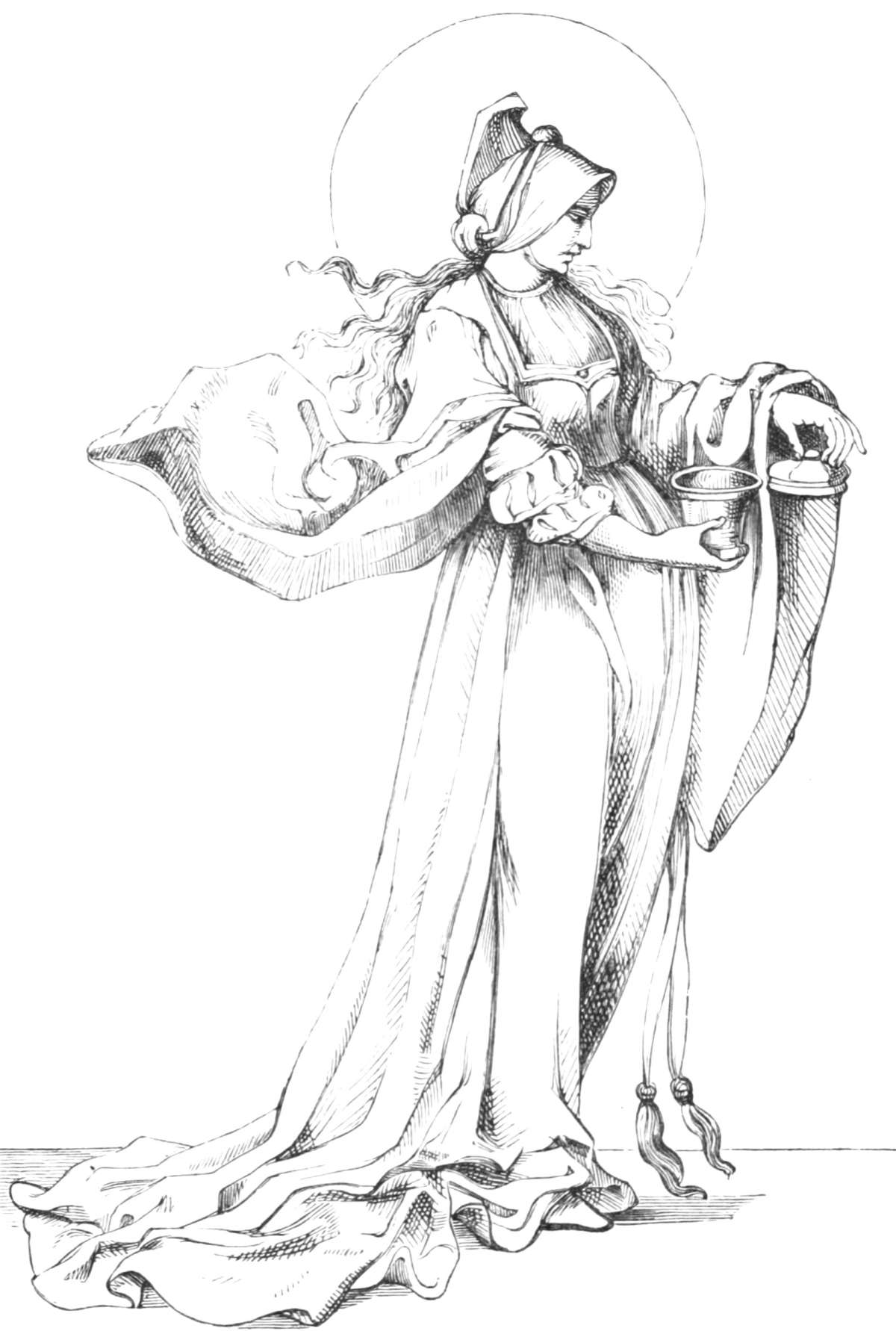
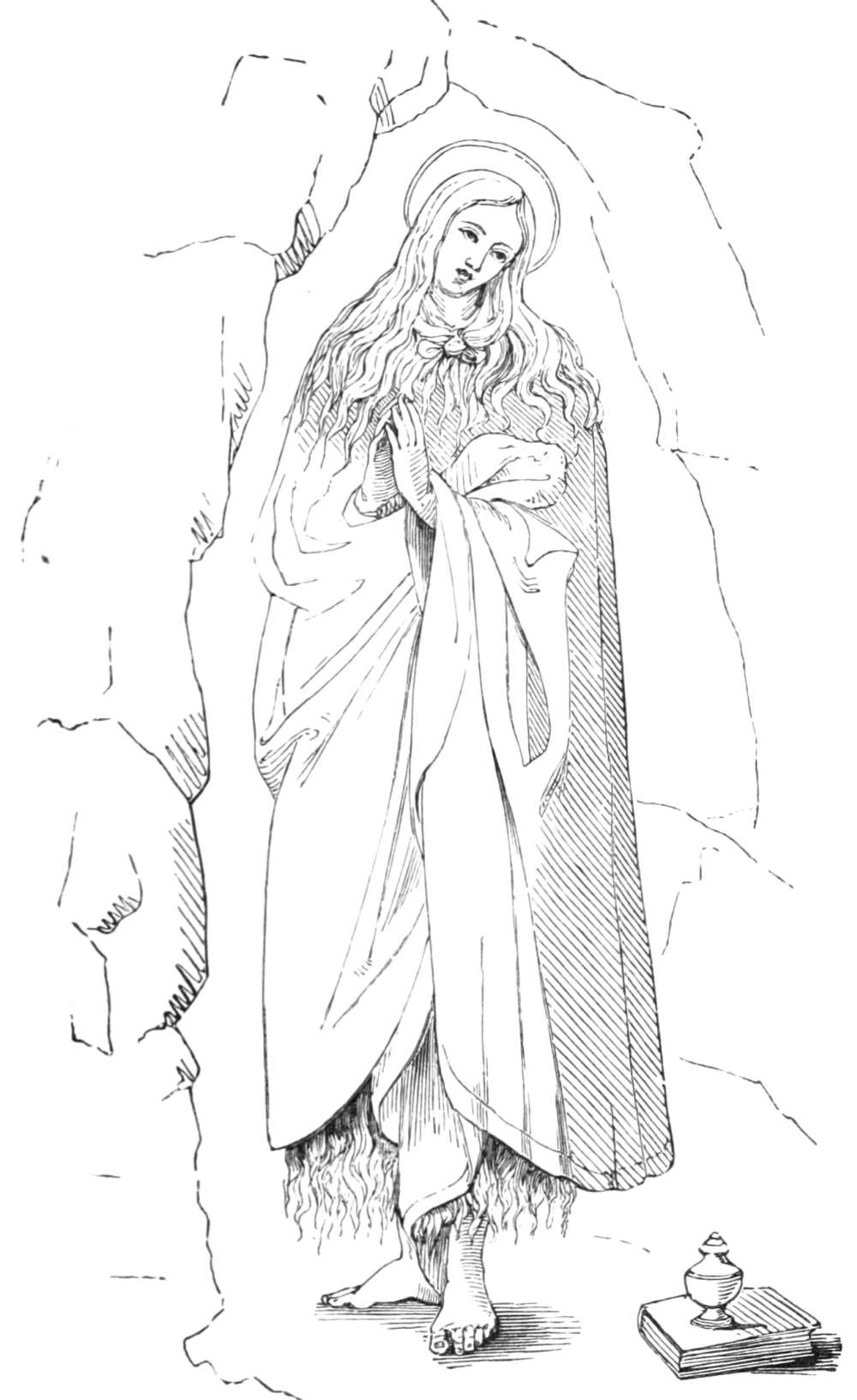
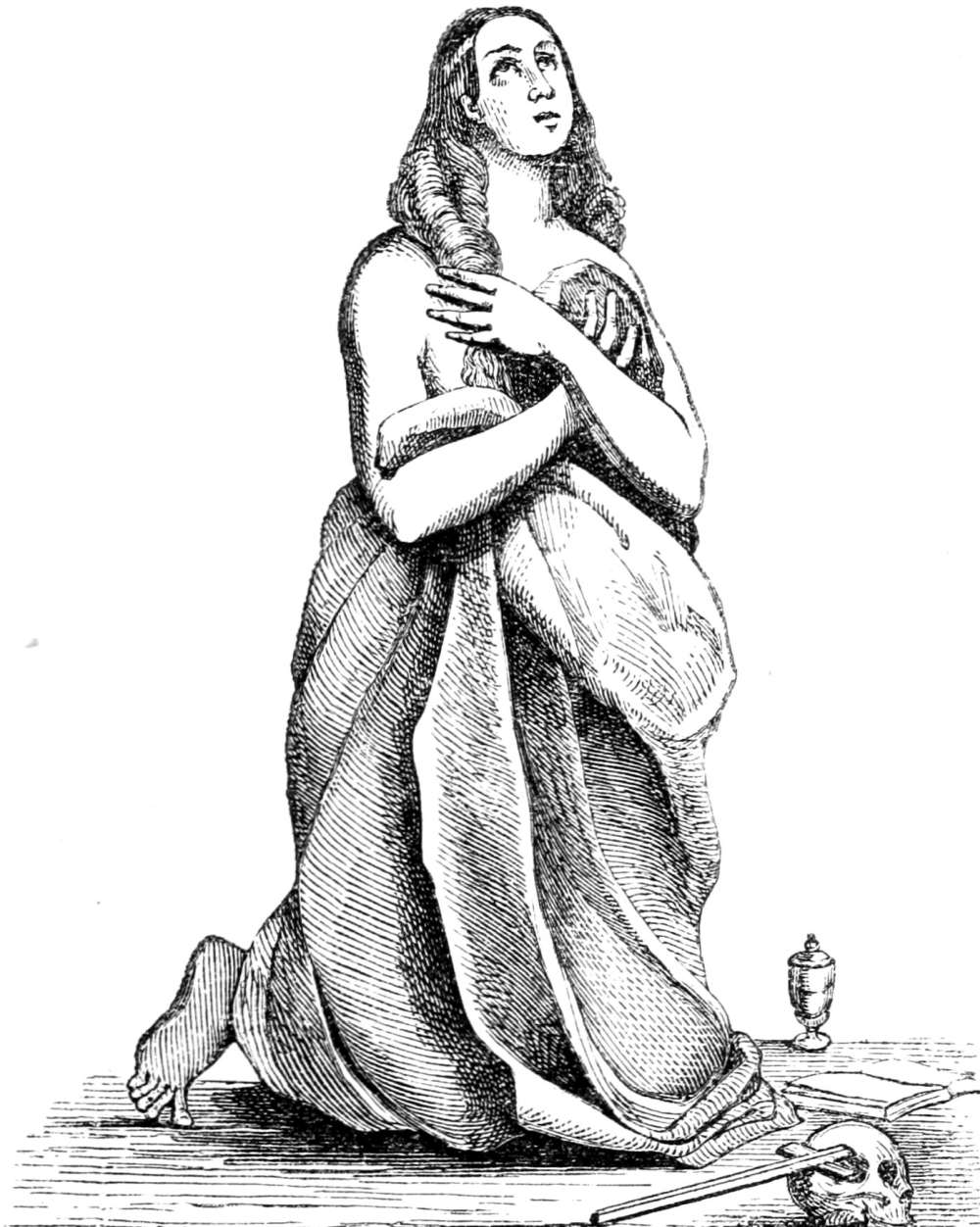
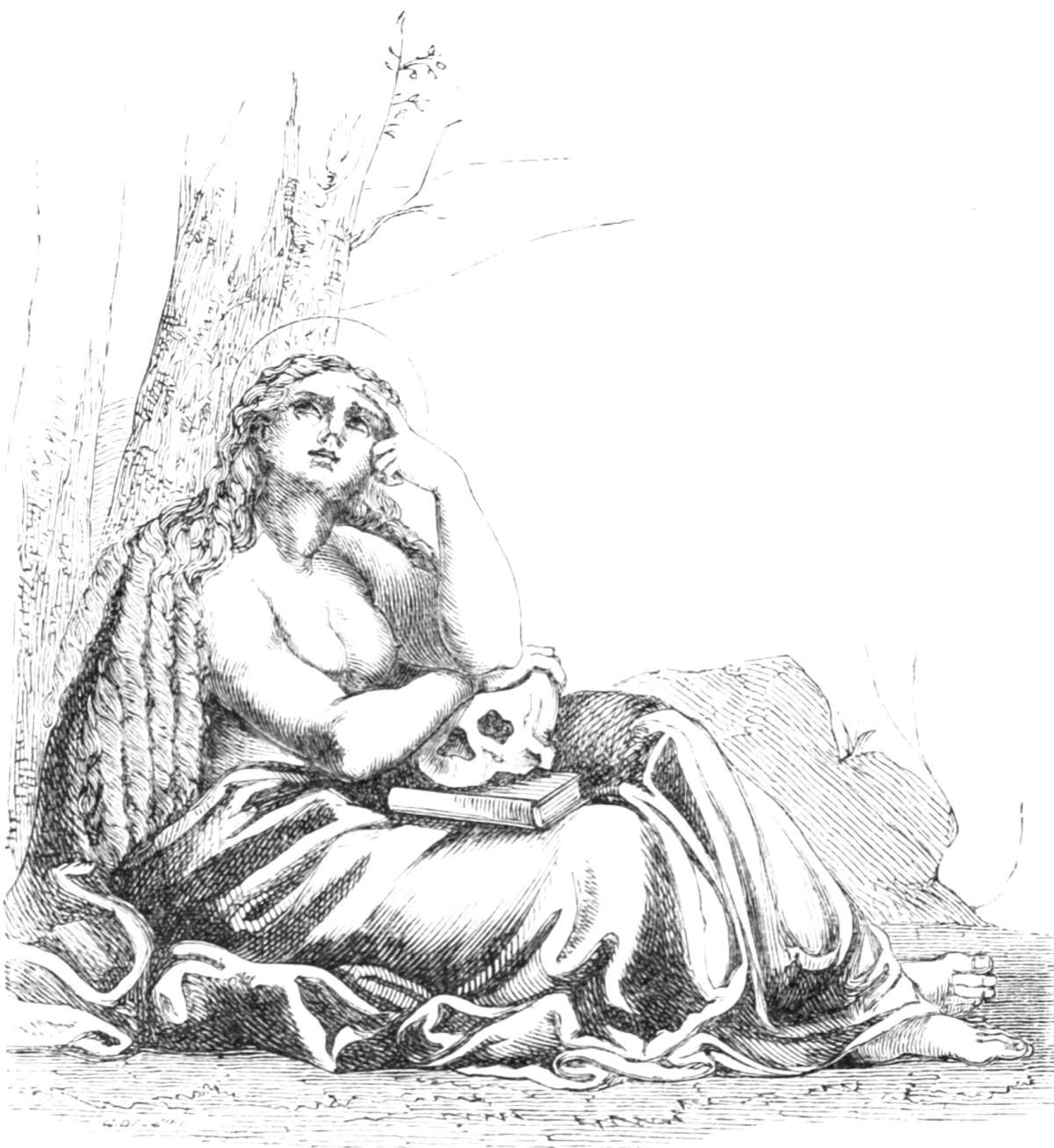
Obvious typographical errors have been silently corrected. Variations
in hyphenation and accents have been standardised but all other
spelling and punctuation remains unchanged.
The woodcut number 48, The Symbol of St. Matthew. Mosaic.,
does not exist.
The cover was prepared by the transcriber and is placed in the public
domain.
Sacred
AND
Legendary Art. VOL. I.
Sacred AND Legendary Art.
THE LATEST EDITIONS OF MRS. JAMESON’S WORKS ON
SACRED AND LEGENDARY CHRISTIAN ART.
The Fifth Edition, in 2 vols. square crown 8vo. with 19
Etchings on Copper and 187 Woodcuts, price 31s. 6d.
LEGENDS of the SAINTS and MARTYRS as
represented in the Fine Arts, forming the First Series of ‘Sacred
and Legendary Art.’ By Mrs. Jameson.
II. LEGENDS of the MONASTIC ORDERS. Third
Edition, with 11 Etchings and 88 Woodcuts. 1 vol. 21s.
III. LEGENDS of the MADONNA. Third Edition,
with 27 Etchings and 165 Woodcuts. 1 vol. 21s.
IV. HISTORY of OUR LORD as exemplified in Works
of Art. By Mrs. Jameson and Lady Eastlake. Second Edition, with
31 Etchings and 281 Woodcuts. 2 vols. 42s.
⁂ Of these 312 Illustrations, all prepared specially for the ‘History
of Our Lord,’ nearly one-third of the whole number have now been
engraved for the first time.
‘We have in these volumes,
penned in a truth-seeking spirit and
illustrated with a copious generosity
which at once elucidates and adorns
each section of the subject, contributions
to the literature of Christian
Art, for which every artist and every
student of theology will confess
debt of private gratitude. To thoughtful
inquirers, richest mines are here
opened for meditation. To minds
prepared for deeper draughts to
quench the thirst for knowledge, wells
are dug and fountains are made to
flow even in the desert tracks of time
where pilgrim’s foot seldom attempts
to tread. We think that Lady Eastlake
has done special service in
bringing into popular view recondite
stores which have hitherto been
sealed for public use. She has, by
appeal to the early heads of Christ in
the Catacombs, by reference to Christian
sarcophagi of the fourth century,
to ivories as old as the sixth century,
and Greek MSS. and Byzantine
miniatures of the ninth century,
enabled the art-student to tract the
history of types and antetypes, and to
analyse the rudimentary germs which,
from age to age accumulating strength
and growing in comeliness, at length
issued forth in perfected pictorial
form. It is to this, the infancy of art,
that at the present moment peculiar
interest attaches.’
Blackwood’s Magazine.
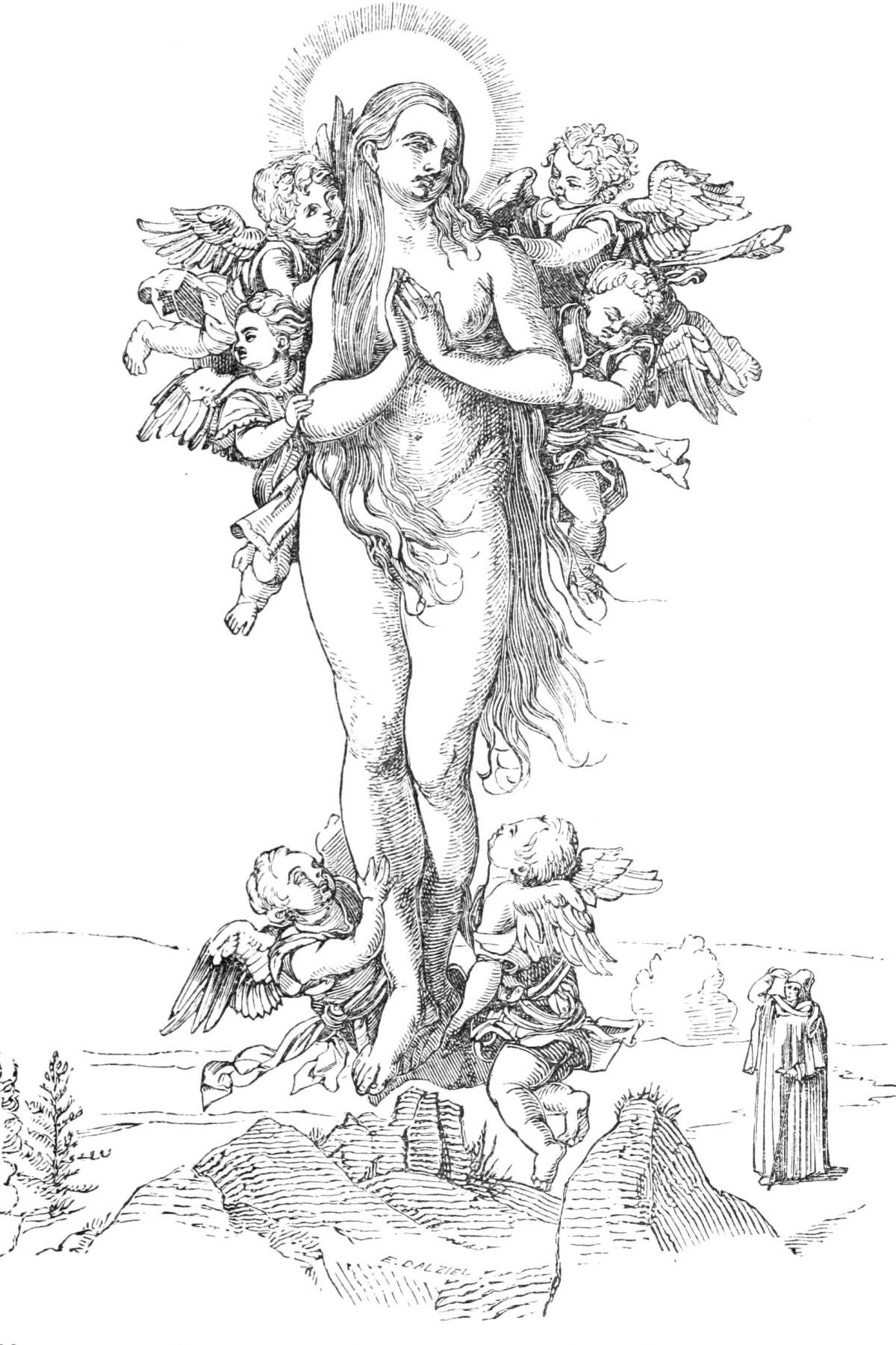
The Assumption of the Magdalena.
BY MRS. JAMESON.
VOLUME I. CONTAINING
LEGENDS OF THE ANGELS AND ARCHANGELS, THE EVANGELISTS,
THE APOSTLES, THE DOCTORS OF THE CHURCH,
AND ST. MARY MAGDALENE,
AS REPRESENTED IN THE FINE ARTS.
SIXTH EDITION.
LONDON:
LONGMANS, GREEN, AND CO.
1870.
LONDON: PRINTED BY
SPOTTISWOODE AND CO., NEW-STREET SQUARE
AND PARLIAMENT STREET
PREFACE To THE THIRD EDITION .
The Author ventures to hope that, on comparing this Third Edition of
‘Sacred and Legendary Art’ with the two preceding, it will be found
greatly improved, and rendered more worthy of the kind approbation and
sympathy with which it has been received. The whole has been carefully
revised; the references to the pictures and other works of Art corrected
from the latest authorities, and many new examples have been added. All
the Illustrations, which were formerly etched on copper, have been newly
etched on steel; two have been omitted, and three others, as more interesting
and appropriate, have been substituted; and twelve new woodcuts have
been introduced. In a work so multifarious in its nature, and comprising
so many hundred subjects and references, there may remain some errors and
omissions, but they have not occurred from want of care; and I must not
omit to express due thanks for the observations and corrections which have
been forwarded to me from time to time, and which have been in this
Edition carefully attended to.
A. J.
January 1857.
PREFACE To THE FIRST EDITION. (1848.)
This book was begun six years ago, in 1842. It has since been often laid
aside, and again resumed. In this long interval, many useful and delightful
works have been written on the same subject, but still the particular ground
I had chosen remained unoccupied; and, amid many difficulties, and the consciousness
of many deficiencies, I was encouraged to proceed, partly by the
pleasure I took in a task so congenial—partly by the conviction that such a
work has long been wanted by those who are not contented with a mere
manual of reference, or a mere catalogue of names. This book is intended
not only to be consulted, but to be read—if it be found worth reading. It
has been written for those who are, like myself, unlearned; yet less, certainly,
with the idea of instructing, than from a wish to share with others those
pleasurable associations, those ever new and ever various aspects of character
and sentiment, as exhibited in Art, which have been a source of such vivid
enjoyment to myself.
This is the utmost limit of my ambition; and, knowing that I cannot escape
criticism, I am at least anxious that there should be no mistake as to purpose
and intention. I hope it will be clearly understood that I have taken
throughout the æsthetic and not the religious view of those productions of
Art which, in as far as they are informed with a true and earnest feeling, and
steeped in that beauty which emanates from genius inspired by faith, may
cease to be Religion, but cannot cease to be Poetry; and as poetry only I
have considered them.
The difficulty of selection and compression has been the greatest of all my
difficulties; there is not a chapter in this book which might not have been
more easily extended to a volume than compressed into a few pages. Every
reader, however, who is interested in the subject, may supply the omissions,
follow out the suggestions, and enjoy the pleasure of discovering new exceptions,
new analogies, for himself. With regard to the arrangement, I am
afraid it will be found liable to objections; but it is the best that, after long
consideration and many changes, I could fix upon. It is not formal, nor
technical, like that of a catalogue or a calendar, but intended to lead the fancy
naturally from subject to subject as one opened upon another, with just sufficient
order to keep the mind unperplexed and the attention unfatigued amid
a great diversity of objects, scenes, stories, and characters.
The authorities for the legends have been the Legenda Aurea of Voragine,
in the old French and English translations; the Flos Sanctorum of Ribadeneira,
in the old French translation; the Perfetto Legendario, editions of
Rome and Venice; the Legende delle Sante Vergini, Florence and Venice;
the large work of Baillet, Les Vies des Saints, in thirty-two volumes, most
useful for the historical authorities; and Alban Butler’s Lives of the Saints.
All these have been consulted for such particulars of circumstance and character
as might illustrate the various representations, and then compressed
into a narrative as clear as I could render it. Where one authority only has
been followed, it is usually placed in the margin.
The First Part contains the legends of the scriptural personages and the
primitive fathers.
The Second Part contains those sainted personages who lived, or are supposed
to have lived, in the first ages of Christianity, and whose real history,
founded on fact or tradition, has been so disguised by poetical embroidery,
that they have in some sort the air of ideal beings. As I could not undertake
to go through the whole calendar, nor yet to make my book a catalogue of
pictures and statues, I have confined myself to the saints most interesting and
important, and (with very few exceptions) to those works of Art of which I
could speak from my own knowledge.
The legends of the monastic orders, and the history of the Franciscans and
Dominicans, considered merely in their connexion with the revival and development
of the Fine Arts in the thirteenth and fourteenth centuries, open so
wide a range of speculation,—the characteristics of these religious enthusiasts
of both sexes are so full of interest and beauty as artistic conceptions, and as
psychological and philosophical studies so extraordinary, that I could not, in
conscience, compress them into a few pages: they form a volume complete in
itself, entitled ‘Legends of the Monastic Orders.’
The little sketches and woodcuts are trifling as illustrations, and can only
assist the memory and the fancy of the reader but I regret this the less,
inasmuch as those who take an interest in the subject can easily illustrate the
book for themselves. To collect a portfolio of prints, including those works
of art which are cited under each head as examples, with a selection from the
hundreds of others which are not cited, and arrange them in the same order—with
reference, not to schools, or styles, or dates, but to subject merely—would
be an amusing, and I think not a profitless, occupation. It could not
be done in the right spirit without leading the mind far beyond the mere
pleasure of comparison and criticism, to ‘thoughts more elevate and reasonings
high’ of things celestial and terrestrial, as shadowed forth in form by
the wit and the hand of man.
CONTENTS OF THE FIRST VOLUME.
PAGE
Preface
v
Introduction:
I. Of the Origin and general Significance of the Legends represented in Art
Of Angels. Antiquity of the Belief in Angels. Early Notions respecting them.
How represented in the Old Testament. In the New Testament. Angelic
Hierarchies. The Nine Choirs. Seraphim, Cherubim. General Characteristics
in Painting. Infant Angels. Wings. Angels of Dante. Angels
as Messengers, Choristers, Guardians. As Ministers of Wrath. As Agents
in the Creation. Manner in which the principal Painters have set forth the
Angelic Forms and Attributes
St. Mark. His Legend. Devotional Pictures: as Evangelist; as the Disciple
of Peter; as the Patron Saint of Venice. The Legend of the Fisherman.
The Legend of the Christian Slave. The Translation of the Body of St.
Mark
St. John. His Legend. Devotional Pictures: as Evangelist; as Apostle; as
Prophet. Subjects from his Life; Legend of St. John and the Robber; of
the two Young Men; of Drusiana; of the Huntsman and the Partridge. The
Martyrdom of St. John. Legend of the Death of St. John. Legend of
Galla Placidia. Of King Edward the Confessor
Ancient Types: as Twelve Sheep; as Twelve Doves; as Twelve Men. How
grouped in Ecclesiastical Decoration. In the Old Mosaics; their proper
place. Examples from various Painters. Historical Subjects relating to the
Twelve Apostles: the Pentecost; the Separation of the Twelve Apostles to
preach the Gospel; the Twelve Baptisms; the Twelve Martyrdoms
St. Peter and St. Paul. The Ancient Greek Types. Examples of the early
Treatment of these two Apostles: in the old Mosaics; in early Sculpture;
in Pictures
St. Peter. His peculiar Attributes: as Apostle and Patron Saint; as the Head
and Founder of the Roman Church; St. Peter as Pope. Subjects from the
Scriptural Life of St. Peter. Legendary Stories connected with St. Peter.
The Legend of Simon Magus; of the ‘Domine, quo vadis?’ of Processus and Martinian. The Martyrdom of St. Peter. St. Peter as Keeper of the
Gates of Paradise. The Legend of St. Petronilla. The Life of St. Peter in
a Series of Subjects
St. Paul. Earliest Type. Attributes of St. Paul: the Sword. Subjects from
his Life. Stoning of Stephen. Conversion of St. Paul. The Vision of St.
Paul. Miracles of St. Paul. His Martyrdom. The Legend of Plautilla.
The Life of St. Paul in a Series of Subjects
St. Andrew. The Legend. Attributes. Historical Subjects from the Life of
St. Andrew. Flagellation. Adoration of the Cross. Martyrdom as represented
by Guido, Domenichino, and Murillo
St. James Major. Story and Character as represented in Scripture. St.
James as Patron of Spain. The Legend of Santiago. The Battle of Clavijo.
The Pilgrims of Compostella. The Devotional Figures and Attributes of
St. James the Apostle. As Tutelar Saint of Spain. Pictures from his
Legend
St. Philip. The Legend of the Idol and the Serpent. Devotional Pictures and
Attributes. Subjects from his Legend. Distinction between St. Philip the
Apostle and St. Philip the Deacon
St. Thomas. Origin of his peculiar Attribute. The Legend of King Gondoforus.
The Incredulity of St. Thomas. The Legend of the ‘Madonna della Cintola.’
Martyrdom of St. Thomas
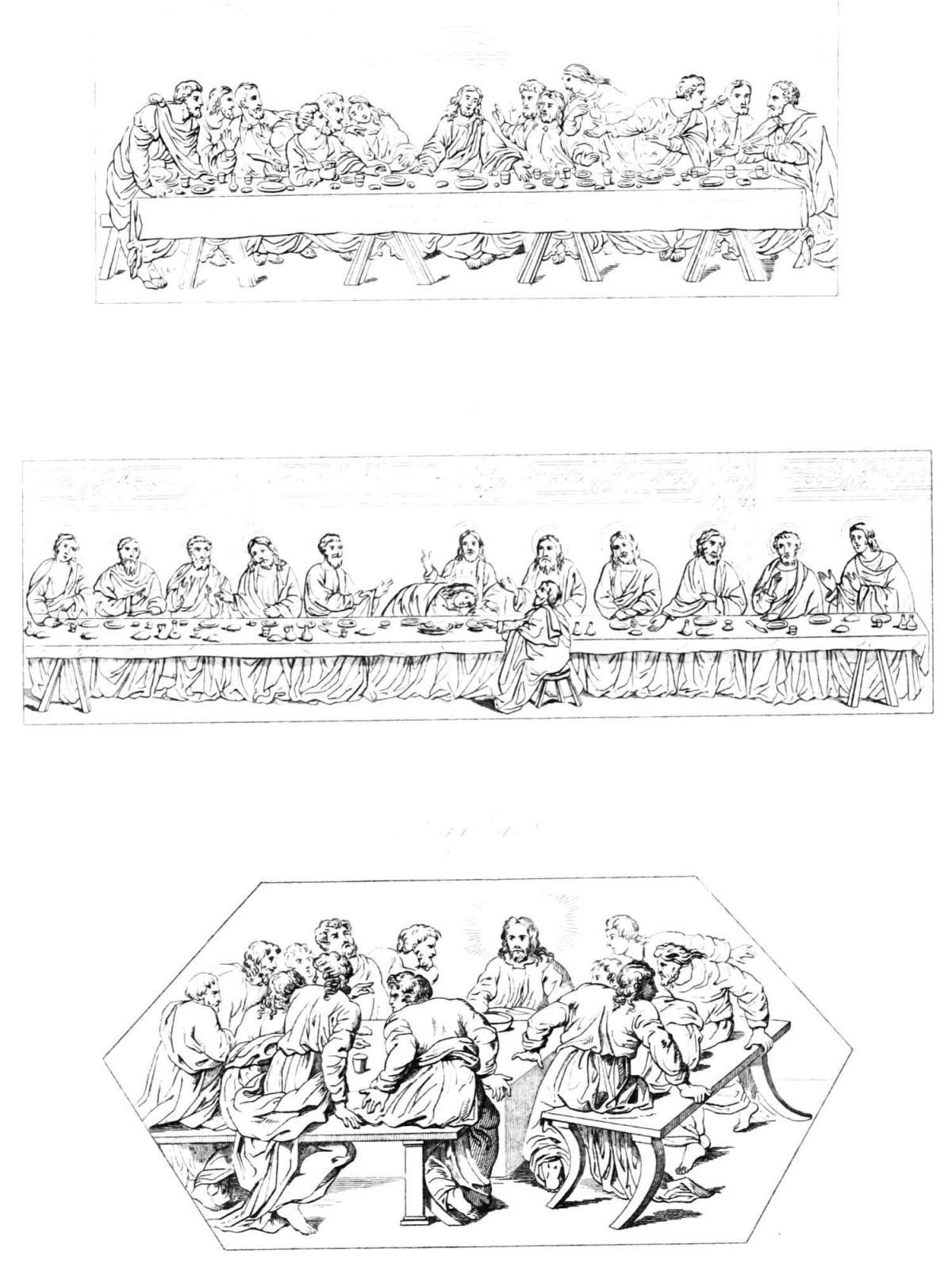
The Last Supper. Its importance as a Sacred Subject. Devotional when it
represents the Institution of the Eucharist. Historical when it represents
the Detection of Judas. Various Examples. Giotto. Duccio of Siena.
Angelico da Fiesole. Luca Signorelli. Ghirlandajo. Albert Dürer.
Leonardo da Vinci. Raphael. Andrea del Sarto. Titian. Poussin.
St. Jerome. History and Character. Influence over the Roman Women.
Origin of his Attributes. Legend of the Wounded Lion. Devotional
Figures of St. Jerome: as Patron Saint; as Translator of the Scriptures; as
Penitent. Subjects from the Life of St. Jerome. The Communion of
St. Jerome
St. Ambrose. Story and Character of St. Ambrose. The Emperor Theodosius.
The Discovery of the Martyrs St. Protasius and St. Gervasius. Legends
relating to St. Ambrose. The Prefect Macedonius. The Nobleman of
Tuscany. Devotional Figures of St. Ambrose. His peculiar Attributes.
His Church at Milan; his Life as represented on the Altar. Statue of St.
Ambrose
St. Augustine. Character of St. Augustine. His Shrine at Pavia, and Bassorelievos
representing his Life. Devotional Figures of St. Augustine. Represented
with his Mother, Monica. Various Subjects from his Life. The
Vision of St. Augustine
St. Gregory. His Story and Character. His Popularity. Legends connected
with his Life. Origin of his Attribute, the Dove. The Supper of St.
Gregory. The Mass of St. Gregory. The Miracle of the Brandeum. St.
Gregory releases the Soul of the Emperor Trajan. The Legend as represented
in Pictures. The Legend of the Monk. St. Gregory’s Doctrine of
Purgatory. How represented
St. John Chrysostom. Singular Legends with regard to him. The Penance
of St. Chrysostom. As represented in the German Prints. By Lucas
Cranach. By Beham. By Albert Dürer
ST. MARY MAGDALENE, ST. MARTHA, ST. LAZARUS, ST. MAXIMIN,
ST. MARCELLA, ST. MARY OF EGYPT, AND THE BEATIFIED
PENITENTS.
Character of Mary Magdalene. Disputes concerning her Identity. The Popular
and Scriptural Legend. The old Provençal Legend. The Devotional Representations:
as Patron Saint; as Penitent. Sacred Subjects in which she
is introduced. Legendary Subjects. La Danse de la Madeleine. The Assumption
of the Magdalene. The Legend of the Mother and Child. Her
Life in a Series of Subjects. Legends of Mary Magdalene and St. John the
Evangelist
St. Mary of Egypt. The Legend. Distinction between St. Mary of Egypt and
Mary Magdalene. Proper Attributes of Mary of Egypt. Stories and
Pictures from her Life
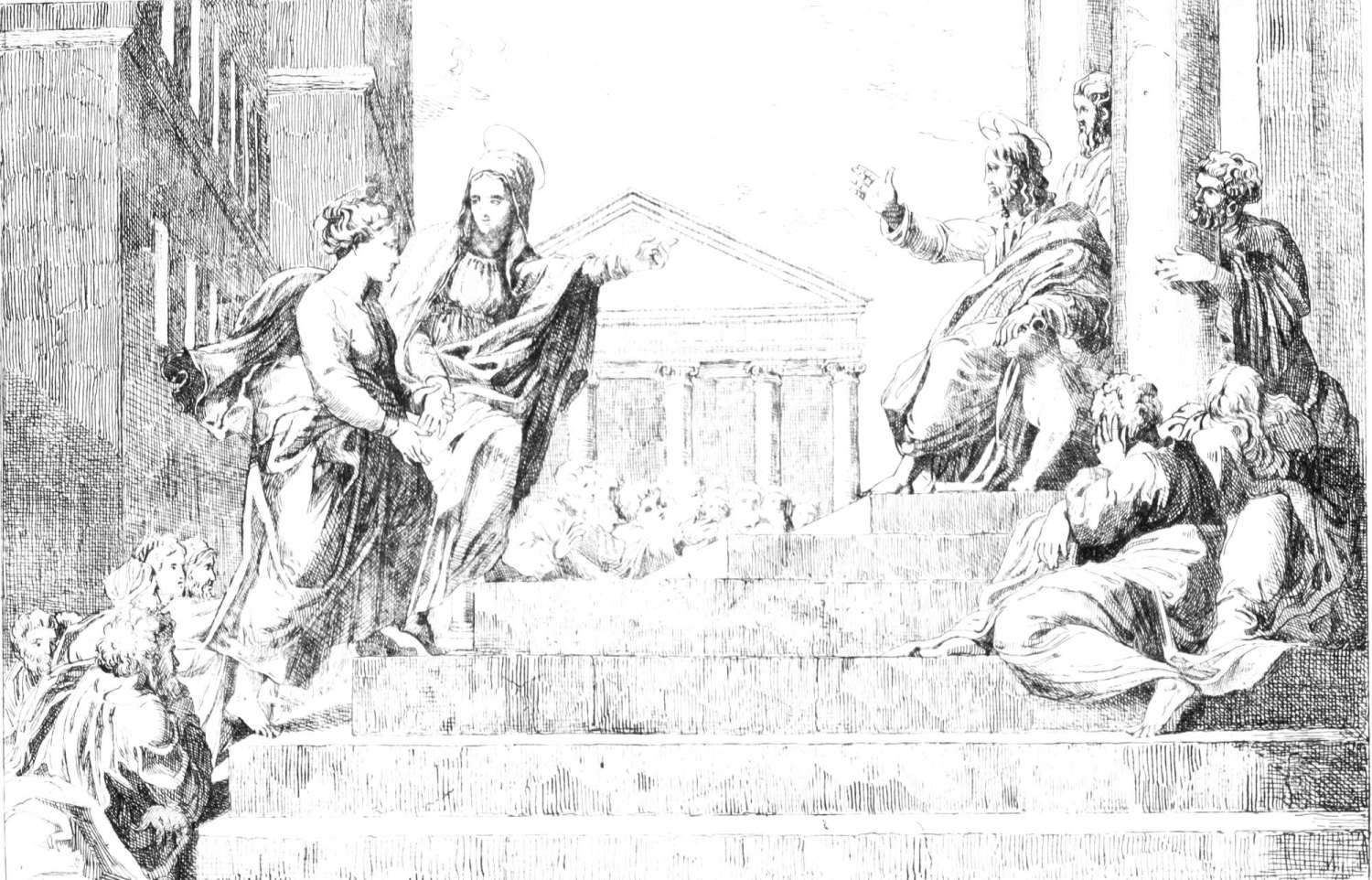
I. The Assumption of the Magdalene. After Giulio Romano. The Original
Fresco, which is in our National Gallery, was cut from the wall of the
Church of the Trinità de’ Monti, at Rome
Title
II. A Venetian Votive Picture in commemoration of a Pestilence (probably
the pestilence of 1512, in which Giorgione perished). St. Mark, enthroned
as the Patron Saint of Venice, holds his Gospel; on the right
St. Sebastian and St. Roch, Protectors against the Plague; on the left,
St. Cosmo and St. Damian, Patron Saints of the Healing Art. Sketch
after Titian. The Original Picture, remarkable for beauty of expression,
and splendour and harmony of colour, in the Church of S. Maria della
Salute, at Venice
IV. 1. St. Luke painting the Virgin. After the Picture in the Academy of St.
Luke attributed to Raphael. 2. St. Mark attended by St. Gregory.
After Correggio
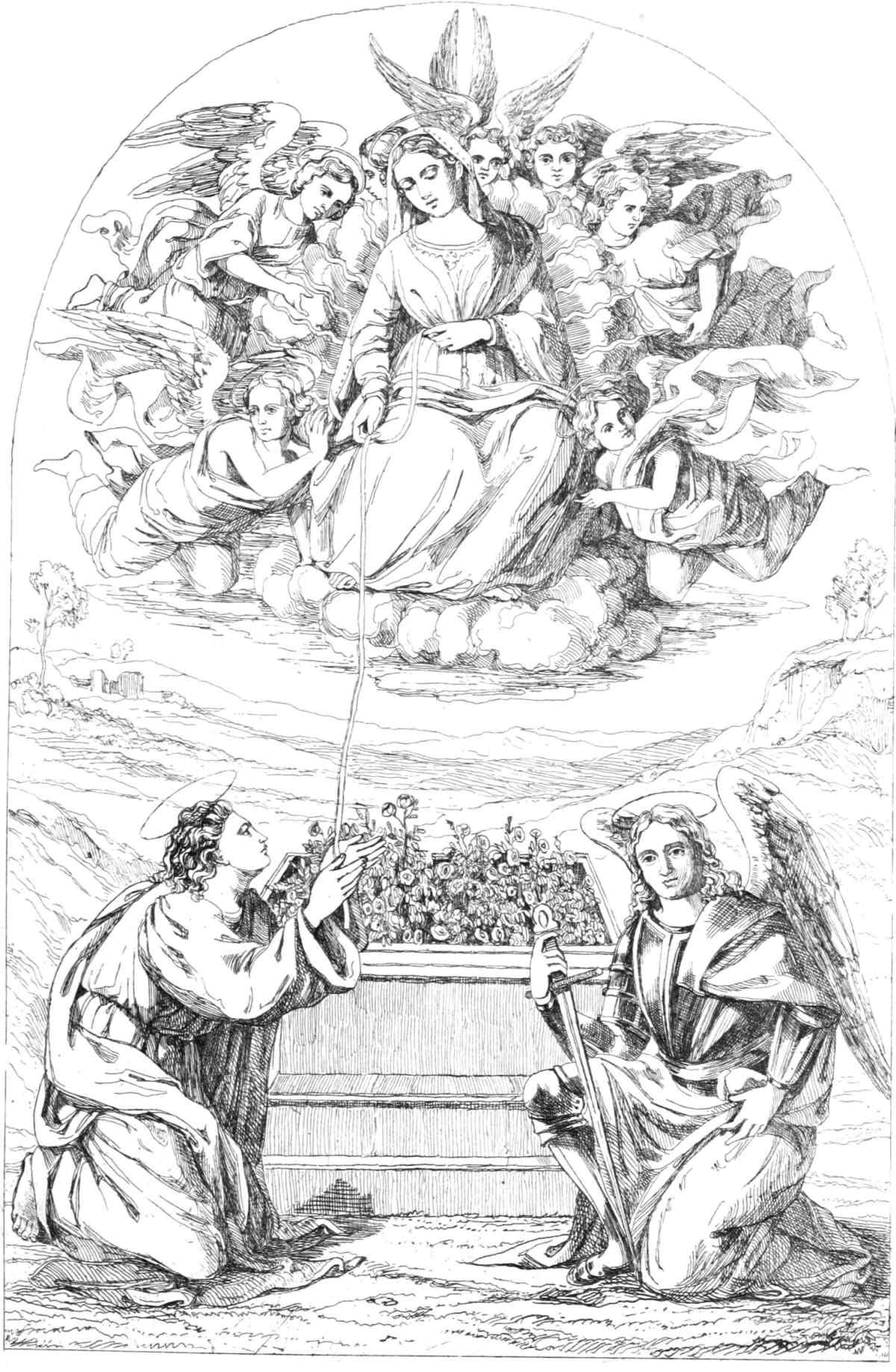
V. The Madonna della Cintola. The Virgin, as she ascends to heaven, presents
her girdle to St. Thomas; who kneels by the tomb, which is
full of roses. On the other side, the Archangel Michael, in reference to
the Legend. From a Picture by Francesco Granacci in the Florence
Gallery
Introduction. — I. Of the Origin and General Significance of the Legends represented in Art. — II. Of the Distinction to be drawn between the Devotional and the Historical Subjects. — III. Of certain Patron Saints , WHO ARE COMMONLY GROUPED TOGETHER IN WORKS OF ART, OR WHO BELONG TO PARTICULAR COUNTRIES, CITIES, OR LOCALITIES. — IV. Of certain Emblems and Attributes. — V. Of the Significance of Colours.
1 Laus Deo!
We cannot look round a picture gallery—we cannot turn over a
portfolio of prints after the old masters, nor even the modern engravings
which pour upon us daily, from Paris, Munich, or Berlin—without
perceiving how many of the most celebrated productions of
Art, more particularly those which have descended to us from the early
Italian and German schools, represent incidents and characters taken
from the once popular legends of the Catholic Church. This form
of ‘Hero-Worship’ has become, since the Reformation, strange to us—as
far removed from our sympathies and associations as if it were
antecedent to the fall of Babylon and related to the religion of Zoroaster,
instead of being left but two or three centuries behind us and
closely connected with the faith of our forefathers and the history of
civilisation and Christianity. Of late years, with a growing passion
for the works of Art of the Middle Ages, there has arisen among us a
desire to comprehend the state of feeling which produced them, and
the legends and traditions on which they are founded;—a desire to
understand, and to bring to some surer critical test, representations
which have become familiar without being intelligible. To enable us
to do this, we must pause for a moment at the outset; and, before we
plunge into the midst of things, ascend to higher ground, and command
a far wider range of illustration than has yet been attempted, in order
to take cognizance of principles and results which, if not new, must
be contemplated in a new relation to each other.
The Legendary Art of the Middle Ages sprang out of the legendary
literature of the preceding ages. For three centuries at least, this
literature, the only literature which existed at the time, formed the sole
mental and moral nourishment of the people of Europe. The romances
of Chivalry, which long afterwards succeeded, were confined to particular
classes, and left no impress on Art, beyond the miniature illuminations
of a few manuscripts. This legendary literature, on the
contrary, which had worked itself into the life of the people, became,
like the antique mythology, as a living soul diffused through the
loveliest forms of Art, still vivid and vivifying, even when the old faith
in its mystical significance was lost or forgotten. And it is a mistake to
suppose that these legends had their sole origin in the brains of dreaming
monks. The wildest of them had some basis of truth to rest on, and the
forms which they gradually assumed were but the necessary result of
the age which produced them. They became the intense expression of
that inner life, which revolted against the desolation and emptiness of
the outward existence; of those crushed and outraged sympathies which
cried aloud for rest, and refuge, and solace, and could nowhere find them.
It will be said, ‘In the purer doctrine of the Gospel.’ But where was
that to be found? The Gospel was not then the heritage of the poor:
Christ, as a comforter, walked not among men. His own blessed
teaching was inaccessible except to the learned: it was shut up in rare
manuscripts; it was perverted and sophisticated by the passions and the
blindness of those few to whom it was accessible. The bitter disputes
in the early Church relative to the nature of the Godhead, the subtle
distinctions and incomprehensible arguments of the theologians, the
dread entertained by the predominant church of any heterodox opinions
concerning the divinity of the Redeemer, had all conspired to remove
Him, in his personal character of Teacher and Saviour, far away from
the hearts of the benighted and miserable people—far, far away into
regions speculative, mysterious, spiritual, whither they could not, dared
not follow Him. In this state of things, as it has been remarked by a
distinguished writer, ‘Christ became the object of a remoter, a more
awful adoration. The mind began, therefore, to seek out, or eagerly to
seize, some other more material beings in closer alliance with human
sympathies.’ And the same author, after tracing in vivid and beautiful
language the dangerous but natural consequences of this feeling, thus
sums up the result: ‘During the perilous and gloomy days of persecution,
the reverence for those who endured martyrdom for the religion
of Christ had grown up out of the best feelings of man’s improved
nature. Reverence gradually grew into veneration, worship, adoration:
and although the more rigid theology maintained a marked distinction
between the honour shown to the martyrs, and that addressed to the
Redeemer and the Supreme Being, the line was too fine and invisible
not to be transgressed by excited popular feeling.’[1]
‘We live,’ says the poet, ‘through admiration, hope, and love.’
Out of these vital aspirations—not indeed always ‘well or wisely
placed,’ but never, as in the heathen mythology, degraded to vicious
and contemptible objects—arose and spread the universal passion for
the traditional histories of the saints and martyrs,—personages endeared
and sanctified in all hearts, partly as examples of the loftiest
virtue, partly as benign intercessors between suffering humanity and
that Deity who, in every other light than as a God of Vengeance, had
been veiled from their eyes by the perversities of schoolmen and
fanatics, till He had receded beyond their reach, almost beyond their
comprehension. Of the prevalence and of the incalculable influence of
this legendary literature from the seventh to the tenth century, that is,
just about the period when Modern Art was struggling into existence,
we have a most striking picture in Guizot’s ‘Histoire de la Civilisation.’
‘As after the siege of Troy (says this philosophical and
eloquent writer) there were found, in every city of Greece, men who
collected the traditions and adventures of heroes, and sung them for the
recreation of the people, till these recitals became a national passion, a
national poetry, so, at the time of which we speak, the traditions of what
may be called the heroic ages of Christianity had the same interest for
the nations of Europe. There were men who made it their business to
collect them, to transcribe them, to read or recite them aloud, for the
edification and delight of the people. And this was the only literature,
properly so called, of that time.‘
Now, if we go back to the authentic histories of the sufferings and
heroism of the early martyrs, we shall find enough there, both of the
wonderful and the affecting, to justify the credulity and enthusiasm of
the unlettered people, who saw no reason why they should not believe
in one miracle as well as in another. In these universally diffused
legends, we may recognise the means, at least one of the means, by
which a merciful Providence, working through its own immutable
laws, had provided against the utter depravation, almost extinction, of
society. Of the ‘Dark Ages,’ emphatically so called, the period to
which I allude was perhaps the darkest; it was ‘of Night’s black arch
the key-stone.’ At a time when men were given over to the direst
evils that can afflict humanity,—ignorance, idleness, wickedness, misery;
at a time when the every-day incidents of life were a violation of all
the moral instincts of mankind; at a time when all things seemed
abandoned to a blind chance, or the brutal law of force; when there
was no repose, no refuge, no safety anywhere; when the powerful inflicted,
and the weak endured, whatever we can conceive of most revolting
and intolerable; when slavery was recognised by law throughout
Europe; when men fled to cloisters, to shut themselves from oppression,
and women to shield themselves from outrage; when the manners were
harsh, the language gross; when all the softer social sentiments, as
pity, reverence, tenderness, found no resting-place in the actual relations
of life; when for the higher ranks there was only the fierce excitement
of war, and on the humbler classes lay the weary, dreary monotony of
a stagnant existence, poor in pleasures of every kind, without aim,
without hope; then—wondrous reaction of the ineffaceable instincts of
good implanted within us!—arose a literature which reversed the outward
order of things, which asserted and kept alive in the hearts of men
those pure principles of Christianity which were outraged in their daily
actions; a literature in which peace was represented as better than war,
and sufferance more dignified than resistance; which exhibited poverty
and toil as honourable, and charity as the first of virtues; which held
up to imitation and emulation, self-sacrifice in the cause of good and
contempt of death for conscience’ sake: a literature, in which the
tenderness, the chastity, the heroism of woman, played a conspicuous
part; which distinctly protested against slavery, against violence, against
impurity in word and deed; which refreshed the fevered and darkened
spirit with images of moral beauty and truth; revealed bright glimpses
of a better land, where ‘the wicked cease from troubling,’ and brought
down the angels of God with shining wings and bearing crowns of
glory, to do battle with the demons of darkness, to catch the fleeting
soul of the triumphant martyr, and carry it at once into a paradise of
eternal blessedness and peace!
Now the Legendary Art of the three centuries which comprise the
revival of learning, was, as I have said, the reflection of this literature,
of this teaching. Considered in this point of view, can we easily overrate
its interest and importance?
When, after the long period of darkness which followed upon the
decline of the Roman Empire, the Fine Arts began to revive, the first,
and for several ages the only, impress they received was that of the religious
spirit of the time. Painting, Sculpture, Music, and Architecture,
as they emerged one after another from the ‘formless void,’ were
pressed into the service of the Church. But it is a mistake to suppose
that in adroitly adapting the reviving Arts to her purposes, in that
magnificent spirit of calculation which at all times characterised her, the
Church from the beginning selected the subjects, or dictated the use
that was to be made of them. We find, on the contrary, edicts and
councils repressing the popular extravagances in this respect, and
denouncing those apocryphal versions of sacred events and traditions
which had become the delight of the people. But vain were councils
and edicts; the tide was too strong to be so checked. The Church
found herself obliged to accept and mould to her own objects the exotic
elements she could not eradicate. She absorbed, so to speak, the evils
and errors she could not expel. There seems to have been at this time
a sort of compromise between the popular legends, with all their wild
mixture of northern and classical superstitions, and the Church legends
properly so called. The first great object to which reviving Art was
destined, was to render the Christian places of worship a theatre of
instruction and improvement for the people, to attract and to interest
them by representations of scenes, events, and personages, already so
familiar as to require no explanation, appealing; at once to their intelligence
and their sympathies; embodying in beautiful shapes (beautiful
at least in their eyes) associations and feelings and memories deep-rooted
in their very hearts, and which had influenced, in no slight degree, the
progress of civilisation, the development of mind. Upon these creations
of ancient Art we cannot look as those did for whom they were created;
we cannot annihilate the centuries which lie between us and them; we
cannot, in simplicity of heart, forget the artist in the image he has
placed before us, nor supply what may be deficient in his work, through
a reverentially excited fancy. We are critical, not credulous. We no
longer accept this polytheistic form of Christianity; and there is little
danger, I suppose, of our falling again into the strange excesses of
superstition to which it led. But if we have not much sympathy with
modern imitations of Mediæval Art, still less should we sympathise
with that narrow puritanical jealousy which holds the monuments of a
real and earnest faith in contempt. All that God has permitted once to
exist in the past should be considered as the possession of the present;
sacred for example or warning, and held as the foundation on which to
build up what is better and purer. It should seem an established fact,
that all revolutions in religion, in government, and in art, which begin
in the spirit of scorn, and in a sweeping destruction of the antecedent
condition, only tend to a reaction. Our puritanical ancestors chopped
off the heads of Madonnas and Saints, and paid vagabonds to smash the
storied windows of our cathedrals;—now, are these rejected and outraged
shapes of beauty coming back to us, or are we not rather going
back to them? As a Protestant, I might fear lest in doing so we confound
the eternal spirit of Christianity with the mutable forms in which
it has deigned to speak to the hearts of men, forms which must of
necessity vary with the degree of social civilisation, and bear the impress
of the feelings and fashions of the age which produced them; but I
must also feel that we ought to comprehend, and to hold in due reverence,
that which has once been consecrated to holiest aims, which has
shown us what a magnificent use has been made of Art, and how it may
still be adapted to good and glorious purposes, if, while we respect these
time-consecrated images and types, we do not allow them to fetter us,
but trust in the progressive spirit of Christianity to furnish us with new
impersonations of the good—new combinations of the beautiful. I hate
the destructive as I revere the progressive spirit. We must laugh if
any one were to try and persuade us that the sun was guided along his
blazing path by a ‘fair-haired god who touched a golden lyre;’ but
shall we therefore cease to adore in the Apollo Belvedere the majestic
symbol of light, the most divine impersonation of intellectual power and
beauty? So of the corresponding Christian symbols:—may that time
never come, when we shall look up to the effigy of the winged and
radiant angel trampling down the brute-fiend, without a glow of faith
in the perpetual supremacy and final triumph of good over evil!
It is about a hundred years since the passion, or the fashion, for collecting
works of Art, began to be generally diffused among the rich and
the noble of this land; and it is amusing to look back and to consider
the perversions and affectations of the would-be connoisseurship during
this period;—the very small stock of ideas on which people set up a
pretension to taste—the false notions, the mixture of pedantry and
ignorance, which everywhere prevailed. The publication of Richardson’s
book, and Sir Joshua Reynolds’s Discourses, had this advantage,—that
they, to a certain degree, diffused a more elevated idea of Art
as Art, and that they placed connoisseurship on a better and truer basis.
In those days we had Inquiries into the Principles of Taste, Treatises
on the Sublime and Beautiful, Anecdotes of Painting; and we abounded
in Antiquarian Essays on disputed Pictures and mutilated Statues:
but then, and up to a late period, any inquiry into the true spirit and
significance of works of Art, as connected with the history of Religion
and Civilisation, would have appeared ridiculous—or perhaps
dangerous:—we should have had another cry of ‘No Popery,’ and
acts of parliament forbidding the importation of Saints and Madonnas.
It was fortunate, perhaps, that connoisseurs meddled not with such
high matters. They talked volubly and harmlessly of ‘hands,’ and
‘masters,’ and ‘schools,’—of ‘draperies,’ of ‘tints,’ of ‘handling,’—of
‘fine heads,’ ‘fine compositions;’ of ‘the grace of Raphael,’ and
of the ‘Correggiosity of Correggio.’ The very manner in which the
names of the painters were pedantically used instead of the name of
the subject, is indicative of this factitious feeling; the only question
at issue was, whether such a picture was a genuine ‘Raphael?’ such
another a genuine ‘Titian?’ The spirit of the work—whether that
was genuine; how far it was influenced by the faith and the condition
of the age which produced it; whether the conception was properly
characteristic, and of what it was characteristic—of the subject? or of
the school? or of the time?—whether the treatment corresponded to
the idea within our own souls, or was modified by the individuality of
the artist, or by received conventionalisms of all kinds?—these were
questions which had not then occurred to any one; and I am not sure
that we are much wiser even now: yet, setting aside all higher considerations,
how can we do common justice to the artist, unless we can
bring his work to the test of truth? and how can we do this, unless we
know what to look for, what was intended as to incident, expression,
character? One result of our ignorance has been the admiration
wasted on the flimsy mannerists of the later ages of Art; men who
apparently had no definite intention in anything they did, except a
dashing outline, or a delicate finish, or a striking and attractive management
of colour.
It is curious, this general ignorance with regard to the subjects of
Mediæval Art, more particularly now that it has become a reigning
fashion among us. We find no such ignorance with regard to the
subjects of Classical Art, because the associations connected with them
form a part of every liberal education. Do we hear any one say, in
looking at Annibal Caracci’s picture in the National Gallery, ‘Which
is Silenus, and which is Apollo?’ Who ever confounds a Venus with
a Minerva, or a Vestal with an Amazon; or would endure an undraped
Juno, or a beardless Jupiter? Even the gardener in Zeluco knew
Neptune by his ‘fork,’ and Vulcan by his ‘lame leg.’ We are indeed
so accustomed, in visiting the churches and the galleries abroad, and
the collections at home, to the predominance of sacred subjects, that it
has become a mere matter of course, and excites no particular interest
and attention. We have heard it all accounted for by the fact that the
Church and churchmen were the first, and for a long time the only,
patrons of Art. In every sacred edifice, and in every public or private
collection enriched from the plunder of sacred edifices, we look for the
usual proportion of melancholy martyrdoms and fictitious miracles,—for
the predominance of Madonnas and Magdalenes, St. Catherines
and St. Jeromes: but why these should predominate, why certain
events and characters from the Old and the New Testament should
be continually repeated, and others comparatively neglected; whence
the predilection for certain legendary personages, who seemed to be
multiplied to infinity, and the rarity of others; of this we know
nothing.
We have learned, perhaps, after running through half the galleries
and churches in Europe, to distinguish a few of the attributes and
characteristic figures which meet us at every turn, yet without any
clear idea of their meaning, derivation, or relative propriety. The
palm of victory, we know, designates the martyr triumphant in death.
We so far emulate the critical sagacity of the gardener in Zeluco that
we have learned to distinguish St. Laurence by his gridiron, and
St. Catherine by her wheel. We are not at a loss to recognise the
Magdalene’s ‘loose hair and lifted eye,’ even when without her skull
and her vase of ointment. We learn to know St. Francis by his brown
habit and shaven crown and wasted ardent features; but do we
distinguish him from St. Anthony, or St. Dominick? As for St.
George and the dragon—from the St. George of the Louvre,—Raphael’s,—who
sits his horse with the elegant tranquillity of one
assured of celestial aid, down to him ‘who swings on a sign post at
mine hostess’s door,’—he is our familiar acquaintance. But who is
that lovely being in the first blush of youth, who, bearing aloft the
symbolic cross, stands with one foot on the vanquished dragon? ‘That
is a copy after Raphael.’ And who is that majestic creature holding
her palm branch, while the unicorn crouches at her feet? ‘That is the
famous Moretto at Vienna.’ Are we satisfied?—not in the least! but
we try to look wiser, and pass on.
In the old times the painters of these legendary scenes and subjects
could always reckon securely on certain associations and certain sympathies
in the minds of the spectators. We have outgrown these
associations, we repudiate these sympathies. We have taken these
works from their consecrated localities, in which they once held each
their dedicated place, and we have hung them in our drawing-rooms
and our dressing-rooms, over our pianos and our side-boards—and now
what do they say to us? That Magdalene, weeping amid her hair,
who once spoke comfort to the soul of the fallen sinner—that Sebastian,
arrow-pierced, whose upward ardent glance spoke of courage and
hope to the tyrant-ridden serf,—that poor tortured slave, to whose aid
St. Mark comes sweeping down from above,—can they speak to us of
nothing save flowing lines and correct drawing and gorgeous colour?
must we be told that one is a Titian, the other a Guido, the third a
Tintoret, before we dare to melt in compassion or admiration?—or the
moment we refer to their ancient religious signification and influence,
must it be with disdain or with pity? This, as it appears to me, is to
take not a rational, but rather a most irrational as well as a most irreverent,
view of the question; it is to confine the pleasure and improvement
to be derived from works of Art within very narrow bounds; it
is to seal up a fountain of the richest poetry, and to shut out a thousand
ennobling and inspiring thoughts. Happily there is a growing appreciation
of these larger principles of criticism as applied to the study of
Art. People look at the pictures which hang round their walls, and
have an awakening suspicion that there is more in them than meets the
eye—more than mere connoisseurship can interpret; and that they
have another, a deeper, significance than has been dreamed of by picture
dealers and picture collectors, or even picture critics.
At first, when entering on a subject so boundless and so diversified, we
are at a loss for some leading classification which shall be distinct and
intelligible, without being mechanical. It appears to me, that all sacred
representations, in as far as they appeal to sentiment and imagination,
resolve themselves into two great classes, which I shall call the DEVOTIONAL
and the HISTORICAL.
Devotional pictures are those which portray the objects of our veneration
with reference only to their sacred character, whether standing
singly or in company with others. They place before us no action or
event, real or supposed. They are neither portrait nor history. A
group of sacred personages where no action is represented, is called in
Italian a ‘sacra conversazione:’ the word conversazione, which signifies
a society in which there is communion, being here, as it appears
to me, used with peculiar propriety. All subjects, then, which exhibit
to us sacred personages, alone or in groups, simply in the character of
superior beings, must be considered as devotionally treated.
But a sacred subject, without losing wholly its religious import,
becomes historical the moment it represents any story, incident, or
action, real or imagined. All pictures which exhibit the events of
Scripture story, all those which express the actions, miracles, and martyrdoms
of saints, come under this class; and to this distinction I must
call the attention of the reader, requesting that it may be borne in mind
throughout this work.
We must also recollect that a story, action, or fact may be so represented
as to become a symbol expressive of an abstract idea: and some
scriptural and some legendary subjects may be devotional, or historical,
according to the sentiment conveyed: for example, the Crucifixion and
the Last Supper may be so represented as either to exhibit an event, or
to express a symbol of our Redemption. The raising of Lazarus exhibits,
in the catacombs, a mystical emblem of the general resurrection;
in the grand picture by Sebastian del Piombo, in our National Gallery,
it is a scene from the life of our Saviour. Among the legendary
subjects, the penance of the Magdalene, and St. Martin dividing his
cloak, may be merely incidents, or they may be symbolical, the first of
penitence, the latter of charity, in the general sense. And, again, there
are some subjects which, though expressing a scene or an action, are
wholly mystical and devotional in their import; as the vision of St.
Augustine, and the marriage of St. Catherine.
Among the grandest of the devotional subjects, we may reckon those
compositions which represent the whole celestial hierarchy; the divine
personages of the Trinity, the angels and archangels, and the beatified
spirits of the just. Such is the subject called the ‘Paradiso,’ so often
met with in pictures and ecclesiastical decoration, where Christ is enthroned
in glory: such is also the Coronation of the Virgin, that ancient
and popular symbol of the triumph of Religion or the Church; the
Adoration of the Lamb; and the Last Judgment, from the Apocalypse.
The order of precedence in these sacred assemblages was early settled
by ecclesiastical authority, and was almost as absolute as that of a
modern code of honour. First after the Trinity, the Virgin Mary, as
Regina Angelorum, and St. John the Baptist: then, in order, the
Evangelists; the Patriarchs; the Prophets; the Apostles; the Fathers;
the Bishops; the Martyrs; the Hermits; the Virgins; the Monks,
Nuns, and Confessors.
As examples, I may cite the Paradiso of Angelico, in the Florence
Academy; the Coronation of the Virgin by Hans Memling, in the
Wallerstein collection, which contains not less than fifty-two figures, all
individualised with their proper attributes; and which, if it were possible,
should be considered in contrast with the Coronation by Angelico.
The Flemish painter seems to have carried his intense impression of
earthly and individual life into the regions of heaven; the Italian,
through a purer inspiration, seems to have brought all Paradise down
before us upon earth. In the Adoration of the Lamb by Van Eyck,
there are not fewer than two hundred figures. For the Last Judgment,
the grand compositions of Orcagna in the Campo Santo,—of
Luca Signorelli and Angelico at Orvieto,—and the fresco of Michael
Angelo in the Sistine Chapel, may be consulted.
Where the usual order is varied, there is generally some reason for
it; for instance, in the exaltation of a favourite saint, as we sometimes
find St. Dominick and St. Francis by the side of St. Peter and St.
Paul: and among the miniatures of that extraordinary MS., the Hortus
Deliciarum, now at Strasbourg, painted for a virgin abbess, there is a
‘Paradiso’ in which the painter, either by her command or in compliment
to her, has placed the virgins immediately after the angels.
The representation of the Virgin and Child with saints grouped
around them, is a devotional subject familiar to us from its constant recurrence.
It also frequently happens that the tutelary saint of the
locality, or the patron saint of the votary, is represented as seated on a
raised throne in the centre; and other saints, though under every other
circumstance taking a superior rank, become here accessories, and are
placed on each side or lower down in the picture: for example, where
St. Augustine is enthroned, and St. Peter and St. Paul stand on each
side, as in a picture by B. Vivarini,[2] or where St. Barbara is enthroned,
and Mary Magdalene and St. Catherine stand on each side, as in a
picture by Matteo di Siena.[3]
In such pictures, the votary or donor is often introduced kneeling at
the feet of his patron, either alone or accompanied by his wife and other
members of his family: and to express the excess of his humility, he is
sometimes so diminutive in proportion to the colossal object of his veneration,
as to be almost lost to sight; we have frequent examples of this
naïveté of sentiment in the old mosaics and votive altar-pieces; for
instance, in a beautiful old fresco at Assisi, where the Magdalene, a
majestic figure about six feet high, holds out her hand in benediction to
a little Franciscan friar about a foot in height: but it was abandoned
as barbarous in the later schools of Art, and the votary, when retained,
appears of the natural size; as in the Madonna del Donatore of Raphael[4],
where Sigismond Conti is almost the finest and most striking part of
that inestimable picture: and in the Madonna of the Meyer family by
Holbein.[5]
When a bishop is introduced into a group of saints kneeling, while all
the others are standing, he may be supposed to be the Donatore or
Divoto, the person who presents the picture. When he is standing, he
is one of the bishop-patrons or bishop-martyrs, of whom there are some
hundreds, and who are more difficult to discriminate than any other
pictured saints.
And this leads me to the subject of the so-called anachronisms in
devotional subjects, where personages who lived at different and distant
periods of time are found grouped together. It is curious to find the
critics of the last century treating with pity and ridicule, as the result
of ignorance or a barbarous unformed taste, the noblest and most spiritual
conceptions of poetic art. Even Sir Joshua Reynolds had so
little idea of the true object and feeling of such representations, that he
thinks it necessary to apologise for the error of the painter, or the mistaken
piety of his employer. We must remember that the personages
here brought together in their sacred character belong no more to our
earth, but to heaven and eternity: for them there is no longer time or
place; they are here assembled together in the perpetual ‘communion
of saints,’—immortal contemporaries in that kingdom where the Angel
of the Apocalypse proclaimed ‘that there should be time no longer.’
Such groups are sometimes arranged with an artless solemnity, all the
personages standing and looking straight out of the picture at the worshipper.
Sometimes there is a touch of dramatic sentiment, which,
without interfering with the solemn devotional feeling, lights up the
whole with the charm of a purpose: as in the Correggio at Parma,
where St. Jerome presents his translation of the Scriptures to the infant
Christ, while an angel turns the leaves, and Mary Magdalene, symbol
of redemption and reconciliation, bends to kiss the feet of the Saviour.
Our ancestors of the middle ages were not particular in drawing that
strong line of demarcation between the classical, Jewish and Christian
periods of history, that we do. They saw only Christendom every
where; they regarded the past only in relation to Christianity. Hence
we find in the early ecclesiastical monuments and edifices such a strange
assemblage of pagan, scriptural, and Christian worthies; as, Hector of
Troy, Alexander the Great, King David, Judas Maccabeus, King
Arthur, St. George, Godfrey of Boulogne, Lucretia, Virginia, Judith,
St. Elizabeth, St. Bridget (as in the Cross of Nuremburg). In the
curious Manual of Greek Art, published by Didron, we find the Greek
philosophers and poets entering into a scheme of ecclesiastical decoration,
as in the carved stalls in the Cathedral of Ulm, where Solon,
Apollonius, Plutarch, Plato, Sophocles, are represented, holding each
a scroll, on which is inscribed a passage from their works, interpreted
into an allusion to the coming of Christ: and I have seen a picture of
the Nativity in which the sibyls are dancing hand-in-hand around the
cradle of the new-born Saviour. This may appear profane to some, but
the comprehension of the whole universe within the pale of Christianity
strikes me as being in the most catholic, as well as in the most poetical,
spirit.
It is in devotional subjects that we commonly find those anthropomorphic
representations of the Divinity which shock devout people; and
which no excuse or argument can render endurable to those who see in
them only ignorant irreverence, or intentional profaneness. It might
be pleaded that the profaneness is not intentional; that emblems and
forms are, in the imitative arts, what figures of speech are in language;
that only through a figure of speech can any attempt be made to place
the idea of Almighty Power before us. Familiar expressions, consecrated
by Scripture usage, represent the Deity as reposing, waking,
stretching forth his hand, sitting on a throne; as pleased, angry,
vengeful, repentant; and the ancient painters, speaking the language
proper to their art, appear to have turned these emblematical words into
emblematical pictures. I forbear to say more on this point, because I
have taken throughout the poetical and not the religious view of Art,
and this is an objection which must be left, as a matter of feeling, to the
amount of candour and knowledge in the critical reader.
In the sacred subjects, properly called HISTORICAL, we must be
careful to distinguish between those which are Scriptural, representing
scenes from the Old or New Testament; and those which are Legendary.
Of the first, for the present; I do not speak, as they will be fully
treated hereafter.
The historical subjects from the lives of the saints consist principally
of Miracles and Martyrdoms.
In the first, it is worth remarking that we have no pictured miracle
which is not imitated from the Old or the New Testament (unless it be
an obvious emblem, as where the saint carries his own head). There is
no act of supernatural power related of any saint which is not recorded
of some great scriptural personage. The object was to represent the
favourite patron as a copy of the great universal type of beneficence,
Christ our Redeemer. And they were not satisfied that the
resemblance should lie in character only; but should emulate the
power of Christ in his visible actions. We must remember that the
common people of the middle ages did not, and could not, distinguish
between miracles accredited by the testimony of Scripture, and those
which were fabrications, or at least exaggerations. All miracles related
as divine interposition were to them equally possible, equally credible.
If a more extended knowledge of the natural laws renders us in these
days less credulous, it also shows us that many things were possible,
under particular conditions, which were long deemed supernatural.
We find in the legendary pictures, that the birth of several saints is
announced by an angel, or in a dream, as in the stories of St. Catherine,
St. Roch, &c. They exhibit precocious piety and wisdom, as in the
story of St. Nicholas, who also calms a tempest, and guides the storm-tossed
vessel safe to land. They walk on the water, as in the stories of
St. Raymond and St. Hyacinth; or a river divides, to let them pass, as
in the story of St. Alban. Saints are fed and comforted miraculously,
or delivered from prison by angels; or resist fire, like the ‘Three
Children.’ The multiplication of bread, and the transformation of
water into wine, are standing miracles. But those which most frequently
occur in pictures, are the healing of the sick, the lame, the
blind; the casting out of demons, the restoration of the dead, or some
other manifestation of compassionate and beneficent power.
Some of the pictured legends are partly scriptural, partly historical,
as the story of St. Peter; others are clearly religious apologues
founded on fact or tradition, as those of St. Mary of Egypt and St.
Christopher; others are obviously and purely allegorical, as the Greek
story of St. Sophia (i. e. Heavenly Wisdom, ΣΟΦΙΑ) and her celestial
progeny, St. Faith, St. Hope, and St. Charity, all martyred by the
blind and cruel Pagans. The names sound as if borrowed from the
‘Pilgrim’s Progress;’ and it is curious to find Bunyan’s allegorical
legend, the favourite picture-book of the people, appearing just at
the time when the legends and pictures of the saints became objects
of puritanical horror, and supplying their place in the popular
imagination.
Martyrdoms are only too common: they present to us Christianity
under its most mystical aspect—the deification of suffering; but to
render these representations effective, they should be pathetic without
being terrible, they should speak to us
Of melancholy fear subdued by faith,
Of blessed consolations in distress;
but not of the horrid cruelty of man towards man. It has been well
remarked by my friend M. Rio, (to whose charming and eloquent
exposition of Christian Art I refer with ever-new delight,) that the
early painters of Western Christendom avoided these subjects, and that
their prevalence in ecclesiastical decoration marked the decline of
religious feeling, and the degeneracy of Art. But this remark does not
apply to Byzantine Art; for we find from the exact description of a
picture of the martyrdom of St. Euphemia (both the picture and the
description dating from the third century), that such representations
were then common, and were appealed to in the same manner as now,
to excite the feelings of the people.
The martyrdoms generally met with are those of St. Peter and St.
Paul, St. Stephen Protomartyr, St. Laurence, St. Catherine, and St.
Sebastian. These we find everywhere, in all countries and localities.
Where the patron of the church or chapel is a martyr, his martyrdom
holds a conspicuous place, often over the high altar, and accompanied
by all the moving circumstances which can excite the pity, or horror,
or enthusiasm of the pious votaries; but in the best examples we find
the saint preparing for his death, not suffering the torments actually
inflicted; so that the mind is elevated by the sentiment of his courage,
not disturbed and disgusted by the spectacle of his agonies.
While such assemblages of holy persons as are found grouped
together in devotional pictures are to be considered as quite independent
of chronology, we shall find that the selection has been neither
capricious nor arbitrary, and, with a little consideration, we shall
discover the leading idea in the mind of the artist that, at least, which
was intended to be conveyed to the mind of the spectator, and which
was much more intelligible in former times than it is now.
Sometimes we find certain saints placed in companionship, because
they are the joint patrons and protectors of the city or locality for
which the picture was painted. Thus in the Bologna pictures we
constantly find the bishop St. Petronius, St. Eloy, St. Dominick, and
the warrior St. Proculus; while in the Venetian pictures we have
perpetual St. Marks, St. Georges, and St. Catherines.
Or, secondly, they are connected by kindred powers and attributes.
Thus we find St. Sebastian, the patron against pestilence, in company
with St. Roch, who ministered to the sick of the plague. Thus St.
Catherine and St. Jerome, the two patrons of school theology, are often
found in companionship. Where St. Catherine and St. Barbara are
found together, the first figures as patroness of the ecclesiastical, and
the second of the military, power—or they represent respectively the
contemplative and the active life.
Or, thirdly, they are combined in the fancy by some inevitable
association; as St. Augustine and St. Stephen are often in the same
picture, because St. Augustine dedicated some of his most eloquent
works to the glory of the martyr.
Or they were friends on earth, for which reason St. Cyprian and St.
Cornelius are placed together.
Or their relics repose in the same spot; whence St. Stephen and
St. Laurence have become almost inseparable. When St. Vincent and
St. Laurence are placed together, (as in a lovely composition of
Parmigiana where they sit reading out of the same book,) it is because
of the similarity of their fate, and that the popular tradition supposed
them to be brothers.
A point of more general importance, and capable of more definite
explanation, is the predominance of certain sacred personages in particular
schools of Art. St. Cosmo and St. Damian, for instance, are
perpetually recurring in the Florentine pictures as the patron saints of
the Medici family. In the Lombard pictures St. Ambrose is often
found without his compeers—not as doctor of the Church, but as bishop
of Milan. In the Siena pictures, we may look for the nun St. Catherine
of Siena, and St. Ansano, the apostle of the Sienese, holding his
banner and palm. And in the Augustine chapels and churches, St.
Augustine figures, not as doctor of the Church, but as patriarch of the
Order.
A bishop-martyr, holding his palm, and not otherwise designated
either by name or attribute, would be—in one if Perugino’s pictures,
St. Ercolano or St. Costanzo; in a Florentine picture, St. Donato or
St. Romulo; if the picture were painted in the March of Ancona, it
would probably be St. Apollinaris of Ravenna; at Naples it would be
St. Januarius; at Paris, or in a picture painted for a French church,
of which there are many in Italy, it would be St. Denis; and in
German prints, St. Boniface or St. Lambert. I need not further
multiply examples.
If the locality from which the picture came will sometimes determine
the names of the personages, so the personages represented will often
explain the purpose and intended situation of the picture. There is in
Lord Ashburton’s gallery a noble group representing together St.
Peter, St. Leonard, St. Martha, and Mary Magdalene. Such a combination
points it out at once as intended for a charitable institution,
and, on enquiry, we find that it was painted for the chapel of a brotherhood
associated to redeem prisoners, to ransom slaves, to work for the
poor, and to convert the sinner to repentance. Many such interesting
and instructive analogies will be pointed out in the course of the
following pages, and the observer of works of Art will discover others
for himself.
I add here, in alphabetical order, those countries and localities of
which the patron saints are distinguished in works of Art.[6]
Ancona: St. Cyriacus, Bishop; and his mother Anna, Martyr.
Arezzo: St. Donato, Bishop.
Asti, Novara, and all through the cities of Piedmont and the north of
Italy, we find the Warrior, St. Maurice, and his companions St. Secundus,
St. Alexander, and the other Martyrs of the Theban Legion.
Augsburg: St. Ulrich, Bishop; St. Afra, Martyr.
Austria: St. Leopold, St. Stephen, St. Maximilian, St. Coloman.
Bamberg: St. Henry and St. Cunegunda, Emperor and Empress.
Barcelona: St. Eulalia, Martyr. (In Spanish pictures only.)
Bavaria: St. George, Martyr.
Bergamo: St. Alexander, Warrior; St. Grata, Widow.
Bohemia: St. John Nepomuck, Priest; St. Wenceslaus, King; St. Ludmilla,
Queen; St. Vitus, young Martyr; St. Procopius, Hermit.
Bologna: St. Petronius, Bishop; St. Dominick, Friar; St. Proculus, Warrior
Martyr; St. Eloy (Eligio), Bishop and Smith.
Brescia: St. Faustinus and Jovita; St. Julia, St. Afra, Martyrs.
Bruges: St. John the Baptist.
Burgundy: St. Andrew, Apostle.
Cologne: The Three Kings; St. Ursula, Virgin Martyr; St. Gereon,
Warrior Martyr.
Como: St. Abbondio, Bishop.
Cortona: St. Margaret, Nun and Penitent.
Cremona: St. Omobuono, Secular Habit.
Ferrara: St. Geminiano, Bishop; St. George, Martyr; St. Barbara,
Martyr.
Fiesole: St. Romolo, Bishop.
Florence: St. John the Baptist; St. Zenobio, St. Antonino, Bishops;
St. Reparata, Virgin Martyr; St. Cosmo and Damian (the Apothecary Saints,
especial patrons of the Medici family); St. Verdiana, Nun; St. Miniato,
Warrior.
France: St. Michael, Angel; St. Dionysius (Denis), Bishop; St. Geneviève,
Virgin; St. Martin, Bishop.
Genoa: St. George, St. Laurence, Martyrs.
Ghent: St. Bavon, Prince and Hermit.
Grenoble: St. Hugh the Carthusian.
Ireland: St. Patrick, Bishop; St. Bridget, Abbess.
Lucca: St. Martin, Bishop; St. Frediano, Priest; St. Zita, Virgin.
Liege: St. Hubert, Bishop and Huntsman; St. Lambert, Bishop.
Madrid: St. Isidore, Labourer; St. Dominick, Friar; (Patron of the Escurial,
St. Laurence).
Mantua: St. Andrew; St. Barbara; St. George and St. Longinus, Warrior
Saints.
Marseilles and all Provence: St. Lazarus; St. Mary Magdalen; St. Martha;
St. Marcella.
Messina: St. Agatha, Martyr.
Milan: St. Ambrose, Bishop and Doctor; St. Gervasius and St. Protasius,
Martyrs; St. Maurice, St. Victor, Warriors.
Modena: St. Geminiano, Bishop. (In Pictures of the Correggio School.)
Naples: St. Januarius, Martyr.
Novara: St. Gaudenzio, Bishop.
Nuremburg: St. Laurence, Martyr; St. Sebald, Pilgrim and Hermit.
(The latter an important person in pictures and prints of the Albert Dürer
school.)
Padua: St. Anthony of Padua, Friar.
Paris: St. Geneviève, Virgin; St. Germain, Bishop; St. Hippolitus,
Martyr.
Parma: St. John, B.; St. Thomas the Apostle; St. Bernard, Monk; St.
Hilary (Ilario), Bishop.
Perugia: St. Ercolano and St. Costanzo, Bishops.
Piacenza: St. Justina, Martyr; St. Antoninus, Warrior (Theban Legion).
Piedmont and Savoy: St. John, B.; St. Maurice and St. George, Warriors;
St. Amadeus, King.
Pisa: St. Ranieri, Hermit; St. Torpé, Warrior; St. Ephesus and St. Potita,
Warriors. (These only in the ancient Pisan school.)
Ravenna: St. Appolinaris, Bishop.
Rimini: St. Juliana, Martyr. (A young saint, popular all through the north
and down the east coast of Italy.)
Seville: St. Leander, Bishop; St. Justina, St. Rufina, Sisters and Martyrs.
(These are only found in Spanish pictures.)
Sicily: St. Vitus, Martyr; St. Rosalia, Recluse (Palermo); St. Agatha
(Messina), St. Lucia (Syracuse), Martyrs.
Siena: St. Ansano, Martyr; St. Catherine of Siena, Nun; St. Bernardino,
Friar.
Thuringia and all that part of Saxony: St. Elizabeth of Hungary; St. Boniface,
Bishop.
Toledo: St. Ildefonso, Bishop; and St. Leocadia, Martyr. (Only in Spanish
pictures.)
Treviso: St. Liberale, Warrior.
Turin: St. John the Baptist; St. Maurice, Warrior.
Umbria: All through this region and the eastern coast of Italy, very important
in respect to Art, the favourite saints are—St. Nicholas, Bishop; St.
Francis of Assisi, Friar; St. Clara, Nun; St. Julian, Martyr; and St.
Catherine, Virgin Martyr.
Valencia: St. Vincent, Martyr.
Venice: St. Mark, Apostle; St. George, St. Theodore, Warriors; St.
Nicholas, Bishop; St. Catherine, St. Christina, Virgin Martyrs.
Vercelli: St. Eusebius, Bishop; St. Thronestus, Warrior (Theban Legion).
Verona: St. Zeno, Bishop; St. Fermo, Martyr; St. Euphemia, Martyr.
Votive Pictures are those which have been dedicated in certain
religious edifices, in fulfilment of vows; either as the expression of
thanksgiving for blessings which have been vouchsafed, or propitiative
against calamities to be averted. The far greater number of these
pictures commemorate an escape from danger, sickness, death; and
more especially, some visitation of the plague, that terrible and frequent
scourge of the middle ages. The significance of such pictures is
generally indicated by the presence of St. Sebastian or St. Roch, the
patrons against the plague; or St. Cosmo and St. Damian, the healing
and medical saints; accompanied by the patron saints of the country or
locality, if it be a public act of devotion; or, if dedicated by private or
individual piety, the donor kneels, presented by his own patron saint.
In general, though not always, this expressive group is arranged in
attendance on the enthroned Madonna and her divine Son, as the
universal protectors from all evil. Such pictures are among the most
interesting and remarkable of the works of sacred Art which remain to
us, and have often a pathetic and poetical beauty, and an historical
significance, which it is a chief purpose of these volumes to interpret
and illustrate.
A Venetian votive picture against the plague. St. Damian.St. Mark.St. Roch.A. J. fecit St. Cosmo.St. Sebastian.
To know something of the attributes and emblems of general application,
as well as those proper to each saint, is absolutely necessary;
but it will also greatly assist the fancy and the memory to understand
their origin and significance. For this reason I will add a few words
of explanation.
The GLORY, NIMBUS, or AUREOLE—the Christian attribute of
sanctity, and used generally to distinguish all holy personages—is of
pagan origin. It expressed the luminous nebula (Homer, Il. xxiii.
205), supposed to emanate from, and surround, the Divine Essence,
which stood, ‘a shade in midst of its own brightness.’ Images of the
gods were decorated with a crown of rays, or with stars; and when the
Roman emperors assumed the honours due to divinity, they appeared
in public crowned with golden radii. The colossal statue of Nero wore
a circle of rays, imitating the glory of the sun. This ornament became
customary; and not only the first Cæsars, but the Christian emperors,
adopted the same divine insignia; and it became at length so common
that we find it on some medals, round the heads of the consuls of the
later empire. Considered in the East as the attribute of power only,
whether good or evil, we find, wherever early Art has been developed
under Byzantine influences, the nimbus thus applied. Satan, in many
Greek, Saxon, and French miniatures, from the ninth to the thirteenth
century, wears a glory. In a psalter of the twelfth century, the Beast
of the Apocalypse with seven heads has six heads surrounded by the
nimbus; the seventh, wounded and drooping, is without the sign of
power.
But in Western Art the associations with this attribute were not
merely those of dignity, but of something divine and consecrated. It
was for a long time avoided in the Christian representations as being
appropriated by false gods or heathen pride; and when first adopted
does not seem clear.[7] The earliest example cited is a gem of St. Martin
of the early part of the sixth century, in which the glory round his head
seems to represent his apotheosis: and in all instances it is evidently
intended to represent divine glory and beatitude.
The glory round the head is properly the nimbus or aureole. The
oblong glory surrounding the whole person, called in Latin the vesica
piscis, and in Italian the mandorla (almond), from its form, is confined
to figures of Christ and the Virgin, or saints who are in the act of
ascending into heaven. When used to distinguish one of the three
divine persons of the Trinity the glory is often cruciform or triangular.
The square nimbus designates a person living at the time the work was
executed. In the frescoes of Giotto at Assisi, the allegorical personages
are in some instances distinguished by the hexagonal nimbus. In other
instances it is circular. From the fifth to the twelfth century the
nimbus had the form of a disc or plate over the head.[8] From the
twelfth to the fifteenth century, it was a broad golden band, round, or
rather behind, the head, composed of circle within circle, often adorned
with precious stones, and sometimes having the name of the saint inscribed
within it. From the fifteenth century it was a bright fillet
over the head, and in the seventeenth century it disappeared altogether.
In pictures the glory is always golden, the colour of light; in miniatures
and stained glass I have seen glories of various colours, red, blue, or
green.[9]
The Fish was the earliest, the most universal, of the Christian
emblems, partly as the symbol of water and the rite of baptism, and
also because the five Greek letters which express the word Fish form
the anagram of the name of Jesus Christ. In this sense we find the
fish as a general symbol of the Christian faith upon the sarcophagi of
the early Christians; on the tombs of the martyrs in the catacombs;
on rings, coins, lamps, and other utensils; and as an ornament in early
Christian architecture. It is usually a dolphin, which among the
Pagans had also a sacred significance.
The passage in the Gospel, ‘Follow me, and I will make ye fishers
of men,’ is supposed to have originated the use of this symbol; and I
may observe here, that the fish placed in the hands of St. Peter has
probably a double or treble signification, alluding to his former occupation
as a fisherman, his conversion to Christianity, and his vocation
as a Christian apostle, i. e. a fisher of men, in the sense used by Christ;
and in the same sense we find it given as an attribute to bishops who
were famous for converting and baptising, as St. Zeno of Verona, and
Gregory of Tours.
The Cross.—About the tenth century the Fish disappeared, and the
Cross—symbol of our redemption, from the apostolic times—became
the sole and universal emblem of the Christian faith. The cross
placed in the hand of a saint is usually the Latin cross (1), the form
ascribed to the cross on which our Saviour suffered. Other crosses are
used as emblems or ornaments, but still having the same signification;
as the Greek cross (2), in which the arms are all of the same length;
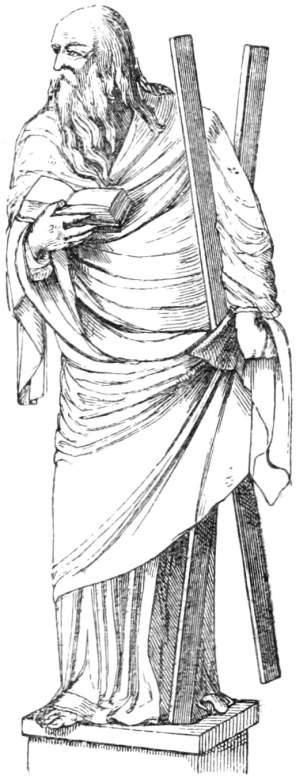
the transverse cross, on which St. Andrew is supposed to have suffered,
in this form (3); the Egyptian cross, sometimes placed in the hands of
St. Philip the apostle, and it was also the form of the crutch of St.
Anthony, and embroidered on his cope or robe—hence it is called
St. Anthony’s cross (4). There is also the Maltese cross, and various
ornamental crosses. The double cross on the top of a staff, instead of
the crosier, is borne by the Pope only; the staff with a single cross, by
the Greek bishops.
At first the cross was a sign only. When formed of gold or silver,
the five wounds of Christ were signified by a ruby or carbuncle at
each extremity, and one in the centre. It was not till the sixth
century that the cross became a Crucifix, no longer an emblem but an
image.
The Lamb, in Christian Art, is the peculiar symbol of the Redeemer
as the sacrifice without blemish: in this sense it is given as an attribute
to John the Baptist. The lamb is also the general emblem of innocence,
meekness, modesty; in this sense it is given to St. Agnes, of
whom Massillon said so beautifully, ‘peu de pudeur, où il n’y a pas de
religion; peu de religion, où il n’y a pas de pudeur.’
The Pelican, tearing open her breast to feed her young with her
own blood, was an early symbol of our redemption through Christ.
One or both of these emblems are frequently found in ancient crosses
and crucifixes; the lamb at the foot, the pelican at the top, of the
cross.
The Dragon is the emblem of sin in general, and of the sin of
idolatry in particular; and the dragon slain or vanquished by the power
of the cross, is the perpetually recurring myth, which, varied in a
thousand ways, we find running through all the old Christian legends:
not subject to misapprehension in the earliest times; but, as the cloud
of ignorance darkened and deepened, the symbol was translated into a
fact. It has been suggested that the dragon, which is to us a phantasm
and an allegory, which in the middle ages was the visible shape of the
demon adversary of all truth and goodness, might have been, as regards
form, originally a fact: for wherever we have dragon legends, whether
the scene be laid in Asia, Africa, or Europe, the imputed circumstances
and the form are little varied. The dragons introduced into early
painting and sculpture so invariably represent a gigantic winged
crocodile, that it is presumed there must have been some common
origin for the type chosen as if by common consent; and that this
common type may have been some fossil remains of the Saurian species,
or even some far-off dim tradition of one of these tremendous reptiles
surviving in Heaven knows what vast desolate morass or inland lake,
and spreading horror and devastation along its shores. At Aix, a huge
fossilised head of one of the Sauri was for a long time preserved as the
head of the identical dragon subdued by St. Martha; and St. Jerome
relates that he had himself beheld at Tyre the bones of the sea monster
to which Andromeda had been exposed—probably some fossil remains
which in the popular imagination were thus accounted for. Professor
Owen told me that the head of a dragon in one of the legendary pictures
he had seen in Italy closely resembled in form that of the Deinotherium
Giganteum. These observations have reference only to the type
adopted when the old Scripture allegory took form and shape. The
dragon of Holy Writ is the same as the serpent, i. e., personified sin, the
spiritual enemy of mankind.
The scriptural phrase of the ‘jaws of hell’ is literally rendered in
the ancient works of Art by the huge jaws of a dragon, wide open and
emitting flames, into which the souls of sinners are tumbled headlong.
In pictures, sin is also typified by a serpent or snake; in this form it is
placed under the feet of the Madonna, sometimes with an apple in its
mouth; sometimes, but only in late pictures of the seventeenth century,
winding its green scaly length round and round a globe, significant of
the subjugation of the whole earth to the power of sin till delivered by
the Redeemer. On this subject I shall have much more to say when
treating of the pictures of the Fall of Man, and the subjects taken from
the Apocalypse: for the present we need only bear in mind the various
significations of the popular Dragon myth, which may shadow forth the
conquest over sin, as in the legends of St. Michael and St. Margaret;
or over paganism, as in the legends of St. Sylvester and St. George;
or sometimes a destroying flood, as in the legend of St. Martha, where
the inundation of the Rhone is figured by a dragon emerging from the
waters and spreading around death and pestilence,—like the Python of
the Grecian myth.
The Lion, as an ancient Christian symbol, is of frequent recurrence,
more particularly in architectural decoration. Antiquaries are not
agreed as to the exact meaning attached to the mystical lions placed in
the porches of so many old Lombard churches; sometimes with an
animal, sometimes with a man, in their paws. But we find that the
lion was an ancient symbol of the Redeemer, ‘the Lion of the tribe of
Judah:’ also of the resurrection of the Redeemer; because, according
to an oriental fable, the lion’s cub was born dead, and in three days its
sire licked it into life. In this sense it occurs in the windows of the
cathedral at Bourges. In either sense it may probably have been
adopted as a frequent ornament in the church utensils, and in ecclesiastical
decoration, supporting the pillars in front, or the carved
thrones, &c.
The lion also typifies solitude—the wilderness; and, in this sense, is
placed near St. Jerome and other saints who did penance, or lived as
hermits in the desert; as in the legends of St. Paul the hermit, St.
Mary of Egypt, St. Onofrio. Further, the lion as an attribute denoted
death in the amphitheatre, and with this signification is placed near
certain martyrs, as St. Ignatius and St. Euphemia. The lion, as the
type of fortitude and resolution, was placed at the feet of those martyrs
who had suffered with singular courage, as St. Adrian and St. Natalia.[10]
When other wild beasts, as wolves and bears, are placed at the feet
of a saint attired as abbot or bishop, it signifies that he cleared waste
land, out down forests, and substituted Christian culture and civilisation
for paganism and the lawless hunter’s life: such is the significance in
pictures of St. Magnus, St. Florentius and St. Germain of Auxerre.
The Hart or Hind was also an emblem of double signification. It
was a type of solitude and of purity of life, and was also a type of piety
and religious aspiration, adopted from the forty-second Psalm, ‘Like
as the hart panteth after the water-brooks, so panteth my soul for thee,
O God!’
When the original meaning of the lion, the hart, and other emblems,
was no longer present to the popular mind, legends were invented to
account for them; and that which had been a symbol, became an incident,
or an historical attribute,—as in the stories of the lion healed by
St. Jerome, or digging the grave of St. Paul; the miraculous stag which
appeared to St. Eustace and St. Hubert; the wounded doe in the legend
of St. Giles; and the hind which spoke to St. Julian.
The Peacock, the bird of Juno, was an ancient pagan symbol, signifying
the apotheosis of an empress, as we find from many of the old
Roman coins and medals. The early Christians, accustomed to this interpretation,
adopted it as a general emblem of the mortal exchanged for
the immortal existence; and, with this signification, we find the peacock
with outspread train on the walls and ceilings of catacombs, the tombs
of the martyrs, and many of the sarcophagi, down to the fourth and fifth
centuries. It is only in modern times that the peacock has become the
emblem of worldly pride.
The Crown, as introduced in Christian Art, is either an emblem or
an attribute. It has been the emblem from all antiquity of victory, and
of recompense due to superior power or virtue. In this sense the word
and the image are used in Scripture in many passages: for example,
‘Henceforth there is laid up for me a crown of glory.’ And in this
sense, as the recompense of those who had fought the good fight to the
end, and conquered, the crown became the especial symbol of the glory
of martyrdom. In very ancient pictures, a hand is seen coming out of
heaven holding a wreath or circlet; afterwards it is an angel who
descends with a crown, which is sometimes a coronet of gold and
jewels, sometimes a wreath of palm or myrtle. In general only the
female martyrs wear the symbolical crown of glory; martyrs of the
other sex hold the crown in their hands, or it is borne by an angel.
Hence we may presume that the crown, which among the Jews was the
especial ornament of a bride, signified the bride or spouse of Christ—one
dedicated to virginity for his sake; and in this sense, down to the
present time, the crown is placed on the head of a nun at the moment of
consecration. Therefore in the old pictures of female martyrs we may
interpret the crown in this double sense, as signifying at once the bride
and the martyr.
But it is necessary also to distinguish between the symbol and the
attribute: thus, where St. Cecilia and St. Barbara wear the crown, it is
the symbol of their glorious martyrdom; when St. Catherine and St.
Ursula wear the crown, it is at once as the symbol of martyrdom and
the attribute of their royal rank as princesses.
The crown is also the symbol of sovereignty. When it is placed on
the head of the Virgin, it is as Queen of Heaven, and also as the
‘Spouse’ of Scripture allegory.
But the crown is also an attribute, and frequently, when worn by a
saint or placed at his feet, signifies that he was royal or of princely
birth: as in the pictures of Louis of France, St. William, St. Elizabeth,
St. Helena, and many others.
The crowns in the Italian pictures are generally a wreath, or a simple
circle of gold and jewels, or a coronet radiated with a few points. But
in the old German pictures the crown is often of most magnificent
workmanship, blazing with jewels.
I have seen a real silver crown placed on the figures of certain
popular saints, but as a votive tribute, not an emblem.
The Sword is also either a symbol or an attribute. As a symbol it
signifies generally martyrdom by any violent death, and, in this sense,
is given to many saints who did not die by the sword. As an attribute
it signifies the particular death suffered, and that the martyr in whose
hand or at whose feet it is placed was beheaded: in this sense it is given
to St. Paul, St. Catherine, and many others. It is given also to the
warrior-martyrs, as the attribute of their military profession. Other
symbols of martyrdom are the Axe, the Lance, and the Club.
Arrows, which are attributes, St. Ursula, St. Christina, and St.
Sebastian.
The Poniard, given to St. Lucia.
The Cauldron, given to St. John the Evangelist and St. Cecilia.
The Pincers and Shears, St. Apollonia and St. Agatha.
The Wheels, St. Catherine.
Fire and Flames are sometimes an emblem of martyrdom and
punishment, and sometimes of religious fervour.
A Bell was supposed to have power to exorcise demons, and for
this reason is given to the haunted St. Anthony.
The Shell signifies pilgrimage.
The Skull, penance.
The Anvil, as an attribute of martyrdom, belongs to St. Adrian
only.
The Palm, the ancient classical symbol of victory and triumph, was
early assumed by the Christians as the universal symbol of martyrdom,
and for this adaptation of a pagan ornament they found warrant in
Scripture: Rev. vii. 9, ‘And after this I beheld, and, lo, a great
multitude stood before the throne clothed with white robes and with
palms in their hands.‘... ‘And he said to me, These are they which
came out of great tribulation.’ Hence in pictures of martyrdoms an
angel descends with the palm; hence it is figured on the tombs of early
martyrs, and placed in the hands of those who suffered in the cause of
truth, as expressing their final victory over the powers of sin and death.
The sensual think with reverence of the palm
Which the chaste votary wields.
The palm varies in form from a small leaf to the size of a palm branch,
almost a tree. It is very small in the early Italian pictures, very large
in the Spanish pictures. In the Siena pictures it has a bunch of dates
depending from it. It is only in late pictures that the palm, with a
total disregard to the sacredness of its original signification, is placed on
the ground, or under the feet of the saint.
The Standard, or banner, is also the symbol of victory, the spiritual
victory over sin, death, and idolatry. It is borne by our Saviour after
his resurrection, and is placed in the hands of St. George, St. Maurice,
and other military saints; in the hands of some victorious martyrs, as
St. Julian, St. Ansano, and of those who preached the Gospel among
infidels; also in the hands of St. Ursula and St. Reparata, the only
female saints, I believe, who bear this attribute.
The Olive, as the well-known emblem of peace and reconciliation,
is figured on the tombs of the early martyrs; sometimes with, sometimes
without, the dove. The olive is borne as the attribute of peace
by the angel Gabriel, by St. Agnes, and by St. Pantaleon; sometimes
also by the angels in a Nativity, who announce ‘peace on earth.’
The Dove in Christian Art is the emblem of the Holy Ghost; and,
besides its introduction into various subjects from the New Testament,
as the Annunciation, the Baptism, the Pentecost, it is placed near
certain saints who are supposed to have been particularly inspired, as
St. Gregory, St. Thomas Aquinas, St. Hilarius, and others.
The dove is also a symbol of simplicity and purity of heart, and as
such it is introduced into pictures of female saints, and especially of the
Madonna and Child.
It is also the emblem of the soul; in this sense it is seen issuing from
the lips of dying martyrs, and is found in pictures of St. Eulalia of
Merida, and St. Scholastica the sister of St. Benedict.
The Lily is another symbol of purity, of very general application.
We find it in pictures of the Virgin, and particularly in pictures of the
Annunciation. It is placed significantly in the hand of St. Joseph,
the husband of the Virgin Mary, his staff, according to the legend,
having put forth lilies; it is given, as an emblem merely, to St.
Francis, St. Anthony of Padua, St. Dominick, and St. Catherine of
Siena, to express the particular purity of their lives.
The Unicorn is another ancient symbol of purity, in allusion to the
fable that it could never be captured except by a virgin stainless in
mind and life; it has become in consequence the emblem peculiarly of
female chastity, but in Christian Art is appropriate only to the Virgin
Mary and St. Justina.
The Flaming Heart expresses fervent piety and love: in early
pictures it is given to St. Augustine, merely in allusion to a famous
passage in his ‘Confessions;’ but in the later schools of Art it has become
a general and rather vulgar emblem of spiritual love: in this sense
it is given to St. Theresa; St. Maria Maddalena de’ Pazzi, a Florentine
nun; and some of the Jesuit saints.
The Book in the hands of the Evangelists and the Apostles is an
attribute, and represents the Gospel. In the hand of St. Stephen it is
the Old Testament; in the hand of any other saint it may be the
Gospel, but it may also be an emblem only, signifying that the saint
was famous for his learning or his writings; it has this sense in pictures
of St. Catherine, the Doctors of the Church, St. Thomas Aquinas, and
St. Bonaventura.
A Church placed in the hands of a saint signifies that he was the
founder of some particular church: in this sense St. Henry bears the
cathedral of Bamberg; or, that he was the protector and first bishop of
the church, as St. Petronius bears the cathedral of Bologna. I must
except the single instance of St. Jerome; the church in his hands
signifies no particular edifice, but, in a general sense, the Catholic
Church, of which he was the great support and one of the primitive
fathers; to render the symbol more expressive, rays of light are seen
proceeding from the portal.
The Scourge in the hand of a saint, or at his feet, signifies the
penances he inflicted upon himself; but in the hand of St. Ambrose, it
signifies the penance he inflicted upon others.
The Chalice, or Sacramental Cup, with the Host, signifies Faith;
it is given to St. Barbara. The Cup, with the Serpent, is the attribute
of St. John.
The Ship.—The Ark of Noah, floating safe amid the Deluge, in
which all things else were overwhelmed, was an obvious symbol of the
Church of Christ. Subsequently the Ark became a ship. St. Ambrose
likens the Church of God to a ship, and the Cross to the mast set in
the midst of it. ‘Arbor quædam in nari est crux in ecclesia.’ The
Bark of St. Peter tossed in the storm, and by the Redeemer guided safe
to land, was also considered as symbolical. These mingled associations
combined to give to the emblem of the ship a sacred significance. Every
one who has been at Rome will remember the famous mosaic of the ship
tossed by the storms, and assailed by demons, called The Navicella,
which was executed by Giotto for the old Basilica of St. Peter’s, and
is now under the Portico, opposite to the principal door. I believe that
in the pictures of St. Nicholas and St. Ursula the ship had originally a
sacred and symbolical significance, and that the legends were afterwards
invented or modified to explain the emblem, as in so many other
instances.
The Anchor is the Christian symbol of immovable firmness, hope,
and patience; and in this sense we find it very frequently in the catacombs,
and on the ancient Christian gems. It was given to several of
the early saints as a symbol. Subsequently a legend was invented to
account for the symbol, turning it into an attribute, as was the case
with the lion and the stag. For example: to St. Clement the anchor
was first given as the symbol of his constancy in Christian hope, and
thence we find, subsequently invented, the story of his being thrown
into the sea with the anchor round his neck. On the vane of the Church
of St. Clement in the Strand, the anchor, the parish device, was
anciently placed; and as in the English fancy no anchor can be well
separated from a ship, they have lately placed a ship on the other side,—the
original signification of the anchor, as applied to St. Clement the
martyr, being unknown or forgotten.
The Lamp, Lantern, or Taper, is the old emblem of piety: ‘Let
your light so shine before men:’—and it also signifies wisdom. In the
first sense we find this attribute in the hand of St. Gudula, St. Geneviève
of Paris, and St. Bridget; while the lamp in the hand of St. Lucia
signifies celestial light or wisdom.
Flowers and Fruits, often so beautifully introduced into ecclesiastical
works of Art, may be merely ornamental; Crivelli, and some of
the Venetian and Lombard painters, were fond of rich festoons of fruit,
and backgrounds of foliage and roses. But in some instances they have
a definite significance. Roses are symbolical in pictures of the Madonna,
who is the ‘Rose of Sharon.’[11] The wreath of roses on the brow of
St. Cecilia, the roses and fruits borne by St. Dorothea, are explained
by the legends.
The apple was the received emblem of the Fall of Man and original
sin. Placed in pictures of the Madonna and Child, either in the hand
of the Infant Christ, or presented by an angel, it signified Redemption
from the consequences of the Fall. The pomegranate, bursting open,
and the seeds visible, was an emblem of the future—of hope in immortality.
When an apple, a pear, or a pomegranate is placed in the hand
of St. Catherine as the mystical Sposa of Christ, which continually
occurs, particularly in the German pictures, the allusion is to be taken
in the scriptural sense: ‘The fruit of the Spirit is love, joy, peace.’
In very early Art we find colours used in a symbolical or mystic
sense, and, until the ancient principles and traditions were wholly worn
out of memory or set aside by the later painters, certain colours were
appropriate to certain subjects and personages, and could not arbitrarily
be applied or misapplied. In the old specimens of stained glass we find
these significations scrupulously attended to. Thus:—
White, represented by the diamond or silver, was the emblem of
light, religious purity, innocence, virginity, faith, joy, and life. Our
Saviour wears white after his resurrection. In the judge it indicated
integrity; in the rich man humility; in the woman chastity. It was
the colour consecrated to the Virgin, who, however, never wears white
except in pictures of the Assumption.
Red, the ruby, signified fire, divine love, the Holy Spirit, heat, or
the creative power, and royalty. White and red roses expressed love
and innocence, or love and wisdom, as in the garland with which the
angel crowns St. Cecilia. In a bad sense, red signified blood, war,
hatred, and punishment. Red and black combined were the colours of
purgatory and the Devil.
Blue, or the sapphire, expressed heaven, the firmament, truth,
constancy, fidelity. Christ and the Virgin wear the red tunic and the
blue mantle, as signifying heavenly love and heavenly truth.[12] The
same colours were given to St. John the evangelist, with this difference,—that
he wore the blue tunic and the red mantle; in later pictures the
colours are sometimes red and green.
Yellow, or gold, was the symbol of the sun; of the goodness of
God; initiation, or marriage; faith, or fruitfulness. St. Joseph, the
husband of the Virgin, wears yellow. In pictures of the apostles, St.
Peter wears a yellow mantle over a blue tunic. In a bad sense, yellow
signifies inconstancy, jealousy, deceit; in this sense it is given to the
traitor Judas, who is generally habited in dirty yellow.
Green, the emerald, is the colour of spring; of hope, particularly
hope in immortality; and of victory, as the colour of the palm and
the laurel.
Violet, the amethyst, signified love and truth: or, passion and
suffering. Hence it is the colour often worn by the martyrs. In some
instances our Saviour, after his resurrection, is habited in a violet
instead of a blue mantle. The Virgin also wears violet after the
crucifixion. Mary Magdalene, who as patron saint wears the red robe,
as penitent wears violet and blue, the colours of sorrow and of
constancy. In the devotional representation of her by Timoteo della
Vite,[13] she wears red and green, the colours of love and hope.
Grey, the colour of ashes, signified mourning, humility, and innocence
accused; hence adopted as the dress of the Franciscans (the
Grey Friars); but it has since been changed for a dark rusty brown.
Black expressed the earth, darkness, mourning, wickedness, negation,
death; and was appropriate to the Prince of Darkness. In some
old illuminated MSS., Jesus, in the Temptation, wears a black robe.
White and black together signified purity of life, and mourning or
humiliation; hence adopted by the Dominicans and the Carmelites.
The mystical application of attributes and colours was more particularly
attended to in that class of subjects I have distinguished as
devotional. In the sacred historical pictures we find that the attributes
are usually omitted as superfluous, and characteristic propriety of colour
often sacrificed to the general effect.
These introductory observations and explanations will be found
illustrated in a variety of forms as we proceed; and readers will be led
to make comparisons and discover analogies and exceptions for themselves.
I must stop here;—yet one word more.
All the productions of Art, from the time it has been directed and
developed by Christian influences, may be regarded under three
different aspects. 1. The purely religious aspect, which belongs to one
mode of faith; 2. The poetical aspect, which belongs to all; 3. The
artistic, which is the individual point of view, and has reference only to
the action of the intellect on the means and material employed. There
is pleasure, intense pleasure, merely in the consideration of Art as Art;
in the faculties of comparison and nice discrimination, brought to bear
on objects of beauty; in the exercise of a cultivated and refined taste
on the productions of mind in any form whatever. But a three-fold, or
rather a thousand-fold, pleasure is theirs who to a sense of the poetical
unite a sympathy with the spiritual in Art, and who combine with
delicacy of perception, and technical knowledge, more elevated sources
of pleasure, more variety of association, habits of more excursive
thought. Let none imagine, however, that, in placing before the uninitiated
these unpretending volumes, I assume any such superiority as
is here implied. Like a child that has sprung on a little way before its
playmates, and caught a glimpse through an opening portal of some
varied Eden within, all gay with flowers, and musical with birds, and
haunted by divine shapes which beckon onward; and, after one
rapturous survey, runs back and catches its companions by the hand and
hurries them forwards to share the new-found pleasure, the yet unexplored
region of delight; even so it is with me:—I am on the outside,
not the inside, of the door I open.
2 After Gaudenzio Ferrari, at Saronno
PART I.
Ye too must fly before a chasing hand,
Angels and saints in every hamlet mourned!
Ah! if the old idolatry be spurn’d,
Let not your radiant shapes desert the land!
Her adoration was not your demand,—
The fond heart proffer’d it,—the servile heart,
And therefore are ye summon’d to depart;
Michael, and thou St. George, whose flaming brand
The Dragon quell’d; and valiant Margaret,
Whose rival sword a like opponent slew;
And rapt Cecilia, seraph-haunted queen
Of harmony; and weeping Magdalene,
Who in the penitential desert met
Gales sweet as those that over Eden blew!
Wordsworth.
‘I can just remember,’ says a theologian of the last century, ‘when the women first
taught me to say my prayers, I used to have an idea of a venerable old man, of a composed,
benign countenance, with his own hair, clad in a morning gown of a grave-coloured flowered
damask, sitting in an elbow-chair.’ And he proceeds to say that, in looking back to these
beginnings, he is in no way disturbed at the grossness of his infant theology. The image
thus shaped by the imagination of the child was, in truth, merely one example of the various
forms and conceptions fitted to divers states and seasons, and orders and degrees, of the
religious mind, whether infant or adult, which represent the several approximations such
minds at such seasons can respectively make to the completeness of faith. These imperfect
ideas should be held to be reconciled and comprehended in that completeness, not rejected
by it; and the nearest approximation which the greatest of human minds can accomplish is
surely to be regarded as much nearer to the imperfection of an infantine notion than to the
fulness of truth. The gown of flowered damask and the elbow-chair may disappear; the
anthropomorphism of childhood may give place to the divine incarnation of the Second
Person in after-years; and we may come to conceive of the Deity as Milton did when his
epithets were most abstract:—
‘So spake the Sovran Presence.’
But after all, these are but different grades of imperfection in the forms of doctrinal faith;
and if there be a devouter love on the part of the child for what is pictured in his imagination
as a venerable old man, than in the philosophic poet for the ‘Sovran Presence,’ the child’s
faith has more of the efficacy of religious truth in it than the poet’s and philosopher’s. (Vide
‘Notes on Life,’ by Henry Taylor, p. 136.)
Of Angels and Archangels. — I. The Angels.
Gloria in excelsis Deo!
Of Angels and Archangels.
There is something so very attractive and poetical, as well as soothing
to our helpless finite nature, in all the superstitions connected with the
popular notion of Angels, that we cannot wonder at their prevalence in
the early ages of the world. Those nations who acknowledged one
Almighty Creator, and repudiated with horror the idea of a plurality
of Gods, were the most willing to accept, the most enthusiastic in
accepting, these objects of an intermediate homage; and gladly placed
between their humanity and the awful supremacy of an unseen God,
the ministering spirits who were the agents of his will, the witnesses of
his glory, the partakers of his bliss, and who in their preternatural
attributes of love and knowledge filled up that vast space in the created
universe which intervened between mortal man and the infinite, omnipotent
Lord of All.
The belief in these superior beings, dating from immemorial antiquity,
interwoven as it should seem with our very nature, and authorised
by a variety of passages in Scripture, has descended to our time. Although
the bodily forms assigned to them are allowed to be impossible,
and merely allegorical, although their supposed functions as rulers of
the stars and elements have long been set aside by a knowledge of the
natural laws, still the coexistence of many orders of beings superior in
nature to ourselves, benignly interested in our welfare, and contending
for us against the powers of evil, remains an article of faith. Perhaps
the belief itself, and the feeling it excites in the tender and contemplative
mind, were never more beautifully expressed than by our
own Spenser:—
And is there care in heaven? And is there love
In heavenly spirits to these creatures base,
That may compassion of their evils move?
There is!—else much more wretched were the case
Of men than beasts! But O th’ exceeding grace
Of highest God that loves his creatures so,
And all his works with mercy doth embrace,
That blessed angels he sends to and fro
To serve to wicked man, to serve his wicked foe
How oft do they their silver bowers leave,
And come to succour us that succour want?
How oft do they with golden pinions cleave
The flitting skies, like flying pursuivant,
Against foul fiends, to aid us militant?
They for its fight, they watch, and duly ward,
And their bright squadrons round about us plant,
And all for love, and nothing for reward!
Oh why should heavenly God to men have such regard!
It is this feeling, expressed or unexpressed, lurking at the very core
of all hearts, which renders the usual representations of angels, spite
of all incongruities of form, so pleasing to the fancy: we overlook the
anatomical solecisms, and become mindful only of that emblematical
significance which through its humanity connects it with us, and through
its supernatural appendages connects us with heaven.
But it is necessary to give a brief summary of the scriptural and
theological authorities, relative to the nature and functions of angels,
before we can judge of the manner in which these ideas have been
attended to and carried out in the artistic similitudes. Thus angels are
represented in the Old Testament—
1. As beings of a higher nature than men, and gifted with superior
intelligence and righteousness.[14]
2. As a host of attendants surrounding the throne of God, and as a
kind of celestial court or council.[15]
3. As messengers of his will conveyed from heaven to earth: or as
sent to guide, to correct, to instruct, to reprove, to console.
4. As protecting the pious.
5. As punishing by command of the Most High the wicked and disobedient.[16]
6. As having the form of men; as eating and drinking.
I do not recollect any instance in which angels are represented in
Scripture as instigated by human passions; they are merely the agents
of the mercy or the wrath of the Almighty.
After the period of the Captivity, the Jewish ideas concerning angels
were considerably extended and modified by an admixture of the
Chaldaic belief, and of the doctrines taught by Zoroaster.[18] It is then
that we first hear of good and bad angels, and of a fallen angel or impersonation
of evil, busy in working mischief on earth and counteracting
good; also of archangels, who are alluded to by name; and of guardian
angels assigned to nations and individuals; and these foreign ideas
concerning the spiritual world, accepted and promulgated by the
Jewish doctors, pervade the whole of the New Testament, in which
angels are far more familiar to us as agents, more frequently alluded to,
and more distinctly brought before us, than in the Old Testament.
For example: they are represented—
1. As countless.
2. As superior to all human wants and weaknesses.
3. As the deputed messengers of God.
4. They rejoice over the repentant sinner. They take deep interest
in the mission of Christ.
5. They are present with those who pray; they bear the souls of the
just to heaven.
6. They minister to Christ on earth, and will be present at his
second coming.[19]
In the Gospel of St. John, which is usually regarded as the fullest
and most correct exposition of the doctrines of Christ, angels are only
three times mentioned, and in none of these instances does the word
angel fall from the lips of Christ. On the other hand, the writings of
St. Paul, who was deeply versed in all the learning and philosophy of
the Jews, abound in allusions to angels, and, according to the usual
interpretation of certain passages, he shows them divided into several
classes.[20] St. Luke, who was the friend and disciple of St. Paul, some
say his convert, is more direct and explicit on the subject of angels than
any of the other Evangelists, and his allusions to them much more
frequent.
The worship of angels, which the Jews brought from Chaldea, was
early introduced into the Christian Church. In the fourth century the
council of Laodicea published a decree against places of worship
dedicated to angels under names which the Church did not recognise.
But neither warning nor council seems to have had power to modify the
popular creed, countenanced as it was by high authority. All the
Fathers are unanimous as to the existence of angels good and evil.
They hold that it is evermore the allotted task of good angels to defend
us against evil angels, and to carry on a daily and hourly combat against
our spiritual foes: they teach that the good angels are worthy of all
reverence as the ministers of God and as the protectors of the human
race; that their intercession is to be invoked, and their perpetual,
invisible presence to be regarded as an incitement to good and a
preventive to evil.
This, however, was not enough. Taking for their foundation a few
Scripture texts, and in particular the classification of St. Paul, the
imaginative theologians of the middle ages ran into all kinds of extravagant
subtleties regarding the being, the nature, and the functions of
the different orders of angels. Except as far as they have been taken
as authorities in Art, I shall set aside these fanciful disquisitions, of
which a mere abstract would fill volumes. For our present purpose it
is sufficient to bear in mind that the great theologians divide the angelic
host into three hierarchies, and these again into nine choirs, three in
each hierarchy: according to Dionysius the Areopagite, in the following
order: 1. Seraphim, Cherubim, Thrones. 2. Dominations, Virtues,
Powers. 3. Princedoms, Archangels, Angels. The order of these
denominations is not the same in all authorities: according to the Greek
formula, St. Bernard, and the Legenda Aurea, the Cherubim precede
the Seraphim, and in the hymn of St. Ambrose they have also the precedence—To
Thee, Cherubim and Seraphim continually do cry, &c.;
but the authority of St. Dionysius seems to be admitted as paramount,
for according to the legend he was the convert and intimate friend of
St. Paul, and St. Paul, who had been transported to the seventh
heaven, had made him acquainted with all he had there beheld.
Desire
In Dionysius so intensely wrought
That he, as I have done, ranged them, and named
Their orders, marshall’d in his thought;
... For he had learn’d
Both this and much beside of these our orbs
From an eye-witness to Heaven’s mysteries.
Dante, Par. 28.
The first three choirs receive their glory immediately from God, and
transmit it to the second; the second illuminate the third; the third are
placed in relation to the created universe and man. The first Hierarchy
are as councillors; the second as governors; the third as ministers.
The Seraphim are absorbed in perpetual love and adoration immediately
round the throne of God. The Cherubim know and worship. The
Thrones sustain the seat of the Most High. The Dominations, Virtues,
Powers, are the Regents of stars and elements. The three last orders,
Princedoms, Archangels, and Angels, are the protectors of the great
Monarchies on earth, and the executors of the will of God throughout
the universe.
The term angels is properly applied to all these celestial beings; but
it belongs especially to the two last orders, who are brought into immediate
communication with the human race. The word angel, Greek in
its origin, signifies a messenger, or more literally a bringer of tidings.
In this sense the Greeks entitle Christ ‘The great Angel of the will
of God;’ and I have seen Greek representations of Christ with wings
to his shoulders. John the Baptist is also an angel in this sense; likewise
the Evangelists; all of whom, as I shall show hereafter, bear, as
celestial messengers, the angel-wings.
4 Greek Seraph; wings of gold
and crimson (Ninth century)
In ancient pictures and illuminations which exhibit the glorification
of the Trinity, Christ, or the Virgin, the
hierarchies of angels are represented in circles
around them, orb within orb. This is called a
glory of angels. In pictures it is seldom complete:
instead of nine circles, the painters
content themselves with one or two circles only.
The innermost circles, the Seraphim and the
Cherubim, are in general represented as heads
merely, with two or four or six wings, and of
a bright-red or blue colour; sometimes with
variegated wings, green, yellow, violet, &c.
This emblem—intended to shadow forth to
human comprehension a pure spirit glowing
with love and intelligence, in which all that is
bodily is put away, and only the head, the seat
of soul, and wings, the attribute of spirit and
swiftness, retained—is of Greek origin. When
first adopted I do not know, but I have met
with it in Greek MSS. of the ninth century. Down to the eleventh
century the faces were human, but not childish; the infant head was afterwards
adopted to express innocence in addition to love and intelligence.
5 Cherubim, Italian (Fourteenth century)
6 Cherub Heads
Such was the expressive and poetical symbol which degenerated
in the later periods of Art into
those little fat baby heads, with
curly hair and small wings under
the chin, which the more they resemble
nature in colour, feature,
and detail, the more absurd they
become, the original meaning being
wholly lost or perverted.
In painting, where a glory of angels is placed round the Divine
Being or the glorified Virgin, those forming the innermost circles are or
ought to be of a glowing red, the colour of fire, that is, of love; the
next circle is painted blue, the colour of the firmament, or light, that
is, of knowledge. Now as the word seraph is derived from a Hebrew
root signifying love, and the word cherub from a Hebrew root signifying
to know, should not this distinction fix the proper place and name of
the first two orders? It is admitted that the spirits which love are
nearer to God than those which know, since we cannot know that which
we do not first love: that Love and Knowledge, ‘the two halves of a
divided world,’ constitute in their union the perfection of the angelic
nature; but the Seraphim, according to the derivation of their name,
should love most; their whole being is fused, as it were, in a glow of
adoration; therefore they should take the precedence, and their proper
colour is red. The Cherubim, ‘the lords of those that know,’ come
next, and are to be painted blue.
Thus it should seem that, in considering the religious pictures of the
early ages of Art, we have to get rid of certain associations as to colour
and form, derived from the phraseology of later poets and the representations
of later painters. ‘Blue-eyed Seraphim,’ and the ‘blue
depth of Seraph’s eyes,’ are not to be thought of any more than
smiling Cherubim.’ The Seraphim, where distinguished by colour,
are red; the Cherubim blue: the proper character, where character is
attended to, is, in the Seraph, adoration; in the Cherub, contemplation.
So Milton—
With thee bring
Him who soars on golden wing,
The Cherub, Contemplation.
I remember a little Triptyca, a genuine work of Fiesole, in which one
of the lateral compartments represents his favourite subject, the souls
of the blessed received into Paradise. They are moving from the lower
part of the picture towards the top, along an ascent paved with flowers,
all in white garments and crowned with roses. At one side, low down,
stands a blue Cherub robed in drapery spangled with golden stars, who
seems to encourage the blessed group. Above are the gates of heaven.
Christ welcomes to his kingdom the beatified spirits, and on each side
stands a Seraph, all of a glowing red, in spangled drapery. The figures
are not here merely heads and wings, but full length, having all that
soft peculiar grace which belongs to the painter.[21]
In a Coronation of the Virgin,[22] a glory of Seraphim over-arches the
principal group. Here the angelic beings are wholly of a bright red
colour: they are human to the waist, with hands clasped in devotion:
the bodies and arms covered with plumage, but the forms terminating
in wings; all uniformly red. In the same collection is a small Greek
picture of Christ receiving the soul of the Virgin; over his head hovers
a large, fiery-red, six-winged Seraph; and on each side a Seraph with
hair and face and limbs of glowing red, and with white draperies.
Vasari mentions an Adoration of the Magi by Liberale of Verona, in
which a group of angels, all of a red colour, stand as a celestial guard
round the Virgin and her divine Infant.[23]
7 Cherubim (Liberale di Verona)
The distinction of hue in the red and blue angels we find wholly
omitted towards the end of the fifteenth century. Cherubim with blue,
red, green, and variegated wings we
find in the pictures of Perugino and
other masters in the beginning of the
sixteenth century, also in early pictures
of Raphael. Liberale di Verona
has given us, in a Madonna picture,
Cherub heads without wings, and of
a blue colour, emerging from golden
clouds. And in Raphael’s Madonna di
San Sisto the whole background is
formed of Cherubim and Seraphim of
a uniform delicate bluish tinge, as if
composed of air, and melting away
into an abyss of golden glory, the principal
figures standing relieved against
this flood of living love and light—beautiful!
So are the Cherubim with many-coloured wings which float
in the firmament in Perugino’s Coronation of the Virgin; but none of
these can be regarded as so theologically correct as the fiery-red and
bright-blue Seraphim and Cherubim, of which are formed the hierarchies
and glories which figure in the early pictures, the stained glass, the
painted sculpture, and the illuminated MSS. from the tenth to the
sixteenth century.
The next five choirs of angels, the Thrones, Dominations, Princedoms,
Virtues, Powers, though classed and described with great exactitude by
the theologians, have not been very accurately discriminated in Art. In
some examples the Thrones have green wings, a fiery aureole, and bear
a throne in their hands. The Dominations, Virtues, and Powers
sometimes bear a globe and a long sceptre surmounted by a cross. The
Principalities, according to the Greek formula, should bear a branch of
lily. The Archangels are figured as warriors, and carry a sword with
the point upwards. The angels are robed as deacons, and carry a wand.
In one of the ancient frescoes in the Cathedral at Orvieto, there is a
complete hierarchy of angels, so arranged as to symbolise the Trinity,
each of the nine choirs being composed of three angels, but the Seraphim
only are distinguished by their red colour and priority of place. In the
south porch of the Cathedral of Chartres, each of the nine orders is represented
by two angels: in other instances, one angel only represents
the order to which he belongs, and nine angels represent the whole
hierarchy.[24] Where, however, we meet with groups or rows of angels,
as in the Greek mosaics and the earliest frescoes all alike, all with the
tiara, the long sceptre-like wands, and the orb of sovereignty, I believe
these to represent the Powers and Princedoms of Heaven. The Archangels
alone, as we shall see presently, have distinct individual names
and attributes assigned to them.
8 Part of a Glory of Angels surrounding the figure of Christ in a picture by Ambrogio Borgognone
The angels, generally, have the human form; are winged; and are
endowed with immutable happiness and perpetual youth, because they
are ever in the presence of Him with whom there is no change and no
time. They are direct emanations of the beauty of the Eternal mind,
therefore beautiful; created, therefore not eternal, but created perfect,
and immortal in their perfection: they are always supposed to be masculine;
perhaps for the reason so beautifully assigned by Madame de
Staël, ‘because the union of power with purity (la force avec la pureté)
constitutes all that we mortals can imagine of perfection.’ There is no
such thing as an old angel, and therefore there ought to be no such
thing as an infant angel. The introduction of infant angels seems to
have arisen from the custom of representing the regenerate souls of men
as new-born infants, and perhaps also from the words of our Saviour,
when speaking of children: ‘I say unto you, their angels do always
behold the face of my Father which is in heaven.’ Such representations,
when religiously and poetically treated as spirits of love, intelligence,
and innocence, are of exquisite beauty, and have a significance
which charms and elevates the fancy; but from this, the true and
religious conception, the Italian putti and puttini, and the rosy chubby
babies of the Flemish school, are equally remote.
9 Egyptian winged genius (Louvre)
In early Art, the angels in the bloom of adolescence are always amply
draped: at first, in the classical tunic and pallium; afterwards in long
linen vestments with the alba and stole, as levites or deacons; or as
princes, with embroidered robes and sandals, and jewelled crowns or
fillets. Such figures are common in the Byzantine mosaics and pictures.
The expression, in these early representations, is usually calm and impassive.
Angels partially draped in loose, fluttering, meretricious attire,
poised in attitudes upon clouds, or with features animated by human
passion, or limbs strained by human effort, are the innovations of more
modern Art. White is, or ought to be, the prevailing colour in angelic
draperies, but red and blue of various shades are more frequent: green
often occurs; and in the Venetian pictures, yellow, or rather saffron-coloured,
robes are not unfrequent. In the best examples of Italian
Art the tints, though varied, are tender and delicate: all dark heavy
colours and violent contrasts of colour are avoided. On the contrary, in
the early German school, the angels have rich heavy voluminous
draperies of the most intense and vivid colours, often jewelled and embroidered
with gold. Flight, in such garments, seems as difficult as it
would be to swim in coronation robes.
10 Winged figure from Nineveh
But, whatever be the treatment as to character, lineaments, or dress,
wings are almost invariably the attribute of the angelic form. As emblematical
appendages, these are not merely significant of the character
of celestial messengers, for, from time immemorial, wings have been the
Oriental and Egyptian symbol of power, as well as of swiftness; of the
spiritual and aerial, in contradistinction to the human and the earthly.
Thus, with the Egyptians, the winged globe signified power and eternity,
that is, the Godhead; a bird, with a human head, signified the
soul; and nondescript creatures, with wings, abound not only in the
Egyptian paintings and hieroglyphics, but also in the Chaldaic and
Babylonian remains, in the Lycian and Nineveh marbles, and on the
gems and other relics of the Gnostics. I have seen on the Gnostic
gems figures with four wings, two springing from the shoulders and two
from the loins. This portentous figure, from the ruins of Nineveh, is
similarly constructed. (10.)
In Etruscan Art all their divinities are winged; and where Venus is
represented with wings, as in many of the antique gems (and by Correggio
in imitation of them),[25] these brilliant wings are not, as some have
supposed, emblematical of the transitoriness, but of the might, the
majesty, and the essential divinity of beauty. In Scripture, the first
mention of Cherubim with wings is immediately after the departure of
the Israelites from Egypt (Exod. xxxi. 2). Bezaleel, the first artist
whose name is recorded in the world’s history, and who appears to have
been, like the greatest artists of modern times, at once architect,
sculptor, and painter, probably derived his figures of Cherubim with
outstretched wings, guarding the mercy-seat, from those Egyptian works
of Art with which the Israelites must have been familiarised. Clement
of Alexandria is so aware of the relative similitude, that he supposes the
Egyptians to have borrowed from the Israelites, which is obviously the
reverse of the truth. How far the Cherubim, which figure in the
Biblical pictures of the present day, resemble the carved Cherubim of
Bezaleel we cannot tell, but probably the idea and the leading forms are
the same: for the ark, we know, was carried into Palestine; these original
Cherubim were the pattern of those which adorned the temple of
Solomon, and these, again, were the prototype after which the imagery
of the second temple was fashioned. Although in Scripture the shape
under which the celestial ministers appeared to man is nowhere described,
except in the visions of the prophets (Dan. x. 5), and there
with a sort of dreamy incoherent splendour, rendering it most perilous
to clothe the image placed before the fancy in definite forms, still the
idea of wings, as the angelic appendages, is conveyed in many places
distinctly, and occasionally with a picturesque vividness which inspires
and assists the artist. For instance, in Daniel, ch. vii., ‘they had wings
like a fowl.’ In Ezekiel, ch.i., ‘their wings were stretched upward when
they flew; when they stood, they let down their wings:’ ‘I heard the
noise of their wings as the noise of great
waters:’ and in Zechariah, ch. v., ‘I
looked, and behold there came out two
women, and the wind was in their wings,
for they had wings like the wings of a
stork.’ And Isaiah, ch. vi., in the description
of the Seraphim, ‘Each one had six
wings; with twain he covered his face, and
with twain he covered his feet, and with
twain he did fly.’ By the early artists this
description was followed out in a manner
more conscientious and reverential than
poetical.
11 Seraph
(Greek mosaic, Cathedral of Monreale)
They were content with a symbol. But
mark how Milton, more daring, could paint
from the same original:—
A seraph wing’d; six wings he wore to shade
His lineaments divine: the pair that clad
Each shoulder broad, came mantling o’er his breast
With regal ornament; the middle pair
Girt like a starry zone his waist, and round
Skirted his loins and thighs with downy gold
And colours dipp’d in heaven; the third his feet
Shadow’d from either heel with feather’d mail,
Sky-tinctured grain.
I have sometimes thought that Milton, in his descriptions of angels,
was not indebted merely to the notions of the old theological writers,
interpreted and embellished by his own fancy: may he not, in his wanderings
through Italy, have beheld with kindling sympathy some of
those glorious creations of Italian Art, which, when I saw them, made
me break out into his own divine language as the only fit utterance to
express those forms in words?—But, to return—Is it not a mistake to
make the wings, the feathered appendages of the angelic form, as like as
possible to real wings—the wings of storks, or the wings of swans, or
herons, borrowed for the occasion? Some modern painters, anxious to
make wings look ‘natural,’ have done this; Delaroche, for instance,
in his St. Cecilia. Infinitely more beautiful and consistent are the
nondescript wings which the early painters gave their angels:—large—so
large, that when the glorious creature is represented as at rest,
they droop from the shoulders to the ground; with long slender
feathers, eyed sometimes like the peacock’s train, bedropped with gold
like the pheasant’s breast, tinted with azure and violet and crimson,
‘colours dipp’d in heaven,’—they are really angel-wings, not bird-wings.
12 Angels (Orcagna)
13 Fiery Cherub (Raphael)
Orcagna’s angels in the Campo Santo are, in this respect, peculiarly
poetical. Their extremities are wings instead of limbs; and in a few
of the old Italian and German painters of the fifteenth century we find
angels whose extremities are formed of light waving folds of pale rose-coloured
or azure drapery, or of a sort of vapoury cloud, or, in some
instances, of flames. The cherubim and seraphim which surround the
similitude of Jehovah when He appears to Moses in the burning bush,[26]
are an example of the sublime and poetical
significance which may be given to
this kind of treatment. They have heads
and human features marvellous for intelligence
and beauty; their hair, their
wings, their limbs, end in lambent fires;
they are ‘celestial Ardours bright,’ which
seem to have being without shape.
Dante’s angels have less of dramatic
reality, less of the aggrandised and idealised
human presence, than Milton’s. They
are wondrous creatures. Some of them have the quaint fantastic picturesqueness
of old Italian Art and the Albert Dürer school; for
instance, those in the Purgatorio, with their wings of a bright green,
and their green draperies, ‘verde come fogliette,’ kept in a perpetual
state of undulation by the breeze created by the fanning of their wings,
with features too dazzling to be distinguished:
And the Shape, glowing red as in a furnace, with an air from the fanning
of its wings, ‘fresh as the first breath of wind in a May morning, and
fragrant as all its flowers.’ That these and other passages scattered
through the Purgatorio and the Paradiso assisted the fancy of the earlier
painters, in portraying their angelic Glories and winged Beatitudes,
I have little doubt; but, on the other hand, the sublime angel in the
Inferno—he who comes speeding over the waters with vast pinions like
sails, sweeping the evil spirits in heaps before him, ‘like frogs before a
serpent,’ and with a touch of his wand making the gates of the city of
Dis fly open; then, with a countenance solemn and majestic, and quite
unmindful of his worshipper, as one occupied by higher matters, turning
and soaring away—this is quite in the sentiment of the grand old
Greek and Italian mosaics, which preceded Dante by some centuries.[28]
But besides being the winged messengers of God to man, the deputed
regents of the stars, the rulers of the elements, and the dispensers of the
fate of nations, angels have another function in which we love to contemplate
them. They are the choristers of heaven. Theirs is the privilege
to sound that hymn of praise which goes up from this boundless
and harmonious universe of suns and stars and worlds and rejoicing
creatures, towards the God who created them: theirs is the music of
the spheres—
They sing, and singing in their glory move;
they tune divine instruments, named after those of earth’s harmonies—
The harp, the solemn pipe
And dulcimer, all organs of sweet stop,
All sounds on fret by string or golden wire,
... And with songs
And choral symphonies, day without night,
Circle his throne rejoicing.
There is nothing more beautiful, more attractive, in Art than the representations
of angels in this character. Sometimes they form a chorus
round the glorified Saviour, when, after his sorrow and sacrifice on earth,
he takes his throne in heaven; or, when the crown is placed on the head
of the Maternal Virgin in glory, pour forth their triumphant song, and
sound their silver clarions on high: sometimes they stand or kneel before
the Madonna and Child, or sit upon the steps of her throne, singing,—with
such sweet earnest faces! or playing on their golden lutes, or
piping celestial symphonies; or they bend in a choir from the opening
heavens above, and welcome, with triumphant songs, the liberated soul
of the saint or martyr; or join in St. Cecilia’s hymn of praise: but
whatever the scene, in these and similar representations, they appear in
their natural place and vocation, and harmonise enchantingly with all
our feelings and fancies relative to these angelic beings, made up of love
and music.
14 Angel (Francia)15 Piping Angel (Gian Bellini)
Most beautiful examples of this treatment occur both in early painting
and sculpture; and no one who has wandered through churches
and galleries, with feeling and observation awake, can fail to remember
such. It struck me as characteristic of the Venetian school, that the
love of music seemed to combine with the sense of harmony in colour;
nowhere have I seen musical angels so frequently and so beautifully introduced:
and whereas the angelic choirs of Fiesole, Ghirlandajo, and
Raphael, seem to be playing as an act of homage for the delight of the
Divine Personages, those of Vivarini and Bellini and Palma appear as if
enchanted by their own music; and both together are united in the
grand and beautiful angels of Melozzo da Forli, particularly in one who
is bending over a lute, and another who with a triumphant and ecstatic
expression strikes the cymbals.[29] Compare the cherubic host who are
pouring forth their hymns of triumph, blowing their uplifted trumpets,
and touching immortal harps and viols in Angelico’s ‘Coronation,’[30] or
in Signorelli’s ‘Paradiso,’[31] with those lovely Venetian choristers, the
piping boys, myrtle-crowned, who are hymning Bellini’s Madonna,[32] or
those who are touching the lute to the praise and glory of St. Ambrose
in Vivarini’s most beautiful picture; you will feel immediately the distinction
in point of sentiment.
The procession of chanting angels which once surmounted the organ
in the Duomo of Florence is a perfect example of musical angels applied
to the purpose of decoration. Perhaps it was well to remove this exquisite
work of art to a place of safety, where it can be admired and
studied as a work of art; but the removal has taken from it the appropriate
expression. How they sing!—when the tones of the organ burst
forth, we might have fancied we heard their divine voices through the
stream of sound! The exquisite little bronze choristers round the high
altar of St. Antonio in Padua are another example; Florentine in
elegance of form, Venetian in sentiment, intent upon their own sweet
song!
There is a third function ascribed to these angelic natures, which
brings them even nearer to our sympathies; they are the deputed
guardians of the just and innocent. St. Raphael, whose story I shall
presently relate, is the prince of the guardian angels. The Jews held
that the angels deputed to Lot were his guardian angels.[33] The fathers
of the Christian Church taught that every human being, from the hour
of his birth to that of his death, is accompanied by an angel appointed
to watch over him. The Mahometans give to each of us a good and an
evil angel; but the early Christians supposed us to be attended each by
a good angel only, who undertakes that office, not merely from duty to
God, and out of obedience and great humility, but as inspired by exceeding
charity and love towards his human charge. It would require
the tongues of angels themselves to recite all that we owe to these
benign and vigilant guardians. They watch by the cradle of the new-born
babe, and spread their celestial wings round the tottering steps of
infancy. If the path of life be difficult and thorny, and evil spirits work
its shame and woe, they sustain us; they bear the voice of our complaining,
of our supplication, of our repentance, up to the foot of God’s
throne, and bring us back in return a pitying benediction, to strengthen
and to cheer. When passion and temptation strive for the mastery,
they encourage us to resist; when we conquer, they crown us; when
we falter and fail, they compassionate and grieve over us; when we are
obstinate in polluting our own souls, and perverted not only in act but
in will, they leave us—and woe to them that are so left! But the good
angel does not quit his charge until his protection is despised, rejected,
and utterly repudiated. Wonderful the fervour of their love—wonderful
their meekness and patience— who endure from day to day the
spectacle of the unveiled human heart with all its miserable weaknesses
and vanities, its inordinate desires and selfish purposes! Constant to us
in death, they contend against the powers of darkness for the emancipated
spirit: they even visit the suffering sinner in purgatory; they
keep alive in the tormented spirit faith and hope, and remind him that
the term of expiation will end at last. So Dante[34] represents the souls
in purgatory as comforted in their misery; and (which has always
seemed to me a touch of sublime truth and tenderness) as rejoicing over
those who were on earth conspicuous for the very virtues wherein
themselves were deficient. When at length the repentant soul is sufficiently
purified, the guardian angel bears it to the bosom of the Saviour.
The earlier painters and sculptors did not, apparently, make the same
use of guardian angels that we so often meet with in works of Modern
Art. Poetical allegories of angels guiding the steps of childhood,
extending a shield over innocence, watching by a sick bed, do not, I
think, occur before the seventeenth century; at least I have not met with
such. The ancient masters, who really believed in the personal agency
of our angelic guardians, beheld them with awe and reverence, and reserved
their presence for great and solemn occasions. The angel who
presents the pious votary to Christ or the Virgin, who crowns St.
Cecilia and St. Valerian after their conquest over human weakness;
the angel who cleaves the air with flight precipitant’ to break the
implements of torture, or to extend the palm to the dying martyr, victorious
over pain; the angels who assist and carry in their arms the
souls of the just; are, in these and all similar examples, representations
of guardian angels.
Such, then, are the three great functions of the angelic host: they
are Messengers, Choristers, and Guardians. But angels, without reference
to their individuality or their ministry—with regard only to
their species and their form, as the most beautiful and the most elevated
of created essences, as intermediate between heaven and earth—are
introduced into all works of art which have a sacred purpose or character,
and must be considered not merely as decorative accessories, but
as a kind of presence, as attendant witnesses; and, like the chorus in
the Greek tragedies, looking on where they are not actors. In architectural
decoration, the cherubim with which Solomon adorned his
temple have been the authority and example.[35] ‘Within the oracle he
made two cherubims, each ten cubits high, and with wings five cubits in
length’ (the angels in the old Christian churches on each side of the
altar correspond with these cherubim), ‘and he overlaid the cherubims
with gold, and carved all the walls of the house with carved figures of
cherubims, and he made doors of olive tree, and he carved on them
figures of cherubims.’ So, in Christian art and architecture, angels,
with their beautiful cinctured heads and outstretched wings and flowing
draperies, fill up every space. The instances are so numerous that they
will occur to every one who has given a thought to the subject. I may
mention the frieze of angels in Henry the Seventh’s Chapel, merely as
an example at hand, and which can be referred to at any moment; also
the angels round the choir of Lincoln Cathedral, of which there are fine
casts in the Crystal Palace at Sydenham; and in some of the old
churches in Saxony which clearly exhibit the influence of Byzantine Art—for
instance, at Freyberg, Merseburg, Naumburg—angels with outspread
wings fill up the spandrils of the arches along the nave.
But, in the best ages of Art, angels were not merely employed as
decorative accessories; they had their appropriate place and a solemn
significance as a part of that theological system which the edifice, as a
whole, represented.
As a celestial host, surrounding the throne of the Trinity; or of
Christ, as redeemer or as a judge; or of the Virgin in glory; or the
throned Madonna and Child; their place is immediately next to the
Divine Personages, and before the Evangelists.
16 Angel bearing the Moon
(Greek, 12th century)
In what is called a Liturgy of Angels, they figure in procession On
each side of the choir, so as to have the appearance
of approaching the altar: they wear
the stole and alba as deacons, and bear the
implements of the mass. In the Cathedral
of Rheims there is a range of colossal angels
as a grand procession along the vaults of
the nave, who appear as approaching the
altar: these bear not only the gospel, the
missal, the sacramental cup, the ewer, the
taper, the cross, &c., but also the attributes
of sovereignty, celestial and terrestrial: one
carries the sun, another the moon, a third the
kingly sceptre, a fourth the globe, a fifth the
sword; and all these, as they approach the
sanctuary, they seem about to place at the
feet of Christ, who stands there as priest and
king in glory. Statues of angels in an attitude
of worship on each side of the altar,
as if adoring the sacrifice—or bearing in
triumph the instruments of Christ’s passion, the cross, the nails, the
spear, the crown of thorns—or carrying tapers—are more common,
and must be regarded not merely as decoration, but as a presence in the
high solemnity.
In the Cathedral of Auxerre may be seen angels attending on the
triumphant coming of Christ; and, which is most singular, they, as well
as Christ, are on horseback (17).
17
When, in subjects from Scripture history, angels figure not merely
as attendants and spectators, but as personages necessary to the action,
they are either ministers of the divine wrath, or of the divine mercy;
agents of destruction, or agents of help and good counsel. As all these
instances belong to the historical scenes of the Old or the New Testament,
they will be considered separately, and I shall confine myself
here to a few remarks on the introduction and treatment of angels in
some subjects of peculiar interest.
18 Adam and Eve expelled (N. Pisano)
In relating ‘the expulsion of Adam and Eve from Paradise,’ it is
not said that an angel was the immediate
agent of the divine wrath,
but it is so represented in works of
Art. In the most ancient treatment
I have met with,[36] a majestic armed
angel drives forth the delinquents,
and a cherub with six wings stands
as guard before the gate. I found
the same motif in the sculptures on
the façade of the Duomo at Orvieto,
by Niccolò Pisano. In another
instance, an ancient Saxon
miniature, the angel is represented
not as driving them forth, but closing the door against them. But these
are exceptions to the usual mode of treatment, which seldom varies;
the angel is not represented in wrath, but calm, and stretches forth a
sword which is often (literally rendering the text) a waving lambent
flame. I remember an instance in which the preternatural sword,
‘turning every way,’ as the form of a wheel of flames.
An angel is expressly introduced as a minister of wrath in the story
of Balaam, in which I have seen no deviation from the obvious prosaic
treatment, rendering the text literally, ‘and the ass saw the angel of
the Lord standing in the way and his sword drawn in his hand.’
‘The destroying angel, leaning from heaven, presents to David three
arrows, from which to choose—war, pestilence, or famine.’ I have
found this subject beautifully executed in several MSS., for instance, in
the ‘Heures d’Anne de Bretagne;’ also in pictures and in prints.
‘The destroying angel sent to chastise the arrogance of David, is
beheld standing between heaven and earth with his sword stretched
over Jerusalem to destroy it.’ Of this sublime vision I have never seen
any but the meanest representations; none of the great masters have
treated it; perhaps Rembrandt might have given us the terrible and
glorious angel standing like a shadow in the midst of his own intense
irradiation. David fallen on his face, and the sons of Ornan hiding
themselves by their rude threshing-floor, with that wild mixture of the
familiar and the unearthly in which he alone has succeeded.
‘The Chastisement of Heliodorus’ has given occasion to the
sublimest composition in which human genius ever attempted to embody
the conception of the supernatural—Raphael’s fresco in the
Vatican. St. Michael, the protecting angel of the Hebrew nation, is
supposed to have been the minister of divine wrath on this occasion;
but Raphael, in omitting the wings, and all exaggeration or alteration
of the human figure, has shown how unnecessary it was for him to have
recourse to the prodigious and impossible in form, in order to give the
supernatural in sentiment. The unearthly warrior and his unearthly
steed—the weapon in his hand, which is not a sword to pierce, nor a
club to strike, but a sort of mace, of which, as it seems, a touch would
annihilate; the two attendant spirits, who come gliding above the
marble floor, with their hair streaming back with the rapidity of their
aërial motion—are in the very spirit of Dante, and, as conceptions of
superhuman power, superior to anything in pictured form which Art
has bequeathed to us.
In calling to mind the various representations of the angels of the
Apocalypse let loose for destruction, one is tempted to exclaim, ‘O for
a warning voice!’ When the Muse of Milton quailed, and fell ten
thousand fathom deep into Bathos, what could be expected from human
invention? In general, where this subject is attempted in pictures, we
find the angels animated, like those of Milton in the war of heaven, with
‘fierce desire of battle,’ breathing vengeance, wrath, and fury. So
Albert Dürer, in those wonderful scenes of his ‘Apocalypse,’ has exhibited
them; but some of the early Italians show them merely impassive,
conquering almost without effort, punishing without anger.
The immediate instruments of the wrath of God in the day of judgment
are not angels, but devils or demons, generally represented by the old
painters with every possible exaggeration of hideousness, and as taking
a horrible and grotesque delight in their task. The demons are fallen
angels, their deformity a consequence of their fall. Thus, in some very
ancient representations of the expulsion of Lucifer and his rebel host,
the degradation of the form increases with their distance from heaven.[37]
Those who are uppermost are still angels; they bear the aureole, the
wings, and the tunic; they have not yet lost all their original brightness:
those below them begin to assume the bestial form: the fingers
become talons, the heads become horned; and at last, as they touch the
confines of the gulf of hell, the transformation is seen complete, from
the luminous angel into the abominable and monstrous devil, with
serpent tail, claws, bristles, and tusks. This gradual transformation, as
they descend into the gulf of sin, has a striking allegorical significance
which cannot escape the reader. In a Greek MS. of the ninth
century,[38] bearing singular traces of antique classical art in the conception
and attributes of the figures, I found both angels and demons treated
in a style quite peculiar and poetical. The angels are here gigantic,
majestic, Jove-like figures, with great wings. The demons are also
majestic graceful winged figures, but painted of a dusky grey colour
(it may originally have been black). In one scene, where Julian the
Apostate goes to seek the heathen divinities, they are thus represented,
that is, as black angels; showing that the painter had here assumed the
devils or demons to be the discrowned and fallen gods of the antique
world.
These are a few of the most striking instances of angels employed as
ministers of wrath. Angels, as ministers of divine grace and mercy,
Of all those arts which Deity supreme
Doth ease its heart of love in.
occur much more frequently.
The ancient heresy that God made use of the agency of angels in the
creation of the world, and of mankind, I must notice here, because it
has found its way into Art; for example, in an old miniature which represents
an angel having before him a lump of clay, a kind of ébauche
of humanity, which he appears to be moulding with his hands, while
the Almighty stands by directing the work.[39] This idea, absurd as it
may appear, is not perhaps more absurd than the notion of those who
would represent the Great First Cause as always busied in fashioning
or altering the forms in his visible creation, like a potter or any other
mechanic. But as we are occupied at present with the scriptural, not
the legendary subjects, I return to the Old Testament. The first time
that we read of an angel sent as a messenger of mercy, it is for the
comfort of poor Hagar; when he found her weeping by the spring of
water in the wilderness, because her mistress had afflicted her: and
again, when she was cast forth and her boy fainted for thirst. In the
representation of these subjects, I do not know a single instance in which
the usual angelic form has not been adhered to. In the sacrifice of
Isaac, ‘the angel of the Lord calls to Abraham out of heaven.’ This
subject, as the received type of the sacrifice of the Son of God, was one
of the earliest in Christian Art. We find it on the sarcophagi of the
third and fourth centuries; but in one of the latest only have I seen a
personage introduced as staying the hand of Abraham, and this personage
is without wings. In painting, the angel is sometimes in the act of
taking the sword out of Abraham’s hand, which expresses the nature of
his message: or he lays one hand on his arm, and with the other points
to the ram which was to replace the sacrifice, or brings the ram in his
arms to the altar; but, whatever the action, the form of the angelic
messenger has never varied from the sixth century.
19 The Angels who visit Abraham (Raphael)
In the visit of the angels to Abraham, there has been a variety caused
by the wording of the text. It is not said that three angels visited
Abraham, yet in most of the ancient representations the three celestial
guests are, winged angels. I need hardly observe that these three
angels are assumed to be a figure of the Trinity, and in some old illuminations
the interpretation is not left doubtful, the angels being
characterised as the three persons of the Trinity, wearing each the
cruciform nimbus: two of them, young and beardless, stand behind;
the third, representing the Father, has a beard, and, before Him,
Abraham is prostrated. Beautiful for grace and simplicity is the
winged group by Ghiberti, in which the three seem to step and move
together as one. More modern artists have given us the celestial
visitants merely as men. Pre-eminent in this style of conception are
the pictures of Raphael and Murillo. Raphael here, as elsewhere, a
true poet, has succeeded in conveying, with exquisite felicity, the sentiment
of power, of a heavenly presence, and of a mysterious significance.
The three youths, who stand linked together hand in hand before the
Patriarch, with such an air of benign and superior grace, want no
wings to show us that they belong to the courts of heaven, and have
but just descended to earth—
So lively shines
In them divine resemblance, and such grace
The hand that form’d them on their shape hath pour’d.
Murillo, on the contrary, gives us merely three young men, travellers,
and has set aside wholly both the angelic and the mystic character of
the visitants.[40]
The angels who descend and ascend the ladder in Jacob’s dream are
in almost every instance represented in the usual form; sometimes a
few[41]—sometimes in multitudes[42]—sometimes as one only, who turns to
bless the sleeper before he ascends;[43] and the ladder is sometimes a
flight, or a series of flights, of steps ascending from earth to the
empyrean. But here it is Rembrandt who has shown himself the poet;
the ladder is a slanting stream of light; the angels are mysterious bird-like
luminous forms, which emerge one after another from a dazzling
fount of glory, and go floating up and down,—so like a dream made
visible!—In Middle-Age Art this vision of Jacob occurs very rarely.
I shall have to return to it when treating of the subjects from the Old
Testament.
In the New Testament angels are much more frequently alluded to
than in the Old; more as a reality, less as a vision; in fact, there is no
important event throughout the Gospels and Acts in which angels do
not appear, either as immediate agents, or as visible and present; and
in scenes where they are not distinctly said to be visibly present, they
are assumed to be so invisibly, St. Paul having said expressly that
‘their ministry is continual.’ It is therefore with undeniable propriety
that, in works of Art representing the incidents of the Gospels, angels
should figure as a perpetual presence, made visible under such forms as
custom and tradition have consecrated.
I pass over, for the present, the grandest, the most important mission
of an angel, the announcement brought by Gabriel to the blessed
Virgin. I shall have to treat it fully hereafter.[44] The angel who appears
to Joseph in a dream, and the angel who commands him to flee into
Egypt, was in both cases probably the same angel who hailed Mary as
blessed above all women; but we are not told so; and according to
some commentators it was the guardian angel of Joseph who appeared
to him. In these and other scenes of the New Testament, in which
angels are described as direct agents, or merely as a chorus of ministering
attendants, they have the usual form, enhanced by as much beauty,
and benignity, and aërial grace as the fancy of the artist could bestow
on them. In the Nativity they are seen hovering on high, pouring
forth their song of triumph; they hold a scroll in their hands on which
their song is written: in general there are three angels; the first sings,
Gloria in excelsis Deo! the second, Et in terra pax! the third, Hominibus
bonæ voluntatis! but in some pictures the three angels are replaced
by a numerous choir, who raise the song of triumph in the skies,
while others are seen kneeling round and adoring the Divine Infant.
The happiest, the most beautiful, instance I can remember of this
particular treatment is the little chapel in the Riccardi Palace at
Florence. This chapel is in the form of a Greek cross, and the frescoes
are thus disposed:—
20
The walls 1, 2, and 3, are painted with the journey of the Wise Men,
who, with a long train of attendants mounted on horseback and gorgeously
apparelled, are seen travelling over hill and dale led by the
guiding star. Over the altar was the Nativity (now removed); on
each side (4, 5) is seen a choir of angels, perhaps fifty in number,
rejoicing over the birth of the Redeemer: some kneel in adoration, with
arms folded over the bosom, others offer flowers; some come dancing
forward with flowers in their hands or in the lap of their robe; others
sing and make celestial music: they have glories round their heads, all
inscribed alike, ‘Gloria in excelsis Deo!’ The naïve grace, the beautiful
devout expression, the airy movements of these lovely beings, melt
the soul to harmony and joy. The chapel having been long shut up,
and its existence scarcely remembered, these paintings are in excellent
preservation; and I saw nothing in Italy that more impressed me with
admiration of the genuine feeling and piety of the old masters. The
choral angels of Angelico da Fiesole already described are not more
pure in sentiment, and are far less animated, than these.[45]
But how different from both is the ministry of the angels in some of
the pictures of the sixteenth and seventeenth centuries, both German and
Italian! The Virgin Mary is washing her Divine Infant; angels dry
the clothes, or pour out water: Joseph is planing a board, and angels
assist the Infant Saviour in sweeping up the chips. In a beautiful
little Madonna and Child, in Prince Wallerstein’s collection, an angel
is playing with the Divine Infant, is literally his play-fellow; a very
graceful idea, of which I have seen but this one instance.
In the Flight into Egypt, an angel often leads the ass. In the Riposo,
a subject rare before the fifteenth century, angels offer fruit and
flowers, or bend down the branches of the date tree, that Joseph may
gather the fruit; or weave the choral dance, hand in hand, for the
delight of the Infant Christ, while others make celestial music—as in
Vandyck’s beautiful picture in Lord Ashburton’s collection. After the
Temptation, they minister to the Saviour in the wilderness, and spread
for him a table of refreshment—
... celestial food divine,
Ambrosial fruit, fetch’d from the tree of life,
And from the fount of life ambrosial drink.
It is not said that angels were visibly present at the baptism of
Christ; but it appears to me that they ought not therefore to be supposed
absent, and that there is a propriety in making them attendants
on this solemn occasion. They are not introduced in the very earliest
examples, those in the catacombs and sarcophagi; nor yet in the mosaics
of Ravenna; because angels were then rarely figured, and instead of the
winged angel we have the sedge-crowned river god, representing the
Jordan. In the Greek formula, they are required to be present ‘in
an attitude of respect:’ no mention is made of their holding the garments
of our Saviour; but it is certain that in Byzantine Art, and
generally from the twelfth century, this has been the usual mode of
representing them. According to the Fathers, our Saviour had no
guardian angel; because he did not require one: notwithstanding the
sense usually given to the text, ‘He shall give his angels charge concerning
thee, lest at any time thou dash thy foot against a stone,’ the
angels, they affirm, were not the guardians, but the servants, of Christ;
and hence, I presume, the custom of representing them, not merely as
present, but as ministering to him during his baptism. The gates of
San Paolo (tenth century) afford the most ancient example I have met
with of an angel holding the raiment of the Saviour: there is only one
angel. Giotto introduces two graceful angels kneeling on the bank of
the river, and looking on with attention. The angel in Raphael’s composition
bows his head, as if awe-struck by the divine recognition of the
majesty of the Redeemer; and the reverent manner in which he holds
the vestment is very beautiful. Other examples will here suggest
themselves to the reader, and I shall resume the subject when treating
of the life of our Saviour.
In one account of our Saviour’s agony in the garden of Gethsemane,
it is expressly said that an angel ‘appeared unto him out of heaven,
strengthening him;’ therefore, where this awful and pathetic subject
has been attempted in Art, there is propriety in introducing a visible
angel. Notwithstanding the latitude thus allowed to the imagination,
or perhaps for that very reason, the greatest and the most intelligent
painters have here fallen into strange errors, both in conception and in
taste. For instance, is it not a manifest impropriety to take the
Scripture phrase in a literal sense, and place a cup in the hand of the
angel? Is not the word cup here, as elsewhere, used as a metaphor,
signifying the destiny awarded by Divine will, as Christ had said before,
‘Ye shall drink of my cup,’ and as we say, ‘his cup overfloweth with
blessings’? The angel, therefore, who does not bend from heaven to
announce to him the decree he knew full well, nor to present the cup of
bitterness, but to strengthen and comfort him, should not bear the cup;—still
less the cross, the scourge, the crown of thorns, as in many
pictures.
Where our Saviour appears bowed to the earth, prostrate, half
swooning with the anguish of that dread moment, and an angel is seen
sustaining him, there is a true feeling of the real meaning of Scripture;
but even in such examples the effect is often spoiled by an attempt to
render the scene at once more mystical and more palpable. Thus a
painter equally remarkable for the purity of his taste and deep religious
feeling, Niccolò Poussin, has represented Christ, in his agony, supported
in the arms of an angel, while a crowd of child-angels, very much like
Cupids, appear before him with the instruments of the Passion; ten or
twelve bear a huge cross; others hold the scourge, the crown of thorns,
the nails, the sponge, the spear, and exhibit them before him, as if these
were the images, these the terrors, which could overwhelm with fear
and anguish even the human nature of such a Being![46] It seems to me
also a mistake, when the angel is introduced, to make him merely an
accessory (as Raphael has done in one of his early pictures), a little
figure in the air to help the meaning: since the occasion was worthy
of angelic intervention, in a visible shape, bringing divine solace, divine
sympathy, it should be represented under a form the most mighty and
the most benign that Art could compass;—but has it been so? I can
recollect no instance in which the failure has not been complete. If it
be said that to render the angelic comforter so superior to the sorrowing
and prostrate Redeemer would be to detract from His dignity as the
principal personage of the scene, and thus violate one of the first rules
of Art, I think differently—I think it could do so only in unskilful
hands. Represented as it ought to be, and might be, it would infinitely
enhance the idea of that unimaginable anguish which, as we are told,
was compounded of the iniquities and sorrows of all humanity laid upon
Him. It was not the pang of the Mortal, but the Immortal, which
required the presence of a ministering spirit sent down from heaven to
sustain him.
21 Lamenting Angel in a Crucifixion (Campo Santo)
In the Crucifixion, angels are seen lamenting, wringing their hands,
averting or hiding their faces. In the old Greek crucifixions, one angel
bears the sun, another the moon, on each side of the cross:—
... dim sadness did not spare,
That time, celestial visages.
Michael Angelo gives us two unwinged colossal-looking angel heads,
which peer out of heaven in the background of his Crucifixion in a
manner truly supernatural, as if they sympathised in the consummation,
but in awe rather than in grief.
Angels also receive in golden cups the blood which flows from the
wounds of our Saviour. This is a representation which has the authority
of some of the most distinguished and most spiritual among the old
painters, but it is to my taste particularly unpleasing and unpoetical.
Raphael, in an early picture, the only crucifixion he ever painted, thus
introduces the angels; and this form of the angelic ministry is a mystical
version of the sacrifice of the Redeemer not uncommon in Italian
and German pictures of the sixteenth century.
As the scriptural and legendary scenes in which angels form the
poetical machinery will be discussed hereafter in detail as separate
subjects, I shall conclude these general and preliminary remarks with a
few words on the characteristic style in which the principal painters
have set forth the angelic forms and attributes.
It appears that, previous to the end of the fourth century, there were
religious scruples which forbade the representation of angels, arising
perhaps from the scandal caused in the early Church by the worship
paid to these supernatural beings, and so strongly opposed by the primitive
teachers. We do not find on any of the Christian relics of the
first three centuries, neither in the catacombs, nor on the vases or the
sarcophagi, any figure which could be supposed to represent what we
call an angel. On one of the latest sarcophagi we find little winged
figures, but evidently the classical winged genii, used in the classical
manner as ornament only.[47] In the second council of Nice, John of
Thessalonica maintained that angels have the human form, and may be
so represented; and the Jewish doctors had previously decided that
God consulted his angels when He said, ‘Let us make man after our
image,’ and that consequently we may suppose the angels to be like
men, or, in the words of the prophet, ‘like unto the similitude of the
sons of men.’[48] (Dan. x. 16.)
But it is evident that, in the first attempt at angelic effigy, it was
deemed necessary, in giving the human shape, to render it as superhuman,
as imposing, as possible: colossal proportions, mighty overshadowing
wings, kingly attributes, these we find in the earliest figures
of angels which I believe exist—the mosaics in the church of Santa
Agata at Ravenna (A.D. 400). Christ is seated on a throne (as in the
early sarcophagi): he holds the Gospel in one hand, and with the left
gives the benediction. An angel stands on each side: they have large
wings, and bear a silver wand, the long sceptre of the Grecian kings;
they are robed in classical drapery, but wear the short pallium (the
‘garb succinct for flight’); their feet are sandaled, as prepared for a
journey, and their hair bound by a fillet. Except in the wings and
short pallium, they resemble the figures of Grecian kings and priests in
the ancient bas-reliefs.
22 Angel (Greek MSS., ninth century)
23 A.D. 1000.
This was the truly majestic idea of an angelic presence (in contradistinction
to the angelic emblem), which, well or ill executed, prevailed
during the first ten centuries. In the MS.[49] already referred to as containing
such magnificent examples of this God-like form and bearing, I
selected one group less ruined than most of the
others; Jacob wrestling with the angel. The
drawing is wonderful for the period, that of
Charlemagne; and see how the mighty Being
grasps the puny mortal, who was permitted for a
while to resist him!—‘He touched the hollow
of Jacob’s thigh, and it was out of joint’—the
action is as significant as possible. In the original,
the drapery of
the angel is white; the
fillet binding the hair, the sandals, and the wings,
of purple and gold.
This lank, formal angel is from the Greco-Italian
school of the eleventh century. From
the eleventh to the thirteenth century the forms
of the angels became, like all things in the then
degraded state of Byzantine Art, merely conventional. They are
attired either in the imperial or the sacerdotal vestments, as already
described, and are richly ornamented, tasteless and stiff, large without
grandeur, and in general ill drawn: as in these figures from
Monreale (24).
24 Greek Angels (Cathedral of Monreale. Eleventh century)
On the revival of Art, we find the Byzantine idea of angels everywhere
prevailing. The angels in Cimabue’s famous ‘Virgin and
Child enthroned’ are grand creatures, rather stern; but this arose,
I think, from his inability to express beauty. The colossal angels at
Assisi (A.D. 1270), solemn sceptred kingly forms, all alike in action
and attitude, appeared to me magnificent (30).
In the angels of Giotto (A.D. 1310) we see the commencement of a
softer grace and a purer taste, further developed by some of his scholars.
Benozzo Gozzoli and Orcagna have left in the Campo Santo examples
of the most graceful and fanciful treatment. Of Benozzo’s angels in
the Riccardi palace I have spoken at length. His master Angelico
(worthy the name!) never reached the same power of expressing the
rapturous rejoicing of celestial beings, but his conception of the angelic
nature remains unapproached, unapproachable (A.D. 1430); it is only
his, for it was the gentle, passionless, refined nature of the recluse which
stamped itself there. Angelico’s angels are unearthly, not so much in
form as in sentiment; and superhuman, not in power but in purity. In
other hands, any imitation of his soft ethereal grace would become
feeble and insipid. With their long robes falling round their feet, and
drooping many-coloured wings, they seem not to fly or to walk, but to
float along, ‘smooth sliding without step.’ Blessed, blessed creatures!
love us, only love us—for we dare not task your soft serene Beatitude
by asking you to help us!
There is more sympathy with humanity in Francia’s angels: they
look as if they could weep, as well as love and sing.
25 Angels (F. Granacci)
Most beautiful are the groups of adoring angels by Francesco Granacci,[50]
so serenely tender, yet with a touch of grave earnestness which
gives them a character apart: they have the air of guardian angels, who
have discharged their trust, and to whom the Supreme utterance has
voiced forth, ‘Servant of God, well done!’
The angels of Botticelli are often stiff, and those of Ghirlandajo
sometimes fantastic; but in both I have met with angelic countenances
and forms which, for intense and happy expression, can never be forgotten.
One has the feeling, however, that they used human models—the
portrait face looks through the angel face. This is still more apparent
in Mantegna and Filippo Lippi. As we might have expected from
the character of Fra Filippo, his angels want refinement: they have a
boyish look, with their crisp curled hair, and their bold beauty; yet
some of them are magnificent for that sort of angel-beings supposed to
have a volition of their own. Andrea del Sarto’s angels have the same
fault in a less degree: they have, if not a bold, yet a self-willed boyish
expression.
Perugino’s angels convey the idea of an unalterable sweetness: those
of his earlier time have much natural grace, those of his later time are
mannered. In early Venetian Art the angels are charming: they are
happy affectionate beings, with a touch of that voluptuous sentiment,
afterwards the characteristic of the Venetian school.
In the contemporary German school, angels are treated in a very extraordinary
and original style (26). one cannot say that they are earthly,
or commonplace, still less are they beautiful or divine; but they have
great simplicity, earnestness, and energy of action. They appear to me
conceived in the Old Testament spirit, with their grand stiff massive
draperies, their jewelled and golden glories, their wings ‘eyed like the
peacock, speckled like the pard,’ their intense expression, and the sort
of personal and passionate interest they throw into their ministry. This
is the character of Albert Dürer’s angels especially; those of Martin
Schoen and Lucus v. Leyden are of a gentler spirit.
Leonardo da Vinci’s angels do not quite please me, elegant, refined,
and lovely as they are:—‘methinks they smile too much.’ By his
scholar Luini there are some angels in the gallery of the Brera, swinging
censers and playing on musical instruments, which, with the peculiar
character of the Milanese school, combine all the grace of a purer,
loftier nature.
Correggio’s angels are grand and lovely, but they are like children
enlarged and sublimated, not like spirits taking the form of children:
where they smile it is truly, as Annibal Caracci expresses it, ‘con una
naturalezza e semplicità che innamora e sforza a ridere con loro;’
but the smile in many of Correggio’s angel heads has something sublime
and spiritual, as well as simple and natural.
26 Angel. German School. (Albert Dürer)
And Titian’s angels impress me in a similar manner—I mean those
in the glorious Assumption at Venice—with their childish forms and
features, but with an expression caught from beholding the face of ‘our
Father that is in heaven:’ it is glorified infancy. I remember standing
before this picture, contemplating those lovely spirits one after another,
until a thrill came over me like that which I felt when Mendelssohn
played the organ, and I became music while I listened. The face of
one of those angels is to the face of a child just what that of the Virgin
in the same picture is compared with the fairest of the daughters of
earth: it is not here superiority of beauty, but mind and music and
love, kneaded, as it were, into form and colour.
I have thought it singular and somewhat unaccountable, that among
the earliest examples of undraped boy-angels are those of Fra Bartolomeo—he
who on one occasion, at the command of Savonarola, made
a bonfire of all the undressed figures he could lay his hands on.
But Raphael, excelling in all things, is here excellent above all: his
angels combine, in a higher degree than any other, the various faculties
and attributes in which the fancy loves to clothe these pure, immortal,
beatified creatures. The angels of Giotto, of Benozzo, of Fiesole, are,
if not female, feminine; those of Lippi, and of A. Mantegna, masculine;
but you cannot say of those of Raphael that they are masculine or
feminine. The idea of sex is wholly lost in the blending of power, intelligence,
and grace. In his earlier pictures grace is the predominant
characteristic, as in the dancing and singing angels in his Coronation of
the Virgin.[51] In his later pictures the sentiment in his ministering
angels is more spiritual, more dignified. As a perfect example of grand
and poetical feeling, I may cite the angels as ‘Regents of the Planets,’
in the Capella Chigiana.[52] The cupola represents in a circle the creation
of the solar system, according to the theological and astronomical (or
rather astrological) notions which then prevailed—a hundred years
before ‘the starry Galileo and his woes.’ In the centre is the Creator;
around, in eight compartments, we have, first, the angel of the celestial
sphere, who seems to be listening to the divine mandate, ‘Let there be
lights in the firmament of heaven;’ then follow, in their order, the
Sun, the Moon, Mercury, Venus, Mars, Jupiter, and Saturn. The
name of each planet is expressed by its mythological representative;
the Sun by Apollo, the Moon by Diana: and over each presides a
grand colossal winged spirit seated or reclining on a portion of the
zodiac as on a throne. I have selected two angels to give an idea of
this peculiar and poetical treatment. The union of the theological and
the mythological attributes is in the classical taste of the time, and
quite Miltonic.[53] In Raphael’s child-angels, the expression of power and
intelligence, as well as innocence, is quite wonderful; for instance, look
at the two angel-boys in the Dresden Madonna di San Sisto, and the
angels, or celestial genii, who bear along the Almighty when He appears
to Noah.[54] No one has expressed like Raphael the action of flight,
except perhaps Rembrandt. The angel who descends to crown Santa
Felicità cleaves the air with the action of a swallow;[55] and the angel in
Rembrandt’s Tobit soars like a lark with upward motion, spurning the
earth.
Angels of the Planets from the Capella Chigi.
Michael Angelo rarely gave wings to his angels; I scarcely recollect
an instance, except the angel in the Annunciation: and his exaggerated
human forms, his colossal creatures, in which the idea of power is conveyed
through attitude and muscular action, are, to my taste, worse
than unpleasing. My admiration for this wonderful man is so profound
that I can afford to say this. His angels are superhuman, but hardly
angelic: and while in Raphael’s angels we do not feel the want of wings,
we feel while looking at those of Michael Angelo that not even the
‘sail-broad vans’ with which Satan laboured through the surging abyss
of chaos could suffice to lift those Titanic forms from earth, and sustain
them in mid-air. The group of angels over the Last Judgment, flinging
their mighty limbs about, and those that surround the descending figure
of Christ in the Conversion of St. Paul, may be referred to here as
characteristic examples. The angels, blowing their trumpets, puff and
strain like so many troopers. Surely this is not angelic: there may be
power, great imaginative and artistic power, exhibited in the conception
of form, but in the beings themselves there is more of effort than of
power: serenity, tranquillity, beatitude, ethereal purity, spiritual grace,
are out of the question.
The later followers of his school, in their angelic as in their human
forms, caricatured their great master, and became, to an offensive degree,
forced, extravagant, and sensual.
When we come to the revival of a better taste under the influence of
the Caracci, we find the angels of that school as far removed from the
early Christian types as were their apostles and martyrs. They have
often great beauty, consummate elegance, but bear the same relation to
the religious and ethereal types of the early painters that the angels of
Tasso bear to those of Dante. Turn, for instance, to the commencement
of the Gerusalemme Liberata, where the angel is deputed to carry to
Godfrey the behest of the Supreme Being. The picture of the angel is
distinctly and poetically brought before us; he takes to himself a form
between boyhood and youth; his waving curls are crowned with beams
of light; he puts on a pair of wings of silver tipped with gold, with
which he cleaves the air, the clouds, the skies; he alights on Mount
Lebanon, and poises himself on his balanced wings—
E si librò su l’ adeguate penne.
This is exactly the angel which figures in the best pictures of the
Caracci and Guido: he is supremely elegant, and nothing more.
I must not here venture on minute criticism, as regards distinctive
character in the crowds of painters which sprung out of the eclectic
school. It would carry us too far; but one or two general remarks will
lead the reader’s fancy along the path I would wish him to pursue. I
would say, therefore, that the angels of Ludovico have more of sentiment,
those of Annibal more of power, those of Guido more of grace:
and of Guido it may be said that he excels them all in the expression
of adoration and humility; see, for instance, the adoring seraphs in
Lord Ellesmere’s ‘Immaculate Conception.’ The angels of Domenichino,
Guercino, and Albano, are to me less pleasing. Domenichino’s
angels are merely human. I never saw an angel in one of Guercino’s
pictures that had not, with the merely human character, a touch of vulgarity.
As for Albano, how are we to discriminate between his angels
and his nymphs, Apollos, and Cupids? But for the occasion and the
appellation, it would be quite impossible to distinguish the Loves that
sport round Venus and Adonis, from the Cherubim, so called, that
hover above a Nativity or a Riposo; and the little angels, in his Crucifixion,
cry so like naughty little boys, that one longs to put them in a
corner. This merely heathen grace and merely human sentiment is the
general tendency of the whole school; and no beauty of form or colour
can, to the feeling and religious mind, redeem such gross violations of
propriety. As for Poussin, of whom I think with due reverence, his
angels are often exquisitely beautiful and refined: they have a chastity
and a moral grace which pleases at first view; but here again the
scriptural type is neglected and heathenised in obedience to the fashion
of the time. If we compare the Cupids in his Rinaldo and Armida,
with the angels which minister to the Virgin and Child; or the Cherubim
weeping in a Deposition, with the Amorini who are lamenting
over Adonis; in what respect do they differ? They are evidently
painted from the same models, the beautiful children of Titian and
Fiamingo.
27 Angels in a Nativity (Seventeenth century)
28 Angel: in a picture of Christ healing the Sick (N. Poussin)
Rubens gives us strong well-built youths, with redundant yellow
hair; and chubby naked babies, as like flesh and blood, and as natural,
as the life: and those of Vandyck are more elegant, without being more
angelic. Murillo’s child-angels are divine, through absolute beauty;
the expression of innocence and beatitude was never more perfectly
given; but in grandeur and power they are inferior to Correggio, and
in all that should characterise a divine nature, immeasurably below
Raphael.
Strange to say, the most poetical painter of angels in the seventeenth
century is that inspired Dutchman, Rembrandt; not that his angels are
scriptural; still less classical; and beautiful they are not, certainly—often
the reverse; but if they have not the Miltonic dignity and grace,
they are at least as unearthly and as poetical as any of the angelic
phantasms in Dante,—unhuman, unembodied creatures, compounded of
light and darkness, ‘the somewhat between a thought and a thing,’
haunting the memory like apparitions. For instance, look at his Jacob’s
Dream, at Dulwich; or his etching of the Angels appearing to the
Shepherds,—breaking through the night, scattering the gloom, making
our eyes ache with excess of glory,—the Gloria in excelsis ringing
through the fancy while we gaze!
I have before observed that angels are supposed to be masculine, with
the feminine attributes of beauty and purity; but in the seventeenth
century the Florentine painter, Giovanni di S. Giovanni, scandalised
his contemporaries by introducing into a glory round the Virgin, female
angels (angelesse). Rubens has more than once committed the same
fault against ecclesiastical canons and decorum; for instance, in his
Madonna ‘aux Anges’ in the Louvre. Such aberrations of fancy are
mere caprices of the painter, improprieties inadmissible in high art.
Of the sprawling, fluttering, half-naked angels of the Pietro da Cortona
and Bernini school, and the feeble mannerists of the seventeenth
and eighteenth centuries, what shall be said? that they are worthy to
illustrate Moore’s Loves of the Angels? ‘non ragioniam di lor;’ no,
nor even look at them! I have seen angels of the later Italian and
Spanish painters more like opera dancers, with artificial wings and
gauze draperies, dressed to figure in a ballet, than anything else I could
compare them to.
The most original, and, in truth, the only new and original version
of the Scripture idea of angels which I have met with, is that of William
Blake, a poet painter, somewhat mad as we are told, if indeed his
madness were not rather ‘the telescope of truth,’ a sort of poetical
clairvoyance, bringing the unearthly nearer to him than to others. His
adoring angels float rather than fly, and, with their half-liquid draperies,
seem about to dissolve into light and love: and his rejoicing angels—behold
them—sending up their voices with the morning stars, that
‘singing, in their glory move!’
29 ‘All the sons of God shouted for joy!’
As regards the treatment of angels in the more recent productions of
art, the painters and sculptors have generally adhered to received and
known types in form and in sentiment. The angels of the old Italians,
Giotto and Frate Angelico, have been very well imitated by Steinle and
others of the German school: the Raffaelesque feeling has been in
general aimed at by the French and English painters. Tenerani had
the old mosaics in his mind when he conceived that magnificent colossal
Angel of the Resurrection seated on a tomb, and waiting for the signal
to sound his trumpet, which I saw in his atelier, prepared I believe for
the monument of the Duchess Lanti.[56]
I pause here, for I have dwelt upon these celestial Hierarchies,
winged Splendours, Princedoms, Virtues, Powers, till my fancy is
becoming somewhat mazed and dazzled by the contemplation. I must
leave the reader to go into a picture-gallery, or look over a portfolio of
engravings, and so pursue the theme, whithersoever it may lead him,
and it may lead him, in Hamlet’s words, ‘to thoughts beyond the
reaches of his soul!’[57]
II. The Archangels. — St. Michael. — St. Gabriel. — St. Raphael. — ADDITIONAL NOTES ON ANGELS.
30 Archangels (Cimabue. In San Francesco d’Assisi)
II. The Archangels.
The Seven
Who in God’s presence, nearest to his throne,
Stand ready at command.—Milton.
Having treated of the celestial Hierarchy in general, we have now to
consider those angels who in artistic representations have assumed an
individual form and character. These belong to the order of Archangels,
placed by Dionysius in the third Hierarchy: they take rank
between the Princedoms and the Angels, and partake of the nature of
both, being, like the Princedoms, Powers; and, like the Angels,
Ministers and Messengers.
Frequent allusion is made in Scripture to the seven Angels who
stand in the presence of God. (Rev. viii. 2, xv. 1, xvi. 1, &c.;
Tobit xxii. 15.) This was in accordance with the popular creed of
the Jews, who not only acknowledged the supremacy of the Seven
Spirits, but assigned to them distinct vocations and distinct appellations,
each terminating with the syllable El, which signifies God. Thus we
have—
I.Michael (i.e. who is like unto God), captain-general of the host
of heaven, and protector of the Hebrew nation.
II.Gabriel (i.e. God is my strength), guardian of the celestial
treasury, and preceptor of the patriarch Joseph.
III.Raphael (i.e. the Medicine of God), the conductor of Tobit;
thence the chief guardian angel.
IV.Uriel (i.e. the Light of God), who taught Esdras. He was
also regent of the sun.
V.Chamuel (i.e. one who sees God?), who wrestled with Jacob, and
who appeared to Christ at Gethsemane. (But, according to other
authorities, this was the angel Gabriel.)
VI.Jophiel (i.e. the Beauty of God), who was the preceptor of the
sons of Noah, and is the protector of all those who, with an humble
heart, seek after truth, and the enemy of those who pursue vain knowledge.
Thus Jophiel was naturally considered as the guardian of the
tree of knowledge and the same who drove Adam and Eve from Paradise.
VII.Zadkiel (i.e. the Righteousness of God), who stayed the hand
of Abraham when about to sacrifice his son. (But, according to other
authorities, this was the archangel Michael.)
The Christian Church does not acknowledge these Seven Angels by
name; neither in the East, where the worship of angels took deep
root, nor yet in the West, where it has been tacitly accepted. Nor
have I met with them as a series, by name, in any ecclesiastical work of
art, though I have seen a set of old anonymous prints in which they
appear with distinct names and attributes: Michael bears the sword and
scales; Gabriel, the lily; Raphael, the pilgrim’s staff and gourd full of
water, as a traveller. Uriel has a roll and a book: he is the interpreter
of judgments and prophecies, and for this purpose was sent to
Esdras:—‘The angel that was sent unto me, whose name was Uriel, gave me
an answer.’ (Esdras, ii. 4.) And in Milton—
Uriel, for thou of those Seven Spirits that stand
In sight of God’s high throne, gloriously bright,
The first art wont his great authentic will
Interpreter through highest heaven to bring.
31 The Archangels Michael and Raphael (Campo Santo)
According to an early Christian tradition, it was this angel, and
not Christ in person, who accompanied the two disciples to Emmaus.
Chamuel is represented with a cup and a staff; Jophiel with a flaming
sword. Zadkiel bears the sacrificial knife which he took from the hand
of Abraham.
But the Seven Angels, without being distinguished by name, are
occasionally introduced into works of art. For example, over the arch
of the choir in San Michele, at Ravenna (A.D. 545), on each side of
the throned Saviour are the Seven Angels blowing trumpets like cow’s
horns:—‘And I saw the Seven Angels which stand before God, and
to them were given seven trumpets.’ (Rev. viii. 2, 6.) In representations
of the Crucifixion and in the Pietà, the Seven Angels are often
seen in attendance, bearing the instruments of the Passion. Michael
bears the cross, for he is ‘the Bannerer of heaven;’ but I do not feel
certain of the particular avocations of the others.
In the Last Judgment of Orcagna, in the Campo Santo at Pisa (31),
the Seven Angels are active and important personages. The angel who
stands in the centre of the picture, below the throne of Christ, extends
a scroll in each hand; on that in the right hand is inscribed ‘Come, ye
blessed of my Father,’ and on that in the left hand, ‘Depart from me,
ye accursed:’ him I suppose to be Michael, the angel of judgment.
At his feet crouches an angel who seems to shrink from the tremendous
spectacle, and hides his face: him I suppose to be Raphael, the guardian
angel of humanity. The attitude has always been admired—cowering
with horror, yet sublime. Beneath are other five angels, who are engaged
in separating the just from the wicked, encouraging and sustaining
the former, and driving the latter towards the demons who are
ready to snatch them into flames. These Seven Angels have the garb
of princes and warriors, with breastplates of gold, jewelled sword-belts
and tiaras, rich mantles; while the other angels who figure in the same
scene are plumed, and bird-like, and hover above bearing the instruments
of the Passion (32).
Again we may see the Seven Angels in quite another character,
attending on St. Thomas Aquinas, in a picture by Taddeo Gaddi.[58]
Here, instead of the instruments of the Passion, they bear the allegorical
attributes of those virtues for which that famous saint and doctor is to
be reverenced: one bears an olive-branch, i.e. Peace; the second, a
book, i.e. Knowledge; the third, a crown and sceptre, i.e. Power; the
fourth, a church, i.e. Religion; the fifth, a cross and shield, i.e. Faith;
the sixth, flames of fire in each hand, i.e. Piety and Charity; the
seventh, a lily, i.e. Purity.
32
In general it may be presumed when seven angels figure together,
or are distinguished from among a host of angels by dress, stature, or
other attributes, that these represent the ‘Seven Holy Angels who
stand in the presence of God.’ Four only of these Seven Angels are
individualised by name, Michael, Gabriel, Raphael, and Uriel. According
to the Jewish tradition, these four sustain the throne of the Almighty:
they have the Greek epithet arch, or chief, assigned to them,
from the two texts of Scripture in which that title is used (1 Thess.
iv. 16; Jude ix.); but only the three first, who in Scripture have a
distinct personality, are reverenced in the Catholic Church as saints;
and their gracious beauty, and their divine prowess, and their high
behests to mortal man, have furnished some of the most important and
most poetical subjects which appear in Christian Art.
The earliest instance I have met of the Archangels introduced by
name into a work of art is in the old church of San Michele at Ravenna
(A.D. 545). The mosaic in the apse exhibits Christ in the centre,
bearing in one hand the cross as a trophy or sceptre, and in the other
an open book on which are the words ‘Qui videt me videt et Patrem
meum.’ On each side stand Michael and Gabriel, with vast wings and
long sceptres; their names are inscribed above, but without the Sanctus
and without the Glory. It appears, therefore, that at this time, the
middle of the sixth century, the title of Saint, though in use, had not
been given to the Archangels.
When, in the ancient churches, the figure of Christ or of the Lamb
appears in a circle of glory in the centre of the roof; and around, or at
the four corners, four angels who sustain the circle with outspread
arms, or stand as watchers, with sceptres or lances in their hands, these
I presume to be the four Archangels who sustain the throne of God.
Examples may be seen in San Vitale at Ravenna; in the chapel of
San Zeno, in Santa Prassede at Rome; and on the roof of the choir of
San Francesco d’Assisi.
So the four Archangels, stately colossal figures, winged and armed
and sceptred, stand over the arch of the choir in the Cathedral of Monreale,
at Palermo.[59]
So the four angels stand at the four corners of the earth and hold
the winds, heads with puffed cheeks and dishevelled hair.[60] (Rev.
vii. 1.)
33 The Three Archangels (from an ancient Greek picture)
But I have never seen Uriel represented by name, or alone, in any
sacred edifice. In the picture of Uriel painted by Allston,[61] he is the
‘Regent of the Sun,’ as described by Milton; not a sacred or scriptural
personage. On a shrine of carved ivory[62] I have seen the four
Archangels as keeping guard, two at each end; the three first are
named, as usual, St. Michael, St. Gabriel, St. Raphael; the fourth is
styled St. Chérubin; and I have seen the same name inscribed over the
head of the angel who expels Adam and Eve from Paradise. There is
no authority for such an appellation applied individually; but I find, in
a famous legend of the middle ages, ‘La Pénitence d’Adam;’ that the
angel who guards the gates of Paradise is thus designated:—‘Lorsque
l’Ange Chérubin vit arriver Seth aux portes de Paradis,’ &c. The
four Archangels, however, seldom occur together, except in architectural
decoration. On the other hand, devotional pictures of the three
Archangels named in the canonical Scriptures are of frequent occurrence.
They are often grouped together as patron saints or protecting
spirits; or they stand round the throne of Christ, or below the glorified
Virgin and Child, in an attitude of adoration. According to the Greek
formula, the three in combination represent the triple power, military,
civil, and religious, of the celestial hierarchy: St. Michael being
habited as a warrior, Gabriel as a prince, and Raphael as a priest. In
a Greek picture, of which I give an outline, the three Archangels
sustain in a kind of throne the figure of the youthful Christ, here
winged, as being Himself the supreme Angel (ἂγγελος), and with both
hands blessing the universe. The Archangel Raphael has here the
place of dignity as representing the Priesthood; but in Western Art
Michael takes precedence of the two others, and is usually placed in
the centre as Prince or Chief: with him, then, as considered individually,
we begin.
Lat. Sanctus Michael Angelus. Ital. San Michele, Sammichele.
Fr. Monseigneur Saint Michel. (Sept. 29.)
‘Michael, the Great Prince that standeth for the children of thy people.’—Dan. xii. 1.
It is difficult to clothe in adequate language the divine attributes with
which painting and poetry have invested this illustrious archangel.
Jews and Christians are agreed in giving him the pre-eminence over
all created spirits. All the might, the majesty, the radiance, of
Thrones, Dominations, Princedoms, Virtues, Powers, are centred in
him. In him God put forth his strength when He exalted him chief
over the celestial host, when angels warred with angels in heaven; and
in him God showed forth his glory when He made him conqueror
over the power of sin, and ‘over the great dragon that deceived the
world.’
To the origin of the worship paid to this great archangel I dare not
do more than allude, lest I stray wide from my subject, and lose myself,
and my readers too, in labyrinths of Orientalism. But, in considering
the artistic representations, it is interesting to call to mind that the
glorification of St. Michael may be traced back to that primitive
Eastern dogma, the perpetual antagonism between the Spirit of Good
and the Spirit of Evil, mixed up with the Chaldaic belief in angels and
their influence over the destinies of man. It was subsequent to the
Captivity that the active Spirit of Good, under the name of Michael,
came to be regarded as the especial protector of the Hebrew nation:
the veneration paid to him by the Jews was adopted, or rather retained,
by the Oriental Christians, and, though suppressed for a time, was
revived and spread over the West, where we find it popular and almost
universal from the eighth century.
The legends which have grown out of a few mystical texts of Scripture,
amplified by the fanciful disquisitions of the theological writers,
place St. Michael before us in three great characters:—1. As captain
of the heavenly host, and conqueror of the powers of hell. 2. As lord
of souls, conductor and guardian of the spirits of the dead. 3. As patron
saint and prince of the Church Militant.
When Lucifer, possessed by the spirit of pride and ingratitude,
refused to fall down and worship the Son of man, Michael was deputed
to punish his insolence, and to cast him out from heaven. Then
Michael chained the revolted angels in middle air, where they are to
remain till the day of judgment, being in the mean time perpetually
tortured by hate, envy, and despair: for they behold man, whom they
had disdained, exalted as their superior; above them they see the
heaven they have forfeited; and beneath them the redeemed souls continually
rising from earth, and ascending to the presence of God, whence
they are shut out for ever.
‘Now,’ says the old Legend,[63] ‘if it be asked wherefore the books
of Moses, in revealing the disobedience and the fall of man, are silent
as to the revolt and the fall of the angels, the reason is plain; and in this
God acted according to his wisdom. For, let us suppose that a certain
powerful lord hath two vassals, both guilty of the crime of treason, and
one of these is a nobleman of pure and lofty lineage, and the other a
base-born churl:—what doth this lord? He hangs up the churl in the
market-place as a warning and example to others;—but, for the nobleman,
fearing the scandal that may arise among the people, and perhaps
also some insult to the officers of the law, the judge causes him to be
tried secretly, and shuts him up in a dungeon; and when judgment is
pronounced against him, he sends to his prison, and puts him privily to
death; and when one asketh after him, the answer is only “He is dead:”—and
nothing more. Thus did God in respect to the rebel angels of
old; and their fate was not revealed until the redemption of man was
accomplished.’
This passage from the old Italian legend is so curiously characteristic
of the feudal spirit of Christianity in the middle ages, that I have ventured
to insert it verbatim. If religion did, in some degree, modify the
institutions of chivalry, in a much greater degree did the ruling prejudices
of a barbarian age modify the popular ideas of religion. Here,
notwithstanding the primary doctrine of Christ—the equality of all men
before God, we have the distinction between noble and churl carried
into the very councils of Heaven.
But, to return to St. Michael: on whom, as the leader of his triumphant
hosts, God bestowed many and great privileges. To him it
was given
to bid sound th’ archangel trumpet,
and exalt the banner of the Cross in the day of judgment; and to him
likewise was assigned the reception of the immortal spirits when released
by death. It was his task to weigh them in a balance (Dan. v.
27; Ps. lxii. 9): those whose good works exceeded their demerits, he
presented before the throne of God; but those who were found wanting
he gave up to be tortured in purgatory, until their souls, from being
‘as crimson, should become as white as snow.’ Therefore, in the hour
of death, he is to be invoked by the faithful, saying, ‘O Michael,
militiæ cœlestis signifer, in adjutorium nostrum veni, princeps et
propugnator!’
Lastly, when it pleased the Almighty to select from among the
nations of the earth one people to become peculiarly his own, He appointed
St. Michael to be president and leader over that chosen people.[64]
‘At that time shall Michael stand up, the great prince which standeth
for the children of thy people’ (Dan. x. 13, xii. 1): and when the
power of the Synagogue was supposed to cease, and to be replaced by
the power of the Church, so that the Christians became the people of
God, then Michael, who had been the great prince of the Hebrew
people, became the prince and leader of the Church militant in Christendom,
and the guardian of redeemed souls, against his old adversary
the Prince of Hell. (Rev. xii. 6, 7.)
The worship paid to St. Michael, and which originated in the far
East, is supposed to have been adopted by the Oriental Christians in
consequence of a famous apparition of the Archangel at Colossæ, in
Phrygia, which caused him to be held in especial honour by the people
of that city, and perhaps occasioned the particular warning of St. Paul
addressed to the Colossians. But although the worship of angels was
considered among the heresies of the early Church, we find Constantine
no sooner master of the empire, and a baptized Christian, than he dedicates
a church to the Archangel Michael (by his Greek name Michaëlion),
and this church, one of the most magnificent in Constantinople,
became renowned for its miracles, and the parent and model of hundreds
more throughout the East.
In the West, the honours paid to St. Michael are of later date: that
a church dedicated to him must have existed in Rome long before the
year 500 seems clear, because at that time it is mentioned as having
fallen into ruin. But the West had its angelic apparitions as well as
the East, and St. Michael owes his wide-spread popularity in the middle
ages to three famous visions which are thus recorded.
In the fifth century, in the city of Siponte, in Apulia (now Manfredonia),
dwelt a man named Galgano or Garganus, very rich in cattle,
sheep, and beasts; and as they pastured on the sides of the mountain, it
happened that a bull strayed and came not home: then the rich man
took a multitude of servants and sought the bull, and found him at the
entrance of a cave on the very summit of the mountain, and, being
wroth with the bull, the master ordered him to be slain; but when the
arrow was sent from the bow it returned to the bosom of him who sent
it, and he fell dead on the ground: then the master and his servants
were troubled, and they sent to inquire of the bishop what should be
done. The bishop, having fasted and prayed three days, beheld in a
vision the glorious Archangel Michael, who descended on the mountain,
and told him that the servant had been slain because he had violated a
spot peculiarly sacred to him, and he commanded that a church should
be erected and sanctified there to his honour. And when they entered
the cavern they found there three altars already erected, one of them
covered with a rich embroidered altar-cloth of crimson and gold, and a
stream of limpid water springing from the rock, which healed all
diseases. So the church was built, and the fame of the vision of Monte
Galgano, though for some time confined to the south of Italy, spread
throughout Europe, and many pilgrimages were made to the spot on
which the angelic footsteps had alighted.
The second vision is much more imposing. When Rome was nearly
depopulated by a pestilence in the sixth century, St. Gregory, afterwards
pope, advised that a procession should be made through the streets of
the city, singing the service since called the Great Litanies. He placed
himself at the head of the faithful, and during three days they perambulated
the city; and on the third day, when they had arrived opposite
to the mole of Hadrian, Gregory beheld the Archangel Michael alight
on the summit of that monument, and sheathe his sword bedropped with
blood. Then Gregory knew that the plague was stayed, and a church
was there dedicated to the honour of the Archangel: and the Tomb of
Hadrian has since been called the Castle of Sant’ Angelo to this day.
This, of all the recorded apparitions of St. Michael, is the only one
which can be called poetical; it is evidently borrowed from the vision
of the destroying angel in Scripture. As early as the ninth century, a
church or chapel dedicated to St. Michael was erected on the summit of
the huge monument, which at that time must have preserved much of
its antique magnificence. The church was entitled Ecclesia Sancti
Angeli usque ad Cœlos. The bronze statue, which in memory of this
miracle now surmounts the Castle of St. Angelo, was placed there in
recent times by Benedict XIV., and is the work of a Flemish sculptor,
Verschaffelt. I suppose no one ever looked at this statue critically—at
least, for myself, I never could: nor can I remember now, whether,
as a work of art, it is above or below criticism; perhaps both. With
its vast wings, poised in air, as seen against the deep blue skies of
Rome, or lighted up by the golden sunset, to me it was ever like what
it was intended to represent—like a vision.
A third apparition was that accorded to Aubert, bishop of Avranches
(A.D. 706). This holy man seems to have been desirous to attract to
his own diocese a portion of that sanctity (and perhaps other advantages)
which Monte Galgano derived from the worship of St. Michael. In
the Gulf of Avranches, in Normandy, stands a lofty isolated rock inaccessible
from the land at high water, and for ages past celebrated as one
of the strongest fortresses and state prisons in France. In the reign of
Childebert II., St. Aubert, bishop of Avranches, had a vision, in which
the Archangel Michael commanded him to repair to this rock, then the
terror of mariners, and erect a church to his honour on the highest
point, where a bull would be found concealed, and it was to cover as
much space as the bull had trampled with his hoofs: he also discovered
to the bishop a well-spring of pure water, which had before been unknown.
As the bishop treated this command as a dream, the Archangel
appeared to him a second and a third time; and at length, to
impress it on his waking memory, he touched his head with his thumb,
and made a mark or hole in his skull, which he carried to the grave.
This time the bishop obeyed, and a small church was built on the spot
indicated; afterwards replaced by the magnificent Abbey Church,
which was begun by Richard duke of Normandy, in 966, and finished
by William the Conqueror. The poverty of invention shown in this
legend, which is little more than a repetition of that of Monte Galgano,
is very disappointing to the fancy, considering the celebrity of Mont-Saint-Michel
as a place of pilgrimage, and as one of the most picturesque
objects in European scenery, with its massive towers, which have braved
the tempests of a thousand years, rising from the summit of the peak,
and the sea weltering round its base. It failed not, however, in the
effect anticipated. The worship of St. Michael became popular in
France from the ninth century; the Archangel was selected as patron
saint of France, and of the military order instituted in his honour by
Louis XI. in 1469. The worship paid to St. Michael as patron saint
of Normandy naturally extended itself to England after the Norman
conquest, and churches dedicated to this archangel abound in all the
towns and cities along the southern and eastern shores of our island;
we also have a Mount St. Michael on the coast of Cornwall, in situation
and in name resembling that on the coast of France. At this day there
are few cities in Christendom which do not contain a church or churches
dedicated to St. Michael, some of them of great antiquity.
I must not omit that St. Michael is considered as the angel of good
counsel:—that ‘Le vrai office de Monseigneur Saint Michel est de
faire grandes revelations aux hommes en bas, en leur donnant moult
saints conseils,’ and in particular, ‘sur le bon nourissement que le père
et la mère donnent à leurs enfans.’[65] It is to be regretted that
‘Monseigneur Saint Michel’ should be found rather remiss in this part
of his angelic functions.
We shall now see how far these various traditions and popular notions
concerning St. Michael have been carried out in Art.
In all representations of St. Michael, the leading idea, well or ill expressed,
is the same. He is young and beautiful, but ‘severe in
youthful beauty,’ as one who carries on a perpetual contest with the
powers of evil. In the earlier works of art he is robed in white, with
ample many-coloured wings, and bears merely the sceptre or the lance
surmounted by a cross, as one who conquered by spiritual might alone.
But in the later representations, those coloured by the spirit of chivalry,
he is the angelic Paladin, armed in a dazzling coat of mail, with sword,
and spear, and shield. He has a lofty open brow, long fair hair floating
on his shoulders, sometimes bound by a jewelled tiara; sometimes, but
not often, shaded by a helmet. From his shoulders spring two resplendent
wings. Thus we see him standing by the throne of the
Madonna, or worshipping at the feet of the Divine Infant; an exquisite
allegory of spiritual and intellectual power protecting purity and
adoring innocence.
There is a most beautiful little figure by Angelico, of St. Michael
standing in his character of archangel and patron of the Church
Militant, ‘as the winged saint;’ no demon, no attribute except the
lance and shield. The attitude, so tranquilly elegant, may be seen in
this sketch (34). In the original the armour is of a dark crimson and
gold, the wings are of rainbow tints, vivid and delicate; a flame of
lambent fire rests on the brow.
But the single devotional figures of St. Michael usually represent him
as combining the two great characters of captain of the heavenly host,
and conqueror of the powers of hell. He stands armed, setting his foot
on Lucifer, either in the half-human or the dragon form, and is about
to transfix him with his lance, or to chain him down in the infernal
abyss. Such, however varied in the attitude, expression, and accessories,
is the most frequent and popular representation of St. Michael,
when placed before us, as the universally
received emblem of the final victory of
good over evil.
34 St. Michael. (Angelico, Fl. Acad.)
In those churches of Christendom which
have not been defaced by a blind destructive
zeal, this image meets us at every
turn: it salutes us in the porch as we
enter, or it shines upon us in gorgeous
colours from the window, or it is wreathed
into the capitals of columns, or it stands
in its holy heroic beauty over the altar.
It is so common and so in harmony with
our inmost being, that we rather feel its
presence than observe it. It is the visible,
palpable reflection of that great
truth stamped into our very souls, and
shadowed forth in every form of ancient
belief,—the final triumph of the spiritual
over the animal and earthly part of our
nature. This is the secret of its perpetual
repetition, and this the secret of the
untired complacency with which we regard
it; for even in the most inefficient
attempts at expression, we have always
the leading motif distinct and true, the
winged virtue is always victorious above,
and the bestial vice is always prostrate
below: and if to this primal moral significance
be added all the charm of poetry,
grace, animated movement, which human
genius has lavished on this ever blessed,
ever welcome symbol, then, as we look
up at it, we are ‘not only touched, but wakened and inspired,’ and
the whole delighted imagination glows with faith and hope, and grateful
triumphant sympathy,—so at least I have felt, and I must believe that
others have felt it too.
In the earliest representations of this subject, we see the simplest
form of the allegory, literally rendering the words of Scripture, ‘The
dragon shalt thou trample under foot’ (Ps. xci. 13). Here there is no
risk of a divided interest or a misdirected sympathy. The demon, grovelling
under the feet of the victorious spirit, is not the star-bright
apostate who drew after him the third part of heaven; it is the bestial
malignant reptile:—not the emblem of resistance, but the emblem of
sin; not of the sin that aspires, which, in fact, is a contradiction in
terms;—no sin aspires;—but of the sin which degrades and brutifies,
as all sin does. In the later representations, where the demon takes the
half-human shape, however hideous and deformed, the allegory may so
be brought nearer to us, and rendered more terrible even by a horrid
sympathy with that human face, grinning in despite and agony; but
much of the beauty of the scriptural metaphor is lost.[66]
The representations of St. Michael and the dragon are so multifarious
that I can only select a few among them as examples of the different
styles of treatment.
The symbol, as such, is supposed to have originated with the Gnostics
and Arians, and the earliest examples are to be found in the ancient
churches on the western coast of Italy, and the old Lombard churches.
I have never seen it in the old mosaics of the sixth century, but in the
contemporary sculpture frequently. It would be difficult to point to
the most ancient example, such is the confusion of dates as regards
dedications, restorations, alterations; but I remember a carving in white
marble on the porch of the Cathedral of Cortona (about the seventh
century), which may be regarded as an example of this primitive style
of treatment: the illustration, from a slight
sketch made on the spot, will be better than
any description (35).
35
Another instance will be remembered by
the traveller in Italy, the strange antique bas-relief
on the façade of that extraordinary old
church the San Michele at Pavia; not the
figure in the porch, which is modern, but that
which is above. In the Menologium Grecum
is a St. Michael standing with a long sceptre, a
majestic colossal figure, while kneeling angels
adore him, and the demons crouch under his
feet.[67]
By Martin Schoen: St. Michael, attired in a
long loose robe and floating mantle, tramples
on the demon; he has thrown down the shield,
and with his lance in both hands, but without effort, and even with a
calm angelic dignity, prepares to transfix his adversary. The figure is
singularly elegant. The demon has not here the usual form of a dragon,
but is a horrible nondescript reptile, with multitudinous flexile claws,
like those of a crab, stretched out to seize and entangle the unwary;—for
an emblematical figure, very significant (36). In an old fresco by
Guariente di Padova[68] the angel is draped as in Martin Schoen’s figure,
but the attitude is far less elegant.
Sometimes the dragon has a small head at the end of his tail, instead
of the forked sting. I recollect an instance of St. Michael transfixing
the large head, while a smaller angel, also armed, transfixes the other
head.[69] This is an attempt to render literally the description in the
Apocalypse: ‘For their power is in their mouth, and in their tails:
for their tails were like unto serpents, and had heads, and with them
they do hurt.’ (Rev. ix. 19.) In a most elegant figure of St. Michael,
from the choir of the San Giovanni, at Malta, I found the demon thus
characterised, with a tail ending in the serpent head.
In an old Siena picture[70] St. Michael is seated on a throne: in one
hand a sword, in the other the orb of sovereignty; under his feet lies
the dragon mangled and bleeding: a bad picture, but curious for the
singular treatment.
36 St. Michael (Martin Schoen)
In the sixteenth century these figures of St. Michael become less
ideal and angelic, and more and more chivalrous and picturesque. In
a beautiful altar-piece by Andrea del Sarto, now in the Florence
Academy, there is a fine martial figure of the Archangel, which, but
for the wings, might be mistaken for a St. George; and in the predella
underneath, on a small scale, he is conqueror of the demon. The peculiarity
here is, that the demon, though vanquished, makes a vain
struggle, and has seized hold of the belt of the angel, who, with uplifted
sword, and an action of infinite grace and dignity, looks superior
down, as one assured of victory.
Raphael has given us three figures of St. Michael, all different, and
one of them taking rank with his masterpieces.
The first is an early production, painted when he was a youth of
nineteen or twenty, and now in the Louvre. St. Michael, armed with
a shield on which is a red cross, his sword raised to strike, stands with
one foot on a monster; other horrible little monsters, like figures in a
dream, are around him: in the background are seen the hypocrites and
thieves as described by Dante; the first, in melancholy procession,
weighed down with leaden cowls; the others, tormented by snakes:
and, in the distance, the flaming dolorous city. St. Michael is here
the vanquisher of the Vices. It is a curious and fantastic, rather than
poetical, little picture.
The second picture, also in the Louvre, was painted by Raphael, in
the maturity of his talent, for Francis I.: the king had left to him the
choice of the subject, and he selected St. Michael, the military patron
of France, and of that knightly Order of which the king was grand
master.
St. Michael—not standing, but hovering on his poised wings, and
grasping his lance in both hands—sets one foot lightly on the shoulder
of the demon, who, prostrate, writhes up, as it were, and tries to lift
his head and turn it on his conqueror with one last gaze of malignant
rage and despair. The archangel looks down upon him with a brow
calm and serious; in his beautiful face is neither vengeance nor disdain—in
his attitude no effort; his form, a model of youthful grace and
majesty, is clothed in a brilliant panoply of gold and silver; an azure
scarf floats on his shoulders; his wide-spread wings are of purple, blue,
and gold; his light hair is raised, and floats outward on each side of his
head, as if from the swiftness of his downward motion. The earth
emits flames, and seems opening to swallow up the adversary. The
form of the demon is human, but vulgar in its proportions, and of a
swarthy red, as if fire-scathed; he has the horns and the serpent-tail;
but, from the attitude into which he is thrown, the monstrous form is
so fore-shortened that it does not disgust, and the majestic figure of the
archangel fills up nearly the whole space—fills the eye—fills the soul—with
its victorious beauty.
37 The St. Michael painted by Raphael for Francis I.
That Milton had seen this picture, and that when his sight was
quenched the ‘winged saint’ revisited him in his darkness, who can
doubt?—
Over his lucid arms
A military vest of purple flowed
Livelier than Melibœan, or the grain
Of Sarra worn by kings and heroes old
In time of truce.
By his side,
As in a glittering zodiac, hung the sword,
Satan’s dire dread, and in his hand the spear.
A third St. Michael, designed by Raphael, exists only as an engraving.[71]
The angel here wears a helmet, and is classically draped;
he stands in an attitude of repose, his foot on the neck of the demon;
one hand rests on the pummel of his sword, the other holds the lance.
It seems agreed that, as a work of art, there is only the St. Michael
of Guido (in the Capuccini at Rome) which can be compared with that
of Raphael; the moment chosen is the same; the treatment nearly the
same; the sentiment quite different.
Here the angel, standing, yet scarcely touching the ground, poised
on his outspread wings, sets his left foot on the head of his adversary;
in one hand he brandishes a sword, in the other he holds the end of a
chain, with which he is about to bind down the demon in the bottomless
pit. The attitude has been criticised, and justly; the grace is somewhat
mannered, verging on the theatrical; but Forsyth is too severe
when he talks of the ‘air of a dancing-master:’ one thing, however, is
certain, we do not think about attitude when we look at Raphael’s St.
Michael; in Guido’s, it is the first thing that strikes us; but when we
look farther, the head redeems all; it is singularly beautiful, and in the
blending of the masculine and feminine graces, in the serene purity of
the brow, and the flow of the golden hair, there is something divine: a
slight, very slight expression of scorn is in the air of the head. The
fiend is the worst part of the picture; it is not a fiend, but a degraded
prosaic human ruffian; we laugh with incredulous contempt at the idea
of an angel called down from heaven to overcome such a wretch. In
Raphael the fiend is human, but the head has the god-like ugliness and
malignity of a satyr; Guido’s fiend is only stupid and base. It appears to
me that there is just the same difference—the same kind of difference—between
the angel of Raphael and the angel of Guido, as between the
description in Tasso and the description in Milton; let any one compare
them. In Tasso we are struck by the picturesque elegance of the
description as a piece of art, the melody of the verse, the admirable
choice of the expressions, as in Guido by the finished but somewhat
artificial and studied grace. In Raphael and Milton we see only the
vision of a ‘shape divine.’
One of the most beautiful figures of St. Michael I ever saw, occurs
in a coronation of the Virgin by Moretto, and is touched by his peculiar
sentiment of serious tenderness.[72]
In devotional pictures such figures of St. Michael are sometimes
grouped poetically with other personages, as in a most beautiful picture
by Innocenza da Imola,[73] where the archangel tramples on the demon;
St. Paul standing on one side, and St. Benedict on the other, both of
whom had striven with the fiend and had overcome him: the Madonna
and Child are seen in a glory above.
And again in a picture by Mabuse,[74] where St. Michael, as patron,
sets his foot on the black grinning fiend, and looks down on a kneeling
votary, while the votary, with his head turned away, appears to be
worshipping, not the protecting angel, but the Madonna, to whom St.
Michael presents him (38). Such votive pictures are not uncommon, and
have a peculiar grace and significance. Here the archangel bears the
victorious banner of the cross;—he has conquered. In some instances
he holds in his hand the head of the Dragon, and in all instances it is,
or ought to be, the head of the Dragon which is transfixed:—‘Thou
shalt bruise his head.’
38 St. Michael (Mabuse, 1510)
Those representations in which St. Michael is not conqueror, but
combatant, in which the moment is one of transition, are less frequent;
it is then an action, not an emblem, and the composition is historical
rather than symbolical. It is the strife with Lucifer; ‘when Michael
and his angels fought against the dragon, and the dragon fought and his
angels, and the great dragon was cast out.’ (Rev. xii. 7.) In churches
and chapels dedicated to St. Michael, or to ‘the Holy Angels,’ this
appropriate subject often occurs; as in a famous fresco by Spinello
d’Arezzo, at Arezzo.[75] In the middle of the composition, Michael, armed
with sword and shield, is seen combating the dragon with seven heads,
as described in the Apocalypse. Above and around are many angels
also armed. At the top of the picture is seen an empty throne, the
throne which Lucifer had ‘set in the north;’ below is seen Lucifer,
falling with his angels over the parapet of heaven. (Isaiah xiv. 13.)
The painter tasked his skill to render the transformation of the spirits
of light into spirits of darkness as fearful and as hideous as possible;
and, being a man of a nervous temperament, the continual dwelling on
these horrors began at length to trouble his brain. He fancied that
Lucifer appeared to him in a dream, demanding by what authority he
had portrayed him under an aspect so revolting?—the painter awoke
in horror, was seized with delirious fever, and so died.
In his combat with the dragon, Michael is sometimes represented
alone, and sometimes as assisted by the two other archangels, Gabriel
and Raphael: as in the fresco by Signorelli, at Orvieto, where one of
the angels, whom we may suppose to be Raphael, looks down on the
falling demons with an air of melancholy, almost of pity.
In a picture by Marco Oggione,[76] Michael has precipitated the
demon into the gulf, and hovers above, while Raphael and Gabriel
stand below on each side, looking on; all are clothed in voluminous
loose white draperies, more like priests than warriors; but it is a fine
picture.
In the large Rubens-room at Munich, there are two pictures of Michael
subduing the revolted angels. The large one, in which Michael
is the principal figure, is not agreeable. Rubens could not lift himself
sufficiently above the earth to conceive and embody the spiritual, and
heroic, and beautiful in one divine form; his St. Michael is vulgar.
The smaller composition, where the fallen, or rather falling, angels fill
the whole space, is a most wonderful effort of artistic invention. At
the summit of the picture stands St. Michael, the shield in one hand, in
the other the forked lightnings of divine wrath; and from above the
rebel host tumble headlong ‘in hideous ruin and combustion hurled,’
and with such affright and amazement in every face, such a downward
movement in every limb, that we recoil in dizzy horror while we look
upon it. It is curious that Rubens should have introduced female reprobate
spirits: if he intended his picture as an allegory, merely the
conquest of the spiritual over the sensual, he is excusable; but if he
meant to figure the vision in the Apocalypse, it is a deviation from the
proper scriptural treatment, which is inexcusable. This picture remains,
however, as a whole, a perfect miracle of art: the fault is, that we feel
inclined to applaud as we do at some astonishing tour de force; such at
least was my own feeling, and this is not the feeling appropriate to the
subject. Though this famous picture is entitled the Fall of the Angels,
I have some doubts as to whether this was the intention of the painter;
whether he did not mean to express the fall of sinners, flung by the
Angel of judgment into the abyss of wrath and perdition?
39 St. Michael as Angel of Judgment and Lord of Souls (Justus of Ghent)
In those devotional pictures which exhibit St. Michael as Lord of
souls, he is winged and unarmed, and holds the balance. In each scale
sits a little naked figure, representing a human soul; one of these is
usually represented with hands joined as in thankfulness—he is the
beato, the elected; the other is in an attitude of horror—he is the
rejected, the reprobate; and often, but not necessarily, the idea is completed
by the introduction of a demon, who is grasping at the descending
scale, either with his talons, or with the long two-pronged hook, such
as is given to Pluto in the antique sculpture.
Sometimes St. Michael is thus represented singly; sometimes very
beautifully in Madonna pictures, as in a picture by Leonardo da Vinci
(A.D. 1498), where St. Michael, a graceful angelic figure, with light
flowing hair, kneels before the Madonna, and presents the balance to
the Infant, who seems to welcome the pious little soul who sits in the
uppermost scale.
40 St. Michael (Signorelli, 1500. In the San Gregorio, Rome)
I have seen this idea varied. St. Michael stands majestic with the
balance poised in his hands: instead of a human figure in either scale,
there are weights; on one side is seen a company of five or six little
naked shivering souls, as if waiting for their doom; on the other several
demons, one of whom with his hook is pulling down the ascending
scale.[77] With or without the balance, St. Michael figures as Lord of
souls when introduced into pictures of the Assumption or the Glorification
of the Virgin. To understand the whole beauty and propriety of
such representations, we must remember, that according to one of the
legends of the death of the Virgin her spirit was consigned to the care
of St. Michael until it was permitted to reanimate the spotless form,
and with it ascend to heaven.
In one or two instances only, I have seen St. Michael without wings.
In general, an armed figure, unwinged and standing on a dragon, we
may presume to be a St. George; but where the balance is introduced,
it leaves no doubt of the personality—it is a St. Michael. Occasionally
the two characters—the protecting Angel of light and the Angel of
judgment—are united, and we see St. Michael, with the dragon under
his feet and the balance in his hand. This was a favourite and appropriate
subject on tombs and chapels dedicated to the dead; such is the
beautiful bas-relief on the tomb of Henry VII. in Westminster Abbey.
In some representations of the last judgment, St. Michael, instead of
the banner and cross, bears the scales; as in the very curious bas-relief
on the façade of the church of St. Trophime at Arles. St. Michael
here has a balance so large that it is almost as high as himself; it is not
a mere emblem, but a fact; a soul sits in each scale, and a third is
rising up; the angel holds out one hand to assist him. In another part
of the same bas-relief St. Michael is seen carrying a human soul (represented
as a little naked figure) and bringing it to St. Peter and St. Paul.
In a celebrated Last Judgment, attributed by some authors to John
Van Eyck, by others to Justus of Ghent, St. Michael is grandly introduced.[78]
High up, in the centre, sits the Saviour, with the severe expression
of the judge. Above him hover four angels with the instruments
of the Passion, and below him three others sounding trumpets (v. p. 54),—I
suppose the seven pre-eminent angels: the Virgin and St. John
the Baptist on each side, and then the Apostles ranged in the usual
manner. ‘In the lower half of the picture stands St. Michael, clad in
golden armour, so bright as to reflect in the most complete manner all
the surrounding objects. His figure is slender and elegant, but colossal
as compared to the rest. He seems to be bending earnestly forward, a
splendid purple mantle falls from his shoulders to the ground, and his
large wings are composed of glittering peacock’s feathers. He holds
the balance; the scale with the good rests on earth, but that with the
souls which are found wanting mounts into air. A demon stands ready
to receive them, and towards this scale St. Michael points with the end
of a black staff which he holds in his right hand.’ This picture, which
is a chef-d’œuvre of the early German school, is now in the church of
St. Mary at Dantzig.
The historical subjects in which St. Michael is introduced exhibit
him as prince of the Hebrew nation, and belong properly to the Old
Testament.[79] ‘After the confusion of tongues, and the scattering of
the people, which occurred on the building of the Tower of Babel,
every separate nation had an angel to direct it. To Michael was given
in charge the people of the Lord. The Hebrews being carried away
captive into the land of Assyria, Daniel prayed that they might be
permitted to return when the seventy years of captivity were over: but
the Angel of Persia opposed himself on this occasion to the angels
Michael and Gabriel. He wished to retain the Jews in captivity,
because he was glad to have, within the bounds of his jurisdiction, a
people who served the true God, and because he hoped that in time the
captive Jews would convert to the truth the Assyrians and Persians
committed to his care.’ This curious passage from one of the early
Christian fathers, representing the good angels as opposed to each other,
and one of them as disputing the commands of God, is an instance of
the confused ideas on the subject of angels which prevailed in the
ancient Church, and which prevail, I imagine, in the minds of many
even at this day.
In the story of Hagar in the wilderness, it is Michael who descends
to her aid. In the sacrifice of Isaac, it is Michael who stays the arm
of Abraham. It is Michael who brings the plagues on Egypt, and he
it is who leads the Israelites through the wilderness. It was the belief
of the Jews, and of some of the early Christian fathers, that through
his angel (not in person) God spoke to Moses from the burning bush,
and delivered to him the law on Mount Sinai; and that the angel so
delegated was Michael.
It is Michael who combats with Lucifer for the body of Moses.
(Jude v. 9.) According to one interpretation of this curious passage
of Scripture, the demon wished to enter and to possess the form of
Moses, in order to deceive the Jews by personating their leader; but
others say, that Michael contended for the body, that he might bury it
in an unknown place, lest the Jews should fall into the sin of paying
divine honours to their legislator. This is a fine picturesque subject;
the rocky desert, the body of Moses dead on the earth, the contest of
the good and evil angel confronting each other,—these are grand
materials! It must have been rarely treated, for I remember but one
instance—the fresco by L. Signorelli, in the Sistine Chapel in the
Vatican.
It is Michael who intercepts Balaam[80] when on his way to curse the
people of Israel, and puts blessings into his mouth instead of curses: a
subject often treated, but as a fact rather than a vision.
It is Michael who stands before Joshua in the plain by Jericho:—‘And
Joshua said unto him, Art thou for us, or for our adversaries?
And he said, Nay; but as captain of the host of the Lord am I now
come. And Joshua fell on his face to the earth, and did worship, and
said unto him, What saith my Lord unto his servant? And the captain
of the Lord’s host said unto Joshua, Loose thy shoe from off thy foot;
for the place whereon thou standest is holy.’ (Joshua v. 13-15.)
This subject is very uncommon. In the Greek MS. already alluded to,
I met with a magnificent example—magnificent in point of sentiment,
though half ruined and effaced; the God-like bearing of the armed
angel, looking down on the prostrate Joshua, is here as fine as possible.
It is Michael who appears to Gideon.[81] It is Michael who chastises
David.[82] It is Michael who exterminates the army of Sennacherib; a
subject magnificently painted by Rubens. (Some suppose that on this
occasion God made use of the ministry of an evil angel.[83])
It is Michael who descends to deliver the Three Children from the
burning fiery furnace. The Three Children in the furnace is a subject
which appears very early in the catacombs and on the sarcophagi as a
symbol of the Redemption;—so early, that it is described by Tertullian;[84]
but in almost all the examples given there are three figures
only: where there is a fourth, it is, of course, the protecting angel, but
he is without wings.[85]
Michael seizes the prophet Habakkuk by the hair of the head, and
carries him to Babylon, to the den of lions, that he may feed Daniel.[86]
This apocryphal subject occurs on several sarcophagi.[87] I have seen it
also in illuminated MSS., but cannot at this moment refer to it. It
occurs in a series of late Flemish prints after Hemskirk,—of which
there are good impressions in the British Museum.
The Archangel Michael is not named in the Gospels; but in the
legends of the Madonna, as we shall see hereafter, he plays a very important
part, being deputed by Christ to announce to his mother her
approaching end, and to receive her soul. For the present I will only
remark, that when, in accordance with this very ancient legend, an
angel is represented kneeling before the Madonna, and holding in his
hand a palm surmounted by stars, or a lighted taper, this angel is not
Gabriel, announcing the conception of Christ, as is usually supposed,
but Michael, as the angel of death.[88]
The legend of Monte Galgano I saw in a large fresco, in the Santa
Croce at Florence, by a painter of the Giotto school; but in so bad a
state, that I could only make out a bull on the top of a mountain, and
a man shooting with a bow and arrow. On the opposite wall is the
combat of Michael with the dragon—very spirited, and in much better
preservation. To distinguish the apparition of St. Michael on Monte
Galgano from the apparition on Mont St. Michel, in both of which a
bull and a bishop are principal figures, it is necessary to observe, that,
in the last-named subject, the sea is always introduced at the base of
the picture, and that the former is most common in Italian, and the
latter in French, works of art. In the French stained glass of the
thirteenth and fourteenth centuries, St. Michael is a very popular
subject, either with the dragon, or the scales, or both.
Lately, in removing the whitewash from the east wall of the nave of
Preston Church, near Brighton, was discovered the outline of a group
of figures representing St. Michael, fully draped, and with large wings,
bearing the balance; in each scale a human soul. The scale containing
the beato is assisted by a figure fully draped, but so ruined that it is not
possible to say whether it represents the Virgin, or the guardian saint
of the person who caused the fresco to be painted. I am told that in
the old churches of Cornwall, and of the towns on the south coast, which
had frequent intercourse with France, effigies of St. Michael occur frequently,
both in painting and sculpture. On the old English coin,
thence called an angel, we have the figure of St. Michael, who was one
of the patron saints of our Norman kings.
I must now trust to the reader to contemplate the figures of St.
Michael, so frequent and so varied in Art, with reference to these suggestions;
and leaving for the present this radiant Spirit, this bright
similitude of a primal and universal faith, we turn to his angelic companions.
41 Egyptian hieroglyphic of the Genius of Good overcoming Evil (v. p. 108)
Lat. Sanctus Gabriel. Ital. San Gabriello, San Gabriele, L’Angelo Annunziatore.
Fr. St. Gabriel.
‘I am Gabriel, that stand in the presence of God.’—Luke i. 19.
In those passages of Scripture where the Angel Gabriel is mentioned
by name, he is brought before us in the character of a Messenger only,
and always on important occasions. In the Old Testament he is sent to
Daniel to announce the return of the Jews from captivity, and to explain
the vision which prefigures the destinies of mighty empires. His contest
with the Angel of the kingdom of Persia, when St. Michael comes to
his assistance, would be a splendid subject in fit hands; I do not know
that it has ever been painted. In the New Testament the mission of
Gabriel is yet more sublime: he first appears to the high priest Zacharias,
and foretells the birth of John the Baptist,—a subject which
belongs especially to the life of that saint. Six months later, Gabriel is
sent to announce the appearance of the Redeemer of mankind.[89]
In the Jewish tradition, Gabriel is the guardian of the celestial
treasury. Hence, I presume, Milton has made him chief guardian of
Paradise:—
Betwixt these rocky pillars Gabriel sat,
Chief of the angelic guards, awaiting night.
As the Angel who announced the birth of Christ, he has been venerated
as the Angel who presides over childbirth. He foretells the
birth of Samson, and, in the apocryphal legends, he foretells to Joachim
the birth of the Virgin. In the East, he is of great importance. Mahomet
selected him as his immediate teacher and inspirer, and he
became the great protecting angel of Islamism: hence between Michael,
the protector of the Jews and Christians, and Gabriel, the protector of
the Moslem, there is supposed to exist no friendly feeling—rather the
reverse.
In the New Testament, Gabriel is a much more important personage
than Michael; yet I have never met with any picture in which he
figures singly as an object of worship. In devotional pictures he figures
as the second of the three Archangels—‘Secondo fra i primi,’ as
Tasso styles him; or in his peculiar character as the divine messenger
of grace, ‘l’Angelo annunziatore.’ He then usually bears in one hand
a lily or a sceptre; in the other a scroll on which is inscribed, ‘Ave
Maria, Gratia plena!’[90]
The subject called the Annunciation is one of the most frequent
and most important, as it is one of the most beautiful, in the whole
range of Christian Art. It belongs, however, to the history of the
Virgin, where I shall have occasion to treat it at length; yet as the
Angel Gabriel here assumes, by direct scriptural testimony, a distinct
name and personality, and as the dignity and significance proper to a
subject so often unworthily and perversely treated depend very much
on the character and deportment given to the celestial messenger, I
shall make a few observations in this place with respect to the treatment
of the angel, only reserving the theme in its general bearing for future
consideration.
In the early representations of the Annunciation it is treated as a
religious mystery, and with a solemn simplicity and purity of feeling,
which is very striking and graceful in itself, as well as in harmony with
the peculiar manner of the divine revelation. The scene is generally
a porch or portico of a temple-like building; the Virgin stands (she is
very seldom seated, and then on a kind of raised throne); the angel
stands before her, at some distance: very often, she is within the
portico; he is without. Gabriel is a majestic being, generally robed in
white, wearing the tunic and pallium à l’antique, his flowing hair bound
by a jewelled tiara, with large many-coloured wings, and bearing the
sceptre of sovereignty in the left hand, while the right is extended in
the act of benediction as well as salutation: ‘Hail! thou that art
highly favoured! Blessed art thou among women!’ He is the principal
figure: the attitude of the Virgin, with her drapery drawn over
her head, her eyes drooping, and her hands folded on her bosom, is
always expressive of the utmost submission and humility. So Dante
introduces the image of the lowly Virgin receiving the angel as an
illustration of the virtue of Humility:—
Ed avea in atto impressa esta favella
‘Ecce ancilla Dei!’—
and Flaxman has admirably embodied this idea, both in the lofty angel
with outspread arms, and the kneeling Virgin. Sometimes the angel
floats in, with his arms crossed over his bosom, but still with the air of
a superior being, as in this beautiful figure after Lorenzo Monaco, from
a picture in the Florence Gallery.
42
The two figures are not always in the same picture; it was a very
general custom to place the Virgin and the Angel, the ‘Annunziata’
and the ‘Angelo annunziatore,’ one on each side of the altar, the place
of the Virgin being usually to the right of the spectator; sometimes the
figures are half-length: sometimes, when placed in the same picture,
they are in two separate compartments, a pillar, or some other ornament,
running up the picture between them; as in many old altar-pieces,
where the two figures are placed above or on each side of the Nativity,
or the Baptism, or the Marriage at Cana, or some other scene from the
life and miracles of our Saviour. This subject does not appear on the
sarcophagi; the earliest instance I have met with is in the mosaic series
over the arch in front of the choir in the church of Santa Maria
Maggiore, at Rome, executed in the fifth century. Here we have two
successive moments represented together. In the first the angel is sent
on his mission, and appears flying down from heaven; the earliest
instance I have seen of an angel in the act of flight. In the second
group the Virgin appears seated on a throne; two angels stand behind
her, supposed to represent her guardian angels, and the angel Gabriel
stands in front with one hand extended. The dresses are classical, and
there is not a trace of the mediæval feeling, or style, in the whole
composition.
In the Greek pictures, the Angel and the Virgin both stand; and in
the Annunciation of Cimabue the Greek formula is strictly adhered to.
I have seen pictures of the fourteenth and fifteenth centuries, in which
Gabriel enters as a princely ambassador, with three little angels bearing
up his mantle behind: in a picture in the collection of Prince Wallerstein,
one meek and beautiful angel bears up the rich robes of the
majestic archangel, like a page in the train of a sovereign prince. But
from the beginning of the fourteenth century we perceive a change of
feeling, as well as a change of style: the veneration paid to the Virgin
demanded another treatment. She becomes not merely the principal
person, but the superior being; she is the ‘Regina angelorum,’ and the
angel bows to her, or kneels before her as to a queen.[91]
Thus in the
famous altar-piece at Cologne, the angel kneels; he bears a sceptre, and
also a sealed roll, as if he were a celestial ambassador delivering his
credentials: about the same period we sometimes see the angel merely
with his hands folded over his breast, and his head inclined, delivering
his message as if to a superior being.
43 The Angel Gabriel (Wilhelm of Cologne. 1440)
I cannot decide at what period the lily first replaced the sceptre in
the hand of the angel, not merely as the emblem of purity, but as the
symbol of the Virgin from the verse in the Canticles usually applied to
her: ‘I am the rose of Sharon, and the lily of the valley.’ A lily is
often placed in a vase near the Virgin, or in the foreground of the
picture: of all the attributes placed in the hand of the angel, the lily is
the most usual and the most expressive.
The painters of Siena, who often displayed a new and original sentiment
in the treatment of a subject, have represented the angel Gabriel
as the announcer of ‘peace on earth;’ he kneels before the Virgin,
crowned with olive, and bearing a branch of olive in his hand, as in a
picture by Taddeo Bartoli. There is also a beautiful St. Gabriel by
Martin Schoen, standing, and crowned with olive. So Dante—
L’ angel che venne in terra col decreto
Della molt’ anni lagrimata pace.
Another passage in Dante which the painters seem to have had before
them shows us the Madonna as queen, and the angel as adoring:—
‘Qual è quel angel che con tanto giuoco
Guarda negli occhi la nostra regina
Innamorato sì che par di fuoco?’
Ed egli a me,—‘Baldezza e leggiadria
Quanta esser puote in angelo ed in alma
Tutta è in lui, e si volem che sia!’
It is in seeking this baldezza e leggiadria in a mistaken sense that
the later painters have forgotten all the spiritual dignity of the Angel
Messenger.
Where the angel bears a lighted taper, which the Virgin extends
her hand to take from him; or, kneeling, bears in his hand a palm-branch,
surmounted by seven or twelve stars (44), the subject represented
is not the announcement of the birth of the Saviour, but the death
of the Virgin, a part of her legendary history which is rarely treated
and easily mistaken; then the announcing angel is not Gabriel,
but Michael.[92]
44 Angel announcing the death of the Virgin (F. Filippo Lippi)
In old German Art, the angel in the Annunciation is habited in
priestly garments richly embroidered (42). The scene is often the bedroom
of the Virgin; and while the announcing angel enters and kneels
at the threshold of the door, the Holy Ghost enters at the window. I
have seen examples in which Gabriel, entering at a door behind the
Virgin, unfolds his official ‘Ave Maria.’ He has no lily, or sceptre,
and she is apparently conscious of his presence without seeing him.[93]
But in the representations of the sixteenth century we find neither
the solemnity of the early Italian nor the naïveté of the early German
school; and this divine subject becomes more and more materialised
and familiarised, until, losing its spiritual character, it strikes us as
shockingly prosaic. One cannot say that the angel is invariably
deficient in dignity, or the Virgin in grace. In the Venetian school
and the Bologna school we find occasionally very beautiful Annunciations;
but in general the half-draped fluttering angels and the girlish-looking
Virgins are nothing less than offensive; and in the attempt to
vary the sentiment, the naturalisti have here run the risk of being
much too natural.
45 The Archangel Gabriel (Van Eyck)
In the Cathedral at Orvieto, the Annunciation is represented in front
of the choir by two colossal statues by Francesco Mochi: to the right
is the angel Gabriel, poised on a marble cloud, in an attitude so fantastic
that he looks as if he were going to dance; on the other side stands the
Virgin, conceived in a spirit how different!—yet not less mistaken; she
has started from her throne; with one hand she grasps it, with the
other she seems to guard her person against the intruder: majesty at
once, and fear, a look of insulted dignity, are in the air and attitude,—‘par
che minacci e tema nel tempo istesso’—but I thought of Mrs.
Siddons while I looked, not of the Virgin Mary.
This fault of sentiment I saw reversed, but equally in the extreme,
in another example—a beautiful miniature.[94] The Virgin, seated on the
side of her bed, sinks back alarmed, almost fainting; the angel in a robe
of crimson, with a white tunic, stands before her, half turning away and
grasping his sceptre in his hand, with a proud commanding air, like a
magnificent surly god—a Jupiter who had received a repulse.
I pass over other instances conceived in a taste even more blamable—Gabriels
like smirking, winged lord chamberlains; and Virgins, half
prim, half voluptuous—the sanctity and high solemnity of the event
utterly lost. Let this suffice for the present: I may now leave the
reader to his own feeling and discrimination.
Lat. Sanctus Raphael. Ital. San Raffaello. Fr. Saint Raphael. Ger. Der Heilige Rafael.
‘I am Raphael, one of the Seven Holy Angels which present the prayers of the Saints, and
which go in and out before the glory of the Holy One.’—Tobit xii. 15.
I have already alluded to the established belief, that every individual
man, nay, every created being, hath a guardian angel deputed to watch
over him:—‘Woe unto us, if, by our negligence or our self-will, we
offend him on whose vigilance we depend for help and salvation! But
the prince of guardian spirits, the guardian angel of all humanity, is
Raphael; and in this character, according to the early Christians, he
appeared to the shepherds by night ‘with good tidings of great joy,
which shall be for all people.’ It is, however, from the beautiful
Hebrew romance of Tobit that his attributes are gathered: he is the
protector of the young and innocent, and he watches over the pilgrim
and the wayfarer. The character imputed to him in the Jewish traditions
has been retained and amplified by Milton: Raphael is the angel
sent by God to warn Adam:—
..... The affable archangel
Raphael; the sociable spirit that deign’d
To travel with Tobias, and secured
His marriage with the seven times wedded maid.
And the character of the angel is preserved throughout: his sympathy
with the human race, his benignity, his eloquence, his mild and social
converse. So when Adam blesses him:—
. . . .Since to part,
Go, heavenly guest, ethereal messenger,
Sent from whose sovereign goodness I adore!
Gentle to me and affable hath been
Thy condescension, and shall be honour’d ever
With grateful memory. Thou to mankind
Be good and friendly still, and oft return!
This character of benignity is stamped on all the best representations
of Raphael, which, however, are not common: they occur principally
in the chapels dedicated to the holy guardian angels; but there are also
churches and chapels dedicated to him singly.
The devotional figures of Raphael exhibit him in the dress of a pilgrim
or traveller, ‘his habit fit for speed succinct,’ sandals on his feet, his
hair bound with a fillet or diadem, the staff in his hand, and sometimes
a bottle of water or a wallet (panetière) slung to his belt. In this figure
by Murillo (46), from one of the most beautiful pictures in the Leuchtenberg
Gallery, Raphael is the guardian and guide of the votary who
appears below—a bishop who probably bore the same name.[95]
Sometimes, as guardian spirit, he has a sword: the most beautiful
example I could cite of this treatment is the figure in the Breviary of
Anne of Bretagne (A.D. 1500); he wears a pale-green tunic bordered
with gold, and wings of a deep rose-colour; he has a casket or wallet
slung over his shoulder by a golden belt; in one hand he holds a sword,
and the other is raised with a warning gesture; his countenance, beautiful
and benign as possible, yet says, ‘Take heed.’ More commonly,
however, he carries a small casket, box, or vase, supposed to contain the
‘fishy charm’ against the evil spirits. (Tobit vi. 6, 7.)
Raphael, in his character of guardian angel, is generally represented
as leading the youthful Tobias. When, in order to mark the difference
between the celestial and the mortal being, Tobit is figured so small as
to look like a child, and when the angel wears his spirit-wings, and is
not disguised, the whole subject becomes idealised: it is no longer an
historical action, but a devotional allegory; and Tobias with his fish
represents the Christian, the believer, guarded and guided through his
life-pilgrimage by the angelic monitor and minister of divine mercy.
46 St. Raphael (Murillo. Leuchtenberg Gallery)
There is a small side chapel in the church of Saint Euphemia, at
Verona, dedicated to St. Raphael. The walls are painted with frescoes
from the story of Tobit; and over the altar is that masterpiece of
Carotto, representing the three archangels as three graceful spirit-like
figures without wings. The altar being dedicated to Raphael, he is
here the principal figure; he alone has the glory encircling his head,
and takes precedence of the others; he stands in the centre leading
Tobias, and looking down on him with an air of such saintly and benign
protection, that one feels inclined to say or sing, in the words of the
litany, ‘Sancte Raphaël, adolescentium pudicitiæ defensor, ora pro
nobis!’ Even more divine is the St. Michael who stands on the right,
with one hand gathering up the folds of his crimson robe, the other
leaning on his great two-handed sword; but such a head, such a countenance
looking out upon us—so earnest, powerful, and serious!—we
recognise the Lord of Souls, the Angel of Judgment. To the left of
Raphael stands Gabriel, the Angel of Redemption; he holds the lily,
and looks up to heaven adoring: this is the least expressive of the three
heads, but still beautiful; and, on the whole, the picture left a stronger
impression on my mind than any I had seen at Venice, the glorious
Assumption excepted. The colouring in its glowing depth is like that
of Giorgione. Vasari tells us, that this picture, painted when Carotto
was young (about A.D. 1495), was criticised because the limbs of the
angels were too slender; to which Carotto, famous for his repartees,
replied, ‘Then they will fly the better!’ The drawing, however, it
must be conceded, is not the best part of the picture.
The earliest picture of Titian which remains to us is a St. Raphael
leading Tobias;[96] beautiful, but not equal, certainly, to that of Carotto.
Raphael, as we might naturally suppose, painted his guardian angel
and patron saint con amore:[97] we have by him two St. Raphaels; the
first, a little figure executed when he was a boy in the studio of his
master Perugino, is now on one side of an altar-piece in the Certosa at
Pavia. Later in life, and in one of his finest works, he has introduced
his patron saint with infinite beauty of feeling: in the Madonna della
Pesce,[98] the Virgin sits upon her throne, with the Infant Christ in her
arms; the angel Raphael presents Tobias, who is not here a youth but
a child; while the Infant Christ turns away from the wise bearded old
doctor, who is intently studying his great book, to welcome the angel
and his charge. The head of the angel, looking up in the face of the
Madonna, is in truth sublime: it would be impossible to determine
whether it belongs to a masculine or a feminine being; but none could
doubt that it is a divine being, filled with fervent, enthusiastic, adoring
love. The fish in the hand of Tobias has given its name to the picture;
and I may as well observe that in the devotional pictures, where the
fish is merely an attribute, expressing Christian baptism, it is usually
very small: in the story it is a sort of monster, which sprang out of the
river and would have devoured him.
All the subjects in which the Archangel Raphael is an actor belong
to the history of Tobit. The scenes of this beautiful scriptural legend—I
must call it so—have been popular subjects of Art, particularly
in the later schools, and have been admirably treated by some of the
best Dutch and Flemish painters: the combination of the picturesque
and poetical with the homely and domestic recommended it particularly
to Rembrandt and his school. Tobias dragging the fish ashore, while
the angel stands by, is a fine picturesque landscape subject which has
been often repeated. The spirited little sketch by Salvator,[99] in which
the figure of the guardian angel is admirable for power and animated
grace; the twilight effect by Rembrandt;[100] another by Domenichino;
three by Claude; may be cited as examples.
47 Archangel (Rembrandt)
In such pictures, as it has been rightly observed, the angel ought not
to have wings: he is disguised as the friendly traveller. The dog,
which ought to be omitted in the devotional pictures, is here a part of
the story, and figures with great propriety.
Rembrandt painted the parting of Tobias and his parents four times;
Tobias led by the angel, four times; Tobias healing his father, once;
the departure of the angel, twice. Of this last subject, the picture in
the Louvre may be pronounced one of his finest;—miraculous for true
and spirited expression, and for the action of the soaring angel, who
parts the clouds and strikes through the air like a strong swimmer
through the waves of the sea (47).
The story of Tobit, as a series of subjects, has been very frequently
represented, always in the genre and picturesque style of the later
schools. I shall have to return to it hereafter; here I have merely
alluded to the devotional treatment, in order to direct attention to the
proper character of the Archangel Raphael.
And thus we have shown
... how Holy Church
Doth represent with human countenance
Gabriel and Michaël, and him who made
Tobias whole.—Dante, Par. c. iv.
1. In a picture by Gentile da Fabriano (Berlin Gallery, 1130), the Virgin and Child
are enthroned, and on each side of the throne is a tree, on the branches of which are little red
Seraphim winged and perched like birds, singing and making music. I remember also a
little Dutch print of a Riposo (v. ‘Legends of the Madonna,’ p. 256), in which five little angels
are perched on the trees above, singing and playing for the solace of the divine Infant. Thus
we have Dante’s idea of the Uccelli di Dio, reproduced in a more familiar form.
2. In the Convent of Sant-Angelo at Bologna, Camillo Procaccino painted the ‘Acts of
the Holy Angels’ in the following order:—1. The Fall of the Dragon. 2. The Angels
drive Adam and Eve from Paradise. 3. The three Angels visit Abraham. 4. The Angel
stays the arm of Abraham. 5. The Angel wrestles with Jacob. 6. The Angels visit Jacob
in a Dream. 7. The Angel delivers the three Children in the burning fiery Furnace. 8.
The Angel slays the Host of Sennacherib. 9. The Angel protects Tobit. 10. The Punishment
of Heliodorus. 11. The Annunciation to Mary. It will be remarked that all these
subjects are strictly scriptural.
The Four Evangelists. — St. Matthew. — St. Mark. — St. Luke. — St. John.
The Four Evangelists.
‘Matthew wrote for the Hebrews; Mark, for the Italians; Luke, for the Greeks; for ALL, the
great herald John.’—Gregory Nazianzen.
Since on the Four Evangelists, as the witnesses and interpreters of a
revealed religion, the whole Christian Church may be said to rest as
upon four majestic pillars, we cannot be surprised that representations
of them should abound, and that their effigies should have been introduced
into Christian places of worship, from very early times. Generally,
we find them represented together, grouped, or in a series;
sometimes in their collective character, as the Four Witnesses; sometimes
in their individual character, each as an inspired teacher, or beneficent
patron. As no authentic resemblances of these sacred personages
have ever been known or even supposed to exist, such representations
have always been either symbolical or ideal. In the symbol, the aim
was to embody, under some emblematical image, the spiritual mission;
in the ideal portrait, the artist, left to his own conception, borrowed
from Scripture some leading trait (when Scripture afforded any authority
for such), and adding, with what success his skill could attain, all
that his imagination could conceive, as expressive of dignity and persuasive
eloquence—the look ‘commercing with the skies,’ the commanding
form, the reverend face, the ample draperies—he put the book
or the pen into his hand, and thus the writer and the teacher of the
truth was placed before us.
The earliest type under which the Four Evangelists are figured is an
emblem of the simplest kind: four scrolls placed in the four angles of a
Greek cross, or four books (the Gospels), represented allegorically those
who wrote or promulgated them. The second type chosen was more
poetical—the four rivers which had their source in Paradise: representations
of this kind, in which the Saviour, figured as a lamb holding
the cross, or in his human form, with a lamb near him, stands on an
eminence, from which gush four rivers or fountains, are to be met with
in the catacombs, on ancient sarcophagi preserved among the Christian
relics in the Vatican, and in several old churches constructed between
the second and the fifth century.
At what period the four mysterious creatures in the vision of Ezekiel
(ch. i. 5) were first adopted as significant symbols of the Four Evangelists,
does not seem clear. The Jewish doctors interpreted them as
figuring the four Archangels,—Michael, Raphael, Gabriel, Uriel;
and afterwards applied them as emblems of the Four Great Prophets,—Isaiah,
Jeremiah, Ezekiel, and Daniel. By the early Oriental
Christians, who typified the whole of the Old Testament, the transfer
of the emblem to the Four Evangelists seems obvious and easy; we
find it alluded to as early as the second century. The four ‘Beasts’
of corresponding form in the Revelation (chap. iv. 7), which stood
round the throne of the Lamb, were likewise thus interpreted; but it
was not till the fifth century that we find these symbols assuming a
visible form, and introduced into works of art. In the seventh century
they had become almost universal, as distinctive attributes.
The general application of the Four Creatures to the Four Evangelists
is of much earlier date than the separate and individual application
of each symbol, which has varied at different times; that propounded
by St. Jerome, in his commentary on Ezekiel, has since his time prevailed
universally. Thus, then, 1. To St. Matthew was given the
Cherub, or human semblance, because he begins his gospel with the
human generation of Christ; or, according to others, because in his
gospel the human nature of the Saviour is more insisted on than the
divine. In the most ancient mosaics, the type is human, not angelic,
for the head is that of a man with a beard. 2. St. Mark has the Lion,
because he has set forth the royal dignity of Christ; or, according to
others, because he begins with the mission of the Baptist—‘the voice
of one crying in the wilderness’—which is figured by the lion: or,
according to a third interpretation, the lion was allotted to St. Mark,
because there was, in the middle ages, a popular belief that the young
of the lion was born dead, and after three days was awakened to vitality
by the breath of its sire; some authors, however, represent the lion as
vivifying his young not by his breath, but by his roar. In either case
the application is the same; the revival of the young lion was considered
as symbolical of the resurrection, and Mark was commonly called the
‘Historian of the Resurrection.’ Another commentator observes that
Mark begins his gospel with ‘roaring’—‘the voice of one crying in
the wilderness;’ and ends it fearfully with a curse—‘He that believeth
not shall be damned;’ and that, therefore, his appropriate attribute
is the most terrible of beasts, the lion.[101] 3. Luke has the Ox,
because he has dwelt on the priesthood of Christ, the ox being the
emblem of sacrifice. 4. John has the Eagle, which is the symbol of
the highest inspiration, because he soared upwards to the contemplation
of the divine nature of the Saviour.
But the order in which, in theological Art, these symbols are placed,
is not the same as the order of the Gospels according to the canon.
Rupertus considers the Four Beasts as typical of the Incarnation, the
Passion, the Resurrection, and the Ascension; an idea previously dwelt
upon by Durandus, who adds, that the man and the lion are placed on
the right, because the incarnation and the resurrection are the joy of
the whole earth; whilst the ox is on the left, because Christ’s sacrifice
was a trouble to the apostles; and the eagle is above the ox, as suggestive
of our Lord’s upward flight into heaven: according to others, the
proper order in the ascending scale is thus—at the lowest point on the
left, the ox; to the right, the lion; above the ox, the eagle; and above
all, the angel. So in Raphael’s Vision of Ezekiel, the angel gazes into
the face of the Holy One, the others form his throne.
I have dwelt on these fanciful interpretations and disquisitions, because
the symbols of the Evangelists meet us at every turn; in the
mosaics of the old Italian churches, in the decorative sculpture of our
old cathedrals, in the Gothic stained glass, in the ancient pictures and
miniatures, on the carved and chased covers of old books; everywhere,
in short, where enters the idea of their divine mission—and where is
it not? The profound thought, as well as the vivid imagination, exercised
in some of these early works of art, is beginning to be appreciated;
and we should lose the half of what is poetical, and significant,
and venerable in these apparently arbitrary and fanciful symbols, if we
merely seized the general intention, and not the relative and appropriate
meaning of each.
I will only add (for I have restricted myself to the consideration of
the mysteries of faith only so far as they are carried into the forms of
Art) that these symbols of the Four Evangelists were in their combination
held to be symbolical of the Redeemer, in the fourfold character
then universally assigned to him, as man, as king, as high-priest, and as
God; according to this Latin verse:
Quatuor hæc Dominum signant animalia Christum:
Est Homo nascendo, vitulusque sacer moriendo,
Et Leo surgendo, cœlos aquilaque petendo;
Nec minus hos scribas animalia et ipsa figurant.
This would again alter the received order of the symbols, and place
the angelic or human semblance lower than the rest: but I have never
seen them so placed, at least I can recollect no instance.
A Greek mosaic, existing in the Convent of Vatopedi, on Mount
Athos, exhibits an attempt to reduce to form the wild and sublime
imagery of the prophet Ezekiel: the Evangelists, or rather the Gospels,
are represented as the tetramorph, or four-faced creature, with wings
full of eyes, and borne on wheels of living flame (49).
The Tetramorph, i.e. the union of the four attributes of the Evangelists,
in one figure, is in Greek Art always angelic or winged—a
mysterious thing. The Tetramorph in Western Art has in some instances
become monstrous, instead of mystic and poetical. In a
miniature of the Hortus Deliciarum, we find the new Law, or Christianity,
represented as a woman crowned and seated on an animal
which, with the body of a horse, has the four heads of the mystic
creatures; and of the four feet, one is human; one hoofed, for the ox;
one clawed like an eagle’s; and one like a lion’s: underneath is inscribed
Animal Ecclesiæ. In some other examples, the Church, or the new
Law, is seated in a triumphal car drawn by
the eagle, the lion, and the ox, while the
angel holds the reins and drives as charioteer.
49 Tetramorph
The early images of the Evangelical symbol
are uniformly represented with wings,
for the same reason that wings were given
to the angels,—they were angels, i.e.
bringers of good tidings: for instance, in
the earliest example to which I can refer,
a rude fragment of a bas-relief in terracotta,
found in the catacombs, which represents
a lamb with a glory holding a cross;
on the right, an angel in a sacerdotal garment
(St. Matthew), on the left the winged
ox (St. Luke), each holding a book.
In the most ancient Christian churches
we find these symbols perpetually recurring,
generally in or over the recess at the east
end (the apsis, or tribune), where stands
the altar. And as the image of Christ, as
the Redeemer, either under the semblance
of the lamb, or in his human likeness, as
a grand, calm, solemn figure enthroned, and in the act of benediction,
forms invariably the principal object; almost as invariably the Evangelists
are either at the four corners, or ranged in a line above or
below, or they are over the arch in front of the tribune. Sometimes
they are the heads only of the mystic creatures, on an azure ground,
studded with stars, floating as in a firmament, thus (50): or the half
figure ends in a leafy scroll, like the genii in an arabesque, as thus
(51): or the creature is given at full length and entire, with four
wings, holding the book, and looking much like a figure in heraldry
(52, 53).
50 St. Luke (Mosaic, A.D. 750)[51] St. Luke (Mosaic, fifth century)
The next step was the combination of the emblem with the human
form, i.e. the head of the lion, ox, or eagle, set upon the figure of a
man. Here is a figure of St. John standing with the head of an eagle,
holding the gospel (54). There is another rudely engraved in Münter’s
work, with the eagle’s head, wings upon the shoulders, and a scroll. I
remember another of St. John seated, writing, with the head and clawed
feet of an eagle, and the body and hands of a man. Such figures as a
series I have seen in ornaments, and frequently in illuminated MSS.,
but seldom in churches, and never of a large size. A very striking
and comparatively modern example of this peculiar
treatment occurs in a bas-relief on the door
of the College of St. Stephen and St. Lawrence,
at Castiglione, in which the Four Evangelists
are represented as half-length human figures,
amply draped and holding the gospels, each with
the emblematic head and large outspread wings
(55). The bronze bas-reliefs of the Evangelists
on each side of the choir of St. Antonio, at
Padua, are similar in form, and very fine, both in
conception and workmanship.
52 St. John (Mosaic, ekeventh century)
53 St. Mark (Mosiac)
54 St. John
This series of full-length figures is from the
first compartment of the Life of Christ by
Angelico da Fiesole.[102] In the original the
figures stand round a mystic circle, alternately
with the prophets (56). We must remember, that
however monstrous and grotesque such figures
may appear to the eye, they are not more unnatural
than the angelic representations with which
we are so familiar that we see in them beauty
only—not considering that men with the wings of birds are as merely
emblematical and impossible as men with animal heads. It is interesting,
and leads the mind to many speculations, to remark that the Babylonish
captivity must have familiarised the
Israelites with the combination of the
human and animal attributes in the same
figure. The gigantic bas-reliefs from
Nineveh show us winged bulls with human
heads, and the human form with the eagle’s
head and wings. This figure, for example,
(57) is not unlike some early figures of St.
John, if we substitute the book and the
pen for the basket and the pine-cone.
55 St. Mark
[56]
57 From Nineveh
In a few later examples the only symbolical attribute retained is a
pair of wings. The next figure (58) is from a curious set of Evangelists,
of a minute size, and exquisitely engraved by Hans Beham:
they are habited in the old German fashion; each
has his book, his emblem, and in addition the expressive
wings.
[58]
These animal symbols, whether alone or in combination
with the human forms, were perfectly intelligible
to the people, sanctified in their eyes
by tradition, by custom, and by the most solemn
associations. All direct imitation of nature was,
by the best painters, carefully avoided. In this
respect how fine is Raphael’s Vision of Ezekiel!
how sublime and how true in feeling and conception!
where the Messiah comes floating along,
upborne by the Four Creatures—mysterious, spiritual, wonderful
beings, animals in form, but in all else unearthly, and the winged ox
not less divine than the winged angel![103] Whereas in the later times,
when the artist piqued himself upon the imitation of nature, the mystic
and venerable significance was wholly lost. As a striking instance
of this mistaken style of treatment, we may turn to the famous
group of the Four Evangelists by Rubens,[104] grand, colossal, standing
or rather moving figures, each with his emblem, if emblems they can
be called which are almost as full of reality as nature itself:—the
ox so like life, we expect him to bellow at us; the magnificent lion
flourishing his tail, and looking at St. Mark as if about to roar at him!—and
herein lies the mistake of the great painter, that, for the religious
and mysterious emblem, he has substituted the creatures themselves:
this being one of the instances, not unfrequent in Art, in which the
literal truth becomes a manifest falsehood.
In ecclesiastical decoration the Four Evangelists are sometimes
grouped significantly with the Four Greater Prophets; thus representing
the connexion between the new and the old Law. I met with a
curious instance in the Cathedral of Chartres. The five great windows
over the south door may be said to contain a succinct system of theology,
according to the belief of the thirteenth century: here the Virgin, i.e.
the Church or Religion, occupies the central window; on one side is
Jeremiah, carrying on his shoulders St. Luke, and Isaiah carrying St.
Matthew; on the other side, Ezekiel bears St. John, and Daniel
St. Mark; thus representing the New Testament resting on the Old.
In ecclesiastical decoration, and particularly in the stained glass, they
are often found in combination with the Four Doctors, the Evangelists
being considered as witnesses, the Doctors as interpreters, of the truth:
or as a series with the Four Greater Prophets, the Four Sibyls, and
the Four Doctors of the Church, the Evangelists taking the third
place.
If, as late as the sixteenth century, we find the Evangelists still
expressed by the mystic emblems (as in the fine bronzes in the choir of
Sant’ Antonio at Padua), as early as the sixth we have in the Greek
MSS. and mosaics the Evangelists as venerable men, and promulgators
of a revelation; as in San Vitale at Ravenna (A.D. 547): on each side of
the choir, nearest the altar, we find the prophets Isaiah and Jeremiah;
then follow the Evangelists, two on each side, all alike, all classically
draped in white tunics, each holding an open book, on which is inscribed
‘Secundum Marcum,’ ‘Secundum Johannem,’ &c.; and above each
the animal symbol or attribute, large, full length, and grandly designed.
In modern ecclesiastical decoration, the usual and appropriate situation
of the Four Evangelists is immediately under the dome, nearest to the
Saviour after the angels, or after the prophets, where either are introduced.
I will mention here a few examples celebrated in the history
of Art; premising that among the works of Leonardo, of Michael
Angelo, and Raphael, we find no representations of the Four Evangelists;
which is singular, considering that such figures entered necessarily
into every scheme of theological decorative art.
By Cimabue (A.D. 1270), larger than life, on the vault of the choir
in San Francesco d’Assisi.
By Giotto (A.D. 1320), in the choir of Sant’ Apollinare, at Ravenna;
seated, and each accompanied by one of the doctors of the Church.
By Angelico (A.D. 1390), round the dome of the chapel of San
Niccolò, in the Vatican; all seated, each with his emblem.
By Masaccio (A.D. 1420), round the dome of the chapel of the Passion
in San Clemente, at Rome; admirable for simple grandeur.
By Perugino (A.D. 1490), on the dome of the chapel del Cambio, at
Perugia; the heads admirable.
By Correggio (A.D. 1520), immediately under the cupola of San
Giovanni, in four lunettes, magnificent figures: and again in the
Cathedral of Parma, each seated in glory, with one of the doctors of
the Church.
By Domenichino, two sets (A.D. 1620). Those in the church of St.
Andrea della Valle, at Rome, are considered his finest works, and
celebrated in the history of Art: they are grand figures. The emblematical
animals are here combined with the personages in a manner the
most studied and picturesque; and the angels which sport around them,
playing with the mane of St. Mark’s lion, or the pallet and pencils of
St. Luke, are like beautiful ‘Amoretti,’—but we hardly think of
angels. The series at Grotta-Ferrata is inferior.
The Four Evangelists by Valentin (A.D. 1632), in the Louvre, had
once great celebrity, and have been often engraved; they appear to me
signal examples of all that should be avoided in character and sentiment.
St. Matthew, for example, is an old beggar; the model for the attendant
angel is a little French gamin, ‘à qui Valentin a commandé de sortir
un bras de la manche de sa chemise, que de l’autre main il soutient
gauchement.’
Le Sueur (A.D. 1655) has represented the Four Evangelists seated
at a table writing; the Holy Ghost descends upon them in the form of
a dove.
Towards the end of the seventeenth century, we find sets of the
Evangelists in which the emblems are altogether omitted, and the
personages distinguished by their situation, or by their names inscribed
under or over them: but we miss those antique scriptural attributes
which placed them before us as beings foreshadowed in the prophecies
uttered of old; they have become mere men.
This must suffice for the Evangelists considered as a series and in
their collective character; but it will be interesting to pause for a
moment, and take a rapid retrospective view of the progress, from first
to last, in the expression of an idea through form.
First, we have the mere fact; the four scrolls, or the four books.
Next, the idea; the four rivers of salvation flowing from on high, to
fertilise the whole earth.
Thirdly, the prophetic Symbol; the winged cherub of fourfold
aspect.
Next, the Christian Symbol; the four ‘beasts’ in the Apocalypse,
with or without the angel-wings.
Then the combination of the emblematical animal with the human
form.
Then the human personages, each of venerable or inspired aspect, as
becomes the teacher and witness; and each attended by the scriptural
emblem—no longer an emblem, but an attribute—marking his individual
vocation and character.
And, lastly, the emblem and attribute both discarded, we have the
human being only, holding his gospel, i.e. his version of the doctrine
of Christ.
Lat. S. Mattheus. Ital. San Matteo. Fr. Saint Matthieu. Ger. St. Matthäus. (Sept. 21.)
St. Matthew among the Apostles takes the seventh or eighth place,
but as an Evangelist he always stands first, because his gospel was the
earliest written. Very little is certainly known concerning him, his
name occurring but once in his own gospel, and in the other gospels
only incidentally with reference to two events.
He was a Hebrew by birth; by profession a publican, or tax-gatherer,
in the service of the Romans—an office very lucrative, but
particularly odious in the sight of his countrymen. His original name
was Levi. It is recorded in few words, that as he sat at the receipt of
custom by the lake of Gennesareth, Jesus in passing by saw him, and
said unto him, ‘Follow me,’ and he left all and followed him; and
farther, that he made a feast in his house, at which many publicans and
sinners sat down with the Lord and his disciples, to the great astonishment
and scandal of the Jews. So far the sacred record: the traditional
and legendary history of St. Matthew is equally scanty. It is related
in the Perfetto Legendario that after the dispersion of the apostles he
travelled into Egypt and Ethiopia, preaching the Gospel; and having
arrived in the capital of Ethiopia, he lodged in the house of the eunuch
who had been baptized by Philip, and who entertained him with great
honour. There were two terrible magicians at that time in Ethiopia,
who by their diabolical spells and incantations kept all the people in
subjection, afflicting them at the same time with strange and terrible
diseases; but St. Matthew overcame them, and having baptized the
people, they were delivered for ever from the malignant influence of
these enchanters. And further, it is related that St. Matthew raised
the son of the King of Egypt from the dead, and healed his daughter of
the leprosy. The princess, whose name was Iphigenia, he placed at the
head of a community of virgins dedicated to the service of God; and a
certain wicked heathen king, having threatened to tear her from her
asylum, was struck by leprosy, and his palace destroyed by fire. St.
Matthew remained twenty-three years in Egypt and Ethiopia, and it is
said that he perished in the ninetieth year of our era, under Domitian:
but the manner of his death is uncertain;
according to the Greek legend, he died in
peace, but according to the tradition of the
Western Church, he suffered martyrdom either
by the sword or the spear.
59 St. Matthew
Few churches are dedicated to St. Matthew.
I am not aware that he is the patron
saint of any country, trade, or profession,
unless it be that of tax-gatherer or exciseman;
and this is perhaps the reason that, except
where he figures as one of the series of evangelists
or apostles, he is so seldom represented
alone, or in devotional pictures. In a large
altar-piece, the ‘San Matteo’ of Annibal
Caracci,[105] he is standing before the throne of the
Madonna, as a pendant to John the Baptist,
and gives his name to the picture: but such
examples are uncommon. When he is portrayed
as an evangelist, he holds a book or a
pen; and the angel, his proper attribute and
attendant, stands by, pointing up to heaven, or dictating; or he holds
the inkhorn, or he supports the book. In his character of apostle,
St. Matthew frequently holds a purse or money-bag, as significant of
his former vocation (56).
Neither are pictures from his life of frequent occurrence. The principal
incident, entitled the ‘Calling of Matthew,’ has been occasionally,
but not often, treated in painting. The motif is simple and not easily
mistaken. St. Matthew is seated at a kind of desk with money before
him; various personages bring tribute; on one side is seen Christ, with
one or two of his disciples, generally Peter and Andrew; St. Matthew
is either looking towards him with an expression of awe-struck attention,
or he is rising from his seat, as in the act to follow: the mere accessories
and number of the personages vary with the period of the composition
and the taste of the painter.
1. The earliest instance I can cite, probably the oldest which has
come down to us, is in a Greek MS. of the ninth century.[106] St. Matthew
sits with both hands on a heap of gold, lying on a table before him: he
looks round at Christ, who is a little behind.
2. St. Matthew is about to rise to follow the Saviour; by Matte di
Ser Cambio of Perugia, who has represented his patron saint in a small
composition.[107]
3. In the Queen’s Gallery at Buckingham Palace, there is a very
curious and interesting picture of this subject, by Mabuse, which once
belonged to King Charles I., and is quaintly described in the old catalogue
of his pictures ‘as a very old, defaced, curious altar-piece, upon
a thick board, where Christ is calling St. Matthew out of the custom-house;
which picture was got in Queen Elizabeth’s days, in the taking
of Calus Malus (Cadiz), in Spain. Painted upon a board in a gilded
arched frame, like an altar-piece; containing ten big figures, less than
half so big as the life, and some twenty-two afar off less figures. Given
to the King.’ In the foreground there is a rich architectural porch,
from which St. Matthew is issuing in haste, leaving his money-bags
behind; and in the background is seen the lake of Gennesareth and
shipping. This picture was among the booty taken in Essex’s expedition
against Cadiz in 1596, and probably stolen from some church.
4. In the Vienna Gallery I found three pictures of the same subject,
all by Hemessen, very quaint and curious.
5. At Dresden the same subject in the Venetian style by Pordenone.
6. By Ludovico Caracci, a grand scenic picture, painted for the
Mendicanti in Bologna.
7. In a chapel of the church of San Luigi de’ Francesi, at Rome,
there are three pictures by Caravaggio from the life of St. Matthew.
Over the altar is the saint writing his gospel; he looks up at the
attendant angel, who is behind with outspread wings, and in the
act of dictating. On the left is the calling of St. Matthew; the saint,
who has been counting money, rises with one hand on his breast, and
turns to follow the Saviour: an old man, with spectacles on his nose,
examines with curiosity the personage whose summons has had such a
miraculous effect: a boy is slyly appropriating the money which the
apostle has thrown down. The third picture is the martyrdom of the
saint, who, in the sacerdotal habit, lies extended on a block, while a
half-naked executioner raises the sword, and several spectators shrink
back with horror. There is nothing dignified or poetical in these representations;
and though painted with all that power of effect which
characterised Caravaggio, then at the height of his reputation, they have
also his coarseness of feeling and execution: the priests were (not
without reason) dissatisfied; and it required all the influence of his
patron, Cardinal Giustiniani, to induce them to retain the pictures in the
church where we now see them;—here we sympathise with the priests,
rather than with the artist and his patron.
The Feast which St. Matthew made for our Saviour and his disciples
is the subject of one of Paul Veronese’s gorgeous banquet scenes; that
which he painted for the refectory of the Convent of St. John and St.
Paul at Venice. It is now in the Academy, filling up the end wall of
one of the great rooms from side to side, and seeming to let in light and
air through the lofty marble porticoes, which give us such a magnificent
idea of the splendour which surrounded Levi before he left all to follow
Jesus.
In all the representations of the death of St. Matthew, except those
of the Greek or Byzantine school, he dies by the sword. The Greek
artists uniformly exhibit him as dying in peace, while an angel swings
the censer beside his bed: as on the ancient doors of San Paolo at
Rome.
Pictures from the legendary life of St. Matthew are very rare. The
most remarkable are the frescoes in the chapel of San Matteo at
Ravenna, attributed to Giotto. They are so much ruined, that, of the
eight subjects represented, only three—his vocation, his preaching and
healing the sick in Ethiopia, and the baptism of the king and queen—can
be made out. In the Bedford missal at Paris I found a miniature,
representing St. Matthew ‘healing the son and daughter of King
Egyptus of the leprosy;’ but, as a subject of art, he is not popular.
Lat. S. Marcus. Ital. San Marco Evangelista. Fr. St. Marc. Ger. Der Heilige Marcus.
(April 25. A.D. 68.)
St. Mark the Evangelist was not one of the twelve Apostles: his
conversion apparently took place after the ascension. He was the
companion and assistant of Paul and Barnabas, with whom he preached
the Gospel among the Gentiles. According to the traditions received
in the Roman Church, he was converted by St. Peter, and became his
favourite disciple; attended him first to Aquileia, where they converted
and baptized the people on the shores of the Adriatic, and thence to
Rome. While there he wrote his gospel for the use of the Roman
converts,—some say from the dictation of the apostle. He afterwards,
by command of St. Peter, went to preach the Gospel in Egypt; and
after preaching in Lybia and Thebais for twelve years, he founded the
church of Alexandria, subsequently one of the most celebrated of all
the early Christian churches. The ire of the heathen being stirred up
against him because of his miracles, they reviled him as a magician, and,
during the feast of their god Serapis, seized him while in the act of
worship, bound him, and dragged him along the streets and highways,
and over stony and rocky places, till he perished miserably; at the
same time a dreadful tempest of hail and lightning fell upon his murderers,
by which they were dispersed and destroyed. The Christians
of Alexandria buried his mangled remains, and his sepulchre was
regarded with great reverence for several centuries. About 815 A.D.,
some Venetian merchants trading to Alexandria carried off the relics
(literally stole them,—‘convey the wise it call!’), and they were deposited
in the city of Venice, where the stately church of St. Mark was
built over them. Since that time, St. Mark has been honoured as the
patron saint of Venice, and his legendary history has supplied the
Venetian painters with many beautiful and picturesque subjects.
When St. Mark is represented as one of the four Evangelists, either
singly or grouped with the others, he is almost invariably accompanied
by the lion, winged or unwinged, but generally winged,—which distinguishes
him from St. Jerome, who is also accompanied by the lion,
but unwinged, as we shall see hereafter.
In devotional representations, St. Mark often wears the habit of
bishop, as first bishop of Alexandria. He is thus represented in the
colossal mosaic over the principal door of St. Mark’s at Venice[108] in
the pontificals of a Greek bishop, no mitre, short grey hair and beard;
one hand raised in benediction, the other holding the gospel.
Of the innumerable pictures in which St. Mark figures as patron of
Venice, I can afford to give a few examples only.
1. A. Busati. He is seated on a throne; an open book in one
hand, bearing inscribed the Venetian motto (‘la Leggenda de’ Veneti‘)
Pax tibi, Marce, Evangelista meus; the other hand blessing:
behind him a fig-tree, with leaves and no fruit; probably in allusion to
the text, ch. xi. 13, which is peculiar to St. Mark. On his right stands
St. Andrew bearing a cross; on the left St. Bernardino of Siena;
behind him the apple-tree which ‘brought death into the world and all
our woe.’ This votive picture, from its mystical accessories and the
introduction of St. Bernardino, was probably painted for the Franciscans
(i Frari) of Venice: it is now in the Academy there.
2. St. Mark on a lofty throne holds his gospel in his hand; at his
feet the four saints who are protectors against sickness and pestilence,
St. Sebastian, St. Roch, St. Cosmo, and St. Damian: a splendid
picture, in Titian’s early manner.[109] 3. St. Mark plants the standard of
Venice, by Bonifazio. And 4. ‘San Marco che assista all’ coscrizione
maritima;’ (i.e. the enlisting of the mariners for the service of the
State) by G. del Moro, both curious instances of the manner in which
the Venetians mixed up their patron saint with all their political and
military transactions. 5. St. Mark presents the Doge Leonardo Dona
to the Virgin; the most remarkable of a numerous class of votive pictures
common in the Venetian school, in which St. Mark introduces
either the Doge or some general or magnifico to the Virgin.[110]
Among the devotional pictures of St. Mark, one of the most famous
is that of Fra Bartolomeo, in the Palazzo Pitti. He is represented as
a man in the prime of life, with bushy hair and a short reddish beard,
throned in a niche, and holding in one hand the gospel, in the other a
pen; the lion is omitted. The Frate painted this picture for his own
convent of San Marco at Florence. It is much lauded and celebrated,
but the attitude appeared to me rather forced, and the features rather
commonplace.
The legend which describes St. Mark as the disciple and amanuensis
of St. Peter, has given occasion for those votive pictures in which they
are represented together. 1. In the treasury of St. Mark’s is preserved
a golden reliquary of a square form, containing, it is said, a fragment
of the original gospel in the handwriting of St. Mark; the chased cover
represents St. Peter on a throne, and before him kneels the evangelist,
writing from his dictation.[111] 2. And again, in an ancient Greek Evangelarium,
St. Mark is seated, writing; St. Peter stands before him
with his hand raised as dictating. 3. In a beautiful picture by Angelico
da Fiesole,[112] St. Peter is in a pulpit preaching to the Romans; and
Mark, seated, is taking down his words in a book. 4. St. Peter and
St. Mark standing together, the former holding a book, the latter a pen,
with an inkhorn suspended from his girdle, by Bellini;[113] and, 5, a
similar one by Bonvicino—very beautiful.[114] Such pictures are extremely
interesting, showing the opinion generally entertained of the
origin of St. Mark’s Gospel.
Historical pictures from the legendary life of St. Mark abound in
the Venetian school, but are not often found out of Venice.
St. Mark preaching the Gospel at Alexandria, by Gentil Bellini,[115] a
very large composition with numerous figures, is on many accounts extremely
curious. The painter, who had been at Constantinople, transferred
to Alexandria the Oriental scenery and costume with which he
had become acquainted. The church of St. Euphemia at Alexandria,
in the background, has the air of a Turkish mosque; a crowd of persons,
men and women, in the costume of the Turks, surround the saint, who
is standing on a kind of pedestal or platform, ascended by a flight of
steps, from which he addresses his audience with great fervour. Gentil
Bellini painted this picture for the Scuola di San Marco, at Venice.
It is related that one day St. Mark, in his progress through the city
of Alexandria, saw a poor cobbler, who had wounded his hand severely
with his awl, so as to be incapacitated from gaining his bread: St.
Mark healed the wound; and the cobbler, whose name was Anianus,
being converted and properly instructed, became a zealous Christian,
and succeeded St. Mark as bishop of Alexandria. This miraculous cure
of St. Anianus, and his subsequent baptism, are represented in two
pictures by Mansueti.[116] In the Berlin Gallery is the cure of St. Anianus,
by Cima da Conegliano; a large composition with many figures. The
cure and baptism of St. Anianus, represented as a very aged man, form
the subjects of two fine bas-reliefs on the façade of the School of
St. Mark, by Tullio Lombardo, A.D. 1502.
In the Martyrdom of St. Mark, he is dragged through the streets by
the enraged populace, who haul him along by a rope; a storm from
above overwhelms the idolaters. The subject is thus represented by
Angelico da Fiesole.[117]
A famous legend of St. Mark, which has been the subject of several
pictures, can only be worthily given in the language of the old Venetian
chronicle: there is something perfectly charming in the picturesque
naïveté and matter-of-fact detail with which this wild and wonderful
story is related; and if you, reader, have ever stood on the steps of the
Piazzetta and looked over to San Giorgio, or San Niccolò, when the
waves of the Lagune were foaming and driving up to your feet, and
storm-clouds stooping and lowering seemed to touch the very domes and
campanile around, then you will have the whole scene as a reality
before you.
‘On the 25th of February, 1340, there fell out a wonderful thing in
this land; for during three days the waters rose continually, and in the
night there was fearful rain and tempest, such as had never been heard
of. So great was the storm that the waters rose three cubits higher
than had ever been known in Venice; and an old fisherman being in
his little boat in the canal of St. Mark, reached with difficulty the Riva
di San Marco, and there he fastened his boat, and waited the ceasing of
the storm. And it is related that, at the time this storm was at the
highest, there came an unknown man, and besought him that he would
row him over to San Giorgio Maggiore, promising to pay him well; and
the fisherman replied, “How is it possible to go to San Giorgio? we
shall sink by the way!” But the man only besought him the more that
he should set forth. So, seeing that it was the will of God, he arose
and rowed over to San Giorgio Maggiore; and the man landed there,
and desired the boatman to wait. In a short while he returned with a
young man; and they said, “Now row towards San Niccolò di Lido.”
And the fisherman said, “How can one possibly go so far with one oar?”
And they said, “Row boldly, for it shall be possible to thee, and thou
shalt be well paid.” And he went; and it appeared to him as if the
waters were smooth. Being arrived at San Niccolò di Lido, the two
men landed, and returned with a third, and, having entered into the
boat, they commanded the fisherman that he should row beyond the two
castles. And the tempest raged continually. Being come to the open
sea, they beheld approaching, with such terrific speed that it appeared
to fly over the waters, an enormous galley full of demons (as it is
written in the Chronicles, and Marco Sabellino also makes mention of
this miracle): the said bark approached the castles to overwhelm
Venice, and to destroy it utterly; anon the sea, which had hitherto
been tumultuous, became calm; and these three men, having made the
sign of the cross, exorcised the demons, and commanded them to depart,
and immediately the galley or the ship vanished. Then these three
men commanded the fisherman to land them, the one at San Niccolò di
Lido, the other at San Giorgio Maggiore, and the third at San Marco.
And when he had landed the third, the fisherman, notwithstanding the
miracle he had witnessed, desired that he would pay him; and he
replied, “Thou art right; go now to the Doge, and to the Procuratore
of St. Mark, and tell them what thou hast seen, for Venice would have
been overwhelmed had it not been for us three. I am St. Mark the
evangelist, the protector of this city; the other is the brave knight St.
George; and he whom thou didst take up at the Lido is the holy bishop
St. Nicholas. Say to the Doge and to the Procuratori[118] that they are
to pay you; and tell them likewise that this tempest arose because of a
certain schoolmaster dwelling at San Felice, who did sell his soul to the
devil, and afterwards hanged himself.” And the fisherman replied, “If
I should tell them this, they will not believe me.” Then St. Mark took
off a ring which was on his finger, which ring was worth five ducats;
and he said, “Show them this, and tell them when they look in the
sanctuary they will not find it:” and thereupon he disappeared. The
next morning, the said fisherman presented himself before the Doge and
related all he had seen the night before, and showed him the ring for a
sign. And the Procuratori having sent for the ring, and sought in the
usual place, found it not; by reason of which miracle the fisherman was
paid, and a solemn procession was ordained, giving thanks to God, and
to the relics of the three holy saints, who rest in our land, and who delivered
us from this great danger. The ring was given to Signor Marco
Loredano and to Signor Andrea Dandolo the Procuratori, who placed
it in the sanctuary; and, moreover, a perpetual provision was made for
the aged fisherman above mentioned.’[119]
This legend is the subject of two celebrated pictures:—The first,
attributed to Giorgione,[120] represents the storm. A ship, manned
by demons, is seen towering over the waves: the demons appear to
be seized with consternation; some fling themselves headlong over
the side of their vessel, others are clinging to the rigging, others
sit on the masts which flame with fire, and the glare is seen over the
murky sky and sea. More in front are two barks, one rowed by four
satyr-like demons, splendid figures admirably painted, literally glowing
as if they were red-hot, and full of fierce animation. In the other bark
are seen the three saints, St. Mark, St. Nicholas, and St. George, rowed
by the fisherman; sea-monsters are sporting amid the waves, demons
bestride them; the city of Venice is just visible in the far-off distance.
The whole picture is full of vigour and poetic feeling; the fiery glow
of colour and the romantic style of Giorgione suited the subject; and
it has been admirably restored.
The second picture is by Paris Bordone,[121] and represents the
fisherman presenting the miraculous ring of St. Mark to the Doge Gradenigo.
It is like a grand piece of scenic decoration: we have before us a magnificent
marble hall, with columns and buildings in perspective; to the
right, on the summit of a flight of steps, sits the Doge in council; the
poor fisherman, ascending the steps, holds forth the ring. The numerous
figures, the vivid colour, the luxuriant architecture, remind us of
Paul Veronese, with, however, more delicacy, both in colour and
execution.
A Christian slave, in the service of a certain nobleman of Provence,
disobeyed the commands of his lord, and persisted in paying his devotions
at the shrine of St. Mark, which was at some distance. On his
return home, he was condemned to the torture. As it was about to be
inflicted, the saint himself descended from heaven to aid his votary;
the instruments of torture were broken or blunted, the oppressor and
his executioners confounded. This legend is the subject of a celebrated
picture by Tintoretto,[122] of which Mr. Rogers had the original sketch.
The slave lies on the ground amid a crowd of spectators, who look on,
animated by all the various emotions of sympathy, rage, terror; a
woman in front, with a child in her arms, has always been admired for
the life-like vivacity of her attitude and expression. The executioner
holds up the broken implements; St. Mark, with a headlong movement,
seems to rush down from heaven in haste to save his worshipper; the
dramatic grouping in this picture is wonderful; the colouring, in its
gorgeous depth and harmony, is in Mr. Rogers’s sketch finer than in
the picture.
In St. Mark’s, at Venice, we find the whole history of St. Mark on
the vault of the Cappella Zen (opening from the Baptistery), in a
series of very curious mosaics of the twelfth century. The translation
of the body of St. Mark; the carrying off the relics from Alexandria;
their arrival in Venice; the grand religious ceremonies which took
place on their arrival; are also represented in the mosaics over the
portico of St. Mark’s, executed chiefly between 1650 and 1680. We
have the same legend in two compositions of Tintoretto:[123] in the first,
the remains of St. Mark are taken forcibly from the tomb by the Venetian
mariners; in the other, they are borne away to sea in a night-storm,
while in the air is seen hovering a bright transparent form,—the
soul of the saint flitting with his body to Venice.
Lat. Sanctus Luca. Ital. San Luca. Fr. Saint Luc. (Oct. 18.)
Of the real history of St. Luke we know very little. He was not an
apostle; and, like St. Mark, appears to have been converted after the
ascension. He was a beloved disciple of St. Paul, whom he accompanied
to Rome, and remained with his master and teacher till the last.
It is related, that, after the martyrdom of St. Peter and St. Paul, he
preached the Gospel in Greece and Egypt; but whether he died a
natural death, or suffered martyrdom, does not seem clear. The Greek
traditions represent him as dying in peace, and his death was thus
figured on the ancient doors of San Paolo at Rome. Others affirm that
he was crucified at Patras with St. Andrew.
There is some ground for the supposition that Luke was a physician.
(Col. iv. 14.) But the pretty legend which makes him a painter, and
represents him as painting the portrait of the Virgin Mary, is unsupported
by any of the earlier traditions. It is of Greek origin, still
universally received by the Greek Church, which considers painting a
religious art, and numbers in its calendar of saints a long list of painters,
as well as poets, musicians, and physicians. ‘Les Grecs,’ says Didron, ‘semblent
avoir canonisé des chrétiens uniquement parce qu’ils s’occupaient
de soulager le corps ou de charmer l’esprit.’ In the west of
Europe, the legend which represents St. Luke as a painter can be traced
no higher than the tenth century; the Greek painters introduced it;
and a rude drawing of the Virgin discovered in the catacombs, with an
inscription purporting that it was ‘one of seven painted by Luca,’
confirmed the popular belief that St. Luke the evangelist was meant.
Thus originated the fame of innumerable Virgins of peculiar sanctity,
all attributed to his hand, and regarded with extreme veneration. Such
ancient pictures are generally of Greek workmanship, and of a black
complexion.[124] In the legend of St. Luke we are assured that he carried
with him everywhere two portraits, painted by himself; one of our
Saviour, and one of the Virgin; and that by means of these he converted
many of the heathen, for not only did they perform great miracles,
but all who looked on these bright and benign faces, which bore a
striking resemblance to each other, were moved to admiration and devotion.
It is also said, that St. Luke painted many portraits of the
Virgin, delighting himself by repeating this gracious image; and in
the church of Santa Maria in Via Lata, at Rome, they still show a
little chapel in which, ‘as it hath been handed down from the first
ages, St. Luke the Evangelist wrote, and painted the effigy of the
Virgin-Mother of God.’
On the strength of this tradition, St. Luke has been chosen as the
patron saint of painters. Academies of art are placed under his particular
protection; their chapels are dedicated to him, and over the altar
we see him in his charming and pious avocation, that of painting portraits
of the Blessed Virgin for the consolation of the faithful.
The devotional figures of St. Luke, in his character of evangelist,
represent him in general with his gospel and his attendant ox, winged or
unwinged, as already described; but in Greek Art, and in those schools
of Art which have been particularly under the Byzantine influence (as
the early Venetian), we see St. Luke as evangelist young and beardless,
holding the portrait of the Virgin as his attribute in one hand, and
his gospel in the other. A beautiful figure of St. Luke as evangelist
and painter is in the famous ‘Heures d’Anne de Bretagne.’[125]
In an engraving by Lucas v. Leyden, executed as it should seem in
honour of his patron saint, St. Luke is seated on the back of his ox,
writing the gospel; he wears a hood like an old professor, rests his
book against the horns of the animal, and his inkstand is suspended on
the bough of a tree. But separate devotional figures of him as patron
are as rare as those of St. Matthew.
St. Luke painting the Virgin has been a frequent and favourite subject.
The most famous of all is a picture in the Academy of St. Luke,
at Rome, ascribed to Raphael. Here St. Luke, kneeling on a footstool
before an easel, is busied painting the Virgin with the Child in her
arms, who appears to him out of heaven sustained by clouds: behind
St. Luke stands Raphael himself, looking on. Another of the same
subject, a very small and beautiful picture, also ascribed to Raphael, is
in the Grosvenor Gallery. In neither of these pictures is the treatment
quite worthy of that great painter, wanting his delicacy both of sentiment
and execution. There is a most curious and quaint example in
the Munich Gallery, attributed to Van Eyck: here the Virgin, seated
under a rich Gothic canopy, holds on her lap the Infant Christ, in a
most stiff attitude; St. Luke, kneeling on one knee, is taking her likeness.
There is another, similar in style, by Aldegraef, in the Vienna
Gallery. Carlo Maratti represents St. Luke as presenting to the Virgin
the picture he has painted of her. St. Luke painting the Madonna and
Child, while an angel is grinding his colours, I remember in the Aguado
Gallery; a late Spanish picture.[126]
St. Mark attended by St. Gregory.St. Luke painting the Virgin.
Lat. Sanctus Johannes. Gr. St. John Theologos, or the Divine. Ital. San Giovanni
Evangelista. Fr. Saint Jean; Messire Saint Jehan. Ger. Der Heilige Johann. (Dec. 27,
A.D. 99.)
Of St. Matthew, St. Mark, and St. Luke, so little is certainly known,
that we have no data on which to found an individual portrait; therefore
any representation of them as venerable and inspired teachers suffices
to the fancy: but it is quite otherwise with St. John, the most
distinguished of the evangelists, and the most beloved of the disciples
of our Lord. Of him sufficient is known to convey a distinct impression
of his personal character, and an idea of what his personal appearance
may have been, supposing this outward semblance to have harmonised
with the inward being.
He was the son of the fisherman Zebedee, and, with his brother
James, among the first followers of the Saviour. He is emphatically
called ‘the disciple whom Jesus loved;’ a preference which he merited,
not only from the extreme purity of his life and character, but from his
devoted and affectionate nature. He appears to have been at all times
the constant companion of his divine Lord; and his life, while the
Saviour was on earth, inseparable from His. In all the memorable
circumstances recorded in the Gospel he was a party, or at least present.
He witnessed the glory of the transfiguration; he leaned on the bosom
of Jesus at the last supper; he stood by the cross in the hour of agony;
he laid the body of his crucified Master in the sepulchre. After the
death of the Virgin Mother, who had been confided to his care, he
went about Judæa, preaching the Gospel with St. Peter. He then
travelled into Asia Minor, where he founded the Seven Churches, and
resided principally at Ephesus. During the persecution of the Christians
under Domitian, St. John was sent in fetters to Rome; and,
according to a tradition generally received in the Roman Church, he
was cast into a cauldron of boiling oil, but was miraculously preserved,
and ‘came out of it as out of a refreshing bath.’ He was then accused
of magic, and exiled to the island of Patmos, in the Ægean Sea, where
he is said to have written his Revelation. After the death of the
Emperor Domitian he was released, and returned to his church at
Ephesus; and for the use of the Christians there he is said to have
written his gospel, at the age of ninety. A few years afterwards he
died in that city, being nearly a century old. All the incidents here
touched upon occur frequently as subjects of art, but most of them
belong properly to the life of Christ.
The personal character of St. John, at once attractive and picturesque,
has rendered him popular as a patron saint, and devotional pictures of
him are far more numerous than of any of the other evangelists.
He is represented in one of his three characters: 1, as evangelist;
2, as apostle; 3, as prophet; or the three are combined in one figure.
1. Of the early eagle symbol, I have spoken at length.
In Greek Art, whether as apostle or evangelist, St. John is always
an aged man with white hair, and a venerable beard descending to his
breast; and by the earlier Latin painters, where he figures as evangelist
only, not as apostle, this type has been adhered to; but the later
painters set it aside, and St. John the Evangelist, nearly a century old,
has all the attributes of the youthful apostle. He is beardless, with
light curling hair, and eyes gazing upwards in a rapture of inspiration:
he is sometimes seated with his pen and his book, sometimes standing;
the attendant eagle always near him, and frequently holding the pen or
inkhorn in his beak.
In some of the old prints and pictures, which represent St. John as
writing the gospel, his eyes are turned on the Virgin with the Infant
Christ in her arms, who appear as a vision in the skies above; underneath,
or on his book, is inscribed,—‘The Word was made flesh,’ or
some other text of the same import. The eagle at his side has sometimes
the nimbus or a crown of stars,[127] and is then perhaps intended to
figure the Holy Ghost.
I remember an instance in which the devil, intent on intercepting
the message of reconcilement and ‘goodwill towards men,’ which was
destined to destroy his empire on earth, appears behind St. John, and
is oversetting the ink upon the pages; another, in which he is stealing
away the inkhorn.
60 St. John (Hans Hemling)
2. As one of the series of apostles, St. John is always, in Western
Art, young, or in the prime of life; with little or no beard; flowing or
curling hair, generally of a pale brown or golden hue, to express the
delicacy of his nature; and in his countenance an expression of
benignity and candour. His drapery is, or
ought to be, red, with a blue or green tunic.
He bears in his hand the sacramental cup,
from which a serpent is seen to issue. St.
Isidore relates that, at Rome, an attempt was
made to poison St. John in the cup of the
sacrament: he drank of the same and administered
it to the communicants without injury,
the poison having by a miracle issued from
the cup in the form of a serpent, while the
hired assassin fell down dead at his feet. According
to another version of this story, the
poisoned cup was administered by order of
the Emperor Domitian. According to a third
version, Aristodemus, the high-priest of Diana,
at Ephesus, defied him to drink of the poisoned
chalice, as a test of the truth of his mission;
St. John drank unharmed,—the priest fell
dead. Others say, and this seems the more probable
interpretation, that the cup in the hand
of St. John alludes to the reply given by our
Saviour, when the mother of James and John requested for her sons
the place of honour in heaven,—‘Ye shall drink indeed of my cup.’
As in other instances, the legend was invented to explain the symbol.
When the cup has the consecrated wafer instead of the serpent, it
signifies the institution of the Eucharist.
Some of the old German representations of St. John are of singular
beauty: for example, one by Hans Hemling, one by Isaac von Melem,[128]
standing figures; simple, graceful, majestic; in the prime of youth,
with a charming expression of devotion in the heads: both hold the
sacramental cup with the serpent; no eagle; therefore St. John is here
to be considered as the apostle only: when, with the cup, the eagle is
placed by his side, he is represented in the
double character of apostle and evangelist (61).
61 St. John (Raphael)
In the early Siena school, and in some old
illuminations, I have seen St. John carrying
in his hand a radiant circle, inscribed ‘In
primo est verbum,’ and within the circle an
eagle with outspread wings: but this is uncommon.
3. St. John as the prophet, the writer of
the Revelation, is usually an aged man, with
a white flowing beard, seated in a rocky desert;
the sea in the distance, or flowing round him,
to represent the island of Patmos; the eagle
at his side. In the old frescoes, and the illuminated
MSS. of the Apocalypse, this is the
usual representation.
Some examples of the ideal and devotional
figures of St. John, as evangelist and prophet,
will give an idea of the variety of treatment in this favourite subject:—
1. Ancient Greek. St. John, with the head of an eagle and large
wings, the figure fully draped, is soaring upwards. In such representations
the inscription is usually ‘Quasi aquila ascendet et avolabit’
(‘Behold, he shall come up and fly as the eagle.’ Jer. xlix. 22).
2. Perugino. St. John as an aged man, with long grey beard and
flowing hair, attended by a black eagle, looking up at the Madonna in
glory.[129]
3. Raphael (?). St. John, young and beautiful, mounted on the back
of an eagle, and soaring heavenwards: in one hand he holds a tablet,
in the other a pen: sea and land below. This treatment, which
recalls the antique Jupiter bestriding
his eagle, appears to me at once too
theatrical and too commonplace for Raphael.[130]
62 St. John
4. Correggio. St. John seated writing
his gospel; the eagle at his feet is
pluming his wing: inscribed ‘Altius
cæteris Dei patefecit arcana.’ One of the
series of Evangelists in the Duomo of
Parma—wonderfully beautiful.
5. Domenichino. St. John, full
length, life size; young and beautiful,
in an ecstasy of inspiration, and sustained
by two angels; the eagle at his
feet: formerly in the Giustiniani Gallery;[131]—finer, I think, than
the St. John in Sant’ Andrea. Another, half length, a scroll in his
hand, looking upwards as one to whom the glory of the heavens had
been opened;—you see it reflected in his eyes,—while love, wonder,
devotion, beam from his beautiful face and parted lips: behind him
hovers the attendant eagle, holding the pen in his beak; near him is the
chalice, with the serpent; so that here he is in his double character of
apostle and evangelist.[132] Domenichino excelled in St. Johns, as Guido
in Magdalenes; perhaps the most beautiful of all is that in the Brera,
at Milan, where St. John bends on one knee at the foot of the throne
of the Madonna and Child, his pen in one hand, the other pressed to his
bosom, and looking up to them with an air of ecstatic inspiration. Two
little angels, or rather amoretti, are in attendance: one has his arms
round the neck of the eagle, sporting with it; the other holds up the
cup and the serpent. Every detail is composed and painted to admiration;
but this is the artistic and picturesque, not the religious, version
of the subject.
St. John is frequently represented with St. Peter, because, after the
ascension, they taught and acted in concert. In such pictures, the
contrast between the fiery resolve and sturdy, rugged grandeur
which is given to St. Peter, and the refinement, mildness, and personal
grace of St. John, produces a fine effect: as in Albert Dürer’s picture,[133]
where John is holding open the Gospel, and Peter apparently reading
it; two grand and simple figures, filling the mind as we gaze upon
them. As this picture was painted after Albert Dürer became a Protestant,
I have thought it possible that he might have had some
particular meaning in thus making Peter study the Gospel of John.
At all events, Albert Dürer was quite capable of such an intention;
and, whether intended or not, the picture may be, and has been, thus
interpreted. The prophets and the poets often say more than they intended,
for their light was for others more than for themselves: so also
the great painters—the Raphaels and Albert Dürers—prophets and
poets in their way. When I have heard certain critics ridiculed because
they found more in the productions of a Shakspeare or a Raphael than
the poet or painter himself ever perceived or ‘intended,’ such ridicule
has appeared to me in the highest degree presumptuous and absurd.
The true artist ‘feels that he is greater than he knows.’ In giving
form or utterance to the soul within him, does he account to himself
for all the world of thoughts his work will excite in the minds of others?
Is its significance to be circumscribed either by the intention and the
knowledge of the poet, or the comprehension of the age in which he
lived? That is the characteristic of the second-rate, self-conscious poets
or painters, whom we read or study because they reflect to us a particular
meaning—a particular period,—but not of the Homers and
Shakspeares, the Raphaels and Albert Dürers; they speak to all times,
to all men, with a suggestive significance, widening, deepening with
every successive generation; and to measure their depth of meaning by
their own intention, or by the comprehension of their own or any one
generation, what is it but to measure the star of heaven by its apparent
magnitude?—an inch rule will do that!
But to return from this digression. In devotional pictures we often
see St. John the Evangelist and St. John the Baptist standing
together; or on each side of Christ, or of the Madonna and Child.
There is a peculiar propriety and significance in this companionship:
both are, then, to be considered as prophets; they were, besides, kinsmen,
and bore the same name; and St. John the Evangelist was the
disciple of John the Baptist before he was called by Christ. Here,
again, the contrast between the dark, emaciated, hairy prophet of the
wilderness, and the graceful dignity of the youthful apostle, has a
striking effect. An example at hand is the bronze bas-relief on the
tomb of Henry VII.[134] Madonna pictures, in which the two St. Johns
stand before her throne, occur frequently. I remember, also, a marble
group of the Virgin and Child, in which the two St. Johns, as infants,
are playing at her feet, one with his eagle, the other with his reed cross.[135]
As one who bore the most direct testimony to the Incarnation,
St. John is often introduced into Madonna pictures, and pictures of the
Nativity; but in the later schools only. In these instances he points
significantly to the Child, and the sacramental cup and wafer is either
in his hand or at his feet, or borne by an angel.
The historical and dramatic subjects in which St. John figures as a
principal personage are very numerous. As the scriptural scenes belong
properly to the life of Christ, I shall confine myself here to some observations
on the manner in which St. John is introduced and treated
in such pictures. In general he is to be distinguished from the other
apostles by his youth and beauty, and flowing hair; and by being
placed nearest to Christ as the most beloved of his disciples.
‘The mother of James and John imploring from our Saviour the
highest place in heaven for her two sons.’ (Matt. xx. 21): a picture
by Bonifazio, in the Borghese Gallery, beautiful both in sentiment and
colour. There is another example by Paul Veronese; and another, by
Tintoretto, was in the Coesvelt Gallery. I must observe that, except
in Venetian pictures, I have not met with this incident as a separate
subject.
In the last supper, Peter is generally on the right of Christ, and
St. John on the left: he leans his head down on the bosom of Christ (this
is always the attitude in the oldest pictures); or he leans towards Christ,
who places his hand upon his shoulder, drawing him towards him with
an expression of tenderness: this is the action in the fresco by Raphael
lately discovered at Florence. But I must reserve the full consideration
of this subject for another place.
Where, instead of the last supper, our Saviour is represented as administering
the Eucharist, St. John is seen on his right hand, bearing
the cup.
In the crucifixion, when treated as a religious rather than an historical
subject, St. John stands on the left of the Cross, and the Virgin on the
right; both in attitudes of the profoundest grief and adoration mingled.
In general the motif of this sacred subject does not vary; but I remember
examples, in which St. John is seen trampling a Jew under his feet;
on the other side the Virgin tramples on a veiled woman, signifying the
old law, the synagogue, as opposed to the Christian Church, of which
the Virgin was the received symbol.
When the crucifixion is a scene or action, not a mystery, then St. John
is beheld afar off, with the women who followed their divine Master to
Calvary.
St. John and the Virgin Mary returning from the crucifixion: he
appears to be sustaining her slow and fainting steps. I have only once
met with this beautiful subject, in a picture by Zurbaran, in the Munich
Gallery.
In the descent from the Cross, St. John is a chief actor; he generally
sustains the head of the Saviour, and is distinguished by an expression
of extreme sorrow and tenderness. In the entombment he is sometimes
one of the bearers, sometimes he follows lamenting. In a print of the
entombment after Andrea Mantegna, he is not only weeping and
wringing his hands as usual, but absolutely crying aloud with the most
exaggerated expression of anguish. In pictures of the descent of the
Holy Ghost, St. John is usually a conspicuous figure, and in the foreground.
In the assumption of the Virgin, he is also conspicuous, generally
in front, as the pendant to St. Peter, and gazing upwards with
ecstatic faith and devotion.
Of course there is great variety in these representations: the later
painters thought less of individual character and significant propriety
of arrangement than of artistic grouping; therefore the above remarks
have reference to the early painters only.
In the scenes taken from the Acts, St. John is always in companionship
with St. Peter, and becomes the secondary figure.
63 St. John (Lucas v. Leyden)
St. John writing his Revelation in the island of Patmos is a subject
which frequently occurs in MSS. of the Apocalypse, and in the chapels
dedicated to St. John. The motif is
generally the same in all; we have
a desert island, with the sea in the
distance, or flowing round it; St.
John, seated on a rock or under a
tree, is in the act of writing; or he
is looking up to heaven, where the
‘Woman crowned with stars,’ or
‘the Woman fleeing from the dragon,’
appears as in his vision.[136] (Rev.
xii.) Or he beholds St. Michael,
armed, cast down the dragon in human
form; he has the eagle and book,
and looks up at the Virgin, as in a
picture by Ambrogio Figino.[137] The
eagle is always in attendance as the
symbol of inspiration in a general
sense; when represented with a diadem,
or glory, as in some very early examples, it is a symbol of the
Holy Ghost, which, among the Jews, was figured by the eagle.
The subjects from the legendary life of St. John are exceedingly
interesting, but they are not easily recognised, and require particular
attention; some are of frequent occurrence, others rarely met with.
1. Israel v. Meckenen. St. John instructing his disciples at Ephesus.
(Acts iv. 37.) The scene is the interior of a Gothic church, the
windows painted with heraldic emblazonments: St. John is seated expounding
the Scriptures, and five disciples sit opposite to him with
coarse ugly faces, but most intent, expressive countenances; in the
background, a large chest full of money.
2. Vatican, Chr. Mus. St. John drinking from the poisoned chalice;
a man falls down dead at his feet, several figures look on with awe and
astonishment: this is a frequent subject in the elder schools of art, and
in the illuminated MSS. of the Gospel and Apocalypse: but I have
never met with a representation later than the beginning of the fourteenth
century.[138]
3. It is related by Clement of Alexandria, that when St. John was
at Ephesus, and before he was exiled to Patmos, he had taken to his
care a young man of promising qualities of person and mind. During
his absence he left him under the spiritual guidance of a certain bishop;
but, after a while, the youth took to evil courses, and, proceeding from
one excess to another, he at length became the leader of a band of
robbers and assassins who struck terror into the whole country. When
St. John returned to Ephesus, he went to the bishop and demanded
‘the precious deposit he had left in his hands.’ At first the priest did
not understand him; but when St. John explained the allusion to his
adopted son, he cast down his eyes with sorrow and shame, and told of
what had befallen. Then St. John rent his garments, and wept with
a loud voice, and cried out, ‘Alas! alas! to what a guardian have I
trusted our brother!’ And he called for a horse and rode towards the
forest in which the robbers sojourned; and when the captain of the
robbers beheld his old master and instructor, he turned and would have
fled from his presence; but St. John, by the most fervent entreaties, prevailed
on him to stop and listen to his words. After some conference,
the robber, utterly subdued, burst into tears of penitence, imploring forgiveness;
and while he spoke, he hid beneath his robe his right hand,
which had been sullied with so many crimes; but St. John, falling on
his knees before him, seized that blood-polluted hand, and kissed it,
and bathed it with his tears; and he remained with his re-converted
brother till he had, by prayers and encouraging words and affectionate
exhortations, reconciled him with Heaven and with himself.
This beautiful legend is the subject of some old engravings, in which
St. John is represented embracing the robber, who is weeping on his
neck, having flung away his weapons. It has been, however, too rarely
treated; I have never met with a picture of the subject; and yet it
abounds in picturesque capabilities: the forest background—the contrast
of youth and age—bright armour, flowing drapery, and the most
striking and affecting moral, are here all combined.
4. Another very pretty apologue relating to St. John is sometimes included
in a series of subjects from his life. Two young men, who had
sold all their possessions to follow him, afterwards repented. He, perceiving
their thoughts, sent them to gather pebbles and faggots, and,
on their return, changed these into money and ingots of gold, saying to
them, ‘Take back your riches and enjoy them on earth, as you regret
having exchanged them for heaven!’ This story is represented on one
of the windows of the Cathedral at Bourges. The two young men
stand before St. John, with a heap of gold on one side, and a heap of
stones and faggots on the other.
5. When St. John had sojourned in the island of Patmos a year and
a day, he returned to his church at Ephesus; and as he approached the
city, being received with great joy by the inhabitants, lo! a funeral
procession came forth from the gates; and of those who followed
weeping he inquired ‘who was dead?’ They said, ‘Drusiana.’ Now
when he heard that name he was sad, for Drusiana had excelled in all
good works, and he had formerly dwelt in her house; and he ordered
them to set down the bier, and having prayed earnestly, God was
pleased to restore Drusiana to life; she arose up, and the apostle went
home with her and dwelt in her house.
This incident is the subject of a fine fresco, painted by Filippo Lippi,
on the left-hand wall of the Strozzi Chapel at Florence. It has the
forcible expression and dramatic spirit of the painter, with that characteristic
want of elevated feeling in the countenances and in the general
treatment which is apparent in all his works: the group in one corner,
of a child starting from a dog, is admired for its truth; but, by disturbing
the solemnity of the marvellous scene, it repels like a falsehood.
6. There is another beautiful and picturesque legend relating to
St. John, of which I have never seen any representation; but it may,
possibly, have occasioned the frequent introduction of a partridge into
the pictures of sacred subjects, particularly in the Venetian School.
St. John had a tame partridge, which he cherished much; and he
amused himself with feeding and tending it. ‘A certain huntsman,
passing by with his bow and arrows, was astonished to see the great
apostle, so venerable for his age and sanctity, engaged in such an
amusement. The apostle asked him if he always kept his bow bent?
He answered, that would be the way to render it useless. “If,” replied
St. John, “you unbend your bow to prevent its being useless, so do I
thus unbend my mind for the same reason.”’
7. The subject entitled the Martyrdom of St. John represents his
immersion in a cauldron of boiling oil, by order of the Emperor
Domitian. According to the received tradition, this event took place
outside the Latin gate at Rome; and on the spot stands the chapel of
San Giovanni in Olio, commemorating his miraculous deliverance, which
is painted in fresco on the walls. The subject forms, of course, one of
a series of the life of St. John, and is occasionally met with in old prints
and pictures; but it is uncommon. The treatment affords little variety;
in Albert Dürer’s famous woodcut, St. John is sitting in a pot of boiling
oil; one executioner is blowing the fire, another is pouring oil from a
ladle on the saint’s head; a judge, probably intended for Domitian, is
seated on a throne to the left, and there are numerous spectators.
Padovanino painted this subject for the San Pietro at Venice; Rubens,
with horrible truth of detail, for the altar-piece of St. John at Malines.
It is the martyrdom in the boiling oil which gives St. John the right
to bear the palm, with which he is occasionally seen.
8. St. John, habited in priest’s garments, descends the steps of an
altar into an open grave, in which he lays himself down, not in death,
but in sleep, until the coming of Christ; ‘being reserved alive with
Enoch and Elijah (who also knew not death), to preach against the
Antichrist in the last days.’ This fanciful legend is founded on the
following text: ‘Peter, seeing the disciple whom Jesus loved following,
saith unto Jesus, Lord, and what shall this man do? Jesus saith unto
him, If I will that he tarry till I come, what is that to thee? Then
went this saying abroad among the brethren that that disciple should
not die.’ (John xxi. 21, 22.)
The legend which supposes St. John reserved alive has not been
generally received in the Church, and as a subject of painting it is very
uncommon. It occurs in the Menologium Græcum,[139] where the grave
into which St. John descends is, according to the legend, ‘fossa in
crucis figuram’ (in the form of a cross). In a series of the deaths of
the Apostles,[140] St. John is ascending from the grave; for, according to
the Greek legend, St. John died without pain or change, and immediately
rose again in bodily form, and ascended into heaven to rejoin
Christ and the Virgin.
In a small and very curious picture which I saw at Rome,[141] forming
part of a Predella, there is a tomb something like the Xanthian tombs
in form: one end is open; St. John, with a long grey beard, is seen
issuing from it, and, as he ascends, he is met by Christ, the Virgin, St.
Peter, and St. Paul, who are descending from above; while figures
below look up with astonishment. On the ancient doors of San Paolo
he is lying in an open grave or sarcophagus.
Of the miracles performed by John after his death, two are singularly
interesting in the history of Art; both have been treated in sculpture.
9. When the Empress Galla Placidia was returning from Constantinople
to Ravenna with her two children (A.D. 425), she encountered a
terrible storm. In her fear and anguish she vowed a vow to St. John
the Evangelist, and, being landed in safety, she dedicated to his honour
a magnificent church. When the edifice was finished, she was extremely
desirous of procuring some relics of the evangelist, wherewith to consecrate
his sanctuary; but as it was not the manner of those days to
exhume, and buy and sell, still less to steal, the bodies of holy men and
martyrs, the desire of the pious empress remained unsatisfied. However,
as it is related, St. John himself took pity upon her; for one
night, as she prayed earnestly, he appeared to her in a vision; and when
she threw herself at his feet to embrace and kiss them, he disappeared,
leaving one of his slippers or sandals in her hand, which sandal was long
preserved.
The antique church of Galla Placidia still exists at Ravenna, to keep
alive, after the lapse of fourteen centuries, the memory of her dream,
and of the condescension of the blessed apostle. Not much of the
original building is left; the superb mosaics have all disappeared,
except a few fragments, in which may be traced the storm at sea, and
Galla Placidia making her vow. Over the principal porch, which is of
white marble, in the Lombard style, and richly and elegantly ornamented,
the miracle of the slipper is represented in two bas-reliefs, one
above the other. The lower compartment, or lunette, represents a
tabernacle, and within it an altar: St. John the Evangelist is seen
offering incense; on the other side is Barbation, the confessor of the
empress; she, prostrate at the feet of the apostle, seems to take off his
sandal: on each side are six hovering angels bearing the implements of
the mass. In the upper compartment, Galla Placidia is seen kneeling
at the feet of Christ, and offering to him the sacred sandal, while the
evangelist stands on one side, and Barbation on the other. These bas-reliefs
are not older than the twelfth century, and are in excellent preservation:
I should suppose, from the style of the grouping, that they
were copied, or imitated, from the older mosaics, once in the interior of
the church.
10. The other miracle has the rare interest of being English in its
origin and in its representation. ‘King Edward the Confessor had,
after Christ and the Virgin Mary, a special veneration for St. John the
Evangelist. One day, returning from his church at Westminster,
where he had been hearing mass in honour of the evangelist, he was
accosted by a pilgrim, who asked of him an alms for the love of God
and St. John. The king, who was ever merciful to the poor, immediately
drew from his finger a ring, and, unknown to any one, delivered
it to the beggar. When the king had reigned twenty-four years, it
came to pass that two Englishmen, pilgrims, returning from the Holy
Land to their own country, were met by one in the habit of a pilgrim,
who asked of them concerning their country; and being told they were
of England, he said to them, “When ye shall have arrived in your own
country, go to King Edward, and salute him in my name: say to him,
that I thank him for the alms which he bestowed on me in a certain
street in Westminster; for there, on a certain day, as I begged of him
an alms, he bestowed on me this ring, which till now I have preserved,
and ye shall carry it back to him, saying that in six months from this
time he shall quit the world, and come and remain with me for ever.”
And the pilgrims, being astounded, said, “Who art thou, and where is
thy dwelling-place?” And he answered, saying, “I am John the
Evangelist. Edward, your king, is my friend, and for the sanctity of
his life I hold him dear. Go now, therefore, deliver to him this
message and this ring, and I will pray to God that ye may arrive safely
in your own country.” When St. John had spoken thus, he delivered
to them the ring, and vanished out of their sight. The pilgrims,
praising and thanking the Lord for this glorious vision, went on their
journey; and being arrived in England, they repaired to King Edward,
and saluted him, and delivered the ring and the message, relating all
truly. And the king received the news joyfully, and feasted the
messengers royally. Then he set himself to prepare for his departure
from this world. On the eve of the Nativity, in the year of our Lord
1066, he fell sick, and on the eve of the Epiphany following he died.
The ring he gave to the Abbot of Westminster, to be for ever preserved
among the relics there.’[142]
According to one account,[143] the pilgrims met the king near his palace
at Waltham, at a place since called Havering. The writer adds,—‘In
allusion to this story, King Edward II. offered at his coronation a
pound of gold made in the figure of a king holding a ring, and a mark
of gold (8 oz.) made like to a pilgrim putting forth his hand to receive
the ring.’ These must have been two little statuettes of gold.
The legend of King Edward and St. John the Evangelist is represented,
with other legends of the same monarch, along the top of the screen of
Edward the Confessor’s chapel. It is in three compartments. The
first represents King Edward bestowing the ring on St. John in the
disguise of a pilgrim; Westminster Abbey is seen behind. The second
shows us the meeting of the pilgrims and St. John in Palestine; he
holds what seems a palm. In the third the pilgrims deliver the ring to
King Edward, who is seated at table. The sculpture is very rude; the
figures disproportioned and ungraceful. They are supposed to be of the
time of Henry VI.
The same legend was painted on one of the windows of Romford
church, in Essex, but whether it still exists there I know not.[144]
Before I quit the subject of the Evangelists, it is worth while to
observe that, in Greek Art, not only the Four Evangelists, but the six
writers of the Acts and Epistles, are considered as a sacred series. In
an ancient and beautiful MS. of the Epistole Canoniche, presented by
the Queen of Cyprus to Pope Innocent VIII., they are thus represented,
two and two together:—
St. Luke, with a very thoughtful, earnest countenance, holds a scroll,
on which is written in Greek the commencement of the Acts, ‘The
former treatise have I made, O Theophilus; &c.; and St. James, with
a long, very earnest, and refined face, holds a single roll.
St. Peter, with a broad, coarse, powerful physiognomy, strongly
characterised, holds two rolls; and St. John, with a long and very
refined face, grey hair and beard, holds three rolls.
St. Jude, with a long white beard and very aquiline nose, holds one
roll. St. Paul, bald in front, with long brown hair and beard, and a
refined face, bears many rolls tied up together.
All the figures are on a gold ground, about six inches in height, very
finely conceived, though, as is usual in Byzantine Art, formal and
mechanical in execution. They look like small copies of very grand
originals. The draperies are all classical; a pale violet or brown tunic
and a white mantle, as in the old mosaics; the rolls in their hands corresponding
with the number of their writings.
The Twelve Apostles. — St. Peter and St. Paul. — St. Andrew. — St. James the Great. — St. Philip. — St. Bartholomew. — St. Thomas. — St. James Minor. — St. Simon Zelotes (or the Zealot ). St. Jude ( Thaddeus , or Lebbeus ). — St. Matthias. — Judas Iscariot. — The Last Supper. — St. Barnabas.
The Twelve Apostles.
Next to those who recorded the word of God, were those called by
Christ to the task of diffusing his doctrine, and sent to preach the kingdom
of heaven ‘through all nations.’
[64]
The earliest representations of the Twelve Apostles appear to have
been, like those of the Four Evangelists, purely emblematical: they
were figured as twelve sheep, with Christ in the midst, as the Good
Shepherd, bearing a lamb in his arms; or, much more frequently, Christ
is himself the Lamb of God, raised on an eminence and crowned with a
cruciform nimbus, and the apostles were ranged on each side as sheep.
Instances are to be met with in the old Christian bas-reliefs. In the
old Roman churches[145] we find this representation but little varied, and
the situation is always the same. In the centre is the lamb standing
on an eminence, from which flow the four rivers of Paradise; on one
side six sheep issuing from the city of Jerusalem, on the other six sheep
issuing from the city of Bethlehem, the whole disposed in a line forming
a sort of frieze, just below the decoration of the vault of the apsis. The
church of S. M. Maggiore exhibits the only exception I have met with;
there we find a group of sheep, entering, not issuing from, the gates of
Jerusalem and Bethlehem: in this case, however, the sheep may represent
believers, or disciples in general, not the Twelve Apostles. Upon
the great crucifix in the apsis of San Clemente, at Rome, are twelve
doves, which appear to signify the Twelve Apostles.
The next step was to represent the Apostles as twelve men all alike,
each with a sheep, and Christ in the middle, also with a sheep, sometimes
larger than the others. We find this on some of the sarcophagi.[146]
Again, a little later, we have them represented as twelve venerable
men, bearing tablets or scrolls in their hands, no emblems to distinguish
one from another, but their names inscribed over or beside each. They
are thus represented in relief on several ancient sarcophagi now in the
Christian Museum in the Vatican, and in several of the most ancient
churches at Rome and Ravenna, ranged on each side of the Saviour in
the vault of the apsis, or standing in a line beneath.
But while in the ancient Greek types, and the old mosaics, the attributes
are omitted, they adhere almost invariably to a certain characteristic
individual representation, which in the later ages of painting
was wholly lost, or at least neglected. In these eldest types, St. Peter
has a broad face, white hair, and short white beard: St. Paul, a long
face, high bold forehead, dark hair and beard: St. Andrew is aged,
with flowing white hair and beard: St. John, St. Thomas, St. Philip,
young and beardless: St. James Major and St. James Minor, in the
prime of life, short brown hair and beard; both should bear a resemblance
more or less to the Saviour, but St. James Minor particularly:
St. Matthew, St. Jude, St. Simon, St. Matthias, aged, with
white hair. The tablets or scrolls which they carry in their hands bear,
or are supposed to bear, the articles of the Creed. It is a tradition,
that, before the apostles dispersed to preach the Gospel in all lands, they
assembled to compose the declaration of faith since called the Apostles’
Creed, and that each of them furnished one of the twelve propositions
contained in it, in the following order:—St. Peter: Credo in Deum
Patrem omnipotentem, creatorem cœli et terræ. St. Andrew: Et in
Jesum Christum Filium ejus unicum, Dominum nostrum. St. James
Major: Qui conceptus est de Spiritu Sancto, natus ex Maria Virgine.
St. John: Passus sub Pontio Pilato, crucifixus, mortuus et sepultus. St.
Philip: Descendit ad inferos, tertia die resurrexit à mortuis. St. James
Minor: Ascendit ad cœlos, sedet ad dexteram Dei Patris omnipotentis.
St. Thomas: Inde venturus est judicare vivos et mortuos. St. Bartholomew:
Credo in Spiritum Sanctum. St. Matthew: Sanctam Ecclesiam
Catholicam; sanctorum communionem. St. Simon: Remissionem
peccatorum. St. Matthias: Carnis resurrectionem. St. Thaddeus: Et
vitam æternam.
The statues of the apostles on the shrine of the Virgin in the San
Michele at Florence exhibit a fine example of
this arrangement. I give the figure of St. Philip
holding his appropriate sentence of the Creed
on a scroll (65).
65 Orcagna
In later times, the Apostles, instead of being
disposed in a line, are grouped round the Saviour
in glory, or they form a circle of heads in medallions:
as statues, they ornament the screen in
front of the altar, or they are placed in a line on
each side of the nave, standing against the pillars
which support it. From the sixth century it became
usual to distinguish each of them by a particular
emblem or attribute borrowed from some
circumstance of his life or death. Thus, taking
them in order, according to the canon of the
mass,—
St. Peter bears the keys or a fish.
St. Paul, the sword: sometimes two swords.
St. Andrew, the transverse cross.
St. James Major, the pilgrim’s staff.
St. John, the chalice with the serpent; sometimes
the eagle also: but the eagle, as I have
observed, belongs to him properly only in his character of Evangelist.
St. Thomas, a builder’s rule: also, but more seldom, a spear.
St. James Minor, a club.
St. Philip, the staff or crosier, surmounted by a cross; or a small
cross in his hand.
St. Bartholomew, a large knife.
St. Matthew, a purse.
St. Simon, a saw.
St. Thaddeus (or Jude), a halberd or lance.
St. Matthias, a lance.
The origin and meaning of these attributes will be explained presently:
meantime it must be borne in mind, that although in sacred
Art the Apostles are always twelve in number, they are not always the
same personages. St. Jude is frequently omitted to make room for
St. Paul. Sometimes, in the most ancient churches (as in the Cathedral
of Palermo), St. Simon and St. Matthias are omitted, and the
evangelists St. Mark and St. Luke figure in their places. The Byzantine
manual published by Didron omits James Minor, Jude, and
Matthias; and inserts Paul, Luke, and Mark. This was the arrangement
on the bronze doors of San Paolo-fuori-le-Mura at Rome, executed
by Byzantine artists in the tenth century, and now destroyed.
On an ancient pulpit, of beautiful workmanship, in the Cathedral of
Troyes, the arrangement is according to the Greek formula.[147] Thus—
S. John B.
J. Christ.
The Virgin
S. Matthew.
S. Peter.
S. Simon.
An Angel.
S. Philip.
S. Luke.
S. Bartholomew
S. Mark.
S. Andrew.
S. James.
S. Paul.
S. Thomas.
S. John.
Here, John the Baptist figures in his character of angel or messenger;
and St. Paul, St. Mark, and St. Luke take the place of St. James
Minor, St. Jude, and St. Matthias.
The earliest instance of the Apostles entering into a scheme of ecclesiastical
decoration, as the consecrated and delegated teachers of a
revealed religion, occurs in the church of San Giovanni in Fonte at
Ravenna.[148] In the centre of the dome is the Baptism of Christ, represented
quite in the classical style; the figure of the Saviour being
entirely undraped, and the Jordan, signified by an antique river god,
sedge-crowned, and bearing a linen napkin as though he were an
attendant at a bath. Around, in a circle, in the manner of radii, are
the Twelve Apostles. The order is,—Peter, Andrew, James, John,
Philip, Bartholomew, Simon, Jude, James Minor, Matthew, Thomas,
Paul; so that Peter and Paul stand face to face at one extremity of the
circle, and Simon and Bartholomew back to back at the other. All
wear pointed caps, and carry the oblation in their hands. Peter has a
yellow vest and white mantle; Paul, a white vest and a yellow mantle,
and so all round alternately. The name of each is inscribed over his
head, and without the title Sanctus, which, though admitted into the
Calendar in 449, was not adopted in works of art till some years later,
about 472.
In the next instance, the attributes had not yet been admitted, except
in the figures of St. Peter and St. Paul.
Mosaic (A.D. 816). Christ, in the centre, stands on an eminence;
in one hand he holds an open book, on which is inscribed Pax vobis.
St. Peter, with the keys and a cross, stands on the right; and Christ,
with his right hand, points to the cross. St. Paul is on the left, with
his sword; beyond, there are five Apostles on one side, and four on the
other: in all, eleven (Judas being properly omitted). Each holds a
book, and all are robed in white; underneath the whole is inscribed, in
Latin, the words of our Saviour, ‘Go ye, and teach all nations.’ On
the arch to the right, Christ is seated on a throne, and presents the keys
to St. Peter, who kneels on one side, and the standard to Constantine,
who kneels on the other (alluding, of course, to the famous standard).
On the arch to the left, St. Peter is throned, and presents the stole to
Pope Leo III., and the standard to Charlemagne. This singular
monument, a kind of résumé of the power of the Church, is a restoration
of the old mosaic, executed by order of Leo III. in the Triclinium
of the old palace of the Lateran, and now on one side of the Scala Santa,
the side facing the Porta San Giovanni.
Mosaic, in the old basilica of St. Paul (A.D. 1206). In the centre
an altar veiled, on which are the Gospels (or perhaps, rather, the Book
of Life, the seven-sealed book in the Revelations), and the instruments
of the Passion. Behind it rises a large Greek cross, adorned with gold
and jewels. Underneath, at the foot of the altar, five small figures
standing and bearing palms, representing those who suffered for the
cause of Christ; and on each side, kneeling, the monk Aginulph, and
Giovanni Gaetano Orsini, afterwards Nicholas III. On each side of
the altar, a majestic angel: one bears a scroll, inscribed Gloria in
excelsis Deo; the other, ET IN TERRA PAX HOMINIBUS BONÆ
VOLUNTATIS. Beyond these the Apostles, six on each side, bearing
scrolls with the articles of the Creed. They are much alike, all in white
robes, and alternately with each stands a palm-tree, the symbol of victory
and resurrection. This composition, of a colossal size, formed a kind of
frieze (taking the place of the emblematical lamb and twelve sheep)
round the apsis of the Basilica.
In sculpture, the Apostles, as a series, entered into all decorative
ecclesiastical architecture: sometimes on the exterior of the edifice,
always in the interior. In our English cathedrals they are seldom
found unmutilated, except when out of the reach of the spoiler; such
was the indiscriminate rage which confounded the venerable effigies of
these delegated teachers of the truth with the images which were
supposed to belong exclusively to the repudiated religion!
Where the scheme of decoration is purely theological, the proper
place of the Apostles is after the Angels, Prophets, and Evangelists;
but when the motif, or leading idea, implies a special signification, such
as the Last Judgment, Paradise, the Coronation of the Madonna, or
the apotheosis of a saint, then the order is changed, and the Apostles
appear immediately after the Divine Personages and before the angels,
as forming a part of the council or court of heaven;—‘When the Son
of man shall come in his glory, ye also shall sit on twelve thrones,
judging the twelve tribes of Israel.’[149] Such is the arrangement in the
Campo Santo, in Angelico’s ‘Paradiso’ in the Florence Gallery, in
Raphael’s ‘Disputa,’ and many other instances: and I may add the architectural
treatment on the façade of Wells Cathedral, where, immediately
under the Saviour sitting in judgment, stand the Twelve Apostles, and
beneath them the hierarchy of angels, each of the nine choirs being here
expressed by a single angel.[150] Therefore to determine the proper place
of the Apostles, it is necessary to observe well and to understand what
has been the design of the artist, and the leading idea of the whole composition,
whether strictly theological or partly scenic. In all monuments
which have a solemn or a sacred purpose,—altars, pulpits, tombs,—the
Apostles find an appropriate place, either in connection with other
sacred personages, or as a company apart, the band of teachers. The
range of statues along the top of the screen in front of the choir of St.
Mark’s at Venice will be remembered by all who have seen them: in
the centre stand the Virgin and St. Mark, and then the Apostles, six
on each side, grand solemn figures, standing there as if to guard the sanctuary.
These are by Jacobelli, in the simple religious style of the fifteenth
century, but quite Italian. In contrast with them, as the finest example
of German sculptural treatment, we have the Twelve Apostles on
the tomb of St. Sebald, in his church at Nuremberg, cast in bronze by
Peter Vischer (about 1500). These have become well known by the
casts which have lately been brought to England; they are about two
feet high, all remarkable for the characteristic expression of the heads,
and the grand simplicity of the attitudes and draperies.
There are instances of the Apostles introduced into a scheme of ecclesiastical
decoration as devotional figures, but assuming, from the style of
treatment and from being placed in relation with other personages, a
touch of the dramatic and picturesque. Such are Correggio’s Apostles
in the cupola of the duomo at Parma (1532), which may be considered
as the most striking instance that could be produced of studied contrast
to the solemnity and simplicity of the ancient treatment: here the motif
is essentially dramatic. They stand round the dome as spectators would
stand in a gallery or balcony, all in picturesque attitudes, studiously
varied (some, it must be confessed, rather extravagant), and all looking
up with amazement, or hope, or joy, or adoration, to the figure of the
glorified Virgin ascending into heaven.
Another series of Apostles in the San Giovanni at Parma, which
Correggio had painted earlier (1522), are conceived, I think, in a finer
spirit as to character, but, perhaps, not more appropriate to the scene.
Here the Twelve Apostles are seated on clouds round the glorified
Saviour, as they are supposed to be in heaven: they are but partially
draped. In the heads but little attention has been paid to the ancient
types, except in those of St. Peter and St. Paul; but they are sublime
as well as picturesque in the conception of character and expression.
The Apostles in Michael Angelo’s Last Judgment (A.D. 1540)
exhibit a still further deviation from the antique style of treatment.
They stand on each side of the Saviour, who is not, here, Saviour and
Redeemer, but inexorable Judge. They are grandly and artificially
grouped, all without any drapery whatever, and with forms and attitudes
which recall an assemblage of Titans holding a council of war,
rather than the glorified companions of Christ. In early pictures of
Christ in glory, the Apostles, his companions in heaven as on earth,
form, with the Patriarchs and Prophets, the celestial court or council:
they sit upon thrones to the right and to the left.[151] Raphael’s ‘Disputa’
in the Vatican is a grand example of this arrangement.
Sets of the Apostles, in devotional pictures and prints are so common,
that I shall particularise only a few among the most interesting and
celebrated. Engravings of these can easily be referred to.
1. A set by Raphael, engraved by Marc Antonio: grand, graceful
figures, and each with his appropriate attribute. Though admirably
distinguished in form and bearing, very little attention has been paid
to the ancient types, except perhaps in St. Peter and St. John. Here
St. James Minor is omitted to make room for St. Paul.
2. A set by Lucas van Leyden, smaller than Raphael’s, but magnificent
in feeling: here also the ancient types are for the most part
neglected. These two sets should be compared as perfect examples of
the best Italian and the most characteristic German manner. Some of
the German sets are very curious and grotesque.
3. By H. S. Beham, a most curious set, in what may be called the
ultra German style: they stand two and two together, like a procession
of old beggars; the workmanship exquisite. Another set by Beham,
in which the figures stand singly, and which includes the Four Evangelists,
dressed like old burgomasters, with the emblematical wings, has
been already mentioned.
4. A set by Parmigiano, graceful and mannered, as is usual with
him.
5. By Agostino Caracci. This set, famous as works of art, must,
when compared with those of Raphael and Lucas van Leyden, be pronounced
absolutely vulgar. Here St. John is drinking out of his cup,
—an idea which might strike some people as picturesque; but it is in
vile taste. Thaddeus has a saw as well as Simon; Peter has the papal
tiara at his feet; St. James Minor, instead of Thomas, carries the
builder’s rule; and St. Bartholomew has his skin thrown over his
shoulders. This set is an example of the confusion which prevailed
with respect to the old religious types and attributes, after the first half
of the sixteenth century.
6. ‘The Five Disciples,’ by Albert Dürer, seem intended to form
part of a complete set. We have St. Paul, St. Bartholomew, St.
Thomas, St. Philip, and St. Simon. The two last are the finest, and
are most grandly conceived.
These are examples of the simplest devotional treatment.
When the Apostles are grouped together in various historical scenes,—some
scriptural, some legendary—they are more interesting as individual
personages; and the treatment should be more characteristic.
Some of these subjects belong properly to the life of Christ: as the
Delivery of the Keys to Peter; the Transfiguration; the Entry into
Jerusalem; the Last Supper; the Ascension. Others, as the Death
and Assumption of the Virgin, will be considered in the legends of the
Madonna. But there are others, again, which refer more particularly
to the personal history of the Apostles, as related in the Acts and in the
Legends.
The Descent of the Holy Ghost was the first and most important
event after the Ascension of Christ. It is thus described: ‘When the
day of Pentecost was fully come, they were all with one accord in one
place. And suddenly there came a sound from heaven, as of a rushing
mighty wind, and it filled all the house where they were sitting. And
there appeared unto them cloven tongues, like as of fire, and sat upon
each of them, and they were all filled with the Holy Ghost, and began
to speak with other tongues, as the Spirit gave them utterance. And
there were dwelling at Jerusalem Jews, devout men, out of every nation
under heaven. Now when this was noised abroad the multitude came
together, and were confounded, because that every man heard them
speak in his own language.... But this is that which was spoken by
the prophet Joel.’ (Acts ii. 1-12, 16.)
According to the usual interpretation, the word they, in the first
verse, does not signify the Apostles merely, but, with them, ‘the women,
and Mary the mother of Jesus, and his brethren:’ hence in so many
representations of this subject the Virgin is not only present, but a
principal person: Mary Magdalene and others are also frequently
introduced.
1. The most striking example I have yet met with is the grand
mosaic in the principal dome of St. Mark’s at Venice. In the apex of
the dome is seen the Celestial Dove in a glory of light; rays proceed
from the centre on every side, and fall on the heads of the Virgin and
the Twelve Apostles, seated in a circle. Lower down is a series of
twelve figures standing all round the dome: ‘Parthians, Medes, and
Elamites, the dwellers in Mesopotamia, Judea, Cappadocia, Pontus,
Asia, Phrygia, Pamphylia, Cretes and Arabians,’—each nation represented
by one person, and all in strange dresses, and looking up with
amazement.
2. The Twelve Apostles and the Virgin are seen above seated in an
enclosure; tongues of fire descend from heaven; beneath is a closed
door, at which several persons in strange foreign dresses, with turbans,
&c., are listening with amazement. One of these is in the Chinese
costume,—a curious circumstance, considering the age of the picture,
and which could have occurred at that date nowhere but at Venice.[152]
3. In the interior of a temple, sustained by slender pillars, the
Twelve Apostles are seated in a circle, and in the midst the Virgin,
tongues of fire on each head. Here the Virgin is the principal person.[153]
4. An interior, the Twelve Apostles seated in a circle; above them,
the Celestial Dove in a glory, and from his beak proceed twelve tongues
of flame; underneath, in a small arch, is the prophet Joel, as an old
man crowned with a kingly crown and holding twelve rolls or scrolls,
indicating the Gospel in so many different languages. The allusion is
to the words of Joel, ii. 28: ‘And I will pour out my Spirit upon all
flesh.’[154] This is the Greek formula, and it is curious that it should
have been closely followed by Pinturicchio;—thus:
5. In a rich landscape, with cypresses, palm-trees, and birds, the
Virgin is seen kneeling; St. Peter on the right, and James Minor on
the left, also kneeling; five other Apostles on each side. The Celestial
Dove, with outspread wings, descends in a glory surrounded by fifteen
cherubim: there are no tongues of fire. The prophet Joel is seen
above, with the inscription, ‘Effundam de Spiritu meo super omnem
carnem.’[155]
6. The Virgin and the Apostles seated; flames of fire stand on their
heads; the Holy Ghost appears above in a glory of light, from which
rays are poured on every side. Mary Magdalene, and another Mary,
are present behind; astonishment is the prevailing expression in every
face, except in the Virgin and St. Peter. The composition is attributed
to Raphael.[156]
The next event of importance is the separation of the Twelve
Apostles when they disperse to preach the Gospel in all lands. According
to the ancient traditions, the Apostles determined by lot to what
countries they should go: Peter went to Antioch; James the Great
remained in Jerusalem and the neighbourhood; Philip went to Phrygia;
John to Ephesus; Thomas to Parthia and Judea; Andrew to Scythia;
Bartholomew to India and Judea. The Parting of the Apostles is a
beautiful subject, of which I have met with but few examples; one is a
woodcut after Titian. The Mission of the Apostles I remember to
have seen by Bissoni over an altar in the Santa Giustina at Padua:
they are preparing to depart; one reads from a book; another looses
his shoes from his feet, in allusion to the text, ‘Take neither purse, nor
scrip, nor shoes;’ several are bidding adieu to the Virgin. This picture
struck me as dramatic; its merits otherwise I do not remember.
We have next ‘The Twelve Baptisms.’[157] In the upper compartment
Christ is standing in a majestic attitude, and on each side are six
Apostles, all alike, and in white garments. The inscription above is
in Greek: ‘Go ye, and preach the Gospel to all nations.’ Below, in
twelve smaller compartments, each of the Apostles is seen baptizing a
convert: an attendant, in white garments, stands by each font, holding
a napkin. One of the converts and his attendant are black, denoting
clearly the chamberlain of the Queen of Ethiopia. This is a very uncommon
subject.
And, lastly, we have ‘The Twelve Martyrdoms.’ This is a more
frequent series, in pictures and in prints, and occurs in a set of large
fresco compositions in the church of San Nereo e Sant’ Achilleo at Rome.
In such representations the usual treatment is as follows:—1. St. Peter
is crucified with his head downwards. 2. St. Andrew, bound on a
transverse cross. 3. St. James Major, beheaded with a sword. 4. St.
John, in a cauldron of boiling oil. 5. St. Philip, bound on a cross in
the form of a T. 6. St. Bartholomew, flayed. 7. St. Thomas, pierced
with a spear. 8. St. Matthew, killed with a sword. 9. St. James
Minor, struck down with a club. 10. St. Simon and St. Jude together:
one is killed with a sword, the other with a club. 11. St. Matthias has
his head cloven by a halbert. 12. St. Paul is beheaded.[158]
The authority for many of these martyrdoms is wholly apocryphal,[159]
and they sometimes vary; but this is the usual mode of representation
in Western Art. In early Greek Art a series of the Deaths of the
Apostles often occurs, but they do not all suffer martyrdom; and the
subject of St. John in the cauldron of boiling oil, so famous in the Latin
Church, is, I believe, unknown, or, at least, so rare, that I have not
found it in genuine Byzantine Art.
The most ancient series I have met with (in a Greek MS. of the
ninth century) shows us five Apostles crucified: St. Peter and St. Philip
with the head downwards; St. Andrew on the transverse cross, as
usual; St. Simon and St. Bartholomew, in the same manner as our
Saviour. St. Thomas is pierced by a lance; and St. John is buried,
and then raised by angels, according to the legend. The same series,
similarly treated, ornamented the doors of the old Basilica of St. Paul,
executed by Greek artists of the tenth century.[160]
Wherever the Apostles appear as a series, we expect, of course, some
degree of discriminating propriety of character in each face and figure.
We seek it when they merely form a part of the general scheme of
significant decoration in the architectural arrangement of a place of
worship; we seek it with more reason when they stand before us as a
series of devotional representations; and still more when, as actors in
some particular scene, they are supposed to be animated by sentiments
called forth by the occasion, and modified by the individual character.
By what test shall we try the truth and propriety of such representations?
We ought to know both what to require from the artist, and on what
grounds to require it, before we can rest satisfied.
In the Gospel-histories the Apostles are consistently and beautifully
distinguished in temper and bearing. Their characters, whether
exhibited at full length, or merely touched upon, are sustained with
dramatic truth. The mediæval legends, however wild, are, as far as
character goes, in harmony with these scriptural portraits, and fill up
the outline given. It becomes therefore a really interesting speculation
to observe how far this variety of characteristic expression has been
carried out in the early types, how far attended to, or neglected, by the
great painters, since the revival of Art.
Lat. SS. Petrus et Paulus. Ital. San Pietro or Piero, San Paolo. Fr. S. Pierre, S. Paul.
Spa. San Pedro, San Pablo. (June 29 and 30.)
I have already observed, that, as apostles and preachers of the word,
St. Peter and St. Paul take the first place. Even during their lives, a
superiority was accorded to them; and this superiority, as the acknowledged
heads and founders of the Christian Church, under Christ, has
been allowed down to the present time. The precedence is by common
consent given to St. Peter; but they are held to be equal in faith, in
merit, and in sanctity.
The early Christian Church was always considered under two great
divisions: the church of the converted Jews, and the church of the
Gentiles. The first was represented by St. Peter, the second by St.
Paul. Standing together in this mutual relation, they represent the
universal Church of Christ; hence in works of art they are seldom
separated, and are indispensable in all ecclesiastical decoration. Their
proper place is on each side of the Saviour, or of the Virgin throned;
or on each side of the altar; or on each side of the arch over the choir.
In any case, where they stand together, not merely as Apostles, but
Founders, their place is next after the Evangelists and the Prophets.
66 St. Paul St. Peter (Crivelli)
Thus seen almost everywhere in companionship, it becomes necessary
to distinguish them from each other; for St. Peter does not always
bear his keys, nor St. Paul his sword. In the earliest examples, these
attributes are wholly omitted; yet I scarcely know any instance in
which a distinct type of head has not been more or less attended to.
67 St. Peter (Greek type, eleventh century)
The ancient Greek type of the head of
St. Peter, ‘the Pilot of the Galilean
lake,’ is so strongly characterised as to
have the air of a portrait. It is either
taken from the description of Nicephorus,
so often quoted, or his description is taken
from some very ancient representation:
it certainly harmonises with all our preconceived
notions of St. Peter’s temperament
and character. He is a robust old
man, with a broad forehead, and rather
coarse features, an open undaunted countenance,
short grey hair, and short thick
beard, curled, and of a silvery white: according
to the descriptive portrait of Nicephorus,
he had red weak eyes,—a peculiarity
which it has not been thought
necessary to preserve in his effigies. In
some early pictures he is bald on the top
of the head, and the hair grows thick
around in a circle, somewhat like the
priestly tonsure; and in some examples
this tonsure has the form of a triple row
of curls close to the head, a kind of tiara.
A curious exception to this predominant,
almost universal, type is to be found in
Anglo-Saxon Art,[161] where St. Peter is
always beardless, and wears the tonsure; so that but for the keys,
suspended to a ring on his finger, one might take him for an elderly
monk. It is a tradition that the Gentiles shaved the head of St. Peter
in order to make him an object of derision, and that this is the origin of
the priestly tonsure.
68 St. Peter with one Key (Taddeo Gaddi)
The dress of St. Peter in the mosaics and Greek pictures is a blue
tunic, with white drapery thrown over it, but in general the proper
colours are a blue or green tunic with yellow drapery. On the early
sarcophagi, and in the most ancient church mosaics, he bears merely a
scroll or book, and, except in the character of
the head, he is exactly like St. Paul: a little
later we find him with the cross in one hand,
and the Gospel in the other. The keys in his
hand appear as his peculiar attribute about the
eighth century. I have seen him with one
great key, but in general he carries two keys,
one of gold and one of silver, to absolve and
to bind; or, according to another interpretation,
one is of gold and one of iron, opening
the gates of heaven and hell: occasionally,
but rarely, he has a third key, expressing the
dominion over heaven, and earth, and hell.[162]
St. Paul presents a striking contrast to St.
Peter, in features as in character. There
must have existed effigies of him in very
early times, for St. Augustine says that a certain Marcellina, living in
the second century, preserved in her Lararium, among her household
gods, ‘the images of Homer, Pythagoras, Jesus Christ, and Paul the
apostle.’ Chrysostom alludes to a portrait of Paul which hung in his
chamber, but unfortunately he does not describe it. The earliest
allusion to the personal appearance of St. Paul occurs in Lucian, where
he is styled, in a tone of mocking disparagement, ‘the bald-headed
Galilean with a hook-nose.’ The description given by Nicephorus,
founded, we may presume, on tradition and on the existing portraits,
has been the authority followed in the early representations. According
to the ancient tradition, Paul was a man of small and meagre stature,
with an aquiline nose, a high forehead, and sparkling eyes. In the
Greek type the face is long and oval, the nose aquiline, the forehead
high and bald, the hair brown, the beard long, flowing and pointed, and
of a dark brown (in the Greek formula it is said that his beard should
be greyish—I recollect no instance of St.
Paul with a grey beard); his dress is like
St. Peter’s, a blue tunic and white mantle;
he has a book or scroll in one hand, sometimes
twelve rolls, which designate his
epistles. He bears the sword, his attribute
in a double sense; it signifies the manner of
his martyrdom, and it is emblematical of the
good fight fought by the faithful Christian,
armed with ‘the sword of the Spirit, which
is the word of God’ (Ephes. vi. 17). The
life of St. Paul, after his conversion, was, as
we know, one long spiritual combat:—‘perplexed,
but not in despair; cast down,
but not destroyed.’
69 St. Paul (Greek type, eleventh century)
These traditional characteristic types of
the features and persons of the two greatest
apostles were long adhered to. We find
them most strictly followed in the old Greek
mosaics, in the early Christian sculpture,
and the early pictures; in all which the
sturdy dignity and broad rustic features of
St. Peter, and the elegant contemplative head
of St. Paul, who looks like a Greek philosopher,
form a most interesting and suggestive
contrast. But, in later times, the
old types, particularly in the head of St.
Paul, were neglected and degraded. The
best painters took care not to deviate wholly from the square head and
short grey beard of St. Peter; but, from the time of Sixtus IV., we
find substituted for the head of St. Paul an arbitrary representation,
which varied according to the model chosen by the artist—which was
sometimes a Roman porter or a German boor; sometimes the antique
Jupiter or the bust of a Greek rhetorician.
I shall now give some examples, in chronological order, of the two
great Apostles represented together, as Founders of the Church.
On the early sarcophagi (from A.D. 321 to 400), St. Peter and St.
Paul stand on each side of the Saviour. The former bears a cross, and
is generally on the left hand of Christ. The cross given to Peter, and
often set with jewels, is supposed to refer to the passage in St. John,
xxi. 19, ‘Signifying by what death he should die:’ but it may surely
bear another interpretation, i.e. the spirit of Christianity transmitted to
all nations by the first and greatest of the Apostles. St. Paul carries a
roll of writing; he has a very high bald forehead: in other respects the
two Apostles are not particularly discriminated; they wear the classical
costume.[163] Similar figures of Peter and Paul occur on the ancient glass
drinking-vessels and lamps preserved in the Vatican; but the workmanship
is so rude, that they are merely curiosities, and cannot be
cited as authorities.
Mosaic (Rome, A.D. 443) in Santa Maria Maggiore, over the arch
which separates the sanctuary from the nave. We have in the centre
a throne, on which lies the roll, sealed with seven seals; above the
throne rises a cross set with precious stones; on each side of the throne,
St. Peter and St. Paul; they have no attributes, are habited in classical
draperies, and the whole representation is strictly antique in style,
without a trace of any of the characteristics of Mediæval Art. This is
the oldest representation I have met with next to those on the sarcophagi.
Mosaic (Rome, 6th century) in the church of Santa Sabina on the
interior of the arch over the door. We find on one side St. Peter, on
the other St. Paul. Under St. Peter stands a graceful female figure,
veiled, and inscribed Ecclesia ex circumcisione; under St Paul, a female
figure, crowned, and inscribed Ecclesia ex gentibus.
Mosaic (Rome, A.D. 526) in St. Cosmo and St. Damian, on the
vault of the apsis. Christ stands in the centre, sustained by clouds;
his right hand is raised in the attitude of one who exhorts (not blessing,
as is the usual manner); the left hand holds the book of life; at his
feet flows the river Jordan, the symbol of Baptism. On each side, but
lower down and much smaller in size, stand St. Peter and St. Paul;
they seem to present St. Cosmo and St. Damian to the Saviour. Beyond
these again, on either side, stand St. Theodore and the pope
(Felix I.) who dedicated the church. Palm trees, and a Phœnix
crowned with a starry glory, emblems of Victory and Immortality,
close this majestic and significant composition on each side. Here St.
Peter and St. Paul are dignified figures, in which the Greek type is
strongly characterised; they wear long white mantles, and have no
attributes.
Mosaic (Milan, 9th century), in Sant’ Ambrogio. Christ enthroned
presents the Gospel to St. Paul, and the two keys to St. Peter.
Mosaic (A.D. 936) on the tomb of Otho II. St. Peter and St. Paul
together, rather more than half length, and above life size. St. Peter
has three keys, suspended on a ring; St. Paul, the book and sword.
The original mosaic is preserved in the Vatican, and a copy is in the
Lateran. This relic is, as a document, invaluable.
Mosaic (A.D. 1216-1227), in the apsis of the old basilica of St.
Paul. Christ is seated on a throne, with the cruciform glory and his
name : the right hand gives the benediction in the Greek
form; he holds in his left an open book, inscribed VENITE BENEDICTI
PATRIS MEI PERCIPITE REGNUM. (Matt. xxv. 34.) On the left, St.
Peter with his right hand raised to Christ, and an open scroll in his left
hand, inscribed TU ES CHRISTUS FILIUS DEI VIVI. On the other side
of Christ, St. Paul; his right hand on his breast, and in his left a scroll
with these words, IN NOMINE JESU OMNE GENU FLECTATUR CŒLESTIUM
TERRESTRIUM ET INFERNORUM. (Phil. xi. 10.) Beyond St. Peter
stands his brother St. Andrew; and beyond St. Paul his favourite
disciple Luke. At the foot of the throne kneels a diminutive figure of
the pope, Honorius III., by whom the mosaic was dedicated. Palm-trees
close the composition on each side; underneath runs the frieze of
the Twelve Apostles, described at p. 173.
Mosaic (12th century) in the Cathedral of Monreale at Palermo.
St. Peter and St. Paul are seated on splendid thrones on each side of
the tribune; St. Peter holds in his left hand a book, and the right,
which gives the benediction, holds also the two keys: over his head is
inscribed, SANCTUS PETRUS PRINCEPS APOSTOLORUM CUI TRADITÆ SUNT
CLAVES REGNI CŒLORUM. St. Paul holds the sword with the point
upwards like a sceptre, and the book as usual: the intellectual Greek
character of the head is strongly discriminated. The inscription is,
SANCTUS PAULUS PRÆDICATOR VERITATIS ET DOCTOR GENTIUM GENTI.
Among the rich and curious bas-reliefs in front of the church of St.
Trophime at Arles, we have St. Peter and St. Paul seated together
receiving the souls of the just. Each has two souls in his lap, and the
Archangel Michael is bringing another.
In pictures, their proper place, as I have observed, is on each side of
the throne of the Redeemer, or on each side of the Virgin and Child:
sometimes they are standing together, or reading in the same book.
This must suffice for the devotional treatment of St. Peter and St.
Paul, when represented as joint founders and patrons of the universal
Christian Church. Before I notice those historical subjects in which
they appear together, I have to say a few words of the manner in which
they are treated separately and distinctly. And first of St. Peter.
The various events of the life of St. Peter are recorded in the Gospels
and the Acts so minutely, that they may be presumed to be familiar to
all readers. From these we may deduce his character, remarkable for
fervour and energy rather than sustained power. His traditional and
legendary history is full of incidents, miracles, and wonderful and picturesque
passages. His importance and popularity, considered as Prince
of the Apostles and Founder of the Church of Rome, have extended
with the influence of that powerful Church of which he is the head and
representative, and multiplied, almost to infinitude, pictures and effigies
of him in his individual character, as well as historical representations
of his life and actions, wherever his paramount dignity is admitted.
It struck me, when wandering over the grand old churches of
Ravenna, where the ecclesiastical mosaics are the most ancient that
exist, and still in wonderful preservation, that St. Peter and St. Paul
do not often appear, at least are in no respect distinguished from the
other apostles. Ravenna, in the fifth century, did not look to Rome
for her saints. On the other hand, among the earliest of the Roman
mosaics, St. Peter is sometimes found sustaining the throne of Christ,
without his companion St. Paul; as in S. Maria-in-Trastevere, S. Maria
Nuova, and others. At Rome, St. Peter is the Saint, the Santissimo.
The secession of the Protestant Church dimmed his glory as Prince of
the Apostles and universal Saint; he fell into a kind of disrepute as
identified with the See of Rome, which exposed his effigies, in England
and Scotland particularly, to a sweeping destruction. Those were disputatious
days; and Peter, the affectionate, enthusiastic, devoted, but
somewhat rash apostle, veiled his head to the intellectual, intrepid,
subtle philosopher Paul.
Let us now see how Art has placed before us the sturdy Prince of
the Apostles.
I have already mentioned the characteristic type which belongs to
him, and his prevalent attributes the key, the cross, the book. When
he figures among the disciples in the Gospel stories, he sometimes holds
the fish as the symbol of his original vocation: if the fish be given to
him in single devotional figures, it signifies also Christianity, or the rite
of Baptism.
The figures of St. Peter standing, as Apostle and Patron Saint, with
book and keys, are of such perpetual occurrence as to defy all attempts
to particularise them, and so familiar as to need no further illustration.[164]
Representations of him in his peculiar character of Head and Founder
of the Roman Church, and first universal bishop, are less common.
He is seated on a throne; one hand is raised in the act of benediction;
in the other he holds the keys, and sometimes a book or scroll, inscribed
with the text, in Latin, ‘Thou art Peter, and on this rock have I built
my Church.’ This subject of the throned St. Peter is very frequent
in the older schools. The well-known picture by Giotto, painted for
Cardinal Stefaneschi, now in the sacristy of the Vatican, is very fine,
simple and solemn. In a picture by Cima da Conegliano,[165] St. Peter is
not only throned, but wears the triple tiara as pope; the countenance
is particularly earnest, fervent, almost fiery in expression: the keys lie
at his feet; on one side stands St. John the Baptist, on the other
St. Paul.
[70]
As a deviation from the usual form
of this subject, I must mention an old
bas-relief, full of character, and significantly
appropriate to its locality
the church of San Pietro-in-Vincoli,
at Rome. St. Peter, enthroned, holds
in one hand the keys and the Gospel;
with the other he presents his chains
to a kneeling angel: this unusual
treatment is very poetical and suggestive.
There are standing figures of St.
Peter wearing the papal tiara, and
brandishing his keys, as in a picture
by Cola dell’ Amatrice (70). And I
should think Milton had some such
picture in his remembrance when he
painted his St. Peter:—
Last came and last did go
The pilot of the Galilean Lake;
Two massy keys he bore of metals twain,
(The golden opes, the iron shuts amain,)
He shook his mitred locks, and stern bespake.
When, in devotional pictures, St.
Peter is accompanied by another
apostle with no distinctive attributes,
we may suppose it to be St. Mark, who was his interpreter, companion,
and amanuensis at Rome. According to an early tradition, the Gospel
of St. Mark was written down from the dictation of St. Peter.[166] In a
miniature frontispiece to St. Mark’s Gospel, the evangelist is seated
writing, and St. Peter stands opposite, as if dictating. In a picture by
Angelico,[167] Peter is preaching from a pulpit to a crowd of people:
Mark, seated on one side, is diligently taking down his words. In a
very fine picture by Bonvicino[168] they stand together; St. Peter is
reading from a book; St. Mark holds a scroll and inkhorn; he is submitting
to St. Peter the Gospel he has just penned, and which was afterwards
confirmed by the apostle.
Lastly, a magnificent Venetian picture[169] represents St. Peter throned
as bishop, with an earnest and rather stern countenance; he holds a
book in his hand; two angels with musical instruments are seated on
the steps of his throne: on his right hand stand John the Baptist, and
St. Jerome as cardinal; on his left St. Ambrose; while St. Mark bends
over a book, as if reading to this majestic auditory.
Those scenes and incidents related in the Gospels in which St. Peter
is a principal or conspicuous figure, I shall enlarge upon when treating
of the life of Christ, and will only indicate a few of them here, as illustrating
the manner in which St. Peter is introduced and treated in such
subjects.
We have, first, the Calling of Peter and Andrew in a picture by
Basaiti,[170] where the two brothers are kneeling at the feet of the Saviour;
the fishing-boats and the Lake of Gennesareth in the background: and
in the beautiful fresco by Ghirlandajo in the Sistine Chapel, where a
number of contemporary personages are introduced as spectators. St.
Andrew presenting St. Peter to our Saviour (as in a picture by Cavalucci,
in the Vatican), is another version of the same subject; or St.
Andrew is seen at the feet of Christ, while St. Peter is sitting on the
edge of the boat, or descending from it in haste.
‘Christ walking on the Sea’ is a familiar and picturesque subject,
not to be mistaken. The most ancient and most celebrated representation
is Giotto’s mosaic (A.D. 1298), now placed in the portico of St.
Peter’s, over the arch opposite to the principal door. The sentiment in
the composition of this subject is, generally, ‘Lord, help me; or I
perish:’ St. Peter is sinking, and Christ is stretching out his hand to
save him. It is considered as a type of the Church in danger, assailed
by enemies, and saved by the miraculous interposition of the Redeemer;
and in this sense must the frequent representations in churches be
understood.
In the ‘Miraculous Draught of Fishes,’ St. Peter is usually on his
knees looking up with awe and gratitude:—‘Depart from me, O Lord!
for I am a sinful man.’ The composition of Raphael (the cartoon at
Hampton Court) is just what we should seek for in Raphael, a masterpiece
of dramatic expression,—the significant, the poetical, the miraculous
predominating. The composition of Rubens, at Malines, which
deserves the next place, should be looked at in contrast, as an instance
of the picturesque and vigorous treatment equally characteristic of the
painter;—all life and reality, even to the glittering fish which tumble
in the net. ‘St. Peter finding the tribute money’ is a subject I have
seldom met with: the motif is simple, and not to be mistaken.
In all the scenes of the life of our Saviour in which the apostles are
assembled,—in the Transfiguration, in the Last Supper, in the ‘Washing
the Feet of the Disciples,’ in the scene of the agony and the betrayal
of Christ,—St. Peter is introduced as a more or less prominent
figure, but always to be distinguished from the other apostles. In the
third of these subjects, the washing of the feet, St. Peter generally
looks up at Christ with an expression of humble expostulation, his
hand on his head: the sentiment is—‘Not my feet only, but my
hands and my head.’
In the scene of the betrayal of Christ, St. Peter cutting off the ear
of Malthus is sometimes a too prominent group; and I remember an
old German print in which St. Peter having cut off the ear, our Lord
bends down to replace it.[171]
‘St. Peter denying the Saviour’ is always one of the subjects in
the series of the Passion of Christ. It occurs frequently on the ancient
sarcophagi as the symbol of repentance, and is treated with classical and
sculptural simplicity, the cock being always introduced, as in the illustration
(71): it is here to be understood as a general emblem of human
weakness and repentance. As an action separately, or as one of the
series of the life and actions of Peter, it has not been often painted; it
seems to have been avoided in general by the early Italian painters as
derogatory to the character and dignity of the apostle. The only examples
I can recollect are in the later Italian and Flemish schools.
Teniers has adopted it as a vehicle for a guard-room scene; soldiers
playing at cards, bright armour, &c. Rembrandt has taken it as a
vehicle for a fine artificial light; and, for the same reason, the Caravaggio
school delighted in it. The maiden, whose name in the old
traditions is Balilla, is always introduced with a look and gesture of
reproach, and the cock is often perched in the background.
71 Repentance of Peter (Sarcophagus, third century)
‘Christ turned and looked upon Peter:’ of this beautiful subject,
worthy of Raphael himself, I can remember no instance.
The ‘Repentance of Peter’ is a subject seldom treated in the earlier
schools of Italy, but frequently by the later painters, and particularly
by the Bologna school; in some instances most beautifully. It was a
subject peculiarly suited to the genius of Guercino, who excelled in the
expression of profound rather than elevated feeling.
There is a manner of representing the repentance of Peter which
seems peculiar to Spanish Art, and is more ideal than is usual with that
school. Christ is bound to a column and crowned with thorns; St.
Peter kneels before him in an attitude of the deepest anguish and
humiliation, and appears to be supplicating forgiveness. Except in the
Spanish school, I have never met with this treatment. The little picture
by Murillo[172] is an exquisite example; and in the Spanish Gallery are
two others, by Pedro de Cordova and Juan Juanes:—in the former,
St. Peter holds a pocket-handkerchief with which he has been wiping
his eyes, and the cock is perched on the column to which our Saviour
is bound.
Another ideal treatment we find in a picture by Guercino; St.
Peter is weeping bitterly, and opposite to him the Virgin is seated in
motionless grief.
Half-length figures of St. Peter looking up with an expression of
repentant sorrow, and wringing his hands, are of frequent occurrence,
more especially in the later followers of the Bologna and Neapolitan
schools of the seventeenth century: Ribera, Lanfranco, Caravaggio,
and Valentin. In most of these instances, the total absence of ideal or
elevated sentiment is striking;—any old bearded beggar out of the
streets, who could cast up his eyes and look pathetic, served as a model.
I recollect no picture of the Crucifixion in which St. Peter is present.
‘The delivery of the keys to Peter’ and ‘the Charge to Peter,’
(Feed my sheep,) either in separate pictures or combined into one
subject, have been of course favourite themes in a Church which founds
its authority on these particular circumstances. The bas-relief over
the principal door of St. Peter’s at Rome represents the two themes in
one: Christ delivers the keys to Peter, and the sheep are standing by.
In the panels of the bronze doors beneath (A.D. 1431), we have the
chain of thought and incident continued; Peter delivers the emblematical
keys to Pope Eugenius IV.
It is curious that, while the repentance of Peter is a frequent subject
on the sarcophagi of the fourth century, the delivery of the keys to
Peter occurs but once. Christ, as a beardless youth, presents to Peter
two keys laid crosswise one over the other. Peter, in whose head the
traditional type is most distinctly marked, has thrown his pallium over
his outstretched hands, for, according to the antique ceremonial, of
which the early sculpture and mosaics afford us so many examples, things
consecrated could only be touched with covered hands. This singular
example is engraved in Bottari.[173] An example of beautiful and solemn
treatment in painting is Perugino’s fresco in the Sistine Chapel. It
contains twenty-one figures; the conception is quite ideal, the composition
regular even to formality, yet striking and dramatic. In the
centre, Peter, kneeling on one knee, receives the keys from the hand of
the Saviour; the apostles and disciples are arranged on each side behind
Christ and St. Peter; in the background is the rebuilding of the
Temple;—a double allegory: ‘Destroy this temple, I will build it up
in three days:’ and also, perhaps, alluding to the building of the
chapel by Sixtus IV.
In Raphael’s cartoon[174] the scene is an open plain: Christ stands on the
right; in front, St. Peter kneels, with the keys in his hand; Christ
extends one hand to Peter, and with the other points to a flock of sheep
in the background. The introduction of the sheep into this subject has
been criticised as at once too literal and too allegorical,—a too literal
transcript of the words, a too allegorical version of the meaning; but I
do not see how the words of our Saviour could have been otherwise
rendered in painting, which must speak to us through sensible objects.
The other apostles standing behind Peter show in each countenance the
different manner in which they are affected by the words of the Saviour.
By Gian Bellini: a beautiful picture:[175] St. Peter kneeling, half-length,
receives the keys from Jesus Christ, seated on a throne. Behind
St. Peter stand the three Christian Graces, Faith, Hope, and Charity.
Poussin has taken this subject in his series of the Seven Sacraments[176],
to represent the sacrament of Ordination. In this instance again, the
two themes are united; and we must also remember, that the allegorical
representation of the disciples and followers of Christ as sheep looking
up to be fed, is consecrated by the practice of the earliest schools of
Christian Art. Rubens has rendered the subject very simply, in a
picture containing only the two figures, Christ and St. Peter;[177] and
again with five figures, less good.[178] Numerous other examples might
be given; but the subject is one that, however treated, cannot be easily
mistaken.
A very ideal version of this subject is where St. Peter kneels at the
feet of the Madonna, and the Infant Christ, bending from her lap,
presents the keys to him; as in a singularly fine and large composition
by Crivelli,[179] and in another by Andrea Salaino. Another, very beautiful
and curious, is in the possession of Mr. Bromley of Wootten.[180]
After the ascension of our Saviour, the personal history of St. Peter
is mingled first with that of St. John, and afterwards with that
of St. Paul.
‘Peter and John healing the lame man at the gate called Beautiful’
is the subject of one of the finest of the cartoons at Hampton Court.
Perin del Vaga, Niccolò Poussin, and others less renowned, have also
treated it; it is susceptible of much contrast and dramatic effect.
‘The sick are brought out and placed in the shadow of Peter and
John that they may be healed,’ by Masaccio.[181]
‘Peter preaching to the early converts:’ the two most beautiful
compositions I have seen, are the simple group of Masaccio; and another
by Le Sueur, full of variety and sentiment.
‘Peter and John communicate the Holy Ghost by laying their hands
on the disciples,’ by Vasari.[182] I do not well remember this picture.
The Vision of Peter: three angels sustain the curtain or sheet which
contains the various forbidden animals, as pigs, rabbits, &c. (as in a
print after Guercino).
‘Peter baptizes the Centurion’ (very appropriately placed in the
baptistery of the Vatican). St. Peter meets the Centurion; he blesses
the family of the Centurion. All commonplace versions of very interesting
and picturesque subjects.
‘The Death of Ananias.’ Raphael’s cartoon of this awful scene is a
masterpiece of dramatic and scenic power; never was a story more
admirably and completely told in painting. Those who had to deal
with the same subject, as if to avoid a too close comparison with his
unapproachable excellence, have chosen the death of Sapphira as the
motif: as, for example, Niccolò Poussin.[183]
‘Dorcas or Tabitha restored to life.’ One of the finest and most
effective of Guercino’s pictures, now in the Palazzo Pitti: the simple
dignity of the apostle, and the look of sick amazement in the face of the
woman restored to consciousness, show how strong Guercino could be
when he had to deal with natural emotions of no elevated kind. The
same subject, by Costanzi, is among the great mosaics in St. Peter’s.
‘The Death of Dorcas,’ by Le Sueur, is a beautiful composition. She
lies extended on a couch; St. Peter and two other apostles approach
the foot of it: the poor widows, weeping, show to St. Peter the
garments which Dorcas had made for them (Acts ix. 39).
The imprisonment of Peter, and his deliverance by the Angel, were
incidents so important, and offer such obvious points of dramatic effect,
that they have been treated in every possible variety of style and sentiment,
from the simple formality of the early mosaics, where the two
figures—Peter sitting on a stool, leaning his head on his hand, and the
Angel at his side—express the story like a vision,[184] down to the scenic
and architectural compositions of Steenwick, where, amid a vast perspective
of gloomy vaults and pillars, a diminutive St. Peter, with an
Angel or a sentinel placed somewhere in the foreground, just serves to
give the picture a name.[185]
Some examples of this subject are of great celebrity.
Masaccio, in the frescoes of the Brancacci Chapel, has represented
Peter in prison, looking through his grated window, and Paul outside
communing with him. (The noble figure of St. Paul in this fresco was
imitated by Raphael in the ‘St. Paul preaching at Athens.’) In the
next compartment of the series, Masaccio has given us the Angel leading
forth Peter, while the guard sleeps at the door: he sleeps as one
oppressed with an unnatural sleep. Raphael’s fresco in the Vatican is
not one of his best, but he has seized on the obvious point of effect, both
as to light and grouping; and we have three separate moments of the
same incident, which yet combine most happily into one grand scene.
Thus in the centre, over the window, we see through a grating the interior
of the prison, where St. Peter is sleeping between two guards,
who, leaning on their weapons, are sunk in a deep charmed slumber;[186]
an angel, whose celestial radiance fills the dungeon with a flood of light,
is in the act of waking the apostle: on the right of the spectator, the
angel leads the apostle out of the prison; two guards are sleeping on the
steps: on the left, the soldiers are roused from sleep, and one with a
lighted torch appears to be giving the alarm; the crescent moon faintly
illumines the background.
The deliverance of St. Peter has always been considered as figurative
of the deliverance of the Church; and the two other frescoes of this
room, the Heliodorus and the Attila, bear the same interpretation. It
is worth while to compare this dramatic composition of Raphael with
others wherein the story is merely a vehicle for artificial effects of light,
as in a picture by Gerard Honthorst; or treated like a supernatural
vision, as by that poet, Rembrandt.
Those historical subjects in which St. Peter and St. Paul figure together
will be noticed in the life of St. Paul.
I come now to the legendary stories connected with St. Peter; an
inexhaustible source of popular and pictorial interest.
Peter was at Jerusalem as late as A.D. 52; then at Antioch; also in
Babylon: according to the most ancient testimonies he was at Rome
about A.D. 63; but the tradition, that he resided as bishop in the city
of Rome for twenty-five years, first related by Jerome, seems questionable.[187]
Among the legendary incidents which marked his sojourn in
Rome, the first and the most important is the story of Simon Magus.
Simon, a famous magician among the Jews, had astonished the whole
city of Jerusalem by his wonderful feats; but his inventions and sorceries
were overcome by the real miracles of Peter, as the Egyptian magi
had been conquered by Aaron. He offered the apostles money to buy
the secret of their power, which Peter rejected with indignation. St.
Augustine tells us, as a characteristic trait of the fiery-spirited apostle,
that ‘if he had fallen on the traitor Simon, he would certainly have
torn him to pieces with his teeth.’ The magician, vanquished by a
superior power, flung his books into the Dead Sea, broke his wand, and
fled to Rome, where he became a great favourite of the Emperor
Claudius, and afterwards of Nero. Peter, bent on counteracting the
wicked sorceries of Simon, followed him to Rome. About two years
after his arrival he was joined there by the Apostle Paul. Simon
Magus having asserted that he was himself a god, and could raise the
dead, Peter and Paul rebuked his impiety, and challenged him to a
trial of skill in presence of the emperor. The arts of the magician
failed; Peter and Paul restored the youth to life: and on many other
occasions Simon was vanquished and put to shame by the miraculous
power of the apostles. At length he undertook to fly up to heaven in
sight of the emperor and the people; and, crowned with laurel, and
supported by demons, he flung himself from a tower, and appeared for
a while to float thus in the air: but St. Peter, falling on his knees,
commanded the demons to let go their hold, and Simon, precipitated
to the ground, was dashed to pieces.
This romantic legend, so popular in the middle ages, is founded on
some antique traditions not wholly unsupported by historical testimony.
There can be no doubt that there existed in the first century a
Simon, a Samaritan, a pretender to divine authority and supernatural
powers; who, for a time, had many followers; who stood in a certain
relation to Christianity; and who may have held some opinions more
or less similar to those entertained by the most famous heretics of the
early ages, the Gnostics. Irenæus calls this Simon the father of all
heretics. ‘All those,’ he says, ‘who in any way corrupt the truth,
or mar the preaching of the Church, are disciples and successors of
Simon, the Samaritan magician.’ Simon gave himself forth as a god,
and carried about with him a beautiful woman named Helena, whom
he represented as the first conception of his—that is, of the divine—mind,
the symbol or manifestation of that portion of spirituality which
had become entangled in matter.[188]
The incidents of the story of Simon Magus have been often and
variously treated.
1. By Quintin Matsys: Peter refuses the offer of Simon Magus—‘Thy
money perish with thee!’ Here Peter wears the mitre of a
bishop: the picture is full of coarse but natural expression.
2. ‘Peter and Paul accused before Nero:’ the fresco in the Brancacci
Chapel, attributed by Kugler to Filippino Lippi, is certainly one
of the most perfect pieces of art, as a dramatic composition, which we
have before the time of Raphael. To the right the emperor is seated
on his throne, on each side his ministers and attendants. The countenances
are finely varied; some of them animated by attention and
curiosity, others sunk in deep thought. The two apostles, and their
accuser Simon Magus, are in front. Simon, a magnificent figure, who
might serve for a Prospero, lays his hand on the vest of Peter, as if to
drag him forward; Paul stands aside with quiet dignity; Peter, with a
countenance full of energetic expression, points contemptuously to the
broken idol at his feet. For the felicity and animation with which the
story is told, and for propriety, grace, and grandeur, Raphael has not
often exceeded this picture.
3. Another of the series of the life of Peter in the Brancacci Chapel
is the resuscitation of the youth, who in the legend is called the nephew
of the emperor; a composition of numerous figures. In the centre
stands St. Peter, and before him kneels the youth; a skull and a few
bones are near him—a naïve method of expressing his return from
death to life. The variety of expression in the countenances of the
assembled spectators is very fine. According to the custom of the
Florentine school at that time, many are portraits of distinguished
persons; and, considering that the fresco was painted at a period most
interesting in the Florentine history (A.D. 1440), we have much reason
to regret that these can no longer be discriminated.
4. ‘The Fall of Simon Magus’ is a favourite and picturesque subject,
often repeated. A most ancient and most curious version is that
on the walls of the Cathedral at Assisi, older than the time of Giotto,
and attributed to Giunta Pisano. (A.D. 1232.) On one side is a
pyramidical tower formed of wooden bars; Peter and Paul are kneeling
in front; the figure of the magician is seen floating in the air and sustained
by hideous demons;—very dreamy, poetical, and fanciful. In
Mr. Ottley’s collection I saw a small ancient picture of the same subject,
very curious, attributed to Benozzo Gozzoli. Raphael’s composition
in the Vatican has the simplicity of a classical bas-relief,—a style
which does not appear suited to this romantic legend. The picture by
L. Caracci at Naples I have not seen. Over one of the altars of St.
Peter, we now see the great mosaic, after Vanni’s picture of this subject;
a clever commonplace treatment: the scene is an amphitheatre,
the emperor above in his balcony; Peter and Paul in front, invoking
the name of Christ, and Simon Magus tumbling headlong, forsaken by
his demons; in the background sit the vestals. Battoni’s great picture
in the S. Maria degli Angeli at Rome is considered his best production;
it is full of well-studied academic drawing, but scenic and mannered.
The next subject in the order of events is styled the ‘Domine, quo
vadis?’ After the burning of Rome, Nero threw upon the Christians
the accusation of having fired the city. This was the origin of the first
persecution, in which many perished by terrible and hitherto unheard-of
deaths. The Christian converts besought Peter not to expose his
life, which was dear and necessary to the well-being of all; and at
length he consented to depart from Rome. But as he fled along the
Appian Way, about two miles from the gates, he was met by a vision
of our Saviour travelling towards the city. Struck with amazement,
he exclaimed, ‘Lord! whither goest thou?’ to which the Saviour,
looking upon him with a mild sadness, replied, ‘I go to Rome to be
crucified a second time,’ and vanished. Peter, taking this for a sign
that he was to submit himself to the sufferings prepared for him, immediately
turned back, and re-entered the city. Michael Angelo’s famous
statue, now in the church of S. Maria-sopra-Minerva at Rome, is supposed
to represent Christ as he appeared to Peter on this occasion; and
a cast or copy of it is in the little church of ‘Domine, quo vadis?’
erected on the spot sanctified by this mysterious meeting.
It is surprising that this most beautiful, picturesque, and, to my
fancy, sublime legend has been so seldom treated; and never, as it
appears to me, in a manner worthy of its capabilities and its high significance.
It is seldom that a whole story can be told by two figures,
and these two figures placed in such grand and dramatic contrast;—Christ
in his serene majesty and radiant with all the glory of beatitude,
yet with an expression of gentle reproach; the apostle at his feet,
arrested in his flight, amazed, and yet filled with a trembling joy; and
for the background the wide Campagna or the towering walls of imperial
Rome;—these are grand materials; but the pictures I have met
with are all ineffective in conception. The best fall short of the sublime
ideal; most of them are theatrical and commonplace.
Raphael has interpreted it in a style rather too classical for the spirit
of the legend; with great simplicity and dignity, but as a fact, rather
than a vision conjured up by the stricken conscience and tenderness of
the affectionate apostle. The small picture by Annibale Caracci in our
National Gallery is a carefully finished academical study and nothing
more, but may be referred to as a fair example of the usual mode of
treatment.
Peter returned to Rome, persisted in his appointed work, preaching
and baptizing; was seized with St. Paul and thrown into the Mamertine
dungeons under the Capitol. The two centurions who guarded
them, Processus and Martinian, and many of the criminals confined in
the same prison, were converted by the preaching of the apostle; and
there being no water to baptize them, at the prayer of St. Peter a
fountain sprang up from the stone floor; which may be seen at
this day.
‘The Baptism of St. Processus and St. Martinian in the Dungeon,’
by Trevisani, is in the baptistery of St. Peter’s at Rome; they afterwards
suffered for the faith, and were canonised. In the same church
is the scene of their martyrdom by Valentino; they are seen bound and
stretched on a hurdle, the head of one to the feet of the other, and thus
beaten to death. The former picture—the Baptism—is commonplace;
the latter, terrible for dark and effective expression; it is just one of
those subjects in which the Caravaggio school delighted.
A few days after their incarceration, St. Peter and St. Paul were
condemned to death. According to one tradition, St. Peter suffered
martyrdom in the Circus of Caligula at the foot of the Vatican, and was
crucified between two metæ, i.e. the goals or terminæ in the Circus,
round which the chariots turned in the race; but, according to another
tradition, he was put to death in the court-yard of a barrack or military
station on the summit of Mons Janicula, where the church of San
Pietro in Montorio now stands; that is, on an eminence above the site
of the Circus of Caligula. At his own request, and that his death
might be even more painful and ignominious than that of his Divine
Master, he was crucified with his head downwards.
72 Crucifixion of St. Peter (Giotto)
In the earliest representations I have met with,[189] St. Peter is raised
on the cross with his head downwards, and wears a long shirt which is
fastened round his ankles. In the picture of Giotto,[190] the local circumstances,
according to the first tradition, are carefully attended to: we
have the cross erected between the two metæ, and about twenty
soldiers and attendants; among them a woman who embraces the foot
of the cross, as the Magdalene embraces the cross of the Saviour.
Above are seen angels, who bear the soul of the martyred saint in a
glory to heaven. Masaccio’s composition[191] is very simple; the scene is
the court-yard of a military station (according to the second tradition).
Peter is already nailed upon a cross; three executioners are in the act
of raising it with cords and a pulley to suspend it against a great beam
of wood; there are several soldiers, but no women, present. In Guido’s
composition[192] there are only three figures, the apostle and two executioners;
it is celebrated as a work of art, but it appeared to me most
ineffective. On the other hand, Rubens has gone into the opposite
extreme; there are only three persons, the principal figure filling
nearly the whole of the canvas: it is full of vigour, truth, and nature;
but the brutality of the two executioners, and the agony of the aged
saint, too coarsely and painfully literal. These simple representations
of the mere act or fact should be compared with the fresco of Michael
Angelo,[193] in which the event is evolved into a grand drama. Here the
scene is evidently the summit of the Mons Janiculum: in the midst of
a crowd of soldiers and spectators, St. Peter lies nailed to the cross,
which a number of men are exerting their utmost strength to raise from
the ground.
The legend which makes St. Peter the keeper of the gate of Paradise,
with power to grant or refuse admission, is founded on the delivery
of the keys to Peter. In most of the pictures which represent the
entrance of the blessed into Paradise or the New Jerusalem, Peter
stands with his keys near the gate. There is a beautiful example in the
great fresco of Simone Memmi in the chapel de’ Spagnuoli at Florence:
St. Peter stands at the open portal with his great key, and two angels
crown with garlands the souls of the just as they enter joyously hand
in hand.
73 From the fresco of Simone Memmi, Florence (S. Maria Novella)
The legend of St. Petronilla, the daughter of St. Peter (in French,
Sainte Pernelle), has never been popular as a subject of Art, and I
can remember no series of incidents from the life of St. Peter in which
she is introduced, except those in the Carmine at Florence. It is
apparently a Roman legend, and either unknown to the earliest artists,
or neglected by them. It is thus related:—
‘The apostle Peter had a daughter born in lawful wedlock, who
accompanied him in his journey from the East. Being at Rome with
him, she fell sick of a grievous infirmity which deprived her of the use
of her limbs. And it happened that as the disciples were at meat with
him in his house, one said to him, ‘Master, how is it that thou, who
healest the infirmities of others, dost not heal thy daughter Petronilla?’
And St. Peter answered, ‘It is good for her to remain sick:’ but, that
they might see the power that was in the word of God, he commanded
her to get up and serve them at table, which she did; and having done
so, she lay down again helpless as before; but many years afterwards,
being perfected by her long suffering, and praying fervently, she was
healed. Petronilla was wonderfully fair; and Valerius Flaccus, a
young and noble Roman, who was a heathen, became enamoured of her
beauty, and sought her for his wife; and he being very powerful, she
feared to refuse him; she therefore desired him to return in three days,
and promised that he should then carry her home. But she prayed
earnestly to be delivered from this peril; and when Flaccus returned
in three days with great pomp to celebrate the marriage, he found her
dead. The company of nobles who attended him carried her to the
grave, in which they laid her, crowned with roses; and Flaccus
lamented greatly.’[194]
The legend places her death in the year 98, that is, 34 years after
the death of St. Peter; but it would be in vain to attempt to reconcile
the dates and improbabilities of this story.
St. Peter raising Petronilla from her sick bed is one of the subjects
by Masaccio in the Brancacci Chapel. The scene of her entombment
is the subject of a once celebrated and colossal picture by Guercino:
the copy in mosaic is over the altar dedicated to her in St. Peter’s: in
front, and in the lower part of the picture, she is just seen as they are
letting her down into the grave, crowned with roses; behind stands
Flaccus with a handkerchief in his hand, and a crowd of spectators: in
the upper part of the picture Petronilla is already in Paradise, kneeling,
in a rich dress, before the feet of Christ, having exchanged an earthly
for a heavenly bridegroom. This great picture exhibits, in a surpassing
degree, the merits and defects of Guercino; it is effective, dramatic,
deeply and forcibly coloured, and arrests attention: on the other hand,
it is coarse, crowded, vulgar in sentiment, and repugnant to our better
taste. There is a standing figure of Petronilla in the Duomo at Lucca,
by Daniel di Volterra, very fine.[195]
The life of St. Peter, when represented as a series, generally comprises
the following subjects, commencing with the first important
incident after the Ascension of Christ.
1. Peter and John heal the lame man at the Beautiful Gate. 2.
Peter heals the paralytic Eneas. 3. Peter raises Tabitha. 4. The
angel takes off the chains of Peter. 5. He follows the angel out of the
prison. 6. St. Peter and St. Paul meet at Rome. 7. Peter and Paul
before Nero are accused by Simon Magus. 8. The fall of Simon
Magus. 9. The crucifixion of St. Peter. This example is taken from
the series of mosaics in the Cathedral of Monreale, at Palermo.
The fine series of frescoes in the Brancacci Chapel at Florence is
differently arranged; thus:—1. The tribute money found in the fish
by St. Peter. 2. Peter preaching to the converts. 3. Peter baptizes
the converts. In this fresco, the youth, who has thrown off his
garments and is preparing for baptism, is famous as the first really
graceful and well-drawn undraped figure which had been produced
since the revival of Art. 4. Peter and John heal the cripple at the
Beautiful Gate, and Petronilla is raised from her bed. 5. Peter in his
prison is visited by Paul. 6. Peter delivered by the angel. 7. The
resuscitation of the dead youth. 8. The sick are laid in the way of
Peter and John, ‘that at the least the shadow of Peter passing by
might overshadow some of them.’ 9. Peter and John distribute alms;
a dead figure lies at the feet of the apostles, perhaps Ananias. The
situation of the fresco is very dark, so that it is difficult to distinguish
the action and expression of the figures. 10. Peter and Paul accused
before Nero. 11. The crucifixion of Peter.
In St. Peter’s at Rome, we have of course every scene from the life
of the apostle which could well be expressed by Art; but none of
these are of great merit or interest: most of them are from the schools
of the seventeenth century.
St. Paul, though called to the apostleship after the ascension of the
Saviour, takes rank next to St. Peter as one of the chief witnesses of
the Christian faith. Of all the apostles he is the most interesting; the
one of whose personal character and history we know most, and
through the most direct and irrefragable testimony. The events of his
life, as conveyed in the Acts and the Epistles, are so well known, that
I need not here particularise them. The legends connected with him
are very few.
The earliest single figure of St. Paul to which I can refer was found
painted on the walls of the cemetery of Priscilla, near Rome.[196] He
stands, with outstretched arms, in the act of prayer; (in the early ages
of Christianity the act of supplication was expressed in the classical
manner, that is, not with folded hands, but with the arms extended;) he
has the nimbus; his dress is that of a traveller, the tunic and pallium
being short, and his feet sandalled, perhaps to indicate his many and
celebrated travels; perhaps, also, it represents Paul praying for his
flock before he departed from Macedon to return to Jerusalem (Acts
xx.): over this ancient figure, which, though ill drawn, is quite classical
in sentiment and costume, is inscribed PAULUS. PASTOR. APOSTOLOS;
on his right hand stands the Good Shepherd, in reference to the title
of PASTOR, inscribed over his effigy. Another figure of St. Paul,
which appears to be of later date, but anterior to the fifth century, was
found in the catacombs at Naples: in this effigy he wears the dress of a
Greek philosopher; the style in which the drapery is worn recalls the
time of Hadrian: he has no nimbus, nor is the head bald; he has
sandals on his feet: over his head is inscribed his name, Paulus; near
him is a smaller figure similarly draped, who offers him fruit and
flowers in a vase; probably the personage who was entombed on the
spot.
At what period the sword was given to St. Paul as his distinctive
attribute, is with antiquaries a disputed point; certainly, much later
than the keys were given to Peter.[197] If we could be sure that the
mosaic on the tomb of Otho II., and another mosaic already described,
had not been altered in successive restorations, these would be evidence
that the sword was given to St. Paul as his attribute as early as the
6th century; but there are no monuments which can be absolutely
trusted as regards the introduction of the sword before the end of the
11th century; since the end of the 14th century, it has been so generally
adopted, that in the devotional effigies I can remember no instance
in which it is omitted. When St. Paul is leaning on the sword, it
expresses his martyrdom; when he holds it aloft, it expresses also his
warfare in the cause of Christ: when two swords are given to him, one
is the attribute, the other the emblem; but this double allusion does
not occur in any of the older representations. In Italy I never met
with St. Paul bearing two swords, and the only instance I can call to
mind is the bronze statue by Peter Vischer, on the shrine of St. Sebald,
at Nuremberg.
Although devotional representations of St. Paul separate from St.
Peter and the other apostles occur very rarely, pictures from his life
and actions are commonly met with; the principal events are so familiar,
that they are easily recognised and discriminated even by the most
unlearned in biblical illustration: considered and treated as a series,
they form a most interesting and dramatic succession of scenes, often
introduced into the old churches; but the incidents chosen are not
always the same.
Paul, before his conversion, was present at the stoning of Stephen,
and he is generally introduced holding on his knees the garments of the
executioners. In some ancient pictures, he has, even while looking on
and ‘consenting to the death’ of the victim, the glory round his head,
as one who, while ‘breathing out threatenings and slaughter against
the disciples of the Lord,’ was already a chosen vessel to bear His
name before the Gentiles.’ But in a set of pictures which relate expressly
to St. Paul the martyrdom of Stephen is, with proper feeling,
omitted, and the series generally begins with the Conversion of
Paul,—in his character of apostle, the first great event in his life. An
incident so important, so celebrated, and in all its accessories so picturesque
and dramatic, has of course been a frequent subject of artistic
treatment, even as a separate composition. In some of the old mosaics,
the story is very simply, and at the same time vividly, rendered. In
the earliest examples, St. Paul has the nimbus or glory while yet unconverted;
he is prostrate on the ground, grovelling on his hands and
knees; rays of light fall upon him out of heaven, where the figure of
Christ, half-length, is seen emerging from glory; sometimes it is a hand
only, which is the emblem of the Almighty Power; two or four
attendants at most are flying in terror. It is not said in Scripture that
St. Paul journeyed on horseback from Jerusalem to Damascus; but the
tradition is at least as old as the time of Pope Dalmasius (A.D. 384),
as it is then referred to. St. Augustine says he journeyed on foot,
because the Pharisees made a point of religion to go on foot, and it is
so represented in the old Greek mosaics. The expression, ‘It is hard
for thee to kick against the pricks,’ has been oddly enough assigned as
a reason for placing Paul on horseback;[198] at all events, as he bore a
military command, it has been thought proper in later times so to
represent him, and also as surrounded by a numerous cortége of
attendants. This treatment admits, of course, of endless variety, in
the disposition and number of the figures, in the attitudes and expression;
but the moment chosen is generally the same.
1. The oldest example I can cite, next to the Greek mosaics, is an
old Italian print mentioned by Zani. Paul, habited as a Roman
warrior, kneels with his arms crossed on his breast, and holding a scroll,
on which is inscribed in Latin, ‘Lord, what shall I do?’ Christ
stands opposite to him, also holding a scroll, on which is written, ‘Saul,
Saul, why persecutest thou me?’ There are no attendants. Zani
does not give the date of this quaint and simple version of the story.
2. Raphael. Paul, habited as a Roman soldier, is lying on the
ground, as thrown from his horse; he looks upward to Christ, who
appears in the clouds, attended by three child-angels: his attendants on
foot and on horseback are represented as rushing to his assistance, unconscious
of the vision, but panic struck by its effect on him: one
attendant in the background seizes by the bridle the terrified horse.
The original cartoon of this fine composition (one of the tapestries in
the Vatican) is lost.
3. Michael Angelo. Paul, a noble figure, though prostrate, appears
to be struck motionless and senseless: Christ seems to be rushing down
from heaven surrounded by a host of angels; those of the attendants
who are near to Paul are flying in all directions, while a long train of
soldiers is seen ascending from the background. This grand dramatic
composition forms the pendant to the Crucifixion of Peter in the
Cappella Paolina. It is so darkened by age and the smoke of tapers, and
so ill lighted, that it is not easily made out; but there is a fine engraving,
which may be consulted.
4. Another very celebrated composition of this subject is that of
Rubens.[199] Paul, lying in the foreground, expresses in his attitude the
most helpless and grovelling prostration. The attendants appear very
literally frightened out of their senses; and the grey horse snorting
and rearing behind is the finest part of the picture: as is usual with
Rubens, the effects of physical fear and amazement are given with the
utmost spirit and truth; but the scriptural dignity, the supernatural
terrors, of the subject are ill expressed, and the apostle himself is
degraded. To go a step lower, Cuyp has given us a Conversion of St.
Paul apparently for the sole purpose of introducing horses in different
attitudes: the favourite dapple-grey charger is seen bounding off in
terror; no one looks at St. Paul, still less to Christ above—but the
horses are admirable.
5. In Albert Dürer’s print, a shower of stones is falling from heaven
on St. Paul and his company.
6. There is a very curious and unusual version of this subject in a
rare print by Lucas van Leyden. It is a composition of numerous
figures. St. Paul is seen, blind and bewildered, led between two men;
another man leads his frightened charger; several warriors and horsemen
follow, and the whole procession seems to be proceeding slowly to
the right. In the far distance is represented the previous moment—Paul
struck down and blinded by the celestial vision.
‘Paul, after his conversion, restored to sight by Ananias,’ as a
separate subject, seldom occurs; but it has been treated in the later
schools by Vasari, by Cavallucci, and by P. Cortona.
‘The Jews flagellate Paul and Silas.’ I know but one picture of
this subject, that of Niccolò Poussin: the angry Jews are seen driving
them forth with scourges; the Elders, who have condemned them, are
seated in council behind: as we might expect from the character of
Poussin, the dignity of the apostles is maintained,—but it is not one of
his best pictures.
‘Paul, after his conversion, escapes from Damascus;’ he is let
down in a basket (Acts ix. 25): the incident forms, of course, one of
the scenes in his life when exhibited in a series, but I remember no
separate picture of this subject, and the situation is so ludicrous and so
derogatory that we can understand how it came to be avoided.
‘The ecstatic vision of St. Paul, in which he was caught up to the
third heaven.’ (2 Cor. xii. 2.) Paul, who so frequently and familiarly
speaks of angels, in describing this event makes no mention of them,
but in pictures he is represented as borne upwards by angels. I find
no early composition of this subject. The small picture of Domenichino
is coldly conceived. Poussin has painted the ‘Ravissement de
St. Paul’ twice; in the first, the apostle is borne upon the arms of
four angels, and in the second he is sustained by three angels. In
rendering this ecstatic vision, the angels, always allowable as machinery,
have here a particular propriety; Paul is elevated only a few feet
above the roof of his house, where lie his sword and book. Here the
sword serves to distinguish the personage; and the roof of the house
shows us that it is a vision, and not an apotheosis. Both pictures are
in the Louvre.
‘Paul preaching to the converts at Ephesus.’ In a beautiful
Raffaelesque composition by Le Sueur, the incident of the magicians
bringing their books of sorcery and burning them at the feet of the
apostle is well introduced. It was long the custom to exhibit this
picture solemnly in Notre Dame every year on the 1st of May. It is
now in the Louvre.
‘Paul before Felix,’ and ‘Paul before Agrippa.’ Neither of these
subjects has ever been adequately treated. It is to me inconceivable
that the old masters so completely overlooked the opportunity for grand
characteristic delineation afforded by both these scenes, the latter especially.
Perhaps, in estimating its capabilities, we are misled by the
effect produced on the imagination by the splendid eloquence of the
apostle; yet, were another Raphael to arise, I would suggest the
subject as a pendant to the St. Paul at Athens.
‘Paul performs miracles before the Emperor Nero;’ a blind man, a
sick child, and a possessed woman are brought to him to be healed.
This, though a legendary rather than a scriptural subject, has been
treated by Le Sueur with scriptural dignity and simplicity.
‘The martyrdom of St. Paul’ is sometimes a separate subject, but
generally it is the pendant to the martyrdom of St. Peter. According
to the received tradition, the two apostles suffered at the same time,
but in different places; for St. Paul, being by birth a Roman citizen,
escaped the ignominy of the public exposure in the Circus, as well as
the prolonged torture of the cross. He was beheaded by the sword
outside the Ostian gate, about two miles from Rome, at a place called
the Aqua Salvias, now the ‘Tre Fontane.’ The legend of the death
of St. Paul relates that a certain Roman matron named Plautilla, one
of the converts of St. Peter, placed herself on the road by which St.
Paul passed to his martyrdom, in order to behold him for the last time;
and when she saw him, she wept greatly, and besought his blessing.
The apostle then, seeing her faith, turned to her and begged that she
would give him her veil to bind his eyes when he should be beheaded,
promising to return it to her after his death. The attendants mocked at
such a promise, but Plautilla, with a woman’s faith and charity, taking
off her veil, presented it to him. After his martyrdom, St. Paul
appeared to her, and restored the veil stained with his blood. It is also
related, that when he was decapitated the severed head made three
bounds upon the earth, and wherever it touched the ground a fountain
sprang forth.
In the most ancient representations of the martyrdom of St. Paul,
the legend of Plautilla is seldom omitted. In the picture of Giotto
preserved in the sacristy of St. Peter’s, Plautilla is seen on an eminence
in the background, receiving the veil from the hand of Paul, who
appears in the clouds above; the same representation, but little varied,
is executed in bas-relief on the bronze doors of St. Peter’s. The three
fountains gushing up beneath the severed head are also frequently
represented as a literal fact, though a manifest and beautiful allegory,
figurative of the fountains of Christian faith which should spring forth
from his martyrdom.
In all the melancholy vicinity of Rome, there is not a more melancholy
spot than the ‘Tre Fontane.’ A splendid monastery, rich with
the offerings of all Christendom, once existed there: the ravages of that
mysterious scourge of the Campagna, the malaria, have rendered it a
desert; three ancient churches and some ruins still exist, and a few
pale monks wander about the swampy dismal confines of the hollow in
which they stand. In winter you approach them through a quagmire;
in summer, you dare not breathe in their pestilential vicinity; and yet
there is a sort of dead beauty about the place, something hallowed as
well as sad, which seizes on the fancy. In the church properly called
‘San Paolo delle Tre Fontane,’ and which is so old that the date of
the foundation is unknown, are three chapels with altars raised over as
many wells or fountains; the altars are modern, and have each the
head of St. Paul carved in relief. The water, which appeared to me
exactly the same in all the three fountains, has a soft insipid taste,
neither refreshing nor agreeable. The ancient frescoes have perished,
and the modern ones are perishing. It is a melancholy spot.
To return, however, to that event which has rendered it for ages
consecrated and memorable. Among the many representations of the
decollation of St. Paul which exist in sculpture and in painting, I have
not met with one which could take a high place as a work of art, or
which has done justice to the tragic capabilities of the subject.
After his martyrdom the body of St. Paul was interred on a spot
between the Ostian gate and the Aqua Salvias, and there arose the
magnificent church known as San Paolo-fuori-le-mura. I saw this
church a few months before it was consumed by fire in 1823; I saw it
again in 1847, when the restoration was far advanced. Its cold magnificence,
compared with the impressions left by the former structure,
rich with inestimable remains of ancient art, and venerable from a
thousand associations, saddened and chilled me.
The mosaics in the old church, which represented the life and actions
of St. Paul, were executed by the Greek mosaic masters of the eleventh
century. They appear to have comprised the same subjects which still
exist as a series in the church of Monreale near Palermo, and which I
shall now describe.
1. Saul is sent by the high-priest to Damascus. Two priests are
seated on a raised throne in front of the Temple; Saul stands before
them.
2. The Conversion of Saul, as already described (p. 214).
3. Saul, being blind, is led by his attendants to the gate of Damascus.
4. Saul seated. Ananias enters and addresses him.
5. Paul is baptized: he is standing, or rather sitting, in a font, which
is a large vase, and not much larger in proportion than a punch-bowl.
6. St. Paul disputes with the Jews. His attitude is vehement and
expressive: three Jewish doctors stand before him as if confounded and
put to silence by his eloquent reasoning.
7. St. Paul escapes from Damascus; the basket, in which he is
lowered down from a parapet, is about the size of a hand-basket.
8. St. Paul delivers a scroll to Timothy and Silas; he consigns to
their direction the deacons that were ordained by the apostles and
elders. (Acts xvi. 4.)
9. St. Paul and St. Peter meet at Rome, and embrace with brotherly
affection. I believe this subject to represent the reconciliation of the
two apostles after the dispute at Antioch. The inscription is, Hic
Paulus venit Romam et pacem fecit cum Petro. (In the Christian
Museum in the Vatican there is a most beautiful small Greek picture
in which Peter and Paul are embracing; it may represent the reconciliation
or the parting: the heads, though minute, are extremely
characteristic.)
10. The decollation of St. Paul at the Aqua Salvias; one fountain
only is introduced.
This is the earliest instance I can quote of the dramatic treatment
of the life and actions of St. Paul in a series of subjects. The Greek
type of the head of St. Paul is retained throughout, strongly individualised,
and he appears as a man of about thirty-five or forty. In
the later schools of art, which afford some celebrated examples of the
life of St. Paul treated as a series, the Greek type has been abandoned.
The series by Raphael, executed for the tapestries of the Sistine
Chapel in the Vatican, consists of five large and seven small compositions.
1. The conversion of Saul, already described: the cartoon is lost.
2. Elymas the sorcerer struck blind: wonderful for dramatic power.
3. St. Paul and Barnabas at Lystra. 4. Paul preaches at Athens. Of
these three magnificent compositions we have the cartoons at Hampton
Court. 5. St. Paul in prison at Philippi. The earthquake through
which he was liberated is here represented allegorically as a Titan in
the lower corner of the picture, with shoulders and arms heaving up
the earth. This, which strikes us as rather pagan in conception, has,
however, a parallel in the earliest Christian Art, where, in the baptism
of Christ, the Jordan is sometimes represented by a classical river-god,
sedge-crowned, and leaning on his urn.
The seven small subjects, which in the set of tapestries run underneath
as borders to the large compositions, are thus arranged:—
1. ‘As for Saul, he made havoc of the church, entering into every
house, and haling men and women committed them to prison.’ (Acts
viii. 3.) At one end of a long narrow composition Saul is seated in the
dress of a Roman warrior, and attended by a lictor; they bring before
him a Christian youth; farther on are seen soldiers ‘haling men and
women’ by the hair; others flee in terror. This was erroneously
supposed to represent the massacre at Prato, in 1512, by the adherents
of the Medici, and is so inscribed in the set of engravings by Bartoli
and Landon.
2. John and Mark taking leave of the brethren at Perga in Pamphylia.
(Acts xiii. 3.)
3. Paul, teaching in the synagogue at Antioch, confounds the Jews.
(Acts xviii. 3.)
4. Paul at Corinth engaged in tent-making with his host. This is
an uncommon subject, but I remember another instance in a curious
old German print, where, in the lower part of the composition, the
apostle is teaching or preaching; and above there is a kind of gallery or
balcony, in which he is seen working at a loom: ‘You yourselves
know that these hands have ministered to my necessities, labouring
night and day, because we would not be chargeable unto you.’
(Acts xviii. 6.)
5. Being at Corinth, he is mocked by the Jews. (Acts viii. 12.)
6. He lays his hand on the Christian converts.
7. He is brought before the judgment-seat of Gallio.[200]
‘Paul, in the island of Melita, shaking the viper from his hand,’ is not
a common subject, and yet it is capable of the finest picturesque and
dramatic effects: the storm and shipwreck in the background, the angry
heavens above, the red firelight, the group of astonished mariners, and,
pre-eminent among them, the calm intellectual figure of the apostle
shaking the venomous beast from his hand,—these are surely beautiful
and available materials for a scenic picture. Even if treated as an
allegory in a devotional sense, a single majestic figure, throwing the
evil thing innocuous from him, which I have not yet seen, it would be
an excellent and a significant subject. The little picture by Elzheimer
is the best example I can cite of the picturesque treatment. That of
Le Sueur has much dignity; those of Perino del Vaga, Thornhill,
West, are all commonplace.
Thornhill, as everybody knows, painted the eight principal scenes of
the life of the apostle in the cupola of St. Paul’s.[201] Few people, I
should think, have strained their necks to examine them; the eight
original studies, small sketches en grisaille, are preserved in the vestry,
and display that heartless, mindless, mannered mediocrity, which makes
all criticism foolishness; I shall, however, give a list of the subjects.
1. Paul and Barnabas at Lystra. 2. Paul preaching at Athens.
3. Elymas struck blind. 4. The converts burn their magical books.
5. Paul before Festus. 6. A woman seated at his feet; I presume the
Conversion of Lydia of Thyatira. 7. Paul let down in a basket. 8.
He shakes the viper from his hand.
At the time that Thornhill was covering the cupola at ‘the rate of
2l. the square yard,’ Hogarth, his son-in-law, would also try his hand.
He painted ‘St. Paul pleading before Felix’ for Lincoln’s. Inn Hall;
where the subject, at least, is appropriate. The picture itself is
curiously characteristic, not of the scene or of the chief personage, but of
the painter. St. Paul loaded with chains, and his accuser Tertullus,
stand in front; and Felix, with his wife Drusilla, are seated on a raised
tribunal in the background; near Felix is the high-priest Ananias.
The composition is good. The heads are full of vivid expression—wrath,
terror, doubt, fixed attention; but the conception of character
most ignoble and commonplace. Hogarth was more at home when he
took the same subject as a vehicle for a witty caricature of the Dutch
manner of treating sacred subjects—their ludicrous anachronisms and
mean incidents. St. Paul, in allusion to his low stature, is mounted on
a stool; an angel is sawing through one leg of it; Tertullus is a barrister,
in wig, band, and gown; the judge is like an old doting justice
of peace, and his attendants like old beggars.
In the Florentine Gallery there is a very curious series of the lives
of St. Peter and St. Paul in eight pictures, in the genuine old German
style; fanciful, animated, full of natural and dramatic expression, and
exquisitely finished,—but dry, hard, grotesque, and abounding in
anachronisms.[202]
Among the few separate historical subjects in which St. Peter and
St. Paul are represented together, the most important is the dispute at
Antioch,—a subject avoided by the earliest painters. St. Paul says,
‘When Peter was come to Antioch, I withstood him to the face,
because he was to be blamed.’ Guido’s picture in the Brera at Milan
is celebrated: Peter is seated, looking thoughtful, with downcast eyes,
an open book on his knees; Paul, in an attitude of rebuke, stands over
against him. There is another example by Rosso: here both are
standing; Peter is looking down; Paul, with long hair and beard
floating back, and a keen reproving expression, ‘rebukes him to his
face.’ I presume the same subject to be represented by Lucas van
Leyden in a rare and beautiful little print, in which St. Peter and St.
Paul are seated together in earnest conversation. St. Peter holds a key
in his right hand, and points with the other to a book which lies on his
knees. St. Paul is about to turn the leaf, and his right hand appears to
rebuke St. Peter; his left foot is on the sword which lies at his feet.
‘The Parting of St. Peter and St. Paul before they are led to
death.’ The scene is without the gates of Rome; and as the soldiers
drag Peter away, he turns back to Paul with a pathetic expression.
This picture, now in the Louvre, is one of Lanfranco’s best compositions.[203]
When the crucifixion of St. Peter and the decollation of St. Paul are
represented together in the same picture, such a picture must be
considered as religious and devotional, not historical; it does not
express the action as it really occurred, but, like many pictures of the
crucifixion of our Saviour, it is placed before us as an excitement to
piety, self-sacrifice, and repentance. We have this kind of treatment
in a picture by Niccolò dell’ Abate:[204] St. Paul kneels before a block,
and the headsman stands with sword uplifted in act to strike; in the
background, two other executioners grasp St. Peter, who is kneeling on
his cross and praying fervently: above, in a glory, is seen the Virgin;
in her arms the Infant Christ, who delivers to two angels palm-branches
for the martyred saints. The genius of Niccolò was not precisely
fitted for this class of subjects. But the composition is full of poetical
feeling. The introduction of the Madonna and Child stamps the
character of the picture as devotional, not historical—it would otherwise
be repulsive, and out of keeping with the subject.
There is a Martyrdom of St. Peter and St. Paul engraved after
Parmigiano,[205] which I shall notice on account of its careless and
erroneous treatment. They are put to death together; an executioner
prepares to decapitate St. Peter, and another drags St. Paul by the
beard: the incidents are historically false, and, moreover, in a degraded
and secular taste. These are the mistakes that make us turn disgusted
from the technical facility, elegance, and power of the sixteenth century,
to the simplicity and reverential truth of the fourteenth.
There are various traditions concerning the relics of St. Peter and
St. Paul. According to some, the bodies of the two apostles were, in
the reign of Heliogabalus, deposited by the Christian converts in the
catacombs of Rome, and were laid in the same sepulchre. After the
lapse of about two hundred years, the Greek or Oriental Christians
attempted to carry them off; but were opposed by the Roman Christians.
The Romans conquered; and the two bodies were transported
to the church of the Vatican, where they reposed together in a magnificent
shrine, beneath the church. Among the engravings in the work
of Ciampini and Bosio are two rude old pictures commemorating this
event. The first represents the combat of the Orientals and the Romans
for the bodies of the Saints; in the other, the bodies are deposited in
the Vatican. In these two ancient representations, which were placed
in the portico of the old basilica of St. Peter, the traditional types may
be recognised—the broad full features, short curled beard, and bald
head of St. Peter, and the oval face and long beard of St. Paul.
Here I must conclude this summary of the lives and characters of the
two greatest apostles, as they have been exhibited in Christian Art; to
do justice to the theme would have required a separate volume. One
observation, however, suggests itself, and cannot be passed over. The
usual type of the head of St. Peter, though often ill rendered and
degraded by coarseness, can in general be recognised as characteristic;
but is there among the thousand representations of the apostle Paul,
one on which the imagination can rest completely satisfied? I know
not one. No doubt the sublimest ideal of embodied eloquence that
ever was expressed in Art is Raphael’s St. Paul preaching at Athens.
He stands there the delegated voice of the true God, the antagonist
and conqueror of the whole heathen world:—‘Whom ye ignorantly
worship, Him declare I unto you’—is not this what he says? Every
feature, nay, every fold in his drapery, speaks; as in the other St. Paul
leaning on his sword (in the famous St. Cecilia), every feature and
every fold of drapery meditates. The latter is as fine in its tranquil
melancholy grandeur, as the former in its authoritative energy: in the
one the orator, in the other the philosopher, were never more finely
rendered: but is it, in either, the Paul of Tarsus whom we know? It
were certainly both unnecessary and pedantic to adhere so closely to
historic fact as to make St. Paul of diminutive stature, and St. Peter
weak-eyed: but has Raphael done well in wholly rejecting the traditional
portrait which reflected to us the Paul of Scripture, the man of
many toils and many sorrows, wasted with vigils, worn down with
travel, whose high bald forehead, thin flowing hair, and long pointed
beard, spoke so plainly the fervent and indomitable, yet meditative and
delicate, organisation,—and in substituting this Jupiter Ammon head,
with the dark redundant hair, almost hiding the brow, and the full
bushy beard? This is one of the instances in which Raphael, in
yielding to the fashion of his time, has erred, as it seems to me,—though
I say it with all reverence! The St. Paul rending his garments
at Lystra, and rejecting the sacrifice of the misguided people, is more
particularly false as to the character of the man, though otherwise so
grandly expressive, that we are obliged to admire what our better
sense—our conscience—cannot wholly approve.
I shall now consider the rest of the apostles in their proper order.
Lat. S. Andreas. Ital. Sant’ Andrea. Fr. St. André. Patron saint of Scotland and of
Russia. Nov. 30 A.D. 70.
St. Andrew was the brother of Simon Peter, and the first who was
called to the apostleship. Nothing farther is recorded of him in Scripture:
he is afterwards merely included by name in the general account
of the apostles.
In the traditional and legendary history of St. Andrew we are told,
that after our Lord’s ascension, when the apostles dispersed to preach
the Gospel to all nations, St. Andrew travelled into Scythia, Cappadocia,
and Bithynia, everywhere converting multitudes to the faith.
The Russians believe that he was the first to preach to the Muscovites
in Sarmatia, and thence he has been honoured as titular saint of the
empire of Russia. After many sufferings, he returned to Jerusalem,
and thence travelled into Greece, and came at length to a city of
Achaia, called Patras. Here he made many converts; among others,
Maximilla, the wife of the proconsul Ægeus, whom he persuaded to
make a public profession of Christianity. The proconsul, enraged,
commanded him to be seized and scourged, and then crucified. The
cross on which he suffered was of a peculiar form (crux decussata), since
called the St. Andrew’s cross; and it is expressly said that he was not
fastened to his cross with nails, but with cords,—a circumstance always
attended to in the representations of his death. It is, however, to be
remembered, that while all authorities agree that he was crucified, and
that the manner of his crucifixion was peculiar, they are not agreed as
to the form of his cross. St. Peter Chrysologos says that it was a tree:
another author affirms that it was an olive tree. The Abbé Méry
remarks, that it is a mistake to give the transverse cross to St. Andrew;
that it ought not to differ from the cross of our Lord. His reasons are
not absolutely conclusive:—‘Il suffit pour montrer qu’ils sont là-dessus
dans l’erreur, de voir la croix véritable de St. André, conservée
dans l’Église de St. Victor de Marseille; on trouvera qu’elle est à
angles droits,’ &c.[206] Seeing is believing; nevertheless, the form is
fixed by tradition and usage, and ought not to be departed from,
though Michael Angelo has done so in the figure of St. Andrew in the
Last Judgment, and there are several examples in the Italian masters.[207]
The legend goes on to relate, that St. Andrew, on approaching the
cross prepared for his execution, saluted and adored it on his knees, as
being already consecrated by the sufferings of the Redeemer, and met
his death triumphantly. Certain of his relics were brought from Patras
to Scotland in the fourth century, and since that time St. Andrew has
been honoured as the patron saint of Scotland, and of its chief order of
knighthood. He is also the patron saint of the
famous Burgundian Order, the Golden Fleece; and
of Russia and its chief Order, the Cross of St.
Andrew.
Since the fourteenth century, St. Andrew is
generally distinguished in works of art by the transverse
cross; the devotional pictures in which he
figures as one of the series of apostles, or singly as
patron saint, represent him as a very old man with
some kind of brotherly resemblance to St. Peter;
his hair and beard silver white, long, loose, and
flowing, and in general the beard is divided; he
leans upon his cross, and holds the Gospel in his
right hand.
74 St. Andrew (Peter Vischer)
The historical subjects from the life of St. Andrew,
treated separately from the rest of the apostles,
are very few; his crucifixion is the only one that I
have found treated before the fifteenth century. On the ancient doors
of San Paolo, the instrument of his martyrdom has the shape of a Y,
and resembles a tree split down the middle. The cross in some later
pictures is very lofty, and resembles the rough branches of a tree laid
transversely.
I know but two other subjects relating to the life of St. Andrew
which have been separately treated in the later schools of art—the
Adoration of the Cross, and the Flagellation.
‘St. Andrew adoring his cross,’ by Andrea Sacchi, is remarkable
for its simplicity and fine expression; it contains only three figures.
St Andrew, half undraped, and with his silver hair and beard floating
dishevelled, kneels, gazing up to the cross with ecstatic devotion; he is
addressing to it his famous invocation:—‘Salve, Croce preziosa! che
fosti consecrata dal corpo del mio Dio!’—an executioner stands by,
and a fierce soldier, impatient of delay, urges him on to death.[208]
‘St. Andrew taken down from the cross’ is a fine effective picture
by Ribera.[209]
When Guido and Domenichino painted, in emulation of each other,
the frescoes in the chapel of Sant’ Andrea in the church of San
Gregorio, at Rome, Guido chose for his subject the Adoration of the
Cross. The scene is supposed to be outside the walls of Patras in
Achaia; the cross is at a distance in the background; St. Andrew, as
he approaches, falls down in adoration before the instrument of his
martyrdom, consecrated by the death of his Lord; he is attended by
one soldier on horseback, one on foot, and three executioners; a group
of women and alarmed children in the foreground are admirable for
grace and feeling—they are, in fact, the best part of the picture. On
the opposite wall of the chapel Domenichino painted the Flagellation of
St. Andrew, a subject most difficult to treat effectively, and retain at
the same time the dignity of the suffering apostle, while avoiding all
resemblance to a similar scene in the life of Christ. Here he is bound
down on a sort of table; one man lifts a rod, another seems to taunt
the prostrate saint; a lictor drives back the people. The group of the
mother and frightened children, which Domenichino so often introduces
with little variation, is here very beautiful; the judge and lictors are
seen behind, with a temple and a city in the distance. When Domenichino
painted the same subject in the church of Sant’ Andrea-della-Valle,
he chose another moment, and administered the torture after a
different manner: the apostle is bound by his hands and feet to four
short posts set firmly in the ground; one of the executioners in tightening
a cord breaks it and falls back; three men prepare to scourge him
with thongs: in the foreground we have the usual group of the mother
and her frightened children. This is a composition full of dramatic life
and movement, but unpleasing. Domenichino painted in the same
church the crucifixion of the saint, and his apotheosis surmounts the
whole.
All these compositions are of great celebrity in the history of Art for
colour and for expression. Lanzi says, that the personages, ‘if endued
with speech, could not say more to the ear than they do to the eye.’
But, in power and pathos, none of them equal the picture of Murillo,
of which we have the original study in England.[210] St. Andrew is suspended
on the high cross, formed, not of planks, but of the trunks of
trees laid transversely. He is bound with cords, undraped, except by a
linen cloth; his silver hair and beard loosely streaming in the air; his
aged countenance illuminated by a heavenly transport, as he looks up to
the opening skies, whence two angels of really celestial beauty, like
almost all Murillo’s angels, descend with the crown and palm. In front,
to the right, is a group of shrinking sympathising women; and a boy
turns away, crying with a truly boyish grief; on the left are guards
and soldiers. The subject is here rendered poetical by mere force of
feeling; there is a tragic reality in the whole scene, far more effective,
to my taste, than the more studied compositions of the Italian painters.
The martyrdom of St. Andrew, and the saint preaching the Gospel, by
Juan de Roelas, are also mentioned as splendid productions of the
Seville school.
I think it possible that St. Andrew may owe his popularity in the
Spanish and Flemish schools of art to his being the patron saint of the
far-famed Burgundian Order of the Golden Fleece. At the time that
Constantinople was taken, and the relics of St. Andrew dispersed in
consequence, a lively enthusiasm for this apostle was excited throughout
all Christendom. He had been previously honoured chiefly as the
brother of St. Peter; he obtained thenceforth a kind of personal interest
and consideration. Philip of Burgundy (A.D. 1433), who had obtained
at great cost a portion of the precious relics, consisting chiefly of some
pieces of his cross, placed under the protection of the apostle his new
order of chivalry, which, according to the preamble, was intended to
revive the honour and the memory of the Argonauts. His knights
wore as their badge the cross of St. Andrew.
Lat. Sanctus Jacobus Major. Ital. San Giacomo, or Jacopo, Maggiore. Fr. St. Jacques
Majeur. Spa. San Jago, or Santiago. El Tutelar. Patron saint of Spain. July 25.
A.D. 44.
St. James the Great, or the Elder, or St. James Major, was nearly
related to Christ, and, with his brother John (the evangelist) and Peter,
he seems to have been admitted to particular favour, travelled with the
Lord, and was present at most of the events recorded in the Gospels.
He was one of the three who were permitted to witness the glorification
of Christ on Mount Tabor, and one of those who slept during the
agony in the garden. After our Saviour’s ascension, nothing is recorded
concerning him, except the fact that Herod slew him with the
sword. In the ancient traditions he is described as being of a zealous
and affectionate temper, easily excited to anger: of this we have a
particular instance in his imprecation against the inhospitable Samaritans,
for which Christ rebuked him: ‘Ye know not what manner of
spirit ye are of. The Son of man is not come to destroy men’s lives,
but to save them.’ (Luke, ix. 55.)
As Scripture makes no farther mention of one so distinguished by
his zeal and by his near relationship to the Saviour, the legends of the
middle ages have supplied this deficiency; and so amply, that St. James,
as St. Jago or Santiago, the military patron of Spain, became one of
the most renowned saints in Christendom, and one of the most popular
subjects of Western Art. Many of these subjects are so singular, that,
in order to render them intelligible, I must give the legend at full
length as it was followed by the artists of the fourteenth and fifteenth
centuries.
According to the Spanish legend, the apostle James was the son of
Zebedee, an illustrious baron of Galilee, who, being the proprietor of
ships, was accustomed to fish along the shores of a certain lake called
Gennesareth, but solely for his good pleasure and recreation: for who
can suppose that Spain, that nation of Hidalgos and Caballeros, would
ever have chosen for her patron, or accepted as the leader and captain-general
of her armies, a poor ignoble fisherman? It remains, therefore,
indisputable, that this glorious apostle, who was our Lord’s cousin-german,
was of noble lineage, and worthy of his spurs as a knight and
a gentleman;—so in Dante:—
Ecco il Barone
Per cui laggiù si visita Galizia.‘
But it pleased him, in his great humility, to follow, while on earth, the
example of his divine Lord, and reserve his warlike prowess till called
upon to slaughter, by thousands and tens of thousands, those wicked
Moors, the perpetual enemies of Christ and his servants. Now, as
James and his brother John were one day in their father’s ship with his
hired servants, and were employed in mending the nets, the Lord, who
was walking on the shores of the lake, called them; and they left all
and followed him; and became thenceforward his most favoured disciples,
and the witnesses of his miracles while on earth. After the
ascension of Christ, James preached the Gospel in Judea; then he
travelled over the whole world, and came at last to Spain, where he
made very few converts, by reason of the ignorance and darkness of the
people. One day, as he stood with his disciples on the banks of the
Ebro, the blessed Virgin appeared to him seated on the top of a pillar
of jasper, and surrounded by a choir of angels; and the apostle having
thrown himself on his face, she commanded him to build on that spot a
chapel for her worship, assuring him that all this province of Saragossa,
though now in the darkness of paganism, would at a future time be
distinguished by devotion to her. He did as the holy Virgin had
commanded, and this was the origin of a famous church afterwards
known as that of Our Lady of the Pillar (’Nuestra Señora del Pillar‘).
Then St. James, having founded the Christian faith in Spain, returned
to Judea, where he preached for many years, and performed many
wonders and miracles in the sight of the people: and it happened that
a certain sorcerer, whose name was Hermogenes,[211] set himself against
the apostle, just as Simon Magus had wickedly and vainly opposed
St. Peter, and with the like result. Hermogenes sent his scholar
Philetus to dispute with James, and to compete with him in wondrous
works; but, as you will easily believe, he had no chance against the
apostle, and, confessing himself vanquished, he returned to his master,
to whom he announced his intention to follow henceforth James and
his doctrine. Then Hermogenes, in a rage, bound Philetus by his
diabolical spells, so that he could not move hand or foot; saying, ‘Let
us now see if thy new master can deliver thee:’ and Philetus sent his
servant to St. James, praying for aid. Then the apostle took off his
cloak, and gave it to the servant to give his master; and no sooner had
Philetus touched it, than he became free, and hastened to throw himself
at the feet of his deliverer. Hermogenes, more furious than ever,
called to the demons who served him, and commanded that they should
bring to him James and Philetus, bound in fetters; but on their way
the demons met with a company of angels, who seized upon them, and
punished them for their wicked intentions, till they cried for mercy.
Then St. James said to them, ‘Go back to him who sent ye, and bring
him hither bound.’ And they did so; and having laid the sorcerer
down at the feet of St. James, they besought him, saying, ‘Now give
us power to be avenged of our enemy and thine!’ But St. James
rebuked them, saying, ‘Christ hath commanded us to do good for evil.’
So he delivered Hermogenes from their hands; and the magician, being
utterly confounded, cast his books into the sea, and desired of St. James
that he would protect him against the demons, his former servants.
Then St. James gave him his staff, as the most effectual means of
defence against the infernal spirits; and Hermogenes became a faithful
disciple and preacher of the word from that day.
But the evil-minded Jews, being more and more incensed, took
James and bound him, and brought him before the tribunal of Herod
Agrippa; and one of those who dragged him along, touched by the
gentleness of his demeanour, and by his miracles of mercy, was converted,
and supplicated to die with him; and the apostle gave him the
kiss of peace, saying, ‘Pax vobis!’ and the kiss and the words together
have remained as a form of benediction in the Church to this day.
Then they were both beheaded, and so died.
And the disciples of St. James came and took away his body; and,
not daring to bury it, for fear of the Jews, they carried it to Joppa,
and placed it on board of a ship: some say that the ship was of marble,
but this is not authenticated; however, it is most certain that angels
conducted the ship miraculously to the coast of Spain, where they
arrived in seven days; and, sailing through the straits called the Pillars
of Hercules, they landed at length in Galicia, at a port called Iria
Flavia, now Padron.
In those days there reigned over the country a certain queen whose
name was Lupa, and she and all her people were plunged in wickedness
and idolatry. Now, having come to shore, they laid the body of the
apostle upon a great stone, which became like wax, and, receiving the
body, closed around it: this was a sign that the saint willed to remain
there; but the wicked queen Lupa was displeased, and she commanded
that they should harness some wild bulls to a car, and place on it the
body, with the self-formed tomb, hoping that they would drag it to
destruction. But in this she was mistaken; for the wild bulls, when
signed by the cross, became as docile as sheep, and they drew the body
of the apostle straight into the court of her palace. When Queen
Lupa beheld this miracle, she was confounded, and she and all her
people became Christians: she built a magnificent church to receive
the sacred remains, and died in the odour of sanctity.
But then came the darkness and ruin which during the invasion of
the Barbarians overshadowed all Spain; and the body of the apostle
was lost, and no one knew where to find it, till, in the year 800, the
place of sepulture was revealed to a certain holy friar.
Then they caused the body of the saint to be transported to Compostella;
and, in consequence of the surprising miracles which graced
his shrine, he was honoured not merely in Galicia, but throughout all
Spain. He became the patron saint of the Spaniards, and Compostella,
as a place of pilgrimage, was renowned throughout Europe. From all
countries bands of pilgrims resorted there, so that sometimes there were
no less than a hundred thousand in one year. The military Order of
Saint Jago, enrolled by Don Alphonso for their protection, became one
of the greatest and richest in Spain.
Now, if I should proceed to recount all the wonderful deeds enacted
by Santiago in behalf of his chosen people, they would fill a volume.
The Spanish historians number thirty-eight visible apparitions, in which
this glorious saint descended from heaven in person, and took the
command of their armies against the Moors. The first of these, and the
most famous of all, I shall now relate.
In the year of our Lord 939, King Ramirez, having vowed to deliver
Castile from the shameful tribute imposed by the Moors, of one hundred
virgins delivered annually, collected his troops, and defied their king
Abdelraman, to battle:
The king call’d God to witness, that, came there weal or woe,
Thenceforth no maiden tribute from out Castile should go.—
‘At least I will do battle on God our Saviour’s foe,
And die beneath my banner before I see it so!’
Accordingly he charged the Moorish host on the plain of Alveida or
Clavijo: after a furious conflict, the Christians were, by the permission
of Heaven, defeated, and forced to retire. Night separated the combatants,
and King Ramirez, overpowered with fatigue, and sad at heart,
flung himself upon his couch and slept. In his sleep he beheld the
apostle St. Jago, who promised to be with him next morning in the
field, and assured him of victory. The king, waking up from the
glorious vision, sent for his prelates and officers, to whom he related it;
and the next morning, at the head of his army, he recounted it to his
soldiers, bidding them rely on heavenly aid. He then ordered the
trumpets to sound to battle. The soldiers, inspired with fresh courage,
rushed to the fight. Suddenly St. Jago was seen mounted on a milk-white
charger, and waving aloft a white standard; he led on the
Christians, who gained a decisive victory, leaving 60,000 Moors dead
on the field. This was the famous battle of Clavijo; and ever since
that day, ‘Santiago!’ has been the war-cry of the Spanish armies.
But it was not only on such great occasions that the invincible patron
of Spain was pleased to exhibit his power: he condescended oftentimes
to interfere for the protection of the poor and oppressed, of which I
will now give a notable instance, as it is related by Pope Calixtus II.
There was a certain German, who with his wife and son went on a
pilgrimage to St. James of Compostella. Having come as far as
Torlosa, they lodged at an inn there; and the host had a fair daughter,
who, looking on the son of the pilgrim, a handsome and a graceful
youth, became deeply enamoured; but he, being virtuous, and, moreover,
on his way to a holy shrine, refused to listen to her allurements.
Then she thought how she might be avenged for this slight put upon
her charms, and hid in his wallet her father’s silver drinking-cup. The
next morning, no sooner were they departed, than the host, discovering
his loss, pursued them, accused them before the judge, and the cup
being found in the young man’s wallet, he was condemned to be hung,
and all they possessed was confiscated to the host.
Then the afflicted parents pursued their way lamenting, and made
their prayer and their complaint before the altar of the blessed Saint
Jago; and thirty-six days afterwards as they returned by the spot
where their son hung on the gibbet, they stood beneath it, weeping and
lamenting bitterly. Then the son spoke and said, ‘O my mother! O
my father! do not lament for me, for I have never been in better
cheer; the blessed apostle James is at my side, sustaining me and filling
me with celestial comfort and joy!’ The parents, being astonished,
hastened to the judge, who at that moment was seated at table, and the
mother called out, ‘Our son lives!’ The judge mocked at them:
‘What sayest thou, good woman? thou art beside thyself! If thy son
liveth, so do those fowls in my dish.’ And lo! scarcely had he uttered
the words, when the fowls (being a cock and a hen) rose up full-feathered
in the dish, and the cock began to crow, to the great admiration
of the judge and his attendants.[212] Then the judge rose up from
table hastily, and called together the priests and the lawyers, and they
went in procession to the gibbet, took down the young man, and restored
him to his parents; and the miraculous cock and hen were placed
under the protection of the Church, where
they and their posterity long flourished
in testimony of this stupendous miracle.
75 St. James Major (Gio. Santi)
There are many other legends of St.
James; the Spanish chroniclers in prose
and verse abound in such; but, in general,
they are not merely incredible, but puerile
and unpoetical; and I have here confined
myself to those which I know to have
been treated in Art.
Previous to the twelfth century, St.
James is only distinguished among the
apostles by his place, which is the fourth
in the series, the second after St. Peter
and St. Paul. In some instances he is
portrayed with a family resemblance to
Christ, being his kinsman; the thin beard,
and the hair parted and flowing down on
each side. But from the thirteenth century
it became a fashion to characterise
St. James as a pilgrim of Compostella:
he bears the peculiar long staff, to which
the wallet or gourd of water is suspended;
the cloak with a long cape, the scallop-shell
on his shoulder or on his flapped hat.
Where the cape, hat, and scallop-shells
are omitted, the staff, borne as the first of
the apostles who departed to fulfil his Gospel mission, remains his constant
attribute, and by this he may be recognised in the Madonna
pictures, and when grouped with other saints.
The single devotional figures of St. James represent him in two distinct
characters:—
1. As tutelar saint of Spain, and conqueror of the Moors. In his
pilgrim habit, mounted on a white charger, and waving a white banner,
with white hair and beard streaming like a meteor, or sometimes armed
in complete steel, spurred like a knight, his casque shadowed by white
plumes, he tramples over the prostrate Infidels; so completely was
the humble, gentle-spirited apostle of Christ merged in the spirit of the
religious chivalry of the time. This is a subject frequent in Spanish
schools. The figure over the high altar of Santiago is described as
very grand when seen in the solemn twilight.
76 Santiago (Carreño de Miranda)
2. St. James as patron saint in the general sense. The most
beautiful example I have met with is a picture in the Florence Gallery,
painted by Andrea del Sarto for the Compagnia or Confraternita of
Sant’ Jacopo, and intended to figure as a standard in their processions.
The Madonna di San Sisto of Raphael was painted for a similar
purpose: and such are still commonly used in the religious processions
in Italy; but they have no longer Raphaels and Andrea-del-Sartos to
paint them. In this instance the picture has a particular form, high
and narrow, adapted to its especial purpose: St. James wears a green
tunic, and a rich crimson mantle; and as one of the purposes of the
Compagnia was to educate poor orphans, they are represented by the
two boys at his feet. This picture suffered from the sun and the
weather, to which it had been a hundred times exposed in yearly processions;
but it has been well restored, and is admirable for its vivid
colouring as well as the benign attitude and expression.
77 St. James Major (A. del Sarto)
3. St. James seated; he holds a large book bound in vellum (the
Gospels) in his left hand—and with his right points to heaven: by
Guercino, in the gallery of Count Harrach, at Vienna. One of the
finest pictures by Guercino I have seen.
Pictures from the life of St. James singly, or as a series, are not
common; but among those which remain to us there are several of
great beauty and interest.
In the series of frescoes painted in a side chapel of the church of St.
Antony of Padua (A.D. 1376), once called the Capella di San Giacomo,
and now San Felice, the old legend of St. James has been exactly
followed; and though ruined in many parts, and in others coarsely repainted,
these works remain as compositions amongst the most curious
monuments of the Trecentisti. It appears that, towards the year 1376,
Messer Bonifacio de’ Lupi da Parma, Cavaliere e Marchese di Serana,
who boasted of his descent from the Queen Lupa of the legend, dedicated
this chapel to St. James of Spain (San Jacopo di Galizia), and
employed M. Jacopo Avanzi to decorate it, who no doubt bestowed his
best workmanship on his patron saint. The subjects are thus arranged,
beginning with the lunette on the left hand, which is divided into three
compartments:
1. Hermogenes sends Philetus to dispute with St. James. 2. St.
James in his pulpit converts Philetus. 3. Hermogenes sends his
demons to bind St. James and Philetus. 4. Hermogenes brought
bound to St. James. 5. He burns his books of magic. 6. Hermogenes
and Philetus are conversing in a friendly manner with St. James.
7. St. James is martyred. 8. The arrival of his body in Spain in a
marble ship steered by an angel. 9. The disciples lay the body on a
rock, while Queen Lupa and her sister and another personage look on
from a window in her palace. Then follow two compartments on the
side where the window is broken out, much ruined; they represented
apparently the imprisonment of the disciples. 12. The disciples escape
and are pursued, and their pursuers with their horses are drowned.
13. The wild bulls draw the sarcophagus into the court of Queen
Lupa’s palace. 14. Baptism of Lupa. 15 and 16 (lower compartments
to the left): St. Jago appears to King Ramirez, and the defeat
of the Moors at Clavijo.
There is a rare and curious print by Martin Schoen, in which the
apparition of St. James at Clavijo is represented not in the Spanish but
the German style. It is an animated composition of many figures.
The saint appears on horseback in the midst, wearing his pilgrim’s
dress, with the cockle-shell in his hat: the Infidels are trampled down,
or fly before him.
78 The miracle of the Fowls (Lo Spagna)
On the road from Spoleto to Foligno, about four miles from Spoleto,
there is a small chapel dedicated to St. James of Galizia. The frescoes
representing the miracles of the saint were painted by Lo Spagna (A.D.
1526), the friend and fellow pupil of Raphael. In the vault of the apsis
is the Coronation of the Virgin; she kneels, attired in white drapery
flowered with gold, and the whole group, though inferior in power,
appeared to me in delicacy and taste far superior to the fresco of Fra
Filippo Lippi at Spoleto, from which Passavant thinks it is borrowed.[213]
Immediately under the Coronation, in the centre, is a figure of St.
James as patron saint, standing with his pilgrim’s staff in one hand, and
the Gospel in the other; his dress is a yellow tunic with a blue mantle
thrown over it. In the compartment on the left, the youth is seen
suspended on the gibbet, while St. James with his hands under his feet
sustains him; the father and mother look up at him with astonishment.
In the compartment to the right, we see the judge seated at dinner,
attended by his servants, one of whom is bringing in a dish: the two
pilgrims appear to have just told their story, and the cock and hen have
risen up in the dish (78). These frescoes are painted with great
elegance and animation, and the story is told with much naïveté. I
found the same legend painted on one of the lower windows of the
church of St. Ouen, and on a window of the right-hand aisle in St.
Vincent’s at Rouen.
Of St. John, who is the fifth in the series, I have spoken at large
under the head of the Evangelists.
Ital. San Filippo Apostolo. Fr. Saint Philippe. Patron of Brabant and Luxembourg.
May 1.
Of St. Philip there are few notices in the Gospel. He was born at
Bethsaida, and he was one of the first of those whom our Lord summoned
to follow him. After the ascension, he travelled into Scythia,
and remained there preaching the Gospel for twenty years; he then
preached at Hieropolis in Phrygia, where he found the people addicted
to the worship of a monstrous serpent or dragon, or of the god Mars
under that form. Taking compassion on their blindness, the apostle
commanded the serpent, in the name of the cross he held in his hand, to
disappear, and immediately the reptile glided out from beneath the
altar, at the same time emitting such a hideous stench, that many
people died, and among them the king’s son fell dead in the arms of his
attendants: but the apostle, by Divine power, restored him to life.
Then the priests of the dragon were incensed against him, and they
took him, and crucified him, and being bound on the cross they stoned
him; thus he yielded up his spirit to God, praying, like his Divine
Master, for his enemies and tormentors.
According to the Scripture, St. Philip had four daughters, who were
prophetesses, and made many converts to the faith of Christ (Acts,
xxi. 9). In the Greek calendar, St. Mariamne, his sister, and St.
Hermione, his daughter, are commemorated as martyrs.
79 St. Philip (A. Dürer)
When St. Philip is represented alone, or as one of the series of
apostles, he is generally a man in the prime of life, with little beard,
and with a benign countenance, being described as of a remarkably
cheerful and affectionate nature. He bears, as his attribute, a cross,
which varies in form; sometimes it is a small cross, which he carries in
his hand; sometimes a high cross in the form of a T, or a tall staff with
a small Latin cross at the top of it (79). The cross of St. Philip may
have a treble signification: it may allude to his martyrdom; or to his
conquest over the idols through the power of the cross;
or, when placed on the top of the pilgrim’s staff, it
may allude to his mission among the barbarians as
preacher of the cross of salvation. Single figures of
St. Philip as patron are not common: there is a
fine statue of him on the façade of San Michele at
Florence; and a noble figure by Beccafumi, reading;[214]
another, seated and reading, by Ulrich Mair.[215]
Subjects from the life of St. Philip, whether as
single pictures or in a series, are also rarely met
with. As he was the first called by our Saviour to
leave all and follow him, and his vocation therefore
a festival in the Church, it must, I think, have been
treated apart; but I have not met with it. I know
but of three historical subjects taken from his
life:—
1. Bonifazio. St. Philip stands before the Saviour:
the attitude of the latter is extremely dignified, that of Philip
supplicatory; the other apostles are seen in the background: the
colouring and expression of the whole like Titian. The subject of this
splendid picture is expressed by the inscription underneath (John, xiv.
14): ‘Domine, ostende nobis Patrem, et sufficit nobis.’ ‘Philippe,
qui videt me, videt et Patrem meum: ego et Pater unum sumus.‘[216]
2. St. Philip exorcises the serpent. The scene is the interior of a
temple, an altar with the statue of the god Mars: a serpent, creeping
from beneath the altar, slays the attendants with his poisonous and fiery
breath. The ancient fresco in his chapel at Padua, described by Lord
Lindsay, is extremely animated, but far inferior to the same subject in
the Santa Croce at Florence by Fra Filippo Lippi, where the dignified
attitude of the apostle, and the group of the king’s son dying in the
arms of the attendants, are admirably effective and dramatic. St.
Philip, it must be observed, was the patron saint of the painter.
3. The Crucifixion of St. Philip. According to the old Greek traditions,
he was crucified with his head downwards, and he is so represented
on the gates of San Paolo; also in an old picture over the tomb
of Cardinal Philippe d’Alençon, where his patron, St. Philip, is attached
to the cross with cords, and head downwards, like St. Peter;[217]
but in the old fresco by Giusto da Padova, in the Capella di San
Filippo, he is crucified in the usual manner, arrayed in a long red
garment which descends to his feet.
It is necessary to avoid confounding St. Philip the apostle with
St. Philip the deacon. It was Philip the deacon who baptized the
chamberlain of Queen Candace, though the action has sometimes been
attributed to Philip the apostle. The incident of the baptism of the
Ethiopian, taking place in the road, by running water, ‘on the way
that goeth down from Jerusalem to Gaza,’ has been introduced into
several beautiful landscapes with much picturesque effect. Claude has
thus treated it; Salvator Rosa; Jan Both, in a most beautiful picture
in the Queen’s Gallery; Rembrandt, Cuyp, and others.
Lat. S. Bartholomeus. Ital. San Bartolomeo. Fr. St. Barthélemi. Aug. 24.
As St. Bartholomew is nowhere mentioned in the canonical books,
except by name in enumerating the apostles, there has been large scope
for legendary story, but in works of art he is not a popular saint. According
to one tradition, he was the son of a
husbandman; according to another, he was
the son of a prince Ptolomeus. After the
ascension of Christ he travelled into India,
even to the confines of the habitable world,
carrying with him the Gospel of St. Matthew;
returning thence, he preached in Armenia
and Cilicia; and coming to the city of
Albanopolis, he was condemned to death as
a Christian: he was first flayed and then
crucified.
80 St. Bartholomew (Giotto)
In single figures and devotional pictures,
St. Bartholomew sometimes carries in one
hand a book, the Gospel of St. Matthew;
but his peculiar attribute is a large knife,
the instrument of his martyrdom. The
legends describe him as having a quantity
of strong black hair and a bushy grizzled
beard; and this portrait being followed very
literally by the old German and Flemish
painters, gives him, with his large knife, the
look of a butcher. In the Italian pictures,
though of a milder and more dignified appearance,
he has frequently black hair; and
sometimes dark and resolute features; yet
the same legend describes him as of a cheerful countenance, wearing a
purple robe and attended by angels. Sometimes St. Bartholomew has
his own skin hanging over his arm, as among the saints in Michael
Angelo’s Last Judgment, where he is holding forth his skin in one
hand, and grasping his knife in the other: and in the statue by Marco
Agrati in the Milan Cathedral, famous for its anatomical precision and
its boastful inscription, Non me Praxiteles sed Marcus pinxit Agratis.
I found in the church of Nôtre Dame at Paris a picture of St. Bartholomew
healing the Princess of Armenia. With this exception, I
know not any historical subject where this apostle is the principal
figure, except his revolting and cruel martyrdom. In the early Greek
representation on the gates of San Paolo, he is affixed to a cross, or
rather to a post, with a small transverse bar at top, to which his hands
are fastened above his head; an executioner, with a knife in his hand,
stoops at his feet. This is very different from the representations in the
modern schools. The best, that is to say, the least disgusting, representation
I have met with, is a small picture by Agostino Caracci, in
the Sutherland Gallery, which once belonged to King Charles I.: it is
easy to see that the painter had the antique Marsyas in his mind. That
dark ferocious spirit, Ribera, found in it a theme congenial with his
own temperament;[218] he has not only painted it several times with a
horrible truth and power, but etched it elaborately with his own hand:
a small picture, copied from the etching, is at Hampton Court.
Ital. San Tomaso. Sp. San Tomé. Dec. 21. Patron Saint of Portugal and Parma.
St. Thomas, called Didymus (the twin), takes, as apostle, the seventh
place. He was a Galilean and a fisherman, and we find him distinguished
among the apostles on two occasions recorded in the Gospel.
When Jesus was going up to Bethany, being then in danger from the
Jews, Thomas said, ‘Let us also go, that we may die with him.’
(John, xi. 16, xx. 25.) After the resurrection, he showed himself unwilling
to believe in the reappearance of the crucified Saviour without
ocular demonstration: this incident is styled the Incredulity of Thomas.
From these two incidents we may form some idea of his character:
courageous and affectionate, but not inclined to take things for granted;
or, as a French writer expresses it, ‘brusque et résolu, mais d’un esprit
exigeant.’ After the ascension, St. Thomas travelled into the East,
preaching the Gospel in far distant countries towards the rising sun.
It is a tradition received in the Church, that he penetrated as far as
India; that there meeting with the three Wise Men of the East, he
baptized them; that he founded a church in India, and suffered martyrdom
there. It is related, that the Portuguese found at Meliapore an
ancient inscription, purporting that St. Thomas had been pierced with a
lance at the foot of a cross which he had erected in that city, and that
in 1523 his body was found there and transported to Goa.
In Correggio’s fresco of St. Thomas as protector of Parma he is surrounded
by angels bearing exotic fruits, as expressing his ministry in
India.
81 St. Thomas the Apostle
There are a number of extravagant and poetical legends relating to
St. Thomas. I shall here limit myself to those
which were adopted in ecclesiastical decoration, and
treated by the artists of the middle ages.
When St. Thomas figures as apostle, alone or with
others, in all the devotional representations which are
not prior to the thirteenth century
he carries as his attribute the
builder’s rule, of this form—
Now, as he was a fisherman,
and neither a carpenter nor a
mason, the origin of this attribute must be sought in
one of the most popular legends of which he is the
subject.
‘When St. Thomas was at Cesarea, our Lord
appeared to him and said, “The king of the Indies,
Gondoforus, hath sent his provost Abanes to seek for
workmen well versed in the science of architecture,
who shall build for him a palace finer than that of the
Emperor of Rome. Behold, now, I will send thee
to him.” And Thomas went, and Gondoforus commanded
him to build for him a magnificent palace, and gave him much
gold and silver for the purpose. The king went into a distant country,
and was absent for two years; and St. Thomas meanwhile, instead of
building a palace, distributed all the treasures entrusted to him among
the poor and sick; and when the king returned, he was full of wrath,
and he commanded that St. Thomas should be seized and cast into
prison, and he meditated for him a horrible death. Meantime the
brother of the king died; and the king resolved to erect for him a most
magnificent tomb; but the dead man, after that he had been dead four
days, suddenly arose and sat upright, and said to the king, “The man
whom thou wouldst torture is a servant of God: behold I have been in
Paradise, and the angels showed to me a wondrous palace of gold and
silver and precious stones,” and they said, “This is the palace that Thomas
the architect hath built for thy brother King Gondoforus.” And when
the king heard these words, he ran to the prison, and delivered the
apostle; and Thomas said to him, “Knowest thou not that those who
would possess heavenly things, have little care for the things of this
earth? There are in heaven rich palaces without number, which were
prepared from the beginning of the world for those who purchase the
possession through faith and charity. Thy riches, O king, may prepare
the way for thee to such a palace, but they cannot follow thee thither.”’[219]
The builder’s rule in the hand of St. Thomas characterises him as the
spiritual architect of King Gondoforus, and for the same reason he has
been chosen among the saints as patron of architects and builders.
There is in this legend or allegory, fanciful as it is, an obvious beauty
and significance, which I need not point out. It appears to me to be
one of those many legends which originally were not assumed to be
facts, but were related as parables, religious fictions invented for the instruction
of the people, like our Saviour’s stories of the ‘Good Samaritan,’
the ‘Prodigal Son,’ &c., and were rendered more striking and
impressive by the introduction of a celebrated and exalted personage—our
Saviour, the Virgin, or one of the apostles—as hero of the tale.
This beautiful legend of St. Thomas and King Gondoforus is painted on
one of the windows of the cathedral at Bourges,—an appropriate offering
from the company of builders in that ancient city. It is also the
subject of one of the finest of the ancient French mysteries, which was
acted with great applause at Paris in the fourteenth century.
But, in the historical subjects from the life of St. Thomas, the first
place must be given to the one scriptural incident in which he figures as
a principal person. ‘The Incredulity of St. Thomas’ occurs in all the
early series of the life of Christ, as one of the events of his mission, and
one of the proofs of his resurrection. On the ancient gates of San
Paolo it is treated with great simplicity as a sacred mystery, St. Thomas
being the principal personage in the action, as the one whose conviction
was to bring conviction to the universe. Christ stands on a pedestal
surmounted by a cross; the apostles are ranged on each side, and St.
Thomas, approaching, stretches forth his hand. The incident, as a
separate subject, is of frequent occurrence in the later schools of Italy,
and in the Flemish schools. The general treatment, when given in this
dramatic style, admits of two variations: either St. Thomas is placing
his hand, with an expression of doubt and fear, on the wounds of the
Saviour; or, his doubts being removed, he is gazing upwards in adoration
and wonder. Of the first, one of the finest examples is a well-known
picture by Rubens,[220] one of his most beautiful works, and extraordinary
for the truth of the expression in the countenance of the
apostle, whose hand is on the side of Christ; St. John and St. Peter
are behind. In Vandyck’s picture at Petersburg, St. Thomas stoops to
examine the Saviour’s hand. In a design ascribed to Raphael, we have
the second version: the look of astonished conviction in St. Thomas.[221]
Niccolò Poussin has painted it finely, introducing twelve figures.[222]
Guercino’s picture is celebrated, but he has committed the fault of representing
the two principal figures both in profile.[223]
The legendary subject styled ‘La Madonna della Cintola’ belongs
properly to the legends of the Virgin, but as St. Thomas is always a
principal personage I shall mention it here. The legend relates that
when the Madonna ascended into heaven, in the sight of the apostles,
Thomas was absent; but after three days he returned, and, doubting
the truth of her glorious translation, he desired that her tomb should be
opened; which was done, and lo! it was found empty. Then the
Virgin, taking pity on his weakness and want of faith, threw down to
him her girdle, that this tangible proof remaining in his hands might
remove all doubts for ever from his mind: hence in many pictures of
the Assumption and Coronation of the Virgin, St. Thomas is seen below
holding the sacred girdle in his hand. For instance, in Raphael’s beautiful
‘Coronation’ in the Vatican; and in Correggio’s ‘Assumption’
at Parma, where St. Thomas holds the girdle, and another apostle
kisses it.
The Madonna of the Girdle
The belief that the girdle is preserved in the Cathedral at Pistoia has
rendered this legend a popular subject with the Florentine painters;
and we find it treated, not merely as an incident in the scene of the
Assumption, but in a manner purely mystic and devotional. Thus, in
a charming bas-relief by Luca della Robbia,[224] the Virgin, surrounded by
a choir of angels, presents her girdle to the apostle. In a beautiful
picture by Granacci,[225] the Virgin is seated in the clouds; beneath is her
empty sepulchre: on one side kneels St. Thomas, who receives with
reverence the sacred girdle; on the other kneels the Archangel Michael.
In simplicity of arrangement, beauty of expression, and tender harmony
of colour, this picture has seldom been exceeded. Granacci has again
treated this subject, and St. Thomas receives the girdle in the presence
of St. John the Baptist, St. James Major, St. Laurence, and St. Bartholomew.[226]
We have the same subject by Paolino da Pistoia; by
Sogliani; and by Mainardi, a large and very fine fresco in the church
of Santa Croce at Florence.
A poetical and truly mystical version of this subject is that wherein
the Infant Saviour, seated or standing on his mother’s knee, looses her
girdle and presents it to St. Thomas. Of this I have seen several
examples; one in the Duomo at Viterbo.[227]
In the Martyrdom of St. Thomas, several idolaters pierce him through
with lances and javelins. It was so represented on the doors of San
Paolo, with four figures only. Rubens, in his large picture, has followed
the legend very exactly; St. Thomas embraces the cross, at the
foot of which he is about to fall, transfixed by spears. A large picture
in the gallery of Count Harrach at Vienna, called there the Martyrdom
of St. Jude, I believe to represent the Martyrdom of St. Thomas.
Two of the idolatrous priests pierce him with lances. Albert Dürer,
in his beautiful print of St. Thomas, represents him holding the lance,
the instrument of his martyrdom: but this is very unusual.
The eighth in the order of the Apostles is the Evangelist St.
Matthew, of whom I have spoken at length.
Lat. S. Jacobus Frater Domini. Gr. Adelphotheos. Ital. San Jacopo or Giacomo Minore.
Fr. St. Jacques Mineur. (May 1.)
The ninth is St. James Minor, or the Less, called also the Just: he
was a near relative of Christ, being the son of Mary, the wife of Cleophas,
who was the sister of the Virgin Mary; hence he is styled ‘the
Lord’s brother.’ Nothing particular is related of him till after the ascension.
He is regarded as first Christian bishop of Jerusalem, and
venerated for his self-denial, his piety, his wisdom, and his charity.
These characteristics are conspicuous in the beautiful Epistle which bears
his name. Having excited, by the fervour of his teaching, the fury of
the Scribes and Pharisees, and particularly the enmity of the high-priest
Ananus, they flung him down from a terrace or parapet of the
Temple, and one of the infuriated populace below beat out his brains
with a fuller’s club.
In single figures and devotional pictures, St. James is generally
leaning on this club, the instrument of his martyrdom. According to
an early tradition, he so nearly resembled our Lord in person, in
features, and deportment, that it was difficult to distinguish them.
‘The Holy Virgin herself,’ says the legend, ‘had she been capable of
error, might have mistaken one for the other:’ and this exact resemblance
rendered necessary the kiss of the traitor Judas, in order to point
out his victim to the soldiers.
82 St. James Minor
This characteristic resemblance is attended to in the earliest and best
representations of St. James, and by this he
may usually be distinguished when he does
not bear his club, which is often a thick stick
or staff. With the exception of those Scripture
scenes in which the apostles are present,
I have met with few pictures in which St.
James Minor is introduced: he does not
appear to have been popular as a patron
saint. The event of his martyrdom occurs
very seldom, and is very literally rendered:
the scene is a court of
the Temple, with terraces
and balconies; he is falling, or has
fallen, to the ground, and one of the crowd
lifts up the club to smite him.
Ignorant artists have in some instances
confounded St. James Major and St. James
Minor. The Cappella dei Belludi at Padua,
already mentioned, dedicated to St. Philip
and St. James, contains a series of frescoes
from the life of St. James Minor, in which
are some of the miraculous incidents attributed
in the Legenda Aurea to St. James
Major.
1. The Council of the Apostles held at Jerusalem, in which St.
James was nominated chief or bishop of the infant Church. 2. Our
Saviour after his resurrection appears to St. James, who had vowed not
to eat till he should see Christ.[228] 3. St. James thrown down from the
pulpit in the court of the Temple. 4. He is slain by the fuller. 5. A
certain merchant is stript of all his goods by a tyrant, and cast into
prison. He implores the protection of St. James, who, leading him to
the summit of the tower, commands the tower to bow itself to the ground,
and the merchant steps from it and escapes; or, according to the version
followed in the fresco, the apostle lifts the tower on one side from its
foundation, and the prisoner escapes from under it, like a mouse out of
a trap. 6. A poor pilgrim, having neither money nor food, fell asleep
by the way-side, and, on waking, found that St. James had placed
beside him a loaf of bread, which miraculously supplied his wants to
the end of his journey. These two last stories are told also of St.
James of Galicia, but I have never met with any pictures of his life in
which they are included. Here they undoubtedly refer to St. James
Minor, the chapel being consecrated to his honour.
Ital. San Simone; San Taddeo. Fr. St. Simon le Zélé. St. Thaddée. Ger. Judas Thaddäus.
(Oct. 28.)
The uncertainty, contradiction, and confusion which I find in all the
ecclesiastical biographies relative to these apostles, make it impossible
to give any clear account of them; and as subjects of Art they are so
unimportant, and so uninteresting, that it is the less necessary. According
to one tradition, they were the same mentioned by Matthew as
our Lord’s brethren or kinsmen. But, according to another tradition,
they were not the same, but two brothers who were among the shepherds
to whom the angel and the heavenly host revealed the birth of
the Saviour. Those painters who followed the first tradition represent
Simon and Jude as young, or at least in the prime of life. Those
who adopt the second represent them as very old, taking it for granted
that at the birth of Christ they must have been full-grown men; and
this, I think, is the legend usually followed. It seems, however,
generally agreed, that they preached the Gospel together in Syria and
Mesopotamia, and together suffered martyrdom in Persia: in what
manner they suffered is unknown; but it is supposed that St. Simon
was sawn asunder, and St. Thaddeus killed with a halberd.
In a series of apostles, St. Simon bears the saw, and St. Thaddeus a
halberd. In Greek Art, Jude and Thaddeus are two different persons.
Jude is represented young, Thaddeus old. St. Simon in extreme old
age, with a bald head, and long white beard. In the Greek representation
of his martyrdom, he is affixed to a cross exactly like that of
our Saviour, so that, but for the superscription Ο CΙΜΩΝ, he might
be mistaken for Christ. I do not know of any separate picture of these
apostles.
There is, however, one manner of treating them, with reference to
their supposed relationship to our Saviour, which is peculiarly beautiful.
Assuming that the three last-named apostles, James, the son of Mary
Cleophas; Simon and Jude; Joseph or Joses the Just, also named by
Matthew among the brethren of Christ; together with James and John,
the sons of Mary Salome,—were all nearly related to the Saviour; it
was surely a charming idea to group as children around him in his
infancy those who were afterwards called to be the chosen ministers of
his Word. Christianity, which has glorified womanhood and childhood,
never suggested to the Christian artist a more beautiful subject, nor
one which it would be more easy, by an unworthy or too picturesque
treatment, to render merely pretty and commonplace. This version,
however, of the Sacra Famiglia is rarely met with. There is an example
in the Louvre, signed ‘Laurentius’ (Lorenzo di Pavia, A.D.
1513), which is remarkable as a religious representation; but the most
beautiful instance of this treatment is a chef-d’œuvre of Perugino, in the
Musée at Marseilles. In the centre is the Virgin, seated on a throne;
she holds the Infant Christ in her arms. Behind her is St. Anna, her
two hands resting affectionately on the shoulders of the Virgin. In
front, at the foot of the throne, are two lovely children, undraped, with
glories round their heads, on which are inscribed their names, Simon
and Thaddeus. To the right is Mary Salome, a beautiful young
woman, holding a child in her arms—St. John, afterwards the evangelist.
Near her is Joachim, the father of the Virgin. At his feet
another child, James Major. To the left of the Virgin, Mary the wife
of Cleophas, standing, holds by the hand James Minor: behind her,
Joseph, the husband of the Virgin, and at his feet another child, Joseph
(or Joses) Justus. I have also seen this subject in illuminated MSS.,
and, however treated, it is surely very poetical and suggestive.[229]
Ital. San Mattia. Fr. St. Mathias. (Feb. 24.)
St. Matthias, who was chosen by lot to fill the place of the traitor
Judas, is the last of the apostles. (Acts i.) He preached the Gospel
in Judea, and suffered martyrdom at
the hands of the Jews, either by the
lance or by the axe. In the Italian
series of the apostles, he bears as his
attribute the lance; in the German sets,
more commonly the axe.[230] The ceremony
of choosing St. Matthias by lot is the
subject of a mediocre picture by Boschi.
St. Denis says that the apostles were
directed in their choice by a beam of
divine splendour, for it were impious to
suppose that such an election was made
by chance. In this picture of Boschi, a
ray of light falls from heaven on the head
of St. Matthias.
83 St. Matthias (Raphael)
There is a figure of this apostle by
Cosimo Roselli, holding a sword by the
point: what might be the intention of
that capricious painter it is now impossible
to guess.[231] Separate pictures of St.
Matthias are very rare, and he is seldom included in sets of the apostles.
Ital. Giuda Scariota. Fr. Judas Iscariote.
The very name of Judas Iscariot has become a by-word; his person
and character an eternal type of impiety, treachery, and ingratitude.
We shudder at the associations called up by his memory; his crime,
without a name, so distances all possible human turpitude, that he
cannot even be held forth as a terror to evil doers; we set him aside as
one cut off; we never think of him but in reference to the sole and
unequalled crime recorded of him. Not so our ancestors; one should
have lived in the middle ages, to conceive the profound, the ever-present,
horror with which Judas Iscariot was then regarded. The
devil himself did not inspire the same passionate hatred and indignation.
Being the devil, what could he be but devilish? His wickedness was
according to his infernal nature: but the crime of Judas remains the
perpetual shame and reproach of our humanity. The devil betrayed
mankind, but Judas betrayed his God.
The Gospels are silent as to the life of Judas before he became an
apostle, but our progenitors of the middle ages, who could not conceive
it possible that any being, however perverse, would rush at once into
such an abyss of guilt, have filled up the omissions of Scripture after
their own fancy. They picture Judas as a wretch foredoomed from the
beginning of the world, and prepared by a long course of vice and
crime for that crowning guilt which filled the measure full. According
to this legend, he was of the tribe of Reuben. Before his mother
brought him forth, she dreamed that the son who lay in her womb
would be accursed, that he would murder his father, commit incest with
his mother, and sell his God. Terrified at her dream, she took counsel
with her husband, and they agreed to avert the threatened calamity by
exposing the child. As in the story of Œdipus, from which, indeed,
this strange wild legend seems partly borrowed, the means taken to
avert the threatened curse caused its fulfilment. Judas, at his birth, is
enclosed in a chest, and flung into the sea; the sea casts him up, and,
being found on the shore, he is fostered by a certain king and queen
as their own son; they have, however, another son, whom Judas,
malignant from his birth, beats and oppresses, and at length kills
in a quarrel over a game at chess. He then flies to Judea, where
he enters the service of Pontius Pilate as page. In due time he
commits the other monstrous crimes to which he was predestined;
and when he learns from his mother the secret of his birth, he is
filled with a sudden contrition and terror; he hears of the prophet
who has power on earth to forgive sins; and seeking out Christ
throws himself at his feet. Our Saviour, not deceived, but seeing in
him the destined betrayer, and that all things may be accomplished,
accepts him as his apostle: he becomes the seneschal or steward of
Christ, bears the purse, and provides for the common wants. In this
position, avarice, the only vice to which he was not yet addicted, takes
possession of his soul, and makes the corruption complete. Through
avarice, he grudges every penny given to the poor, and when Mary
Magdalene anoints the feet of our Lord he is full of wrath at what he
considers the waste of the precious perfume: ‘Why was not this ointment
sold for three hundred pence, and given to the poor? This he
said, not that he cared for the poor, but because he was a thief.’
Through avarice, he yields to the bribe offered by the Jews. Then
follow the scenes of the betrayal of Christ, and the late repentance and
terrible suicide of the traitor, as recorded in Scripture. But in the old
Mystery of the ‘Passion of Christ’ the repentance and fate of Judas
are very dramatically worked out, and with all possible circumstances
of horror. When he beholds the mild Saviour before the judgment-seat
of Herod, he repents: Remorse, who figures as a real personage,
seizes on the fated wretch, and torments him till in his agony he invokes
Despair. Despair appears, almost in the guise of the ‘accursed wight’
in Spenser, and, with like arguments, urges him to make away with his
life:—
And brings unto him swords, rope, poison, fire,
And all that might him to perdition draw,
And bids him choose what death he would desire.
Or in the more homely language of the old French mystery,—
Il faut que tu passes le pas!
Voici dagues et coutelas,
Forcettes, poinçons, allumettes,—
Avise, choisis les plus belles,
Et celles de meilleure forge,
Pour te couper à coup la gorge;
Ou si tu aimes mieux te pendre,
Voici lacs et cordes à vendre.
The offer here of the bodkins and the allumettes reminds us of the
speech of Falconbridge:—
If thou would’st drown thyself,
Put but a little water in a spoon,
And it shall be as all the ocean,
Enough to stifle such a villain up.
Judas chooses the rope, and hangs himself forthwith; ‘and falling
headlong, he burst asunder in the midst, and all his bowels gushed
out:’ which account is explained by an early tradition, that being
found and cut down, his body was thrown over the parapet of the
Temple into the ravine below, and, in the fall, was riven and dashed to
pieces.
There required but one more touch of horror to complete the picture;
and this is furnished by a sonnet of Giani, which I remember to have
read in my youth. When Judas falls from the fatal tree, his evil
genius seizes the broken rope, and drags him down to the seething abyss
below: at his approach, hell sends forth a shout of rejoicing; Lucifer
smooths his brow, corrugated with fire and pain, and rises from his
burning throne to welcome a greater sinner than himself:—
Poi fra le braccia incatenò quel tristo,
E colla bocca sfavillante e nera
Gli rese il bacio ch’ avea dato a Christo!
The retribution imaged in the last two lines borders, I am afraid, on
a concetto; but it makes one shiver, notwithstanding.
Separate representations of the figure or of the life of Judas Iscariot
are not, of course, to be looked for; they would have been regarded as
profane, as ominous,—worse than the evil-eye. In those Scripture
scenes in which he finds a place, it was the aim of the early artists to
give him a countenance as hateful, as expressive of treachery, meanness,
malignity, as their skill could compass,—the Italians having depended
more on expression, the German and Spanish painters on form. We
have a conviction, that if the man had really worn such a look, such
features, he would have been cast out from the company of the apostles;
the legend already referred to says expressly that Judas was of a comely
appearance, and was recommended to the service of Pontius Pilate by
his beauty of person; but the painters, speaking to the people in the
language of form, were right to admit of no equivocation. The same
feeling which induced them to concentrate on the image of the Demon
all they could conceive of hideous and repulsive, made them picture the
exterior of Judas as deformed and hateful as the soul within; and, by
an exaggeration of the Jewish cast of features combined with red hair
and beard, they flattered themselves that they had attained the desired
object. But as if this were not enough, the ancient painters, particularly
in the old illuminations, and in Byzantine Art, represent Judas as
directly and literally possessed by the Devil: sometimes it is a little
black demon seated on his shoulder, and whispering in his ear; sometimes
entering his mouth: thus, in their simplicity, rendering the words
of the Gospel, ‘Then entered Satan into Judas.’
The colour proper to the dress of Judas is a dirty dingy yellow; and
in Spain this colour is so intimately associated with the image of the
arch-traitor, as to be held in universal dislike: both in Spain and in
Italy, malefactors and galley-slaves are clothed in yellow.[232] At Venice
the Jews were obliged to wear yellow hats.
In some of the scriptural scenes in which Judas is mentioned or supposed
to be present, it is worth while to remark whether the painter has
passed him over as spoiling the harmony of the sacred composition by
his intrusive ugliness and wickedness, or has rendered him conspicuous
by a distinct and characteristic treatment. In a picture by Niccolò
Frumenti[233] of the Magdalene at the feet of our Saviour, Judas stands in
the foreground, looking on with a most diabolical expression of grudging
malice mingled with scorn; he seems to grind his teeth as he says, ‘To
what purpose is this waste?’ In Perugino’s beautiful picture of the
washing the feet of the disciples,[234] Judas is at once distinguished, looking
askance with a wicked sneer on his face, which is not otherwise ugly.
In Raphael’s composition of the Magdalene anointing the feet of Christ,
Judas leans across the table with an angry look of expostulation.
Those subjects in which Judas Iscariot appears as a principal personage
follow here.
1. Angelico da Fiesole.[235] He is bribed by the Jews. The high-priest
pays into the hand of Judas the thirty pieces of silver. They are
standing before a doorway on some steps; Judas is seen in profile, and
has the nimbus as one of the apostles: three persons are behind, one of
whom expresses disapprobation and anxiety. In this subject, and in
others wherein Judas is introduced, Angelico has not given him ugly
and deformed features; but in the scowling eye and bent brow there is
a vicious expression.
In Duccio’s series of the ‘Passion of our Saviour,’ in the Duomo at
Siena, he has, in this and in other scenes, represented Judas with regular
and not ugly features; but he has a villanous, and at the same time
anxious, expression;—he has a bad conscience.
The scene between Judas and the high-priest is also given by Schalken
as a candle-light effect, and in the genuine Dutch style.
2. ‘Judas betrays his Master with a kiss.’ This subject will be noticed
at large in the Life of Christ. The early Italians, in giving this
scene with much dramatic power, never forgot the scriptural dignity
required; while the early Germans, in their endeavour to render
Judas as odious in physiognomy as in heart, have, in this as in many
other instances, rendered the awful and the pathetic merely grotesque.
We must infer from Scripture, that Judas, with all his perversity, had
a conscience: he would not else have hanged himself. In the physiognomy
given to him by the old Germans, there is no trace of this; he is
an ugly malignant brute, and nothing more.
3. Rembrandt. ‘Judas throws down the thirty pieces of silver in
the Temple, and departs.’[236]
4. ‘The remorse of Judas.’ He is seated and in the act of putting
the rope about his neck; beside him is seen the purse and the money,
scattered about the ground. The design is by Bloemart, and, from the
Latin inscription underneath, appears to be intended as a warning to all
unrighteous dealers.
5. ‘Judas hanging on a tree’ is sometimes introduced into the background,
in ancient pictures of the Deposition and the Entombment:
there is one in the Frankfort Museum.
6. ‘Demons toss the soul of Judas from hand to hand in the manner
of a ball:’ in an old French miniature.[237] This is sufficiently grotesque
in representation; yet, in the idea, there is a restless, giddy horror
which thrills us. At all events, it is better than placing Judas between
the jaws of Satan with his legs in the air, as Dante has done, and as
Orcagna in his Dantesque fresco has very literally rendered the description
of the poet.[238]
Lionardo da Vinci Giotto Raphael
Ital. Il Cenacolo. La Cena. Fr. La Cène. Ger. Das Abendmal Christi.
I have already mentioned the principal scenes in which the Twelve
always appear together; there is, however, one event belonging properly
to the life of Christ, so important in itself, presenting the Apostles
under an aspect so peculiar, and throwing so much interest around them
collectively and individually, that I must bring it under notice here.
Next to the Crucifixion, there is no subject taken from the history of
our redemption so consecrated in Art as the Last Supper. The awful
signification lent to it by Protestants as well as Catholics has given it a
deep religious import, and caused its frequent representation in
churches; it has been, more particularly, the appropriate decoration of
the refectories of convents, hospitals, and other institutions having a
sacred character. In our Protestant churches, it is generally the subject
of the altar-piece, where we have one.
Besides being one of the most important and interesting, it is one of
the most difficult among the sacred subjects treated in Art. While the
fixed number of personages introduced, the divine and paramount dignity
of One among them, the well-known character of all, have limited
the invention of the artist, they have tasked to the utmost his power of
expression. The occasion, that of a repast eaten by twelve persons, is,
under its material aspect, so commonplace, and, taken in the spiritual
sense, so awful, that to elevate himself to the height of his theme, while
keeping the ideal conscientiously bounded within its frame of circumstance,
demanded in the artist aspirations of the grandest order, tempered
by the utmost sobriety of reflection; and the deepest insight into
the springs of character, combined with the most perfect knowledge of
the indications of character as manifested through form. On the other
hand, if it has been difficult to succeed, it has been equally difficult to
fail signally and completely; because the spectator is not here, as in the
crucifixion, in danger of being perpetually shocked by the intrusion of
anomalous incidents, and is always ready to supply the dignity and
meaning of a scene so familiar in itself out of his own mind and heart.
It has followed, that mediocrity has been more prevalent and more endurable
in this than in any other of the more serious subjects of Art.
But where excellence has been in some few instances attained, it has
been attained in such a supreme degree, that these examples have
become a perpetual source of contemplation and of emulation, and rank
among the most renowned productions of human genius.
But, before I come to consider these analytically, it is necessary to
premise one or two observations, which will assist us to discrimination
in the general treatment.
Pictures and works of art, which represent the Last Supper of our
Lord, admit of the same classification which I have adhered to generally
throughout this work. Those which represent it as a religious mystery
must be considered as devotional; those which represent it merely as a
scene in the passion of our Saviour are historical. In the first, we have
the spiritual origin of the Eucharist; in the second, the highly dramatic
detection of Judas. It is evident that the predominating motif in each
must be widely different. In paintings which are intended for the altar,
or for the chapels of the Holy Sacrament, we have the first, the mystical
version;—it is the distribution of the spiritual food. In the second
form, as the Last Supper eaten by Christ with his disciples, as leading
the mind to an humble and grateful sense of his sacrifice, as repressing
all sinful indulgence in food, it has been the subject chosen to decorate
the refectory or common dining-room of convents.
It is curious that on the Christian sarcophagi the Last Supper does
not occur. There is, in the Vatican, a rude painting taken from the
catacombs representing twelve persons in a semicircle, with something
like plates and dishes before them. I could not determine whether this
was our Saviour and his apostles, or merely one of those feasts or suppers
instituted by the early Christians called Agapæ or love-feasts; but
I should think the latter.
On the Dalmatica (deacon’s robe) preserved in the sacristy of the
Vatican, there is, if the date be exact (A.D. 795), the most ancient representation
I have seen of the institution of the Sacrament. The embroidery,
which is wonderfully beautiful, is a copy from Byzantine Art.
On one side, our Saviour stands by a table or altar, and presents
the cup to his apostles, one of whom approaches in a reverential attitude,
and with his hands folded in his robe; on the other side, Christ presents
the wafer or host: so that we have the two separate moments in separate
groups.
There exists in the Duomo of Lodi the most ancient sculptural example
of this subject I have met with; it is a bas-relief of the twelfth
century, dated 1163, and fixed in the wall to the left of the entrance.
Christ and the apostles are in a straight row, all very much alike; six
of the apostles lay their hands on their breast,—‘Lord, is it I?’ and
Christ presents the sop to Judas, who sits in front, and is as ugly as
possible.
Although all the Byzantine pictures of the twelfth and thirteenth
centuries which have come under my notice represent Christ breaking
the bread or holding the cup, that is, the institution of the Sacrament,
the Greek formula published by Didron distinguishes between this
scene and that of the repast in which Judas is denounced as a traitor.
The earliest representation to which I can refer in Western Art, as
taking the historical form, is the Cenacolo of Giotto, the oldest and the
most important that has been preserved to us; it was painted by him in
the refectory of the convent of Santa Croce at Florence. This refectory,
when I visited it in 1847, was a carpet manufactory, and it was
difficult to get a good view of the fresco by reason of the intervention
of the carpet-looms. It has been often restored, and is now in a bad
state; still, enough remains to understand the original intention of the
artist, and that arrangement which has since been the groundwork of
similar compositions.
A long table extends across the picture from side to side: in the
middle, and fronting the spectator, sits the Redeemer; to the right,
St. John, his head reclining on the lap of Christ; next to him, Peter;
after Peter, St. James Major; thus placing together the three favourite
disciples. Next to St. James, St. Matthew, St. Bartholomew, and a
young beardless apostle, probably St. Philip.
On the left hand of our Saviour is St. Andrew; and next to him,
St. James Minor (the two St. Jameses bearing the traditional resemblance
to Christ); then St. Simon and St. Jude; and lastly, a young
apostle, probably St. Thomas. (The reader will have the goodness to
recollect that I give this explanation of the names and position of the
eleven apostles as my own, and with due deference to the opinion of
those who on a further study of the fresco may differ from me.) Opposite
to the Saviour, and on the near side of the table, sits Judas, apart
from the rest, and in the act of dipping his hand into the dish. It is
evident that the moment chosen by the artist is, ‘He that dippeth with
me in the dish, the same shall betray me.’
Although the excuse may be found in the literal adoption of the words
of the Gospel,[239] it appears to me a fault to make St. John leaning, as one
half asleep, on the lap of our Saviour, after such words have been
uttered as must have roused, or at least ought to have roused, the young
and beloved apostle from his supine attitude; therefore, we may suppose
that Christ is about to speak the words, but has not yet spoken them.
The position of Judas is caused by the necessity of placing him sufficiently
near to Christ to dip his hand in the same dish; while to have
placed him on the same side of the table, so as to give him the precedence
over the more favoured disciples, would have appeared to the early
artists nothing less than profane. Giotto has paid great attention to the
heads, which are individually characterised, but there is little dramatic
expression; the attention is not yet directed to Judas, who is seen in
profile, looking up, not ugly in feature, but with a mean vicious countenance,
and bent shoulders.
The arrangement of the table and figures, so peculiarly fitted for a
refectory, has been generally adopted since the time of Giotto in pictures
painted for this especial purpose. The subject is placed on the upper
wall of the chamber; the table extending from side to side: the tables
of the monks are placed, as in the dining-rooms of our colleges, length-ways;
thus all can behold the divine assembly, and Christ appears to
preside over and sanctify the meal.
In another Cenacolo by Giotto,[240] which forms one of the scenes in the
history of Christ, he has given us a totally different version of the
subject; and, not being intended for a refectory, but as an action or
event, it is more dramatic. It is evident that our Saviour has just
uttered the words, ‘He that dippeth with me in the dish, the same
shall betray me.’ Judas, who has mean, ugly, irregular features, looks
up alarmed, and seems in the act of rising to escape. One apostle
(Philip, I think) points at him, and the attention of all is more or less
directed to him. This would be a fault if the subject were intended for
a refectory, or to represent the celebration of the Eucharist. But here,
where the subject is historical, it is a propriety.
The composition of Duccio of Siena, in the Duomo at Siena, must
have been nearly contemporary with, if it did not precede, those of
Giotto (A.D. 1308); it is quite different, quite original in motif and
arrangement. Seven apostles sit on the same side with Christ, and five
opposite to him, turning their backs on the spectator; the faces are seen
in profile. The attitude of St. John, leaning against our Saviour with
downcast eyes, is much more graceful than in the composition of Giotto.
St. Peter is on the right of Christ; next to him St. James Minor: two
young apostles sit at the extreme ends of the table, whom I suppose to
be St. Philip and St. Thomas: the other apostles I am unable to discriminate,
with the exception of Judas, who, with regular features, has
a characteristic scowl on his brow. Christ holds out a piece of bread in
his hand: two of the apostles likewise hold bread, and two others hold
a cup; the rest look attentive or pensive, but the general character of
the heads is deficient in elevation. The moment chosen may be the
distribution of the bread and wine; but, to me, it rather expresses the
commencement of the meal, and our Saviour’s address: ‘With desire
have I desired to eat this passover with you before I suffer’ (Luke
xxii. 15). The next compartment of the same series, which represents
the apostles seated in a group before Christ, and listening with upturned
faces and the most profound attention to his last words, has much more
of character, solemnity, and beauty, than the Last Supper. Judas is
here omitted; ‘for he, having received the sop, went immediately
out.’
Angelico da Fiesole, in his life of Christ, has been careful to distinguish
between the detection of Judas and the institution of the
Eucharist.[241] He has given us both scenes. In the first compartment,
John is leaning down with his face to the Saviour; the back of his head
only is seen, and he appears too unmindful of what is going forward.
The other apostles are well discriminated, the usual type strictly followed
in Peter, Andrew, James Major and James Minor. To the right of
Christ are Peter, Andrew, Bartholomew; to the left, James Minor.
Four turn their backs, and two young apostles stand on each side,—I
presume Thomas and Philip; they seem to be waiting on the rest:
Judas dips his hand in the dish. I suppose the moment to be the same
as in the composition of Duccio.
But in the next compartment the motif is different. All have risen.
from table; it is no longer a repast, it is a sacred mystery; Christ is in
the act of administering the bread to St. John; all kneel; and Judas
is seen kneeling behind Christ, near an open door, and apart from the
rest, as if he were watching for the opportunity to escape. To dispose
of Judas in this holy ceremony is always a difficulty. To represent
him as receiving with the rest the sacred rite is an offence to the pious.
The expression used by St. John (xii. 30), ‘After he had received the
sop he went out,’ implies that Judas was not present at the Lord’s
Supper, which succeeded the celebration of the paschal supper. St.
Luke and St. Mark, neither of whom were present, leave us to suppose
that Judas partook, with the other disciples, of the mystic bread and
wine; yet we can hardly believe that, after having been pointed out as
the betrayer, the conscience-stricken Judas should remain to receive the
Eucharist. Sometimes he is omitted altogether; sometimes he is stealing
out at the door. In the composition of Luca Signorelli, which I saw at
Cortona, all the twelve apostles are kneeling; Christ is distributing the
wafer; and Judas, turning away with a malignant look, puts his wafer
into his satchel. In the composition of Palmezzano, in the Duomo at
Forlì, our Saviour stands, holding a plate, and is in the act of presenting
the wafer to Peter, who kneels: St. John stands by the side of Christ,
holding the cup: Judas is in the background; he kneels by the door,
and seems to be watching for the opportunity to steal away.
The fine composition, fine also in sentiment and character, of Ghirlandajo,
was painted for the small refectory in the San Marco at Florence.
The arrangement is ingenious: the table is of what we call the
horse-shoe form, which allows all the figures to face the spectator; and
at the same time takes up less room than where the table runs across
the picture from side to side. Judas sits in front, alone; Christ has
just designated him. ‘He it is to whom I shall give the sop when I
have dipped it.’ (John xiii. 26.) Judas holds the sop in his hand,
with an alarmed conscious look. Behind sits an ill-omened cat, probably
intended for the fiend. John, to the left of Christ, appears to
have swooned away. The other apostles express, in various ways,
amazement and horror.
It has been a question among critics, whether the purse ought to be
placed in the hand of Judas when present at the Last Supper, because
it is usually understood as containing the thirty pieces of silver: but
this is a mistake; and it leads to the mistake of representing him as
hiding the purse, as if it contained the price of his treachery. Judas
carries the purse openly, for he was the steward, or purse-bearer, of the
party ‘he had the bag, and bare what was put therein’ (John xii. 6,
xiii. 29): and as the money-bag is also the attribute of St. Matthew
the tax-gatherer, we must take care not to confound him with the
traitor and thief. This brings me to the consideration of the subject as
treated by Albert Dürer.
In the series of large woodcuts from the Passion of our Saviour
(styled ‘La grande Passion’), the Cenacolo is an event, and not a
mystery. John, as a beautiful youth, is leaning against our Saviour
with downcast eyes; he does not look as if he had thrown himself down
half asleep, but as if Christ had put his arm around him, and drawn and
pressed him fondly towards him. On the right is Peter: the other
apostles are not easily discriminated, but they have all that sort of
grandiose ugliness which is so full of character, and so particularly the
characteristic of the artist: the apostle seated in front in a cowering
attitude, holding the purse which he seems anxious to conceal, and
looking up apprehensively, I suppose to be Judas.
In the smaller set of woodcuts (‘La petite Passion’) I believe the
apostle with the purse in the foreground to be St. Matthew; while the
ugly, lank-haired personage behind Christ, who looks as if about to
steal away, is probably intended for Judas: one of the apostles has laid
hold of him, and seems to say, ‘Thou art the man!’
There is a third Cenacolo, by Albert Dürer, which plainly represents
the Eucharist. The cup only is on the table, and Judas is omitted.
In a Cenacolo by another old German, Judas is in the act of receiving
the sop which Christ is putting into his mouth; and at the same time
he is hiding the purse:—a mistake, as I have already observed.
These examples must suffice to give some idea of the manner in
which this subject was generally treated by the early German and
Italian artists. But, whether presented before us as a dramatic scene
expressing individual character, or as an historical event memorable in
the life of Christ, or as a religious rite of awful and mysterious import—all
the examples I have mentioned are in some respects deficient.
We have the feeling, that, whatever may be the merit in sentiment, in
intention, in detail, what has been attempted has not been achieved.
When Leonardo da Vinci, the greatest thinker as well as the greatest
painter of his age, brought all the resources of his wonderful mind to
bear on the subject, then sprang forth a creation so consummate, that
since that time it has been at once the wonder and the despair of those
who have followed in the same path. True, the work of his hand is
perishing—will soon have perished utterly. I remember well, standing
before this wreck of a glorious presence, so touched by its pale, shadowy,
and yet divine significance, and by its hopelessly impending ruin, that
the tears sprang involuntarily. Fortunately for us, multiplied copies
have preserved at least the intention of the artist in his work. We can
judge of what it has been, and take that for our text and for our
theme.
The purpose being the decoration of a refectory in a rich convent,
the chamber lofty and spacious, Leonardo has adopted the usual arrangement:
the table runs across from side to side, filling up the whole
extent of the wall, and the figures, being above the eye, and to be
viewed from a distance, are colossal; they would otherwise have appeared
smaller than the real personages seated at the tables below.
The moment selected is the utterance of the words, ‘Verily, verily, I
say unto you, that one of you shall betray me:’ or rather the words
have just been uttered, and the picture expresses their effect on the
different auditors. It is of these auditors, his apostles, that I have to
speak, and not of Christ himself; for the full consideration of the subject,
as it regards Him, must be deferred; the intellectual elevation,
the fineness of nature, the benign God-like dignity, suffused with the
profoundest sorrow, in this divine head, surpassed all I could have conceived
as possible in Art; and, faded as it is, the character there, being
stamped on it by the soul, not the hand, of the artist, will remain while
a line or hue remains visible. It is a divine shadow, and, until it fades
into nothing, and disappears utterly, will have the lineaments of divinity.
Next to Christ is St. John; he has just been addressed by Peter, who
beckons to him that he should ask ‘of whom the Lord spake:’—his
disconsolate attitude, as he has raised himself to reply, and leans his
clasped hands on the table, the almost feminine sweetness of his countenance,
express the character of this gentle and amiable apostle. Peter,
leaning from behind, is all fire and energy; Judas, who knows full well
of whom the Saviour spake, starts back amazed, oversetting the salt;
his fingers clutch the bag, of which he has the charge, with that action
which Dante describes as characteristic of the avaricious:—
Questi risurgeranno dal sepolcro
Col pugno chiuso.
These from the tomb with clenchèd grasp shall rise.
His face is seen in profile, and cast into shadow: without being
vulgar, or even ugly, it is hateful. St. Andrew, with his long grey
beard, lifts up his hands, expressing the wonder of a simple-hearted old
man. St. James Minor, resembling the Saviour in his mild features,
and the form of his beard and hair, lays his hand on the shoulder of
St. Peter—the expression is, ‘Can it be possible? Have we heard
aright?’ Bartholomew, at the extreme end of the table, has risen
perturbed from his seat; he leans forward with a look of eager attention,
the lips parted; he is impatient to hear more. (The fine copy of
Uggione, in the Royal Academy, does not give this anxious look—he
is attentive only.) On the left of our Saviour is St. James Major, who
has also a family resemblance to Christ; his arms are outstretched, he
shrinks back, he repels the thought with horror. The vivacity of the
action and expression are wonderfully true and characteristic. (Morghen,
the engraver, erroneously supposed this to represent St. Thomas,
and placed on the border of his robe an inscription fixing the identity;
which inscription, as Bossi asserts, never did exist in the original picture.)
St. Thomas is behind St. James, rather young, with a short
beard; he holds up his hand, threatening—‘If there be indeed such
a wretch, let him look to it.’ Philip, young and with a beautiful head,
lays his hand on his heart: he protests his love, his truth. Matthew,
also beardless, has more elegance, as one who belonged to a more
educated class than the rest; he turns to Jude and points to our
Saviour, as if about to repeat his words, ‘Do you hear what he says?’
Simon and Jude sit together (Leonardo has followed the tradition which
makes them old and brothers); Jude expresses consternation; Simon,
with his hands stretched out, a painful anxiety.
To understand the wonderful skill with which this composition has
been arranged, it ought to be studied long and minutely; and, to appreciate
its relative excellence, it ought to be compared with other productions
of the same period. Leonardo has contrived to break the
formality of the line of heads without any apparent artifice, and without
disturbing the grand simplicity of the usual order; and he has vanquished
the difficulties in regard to the position of Judas, without making him
too prominent. He has imparted to a solemn scene sufficient movement
and variety of action, without detracting from its dignity and pathos;
he has kept the expression of each head true to the traditional character,
without exaggeration, without effort. To have done this, to have been
the first to do this, required the far-reaching philosophic mind, not less
than the excelling hand, of this ‘miracle of nature,’ as Mr. Hallam
styles Leonardo, with reference to his scientific as well as his artistic
powers.
And now to turn to another miracle of nature, Raphael. He has
given us three compositions for the Last Supper. The fresco lately
discovered in the refectory of Sant’ Onofrio, at Florence, is an early
work painted in his twenty-third year (A.D. 1505). The authenticity
of this picture has been vehemently disputed; for myself—as far as my
opinion is worth anything—I never, after the first five minutes, had a
doubt on the subject. As to its being the work of Neri de’ Bicci, I do
not believe it possible; and as for the written documents brought forward
to prove this, I turn from them ‘to the handwriting on the wall,’
and there I see, in characters of light, Raphael—and him only. It
is, however, a youthful work, full of sentiment and grace, but deficient,
it appears to me, in that depth and discrimination of character displayed
in his later works. It is evident that he had studied Giotto’s fresco in
the neighbouring Santa Croce. The arrangement is nearly the same.
Christ is in the centre; his right hand is raised, and he is about to
speak; the left hand is laid, with extreme tenderness in the attitude and
expression, on the shoulder of John, who reclines upon him. To the
right of Christ is St. Peter, the head of the usual character; next to him
St. Andrew, with the flowing grey hair and long divided beard; St.
James Minor, the head declined resembling Christ: he holds a cup.
St. Philip is seen in profile with a white beard: (this is contrary to the
received tradition, which makes him young; and I doubt the correctness
of this appellation). St. James Major, at the extreme end of the
table, looks out of the picture; Raphael has apparently represented
himself in this apostle. On the left of Christ, after St. John, is St.
Bartholomew; he holds a knife, and has the black beard and dark complexion
usually given to him. Then Matthew, something like Peter,
but milder and more refined. Thomas, young and handsome, pours
wine into a cup; last, on the right, are Simon and Jude: Raphael has
followed the tradition which supposes them young, and the kinsmen of
our Saviour. Judas sits on a stool on the near side of the table, opposite
to Christ, and while he dips his hand into the dish he looks round
to the spectators; he has the Jewish features, red hair and beard, and a
bad expression. All have glories; but the glory round the head of
Judas is much smaller than the others.[242]
In the second composition, one of the series of the life of Christ, in
the Loggie of the Vatican, Raphael has placed the apostles round a
table, four on each of the three sides; our Saviour presiding in the
centre. John and Peter, who are, as usual, nearest to Christ, look to
him with an animated appealing expression. Judas is in front, looking
away from the rest, and as if about to rise. The other heads are not
well discriminated, nor is the moment well expressed: there is, indeed,
something confused and inharmonious, unlike Raphael, in the whole
composition. I pass it over, therefore, without further remark, to come
to the third example—a masterpiece of his later years, worthy as a
composition of being compared with Leonardo’s; but, never having
been painted, we can only pronounce it perfect as far as it goes. The
original drawing enriches the collection of the Queen of England: the
admirable engraving of Marc Antonio, said to have been touched by
Raphael, is before me while I write. From the disposition of the unshod
feet as seen under the table, it is styled by collectors ‘il pezzo dei
piedi:’ from the arrangement of the table and figures it was probably
designed for a refectory.
In the centre is Christ, with both hands resting on the table; in the
head, a melancholy resignation. Peter is on the right, his hand on his
breast. John, on the left, places both hands on his breast, with a most
animated expression,—‘You cannot believe it is I?’ Andrew has
laid his hand on the shoulder of Peter, and leans forward with a sad
interrogative expression. The head of Judas has features akin to those
of the antique satyr, with the look askance of a detected villain: he has
heard the words, but he dares not meet the eye, of his Divine Master:
he has no purse. James Minor, next to John, with his hands extended,
seems to speak sadly to Philip: ‘And they began to inquire among
themselves, which of them should do this thing?’ The whole composition
is less dramatic, has less variety of action and attitude, than that
of Leonardo, but is full of deep melancholy feeling.
The Cenacolo of Andrea del Sarto, in the Convent of the Salvi near
Florence, takes, I believe, the third rank after those of Leonardo and
Raphael. He has chosen the self-same moment, ‘One of you shall
betray me.’ The figures are, as usual, ranged on one side of a long
table. Christ, in the centre, holds a piece of bread in his hand; on his
left is St. John, and on his right St. James Major, both seen in profile.
The face of St. John expresses interrogation; that of St. James, interrogation
and a start of amazement. Next to St. James are Peter,
Thomas, Andrew; then Philip, who has a small cross upon his breast.
After St. John come James Minor, Simon, Jude, Judas Iscariot, and
Bartholomew. Judas, with his hands folded together, leans forward,
and looks down, with a round mean face, in which there is no power of
any kind, not even of malignity. In passing almost immediately from
the Cenacolo in the St. Onofrio to that in the Salvi, we feel strongly
all the difference between the mental and moral superiority of Raphael
at the age of twenty, and the artistic greatness of Andrea in the
maturity of his age and talent. This fresco deserves its high celebrity.
It is impossible to look on it without admiration, considered as a work
of art. The variety of the attitudes, the disposition of the limbs beneath
the table, the ample, tasteful draperies, deserve the highest praise; but
the heads are deficient in character and elevation, and the whole composition
wants that solemnity of feeling proper to the subject.
The Cenacolo of Titian, painted for Philip II. for the altar of his
chapel in the Escurial, is also a notable example of the want of proper
reverential feeling: two servants are in attendance; Judas is in front,
averting his head, which is in deep shadow; a dog is under the table,
and the Holy Ghost is descending from above.
Niccolò Poussin has three times painted the Cenacolo. In the two
series of the Seven Sacraments, he has, of course, represented the institution
of the Eucharist, as proper to his subject; in both instances,
in that pure and classical taste proper to himself. In the best and
largest composition, the apostles are reclining on couches round the
table. Christ holds a plate full of bread, and appears as saying, ‘Take,
eat.’ Four are putting the morsel into their mouths. Judas is seen
behind, with an abject look, stealing out of the room.
The faults which I have observed in pictures of this subject are
chiefly met with in the Venetian, Flemish, and later Bolognese schools.
When the motif selected is the institution of the Eucharist, it is a fault
to sacrifice the solemnity and religious import of the scene in order to
render it more dramatic: it ought not to be dramatic; but the pervading
sentiment should be one, a deep and awful reverence. When
Christ is distributing the bread and wine, the apostles should not be
conversing with each other; nor should the figures exceed twelve in
number, for it appears to me that the introduction of Judas disturbs the
sacred harmony and tranquillity of the scene. When the motif is the
celebration of the Passover, or the detection of Judas, a more dramatic
and varied arrangement is necessary; but here, to make the apostles
intent on eating and drinking, as in some old German pictures, is a
fault. Even Albano has represented one of the apostles as peeping into
an empty wine-pitcher with a disappointed look.
It appears to me, also, a gross fault to introduce dogs and cats, and
other animals; although I have heard it observed, that a dog gnawing
a bone is introduced with propriety, to show that the supper is over, the
Paschal Lamb eaten, before the moment represented.
Vulgar heads, taken from vulgar models, or selected without any
regard either to the ancient types, or the traditional character of the
different apostles, are defects of frequent occurrence, especially in the
older German schools; and in Titian, Paul Veronese, and Rubens, even
where the heads are otherwise fine and expressive, the scriptural truth
of character is in general sacrificed.
It is a fault, as I have already observed, to represent Judas anxiously
concealing the purse.
Holbein, in his famous Last Supper at Basle, and in the small one in
the Louvre, has adopted the usual arrangement: the heads all want
elevation; but here the attention fixes at once upon Judas Iscariot—the
very ideal of scoundrelism—I can use no other word to express the
unmitigated ugliness, vulgarity, and brutality of the face. Lavater has
referred to it as an example of the physiognomy proper to cruelty and
avarice; but the dissimulation is wanting. This base, eager, hungry-looking
villain stands betrayed by his own looks: he is too prominent;
he is in fact the principal figure;—a fault in taste, feeling, and
propriety.
The introduction of a great number of figures, as spectators or
attendants, is a fault; excusable, perhaps, where the subject is decorative
and intended for the wall of a refectory, but not otherwise. In the
composition of Paul Veronese, there are twenty-three figures; in that
of Zucchero, forty-five; in that of Baroccio, twenty-one. These
supernumerary persons detract from the dignity and solemnity of
the scene.
Tintoretto has introduced several spectators, and among them an old
woman spinning in a corner, who, while she turns her spindle, looks on
with an observant eye. This alludes to an early tradition, that the
Last Supper was eaten in the house of Mary, the mother of Mark the
evangelist. But it is nowhere said that she was present, and therefore
it is an impropriety to introduce her. Magnificent architecture, as in
the picture by B. Peruzzi (who, by the way, was an architect), seems
objectionable: but equally unsuitable is the poor dismantled garret in
this picture of Tintoretto; for the chamber in which the scene took
place was ‘the guest chamber,’ a large upper room, ready prepared;
and as it was afterwards the scene of the Pentecost, it must have held
more than a hundred persons.
It is a fault, as I have already observed, to represent John as asleep
on the breast or the shoulder of our Saviour.
Though countenanced by the highest authorities in Art, I believe it
must be considered as a fault, or at least a mistake, to represent our
Saviour and his apostles as seated, instead of reclining round the table.
It is a fault, not merely because the use of the triclinium or couch at all
social meals was general in the antique times,—for the custom of sitting
upright was not so entirely extinct among the Jews but that it might
on any other occasion have been admissible,—but, from peculiar circumstances,
it became in this instance an impropriety. We know that
when the Passover was first instituted the Jews were enjoined to eat it
standing, as men in haste, with girded loins and sandalled feet: but
afterwards it was made imperative that they should eat it in an attitude
of repose, lying upon couches, and as men at ease; and the reason for
this was, that all the circumstances of the meal, and particularly the attitude
in which it was eaten, should indicate the condition of security
and freedom which the Israelites enjoyed after their deliverance from
the Egyptian bondage. In the then imperfect state of Biblical criticism,
this fact seems to have been unknown to the earlier artists, or disregarded
by those who employed and directed them. Among modern
artists, Poussin and Le Sueur have scrupulously attended to it, even
when the moment chosen is the mystical distribution of the bread and
wine which succeeded the Paschal Supper. Commentators have remarked,
that if Christ and his disciples reclined at table, then, supposing
Christ to have the central place of honour, the head of John would have
been near to the bosom of Christ: but under these circumstances, if
Judas were sufficiently near to receive the sop from the hand of Christ,
then he must have reclined next to him on the other side, and have taken
precedence of Peter. This supposed a propinquity which the early
Christian artists deemed offensive and inadmissible.
In the composition by Stradano the arrangement of the table and
figures is particularly well managed: all recline on couches; in the
centre of the table is a dish, to which Christ extends his hand, and
Judas, who is here rather handsome than otherwise, at the same time
stretches forth his; the moment is evidently, ‘He that dippeth with me
in the dish, the same shall betray me.’ Two circumstances spoil this
picture, and bring it down to the level of the vulgar and the commonplace.
In the background is seen a kitchen and the cooking of the
supper. Under Judas crouches a hideous demon, with horns, hoof, and
tail, visible only to the spectator.
When the Cenacolo represents the Eucharist, it is, perhaps, allowable
to introduce angels, because it was, and I believe is, an established
belief, that, visible or invisible, they are always present at the Sacrament.
The Holy Ghost descending from above is unsanctioned by
Scripture, but may serve to mark the mystical and peculiar solemnity
of the moment chosen for representation. It may signify, ‘He that
receiveth me, receiveth Him that sent me.’ But where angels attend,
or where the Spiritual Comforter comes floating down from above, then
the presence of Judas, or of any superfluous figures as spectators or
servitors, or of dogs or other animals, becomes a manifest impropriety.
The introduction of the Devil in person as tempting Judas is rendered
pardonable by the naïveté of the early painters: in the later
schools of art it is offensive and ridiculous.
The Cenacolo of Baroccio, painted by order of Clement VIII.
(1594), for his family chapel in the Santa Maria-sopra-Minerva, is
remarkable for an anecdote relating to it. Baroccio, who was not
eminent for a correct taste, had in his first sketch reverted to the
ancient fashion of placing Satan close behind Judas, whispering in his
ear, and tempting him to betray his Master. The Pope expressed his
dissatisfaction,—‘che non gli piaceva il demonio si dimesticasse tanto
con Gesù Cristo,’—and ordered him to remove the offensive figure. This
is not the last example of the ancient manner of treatment. In the
Cenacolo of Franceschini, painted nearly a century later, two angels
are attending on the sacred repast, while Judas is in the act of leaving
the room, conducted by Satan in person.
It is surely a fault, in a scene of such solemn and sacred import, to
make the head of Judas a vehicle for public or private satire, by giving
him the features of some obnoxious personage of the time.[243] This,
according to tradition, has been done in some instances. Perhaps the
most remarkable example that could be cited is the story of Andrea del
Castagno, who, after having betrayed and assassinated his friend Domenico
Veneziano, painted himself in the character of Judas: a curious
instance of remorse of conscience.
Volumes might be written on the subject of the Last Supper. It
extends before me, as I think and write, into endless suggestive associations,
which, for the present, I dare not follow out: but I shall have
occasion to return to it hereafter.[244]
Ital. San Parnabà. Fr. Saint Barnabé. (June 11.)
St. Barnabas is usually entitled the Apostle Barnabas, because he
was associated with the Apostles in their high calling; ‘and,’ according
to Lardner, ‘though without that large measure of inspiration and
high authority which was peculiar to the Twelve Apostles, properly
so called, yet he is to be considered as Apostolical, and next to them in
sanctity.’ For this reason I place him here.
St. Barnabas was a Levite, born in the island of Cyprus, and the
cousin-german of Mark the evangelist. The notices of his life and
character scattered through the Acts invest him with great personal
interest. He it was who, after the conversion of Paul, was the first to
believe in his sincerity, and took courage to present him to the other
apostles, ‘who were afraid of him, and would not believe that he was
a disciple.’ (Acts xv. 39.) Barnabas afterwards became the fellow-labourer
of Paul, and attended him to Antioch. We are told that ‘he
was a good man, full of the Holy Ghost and of faith;’ and to this the
legendary traditions add, that he was a man of a most comely countenance,
of a noble presence, grave and commanding in his step and
deportment; and thence, when he and Paul were at Lystra together,
‘they called Barnabas Jupiter, and Paul Mercurius.’ Subsequently,
however, Paul and Barnabas fell into a dispute concerning Mark, and
separated. The tradition relates that Barnabas and Mark remained for
some time together, being united by the ties of friendship, as well as
by those of kindred. Barnabas preached the Gospel in Asia Minor,
Greece, and Italy; and there is an old legendary tradition that he was
the first bishop of Milan. The legend also relates that everywhere he
carried with him the Gospel of St. Matthew, written by the hand of
the evangelist, preaching what was written therein; and when any
were sick, or possessed, he laid the sacred writing upon their bosom,
and they were healed; (a beautiful allegory this!) and it happened that
as he preached in a synagogue of Judea against the Jews, they were
seized with fury and took him, and put him to a cruel death. But
Mark and the other Christians buried him with many tears.
The body of St. Barnabas remained in its place of sepulture till the
days of the Emperor Zeno, when, according to Nicephorus, it was revealed
in a dream to Antemius, that the apostle rested in a certain spot,
and would be found there, with the Gospel of St. Matthew lying on
his bosom. And so it happened: the remains were found; the Gospel
was carried to the emperor at Constantinople; and a church was built,
dedicated to St. Barnabas.
It is, I presume, in consequence of his being the kinsman of St.
Mark, that Barnabas is more popular at Venice than elsewhere, and
that devotional figures of him are rarely found except in Venetian
pictures. He is represented as a man of majestic presence, holding in
his hand the Gospel of St. Matthew, as in a fine picture by Bonifazio;
in his church at Venice he is represented over the high altar, throned
as bishop, while St. Peter stands below.
He often occurs in subjects taken from the Acts and the life of St.
Paul. In the scene in which he presents Paul to the other apostles,
he is the principal personage; but in the scene at Paphos, where
Elymas is struck blind, and at Lystra, he is always secondary to his
great companion.
The Doctors of the Church. — I. THE FOUR LATIN FATHERS. — St. Jerome. — St. Ambrose. — St. Augustine. — St. Gregory. — II. THE FOUR GREEK FATHERS. — St. John Chrysostom. — St. Basil the Great. — St. Athanasius. — St. Gregory Nazianzen. — St. Cyril. — St. Mary Magdalene, St. Martha, St. Lazarus, St. Marímín, St. Marcella, St. Mary of Egypt, and the Beatified Penitents. — St. Mary Magdalene. — St. Martha. — St. Mary of Egypt. — FOOTNOTES:
The Doctors of the Church.
The Evangelists and the Apostles represented in Art the Spiritual
Church, and took their place among the heavenly influences. The great
Fathers or Doctors were the representatives of the Church Militant on
earth: as teachers and pastors, as logicians and advocates, they wrote,
argued, contended, suffered, and at length, after a long and fierce
struggle against opposing doctrines, they fixed the articles of faith
thereafter received in Christendom. For ages, and down to the present
time, the prevailing creed has been that which was founded on the interpretations
of these venerable personages. They have become, in
consequence, frequent and important subjects of Art, particularly from
the tenth century—the period when, in their personal character, they
began to be regarded not merely as gifted and venerable, but as divinely
inspired; their writings appealed to as infallible, their arguments accepted
as demonstration. We distinguish them as the Latin and the
Greek Fathers. In Western Art, we find the Latin Fathers perpetually
grouped together, or in a series: the Greek Fathers seldom occur except
in their individual character, as saints rather than as teachers.
The four Latin Doctors are St. Jerome, St. Ambrose, St. Augustine,
and St. Gregory. When represented together, they are generally distinguished
from each other, and from the sacred personages who may be
grouped in the same picture, by their conventional attributes. Thus
St. Jerome is sometimes habited in the red hat and crimson robes of a
cardinal, with a church in his hand; or he is a half-naked, bald-headed,
long-bearded, emaciated old man, with eager wasted features, holding a
book and pen, and attended by a lion. St. Ambrose wears the episcopal
robes as bishop of Milan, with mitre and crosier, and holds his
book; sometimes, also, he carries a knotted scourge, and a bee-hive is
near him. St. Augustine is also habited as a bishop, and carries a
book; he has often books at his feet, and sometimes a flaming heart
transpierced by an arrow. The origin and signification of these symbols
I shall explain presently.
The Four Latin Fathers.
In the most ancient churches the Four Doctors are placed after the
Evangelists. In the later churches they are seen combined or grouped
with the evangelists, occasionally also with the sibyls; but this seems a
mistake. The appropriate place of the sibyls is neither with the evangelists
nor the fathers, but among the prophets, where Michael Angelo
has placed them.
Where the principal subject is the glory of Christ, or the coronation
or assumption of the Virgin, the Four Fathers attend with their books
as witnesses and interpreters.
1. A conspicuous instance of this treatment is the dome of San Giovanni
at Parma. In the centre is the ascension of Christ, around are
the twelve apostles gazing upwards; below them, in the spandrils of
the arches, as if bearing record, are the Four Evangelists, each with a
Doctor of the Church seated by him as interpreter: St. Matthew is
attended by St. Jerome; St. Mark, by St. Gregory; St. Luke, by St.
Augustine; and St. John, by St. Ambrose.
2. A picture in the Louvre by Pier-Francesco Sacchi (A.D. 1640)
represents the Four Doctors, attended, or rather inspired, by the mystic
symbols of the Four Evangelists. They are seated at a table, under a
canopy sustained by slender pillars, and appear in deep consultation:
near St. Augustine is the eagle; St. Gregory has the ox; St. Jerome,
the angel; and St. Ambrose, the lion.
3. In a well-known woodcut after Titian, ‘The Triumph of Christ,’
the Redeemer is seated in a car drawn by the Four Evangelists; while
the Four Latin Doctors, one at each wheel, put forth all their strength
to urge it on. The patriarchs and prophets precede, the martyrs and
confessors of the faith follow, in grand procession.
4. In a Coronation of the Virgin, very singularly treated, we have
Christ and the Virgin on a high platform or throne, sustained by
columns; in the space underneath, between these columns, is a group
of unwinged angels, holding the instruments of the Passion. (Or, as I
have sometimes thought, this beautiful group may be the souls of the
Innocents, their proper place being under the throne of Christ.) On
each side a vast company of prophets, apostles, saints, and martyrs,
ranged tier above tier. Immediately in front, and on the steps of the
throne, are the Four Evangelists, seated each with his symbol and book:
behind them the Four Fathers, also seated. This picture, which as a
painting is singularly beautiful, the execution finished, and the heads
most characteristic and expressive, may be said to comprise a complete
system of the theology of the middle ages.[245]
5. We have the same idea carried out in the lower part of Raphael’s
‘Disputa’ in the Vatican. The Four Doctors are in the centre of what
may be called the sublunary part of the picture: they are the only
seated figures in the vast assembly of holy, wise, and learned men
around; St. Gregory and St. Jerome on the right of the altar, St.
Ambrose and St. Augustine on the left. As the two latter wear the
same paraphernalia, they are distinguished by having books scattered at
their feet, on which are inscribed the titles of their respective works.
The Madonna and Child enthroned, with the Doctors of the Church
standing on each side, is a subject which has been often, and sometimes
beautifully, treated; and here the contrast between all we can conceive
of virginal and infantine loveliness and innocence enshrined in heavenly
peace and glory—and these solemn, bearded, grand-looking old Fathers,
attending in humble reverence, as types of earthly wisdom—ought to
produce a magnificent effect, when conceived in the right spirit. I can
remember, however, but few instances in which the treatment is complete
and satisfactory.
1. One of these is a picture by A. Vivarini (A.D. 1446), now in the
Academy at Venice. Here, the Virgin sits upon a throne under a rich
canopy sustained by four little angels. She looks out of the picture
with a most dignified, tranquil, goddess-like expression; she wears, as
usual, the crimson tunic and blue mantle, the latter being of a most
brilliant azure; on her brow, a magnificent jewelled crown; the Divine
Child stands on her knee, and raises his little hand to bless the worshipper.
To the right of the Virgin, and on the platform of her throne,
stands St. Jerome, robed as cardinal, and bearing his church; with St.
Gregory, habited as pope. To the left stands St. Ambrose, holding his
crosier and knotted scourge, and St. Augustine with his book. This is
a wonderful picture, and, as a specimen of the early Venetian school,
unequalled. The accuracy of imitation, the dazzling colour, the splendid
dresses and accessories, the grave beauty of the Madonna, the divine
benignity of the Infant Redeemer, and the sternly thoughtful heads of
the old Doctors, are not only positively fine, but have a relative interest
and value as being stamped with that very peculiar character which belonged
to the Vivarini and their immediate followers. It was painted
for the Scuola della Carità.[246]
2. A different and a singular treatment of the Four Fathers occurs
in another Venetian picture.[247] Christ is represented seated on a throne,
and disputing with the Jewish doctors, who are eagerly arguing or
searching their books. In front of the composition stand St. Jerome,
St. Ambrose, St. Augustine, and St. Gregory; who, with looks fixed
on the youthful Saviour, appear to be reverentially listening to, and
recording, his words. This wholly poetical and ideal treatment of a
familiar passage in the life of Christ, I have never seen but in this one
instance.
3. A third example is a picture by Moretto, of extraordinary beauty.[248]
The Virgin sits on a lofty throne, to which there is an ascent of several
steps; the Child stands on her right; she presses him to her with
maternal tenderness, and his arms are round her neck. At the foot of
the throne stand St. Ambrose, with his scourge, and St. Augustine;
St. Gregory, wearing the papal tiara, and without a beard, is seated on
a step of the throne, holding an open book; and St. Jerome, kneeling
on one knee, points to a passage in it; he wears the cardinal’s dress
complete. This picture is worthy of Titian in the richness of the effect,
with a more sober grandeur in the colour. The Virgin is too much
like a portrait; this is the only fault.[249]
In the Chapel of San Lorenzo, in the Vatican, Angelico has painted
eight Doctors of the Church, single majestic figures standing under
Gothic canopies. According to the names now to be seen inscribed on
the pedestals beneath, these figures represent St. Jerome,[250] St. Ambrose,
St. Augustine, St. Gregory, St. Athanasius, St. Leo, St. John Chrysostom,
and St. Thomas Aquinas. St. John Chrysostom and St. Athanasius
represent the Greek doctors. St. Leo, who saved Rome from
Attila, is with peculiar propriety placed in the Vatican; and St.
Thomas Aquinas, the angelic doctor, naturally finds a place in a chapel
painted by a Dominican for a pope who particularly favoured the
Dominicans,—Nicholas V.
The Four Fathers communing on the mystery of the Trinity, or the
Immaculate Conception, were favourite subjects in the beginning of
the seventeenth century, when church pictures, instead of being religious
and devotional, became more and more theological. There is
an admirable picture of this subject by Dosso Dossi.[251] Above is seen
the Messiah, as Creator, in a glory; he lays his hand on the head of
the Virgin, who kneels in deep humility before him; St. Gregory sits
in profound thought, a pen in one hand, a tablet in the other; St. Ambrose
and St. Augustine are similarly engaged; St. Jerome, to whom
alone the celestial vision appears to be visible, is looking up with awe
and wonder. Guido, in a celebrated picture,[252] has represented the
Doctors of the Church communing on the Immaculate Conception of
the Virgin. The figures are admirable for thoughtful depth of character
in the expression, and for the noble arrangement of the draperies;
above is seen the Virgin, floating amid clouds, in snow-white drapery,
and sustained by angels; visible, however, to St. Jerome and St. Ambrose
only.
Rubens has treated the Fathers several times: the colossal picture in
the Grosvenor Gallery is well known, where they appear before us as
moving along in a grand procession: St. Jerome comes last; (he should
be first; but on these points Rubens was not particular:) he seems in
deep contemplation, enveloped in the rich scarlet robes of a cardinal of
the seventeenth century, and turning the leaves of his great book. In
another picture we have the Four Fathers seated, discussing the
mystery of the Eucharist; St. Jerome points to a passage in the
Scriptures; St. Gregory is turning the page; they appear to be engaged
in argument; the other two are listening earnestly. There is
another picture by Rubens in which the usual attributes of the Fathers
are borne aloft by angels, while they sit communing below.
These examples will suffice to give a general idea of the manner in
which the four great Doctors of the Western Church are grouped in
devotional pictures. We will now consider them separately, each
according to his individual character and history.
Lat. Sanctus Hieronymus. Ital. San Geronimo or Girolamo. Fr. St. Jérome, Hiérome, or
Géroisme. Ger. Der Heilige Hieronimus. Patron of scholars and students, and more
particularly of students in theology. (Sept. 30, A.D. 420.)
Of the four Latin Doctors, St. Jerome, as a subject of painting, is by
far the most popular. The reasons for this are not merely the exceedingly
interesting and striking character of the man, and the picturesque
incidents of his life, but also his great importance and dignity as founder
of Monachism in the West, and as author of the universally received
translation of the Old and New Testament into the Latin language
(called ‘The Vulgate’). There is scarcely a collection of pictures in
which we do not find a St. Jerome, either doing penance in the desert,
or writing his famous translation, or meditating on the mystery of the
Incarnation.
Jerome was born about A.D. 342, at Stridonium, in Dalmatia. His
father, Eusebius, was rich; and as he showed the happiest disposition
for learning, he was sent to Rome to finish his studies. There, through
his own passions, and the evil example of his companions, he fell into
temptation, and for a time abandoned himself to worldly pleasures.
But the love of virtue, as well as the love of learning, was still strong
within him: he took up the profession of law, and became celebrated
for his eloquence in pleading before the tribunals. When more than
thirty, he travelled into Gaul, and visited the schools of learning there.
It was about this time that he was baptized, and vowed himself to perpetual
celibacy. In 373, he travelled into the East, to animate his
piety by dwelling for a time among the scenes hallowed by the presence
of the Saviour; and, on his way thither, he visited some of the famous
Oriental hermits and ascetics, of whom he has given us such a graphic
account, and whose example inspired him with a passion for solitude
and a monastic life. Shortly after his arrival in Syria, he retired to a
desert in Chalcis, on the confines of Arabia, and there he spent four
years in study and seclusion, supporting himself by the labour of his
hands. He has left us a most vivid picture of his life of penance in
the wilderness; of his trials and temptations, his fastings, his sickness
of soul and body: and we must dwell for a moment on his own description,
in order to show with what literal and circumstantial truth the
painters have rendered it. He says, in one of his epistles, ‘Oh how
often, in the desert, in that vast solitude which, parched by the sultry
sun, affords a dwelling to the monks, did I fancy myself in the midst of
the luxuries of Rome! I sate alone, for I was full of bitterness. My
misshapen limbs were rough with sackcloth, and my skin so squalid
that I might have been mistaken for an Ethiopian. Tears and groans
were my occupation every day and all day long. If sleep surprised me
unawares, my naked bones, which scarcely held together, rattled on the
earth.’ His companions, he says, ‘were scorpions and wild beasts;’
his home, ‘a recess among rocks and precipices.’ Yet, in the midst of
this horrible self-torture and self-abasement, he describes himself as
frequently beset by temptations to sin and sensual indulgence, and
haunted by demons: at other times, as consoled by voices and visions
from heaven. Besides these trials of the flesh and the spirit, he had
others of the intellect. His love of learning, his admiration of the
great writers of classical antiquity,—of Plato and Cicero,—made him
impatient of the rude simplicity of the Christian historians. He
describes himself as fasting before he opened Cicero; and, as a further
penance, he forced himself to study Hebrew, which at first filled him
with disgust, and this disgust appeared to him a capital sin. In one of
his distempered visions, he fancied he heard the last trumpet sounded
in his ear by an angel, and summoning him before the judgment-seat of
God. ‘Who art thou?’ demanded the awful voice. ‘A Christian,’
replied the trembling Jerome. ‘‘Tis false!’ replied the voice, ‘thou
art no Christian: thou art a Ciceronian. Where the treasure is, there
will the heart be also.’ He persevered, and conquered the difficulties
of Hebrew; and then, wearied by the religious controversies in the
East, after ten years’ residence there, he returned to Rome.
But neither the opposition he had met with, nor his four years of
solitude and penance in the desert, had subdued the fiery enthusiasm of
temperament which characterised this celebrated man. At Rome he
boldly combated the luxurious self-indulgence of the clergy, and
preached religious abstinence and mortification. He was particularly
remarkable for the influence he obtained over the Roman women; we
find them, subdued or excited by his eloquent exhortations, devoting
themselves to perpetual chastity, distributing their possessions among
the poor, or spending their days in attendance on the sick, and ready to
follow their teacher to the Holy Land—to the desert—even to death.
His most celebrated female convert was Paula, a noble Roman matron,
a descendant of the Scipios and the Gracchi. Marcella, another of
these Roman ladies, was the first who, in the East, collected together a
number of pious women to dwell together in community: hence she is,
by some authors, considered as the first nun; but others contend that
Martha, the sister of Mary Magdalene, was the first who founded a
religious community of women.
After three years’ sojourn at Rome, St. Jerome returned to Palestine,
and took up his residence in a monastery he had founded at Bethlehem.
When, in extreme old age, he became sensible of the approach of death,
he raised with effort his emaciated limbs, and, commanding himself to
be carried into the chapel of the monastery, he received the Sacrament
for the last time from the hands of the priest, and soon after expired.
He died in 420, leaving, besides his famous translation of the Scriptures,
numerous controversial writings, epistles, and commentaries.
We read in the legendary history of St. Jerome, that one evening,
as he sat within the gates of his monastery at Bethlehem, a lion entered,
limping, as in pain; and all the brethren, when they saw the lion, fled
in terror: but Jerome arose, and went forward to meet him, as though
he had been a guest. And the lion lifted up his paw, and St. Jerome,
on examining it, found that it was wounded by a thorn, which he extracted;
and he tended the lion till he was healed. The grateful beast
remained with his benefactor, and Jerome confided to him the task of
guarding an ass which was employed in bringing firewood from the
forest. On one occasion, the lion having gone to sleep while the ass
was at pasture, some merchants passing by carried away the latter; and
the lion, after searching for him in vain, returned to the monastery with
drooping head, as one ashamed. St. Jerome, believing that he had devoured
his companion, commanded that the daily task of the ass should
be laid upon the lion, and that the faggots should be bound on his back,
to which he magnanimously submitted, until the ass was recovered;
which was in this wise. One day, the lion, having finished his task,
ran hither and thither, still seeking his companion; and he saw a caravan
of merchants approaching, and a string of camels, which, according to
the Arabian custom, were led by an ass; and when the lion recognised
his friend, he drove the camels into the convent, and so terrified the
merchants, that they confessed the theft, and received pardon from
St. Jerome.
The introduction of the lion into pictures of St. Jerome is supposed
to refer to this legend; but in this instance, as in many others, the
reverse was really the case. The lion was in very ancient times adopted
as the symbol befitting St. Jerome, from his fervid, fiery nature, and
his life in the wilderness; and in later times, the legend invented to explain
the symbol was gradually expanded into the story as given above.
Representations of St. Jerome, in pictures, prints, and sculpture, are
so numerous that it were in vain to attempt to give any detailed account
of them, even of the most remarkable. All, however, may be included
under the following classification, and, according to the descriptions
given, may be easily recognised.
The devotional subjects and single figures represent St. Jerome in
one of his three great characters. 1. As Patron Saint and Doctor of
the Church. 2. As Translator and Commentator of the Scriptures.
3. As Penitent. As Doctor of the Church, and teacher, he enters into
every scheme of decoration, and finds a place in all sacred buildings.
As Saint and Penitent, he is chiefly to be found in the convents and
churches of the Jeronymites, who claim him as their Patriarch.
When placed before us as the patron saint and father of divinity, he
is usually standing full length, either habited in the cardinal’s robes, or
with the cardinal’s hat lying at his feet. It may be necessary to
observe, that there is no historical authority for making St. Jerome a
cardinal. Cardinal-priests were not ordained till three centuries later;
but as the other fathers were all of high ecclesiastical rank, and as St.
Jerome obstinately refused all such distinction, it has been thought
necessary, for the sake of his dignity, to make him a cardinal: another
reason may be, that he performed, in the court of Pope Dalmasius, those
offices since discharged by the cardinal-deacon. In some of the old
Venetian pictures, instead of the official robes of a cardinal, he is habited
in loose ample red drapery, part of which is thrown over his head.
When represented with his head uncovered, his forehead is lofty and
bald, his beard is very long, flowing even to his girdle; his features fine
and sharp, his nose aquiline. In his hand he holds a book or a scroll,
and frequently the emblematical church, of which he was the great
support and luminary: and, to make the application stronger and clearer,
rays of light are seen issuing from the door of the church.
1. A signal instance of the treatment of Jerome as patron saint
occurs in a fine picture by Wohlgemuth, the master of Albert Dürer.[253]
It is an altar-piece representing the glorification of the saint, and
consists of three compartments. In the centre, St. Jerome stands on a
magnificent throne, and lays his left hand on the head of a lion, raised
up on his hind legs: the donors of the picture, a man and a woman,
kneel in front; on each side are windows opening on a landscape,
wherein various incidents of the life of St. Jerome are represented; on
the right, his Penance in the Wilderness and his Landing at Cyprus;
and on the left, the merchants who had carried off the ass bring propitiatory
gifts, which the saint rejects, and other men are seen felling
wood and loading the lion. On the inner shutters or wings of the
central picture, are represented, on the right, the three other doctors,—St.
Augustine, with the flaming heart; St. Ambrose, with the bee-hive;
both habited as bishops; and St. Gregory, wearing his tiara, and
holding a large book (his famous Homilies) in his hand. On the left,
three apostles with their proper attributes, St. Andrew, St. Thomas,
and St. Bartholomew; on the other side are represented, to the right,
St. Henry II. holding a church (the cathedral of Bamberg), and a sword,
his proper attributes; and his wife St. Cunegunda.[254] On the left
St. Elizabeth of Hungary and St. Martin. There are besides, to close
in the whole, two outer doors: on the inner side, to the right, St.
Joseph and St. Kilian;[255] on the left, St. Catherine and St. Ursula; and
on the exterior of the whole the mass of St. Gregory, with various personages
and objects connected with the Passion of Christ. The whole
is about six feet high, dated 1511, and may bear a comparison, for
elaborate and multifarious detail and exquisite painting, with the famous
Van Eyck altar-piece in St. John’s Church at Ghent.[256]
2. In his character of patron, St. Jerome is a frequent subject of
sculpture. There is a Gothic figure of him in Henry the Seventh’s
Chapel, habited in the cardinal’s robes, the lion fawning upon him.
When St. Jerome is represented in his second great character, as
the translator of the Scriptures, he is usually seated in a cave or in a
cell, busied in reading or in writing; he wears a loose robe thrown
over his wasted form; and either he looks down intent on his book, or
he looks up as if awaiting heavenly inspiration: sometimes an angel is
dictating to him.
1. In an old Italian print, which I have seen, he is seated on the
ground reading, in spectacles;—an anachronism frequent in the old
painters. Sometimes he is seated under the shade of a tree; or within
a cavern, writing at a rude table formed of a stump of a tree, or a board
laid across two fragments of rock; as in a beautiful picture by Ghirlandajo,
remarkable for its solemn and tranquil feeling.[257]
2. Very celebrated is an engraving of this subject by Albert Dürer.
The scene is the interior of a cell, at Bethlehem; two windows on the
left pour across the picture a stream of sunshine, which is represented
with wonderful effect. St. Jerome is seen in the background, seated
at a desk, most intently writing his translation of the Scriptures; in
front the lion is crouching, and a fox is seen asleep. These two animals
are here emblems;—the one, of the courage and vigilance, the other
of the wisdom or acuteness, of the saint. The execution of this print is
a miracle of Art, and it is very rare. There is an exquisite little picture
by Elzheimer copied from it, and of the same size, at Hampton
Court. I need hardly observe, that here the rosary and the pot of
holy water are anachronisms, as well as the cardinal’s hat. By Albert
Dürer we have also St. Jerome writing in a cavern; and St. Jerome
reading in his cell: both woodcuts.
3. Even more beautiful is a print by Lucas v. Leyden, in which St.
Jerome is reclining in his cell and reading intently; the lion licks his
foot.
4. In a picture by Lucas Cranach, Albert of Brandenburg, elector of
Mayence (1527), is represented in the character of St. Jerome, seated
in the wilderness, and writing at a table formed of a plank laid across
two stumps of trees: he is in the cardinal-robes; and in the foreground
a lion, a hare, a beaver, a partridge, and a hind, beautifully painted,
express the solitude of his life. In the background the caravan of
merchants is seen entering the gate of the monastery, conducted by the
faithful lion.
5. The little picture by Domenichino, in our National Gallery, represents
St. Jerome looking up from his book, and listening to the
accents of the angel. 6. In a picture by Tiarini,[258] it is St. John the
Evangelist, and not an angel, who dictates while he writes. 7. In a
picture by Titian, St. Jerome, seated, holds a book, and gazes up at a
crucifix suspended in the skies; the lion is drinking at a fountain. Out
of twenty prints of St. Jerome after Titian, there are at least eight
which represent him at study or writing.
It is in the double character of Doctor of the Church, and translator
of the Scriptures, that we find St. Jerome so frequently introduced
into pictures of the Madonna, and grouped with other saints. Two of
the most celebrated pictures in the world suggest themselves here as
examples:—1. ‘The Madonna della Pesce’ of Raphael; where the
Virgin, seated on a raised throne, holds the Infant Christ in her arms;
on her right hand, the archangel Raphael presents the young Tobias,
who holds the fish, the emblem of Christianity or Baptism. On the
other side kneels St. Jerome, holding an open book, his beard sweeping
to his girdle; the lion at his feet; the Infant Christ, while he bends
forward to greet Tobias, has one hand upon St. Jerome’s book: the
whole is a beautiful and expressive allegory.[259] 2. Correggio’s picture,
called ‘The St. Jerome of Parma,’ represents the Infant Christ on
the knees of his mother: Mary Magdalene bends to kiss his feet: St.
Jerome stands in front, presenting his translation of the Scriptures.
85 St. Jerome doing Penance (Titian)
The penitent St. Jerome seems to have been adopted throughout the
Christian Church as the approved symbol of Christian penitence, self-denial,
and self-abasement. No devotional subject, if we except the
‘Madonna and Child’ and the ‘Magdalene,’ is of such perpetual
recurrence. In the treatment it has been infinitely varied. The scene
is generally a wild rocky solitude: St. Jerome, half naked, emaciated,
with matted hair and beard, is seen on his knees before a crucifix,
beating his breast with a stone. The lion is almost always introduced,
sometimes asleep, or crouching at his feet; sometimes keeping guard,
sometimes drinking at a stream. The most magnificent example of this
treatment is by Titian:[260] St. Jerome, kneeling on one knee, half supported
by a craggy rock, and holding the stone, looks up with eager
devotion to a cross, artlessly fixed into a cleft in the rock; two books
lie on a cliff behind; at his feet are a skull and hour-glass; and the
lion reposes in front. The feeling of deep solitude, and a kind of
sacred horror breathed over this picture, are inconceivably fine and
impressive. Another by Titian, but inferior, is in the Louvre; and
there are at least twelve engravings of St. Jerome doing penance, after
the same painter: among them a superb landscape, in which are seen
a lion and a lioness prowling in the wilderness, while the saint is doing
penance in the foreground. By Agostino Caracci there is a famous
engraving of ‘St. Jerome doing penance in a cave,’ called from its
size the great St. Jerome. But to particularise further would be endless:
I know scarcely any Italian painter since the fifteenth century
who has not treated this subject at least once.
The Spanish painters have rendered it with a gloomy power, and
revelled in its mystic significance. In the Spanish gallery of the
Louvre I counted at least twenty St. Jeromes: the old German
painters and engravers also delighted in it, on account of its picturesque
capabilities.
Albert Dürer represents St. Jerome kneeling before a crucifix,
which he has suspended against the trunk of a massy tree; an open
book is near it; he holds in his right hand a flint-stone, with which he
is about to strike his breast, all wounded and bleeding from the blows
already inflicted; the lion crouches behind him, and in the distance is
a stag.
The penitent St. Jerome is not a good subject for sculpture; the
undraped, meagre form, and the abasement of suffering, are disagreeable
in this treatment: yet such representations are constantly met with in
churches. The famous colossal statue by Torrigiano, now in the
Museum at Seville, represents St. Jerome kneeling on a rock, a stone
in one hand, a crucifix in the other. At Venice, in the Frari, there is
a statue of St. Jerome, standing, with the stone in his hand and the
lion at his feet; too majestic for the Penitent. There are several other
statues of St. Jerome at Venice, from the Liberi and Lombardi schools,
all fine as statues; but the penitent saint is idealised into the patron-saint
of penitents.
When figures of St. Jerome as penitent are introduced in Madonna
pictures, or in the Passion of Christ, then such figures are devotional,
and symbolical, in a general sense, of Christian repentance.
There is an early picture of the Crucifixion, by Raphael,[261] in which
he has placed St. Jerome at the foot of the cross, beating his breast
with a stone(86).
86 St. Jerome, as Penitent, in a Crucifixion (Raphael)
The pictures from the life of St. Jerome comprise a variety of
subjects:—1. ‘He receives the cardinal’s hat from the Virgin:’
sometimes it is the Infant Christ, seated in the lap of the Virgin, who
presents it to him. 2. ‘He disputes with the Jewish doctors on the
truth of the Christian religion;’ in a curious picture by Juan de
Valdes.[262] He stands on one side of a table in an attitude of authority:
the rabbis, each of whom has a demon looking over his shoulder, are
searching their books for arguments against him. 3. ‘St. Jerome,
while studying Hebrew in the solitude of Chalcida, hears in a vision
the sound of the last trumpet, calling men to judgment.’ This is a
common subject, and styled ‘The Vision of St. Jerome.’ I have
met with no example earlier than the fifteenth century. In general
he is lying on the ground, and an angel sounds the trumpet from
above. In a composition by Ribera he holds a pen in one hand and
a penknife in the other: he seems to have been arrested in the very
act of mending his pen by the blast of the trumpet: the figure of the
saint, wasted even to skin and bone, and his look of petrified amazement,
are very fine, notwithstanding the commonplace action. In a
picture by Subleyras, in the Louvre, St. Jerome is gazing upwards,
with an astonished look; three archangels sound their trumpets from
above. In a picture by Antonio Pereda, at Madrid, St. Jerome not
only hears in his vision the sound of the last trump, he sees the dead
arise from their graves around him. Lastly, by way of climax, I may
mention a picture in the Louvre, by a modern French painter, Sigalon:
St. Jerome is in a convulsive fit, and the three angels, blowing their
trumpets in his ears, are like furies sent to torment and madden the
sinner, rather than to rouse the saint.
While doing penance in the desert, St. Jerome was sometimes haunted
by temptations, as well as amazed by terrors.
4. Domenichino, in one of the frescoes in St. Onofrio, represents the
particular kind of temptation by which the saint was in imagination
assailed: while he is fervently praying and beating his breast, a circle
of beautiful nymphs, seen in the background, weave a graceful dance.
Vasari has had the bad taste to give us a penitent St. Jerome with
Venus and Cupids in the background: one arch little Cupid takes aim
at him;—an offensive instance of the extent to which, in the sixteenth
century, classical ideas had mingled with and depraved Christian Art.[263]
5. Guido. ‘St. Jerome translating the Scriptures while an angel
dictates:’ life size and very fine (except the angel, who is weak, and
reminds one of a water-nymph[264]); in his pale manner.
6. Domenichino. ‘St. Jerome is flagellated by an angel for preferring
Cicero to the Hebrew writings:’ also in the St. Onofrio. The
Cicero, torn from his hand, lies at his feet. Here the saint is a young
man, and the whole scene is represented as a vision.
7. But St. Jerome was comforted by visions of glory, as well as
haunted by terrors and temptations. In the picture by Parmigiano, in
our National Gallery, St. Jerome is sleeping in the background, while
St. John the Baptist points upwards to a celestial vision of the Virgin
and Child, seen in the opening heavens above: the upper part of this
picture is beautiful, and full of dignity; but the saint is lying stretched
on the earth in an attitude so uneasy and distorted, that it would seem
as if he were condemned to do penance even in his sleep; and the St.
John has always appeared to me mannered and theatrical.
87 St. Jerome and the Lion (Coll’ Antonio da Fiore) Naples
8. The story of the lion is often represented. St. Jerome is seated
in his cell, attired in the monk’s habit and cowl; the lion approaches,
and lays his paw upon his knee; a cardinal’s hat and books are lying
near him; and, to express the self-denial of the saint, a mouse is peeping
into an empty cup (87).[265]
In another example, by Vittore Carpaccio, the lion enters the cell,
and three monks, attendants on St. Jerome, flee in terror.
9. The Last Communion of St. Jerome is the subject of one of the
most celebrated pictures in the world,—the St. Jerome of Domenichino,
which has been thought worthy of being placed opposite to the Transfiguration
of Raphael, in the Vatican. The aged saint—feeble,
emaciated, dying—is borne in the arms of his disciples to the chapel of
his monastery, and placed within the porch. A young priest sustains
him; St. Paula, kneeling, kisses one of his thin bony hands; the saint
fixes his eager eyes on the countenance of the priest, who is about to
administer the sacrament,—a noble dignified figure in a rich ecclesiastical
dress; a deacon holds the cup, and an attendant priest the book and
taper; the lion droops his head with an expression of grief; the eyes
and attention of all are on the dying saint, while four angels, hovering
above, look down upon the scene.
Agostino Caracci, in a grand picture now in the Bologna Gallery,
had previously treated the same subject with much feeling and dramatic
power: but here the saint is not so wasted and so feeble; St. Paula is
not present, and the lion is tenderly licking his feet.
Older than either, and very beautiful and solemn, is a picture by
Vittore Carpaccio, in which the saint is kneeling in the porch of a
church, surrounded by his disciples, and the lion is seen outside.
10. ‘The Death of St. Jerome.’ In the picture by Starnina he is
giving his last instructions to his disciples, and the expression of solemn
grief in the old heads around is very fine. In a Spanish picture he is
extended on a couch, made of hurdles, and expires in the arms of his
monks.
In a very fine anonymous print, dated 1614, St. Jerome is dying
alone in his cell (this version of the subject is contrary to all authority
and precedent): he presses to his bosom the Gospel and the crucifix;
the lion looks up in his face roaring, and angels bear away his soul to
heaven.
11. ‘The Obsequies of St. Jerome.’ In the picture by Vittore
Carpaccio, the saint is extended on the ground before the high altar,
and the priests around are kneeling in various attitudes of grief or
devotion. The lion is seen on one side.[266]
I will mention here some other pictures in which St. Jerome figures
as the principal personage.
St. Jerome introducing Charles V.
into Paradise is the subject of a large
fresco, by Luca Giordano, on the staircase
of the Escurial.
St. Jerome conversing with two
nuns, probably intended for St. Paula
and St. Marcella.[267]
The sleep of St. Jerome. He is
watched by two angels, one of whom,
with his finger on his lip, commands
silence.[268]
88 Venetian St. Jerome
It is worth remarking, that in the
old Venetian pictures St. Jerome does
not wear the proper habit and hat of
a cardinal, but an ample scarlet robe,
part of which is thrown over his head
as a hood (88).
The history of St. Jerome, in a
series, is often found in the churches
and convents of the Jeronymites, and
generally consists of the following subjects,
of which the fourth and sixth are
often omitted:—
1. He is baptized. 2. He receives the cardinal’s hat from the Virgin.
3. He does penance in the desert, beating his breast with a stone. 4.
He meets St. Augustine. 5. He is studying or writing in a cell. 6.
He builds the convent at Bethlehem. 7. He heals the wounded lion.
8. He receives the Last Sacrament. 9. He dies in the presence of his
disciples. 10. He is buried.
Considering that St. Jerome has ever been venerated as one of the
great lights of the Church, it is singular that so few churches are dedicated
to him. There is one at Rome, erected, according to tradition, on
the very spot where stood the house of Santa Paula, where she entertained
St. Jerome during his sojourn at Rome in 382. For the high
altar of this church, Domenichino painted his masterpiece of the Communion
of St. Jerome already described. The embarkation of Saint
Paula, to follow her spiritual teacher St. Jerome to the Holy Land, is
the subject of one of Claude’s most beautiful sea pieces, now in the collection
of the Duke of Wellington; another picture of this subject, the
figures as large as life, is in the Brera, by a clever Cremonese painter,
Giuseppe Bottoni.
St. Jerome has detained its long; the other Fathers are, as subjects
of Art, much less interesting.
Lat. S. Ambrosius. Ital. Sant’ Ambrogio. Fr. St. Ambroise. Ger. Der Heilige Ambrosius.
Patron Saint of Milan. (April 4, A.D. 397.)
We can hardly imagine a greater contrast than between the stern, enthusiastic,
dreaming, ascetic Jerome, and the statesman-like, practical,
somewhat despotic Ambrose. This extraordinary man, in whose
person the priestly character assumed an importance and dignity till
then unknown, was the son of a prefect of Gaul, bearing the same name,
and was born at Treves in the year 340. It is said that, when an
infant in the cradle, a swarm of bees alighted on his mouth, without
injuring him. The same story was told of Plato and of Archilochus,
and considered prophetic of future eloquence. It is from this circumstance
that St. Ambrose is represented with the bee-hive near him.
Young Ambrose, after pursuing his studies at Rome with success,
was appointed prefect of Æmilia and Liguria (Piedmont and Genoa),
and took up his residence at Milan. Shortly afterwards the Bishop of
Milan died, and the succession was hotly disputed between the Catholics
and the Arians. Ambrose appeared in his character of prefect, to allay
the tumult; he harangued the people with such persuasive eloquence
that they were hushed into respectful silence; and in the midst a child’s
voice was heard to exclaim, ‘Ambrose shall be bishop!’ The multitude
took up the cry as though it had been a voice from heaven, and compelled
him to assume the sacred office. He attempted to avoid the
honour thus laid upon him by flight, by entreaties,—pleading that,
though a professed Christian, he had never been baptized: in vain! the
command of the emperor enforced the wishes of the people; and
Ambrose, being baptized, was, within eight days afterwards, consecrated
bishop of Milan. He has since been regarded as the patron saint of
that city.
He began by distributing all his worldly goods to the poor; he then
set himself to study the sacred writings, and to render himself in all
respects worthy of his high dignity. ‘The Old and the New Testament,’
says Mr. Milman, ‘met in the person of Ambrose: the implacable
hostility to idolatry, the abhorrence of every deviation from the
established formulary of belief;—the wise and courageous benevolence,
the generous and unselfish devotion to the great interests of humanity.’
He was memorable for the grandeur and magnificence with which he
invested the ceremonies of worship; they had never been so imposing.
He particularly cultivated music, and introduced from the East the
manner of chanting the service since called the Ambrosian chant.
Two things were especially remarkable in the life and character of
St. Ambrose. The first was the enthusiasm with which he advocated
celibacy in both sexes: on this topic, as we are assured, he was so persuasive,
that mothers shut up their daughters lest they should be seduced
by their eloquent bishop into vows of chastity. The other was his determination
to set the ecclesiastical above the sovereign or civil power:
this principle, so abused in later times, was in the days of Ambrose the
assertion of the might of Christianity, of mercy, of justice, of freedom,
over heathenism, tyranny, cruelty, slavery. The dignity with which he
refused to hold any communication with the Emperor Maximus, because
he was stained with the blood of Gratian, and his resolute opposition to
the Empress Justina, who interfered with his sacerdotal privileges, were
two instances of this spirit. But the most celebrated incident of his life
is his conduct with regard to the Emperor Theodosius, the last great
emperor of Rome;—a man of an iron will, a despot, and a warrior.
That he should bend in trembling submission at the feet of an unarmed
priest, and shrink before his rebuke, filled the whole world with an
awful idea of the supremacy of the Church, and prepared the way for
the Hildebrands, the Perettis, the Caraffas of later times. With regard
to St. Ambrose, this assumption of moral power, this high prerogative
of the priesthood, had hitherto been without precedent, and in this its
first application it certainly commands our respect, our admiration, and
our sympathy.
Theodosius, with all his great qualities, was subject to fits of violent
passion. A sedition, or rather a popular affray, had taken place in
Thessalonica; one of his officers was ill-treated, and some lives lost.
Theodosius, in the first moment of indignation, ordered an indiscriminate
massacre of the inhabitants, and seven thousand human beings—men,
women, and children—were sacrificed. The conduct of Ambrose on
this occasion was worthy of a Christian prelate: he retired from the
presence of the emperor, and wrote to him a letter, in which, in the
name of Christ, of his Church, and of all the bishops over whom he had
any influence, he denounced this inhuman act with the strongest expressions
of abhorrence, and refused to allow the sovereign, thus stained
with innocent blood, to participate in the sacraments of the Church;—in
fact, excommunicated him. In vain the emperor threatened, supplicated;
in vain he appeared with all his imperial state before the doors
of the cathedral of Milan, and commanded and entreated entrance. The
doors were closed; and even on Christmas-day, when he again as a
suppliant presented himself, Ambrose appeared at the porch, and absolutely
forbade his entrance, unless he should choose to pass into the
sanctuary over the dead body of the intrepid bishop. At length, after
eight months of interdict, Ambrose consented to relent, on two conditions:
the first, that the emperor should publish an edict by which no
capital punishment could be executed till thirty days after conviction of
a crime; the second, that he should perform a public penance. The
emperor submitted; and, clothed in sackcloth, grovelling on the earth,
with dust and ashes on his head, lay the master of the world before the
altar of Christ, because of innocent blood hastily and wrongfully shed.
This was a great triumph, and one of incalculable results—some evil,
some good.
Another incident in the life of St. Ambrose should be recorded to his
honour. In his time, ‘the first blood was judicially shed for religious
opinion’—and the first man who suffered for heresy was Priscilian, a
noble Spaniard: on this occasion, St. Ambrose and St. Martin of Tours
raised their protest in the name of Christianity against this dreadful
precedent; but the animosity of the Spanish bishops prevailed, and
Priscilian was put to death; so early were bigotry and cruelty the
characteristics of the Spanish hierarchy! Ambrose refused to communicate
with the few bishops who had countenanced this transaction: the
general voice of the Church was against it.
The man who had thus raised himself above all worldly power was
endued by popular enthusiasm with supernatural privileges: he performed
cures; he saw visions. At the time of the consecration of the
new cathedral at Milan, a miraculous dream revealed to him the martyrdom
of two holy men, Gervasius and Protasius, and the place where
their bodies reposed. The remains were disinterred, conveyed in
solemn procession to the cathedral, and deposited beneath the high
altar; and St. Gervasius and St. Protasius became, on the faith of a
dream, distinguished saints in the Roman calendar. Ambrose died at
Milan, in 397, in the attitude and the act of prayer.
There were many poetical legends and apologues relating to St. Ambrose
current in the middle ages.
It is related that an obstinate heretic who went to hear him preach,
only to confute and mock him, beheld an angel visible at his side, and
prompting the words he uttered; on seeing which, the scoffer was of
course converted; a subject represented in his church at Milan.
One day, Ambrose went to the prefect Macedonius, to entreat favour
for a poor condemned wretch; but the doors were shut against him, and
he was refused access. Then he said, ‘Thou, even thou, shalt fly to
the church for refuge, and shalt not enter!’ and a short time afterwards,
Macedonius, being pursued by his enemies, fled for sanctuary to the
church; but, though the doors were wide open, he could not find the
entrance, but wandered around in blind perplexity till he was slain. Of
this incident I have seen no picture.
On another occasion, St. Ambrose, coming to the house of a nobleman
of Tuscany, was hospitably received; and he inquired concerning
the state of his host: the nobleman replied, ‘I have never known adversity;
every day hath seen me increasing in fortune, in honours, in
possessions. I have a numerous family of sons and daughters, who have
never cost me a pang of sorrow; I have a multitude of slaves, to whom
my word is law; and I have never suffered either sickness or pain.’
Then Ambrose rose hastily from table, and said to his companions,
‘Arise! fly from this roof, ere it fall upon us; for the Lord is not
here!’ and scarcely had he left the house, when an earthquake shook
the ground, and swallowed up the palace with all its inhabitants. I have
seen this story in a miniature, but cannot at this moment refer to it.
St. Ambrose falls asleep, or into a trance, while celebrating mass, and
sees in the spirit the obsequies of St. Martin of Tours: the sacristan
strikes him on the shoulder to wake him. This is the subject of a very
old mosaic in his church at Milan.
When St. Ambrose was on his death-bed, Christ visited him and
comforted him; Honorat, bishop of Vercelli, was then in attendance on
him, and having gone to sleep, an angel waked him, saying, ‘Arise, for
he departs in this hour;’ and Honorat was just in time to administer
the sacrament and see him expire. Others who were present beheld
him ascend to heaven, borne in the arms of angels.
Devotional pictures of St. Ambrose alone as patron saint do not often
occur. In general he wears the episcopal pallium with the mitre and
crosier as bishop: the bee-hive is sometimes placed at his feet; but a
more frequent attribute is the knotted scourge with three thongs. The
scourge is a received emblem of the castigation of sin: in the hand of
St. Ambrose it may signify the penance inflicted on the Emperor Theodosius;
or, as others interpret it, the expulsion of the Arians from Italy,
and the triumph of the Trinitarians. It has always this meaning, we
may presume, when the scourge has three knots, or three thongs. I
have seen figures of St. Ambrose holding two human bones in his hand.
When this attribute occurs (as in a picture by Vivarini, Venice Acad.),
it alludes to the discovery of the relics of Gervasius and Protasius.
Among the few representations of St. Ambrose as patron saint, the
finest beyond all comparison is that which adorns his chapel in the
Frari at Venice, painted conjointly by B. Vivarini and Basaiti (A.D.
1498). He is seated on a throne, raised on several steps, attired in his
episcopal robes and mitre, and bearing the triple scourge in his hand.
He has a short grey beard, and looks straight out of the picture with an
expression of stern power;—nothing here of the benignity and humility
of the Christian teacher! Around his throne stands a glorious company
of saints: on the right, St. George in complete armour; St. John
the Baptist; a young saint, bearing a sword and palm, with long hair,
and the most beautiful expression of mild serene faith, whom I suppose
to be St. Theodore; St. Sebastian; and another figure behind, part of
the head only seen. On the left, St. Maurice, armed; the three
Doctors, St. Gregory, St. Augustine, St. Jerome, and two other saints
partly seen behind, whose personality is doubtful. All these wait
round St. Ambrose, as guards and counsellors round a sovereign; two
lovely little angels sit on the lower step of the throne hymning his
praise. The whole picture is wonderful for colour, depth, and expression,
and shows to what a pitch of excellence the Vivarini family had
attained in these characteristics of the Venetian school, long before it
had become a school.
Most of the single figures of St. Ambrose represent him in his most
popular character, that of the stern adversary of the Arians. I remember
(in the Frari at Venice) a picture in which St. Ambrose in his episcopal
robes is mounted on a white charger, and flourishing on high his triple
scourge. The Arians are trampled under his feet, or fly before him. I
have seen an old print, in which he is represented with a short grey
beard, stern countenance, and wearing the bishop’s mitre: underneath
is the inscription ‘Antiquis ejus imaginibus Mediolani olim depictis ad
vivum expressa;’ but it seems certain that no authentic portrait of him
exists.
His church at Milan, the Basilica of Sant’ Ambrogio Maggiore, one
of the oldest and most interesting churches in Christendom, was founded
by him in 387, and dedicated to all the Saints. Though rebuilt in the
ninth century and restored in the seventeenth, it still retains the form
of the primitive Christian churches (like some of those at Rome and
Ravenna), and the doors of cypress wood are traditionally regarded as
the very doors which St. Ambrose closed against the Emperor Theodosius,
brought hither from the ancient cathedral. Within this venerable
and solemn old church may be seen one of the most extraordinary and
best-preserved specimens of Mediæval Art: it is the golden shrine or
covering of the high altar, much older than the famous pala d’ oro at
Venice; and the work, or at least the design, of one man:[269] whereas
the pala is the work of several different artists at different periods. On
the front of the altar, which is all of plates of gold, enamelled and set
with precious stones, are represented in relief scenes from the life of
our Saviour: on the sides, which are of silver-gilt, angels, archangels,
and medallions of Milanese saints. On the back, also of silver-gilt, we
have the whole life of St. Ambrose, in a series of small compartments,
most curious and important as a record of costume and manners, as well
as an example of the state of Art at that time. I have never seen any
engraving of this monument, but I examined it carefully. In the centre
stand the Archangels Michael and Gabriel, in the Byzantine style; and
below them, St. Ambrose blesses the donor, Bishop Angelbertus, and
the goldsmith Wolvinus. Around, in twelve compartments, we have
the principal incidents of the life of St. Ambrose, the figures being, as
nearly as I can recollect, about six inches high.
1. Bees swarm round his head as he lies in his cradle. 2. He is
appointed prefect of the Ligurian provinces. 3. He is elected Bishop
of Milan in 375. 4. He is baptized. 5. He is ordained. 6. and 7. He
sleeps, and beholds in a vision the obsequies of St. Martin of Tours.
8. He preaches in the cathedral, inspired by angels. 9. He heals the
sick and lame. 10. He is visited by Christ. 11. An angel wakes the
bishop of Vercelli, and sends him to St. Ambrose. 12. Ambrose dies,
and angels bear away his soul to heaven.
I was surprised not to find in his church what we consider as the
principal event of his life—his magnanimous resistance to the Emperor
Theodosius. In fact, the grand scene between Ambrose and Theodosius
has never been so popular as it deserves to be: considered merely
as a subject of painting, it is full of splendid picturesque capabilities;
for grouping, colour, contrast, background, all that could be desired.
In the great picture by Rubens,[270] the scene is the porch of the church.
On the left the emperor, surrounded by his guards, stands irresolute,
and in a supplicatory attitude, on the steps; on the right and above,
St. Ambrose is seen, attended by the ministering priests, and stretches
out his hand to repel the intruder. There is a print, after Andrea del
Sarto, representing Theodosius on his knees before the relenting prelate.
In the Louvre is a small picture, by Subleyras, of the reconciliation of
Ambrose and Theodosius. In our National Gallery is a small and
beautiful copy, by Vandyck, of the great picture by Rubens.
As joint patrons of Milan, St. Ambrose and St. Carlo Borromeo are
sometimes represented together, but only in late pictures.
There is a statue of St. Ambrose, by Falconet,[271] in the act of repelling
Theodosius, which is mentioned by Diderot, with a commentary so characteristic
of the French anti-religious feeling of that time,—a feeling
as narrow and one-sided in its way as the most bigoted puritanism,—that
I am tempted to extract it; only premising, that if, after the
slaughter at Ismaël, Catherine of Russia had been placed under the ban
of Christendom, the world would not have been the worse for such an
exertion of the priestly power.
C’est ce fougneux évêque qui osa fermer les portes de l’église a Théodose, et à qui un
certain souverain de par le monde [Frederic of Prussia] qui dans la guerre passée avoit une
si bonne envie de faire un tour dans la rue des prêtres, et une certaine souveraine [Catherine
of Russia] qui vient de débarrasser son clergé de toute cette richesse inutile qui l’empêchoit
d’être respectable, auroient fait couper la barbe et les oreilles, en lui disant: ‘Apprenez,
monsieur l’abbé, que le temple de votre Dieu est sur mon domain, et que si mon prédécesseur
vous a accordé par grâce les trois arpens de terrain qu’il occupe, je puis les reprendre et vous
envoyer porter vos autels et votre fanatisme ailleurs. Ce lieu-ci est la maison du Père commun
des hommes, bons ou méchans, et je veux entrer quand il me plaira. Je ne m’accuse point
à vous; quand je daignerois vous consulter, vous n’en savez pas assez pour me conseiller sur
ma conduite, et de quel front vous immiscez-veus d’en juger?’ Mais le plat empereur ne
parla pas ainsi, et l’évêque savoit bien à qui il avoit à faire. Le statuaire nous l’a montré
dans le moment de son insolent apostrophe.’
In Diderot’s criticisms on Art, which are often quoted even now,
there is in general a far better taste than prevailed in his time, and
much good sense; but a low tone of sentiment when he had to deal
with imaginative or religious Art, and an intolerable coarseness—‘most
mischievous foul sin in chiding sin.’
St. Austin. Lat. Sanctus Augustinus. Ital. Sant’ Agostino. Fr. St. Augustin.
(Aug. 28, A.D. 430.)
St. Augustine, the third of the Doctors of the Church, was born at
Tagaste, in Numidia, in 354. His father was a heathen; his mother,
Monica, a Christian. Endowed with splendid talents, a vivid imagination,
and strong passions, Augustine passed his restless youth in dissipated
pleasures, in desultory studies, changing from one faith to another,
dissatisfied with himself and unsettled in mind. His mother, Monica,
wept and prayed for him, and, in the extremity of her anguish, repaired
to the bishop of Carthage. After listening to her sorrows, he dismissed
her with these words: ‘Go in peace; the son of so many tears will
not perish!’ Augustine soon afterwards went to Rome, where he
gained fame and riches by his eloquence at the bar; but he was still
unhappy and restless, nowhere finding peace either in labour or in
pleasure. From Rome he went to Milan; there, after listening for
some time to the preaching of Ambrose, he was, after many struggles,
converted to the faith, and was baptized by the bishop of Milan, in
presence of his mother, Monica. On this occasion was composed the
hymn called the ‘Te Deum,’ still in use in our Church; St. Ambrose
and St. Augustine reciting the verses alternately as they advanced to
the altar. Augustine, after some time spent in study, was ordained
priest, and then bishop of Hippo, a small town and territory not far
from Carthage. Once installed in his bishopric, he ever afterwards
refused to leave the flock intrusted to his care, or to accept of any
higher dignity. His life was passed in the practice of every virtue: all
that he possessed was spent in hospitality and charity, and his time was
devoted to the instruction of his flock, either by preaching or writing.
In 430, after he had presided over his diocese for thirty-five years, the
city of Hippo was besieged by the Vandals; in the midst of the horrors
that ensued, Augustine refused to leave his people, and died during the
siege, being then in his seventy-sixth year. It is said that his remains
were afterwards removed from Africa to Pavia, by Luitprand, king of
the Lombards. His writings in defence of Christianity are numerous
and celebrated; and he is regarded as the patron saint of theologians
and learned men.
Of his glorious tomb, in the Cathedral of Pavia, I can only say that
its beauty as a work of art astonished me. I had not been prepared for
anything so rich, so elegant in taste, and so elaborate in invention. It
is of the finest florid Gothic, worked in white marble, scarcely discoloured
by time. Augustine lies upon a bier, and angels of exquisite
grace are folding his shroud around him. The basso-relievos represent
the events of his life; the statues of the evangelists, apostles, and other
saints connected with the history of the Church, are full of dignity and
character. It comprises in all 290 figures. This magnificent shrine is
attributed by Cicognara to the Jacobelli of Venice, and by Vasari to
the two brothers Agostino and Agnolo of Siena; but he does not speak
with certainty, and the date 1362 seems to justify the supposition of
Cicognara, the Sienese brothers being then eighty or ninety years old.
Single figures of St. Augustine are not common; and when grouped
with others in devotional pictures, it is not easy to distinguish him from
other bishops; for his proper attribute, the heart flaming or transpierced,
to express the ardour of his piety or the poignancy of his repentance, is
very seldom introduced: but when a bishop is standing with a book in
his hand, or a pen, accompanied by St. Jerome, and with no particular
attribute, we may suppose it to be St. Augustine; and when the title
of one of his famous writings is inscribed on the book, it of course fixes
the identity beyond a doubt.
1. B. Vivarini. St. Augustine seated on a throne, as patron saint,
mitred and robed; alone, stern, and majestic.[272]
2. Dosso Dossi. St. Augustine throned as patron, attended by two
angels; he looks like a jovial patriarch.[273]
3. F. Filippo Lippi. St. Augustine writing in his chamber; no
emblem, no mitre; yet the personalité so marked, that one could not
mistake him either for Ambrose or Jerome.[274]
4. Andrea del Sarto. St. Augustine as doctor; before him stand
St. Dominic and St. Peter Martyr; beside him St. Laurence, listening;
in front kneel St. Sebastian and Mary Magdalen.[275]
5. V. Carpaccio. St. Augustine standing; a fine, stern, majestic
figure; he holds his book and scourge.[276]
6. Paris Bordone. The Virgin and Child enthroned; the Virgin
places on the head of St. Augustine, who kneels before her, the jewelled
mitre.[277]
7. Florigerio. St. Augustine, as bishop, and St. Monica, veiled,
stand on each side of the Madonna.[278]
As a series of subjects, the history of St. Augustine is not commonly
met with; yet certain events in his life are of very frequent
occurrence.
I shall begin with the earliest.
1. Monica brings her son to school; the master receives him; the
scholars are sitting in a row conning their hornbooks. The names of
Monica and Augustine are inscribed in the glories round their heads.
This is a very curious little oval picture of the early part of the fourteenth
century.[279]
Benozzo Gozzoli has painted the same subject in a large fresco in the
church of San Geminiano at Volterra (A.D. 1460). Monica presents
her son to the schoolmaster, who caresses him; in the background a
little boy is being whipped, precisely in the same attitude in which correction
is administered to this day in some of our schools.
2. St. Augustine under the fig-tree meditating, with the inscription,
‘Dolores animæ salutem parturientes;’ and the same subject varied,
with the inscription, Tolle, lege. He tells us in his Confessions, that
while still unconverted and in deep communion with his friend Alypius
on the subject of the Scriptures, the contest within his mind was such
that he rushed from the presence of his friend and threw himself down
beneath a fig-tree, pouring forth torrents of repentant tears; and he heard
a voice, as it were the voice of a child, repeating several times, ‘Tolle,
lege,’ ‘Take and read;’ and returning to the place where he had left
his friend, and taking up the sacred volume, he opened it at the verse
of St. Paul’s Epistle to the Romans, ‘Not in rioting and drunkenness,
not in chambering and wantonness, not in strife and envying; but put
ye on the Lord Jesus Christ, and make not provision for the flesh.’
Considering that this was the voice of God, he took up the religious
profession, to the great joy of his mother and his friend.
3. C. Procaccino. The Baptism of St. Augustine in the presence of
St. Monica. This is a common subject in chapels dedicated to St.
Augustine or St. Monica.[280]
4. As the supposed founder of one of the four great religious communities,
St. Augustine is sometimes represented as giving the rules to
his Order: or in the act of writing them, while his monks stand around,
as in a picture by Carletto Cagliari:[281] both are common subjects in the
houses of the Augustine friars. The habit is black.[282]
5. St. Augustine dispensing alms, generally in a black habit, and
with a bishop’s mitre on his head.
6. St. Augustine, washing the feet of the pilgrims, sees Christ descend
from above to have his feet washed with the rest; a large picture in
the Bologna Academy by Desubleo, a painter whose works, with this
one exception, are unknown to me. The saint wears the black habit of
an Augustine friar, and is attended by a monk with a napkin in his
hand. I found the same subject in the Louvre, in a Spanish picture of
the seventeenth century; above is seen a church (like the Pantheon)
in a glory, and Christ is supposed to utter the words, ‘Tibi commendo
Ecclesiam meam.’[283]
7. St. Augustine, borne aloft by angels in an ecstatic vision, beholds
Christ in the opening heavens above, St. Monica kneeling below. This
fine picture, by Vandyck, is or was in the gallery of Lord Methuen at
Corsham: and at Madrid there is another example, by Murillo: St.
Augustine kneeling in an ecstasy sees a celestial vision; on one hand
the Saviour crucified, on the other the Virgin and angels.
[89] The Vision of St. Augustine (Murillo)
This, however, is not the famous subject called, in general, 8. ‘The
Vision of St. Augustine,’ which represents a dream or vision related
by himself. He tells us that while busied in writing his Discourse on
the Trinity, he wandered along the sea-shore lost in meditation. Suddenly
he beheld a child, who, having dug a hole in the sand, appeared
to be bringing water from the sea to fill it. Augustine inquired what
was the object of his task? He replied, that he intended to empty into
this cavity all the waters of the great deep. ‘Impossible!’ exclaimed
Augustine. ‘Not more impossible,’ replied the child, ‘than for thee,
O Augustine! to explain the mystery on which thou art now meditating.’
No subject from the history of St. Augustine has been so often
treated, yet I do not remember any very early example. It was adopted
as a favourite theme when Art became rather theological than religious,
and more intent on illustrating the dogmas of churchmen than the
teaching of Christ. During the 16th and 17th centuries we find it
everywhere, and treated in every variety of style; but the motif does
not vary, and the same fault prevails too generally, of giving us a
material fact, rather than a spiritual vision or revelation. Augustine,
arrayed in his black habit or his episcopal robes, stands on the sea-shore,
gazing with an astonished air on the Infant Christ, who pauses, and
looks up from his task, holding a bowl, a cup, a ladle, or a shell in his
hand. Thus we have it in Murillo’s picture—the most beautiful
example I have seen: the child is heavenly, but not visionary, ‘palpable
to feeling as to sense.’
In Garofalo’s picture of this subject, now in our National Gallery,
Augustine is seated on a rock by the margin of the sea, habited in his
episcopal robes, and with his books and writing implements near him;
and while he gazes on the mysterious child, the Virgin appears amid a
choir of angels above: behind Augustine stands St. Catherine, the
patron saint of theologians and scholars: the little red figure in the
background represents St. Stephen, whose life and actions are eloquently
set forth in the homilies of St. Augustine: the introduction of St.
Catherine, St. Stephen, and the whole court of heaven, gives the picture
a visionary character. Rubens has painted this subject with all his
powerful reality: here Augustine wears the black habit of his Order.
Vandyck in his large grand picture has introduced St. Monica kneeling,
thus giving at once the devotional or visionary character.[284] Albert
Dürer has designed and engraved the same subject. The most singular
treatment is the classical composition of Raphael, in one of the small
chiaro-scuro pictures placed significantly under the ‘Dispute of the
Sacrament.’ St. Augustine is in a Roman dress, bare-beaded, and on
horseback; his horse starts and rears at the sight of the miraculous child.
There is something at once picturesque and mystical in this subject,
which has rendered it a favourite with artists and theologians; yet there
is always, at least in every instance I can recollect, something prosaic
and literal in the treatment which spoils the poetry of the conception.
9. ‘St. Augustine and St. Stephen bury ‘Count Orgaz’—the
masterpiece of Domenico el Greco, once in the Cathedral of Toledo,
now in the Madrid Gallery. This Conde de Orgaz, as Mr. Ford tells
us in his Handbook, lived in 1312, and had repaired a church in his lifetime,
and therefore St. Stephen and St. Augustine came down from
heaven to lay him in his tomb, in presence of Christ, the Virgin, and all
the court of heaven. ‘The black and gold armour of the dead Count
is equal to Titian; the red brocades and copes of the saints are admirable;
less good are the Virgin and celestial groups. I have before
mentioned the reason why St. Augustine and St. Stephen are often
represented in companionship.
St. Monica is often introduced into pictures of her son, where she has,
of course, the secondary place; her dress is usually a black robe, and a
veil or coif, white or grey, resembling that of a nun or a widow. I
have met with but one picture where she is supreme; it is in the Carmine
at Florence. St. Monica is seated on a throne and attended by
twelve holy women or female saints, six on each side. The very dark
situation of this picture prevented me from distinguishing individually
the saints around her, but Monica herself as well as the other figures
have that grandiose air which belongs to the painter—Filippo Lippi.
I saw in the atelier of the painter Ary Scheffer, in 1845, an admirable
picture of St. Augustine and his mother Monica. The two figures, not
quite full length, are seated; she holds his hand in both hers, looking
up to heaven with an expression of enthusiastic undoubting faith;—
‘the son of so many tears cannot be cast away!’ He also is looking
up with an ardent, eager, but anxious, doubtful expression, which seems
to say, ‘Help thou my unbelief!’ For profound and truthful feeling
and significance, I know few things in the compass of modern Art that
can be compared to this picture.[285]
Lat. Sanctus Gregorius Magnus. Ital. San Gregorio Magno or Papa. Fr. St. Grégoire.
Ger. Der Heilige Gregor. (March 12, A.D. 604.)
The fourth Doctor of the Latin Church, St. Gregory, styled, and not
without reason, Gregory the Great, was one of those extraordinary men
whose influence is not only felt in their own time, but through long
succeeding ages. The events of his troubled and splendid pontificate
belong to history; and I shall merely throw together here such particulars
of his life and character as may serve to render the multiplied representations
of him both intelligible and interesting. He was born at
Rome in the year 540. His father, Gordian, was of senatorial rank:
his mother, Sylvia, who, in the history of St. Gregory, is almost as important
as St. Monica in the story of St. Augustine, was a woman of
rare endowments, and, during his childish years, the watchful instructress
of her son. It is recorded that when he was still an infant she was
favoured by a vision of St. Antony, in which he promised to her son
the supreme dignity of the tiara. Gregory, however, commenced his
career in life as a lawyer, and exercised during twelve years the office
of prætor or chief magistrate of his native city; yet, while apparently
engrossed by secular affairs, he became deeply imbued with the religious
enthusiasm which was characteristic of his time and hereditary in his
family. Immediately on the death of his father he devoted all the
wealth he had inherited to pious and charitable purposes, converted his
paternal home on the Celian Hill into a monastery and hospital for the
poor, which he dedicated to St. Andrew: then, retiring to a little cell
within it, he took the habit of the Benedictine Order, and gave up all
his time to study and preparation for the duties to which he had devoted
himself. On the occasion of a terrific plague which almost depopulated
Rome, he fearlessly undertook the care of the poor and sick. Pope
Pelagius having died at this time, the people with one voice called upon
Gregory to succeed him: but he shrank from the high office, and wrote
to the Emperor Maurice, entreating him not to ratify the choice of the
people. The emperor sent an edict confirming his election, and thereupon
Gregory fled from Rome, and bid himself in a cave. Those who
went in search of him were directed to the place of his concealment by
a celestial light, and the fugitive was discovered and brought back to
Rome.
No sooner had he assumed the tiara, thus forced upon him against his
will, than he showed himself in all respects worthy of his elevation.
While he asserted the dignity of his station, he was distinguished by his
personal humility: he was the first pope who took the title of ‘Servant
of the Servants of God;’ he abolished slavery throughout Christendom
on religious grounds; though enthusiastic in making converts, he set
himself against persecution; and when the Jews of Sardinia appealed
to him, he commanded that the synagogues which had been taken from
them, and converted into churches, should be restored. He was the
first who sent missionaries to preach the Gospel in England, roused to
pity by the sight of some British captives exposed for sale in the market
at Rome. Shocked at the idea of an eternity of vengeance and torment,
if he did not originate the belief in purgatory, he was at least the first
who preached it publicly, and made it an article of faith. In his hatred
of war, of persecution, of slavery, he stepped not only in advance of his
own time, but of ours. He instituted the celibacy of the clergy, one of
the boldest strokes of ecclesiastical power; he reformed the services of
the Church; defined the model of the Roman liturgy, such as it has
ever since remained—the offices of the priests, the variety and change
of the sacerdotal garments; he arranged the music of the chants, and he
himself trained the choristers. ‘Experience,’ says Gibbon, ‘had shown
him the efficacy of these solemn and pompous rites to soothe the distress,
to confirm the faith, to mitigate the fierceness, and to dispel the dark
enthusiasm of the vulgar; and he readily forgave their tendency to
promote the reign of priesthood and superstition.’ If, at a period when
credulity and ignorance were universal, he showed himself in some instances
credulous and ignorant, it seems hardly a reproach to one in
other respects so good and so great.
His charity was boundless, and his vigilance indefatigable: he considered
himself responsible for every sheep of the flock intrusted to him;
and when a beggar died of hunger in the streets of Rome, he laid himself
under a sentence of penance and excommunication, and interdicted himself
for several days from the exercise of his sacerdotal functions.
Such was St. Gregory the Great, the last pope who was canonised:
celestial honours and worldly titles have often been worse—seldom so
well—bestowed.
During the last two years of his life, his health, early impaired by
fasts and vigils, failed entirely, and he was unable to rise from his couch.
He died in 604, in the fourteenth year of his pontificate. They still
preserve, in the church of the Lateran at Rome, his bed, and the little
scourge with which he was wont to keep the choristers in order.
The monastery of St. Andrew, which he founded on the Celian Hill,
is now the church of San Gregorio. To stand on the summit of the
majestic flight of steps which leads to the portal, and look across to the
ruined palace of the Cæsars, makes the mind giddy with the rush of
thoughts. There, before us, the Palatine Hill—pagan Rome in dust:
here, the little cell, a few feet square, where slept in sackcloth the man
who gave the last blow to the power of the Cæsars, and first set his foot
as sovereign on the cradle and capital of their greatness.
St. Gregory was in person tall and corpulent, and of a dark complexion,
with black hair, and very little beard. He speaks in one of his
epistles of his large size, contrasted with his weakness and painful infirmities.
He presented to the monastery of St. Andrew his own
portrait, and those of his father, and his mother St. Sylvia: they were
still in existence 300 years after his death, and the portrait of Gregory
probably furnished that particular type of physiognomy which we trace
in all the best representations of him, in which he appears of a tall,
large, and dignified person, with a broad full face, black hair and eyebrows,
and little or no beard.
As he was, next to St. Jerome, the most popular of the Four Doctors,
single figures of him abound. They are variously treated: in general,
he bears the tiara as pope, and the crosier with the double cross, in
common with other papal saints; but his peculiar attribute is the dove,
which in the old pictures is always close to his ear. He is often seated
on a throne in the pontifical robes, wearing the tiara: one hand raised
in benediction; in the other a book, which represents his homilies, and
other famous works attributed to him: the dove either rests on his
shoulder, or is hovering over his head. He is thus represented in the
fine statue, designed, as it is said, by M. Angelo, and executed by Cordieri,
in the chapel of St. Barbara, in San Gregorio, Rome; and in the
picture over the altar-piece of his chapel, to the right of the high altar.
In the Salviati Chapel, on the left, is the ‘St. Gregory in prayer,’ by
Annibal Caracci. He is seen in front bareheaded, but arrayed in the
pontifical habit, kneeling on a cushion, his hands outspread and uplifted;
the dove descends from on high; the tiara is at his feet, and eight angels
hover around:—a grand, finely-coloured, but, in sentiment, rather cold
and mannered picture.[286]
By Guercino, St. Gregory seated on a throne, looking upwards, his
hand on an open book, in act to turn the leaves; the dove hovers at his
shoulder: to the left stands St. Francis Xavier; on the right, and more
in front, St. Ignatius Loyola. Behind St. Gregory is an angel playing
on the viol, in allusion to his love and patronage of sacred music; in
front an infant angel holds the tiara. The type usually adopted in
figures of St. Gregory is here exaggerated into coarseness, and the
picture altogether appears to me more remarkable for Guercino’s faults
than for his beauties.[287]
Several of the legends connected with the history of St. Gregory are
of singular interest and beauty, and have afforded a number of picturesque
themes for Art: they appear to have arisen out of his exceeding popularity.
They are all expressive of the veneration in which he was held
by the people; of the deep impression left on their minds by his eloquence,
his sanctity, his charity; and of the authority imputed to his
numerous writings, which commonly said to have been dictated by
the Holy Spirit.
1. John the deacon, his secretary, who has left a full account of his
life, declares that he beheld the Holy Ghost in the form of a dove
perched upon his shoulder while he was writing or dictating his famous
homilies. This vision, or rather figure of speech, has been interpreted
as a fact by the early painters. Thus, in a quaint old picture in the
Bologna Gallery, we have St. Gregory seated on a throne writing, the
celestial dove at his ear. A little behind is seen John the deacon,
drawing aside a curtain, and looking into the room at his patron with
an expression of the most naïve astonishment.
2. The Archangel Michael, on the cessation of the pestilence, sheathes
his sword on the summit of the Mole of Hadrian. I have never seen
even a tolerable picture of this magnificent subject. There is a picture
in the Vatican, in which Gregory and a procession of priests are singing
litanies, and in the distance a little Mola di Adriano, with a little angel
on the summit;—curious, but without merit of any kind.
3. The Supper of St. Gregory. It is related that when Gregory
was only a monk, in the Monastery of St. Andrew, a beggar presented
himself at the gate, and requested alms: being relieved, he came again
and again, and at length nothing was left for the charitable saint to
bestow, but the silver porringer in which his mother, Sylvia, had sent
him a potage; and he commanded that this should be given to the
mendicant. It was his custom, when he became pope, to entertain
every evening at his own table twelve poor men, in remembrance of
the number of our Lord’s apostles. One night, as he sat at supper with
his guests, he saw, to his surprise, not twelve, but thirteen seated at his
table. And he called to his steward, and said to him, ‘Did I not command
thee to invite twelve? and behold, there are thirteen!’ And
the steward told them over, and replied, ‘Holy Father, there are surely
twelve only!’ and Gregory held his peace; and after the meal, he
called forth the unbidden guest, and asked him, ‘Who art thou?’
And he replied, ‘I am the poor man whom thou didst formerly relieve;
but my name is the Wonderful, and through me thou shalt
obtain whatever thou shalt ask of God.’ Then Gregory knew that he
had entertained an angel (or, according to another version of the story,
our Lord himself). This legend has been a frequent subject in painting,
under the title of ‘The Supper of St. Gregory.’ In the fresco in
his church at Rome, it is a winged angel who appears at the supper-table.
In the fresco of Paul Veronese, one of his famous banquet-scenes,
the stranger seated at the table is the Saviour habited as a
pilgrim.[288] In the picture painted by Vasari, his masterpiece, now in
the Bologna Gallery, he has introduced a great number of figures and
portraits of distinguished personages of his own time, St. Gregory being
represented under the likeness of Clement VII. The unbidden guest,
or angel, bears the features of the Saviour.
This is one of many beautiful mythic legends, founded on the words
of St. Paul in which he so strongly recommends hospitality as one of
the virtues: ‘Be not forgetful to entertain strangers: for thereby some
have entertained angels unawares.’ (Heb. xiii. 2.) Or, as Massinger
has rendered the apostolic precept,—
Learn all,
By this example, to look on the poor
With gentle eyes, for in such habits often
Angels desire an alms.
4. The Mass of St. Gregory. On a certain occasion, when St. Gregory
was officiating at the mass, one who was near him doubted the
real presence; thereupon, at the prayer of the saint, a vision is suddenly
revealed of the crucified Saviour himself, who descends upon the
altar, surrounded by the instruments of his passion. This legend has
been a popular subject of painting from the beginning of the fifteenth
century, and is called ‘The Mass of St. Gregory.’ I have met with
it in every variety of treatment and grouping; but, however treated, it
is not a pleasing subject. St. Gregory is seen officiating at the altar,
surrounded by his attendant clergy. Sometimes several saints are introduced
in a poetical manner, as witnesses of the miracle: as in an old
picture I saw in the gallery of Lord Northwick;—the crucified Saviour
descends from the cross, and stands on the altar, or is upborne in the
air by angels; while all the incidental circumstances and instruments of
the Passion,—not merely the crown of thorns, the spear, the nails, but
the kiss of Judas, the soldiers’ dice, the cock that crew to Peter,—are
seen floating in the air. As a specimen of the utmost naïveté in this
representation may be mentioned Albert Dürer’s woodcut.
The least offensive and most elegant in treatment is the marble bas-relief
in front of the altar in the Chapel of St. Gregory at Rome.
5. The miracle of the Brandeum. The Empress Constantia sent to
St. Gregory requesting some of the relics of St. Peter and St. Paul.
He excused himself, saying that he dared not disturb their sacred remains
for such a purpose, but he sent her part of a consecrated cloth
(Brandeum) which had enfolded the body of St. John the Evangelist.
The empress rejected this gift with contempt: whereupon Gregory, to
show that such things are hallowed not so much in themselves as by the
faith of believers, laid the Brandeum on the altar, and after praying he
took up a knife and pierced it, and blood flowed as from a living body.
This incident, called the ‘miracle dei Brandei,’ has also been painted.
Andrea Sacchi has represented it in a grand picture now in the Vatican;
the mosaic copy is over the altar of St. Gregory in St. Peter’s. Gregory
holds up to view the bleeding cloth, and the expression of astonishment
and conviction in the countenances of the assistants is very fine.
6. St. Gregory releases the soul of the Emperor Trajan. In a little
picture in the Bologna Academy, he is seen praying before a tomb, on
which is inscribed Trajano Imperador; beneath are two angels
raising the soul of Trajan out of the flames. Such is the usual treatment
of this curious and poetical legend, which is thus related in the
Legenda Aurea:—‘It happened on a time, as Trajan was hastening to
battle at the head of his legions, that a poor widow flung herself in his
path, and cried aloud for justice, and the emperor stayed to listen to
her; and she demanded vengeance for the innocent blood of her son,
killed by the son of the emperor. Trajan promised to do her justice
when he returned from his expedition. “But, Sire,” answered the
widow, “should you be killed in battle, who then will do me justice?”
“My successor,” replied Trajan. And she said, “What will it signify to
you, great emperor, that any other than yourself should do me justice?
Is it not better that you should do this good action yourself than leave
another to do it?” And Trajan alighted, and having examined into
the affair, he gave up his own son to her in place of him she had lost,
and bestowed on her likewise a rich dowry. Now, it came to pass that
as Gregory was one day meditating in his daily walk, this action of the
Emperor Trajan came into his mind, and he wept bitterly to think that
a man so just should be condemned as a heathen to eternal punishment.
And entering into a church he prayed most fervently that the soul of
the good emperor might be released from torment. And a voice said to
him, “I have granted thy prayer, and I have spared the soul of Trajan
for thy sake; but because thou hast supplicated for one whom the
justice of God had already condemned, thou shalt choose one of two
things: either thou shalt endure for two days the fires of purgatory, or
thou shalt be sick and infirm for the remainder of thy life.” Gregory
chose the latter, which sufficiently accounts for the grievous pains and
infirmities to which this great and good man was subjected, even to the
day of his death.’
This story of Trajan was extremely popular in the middle ages: it is
illustrative of the character of Gregory, and the feeling which gave rise
to his doctrine of purgatory. Dante twice alludes to it; he describes
it as one of the subjects sculptured on the walls of Purgatory, and takes
occasion to relate the whole story:—
... There was storied on the rock
Th’ exalted glory of the Roman prince,
Whose mighty worth moved Gregory to earn
His mighty conquest—Trajan the Emperor.
A widow at his bridle stood attired
In tears and mourning. Round about them troop’d
Full throng of knights: and overhead in gold
The eagles floated, struggling with the wind.
The wretch appear’d amid all these to say:
‘Grant vengeance, Sire! for, woe beshrew this heart,
My son is murder’d!’ He, replying, seem’d:
‘Wait now till I return.’ And she, as one
Made hasty by her grief: ‘O Sire, if thou
Dost not return?’—‘Where I am, who then is,
May right thee.’—‘What to thee is others’ good,
If thou neglect thy own?’—‘Now comfort thee,’
At length he answers. ‘It beseemeth well
My duty be perform’d, ere I move hence.
So justice wills; and pity bids me stay.’
Cary’s Dante, Purg. x.
It was through the efficacy of St. Gregory’s intercession that Dante
afterwards finds Trajan in Paradise, seated between King David and
King Hezekiah. (Par. xx.)
As a subject of painting, the story of Trajan was sometimes selected
as an appropriate ornament for a hall of justice. We find it sculptured
on one of the capitals of the pillars of the Ducal Palace at Venice: there
is the figure of the widow kneeling, somewhat stiff, but very simple and
expressive, and over it in rude ancient letters—‘Trajano Imperador,
che die justizia a la Vedova.’ In the Town Hall of Ceneda, near Belluna,
are the three Judgments (i tre Giudizi), painted by Pompeo
Amalteo: the Judgment of Solomon, the Judgment of Daniel, and the
Judgment of Trajan. It is painted in the Town Hall of Brescia by
Giulio Campi, one of a series of eight righteous judgments.
I found the same subject in the church of St. Thomas of Canterbury
at Verona. ‘The son of the Emperor Trajan trampling over the son
of the widow’ is a most curious composition by Hans Schaufelein.[289]
7. There was a monk, who, in defiance of his vow of poverty, secreted
in his cell three pieces of gold. Gregory, on learning this, excommunicated
him, and shortly afterwards the monk died. When Gregory
heard that the monk had perished in his sin, without receiving absolution,
he was filled with grief and horror; and he wrote upon a parchment
a prayer and a form of absolution, and gave it to one of his
deacons, desiring him to go to the grave of the deceased and read it
there: on the following night the monk appeared in a vision, and revealed
to him his release from torment.
This story is represented in the beautiful bas-relief in white marble
in front of the altar of his chapel; it is the last compartment on the
right. The obvious intention of this wild legend is to give effect to the
doctrine of purgatory, and the efficacy of prayers for the dead.
St. Gregory’s merciful doctrine of purgatory also suggested those
pictures so often found in chapels dedicated to the service of the dead,
in which he is represented in the attitude of supplication, while on one
side, or in the background, angels are raising the tormented souls out
of the flames.
In ecclesiastical decoration I have seen the two popes, St. Gelasius,
who reformed the calendar in 494, and St. Celestinus, who arranged the
discipline of the monastic orders, added to the series of beatified Doctors
of the Church.
The Four Greek Fathers are St. John Chrysostom, St. Basil the Great,
St. Athanasius, and St. Gregory Nazianzen. To these, in Greek pictures,
a fifth is generally added, St. Cyril of Alexandria.
From the time of the schism between the Eastern and Western
Churches, these venerable personages, who once exercised such an influence
over all Christendom, who preceded the Latin Fathers, and were
in fact their teachers, have been almost banished from the religious representations
of the west of Europe. When they are introduced collectively
as a part of the decoration of an ecclesiastical edifice, we may
conclude in general, that the work is Byzantine and executed under the
influence of Greek artists.
A signal example is the central dome of the baptistery of St. Mark’s
at Venice, executed by Greek artists of the 12th and 13th centuries.
In the four spandrils of the vault are the Greek Fathers seated, writing
(if I well remember), and in the purest Byzantine style of art. They
occupy the same places here that we find usually occupied by the Latin
Doctors in church decoration: each has his name inscribed in Greek
characters. We have exactly the same representation in the Cathedral
of Monreale at Palermo. The Greek Fathers have no attributes to
distinguish them, and the general custom in Byzantine Art of inscribing
the names over each figure renders this unnecessary: in general, each
holds a book, or, in some instances, a scroll, which represents his
writings; while the right hand is raised in benediction, in the Greek
manner, the first and second finger extended, and the thumb and third
finger forming a cross. According to the formula published by M.
Didron, each of the Greek Fathers bears on a scroll the first words of
some remarkable passage from his works: thus, St. John Chrysostom
has ‘God, our God, who hath given us for food the bread of life,’ &c.:
St. Basil, ‘None of those who are in the bondage of fleshly desires are
worthy,’ &c.: St. Athanasius, ‘Often, and anew, do we flee to thee, O
God,’ &c.: St. Gregory Nazianzen, ‘God, the holy among the holies,
the thrice holy,’ &c.: and St. Cyril, ‘Above all, a Virgin without sin
or blemish,’ &c.
The five Greek Fathers.
The Greek bishops do not wear mitres; consequently, when in the
Italian or German pictures St. Basil or any of his companions wear the
mitre, it is a mistake arising from the ignorance of the artist.
The Fathers of the Greek Church have been represented by Domenichino
at Grotta Ferrata, placed over the cornice and under the evangelists,
their proper place: they are majestic figures, with fine heads,
and correctly draped according to the Greek ecclesiastical costume.
They are placed here with peculiar propriety, because the convent originally
belonged to the Greek order of St. Basil, and the founder, St.
Nilus, was a Greek.[290]
The etched outline, from a beautiful ancient Greek miniature, will
give an accurate idea of the characteristic figures and habits of the
Greek Fathers.
As separate devotional and historical representations of these Fathers
do sometimes, though rarely, occur, I shall say a few words of them
individually.
Lat. Sanctus Johannes Chrysostom. Ital. San Giovanni Crisostomo, San Giovanni Bocca
d’ Oro. Fr. St. Jean Chrysostome. Died Sept. 14, A.D. 407. His festival is celebrated
by the Greeks on the 13th of November, and by the Latin Church on the 27th of January.
St. John, called Chrysostom, or of the Golden Mouth, because of his
extraordinary eloquence, was born at Antioch in 344. His parents
were illustrious, and the career opened to him was of arts and arms;
but from his infancy the bent of his mind was peculiar. He lost his
father when young; his mother Arthusia, still in the prime of her life,
remained a widow for his sake, and superintended his education with
care and intelligence. The remark of Sir James Mackintosh that ‘all
distinguished men have had able mothers,’ appears especially true of
the great churchmen and poets. The mother of St. John Chrysostom
ranks with the Monicas and Sylvias, already described.
John, at the age of twenty, was already a renowned pleader at the
bar. At the age of twenty-six, the disposition to self-abnegation and
the passion for solitude, which had distinguished him from boyhood,
became so strong, that he wished to retire altogether from the world;
his legal studies, his legal honours, had become hateful to him: he
would turn hermit. For a time his mother’s tears and prayers restrained
him. He has himself recorded the pathetic remonstrance in
which she reminded him of all she had done and suffered in her state of
widowhood for his sake, and besought him not to leave her. For the
present he yielded: but two years later he fled from society, and passed
five or six years in the wilderness near Antioch, devoting himself solely
to the study of the Scriptures, to penance and prayer; feeding on the
wild vegetables, and leading a life of such rigorous abstinence that his
health sank under it, and he was obliged to return to Antioch.
All this time he was not even an ordained priest; but shortly after
he had emerged from the desert, Flavian, bishop of Antioch, ordained
him, and appointed him preacher. At the moment of his consecration,
according to the tradition, a white dove descended on his head, which
was regarded as the sign of immediate inspiration. He then entered
on his true vocation as a Christian orator, the greatest next to Paul.
On one occasion, when the people of Antioch had offended the Emperor
Theodosius, and were threatened with a punishment like that which
had fallen on Thessalonica, the eloquence of St. John Chrysostom saved
them: he was so adored by the people, that when he was appointed
patriarch of Constantinople, it was necessary to kidnap him, and carry
him off from Antioch by a force of armed soldiers, before the citizens
had time to interfere.
From the moment he entered on his high office at Constantinople,
he became the model of a Christian bishop. Humble, self-denying,
sleeping on a bare plank, content with a little bread and pulse, he entertained
with hospitality the poor and strangers: indefatigable as a
preacher, he used his great gift of eloquence to convert his hearers to
what he believed to be the truth: he united the enthusiasm and the
imagination of the poet, the elegant taste of the scholar, the logic of
the pleader, with the inspired earnestness of one who had authority
from above. He was, like St. Jerome, remarkable for his influence
over women; and his correspondence with one of his female converts
and friends, Olympias, is considered one of the finest of his works
remaining to us: but, inexorable in his denunciations of vice, without
regard to sex or station, he thundered against the irregularities of the
monks, the luxury and profligacy of the Empress Eudosia, and the
servility of her flatterers, and brought down upon himself the vengeance
of that haughty woman, with whom the rest of his life was one long
contest. He was banished: the voice of the people obliged the emperor
to recall him. Persisting in the resolute defence of his church privileges,
and his animadversions on the court and the clergy, he was again
banished; and, on his way to his distant place of exile, sank under
fatigue and the cruel treatment of his guards, who exposed him, bareheaded
and bare-footed, to the burning sun of noon: and thus he
perished, in the tenth year of his bishopric, and the sixty-third of his age.
Gibbon adds, that, at the pious solicitation of the clergy and people of
Constantinople, his relics, thirty years after his death, were transported
from their obscure sepulchre to the royal city. The Emperor Theodosius
advanced to receive them as far as Chalcedon, and, falling prostrate
on the coffin, implored, in the name of his guilty parents, Arcadius and
Eudosia, the forgiveness of the injured saint.‘
It is owing, I suppose, to the intercourse of Venice with the East,
that one of her beautiful churches is dedicated to San Gian Grisostomo,
as they call him there, in accents as soft and sonorous as his own Greek.
Over the high altar is the grandest devotional picture in which I have
seen this saint figure as a chief personage. It is the masterpiece of
Sebastian del Piombo,[291] and represents St. John Chrysostom throned
and in the act of writing in a great book; behind him, St. Paul. In
front, to the right, stands St. John the Baptist, and behind him St.
George as patron of Venice; to the left Mary Magdalene, with a beautiful
Venetian face; behind her, St. Catherine, patroness of Venice: close
to St. J. Chrysostom stands St. Lucia holding her lamp; she is here
the type of celestial light or wisdom.[292] This picture was for a long
time attributed to Giorgione. There was also a very fine majestic
figure of this saint by Rubens, in the collection of M. Schamp: he is
in the habit of a Greek bishop; in one hand he holds the sacramental
cup, and the left hand rests on the Gospel: the celestial dove hovers
near him, and two angels are in attendance.
I cannot quit the history of St. John Chrysostom without alluding
to a subject well known to collectors and amateurs, and popularly called
‘La Pénitence de St. Jean Chrysostome.’ It represents a woman undraped,
seated in a cave, or wilderness, with an infant in her arms; or
lying on the ground with a new-born infant beside her; in the distance
is seen a man with a glory round his head, meagre, naked, bearded,
crawling on his hands and knees in the most abject attitude; beneath,
or at the top, is inscribed S. Johannes Crisostomus.
For a long time this subject perplexed me exceedingly, as I was
quite unable to trace it in any of the biographies of Chrysostom, ancient
or modern: the kindness of a friend, learned in all the byways as well
as the highways of Italian literature, at length assisted me to an explanation.
90 The Penance of St. Chrysostom (Albert Dürer)
The bitter enmity excited against St. John Chrysostom in his lifetime,
and the furious vituperations of his adversary, Theophilus of
Alexandria, who denounced him as one stained by every vice, ‘hostem
humanitatis, sacrilegorum principem, immundum dæmonem,’ as a
wretch who had absolutely delivered up his soul to Satan, were apparently
disseminated by the monks. Jerome translated the abusive
attack of Theophilus into Latin; and long after the slanders against
Chrysostom had been silenced in the East, they survived in the West. To
this may be added the slaughter of the Egyptian monks by the friends
of Chrysostom in the streets of Constantinople; which, I suppose, was
also retained in the traditions, and mixed up with the monkish fictions.
It seems to have been forgotten who John Chrysostom really was;
his name only survived in the popular ballads and legends as an epitome
of every horrible crime; and to account for his being, notwithstanding
all this, a saint, was a difficulty which in the old legend is surmounted
after a very original, and, I must needs add, a very audacious fashion.
‘I have,’ writes my friend, ‘three editions of this legend in Italian,
with the title La Historia di San Giovanni Boccadoro. It is in ottava
rima, thirty-six stanzas in all, occupying two leaves of letter-press.
It was originally composed in the fifteenth century, and reprinted again
and again, like the ballads and tales hawked by itinerant ballad-mongers,
from that day to this, and as well known to the lower orders
as “Jack the Giant-killer” here. I will give you the story as succinctly
and as properly as I can. A gentleman of the high roads, named
Schitano, confesses his robberies and murders to a certain Frate, who
absolves him, upon a solemn promise not to do three things—
Che tu non facci falso sacramento,
Nè homicidio, nè adulterare.
Schitano thereupon takes possession of a cave, and turns Romito
(Hermit) in the wilderness. A neighbouring king takes his daughter
out hunting with him; a white deer starts across their path; the king
dashes away in pursuit ten miles or more, forgetting his daughter;
night comes on; the princess, left alone in the forest, wanders till she
sees a light, and knocks for admittance at the cave of Schitano. He
fancies at first that it must be the “Demonio,” but at length he admits
her after long hesitation, and turns her horse out to graze. Her beauty
tempts him to break one of his vows; the fear of discovery induces
him to violate another by murdering her, and throwing her body into a
cistern. The horse, however, is seen by one of the cavaliers of the
court, who knocks and inquires if he has seen a certain “donzella” that
way? The hermit swears that he has not beheld a Christian face for
three years, thus breaking his third vow; but, reflecting on this three-fold
sin with horror, he imposes on himself a most severe penance (“un’
aspra penitenza”), to wit—
Di stare sette anni nell’ aspro diserto.
Pane non mangerò nè berò vino,
Nè mai risguarderò il ciel scoperto,
Non parlerò Hebraico nè Latino,
Per fin che quel ch’ io dico non è certo,
Che un fantin di sei di porga favella,
“Perdonato t’ ha Dio; va alla tua cella.”
That is, he swears that for seven years he will neither eat bread nor
drink wine, nor look up in the face of heaven, nor speak either Hebrew
or Latin, until it shall come to pass that an infant of seven days old
shall open its mouth and say, “Heaven hath pardoned thee—go in
peace.” So, stripping off his clothes, he crawls on hands and knees like
the beasts of the field, eating grass and drinking water.
‘Nor did his resolution fail him—he persists in this “aspra penitenza”
for seven years—
Sette anni e sette giorni nel diserto;
Come le bestie andava lui carpone,
E mai non risguardò il ciel scoperto,
Peloso egli era a modo d’ un montone;
Spine e fango il suo letto era per certo,
Del suo peccato havea contrizione;
E ogni cosa facea con gran fervore,
Per purgar il suo fallo e grand’ errore.
In the meantime it came into the king’s head to draw the covers where
the hermit was leading this life. The dogs of course found, but neither
they nor the king could make anything of this new species of animal,
“che pareva un orso.” So they took him home in a chain and deposited
him in their zoological collection, where he refused meat and bread,
and persisted in grazing. On new year’s day the queen gives birth to
a son, who, on the seventh day after he is born, says distinctly to the
hermit,—
Torna alla tua cella,
Che Dio t’ ha perdonato il tuo peccato,
Levati su, Romito! ova favella!
But the hermit does not speak as commanded; he makes signs that he
will write. The king orders the inkstand to be brought, but there is
no ink in it: so Schitano at once earns his surname of Boccadoro
(Chrysostom) by a simple expedient: he puts the pen to his mouth,
wets it with his saliva, and writes in letters of gold—
Onde la penna in bocca si metteva,
E a scrivere cominciò senza dimoro,
Col sputo, lettere che parevan d’ oro!
‘After seven years and seven days, he opens his golden mouth in
speech, and confesses his foul crimes to the king; cavaliers are despatched
in search of the body of the princess; as they approach the cavern they
hear celestial music, and in the end they bring the donzella out of the
cistern alive and well, and very sorry to leave the blessed Virgin and
the angels, with whom she had been passing her time most agreeably:
she is restored to her parents with universal festa e allegrezza, and she
announces to the hermit that he is pardoned and may return to his cell,
which he does forthwith, and ends in leading the life of a saint, and
being beatified. The “discreti auditori” are invited to take example—
Da questo Santo pien di leggiadria
Che Iddio sempre perdona a’ peccatori,
and are finally informed that they may purchase this edifying history
on easy terms, to wit, a halfpenny—
Due quattrini dia senza far più parole.
The price, however, rose; for in the next century the line is altered
thus:—
Pero ciascun che comperarne vuole,
Tre quattrini mi dia senza più parole.’
The woodcuts prefixed to the ballad represent this saintly Nebuchadnezzar
on all fours, surprised by the king with his huntsmen and dogs;
but no female figure, as in the German prints, in which the German
version of the legend has evidently been in the mind of the artists. It
differs in some respects from the Italian ballad. I shall therefore give
as much of it here as will explain the artistic treatment of the story.
‘When John Chrysostom was baptized, the Pope[293] stood godfather.
At seven years old he went to school, but he was so dull and backward,
that he became the laughing-stock of his schoolfellows. Unable to endure
their mockery, he took refuge in a neighbouring church, and
prayed to the Virgin; and a voice whispered, “Kiss me on the mouth,
and thou shalt be endowed with all learning.” He did so, and, returning
to the school, he surpassed all his companions, so that they remained
in astonishment: as they looked, they saw a golden ring or streak round
his mouth, and asked him how it came there? and when he told them,
they wondered yet more. Thence he obtained the name of Chrysostom.
John was much beloved by his godfather the Pope, who ordained him
priest at a very early age; but the first time he offered the sacrifice of
the mass, he was struck to the heart by his unworthiness, and resolved
to seek his salvation in solitude; therefore, throwing off his priestly
garments, he fled from the city, and made his dwelling in a cavern of
the rock, and lived there a long while in prayer and meditation.
‘Now not far from the wilderness in which Chrysostom dwelt, was the
capital of a great king; and it happened that one day, as the princess
his daughter, who was young and very fair, was walking with her companions,
there came a sudden and violent gust of wind, which lifted her
up and carried her away, and set her down in the forest, far off; and
she wandered about till she came to the cave of Chrysostom, and
knocked at the door. He, fearing some temptation of the devil, would
not let her in; but she entreated, and said, “I am no demon, but a
Christian woman; and if thou leavest me here, the wild beasts will devour
me!” So he yielded perforce, and arose and let her in. And
he drew a line down the middle of his cell, and said, “That is your part,
this is mine; and neither shall pass this line.” But this precaution was
in vain, for passion and temptation overpowered his virtue; he over-stepped
the line, and sinned. Both repented sorely; and Chrysostom,
thinking that if the damsel remained longer in his cave it would only
occasion further sin, carried her to a neighbouring precipice, and flung
her down. When he had done this deed, he was seized with horror and
remorse; and he departed and went to Rome to his godfather the Pope,
and confessed all, and entreated absolution. But his godfather knew
him not; and, being seized with horror, he drove him forth, and refused
to absolve him. So the unhappy sinner fled to the wilderness, and made
a solemn vow that he would never rise from the earth nor look up, but
crawl on his hands and knees, until he had expiated his great sin and
was absolved by Heaven.
‘When he had thus crawled on the earth for fifteen years, the queen
brought forth a son; and when the Pope came to baptize the child, the
infant opened its mouth and said, “I will not be baptized by thee, but
by St. John;” and he repeated this three times: and none could understand
this miracle; but the Pope was afraid to proceed. In the meantime,
the king’s huntsmen had gone to the forest to bring home game
for the christening feast: there, as they rode, they beheld a strange
beast creeping on the ground; and not knowing what it might be, they
threw a mantle over it and bound it in a chain and brought it to the
palace. Many came to look on this strange beast, and with them came
the nurse with the king’s son in her arms; and immediately the child
opened its mouth and spake, “John, come thou and baptize me!” He
answered, “If it be God’s will, speak again!” And the child spoke the
same words a second and a third time. Then John stood up; and the
hair and the moss fell from his body, and they brought him garments;
and he took the child, and baptized him with great devotion.
‘When the king heard his confession, he thought, “Perhaps this was
my daughter, who was lost and never found;” and he sent messengers
into the forest to seek for the remains of his daughter, that her bones at
least might rest in consecrated ground. When they came to the foot
of the precipice, there they found a beautiful woman seated, naked, and
holding a child in her arms; and John said to her, “Why sittest thou
here alone in the wilderness?” And she said, “Dost thou not know
me? I am the woman who came to thy cave by night, and whom thou
didst hurl down this rock!” Then they brought her home with great
joy to her parents.‘[294]
This extravagant legend becomes interesting for two reasons: it shows
the existence of the popular feeling and belief with regard to Chrysostom,
long subsequent to those events which aroused the hatred of the
early monks; and it has been, from its popular notoriety, embodied in
some rare and valuable works of art, which all go under the name of
‘the Penance or Penitence of Johannes Chrysostom or Crisostomos.’
1. A rare print by Lucas Cranach, composed and engraved by
himself. In the centre is an undraped woman reclining on the ground
against a rock, and contemplating her sleeping infant, which is lying on
her lap; a stag, a hind crouching, a pheasant feeding near her, express
the solitude of her life; in the background is ‘the savage man’ on all
fours, and browsing: here, he has no glory round his head. The whole
composition is exceedingly picturesque.
2. A rare and beautiful print by B. Beham, and repeated by Hans
Sebald Beham, represents a woman lying on the ground with her back
turned to the spectator; a child is near her; Chrysostom is seen
crawling in the background, with the glory round his head.
3. A small print by Albert Dürer, also exquisitely engraved (from
which I give a sketch). Here the woman is sitting at the entrance of a
rocky cave, feeding her child from her bosom: in the background the
‘savage man’ crawling on all fours, and a glory round his head. This
subject has been called St. Geneviève of Brabant; but it is evidently
the same as in the two last-named compositions.
All these prints, being nearly contemporaneous, show that the legend
must have been particularly popular about this time (1509-1520).
There is also an old French version of the story which I have not
seen.
Lat. St. Basilius Magnus. Ital. San Basilio Magno. Fr. St. Basile. (June 14, A.D. 380.)
St. Basil, called the Great, was born at Cesarea in Cappadocia, in the
year 328. He was one of a family of saints. His father St. Basil, his
mother St. Emmelie, his two brothers St. Gregory of Nyssa and St.
Peter of Sebaste, and his sister St. Macrina, were all distinguished for
their sanctity, and renowned in the Greek calendar. The St. Basil who
takes rank as the second luminary of the Eastern Church, and whose
dogmatical and theological works influenced the faith of his own age,
and consequently of ours, was the greatest of all. But, notwithstanding
his importance in the Greek Church, he figures so seldom in the productions
of Western Art, that I shall content myself with relating just
so much of his life and actions as may render the few representations of
him interesting and intelligible.
He owed his first education to his grandmother St. Macrina the elder,
a woman of singular capacity and attainments, to whom he has in various
parts of his works acknowledged his obligations. For several years he
pursued his studies in profane learning, philosophy, law, and eloquence,
at Constantinople, and afterwards at Athens, where he had two companions
and fellow-students of very opposite character: Gregory of Nazianzen,
afterwards the Saint; and Julian, afterwards the Apostate.
The success of the youthful Basil in all his studies, and the reputation
he had obtained as an eloquent pleader, for a time swelled his heart with
vanity, and would have endangered his salvation but for the influence of
his sister, St. Macrina, who in this emergency preserved him from
himself, and elevated his mind to far higher aims than those of mere
worldly science and worldly distinction. From that period, and he was
then not more than twenty-eight, Basil turned his thoughts solely to the
edification of the Christian Church; but first he spent some years in
retreat among the hermits of the desert, as was the fashion of that day,
living, as they did, in abstinence, poverty, and abstracted study; acknowledging
neither country, family, home, nor friends, nor fortune,
nor worldly interests of any kind, but with his thoughts fixed solely on
eternal life in another world. In these austerities he, as was also usual,
consumed and ruined his bodily health; and remained to the end of his
life a feeble wretched invalid,—a circumstance which was supposed to
contribute greatly to his sanctity. He was ordained priest in 362, and
bishop of Cesarea in 370; his ordination on the 14th of June being
kept as one of the great feasts of the Eastern Church.
On the episcopal throne he led the same life of abstinence and
humility as in a cavern of the desert; and contended for the doctrine of
the Trinity against the Arians, but with less of vehemence, and more of
charity, than the other Doctors engaged in the same controversy. The
principal event of his life was his opposition to the Emperor Valens,
who professed Arianism, and required that, in the Church of Cesarea,
Basil should perform the rites according to the custom of the Arians.
The bishop refused: he was threatened with exile, confiscation, death:
he persisted. The emperor, fearing a tumult, resolved to appear in the
church on the day of the Epiphany, but not to communicate. He came,
hoping to overawe the impracticable bishop, surrounded by all his state,
his courtiers, his guards. He found Basil so intent on his sacred office
as to take not the slightest notice of him; those of the clergy around
him continued to chant the service, keeping their eyes fixed in the profoundest
awe and respect on the countenance of their bishop. Valens,
in a situation new to him, became agitated: he had brought his oblation;
he advanced with it; but the ministers at the altar, not knowing whether
Basil would accept it, dared not take it from his hands. Valens stood
there for a moment in sight of all the people, rejected before the altar,—he
lost his presence of mind, trembled, swooned, and would have
fallen to the earth, if one of the attendants had not received him in
his arms. A conference afterwards took place between Basil and the
emperor; but the latter remained unconverted, and some concessions to
the Catholics was all that the bishop obtained.
St. Basil died in 379, worn out by disease, and leaving behind him
many theological writings. His epistles, above all, are celebrated, not
only as models of orthodoxy, but of style.
Of St. Basil, as of St. Gregory and St. John Chrysostom, we have
the story of the Holy Ghost, in visible form as a dove of wonderful
whiteness, perched on his shoulder, and inspiring his words when he
preached. St. Basil is also celebrated as the founder of Monachism in
the East. He was the first who enjoined the vows of poverty, chastity,
and obedience; and his Rule became the model of all other monastic
Orders. There is, in fact, no other Order in the Greek Church, and
when either monks or nuns appear in a Greek or a Russian picture they
must be Basilicans, and no other: the habit is a plain black tunic with
a cowl, the tunic fastened round the waist with a girdle of cord or
leather. Such is the dress of the Greek caloyer, and it never varies.
The devotional figures of St. Basil represent him, or ought to represent
him, in the Greek pontificals, bareheaded, and with a thin worn
countenance, as he appears in the etching of the Greek Fathers.
‘The Emperor Valens in the church at Cesarea,’ an admirably
picturesque subject, has received as little justice as the scene between
Ambrose and Theodosius. When the French painter Subleyras was at
Rome in 1745, he raised himself to name and fame by his portrait of
Benedict XIV.,[295] and received, through the interest of his friend Cardinal
Valenti, the commission to paint a picture for one of the mosaics
in St. Peter’s. The subject selected was the Emperor Valens fainting
in presence of St. Basil. We have all the pomp of the scene:—the
altar, the incense, the richly attired priests on one side; on the other,
the Imperial court. It is not easy to find fault, for the picture is well
drawn, well composed, in the mannered taste of that time; well coloured,
rather tenderly than forcibly; and Lanzi is enthusiastic in his praise of
the draperies; yet, as a whole, it leaves the mind unimpressed. As
usual, the original sketch for this picture far excels the large composition.[296]
The prayers of St. Basil were supposed by the Armenian Christians,
partly from his sanctity, and partly from his intellectual endowments,
to have a peculiar, almost resistless, power; so that he not only redeemed
souls from purgatory, but even lost angels from the abyss of hell.
‘On the sixth day of the creation, when the rebellious angels fell from
heaven through that opening in the firmament which the Armenians
call Arocea, and we the Galaxy, one unlucky angel, who had no participation
in their sin, but seems to have been entangled in the crowd,
fell with them.’ (A moral, I presume, on the consequences of keeping
bad company.) ‘And this unfortunate angel was not restored till he
had obtained, it is not said how, the prayers of St. Basil. His condition
meantime, from the sixth day of the creation to the fourth century of
the Christian era, must have been even more uncomfortable than that of
Klopstock’s repentant demon in “The Messiah.”’
There are many other beautiful legendary stories of St. Basil, but,
as I have never met with them in any form of Art, I pass them over
here. One of the most striking has been versified by Southey in his
ballad-poem, ‘All for Love.’ It would afford a great variety of
picturesque subjects.
Lat. S. Athanasius, Pater Orthodoxiæ. Ital. Sant’ Atanasio. Fr. St. Athanase.
(May 2, A.D. 373.)
St. Athanasius, whose famous Creed remains a stumbling-block in
Christendom, was born at Alexandria, about the year 298; he was consequently
the eldest of the Greek Fathers, though he does not in that
Church take the first rank. He, like the others, began his career by
the study of profane literature, science, and eloquence; but, seized by
the religious spirit of the age, he, too, fled to the desert, and became,
for a time, the pupil of St. Anthony. He returned to Alexandria, and
was ordained deacon. His first appearance as a public character was at
the celebrated council of Nice (A.D. 325), where he opposed Arius and
his partisans with so much zeal and eloquence, that he was thenceforth
regarded as the great pillar of orthodoxy. He became Bishop of
Alexandria the following year; and the rest of his life was a perpetual
contest with the Arians. The great schism of the early Church blazed
at this time in the East and in the West, and Athanasius, by his invincible
perseverance and intrepidity, procured the victory for the
Catholic party. He died in 372, after having been Bishop of Alexandria
forty-six years, of which twenty years had been spent in exile and
tribulation.
It is curious that, notwithstanding his fame and his importance in the
Church, St. Athanasius should be, as a patron and a subject of Art, of
all saints the most unpopular. He figures, of course, as one of the
series of Greek Doctors; but I have never met with any separate
representation of him, and I know not any church dedicated to him, nor
any picture representing the vicissitudes of his unquiet life, fraught as
it was with strange reverses and picturesque incidents. Such may
exist, but in Western Art, at least, they have never been prominent.
According to the Greek formula, he ought to be represented old, bald-headed,
and with a long white beard, as in the etching.
Gr. St. Gregory Theologos. Lat. S. Gregorius Nazianzenus. Ital. San Gregorio Nazianzeno.
Fr. St. Grégoire de Naziance. Ger. St. Gregor von Nazianz. (May 9, A.D. 390.)
This Doctor, like St. Basil, was one of a family of saints; his father,
St. Gregory, having been bishop of Nazianzus before him; his mother,
St. Nonna, famous for her piety; and two of his sisters, St. Gorgonia
and St. Cesarea, also canonized. Gregory was born about the year
328; and his mother, who fondly believed that he had been granted to
her prayers, watched over his early education, and guided his first steps
in piety and literature. When a boy, he had a singular dream, which
he has related himself. He beheld in his sleep two virgins of celestial
beauty; they were clothed in white garments, and their faces shone
upon him like two stars out of heaven: they took him in their arms and
kissed him as if he had been their child. He, charmed by their virgin
beauty and their caresses, asked who they were, and whence they came?
One of them replied, ‘I am called Chastity, and my sister here is
Temperance; we come to thee from Paradise, where we stand continually
before the throne of Christ, and taste ineffable delights: come to us,
my son, and dwell with us for ever;’ and having spoken thus, they left
him and flew upwards to heaven. He followed them with longing eyes
till they disappeared, and as he stretched his arms towards them he
awoke.
This dream—how natural in a boy educated between a tender
mother, who had shielded him, as only mothers can, against all sinful
temptations, and a lovely and saintly sister!—he regarded as a direct
revelation from heaven: it decided his future life, and he made a vow
of perpetual continence and temperance. Like the other Greek doctors,
he began by the study of profane literature and rhetoric. He went to
Athens, where he formed an enduring friendship with St. Basil, and
pursued his studies with Julian, afterwards Cæsar and Apostate. After
leaving Athens, in his thirtieth year, he was baptized; and, devoting
himself solemnly to the service of God and the study of the Scriptures,
like his friend Basil, he destroyed his health by his austerities and mortifications:
he confesses that they were wholly repugnant to his nature
—a nature sensitive, imaginative, poetical; but this of course only
added to their merit and efficacy. His aged father withdrew him from
his solitude, and ordained him as his coadjutor: in 362 he succeeded to
the bishopric of Nazianzus: but great part of his time was still spent at
Constantinople, whither he was invited to preach against the Arians.
It was a strange spectacle to see, in the capital of the world, a man,
from a distant province and an obscure town, of small shrunken stature,
bald-headed, wrinkled, haggard with vigils and fasting, poor, ill-clothed,
and in his address unpolished and abrupt, stand up to oppose himself to
a luxurious court and prevalent sect. The people began by stoning
him; but at length his earnestness and eloquence overcame all opposition.
Religious disputes were the fashion at that time in Constantinople,
not merely among the priesthood, but among the laity, the lawyers, and
above all the women, who were heard, in assemblies and at feasts, at
home and abroad, declaiming and arguing on the most abstruse mysteries
of the evangelical doctrine, till they lost temper and modesty:—so
true it is, that there is nothing new under the sun. This was in
378, and St. Gregory found more difficulty in silencing their squabbles
than in healing the schisms of the Church. He was ordained Bishop
of Constantinople by the favour of Theodosius; but, unable to endure
the odious cabals and uncharitable contests which at that time distracted
and disgraced Christianity, he resigned his sacred office, and retired to
a small paternal estate, where he lived, with his usual self-denial and
austerity, till his death. He composed in his retreat a number of
beautiful poems in his native Greek: he was, in fact, the earliest Christian
poet on record. These poems are not hymns only, but lyrics, in
which he poured forth his soul, his aspirations, his temptations, his joys,
his sufferings, his plaintive supplications to Christ, to aid him in his
perpetual combats against a too vivid imagination, and feelings and
passions which not even age and penance had subdued.
St. Gregory Nazianzen ought to be represented as an old man wasted
by fasting and vigils, with a bald head, a long beard of a reddish colour,
and eyebrows the same. He is always the last in a series of the Four
Greek Fathers, and, though often occurring in Greek Art, the popularity
of St. Gregory the Great has completely banished St. Gregory
the Poet from Western Art.
There remains, however, a very valuable and singular monument to
the honour of St. Gregory Nazianzen, in the Greek MS. of his sermons
preserved in the Imperial Library at Paris, and adorned with Byzantine
miniatures, which must once have been beautiful and brilliant: ruined
as they are, they present some of the most ancient examples which
remain to us of the treatment of many sacred subjects from the Old and
the New Testament, and give a high idea of the classic taste and the
skill of the Byzantine limners of the ninth century. Besides the sacred
subjects, we have numerous scenes interspersed from the life of Gregory
himself, his friend St. Basil, and the Emperor Theodosius. As these
are subjects which are exceptional, I need not describe them. Of the
style of the miniatures I have already spoken, and given one example
(v. p. 75).
Lat. S. Cyrillus. Ital. San Cirillo. Fr. St. Cyrille. (Jan. 28, A.D. 444.)
St. Cyril, Patriarch of Alexandria from the year 412 to 444, was
famous in his time as deeply engaged in all the contests which disturbed
the early Christian Church. He has left a great number of theological
writings, which are regarded as authority in matters of faith. He,
appears to have been violent against the so-called heresies of that day,
and opposed Nestorius with the same determined zeal and inexorable
firmness with which Athanasius had opposed Arius. The ascendency
of Cyril was disgraced by the death of the famous female mathematician
and philosopher Hypatia, murdered with horrible cruelty, and within
the walls of a church, by the fanatic followers of the Patriarch, if he
did not himself connive at it. He is much more venerated in the
Greek than in the Latin Church. In the Greek representations he is
the only bishop who has his head covered; he wears a veil or hood,
coming over his head, falling down on his shoulders, and the front
embroidered with a cross, as in the illustration.
With the Greek Fathers I conclude the list of those saints who are
generally represented in their collective character, grouped, or in a
series.
St. Mary Magdalene, St. Martha, St. Lazarus,
St. Marímín, St. Marcella, St. Mary of Egypt, and the Beatified Penitents.
Lat. Sancta Maria Magdalena. Ital. Santa Maria Maddalena. Fr. La Madeleine. La
Sainte Demoiselle pécheresse. (July 22, A.D. 68.) Patroness of Provence, of Marseilles,
and of frail and penitent women.
Of all the personages who figure in history, in poetry, in art, Mary
Magdalene is at once the most unreal and the most real:—the most
unreal, if we attempt to fix her identity, which has been a subject of
dispute for ages; the most real, if we consider her as having been, for
ages, recognised and accepted in every Christian heart as the impersonation
of the penitent sinner absolved through faith and love. In
this, her mythic character, she has been surrounded by associations
which have become fixed in the imagination, and which no reasoning,
no array of facts, can dispel. This is not the place to enter into disputed
points of biblical criticism; they are quite beside our present
purpose. Whether Mary Magdalene, ‘out of whom Jesus cast seven
devils,’ Mary of Bethany, and the ‘woman who was a sinner,’ be, as
some authorities assert, three distinct persons, or, as others affirm, one
and the same individual under different designations, remains a question
open to dispute, nothing having been demonstrated on either side, from
Scripture or from tradition; and I cannot presume even to give an
opinion where doctors—and doctors of the Church, too—disagree;
Origen and St. Chrysostom taking one side of the question, St. Clement
and St. Gregory the other. Fleury, after citing the opinions of both
sides, thus beautifully sums up the whole question:—‘Il importe de
ne pas croire témérairement ce que l’Évangile ne dit point, et de ne
pas mettre la religion à suivre aveuglement toutes les opinions populaires:
la foi est trop précieuse pour la prodiguer ainsi; mais la charité
l’est encore plus; et ce qui est le plus important, c’est d’éviter les disputes
qui peuvent l’altérer tant soit peu.’ And this is most true;—in
his time the fast hold which the Magdalene had taken of the affections
of the people was not to be shaken by theological researches and doubts.
Here critical accuracy was nothing less than profanation and scepticism,
and to have attacked the sanctity of the Blessed Mary Magdalene
would have embittered and alienated many kindly and many believing
spirits. It is difficult to treat of Mary Magdalene; and this difficulty
would be increased infinitely if it were absolutely necessary to enter on
the much-vexed question of her scriptural character and identity: one
thing only appeals certain,—that such a person, whatever might have
been her veritable appellation, did exist. The woman who, under the
name of Mary Magdalene,—whether that name be rightfully or wrongfully
bestowed,—stands before us, sanctified in the imagination and in
the faith of the people in her combined character of Sinner and of
Saint, as the first-fruits of Christian penitence,—is a reality, and not a
fiction. Even if we would, we cannot do away with the associations
inseparably connected with her name and her image. Of all those to
whom much has been forgiven, she was the first: of all the tears since
ruefully shed at the foot of the cross of suffering, hers were the first:
of all the hopes which the Resurrection has since diffused through
nations and generations of men, hers were the first. To her sorrowful
image how many have looked up through tears, and blessed the pardoning
grace of which she was the symbol—or rather the impersonation!
Of the female saints, some were the chosen patrons of certain virtues—others
of certain vocations; but the accepted and glorified penitent
threw her mantle over all, and more especially over those of her own
sex, who, having gone astray, were recalled from error and from shame,
and laid down their wrongs, their sorrows, and their sins in trembling
humility at the feet of the Redeemer.
Nor is it only the popularity of Mary Magdalene as the representative
and the patroness of repentant sinners which has multiplied her
image through all Christendom. As a subject for painting,
Whether the fair one sinner it or saint it,
it is rich in picturesque capabilities. It combines all that can inspire,
with all that can chasten the fancy; yet, when we review what has been
done, how inadequate the result! In no class of subjects have the
mistakes of the painters, even the most distinguished, been so conspicuous
as in the representation of the penitent Magdalene; and it must
be allowed that, with all its advantages and attractions, it is a subject
full of perils and difficulties. Where the penitent prevails, the saint
appears degraded; where the wasted, unclad form is seen attenuated by
vigils and exposed in haggard unseemliness, it is a violation of that first
great rule of Art which forbids the repulsive and the painful. And
herein lies the fault of the earlier schools, and particularly of the old
Greek and German painters;—their matter-of-fact ugliness would be
intolerable, if not redeemed by the intention and sentiment. On the
other hand, where sensual beauty has obviously been the paramount
idea in the artist’s work, defeating its holiest purpose and perverting its
high significance, the violation of the moral sentiment is yet more revolting.
This is especially the fault of the later painters, more particularly
of the schools of Venice and Bologna: while the French painters
are yet worse, adding affectation to licentiousness of sentiment; the
Abbé Mèry exclaims with reasonable and pious indignation against that
‘air de galanterie’ which in his time was regarded as characteristic of
Mary Magdalene. The ‘larmoyantes’ penitents of Greuze—Magdalenes
à la Pompadour—are more objectionable to my taste than those
of Rubens.
I shall give the legend of the Magdalene here as it was accepted by
the people, and embodied by the arts, of the middle ages, setting aside
those Eastern traditions which represent the Mary of Bethany and the
Magdalene as distinct personages, and place the death and burial-place
of Mary Magdalene at Ephesus. Our business is with the Western
legend, which has been the authority for Western Art. This legend,
besides attributing to one individual, and blending into one narrative,
the very few scattered notices in the Gospels, has added some other
incidents, inconceivably wild and incredible, leaving her, however, the
invariable attributes of the frail loving woman, the sorrowing penitent,
and the devout enthusiastic saint.
Mary Magdalene was of the district of Magdala, on the shores of the
sea of Galilee, where stood her castle, called Magdalon; she was the
sister of Lazarus and of Martha, and they were the children of parents
reputed noble, or, as some say, of royal race. On the death of their
father, Syrus, they inherited vast riches and possessions in land, which
were equally divided between them. Lazarus betook himself to the
military life; Martha ruled her possessions with great discretion, and
was a model of virtue and propriety,— perhaps a little too much addicted
to worldly cares: Mary, on the contrary, abandoned herself to luxurious
pleasures, and became at length so notorious for her dissolute life, that
she was known through all the country round only as ‘the Sinner.’
Her discreet sister, Martha, frequently rebuked her for these disorders,
and at length persuaded her to listen to the exhortations of Jesus,
through which her heart was touched and converted. The seven
demons which possessed her, and which were expelled by the power of
the Lord, were the seven deadly sins to which she was given over before
her conversion. On one occasion Martha entertained the Saviour in
her house, and, being anxious to feast him worthily, she was ‘cumbered
with much serving.’ Mary, meanwhile, sat at the feet of Jesus, and
heard his words, which completed the good work of her conversion;
and when, some time afterwards, he supped in the house of Simon the
Pharisee, she followed him thither, ‘and she brought an alabaster box
of ointment, and began to wash his feet with tears, and did wipe them
with the hair of her head, and kissed his feet, and anointed them with
ointment; and He said unto her, Thy sins are forgiven.’ She became
afterwards one of the most devoted of his followers; ‘ministered to
him of her substance;’ attended him to Calvary, and stood weeping at
the foot of the cross. She, with the other Mary, watched by his tomb,
and was the first to whom he appeared after the resurrection; her
unfaltering faith, mingled as it was with the intensest grief and love,
obtained for her this peculiar mark of favour. It is assumed by several
commentators that our Saviour appeared first to Mary Magdalene
because she, of all those whom he had left on earth, had most need of
consolation:—‘The disciples went away to their own home; but Mary
stood without the sepulchre, weeping.’
Thus far the notices in the Gospel and the suggestions of commentators:
the old Provençal legend then continues the story. After the
ascension, Lazarus with his two sisters, Martha and Mary; with Maximin,
one of the seventy-two disciples, from whom they had received
baptism; Cedon, the blind man whom our Saviour had restored to
sight; and Marcella, the handmaiden who attended on the two sisters,
were by the heathens set adrift in a vessel without sails, oars, or
rudder; but, guided by Providence, they were safely borne over the
sea till they landed in a certain harbour which proved to be Marseilles,
in the country now called France. The people of the land were pagans,
and refused to give the holy pilgrims food or shelter; so they were fain
to take refuge under the porch of a temple; and Mary Magdalene
preached to the people, reproaching them for their senseless worship of
dumb idols; and though at first they would not listen, yet being after
a time convinced by her eloquence, and by the miracles performed by
her and by her sister, they were converted and baptized. And Lazarus
became, after the death of the good Maximin, the first bishop of Marseilles.
These things being accomplished, Mary Magdalene retired to a desert
not far from the city. It was a frightful barren wilderness, in the
midst of horrid rocks and caves: and here for thirty years she devoted
herself to solitary penance for the sins of her past life, which she had
never ceased to bewail bitterly. During this long seclusion, she was
never seen or heard of, and it was supposed that she was dead. She
fasted so rigorously, that but for the occasional visits of the angels, and
the comfort bestowed by celestial visions, she must have perished.
Every day during the last years of her penance, the angels came down
from heaven and carried her up in their arms into regions where she
was ravished by the sounds of unearthly harmony, and beheld the glory
and the joy prepared for the sinner that repenteth. One day a certain
hermit, who dwelt in a cell on one of those wild mountains, having
wandered farther than usual from his home, beheld this wondrous vision—the
Magdalene in the arms of ascending angels, who were singing
songs of triumph as they bore her upwards; and the hermit, when he
had a little recovered from his amazement, returned to the city of Marseilles,
and reported what he had seen. According to some of the
legends, Mary Magdalene died within the walls of the Christian church,
after receiving the sacrament from the hand of St. Maximin; but the
more popular accounts represent her as dying in her solitude, while
angels watched over and ministered to her.
The middle of the thirteenth century was an era of religious excitement
all over the south of Europe. A sudden fit of penitence—‘una
subita compunzione,’ as an Italian author calls it—seized all hearts;
relics and pilgrimages, and penances and monastic ordinances, filled all
minds. About this period, certain remains, supposed to be those of
Mary Magdalene and Lazarus, were discovered at a place since called
St. Maximin, about twenty miles north of Toulon. The discovery
strongly excited the devotion and enthusiasm of the people; and a
church was founded on the spot by Charles, Count of Provence (the
brother of St. Louis), as early as 1279. A few years afterwards, this
prince was vanquished and taken prisoner by the king of Aragon, and
when at length set free after a long captivity, he ascribed his deliverance
particularly to the intercession of his chosen patroness, Mary
Magdalene. This incident greatly extended her fame as a saint of
power; and from this time we may date her popularity, and those
sculptural and pictorial representations of her, under various aspects,
which, from the fourteenth century to the present time, have so multiplied,
that scarcely any Catholic place of worship is to be found without
her image. In fact, it is difficult for us, in these days, to conceive, far
more difficult to sympathise with, the passionate admiration and devotion
with which she was regarded by her votaries in the middle ages.
The imputed sinfulness of her life only brought her nearer to them.
Those who did not dare to lift up their eyes to the more saintly models
of purity and holiness,—to the martyrs who had suffered in the cause of
chastity,—took courage to invoke her intercession. The extravagant
titles bestowed upon her in the middle ages—‘l’amante de Jésus-Christ,’
‘la bien-aimée du Sauveur,’ ‘la très-saincte demoiselle pécheresse,’—and
others which I should hardly dare to transcribe, show the spirit in
which she was worshipped, particularly in the south of France, and the
kind of chivalrous sentiment which mingled with the devotion of her
adorers. I found in an old French sermon a eulogium of Mary Magdalene,
which for its eloquence and ingenuity seems to me without a
parallel. The preacher, while acknowledging the excesses which brought
her a penitent to the feet of Christ, is perfectly scandalised that she
should be put on a par with common sinners of the same class, and that
on the faith of a passage in St. Luke, ‘on a osé flétrir une des plus
belles âmes qui soient jamais sorties des mains du Créateur!’ He rather
glorifies her as a kind of Aspasia, to whom, indeed, he in a manner
compares her.[297]
The traditional scene of the penance of the Magdalene, a wild spot
between Toulon and Marseilles, is the site of a famous convent called
La Sainte Beaume (which in the Provençal tongue signifies Holy
Cave), formerly a much frequented place of pilgrimage. It is built on
the verge of a formidable precipice; near it is the grotto in which the
saint resided; and to Mount Pilon, a rocky point about six hundred
feet above the grotto, the angels bore her seven times a day to pray.
This convent was destroyed and pillaged at the commencement of the
French Revolution. It was filled with relics and works of art, referring
to the life and the worship of the Magdalene.
But the most sumptuous fane ever erected to her special honour is
that which, of late years, has arisen in the city of Paris. The church,
or rather the temple, of La Madeleine stands an excelling monument, if
not of modern piety, at least of modern Art. It is built on the model
of the temple of Jupiter at Athens:—
That noble type is realised again
In perfect form; and dedicate—to whom?
To a poor Syrian girl of lowliest name—
A hapless creature, pitiful and frail
As ever wore her life in sin and shame!
R. M. Milnes.
The saint, whether she were ‘the lowly Syrian girl’ or the ‘Princess
of Magdala,’ would be equally astonished to behold herself thus
honoured with a sort of pagan magnificence in the midst of a luxurious
capital, and by a people more remarkable for scoffing than for praying.
Even in the successive vicissitudes of this splendid edifice there is
something strange. That which is now the temple of the lowly penitent
was, a few years ago, Le Temple de la Gloire.
Let us now turn to those characteristic representations with which
painting and sculpture have made us familiar, and for which both Scripture
and legendary tradition have furnished the authority and the
groundwork. These are so numerous and so infinitely varied that I
find it necessary here, as in the case of St. Jerome, to arrange them
under several heads.
The devotional representations may be divided into two classes. 1.
Those which represent the Magdalene as patron saint. 2. Those which
represent her penitence in the desert.
The historical subjects may also be divided into two classes. 1. Those
scenes from Gospel story in which Mary Magdalene figures as a chief
or conspicuous personage. 2. The scenes taken from her legendary life.
In all these subjects the accompanying attribute is the alabaster box
of ointment; which has a double significance: it may be the perfume
which she poured over the feet of the Saviour, or the balm and spices
which she had prepared to anoint his body. Sometimes she carries it
in her hand, sometimes it stands at her feet, or near her; frequently, in
later pictures, it is borne by an attendant angel. The shape varies
with the fancy of the artist; it is a small vase, a casket, a box, a cup
with a cover; more or less ornamented, more or less graceful in form;
but always there—the symbol at once of her conversion and her love,
and so peculiar that it can leave no doubt of her identity.
Her drapery in the ancient pictures is usually red, to express the
fervour of her love; in modern representations, and where she figures
as penitent, it is either blue or violet; violet, the colour of mourning
and penitence—blue, the colour of constancy. To express both the
love and the sorrow, she sometimes wears a violet-coloured tunic and a
red mantle. The luxuriant hair ought to be fair or golden. Dark-haired
Magdalenes, as far as I can remember, belong exclusively to the
Spanish school.
1. When exhibited to us as the patron saint of repentant sinners,
Mary Magdalene is sometimes a thin wasted figure with long dishevelled
hair, of a pale golden hue, falling over her shoulders almost to the
ground; sometimes a skin or a piece of linen is tied round her loins,
but not seldom her sole drapery is her long redundant hair. The most
ancient single figure of this character to which I can refer is an old picture
in the Byzantine manner, as old perhaps as the thirteenth century,
and now in the Academy at Florence. She is standing as patroness,
covered only by her long hair, which falls in dark brown masses to her
feet: the colour, I imagine, was originally much lighter. She is a
meagre, haggard, grim-looking figure, and holds in her hand a scroll,
on which is inscribed in ancient Gothic letters—
Rude and unattractive as is this specimen of ancient Art, I could not
look at it without thinking how often it
must have spoken hope and peace to the
soul of the trembling sinner, in days when
it hung, not in a picture-gallery to be
criticised, but in a shrine to be worshipped.
Around this figure, in the manner
of the old altar-pieces, are six small
square compartments containing scenes
from her life.
The famous statue carved in wood by
Donatello, in point of character may be
referred to this class of subjects: she
stands over her altar in the Baptistery at
Florence, with clasped hands, the head
raised in prayer; the form is very expressive
of wasting grief and penance, but
too meagre for beauty. ‘Egli, la volle
specchio alle penitenti, non incitamento
alla cupidizia degli sguardi, come avenne
ad altri artisti,’ says Cicognara; and,
allowing that beauty has been sacrificed to
expression, he adds, ‘but if Donatello had
done all, what would have remained for
Canova?’ That which remained for Canova to do, he has done; he
has made her as lovely as possible, and he has dramatised the sentiment:
she is more the penitent than the patron saint. The display of the
beautiful limbs is chastened by the humility of the attitude—half
kneeling, half prostrate; by the expression of the drooping head—‘all
sorrow’s softness charmed from its despair.’ Her eyes are fixed on the
cross which lies extended on her knees; and she weeps—not so much
her own past sins, as the sacrifice it has cost to redeem them. This is
the prevailing sentiment, or, as the Germans would call it, the motive
of the representation, to which I should feel inclined to object as deficient
in dignity and severity, and bordering too much on the genre and
dramatic style: but the execution is almost faultless. Very beautiful
is another modern statue of the penitent Magdalene, executed in marble
for the Count d’Espagnac, by M. Henri de Triqueti. She is half
seated, half reclining on a fragment of rock, and pressing to her bosom
a crown of thorns, at once the mourner and the penitent: the sorrow is
not for herself alone.
92 Mary Magdalene (Lucas v. Leyden)
But, in her character of patron saint, Mary Magdalene was not
always represented with the squalid or pathetic attributes of humiliation
and penance. She became idealised as a noble dignified creature bearing
no traces of sin or of sorrow on her beautiful face; her luxuriant
hair bound in tresses round her head; her drapery rich and ample; the
vase of ointment in her hand or at her feet, or borne by an angel near
her. Not unfrequently she is attired with the utmost magnificence,
either in reference to her former state of worldly prosperity, or rather,
perhaps, that with the older painters, particularly those of the German
school, it was a common custom to clothe all the ideal figures of female
saints in rich habits. In the fourteenth and fifteenth centuries such
representations of the Magdalene are usual both in Italian and German
Art. A beautiful instance may be seen in a picture by Signorelli, in
the Cathedral of Orvieto, where she is standing in a landscape, her
head uncovered, and the rich golden hair partly braided, partly flowing
over her shoulders; she wears a magnificent tunic embroidered with
gold, over it a flowing mantle descending to her feet; she holds the
vase with her left hand, and points to it with her right. If it were not
for the saintly aureole encircling her head, this figure, and others similar
to it, might be mistaken for Pandora. See, for example, the famous
print by Lucas v. Leyden, where she stands on clouds with an embroidered
coif and flowing mantle, holding the vase in her left hand,
and lifting the cover with her right (in the sketch it is reversed): and
in the half-length by Leonardo, or one of his school. The want of a
religious sentiment gives such figures a very heathen and Pandora look,
so that the aureole alone fixes the identity. This is not the case with
a noble Magdalene by Dennis Calvert, in the Manfrini Palace at
Venice. She is standing in a fine bold landscape; one hand sustains
her ample crimson drapery, the other holds her vase; her fair hair falls
in masses over her shoulders, and she looks down on her worshippers
with a serious dignified compassion. This is one of the finest pictures
of the later Bologna school, finer and truer in sentiment than any of the
Caracci and Guido Magdalenes.
In this her wholly divine and ideal character of saint and intercessor,
Mary Magdalene is often most beautifully introduced as standing near
the throne of the Virgin, or as grouped with other saints. In two of
the most famous pictures in the world she is thus represented. In the
St. Cecilia of Raphael, she stands on the left, St. Paul being on the
right of the principal figure; they are here significant of the conversion
of the man through power, of the woman through love, from a state of
reprobation to a state of reconcilement and grace. St. Paul leans in
deep meditation on his sword. Mary Magdalene is habited in ample
drapery of blue and violet, which she sustains with one hand, and bears
the vase in the other. She looks out of the picture with a benign
countenance and a particularly graceful turn of the head. Raphael’s
original design for this picture (engraved by Marc Antonio) is, however,
preferable in the sentiment given to the Magdalene: she does not look
out of the picture, but she looks up: she also hears the divine music
which has ravished St. Cecilia. In the picture she is either unconscious
or inattentive.
In the not less celebrated St. Jerome of Correggio she is on the left
of the Madonna, bending down with an expression of the deepest adoration
to kiss the feet of the infant Christ, while an angel behind holds
up the vase of ointment: thus recalling to our minds, and shadowing
forth in the most poetical manner, that memorable act of love and
homage rendered at the feet of the Saviour. Parmigiano has represented
her, in a Madonna picture, as standing on one side, and the
prophet Isaiah on the other. Lord Ashburton has a fine picture by
Correggio, in which we have the same ideal representation: she is here
grouped with St. Peter, St. Margaret, and St. Leonardo.
There are two classes of subjects in which Mary Magdalene is richly
habited, and which must be carefully distinguished; those above described,
in which she figures as patron saint, and those which represent
her before her conversion, as the votary of luxury and pleasure. In the
same manner we must be careful to distinguish those figures of the
penitent Magdalene which are wholly devotional in character and
intention, and which have been described in the first class, from those
which represent her in the act of doing penance, and which are rather
dramatic and sentimental than devotional.
2. The penance of the Magdalene is a subject which has become,
like the penance of St. Jerome, a symbol of Christian penitence, but
still more endeared to the popular imagination by more affecting and
attractive associations, and even more eminently picturesque,—so
tempting to the artists, that by their own predilection for it they have
assisted in making it universal. In the display of luxuriant female
forms, shadowed (not hidden) by redundant fair hair, and flung in all
the abandon of solitude, amid the depth of leafy recesses, or relieved by
the dark umbrageous rocks; in the association of love and beauty with
the symbols of death and sorrow and utter humiliation; the painters
had ample scope, ample material, for the exercise of their imagination,
and the display of their skill: and what has been the result? They
have abused these capabilities even to licence; they have exhausted the
resources of Art in the attempt to vary the delineation; and yet how
seldom has the ideal of this most exquisite subject been—I will not say
realised—but even approached? We have Magdalenes who look as if
they never could have sinned, and others who look as if they never
could have repented; we have Venetian Magdalenes with the air of
courtesans, and Florentine Magdalenes with the air of Ariadnes; and
Bolognese Magdalenes like sentimental Niobes; and French Magdalenes,
moitié galantes, moitié dévotes; and Dutch Magdalenes, who wring
their hands like repentant washerwomen. The Magdalenes of Rubens
remind us of nothing so much as of the ‘unfortunate Miss Bailey;’
and the Magdalenes of Van Dyck are fine ladies who have turned
Methodists. But Mary Magdalene, such as we have conceived her,
mournful yet hopeful,—tender yet dignified,—worn with grief and
fasting, yet radiant with the glow of love and faith, and clothed with
the beauty of holiness,—is an ideal which painting has not yet realised.
Is it beyond the reach of Art? We might have answered this question,
had Raphael attempted it;—but he has not. His Magdalene at the
feet of Christ is yet unforgiven—the forlorn castaway, not the devout
penitent.
The Magdalene doing penance in her rocky desert first became a
popular subject in the sixteenth century; in the seventeenth it was at
the height of favour. There are two distinct versions of the subject,
infinitely varied as to detail and sentiment: either she is represented as
bewailing her sins, or as reconciled to Heaven.
In the former treatment she lies prostrate on the earth, or she is
standing or kneeling at the entrance of the cave (in some of the old
illuminated missals the upper part of her body is seen emerging from a
cave, or rather a hole in the ground), the hands clasped, or extended
towards heaven; the eyes streaming with tears; the long yellow hair
floating over the shoulders. The crucifix, the skull, and sometimes the
scourge, are introduced as emblems of faith, mortality, and penance;
weeping angels present a crown of thorns.
In the latter treatment she is reading or meditating; the expression
is serene or hopeful; a book lies beside the skull; angels present the
palm, or scatter flowers; a vision of glory is seen in the skies.
The alabaster box is in all cases the indispensable attribute. The
eyes are usually raised, if not in grief, in supplication or in aspiration.
The ‘uplifted eye’ as well as the ‘loose hair’ became a characteristic;
but there are some exceptions. The conception of character and situation,
which was at first simple, became more and more picturesque, and
at length theatrical—a mere vehicle for sentiment and attitude.
1. The earliest example I can remember of the Penitent Magdalene,
dramatically treated, remains as yet unsurpassed,—the reading Magdalene
of Correggio, in the Dresden Gallery. This lovely creation has
only one fault the virginal beauty is that of a Psyche or a Seraph.
In Oelenschläger’s drama of ‘Correggio,’ there is a beautiful description
of this far-famed picture; he calls it ‘Die Gottinn des Waldes
Frömmigkeit,’—the goddess of the religious solitude. And in truth,
if we could imagine Diana reading instead of hunting, she might have
looked thus. Oelenschläger has made poetical use of the tradition that
Correggio painted this Magdalene for a poor monk who was his confessor
or physician; and thus he makes Silvestro comment on the
work:—
What a fair picture!—
This dark o’erhanging shade, the long fair hair,
The delicate white skin, the azure robe,
The full luxuriant life, the grim death’s head,
The tender womanhood, and the great book:—
These various contrasts have you cunningly
Brought into sweetest harmony.
But truer, at least nobler in sentiment, is the Magdalene by the same
painter (in the Manfrini Palace, Venice), of the same size and similarly
draped in dark blue; but here standing at the entrance of her cave.
She leans her elbow on the book which lies on the rock, and appears to
be meditating on its contents. The head, seen in front, is grand and
earnest, with a mass of fair hair, a large wide brow, and deep, deep eyes
full of mystery. The expression of power in this head pleases me
especially, because true to the character, as I conceive it.
Doch ist es schön von einem Weibe, mein’ ich,
Einmal gefallen wieder sich zu heben;
Es gibt sehr wen’ge Männer, die das können!
Yes! it is good to see a hapless woman,
That once has fallen, redeem herself! In truth,
There be few men, methinks, could do as much.
Correggio, Act i. Scene 1.
I do not know why this lovely Manfrini picture should be so much
less celebrated than the Dresden Magdalene: while the latter has been
multiplied by copies and engravings, I do not remember a single print
after the Manfrini Magdalene. There is a bad feeble copy in the
Louvre;[299] I know no other.
2. There is a celebrated picture by Timoteo della Vite, in the Bologna
Gallery. She is standing before the entrance of her cavern, arrayed
in a crimson mantle; her long hair is seen beneath descending to
her feet; the hands joined in prayer, the head declined on one side, and
the whole expression that of girlish innocence and simplicity, with a
touch of the pathetic. A mendicant, not a Magdalene, is the idea suggested;
and, for myself, I confess that at the first glance I was reminded
of the little Red-Riding-Hood, and could think of no sin that could
have been attributed to such a face and figure, beyond the breaking of
a pot of butter: yet the picture is very beautiful.
93 Mary Magdalene (Timoteo della Vite)
3. The Magdalene of Titian was so celebrated in his own time, that
he painted at least five or six repetitions of it, and copies and engravings
have since been multiplied. The eyes, swimming in tears, are raised to
heaven; the long dishevelled hair floats over her shoulders; one hand
is pressed on her bosom, the other rests on the skull; the forms are full
and round, the colouring rich; a book and a box of ointment lie before
her on a fragment of rock. She is sufficiently woeful, but seems rather
to regret her past life than to repent of it, nor is there anything in the
expression which can secure us against a relapse. Titian painted the
original for Charles V. His idea of the pose was borrowed, as we are
told, from an antique statue, and his model was a young girl, who being
fatigued with long standing, the tears ran down her face, and Titian
attained the desired expression.’(!) His idea therefore of St. Mary
Magdalene was the fusion of an antique statue and a girl taken out of
the streets; and with all its beauties as a work of art—and very beautiful
it is—this chef-d’œuvre of Titian is, to my taste, most unsatisfactory.
4. Cigoli’s Magdalene is seated on a rock, veiled only by her long
hair, which falls over the whole figure; the eyes, still wet with tears,
are raised to heaven; one arm is round a skull, the right hand rests on
a book which is on her knees.
5. The Magdalene of Carlo Cignani, veiled in her dishevelled hair,
and wringing her hands, is also most affecting for the fervent expression
of sorrow; both these are in the Florence Gallery.[300]
6. Guido, regarded as the painter of Magdalenes par excellence, has
carried this mistake yet farther; he had ever the classical Niobe in his
mind, and his saintly penitents, with all their exceeding loveliness,
appear to me utterly devoid of that beauty which has been called ‘the
beauty of holiness;’ the reproachful grandeur of the Niobe is diluted
into voluptuous feebleness; the tearful face, with the loose golden hair
and uplifted eyes, of which he has given us at least ten repetitions,
however charming as art—as painting, are unsatisfactory as religious
representations. I cannot except even the beautiful study in our National
Gallery, nor the admired full-length in the Sciarra Palace, at
Rome; the latter, when I saw it last, appeared to me poor and mannered,
and the pale colouring not merely delicate, but vapid. A head
of Mary Magdalene reading, apparently a study from life, is, however,
in a grand style.[301]
94 Mary Magdalene (Murillo)
7. Murillo’s Magdalene, in the Louvre, kneeling, with hands crossed
on her bosom, eyes upraised, and parted lips, has eager devout hope as
well as sorrow in the countenance. 8. But turn to the Magdalene of
Alonzo Cano, which hangs near: drooping, negligent of self; the very
hands are nerveless, languid, dead.[302] Nothing but woe, guilt, and
misery are in the face and attitude: she has not yet looked into the face
of Christ, nor sat at his feet, nor heard from his lips, ‘Woman, thy
sins be forgiven thee,’ nor dared to hope; it is the penitent only: the
whole head is faint, and the whole heart sick. 9. But the beautiful
Magdalene of Annibal Caracci has heard the words of mercy; she has
memories which are not of sin only; angelic visions have already come
to her in that wild solitude: she is seated at the foot of a tree; she
leans her cheek on her right hand, the other rests on a skull; she is in
deep contemplation; but her thoughts are not of death: the upward
ardent look is full of hope, and faith, and love. The fault of this beautiful
little picture lies in the sacrifice of the truth of the situation to the
artistic feeling of beauty—the common fault of the school; the forms
are large, round, full, untouched by grief and penance.
95 Mary Magdalene (Annibal Caracci)
10. Vandyck’s Magdalenes have the same fault as his Madonnas;
they are not feeble nor voluptuous, but they are too elegant and ladylike.
I remember, for example, a Deposition by Vandyck, and one of
his finest pictures, in which Mary Magdalene kisses the hand of the
Saviour quite with the air of a princess. The most beautiful of his
penitent Magdalenes is the half-length figure with the face in profile,
bending with clasped hands over the crucifix; the skull and knotted
scourge lie on a shelf of rock behind; underneath is the inscription,
‘Fallit gratia, et vana est pulchritudo; mulier timens Dominum ipsa
laudabitur.’ (Prov. xxxi. 30.) 11. Rubens has given us thirteen
Magdalenes, more or less coarse; in one picture[303] she is tearing her
hair like a disappointed virago; in another, the expression of grief is
overpowering, but it is that of a woman in the house of correction.
From this sweeping condemnation I must make one exception; it is
the picture known as ‘The Four Penitents.’[304] In front the Magdalene
bows down her head on her clasped hands with such an expression of
profound humility as Rubens only, when painting out of nature and his
own heart, could give. Christ, with an air of tender yet sublime compassion,
looks down upon her:—‘Thy sins be forgiven thee!’ Behind
Christ and the Magdalene stand Peter, David, and Didymus, the penitent
thief; the faces of these three, thrown into shadow to relieve the
two principal figures, have a self-abased, mournful expression. I have
never seen anything from the hand of Rubens at once so pure and
pathetic in sentiment as this picture, while the force and truth of the
painting are, as usual, wonderful. No one should judge Rubens who
has not studied him in the Munich Gallery.
The Historical Subjects from the life of Mary Magdalene are
either scriptural or legendary; and the character of the Magdalene, as
conceived by the greatest painters, is more distinctly expressed in those
scriptural scenes in which she is an important figure, than in the single
and ideal representations. The illuminated Gospels of the ninth century
furnish the oldest type of Mary, the penitent and the sister of Lazarus,
but it differs from the modern conception of the Magdalene. She is in
such subjects a secondary scriptural personage, one of the accessories in
the history of Christ, and nothing more: no attempt was made to give
her importance, either by beauty, or dignity, or prominence of place,
till the end of the thirteenth century.
The sacred subjects in which she is introduced are the following:—
1. Jesus at supper with Simon the Pharisee.—‘And she began
to wash his feet with tears, and did wipe them with the hair of her
head, and kissed his feet, and anointed them with ointment.’ (Luke
vii. 30.)
2. Christ is in the house of Martha and Mary.—‘And she sat at
Jesus’ feet, and heard his words; but Martha was cumbered with much
serving.’ (Luke x. 39, 40.)
3. The Raising of Lazarus.—‘Lord, if thou hadst been here, my
brother had not died.’ (John xi. 32.)
4. The Crucifixion.—‘Now there stood by the cross Mary Magdalene.’
(John xix. 25; Matt. xxvii. 56.)
5. The Deposition from the Cross.—‘And Mary Magdalene, and the
mother of Jesus, beheld where he was laid.’ (Mark xv. 47.)
6. The Maries at the Sepulchre.—‘And there was Mary Magdalene
and the other Mary, sitting over against the sepulchre.’ (Matt. xxvii.
61.)
7. Christ appears to Mary Magdalene in the Garden, called the Noli
me tangere.—‘Touch me not, for I am not yet ascended to my Father.’
(John xx. 17.)
In the first, second, and last of these subjects, the Magdalene is one
of the two principal figures, and necessary to the action; in the others
she is generally introduced, but in some instances omitted; and as all
belong properly to the life of Christ, I shall confine myself now to a
few remarks on the characteristic treatment of the Magdalene in each.
1. The supper with Simon has been represented in every variety of
style. The earliest and simplest I can call to mind is the fresco of
Taddeo Gaddi in the Rinuccini Chapel at Florence. The Magdalene
bends down prostrate on the feet of the Saviour; she is in a red dress,
and her long yellow hair flows down her back; the seven devils by
which she was possessed are seen above, flying out of the roof of the
house in the shape of little black monsters. Raphael, when treating
the same subject, thought only of the religious significance of the action,
and how to express it with the utmost force and the utmost simplicity.
There are few figures—our Saviour, the Pharisee, four apostles, and
two attendants: Mary Magdalene, in front, bends over the feet of
Christ, while her long hair half conceals her face and almost sweeps the
ground; nothing can exceed the tenderness and humility of the attitude
and the benign dignity of Christ. As an example of the most opposite
treatment, let us turn to the gorgeous composition of Paul Veronese;
we have a stately banquet-room, rich architecture, a crowd of about
thirty figures; and the Magdalene is merely a beautiful female with
loose robes, dishevelled tresses, and the bosom displayed: this gross
fault of sentiment is more conspicuous in the large picture in the Durazzo
Palace at Genoa than in the beautiful finished sketch in the collection
of Mr. Rogers.[305] A fine sketch by the same painter, but quite
different, is at Alton Towers. The composition of Rubens, of which a
very fine sketch is in the Windsor collection, is exceedingly dramatic:
the dignity of Christ and the veneration and humility of the Magdalene
are admirably expressed; but the disdainful surprise of some of the
assistants, and the open mockery of others,—the old man in spectacles
peering over to convince himself of the truth,—disturb the solemnity
of the feeling: and this fault is even more apparent in the composition
of Philippe de Champagne, where a young man puts up his finger with
no equivocal expression. In these two examples the moment chosen is
not ‘Thy sins are forgiven thee,’ but the scepticism of the Pharisee
becomes the leading idea: ‘This man, if he were a prophet, would have
known who and what manner of woman this is.’
2. Christ in the house of Martha and Mary. Of this beautiful subject
I have never seen a satisfactory version; in the fresco by Taddeo
Gaddi in the Rinuccini Chapel the subject becomes legendary rather
than scriptural. Mary Magdalene is seated at the feet of Christ in an
attitude of attention; Martha seems to expostulate; three of the disciples
are behind; a little out of the principal group, St. Marcella, also
with a glory round her head, is seen cooking. At Hampton Court there
is a curious picture of this subject by Hans Vries, which is an elaborate
study of architecture: the rich decoration of the interior has been criticised;
but, according to the legend, Martha and Mary lived in great
splendour; and there is no impropriety in representing their dwelling
as a palace, but a very great impropriety in rendering the decorations
of the palace more important than the personages of the scene. In a
picture by Old Bassano, Christ is seen entering the house; Mary Magdalene
goes forward to meet him; Martha points to the table where
Lazarus sits composedly cutting a slice of sausage, and in the corner
St. Marcella is cooking at a fire. In a picture by Rubens, the treatment
is similar. The holy sisters are like two Flemish farm servants, and
Christ—but I dare not proceed:—in both these instances, the colouring,
the expression, the painting of the accessories—the vegetables and
fruit, the materials and implements for cooking a feast—are as animated
and true to nature as the conception of the whole scene is trivial, vulgar,
and, to a just taste, intolerably profane.
One of the most modern compositions of this scene which has attracted
attention is that of Overbeck, very simple and poetical, but deficient in
individual expression.
3. The raising of Lazarus was selected by the early Christians as an
emblem, both of the general resurrection, and the resurrection of our
Saviour, at a time that the resurrection of the Saviour in person was
considered a subject much too solemn and mysterious to be dealt with
by the imitative arts. In its primitive signification, as the received
emblem of the resurrection of the dead, we find this subject abounding
in the catacombs, and on the sarcophagi of the third and fourth centuries.
The usual manner of representation shows the dead man swathed
like a mummy, under the porch of a temple resembling a tomb, to
which there is an ascent by a flight of steps. Christ stands before him,
and touches him with a wand. Sometimes there are two figures only,
but in general Mary Magdalene is kneeling by. There is one instance
only in which Christ stands surrounded by the apostles, and the two
sisters are kneeling at his feet:—‘Lord, hadst thou been here, my
brother had not died.’[306]
In more modern Art this subject loses its mystic signification, and
becomes simply a scriptural incident. It is treated like a scene in a
drama, and the painters have done their utmost to vary the treatment.
But, however varied as regards the style of conception and the number
of personages, Martha and Mary are always present, and, in general,
Mary is at the feet of our Saviour. The incident is of course one of
the most important in the life of Christ, and is never omitted in the
series, nor yet in the miracles of our Saviour. But, from the beginning
of the fourteenth century, it forms one of the scenes of the story of
Mary Magdalene. The fresco of Giovanni da Milano at Assisi contains
thirteen figures, and the two sisters kneeling at the feet of Christ have
a grand and solemn simplicity; but Mary is not here in any respect
distinguished from Martha, and both are attired in red.
In the picture in our National Gallery, the kneeling figure of Mary
looking up in the face of Jesus, with her grand severe beauty and earnest
expression, is magnificent: but here, again, Mary of Bethany is not
Mary Magdalene, nor the woman ‘who was a sinner;’ and I doubt
whether Michael Angelo intended to represent her as such. On the
other hand, the Caracci, Rubens, and the later painters are careful to
point out the supposed identity, by the long fair hair, exposed and dishevelled,
the superior beauty and the superior prominence and importance
of the figure, while Martha stands by, veiled, and as a secondary
personage.
4. In the Crucifixion, where more than the three figures (the Redeemer,
the Virgin, and St. John) are introduced, the Magdalene is
almost always at the foot of the cross, and it is said that Giotto gave
the first example. Sometimes she is embracing the cross, and looking
up with all the abandonment of despairing grief, which is more picturesque
than true in sentiment; finer in feeling is the expression of
serene hope tempering the grief. In Rubens’ famous ‘Crucifixion’ at
Antwerp, she has her arms round the cross, and is gazing at the executioner
with a look of horror: this is very dramatic and striking, but the
attention of the penitent ought to be fixed on the dying Saviour, to the
exclusion of every other thought or object. In Vandyck’s ‘Crucifixion,’
the face of the Magdalene seen in front is exquisite for its
pathetic beauty. Sometimes the Virgin is fainting in her arms. The
box of ointment is frequently placed near, to distinguish her from the
other Maries present.
5. In the Descent or Deposition from the Cross, and in the Entombment,
Mary Magdalene is generally conspicuous. She is often
supporting the feet or one of the hands of the Saviour; or she stands
by weeping; or she sustains the Virgin; or (which is very usual in
the earlier pictures) she is seen lamenting aloud, with her long tresses
disordered, and her arms outspread in an ecstasy of grief and passion;
or she bends down to embrace the feet of the Saviour, or to kiss his
hand; or contemplates with a mournful look one of the nails, or the
crown of thorns, which she holds in her hand.
In the Pietà, of Fra Bartolomeo, in the Pitti Palace, the prostrate
abandonment in the figure of the Magdalene, pressing the feet of Christ
to her bosom, is full of pathetic expression; in the same gallery is the
Pietà by Andrea del Sarto, where the Magdalene, kneeling, wrings her
hands in mute sorrow. But in this, as in other instances, Raphael has
shown himself supreme: there is a wonderful little drawing by him, in
which Nicodemus and others sustain the body of the Saviour, while
Mary Magdalene lies prostrate bending her head over his feet, which
she embraces; the face is wholly concealed by the flowing hair, but
never was the expression of overwhelming love and sorrow conveyed
with such artless truth.
6. The Maries at the Sepulchre. The women who carry the spices
and perfumes to the tomb of Jesus are called, in Greek Art, the
Myrrhophores, or myrrh-bearers: with us there are usually three,
Mary Magdalene, Mary the mother of James and John, and Mary
Salome. In Matthew, two women are mentioned; in Mark, three; in
Luke, the number is indefinite; and in John, only one is mentioned,
Mary Magdalene. There is scarcely a more beautiful subject in the
whole circle of Scripture story than this of the three desolate affectionate
women standing before the tomb in the grey dawn, while the
majestic angels are seen guarding the hallowed spot. I give, as one of
the earliest examples, a sketch from the composition of Duccio: the
rules of perspective were then unknown,—but what a beautiful simplicity
in the group of women! how fine the seated angel!—‘The
angel of the Lord descended from heaven, and came and rolled back the
stone from the door and sat upon it.’ I have seen one instance, and
only one, in which the angel is in the act of descending; in general, the
version according to St. John is followed, and the ‘two men in shining
garments’ are seated within the tomb. There is a famous engraving,
after a design by Michael Angelo, called ‘The three Maries going to
the Sepulchre:’ it represents three old women veiled, and with their
backs turned—very awful; but they might as well be called the three
Fates, or the three Witches, as the three Maries. The subject has
never been more happily treated than by Philip Veit, a modern German
artist, in a print which has become popular; he has followed the version
of Matthew: ‘As it began to dawn, came Mary Magdalene and the
other Mary to see the sepulchre.’ The attitude of motionless sorrow;
the anxious expectant looks, fixed on the tomb; the deep shadowy stillness;
the morning light just breaking in the distance, are very truly
and feelingly expressed.
7. The ‘Noli me tangere’ is the subject of many pictures; they do
not vary in the simplicity of the motif, which is fixed by tradition, and
admits but of two persons. The composition of Duccio, as one of the
series of the Passion of Christ, is extremely grand; and the figure of
Mary, leaning forward as she kneels, with outstretched hands, full of
expression. The old fresco of Taddeo Gaddi, in the Rinuccini Chapel,[307]
is also exquisite. Two of the finest in conception and treatment are,
notwithstanding, in striking contrast to each other. One is the Titian
in the collection of Mr. Rogers:[308] the Magdalene, kneeling, bends forward
with eager expression, and one hand extended to touch him: the
Saviour, drawing his linen garment round him, shrinks back from her
touch—yet with the softest expression of pity. Besides the beauty
and truth of the expression, this picture is transcendent as a piece of
colour and effect; while the rich landscape and the approach of morning
over the blue distance are conceived with a sublime simplicity. Not
less a miracle of Art, not less poetical, but in a far different style, is the
Rembrandt in the Queen’s Gallery: at the entrance of the sepulchre
the Saviour is seen in the habiliments of a gardener, and Mary Magdalene
at his feet, adoring. This picture exhibits, in a striking degree,
all the wild originality and peculiar feeling of Rembrandt: the forms
and characters are common; but the deep shadow of the cavern tomb,
the dimly-seen supernatural beings within it, the breaking of the dawn
over the distant city, are awfully sublime, and worthy of the mysterious
scene. Barroccio’s great altar-piece, which came to England with the
Duke of Lucca’s pictures, once so famous, and well known from the
fine engraving of Raphael Morghen, is poor compared with any of
these: Christ is effeminate and commonplace,—Mary Magdalene all
in a flutter.
I now leave these scriptural incidents, to be more fully considered
hereafter, and proceed to the fourth class of subjects pertaining to the
life of the Magdalene—those which are taken from the wild Provençal
legends of the thirteenth and fourteenth centuries.
1. ‘La Danse de la Madeleine’ is the title given to a very rare and
beautiful print by Lucas v. Leyden. It represents Mary Magdalene
abandoned to the pleasures of the world. The scene is a smiling and
varied landscape; in the centre Mary Magdalene, with the anticipative
glory round her head, is seen dancing along to the sound of a flute and
tabor, while a man in a rich dress leads her by the hand: several groups
of men and women are diverting themselves in the foreground; in the
background, Mary Magdalene, with a number of gay companions, is
chasing the stag; she is mounted on horseback, and has again the glory
round her head: far in the distance she is seen borne upwards by the
angels. This singular and suggestive composition is dated 1519. There
is a fine impression in the British Museum.
2. ‘Mary Magdalene rebuked by her sister Martha for her vanity
and luxury.’ I believe I am the first to suggest that the famous picture
in the Sciarra Palace, by Leonardo da Vinci, known as ‘Modesty
and Vanity,’ is a version of this subject. When I saw it, this idea was
suggested, and no other filled my mind. The subject is one often
treated, and here treated in Leonardo’s peculiar manner. The attitude
of the veiled figure is distinctly that of remonstrance and rebuke; the
other, decked and smiling, looks out of the picture holding flowers in
her hand, as yet unconvinced, unconverted: the vase of ointment stands
near her. In other pictures there is no doubt as to the significance of
the subject; it has been gracefully treated in a picture by Giovanni
Lopicino, now in the gallery of the Belvedere at Vienna. She is seated
at her toilette; her maid is binding her luxuriant hair; Martha, standing
by, appears to be remonstrating with great fervour. There is a
pretty picture by Elisabetta Sirani of the same scene, similarly treated.
3. ‘Mary Magdalene conducted by her sister Martha to the feet of
Jesus.’ Of this most beautiful subject, I know but one composition of
distinguished merit. It is by Raphael, and exists only in the drawing,
and the rare engraving by Marc Antonio. Christ sits within the porch
of the Temple, teaching four of his disciples who stand near him.
Martha and Mary are seen ascending the steps which lead to the portico:
Martha, who is veiled, seems to encourage her sister, who looks
down. I observe that Passavant and others are uncertain as to the
subject of this charming design: it has been styled ‘The Virgin Mary
presenting the Magdalene to Christ;’ but with any one who has carefully
considered the legend, there can be no doubt as to the intention of
the artist. ‘Mary Magdalene listening to the preaching of our Saviour,
with Martha seated by her side,’ is one of the subjects in the series by
Gaudenzio Ferrari at Vercelli: it is partly destroyed. We have the
same subject by F. Zucchero; Mary, in a rich dress, is kneeling at the
feet of the Saviour, who is seated under a portico; Martha, veiled,
stands near her, and there are numerous spectators and accessories.
4. ‘The Magdalene renouncing the Vanities of the World’ is also
a very attractive subject. In a picture by Guido she has partly divested
herself of her rich ornaments, and is taking some pearls from her hair,
while she looks up to heaven with tearful eyes. In a sketch by Rubens,
in the Dulwich Gallery, she is seated in a forest solitude, still arrayed
in her worldly finery, blue satin, pearls, &c., and wringing her hands
with an expression of the bitterest grief. The treatment, as usual with
him, is coarse, but effective. In his large picture at Vienna, with the
figures life-size, Mary is spurning with her feet a casket of jewels, and
throwing herself back with her hands clasped in an agony of penitence:
while Martha sits behind, gazing on her with an expression so demurely
triumphant as to be almost comic. There is an exquisite little picture
by Gerard Douw in the Berlin Gallery, in which the Magdalene, in a
magnificent robe of crimson and sables, is looking up to heaven with an
expression of sorrow and penitence; the table before her is covered
with gold and jewels. ‘Mary Magdalene renouncing the World,’ by
Le Brun, is a famous picture, now in the Louvre. She looks up to
heaven with tearful eyes, and is in the act of tearing off a rich mantle;
a casket of jewels lies overturned at her feet. This picture is said to
be the portrait of Madame de la Vallière, by whose order it was painted
for the church of the Carmelites at Paris, where she had taken refuge
from the court and from the world. It has that sort of theatrical grace
and grandeur, that mannered mediocrity, characteristic of the painter
and the time.[309] There is a Magdalene in the Gallery at Munich by Le
Brun, which is to me far preferable; and this, and not the Paris one, I
presume to be the portrait of the Duchesse de la Vallière. In a picture
by Franceschini she has flung off her worldly ornaments, which lie
scattered on the ground, and holds a scourge in her hand, with which
she appears to have castigated herself: she sinks in the arms of one of
her attendant maidens, while Martha, standing by, seems to speak of
peace, and points towards heaven: the figures are life-size.[310] None of
these pictures, with the exception of the precious Leonardo in the Sciarra
Palace, have any remarkable merit as pictures. The scenes between
Mary and Martha are capable of the most dramatic and effective illustration,
but have never yet been worthily treated.
5. ‘The embarkation of the Magdalene in Palestine, with Martha,
Lazarus, and the others, cast forth by their enemies in a vessel without
sails or rudder, but miraculously conducted by an angel,’ is another
subject of which I have seen no adequate representation. There is a
mediocre picture by Curradi in the Florence Gallery. Among the
beautiful frescoes of Gaudenzio Ferrari in the Church of St. Cristoforo
at Vercelli, is the voyage of the Magdalene and her companions, and
their disembarkation at Marseilles.[311]
6. ‘Mary Magdalene preaching to the inhabitants of Marseilles’
has been several times represented in the sculpture and stained glass of
the old cathedrals in the south of France. In the Hôtel de Cluny there
is a curious old picture in distemper attributed to King René of Provence,
the father of our Margaret of Anjou, and famous for his skill as
a limner. Mary Magdalene is standing on some steps, arrayed in loose
white drapery, and a veil over her head. She is addressing earnestly a
crowd of listeners, and among them we see King René and his wife
Jeanne de Laval on thrones with crown and sceptre:—a trifling anachronism
of about 1400 years, but it may be taken in a poetical and
allegorical sense. The port of Marseilles is seen in the background.
The same subject has been classically treated in a series of bas-reliefs
in the porch of the Certosa at Pavia: there is a mistake, however, in
exhibiting her as half naked, clothed only in a skin, and her long hair
flowing down over her person: for she was at this time the missionary
saint, and not yet the penitent of the desert.
96 The Assumption of the Magdalene (Albert Dürer)
7. ‘Mary Magdalene borne by angels above the summit of Mount
Pilon,’ called also ‘The Assumption of the Magdalene,’ is a charming
subject when treated in the right spirit. Unfortunately, we are oftener
reminded of a Pandora, sustained by a group of Cupids, or a Venus
rising out of the sea, than of the ecstatic trance of the reconciled penitent.
It was very early a popular theme. In the treatment we find
little variety. She is seen carried upwards very slightly draped, and
often with no other veil than her redundant hair, flowing over her
whole person. She is in the arms of four, five, or six angels. Sometimes
one of the angels bears the alabaster box of ointment; far below
is a wild mountainous landscape, with a hermit looking up at the vision,
as it is related in the legend. The illustration is from a fine woodcut
of Albert Dürer (96).
In a hymn to the Magdalene, by an old Provençal poet (Balthazar
de la Burle) there is a passage describing her ascent in the arms of
angels, which, from its vivid graphic naïveté, is worthy of being placed
under this print of Albert Dürer:—
Ravengat lou jour los anges la portavan
Ben plus hault que lou roc.
Jamais per mauvais temps que fessa ne freddura,
Autre abit non avia que la sien cabellura,
Que como un mantel d’or tant eram bels e blonds
La couvria de la testa fin al bas des talons.
The fresco by Giulio Romano, in which she is reclining amid clouds,
and sustained by six angels, while her head is raised and her arms extended
with the most ecstatic expression, was cut from the walls of a
chapel in the Trinità di Monte, at Rome, and is now in our National
Gallery.
One of the finest pictures ever painted by Ribera is the Assumption
of the Magdalene in the Louvre, both for beauty of expression and
colour. She is here draped, and her drapery well managed. The
Spanish painters never fell into the mistake of the Italians; they give
us no Magdalenes which recall the idea of a Venus Meretrix. The
rules of the Inquisition were here absolute, and held the painters in
wholesome check, rendering such irreligious innovations inadmissible
and unknown. In the Turin Gallery there is an Assumption of the
Magdalene by Dennis Calvert, admirably painted, in which she is carried
up by four Apollo-like angels, who, with their outstretched arms, form
a sort of throne on which she is seated: she is herself most lovely,
draped in the thin undress of a Venus; and the whole composition, at
first view, brought to my fancy the idea of a Venus rising from the sea,
throned in her shell and sustained by nymphs and cupids.
In general, the early painters, Albert Dürer, Vivarini, Lorenzo di
Credi, Benedetto Montagna, represent her in an upright position, with
hands folded in prayer, or crossed over her bosom, and thus soaring
upwards, without effort of will or apparent consciousness; while the
painters of the seventeenth century (with whom this was a favourite
subject) strained their imagination to render the form and attitude
voluptuously graceful, and to vary the action of the attendant angels,
until, in one or two instances, the representation became at once
absurdly prosaic and offensively theatrical. F. Zucchero, Cambiasi,
Lanfranco, Carlo Maratti, have all given us versions of this subject in a
florid, mannered style.
Over the high altar of the Madeleine, at Paris, is the same subject in
a marble group, by Marochetti, rather above life-size. Two angels bear
her up, while on each side an archangel kneels in adoration.
8. The Last Communion of the Magdalene is represented in two
different ways, according to the two different versions of the story: in
the first, she expires in her cave, and angels administer the last sacraments;
one holds a taper, another presents the cup, a third the wafer.
This has been painted by Domenichino. In the other version, she
receives the sacrament from the hand of St. Maximin, who wears the
episcopal robes, and the Magdalene kneels before him, half-naked,
emaciated, and sustained by angels: the scene is the porch of a church.
9. The Magdalene dying in the Wilderness, extended on the bare
earth, and pressing the crucifix to her bosom, is a frequent subject in the
seventeenth century. One of the finest examples is the picture of Rustichino
in the Florence Gallery. The well-known ‘Dying Magdalene’
of Canova has the same merits and defects as his Penitent Magdalene.
I saw a picture at Bologna by Tiarini, of which the conception
appeared to me very striking and poetical. The Virgin, ‘La Madre
Addolorata,’ is seated, and holds in her hand the crown of thorns,
which she contemplates with a mournful expression; at a little distance
kneels Mary Magdalene with long dishevelled hair, in all the abandonment
of grief. St. John stands behind, with his hands clasped, and his
eyes raised to heaven.
When the Magdalene is introduced into pictures of the ‘Incredulity
of Thomas,’ it is in allusion to a famous parallel in one of the Fathers,
in which it is insisted, ‘that the faith of Mary Magdalene, and the
doubts of Thomas, were equally serviceable to the cause of Christ.’
Among the many miracles imputed to the Magdalene, one only has
become popular as a subject of Art. Besides being extremely naïve and
poetical, it is extremely curious as illustrating the manners of the time.
It was probably fabricated in the fourteenth century, and intended as a
kind of parable, to show that those who trusted in Mary Magdalene, and
invoked her aid, might in all cases reckon upon her powerful intercession.
It is thus related:—
‘Soon after Mary Magdalene landed in Provence, a certain prince
of that country arrived in the city of Marseilles with his wife, for the
purpose of sacrificing to the gods; but they were dissuaded from doing
so by the preaching of Mary Magdalene: and the prince one day said
to the saint, “We greatly desire to have a son. Canst thou obtain for
us that grace from the God whom thou preachest?” And the Magdalene
replied, “If thy prayer be granted, wilt thou then believe?” And
he answered, “Yes, I will believe.” But shortly afterwards, as he still
doubted, he resolved to sail to Jerusalem to visit St. Peter, and to find
out whether his preaching agreed with that of Mary Magdalene. His
wife resolved to accompany him: but the husband said, “How shall that
be possible, seeing that thou art with child, and the dangers of the sea
are very great?” But she insisted, and, throwing herself at his feet,
she obtained her desire. Then, having laden a vessel with all that was
necessary, they set sail; and when a day and a night were come and
gone, there arose a terrible storm. The poor woman was seized prematurely
with the pains of childbirth; in the midst of the tempest she
brought forth her first-born son, and then died. The miserable father,
seeing his wife dead, and his child deprived of its natural solace, and
crying for food, wrung his hands in despair, and knew not what to do.
And the sailors said, “Let us throw this dead body into the sea, for as
long as it remains on board the tempest will not abate.” But the prince,
by his entreaties, and by giving them money, restrained them for a
while. Just then, for so it pleased God, they arrived at a rocky island,
and the prince laid the body of his wife on the shore, and, taking the
infant in his arms, he wept greatly, and said, “O Mary Magdalene! to
my grief and sorrow didst thou come to Marseilles! Why didst thou
ask thy God to give me a son only that I might lose both son and wife
together? O Mary Magdalene! have pity on my grief, and, if thy
prayers may avail, save at least the life of my child!” Then he laid
down the infant on the bosom of the mother, and covered them both
with his cloak, and went on his way, weeping. And when the prince
and his attendants had arrived at Jerusalem, St. Peter showed him all
the places where our Saviour had performed his miracles, and the hill
on which he had been crucified, and the spot from whence he had
ascended into heaven. Having been instructed in the faith by St.
Peter, at the end of two years the prince embarked to return to his own
country, and passing near to the island in which he had left his wife, he
landed in order to weep upon her grave.
‘Now, wonderful to relate!—his infant child had been preserved
alive by the prayers of the blessed Mary Magdalene; and he was accustomed
to run about on the sands of the sea-shore, to gather up
pebbles and shells; and when the child, who had never beheld a man,
perceived the strangers, he was afraid, and ran and hid himself under
the cloak which covered his dead mother; and the father, and all who
were with him, were filled with astonishment; but their surprise was
still greater when the woman opened her eyes, and stretched out her
arms to her husband. Then they offered up thanks, and all returned
together to Marseilles, where they fell at the feet of Mary Magdalene,
and received baptism. From that time forth, all the people of Marseilles
and the surrounding country became Christians.’
The picturesque capabilities of this extravagant but beautiful legend
will immediately suggest themselves to the fancy;—the wild sea-shore
—the lovely naked infant wandering on the beach—the mother, slumbering
the sleep of death, covered with the mysterious drapery—the
arrival of the mariners—what opportunity for scenery and grouping,
colour and expression! It was popular in the Giotto school, which
arose and flourished just about the period when the enthusiasm for
Mary Magdalene was at its height; but later painters have avoided it,
or, rather, it was not sufficiently accredited for a Church legend; and I
have met with no example later than the end of the fourteenth century.
The old fresco of Taddeo Gaddi in the S. Croce at Florence will give
some idea of the manner in which the subject was usually treated. In
the foreground is a space representing an island; water flowing round
it, the water being indicated by many strange fishes. On the island a
woman lies extended with her hands crossed upon her bosom; an infant
lifts up the mantle, and seems to show her to a man bending over her;
the father on his knees, with hands joined, looks devoutly up to heaven;
four others stand behind expressing astonishment or fixed attention. In
the distance is a ship, in which sits a man with a long white beard, in
red drapery; beside him another in dark drapery: beyond is a view of
a port with a lighthouse, intended, I presume, for Marseilles. The
story is here told in a sort of Chinese manner as regards the drawing,
composition, and perspective; but the figures and heads are expressive
and significant.
In the Chapel of the Magdalene at Assisi, the same subject is given
with some variation. The bark containing the pilgrims is guided by an
angel, and the infant is seated by the head of the mother, as if watching
her.
The life of Mary Magdalene in a series of subjects, mingling the
scriptural and legendary incidents, may often be found in the old
French and Italian churches, more especially in the chapels dedicated
to her: and I should think that among the remains of ancient painting
now in course of discovery in our own sacred edifices they cannot fail to
occur.[312] In the mural frescoes, in the altar-pieces, the stained glass, and
the sculpture of the fourteenth and fifteenth centuries, such a series
perpetually presents itself; and, well or ill executed, will in general be
found to comprise the following scenes:—
1. Her conversion at the feet of the Saviour. 2. Christ entertained
in the house of Martha: Mary sits at his feet to hear his words. 3.
The raising of Lazarus. 4. Mary Magdalene and her companions
embark in a vessel without sails, oars, or rudder. 6. Steered by an
angel, they land at Marseilles. 6. Mary Magdalene preaches to the
people. 7. The miracle of the mother and child. 8. The penance of
the Magdalene in a desert cave. 9. She is carried up in the arms of
angels. 10. She receives the sacraments from the hands of an angel or
from St. Maximin. 11. She dies, and angels bear her spirit to heaven.[313]
The subjects vary of course in number and in treatment, but, with
some attention to the foregoing legend, they will easily be understood
and discriminated. Such a series was painted by Giotto in the Chapel
of the Bargello at Florence (where the portrait of Dante was lately discovered),
but they are nearly obliterated; the miracle of the mother
and child is, however, to be distinguished on the left near the entrance.
The treatment of the whole has been imitated by Taddeo Gaddi in the
Rinuccini Chapel at Florence, and by Giovanni da Milano and Giottino
in the Chapel of the Magdalene at Assisi; on the windows of the Cathedrals
of Chartres and Bourges; and in a series of bas-reliefs round the
porch of the Certosa of Pavia, executed in the classical style of the
sixteenth century.
On reviewing generally the infinite variety which has been given to
these favourite subjects, the life and penance of the Magdalene, I must
end where I began; in how few instances has the result been satisfactory
to mind or heart, or soul or sense! Many have well represented
the particular situation, the appropriate sentiment, the sorrow, the hope,
the devotion: but who has given us the character? A noble creature,
with strong sympathies, and a strong will, with powerful faculties of
every kind, working for good or evil such a woman Mary Magdalene
must have been, even in her humiliation; and the feeble, girlish,
commonplace, and even vulgar women who appear to have been usually
selected as models by the artists, turned into Magdalenes by throwing
up their eyes and letting down their hair, ill represent the enthusiastic
convert or the majestic patroness.
I must not quit the subject of the Magdalene without some allusion
to those wild legends which suppose a tender attachment (but of course
wholly pure and Platonic) to have existed between her and St. John
the Evangelist.[314] In the enthusiasm which Mary Magdalene excited in
the thirteenth century, no supposition that tended to exalt her was
deemed too extravagant: some of her panegyrists go so far as to insist
that the marriage at Cana, which our Saviour and his mother honoured
by their presence, was the marriage of St. John with the Magdalene;
and that Christ repaired to the wedding-feast on purpose to prevent the
accomplishment of the marriage, having destined both to a state of
greater perfection. This fable was never accepted by the Church; and
among the works of art consecrated to religious purposes I have never
met with any which placed St. John and the Magdalene in particular
relation to each other, except when they are seen together at the foot
of the cross, or lamenting with the Virgin over the body of the Saviour:
but such was the popularity of these extraordinary legends towards the
end of the thirteenth and in the beginning of the fourteenth century,
that I think it possible such may exist, and, for want of this key, may
appear hopelessly enigmatical.
Martha presents her sister Mary to our Lord.
In a series of eight subjects which exhibit the life of St. John prefixed
to a copy of the Revelation,[315] there is one which I think admits
of this interpretation. The scene is the interior of a splendid building
sustained by pillars. St. John is baptizing a beautiful woman, who is
sitting in a tub; she has long golden hair. On the outside of the
building seven men are endeavouring to see what is going forward: one
peeps through the key-hole; one has thrown himself flat on the ground,
and has his eye to an aperture; a third, mounted on the shoulders of
another, is trying to look in at a window; a fifth, who cannot get near
enough, tears his hair in an agony of impatience; and another is bawling
into the ear of a deaf and blind comrade a description of what he has
seen. The execution is French, of the fourteenth century; the taste,
it will be said, is also French; the figures are drawn with a pen and
slightly tinted: the design is incorrect; but the vivacity of gesture and
expression, though verging on caricature, is so true, and so comically
dramatic, and the whole composition so absurd, that it is impossible to
look at it without a smile.
Ital. Santa Marta, Vergine, Albergatrice di Cristo. Fr. Sainte Marthe, la Travailleuse.
Patroness of cooks and housewives. (June 29, A.D. 84.)
Martha has shared in the veneration paid to her sister. The important
part assigned to her in the history of Mary has already been adverted
to; she is always represented as the instrument through whom
Mary was converted, the one who led her first to the feet of the Saviour.
‘Which thing,’ says the story, should not be accounted as the least
of her merits, seeing that Martha was a chaste and prudent virgin, and
the other publicly contemned for her evil life; notwithstanding which,
Martha did not despise her, nor reject her as a sister, but wept for her
shame and admonished her gently and with persuasive words; and reminded
her of her noble birth, to which she was a disgrace, and that
Lazarus, their brother, being a soldier, would certainly get into trouble
on her account. So she prevailed, and conducted her sister to the
presence of Christ, and afterwards, as it is well known, she lodged and
entertained the Saviour in her own house.‘[316]
According to the Provençal legend, while Mary Magdalene converted
the people of Marseilles, Martha preached to the people of Aix and its
vicinity. In those days the country was ravaged by a fearful dragon,
called the Tarasque, which during the day lay concealed in the river
Rhone. Martha overcame this monster by sprinkling him with holy
water, and having bound him with her girdle (or, as others say, her
garter), the people speedily put an end to him. The scene of this
legend is now the city of Tarascon, where there is, or was, a magnificent
church, dedicated to St. Martha, and richly endowed by Louis XI.
The same legends assure us that St. Martha was the first who founded
a monastery for women; the first, after the blessed Mother of Christ,
who vowed her virginity to God; and that when she had passed many
years in prayer and good works, feeling that her end was near, she desired
to be carried to a spot where she could see the glorious sun in
heaven, and that they should read to her the history of the passion of
Christ; and when they came to the words, ‘Father, into thy hands I
commend my spirit,’ she died.
As Mary Magdalene is the patroness of repentant frailty, so Martha
is the especial patroness of female discretion and good housekeeping.
In this character, she is often represented with a skimmer or ladle in
her hand, or a large bunch of keys is attached to her girdle. For
example, in a beautiful old German altar-piece attributed to Albert
Dürer,[317] she is standing in a magnificent dress, a jewelled turban, and
holding a well-known implement of cookery in her hand. In a missal
of Henry VIII.,[318] she is represented with the same utensil, and her
name is inscribed beneath. In general, however, her dress is not rich
but homely, and her usual attributes as patron saint are the pot of holy
water, the asperge in her hand, and a dragon bound at her feet. In the
chapels dedicated to the Magdalene, she finds her appropriate place as
pendant to her sister, generally distinguished by her close coif and by
being draped in blue or dark brown or grey; while the Magdalene is
usually habited in red. When attended by her dragon, St. Martha is
sometimes confounded with St. Margaret, who is also accompanied by a
dragon: but it must be remembered that St. Margaret bears a crucifix
or palm, and St. Martha the pot of holy water; and in general the
early painters have been careful to distinguish these attributes.
St. Martha, besides being a model of female discretion, sobriety, and
chastity, and the patroness of good housewives, was, according to the
old legends, the same woman who was healed by Christ, and who in
gratitude erected to his honour a bronze statue, which statue is said to
have existed in the time of Eusebius, and to have been thrown down
by Julian the Apostate.[319]
When Martha and Mary stand together as patronesses, one represents
the active, the other the contemplative, Christian life.
Martha is generally introduced among the holy women who attend
the crucifixion and entombment of our Lord. In a most beautiful
Entombment by Ambrogio Lorenzetti, Martha kisses the hand of the
Saviour, while Mary Magdalene is seen behind with outspread arms:
Lazarus and Maximin stand at the head of the Saviour.
Lazarus, the brother of Martha and Mary, is revered as the first
bishop and patron saint of Marseilles, and is generally represented with
the mitre and stole. There are at least fifty saints who wear the same
attire; but when a figure in episcopal robes is introduced into the same
picture, or the same series, with Martha and Mary, it may be presumed,
if not otherwise distinguished, to be St. Lazarus: sometimes, but rarely,
the introduction of a bier, or his resurrection, in the background, serves
to fix the identity. Grouped with these three saints, we occasionally
find St. Marcella (or Martilla), who accompanied them from the East,
but who is not distinguished by any attribute; nor is anything particular
related of her, except that she wrote the life of Martha, and
preached the Gospel in Sclavonia.
There are beautiful full-length figures of Mary, Martha, Lazarus,
and Marcella, in the Brera at Milan, painted by one of the Luini school,
and treated in a very classical and noble style; draped, and standing in
niches to represent statues. At Munich are the separate figures of
Mary, Martha, and Lazarus, by Grünewald: Lazarus is seen standing
by his bier; Mary, in the rich costume of a German lady of rank,
presents her vase; and Martha is habited like a German hausfrau, with
her dragon at her feet. They are much larger than life, admirably
painted, and full of character, though somewhat grotesque in treatment.
Over the altar of the church ‘La Major’ at Marseilles, stands
Lazarus as bishop; Mary on the right, and Martha on the left: underneath
these three statues runs a series of bas-reliefs containing the
history of Lazarus. 1. He is recalled to life. 2. Seated on the edge
of his tomb, he addresses the spectators. 3. He entertains Christ. 4.
The arrival at Marseilles. 5. He preaches to the people. 6. He is
consecrated bishop. 7. He suffers martyrdom.
In a tabernacle or triptica by Nicolò Frumenti (A.D. 1461),[320] the
central compartment represents the raising of Lazarus, who has the
truest and most horrid expression of death and dawning life I ever
beheld. On the volet to the right is the supper in the house of Levi,
and the Magdalene anointing the feet of the Saviour; on the left volet,
Martha meets him on his arrival at Bethany: ‘Lord, if thou hadst
been here, my brother had not died.’
In the chapel of Mary Magdalene at Assisi, we find, besides the
history of her life, full-length figures of Mary, Martha, Lazarus, and
Maximin. Mary, a beautiful dignified figure, as usual in rich red
drapery, stands to the right of the altar, holding out her hand to a
kneeling Franciscan: on the left Martha stands in grey drapery with a
close hood: Lazarus and Maximin as bishops.
This will give an idea of the manner in which these personages are
either grouped together or placed in connection with each other.
Ital. Santa Maria Egiziaca Penitente. Fr. Sainte Marie l’Égyptienne, La Gipesienne,
La Jussienne. (April 2, A.D. 433.)
I place the story of St. Mary of Egypt here, for though she had no
real connection with the Magdalene, in works of art they are perpetually
associated as les bienheureuses pécheresses, and in their personal
and pictorial attributes not unfrequently confounded. The legend of
Mary Egyptiaca is long anterior to that of Mary Magdalene. It was
current in a written form so early as the sixth century, being then received
as a true history; but it appears to have been originally one of
those instructive parables or religious romances which, in the early ages
of the Church, were composed and circulated for the edification of the
pious. In considering the manners of that time, we may easily believe
that it may have had some foundation in fact. That a female anchoret
of the name of Mary lived and died in a desert of Palestine near the
river Jordan—that she there bewailed her sins in solitude for a long
course of years, and was accidentally discovered—is a very ancient tradition,
supported by contemporary evidence. The picturesque, miraculous,
and romantic incidents with which the story has been adorned,
appear to have been added to enhance the interest; and, in its present
form, the legend is attributed to St. Jerome.
‘Towards the year of our Lord 365, there dwelt in Alexandria a
woman whose name was Mary, and who in the infamy of her life far
exceeded Mary Magdalene. After passing seventeen years in every
species of vice, it happened that one day, while roving along the sea-shore,
she beheld a ship ready to sail, and a large company preparing to
embark. She inquired whither they were going? They replied that
they were going up to Jerusalem, to celebrate the feast of the true
cross. She was seized with a sudden desire to accompany them; but
having no money, she paid the price of her passage by selling herself to
the sailors and pilgrims, whom she allured to sin by every means in her
power. On their arrival at Jerusalem, she joined the crowds of
worshippers who had assembled to enter the church; but all her
attempts to pass the threshold were in vain; whenever she thought to
enter the porch, a supernatural power drove her back in shame, in
terror, in despair. Struck by the remembrance of her sins, and filled
with repentance, she humbled herself and prayed for help; the interdiction
was removed, and she entered the church of God, crawling on her
knees. Thenceforward she renounced her wicked and shameful life,
and, buying at a baker’s three small loaves, she wandered forth into solitude,
and never stopped or reposed till she had penetrated into the
deserts beyond the Jordan, where she remained in severest penance,
living on roots and fruits, and drinking water only; her garments
dropped away in rags piecemeal, leaving her unclothed; and she prayed
fervently not to be left thus exposed: suddenly her hair grew so long
as to form a covering for her whole person (or, according to another
version, an angel brought her a garment, from heaven). Thus she
dwelt in the wilderness, in prayer and penance, supported only by her
three small loaves, which, like the widow’s meal, failed her not, until,
after the lapse of forty-seven years, she was discovered by a priest named
Zosimus. Of him she requested silence, and that he would return at
the end of a year, and bring with him the elements of the holy sacrament,
that she might confess and communicate, before she was released
from earth. And Zosimus obeyed her, and returned after a year; but
not being able to pass the Jordan, the penitent, supernaturally assisted,
passed over the water to him; and, having received the sacrament with
tears, she desired the priest to leave her once more to her solitude, and
to return in a year from that time. And when he returned he found
her dead, her hands crossed on her bosom. And he wept greatly; and,
looking round, he saw written in the sand these words:—“O Father
Zosimus, bury the body of the poor sinner, Mary of Egypt! Give
earth to earth, and dust to dust, for Christ’s sake!” He endeavoured
to obey this last command, but being full of years, and troubled and
weak, his strength failed him, and a lion came out of the wood and
aided him, digging with his paws till the grave was sufficiently large to
receive the body of the saint, which being committed to the earth, the
lion retired gently, and the old man returned home, praising God, who
had shown mercy to the penitent.’
In single figures and devotional pictures, Mary of Egypt is portrayed
as a meagre, wasted, aged woman, with long hair, and holding in her
hand three small loaves. Sometimes she is united with Mary Magdalene,
as joint emblems of female penitence; and not in painting only,
but in poetry,—
Like redeemed Magdalene,
Or that Egyptian penitent, whose tears
Fretted the rock, and moisten’d round her cave
The thirsty desert.
Thus they stand together in a little rare print by Marc’ Antonio, the
one distinguished by her vase, the other by her three loaves. Sometimes,
when they stand together, Mary Magdalene is young, beautiful,
richly dressed; and Mary of Egypt, a squalid, meagre, old woman,
covered with rags: as in a rare and curious print by Israel von
Mecken.[321]
Pictures from her life are not common. The earliest I have met
with is the series painted on the walls of the Chapel of the Bargello, at
Florence, above the life of Mary Magdalene: they had been whitewashed
over. In seeking for the portrait of Dante, this whitewash has
been in part removed; and it is only just possible for those acquainted
with the legend to trace in several compartments the history of Mary
of Egypt.
1. Detached subjects are sometimes met with. In the church of San
Pietro-in-Pò, at Cremona, they preserve relics said to be those of Mary
of Egypt: and over the altar there is a large picture by Malosso,
representing the saint at the door of the Temple at Jerusalem, and
repulsed by a miraculous power. She is richly dressed, with a broad-brimmed
hat, and stands on the step, as one endeavouring to enter,
while several persons look on,—some amazed, others mocking.
2. Mary of Egypt doing penance in the desert is easily confounded
with the penitent Magdalene. Where there is no skull, no vase of
ointment, no crucifix near her, where the penitent is aged, or at least
not young and beautiful, with little or no drapery, and black or grey
hair, the picture may be presumed to represent Mary of Egypt, and not
the Magdalene, however like in situation and sentiment. There is a
large fine picture of this subject at Alton Towers.
3. The first meeting of Mary and the hermit Zosimus has been
painted by Ribera: in this picture her hair is grey and short, her skin
dark and sunburnt, and she is clothed in rags.
4. In another picture by the same painter she is passing over the
Jordan by the help of angels; she is seen floating in the air with her
hands clasped, and Zosimus is kneeling by. This subject might easily
be confounded with the Assumption of the Magdalene, but the sentiment
ought to distinguish them; for, instead of the ecstatic trance of
the Magdalene, we have merely a miraculous incident: the figure is but
little raised above the waters, and the hermit is kneeling on the shore.[322]
5. St. Mary receives the last communion from the hands of Zosimus.
I have known this subject to be confounded with the last communion of
the Magdalene. The circumstances of the scene, as well as the
character, should be attended to. Mary of Egypt receives the sacrament
in the desert; a river is generally in the background: Zosimus is
an aged monk. Where the Magdalene receives the sacrament from the
hands of Maximin, the scene is a portico or chapel with rich architecture,
and Maximin wears the habit of a bishop.
6. The death of Mary of Egypt. Zosimus is kneeling beside her,
and the lion is licking her feet or digging her grave. The presence
of the lion distinguishes this subject from the death of Mary Magdalene.
97 The Death of Mary of Egypt
St. Mary of Egypt was early a popular saint in France, and particularly
venerated by the Parisians, till eclipsed by the increasing
celebrity of the Magdalene. She was styled, familiarly, La Gipesienne
(the Gipsy), softened by time into La Jussienne. The street in which
stood a convent of reformed women, dedicated to her, is still la Rue
Jussienne.
We find her whole story in one of the richly painted windows of the
cathedral of Chartres; and again in the ‘Vitraux de Bourges,’ where
the inscription underneath is written ‘Segiptiaca.’
Among the best modern frescoes which I saw at Paris, was the decoration
of a chapel in the church of St. Merry, dedicated to Ste. Marie
l’Égyptienne: the religious sentiment and manner of middle-age Art
are as usual imitated, but with a certain unexpected originality in the
conception of some of the subjects which pleased me. 1. On the wall,
to the right, she stands leaning on the pedestal of the statue of the
Madonna in a meditative attitude, and having the dress and the dark
complexion of an Egyptian dancing-girl; a crowd of people are seen
behind entering the gates of the Temple, at which she alone has been
repulsed. 2. She receives the communion from the hand of Zosimus,
and is buried by a lion.
On the left-hand wall. 3. Her apotheosis. She is borne aloft by
many angels, two of whom swing censers, and below is seen the empty
grave watched by a lion. 4. Underneath is a group of hermits, to
whom the aged Zosimus is relating the story of the penitence and death
of St. Mary of Egypt.
I do not in general accept modern representations as authorities, nor
quote them as examples; but this resuscitation of Mary of Egypt in a
city where she was so long a favourite saint, appears to me a curious
fact. Her real existence is doubted even by the writers of that
Church which, for fourteen centuries, has celebrated her conversion
and glorified her name. Yet the poetical, the moral significance
of her story remains; and, as I have reason to know, can still impress
the fancy, and, through the fancy, waken the conscience and touch the
heart.
There were several other legends current in the early ages of
Christianity, promulgated, it should seem, with the distinct purpose of
calling the frail and shining woman to repentance. If these were not
pure inventions, if the names of these beatified penitents retained in the
offices of the Church must be taken as evidence that they did exist, it
is not less certain that the prototype in all these cases was the reclaimed
woman of the Scriptures, and that it was the pitying charity of Christ
which first taught men and angels to rejoice over the sinner that
repenteth.
The legend of Mary, the niece of the hermit Abraham[323] must not
be confounded with that of Mary of Egypt. The scene of this story is
placed in the deserts of Syria. The anchoret Abraham had a brother,
who lived in the world and possessed great riches, and when he died,
leaving an only daughter, she was brought to her uncle Abraham,
apparently because of his great reputation for holiness, to be brought up
as he should think fit. The ideas of this holy man, with regard to
education, seem to have been those entertained by many wise and
religious people since his time; but there was this difference, that he
did not show her the steep and thorny way to heaven, and choose for
himself ‘the primrose path of dalliance.’ Instead of applying to his
charge a code of morality as distinct as possible from his own, he, more
just, only brought up his niece in the same ascetic principles which he
deemed necessary for the salvation of all men.
Mary, therefore, being brought to her uncle when she was only seven
years old, he built a cell close to his own, in which he shut her up; and,
through a little window, which opened between their cells, he taught
her to say her prayers, to recite the Psalter, to sing hymns, and dedicated
her to a life of holiness and solitude, praying continually that she
might be delivered from the snares of the arch-enemy, and keeping her
far, as he thought, from all possibility of temptation; while he daily
instructed her to despise and hate all the pleasures and vanities of
the world.
Thus Mary grew up in her cell till she was twenty years old: then
it happened that a certain youth, who had turned hermit and dwelt in
that desert, came to visit Abraham to receive his instructions; and he
beheld through the window the face of the maiden as she prayed in her
cell, and heard her voice as she sang the morning and the evening
hymn; and he was inflamed with desire of her beauty, till his whole
heart became as a furnace for the love of her; and forgetting his
religious vocation, and moved thereto by the devil, he tempted Mary,
and she fell. When she came to herself, her heart was troubled; she
beat her breast and wept bitterly, thinking of what she had been, what
she had now become; and she despaired, and said in her heart, ‘For
me there is no hope, no return; shame is my portion evermore!’ So
she fled, not daring to meet the face of her uncle, and went to a distant
place, and lived a life of sin and shame for two years.
Now, on the same night that she fled from her cell, Abraham had
a dream; and he saw in his dream a monstrous dragon, who came to
his cell, and finding there a beautiful white dove, devoured it, and returned
to his den. When the hermit awoke from his dream he was
perplexed, and knew not what it might portend; but again he dreamt,
and he saw the same dragon, and he put his foot on its head, and
crushed it, and took from its maw the beautiful dove, and put it in
his bosom, and it came to life again, and spread its wings and flew
towards heaven.
Then the old man knew that this must relate to his niece Mary; so
he took up his staff, and went forth through the world seeking her
everywhere. At length he found her, and seeing her overpowered
with shame and despair, he exhorted her to take courage, and comforted
her, and promised to take her sin and her penance on himself. She
wept and embraced his knees, and said, ‘O my father! if thou
thinkest there is hope for me, I will follow thee whithersoever thou
goest, and kiss thy footsteps which lead me out of this gulf of sin and
death!’ So he prayed with her, and reminded her that God did not
desire the death of a sinner, but rather that he should turn from his
wickedness and live; and she was comforted. And the next morning
Abraham rose up and took his niece by the hand, leaving behind them
her gay attire and jewels and ill-gotten wealth. And they returned
together to the cell in the wilderness.
From this time did Mary lead a life of penitence and of great
humility, ministering to her aged uncle, who died glorifying God: after
his death, she lived on many years, praising God, and doing good in
humbleness and singleness of heart, and having favour with the people;
so that from all the country round they brought the sick, and those who
were possessed, and she healed them,—such virtue was in her prayers,
although she had been a sinner! Nay, it is written, that even the
touch of her garment restored health to the afflicted. At length she
died, and the angels carried her spirit out of the shadow and the cloud
of sin, into the glory and the joy of heaven.
Although the legend of Mary the Penitent is accepted by the Church,
which celebrates her conversion on the 29th of October, effigies of her
must be rare; I have never met with any devotional representation of
her. A print attributed to Albert Dürer represents the hermit
Abraham bringing back his penitent niece to his cell.[324]
In the Louvre are two large landscapes by Philippe de Champagne,
which in poetry and grandeur of conception come near to those of
Niccolò Poussin; both represent scenes from the life of Mary the
Penitent. In the first, amid a wild and rocky landscape, is the cell of
Abraham, and Mary, sitting within it, is visited by the young hermit
who tempted her to sin: in the second, we have the same wilderness,
under another aspect; Mary, in a rude secluded hut, embowered in
trees, is visited by pilgrims and votaries, who bring to her on their
shoulders and on litters, the sick and the afflicted, to be healed by her
prayers. The daughter of Champagne, whom he tenderly loved, was a
nun at Port-Royal, and I think it probable that these pictures (like
others of his works) were painted for that celebrated convent.
St. Thais, a renowned Greek saint, is another of these ‘bienheureuses
pécheresses,’ not the same who sat at Alexander’s feast, and fired
Persepolis, but a firebrand in her own way. St. Pelagia, called Pelagia
Meretrix and Pelagia Mima (for she was also an actress), is another.
These I pass over without further notice, because I have never seen nor
read of any representation of them in Western Art.
St. Afra, who sealed her conversion with her blood, will be found
among the Martyrs.
Poets have sung, and moralists and sages have taught, that for the
frail woman there was nothing left but to die; or if more remained for
her to suffer, there was at least nothing left for her to be or do: no
choice between sackcloth and ashes and the livery of sin. The beatified
penitents of the early Christian Church spoke another lesson; spoke
divinely of hope for the fallen, hope without self-abasement or defiance.
We, in these days, acknowledge no such saints: we have even done our
best to dethrone Mary Magdalene; but we have martyrs,—‘by the
pang without the palm,’—and one at least among these who has not died
without lifting up a voice of eloquent and solemn warning; who has
borne her palm on earth, and whose starry crown may be seen on high
even now, amid the constellations of Genius.
LONDON: PRINTED BY
SPOTTISWOODE AND CO., NEW-STREET SQUARE
AND PARLIAMENT STREET
[6] The Saints who do not appear in these volumes will be found in the ‘Legends of the
Monastic Orders.’
[7] ‘Avant le 5me siècle le nimbe chrétien ne se voit pas sur les monuments authentiques.’
(Didron, Iconographie, p. 101.)
[8] A metal circle, like a round plate, was fastened on the head of those statues placed in
the open air, to defend them from the rain or dust. Some of the ancient glories are very
like those plates, but I do not think they are derived from them.
[9] I believe these coloured glories to be symbolical, but am not sure of the application of
the colours. Among the miniatures of the Hortus Deliciarum, painted in 1180, is a representation
of the celestial paradise, in which the virgins, the apostles, the martyrs, and
confessors wear the golden nimbus; the prophets and the patriarchs, the white or silver
nimbus; the saints who strove with temptation, the red nimbus; those who were married
have the nimbus green, while the beatified penitents have theirs of a yellowish white, somewhat
shaded. (Didron, Iconographie Chrétienne, p. 168.)
[10] In the example of St. Jerome, a lion may have originally typified any hinderance in the
way of study or of duty; in allusion to the text, ‘The slothful man saith, There is a lion by
the way.’ Prov. xxvi. 13.
[19] Matt. xxvi. 53; Heb. xii. 22; Matt. xxii. 30; Luke xx. 36; Matt. xix. 24; Luke i. 11;
Acts v. 19, et passim; Luke xv. 10; 1 Peter i. 12; Luke xvi. 22; Heb. i. 14; 1 Cor. xi. 10;
Matt. i. 20, xvi. 27, xxv. 31.
[21] I know not whether it be necessary to observe here, that in early Art the souls of the
blessed are not represented as angels, nor regarded as belonging to this order of spiritual
beings, though I believe it is a very common notion that we are to rise from the dead with
the angelic attributes as well as the angelic nature. For this belief there is no warrant in
Scripture, unless Mark xii. 25 be so interpreted.
[22] Now in the Collection of Prince Wallerstein at Kensington Palace.
[24] I saw in the palace of the Bishop of Norwich an elegant little bas-relief in alabaster,
exhibiting the nine choirs, each represented by a single angel. The first (the Seraphim)
hold the sacramental cup; the Cherubim, a book; the Thrones, a throne; the Principalities,
a bunch of lilies; the Archangels are armed. The other attributes are not clearly made out.
The figures have been ornamented with painting and gilding, now partially worn off, and
the style is of the early part of the fifteenth century. It appeared to me to have formed one
of the compartments of an altar-piece.
[25] As in the picture in our National Gallery, No. 10.
[27]v. Purg. c. viii.; Par. c. xxxi.; Purg. c. xxiv.
[28] The Cherubim in the upper lights of the painted windows at St. Michael’s, Coventry, and
at Cirencester, are represented each standing on a white wheel with eight spokes. They
have six wings, of peacocks’ feathers, of a rich yellow colour. A white cross surmounts the
forehead, and both arms and legs are covered with short plumage. The extremities are
human and bare. At Cirencester the Cherubim hold a book; at Coventry a scroll.
[53] The mosaics in the dome of the Chigi chapel are so ill lighted that it is difficult to
observe them in detail, but they have lately been rendered cheaply accessible in the fine set
of engravings by Gruner, an artist who in our day has revived the pure and correct design
and elegant execution of Marc Antonio.
[55] See the engraving under this title by Marc Antonio; it is properly St. Cecilia, and not
St. Félicité.
[56] It is now in the Lanti chapel in the church of the Lateran.
[57] Mr. Ruskin remarks very truly, that in early Christian art there is a certain confidence,
in the way in which angels trust to their wings, very characteristic of a period of bold and
simple conception. Modern science has taught us that a wing cannot be anatomically joined
to a shoulder; and in proportion as painters approach more and more to the scientific as
distinguished from the contemplative state of mind, they put the wings of their angels on
more timidly, and dwell with greater emphasis on the human form with less upon the wings,
until these last become a species of decorative appendage, a mere sign of an angel. But in
Giotto’s time an angel was a complete creature, as much believed in as a bird, and the way
in which it would or might cast itself into the air and lean hither and thither on its plumes,
was as naturally apprehended as the manner of flight of a chough or a starling. Hence
Dante’s simple and most exquisite synonym for angel, “Bird of God;” and hence also a
variety and picturesqueness in the expression of the movements of the heavenly hierarchies
by the earlier painters, ill replaced by the powers of foreshortening and throwing naked limbs
into fantastic positions, which appear in the cherubic groups of later times.’ The angels
from the Campo Santo at Pisa, numbered 12, 21, and 32, are instances of this bird-like form.
They are Uccelli di Dio. Those numbered 27, 28, and 37 are examples of the later treatment.
[64] The Gnostics taught that the universe was created by the Seven Great Angels, who
ranked next to the Eons, or direct emanations from God: ‘and when a distribution was
afterwards made of things, the chief of the creating angels had the people of the Jews particularly
to his share; a doctrine which in the main was received by many ancients.’—See
Lardner’s ‘History of the Early Heresies.’ I have alluded to the angel pictured as the agent
in creation (p. 39), but the Seven creating Angels I have not met with in art. This was one
of the Gnostic fancies condemned by the early Church.
[65] Le Livre des Angeles de Dieu, MS. Paris Bibl. Nat.
[66] Dr. Arnold has some characteristic remarks on the half-human effigies of Satan; he
objects to the Miltonic representation:—‘By giving a human likeness, and representing him
as a bad man, you necessarily get some image of what is good, as well as of what is bad, for
no man is entirely evil.’—‘The hoofs, the horns, the tail, were all useful in this way, as
giving you an image of something altogether disgusting; and so Mephistophiles, and the
utterly contemptible and hateful character of the Little Master in Sintram, are far more true
than the Paradise Lost.’—Life, vol. ii.
[85] Bottari, Tab. xxii. On the early Christian sarcophagi, as I have already observed, there
are no winged angels. In the oft-repeated subject of the ‘Three Children in the burning
fiery furnace,’ the fourth figure, when introduced, may represent a son of God,—i.e. an
angel; or the Son of God, i.e. Christ, as it has been interpreted in both senses.
[89] ‘The stone on which stood the angel Gabriel when he announced to the most Blessed
Virgin the great mystery of the Incarnation,’ is among the relies enumerated as existing in
the church of the Santa Croce at Rome.
[90] In Paradise he sings for ever the famous salutation:—
Cantando Ave Maria gratia plena
Dinanzi a lei le sue ali distese.
Dante, Par. 32.
[91] See the Ursuline Manual. ‘When an angel anciently appeared to the patriarchs or
prophets, he was received with due honour as being exalted above them, both by nature and
grace; but when an archangel visited Mary, he was struck with her superior dignity and
pre-eminence, and, approaching, saluted her with admiration and respect. Though accustomed
to the lustre of the highest heavenly spirits, yet he was dazzled and amazed at the
dignity and spiritual glory of her whom he came to salute Mother of God, while the attention
of the whole heavenly court was with rapture fixed upon her.’
[92] The Annunciation and the Death of the Virgin, and the office and character of the announcing
angel in both subjects, are fully treated and illustrated in the ‘Legends of the
Madonna,’ pp. 179, 334.
[93] As in a very curious print by ‘Le Graveur de 1466;’ and there are other instances.
[94] Chants Royaux. Paris Bibl. Nat. MS. No. 6,989.
[95] Mr. Stirling entitles this picture ‘An Angel appearing to a Bishop at his prayers.’
[103] There is a small and beautiful picture by Giulio Romano in the Belvedere at Vienna,
representing the emblems of the Four Evangelists grouped in a picturesque manner, which
was probably suggested by Raphael’s celebrated picture, which is in the Pitti palace at
Florence.
[108] Designed by Titian, and executed by F. Zuccati.
[109] It is so like Giorgione in sentiment and colour that it has been attributed to him. For
this expressive votive group, see the frontispiece to vol. ii., and the legends of the four patron
saints above mentioned.
[110] Beneath the monument of Nicolò Orsini, in the SS. Giovanni-e-Paolo at Venice. A very
remarkable and beautiful picture of this class is in the Berlin Gallery (No. 316). St. Mark,
enthroned and holding his gospel open on his knees, is instructing three of the Procuradori
di San Marco, who kneel before him in their rich crimson dresses, and listen reverently.
[124] The little black Virgin of the Monte della Guardia, near Bologna, I saw carried in grand
procession through the streets of that city, in May 1847. The following inscription is engraved
on a tablet in the church of San Domenico and San Sisto at Rome: ‘Here at the
high altar is preserved that image of the most blessed Mary, which, being delineated by St.
Luke the Evangelist, received its colours and form divinely. This is that image with which
St. Gregory the Great (according to St. Antonine), as a suppliant, purified Rome; and the
pestilence being dispelled, the angel messenger of peace, from the summit of the castle of
Adrian, commanding the Queen of Heaven to rejoice, restored health to the city.’ A Virgin
in the Ara Cœli pretends to the same honour: both these are black and ugly, while that in
the S. Maria in Cosmedino is of uncommon dignity and beauty. See ‘Legends of the
Madonna,’ Introduction, p. xli.
[138] We find among the relics exhibited on great occasions in the church of the S. Croce at
Rome ‘the cup in which St. John, the apostle and evangelist, by command of Domitian the
emperor, drank poison without receiving any injury; which afterwards being tasted by his
attendants, on the instant they fell dead.’
[147] The churches in the eastern provinces of France, particularly in Champagne, exhibit
marked traces of the influence of Greek Art in the eleventh and twelfth centuries.
[150] I must refer the reader to Mr. Cockerell’s illustrations and restorations of the rich and
multifarious and significant sculpture of Wells Cathedral.
[158] A set of martyrdoms is in the Frankfort Museum; another is mentioned in Bartsch,
viii. 22.
[159] Eusebius says that all the Apostles suffered martyrdom; but this is not borne out by any
ancient testimony.—Lardner’s Cred. of Gospel Hist. vol. viii. p. 81.
[160] They were fortunately engraved for D’Agincourt’s Histoire de l’Art, before they were destroyed
by fire.
[161] St. Guthlac’s Book. Ethelwold’s Benedictional.
[162] As in the mosaic on the tomb of Otho II. (Lateran Mus.).
[164] One of the finest I have ever seen is the ‘Saint Pierre au Donateur,’ by Gaudenzio
Ferrari; holding his keys (both of gold), he presents a kneeling votary, a man of middle age,
who probably bore his name. The head of St. Peter is very characteristic, and has an
energetic pleading expression, almost demanding what he requires for his votary. The whole
picture is extremely fine. (Turin Gallery, No. 19.)
[166] What St. Clement says is to this purpose: that St. Peter’s hearers at Rome were desirous
of having his sermons writ down for their use; that they made their request to Mark to leave
them a written memorial of the doctrine they had received by word of mouth; that they did
not desist from their entreaties till they had prevailed upon him; and St. Peter confirmed
that writing by his authority, that it might be read in the churches.’—Lardner, Cred.,
vol. i. p. 250.
[179] This picture, formerly in the Brera, is now in England, in the gallery of Lord Ward. It
is the finest and most characteristic specimen of the master I have ever seen.
[180] It is signed MẽdulaÉ, and attributed to Giulio della Mendula; a painter (except through
this picture) unknown to me.
[184] As in the Greek mosaics in the Cathedral of Monreale, near Palermo.
[185] Several such pictures are in the royal collections at Windsor and Hampton Court.
[186] Moore makes a characteristic remark on this fresco; he is amazed at the self-denial of
the painter who could cross this fine group with the black iron bars which represent the
prison.
[187] Some Protestant writers have set aside St. Peter’s ministry at Rome, as altogether
apocryphal; but Gieseler, an author by no means credulous, considers that the historical
evidence is in favour of the tradition (v. Text-book of Eccles. Hist. p. 53). This is the
more satisfactory because, even to Protestants, it is not agreeable to be at Rome and to be
obliged to reject certain associations which add to the poetical, as well as to the religious,
interest of the place.
[188] He represented her as a resuscitation of the famous Helen of Troy, which is said to have
suggested to Goethe the resuscitation of Helena in the second part of ‘Faust.’
[195] There was an oratory in the church of the Franciscans at Varallo, in which they celebrated
a yearly festival in honour of St. Petronilla. While Gaudenzio Ferrari was painting
there the series of frescoes in the chapel of the crucifixion on the Sacro Monte, he promised
to paint for the festival an effigy of the saint. The eve of the day arrived, and still it was
not begun: the people murmured, and reproached him, which he affected to treat jestingly;
but he arose in the night, and with no other light than the beams of the full moon, executed
a charming figure of St. Petronilla, which still exists. She stands holding a book, a white
veil over her head, and a yellow mantle falling in rich folds: she has no distinctive emblem.
‘Gaudenzio, che in una bella notte d’estate dipinse fra ruvide muraglie una Santa tutta
grazia e pudore mentre un pallido raggio di luna sbucato dalla frondosa chioma d’albero
dolcemente gl’irradia la fronte calva e la barba rossiccia, presenta un non so che di ideale e
di romanzesco che veramente rapisce.’—Opere di Gaudenzio Ferrari, No. 21. (Maggi, Turin.
It is to be regretted that in this valuable work neither the pages nor the plates are numbered.)
[199] In the gallery of Mr. Miles, at Leigh Court.
[200] Those who consult the engravings by Santi Bartoli and Landon must bear in mind that
almost all the references are erroneous. See Passavant’s ‘Rafael,’ ii. 245.
[201] The clergy who permitted Sir James Thornhill to paint the cupola of St. Paul’s with
Scripture scenes, refused to admit any other paintings into the church. Perhaps they were
justified; but not by the plea of Bishop Terrick—the fear of idolatry.
[202] This series, the most important work of the painter, Hans Schaufelein, is not mentioned
in Kugler’s Handbook. It is engraved in outline in the ‘New Florence Gallery,’ published in
1837.
[203] ‘St. Paul prevents his jailor from killing himself’ (Acts xvi.) has been lately painted
by Claude Hallé, and is now in the Louvre. (École française, No. 283.)
[207] In several ancient pictures and bas-reliefs the cross has the usual form, but he is not
nailed—always bound with cords, as in the ancient bas-relief over the portal of his church at
Vercelli.
[227] The romantic Legend of the sacratissima cintola, ‘the most sacred girdle of the Virgin,’
is given at length in the ‘Legends of the Madonna,’ p. 344.
[228] ‘Very soon after the Lord was risen, he went to James, and showed himself to him.
For James had solemnly sworn that he would eat no bread from the time that he had drunk
the cup of the Lord till he should see him risen from among them that sleep. “Bring,” saith
the Lord, “a table and bread.” He took bread, and blessed and brake it, and then gave it
to James the Just, and said to him, “My brother, eat thy bread; for the Son of man is risen
from among them that sleep.”’—St. Jerome, as quoted in Lardner, Lives of the Apostles,
chap. xvi.
[232] See Ford’s ‘Handbook of Spain;’ also Goethe’s ‘Theory of Colours,’ translated by Sir
C. Eastlake. ‘When a yellow colour is communicated to dull and coarse surfaces, such as
common cloth, felt, or the like, on which it does not appear with full energy, the disagreeable
effect alluded to is apparent. By a slight and scarcely perceptible change, the beautiful impression
of fire and gold is transformed into one not undeserving the epithet foul, and the
colour of honour and joy reversed to that of ignominy and aversion. To this impression, the
yellow hats of bankrupts, and the yellow circles on the mantles of Jews, may have owed their
origin.’ (P. 308.)
[238] Florence, S. Maria Novella. It is clear that the extravagant legends which refer to
Judas Iscariot were the inventions of the middle ages, and are as little countenanced by the
writings of the early fathers as by the Gospels. Eusebius says, that ‘Christ gave like gifts
to Judas with the other apostles; that once our Saviour had good hopes of him on account of
the power of the free will, for Judas was not of such a nature as rendered his salvation impossible;
like the other apostles, he might have been instructed by the Son of God, and might
have been a sincere and good disciple.’ (Quoted in Lardner, vol. viii. p. 77.) The Mahometans
believe that Christ did not die, that he ascended alive into heaven, and that Judas
was crucified in his likeness. (Curzon, p. 185.)
[239] The Greek expression, ‘leaning on his bosom, or on his lap,’ is not, I believe, to be taken
literally, being used to signify an intimate and affectionate intercourse.
[241] In the series of compositions from the life of Christ, now in the Academy at Florence;
beautifully and faithfully engraved by P. Nocchi.
[242] This is also observable in the Last Supper by Nicolò Petri in the San Francesco at Pisa.
[243] For a signal example, see Stirling’s ‘Artists of Spain,’ p. 493.
[244] For some remarks on the subject of the Pentecost, v. ‘Legends of the Madonna,’
p. 325.
[245] Acad. Venice. Giovanni ed Antonio da Murano. 1440.
[246] As I have frequent occasion to refer to pictures painted for the Scuole of Venice, it may
be as well to observe that the word scuola, which we translate school, is not a place of education,
but a confraternity for charitable purposes,—visiting the sick, providing hospitals,
adopting orphans, redeeming prisoners and captives, &c. In the days of the republic these
schools were richly supported and endowed, and the halls, churches, and chapels attached to
them were often galleries of art: such were the schools of St. Mark, St. Ursula, St. Roch, the
Carità and others. Unhappily, they exist no longer; the French seized on their funds, and
Austria does not like confraternities of any kind. The Scuola della Carità is now the Academy
of Arts.
[249] We missed the opportunity, now never more to be recalled, of obtaining this admirable
picture when it was sold out of the Fesch collection.
[250] I believe the figure called St. Bonaventura, to represent St. Jerome, because, in accordance
with the usual scheme of ecclesiastical decoration, the greatest of the four Latin Fathers
would take the first place, and the cardinal’s hat and the long flowing beard are his proper
attribute; whereas there is no example of a St. Bonaventura with a beard, or wearing the
monastic habit without the Franciscan cord. The Arundel Society have engraved this fine
figure under the name of St. Bonaventura.
[254] In the catalogue, St. Cunegunda is styled St. Elizabeth Queen of Hungary, and St. Elizabeth
of Hungary is styled St. Elizabeth Queen of Portugal.
[255] Irish Bishop of Würtzburg, and Patron, A.D. 689.
[256] ‘In this picture we recognise the master to whom Albert Dürer was indebted for his
education; indeed, Wohlgemuth here surpasses his great scholar in the expression of gentleness
and simplicity, particularly in the heads of some of the female saints.’—Handbook of
Painting: German, Flemish, and Dutch Schools, p. 111.
[259] The picture, originally at Naples, was purchased or appropriated by Philip IV. for the
Church of the Escurial, which belonged to the Jeronymites.
[269] Wolvinus, A.D. 832. ‘His name seems to indicate that he was of Teutonic race—a circumstance
which has excited much controversy amongst the modern Italian antiquaries.’—Murray’s
Handbook.
[283] I believe this picture was afterwards in the possession of Mr. Dennistoun, of Dennistoun.
Mr. Stirling mentions it as a fine specimen of Murillo’s second style.
[293] The Greek word Papa, here translated der Papst (the Pope), betrays the Eastern origin
of the story. It is the general title of the Greek priesthood, and means simply a priest,
elevated in the German legend into ‘the Pope.’
[294] Koburgher, ‘Legendensammlung,’ 1488, p. 325. Heller’s ‘Leben und Werke Albrecht
Dürer’s,’ p. 440.
[296] ‘La Messe de saint Basile.’ Louvre, École française, No. 508.
[297] ‘Pour vous ramener à des idées plus favorables à la Madeleine, vous transportant au
temps et aux circonstances où vécut cette célèbre Israélite, je pourrais vous dire, Messieurs,
que l’antiquité, ne jugeant pas équitable d’exiger plus de vertu du sexe réputé pour le plus
faible, ne croyait pas les femmes déshonorées de ce qui ne déshonorait pas les hommes à ses
yeux; qu’elle a d’ailleurs toujours été bien moins sévère à des sentiments qui, naissant avec
nous, lui paraissaient une partie de nous-mêmes, et qu’elle n’attacha jamais aucune idée
flétrissante aux suites d’une passion qu’elle trouvait presque aussi pardonnable que naturelle.
Les grâces de la beauté étaient alors regardées comme les autres talents; et l’art de plaire,
aussi autorisé que les autres arts, loin d’inspirer de l’éloignement,’ &c.
After describing, in glowing terms, her splendid position in the world, her illustrious rank,
her understanding, ‘droit, solide, et délicat,’ her ‘grâce,’ her ‘esprit,’ her wondrous beauty,
particularly her superb hair, ‘cultivé avec tant de soin, arrangé avec tant d’art;’—and
lamenting that a creature thus nobly gifted should have been cast away upon the same rock
which had shipwrecked the greatest, the most illustrious, of her compatriotes, ‘le fort Samson,
le preux David, le sage Salomon;’ he goes on to describe, with real eloquence, and in a less
offensive strain of panegyric, her devotion at the foot of the cross, her pious visit to the tomb
by break of day, braving the fury of the guards, the cruelty of the Jews, and taking the
place of the apostles, who were dispersed or fled. And thus he winds up with a moral, most
extraordinary when we recollect that it was preached from a pulpit by a grave doctor in
theology:—
‘Jeunes personnes qui vivez encore dans l’innocence! apprenez donc de la Madeleine
combien grands sont les périls de la jeunesse, de la beauté, de tous les dons purement
naturels; souvenez-vous que le désir excessif de plaire est toujours dangereux, rarement
innocent, et qu’il est bien difficile de donner beaucoup de sentiments, sans en prendre soi-même.
A la vue des faiblesses de la jeune Israélite, comprenez de quelle importance est,
pour vous, la garde de votre cœur; et à quels désordres il vous expose, si vous ne vous
accoutumez à le contrarier sans cesse, en tous ses penchants.
‘Femmes mondaines, et peut-être voluptueuses! apprenez de la Madeleine à revenir de vos
écarts; ils ont été, dans vous, le fruit de la faiblesse humaine; que votre retour soit le fruit
de votre correspondance à la grâce. Et pourriez-vous ou vous proposer un modèle plus digne
d’être suivi que celui que vous présente Madeleine, ou trouver ailleurs un motif plus puissant
de le suivre?
‘Et vous qui, fières d’une réserve que vous ne devez peut-être qu’à votre insensibilité,
vous en faites un rempart, à l’abri duquel vous croyez pouvoir mépriser toute la terre, et dont
la mondanité de Madeleine elle-même a peut-être scandalisé la précieuse vertu! femmes plus
vaines que sages! apprenez de notre Sainte, qu’il n’y a que la grâce de Dieu et une attention
continuelle sur nous-mêmes qui puissent nous aider constamment contre la pente qui nous
précipite vers le mal; et craignez qu’on ne puisse vous dire, à son sujet, ce quo Saint
Augustin disait à une dévote de votre caractère, pleine d’elle-même et médisante: “Plût
à Dieu que vous eussiez donné dans les mêmes excès dont vous croyez si volontiers les
autres capables! vous seriez moins éloignée du royaume de Dieu; du moins vous auriez
de l’humanité!”’
Le Brun’s Magdalene is just the Magdalene described by this preacher: both one and the
other are as like the Magdalene of Scripture as Leo X. was like St. Peter.
[299] It was in the Standish Gallery belonging to Louis-Philippe, and now dispersed.
[300] There is a beautiful half-length female figure, attributed to Correggio, and engraved
under the title of ‘Gismunda ’ weeping over the heart of her lover, in the collection of
the Duke of Newcastle. The duplicate in the Belvedere Gallery at Vienna is there styled a
Magdalene, and attributed correctly to Francesco Furini.
[304] Munich Gallery, No. 266. There is an inferior repetition in the Royal Gallery at Turin.
[305] The great picture formerly in the Durazzo Palace is now in the Royal Gallery at Turin.
It is wonderful for life and colour, and dramatic feeling—a masterpiece of the painter in his
characteristic style.
[312] There are about 150 churches in England dedicated in honour of Mary Magdalene.
[313] There is a fine series of frescoes from the life of Mary Magdalene by Gaudenzio Ferrari, in
the church of St. Cristoforo at Vercelli. 1. Mary and Martha are seated, with a crowd of others,
listening to Christ, who is preaching in a pulpit. Martha is veiled and thoughtful: Mary, richly
dressed, looks up eagerly.—Half destroyed. 2. Mary anoints the feet of the Saviour: she lays
her head down on his foot with a tender humiliation: in the background the Maries at the
sepulchre and the Noli me tangere.—This also in great part ruined. 3. The legend of the
Prince of Provence and his wife, who are kneeling before Lazarus and Mary. Martha is to
the left, and Marcella behind. In the background are the various scenes of the legend:—the
embarkation; the scene on the island; the arrival at Jerusalem; the return to Marseilles
with the child. This is one of the best preserved, and the heads are remarkably fine.
4. Mary Magdalene sustained by angels, her feet resting between the wings of one of them,
is borne upwards. All the upper part of the figure is destroyed. In the background are the
last communion and burial of the Magdalene. I saw these frescoes in October 1855. They
suffered greatly from the siege in 1638, when several bombs shattered this part of the wall,
and will soon cease to exist. They are engraved in their present state in Pianazzi’s ‘Opere
di Gaudenzio Ferrari,’ No. 19.
[314] Bayle, Dict. Hist.; Molanus, lib. iv., de Hist. Sacrar. S. Mag., cap. xx. p. 428;
Thomasium, prefat. 78. The authority usually cited is Abdius, a writer who pretended to
have lived in the first century, and whom Bayle styles ‘the most impudent of legendary
impostors.’
[315] Paris, Bibliothèque du Roi, MS. 7013, fourteenth century.
[319] It is perhaps in reference to this tradition that St. Martha has become the patroness of an
order of charitable women, who serve in the hospitals, particularly the military hospitals, in
France and elsewhere,—her brother Lazarus having been a soldier.
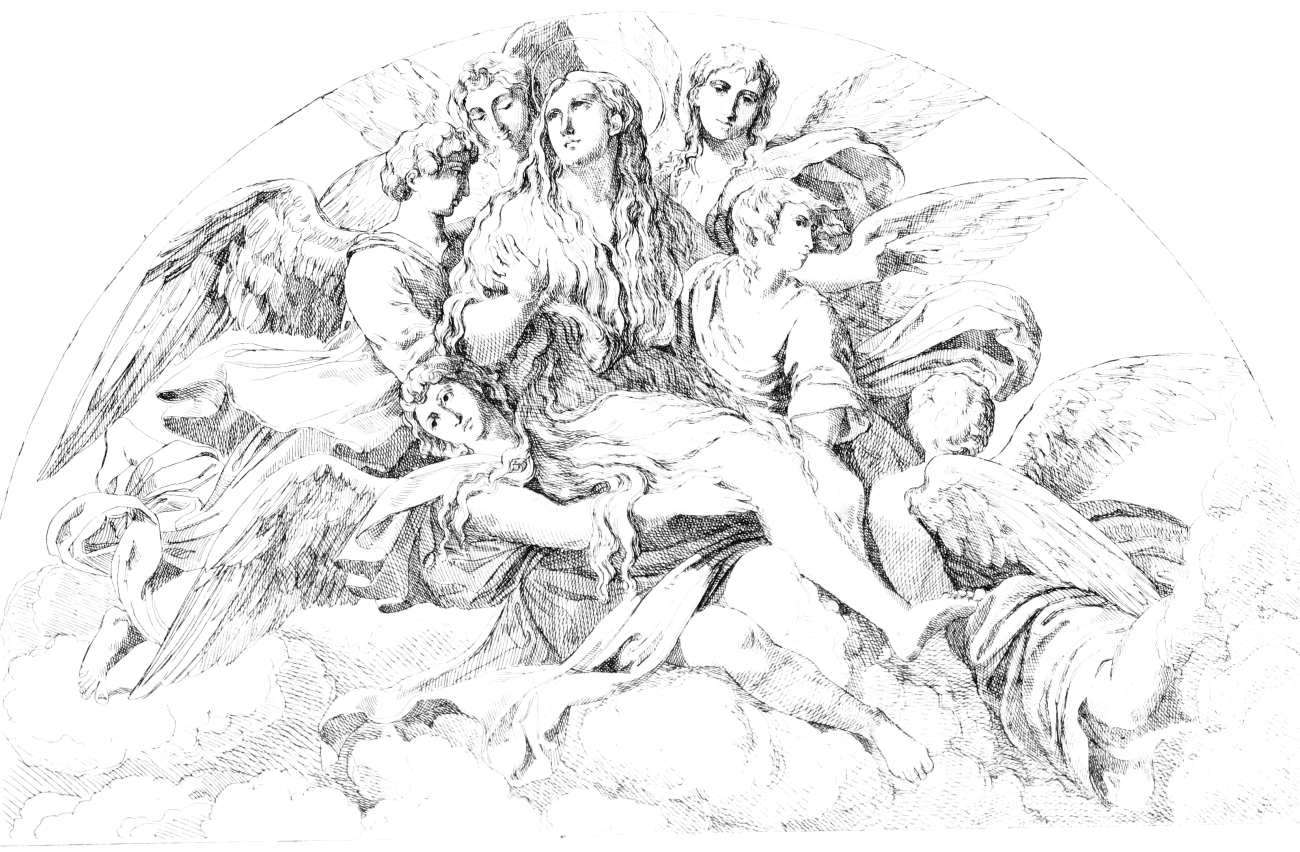
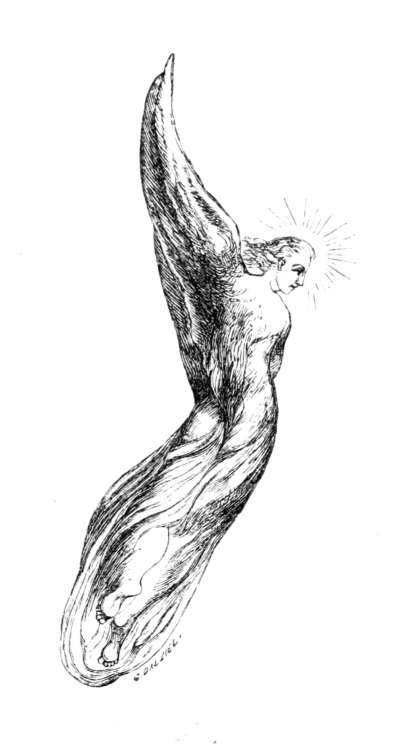
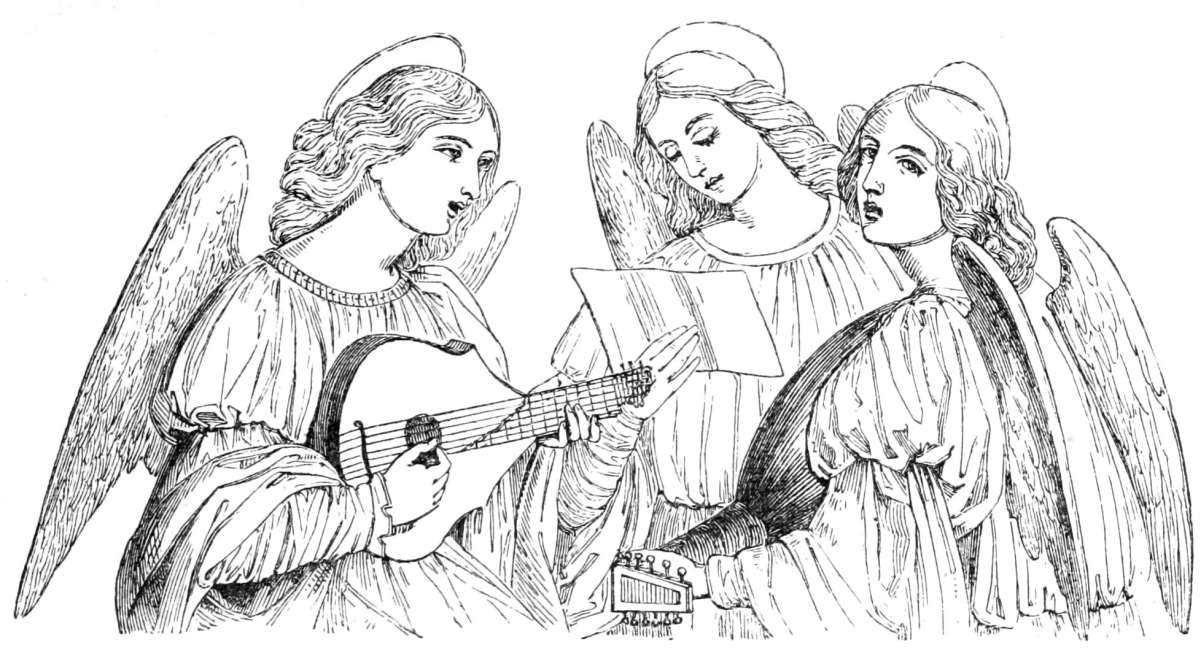
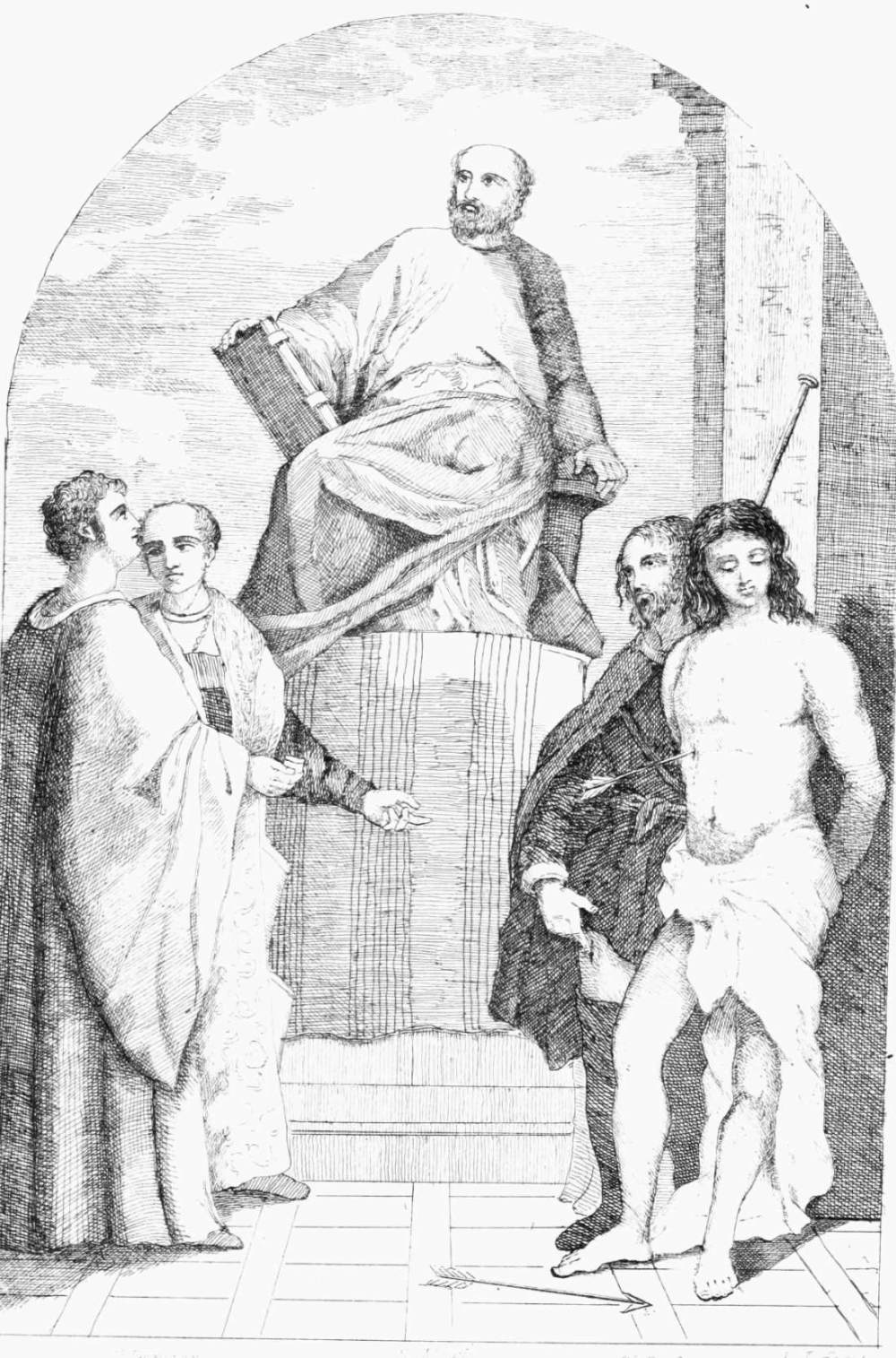
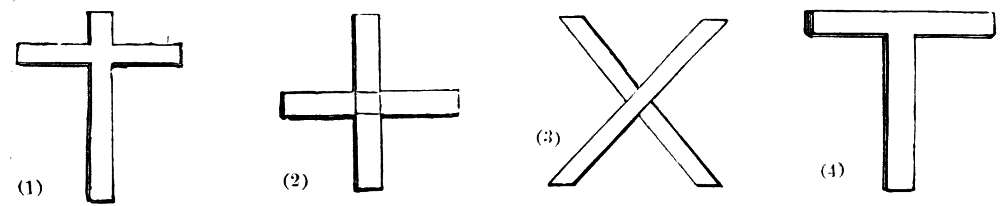

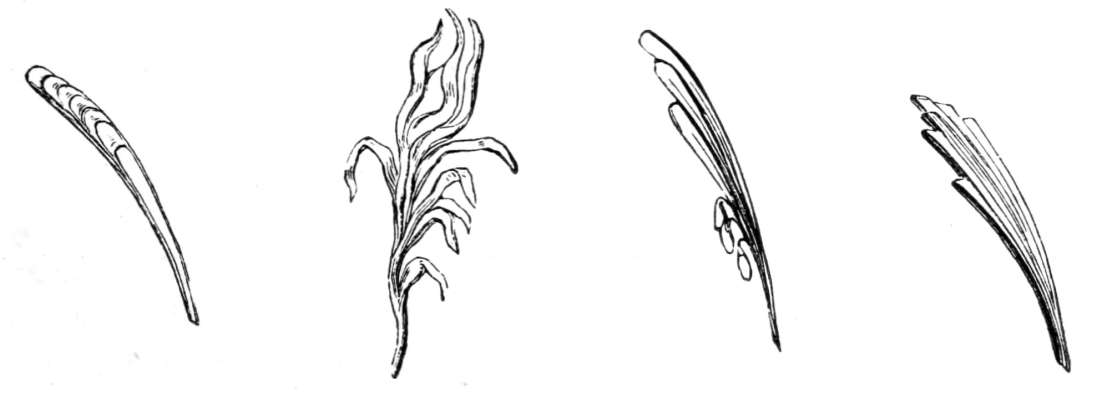
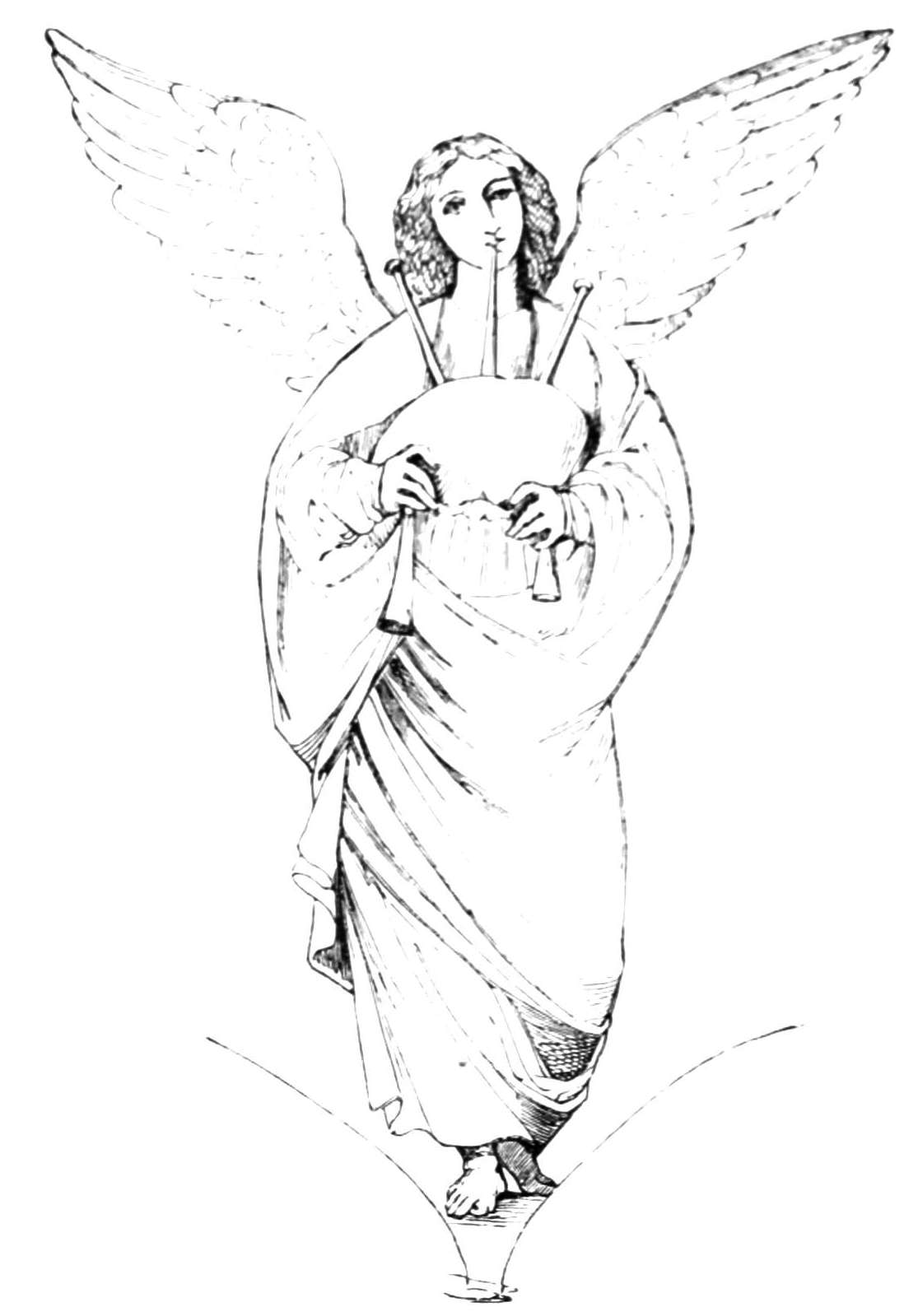
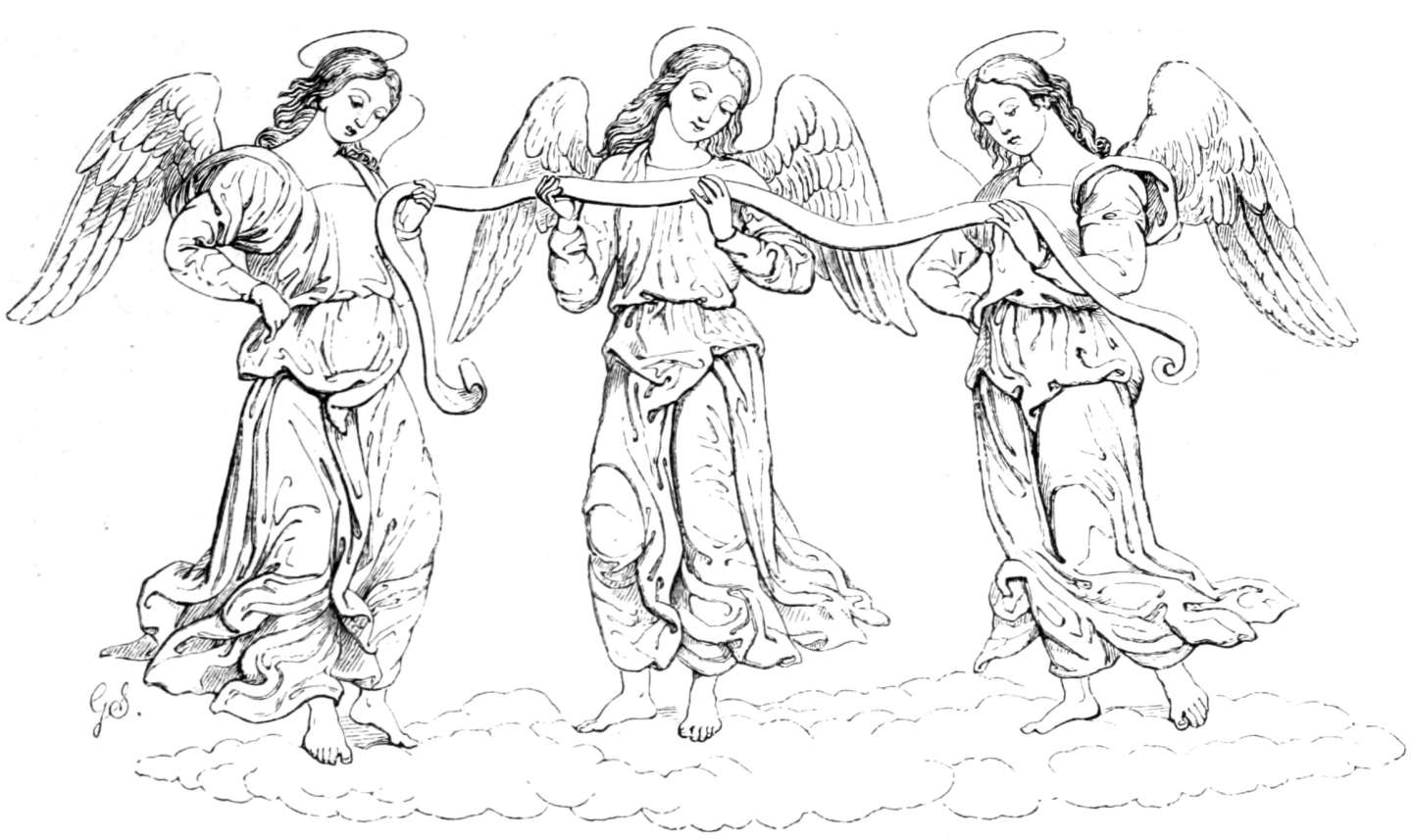

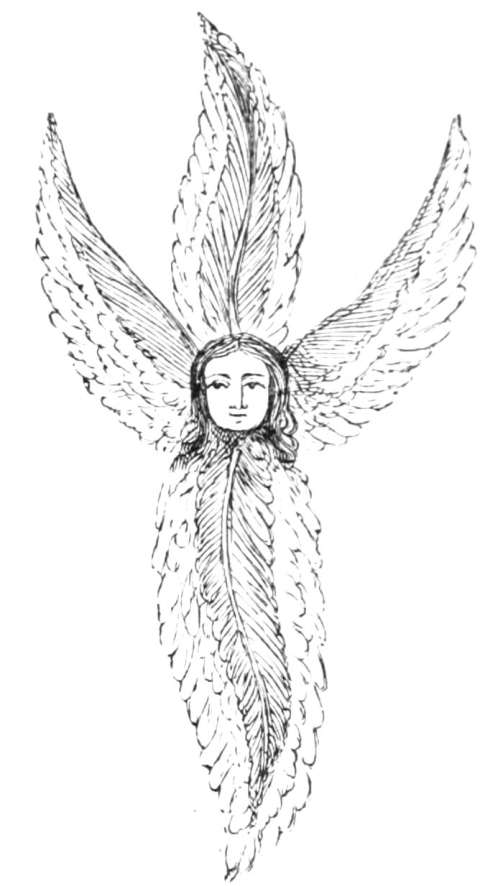
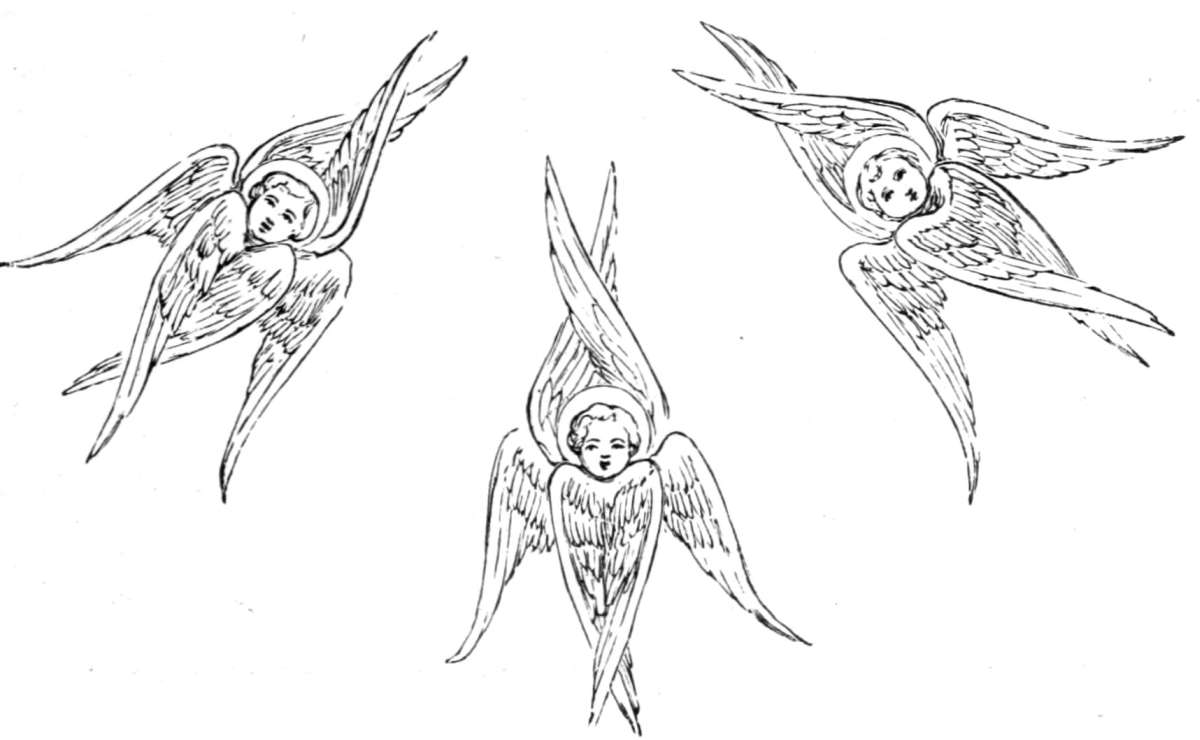
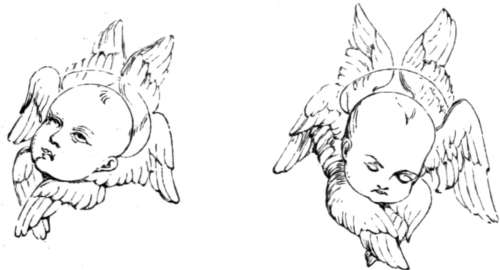
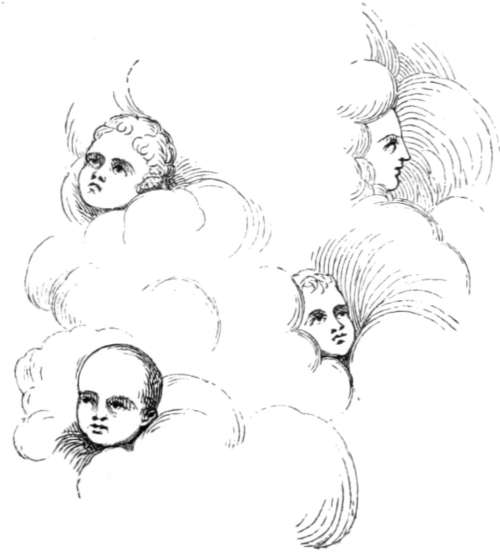
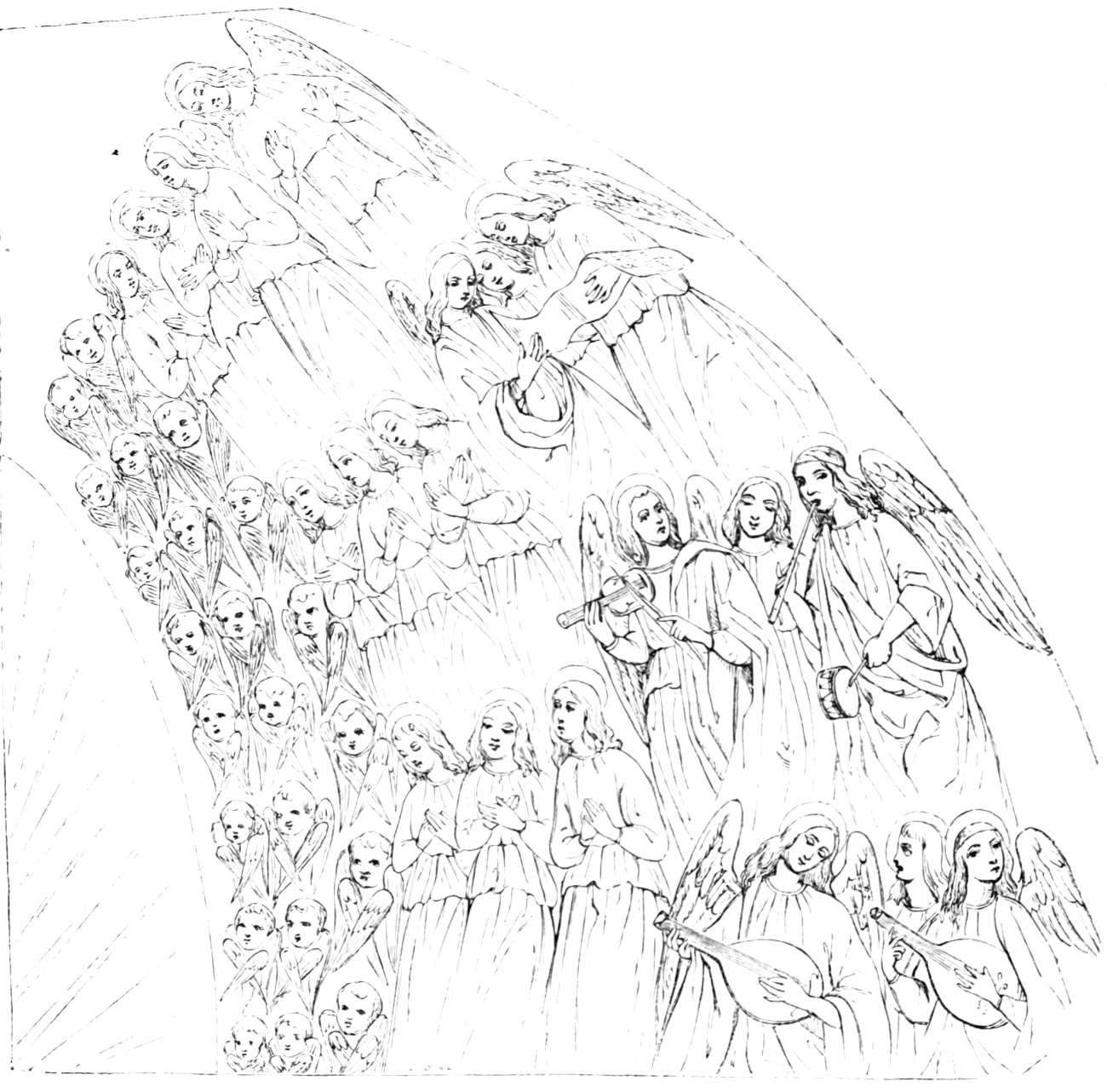
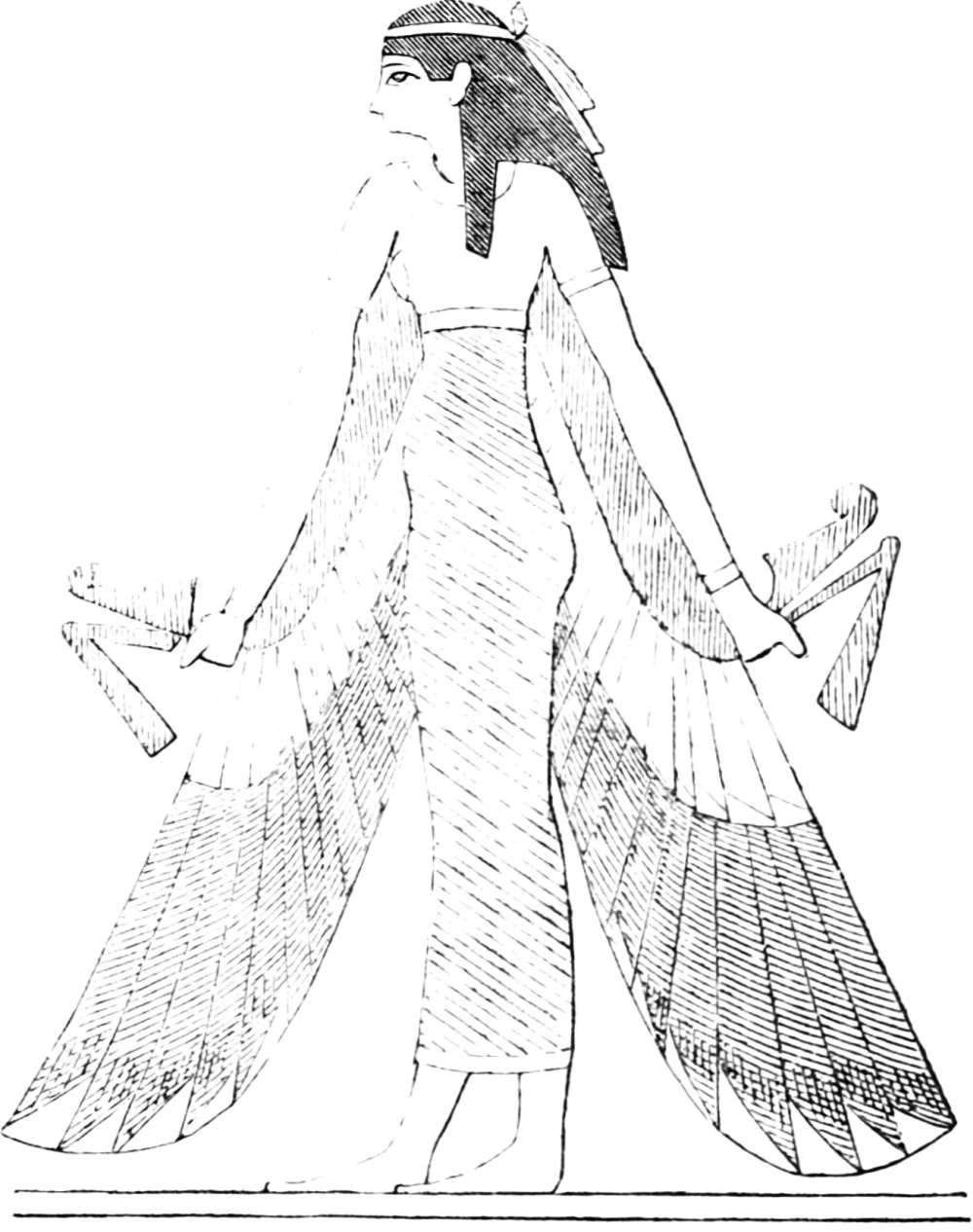
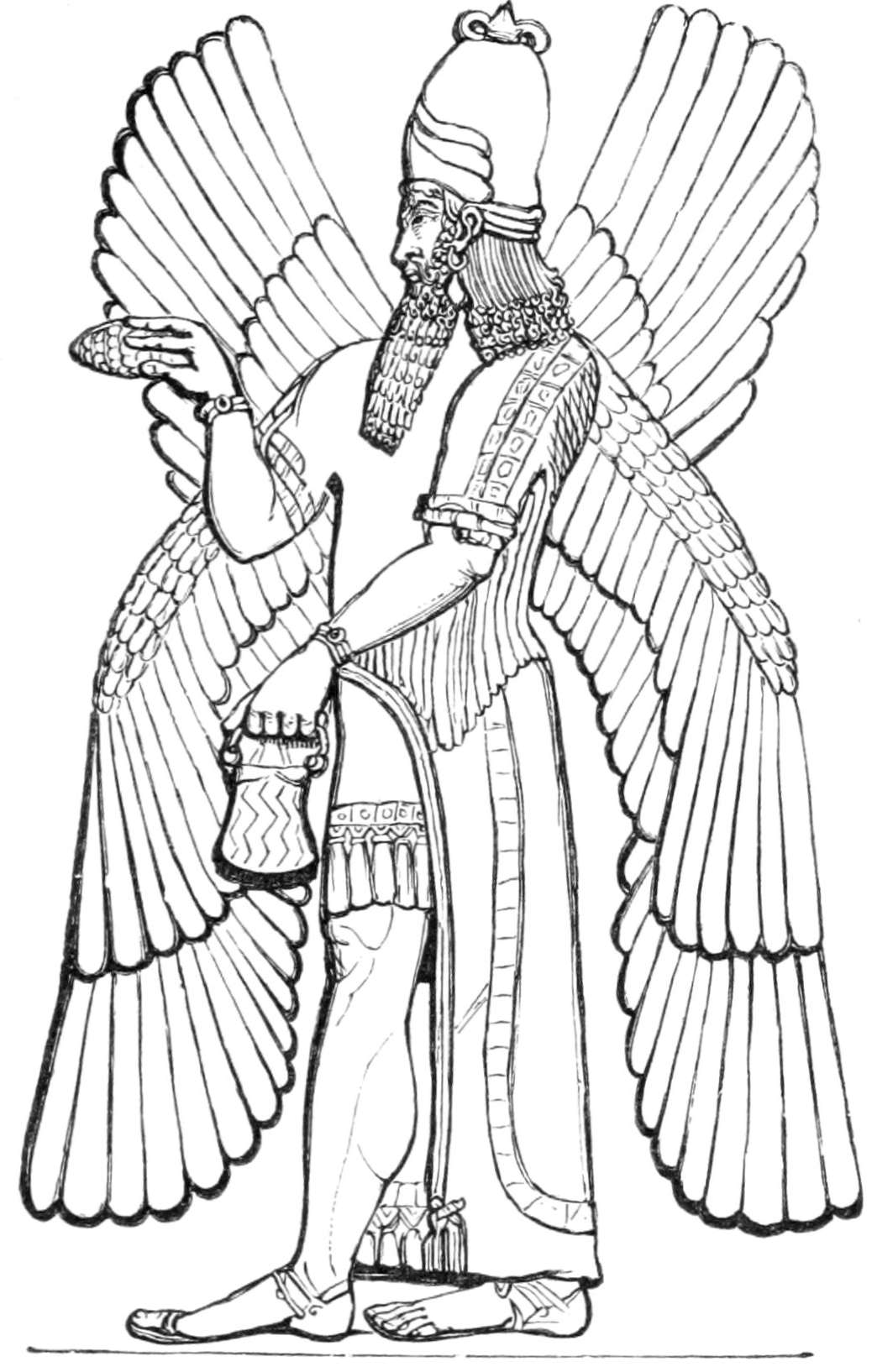
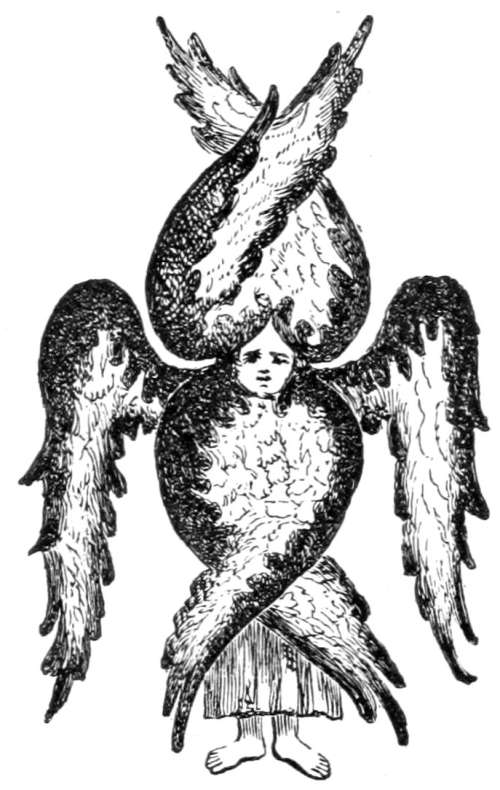
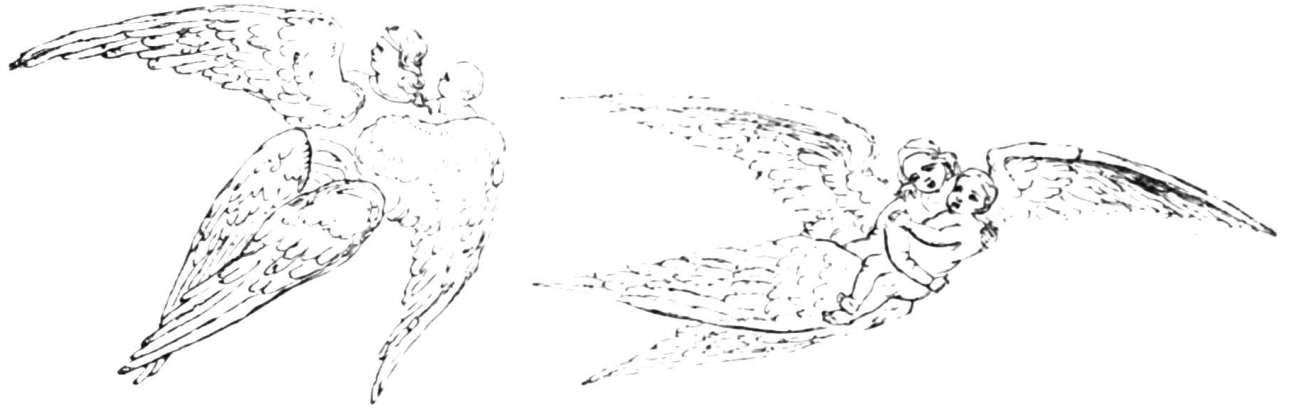
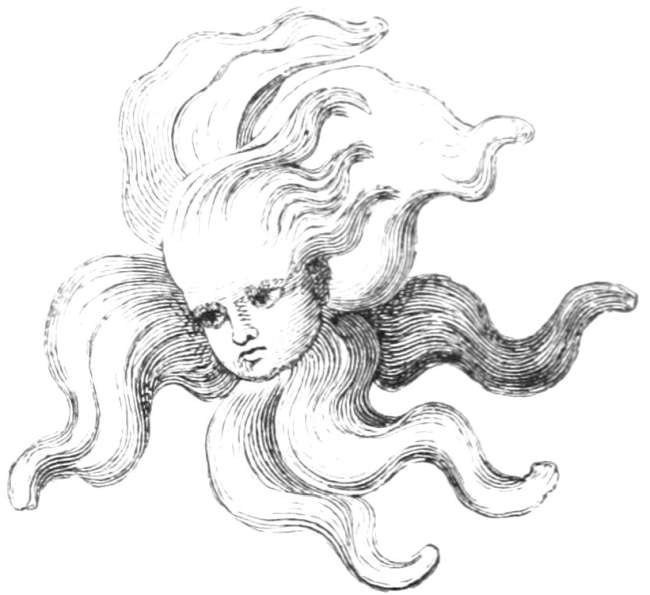
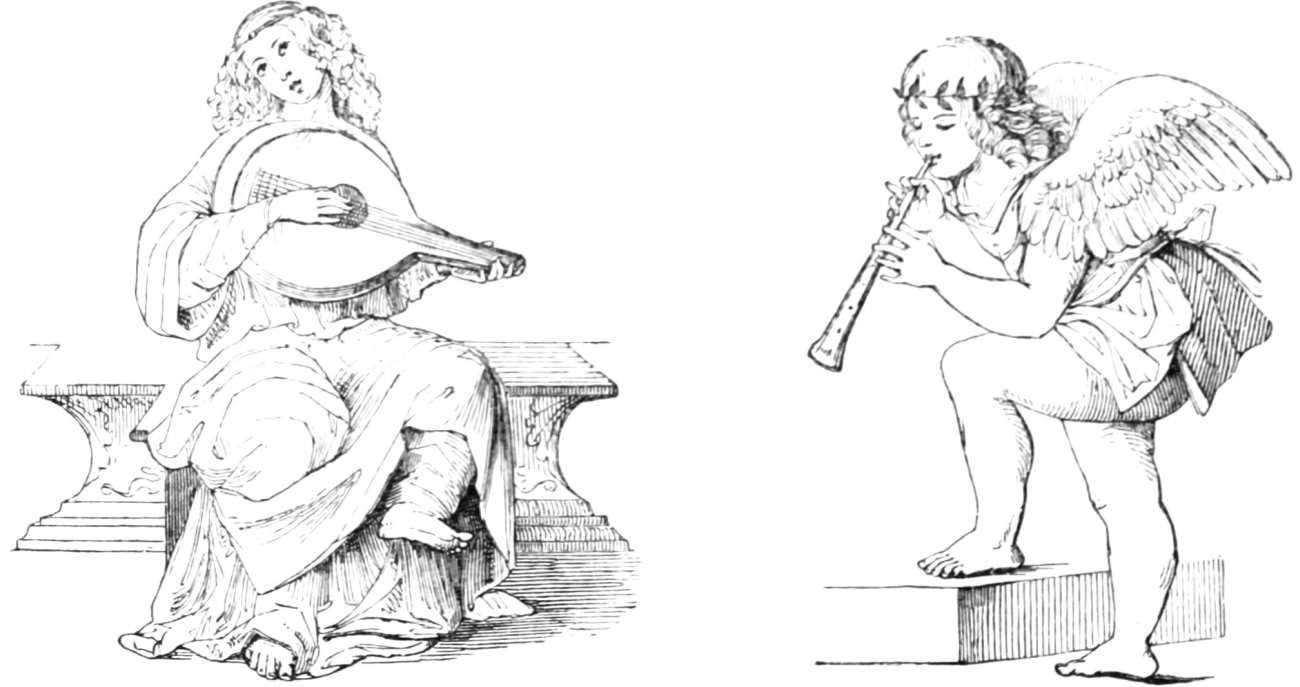
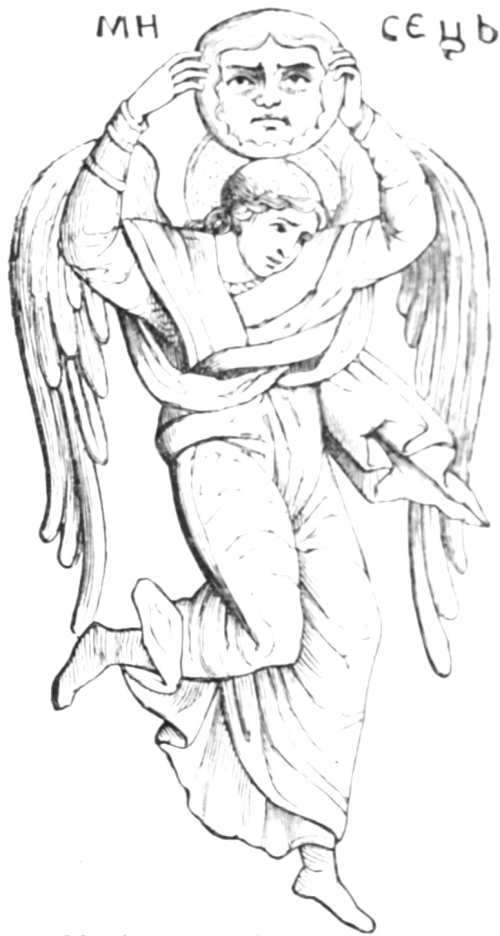
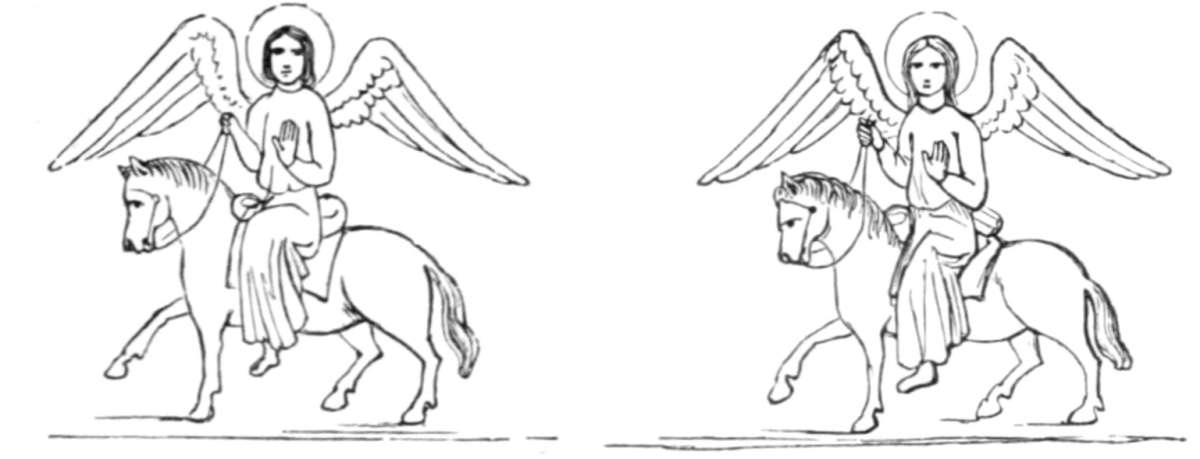
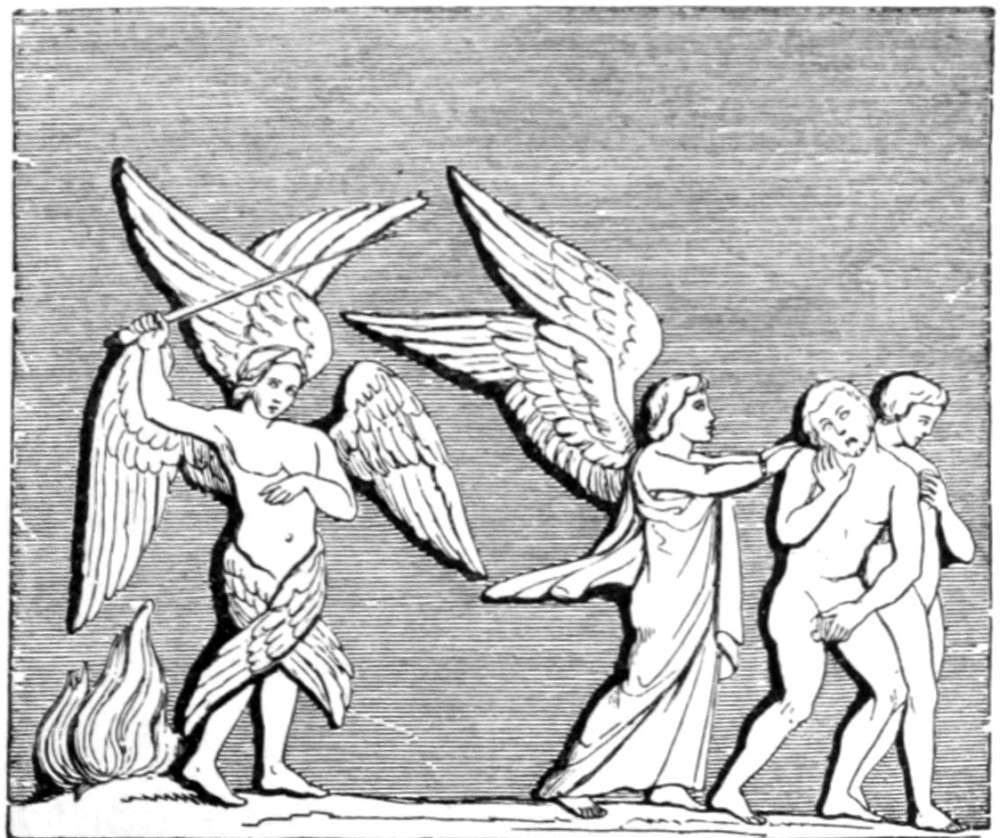
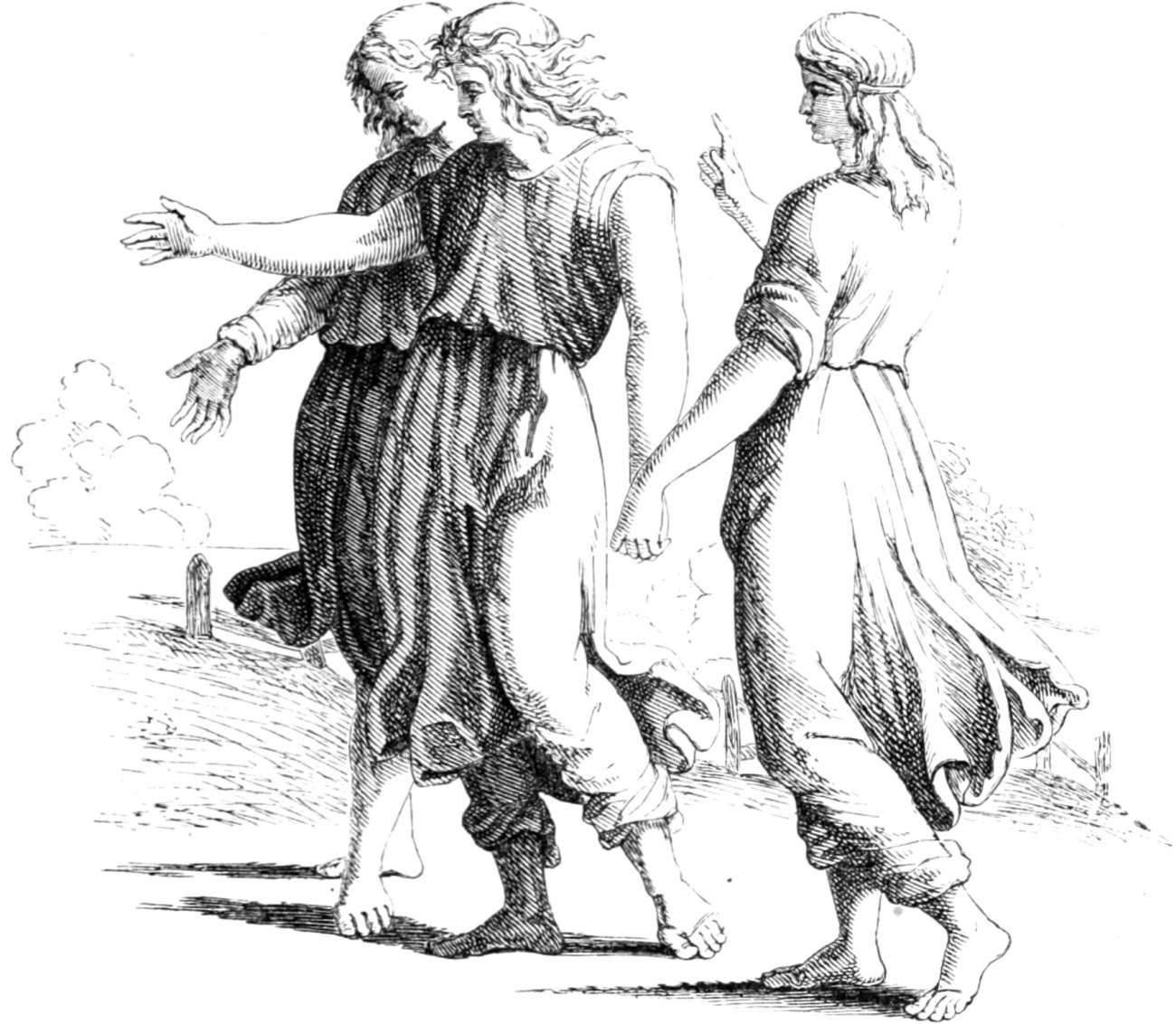
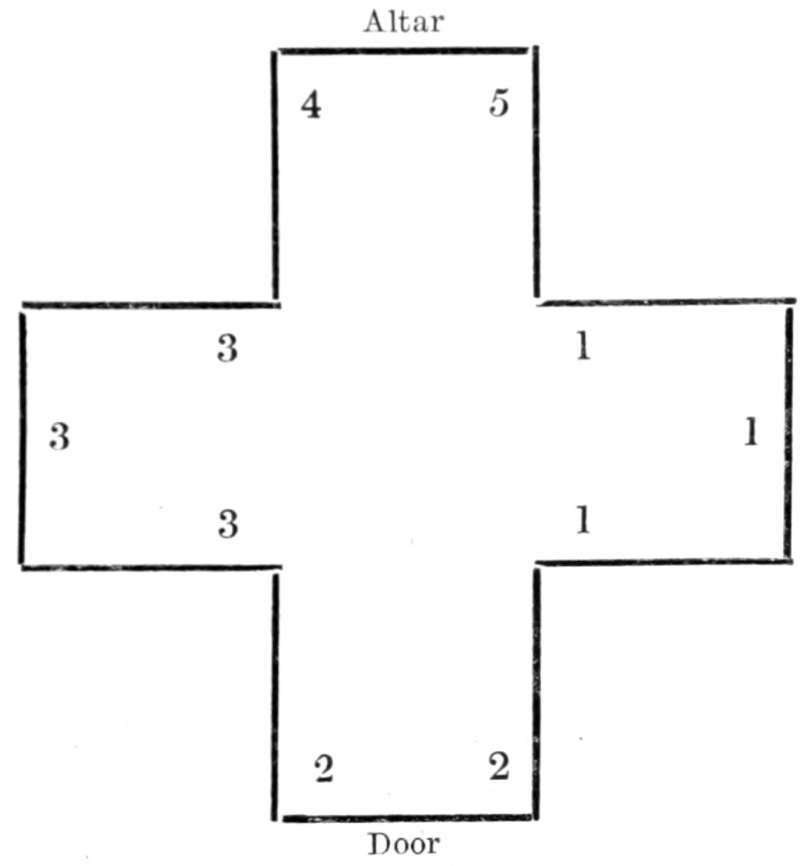
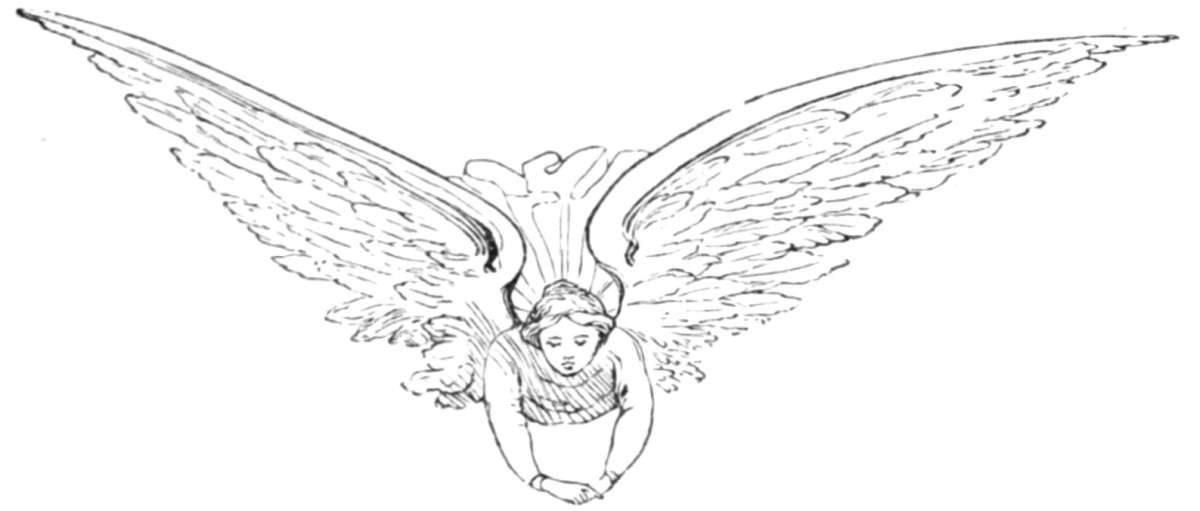
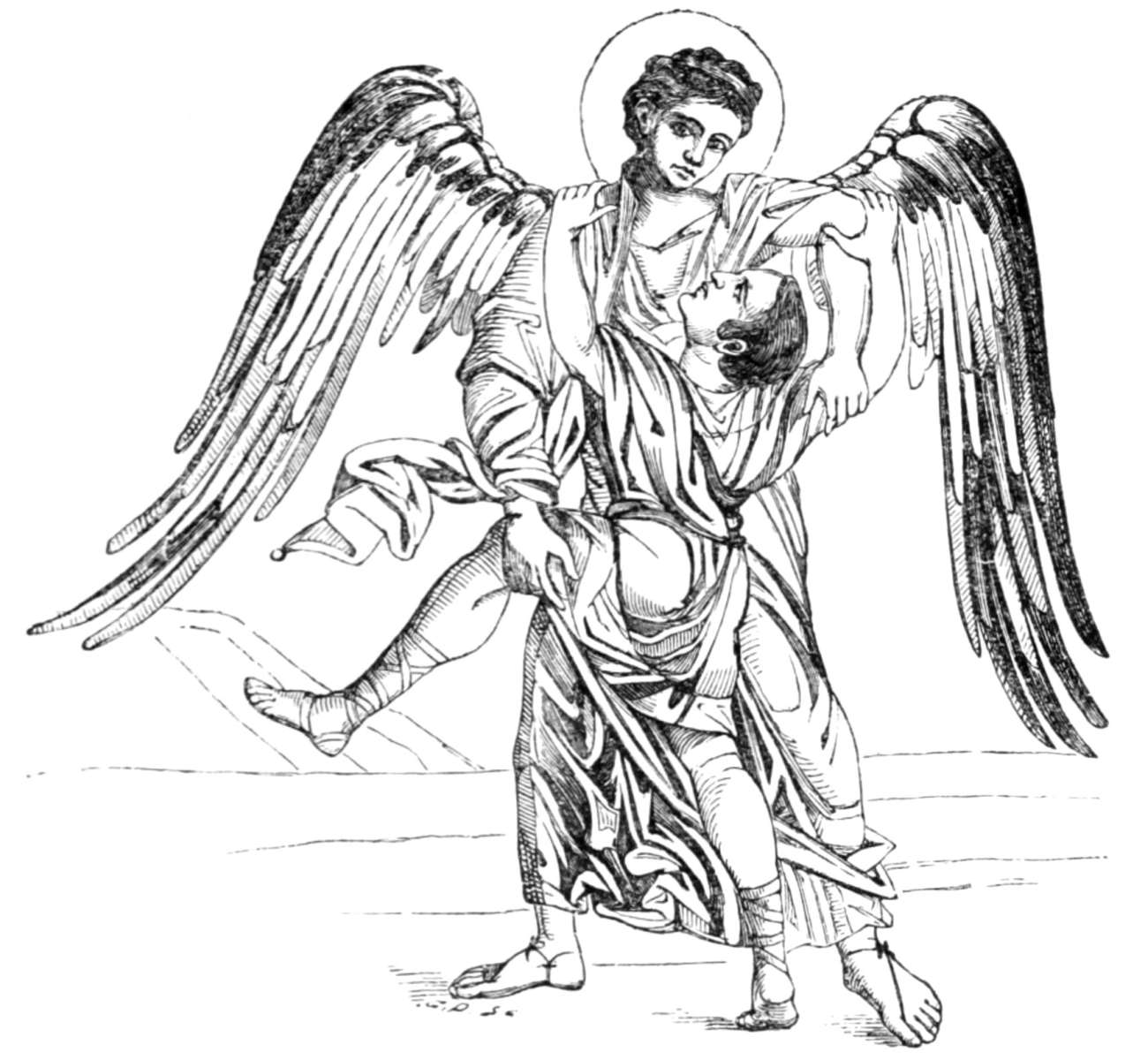
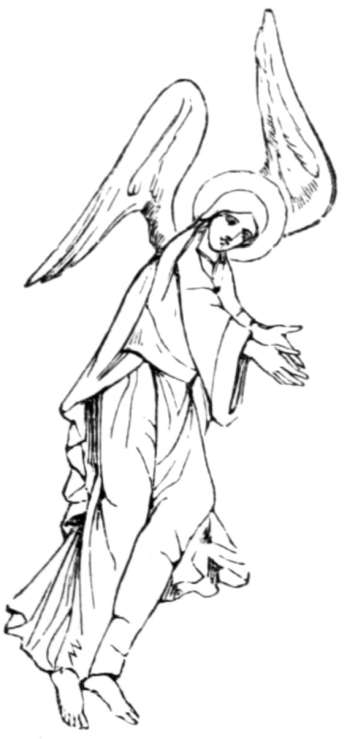
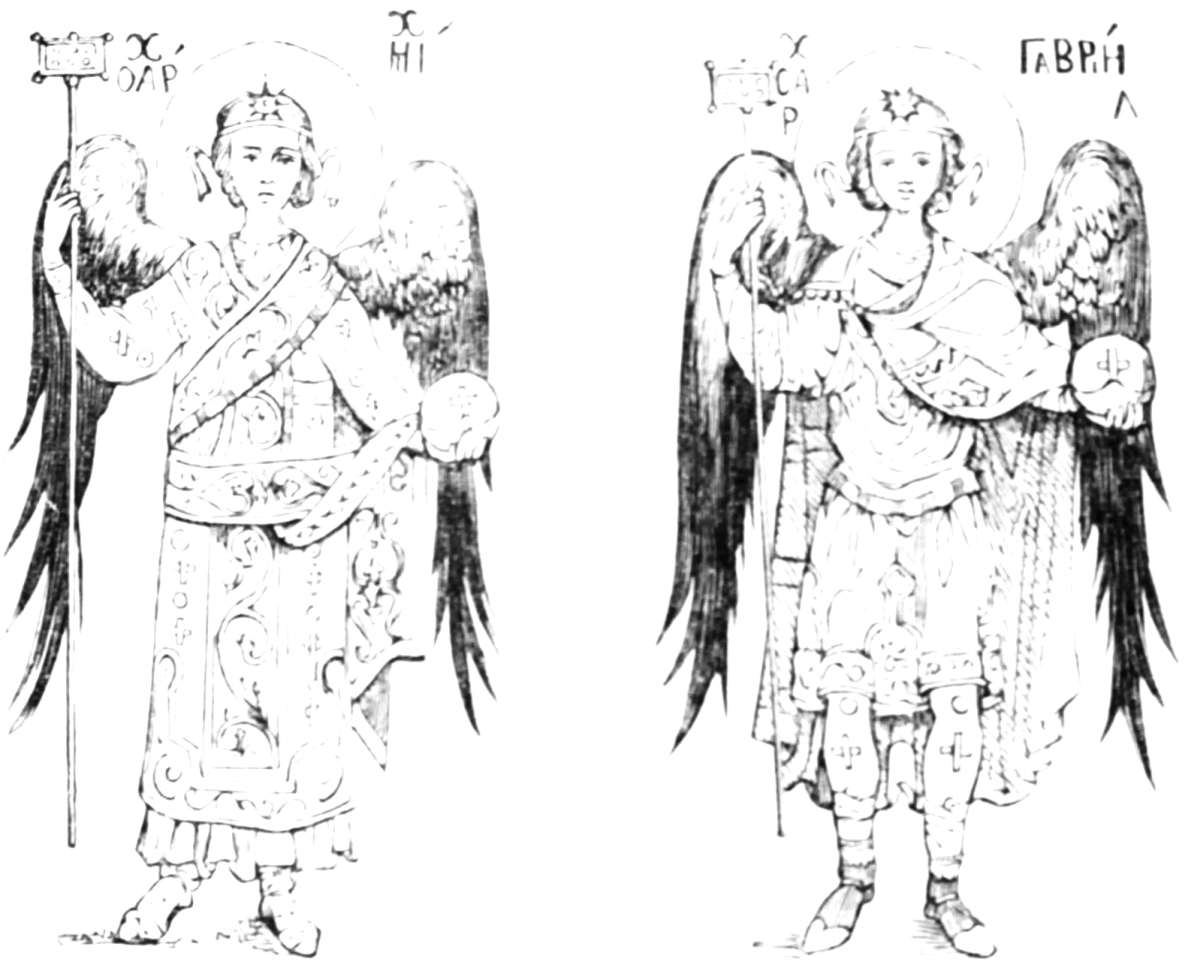
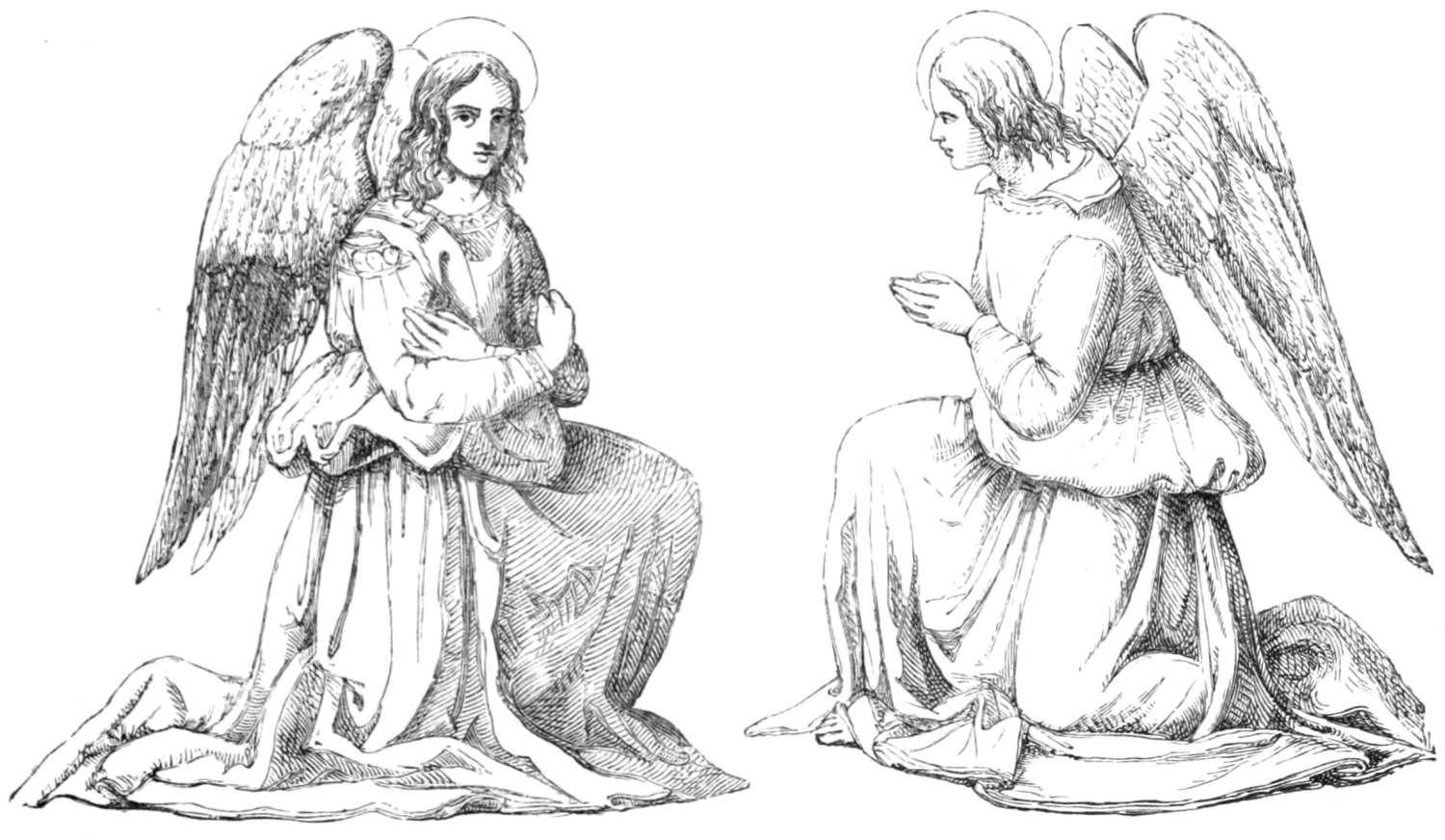
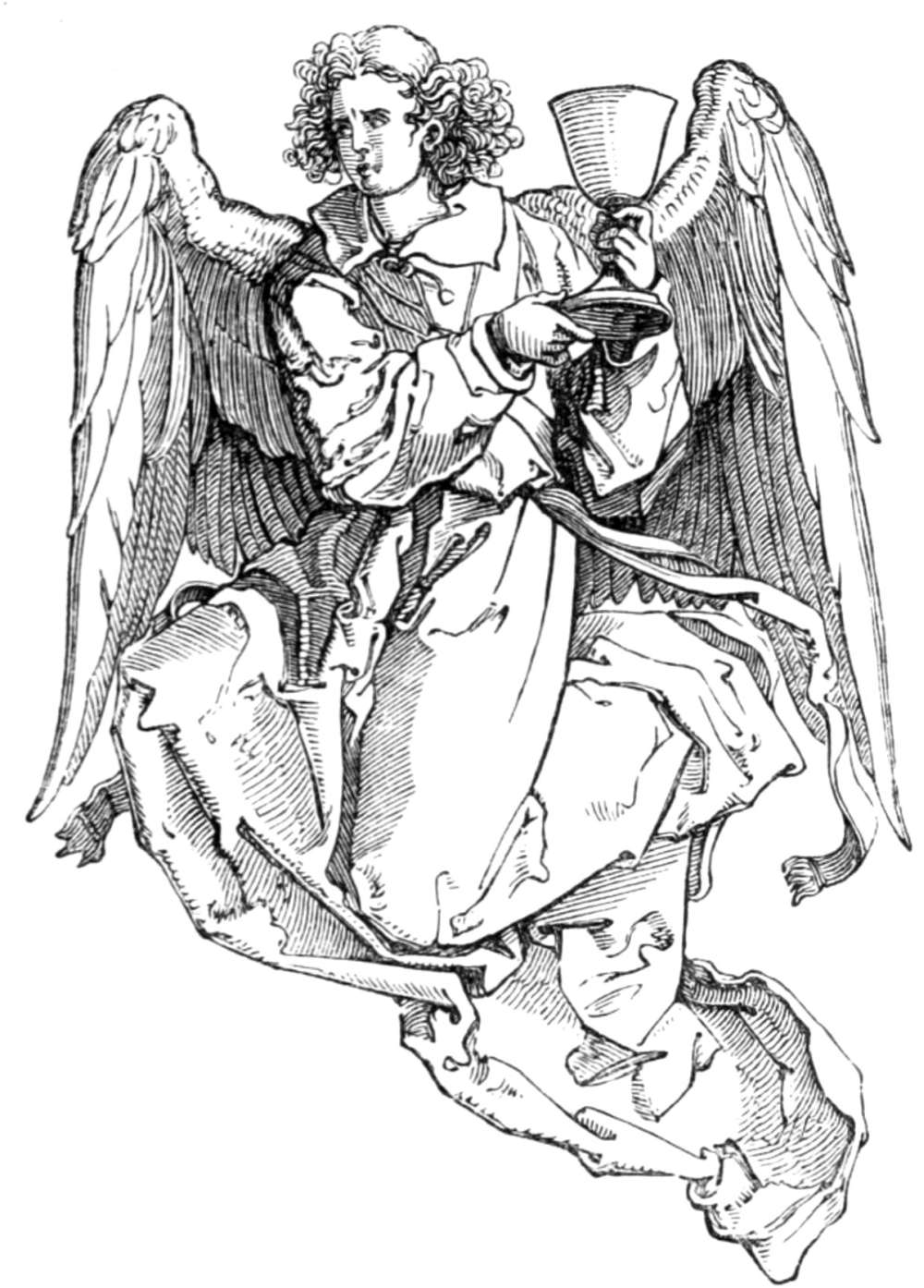
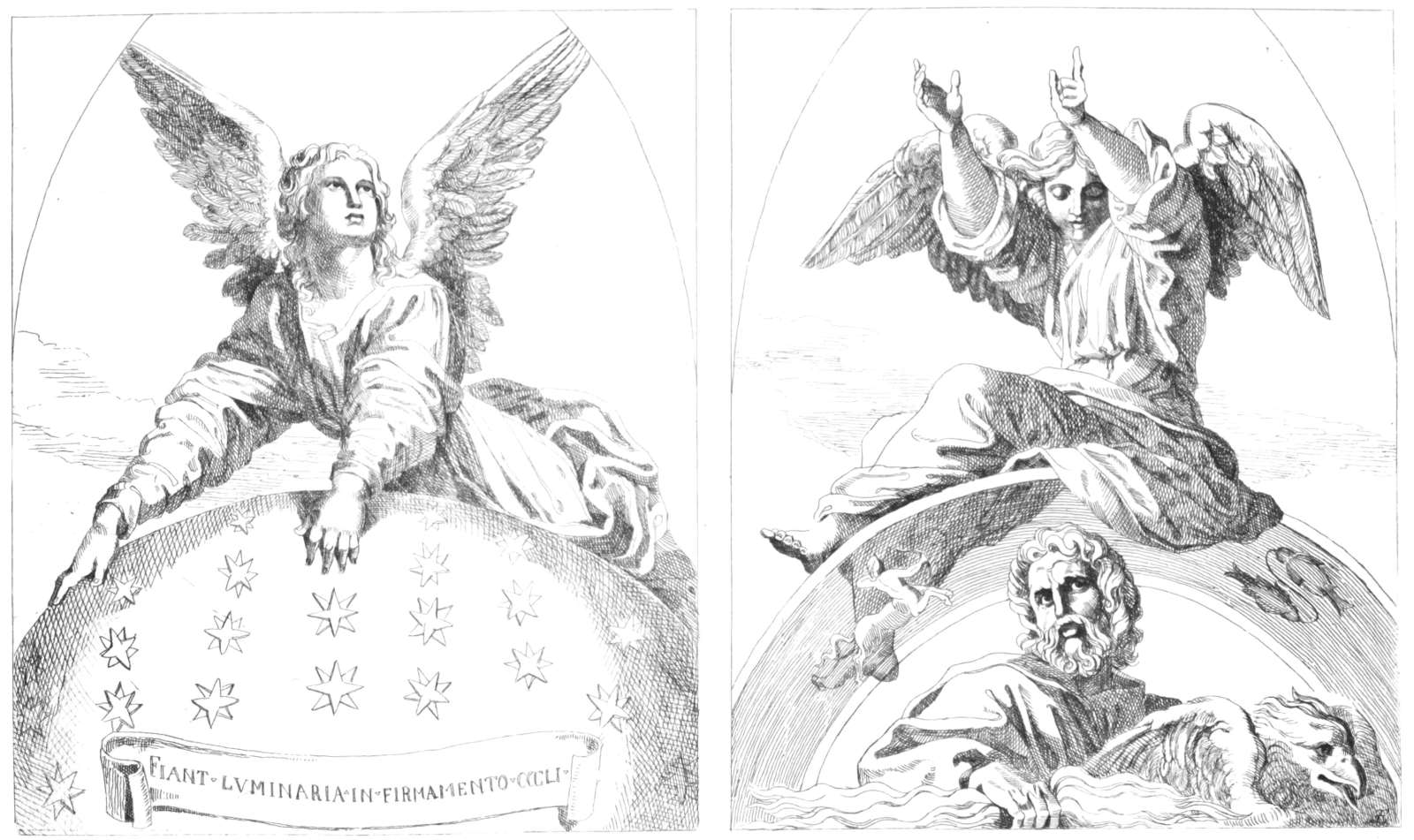
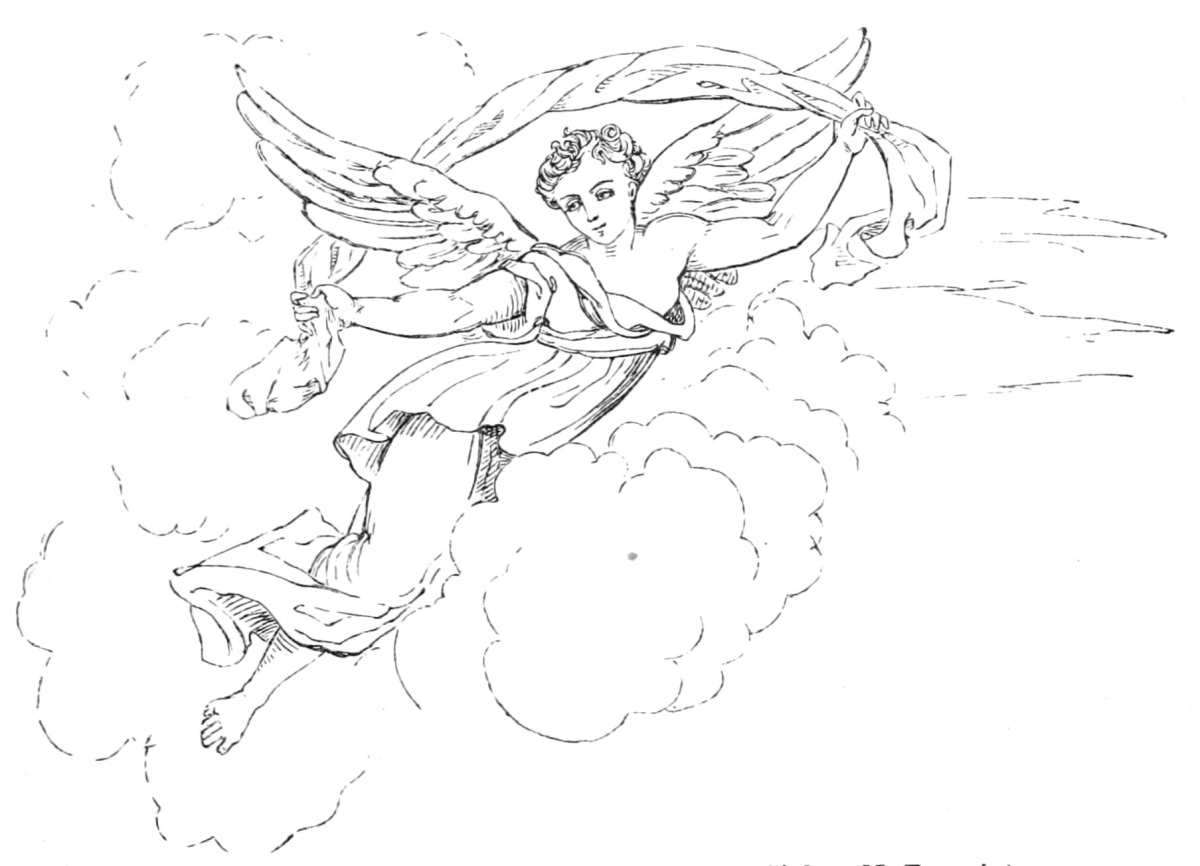
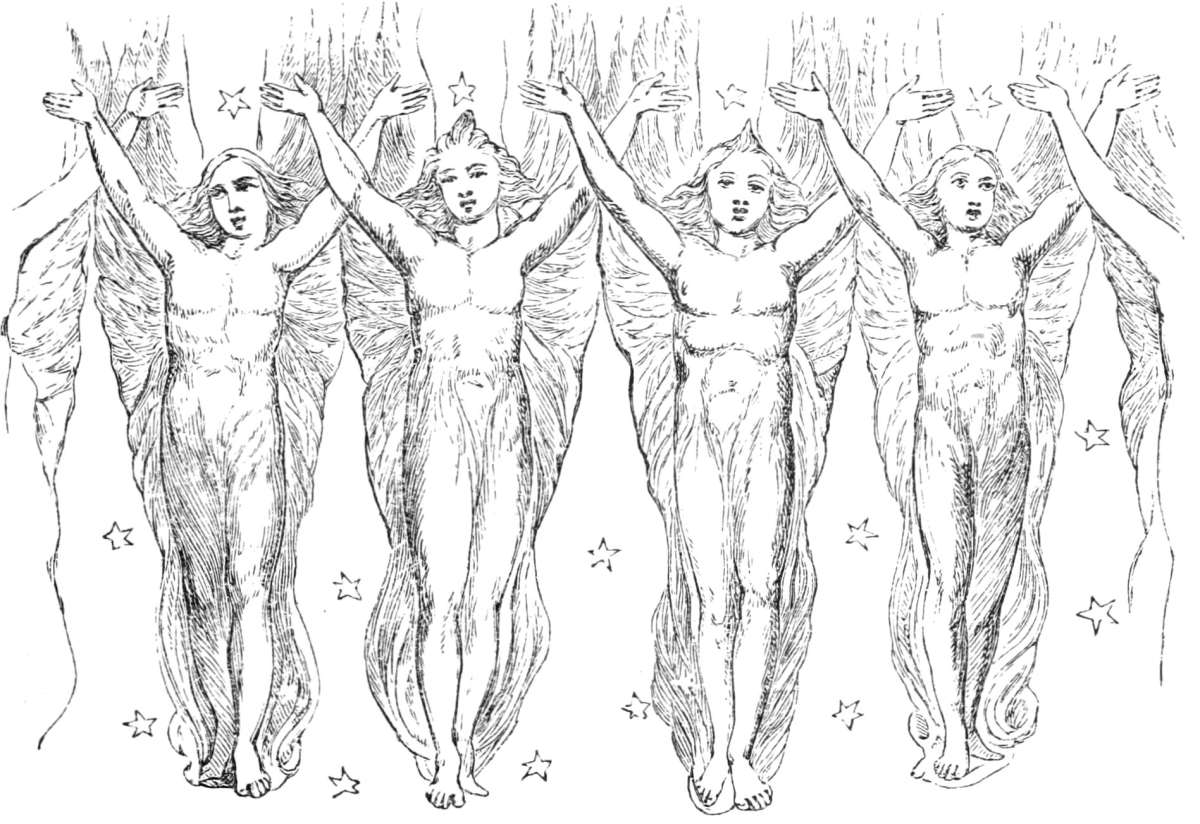
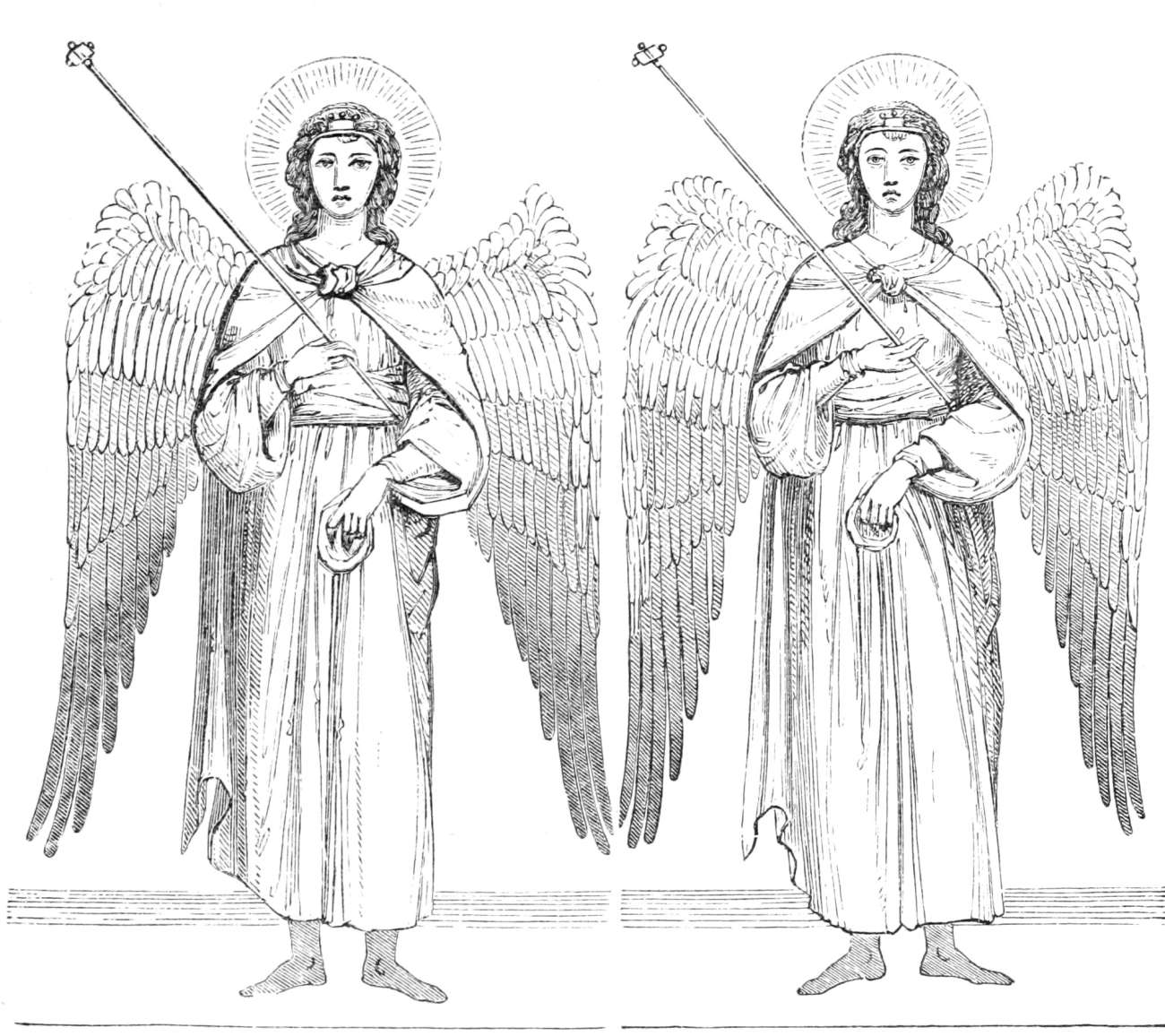

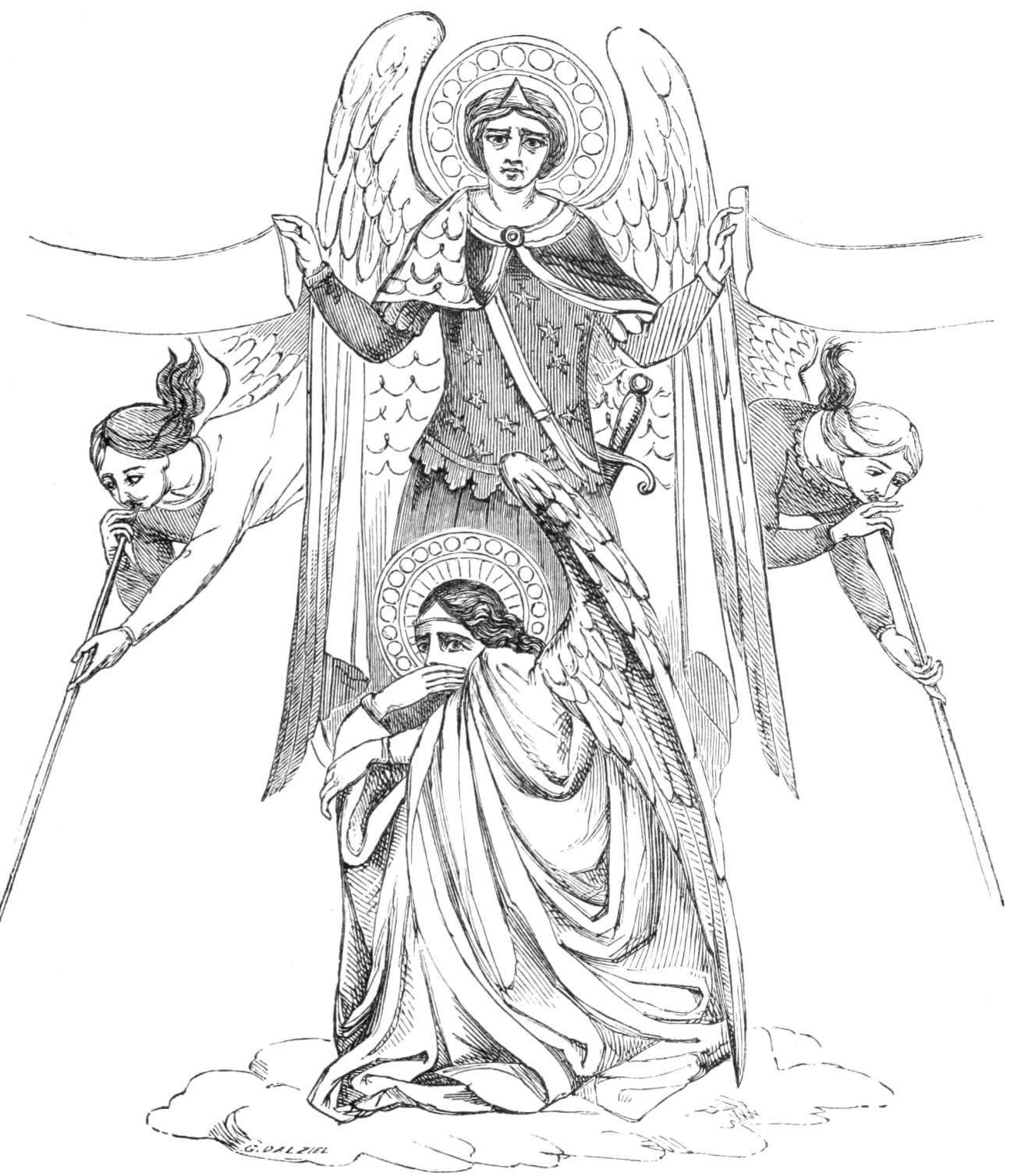
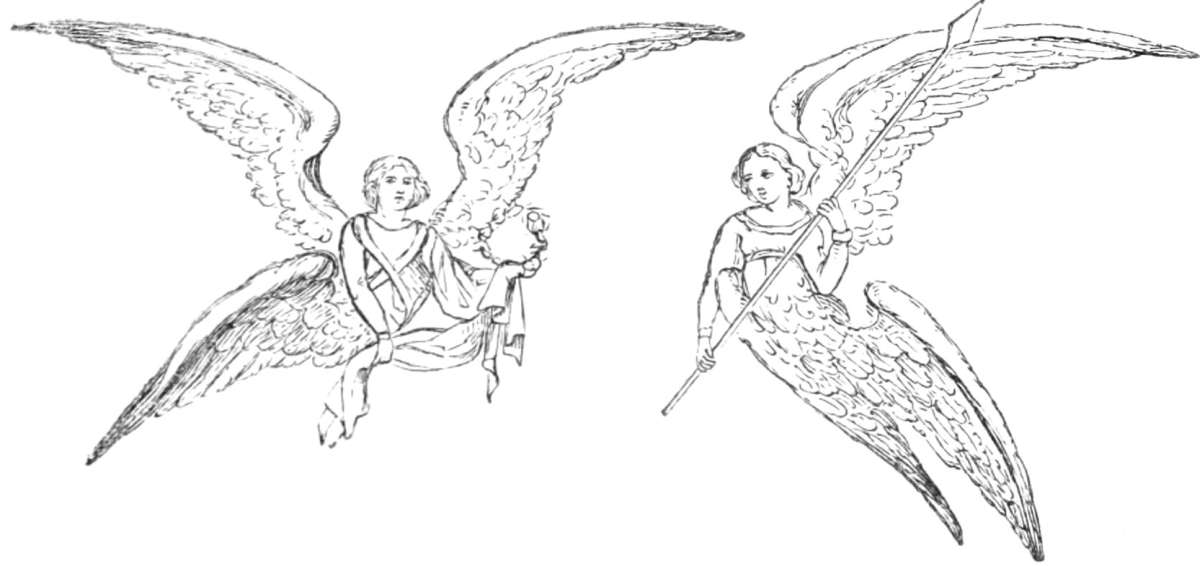
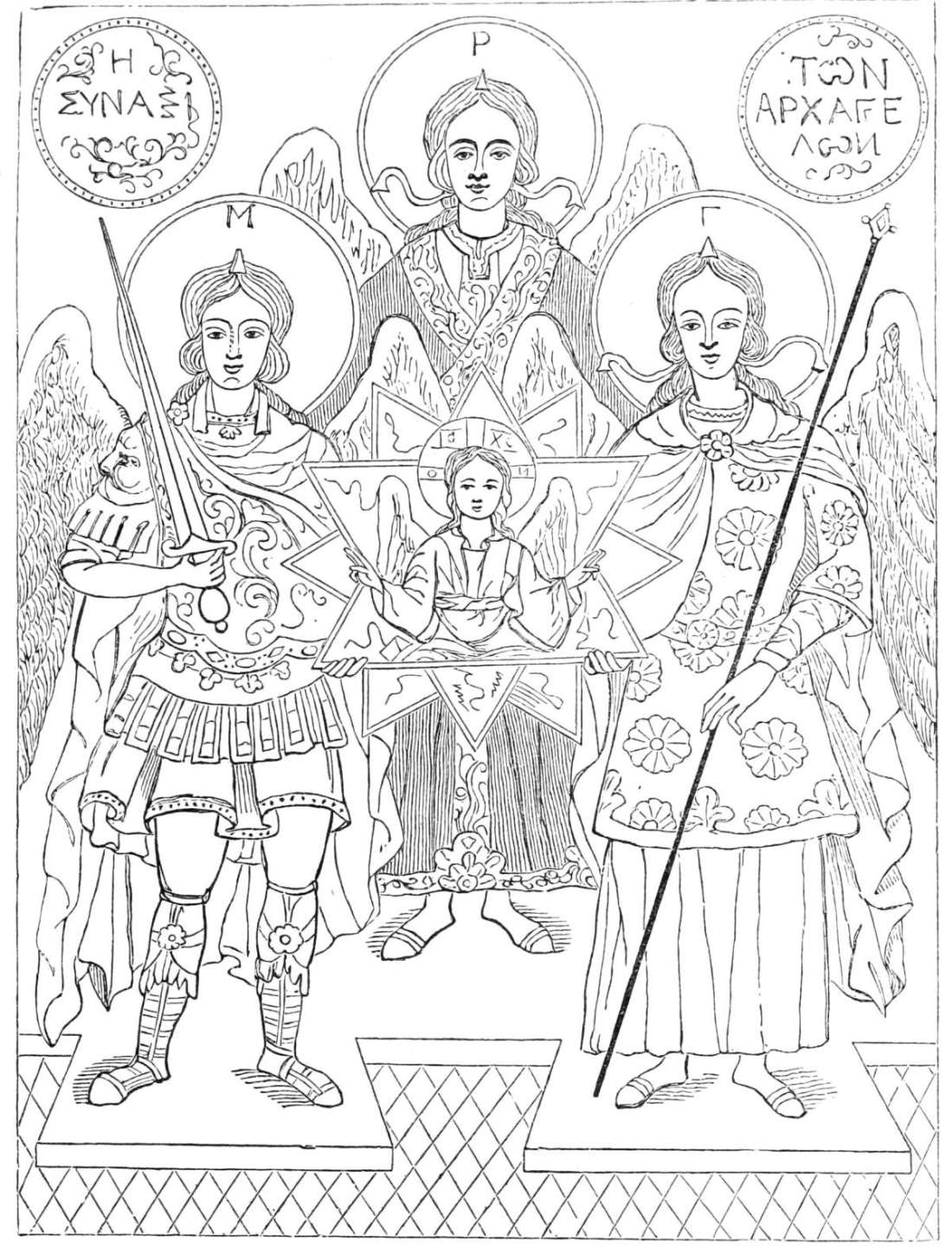
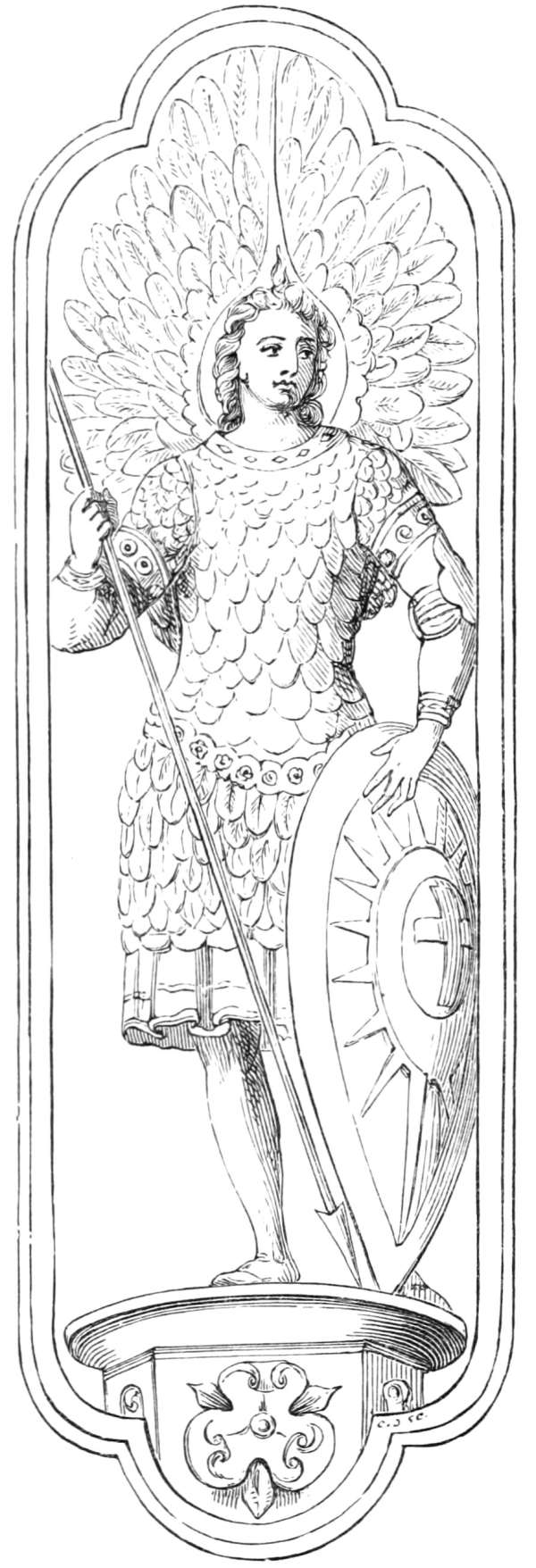
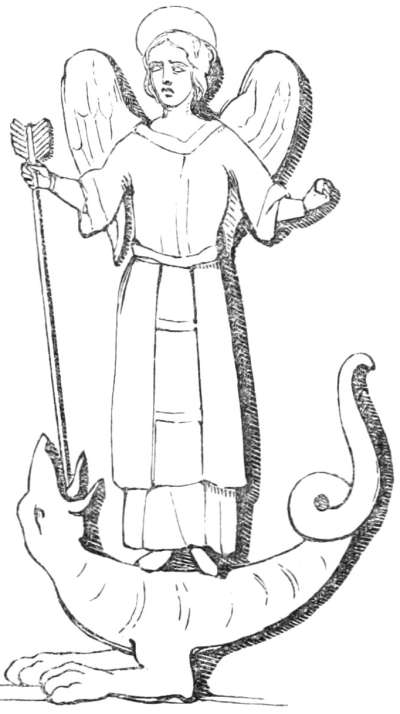
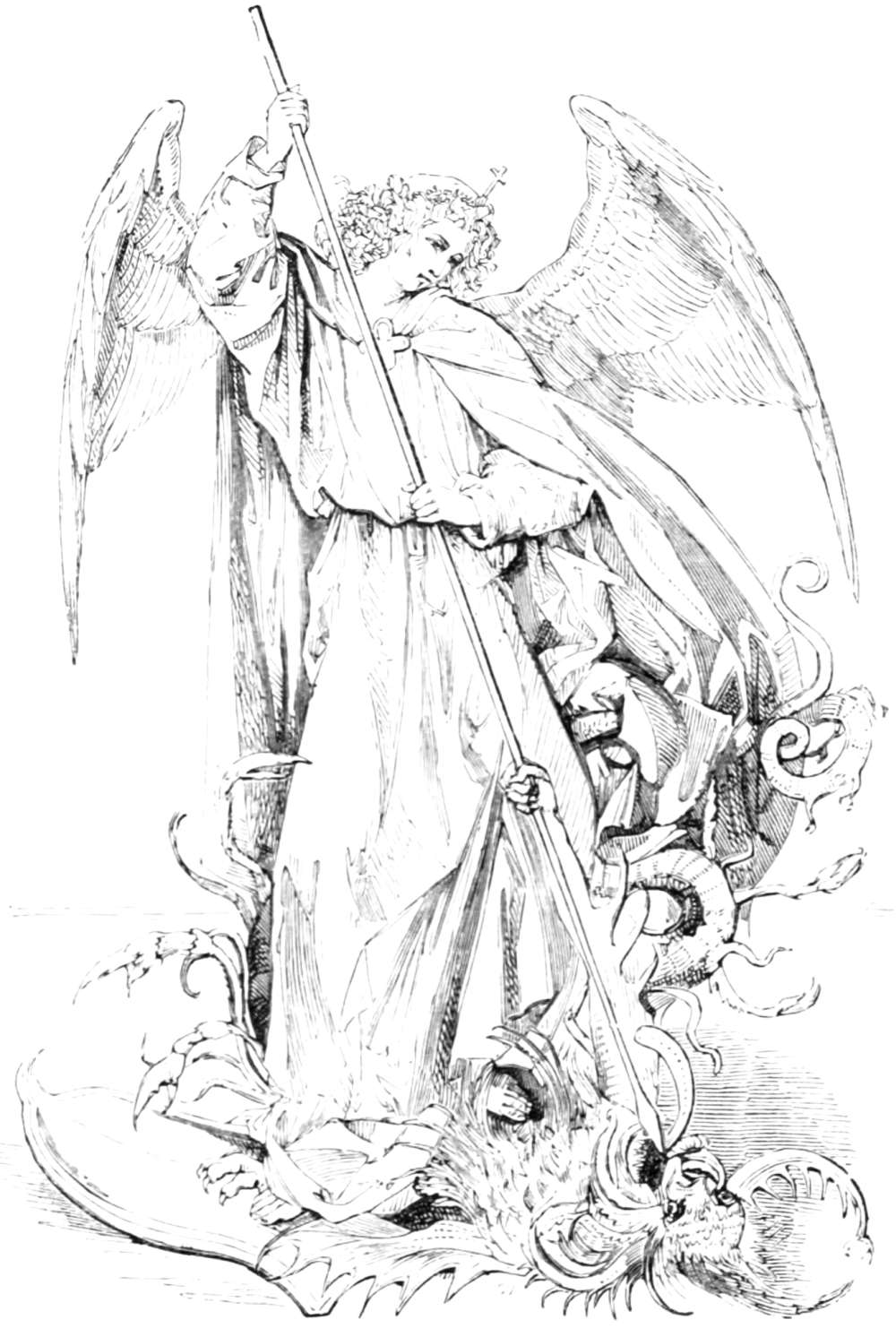
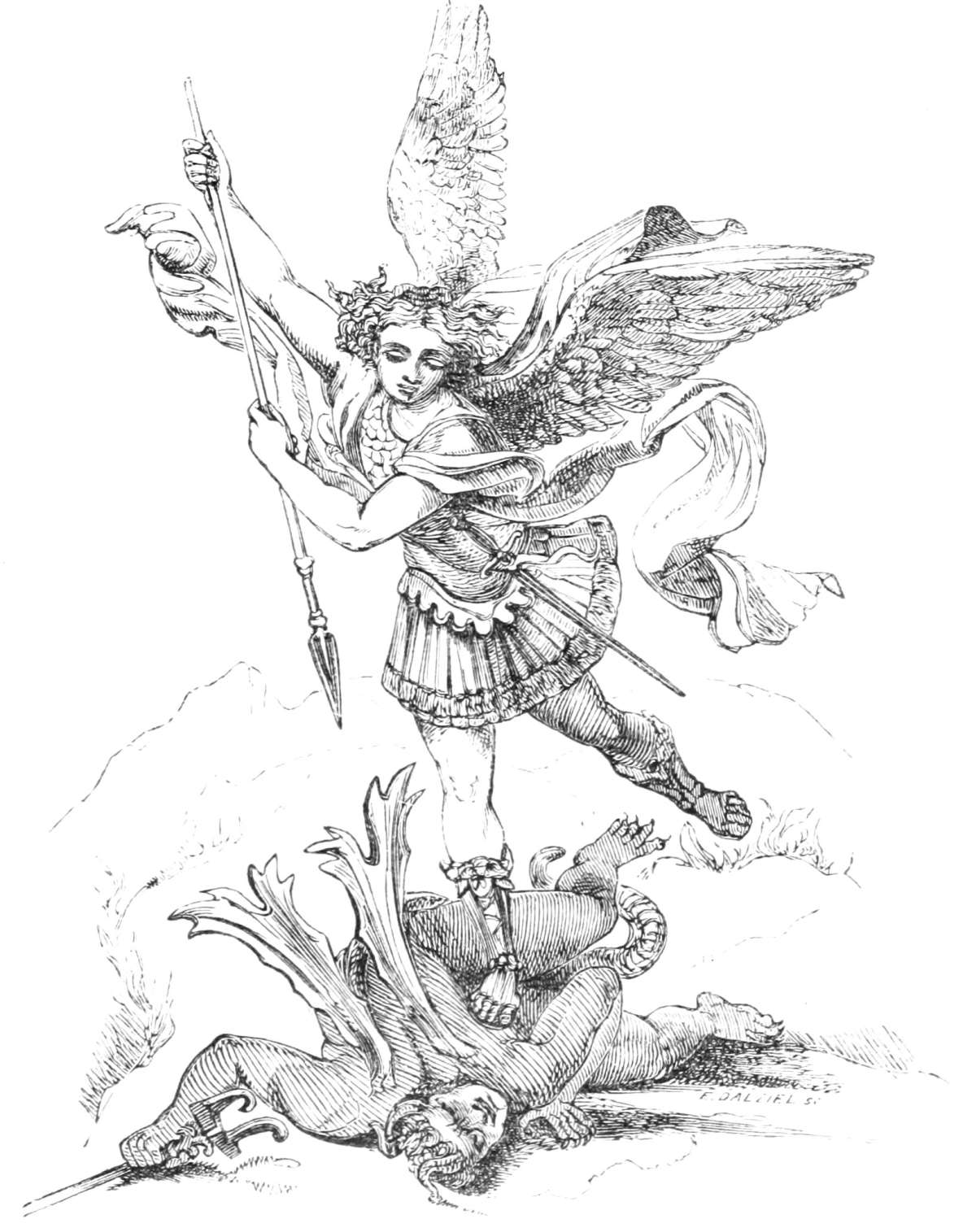
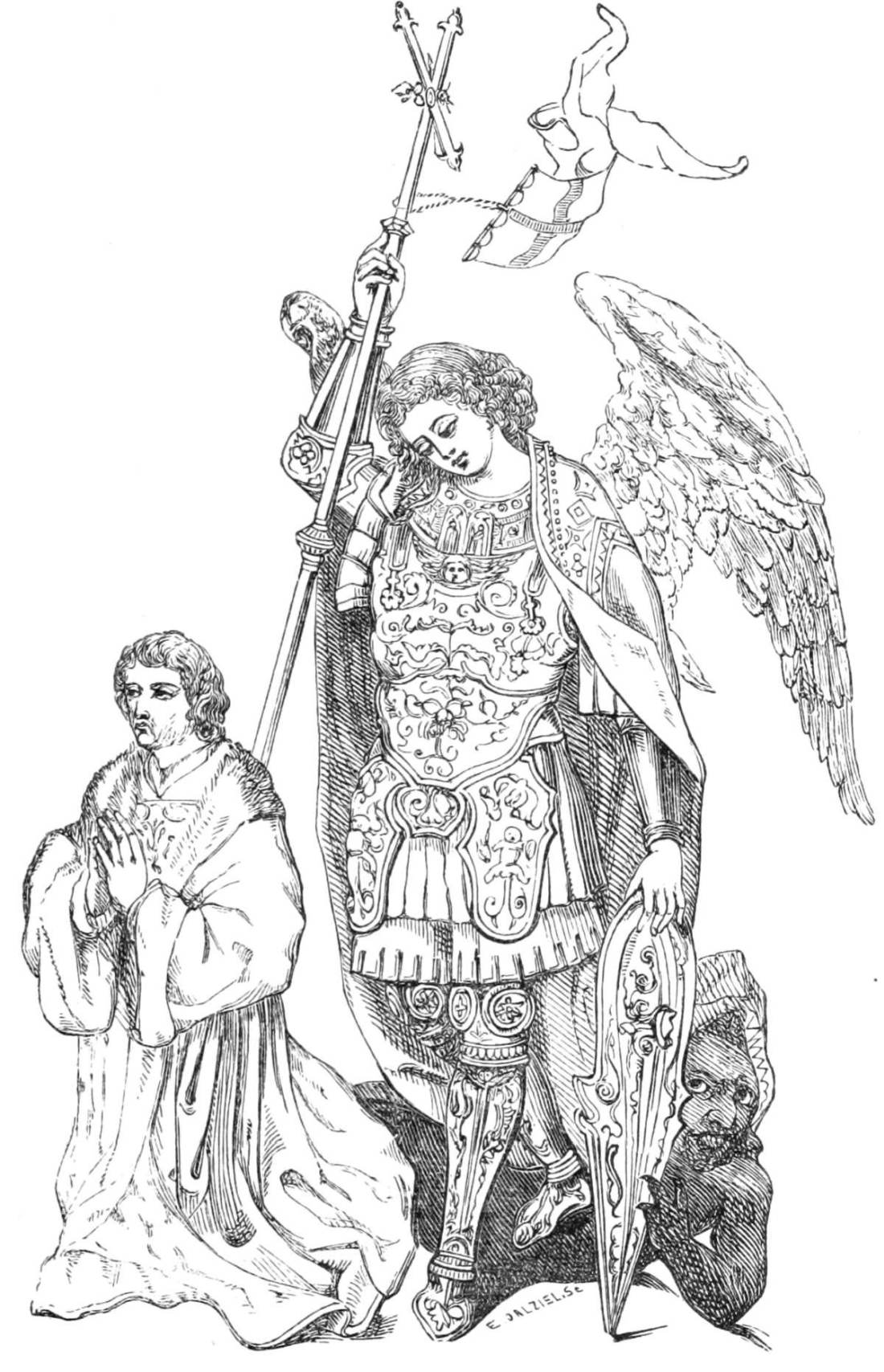
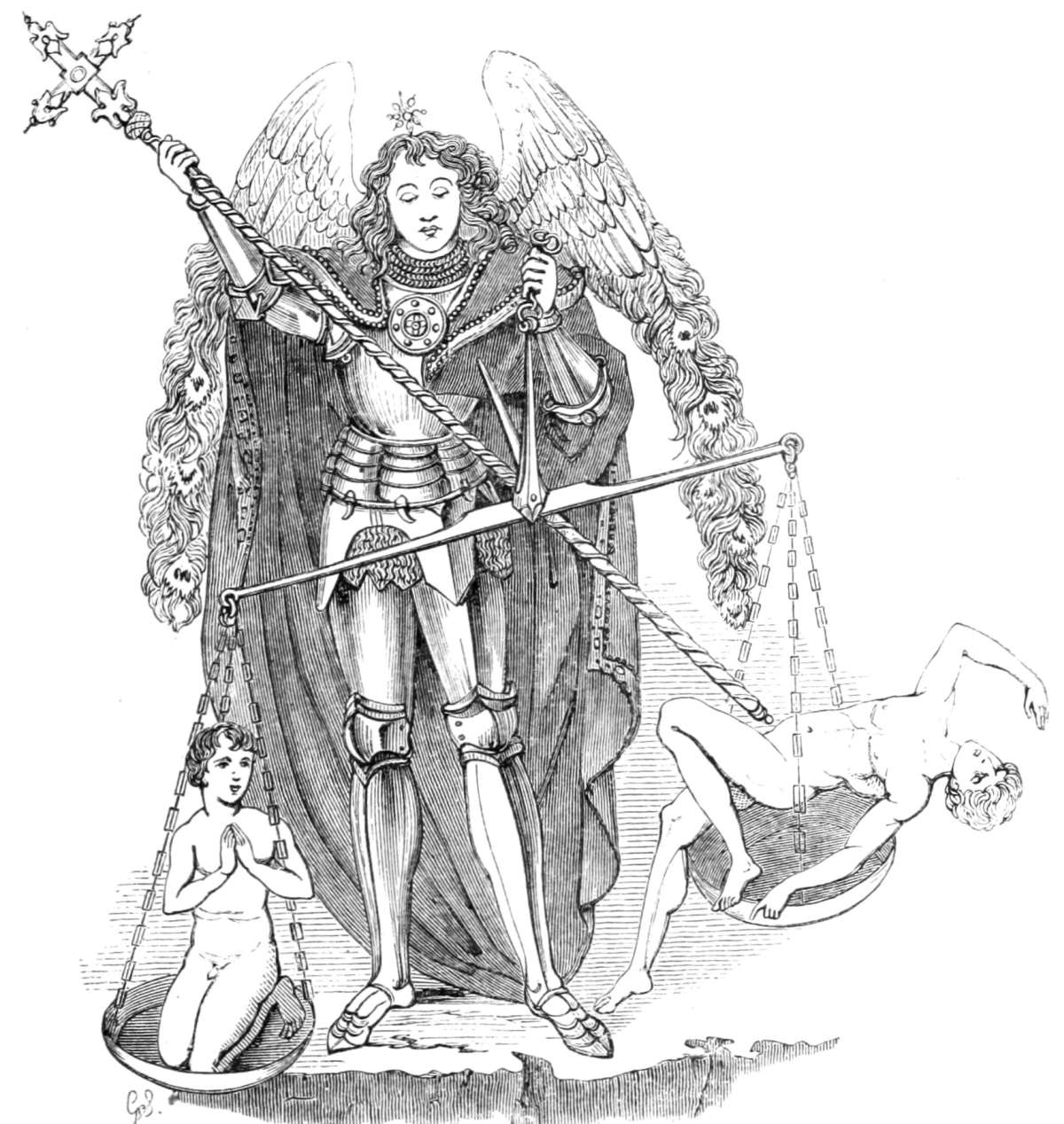
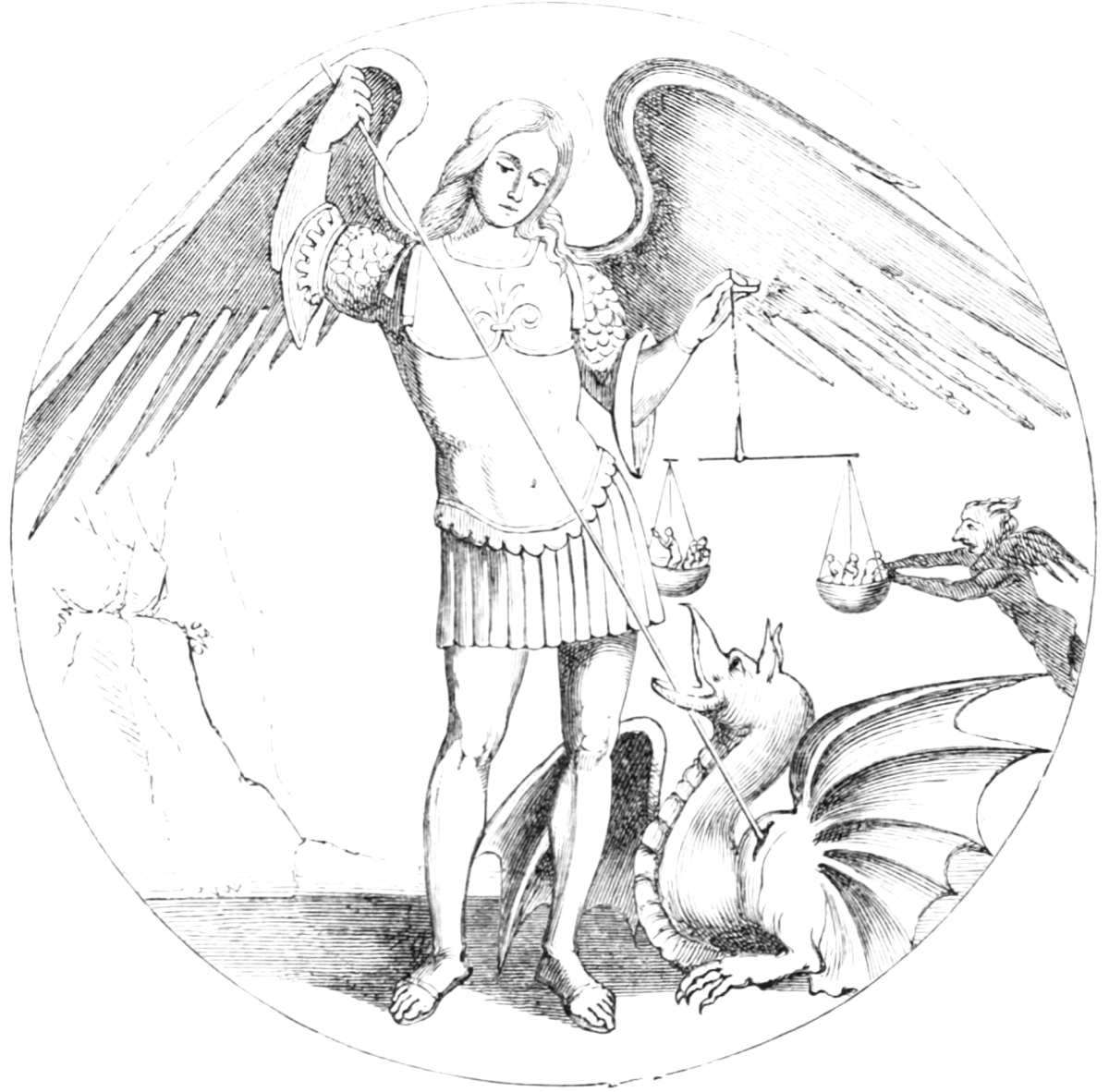
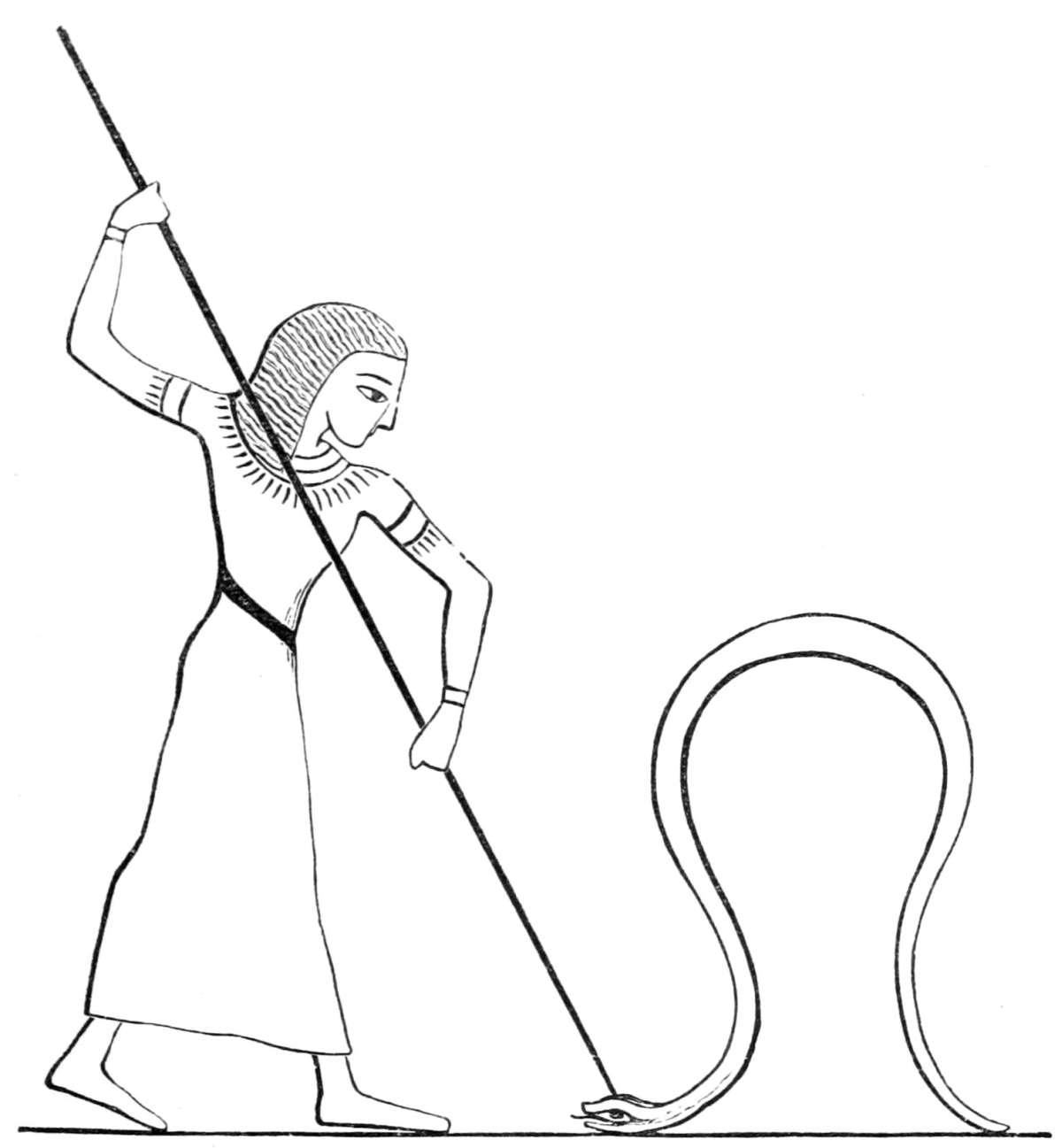
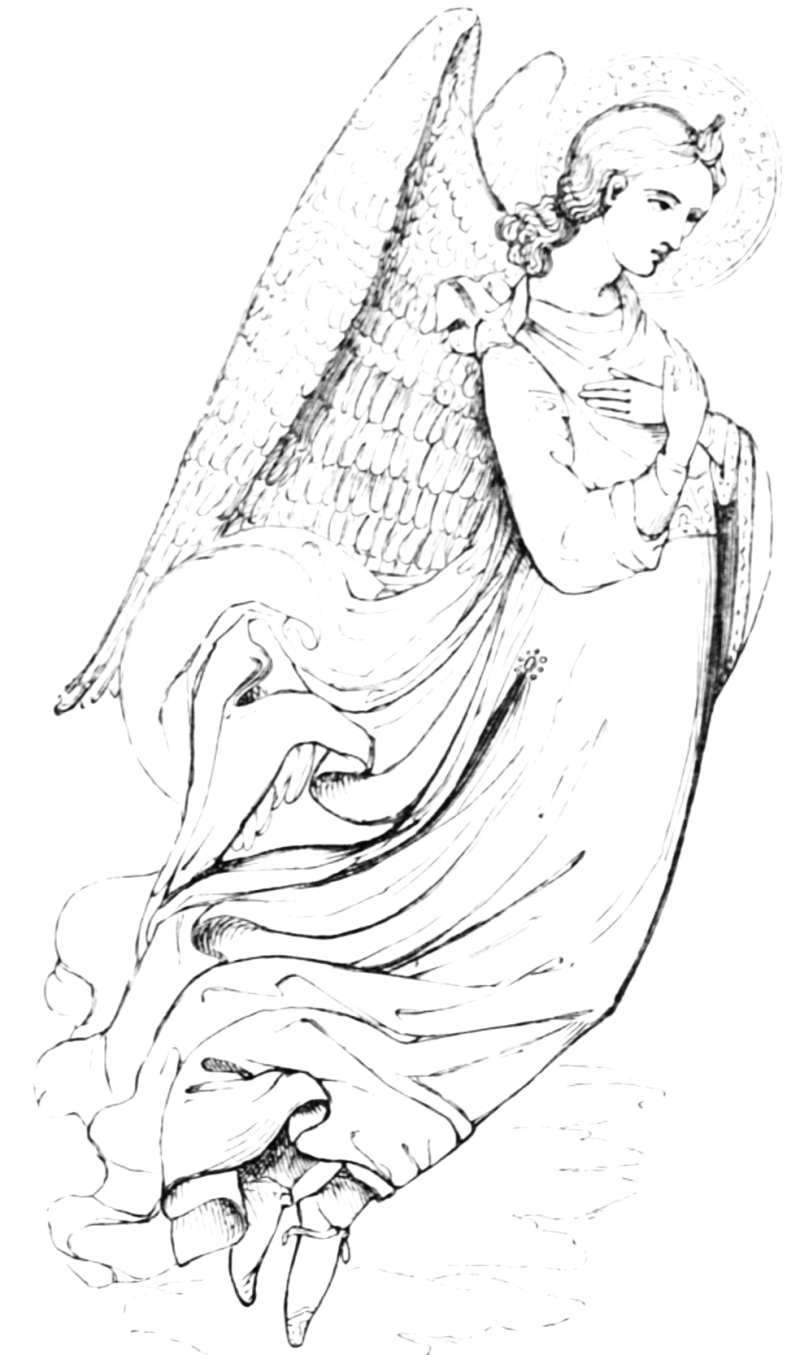
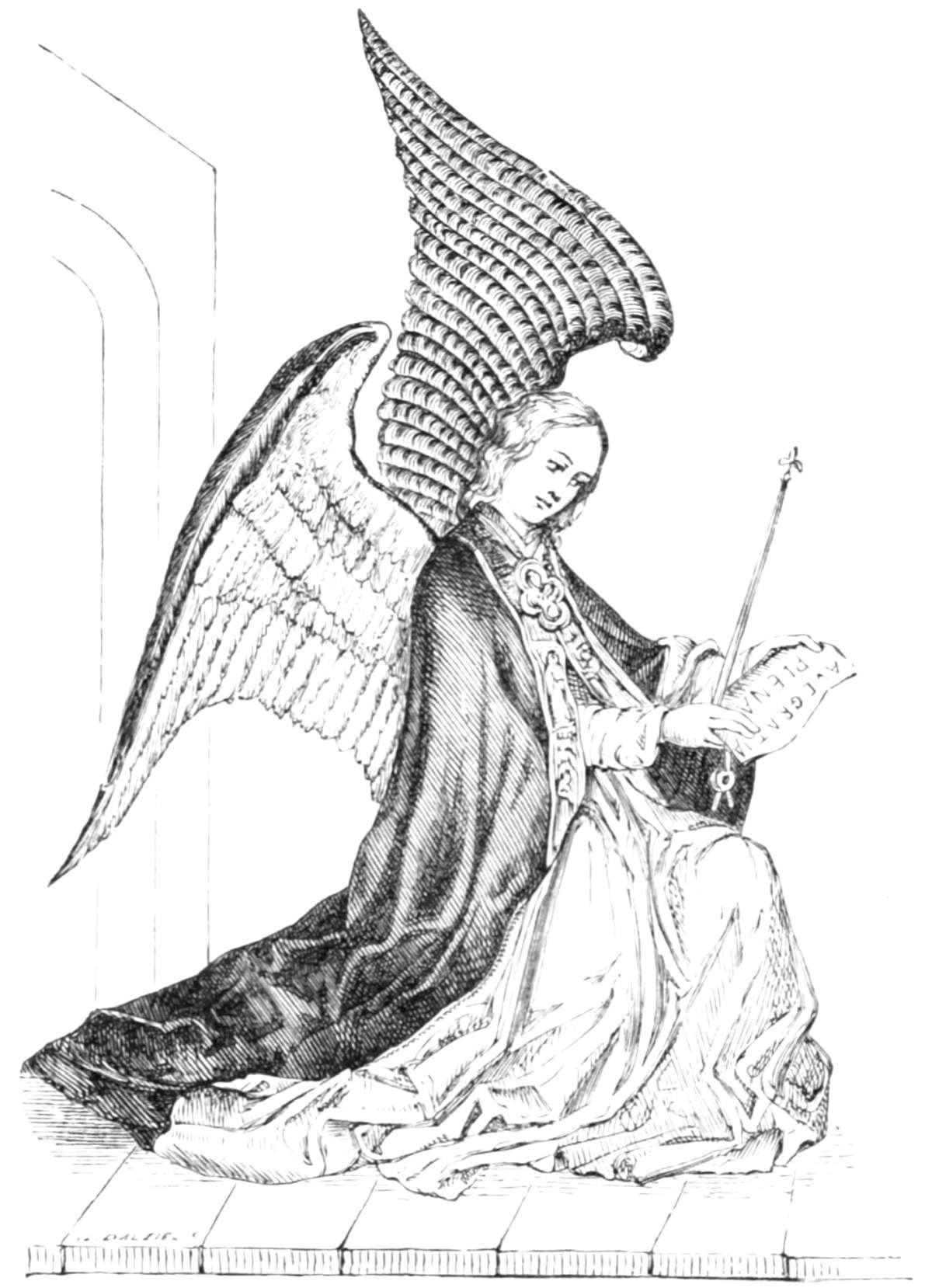
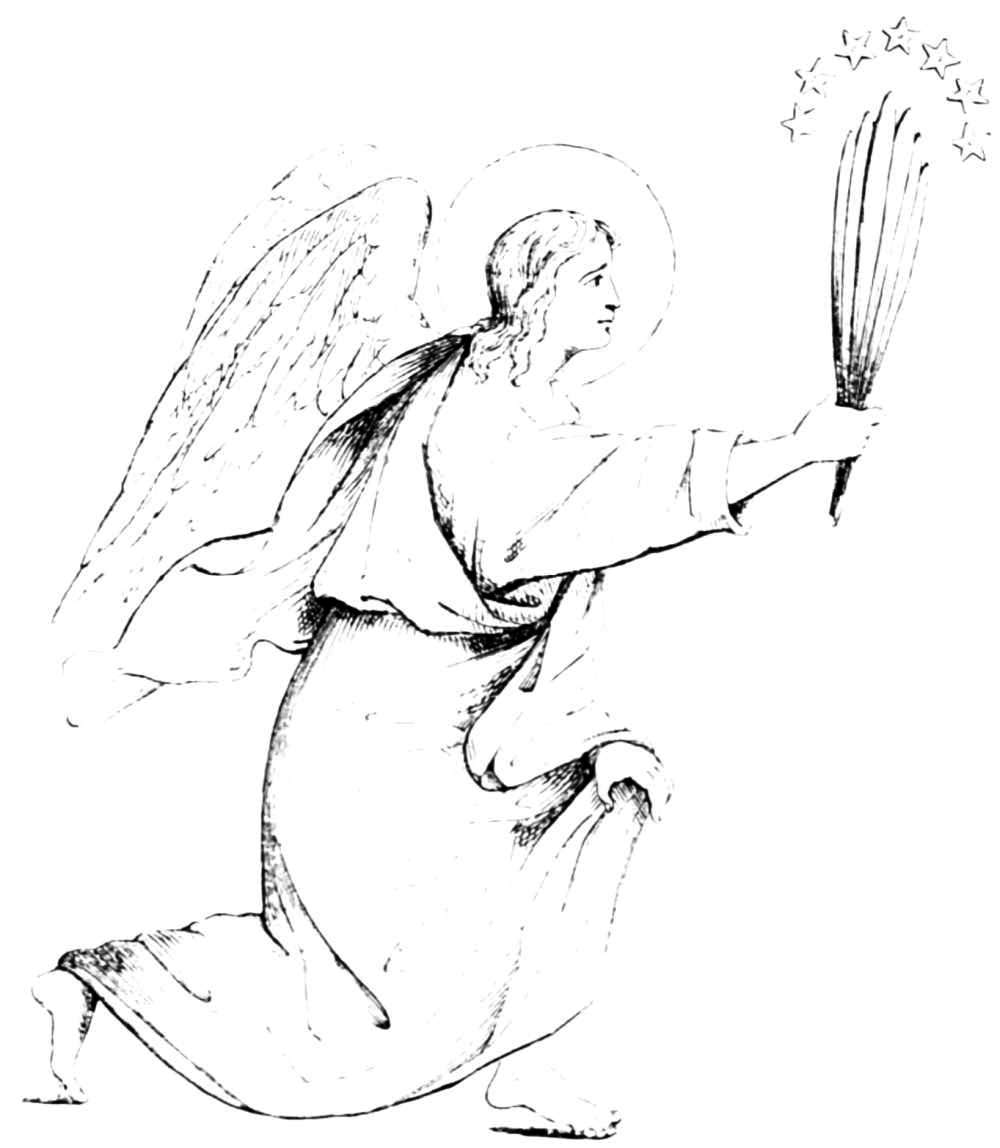
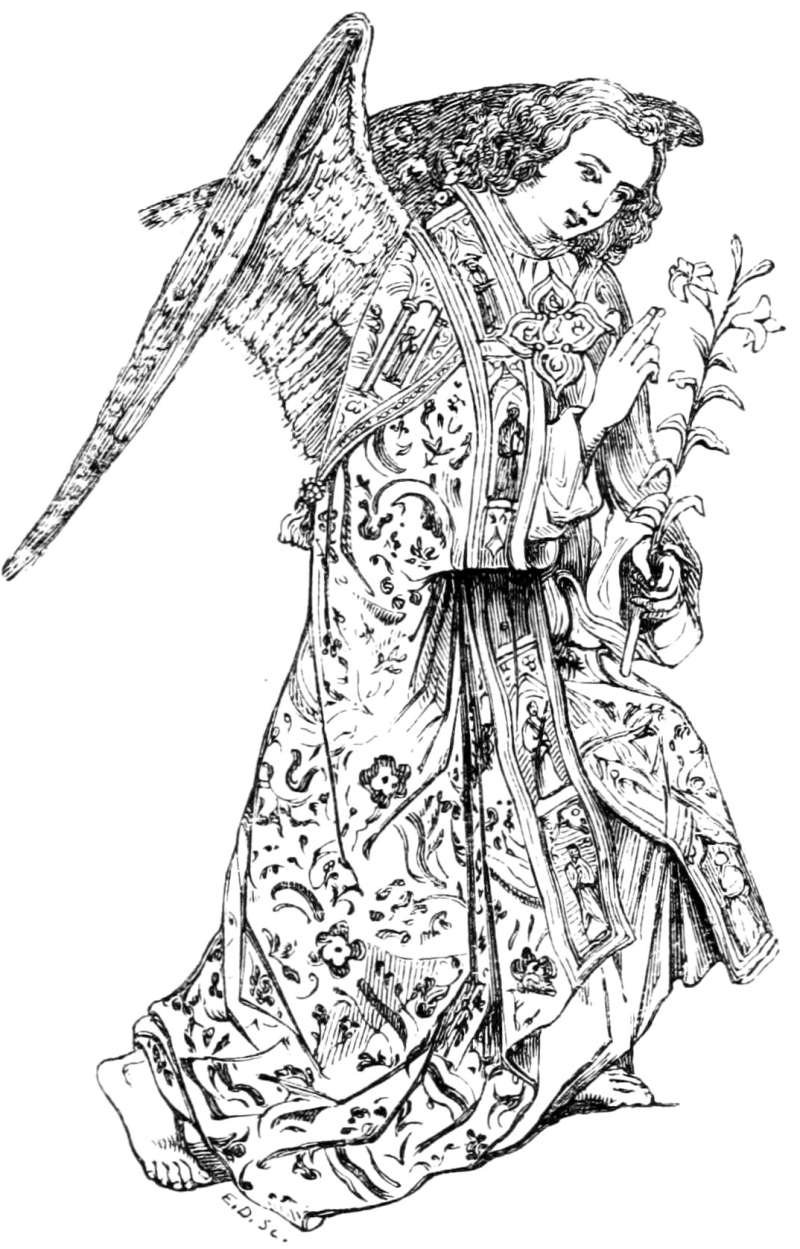
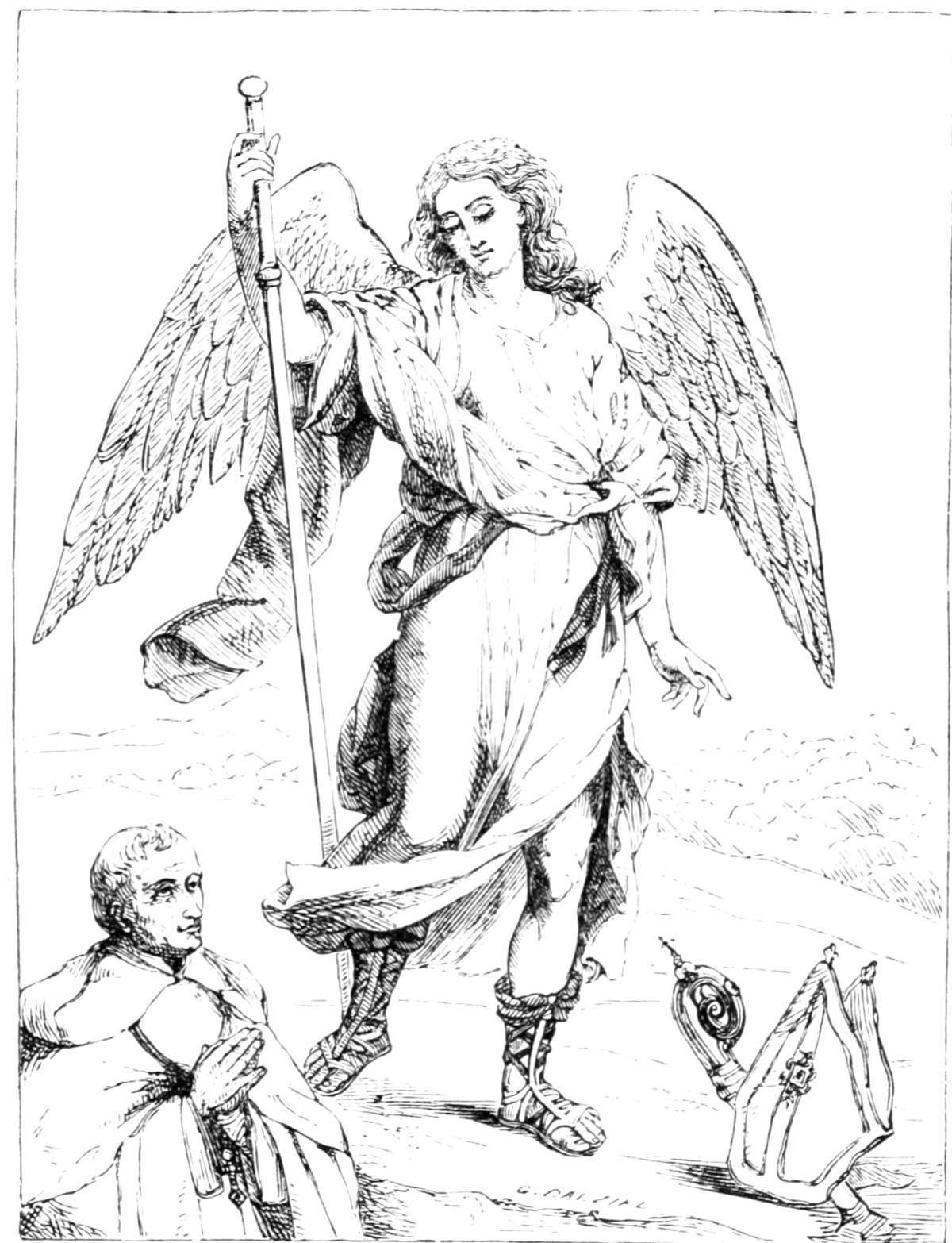
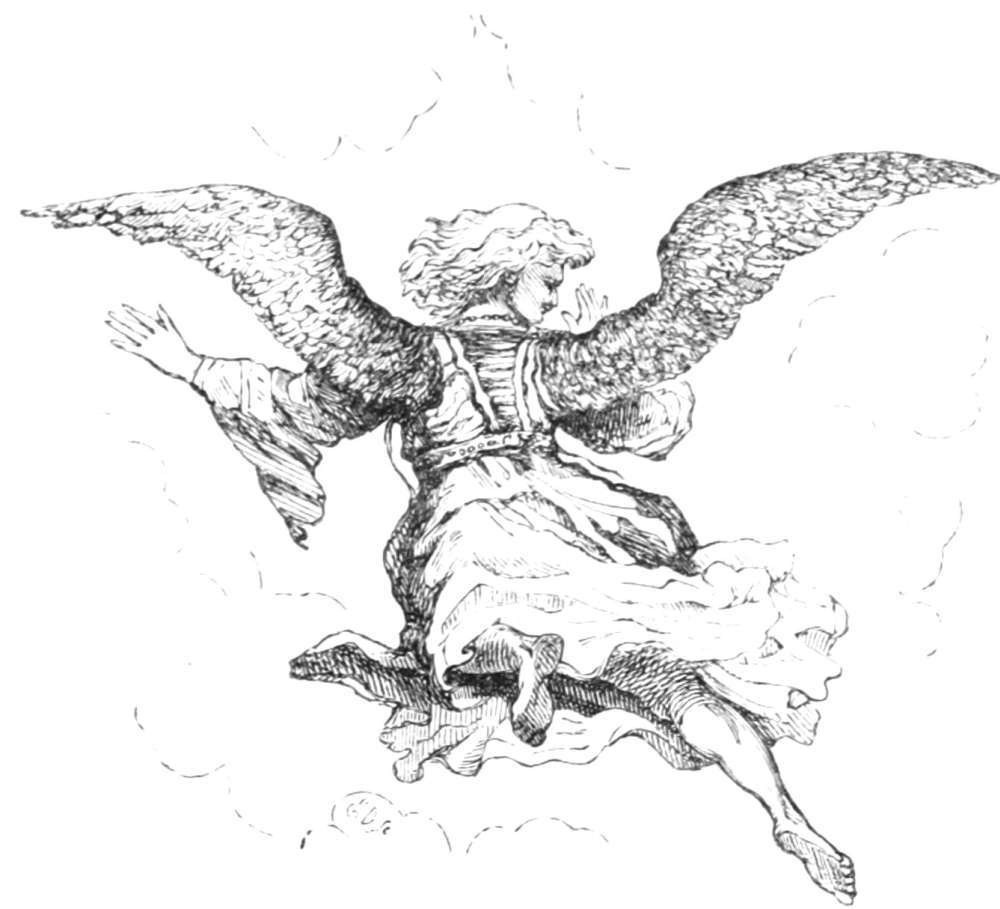

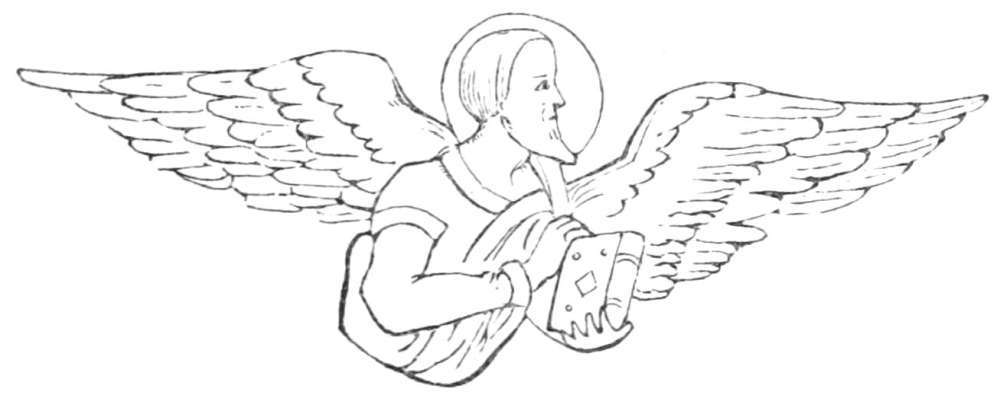
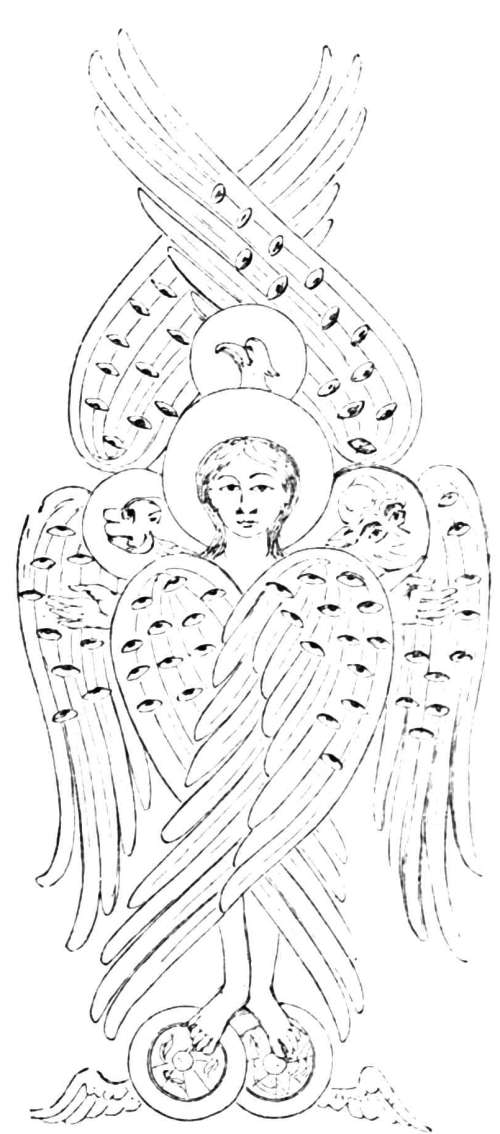
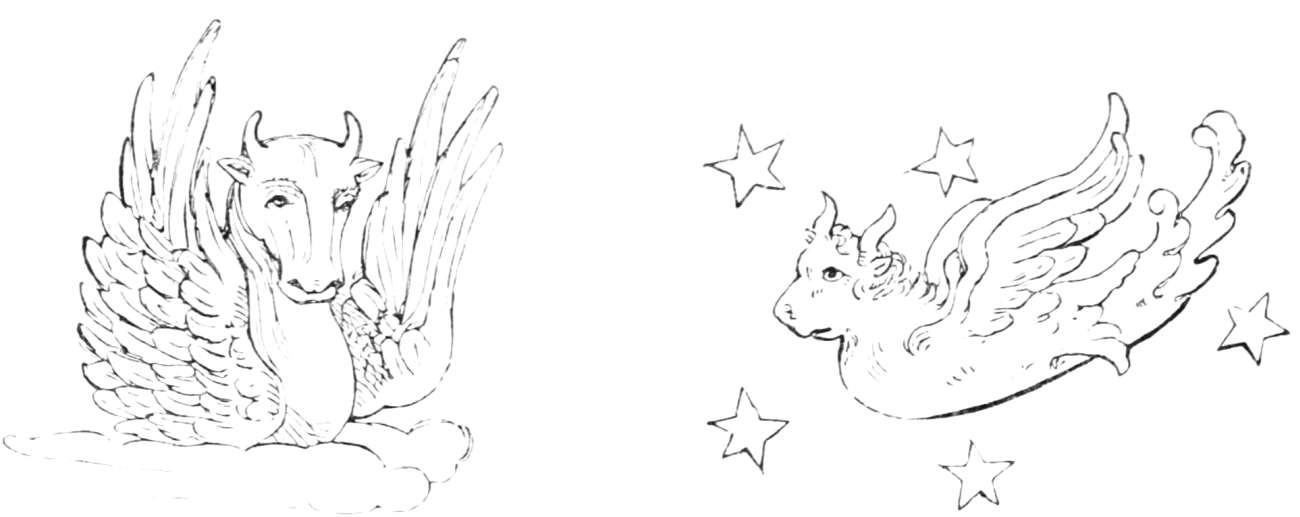
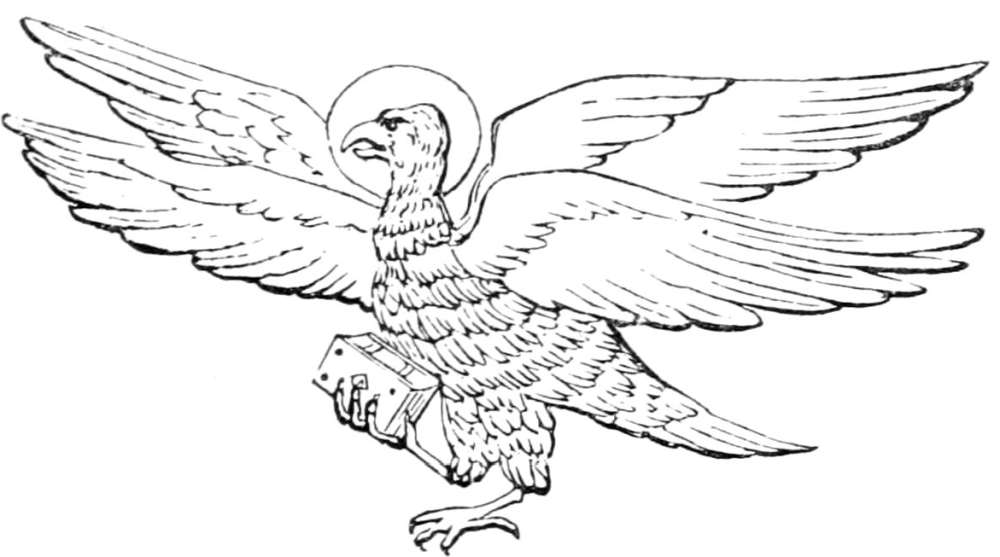
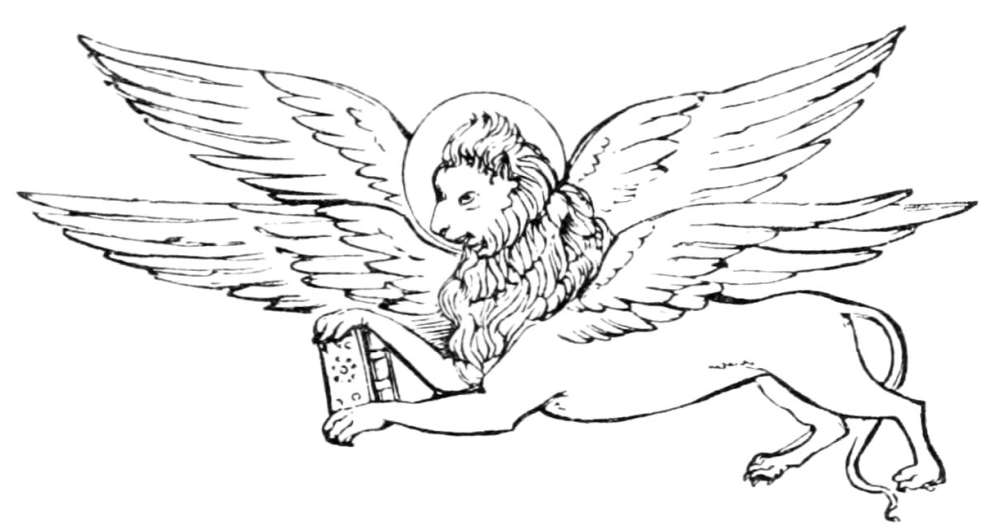
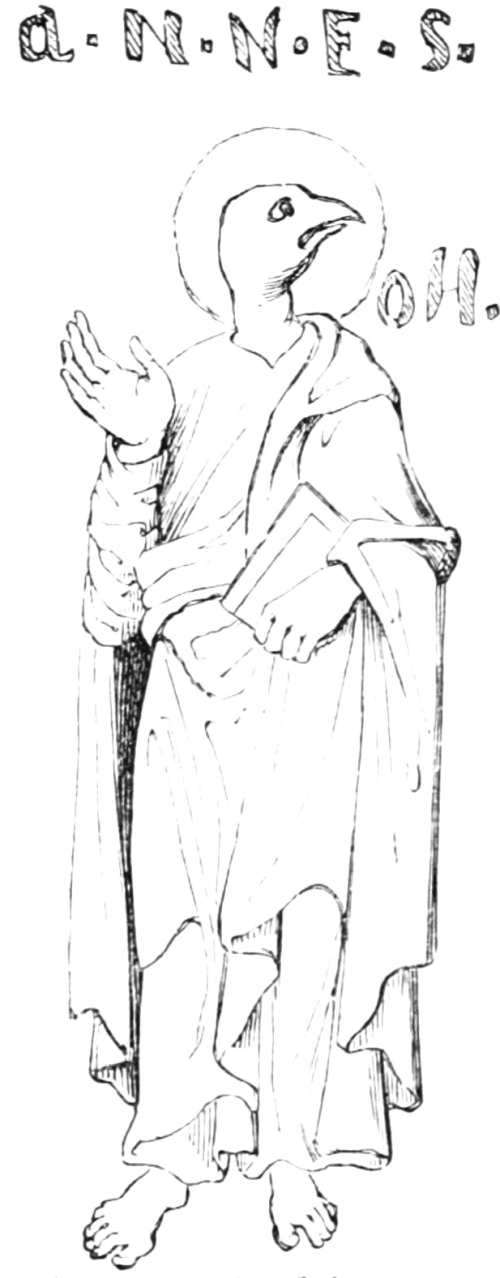
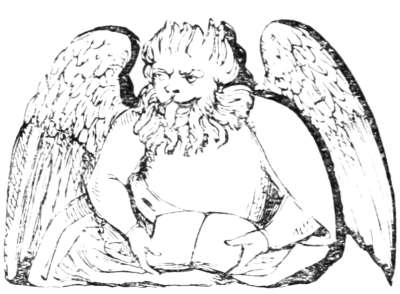
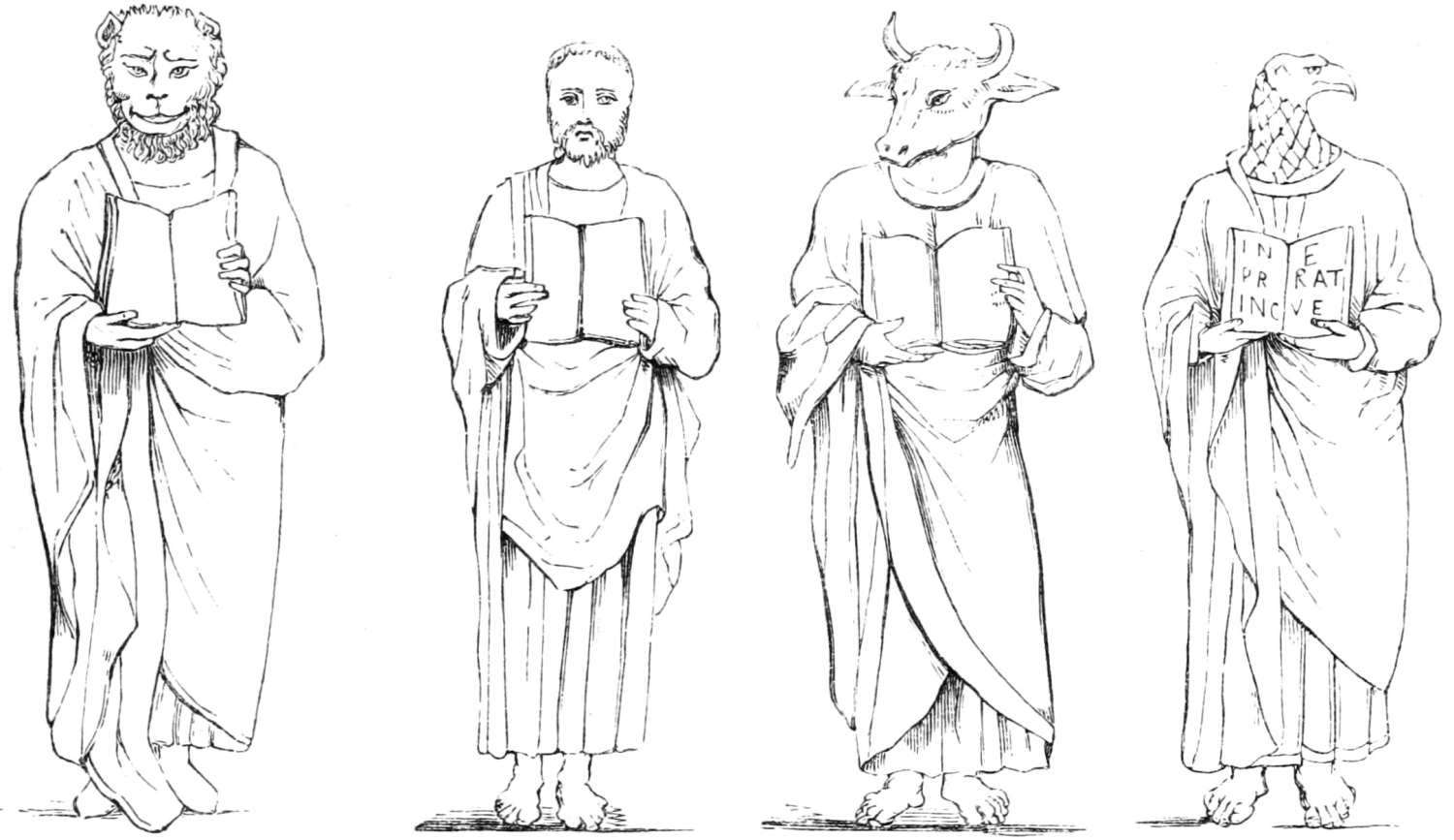
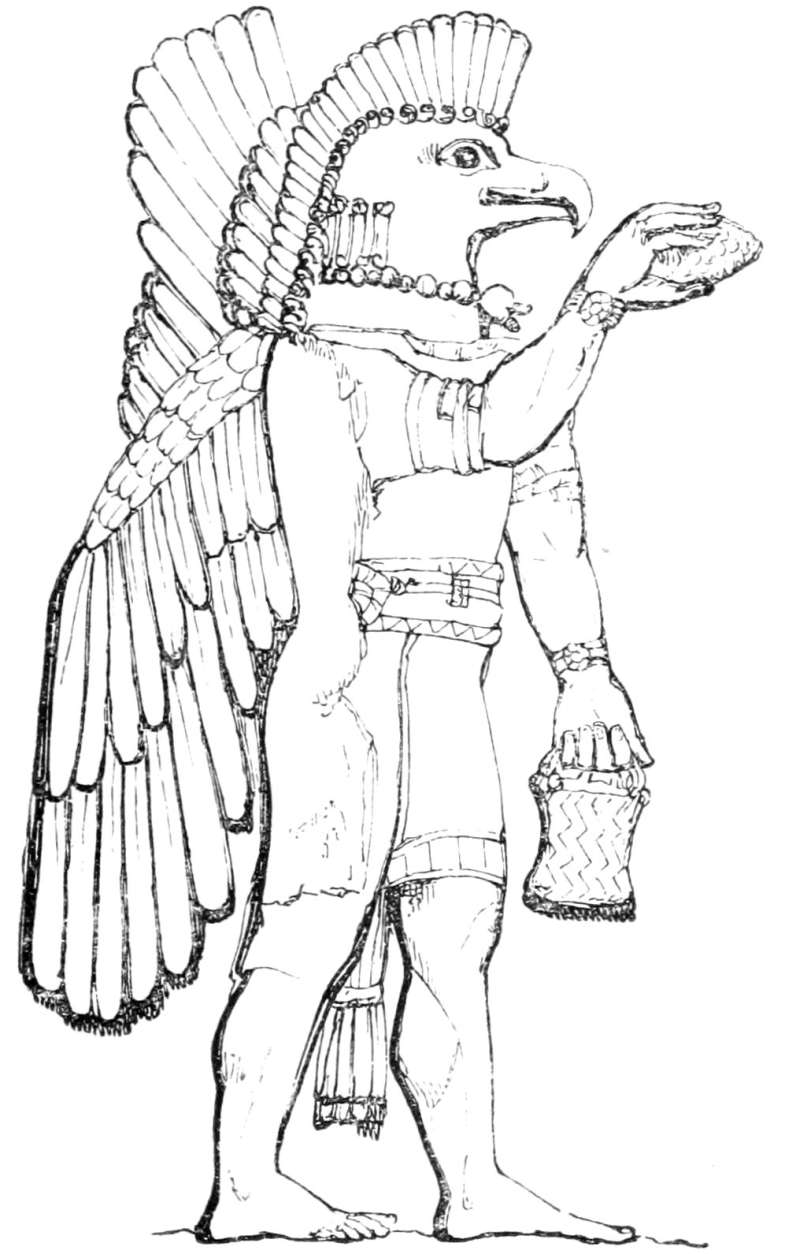
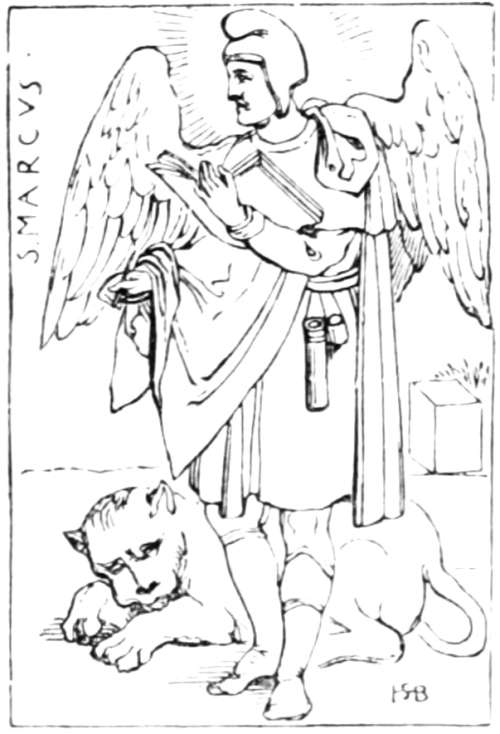
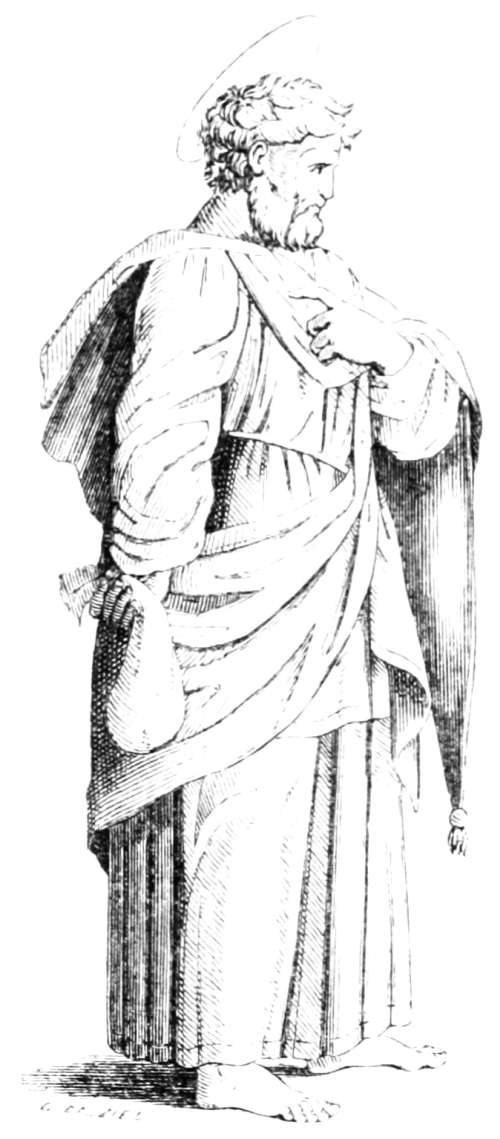
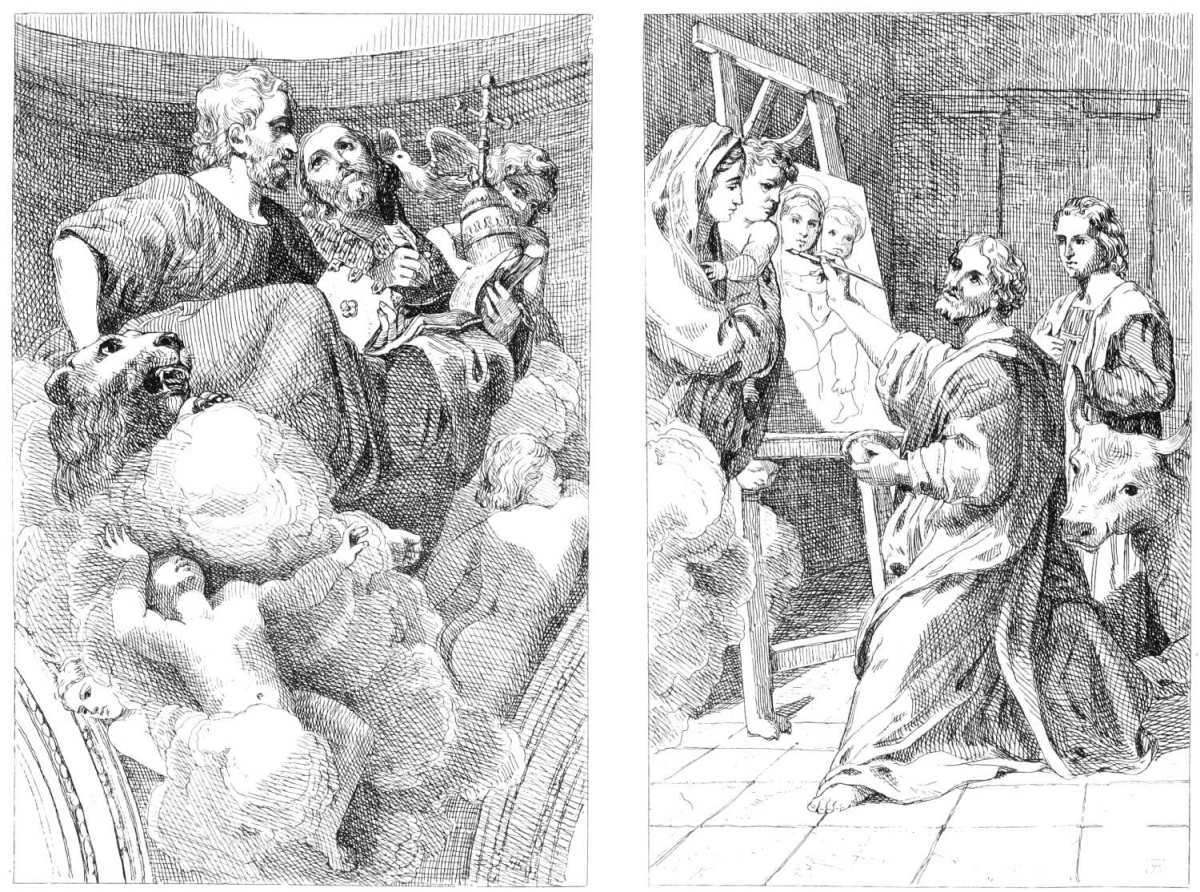
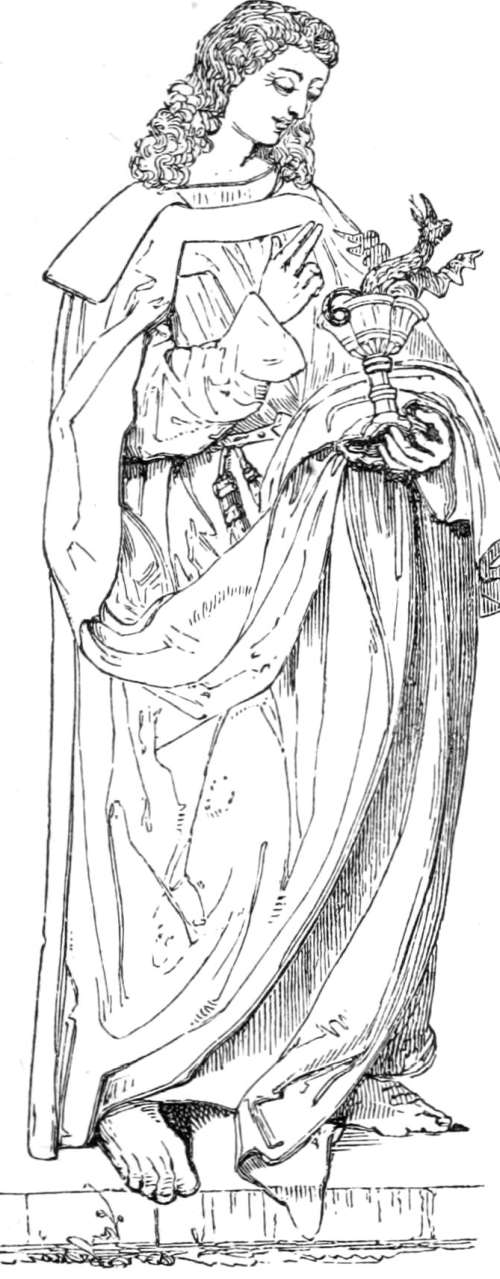
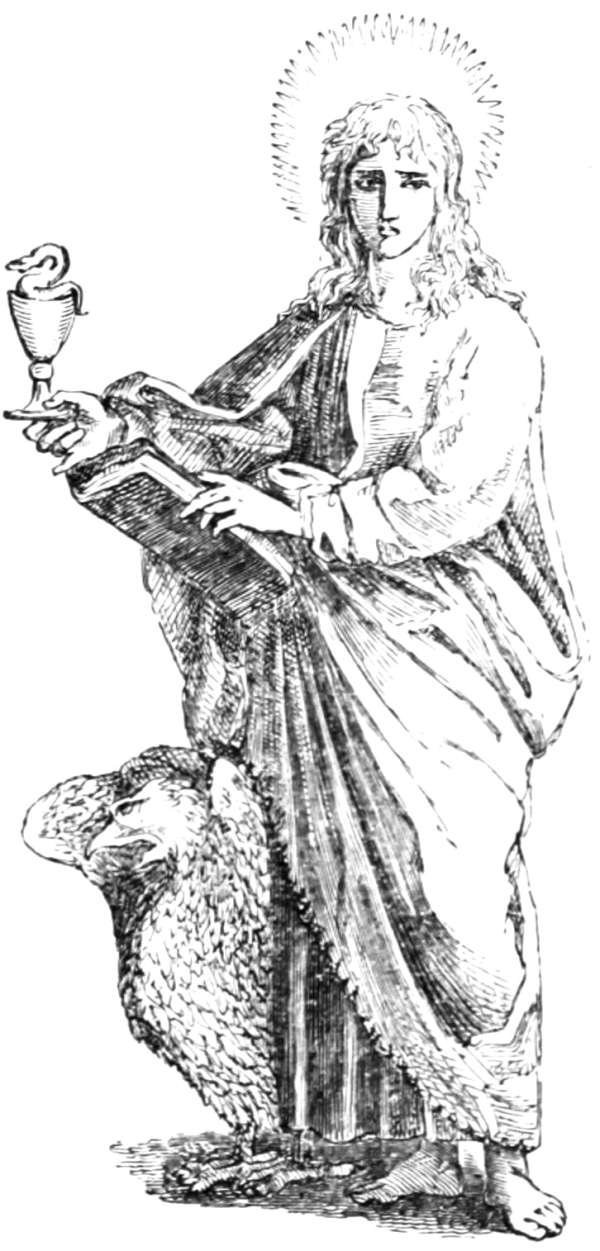
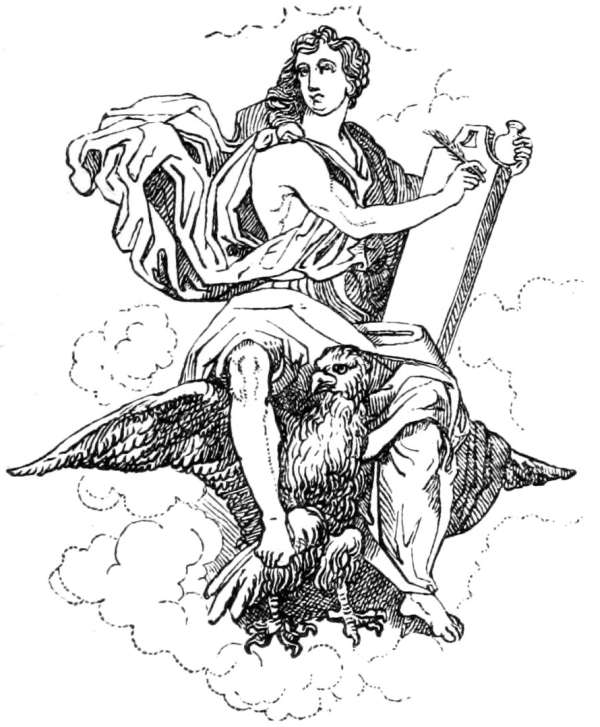
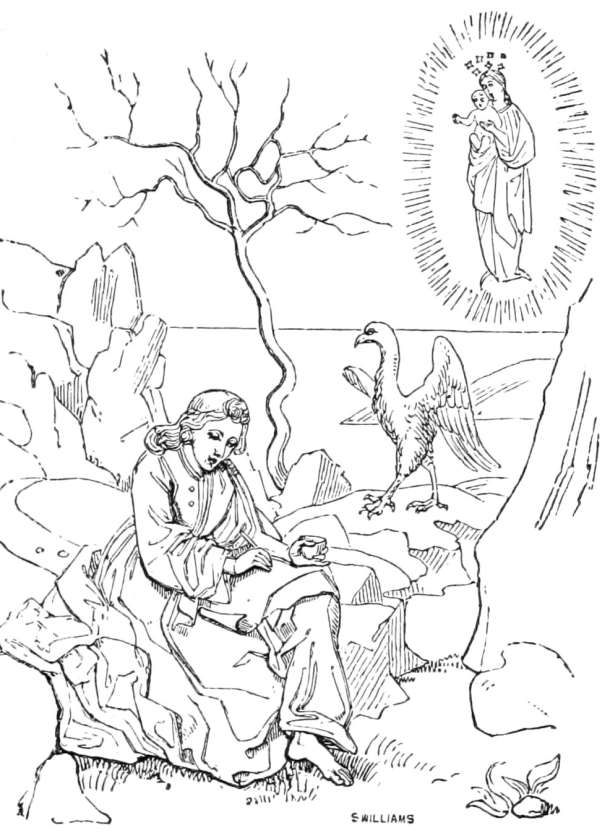

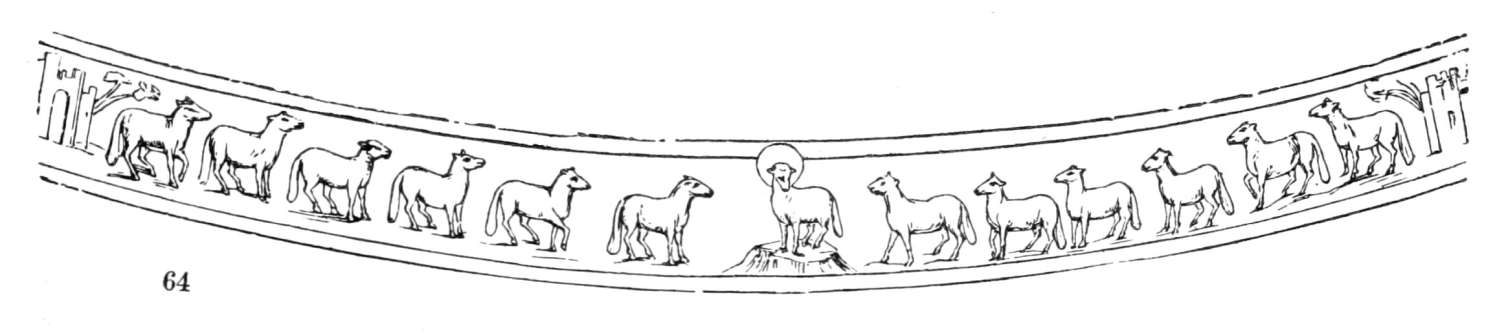
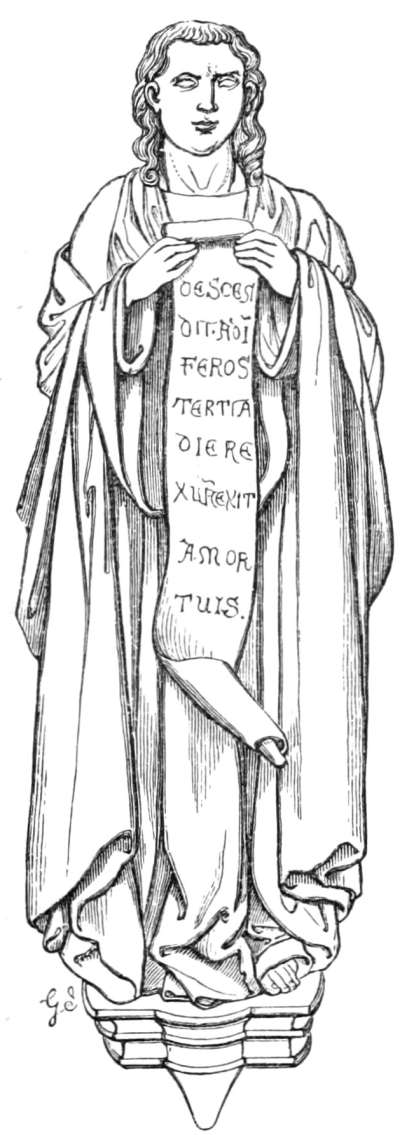
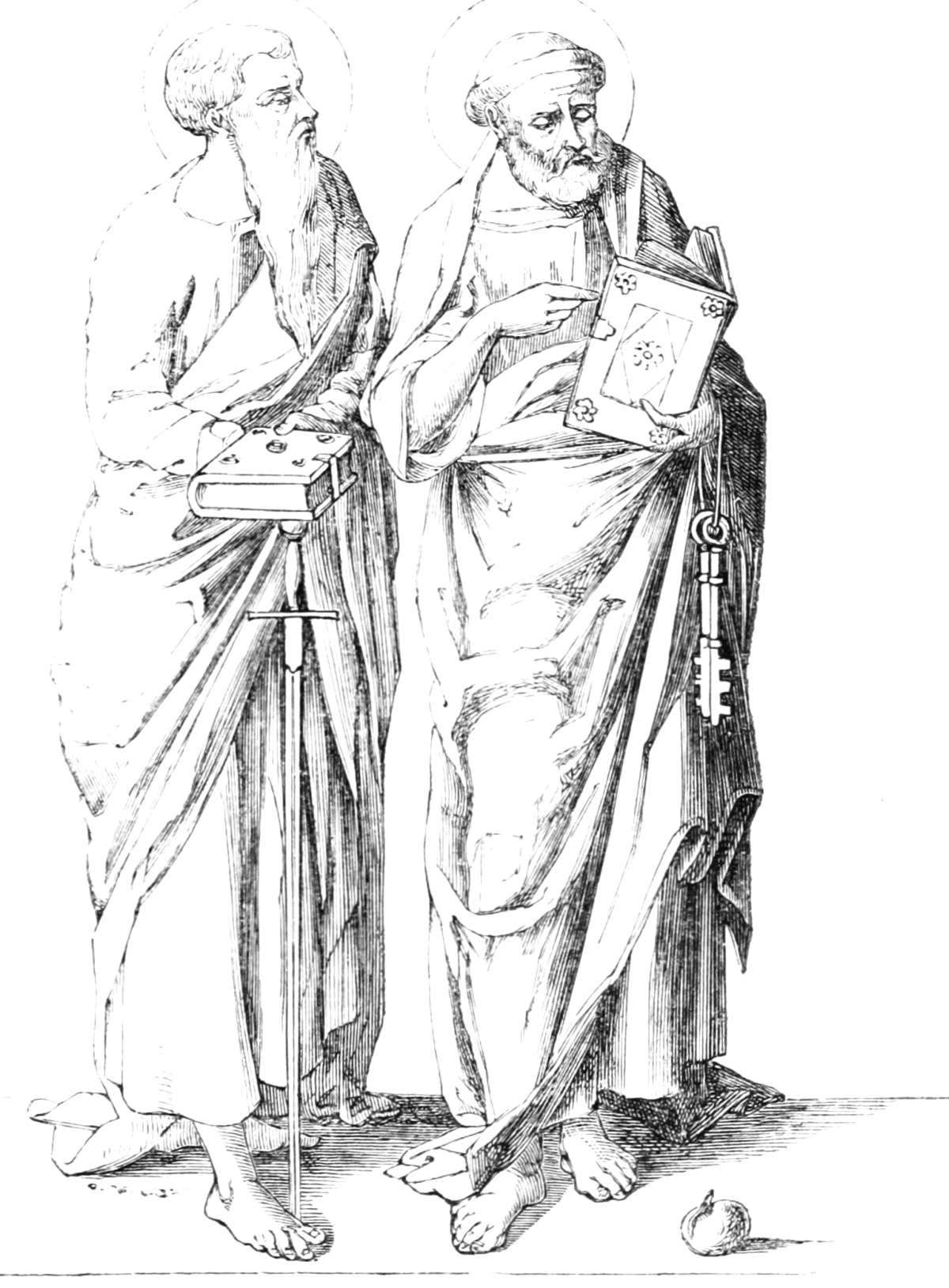
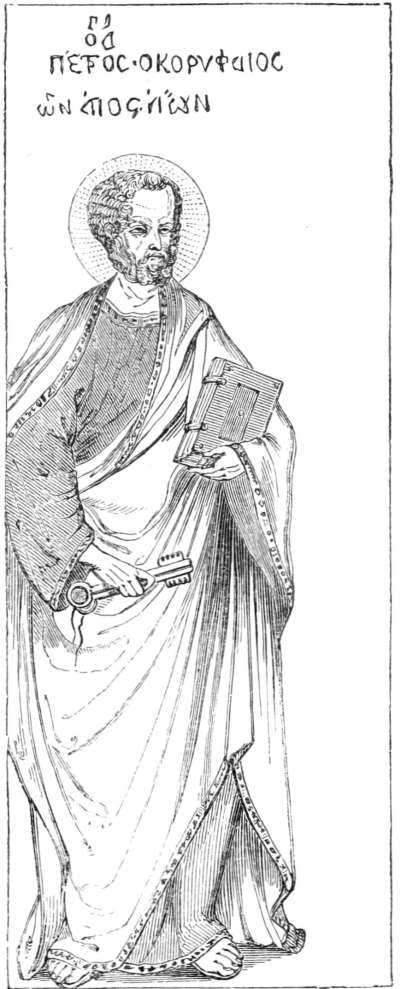
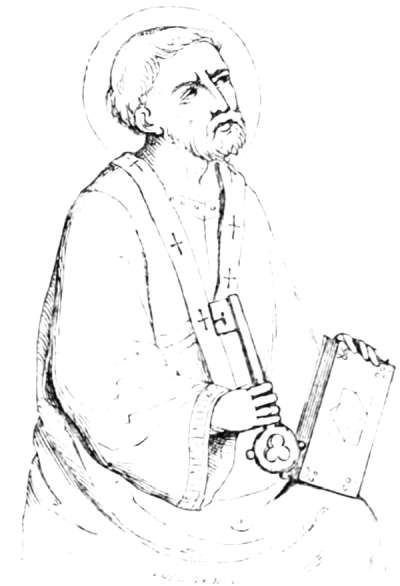
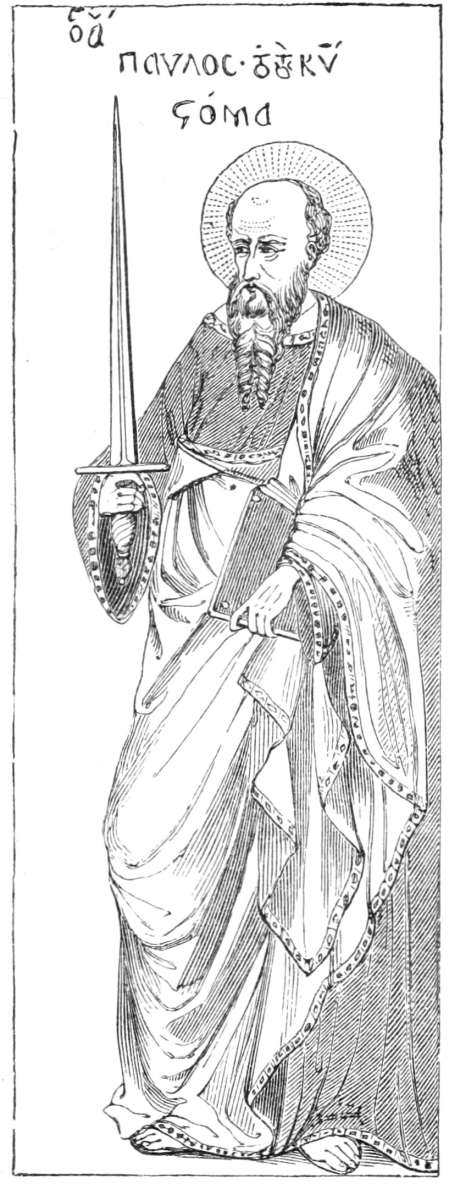
 : the right hand gives the benediction in the Greek
form; he holds in his left an open book, inscribed